/













Text
                    MAY
1986
FM 100-5
OPERATIONS
DISTRIBUTION RESTRICTION. This publication
contains technical or operational information that
is for official government use only. Distribution is
limited to US government agencies. Requests from
outside the US government for release of this
publication under the Freedom of Information Act
or the Foreign Military Sales Program must be
made to Commander, TRADOC, Fort Monroe, VA
23651-5000.
HEADQUARTERS,
DEPARTMENT OF THE ARMY
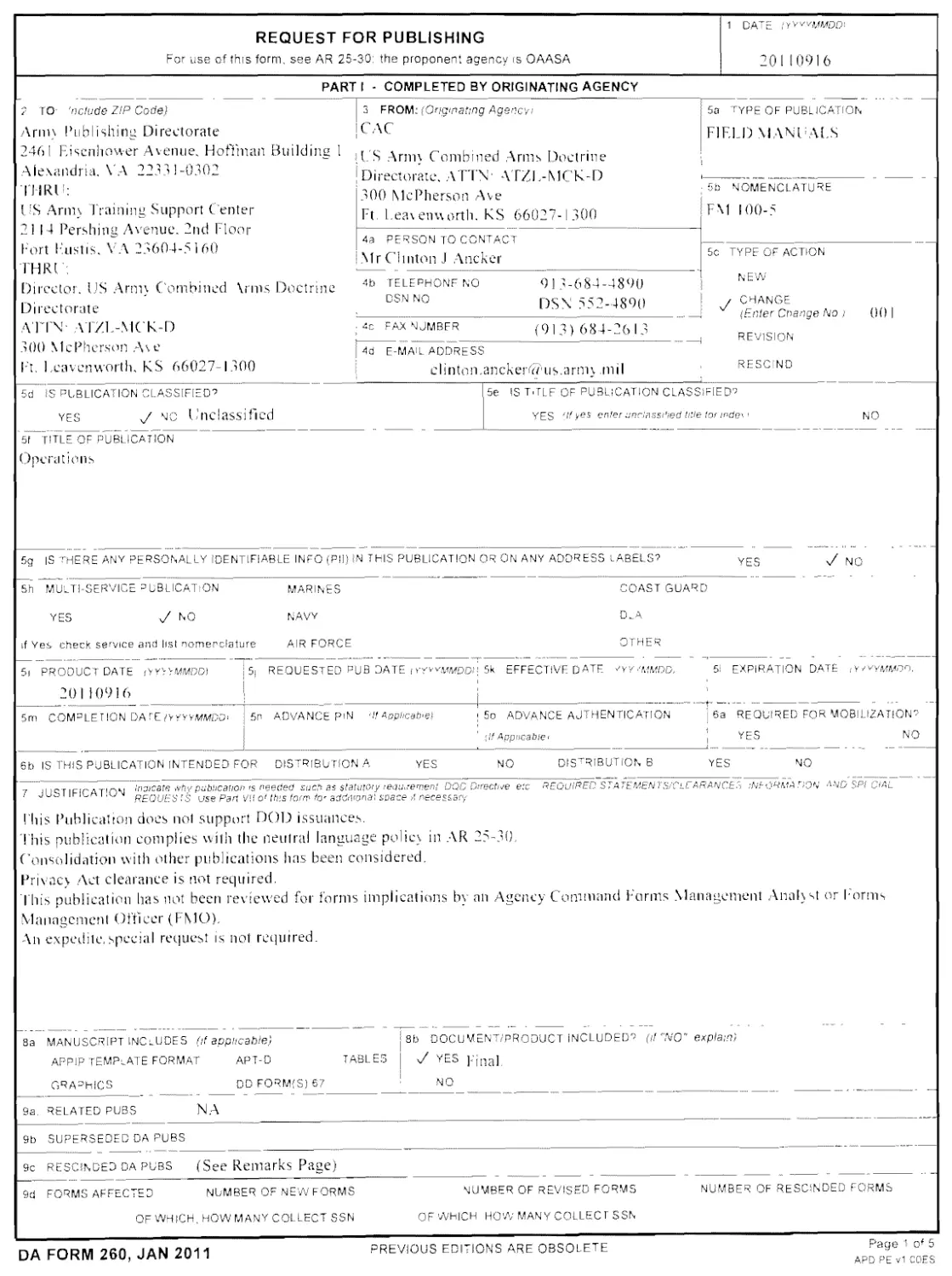
REQUEST FOR PUBLISHING
For use of this form, see AR 25-30: the proponent agency is OAASA
 ''WMDZj i
201 10916
7 TO' 'nclude ZIP Code)
.Army Publishing Directorate
2461 Eisenhower Avenue. Hoffman Building 1
Alexandria. V.A 22331-0302
ITIRU:
US Army Training Support Center
2114 Pershing Avenue. 2nd Floor
Fort Eustis. VA 23604-5 1 60
THRU:
Director. US Army Combined \rnis Doctrine
Directorate
ATTN- ATZL-MCK-D
300 McPhers'on Ave
Ft. Leavenworth, KS 66027-1300
PART I - COMPLETED BY ORIGINATING AGENCY
JI FROM: (Originating A.gencoi
i US Army Combined Arms Doctrine
i Directorate. X II \ ATZL-MCK-D
300 McPherson Ave
Ft. Leavenworth. KS 66027-
4a PERSON TO CONTACT
Mr Clinton J Ancker
Sb TELEPHONE NO
DSN NO
 Ac FAX NUMBER
TYPE OF PUBLICATION
I II I i; MANUALS
5b NOMENCLATURE
300	FM I 00-5
	5c TYPE OF ACTION
4-684-4890	NEW
CHANGE
(Enter Cnange No i 00 I
91)
DSN 552-4890
(913)684-2613
E-MAIL ADDRESS
clinton.anckerfous.army .mil
REVISION
RESCIND
5d IS PUBLICATION CLASSIFIED?	5e IS T.TLF OF PUBLICATION CLASSIFIED9
yes	у no Unclassified	YES 'If yes enter cnciassdted title tor index
5f TITLE OF PUBLICATION
Opci'ii t i ons
NO
5g IS THERE ANY PERSONALLY IDENTIFIABLE INFO (PH) IN THIS PUBLICATION OR ON ANY ADDRESS LABELS'
YES
5h MULTI-SERVICE PUBLICATION
MARINES
COAST GUARD
YES
NAVY
if Yes check service and list nomenclature
AIR FORCE
OTHER
5i PRODUCT DATE EY'rdMDDl
| 5j REQUESTED FUB DATE a'WWWOI! 5k EFFECTIVE DATE w’‘MMDD.
5i EXPIRATION DATE
20110916
5rn COMPLETION ОАГЕОУУУММОО. j 5n ADVANCE PiN '.7 flpp/catrel
' 5o ADVANCE AUTHENTICATION
6a REQUIRED FOR MOBILIZATION?
6b IS THIS PUBLICATION INTENDED FOR DISTRIBUTION A
YES
>Jf Applicable^
NO
distribution В
YES
YES
NO
NO
'lCARANCES
7 II 1RT iFir AT'ON	A'biy publication's needed sued as statutoiy tepiareaeni DQD Directive eh
/ j	ii-1uh ,u DEQUES  S use Part V!l of this fonv tQr additional space л necessary
I his Publicalton does nol support DOD issuances.
This publication complies with the neutral language policy in AR 25-3(1,
Consolidation with other publications has been considered.
Privacy Act clearance is not required.
Tliis publication has not been reviewed for forms implications by an Agency Command Farms Management Analyst or Forms
Managemenl Officer (I-MO).
An expedite.special request is nol required.
8a MANUSCRIPT INCLUDES (if applicable)
APPIP TEMPLATE FORMAT APT-D
lab DOCUMENT/PRODUCT INCLUDED9 (if''NO" explain;
GRAPHICS
DD FORM(S) 67
NO
9a. RELATED PUBS
9b SUPERSEDED DA PUBS
9c rescinded da pubs (See Remarks Page)
9d FORMS AFFECTED
NUMBER OF NEW FORMS
NUMBER OF REVISED FORMS
NUMBER OF RESCINDED FORMS
OF WHICH. HOW MANY COLLECT SSN
OF WHICH HOW MANY COLLECT SSN
Page i o( 5
APO PE v1 COES
DA FORM 260, JAN 2011
PREVIOUS EDITIONS ARE OBSOLETE
10a IS COPYRIGHT MATERIAL included in manuscript? tjf "YES" copy of copyright release must be attached) VES	v/ NO	10b COPYRIGHT HELD BY (Name and address, include Zip Code of copyright owner)
i1 DISTRIBUTION RESTRICTION
a DISTRIBUTION RESTRICTION (Publication contains material that would restrict distnbut'on) f/r’YES" select from list; У NO A _ Approved for public release: distribution is unlimited		b SALE BY SUPER- INTENDENT OF DOCUMENTS NOT TO BE SOLD У MAY BE SOLD
c DISTRIBUTION MEDIA (All Army-wide administrative publications will be Electronic Media Only (EMO) unless classified. FOUO, or distribution restricted: PAPER	CD ROM WEB	DVD OTHER		d WAIVER TO PRINT IN PAPER ATTACHED? YES NO
12 COORDINATION Uso Par! Xi (Continuation/RemarKs', of Phs form ic add.nnna1 comdmation necessary qi attach ><$t	WAiVRR FOR COORDINATION ATTACHE 0
a aGENC'y/MACOM (List formal name)	b NAME OF REVIEWING OF-IC'AL	c OFFICE SYMBOL I	1	d PHONE NO	e DATE | P'yyVMMDDI


i
------------------------------------------------------1


T
I
DA FORM 260, JAN 2011	L ,f o?e F °* L
AHD Pt V i Cuts
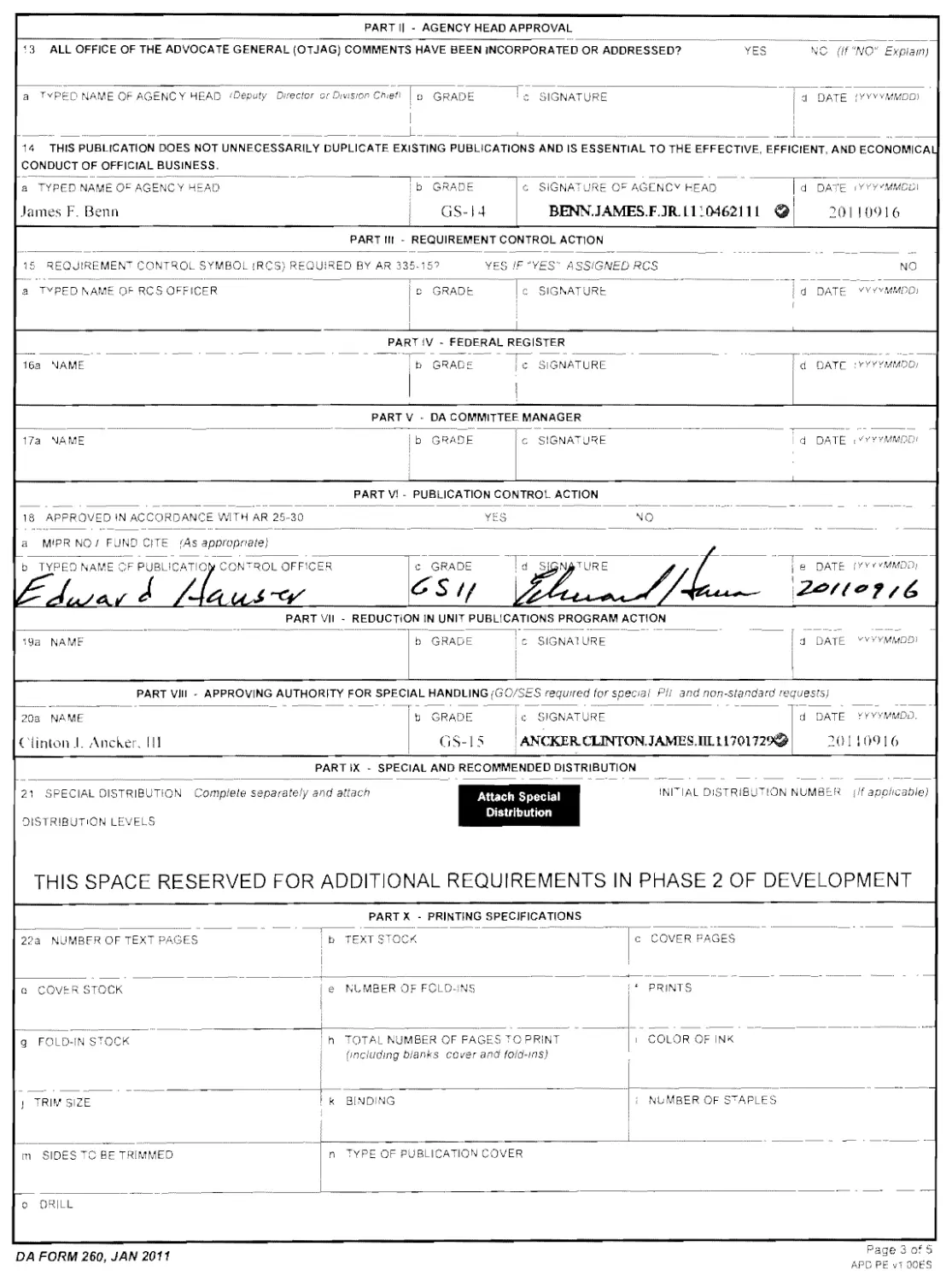
PART II - AGENCY HEAD APPROVAL
’3 ALL OFFICE OF THE ADVOCATE GENERAL (OTJAG) COMMENTS HAVE BEEN INCORPORATED OR ADDRESSED?	YES	NO (If “NO“ Explain)
a TVPED NAME OF AGENCY HEAD ‘Deputy Director ar Division CAefl n GRADE	V SIGNATURE	|a DATE tyvvvMMOO’i 	L	,	1	 14 THIS PUBLICATION DOES NOT UNNECESSARILY DUPLICATE EXISTING PUBLICATIONS AND IS ESSENTIAL TO THE EFFECTIVE, EFFICIENT, AND ECONOMICAL CONDUCT OF OFFICIAL BUSINESS.
a TYPED NAME 0-AGENCY HEAD James F. Benn	b GRADE GS-14	c SIGNATURE OF AGENCv HEAD BENN.JAMES.F.JK 1110462111 ©	d DATE lYvyxvwDQ) 20110916
PART III - REQUIREMENT CONTROL ACTION
15 REQUIREMENT CONTROL SYMBOL iRCS) REQUIRED BY AR 335-15?	YES IF "YES' ASSIGNED PCS	NO
a TvpED NAME OF RCS OFFICER	c GRADE	1 c SIGNATURE		d DATE
PART IV - FEDERAL REGISTER
16a NAME	b GRADE	c signature	d DATE iYYYYMMDDi
PARTV - DA COMMITTEE MANAGER
17a NAME	b GRADE	c signature	d DATE
PART VI- PUBLICATION CONTROL ACTION				_ ... —--- ..
18 APPROVED IN ACCORDANCE WITH AR 25-30	YES	NO
a MIPRNO/ FUND CITE fAs appropriate)
b TYPED NAME OF PUBLICATION CONTROL OFFICER	c GRADE <S/Z	XL //L	e DATE
PART VII - REDUCTION IN UNIT PUBLICATIONS PROGRAM ACTION
19a NAME	b GRADE	c SIGNATURE	d DATE ‘-'VWMMDOI
PART VIII • APPROVING AUTHORITY FOR SPECIAL HANDLING (GO/SES required for special PH and non-standard requests)
C SIGNATURE
20а NAME
b GRADE
d DATE ywvMMDO,
("Iinion .1. Anckei, 111
ANCKER. CLINTON. JAMES.m 11701729®
PART IX - SPECIAL AND RECOMMENDED DISTRIBUTION
21 SPECIAL DISTRIBUTION Complete separately and attach	Attach Special
DISTRIBUTION LEVELS	Distribution
INITIAL DISTRIBUTION NUMBER (/f applicable)
THIS SPACE RESERVED FOR ADDITIONAL REQUIREMENTS IN PHASE 2 OF DEVELOPMENT
PARTX - PRINTING SPECIFICATIONS
c COVER PAGES
22a NUMBER OF TEXT PAGES
I b TEXT STOCK

0 COVER STOCK	e NUMBER OF FOLD-INS	1 PRINTS
g FOLD-IN STOCK	h TOTAL NUMBER OF PAGES TO PRINT (including blanks со/елалЬ folci-ins)	i COLOR OF INK
j TRIM SIZE	к BINDING	1 NUMBER OF S’APLES
m SIDES TO BE TRIMMED	n TYPE OF PUBLICATION COVER
DRILL
DA FORM 260, JAN 2011
Page 3 of S
PART XI- REMARKS/CONTINUATION
23 REMARKS
I.	This FM 100-5. Operations 1986 version is obsolete.
2	1 he manual lias a restricted distribution that requires a change.
3.	Request the distribution be changed to: Approved for public release: distribution is unlimited
DA FORM 260, JAN 2011
Page 4 of 5
APD ПЕ v1 GOES
PART XI- CONTINUATION (Continued)
23 (Continued
This pubbcation does not create or extend the Ide of a committee
9 Rescinded DA Publications
Change restricted notice on 1986 version of FM 100-5. Operations to unlimited distribution
	PART XII	ARMY PUBLISHING DIRECTORATE (APD)
24a NAME		lb GRADE	Ic SIGNATURE	Id DATE'''"•MMOU; __J	L—_
DA FORM 260, JAN 2011
Page b o{ 5
Field Manual	«FM 100-5
No. 100-5	Headquarters
Department of the Army
Washington, DC, 5 May 1986
©PERAT0OW®
Preface
FM 100-5, Operations, is the Army’s keystone warfighting
manual. It explains how Army forces plan and conduct
campaigns, major operations, battles, and engagements in con-
junction with other services and allied forces. It furnishes the
authoritative foundation for subordinate doctrine, force design,
materiel acquisition, professional education, and individual and
unit training. It applies to Army forces worldwide, but must be
adapted to the specific strategic and operational requirements of
each theater. While emphasizing conventional military opera-
tions, it recognizes that Army forces must be capable of operat-
ing effectively in any battlefield environment, including low
intensity conflict and on the nuclear and chemical battlefield.
Employment of nuclear and chemical weapons by US forces is
governed by US national policy.
FM 100-5 is compatible with and will serve as the US imple-
menting document for NATO land forces tactical doctrine (Allied
Tactical Publication 35A), but is both more theoretical and
more general so as to meet US needs in other theaters. US
troops operating in the framework of FM 100-5 will execute
NATO’s forward defense plans in compliance with ATP 35A.
As the Army’s principal tool of professional self-education in
the science and art of war, FM 100-5 presents a stable body of
operational and tactical principles rooted in actual military
experience and capable of providing a long-term foundation for
the development of more transitory tactics, techniques, and pro-
cedures. It provides operational guidance for use by commanders
and trainers at all echelons and forms the foundation for Army
service school curricula. FM 100-5 emphasizes flexibility and
speed, mission type orders, initiative among commanders at all
levels, and the spirit of the offense.
This edition reaffirms the Army’s doctrinal thrust introduced
in 1982. It reflects the lessons learned since that time from
combat operations, teachings, exercises, wargames, and comments
*This publication supersedes FM 100-5, 20 August 1982.
i
FM 100-5
from the Army in the field. Central aspects of AirLand Battle
doctrine—its recognition of the importance of the operational
level of warfare, its focus on the seizure and retention of the
initiative, and its insistence on the requirement for multi-service
cooperation—remain unaltered. The basic tenets of AirLand Bat-
tle doctrine—initiative, agility, depth, and synchronization—are
reemphasized.
Users of this publication are encouraged to recommend
changes which will improve the clarity and utility of this man-
ual. Changes and comments should be forwarded to the Com-
mandant, US Army CGSC, ATTN: ATZL-SWD, Fort Leavenworth,
Kansas 66027-6900, using DA Form 2028 (Recommended Changes
to Publications and Blank Forms).
Unless otherwise stated, whenever the masculine or feminine
gender is used, both men and women are included.
ii
Table of Contents
Page
©ROH = тан ARD© m©w от побита
Chapter 1.	Challenges for the US Army .........................1
Identifying the Challenges ........................1
Meeting the Challenges ............................5
Chapter 2.	Fundamentals of AirLand Battle Doctrine ............9
Structure of Modern Warfare........................9
Dynamics of Combat Power .........................11
AirLand Battle Doctrine ..........................14
Close, Deep, and Rear Operations..................19
Command and Control ..............................21
AirLand Battle Imperatives ...................... 22
Chapter 3.	Operational and Tactical Planning
and Execution ..................................................27
Planning and Conducting Campaigns
and Major Operations .............................27
Planning and Conducting Tactical
Operations .......................................33
Major Functional Areas ...........................40
Chapter 4.	Sustainment Planning and Execution.................59
Sustainment Challenge.............................60
Key Sustainment Functions ........................60
Sustainment Imperatives ..........................62
Organization for Sustainment in a Theater
of War ...........................................63
Operational Sustainment ..........................65
Tactical Sustainment..............................71
Sustainment Controls .............................72
Combat Service Support as a Deception
Instrument .......................................74
Chapter 5.	Environment of Combat..............................75
Effects of Weather and Visibility.................75
Effects of Terrain ...............................76
Special Environments .............................82
Effects of Nuclear and Chemical
Weapons ......................................... 85
Effects of Electronic Warfare ....................87
Effects of Smoke and Obscurants...................87
Battlefield Stress ...............................88
Hi
FM 100-5
Page
райт те© - ©теите ©pudwutofo
Chapter 6.	Fundamentals of the Offense .................... 91
Historical Perspective ....................... 91
Purposes of the Offense ...................... 94
Characteristics of Offensive Operations ...... 95
Phases of Offensive Operations ............... 98
Forms of Maneuver ........................... 101
Offensive Framework ......................... 106
Chapter 7.	Conducting Offensive Operations................ 109
Offensive Campaigns and Major Operations.....109
Tactical Offense ............................ 112
РДИ ТОЙЕЕ -	BHPE6WW
Chapter 8.	Fundamentals of the Defense.....................129
Historical Perspective .......................129
Purposes of Defensive Operations .............131
Characteristics of Defensive Operations ......131
Alternative Defensive Patterns................134
Defensive Framework ..........................137
Chapter 9.	Conducting Defensive Operations ................139
Defensive Campaigns and Major Operations .....139
Tactical Defense .............................141
Chapter 10.	Retrograde Operations ..........................153
Types of Retrograde Operations ...............153
Delays .......................................154
Withdrawals ..................................158
Retirements ..................................159
CSS in Retrograde Operations .................160
iv
FM 100-5
Page
FART - JOINT, COMBINED, AND CONTINGENCY
OPERATIONS
Chapter 11. Joint and Combined Operations ............... 161
Joint Operations ......................... 161
Combined Operations ...................... 164
Chapter 12. Contingency Operations....................... 169
Considerations ........................... 169
Command and Control ...................... 170
Strategic Deployment ..................... 170
Employment .............................   171
Appendixes
A.	Principles of War ........................ 173
B.	Key Concepts of Operational Design ............ 179
C.	Echelons of Command .................... 183
Glossary .................................................. 189
References	.............................. 191
Index ..................................................... 195
V
PART OWE
TOE А» WW ЙТГ ВД»
CHAPTER 1
Challenges for the US Army
гр
he overriding mission of US
forces is to deter war. The US Army sup-
ports that mission by providing combat
ready units to the unified and specified
commands which are charged with execut-
ing the military policies of the United
States and waging war should deterrence
fail.
All military operations pursue and are
governed by political objectives. Today, the
translation of success in battle to desired
political outcomes is more complicated
than ever before. At one extreme of the
spectrum of conflict, the risk of nuclear
war imposes unprecedented limitations on
operational flexibility. At the other end,
terrorist activities resist conventional
military solutions. Between these extremes
lies a wide range of possible conflicts
which may escalate toward nuclear war
and which will almost always involve
counterterrorist operations.
Despite this complexity, the ability of
Army units to fight in high-, mid-, and low
intensity conflicts in concert with other
services and with allies remains critical to
the nation’s survival. Success in battle
may not alone assure the achievement of
national security goals, but defeat will
guarantee failure. This manual does not
address the formulation of US strategies
for deterrence or warfighting. It provides
Army leaders at all levels with doctrinal
guidance for conducting campaigns and
major operations and for fighting battles
and engagements within the broader frame-
work of military strategy.
IDENTIFYING THE CHALLENGES
Army forces must meet worldwide stra-
tegic challenges against the full range of
threats from terrorism through low- and
mid-intensity operations to high-intensity
and nuclear operations. In areas of greatest
strategic concern, they must be prepared
to fight battles of unprecedented scope and
intensity. The operations surrounding such
Chapter 1
1
FM 100-5
battles will routinely involve cooperation
with other services and allies and could be
fought with or under the threat of nuclear
or chemical weapons.
The skill and courage of leaders at all
levels will be critical to success in opera-
tions across the spectrum of conflict. As
in the past, the chaos of combat will place
a premium on the initiative, spirit, cohe-
sion, and mental and physical prepared-
ness of soldiers and their units. While the
importance of winning the first battle is
not diminished, the ability to fight sus-
tained campaigns is also vital to deter-
rence and to victory. Rigorous, realistic
training for war must therefore go on con-
tinuously to assure Army units’ readiness
to fight short-notice wars, campaigns, and
battles.
The Army must be ready to fight
enemies whose capabilities vary widely. In
high- or mid-intensity conflicts, these may
be modern tank, motorized, and airborne
forces like the Warsaw Pact armies or
other similarly organized forces including
Soviet surrogates. Less mechanized but
otherwise well-equipped regular and irregu-
lar forces and terrorist groups can be
expected to operate against Army forces in
most parts of the world. In low intensity
conflicts, light forces, insurgents, and ter-
rorists may be the only military threat
present.
The nature of modern battle and the
broad geographical range of US interests
make it imperative that Army units fight
as part of a joint team with units of the
US Air Force, the US Navy, the US Ma-
rine Corps, and representatives of appro-
priate civilian agencies. It is also critical
that commanders prepare themselves to
fight in coalition warfare alongside the
forces of our nation’s allies. As it has been
throughout the twentieth century, team-
work in joint and combined operations will
be an essential ingredient in any battles
Army forces fight.
Operations in the foreseeable future will
be fought in one of two basic environ-
ments. One environment may be an antici-
pated theater of war with an existing sup-
port structure of communications, air
defense, logistic facilities, and ports. The
other may be a relatively immature theater
where Army leaders within a joint or com-
bined context will have to choose between
creating such a support base in the theater
or fighting with only external support.
HIGH- AND MID-INTENSITY
CONFLICT
The high- and mid-intensity battlefields
are likely to be chaotic, intense, and
highly destructive. They will probably
extend across a wider space of air, land,
and sea than previously experienced. The
most important features of such conflicts
are discussed separately in the following
paragraphs. While each of these features
can be understood separately, their com-
bined effects constitute the actual setting
of operations.
Nonlinear Operations. In high- or mid-
intensity conflicts, Army forces must pre-
pare to fight campaigns of considerable
movement, not only to reduce vulnerability,
but also to obtain positional advantage
over the enemy. Rapid movement will be
complemented by the use of advanced,
highly lethal weapons throughout the bat-
tle area.
Even in conventional combat, opera-
tions will rarely maintain a linear charac-
ter. The speed with which today’s forces
can concentrate and the high volumes of
supporting fires they can bring to bear will
make the intermingling of opposing forces
nearly inevitable. Similarly, from the first
hours of battle, deep reconnaissance, air
mobility, long-range fires, and special
operating forces (SOF) will blur the distinc-
tion between front and rear and will
impose a requirement for all around de-
fense and self-sufficiency on all units.
Successful attack will require isolation of
2
Chapter 1
FM 100-5
the battle area in great depth as well as
the defeat of enemy forces in deeply eche-
loned defensive areas. Successful defense
will require early detection of attacking
forces, prompt massing of fires, interdic-
tion of follow-on forces, and the contain-
ment and defeat of large formations by fire
and maneuver. Throughout the battle area,
attack and defense will often take place si-
multaneously as each combatant attempts
to mass, economize locally, and maneuver
against his opponent.
Fluidity will also characterize operations
in the rear of forward deployed committed
forces. Guerrillas, SOF, and terrorists will
seek to avoid set-piece battles and to strike
at scattered points of vulnerability. Defend-
ing forces will try to preempt such attacks
with sweeps and raids throughout the bat-
tle area and will mass rapidly in response
to guerrilla, SOF, or terrorist attacks wher-
ever they occur.
Lethal Systems. Potential enemies of the
United States can be expected to field large
quantities of high quality weapons systems
whose range and lethality equal or exceed f
our own. Potent ground and air systems,
complemented by closely coordinated preci-
sion guided munitions, will be able to con-
centrate enormous combat power, especially
at decisive points.
Sensors and Communications. Wide
ranging surveillance, target acquisition
sensors, and communications that provide
information almost immediately will in-
crease the range and scope of battle. Sen-
sors offer the commander more than just
timely information on deep enemy loca-
tions and activity. They also serve as the
basis for attacking enemy follow-on forces
with missiles (ASM and SSM), MLRS, tube
artillery, fixed-wing aircraft, attack helicop-
ters, SOF, and nonlethal means such as
electronic combat and deception. Since
these attacks can be of vital importance
in battle, the sensors and communications
means which make them possible are par-
ticularly valuable.
Nuclear Warfare. Even though the pri-
mary purpose of nuclear weapons is to
deter their use by others, the threat of
nuclear escalation pervades any military
operation involving the armies of nuclear
powers, imposing limitations on the scope
and objectives even of conventional opera-
tions. US nuclear weapons may of course
only be used following specific directives
by the National Command Authorities
(NCAs) after appropriate consultation with
allies. Even were such authority granted,
however, the employment of nuclear weap-
ons would be guided more by political and
strategic objectives than by the tactical
effect a particular authorized employment
might produce. Even so, any battlefield
employment of nuclear weapons would cer-
tainly magnify the destructiveness of opera-
tions and could sharply alter their tempo.
Beside the effects of physical damage, the
psychological stress on soldiers would be
severe. As a consequence, battles or even
campaigns could last hours instead of
days or weeks and could cripple both
combatants.
Chemical Warfare. Chemical warfare has
been practiced sporadically throughout this
century, and US forces maintain a capabil-
ity in this area primarily for deterrence.
Chemical warfare presents many of the
same complications as nuclear operations.
However, because chemical weapons are
more widespread and the inhibition against
their use is lower for some nations, US
forces are even more likely to face a chemi-
cal than a nuclear threat.
Biological Warfare. The US has re-
nounced the use of biological weapons. How-
ever, this unilateral renunciation does not
free our own forces from the threat of
enemy biological warfare. Army forces
must therefore continue to train to fight
an enemy who could use biological
weapons.
Command and Control. The more fluid
the battlefield, the more important and dif-
ficult it will be to identify decisive points
Chapter 1
3
FM 100-5
and to focus combat power there. Under
such conditions, it is imperative that the
overall commander’s intent and concept of
operations be understood throughout the
force. Communications will be interrupted
by enemy action at critical times and units
will frequently have to fight while out of
contact with higher headquarters and adja-
cent units. Subordinate leaders will be
expected to act on their own initiative
within the framework of the commander’s
intent.
Air Dimension. The airspace of a theater
is as important a dimension of ground op-
erations as the terrain itself. This airspace
is used for various purposes including
maneuver, delivery of fires, reconnaissance
and surveillance, transportation, and com-
mand and control. The control and use of
the air will always affect operations; the
effectiveness of air operations in fact can
decide the outcome of campaigns and bat-
tles. Commanders must consider the air-
space to include the apportionment of air
power in planning and supporting their
operations. They must protect their own
forces from observation, attack, and inter-
diction by the enemy and expect the enemy
to contest use of the airspace.
Austere Support. Army forces must be pre-
pared to fight their battles at the end of
long, vulnerable lines of logistical support
and must anticipate high consumption
rates for all types of supplies. They may
have to fight outnumbered against an
enemy with significantly shorter supply
lines. Logistical support may be austere in
such situations and thereby markedly
affect the design of campaigns and the
planning and conduct of battles.
Urban Combat. Combat in built-up areas
will be unavoidable in most theaters of
war. Divisions and larger units will have
to plan for attack and defense in urban
areas and for fluid battles around them.
Obstacles. Mid- to high-intensity opera-
tions also will have to contend with sub-
stantial obstacles, some man made such
as minefields and others natural such as
rivers, mountains, and other hindering ter-
rain. Such obstacles often favor the defense
and permit economies of force but they
also pose special challenges of force com-
position, task organization, maneuver, and
timing.
Unconventional Warfare and Terror-
ism. In almost all conflicts, the Army will
encounter terrorists, guerrillas, and sabo-
teurs. Operating throughout the theater of
war, they will threaten the security and
continuity of our operations. They will
usually be present even in high- and mid-
intensity conflicts where their suppression
will involve passive and active measures
including the commitment of forces.
LOW INTENSITY CONFLICT
The growing incidence of war at the
low end of the conflict spectrum demands
Army action on the unique battlefields of
low intensity conflict (LIC). This form of
warfare falls below the level of high- and
mid-intensity operations and will pit Army
forces against irregular or unconventional
forces, enemy special operations forces,
and terrorists. LIC poses a threat to US
interests at all times, not just in periods
of active hostilities.
Fighting in the low end of the conflict
spectrum requires special force composition
and task organization, rapid deployment,
and restraint in the execution of military
operation. Army actions in LIC must be
fully coordinated with national strategy
and fused at the operational level into a
coherent effort which will usually include
economic and political actions as well as
military activities.
In countering an insurgency, the Army
may employ specially trained forces or
training teams. This sort of activity,
termed Foreign Internal Defense, may in-
clude the transfer of defense equipment,
the training of foreign soldiers, advisory
4
Chapter 1
FM 100-5
assistance, or even the commitment of com-
bat forces. All military efforts in a counter-
insurgency campaign will be made in
concert with the initiatives of other US
government agencies involved to ensure a
synchronized national effort. The forces
selected for Foreign Internal Defense will
depend on the threat to be countered. Light
and heavy forces, aviation units, logistical
support, and a variety of training teams
may be used for counterinsurgency efforts.
There are also peacetime contingency
operations which require the employment
of Army forces. These can include demon-
strations of force, raids, or rescue missions,
and larger operations undertaken to protect
US interests, lives, and property. These
contingency operations require intensive
intelligence collection, thorough planning,
and rapid deployment of light forces at the
decisive time and place.
As in the past, the Army will also par-
ticipate in peacekeeping operations which
support diplomatic efforts to achieve,
restore, or maintain peace in an area of
armed conflict. Such operations may be
unilaterally or internationally manned and
directed. Whatever the case, they will be
sensitive and will require a high degree of
MEETING THE
The US Army can meet these chal-
lenges. Superior performance in combat
depends on three essential components.
First and foremost, it depends on superb
soldiers and leaders with character and
determination who will win because they
simply will not accept losing. Next, it
depends on a sound, well-understood doc-
trine for fighting. Finally, it depends on
weapons and supporting equipment suffi-
cient for the task at hand. These three
components must be unified harmoniously
into effective fighting organizations. This
is done through well-thought out orga-
nizational design and effective training
programs.
unit and individual discipline in the forces
committed. Units of peacekeeping forces
use force only in cases of self defense.
Independent and state-supported ter-
rorists employ violence in attempting to
influence the policies of governments. In a
very real sense, terrorists pursue strategic
objectives through LIC. Army doctrine
calls for preventive action—antiterrorism—
along with reactive measures—counterter-
rorism—to meet the terrorist threat to US
forces, representatives, and agencies and
to the security of American citizens and
property.
Terrorism constitutes a threat which
must be dealt with within the Army’s daily
operations and which will continue to be
of concern in high- and mid-intensity con-
flicts. Awareness of the threat and recogni-
tion that the indicators of terrorist activity
differ from those of the enemy on the con-
ventional battlefield are essential to coun-
tering terrorism. Leaders at all levels must
develop a broad view of this conflict which
will guide them in securing their opera-
tions and in protecting their soldiers from
terrorists as well as from conventional
enemy military forces.
CHALLENGES
LEADERSHIP AND SOLDIERS
Wars are fought and won by men, not
by machines. The human dimension of
war will be decisive in the campaigns and
battles of the future just as it has been in
the past.
The fluid, compartmented nature of war
will place a premium on sound leadership,
competent and courageous soldiers, and
cohesive, well-trained units. The conditions
of combat on the next battlefield will be
unforgiving of errors and will demand
great skill, imagination, and flexibility of
leaders. As in the wars of the past, how-
ever, American soldiers will fight resolutely
Chapter 1
5
FM 100-5
when they know and respect their leaders
and believe that they are part of a good
unit. How to develop effective leaders is
addressed in FM 22-100 and FM 22-999.
DOCTRINE
An army’s fundamental doctrine is the
condensed expression of its approach to
fighting campaigns, major operations, bat-
tles, and engagements. Tactics, techniques,
procedures, organizations, support struc-
ture, equipment and training must all
derive from it. It must be rooted in time-
tested theories and principles, yet forward-
looking and adaptable to changing technol-
ogies, threats, and missions. It must be
definitive enough to guide operations, yet
versatile enough to accommodate a wide
variety of worldwide situations. Finally, to
be useful, doctrine must be uniformly
known and understood.
The doctrine presented in the following
chapters seeks to develop the full potential
of the Army. It takes into account the chal-
lenges outlined on the previous pages and
is applicable to joint, combined, and tacti-
cal operations worldwide. The principles of
AirLand Battle doctrine reflect past usages
in the US Army and the tested ideas of
past and modern theorists of war. The
nine principles of war are fundamental to
US Army doctrine. They are elaborated in
FM 100-1 The Army and reprinted here in
Appendix A, for convenient reference.
Recent studies have also been used to gain
insights into the likely nature of contem-
porary operations. While AirLand Battle
doctrine focuses primarily on mid- to high-
intensity warfare, the tenets of AirLand
Battle apply equally to the military opera-
tions characteristic of low intensity war.
Such operations of course pose a different
challenge than those of high- and mid-
intensity conflict. That challenge must be
met with initiative in leaders, special prep-
aration in training, and flexibility and
restraint in operations. FM 100-20, Low
Intensity Conflict, addresses this subject
in detail.
TRAINING AND READINESS
Clausewitz stated the purpose of peace-
time armies very clearly. He said: “The
whole of military activity must relate
directly or indirectly to the engagement.
The end for which a soldier is recruited,
clothed, armed, and trained, the whole
object of his sleeping, eating, drinking, and
marching is simply that he should fight
at the right place and the right time.”
Forward deployed forces may have to
fight on a few hours’ notice. Other compo-
nents of the force may have only days or
weeks to make final preparations for war.
Commanders must have effective plans for
those important days or weeks and must
train for the specific missions they antici-
pate. They must ensure that each officer,
noncommissioned officer (NCO), and sol-
dier is prepared for battle and is equipped
to perform his job as part of the unit.
Training is the cornerstone of success.
It is a full-time job for commanders in
peacetime, and it continues in wartime
combat zones as well. On the day of battle,
soldiers and units will fight as well or as
poorly as they were trained in preceding
days.
Soldiers receive most of their training
in their units. There they can best train
as individuals and as members of teams
under conditions that approximate battle.
Unit training aims at developing maxi-
mum effectiveness with combined and sup-
porting arms in specific, mission-essential
tasks. This means ensuring that standard-
ized procedures and battle drills are used
to gain the greatest possible coordination
and speed. Once basic standards have been
achieved, commanders should attempt to per-
form the same tasks under more difficult
conditions. Unit training should simulate
as closely as possible the battlefield’s
tempo, scope, and uncertainty. Units and
headquarters that will fight together in
teams, task forces, or larger units should
train together routinely. Such combined
6
Chapter 1
FM 100-5
arms training is far more effective and
realistic than the training of units in
isolation from their routine attachments
and support.
The complexities of combat make it
increasingly important to concentrate on
training programs for leaders and teams.
Those who direct the employment of
weapons and small units must be compe-
tent in their use. Commanders must also
take time to train subordinate leaders and
staff members, building their confidence
and requiring them to exercise initiative.
This is best done by training them to react
to changes which require fast, independent
decisions based on broad guidance and
mission orders. Such practices enhance the
morale, confidence, and effectiveness of
small units and improve the performance
of higher levels of command as well.
Unit readiness cannot be achieved with-
out logistical readiness—the availability
and proper functioning of materiel,
resources, and systems to maintain and
sustain operations on a fluid, destructive,
and resource-hungry battlefield. Training
support units is as important as training
tactical units. Support units should also
be rigorously trained under realistic
conditions.
Chapter 1
7
CHAPTER 2
Fundamentals of AirLand Battle Doctrine
T
he US Army’s basic fighting doc-
trine is called AirLand Battle. It reflects
the structure of modern warfare, the dy-
namics of combat power, and the applica-
tion of the classical principles of war to
contemporary battlefield requirements. It is
called AirLand Battle in recognition of the
inherently three-dimensional nature of
modern warfare. All ground actions above
the level of the smallest engagements will
be strongly affected by the supporting air
operations of one or both combatants.
STRUCTURE OF
MODERN WARFARE
War is a national undertaking which
must be coordinated from the highest
levels of policymaking to the basic levels
of execution. Military strategy, operational
art, and tactics are the broad divisions of
activity in preparing for and conducting
war. Successful strategy achieves national
and alliance political aims at the lowest
possible cost in lives and treasure. Opera-
tional art translates those aims into effec-
tive military operations and campaigns.
Sound tactics win the battles and engage-
ments which produce successful campaigns
and operations. While the principles of war
apply equally to strategy, operational art,
and tactics, they apply differently to each
level of war.
STRATEGY
Military strategy is the art and science
of employing the armed forces of a nation
or alliance to secure policy objectives by
the application or threat of force. Military
strategy sets the fundamental conditions of
operations in war or to deter war. It estab-
lishes goals in theaters of war and theaters
of operations^ It assigns forces, provides
assets, and imposes conditions on the use
of force. While its formulation is beyond
CONTENTS
Page
STRUCTURE OF
MODERN WARFARE ................... ...	9
Strategy ...........................9
Operational Art	. . ................10
Tactics .............................10
DYNAMICS OF COMBAT
POWER .............................11
Maneuver ..........................12
Firepower .........................12
Protection ....................... 13
Leadership .....................   13
AIRLAND BATTLE DOCTRINE ...........14
Initiative ........................15
Agility ...........................16
Depth .............................16
Synchronization ...................17
CLOSE, DEEP, AND
REAR OPERATIONS ...................19
Close Operations ..................19
Deep Operations....................19
Rear Operations ...................20
COMMAND AND CONTROL ........ 21
AIRLAND BATTLE
IMPERATIVES .......................22
Ensure Unity of Effort.............23
Anticipate Events on the Battlefield .. 23
Concentrate Combat Power
Against Enemy Vulnerabilities .....23
Designate, Sustain, and
Shift the Main Effort..............24
Press the Fight .................  24
Move Fast, Strike Hard, and
Finish Rapidly ....................24
Use Terrain, Weather, Deception,
and OPSEC .........................24
Conserve Strength for
Decisive Action .................  24
Combine Arms and Sister Services
to Complement and Reinforce........25
Understand the Effect of Battle
on Soldiers, Units, and Leaders....25
Chapter 2
9
FM 100-5
the scope of this manual, strategy derived
from policy must be clearly understood to
be the sole authoritative basis of all
operations.
OPERATIONAL ART
Operational art is the employment of
military forces to attain strategic goals in
a theater of war or theater of operations
through the design, organization, and con-
duct of campaigns and major operations.
A campaign is a series of joint actions
designed to attain a strategic objective in
a theater of war. Simultaneous campaigns
may take place when the theater of war
contains more than one theater of opera-
tions. Sequential campaigns in a single
theater occur when a large force changes
or secures its original goal or when the
conditions of the conflict change. An offen-
sive campaign may follow a successful
defensive campaign, for example, as it did
in Korea in 1950. Or a new offensive cam-
paign may have to be undertaken if stra-
tegic goals change or are not secured in
the initial campaign. A major operation
comprises the coordinated actions of large
forces in a single phase of a campaign or
in a critical battle. Major operations decide
the course of campaigns.
Operational art thus involves funda-
mental decisions about when and where to
fight and whether to accept or decline
battle. Its essence is the identification of
the enemy’s operational center-of-gravity—
his source of strength or balance—and the
concentration of superior combat power
against that point to achieve a decisive
success (See Appendix В for a discussion
of center of gravity). No particular echelon
of command is solely or uniquely con-
cerned with operational art, but theater
commanders and their chief subordinates
usually plan and direct campaigns. Army
groups and armies normally design the
major ground operations of a campaign.
And corps and divisions normally execute
those major ground operations. Operational
art requires broad vision, the ability to
anticipate, a careful understanding of the
relationship of means to ends, and effective
joint and combined cooperation. Reduced to
its essentials, operational art requires the
commander to answer three questions:
(1)	What military condition must be
produced in the theater of war or opera-
tions to achieve the strategic goal?
(2)	What sequence of actions is most
likely to produce that condition?
(3)	How should the resources of the
force be applied to accomplish that se-
quence of actions?
TACTICS
While operational art sets the objectives
and pattern of military activities, tactics
is the art by which corps and smaller unit
commanders translate potential combat
power into victorious battles and engage-
ments. Engagements are small conflicts
between opposed maneuver forces. Covering
forces, guard forces, patrols, units in
defense and units moving to contact fight
engagements when they encounter the
enemy. Engagements are normally conflicts
of a few hours’ duration fought between
divisions and smaller forces. Such engage-
ments may or may not bring on battle.
Battles consist of a series of related
engagements. Battles last longer, involve
larger forces, and often produce decisions
that affect the subsequent course of the
campaign. Battles occur when large
forces—divisions, corps, and armies—
commit themselves to fight for significant
goals. They are often fought when the
deliberate attack of one force meets deter-
mined resistance from the defender. Battles
can also result from meeting engagements
between forces contesting the initiative.
These battles may result from the determin-
ation of opposed commanders to impose
their will on their enemy. Battles can also
arise without strong direction when large
forces meet and neither withdraws. Such
actions may not even be recognized as
battles until they have gone on for some
time.
10 Chapter 2
FM 100-5
Battles may be short and intense and
fought in a relatively small area (as on the
Golan Heights in 1973), or they may vary
in intensity over a period of days and
weeks and extend over a wide area (as in
the battle of the Bulge). In either case the
battles of committed divisions, corps, or
armies will be surrounded by a larger area
in which both combatants try to concen-
trate forces and support for the battle.
Action in this surrounding area can
strongly affect the outcome of the battle.
Battles may not take place at all if the
enemy can be rapidly overwhelmed in a
series of minor engagements and prevented
from mounting a coherent defense. On the
other hand, battles can also produce stale-
mates which favor neither side.
Battles or significant tactical gains
made without battle determine the course
of campaigns. Though battles often decided
wars in the last century, recent experience
suggests that battles between competent
forces are more likely to decide phases of
campaigns. They may be important enough
to force an attacker to assume the defen-
sive or allow the defender to take the
operational offensive. Kursk, El Alamein,
and the battle of the “Chinese Farm” in
the Sinai are examples of such watershed
battles. More commonly, tactical success by
the attacker leads to a fluid operational
interlude which lasts until the defender
reestablishes a tenable resistance or the
attacker overextends himself. Similarly,
tactical success by the defender is more
likely to defer a decision or reduce the
attacker’s advantage than permit an im-
mediate shift to the offensive.
Sound tactics win battles and engage-
ments by moving forces on the battlefield
to gain positional advantage over the
enemy; by applying fire support to facili-
tate and exploit that advantage; and by
assuring the sustainment of friendly forces
before, during, and after engagement with
the enemy. Sound tactics employ all avail-
able combat, combat support, and combat
service support where they will make the
greatest contribution to victory.
DYNAMICS OF
The dynamics of combat power decide
the outcome of campaigns, major opera-
tions, battles, and engagements. Combat
power is the ability to fight. It measures
the effect created by combining maneuver,
firepower, protection, and leadership in
combat actions against an enemy in war.
Leaders combine maneuver, firepower, and
protection capabilities available to them in
countless combinations appropriate to the
situation. They also attempt to interfere
with the enemy leader’s ability to generate
the greatest effect against them by interfer-
ing with the enemy’s ability to effectively
maneuver, apply firepower, or provide pro-
tection. Therefore, while quantitative
measures of available capability are impor-
tant, the quality of available capabilities,
the ability of the leader to bring them to
COMBAT POWER
bear, and the ability of the leader to avoid
the enemy’s efforts to degrade his own
capabilities before or during battle may be
equally or more important. This explains
why the larger or stronger force does not
always win.
In the course of campaigns, major opera-
tions, battles, and engagements, the bal-
ance of combat power may shift back and
forth between opponents. This is especially
likely when engaged forces are roughly
equal in capabilities. When physical
strengths are nearly equal, the moral quali-
ties of skill, courage, character, perse-
verance, innovativeness, and strength of
will of both soldiers and leaders are
always decisive. There are also many cases
in history where forces inferior in physical
Chapter 2	11
quantitative or qualitative measures but
superior in moral qualities achieved suc-
cess. In such cases, the skill of leaders in
using the environment to advantage, apply-
ing sound tactical or operational methods,
and providing purpose, direction, and moti-
vation to their soldiers and subordinate
leaders was always crucial.
At both the operational and tactical
levels, the generation of combat power re-
quires the conversion of the potential of
forces, resources, and tactical opportunity
into actual capability through violent and
coordinated action concentrated at the de-
cisive time and place. Superior combat
power is generated through a commander’s
skillful combination of the elements of
maneuver, \firepower, protection, and leader-
ship in a sound plan flexinly but forcefully
executed. \	\
^maneuvmK
Maneuver is the movement of forces in
relation to the enemy to secure or retain
positional advantage. It is the dynamic ele-
ment of combat—the means of concentrat-
ing forces at the critical point to achieve
the surprise, psychological shock, physical
momentum, and moral dominance which
enable smaller forces to defeat larger ones.
The effects of maneuver may also be
achieved without movement by allowing
the enemy himself to move into a disad-
vantageous position, as in an ambush or
with stay-behind forces. In either case,
maneuver will rarely be possible without
firepower and protection. Operational
maneuver requires protection from enemy
air power. Tactical maneuver may require
suppressive fires and covering terrain. Ef-
fective maneuver keeps the enemy off bal-
ance and thus also protects the force. It
continually poses new problems for the
enemy, renders his reactions ineffective,
and eventually leads to his defeat.
Maneuver occurs at both the operational
and the tactical levels. Operational maneu-
ver seeks a decisive impact on the conduct
of a campaign. It attempts to gain advan-
tage of position before battle and to exploit
tactical successes to achieve operational
results. Tactical maneuver seeks to set the
terms of combat in a battle or engagement.
It is the means of gaining and sustaining
the initiative, exploiting success, preserving
freedom of action, and reducing the vul-
nerability of friendly forces. At both levels,
effective maneuver is vital to achieving
superior combat power.
At all levels, effective maneuver de-
mands air and ground mobility, knowledge
of the enemy and terrain, effective com-
mand and control, flexible operational
practices, sound organization, and reliable
logistical support. Successful tactical
maneuver depends on skillful movement
along indirect approaches supported by
direct and indirect fires. It may also use
deception and concealment to cause an
enemy to move. It requires imaginative,
bold, competent, independent commanders;
discipline, coordination, and speed; well-
strained troops; and logistically ready units.
Elective operational maneuver requires
the\anticipation of friendly and enemy
actions well beyond the current battle, the
careful cqordination of tactical and logisti-
cal activities, and the movement of large
formations tb^great-depths.
(FmEPOWJlR
Firepower provides the destructive force
essential to defeating the enemy’s ability
and will to fight. Firepower facilitates
maneuver by suppressing the enemy’s fires
and disrupting the movement of his forces.
Firepower exploits maneuver by neutraliz-
ing the enemy’s tactical forces and destroy-
ing his ability and will to fight. Firepower
may also be used independent of maneuver
to destroy, delay, or disrupt uncommitted
enemy forces. Current weapons and means
of massing fires make firepower devastat-
ingly effective against troops, materiel, and
facilities in greater depth and accuracy
and with more flexibility than ever before.
Tactical leaders must understand the tech-
niques of controlling and integrating fire,
maneuver and protection, coordinating
direct and indirect fires, utilizing air and
12 Chapter 2
FM 100-5
naval fires, and substituting massed fires
for massed troops. Commanders must
understand the techniques of integrating
Air Force, Naval, and Army firepower effec-
tively in the conduct of campaigns and
major operations.
Firepower supports friendly operational
maneuver by damaging key enemy forces
or facilities, creating delays in enemy
movement, complicating the enemy’s com-
mand and control, and degrading his artil-
lery, air defense, and air support. At the
operational level, firepower can also dis-
rupt the movement, fire support, command
and control, and sustainment of enemy
forces.
Maximum effective firepower against
the enemy requires that many functions be
coordinated and performed well. Systems
and procedures for allocating priorities
must be effective. Targets must be effi-
ciently located and identified. Gunnery
must be rapid and accurate. Firing systems
and supporting equipment must be mobile
and moved to advantageous positions.
There must be a steady supply of the
proper munitions in adequate quantities.
Hardware must be maintained and replaced
as necessary. The various components of
the firing system must be protected from
enemy action. And most importantly,
effective firepower depends on well-trained
crews, observers, and fire direction
personnel.
PROTECTION
Protection is the conservation of the
fighting potential of a force so that it can
be applied at the decisive time and place.
Protection has two components. The first
includes all actions that are taken to
counter the enemy’s firepower and maneu-
ver by making soldiers, systems, and units
difficult to locate, strike, and destroy.
Among those actions are security, air
defense, dispersal, cover, camouflage, decep-
tion, suppression of enemy weapons, and
mobility. Tactical commanders provide
security against surprise maneuver, main-
tain camouflage discipline, fortify fighting
positions, conduct rapid movements, sup-
press enemy weapons, provide air defense,
conceal positions, deceive the enemy, and
take other measures to prevent unnecessary
combat losses. Operational commanders
take similar measures on a larger scale.
They protect the force from operational
level maneuver and concentrated enemy
air support. Air superiority operations,
theater wide air defense systems and pro-
tection of air bases are important activities
associated with maximizing combat power
at the operational level.
The second component of protection in-
cludes actions to keep soldiers healthy and
to maintain their fighting morale. It: also
means guarding their equipment and sup-
plies from loss or damage. Tactical com-
manders take care of their soldier’s basic
health needs and prevent unnecessary expo-
sure to debilitating conditions. They con-
sider the welfare and morale of soldiers
and try to build cohesion and esprit in
units. In addition they supervise preventive
maintenance and expeditious repair, and
practice supply economy. Operational com-
manders ensure systems are in place for
adequate medical care, expeditious return
of minor casualties to duty, and preventive
medicine. They protect stocks of supplies
and ensure their proper distribution. They
provide effective systems for maintenance
evacuation and rapid replacement or repair
of hardware. At times, they husband and
ration supplies or enforce strict controls
and priorities to ensure, strength at the
decisive time and place. \
(leadership
The most essential-element of combat
power is competent and confident leader-
ship. Leadership provides purpose, direc-
tion, and motivation in combat. It is the
leader who will determine the degree to
which maneuver, firepower, and protection
are maximized; who will ensure these ele-
ments are effectively balanced; and who
will decide how to bring them to bear
against the enemy. There are no ready
Chapter 2	13
FM 100-5
formulas to govern this process. Only excel-
lence in the art and science of war will
enable the commander to generate and
apply combat power successfully. Thus no
peacetime duty is more important for
leaders than studying their profession and
preparing for war. The regular study of
military history and biography is invalu-
able in this regard.
In the current conditions of combat, no
challenge exceeds leadership in impor-
tance. The personal influence of large joint
and combined force, field army, corps, and
division commanders will have a major
bearing on the outcomes of battles and
campaigns. Leaders at lower levels will
play equally important parts in winning
the smaller engagements that make up
battles.
The skill and personality of a strong
commander represent a significant part of
his unit’s combat power. While leadership
requirements differ with unit size and type,
all leaders must be men of character; they
must know and understand soldiers and
the material tools of war. They must act
with courage and conviction in the uncer-
tainty and confusion of battle. The primary
function of tactical leaders is to induce
soldiers to do difficult things in dangerous,
stressful circumstances. Successful combat
AIRLAND BAT'
AirLand Battle doctrine describes the
Army’s approach to generating and apply-
ing combat power at the operational and
tactical levels. It is based on securing or
retaining the initiative and exercising it
aggressively to accomplish the mission.
The object of all operations is to impose
our will upon the enemy—to achieve our
purposes. To do this we must throw the
enemy off balance with a powerful blow
from an unexpected direction, follow up
rapidly to prevent his recovery and con-
tinue operations aggressively to achieve
the higher commander’s goals. The best
results are obtained when powerful blows
leaders have differed in style and tech-
nique but all have been accomplished,
effective soldiers.
Leaders develop potential combat power
in their units through preparation prior to
battle. Preparation includes many matters
of long-term concern to the Army—force
design, equipment design, and procure-
ment, to name only a few. The tactical
unit commander has a more immediate per-
spective. To him, preparation means plan-
ning, logistical readiness, training, and
motivation. These factors affect unit poten-
tial until the moment of engagement. Suc-
cessful commanders have always continued
training programs throughout campaigns
on and near the battlefield. They recog-
nized that every endeavor causes the unit
to learn either good or bad habits. Con-
tinuous training under all conditions
ensures that what is learned is positive
and will contribute to success in battle.
Commanders must demand excellence in
execution under all conditions and must
strive to make it habitual.
In the final analysis and once the force
is engaged, superior combat power derives
from the courage and competence of sol-
diers, the excellence of their training, the
capability of their equipment, the sound-
ness of their combined arms doctrine, and
above all the quality of their leadership.
E DOCTRINE
are struck against critical units or areas
whose loss will degrade the coherence of
enemy operations in depth, and thus most
rapidly and economically accomplish the
mission. From the enemy’s point of view,
these operations must be rapid, unpredict-
able, violent, and disorienting. The pace
must be fast enough to prevent him from
taking effective counteractions.
Our operational planning must orient
on decisive objectives. It must stress flexi-
bility, the creation of opportunities to fight
on favorable terms by capitalizing on en-
emy vulnerabilities, concentration against
14 Chapter 2
FM 100-5
enemy centers of gravity, synchronized
joint operations, and aggressive exploita-
tion of tactical gains to achieve operational
results. Our tactical planning must be pre-
cise enough to preserve synchronization
throughout the battle. At the same time,
it must be flexible enough to respond to
changes or to capitalize on fleeting oppor-
tunities to damage the enemy. Success on
the battlefield will depend on the Army’s
ability to fight in accordance with four
c basic tenets: initiative, agility, depth, and
synchronization.
INITIATIVE
Initiative means setting or changing
the terms of battle by action. It implies an
offensive spirit in the conduct of all opera-
tions. Applied to the force as a whole, ini-
tiative requires a constant effort to force
the enemy to conform to our operational
purpose and tempo whiljs retaining^ur
own freedom of action. Applied to indivi-
dual soldiers and ieaders, it requires a will-
ingness and ability to act independently
; within the framew^k-of^the^high^fccom-3^
/^and^^intjent^Itfooth senses, initiative i
requites audacity which may involve risk- I
takingrand^an=atmosBhere,Ahat„s,upPQrts..it.gJ
There are at least two kinds of risk in
combat. One is the risk of losing men and
equipmentTb^tairi'the^misSidn.'TKeother
is that a chosen course of action,may , not
"Hbe^sutiffeWfaiT=bf^^^23^ces.sful,„fail: to
‘“aCfflevF’tKe’desifed effect. All leaders must
take prudent risks of both types indepen-
dently, based on their own judgment.
In the defense, initiative implies quickly
turning the tables on the attacker. The
defender must act rapidly to negate the
attacker’s initial advantage of choice of
time and place of attack. Intelligence
operations seek advance warning. Planning
anticipates likely enemy courses of action
so no time is lost in shaping the battle—
setting the tempo and conditions of enemy
operations—and in making adjustments.
Once the attacker is committed to a par-
ticular course of action the defender must
frustrate it, then preempt any adjustments.
This will cause the initiative to pass to the
defender. Tactical successes in seizing the
initiative are used as leverage to seize the
initiative at the operational level.
^^^IlT't^g^ttack^iWifiaftve implies never)
f allowing the enemy to recover from the-ini^^
к tial shock of the; qttackf’This requires sur-
prise in selecting the time and place of
attack; concentration, speed, audacity, and
violence in execution; the seeking of soft
spots; flexible shifting of the main effort;
and prompt transition to exploitation. The A
goal is the creation of a fluid situation in ।
which the enemy steadily loses track of ’
events and thus coherencejThe ' defender 1
is-not given the time to identify and mass
if his forces or supporting fires against the
| attack because of the ambiguity of the
(situation presented to him and the rapidity,/
with which it changes. ,Retaining “the ini-
tiative over time requires thinking ahead,
planning beyond the initial operation, and
anticipating key events on the battlefield
hours, days, and weeks ahead.
; In the’ChSoiTof battle, it is essential to )
/decentralize decision authority to thelow-л
est practicaTTevel because overcentraliza-
tion slows action and leads to inertia. At
the same time, decentralization risks some
loss of precision in execution. The com-
mander must constantly balance these
competing risks, recognizing that loss of
precision is usually preferable to inaction.
^Decentralization demands subordinates
I who are willing and able to take risks and
J superiors who nurture that willingness and
H ability in their subordinates. If subordi-
nates are to exercise initiative without
endangering the overall success of the
д force, they must thoroughly understand the
commander^Jiitent and the^si.tuationaL_
assumptions on which it was based. In
turn, the force commander must encourage
subordinates to focus their operations on
the overall mission, and give them the free-
dom and responsibility to develop oppor-
tunities which the force as a whole can
exploit to accomplish the mission more
effectively. Force commanders must then
Chapter 2	15
FM 100-5
be able to shift their main effort quickly
to take advantage of enemy vulnerabilities
their subordinates discover or create.
AGILITY
Agility—the ability of friendly forces to
act faster than the enemy—is the first pre-
requisite for seizing and holding the initia-
tive. Such greater quickness permits the
rapid concentration of friendly strength
against enemy vulnerabilities. This must
be done repeatedly so that by the time the
enemy reacts to one action, another has
already taken its place, disrupting his
plans and leading to late, uncoordinated,
and piecemeal enemy responses. It is this
process of successive concentration against
locally weaker or unprepared enemy forces
which enables smaller forces to disorient,
fragment, and eventually defeat much
larger opposing formations.
To achieve this, both leaders and units
must be agile. Friction—the accumulation
of chance errors, unexpected difficulties,
and the confusion of battle—will impede
both sides. To overcome it, leaders -must
^continuously “read the battlefield,” decide
quickly, and act without hesitation. They
mdst be prepared to risk commitment with-
/out complete information, recognizing,that
waiting for such information will"invari-
^ably forfeit the opportunity to act. Units
h^wise-must be physically and psychologi-
cally capable of responding rapidly to
changing requirements. Formations at
every level must be capable of shifting the
main effort with minimum delay and with
the least possible necessity for reconfigura-
tion and coordination.
In the	much a mental
as a physical quality. Our Army has tra-
ditionally taken pride in its soldiers’
ability to “think on their feet” and to see
and^react rapidly to changing circum-
stances. Mental flexibility must be devel-
oped during the soldier’s military education
and maintained through individual and
unit training.
DEPTH
Depth is the extension of operations in
space, time, and resources. Through the use
of depth, a commander obtains the neces-
sary space to maneuver effectively; the
necessary time to plan, arrange, and exe-
cute operations; and the necessary re-
sources to win. Momentum in the attack
and elasticity in defense derive from
depth.
Momentum in the attack is achieved
and maintained when resources and forces
are concentrated to sustain operations over
extended periods, adequate reconnaissance
is provided beyond areas of immediate con-
cern, committed enemy forces are ade-
quately fixed, uncommitted enemy forces
are interdicted or otherwise prevented from
interfering, adequate air protection is pro-
vided, the enemy’s command and control
system is disrupted, adequate reserves and
follow and support forces are provided, vub,
nerable rear area facilities are protected,
logistic resources are moved forward, and
combat forces project tactical operations
deep into the enemy’s vulnerable areas.
Elasticity in the defense is achieved
and maintained when resources and forces
are deployed in depth, adequate reconnais-
sance is provided beyond areas of immedi-
ate concern, reserves are positioned in
depth with adequate maneuver room to
strike critical blows at exposed enemy
forces, uncommitted enemy forces are
delayed or prevented from interfering with
the defense of forward deployed or counter-
attacking forces, adequate air protection is
provided, the enemy’s command and con-
trol system is disrupted, vulnerable rear
area facilities are protected, and defending
forces aggressively concentrate combat
power in critical areas.
In tactical actions, commanders fight
the enemy throughout the depth of his dis-
positions with fires and with attacks on
his flanks, rear, and support echelons.
Such operations in depth degrade the
16 Chapter 2
FM 100-5
enemy’s freedom of action, reduce his flexi-
bility and endurance, and upset his plans
and coordination. Commanders retain
reserves and adjust their main efforts to
exploit tactical opportunities and carry the
fight into the depths of the enemy’s forma-
tions or defenses. At the same time, they
guard their own freedom of action by pro-
tecting their rear areas and support forces.
In pursuit of operational objectives,
large unit commanders observe enemy
movements in depth and protect their own
vulnerabilities throughout the theater. In
conjunction with air and naval operations,
they employ maneuver, fires, and special
operations to attack enemy units, facilities,
and communications throughout the the-
ater and to force the enemy to fight battles
on their terms. Following battle, theater
operations in depth are used to extend the
advantages gained by tactical success or
to limit losses.
Exploitation of depth in operations^
demands imagination, boldne^_foigsight, I
anid^deGisi^encss^in,.leaders? Commanders \
Hmust see beyond the requirements of the i
moment, actively seek information on the a
area and the enemy in depth, and employ J
every asset available to extend^theiLpnera-
^.tions-jn,,time and space-Thev must also
capitalize on natural and man made ob-
stacles by using less mobile forces to
exploit these obstacles, thereby freeing
mobile forces to maneuver over more favor-
able terrain.
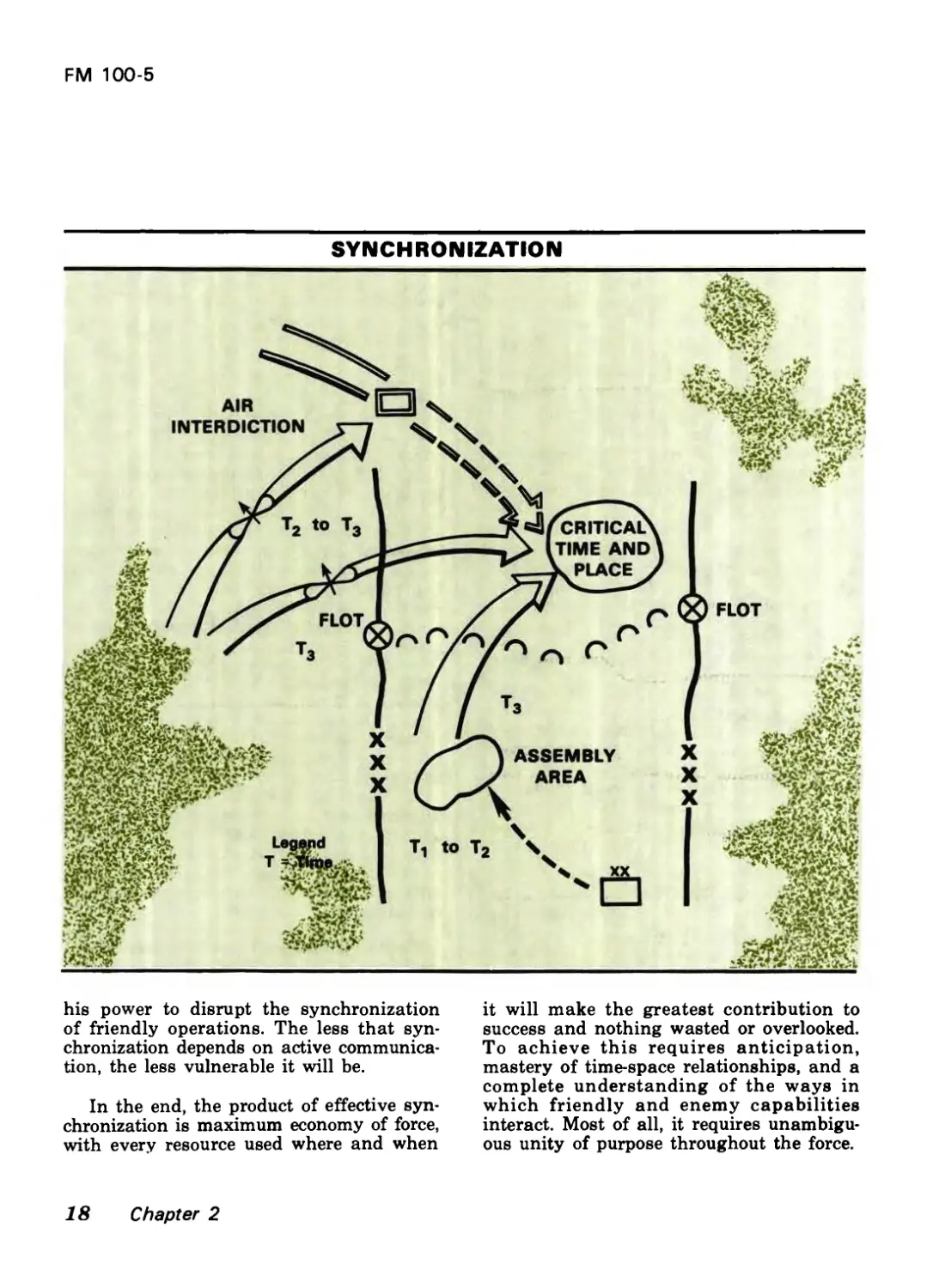
---------SYJICHRONIZATION^
Synchronization is the arrangement of I
battlefield activities in time, space and pur- a
pose to produce maximum relative combat j
power a£ the decisive jnint. Synchroni- |
”'z‘fffimrTsootha\process and a result.
Commanders synchronize activities; they
thereby produce synchronized operations.
Synchronization includes but is not
limited to the actual concentration of
forces and fires at the point of decision.
Some of the activities which must be syn-
chronized in an operation—interdiction
with maneuver, for example, or the shift-
ing of reserves with the rearrangement of
air defense—must occur before the decisive
moment, and may take place at locations
far distant from each other. While them-
selves separated in time and space, how-
ever, these activities are synchronized if
their combined consequences are felt at the
decisive time and place.
Thus in an attack, supporting fires are
synchronized with maneuver if, as attack-
ing forces break out of defilade, supporting
fires are shifted from counterfire against
enemy artillery to suppression of enemy
direct fire systems. Or on a larger scale,
main and supporting attacks are synchron-
ized if the latter takes place at precisely
the right time and place to divert enemy
forces and fires from the main effort as it
strikes the enemy. At the operational level,
two major operations are Synchronized if
the	the .bulk^qf enemy
forces, uncovers a key objective for decisive
attack by the other.
So defined, synchronization may and
usually will require explicit coordination
among the various units and activities par-
ticipating in any operation. By itself, how-
ever, such coordination is no guarantee of
synchronization, unless the commander
first visualizes the consequences to be pro-
duced and how activities must be se-
quenced to produce them. Synchronization
thus takes place first in the mind of the
commander and then in the actual plan-
ning and coordination of movements, fires,
and supporting activities.
Synchronization need not depend on
explicit coordination if all forces involved
fully understand the intent of the comman-
der, and if they have~developed and^fe-’"5
v”hearsed well-conceived standard responses
to anticipated contingencies. In the chaos
of battle, when communications fail and.
face-to-face coordination is impossible, such
implicit coordination may make the differ-
ence between victory and defeat. The
enemy for his part will do everything in
Chapter 2	17
FM 100-5
SYNCHRONIZATION
his power to disrupt the synchronization
of friendly operations. The less that syn-
chronization depends on active communica-
tion, the less vulnerable it will be.
In the end, the product of effective syn-
chronization is maximum economy of force,
with every resource used where and when
it will make the greatest contribution to
success and nothing wasted or overlooked.
To achieve this requires anticipation,
mastery of time-space relationships, and a
complete understanding of the ways in
which friendly and enemy capabilities
interact. Most of all, it requires unambigu-
ous unity of purpose throughout the force.
18 Chapter 2
FM 100-5
CLOSE, DEEP, AND REAR OPERATIONS
Close, deep, and rear operations com-
prise a special and continuous synchroni-
zation requirement. For commanders at
division and above, synchronization of
close, deep, and rear operations will nor-
mally require deliberate planning and staff
coordination, and such operations will fre-
quently employ different assets. At brigade
and below, close, deep, and rear activities
are practically indistinguishable and will
usually be conducted with the same assets.
At every level, however, commanders must
understand the relationship among these
three arenas and their combined impact on
the course of battle.
CLOSE OPERATIONS
Close operations at any echelon com-
prise the current activities of major com-
mitted combat elements, together with
their immediate combat support and com-
bat service support. At the operational
level, close operations comprise the efforts
of large tactical formations—corps and
divisions—to win current battles. At the
tactical level, close operations comprise the
efforts of smaller tactical units to win cur-
rent engagements.
At any echelon, close operations include
the close, deep, and rear operations of
subordinate elements. Thus the close opera-
tion of a corps includes the close, deep,
and rear operations of its committed divi-
sions or separate brigades.
Not all activities taking place in prox-
imity to the line of contact are close
operations. For example, some forward sur-
veillance and target acquisition may be
functionally related to deep operations.
Similarly, some engineer activities in the
forward area may be related to rear opera-
tions. Activities are part of close operations
if they are designed to support the current
fight.
Among the activities typically compris-
ing close operations are—
•	Maneuver (including deep maneuver).
•	Close combat (including close air sup-
port).
® Indirect fire support (including counter-
fire).
e Combat support/combat service support
of committed units.
•	Command and control.
Close operations bear the ultimate
burden of victory or defeat. The measure
of success of deep and rear operations is
their eventual impact on close operations.
DEEP OPERATIONS
Deep operations at any echelon com-
prise activities directed against enemy
forces not in contact designed to influence
the conditions in which future close opera-
tions will be conducted. At the operational
level, deep operations include efforts to iso-
late current battles and to influence where,
when, and against whom future battles
will be fought. At the tactical level, deep
operations are designed to shape the battle-
field to assure advantage in subsequent
engagements. At both levels, successful
deep operations create the conditions for
future victory.
Such operations are not new to warfare
nor to the American Army. The concept of
interdicting the enemy’s supplies, follow-on
forces, reserves, and communications to
impede his ability to commit these at times
and places of his choosing is a familiar
feature of modern war. In our own recent
history, World War II, Korea, and Vietnam
furnish numerous examples of successful
(and unsuccessful) efforts to isolate the
battlefield, paralyze the enemy’s support
Chapter 2	19
FM 100-5
and command and control systems, and to
prevent, delay, or disrupt the closure of
uncommitted enemy formations. The princi-
pal difference in such operations today is
the increasing availability of means to con-
duct them at the tactical as well as the
operational level.
At both levels, the principal targets of
deep operations are the freedom of action
of the opposing commander and the coher-
ence and tempo of his operations. As with
close operations, not all activities focused
forward of the line of contact are deep opera-
tions. Counterfire, for example, is intended
primarily to support the current fight, even
though the targets attacked in the counter-
fire effort may be located at great dis-
tances from the forward line of own troops
(FLOT). Similarly, electronic warfare
efforts to disrupt the enemy’s control of
engaged forces are part of close operations,
even though the targeted emitters may be
well to the enemy’s rear.
Among the activities typically con-
ducted as part of deep operations are—
® Deception.
e Deep surveillance and target acquisition.
•	Interdiction (by ground or air fires,
ground or aerial maneuver, special oper-
ating forces (SOF), or any combination
of these).
•	Command, control, and communications
countermeasures.
•	Command and control.
Because of the relative scarcity of re-
sources with which to perform these activ-
ities, deep operations must be focused
against those enemy capabilities which
most directly threaten the success of pro-
jected friendly operations. These must be
attacked decisively, with enough power to
assure the desired impact. That will be the
more true when—as will frequently be the
case—seizure and retention of the initiative
depend on successful prosecution of deep
operations.
REAR OPERATIONS
Rear operations at any echelon com-
prise activities rearward of elements in
contact designed to assure freedom of
maneuver and continuity of operations,
including continuity of sustainment and
command and control. Rear operations
may have little immediate impact on close
ground operations, but are critical to sub-
sequent operations, whether in exploiting
success or recouping failure. At the opera-
tional level, rear operations focus on pre-
paring for the next phase of the campaign
or major operation. At the tactical level,
rear operations underwrite the tempo of
combat, assuring the commander the agil-
ity to take advantage of any opportunity
without hesitation or delay.
Four rearward activities in particular
must be conducted as part of rear opera-
tions: assembly and movement of reserves,
redeployment of fire support, maintenance
and protection of sustainment effort, and
maintenance of command and control.
Reserves must be positioned to support
their anticipated commitment and secured
from observation and attack. Probable
deployment routes must be free of obstruc-
tion, and the actual movement of reserves
protected from enemy observation and
interdiction. Fire support assets likewise
must be redeployed to support future opera-
tions, and that redeployment protected
from enemy detection and interference.
Sustainment facilities and supplies must be
secured against ground, air, and missile
attack, and stocks to support projected
operations accumulated without decreasing
the support to currently engaged units.
And command posts and communications
networks must be deployed where they can
continue the fight without a break in
operating tempo.
20 Chapter 2
FM 100-5
In addition to these critical activities,
others relevant to rear operations include—
® Establishment and maintenance of lines
of communications (LOCs).
® Traffic regulation and control.
•	Medical and field services.
•	Refugee control and maintenance of civil
order.
By themselves, none of these activities
would normally have much impact on the
current battle. However, because it is pre-
cisely these activities which will be the
targets of the enemy’s deep operations,
their protection can easily begin to divert
needed assets from the forward battle. To
preclude this, units involved in rear opera-
tions must be equipped and trained to pro-
tect themselves against all but the most
serious threats, using both passive and
active measures. Soldiers and leaders at
all levels must be alert to the rearward
threat and psychologically prepared to
deal with it. And force commanders and
staffs must continually reevaluate the possi-
bility of more serious threats to rear opera-
tions, and plan measures to meet them
with minimum penalty to on-going close
operations.
COMMAND AND CONTROL
Common to all operations—close, deep,
and rear—is the necessity for superior
command and control.. The command and
control system which supports the execu-
tion of AirLand Battle doctrine must facili-
tate freedom to operate, delegation of
authority, and leadership from any critical
point on the battlefield. Plans are the ini-
tial basis of action, but commanders must
expect considerable variation from plans
in the course of combat. Ideally, the initial
plan for an operation will establish the com-
mander’s intent and concept of operations
and the responsibilities of subordinate
units. It will, however, leave the greatest
possible operational and tactical freedom
to subordinate leaders. The plan must
therefore be flexible enough to permit
variation by subordinates in pursuit of the
commander’s goals.
Whenever possible, subordinate leaders
should receive their orders face-to-face
from their commanders on the ground
chosen for the operation. Commanders
should restrict the operations of their
subordinates as little as necessary. Mission
orders that specify what must be done
without prescribing how it must be done
should be used in most cases. Control mea-
sures should secure cooperation between
forces without imposing unnecessary re-
strictions on the freedom of junior leaders.
The larger force should remain alert to
and be prepared for exploitation of advan-
tages developed by subordinate units
through the course of any operation.
A command and control system seeking
to promote such flexibility and freedom to
operate independently must emphasize cer-
tain specific operational techniques and
command practices. First, it must optimize
the use oFtimd by routine use of warning
orders, situation updates, and anticipatory
planning and positioning of forces.
The command and control system must
also stress standardized training in opera-
tions and staff practices to assure mutual
understanding between leaders and units.
In turn, this requires both military educa-
tion throughout the Army and its sister
services and reinforcing training within
Chapter 2	21
FM 100-5
units. War gaming, rehearsals, and realis-
tic training promote initiative and flexibil-
ity by preparing units and their leaders for
cooperation in the chaos of combat without
time-consuming coordination.
Further, the command and control sys-
tem must permit tactical leaders to position
themselves wherever the situation calls for
their personal presence without depriving
them of the ability to respond to opportun-
ities or changing circumstances with the
whole force. If, for example, a division
commander operating forward with a lead-
ing brigade decides to shift his main effort
to capitalize on the unexpected success of
a supporting attack, his command and con-
trol system must assure rapid execution of
his order without sacrificing momentum or
coordination. This requires solid staff work
and strongly developed skills of tactical
anticipation. Leaders throughout the force
must be ready to change directions of
movement, bases of fire, support arrange-
ments, and task organizations without hesi-
tation during operations. Succession of
command when a leader is killed or dis-
abled must be provided for in advance and
accomplished without disruption of the
operation.
This need for flexibility in command
and control is greater for the committed
maneuver unit commander than for any-
one else. He cannot depend on constant
direction, but must fight independently
even when he cannot communicate outside
his own zone or sector. He must know the
intention of the commander two levels
above him, understand the concept of op-
eration of his immediate commander, and
know the responsibilities of the units on
his flanks and in support of his operations.
If he understands these things, the com-
mitted commander can conduct his opera-
tion confidently, anticipate events, and act
AIRLAND BAT]
The nine principles of war described in
FM 100-1 (and reproduced in Appendix A)
provide timeless general guidance for the
conduct of war at strategic, operational,
and tactical levels. They are the enduring
bedrock of US Army doctrine.
freely and boldly to accomplish his mis-
sion without further orders.
If an unanticipated situation arises,
committed maneuver unit commanders
should understand the purpose of the op-
eration well enough to act decisively, con-
fident that they are doing what their
superior commander would order done were
he present. The 9th Armored Division’s
seizure of the Remagen bridge epitomizes
the freedom of action and initiative re-
quired in combat. In that instance, an in-
fantry platoon leader who understood the
goal of his division commander acted
promptly and without orders to secure an
advantage that altered the course of the
Army’s whole campaign.
The same principles apply at the opera-
tional level of war. Lead times are longer
and forces are slower to move, but mission-
orders, anticipation of requirements, and
initiative are equally important. The inher-
ently joint nature of campaign planning
and direction makes mutual understanding
and practiced cooperation all the more im-
portant in theater operations.
Staffing, equipment, and organizational
concerns vary among levels of command.
In every case, however, the only purpose
of command and control is to implement
the commander’s will in pursuit of the
unit’s objective. The system must be reli-
able, secure, fast, and durable. It must col-
lect, analyze, and present information
rapidly. It must communicate orders, coor-
dinate support, and provide direction to
the force in spite of enemy interference,
destruction of command posts, or loss and
replacement of commanders. The ultimate
measure of command and control effective-
ness is whether the force functions more
effectively and more quickly than the
enemy.
J IMPERATIVES
The fundamental tenets of AirLand Bat-
tle doctrine describe the characteristics of
successful operations. They are the basis
for the development of all current US
Army doctrine, tactics, and techniques. All
training and leadership doctrines and all
22 Chapter 2
FM 100-5
combat, combat support, and combat ser-
vice support doctrine are derived directly
from, and must support, these fundamental
tenets.
While initiative, agility, depth, and
synchronization characterize successful
AirLand Battle operations, the imperatives
listed below prescribe key operating require-
ments. These provide more specific guid-
ance than the principles of war and the
AirLand Battle tenets, and apply to all
operations. They are historically valid and
fundamentally necessary for success on the
modern battlefield. The ten imperatives of =
AirLand Battle are—
•	Ensure unity of effort.
•	Anticipate events on the battlefield.
•	Concentrate combat power against
enemy vulnerabilities.
•	Designate, sustain, and shift the main
effort.
•	Press the fight.
•	Move fast, strike hard, and finish
rapidly.
•	Use terrain, weather, deception, and
OPSEC.
•	Conserve strength for decisive action.
•	Combine arms and sister services to
complement and reinforce.
•	Understand the effects of battle on sol-
diers, units, and leaders.
ENSURE UNITY OF EFFORT
Commands must not only ensure unity
of effort within their own organizations,
but must also promote it with supporting
and supported elements as well as with
sister services and allies. The fundamental
prerequisite for unity of effort within Army
organizations is an effective system of com-
mand which relies upon leadership to pro-
vide purpose, direction, and motivation;
emphasizes well-understood common doc-
trine, tactics, and techniques as well as
sound unit standing operating procedures
(SOPs); and takes effective measures to
limit the effects of friction. Leaders set the
example, communicate their intent clearly,
build teamwork, promote sound values,
accept responsibility, delegate authority,
anticipate developments, take decisive
actions, and accept risks. Command and
control systems emphasize implicit coordi-
nation measures such as sound training in
a common doctrine, standing operating pro-
cedures, methods, and techniques, and well-
rehearsed battle drills. Missions are clear
and concise. Plans are simple. Control
mechanisms are easy to apply, understand,
and communicate. Habitual relationships
are used to maximize teamwork. A main
effort is always clearly designated and
ground plans are thoroughly coordinated
with plans for air support. All actions
throughout the force are performed so as
to ensure the success of the main effort.
Liaison among units must be automatic
and effective.
ANTICIPATE EVENTS ON
THE BATTLEFIELD
The commander must anticipate the
enemy’s actions and reactions and must be
able to foresee how operations may de-
velop. Predictions about the enemy and
even our own troops can never be relied
on with certainty, but it is nevertheless
essential to anticipate what is possible and
likely and prepare for those possibilities.
Anticipating events and foreseeing the
shape of possibilities hours, days, or weeks
in the future are two of the most difficult
skills to develop, yet among the most impor-
tant. They require wisdom, experience, and
understanding of the enemy’s methods, capa-
bilities, and inclinations, outstanding intel-
ligence, and confidence in the knowledge
of how one’s own forces will perform. Antici-
pation and foresight are critical to turning
inside the enemy’s decision cycle and main-
taining the initiative.
CONCENTRATE COMBAT
POWER AGAINST ENEMY
VULNERABILITIES
Concentrating combat power against
enemy vulnerabilities is also fundamental
to AirLand Battle operations. Commanders
must seek out the enemy where he is most
vulnerable to defeat. To know what his
vulnerabilities are, commanders must study
the enemy, know and take into account his
Chapter 2	23
FM 100-5
strengths, find his inherent vulnerabilities,
and know how to create new vulnerabil-
ities which can be exploited to decisive
effect. Having identified or created enemy
vulnerabilities, the commander must have
the mental and organizational flexibility to
shift his main effort as necessary to gain
the greatest possible advantage. Combat
power must be concentrated to reach
points of enemy vulnerability quickly with-
out loss of synchronization.
DESIGNATE, SUSTAIN, AND
SHIFT THE MAIN EFFORT
In operations characterized by initia-
tive, agility, depth, and synchronization, it
is imperative that commanders designate,
sustain and shift the main effort as neces-
sary during operations. The main effort is
assigned to the element with the most
important task to accomplish within the
commander’s concept. The commander
concentrates his support to ensure quick
success by this element. The commander
identifies the main effort when he states
his concept of the operation. This provides
a focus of effort that each subordinate com-
mander uses to link his actions to the
actions of those around him. The main
effort assures synchronization in the op-
eration while leaving the greatest possible
scope for initiative. During operations, the
main effort is sustained with supporting
forces and assets. If conditions change
and success of the overall mission can be
obtained more cheaply or quickly another
way, the commander shifts his main effort
to another force. Priorities of support also
change to assure the success of the newly
designated main effort.
PRESS THE FIGHT
Commanders must press the fight tena-
ciously and aggressively. Campaigns or
battles are won by the force that is most
successful in pressing its main effort to a
conclusion. To sustain the momentum of
early successes, leaders must deploy forces
in adequate depth and arrange for timely
and continuous combat support and com-
bat service support at the outset of opera-
tions. Then, they must accept risks and
tenaciously press soldiers and systems to
the limits of endurance for as long as
necessary.
MOVE FAST, STRIKE HARD,
AND FINISH RAPIDLY
Speed has always been important to
combat operations, but it will be even more
important on the next battlefield because
of the increasing sophistication of sensors
and the increasing lethality of conven-
tional, nuclear, and chemical fires. To
avoid detection, our force concentrations
must be disguised. To avoid effective coun-
terstrikes, they must be brief. Engagements
must be violent to shock, paralyze, and
overwhelm the enemy force quickly. They
must be terminated rapidly to allow the
force to disperse and avoid effective enemy
counterstrikes.
USE TERRAIN, WEATHER,
DECEPTION, AND OPSEC
Terrain and weather affect combat
more significantly than any other physical
factors. Battles are won or lost by the way
in which combatants use the terrain to
protect their own forces and to destroy
those of the enemy. The ground and the
airspace immediately above it have an
immense influence on how the battle will
be fought. They provide opportunities and
impose limitations, giving a decisive edge
to the commander who uses them best.
The impact of weather on ground and air
mobility and the effect both have on weap-
ons will affect tactics and the timing and
course of operations. One of the best
investments of the commander’s time
before battle is an intensive, personal
reconnaissance of the terrain. Similarly,
effective deception and tight operations
security can enhance combat power by
confusing the enemy and reducing his fore-
knowledge of friendly actions.
CONSERVE STRENGTH FOR
DECISIVE ACTION
Successful commanders conserve^ the
strength of their forces ito be stronger at
the decisive time and place. Commanders
24 Chapter 2
FM 100-5
must minimize the diversion of resources
to nonessential tasks and retain a reserve
for commitment when needed most. Com-
manders must also keep troops secure, pro-
tected, healthy, disciplined, and in a high
state of morale. In addition they must keep
equipment ready and stocks of supplies
available for commitment when needed.
Finally, units must be maintained in a
high state of training. Dispersed and rapid
movement, proper formations, covered and
concealed fighting positions, aggressive
patrolling, good operations security, pro-
tection of troops and equipment from
adverse weather and disease, and good
supply and maintenance discipline are all
examples of measures which conserve a
force’s strength.
COMBINE ARMS AND SISTER
SERVICES TO COMPLEMENT AND
REINFORCE
The greatest combat power results when
weapons and other hardware, combat and
supporting arms, Army units, and other
service elements of different capabilities
are employed together to complement and
reinforce each other. Arms and services
complement each other by posing a
dilemma for the enemy. As he evades the
effects of one weapon, arm, or service, he
exposes himself to attack by another. At
the level of weapons systems, one good
example of complementary combined arms
employment would be the use of guns and
missiles in the air defense of a key instal-
lation. Another would be using mines,
mortars, or grenade launchers to cover the
dead space of a machine gun’s field of fire.
A tactical example of complementary com-
bined arms would be combining infantry
and armor in task forces or combining
infantry-heavy and armor-heavy task
forces in brigades. Another example of tac-
tical level complementary combined arms
employment between the services is when
Air Force Aircraft attack tanks in defilade
and out of reach of direct ground fires and
attack helicopters while artillery and direct
fires suppress enemy air defenses. At the
operational level, an example would be Air
Force Air Superiority operations and
ground maneuver, or employing light in-
fantry formations in highly mountainous
regions to free armor and mechanized
forces for use in less restricted areas.
Arms and services reinforce each other
when one increases the effectiveness of
another or several combine to achieve
mass. Some examples at the technical level
would be engineers helping to develop an
infantry strong point which greatly en-
hances the combat power of the infantry,
the scout helicopter spotting targets for the
attack helicopter, artillery suppression of
enemy fires during an assault, or the mas-
sing of all antitank fires against an
armored threat. Tactically, reinforcement
might involve concentrating all types of
maneuver forces or fires to create mass. It
might also involve heliborne lift of light
infantry. Operationally, it could mean us-
ing Naval amphibious shipping or Air
Force tactical airlift to deliver soldiers to
the battlefield, intelligence support to Army
units from Air Force, Naval, or national
sources, Air Force interdiction to support
maneuver on the ground, or US Army
units protecting air bases from ground
attack.
Ideally, both effects are combined in
one action as when mines, artillery, and
tanks combine to defeat an attack. All
three reinforce to damage the enemy simul-
taneously to some degree. The mines and
artillery fire slow the enemy and comple-
ment the tank fire which can obtain more
hits against the stalled enemy.
UNDERSTAND THE EFFECT OF
BATTLE ON SOLDIERS, UNITS,
AND LEADERS
Commanders and their staffs must
understand the effects of battle on soldiers,
units, and leaders because war is funda-
mentally a contest of wills, fought by men
not machines. Ardant DuPiq, a 19th cen-
tury soldier and student of men in battle,
reminded us that “you can reach into the
Chapter 2
25
FM 100-5
well of courage only so many times before
the well runs dry.” Even before that
Marshall De Saxe, writing in the 18th cen-
tury, pointed out that “A soldier’s courage
must be reborn daily,” and went on to say
that the most important task of leaders
was to understand this, to care for and
prepare soldiers before battle, and to use
tactics during battle which take this into
account.
Commanders must understand that in
battle, men and units are more likely to
fail catastrophically than gradually. Com-
manders and staffs must be alert to small
indicators of fatigue, fear, indiscipline,
and reduced morale, and take measures to
deal with these before their cumulative
effects drive a unit to the threshold of col-
lapse. Staffs and commanders at higher
levels must take into account the impact
of prolonged combat on subordinate units.
Military organizations can fight at peak
efficiency for only so long. Prolonged
demands of combat cause efficiency to
drop even when physical losses are not
great. Well trained, physically fit soldiers
in cohesive units retain the qualities of
tenacity and aggressiveness longer than
those which are not.
Good leadership makes the vital differ-
ence in the staying power and effectiveness
of units. Although all units experience
peaks and valleys in combat effectiveness,
well-trained, cohesive units under good
leadership sustain far higher average effec-
tiveness. Staffs and commanders need to
take this variance in performance into
account in their planning by matching
units to missions, rotating units through
difficult tasks to permit recuperation to the
extent possible, and by basing their expec-
tations of a unit’s performance on a full
knowledge of its current capabilities.
Because modem combat requires greater
dispersal of units, the quality and effec-
tiveness of junior leaders has a proportion-
ately greater impact. Prior to combat,
senior leaders must place great emphasis
on junior leader development. During
combat, commanders must monitor and
take measures to sustain the effectiveness
of leaders to the extent possible.
AirLand Battle doctrine is evolutionary. While the conditions of war-
fare change with time and circumstance, the fundamental dynamics of
violent conflict remain unaltered. The essential qualities of skill, te-
nacity, boldness, and courage which have always marked successful
armies and commanders will continue to determine the victor in battle
in the future, as they have in the past.
AirLand Battle doctrine exploits those qualities, together with the
technological prowess, self-reliance and offensive spirit which charac-
terize the American soldier. It requires combined arms and joint forces
to extend the battlefield and thus hold at risk all enemy forces, har-
nessing advanced technologies to provide synchronized reconnaissance,
real-time intelligence fusion, target attack, and maneuver. While respect-
ing the increased complexity and lethality of modern weapons, however,
AirLand Battle doctrine also recognizes that such weapons are no
better than the skill with which they are brought to bear on the enemy.
Properly understood and instilled through effective training, the prin-
ciples of operation prescribed by AirLand Battle doctrine will produce
the skill to match the US Army’s will to win.
26 Chapter 2
CHAPTER 3
Operational and Tactical Planning and Execution
irLand Battle doctrine recognizes
that modern warfare is likely to be fluid
and nonlinear. Therefore it takes an
enlarged view of the battlefield, stressing
unified air, ground, and sea operations through-
out the theater. It recognizes that the the-
ater of operations in a campaign extends
from ports and support areas far to the rear
of the line of contact to similarly distant
sources of enemy support. Likewise the tac-
tical battlefield with its unified close, deep,
and rear operations includes every area and
enemy unit that can affect the outcome of
the immediate fight and the future opera-
tions of a force. AirLand Battle doctrine
distinguishes the operational level of war—
the design and conduct of campaigns and
major operations—from the tactical level
which deals with battles and engagements.
It asserts that whether attacking or de-
fending, success depends on securing the
initiative as early as possible and exercising
it aggressively. It requires that every weap-
on, asset, and combat multiplier be used
to gain that initiative, to throw the enemy
off balance with a powerful blow from an
unexpected direction, and to follow up rap-
idly to prevent his recovery. At both the
operational and tactical levels, initiative,
agility, depth, and synchronization are the
essence of AirLand Battle doctrine. This
chapter discusses the planning and conduct
of campaigns, major operations, battles, and
engagements.
PLANNING AND
CONDUCTING CAMPAIGNS
AND MAJOR OPERATIONS
The principal task of theater commanders
and their subordinate commanders is to
concentrate superior strength against enemy
vulnerabilities at the decisive time and place
to achieve strategic and policy aims. The
overall joint or allied commander in each
theater of operations plans and executes
campaigns and major operations that opti-
mize the use of all available combat, combat
Chapter 3	27
FM 100-5
support, and combat service support forces.
Ground, air, and naval operations are syn-
chronized to support each other and to ful-
fill the requirements of the overall joint
commander’s campaign plan. Army and Air
Force component commanders will normally
be subordinated to him. There may also be
Navy and Marine component commanders.
Moreover these forces may be multinational.
Operational level commanders try to set
favorable terms for battle by synchronized
ground, air, and sea maneuver and by strik-
ing the enemy throughout the theater of
operations. Large scale ground maneuver
will always require protection from enemy
air forces and sometimes also from naval
forces. Commanders will therefore conduct
reconnaissance, interdiction, air defense, and
special operations almost continuously. Air
interdiction, air and ground reconnaissance,
raids, psychological warfare actions, and
unconventional warfare operations must all
be synchronized to support the overall
campaign, and its supporting major opera-
tions on the ground, especially at critical
junctures.
The Army Component Commander (ACC)
may be the theater army commander, an
army group commander, an army com-
mander, or, in some cases, a corps com-
mander. He and his chief subordinates must
maintain synchronization over large areas.
This will always involve close cooperation
with air forces and will often require joint
planning and operations with naval forces.
In addition to maintaining effective coop-
eration with other armed forces of the US,
the ACC and his staff will also have to
cooperate with allied air, ground, or naval
forces. In many cases, the forces of allied
nations will be assigned to US corps and
armies. The US corps must also be prepared
to fight under command of allied com-
manders. In either instance, effective coop-
eration and operational synchronization will
depend on good liaison and clear under-
standing of the capabilities and doctrine
of the allied forces involved. Chapter 11
discusses joint and combined operations.
Ground operations require coordinated
movement and effective concentration of
large units—corps, field armies and army
groups—against the enemy in spite of his
efforts to interdict the friendly forces’ move-
ment. Traffic control, air defense, deception,
and service support must all function har-
moniously to support basic operational move-
ments. Key forces and facilities—some of
them deep in the rear area—must be pro-
tected during this movement.
Coordination of actions that support
movement of large forces will take on
special importance following major opera-
tions and battles. Large unit commanders
will then attempt to exploit tactical gains
or to withdraw and reorganize units. Air
defense, air and ground transportation,
reconnaissance and security, service support
and traffic control will be the chief concerns
as these large movements occur.
CAMPAIGN PLANNING
Operational planning begins with stra-
tegic guidance to a theater commander or
with the commander’s recognition of a
mission in an active theater of operations.
Operational commmanders and their staff
officers use the estimate of the situation
and planning process described in FM 101-5.
They will normally be involved in joint and
combined operations, however, and will
therefore cooperate with commanders and
staffs of other services and other nation-
alities as they plan at the operational level.
In planning and conducting joint operations,
they will use prescribed joint operations
planning and execution systems.
Operational planning concentrates on the
design of campaigns and major operations.
At theater level, campaign planning entails
converting broad strategic guidance into a
campaign plan for a joint/combined force.
Operational planning within each theater
of operations focuses on execution of the
campaign plan and on the staging, conduct,
and exploitation of major operations.
28 Chapter 3
FM 100-5
Each joint or combined commander re-
sponsible for a theater of operations makes
a campaign plan to implement the joint or
combined strategic guidance and to give
direction to his subordinate component
commands. Ground operations planning
must be coordinated with air and naval
operations plans to assure mutual support.
Campaign plans set long-term goals—
strategic aims such as control of a geo-
graphical area, reestablishment of political
boundaries, or the defeat of an enemy force
in the theater of operations. These must
be accomplished in phases in most cases.
Accordingly, the campaign plan normally
provides both a general concept of opera-
tions for the entire campaign and a specific
plan for the campaign’s first phase.
Initially, the commander must specify
how the enemy is to be defeated. The
method chosen must, of course, be attain-
able with the means at hand. It should also
aim for the fastest possible solution at the
lowest possible cost in lives and materiel.
Above all else, the method selected must
be effective. A protracted campaign rarely
serves strategic purposes well and usually
increases the force’s exposure to damage
or defeat. An effective campaign plan ori-
ents on what Clausewitz called the enemy’s
“centers of gravity,” his sources of physical
strength or psychological balance. If such
a center of gravity is attacked (or occa-
sionally merely threatened), the enemy’s po-
sition becomes untenable.
There are a number of general ways to
defeat a large enemy force in a theater.
Each has historical precedents and can be
used either singly or in combination. These
begin with physical destruction of the en-
emy force, the most costly albeit direct way
of winning. They extend to less direct
methods such as reducing the enemy’s
strength by defeating or otherwise depriving
him of his allies; separating his armies in
the field to confront him with piecemeal
defeat; preventing his deployment; destroy-
ing his logistic support; occupying decisive
terrain to force him to fight under unfa-
vorable conditions; or carrying the war into
his homeland.
Strategic guidance will constrain opera-
tional methods by ruling out some otherwise
attractive alternatives. Withholding of nu-
clear weapons, prohibiting the unopposed
surrender of territory or cities, exempting
the territory of certain nations from opera-
tions, and limiting the use of aerial bomb-
ing are examples of the curbs that strategy
may impose on operations.
Strategic aims and guidance, reasonable
assumptions about enemy intentions and
capabilities, available resources, and the
geography of theater, together form the
starting point of campaign planning. Staff
estimates are thus broader in campaign
planning than in tactical operations.
Units with operational responsibilities
perform intelligence operations and analyses
for the campaign, its major operations, as
well as its battles. These actions take a
larger view of the theater and of the enemy.
They are oriented on larger enemy units,
to include air and naval formations, and
units with specialized operational capabili-
ties. They cover the entire theater of op-
erations, its airspace as well as contiguous
waters.
As in tactical level analysis, numbers,
types, mobility, morale, and equipment of
enemy forces are considered. Additionally,
operational level commanders take into ac-
count the enemy’s doctrine and patterns of
large unit operations, the personalities and
idiosyncrasies of his senior commanders,
and his air and naval capabilities. Cam-
paign planners also review the influences
of alliances on enemy courses of actions,
the differences in quality and capabilities
of troops of different nationalities, the atti-
tudes of the civilian population in areas
controlled by the enemy, and the enemy’s
dependence on external support and par-
ticular facilities. Finally, they advise the
commander on the enemy’s capacity for
and vulnerability to nuclear or chemical
weapons, unconventional warfare, and psy-
chological operations.
Chapter 3	29
FM 100-5
Most important, because of the scope and
duration of campaigns and major opera-
tions, and the consequently broad range of
enemy options, operational intelligence must
attempt to probe the mind of the enemy
commander. It must see the theater through
his eyes, visualize which courses of action
are open to him, and estimate which he is
most likely to adopt.
Operational considerations of terrain also
differ. Most theaters of operations are sepa-
rated from others by considerable distances
or major physical features such as mountain
ranges, large rivers, or even oceans. Terrain
within a theater possesses an inherent geo-
logical structure which aids operational
analysis. River valleys or basins, plateaus,
river deltas, peninsulas, mountain or high-
land regions, plains, and islands all have
operational significance. And facilities impor-
tant to movement, air support, and combat
service support—ports, highways, rail lines,
and sources of food, fuel, and water—will
affect the operations of both combatants.
Large unit commanders and their staffs
must be able to visualize the theater of
operations in the rough terms of localities.
The intelligence estimate must set those
localities in their proper relationship to
permit the commander to direct operations
far beyond his field of view and to plan
well into the future.
In preparing the campaign intelligence
estimate, staff officers make use of the re-
connaissance and surveillance assets of all
services, allies, and national agencies. They
also use all available human sources from
agents to guerrillas and long-range recon-
naissance units and the meteorological and
geographical references on the area.
Factors affecting friendly capabilities
and courses of action include the relative
strength, composition, dispositions, and
general readiness of ground, air, and naval
forces. Campaign planners normally have
to take allied strengths into account as
well. The arms and equipment of these forces
are considered as well as their special capa-
abilities and limitations. Quality of staffs,
logistics support, ease of interoperability,
and personalities and abilities of individual
allied commanders all merit consideration.
Capabilities for long distance movement,
interoperability of ground, air, and naval
forces, and allied forces’ freedom to operate
outside their own national territories should
also be reviewed.
Once he has determined the enemy’s
center of gravity and analyzed the major
factors which affect the campaign, the
commander in a theater of operations se-
lects a course of action. He elaborates this
in his concept of operation for the cam-
paign. Ideally, the concept embodies an
indirect approach that preserves the strength
of the force for decisive battles. While ar-
ticulating the long-range goal of the force,
it should also lay out the conduct of the
first phase of the campaign in some detail.
In almost all cases, deception will be vital
to operational success. The commander must
attempt to mislead the enemy concerning
when, where, and how he will concentrate
for battle and what his ultimate aims are.
Ground operations must be fully synchro-
nized with air and sea operations; air
interdiction should complement ground
maneuver in both the short and long terms.
The plan for the first phase of the cam-
paign states the commander’s intent, dis-
tributes forces to major subordinate units,
disposes the force for operations, and co-
ordinates air and naval support of ground
maneuver. The general object of the plan
is to set the terms for the next battle to
the greatest advantage of the friendly force.
Good campaign plans also provide op-
tions for the operation underway and for
the period following the coming battle.
“Branches” to the plan—options for chang-
ing dispositions, orientation, or direction of
movement and accepting or declining bat-
tle—preserve the commander’s freedom of
action. Such provisions for flexibility an-
ticipate the enemy’s likely actions and give
the commander a means of dealing with
them quickly. Expressed as contingency
plans, such branches from the plan can be
of decisive importance since they shorten
30 Chapter 3
FM 100-5
the friendly decision cycle and may allow
the large unit commander to act faster than
his opponent.
Actions after battle or sequels are also
an important means of anticipating the
course of action and accelerating the deci-
sion cycle. Sequels to a future battle are
based on possible outcomes—victory, defeat,
or stalemate. They establish general dispo-
sitions, objectives, and missions for sub-
ordinate units after the battle. They then
can be amended as necessary and ordered
into effect.
Such plans are crucial to operational
success because they determine how tactical
success will be exploited or the operational
consequences of tactical setbacks minimized.
Transition to exploitation, counteroffensive,
withdrawal, retreat, or reorientation of the
main effort should be addressed as possible
sequels to the planned battle. All of these
actions depend on timely execution. They
can only be carried out effectively if they
have been planned in advance. In most
cases, they will require the retention of an
operational reserve.
MAJOR OPERATIONS PLANNING
Much of what has been said about
campaign planning applies to the planning
of major operations within the campaign.
Major operations are planned well in ad-
vance. Major operations planning may be-
gin before war or as “branches” and
“sequels” to a campaign plan which identify
missions, forces, and resources. Operational
commanders must also anticipate shifts in
the direction of operations. In December of
1944, Patton was able to wheel much of
Third US Army 90 degrees in less than
72 hours to respond to the crisis which
resulted in the Battle of the Bulge because
his staff had conducted the necessary pre-
liminary planning even before Third Army
received the mission to do so.
Major operations are the coordinated
elements of phases of a campaign. The
success or failure of a major operation will
have a decisive impact on the conduct of
a particular phase of a campaign. For ex-
ample, two successive major operations were
conducted during the breakout phase of the
WWII campaign which began with the
landing of allied forces in Normandy and
ended witn link-up with Russian forces on
the Elbe River. “Operation Goodwood,”
launched by British forces under Mont-
gomery, attracted the bulk of German re-
serves to the northern part of the Normandy
beachhead. US forces under Bradley then
launched “Operation Cobra” in the south,
resulting in a successful breakout. The land-
ings at Inchon by X Corps and the sup-
porting breakout of the balance of Eighth
Army from Pusan in the Korean war are
another example of complementary major
operations.
While major operations are usually joint
operations, they may also occasionally be
independent operations. Even then, however,
joint planning will be required. Normally,
one major ground operation will receive
priority and constitute the main effort. This
decision at the level of campaign planning
will affect various aspects of air and naval
planning by outlining priorities and effects
desired to complement large scale ground
action. In general, operational planning
commits forces and support to corps and
armies for an extended period. Commanders
of corps and armies receive long-range ob-
jectives and great freedom in design of their
own operations. Operational plans also pro-
vide for close integration of psychological
operations, unconventional warfare, and
civil-military operations in support of the
campaign.
CONDUCTING CAMPAIGNS AND
MAJOR OPERATIONS
At the operational level of war, large
unit commanders mass or maneuver tactical
formations to bring the enemy to battle
under the best terms possible. Attacks in
depth with air-delivered weapons, missiles,
and airmobile troops isolate portions of the
enemy’s force for attack or break up the
continuity of his operation.
Chapter 3	31
FM 100-5
The operational situation may be static
and positional or it may be fought in the
fluid circumstances of open warfare in
which large units move rather freely. The
defender commonly tries to stabilize opera-
tions until he can assume the offensive
himself. The attacker tries to promote the
conditions of open warfare in which enemy
forces can be separated and defeated piece-
meal and large operational gains can be
made.
In small theaters or where force densities
are high, static conditions are likely to
arise. When the campaign is fought over
a large area or between relatively small
forces, open warfare may predominate. In
most cases, the two conditions are likely
to alternate with periods of stability fol-
lowing large operational gains. The mobility
of modern armies, however, makes open
warfare possible even in small theaters of
operations.
In static situations, operational com-
manders attempt to seize the initiative by
defeating enemy attacks or rupturing enemy
defenses. Only by producing a fluid situ-
ation can they make large gains and gain
the advantages of maneuver on a large
scale.
In open warfare, large unit commanders
conduct aggressive reconnaissance and em-
ploy advance security forces to preserve
their freedom of action. In trying to mass
decisive strength at the decisive point, com-
manders maintain contact with the enemy
and adjust their movements to conceal their
intentions and to bring their forces to bear
against an enemy vulnerability.
This requires the coordinated movement
of large forces to preserve mutual support,
sufficient air defense, adequate service sup-
port, and ready access to operational re-
serves. Original plans for concentration may
demand modification as the enemy situation
changes or becomes clear. Therefore, tactical
formations must be able to modify direc-
tions of movement or orientation of defenses
during operations.
During battle, the larger operation con-
tinues. Tactical formations may have to be
moved in response to the operational situ-
ation or the battle itself may have to be
shaped to meet operational objectives. The
greatest concern of the large unit com-
mander during battle will be to defeat the
enemy’s operational reserves and commit
his own at the decisive time and place.
Friendly operational reserves—corps or di-
visions held in reserve by the large unit
commander—are used to exploit the results
of battle by penetrating enemy defenses
completely. In defense, such reserves execute
the commander’s counterstroke to defeat the
attack or initiate the counteroffensive. In
case of a reverse, the operational reserve
can limit the enemy’s success or cover the
force’s withdrawal.
A vital consideration for operational com-
manders during a campaign is sensing
culminating points. Culminating points are
reached when the balance of strength shifts
from the attacking force to its opponent.
This happens when an attacker has pushed
as far as he can without losing his ad-
vantage over the defender. Overextension,
lengthening lines of support, and the cumu-
lative effects of battle losses and rear area
protection efforts can sap the attacker’s
strength and compel him to assume the
defense if he has been unable to defeat the
defender. (See Appendix В for a more de-
tailed discussion of culminating points).
In the attack, operational commanders
design their campaigns to defeat the enemy
prior to reaching their culminating point.
Defending commanders try to avoid a de-
cision until the attacker has to assume the
defense himself. The attacker must sense
his own culminating point and avoid over-
extension. Since all offensive operations end
in defensive dispositions, this phase of the
campaign should be foreseen and planned.
32 Chapter 3
FM 100-5
PLANNING AND CONDUCTING TACTICAL OPERATIONS
Tactical operations are the conduct of
battles and engagements within the context
of campaigns and major operations. They
are the domain of corps and smaller units.
They are supported by higher echelons of
command who set the terms of battle and
provide support for it. Brigades and smaller
units may fight engagements—smaller,
separate actions—either as part of a battle
or as separate actions. Tactical success is
measured by the success or failure to achieve
aims set by higher commanders.
Battles are large engagements involving
brigades and larger forces. They may be
localized, brief and intense or they may
involve numerous engagements over a large
area that take days to resolve. In any case,
their effects are felt over a large area, and
actions outside of the area of direct, sus-
tained combat can greatly influence their
outcome.
The conduct of battles differs from that
of campaigns and major operations in some
important respects. Speed of response, abil-
ity to change direction, and sensitivity to
short-term events are among these differ-
ences. Conduct of both depends on initia-
tive, agility, depth, and synchronization,
however, and, in both, leaders should ob-
serve the imperatives of modern combat.
In conducting battles and engagements,
commanders must act vigorously and boldly.
They must follow the course of the fight
throughout the contested area to seize op-
portunities for decisive action. They must
also be willing to take risks in order to
inflict heavy losses on the enemy and to
retain the initiative.
Corps and divisions conduct mutually
supporting operations simultaneously in
three areas—close, deep, and rear. All tac-
tical operations require overall unity of ef-
fort throughout the battle, using every
available element of combat power. Tactical
operations must consider the effects of en-
emy air power, of nuclear and chemical
weapons, and of electronic warfare opera-
tions. Most importantly, tactical operations
are influenced by the nonquantifiable ele-
ments of combat power: courageous, well-
trained soldiers, and skillful, effective leaders.
To ensure success, tacticians concentrate
on—
e Anticipating the enemy.
e Indirect approaches.
® Deception and effective OPSEC.
e Speed and violence.
e Flexibility and reliance on the initiative
of junior leaders.
•	Rapid decision-making.
•	Clearly defined objectives and operational
concepts.
•	A clearly designated main effort.
e Actions throughout the depth of the battle
area.
•	Joint operations with our sister services.
TACTICAL PLANNING
Tactical planning centers on preparation
for battles and engagements. Like opera-
tional planning, tactical planning begins
with the assignment of a mission or with
the commander’s recognition of a require-
ment. It continues until the mission is
complete. The planning process is described
in detail in FM 101-5. In essence it requires
full definition of the mission, collection of
all pertinent information, development and
analysis of options, and, finally, a decision
which forms the basis for a plan or order.
This process is a continuous cycle. Planning
is as thorough as time allows. The key to
successful planning is anticipation of future
events and being prepared for contingencies.
After the mission has been analyzed, the
most important task of a staff is collecting
information. This normally amounts to up-
dating existing estimates and analyzing the
facts in the light of the unit’s new mission.
Chapter 3	33
FM 100-5
All primary staff officers have respon-
sibilities for collecting information and
making estimates before and during opera-
tions. Not only do they collect information,
they also supervise operations to bring
strength, readiness, training, and supply
stocks to the highest levels possible prior
to the operation. The aim of all these ac-
tivities is to provide the commander with
the greatest strength possible and a clear
understanding of the situation. Planning for
combat service support is discussed in
Chapter 4.
Preparing the intelligence estimate differs
from other planning. It concentrates on
physical phenomena—terrain and weather—
which cannot be significantly modified. It
also demands the acquisition of information
about the enemy that the opposing com-
mander tries to withhold and misrepresent.
In tactical planning, the scheme of ma-
neuver is the central expression of the com-
mander’s concept for close operations. The
scheme of maneuver—
•	Outlines the movements of the force.
•	Identifies objectives or areas to be re-
tained.
•	Assigns reponsibilities for zones, sectors,
or areas.
•	Prescribes formations or dispositions
when necessary.
•	Identifies maneuver options which may
develop during an operation.
The commander’s scheme of maneuver
usually determines the subsequent allocation
of forces and governs the design of sup-
porting plans or annexes. Fires, barriers,
air defense priorities, electronic warfare
(EW), deception efforts, combat support, and
combat service support (CSS) arrangements
are normally guided by and coordinated
with the scheme of maneuver.
Whenever possible, commanders design
their tactical plans to avoid the enemy’s
strength and strike at his weaknesses.
Maneuver units can inflict the greatest
damage on the enemy by avoiding head-on
encounters with his deployed forces. Instead
they should operate on his flanks and rear,
where direct fire is most effective, psycho-
logical shock is the greatest, and the enemy
is least prepared to fight. Maneuver in de-
fensive counterattacks is particularly im-
portant and must be planned in detail. By
coordinating attacks on the enemy in depth
with attacks on his forward units, the com-
mander—
e Preserves or secures the initiative.
e Upsets the enemy’s plan.
e Disrupts his coordination.
e Destroys his most sensitive forces—
reserves, artillery, command and control,
and logistic support.
The tactical plan should gain surprise.
It should use indirect approaches and flank
positions which do not attract immediate
attention. Subordinate commanders should
have the greatest possible freedom to
maneuver.
The tactical plan should include supple-
mentary control measures such as routes,
axes, objectives, and battle positions for
implementation on order. Such measures
provide the necessary flexibility for respond-
ing to changes in the situation. Their use
gives the commander a substantial advan-
tage by allowing him to implement changes
quickly.
The plan should also designate axes of
advance and routes for the commitment or
movement of reserves or for the forward
or rearward passage of one unit through
another. It should also identify air axes for
the maneuver of attack helicopter and air
cavalry units or for the helicopter movement
of air assault units and other forces.
Movement of supporting units is also
critical to the success of the tactical plan.
Commanders must assure the uninterrupted
support of field artillery, air defense, air
support, engineer, military intelligence, and
logistic units. To do so, they must plan
34 Chapter 3
FM 100-5
multiple routes throughout the area of op-
erations and closely control their use. Mili-
tary police must be prepared to facilitate
these movements, to prevent congestion,
and to respond to changes in the maneuver
plan.
When planning operations, the com-
manders must take into account the effects
of nuclear and chemical weapons. Com-
manders must avoid creating lucrative tar-
gets as they maneuver. They should also
avoid positions which can be isolated by
the obstacles that nuclear weapons create.
Commanders must constantly seek to mini-
mize the overall risk by dispersing their
commands into small units that are not
worthwhile targets. Yet they must concen-
trate sufficient combat power to accomplish
the mission.
This dilemma is dynamic. The degree
of risk changes as the distance between
opposing forces changes. Initially, maneuver
forces will disperse to avoid presenting lu-
crative targets. As the distance from the
enemy decreases, maneuver units will con-
centrate over multiple routes at the decisive
time and place, then disperse again after
defeating the enemy.
The tactical plan must also consider the
airspace over a unit’s area of responsibility.
Air and ground movements in support of
the commander’s scheme of maneuver must
be coordinated with the Air Force, Army
aviation, air defense units, and ground
maneuver units.
Effective tactical planning is the best
way to assure synchronization in execution.
Usually, the more effective the plan, the
less synchronization will be hostage to ac-
tive command and control once operations
begin.
Once committed to combat, however,
commanders must be prepared to modify
their actions to fit the situation. This re-
quires balance and judgment. The com-
mander should not abandon his plan too
readily, thus forfeiting the coordination it
represents. Under the pressures of combat—
uncertainty, unexpected events, and great
violence—the commander must rely on his
initial estimate and resist the temptation
to change his plan at the first difficulty.
At the same time, even the most far-
sighted plan will have to be adjusted to
accommodate changes at some point. The
commander must be able to recognize that
critical point. He must also be well-informed
about the situation to make this judgment
and have the means to react to opportunities
or threats without losing synchronization.
CONDUCTING TACTICAL
OPERATIONS
Air-land battle tactical offensives are
rapid, violent operations that seek enemy
soft spots, rapidly shift the main effort,
and exploit successes promptly. The attacker
creates a fluid situation, maintains the ini-
tiative, and destroys the coherence of the
enemy defense. Using supporting and re-
serve units flexibly, the attack continues
for as long as it takes to achieve objectives.
Air-land battle tactical defenses combine
static and dynamic elements. Fires, obsta-
cles, and static elements of the defense stop
or contain enemy movement. Delays and
counterattacks slow and defeat segments of
the attacking force. Deep and rear opera-
tions extend tactical opportunities and pre-
serve freedom of action. These actions allow
the defender to break the attacker’s momen-
tum, to present him with the unexpected,
to defeat his combined arms cooperation,
and to gain the initiative and win.
Tactical commanders will fight the en-
emy in an area of operations, a specific
zone or sector assigned to them. But they
must also identify and monitor enemy ac-
tivities outside their areas of operation
which could affect their future operations.
This larger area of interest will vary in
size and shape from operation to operation.
It should include all enemy activities which
might affect the friendly force throughout
the duration of the operation in question,
and may therefore extend forward, to the
Chapter 3	35
FM 100-5
flanks, and to the rear of the area of opera-
tions. Commanders plan actions against
enemy forces behind and beyond their for-
ward line of own troops (FLOT) as part of
tactical operations. Both deep and rear
operations may require the reconnaissance
and strike support of higher echelons of
command and, frequently, of their support-
ing aerial forces.
At the tactical level, the commander
structures close operations with maneuver,
fires, and obstacles to concentrate superior
combat power on the enemy’s flanks and
rear. Whether attacking or defending, the
tactical commander fights a unified battle
against the enemy’s committed forces and
his forces in depth and preserves his own
freedom of action in the rear area.
CLOSE OPERATIONS
Close operations involve the fight be-
tween the committed forces and the readily
available tactical reserves of both combat-
ants. Its principal elements are the coor-
dinated plans for maneuver and fire sup-
port. These elements, however, rely on the
integrated suppport of all other arms and
services.
PLANNING AREAS
36 Chapter 3
FM 100-5
At the tactical level, corps and smaller
units maneuver to attack the enemy’s flanks,
rear, or supporting formations. By doing
so, they sustain the initiative, exploit suc-
cess, and reduce their own vulnerability.
Normally supported by direct and indirect
fires, tactical commanders maneuver to
obtain a local position of advantage. Often
part of the maneuvering force of battalion
size or smaller provides fire to support move-
ments of other parts. Once it comes into
contact with the enemy, such a maneuvering
force advances using fire and movement.
In using fire and movement, one element
of an engaged force adds its suppressive
direct fires to the supporting indirect fires
of mortars, artillery, naval guns, or close
air support. This firepower makes movement
by another element possible. A force may
close with the enemy by alternating its
elements between fire and movement.
In tactical operations, the commander
assigns the main effort to one of his sub-
ordinate elements. He supports the main
effort with/every asset available and strives
to throw the enemy off balance by striking
at enemy vulnerabilities which he creates
as the enemy uncovers. If the main effort
does not succeed or if in the course of the
fight an unanticipated enemy vulnerability
develops, tactical Commanders from corps
to company level must rapidly be able to
shift the orientation of the main effort or
shift the main effort to another unit.
To remain flexible, the tactical com-
mander needs to retain a reserve and op-
erate from appropriate formations, fie
should also provide for likely contingencies
by identifying supporting attacks, exploi-
tation axes, counterattack plans, and de-
fensive positions in depth or on flanks as
“on-order” tasks. Such supplementary ac-
tions should be shown on tactical overlays,
supported with planned fires, and, when
possible, with obstacles. In smaller units,
battle drills provide this flexibility. In bri-
gades, divisions, and corps, though, supple-
mentary control measures and contingency
plans make it possible.
DEEP OPERATIONS
The commander supports his basic
scheme of maneuver with deep operations
against specific enemy forces in depth that
threaten his success. In either attack or
defense, well-timed deep operations against
enemy forces not yet in contact are neces-
sary for success. Successful deep operations
limit the enemy’s freedom of action, alter
the tempo of operations in favor of the
friendly force, and isolate the close fight
on advantageous terms. Deep operations
are an integral part of the overall plan;
they selectively attack vulnerable enemy
forces and facilities as a synchronized part
of the unified tactical effort. Divisional bri-
gades and smaller tactical units do not
normally conduct separate deep operations.
But their tactical planning and operations
must anticipate the arrival of enemy follow-on
forces, prevent surprise through normal se-
curity measures forward, and deceive the
enemy as to the best time and place to
commit those follow-on forces.
At each appropriate level of command,
deep operations must be based on a careful
analysis of enemy capabilities to interfere
with current and planned operations. Only
those enemy forces that threaten the con-
duct of friendly operations are relevant. Of
those which are relevant, priority should
be given to those targets vulnerable to in-
terdiction which are most critical to the
enemy’s operations. A thorough IPB and
timely intelligence from organic and sup-
porting sources help to identify targets
whose loss or damage will most diminish
the enemy’s ability to concentrate forces,
to control operations, or to support the bat-
tle at critical times.
To conduct deep operations successfully,
the fire support coordinator, the G3, and
the G2 must pay close and continuous at-
tention to the unit’s area of interest. The
size of the area of interest will vary with
the mission, terrain, and mobility of the
enemy. Areas of interest include territory
adjacent to and beyond a unit’s area of
operations. They extend to any area from
Chapter 3	37
FM 100-5
which enemy forces may be capable of
affecting a particular friendly forces’ oper-
ation. Commanders develop areas of interest
to support their specific operations. A di-
vision commander, for example, should
anticipate the enemy’s ability to influence
his operation and his divisions’ own re-
quirements for future operations in order
to define his area of interest.
Named areas of interest (NAI), covering
routes or avenues of approach, directions
of enemy movement, and specific enemy
units are the critical points in an area of
interest. They focus the intelligence collec-
tion effort and the fires of a unit during
the battle. Corps or divisions may restrict
the fires of adjacent, supporting, or subor-
dinate units by a variety of control mea-
sures. Close coordination between levels of
command is necessary to assure that deep
operations plans support the overall concept
of operations and neither duplicate nor im-
pede each other.
The corps area of interest overlaps those
of its divisions just as the division’s area
of interest and deep actions overlay those
of its brigades. Each level of command
conducts deep operations simultaneously. In
many instances, enemy units will concern
both superior and subordinate commanders.
For example, both corps and divisions may
follow the second echelon divisions of an
enemy army.
Commanders may prohibit the engage-
ment of particular forces or physical targets
in a subordinate’s area of operation if it
is to their advantage to allow the unim-
peded movement of the enemy in certain
areas or to prevent the destruction of a
facility. In some cases, corps or division
commanders may limit their subordinates’
responsibilities to close actions and reserve
all actions in depth for themselves. Ordi-
narily, however, all appropriate levels of
command will fight in depth.
Corps and larger units have access to
service and national intelligence collection
means which directly support the planning
and conduct of deep operations. Divisions,
separate brigades, and regiments must de-
pend more heavily on intelligence obtained
by higher levels of command for their op-
erations in depth.
Commanders attack critical targets in
depth with organic and supporting weapons.
Long-range weapons will be relatively
scarce. Consequently, they should be used
against targets whose loss or disruption will
yield the greatest benefit to current and
anticipated close operations. The primary
strike assets for deep attack are aerial, ar-
tillery, and missile weapons. However, con-
ventional and unconventional ground and
air maneuver units can also interdict enemy
movement and neutralize key facilities in
depth. Tactical electronic warfare systems
can be used in lieu of fire support to attack
enemy command and control of follow-on
forces. If their use were authorized, nuclear
weapons would be particularly effective in
engaging follow-on formations or forces in
depth because of their inherent power and
because of reduced risk to friendly troops.
Deception also plays a part in delaying,
disrupting, and diverting an enemy and in
frustrating his plans for committing follow-on
forces.
Target development is an intelligence
activity that supports the commander’s ef-
forts to identify, locate, and strike high
value targets—key enemy forces, facilities,
or assets—as part of his deep operations
plan. In order to assess target value, can-
didate targets must be evaluated using
tactically meaningful criteria. High value
targets are those which are—
e Relevant to the overall operation planned
or in progress, in that they can affect
the force’s ability to accomplish the mission.
•	Most threatening to accomplishment of
the mission. Since not all relevant targets
can be dealt with, they must be priori-
tized.
•	Most damaging to the coherence of enemy
operations. Among relevant and threatening
targets, these are the targets of choice.
38 Chapter 3
FM 100-5
Intelligence officers develop basic target
information, then employ intelligence, sur-
veillance, and target-acquisition assets to
locate targets accurately enough for attack.
Following such attacks, intelligence officers
assess their effects and monitor the target
to assure that the commander’s intention
has been accomplished.
Only in rare cases will commanders be
able to destroy enemy forces in depth.
However, they will often be able to delay,
disrupt, or divert selected enemy forces by
destroying portions of those forces, by in-
terrupting their support, or by creating
obstacles in depth. To obtain the desired
tactical result, these efforts must be syn-
chronized with the overall operation.
In the offense, deep operations initially
isolate, immobilize, and weaken defenders
in depth. As the attack continues, actions
against deep targets sustain momentum by
preventing the reorganization of coherent
defenses, by blocking the movement of en-
emy reserves, and by preventing the escape
of defending units. In the defense, the
commander uses deep actions to prevent
the enemy from concentrating overwhelming
combat power at the time and place of his
choice. The major objectives may be to
separate and disrupt attacking echelons, to
protect the defender’s maneuver, or to de-
grade the enemy’s fire support, command
and control, communications, combat sup-
port, and combat service support.
Deep operations open opportunities for
decisive action by reducing the enemy’s
closure rate or coordination. They create
periods of friendly local superiority in which
to win battles or engagements. If the enemy
is prevented from reinforcing his committed
forces at a critical time, he may be defeated
in detail.
REAR OPERATIONS
Operations in the rear area contribute
to the unified battle plan by preserving the
commander’s freedom of action and assur-
ing uninterrupted support of the battle.
They are, in effect, the defense against the
enemy’s deep operations.
The commander’s concept for rear op-
erations stresses security of all rear area
activities and facilities. The demands of the
overall battle determine the priorities for
the rear operations. Routes needed by re-
serves and the reserves themselves, airbases
and fire support, and combat support and
combat service support units whose assis-
tance to the main effort is vital should
receive the highest priority for protection
in the rear area. Certain key facilities or
features such as traffic choke points, tun-
nels and bridges, ammunition and fuel stor-
age points, and dams may also require
special protection. Air defense and security
against ground attack are equally impor-
tant; both must be carefully planned. Most
crucial will be the establishment of a reli-
able system for gauging and monitoring
the true situation in the rear.
To concentrate protective efforts on key
units, features, and facilities, the com-
mander will have to accept risks elsewhere.
Rear area installations that do not con-
tribute immediate or continuous support to
tactical operations should be expected to
defend themselves against all but the great-
est threats during the critical period of the
battle.
Rearward security will require the com-
mander to balance a variety of competing
risks. For example, clustering of support
activities reduces their vulnerability to
ground attack, but can increase their vul-
nerability to air, missile, or nuclear/
chemical attack. Likewise, locating key
facilities away from high-speed routes min-
imizes their vulnerability to enemy ground
penetrations, but may also reduce their ac-
cessibility to units requiring support. And
dispersal of critical stocks—fuel, ammuni-
tion, and spares—reduces the risks of loss,
but also reduces the ease and speed of
distribution. The commander must therefore
continually reassess the enemy threat to
his rear, and adjust his rear operations as
that threat and his own tactical situation
change.
Because of the threats of air strikes, air
assault, guerrilla action, the interference of
infiltrators, or penetrating enemy forces, all
Chapter 3	39
FM 100-5
units in the rear area should have plans
to defend themselves and to move if neces-
sary. Scatterable mines, fires, and tree
blow-down will impede the movement of
reserves, artillery units, and engineers un-
less key routes are scouted periodically.
Alternate routes should be planned for units
whose movement is vital to the com-
mander’s plan.
The placement of reserves, air defense
artillery (ADA) units, engineers, cavalry,
military police (MP), field artillery, and
command posts all require special attention.
All may have key roles in the battle to
retain freedom of action in the rear area.
Army aviation units as the most mobile
forces available may have to be used to
counter rear area threats—particularly air
landings and penetrations of high speed
forward detachments. However, commitment
of aviation units, artillery forces, or the re-
serve forces to the rear battle will almost
invariably come at the expense of the main
effort. The intent of enemy deep operations
may be precisely to divert attention and
effort away from the point of decision at
a crucial time. Accordingly, as much as
possible, other forces, especially MPs, should
be used in preference to forces committed
to or projected for use in the close fight.
Dangerous approaches to the rear and
potential landing zones can be obstructed
prior to battle. They can also be observed
and guarded by small forces during battle
or avoided when the rear area is organized.
See FM 90-14 for details.
MAJOR FUNCTIONAL AREAS
To be effective, the operations of all units
must be coordinated combined arms actions.
Assets available to support operations vary
with the level of command, the type of
force, and the supporting forces available.
In most cases, however, commanders at
both operational and tactical levels must
coordinate the following functions:
•	Maneuver.
•	Conventional, nuclear, and chemical fires.
•	Intelligence.
•	Tactical air operations.
•	Joint suppression of enemy air defense.
•	Engineer support.
•	Air defense.
e Communications.
e Airspace coordination.
e Deception.
e Electronic warfare.
e Reconstitution.
e Psychological operations.
e Amphibious operations.
e Special operating forces.
•	Civil-military operations.
•	Logistic (see Chapter 4).
The combat and combat support arms
of the Army, joined by tactical air forces,
routinely cooperate in combined arms oper-
ations. Commanders must understand the
basic capabilities of each arm as well as
the complementary and reinforcing effects
of combined arms to apply Air Land Battle
doctrine.
This section describes the major func-
tional activities which must be synchronized
in time, space, and aim. It also describes
the general capabilities of the combat and
combat support arms. Full discussion of
each is found in the appropriate branch
manual. Specific treatments of combined
arms action at each level of command can
be found in field manuals for tactical units.
Combat service support functions apart
from reconstitution are described in the next
chapter. The characteristics of CSS units
and more details about support of opera-
tions are treated in FM 100-10.
40 Chapter 3
FM 100-5
MANEUVER
Maneuver and firepower are inseparable
and complementary elements of combat.
Although one might dominate a phase of
the battle, the coordinated use of both
characterizes all operations. Their joint use
makes the destruction of larger enemy forces
feasible and enhances the protection of a
friendly force. When nuclear weapons are
available for use, maneuver may mainly
exploit the effects of fire.
Maneuver units may be task-organized
for a particular mission to improve their
combined arms capabilities. Battalions and
companies normally perform a single func-
tion in their parent unit’s plan whatever
their organization. They defend, attack, or
delay in cooperation with other battalions
and companies. These units support their
maneuver with their own mortars and also
receive fire support from field artillery units
as well as the support of engineers, chemi-
cal units, electronic warfare units, and
Army aviation in some cases.
Divisions and brigades combine the ef-
forts of their own units with the support
they receive from higher echelons of com-
mand in their tactical operations. They
fight combined arms battles and engage-
ments employing every tactical means
available. Different kinds of maneuver bat-
talions, field artillery, aviation, engineers,
ADA, tactical air support and sometimes
naval fire support are integrated in support
of brigade and division actions. Thus, or-
ganic and supporting combat, combat
support, and combat service support units
all combine to make vital complementary
and supplementary contributions to these
operations.
Corps combine arms in a similar fashion.
They employ different types of divisions,
separate brigades, and cavalry regiments
in complementary ways. They arrange
combat support and combat service support
and integrate the support of other services
to accomplish their missions.
Basic types of maneuver units are dis-
cussed in the following paragraphs:
Light Infantry. Light infantry can operate
effectively in most terrain and weather.
Light infantry may be the dominant arm
in low intensity conflicts, particularly given
their rapid strategic deploy ability. In such
cases, they can take the initiative from light
regular forces and insurgents by fighting
them on equal terms. Heavier or more
mobile units can support light infantry in
large battles or engagements. In operations
where armored forces predominate, light
infantry units can—
e Capitalize on natural obstacles such as
wetlands, forests, and mountains and
occupy strongpoints in close terrain as
pivots for operational and tactical level
maneuver.
•	Make initial penetrations in difficult ter-
rain for exploitations by armor and
mechanized infantry.
e Attack over approaches that are not fea-
sible for heavy forces.
e Capture or defend forested and built-up
areas.
e Control restrictive routes for use by other
forces.
e Follow and support exploiting heavy forces
when augmented with transportation.
e Conduct rear area operations, capitalizing
on air mobility.
In operations in which light forces pre-
dominate, airborne, airmobile, or other light
infantry lead the combined arms attack,
and all other arms support the infantry.
Mechanized Infantry. Mechanized infan-
try complements armor through its ability
to seize and hold ground. It provides over-
watching antitank fires and suppresses en-
emy infantry and antitank guided missile
elements. Infantrymen can dismount—
• To patrol difficult terrain.
e To clear or to emplace obstacles and
minefields.
Chapter 3	41
FM 100-5
® To infiltrate and attack enemy positions.
® To protect tanks in urban and wooded
areas and in limited-visibility conditions.
Mechanized infantrymen have the same
mobility as tankers but less firepower and
protection. Armor and mechanized infantry
must perform as a team to defeat enemy
armored forces. When equipped with infan-
try fighting vehicles, the mechanized infan-
try can accompany tanks in mounted
assault, although care must be taken in
determining when and where infantry must
dismount to accomplish their mission. In
the attack, such infantrymen can act as
fixing forces. In the defense, they act as
pivot points for maneuvering tank-heavy
forces.
Motorized Infantry. Motorized infantry is
more rapidly deployable than mechanized
infantry, but more capable than light infan-
try of meeting and defeating heavy forces
in open terrain. Motorized infantry derives
its combat power from rapid ground mobil-
ity, heavy firepower, and superior command
and control. It lacks the armor protection
to survive against heavy forces in conditions
where the terrain precludes rapid maneuver
and affords little cover and concealment.
In conditions favoring its employment,
motorized infantry can—
в Attack and destroy enemy forces in open
terrain.
в Envelop or infiltrate weakly held enemy
positions and attack vital assets in their
rear.
в Exploit penetrations of stronger positions
by heavier forces.
в Pursue and destroy retreating enemy forces.
в React rapidly to locate and destroy enemy
forces operating in friendly rear areas.
в Dismount and fight as light infantry if
necessary.
Armor. In mounted warfare, the tank is
the primary offensive weapon. Its firepower,
protection from enemy fire, and speed create
the shock effect necessary to disrupt the
enemy’s operations and to defeat him.
Tanks can destroy enemy armored vehicles,
infantry, and antitank guided missile units.
Tanks can break through suppressed de-
fenses, exploit the success of an attack by
striking deep into the enemy’s rear areas,
and pursue defeated enemy forces. Armored
units can also blunt enemy attacks and
launch counterattacks as part of a defense.
Armored units have several significant
limitations. They are vulnerable in close
terrain, such as forests and cities, and in
limited-visibility conditions. They cannot
cross most rivers and swamps without
bridging, and they require substantial lo-
gistical support. Armor units are also slow
to deploy strategically because their weight
and amount of equipment require deploy-
ment by sea.
Cavalry. The basic tasks of cavalry units
are reconnaissance and security. The ability
of armored cavalry units to find the enemy,
to develop the situation, and to provide the
commander with reaction time and security
also make them ideal for economy-of-force
missions. Cavalry forces can delay an
attacking enemy as well as assist in a with-
drawal. When they are equipped or rein-
forced with tanks, cavalry units are also
capable of attacking and defending, al-
though these are not their normal missions.
Aviation. Three types of Army aviation
units participate in combined arms opera-
tions: attack helicopters, air cavalry, and
combat support aviation. Speed of move-
ment, freedom from the effects of ground
obstacles, and sensitivity to weather condi-
tions characterize all aviation operations.
In today’s Army, while aviation is rele-
gated largely to support of ground ma-
neuver, it increasingly offers opportunities
for actual maneuver by air. Thus, attack
helicopter units provide highly maneuver-
able antiarmor firepower. They use natural
cover and speed to compensate for their
42 Chapter 3
FM 100-5
vulnerabilities. They are ideally suited for
situations in which rapid reaction time is
important or terrain restricts ground forces.
Attack helicopters are best suited for at-
tacking moving enemy armor formations.
Attack helicopter units—
•	Overwatch ground maneuver forces with
antitank fires.
•	Attack the flanks and rear of attacking
or withdrawing enemy formations.
•	Counterattack enemy penetrations alone
or in support of ground maneuver units.
•	Conduct raids in enemy-held territory.
•	Dominate key terrain by fire in support
of ground maneuver forces.
•	Engage enemy helicopters and close sup-
port aircraft.
Working alone or in conjunction with
tactical aircraft, attack helicopters can de-
feat enemy armored formations. To be most
effective, however, such missions require
other combined arms elements to suppress
enemy air defense.
Air cavalry units perform the same mis-
sions of reconnaissance and security as
ground cavalry and are organic to all cav-
alry units. Because of their greater mobil-
ity, air cavalry troops can reconnoiter and
maintain surveillance over a much larger
area in a shorter period of time than ground
troops can. During security operations, air
cavalry reconnoiters, screens forward and
to the flanks of moving ground forces, and
acts as a rapid reaction force.
Combat support aviation gives dis-
mounted infantry and ground antitank units
an air assault capability, enabling them to
move rapidly to the enemy’s flanks or rear
or by repositioning them rapidly in the de-
fense. Combat support aviation can quickly
move towed field artillery units and other
lighter elements of the combined arms team
as the commander dictates. It can also
provide critical combat service support to
forward areas in the defense and to at-
tacking formations when ground lines of
communication have been interdicted or
overloaded.
CONVENTIONAL, NUCLEAR, AND
CHEMICAL FIRES
Fire support includes mortars, field ar-
tillery, naval gunfire, army aviation, and
air-delivered weapons. The long range and
great flexibility of the fire support system
make it possible to shift the focus and
concentration of fire support rapidly over
wide ranges. The commander can use it to
support his scheme of maneuver, to mass
firepower rapidly without shifting maneuver
forces, and to delay, to disrupt, or to destroy
enemy forces in depth. Commanders use the
fire support system to destroy, neutralize,
or suppress surface targets including enemy
weapons, formations or facilities, and fires
from the enemy’s rear. They also employ
it to suppress enemy air defense and, upon
approval by National Command Authorities,
to execute nuclear packages as indicated
by higher headquarters. In a large-scale
nuclear conflict, fire support could become
the principal means of destroying enemy
forces. The scheme of maneuver would then
be designed specifically to exploit the effects
of the fire support.
Field Artillery. The principal fire support
element in fire and maneuver is the field
artillery. It not only provides conventional,
nuclear, or chemical fires with cannon,
rocket, and missile systems; but it also
integrates all means of fire support avail-
able to the commander. Field artillery is
capable of suppressing enemy direct fire
forces, attacking enemy artillery and mor-
tars, and delivering scatterable mines to
isolate and to interdict enemy forces or to
protect friendly operations. It contributes to
deep operations by delaying or disrupting
enemy forces in depth and by suppressing
enemy air defense systems to facilitate
Army and Air Force air operations. The
artillery can also screen operations with
smoke or illuminate the battlefield. Nor-
mally as mobile as the maneuver force it
Chapter 3	43
FM 100-5
supports, field artillery can provide con-
tinuous fire in support of the commander’s
scheme of maneuver.
The commander exercises overall direc-
tion of the fire support system. Its weapons—
mortars, guns, howitzers, rockets, guided
missiles, and applicable tactical aircraft—
are coordinated through a network of fire
support teams, liaison parties, fire direction
centers, and fire support elements. The
commander uses this network to mass fires
against area targets or to direct fires
against point targets.
Fire support must be integrated with the
unit’s scheme of maneuver and its surveil-
lance and target-acquisition efforts. The fire
support system must be flexible enough to
supply conventional fires without interrup-
tion as the tactical situation changes.
Commanders at all levels are responsible
for integrating fire support into their plans.
Corps and division commanders who com-
mand their own artillery employ their artil-
lery commanders as fire support coordinators.
Supporting artillery units provide com-
manders below division level with fire sup-
port officers. At all levels, fire support
elements are capable of coordinating all the
fire support necessary to the commander’s
plans. Air Force and Navy liaison teams
at all levels down to battalion assist in
coordinating fires provided by their respec-
tive services.
In integrating fire support into opera-
tions, the most important considerations are
adequacy, flexibility, and continuity. In of-
fensive operations, the main attack gets
priority fire support while long-range sys-
tems strike defenses in depth, enemy re-
serves, or targets such as command posts,
bridges, and defiles. In the defense, a
broader balance of fire support is necessary,
but the main effort is still allocated stronger
fire support. Priority of support should
change automatically when the commander
shifts his main effort.
When maneuver forces have missions
such as raids, deep attacks, or covering
force operations, which take them beyond
supporting distance of the main body,
commanders must make special provision
for their fire support. This may be provided
by direct support field artillery battalions,
dedicated batteries, or mortar support, de-
pending on the size of the force and its
mission.
Commanders must also make special
provisions for foreseeable contingencies or
phases of a maneuver operation. These may
include—
• Time-on-target attacks of ambush areas
in coordination with direct fires and a
particular obstacle.
® Obscuration of open areas with smoke to
facilitate ground maneuver.
® Suppression of enemy air defense (SEAD)
fires in conjunction with attack helicopter,
close air support, or joint air attack team
operations.
® Final protective fires around a defensive
position.
® Interdiction of a specific follow-on unit
to complete an attack in progress.
Commanders also ensure flexibility by—
® Holding some of their artillery in general
support.
® Giving artillery units on-order missions
which orient them on likely contingencies.
® Reserving some of the distributed CAS
missions for the force commander’s use.
Commanders ensure continuous support
by designating routes for artillery units and
by planning air movement of weapons and
ammunition. When rapid offensive progress
occurs or defensive counterstrokes are plan-
ned beyond the FLOT, commanders must
ensure that artillery units are in position
to support the maneuver.
The large number of targets acquired
during combat requires that commanders
establish priorities. They can express these
priorities in allocating assets, in positioning
fire support units, in constraining ammu-
nition expenditure, or in focusing the attack
on specified types of targets.
44 Chapter 3
FM 100-5
The commander will also control fires
by using standard control measures. Specific
details of fire support planning and coor-
dination are in FM 6-20.
Fire support of offensive maneuver using
Army aviation assets poses unique planning
and control problems. Because of the tempo
of such operations, special provision must
be made to assure artillery coverage of air
assault targets. Typically, close air support
and attack helicopters will have to furnish
initial fire support until surface artillery is
able to move into range. Even then, artil-
lery coverage is apt to be limited, and con-
trol measures must allow for the effective
integration of ground and air fires.
Nuclear Weapons. Nuclear fires may be
delivered by aircraft, missiles, or cannon.
A decision to use nuclear weapons would
be based on strategic considerations at the
highest policy levels. The authority to use
nuclear weapons will be conveyed from the
National Command Authority (NCA) through
the operational chain of command. Even
after authority is granted for employment
of nuclear weapons, employment will be
guided by strategic purposes more than by
tactical effect. Accordingly, nuclear fire
planning is subject to unique considerations.
First, far more than conventional fire
planning, nuclear fire planning will require
a high level of anticipation. Typically, nu-
clear packages grouping a specified number
of weapons having specified delivery system/
yield characteristics will be preplanned for
use against specified target categories. Such
packages are designed to achieve varying
military effects, and thereby furnish NCAs
and theater commanders with a range of
options through which to accomplish desired
strategic results.
Because of this high degree of preplan-
ning, effective weapons employment will
require continuous refinement of package
targeting before and after release of weap-
ons. Release will be predicated on a high
confidence that the effects achieved will be
precisely those intended—no more, no less.
Commanders of delivery units must ensure
that all supporting activities—target acqui-
sition, special ammunition distribution, nu-
clear control personnel and equipment, and
operational security—are maintained con-
tinuously in a high state of readiness to
execute on relatively short notice. This must
be accomplished with minimum degradation
of conventional fire support and without an
abrupt and detectable shift in operating
pattern.
Finally, nuclear planning must of course
reflect the constraints and directives of
higher authority to include procedures for
warning friendly units, restrictions on col-
lateral damage, and responsibilities for
post-strike analysis. Special care must be
taken not to create obstacles to friendly
maneuver through the use of nuclear fire.
Friendly aircraft of all services must be
warned to avoid areas scheduled for nuclear
strikes. The echelon which requests nuclear
weapons should coordinate warning proce-
dures to friendly forces through the theater
Commander in Chief (CINC) or joint force
commander (JFC).
In general, preferred targets might be—
e Enemy nuclear delivery systems.
e Key command and control elements.
e Support forces in the rear of committed
elements.
e Follow-on or deep-echeloned forces.
® Reserves.
Divisions and corps will develop pack-
ages for possible use in their areas of op-
erations based on the above criteria and
their particular situations. Each echelon of
command will review its subordinate eche-
lons nuclear fire plans and will integrate
them into its own plans. Plans at all eche-
lons will be developed to permit but not
depend upon nuclear weapons employment.
Chemical Weapons. US policy prohibits
the first use of lethal or incapacitating
chemical munitions. However, because the
United States has reserved the right to re-
taliate if enemies use chemical weapons,
Army units must be prepared to conduct
Chapter 3	45
FM 100-5
offensive chemical operations. Such prep-
aration acts as a deterrent to enemy use
of chemicals. Only the NCA can grant
authority to employ chemical munitions.
When granted, such authority will also pro-
vide specific guidance governing their use.
While the use of chemical weapons does
not bear the enormous strategic risks as-
sociated with nuclear weapons, it can equally
alter the course of operations in a theater
significantly.
Commanders must be prepared to inte-
grate chemical weapons into their fire plans
on receipt of chemical release. Because the
chemical expenditure rates necessary to pro-
duce a significant effect on a well-trained,
well-equipped enemy are high, commanders
must carefully consider how chemical weap-
ons will affect their own operations and
logistics.
Chemical agents are either persistent or
nonpersistent. When properly employed in
mass and without warning, chemical fires
can—
• Cause high casualties among poorly
trained or poorly equipped troops.
•	Degrade the effectiveness of weapons,
vehicles, and command posts by causing
their operators to wear protective equip-
ment.
•	Restrict the use of weapons, supplies, and
equipment by contamination.
•	Disrupt rear area operations and troop
movement.
•	Enhance the effects of other fire support
by slowing enemy movement.
•	Reduce the speed, cohesion, and freedom
of movement of enemy formations.
•	Restrict or deny the use of key terrain.
•	Force the enemy to undertake decontami-
nation operations, thereby producing fresh
targets for chemical or other fire support
means.
INTELLIGENCE
Intelligence operations are the organized
efforts of a commander to gather infor-
mation on terrain, weather, and the enemy.
Obtaining useful intelligence prior to the
initiation of operations is a vital task.
Assembling an accurate picture of the bat-
tlefield requires centralized direction, simul-
taneous action at all levels of command,
and timely distribution of information through-
out the command. Intelligence operations
normally begin before a tactical operation
and continue as the battle develops. Intel-
ligence operations may employ any of the
unit’s resources—units in contact with the
enemy, cavalry units, patrols, electronic
warfare units, field artillery radars—and
they routinely rely on higher levels of com-
mand for intelligence support. Local popu-
lation and government agencies also add
to the intelligence picture.
Commanders provide direction for the
intelligence effort by articulating the prior-
ity intelligence requirements (PIR) and in-
formation requirements (IR) needed in the
decision-making process. To ensure that in-
telligence provides the basis for timely tac-
tical decisions, commanders must plan and
control intelligence operations with the same
level of interest and personal involvement
that they devote to combat operations. In
particular, they must assure that intelli-
gence is distributed to meet their subor-
dinates’ needs.
The intelligence officer (G2 or S2) must
inform the commander and all others con-
cerned regarding the enemy situation and
capabilities, terrain, and weather. He—
•	Conducts continuous intelligence prepara-
tion of the battlefield (IPB).
•	Directs intelligence-collection activities.
•	Assesses their results.
•	Refines the requirements for further col-
lecting efforts.
•	Develops targets.
•	Provides OPSEC information to the G3.
46 Chapter 3
FM 100-5
The G2 or the S2 converts the com-
mander’s PIR and IR into specific missions
for available collection resources. He directs
the evaluation and interpretation of infor-
mation collected from all sources, and he
directs the timely dissemination of intelli-
gence and combat information to the con-
cerned units.
Tactical commanders focus their intelli-
gence operations within both their areas of
operation and their larger area of interest.
The IPB should start well before combat
operations begin. It is a continuous, inte-
grated, and comprehensive analysis of the
effects of enemy capabilities, terrain, and
weather on operations. The IPB should ex-
tend throughout a unit’s entire area of in-
terest, focusing on specific units or NAI
designated by the commander. It includes
forward and rear areas as well as adjacent
terrain. Using overlays, graphic displays,
and templating techniques, the IPB process
increases the accuracy and timeliness of
the intelligence available to the commander.
TACTICAL AIR OPERATIONS
The first consideration in employing air
forces is gaining and maintaining the free-
dom of action to conduct operations against
the enemy. Control of the air environment
gives commanders the freedom to conduct
successful attacks which can neutralize or
destroy an enemy’s warfighting potential.
This campaign for control is a continuous
attempt to gain and maintain the capability
to use the enemy’s airspace to perform
combat missions and to deny the enemy
the use of friendly airspace. Control of the
air environment enables land forces to carry
out a plan of action without interference
from an enemy’s air forces. Without this
control, tactical flexibility is lost.
Integrated strategic, operational, and
tactical actions produce a cumulative effect
on the enemy’s ability to wage war. Suc-
cessful strategic attacks directed against
the heartland will normally produce direct
effects on an enemy nation or alliance.
Their impact on the military forces engaged
in tactical action, however, may be delayed
because of the inherent momentum of forces
actively engaged in combat and those re-
serve forces ready to enter the action. Con-
sequently, an air commander must exploit
the devastating firepower of airpower to
disrupt that momentum and place an en-
emy’s land forces at risk. Air forces must
attack not only those enemy forces in con-
tact, but enemy forces held in reserve or
rear echelons as well.
The strengths of the enemy in terms of
forces, battle sustaining supplies, and com-
bat reserves are most vulnerable to air at-
tack when concentrated, but these targets
may be relatively secure when dispersed in
their battle areas. While the urgency of
enemy actions may require direct attacks
against forces in contact, air forces are
normally more efficiently used to attack in
depth those targets whose destruction, dis-
ruption, or delay will deny the enemy the
time and space to employ forces effectively.
The effect of these attacks is greatest when
the enemy is engaged in a highly mobile,
maneuver scheme of operation dependent
on urgent resupply of combat reserves and
consumables. A systematic and persistent
plan of attack produces a connected series
of actions and reactions that are closely
coordinated between air and land com-
manders. Although battlefield situations
may interrupt this plan of attack, air and
land commanders must remain committed
to their coordinated actions and must not
allow the impact of airpower to be diverted
away from the main objective.
The success of both offensive and defen-
sive operations can depend greatly on
massing airpower at decisive points. Effec-
tive actions to gain air superiority and to
interdict an enemy can limit the flexibility
of his forces, deny him reinforcements, and
enhance opportunities for friendly com-
manders to seize the initiative through
counteroffensive action. Close air support
can enhance counteroffensive actions by
creating opportunities to break through
enemy lines, protecting the flanks of a
penetration, or preventing the counter-
maneuver of enemy surface forces. Defensive
Chapter 3	47
FM 100-5
requirements to blunt an enemy offensive
may also dictate the need for close air
support. Close air support can protect the
maneuver and withdrawal of land forces,
protect rear area movements, or create
avenues of escape.
Although adequate resources are required
to defend friendly airspace, restricting such
defense to aircraft on ground alert or or-
biting on airborne alert, both increases the
vulnerability of these aircraft and concedes
air initiative to the enemy.
Enemy air can quickly mass attacks that
can preoccupy the defense’s attentions and
actions, even to the extent of restricting
friendly ground forces primarily to defensive
actions. When air forces are primarily re-
active, an air commander can reverse this
disadvantage only by taking offensive ac-
tions which will compel an enemy to react
rather than initiate. Offensive air action
denies the enemy the flexibility to concen-
trate his air effort, and it gives to friendly
forces the flexibility, initiative, and oppor-
tunity to control the timing and tempo of
action.
Tactical air force missions which contri-
bute most directly to land operations are
counter air, air interdiction, close air sup-
port, special operations, airlift, and surveil-
lance and reconnaissance.
The objective of counter air operations
is to gain control of the air environment.
Counter air operations protect friendly forces,
ensure our freedom to use the aerospace
environment to perform other air missions
and tasks, and deny the use of that envi-
ronment to the enemy. The ultimate goal
of counter air is air supremacy. There are
three types of complementary and mutual
supportive operations which are conducted
to establish and maintain air superiority.
Offensive counter air (OCA) operations are
conducted to seek out and neutralize or
destroy enemy air forces at a time and
place of our choosing. OCA achieves this
by seizing the offensive at the initiation
of hostilities, conducting operations in the
enemy’s airspace, and neutralizing or de-
stroying,the enemy’s air forces and the
infrastructure supporting his air operations.
Suppression of Enemy Air Defenses
(SEAD) neutralizes, destroys, or temporarily
degrades enemy air defensive systems in
a specific area by physical/electronic attack.
The goal of SEAD operations is to allow
friendly forces to perform their other mis-
sions effectively without interference from
enemy air defenses.
Defensive Counter Air (DCA) missions
are conducted to detect, identify, intercept,
and destroy enemy air forces that are attempt-
ing to attack friendly forces or penetrate
friendly airspace, These missions defend
friendly lines of communication, protect
friendly bases, and support friendly land
forces while denying the enemy the freedom
to carry out offensive operations.
Air interdiction (Al) operations delay,
disrupt, divert, or destroy an enemy’s mili-
tary potential before it can be brought to
bear effectively against friendly forces.
These combat operations are performed at
such distances from friendly surface forces
that detailed integration of specific actions
with the fire and movement of friendly
forces is normally not required. Al attacks
are usually executed against enemy surface
forces, movement networks (including lines
of communication), command, control, and
communications networks, and combat
supplies. Interdiction of the enemy can de-
lay the arrival or buildup of forces and
supplies, disrupt the enemy’s scheme of op-
eration and control of forces, divert valuable
enemy resources to other uses, and destroy
forces and supplies.
Al attacks are normally executed by an
air commander as part of a systematic and
persistent effort. An air interdiction effort
is developed to limit the enemy’s mobility
to maneuver forces, while forcing the enemy
into high rates of consumption, and to cre-
ate opportunities for friendly forces to ex-
ploit the disabilities produced by interdiction
attacks. The weight, phasing, and most
48 Chapter 3
FM 100-5
importantly, the timing of interdiction at-
tacks can provide friendly forces the time
or opportunity to seize the initiative and
deny that same opportunity to an enemy.
Air interdiction attacks against targets
which have a near term effect on the op-
erations or scheme of maneuver of friendly
forces, but are not in close proximity to
friendly forces, are referred to as battlefield
air interdiction (BAI). The primary differ-
ence between BAI and the remainder of the
air interdiction effort is the near term effect
and influence produced against the enemy
in support of the land component com-
mander’s scheme of maneuver. BAI attacks
require joint coordination at the component
level during planning and may require co-
ordination during execution. BAI is executed
by the air component commander as an
integral part of a total air interdiction
effort.
Close air support missions support land
operations by attacking hostile targets in
close proximity to friendly surface forces.
Close air support can support offensive,
counteroffensive, and defensive surface force
operations with preplanned or immediate
attacks. All preplanned and immediate close
air support missions require access to the
battlefield, timely intelligence information,
and accurate weapons delivery.
Close air support enhances land force
operations by providing the capability to
deliver a wide range of weapons and massed
firepower at decisive points. Close air sup-
port can surprise the enemy, create oppor-
tunities for the maneuver or advance of
friendly forces through shock action and
concentrated attacks, protect the flanks of
friendly forces, blunt enemy offensives, and
protect the rear of land forces during retro-
grade operations.
Special operations influence the accom-
plishment of strategic, operational, or tac-
tical objectives through the conduct of low
visibility, covert, or clandestine military
actions. Special operations are usually con-
ducted in enemy controlled or politically
sensitive territories and may complement
general purpose force operations. Virtually
all air forces have the potential for em-
ployment in special operations. To execute
special operations, forces are normally or-
ganized and employed in small formations
capable of both supporting actions and in-
dependent operations, with the purpose of
providing timely and tailored responses
throughout the spectrum of conflict. Special
operating forces may conduct/support con-
ventional operations, unconventional war-
fare, counterterrorist operations, collective
security, psychological operations, certain
rescue operations, and other mission areas
such as interdiction or offensive counter air
operations.
Airlift missions deploy, employ, and/or
support conventional operations and un-
conventional warfare, and sustain military
forces. Airlift is performed in peace and
war. In combat, airlift projects power
through airdrop, extraction, and airlanding
of ground forces and supplies. Through
mobility operations, the joint or combined
force commander can manuever fighting
forces to exploit an enemy’s weaknesses.
In combat support missions, airlift provides
logistics support through the transportation
of personnel and equipment. In peacetime,
airlift provides the opportunity to enhance
national objectives by providing military
assistance and supporting civilian relief
programs.
Airlift may be performed from a strategic
or operational/tactical perspective. Strategic
(intertheater) airlift transcends the boundary
of any one theater and is executed under
the central direction of higher authority. In
contrast, operational/tactical (intratheater)
airlift is performed within a theater of op-
erations and supports theater objectives
through the rapid and responsive movement
of personnel and supplies.
Surveillance and reconnaissance missions
collect information from airborne, orbital,
and surface-based sensors. Air Force and
Navy surveillance and reconnaissance ef-
forts are a part of national intelligence
Chapter 3	49
FM 100-5
gathering and systematic observation pro-
cess. These operations provide a wide variety
of information necessary to the development
of national security policy, force postures,
planning actions, force employment, and
informed responses in times of crisis.
Surveillance operations collect infor-
mation continuously from the air, land, and
sea. Reconnaissance operations are directed
toward specific targets. Through surveillance
and reconnaissance, varied data can be
collected such as meteorological, hydro-
graphic, geographic, electronic, and com-
munications characteristics, on any given
area of the Earth’s surface. The products
of reconnaissance and surveillance opera-
tions have strategic, operational, and tac-
tical applications in both peace and war.
Strategic and operational/tactical surveil-
lance and reconnaissance provide timely
notification of hostile intent and actions as
well as other information vital to the NCA
and combat commanders. These operations
are instrumental in identifying the compo-
sition and capability of hostile and poten-
tially hostile forces. As a result, the total
capability of foreign nations to conduct war
can be assessed and our forces can be
tailored to effectively counter the threat.
JOINT SUPPRESSION OF ENEMY
AIR DEFENSES
Joint suppression of enemy air defenses
(J-SEAD) increases the overall effectiveness
of friendly air-land operations. The two
types of J-SEAD are “campaign” and
“localized.”
The Theater Air Commander conducts
the theaterwide J-SEAD operation against
specific surface-to-air defense systems. The
locations of most campaign targets will
dictate this. However, Army surface-to-
surface weapons will complement these ef-
forts. More than one J-SEAD operation may
be necessary during a campaign.
Localized J-SEAD operations attack
specific targets or support airborne, air-
mobile, or other air operations. Battalions
and larger Army units plan localized
J-SEAD operations to protect friendly air-
craft and to maximize the effect of air
support. Such operations normally involve
jammers, suppressive fires, and passive
measures such as camouflage or deception
to degrade the effects of enemy air defenses.
Localized J-SEAD operations can use field
artillery, attack helicopters, direct fire weap-
ons, and electronic warfare.
ENGINEER SUPPORT
The engineer system has three basic
purposes: it preserves the freedom of ma-
neuver of friendly forces; it obstructs the
maneuver of the enemy in areas where fire
and maneuver can be used to destroy him;
and it enhances the survivability of friendly
forces with protective construction. Engineer
plans must be fully coordinated with the
scheme of maneuver and fire support plans.
They must allocate units and furnish a
clear list of mission priorities. Engineer
operations are time and labor intensive.
They must begin as early as possible and
be flexible enough to change as the battle
develops.
Combat engineers contribute to the
combined arms team by performing mobil-
ity, countermobility, and survivability mis-
sions. Mobility missions include breaching
enemy minefields and obstacles, improving
existing routes or building new ones, and
providing bridge and raft support for cross-
ing major water obstacles. Countermobility
efforts limit the maneuver of enemy forces
and enhance the effectiveness of US fires.
Engineers improve the survivability of the
friendly force by hardening command and
control facilities and key logistic instal-
lations and by fortifying battle positions
in the defense. In addition, combat engi-
neers are organized, equipped, and trained
to fight as infantry in tactical emergencies.
The engineer plan must be coordinated
with the plans for maneuver and fires. At
maneuver brigades and battalions, the S3
prepares the engineer plan. In divisions and
corps, the engineer prepares the engineer
plan under the direction of the G3. At all
levels, engineer planning must consider the
50 Chapter 3
FM 100-5
requirements not only for current operations,
but for future operations as well. For in-
stance, obstacles should be planned not only
with current needs in mind but also with
regard for the options they provide for
future close operations.
Time, equipment, and materials may
restrict the amount of engineer work ac-
complished before and during battle. Engi-
neer plans must reflect these limitations
realistically. They must provide the desired
balance between survivability, mobility, and
countermobility tasks and assign priorities.
Normally, they should be concentrated in
support of the main effort rather than being
distributed evenly throughout the force.
In offensive operations, engineers nor-
mally concentrate their efforts in supporting
maneuver by—
•	Improving and maintaining routes.
•	Laying bridges.
•	Breaching and removing obstacles.
e. Installing protective obstacles to the
flanks of the attacking forces.
Some corps engineer units may be at-
tached to or placed under operational con-
trol of divisions. Others will operate in
direct or general support.
In the defense, engineers reinforce the
terrain to anchor the defense in critical
areas, to maximize the effects of the defend-
er’s fires, and to facilitate the movement
of counterattack forces. They also prepare
positions and roads or trails for moving
reserve, artillery, logistical, and other units.
Denial plans are included in the engineer
plan when the commander wishes to pre-
vent or hinder the enemy from occupying
or using areas or objects of strategic or
tactical value. To the maximum extent
possible, all materials of military value to
the enemy will be removed or destroyed
before retrograde movements.
Maneuver commanders must coordinate
their obstacle plans in detail. They must
assure that engineers or other designated
units destroy or emplace bridges at the
proper time, emplace and report flank ob-
stacles, and close gaps left open for friendly
maneuver at the right time. All engineer,
artillery, and aviation units are responsible
for emplacing scatterable mines. Plans must
provide for the timely recording of installed
obstacles, and key information must be
promptly disseminated to all affected units.
COUNTER AIR OPERATIONS
US forces cannot count on unchallenged
air superiority. Enemy air forces will contest
control of the air, and our operations are
likely to be conducted under temporary or
local air superiority, air parity, or even
enemy domination.
All counter air systems must be inte-
grated to preclude the attack of friendly
aircraft and to engage hostile aircraft. The
theater air commander is normally the area
counter air operations commander. He in-
tegrates all units pertaining to counter air
operations and establishes counter air rules
of engagement and procedures for the the-
ater. Control of theater counter air opera-
tions will usually be exercised through a
control and reporting center (CRC).
Air Defense Artillery. Air defense units
provide the commander with security from
enemy air attack by destroying or driving
off enemy close air support aircraft and
helicopters. Their fires can degrade the
effectiveness of enemy strike and recon-
naissance aircraft by forcing them to evade
friendly air defenses. Short-range air de-
fense (SHORAD) systems normally provide
forward air defense protection for manuever
units whether they are attacking, delaying,
withdrawing, or repositioning in the defense.
Air defense secures critical facilities, such
as command posts, logistic installations,
and special ammunition supply points. It
also protects convoys and lines of commu-
nication. In conjunction with Air Force
elements, Army air defense plays a signifi-
cant role in protecting friendly air maneuver
and in attacking enemy air maneuver units.
Chapter 3	51
FM 100-5
Corps and divisions have organic
SHORAD units. High-to-medium altitude air
defense (HIMAD) units may also be as-
signed or attached to corps when higher
echelons are not providing them.
Commanders locate their air defense
units to protect high priority assets, units,
and facilities. Priorities must be assessed
first in terms of the operational significance
of the functions performed by assets, units,
and facilities and then by their tactical
significance because air defense systems
will always be scarce. Priorities vary with
each operation, but ordinarily include—
•	Massed and moving maneuver forces.
e Command posts.
® Logistic facilities.
•	Airfields.
•	Artillery units.
e Bridges, choke points, or defiles along
important routes.
•	Reserves (especially on the move).
e Forward arming and refueling points.
The unit air defense officer organizes the
air defense based on the commander’s guid-
ance for each operation. In so doing, he
must consider all available counter air capa-
ble weapons, not merely those specifically
dedicated to air defense. Passive defensive
measures wilLalso remain important since
there will rarely be enough ADA weapons
to provide complete protection.
Like field artillery, ADA must provide
continuous coverage of protected units dur-
ing mobile operations. Movements must be
carefully planned, firing positions must be
cleared with sector or zone commanders,
and plans must be flexible enough to ac-
commodate changes. FM 44-1 and Joint
Chiefs of Staff Publication 8 contain de-
tailed discussions of air defense operations.
COMMUNICATIONS
Reliable communications are the heart
of command and control. General Omar
Bradley once said “Congress can make a
general but only communications can make
him a commander.” It has long been Army
doctrine that communications responsibili-
ties go from “higher to lower” from “sup-
porting to supported,” and from “left to
right.”
Commanders should comply with this to
the extent possible, but also do what they
can to ensure communications are adequate
in the other directions. This is essential
when working with allies and with sister
services.
Signal support plans must be made for
each specific operation. Commanders and
staffs at all echelons must understand the
capabilities and limitations of their systems.
They must be actively involved in ensuring
adequacy. Atmospheric conditions, terrain,
enemy EW efforts, and nuclear electromag-
netic pulse (EMP) can all affect electronic
signal equipment. The key to survivability
is establishing communications procedures
that—
e Provide redundancy of communications.
e Eliminate unnecessary reports.
e Ensure that subordinates know what to
do during communications interruption.
e Limit the use of electronic communica-
tions.
e Minimize use of the most vulnerable
means.
e Stress operations security and communi-
cations security.
AIRSPACE COORDINATION
Airspace coordination maximizes joint
force effectiveness without hindering the
combat power of either service. Friendly
aircraft must be able to enter, to depart,
and to move within the area of operations
free of undue restrictions, while supporting
fires and remotely piloted vehicle (RPV)
flights continue uninterrupted. The tempo
and complexity of modern combat rule out
a system that requires time-consuming co-
ordination. To be simple and flexible, our
airspace coordination system operates under
a concept of management by exception.
52 Chapter 3

FM 100-5
Each service is free to operate its aircraft
within the theater airspace. Army aircraft
at low altitudes operate under the control
of the Army Airspace Command and Con-
trol (A2C2) System. Air Force aircraft at
medium and high altitudes operate under
control of the Tactical Air Control System.
Navy and Marine Corps aircraft may also
provide mission support to the force. The
boundary between low- and medium-altitude
regimes is flexible and situation-dependent.
Coordination between services is continuous
but it is especially important when aircraft
pass from one regime to another. Generally,
Army aircraft operate with fewer restrictions
below coordinating altitudes forward of the
division rear boundary. Passing information
about major movements or high concen-
trations of fire helps to avoid conflicts.
In practice, Air Force support of strategic
and operational plans is flown within air-
space procedures established by theater or
joint force commanders. These may include
aircraft of any service or ally, all using
rules and procedures appropriate to opera-
tional plans. Aircraft supporting tactical
plans (usually Army aviation) will adhere
to theater-wide procedures as augmented by
the tactical commander being supported.
All airspace management rules and proce-
dures will be standardized to the extent
possible, but will ultimately be applied in
a particular theater in accordance with
operational direction.
The G3 or S3 is responsible for the unit’s
operation in the A2C2 system. The G3 Air
or S3 Air ensures that staff elements in
the A2C2 cell conduct the necessary
coordination.
DECEPTION
Any operational plan must seek to
achieve surprise. An integral part of any
plan of campaign or major operation is the
deception plan. During the Normandy op-
erations of WWII, the Germans believed
that a large allied force under General
Patton would land in the Pas de Calais
area long after the beachheads were con-
solidated on the Normandy coast and re-
fused to move significant reserves to counter
the landings until too late. Every successful
operation in WWII devoted a significant
effort to deception. As the war progressed,
the Russians became masters of operational
deception.
Deception is a vital part of tactical
operations as well. It masks the real ob-
jectives of tactical operations and delays
effective enemy reaction by misleading the
enemy about friendly intentions, capabili-
ties, objectives, and the locations of vul-
nerable units and facilities. Tactical level
deceptions must be coordinated with opera-
tional level deception plans so they reinforce
rather than cancel each other.
A sound deception plan is simple, be-
lievable, and not so costly that it diverts
resources from the main effort. Because
deception seeks an enemy response, it must
be targeted against that enemy commander
who has the freedom of action to respond
appropriately.
Generally speaking, the most costly, dif-
ficult, and least promising form of deception
is convincing an opponent to alter his in-
tended course of action. It is far easier to
convince an opponent to believe what he
wants to believe anyway—that his current
course of action is correct. Easiest of all
is the creation of ambiguity concerning the
friendly force’s own intentions—and fre-
quently, that will suffice to create an ex-
ploitable weakness.
The G3 assembles the deception plan,
making use of every unit and asset avail-
able to protect a plausible deception story
designed to elicit a specific enemy reaction.
He may use combat units; CEWI units;
elements of the signal, support, command,
and aviation units, as well as civil affairs
staff and other forces. The deception effort
may include demonstrations and ruses as
part of offensive or defensive maneuver
plans.
A demonstration is a show of force in
an area where a decision is not sought;
unlike a feint, a demonstration avoids con-
tact with the enemy. Ruses are tricks de-
signed to deceive the enemy by deliberately
Chapter 3	53
FM 100-5
exposing false information to his collection
means. FM 90-2 provides additional details
on deception operations.
ELECTRONIC WARFARE
Electronic warfare uses the electronic
spectrum to deceive the enemy, locate his
units and facilities, intercept his communi-
cations, and disrupt his command, control,
and target acquisition systems at critical
moments. EW is conducted concurrently at
both the operational and tactical levels,
and these efforts must be synchronized with
each other and with other activities—
maneuver, fire, and air support—to obtain
maximum benefit.
Staff officers have specific responsibilities
for EW. The G3 or the S3 has the overall
responsibility for EW, but focuses his pri-
mary effort on offensive EW. He imple-
ments the commander’s guidance by inte-
grating EW with the rest of the plan. The
G2 or the S2 develops targets for inter-
ception, jamming, or destruction. The com-
munications-electronics officer manages
defensive electronic warfare.
The supporting military intelligence unit
provides an electronic warfare support ele-
ment (EWSE) to assist the G3 or the S3
in coordinating EW. The EWSE usually
collocates with the fire support element
(FSE) to facilitate target acquisition, fire
planning, and coordination.
Military intelligence units (combat elec-
tronic warfare intelligence (CEWI)) detect
and identify important enemy communica-
tions nets and intercept their traffic to pro-
vide the commander with intelligence. They
also direct electronic countermeasures, pri-
marily jamming, against enemy fire direction
and command and control communications,
air defense radar, and electronic guidance
systems. This capability to locate the enemy,
to intercept his messages, and to hamper
his operations at critical periods contributes
both directly and indirectly to the effec-
tiveness of combined arms operations.
When developing his concept of opera-
tion, the tactical commander should treat
EW assets much as he treats artillery as-
sets. He should deploy EW assets to com-
mitted units in the light of their missions,
the capabilities of available systems, and
potential enemy actions. Plans should reflect
the relative scarcity of EW weapons, their
limitations, and the transient nature of their
effects.
Enemy nets which routinely pass infor-
mation of intelligence value should be iden-
tified and monitored. Those which have
high tactical value to the enemy but little
or no intelligence value should be attacked
with jammers or with fire. Enemy jammers
and radars should be located, reported, and
destroyed. Guidance for jamming, destroy-
ing, or exploiting enemy electronic emitters
should be reviewed before each tactical
operation.
Jamming should interrupt or disrupt the
enemy’s communications at decisive mo-
ments in the battle—when key information
needs to be passed or new instructions are
required. Jamming may be effective only
for the short periods of time the enemy
needs to take evasive action or to execute
countermeasures.
Jammers support other combat actions—
•	By disrupting key command and control
nets, thus slowing or disorganizing the
enemy in critical sections.
•	By denying the enemy the ability to react
to changes on the battlefield.
•	By reducing the effectiveness of enemy
fire support and air control nets.
•	By denying the enemy the use of his air
defense fire control nets.
•	By disrupting the enemy’s flow of critical
supplies, such as ammunition and POL.
Jammers should be used judiciously and
moved often enough to avoid destruction.
The G3 or the S3 coordinates the position-
ing of jammers and other electronic warfare
assets.
54 Chapter 3
FM 100-5
The G3 or the S3 is also responsible for
electronic deception activities. These must
be a coordinated part of the overall de-
ception plan and may include imitative
communication deception (ICD) and ma-
nipulative electronic deception (MED). ICD
is the controlled entry of an enemy net by
operators posing as enemy stations to dis-
rupt the enemy’s operations by passing false
reports or by confusing the transmission
of information and orders. MED is the trans-
mission of false information on friendly
communications nets to deceive the enemy.
RECONSTITUTION
Sustained combat, heavy casualties, and
massive destruction of equipment will re-
quire commanders to rebuild units during
operations. Reconstitution is focused action
to restore ineffective units to a specified
level of combat effectiveness. Reconstitution
may include replacement of personnel, sup-
plies, and equipment; reestablishment or
reinforcement of command and control; and
conduct of mission-essential training. When
the responsible commander determines that
a unit is not sufficiently effective to meet
operational requirements, reconstitution of
that unit should begin as soon as feasible.
Reconstitution requires coordinated planning
by G3/S3, Gl/Sl, and G4/S4 staffs.
Commanders have two options available
for reconstituting units: reorganization and
regeneration. Reorganization is action taken
to shift resources within an attrited unit
to increase its level of combat effectiveness.
Reorganization consists of measures such
as internal redistribution of equipment and
personnel and the formation of composite
units. Regeneration is the rebuilding of a
unit through large-scale replacement of per-
sonnel, equipment and supplies; the re-
establishment of command and control; and
the conduct of mission-essential training for
replacement personnel. Usually a unit under-
going regeneration must be withdrawn from
contact with the enemy.
These options can be used separately or
in combination. Their application depends
upon current and anticipated situations,
command priorities, and resources and time
available. Reconstitution does not auto-
matically require unit withdrawal. However,
a reconstituted unit should ideally be al-
lowed time to stabilize and begin rees-
tablishing internal cohesion before it is
committed to battle again.
The commander’s decision to reconstitute
a unit is normally based on—
® The unit’s personnel losses, including
MOS shortages or shortages in leadership
structure.
® The unit’s equipment status including
shortages of mission-essential items, low
operational ready rates of major items,
or lack of maintenance and repair parts.
e The unit’s psychological condition, includ-
ing its internal cohesion and the physical
and mental condition of its soldiers.
® The impact of releasing the unit on the
operations of the parent force, including
the time and resources available to re-
constitute it.
Based on an analysis of these consider-
ations and any others which may be rele-
vant, the staff determines a unit’s level of
combat effectiveness and recommends to the
commander measures to correct identified
problems. No single report will provide the
commander and staff with the necessary
level of detail to determine relative combat
effectiveness. Commanders must determine
their unit’s capabilities, taking into consid-
eration both objective and subjective combat
effectiveness indicators. Objective indicators
include a comparison of personnel and
equipment authorizations with on-hand
strengths. Subjective indicators include
evaluations of the levels of leadership, co-
hesion, training, and morale.
PSYCHOLOGICAL OPERATIONS
Psychological operations (PSYOP) are an
important component of the political, mili-
tary, economic, and ideological actions that
support both long-term and immediate ob-
jectives. Propaganda and other PSYOP
techniques for changing the attitudes and
Chapter 3	55
FM 100-5
behavior of target groups provide the com-
mander with his primary means of commu-
nication with opposing military forces and
civilian groups. When effectively integrated
with other operations, PSYOP contribute
significantly to combat power. They can—
•	Reduce the combat effectiveness of enemy
forces.
•	Promote support for friendly forces among
local populations and external groups
(including in some cases the enemy’s own
population).
•	Reduce the effectiveness of enemy PSYOP
directed toward friendly forces and sup-
porting civilian groups.
PSYOP must be coordinated from the
theater to the division level. Based on levels
of employment, objectives, and targeted
groups, each of the following categories is
part of an integrated theater PSYOP effort:
•	Strategic PSYOP, conducted to advance
broad or long-term objectives and to create
a psychological environment favorable to
military operations.
•	Operational PSYOP, conducted to achieve
mid-term objectives in support of cam-
paigns and major operations.
•	Tactical PSYOP, conducted to achieve
relatively immediate and short-term ob-
jectives in support of tactical commanders.
At any level, PSYOP may be consoli-
dative, conducted to facilitate military
operations, to reduce interference by non-
combatants, and to obtain the cooperation
of the civilian population in the area of
operations. Or it may be divisive, intended
to lower the efficiency and fragment the
loyalty of military forces which directly
oppose the objectives of a command.
The G3 is responsible for integrating
psychological and combat operations. The
supporting PSYOP unit commander plans
and executes PSYOP. He normally provides
a small PSYOP staff element to the sup-
ported G3.
Effective integration of PSYOP is based
on the following fundamental principles:
•	Planning should begin early, concurrently
with operational planning.
•	PSYOP must begin early in an operation.
•	Scarce resources for conducting PSYOP
should be targeted against groups most
critical to success.
•	Divisive and consolidative PSYOP con-
ducted at the strategic, operational, and
tactical levels of war must be thoroughly
coordinated and mutually supportive.
PSYOP should also be integrated with
operational deception effort.
•	All PSYOP units are part of a PSYOP
command to ensure integration and con-
sistency of operations.
•	PSYOP must respond to the changing
requirements of the battlefield.
AMPHIBIOUS OPERATIONS
An amphibious operation is an attack
launched from the sea by naval and landing
forces against a hostile shore. It may be
conducted to—
e Prosecute further land combat operations.
® Obtain a site for advanced bases.
•	Deny the use of an area or facilities to
the enemy.
An amphibious operation constitutes one
of the more potent capabilities available to
a theater commander, as the invasions of
Normandy and Inchon demonstrated. Its
usefulness stems from the mobility and
flexibility of the amphibious task force and
its potential to achieve surprise. The US
Army has a collateral responsibility for
planning and executing joint amphibious
operations.
An amphibious operation confronts dif-
ficulties not normally encountered in land
combat operations. These include natural
forces, such as unfavorable weather, seas,
surf, and features of hydrography; technical
56 Chapter 3
FM 100-5
problems of the logistics involved in loading
troops and equipment on ships and aircraft
so that they can be landed in the proper
sequence on open beaches or landing zones
that are contested; and the inherent vul-
nerabilities of landing forces while embarked
on naval vessels and aircraft whose ma-
neuverability is restricted to relatively fixed
locations during the actual assault and
while conducting ship-to-shore operations.
As a result, detailed planning and the
closest cooperation among all participating
forces in a joint amphibious operation are
essential for success.
In addition to direct participation in joint
amphibious operations, the Army may also
become involved in supporting operations,
special operations, or separate operations
in conjunction with amphibious operations.
These could include—
® Airborne operations to seize air bases for
the subsequent introduction of follow-on
forces.
e Air-transported operations.
• Isolation of the objective area by inter-
dicting enemy forces.
® Psychological and unconventional warfare
operations.
A detailed discussion of amphibious opera-
tions is found in FM 31-11.
SPECIAL OPERATIONS FORCES
Unconventional warfare (UW), conducted
by US Army Special Forces, other special
operating forces (SOF), or native insurgents,
takes place deep in the enemy’s rear area.
US Army Special Forces and other SOF
can disrupt the enemy’s operations by con-
ducting either unconventional warfare or
unilateral operations in his rear areas.
Normally, preestablished command arrange-
ments will determine how the unified com-
mander assigns missions to his SOF. Special
forces can also provide support to lower
level commanders when their elements are
located in such a commander’s area of
interest.
Unconventional warfare operations in a
theater concentrate on strategic and opera-
tional goals. They may seek either imme-
diate or long-range effects on the conflict.
They include interdicting enemy lines of
communications and destroying military
and industrial facilities. SOF conduct
PSYOP to demoralize the enemy and to
collect information in the enemy’s rear
areas. Ranger units can be used for strike
missions of special importance Special
forces organize, train, equip, and advise
resistance forces in guerrilla warfare, eva-
sion and escape (E&E), subversion, and
sabotage. Their greatest value to command-
ers of conventional forces is in adding depth
to the campaign, forcing the enemy to de-
ploy significant numbers of combat forces
to protect his rear area.
Special forces elements can deploy uni-
laterally into the enemy’s rear area to assist
in the attack of uncommitted enemy forces
by locating, identifying, and destroying tar-
gets of operational value. Special forces
detachments may have the following mis-
sions:
•	Intelligence collection.
® Target acquisition.
•	Terminal guidance for strike aircraft and
missile systems.
® Interdiction of critical transportation tar-
gets.
•	Destruction of nuclear storage sites and
command and control facilities.
® Personnel recovery.
CIVIL-MILITARY OPERATIONS
Commanders must expect to fight in or
near populated areas. Such areas contain
supplies, facilities, services, and labor re-
sources which US commanders can use to
support military operations. Conversely,
uncontrolled and uncoordinated movement
of civilians about the battlefield, hostile
actions by the population, or failure to co-
operate with friendly forces can significantly
disrupt military operations.
Chapter 3	57
FM 100-5
Civil-military operations (CMO) seek to
influence the relationship between a military
command and the civilian population. They
include activities conducted to assist civil
authorities and to control the population
in the operational area. To obtain the co-
operation of the civilian population, CMO
integrate psychological operations and civil
affairs operations.
The G3 supervises PSYOP, but the G5
coordinates those PSYOP directed against
civilian populations. PSYOP support CMO
through political, military, and economic
actions planned and conducted to mold the
opinions, attitudes, and behavior of foreign
groups to support US national objectives.
They also counter enemy PSYOP. The target
audience need not be under US control.
The G5 or the S5 staff supervises civilian
affairs activities. Civil affairs are those
activities which involve US military forces
and civil authorities and people in a friendly
country or area or those in a country or
area occupied by US military forces. This
relationship may be established before,
during, or after military action in time of
hostilities or other emergencies. In a friendly
country or area, US forces coordinate ac-
tivities with local agencies or authorities
when possible. Normally thesfe relationships
are covered by a treaty or other agreement.
In occupied territory, a military government
may have to exercise executive, legislative,
and judicial authority. Civil-military
activities—
•	Identify the local resources, facilities, and
support available for US operations. In
theaters where US forces are forward
deployed in peacetime, such support may
be prearranged through negotiated Host
Nation Support (HNS) agreements.
•	Coordinate the use of local resources,
facilities, and support such as civilian
labor, transportation, communications,
maintenance or medical facilities, and
miscellaneous services and supplies.
•	Minimize interference by the local popu-
lation with US military operations.
® Assist the commander in meeting legal
and moral obligations to the local
population.
58 Chapter 3
CHAPTER 4
Sustainment Planning and Execution
s the scale and complexity of
warfare have increased, the importance of
logistics to success in battle has likewise
increased. An army’s ability to marshal,
transport, and distribute large quantities of
materiel and to maintain the men and equip-
ment of large units can make the decisive
difference between victory and defeat in
high- or mid-intensity conflict. In low
intensity conflict, logistical operations are
conducted differently, but are just as vital.
Today the US Army’s ability to sustain
its operations is more important as an
element of combat power than ever before.
To fight effectively in any type of operation
with any combination of light and heavy
units, Army forces must field an adequate,
well-operated combat service support system.
Deployed Army forces will also be expected
to furnish supporting Air Force units with
a variety of logistical services.
Sustainment is equally vital to success
at both the operational and tactical levels
of war. Campaigns will often be limited in
their design and execution by the support
structure and resources of a theater of war.
Almost as commonly, the center of gravity
of one or both combatants will be found
in their support structures, and in those
cases major operations or even entire cam-
paigns may be mounted to destroy or defend
those structures. Operational maneuver and
the exploitation of tactical success will often
depend critically on the adequacy of a
force’s sustainment.
At the tactical level, a unit’s flexibility,
its ability to maneuver or to mass fires
extensively, and its capacity for prolonged
operations and operations in depth will all
Chapter 4	59
FM 100-5
rely heavily on its sustainment system. The
differences in firepower, agility, and en-
durance which can decide battles all derive
as much from the combat service support
system as they do from any of the other
systems that support fighting forces.
To realize their units’ full potential,
commanders must support their operations
with rugged, flexible, self-sufficient combat
service support forces. They must protect
their sustainment systems from disruption
or interdiction at critical junctures, train
their combat service support (CSS) units to
the same standards of toughness and com-
petence as the rest of the force, and operate
their CSS systems effectively before, during,
and after battle.
This chapter describes the principles of
sustainment planning and operations and
provides general guidance for the applica-
tion of those principles at the operational
and tactical levels of war.
SUSTAINMENT CHALLENGE
Sustaining large forces in combat has
become an extraordinary challenge. Even
in World War II, the challenge was con-
siderable. During its August 1944 pursuit
across France, for example, the US Third
Army consumed 350,000 gallons of gasoline
every day. To fulfill this requirement and
to meet similar demands from First Army,
the Communication Zone organized the
famous “Red Ball Express,” a conveyor belt
of trucks connecting the Normandy depots
with the field armies. At its peak, the Red
Ball Express ran 6,000 trucks day and night
in an operation that became more difficult
with every mile the armies advanced. To
meet the demands of logistics, three newly
arrived infantry divisions were stripped of
their trucks and left immobile in Normandy.
The Red Ball Express itself consumed
300,000 gallons of precious gasoline every
day—nearly as much as a Field Army.
Today, it is estimated that one armored
division equipped with Ml tanks will
consume over 600,000 gallons of fuel per
day, more than twice the consumption of
Patton’s entire army.
The sole measurement of successful sus-
tainment has always been the generation of
combat power at the decisive time and place.
As the environment for this has never been
more demanding, today’s units must be as
simple and as rugged as possible. They
must also use complex weapons and con-
sume large stocks of materiel to fight a
sophisticated enemy. High- and mid-intensity
operations will therefore be characterized
by high consumption of military materiel',
by a great diversity of equipment types; by
the expansion of the battle area resulting
from both sides employing sophisticated
weapons, communications, and sensors; and
by extended lines of support within and
outside the theater of operations. Sustain-
ment on this enlarged, material-intensive,
electronically sensitive, and lethal battlefield
presents an unprecedented challenge.
KEY SUSTAINMENT FUNCTIONS
Sustaining operational and tactical ef-
forts in this environment comprises six key
sustainment functions: manning, arming,
fueling, fixing, and transporting the sup-
ported force, and protecting the sustainment
system itself from attack.
MANNING
The first challenge of sustainment is to
assure the uninterrupted flow of fighting
men to the battle area and to provide nec-
essary personnel services during operations.
60 Chapter 4
FM 100-5
To support operations, units must be as-
sembled, transported, and distributed as the
commander requires, and their fighting
strength conserved. Health services, admin-
istrative support, chaplain activities, morale
support, replacement operations, and above
all, leadership are part of maintaining
strength and spirit in a fighting force.
ARMING
The weapons and implements of war
have never been more diverse and complex.
Today’s weapons consume large amounts
of ammunition and depend on high quality
electronic and optical devices for accuracy
and coordination. In most recent wars, re-
plenishing arms, ammunition, and equip-
ment required extraordinary efforts. Today,
given the large variety of ammunition and
weapons in use and the expected fluidity
of battle, arming the soldier has become
an even greater challenge. In periods of
intense combat, arming the fighting units
will be the largest, most time-sensitive task
of the sustainment system.
FUELING
While the high-performance air and
ground vehicles of the Army furnish great
potential mobility for both heavy and light
forces, they also consume large quantities
of fuel. Wheeled vehicles use less fuel than
tracked vehicles and heavy equipment but
will still make great cumulative demands
on the sustainment system. To assure ade-
quate support of operations, commanders
will have to set clear priorities for fueling,
plan consumption accurately, and economize
whenever possible. Logisticians will have
to operate a high volume fuel system merely
to support routine consumption rates. In
peak consumption periods, victory may de-
pend on the ability of the sustainment
system to increase the flow of fuel.
FIXING
In all operations, time will be critical
and replacement equipment will be scarce.
The force which is better able than its
opponent to recover damaged equipment
and return it to service rapidly will have
a clear advantage in generating and con-
centrating combat power. For the force op-
erating at a numerical disadvantage, the
capability to maintain, recover, and repair
equipment will be even more important.
Good maintenance practices in all units,
forward positioning of maintenance units,
stocks of repair parts and replacement
equipment, and well understood priorities
for recovery and repair may spell the differ-
ence between tactical success or failure.
Similarly, theater facilities for repair and
replacement of materiel and theater policies
on repair and evacuation of equipment will
strongly influence the outcome of campaigns.
TRANSPORTING
Men, equipment, and supplies must be
moved rapidly and in quantity to support
operations. Operational and tactical actions
require timely concentration of units and
materiel and will often demand short notice
movement of sizable forces and major shifts
in direction of movement. At the tactical
level, units, supplies, and important facili-
ties must be moved as battles progress to
assure responsive support of committed
units as large as corps. At the operational
level, the number, location, and quality of
lines of communication may well determine
the very structure and tempo of a campaign.
Planning, controlling, and executing trans-
portation operations in a theater of war or
in the course of a battle require detailed
preparation and extensive training of CSS
staffs and units. The complicating effects
of terrain, weather, and enemy interdiction
will demand great flexibility of transpor-
tation planners and operators.
PROTECTING
Protecting the sustainment effort is an
integral part of all combat operations. Be-
cause sustainment is necessary to every
operation, the support system will be a
prime target of enemy operations both in
the forward areas and in depth. Enemy air,
missile, ground, and unconventional warfare
Chapter 4	61
FM 100-5
forces will attack the support system as
part of a coordinated battle or campaign
plan. Passive and active measures must
therefore be combined to protect the sustain-
ment effort. To the greatest degree possible,
combat service support forces must seek
SUSTAINMENT
To meet these challenges, sustainment
of AirLand Battle operations confronts
five fundamental imperatives: anticipation,
integration, continuity, responsiveness, and
improvision.
ANTICIPATION
The agility of a force, its ability to seize
and retain the initiative, and its ability to
synchronize its activities in depth all de-
pend to a great extent on how well its
support operations anticipate requirements.
Neither sustainment nor operations planners
can predict the exact course of events, but
both must foresee future operations and
demands as accurately as possible.
For sustainment planners, anticipation
means maintaining or accumulating the
assets necessary to support the commander’s
operation at decisive times and places.
Anticipation also demands that sustainment
operations be flexible enough to accom-
modate any likely operational or tactical
contingency. At the tactical level, this may
mean rapid readjustment of basic loads,
prescribed loads, and expenditure rates to
assure that shortages of fuel, ammunition,
and parts do not limit the force’s conduct
of battle. At the operational level, antici-
pation requires that sustainment planners
visualize the entire course of a major oper-
ation or campaign while planning specifi-
cally for the phase that is under way.
Planners must assure that base facilities,
priorities of support, lines of communication,
and troop movements in the theater can
effectively support the main line of opera-
tions, yet adjust rapidly to any branches
or variations that are likely to be developed.
Planners must also anticipate shifts in de-
mand based on the changing nature of
protection in dispersion, concealment, and
self-defense. Nevertheless, commanders may
frequently have to take active steps to de-
fend their sustainment system and prevent
disruption of support functions, especially
at decisive stages of combat.
IMPERATIVES
operations; for example, a shift from high
ammunition to high petroleum consumption
as exploitation begins.
INTEGRATION
Neither tactical nor operational plans
can succeed without fully integrated combat
service support. The commander must as-
sure that his overall operation is support-
able at every stage of its execution. Support
unit commanders must plan their own ac-
tivities to give the operational or tactical
commander the greatest possible freedom
of action throughout the campaign or battle.
They must be bold and innovative in their
support operations to contribute to surprise
by allowing the supported force to do more
than the enemy thinks possible. In this
regard, sustainment operations must also
be thoroughly integrated into any deception
plan.
CONTINUITY
Sustainment cannot be interrupted for
long without directly diminishing the com-
bat power of a force. During operations,
committed forces—combat, combat support,
and combat service support—must receive
continuous supply and service to sustain
their fighting strength. If the commander
expects units to be isolated by enemy action
as a result of his own tactical plan, he must
arrange for those units to be sustained
throughout the operation either by accom-
panying CSS forces or through specially
planned replenishment operations.
While operations and sustainment both
vary in intensity, operations may enter
inactive periods; sustainment does not. In
fact, periods of operational inactivity
usually coincide with efforts by both
62 Chapter 4
FM 100-5
combatants to rebuild their units and bases
of support. Sustainment planners and com-
manders must take advantage of every
opportunity to increase sustaining capabili-
ties. When the pace of combat activity di-
minishes, they must redirect their efforts
to replenish the sustainment base while con-
tinuing support to combat units. Since such
efforts require CSS units to operate con-
stantly, commanders must make special
provisions for resting, retraining, and re-
equipping them.
Finally, continuity requires that the sus-
tainment effort never become hostage to a
single line or mode of support. Temporary
or permanent losses of key ports, airheads,
and LOC nodes must be expected and hedged
through forward stockage, alternate facili-
ties, or a combination of both. Since the
price of such hedging is a reduction in
current consumption, the commander must
constantly balance that cost against the
risk of interruption.
RESPONSIVENESS
In crises or when fleeting opportunities
arise, the sustainment system must react
rapidly. Such quick reaction to increased
demand is only possible if CSS units are
trained to respond on short notice and to
“surge” their support for brief periods. Such
efforts may temporarily upset the support
system, but are often necessary to winning.
At the operational level of war, the sus-
tainment system must be able to meet simi-
lar extraordinary demands on an even
greater scale. Efforts to reestablish a rup-
tured defense or to exploit a tactical success
may call for relocation of support bases,
ORGANIZATION FOR SUSTA1
Because future conflicts will most likely
be some distance from the United States,
organization and planning for sustainment
of operations will be strongly influenced by
the nature of the theater and the circum-
stances in which US forces are committed.
Among the most important considerations
major redirection of supply flows, reallo-
cation of transportation means, or short
notice transfer of units from one part of
the theater to another. The mental and
physical agility to cope with such require-
ments must be built into the sustainment
system ahead of time by effective organi-
zation, careful planning, and solid training.
IMPROVISATION
No matter how carefully commanders
and planners try to anticipate events, un-
foreseen contingencies arise in every con-
flict. Enemy action, interruption of sealift
or airlift, and natural disasters can all up-
set plans and require improvisation. In
cases such as the Battle of the Bulge of
1944 and the Tet Offensive of 1968, CSS
planners and operators have had to im-
provise to meet unanticipated emergencies.
In such situations, normal operating pro-
cedures must be suspended, unusual sources
of supplies and transportation exploited,
and exceptional risks accepted. Tactical ve-
hicles may have to be pressed into service
as supply transporters, equipment in un-
committed units cannibalized for parts, or
emergency supply points established.
Less dramatic emergencies, such as un-
expected maintenance failures in a partic-
ular type of equipment, loss of support
equipment, or unanticipated peaks in work-
load also require improvised solutions. Such
improvisation has long been one of the
American soldier’s greatest strengths and
should be viewed as an advantage in meet-
ing emergencies. It should be seen not as
a substitute for anticipation, but rather as
a necessary complement to it.
[ENT IN A THEATER OF WAR
influencing theater sustainment organization
and planning are the following:
® Forces available. The forces available for
sustainment operations will critically in-
fluence the time needed to create a sus-
tainment base in the theater and the
Chapter 4	63
FM 100-5
preparation of that base for operations.
Since a large proportion of the Army’s
CSS units are in the reserve components
the preparedness of those units and the
time necessary to mobilize and deploy
them will be a significant factor in plan-
ning the establishment of an overseas
theater of war. If reserve component forces
are not readily available, the scope and
nature of theater sustainment will be
seriously affected.
• Theater infrastructure. The difficulty of
establishing the theater sustainment base
will depend greatly upon the extent and
nature of the civil and military infra-
structure existing in the theater before
hostilities begin. When ports, airfields,
depots, repair facilities, supplies, and trans-
portation facilities are well developed and
operated by friendly governments, US
forces can begin operations quickly with-
out having to establish a wholly new base
of support. When facilities and supplies
are not present or available, Army units
may have to operate for a considerable
period from austere, in-theater bases. In
such an event, CSS and construction units
will be needed early and in substantial
numbers, and operations may initially be
restricted accordingly.
In some cases, the required support in-
frastructure, while not available in the
theater of operations, may be present
elsewhere in the theater of war. In this
case, combat operations can be supported
from an intermediate forward staging and
sustainment base until a communications
zone (COMMZ) can be organized in the
theater of operations itself.
•	Host nation support (HNS). In a theater
of operations in which US forces are de-
ployed in peacetime, such as Korea or
Europe, pre-established arrangements for
HNS can significantly reduce the require-
ment for early augmentation of US sus-
tainment assets. Such HNS arrangements
64 Chapter 4
FM 100-5
can include operation, maintenance, and
security of ports and airheads; manage-
ment of routes, railways, petroleum pipe-
lines, inland waterways, and bulk storage
facilities; and operation of existing com-
munications networks. HNS can also sup-
ply transportation, civilian labor, and
local security and police forces in some
cases.
•	Establishment of the sustainment base.
Even in a developed theater, operational
and logistical planners will have to make
early but far-reaching decisions about
their principal and supplementary bases
of support. Whether sustainment facilities
are available or must be developed from
scratch, the choice of where to establish
the initial support base or bases may in-
fluence the course of the entire campaign.
Such bases should allow easy access to
strategic sealift and airlift, offer adequate
space for storage, facilitate transshipment
of supplies, and be accessible to multiple
lines of communication. They should pro-
vide the greatest possible protection from
both natural hazards and enemy action.
Most importantly, their location should
give the operational commander the
greatest possible freedom of action. They
must therefore be able to support more
than a single line of operation.
In practice, these features may not all
be attainable. The base locations most
accessible to sealift, for example, may be
poorly sited to support the preferred line
of operations or may be excessively vul-
nerable to enemy action. Campaign plan-
ners may have to make difficult choices
as they organize a theater for operations
and sustainment. The dominant consid-
erations should be responsive of support
to the fighting units and maximum flexi-
bility for the operational commander.
•	Major sustainment systems. Wherever it
is established, the theater sustainment
base must be capable of supporting the
five functional systems of the sustainment
effort: transportation, maintenance, sup-
ply, personnel, and health services.
OPERATIONAL
Operational sustainment comprises those
logistical and support activities required to
sustain campaigns and major operations
within a theater of operations. Operational
sustainment extends from the theater sus-
taining base or bases which link strategic
to theater support functions, to the forward
CSS units and facilities organic to major
tactical formations.
The central organizational framework for
operational sustainment is the theater army,
described more fully in FM 100-16. However,
depending on the nature of the contingency
and the organization of the theater, field
armies, corps, and even divisions may find
themselves responsible for planning and
conducting sustainment at the operational
level. At whatever level conducted, planning
SUSTAINMENT
for operational sustainment will involve
several critical decisions concerning the in-
terface of combat and sustainment activities.
LINES OF SUPPORT
Maintenance of uninterrupted sustaining
support throughout all phases of the opera-
tion or campaign is the central challenge
of operational sustainment. Such continuity
is provided in large part by establishing
lines of communication linking the theater
base or bases to the forward tactical for-
mations. Depending on the geography of
the theater, the availability of transpor-
tation assets, and the threat, ground lines
of communication (LOC) may be supple-
mented by air lines of communication
(ALOC), sea lines of communication (SLOC),
Chapter 4	65
FM 100-5
or both. More usually, ALOC and SLOC
will serve as strategic LOC, linking with
a predominantly land LOC network at the
theater base.
Whatever the composition of theater
LOC, their relation to intended lines of op-
eration will be crucial to the quality and
continuity of sustainment. Generally speak-
ing, the fewer the sustaining assets and
the less certain the forecast of future op-
erations, the more advantageous it will be
to sustain along lines of communication in-
terior to projected lines of action, that is,
behind and centered on the supported force.
Such interior lines of support permit col-
location of key sustaining facilities at
central points, maximizing the capacity of
the support system at minimum cost in
resources. Interior lines of support also
allow the rapid shift of support priorities
from one zone of action to another, allow-
ing the operational commander maximum
flexibility.
On the other hand, since interior lines
of support originate from central points,
they arte more vulnerable to enemy dis-
ruption, especially in the early phases of
an operation or campaign. Such enemy
INTERIOR LINES OF SUPPORT
66 Chapter 4
FM 100-5
interdiction is facilitated by the enemy’s
ability to concentrate on the nodal points
from which LOC originate. Moreover, while
interior lines of support tend to converge
in the defense and retrograde, they tend
to diverge as offensive operations unfold.
Initial establishment of interior lines of
support may therefore eventually force the
commander to proliferate forward support
bases.
Exterior lines of support originate from
multiple theater bases, and require both ad-
ditional in-theater base facilities (ports, air-
heads, transshipment points) and sufficient
sustaining resources to maintain multiple
simultaneous flows. Because the total sus-
taining effort is divided among several func-
tionally independent LOC, the risk of inter-
ruption is reduced by the enemy’s need to
disperse his interdiction efforts. Moreover,
in the offense, exterior lines tend to con-
verge on the objective, becoming more versa-
tile as operations progress. However, until
they converge, their very separation
makes it more difficult to shift the sustain-
ment flow. Thus loss of an LOC, unan-
ticipated tactical reverses, or rapid changes
of the friendly main effort are less easily
accommodated.
EXTERIOR LINES OF SUPPORT
Chapter 4	67
FM 100-5
Whether supported on interior or exterior
lines, a campaign or major operation should
never depend on a single line of commu-
nication. Moreover, where austere sustaining
resources limit the number of LOC which
can be supported simultaneously, special
care must be taken to secure LOC from air
and ground interdiction. Geographic fea-
tures, friendly civil security forces, and
uncommitted combat units should all be em-
ployed to maximize LOC security at mini-
mum cost to committed combat formations.
Occasionally, it may even be necessary to
conduct major operations simply to secure
the lines of communication required to
support subsequent phases of a campaign.
STAGING
During a campaign, LOC will often be-
come overextended. This may require the
staging of sustaining bases forward as the
combat forces advance; or the rapid evacu-
ation of those bases if friendly forces with-
draw. Routes, rail lines, airfields, ports, and
pipelines of the LOC will also be affected
by such moves. Additional construction,
route improvement, and movement control
measures will accompany any staging of
bases forward or withdrawal to the rear.
In either case, the commander has to es-
tablish limits on how far he can move from
his bases and how close to the battle he
will bring his bases. Control of the airspace,
transportation limitations, requirements of
the force, and the availability of CSS units
and military police all affect the location
and movement of bases and LOC.
The operational commander must under-
stand the relationship between time, LOC
extension, and forward combat power.
Time spent in deliberate preparation—
moving units and stockpiling resources—
can result in a greater operational capability
in the future. These advantages, however,
must be weighed against current operational
requirements. Similarly, the length of the
LOC directly affects combat power. Longer
LOC consume more resources themselves,
making fewer resources available to combat
units. Long LOC are more susceptible to
interdiction, need more transportation and
maintenance support, and require earlier
forecasting of requirements and longer lead
times for delivery. Longer LOC also require
more engineer effort, traffic control, and
protection. The operational commander must
therefore seek to support each phase of his
campaign efficiently, and as the campaign
progresses, adjust his LOC and support
bases. If the attack continues, forward stag-
ing will provide readily available stocks
forward and reserve stocks at intermediate
locations. If a retrograde action is required,
stocks may be attrited through consumption.
Operational planners assist the com-
mander and his CSS planners in deciding
when to stage bases forward or to the rear
by providing them with estimates of friendly
and enemy future actions. CSS planners,
in turn, must keep the commander and
operational planners informed about logis-
tical factors that affect the conduct of the
campaign. These include current equipment
densities, supply levels, personnel strengths,
support relationships, availability of LOC,
and the status of support facilities. The
continuous exchange of operational and
logistical information assists the commander
in maintaining adequate sustainment for
his operations.
CSS planners must provide projections
of requirements for each campaign phase
or major operation and then determine
whether the next phase can be supported
by existing bases and LOC. The necessary
support may be available from internal
resources, higher or adjacent units, or host
nation support. Upon completing the analy-
sis of both requirements and capabilities,
the CSS planner must again report to the
commander on the CSS system’s ability to
support operations, highlighting any risks
associated with the support plan.
Staging logistics forward or to the rear
will not normally interfere with slow-moving
operations. In a rapid operation, though,
staging may act as a brake, and must be
timed to minimize disruption of operational
tempo. The full extension of a sustainment
system will often bring an attacking force
to its culminating point and require a tem-
porary halt.
68 Chapter 4
FM 100-5
ALTERING LINES OF
COMMUNICATION
On a fluid battlefield, lines of operation
may change with startling rapidity. Un-
expected threats may require the rapid re-
deployment of combat power to block or
counterattack. Unexpected opportunities
may develop which will require a significant
reorientation of the main effort and which
will disappear unless instantly exploited.
Ideally, lines of communication will be lo-
cated so that such shifts in operational
direction can be accommodated without
major adjustment of the sustaining effort.
More frequently, however, shifts in the line
of action will require a corresponding
change in LOC. Such a change may also
be necessary to compensate for damage to
or interruption of existing LOC.
Unless carefully planned and intensively
managed, alteration of a key LOC for what-
ever reason can easily unravel the support
structure of an operation, resulting in dan-
gerous shortages at the worst possible mo-
ment of the battle. A decision to shift LOC
is thus a critical operational as well as
sustainment decision and must be weighed
in terms of the overall operational situation.
Third Army’s counterattack from Lor-
raine north into Belgium in December 1944
furnishes one of the best examples of a
COUNTERATTACK FROM LORRAINE NORTH INTO BELGIUM
Chapter 4	69
FM 100-5
major shift in direction. With little warning
and in less than 3 days, priority of sustain-
ment was shifted from an eastward direc-
tion along existing LOC to a northward
axis involving the establishment of an en-
tirely new support network. Eastward move-
ment was curtailed. Temporary depots were
established from which stocks could be re-
directed northward. Routes were reallocated
and priorities for their use ruthlessly en-
forced. Maintenance, supply, transportation,
and service units were reallocated across
corps without regard for habitual support
relationships. And all this was accomplished
in adverse weather and under enormous
time pressure.
On an air-land battlefield, such altera-
tions are more apt to be the rule than the
exception. To accomplish them with mini-
mum confusion and delay, versatility must
be built in the sustaining system. Terrain
and route reconnaissance, assignment and
reconnaissance of alternate transshipment
and supply point areas, development and
rehearsal of rapid relocation procedures,
and continuous contingency planning can
all help to diminish the risks associated
with shifting LOC. Careful integration of
intratheater airlift, use of host nation sup-
port, and temporary expropriation of tactical
support assets can all be used to prevent
sustainment shortfalls during the actual
relocation of facilities and traffic.
Most important, commanders and plan-
ners must attempt to anticipate those events—
intended and otherwise—which could require
significant adjustment of lines of support.
They must estimate the time required to
make those adjustments and begin the re-
location process early.
SUSTAINMENT PRIORITIES
In all operations, commanders will have
to conserve sustaining resources and estab-
lish priorities for support. These priorities
will normally be given to the most vital
units for successful accomplishment of the
mission.
Once support priorities are established,
they must be disseminated as quickly as
possible. At this point, it becomes the re-
sponsibility of the CSS planners and opera-
tors to develop and implement a support
plan. The support plan must provide the
mobility and flexibility that will enable the
commander to change priorities to take
advantage of the situation.
Priorities may shift between units or to
a different area. When priorities are shifted
to a new operational area, the ports of
debarkation (POD) within the area must be
evaluated and analyzed to ensure they are
capable of providing the necessary support
to the operational area.
Any shifting of priorities may require
the relocation of certain supply, service,
maintenance, or personnel units to ensure
full support. While relocating, the opera-
tional capability of the force will be tem-
porarily reduced. Also transportation and
other CSS assets will have to be diverted
from support of combat units to move the
support base.
Priorities may be altered to exploit an
operational situation, to conduct reconsti-
tution efforts, to prepare for future battles,
or to continue current operations. When the
commander changes a support priority, it
is important that the operational and CSS
planner alike review the affected support
relationships.
FORCE EXPANSION
As the force in a theater is enlarged,
the commander must assure an appropriate
balance of combat, combat support, and
CSS forces at all stages of the expansion.
In the effort to maximize combat effective-
ness by introducing the greatest possible
number of combat forces, he must take care
not to exceed the support capacity of his
logistics base. Any necessary acclimati-
zation, reequipping, or in-theater training
must be reflected in plans to build up forces
in a theater. CSS units require the same
time as any other units to organize for
operations.
70 Chapter 4
FM 100-5
While each newly assigned unit is being
integrated into the force, a detailed analysis
of the CSS system must be completed. This
analysis should result in a revised CSS
support plan which assigns missions to
newly assigned CSS units, adjusts the mis-
sions of CSS units already in operation,
and cross-levels supplies as necessary.
Using information provided in the lo-
gistics estimate, the CSS planners must
ensure that appropriate measures are taken
to meet the increased demands for supplies
and services resulting from the expansion
of the force. Both CSS and operational
planners must also be prepared to meet the
increased demand for terrain on the battle-
field. Units to be relocated will have to be
given adequate terrain to enable them to
prepare for the accomplishment of future
missions.
With the integration of each new unit,
the commander must reevaluate his sustain-
ment priorities and adjust them if neces-
sary. Each time the force is expanded, the
requirement for new facilities and lines of
communication must be reviewed to ensure
that they are adequate to accomplish the
mission.
TACTICAL SUSTAINMENT
Tactical sustainment includes all the CSS
activities necessary to support battles and
engagements and the tactical activities
which precede and follow them. Tactical
units from corps to battalion are sustained
by organic or supporting CSS which provide
for their routine requirements and which
can be reinforced to give them additional
strength for operations.
Tactical commanders can only realize the
full combat potential of their units and
achieve synchronization in their operations
by effective use of their sustainment system.
They must assure that their tactical plans
realistically reflect logistic limitations and
fully exploit their CSS capabilities. Ammu-
nition, fuel, food and water, maintenance,
transportation, personnel services, and medi-
cal support must all be provided to support
the operations.
Commanders must strike a balance in
their tactical sustainment operations. While
assuring adequate support to the force, so
that nothing needed for combat is lacking,
they must simultaneously conserve all the
assets possible for future operations. They
must make specific provisions for the sup-
port of their main effort and for the asso-
ciated close, deep, and rear operations. Like
all supporting operations, CSS operations
must be capable of rapid adjustment to
changes in the tactical situation. As a mini-
mum, they must be capable of responding
to the major tactical contingencies foreseen
by the commander. They must also be able
to react to logistical contingencies which
could affect support of an operation.
CSS planners advise commanders and
tactical planners on the status, capabilities,
and limitations of the sustainment system
supporting the force. They assist in for-
mulating courses of action in an operation.
After the commander’s decision, they adjust
support operations to conform with his con-
cept of operation. CSS staff officers and
commanders assist in preparing the force
for operations, support it during battles and
engagements, and play a leading role in
rebuilding its strength following combat.
Among the critical factors to be con-
sidered in planning support for tactical
operations are—
•	Number and types of support units and
quantities of resources available.
•	The commander’s priorities for support.
•	Consumption factors for the type of op-
eration being planned.
Chapter 4
71
FM 100-5
•	Critical weapons systems whose con-
tinuous operability is crucial to the suc-
cess of the battle.
•	The threat to CSS operations in the rear
and forward areas.
•	Major tactical contingenices that may
have to be supported.
•	The locations of supporting and supported
facilities.
•	The effects of terrain and weather on
support activites.
•	Future operations.
In applying these factors, commanders
and their planners should be guided by the
following broad principles:
•	Support must be continuous and adequate.
•	CSS functions should be performed as far
forward as possible.
•	Roads, airlift, and other means of trans-
portation must be fully exploited and con-
trolled to overcome interdiction and con-
gestion.
•	Committed units must be supported by
“push” packages rather than by requi-
sition.
•	CSS units and facilities must be posi-
tioned to support the operation, afford
priority of support to the main effort, and
must survive.
•	Protection of CSS units should be planned
in detail with self-protection and passive
protective measures receiving special em-
phasis.
SUSTAINMENT CONTROLS
A variety of management controls are
available to assist commanders in applying
and adjusting sustainment priorities. These
include methods of supply distribution, basic
loads, expenditure controls, and operational
measures of support.
SUPPLY DISTRIBUTION
Normally, CSS elements provide support
on an area basis. When providing this sup-
port, CSS organizations use a varying com-
bination of unit distribution and supply
point distribution procedures.
When unit distribution is used, the sup-
porting unit delivers supplies to the sup-
ported unit’s area in transportation arranged
by the supporting unit. Throughput is a
form of unit distribution in which shipments
bypass intermediate supply organizations
or installations.
When supply point distribution is used,
the supporting unit issues supplies from a
supply point to the supported unit. The
supported unit uses its own transportation
to move the supplies to its area.
When determining the type of distribu-
tion to be used to support combat forces,
the CSS planner should consider—
•	The availability of personnel and equip-
ment to deliver and pickup supplies.
•	The missions of the supported forces.
•	The adequacy of road networks in the
area of operations.
•	The priorities for use of the roads.
•	The anticipated distances between sup-
porting and supported forces.
•	The locations of the supported forces.
•	The threat to road and rail networks.
BASIC LOADS
A basic load is that amount of equipment
required by a unit to sustain itself until
resupply can be effected. This basic load
is normally established by the theater com-
mander. The basic load is not a fixed quan-
tity; it may be altered as situations dictate.
For example, a maneuver unit conducting
an attack behind a large enemy force may
72 Chapter 4
FM 100-5
have its basic load of ammunition increased
for that particular operation. The term
“basic loads” applies to all classes of supply.
One method of easing the resupply re-
quirements of supported units is tailoring
of the basic loads. Units whose missions
require greater than average movement,
expenditure of large amounts of ammuni-
tion, or extended operations away from the
main force can be given larger or different
basic loads of fuel, ammunition, parts, or
other necessary supplies.
RSR AND CSR
Two other sustainment controls apply
uniquely to ammunition resupply: required
supply rate (RSR) and controlled supply rate
(CSR). The RSR is the estimated amount
of ammunition needed to sustain a combat
force without restriction for a particular
type of operation for a specific length of
time. It is expressed in rounds of ammuni-
tion per weapon per day. The tactical com-
mander uses the RSR to forecast his
ammunition requirements. The RSR is nor-
mally computed by the S3/G3 based on the
most current usage data and the projected
tactical situation. If current data are not
available, consumption estimates from FM
101-10-1 should be used as a guide.
The CSR is the rate of ammunition ex-
penditure that can be sustained with avail-
able supplies. Like the RSR, the CSR is
also expressed in rounds per weapon per
day. The theater commander announces a
CSR for each item of ammunition. CSR are
disseminated through G4 channels. They
are normally published in operation orders
or in their fire support annexes. They rep-
resent the higher headquarter’s statement
of what ammunition will be made available
to support operations. In developing CSRs,
planners consider the RSRs, the amounts
of ammunition on hand, the availability of
assets to move it to using units, and the
issuing organization’s daily handling ca-
pability. CSRs may be reallocated internally
by subordinate commanders to match their
priorities for support.
OPERATIONAL MEASURES
OF SUPPORT
Commanders must be concerned not only
with support of current operations, but also
with the sustainability of future operations.
A comprehensive and meaningful picture
of the sustainment condition of the force
must constantly be available to the opera-
tional planners and to the commander dur-
ing planning.
To provide that picture, CSS personnel
must express the condition of personnel,
materiel, and equipment in terms which
have operational significance. For example:
•	How far the commander can expect to
be able to move the force or how long
he can expect a particular type of equip-
ment to operate in projected tactical con-
ditions.
e How much barrier material is available,
expressed in terms of linear or area mea-
surements.
•	How much roadway can be constructed
with available resources.
•	How many company-sized units can be
issued new protective clothing.
e How many days of rations, fuel, parts,
and ammunition are in the system, by
type and by unit.
The current and projected maintenance
posture must also be available in operational
terms. It is more useful for operational
planners to know that the maintenance
posture of a reserve division will allow it
to counterattack in 24 hours than to know
that the maintenance posture of the force
as a whole will improve by five percent
over the next 24 hours.
The CSS system must keep the opera-
tional planners constantly appraised of the
status of key supply items in operational
terms. Additionally, operational planners
must know the current storage sites of each
supply class to assist in planning. Any
class or item of supply whose status will
adversely impact on the mission must be
Chapter 4
73
FM 100-5
highlighted to the commander and to opera-
tional or tactical planners, together with
recommended options to compensate.
Effective support of the soldier also af-
fects combat power. CSS planners must
monitor such aspects of field service as—
•	The health, morale, and welfare of sol-
diers.
e The availability of field services such as
showers, laundry, and graves registration
units.
•	The impact of the field service capabilities
on the fighting capacity of units.
The final expression of operational sus-
tainability by the CSS planner or operator
must be a judgment regarding the extent
to which the mission can be supported.
COMBAT SERVICE SUPPORT AS A DECEPTION INSTRUMENT
CSS elements must be integrated into
both operational and tactical deception
plans. As with all deception planning, both
operational and CSS planners must consider
the resources required to execute the de-
ception story and the risks involved in
committing them.
CSS resources can contribute to deception
plans in a number of ways. They can—
•	Establish new or bogus CSS facilities for
which there is no immediate need to pro-
ject false intentions to the enemy.
e Create dummy storage sites.
® Close or give the appearance of closing
existing facilities.
e Position materiel in and provide support
out of unusual or unorthodox positions.
e Change CSS movement patterns.
e Alter positioning of units to mislead the
enemy.
e Transmit bogus reports and orders on
administrative-logistical communications
nets.
Sustainment is a central, potentially decisive aspect of operations,
not an adjunct to them. It is as important to success as any other
part of the commander’s operational plan. To meet the sustainment
challenge, commanders must grasp both the operational and logistical
possibilities and limitations of their situations. The most successful
commanders have been those who pressed their operations to the very
limit of their sustaining power—but not one step further.
74 Chapter 4
CHAPTER 5
Environment of Combat
w
" » eather, terrain, and the day-
night cycle constitute the basic setting for
all military operations. These physical con-
ditions significantly affect the movement,
employment, and protection of units in
campaigns and battles. Commanders must
understand the operational and tactical
implications of the physical environment
as well as its effects on their soldiers,
equipment, and weapons.
Commanders must also recognize the
moral and physical effects of combat itself.
These are as much a part of the setting
of battle as the natural environment and
are equally responsible for the “friction” of
war. The danger, destruction, and confu-
sion of combat; the alteration of the ter-
rain by weapons and obstacles; and the
inevitable occurrence of the unexpected con-
tribute substantially to that atmosphere in
which, as Clausewitz said, “the simplest
things become difficult.”
This chapter discusses weather, terrain,
special environments, battlefield stress,
and the effects of nuclear and chemical
weapons and electronic warfare (EW).
Although it treats each of these topics
separately, all combine in combat to pro-
duce the stressful, resistant environment of
battle.
CONTENTS
EFFECTS OF LEATHER
AND VISIBILITY	75
EFFECTS OF TERRAIN	7Б
T^f'Sin Ariaiysii. .	... 76
L	r.' f r-.L'.=- i--r ..	77
3-.-	77
.1	.	.. 7B
*1	Д,г - iL '	. - . -- SO
Teran Intel i-je^ce...............  B1
UrbiinEirtd Terrain ..	. .Bl
SPECIAL ENVIRONMENTS	.	..82
MsuHtaTis	...	B2
Jun-jl^-5	.	... 63
Des-erts ............... .	S3
W r.Eep Sirf-eis	. 8<
EFFECTS OF NUCLEAR
AND CHEMICAL WEAPONS	8S
EFFECTS OF ELECTRONIC
WARFARE	_____ 67
EFFECTS OF SMOKE AND
OBSCURANTS .	... 87
OparatlariR n rhe Offense 88
S”oke Operations =n i4-e Datense- .. SB
BATTLEFIELD STRESS	§8
EFFECTS OF WEATHER AND VISIBILITY
Weather and visibility conditions create
advantages and disadvantages for oppos-
ing forces. To fight effectively, command-
ers must acquire weather information
about their entire area of operations. They
and their staffs must also know how to
exploit the opportunities offered by the
weather while minimizing its adverse
effects on their operations. They must also
understand the seasonal weather patterns
that influence the campaign as a whole.
Weather affects soldiers, equipment,
operations, and terrain. Cloud cover, wind,
rain, snow, fog, dust, light conditions, and
temperature extremes combine in various
ways that affect human efficiency and
limit the use of weapons and equipment.
Control of soldiers is more difficult in
bad weather and in low visibility condi-
tions. Security of positions and formations
is more difficult to maintain. Generally,
Chapter 5	75
FM 100-5
inclement weather favors an attacker by
concealing his movement and making
enemy air support less effective, even
though it also degrades his mobility.
Defending troops tend to be less alert dur-
ing inclement weather.
Weather conditions also affect equip-
ment and weapon systems. Cloud cover
reduces air support, degrades airborne sen-
sors, limits airborne and air assault opera-
tions, and affects terminally guided
weapons. Wind and precipitation also
affect the performance of nuclear and
chemical weapons and the extent of their
downwind hazards.
Seasonal climatic conditions influence
the conduct and support of large unit
operations. Heavy rain, snow, and freezing
and thawing cycles restrict cross-country
movement. Poor trafficability increases fuel
consumption, reduces range, increases
maintenance requirements, and impedes
tactical and logistical movement.
Freezing temperatures may improve traf-
ficability, but also increase maintenance
problems. Extreme heat, especially at high
altitudes, reduces aircraft load limits; and
heat waves from the earth’s surface can
make optical systems less effective. Sand-
storms in the desert can disable or immobi-
lize equipment.
Limited visibility also affects opera-
tions. Night, fog, and smoke reduce the
useful ranges of most weapons. Despite
EFFECTS OF
Terrain forms the natural structure of
the battlefield. Commanders must recog-
nize its limitations and possibilities and
use it to protect friendly operations and to
put the enemy at a disadvantage. Terrain
analysis, intelligence preparation of the
battlefield (IPB), and engineer operations
are key to the operational use of terrain.
TERRAIN ANALYSIS
Understanding the limitations and
opportunities pf terrain is a fundamental
military skill. Terrain analysis varies
technical advances in night vision equip-
ment, these conditions usually require a
change in tactics. The blinding effect of
nuclear fires is greater at night. Generally,
limited visibility favors the attacker. The
defender’s observation and the effective-
ness of his ground based weapons and air
support are reduced. The movements of the
attacker are more easily concealed, making
it easier to achieve surprise.
Successful operations under adverse con-
ditions or during periods of limited visibil-
ity require thorough planning. Simple
schemes of maneuver should be rehearsed
and then executed aggressively.
Three general observations summarize
the effects of weather and visibility on
operations:
•	Good physical condition, acclimatization,
and discipline at the small-unit level can
help offset the adverse effects of weather
and visibility. In adverse conditions, a
well-prepared force has an even greater
advantage than usual over an ill-pre-
pared enemy.
•	The leadership time and effort required
to care for soldiers increases proportion-
ately with the severity of weather.
•	Adverse weather impedes the air opera-
tions of both sides. Such weather is
therefore most advantageous to the side
inferior in air support, especially in offen-
sive operations.
TERRAIN
among levels of command. Leaders of
small tactical units concentrate on wood-
lines, streams, and individual hills. Divi-
sion and corps commanders analyze road
nets, aerial avenues of movement, drainage
patterns, and hill systems.
At the operational level, campaign plan-
ners consider terrain from an even broader
perspective. Ports, transportation systems,
natural resources, major land forms, and
regional characteristics are significant in
the planning and direction of campaigns.
Features, such as coastal plains, mountain
76 Chapter 5
FM 100-5
ranges, marshlands, and river deltas, must
be considered as obstacles and avenues of
movement for armies.
Commanders perform terrain analysis
in the light of their units’ missions. They
evaluate the terrain’s potential for cover
and concealment, its impact on their own
and enemy mobility, and its use for obser-
vation and direct fire effect. The able
commander recognizes the battlefield’s
natural structure and acts to improve or
overcome it as necessary to accomplish the
mission. Such analysis must include a
unit’s assigned area of responsibility, the
surrounding terrain which may affect
operations, and the airspace immediately
over it. Fire, maneuver, and obstacle plans
are designed as an integrated whole fitted
to the terrain on which the operation is to
be conducted.
The commander must consider the ter-
rain in depth as well as in the area of his
immediate operations. Terrain analysis
extends into the territory through which
the enemy must move to attack or to con-
centrate defensive forces. Areas of interest
and operations must be evaluated to deter-
mine the areas and routes the enemy is
most likely to use. Surveillance, interdic-
tion, and deep operations depend upon that
estimate. Destroying bridges, blocking
defiles, or obstructing routes in depth can
separate enemy echelons, isolate enemy
positions, and create lucrative targets for
ground or air attack.
Analysis of the terrain to the front,
flanks, and rear of the assigned area is
also necessary. Such analysis facilitates
changes in the direction of friendly move-
ment and assists in anticipating threats
created by enemy maneuver during an
operation.
After studying the area in detail, staff
officers provide the commander with an
assessment, including the ground’s general
organization, dominant features, chief
avenues for movement to include low-level
air approaches and key terrain. Intelli-
gence and operations officers identify signi-
ficant features, air and ground avenues of
approach, and defensible terrain. The staff
or commander specifies named areas of
interest (NAI) as a means of focusing the
surveillance and interdiction efforts of the
unit.
The key elements of terrain analysis are
summarized in the traditional mnemonic
ОСОКА: Observation and fields of fires,
Cover and concealment, Obstacles and
movement, Key terrain, and Avenues of
approach.
Observation and Fields of Fire. Con-
tour and vegetation affect observation and
fire. Where visibility is limited, direct fire
weapons are less effective and movement
entails less risk. Remote sensors can be
used to cue artillery and to cover some of
the space which cannot be observed di-
rectly. Large forests, jungles, built-up
areas, and tracts of broken ground limit
observation and the effects of fire.
Fields of observation and fire differ
according to weapon characteristics. Hill-
tops and the tops of buildings make excel-
lent observation posts or radar sites, but
are rarely satisfactory positions for direct
fire weapon positions. Tanks, missiles, and
machine guns must be sited where their
effects will be the greatest and dead space
will be minimized.
The terrain should also be analyzed in
terms of air observation and fire. In many
cases, Army aircraft can overwatch from
flanking positions in woods and valleys
which are inaccessible to ground troops.
Conversely, the enemy can also be expected
to exploit aerial avenues of approach for
air reconnaissance and attacks.
Cover and Concealment. Terrain can
protect a unit from observation and fire or
it can hide forces. Cover is protection from
observation and fire. The cover afforded by
slopes, folds, and depressions is critical
because it preserves the strength of the
force. Covered positions are as important
to command posts, indirect fire units,
reserves, combat support units, and combat
service support units as they are to close
combat units. While nuclear and chemical
fires can overcome some of the protection
the ground affords, prudent dispersion of
Chapter 5	77
FM 100-5
units among multiple covered positions can
provide considerable cover even in active
nuclear-chemical environments. Whether
maneuvering on the ground or in the air,
all forces should seek the protection of
covering terrain to the greatest degree
possible.
Concealment is protection from observa-
tion. Urbanized terrain, broken hills, high
ground, and forested areas can be used to
hide forces, but in operations against
sophisticated forces, terrain alone cannot
conceal a force or facility. Limiting elec-
tronic and thermal emissions must also be
used to conceal units and headquarters,
camouflage used to conceal men and equip-
ment, and movement limited to help pre-
vent the detection of hidden units. Even
in fluid conditions, there will be opportuni-
ties to conceal forces for short periods.
Concealment of maneuver forces can be
a great tactical advantage. Defenders can
use it to draw the enemy deep into pre-
pared defensive areas. Attackers can use
it to avoid being detected or engaged as
they approach defended positions. Stay-
behind forces, from patrol to battalion size,
can use it to permit bypass by attacking
enemy forces.
When nuclear weapons are used, con-
cealment of command posts, artillery units,
logistics facilities, and other high value
targets is especially important. Urban
areas, farm buildings, and other manmade
structures can be used to hide these sensi-
tive units or facilities.
Obstacles and Movement. There are few
truly impassable areas. The cliffs at
Quebec, the tides of Inchon, and the
Ardennes forest all appeared impassable to
their defenders. Enterprising commanders
have often won decisive victories by strik-
ing suddenly over unlikely routes. We
should actively seek such “impassable”
approaches in our offensive operations and
protect difficult approaches into our own
positions against surprise enemy attacks.
Roads, ridgelines, river valleys, and
plains are high speed approaches on which
fluid battles may develop rapidly. Combat
moves slowly through swamps, thick for-
ests, soft sandy areas, and broken or
mountainous terrain that is traversable
only through defiles or by dismounted
movement. Urban area also can constitute
formidable obstacles.
Some areas vary in trafficability with
the season or weather. Snow and ice on
hills can slow a mounted movement consid-
erably. Thaws or rains can change plains
to quagmires within hours. The fires, tree
blowdown, and contamination from nuclear
or chemical weapons can alter movement
conditions radically and rapidly.
Normally, an area of operations will
contain a mixture of obstructing terrain
and avenues that are suitable for air
assault, mounted movement, or dismounted
movement. Terrain which canalizes move-
ment allows the defender to economize in
difficult ground and to concentrate on the
dangerous approaches. In such areas, the
attacker must either secure the area before
the defender can occupy it or resort to
ground or aerial bypass, infiltration, or
nuclear fires. In predominantly open
areas, the attacker will be able to choose
between many different approaches and
the defender may be forced to fight a
mobile battle in depth.
Natural or man made obstacles which
parallel the direction of movement can pro-
tect the flanks of attacking or counter-
attacking forces. When such obstacles cross
an avenue of approach, they form lines of
resistance for the defender.
Obstacles vary in their effect on differ-
ent types of forces. Rail lines, small
streams, and villages along roads do not
significantly impede dismounted opera-
tions, but can significantly slow the pace
of a mounted operation. Adequately
guarded forests and marshes which are dif-
ficult for unassisted armored forces to
penetrate can be traversed by dismounted
infantry or enveloped by air assault forces.
The most promising approaches are
often those which appear unlikely. Often
it is possible to gain access to a high-
speed, ridge approach by crossing difficult
78 Chapter 5
FM 100-5
Chapter 5	79
FM 100-5
terrain immediately to its front. Old road
beds also offer good movement potential
because they follow solid ground and are
usually not as well defended as improved
routes.
Key Terrain. Key terrain is any feature,
locality, or area which affords a marked
advantage to the combatant who controls
it. Since this advantage is situational, the
commander designates key terrain only
after he has analyzed his mission. The com-
mander may designate certain key terrain
as “decisive terrain’’ if accomplishment of
his mission depends on seizing or retaining
it. Many battlefields will not have decisive
terrain. The commander designates deci-
sive terrain in his concept of operation to
communicate its importance to his staff
and to subordinate commanders.
Avenues of Approach. Avenues of
approach are evaluated in terms of their—
•	Potential to accommodate maneuver
units of a specified size and type.
•	Access to important areas and adjacent
avenues.
•	Degree of canalization.
•	Cover and concealment.
•	Effect on line-of-sight communications.
® Obstacles.
A good avenue of approach must allow
rapid movement along its entire length.
Obstacles should be avoidable or reducible
in reasonable time. The obstacle-producing
effects of mines, barriers, and conven-
tional, nuclear, and chemical interdiction
must also be taken into account. Ideally,
an avenue should be broad enough to per-
mit lateral maneuver along its course and
afford parallel spurs or branches which
can be used to bypass strong defenses.
Enough covering terrain should be avail-
able to permit part of the force to over-
watch the rest. Combat support units and
combat service support units must be able
to move along the avenue in support of the
attacking force. This may also be done
over parallel routes or along routes which
are uncovered as the attack gains ground.
If the enemy has air superiority, the
avenue should provide maximum conceal-
ment from the air.
Air avenues for attack helicopters, air
assault forces, and close air support differ
from ground avenues. A good air approach
of any type provides rapid access to the
target area, together with terrain-masking
from air defense radar and direct-fire air
defense weapons.
Analyzing avenues of approach is as
important to the defender as to the
attacker. The defender must accurately
determine the main approaches to his sec-
tor and identify the internal avenues
which will permit him to maneuver against
the attacker.
TERRAIN REINFORCEMENT
The proper use of natural obstacles and
the reinforcement of terrain must be an
integral part of the commander’s plan.
Artillery fires, direct fire engagement
areas, and obstacles must all be completely
meshed in the tactical plan. At the opera-
ional level, routes must be built or im-
proved and obstacles and interdiction
planned in depth to support the campaign
or major operation.
Although the attacker determines the
time and place of attack, the defender has
a clear advantage in the preparation of
the battlefield. He must make the most of
his opportunity to study, to organize, and
to improve the terrain. The attacker must
bear this advantage of the defender in
mind and must allow the defender as little
time as possible to dig in, to obstruct
routes, to prepare counterattack ap-
proaches, and to establish solid communi-
cations. Once the defense has occupied a
strong position and improved it, successful
attack becomes far more difficult.
Terrain reinforcement and mobility and
countermobility improvements are the
responsibility of the maneuver commander.
Generally, a commander should concen-
trate his engineer effort in two directions.
In one direction, he should develop an
obstacle system in depth which enhances
80 Chapter 5
FM 100-5
his fires and degrades the mobility of the
enemy. In the other direction, he should
develop covered positions and routes which
facilitate the execution of his own scheme
of maneuver.
Terrain reinforcement is a combined
arms operation in which engineers and
other units participate. Engineers install
tank ditches, minefields, abatis, craters,
and demolitions to canalize enemy move-
ment, to hold the enemy in areas where
he can be destroyed by fire, and to protect
the flanks of maneuvering forces. Artillery,
aviation, and close air support units
emplace scatterable mines on targets of
opportunity, to suppress threat air defense
and artillery units and to interdict follow-
on threat formations. Defending units
emplace minefields around their own posi-
tions and usually construct their own fight-
ing positions. Engineers operating with
leading maneuver elements clear obstacles,
construct bridges and rafts, and support
countermine operations.
The introduction of remotely delivered
scatterable mines makes every unit on the
battlefield vulnerable to obstruction by
mining. All units must therefore be capable
of conducting mine-clearing operations.
TERRAIN INTELLIGENCE
The commander must personally ac-
quaint himself with the terrain to the
fullest extent possible before combat.
Because maps are sometimes inaccurate or
incomplete, commanders should conduct
detailed personal reconnaissance, issuing
orders from vantage points on the ground
itself whenever possible. The intelligence
staff officer (G2 or S2) is responsible for
assembling all available information on
the terrain and producing an estimate of
its effect on operations. Sources of terrain
intelligence include military, civilian, and
engineer maps; topographical studies; civil-
ian officials and area residents; prisoners
of war; and air, space, and ground recon-
naissance units.
URBANIZED TERRAIN
Commanders have always recognized
the importance of urban centers as stra-
tegic objectives, but conducting operations
in defended cities and towns has always
been difficult. As the battles in Stalingrad,
Aachen, Hue, and Beirut have shown, such
efforts require enormous resources,
diminish the tempo of offensive operations,
restrict maneuver, and consume time. From
an operational perspective, therefore, com-
manders should avoid committing forces to
the attack of urban areas unless the mis-
sion absolutely requires doing so. Con-
versely, urbanized terrain may offer great
advantages to the defender, provided the
attacker is unable readily to avoid or by-
pass the urban area.
In the heavily industrialized regions of
the world, it will rarely be possible to
avoid urban combat altogether. Previously
separated centers have expanded to form
extensive urban belts in Western Europe,
Asia, and North America. Commanders
and staff officers must therefore learn to
analyze urbanized terrain and to plan
effectively for operating in it. They need
to learn to work with maps of different
scales—maps of lower scale for greater
resolution of detail within cities and
normal military maps to control the over-
all battle.
Corps and division commanders may be
responsible for major urban areas in their
operations. Brigade and battalion com-
manders will usually have smaller cities,
towns, villages, and strip areas in their
zones or sectors. Commanders and staff
officers at those levels analyze terrain from
the standpoint of fighting from, within, or
between urban areas.
In urbanized terrain, engagement
ranges are shorter and terrain detail is
more varied. Structures offer observation,
fields of fire, and cover and concealment.
When a sewer system is available for com-
munications and small unit maneuvers or
Chapter 5
81
FM 100-5
when heavily constructed multistory struc-
tures are present, they add a vertical
dimension to urban combat.
The cover and concealment available in
urban areas normally work to the tactical
advantage of the defender. Mutually sup-
porting strongpoints in an urban area or
village can slow or impede the attacker
and provide islands of resistance around
which to maneuver and counterattack.
They can also create opportunities for
offensive maneuver against an attacker
who has been halted and lies exposed at
the edge of an urban area.
For his part, the attacker will attempt
to isolate and bypass most built-up areas.
Like the defender, the attacker can take
advantage of urban cover and concealment
to position command posts, supplies, and
combat service support units. Both forces
will be affected by the presence of the
population and its sympathies in the
conflict.
Urban areas impede the operations of
armored and mechanized forces, restricting
their mobility, maneuverability, and the
effectiveness of their long-range weapons.
Infantry forces including light forces are
best suited to combat in built-up areas. In
such areas, they can hold well-protected
positions while minimizing their vulner-
abilities to heavy weapons.
For details of how to fight on urbanized
terrain, see FM 90-10.
SPECIAL ENVIRONMENTS
MOUNTAINS
Light forces (infantry, airborne
and air assault) can operate effectively in
mountainous regions because they are not
terrain-limited. In such regions, light forces
move primarily by air and on foot. Heavy
forces must necessarily operate in passes
and valleys which are negotiable by vehi-
cle. Aviation units will be important for
reconnaissance, antitank fire, and troop
movement. Even then, dismounted infantry
and aviation units will be needed to secure
the high ground along the flanks.
Mountainous terrain significantly influ-
ences the use of weapons and equipment.
Direct fire is generally less effective there
because rocks and cliffs offer good natural
cover. Aerial and long-range fires, however,
will be effective because of the good obser-
vation the elevation affords, even though
slopes limit grazing fire and create large
dead spaces. Weapons with a high angle
of fire, such as field artillery and espe-
cially mortars, and grenade launchers,
take on added importance because they
can reach into dead space.
Ground mobility in mountains is ex-
tremely difficult. Highways usually run in
the valleys; existing roads and trails are
normally few and primitive; and cross-
country movement is particularly arduous.
Helicopters, however, can normally over-
come these difficulties. Although limited by
unfavorable weather, density-altitude con-
siderations, and enemy air defense, heli-
copters are extremely useful for moving
troops and equipment, for reconnaissance,
and for command and control during moun-
tain operations.
From an operational perspective, moun-
tain combat lacks the unity that is char-
acteristic of combat in level or rolling
terrain. The compartmented nature of the
terrain induces isolated contests which are
difficult for higher commanders to control.
Typically, major engagements occur at the
entrances and exits of passes.
Mountainous terrain tends to favor the
defender and provides him with excellent
observation and firing positions. Man
made obstacles reinforce the natural rug-
gedness of mountainous terrain. The
defender can easily deceive the enemy as
to his strength and dispositions. Because
the defender normally has more time to
develop lateral trails, he can usually shift
forces on the ground more rapidly than the
attacker. Delaying actions are particularly
82
Chapter 5
FM 100-5
effective in the mountains and can be
accomplished by smaller-than-ordinary
forces. Nonetheless, an aggressive attacker
can sometimes traverse mountains rapidly,
as the US campaign through the Eifel and
the German attack through the Balkans
demonstrated. A detailed discussion on
how to fight in mountains is in FM 90-6.
JUNGLES
Jungle warfare has been common
throughout the world in this century.
Central Africa, Southeast Asia, the Pacific
Islands, and Central and South America
have all seen jungle combat at varying
levels of intensity.
Jungles vary from tropical rain forests
and secondary growth forests to swamps
and tropical savannas. The dominating
features of jungle areas are thick vegeta-
tion, constant high temperature, heavy
rainfall, and humidity. These features
combine to restrict movement, observation,
fields of fire, communications, battlefield
surveillance, and target acquisition. How-
ever, they also provide excellent cover and
concealment.
Operations in jungles tend to be isolated
actions because of the difficulties of move-
ment and of maintaining contact between
forces. Divisions can move cross-country
slowly, but aggressive reconnaissance,
meticulous intelligence collection, and
detailed coordination are required to con-
centrate forces in this way. More com-
monly, large forces operate along roads or
natural avenues of movement and, as in
the mountains, this is where decisive
battles will occur for the most part. Both
combatants normally try to support or
reinforce their committed forces by air
and ground once fighting begins, and
jungle combat has historically seen active
deep operations of interdiction by air and
ambush.
Large unit actions are usually sur-
rounded by very active security areas in
jungle operations. Patrolling and other
surveillance operations are especially
important to assure security of larger
forces in the close terrain of jungles. This
produces frequent engagements between
small forces fighting for control of the
security area. When security forces succeed
in making contact with a larger force, they
may be reinforced as their commander
tries to bring on decisive battle.
Air operations are also highly impor-
tant in the jungle because of the difficul-
ties of ground movement. Reconnaissance,
maneuver, fire support, and CSS can all
be greatly assisted by air operations. A
force without effective air support may
make its major operational effort in the
area’s rainy season and concentrate on
night tactical operations throughout the
year to nullify its disadvantage. When the
area of operations lies in a coastal or
island area, naval support can be used for
many of the same purposes as air support.
Short fields of observation and fire and
thick vegetation make maintaining contact
with the enemy difficult. The same factors
reduce the effectiveness of indirect fire
and make jungle combat primarily a fight
between infantry forces. Support by air
and mechanized forces can be decisive in
jungle battles or engagements, but it will
not always be available or effective. A
detailed discussion of how to fight in
jungles is found in FM 90-5.
DESERTS
Forces of all types can be employed in
the desert. Armor and mechanized infantry
forces are especially suitable to desert com-
bat except in rough mountainous terrain
where light infantry may be required. Air
assault and motorized forces can also be
advantageously employed to exploit the
vast distances characteristic of desert war-
fare. Amphibious and airborne forces may
be valuable to secure a lodgement in desert
areas, but the former will normally be un-
able to operate far inland while the latter
will require additional tactical mobility to
conduct operations outside the lodgment
area.
Chapter 5	83
FM 100-5
Deserts are semiarid and arid regions
that contain a wide variety of soils in
varying relief. Weather conditions can
change rapidly. Temperatures may range
from 30 to 130 degrees Fahrenheit in a 24-
hour period. A clear day with unequaled
visibility and flight conditions may quickly
change to a raging sandstorm that can
halt all military operations. Long periods
of drought can be interrupted by sudden
rains that bring flash floods and mud but
little relief from water shortages. Large
areas of excellent trafficability are often
interspersed with rugged mountains, dunes,
deep ravines, bogs, and sand seas. The
availability of water will be a prime factor
in planning and executing desert opera-
tions. The selection of locations for sup-
porting logistics facilities and selection of
objectives will frequently be based on
water supply.
Flat desert areas alter the conduct of
military operations. Because the terrain
does not canalize large forces, large scale
use of mines and obstacles becomes neces-
sary. The lack of prominent features com-
plicates land navigation and requires the
use of dead-reckoning and celestial naviga-
tion. Although the lack of relief diminishes
the influence of key terrain, small inden-
tations and folds in the ground can pro-
vide cover for small units and individual
vehicles. Because of the sparse vegetation,
concealment in the desert is more difficult
than in many other environments. Con-
cealment, however, is not only possible, it
is absolutely necessary. To survive, forces
must use camouflage nets, pattern and
mud painting, covers for reflective sur-
faces, and similar techniques. In general,
easy observation makes undetected ad-
vances and withdrawals difficult.
Deception measures of all types (feints,
ruses, decoy equipment, for example) thus
become mandatory for success. Movement
at night or during sandstorms while main-
taining strict communication security
assumes enormous importance in position-
ing units. Engagements are often fought
at long ranges, and this places a premium
on accurate gunnery at maximum range.
The desert environment has a debilitat-
ing effect on troops who have not been
properly acclimatized or trained. Continu-
ous exposure to the sun causes profuse
sweating, sunburn, dehydration, cramps,
heat exhaustion, and even heat stroke. The
environment induces mental fatigue,
impaired perception, and depression which,
coupled with the pressures of combat, can
overwhelm unprepared soldiers.
The desert has an even more adverse
effect on machines. Intense supervision is
required to ensure continuous availability
of clean air, fuel, and lubricants. Vehicle
cooling and electrical systems are vulner-
able to extremes of temperature. Tracks,
tires, and suspension systems wear out
rapidly in the desert. The intense desert
heat can also cause communication equip-
ment to overheat and malfunction. A
detailed discussion of how to fight in
desert areas is in FM 90-3.
WINTER ZONES
In regions such as the polar ice cap,
survival of forces requires so many re-
sources that few may remain to accomplish
anything militarily useful. Therefore, the
likelihood is small that large forces will
be committed to such an extreme environ-
ment. Nevertheless, the Army must be able
to employ small combined arms forces in
the arctic regions if required.
Larger forces, however, might well have
to operate in a number of less severely
cold environments worldwide. In areas
which experience extremely cold winters,
troops will have to be specially trained and
equipped if they are to fight on equal
terms with a well prepared enemy. Com-
manders in such areas will have to pay
special attention to the protection, mobil-
ity, and tactics of their units.
When the temperature remains below
zero for an extended period of time, troops
will require special clothing, larger than
usual rations, and more rest. They will
have to be trained and acclimated to
move, fight, and maintain themselves and
their equipment in a hostile environment.
84 Chapter 5
FM 100-5
Special training in operation of weapons,
land navigation, prevention of cold
weather injuries, and the use of special
tools and equipment may be necessary for
troops deployed to winter zones. Good
physical conditioning and proper psycho-
logical preparation are indispensable in
such areas.
Although frozen ground and water can
improve trafficability in winter, vehicles
require special care to remain in operation.
Batteries lose their charges rapidly.
Engines need lighter weight lubricants.
Water-based cooling systems need anti-
freeze. Track, tires, and suspension
systems are subject to special strains when
the temperature remains low and when the
ground is frozen. Weapons also need spe-
cial attention and maintenance because of
the stiffening of recoil mechanisms and
the increased brittleness of metal parts.
Special gunnery techniques and computa-
tions may also be required to compensate
for the effects of deep cold on propellants
and the reduced effectiveness of ground
bursts in snow.
Forces fighting in extreme winter condi-
tions will have to learn special techniques
of camouflage and of constructing fighting
positions on frozen ground. They will
almost always need to be well-prepared for
night operations since winter days are
short. Air support for friendly maneuver
and vulnerability of friendly forces to air
attack will be affected by icing conditions,
winds, and snow storms. Commanders will
have to take these limitations of aviation
EFFECTS OF NUCLEAR
Soviet doctrine emphasizes the principle
of mass and seeks victory through re-
lentless offensive operations. If nuclear
and chemical weapons are required to en-
sure success, they will be used. Soviet
planners recognize that the employment of
nuclear or chemical weapons may alter
tactics, force requirements, and rates of
advance. However, they expect little
into account when planning tactical
actions, troop movements, reconnaissance,
and supply operations.
Terrain conditions vary widely in winter
operations and tactics will have to be
adapted to the specific conditions of the
theater. The usual capabilities and limita-
tions of units will apply in winter zones
depending on the character of the ground.
In open terrain, armored and mechanized
forces will be effective although they will
have to plan and train for special condi-
tions such as ice-impeded maneuver, ice
fog formed by their weapons, weather
effects on their fire control equipment, and
difficulties of maintenance and supply. In
broken terrain, forests, and mountains,
light forces will predominate as usual.
They will, however, have to be equipped
for cross-country mobility over ice and
snow and their movement rates will be
slower than in warmer conditions.
Finally, the winter environment signifi-
cantly increases the time required for the
performance of all tasks in the open. Con-
struction of fighting positions, installation
of obstacles, performance of maintenance
tasks, and movement of units on foot can
take five times the normal time in severe
cold. The highest caliber of leadership is
required to assure that all necessary tasks
are performed, that security is maintained,
and that troops and their equipment are
protected from the physical effects of ex-
tremely low temperatures.
A detailed discussion of how to fight in
winter is in FM 90-11.
AND CHEMICAL WEAPONS
deviation from their basic doctrine, and
equip, arm, and train their own forces and
their allies to fight with nuclear and
chemical weapons. Our own forces can
therefore do no less.
The immediate effects of nuclear weap-
ons are blast, thermal radiation, initial
nuclear radiation, and electromagnetic
Chapter 5	85
FM 100-5
pulse (EMP). These effects can cause signi-
ficant personnel and materiel losses.
Nuclear weapons can also cause tree blow-
down, urban destruction, fires, radiological
contamination and, in some cases, flood-
ing. The EMP from a nuclear explosion
can burn out unshielded electronic equip-
ment. Long-term residual radiation from
fallout or rainout can injure or kill sol-
diers. It may also contaminate supplies,
facilities, equipment, terrain, and un-
covered food or water.
Chemical weapons also produce immedi-
ate and delayed effects. They contaminate
individuals, terrain, equipment, and sup-
plies. Prompt use of protective equipment
and shelters will significantly reduce
casualties, but it also reduces individual
and unit efficiency.
On a nuclear or chemical battlefield,
heavy casualties could occur very quickly.
Such heavy and sudden losses are likely
to shock and confuse inadequately trained
or psychologically unprepared troops.
In addition to taking immediate casual-
ties, units suffering such attacks will be
weakened by long lasting effects. Soldiers
exposed to different levels of radiation
will lose varying effectiveness. Wearing
chemical protective clothing or operating
for long times in contaminated environ-
ments will also degrade performance.
Commanders must apply the proper
mission-oriented protective posture
(MOPP) to balance protection with mission
accomplishment.
The use of chemical and nuclear weap-
ons will dramatically affect the control of
forces. Command posts will be prime
targets for attack. Even within small units,
control will be difficult. Soldiers and
leaders who are wearing protective equip-
ment will be difficult to recognize. Leaders
will have to cope with the additional bur-
den of their protective equipment while
they perform their duties. Only cohesive,
disciplined, and well-trained units can
function in such an environment.
Together, these conditions could radi-
cally alter the tempo and structure of bat-
tle. Accordingly, when fighting an enemy
with a nuclear or chemical capability, our
forces must operate in full awareness that
such weapons could be used at any time.
Commanders must act to accomplish the
mission with the least risk; the enemy can-
not be allowed to win through the surprise
use of nuclear or chemical weapons.
Units survive by anticipating nuclear or
chemical attacks. They must take the fol-
lowing measures to avoid becoming lucra-
tive targets:
•	Maintain alertness. Commanders at all
levels must be continually alert to nuc-
lear or chemical attack. They have to
balance the risk to their units against
mission requirements, adjusting their
dispersion and MOPP without losing
momentum.
•	Instill discipline. Units must continue
their missions in spite of nuclear or
chemical attacks. Troops should be phy-
sically conditioned by frequent training
in protective clothing and psychologi-
cally prepared for the effects of nuclear
and chemical weapons.
•	Avoid detection. Units must use active
and passive measures to defeat enemy
target acquisition capabilities.
•	Retain mobility. Tactical mobility gives
the commander the best chance for survi-
val. Commanders must consider displac-
ing whenever they suspect that their
units have been detected.
•	Disperse forces and installations to limit
damage. Units and facilities must be
kept dispersed to the maximum degree
consistent with mission performance.
Proper dispersal is based on the charac-
teristics of enemy weapons and must
include provisions for massing on short
notice. The degree of acceptable dispersal
will depend on the tactical situation,
enemy capabilities, and available terrain.
86 Chapter 5
FM 100-5
e Seek terrain shielding and cover. Natural
terrain shields troops from the effects of
nuclear and chemical weapons. Foxholes
with overhead cover and simple shelters
are usually preferable to elaborate shel-
ters which take a long time to construct
and are easily detected.
в Ensure logistical preparedness. The logis-
tical system must continue to function in
a nuclear or chemical environment. Logis-
tical facilities should be dispersed, con-
cealed, and redundant. Units must have
sufficient combat supplies, protective
clothing, decontamination, and medical
supplies to fight without immediate
support.
в Plan for rapid reconstitution. Com-
manders must be prepared to continue
the mission after a nuclear or chemical
attack. The commander who can recon-
stitute or replace lost units rapidly will
have the advantage in the continuing
battle. Prompt damage assessment fol-
lowing an enemy strike and early imple-
mentation of contingency plans are the
keys to rapid reconstitution.
EFFECTS OF ELECTRONIC WARFARE
Opposing armies possessing electronic
warfare capabilities will attempt to deny
their enemies the use of the electromag-
netic spectrum. They will analyze their
opponent’s communications, radar, and
data processing systems and act to destroy
or disrupt them at critical times.
Using countermeasures to cope with
enemy electronic warfare may mean the
difference between tactical success and
failure. The commander should take the fol-
lowing steps to conceal emitters or to
deceive the enemy as to their identities
and locations:
в Change radio frequencies often.
в Use directional antennas.
в Issue emission control (EMCON) orders
to restrict use of the electromagnetic
spectrum.
в Employ manipulative electronic deception
(MED) to alter their electromagnetic pro-
files or to portray notional units.
в Use wire or cable communications when-
ever possible.
Operators must be trained to work in
spite of EW. Commanders should make
their tactical training in EW as realistic
as possible.
Continued operations in an EW envi-
ronment require—
в Training operators to use communica-
tions-electronics operations instructions
(CEOI) and to make short transmissions.
•	Operation on the lowest power possible.
в Masking emitters with terrain.
в Finding and attacking enemy EW assets.
в Establishing alternate communications
means.
в Training subordinates to act indepen-
dently in support of the overall mission
when communications fail.
EFFECTS OF SMOKE AND OBSCURANTS
Opposing forces will use smoke to
increase their effectiveness while reducing
their vulnerability. Specifically, smoke
can—
в Deny the enemy information.
в Reduce the effectiveness of enemy
sensors, range finders, and target desig-
nators.
в Restrict nap-of-the earth and contour
approaches for enemy aircraft.
Chapter 5	87
FM 100-5
•	Disrupt enemy movement, operations,
and command and control.
в Create conditions to surprise the enemy.
в Mask the use of chemical weapons.
в Deceive the enemy.
In US tactical operations, each level of
command plans the use of smoke to sup-
port its overall plan. When planning smoke
operations, commanders must weigh how
smoke will degrade enemy combat effec-
tiveness against how it might adversely
affect friendly command and control and
target acquisition. Units employing smoke
must coordinate with adjacent, higher, and
lower headquarters to avoid disrupting
their operations. During darkness and
other periods of reduced visibility, smoke
can degrade enemy observation capability
further, particularly the capability of
enemy electro-optical devices. It can
increase the effectiveness of conventional
and scatterable mines and chemical muni-
tions. Similarly, smoke can intensify the
effects of electronic warfare on enemy com-
mand and control.
SMOKE OPERATIONS IN
THE OFFENSE
Commanders can maneuver units be-
hind or under smoke screens. This denies
the enemy information about our strength,
position, activities, and movement. It also
facilitates breaching obstacles and bypas-
sing enemy strongpoints, and reduces the
effectiveness of enemy observers and
weapon systems.
Deception screens enhance surprise and
prevent the enemy from concentrating his
defense against the main attack. Obscura-
tion smoke against enemy defensive posi-
tions in depth helps isolate forward enemy
positions for assault.
SMOKE OPERATIONS IN
THE DEFENSE
Smoke employed with other munitions
impedes and disrupts the movement of
enemy formations. It obscures suspected
enemy observers, conceals defensive posi-
tions, screens disengaging forces, or con-
ceals counterattacking forces. Smoke
screens can silhouette assaulting forces
and prevent enemy aerial surveillance of
assembly, marshaling, staging, and logistic
areas. Smoke operations should not inter-
fere with friendly target acquisition, adjust-
ment of fires, or maneuver.
Commanders must bear in mind the
stressful effects of combat as they plan
and conduct operations, for the pressures
that battlefield chaos and destruction place
on soldiers have always been very great.
Unit discipline, realistic field training, de-
liberately fostered unit cohesion, and solid
bonding between leader and lead can di-
minish the effects of this stress in part,
but nothing can wholly eliminate it. The
commander who understands this and pro-
tects his soldiers through strong, positive,
and caring leadership, proper mental,
physical, and training preparation, and
simple decisive plans will win.
D STRESS
The lethality of modern weapons, the
disruption of control through enemy use of
EW, the physical expansion of the danger
area around battlefields, and the threat or
use of nuclear and chemical weapons are
all mentally corrosive, and commanders
must act to protect their units accordingly.
Leaders at all levels must be able to recog-
nize the signs of battlefield stress and deal
with it quickly and effectively. Prompt
treatment of stress casualties in forward
areas can rapidly return most soldiers to
duty. Further, constant effort to protect the
force and an observable concern for the
soldier’s personal welfare will help troops
88 Chapter 5
FM 100-5
cope with stress, and thus maintain fight-
ing effectiveness. Finally, deliberate
actions to maintain and enhance unit
cohesion through effective integration of
replacements, shared responsibilities
among the leadership, and sustainment of
small unit teams will pay handsome
dividends.
While shielding their own troops from
stress, commanders should attempt to pro-
mote terror and disintegration in the
opposing force. Aggressive patrolling,
raids, and sudden, violent actions which
catch the enemy by surprise and do not
permit him to recover should be commonly
used as tools to magnify his battlefield
stress. Coupled with attacks on his com-
mand structure, the use of artillery, air-
delivered weapons, EW, smoke, deception,
psychological warfare, and special opera-
tions forces, stress-creating actions can
hasten the destruction of his combat
capability.
Historically, even the psychological
stress of victory has been considerable.
Much of the difficulty of initiating or
sustaining exploitations or pursuit has
been connected with overcoming the ex-
haustion of troops and junior leaders. In
such cases, commanders must make a real-
istic appraisal of their soldiers’ actual
capabilities and drive them on even in the
face of great resistance to gain the full
advantage of their success. Such determi-
nation is even more critical with defeated
or retreating troops, who are harder to
rally.
Chapter 5	89
PART II
OFFENSIVE OPERATIONS
CHAPTER 6
Fundamentals of the Offense
T
J. he offensive is the decisive form
of war—the commander’s ultimate means
of imposing his will upon the enemy. While
strategic, operational, or tactical consider-
ations may require defending, defeat of an
enemy force at any level will sooner or later
require shifting to the offensive. Even in
the defense itself, seizure and retention of
the initiative will require offensive opera-
tions. The more fluid the battle, the more
true this will be.
HISTORICAL PERSPECTIVE
From Yorktown in the Revolutionary War
to the Yalu River in the Korean war, the
US Army has a history of successful of-
fensive campaigns. Sherman, Jackson,
MacArthur, Bradley, and Patton are names
which stand out from a long list of Amer-
ican leaders who were expert in the attack.
General Grant also understood the essence
of offensive operations. Although he could
fight direct and bloody actions when nec-
essary, he also was a master of maneuver,
speed, and the indirect approach. His oper-
ation south of Vicksburg fought in the
Spring of 1863 has been called the most
brilliant campaign ever fought on American
soil. It exemplifies the qualities of a well-
conceived, violently executed offensive plan.
After 6 months of fruitless fighting north
of Vicksburg, Grant moved his army south
of the fortress and crossed to the eastern
bank of the Mississippi early in May,
masking the move with demonstrations and
raids. That move turned the Confederates’
Vicksburg defenses and put the Union Army
CDNTENTg
HISTORICAL PERSPECTIVE	31
PURPOSES OF THE OFFENSE . 34
CHARACTERISTICS OF
OFFENSIVE OPERATIONS .	.
JSurp=i:SS	95
Co.'-ee’i^fation	.
S&ped ...			9T
Fl5Kihil==v	.	. .	3“
AudStitV .	38
PHASES OF OFFENSIVE OPERATIONS .	9=
	. .	. . 58
Atuck ....	39
Еэ.0°ГЙ=.П1тГ=	. . 53
...
FORMS OF MANEUVER	151
Envelopment .	131
Tu=niftg Msva-HrnT	102
Iniiltretioi 		. 1C3
PenssratiftH
Frfjntgl Attack		. IOS
OFFENSIVE FRAMEWORK	1<55
within reach of the enemy’s	rear. It was
risky, however, because it separated Grant
from his base of operations and placed him
in enemy territory against an army of equal
strength.
Chapter 6
91
FM 100-5
Nonetheless, Grant retained the initia-
tive. Rather than moving north on the most
obvious approach to his objective, he
avoided the defenses south of Vicksburg and
used the Big Black River to protect his
flank as he maneuvered toward Jackson,
92 Chapter 6
FM 100-5
Mississippi. By threatening both Jackson
and Vicksburg, Grant prevented the Con-
federates from uniting their forces against
him, and by swinging to the east of the
fortress, he interdicted its main line of
support. His speed of movement and his
THE VICKSBURG CAMPAIGN (Continued)
Chapter 6	93
FM 100-5
refusal to establish conventional lines of
supply added to the effect of his attack,
confusing the enemy and frustrating Con-
federate attempts to strike at his rear.
Setting a pace of operations so rapid that
his enemies could not follow his activities,
Grant defeated the forces of Generals
Johnston and Pemberton in five successive
engagements. He covered 200 miles in 19
days, capturing Jackson and driving the
defenders of Vicksburg into their trenches.
Grant’s 4,000 casualties were only half as
great as his enemy’s. Within 6 weeks the
30,000 men of the Vicksburg garrison sur-
rendered, giving the Union uncontested
control of the Mississippi and dividing the
Confederacy.
The same speed, surprise, maneuver, and
decisive action will be required in the cam-
paigns of the .future. Sensors and long-range
weapons, the mobility of ground and air
units, and the concentration of forces and
fires at the time and place of the attacker’s
choosing must all be harnessed to the task
of collapsing the enemy’s defenses rapidly
and in depth.
PURPOSES OF
Offensive operations are undertaken to—
•	Defeat enemy forces.
•	Secure key or decisive terrain.
•	Deprive the enemy of resources.
•	Gain information.
•	Deceive and divert the enemy.
•	Hold the enemy in position.
•	Disrupt an enemy attack.
Because the offensive requires the
attacker to expose himself by movement,
offensive operations usually require the at-
tacker to achieve a local superiority in
combat power at the point of the attack.
That, and the need to have sufficient force
available to exploit success, imply accepting
risk elsewhere. A successful attack must
therefore be pressed relentlessly to prevent
the opponent from recovering from the ini-
tial shock, regaining his equilibrium, and
reconstituting a cohesive defense or attack-
ing in his turn.
While offensive operations may have as
their objective the destruction or neutrali-
zation of an enemy force, inflicting physical
damage is frequently incidental to offensive
success. Rather, large gains are achieved
by destroying the coherence of the defense,
fragmenting and isolating enemy units in
the zone of the attack, and driving deep
THE OFFENSE
to secure operationally decisive objectives.
Historically, the most successful offensive
operations have produced more enemy
prisoners than casualties, reflecting the
corrosive impact of offensive shock on the
enemy’s will to resist.
Such results are most likely from attacks
which avoid the enemy’s main strength,
turn him out of his defensive positions,
isolate his forces from their sources of sup-
port, and force him to fight in an unin-
tended direction over ground he has not
prepared. Successful commanders have
consistently attempted to produce such
conditions, thereby shifting to the defender
all the disadvantages of fighting exposed
and surprised. Field Marshal Viscount Slim
put it concisely:
Hit the other fellow
As quick as you can,
As hard as you can,
Where it hurts him most,
When he isn’t looking.
There will be times, of course, when only
more direct attacks are possible. Even
MacArthur, a master of maneuver, was
forced into frontal attacks to seize Buna
and Gona in New Guinea. Such attacks are
nearly always costly in lives and materiel.
They should therefore be undertaken only
when no other approach is possible or will
accomplish the mission.
94 Chapter 6
FM 100-5
While most attacks seek the outright
defeat of the opposing force, offensive op-
erations may also be conducted for related
purposes. Attacks may be mounted to seize
key terrain for use in defense or subsequent
attack, or to secure or protect vital lines
of communication. The Israelis’ capture of
the Mitla Pass in 1967, for example, pro-
vided the springboard for their subsequent
drive to the Suez Canal. Attacks may also
be conducted to secure critical war-support-
ing resources, as in Germany’s effort in
1941 to seize Great Britain’s oil fields in
the near east.
Sometimes an attack may be launched
simply to force the enemy to disclose his
strength, dispositions, or intentions. Such
a reconnaissance in force may develop into
a major attack if the inital probe discloses
an exploitable weakness in the enemy’s de-
fenses. Attacks may also be used to deceive
or distract the enemy. Used in conjunction
with other deception measures, such diver-
sionary attacks can delay the enemy’s
CHARACTERISTICS OF
Whatever their purpose, all successful
offensive operations are characterized by
surprise, concentration, speed, flexibility,
and audacity.
SURPRISE
Commanders achieve surprise by striking
the enemy at a time or place, or in a
manner, for which he is unprepared. Sur-
prise delays enemy reactions, overloads and
confuses his command and control, reduces
the effectiveness of his weapons, and
induces psychological shock in soldiers and
leaders. By thus radically diminishing
enemy combat power, surprise enables an
attacker to succeed with fewer forces than
he might otherwise require.
Achieving outright surprise once hostili-
ties have begun has never been easy, and
modern surveillance and warning capabili-
ties have made it even more difficult.
Surprise can still be achieved, however, by
operating in a manner contrary to the
identification of and reaction to the main
effort, and may actually induce him to shift
forces away from critical areas. Alterna-
tively, an attack may be designed to fix
an enemy force in position, thereby pre-
venting its interference with a friendly
maneuver elsewhere. Feints and demon-
strations are special forms of diversionary
attack.
Finally, once hostilities have begun,
attacks may be used by a defending force
to disrupt an expected enemy attack,
upsetting its preparation and thus buying
time and information. As in the case of
the reconnaissance in force, such a spoiling
attack may develop into a major offensive
operation if the attack reveals an exploit-
able weakness. Raids are a special form
of spoiling attack, designed to destroy in-
stallations or facilities critical to the
enemy’s operations. Raids may also be
mounted prior to or in conjunction with
other offensive operations to confuse the
enemy or divert his attention.
TENSIVE OPERATIONS
enemy’s expectations—for example, by at-
tacking over a more difficult, therefore less
obvious, avenue of approach or in adverse
weather. Germany’s precipitate defeat of
France in May, 1940, for example, resulted
in large measure from the surprise created
by attacking through the “impassable”
Ardennes Forest. Four years later, German
armies surprised American forces by
attacking in the dead of winter over the
very same ground.
Surprise can also be created by radically
altering the structure/or tempo of the battle.
For example, the insertion of airborne, air-
mobile forces or special operating forces
deep in the enemy’s rear can sharply and
suddenly increase the enemy’s sense of
threat, sowing fear and confusion, and in
the extreme case, inducing outright paral-
ysis. British and American airborne attacks
the night before the Normandy invasion
had just such an effect on defending Ger-
man forces. Similarly, deep ground attacks
Chapter 6	95
FM 100-5
can achieve surprise simply through the
rapidity with which they move, by con-
fronting rearward enemy forces with a
wholly unanticipated threat. The Israeli at-
tack in the Sinai in June, 1967, illustrated
such surprise-gaining agility.
Finally, surprise can be achieved by
manipulating the enemy’s expectations
through deception, feints, and ruses. Egypt’s
attack across the Suez Canal in 1973 owed
its success in part to a succession of dem-
onstrations and maneuvers conducted in the
months prior to the attack—actions which
led Israeli commanders to believe that
preparations for the actual attack were
merely part of the same pattern. More re-
cently, British forces in the Falkland
Islands used deception effectively to surprise
Argentine forces defending Port Stanley.
While surprise can radically degrade
enemy combat power, the effect is usually
only temporary, as the events of the Battle
of the Bulge demonstrated. Unless enemy
forces or their leaders are inherently fragile,
they will sooner or later recover from the
initial shock. History affords countless ex-
amples of armies including our own which
recovered from initial surprise to achieve
final victory. To reap the benefits of sur-
prise, therefore, the attacking commander
must exploit its 'initial shock ruthlessly,
allowing the enemy no time to regain his
equilibrium.
To sum up, surprise can be a vital
ingredient of successful offensive operations.
But it can never be guaranteed, and, even
when achieved, rarely lasts. While always
seeking surprise, therefore, the commander
must also hedge against the loss of surprise
and plan for the aggressive exploitation of
surprise whenever it is achieved.
CONCENTRATION
While surprise may often contribute to
offensive success, concentration of effort is
invariably essential to both achieving and
exploiting it. Virtually all modern offensive
operations have been characterized by
sudden concentrations followed by rapid,
deep exploitations. Germany’s attack
through France in 1940, the Soviet attack
into Manchuria in 1945, MacArthur’s
counteroffensive in Korea in 1950, and
Israel’s seizure of the Sinai in 1967 all
illustrate the rapid concentration of combat
power to penetrate or envelop, then shatter
the enemy’s defenses. In all but the Man-
churian case, the attacker enjoyed little
overall numerical advantage. Rather, each
succeeded by achieving overwhelming local
superiority, then preserving that initial
advantage by rapid and relentless
exploitation.
Modern technology has made the process
of concentration both more difficult and
more dangerous. While advances in ground
and air mobility enable the attacker to
concentrate more rapidly, they also enable
the defender to react more quickly. More-
over, the lethality of modern weaponry—
especially nuclear weapons—radically
increases the threat to concentrated
formations.
To overcome these difficulties, the
attacking commander must manipulate both
his own and the enemy’s concentration, first
dispersing to stretch the enemy’s defenses
and to avoid presenting lucrative targets
for the enemy’s deep fires, then concentrat-
ing rapidly along converging axes to
overwhelm enemy forces at the point of at-
tack, then dispersing once again to exploit
initial success and shatter the enemy’s
defenses in depth.
Achieving/this pattern of rapid
concentration and dispersal requires flexible
leaders, agile units, and careful synchroni-
zation of combat, combat support, and
combat service support activities.
Commanders at all levels must designate
a main effort, focus resources to support
it, and be prepared to shift it rapidly with-
out losing synchronization as the attack
unfolds. Units making the main attack
must be allocated enough combat support
and combat service support to adjust to
changing circumstances without time con-
suming and potentially confusing reorgani-
zations. At the same time, the commander
96 Chapter 6
FM 100-5
must retain control of sufficient assets to
shift his main effort to a supporting attack
if the latter appears more promising.
At every level, but especially at division
and higher, special effort must be devoted
to concealing concentration until it is too
late for the enemy to react to it effectively.
Units must avoid or mask patterns of
movement and preparatory activity which
might reveal the direction or timing of
attack. Logistical build-ups, patrolling
activities, communications, and indirect fires
must be monitored to preclude a visible
change in the attacking force’s operating
pattern. Speed, security, and deception are
essential to successful concentration for
attack.
On an air-land battlefield, concentration
will require the careful prior coordination
of other service support—especially air
support. Tactical air operations will be vital
at every stage of the attack—offensive and
defensive counter air to protect the concen-
tration from detection and attack, recon-
naissance and interdiction to delay and
disrupt enemy counterconcentration, and
close air support to weight the main effort
and especially, sustain the momentum of
the attack. The flexibility of airpower makes
it a powerful instrument of rapid concen-
tration, but its full advantages cannot be
realized unless ground and air operations
are effectively synchronized.
SPEED
The attack must move rapidly. Speed is
absolutely essential to success; it promotes
surprise, keeps the enemy off balance, con-
tributes to the security of the attacking
force, and prevents the defender from taking
effective countermeasures. Properly ex-
ploited, speed can confuse and immobilize
the defender until the attack becomes
unstoppable. Finally, speed can compensate
for a lack of mass and provide the momen-
tum necessary for attacks to achieve their
aims.
Attacking forces move fast and follow
reconnaissance units or successful probes
through gaps in enemy defenses. They must
shift their strength quickly to widen pene-
trations, roll up exposed flanks, and rein-
force successes. The attacker tries to carry
the battle deep into the enemy rear to break
down the enemy’s defenses before he can
react. The enemy must never be permitted
to recover from the shock of the initial
assault, never be given the time to identify
the main effort, and above all, never be
afforded the opportunity to mass his forces
or supporting fire against the main offen-
sive effort.
Speed is built into operations through
careful planning. Commanders must identify
the best avenues for attack, plan the battle
in depth, provide for quick transitions to
exploitation and pursuit, and concentrate
and combine forces effectively. Speed
depends on the violent execution of the plan
by fire and maneuver units, but it will also
depend on—
•	Full understanding of the commander’s
intent.
•	Availability and positioning of engineers.
•	Use of air and ground cavalry.
•	Maintenance of effective air defense.
•	Responsive logistic support of the force.
•	Effective use of military intelligence
(MI) and electronic warfare (EW) assets.
•	Effective command and control.
•	Effective air support.
FLEXIBILITY
The attack must be flexible. The
commander must foresee developments as
far ahead as possible. However, he must
also expect uncertainties and be ready to
exploit opportunities. To preserve syn-
chronization on a fluid battlefield, initial
planning must be detailed. Subordinates
must understand the higher commander’s
aims so well that they can properly exploit
battlefield opportunities even when
Chapter 6	97
FM 100-5
communications fail. The corps or division
must coordinate and support all arms and
control operations that may cover 50 to 80
kilometers daily and change direction fre-
quently. Brigades and battalions must
sustain themselves in such an environment
and maintain the ability to change direction
quickly without losing their concentration
or synchronization.
The plan must use routes which permit
the maximum possible opportunities for
maneuver around strongpoints. A major
offensive operation must provide—
•	Branches from the main approach.
•	Plans for reversion to the defense and
for exploitation.
•	Control measures that facilitate changing
the direction or location of the main
effort.
•	Provisions for combat at night or in
limited visibility.
Even if nuclear and chemical weapons
do not support the attack, commanders
must plan to protect the force from their
use by the enemy. Planning for maximum
dispersal, using multiple routes, and having
reserves assume major missions are all
basic to an attack.
AUDACITY
Audacity has always been a feature of
successful offensives. More attacks have
been defeated because of lack of audacity
than for any other reason. To the overly
cautious around him, General George S.
Patton, Jr., warned, “Never take counsel
of your fears. The enemy is more worried
than you are. Numerical superiority, while
useful, is not vital to successful offensive
action. The fact that you are attacking
induces the enemy to believe that you are
stronger than he is.” In short, the key
tenets of AirLand Battle doctrine—initiative,
agility, depth, and synchronization—also
apply to any successful attack.
PHASES OF OFFE
All offensive operations tend to occur in
roughly sequential phases, although the
length and nature of each phase, and
whether it even occurs at all, will vary
from situation to situation. The four general
phases of offensive operations are prepara-
tion, attack, exploitation, and pursuit.
PREPARATION
The preparatory phase of an offensive
operation involves the concentration of at-
tacking forces and associated support and
their movement into contact with the
enemy. It may also include the conduct of
preliminary diversionary actions and deliv-
ery of preparatory fires. The extent and
nature of the preparatory phase will depend
on whether or not opposing forces are
already in contact and on the posture of
the enemy.
IVE OPERATIONS
A central feature of the preparatory
phase is the movement to contact, con-
ducted to gain or reestablish contact with
the enemy. While normally associated with
mobile operations in which both sides are
contesting the initiative, movement to
contact occurs at some level in virtually
all attacks where forces are not in immedi-
ate proximity. It is characterized by rapid
movement along multiple axes, decentralized
control, and rapid deployment of combined
arms formations from the march to attack
or to defend.
In a fluid situation where both opponents
have freedom of maneuver, movement to
contact will frequently produce a meeting
engagement in which each side attempts
to seize the initiative and either overwhelm
the other or force it into the defensive. The
Soviets consider this a likely event, espe-
cially in nuclear or chemical warfare, and
98 Chapter 6
FM 100-5
assiduously practice rapid attack from the
march. More frequently, movement to con-
tact occurs when a defending enemy has
disengaged or is attempting to do so. Here
the objective of the movement to contact
is to force the enemy to battle before he
can reestablish a cohesive defense.
Even in less fluid conditions, movement
to contact will be necessary whenever
opposing forces are beyond immediate
observation. In a division attack, for
example, battalions or even brigades may
need to conduct a movement to contact
prior to deploying for attack if the situation
to their front is ambiguous and enemy posi-
tions have not been clearly located. Such
situations are especially characteristic of
wide envelopments.
In either case, the critical elements of
the movement to contact will be security
to the front and flanks, smooth and rapid
deployment into the attack when contact
is made, and prior coordination of support-
ing fires, both ground and air, to produce
the fastest possible buildup of combat power
superiority at the point of contact. Seizure
of the initiative is the overriding imperative,
and will require aggressive action by
leaders at every level without waiting for
detailed orders.
ATTACK
Unless contact reveals an overwhelm-
ingly superior enemy force, movement to
contact will normally be followed imme-
diately by a hasty attack, launched with
the forces at hand and with minimum
preparation to destroy the enemy before
he is able either to concentrate or to estab-
lish \a defense. Such an attack may also
be employed to seize a fleeting opportu-
nity or regain the initiative quickly after
a successful defense. In the defense, hasty
counterattacks may recapture lost posi-
tions before the enemy has had time to
consolidate his success. In World War II,
German units down to platoon level were
renowned for the rapidity and effectiveness
with which they could mount such hasty
counterattacks.
At higher echelons, hasty attacks are
often anticipated thro'ugh the use of con-
tingency plans. Large formations attack
from the march using hasty attacks by
subordinate units or covering forces.
Regardless of its purpose or the echelon
at which it is conducted, a hasty attack
purchases agility at the risk of losing syn-
chronization. To minimize this risk, units
conducting hasty attacks must make maxi-
mum use of standard formations and well
understood and rehearsed battle drills, and
supporting arms and services must be able
to react quickly using prearranged proce-
dures. The more closely combat and
supporting units have worked together prior
to the attack, the easier and more successful
such implicit coordination will be. Hasty
attacks accordingly place a premium on
habitual relationships among supported and
supporting units at every level.
In contrast to hasty attacks, deliberate
attacks are fully synchronized operations
which employ every available asset against
the enemy defense. Because such syn-
chronization requires careful planning and
extensive coordination, deliberate attacks
take time to prepare. During this time, the
enemy can improve his defenses, disengage,
or launch a spoiling attack of his own.
Deliberate attacks should therefore be
reserved for those situations where the
defense can neither be outflanked nor
overcome with a hasty attack.
Whether hasty or deliberate, successful
attack depends on concentrating the maxi-
mum possible shock and violence against
the enemy force. The objective is to shatter
the enemy’s nerve, ruin his combined arms
synchronization, and destroy his units’
cohesion and the willingness of his soldiers
to fight. The most successful attacks leave
defending units incapable of further
resistance.
EXPLOITATION
Attacks which succeed in annihilating
a defending enemy are rare. More often,
the enemy will attempt to disengage, with-
draw what he can, and reconstitute an
Chapter 6	99
FM 100-5
effective defense as rapidly as possible. In
large-scale operations, he may attempt to
draw forces from less active areas, or bring
forward reserves heretofore uncommitted.
Every attack not restricted by higher
authority or lack of resources should there-
fore be followed without delay by bold
exploitation designed to keep the enemy
under pressure, compound his disorganiza-
tion, and erode his will to resist. The
ultimate object of the exploitation is disin-
tegration of enemy forces to the point where
they have no alternative but surrender or
flight.
While exploitation is integral to every
attack, it is especially important in a
deliberate attack in which concentration for
the attack may require accepting risk else-
where. Failure to exploit success aggres-
sively may permit the enemy time to detect
and exploit that weakness, and thus regain
both initiative and advantage.
PURSUIT
If it becomes apparent that enemy
resistance has broken down entirely, either
attack or exploitation may give way to
pursuit. The object of the pursuit is anni-
hilation of the opposing force. It is
conducted as a series of encirclements in
which successive portions of the fleeing
enemy are intercepted and captured or
destroyed. Large-scale pursuits are rare in
modern war, but they occur, as in the US
Eighth Army’s pursuit to the Yalu River
in 1950. Like the exploitation, the pursuit
is normally characterized by broad decen-
tralization of control and rapid movement.
Unlike the exploitation, however, the pursuit
rarely can be anticipated, and forces are
not normally reserved for it.
Exploitations and pursuits test the
audacity and endurance of soldiers and
leaders alike. Typically, an attack will
disorganize the attacker nearly as much as
the defender. Attacking forces will be tired,
units will have suffered losses of men and
materiel, and as the exploitation or pursuit
unfolds, lines of communication will become
increasingly tenuous. Extraordinary effort
will be required to sustain the momentum
of the attack and thus translate tactical
success into operational or even strategic
victory.
Although history reveals offensive
operations in which all four phases occurred
in the sequence just described, most offen-
sive operations deviate from this pattern
in one way or another. Attacks—especially
counterattacks—may take place with little
preparation, or following the unintended
collison of forces at a time and place
neither had foreseen. The battle of Gettys-
burg resulted from just such an unintended
collision. Successful attack may give way
directly to pursuit, bypassing exploitation
altogether. Such a pattern was typical of
engagements in Vietnam, in which enemy
forces attacked by US forces simply sought
sanctuary in Laos or Cambodia. In conven-
tional war, in contrast, pursuits are rare,
and exploitation is more than likely to end
short of annihilation, curtailed either by
insufficient sustaining capability or by
deliberate strategic restriction.
Some offensive operations intentionally
exclude one or more phases. Spoiling at-
tacks and feints, for example, rarely
envision full exploitation, although unusual
circumstances may convert either into a
full-scale attack. Demonstrations seek no
real contact whatever, and are in effect no
more than an elaborate preparatory phase
designed to deceive the enemy into expect-
ing an attack.
Finally, phases may run into each other
with no abrupt and discernible break. This
is especially true of the exploitation and
pursuit. Nevertheless, these phases consti-
tute significantly different problems, and
each must be dealt with differently in
planning and execution.
100	Chapter 6
FM 100-5
FORMS OF MANEUVER
Just as similar phases are common to
all offensive operations, so similar forms
of maneuver are common to all attacks.
These forms of maneuver include envelop-
ment, the turning movement, infiltration,
penetration, and frontal attack. While fre-
quently used in combination, each attacks
the enemy in a different way, and each
poses different challenges to the attacking
commander.
ENVELOPMENT
Envelopment is the basic form of
maneuver in any doctrine which seeks to
apply strength against weakness. Envelop-
ment avoids the enemy’s front, where his
forces are most protected and his fires most
easily concentrated. Instead, while fixing
the defender’s attention forward by support-
ing or diversionary attacks, the attacker
maneuvers his main effort around or over
the enemy’s defenses to strike at his flanks
and rear. Flank attacks are a variant of
the envelopment, in which access to the
enemy’s flank and rear is furnished by the
enemy’s own forward movement. Single
envelopments are directed against only one
flank of the defending forces, while double
envelopments attack both flanks. Either
variant can develop into an encirclement
if the attacking force is able to sever the
defender’s lines of communications (LOCs)
and prevent his reinforcement or escape.
ENVELOPMENT
Chapter 6	101
FM 100-5
Successful envelopment requires discovery
or creation of an assailable flank. In meet-
ing engagements and counterattacks, this
may actually be the flank of the enemy
force. In less fluid conditions, it is more
likely to be a gap or weak point in the
enemy’s defense. Such gaps can be created
by conventional, nuclear, or chemical fires,
or by penetration prior to envelopment.
Envelopment typically requires less
initial combat power than other forms of
maneuver, since the attacker need not push
through heavily defended prepared posi-
tions. However, envelopment places a
premium on agility, since its success
depends on reaching the enemy’s vulnerable
rear before he can shift his forces and fires.
TURNING MOVEMENT
The turning movement is a variant of
the envelopment in which the attacker at-
tempts to avoid the defense entirely, instead
seeking to secure key terrain deep in the
enemy’s rear and along his lines of com-
munication. Faced with a major threat to
his rear, the enemy is thus “turned” out
of his defensive positions and forced to
attack rearward at a disadvantage.
102 Chapter 6
FM 100-5
MacArthur’s invasion at Inchon was a
classic turning movement. Amphibious, air-
borne, and air assault forces are uniquely
valuable for conducting turning movements.
However, because they will have to fight
beyond supporting distance of other ground
forces, they will require heavy and contin-
uous air and/or naval support.
INFILTRATION
Infiltration is another means of reaching
the enemy’s rear without fighting through
prepared defenses. It is the covert movement
of all or part of the attacking force through
enemy lines to a favorable position in their
rear. Successful infiltration requires above
all the avoidance of detection and engage-
ment. Since that requirement limits the size
and strength of the infiltrating force, infil-
tration can rarely defeat the defense by
itself, but rather is normally used in con-
junction with some other form of maneuver.
Infiltration is most feasible in rough
terrain and reduced visibility, or in areas
poorly covered by observation and fire. It
may be used to attack lightly defended
positions, or stronger positions from flank
INFILTRATION
Chapter 6	103
FM 100-5
and rear; secure key terrain in support of
the main effort; or disrupt enemy rear
operations.
PENETRATION
Penetration is used when enemy flanks
are not assailable and when time does not
permit some other form of maneuver. It at-
tempts to rupture enemy defenses on a
narrow front and thereby create both as-
sailable flanks and access to the enemy’s
104	Chapter 6
FM 100-5
rear. Penetrations typically comprise three
stages: initial rupture of enemy positions,
roll-up of the flanks on either side of the
gap, and exploitation to secure deep objec-
tives. Because the penetration is itself
vulnerable to flank attack, especially in its
early stages, penetrating forces must move
rapidly, and follow-on forces must be close
behind to secure and widen the shoulders.
Fire support must concentrate on suppres-
sing enemy defenses quickly, then shift to
protect the flanks of the attack.
Penetration may be attempted on one
or several axes depending on the forces
available. When feasible, multiple penetra-
tions are desirable, since they disperse the
enemy’s fires and complicate commitment
of his reserves.
FRONTAL ATTACK
A frontal attack strikes the enemy across
a wide front and over the most direct ap-
proaches. For deliberate attacks, it is the
Chapter 6	105
FM 100-5
least economical form of maneuver, since
it exposes the attacker to the concentrated
fire of the defender while simultaneously
limiting the effectiveness of the attacker’s
own fires.
As the simplest form of maneuver,
however, the frontal attack is useful for
overwhelming light defenses, covering
forces, or disorganized enemy forces. It is
often the best form of maneuver for a hasty
attack or meeting engagement in which
speed and simplicity are paramount, or for
exploiting the effects of nuclear or chemical
fires. Frontal attack may also be used
during exploitation or pursuit, and by sub-
ordinate elements of a large formation
conducting an envelopment or penetration.
Like many aspects of war, the forms of
maneuver have seen little change in modern
history. They are understood by potential
adversaries as well as by American soldiers.
Offensive success will therefore depend less
on the choice of forms than on their cre-
ative combination and, especially, on the
skill and audacity with which they are
executed.
OFFENSIVE FRAMEWORK
A simple, complete concept of operation
is the basis of all tactical offensive actions.
The concept should permit rapid transition
between offensive phases.
Corps and divisions make use of five
complementary elements in fighting their
offensive battles:
•	A main attack with supporting attacks
as required.
•	Reserve operations in support of the
attack.
•	A reconnaissance and security operation
forward and to the flanks and rear of
main and supporting attacks.
•	A continuous deep operation in vital parts
of the zone of attack.
•	Rear area operations necessary to main-
tain offensive momentum.
While some deep and rear activities
conducted by higher echelons affect, and
must therefore be coordinated with, brigade
and subordinate units, the latter normally
do not conduct separate deep and rear op-
erations. These echelons, however, look for
and anticipate enemy uncommitted forces
which may affect accomplishment of the
mission. They also provide all around secu-
rity to include protection of logistic trains
in the rear.
The commander organizes elements of
the offensive framework for complementary
functions in the conduct of his attack. In
the close operation, reconnaissance and
security forces—covering forces and ad-
vance, flank, or rear guards—locate the
enemy and find gaps in his defenses, pro-
tect the force from surprise, develop the
situation, and give the commander time and
space in which to react to the enemy. The
main and supporting efforts maneuver
around or through enemy defenses to
occupy objectives that permit the defeat of
defending forces.
Reserves are positioned to weight the
main effort. They exploit success, reinforce
or maintain momentum, deal with enemy
counterattacks, provide security, complete
the destruction of enemy forces, secure deep
objectives, or open the next phase of a
campaign or major operation by seizing
objectives beyond the defended area.
Deep operations isolate enemy defenses,
disorganize enemy reserves, disrupt enemy
support, and complicate the reconstitution
of the defense during withdrawal.
106 Chapter 6
FM 100-5
Rear operations assure freedom of action
of committed and uncommitted forces and
protect necessary combat support and
combat service support from disruption.
Corps, divisions, and maneuver brigades
can perform any type of tactical offensive
operation. Divisions, brigades, and battal-
ions may also be employed as security
forces, as elements of main or supporting
attacks, as reserves, or, in some cases, as
elements of deep or rear operations.
Maneuver battalions and companies
attack, defend, delay, or move as part of
their parent unit’s operation. They form
their own security elements and reserves
as necessary.
All elements of an attacking force must
be able to move quickly, change orientation
rapidly, mass and disperse on the move,
and accept new missions without loss of
time or momentum. Synchronization must
be preserved in spite of rapid movement,
battle losses, and changes in the main
effort. Units in all elements of offensive
tactical operations must be prepared to
defend when they are finally halted.
THE OFFENSIVE FRAMEWORK
Chapter 6	107
CHAPTER 7
Conducting Offensive Operations
ffensive operations are charac-
terized by aggressive initiative on the part
of subordinate commanders, by rapid shifts
in the main effort to take advantage of
opportunities, by momentum, and by the
deepest, most rapid destruction of enemy
defenses possible. The ideal attack should
resemble what Liddell Hart called the
“expanding torrent.” It should move fast,
follow reconnaissance units or successful
probes through gaps in enemy defenses, and
shift its strength quickly to widen pene-
trations and to reinforce its successes,
thereby carrying the battle deep into the
enemy rear. Forces or areas that are critical
to the enemy’s overall defensive organi-
zation should be destroyed or brought under
control rapidly before the enemy can react
to the attack.
OFFENSIVE CAMPAIGNS
AND MAJOR OPERATIONS
The key to success in an offensive cam-
paign is to defeat the enemy before the of-
fensive reaches what Clausewitz called its
“culminating point.” This culminating point
is achieved when a force on the offensive
expends so much of its strength that it
ceases to hold a significant advantage over
the enemy. At that point the attacker either
halts to avoid operating at a disadvantage
or goes on and risks becoming weaker than
the defender.
Culminating points occur because the
attacker must consume resources and com-
mit forces as he moves into enemy territory
fighting successive battles and engage-
ments. He must protect his flanks and rear
area, sustain his momentum with reserves,
and extend his line of supply. Constant
actions are likely to occur in his rear areas
and to draw resources away from his main
effort. The defense is apt to become harder
to defeat as its own lines of supply shorten
and the space to be defended contracts.
Finally, the natural friction of war acts to
slow the attacker and bring him to the
culminating point of his operation.
Chapter 7 109
FM 100-5
Napoleon’s Russian campaign, Rommel’s
advance into Egypt, and the Allied “Opera-
tion Market-Garden” of World War II
exemplify operations that reached their cul-
minating points before achieving victories.
Operational level offensive planning must
take into account the influence of friction
and make a realistic estimate of friendly
capabilities. When complete success cannot
be attained in a single operation, the cam-
paign should be separated into phases that
allow the attacker to regain the advantage
before continuing. When forces are inade-
quate for the complete occupation of the the-
ater, the commander may have to assume
the defensive when he has reached his
culminating point. Appendix В discusses the
culminating point in more detail.
Offensive campaigns are oriented on a
decisive theater objective whenever possible.
The enemy’s center of gravity may rest on
a particular physical feature necessary to
defense of a theater, a certain force which
is key to the defense, or a combination of
such forces and features.
The campaign plan identifies this center
of gravity and establishes objectives that
will lead to the enemy’s defeat. Usually
there will be more than a single phase to
a campaign. If an enemy force delays or
avoids decisive combat, it will have to be
defeated in a series of battles. Eisenhower’s
operations in early 1945, for example,
amounted to a series of army frontal at-
tacks which aimed first at engagement of
German reserves, then at penetration of the
enemy’s defensive line, and finally, at deep
exploitation of the penetration. In Korea,
MacArthur dislocated the entire North
Korean Army by his amphibious operation
at Inchon and then pursued the with-
drawing enemy in a series of attacks all
the way to the Yalu River.
In their offensive campaigns, large unit
commanders will use all types of tactical
actions. They will commonly have to defend
in some parts of a theater to mass the
necessary strength to attack elsewhere.
Divisions or corps may have to defend flank
or rear positions as part of army-level of-
fensives. In rare cases, the entire force may
fight predominantly defensive battles after
seizing key positions that force the enemy
to attack or withdraw.
In any offensive campaign, the com-
mander should try to collapse enemy de-
fenses throughout the theater as rapidly as
possible while protecting himself from un-
necessary losses. Offensive campaigns
should seek to retain the initiative, to strike
enemy weaknesses, to attack the enemy in
great depth, and to create fluid conditions
which prevent the enemy from organizing
a coherent defense.
Airborne, air assault, or amphibious
operations, deep penetration of armored or
mechanized forces, coordinated conventional
and unconventional operations, and upon
approval by National Command Authorities,
nuclear fires, all promote this fluidity. Their
use should be synchronized throughout the
theater to disrupt the defense. Air inter-
diction actions should also contribute to the
theater campaign and must be synchronized
effectively with ground operations.
Battles should also be used to maintain
fluidity in the theater. Initially, they may
be necessary to disorganize the defender.
Thereafter, battles should be used to keep
the enemy from reestablishing a workable
defense. Concurrently, attacking com-
manders should maneuver to avoid battles
sought by the defender to slow or weaken
the offensive.
The campaign should attempt to defeat
the enemy in a single operation when pos-
sible. When all of the defending forces are
well forward or when a theater of opera-
tions is relatively shallow, it may be pos-
sible to penetrate or envelop the defense
quickly. In such cases, operational reserves
may be kept out of battle and maneuvered
through, around, or over the battle area.
Their mission will be to occupy the theater
in depth and to preempt the enemy’s at-
tempts to establish supplementary defenses.
Germany’s campaigns in France and Poland
110 Chapter 7
FM 100-5
early in World War II and the Soviet Man-
churian campaign of 1945 illustrate this
type of campaign.
In larger areas and when the defense
is organized in depth, offensive campaigns
will halt periodically for logistical reasons
or because of effective defense. In these
cases, static and dynamic conditions alter-
nate. The attacker may then have to shift
his main effort, re-mass against vulnerable
areas, and fight deliberate battles to restore
fluidity to the theater. In World War II,
operations in North Africa, Eastern and
Western Europe, and the Pacific followed
this pattern. The Persian Gulf war of the
1980’s suggests that linear stalemate is still
possible if the attacker fails initially to
disrupt the defense in depth.
Whatever its design and objective, the
campaign plan must be flexible enough to
accommodate change. In particular, the com-
mander should be capable of shifting his
main effort or lines of operation in response
to change or opportunity. The initiative is
of vital importance in offensives. Large
unit commanders should be sufficiently flexi-
ble to avoid unprofitable battles or to ini-
tiate unanticipated battles that contribute
to the attainment of the objective.
Offensive campaigns may be fought
against either concentrated or dispersed
enemy forces. Facing a concentrated enemy,
large unit commanders should attempt
through maneuver to force the enemy to
abandon his position or fight at a dis-
advantage. In practice, this means directing
operations against the enemy’s flanks or
rear or penetrating his defenses through
weak areas. It also implies operating on
converging lines of action, a technique that
requires close coordination and can expose
the separated forces to defeat in detail.
Sherman’s Atlanta campaign epitomizes a
successful campaign against a concentrated
enemy force.
When enemy forces are widely separated,
the attacker can operate on interior lines,
fighting each enemy force in turn. Operat-
ing on interior lines permits the attacker
to keep his own forces united while giving
him an opportunity to isolate and defeat
separated enemy forces before they can join
to organize a stronger defense. The attack-
ing commander’s campaign plan should be
designed to defeat the enemy’s apparent
center of gravity—that portion of the de-
fending force which, if defeated, will cause
the overall defense to fail. Manstein’s cam-
paign in the Crimea exemplifies the use of
interior lines to defeat an enemy force in
detail. Appendix В discusses lines of op-
eration in greater detail.
In each phase of the campaign, large
unit commanders anticipate battle of a
general type—an envelopment, for instance—
and dispose their forces accordingly. To
attack effectively, a large force should de-
ploy its divisions or corps in ways which
facilitate the most likely type of maneuver
in battle. Some forces must be held in depth
as reserves during operational maneuver.
The force as a whole moves in zones of
attack orienting on enemy forces or major
geographical features.
Because of the enemy’s reconnaissance
and the length of time which may pass
before battle, Army and corps formations
should mask the commander’s intention as
well as possible. Friendly intentions can be
concealed by adopting flexible dispositions
which do not limit the force to a single
form of maneuver. Active deception and
security operations also help to conceal
friendly intentions.
Covering forces should operate well for-
ward during operational maneuver to give
the force notice of the enemy’s presence and
time and space in which to act. As battle
is joined, large unit commanders adjust the
final movement of their forces and look for
opportunities to defeat the enemy’s defense
in depth. In particular they seek ways to
employ operational reserves decisively.
The choices for employing corps or di-
visions held in reserve will be between
using it to annihilate the enemy in the
Chapter 7	111
FM 100-5
battle area or pushing it through the de-
fended area to secure deep objectives. Seizing
objectives in operational depth is preferable
since that will set the terms for the cam-
paign’s next phase or may even gain the
objectives of the campaign.
In a meeting engagement between large
units, the commander will be closely in-
volved in the battle. His options for em-
ploying operational reserves will also be
more numerous.
In a deliberate attack against an estab-
lished defense, the commander will have
to position operational forces where they
can exploit tactical success. In such actions,
a large battle—a tactical action—precedes
the operational commitment of reserves to
move beyond the defended area into the
depth of the theater of operations.
In an offensive campaign, the com-
mander must take care to preserve syn-
chronization and the strength of his force.
If his force becomes dispersed or over-
extended, or if his activities become unsyn-
chronized, he may have to assume the
defensive temporarily, especially if the
enemy remains capable of offensive action.
All offensive campaigns end in a defense
of either the theater of operations or that
part of it under the attacker’s control when
he reaches his culminating point. This de-
fensive phase must be foreseen and planned
for.
TACTICAL OFFENSE
As part of either offensive or defensive
campaigns or major operations, corps, di-
visions, and smaller tactical level units may
be given missions requiring movement to
contact, hasty attack, deliberate attack,
exploitation, or pursuit.
MOVEMENT TO CONTACT
The purposes of the movement to contact
are to gain contact with the enemy and to
develop the situation. Movements to contact
should be conducted in such a manner as
to maintain the commander’s freedom of
action once contact is made. This flexibility
is essential to maintaining the initiative
and is based on the following principles:
® The commander must lead with a mobile,
self-contained covering force to locate and
fix the enemy, but he must also hold the
bulk of his force back far enough so that
he can maneuver without inadvertently
becoming decisively engaged. He fights
through light resistance with lead units
whenever possible to maintain the mo-
mentum of the operation.
•	The commander must organize his unit
into combined arms forces that are ready
to deploy and attack rapidly in any di-
rection with the support of accompanying
air and artillery.
•	The formation must provide for all-around
security—that isj to the flanks and rear
and against air attack, as well as to the
front.
•	The force must move aggressively and
with maximum speed. A slow or overly
cautious advance will be dangerous, be-
cause slow-moving forces are easy to out-
flank or to target.
• The commander must decentralize exe-
cution of the movement to leaders on the
front and flanks. However, he should
maintain sufficient control to assure that
long-range supporting fires are effective
and that forces in depth can be employed
promptly when the unit makes contact.
Organization and Planning. A corps and
its divisions usually organize a covering
force, an advance guard, and a main body
for movements to contact. The main body
normally provides flank and rear security
forces.
112	Chapter 7
FM 100-5
The composition, size, and operation of
the covering force may influence the entire
course of the battle. It must include the
fire support, combat support, and combat
service support (CSS) necessary to enable
it to fight independently. It must especially
include engineer assets—bridging for hasty
gap crossing and dozers and plows to re-
duce obstacles.
The covering force should be mobile and
well balanced, and it should be employed
far enough forward of the main body to
give the overall commander space and time
in which to react to enemy contact. The
missions assigned the covering force are to
reconnoiter the zone ahead of the main
body, develop the enemy situation, and pro-
vide security for the main body to deploy
and fight on the best possible terms. Cov-
ering force operations may include attacking
to destroy enemy resistance, securing or
controlling key terrain, and containing large
enemy units.
The advance guard is a security force
provided by the main body. It operates
forward of the main body to ensure its
uninterrupted advance and protect it from
surprise attack. The advance guard protects
ORGANIZATION FOR MOVEMENT TO CONTACT
Chapter 7 113
FM 100-5
the deployment of the main body when it
is committed to action and facilitates its
advance by removing obstacles, repairing
roads and bridges, or locating bypasses.
The advance guard moves as fast as
possible, but unlike the covering force, re-
mains within supporting distance of the
main body. It performs continuous recon-
naissance to the front and flanks and
pushes back or destroys small enemy groups
before they can hinder the advance of the
main body. When the advance guard en-
counters large enemy forces or heavily de-
fended areas, it takes prompt and aggressive
action to develop the situation and, within
its capability, to defeat the enemy. Its com-
mander reports the location, strength, dis-
position, and composition of the enemy and
tries to find the enemy’s flanks and gaps
in his position. The main body may then
have to join in the attack. The advance
guard must be far enough in front of the
main body to ensure that the commander
of the protected force has freedom of action.
However, it must not be so far in front
that it can be destroyed before assistance
can reach it. The force commander usually
specifies how far in front of his force the
advance guard is to operate. At night, in
close terrain and under conditions of low
visibility, those distances are reduced.
The advance guard normally advances
in column until it makes contact. It may
move continuously or by bounds. It moves
by bounds when contact with the enemy
is imminent and the terrain is favorable.
Mechanized infantry, cavalry, and armored
units are most suitable for use in the ad-
vance guard. Engineers should move with
the advance guard, but other support can
normally be provided by the main body.
The main body consists of combined
arms elements prepared for immediate ac-
tion on contact. Companies prepare by cross
attaching. Battalions and brigades prepare
by cross attachment and the direct support
of artillery, engineers, air defense, and other
units necessary to maintain momentum.
Attack helicopter units will normally remain
, under division and corps control until con-
tact is made. Air reconnaissance, close air
support (CAS), battlefield air interdiction
(BAI), and counter air operations are es-
sential to the success of large-scale move-
ments to contact. Local air superiority, or
at a minimum, air parity will be vital to
success.
Combat service support must be decen-
tralized and readily available to sustain the
elements of the main body without inter-
ruption. Aerial resupply may also be nec-
essary to support large-scale movements to
contact or to maintain their momentum.
Brigades, divisions, and corps move over
multiple parallel routes with numerous lat-
eral branches to remain flexible and to
reduce the time needed to initiate maneuver.
The speed, momentum, and dispersal of the
formation and its limited electromagnetic
emissions make targeting by the enemy
difficult. However, once the force makes
contact and concentrates to overcome the
enemy, it becomes vulnerable to nuclear and
chemical strikes. It must concentrate, attack
rapidly, and disperse again as soon as it
overcomes resistance.
Main body units normally provide flank
and rear security elements. Air cavalry can
be used to assist the covering force, advance
guard, and the flank and rear guards.
In a movement to contact, maneuver unit
commanders must be well forward. The
force commander must be able to move
quickly to the area of contact. There, he
must size up the situation promptly, act
quickly and aggressively, and report the
situation accurately.
To provide the commander with the
earliest possible warning of enemy move-
ment in his area of interest, long-range
surveillance should support a force that is
moving to contact. The information-
gathering system, especially at corps and
division levels, should provide current infor-
mation as continuously as possible.
114	Chapter 7
FM 100-5
Elements of the force maintain con-
tinuous coordination with each other. The
advance guard maintains contact with the
covering force. The lead elements of the
main body maintain contact with the ad-
vance guard. The rear guard and flank
guards maintain contact with and orient
on the main body. The main body keeps
enough distance between itself and forward
elements to maintain flexibility for ma-
neuver. This distance varies with the level
of command, the terrain, and the avail-
ability of information about the enemy.
Open terrain provides maneuver space
on either side of the line of march and thus
facilitates high-speed movement. It also
allows greater dispersal and usually permits
more separation between forward elements
and the main body than does close terrain.
The main body should never be committed
to canalizing terrain before forward ele-
ments have advanced far enough to ensure
that the main body will not become trapped.
As the enemy situation becomes better
known, the commander may shorten the
distance between elements to decrease re-
action time or he may begin to deploy in
preparation for contact.
Movement should be as rapid as the
terrain, the mobility of the force, and the
enemy situation will permit. The commander
must determine the degree of risk he is
willing to accept based on his mission. In
a high-risk environment, it is usually better
to increase the distance between forward
elements and the main body than to slow
the speed of advance.
The force must attempt to cross obstacles
in stride. When possible, bridges are seized
intact in advance of leading elements. Lead
elements bypass or clear obstacles as
quickly as possible to maintain the mo-
mentum of the movement. If lead elements
cannot overcome obstacles, follow-on ele-
ments may bypass and take the lead. Follow-
on forces remove obstacles which will hinder
the flow of sustainment to the force.
Meeting Engagements. A movement to
contact often results in a meeting engage-
ment. Such encounters often occur by
chance in small unit operations and when
reconnaissance has been ineffective in bri-
gade or larger unit operations. But a meet-
ing engagement may also occur when each
opponent is aware of the other and both
decide to attack without delay to obtain
positional advantage, gain a decisive terrain
feature, or assert moral dominance. A meet-
ing engagement may also occur when one
force deploys hastily for defense while the
other attempts to prevent it.
At any level of command, success in a
meeting engagement depends on effective
actions on contact. The commander must—
•	Seize the initiative early.
•	Develop the situation and initiate ma-
neuver rapidly.
•	Attack violently and resolutely.
•	Maintain momentum by synchronizing
the actions of combat, combat support,
and combat service support elements.
A commander should determine quickly
whether he can bypass the enemy or
whether he must attack him. Usually, the
available intelligence and the concept of
operation will indicate which course the
commander should follow. Bypassed enemy
forces must be reported to the next superior
headquarters, which then assumes respon-
sibility for their destruction or containment.
Inferior enemy forces cannot be allowed to
delay the movement of the force. Hasty
attacks are usually necessary to overcome
enemy attempts to slow the main force’s
movement. If hasty attacks fail to defeat
enemy defenses, the commander must con-
sider making a deliberate attack or assume
the defense himself.
HASTY AND DELIBERATE
ATTACKS
The opportunity to attack may arise
during the course of battle or it may be
created by skillful tactical leadership. At-
tacks may be launched from a movement
Chapter 7	115
FM 100-5
to contact, from a defensive posture, from
behind a friendly defending force or during
exploitation or pursuit. They may be part
of a larger defense, such as counterattacks
or spoiling attacks. Whatever its nature or
purpose, the attack must be fast, violent,
resolute, shrewd, and synchronized.
Attacks are of two basic types: hasty
and deliberate. The two are distinguished
chiefly by the extent of preparation.
Hasty attacks result from meeting en-
gagements or successful defenses. In a hasty
attack, the commander attacks quickly from
his existing dispositions to gain the upper
hand or to keep the enemy from organizing
resistance. In moving to contact, the com-
mander must employ formations that permit
him to attack effectively on short notice.
When defending, he must foresee offensive
opportunities and dispose his forces in ways
that facilitate the launching of hasty at-
tacks. Hasty attacks are not planned in
detail, but commanders should anticipate
such attacks and plan their dispositions
and fires so as to facilitate them. Speed of
attack can offset a lack of thorough prep-
aration, but, from the early moments of the
meeting engagement or decision to attack,
every available element of combat support
must be committed to the attack as rapidly
as possible.
For small units this may be a matter
of battle drill, but the action taken must
always be appropriate to the situation. In
some instances, attacking with one unit and
supporting with two units will be more
advantageous than automatically adopting
the opposite standard configuration. Deep
operations—air maneuver, long-range sur-
veillance, extended range artillery fires,
scatterable mines, and, when authorized,
nuclear fires—can materially assist hasty
attacks provided these activities can be
effectively synchronized without significant
delay. Hasty attacks are initiated using
fragmentary orders. These brief orders es-
tablish an objective, concept of operation,
main effort, and tasks for subordinates.
Synchronization is achieved by use of stand-
ing operating procedures (SOPs) supple-
mented by brief amendments. Both syn-
chronization and agility can be enhanced
by including “on-order” objectives and zones
of attack in the plan for the movement to
contact or defense.
Deliberate attacks are usually necessary
when the defender is well organized and
cannot be turned or bypassed. Deliberate
attacks are thoroughly planned. They are
characterized by—
•	High volumes of fire.
•	Timely intelligence.
•	Extensive preparation of attacking troops.
•	Well-developed deception plans.
•	Complete exploitation of electronic war-
fare.
•	Unconventional warfare.
•	Psychological operations.
The attacker must be organized in depth
to provide for flexibility in the attack. His
committed forces should use indirect ap-
proaches to gain surprise and to avoid the
enemy’s concentrated fire. Reserves must be
in covered or concealed positions and pre-
pared to replace lead units or to exploit
success wherever it is achieved. Com-
manders of reserve units should identify
high-speed routes with the best concealment
possible that will allow them to move any-
where in the zone of attack. Whenever pos-
sible, deliberate attacks should be rehearsed.
Deep operations are also of great impor-
tance in deliberate attacks. Corps and di-
visions plan to attack the enemy throughout
their areas of operations by blocking the
movement of his reserves, destroying his
command posts, neutralizing his artillery,
and preventing the escape of targeted units.
Counterattacks and spoiling attacks may
be either hasty or deliberate. In the latter
case, they are planned based on reasonable
assumptions about the enemy and antici-
pated battlefield contingencies. Once the
116 Chapter 7
FM 100-5
conditions of a contingency are met or
nearly met, the commander launches the
attack.
Counterattacks and spoiling attacks are
usually part of a defense or a delay. The
first attempts to defeat an attacking enemy
or regain key terrain, the second to preempt
the attack before it gets underway. When
the balance of power on the battlefield
changes, the commander can exploit the
situation by counterattacking to seize the
initiative. Plans for all necessary maneuver
and support should be made in advance
to assure timely execution and maximum
possible impact.
The same principles apply to both hasty
and deliberate attacks. The effect sought
is the same. The differences lie in the
amount of planning, coordination, and prep-
aration prior to execution—in other words,
how thoroughly the principles can be ap-
plied, not whether they apply. In practice,
a clear distinction seldom exists between
a hasty attack and a deliberate attack.
Once the commander decides to attack, any
unnecessary delays or preparatory move-
ments before execution of the plan allow
the defender additional time to react and
make his defeat more difficult. Therefore,
because the hasty attack may be the rule
rather than the exception, commanders,
staffs, and units should be trained to react
quickly.
EXPLOITATION AND PURSUIT
Exploitation and pursuit proceed directly
from the attack and are initiated from at-
tack dispositions. Exploitation is the bold
continuation of an attack following initial
success, pursuit, the relentless destruction
or capture of fleeing enemy forces who have
lost the capability to resist.
Offensive operations of corps and divi-
sion should seek the earliest possible transi-
tion from attack to exploitation. Exploitation
forces drive swiftly for deep objectives, seiz-
ing command posts, severing escape routes,
and striking at reserves, artillery, and com-
bat support units to prevent the enemy from
reorganizing an effective defense. Exploi-
tation forces should be large and reasonably
self-sufficient. Well supported by tactical air,
air cavalry, and attack helicopters, they
should be able to change direction on short
notice. The commander must provide his
exploiting forces with mobile support, in-
cluding air resupply to move emergency lifts
of POL and ammunition.
Exploitation is planned as an integral
part of the attack. The commander ten-
tatively identifies forces, objectives, and
zones for the exploitation before his attack
begins. Subordinates watch for indications
of enemy’s withdrawal or reduced resistance.
When they occur commanders issue rapid
orders, regroup forces, assign deep objec-
tives, and continue their attacks. Combat
service support is reorganized if necessary
and follows the exploitation rapidly.
Commanders of committed forces must
act fast to capitalize on local successes.
Most exploitations will be initiated from the
front rather than directed from the rear.
When possible, the forces already leading
the attack continue directly into the exploi-
tation. More often, fresh forces will need
to be passed into the lead.
Commanders normally designate exploit-
ing forces by fragmentary orders issued
during the course of an attack. Assigned
missions include seizing objectives deep in
the enemy rear, cutting lines of communi-
cation, isolating and destroying enemy
units, and disrupting enemy command and
control. The commander of the exploiting
force must have the greatest possible free-
dom of action to accomplish his mission.
He will be expected to act with great ag-
gressiveness, initiative, and boldness. His
objective may be a critical communications
center, key terrain that would significantly
contribute to destruction of organized enemy
resistance, or simply a point of orientation.
It will usually be some distance away.
While exploitation requires decentrali-
zation, the overall commander must main-
tain sufficient control to alter its direction
Chapter 7	117
FM 100-5
and prevent its overextension. He relies on
his subordinates to find the fastest way to
their objectives, to deploy as necessary to
fight, and to seize all opportunities to dam-
age the enemy or to accelerate the pace of
the operation. The major commander uses
minimum control measures, but issues clear
instructions concerning seizure of key ter-
rain and the size of enemy forces which
may be bypassed.
The exploiting commander must be care-
ful not to dissipate combat power to achieve
minor tactical successes or reduce small
enemy forces. His aim is to reach his ob-
jective with maximum strength as rapidly
as possible. He must also prevent over-
extension of either the exploiting force or
its sustaining logistics, especially if the
enemy is capable of regrouping to attack
the command. Available fires neutralize
enemy forces that cannot be bypassed or
contained. Rapid advances provide security
from nuclear attack by keeping enemy
forces off balance and degrading their in-
telligence and surveillance capability. Ex-
ploitation continues day and night as long
as strength and opportunity remain.
To sustain the exploitation and ensure
that supplies and support reach the force
safely and on time, commanders must give
special attention to the security of logistical
units and convoys. Commanders must call
them forward and guide them around by-
passed enemy positions and obstacles.
Exploitation forces normally advance
rapidly on a wide front toward their ob-
jectives. Leading elements maintain only
those reserves necessary to ensure flexibility
of operation, continued momentum, and
essential security. Armored and mechanized
task forces are best suited for exploitation
on the ground. Airmobile forces are useful
in seizing defiles, crossing obstacles, and
otherwise capitalizing on their mobility to
attack and cut off disorganized enemy
elements. Attack helicopter units can inter-
dict and harass slowly retreating enemy
armored forces.
Commanders conducting exploitations
must be aggressive in reconnaissance,
prompt to use firepower, and quick to em-
ploy uncommitted units. They clear only
enough of their zones to permit their units
to advance. Enemy pockets of resistance
which are too small to jeopardize the accom-
plishment of the mission are contained,
bypassed, or destroyed. Bypassed enemy
forces must be reported to adjacent units,
following units, and higher headquarters.
Enemy formations or positions that are
strong enough to pose a threat to the ac-
complishment of the mission are attacked
from the march and overrun when possible.
If the enemy is too strong to be destroyed
by leading elements of the exploitation force
and cannot be bypassed, succeeding ele-
ments of the force will mount a hasty
attack.
Follow and support forces are usually
employed in exploitation and pursuit op-
erations. Such forces—
•	Widen or secure the shoulders of a pene-
tration.
•	Destroy bypassed enemy units.
•	Relieve supported units that have halted
to contain enemy forces.
•	Block the movement of enemy reinforce-
ments.
•	Open and secure lines of communication.
•	Guard prisoners, key areas, and instal-
lations.
•	Control refugees.
The follow and support force is not a
reserve. It is a committed force and is pro-
vided the appropriate artillery, engineer,
and air defense artillery support. In division
operations, brigades may be assigned follow
and support missions; in corps exploitations,
divisions may follow and support other
divisions.
Field artillery units should always be
available to fire into and beyond retreating
enemy columns. In some cases, field artil-
lery battalions are attached to exploiting
118 Chapter 7
FM 100-5
brigades. When their use has been autho-
rized, nuclear or chemical weapons may be
employed to destroy enemy artillery and
reserves and close routes of escape.
The exploiting force depends primarily
on its speed and enemy disorganization for
security. Overextension is a risk inherent
in the aggressive conduct of the exploi-
tation. Commanders must rely on aggressive
reconnaissance by air cavalry units and
supporting aerial systems. In addition, elec-
tronic warfare (EW) units can seek out
enemy counterattack forces and jam enemy
command and control and intelligence nets.
Exploiting forces should be accompanied
by mobile air defense units. Air defense
arrangements for the initial attack should
remain effective for the exploitation. As
formations are extended, air defense cover-
age becomes less effective. Thus, it is par-
ticularly important during an exploitation
that supporting counter air operations estab-
lish and retain local air superiority.
Engineers are integrated into exploiting
maneuver forces to help breach obstacles
and keep forces moving forward. Engineers
also keep supply routes open and unimpeded.
Combat support and combat service sup-
port arrangements must be extremely flexi-
ble. In deep or diverging exploitations, some
combat support and combat service support
units will be attached to maneuver forces.
Because troops are frequently tired when
the opportunity for exploitation occurs, com-
manders must exercise aggressive and de-
manding leadership to keep units advancing.
When fatigue, disorganization, and attrition
have weakened the force or when it must
hold ground or resupply, the commander
continues the exploitation with a fresh force.
As the enemy becomes demoralized and
his formations begin to disintegrate, ex-
ploitation may develop into pursuit. Com-
manders of all units in exploitation must
anticipate the transition to pursuit and con-
sider the new courses of action that become
available as enemy cohesion and resistance
break down.
In the pursuit, the commander attempts
to annihilate the fleeing enemy force. Suc-
cessful pursuit requires unrelenting pressure
against the enemy to prevent his recon-
stitution or evasion. A terrain objective may
be designated, but the enemy force is the
primary objective. Occasionally, the attacker
may be able to launch the pursuit directly
after his initial assault if the latter causes
massive enemy disintegration. Such a situ-
ation could well occur following an attack
supported by nuclear or chemical weapons.
To ensure that the momentum of the
pursuit continues, commanders position them-
selves well forward. Because of the enemy’s
disintegration, pursuit allows greater risks
than other types of offensive operations.
Pursuit operations are aggressive and de-
centralized. Troops and equipment are
pushed to the utmost limits of their en-
durance during both daylight and darkness.
In the pursuit, direct pressure against
retreating forces is maintained relentlessly
while an encircling force cuts the enemy
line of retreat. The pursuing force attempts
encirclement of retreating enemy forces
whenever conditions permit. It makes maxi-
mum use of air assault and air maneuver
units in the encircling forces. As in the
exploitation, artillery, engineers, and combat
service support troops are often attached
to the maneuver units they support. Pursuit
operations require—
•	A direct-pressure force that keeps enemy
units in flight, denying them any chance
to rest, regroup, or resupply.
•	An encircling force to envelop the fleeing
force, cut its escape route, and, in con-
junction with the direct-pressure force,
destroy or capture it.
The direct-pressure force conducts hasty
attacks to maintain contact and forward
momentum until the enemy force is com-
pletely destroyed. The direct-pressure force
Chapter 7	119
FM 100-5
prevents enemy disengagement and sub-
sequent reconstitution of the defense and
inflicts maximum casualties. It should pref-
erably consist of armor-heavy forces. Its
leading elements move rapidly along all
available roads and contain or bypass small
enemy pockets of resistance which follow
and support units reduce. At every oppor-
tunity, the direct-pressure force envelops,
cuts off, and destroys or captures enemy
elements, provided such actions do not in-
terfere with its primary mission.
The encircling force moves as swiftly as
possible by the most advantageous routes
to cut off enemy retreat. If necessary, it
organizes a hasty defense behind the enemy
to block his retreat so that he can be de-
stroyed between the direct-pressure and en-
circling forces.
The encircling force must be at least as
mobile as the enemy. It must be organized
for semi-independent operations. Air assault
and airborne forces are ideally suited for
this role. The encircling force advances
along or flies over routes that parallel the
enemy’s line of retreat to reach defiles,
communications centers, bridges, and other
key terrain ahead of enemy forces. If the
encircling force cannot outdistance the en-
emy, it attacks his main groupings on one
or both of their flanks. If an attempt to
cut the enemy’s escape routes fails, a new
encircling force is immediately dispatched.
An encirclement resulting from a pursuit
can completely destroy an enemy force.
Pursuing forces that successfully encircle
an enemy must prevent his attempts to
break out. If sufficient troops are not avail-
able, gaps may be blocked temporarily by
fire or with barriers. Maneuver and fires
of all forces involved in the encirclement
must be coordinated. The enemy must be
kept under constant pressure and denied
the time to reorganize a cohesive defense.
If he is able to form a perimeter, it must
be reduced in size by repeatedly splitting
it into smaller elements until the encircled
force is destroyed or it capitulates. If time
is not critical, the commander can keep the
encirclement closed, ward off breakout at-
tempts, and weaken the enemy by fire
alone.
PLANNING, PREPARING, AND
CONDUCTING ATTACKS
When the force receives a mission, the
commander issues a warning order to his
subordinates and makes an estimate of the
situation. He identifies tasks required to
accomplish the mission and in most cases
translates the mission into specific objec-
tives which when seized will permit him
to control the area or to defeat the enemy.
Considerations. As he makes his estimate
of the situation for an attack, the com-
mander considers the factors of mission,
enemy, terrain and weather, troops, and
time.
Mission. Commonly, offensive operations
allow subordinate commanders the greatest
possible freedom. Whenever possible, sub-
ordinates should be assigned an objective
and a zone without further restrictions.
Some operations require greater control and
coordination, however, and it will sometimes
be necessary to give subordinates more de-
tailed orders for attacks.
In all cases, commanders need to antici-
pate likely developments during an attack.
They must bear their superior’s mission and
intentions in mind and make preparations
to continue beyond their objectives or as-
sume additional responsibilities.
Enemy. Planners must also consider the
dispositions, equipment, doctrine, capa-
bilities, and probable intentions of the ene-
my. Because of the strength of established
defenses, commanders should aggressively
seek gaps or ^weaknesses in the enemy’s
defenses. Enemy defensive preparations
should be studied, obstructed, and frustrated.
Commanders plan to penetrate enemy se-
curity areas, overcome obstacles, avoid the
strengths of established defenses, and
destroy the coherence of the defense. This
requires active intelligence collection oriented
on critical units and areas. Enemy reserves
120 Chapter 7
FM 100-5
in particular must be identified and located
as accurately as possible. Enemy air capa-
bilities and air defenses are also vital
aspects of the intelligence estimate since
they affect friendly freedom of maneuver.
Terrain (and weather). Attacking forces
should select avenues of approach that per-
mit rapid advance, allow for maneuver by
the attacking force, provide cover and con-
cealment, permit lateral shifting of reserves,
allow good communications, resist obstruc-
tion by enemy obstacles, and orient on key
terrain. Weather conditions that affect
mobility, concealment, and air support
should be exploited whenever possible.
Battalion task forces and company teams
advance from one covered and concealed
position to the next. Divisions and corps
move along avenues that provide for rapid
advance of all combined arms and sup-
porting forces. To sustain momentum, tank
and mechanized task forces must move
forward; so must field and air defense ar-
tillery, engineers, and combat service sup-
port units.
Terrain chosen for the main effort should
allow rapid movement into the enemy’s rear
area. Commanders should normally identify
and avoid terrain that will hinder a rapid
advance; however, an initial maneuver over
difficult terrain may be desirable if the
enemy can be surprised. Commanders should
personally reconnoiter the terrain, par-
ticularly terrain where the main effort is
to be conducted.
Special attention should be given to ob-
stacles. Commanders must plan to negotiate
or avoid urban areas, rivers, extreme slopes,
thick forests, or soft ground between their
units and their objective. Such terrain when
parallel to the axis of advance can also
be used to protect the attacker’s own flanks.
Light forces can use such areas as ap-
proaches and by capitalizing on them for
defensive positions, free heavier forces to
maneuver.
Key terrain along the axis of advance
must be either seized or controlled by fire.
When present, decisive terrain becomes the
focal point of the attack.
Weather and visibility conditions can
have significant effects on offensive opera-
tions. Concealment and protection from air
attack afforded by weather or light con-
ditions will sometimes be critical to success.
Ground conditions will increase or reduce
the number of avenues available for ma-
neuver and will affect speed of movement
for all forces. Maintenance and logistic sup-
port of heavy forces and limitations on
aviation operations also increase with in-
clement weather.
Troops. The number and type of friendly
troops available also affect the tactical plan.
Relative mobility, protection, and firepower
should all be taken into account, and the
plan adopted should make full use of the
reinforcing effects of combined arms. Dis-
mounted infantry can open approaches for
armor and mechanized forces by attacking
through heavy cover or by penetrating anti-
armor defenses. Air assault or airborne
units can seize objectives in depth to block
enemy reserves or secure choke points. Ar-
mor units can move rapidly through gaps
to disorganize the defense in depth. Field
artillery, air defense artillery and engineer
units all perform critical functions and
must be used to support all elements of an
attacking force. Aviation units must engage
the full range of enemy ground targets as
well as enemy helicopters and fixed-wing
aircraft.
Time Available. Commanders must bear
in mind Clausewitz’s warning that time not
used by the attacker benefits the defender.
Offensive actions become harder to conduct
as the defender organizes the ground and
brings up more troops. Nonetheless, the
attacker must take the time necessary to
assure that his operation is properly syn-
chronized and that he concentrates all
available combat power for the attack.
Chapter 7	121
FM 100-5
General Patton, who stressed the efficient
use of time in all his operations, carefully
distinguished haste from speed.
“Haste exits,” he wrote, “when troops
are committed without proper reconnais-
sance, without the arrangement for proper
supporting fire, and before every available
man has been brought up. The result of
such an attack will be to get the troops
into action early, but to complete the
action very slowly.
Speed is acquired by making the neces-
sary reconnaissance, providing the proper
artillery and other tactical support, includ-
ing air support, bringing up every man
and then launching the attack with a pre-
determined plan so that the time under
fire will be reduced to the minimum. At
the battalion level four hours spent in
preparation for an attack will probably en-
sure the time spent under fire not exceed-
ing thirty minutes. One hour spent in . . .
preparation . . . will most certainly ensure
time under fire lasting many hours with
bloody casualties.”
Once an attack is underway, time re-
mains critical. The attack can succeed only
if it achieves its objective before the enemy
recovers his balance, identifies the threat,
and masses forces and fires against it. Time
is therefore vital to the attacker; he must
prolong the enemy’s surprise, confusion, and
disorganization for as long as possible.
Planning for Attacks. Commanders use
mission orders to describe the overall mis-
sion of the force, their own intent, the con-
cept of operation, and the missions of their
subordinates. Restrictions on subordinates’
freedom of action must be minimized.
To avoid pausing or losing momentum
after seizing his initial objective, the com-
mander must always anticipate an exploi-
tation. Commanders must'plan to overcome
the enemy’s resistance completely and to
exploit successes relentlessly. The plan
should facilitate rapid dispersal of concen-
trated units and the introduction of fresh
forces to exploit success.
In designating objectives, the commander
mtist consider the mission, the enemy sit-
uation (including enemy dispositions in
depth), troops available and their combat
effectiveness, the terrain, the weather, and
the time-space relationships. After selecting
objectives, he develops the scheme of ma-
neuver, allocates available forces, and plans
for fire support, combat support, and combat
service support.
The scheme of maneuver seeks to gain
an advantage of position over the enemy,
to close with him rapidly, to overrun him
if possible, and to destroy his ability to
resist. The attack may strike the enemy’s
front, flank, or rear and may come from
the ground or the air or a combination of
both. The commander determines the spe-
cific form of maneuver or the combination
of forms as part of his estimate of the
situation. He selects a scheme of maneuver
that facilitates seizing the objective rapidly
and positioning the force for subsequent
operations.
Surprise and an indirect approach are
desirable characteristics of any scheme of
maneuver. When a geographically indirect
approach is not available, the commander
can achieve a similar effect by doing the
unexpected—striking earlier, in greater force,
with unexpected weapons, or at an unlikely
place.
The scheme of maneuver identifies where
the main effort is to be made. All of the
force’s available resources must operate in
concert to assure the success of the main
effort. The plan of attack must also contain
provisions for exploiting success whenever
it occurs. Commanders must avoid becoming
so committed to the initial main effort that
they neglect other opportunities. They must
be prepared to abandon failed attacks and
to exploit any unanticipated successes or
enemy errors. In some cases, the situation
may be so obscure, that the commander will
not designate a main attack initially. In
most cases, however, a main attack will
be identified.
122 Chapter 7
FM 100-5
Commanders concentrate attacking forces
against enemy weaknesses. The commander
can weight the main attack by positioning
reserves, by assigning a narrower zone to
the main attack force, by assigning priority
of fires to the main attack, or by a com-
bination of these. The main attack normally
gets priority of effort from close air support,
attack helicopters, combat engineers, EW,
CSS, and nuclear, biological, chemical
(NBC) defense units. The plan for deep
operations, the plan for rear operations,
and, when authorized, the plan for nuclear
fire will also be oriented on the success of
the main attack.
When authorized for such use, nuclear
or chemical weapons employment may per-
mit small forces attacking at high speeds
to achieve the same success as larger forces
supported with conventional fires. Nuclear
or chemical fires may so reduce the enemy’s
strength that multiple simultaneous attacks
are possible.
The commander influences the action by
shifting air, artillery, engineer, and EW
assets during the attack. The reserve, how-
ever, is the commander’s principal means
of influencing the action decisively once the
operation is under way.
The reserve reinforces success in the
attack or maintains attack momentum. The
reserve prepares for a number of specific
contingencies which may arise during the
attack. It is positioned near the area in
which it is most likely to be employed and
is re-positioned as necessary to assure it
can react promptly.
The reserve’s strength and composition
vary with the contemplated mission, the
forces available, the type of offensive op-
eration, the form of maneuver, the terrain,
the possible hostile reaction, and the situ-
ation. When the situation is relatively clear
and enemy capabilities are limited, the re-
serve may be small. If the situation is
vague, the attacker should lead with prob-
ing forces and retain his freedom of ma-
neuver until a gap, a flank, or a weakness
appears. When the situation is so obscure
that it must be developed before the com-
mander commits himself to a main effort,
the reserve may consist of half or more of
the available maneuver force.
Commanders should make a distinction
between true reserves and trailing forces
with subsequent missions. A trailing force
may have the mission of moving through
a penetration made by another unit and
seizing a deeper objective. This mission
differs from both the reserve mission and
the follow and support mission normally
assigned during an exploitation.
Commanders develop a fire support plan
that assists and complements the maneuver
plan. The fire support plan provides fires
in direct support of committed maneuver
elements and in general support of the
entire force. It also provides for support of
the reserve when it is committed. Com-
manders must decide whether or not to fire
a preparation. That decision is based on
the likelihood of surprising the enemy; knowl-
edge of the enemy’s strength and dispo-
sitions; nuclear, biological, and chemical
protection; available ammunition; and the
results desired. When use of nuclear or
chemical weapons has been authorized, the
fire support plan assigns such weapons and
fires to appropriate executing units.
Deep operations must be synchronized
with the scheme of maneuver. Deep oper-
ations support tactical offensive operations
by isolating the battlefield from reinforcing
or counterattacking reserves, disrupting the
enemy’s combined arms cooperation and
operational command and control, and de-
stroying or degrading his sustaining sup-
port. Enemy reserves, fire support elements,
command and control facilities, and other
high value assets beyond the line of contact
are potential targets for attack. The primary
tools of deep operations are—
•	Tactical air support.
•	Long-range artillery.
•	Attack helicopter units.
Chapter 7	123
FM 100-5
•	Electronic warfare systems.
•	Special forces.
•	Ranger units.
•	Air assault units.
•	Airborne units.
•	Armored and mechanized units.
Separately or in combination, these means
can block the reinforcement of the enemy
defenses; protect the attacking force against
counterattack; and disorganize enemy fire
support, air defenses, and logistic support.
They can slow the reactions of the defender
by jamming communications and by de-
stroying command posts. Air assault and
airborne forces can divert forces, confuse
the enemy, or seize key terrain deep in the
enemy’s rear area.
Rear operations are of concern in all
division and corps level offensive operations.
They are of particular concern to divisions
and larger units, which must allocate forces
and other resources to maintain freedom
of action and continuity of operations dur-
ing and following an attack. Lines of com-
munication, reserves, and displacing support
elements are the logical targets of the en-
emy’s own deep operations. Air attack, sab-
oteurs, irregular and regular stay-behind
forces, or bypassed enemy units will all
present problems during the attack. During
attacks of considerable depth, follow and
support forces must be provided to protect
lines of communications, facilitate the for-
ward movement of supplies, and defeat or
contain bypassed enemy forces. Rear oper-
ations are treated at length in FM 90-14.
Preparing for Attacks. Time is essential
and must be carefully managed. Com-
manders should use no more than one-third
of the available preparation time for plan-
ning and issuing orders. Subordinates must
be given time to conduct necessary recon-
naissance and coordination and to follow
troop-leading procedures throughout the
force. Warning orders are vital in preparing
for attacks.
Attack orders embody the commander’s
intent and concept of operation. They in-
clude measures for coordinating and control-
ling operations. Control measures describe
and illustrate the concept, maintain sep-
aration of forces, concentrate effort, assist
the commander in the command and control
of his forces, and add flexibility to the
maneuver plan. As a minimum, they include
a line of departure, a time of attack, and
the objective. In addition they may assign
zones of action, axes of advance, directions
of attack, routes, phase lines, checkpoints,
and fire control measures. Such control
measures support the commander’s concept
and allow maximum freedom of action for
subordinate commanders.
Whenever possible, commanders should
issue orders face-to-face. Subordinate com-
manders must know what the command as
a whole is expected to do, what is expected
of them, and what adjacent and supporting
commanders are expected to do. Subordinate
commanders and staffs must have pertinent
information and as much time as possible
to prepare their plans.
Coordination begins immediately on re-
ceipt of a mission and is continuous through-
out the operation. When time allows, the
commander and/or his staff should review
plans of subordinates, giving additional
guidance as needed to ensure an overall
coordinated effort.
Commanders must integrate support
plans with tactical plans during their prep-
arations for offensive operations. They must
also ensure that their CSS operators are
kept fully informed during the battle.
In the offense, CSS facilities should be
positioned as close as possible to the tac-
tical units they support. Only CSS elements
that provide essential support (trucks with
ammunition and petroleum, oil, and lu-
bricants (POL), for example) should move
forward just prior to the attack. If possible,
such movements should occur at night.
124 Chapter 7
FM 100-5
When the plan calls for the attacking
unit to pass through a defending unit, CSS
planners should seek assistance from the
defending unit. It may be able to assist
by providing POL, medical aid, or other
support.
Just prior to the attack, units move rap-
idly into attack positions. This movement
must be thoroughly coordinated and planned
in detail to avoid confusion and delay. Con-
centration of the force should take place
quickly and should make maximum use of
cover and concealment, signal security, and
deception. Actions that would alert the
enemy to the coming attack must be avoided
or masked to preserve surprise.
The attacking force organizes to cope
with the environment—to attack across ob-
stacles and rivers, during snow or rain, at
night, or to exploit nuclear or chemical
strikes. Engineers, nuclear, chemical, and
biological reconnaissance units, and air de-
fense artillery and aviation assets must be
employed to support maneuver throughout
the attack.
Conducting Attacks. The attack must be
violent and rapid to shock the enemy and
to prevent his recovery until the defense
has been destroyed. The attacker must mini-
mize his exposure to enemy fires by using
maneuver and counterfire, avoiding ob-
stacles, maintaining security, ensuring com-
mand and control, and remaining organized
for the fight on the objective.
When a hasty attack fails and the com-
mander decides to resort to a deliberate
attack, he must ensure that the force does
not become disorganized or vulnerable to
counterattack or nuclear and chemical at-
tack during the preparatory period. Positive
command and control is imperative. Por-
tions of the force must take up hasty de-
fensive positions; other parts of the force
are directed to assembly areas. Rapid dis-
persal is essential, but it must be orderly
enough to allow the attack to continue after
the briefest possible period of reorgani-
zation, consolidation, planning, and
coordination.
Both attack and exploitation often begin
with a forward passage of lines, an oper-
ation in which one friendly unit moves
forward through positions held by another.
Such a passage must be well planned and
coordinated to ensure minimum congestion
and confusion. When possible, passage
should be through elements that are not
in contact.
Specific details of the passage are coor-
dinated between the respective subordinate
unit commanders. Normally, the overall
commander assigns boundaries to designate
areas through which subordinate elements
will move. Such boundaries usually corre-
spond to those of the passed force. The
passed force mans contact and passage
points; provides information concerning the
enemy, minefields, and obstacles; and
provides guides.
To ensure continuous support without
increasing battlefield clutter, the passed
unit may provide the passing unit initial
logistical support. Once started, the passage
is completed as quickly as possible to min-
imize the vulnerability of the two forces.
The passing force must assume control of
the battle as soon as its lead elements have
moved through the passed force. Artillery
supporting the passed force and its own
direct fires should be integrated into the
fire support plan of the passing unit.
The attack culminates in a powerful and
violent assault on the objective. The purpose
of the assault is to destroy an enemy force
or to seize the ground it has occupied.
Synchronized fires, maneuver, and combat
support are imperative to achieve superior
combat power at the point of the assault.
Artillery preparation, suppressive fire, iso-
lation of the enemy force, concentration of
combat power, and overrunning the enemy
all combine to destroy the defending force.
Chapter 7	125
FM 100-5
Commanders concentrate all available
firepower on the defender’s positions at the
beginning of the assault. These fires shift
to targets beyond the objective as attacking
troops begin their assault. This requires
detailed planning, precise execution, and
considerable discipline in the fire support
force as well as in the assault force. Dis-
mounted assault forces should move as close
behind their own fires as possible; armored
forces should assault under overhead artil-
lery fire.
As the attacker reaches his objective, he
must overcome enemy resistance with vio-
lent concentrated firepower and a rapid
advance. Speed during this phase of the
attack is absolutely essential to reduce ca-
sualties and to avoid becoming stalled in
the enemy’s fields of fire. The assault must
move completely across the objective. For-
tified positions on the objective are then
attacked from the flank or rear after the
assaulting force has passed around them.
A coordinated effort to suppress enemy
field artillery, air defense, radio electronic
combat means, and command and control
supports the assault. The enemy forces in
depth posing the greatest threat to the at-
tacking force are reserves, nuclear or chem-
ical delivery systems, command and control
facilities of the force being attacked, and
fire support units. They are jammed by
combat electronic warfare intelligence units,
attacked by artillery or air, or blocked by
other maneuver forces during the assault
as part of coordinated deep operations.
The exploitation follows immediately
either by continuing the attack with the
same force or by passing another through.
Infantry attacks of fortified defenses are
normally exploited by armor and mecha-
nized forces.
OTHER TACTICAL
CONSIDERATIONS
Flank Security. The attacking force com-
mander should not ignore the threat to his
flanks, which increases as the attack pro-
gresses. He must assign responsibility for
flank security to attacking units or desig-
nated security forces. To maintain forward
momentum, it may sometimes be necessary
to dispense temporarily with flank pro-
tection. The speed of attack itself offers a
degree of security, because it makes defen-
sive reactions less effective.
Obstacles overwatched by air or ground
cavalry or other security forces can improve
flank security. When flank obstacles are
emplaced, the commander should be mindful
of how they affect both his own maneuver
options and those units following his.
Smoke Operations. During offensive opera-
tions, smoke may be used to degrade enemy
observation. Smoke placed on or near enemy
positions blinds gunners and observers. De-
livered between friendly and enemy forces,
it screens friendly maneuver. Care must be
taken, however, to ensure that the use of
smoke does not impair the effectiveness of
friendly forces.
Smoke may also be used to deceive the
enemy as to the attacker’s intentions. For
example, smoke may be used to attract the
enemy’s attention to one part of the battle-
field while friendly units attack on another.
Protection from Air Attack. Attacking
forces are highly vulnerable to enemy air
attack. If the enemy dominates the air,
attacks will have to use concealment care-
fully. In that event, cloud cover or limited
visibility conditions in conjunction with
well-planned, ground-based air defense ef-
forts are a great advantage to an attack.
In a rapid attack, air defense units must
seek aggressive control over the airspace
from which the attack can be threatened.
While SHORAD units provide close-in pro-
tection of critical assets such as command
and control nodes, artillery, and key mo-
bility features (bridges, and defiles, for ex-
ample), high- to medium-altitude air defense
(HIMAD) assets must be repositioned to
reach out and destroy enemy aircraft before
they enter the zone of the attack.
126 Chapter 7
FM 100-5
Breaching Obstacles. When facing an
organized defense, the attacker should ex-
pect to encounter obstacles. Natural ob-
stacles should be bypassed, breached, or
crossed with the assistance of engineer units
in support of the attack.
An attacker should bypass obstacles
whenever possible. If he cannot bypass
quickly, he should begin breaching oper-
ations at once. Since obstacles are usually
covered by fire, it is important to act
quickly to bypass or to breach.
An assault breach usually occurs under
fire, with little opportunity for recon-
naissance. When possible, combat engineers,
moving with leading companies, perform the
breach while tanks and infantry overwatch.
Because engineers cannot be everywhere,
however, all units must be trained, or-
ganized, and equipped to conduct hasty
breaches of minefields and other obstacles.
In an assault breach, rapid breaching de-
vices clear lanes to the minimum width
necessary to allow combat forces to continue
the advance.
Combat engineers may conduct a delib-
erate breach if time permits detailed recon-
naissance and planning. Normally, in a
deliberate breach, they will clear obstacles
completely.
River Crossing Operations. Commanders
plan to cross quickly rivers or streams in
the path of advance. A river crossing re-
quires special planning and support. The
size of the obstacle and the enemy situation
will dictate how to make the crossing. Re-
gardless of how they cross the river, attack-
ers try to do so without losing momentum.
Only as a last resort should the attacking
force pause to build up forces and equip-
ment. FM 90-13 deals with the subject in
detail.
Attacks During Limited Visibility. Dark-
ness and other periods of limited visibility
offer great advantages to the attacker. At-
tacks may be conducted at such times—
•	To achieve surprise.
•	To exploit success.
•	To maintain momentum.
•	To rupture strong enemy defenses.
•	To offset enemy air superiority.
Night vision devices make night combat
more feasible and effective than ever before.
Because it lights the battlefield for both
sides, artificial illumination should be used
only when night vision devices are not
available in sufficient quantities or when
ambient light levels are very low.
When ambient light levels are high, pas-
sive night vision devices will overcome
many of the limiting effects of darkness.
However, limited visibility will still reduce
detection and engagement ranges, the length
of bounds, and the ability to move on cov-
ered and concealed routes.
Snow, rain, fog, or smoke present special
problems in navigation, target acquisition,
and identification. Special training, use of
appropriate sensors, and careful planning
can overcome these difficulties.
When a defender occupies positions af-
fording good long-range fields of fire, attack-
ers may choose to wait for a short period
to take advantage of darkness or the arrival
of bad weather or fog.
Night attacks against strongly defended
positions should cover relatively short dis-
tances. Leaders at all levels should have
the opportunity to reconnoiter the area of
the attack as far forward as possible during
good visibility. Wire will often be the pri-
mary means of communications until the
assault begins or surprise is lost. Visual
aids for recognition may assist in control
of forces. Objectives will usually be smaller
than normal, but they must be of sufficient
prominence to ensure easy location.
SPECIAL PURPOSE
OPERATIONS
While the preceding considerations apply
to all offensive operations, some operations,
by virtue of their unique purpose or the
circumstances in which they are conducted,
require special planning. These include the
Chapter 7	127
FM 100-5
reconnaissance in force, attacks from a
defensive posture, diversionary operations,
offensive reliefs, and raids.
The reconnaissance in force is a limited-
objective operation by a considerable force
to obtain information and to locate and test
enemy dispositions, strengths, and reactions.
Even when the commander is executing a
reconnaissance in force primarily to gather
information, he must be alert to seize any
opportunity to exploit tactical success. If
the enemy situation must be developed
along a broad front, the reconnaissance in
force may consist of strong probing actions
to determine the enemy situation at selected
points. The enemy’s reactions may reveal
weaknesses in his defensive system. Because
reconnaissance in force is primarily an infor-
mation-gathering operation, commanders
must carefully evaluate the risks involved.
They must make advance provisions either
to extricate the force or to exploit success.
Attacks from a defensive posture include
spoiling attacks and counterattacks. Spoiling
attacks are mounted to disrupt an expected
enemy attack before it is launched. A spoil-
ing attack attempts to strike the enemy
while he is most vulnerable, during his
preparations for the attack in assembly
areas, attack positions, or on the move prior
to crossing his line of departure. In most
respects, it is conducted like any other at-
tack and may be either hasty, when time
is short, or deliberate when adequate fore-
warning has been obtained. Frequently, the
circumstances in which it is conducted will
preclude full exploitation, and the attacking
force will either halt on its objective or
withdraw to its original position. When the
situation permits, however, a spoiling attack
should be exploited like any other attack.
Counterattacks may be conducted either
by a reserve or by lightly committed for-
ward elements to defeat an attack after it
has been launched, the enemy’s main effort
has been identified, and an assailable flank
has been created. Counterattacks are con-
ducted much like other attacks, but because
they must be synchronized with the overall
defensive effort, their timing is especially
important. Like spoiling attacks, counter-
attacks usually revert to a defensive posture
after local exploitation rather than full ex-
ploitation and pursuit. In some cases, how-
ever, the counterattack may be the first step
in reverting to offensive operations by the
larger defending force. Counterattacks may
also be more limited “counterattacks by
fire.” These are tactical level actions which
consist of positioning a force where advan-
tageous flanking or rear fires may be
brought against the enemy and enemy po-
sitions are not assaulted. Counterattacks
are discussed in more detail in Chapter 9.
Diversionary operations include feints
and demonstrations. A feint is a supporting
attack designed to divert the enemy’s at-
tention from the main effort. It is normally
executed by brigades and smaller units.
Feints are usually shallow, limited-objective
attacks conducted before or during the main
attack. A demonstration is a show of force
in an area where a decision is not sought.
A demonstration threatens attack, but does
not actually make contact with the enemy
intentionally.
An offensive relief is conducted to pass
fresh troops into the attack in order to
maintain offensive momentum. Such reliefs
are most common as the force enters the
exploitation or pursuit, but may also be
necessary during the attack itself if pre-
viously committed units have suffered so
severely that they are unable to reach their
objectives. Offensive reliefs may be con-
ducted as reliefs in place, but ideally are
conducted without a significant pause in
offensive tempo.
A raid is a limited-objective attack into
enemy territory for a specific purpose other
than gaining and holding ground. Raids
are typically conducted to destroy key en-
emy installations and facilities, capture or
free prisoners, or disrupt enemy command
and control or support functions. The raid-
ing force always withdraws from the ob-
jective area after completing its mission and
unless it is a stay-behind unit, will normally
recover to friendly lines.
128 Chapter 7
PART Ш
DEFBWE ОРЕ^ДТО©^©
CHAPTER 8
Fundamentals of the Defense
a efensive operations retain
ground, gain time, deny the enemy access
to an area, and damage or defeat attack-
ing forces. While they can sometimes deny
success to the enemy, they cannot nor-
mally assure victory. At higher levels,
even a defensive strategy designed to deny
success will require offensive components
to preclude defeat. For this reason, military
theorists, such as Clausewitz, Jomini, and
Sun Tzu, considered the defense the less
decisive form of war, regarding it only as
a temporary expedient unless mandated by
higher strategic purposes.
While viewing defense as the less deci-
sive form of war, Clausewitz also main-
tained that it is the stronger one. For one
thing, it is easier to deny the enemy his
ends than to achieve a positive aim. More-
over, the advantages of cover and conceal-
ment, advance siting of weapons, shorter
lines of supply, and operations on familiar
terrain and among a friendly population
generally favor the defense. The only
advantage enjoyed by the attacker is the
initial choice of when and where to strike.
The major challenge of the defense is to
overcome this initial offensive advantage.
HISTORICAL PERSPECTIVE
A successful defense consists of reactive
and offensive elements working together to
deprive the enemy of the initiative. An
effective defense is never purely passive.
The defender resists and contains the
enemy where he must but seeks every op-
portunity to go over to the offensive. Early
in a campaign or defensive battle, such
opportunities will be local and limited. As
the situation develops, they will become
more numerous. This is especially true when
the defender takes steps to uncover enemy
vulnerabilities and to confuse or disorganize
his force. When the attacker exposes him-
self, the defender’s reserves or uncommitted
forces counterattack. The defense that suc-
cessfully destroys the coherence of enemy
operations can ultimately defeat his uncoor-
dinated forces.
While reactive measures may halt the
enemy, early counterattacks improve the
chances for success. The defense can
greatly damage the enemy only when early
Chapter 8	129
FM 100-5
counterstrokes accompany the reactive
phase of the battle. Gettysburg exemplifies
a defensive battle of pure reaction. The
outcome depended on the errors of the
attacker. Although the attacking Confeder-
ates erred, their mistakes were not
exploited when they occurred. At the battle
of Kursk in 1943, the Soviet defense was
better balanced. Early counterattacks
strengthened the reactive phase, and the
entire defending army ultimately went over
to the offensive to exploit its defensive
success.
A closer parallel to the fluid conditions,
rapid maneuver, and calculated risks of
contemporary operations can be found in
the Battle of Tannenberg fought in East
Prussia in August 1914. While the majority
of the German Army attacked France,
General Max von Prittwitz, commander of
the German Eighth Army, defended the
province against two Russian armies, Reri-
nenkampf s First and Samsonov’s Second,
in the north and south respectively. After
failing to halt the former with a series of
spoiling attacks, Prittwitz notified the high
THE BATTLE OF TANNENBERG
130 Chapter 8
FM 100-5
command that he intended to evacuate the
province to the Vistula River. He was
thereupon relieved and replaced by General
Paul von Hindenburg.
Upon their arrival in East Prussia,
Hindenburg and his Chief of Staff, Gen-
eral Erich von Ludendorff, adopted a plan
conceived by Prittwitz’s Chief of Opera-
tions, Lieutenant Colonel Max Hoffmann,
to entrap and destroy Samsonov’s Second
Army. Leaving only a cavalry screen to con-
front Rennenkampfs army, Hindenburg
began to concentrate his forces in the
south. Five days later he first halted, then
encircled and destroyed the Second Army
near Tannenberg. Samsonov’s army broke
up in panic, losing 125,000 men and 500
guns from 26 to 31 August.
Turning back to the north, the Germans
then concentrated against the Russian
First Army, defeating it and driving it out
of East Prussia. In this defensive cam-
paign, the Germans lost some 10,000 men
while imposing losses of over 250,000 men
on their opponents and effectively ending
the Russian threat to their eastern prov-
inces. The Tannenberg operation achieved
the German theater goal in East Prussia
through a defensive campaign character-
ized by aggressive offensive tactics.
PURPOSES OF DEFENSIVE OPERATIONS
Defensive operations are conducted to—
•	Defeat an enemy attack.
•	Gain time.
•	Concentrate forces elsewhere.
•	Control key or decisive terrain.
•	Wear down enemy forces as a prelude to
offensive operations.
•	Retain strategic, operational, or tactical
objectives.
The immediate purpose of any defense
is to defeat the attack. Other purposes,
while important, are ancillary from an
operational perspective (they may,
however, be overriding from a strategic
perspective).
Defense is used to gain time for rein-
forcements to arrive or to economize forces
in one sector while concentrating forces for
attack in another. In either case, a defense
or a delay may achieve these purposes.
In some instances, a force may defend
because it is unable to attack. The defender
then uses his advantages of position and
superior knowledge of the terrain to cause
the enemy to overextend himself. Once the
enemy has committed himself against the
defense and has been weakened by losses,
the defender maneuvers to destroy him
with fires or counterattacks.
In other cases, portions of a force may
be required to retain key or decisive ter-
rain or essential strategic, operational, or
tactical objectives. Even in offensive opera-
tions, air assault, airborne, or amphibious
forces may need to defend deep objectives
until a larger force can link up with them.
Whatever its larger purpose, the immediate
challenge of any defensive operation is to
recapture the initiative and thus create the
opportunity to shift to the offensive. All
activities of the defense must contribute to
that aim.
CHARACTERISTICS OF
Napoleon’s Memoirs contain his princi-
ples for conducting defensive campaigns.
They can be summarized as: “The whole
art of war consists of a well-reasoned and
DEFENSIVE OPERATIONS
extremely circumspect defensive, followed
by rapid and audacious attack.” In any de-
fensive plan preparation, disruption, concen-
tration, and flexibility are fundamental.
Chapter 8	131
FM 100-5
PREPARATION
The defender arrives in the battle area
before the attacker. He must take advan-
tage of his early occupation of the area by
making the most thorough preparations
for combat that time allows. At the opera-
tional level, this involves positioning forces
in depth, war-gaming campaign plans,
organizing the force for movement and sup-
port throughout the theater, mounting
reconnaissance and surveillance operations
forward of the defended area, mobilizing
reserves and auxiliary forces, strengthen-
ing air defenses in critical areas, coordinat-
ing arrangements for joint and combined
operations, and preparing deceptions to
mislead the enemy.
At the tactical level, commanders plan
fires, maneuver, and deep operations in
support of their concepts of operations,
wargame enemy options, and prepare
deceptions to entrap the enemy. They pre-
pare and conceal positions, routes, obsta-
cles, logistical support, and command
facilities in detail. Units use available time
to train for and rehearse their specific
tasks. Preparation of counterattack posi-
tions and routes, alternatives for deep
interdiction, and measures for maintaining
freedom of action in the rear area (traffic
control, air defense, rear operations plan-
ning) are as important as siting, protect-
ing, and hiding battle positions.
Initially the defender will ordinarily be
outnumbered. In the early stages of battle,
he will capitalize on the advantage of fight-
ing from prepared positions of his own
choice. As the action develops, however,
opportunities will arise for the defender to
take the initiative. He must prepare for
these opportunities with preconceived
maneuver and fire plans by designating
counterattack forces and making counter-
attack plans to support his defense and for
eventual reversion of his whole force to the
offense.
DISRUPTION
To counter the attacker’s initiative and
to prevent him from concentrating over-
whelming combat power against a part of
the defense, the defender must disrupt the
synchronization of the enemy’s operation.
This may be done by separating his
forces; by interrupting his fire support,
logistical support, or command and con-
trol; by breaking the tempo of his opera-
tion; or by ruining the coordination of
enemy combined and supporting arms.
At the operational level, the commander
disrupts the enemy attack with spoiling
operations, special operations forces, decep-
tion, psychological operations, and air
interdiction of critical routes, forces, and
facilities. The theater commander may also
prevent synchronized enemy action by fight-
ing battles which prevent the junction of
separated enemy forces or by taking the
initiative temporarily to deny the enemy
opportunities to prepare deliberate attacks
without interference. The attacker’s opera-
tional reserves and air forces will almost
always be primary objectives of disruptive
air and ground attacks.
Tactical commanders disrupt the
enemy’s synchronization by defeating or
misleading his reconnaissance forces,
impeding his maneuver, disrupting his
reserves, neutralizing his artillery and air
support, and interrupting his command
and control. Defensive techniques vary
with circumstances, but all defensive con-
cepts of operation should aim at spoiling
the attacker’s synchronization. Deep inter-
diction, counterattack, counter-battery fires,
obstacles, electronic warfare (EW), reten-
tion of key or decisive terrain, and, when
authorized, nuclear or chemical fires must
likewise be used to prevent the enemy
from concentrating irresistible strength
against portions of the defense.
CONCENTRATION
The defender must concentrate at the
decisive time and place if he is to succeed.
He will have to mass enough combat
power to avoid defeat throughout the bat-
tle and, if he is to defeat the attacker, he
must obtain a local advantage at points
of decision. To do this, the defender must
normally economize in some areas, retain
132	Chapter 8
FM 100-5
(and, when necessary, reconstitute) a re-
serve, and maneuver to gain local superior-
ity elsewhere. Generally, the defender will
have to surrender some ground to gain the
time necessary to concentrate forces and
fires.
In defensive campaigns, large unit com-
manders mass against separated enemy
forces or concentrate their defenses in the
areas of greatest risk. They may concen-
trate by throwing reserves against the
enemy early in the campaign to bring on
a quick decision or they may defer concen-
tration for decisive battle until favorable
terms of combat can be obtained.
Operational concentration can also be
obtained by organizing defenses of great
depth which force the attacker to fight a
series of battles against echeloned de-
fenses. Theater commanders and their
chief subordinates use aerial, cannon, and
missile fires to assist and complement the
concentration of land forces.
Tactical commanders have less time to
respond and will normally have to concen-
trate combat power repeatedly during bat-
tle. Effective reconnaissance and security
forces are vital to give the tactical com-
mander time to discern the form of the
attack and to concentrate forces and fires
against it.
Periods in which the defender can de-
velop superior combat power will be brief,
so concentration will have to be rapid and
violent. Commanders will have to accept
risks in some areas to concentrate for deci-
sive action elsewhere. Obstacles, security
forces, and fires can assist reducing these
risks. Since concentration increases the
threat of large losses from nuclear fires,
the massing of forces must be masked by
concealment and deception. As quickly as
the attacking force has been defeated or
halted, defending forces must disperse.
FLEXIBILITY
Defensive operations require flexible
planning and execution. In exercising the
initiative, the attacker initially decides
where and when combat will take place.
The defender must be agile enough to
counter or evade the attacker’s blow, then
strike back effectively.
Defensive campaigns depend on
branches and sequels to defensive battles
for their flexibility. Large unit comanders
must be prepared to fight the enemy effec-
tively no matter what the form of the at-
tack. They must anticipate the enemy’s
offensive moves and prepare counterac-
tions for the likely outcomes of battles.
Retention of operational reserves is indis-
pensable to flexibility at the operational
level. These forces are usually positioned
in depth and assigned contingency mis-
sions that they may be called on to per-
form before, during, or after battle.
Once the campaign is under way, plans
must be adjusted to conform to the situa-
tion and the commander must be prepared
to react quickly to the enemy. The defen-
sive campaign plan should allow the great-
est possible freedom of action. It should
preserve balance by disposing forces so
that the commander can respond to crisis
and pass quickly to the attack whenever
the opportunity arises.
Tactical flexibility rests on detailed
planning, organization in depth, and re-
taining reserves. The plan must enable the
commander to shift his main effort quickly
without losing synchronization. Tactical
commanders organize their defenses to de-
feat any approach the enemy might make.
They add flexibility to their basic plans by
designating supplementary positions in
depth and counterattack plans which can
be ordered into effect during battle.
Static elements of the defense organize
for all-around security and plan alternate
and supplementary positions which allow
them to move forward, laterally, or to the
rear if required. Fire planning covers all
approaches and is organized to accommo-
date changes in priority. Deep operation
options are developed for all likely varia-
tions on the basic concept of operation.
Engineer, aviation, EW, and combat ser-
vice support are concentrated in support of
Chapter 8	133
FM 100-5
the main effort, but provisions are also
made for shifting that support if neces-
sary. Reserves prepare to move anywhere
in sector and make counterattack plans to
cover all likely contingencies.
Once the attacker has been controlled,
the defender can operate against his
exposed flanks and rear. The defender,
under the cover of his own field artillery
and air defense, can then maneuver over
ground he has reconnoitered and prepared
against extended elements of the attacking
force.
The tenets of AirLand Battle doctrine—
initiative, agility, depth, and synchroniza-
tion—apply to any successful defense.
Whatever their specific form, defensive
operations—
•	Seize the tactical initiative locally and
then generally as the entire force shifts
from defense to offense.
•	Maintain agility and flexibility in using
fire, maneuver, and electronic warfare to
ALTERNATIVE DE
While defensive operations may take a
wide variety of forms, traditional usage di-
vides defensive arrangements into two
broad categories. Mobile defenses focus on
the destruction of the attacking force by
permitting the enemy to advance into a
position which exposes him to counter-
attack and envelopment by a mobile re-
serve. Area defenses focus on the retention
of terrain by absorbing the enemy into an
interlocked series of positions from which
he can be destroyed largely by fire.
Although these descriptions convey the
general pattern of each type of defense,
both forms of defense employ both static
and dynamic elements. In mobile defenses,
static defensive positions help control the
depth and breadth of enemy penetration,
and assure retention of ground from which
to launch counterattacks. In area defenses,
mobile reserves cover the gaps among de-
fensive positions, reinforce those positions
set the terms of battle. Once the attacker
has committed himself, the defender
should adjust his own operation to con-
centrate all his efforts toward containing,
isolating, and defeating the committed
enemy force. By interdicting enemy
movement in depth and concentrating
repeatedly to develop local advantages
against the attacker, the defender can
win the battle by defeating the enemy
piecemeal.
•	Fight the enemy throughout the depth of
his formations to delay him, to disorga-
nize him, and to create opportunities for
offensive action. The defender must or-
ganize forces and resources in depth to
gain time and space for flexibility and
responsive maneuver.
•	Synchronize all available combat capa-
bility. Violent execution of flexible plans
and aggressive exploitation of enemy
vulnerabilities can halt the attacking
force and offset or overcome the at-
tacker’s numerical advantage.
NSIVE PATTERNS
as necessary, and are available to counter-
attack key defensive positions should they
be lost to the enemy. Typically, defending
commanders will combine both patterns,
using static elements to delay, canalize,
attrit, and ultimately halt the attacker,
and dynamic elements— spoiling attacks
and counterattacks—to strike and destroy
his committed forces. The balance among
these elements will depend on the unit’s
mission, composition, mobility, and rela-
tive combat power, and on the character
of the battlefield.
MOBILE DEFENSE
Mobile defenses employ a combination
of offensive, defensive, and delaying action
to defeat the enemy attack. Their exact
design varies from case to case and must
be described in detail in each instance.
Commanders conducting mobile defense
deploy relatively small forces forward and
134 Chapter 8
FM 100-5
MOBILE DEFENSE
use maneuver supported by fire and ob-
stacles to wrest the initiative from the
attacker after he has entered the defended
area.
A force conducting a mobile defense
must have mobility equal to or greater
than the enemy’s. It must also be able to
form the large reserve which will conduct
the decisive counterattack. Since doing so
will almost invariably require thinning com-
mitted forces, a mobile defense cannot be
conducted unless the temporary loss of
some terrain is acceptable.
Because of the requirement to form a
large reserve, mobile defense is normally
conducted by division and larger forma-
tions. However, large brigades and cavalry
regiments may be able to conduct this
form of defense in some circumstances. In
any case, heavy forces are required for the
reserve, and may also be used as security
forces or to contain anticipated penetra-
tions. Light forces in a mobile defense are
usually employed to hold strongpoints in
suitable terrain within or adjacent to the
area of the enemy’s penetration, or in
some cases, to stop the enemy during the
counterattack.
AREA DEFENSE
An area defense is usually conducted to
deny the enemy access to specific terrain
for a specified time. Since, unlike the
Chapter 8	135
FM 100-5
AREA DEFENSE
mobile defense, area defense does not
promise outright destruction of the attack-
ing force, area defense presumes some
other simultaneous or subsequent operation
to achieve decisive defeat of the enemy.
In an area defense, the bulk of defend-
ing forces are deployed to retain ground,
using a combination of defensive positions
and small mobile reserves. Commanders
organize the defense around the static
framework provided by the defensive posi-
tions, seeking to destroy enemy forces by
interlocking fires or by local counterattack
of enemy units penetrating between defen-
sive positions. Both light and heavy forces
may conduct area defense. When a defend-
ing force is predominantly light, such a
defense is usually required.
Unlike mobile defense, for which consid-
erable depth is essential, area defense may
be conducted in varying depth, depending
on the mission, forces available, and the
nature of the terrain. Where necessary, the
commander may make his main effort well
forward, committing most of his combat
power to the forward edge of the battle
area (FEBA) and planning to counter-
attack early, when enemy forces are still
along the FEBA or even beyond it. While
such a forward defense may often be
necessary, it is more difficult to execute
than a defense in greater depth. This is
because its early commitment to decisive
combat makes it less flexible, hence more
dependent on rapid identification of and
concentration against the enemy main
effort.
136	Chapter 8
FM 100-5
When the mission is less restrictive,
forces are available, and advantageous ter-
rain extends deep into his defensive sector,
the commander may organize his defense
in greater depth. In extremely wide sectors,
divisions and corps may need to defend in
depth in order to gain the time to concen-
trate against the enemy.
When area defense is conducted in
depth, elements in the security area
identify and control the enemy’s main
effort while holding off secondary thrusts.
Counterattacks on the flanks of the main
attack then seal off, isolate, and destroy
penetrating enemy forces. In the extreme,
DEFENSIVE
A simple, complete concept of opera-
tions is the basis of all defenses. Field
armies, corps, and divisions fight a unified
defensive battle consisting of complemen-
tary deep, close, and rear operations.
Defenses are organized into five comple-
mentary elements:
•	Security force operations forward and to
the flanks of the defending force.
•	Defensive operations in the main battle
area (MBA).
•	Reserve operations in support of the
main defensive effort.
•	Deep operations in the area forward of
the forward line of own troops (FLOT).
•	Rear operations to retain freedom of
action in the rear area.
The commander must synchronize all
five of these elements in the execution of
his defensive plan. If only a screening
force is employed, it gives warning of the
enemy’s approach and harasses advancing
enemy forces. If a covering force is used,
it meets the enemy’s leading forces, strips
away enemy reconnaissance and security
elements, reports the attacker’s strength
and locations, and gives the commander
time and space in which to react to the
enemy.
therefore, an area defense in depth begins
to look much like a mobile defense.
In organization and execution, both
defensive patterns vary considerably from
the pure form. Each can be visualized as
extending across a portion of the defensive
continuum. Each uses the same five ele-
ments of the defensive framework described
below. And each must be fought in the
fluid, nonlinear conditions of contemporary
combat. Tactical commanders must there-
fore adapt their defensive arrangements to
the requirements of each situation and
avoid becoming wedded to rigid patterns
in the design of their defensives.
FRAMEWORK
Defensive operations slow, canalize, and
defeat the enemy’s major units. The de-
fending commander may do this in a
number of ways. In most cases, however,
he will have to fight a series of engage-
ments to halt or defeat enemy forces. This
will require him to designate a main effort,
concentrate in support of it, then shift it
to concentrate against another threat, and
do so repeatedly. Maneuver units will
defend, delay, attack, and screen as part
of the defensive battle.
Reserves will be committed throughout
the defense and will have to be continually
reconstituted as previous reserves enter the
battle. Reserves give the commander the
means to seize the initiative and preserve
his flexibility. Reserves are best employed
to strike a decisive blow against the at-
tacker, but they must be prepared to per-
form other missions as well.
Deep operations will disrupt the
enemy’s movement in depth, destroy high
value targets vital to the attacker, and
interrupt enemy command and control at
critical times. Forward security elements
not forced back by the enemy hold their
positions to provide deep observation and
target acquisition, and to retain ground
from which to launch future counterattacks
by maneuver and fire.
Chapter 8 137
FM 100-5
THE DEFENSIVE FRAMEWORK
Operations in the rear area protect and
sustain command and control and combat
service support operations. Their chief
function during battle in the MBA is to
protect the commander’s freedom of action
by preventing disruption of command and
control, fire support, logistical support, and
movement of reserves.
138 Chapter 9
CHAPTER 9
Conducting Defensive Operations
lausewitz characterized the ideal
defense as a “shield of blows.” The de-
fender uses his prepared positions and
knowledge of the ground to slow the at-
tacker’s momentum and to strike him with
repeated, unexpected blows. He disrupts
the attacker’s synchronization, degrades
his strength and ability to concentrate,
and defeats his force with effective maneu-
ver supported by flexible firepower. The
defender need not kill every enemy tank,
squad, or fieldpiece; he need only destroy
the ability of the enemy force to sustain
forward movement.
DEFENSIVE CAMPAIGNS
AND MAJOR OPERATIONS
Generally, commanders undertake the
defense only when the strategic, opera-
tional, or tactical situation makes it impos-
sible to conduct offensive operations or to
economize forces to permit an attack else-
where. To win, they must preserve their
own force through successful defense,
weaken the enemy, and then take the ini-
tiative. In some cases, commanders can
secure theater objectives through the tacti-
cal offensive actions of a defensive cam-
paign. More commonly, success will require
following a successful operational defense
with an offensive campaign.
Defensive campaigns are fought to de-
feat a large attacking force, to retain terri-
tory, or to gain time for operations in
another theater of operations to succeed or
for reinforcements to arrive. Strategic con-
siderations, numerical disadvantage, or the
enemy’s exercise of the initiative may all
require a theater commander to assume the
defense.
When possible, a commander conduct-
ing a defensive campaign attempts to defer
decisive battles until he can win. This may
entail exhausting the enemy in protracted
minor battles, withdrawing into friendly
territory, or absorbing the enemy’s initial
impetus in one area while attacking his
lines of communications and bases of sup-
port. When strategic direction requires the
retention of territory near a political border
or the control of vital areas such as politi-
cal capitals, industrial regions, or popula-
tion centers, the campaign may have to be
fought well forward in the theater. In
other cases, a theater may be defended
through a series of offensive blows deliv-
ered as the enemy masses or approaches
a defended area.
Chapter 9	139
FM 100-5
As in offensive campaigns, defending
commanders try to identify centers of
gravity as they design their campaign
plans. Sources of enemy strength—critical
fighting units, command or support facili-
ties, politically significant areas, or allied
units—may constitute such centers of grav-
ity. Successful defense of a contested
region or the mere denial of success to the
enemy over a long period of time may also
strike a center of gravity.
Defensive campaigns have varied in
form considerably. These forms have
included awaiting the enemy’s attack in
forward positions then striking back im-
mediately after the first battle, preempting
the enemy attack with spoiling attacks as
soon as he could be reached, fighting a
series of inconclusive battles to resist and
wear down the enemy, and drawing the
enemy deep into friendly territory to
exhaust and overextend him.
Whatever the design, commanders con-
ducting defensive campaigns mix offensive
with defensive tactical actions and contest
the initiative in the theater at every oppor-
tunity. They should consider their offensive
actions carefully, but should accept calcu-
lated risks to avoid becoming excessively
passive. As a rule, whatever concept of
operation is adopted should reflect the
greatest possible use of mobility, surprise,
and offensive tactics. The ultimate objec-
tive should be to turn to the offensive and
to defeat the enemy decisively.
Defenders attempt to defer a decision in
the campaign until they can fight on ad-
vantageous terms. This means that defend-
ing commanders must accurately sense the
attacker’s culminating point—that time
when he has exhausted his offensive po-
tential. The defender tries to hasten the
attacker’s arrival at that point throughout
the campaign. After this has been accom-
plished through a series of defensive
battles (or, occasionally, after a single de-
fensive battle) the defender will be able to
shift to the attack himself.
In any defensive campaign, the de-
fender must prevent the attacker from
overturning the defense in a single battle.
Defensive preparations must therefore
stress depth in dispositions and in plan-
ning. The retention of some forces in depth
is especially vital early in a campaign
when flexibility is most important to the
defender.
The campaign plan must anticipate
likely enemy courses of action and must
contain “branches”—variations that enable
the commander to cope with them. It must
also provide for battles in depth following
the first phase of the campaign. This
means that logical sequels must be
planned as a basis for actions following
the first battles. These sequels should
assist the commander and his chief subor-
dinates in anticipating actions after a
tactical success, a setback, or a stalemate.
Because the attacker will normally at-
tempt to push forces into the depths of the
defended theater early in the campaign,
the defending commander should hold op-
erational reserves in depth. These may be
employed to engage the enemy’s opera-
tional reserve, to extricate committed units
after battle, to exploit tactical success by
imposing greater losses on the enemy, or
to seize the operational initiative after a
defensive victory.
In preparing for a defensive campaign,
a commander must consider the logistical
base that will support his operation and
the limits and vulnerabilities that it
imposes on him. He must also take into
account the routes and obstacles in the
theater, bearing in mind their effects on
him and on the attacker. When time per-
mits it, the improvement of routes and
obstacles can have a substantial effect on
the conduct of the campaign.
Plans for ground operations must be
coordinated with air operations to assure
that the two are synchronized and that the
capabilities of airpower are fully exploited.
Similarly, plans for air defense should be
140 Chapter 9
FM 100-5
made carefully to support the concept of
the operation and to allow for the greatest
possible operational flexibility.
The campaign plan itself should set
clear objectives for the major ground and
air forces in the theater. Long-term objec-
tives should be stated and specific objec-
tives should be assigned for the current
phase of the campaign. The theater com-
mander should anticipate when and where
battles are likely to take place and
organize his forces accordingly. Although
he will not hold the initiative early in the
campaign, he should define for himself
and his major subordinates the conditions
under which he will accept decisive battle
willingly.
The overall concept of operation may
take a number of forms, depending on the
circumstances of each case. It may exploit
a central position to prevent dispersed
enemy forces from concentrating by fight-
ing a series of separated battles. Or it
may call for an extended period of defen-
sive action to reduce the enemy’s numeri-
cal strength or contain his initial impetus.
As an example, Allied defensive operations
in the Bulge consisted of a single concept
of operations implemented in several
phases. Initially, the Twelfth Army Group
fought to stabilize the situation by deny-
ing key road intersections necessary to
the German attack. In the next phase, the
allies concentrated on holding the shoul-
ders of the Bulge and generating opera-
tional reserves. Finally, Field Marshal
Montgomery and General Bradley counter-
attacked into the salient formed by the
enemy advance to defeat the attacking
forces and establish positions from which
to resume the offensive.
Whatever its overall concept, the first
phase of a defensive campaign plan must
control the enemy’s attack while preserv-
ing the defending force. In particular, the
attacker’s operational reserves must be
contained or defeated. The commander
may disrupt its progress in the enemy’s
rear, contain it as part of the defensive
battle or fight it in a separate battle using
his own operational reserve.
If he is to succeed, the operational level
commander must also take risks. This
commonly means that he must economize
in areas of low immediate danger to con-
centrate forces against the more dangerous
threats. He will also have to risk offensive
actions when the enemy presents him with
opportunities to defeat isolated forces.
In assessing risks, the commander
should take the long view to determine
whether the risk is justified. In some
cases, the defender benefits more from
delaying offensive actions until his
strength has improved; just as often, how-
ever, the defender reaches a point at
which he must act or lose the opportunity
to take the initiative for an extended
period or even permanently. In the latter
case, he may face a choice between a slim
chance for immediate success at great risk
or a prolonged defense with no prospect of
winning.
TACTICAL DEFENSE
Tactical defenses will occur in both of-
fensive and defensive campaigns. Subordi-
nate units of a defending force may be
ordered to attack, delay, withdraw, screen,
or defend in execution of the overall com-
mander’s plan. The purpose of the force’s
operations, however, will remain to stop or
to defeat the attacker.
Defensive doctrine is not prescriptive. It
describes two general forms of defense at
tactical levels—area and mobile—but it
leaves the commander great freedom in
formulating and conducting his defense.
He may elect to defend well forward by
striking the enemy as he approaches. He
may opt to fight the decisive battle within
Chapter 9	141
FM 100-5
the main battle area. Or, if he does not
have to hold a specified area or position,
he may draw the enemy deep into the area
of operations and then strike his flanks
and rear. He may even choose to preempt
the enemy with spoiling attacks if condi-
tions favor such tactics. In the past, all
four methods have proven effective.
Brigades and divisions perform major
defensive tasks for their superior head-
quarters. They are normally responsible for
substantial sectors of a defense or serve as
reserves. Brigades, like cavalry regiments,
may also serve as covering forces or secu-
rity elements forward or to the rear of the
MBA. Maneuver battalions defend as part
of a larger force. They perform a single
task as part of their brigade’s mission.
They defend, delay, attack, or screen.
While battalions provide for their own
security and support in any operation and
may retain reserves, their main role is to
cooperate with other battalions in the bri-
gade’s defense.
A simple concept of operations, flexible
enough to meet the enemy wherever he
chooses to attack, is essential to success.
The commander tailors his defensive con-
cept to his specific situation, paying partic-
ular attention to operations against the
enemy in depth and to the wise use of
available time.
PLANNING FOR DEFENSE
Planning for defense begins when a
commander receives a mission to defend or
perceives a need to do so. The commander
then formulates a plan for defense which
meets the requirements of the mission. He
is guided in the design of his plan by the
factors of mission, enemy, terrain, troops,
and time available (METT-T) and by the
considerations he develops in his estimate
of the situation.
Mission. The first consideration in plan-
ning the defense is the mission. It defines
the area to be defended or the force to be
defeated, and it must be analyzed in terms
of the higher commander’s overall scheme.
Defending broad frontages forces the com-
mander to accept gaps. Defending shallow
sectors or positions reduces flexibility and
requires the commander to fight well for-
ward. Narrow frontages and deep sectors
increase the elasticity of the defense and
the number of options available. In plan-
ning his defense, the commander also con-
siders possible subsequent missions.
Enemy. The enemy’s doctrine, habits,
equipment, and probable courses of action
must also be considered in planning the
defense. Defending commanders must look
at themselves and their sectors through
the enemy commander’s eyes. They must
look for vulnerabilities that the enemy
may exploit and must act to counter them.
They should also identify probable enemy
objectives and approaches to them. In a
defense against an echeloned enemy, they
must know how soon follow-on forces can
join the attack. If enemy follow-on forces
can be delayed, the attack may be defeated
in detail—one echelon at a time. If the
defender can force the enemy to commit
follow-on echelons sooner than planned,
the attacker’s timetable can be upset,
creating exploitable gaps between the com-
mitted and subsequent echelons.
Terrain (and weather). The defending
force must exploit any aspect of the terrain
that impairs enemy momentum or makes
it difficult for him to mass or to maneu-
ver. Defenders must engage the attacker at
points where the terrain puts him at the
greatest disadvantage. Controlling key ter-
rain is vital to a successful defense. Some
terrain may be so significant to the
defense that its loss would prove decisive.
When terrain is a decisive factor in a divi-
sion or corps defense, the commander must
make it a focal point of his defensive plan.
Weather and visibility affect how defenders
organize the ground; commanders at all
levels must take its effects into account as
they analyze terrain. The defending com-
mander should use man-made obstacles to
improve the natural structure of terrain, to
slow or canalize enemy movement, and to
protect friendly positions and maneuver.
142 Chapter 9
FM 100-5
Troops. The commander must also con-
sider the nature of his force. The mobility,
protection, morale, and training of his
troops determine to some extent how he
will defend. Armor and mechanized forces
can move on the battlefield even under
artillery fire, while infantry cannot. Light
infantry can fight effectively in close ter-
rain and urban areas which limit mounted
units. Differences in mobility, training and
leadership make some units more suitable
for some missions than for others. Relative
strengths such as skill in night combat,
infiltration, long-range fires or air assault
which give the defender an advantage over
the attacker should be exploited in design-
ing the defense.
Time Available. The amount of time to
prepare is a crucial factor in organizing a
defense. When time is available for recon-
naissance and occupation of positions, for
fortifying the ground, for fire planning, for
installing obstacles, and for coordination
of maneuver, fires, and logistic support, the
defense will be far more effective. To gain
time for organization of the main battle
area (MBA), the commander may order a
delay by a covering force. Lack of time
may cause a commander to maintain a
larger-than-normal reserve force or to
accept greater risks than usual. Time is a
critical element for the defender and can-
not be wasted. Small units must be capable
of defense with minimal preparation, but
commanders must recognize that strong
defenses take time to organize and prepare.
Based on his analysis, the commander
completes his estimate of the situation and
formulates a concept of defense. He decides
how to defeat the enemy, where to concen-
trate his effort, and where to take risks.
He then assigns missions, allocates forces,
and apportions combat support and com-
bat service support resources to tasks with-
in the framework of the overall defense.
A defensive plan is based on locating,
containing, and defeating the attacker’s
main and supporting efforts. The com-
mander must make use of every resource
available to him to offset the attacker’s
numerical advantage, to identify dangerous
threats, and to mass combat power against
the vulnerabilities of the enemy force. In
particular, planners should anticipate the
enemy’s use of indirect approaches and his
ability to project combat power into the
rear area by long-range fires, infiltration,
air mobility and unconventional warfare.
Defensive planning should accentuate
the natural strengths of the defending
force and the terrain. Mechanized forces
should use their mobility, protection, and
long-range fires to fight fluid defenses that
avoid the enemy’s strongest forces and
strike at those least prepared to fight.
Light forces should capitalize on their abil-
ity to hold ground and mass fire, seeking
to stop the enemy in restrictive terrain and
destroy him while he is bogged down.
Mixed forces should combine the advan-
tages of light and heavy units, using
infantry in static positions to break the
tempo of the attack and mechanized forces
and aviation units to strike at vulnerable
spots. Air assault forces can be inserted
between enemy units. Artillery and air
fires can magnify the effects of direct fires
or isolate segments of the attacking force.
The terrain of the sector influences the
design of the defense by its natural
obstacles and its potential for cover, con-
cealment, and movement. The natural
obstacles of a sector must be reinforced
with man-made obstacles to enhance the
strength of defensive positions and to pro-
tect the defender’s maneuver. The effects
of terrain in the deep battle and the rear
battle are equal in importance to its effects
in the covering force area (CFA) and MBA
and must not be overlooked.
The commander implements his concept
of operations by assigning missions to sub-
ordinate units. In divisions and brigades,
these missions generally require subordi-
nates to perform a single function impor-
tant to the defense such as delaying the
enemy, stopping him forward of a stated
feature, or counterattacking him in one of
several specified areas.
Chapter 9	143
FM 100-5
Commanders task organize based on
the missions they have assigned their
subordinates. Corps and division com-
manders divide their sectors into a secu-
rity area, MBA, and rear area, beginning
their deep operations well forward of the
security area. They assign sectors within
the security area and MBA to their ma-
neuver units. Obstacles are planned
throughout the sector to support the con-
cept of operation.
Brigades and battalions commonly use
sectors and battle positions to control their
maneuver units in defense. Divisions and
corps rely chiefly on sectors and phase
lines to control their operations though
they may designate battle positions or
strongpoints in vital places. Reserve posi-
tions are designated at all levels and coun-
terattack or blocking options with neces-
sary control measures and fire support
plans are developed for maneuver and
aviation units held in reserve.
Fire support planning in defense must
be flexible enough to permit the massing
of fires on any approach in the sector.
Usually, the unit making the main effort
has the priority of fires initially, but fire
planners make provisions to shift that
priority to other sectors or to the rear area
if necessary.
The commander plans deep operations
to support his specific concept of defense
in all its phases. Because the enemy will
exercise the initiative in the first stages of
battle, plans for deep operations must be
flexible enough to support a defense in any
sector.
Whatever technique of defense the com-
mander chooses, his overall scheme should
maximize the use of maneuver and offen-
sive tactics. The full advantage of awaiting
the attack has been realized once the
enemy has committed his forces. The de-
fender’s chief advantage then becomes his
ability to seize the initiative and to coun-
terattack over familiar ground protected by
his own defensive positions, artillery, ob-
stacles, and ADA.
Because the effective use of time is so
important in defense, commanders must
use warning orders. They must also con-
sider current task organizations, unit loca-
tions, and the natural obstacles available
in their sectors as they plan the defense.
Unnecessary changes in organization and
time-consuming movements should be
avoided. Subordinates must receive orders
as quickly as possible if they are to gain
the full benefit of time.
Finally, defending commanders must
mask their preparations from the enemy.
They should mount active deception and
counterreconnaissance operations as they
prepare. Commanders must assume that
the enemy will have sophisticated recon-
naissance, surveillance, and target acquisi-
tion means, and should therefore deploy
their units in ways that conceal the design
of the defense.
PREPARING THE DEFENSE
Commanders and staff officers must
take advantage of all the time available
in preparing the defense. Preparations
should begin as early as possible and go
on continuously until the battle begins.
Preparations are made simultaneously
at all levels of command. Among the most
important activities are reconnaissance of
the sector; preparation of routes, positions,
and obstacles; and coordination of maneu-
ver with direct and indirect fire support.
Maintenance and supply activities are ac-
celerated to prepare the force for combat.
Troops are briefed, trained, and rehearsed
for their specific tasks. Liaison takes place
between adjacent units and with support-
ing organizations including the Air Force.
Commanders should wargame their
plans and remain flexible enough to
amend plans based on these analyses.
They should also take advantage of
remaining preparation time to develop al-
ternate routes and positions, to time move-
ments between positions and along routes,
and to rehearse counterattacks. They
should personally inspect the preparations
144 Chapter 9
FM 100-5
of their troops in all areas. Operations
officers should use available time to
develop plans for any contingencies which
might arise during the defense.
Preparation for defense also entails the
stocking of forward supply points, liaison
with civilian officials, adjustment of air
defense coverage, and arranging for secu-
rity of installations in the rear area. Alter-
nate sites for command posts, artillery
firing positions, and CSS facilities can be
prepared if time allows.
The intelligence collection effort must
be intensified during preparation for the
defense. Early identification of enemy
units gives the commander a better idea
of when the attack will begin and is vital
to executing deep operations.
DEEP OPERATIONS
Whatever type of defense is selected,
deep operations are essential to its effec-
tiveness. The commander uses them to
create windows of opportunity for decisive
action against leading enemy echelons.
Deep operations are the commander’s
means of ensuring the success of his deci-
sive engagements and counterattacks by
limiting the enemy’s options, disrupting
his coordination, and affecting the closure
times of his follow-on elements.
Areas of operations and interest must
extend far enough forward of the FLOT to
give the commander time to react to ap-
proaching enemy forces, to assess his op-
tions, and to execute operations accord-
ingly. Deep operations begin before the
enemy closes with the maneuver forces.
They continue against follow-on or uncom-
mitted forces to isolate combat in the
security area and MBA, to guard against
interference with the commitment of re-
serves, and to shape the conditions of the
next set of defensive engagements.
In conducting deep operations, the com-
mander maintains a current intelligence
picture of the enemy throughout his area
of interest. At the same time, he focuses
his collection effort on areas and units of
particular concern. To conduct successful
deep operations, the G3, G2, and fire sup-
port coordinator (FSCOORD) must coop-
erate to assure that actions in depth
support the central concept of the defense.
They must especially ensure that resources
employed in deep operations do not divert
resources necessary to win key close
engagements.
As enemy formations approach the
FLOT, the commander monitors their
movement, determines which elements of
the enemy force are most threatening to
his plans, seeks and attacks high value
targets, and disrupts and delays selected
enemy reserves to facilitate specific actions
within his overall defense. For example, a
division commander might act to isolate
an enemy regiment by interdicting forces
that could reinforce or support it during a
division counterattack.
Tactical airpower, field artillery fires,
Army Aviation, and unconventional war-
fare forces are the chief means of con-
ducting deep operations. Because they are
usually limited in number and effect, com-
manders must synchronize their use care-
fully with the overall effort. Generally,
more sensors and weapons become avail-
able as the enemy nears the FLOT. Effec-
tive employment of maneuver units in deep
operations requires careful planning and
intelligence preparation of the battlefield
(IPB) before commitment and responsive sur-
veillance once operations are underway.
SECURITY OPERATIONS
In any defense, a covering force or
screening force serves as the forward
security echelon in close operations. The
security force occupies a sector far enough
forward of the forward edge of the battle
area (FEBA) to protect MBA units from sur-
prise, to give MBA commanders time to re-
position forces to meet the enemy attack,
Chapter 9	145
FM 100-5
and to prevent enemy medium range artil-
lery from firing on the FEBA. A screening
force will be unable to do more than that.
A covering force gains and maintains con-
tact with attacking enemy forces, and can
also develop the situation, and delay or
defeat the enemy’s leading units.
Screening Forces. Screening forces may
be preferable to covering forces in some
defenses. Screening forces repel enemy re-
connaissance and keep enemy artillery
from firing on the FEBA. They give the
commander warning of the enemy’s ap-
proach and expose the enemy to indirect
fire, but they cannot delay the attacker
significantly. Some reinforcement of screen-
ing forces is usually necessary. Aviation,
radar, engineer, and field artillery (FA)
units all add to the effectiveness of a
screen.
Covering Forces. Corps and division com-
manders may establish a covering force as
the first echelon of a two-echelon defense.
When this is done, the covering force
fights a major action to destroy leading
enemy formations, to cause the commit-
ment of follow-on battalions or regiments,
and to force the enemy to disclose his
main effort. Covering forces also furnish
information which allow MBA command-
ers to shift forces before the enemy’s
arrival at the FEBA. The stronger the
covering force, the more time it can pro-
vide for corps or division commanders to
establish their defenses in the MBA.
The size and composition of a covering
force depends on the mission, enemy, ter-
rain and weather, forces available, and
time. Normally a covering force is orga-
nized around tank-heavy task forces and
regimental cavalry. Ideally, a corps will
employ one or more armored cavalry regi-
ments because they are specially orga-
nized, trained, and equipped for security
missions. Corps may use divisions or sepa-
rate brigades instead of cavalry or in addi-
tion to it. A light corps may use air
cavalry, light armor, or air assault infan-
try in its covering force area. In any case,
a covering force requires appropriate addi-
tional artillery, engineer, military intelli-
gence (MI), air defense artillery (ADA),
and Army aviation units to perform its
mission.
Either corps or its divisions control the
covering force. Covering forces should not
be controlled by brigades except where the
terrain makes other solutions impractical.
Whether corps or divisions control depends
on the overall plan for defense, the size of
the CFA, the number of battalion-sized
units to be employed, and the time that
MBA units have for preparing.
Corps and division operations officers
monitor covering force operations and en-
sure their synchronization with deep opera-
tions. Above all, covering force operations
must be an integral part of the overall
defensive plan.
Battalions and squadrons of the cover-
ing force make maximum use of the ter-
rain and the force’s long-range fires.
Carefully planned indirect fires and obsta-
cles augment the firepower of the covering
force and assist it in avoiding decisive
engagement. A covering force operation
based solely on delay, however, will rarely
provide the degree of protection the larger
force requires. Normally, the covering force
will defend, delay, and attack with its
maneuver units.
The entire covering force should not be
withdrawn automatically just because por-
tions of it have been forced back to the
FEBA. It should adjust to the enemy
advance and, where possible, continue to
fight or screen far forward. Retaining such
advanced positions allows surveillance and
targeting forward of the MBA, upsets the
enemy’s coordination by resisting his sup-
porting attacks and reconnaissance effort,
and assists the MBA commander to fight
one opponent at a time. Finally, retention
of advanced positions by elements of the
covering force can facilitate counterattack
forward of the FEBA by providing obser-
vation of and access to the flanks of pene-
trating forces. In some cases, covering
146 Chapter 9
FM 100-5
force elements themselves can attack first
echelon forces from the rear or drive
between echelons to isolate leading enemy
units.
Handover. Handover of the battle from
the security force to MBA forces requires
close coordination. The security force com-
mander must retain freedom to maneuver
until he begins rearward passage of lines.
Commanders of MBA forces must establish
contact points, passage points, passage
lanes, and routes through the MBA. Nor-
mally battalion-sized units of a covering
force hand the battle over to the brigades
through which they pass. Screening forces
will be much smaller; they will not be able
to affect the enemy’s movement signifi-
cantly, but must be able to warn MBA
commanders of the enemy’s approach.
These actions must be completed quickly
and efficiently to minimize the vulnerabil-
ity of both the main battle area and the
covering forces.
After passage, elements of the security
force normally move to designated areas
in the rear area or MBA to prepare for
subsequent operations. Those areas must
be rearward enough to ensure the with-
drawn units do not interfere with MBA
operations.
Control of indirect fires passes to MBA
units as the security force hands off the
battle. This usually occurs in one sector at
a time until the security force has been
completely withdrawn.
MAIN BATTLE AREA
Whatever the concept of operation, the
decisive defensive battle is fought by forces
of the MBA. The commander positions
forces in the MBA to control or repel
enemy penetrations. He employs his re-
serves there to halt the attack, to destroy
penetrating enemy formations, and to re-
gain the initiative.
Division and corps commanders estab-
lish MBA sectors as means of implement-
ing their plans. These are assigned to
subordinate units based on their capabil-
ities and missions. Each sector usually
coincides with a major avenue of approach.
The force responsible for the most danger
ous sector in the MBA normally receives
priority in the initial allocation of artillery,
engineer, and close air support. It is usu-
ally the initial main effort. The com-
mander can strengthen his defense of the
most dangerous approach by narrowing
the sector of the unit astride it. He may
use armored cavalry units or other maneu-
ver forces to economize in restrictive ter-
rain and to concentrate the major units
on the most dangerous approaches, but he
must do so without splitting secondary
avenues of approach.
A significant obstacle along the FEBA,
such as a river, built-up area, swamp, or
escarpment, favors an area defense, or-
iented on the retention of terrain. Such an
obstacle adds to the relative combat power
of the defender. An area defense may also
be structured with elements deployed in
depth throughout the MBA.
Open terrain or a wide sector favors
mobile defenses which orient on the
enemy. The primary function of committed
units in such defenses is to control the
penetration until it can be eliminated by
the counterattack of a large reserve.
Obstacles must be used even in open ter-
rain to support static elements of the de-
fense and to slow or canalize the enemy
in vital areas.
Corps and division commanders monitor
the development of MBA operations and
support critical engagements with addi-
tional firepower. They may also adjust
sectors, control movement of committed
forces, or reinforce MBA units with fresh
maneuver forces. Corps and division com-
manders intervene at decisive junctures in
the battle with reserves and with close air
support.
As MBA operations progress, corps and
division commanders continue to conduct
deep operations. They monitor events be-
yond the forward line of own troops
Chapter 9	147
FM 100-5
(FLOT) and strike follow-on enemy forces
to prevent them from outflanking defen-
sive positions or overwhelming committed
forces.
Brigades and divisions fight combined
arms actions and are usually responsible
for defense of sectors. In mobile defenses,
brigade and division commanders bear re-
sponsibility for major tasks which must be
closely synchronized with the activities of
other units. In an area defense, they func-
tion more independently and operate with
fewer restrictions.
Commanders of brigades and divisions
employ units of all arms and services.
They coordinate and support the actions
of maneuver units to locate, contain, and
strike attacking units throughout the
defense. They use fires, obstacles, and elec-
tronic warfare (EW) to strengthen defended
positions and to support maneuver.
Battalions usually perform a single task
in a defense directed by a brigade. They
defend positions or strongpoints, delay, or
attack to defeat enemy units or to regain
important positions. Battalions may hold
companies in reserve to provide depth and
flexibililty in their operations.
Mobile enemy forces are likely to pene-
trate sections of the MBA during the
defense. Such penetration and separation
of adjacent units is especially likely if
nuclear or chemical weapons are used by
the enemy. Nonetheless, MBA forces con-
tinue to fight while protecting their own
flanks, striking at the enemy’s, and driv-
ing across penetrations to restore continu-
ity to the defense when possible. Division
or corps reserves can defeat some pene-
trations but others may pass into the rear
area.
RESERVE OPERATIONS
The primary purpose of reserves in the
defense is to preserve the commander’s
flexibility. He may use reserves to counter-
attack to exploit enemy vulnerabilities,
such as exposed flanks or support units,
unprotected forces in depth, and conges-
tion. He may also use them to reinforce
forward defensive operations, to block
penetrating enemy forces or to react to a
rear area threat. If the reserve is intended
to be used decisively, however, the com-
mander must withhold it for major counter-
attacks and refuse to dissipate it, dealing
with local emergencies.
Commanders should decide the mission,
composition, and size of the reserve based
on their estimate of the situation. It is
impossible to generalize about the relative
importance of counterattacking, blocking
penetrations, reinforcing defending units,
or reacting to rear area threats. Each sit-
uation is unique. The primary mission of
the reserve derives directly from the con-
cept of the defense. Defenses at the
dynamic end of the continuum such as
mobile defenses rely upon reserves to strike
the decisive blow. They demand large
mobile combined arms reserves. When condi-
tions favoring counterattack occur, the
main effort shifts to the reserve, which
then strikes with overwhelming combat
power. Defenses at the static end of the
spectrum are more likely to use reserves
to block and reinforce at lower tactical
levels, leaving major counterattacks to divi-
sions, corps, and higher echelons. However,
even area defenses at brigade and battal-
ion level may benefit from the use of
mobile reserve to strike a decisive blow
when such a force is available and the
enemy uncovers his flanks.
Commanders of brigades and larger
units normally retain about one third of
their maneuver strength in reserve, though
the actual size of the reserve depends on
the commander’s concept of operation. Re-
serves may also be retained at battalion
level, but, just as frequently, battalion
commanders counterattack with their least
committed elements or with elements posi-
tioned in depth.
Timing is critical to counterattacks.
The commander must anticipate the cir-
cumstances calling for the commitment of
148 Chapter 9
FM 100-5
reserves. When he commits his reserve, he
must make his decision promptly with an
accurate understanding of movement and
deployment times. Committed too soon,
reserves may not have the desired effect
or may not be available later for a more
dangerous contingency. Committed too
late, they may be ineffectual. Once he has
committed his reserve, the commander
should immediately begin reconstituting
another reserve from uncommitted forces
or from forces in less threatened sectors.
In planning a counterattack, the com-
mander must carefully consider the
enemy’s options and the likely locations of
his follow-on echelons. Then he must deter-
mine where to position his reserve, what
routes and avenues of approach to use,
what fire support will be necessary, and
what interdiction or deep attack will be
necessary to isolate the enemy’s committed
forces. Counterattacks like any attack
should seek to avoid enemy strength. Bri-
gade and battalion counterattacks seize
strong positions from which to fire on the
enemy’s flanks and rear. Division or corps
counterattacks will either strike isolated
enemy maneuver units or will pass around
the enemy’s committed forces to strike di-
rectly at his reserves, artillery, and other
supporting forces.
Reserves may be air or ground maneu-
ver units. Divisions, brigades, and battal-
ions may be held in reserve as part of
their superior commander’s defense. When
counterattacking, their actions amount to
hasty or deliberate attacks.
Reserved air assault forces can respond
rapidly. In suitable terrain, they can rein-
force positions to the front or on a flank.
In a threatened sector, they may be posi-
tioned in depth. Air assault forces are also
suitable for swift attack against enemy air-
borne units landing in the rear area. Once
committed, however, they have limited
mobility.
Because of their speed, mobility and
range, attack helicopter units may be held
in depth initially and still respond
promptly when needed. The mobility and
firepower of attack helicopters often make
them the quickest and most effective
means of reinforcing defenses against
armored attacks and of destroying enemy
tanks which have broken through. Since
weather and the air defense environment
limit their use, they should never be the
only reserves.
In addition to designating reserves,
commanders may choose to shift uncom-
mitted subordinate elements to reconstitute
a reserve or to concentrate forces else-
where. The most easily shifted forces are
the reserves of subordinate units. Com-
v manders should shift committed MBA
forces laterally only as a last resort
because of the risks and difficulties inher-
ent in such lateral movement close to the
line of contact.
REAR OPERATIONS
During battle, protection of rear areas
will be necessary to assure the defender’s
freedom of maneuver and continuity of op-
erations. Because fighting in the rear area
can divert combat power from the main
effort, commanders must carefully weigh
the need for such diversion against the
consequences, and be prepared to take cal-
culated risks in rear areas. To make such
decisions, commanders require accurate in-
formation, both to avoid late or inadequate
responses and to guard against overreact-
ing to exaggerated reports. They also
require clear heads and strong nerves.
To minimize the vulnerability of rear
operations, comyiand and control and sup-
port facilities in the rear area must be
dispersed, redundant and as distant from
high speed Avenues into the rear as mis-
sion peformance will allow. Air defense
should be located to protect especially
sensitive areas and facilities in the rear.
Reserves must be prepared to respond
rapidly to rear area threats, and should be
prepared to move to any of their objectives
Chapter 9	149
FM 100-5
by multiple routes. Air assault forces,
attack helicopter and air cavalry units,
close air support missions, and mechanized
forces will be of special value in the rear
area.
Threats to the rear area will arise
throughout the battle and may require the
repositioning of forces and facilities. When
possible, the defending commander should
contain and avoid enemy forces in his rear
area rather than attacking them with
forces needed in the MBA. Unless such
enemy units pose a serious immediate
threat, he should defer attacking them
until after the battle is stabilized or won.
For a detailed discussion of rear opera-
tions, see FM 90-14.
CONDUCTING THE DEFENSE
As the attack begins, the defender’s
first concerns will be to identify the
enemy’s committed units, determine his di-
rection of attack, and gain time to react.
Security forces, intelligence units, special
operations forces, and air elements con-
ducting deep operations will be the first
sources of this information. Information
about the form and location of the enemy’s
attack should be distributed throughout the
force during the battle as a basis for
subordinate commander’s actions.
The commander must slow the enemy’s
movement in some areas or separate his
formations to deny the enemy the ability
to mass or to establish a tempo that will
make defense impossible. The defending
commander will normally have to econo-
mize in some parts of his sector to concen-
trate forces and fires in the areas of
greatest danger. He should employ his
long-range surveillance means to assist in
monitoring economy of force sectors.
Covering forces and ground or air ma-
neuver units can delay in less threatened
areas to gain time for actions against
committed enemy units. Air and ground
attacks in depth and long-range fires can
separate attacking echelons for destruction
in detail by defending forces.
In an area defense, committed brigades
should begin their local counterattacks as
soon as possible. Brigade commanders use
their reserves in cooperation with static
elements of their defenses—battle positions
and strongpoints—to break the enemy’s
momentum and reduce his numerical ad-
vantage. As the attack develops and the
enemy’s dispositions are revealed, brigade
and division commanders should use their
reserves and fires to strike at objectives in
depth to break up the coordination of the
attack.
Mobile defenses anticipate enemy pene-
tration into the defended area and use
obstacles and defended positions to shape
and control such penetrations. They may
also use local counterattacks either to
influence the enemy to enter the penetra-
tion area or to deceive him as to the
nature of the defense. As in area defenses,
static elements of a mobile defense must
contain the enemy in a designated area.
In a mobile defense, the counterattack is
decisive; it must be strong, well-timed, and
well-supported. Counterattacking forces are
preferably committed against the enemy’s
flanks and rear rather than frontally
against deployed attacking units.
During the defense, commanders will
have to shift their main effort to contain
the enemy’s attack until they can take the
initiative themselves. This will require the
adjustment of sectors, the repeated com-
mitment and reconstitution of reserves,
and, usually, modification of the original
plan.
To deny the enemy passage through a
vital area, a commander may order a force
to remain in a strong position on key ter-
rain. He might also leave a unit in position
behind the enemy or give it a mission that
entails a high risk of being entrapped. It
is also possible for defending units to be
unintentionally cut off from friendly forces.
150	Chapter 9
FM 100-5
Whenever an unintentional encirclement
occurs, the encircled commander must
understand the mission and the higher
commander’s intent and concept of opera-
tion clearly so that he can continue to
contribute.
An encircled force must act rapidly to
preserve itself. The senior commander
must assume control of all encircled ele-
ments and assess the all-around defensive
posture of the force. He must determine or
judge whether the next higher commander
wants the force to break out or to defend
the position. He must reorganize and con-
solidate expeditiously. If the force is free
to break out, it should do so before the
enemy has time to block escape routes. If
it cannot break out, the senior commander
must continue to defend while planning
for and assisting in linkup with a relieving
force.
Nuclear and chemical weapons present
the defender with great opportunities and
risks. When authorized for use by the de-
fender, they can be employed to isolate or
defeat the attack by destroying or disrupt-
ing critical enemy units. Used against him,
such weapons can create gaps, destroy or
disable units, and obstruct his movement.
The defensive plan must anticipate the
effects of such weapons by providing dis-
persed positions for forces in depth, last
minute concentration of units on positions,
multiple routes of approach and with-
drawal, and appropriate protective mea-
sures in all occupied areas.
Such measures also mitigate the effects
of conventional fires. Commanders should
consider using them even when nuclear
and chemical operations are unlikely when-
ever the attacker has a substantial advan-
tage in artillery and air support.
Chapter 9	151
CHAPTER 10
Retrograde Operations
/Д\
retrograde operation is a
movement to the rear or away from the
enemy. Such an operation may be forced
or voluntary, but in either case, the higher
commander must approve it. Retrograde
operations gain time, preserve forces, avoid
combat under undesirable conditions, or
draw the enemy into an unfavorable posi-
tion. Commanders use them to harass, to
exhaust, to resist, to delay, and to damage
an enemy. Retrograde operations are also
used in operational maneuver to reposition
forces, to shorten lines of communications,
or to permit the withdrawal of another force
for use elsewhere.
All retrograde operations are difficult,
and delays and withdrawals are inherently
risky. To succeed, they must be well-
organized and well-executed. A disorganized
retrograde operation in the presence of a
stronger enemy invites disaster.
Page.
wip[g§.©[F
WEEOWuWKIg .................... WgT
©E[©W 1) .-. ........................ “fl
.................... D
©©иймейтд Oslay®	D ®Jg
.................... “S
C©K§idl®(rattoin)S ................... U
С©гайм®«тд Wi'Khidls’awaOs'-........... “0 g©
©ETOKEMECW© ............ 51®©'
 ©©E®/^U'0©KI©	,W©
TYPES OF RETROGRADE OPERATIONS
The three types of retrograde operations
are delays, withdrawals, and retirements.
In delays, units give ground to gain time.
Delaying units inflict the greatest possible
damage on the enemy while preserving their
freedom of action. In withdrawals, all or
part of a committed force disengages from
the enemy voluntarily to preserve the force
or free it for a new mission. In retirements,
a force not in active combat with the enemy
conducts a movement to the rear, normally
as a tactical road march.
In a corps or a division operation, the
commander usually combines these forms
of retrograde operations in simultaneous or
sequential actions. For instance, a with-
drawal usually precedes a retirement and
the retirement of one unit may be covered
by the delaying action of another.
The underlying reasons for all retrograde
operations are to improve an operational
or tactical situation or prevent a worse one
4
from occurring. To accomplish either
purpose, retrograde operations must be
accompanied by efforts to reduce the
enemy’s strength, to bring up additional
forces, to concentrate forces elsewhere for
an attack, to prepare stronger defenses to
the rear, or to maneuver the enemy into
areas where he can be counterattacked.
As in other operations, depth is
important in retrograde operations. Com-
manders conducting such operations must
concern, themselves with impeding the
enemy’s movement in depth and with the
security of their own rear areas. Therefore,
intelligence on enemy movements in the
area of interest will be vital in any form
of a retrograde operation. Skillful air
support and long-range fires can add ap-
preciably to the effectiveness of delay and
may be critical to the security of a with-
drawal. Firm control of friendly movement
to the rear is essential to retaining control
of any retrograde operation.
Chapter 10	153
FM 100-5
DELAYS
Delays are conducted when forces are
insufficient to attack or to defend or when
the defensive plan calls for drawing the
attacker into an area for counterattack.
Delays gain time for friendly forces to—
•	Reestablish the defense.
•	Cover a defending or withdrawing unit.
•	Protect a friendly unit’s flank.
•	Participate in an economy of force effort.
CONSIDERATIONS
Commanders preparing to conduct delays
should consider the factors of mission,
enemy, terrain and weather, troops, time
(METT-T) as they make their initial esti-
mate of the situation.
The mission of the force states the higher
commander’s requirements for the delay,
develops the concept of the operation for
the force as a whole, and specifies the dura-
tion and terrain limitations that apply to
the operation. If the commander intends to
employ the delaying force in his subsequent
operations, he must specify the degree of
damage or risk to the force he is willing
to accept. In this case, the commander must
make clear which parameter will govern—
duration and terrain, or friendly loss.
The strength, location, tactics, mobility,
and capabilities of the enemy also have a
large bearing on how the commander
organizes his delay. Among the most im-
portant considerations for the delaying
commander are patterns of enemy opera-
tions and the enemy’s vulnerability to
counterattack, interdiction, electronic war-
fare, air attack, and canalization by
obstacles. The commander must also exam-
ine the enemy’s capability to conduct air
attacks on the delaying force, to insert
forces behind friendly units, and to employ
nuclear and chemical weapons.
The terrain over which delays must be
conducted limits the commander’s options.
Open, unobstructed terrain makes delays
more difficult to achieve. Such terrain
favors the use of armored, mechanized, and
aviation units by the delaying force and
will require great engineer effort. Close or
broken terrain will generally slow the
enemy’s movement but also makes main-
taining contact with him more difficult. In
wooded, swampy, or rugged terrain, infantry
forces are better suited for the delay and
obstacles are easier to construct. Weather’s
chief effects on the delay are to promote
or retard cross-country movement, the use
of aviation and air support, and the con-
struction of obstacles. Commanders of bri-
gades and smaller units must pay particular
attention to the effects of reduced visibility.
Limited visibility requires greater numbers
of troop units to cover a given sector and
affects the way they maneuver and fight.
Early detection of the enemy is more diffi-
cult and long-range fires are less effective;
decisive engagement is therefore harder to
avoid.
The troops available to the delaying
commander determine his actions to a large
extent. As a general rule, a delaying force
should be as mobile or more mobile than
its enemy. Because the delaying commander
usually attempts to avoid decisive combat,
his forces should also be capable of deliv-
ering accurate, long-range fires and of
constructing significant obstacles. Armored,
mechanized, and aviation units are gener-
ally best suited to delay. Cavalry units are
specially organized and trained to conduct
security missions and should be used to
delay whenever they are available. Infantry
units can be employed to delay in close
terrain or to occupy positions as part of
the delay. When infantry units can be
moved by air to positions in depth, they
154 Chapter 10
FM 100-5
provide great flexibility to a delaying unit
although their limited mobility makes them
hard to disengage. Delaying forces rely
heavily on artillery and engineer support
and require substantial numbers of these
units if they are to delay for any length
of time. Military intelligence units are valu-
able to a delaying commander by assisting
him in maintaining contact with the enemy
and in slowing the enemy’s movement by
interrupting his communications. Air de-
fense around critical points, such as river
crossings and passage points, is also impor-
tant in delays. When nuclear or chemical
weapons are authorized for tactical employ-
ment, commanders can use them to delay
the enemy by destroying critical enemy
units, creating obstacles, and slowing the
tempo of the attack by requiring masking,
decontamination, and dispersed movement.
Time to prepare and the period of the
delay are the final preliminary considera-
tions for the commander. He must use
available time effectively to prepare for his
operation, as well as provide his subordi-
nates with the most time possible to plan
and prepare for their own operation. The
length of time he is required to delay the
enemy will determine the tactics he uses
and the risks he will have to accept.
CONDUCTING DELAYS
In the delay, commanders usually deploy
most of their forces forward. Because of the
width of most delay sectors, combat support
units and combat service support (CSS)
units will be widely dispersed and must
often be attached to the maneuver units
they support. Artillery fires should be pro-
vided to all committed battalions or squad-
rons and control of such fires must
generally be decentralized. Commanders
retain reserves when possible and employ
them to assist in disengaging committed
units and to slow the enemy by striking
his exposed forces. Intelligence officers
actively pursue collection operations to
provide information on the enemy’s move-
ments in depth, to assist in maintaining
contact, and to observe gaps in friendly
dispositions.
Delays will occasionally involve entire
corps or divisions. Corps may conduct them
as part of an operational withdrawal. Divi-
sions may perform them as part of a corps
defense or in accomplishing their missions
as advance, flank, or rear guard forces for
a corps. Such delays are normally organized
with subordinate maneuver elements fight-
ing abreast of each other and air and
ground reserves held in depth.
Brigades, regiments, battalions, and
squadrons are more likely to conduct delays
and can perform them in several ways.
They may fight from a single set of posi-
tions if the delay is a short one, or they
may delay using alternate or successive
positions. Usually brigade and battalion
commanders organize their delays in par-
allel sectors of considerable depth using a
combination of techniques. Attack, defense,
and delay from alternate or successive posi-
tions may all be combined in such opera-
tions. The commander may elect, for
example, to delay initially from alternate
positions along his most dangerous ap-
proach, to delay from successive positions
in less threatened areas, and to establish
a defensive position in depth to slow the
enemy in a particularly critical area. During
his delay, he may shift from one technique
to another as the operation develops.
Commanders conducting a delay should
take the initiative whenever possible. Strik-
ing back at the enemy throws him off
stride, disorganizes his forces, and prolongs
the delay. Contesting the initiative also
helps the delaying force avoid a pattern
of passivity that favors the attacker. Am-
bushes, counterattacks, spoiling attacks,
CAS and BAI are all means of striking
the attacker.
Chapter 10	155
FM 100-5
DELAY FROM SUCCESSIVE POSITIONS
STEP 1 Elements of the delaying
force disengage and move to the rear
to organize the next position.
INITIAL
DELAY
SECOND
DELAY
STEP 2 Elements remaining in
contact fight to the rear while main-
taining continuous contact.
STEP 3 Elements rejoin parent
organizations at the next delay position
and continue the delay.
DELAY FROM ALTERNATE POSITIONS
STEP 1 Elements of the brigade
STEP 2 Elements from the initial
position delay back through the second
position to the third delay position.
STEP 3 Elements at the second
position pick up the delay. The third
delay position is occupied.
156 Chapter 10
FM 100-5
Usually delaying commanders avoid
decisive engagement. They plan and prepare
positions in depth to block all avenues of
approach through their sectors. Obstacles
and indirect fires are of great importance
in organizing delay positions because they
offset the usually pronounced numerical
advantage of the attacking force.
Commanders at all levels should
integrate natural obstacles into their delay
plans and should enhance such obstacles
with scatterable mines, chemical obstacles,
or manually installed obstacles and mine-
fields. Most engineer effort in a delay cen-
ters on countermobility and continues
throughout the operation. As the enemy’s
attack develops, the delaying commander
should shift his engineer effort to the areas
of greatest threat.
Engineer units can also improve the
mobility of the delaying force and
strengthen some of its most critical forces
by constructing protected positions. Com-
manders establish priorities for their sup-
porting engineers based on their concept
for each specific operation.
Because of the width of most delay
sectors, indirect and air-delivered fires are
the commander’s fastest means of massing
combat power during a delay. All committed
maneuver forces must have access to fast,
effective fire support to assist them in slow-
ing the enemy’s movement and in disen-
gaging. When fighting a powerful, mobile
enemy, each committed maneuver battalion
should be directly supported by an artillery
battalion. The force commander for the
delay should also retain some ability
to mass fires across battalion or brigade
boundaries.
As in other defensive operations, indirect
fires should protect defensive positions,
cover obstacles, and provide smoke and il-
lumination for maneuver forces. Delaying
commanders should also plan to use scat-
terable mines and, when authorized, chem-
ical, and nuclear weapons to support their
maneuver plans.
Aviation units are particularly valuable
because of their great speed and mobility.
Air cavalry units can screen, delay, and
reconnoiter as part of the delay. Attack
helicopter units are usually held in reserve
initially. They can assist in the delaying
actions of ground maneuver units or help
ground units to disengage by attacking
enemy vehicles and attack helicopters. They
can also attack independently to damage
and delay the enemy. Commanders can
employ combat support aviation units to
position infantry units, to move engineers
to critical points, and to move supplies
during the delay.
The delay is concluded when enemy
forces have halted their attack or when the
delaying force has completed its mission
and has passed through another force. If
the enemy force has halted because of at-
trition or lack of sustainment, the com-
mander of the delaying force can either
maintain contact or withdraw for another
mission. In the latter case, the delaying
commander must assist in the passage of
lines and provide information about the
enemy and the terrain to the relieving force.
More commonly, a force ends its delay
by withdrawing through a friendly defend-
ing force. When it does so, it must conduct
a rearward passage of lines and handover
the battle to the defending unit. Smooth
transfer of control requires the commanders
involved to coordinate passage points,
establish recognition signals, work out
supporting fires, and agree on routes
through the defended position. When possi-
ble, handoff should occur just forward of
the new defense to conceal the transition
and the location and organization of the
defense.
In many instances, it will be preferable
to pass delaying units to the rear in sectors
not under direct attack. Commanders may
do so by maneuvering delay forces away
from the enemy’s front just before reach-
ing the main defense.
Chapter 10	157
FM 100-5
WITHDRAWALS
Commanders conduct withdrawals to
remove subordinate units from combat, ad-
just defensive positions, or relocate their
entire force. Whether withdrawing locally
or as part of a general withdrawal, com-
mitted forces voluntarily disengage from the
enemy and move to the rear. Withdrawals
may be conducted under or free of enemy
pressure and with or without the assistance
of friendly units. Whatever the case, with-
drawals will always begin under the threat
of enemy interference.
Battalions and brigades can adjust their
positions over short distances by delaying
or by withdrawing their main forces under
the protection of detachments left in con-
tact. Larger forces and deeper withdrawals
require the commander to organize a cov-
ering force and a main body. Whatever their
size, withdrawing forces must prepare as
thoroughly as time allows and be ready to
defend themselves if the enemy interferes
with the operation.
CONSIDERATIONS
Withdrawals are inherently dangerous,
since they involve moving units to the rear
away from what is usually a stronger
enemy force. An active enemy can prevent
or delay a unit’s withdrawal unless the
withdrawing force is well-trained and well-
organized for the operation. In all with-
drawals, the commander should attempt to
conceal from the enemy his intention to
withdraw.
In a general withdrawal, the commander
of a brigade or larger force organizes a
covering force and a main body. The cov-
ering force prevents effective pursuit or
interference with the main body’s with-
drawal. The main body forms behind the
covering force and moves to the rear pro-
tected by advance, flank, and rear guards
and prepared to defend itself.
The withdrawal plan should include a
deception plan, provisions for the covering
force and main body to defend or delay if
necessary, and measures to assure speed
in execution. Such measures include multiple
routes, additional transportation, route
improvement, and coordinated traffic control
and movement planning.
Air and ground reserves should be made
available to support a general withdrawal.
Indirect fires and deceptive measures should
be planned to mask movement of friendly
forces, and obstacles and fires should be
used to retard pursuit by the enemy. Since
withdrawing forces are extremely vulnerable
to detection and interdiction by enemy air
forces, strong air defenses and air superi-
ority in the area of the operation are highly
desirable. Demonstrations may be conducted
in other areas to distract the enemy in
support of a general withdrawal.
Whenever it is possible, withdrawals
should take place at night or in adverse
weather to delay detection by the enemy.
Smoke can also obscure friendly movement.
Commanders anticipating withdrawals
should avoid signaling their intentions by
the obvious relocation of combat support
and CSS facilities or by premature instal-
lation of obstacles or destruction of routes.
Jamming of enemy command nets can slow
the enemy’s reaction to a withdrawal once
it is under way.
Plans and orders for a withdrawal are
based on a concept of operations that fully
describes the commander’s intent and pro-
vides for maneuver, fire support, obstacles,
deception, and security. The plan also pre-
scribes organization for combat, primary
and alternate routes of withdrawal, and the
schedule for movement of withdrawing
units. Finally, the plan assigns the new
positions to be occupied following the
withdrawal and alerts each unit to its new
mission.
CONDUCTING WITHDRAWALS
Commanders should anticipate enemy
interference by fires, direct pressure, and
attempts to envelop. When withdrawing
under enemy pressure, the covering force
will fight a delay to permit the withdrawal
,158 Chapter 10
FM 100-5
of the main body. Main body units will re-
inforce the covering force as necessary and
will themselves delay or defend if the
covering force fails to slow the enemy.
All available fires, electronic warfare
(EW) assets, and obstacles support the
withdrawal of closely engaged friendly
forces. Commanders must tightly control
rearward movement and maintain syn-
chronization throughout the force. Deep
operations may be useful in relieving
pressure on units in contact with the enemy.
If the withdrawal begins without enemy
pressure, the covering force may remain in
position to prolong the deception. If the
enemy does not attack during the with-
drawal, covering forces and rear guards
remain between the enemy and the main
body, and the main body moves to the rear
as rapidly as possible. When the main body
has withdrawn a safe distance, the covering
force may be withdrawn to intermediate or
final positions.
Every element of the withdrawing force
must be capable of defending itself at least
temporarily against ground attack, and any
contact with the enemy in the rear area
must be reported as a matter of great
urgency. Should the enemy block movement
in the rear, the commander must be able
either to shift to alternate routes which
bypass the interdicted area or to reduce the
roadblock.
When simultaneous withdrawal of all
forces is not practical, the commander de-
termines an order of withdrawal. If he
withdraws first the most heavily engaged
units from the area of greatest actual or
potential pressure, the enemy may encircle
or destroy remaining elements of the com-
mand. If he withdraws the least heavily
engaged units first, he may find himself
unable to withdraw those most heavily
engaged or most dangerously threatened.
Commanders must decide which action best
preserves the force while accomplishing the
mission.
When corps or divisions withdraw, their
reserves remain well forward to assist other
units by fire or by conducting ground at-
tacks. While units are withdrawing under
pressure, reserves can launch spoiling at-
tacks to disorganize and delay the enemy.
Reserves may also extricate encircled or
heavily engaged forces. Aviation units help
forward units maintain contact, secure
flanks, delay enemy armor, react to enemy
air assaults, assist in command and control,
and transport troops and material.
Withdrawing units may be assisted by
other units which have established defenses
behind the withdrawing force. Such de-
fending forces may be able to provide fire
support, EW support, air defense, and logis-
tical assistance to a withdrawing unit. Most
important, they assume responsibility for
the sector once the withdrawing force has
passed through them.
When such a force is in position, the
withdrawing unit coordinates for support
as early as possible. The withdrawal is
conducted in the usual way until the with-
drawing force passes behind the assisting
force. Once in the defended area, the with-
drawing force either joins the defense or
continues to the rear in a retirement.
Retirements are rearward movements
away from the enemy by a force not in
contact. They are normally covered by the
security forces of another unit to their rear
and conducted as a tactical road movement.
Retiring units must be organized to fight,
but they do so only in self-defense. A retir
ing unit may be attacked by guerrillas, air
strikes, air assaults, or long-range fires. Its
commander must have plans for dealing
with such contingencies.
Security and speed are the most
important considerations in conducting a
retirement. Retiring units move at night
when possible. They should move in day-
light only if their mission requires it or if
Chapter 10	159
FM 100-5
the enemy is incapable of interfering with
them. When the enemy controls the air or
can otherwise interdict friendly movement
in depth, a retiring force may have to move
by infiltration during daylight. Commanders
conducting retirements emphasize the max-
imum use of operational security measures
during their movement.
CSS IN RETROGRADE OPERATIONS
Planning for CSS must reflect the nature
of the operation. To ensure uninterrupted
support in any retrograde operation, CSS
installations should be located well to the
rear. To reduce congestion and interference
with combat units and losses, commanders
should have CSS units displace early and,
when possible, at night.
Because retrograde operations move
rapidly, commanders often attach support-
ing elements to the maneuver force. Because
delaying actions consume large amounts of
fuel and ammunition, CSS units may carry
ammunition forward to fighting positions
and locate the necessary fuel and ammuni-
tion stocks forward during the delay. In
withdrawals and retirements, fuel and
ammunition must be available for
emergency issue and positioned in depth.
To solve the complex maintenance and
recovery problems associated with retro-
grade operations, CSS unit commanders
should furnish contact teams to committed
units. They should also consider augmenting
these teams with additional personnel.
To avoid destroying or evacuating
supplies unnecessarily in any retrograde
action, commanders must control the flow
of supplies into forward areas. When com-
manders contemplate a delay, withdrawal,
or retirement, they should plan for early
removal of excess supplies and early dis-
placement of logistic facilities. By position-
ing supplies along routes of withdrawal,
CSS commanders can simplify support and
can reduce the enemy’s ability to interfere
with logistic operations.
160 Chapter 10
PART IV
жосж	дм
CHAPTER 11
Joint and Combined Operations
A
©= ©= irLand Battle doctrine as set forth
in Parts I, II, III of this manual provides
guidance for operational and tactical level
employment of US Army units worldwide.
National policies and strategies; alliance
and bilateral international agreements; US
joint military policies and doctrine; and
specific theater military policies, strategies,
and doctrine provide the framework for ap-
plication of AirLand Battle doctrine in
NATO Europe, Northeast Asia, Southwest
Asia, and other theaters to be established
in case of war. AirLand Battle doctrine is
predicated on the assumption of routine
cooperation of Army units with other ser-
vices in joint operations. In most cases,
Army forces will cooperate with the military
forces and civilian agencies of other nations
as well. This chapter summarizes standing
arrangements for joint operations and pre-
sents general considerations for combined
operations.
National strategy and theater strategy
will dictate the ends and means of major
operations and the purposes and conditions
of tactical battles and engagements. Coop-
eration with the US Air Force will be vital
always as will cooperation with US Navy
and Marine forces in many cases. It would
also be difficult to conceive of future US
Army deployments in mid- to high-intensity
theaters without some level of allied coop-
eration. In cases such as Europe and Korea,
with allied command structures in place,
close cooperation with allied forces will be
routine.
JOINT OPERATIONS
ORGANIZATION AND COMMAND
AND CONTROL
Command and control of joint forces will
conform to the provisions of the Joint
Chiefs of Staff (JCS) Publication 2. Each
service’s doctrine and applicable joint doc-
trine will guide employment. Joint forces
include unified and specified commands and
joint task forces (JTFs). Each military ser-
vice is responsible for providing its contin-
gent (composed of various types of units)
to unified and specified commands. These
contingents are called service components
but may have other titles, such as theater
Chapter 11	161
FM 100-5
TYPES OF JOINT FORCE ORGANIZATIONS
162 Chapter 11
FM 100-5
army, naval fleet, fleet marine force, or
theater air force. JTF normally draw units
from the components. For command and
control, normally forces are assigned to
unified and specified commands, but are
attached to a JTF.
Joint forces operate within two distinct
chains of command—one for operations,
another for administrative and logistical
matters. For operations, orders to com-
manders of unified and specified commands
are issued by the President or the Secretary
of Defense through the JCS. The JCS pre-
pare plans and provide strategic direction
for the armed forces, including operations
by commanders of unified and specified
commands. These commanders are, however,
responsible to the President and Secretary
of Defense for accomplishing their assigned
tasks.
The administrative and logistical chain
of command encompasses those functions
of the military services not included in
strategic direction. The military departments
are responsible for administrative and lo-
gistical support of their forces wherever
employed. Forces assigned to unified and
specified commands deal directly with their
respective departments and services on
matters which are the responsibility of the
departments or services.
Joint commanders are granted the
authority necessary to accomplish their
missions. Operational command and opera-
tional control are terms used to describe
the authority exercised by joint commanders
over subordinate components. These terms
are synonymous. Operational command
describes the authority granted commanders
of unified and specified commands by the
National Security Act of 1947. Operational
control describes operational command
when applied to other than unified and
specified commanders. Both operational
command and operational control empower
joint commanders to—
•	Establish the composition of subordinate
forces.
•	Assign tasks.
•	Designate objectives.
•	Direct actions necessary to accomplish the
mission.
The critical factors that determine the
structure of a joint organization are—
•	Responsibilities, missions, and tasks as-
signed to the commander.
•	Nature and scope of the operation.
•	Forces available.
•	Duration of the operation.
The organization should provide for cen-
tralized direction, decentralized execution,
and common doctrine based on the charac-
teristics and service identity of forces
available to the command.
UNIFIED COMMANDS
A unified command is established by
direction of the President to perform a
broad, continuing mission. It is composed
of forces assigned by two or more senrices,
operating under the operational command
of a single unified Commander in Chief
(CINC). The CINC is responsible to the
Secretary of Defense for accomplishing his
mission and operates under the strategic
direction of the JCS. He normally exercises
operational command through component
commanders and the Special Operations
Command. When he deems it necessary, he
may establish a subordinate unified com-
mand or JTF to conduct specific missions.
Under emergency conditions, the CINC has
the authority to use all facilities and sup-
plies of assigned forces to accomplish his
mission.
The CINC of the unified command
develops operation plans (OPLAN), opera-
tion plans in concept format (CONPLAN),
and operation orders (OPORDs). He is
responsible for a specific geographical area.
SPECIFIED COMMANDS
Like the unified command, a specified
command is established by direction of the
President to accomplish a broad, continuing
Chapter 11	163
FM 100-5
mission. Unlike a unified command, how-
ever, a specified command is primarily a
single service command, though it may
have elements of other services assigned.
Like a unified command, a specified com-
mand receives strategic direction from the
JCS.
JOINT TASK FORCES
A (JTF) may be constituted by the
Secretary of Defense or by the commander
of a unified command, specified command,
or an existing JTF. It is composed of ele-
ments of two or more services operating
under a single JTF commander. Normally
it performs missions having specific, limited
objectives or missions of short duration. It
dissolves when it has achieved its purpose.
The JTF commander is responsible to the
JTF establishing authority. He has opera-
tional control over the entire force. He will
usually augment his own staff with repre-
sentatives from the other services. He
exercises logistical coordination or control
only as necessary to meet his subordinate
commanders’ logistical needs.
COMPONENT COMMANDS
Each component commander is
responsible for the proper employment of
his forces and for accomplishing operational
tasks assigned by the joint commander. He
is also responsible for—
•	Internal administration and discipline.
•	Training in his own service doctrine,
techniques, and tactics.
•	Designation of specific units to meet joint
requirements.
•	Logistics functions normal to the
component.
•	Tactical employment of service component
forces.
•	Service intelligence matters.
COMBINED
In addition to operating as part of a
joint force, the Army must be prepared for
combined operations with land, air, and
naval forces of allied governments. Army
forces in the North Atlantic Treaty Orga-
nization (NATO) area will operate under
one of NATO’s Major Commands (Allied
Command Europe, Allied Command Atlan-
tic, or Allied Command Channel). Those in
the Republic of Korea will fight as part of
the United States-Republic of Korea (US-
ROK) Combined Forces Command (CFC).
In these theaters, doctrine, procedures, and
principles have been developed and prac-
ticed to minimize the problems of inter-allied
coordination.
Elsewhere, agreements on doctrine,
principles, and operating techniques are
only partially developed or do not exist at
all. In such theaters, US and allied forces
will have to work out procedures for com-
bined operations under the pressure of
imminent conflict or even while operations
are under way.
OPERATIONS
Campaign planning in combined theaters
of operations imposes special considerations
not present in unilateral theaters. In com-
bined theaters, the allies share a compelling
need to maintain the political cohesion of
the coalition as a prerequisite for main-
taining the military effectiveness and
cohesion of the allied military organization.
Accommodation of differences in political-
military objectives is therefore of the high-
est importance. Similarly, accommodation
of differences in capabilities among the
allies’ military forces requires careful plan-
ning and tailored coordination and liaison
between the forces. Logistical support, while
normally a national responsibility, must be
coordinated in a combined effort to permit
proper synchronized employment of the
various allies combat formations. Campaign
planning in all of its facets is inherently
a combined activity in coalition warfare.
AirLand Battle doctrine must be adapted
to each conflict. The following section de-
scribes the chief considerations for Army
164	Chapter 11
FM 100-5
units in combined operations. Specific ar-
rangements for existing alliances are con-
tained in standardization agreements and
allied tactical publications (ATPs). Appendix
A contains a partial listing of these docu-
ments. Upon ratification, the provisions of
these standardization agreements are in-
corporated into appropriate field manuals,
technical manuals, and training manuals.
CONSIDERATIONS
The US Army has fought alongside allied
forces in a wide variety of operational sit-
uations. In high- and mid-intensity conflicts,
allied officers have commanded US forma-
tions as large as field armies. Likewise, US
commanders have both employed and coop-
erated with armies, corps, and divisions of
other nations. In low-intensity conflicts,
cooperation between smaller forces have
been just as common. Maneuver, fire sup-
port, air operations, combat support, combat
service support (CSS), and naval support
have all been effectively synchronized
between allies in support of combined
operations.
AirLand Battle doctrine as a broad
approach to war is entirely consistent with
the demands of combined operations. Its
emphasis on actively seeking the initiative,
operational and tactical agility, campaigns
and battles in depth, and synchronization
of all efforts retain their validity in com-
bined operations. AirLand Battle doctrine
accommodates, but is not dependent on,
highly sophisticated equipment. It can
equally well accommodate the employment
of weapons and units different from those
in US forces.
Special efforts have always been
necessary to coordinate the operations of
a multi-national force. Such efforts will
continue to be required in future combined
operations. The chief considerations in
planning and conducting such operations
are—
•	Command and control.
•	Intelligence.
•	Operational procedures.
•	Combat service support.
Interoperability between US Army and
allied forces is an essential condition for
efficient combat operations in combined or
coalition warfare. In established alliances,
specialized agencies and procedures exist to
facilitate common or compatible develop-
ment of doctrine, tactics, techniques, pro-
cedures, training methods and exercises,
professional education, organizational
design, and materiel developments. The
ultimate objective of these efforts is to
ensure the synchronized employment of US
Army and allied combat capabilities to
achieve the military objectives in a theater
of operations.
COMMAND AND CONTROL
Unity of command is essential in all
operations. In combined operations, it pro-
ceeds from the political and strategic lead-
ership of the alliance. It is exercised in the
theater of war by a supreme allied com-
mander or commander in chief appointed
by the leaders of the alliance.
National contingents usually retain
command of their own forces, relinquishing
operational command or operational control
of the forces they commit to combined op-
erations. This will be the usual arrangement
for Army forces participating in combined
operations. Army commanders will fight at
the direction of the allied commander, but
some administrative functions of command
will usually be retained by a US Army of-
ficer who may be a theater army com-
mander or the commander of a subordinate
force.
Special communication and liaison
arrangements are required when command
relationships are established between US
units and superior, subordinate, or adjacent
allied headquarters. This is true at the
highest levels where US field armies or
corps may operate at the direction of an
allied headquarters alongside field armies
or corps of other nationalities. It is also
true within corps containing divisions of
different armies and within the areas of
operations of smaller units who must coop-
erate with local self-defense forces or civil
authorities.
Chapter 11	165
FM 100-5
Personalities and sensitivities of allied
military leaders are unavoidably a consid-
eration in combined operations. In fact,
General Jacob Devers, Commander of the
Sixth Army Group in World War II, con-
sidered the problem of personal relation-
ships to be the greatest challenge of
combined command. As an example, coop-
eration of US and Vietnamese forces was
frequently impeded by misunderstandings
rooted in cultural differences.
Commanders and staff officers in
combined operations must therefore take
personal and national characteristics into
account in all their actions. In some cases,
such considerations will largely dictate the
disposition of forces and the assignment of
missions. Tact, appreciation of national
differences and capabilities, and an under-
standing of allied national goals and inter-
ests are essential to commanders, staff
officers, and troops involved in combined
operations.
Multi-national staffing can help coordi-
nate operations within large forces. In any
case, deliberate and detailed planning is
necessary to assure coordination within a
combined force. The exchange of liaison
parties with reliable communications is
usually required when an operation depends
on close cooperation between allied units.
Specialist liaison officers—such as avia-
tion staff officers, fire support officers,
engineers, or intelligence specialists—may
be exchanged when allied or US forces
employ units or equipment with which they
are unfamiliar. Whenever possible, such
liaison officers should be familiar with the
staff and operational organizations, doc-
trine and procedures of the force with
which they will work. They should either
speak the language of that force or be ac-
companied by interpreters.
Civil affairs officers and staff officers
can assist in the control of operations that
require the cooperation of host nation
civilian authorities.
INTELLIGENCE
Allies normally operate separate
intelligence systems in support of their own
policy and military forces. In war, the
products of national collection that affect
operations must be shared and early coor-
dination should be made to assure that the
intelligence operations of allies are coordi-
nated. Specific provisions for combined
intelligence operations and the utilization
of national systems must be arranged at
the highest levels of the alliance.
For operational and tactical purposes, it
is essential that arrangements be made for
the rapid dissemination of military intelli-
gence and for the use of available intel-
ligence assets by all partners in the
operation. This will usually require the
formation of a combined intelligence staff
at theater level, the establishment of an
intelligence network with dedicated com-
munications and liaison officers to link
allied headquarters, and the assignment of
tactical intelligence units throughout the
force in a way that optimizes their use.
Technical intelligence collectors such as
drones, direction finders, and radars and
EW assets of the national contingents will
differ. Their capabilities should be consid-
ered by the combined intelligence staff and,
if it is advantageous, these collection means
should be distributed throughout the force
to assure that the command’s full potential
for intelligence collection is realized.
COORDINATING COMBINED
OPERATIONS
AirLand Battle doctrine is based on the
flexible application of friendly strengths
against enemy vulnerabilities and is adapt-
able to combined operations at the opera-
tional and tactical levels in offense or
defense. The design of combined operations
should make maximum use of the strengths
of all participating forces while compensat-
ing for their comparative vulnerabilities. In
many operational and tactical activities,
standing operating procedures will have to
be developed to assure effective cooperation
between the forces of different nations.
166 Chapter 11
FM 100-5
At the operational level, combined forces
pursue campaign objectives designed to
achieve theater objectives for the alliance.
Plans should reflect the special capabilities
of each national contingent in the assign-
ment of missions. The mobility, intelligence
collection assets, size and sustainability of
formations, air defenses, capabilities for
long-range fires, special operations forces,
training for operations in special environ-
ments, and preparation for operations in
nuclear and chemical environments are
among the significant factors in combined
operations at this level. The cooperation of
US, British, and Canadian forces in France;
United Nations forces in Korea; and
German and Italian forces in North Africa
exemplify the way in which complementary
capabilities can be harmonized in large
force operations.
Usually the military forces of each
nation are employed together and national
contingent commanders are charged with
responsibility for their own operations and
support. Some functions, however, may be
assigned to the forces of a smaller group
of allies. Rear area security responsibilities,
for instance, may be given to home defense
or police forces of the host nation. Likewise,
air defense, coastal defense, or some special
operations may be entrusted to one ally
based on that force’s special capabilities.
Tactical cooperation requires more
precision since it deals with immediate
actions in combat. Among the disparities
that adjacent and supporting allied com-
manders must reconcile are dissimilar tac-
tical control measures, differences in tactical
methods and operating procedures, varying
organizations and capabilities of units, and
differences in equipment. Weapons, radios,
maps, and intelligence collection systems
usually differ among allied armies.
Liaison, equipment exchanges, and
combined training can offset some of these
problems. More basically, though, the com-
mander of a combined force must plan and
conduct his operations in ways that exploit
complementary strengths and minimize
problems of coordination. Habitual rela-
tionships between units should be estab-
lished and maintained when one nation’s
forces will be assigned to another’s for an
extended period. Detailed planning with
emphasis on rehearsals and careful war-
gaming should precede operations in which
allied units will cooperate for the first time.
Specifically, tactical plans should address
recognition of allied units, soldiers, and
vehicles; fire control measures; air support
arrangements; communications; liaison; and
movement control. The commander’s intent
and the concept of the operation should also
receive special attention because of differ-
ences between allies in doctrine and
terminology.
Plans for close operations must reflect
the capabilities of all available forces. Allied
units in adjacent zones or sectors must
understand their neighbors’ concepts of
operations and maintain contact as neces-
sary just as adjacent forces of the same
nationality would. Tactical differences
deriving from national doctrine—how flank
security is handled, how passages of lines
are conducted, when and whether small
enemy forces will be bypassed or permitted
to penetrate a defense, how much ground
will be given up — must be clearly
understood.
Deep operations plans of a US force
containing allied units must also provide
for the intelligence and long-range fire
support needs of such forces. When allied
artillery, air, electronic warfare (EW), or
special operating forces (SOF) can contrib-
ute to deep operations or improve the over-
all capability of the force, their capabilities
must be understood and their efforts coor-
dinated with the overall tactical plan. US
units operating under allied command
should use their own capabilities for deep
operations to accomplish their missions in
consonance with the allied commander’s
concept of operations.
Rear operations must also be coordinated
between allied units. This should be done
by assigning responsibility for all areas in
Chapter 11	167
FM 100-5
the rear. When reserves or supporting forces
must pass through or fly over a unit’s rear
area, careful coordination must be made in
advance. Similarly, the movements of enemy
forces in the rear area must be reported
promptly when such forces pass from one
ally’s area into another’s. Territorial forces
or home defense units, police organizations,
and civil authorities with rear operations
responsibilities in the rear area of a US
force must be included in rear operations
planning, kept informed, and kept in com-
munications with the headquarters they
support.
COMBAT SERVICE SUPPORT
The logistical support of military forces
is normally a national responsibility. None-
theless, allied commanders will have to
coordinate the use of facilities such as high-
ways, rail lines, ports, and airfields. They
will also have to seek and usually regulate
within the force, the support available in
the theater of operations or from the host
nations. For these reasons, combined com-
manders should form a combined logistics
staff section as early as possible.
Movement control, operation of ports and
airfields, theater communications, some
supply functions, and airspace command
and control are significant matters that
may have to be coordinated above the level
of national contingents. To assure coordi-
nation and to prevent duplication,
commanders of combined forces must es-
tablish clear responsibilities for such
functions. Lower level commanders and
staff officers responsible for operating in
the theater will have to resolve the prob-
lems of liaison, language, and compatibility
of equipment inherent in multi-national
military operations.
Transportation, construction services,
medical support, and some classes of supply
will often be available in the theater. Host
nation support may be used to supplement
or substitute for US services, supplies, and
facilities. Water, food, and construction
materials may also be available and may
have to be obtained by a central allied
agency and shared equitably between na-
tional contingents. The civil military oper-
ations (CMO) officers can identify and
coordinate US requirements for local
resources, facilities, and support.
In many instances, the US has supplied
allied forces with material and has received
combat support or combat service support
from the military or civilian authorities of
other alliance partners in exchange. Such
arrangements can lead to significant econ-
omies of force and effort and support
agreements between allies should be sought
early in a combined operation.
When allies use the same equipment,
provisions should be made for resupply,
maintenance, or other support operations
across national lines, routinely if that is
feasible and in case of tactical emergency
in any event. Petroleum, oil, and lubricants
(POL), medical supplies, barrier materials,
mines, and some tools and vehicles can
usually be used by all members of an alli-
ance. In the interests of simplicity of
operations and economy of effort, these may
be obtained and distributed through a single
combined supply agency in some cases.
168 Chapter 11
CHAPTER 12
Contingency Operations
J L he National Command Authorities
(NCA) may direct contingency operations
of US forces overseas in support of national
policy. Contingency operations are military
actions requiring rapid deployment to per-
form military tasks in support of national
policy. Such operations are normally under-
taken when vital national interests are at
stake and direct or indirect diplomacy and
other forms of influence have been ex-
hausted or need to be supplemented by
either a show of force or direct military
action. Contingency operations involving
Army forces may provide a rapid show of
force in support of a threatened ally to deter
aggression by a hostile neighbor, react to
the invasion of a friendly government, pro-
tect property of US nationals, rescue hos-
tages or perform other tasks directed as by
the NCA. Contingency operations are
always joint undertakings conducted within
the framework of the Unified Command
System. The size of a contingency force,
its mission, and its area of operations will
vary. Once deployed, Army units operate
in accordance with the principles described
in Parts I, II, and III of this manual. This
chapter describes the unique factors affect-
ing the organization, deployment, and use
of Army elements as part of a contingency
force.
CONSIDERATIONS
The Joint Chiefs of Staff (JCS) and
unified and specified commands provide for
the most effective use of forces committed
to a contingency. These military planners
seek to—
•	Provide best available intelligence infor-
mation, including political, social, and
economic considerations as well as infor-
mation on terrain, climate, and friendly/
enemy forces.
•	Provide multiple options to the NCA in
support of national objectives, and explain
the capabilities and limitations of the
military forces in each option.
•	Use the most current and authoritative
guidance available. They should know
before hostilities occur what US political
authorities are prepared to do in respond-
ing to threats to national interests.
•	Inform civilian authorities of the risks
associated with proposed plans.
•	Judge what additional resources would
effectively reduce those risks.
The overall national policy aims must
always be clear when military contingencies
are planned. Rules for limitations on use
of force must be observed. At this level,
military planners harmonize plans with dip-
lomatic efforts to deter hostile actions,
facilitate military actions, and provide a
framework of policies to govern military
action.
Chapter 12	169
FM 100-5
JCS and unified and specified command
planners consider nine factors involving
total force readiness, availability, and
appropriateness in their plans. The
considerations include:
•	Mission. The mission analysis determines
the tasks. A large force may have to deter
or defeat enemy forces that attempt sub-
version or invasion. A small force may
be deployed to perform any of a number
of specialized missions.
•	Adequacy. A trained force adequate to the
task should be available.
•	Deployability. The means should be
available to deploy the necessary force
in the required time.
•	Supportability. The means should be
available to support and sustain the force
long enough to accomplish the mission.
•	Affordability. The forces and other
resources for one mission must be weighed
against vital missions elsewhere.
•	Availability of forces. Light forces can
be deployed quickly and are easiest to
support. When adequate to the threat,
they are the preferred Army force. Before
an impending crisis develops into open
hostilities which may increase risks to US
interests, early deployment of light forces
may deter an opponent and thus prevent
a costly subsequent engagement. Light
forces would not be appropriate, however,
to face tank-heavy forces or to operate
over great distances. Heavy forces take
longer to deploy and are more difficult
to support, but they may be necessary
to defeat the enemy. Planners weigh the
considerations in each case to arrive at
a proper combination of forces.
•	Use of indigenous forces. An indigenous
force may be available to accomplish all
or a part of the mission and to assist in
supporting US units. The capabilities and
limitations of indigenous forces enter into
contingency planning. Combined with a
small US combat force or appropriate US
logistic and fire support, an indigenous
force may be sufficient. Given these cir-
cumstances, US forces can operate under
either a US national command or a
combined command.
COMMAND 1
The command and control needs in
contingency operations might lead to form-
ing a joint task force (JTF) from assets
within the unified command responsible for
the contingency area. A JTF could also be
organized and deployed from forces of a
J CONTROL
supporting Commander in Chief (CINC) and
transferred to control of the supported CINC
just before employment. The gaining unified
command could be responsible for employ-
ing the JTF or the NCA might retain
control of the JTF through the JCS.
STRATEGIC DEPLOYMENT
The commander of the United States
Army Forces Command (FORSCOM) is also
Commander in Chief of the United States
Army Forces, Readiness Command (CINC-
USARRED). He supports USREDCOM.
Readiness Command forces may fill Army
requirements in a deploying JTF or may
augment Army components of unified com-
mands overseas. Army forces normally de-
ploy on receipt of a JCS deployment order,
but they may also receive some movement
instructions from JCS warning or alert
170 Chapter 12
FM 100-5
orders. Transportation by sea or air is
under supervision of supporting or sup-
ported unified commanders and monitored
by the Joint Deployment Agency (JDA).
During deployment planning, the gaining
Army component commander ensures the
arrival of Army units into the operational
area according to the CINC concept of op-
erations. The Army component commander
develops an operational scheme for employ-
ment of Army forces and determines the
forces required to accomplish the missions
assigned to the CINC. After coordinating
with the other services, the Army compo-
nent commander develops his deployment
plan. The location, nature, and intensity of
the conflict will determine the composition
of units needed and how they will be
phased during deployment.
EMPLOYMENT
The scope and nature of the contingency
influences both force organization and oper-
ations. Economy of force, mobility, surprise,
and bold, aggressive actions should be
emphasized to achieve decisive results. In
keeping with the AirLand Battle doctrine,
operations should be characterized by flexi-
bility, imaginative leadership, thorough
planning, and skillful, decentralized execu-
tion. Support from the other services is
essential to the success of the Army mission
in joint operations.
Commanders at appropriate levels
maintain contingency plans for rapid force
deployment. At the time of deployment and
under guidance from the NCA, they modify
these plans to fit existing conditions. The
Army component for a contingency opera-
tion may consist of any size Army force—
a small specialized element, a battalion or
a brigade, a corps, or a multiple-corps force.
In planning to function as part of a joint
force in a contingency operation, the Army
component commander considers the
operational environment and support
requirements.
Operational considerations involve—
•	The joint force mission and the land
component’s tasks.
•	Assumptions under which the planning
was conducted.
•	The joint commander’s concept of the
operation.
•	The probable or actual composition and
size of land, air, and naval forces of the
joint force and any allied force.
•	Command relationships within the joint
force.
•	Specific operational aspects including fire
support (all services), communications,
nuclear and chemical warfare guidance,
intelligence, psychological operations, and
unconventional warfare.
•	Enemy capability for ground, air, naval,
electronic, and nuclear, biological, and
chemical operations.
•	Enemy capability for unconven-
tional and psychological operations.
•	Geography, weather, and terrain.
•	The political situation and civil-military
responsibilities.
•	Language requirements.
•	In-country facilities.
Support operations involve—
•	Maximizing use of local resources.
•	Limiting supplies to essentials.
•	Formulating a maintenance policy.
•	Formulating a medical evacuation policy.
•	Maintaining and securing necessary
stockage levels.
•	Phasing in additional combat service
support (CSS) capabilities with follow-up
elements as required.
Chapter 12 171
FM 100-5
Force planners normally seek to
maximize combat capability and to reduce
support to the essentials. A contingency
force relies heavily on strategic airlift for
rapid deployment and resupply from Conti-
nental United States (CONUS). Early air
superiority, continuous tactical air support,
logistic resupply by air, and maintenance
of air lines of communications are essential
for such an operation to be successful.
Sealift of outsized equipment, armored units,
and bulk supplies may be necessary. Addi-
tionally, the Army component of a joint
force will have to provide certain CSS
commodities, services, and facilities to other
service components in the area of
operations.
A lack of adequate communications and
intelligence may hamper the initial phase
of contingency force operations. Limited
knowledge of the enemy may dictate that
initial combat actions consist of a move-
ment to contact or a reconnaissance in
force. Long-range communication should be
established early to ensure an effective flow
of information for decision making.
Contingency planning requires an
all-spurce intelligence system organized to
meet the needs of the commander of the
deploying force prior to deployment. The
intelligence planning process should be
continuous and aggressively managed. It
should develop, maintain, and update a
data base that is keyed on worldwide con-
tingency requirements. This data base
incorporates intelligence preparation of the
battlefield (IPB). On alert notification, the
intelligence officer focuses his effort on the
specific objective area. He should rapidly
provide the commander only that informa-
tion that is critical to the combat
operation.
Maintaining the intelligence data base
permits commanders to identify intelligence
gaps. These gaps become immediate collec-
tion requirements in a crisis. Updating the
data base and satisfying intelligence gaps
requires active coordination between the
contingency force and national intelligence
systems. National intelligence systems sup-
port for early deployed units play a key
role in fulfilling the commander’s intelli-
gence needs. After deployment, these sys-
tems can supplement the contingency force’s
organic collection assets in the objective
area.
Army forces in contingency operations
should be more mobile than their potential
enemy. To achieve superior mobility, they
may need to include mechanized, armored,
and aviation units. Although it is costly,
mobility improves the commander’s ability
to fight.
172 Chapter 12
APPENDIX A
Principles Of War
JL he US Army published its first
discussion of the principles of war in a 1921
Army training regulation. These principles
were taken from the work of British Major
General J. F. C. Fuller, who developed a
set of principles of war during World War
I to serve as guides for his own army. In
the ensuing years, the original principles
of war adopted by our Army have been
slightly revised, but they have essentially
stood the tests of analysis, experimentation,
and practice. Today’s Army recognizes the
principles of—
•	Objective.	•
•	Offensive.	•
•	Mass.	•
•	Economy of force. •
• Maneuver.
Unity of command.
Security.
Surprise.
Simplicity.
OBJECTIVE
Direct every military operation towards
a clearly defined, decisive, and attain-
able objective.
The strategic military objective of a
nation at war must be to apply whatever
degree of force is necessary to attain the
political purpose for which the war is being
fought. When the political purpose is the
total defeat of the adversary, then the stra-
tegic military objective will most likely be
the defeat of the enemy’s armed forces and
the destruction of his will to resist. Stra-
tegic, operational, and tactical objectives
cannot be clearly identified and developed,
however, until the political purpose has
been determined and defined by the Presi-
dent and Congress. Once developed, these
objectives must be constantly analyzed and
reviewed to ensure that they accurately
reflect not only the ultimate political pur-
pose but also any political constraints im-
posed on the application of military force.
Operational efforts must also be directed
toward clearly defined, decisive, and attain-
able objectives that will achieve the stra-
tegic aims. And tactical objectives must
achieve operational aims. Similarly, inter-
mediate operational and tactical objectives
must quickly and economically contribute,
directly or indirectly, to the purpose of the
ultimate operational or tactical objective.
The selection of objectives is based on the
overall mission of the command, the com-
mander’s assigned mission, the means
available, the characteristics of the enemy,
and the military characteristics of the opera-
tional area. Every commander must under-
stand the overall mission of the higher
command, his own mission, and the tasks
he must perform. He must communicate
clearly the intent of the operation to his
subordinate commanders.
OFFENSIVE
Seize, retain, and exploit the initiative.
The principle of offensive suggests that
offensive action, or maintenance of the ini-
tiative, is the most effective and decisive
way to pursue and to attain a clearly de-
fined, common goal. This is fundamentally
true in the strategic, the operational, and

Appendix A 173
FM 100-5
the tactical senses. While it may sometimes
be necessary to adopt a defensive posture,
this should be only a temporary condition
until the necessary means are available to
resume offensive operations. An offensive
spirit must be inherent in the conduct of
all defensive operations—the defense must
be an active, not a passive one. This is so
because offensive action, whatever form it
takes, is the means by which the nation
or a military force captures and holds the
initiative, maintains freedom of action and
achieves results. It permits the political
leader or the military commander to capi-
talize on the initiative, impose his will on
the enemy, set the terms and select the
place of confrontation or battle, exploit
vulnerabilities and react to rapidly changing
situations and unexpected developments.
No matter what the level, the side that re-
tains the initiative through offensive action
forces the foe to react rather than to act.
MASS
Concentrate combat power at the de-
cisive place and time.
In the strategic context, this principle
suggests that the nation should commit, or
be prepared to commit, a predominance of
national power to those regions or areas
of the world where the threat to vital se-
curity interests is greatest. For nations such
as the United States, which have global
security interests in terms of politico-
military alliances and commitments and
resource dependencies, the accurate and
timely determination of where the threat
to vital national interests is greatest is
becoming increasingly more difficult. In
today’s volatile world, the nature and source
of threat often change in dramatic fashion.
It is therefore incumbent upon military strate-
gists to anticipate the most likely areas of
concern and to develop suitable contingency
plans. Since every possible contingency or
trouble spot cannot be anticipated, much
less planned for, it is absolutely essential
for Army planners and Army forces to
retain flexibility of thought and action.
In the operational and tactical dimen-
sions, this principle suggests that superior
combat power must be concentrated at the
decisive place and time in order to achieve
decisive results. This superiority results
from the proper combination of the elements
of combat power at a place and a time and
in a manner of the commander’s choosing
in order to retain the initiative. The mass-
ing of forces, together with the proper ap-
plication of other principles of war, may
enable numerically inferior forces to achieve
decisive campaign and battle outcomes.
ECONOMY OF FORCE
Allocate minimum essential combat
power to secondary efforts.
As a reciprocal of the principle of mass,
economy of force in the strategic dimension
suggests that, in the absence of unlimited
resources, a nation may have to accept
some risks in areas where vital national
interests are not immediately at stake. This
means that, if the nation must focus pre-
dominant power toward a clearly defined
primary threat, it cannot allow attainment
of that objective to be compromised by
necessary diversions to areas of lower pri-
ority. This involves risk, requires astute
174 Appendix A
FM 100-5
strategic planning and judgment by political
and military leaders, and again places a
premium on the need for flexibility of
thought and action.
At the operational and tactical levels,
the principle of economy of force requires
that minimum means be employed in areas
other than where the main effort is intended
tp be employed. It requires, as at the stra-
tegic level, the acceptance of prudent risks
in selected areas in order to achieve supe-
riority in the area where decision is sought.
Economy-of-force missions may require the
forces employed to attack, to defend, to
delay, or to conduct deception operations.
MANEUVER
Place the enemy in a position of dis-
advantage through the flexible appli-
cation of combat power.
In the strategic sense, this principle has
three interrelated dimensions: flexibility,
mobility, and maneuverability. The first of
these involves the need for flexibility in
thought, plans, and operations. Such flexi-
bility enhances the ability to react rapidly
to unforeseen circumstances. Given the global
nature of US interests and the dynamic
character of the international scene, such
flexibility is crucial. The second dimension
involves strategic mobility, which is espe-
cially critical for an insular power such as
the United States. In order to react promptly
and to concentrate and to project power on
the primary objective, strategic airlift and
sealift are essential. The final strategic di-
mension involves maneuverability within
the theater of operations so as to focus
maximum strength against the enemy’s
weakest point and thereby gain the stra-
tegic advantage.
Tactically and operationally, maneuver
is an essential element of combat power.
It contributes significantly to sustaining
the initiative, to exploiting success, to pre-
serving freedom of action, and to reducing
vulnerability. The object of maneuver is to
concentrate or to disperse forces in a man-
ner designed to place the enemy at a dis-
advantage, thus achieving results that
would otherwise be more costly in men and
materiel. At all levels, successfill application
of this principle requires not only fire and
movement, but also flexibility of thought,
plans, and operations, and the considered
application of the principles of mass and
economy of force. At the operational level,
maneuver is the means by which the com-
mander sets the terms of battle, declines
battle, or acts to take advantage of tactical
actions.
UNITY OF COMMAND
For every objective, ensure unity of
effort under one responsible com-
mander.
}  -
This principle ensures that all efforts are
focused on a common goal. At the strategic
level, this common goal equates to the po-
litical purpose of the United States and the
broad strategic objectives which flow there-
from. It is the common goal which, at the
national level, determines the military forces
necessary for its achievement. The coor-
dination of these forces requires unity of
effort At the national level, the Constitution
provides for unity of command by appoint-
ing the President as the Commander in
Chief of the Armed forces. The President
is assisted in this role by the national
security organization, which includes the
Appendix A 175
FM 100-5
Secretary of Defense and the Joint Chiefs
of Staff at the highest level, and the unified
and specified commands and joint task
forces at the operational levels.
In both the operational and tactical di-
mensions, it is axiomatic that the employ-
ment of military forces in a manner that
develops their full combat power requires
unity of command. Unity of command
means directing and coordinating the action
of all forces toward a common goal or
objective. Coordination may be achieved by
cooperation; it is, however, best achieved
by vesting a single commander with the
requisite authority to direct and to coor-
dinate all forces employed in pursuit of a
common goal.
SECURITY
Never permit the enemy to acquire an
unexpected advantage.
Security enhances freedom of action by
reducing friendly vulnerability to hostile
acts, influence, or surprise. At the strategic
level, security requires that active and pas-
sive measures be taken to protect the United
States and its Armed Forces against espi-
onage, subversion, and strategic intelligence
collection. However, implementation of such
security measures must be balanced against
the need to prevent them from severing the
link between the American public and its
Army.
Security is also necessary in planning
and conducting campaigns. Security mea-
sures, however, should not be allowed to
interfere with flexibility of thought and
action, since rigidity and dogmatism in-
crease vulnerability to enemy surprise. In
this regard, thorough knowledge and under-
standing of enemy strategy, tactics, and
doctrine, and detailed staff planning can
improve security and reduce vulnerability
to surprise, ь
At the tactical level, security is essential
to the protection and husbanding of combat
power. Security results from the measures
taken by a command to protect itself from
surprise, observation, detection, interference,
espionage, sabotage, or annoyance. Security
may be achieved through the establishment
and maintenance of protective measures
against hostile acts or influence; or it may
be assured by deception operations designed
to confuse and dissipate enemy attempts
to interfere with the force being secured.
Risk is an inherent condition in war; appli-
cation of the principle of security does not
suggest overcautiousness or the avoidance
of calculated risk.
SURPRISE

Strike the enemy at a time or place,
or in a manner, for which he is un-
prepared.
To a large degree, the principle of sur-
prise is the reciprocal of the principle of
security. Concealing one’s own capabilities
and intentions creates the opportunity to
strike the enemy unaware or unprepared.
However, strategic surprise is difficult to
achieve. Rapid advances in strategic sur-
veillance technology make it increasingly
more difficult to mask or to cloak the large
scale marshaling or movement of manpower
and equipment. This problem is compounded
in an open society such as the United
States, where freedom of press and infor-
mation are highly valued. However, the
176 Appendix A
FM 100-5
United States can achieve a degree of psy-
chological surprise due to its strategic de-
ployment capability. The rapid deployment
of US combat forces into a crisis area can
forestall or upset the plans and preparations
of an enemy. This capability can give the
United States the advantage in both a phy-
sical and psychological sense by denying
the enemy the initiative.
Surprise is important at the operational
and tactical levels for it can decisively af-
fect the outcome of battles. With surprise,
success out of proportion to the effort ex-
pended may be obtained. Surprise results
from going against an enemy at a time
and/or place or in a manner for which he
is unprepared. It is not essential that the
enemy be taken unaware, but only that he
become aware too late to react effectively.
Factors contributing to surprise include
speed and alacrity, employment of un-
expected factors, effective intelligence, de-
ception operations of all kinds, variations
of tactics and methods of operation, and
operations security.
SIMPLICITY
Prepare clear, uncomplicated plans and
clear, concise orders to ensure thorough
understanding.
In the strategic, operational, and tactical
dimensions, guidance, plans, and orders
should be as simple and direct as the at-
tainment of the objective will allow. The
strategic importance of the principle of sim-
plicity goes well beyond its more traditional
military application. It is an important ele-
ment in the development and enhancement
of public support. If the American people
are to commit their lives and resources to
a military operation, they must understand
the purpose which is to be achieved. Polit-
ical and military objectives and operations
must therefore be presented in clear, concise,
understandable terms: simple and direct
plans and orders cannot compensate for
ambiguous and cloudy objectives. In its
military application, this principle promotes
strategic flexibility by encouraging broad
strategic guidance rather than detailed and
involved instruction.
At the operational and tactical- levels,
simplicity of plans and instructions con-
tributes to successful operations. Direct, sim-
ple plans, and clear, concise orders are
essential to reduce the chances for mis-
understanding and confusion. Other factors
being equal, a simple plan executed promptly
is to be preferred over a complex plan exe-
cuted later.
Appendix A 177
APPENDIX В
Key Concepts of Operational Design
ЛП
his appendix discusses three con-
cepts central to the design and conduct of
campaigns and major operations: the cen-
ter of gravity, the line of operations, and
the culminating point. While not new to
the US Army in application, they have not
been dealt with in doctrinal literature for
some time, and their terminology may
therefore be unfatniliar to many American
soldiers. In view of the increased emphasis
of current doctrine on operational art,
some further explanation of these concepts
may be useful. Readers desiring additional
elaboration should consult the extensive
published literature on classical and con-
temporary operational theory.
THE CENTER OF GRAVITY
The concept of centers of gravity is key
to all operational design. It derives from
the fact that an armed combatant, whether
a warring nation or alliance, an army in
the field, or one of its subordinate forma-
tions, is a complex organism whose effec-
tive operation depends not merely on the
performance of each of its component
parts, but also on the smoothness with
which these components interact and the
reliability with which they implement the
will of the commander. As with any com-
plex organism, some components are more
vital than others to the smooth and reli-
able operation of the whole. If these are
damaged or destroyed, their loss unbal-
ances the entire structure, producing a
cascading deterioration in cohesion and
effectiveness which may result in complete
failure, and which will invariably leave
the force vulnerable to further damage.
The center of gravity of an armed force
refers to those sources of strength or bal-
ance. It is that characteristic, capability,
or locality from which the force derives its
freedom of action, physical strength, or
will to fight. Clausewitz defined it as “the
hub of all power and movement, on which
everything depends.” Its attack is—or
should be—the focus of all operations.
Tactical formations can and frequently
will have centers of gravity—a key com-
mand post, for example, or a key piece of
terrain on which the unit’s operations are
anchored. But the concept is more usually
and usefully applied to larger forces at the
operational level, where the very size of
the enemy force and the scale of its opera-
tions make difficult the decision where and
how best to attack it.
Even at this level, the center of gravity
may well be a component of the field
force—the mass of the enemy force, the
boundary between two of its major combat
formations, a vital command and control
center, or perhaps its logistical base or
lines of communication. During the Battle
of the Bulge in 1944, St. Vith became a
center of gravity for defending American
forces, failure to retain which might have
resulted in the complete collapse of the
Allied center, with potentially disastrous
strategic consequences. But an operational
center of gravity may also be more ab-
stract—the cohesion among allied forces,
for example, or the mental and psychologi-
cal balance of a key commander.
Finally, at the strategic level, the center
of gravity may be a key economic resource
or locality, the strategic transport capabil-
ities by which a nation maintains its
armies in the field, or a vital part of the
homeland itself. But it may also be a
wholly intangible thing. At Verdun in
1916, for example, German and French
Appendix В 179
FM 100-5
armies sacrificed over a million men con-
testing a piece of real estate of little intrin-
sic tactical or operational value, but whose
moral importance to both sides made its
uncontested surrender unthinkable. Simi-
larly neither Dien Bien Phu nor TET seri-
ously threatened the operational capacity
of French and American forces respec-
tively. But both attacks struck directly at
their strategic centers of gravity—popular
and political support of the war.
At any level, identifying the enemy’s
center of gravity requires extensive
knowledge of his organizational make-up,
operational patterns, and physical and
psychological strengths and weaknesses.
Moreover, centers of gravity can change.
A major shift in operational direction, the
replacement of a key enemy commander,
the fielding of new units or weaponry—any
of these events can shift the center of
gravity significantly, just as adding new
LINES OF
Lines of operation define the directional
orientation of a force in relation to the
enemy. Lines of operation connect the
force with its base or bases of operation
on the one hand and its operational objec-
tive on the other. Normally, a campaign
or major operation will have a single line
of operation, although multiple lines of
operation in a single campaign are not un-
common. Often, such situations produce
difficulties, as in the Allied campaign in
northern France and the low countries,
where Montgomery and Patton competed
for resources which might better have been
concentrated in support of one or the other
commander.
As that example suggests, the decision
whether to operate on one or several lines
of operation will depend heavily on the
availability of resources. Given adequate
resources, operations on multiple lines
have the advantage of forcing the enemy
to disperse his efforts. They have the dis-
advantage of being difficult to synchronize
weights to a scale alters its point of bal-
ance. The commander seeking to strike his
enemy’s center of gravity must be alert to
such shifts, recognize them when they
occur, and adjust his own operations
accordingly.
Finally, it should be remembered that
while attacking the center of gravity may
be the surest and swiftest road to victory,
it will rarely be the easiest road. More
often than not, the enemy recognizing his
center of gravity will take steps to protect
it, and indirect means will be required to
force him to expose it to attack. In the pro-
cess, the enemy will do his best to uncover
and attack our own.
Identification of the enemy’s center of
gravity and the design of actions which
will ultimately expose it to attack and de-
struction while protecting our own, are the
essence of the operational art.
OPERATION
and of making several forces vulnerable to
interposition by the enemy and piecemeal
defeat. Napoleon nearly destroyed the Al-
lied armies in Belgium in 1815 by just
such a maneuver and then was himself
defeated at Waterloo after dividing his own
army. Overall, the historical evidence sug-
gests that multiple lines of operation are
most likely to produce success when the
enemy is weak, irresolute, or lacks freedom
of maneuver.
Finally, classical theory makes special
note of the relationship between opposing
lines of operations. A force is said to be
operating on interior lines when its opera-
tions diverge from a central point and
when it is therefore closer to separate
enemy forces than the latter are to each
other. Interior lines benefit a weaker force
by allowing it to shift the main effort
laterally more rapidly than the enemy.
Germany’s decisive victory at Tannenberg
was a classic example of the use of inter-
ior lines.
180 Appendix В
FM 100-5
A force is said to be operating on
exterior lines when its operations converge
on the enemy. Successful operations on
exterior lines require a stronger force, but
in return offer the opportunity to encircle
and annihilate a weaker opponent. The
partial encirclement and destruction of
German armies in the Argentan pocket
following the allied breakout in Normandy
resulted from effective operations on
exterior lines.
While lines of operation are important
considerations in the design of campaigns
and major operations, their importance
should not be overdrawn. History is replete
with examples of armies which overcame
positional disadvantages by audacity, agil-
ity, and sheer tenacity. The operational
commander should choose his line of
operation carefully, but he must not
hesitate to alter it when presented with an
unanticipated opportunity.
CULMINATING POINTS
Unless it is strategically decisive, every
offensive operation will sooner or later
reach a point where the strength of the
attacker no longer significantly exceeds
that of the defender, and beyond which
continued offensive operations therefore
risk overextension, counterattack, and
defeat. In operational theory, this point is
called the culminating point. The art of
attack at all levels is to achieve decisive
objectives before the culminating point is
reached. Conversely, the art of defense is
to hasten the culmination of the attack,
recognize its advent, and be prepared to
go over to the offense when it arrives.
Strategic and operational offensives
reach a culminating point for several rea-
sons. The forward movement of supplies
may be insufficiently organized or may
lack needed transport, or available stocks
may be exhausted. The need to protect
lines of communications from partisans or
regular forces operating on the flanks or
in the rear may have sapped the strength
of forward forces to the point that the
attacker no longer has the needed quanti-
tative advantage. The attacking force may
have suffered sufficient combat losses to
tip the balance of forces. The attacker may
have entered terrain which is more easily
defended. The soldiers of the attacking
army may become physically exhausted
and morally less committed as the attack
progresses. The defending force may have
become more determined as large portions
of territory are lost. The defender may
have been joined by new allies who now
also feel threatened. All of these causes,
and combinations of them, have resulted
in offensive culminating points. Today
another can be added. If the defender
possesses nuclear weapons, he may at some
point be pressed into using them in spite
of the risk of retaliation.
Tactical attacks can also reach culmi-
nating points for similar, but scaled down,
reasons. Usually tactical attacks lose mo-
mentum when they encounter heavily
defended areas which cannot be bypassed.
They also reach a culminating point when
the supply of fuel and ammunition fails
to keep up, the attacking troops become
physically exhausted, casualties and equip-
ment losses mount, and repair and replace-
ment don’t keep pace. But tactical attacks
also stall when reserves are not available
to continue the attack, the defender is
reinforced, or he counterattacks with fresh
troops. Several of these causes may com-
bine to halt an attack.
There are numerous historical examples
of strategic, operational, and tactical offen-
sives which reached culminating points
before reaching their objectives. Often this
was because planners were not able to
adequately forecast the drain on resources
of extended fighting at great depths.
At the strategic level, classic examples
in this century of armies arriving at culmi-
nating points before a decision was
reached include the German attack into
Appendix В 181
FM 100-5
France in 1914, the German invasion of
Russia in 1941, and the Japanese offensive
into the South Pacific and Southeast Asia
in 1941-42. In each case, commanders and
planners failed to concentrate their efforts
in key areas and appreciate the resource
drain of extended operations over great
distances.
Classic operational examples of the
same phenomenon just in WWII were
Rommel’s drive into Egypt which culmi-
nated at El Alamein, the Japanese drive
from Burma into India which culminated
at Imphal-Kohima, Patton’s rapid advance
across France which bogged down for lack
of supplies in Lorraine, the December 1944
German counteroffensive through the
Ardennes which resulted in the Battle of
the Bulge, the advance of General Paulus’
6th German Army to Stalingrad, and the
combined penetration of the Russian 6th
Army and Popov’s Tank Corps Group into
the Ukraine which precipitated the third
battle of Kharkov.
Examples of tactical attacks reaching
culminating points are equally numerous
in military history but are rarely recorded.
In most instances, they resulted from over-
ambitious objectives or from violations of
principles of offensive operations (concen-
tration, surprise, speed, flexibility, and
audacity) and less often because of logistic
insufficiency.
In some cases momentum can be re-
gained, as in the Patton example above,
but always after difficult fighting and a
period of operational stasis. In many
cases, as in the other examples given, a
turning point battle is fought and won by
the defender.
Fighting a defensive battle after reach-
ing a culminating point is extremely dif-
ficult for several reasons. Defensive
preparations are hasty and forces are not
adequately disposed for defense. Reorgani-
zation for defense requires more time than
the enemy allows. Usually the attacking
forces are dispersed, extended in depth,
and weakened in condition. Moreover, the
shift to defense requires a psychological
adjustment. Soldiers who have become
accustomed to advancing, and thus “win-
ning,” now must halt deep in enemy terri-
tory and fight defensively (sometimes
desperately) on new and often unfavorable
terms. Finally, attacks rarely culminate on
ground ideally suited for defense. If a deci-
sion is made to conduct retrograde opera-
tions to more defensible ground, the
psychological adjustment of soldiers is
compounded.
From the foregoing discussion, it should
be clear that culminating points are
equally important to the attacker and the
defender. From a planning perspective, the
attacker must seek to secure operationally
decisive objectives before the force reaches
its culminating point. If this cannot be
anticipated, the attacker must plan a
pause to replenish his combat power, and
phase his operation accordingly.
For his part, the defender must seek to
bring the enemy attack to or past its cul-
minating point before it reaches an opera-
tionally decisive objective. To do so, he
must operate not only on the enemy force
itself, but also on its sustainment system.
The more readily the defender can trade
space for time without unacceptable opera-
tional or strategic loss, the easier this will
be.
Once operations begin, the attacking
commander must sense when he has
reached or is about to reach his culminat-
ing point, whether intended or not, and
revert to the defense at a time and place
of his own choosing. For his part, the
defender must be alert to recognize when
his opponent has become overextended and
be prepared to pass over to the counter-
offensive before the attacker is able to
recover his strength.
182 Appendix В
APPENDIX С
Echelons of Command
ifferent levels of command per-
form different tactical and operational
functions. These vary with the type of unit
and, particularly at echelons above corps,
with the organization of the theater, the
nature of the conflict, and the number of
friendly forces committed to the effort.
This appendix describes the general opera-
tional functions of Army units from com-
pany to theater army level.
COMPANIES/BATTERIES/TROOPS
Company-sized units consist of two or
more platoons usually of the same type
with a headquarters and, in some cases, a
limited capacity for self-support. Compa-
nies are the basic elements of all battal-
ions. They are also assigned as separate
units of brigades and larger organizations.
All close combat companies can fight
massed or by separate platoons. In infan-
try, armor, and attack helicopter battalions,
companies normally fight as integral units.
Cavalry troops and attack helicopter com-
panies more frequently fight with their
platoons in separate zones, sectors, or
areas.
Company-sized close combat units are
capable of fighting without additional
reinforcements. Ordinarily, however, com-
panies or troops are augmented for opera-
tions with SHORAD units and ground
surveillance radar teams. They may also
be reinforced with maneuver platoons of
the same or different types and with engi-
neer squads or platoons to form teams.
Company teams are formed to tailor forces
for a particular mission. Such tailoring
matches forces to missions with greater
precision but often disrupts teamwork
within the company. Company teams
should, therefore, be formed only after
careful consideration and should train
together before they are committed when-
ever possible.
Field artillery (FA) batteries are the
basic firing units of FA battalions. They
are organized with a firing battery, a head-
quarters, and limited support sections.
They may fire and displace together or by
platoons. Normally, batteries fight as part
of their parent battalion. Occasionally,
they are attached to other batteries or FA
battalions and, in some cases, they re-
spond directly to a maneuver battalion or
company. Multiple Launch Rocket, Lance,
and Pershing batteries will more often
operate independently. Armored cavalry
squadrons have organic howitzer batteries.
Air defense artillery (ADA) batteries
operate as the fighting elements of ADA
battalions or, if they are short-range in air
defense (SHORAD) batteries, in direct sup-
port of maneuver brigades or battalions.
Separate SHORAD batteries exist in sep-
arate brigade-sized organizations.
Combat engineer companies control
three or four engineer platoons. They may
be employed by their own battalion in a
variety of tasks or they may support ma-
neuver brigades or battalions. Separate
brigades and regiments usually have an
assigned combat engineer company.
Most other combat support and combat
service support (CSS) units are formed as
companies. Such companies vary widely in
size, employment, and assignment.
Appendix C 183
FM 100-5
BATTALIONS/SQUADRONS
Battalions and cavalry squadrons con-
sist of two or more company-sized units
and a headquarters. Most battalions are
organized by branch, arm, or service and,
in addition to their operational companies,
contain a headquarters company that gives
them the ability to perform some adminis-
trative and logistic services. Typically,
battalions have three to five companies in
addition to their headquarters.
Combat arms battalions are designed to
perform single tactical missions as part of
a brigade’s tactical operations. Battalions
attack, defend, delay, or move to assume
new missions. Air and ground cavalry
squadrons also perform reconnaissances
and security missions. FA battalions fire
in support of any of these missions.
Maneuver battalions can be reinforced
with other combat and combat support
companies to form task forces for special
missions. FA battalions can be reinforced
with batteries of any kind to form artillery
task forces.
Engineer, ADA, and signal battalions
assigned to or supporting divisions rou-
tinely operate throughout the division area
of operations. Their commanders also per-
form the additional duties of division
special staff officers.
Combat support and CSS battalions
vary widely in type and organization.
They may be separate divisional or non-
divisional battalions, but, in any case, they
normally perform functional services for a
larger supported unit within that unit’s
area of operations. All battalions are
capable of at least limited, short-term self
defense.
BRIGADES/REGIMENTS/GROUPS
Brigade-sized units control two or more
battalions. Their capabilities for self sup-
port and independent action vary consider-
ably with the type of brigade.
Maneuver brigades are the major com-
bat units of all types of divisions. They
can also be organized as separate units.
They can employ any combination of ma-
neuver battalions and they are normally
supported by FA battalions, aviation units,
and by smaller combat, combat support,
and CSS units. While separate brigades
and armored cavalry regiments have a
fixed organization, division commanders
establish the organization of their brigades
and change their organizations as fre-
quently as necessary.
Brigades combine the efforts of their
battalions and companies to fight engage-
ments and to perform major tactical tasks
in division battles. Their chief tactical
responsibility is synchronizing the plans
and actions of their subordinate units to
accomplish a single task for the division
or corps.
Separate brigades of infantry, armor,
FA, ADA, engineer or aviation, and ar-
mored cavalry regiments can be used to
reinforce corps or divisions and can be
shifted from unit to unit to tailor forces
for combat. Separate brigades and regi-
ments are usually employed as units when
attached to corps or divisions.
Other combat, combat support, and CSS
brigades and groups are organized to con-
trol non-divisional units for corps and
larger units. Engineer, ADA, signal, avia-
tion, MP, and transportation brigades are
typical of such units. They may also be
the building blocks of large unit support
structures such as corps and theater army
support commands and of combat support
commands such as engineer commands.
Divisions are supported by an organic
brigade-sized support command of mixed
CSS battalions and companies.
184 Appendix C
FM 100-5
DIVISIONS
Divisions are fixed combined arms orga-
nizations of 8 to 11 maneuver battalions,
3 to 4 FA battalions, and other combat,
combat support and CSS units. Capable of
performing any tactical mission and de-
signed to be largely self-sustaining, divi-
sions are the basic units of maneuver at
the tactical level. Infantry, armored, me-
chanized infantry, airborne, air assault,
and motorized infantry divisions are all
presently in the force.
Divisions possess great flexibility. They
tailor their own brigades and attached
forces for specific combat missions. Their
combat support and CSS battalions and
separate companies may be attached to or
placed in support of brigades for the per-
formance of a particular mission.
Divisions perform major tactical opera-
tions for the corps and can conduct sus-
tained battles and engagements. They
almost never direct actions at the opera-
tional level (campaigns or major opera-
tions), but they may be used by corps or
field armies to perform tasks of operational
importance. These may include exploiting
tactical advantages to seize objectives in
depth, moving to gain contact with enemy
forces, or moving by air to seize positions
behind an enemy force.
CORPS
Corps are the Army’s largest tactical
units, the instruments with which higher
echelons of command conduct maneuver at
the operational level. Corps are tailored for
the theater and mission for which they
are deployed. Once tailored, however, they
contain all the organic combat, combat
support, and combat service support capa-
bilities required to sustain operations for
a considerable period.
Corps plan and conduct major opera-
tions and battles. They synchronize tacti-
cal activities including the maneuver of
their divisions, the fires of their artillery
units and supporting aerial forces, and the
actions of their combat support and CSS
units. While corps normally fight as part
of a larger land force—a field army or
army group—they may also be employed
alone, either as an independent ground
force or as the land component of a joint
task force. When employed alone, they
may exercise operational as well as tacti-
cal responsibilities.
Corps may be assigned divisions of any
type required by the theater and the
mission. They possess organic support
commands and are assigned combat and
combat support organizations based on
their needs for a specific operation.
Armored cavalry regiments, FA brigades,
engineer brigades, ADA brigades, and avia-
tion brigades are the non-divisional units
commonly available to the corps to weight
its main effort and to perform special
combat functions. Separate infantry or
armor brigades may also be assigned to
corps. Signal brigades, MI groups, and MP
groups are the usual combat support orga-
nizations present in a corps. Other units
such as psychological operations (PSYOP)
battalions, special operating forces (SOF),
and civil affairs units may be assigned to
corps when required.
FIELD ARMY
Field armies may be formed by theater
Army commanders in coordination with
the CINCs of unified command to control
and direct the operations of assigned corps.
They will normally be constituted from exist-
ing army assets and structured to meet spe-
cific operational requirements. In joint and
combined operations, the subordinate units
Appendix C 185
FM 100-5
of field armies may include units of other
services or of allied forces. When the field
army is the largest land formation in a
theater of war, its commander may serve
as the land component commander (LCC),
and he may design and direct the land
campaign for the entire theater.
Field armies exercise major operational
responsibilities. When subordinated to an
army 4group, field armies become the pri-
mary units of operational maneuver, con-
ducting the decisive operations of the land
campaign. When operating independently
or as the land component of a joint force,
field armies may be charged with planning
and conducting the land campaign in a
theater of war or a theater of operations.
In either case, field army commanders em-
ploy subordinate corps to concentrate com-
bat power, to accept or decline battle, and
to exploit the outcome of tactical actions.
Field armies and equivalent organiza-
tions are primarily operational headquar-
ters. They may establish priorities for CSS
among their subordinate forces, but CSS
is normally provided by a theater army,
service component command, or national
support organization. In contingency opera-
tions, the field army may assume responsi-
bility for the logistic support of army
forces in the field. In such an operation,
the field army would require the assign-
ment of support organizations from the
theater army or unified command.
ARMY GROUP
In a mature theater of war where
a large number of forces are employed,
theater army commanders, in coordination
with the CINCs of unified or combined
commands, may form army groups to con-
trol the operations of two to five field
armies. Army groups have not been
employed by the US Army since World
War II, but, in a large conflict, they might
be necessary again. As in the past, their
main function would be to design and di-
rect campaigns in a theater. In some
cases, an army group commander might be
designated the LCC.
Army group commanders perform major
missions for which they usually receive
broad operational guidance. They control
a variable number of field armies depend-
ing on their mission and should also con-
trol separate units necessary for their
operations. SOF units, PSYOP units, civil
affairs organizations, other support forces
including engineer, aviation, MI, MP, sig-
nal, and CSS units are commonly needed
to support the operations of army groups.
Army groups also require the full range of
air support for their operations.
Like field armies, army groups will be
activated from existing army units. They
will often be multinational forces and their
headquarters will then be staffed by offi-
cers of participating allied forces.
THEATER ARMY
Theater army is normally the Army
service component command in a unified
command. Third US Army, Eighth US
Army, and US Army, Europe (USAREUR)
are current examples of theater armies.
The theater army as the service component
has both operational and support respon-
sibilities. Its exact tasks are assigned by
the theater CINC and may be exclusively
operational missions, solely logistic tasks,
or a combination of both types of
responsibility.
186 Appendix C
FM 100-5
Theater army commanders are responsi-
ble to the unified commander in a theater
for recommending how US Army forces as-
signed to them should be allocated and
employed. Their support responsibilities in-
clude the requirements to organize, equip,
train, and maintain Army forces in the
theater.
The organization of theater armies is
not standard. It varies between theaters
according to the size of the US Army com-
ponent in a force and with the factors of
mission, enemy, terrain, troops, and time
available (METT-T). Other levels of com-
mand can also perform theater army func-
tions. For example, a corps staff could
perform the theater army function if only
a single corps were committed to a contin-
gency area. Or a larger separate staff may
be necessary to handle the administrative,
legal, logistical, personnel, intelligence,
operations, and communications tasks of a
large force deployed overseas. Liaison
between a theater army and another head-
quarters employing its forces must be per-
formed whenever theater armies release
operational command of their units.
Appendix C 187
Glossary
ACC — Army Component Commander
ADA — air defense artillery
Al — air interdiction
ALOC — air lines of communication
A2C2 — Army Airspace Command and
Control
ATP — allied tactical publication
BAI — battlefield air interdiction
CAS — close air support
CEOI — communications-electronics
operations instructions
CEWI — combat electronic warfare
intelligence
CFA — covering force area
,CFC — Combined Forces Command
CINC — Commander in Chief
CINCUSARRED — Commander in Chief
of the United States Army Forces,
Readiness Command
CMO — civil-military operations
COMMZ — communications zone
CONPLAN — operation plans in
concept format
CONUS — Continental United States
CRC — control and reporting center
CSR — controlled supply rate
CSS — combat services support
DCA — defensive counter air
E&E — evasion & escape
EMCON — emission control
EMP — electromagnetic pulse
EW — electronic warfare
EWSE — electronic warfare support
element
FA — field artillery
FEBA — forward edge of battle area
FLOT — forward line of own troops
FORSCOM — United States Army Forces
Command
FSCOORD — fire support coordinator
HIMAD — high- to medium-altitude air
defense
HNS — host nation support
ICD — imitative communication deception
IPB — intelligence preparation of the
battlefield
IR — information requirements
JCS — Joint Chiefs of Staff
JDA — Joint Deployment Agency
J-SEAD — joint suppression of enemy air
defenses
JTF — joint task force
LCC — land component commander
LIC — low intensity conflict
LOC — lines of communication
MBA — main battle area
MED — manipulative electronic deception
METT-T — mission, enemy, terrain,
troops, and time available
MI — military intelligence
MOPP — mission-oriented protective
posture
MP — military police
Glossary 189
FM 100-5
NAI — named areas of interest
NATO — North Atlantic Treaty
Organization
NBC — nuclear, biological, chemical
NCA — National Command Authority
NCO — noncommissioned officer
OCA — offensive counter air
OPLAN — operation plan
OPORD — operation order
PIR — priority intelligence requirements
POD — ports of debarkation
POL — petroleum, oil, and lubricants
PSYOP — psychological operations
ROK — Republic of Korea
RPV — remotely piloted vehicle
RSR — required supply rate
SEAD — suppression of enemy air
defenses
SHORAD — short-range air defense
SLOC — sea lines of communication
SOF — special operating forces
SOP — standing operating procedure
UW — unconventional warfare
I USAREUR — US Army, Europe
190 Glossary
References
REQUIRED PUBLICATIONS
Required publications are sources
that users must read in order to under-
stand or to comply with this publica-
tion.
Field Manuals (FM)
100-1	The Army
101-5-1	Operational Terms and Graphics
RELATED PUBLICATIONS
Related publications are sources of
additional information. They are not
required in order to understand this
publication.
Army Regulations (AR)
105-86 Performing Electronic Counter-
measures in the United States
and Canada
Field Manuals (FM)
3-100	NBC Operations
3-101	Chemical Units
5-100	Engineer Combat Operations
5-101	Mobility
5-102	Countermobility
5-103	Survivability
6-20	Fire Support in Combined Arms
Operations
7-7	The Mechanized Infantry Pla-
toon/Squad
7-8	The Infantry Platoon/Squad
(Infantry, Airborne, Air Assault)
7-10	The Infantry Rifle Company
(Infantry, Airborne, Air Assault
Ranger)
7-20	The Infantry Battalion (Infan-
try, Airborne, Air Assault)
7-30	Infantry, Airborne, and Air
Assault Brigade Operations
8-10	Health Service Support in a Theater of Operations
11-50	Combat Communications Within the Division
11-92	Combat Communications Within the Corps
1-111	Combat Aviation Brigade
1-112	Attack Helicopter Battalion
17-95	Armored Cavalry Regiment
19-1	Military Police Combat Support for the AirLand Battle
22-100	Military Leadership
24-1	Combat Communications
31-22	Command, Control, and Support of Special Forces Operations
31-71	Northern Operations (to be revised as FM 90-11)
33-1	Psychological Operations: US Army Doctrine
34-1	Intelligence and Electronic Warfare Operations
34-10	Military Intelligence Battalion (CEWI) (Division)
34-20	Military Intelligence Group (CEWI) (Corps)
34-30	Military Intelligence Company (CEWI) (Armored Cavalry Regi- ment/Separate Brigade)
34-81J	Weather Support for Army Tactical Operations (AFM 105-4)
41-10	Civil Affairs Operations
44-1	US Army Air Defense Artillery Employment
44-3	Air Defense Artillery Employ- ment: Chaparral/Vulcan/Stinger
44-23	Air Defense Artillery Employ- ment: Redeye
44-90	Air Defense Artillery Employ- ment: Hawk
References	191
FM 100-5
63-1	Combat Service Support Opera-
tions, Separate Brigade
63-2	Combat Service Support Opera-
tions, Division
63-3J	Combat Service Support Opera-
tions, Corps
63-4	Combat Service Support Opera-
tions, Theater Army Area
Command
71-1 The Tank and Mechanized In-
fantry Company Team
71-2	The Tank and Mechanized In-
fantry Battalion Task Force
71-3	Armored and Mechanized Bri-
gade Operations
71-100	Armored and Mechanized Di-
vision, and Brigade Operations
71-101	Infantry, Airborne, and Air
Assault Division and Brigade
Operations
90-2	Tactical Deception
90-3	Desert Operations
90-4	Airmobile Operations
90-5	Jungle Operations
90-6	Mountain Operations
90-8	Counterguerrilla Operations
90-10	Military Operations on	Urbani-
zed Terrain (MOUT)
90-13	River Crossing Operations
90-14	Rear Battle
100-2-1	Soviet Army Operations	and
Tactics
100-2-2	Soviet Army Specialized Warfare
and Rear Area Support
100-2-3	Soviet Army Organization	and
Equipment
100-10	Combat Service Support
100-15	Corps Operations
100-16 Echelons Above Corps (Revision
will be entitled “Theater Army,
Army Group, and Field Army
Operations”)
100-20	Low Intensity Conflict
100-26	Air-Ground Operations
100-27	USA/AF Doctrine for Tactical
Airlift Operations
101-5	Staff Officers’ Field Manual:
Staff Organization and Proce-
dure (will be revised as “Staff
Organization and Operations”)
101-10-1 Staff Officers’ Field Manual:
Organizational, Technical, and
Logistical Data
Standardization Agreements (STANAGs)
2003	Patrol Reports
2008	Bombing, Shelling, Mortaring,
and Location Reports
2014	Operation Orders, Annexes to
Operation Orders, Adminis-
trative and Logistics Orders
2017 Orders to the Demolition Guard
Commander and Demolition
Firing Party Commander
2019	Military Symbols
2020	Operational Situation	Reports
2022	Intelligence Reports
2036	Land Minefield Laying,	Mark-
ing, Recording, and Reporting
2041	Operation Orders, Tables and
Graphs for Road Movement
2047	Emergency Alarms of Hazard
or Attack (NBC and Air Attack
Only)
2067	Straggler Control
2070	Emergency War Burial Proce-
dures
2077	Order of Battle (Non-NATO
Troops)
192 References
FM 100-5
2079
2082
2083
2088
2091
2096
2099
2101
2103
2104
2113
2129
2868
2356
2889
2904
3204
3345
3463
Rear Area Security and Rear
Area Damage Control
Relief of Combat Troops
Commanders Guide on Nuclear
Radiation Exposure of Groups
Battlefield Illumination
Population Movement Control
Reporting Engineer Information
in the Field
Fire Coordination in Support
of Land Forces
Principles and Procedures for
Establishing Liaison
Reporting Nuclear Detonations,
Radio-Active Fallout, and Bio-
logical and Chemical Attacks
and Predicting Associated Haz-
ards
Friendly Nuclear Strike Warning
to Armed Forces Operating on
Land
Destruction of Military Techni-
cal Equipment
Recognition and Identification
of Forces on the Battlefield
Land Force Tactical Doctrine -
ATP-35
Comparative Formation/Unit
Designations
Marking of Hazardous Areas
and Routes Through Them
Airmobile Operations - ATP-41
Aeromedical Evacuation
Data/Forms for Planning Air
Movements
Planning Procedures for Tacti-
cal Air Transport Operations for
Fixed-Wing Aircraft
3465 Safety, Emergency, and Sig-
naling Procedures for Military
Air Movement Fixed-Wing Air-
craft
3466 Responsibilities of Air Transport
Units and User Units in the
Loading and Unloading of Trans-
port Aircraft in Tactical Air
Transport Operations
3570	Drop Zones and Extraction
Zones—Criteria and Marking
3700	NATO Tactical Air Doctrine -
ATP-33
3736	Offensive Air Support Opera-
tions - ATP-27
3805	Doctrine and Procedures for
Airspace Control in the Combat
Zone - ATP-40
5048 The Miminum Scale of Com-
munications for the NATO Land
Forces - Requirements, Princi-
ples, and Procedures.
PROJECTED RELATED
PUBLICATIONS
Projected publications are sources
of additional information that are sched-
uled for printing but are not yet avail-
able. Upon print, they will be dis-
tributed. automatically via pinpoint
distribution. They may not be obtained
from the USA AG Publications Center
until indexed in DA pamphlet 310-1.
Field Manuals (FM)
17-50-3 Joint Air Attack Tactical
(JAAT) Operations
22-999	Senior Military Leadership
90-11	Winter Operations (to supersede
FM 31-71)
100-37	Terrorism Counteraction
References 193
FM 100-5
OTHER PUBLICATIONS
JCS 1 Dictionary of Military and As-
sociated Terms
JCS 2 Unified Action Armed Forces
(UNAAF)
JCS 8 Doctrine for Air Defense from
Overseas Land Areas
AFM 1-1 Basic Aerospace Doctrine for
the United States Air Force
COMMAND
Command publications cannot be
obtained through Armywide resupply
channels. Determine availability by
contacting the address shown. Field
circulars expire three years from the
date of publication unless rescinded.
Field Circulars (FC)
101-55 Corps and Division Command
and Control. February 1985.
Commandant, US Army Com-
mand and General Staff Col-
lege, ATTN: ATZL-SWA-DL,
Fort Leavenworth, Kansas
66027-6900
TRADOC Pam
525-45 General Operating Procedures
for Joint Attack of the Second
Echelon (J-SAK). Commander,
TRADOC, ATTN: ATDO-C, Fort
Monroe, Virginia 23651-5000.
194 References
Index
------A------------------------------------
Advance Guard. 106, 112, 113, 114, 158
Agility. 15
Air battlefield interdiction (BAI), 49
Air defense artillery (ADA), 51
Air Force and Navy liaison teams. See
Teams, Air Force and Navy liaison.
Air interdiction (Al) operations. See
Operations, air interdiction (Al).
Airland Battle imperatives, 22
Airlift, 49
operational/tactical (intratheater), 49
strategic (intertheater), 49
Air lines of communication (ALOC), 66
Air operations. See Operations, air.
Air superiority operations. See
Operations, air superiority.
Airspace coordination, 52
Alliances, 29
Allied Command Atlantic, 164
Allied Command Channel, 164
Allied Command Europe, 164
Allied commanders, 28
Allied nations, 28
Allied tactical publications, 154
Allocation of forces. See Forces,
allocation of.
All-source intelligence system. See
System, all-source intelligence.
Ammunition, 117
ammunition resupply, 72
consumption, 60
controlled supply rate (CSR), 72
required supply rate (RSR), 72
Amphibious operations. See Operations,
amphibious.
Anticipation, 12, 62
Anticipatory planning. See Planning,
anticipatory.
Antitank fires. See Fires, antitank.
Antiterrorism, 5
Approach, indirect, 12, 30, 91, 122
Ardennes Forest, 95
Area counter air operations commander.
See Commander, area counter air
operations.
Areas of interest, 35, 145
Area of operations, 35, 145
Argentan pocket, 181
Arming, 61
Armor, 42
Army
Eighth US, 186
theater, 65, 161 thru 162, 186
Third US, 186
US, Europe (USAREUR), 186
Army Airspace Command and Control
(A2C2) system. See System, Army
Airspace Command and Control (A2C2).
Army and Air Force Component
Comander. See Commander, Army and
Air Force Component.
Army groups, 10, 186
Attack(s), 2, 98
assault breach, 127
counterattack, 34, 117, 128, 136
deliberate, 99, 112, 116
deliberate breach, 127
diversionary, 95
encirclement, 120, 151
envelopment, 99, 101, 111
exploitation, 17, 31, 96, 98, 100, 110,
112, 117
feint, 95, 96, 100, 128
flank, 101
from a defensive posture, 128
frontal, 94, 101, 110
hasty, 99, 112, 116
limited-objective, 128
main, 106
night, 127
penetration, 97, 101, 110
pursuit, 98, 100, 112, 117, 119
raid, 95, 128
reconnaissance in force, 95, 128
spoiling, 95, 99, 100, 117, 128
supporting, 97
Audacity, 95
Authorities
National Command, 43
host nation civilian, 166
Avenue(s)
major, of approach, 147
of approach, 79
secondary, of approach, 147
Aviation
air cavalry, 42, 114
attack helicopters, 34, 42, 149
combat support aviation, 42
Axes of advance, 34, 124
-----В -----------------------------
Balkans, 83
Basic load. See Sustainment controls.
Battalions, 41
ADA, 184
combat support, 184
CSS, 184
engineer, .184
FA, 184 '
maneuver, 184
signal, 184
Batteries
air defense artillery (ADA), 183
field artillery (FA), 183
Battlefield air interdiction (BAI), 49
Belgium, 68
Bradley, General Omar, 31, 52, 141
"Branches”, 30, 98, 133, 140
Brigades
ADA, 183
aviation, 183
engineer, 183
maneuver, 183
MP, 183
separate, 183
signal, 183
transportation, 183
Buna, 94
------c -------------------------------------
Cambodia, 100
"Campaign”. See joint suppression of
enemy air defenses (J-SEAD).
Campaign(s), 2
defensive, 10
offensive, 10
phases of, 11
protracted, 29
sequential, 10
simultaneous, 10
Campaigns, historical
Battle of the Bulge, 11, 31, 96
Battle of the “Chinese Farm”, 11
Battle of Gettysburg, 100, 130
Battle of Tannenberg, 130
German attack into France in 1914, 181
thru 182
German invasion of Russia in 1941, 182
Germany’s campaigns in France and
Poland, 110
Golan Heights, 11
Japanese offensive into the South Pacific
and Southeast Asia in 1941-42, 182
Manstein's campaign in the Crimea, 111
Napoleon's Russian campaigns, 110
Penetration of the Russian 16th Army
and Popov's Tank Corps
Group into the Ukraine, 182
Index 195
FM 100-5
Persian Gulf war of the 1980’s, 111
Rommel's advance into Egypt, 111
Sherman’s Atlanta campaign, 111
Soviet Manchurian campaign of 1945,
111
TET Offensive of 1968, 63
Third battle of Kharkov, 182
Cavalry, 40, 42
Center of gravity, 10, 110, 179
Chemical weapons, 3, 45
Clausewitz, 6, 109, 129
Close air support (CAS). See Support,
close air.
Close operations. See Operations, close.
Combat power
balance of, 11
dynamics of, 9, 11
Combat service support (CSS). See
Support, combat service.
Combined Forces Command (CFC), 164
Command and control, 3, 21, 95
Command, control, and communications
countermeasures. See Countermeasures,
command, control, and communications
Command(s)
operational, 163
Special Operations, 163
subordinate unified, 163
unified, 161
specified, 161
Commander in chief (CINC), 45, 163
Commander in Chief of the United States
Army Forces, Readiness Command
(CINCUSARRED)
Commander(s)
allied, 28
area counter air operations, 51
Army and Air Force component, 28
joint force, 45
joint or allied, 27
land component (LCC), 192
Navy and Marine Component, 28
theater air, 51
Commander's intent, 4, 15, 97
Communication zone. See Zone,
communications.
Communications security. See Security,
communications.
Communications-electronics operations
instructions (CEOI), 87
Companies, 41, 183
combat engineer, 183
Concealment, 12, 62
Concentration, 5, 95, 125, 132
operational, 133
Concept of operations, 4, 106, 137
Contingency operations. See Operations,
contingency.
Continuity, 44, 62
Control and reporting center (CRC), 51
Control
decentralized, 98
operational, 163
Control measures, 67, 98, 118, 124
fire, 124
standard, 45
supplementary, 34
Converging lines of action. See Lines,
converging, of action.
Corps, 10, 185
Counter air operations. See Operations,
counter air.
Countermeasures
command, control, and communications,
20
electronic, 54
Counterreconnaissance, 144
Counterterrorism, 5
Cover and concealment, 77, 121
Critical weapons systems. See Systems,
critical weapons.
CSR and RSR. See Sustainment controls.
Culminating point, 109, 112, 181
------D-------------------------------------
Decentralization, 15, 100
Deception, 12, 13, 53, 95, 96, 132
electronic, 55
operational, 53
Deception and security operations. See
Operations, deception and security.
Deep operations. See Operations, deep.
Defense(s), 3
area, 134
established, 112
forward, 136
mobile, 134
mobile air, 119
purpose of any, 131
successful, 129
two-echelon, 146
Defensive counter air (DCA), 48
Defensive operations. See Operations,
defensive.
Delays. See Retrograde.
Deliberate attacks. See Attacks, deliberate.
Demonstrations, 53, 95, 100, 128
Depth, 15
Devers, General Jacob, 166
Dien Bien Phu, 180
Direction, 12
strategic, 139, 164
Directions of attack, 124
Directions of movement, 22, 32
Directions of operations, 31
Discipline, 12
supply and maintenance, 25
Dispersal, 13
Dispersion, 62
Disruption, 22, 132
Diversionary operations. See Operations,
diversionary.
Divisions, 10, 185
Doctrine
AirLand Battle, 9, 14, 161, 164
US Army, 6
------E -----------------------------------
East Prussia, 130
Eastern Europe, 111
Economy of force, 174
Egypt, 96
Eifel, 83
El Alamein, 11, 182
Elbe River, 31
Electromagnetic pulse (EMP), 52
Electronic warfare support system
(EWSE), 54
Engagements, 1
Environment
combat, 75
special, 82 thru 85
See also Terrain.
Estimates
consumption, 72
logistics, 70
of the situation, 28
staff, 29
Evasion and escape (E&E), 57
Exploitation. See Attack, exploitation.
Exterior lines of support. See Lines of
support, exterior.
------F ---------------------------------
Falkland Islands, 96
Feint. See Attack, feint.
Field armies, 185
Field artillery, 34, 43
FM 6-20, 45
FM 31-11, 57
FM 44-1, 52
FM 90-2, 54
FM 90-3, 84
FM 90-5, 83
FM 90-6, 83
FM 90-10, 82
196 Index
FM 100-5
FM 90-11, 85
FM 90-14, 40, 150
FM 100-16, 65
FM 101-5, 28
FM 101-5, 33
FM 101-10-1, 72
Field service. See Service, field
Firepower, 11
Fire support. See Support, fire.
Fire support element (FSE), 54
Fires
antitank, 41
delivery of, 4
final protective, 44
interlocking, 136
preparatory, 98
Fixing, 61
Flank guard, 106, 114, 158
Flanks, 22
assailable, 102
exposed, 97, 134, 148
Flexibility, 14, 44, 95, 133
Force expansion, 70
Follow and support force. See Force,
follow and support.
Forces
air assault, 143
allocation of, 34
bypassed enemy, 115, 118
covering, 10, 111, 112, 114, 137, 145
fixing, 42
follow and support, 16
follow-on, 3, 142
forward deployed, 6
economy of, 18
encircled, 151
encircling, 119
exploiting, 119
fleet marine, 163
follow and support, 118
guard, 10
joint task, 161
light, 143
mechanized, 143
mix, 143
movement of, 12
resistance, 57
security, 113
screening, 137, 145
special operating, 2, 49
stay-behind, 78
territorial, 168
theater air, 163
uncommitted enemy, 12
Foreign Internal Defense, 4
Forward edge of the battle area (FEBA),
136
Forward line of own troops (FLOT), 20,
137
Forward passage of lines, 125
Freedom of action, 12, 133
Freedom of maneuver, 20, 98
Fueling, 61
Fuller, Major General J.F.C., 173
Future close operations. See Operations,
future close.
------G-----------------------------------
Gl/Sl, 55
G2, 37
G3, 37
G3 Air. See Air, G3.
G4/S4, 55
G5, 58
General support. See Support, general.
German Eighth Army, 130
Gona, 94
Grant, 91
Ground lines of communications (LOC).
See Lines of communication, ground.
Guard forces. See Forces, guard.
Guerrillas, 4
------H-----------------------------------
Handoff, 157
Handover of the battle, 147
Hart, Liddell, 109
Health services. See Services, health.
High-to medium altitude air defense
(HIMAD), 52, 126
Hindenburg, General Paul von, 131
Hoffman, Lieutenant Colonel Max, 131
Host nation civilian authorities. See
Authorities, host nation civilian.
------1-----------------------------------
Imitative communication deception (ICD),
55
Imperatives
AirLand Battle, 22
Sustainment, 62
Imphal-Kohima, 182
Improvisation, 63
Inchon, 103
Independent operations. See Operations,
independent.
Indirect approach. See Approach, indirect.
Infantry
dismounted, 121
light, 41
mechanized, 41
motorized, 42
See Branches.
Infiltration, 101
Information requirements (IR).
See Requirements, information (IR).
Initiative, 1, 15
Integration, 62
Intelligence, 46
collection, 5, 145
operational, 30
preparation of the battlefield, 37, 46, 145
terrain, 81
Intelligence estimate. See Estimate,
intelligence.
Intelligence officer. See Officer, intelligence
(G2, S2)
Interoperability, 30, 165
------J -------------------------------------
Jammers, 54
Jamming, 54
JCS, 11-4
Joint or allied commander. See
Commander, joint or allied.
Joint Chiefs of Staff (JCS) Publication 2,
161
Joint Chiefs of Staff Publication 8, 52
Joint Deployment Agency (JDA), 171
Joint force commander. See Commander,
joint force.
Joint suppression of enemy air defenses
(J-SEAD), 50
"campaign", 50
"localized", 50
Joint task forces. See Forces, joint task.
Jomini, 129
------К--------------------------------------
Key operating requirements, 23
Korea, 10, 19
Kursk, 11, 130
------L -------------------------------------
Land component commander (LCC), 186
Lateral movement, 149
Leaders, 2
junior, 26
senior, 26
subordinate, 21
Leadership, 11, 13
Lethality, 3, 96
Liaison, 23, 144
Light infantry. See Infantry, light.
Line of departure, 124
Index 197
FM 100-5
Lines
air, of communication, 66
converging, of action, 111
extended, of support, 60
exterior, 181
exterior of support, 67
ground, of communication, 66
interior, 111, 180
interior, of support, 67
of action, 66
of communication, 21, 62, 66, 117
of operation, 180
of support, 32, 65
phase, 144
sea, of communication, 66
LOC nodes, 63
Logistics, 4, 7, 59, 70, 140
Lorraine, 68
Low intensity conflicts, 2, 4
Ludendorff, General Erich von, 131
------M -----------------------------------
MacArthur, 94
Main battle area, 137, 142
Main effort, 24, 96
Major avenue of approach.
See Avenue, major, of approach.
Main operations, 1
Manchuria, 96
Maneuver, 4, 11, 175
operational, 12, 111
tactical, 12
Manipulative electronic deception (MED),
55
Manning, 60
Mass, 174
Meeting engagements, 10, 98, 115
МЕП-Т, 120, 142
Military intelligence units
(combat electronic warfare intelligence
(CEWI)), 55
Military police, 35
Mission-oriented protective posture
(MOPP), 86
Missions
on-order, 44
strike, 57
Mitla Pass, 95
Mobile air defense. See Defense, mobile
air.
Mobile defenses. See Defenses, mobile.
Mobility, 12, 13, 50, 77, 135
Momentum, 16, 22, 122
Montgomery, Field Marshal, 31, 141, 180
Morale, 13
Movement to contact, 98, 112
Munitions, 13
------N-------------------------------------
Named areas of interest (NAI), 38
Napoleon, 110, 131, 180
National Command Authorities. See
Authorities, National Command.
Navy and Marine component commanders.
See Comander, Navy and Marine
component.
New Guinea, 94
9th Armored Division, 22
Nonlinear Operations. See Operations,
nonlinear.
Normandy, 31, 53
North Africa, 111
North Atlantic Treaty Organization (NATO),
164
Nuclear weapons, 3, 45, 96
------О-------------------------------------
Objective(s), 117, 120, 173
decisive, 14
deep, 105
"on-order”, 116
political, 9
political-military, 164
Observation and fields of fire, 77
Obstacles, 35, 77, 115
Obstacles and movement, 78
0C0KA, 77 .
Offensive, 1^3
Operation Cobra, 31
Operation Goodwood, 31
“Operation Market-Garden", 110
Operation orders (OPORDS). See Orders,
operation (OPORDS).
Operational art, 9
Operational/tactical (intratheater) airlift,
49
Operational concentration. See
Concentration, operational.
Operational command. See Command,
operational.
Operational control. See Control,
operational.
Operational deception. See Deception,
operational.
Operational maneuver. See Maneuver,
operational.
Operational objectives, 17
Operational offensive, 11
Operational planning. See Planning,
operational.
Operational PSYOP. See PSYOP,
operational.
Operational reserve. See Reserve,
operational.
Operational reserves. See Reserves,
operational.
Operational security. See Security,
operational.
Operational sustainment, 65
Operation(s)
air, 9
air interdiction (Al), 48
air superiority, 13
amphibious, 56, 110
civil-military, 31, 57
close, 19, 36
combined, 6, 164
contingency, 5, 169
counter air, 48, 51
counterterrorist, 1
deception and security, 111
deep, 19, 106, 137
defensive, 137
diversionary, 128
future close, 19
ground, air, and Naval, 28
independent, 31
intelligence, 15, 46
joint, 6, 161
logistical, 59
major ground, 10
mobile, 98
nonlinear, 2
nuclear, 1
offensive chemical, 46
offensive counter air (OCA), 48
on multiple lines, 180
peacekeeping, 5
psychological (PSYOP), 55
rear, 20, 106, 108
reconnaissance and security, 106
replacement, 61
reserve, 106, 137
security, 43
security force, 137
special, 17, 49
subsequent 122
tactical, 6
tactical air, 47
theater, 17
theater of, 9
Operations on multiple lines.
Seel Operations, on multiple lines.
Operations plan (OPLAN). See Plan,
operations (OPLAN).
Operation security. See Security,
operations.
198 Index
FM 100-5
Orders
emission control (EMCON), 87
fragmentary, 116
mission, 21
operation (OPORDS), 163
to commanders of unified and special
commands, 163
warning, 21, 124, 144
Organizations
police, 168
task, 22
------p ---------------------------------------
Pacific, 111
Pas de Calais, 53
Patton, General George S., 31, 53, 98,
121, 180
Penetrations. See Attack, penetrations.
Petroleum, oils, and lubricants (POL), 117
Plan(s)
campaigns, 28, 110
contingency, 30, 99
CSS support, 70
counterattack, 133
deception, 53
denial, 51
fire support, 144
for concentration, 32
nuclear fire, 45
operations (OPLAN), 163
preconceived maneuver and fire, 132
signal support, 52
support, 124
Planners
campaign, 30
CSS, 68
transportation, 61
Planning, 5
anticipatory, 21
major operations, 31
nuclear, 45
nuclear fire, 45
operational, 14
tactical, 33
Points
choke, 52
contact, 147
contact and passage, 125
culminating, 32
forward aiming and refueling, 52
forward supply, 145
passage, 147
pivot, 42
Port Stanley, 96
President, 163
Position(s)
alternate, 155
battle, 144
central, 141
prepared, 132
reserve, 144
successive, 155
supplementary, 133
Preparation, 14, 98, 123, 132
Preparatory fires. See Fires, preparatory.
Pressure
direct, 119, 158
under enemy, 158
Principles of war. See War, principles of.
Priority intelligence requirements (PIR).
See Requirements, priority intelligence
(PIR).
Priorities of support, 24, 62, 71
Prittwitz, General Max von, 130
Protecting, 61
Protection, 11
of air bases, 13
of CSS units, 71
of rear areas, 149
Psychological operations (PSYOP).
See Operations, psychological (PSYOP).
PSYOP
operational, 3-40
strategic, 3-40
tactical, 3-40
Pursuit. See Attack, pursuit.
Pusan, 31
------Q ----------------------------------
Quebec, 78
------R ----------------------------------
Raid. See Attack, raid.
Ranger, 57
Rapid force deployment, 171
Readiness unit, 7
Rear guards, 106, 114
Rear operations. See Operations, rear.
Reconnaissance in force. See Attack,
reconnaissance in force.
Reconstitution, 55
“Red Ball Express". 60
Reinforcement, 25
Remagen bridge, 22
Rennenkampf's First, 130
Required supply rate (RSR). See
Sustainment controls.
Reserved), 16, 123
lateral shifting of, 121
operational, 31, 110
Responsiveness, 63
Retirements. See Retrograde.
Retrograde, 153
retirements, 153
delays, 153
withdrawal, 31, 108, 153, 158
Risk, 94
Routes, 124
alternate, 40
high speed, 39, 116
restrictive, 41
Ruses, 53, 96
------S ------------------------------------
S3 Air, 53
S5. 58
Saboteurs, 4
St. Vith, 179
Samsonov's Second, 130
Scheme of maneuver. 34
Screening force. See Force, screening.
Sea lines of communication (SLOC). See
Lines of communication, sea (SLOC).
Secondary avenues of approach. See
Avenues, secondary, of approach.
Secretary of Detenu, 163
Sector(s), 22, 35, 150
deep, 142
delay, 155
economy of force, 150
shallow, 142
Security, 13, 176
communications, 52
operational, 45
operations, 52
Sequel(s), 31, 133, 140
Serviced)
field, 73
health, 61, 64
logistical, 59
maintenance, 64
medical and field, 21
personnel, 64
supply, 64
transportation, 64
Short-range air defenu (SHORAD) systems.
See Systems, short-range air defense
(SHORAD).
Simplicity. 177
Sinai, 11, 96
Slim, Field Marshal Viscount, 94
Smoke, 43, 126
Speed, 12, 24, 95
Staging, 67
Standardization agreements, 165
Standing operating procedures (SOPs), 23,
166
Strategic (intertheater) airlift, 49
Index 199
FM 100-5
Strategy
curbs that strategy may impose on
operations, 29
guidance, 28
military, 1, 9
national, 161
theater, 161
Stress
battlefield, 88
psychological (nuclear warfare), 3
Strongpoints, 41, 150
Structure of modern warfare. See
Warfare, structure of modern.
Subordinate unified command. See
Command, subordinate unified.
Suez Canal, 96
Sun Tzu, 129
Supply distribution. See Sustainment
controls.
Support
administrative, 61
close air, 47, 48
CSS, 11, 71 thru 74, 160, 168
engineer, 34, 50
fire, 37, 43, 73
general, 44
host nation, 64, 168
logistical, 4
morale, 61
mortar, 44
naval fire, 41
Surprise, 34, 95, 122, 176
Suppression of enemy air defense (SEAD),
44, 48
Sustainment controls, 72
basic loads, 72
CSR and RSR, 72
operational measures of support, 73
supply distribution, 72
Sustainment imperatives. See Imperatives,
sustainment.
Sustainment priorities, 69
Synchronization, 15, 96
System(s)
all-source intelligence, 172
Army Airspace Command and Control
(A2C2), 53
critical weapons, 71
engineer, 50
fire support, 43
high volume fuel, 61
planning and executing, 28
short-range air defense (SHORAD), 51
Tactical Air Control, 53
Tactical sustainment, 70
Tactics, 9
Target(s)
area, 44
development, 38
high value, 38, 137
points, 44
Teams
Air Force and Navy liaison, 44
company, 183
fire support, 44
Tenets, ALB, 6, 15
X Corps, 31
Terrain, 12, 24
analysis, 76
canalizing, 115
close, 41, 114
covering, 78, 79
decisive, 29, 79, 121
deserts, 83. See Environments, special.
jungles, 83. See Environments, special.
intelligence, 81
key, 46, 79, 121
mountainous, 82. See Environments,
special.
open, 42
reinforcement, 79
urbanized, 81
winter zones, 84. See Environments,
special.
Terrorists, 4
TET, 180
Theater air force. See Force, theater air.
Theater army. See Army, theater.
Third US Army. See Army, Third US.
Trafficability, 76
Training, 2
combined arms, 6 thru 7
continuous, 14
realistic, 22
unit, 6
Transporting, 61
Turning movement, 101
Twelfth Army Group, 141
------U---------------------------------------
United States Army Forces Command
(FORSCOM), 170
US Army, Europe (USAREUR). See Army,
US, Europe (USAREUR).
United States-Republic of Korea (US-ROK),
164
Unit(s)
air cavalry, 34
air defense artillery, 40
army aviation, 40
attack helicopter, 149
CEWI, 53
distribution, 72
home defense, 168
maneuver, 34
passed, 125
passing, 125
readiness, 7
training, 6
Unity of command, 175
Unity of effort, 23
------v --------------------------------
Verdun, 179
Vicksburg, 91
Vietnam, 19, 100
Visibility, 75
limited, 76
low, 114
------w --------------------------------
War
principals of, 6
theater of, 9
Warfare
biological, 3
chemical, 3
defensive electronic, 54
electronic, 20, 54
jungle, 83
offensive electronic, 54
open, 32
psychological, 28
structure of modern, 9
unconventional, 28
War gaming, 22, 132
Warsaw Pact, 2
Waterloo, 180
Weapons, 2, 7
air-delivered, 31
nuclear, 96
Weather, 24
inclement, 76, 121
Western Europe, 111
Winter. See Terrain, winter zones.
Withdrawal. See Retrograde.
World War II, 19
------z --------------------------------
Zone(s), 22, 35
communications, 60
of action, 124
of attack, 111, 116
Winter. See Terrain, winter zones.
Zones of action. See Zones, of action.
Zones of attack. See Zones, of attack.
200 Index
FM 100-5
5 MAY 1986
By Order of the Secretary of the Army:
JOHN A. WICKHAM, JR.
General, United States Army
Chief of Staff
Official:
R. L. DILWORTH
Brigadier General, United States Army
The Adjutant Genera!
DISTRIBUTION:
Active Army. USAR, and ARNG: To be distributed in accordance with DA Form 12-11A-R,
Requirements for Operations (Qty rqr block no. 512).
Additional copies may be requisitioned from the US Army Adjutant General Publications
Center, 2800 Eastern Boulevard, Baltimore, MD 21220-2896.
4U.S. GOVERNMENT PRINTING OFFICE: 1990 261-872/06383