/
















Tags: weapons military affairs
Year: 1976


Text
                    Field Manual-
No. 100-5
FM 100-5*
HEADQUARTERS
DEPARTMENT OF THE ARMY
Washington, D.C. 1 July 1976
OPERATIONS
THIS MANUAL sets forth the basic concepts of US Army
doctrine. These concepts form the foundation for what is
taught in our service schools, and the guide for training and
combat developments throughout the Army. Most
important, this manual presents principles for
accomplishing the Army’s primary mission—winning the
land battle.
FM 100-5, the capstone of the Army’s system of field
manuals, covers the relationships among operations.
Details of those operations are described in other manuals.
This manual is intended for use by commanders and trainers
at all echelons.
Table of Contents
PAGE
CHAPTER 1. US Army Objectives...............................   1-1
2	Modern Weapons on the Modern Battlefield........... 2-1
3.	HowtoFight....... ................................ 3-1
4.	Offense ........................................   4-1
5.	Defense........................................... 5-1
6.	Retrograde.........	   6-1
7.	Intelligence....................................   7-1
8.	The Air-Land Battle............................... 8-1
9	Electronic Warfare ...............................  9-1
10	Tactical Nuclear Operations....................... 10-1
11.	Chemical Operations...............................11-1
12.	Combat Service Support ......................     12-1
13	Operations within NATO ........................... 13-1
14	Special Environments ............................. 14-1
APPENDIX A Relevant STANAGs....................................A-1
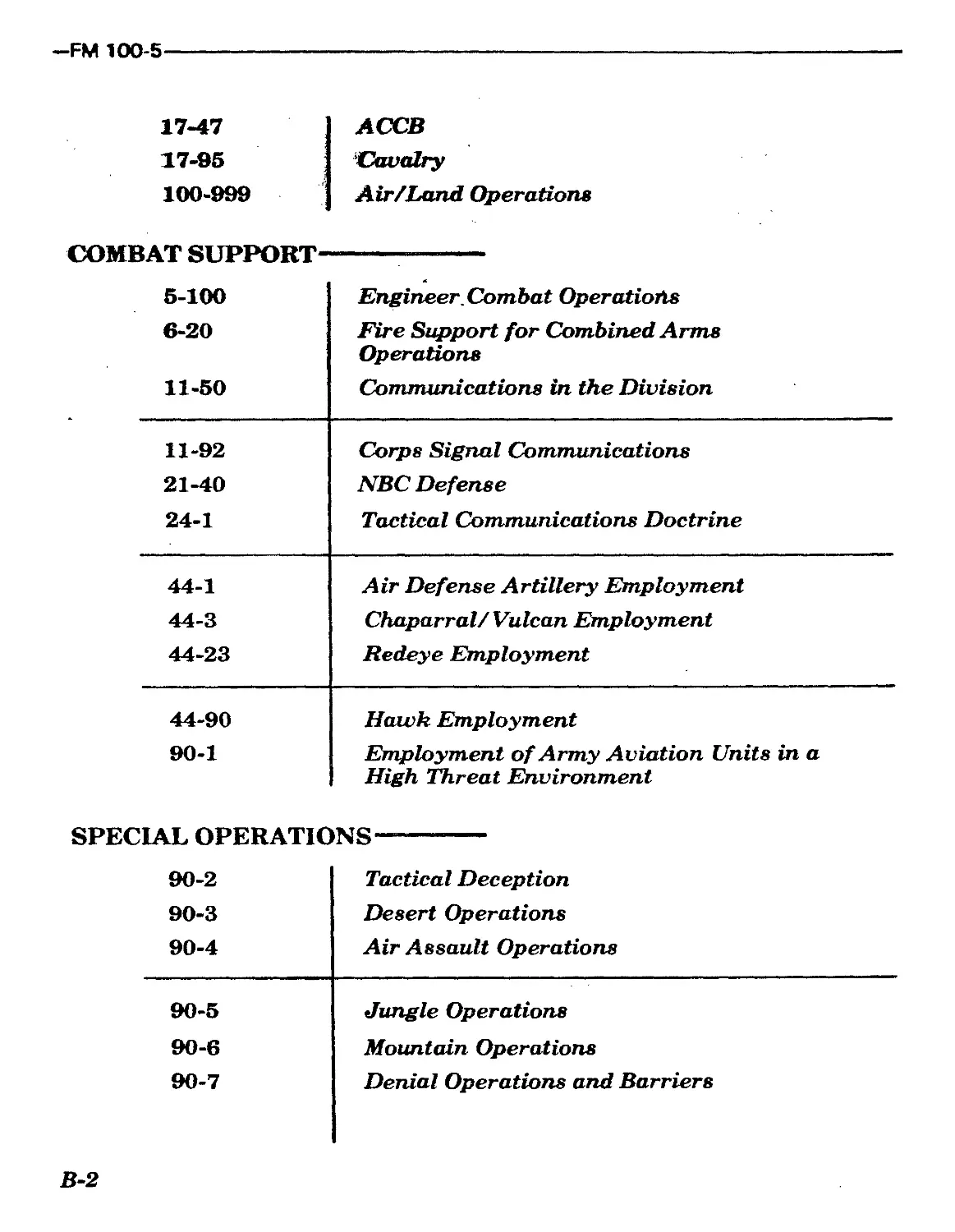
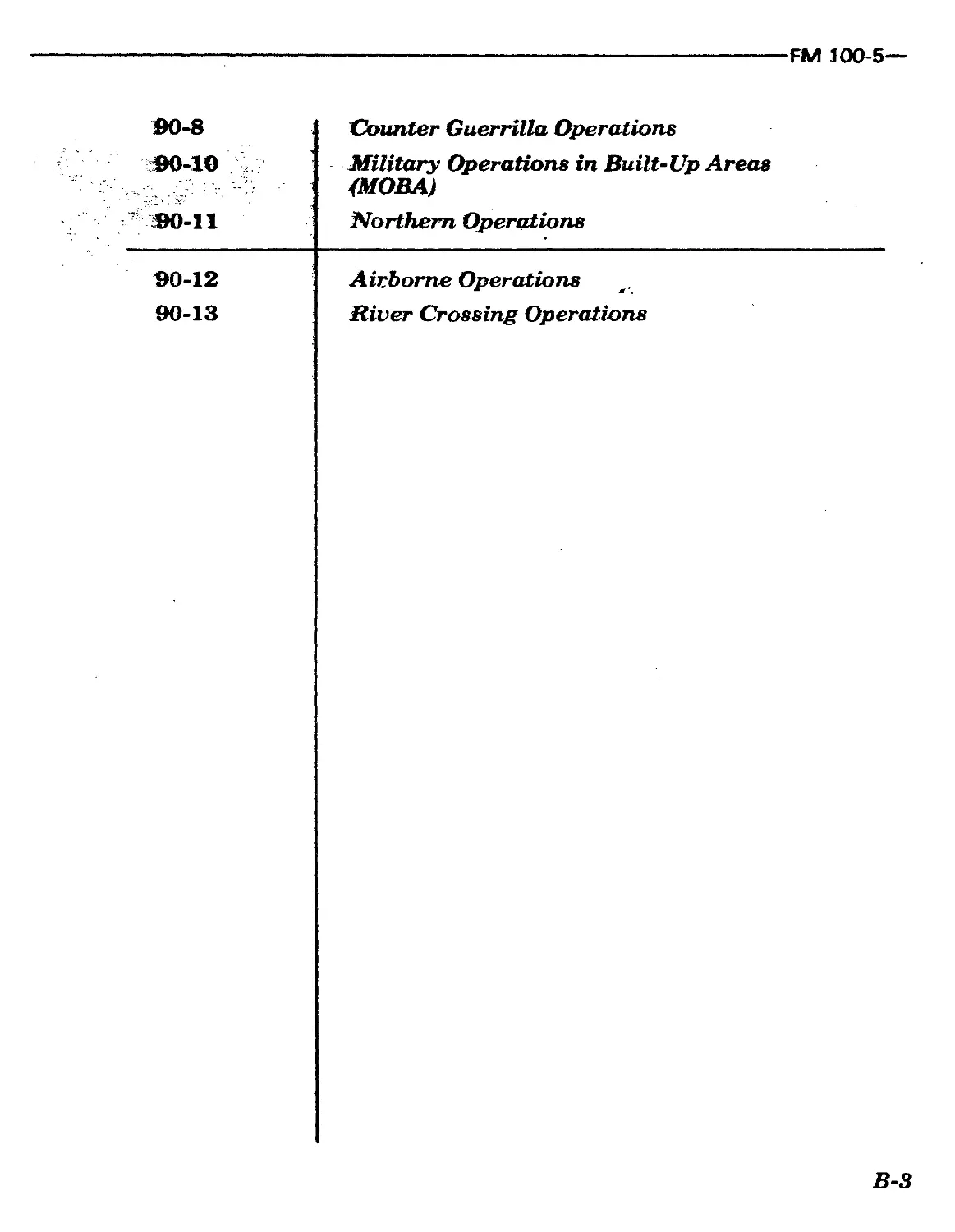
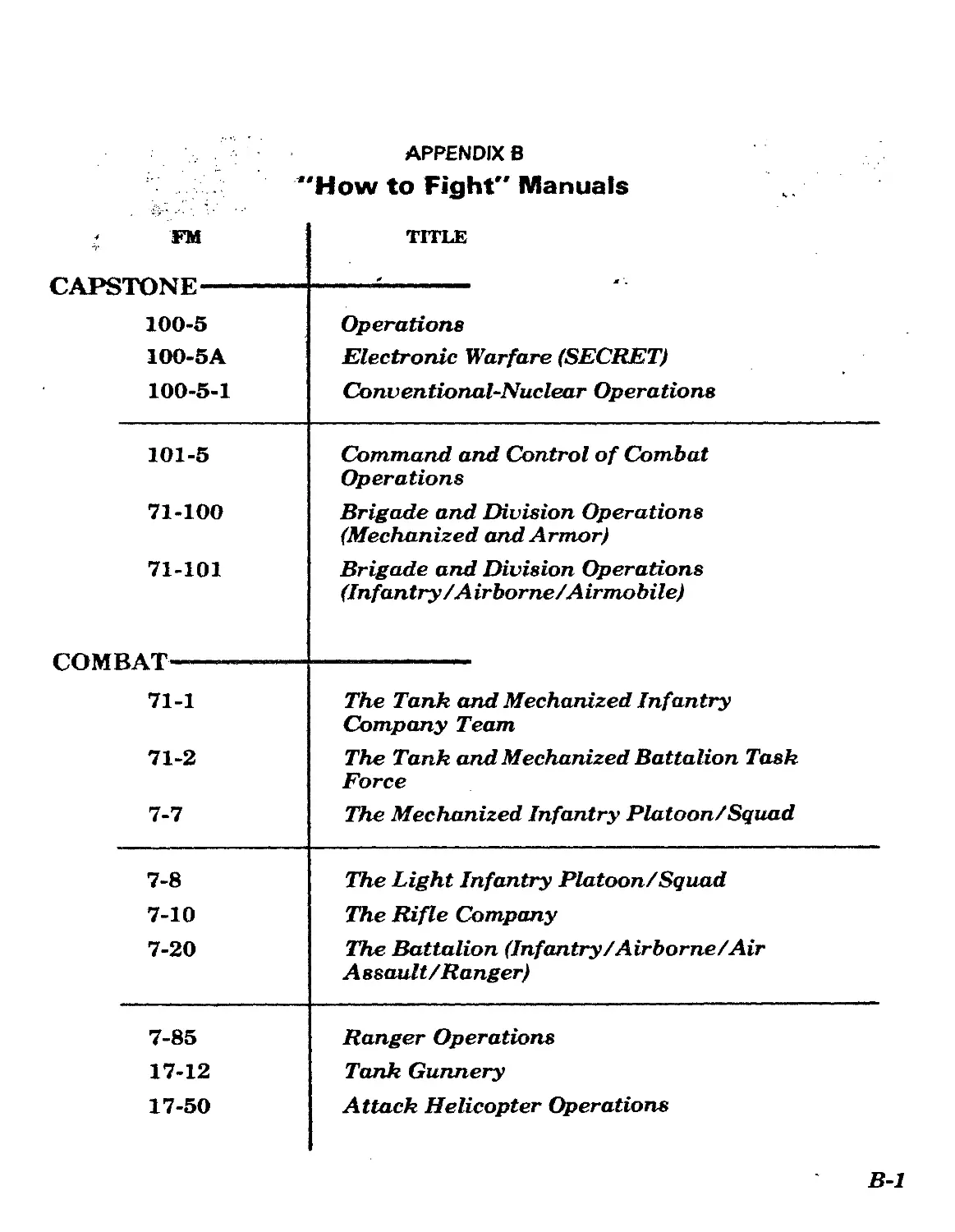
B. "HowtoFight”Manuals.............................   B-1
'This manual supersedes FM 100-5. 6 September 1968. including ell changes.
i
CHAPTER 1
US Army Objectives
WIN
THE ARMY’S primary objective is to win the land battle—to
fight and win in battles, large or small, against whatever foe,
wherever we may be sent to war. We cannot know when or
where the US Army will again be ordered into battle, but we
must assume the enemy we face will possess weapons generally
as effective as our own. And we must calculate that he will have
them in greater numbers than we will be able to deploy, at least
in the opening stages of a conflict. Because the lethality of
modern weapons continues to increase sharply, w’e can expect
very high losses to occur in short periods of time. Entire forces
could be destroyed quickly if they are improperly employed.
CONTENTS
WIN
FUTURE BATTLE
AUSTERITY
WEAPONS AND MEN
COMBAT DEVELOPMENT
DOCTRINE
TRAINING DEVELOPMENT
UNIT TRAINING
READINESS
CONFIDENCE
PAGE
1-1
1-2
12
13
13
1-3
1-3
1-4
1-4
1-5
Therefore, the first battle of our next war
could well be its last battle: belligerents could
be quickly exhausted, and international
pressures to stop fighting could bring about
an early cessation of hostilities. The United
States could find itself in a short, intense
war—the outcome of which may be dictated
by the results of initial combat. This
circumstance is unprecedented: we are an
Army historically unprepared for its first
battle. We Eire accustomed to victory wrought
with the weight of materiel and population
brought to bear after the onset of hostilities.
Today the US Army must, above all else,
prepare to win the first battle of the next war.
Once the war is upon us, we shall aim at
emerging triumphant from the second, third,
and final battles as well.
1-1
— FM 100-5
FUTURE BATTLE
The US Army may find itself at war in any
of a variety of places and situations, fighting
opponents which could vary from the highly
modem mechanized forces of the Warsaw
Pact to light, irregular units in a remote part
of the less developed world. Wherever the
battle begins, the US Army is equipped,
organized, and trained to undertake
appropriate military missions. The purpose
of military operations, and the focus of this
manual, is to describe how the US Army
destroys enemy military forces and secures or
defends important geographic objectives.
Battle in Central Europe against forces of
the Warsaw Pact is the most demanding
mission the US Army could be assigned.
Because the US Army is structured primarily
for that contingency and has large forces
deployed in that area, this manual is
designed mainly to deal with the realities of
such operations. The principles set forth in
this manual, however, apply also to military
operations anywhere in the world.
Furthermore, the US Army retains
substantial capabilities in its airborne,
airmobile, and infantry divisions for
successful operations in other theaters of war
against other forces.
PREPARE TO FIGHT
OUTNUMBERED, AND WIN
AUSTERITY
Our Army must expect to fightits battles at
the end of a long, expensive, vulnerable, line
of communications. Forward deployed
forces, and those reinforcements immediately
available, must therefore be prepared to
accomplish their missions largely with the
resources on hand. They must anticipate
combat against forces with ultra-modern
weapons, greater numbers, and nearby
supply sources. Winning will rest
predominately with commanders of engaged
forces. The US Army must prepare its units to
fight outnumbered, and to win.
1-2
FM 100-5-
WEAPONS AND MEN
To win, our soldiers will need the Vest
weapons that industry and technology can
provide. But weapons, no matter how
powerful, are ineffective in the hands of
inept, ill-trained, unsure operators. And even
proficient crewmen can be rendered impotent
if improperly employed by the battle leader.
Overall battlefield effectiveness depends on
weapons capability, the proficiency of teams
or crews, and the tactics or techniques of the
commander. Thus, the US Army must obtain
powerful weapons, develop fully the
proficiency of the men who man them, and
train leaders capable of employing weapons
and crews to best effect.
COMBAT DEVELOPMENT
US Army combat development seeks to
increase the Army’s ability to fight decisively
by searching combat experience,
experiments, tests, and technology for ways
to provide better weapon systems,
organizations, tactics and techniques.
Success in combat developments is vital for
our success in battle.
POWERFUL WEAPONS,
PROFICIENT PERSONNEL, AND
BEST EFFECTIVE USE OF BOTH
DOCTRINE
Success will also depend on our ability to
assess correctly the dynamics of modem
battle; to reassess them continually, in pace
with the everchanging nature of the modem
battlefield; and to communicate an effective
battle doctrine throughout our forces.
TRAINING DEVELOPMENT
The service schools and training centers of
the Army constitute a prime resource for
readying our soldiers for combat. The service
schools are the Army’s source of combat
development and doctrine, and an important
means by which we inculcate leaders and
trainers with the tactics and techniques
which will contribute to battle success. The
service schools express standards for
training throughout the Army by the way
they teach, by the manuals they write, by
2-3
-FM 100-5
STANDARDS AND TECHNIQUES
THAT MATCH REALITIES
BATTLE DEMANDS EFFECTIVE
COMBINED ARMS TEAMWORK
tests for evaluating individual skills of
soldiers Army-wide, and by the Army
Training and Evaluation Program (ARTEP).
Training development must provide training
standards and techniques matched closely to
the realities of the modem battlefield.
UNIT TRAINING
The soldier receives most of his individual
training in a unit. It is in his unit where he
will have his greatest opportunities to gain
confidence—with his weapons, as a member
of a team, and by training under conditions
approximating battle. Thus, his unit
commander plays the preeminent role in
developing the resolve and the competence to
win outnumbered. The commander must
assure each of his officers, noncommissioned
officers, and soldiers, the opportunity to
improve military proficiency and to prepare
mentally and physically for battle. Every
unit commander of the US Army is
responsible for the progressive professional
development of every soldier in his
command.
Collective training in units should aim at
maximum effectiveness with combined arms.
Wherever possible, commanders should press
beyond ARTEP standards. Consistent with a
judicious regard for safety, training must
simulate the modem battlefield. Training for
battle demands forging effective combined
arms teamwork.
READINESS
Since combat developments and doctrine
are dynamic, since weapon systems are
constantly evolving, and since tactics and
techniques are continually changing,
training methods must change apace.
Readiness for modem battle means training
aimed at payoff now. Constant readiness for
the early battles changes the presumptions
previously governing the US Army training:
post-mobilization training, annual cycles,
cadre development, and the like.
Rather, the commander must manage his
training with a sure knowledge of the present
state of individual and collective proficiency
within his units, and with programs
especially designed to bring them up to
1-4
FM 100-5 —
prescribed individual and unit performance
standards. To paraphrase Josephus on
Roman training methods, our drills must be
"bloodless battles" and our battles "bloody
drills." Even in wartime, in the midst of
combat, training must continue. Training
must be a full-time job for all commanders,
regardless of other operations or missions.
Moreover, US Army commanders tnust
recognize that battlefield success is
dependent to a major degree upon US Air
Force, US Navy or US Marine Corps support,
and our ability to work with our allies. In all
of our 20th century wars, we have fought as a
member of an international coalition,
alongside the other US services, and so we
are likely to fight again. Teamwork in joint
and combined operations is integral to
readiness for land combat.
The Army’s need to prepare for battle
overrides every other aspect of unit missions.
This urgency derives from the danger present
in the world scene, the lethality and
complexity of modern war, and the
everpresent possibility that a unit in training
today may be in action tomorrow. The
commander’s first concern must be to order
all the activities of his unit to meet his
primary obligation to the Army, his unit, and
his soldiers: produce a unit ready to fight and
win now.
CONFIDENCE
PRODUCE A UNIT READY TO
FIGHT AND WIN NOW
Success in the critical early battles of war
will depend mostly upon the courage and skill
of our soldiers, the quality of our leaders, and
the excellence of our techniques and tactics.
It will also depend upon our resolve: the US
Army must be convinced that it will win. This
confidence can only come from a thorough
appreciation of the dynamics of modern
battle; our soldiers must not only understand
what to do, they must also understand why it
must be done. With such an understanding
embedded in the officer and non-
commissioned officer, American leaders will
emerge who can apply techniques and tactics
apt for each unique situation of the
battlefield, and who can tap the ingenuity
and imagination of the American soldier.
THE US ARMY MUST BE
CONVINCED IT WILL WIN
Additionally, success depends on
the ability and willingness of
leaders at all levels to operate
independently, to follow mission-
type orders, and to employ all
available resources in pursuit of the
objective. Confidence is the
cornerstone of success in battle:
each soldier’s belief in his own
competence, his trust in that of
other members of his unit, and their
collective pride, cohesion and
effectiveness.
1-5
CHAPTER 2
Modern Weapons on the Modern Battlefield
OVERVIEW: NEW LETHALITY——
DURING the past several decades, the nature of battle has
changed—not abruptly but nonetheless significantly. Today’s
battlefield presents challenges beyond any the US Army
has ever faced. Great numbers of weapons of advanced
destructiveness have been provided by major powers to client
states; arms purchased by minor but affluent nations have
further spread the latest military technology throughout the
world. Recent wars between small nations have developed
intensities formerly considered within the capabilities of large
states only.
CONTENTS
PAGE
Overview: NEW LETHALITY..................................2-1
Trends:
TANKS.................................................2-2
INFANTRY ...................................  -.......2-7
FIELD ARTILLERY .....................................  2-12
AIR DEFENSE ARTILLERY ................................2-18
AIR POWER ............................................2-20
ARMY AIRCRAFT	   2-21
NIGHT COMBAT	2-23
MINE WARFARE	 2-25
WAR IN THE ELECTROMAGNETIC SPECTRUM	2-26
TACTICAL NUCLEAR WEAPONS	2-28
MOBILITY AND TEMPO	2-30
2-1
—FM 100-5
The war in the Middle East in 1973 might
well portend the mature of modem battle.
Arabs and Israelis were armed with the latest
weapons, and the conflict approached a
destructiveness once attributed only to
nuclear arms. Use of aircraft for close support
of advancing armor, in the fashion generally
practiced since 1940, was greatly reduced by
advancing surface-to-air missiles and air
defense guns. In clashes of massed armor
such as the world had not witnessed for 30
years, both sides sustained devastating
losses, approaching 50 percent in less than
two weeks of combat. These statistics are of
serious import for US Army commanders.
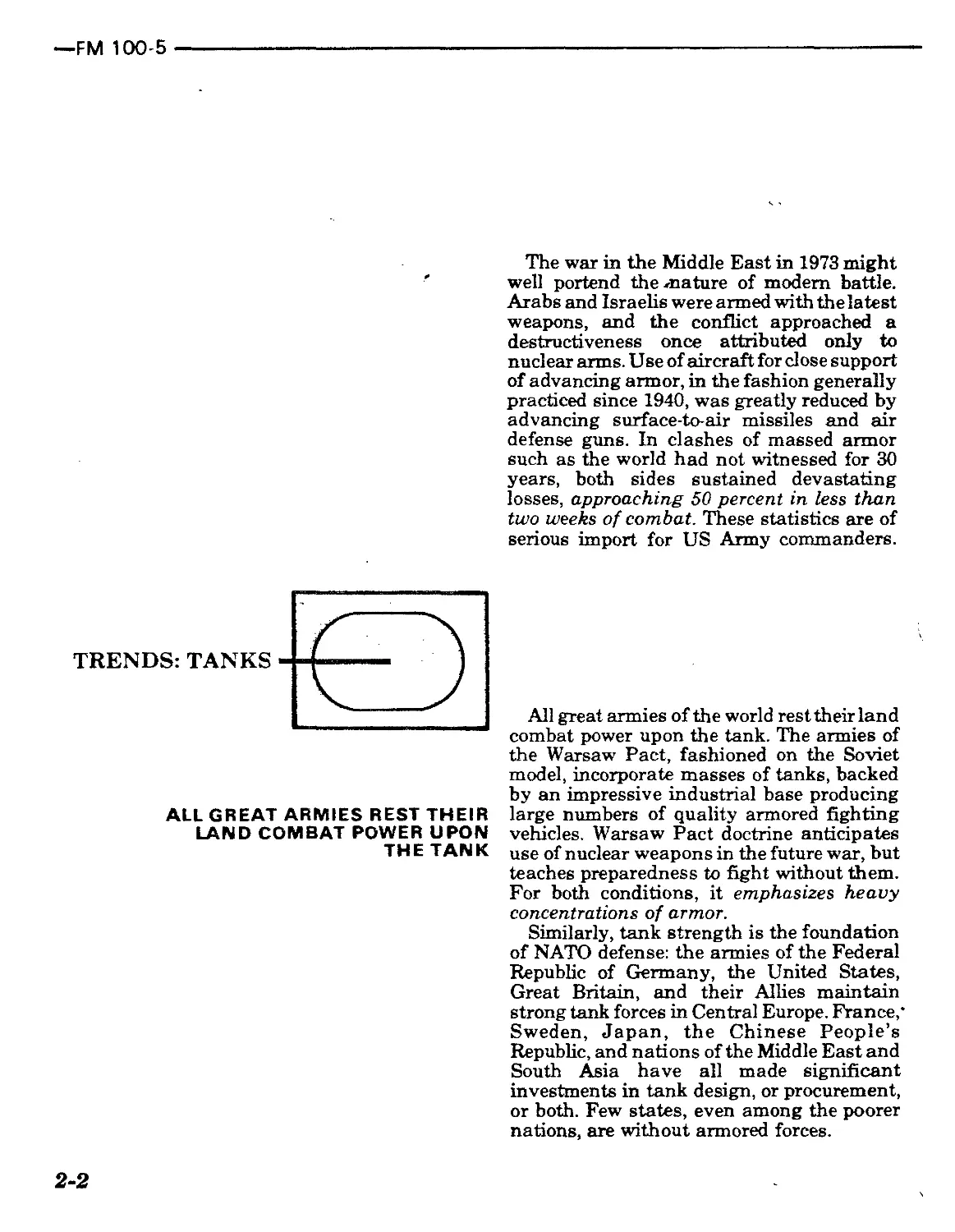
TRENDS: TANKS
ALL GREAT ARMIES REST THEIR
LAND COMBAT POWER UPON
THE TANK
All great armies of the world rest their land
combat power upon the tank. The armies of
the Warsaw Pact, fashioned on the Soviet
model, incorporate masses of tanks, backed
by an impressive industrial base producing
large numbers of quality armored fighting
vehicles. Warsaw Pact doctrine anticipates
use of nuclear weapons in the future war, but
teaches preparedness to fight without them.
For both conditions, it emphasizes heavy
concentrations of armor.
Similarly, tank strength is the foundation
of NATO defense: the armies of the Federal
Republic of Germany, the United States,
Great Britain, and their Allies maintain
strong tank forces in Central Europe. France,*
Sweden, Japan, the Chinese People’s
Republic, and nations of the Middle East and
South Asia have all made significant
investments in tank design, or procurement,
or both. Few states, even among the poorer
nations, are without armored forces.
2-2
FM 100-5—
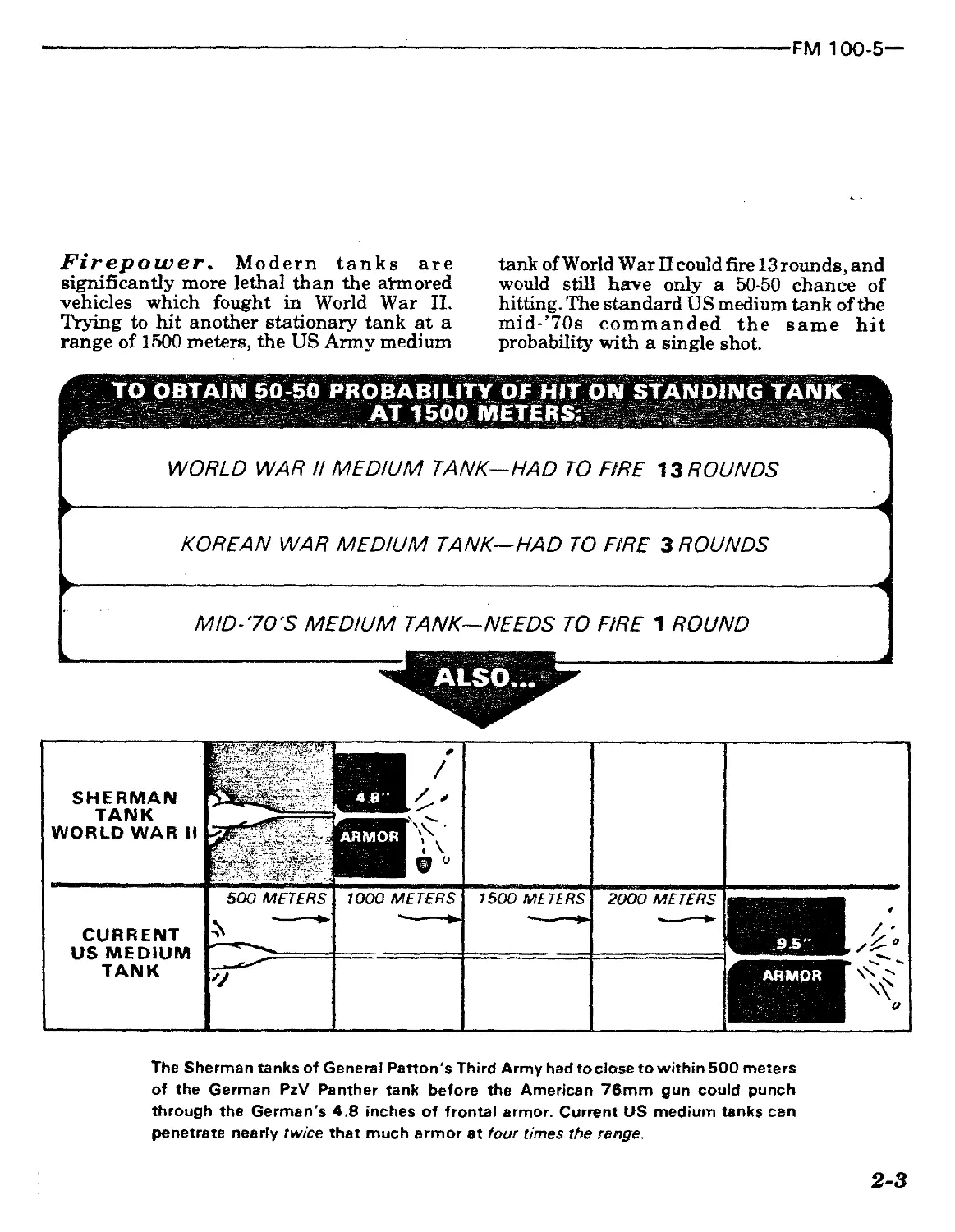
Firepower. Modern tanks are
significantly more lethal than the armored
vehicles which fought in World War IL
Trying to hit another stationary tank at a
range of 1500 meters, the US Army medium
tank of World War П could fire 13 rounds, and
would still have only a 50-50 chance of
hitting. The standard US medium tank of the
mid-’70s commanded the same hit
probability with a single shot.
TO OBTAIN 50-50 PROBABILITY OF HIT ON STANDING TANK
AT 1500 METERS:
WORLD WAR // MEDIUM TANK—HAD TO FIRE 13 ROUNDS
KOREAN WAR MEDIUM TANK—HAD TO FIRE 3 ROUNDS
M!D-'70'S MEDIUM TANK—NEEDS TO FIRE 1 ROUND
к
ALSO
SHERMAN TANK WORLD WAR II	F> v ~	* ft»	V :			c ’	4
CURRENT US MEDIUM TANK	500 METERS	J000 METERS			1500 METERS	2000 METERS

The Sherman tanks of General Patton's Third Army had to close to within 500 meters
of the German PzV Panther tank before the American 76mm gun could punch
through the German's 4.8 inches of frontal armor. Current US medium tanks can
penetrate nearly twice that much armor at four times the range.
2-3
—FM 100-5
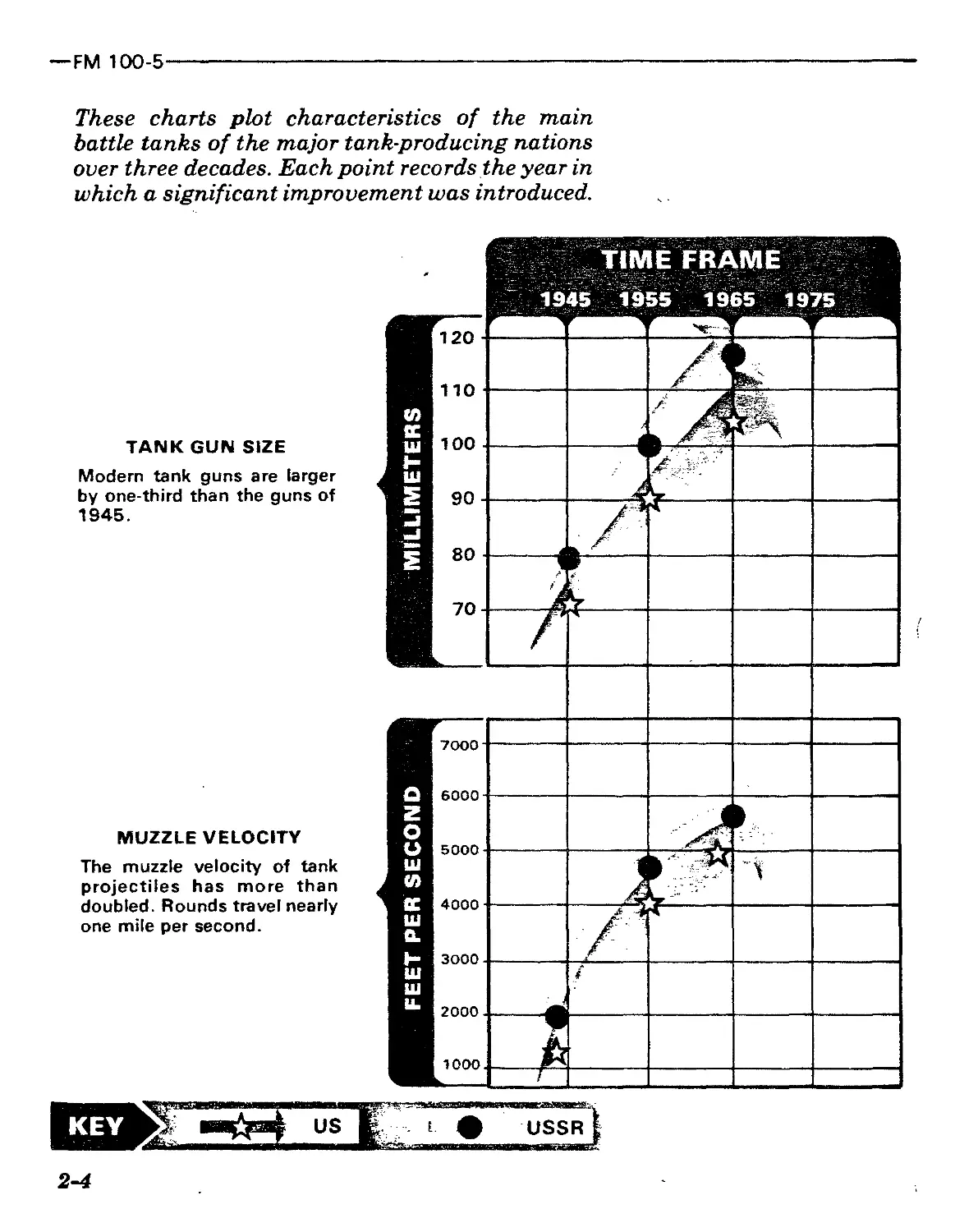
These charts plot characteristics of the main
battle tanks of the major tank-producing nations
over three decades. Each point records the year in
which a significant improvement was introduced.
TIME FRAME
TANK GUN SIZE
Modern tank guns are larger
by one-third than the guns of
1945.
MUZZLE VELOCITY
The muzzle velocity of tank
projectiles has more than
doubled. Rounds travel nearly
one mile per second.
2-4
FM 100-5—
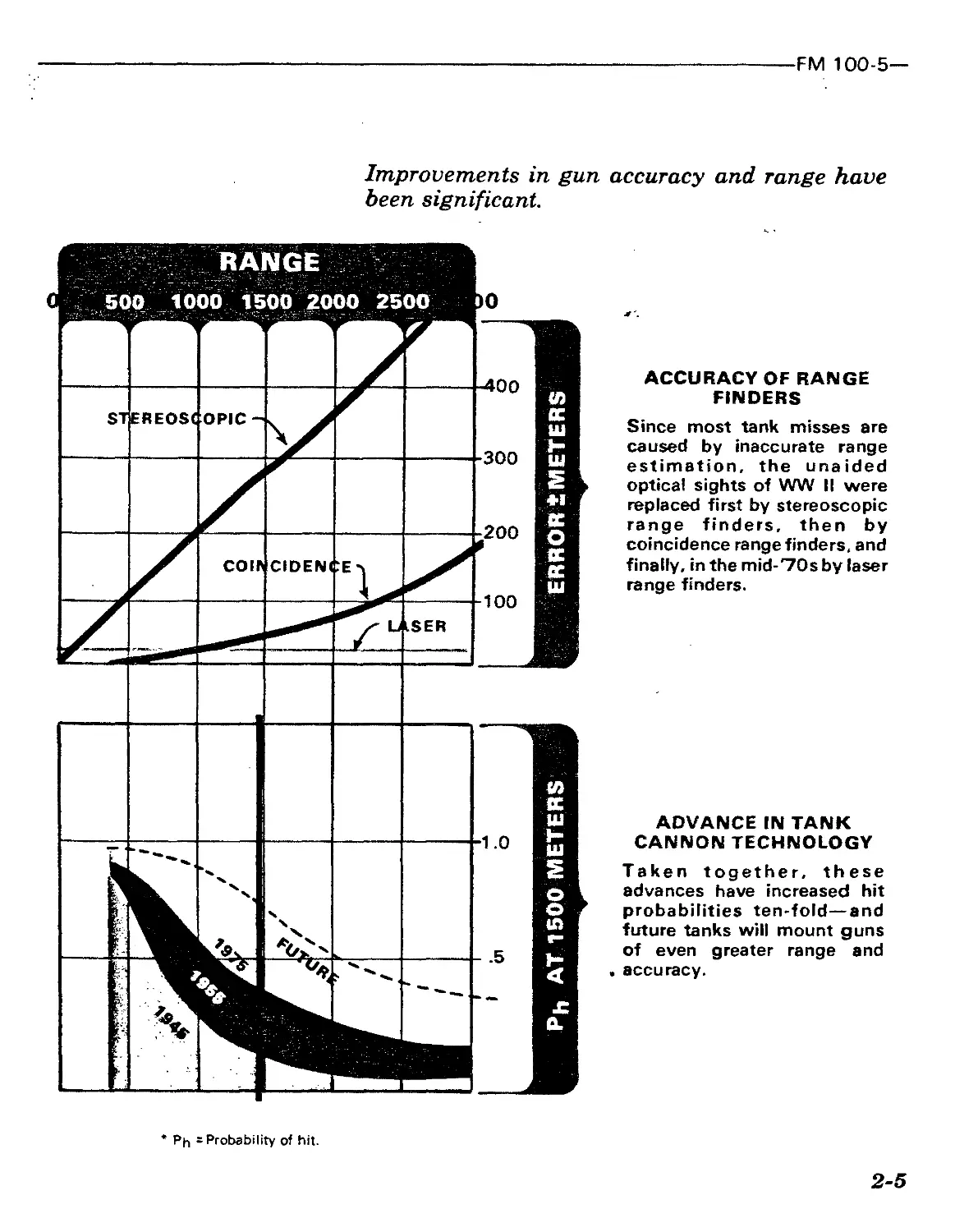
Improvements in gun accuracy and range have
been significant.
* Ph = Probability of hit.
ACCURACY OF RANGE
FINDERS
Since most tank misses are
caused by inaccurate range
estimation, the unaided
optical sights of WW II were
replaced first by stereoscopic
range finders, then by
coincidence rangefinders, and
finally, in the mid-70s by laser
range finders.
ADVANCE IN TANK
CANNON TECHNOLOGY
Taken together, these
advances have increased hit
probabilities ten-fold—and
future tanks will mount guns
of even greater range and
. accuracy.
2-5
— FM 100-5
Armor Protection and Mobility.
Modern tanks have not only bigger guns,
improved ammunition, and more
sophisticated fire control apparatus, but
armor protection roughly double that of
World War II tanks. Nonetheless, the chief
tank-producing nations have designed their
main battle tanks to constrain bulk, and to
balance increases in engines, track and
suspension systems.
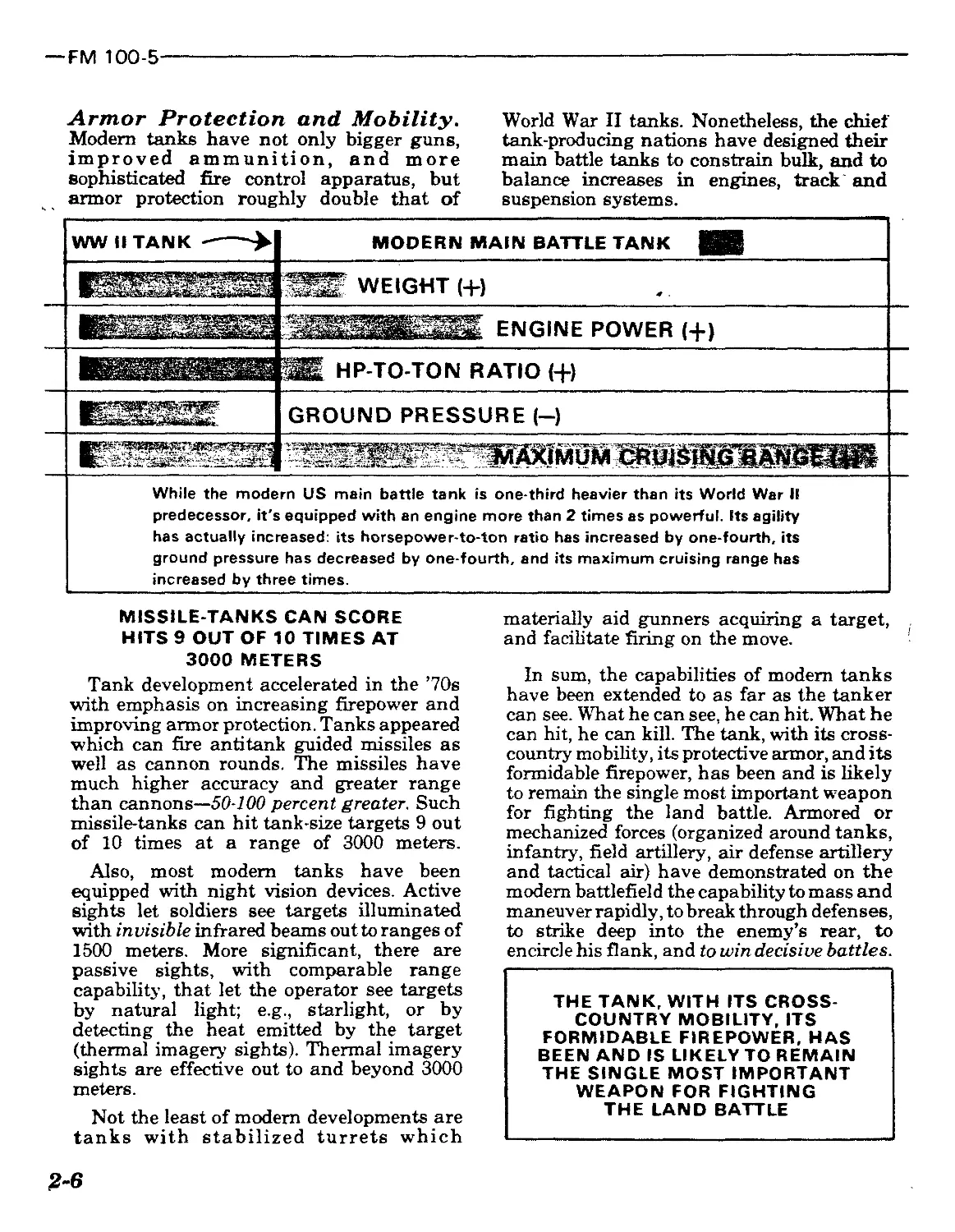
WW II TANK
MODERN MAIN BATTLE TANK
While the modern US main battle tank is one-third heavier than its World War II
predecessor, it's equipped with an engine more than 2 times as powerful. Its agility
has actually increased: its horsepower-to-ton ratio has increased by one-fourth, its
ground pressure has decreased by one-fourth, and its maximum cruising range has
increased by three times.
MISSILE-TANKS CAN SCORE
HITS 9 OUT OF 10 TIMES AT
3000 METERS
Tank development accelerated in the ’70s
with emphasis on increasing firepower and
improving armor protection. Tanks appeared
which can fire antitank guided missiles as
well as cannon rounds. The missiles have
much higher accuracy and greater range
than cannons—50-100 percent greater. Such
missile-tanks can hit tank-size targets 9 out
of 10 times at a range of 3000 meters.
Also, most modern tanks have been
equipped with night vision devices. Active
sights let soldiers see targets illuminated
with invisible infrared beams out to ranges of
1500 meters. More significant, there are
passive sights, with comparable range
capability, that let the operator see targets
by natural light; e.g., starlight, or by
detecting the heat emitted by the target
(thermal imagery sights). Thermal imagery
sights are effective out to and beyond 3000
meters.
Not the least of modem developments are
tanks with stabilized turrets which
materially aid gunners acquiring a target,
and facilitate firing on the move.
In sum, the capabilities of modem tanks
have been extended to as far as the tanker
can see. What he can see, he can hit. What he
can hit, he can kill. The tank, with its cross-
country mobility, its protective armor, and its
formidable firepower, has been and is likely
to remain the single most important weapon
for fighting the land battle. Armored or
mechanized forces (organized around tanks,
infantry, field artillery, air defense artillery
and tactical air) have demonstrated on the
modem battlefield the capability to mass and
maneuver rapidly, to break through defenses,
to strike deep into the enemy’s rear, to
encircle his flank, and to win decisive battles.
THE TANK, WITH ITS CROSS-
COUNTRY MOBILITY, ITS
FORMIDABLE FIREPOWER, HAS
BEEN AND IS LIKELY TO REMAIN
THE SINGLE MOST IMPORTANT
WEAPON FOR FIGHTING
THE LAND BATTLE
2-6
FM 100-5—
TRENDS: INFANTRY
INFANTRY CAN INFLICT HEAVY
LOSSES ON ARMORED FORCES
AT LONG AND SHORT RANGES
Modem infantry is significantly more
capable than its World War II counterpart.
Through new weapons, equipment,
techniques, and tactics, the infantry remains
a versatile fighting force.
Antiarmor Weapons. Tanks were
invented to defeat the infantry defenses of
World War I, and remained, for nearly 50
years, the nemesis of infantry. During World
War II, shoulder -launched rockets with
shape-charge explosives (e.g., bazooka,
panzerfaust) began to erode the tank’s
invincibility. Now, well-trained infantry can
inflict heavy losses on armored forces at both
long and short ranges. Mechanized infantry
equipped with TOW and Dragon can fight in
both the offense and defense against tank-
heavy enemy forces.
2-7
—FM 100-5
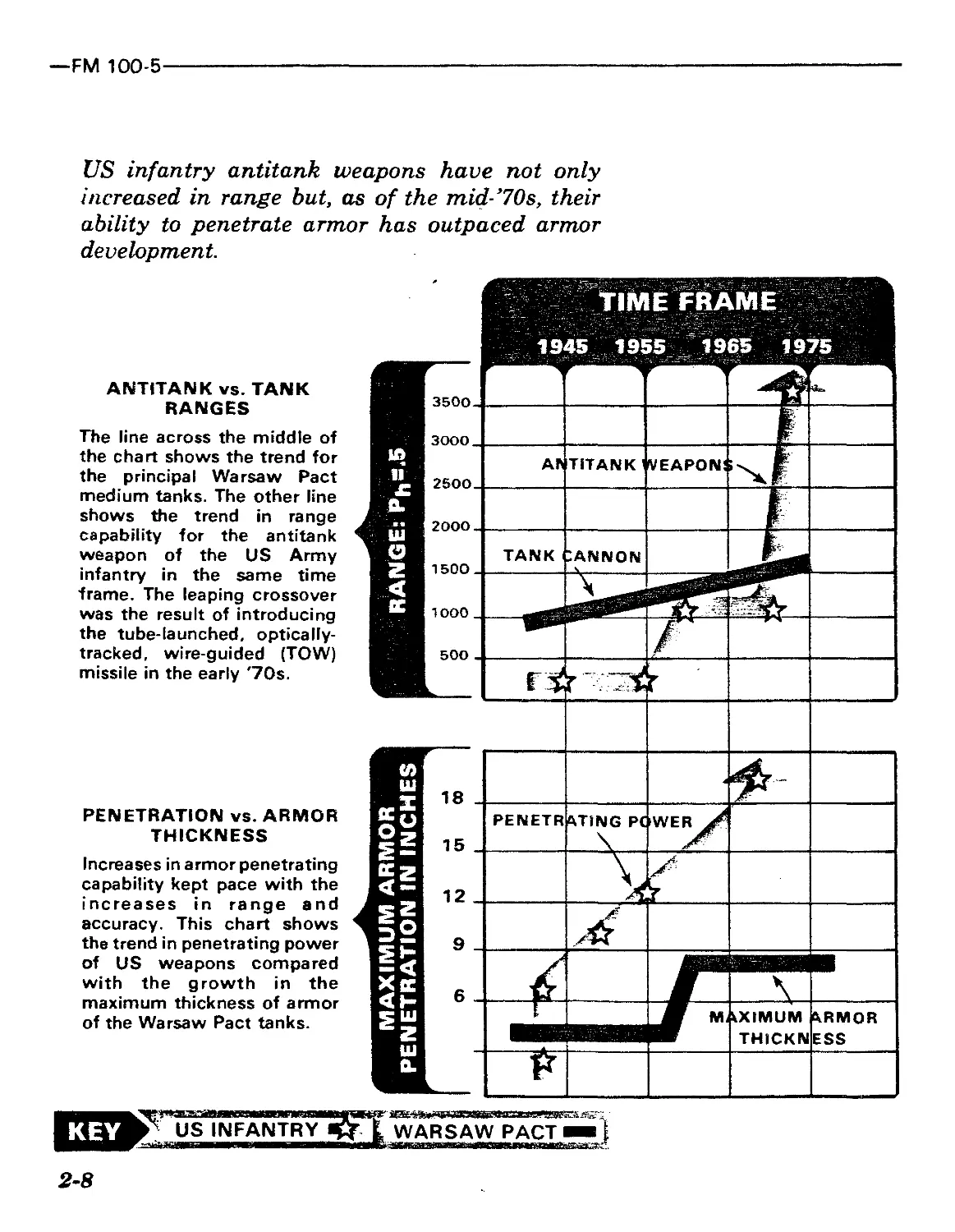
US infantry antitank weapons have not only
increased in range but, as of the mid-’70s, their
ability to penetrate armor has outpaced armor
development.
ANTITANK vs. TANK
RANGES
The line across the middle of
the chart shows the trend for
the principal Warsaw Pact
medium tanks. The other line
shows the trend in range
capability for the antitank
weapon of the US Army
infantry in the same time
frame. The leaping crossover
was the result of introducing
the tube-launched, optically-
tracked, wire-guided (TOW)
missile in the early '70s.
PENETRATION vs. ARMOR
THICKNESS
Increases in armor penetrating
capability kept pace with the
increases in range and
accuracy. This chart shows
the trend in penetrating power
of US weapons compared
with the growth in the
maximum thickness of armor
of the Warsaw Pact tanks.
. WARSAW PACT»]
2-8
FM 100-5—
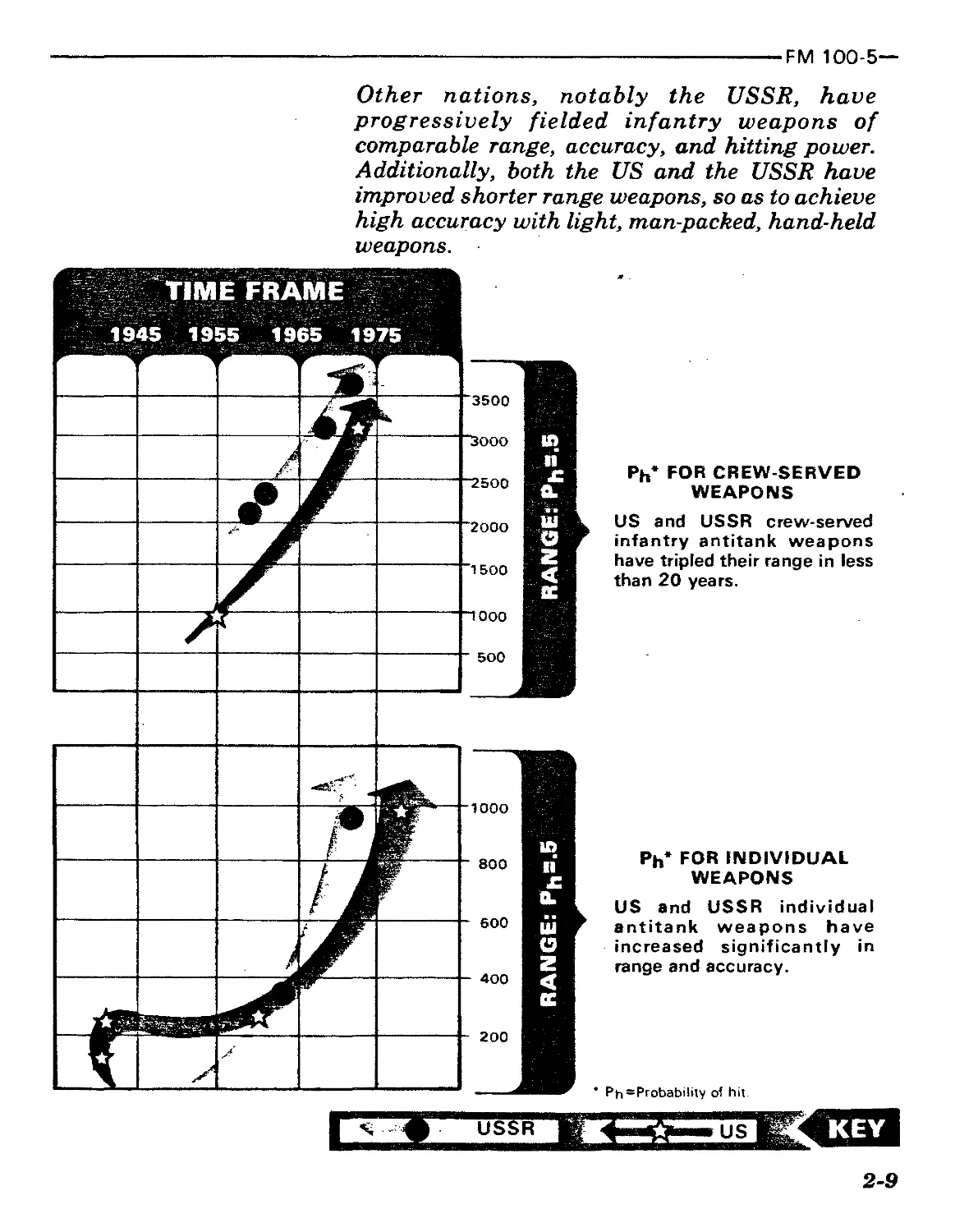
Other nations, notably the USSR, have
progressively fielded infantry weapons of
comparable range, accuracy, and hitting power.
Additionally, both the US and the USSR have
improved shorter range weapons, so as to achieve
high accuracy with light, man-packed, hand-held
weapons.
Ph* FOR INDIVIDUAL
WEAPONS
US and USSR individual
antitank weapons have
increased significantly in
range and accuracy.
Ph* FOR CREW-SERVED
WEAPONS
US and USSR crew-served
infantry antitank weapons
have tripled their range in less
than 20 years.
' Ph=Probability of hit
us£r.
2-9
—FM 100-5
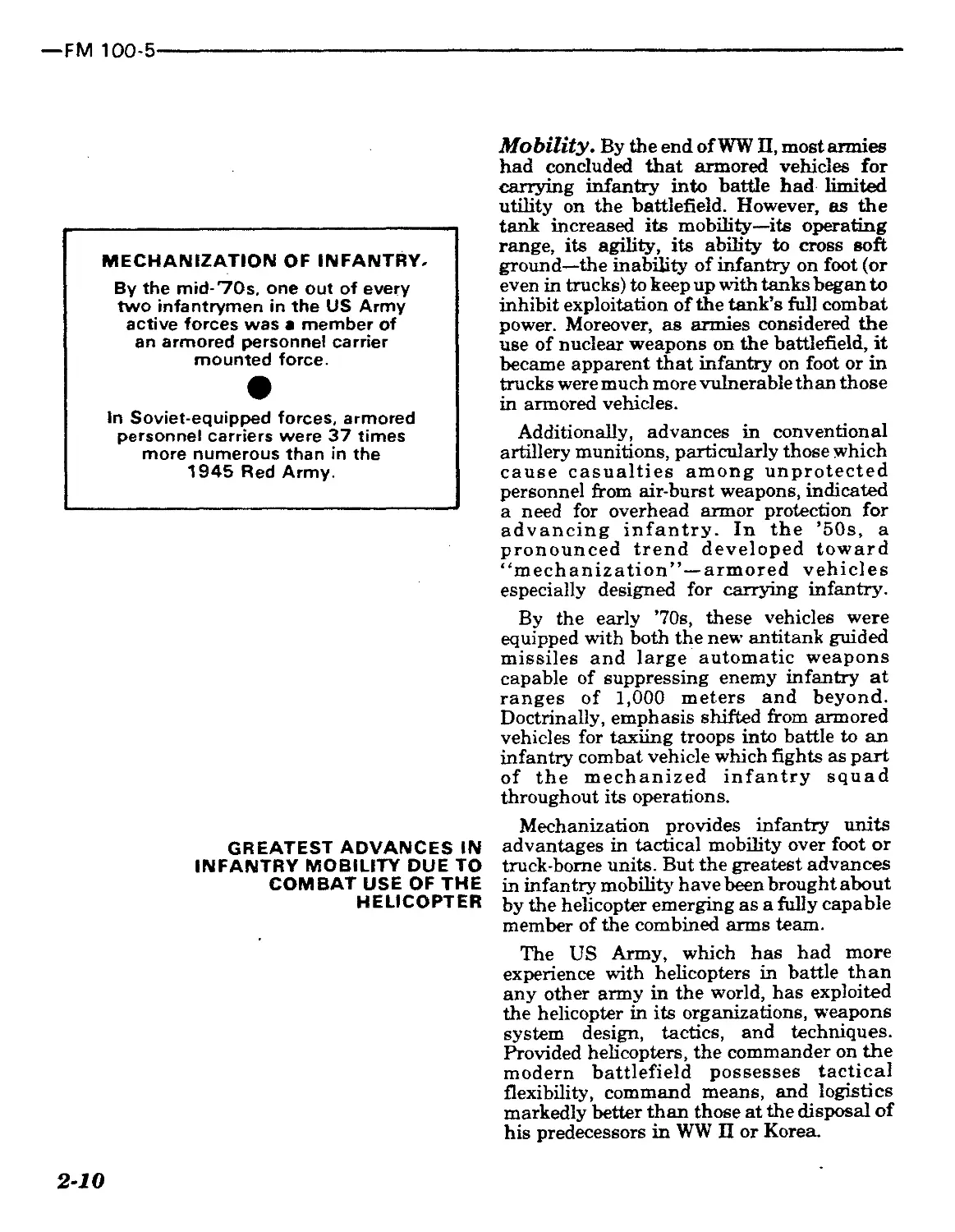
MECHANIZATION OF INFANTRY-
By the mid-70s, one out of every
two infantrymen in the US Army
active forces was a member of
an armored personnel carrier
mounted force.
In Soviet-equipped forces, armored
personnel carriers were 37 times
more numerous than in the
1945 Red Army.
GREATEST ADVANCES IN
INFANTRY MOBILITY DUE TO
COMBAT USE OF THE
HELICOPTER
Mobility. By the end of WW П, most armies
had concluded that armored vehicles for
carrying infantry into battle had limited
utility on the battlefield. However, as the
tank increased its mobility—its operating
range, its agility, its ability to cross soft
ground—the inability of infantry on foot (or
even in trucks) to keep up with tanks began to
inhibit exploitation of the tank’s full combat
power. Moreover, as armies considered the
use of nuclear weapons on the battlefield, it
became apparent that infantry on foot or in
trucks were much more vulnerable than those
in armored vehicles.
Additionally, advances in conventional
artillery munitions, particularly those which
cause casualties among unprotected
personnel from air-burst weapons, indicated
a need for overhead armor protection for
advancing infantry. In the ’50s, a
pronounced trend developed toward
“mechanization”—armored vehicles
especially designed for carrying infantry.
By the early ’70s, these vehicles were
equipped with both the new antitank guided
missiles and large automatic weapons
capable of suppressing enemy infantry at
ranges of 1,000 meters and beyond.
Doctrinally, emphasis shifted from armored
vehicles for taxiing troops into battle to an
infantry combat vehicle which fights as part
of the mechanized infantry squad
throughout its operations.
Mechanization provides infantry units
advantages in tactical mobility over foot or
truck-borne units. But the greatest advances
in infantry mobility have been brought about
by the helicopter emerging as a fully capable
member of the combined arms team.
The US Army, which has had more
experience with helicopters in battle than
any other army in the world, has exploited
the helicopter in its organizations, weapons
system design, tactics, and techniques.
Provided helicopters, the commander on the
modern battlefield possesses tactical
flexibility, command means, and logistics
markedly better than those at the disposal of
his predecessors in WW П or Korea.
2-10
FM 100-5—
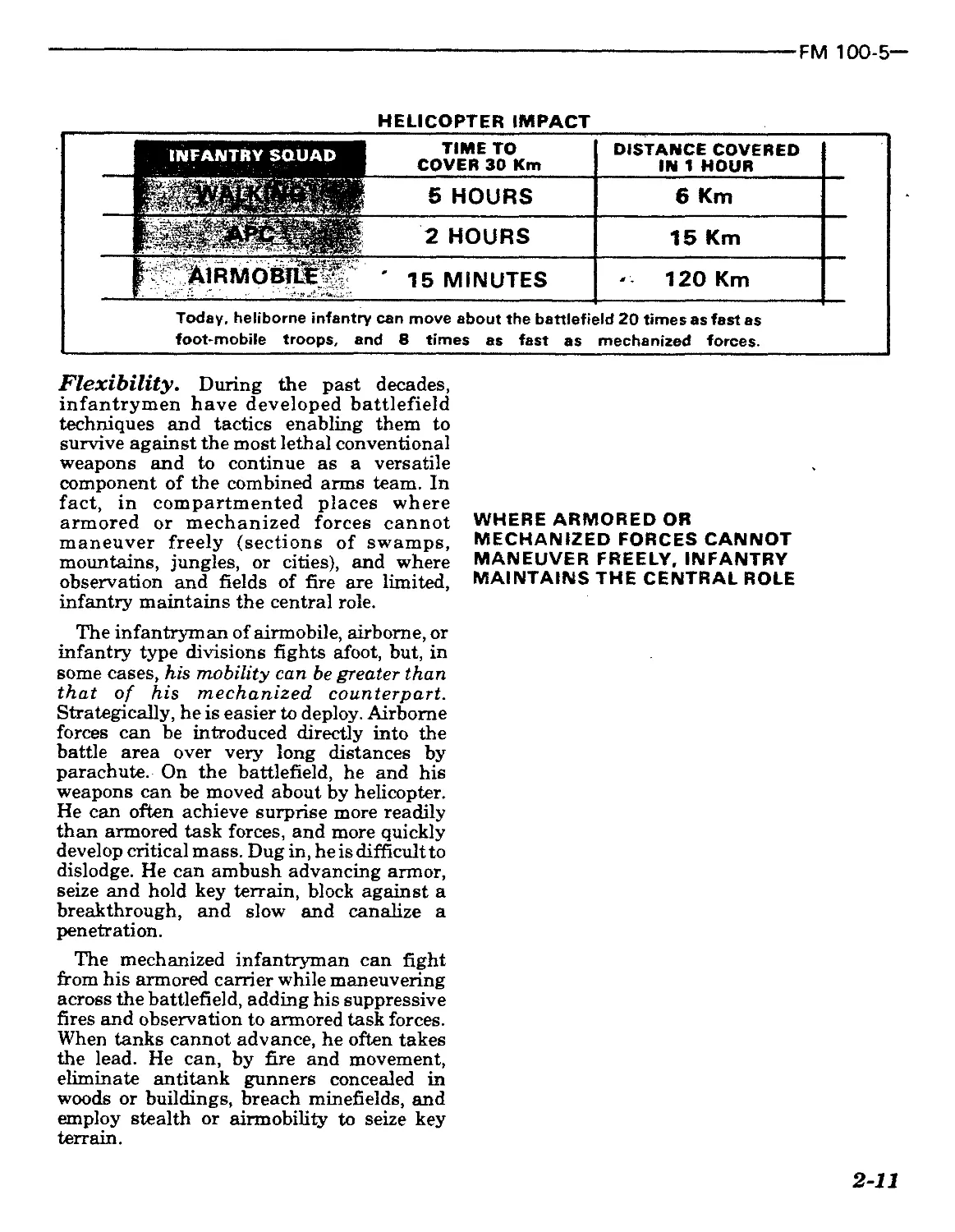
HELICOPTER IMPACT
	TIME TO COVER 30 Km	DISTANCE COVERED IN 1 HOUR
INFANTRY SQUAD Щ
	5 HOURS	6 Km
T Ц III	2 HOURS	15 Km
»	. •.	-'-i-., г;	15 MINUTES	-	120 Km
Today, heliborne infantry can move about the battlefit foot-mobile troops, and 8 times as fast as		sld 20 times as fast as mechanized forces.
Flexibility. During the past decades,
infantrymen have developed battlefield
techniques and tactics enabling them to
survive against the most lethal conventional
weapons and to continue as a versatile
component of the combined arms team. In
fact, in compartmented places where
armored or mechanized forces cannot
maneuver freely (sections of swamps,
mountains, jungles, or cities), and where
observation and fields of fire are limited,
infantry maintains the central role.
The infantryman of airmobile, airborne, or
infantry type divisions fights afoot, but, in
some cases, his mobility can be greater than
that of his mechanized counterpart.
Strategically, he is easier to deploy. Airborne
forces can be introduced directly into the
battle area over very long distances by
parachute. On the battlefield, he and his
weapons can be moved about by helicopter.
He can often achieve surprise more readily
than armored task forces, and more quickly
develop critical mass. Dug in, he is difficult to
dislodge. He can ambush advancing armor,
seize and hold key terrain, block against a
breakthrough, and slow and canalize a
penetration.
The mechanized infantryman can fight
from his armored carrier while maneuvering
across the battlefield, adding his suppressive
fires and observation to armored task forces.
When tanks cannot advance, he often takes
the lead. He can, by fire and movement,
eliminate antitank gunners concealed in
woods or buildings, breach minefields, and
employ stealth or airmobility to seize key
terrain.
WHERE ARMORED OR
MECHANIZED FORCES CANNOT
MANEUVER FREELY, INFANTRY
MAINTAINS THE CENTRAL ROLE
2-11
—FM 100-5
TRENDS: FIELD ARTILLERY
ARTILLERY CAUSED MORE THAN
HALF OF THE CASUALTIES
DURING WORLD WAR II
During WW II, the necessity for massed
and sustained firepower closely integrated
with large and mobile maneuver forces
accelerated artillery developments. Artillery
emerged as the greatest casualty producer of
that war, causing more than half of the
casualties sustained by all armies. Modern
artillery weapons and munitions and
techniques for their employment have
significantly improved in the last thirty
years, and all major armies hold substantial'
artillery inventories. And almost all of the
smaller nations have been provided modern
artillery weapons by the larger world powers.
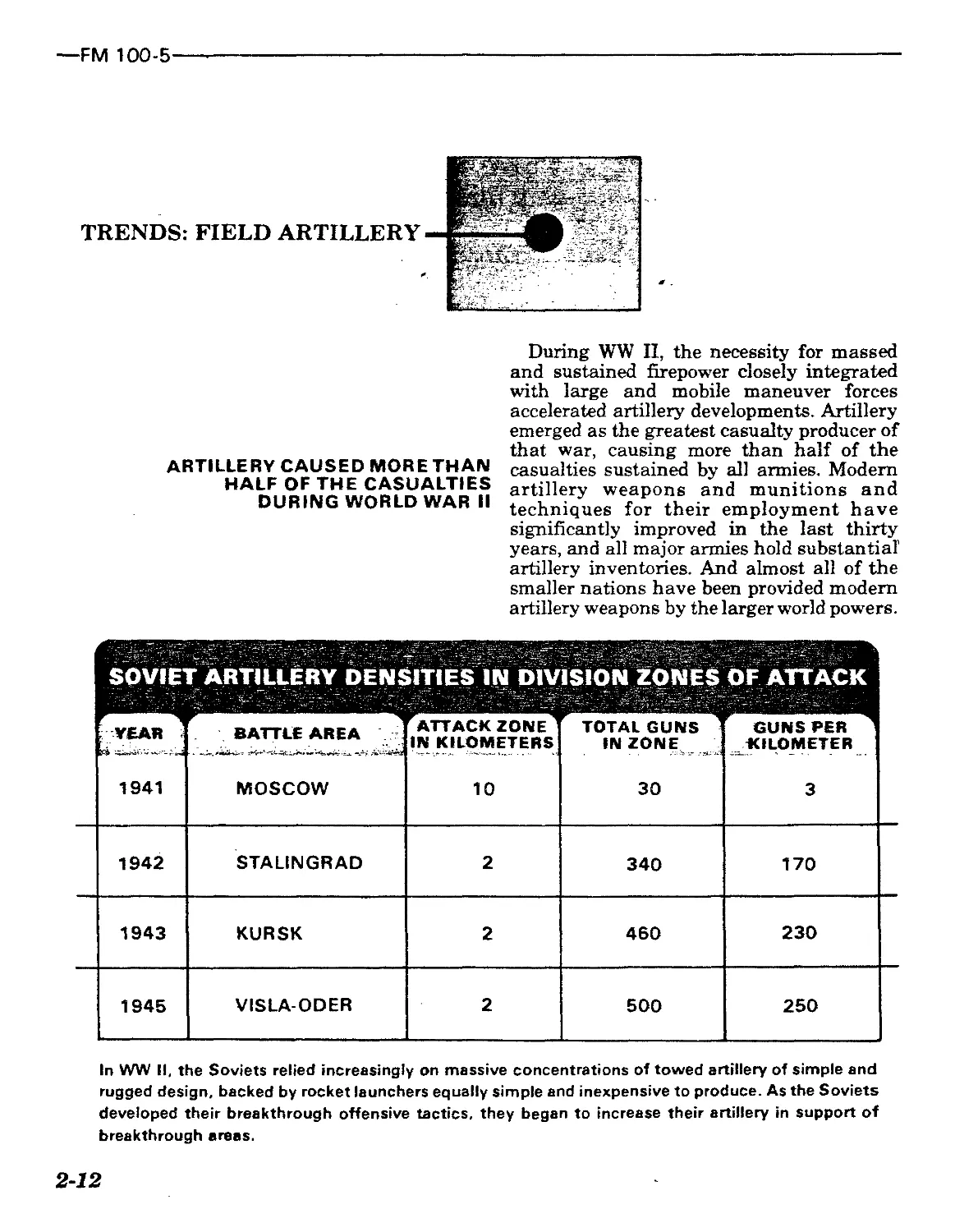
SOVIET ARTILLERY DENSITIES IN DIVISION ZONES OF ATTACK
	YEAR 1941	BATTLE AREA MOSCOW	ATTACK ZONE IN KILOMETERS 10	TOTAL GUNS IN ZONE 30	GUNS PER ^KILOMETER 3
	1942	STALINGRAD	2	340	170
	1943	KURSK	2	460	230
	1945	VISLA-ODER	2	500	250
In WW II, the Soviets relied increasingly on massive concentrations of towed artillery of simple and
rugged design, backed by rocket launchers equally simple and inexpensive to produce. As the Soviets
developed their breakthrough offensive tactics, they began to increase their artillery in support of
breakthrough areas.
2-12
FM 100-5—
Soviet doctrine continued to stress
offensive breakthrough tactics into the ’70s,
requiring artillery densities of 70-100 tubes
per kilometer in support of the leading
maneuver forces. Nations using Soviet
equipment and doctrine have adopted similar
techniques, as evidenced in the 197$ Middle
East War.
US techniques for concentrating artillery
during WW II relied on fire control procedures
to mass the fires of separated units onto a
single target area. With these techniques and
improved radio communications, one
forward observer could request and receive
the fires of all of the artillery battalions
operating within the corps and in range of the
target. Time on target (TOT) surprise fire
techniques produced high shock effect
among unprepared and exposed infantry.
Responsiveness and lethality were
significantly increased in 1943 with the
introduction of the variable time (VT) fuze.
And US artillery increasingly emphasized
self-propelled weapons to maintain the fast
tempo of mobile warfare. These
developments were further refined following
WW II and remain significant elements of US
artillery doctrine.
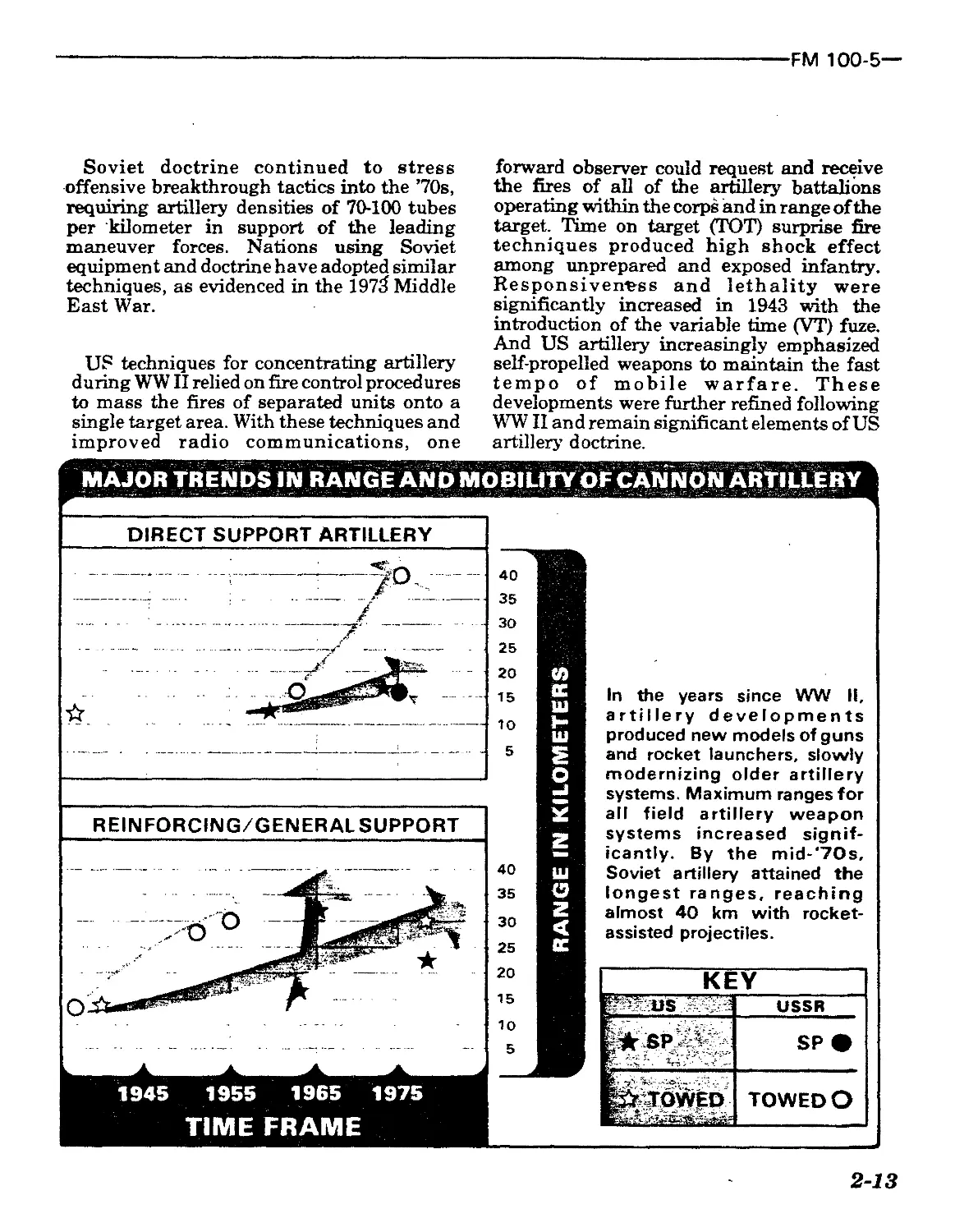
MAJOR TRENDS IN RANGE AND MOBILITY OF CANNON ARTILLERY
DIRECT SUPPORT ARTILLERY
1945	1955	1965 1975
TIME FRAME
In the years since WW II,
artillery developments
produced new models of guns
and rocket launchers, slowly
modernizing older artillery
systems. Maximum ranges for
all field artillery weapon
systems increased signif-
icantly. By the mid-‘70s,
Soviet artillery attained the
longest ranges, reaching
almost 40 km with rocket-
assisted projectiles.
KEY
2-13
—FM 100-5
ARTILLERY IN US ARMORED AND
MECHANIZED DIVISIONS IS
ENTIRELY SELF-PROPELLED
Artillery Munitions. Since 1945, new
explosives and munitions have greatly
increased the firepower lethality per shell.
Improved conventional munitions, when
compared to ordinary high explosive rounds,
provide up to 4 times the amount of casualty
effect against personnel targets. Projectiles
with time-delay submunitions extend the
suppression capability of a single round over
a considerable period of time after impact,
and small scatterable antitank mines can be
employed by indirect artillery fire.
In the mid-’70s, US artillery made
revolutionary advances in lethality, and will
soon add a point destruction capability to its
traditional role of suppression. Precision
guided projectiles fired from standard
cannon will be able to kill single tanks with a
very high probability of first round success.
These projectiles are guided to either a
moving or stationary target by a forward
observer illuminating the target with a laser
designator. Multiple targets can be hit in
quick succession.
Mobility. Improvements in artillery
ground mobility, particularly in Western
armies, increased the capability of artillery to
keep pace with the increasing tempo of
modem mechanized warfare. Artillery in US
armored and mechanized divisions is
entirely self-propelled, enabling it to move
with fast armored thrusts, or displace
laterally to concentrate fires quickly in a
threatened defensive sector. The Soviets, in
contrast, support their mechanized forces
with extensive numbers of towed cannon and
motorized rocket launchers. In the early ’70s,
the Soviets recognized the mobility
limitations of towed artillery to support their
doctrine of fast and deep offensive
operations, and began to increase their
inventories of self-propelled guns.
Fire Control and Coordination. Since
WW II, advances in fire direction,
observation, and coordination have similarly
added to the responsiveness, flexibility, and
accuracy of modem artillery firepower. In the
’60s, small tactical fire direction computers in
US battalions and batteries eased the
massing of surprise fires and the transfer to
new targets. In the ’70s, laser range finders
used by US forward observers reduced initial
2-14
FM 100-5—
target range estimation errors from 400
meters, common to earlier map and binocular
methods, down to as close as 10 meters. Since
the forward observers range estimation is the
key to fast and accurate adjusted fire, laser
ranging produces significant increases in
first round effect.
Also in the ’70s, the US Army devised new
techniques to improve responsiveness.
Response times to provide suppressive fire
against ATGM or other infantry weapons
were reduced from minutes to seconds by
streamlining fire control procedures in the
fire direction center (FDC) and at the guns,
and by dedicating batteries to maneuver
companies moving to contact.
Soviet artillery continued to rely on older
fire direction techniques and coordination
procedures. Fire planning and coordination
was centralized at very high levels, reducing
responsiveness to the maneuver units, but
providing very effective massed firepower in
support of breakthrough operations. US fire
planning techniques were more decentralized
and adaptable to rapid and unexpected
changes in the course of a battle.
Automated fire control systems, like
TACFIRE, will play an increased role in
artillery gunnery, planning, and
coordination. The TACFIRE system will
improve US artillery support to the maneuver
forces significantly. TACFIRE automates
most of the procedures which were previously
accomplished manually, and provides
greater accuracy, reduces firing data
computation times, and speeds the flow of
intelligence, survey and metrological data.
Artillery Suppression. Increased
ranges, improved firepower, and better fire
control underscore the importance of artillery
as a prime suppressive weapon against
opposing infantry weapons, tanks, artillery,
and air defense artillery. Artillery suppresses
antitank guided missiles by using high
explosives to drive the gunners from their
sights or smoke to block or obscure their
vision. Smoke munitions can also block the
vision of attacking tanks; HE (high
explosive) fired at tanks causes them to
button-up, reducing the crews’ effectiveness
by as much as 50 percent. Artillery can now
RESPONSE TIMES TO PROVIDE
SUPPRESIVE FIRE WERE
REDUCED FROM MINUTES TO
SECONDS
SYSTEMS LIKE TACFIRE PLAY
A SIGNIFICANT ROLE IN
IMPROVED SUPPORT TO
MANEUVER FORCES
2-15
—FM 100-5
reach farther to suppress air defense
weapons. Artillery improvements joined with
better locating systems also increase the
potential of modem artillery to counter
opposing indirect fire weapons, particularly
those that shoot indiscriminately or do not
take measures to avoid detection.
Counterfire. Field artillery counterfire is
the attack of enemy indirect fire systems and
includes all activities necessary to direct the
attack of enemy mortar, cannon, and rocket
or missile systems. During WW II and the
Korean Conflict, the counterfire function was
performed at the corps artillery level. On the
modem battlefield, greatly increased corps
frontages, extended communication
requirements, and the expected density of
targets make the division artillery a more
logical echelon to conduct counterfire.
Divisions have been given the assets required
to do this job in the form of a target
acquisition battery organic to division
artillery and by habitual assignment of corps
cannon battalions to support the division.
Types and amounts of FA allocated the
division will be in accordance with the
tactical situation and the opposing threat.
Direct Support Fires. Larger weapons
introduced at the direct support level in US
armored and mechanized divisions moved
the lethal reach of the maneuver commander
beyond that of his WW II or Korean War
counterpart.
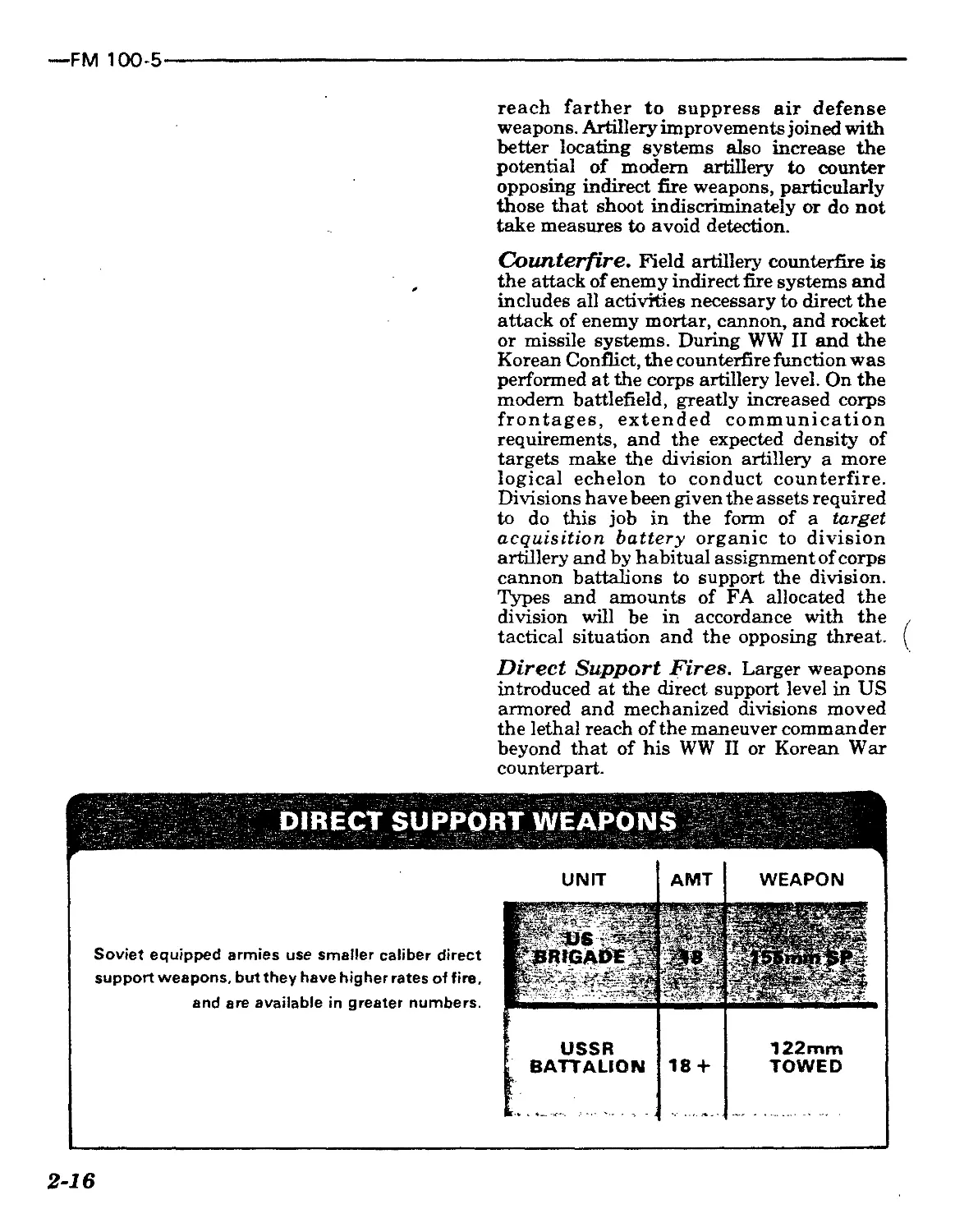
DIRECT SUPPORT WEAPONS
Soviet equipped armies use smaller caliber direct
support weapons, but they have higher rates of fire,
and are available in greater numbers.
2-16
FM 100-5—
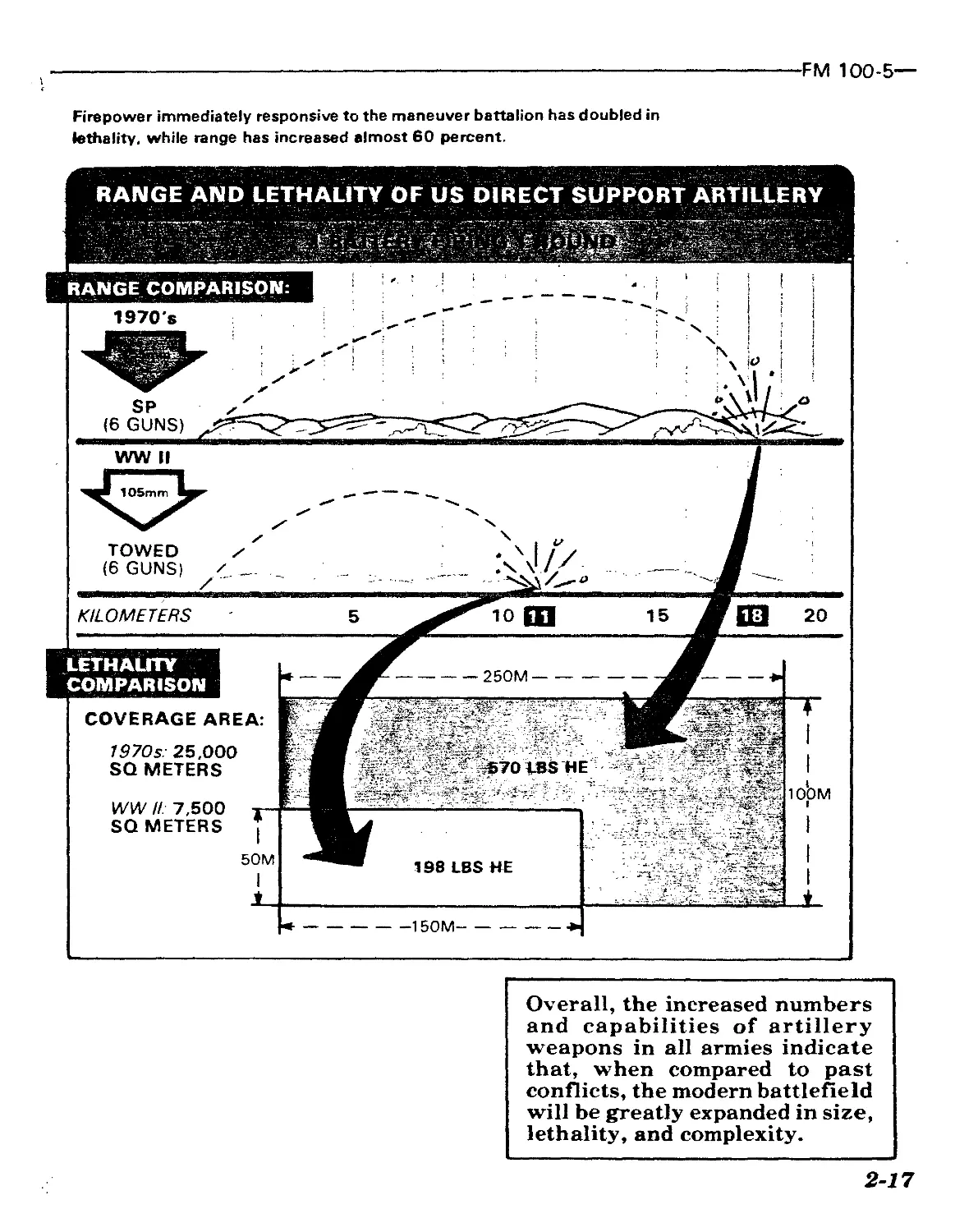
Firepower immediately responsive to the maneuver battalion has doubled in
lethality, while range has increased almost 60 percent.
RANGE AND LETHALITY OF US DIRECT SUPPORT ARTILLERY
RANGE COMPARISON:
♦-----------150M-----------♦
Overall, the increased numbers
and capabilities of artillery
weapons in all armies indicate
that, when compared to past
conflicts, the modern battlefield
will be greatly expanded in size,
lethality, and complexity.
2-17
-FM 100-5
TRENDS: AIR DEFENSE ARTILLERY
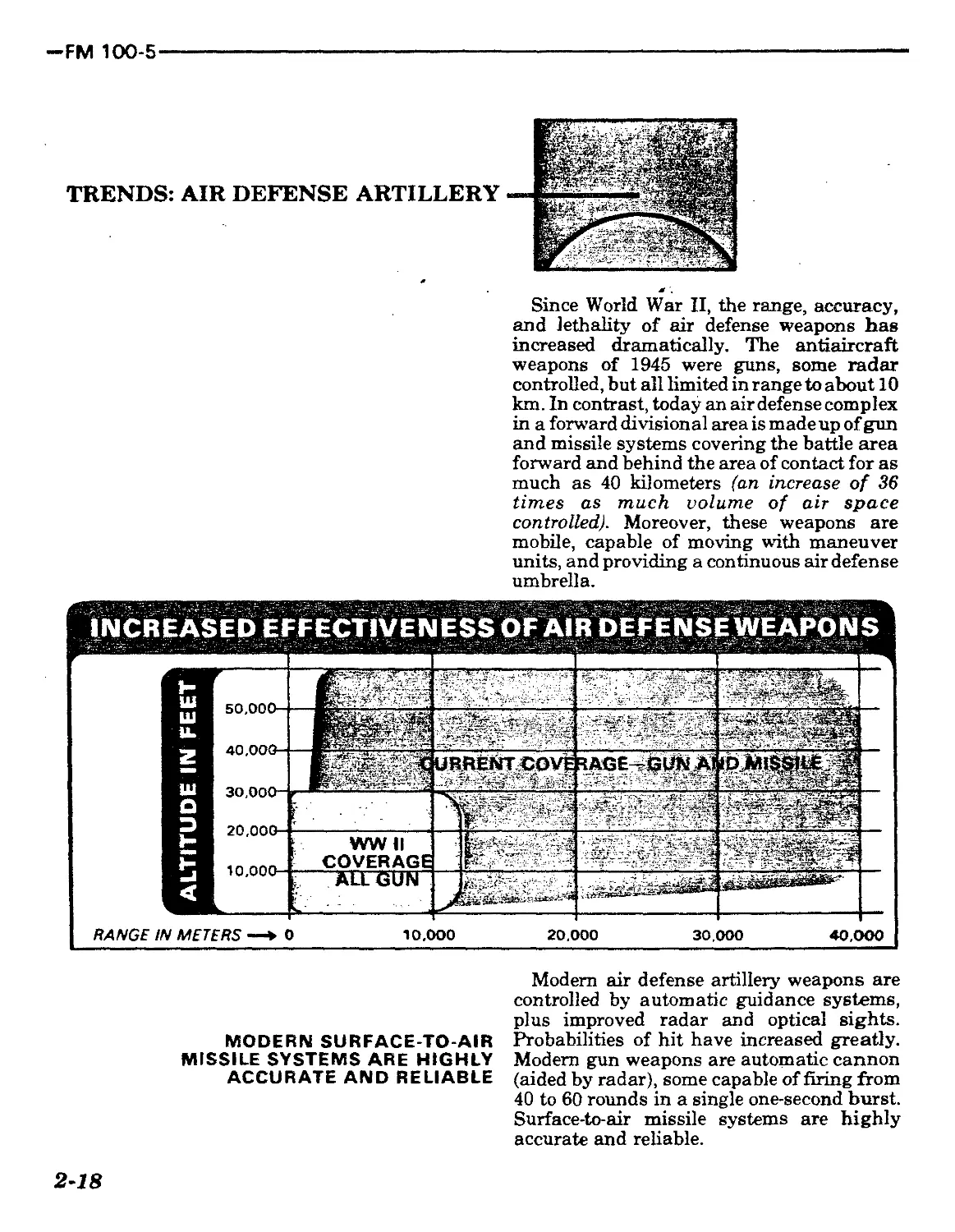
Since World War II, the range, accuracy,
and lethality of air defense weapons has
increased dramatically. The antiaircraft
weapons of 1945 were guns, some radar
controlled, but all limited in range to about 10
km. In contrast, today an air defense complex
in a forward divisional area is made up of gun
and missile systems covering the battle area
forward and behind the area of contact for as
much as 40 kilometers (an increase of 36
times as much volume of air space
controlled). Moreover, these weapons are
mobile, capable of moving with maneuver
units, and providing a continuous air defense
umbrella.
MODERN SURFACE-TO-AIR
MISSILE SYSTEMS ARE HIGHLY
ACCURATE AND RELIABLE
Modern air defense artillery weapons are
controlled by automatic guidance systems,
plus improved radar and optical sights.
Probabilities of hit have increased greatly.
Modern gun weapons are automatic cannon
(aided by radar), some capable of firing from
40 to 60 rounds in a single one-second burst.
Surface-to-air missile systems are highly
accurate and reliable.
2-18
FM 100-5 —
In all advanced armies, infantry, armor,
and artillery units are equipped with
weapons which can knock jet aircraft out of
the sky. Therefore, besides the air defense
artillery weapons and a multitude of direct
fire weapons in maneuver units, attacking
air forces must contend with soldier-
operated, surface-to-air missile systems.
Weapons such as the US Redeye and the
Soviet SA-7 are relatively simple to use and,
although small and light, have high hit
probabilities against low-flying, high-
performance aircraft or helicopters.
The addition of such weapons to maneuver
units significantly increases the capability of
modem air defenses.
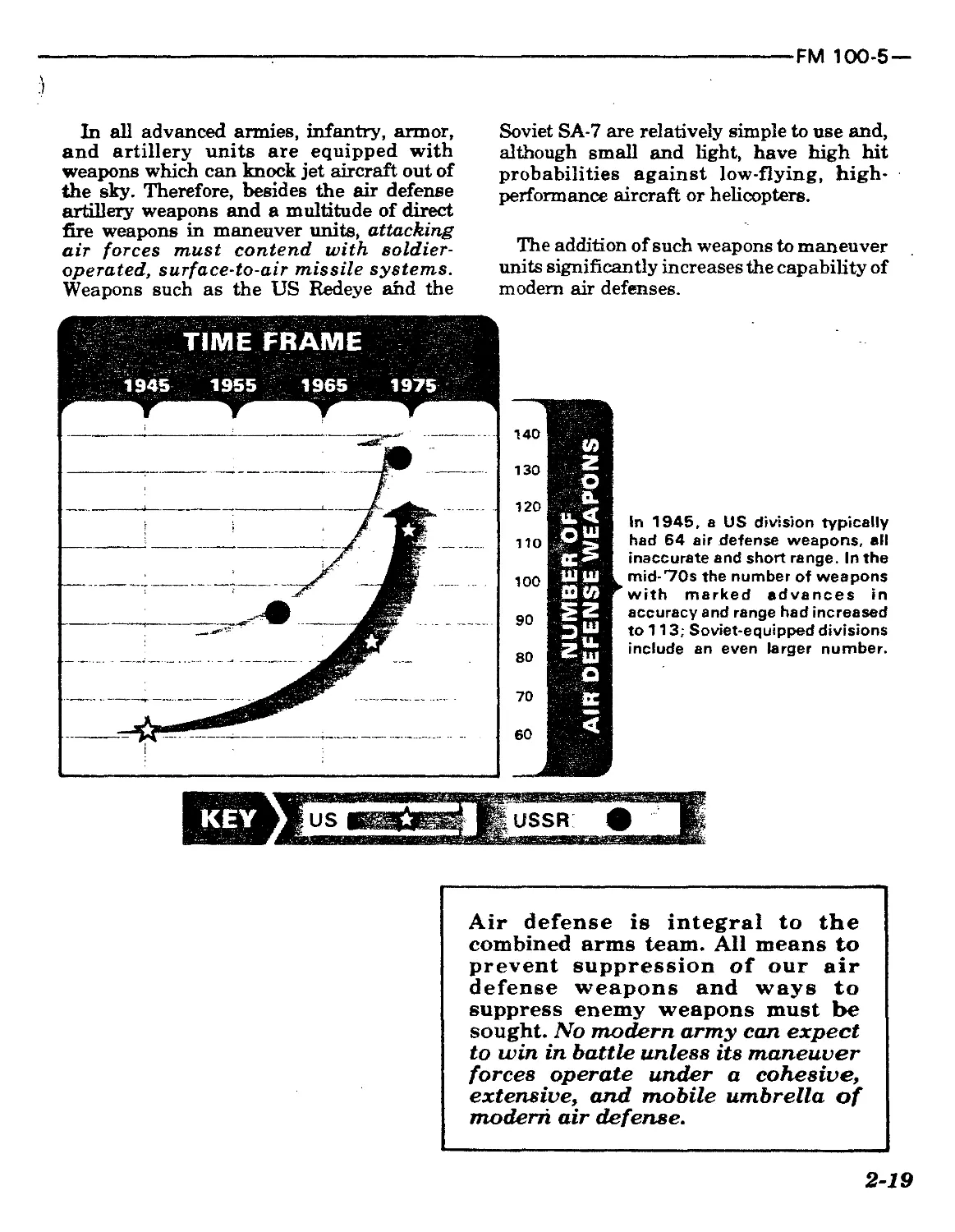
TIME FRAME
1945	1955	1965	1975
140
130
120
110
100
90
80
К
<
In 1945, a US division typically
had 64 air defense weapons, all
inaccurate and short range. In the
mid-^Os the number of weapons
with marked advances in
accuracy and range had increased
to 113; Soviet-equipped divisions
include an even larger number.
Air defense is integral to the
combined arms team. All means to
prevent suppression of our air
defense weapons and ways to
suppress enemy weapons must be
sought. No modern army can expect
to win in battle unless its maneuver
forces operate under a cohesive,
extensive, and mobile umbrella of
modern air defense.
2-19
— FM 100-5
TRENDS: AIRPOWER
Close Air Support. Experience of three
decades has changed the concept and
practice of close air support. In some
advanced forces, including those of the US,
aircraft are dedicated to the support of the
maneuver arms in recognition of the fact that
the battlefield will provide an abundance of
targets that can be destroyed by close air
support.
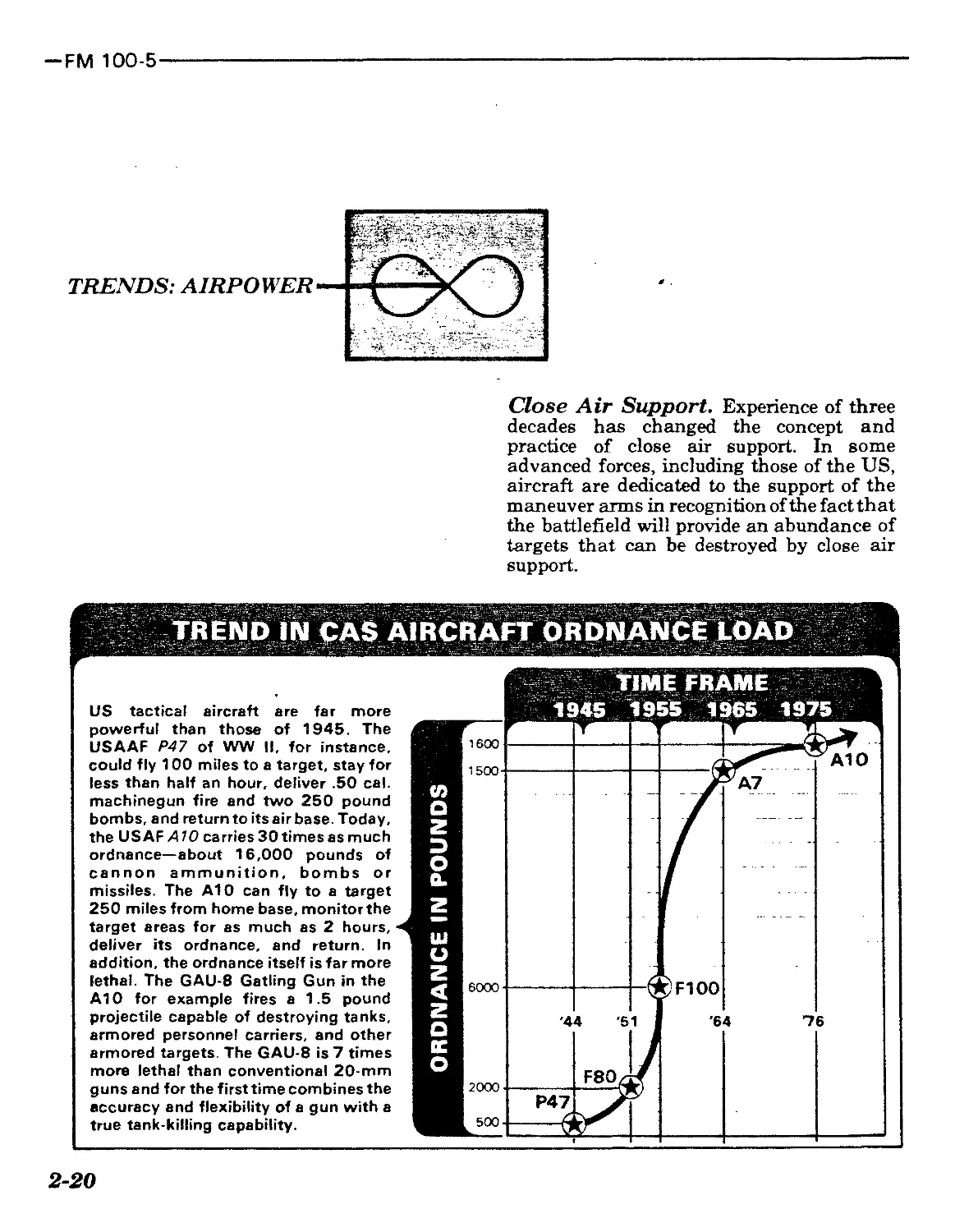
TREND IN CAS AIRCRAFT ORDNANCE LOAD
US tactical aircraft are far more
powerful than those of 1945. The
USAAF P47 of WW II, for instance,
could fly 100 miles to a target, stay for
less than half an hour, deliver .50 cal.
machinegun fire and two 250 pound
bombs, and return to its air base. Today,
the USAF A10 carries 30 times as much
ordnance—about 16,000 pounds of
cannon ammunition, bombs or
missiles. The A10 can fly to a target
250 miles from home base, monitorthe
target areas for as much as 2 hours,
deliver its ordnance, and return. In
addition, the ordnance itself is far more
lethal. The GAU-8 Gatling Gun in the
A10 for example fires a 1.5 pound
projectile capable of destroying tanks,
armored personnel carriers, and other
armored targets. The GAU-8 is 7 times
more lethal than conventional 20-mm
guns and for the first time combines the
accuracy and flexibility of a gun with a
true tank-killing capability.
2-20
FM 100-5—
Modem Air Force tactical aircraft carry a
variety of ordnance including guided and
unguided bombs and missiles. Guided
bombs, those with electronic steering, and
guided missiles, such as the Maverick, can
achieve high probability of hit and kill.
Operational tests clearly demonstrate the
effectiveness of the most modem fighters
against tanks. Moreover, both guided
missiles and guided bombs provide standoff
capabilities which combine their greatly
increased accuracy with sharply reduced
exposure of the attacker to opposing air
defenses.
Modem tactical aircraft with improved
ordnance are now considered components of
the Army/Air Force combined arms team. In
addition to close support missions for ground
units, the aircraft of today permits rapid
deployment of destructive force beyond the
immediate battlefield to deep-lying targets.
MODERN AIRCRAFT ARE
COMPONENTS OF THE
COMBINED ARMS TEAM
TRENDS: ARMY AIRCRAFT
INTEGRATION OF ARMY
AVIATION UNITS INTO THE
COMBINED ARMS TEAM
PROVIDES A NEW CAPABILITY
TO THE LAND BATTLE
Firepower. The high mobility and armor-
killing capability of attack helicopters makes
them unique to the battlefield. Their weapon
systems are capable of defeating the entire
spectrum of battlefield targets. Ongoing
development of the advanced attack
helicopter (AAH) includes an advanced fire
control system to provide extended range
target acquisition and engagement and a
laser HELLFIRE missile system which will
have commonality with cannon-launched
guided munitions and USAF/Navy missiles
and bombs. In addition, product
improvement of the existing 2.75-inch aerial
rocket and the introduction of the 30mm
2-21
-FM 100-5
cannon will further enhance the staying
power and killing capability of the attack
helicopter. These improvements spell greater
accuracy against point and area targets on
the future battlefield.
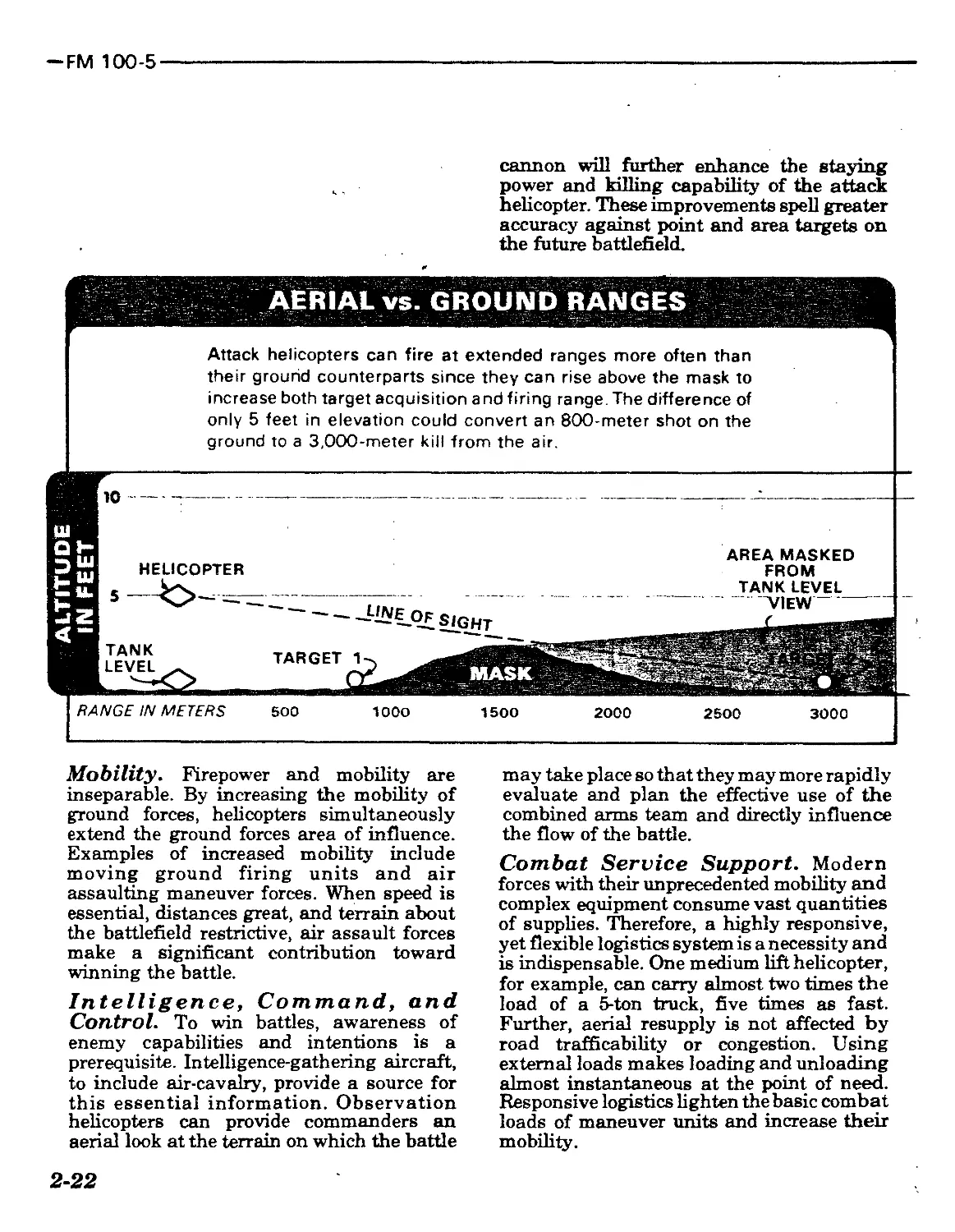
AERIAL vs. GROUND RANGES
Attack helicopters can fire at extended ranges more often than
their ground counterparts since they can rise above the mask to
increase both target acquisition and firing range. The difference of
only 5 feet in elevation could convert an 800-meter shot on the
ground to a 3,000-meter kill from the air.
Mobility. Firepower and mobility are
inseparable. By increasing the mobility of
ground forces, helicopters simultaneously
extend the ground forces area of influence.
Examples of increased mobility include
moving ground firing units and air
assaulting maneuver forces. When speed is
essential, distances great, and terrain about
the battlefield restrictive, air assault forces
make a significant contribution toward
winning the battle.
Intelligence, Command, and
Control. To win battles, awareness of
enemy capabilities and intentions is a
prerequisite. Intelligence-gathering aircraft,
to include air-cavalry, provide a source for
this essential information. Observation
helicopters can provide commanders an
aerial look at the terrain on which the battle
may take place so that they may more rapidly
evaluate and plan the effective use of the
combined arms team and directly influence
the flow of the battle.
Combat Service Support. Modern
forces with their unprecedented mobility and
complex equipment consume vast quantities
of supplies. Therefore, a highly responsive,
yet flexible logistics system is a necessity and
is indispensable. One medium lift helicopter,
for example, can carry almost two times the
load of a 5-ton truck, five times as fast.
Further, aerial resupply is not affected by
road trafficability or congestion. Using
external loads makes loading and unloading
almost instantaneous at the point of need.
Responsive logistics lighten the basic combat
loads of maneuver units and increase their
mobility-
2-22
FM 100-5-
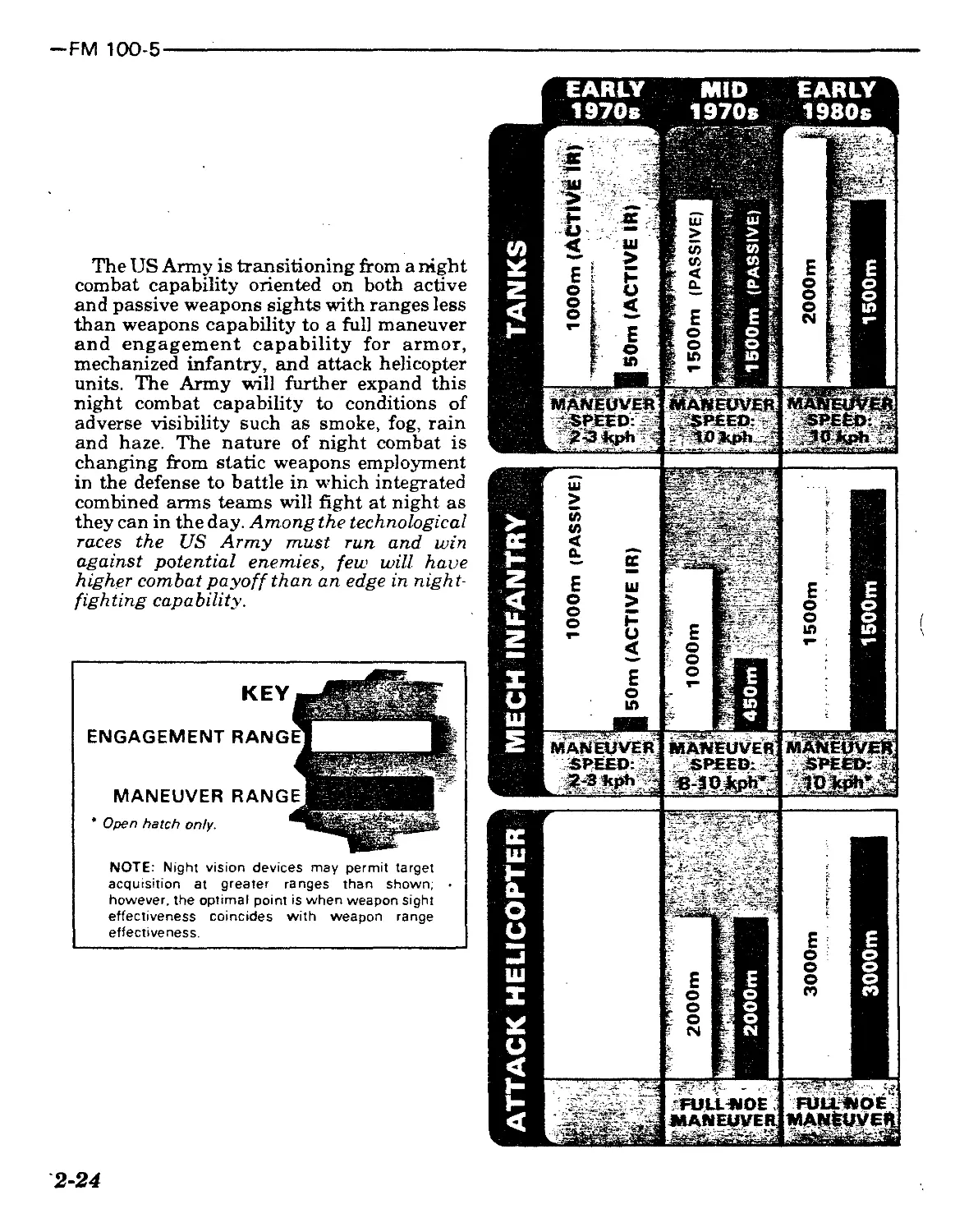
TRENDS: NIGHT COMBAT--
NIGHT VISION AIDS PERMIT
NIGHT MANEUVERS AND
ENGAGEMENT SIMILAR TO
DAYTIME
Thirty years ago the most advanced aids to
infantry vision at night were infrared devices
which required an infrared light source to
illuminate the target area. Such devices were
employed for pointing infantry weapons (and
for driving at night as an aid to mobility), but
their range was limited. They also suffered
the disadvantage that an enemy equipped
with infrared detectors could see the light
source.
In the mid-’60s, image intensifiers became
available which operated with existing
light—starlight, moonlight, sky glow from
cities, or battlefield fires. At about the same
time, the US Army fielded crew-served
weapon sights using image intensifiers with
capabilities of 1200 meters under starlight,
and 2,000 meters under moonlight. And for
the same weight, these devices had over 4
times the range of earlier infrared equipment.
Image intensifiers are completely passive;
that is, it is impossible for the enemy to detect
them in use. By themid-’70s, this technology
led to small, night vision aids so that soon
tanks, mechanized infantry, and helicopters
will be able to maneuver and engage the
enemy at night much as they can in the day.
Also emerging in the mid-’70s were
thermal sights, entirely passive like the
image intensifiers, but which detect heat
radiation and construct images based
thereon. These sights are particularly useful
in penetrating smoke, atmospheric haze, fog,
snow or rain clutters, light foliage, and
camouflage. These devices are small,,
relatively lightweight, and can be used at
night or in daylight. The detection
capabilities of these sights for use in the dark
or limited visibility corresponds to the
effective range of their weapons.
2-23
-FM 100-5
The US Army is transitioning from a night
combat capability oriented on both active
and passive weapons sights with ranges less
than weapons capability to a full maneuver
and engagement capability for armor,
mechanized infantry, and attack helicopter
units. The Army will further expand this
night combat capability to conditions of
adverse visibility such as smoke, fog, rain
and haze. The nature of night combat is
changing from static weapons employment
in the defense to battle in which integrated
combined arms teams will fight at night as
they can in the day. Among the technological
races the US Army must run and win
against potential enemies, few will have
higher combat payoff than an edge in night-
fighting capability.
NOTE: Night vision devices may permit target
acquisition at greater ranges than shown;
however, the optimal point is when weapon sight
effectiveness coincides with weapon range
effectiveness.
EARLY MID	EARLY
1970s	1970s 1980s
2-24
FM 100-5—
TRENDS: MINE WARFARE
During WW II, extensive use of mines by
defending forces contributed significantly to
the destruction of attacking tank forces.
However, the requirement to hand-emplace
mines severely hampered tactical
employment. Because of the time, manpower,
and logistic support required, mines were
emplaced before an enemy attacked and
minefield locations were based on the
commander’s analysis of how the enemy
would attack and use the terrain, rather than
on the enemy’s actual movements.
During the past few decades, mines were
relatively inefficient because of the large
amount of explosives required to impair the
mobility or destroy a tank. In the mid-’70s,
however, the US made dramatic advances in
increasing mine lethality while decreasing
size. This decreased size now permits the
rapid delivery of scatterable mines by ground
dispensers, artillery, and helicopter systems.
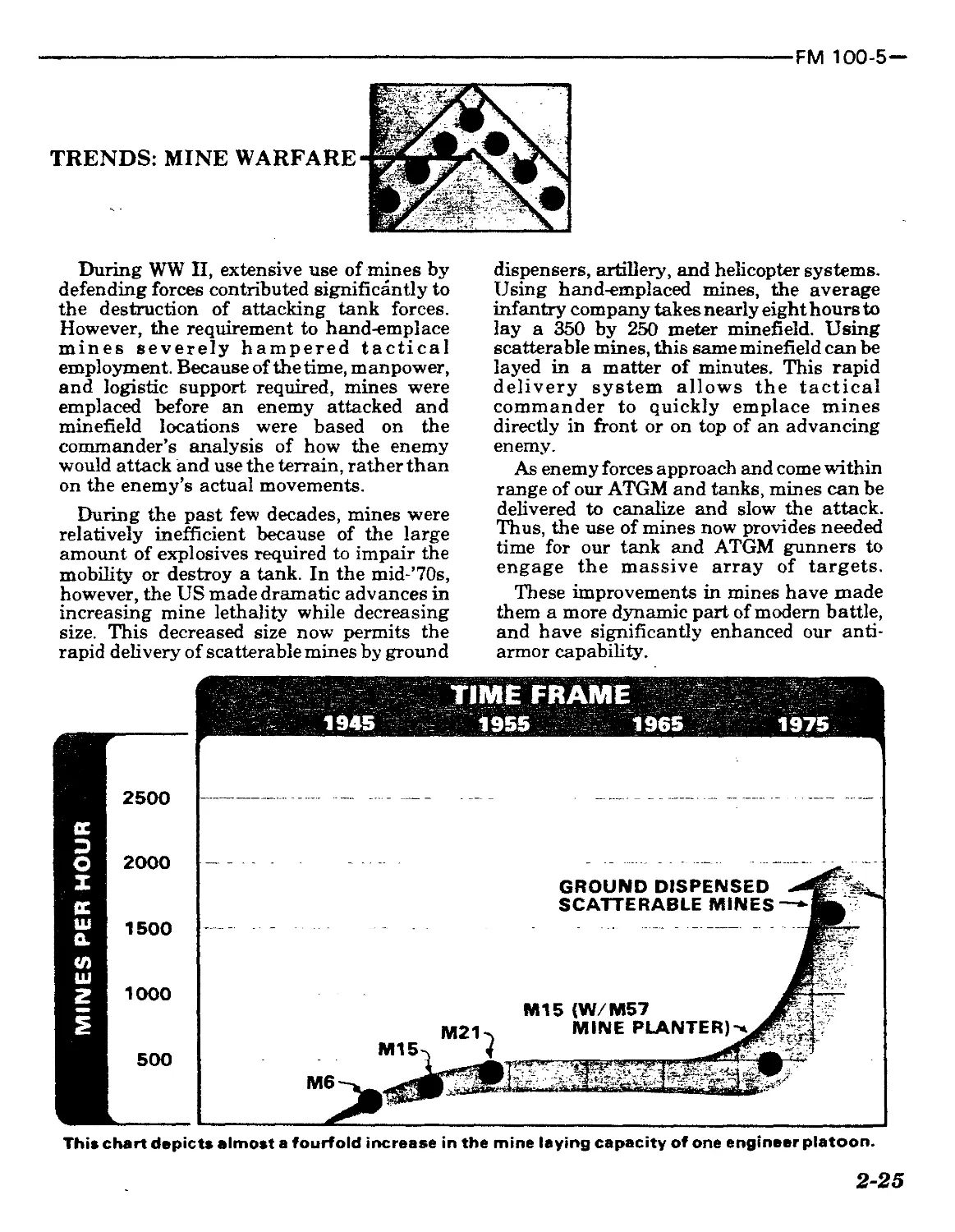
Using hand-emplaced mines, the average
infantry company takes nearly eight hours to
lay a 350 by 250 meter minefield. Using
scatterable mines, this same minefield can be
layed in a matter of minutes. This rapid
delivery system allows the tactical
commander to quickly emplace mines
directly in front or on top of an advancing
enemy.
As enemy forces approach and come within
range of our ATGM and tanks, mines can be
delivered to canalize and slow the attack.
Thus, the use of mines now provides needed
time for our tank and ATGM gunners to
engage the massive array of targets.
These improvements in mines have made
them a more dynamic part of modem battle,
and have significantly enhanced our anti-
armor capability.
TIME FRAME
1945	1955	1965	1975
This chart depict» almost a fourfold increase in the mine laying capacity of one engineer platoon.
2-25
— FM 100-5
TRENDS: WAR IN THE
ELECTROMAGNETIC SPECTRUM
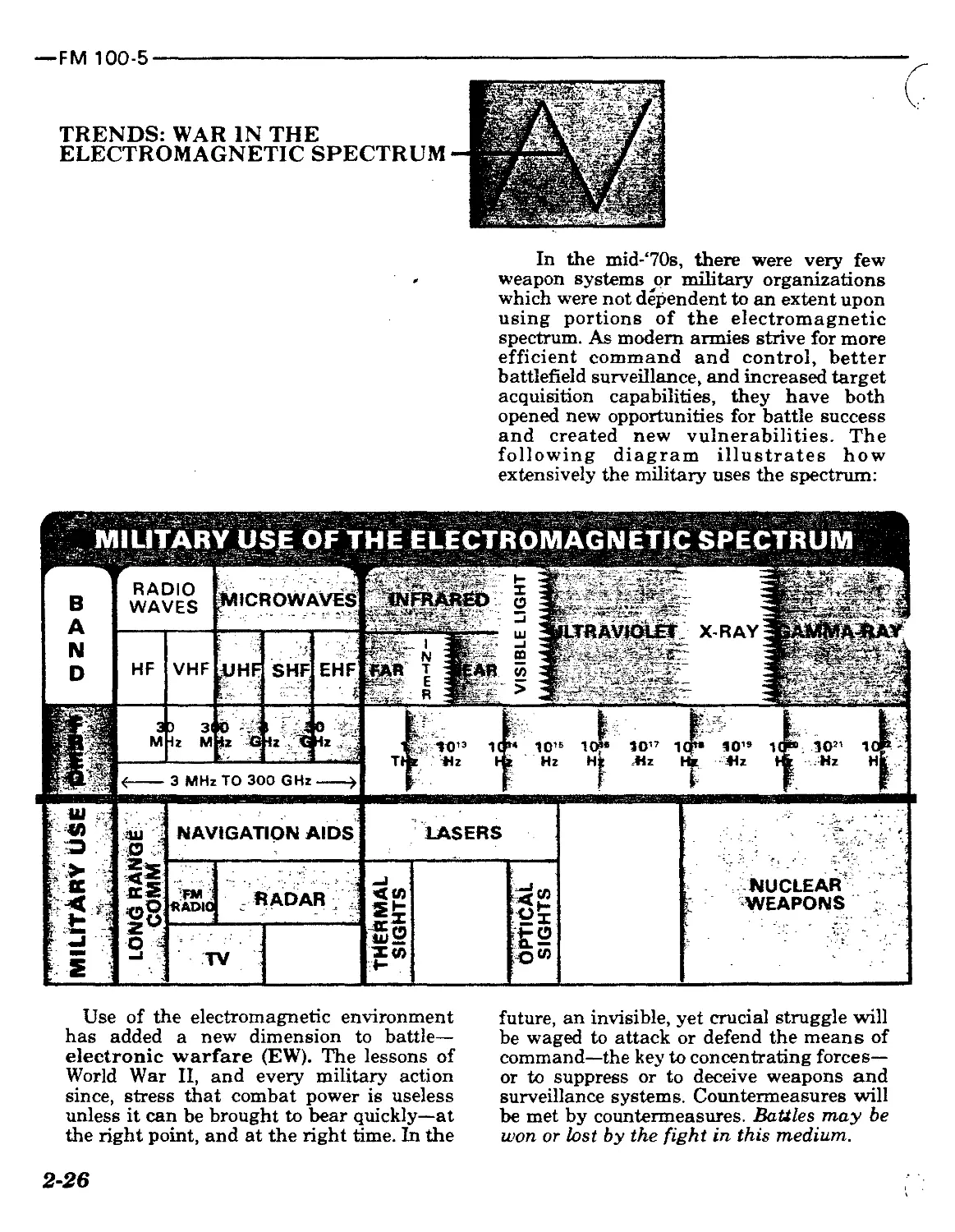
In the mid-‘70s, there were very few
weapon systems or military organizations
which were not dependent to an extent upon
using portions of the electromagnetic
spectrum. As modem armies strive for more
efficient command and control, better
battlefield surveillance, and increased target
acquisition capabilities, they have both
opened new opportunities for battle success
and created new vulnerabilities. The
following diagram illustrates how
extensively the military uses the spectrum:
MILITARY USE OF THE ELECTROMAGNETIC SPECTRUM
В
N
D
RADIO
WAVES
MICROWAVES
« «ч

HF
3 3
M 1
Ш
4U
О
ccS
49g
VHF
;UHF
S'.
SHF
EHF
FAR т
E
- R
b E
3I© ..
iz G Hi 13 Hi
M
I JO
1  t W3
» r Hz
3 MHz TO 300 GHz->
F
NAVIGATION AIDS
SADic RADAR
о
lTRAVIQIST. x-ray
AR
Mi
3O17
Hz
1(M 1O1S
Hl Hz
мм
NUCLEAR
WEAPONS
ш
-j
m
w
7
LASERS
TV
1-0
i©S5
Use of the electromagnetic environment
has added a new dimension to battle—
electronic warfare (EW). The lessons of
World War II, and every military action
since, stress that combat power is useless
unless it can be brought to bear quickly—at
the right point, and at the right time. In the
future, an invisible, yet crucial struggle will
be waged to attack or defend the means of
command—the key to concentrating forces—
or to suppress or to deceive weapons and
surveillance systems. Countermeasures will
be met by countermeasures. Battles may be
won or lost by the fight in this medium.
2-26
FM 100-5 —
ACQUISITION SYSTEMS CAN BE
TOTALLY DISRUPTED THROUGH
DECEPTION AND JAMMING
OF EMITTERS
The effects of EW can result in significant
casualties among an enemy force. In the
attack and defense, EW can locate and jam
enemy communication emitters associated
with CPs, maneuver battalions, and fire
request nets, thereby disrupting command
and control movement of reserves, and
reducing effective fire support. Other enemy
emitters associated with acquisition systems,
such as radar and lasers, are equally
vulnerable to total disruption through
jamming and deception. EW can reduce
friendly casualties by locating attacking
enemy elements so they can be fired upon,
and by countering enemy target acquisition
and jamming.
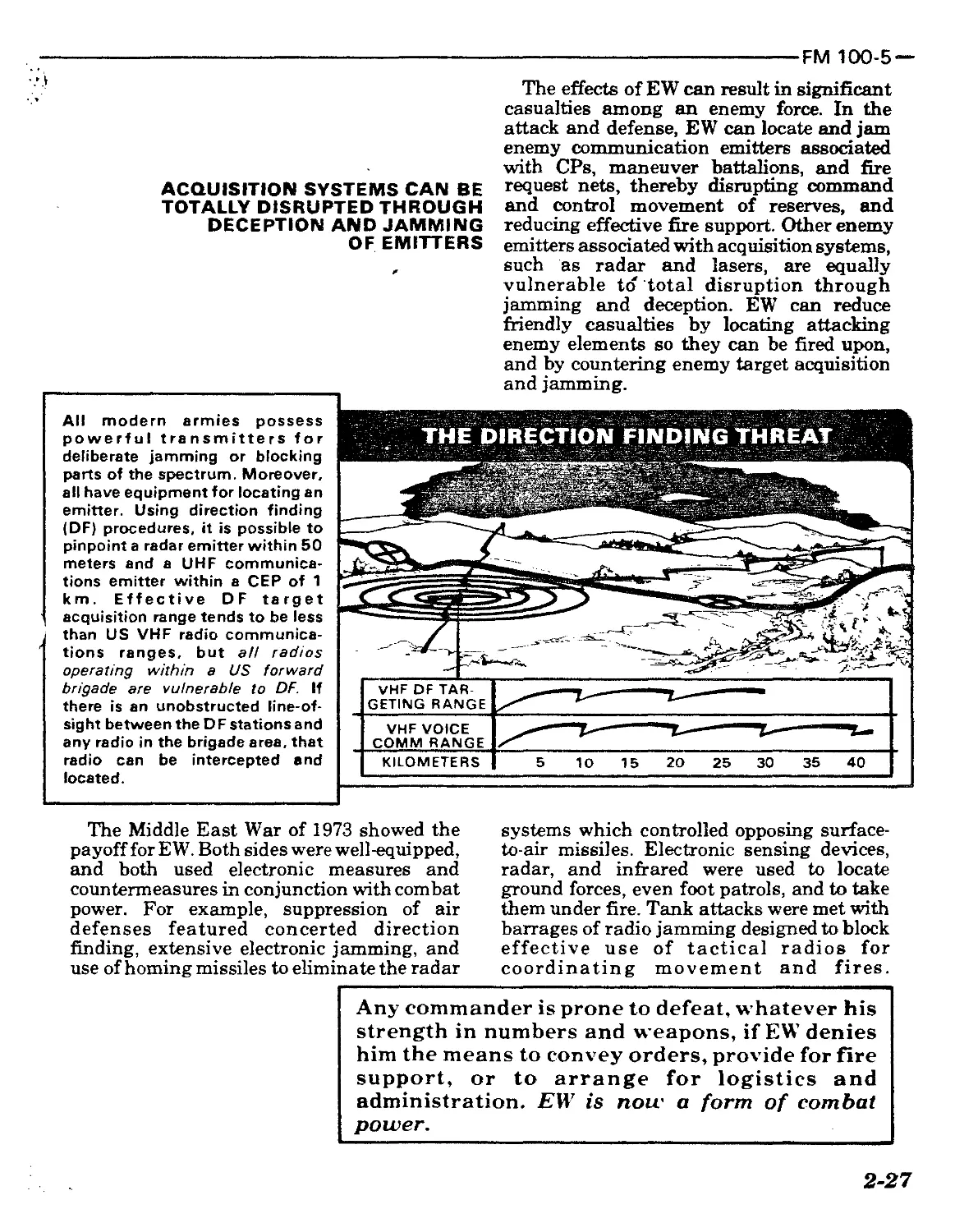
All modern armies possess
powerful transmitters for
deliberate jamming or blocking
parts of the spectrum. Moreover,
all have equipment for locating an
emitter. Using direction finding
(DF) procedures, it is possible to
pinpoint a radar emitter within 50
meters and a UHF communica-
tions emitter within a CEP of 1
km. Effective DF target
acquisition range tends to be less
than US VHF radio communica-
tions ranges, but all radios
operating within a US forward
brigade are vulnerable to DF. If
there is an unobstructed line-of-
sight between the DF stations and
any radio in the brigade area, that
radio can be intercepted and
located.
THE DIRECTION FINDING THREAT
The Middle East War of 1973 showed the
payoff for EW. Both sides were well-equipped,
and both used electronic measures and
countermeasures in conjunction with combat
power. For example, suppression of air
defenses featured concerted direction
finding, extensive electronic jamming, and
use of homing missiles to eliminate the radar
systems which controlled opposing surface-
to-air missiles. Electronic sensing devices,
radar, and infrared were used to locate
ground forces, even foot patrols, and to take
them under fire. Tank attacks were met with
barrages of radio jamming designed to block
effective use of tactical radios for
coordinating movement and fires.
Any commander is prone to defeat, whatever his
strength in numbers and weapons, if EW denies
him the means to convey orders, provide for fire
support, or to arrange for logistics and
administration. EW is now a form of combat
power.
2-27
—FM 100-5
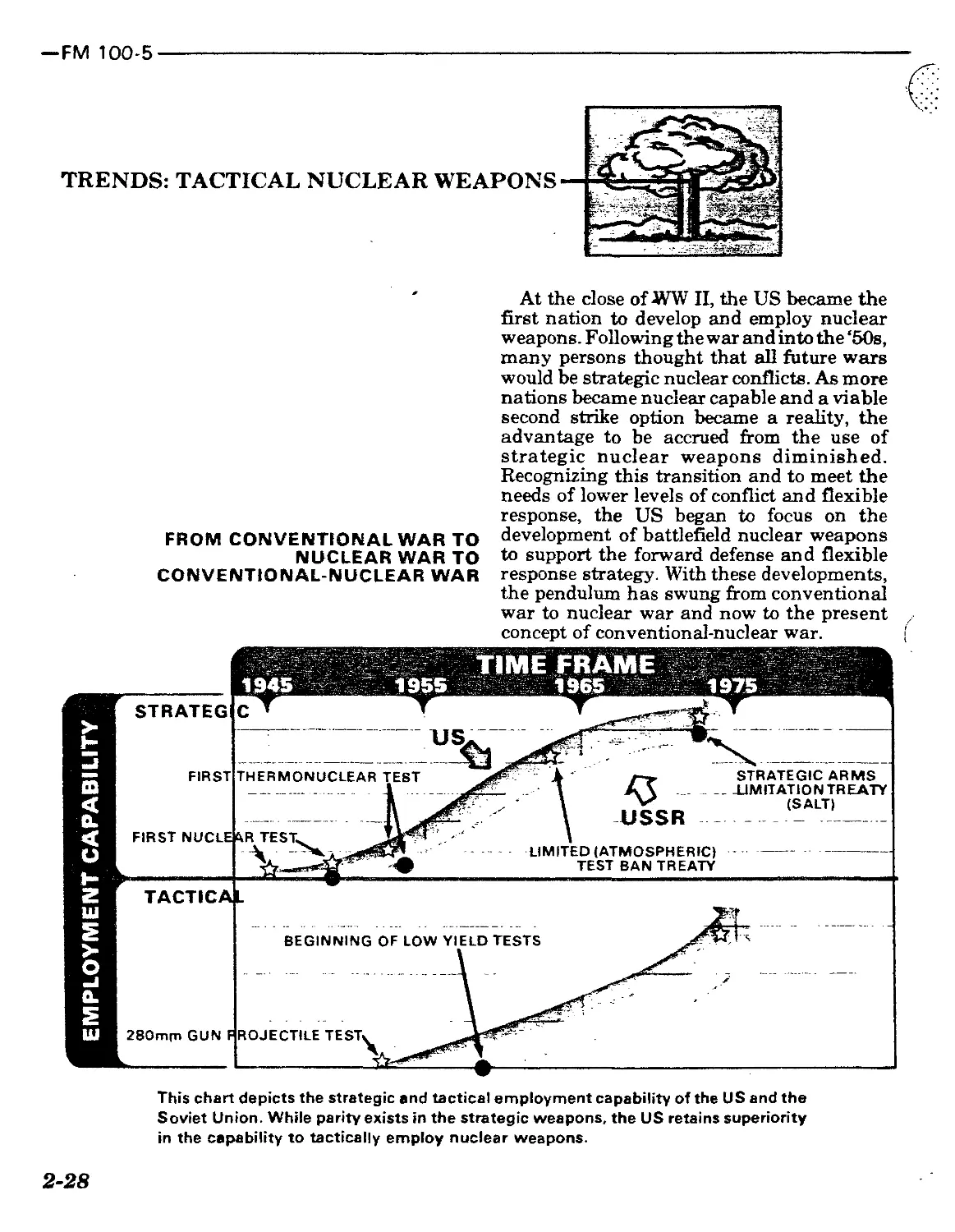
TRENDS: TACTICAL NUCLEAR WEAPONS
FROM CONVENTIONAL WAR TO
NUCLEAR WAR TO
CONVENTIONAL-NUCLEAR WAR
At the close of WW II, the US became the
first nation to develop and employ nuclear
weapons. Following the war and into the‘50s,
many persons thought that all future wars
would be strategic nuclear conflicts. As more
nations became nuclear capable and a viable
second strike option became a reality, the
advantage to be accrued from the use of
strategic nuclear weapons diminished.
Recognizing this transition and to meet the
needs of lower levels of conflict and flexible
response, the US began to focus on the
development of battlefield nuclear weapons
to support the forward defense and flexible
response strategy. With these developments,
the pendulum has swung from conventional
war to nuclear war and now to the present z
concept of conventional-nuclear war.	(
EMPLOYMENT CAPABILITY
This chart depicts the strategic and tactical employment capability of the US and the
Soviet Union. While parity exists in the strategic weapons, the US retains superiority
in the capability to tactically employ nuclear weapons.
2-28
FM 100-5 —
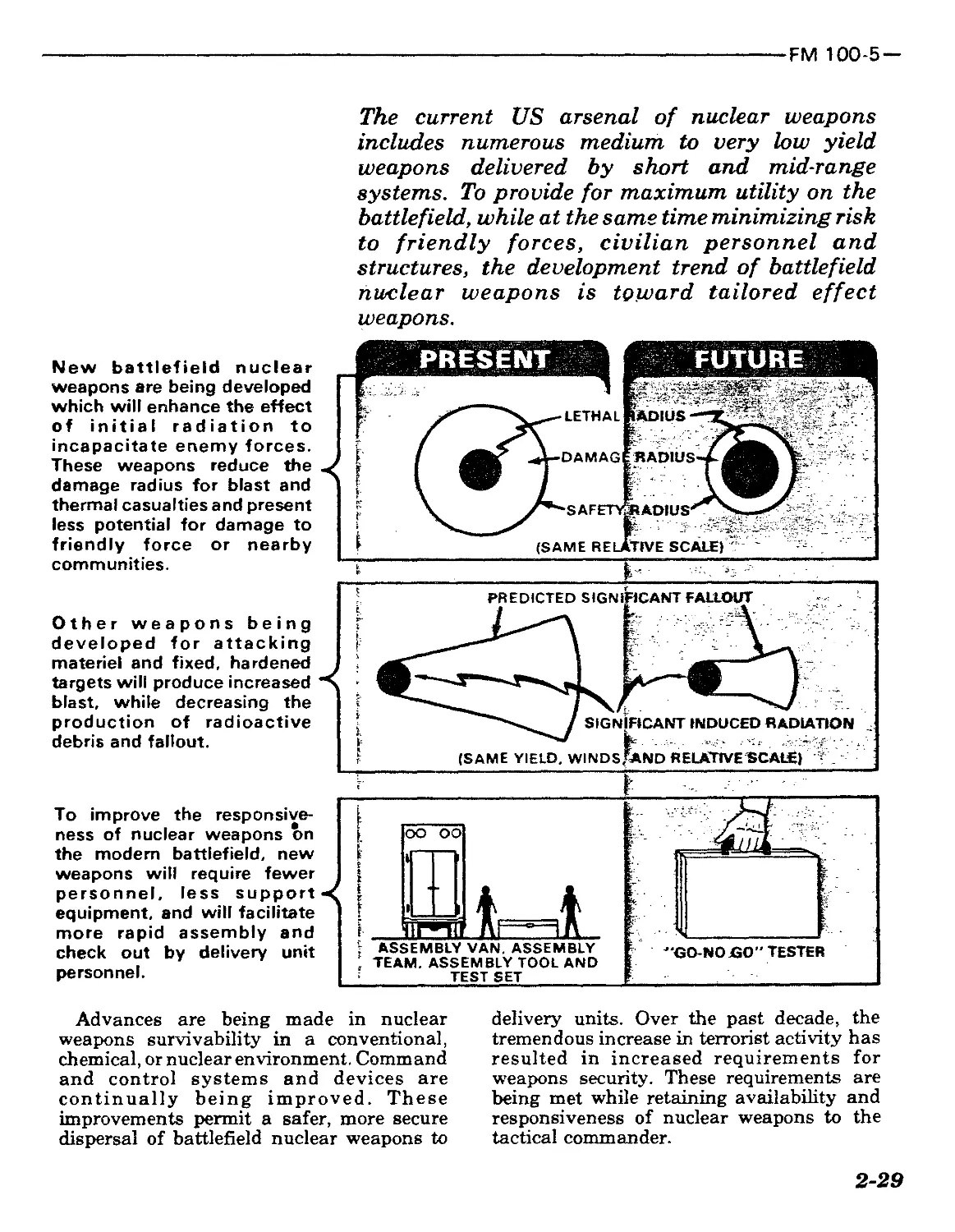
The current US arsenal of nuclear weapons
includes numerous medium to very low yield
weapons delivered by short and mid-range
systems. To provide for maximum utility on the
battlefield, while at the same time minimizing risk
to friendly forces, civilian personnel and
structures, the development trend of battlefield
nuclear weapons is toward tailored effect
weapons.
New battlefield nuclear
weapons are being developed
which will enhance the effect
of initial radiation to
incapacitate enemy forces.
These weapons reduce the
damage radius for blast and
thermal casualties and present
less potential for damage to
friendly force or nearby
communities.
Other weapons being
developed for attacking
materiel and fixed, hardened
targets will produce increased
blast, while decreasing the
production of radioactive
debris and fallout.
To improve the responsive-
ness of nuclear weapons on
the modem battlefield, new
weapons will require fewer
personnel, less support
equipment, and will facilitate
more rapid assembly and
check out by delivery unit
personnel.
Advances are being made in nuclear
weapons survivability in a conventional,
chemical, or nuclear environment. Command
and control systems and devices are
continually being improved. These
improvements permit a safer, more secure
dispersal of battlefield nuclear weapons to
delivery units. Over the past decade, the
tremendous increase in terrorist activity has
resulted in increased requirements for
weapons security. These requirements are
being met while retaining availability and
responsiveness of nuclear weapons to the
tactical commander.
2-29
-FM 100-5
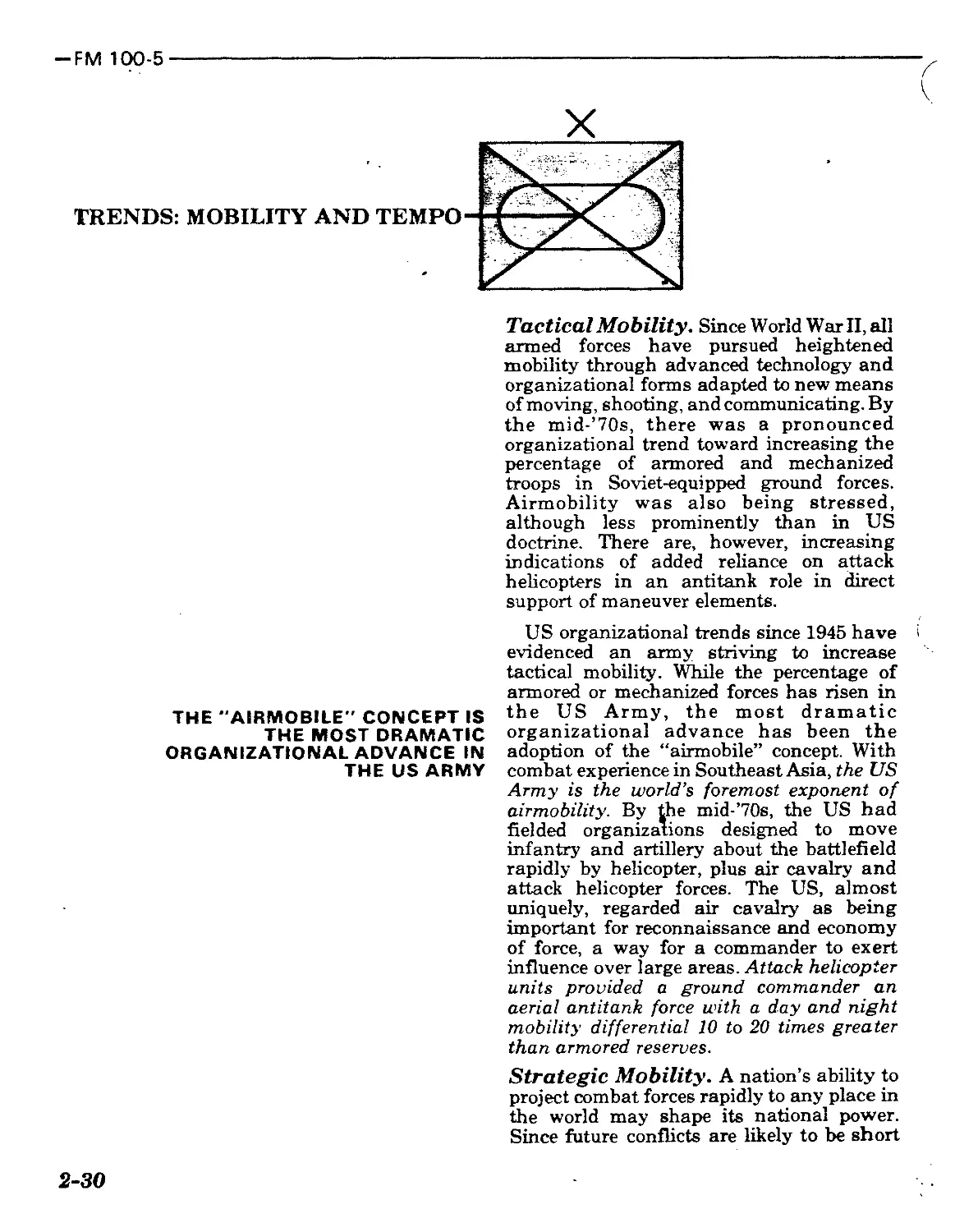
TRENDS: MOBILITY AND TEMPO
THE "AIRMOBILE” CONCEPT IS
THE MOST DRAMATIC
ORGANIZATIONAL ADVANCE IN
THE US ARMY
Tactical Mobility. Since World War II, all
armed forces have pursued heightened
mobility through advanced technology and
organizational forms adapted to new means
of moving, shooting, and communicating. By
the mid-’70s, there was a pronounced
organizational trend toward increasing the
percentage of armored and mechanized
troops in Soviet-equipped ground forces.
Airmobility was also being stressed,
although less prominently than in US
doctrine. There are, however, increasing
indications of added reliance on attack
helicopters in an antitank role in direct
support of maneuver elements.
US organizational trends since 1945 have i
evidenced an army striving to increase
tactical mobility. While the percentage of
armored or mechanized forces has risen in
the US Army, the most dramatic
organizational advance has been the
adoption of the "airmobile” concept. With
combat experience in Southeast Asia, the US
Army is the world’s foremost exponent of
airmobility. By the mid-’70s, the US had
fielded organizations designed to move
infantry and artillery about the battlefield
rapidly by helicopter, plus air cavalry and
attack helicopter forces. The US, almost
uniquely, regarded air cavalry as being
important for reconnaissance and economy
of force, a way for a commander to exert
influence over large areas. Attack helicopter
units provided a ground commander an
aerial antitank force with a day and night
mobility differential 10 to 20 times greater
than armored reserves.
Strategic Mobility. A nation’s ability to
project combat forces rapidly to any place in
the world may shape its national power.
Since future conflicts are likely to be short
2-30
FM 100-5—
and violent, the need for a swift build-up of
combat units is greater than ever before.
Forces must not only be trained for
immediate commitment to battle, but they
must be provided the means to transport
them to the scene of the conflict.
Sealift has long been the traditional means
for projecting US combat power abroad. And
it remains today the backbone of strategic
mobility. Without it, very large forces cannot
be deployed or continuously resupplied. The
advent of modern roll on/roll off shipping
and containerization has significantly
reduced the time required to deploy large
forces. The US Navy, responsible for keeping
the sea lanes open, and American and allied
shipping can provide US land forces
significant capabilities to operate overseas.
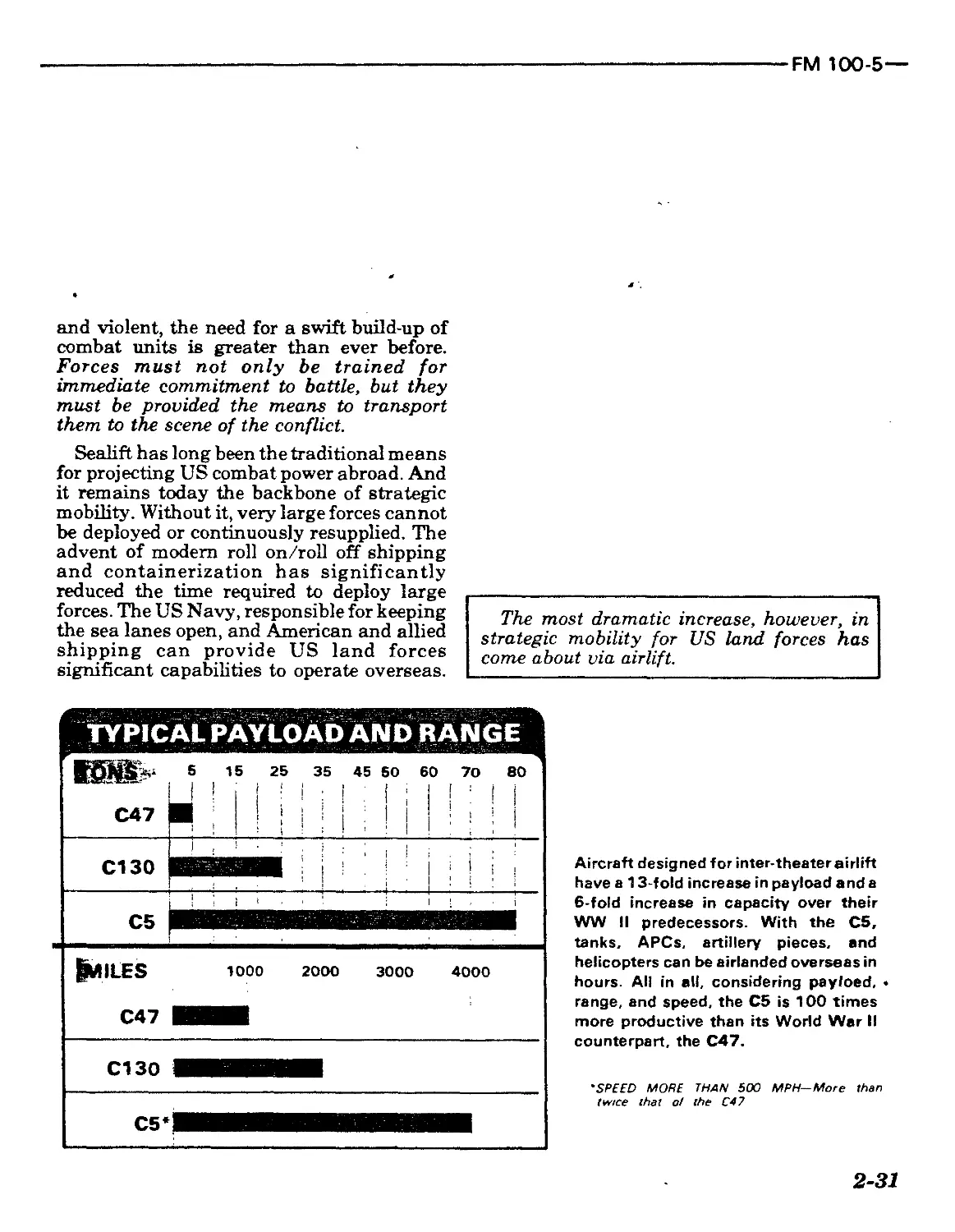
The most dramatic increase, however, in
strategic mobility for US land forces has
come about via airlift.
TYPICAL PAYLOAD AND RANGE
Aircraft designed for inter-theater airlift
have a 13-fold increase in payload and a
6-fold increase in capacity over their
WW II predecessors. With the C5,
tanks, APCs, artillery pieces, and
helicopters can be airlanded overseas in
hours. All in all, considering payloed, •
range, and speed, the C5 is 100 times
more productive than its World War II
counterpart, the C47.
'SPEED MORE THAN 500 MPH—More than
twice that of the C47
2-31
-FM 100-5
Fifty years ago, a highly trained army
division was considered capable of
advancing only 2 to 4 km per day. In 1939, the
German Army introduced the world to
“lightning weir,” the Blitzkrieg. In France,
after three days spent penetrating the thick
Ardennes forest and closing up to the River
Meuse, Guderian’s XIX Corps covered 250 km
to the English Channel in 8 days, averaging
30.5 km a day (its best drive in one day was 90
km). Rommel’s 7th Panzer Division covered
177 km in 8 days at 22 km average per day. In
Russia, German initial rates of advance were
similar. Guderian’s 2d Panzer Group covered
665 km in 24 days, averaging 28 km per day
(its best advance in one day was 120 km).
DEPTH OF DIVISION OBJECTIVES FOR THE SOVIET ARMY
DEPTH OF OBJECTIVES IN KILOMETERS
PERIOD		INITIAL OBJECTIVE	INTERMEDIATE OBJECTIVE	FINAL OBJECTIVE OF THE DAY
|yORU),WAR^
WORLD WAR II 1941		1.5 — 2.5			3-4
1942		2-3	—	4-6
1943		2-4	—	5-7
1944		3-5	5-7	10 - 12
1945		3-5	6-8	18-20
CURRENT		15 — 20	—	35 — 40
The Soviet Army in WW II quickly learned the value of maintaining high rates of
advance and of driving for deep objectives. This table, taken from a mid-70 Soviet
source, shows the trend toward the greater depth of objectives assigned to Red Army
divisions.
As can be seen from the table, the Soviets
perceive division objectives ten times deeper
than they sought at the outset of World War
II.
Soviet Army doctrine strongly holds that
mobility and a high tempo of combat
operations bring success in battle; they hold
this to be especially true in nuclear warfare—
a high rate of advance reduces the danger of
troop destruction by enemy nuclear strikes.
Forces opposing Soviet equipped and trained
troops must expect intense, highly mobile
combat. Battle will be fought on a scale and
at a tempo rarely seen in all history.
The commander who seeks a greater understanding of a
specific modern battlefield must first appreciate the
potential of the world’s first line armies. The leader on the
modern battlefield must be an expert in weapons effects and
employment—both his own and those of the enemy. War is
becoming increasingly complex. Morale and motivation must
be backed up in weapons and tactical proficiency.
2-32
--CHAPTER 3
How to Fight
FUTURE BATTLE------------------------
IN CHAPTER 2, the impact of modern weapons on the modem
battlefield was discussed in detail. Changes in intensity and
lethality of modem battle and the need to fight outnumbered
present the US Army with challenges greater than those faced
on previous battlefields. The objective, however, remains
unchanged—to win the land battle. Therefore, the US Army
must obtain the maximum combat effectiveness of all forces in
the combined arms team. To achieve this effectiveness our
Army depends on sound doctrine. This doctrine must be
derived from an accurate assessment of the dynamics of.
modern battle, and an understanding of all its implications.
Then to be effective, this doctrine must be communicated
throughout our forces.
CONTENTS
FUTURE BATTLE	PAGE 3-1
LEADERSHIP	3-2
TERRAIN	3-2
BATTLEFIELD DYNAMICS	3-3
GENERALS: CONCENTRATING THE FORCES	3-5
COLONELS: DIRECTING THE BATTLE	3-9
COMBINED ARMS TEAMWORK	3-10
CAPTAINS: FIGHTING THE BATTLE	3-11
COMMAND AND CONTROL AND COMMUNICATIONS (C3)	3 15
NIGHT OPERATIONS	3 17
OPERATIONS SECURITY (OPSEC)	3-17
The most demanding mission that could be
assigned the US Army remains battle in
Central Europe against the forces of the
Warsaw Pact. How to fight the conventional
battle in that environment is the purpose of
this chapter. The forces of NATO may,
however, be called upon to conduct
conventional-nuclear as well as purely
conventional operations. Chapter 10
discusses these operations and the associated
weapons effects and implications.
Additionally, the problems, tactics and
techniques associated with the conduct of
tactical nuclear warfare will be treated in a
separate manual of the 100-series.
3-1
— FM 100-5
OUR FIGHTING ABILITY WILL BE
DETERMINED BY HOW WELL WE
TRAIN OUR LEADERS
LEADERSHIP
Modern combat can be sustained at high
levels of intensity, day and night, for
prolonged periods. At the outset, let us
recognize that winning in such battle
demands courage, audacity, confidence, and
stamina. But tactical and technical
proficiency is equally important—we must
not compensate for a lack of competence
among our leaders with the bravery of our
soldiers.
Troops in combat at any echelon need a
strong, cool, thoughtful, resourceful leader
capable of welding his followers into a
cohesive unit. Such a leader promotes
cohesion by inculcating discipline, a sense of
duty, a conscious pride of unit, and a feeling
of mutual trust and obligation among its
members. Such a leader is prepared to exploit
any opportunity on the battlefield with
energy and boldness. Because command
communications may be sparse,
intermittent, or at crucial times, nonexistent,
he must act responsibly and intelligently on
his own. The strength of our Army lies in the
decentralization of responsibility and
authority to the commander on the ground.
We cannot afford to lose that additional
combat effectiveness which derives from the
intelligent actions of trained leaders
operating under a flexible system of mission-
type orders. Thus, each officer must be
imbued with the idea that success will depend
upon the skill, initiative, and imagination
with* which he seeks to accomplish the
assigned mission within the intent and
concept of his commander. Our success in
finding and training such leaders will
determine how well we are able to fight.
TERRAIN
Land battle takes place amid the variances
of the ground and the works of man upon it.
Relief, surface conditions, drainage,
vegetation, highways, cities and farms—
these and countless other features of the
earth’s surface profoundly affect combat. For
Generals, terrain is mainly a matter of
communications: how the ground and man-
built facilities influence strategic ingress,
large scale troop movements, and logistics.
3-2
FM 100-5—
For Colonels, Captains and other leaders,
terrain is mainly a matter of weapon systems
employment: observation, fields of fire, cover
and concealment. Corps and division
commanders consider road and rail
networks, airfields and ports, major terrain
compartments, large bodies of water, and
extensive built-up areas. Brigade, battalion,
and company commanders look for
dominating heights, weapon sites, fields of
fire, shielding hills, depressions, buildings,
and terrain aids or impediments to
movement.
The range, accuracy, and destructive
effects of weapon systems employed on the
contemporary battlefield impose fatal
penalties upon units and individuals failing
to make full protective use of terrain. For
example, we must move via covered and
concealed routes to mask friendly forces from
enemy observations and fires and fight from
skillfully camouflaged battle positions with
frontal cover in the suspected or known
direction of the enemy.
The tactical leader visualizes what terrain
can do for the enemy. He then positions or
maneuvers his forces on the ground to outwit
and outfight the enemy. Terrain, therefore,
provides a combat equalizer or multiplier
when the tactician uses its strengths and
reinforces its natural advantages through
mining, barriers, and other obstacles.
FAILURE TO MAKE FULL
PROTECTIVE USE OF TERRAIN
CAN PROVE FATAL
BATTLEFIELD DYNAMICS
To win a battle, four prerequisites must be
met:
1.	Adequate forces and weapons must be
concentrated at the critical times and places.
The combination is combat power.
2.	The battle must be controlled and directed so
that the maximum effect of fire and maneuver
is concentrated at decisive locations.
3.	The battle must be fought using cover,
concealment, suppression, andcombinedarms
teamwork to maximize the effectiveness of our
weapons and to minimize the effectiveness of
enemy weapons.
4	Our teams and crews must be trained to use
the maximum capabilities of their weapons.
3-3
~FM 100-5
GENERALS—CONCENTRATE
THE FORCES
COLONELS—CONTROL AND
DIRECT THE BATTLE
CAPTAINS—FIGHT THE BATTLE
THE SKILLFUL COMMANDER
SUBSTITUTES FIREPOWER FOR
MANPOWER WHENEVER HE CAN
DO SO
If all these functions are performed
correctly and on time, and if the resulting
combat power is skillfully applied by
aggressive, confident leaders and cohesive
units, then the enemy will be destroyed or
defeated—the mission of the force will be
accomplished.
In the division of responsibilities on the
battlefield, Generals commanding corps and
divisions concentrate the forces.
Colonels and Lieutenant Colonels of
brigades and battalions control and direct
the battle.
Captains and their companies, troops, and
batteries fight the battle.
The defender has many advantages: full
use of cover and concealment, selection of the
ground on which to fight, weapons sited for
maximum effectiveness, reinforcement of
terrain with mines and obstacles, and the
choice of firing first. Because of these
advantages, the defending force should be
able to defeat an attacker superior in combat
power by a ratio of about 3:1.
The attacker, on the other hand, must
expose his force by moving to contact, must
fight on ground selected by the defender,
must clear mines and obstacles while under
fire, and must destroy or suppress weapons
which have taken full advantage of cover and
concealment. Therefore, the weapons of the
attacker are not as effective as the weapons of
the defender, and his forces are more
vulnerable. For these reasons, the attacker
should seek a combat power ratio of at least
6:1 at the point of decision. If he is short on
forces, he must make it up in firepower,
surprise, deception, or superior skill.
Whether on the offense or the defense, US
Army forces must exploit to the maximum
the mobility of our weapons systems. Swiftly
massed field artillery, totally mobile tank
and mechanized infantry battalions,
airmobile antiarmor weapons, attack
helicopters, close air support aircraft and, in
some circumstances, tactical employment of
nuclear weapons offers us the means to
concentrate overwhelming combat power
and to decisively alter force ratios when and
where we choose.
3-4
FM 100-5—
GENERALS: CONCENTRATING
THE FORCES
The Employment of Large Units.
There are many things Generals ought to do.
But there is one thing they must do: deploy
their forces so that on the defense they are
never outnumbered or outgunned more than
3:1 at the point and time of decision, and so
that in the attack they have concentrated
combat power of about 6:1 superiority.
Obviously, these ratios are not fixed, but they
convey a realistic approximation of the
requirement. There are many ways to achieve
the necessary superiority, including surprise,
shock, and speed. Regardless of strength, a
sleeping, bewildered, or terrified enemy does
not comprise an effective force. Colonels and
Captains attack or defend when ordered,
regardless of force ratios. But they always
seek to develop the maximum combat power
within their capabilities. Nonetheless, a
concern with force ratios and the means of
altering them in our favor is central to the
responsibilities of the Generals.
It is almost inevitable that initially we will
be outnumbered in the theater of war. But,
whether the mission is to crush an enemy
attack or to launch an offensive operation, it
is the job of the corps and division
commanders to bring about a winning
concentration of force at the point of actual
combat. Concentration of force—or combat
power—includes provision of logistic support
for maneuver elements (ammunition, POL
and forward maintenance). To concentrate at
the right place, everytime, corps and division
commanders must be prime intelligence
operators. To concentrate in time also
requires continuous, instant communica-
tions. Concentrating forces at the critical
place at the right time is of course, a two-sided
game. The enemy will endeavor to beat us at
this game by matching our buildup as we
concentrate to attack, or by overmatching
our buildup as we concentrate to defend.
Intelligence. In the defense, the corps and
division commanders must ascertain the
location and direction of the enemy’s main or
breakthrough effort. He must do this as soon
as possible because the defense is a race for
time. Only corps and division commanders
have file resources to “see” into the enemy
rear far enough to detect his major thrust
before it overwhelms the initial defenders.
MASSIVE AND VIOLENT
FIREPOWER IS A CHIEF
INGREDIENT OF COMBAT
POWER
FIREPOWER SAVES MANPOWER
AND THUS SAVES LIVES
TO CONCENTRATE AT THE
RIGHT PLACE EVERYTIME,
COMMANDERS MUST BE PRIME
INTELLIGENCE OPERATORS
THE DEFENSE IS A RACE FOR
TIME TO DETECT THE ENEMY'S
MAIN THRUST AND TO
CONCENTRATE COMBAT POWER
3-5
- FM 100-5
In the attack, the corps and division
commanders must select a time and place
where the enemy is weak, and by the use of
mobility and deception, overwhelm him
there. Intelligence from all sources will be
required. Some sources are tactical and some
are strategic or national in nature. He will
need them all.
Defense! Covering Force.
Corps and division commanders in
the defense may use strong covering
forces, at least in the initial battle. The
chief mission of these forces must be to
fight with sufficient strength and
tenacity to force the enemy to disclose
the size and direction of his main attack,
and to buy time while defending forces
concentrate m front of the main thrust.
Reinforced cavalry is well suited for
employment as covering forces.
Defense: Main Battle Area.
Once the corps or division
commander ascertains the area of
enemy concentration, he must move
swiftly. The attacker is seeking a
decisive superiority, and will win if he
achieves it. The defender must reinforce
rapidly and continuously until he has
concentrated an adequate defensive
force.
In mounted warfare, armored and
mechanized elements must be set in
motion toward battle positions in the
path of the enemy thrust. Artillery must
be concentrated. The terrain must be
reinforced by means of barriers and
obstacles. Attack helicopters and US
Air Force aircraft can concentrate
heavy firepower even before reinforcing
ground elements can be committed in
reinforcement.
DECISIVE RESULTS REQUIRE
SKILLFUL CONCENTRATION OF
COMBAT POWER
Soviet doctrine calls for the
concentration of forces of up to six
divisions echeloned in depth on a 10 to
12 kilometer front For example, the
attack could involve three successive
echelons of ttfo divisions each. This
would put 20 to 25 battalions and up to
600 tanks in the first echelons. Army
division commanders must be prepared
to shift firepower to meet this thrust,
and to concentrate up to 6 or 8 heavily
supported maneuver battalions in such
narrow sectors, accepting risks on the
flanks.
The Army is increasingly mobile. Bold,
skillful and quick thinking commanders
can concentrate combat power w’here
they need it to win.
Offense: Surprise and
Deception.
If a smaller force is to win against a
large force, it must eventually take the
offensive. It may be necessary first to
weaken the enemy by defensive
operations, but decisive results require
that the smaller force go over to the
attack, penetrate or outflank the enemy,
and destroy his support, his command
and control, and, eventually, his
disorganized combat elements.
OUTNUMBERED FORCES
CANNOT AFFORD MISTAKES
If a smaller force is to concentrate
superior combat power at the point of
decision, corps and division
commanders must employ surprise and
3-6
FM 100-5—
deception as well as the full mobility of
the force. Just as in the defense, the
concentration of forces for the attack is a
race for time. If we concentrate slowly or
openly, the enemy will match our
buildup in the critical area and we will
not achieve the necessary superiority for
a successful attack. Worse still, we'will
take heavy losses with no follow-on
success. Outnumbered forces cannot
afford such mistakes. Movement at
night over long distances, electronic
deception, diversions, camouflage, and
communications security—these and
other countermeasures against all
enemy intelligence collectors and
sensors are required.
Offense: Shock Effect.
In the attack, corps and division
commanders must concentrate
overwhelming forces and firepower
where and when the enemy is relatively
weak. To do so, the commander must
attack on very narrow fronts in great
depth, and sustain his attack by
committing follow-on echelons as soon
as the momentum of the attack shows
any signs of slowing. The cumulative
effect on the enemy of such tactics are
often shock and paralysis. If it is
possible to attack at night, the shock
effect is increased. In the daytime,
smoke, artillery, and air delivered mines
can isolate the point of penetration from
enemy reserves and adjacent forces.
Such isolation of small enemy units
faced by overwhelming force also
induces shock and panic. The greater
the violence the attacking force can
generate in the immediate battle area,
the lower its casualty rate will be.
If, in addition to mass, attacking
forces utilize the cover of the terrain, and
suppress or obscure the enemy gunners
while maintaining forward momentum,
the attack will succeed.
Fire Support. A principal component of
combat power is indirect fire. The field
artillery provides:
•	Fire» in support of the scheme of maneuver,
including destruction or suppression of direct
fire weapons.
•	Counterfires to suppress or destroy the
enemy's indirect fire weapons.
•	Fires to suppress enemy air defense
weapons.
•	Interdiction and deep fires on enemy logistic
installations, reserves, command posts, and
communications.
Adequate fire support means must be ready
for massing at the critical point in the battle.
Massed fires, especially when delivered with
surprise, are devastating, and a primary
method of countering enemy mass. Corps
and division commanders must allocate field
artillery resources to provide for massing
fires. They must also:
•	Establish target engagement criteria
specifying what and when to shoot, and the
target priority.
•	Insure that the counterfire mission receives
adequate target acquisition means and
weapons.
•	Coordinate fire support of all types, including
tactical air, to insure mutual support and to
avoid duplication.
•	Provide for control of ammunition
expenditures and resupply of ammunition.
Air Support and Air Defense
Suppression. In addition to concentrating
adequate forces and fires at the right places
and times to defend or attack, corps and
division commanders must plan and conduct
joint operations with the US Air Force
(USAF), leading to effective air support of all
critical operations. The US Army relies upon
the USAF for air superiority over the
battlefield and for reconnaissance support,
particularly in deeper zones. The Army
expects the USAF to penetrate enemy air
defenses and to attack reserve and
3-7
reinforcing units, fire support sites,
command and control facilities, and logistic
activities. The Army recognizes that air
forces are most effective against the larger,
more vulnerable targets deep in the enemy’s
rear.
However, at critical times and places where
victory or defeat may hang in the balance,
the Army requires close air support of
engaged ground forces. In the main battle,
the Army wants and needs close air support
directed against targets and forces selected
by the Captains and Colonels on the
immediate battlefield. In the face of heavy
sophisticated air defenses, the Army can
contribute to this effective close air support if
it wages with the USAF a successful air
defense suppression battle in the area of the
ground fighting. To this battle, the Army
must contribute intelligence collecting
capabilities, target designator capabilities,
and both EW and firepower suppression of
enemy air defense systems.
Electronic Warfare. As with firepower,
EW means can be concentrated to influence
the ratio of combat power. Enemy aviation,
fire support units, and maneuver control
headquarters above company, being
particularly dependent upon electronic
emitters of various kinds, are vulnerable to
our EW. Therefore, our EW systems should be
deployed forward and EW commanders must
integrate them into our total combat power.
Support Forward. The higher
commander must also concentrate and
manage the support of his forces. He aims at
performing support functions essential to
battle as far forward among the fighting
elements as possible. He enjoins leaders of
support elements to arm, fuel, fix and feed
forward.
FM 100-5 —
The commander sees to it that his combat
service support moves men and materials
forward to the fighters. They, in turn, insure
that support is properly protected, efficiently
sited and managed. Supplies are
throughput—moved to the forward areas
without off-loading. Maintenance teams
(including higher echelon technical experts
when appropriate) undertake maintenance,
repair, and cannibalization forward'on the
fringe of the battle.
The commander checks repeatedly to see
that combat service support operations:
RESPOND to demands for critical
supplies and essential maintenance.
^^MOVE to and with the forward
elements.
^ADAPT to changing situations
(tailor resources to combat posture,
and provide support from any base
arrangement).
ф APPLY support resources properly.
He sets priorities and insists they be
observed. He provides for realistic
replacement and expenditure rates, full use of
local resources, security for stocks and lines
of communications, and sound materiel
management. When necessary, he assumes
prudent logistic risks.
COLONELS: DIRECTING THE
BATTLE
After the corps and division commanders
have set in motion the necessary
concentration of power, provided for air
support through joint suppression
operations, and established the systems of
maintenance supply and other support, they
must turn over the immediate direction of the
battle to brigade and battalion commanders.
The brigade and battalion commanders then
must fit the forces to the ground and
maneuver against the enemy as the battle
develops, and coordinate the concentration of
firepower.
THE BASIC BUILDING BLOCK IN
MOUNTED DEFENSIVE
WARFARE IS THE
CROSS-REINFORCED TANK OR
MECHANIZED COMPANY TEAM
OR BATTALION TASK FORCE
In the defense, the brigade commander in
the critical area may assign battalion areas
and sectors of defense, or he may simply
order the occupation of designated battle
positions by battalion task forces or
combined arms company teams. In mounted
defensive warfare, the cross-reinforced tank
or mechanized company team or battalion
task force is the basic building block. Both
have a combined arms capability when
supported by field artillery and air defense
artillery and can move independently on the
battlefield. During critical phases of the
defensive battle, either brigade or battalion
commanders may move these task forces or
teams from battle position to battle position,
or call upon them to counterattack alone or in
concert with other elements operating in a
deep sector of a highly active defense. When
the situation requires heavier concentrations
of force on narrow sectors, the battle may be
fought by battalions rather than companies.
This is particularly true of tank battalions,
which may sometimes be massed for decisive
attacks or counterattacks.
In the attack, the brigade or battalion
commanders assign objectives, coordinate or
conduct suppressive fire operations, and
supervise the conduct of operations by
battalions or companies.
In heavy combat, the battalion commander
participates directly in control of combat
operations. He deals personally with
problems of cover, concealment, suppression,
and teamwork. He controls or supervises
weapons employment, suppressive fires,
maneuver, and battlefield resupply. The
battalion commander puts the combined
arms team together and keeps it together
until the job is done.
3-9
— FM 100-5
COMBINED ARMS TEAMWORK
No single weapon, no single arm, no single
service can hope to win on the modern
battlefield. In order to concentrate, fight, and
win, Army forces must move. To move in the
face of lethal modern weapons, we must cover
and conceal ourselves from them or suppress
them. To suppress them, we need all the
weapons of the combined arms team, arid we
need leaders who can use each and every
weapon system at peak efficiency. Each
element of the combined arms team has
special capabilities for the destruction or
suppression of enemy weapons.
Commanders must elicit the full capability of
each. Combined arms teamwork on a fast
moving battlefield requires highly developed
and often practiced systems of standard
operating procedures for command, control,
and coordination. These systems, called
troop leading procedures, facilitate rapid
dissemination of orders, conduct of necessary
reconnaissance, early movement of troops,
and the fastest, most effective execution of
the mission. The best troop leading
procedures permit the commanders and the
troops of several echelons to work
concurrently so that the troops themselves
have the maximum amount of time on the
defensive position or in detailed preparation
for the attack.
The commander who employs his
weapons at their full effectiveness,
reduces his vulnerability by using cover,
concealment, and suppression, and
moves decisively on the battlefield to
accomplish his mission, has mastered
the command of the combined arms
team.
Infantry can destroy or suppress enemy
infantry and ground-mounted antitank
weapons by dismounting and attacking or
by using cannons and automatic weapons
from mechanized fighting vehicles. In the 4
defense, infantry can employ long-,
medium-, and short-range antitank
weapons and missiles. It can hold ground
where fields of fire are short and terrain is
compartmented*dr jumbled. Infantry can
organize strong points, and, when
equipped with appropriate antitank
weapons, infantry is extremely difficult to
dislodge or overcome.
Field artillery can destroy or suppress
infantry at short ranges, antitank guided
missiles at medium ranges, and enemy
artillery or air defense weapons at long
ranges. Suppression, of course, gives a
high probability of destruction of enemy
weapons if their gunners or crews fail to
take evasive or protective action. Artillery
can destroy light-armored vehicles, and
can cause enemy tanks to lose a high
percentage of their effectiveness by
forcing them to button-up. Artillery can
smoke enemy tanks and ATGM gunners,
thus rendering their long-range fires
ineffective. And artillery can deliver
scatterable mines to impede movement of
enemy forces or deny specific areas for
their use.
Tanks can kill or suppress infantry with
their machine guns, and kill enemy tanks
with their main guns.
Attack helicopterscan similarly destroy
enemy tanks at long range.
Air Force aircraft can destroy or
suppress infantry ATGM, tanks and
armored vehicles, artillery and air
defenses.
Engineers can assist the movement of
friendly forces and also degrade enemy
mobility through the use of barriers and
obstacles.
Air Defense weapons can destroy or
suppress fighter aircraft.
Electronic Warfare units can destroy
the enemy's ability to command, control
and communicate.
3-10
FM 100-5 —
CAPTAINS: FIGHTING THE BATTLE
The company commander, the platoon
leaders, and the equad leaders or tank
commanders fight the battle. At these
echelons, cover, concealment, suppres-
sion, and teamwork are the rules by which
the battle is fought. For example, the
company commander decides on a reverse
slope defense—the platoon leader places his
tanks in selected hull down positions—and
the tank commander fires the first shot.
At the fighting level, success depends upon
the proficiency of the crews or individuals
who serve the weapons and the skill of the
commanders who employ and emplace them.
The Captain must understand completely the
capabilities and limitations of his weapons,
and those of the enemy, and how they
interact with other weapons and the terrain.
Above all, he must lead and train his men
decisively, so that they know he will
accomplish the unit mission by inflicting
maximum casualties on the enemy while
minimizing his own losses. Soldiers will
follow such a leader.
Cover. Enemy weapons which are not suppressed can hit and destroy our
forward elements within their range capabilities—if we expose ourselves to
the view of the enemy gunners.
For example: a Soviet T62 tank has a
better than 50-50 chance of hitting an
M60 tank standing in the open at a
range of 1500 meters (about 1 mile)
and just less than a 50-50 chance of
killing it. However, if the M60 is moving
at 12 miles per hour, it is 25 percent less
vulnerable. If it is hull down so that all
but the turret is behind cover, it is 50
percent less vulnerable.
3-11
-FM 100-5
QUANTITY OF PROTECTIVE MATERIAL
REQUIRED TO PROVIDE PROTECTION
Each weapon system will have its own
peculiar requirements for cover, and
FROM INCOMING ROUNDS AT
MAXIMUM VELOCITY
cover will provide differing advantages
to each. For a tank platoon leader, cover
may be a ridge, a hill, a streambed. For
the rifle team leader, cover may be
corners of buildings, an upstairs
window, a wall, a mound. For a rifle
platoon leader, cover may be a
depression, or it might be foxholes with
REQUIRED FOR:
Ш 23MM AP
ВДЦ 7.62 x 39 API
7.62 x 54 BALL
i
N
C
H
E
S
RELATIVE PROTECTION
AGAINST VT-FUZED
INDIRECT FIRE
Individual foxholes provide a 10-fold or
greater reduction in casualties against
impact fuzed artillery ammunition.
Against VT-fuzed indirect fire, the
advantage of foxholes is also clear:
PERCENTAGE OF CASUALTIES
INCREASING NUMBER OF ROUNDS ЛЯЯШШ ШШШ Ш Ш Ш ЯШ
3-12
FM 100-5 —
Concealment. Modem weapons have very high hit and kill probabilities
against point targets at long ranges.
Antitank guided missiles are
particularly accurate even against
moving targets. Therefore, forward
fighting elements should remain
concealed until it is necessary for them
to break into the open in the attack or
counterattack. Even then, over-
watching or suppressing elements
should remain covered and concealed
to the maximum extent possible;
forward moving elements should move
by covered routes. Every wrinkle of the
terrain should be used to decrease
vulnerability.
PROBABILITY OF FIRST ROUND KILL
SAGGER SHOOTING AT MG0A1
METERS 500	1000	1500	2000	2500	3000
Suppression. The proper use of cover and
concealment, both natural and man-made,
greatly reduces the vulnerability of forces
and weapons; measures such as firing first
and the coordination of obstacles and fires
greatly increases the effectiveness of forces
and weapons. When it is necessary to break
cover and move in the open on the battlefield,
there is one other fundamental technique
upon which success of failure is almost
wholly dependent: suppression.
It is, of course, desirable to destroy enemy
weapons whenever possible, but a well-
3-13
— FM 100-5
SUPPRESSION REQUIRES
COMBINED ARMS TEAMWORK
OF THE HIGHEST ORDER
THE CAPTAIN MUST TRAIN HIS
GUNNERSTO FIRE FIRST ANDTO
FIRE ACCURATELY
trained, well-positioned enemy force is hard
to destroy. When under tank, artillery,
mortar or automatic weapons fire, his
infantry can simply “go to ground.” His
tanks can pull back into defilade or button-
up. His ATGM gunners can leave their
weapons and go into shelter. His artillery can
cease fire and take cover.
Armored forces are more difficult to
suppress than dismounted forces, and
armored forces can often continue to deliver
effective fires despite attempts to suppress
them. However, the use of smoke to blind the
gunners in armored vehicles is effective.
Artillery-delivered smoke is extremely
effective against ATGM as well. Certain
enemy weapons, such as radar-directed air
defense weapons, can be suppressed by
electronic countermeasures (ECM)—
jamming is one example.
Forward maneuver elements must be
trained to suppress enemy weapons or they {
will suffer unacceptable losses every time'
they break cover or shed concealment. The
conduct of effective suppression over all the
ranges, and against all the weapons which
pose a threat to Army forces moving on the
battlefield requires combined arms
teamwork of the highest order.
Teamwork. The Captain must know how
to combine his maneuver wdth suppression.
He must know that tanks should not seek
duels with ATGM at ranges beyond 2000
meters. Conversely, he should not permit
enemy tanks to close with his ATGM where
the tank has the advantage through armor,
mobility, and a high rate of fire. He must
know7 how to site his weapons and place his
obstacles to increase the effectiveness of
both. He must train his gunners to fire first
and fire accurately. He must be able to
distribute his fires across many
simultaneously appearing targets. When
tanks, ATGM, artillery, attack helicopters,
and close air support are all available, firm
control of fire distribution will be essential.
Multiple kills on one target resulting in the
3-14
FM 100-5—
absence of coverage of all targets will spell
defeat. This is one of the greatest challenges'
on the modern battlefield and techniques
must be devised to solve the problem at
platoon, company, and battalion level.
COMMAND AND CONTROL AND
COMMUNICATIONS (C3).
If the smaller force is to win against a
larger force, it must be more agile and more in
tune with the flow of the battle. It cannot
afford to be in the wrong place at the wrong
time. It cannot afford to be surprised, tricked,
or by-passed by large forces. This means our
commanders must know more about then-
own units and the enemy actions than the
enemy commanders know about the battle
situation. The prime requirement is for
commanders to be forward where they can
see, feel, and control the battle. The staffs
must feed essential, and only essential,
information on friendly, enemy, and fire
support matters to these forward
commanders. Not since the war between the
North and the South, will commanders of
brigades and divisions as well as battalions
be so personally and closely involved in the
battlefield direction of combat elements.
Obviously, the conduct of any active highly
mobile operation, as set forth in this manual,
demands continuous reliable communica-
tions. Commanders must be able to
communicate with each other, within their
units, and with fire support elements and
supporting staffs.
At battalion and brigade level, the problem
will be compounded by the necessity for the
commander to operate far forward, in
armored vehicles. Battalion and brigade
tactical command groups will consist of only
two or three vehicles; the division tactical
command post will not have many more.
There will be greater losses among
commanders; deputies and executive officers
must be informed and ready to take
command.
COMMANDERS MUST BE
FORWARD TO SEE. FEEL. AND
CONTROL THE BATTLE
DEPUTY COMMANDERS AND
EXECUTIVE OFFICERS MUST BE
READY TO TAKE COMMAND
3-15
—FM 100-5
Commander to commander communi-
cation from division down will normally
be eye-ball to eye-bail or FM secure
voice. Fire support communications
will be FM secure voice; communica-
tion from staff to staff will often be
telephone multichannel and teletype.
It is necessary to understand the
priorities of communication. First is
commander to commander—real
time—all the time. Second is fire
support. Third is combat information
(information on enemy actions which
requires an immediate operational
response) which always travels on
command or operational nets from
corps level and below. Fourth, is
combat service support of the major
combat weapons systems.
J»'»"!
^dMETHDDS AND USE SB
N
P
E
R
S
О
N
COMMANDER TO COMMANDER Ж
F
M
V
о
I
c
E
E
E
FIRE SUPPORT COMMUNICATIONS k ; X
STAFF TO STAFF COMMUNICATIONS
PRIORITIES OF COMMUNICATIONS
COMMANDER TO COMMANDER
(2) FIRE SUPPORT
@ COMBAT INFORMATION
(4) COMBAT SERVICE SUPPORT
E
P
H
О
N
E
E
T
P
E
Staffs support commanders. They provide
24 hour radio links to higher and adjacent
headquarters; they channel intelligence
information up to the levels where it can be
assembled with all other information,
analyzed, and put to operational use. This
analysis takes place no lower than division
and is mainly at corps. They support the ,
commander’s decisions by arranging or '
directing the movement of reserves, fire
support, or service support. They take all
actions required to support the plan.
The division directs the counterfire
program. The division and corps direct
EW operations. The division and corps,
in concert with the Air Force, direct
intelligence, surveillance, and
reconnaissance operations. The corps
directs air defense suppression, again in
concert with the Air Force. The Air
Force directs non-divisional air defense
weapons and coordinates divisional
weapons. Corps, divisions, and,
sometimes, brigade and air defense
units participate in the management of
air space.
RESPONSIBILITY FOR DIRECTION AND COORDINATION	A D U N 1 T s	в R 1 G A D E	D 1 V 1 S 1 0 N	c 0 R p S	A 1 R F 0 R c E
COUNTERFIRE PROGRAM			X
EW OPERATIONS			X	X
INTEL, SURV. RECON OPNS			X	X	X
AIR DEFENSE SUPPRESSION				X	X
AIR DEFENSE OPERATIONS	X				X
AIR SPACE MANAGEMENT	X	X	X	X
All of these latter responsibilities require multichannel communication
between staffs and headquarters. They must all expect jamming and
deception and train to work through or around it.
3-26
FM 100-5—
NIGHT OPERATIONS
Passive viewers and eights will soon
enable the US Army to fight at night almost
as we do in the day. This equipment will have
sufficient range and clarity that tanks,
mechanized infantry, cavalry, and attack
helicopters can conduct both offensive and
defensive combat operations at night and
during reduced visibility. Fundamental
tactics—cover, concealment, suppression,
and teamwork—will not be restricted to
daylight operations. Night sight ranges will
be equivalent to weapons ranges. Night
maneuver speeds will approach daylight
maneuver capability. Armor and
mechanized forces will be able, at full
effectiveness, to attack and to maneuver with
supporting fires. Continuity of operations
through night and poor visibility will provide
commanders a decisive advantage over
enemy forces less well-equipped and less
prepared for these conditions.
OPERATIONS SECURITY (OPSEC)
In the battlefield area, OPSEC is the art of
application of signal security (SIGSEC),
physical security, information security, and
deception to deny the enemy knowledge of
our operations and activities. OPSEC must
be considered both before and during the
battle to conceal potentially revealing
training, logistical, personnel, and other
administrative and support activities. For
Generals, OPSEC includes stragetic
deception, large scale feints, and major
demonstrations to deceive the enemy, as well
as stringent security measures to protect or
provide cover for those operations. For
Colonels, Captains, and other leaders,
OPSEC includes strict attention to
communications security (COMSEC) and
electronic security (ELSEC), avoidance of
stereotyped activity patterns, strict control of
classified information, and the correct use of
camouflage, noise and light discipline, and
other countersurveillance techniques.
The Battle Must Be Fought Using:
•COVER
•CONCEALMENT
• SUPPRESSION
• TEAMWORK
3-17
CHAPTER 4
Offense
PURPOSE----------------------------
Offensive operations are undertaken to:
QDestroy enemy forces.
□	Secure key terrain.
I |Deprive the enemy of resources, demoralize him, and
destroy his will to continue the battle,
□	Deceive and divert the enemy.
□	Develop intelligence.
By taking the offensive, we gain the initiative, carry the fight to
the enemy, fight in his positions, and seek decision on our
terms.
CONTENTS
PAGE
PURPOSE	4 1
WHEN TO ATTACK	4-2
FUNDAMENTALS OF OFFENSE	4-3
COMBINED ARMS IN THE ATTACK	4-7
OFFENSIVE OPERATIONS	4-9
OTHER OFFENSIVE OPERATIONS	4 12
4-1
— FM 100-5
WHEN TO ATTACK
THE COMMANDER ATTACKS
WHEN HE BELIEVES HE CAN
INFLICT DISABLING LOSSES ON
THE ENEMY
The commander of larger forces weighs
carefully the ability of his force to overcome
enemy defenses and to cope with enemy
counterstrokes. He undertakes the offensive
whenever he believes his maneuver and fires
will inflict disabling personnel and materiel
losses on enemy units, neutralize major
forces, or accomplish some lesser effect for a
specific purpose.
The goal of some attacks is to establish
control over key terrain, airlanding or water-
crossing sites, ports, oilfields or other natural
resources, roads, railways, or political,
population, or communication centers.
Capture of these features denies them to the
enemy, controls them for our own purposes,
and positions our forces for future operations.
ATTACKS SET THE TEMPO
OF BATTLE
Attacks are a prime source of information
about enemy strengths, dispositions,
weapons, morale, supply, and intentions.
Some attacks are launched exclusively to
gain information. Some may have other
limited objectives—to divert enemy reserves,
to relieve other forces, or to spoil an enemy
attack.	(
If the commander prepares his attack
skillfully, the enemy will not readily know
whether the attack is for a limited objective or
represents the onset of a major offensive.
Therefore, attacks can be a means of
deception whereby the commander can tie-
down enemy units in defensive or blocking
positions while he concentrates major forces
elsewhere. Attacks are central to setting the
tempo of the battle. A commander can, with a
quick thrust, break up an impending enemy
attack or a congealing defense, while the
enemy is concentrating. In an offensive,
attacks delivered in rapid succession help
gain and maintain momentum, increasing
pressure on enemy command-control, and
heightening trauma among enemy
personnel.
INITIAL LOSSES CAN BE HIGH
WHEN FIGHTING ON
ENEMY-SELECTED GROUND
A commander must know well the
advantages which normally accrue to the
defender, and recognize that initial losses
may be high in an attack against a concealed
and protected enemy fighting on ground of
his choice. If a commander fighting
outnumbered estimates the cost of success to
4-2
FM 100-5 —
be high, he should attack only if he expects
the eventual outcome to result in decisively
greater enemy losses than his own, or result
in the capture of objectives crucial to the
outcome of the larger battle.
FUNDAMENTALS OF OFFENSE
Attacks are planned around six basic
concepts:
 See the battlefield.
Concentrate overwhelming combat
power.
Suppress enemy defensive fires.
Shock, overwhelm and destroy the
enemy.
Attack deep into the enemy rear to
destroy his system of defense.
О Provide continuous mobile support.
See the Battlefield. Knowledge of the
enemy is prerequisite to success. We must
know how the enemy intends to defend. The
commander planning an attack must know
as much as possible about:
•	The number, type, location, and strengths
of units opposing him.
•	The capabilities and vulnerabilities of
weapons in enemy hands, and how he
normally employs these weapons.
•	The morale and physical condition of the
enemy force.
To acquire this information, commanders
and staffs at all echelons must develop a
thirst for information about enemy tactics
and weapons. They must relentlessly seek out
their enemy’s weaknesses. The enemy cannot
be equally strong everywhere; therefore, the
commander must find where the enemy is
least strong or most vulnerable. The
commander must expect to launch
intelligence, reconnaissance, or even combat
operations to locate main enemy forces and
weapons, and identify areas where the enemy
is weak or can be weakened. The main
purpose of these operations is to determine
where an attacker might succeed, and to find
covered and concealed avenues into the
enemy’s weak area. That knowledge is
unlikely to comfe to any commander solely out
of intelligence staff work by his own, higher,
or supporting staffs. The severe penalties
that can result from poor intelligence about
the enemy or terrain demand that each
commander actively seek from all sources the
information he needs to attack and win.
The coordin ation of intelligence gathering
operations and utilization of all-source
intelligence is the commander’s personal
responsibility. The better he sees the battle-
field, the more surely he will concentrate his
forces at the right time and place.
SEEK ROUTES AFFORDING
COVER AND CONCEALMENT

UTILIZE EVERY MEANS
POSSIBLE FOR GATHERING
INTELLIGENCE
Concentrate Overwhelming Combat
Power. The attacker must develop superior
combat power where and when he wants it; if
he does this correctly, the time and place of
his choosing becomes the decisive point and
critical time.
DECEIVE THE ENEMY AND
FRUSTRATE HIS ABILITY TO
COLLECT INFORMATION
To succeed in the attack, the commander
must concentrate on a narrow front at a site
where the enemy is weak. Ordinarily an
4-3
—FM 100-5
THE COMMANDER MUST
CONSIDER ALL MEANS OF
OPERATIONAL SECURITY
attacker can assemble the required forces
only if he thins out his forces opposing the
enemy elsewhere. This means be must move
forces to the point where his attack is to be
launched. To do this with tolerable risk, he
must deceive the enemy concerning the
location, timing, direction, and strength of
his attack. No means of deception and
operational security can be neglected. The
attacker must frustrate the enemy’s ability to
collect information about his force by careful
use of terrain, camouflage, movement during
periods of reduced visibility, decoys,
electromagnetic countermeasures, and other
means of countering or spoofing enemy
surveillance.
The mobility of armored, mechanized,
airborne and airmobile forces, and the
flexibility of field artillery, Army aviation
and tactical airpower, permit the commander
to redispose rapidly, mass at the last possible
moment, and so achieve surprise. Infantry
forces might infiltrate by stealth through
urban areas, across difficult terrain, or move
at night or in bad weather to seize critical
terrain in advance which, if held by the
enemy, could seriously affect the probability
that the attacker could succeed.
THE EFFECTIVENESS OF ENEMY
WEAPONS IN THE CRITICAL
AREA MUST BE NULLIFIED
Suppress the Enemy’s Defensive
Fires. As forces concentrate, they become
increasingly vulnerable to enemy fires.
Accordingly, maneuver must coincide with
suppressive strikes against enemy weapons
which can interfere. These strikes must be of
such intensity and duration as to destroy or
substantially degrade the effectiveness of
enemy weapons in the critical area. Each
commander should express his priorities for
suppression so supporting field artillery and
tactical air forces will know where to allocate
resources and how to time the strikes or
countermeasures.
Air defense suppression is a prerequisite to
close air support. The suppression of enemy
artillery—by air attack or counterbattery—is
essential to avoid high losses. Suppression of
ATGM and tanks at the point of attack by
direct fire, artillery and mortars, smoke, or
FM 100-5-
air attack is essential. Darkness can be a
form of suppression as it reduces the ability
of enemy gunners and combat vehicle crews.
Coordination of suppression with the
maneuver of forces is the essence of success.
О
Shock Overwhelm and Destroy the
Enemy. Once the attack is launched, the
commander coordinates action to ensure
maximum speed, surprise, and violence.
Maneuver elements cross exposed areas as
rapidly as possible, their advance timed to
coincide with intense suppressive fires,
supporting attacks, close air support,
electronic warfare, air defense support, and
other operations. These actions build up in
intensity for maximum effectiveness during
critical moments of the attack. The attack
must be narrow and in depth. Attacking units
which become stalled or disorganized must
be bypassed by fresh formations pressing on
to deeper objectives. Once the initial attack
takes effect on the enemy, he must be allowed
no let-up. Initial successes should cause
dislocation and redisposition of enemy
forces, and this in turn destroys the integrity
of his defensive system.
The attacker must be alert to these
changes, for in them lie new opportunities.
The attacker, retaining his initiative, shifts
his forces to exploit each weakness that is
revealed to him. The pace of new attacks
delivered on the enemy should exceed his
ability to react, so as the offensive progresses,
teamwork among enemy forces deteriorates,
his defenses disintegrate, and his units lose
cohesion. Foremost, advancing units must
bypass points of resistance, striking deep and
fast.
0
Attack the Enemy Rear. Enemy combat
support units, engineers, signal, artillery,
and enemy command and control facilities
are often less well protected and usually less
capable of self-defense than maneuver units.
Least likely to be protected, least well armed,
and weakest overall are enemy combat
THE ATTACK MAXIMIZES SPEED,
SURPRISE, AND VIOLENCE
INITIAL SUCCESS SHOULD BE
REINFORCED. THE ATTACK
MUST STRIKE DEEPLY—FAST
4-5
— FM 100-5
DISRUPT ENEMY COMMAND,
CONTROL, SUPPORT, AND
SUPPLY
service support elements—supply,
maintenance, transportation, and
administration. Once enemy forward combat
elements have been penetrated, the attacker
should seek out the enemy rear, destroying
headquarters, combat support and combat
service support units. Attacks should aim at
wide destruction among these elements.
Disrupting enemy command and control;
interrupting the flow of fuel, ammunition,
repair parts, food, and other necessities; and
interfering with enemy air defense and
artillery support weakens or destroys the
whole system of defense and makes it •
possible to overpower the enemy with fewer
forces. Successful attack into the enemy’s
rear will often force him to abandon the
advantages of prepared defensive positions,
and to commit his maneuver units to hasty
countermoves where they are significantly
more exposed. In general, the most decisive
offensive is one which strikes with
overwhelming force into the enemy’s rear,
and destroys or captures his service support,
combat support, and command and control.
COMBAT SUPPORT AND
COMBAT SERVICE SUPPORT
ELEMENTS MUST KEEP PACE
WITH MANEUVER UNITS
Provide Continuous Mobile Support.
A successful attack requires continuous
combat support and combat service support
to sustain the weapon systems essential for
the momentum of the attack. Field artillery,
engineers, air defense, and other combat
support and combat service support elements
must carefully plan movement to keep pace
with the maneuver elements. The weapon
systems must not run out of ammunition or
fuel. When those systems break down in use,
or are damaged in combat, they must be
repaired quickly or replaced. The deeper the
attack strikes into enemy controlled territory,
the more difficult it is to maintain support
and keep lines of communication open, and to
keep the weapons and the men serving them
in action. Imaginative planning, vigorous
execution, and flexibility of response must be
as characteristic of support commanders as
of combat commanders—and they must work
together as a team.
4-6
FM 100-5—
COMBINED ARMS IN
THE ATTACK
In mounted offensive combat, the basic
element of the combined arms is the battalion
task force. Battalion task forces are
organized from tank or mechanized infantry
battalions, supported by field and air defense
artillery, engineers, attack helicopters, and
close air support. Battalion task forces can be
tank-heavy, mechanized infantry-heavy, or
pure, depending on the concept and plan of
the brigade commander. Within the battalion
task force, company teams may be formed.
Like task forces, company teams can be tank-
heavy, mechanized infan try-heavy, or pure,
depending on the scheme of maneuver and
plan of the battalion commander.
In dismounted battle, infantry battalions,
supported by tanks, field artillery, air defense
artillery, engineer, attack helicopters, and
close air support, are the basic building
blocks of the offense.
In mounted warfare, the tank is the
primary offensive weapon. The tank has the
firepower, protection, and mobility to carry
the battle to the enemy and destroy him;
however, the tank cannot move alone on a
modern battlefield without unacceptable
losses. Therefore, all other elements on the
combined arms team must be employed to
support and assist the forward movement of
the tanks.
THE BASIC COMBAT ELEMENT
OF THE COMBINED ARMS IS THE
BATTALION TASK FORCE
THE TANK IS THE PRIMARY
OFFENSIVE WEAPON IN
MOUNTED WARFARE
TANKS. Tanks can fight othertanks, punch
through suppressed defenses, create shock
and panic, and wreak havoc against soft
targets. But tanks are vulnerable in close
terrain, woods, cities, and when visibility is
reduced by bad weather or smoke; they
cannot cross most rivers or swamps without
bridging and they cannot climb steep hills or
mountains.
INFANTRY. In dismounted operations,
airborne, airmobile or other light infantry
leads the combined arms attack. All the
arms, including any tanks available,
support the infantry attack. Airborne and
airmobile infantry have "long legs" and can
be employed on missions requiring very
rapid movement over relatively long
distances. A few examples are:
•	Seizure of airfields and airheads
thousands of miles distant.
•	Deep airmobile penetration or raids.
•	Wide-area surveillance and denial
operations.
•Assaults in towns, forestsand mountains.
Notwithstanding the differences inherent
in these operations by lighter forces, the
concept of the combined armsteam remains
valid. Support of the infantry by the other
arms and the USAF is simply adapted to the
different modes of movement, the different
terrain, and distances. The principles and
functions are unchanged.
-FM 100-5
MECHANIZED INFANTRY. As tanks
- move forward, mechanized infantry
supports and assists by:
•	Dismounting and clearing mines and
obstacles blocking the way or supporting
engineer troops so involved.
•	Suppressing by fire enemy infantry close
enough to engage tanks with RPG-7 type
rocket weapons mounted or dismounted.
•	Suppressing ATGM within range.
•	Dismounting and eliminating enemy
infantry or ATGM positions which cannot
be suppressed.
•	Infiltrating on foot in advance of or in sup-
port of tank attacks to seize terrain from
which the defender could stop the attack.
•	Protecting tanks from enemy infantry
during bad weather, in smoke, or at night.
•	Protecting tanks in urban areas.
•	Providing long-range ATGM support from
overwatching positions during the attack.
FIELD ARTILLERY. As tanks move
forward, field artillery supports and
assists by:
•	Providing planned massed fires at the
critical time and place.
•	Destroying or suppressing enemy ATGM
which could destroy the tanks.
•	Destroying and suppressing enemy
infantry who could destroy tanks
with RPG.
•	Suppressing enemy tanks by causing
them to button up, or by smoking their
positions; and in the future by destroying
them with precision guided munitions.
•	Isolating the breakthrough area by smoke
on flanking defensive positions and
deeper battle positions.
•	Destroying and suppressing enemy
artillery and mortars by counterfire.
• Destroying and suppressing enemy
forward area air defense to assist friendly
close air support.
•Preparing to support ensuing offensive
actions by moving with or close behind the
deep penetrating armored forces.
AIR DEFENSE. As tanks move forward, air
defense weapons support and assist by:
•	Destroying enemy high-performance
aircraft.
•	Destroying enemy attack helicopters.
•Causing enemy aircraft to lose effective-
ness (releasing ordnance at other than
optimum altitudes, ranges, speeds, and
attitudes).
•Providing, on order, suppressive fire
against ground targets.
COMBAT ENGINEERS. As tanks move
forward, combat engineers support and
assist by:
•Breaching and clearing minefields,
obstacles, barriers, and fortified positions.
•Assisting in river crossing operations.
•Assisting the forward movement of fuel
and ammunition.
•Laying mines and creating obstacles on
flanks of the attack.
Operating as infantry if required.
ATTACK HELICOPTERS. As tanks move
forward, attack helicopters support and
assist by:
•Guarding open flanks.
•Reinforcing in the case of enemy counter-
attacks.
•	Deepening penetration.
•	Sweeping around flanks to engage
reserves.
•Overwatching, or firing on enemy tanks
or ATGM.
4-8
FM 100-5 —
USAF AIRCRAFT. As the tanks move
forward, USAF aircraft support and assist
by:
•	Destroying or suppressing enemy tanks
and ATGM at the point of breakthrough.
•Attacking enemy reserves a'nd
reinforcements.
•	Spotting and engaging enemy counter-
attacks.
•	Interdicting enemy supplies.
•	Defeating enemy fighters.
•	Destroying enemy artillery and air
defenses.
ELECTRONIC WARFARE. As tanks move
forward. Army and USAF electronic warfare
(EWJ units support and assist by:
•	Jamming enemy command and control
communications.
•Jamming enemy air defense radars.
• jamming enemy weapon systems which
rely on electronic guidance or control.
NIGHT OPERATIONS. Current night
vision equipment provides armor and
mechanized forces an offensive capability at
night. Thermal devices will extend that
capability to other conditions of reduced
visibility such as smoke, fog, and haze and
will permit fall utilization of effective
weapons range. Night offensive tactics for
these forces will almost equate to day
tactics. Armor and mechanized forces will
be able to:
•Concentrate forces and maneuver at
speeds approaching those achievable in
daylight.
•Take full advantage of cover and conceal-
ment offered by terrain.
•Detect and engage enemy targets at
ranges near the weapons capabilities.
• Employ suppressive fires on known and
suspected enemy locations.
•Fight as an integrated, coordinated team.
Except for selected small elements,
dismounted mechanizes infantry and light
infantry will continue to be restricted while
maneuvering at night unless full and
continuous artificial illumination is
employed.
Night offensive capabilities allow
commanders to continue the tempo of
operations from day into darkness. Success
can be followed through to destroy enemy
forces, continue pressure, and prevent his
disengagement or reorganization of his
defenses. Concentration of forces and
initiation of attacks at night against an
enemy not prepared or equipped to conduct
night operations on a similar scale offers the
attacker significant advantages. The
attacker can gain a momentum at night to
which the defender cannot fully respond with
maneuver or the full potential of his fire
power. Once momentum has been achieved,
day and night offensive operations are
continued without respite throughout that
phase of the attack.
OFFENSIVE OPERATIONS
Movement to Contact. When a
combatant force moves on the battlefield
against an enemy equipped with large
numbers of modern weapons, it must be
guided by several principles:
H It should move so as to meet the enemy
with the least force possible, thus avoiding
excessive casualties in those first few
confusing moments of battle which take
place on ground selected by the enemy.
H Particularly at task force and team level,
the moving force should always move along
covered or concealed routes from one covered
or concealed position to another, using
terrain to minimize its own vulnerability to
enemy weapons. Further, the moving
4-9
—FM 100-5
element should always be covered by an
element in position to bring fire on whatever
enemy weapons may open upon the moving
force.
fl The force should use movement
techniques designed to take advantage of the
terrain, and to adapt to the likelihood of
enemy contact. Terrain and enemy dictate
how movements to contact is conducted.
Movement to contact is a tactical operation to
find and engage the enemy. The attacker,
unsure of exactly where or when he will fight,
moves aggressively toward the enemy. All
sources of intelligence are used to obtain
information of the enemy. The commander
holds back the bulk of his combat power to
permit flexible maneuver and decisive fires
upon contact. He decentralizes tactical
execution to leaders on the front and flanks,
but maintains sufficient control to assure
effective use of long-range supporting fires
and prompt followup by succeeding echelons
upon contact.
FORCES IN A MOVEMENT TO
CONTACT MUST SKILLFULLY USE
THE TERRAIN
For larger units such as corps or divisions,
movement to contact is normally conducted
in multiple columns. The command is usually
organized into a covering force or an advance
guard and a main body. Flank and rear
security forces may also be employed. The
composition, size, and operation of the
covering force or advance guard may
influence the entire course of the battle. The
mission assigned this force is to develop the
enemy situation and prevent unnecessary
delay of the main body. Its operations may
include attacking to destroy enemy
resistance, securing or controlling key
terrain, or containing large enemy units. The
force should be a highly mobile, well-
balanced force prepared to accomplish its
mission well forward of the main body. For
smaller units, most offensive action begins as
a movement to contact.
The defender always has a potential
advantage since he can ambush the
advancing force. Therefore, the attacker
must avoid blundering into enemy killing
zones with a large part of his force. As the
advancing unit approaches suspected enemy
positions or defended areas, its leader must
4~10
FM 100-
select covered and concealed routes, and keep
a part of his force in positions to deliver
prompt suppressive fire. Upon contact, he
initiates swift , hard-hitting fire and
maneuver.
Hasty Attack. Once contact with the
enemy is made, the commander deploys his
force, coordinating maneuver, fir₽s, air
support, and other means in an attempt to
destroy the enemy in contact or develop the
enemy situation sufficiently to determine
what to do next. Generally, if the leading task
force(s) of a division cannot fairly quickly
defeat, bypass, or fight through the enemy
with which they are in contact, the
commander must decide whether to conduct a
hasty attack or, alternatively, to take the
time to more carefully develop the situation
and then conduct a deliberate attack.
Maybe the intelligence available to the
commander will indicate clearly which
course he should follow. However, he may
find it necessary to conduct a hasty attack to
be sure that he is not being held up by inferior
forces and being lured into an unnecessary
delay. This is a tough decision.
Conduct of a hasty attack is a difficult and
challenging operation. Ideally, there should
be no pause in the forward momentum of the
force upon initial contact. Maneuver units
swing into action using movement
techniques appropriate to enemy and terrain.
The commander must summon and bring
into the battle, air defense and field artillery,
aerial fires of attack helicopters and USAF
aircraft, and all other available support,
coordinating and maneuvering all resources
so as to apply the maximum combat power
against the enemy. The hasty attack must try
to fix forward enemy elements in place with
fire power, find gaps, weak spots, or open
flanks, and move through them rapidly.
Speed is essential. If momentum is lost, the
hasty attack will fail.
Deliberate Attack. When the
commander of a force determines that he has
encountered a strong enemy force in well-
prepared defensive positions, he may
conclude that it will be necessary to conduct a
deliberate attack. A deliberate attack is
characterized by greater and widely
distributed knowledge of enemy positions, by
more extensive preparation, by greater
volumes of more effectively delivered
supporting fires, by more extensive
deception, by full exploitation of EW, and by
other measures beyond those possible in a
hasty attack. A deliberate attack aims at
breakthrough on a narrow front, seeking
penetration deep into the enemy’s rear.
Exploitation. If an attack succeeds,
exploitation and pursuit should ensue.
Exploitation is an operation undertaken to
follow up success in the attack. Following the
principle of reinforcing success, it is
advisable to use a previously uncommitted
force to exploit. In this way the forces
achieving the penetration remain to hold the
shoulders of the penetration; they follow on
as part of the exploiting force as the enemy
defense system breaks up. The exploiting
force drives swiftly for deep objectives,
seizing command and control facilities,
severing escape routes, destroying reserves,
and denying the enemy an opportunity to
reorganize his defense. Such an exploitation
force should be large, reasonably self-
sufficient, and well-supported by tactical air,
air cavalry, and attack helicopters. It would
not pause to achieve minor tactical successes
against isolated enemy units; it should
bypass them and drive for deep objectives.
The commander must provide mobile support
including full use of helicopters for
emergency supply of POL and ammunition,
and insure sufficient follow-on forces to
establish control over the battlefield behind
the exploiting force.
The commander holds out only those
reserves necessary to insure flexibility and
continued momentum. He uses airmobile and
airborne forces to leap ahead to objectives
critical to the advance, and conducts raids,
hasty attacks, or feints to prevent enemy
escape or reorganization. The exploiting
force commander must be alert to prevent
dissipation of his combat power. His aim
must be to reach his assigned objective in
4-11
—FM 100-5
THE PURSUIT MUST BE
RELENTLESS AND PLACE
UNREMITTING PRESSURE
ON THE ENEMY
maximum strength as rapidly as possible.
His operations must be characterized by
boldness, prompt use of all available
firepower, and firm leadership to offset
fatigue among subordinate leaders and
troops.
Forces following and supporting the
exploiting force widen or secure the shoulders
of the penentration, open lines of
communication, and eliminate bypassed
enemy forces.
Pursuit. Pursuit is an offensive action
against a retreating enemy. Normally its
purpose is to cut off and annihilate a hostile
force. It does this by maintaining pressure
with an exploiting force and encircling with
sufficient force to cut escape routes and
destroy the enemy. It culminates successful
penetration and exploitation. As enemy
demoralization begins, exploitation may
develop into pursuit. A pursuit may develop
in any operation in which the enemy has lost
his ability to operate effectively and attempts
to flee. Pursuit requires great energy and the
resolution to press on despite fatigue,
dwindling supplies, or the approach of
darkness. Nighttime pursuit increases
enemy confusion and speeds his
disintegration.
As in the exploitation, there are the same
requirements and command relationships for
forces which follow and support. In
conducting a pursuit, the commander
maintains unremitting, direct pressure
against the enemy, while trying to envelop
him to cut his line of retreat. He orders double
envelopments of the retreating enemy when
conditions permit. He makes maximum use
of field artillery and tactical air, airmobile,
and airborne forces, and offensive electronic
warfare.
OTHER OFFENSIVE
OPERATIONS
The Dictionary of United States Army
Terms (AR 310-25) defines several additional
types of offensive operations: raids, diver-
sions, feints, demonstrations, reconnais-
sance-in-force. Generally, all these are
limited-objective, limited-scale, or specially
designed operations which follow tne basic
considerations set forth earlier in describing
hasty and deliberate attacks.
4-12
CHAPTER 5
Defense
PURPOSE-----------------------------
DEFENSIVE OPERATIONS are undertaken to:
□	Cause an enemy attack to fail.
П Preserve forces, facilities, installations, activities.
П Retain tactical, strategic, or political objectives.
D Gain time.
П Concentrate forces elsewhere.
□	Wear down enemy forces as a prelude to offensive operations.
П Control essential terrain.
П Force the enemy to mass so that he is more vulnerable to
our firepower.
CONTENTS
PAGE
PURPOSE	5-1
WHEN TO DEFEND	5-2
FUNDAMENTALS OF THE DEFENSE	5-2
ORGANIZING FOR DEFENSE	5-10
5-1
— FM 100-5
WHEN TO DEFEND
While it is generally true that the outcome
of combat derives from the results of
offensive operations, it may frequently be
necessary, even advisable, to defend. Indeed,
the defender enjoys many advantages.
Among these are the opportunity to know the
terrain, to site and carefully emplace
weapons and units so as to minimize their
vulnerabilities and maximize their
capabilities, and to reconnoiter and prepare
the defensive area in depth. In fact, the
defender has every advantage but one—he
does not have the initiative. To gain the
initiative he must attack. Therefore, attack
is a vital part of all defensive
operations.
FUNDAMENTALS OF THE
DEFENSE
Understand the enemy.
See the battlefield.
Concentrate at the critical times
and places.
Fight as a combined arms team.
Exploit the advantages of the
defender.
О
Understand the Enemy. jn Europe,
Army forces, together with the NATO allies,
face the combined armies of the Warsaw
Pact. Elsewhere in the "world, we may face
forces organized, trained, and equipped by
the Warsaw Pact countries. Every Army
commander must study those weapons and
the tactics and techniques for using them.
The Soviet Army, for example, attacks on
very narrow fronts in great depth, with
artillery massed at 70 to 100 tubes per
kilometer in the breakthrough sector.
Against a US division in Europe, Warsaw
Pact forces might throw as many as 600
tanks into the leading echelon, followed by
an equal number shortly thereafter. This
doctrine had its origins in World War П. It is
deeply ingrained in the Soviet Army and if we
should go to war in Europe, those are exactly
the tactics we would face. Based on the
battles of Kursk and Kharkov, the Soviet
Army prefers deep converging penetrations
to cut off and destroy large opposing forces.
In any event, the enemy in battle is always
worth studying. His strengths as well as his
weaknesses must be known. Army forces,
fighting outnumbered, cannot afford to learn
these things after the battle starts. The time
to study and think is now.
See the Battlefield. The outnumbered
defender must know where to concentrate. If
he does not—if he is surprised—he may be
overwhelmed. In order to offset the numerical
superiority of the attacker, our Army must
see the whole battlefield more accurately
than the enemy and see it continuously from
before the attack starts until the attack is
defeated. Smaller unit commanders do not
have the capability to see far in front of the
line of contact nor do they have the sensors
and platforms necessary to do the whole job.
However, each commander must do all he can
and report promptly all he knows. The higher
commanders—division and corps—have the
chief responsibility, for it is they who must
order the concentration of forces and order it
in time. These commanders have a variety of
sensors at their disposal and can call on even
more from the USAF and from national level
agencies and assets.
COMMANDERS MUST BE ABLE
TO MAKE CRITICAL DECISIONS
BASED ON INCOMPLETE EVIDENCE
Ideally, the intelligence, surveillance, and
reconnaissance operation would be in full
operation long before the enemy started his
concentration of force. His radio nets would
be continuously monitored. His electronic
emitters identified and located, his move-
ments monitored and recorded, his logistic
5-2
FM 100-5 —
actions followed, and his posture kept under
close scrutiny. In the real world of deception,
countermeasures, and inadequate resources,
only part of this program can be undertaken
and only part of that will be successful. Thus,
the corps and division commanders must
make tough critical decisions based on
incomplete evidence. The mo/e the
commander knows about enemy weapons,
tactics, psychology, and the more he has
studied the terrain, the better his decisions
will be. Bad or slow decisions at this stage of
the battle can be fa tai.The staff can help, but
the commander decides.
Thus, for example, division commanders in
Europe must be willing to concentrate
firepower and up to six to eight of their
maneuver battalions on one-fifth of their
front to meet breakthrough forces of 20-25
battalions. They must cover the remaining
ground with air and ground cavalry,
remaining battalions, and attack helicopter
units. If the' forces and firepower are
inadequate to achieve these combat power
ratios, then an effective defense is not
possible, and division commanders must
trade space for time by going to the delay.
Corps commanders can assist division
commanders who face a main thrust by
reducing the division’s area of operation or
providing more fire support and air support.
Concentrate at the Critical Times
and Places. Generals must decide exactly
when and where they will concentrate their
forces based upon the results of their
intelligence operations and their analysis of
that information. They must also decide how
much force will be required to cope with the
enemy attack within the terrain and space
limitations of the defensive area. As a rule of
thumb, they should seek not to be outweighed
more than 3:1 in terms of combat power. With
very heavy air and field artillery support on
favorable terrain, it may be possible to defend
at a numerical disadvantage of something
like 5:1 for short periods of time. In any event,
the purpose of the defense must be to
concentrate enough force, and the right kind
of force, to destroy the masses of enemy
armored vehicles in the assault.
BE WILLING TO TAKE RISKS
ON THE FLANKS
To defend against breakthrough tactics,
division commanders must not only
concentrate at the right time and place, but
they also must take risks on the flanks. A
defense which spreads two brigades thinly
across a wide area and holds one brigade in
reserve for counterattack will be defeated by
a breakthrough attack. It will in effect be
defeated piecemeal because everywhere it
will be too weak and thus overwhelmed.
THE DECISION TO
CONCENTRATE MUST BE
TIMELY
The high mobility of armored and
mechanized forces allows the division
commander to reinforce rapidly, by using
reserves from the rear and by moving units
from less threatened flanks—if he decides
early enough. The high mobility of attack
helicopters and airmobile antitank teams
permits the commander to move boldly. If he
makes a mistake and starts to concentrate at
the wrong place, he can countermarch his
mobile elements quickly and rectify the error.
In fast-moving mounted warfare, the require-
ment for continuous, reliable, secure
communications is absolute.
Concentration of field artillery is equally
important. Unlike tanks and infantry, field
artillery fire can often be concentrated
without moving batteries. In extended areas,
however, field artillery also.must be moved to
positions within range of the enemy’s main
effort. Division commanders would certainly
concentrate the fires of at least three of their
four battalions and would expect to be
reinforced by the bulk of the corps artillery.
Air defense batteries and platoons pose a
special problem of judgment. Soviet doctrine
generally calls for the use of front aviation
(fighters and light bombers) beyond the area
5-3
— FM 100-5
AIR DEFENSE PRIORITY SHOULD
BE TO RESERVES, COMMAND
AND CONTROL, AND SUPPORT
FACILITIES
PROVIDE MASSIVE CLOSE
AIR SUPPORT
covered by Soviet artillery. Thus, the first
priority for deployment of divisional
Chaparral/Vulcan in the defense should be
the division command and control and the
division support area, plus any reserves that
may be held back. However, Soviet fighters
can be used against forward forces, and their
aircraft are now being equipped with guided
munitions which presumably will increase
such use. Additionally, armed helicopters
will operate in forward areas. Therefore,
some coverage of forward brigade areas by
Vulcan units will be necessary. Air defense
weapons must be echeloned forward to match
the enemy’s actual use of his close support
aviation.
Under certain operational circumstances
at the outset of hostilities, short range air
defense systems (SHORAD), such as
Chaparral/Vulcan, might be deployed to
complement high and medium altitude
(HIMAD) systems, such as Hercules/HAWK,
defending the highest priority theater targets
in the rear area.
Close air support will be required for
forward engaged elements in the area of the
breakthrough attack. It must be provided
massively, in time, at the critical point. The
decision to provide massive close air support
must be taken jointly by Army and Air Force
commanders or by the Joint Force
commander, and must include a jointly
planned and conducted air defense
suppression operation.
o
Fight As A Combined Arms Team.
Colonels must organize their forces for
combat according to the size and density of
the enemy attack, the characteristics of the
terrain to be defended, and the mix of the
defending units. Generally, tanks and long-
range antitank guided missiles (ATGM) are
employed in the more open terrain;
mechanized infantry in urban, wooded or less
trafficable areas. However, the decision on
how to cross-reinforce, or even whether to do
so, depends upon how the commander
decides to fight the battle. The defending
commander organizes the area to be defended
5-4
EM 100-5—
into a aeries of battle positions. Battle
positions, selected as a result of terrain and
weapon analysis, are locations from which,
or in which, units can defend, block, or
attack. They may or may not be mutually
supporting. They can be selected for
occupation by units as large as battalion task
forces and as small as platoons. The
defending commander thus directs the fight
by specifying which battle position Ips units
will occupy and what they will do there—
defend, support, attack.
As friendly units converge on the critical
battle site, the battalion and brigade
commanders commit them to combat
according to their weapons capabilities and
the movement of the enemy force.
The first increment of combat power
available is usually the massed fires of all
field artillery in range. Even if artillery fire
does not destroy large numbers of armored
vehicles, it buttons up tanks and reduces
their effectiveness greatly (as much as 50%);
thus the tanks cannot maneuver as easily or
use the terrain as well, nor can they see
defending weapons as well and thus cannot
engage or suppress them as effectively.
Artillery can prevent enemy infantry from
dismounting to attack our dismounted
antitank weapons. Artillery can also smoke
the overwatching positions covering the
enemy attack.
The second increment of combat
power available to the defending Colonels
could be attack helicopters. Reinforcing from
division and corps level at speeds up to 125
knots, attack helicopters have a high
probability of killing enemy tanks at ranges
beyond 3000 meters. The helicopters will be
most useful when the enemy has moved out
from under at least part of his air defense
umbrella and beyond his preplanned
artillery fires. Attack helicopters should
operate under the control of engaged brigade
or battalion commanders and be committed
in relays on a sustained and concentrated
basis.
If dismounted antitank guided missile
teams can be moved into the battle by
helicopter, they represent a valuable
reinforcement, but one which must be
employed carefully. Because the airmobile
UNITS ARE EMPLOYED BASED
ON THEIR WEAPONS
CAPABILITIES AND THE
ENEMY'S MOVEMENT
INCREASE COMBAT POWER
WITH FIELD ARTILLERY AND
ATTACK HELICOPTERS
5-5
— FM 100-5
TOW teams (from light infantry units or
dismounted from mech units) are vulnerable
to massed artillery, they should not be
employed in the forefront of the initial
defense. They should be kept out of areas
which will probably be subjected to
preplanned massive artillery fires. They
should normally be employed on the flanks of
penetrations and be separated from
attacking armor by terrain obstacles such as
rivers, woods, or steep embankments.
Whenever possible, they should be sited to
deliver surprise attacks—crossing shots from
reverse slopes or through saddles or from
built-up areas so they will be protected to
some extent from frontal suppressive fire.
These ATGM teams must also be withdrawn,
repositioned, and resupplied by helicopter.
They must occupy positions which afford
terrain cover to the helicopters which support
them. They must not be expected to move
about the mechanized battlefield on foot.
Close air support of engaged forces at
critical times and places provides a quick and
major increase in combat power. However,
close air support requires air defense
suppression which will involve many support
aircraft, coordinated joint electronic warfare,
utilization of Army firepower and joint
planning.
As tank and mechanized battalions begin
to arrive, the brigade and battalion
commanders must organize them for combat
and assign battle positions and missions.
The brigade commander may decide to retain
whole tank and mechanized infantry
battalions under his direct control, without
cross-reinforcing. When he does so, he must
provide for the necessary coordination
between battalions.
However, the repeated requirement for
close interaction of tanks and mechanized
infantry will normally lead the brigade
commander to organize and employ cross-
reinforced battalion task forces. The tank-
heavy task forces are organized and
employed in the best tank terrain; the
mechanized heavy task forces on the flanks
or more difficult terrain.
This same consideration repeats itself at
the battalion level. The battalion task force
commander may decide to retain pure
separate tank and mechanized infantry
companies, and to provide for tank/infantry
coordination between companies. But if he
visualizes companies moving independently
from position to position within his overall
defense plan, then he should cross-reinforce
at company level. Cross-reinforcement below
company level should generally not take
place.
THE COMMANDER BASES HIS
DECISION TO CROSS-
REINFORCE ON HOW HE
DECIDES TO FIGHT THE BATTLE
It is, of course, possible to cross-reinforce
some elements and not others. For example, if
the brigade commander plans to occupy a
series of mutually supporting battle positions
in depth to wear down the enemy, he may
wish to do so by employing independently
operating cross-reinforced companies. If he
then plans to counterattack and destroy
exposed or weakened elements, he could do so
with cross-reinforced battalions under the
tactical control of the battalion commanders,
or even pure battalions under his own
personal and direct control.
As the battle develops, the brigade
commander must move his defending forces
from one battle position to another so as to
take maximum advantage of his weapons,
the terrain, and such mines or obstacles that
he has been able to employ. His defense must
be elastic—must absorb the shock—slow the
attack—weaken it—and then destroy it.
Some enemy forces will penetrate the
defenses and burst through into the rear.
Every element on the battlefield must be
prepared to engage and destroy these small
advance elements and not give way to panic
when they appear. For this purpose, the
Dragon ATGM, along with the LAW must be
plentiful in the rear areas.
The Colonel must resupply his forces with
fuel and ammunition and provide for
battlefield repair as far forward as possible.
5-6
FM 100-5—
О
Exploiting the Advantages of the
Defender. The success of the defense
ultimately depend greatly on how well the
companies, platoons, tank crews, and squads EXPLOIT THE ADVANTAGES
exploit all the built-in advantages of the OF THE DEFENDER
defender. We depend on the Captain for this
purpose.
He must see to it that each weapon is sited
to take advantage of its range and special
purpose and to minimize its vulnerability to
counterfire or suppressive fire. His fighting
vehicles must be covered and concealed, or at
least be hull down. They must fire first. The
terrain must be exploited and reinforced
when necessary with mines and obstacles to
slow down the enemy and improve the
effectiveness of the defending weapons.
Each battle position must combine the
characteristics of a defense and an ambush.
Several battle positions in mutual support
should multiply the strength and value of
each. The combination of all these
advantages repeated in each set of positions
in depth, supported by field artillery, dose air
support and attack helicopters, should easily
inflict very high losses on an attacking
enemy.
Combined with strong, short counter-
strokes against exposed and weakened
enemy elements, this defense can and will
succeed. Sweeping counterattacks which
expose our forces to heavy losses as they
surrender the advantages of the defender
must be the exception. Such counterattacks
are allowable only if terrain key to the
defense must be regained. Even then, it may
be possible to control such terrain by fire
alone.
Although the active defense involves the
utilization of successive battle positions in
depth, to wear down and weaken the enemy,
followed by counterattacks, it is necessary to
maintain the coherence of the overall
defense, including coordination on brigade
and division flanks. To the extent that the
defense can be conducted well forward in the
main battle area, to that same extent will the
problems of flank coordination be easier. In
the best of all situations, the general line of
5-7
FM 100-5
the FEBA can be maintained throughout the
battle. If it cannot be maintained and the
battle takes place in the depth of the
defensive system, then brigade and division
commanders must exercise continuous active
coordination with adjacent units.
TANKS. Tanks engage enemy tanks,
ATGM, armored vehicles, and dismounted
infantry from covered and concealed
positions. Tanks provide the combat power
to move the team from one position to
another in the face of enemy opposition or in
counterattack. Tanks and ATGM are the
backbone of the defense.
MECHANIZED INFANTRY. Mechanized
infantry supports and assists the defense by:
•	Destroying enemy tanks and armored
vehicles at long ranges with TOW
(3000m) and Dragon (1000m).
•	Overwatching tank movement and
counterattacks with ATGM.
•	Suppressing enemy antitank weapons
while friendly tanks are moving on the
defensive battlefield.
•	Conducting dismounted attacks against
enemy infantry antitank weapons if they
cannot be suppressed and it is necessary
to move defending tanks in counterattack
or to new battle positions.
•	Blocking covered and concealed routes
of enemy attack or infiltration.
•	Patrolling and reconnoitering difficult
terrain day and night.
•	Securing tanks and ATGM at night.
•	Holding wide frontages, in economy of
force missions, and defending in terrain
unsuitable for tanks, such as forests
and cities.
•	Protecting tanks and antitank teams from
advancing enemy infantry.
•	Conducting patrols and manning outposts
togain information about enemy activities
on and behind the forward edge of the
battle area (FEBA).
FIELD ARTILLERY. Field artillery
supports and assists the defense by:
•	Destroying, smoking, or suppressing
ATGM and enemy tanks in overwatch
positions.
•	Disrupting continuity of enemy combined
arms formations by separating infantry
from tanks.
•	Destroying the momentum of assaulting
forces by planned massed fires.
•	Suppressing enemy tanks by causing
them to button up, to get off roads, to slow
down, and to lose their ability to bring fire
rapidly on defenders.
•	Suppressing or destroying enemy artillery
and mortars by counterfire.
•	Destroying or suppressing forward area
enemy air defense weapons so that
defending Army forces can utilize close
air support.
•	Scattering mines in the path of attacking
forces to stop them where our fires can
destroy them.
•	Isolating parts of the battlefield with a
variety of munitions so that counter-
attacks may be mounted against exposed
and weakened attacking forces.
INFANTRY. Airmobile, airborne and other
tight infantry support and assist the defense
by:
• Defending forest, mountain, and urban
areas.
•	Reinforcing threatened sectors with
airmobile antitank teams.
AIR DEFENSE ARTILLERY. Air defense
artillery supports and assists the defense by:
•	Destroying or driving off close support
aircraft and helicopters.
•	Causing enemy aircraft to lose effective-
ness (releasing ordnance at other than
5-8
FM 100-5—
optimum altitudes, ranges, speeds, and
attitudes.)
•	Denying or limiting aerial recon-
naissance.
•	Providing air defense protection for small
unit lateral movement in the main battle
area.
•	Providing convoy security for maneuver,
combat support, and service support
elements.
•	Providing, on order, suppressive fires
against ground targets in the main battle
area.
COMBAT ENGINEERS. Combat
engineers support and assist the defense by:
•	Creating obstacles and minefields to
reinforce the defensive advantages of the
terrain.
•	Opening and closing lateral tactical
routes.
•	Blocking avenues of approach.
•	Stopping enemy forces in the fields of
fire of defending weapons.
•	Undertaking combat construction to
harden critical command, control and
logistic elements.
•	Operating as infantry, if required.
ATTACK HELICOPTERS. Attack
helicopters support and assist the defense
by
•	Overwatching armored counterattacks.
•	Guarding open flanks.
•	Reinforcing thinly held sectors.
•	Raiding enemy rear areas when
opportunities occur.
•	Blocking, reinforcing, and counter-
attacking.
•	Containing and destroying enemy
elements that have broken through or
bypassed the defense.
USAF AIRCRAFT. USAF aircraft support
and assist the defense by:
• Providing intelligence on enemy
concentrations through reconnaissance.
•	Providing close air support at the critical
times and places of enemy breakthrough
attacks.
•	Destroying enemy second and third
echelon forces before they are committed.
•	Interdicting enemy supplies of
ammunition, POL, and replacement
fighting vehicles.
ELECTRONIC WARFARE. Electronic
warfare (EW) forces support and assist the
defense by:
•Jamming enemy command and control.
•Jamming enemy air defense radars.
•Jamming enemy weapons systems which
rely on electronic guidance or control.
NIGHT OPERATIONS. Night vision and
thermal imagery devices enable tank
mechanized infantry, and attack helicopter
units to conduct the defense at night and
under conditions of reduced visibility similar
to the conduct of daylight operations. With
these devices, units will be able to:
•	Concentrate forces at speeds approaching
those of daylight speeds.
•	Move on or between battle positions.
•	Engage enemy targets at ranges near the
full weapon capability.
•	Provide mutual support between battle
positions.
•	Fight at night as an integrated,
coordinated combined arms team.
Light infantry will be able to exploit their
weapons' range capability at night, but will
continue to be restricted in movement and
maneuver within and between battle
positions.
5-9
—FM 100-5
The shift of night defensive operations
from the more static employment of weapons
to the employment of a fully integrated
maneuverable team provides the commander
new advantages. An enemy force of lesser
night capability may'be able to attack at
night, but must do so at slower speeds and
with limited maneuver and weapons range.
The defender with full night capability
multiplies his weapons effectiveness and,
therefore, can defend against combat power
ratios which otherwise might be greater than
3:1. He can also continue his active daylight
defense into the night as he maneuvers his
forces from battle positions to battle
positions as the situation requires. Quick
short counterattacks against weakened
exposed enemy forces can be conducted at
night before enemy forces can consolidate or
be reinforced.
ORGANIZING FOR DEFENSE
The commander assigned a defensive
mission usually organizes his forces for
operations in three areas:
Covering force area
Main battle area
Rear area
CONTACT SHOULD BE MADE AS
SOON AS THE ENEMY ENTERS
THE COVERING FORCE AREA
О
The Covering Force Area. The
covering force has four basic tasks:
П Force the enemy into revealing the
strength, location, and general direction of
his main attack. To do this, it will be
necessary to strip away enemy
reconnaissance and advance guard
elements. Contact with the enemy main body
is sought; a fight is started with enough
intensity to force the enemy to deploy
maneuver and fire support units and begin
his main attack.
|2 Deceive the enemy, or prevent the
enemy from determining the strength,
dispositions, and locations of friendly forces,
especially those in the main battle area.
В Divest the enemy of his air defense
umbrella, or require him to displace his air
defenses before attacking the main battle
area.
□ Gain time for the main body, enabling it
to deploy, move, or prepare defenses within
the main battle area.
Units of the covering force should make
contact as soon as the enemy advances into
the covering force area, and fight there an
action in depth which will draw the enemy
out from under his forward air defenses and
away from his forward artillery. This should
be done in such a way that when the enemy
strikes into the main battle area, his air
defense and artillery support is significantly
diminished.
5-20
FM 100-5—
Although any mobile force may be
deployed and fight in the covering force area,
it will be norma] for covering forces to be
predominantly armored cavalry and air
cavalry, reinforced with sufficient tank,
antitank, mechanized infantry, field
artillery, air defense, artillery, engineer, and
attack helicopter forces for the mission. For
example, a reinforced armored cavalry
regiment could expect to be employed as a
corps covering force; or in the absence of a
corps covering force, a division might use its
organic cavalry squadron reinforced as a
divisional covering force. As a deception
measure, the covering force should always
have field artillery fires available which are
representative of the artillery supporting the
force as a whole. Tactical air should also be
used since it can increase the survivability
and augment the destructive power of the
covering force by attacking massed armor at
critical points. As the enemy moves forward,
his air defenses lose some effectiveness and
friendly air attack is somewhat more
effective.
The covering force may be under the
command of the force commander who
initially ordered the deployment. A
reinforced cavalry regiment might be
controlled by the corps commander even
though it might not be deployed across a two-
division front. The covering force could also
be controlled by commanders subordinate to
the one who initially ordered its deployment.
Or, control of parts of a covering force
spanning two units could be vested in the
commander most directly affected; i.e., one
part controlled by one division commander,
the other part by another division
commander. In some circumstances, brigade
commanders in the main battle area could
control all or part of a covering force.
Whatever the command relationships may
be at the outset, as the battle progresses and
the covering force closes on the main battle
area, some or all covering force units will
come under control of the brigades charged
with defense of the main battle area. Tank
and mechanized infantry task forces
deployed to reinforce the covering force
will probably take up positions in the main
FOR DECEPTION, ARTILLERY
REPRESENTATIVE OF THE
WHOLE FORCE SHOULD
SUPPORT THE COVERING FORCE
ARMORED AND MECHANIZED
UNITS USED TO REINFORCE THE
COVERING FORCE WILL
NORMALLY BE INTEGRATED
INTOTHE DEFENSEOFTHE MAIN
BATTLE AREA
5-11
-FM 100-5
battle area, and prepare to fight there.
Cavalry squadrons from the covering force
may be used as flank or rear security forces,
to maintain contact between brigades, to
reconnoiter, to locate and follow the
movement of second and third echelons of the
attacking enemy, or to take up battle
positions in the main battle area. The
.	considerable long-range antitank combat
power of cavalry* units, coupled with their
flexibility, make them an attractive force to
have for the fight in the main battle area.
The commander assigning a mission to a
covering force will normally tell the covering
force to fight in a specified area for a specified
period of time. For example, the covering
force commander might be told he is to
operate in the covering force area for 72
THE COVERING FORCE TRADES Jours, for seven days, or until some action
SPACE FOR TIME “as been completed by the mam body. The
covering force must find ways not only to
deceive the enemy as to main battle area
dispositions, but also trade space for time—
time for the main battle area force to get set to
defend. Therefore, the covering force mission
may be a delay which could be terrain-
specific, time-specific, or both.
Even though the time specified for the
delay has been achieved, the covering force
must not automatically retire from the
covering force area. Sufficient resistance
must be presented to the enemy to force him
to deploy his main forces. The covering force
commander may be instructed not to allow
himself to be so decisively engaged as to risk
the destruction of his force. The main body
commander may be willing to accept a lesser
delay in order to preserve his covering force
for later use.
Care must be exercised, however, in issuing
orders within the covering force.
Commanders at each echelon will have a
different perspective on the battle. While this
is always true, it is perhaps nowhere more
true than in a covering force action. While the
covering force commander may be told to
delay forward of a river line for 72 hours, he
may elect to tell his task force commanders to
defend in certain battle positions—perhaps
for a specified period of time, perhaps not.
Judgment must be made at each level as to
how the mission is to be described to

FM 100-5—
subordinate commanders. All too often a
small unit commander, when told to delay,
yields to an understandable urge to shoot too
little, pull back too early, and move back too
far. Thus it is imperative that each
commander insure he has conveyed to each of
his subordinates precisely whatitisthat heis
to do in the context of the overall mission. At
levels below battalion or squadron task force,
the covering force fight is mainly a series of
defensive battles, and is so described in
orders and instructions.
О
The Main Battle Area. Behind the
covering force lies the area in which the main
battle will be fought. Terrain advantages
may be used repeatedly in the forward zone to
inflict casualties on a stronger attacking
enemy force, and mounted elements can
exploit their mobility to fight a succession of
advantageous actions. However, the farther
forward the battle can be fought, the better.
The more the enemy is permitted to penetrate,
the greater the chance of breakthrough, and
the more difficult the coordination between
adjacent units, including units of different
nations, will be. If the active defense can
maintain coherence along the line of the
FEBA or in the tactical zone just behind it,
the easier coordination on the flanks will be,
and the more successful the total defense
will be.
Nonetheless, the defense must be elastic—
not brittle. Because the attacker will attempt
to overwhelm the defense with a
concentrated mass of tanks and armored
vehicles supported by very heavy artillery
fires, the success of the defense depends upon
the destruction of enemy armor. The problem
will be to destroy many targets in a short
period of time. Thus the defense must be built
around tanks and antitank guided missiles.
These are the backbone of the defense. In
order to cope with large numbers of targets
the tanks and ATGMs must be sited so that
they can engage at maximum effective
ranges and begin the attrition of the enemy
early. The use of mines or obstacles to slow
down the enemy will afford more time for
engagement.
MAINTAIN COHERENCE ALONG
THE FEBA OR IN THE ZONE
JUST BEHIND IT
DEFENDERS MUST DESTROY
MANY TARGETS IN A SHORT
PERIOD OF TIME
5-13
—FM 100-5
Defenders must be prepared to create
strongpoints which are prepared to with-
stand a direct assault. These strong-
points can be established with reinforced
companies or battalions when a particular
piece of terrain is key to the defense or to the
accomplishment of the mission. Sometimes a
strong point must be established to set up a
fire trap or ambush, or to provide a base or
pivot around which other forces' can
maneuver or counterattack. Strong points
are the exception, because they may be lost if
bypassed or fixed by enemy attack.
Nevertheless, there are times when they must
be established to fight and win.
In the defense against the enemy’s main
effort, the battalion commanders become
central to the conduct of the battle. Frontages
or sectors are smaller. Forces are larger.
Battle positions are often occupied by whole
battalions. Battalion commanders exert
continuous positive control over companies
and often personally control tank infantry
coordination. Cross-reinforcement at
company level may or may not take place.
The rapid pace of the battle—the constant
requirement for suppression — the
coordination of engineers, artillery, attack
helicopters, and close air support all point to
the necessity of battalion control and support
of companies. In the economy-of-force
sectors, the companies will operate more
independently on wider fronts with more
cross-reinforcement.
Counterattack in the Defense. Counter-
attacks should be conducted only when the
gains to be achieved are worth the risks
involved in surrendering the innate
advantages of the defender. Because counter-
attacking forces give up most advantages of
the defense, they must protect themselves
from enemy observation and fires by
judicious use of terrain, smoke, night, and
bad weather and they must be supported by
direct and indirect suppressive fires on every
weapon system that can bring fire on them.
Reverse slope and limited objective attacks
should be the rule rather than the exception.
Often, counterattacks will consist of moving
tanks and ATGM to the flanks or even to the
rear of exposed enemy elements. From these
positions, enemy armored vehicles can be
destroyed by long range fires alone. If it is
necessary to close with the enemy position,
the counterattack force should move by
routes which protect it from the enemy’s
overwatching elements. Sometimes it will be
necessary to counterattack to recapture \
critical terrain. In these cases all the
principles of the attack should be brought
into play.
The Rear Area. Behind the main battle
area, there is an area from which supply and
maintenance support must be projected
forward. Here too are administrative
echelons and communication centers. This
area must be defended from air attack and
from airmobile or airborne attacks. Air
cavalry units, if available, can provide wide
area surveillance of rear areas to detect these
attacks. As enemy airmobile or airborne
forces Eire detected, airmobile infantry or
other available mobile forces can quickly
concentrate to contain and destroy them.
Additionally, attack helicopters can attack
and destroy enemy armored elements that
have broken through the defense. However,
large forces cannot be reserved for these
purposes and thus support elements must be
trained and prepared for self-defense,
including defense against armored forces. All
rear echelon elements must use every
possible measure of defense against detection
from the Eiir. Where possible, they should be
hidden primarily in cities, towns and
villages.
5-14
CHAPTER 6
Retrograde Operations
PURPOSE-------------------
RETROGRADE operations are undertaken to:
D Trade space for time—DELA Y.
Д Disengage from enemy contact— WITHDRAWAL.
Д Move away from an area without enemy pressure-—RETIREMENT.
WHEN TO CONDUCT RETROGRADE
At times, a command may have to move to
the rear, or away from the enemy. This
retrograde movement may be necessary
when:
•	There are insufficient forces to attack or
defend, making it necessary to exchange
space for time.
•	The command is to be employed else-
where or in a better position.
•	Continuation of an operation no longer
promises success.
•	The purpose of the ongoing operation
has been achieved.
The type of retrograde operation—delay,
withdrawal, retirement—depends on the
purpose of the rearward movement.
CONTENTS
PAGE
PURPOSE ......................  ................... 6-1
WHEN TO CONDUCT RETROGRADE............................6 1
DELAY ............................ ................... 6-2
WITHDRAWAL ........................................ 6-4
RETIREMENT............................................6-4
6-1
-FM 100-5
INFLICT MAXIMUM CASUALTIES
ON THE ENEMY
THE DELAY DEMANDS THE
UTMOST IN PLANNING AND
EXECUTION
DELAY
In a delay mission, a force conducts any or
all types of combat operations in order to gain
time for something else to happen—reinforce-
ments to arrive, or forces to concentrate
elsewhere. Combat operations executed in
the delay mission may include attack,
defense, ambush; raid, feint, or any others
appropriate to mission accomplishment.
Normally a delay mission will be an
economy of force operation so the delaying
force may expect to fight outnumbered. If the
force cannot defend successfully in place, it
must trade space for time. Nonetheless, a
commander assigned a delay mission should
not assume that his force will always be
defending or withdrawing. Indeed, the
advantages of surprising the enemy, seizing
the initiative, and generating uncertainties
in the mind of enemy commanders may well
indicate the desirability of attacking. The
enemy generally is delayed the most when
his losses are high, so the delaying force
seeks by whatever means possible to inflict
maximum casualties on the enemy.
For larger forces (brigades and divisions) a
delay is usually a time-limited or terrain-
limited (or both) series of defensive actions. A
delay operation denies the enemy access to a
specified area for a specified time, inflicting
on him the maximum possible casualties that
can be expected given the strength of the
delay force. Thus, a covering force might be
ordered to fight the enemy forward of a
specified obstacle (perhaps a river line) for a
specified time (perhaps 72 hours).
Further, the commander imposing time
limits on the delay must carefully weigh the
risks involved in setting the times. This is
especially so for battalions and smaller units.
A brigade commander tasked with delaying
forward of a river line for 24 hours must
deploy sufficient force to have a reasonable
chance of carrying out his task. If he deploys
a company team where a battalion task force
is a better choice, he must do so fully
cognizant of the risks he is taking. He is
probably trading combat losses for time. The
delay is the most demanding of all ground
6-2
FM 100-5—
combat operations. It requires highly
competent, well-trained small units, and
skillful small unit leaders.
The concept of the delay is to force the
enemy to take the time to concentrate enough
combat power again and again, against
successive battle positions to overcome each
in turn. The delaying commander places
platoons or companies in battle positions
which optimize their weapons effectiveness
while at the same time minimizing their
vulnerability to enemy long-range
observation and fires. The commander
selects terrain which requires the enemy to
travel along exposed approaches. When time
permits, he reinforces natural terrain
obstacles, creates new obstacles, and places
mines to hold up enemy forces in the field of
fire of defensive weapons. A platoon in a
carefully selected and prepared battle
position should be able to hold off at least an
enemy company. This means the enemy must
expend time to deploy the major elements of a
battalion. Just when the battalion has been
brought fully to bear, the delay force leaves,
and the enemy must repeat the time-
consuming process at the next delay position.
Obviously, a commander can trade space
for time by occupying succeeding battle
positions until he runs out of space. But he
can do more; he can trade time for risk. He
can fight harder at each position and hold
each longer, thus gaining more time by
accepting a greater risk of increased combat
losses to each element of his force.
If a commander’s orders require that he
delay the enemy forward of a certain line
until a certain time, hemay be forced to stand
and fight on key terrain-even beyond the
point of prudent risk—to accomplish his
mission. He may lose some elements of his
force in such a situation. In these cases, while
the overall mission of the force is to delay,
smaller units missions are often told to
defend until ordered to withdraw. Every
commander must be sensitive to his
responsibility in these cases — his
FORCE THE ENEMY TO SLOW
DOWN AND TO CONCENTRATE
COMBAT POWER AGAINST
SUCCESSIVE BATTLE POSITIONS
A COMMANDER CAN TRADE
SPACE FOR TIME, OR HE CAN
TRADE TIME FOR RISK
6-3
-FM 100-5
responsibility to his troops and to his
mission.
Delay is also a mission frequently assigned
units in a flank or rear guard or in a covering
force.
WITHDRAWAL
Withdrawal is a disengagement from the
enemy. Disengagement is a difficult task; its
timing is critical. "Waiting too long may make
disengagement most difficult, even
impossible. It is desirable to break away
quickly and with as little notice as possible.
Sometimes, however, feints, diversions, and
even attacks may be necessary to effect
disengagement. Night and bad weather help
the disengaging force to get away unnoticed,
but at the same time make control of the
disengaging force more difficult. Armor and
mechanized units may be able to break away
rapidly, quickly putting distance between
themselves and the enemy before the enemy
can react. Unarmored units, however, must
usually depend on smoke, night, deception,
clever use of terrain, or even attack to achieve
a clean break. The routes of withdrawal must
be kept clear of obstacles or congestion that
would hinder movement of the units.
Normally radio silence should be imposed '
on units which have disengaged. Until
disengagement is complete, the remaining
forces should simulate, as nearly as possible,
continued presence of the main body. They
may do this by stepping up combat activity,
electronic transmissions, other activity
levels, or by attacking. This force must have
specific instructions about what to do when
the enemy attacks, and when and under what
circumstances to*withdraw. An armored unit
may wait for the next enemy attack, then
conduct a delay to facilitate withdrawal of
the main body.
Army aviation is especially valuable in
support of disengagement and the ensuing
withdrawal. Air cavalry and attack
helicopters can be used in feints, diversions,
raids, on flanks, and to hold up attacking
armored forces. Lift helicopters can assist in
any or all of the disengagement phases.
RETIREMENT
Since, by definition, a retirement is
conducted in the absence of enemy pressure,
it is therefore a battlefield movement which ,
should be conducted according to techniques (
of movement appropriate to the level of -
command.
DISENGAGEMENT SEQUENCES
Disengagement generally takes place in several overlapping phases:
WrlftmAWN/DISENGAG'ED
	; W	4 t J К Г (		'	EAftv EVACUATION OF CASUALTIES.	cQj i
	_	|	EARLY EVACUATION OF RECOVERABLE	L_TI_ 1 f	Kmbat equipment.	«-4?
			; k	EVACUATION OF SUPPLIES AND LOGISTICS	L-П- j £	.*•	SUPPOF^TOPERATIONS.
	;	|	REMOVAL OF ALL BUT ESSENTIAL COMMAND < ' 12511 1251~' < •• -'AND CONTROL FACILITIES.	]
	_ _1 _ _ 1	J1 k DEVELOPMENT OF OBSTACLES TO PURSUIT BY ~1 -	REINFORCING NATURAL OBSTACLES	' 1-	।	WHENEVER POSSIBLE.			ПО-К>£
	C><3. АТЪ. Г	DISENGAGEMENT OF THE MAINAODY.	1 . _		г
		F- DISENGAGEMENT OF REMAINING FORdES OR 17! 'f71~i -SECURITY ELEMENTS.	j,
6-4
CHAPTER 7
Intelligence
A PREREQUISITE TO WINNING THE FIRST BATTLE
The INTELLIGENCE CAPABILITIES and assets of the United
States constitute one of our main equalizers—one means of
offsetting superior numbers of enemy forces and weapons. US
Army commanders must understand that intelligence training
and practice at all levels in peacetime is the price of success on
the future battlefield. The commander must plan and execute
intelligence operations just as he does tactical operations. He
must also prevent the enemy from determining friendly
intentions by maximizing the operations security (OPSEC)
of US forces.
CONTENTS	PAGE
A PREREQUISITE TO WINNING THE FIRST BATTLE	7-1
INTELLIGENCE FOR THE MODERN BATTLEFIELD	7-2
THE INTELLIGENCE SYSTEM AS A PART OF THE TOTAL COMBAT SYSTEM	7-4
TACTICAL COUNTERINTELLIGENCE	7 11
INTELLIGENCE TO FIGHT THE BATTLE	7-12
INTELLIGENCE TEMPLATING	7-14
THE COMMANDER S ROLE	7-17
7-1
—FM 100-5
THE COMMANDER MUST BE
ABLE TO "SEE" THE
BATTLEFIELD
In earlier chapters we discussed the
lethality of the modem battlefield and the
tactics needed by the US Army commander
to win when outnumbered and outgunned.
The first step in winning is seeing the
battlefield. The commander requires
intelligence to concentrate combat power at
critical places and times. Concurrent with
increased lethality in weapons, there has
been a commensurate increase in intelligence
acquisition capability. The commander must
demand that all sources of intelligence,
strategic or tactical, be orchestrated to
support his mission.
As we can sense the enemy, he can sense
us. Counterintelligence and OPSEC must be
coordinated and executed concurrently with
combat operations. Intelligence is
sequential, time-critical, and event-oriented.
Intelligence is the commander’s
responsibility and provides the basis for
tactical decision.
INTELLIGENCE FOR THE
MODERN BATTLEFIELD
Intelligence has three distinct disciplines.
As the commander can mold infantry, armor,
and artillery into a combined arms team, so
can he weld his intelligence assets into a
system derived from the ^electro-
magnetic spectrum; Qi mag er у from
overhead platforms; and uman
intelligence (HUMINT) which includes
direct observation.
Commanders recommend specific tasks for
strategic systems, and control tactical
systems organic or attached to their
command.
^^Electromagnetic intelligence is
derived from electronic detection and
exploitation of enemy emissions; i.e.,
signal intelligence (SIGINT) or enemy
physical activity. Examples of
processes providing intelligence derived
7-2
FM 100-5—
through detection and exploitation of
enemy electronic emitters are:
Cryptanalysis
Signal and communication analysis
Direction finding
Traffic analysis
Examples of systems providing
intelligence by detection of physical
activity are ground surveillance radar
(GSR) and remote sensors (REMS).
Electromagnetic intelligence is
generally timely, and has a 24-hour, all-
weather capability. It is generally
limited in its ability to define, classify,
and accurately locate targets, and it is
vulnerable to enemy deception and
jamming. The same units which provide
SIGINT now provide most of the
offensive EW capability discussed in
Chapter 9.
Imagery intelligence is derived
primarily from radar, infrared, and
photographic sensors carried by
overhead platforms. To assure
timeliness, intelligence derived from
imagery must be disseminated to
commanders electronically as opposed
to photographically. Imagery data can
be the most accurate for the production
of intelligence, but it is limited by
weather, hostile countermeasures, and,
frequently, lack of timeliness.
Human intelligence encompasses
the remainder of collection activity.
Tactically, it is represented by the direct
observation of forces in contact;
multiple counterintelligence operations;
deception; exploitation of prisoners,
documents, and equipment; long range
patrols; listening and observation posts;
interface with local military or
paramilitary forces; and, most
important, reports of frontline friendly
troops.
These three distinct disciplines provide
unique types of intelligence. One source may
tip off another source. Accordingly, the
commander must insure that all three are
fused and integrated to provide the best basis
for tactical decisions.
The USAF has additional capabilities
primarily in the categories of tactical
imagery and electromagnetic detection. The
USAF reinforcement is provided by tactical
reconnaissance elements using high-
performance aircraft and drones. These
vehicles (manned and unmanned) have
greater range, speed, and penetration depth
than Army assets. Strategic systems
reinforce by providing greater area coverage
from overhead collection.
The Army intelligence system is a part of
the national strategic intelligence system
comprising government agencies and the
military services. The national system is a
multiple collection effort which uses a variety
of platforms including aircraft, ships, and
ground stations. It produces intelligence
under three politico-military conditions:
1.	Static (peace)
2.	Tension (increased threat)
3.	Combat
Under static conditions, national systems
focus on peacetime concerns of national
decision makers. Their most important
tactical function is the development of an
accurate intelligence data base which
identifies the military potential in areas
where US forces are likely to be committed.
Management of national intelligence
resources is centralized, and security
restraints limit access to some of its products.
Strategic collection resources support
demands of major commanders. During
periods of increased tension, security
restrictions on dissemination and use are
relaxed.
In combat, centralized control is retained
but commanders’ demands receive a higher
7-3
—FM 100-5
priority. Senior tactical commanders are
authorized to use the intelligence as they see
fit with minimum security constraints.
Intelligence from national systems and those
©f other services is integrated with
intelligence from organic Army resources.
The USAF role is critical in meeting
demands of commanders. For example, some
intelligence problems require joint Army-Air
Force effort. Air defense suppression requires
such joint intelligence planning. Corps and
USAF collection platforms can locate enemy
air defense radars and communications.
Strategic systems can locate components of
enemy systems in those areas denied to
tactical assets. Long-range patrols can locate
elements which present no electronic
signature. The composite is fused into an
integrated, all-source product. The corps
battlefield information coordination center
(BICC) is the fusion point for the integration
of intelligence data from all sources,
including allied forces.
Commanders initiate the intelligence
preparation of the battlefield prior to combat.
Detailed knowledge of the enemy, terrain,
and weather is mandatory. Included are such
fundamental tasks as:
•	Identifying obstacles
•	Identifying main avenues of approach
•	Identifying battle positions
•	Identifying possible assembly areas
•	Insuring the accuracy of map grids
•	Preparing detailed radar coverage
charts
•Preparing trafficability studies
•	Determining the most likely positions
for artillery, air defense, and antitank
elements
These data are reduced to overlays for use
in planning prior to the battle. They can also
be stored in a data base for rapid retrieval
and dissemination.
Weather and terrain, although
uncontrollable, must be used to our
advantage. Weather factors must be
considered and worked into tactical
operation plans. Commanders who
understand the limitations and advantages
of weather and terrain can combine this with
their knowledge of the enemy to tilt relative
combat power in their favor. Intelligence
preparation of the battlefield enhances
command and control, and multiplies our
capability to defeat the enemy with fewer
casualties.
INTELLIGENCE MUST BE
EVENT-ORIENTED AND
TIMELY
Intelligence must support the
commander’s requirements, and must be
event-oriented. Intelligence summaries
(INTSUM), periodic intelligence reports
(PERINTREP), and schedule-driven
briefings as we have known them cannot
serve modem commanders who must have
intelligence keyed to events in a rapidly
changing situation.
THE INTELLIGENCE SYSTEM AS
A PART OF THE TOTAL COMBAT
SYSTEM
In order to understand the interaction of
intelligence with operations, it is necessary
to understand the difference between
INTELLIGENCE and COMBAT INFOR-
MA TION. If raw data can be used for fire or
maneuver as received, with no interpretation
or integration with other data, it is
COMBAT INFORMATION. If the raw
data requires validation, integration,
comparison, or any other form of analysis, no
matter how rudimentary, it becomes
INTELLIGENCE. In other words, the
definition depends on how the information is
handled and how it is used.
Once the combat engagement begins,
nearly all of the intelligence acquired by
modem armies is a by-product of combat
operations. Much of the data can be used
immediately by combat operations elements
to bring combat power to bear against the
enemy. Data so used is COMBAT
INFORMATION. If the data cannot be used
7-4
FM 100-5—
immediately, but requires processing for use,
it may then become INTELLIGENCE.
COMBAT INFORMATION, even though
used, may still be of vital importance as
intelligence. In such a case, the same data
can be both, but in sequence. Intelligence
collection systems acquire a great deal of
COMBAT INFORMATION. The systems
must provide for immediate access,to such
data by commanders for combat action.
Commanders must insure that linkages exist
whereby intelligence collecting systems will
rapidly feed COMBAT INFORMATION to
the Captains and Colonels who need it. At the
same time it is sent upward for processing.
Let us examine some of the many systems
which collect and use combat information:
Basically, we start with the riflemen or
weapons commander who sees enemy
personnel, tanks, or other targets and
engages them by fire. This sighting is combat
information. When reported up the line, it can
enter the intelligence system as information.
The artillery generates combat
information through its target acquisition
sys tern. Data that can be fired upon is combat
information. On the other hand, data that is
not used for immediate firing is passed over
to the intelligence/operations fusion center
to be processed into intelligence. Data used
for firing may also be processed into
intelligence for use by a senior commander.
The artillery counterfire system is a
subelement of target acquisition specializing
in locating and engaging enemy batteries. Its
data follows the same pattern.
The air defense system finds and identifies
enemy aircraft, and engages them with guns
and missiles.'The immediate data, coming
largely from their radars, is combat
information. The intelligence picture is filled
when such data is passed for integration and
processing within the intelligence/opera-
tions fusion center.
Other combat elements such as tactical air
support, cavalry, and maneuver elements use
and report data in keeping with their own
roles and missions.
Sometimes, as in the case of EW, the
collectors of data deal with both combat
information and intelligence. Due to the
technical nature of such data, some form of
processing must always take place.
Electronic data must be converted into
usable information. When it is highly
perishable and of immediate value, we have a
case where intelligence becomes combat
information.
This chart shows the distinction between
combat information and intelligence.
DATA DISTINCTIONS
• NEAR REALTIME
COMBAT INFORMATION
• DIRECT FROM SOURCE
TO USER
• READILY EXPLOITABLE
INFORMATION
• FUSION AND ANALYSIS
• ALL SOURCE
INFORMATION
• USED BY HIGHER
COMMANDERS FOR:
INTELLIGENCE
• USED IMMEDIATELY FOR:
1. Planning
1. Tactical real time
targeting
2. Moving/concentrating
2. Maneuver
3. Some targeting
_A
J
7-5
— FM 100-5
It is obvious that combat systems
operators, commanders, and their staffs
must interact and exchange data freely in
order to insure that combat information is
never withheld. Integration of intelligence
and operations is necessary to provide the
commander this assurance. Combat
information is extremely perishable. The
intelligence system must be geared to
immediate response when it acquires combat
information through its many collection
systems.
Targeting for deep airstrikes, missiles, or
long range artillery will most often be the
product of intelligence rather than combat
information/ Such intelligence must be a
fused, all-source product. The picture which
emerges is one of operating (semi-self-
contained) combat systems acquiring and
using combat information from their own
sensors—eyeballs, radars, electromagnetic
systems, imagery, observation devices and
others—and spilling that data into the
intelligence/operations center as rapidly as
possible. It can be pictured conceptually like
this:
ARMY/AF/NATIONAL
CAS
SYSTEM
COUNTERFIRE
SYSTEM
OTHER INTELLIGENCE
COLLECTORS
AD
SYSTEM
EW
SYSTEM
MANEUVER
ELEMENTS
INTELLIGENCE
SYSTEM
AND
PLANS
ARTY
SYSTEM
I
7-6
FM 100-5—
An example, using organization units, might look like this:
Information demands which cannot be
fulfilled with organic resources must be
satisfied by those of a higher commander.
For example, national level collection
supports corps requirements far beyond the
scope of organic capabilities, and inputs both
combat information and intelligence into the
corps fusion center. Division and brigade
centers similarly support their commanders’
needs as well as those of subordinate
commanders which exceed their organic
capabilities.
7-7
— FM 100-5
The following chart depicts the various
intelligence assets and organizations which work
to satisfy the operational requirements of the
Generals, Colonels, and Captains.
INTELLIGENCE ASSET AVAILABILITY
	-  ELECTROMAGNETIC . ... _ 		 . SIGINT							 ’
	 COMINT
	 ELINT
	REMS				^йг
	GSR				^йг	^йг
	WEAPONS LOCATING RADAR			^йг
	ЯIMAGERY PHOTO			-
	IR		★
	SLAR
	®HUMAN OBSERVATION RECONNAISSANCE UNITS
	TROOPS				^йг	★
	IPW			^йг
*This chart illustrates the echelons at which these assets are normally assigned, attached, or in direct support.
7-8	(
FM 100 5-
This chart compares the commanders’
intelligence assets with typical Soviet offensive
weapons.
INTELLIGENCE ASSETS vs. SOVIET WEAPONS

Y
P
tes
C
A
L
i ov-i—
i CORPS LRRP

battaLion i !АМЖ
NIGHT VISION DEVICES
j-ARTILLERY-^-LARGE ROCKfTS-^

!	NIGHT VISION DEVICES
COMPANY i PATROLS, TROOPS. OP
I ;	_____i :	' pews-
BRIGADE
| I	TPS-2S
DIVISION TgrT-
! SIGINT------------
USAF, NATIONAL, SIGINT
AN/PPS-
MPQ-4<
^TPQ-36
TPQ37
hEMS-
SIGINT-
ttPV ....
.5 	I _
	i

•
	I	‘	’
шмймммммммнммЬммма
-PERSONNEL-».---VEH». |
---;--personnel •»- ——-veh-»l


btfl
viS
5“
ow
W
s
-OSA^GE^
S
; - Ю RPG-7 I
ш
E
M
S
-° T-62
OZSl)-23-»	i
—0120 MM MORTAR ’
-----i---i—0122 ROCKET
Ущ
T-O122HOW J
---i-0130 MM GUN
i——-f—О1Б2 MM GUN
---------!—OFROG-7
UIQ
-scuo-----—
4SCALEBOARD-
"s
FEBA
7-9
—FM 100-5
Intelligence of varying detail is required by
Generals, Colonels, and Captains. The
typical requirements at corps and division
are normally general in nature. Commanders
at this echelon need intelligence products
which provide the basis for timely
decisions—they need the answers to what,
where, when and in what strength. Their
intelligence must be primarily decision-
oriented and directed toward telling them
where to concentrate their forces.
Brigade commanders move forces and
assign delivery of fires; hence, they need
approximately equal ratios of intelligence
and combat information. Battalion
commanders need some intelligence and a
great deal of combat information—they need
information on enemy movements, as they
take place. Commanders of companies are
almost exclusively concerned with combat
information—targets. This is information on
targets and movements which is of a very
perishable nature.
Combat information is used for rapid
tactical execution of maneuvers and fire
support which respond to the fast moving
enemy situation in the battle area.
The relative importance of intelligence and
combat information as they relate to the various
echelons is shown on this chart which is
illustrative of the case in US Army, Europe.
Just as the lower echelons need less
intelligence and more combat information,
so do they perform more reporting and less
analysis. The higher echelons, primarily
corps and to a lesser extent division, analyze
and fuse. Normally, brigades and battalions
and companies report combat information up
and receive combat intelligence down.
7-10
FM 100-5—
TACTICAL
COUNTERINTELLIGENCE
Tactical counterintelligence exists to
support the OPSEC effort which thwarts the
enemy’s intelligence collection by denying
and shielding our intentions and actions.
The counterintelligence estimate assesses
the enemy’s view of our forces, identifies our
vulnerabilities, and recommends corrective
measures to be included in the commander’s
OPSEC annex. Based upon the execution of
OPSEC, the commander can effectively
direct measures to conduct bold and
innovative deception operations.
To deceive the enemy, the commander
must first know how the enemy collects
information—what systems he depends upon
and trusts; which assets he neglects. The
commander can determine how to exploit
enemy vulnerabilities by deception through
this knowledge of enemy intelligence
collection and analysis practices. Tactical
counterintelligence and OPSEC must be
coordinated, concurrent, and continuous
with all tactical operations.
The threat from enemy intelligence is real
and must be neutralized. The Soviets also
collect intelligence using the three primary
intelligence disciplines.
The HUMINT threat can be minimized by
aggressive counterintelligence and security
practices, assisted by territorial security
forces—local military, paramilitary, police,
and intelligence organizations.
The success of imagery from hostile
overhead platform can be lessened by rigid
cover, concealment, and camouflage
discipline.
It is, however, the electromagnetic
collection threat that looms as the primary
Soviet tactical intelligence capability. This
formidable threat has developed steadily
over the years. It was the Russians who were
decimated by the Germans at Tannenberg
during WWI due to exploitation of
communications intercept—a combat lesson
not forgotten. Communications discipline
and security are the basic means by which we
THE SOVIET'S PRIMARY
MEANS OF COLLECTING
TACTICAL INTELLIGENCE IS
THROUGH THE
ELECTROMAGNETIC THREAT
7-11
—FM 100-5
shield our intentions and actions from hostile
electromagnetic observation. These actions
can help to reduce casualties.
Tactical counterintelligence operations
supported by an intelligence data base and a
detailed preparation of the battlefield are
prerequisites to deception. As OPSEC helps
thwart the hostile intelligence threat, a
parallel effort is focused on the enemy’s
collection apparatus to assist with the
deception plan. For deception, damaged
equipment and weapons can be realistically
positioned. While dummies cannot often
deceive imagery, real inoperative equipment
can, when placed in realistic, covered, and
camouflage positions. Operation of phantom
nets by specially trained and equipped units
can deceive and mislead the enemy. These
operations present fictitious order of battle
and tend to overload his acquisition system.
Tactical counterintelligence and OPSEC
operations require central management by
the senior tactical commander and can be
highly successful, cost-effective multipliers
of combat power.
INTELLIGENCE TO FIGHT
THE BATTLE
The battlefield forward of the FEBA is
viewed to different depths by different
commanders for different purposes. The
perspective differs by echelon of command
and is discussed in terms of Tactical
Intelligence Zones (TI ZONES), as shown in
this chart.

ЖВА
мм
z
о
N
E
2
CAPTAINS' AREA
0-5 KM
Captains must "see" out to a
depth of 4 or 5 km. This distance
then encompasses the first
tacticel intelligence zone, or TI
ZONE 1. It is the zone of direct
fire weapons and line of sight. It is
a zone of combat information.
Colonels must "see" from 0 to
50 km, or TI ZONE 2. This is the
zone of indirect fire weapons,
counterfire, and tactical
maneuver.
Generals must typically "see"
from 0 to 150 km forward of the
FEBA, orTI ZONE 3. TI ZONES 2
and 3 are zones of support and
tactical reinforcement—zones of
both combat information and
intelligence.
COLONELS' AREA
0-50 KM
GENERALS' AREA
0-150 KM
lo
|n
Iе
|з
- 50 KM
5KM
1

7-12
FM 100-5—
Ав the perception of the battlefield differs
by echelon, it also varies according to the
tactical situation. Intelligence from all
sources, fused and processed, is contained
within the data base available to the
commander. Decisions should be based on all
available information and caution exercised
with regard to enemy deception operations.
Captains are interested primarily m their
area of operations projected within TI ZONE
1. Within this area, they need combat
information for direct fire weapons and
tactical suppression of enemy fire and
maneuver elements. Captains need highly
accurate and timely data for targeting. Most
of this information is derived from line of
sight, visual contact, weapons sights (both
day and night), and small tactical radars or
remote sensors.
The Colonel’s area of intelligence interest
includes both TI ZONE 1 and TI ZONE 2. In
order to direct combat operations, Colonels
need intelligence and timely and accurate
combat information of a greater scope than
Captains. Colonels must see enemy
movement, reinforcement, artillery
locations, air defense positions, assembly
areas, armor and other significant tactical
indicators and targets.
Generals focus their intelligence
requirements on TI ZONES 2 and 3 while
closely following the action in ZONE 1. In
order to concentrate forces they must
demand intelligence and, in certain
circumstances, combat information relating
to the density of enemy forces, direction of
enemy movement, and air defense
suppression throughout their area. (See later
section on templates.) Generals control and
direct those intelligence collection assets
having the greatest range and coverage.
Generals must seek supplemental coverage
from USAF, allied, and national systems and
focus them to fill those gaps not covered by
their own resources.
The intelligence required by commanders
does not vary significantly for the offense,
defense, or retrograde. Such operational
variances do, however, impact on tactical
intelligence collection capabilities. For
example, commanders in the defense can use
more fully all of their resources. Ab mobility
increases, certain types of collection systems
become less effective. For example, REMS
and GSR become limited to flank screening
and rear area security. Those systems not
capable of realtime intelligence Eire of little
use. In the retrograde, timeliness, accuracy
and usability of intelligence are of extreme
importance. As movement ie rearward, it is
possible to employ some collection resources
in a “stay-behind” mode as long as they
operate in realtime. In both offensive and
defensive operations, commanders should
‘Пеар-frog” or “jump” their collection
resources so that they have continuous
coverage to meet their needs.
ENEMY "INTENTIONS” MUST
BE CONSIDERED ALONG
WITH CAPABILITIES AND
PROBABLE ACTIONS
As Generals, Colonels Bind Captains must
continuEilly be able to “see” the enemy across
their areas of intelligence interest, they also
need to think imaginatively in terms of what
the enemy is doing. It can be assumed that all
armies reveal activity patterns and
deployment variations tied doctrinally to
different tactical operations. However,
commanders can no longer be satisfied with
considering enemy capabilities and probable
courses of action based on deductive analysis
of past occurrences. Commanders must
always seek the enemy’s intentions.
For example, Soviet offensive doctrine
calls for massing of up to six divisions
echeloned in depth across a 10-12 km front.
At the same time the entire artillery of this
force is normally deployed forward. Such a
set clearly indicates a breakthrough attempt.
Locations of certain emitters, in conjunction
with other elements known to be organic to
specific echelons, reveal a preparedness to
pursue a given tactic. Templates designed to
reflect enemy tactics and doctrine in a
variety of situations can help commanders to
estimate intentions in the context of
capabilities.
7-13
—FM 100-5
INTELLIGENCE TEMPLATING
Intelligence templating is an analytical
tool used to relate enemy activities to terrain
and weather. On the rapidly changing
modern battlefield, the commander needs
more than just raw intelligence—he needs
quick answers. Therefore, he must focus on
the product of intelligence rather than on the
process. However, while commanders Eire not
interested in the details of intelligence
processing, they should be familiar with the
methodologies used in arriving at the final
product or intelligence estimate of enemy
intentions. If the product is not credible, the
commander will not rely on it as the basis for
tactical decisions.
Templating, therefore, is an integral part
of the commander’s intelligence preparation
of the battlefield. An attack template of a
combined suras army showing frontages,
depth, echelon spacing, composition,
disposition and strength of subordinate
elements can be prepared in graphic form, to
scale, and moved about over a military map.
Based on previous terrain analysis, focus can
be placed on specific areas or avenues of
approach. Inductive judgments can be made
as to where the enemy could position his
forces, assembly areas, command posts, air
defense and artillery weapons. Enemy
courses of action in executing the attack will
begin to be revealed. Below is an example of a
doctrinal template depicting a motorized rifle
division in the breakthrough:
This template is provided to the commander
by his intelligence section. It may be prepared
on acetate and used over an enemy situation
map or displayed on a computer assisted
cathode ray tube (CRT). Doctrinal templates
can be prepared for any enemy capability;
i.e., attack, defend, withdraw and reinforce,
and for each specific course of action
available to the enemy within the constraints
of terrain and weather.
7-14
FM 100-5—
An event template can serve as a model
against which enemy activity can he
compared. The purpose is to determine
which course of action the enemy will
adopt based on an analysis of the
activity indicators. An example of an
event template is below:
EXAMPLE OF COMMANDER'S EVENT INDICATORS FOR ENEMY ATTACK
AT THE OUTBREAK OF WAR
(Enemy Events in Reverse Order)
TIME*
1. Intensified Reconnaissance and Surveillance.........................D-7
2. Replacementand Supply
3. Movement of ADA forward from rearTI Zones
4. Movement of 2d echelon forces forward to assembly areas in TI Zone
2 from TI Zone 3 or adjacent zones .........................
5. Lateral Movement of 1st echelon forces to concentrate for the
attack
6. Movement to LD
D-5
D-1
D-1
H-12
H-2
7. Deployment into attack formation............................   H-1
8. Assault
'Timing does not necessarily reflect Soviet doctrine.
H-hour
An event template relates an enemy
course of action to time and space on the
battlefield. If the commander is to
“see the battlefield”, then he must
know where to look, when to look, and
what to look for. Event templates can
be as general or as detailed as the
commander requires. They provide the
commander the capability of
determining critical activity areas and
critical activity indicators which drive
his intelligence collection and
processing system. He can plan the
allocation of scarce collection
resources to critical areas and against
critical information requirements. The
commander can determine the optimum
resource mix that will accomplish the
collection task. He can insure by
prioritizing critical information
requirements, that his intelligence
processing system is not inundated
with non-essential reporting.
An event template is similar to an IBM
card with pre-punched windows. Each
window is an indicator. As the
indicators are answered either through
reporting or analysis, the adoption of a
particular course of action relative to
other courses of action by the enemy
becomes apparent. An event template
concerning where the breakthrough
will occur, when and with what force,
might be appropriate to more than one
course of action and sector of the
battlefield. When the enemy employs
deception as a means of confusing the
commander, event templating can
assist in identifying those enemy
deception activities as they relate to the
commander’s courses of action.
7-15
FM 100-5
At corps level, the General receives combat
information and intelligence directly from
tactical and national systems. Templates
can be developed which permit the corps
commander to pass combat information to
his division commanders before the detailed
information has been analyzed and turned
into intelligence. For example, the General’s
Tactical Intelligence Zone (TI ZONE 3) can
be templated so that when actual conditions
reach a predetermined threshold (i.e.,
number of emitters - number of tanks -
number of vehicles in a certain area) the
corps commander can quickly inform his
division commanders or take action himself.
The enemy’s signatures, whether electronic
or physical, provide the keys for templates.
An event template of a breakthrough
might look similar to the one below:
In this case, a breakthrough in Sector В is
General: "the enemy intends to execute a
anticipated while alternate courses of action
may exist for Sectors A and C, such as
deception and reinforcement. Density of
forces, combat power, ranga of weapons,
and rate of movement are important
considerations in using an event template as
a means of reaching a commander's decision
point. The intelligence estimate must tell the
breakthrough at Sector В with five armored
divisions within (hours or minutes)." The
commander must insure that his intelligence
system has the capability to determine
anamy intentions in sufficient time for him to
allocate his combat resources to blunt the
breakthrough.
-16
FM 100-5-
In gathering data for templates, the
commander can focus his collection assets so
they provide continuous surveillance of those
areas of enemy activity and key terrain
which will indicate the enemy’s intentions as
to where, when, and how he will attack. The
commander’s SIGINT assets must
continuously monitor the enemy’s command
and control nets, search for his radars, and
monitor logistics activity to identify and
locate major weapon systems and troop
concentrations. When they are identified and
located, the commander can begin to assess
the enemy’s intentions. He must call in all
resources available, national as well as
tactical. Imagery can locate tank and
artillery build-ups. Imagery from overhead
platforms can search to the rear of the
enemy’s area of operation to reveal
preparation for an attack in depth. PWs,
refugees, and other human sources can
provide information about the enemy’s
intentions. Properly directing his
intelligence system, the commander can gain
the information needed in his decision-
making process.
THE COMMANDER’S ROLE
Commanders must plan and control
intelligence operations with the same level of
interest and personal involvement as they
normally devote to combat operations.
Intelligence must respond to commanders.
OPSEC supported by tactical counter-
intelligence is vital for economy of force and
surprise. Commanders must think of the
enemy in terms of the enemy’s tactics and
doctrine, and seek to detect indicators of his
intentions as well as his capabilities. On the
modern battlefield, no commander can
succeed unless he demands and receives the
intelligence and combat information he
needs. He must go after it personally.
Finally, the commander is the one who
makes the ultimate decision based on the best
information available. He will never have all
he wants and it will seldom be unambiguous.
Nonetheless, he must decide—take risks—
and act decisively.
7-17
CHAPTER 8
Air-Land Battle
INTRODUCTION--------——
MODERN BATTLES are fought and won by air and land forces
working together. The interaction and cooperation between air
and land forces extends into almost every function of combat.
CONTENTS
PAGE
INTRODUCTION................. 8-1
ENEMY AIR DEFENSES........... 8-3
SUPPRESSION OF ENEMY
AIR DEFENSES................. 8-4
INTELLIGENCE FOR SUPPRESSION	8-4
PLANNING FOR SUPPRESSION	8-4
EXECUTION OF SUPPRESSION
OPERATIONS .................. 8-4
CLOSE AIR SUPPORT	8-5
AIRSPACE MANAGEMENT	8-6
Both the Army and Air Force deliver
firepower against the enemy. Both can kill a
tank. Both can collect intelligence, conduct
reconnaissance, provide air defense, move
troops and supplies, and jam radios and
radar. But neither the Army nor the Air Force
can fulfill any one of those functions
completely or by itself. Thus, the Army
cannot win the land battle without the Air
Force. In fact, the Army consciously avoids
the development of weapons or equipment to
perform functions which the Air Force can
perform more effectively.
8-1
—FM 100-5
Given the complex and important interaction
between air and land forces, the requirement for
cooperation and teamwork is very great. Because
the Army and Air Force are separate services
which come together on the field of battle under
joint commanders, the requirement for an air-
ground communications system and an agreed
employment concept (followed by joint training in
operation procedures and frequent exercises) is
absolutely essential.
THE AIR AND LAND FORCES INTERACT AND COOPERATE IN
ALMOST EVERY COMBAT FUNCTION
The Air Force contribution to
the air-land battle may be
described in five main
categories:
1
2
Drive enemy air forces
from the battlefield so that
Army forces can exploit their
mobility and mass at the
critical places and times.
______Provide reconnaissance
and intelligence to the Army
and the Air Force regarding
enemy locations, concentra-
tions and movements.
3
Conduct battlefield
interdiction operations—that
is. ground attack—against
enemy reserves, fire support
elements, command posts,
and supply points. This is
probably the most effective
use of tactical air forces
because targets are plentiful
and attacks may be concen-
trated and sustained. The
defeat of second and third
echelon attacking forces
before they even reach the line
of contact is a main objective
of such operations.
Provide close air
support, wherein tactical
fighter aircraft attack targets
designated by the ground
commanders. Close air
support is increasingly
difficult, but when the
engaged Army forces require
close air support to accom-
plish their mission, it must be
provided regardless of
difficulty and regardless of
cost.
5
Provide tactical airlift—
that is, the movement of
troops and Supplies on the
battlefield.
8-2
FM 100-5—
The coordination of air support to Army
forces—or more accurately, the coordination
of the air-land battle—takes place through
the Air-Ground Operations System. This
system is well established and has proved
effective in two wars. However, it is now
confronted with a new and more demanding
environment created by the growth in size
and effectiveness of enemy air defense
systems.
ENEMY AIR DEFENSES
The Soviet Union and the Warsaw Pact
nations have tried to offset or reduce our Air
Force’s combat power effectiveness through
the use of extensive and sophisticated mobile
air defenses—defenses involving mixes of
guns and missiles which provideoverlapping
coverage. Warsaw Pact air defenses now
provide a mobile umbrella which
accompanies each echelon of the Pact
Armies, including forward deployed
battalions. The variety and numbers of air
defense weapons accompanying a typical
Warsaw Pact Army of 4 or 5 divisions are
impressive.
WEAPON'	TYPE	UNITS	WEAPONS LAUNCHERS
	AAA	32 Btrys	128
	AAA	23 Btrys	138
EsLs.. > Т|Д1 Bp. „	SAM	5 Btrys	15
	SAM	9 Btrys	27
BSv	SAM	3 Btrys	18
This figure portrays a typical
Soviet Combined Arms Army
air defense system 50
kilometers wide and 100
kilometers deep. Shoulder-
fired SA-7 and vehicle-
mounted SA-9 launchers
common to all units are not
shown, but provide a dense
blanket of low altitude air
defense which complements
the other systems.
(ЛЛгпнтЗОг-
LEGEND
(T SA-2
3 Batteries
A
W 5 Batteries
ZSU 23-4 - 32 Batteries
ZSU 23-2 - 19 Batteries
ZSU 57-2 - 6 Batteries
ZySA..
9 Batteries
OS-60
23 Batteries
8-3
—FM 100-5
SUPPRESSION OF ENEMY
AIR DEFENSES
Whenever and wherever the heavy use of
airpower is needed to win the air-land battle,
the enemy air defenses must be suppressed,
or losses of aircraft will be too high and the
effectiveness of air support too low.
Suppression operations may include
temporary neutralization of selected
facilities and short-term degradation of other
installations, as well as the planned
destruction of critical defensive elements.
The overall aim is to reduce friendly attrition
to an acceptable level. The suppression of
enemy air defenses requires a coordinated
Air Force/Army effort to locate the enemy
positions and communications vulner-
abilities, and to plan and execute a
suppression operation with all available
firepower and electronic means.
The Army will demand information from:
•	Forward observers
*	Sound and flash systems
•	Locating radars
*	Airborne photo and IR platforms
*	Ground and airborne emitter
locators
•	Remotely piloted vehicles
*	Standoff target acquisition systems
Information collected from these systems
are fed into a common center which “fuses”
the data into a composite picture that is as
near real-time as possible.
INTELLIGENCE
FOR SUPPRESSION
The Army/Air Force team at each
appropriate echelon mounts a combined
intelligence campaign to locate enemy air
defense weapons, radar, communication
links, and control centers. All available
Army and Air Force collection and locator
systems will be employed.
Air Force systems include:
•	Reconnaissance aircraft equipped
with infrared (IR) mapping
•	Side-Looking Airborne Radar
(SLAR)
•	Real-time sensor and data links
•	Camouflage film
•	Drones with cameras and signal
intelligence receivers
•	Position locating systems
•Tactical electronic reconnaissance
elements
•	Airborne warning and control
systems
PLANNING FOR SUPPRESSION
Working as a team, Air Force and Army
counterparts prepare a suppression plan.
This will be a comprehensive, all-out, air
defense suppression effort aimed at
degrading enemy air defenses to an
acceptable level, and then keeping them
down. The effort goes after the air defense
weapons themselves, critical communica-
tions, control links, and radars.
EXECUTION OF SUPPRESSION
OPERATIONS
The suppression plan identifies which
segment of enemy air defenses will be
attacked and suppressed, and in what
priority. Execution of the plan requires
explicit timing. Suppression operations also
require an immense application of artillery
and surface-to-surface missiles on those
identified targets that are within range.
These ground weapons are employed at the
same time that penetrating aircraft use a
sophisticated array of antiradiation missiles,
standoff precision guided missiles,
conventional bombs and ECM pods, as well
8-4
FM 100-5—
as supporting airborne jammers. The target
priorities are to first destroy enemy air
defense command and control centers, then
systematically reduce the surface-to-air-
missiles (SAM) and antiaircraft artillery
(AAA) sites in the vicinity of targets to be
struck by the fleets of follow-on aircraft or in
the corridors to be opened.
Electronic warfare is an essential part of
suppression operations. The Army is well
equipped with communications jammers; the
Air Force possesses the preponderance of
non-communications jammers. Thus
integrated planning and execution of the EW
component of the suppression operation is
essential. Generals are responsible for the
detailed plans for orchestrating these
collection and countermeasure systems
primarily because they originate at corps or
division level in the Army, but the Colonels
and Captains need the products to fight the
battle.
Once the suppression operation begins, an
obvious tactic would be to barrage jam as
much of the enemy’s forward sector as
possible, leaving the deeper ECM targets to
the airborne suppression force. The proper
application of the time-phased attacks on
each successive, critical enemy air defense
control point will disorganize his carefully
planned defenses. Signal intelligence must
concentrate on monitoring the air defense
control nets, and seeking targets of
opportunity to be attacked by field artillery,
air strikes, or jammers.
CLOSE AIR SUPPORT
During the last three wars we had at least
local air superiority over our battlefields.
Captains, Colonels, and Generals must
understand that this will not automatically
be the case on the modem battlefield. The
first battle of the next war will not resemble,
in any fashion, what we have come to accept
as the norm—unopposed close air support
whenever we want it.
	Enemy ground-based air defenses may
prevent our aircraft from orbiting or
loitering over the main battle area (MBA).
	Enemy aircraft may challenge and engage
close air support missions.
	Airborne and forward air controllers (FAC)
may have to stand-off from enemy air
defenses.
	Strike flights will probably come in low,
pop-up to attack targets, and return to very
low altitude for egress. Subsequent attacks
will probably be at low altitude from a
different direction.
The density and lethality of enemy air
defenses force us to adopt new procedures to
direct close air support. The airborne FAC is
still necessary but must operate at low level
and at a safe distance from the FEBA,
perhaps as far as 15 kilometers back.
Obviously he must have “eyes” in the battle
area with whom he communicates and to
whom he hands off the attacking aircraft for
precise target identification. It is the ground
FAC or Army forward observer who
identifies the target. The request is then
transmitted via the Air Force air request net.
The observer or controller must attempt to
identify enemy air defenses that could
endanger the incoming aircraft, see that the
pilot is warned, and assist in suppressing
those defenses with artillery and other fires.
Requests for and control of close air
support will follow prescribed air-ground
operations procedures and make full use of
the Air Force communication nets. Requests
and guidance must be complete, but concise
because of enemy jamming potential. Ground
FACs and observers provide the bomb
damage assessment back to the airborne
FAC, or to appropriate control facilities, so
decisions can be made to restrike or divert
sorties to other targets.
8-5
-FM 100-5
NEW AND IMPROVED AIR FORCE
MUNITIONS MEAN A GREAT
INCREASE IN ANTIARMOR
LETHALITY
Improved Air Force munitions, such as
Maverick and Rockeye, have greatly
increased antiarmor lethality. Maverick,
in conjunction with cockpit guidance
systems, allows strikes of close support
targets from standoff distances up to 20 kms.
In the near term, new glide bombs will be
capable of striking targets 50 kms from the
launch point. Other aircraft will strike the
target directly with conventional bombs and
tank-piercing 30mm cannon fire.
Ground and airborne FACs, scout
helicopters, FOs, and many strike aircraft
will be equipped with target designators to
maximize our advantage in precision guided
munitions. FAC controlled radar beacons
enable tactical fighters to strike targets
during night and adverse weather
conditions.
In marginal weather, attack helicopters
with antitank guided missiles may provide
the only quick reaction capability, while Air
Force area antitank munitions will be more
effective against larger massed enemy forces.
All commanders must integrate all
available Army and Air Force fire support
with the maneuver of their forces. Close air
support is part of the inventory along with
tank and artillery fire, ATGM, and attack
helicopters.
Close air support will be available to the
ground commander when he needs the
additional firepower:
•	To defeat engaged forces.
•	To achieve assigned objectives.
AIRSPACE MANAGEMENT
The purpose of airspace management is to
maximize joint force effectiveness without
hindering the application of combat power by
either Service. Friendly aircraft must be able
to enter, depart, and move within the area of
operations free of undue restrictions on their
movement, while artillery fires in support of
the ground force continue uninterrupted. The
tempo and complexity of modern combat
rules out a management system that requires
complicated or time-consuming coordina-
tion. Also, the likelihood of poor or enemy-
8-6
FM 100-5—
jammed communications dictates maximum
reliance on procedural arrangement. To meet
the requirements of simplicity and flexibility,
our airspace management system operates
under a concept of management by
exception. Joint Air Force and Army
management elements at corps and division
provide the framework for implementing the
system.
Each service is free to operate its aircraft
within the theater airspace. Army aircraft at
low altitude operate under the control of
Army commanders. Air Force aircraft at
medium and high altitude operate under
control of the Tactical Air Control System.
The boundary between low and medium
altitude regimes is flexible and situation-
dependent. Only when aircraft pass from one
regime to another is traffic coordination
required. Generally, Army aircraft operate
without restriction below coordinating
altitudes forward of the division rear
boundary. Conflicts are generally avoided by
passing information about major movements
or high concentrations of fire—but risks are
taken.
Airspace management in the forward combat area accepts:
 The necessity for coordination being met
by SOP wherever possible to reduce the
need for detailed, time-consuming
coordination and use of communications.
 That the maneuver brigade and battalion
does not need a dedicated staff element for
airspace management; they will be
assigned airspace management functions
only on a by-exception basis.
 That the maneuver unit commander is
responsible for using good judgment in the
application of air support and other
firepower in the same place and time.
 That weapon rounds in flight are not
considered a significant danger to aircraft.
These rounds are under control of the
ground commander requesting or ordering
weapon fires and are coordinated through
his fire support coordinator (FSCOORD)
and air liaison officer (ALO).
 That controls of Army aircraft will also be
governed by SOP and other procedures to
reduce reliance on communication and
reduce interference with combat
operations.
8-7
THIS CHAPTER PROVIDES AN
OVERVIEW OF EW OPERATIONS.
SPECIFIC INFORMATION ON THE .
CONCEPT OF EW EMPLOYMENT,
CAPABILITIES, AND PRIORITIES IS
CONTAINED IN SUPPLEMENT FM
100-5A (SECRET).
CHAPTER 9
Electronic Warfare Operations
THE ELECTRONIC BATTLEFIELD—
THE COMMANDER must view the electromagnetic
environment as a battlefield extension where a different type
of combat takes place. This invisible but very real struggle is
electronic warfare (EW).
CONTENTS
PAGE
THE ELECTRONIC BATTLEFIELD	9-1
WHAT IS ELECTRONIC WARFARE?	9-2
THE SOVIET EW CAPABILITY................................ 9 3
OPERATIONAL CONCEPT .................................... 9-3
DEFENSIVE EWTACTICS AND OPSEC .......................... 9-7
9-T
—FM 100-5
WHAT IS ELECTRONIC
WARFARE?
Electronic warfare is a combat pc er
element having two facets—electronic
combat and defensive EW.
n Electronic combat is the primary role
of EW and includes:
•	Electronic Warfare Support Measures
(ESM)—signals intercept and direction
finding to provide target acquisition data for
jamming and for applying other forms of
combat power.
•	Electronic Countermeasures (ECM)—
jamming and deceiving enemy command,
control, intelligence, and weapon systems
using electronic emitters.
El Defensive EW, also known as
Electronic Counter-Countermeasures
(ECCM), refers to the electronic tactics to
protect our emitters from the enemy’s
jamming and target acquisition efforts.
The relationship is shown in this chart:
EW
MILITARY ACTION INVOLVING THE USE OF
ELECTROMAGNETIC ENERGYTO DETERMINE, EXPLOIT,
REDUCE, OR PREVENT HOSTILE USE OF THE
ELECTROMAGNETIC SPECTRUM AND ACTION WHICH
RETAINS FRIENDLY USE OF THE ELECTROMAGNETIC
SPECTRUM. EW IS DIVIDED INTO THE THREE
CATEGORIES—ESM, ECM, ECCM.
ESM
ELECTRONIC
WARFARE SUPPORT
MEASURES
ACTIONS TAKENTOSEARCH
FOR, INTERCEPT. LOCATE,
AND IMMEDIATELY IDEN-
TIFY RADIATED ELECTRO-
MAGNETIC ENERGYFOR THE
PURPOSE OF IMMEDIATE
THREAT RECOGNITION AND
THE TACTICAL EMPLOY-
MENT OF FORCES. DIREC-
TION FINDING OF RADIOS
AND RADARS IS AN ESM
TECHNIQUE.
INTERCEPTING
IDENTIFYING
ANALYZING
LOCATING
ECM
ELECTRONIC
COUNTERMEASURES
ACTIONS TAKEN TO PRE-
VENT OR REDUCE THE
ENEMY'S EFFECTIVE USE OF
THE ELECTROMAGNETIC
SPECTRUM. ECM INCLUDES
JAMMING AND ELECTRONIC
DECEPTION,
JAMMING
DISRUPTING
DECEIVING
ECCM
ELECTRONIC
COUNTER-
C6UNTERMEASURES
ACTIONS TAKEN TO INSURE
FRIENDLY USE OF THE
ELECTROMAGNETIC SPEC-
TRUM AGAINST ELEC-
TRONIC WARFARE.
PROTECTING
These functions are thoroughly
interwoven to provide the EW fabric.
Electronic warfare units are assigned to
divisions and corps.
9-2
FM 100-5—
THE SOVIET EW CAPABILITY
The Soviet army, or armies based on the
Soviet model, applying radio-electronic
combat can selectively deprive adversaries of
control of the electromagnetic environment.
These forces will first analyze
communications with signals intelligence
and select key communication terminals,
links, and relays which serve as keystones
upon which the command and control of
tactical forces depend. They assign priorities
and attempt to destroy or disrupt our
communications accordingly. Targets which
are not fired upon may be selected for intense
spot and barrage jamming. The
electromagnetic signatures of command post
elements provide very lucrative targets for
these tactics.
Soviet-type emitters may lack
sophistication by US standards, but they will
be present in adequate numbers and with
considerable redundancy. Their emitters are
simple, reliable, rugged, and highly effective.
US commanders who understand the
enemy’s capability and tactics, and who
emphasize countertactics can effectively
cope with the Soviet-type EW capability.
COMMUNICATIONS CAN BE
DESTROYED OR DISRUPTED ON
A TARGETED BASIS
OPERATIONAL CONCEPT
The commander must understand the
enemy’s use of electronic systems. He must
see these systems as a target array in which
each enemy net or weapon system using
electronic emitters has a relative importance.
He then evaluates each with respect to its
value to the enemy or its contribution to his
combat power.
At corps and division, the commander is
confronted with an enemy electronic array
comprised of thousands of emitters and
hundreds of communication nets. Emitters
should be sorted by their function, position in
a net, and capability to affect the combat
plan. Nets must be further sorted to show the
commander those options which may be
effectively employed to destroy or disrupt
them.
THE COMMANDER MUST
EVALUATE THE RELATIVE
IMPORTANCE OF ENEMY
ELECTRONIC EMITTERS
9-3
— FM 100-5
Conceptually the EW system at corps and
division looks like this:
DECIDE TO JAM OR EXPLOIT,
AND THEN, CONTINUOUSLY
REEVALUATE DECISION
As can be seen, once the enemy emitter is
found, identified and located, this
information flows to the coordination center
at division or corps where an interface occurs
between intelligence, operations, and EW.
Here a decision is made whether to jam,
destroy, or exploit for intelligence. If the
decision is to listen for intelligence purposes,
at some point this decision must be
reevaluated—that is to continue listening or
jam. Commanders should identify certain
nets that have high tactical value to the
enemy but have little or no intelligence value.
Enemy fire direction nets usually meet this
criteria and should be jammed per SOP. As
such, when these nets are identified and
located, they are automatically jammed and
the coordination center is so informed. In
other cases, the commander may direct that
certain targets, such as enemy jammers, be
fired on by SOP once identified and located.
9-4
FM 100-5—
When making these decisions,
commanders must understand that certain
communications cannot be jammed or if
jammed require an inordinate amount of
power. For example:
Here the signals within the enemy
battalion are being transmitted over short
distances at relatively high power, thus
making jamming very difficult if not
impossible. On the other hand, the
communications links between battalion and
regiment or regiment to division extend over
longer distances and are weaker, permitting
them to be jammed.
The commander must continually keep in
mind that jamming must complement his
concept of operations. Jamming will only be
effective for short periods of time until the
enemy takes evasive action or executes
countermeasures.
Jamming assets are used to:
•	Disrupt key command and control nets,
thus reducing the enemy’s combat power
in critical sectors.
•	Provide deception.
•	Deny the enemy the ability to react to
change on the battlefield; i.e., commit
reserves—change direction.
•	Reduce the effectiveness of enemy fire
support.
•	Deny the enemy use of his air control
nets.
•	Disrupt the enemy’s flow’ of critical
supplies—(ammunition and POL).
9-5
—FM 100-5
COORDINATION OF
OVERLAPPING TARGET AREAS
IS A CORPS-LEVEL
RESPONSIBILITY
TARGET PRIORITY SELECTION
ON THE BATTLEFIELD IS
DETERMINED AT DIVISION-
LEVEL
Direction Finding and Target Acquisition
are also components of EW and are applied to
determine the approximate location of
emitters. These locations provide valuable
information for targeting command posts,
key control points, and weapon systems.
They assist in determining enemy intentions
by providing a picture of the battlefield.
Direction finding, may also be used to help
locate friendly units which have become
isolated from command and control. Due to
vulnerability factors, ground vehicle radio
direction finding will be the nucleus of
divisional electronic combat. At corps and
division level, airborne direction finders are
important for locating enemy radios and
battlefield radars.
The corps commander allocates corps-level
EW and intelligence resources to support the
battle plan. He is concerned with severing or
exploiting enemy command and control
between division and higher echelons. The
division commander severs or exploits
enemy command and control between
division level and lower echelons.
Coordination of corps and divisional EW
assets is especially important, however,
because EW is dependent on radiated power
and distance. It is the responsibility’ of the
corps fusion center to coordinate overlapping
target areas.
The division commander focuses on
battlefield EW operations. To accomplish
this, he is supported by a staff and organic
EW resources. He selects EWT target priorities
in accordance with the threat to his
command and with regard to the target’s
vulnerability to EW. Enemy communication
links that connect regiments to divisions,
and forward operations posts to regimental
and division command posts are of particular
importance because these links control the
enemy’s scheme of fire and maneuver.
The enemy’s use of low power, high
frequency and very high frequency, tactical
communications may dictate the deployment
of ground-based, high frequency EW assets
in the division forward area. EW units must
therefore accompany brigades and
battalions, and be equipped and trained to
deploy within sight of the line of contact.
9-6
FM 100-5—
Brigade and battalion commanders, in
coordination with the G3, are responsible for
the positioning of EW assets within their
areas. They should not preoccupy themselves
with the execution of EW operations except
for those times when EW elements operating
in their sectors have combat information
that directly affects their direction, of the
battle.
Commanders of battalions and companies
use defensive EW for protection.
DEFENSIVE EW TACTICS
AND OPSEC
A command post or weapon system cannot
survive on the m odern battlefield if it is easily
identified and located by the characteristics
of its electronic emitters. Their survival is
dependent on good defensive EW tactics
which conceal emitters or deceive the enemy
as to their identity and location.
The commander has several means
available to manage the electromagnetic
spectrum.
J|The Communications-Electronics
Operating Instructions (CEOI) are
used to assign specific frequencies to
specific elements of a command. A
frequently changing CEOI is highly
effective in defeating hostile ESM
activities by increasing the difficulty in
identifying targets for exploitation.
Emission Control (EMCON) is used by
the commander to restrict use of the
electromagnetic spectrum to certain
critical systems or prohibit use
altogether (partial or complete silence).
This tactic prevents the enemy from
collecting data on our emissions during
a specific period and eliminates the
probability of unintentional
interference by friendly emissions with
those from critically important systems.
Щ Manipulative Electronic Deception
(MED) is employed to alter an
electromagnetic profile of a unit or
weapon system or to simulate a
notional one to support a commander's
countersurveillance or operations
security (OPSEC) plan.
The commander should also consider
locating his elements so as to provide
shorter communications links, thus
making jamming more difficult.
Jammers are also very high power radios
and, in exceptional circumstances,
commanders may be required to use jammers
to ram critical communications to units
isolated by enemy electromagnetic
interference.
There is also a potential for tactical
jammers to be used to protect friendly
9-7
—FM 100-5
emitters from being heard, seen
electronically, and located by enemy
radioelectronic combat unite. A well-
designed jammer with a highly efficient and
directional antenna may operate in the same
frequencies as our own communication
systems and still protect them from enemy
intercept by providing signal maskings. To
do this, jammers are located very near the
forward battle positions between the friendly
emitters and the enemy E W units, where they
carefully direct high intensity signals toward
the enemy while allowing friendly emitters to
communicate effectively. This tactic is
dependent on both ingenuity and the
availability of special antennas.
Ground mobile EW elements must be
mounted in highly protected vehicles that are
compatible with and of equal mobility to the
other elements of the combined arms team—
they must be able to survive on the
modern battlefield.
EW is perhaps the only element of combat
power that, subject to the constraints of
security and governmental regulations, can
be used in peacetime for training exactly as it
would be used in war, without causing
casualties to personnel or damage to
equipment. Commanders must conduct
tactical exercises in the same EW
environment that they can expect in war.
ON THE USE OF JAMMERS
Commanders must also remember
that jammers are targets. Because of the
large amount of power and heat they
radiate, jammers are easily identified by
enemy intercept and locating
equipment. If jammers are to operate
effectively and survive, they must be
protected, highly mobile, and their
missions must be capable of being
shifted from jammer to jammer.
Jamming units must be able to
perform electronic combat missions
while deploying and when in contact
with the enemy. Antennas must be able
to be raised and lowered in seconds, not
minutes. All equipment must be simple
to operate and to maintain.
9-8
CHAPTER 10
Tactical Nuclear Operations
INTRODUCTION—----------------
FOR NEARLY 25 YEARS the US Army has had nuclear
weapons deployed as an integral part of the weapons
inventory, and such weapons are also deployed to support
allied nations. The Soviet Union and other countries have also
fielded a nuclear capability for battlefield use. The use or
threatened use of nuclear weapons will have a profound effect
on the modern battlefield. The combat power provided by
nuclear weapons could mean the difference between victory or
defeat, or could cause an enemy to terminate his attack by
altering his perception of an easy victory.
CHAPTER
	PAGE
INTRODUCTION	10-1
NUCLEAR WEAPONS EFFECTS	10-2
THE NUCLEAR BATTLE	10-5.
CONTROLS ON NUCLEAR RELEASE	10-6
NUCLEAR PLANNING	107
EMPLOYMENT	10-8
10-1
—FM 100-5------------------------------
Even when used in low yields, nuclear
weapons can quickly and decisively alter
combat power ratios and change the course of
the battle. They can help counter an
overwhelming conventional attack, rupture
tough defenses, or be used to respond to an
enemy’s nuclear attack. However, since the
strategies of major nuclear powers imply that
threats of escalation to general nuclear war
could be associated with the limited use of
nuclear weapons, employment of these
weapons must be selective and restrained.
In any battle, we must have the capability
to use nuclear weapons effectively, along
with our conventional weapons, in support of
the land battle. We must be properly framed
and equipped to survive an enemy nuclear
attack—to minimize the disruption, to
maintain effective command and control,
and to continue the execution of the assigned
mission. This level of training is enhanced
through combined conventional-nuclear
operational training exercises.
NUCLEAR WEAPONS EFFECTS
Nuclear detonation effects present new
phenomena and incraased destructiveness on
the battlefield when compared to conventional
firepower. Blast effect is vastly increased, and,
in the smaller yields, radiation has the most
significant effect on troops in the open, in
armored vehicles, or in foxholas. Thermal
radiation is an added danger to unprotected
soldiers. The electromagnetic pulse (EMP) which
emanates from a nuclear burst can damage
radios and other electronic equipment, seriously
interfering with command and control
communications and target acquisition
systems. Fallout can also produce casualties,
delay movements, and deny terrain to units that
are unprepared to detect residual radiation and
protect thamselves from its effects.
10-2
FM 100-5 —
DIVISION SLICE ARTILLERY CAPABILITY vs. 1 KT NUCLEAR WEAPON
IMMEDIATE LETHALITY
A nuclear weapon with a yield of 1
Kiloton (KT) (2.000,000 tbs) has
approximately the same lethality
against troops in the open as
seven artillery battalions (type
division slice of artillery—five
155mm battalionsand two8-inch
battalions) firing improved
conventional munitions in a single
volley. Against troops in foxholes
or tanks, however, the 1 KT
weapon is much more affective,
having 20 to 30 times the lethal
area coverage of one division slice
volley.
DOSE IN RADS
18,000
8.000
ENT
ATION
PERMAh
INCAPACI1
3,000
650
450
R ISK OF LETHALl Y
1 day
1 HR
200
3 MIN
---
24 DAYS
WEDi KSE©-^4,>
Although thermal effects begin to
dominate troop safety at about 3
KT, for the yialds of most interest
on the battlefield (1 to 10
Kilotons), radiation is the main
killer. This figure shows how a
dose of radiation affects soldiers
performing typical combat tasks.
The immediate incapacitation radiation
level is 8,000-18,000 rads (unit of measure for
radiation) but, an active soldier suddenly
exposed to 3,000 rads could become
incapacitated within 3-5 minutes. He may
recover to some degree in about 45 minutes,
but due to vomiting, diarrhea, and other
radiation sickness symptoms, he would be
only partially effective until he dies within a
week. A soldier exposed to 650 rads initially
shows no symptoms, but loses some of his
effectiveness in about two hours and can be
expected to die in a few weeks under
battlefield conditions. Exposure in the 100
rad region usually has little effect.
Accordingly, in conventional-nuclear
combat it would be prudent to subject front
line enemy to 3,000-8,000 rads or more, enemy
to the rear to 650-3,000 rads, and avoid
subjecting friendly forces and civilians to an
unacceptable dose level (100 or more rads).
10-3
—FM 100-5
RADIATION EFFECTS FOR A1 KILOTON {KT) NUCLEAR WEAPON
^XPO^ED PERSONNEL
'---‘-- I
3000
RADS
650
RADS
100
RADS
8000
RADS
з
5
2
4
6
7
8
9
VERY SMALL AMOUNT OF VOMITING AND NAUSEA
OTHERWISE—NO EFFECTS
NO SYMPTOMS FOR 2 NOURS
FOLLOWED BY REDUCED EFFECTIVENESS
DEATH IN SEVERAL WEEKS
10
11
12
DISTANCE FROM 1
KT BURST (100 METERS)
The intensity of initial radiation is reduced by the
protection provided by tanks and foxholes, and
elso by each 100 meters of distance from the
burst. For example, this figure shows that a 1 KT
burst incapacitates exposed soldiers (within five
minutes) out to 600 meters. It only does so out
to 500 meters for troops tn tanks or foxholes.
The 1 KT nuclear weapon causes reduced
(after two
Soldiers in
effectiveness to exposed soldiers
hours) out to about 800 meters,
tanks or foxholes are usually safe beyond about
1.100 or 1,200 metars. Ten-KT weapons are
about 50 percent more effective than 1 KT
weapons; however, the safe distance increases
to about 5,500 maters due to the thermal
effects coming from larger weapons.
In addition to the immediate effects of
nuclear weapons, commanders must also be
concerned with residual radiation resulting
from fallout, rainout, and induced radiation.
When a nuclear weapon detonates too near
the surface of the earth, dust debris and
heavy particles which are sucked up into the
air fall to the ground and create areas of
lethal radiation. Similar results could occur
when the cloud from a nuclear burst, even at a
fallout safe height (about 50 meters for a 1
KT), passes through rain which then carries
radioactive particles to the earth. To
minimize fallout, friendly nuclear weapons
will normally be employed as airbursts.
However, radiological monitoring is
essential to detect areas contaminated by
rainout, induced radiation, or by fallout if
enemy policy is different.
10-4
FM 100-5—
THE NUCLEAR BATTLE
The use or threatened use of nuclear
weapons will significantly influence every
phase of the battle, to include purely
conventional operations. Planning and
preparation for their use or counteruse must
be continuous. The use of nuclear weapons
begins a new phase in operations—a
combined conventional-nuclear phase of
uncertain length during which a clear
distinction between offensive or defensive
use of. nuclear weapons could be difficult.
With nuclear strikes, either side could deliver
instantaneously crippling combat power.
Depending on the deception, surprise, target
acquisition, and boldness of the user, such
weapons could change the course of battle
very quickly.
Once conventional-nuclear operations
begin, personnel and materiel losses could
occur more rapidly, with much higher
casualty and materiel loss rates in both
forward and rear areas. If limited numbers of
weapons are used, the total losses may not go
higher than in extended periods of severe
fighting on the lethal conventional
battlefield, but they would occur in a shorter
time. There could be severe shortages of
critical supplies and medical treatment,
placing a severe strain on logistical support
systems. The effects of nuclear bursts may
cause temporary failure or permanent
damage to some communication and data
processing equipment, thus placing a
premium on remaining services, unless units
practice techniques that improve protection
and reduce vulnerability to EMP. The time
and resources required to dig protective
shelters, move between dispersed sites,
decontaminate supplies, replace casualties
and other related reconstitution activities
will slow rear area operations.
Control of nuclear weapons requires swift
and reliable reconstitution of communica-
tions. Time-saving procedures must be
developed and practiced. When enemy
nuclear strikes are probable, all units on the
battlefield must protect themselves by
terrain shielding, digging in, and when
possible, avoiding easily targeted massed
forces. Radiological monitoring and
reporting is required, and cover and
concealment become extremely important.
IT MAY BE DIFFICULT TO
DISTINGUISH BETWEEN
OFFENSIVE OR'DEFENSIVE USE
OF NUCLEAR WEAPONS
THE PROTECTION AFFORDED BY
COVER AND CONCEALMENT
MUST BE STRESSED
10-5
—FM 100-5
CONTROLS ON NUCLEAR
RELEASE
Release, or the authority to use nuclear
weapons, will be conveyed from the
National Command Authority (NCA)
through the operational chain of command.
In order to dampen the escalatory effects of
using nuclear weapons, release will normally
be approval to employ preplanned packages
of weapons to be fired within a specified time-
frame, and within specified geographical
areas according to the constraints
established by the releasing authority.
Unwanted destruction can be minimized by
careful selection of targets, weapon yields
aim points, and delivery systems. Retaliatory
attacks by the enemy are also of primary
concern. The danger of such attacks can be
reduced by a proper disposition offerees and a
strong counterretaliatory capability.
HIGHER AUTHORITY WILL
REQUIRE SUBMISSION OF
SITUATION REPORTS AND
SPECIAL REPORTS PRIOR TO
AUTHORIZING NUCLEAR
WEAPONS USE
The precise circumstances that may
require the use of nuclear weapons will be
determined by the developing battle. Ideally,
normal operational reports will provide the
required current battle information. Special
reports, sent when the tactical situation
indicates the need to employ nuclear
weapons, will detail what has happened,
what has been done to reinforce the defense,
and assess the seriousness of the problems.
Situation reports and special reports
complement one another and must provide
the required information to portray a
complete picture of the situation for higher
authorities. These reports should describe
how a particular package of nuclear
weapons, when requested, would be used to
counter the developing threat and permit
resumption of effective operations.
Commanders should send request messages
when they judge that the use of nuclear
weapons will be essential for accomplish-
ment of their mission. It is possible that the
information and the situation will be such
that a higher level of command may direct
the use of nuclear weapons without a request
from a corps commander.
10-6
FM 100-5—
NUCLEAR PLANNING
Advanced planning for nuclear strikes or
counterstrokes is essential to timely
employment. Training, planning, logistic
support, and other arrangements to allow
units to use nuclear weapons must be done
before the outbreak of hostilities, or before
deployment. Where the use of nuclear
weapons by either side is a possibility, the
headquarters of the deployed force must
develop, refine, and update contingency
plans for the employment of nuclear weapons
based on guidance from higher echelons of
command and the battlefield situation.
At the time authorized commanders
request the use of nuclear weapons, they must
be able to foresee a situation developing
which will be sufficiently grave to require
their use. One of the criteria to be followed in
requesting release of nuclear weapons is that
the overall defensive capability must not be
allowed to deteriorate to the point where
available forces cannot conduct effective
conventional-nuclear follow-on operations
after the strike.
Although many weapons will probably be
available, release may be expected for only
the numbers and types of weapons included
in planned “packages” of nuclear weapons. A PLANNING A "PACKAGE” OF
package is a group of nuclear weapons of NUCLEAR WEAPONS
specific yields for employment in a specified
area, within a limited timeframe to support a
tactical contingency.
Sufficient nuclear weapons should be
planned in each package to alter the tactical
situation decisively, and to insure
accomplishment of the assigned mission.
The package will be planned for
employment in a timeframe, normally
expressed in hours, to insure full integration
with other military and diplomatic actions.
Within the specified timeframe, all nuclear
weapons will be employed as a “pulse” within
a shorter timespan, normally expressed in
10-7
—FM 100-5
minutes. The timespan for the pulse of
nuclear weapons will depend on the technical
capability for proper command and control,
warning, tactical flexibility, operational
necessity, and national approval.
Continuous updating and refining of
packages is essential if they are to be
employed effectively within the timespan
approved or directed by the releasing
authority.
Planning must reflect the contraints and
directives of higher authority, and must also
include the procedures for warning friendly
units and the responsibilities for post strike
analysis. Since aircraft may be designated to
deliver some of the weapons, and the other
services must arrange to warn friendly
aircraft to avoid areas scheduled for nuclear
strikes, planning and coordination will be a
joint effort. The echelon which will control
employment of the requested package is
responsible for disseminating the warning—
this requires an adequate and survivable
command and control communications
system.
EMPLOYMENT
The first use of US tactical nuclear
weapons would probably be in a defensive
mode based on prepared defense plans. Later
use could include nuclear support for
offensive operations to destroy the enemy or
regain lost territory. Tactical advantage may
be gained by neutralizing lead elements in
the enemy second echelon, and by
eliminating his committed echelon’s support
and supporting fire systems. This can defeat
the enemy tactic of echelonment by
destroying the follow-up reserves for the
breakthrough, and by weakening enemy
support. This will reduce pressure on friendly
units in contact so they can contain engaged
forces by conventional means and control the
battle.
In general, the logical targets are:
•	Committed enemy units
•	Reserves
•	Lead elements of second echelon
forces
•	Enemy nuclear systems
•	Field artillery
•	Air defense artillery
•	Selected command and control
elements
*	Support forces rearward of the
committed elements
10-8
FM 100-5 —
Groups of targets on avenues of approach,
along the FEBA, and in likely areas of enemy
breakthrough attacks constitute the basis for
a weapon package.
Plans are prepared to identify avenues of
approach where the enemy is likely to
concentrate, and areas where breakthrough
attacks are most likely to occur. Divisions
target their weapons, including atomic
demolition munitions, in these areas,
avoiding inhabited areas and public facilities
where civilian casualties and other
undesirable collateral damage would exceed
levels allowed in planning guidance. For the
safety of friendly forces and civilians, target
areas closest to the line of contact or
population centers should be targeted with
low-yield weapons. Corps will review division
nuclear fire plans for tactical suitability, and
integrate them into appropriate corps
weapon packages.
Commanders will make a timely request
for approval of a nuclear weapons package,
specifying the desired timeframe and firing
timespan. To convey to the enemy that we are
using nuclear weapons in a limited manner,
all weapons in a package should be fired in
the shortest possible time. The package must
be employed on time, in the approved areas,
on high priority targets. While not a
substitute for strong conventional forces,
nuclear weapons provide the commander the
capability to generate instantaneous combat
power of enormous magnitude that can
negate the enemy’s offensive advantage and
deny him his objective.
REQUEST SEQUENCE
NCA
TIME
NATO MC -
SHAPE
AFCENT
CENTAG
$ i
CORPS
DIVISION
DELIVERY
SYSTEM
DIV ARTY
FA GP
DELIVERY
UNIT
TIME IN HOURS 0
5
TIME
* DECISION
KEY
--► TRANSMISSION
TIME
M
T1
Successful conventional-nuclear operations require—that
commanders understand the effects of these weapons, and plan
carefully in advance to minimize personnel and material
vulnerability.
10-9
CHAPTER 11
Chemical Warfare and Nuclear, Biological,
and Chemical (NBC) Defense
INTRODUCTION---------------------
DURING WWI, the first large-scale chemical attacks were
made, achieving results that led to a major use of chemical
weapons on the battlefield. During that war, chemical
weapons proved to be four times as effective in producing
nonfatal battlefield casualties as high explosive (HE)
weapons. Although extensive protective measures were
devised, over 1,300,000 casualties (4.6 percent of the total
casualties) resulted from chemical warfare (CW) operations.
As an example, WWI Russian fatalities from chemical agents
exceeded US losses in Vietnam and the total Russian chemical
casualties (fatal and nonfatal) were more than the current US
force strength in Europe.
CONTENTS
PAGE
INTRODUCTION................ 11-1
US POLICY ...................11-2
THREAT.......................11-3
US FORCE SURVIVABILITY ......11-6
FUNDAMENTALS OF EMPLOYMENT....11-7
OFFENSE.....................11-11
DEFENSE .....................11-11
RETROGRADE ..................11-12
Since 1918, however, toxic chemical
weapons have not been used on a WWI scale.
The use of chemical weapons since WWI has
essentially been restrained by the threat of
retaliation in kind. Many nations, however,
now possess the capability to employ these
weapons.
11-1
—FM 100-5
US POLICY
There is a commonly held misconception
that ratification of the 1925 Geneva Protocol
completely removes the chemical warfare
threat to the Army. This is not the case. The
Protocol limits the “first use” of lethal
chemicals, but does not address the
production and stgckpiling of such weapons.
The Geneva Protocol of 1925 prohibits the
use in war of asphyxiating, poisonous or
other gases. It does not prohibit the
production of chemical warfare agents, the
development of weapons that deliver
chemical agents, the stockpiling of
chemical munitions, or the development of
chemical warfare protective materiel and
decontamination equipment.
The US did not ratify the Geneva Protocol
until 22 January 1975, and, like other
signatories to the treaty, reserves the right to
retaliate with chemical agents should
chemical warfare be initiated against our
nation and its armed forces.
The current US national policy on
chemical warfare is based on the Presidential
decisions of 25 November 1969. Specifically,
the President reaffirmed the long standing
unilateral US position of no first use oflethal
chemical weapons; extended this no first use^
policy to include incapacitating chemical
agents; and renounced the use of biological
agents and weapons, and all other methods
of biological warfare. In February 1970, this
renouncement was extended to include
biological toxins, which are chemical
substances.
Consistent with the President’s
renunciation of the “first use” of lethal
and incapacitating chemical agents, the
objective of the United States chemical
warfare program will be to deter the use of
chemical agents by other nations and to
provide a retaliatory capability should
deterrence fail.
The above instructions were promulgated
by the Department of the Army in July 1970
11-2
FM 100-5—
to implement the President’s decision.
Inherent in these implementing instructions
are two basic requirements:
US forces must be organized, trained
and equipped to survive and operate
effectively in a chemical warfare
environment.
US forces must have the capability to
retaliate in kind and scope sufficient, at
least, to balance a like capability of the
enemy.
Commanders must be prepared to support
and execute our national chemical warfare
policy. This can be done best by maintaining
a visible, responsive capability to fight and
win the first battle in a chemical warfare
environment.
THREAT
Soviet and Warsaw Pact forces are well
trained and equipped for both the offensive
and defensive aspects of chemical warfare,
and for nuclear and biological defense.
Soviet military doctrine describes chemical
agents as “weapons of mass destruction”
and treats their use as an integral part of
warfare. The Soviet Army is well organized
and equipped for chemical warfare
operations either in toxic areas imposed upon
them, or to exploit their own use of chemical
agents. As an example, the latest Soviet
tanks and APCs have built-in air filtration
systems, while the majority of other
equipment has, as a minimum, partial
protection. Soviet commanders at all levels
learn how to conduct their missions under
chemical warfare conditions. CW agent
detection is a routine part of unit
reconnaissance training and large-scale
chemical agent decontamination exercises
are regularly conducted. In addition,
chemical staff personnel are assigned down
to battalion level, and organic chemical
decontamination units are assigned at all
military command levels from Front down to
tactical company.
SOVIET AND WARSAW PACT
FORCES TRAIN AND EQUIP FOR
CHEMICAL WARFARE AS IF IT
WERE INEVITABLE
11-3
—FM 100-5
Soviet tactical doctrine stresses
the following:
1 SURPRISE
[T|security
31 RECONNAISSANCE
Surprise
4 SUPERIOR FIREPOWER
Surprise denies the enemy time to react.
Nuclear, chemical, and/or conventional fires
would be employed with surprise to increase
their shock effect. Surprise is achieved by
secrecy in planning, camouflage, deception,
rapid combat preparation, the execution of
decisive and unexpected maneuvers, and
rapid delivery through adequate and
effective weapons systems.
2
Security
Security against a chemical or nuclear
counterstroke is achieved through
dispersion, careful selection of assault areas,
and in-depth organization of defense forces
and fires.
3
Reconnaissance
Reconnaissance for exploitation of
chemical strikes is employed well forward of
the FEBA to acquire enemy nuclear weapon
sites, airfields, depots, and troop assembly
areas. Soviet ground troops are extensively
rehearsed in reconnaissance of and
movement through contaminated areas.
During a high-speed advance, contaminated
areas are by-passed or traversed in sealed
tanks and armored personnel carriers to
maintain the momentum of the attack.
4
Superior Firepower
Superior firepower is reflected in the
organization of chemical weapons in a Soviet
division and stressed in their military
doctrine. Soviet tactics have been geared to
the nuclear as well as chemical battlefield.
An initial massive nuclear and/or chemical
strike in great depth has been viewed by the
Soviets as a means to gain surprise, achieve a
major penetration, and destroy effective
resistance.
11-4
FM 100-5—
SOVIET TACTICS OUTLINE IN
DETAIL THE USE OF CHEMICAL
WEAPONS ON THE MODERN
BATTLEFIELD
The modem persistent and nonpersistent
chemical agents used by Soviet forces dan be
delivered by a variety of weapon systems
providing great flexibility of employment:
•	Tactical aircraft
•	Surface-to-surface tactical ballistic
missiles (SCUD)
•	Free-rocket-over-ground (FROG)
•	Multiple rocket launchers (MRL)
•	Tube Artillery
•	Mortars
SOVIET CW OFFENSIVE CAPABILITY (PROBABLE)


Through the use of these
multiple delivery systems,
Soviet or Soviet-equipped and
trained forces could initiate
and sustain large-scale CW
operations in either a
conventional or conventional-
nuclear conflict. Their
doctrine emphasizes the
employment of chemical
weapons in close coordination
with conventional and nuclear
weapons to capitalize on the
attributes of each. The threat
of CW is as great to the rear
area as it is to forces operating
in the main battle area.
11-5
—FM 100-5
US FORCE SURVIVABILITY
The objective of US policy is to deter the use
of chemical weapons by other nations. If this
deterrence fails, and the use of chemical
weapons is authorized by national command
authorities, the primary objective is to
achieve early termination of CW operations
at the lowest possible level of intensity. US
forces must, therefore, be prepared to:
•	Detect and protect against chemical and
biological munitions and agents
•	Conduct operations in an NBC environ-
ment
9 Use chemical weapons in retaliation
Some casualties will inevitably result from
the employment of chemicals, even against a
fully protected force. Additionally, US forces
will suffer serious degradation of
performance caused by the requirement to
continuously wear chemical protective
clothing and equipment. Unless well-trained
and conditioned, our soldiers will be less
effective during NBC operations. The
problems associated with wearing protective
equipment (heat stress, respiratory strain,
psychological stress, reduced mobility,
visual acuity, and manual dexterity) will
adversely affect mission accomplishment.
Soldiers wearing chemical protective
equipment have a limited tolerance time for
hard work and must be allowed to attend to
body functions. Therefore, the dual
vulnerability of forces to both the effects of
the chemical agent and the stresses from the
protective equipment can result in an
unacceptable degradation of combat
effectiveness and attrition of the force. This
degradation can be reduced through
training, and by use of the Mission-
Oriented Protective Posture (MOPP) as
described in FM 21-40, NBC Defense.
Chemical protective clothing and
equipment provides protection from
biological attack also. There are two
additional aspects of biological defense with
which the commander must be continuously
concerned. The first is an aggressively
enforced immunization program. Such a
program provides immunity to a wide variety
11-6
of potential biological warfare agents, but to
be effective, it must be enforced prior to an
attack. The second aspect is rigorous
adherence to good field sanitation practices.
This type is affective both before and after
attack in reducing losses to disease.
Effective defense against nuclear attack is
dependent on the,training of the individual
soldier to react properly at the time of attack.
Common field fortifications provide the best
shelter available to the soldier in nuclear as
well as conventional attacks, and the
preparation of such fortifications must be
routine for soldiers in rear areas as well as for
those engaged in the battle area. Each aspect
of NBC Defense is covered in detail in FM 21-
40.	4
Training in CW and NBC defense must be
integrated into individual and unit training
programs and into higher echelon tactical
exercises. Training objectives must be
designed to develop and evaluate the
readiness of forces to operate in an NBC
environment and to insure proficiency with
all available offensive and protective
materiel. Emphasis must be placed on
performing all operational missions while
using NBC detection, warning, and
protective equipment. Toward this end, agent
simulants should be used whenever possible
to provide realism.
Units, materiel, and supplies must also be
protected. Mobility, dispersion, and use of
terrain will minimize some of the dangers
and effects chemical attack. Detection and
early warning of such attacks will be
important to survivability. While NBC
defense specialists will be at work at each
level of command, soldiers must also assist in
the overall NBC defense effort. They must
thoroughly understand decontamination
procedures so that actions to accomplish the
mission continue.
Some essential military tasks cannot be
performed at all in full protective equipment;
however, if the protective equipment is
removed, a force could sustain sufficient
casualties to render it ineffective in a very
short period of time. If we lack the ability or
means to retaliate, enemy forces need only be
FM 100-5—
encumbered with protective equipment in
areas they attack with chemicals.
Conversely, without knowing where these
first attacks will come, our forces will have to
be encumbered everywhere.
To negate this enemy advantage, our
countermeasures against a chemical attack
must be directed against enemy chemical
delivery systems and agents—prior to and
following the first attack. We must make a
maximum effort to locate and destroy enemy
chemical warfare munitions and related
delivery systems. If successful, this action
could prevent the first attack or result in
early termination of chemical conflict.
To survive in the chemical warfare
environment, it is essential that commanders
assure that their forces are provided the
highest degree of protection against the CW
threat. While these measures will save lives,
commanders must realize that as the degree
of chemical protection increases, the
efficiency and endurance of their troops to
accomplish the mission decreases.
SUPPRESSION OF ENEMY
DELIVERY SYSTEMS AND
DESTRUCTION OF AGENT
MUNITIONS IS IMPERATIVE
FUNDAMENTALS OF
EMPLOYMENT
Only the national command
authorities can decide when to retaliate
with lethal and incapacitating chemical
agents. That decision will be relayed, along
with guidance and policy for the use of
chemical weapons, to field commanders.
The initial use of chemical munitions
should comprise a retaliatory response of
sufficient magnitude to discourage the
further use of chemicals by the enemy. The
response should be planned and executed to
produce casualties, impose mobility
restrictions, and degrade enemy mission
effectiveness in an intensity sufficient to:
•	Stop enemy successes and deny him
mobility and combat effectiveness
advantages by forcing the same chemical
protection restrictions on him.
•	Convey the message of high resolve to
11-7
—FM 100-5
win, with the use of chemicals if
necessary.
• Convince the enemy that it will be to his
advantage to terminate chemical
warfare.
The advantage of this concept lies in its
flexibility, wherein the level of response can
be controlled according to the prevailing
military and political circumstances. This
permits a response intensity ranging from
retaliation against limited, specific targets
up to a theaterwide effort. However, the use of
chemical weapons in conjunction with either
conventional or nuclear weapons will require
directed or self-imposed intensity and
geographic restrictions in order to prevent
escalation or undesirable collateral
casualties and contamination.
11-8
FM 100-5—
Chemical weapons are basically area
weapons that have effects ranging from mild
incapacitation to high lethality. Political and
military considerations may dictate such
restrictions as:
•	Types of agents that may be employed.
•	Types of targets that may be attacked
and areas where chemical weapons may
be employed.
•	Extent of collateral effects permitted.
When selecting chemical agents,
commanders must strive to cause the enemy
to use protective clothing thus degrading his
performance.
CHARACTERISTICS OF TYPICAL CHEMICAL AGENTS
This chart shows typical US agents and their effects. Threat forces use
similar agents with similar effects.
—	 /к*'	GB	VAPOR OR AEROSOL	sSsSMlF A FEW MINUTES	LETHAL EFFECT ON UNMASKED TROOPS	VERY SHORT DEATH MAY OCCUR WITHIN A FEW MINUTES IF AGENT IS INHALED	—
	NERVE AGENT	VX	LIQUID	A FEW HOURS TO A WEEK	LETHAL EFFECT ON TROOPS CONTAMINA- TION OF TERRAIN AND EQUIPMENT	A FEW HOURS (DELAYED CASUALTIES)
	BLISTER AGENT	HD	LIQUID	USUALLY A FEW DAYS. POSSIBLY A FEW WEEKS	INCAPACITATION OF’ TROOPS, CONTAMINA- TION OF TERRAIN AND EQUIPMENT	A FEW HOURS (DELAYED CASUALTIES)
Use of these chemical agents provide commanders with the ability to:
ф Cause casualties among unprotected or poorly equipped and trained
personnel.
ф Cause decreased effectiveness by requiring enemy forces to wear
protective equipment.
ф Restrict the use of terrain.
ф Channel forces into a specific area.
ф Delay an advancing enemy force.
фAttack targets normally protected against conventional munitions.
ф Produce casualties or restrict the use of equipment or real estate
through contamination without destroying structures or installations.
11-9
— FM 100-5
PLANNING FOR CHEMICAL
WEAPONS EMPLOYMENT
UTILIZES THE SAME PRINCIPLES
AND PROCEDURES USED FOR
FIRE SUPPORT COORDINATION
Even if an enemy force is prepared for a
chemical attack and sustains few casualties,
it will be less effective because of the need to
wear protective equipment, the resultant
increase in time to complete normal tasks,
and the time required for decontamination.
Once chemical operations have commenced,
authority to use chemical weapons is
normally decentralized to the lowest echelon
that is responsible, for the area within which
the casualty producing effects of the agent
will extend and that is capable of controlling,
coordinating, and exploiting their use. This
authority will normally be retained at
division level; however, in some cases, it
could be delegated as low as brigade.
When planning to employ chemical
weapons, commanders must coordinate with
adjacent units over whose zone or sector toxic
clouds are expected to pass. This planning
requires adherence to the same basic
principles and procedures that apply to the
employment of other weapons systems.
Chemical weapons employment planning is
a part of fire support planning and the
principles and procedures of fire support
coordination remain unchanged. These
requirements do, however, assume increased
importance because of the relatively large
area covered and the wide variation of effects
that can be achieved. When analyzing
potential targets for chemical weapons
employment, commanders must, as a
minimum, consider the:
| | Restrictions on use imposed by higher
HQ.
I | Effect on the overall mission.
| | Impact on future operations.
| | Effects desired (persistent or non-
persistent).
| 1 Time to produce casualties (prompt or
delayed).
I | Influence of weather.
I I Collateral effects.
I 1 Safety of friendly forces.
11-10
FM 100-5—
OFFENSE
In the offense the commander would
consider using chemical weapons to:
ОлИасАг enemy first echelon
defending forces with nonpersistent
agents. Nonpersistent agents will obtain
rapid casualty production; cause the enemy
to mask, degrading his ability to defend; and
eliminate the possibility of residual
contamination through which attacking
forces would have to pass.
^Attack enemy reserves with
persistent and nonpersistent agents.
Engage reserves constituting an immediate
threat, or occupying an area to be used by
friendly forces with a nonpersistent agent.
Reserves which are a more remote threat or in
areas which friendly forces intend to by-pass
are engaged with a persistent agent.
IQ Protect the flanks of the axis of
advance with persistent agents. The
degree of flank protection that can be
obtained is directly dependent on two
factors—first, the enemy commander’s
willingness to cross a contaminated area
despite the risks involved, and second, the
level of chemical defense preparedness of the
counterattacking force. Commanders cannot
expect absolute flank protection from
persistent agents alone.
О Attack enemy command and control
facilities with persistent and
nonpersistent agents. Nonpersistent
agents are employed against those facilities
in which rapid' casualty production and/or
penetration of hardened sites is desired. The
use of persistent agents against such
facilities may cause some casualties, but
more important, restricts the use of them and
causes the enemy to have to take time for
their decontamination.
В Attack enemy fire support with
rsistent and nonpersistent agents.
e principle in this case is similar to attack
of command and control facilities.
Counterfires to interrupt the mission of an
enemy battery would use nonpersistent
agents, while fires intended to add to the
enemy’s logistical problems would use
persistent ones.
When using chemical weapons in the offense,
the commander must consider the impact on
his operations. The weapons selected must
complement his plan and not cause obstacles
to his own movement.
DEFENSE
In the defense the commander would
consider using chemical weapons to:
Dcontaminate probable enemy
avenues of approach using persistent
agents. As in the case of flank protection,
the effectiveness of this measure is
dependent on the determination of the enemy
commander and the CW status of his troops.
Nevertheless, even well-trained, well-
disciplined, and well-equipped troops will
lose momentum in traversing a
contaminated area. The commander must
not depend on chemical contamination to
serve as a barrier to enemy movement.
В Attack enemy second echelon forces
with persistent and nonpersistent
agents. By so engaging the enemy second
echelon, its momentum is slowed, the enemy
assault elements become “shallow”, unable
to depend on the second echelon for timely
reinforcement, and the entire force is made
more vulnerable to friendly counterattack.
Nonpersistent agents are used against those
elements presenting the most immediate
threat and those occupying territory, over
which friendly forces must pass. Persistent
agents are employed against those elements
which present a lesser threat or which occupy
areas to be avoided by the counterattacking
force.
11-11
—FM 100-5
В Attack enemy command and control
facilities with persistent and
nonpersistent agents. The principles
governing these attacks are the same as
those governing such attacks in the offense.
Q Attack enemy fire support with ,
persistent and nonpersistent agents.
The rationale for these attacks is the same as
for those conducted in the offense.
Attack enemy logistic systems with
persistent and nonpersistent agents.
The logistical momentum required for a
successful offense is sensitive to chemical
attack. Nonpersistent agents are employed
against targets in which the potential for
high casualty production is great; for
example, a replacement facility. Persistent
agents can be very effective in diverting
logistical effort to large-scale decontamina-
tion of supplies and equipment When such
agents are used against logistical complexes,
the enemy is caused to expend a great deal of
additional effort in attempting to sustain the
forward movement of materiel.
When using chemical weapons in the
defense, care must be exercised to preclude
cloud drift of toxic chemicals over friendly
forces. When using agents of high
persistency to contaminate areas, the
commander must consider the impact of such
contamination on his plans for
counterattack.
RETROGRADE
In the retrograde, the commander would
consider using chemical weapons to:
ER Slow the attacking enemy force
with persistent and nonpersistent
agents. Nonpersistent attack is used to slow
forces that constitute an immediate threat by
forcing them into chemical protective
clothing and equipment and creating
immediate casualties. Persistent agents are
used for much the same reason, but, because
of their delayed casualty production, are used
on forces constituting a lesser threat.
0 Restrict the use of specific terrain to
the enemy with persistent agents. As
with flank protection and contamination of
avenues of approach, the degree of restriction
depends on the enemy commander and the
readiness of his force. Even the best prepared
force, however, would be required to expend
effort to decontaminate an area for
occupation.
В Contaminate with persistent agent
those supplies or equipment that may
have to be abandoned. Commanders must
keep two things in mind in considering this
course of action—first, international law
forbids the destruction of certain types of
supplies and equipment (most notably,
medical supplies and equipment). In general,
supplies, particularly foodstuffs, petroleum
products, and textiles, should be considered
“destroyed” when contaminated with a
persistent agent. Equipment, particularly
major end items and repair parts, can be
decontaminated and used by the enemy.
Consequently, even though contamination of
supplies and equipment to be abandoned is a
valid consideration for the commander,
destruction of such materiel will normally be
found more feasible using more conventional
methods. In all cases, the commander must
consider the collateral effects resulting from
his use of chemical weapons and he must
insure that these effects are consistent with
his planning guidance.
The commander must insure that his forces
are properly equipped and trained to operate
in a chemical environment. If US forces are
prepared for both defensive and offensive
chemical warfare operations, the probability
of an enemy using chemical weapons on the
modern battlefield will be reduced.
Finally, the commander must be
constantly aware that the systems which
deliver chemical agents are the systems
which also deliver his conventional and
nuclear fires. Fire planning must be
continuous, and must make the most efficient
use possible of all types of fires available in
order to effect the maximum sustained
impact on the enemy’s ability to continue the
battle.
11-12
CHAPTER 12
Combat Service Support
THE REQUIREMENT----------------
Obviously, an outnumbered force must be more
effective man-for-man, weapon-for-weapon, and unit-for-unit
than the opposition. In earlier chapters we have emphasized
the importance of individual and crew training to weapon
effectiveness, and the importance of tactical skill to unit
effectiveness. Likewise, units cannot develop full combat
power without a full complement of operating equipment and
weapons. This is what combat service support is all about.
CONTENTS
	PAGE
THE REQUIREMENT	12-1
CONCEPT FOR MODERN LOGISTICS	12 3
LOGISTIC COMMAND AND CONTROL	12-10
CONSERVATION AND SUCCESS IN BATTLE	12 13
12-1
—FM 100-5
THE ONLY MEASURE OF COMBAT
SERVICE SUPPORT
EFFECTIVENESS IS THE
PERCENTAGE OF BATTLEFIELD-
OPERABLE WEAPON SYSTEMS
We are not interested in logistics systems
per se. We are interested in operating weapon
systems on the battlefield. This means that
weapon systems must be supplied with fuel
and ammunition, and repaired when
damaged or otherwise inoperable. The
measure of effectiveness for combat service
support is the percentage of weapon systems
which are fully operable on the battlefield.
There is no other criterion. When the General
concentrates his forces at the critical time
and place, he is, in effect, concentrating
weapon systems (tanks, field artillery,
helicopters, etc.). Therefore, he must, at the
same time, concentrate his combat service
support resources to:
ARM THE SYSTEMS (Ammunition)
2
IT
FUEL THE SYSTEMS (POL)
3
FIX THE SYSTEMS (Maintenance
and Repair Parts)
MAN THE SYSTEMS (Troop Support)
SUPPLIES, SUPPORT, WEAPONS
ARE CONCENTRATED AT
CRITICAL PLACES AND TIMES
Combat service support is an element of
combat power. The General uses the
available resources of these elements to strive
for a combat power ratio of at least 1 to 3 in
the defense, or 6 to 1 in the offense. He
manipulates his resources to attain the
required balance of power by directly
controlling critical elements and
establishing priorities for support. He
concentrates supplies and support, just as he
concentrates weapons—at the critical places
and times. To do this, he must know:
•	WHAT HE HAS (Resource
identification and quantity)
•	WHERE IT IS (Availability—immediate
or near future)
•	ITS CONDITION (Readiness)
12-2
FM 100-5-
The Colonels influence the battle by
maneuvering the combat service support
resources assigned to them. They keep
support units close to the weapon systems
they support, commensurate with the risk
involved. They deliver supplies tactically.
They plan the use of allocated transportation
to fit the scheme of maneuver.
The Captains apply combat service
support troops and resources to the actual
maintenance of critical weapon systems, and
to the provision of fuel, ammunition and food
where it is needed.
Commanders must think in terms of their
weapon systems support, not in terms of
generalized logistic support. Logisticians
must insure that we have effective operating
weapon systems.
CONCEPT FOR MODERN
LOGISTICS
OVERVIEW
The General must insure that his combat
force has the wherewithal to fight effectively
at the outset of the battle and to fight
continuously thereafter. Combat service
support elements provide the staying power
to sustain his force in combat. The support
system has no other purpose than to
maintain and support the weapon systems
and their operators.
The competition among the services for
available strategic airlift and sealift, during
the critical stages of a war, is very keen. The
General must integrate the deployment of
support, with the deployment of the troops
and weapons which require that support, in
exactly the right proportions. The criteria are
twofold:
Weapons should not be deployed which
cannot be supported to their full operational
potential.
Support elements should not be deployed
before they are required by the weapon
systems committed to battle.
In a theater of operations which exists in
peacetime, war reserves should be
prepositioned for use in the early stages, and
THE COLONELS "MANEUVER"
AND THE CAPTAINS "APPLY”
ONLY DEPLOY WEAPONS
SYSTEMS WHICH CAN BE
SUPPORTED TO THEIR FULL
OPERATIONAL POTENTIAL
12-3
— FM 100-5
THE RIGHT SUPPORT MUST BE
"WHERE" NEEDED,
"WHEN" NEEDED
to sustain the combat force until support from
CONUS can be established. Airlift must be
allocated to transport priority needs during
this phase, and for critical repair parts
throughout the war.
Considering the nature of the battlefield,
support functions critical to battle are
conducted as far forward as possible so that
combat equipment can be armed, fueled, and
when necessary, fixed close to the battlefield.
Critical supplies must be hauled to the
forward elements. This support must be
provided swiftly. In addition, highly skilled
technicians must be transported to points
where their expertise is needed. The proper
application of command and control of
combat service support elements and
activities assures the right support, in the
right place, at the right time.
COMBAT SERVICE SUPPORTUNITS-------------
	Must respond to combat demands for critical
supplies and essential maintenance.
	Must tailor resources and priorities to the
changing combat situation.
	Must be flexible enough to support from any
base arrangement.
	Must measure their success in terms of
operating equipment and weapons on the
battlefield.
	Must be trained to survive and accomplish
their mission under combat conditions.
Throughout the support structure,
resources must be austerely supplied,
properly applied, and efficiently used.
Forward support for the combat forces in
battle is by far the most important
undertaking in the logistic system; all other
elements exist to make it happen.
12-4
FM 100-5 —
ARMING IT—AMMUNITION TO THE FIGHTING FORCES.
"When гйе Genere! concentrates his forces at the
critical time and place, he is. in effect concen-
trating weapon systems. Therefore, he must, at
the same time, concentrate his combat service
support resources to:"
1.	ARM THE SYSTEMS
The brigade fighting elements require
ammunition resupply for the necessary
firepower to suppress or destroy the enemy.
SUCCESSFUL RESUPPLY
DEPENDS UPON
	A smooth flow of ammunition from CONUS
direct to the units that support the weapon
systems.
	Careful estimates of requirements based on
usage, experience, and type of combat
anticipated.
	The ability of the combat service support
commanders to respond to demand for
critical needs and adapt to changing
situations.
The Generals authorize basic loads which
enable the combat units to fight the battle
until resupply can be effected.
In order to sustain operations for specific
periods, brigades, divisions, and corps
indicate their ammunition needs by
submitting their Required Supply Rates
(RSR) for types of ammunition to the next
higher commander. US forces often have to
fight their battle at the end of a long,
vulnerable supply line. Availability and
tactical requirements may change, dictating
a supply that is less than the required rate. To
accommodate these variables, each
commander, from corps to battalion,
announces a Controlled Supply Rate
(CSR) to his next subordinate commanders
in order to control consumption based on
available supply and still accomplish the
mission. Ammunition resupply is closely
coordinated to assure proper routing and
rerouting to meet tactical changes and to
shift ammunition units to meet varying
requirements.
AMMUNITION SUPPLY IN THE THEATER
Ammunition is packed on pallets or in containers
in CONUS Q , shipped via fast sea transport
Q , moved through fixed ports a , or over the
shore, in a rapid, steady flow to corps level
ammunition supply points (ASP) □ . Materials
handling equipment is designed for the job and
conditions of terrain and climate. The fighting
elements (brigades, artillery, cavalry, etc.)
draw ammunition from the ASPs to replenish
basic loads and meat their oparational
requirements. Fighting elements send tactical
wheeled vehicles □ back to the ASPs to pick
up the ammunition and deliver Q| it to the
forward areas. However, they may find it
necessary to use high mobility, or even armored
vehicles for the last leg of the trip up to the
fighting maneuver battalions.
12-5
—FM 100-5
FUELING IT—POL TO MOVE THE FORCE.
2
st
SssSSSk».
^^4'
PETROLEUM SUPPLY IN THE THEATER.
"When the General concentrates his forces at the
critical time and place, he is. in effect, concen-
trating weepon systems. Therefore, he must, at
the same time, concentrate his combet service
support resources to:"
2. FUEL THE SYSTEMS

Petroleum, oil and lubricants (POL) move
the force and support weapons systems.
Supply is based on quantities previously
used and estimates for the future.
The divisions estimate their needs; the
corps controls the availability and flow.


POL is delivered to the corps from CONUS
Q or off-shore sources. It flows into corps field
storage Q (bladders or tank farms) from
pipelines, trucks, or railcars; or in an emergency,
by aircraft delivery. Corps moves Q| POL to the
divisions. Divisions normally store POL in
bladders Q or on tank trucks. Divisions deliver
□ to their brigades and othar major units Q.
Tactical refueling forward of brigade trains is by
battalion tankersQ.
12-6
FM 100-5 —
FIXING IT—SUPPORT FORWARD IN THE BRIGADE AREA.
3
"When the General concentrates his forces atthe
critical time and piece, he is, in effect, eoncen-
treting weapon systems. Therefore, he must, at
the same time, concentrate his combat service
support resources to:"
3.	FIX THE SYSTEMS
Modem Army weapon systems, such as
tanks, attack helicopters, and air defense
radars require:
•	Special parts.
•	Special tools.
•	Specially trained mechanics.
•	Special technical documentation.
•	Special technical assistance, when
required.
Therefore, special maintenance centers are
established in the corps area for the following
categories of materiel:
•	Armament and combat vehicle.
•	Wheel vehicle.
•	Aviation.
•	Missile.
•	Communications-electronics.
•	Ground support equipment.
These centers are in direct communication
with the appropriate command of the U.S.
Army Materiel Development and
Readiness Command (DARCOM). The
centers provide maintenance support of all
weapon systems in the corps falling within
their scope or category. They push parts,
assemblies, float equipment and teams of
experts to the division areas where the battle
is the hottest, and the losses or problems are
the largest. The centers deal directly with and
support those elements of the division
maintenance battalion dealing with those
particular weapon systems.
MAINTENANCE SUPPORT IN
CORPS AREAS
Tha equipment of the combat force must be kept
in operation since early replacement may not be
possible. Maintenance personnel organic to the
combat unit are the first on the scene when
equipment is in need of repair. Forward support
maintenance companies Q axtend their
support to combat units by sending contact
teams В to work with them. Normally, more
than half of the repairmen of this company will
be out-working in the combat area. The forward
support contact teams are augmented, as
needed, by additional contact parties from
division rear В or technical assistance from
corps general support □ People, parts, and
tools are pushed into that forward support area
when needed; when no longer needed, they are
pulled back. Supervised battlefield
cannibalization may be used when the parts are
not available from the supply system, and an
item of equipment can be repaired using parts
from other unserviceable equipment. The thrust
of maintenance turnaround is forward in order
to maximize combat time by minimizing repair
and evacuation time.
12-7
—FM 100-5
MANNING IT—THE BEST MAN FOR THE JOB
"When the Generel concentrates his forces at the
critical time and place, he is, in effect, concen-
trating weapon systems. Therefore, he must, at
the seme time, concentrate his combat service
support resources to:"
4.	MAN THE SYSTEMS
Combat service support includes a wide
range of assistance for the operating forces.
Many of these services and activities have an
important, but indirect impact on the conduct
of warfare; others have a direct effect.
Troop Replacements. The outcome of
battle increasingly depends upon the proper
functioning of a few primary weapon
systems. As a result, the personnel system
must be focused ’upon the support of these
systems. For example, highly trained tank
and ATGM gunners must be identified,
segregated, and delivered to the weapons
EXAMPLE REQUISITION AND REPLACEMENT FLOW
FOR CORPS WITH NO THEATER ARMY
Replacements being moved from CONUS to the
theater may be allocated to corps or division and
moved direct to replacement activities
operating at those command levels. Small
numbers of individual replacements needed to
man critical weapon systems and maintenance
teams may be assembled and briefly retained in
dispersed forward locations to satisfy
immediate needs; or these personnel may be
assigned, in an overstrength status, to units
which can logistically support them and
reasonably forecast a need for their services.
Major commanders in the theater of operations
monitor the replacement stream within their
commands for the purpose of determining
allocations and assignments.
12-8
FM 100-5—
crew on the battlefield with the same care as
the weapon system itself. In short, the
personnel system on the modern battlefield
must be weapon systems oriented.
Before the battle starts, contingency
planners estimate required replacements, by
MOS, for the first 30 days. Ibis estimate is
"based on the strength of the deployed force
and the anticipated intensity of the battle. As
the situation changes, this estimate is
reevaluated and updated. When the
contingency plan is executed, a force-fed
replacement flow, based on this estimate, is
started from CONUS to the theater of
operations. Headquarters, Departmentof
the Army (HQDA), coordinates and directs
the movement of replacements.
Within the theater of operations,
requisitions for replacements are initiated by
the highest level organization which can
accurately determine requirements. In some
cases, companies and battalions may be
required to initiate requisitions because of the
non-availability of current strength data at
higher echelons. Requisitions are forwarded
from division to corps to theater army and
then to HQDA. Each command echelon
validates and adjusts requirements based on
immediately available assets, enroute
personnel, and further refined loss estimates.
Troop Subsistence. The intense combat
which could take place in a violent battle of
relatively short duration generally precludes
the practice of providing hot meals in the
combat area. Under these conditions, field
rations will be provided in individually
packaged meals that are easily carried and
readily consumed by the soldier; thus
sustaining him without reducing his combat
effectiveness. When combat conditions
permit, and rations and cooking equipment
are available, troops are served at least one
hot meal daily. Food preparation should be
consolidated at battalion level whenever
possible and the meals transported to the
company level units.
Troop Health. In all our wars, more soldiers
have been lost to commanders through
disease and sickness than through enemy
action. In fact, the proportion has run as high
as 3 to 1.
To insure that soldiers are physically able
to fight, commanders must establish
comprehensive programs of health
preservation and restoration. They must
prescribe standards, allocate medical
support to perform specific tasks, and insure
compliance. Colonels insure that medical
personnel and assets are provided to support
the mission. Captains supervise tasks of
assigned individuals responsible for
providing health services, and require troops
to observe the rules of hygiene and
sanitation.
TOTAL COMBAT
CASUALTIES IN ALL
US WARS
RATIO OF PREVENTABLE CASUALTIES TO COMBAT-CONNECTED CASUALTIES
12-9
—FM 100-5
LOGISTIC COMMAND AND
CONTROL
ORGANIZATION FOR LOGISTICS
Because success in battle depends
increasingly on a few primary weapon
systems, support must be focused on these
critical systems.
At the edge of the battle, in the brigade
area, support to weapon systems is
coordinated by a Forward Area Support
Coordinator (FASCO), an officer who
represents the division support command
commander. This individual is the
connecting link between combat and support
elements and insures proper support to
combat systems. He coordinates the
operation of the forward support elements of
maintenance, supply, transportation, and
medical which are located with the rear
elements of the brigade they support. As
requirements change, these division support
units push forward additional resources and
withdraw them when no longer needed.
The FASCO reports to the division
support command (DISCOM) com-
mander, who also commands and directs
support activities throughout the division in
accordance with the General’s priorities and
the changing battlefield situation.
The DISCOM focuses on weapon systems
availability and readiness through the
Division Materiel Management Center
(DMMC). Here, the readiness of weapon
systems to fight is continuously examined,
and management action is taken to keep
them operational Maintenance priorities are
controlled to insure that operations of the
maintenance battalion optimize weapon
system readiness. Action is also taken to
obtain critical repair parts quickly, when
necessary to return a weapon system to
combat. The DISCOM moves supplies
forward and shifts support resources to meet
operational needs, and reacts to shifting
deployments and changing combat losses.
When division requirements cannot be met
locally or technical assistance is needed in
support of combat systems, assistance is
obtained from the corps support command
(COSCOM).
Logistic support for non-divisional units
follows the same pattern, whether located
within the division area or behind the
division rear boundary. Direct support is
provided by corps DS units, unless attached
to a division for support. The DS units draw
on the COSCOM for supplies and expertise.
Integrated general support, supply, and
maintenance are provided to all elements of
the corps by general suport technical centers
operating under the COSCOM. A corps
support command may have all of the
following centers:
•	Armament and Combat Vehicle
•	Wheel Vehicle
•	Aviation
•	Missile
•	Communications - Electronics
•	Ground Support Equipment
The centers are tailored to support the
force. Their size, types, numbers, and
location depend on equipment density within
the corps, the intensity of combat, and
geographic environment. Each center
provides general support maintenance,
repair parts supply, and end item supply for a
group of weapon systems or materiel items.
They assist forward support units on
technical problems and in battlefield
recovery and damage assessment, operate a
collection point for battlefield recovered
items, and manage their use as a
cannibalization source for repair parts and
assemblies.
To tailor the general support structure
austerely, two or more centers may be
consolidated. On the other hand, optimum
weapon system support may be achieved by
having more than one center of a particular
type. General support repair parts, except for
missiles and aircraft, may be consolidated at
one of the centers or at a more centralized
location. In addition to the technical centers
identified above, the COSCOM may have
12-10
FM 100-5—
general support activities to receive, store,
and issue POL, food, and other supplies not
processed by the technical centers.
The centers provide the highest level of
technical competence on weapon systems
available in the Corps. Each center works
directly with the CONUS logistic centers and
development commands of the US Army
Materiel Development and Readiness
Command (DARCOM) in order to draw on
their technical expertise and support.
DARCOM technical specialists end
representatives from industry will provide
on-site assistance on weapon system
technical problems.
The COSCOM commands the centers and
manages logistic operations throughout the
corps. The Materiel Management Center
(MMC) of the COSCOM continuously
monitors the operational readiness of
weapon systems and takes action to keep
them fighting.
The COSCOM sends requisitions directly
to CONUS to meet the needs of the corps.
In a large theater of operations involving
more than one corps, the Theater Army
Headquarters provides overall management
of logistic operations. It sets priorities,
assigns logistic missions, and allocates
resources. Through its MMC, this
headquarters specifically controls and
manages selected items which are so critical
that the Theater Army commander retains
their control. Most of the major combat
weapon systems wall be controlled here at the
major item and critical subassembly level.
The Theater Army commander may
establish an Area Command (TAACOM)
behind the corps rear boundaries to
handle materiel as it passes through the
port system. The TAACOM does not
normally carry backup supplies for the
corps. It provides support to whatever
units are located in its area which may
include some weapon systems such as air
defense, or combat units in theater
reserve status.
12-11
—FM 100-5
COMPUTER BASED SYSTEMS
ARE HIGH PRIORITY TARGETS IN
COMBAT THEATERS
MANAGEMENT INFORMA TION SYSTEMS
AND COMMUNICATIONS
Visibility is the key to the General’s control
of resources. Management information
systems and communications are the tools
that provide visibility. Through the medium
of automatic data processing (ADP)
systems, the commander knows what he has
available, where it is, and its state of combat
readiness. Computer-based systems are
highly mobile and environment adaptable,
but in the combat theater they are high
priority t; rgets for sabotage and direct
enemy action. Therefore, security and
backup for ADP support are important
planning considerations.
In addition to providing management
information, ADP operating systems are
capable of processing huge volumes of
repetitive information. In this capacity, the
computer analyzes demands that support the
weapon systems in accordance with
priorities established to satisfy the combat
commander’s needs. It assists the manager
in setting stock levels to meet demands,
determining availability within the
command, and placing orders on the CONUS
base.
Earth satellites and other electronic
devices provide us with vastly improved
intercontinental communications. Huge
volumes of data bits are transmitted halfway
around the world almost instantaneously.
Transceiver terminals within the theater
provide channels of communication between
the COSCOM and TAACOM materiel
management centers and the sources of
supply in CONUS. Support managers
transmit information to the commander’s
headquarters in response to his queries.
These data and management information
links bring CONUS-based managers and
technicians close to the pulse of the
battlefield. They provide a sharpened
perception of weapon system requirements,
and a quick response to the combat
commander’s needs.
12-12
FM 100-5 —
CONSERVATION AND SUCCESS
IN BATTLE
In the last three wars, our Army was not
fully committed until US industry, was in
heavy production of military equipment and
large quantities of war materiel were readily
available. We cannot expect this luxury in the
future. We will fight for many months with
what we have at the start of the war. Supply
priority will go to weapons ammunition,
POL, and repair parts. Austerity will be the
rule. Elaborate construction and other
support for “standard of living” has no place
on the battlefield we see before us.
Every commander at every level—General,
Colonel, and Captain—must conserve
resources carefully to sustain our combat
force. Ammunition and POL must not be
wasted. Weapon systems must be taken care
of and maintained by the operating troops
and their support elements. Equipment
damaged in the battle must be recovered,
repaired, and used again.
Whatever indigenous resources exist in the
area must be obtained and used to support
our combat force. If available, POL, food, and
other supplies can be procured locally.
Facilities normally used for civilian purposes
can be obtained for support of the war effort.
Civilian transportation of all kinds must be
used to reduce our requirement for military
transport. In secure rear areas, local hire
civilians will be used to the maximum to
reduce our requirement for military
personnel.
SUPPLY PRIORITY GOES TO
AMMUNITION. POL, AND
REPAIR PARTS
For success in battle, fighting with what we have, conservation of
our limited manpower and combat equipment is absolutely
essential.
12-13
CHAPTER 13
Operations Within NATO
OVERVIEW
THE NATO ALLIANCE links together 15 nations in a combined
effort to insure the security and freedom of its members. Article
5 of the North Atlantic Treaty states that: “Theparties agree
that an armed attack against one or more of them in
Europe or North America shall be considered as an
attack against them all ..." The principal military
commands of NATO are Allied Command Europe (ACE),
Allied Command Atlantic (ACLANT) and Allied
Command Channel (ACCHAN). ACE is responsible for the
defense of all NATO territory in Europe except Britain, France,
Iceland, and Portugal. In the Central Region of ACE, forces are
provided by the United States, the Federal Republic of
Germany, the United Kingdom, the Netherlands, Belgium,
Luxemburg, and Canada. In the Southern Region, forces from
the United States are joined by those from Italy, Turkey, The
United Kingdom, Portugal, and Greece. The Northern Region
includes military forces from Germany, Norway, and
Denmark. These national forces may operate outside their own
territory; however, each NATO nation retains sovereignty
within its territorial boundaries and controls political, civil,
and economic activity.
CONTENTS
PAGE
OVERVIEW	13-1
FACTORS AFFECTING NATO OPERATIONS	13-5
13-1
— FM 100-5
S TRkSERVICE COMMANDS COMPRISING ARMY. NAVY AND AJR K>Rl
Ф NATIONAL COMMAND IN PEACETIME. ALLIED COMMAND IN WARBMl
sit
COMMANDER
ALLIED FORCES
SOUTH NORWAY
COMSONOR
OSLO. NORWAY
CINCNORTH - DIRECTLY COMMANDS AU THE AIR DEFENSE FORCES
COMMANDER
ACE MOBILE
FDRCE
AMF
SECKENHEIM. GERMANY
ACE has a single supreme commander of military
forces who reports to the Military Committee of
NATO. He exercises operational command over
subordinate elements, which are also commanded
by NATO commanders.
COMMANDER-IN-CHIEF
ALLIED FORCES
NORTHERN EUROPE
CINCNORTH
KOLSAAS. NORWAY
;?^RS35SPW^f^‘
SHAPE
SUPREME ALLIED COMMANDER EUROPE
SACEUR
COMMANDER
U.K. AIR DEFENSE
REGION
COMUKADR
HIGH WYCOMBE ENGLAND
iArxra^WTOs^f<ji^7trswr3»?
BELGIUM
DEPUTY
SUPREME ALLIED
COMMANDER EUROPE
COMMANDER-IN-CHIEF
ALLIED FORCES
CENTRAL EUROPE
CINCENT
BRUNSSUM. NETHERLANDS
COMMANDER-IN-CHIEF
ALLIED FORCES
SOUTHERN EUROPE
CINCSOUTH
NAPLES, ITALY
WlMvJkAQWI.
R5SFW”
COMMANDER
ALLIED FORCES
BALTIC APPROACHES
COMBALTAP
KARUP. DENMARK
COMMANDER
ALLIED FORCES
NORTH NORWAY
COMNON
BODO. NORWAY
COMMANDER
£ NORTHERN ARMY
V	GROUP
J' COMNORTHAG
> MOENCHEN GLADBACH. GER
COMMANDER
ALLIED AIR FORCES
CENTRAL EUROPE
AAFCE
RAMSTEIN, GERMANY
COMMANDER
ALLIED NAVAL FORCES
SOUTHERN EUROPE
COMNAVSOUTH
NAPLES, ITALY
COMMANDER
ALLIED AIR FORCES
SOUTHERN EUROPE
COMAIRSOUTH
NAPLES. ITALY

13-2
COMMANDER
CENTRAL ARMY
GROUP
COMCENTAG
SECKENHEIM.
GERMANY
COMMANDER
2ND ALLIED TACTICAL
AIR FORCE
COMTWOATAF
MOENCHEN-GLADBACH, GER
COMMANDER
ALLIED LAND FORCES
SOUTHERN EUROPE
COMLANDSOUTH
VERONA. ITALY
COMMANDER
ALLIED LAND FORCES
SOUTHEAST EUROPE
OMLANDSOUTHEA
EMIR. TURKEY

3&5
‘f^
COMMANDER
4TH ALLIED TACTICAL
AIR FORCE
COMFOURATAF
RAMSTEIN. GERMANY
COMMANDER
NAVAL STRIKING & SUPPORT
FORCES SOUTHERN EUROPE
COMSTRIKFORSOUTH
NAPLES. ITALY
FM 100-
y.
COMMANDER-IN-CHIEF	f
US ARMY EUROPE	£
AND 7TH ARMY	s
HEIDELBERG, GERMANY	I
COMMANDER-IN-CHIEF
US NAVAL FORCES
EUROPE
LONDON, ENGLAND
COMMANDER-IN-CHIEF
US AIR FORCES
EUROPE
RAMSTEIN, GERMANY
SEPARATE COMMANDS
AGENCIES UNDER
USEUCOM
CHIEFS OF MAAGS
AND MISSIONS
The United States European Command
(USEUCOM) is the senior US military
headquarters in Europe. USEUCOM develops
plans for general war in Europe to support NATO's
strategy of flexible response. The command
exercises operational control over component
forces assigned by the Joint Chiefs of Staff.
13-3
-FM 100-5
For contingency operations, USEUCOM
maintains small, specially-tailored force
packages for rapid deployment throughout
the command. These include Air Force
fighter squadrons, Army airborne units, and
Marine landing teams.
Upon alert of impending hostilities,
national combat and combat support forces
are phased inte NATO commands.
Operational command of these forces is
relinquished by national commands so that
when hostilities occur or are imminent, the
NATO commander, not the national
commander, employs the forces. A similar
transfer of authority occurs for post D-day
augmentation forces; national commands
prepare the units for combat and then
transfer operational command to NATO.
However, each nation retains responsibility
to provide combat service support to their
forces.
The implications of this command
relationship vary with the echelon of
command. For the General, it is a matter of
daily importance. Some US Generals are
commanders of large NATO organizations.
Whether he is a NATO commander or not,
each will be concerned with adherence to
NATO procedures, coordination with allied
forces (whether combat, combat support, or
combat service support), and with the actions
required to insure a useful meshing of effort
between dissimilar organizations. The
Colonels and Captains will be concerned
with certain routine NATO procedures and,
though not as often as the General, the
coordination of foreign and US forces in
operations and support.
An important consideration is that
there will be differences between the
various forces which encompass more
than the easily recognized variation in
language. They will include variations
in doctrine, organization, training,
logistics, food, and customs as well. The
commander must recognize these and
take them into account in his planning.
13-4
•FM 100-5—
Some of these differences are being
eliminated. Standardization Agreements
(STANAGS) establish procedures and
guidelines for the employment and
coordination of all arms in land combat. (A
list of STANAGS relevant to land force
tactical doctrine is at Appendix A.) As
STANAGS are adopted, they become a part
of the various nations’ unilateral procedures.
Allied Publications (APs) provide NATO
allies information pertaining to tactics,
intelligence, training, doctrine, security
rules, exercise procedures, technical and
administrative matters. Rationalization
efforts (reducing duplication of effort,
particularly in the development of expensive
weapon systems; establishing common
doctrine; improving interoperability) are in
progress. They will, in the long term,
facilitate combined operations.
The immediate goal is interoperability in
both equipment and methods of operations
which will allow multinational forces to work
smoothly and effectively together. Allied
Tactical Publications (ATP) establish a
basis for a common understanding of
doctrine between nations and provide NATO
commanders with guiding principles.
Currently available ATP include Land Force
Tactical Doctrine and Tactical Air Doctrine.
-----------FACTORS AFFECTING NATO OPERATIONS----------
In Europe, the ground forces of both the
Warsaw Pact and NATO (which are
primarily armored and mechanized) are
supported by modern, highly capable air
forces. Warsaw Pact forces are equipped with
standardized weapons and have a common
doctrine; NATO elements are much more
diverse. Areas requiring particular attention
are:
О Command and Control
Relationships
©Field Standing Operating
Procedures
©Requirements for
Coordination
О
о
о
о
0
О
©
Ф
0
©
Liaison Teams
Language
Organization for Combat
Combat Plans and Orders
Fire Support Relationships
Communications
Intelligence
Combat Service Support
German Territorial Forces
Environmental
Considerations
13-5
—FM 100-5
О
Command and Control
Relationships
Combat and combat support forces from
various national forces are placed under
NATO command. The usual command
relationship established is operational
command, with Ipgistical responsibility
remaining with the nation concerned. At
corps level, and below, most national forces
will be found in a unilateral organization.
The cross-attachment of different national
maneuver units is seldom practical below
brigade level. As noted earlier, host nations
retain sovereignty in their territory. Host
nations also have overall responsibility for
rear area protection in their national
territory. US elements in the area behind the
corps rear boundary are responsible for self-
protection and coordination with
appropriate host nation authorities.
The NATO strategy of flexible response
requires the capability to employ nuclear
options at various levels of conflict. NATO
forces, therefore, should be capable of
operating satisfactorily in combined
conventional-nuclear operations. Command,
control, and communications support is
essential to deterrence and to employment of
POSITIVECONTROLOFNUCLEAR theater nuclear forces. The wartime
WARHEADS ALWAYS STAYS operational command of the forces, delivery
WITH THE US vehicles, and units, wiU be exercised by the
military command structure of NATO. The
US, however, maintains positive control of
the nuclear warheads in peace and war.
There must be continuing command and
control procedures, to include efforts to
upgrade situation reporting and message
handling procedures, to enhance the overall
flexible response capability.
О
Field Standing Operating
Procedures (FSOP)
Prearranged Field Standing Operating
Procedures and lists of commonly used terms
in the language of the nations concerned are
necessary to effective operations. These are
developed in multinational training
13-6
FM 100-5—
-exercises in peacetime, and should become a
part of the standard procedures for NATO
units.
О
Requirements for Coordination
In addition to the close command
relationships mentioned above, certain
aspects of coordination require special
attention. Boundaries are always sought out
as weak points. Boundaries between forces of
different nations are particularly vulnerable
and require detailed liaison and close
coordination of all allied actions in areas
adjacent to the boundary. Operational
procedures must be established and
implemented by national commanders to
insure mutually supporting and responsive
tactical air, army aviation, and other fire
support. Planning is required for
contingencies which include movement of
boundaries and the frequent restructuring of
forces to support an adjusted mutual
boundary.
In a multinational operation, recognition
of forces, both friendly and enemy, takes on
increased importance. Standard procedures
for battlefield recognition must be developed RECOGNITION BECOMES
and exercised frequently. The procedures EXTREMELY IMPORTANT
should be designed for common equipment,
such as flares and flashlights.
Liaison Teams
Liaison teams are of increased importance
in a multinational structure. They are
required in many situations in which they
would not be necessary in unilateral
operations. Team members should be
bilingual, and must be knowledgeable of
organization, procedures and equipment of
both the US forces and the other NATO
countries with which they will be operating.
Teams should be formed, trained, and
13-7
—FM 100-5
equipped prior to hostilities. Communication
equipment must permit operations in both
the allied and US nets. If the US or allied
team’s standard equipment will not suffice,
US forces should be prepared to provide
communication equipment to, or receive
equipment from the allied force.
Language
US forces must have a capability for
communication in the language of the forces
with which they will operate. Besides skilled
interpreter-translators in the positions which
are usually required (e.g., intell, liaison),
battalion and higher commanders will
require enough language capability to
communicate with adjacent and supporting
commanders. Key word lists (e.g., for artillery
commands) printed in multiple languages
will assist in alleviating the communication
problem. All personnel should receive
training in the basics of communication in
the allied language, recognition of road
signs, directions, and methods of effecting
simple coordination.
Organization for Combat
A thorough understanding of concepts of
the organization, procedures, and
employment of national tactical units is
required. As an example, commanders must
be aware of the differences in the capabilities
of allied weapon systems, which have a
marked impact on how they must be disposed
and their plan of maneuver. Other national
forces may consider a “brigade base”
concept, similar to the US separate brigade,
as the normal method of operation. Such
brigades may have combat support and
combat service support elements as part of
their normal structure. When a US brigade is
under operational command of such an allied
division, US combat support and combat
service support must be provided from the US
division or other supporting units to meet the
US brigade requirements.
Seldom do we expect to cross-attach below
brigade level. Placing battalions or smaller
elements under the operational control of
other national forces is possible, but
increases the coordination requirements,
particularly in the areas of liaison team
requirements, communications, fire support,
and logistic support.
О
Combat Plans and Orders
The NATO format for plans and orders is
the same as the US Army five paragraph
field order. However, differences in tactics,
terminology, and graphics must be taken into
account. In issuing orders to others and in
preparing to execute orders from others,
commanders must take particular care to
insure mutual understanding of required
actions through personal contact of
commanders, use of interpreters and liaison
teams. Also, great reliance should be placed
on graphic displays, such as map overlays.
О
Fire Support Relationships
In NATO, fire support coordination
techniques are generally in consonance with
established US procedures. Advance
planning and training reduce the time
required for translation of terms when
support is requested across national lines.
The reaction time for tactical air support and
conventional, nuclear, or chemical fire
support can be reduced through the use of
preplanned fires. Additional methods which
will assist planners include liaison teams
which possess a bilingual language
capability, adherence to STANAGS, Field
Standing Operating Procedures, and key
word lists printed in multiple languages.
Communications
The degree of success achieved in
multinational operations will depend on our
ability to communicate with all allied forces
13-8
FM 100-5—
situated in our area of operation. Differences
in equipment may create some difficulty, if
the potential problem is not foreseen. For
example, US radio secure voice equipment is
not compatible with all allied radio
equipment; some allied wire secure
equipment is not compatible with US wire
equipment. The use of agreed communica-
tions terms as directed in Allied
Communication Pamphlets (ACP) will
reduce transmission time and misunder-
standing among allied forces. US personnel
must be trained and ready to use these
procedures, and if equipment is not
compatible, to exchange the equipment
necessary for effective communications.
0
Intelligence
Within the NATO military structure, the
land warfare function of intelligence is
dependent upon the support of national
forces. Each allied nation has intelligence
which is needed by major NATO
commanders. Intelligence dissemination can
best be achieved by providing NATO
intelligence channels with a liaison element
and an automated data processing support
capability which will allow the liaison
element to access Army component and
national data bases. Provided with
dedicated, secure communications facilities,
the liaison element can furnish a timely
response to NATO requirements.
Commanders at all levels must insure that
their intelligence efforts are coordinated with
their allies. This relationship takes on
particular significance when US
commanders at any level share a common
boundary with other national forces.
Ф
Combat Service Support
Each nationhastheresponsibility to assure
combat service support to its forces, but
efficiency and economy require maximum
mutual support between nations. In the past,
US forces have relied primarily on organic
national support; however, greater reliance is
now being placed on the highly developed
European national support structure. This
trend can be expected to continue, in both
peace and war. Using host nation support
allows a reduction in US support elements,
while maintaining required support of
combat forces. US elements must be prepared
to coordinate and mutually plan to obtain
common supply items from allied units or to
provide items 'to them. Each nation is
responsible for providing support of its
unique items to elements cross-attached to
other nations.
German Territorial Forces
The US combat service support
commander is responsible for coordinating
his activities with the host nation. In the
Central Region of Germany, for which most
of our forces are designated, the German
Territorial Forces provide host nation
support to US and other NATO allies. The
Territorial Forces are divided into three
commands and their NATO responsibility
begins at the corps rear boundary and
extends to the national boundary. Their
primary missions include:
S To insure logistical support of NATO
forces within the scope of national
agreements.
Ц To support NATO forces by the provision
of local resources.
И To insure cooperation between NATO
forces and civil defense authorities.
M Responsibility for:
•	Security
•	Damage Control
•	Military movement control
•	NBC reporting and warning
•	Engineer support
13-9
— FM 100-5
Environmental Considerations
US commanders and troops must be prepared to
fight in the unique environment of the central
NATO front—generally the environment of West
Germany.
The climate of Germany is generally cold and wet.
Although there are sunny warm days in summer
and snow conditions in winter, the predominate
climate is a low overcast with
rain.
This chart shows the mean
temperatures for the four
seasons in Germany. While the
temperature means do not
appear to be particularly
severe, US forces must be well
equipped and trained to
operate for extended periods
in cold weather and snow.
This chart shows the mean
rainfall that can be expected in
Germany. This is particularly
significant in late winter and
early spring when the snow
begins to melt, the ground
thaws, and spring rainfall
occurs. During this period,
cross-country wheeled vehicle
trafficability will be seriously
impaired.
13-10
FM 100-5—
SUMMER 20 JUNE - 20 SEPTEMBER
FALL 21 SEPTEMBER - 20 DECEMBER
WINTER 21 DECEMBER - 19 MARCH
SPRING 20 MARCH - 19 JUNE
Fall, winter, and early spring are featured by
frequent fog which lies heavily on the land and
often does not lift until midday. Frequency and
duration of morning fog are as follows:
		SEASONS
		Г 1		1 - '	35 30 25 20 15 10 5 	J	0 — £©

			! 33 .
—		g J			1	1	1		1	—			><л Off Zw ша.
				1
		1;

—	—	—	r®				7 6 5 4 3 2 1	© о u. и in
	—	1 5				occ 2 О
			£ I 1	рз.6 I. t  ••		2x
3.2		i r				>*> cc □ ©
I Approximately 1 out of 3
I mornings during the fall and
winter, US forces will have
less than 1 km visibility
causing a significant reduction
I in the frequency of long range
 engagements.
13-11
—FM 100-5
The cloud layer over Western Europe is typically
low and scudding on westerly winds. The average
ceilings (more than 50% cloud cover) expressed as
a percentage for three month periods in West
Germany are:
	MAR-MAY	JUN-AUG	SEP NOV	OEC-FEB
NO CEILING	29.7%	33.9%	25.1%	Г 15.7%
		Йияе|я|8?м5 «аЯ№*гЯ; ?.’FT5 ОЙОЙ	WjEjj ]ЯВШ	Зг с“ fe	•>
1500-2000	3.9	2.4	4.0	5.6
	wjjfljg ЙлЖЙЙ^Ш	да! >),1Г ir<W«	* *A	iisi|ft'
500-1000	6.5	5.0	8.0	14.1
		Й|ОЬЙ
The incidence of ceilings less than 500 feet is markedly KeVFRARF " increased when coupled with ВУ	. fog as in this chart:	ВЙО1 _л\ " =	,2 »4 sAs»:..»«*&&'$»	7е*ЗЯЗ €.7	^«jc^wwwsj 18.5	Л7Л ^г^Ли^ЗА-а
Due to the incidence of ceilings that ara 1,000 feet or less,
commanders can expect a one-third degradation in close air support
missions during the December-February time frame.
13-12
FM 100-5—
The topography of Germany is fine grained
compared to the areas in the US where most
of our troops are trained. Germany is more
like the Piedmont of Virginia and the
countryside of New England. There are many
hills, streams, small forests, and villages. It
is not easy to find long-range fields of fire for
tanks or ATGM. For example, line of eight
can be thought of as being like this. '
But, due to landforms (hills and valleys), vegetation, and manmade features, line of
sight is interrupted as shown in this chart.
AVERAGE PERCENT OF LOSS OF INTERVISIBILiTY BY CAUSE
i—		LANDFORM	“VEGETATION	' MAN-MADE FEATURES.
	FULDA GAP	58%	25%	17%
	NORTH GERMAN PLAIN	21%	78%	1%
As a result of this loss of intervisibility .line of sight is broken into segments as depicted here.
13-13
-FM 100-5
This chart portrays the minimum segment
lengths necessary to achieve a hit when firing an
ATGM, given the target range and speed.
	TYPICAL MINIMI FOR SUC 34 ?	Ж		IM SEGMENT LENGTHS (METERS) CESSFUL ENGAGEMENTS g tTtJ	Hisx • ..ID . 20	30	40	60
	1000	5	H- / 4 ' s’,-"* л 5-3 \ J Sit* 8 13 .... ;	to 4 СЛ L Ш k >« © 'fl	4» j; N ‘ *ла	F1 ? i"	45 90 150	63 126 210	81 162 270?	-117 234 39Q		<0 tt ш UJ :<E
			4	36	54	72	90	126		Г 2
	2000	10	li^gn<U4" ••.. r * fe&V»V ч-г-4» -*-»J 13	72  "• . ' .*•>. г.-;г*ь»бйга&й& 120	108 ' 'Л»*4чАм*-чй 180	144 240	180 300	252 420		'I 5 2 Ш 2
	3000	15	и- 		г- i t . xst.si4 “ ft S	._• ‘>гч *6.'^ 90 "="S5f??T^ 150	«3 126 210	81 162 - OflS»" 4 u*? -•«I 270	99 198 330	135 270 450		Ш E □ Ш (0
As an example, if an ATGM attacks a
target at 2000 meters, the missile time of
flight is 10 seconds. If the gunner acquires
and fires in 10 seconds at a tank moving
toward him at a rate of 8 mph, the tank must
remain exposed for 72 meters to score a hit.
13-14
FM 100-5—
The probability that the tank will remain exposed
the required length of time is shown here.
These curves show that the
hills and forests in the
American sector provide more
exposure for attacking tanks
than the flat land of the North
German Plain where attacking
tanks are more often screened
from view by vegetation.
In the previous example, the tank had to
remain exposed for 72 meters. In the Fulda
region, the gunner would have a 73% chance
of this occurring. ATGM training must take
this into account. Gunners must practice
acquiring and engaging targets that are
13-15
—FM 100-5
moving at different speeds over different
terrain. They must be able to determine if the
target will remain exposed for a sufficient
distance to achieve a hit. This only portrays'
the intervisibility situation with regard to
ATGM. Tanks, due to higher muzzle velocity,
have a much higher probability of the target
remaining exposed for a sufficient distance
and therefore a higher probability of hit.
The landscape of Germany is steadily
changing as population and industriali-
zation grow. Manmade structures cover more
and more of the countryside. There are
hundreds of towns and cities of over 50,000
population, and increasingly the small
villages are connected by continuous strip
development along the interconnecting
valleys. Cities and towns present continuous
built-up areas covering hundreds of square
kilometers, as around:
natural strong points. Built-up areas restrict
visibility and fields of fire. Buildings provide
natural shelter and concealment for
headquarters and support activities. They
also make target acquisition more difficult.
Combat in Germany will automatically
involve repeated, almost continuous battle
for cities, towns, villages, and adjacent built-
up areas. The total percent of built-up area by
German state looks like this:
Bavaria	6.5%
Hesse	10.0%
Lower Saxony	9.5%
Baden-Wiirttemberg	8.7%
Nordrhein-Westfalen	15.0%
Munich	sq km	310
Nuremberg/Fiirth	sq km	247
Stuttgart	sq km	207
Frankfurt/Mainz/Hanau	sq km	560
Heidelberg/Mannheim	sq km	302
The Ruhr	sq km	1155
Cologne/Bonn	sq km	393
The urbanization of Germany has a major
impact on military operations (see Chapter
14). German buildings are sturdy brick,
stone, and concrete. Buildings provide cover
and concealment for troops. Villages provide
To accomplish our NATO mission, US
commanders must insure that their units are
not only capable of the combat tasks for
which they are designed, but that they are
trained in NATO procedures and are alert to
the differences in the various armed forces
which may affect combined operations.
Personnel at all levels must use common
prearranged terminology, understand
strengths and limitations of the forces with
which they work, and adhere to NATO field
standing operating procedures. They must
also understand the environmental
considerations as they apply to military
operations. US forces employed elsewhere
within NATO, or within any international
alliance, must, of course, take similar
considerations into account.
13-16
CHAPTER 14
Military Operations in Special Environments
INTRODUCTION--------------
ALTHOUGH THE PRIMARY MISSION of the US Army is to
prepare for the defense of NATO, it is entirely possible that it
will find itself committed to battle elsewhere. This means that
our Army must also be trained to fight in other environments.
CHAPTER	PAGE
INTRODUCTION		14-1
MOUNTAINS		14 2
Howto Fight in the Mountains	14-3
JUNGLES	14-6
Howto Fight in Jungles	14-7
DESERTS	14-9
Howto Fight in the Desert 		14 11
NORTHERN REGIONS	14-13
Howto Fight in Northern Regions	14-14
MILITARY OPERATIONS IN BUILT-UP AREAS	14-15
Characteristics of Urban Combat	14 18
Fighting in Built-Up Areas	14 19
Reconnaissance and Intelligence	14 24
Concentrate	14 24
The environments that have a strong effect
on the conduct of military operations are:
•	Mountains
•	Jungles
•	Deserts
•	Northern Regions
•	Built-Up Areas
The special manuals which cover
operations in special environments are being
revised and updated in accordance with the
principles set forth in this manual.
14-1
— FM 100-5
Environmental influence ?
ON USE OF
WEAPONS AND EQUIPMENT
----------------'-------------------
•	EFFECT OF FIRE
Less than in normal terrain due to
considerable natural cover.
•	OVERHEAD AND LONG-RANGE FIRES
Use greatly increesed due to good
elevation and observation.
•	GRAZING FIRES
Limited, due to steepness of slopes
and increased dead space
•	HIGH ANGLE FIRE
Increased use Adds importance
to field artillery, mortars, and
grenade teunchers
MOUNTAINS
Mountainous terrain exists throughout the
world from northern regions to the tropics.
The Army must, therefore, maintain the
capability to operate in this type of terrain.
This capability is provided primarily by the
infantry, airborne and airmobile divisions,
and Army aviation units. The helicopter has
revolutionized mountain warfare to the
extent that military mountaineering skills
are no longer necessary for the majority of
the forces committed to mountain combat.
Their mobility will come primarily from the
helicopter and the boot, rather than the piton
and the rope. Only small forces conducting
Ranger-type patrols and raids will normally
have recourse to military mountaineering
skills. Thus, light airmobile infantry will
play the dominant role in mountain fighting.
Environmental Effects. Mountainous
terrain, as discussed here, is not the
extremely high, severe alpine-type peaks, but
rather the lower, more mature mountains
typical of southern Italy or Korea. Thus, the
effects of altitude on troops are not a major
consideration in this environment.
Mountainous terrain is usually characterized
by one or more of the following: some
exaggerated features, heavy woods or jungle,
rocky crags, compartmentation, routes of
communication limited in extent and of poor
quality, degraded radio communications,
and highly changeable weather conditions.
Mountains may consist of an isolated peak,
single ridges, or complex ranges extending
for thousands of kilometers.
The environmental effects of mountain
operations significantly influence the use of
weapons and equipment. In general, the
effect of fire is less than in normal terrain
since mountains offer considerable natural
cover such as rocks and cliffs. The use of
overhead and long-range fires, however, can
be greatly increased, due to the elevation and
good observation afforded. This capability
emphasizes the importance of occupying the
heights in order to fire down on the enemy.
The steepness of slopes, however, does limit
grazing fire and causes a great amount of
dead space. This gives added importance to
weapons with a high angle of fire, such as
14-2
field artillery, mortars, and grenade
launchers. Due to the difficulties of
movements in rugged mountain terrain, all
equipment should be as light as possible,
preferably air transportable.
Mobility in mountains is extremely
difficult if only ground movement is
considered. Highways usually run only
along the valley floor; existing roads and
trails are normally few and primitive; and
cross-country movement, particularly across
terrain compartments, is particularly
arduous. The extensive use of the helicopter,
however, can normally overcome these
difficulties. Although subject to the
limitations posed by the enemy air defense,
weather, and density-altitude considera-
tions, the helicopter is by far the principal
vehicle for moving forces engaged in
mountain operations.
Finally, mountain combat lacks the unity
characteristic of combat in level or rolling
terrain. The configuration of the terrain
tends to give the battlefield a piecemeal
character and induces more or less isolated
conflicts which are difficult to control by
higher commanders. The terrain also greatly
amplifies the normal advantages of the
defender. The dominant terrain provides the
defender, while usually denying the attacker,
exceUent observation and firing positions.
Man-made obstacles significantly increase
the natural obstacle of the rugged
mountainous terrain. The defender can more
easily deceive the enemy as to his strength
and dispositions. Since the defender
normally has more time to develop lateral
trails, he can usually shift forces on the
ground more rapidly than the attacker.
Delaying actions are particularly effective in
the mountains and can be accomplished by a
much smaller force than is ordinarily needed.
These advantages combine to make the
mountains an ideal place for defensive
combat.
HOW TO FIGHT IN THE MOUNTAINS
The fundamental principles of the
dynamics of the modern battlefield apply to
combat in the mountains. The focal points
ADVANTAGES ARE
OVERWHELMINGLY IN FAVOR
OF THE DEFENDER
14-3
—FM 100-5
LIGHT INFANTRY IS THE
PRINCIPAL FORCE
IMPORTANCE OF FIGHTING
FROM THE TOP DOWN MUST BE
CONTINUALLY STRESSED
of mountain combat are the heights. The
essence of mountain warfare is to attempt
always to fight from the top down. A
detailed discussion on how to fight in
mountains is contained in "FM 90-6,
Mountain Operations.
Employment of Large Units. In
rugged mountains, there are limits to the
employment of large forces: Deployment is
greatly hindered and restricted. Frequently,
adjacent units cannot provide mutual
support. Rapid shifting of forces, except by
helicopter, is often difficult. Small units, on
the other hand, have many occasions for
sudden and bold action. As in other special
environments, Generals must consider the
capabilities of the forces committed to
mountain operations. While the normal
infantry division is an appropriate force for
operations in mountainous areas, some of
its heavy equipment and heavy weapons
may not be suitable for the terrain. The
airborne and the airmobile divisions,
however, because of their light equipment
and training, are even better suited for
mountain operations. It is the light infantry
that will be the principal force and bear the
brunt of mountain combat. Army aviation
units should be committed to the maximum
extent possible in support of the infantry to
provide tactical mobility and to accomplish
resupply and evacuation.
Direction of the Battle. The
importance of gaining the heights and
fighting down to the enemy must be
impressed upon commanders at all levels,
but it is particularly important for the
brigade and battalion commanders who
normally assign intermediate objectives,
defensive positions, etc. Gun emplacements
and observation posts on commanding
heights can dominate the valley below.
Friendly advances should, where possible,
be made along ridges, although caution
must be used not to fall into an ambush, nor
invite observed artillery fire. Movement
through a valley, without security on the
high ground, invites destruction.
Counterattacks, when launched down a
descending slope, have the advantage of
permitting more rapid movement. Even
14-4
FM 100-5—
airmobile assaults that merely gain the
heights to the flanks or rear of an enemy
position can frequently cause the enemy to
pull back from his forward positions. This
concept of always striving to fight from the
top down should permeate the entire force
engaged in mountain combat
Since mobility in mountain combatderives
from the extensive use of helicopters, the
Colonels must actively direct airmobile
operations to quickly build up a favorable
combat power ratio at the point of contact.
While it is usually light infantry forces that
are moved about the battlefield, there are also
frequent occasions when available helicopter
assets could be used to concentrate both
direct and indirect fire weapons. When
conducting airmobile operations to the
flanks or rear of enemy positions, particular
care must be exercised in the mountains to
suppress or avoid enemy air defenses.
Because of their normal emplacements on the
heights and their good observation and fields
of fire, machine guns and automatic small
arms weapons pose a threat to helicopter
movement. Good intelligence, careful
planning, and suppression of enemy
positions are required. Close air support is
the most effective way to bring heavy
firepower to bear.
Fighting the Battle. Since decentraliza-
tion of control is forced upon the commanders
of large units by the piecemeal character of
the battle, the initiative, resourcefulness, and
judgment of small unit commanders will be
taxed to the utmost. Small unit commanders
must expect to operate independently or
semi-independently. The degree to which the
Captain has trained his force in the
techniques of mountain combat and
physically conditioned them for operating in
the rugged mountain terrain will be the
measure of his success.
Because of the increased advantages of the
defender in the mountains, the small unit
commander must often emphasize the use of
surprise in the attack. Frontal assaults in
daylight are normally prohibitively costly.
Helicopter assaults on heights which
dominate the defender’s positions are
TRAINING AND PHYSICAL
CONDITIONING WILL BE AN
IMPORTANT FACTOR IN
ASSURING SUCCESS
14-5
—FM 100-5---------------------
DISEASE CAN QUICKLY
DECIMATE TROOP STRENGTH
AND EFFECTIVENESS
normally the most advantageous. If
helicopters are unavailable, the envelopment
conducted by a stealthy approach at night
and without preparatory fires usually offers
the best chance of success. Conversely, in the
defense, small unit leaders must emphasize
security measures to prevent being surprised
from stealthy or unexpected enemy moves.
JUNGLES
The jungle regions of Asia, Africa, and the
Western Hemisphere are potential
battlefields. Past wars have provided
valuable experience for the US Army in the
conduct of jungle operations. Infantry,
particularly airmobile infantry, artillery,
and light armored forces are valuable assets
in jungle warfare. Close air support is
essential.
Environmental Effects. Jungles are
areas located in the humid tropics wherein
the land is covered with such dense
vegetation that it impedes military
operations and tends to obstruct military
lines of communication. Types of jungles
vary from tropical rain forests and secondary
growth forests to swamps and tropical
savannas. The dominating features of jungle
areas are thick vegetation, high and constant
temperature, heavy rainfall and humidity.
Seasonal variations in rainfall have highly
significant impact on military operations.
Military operations in jungles are affected
primarily by two factors—climate and
vegetation. These two factors combine to
restrict movement, observation, fields of fire,
communications, battlefield surveillance,
and target acquisition. However, these
factors favor military operations by
providing excellent cover and concealment in
jungle terrain.
The jungle climate contains numerous
health hazards for troops, particularly
unacclimatized soldiers who have little or no
resistance to many of the endemic diseases.
Thus, an increased disease rate from
diarrheal diseases and fungus infections
may occur. Protection is required against
mosquitoes, flies, fleas, leeches, and other
parasites. If these health hazards are not
countered, more troops may become
14-6
FM 100-5—
hospitalized during jungle operations
because of disease than because of wounds.
The environmental effect of the climate and
dense vegetation dictate that all equipment
accompanying combat forces must be
rugged, lightweight, and man-portable. The
fighting load of the soldier should be kept
under 40 pounds. All weapons and equipment
will require daily maintenance in a tropical
climate. Because of the normal scarcity of
road and rail networks, combat service
support and engineer support requirements
will be increased.
According to the type of vegetation, ground
observation in jungle areas can vary from a
few feet to 20 or 30 meters. Aerial observation
is often ineffective due to the jungle canopy
and, during the rainy season, due to heavy
rain, low hanging clouds, fog and haze. The
vegetation also severely degrades fields of
fire in jungle areas except along trails and
roads. The dense vegetation does provide,
however, excellent concealment. While
camouflage is enhanced in the jungle, it must
be remembered that vegetation does not
protect the soldier from enemy fire. Troops
must not mistake concealment for cover.
For example, in most jungle areas, trees will
not provide extensive coverage. Cover in
jungle areas is provided by surface
irregularities, such as ravines, gullies and
large rocks.
Finally, the jungle environment is a
serious obstacle to movement. Dense
vegetation, gullies, steep hills and cliffs,
rivers, unfordable streams, and swamps
hinder movement. Vehicular movement is
normally canalized, impeded, or impossible.
Cross-country movement by foot is slow and
difficult. High mobility in jungle areas is
attained most effectively through movement
by air.
HOW TO FIGHT IN JUNGLES
The battlefield dynamics and the
fundamentals of offensive and defensive
operations discussed in previous chapters are
applicable, with modifications, to meet the
conditions of the jungle environment. A
detailed discussion of how to fight in jungles
is found in FM 90-5, Jungle Operations.
Employment of Large Units. The first
and perhaps most important task of the
Generals who employ large units in jungle
operations is to configure the force properly.
ТЪе force must be composed of the proper mix
of units and weapons, properly trained and
properly equipped for jungle operations.
Infantry, because of its versatility, mobility,
and capability to conduct operations in all
types of terrain and climate, will play the
dominant role. Other combat and combat
support units are used primarily to support
the operations of infantry elements. Infantry
forces must be lightly equipped to enhance
their mobility through the jungle by foot, as
well as to enhance their mobility over the
jungle by air. Army aviation assets are,
therefore, crucial to a successful jungle
campaign. Armor units, designed to support
infantry operations, can also be used in the
jungle particularly during dry seasons and
year-round to provide security for lines of
communications. Some heavy infantry
weapons, such as TOW, Dragon, 90mm and
106mm Recoilless Rifles, will be of little use in
the jungles. The use of lighter weapons such
as the 5.56mm rifle, the 7.62mm machinegun,
the 40mm grenade launcher, the M72 LAW,
and mines and booby traps should be
emphasized. Where visibility is limited and
fields of fire are restricted, small arms
predominate and thus infantry units have
the greatest utility.
As in othpr environments, it is primarily
the General’s responsibility to “see” the
battlefield. However, due to the restricted
jungle terrain and the scarcity of intelligence
gathering assets below division level, this
responsibility is even more important in the
jungle than in other environments. Because
of the environmental effect on normal
battlefield surveillance efforts, emphasis
must be placed on patrolling, particularly
long-range patrols. In addition to patrols, the
commander must use all source
intelligence—for both maneuver and
targeting.
Since the principle of achieving favorable
force ratios at the point of contact is
applicable to jungle warfare, the Generals
must play a role in achieving the necessary
concentration of combat power. This is done
14-7
—FM 100-5
HELICOPTER TRANSPORTATION
SHOULD BE USED FOR
INFANTRY UNITS WHENEVER
POSSIBLE
through the proper control and allocation of
mobility assets. These assets include
airmobile, water, and ground transport.
Since combat actions are likely to be short
and violent, the General must insure that all
mobility assets are immediately responsive
to move troops rapidly to the area of contact.
Additionally, Generals concentrate combat
power by shifting available air and field
artillery assets to the engaged unit. The usual
technique is to employ infantry forces to find
the enemy, pin him down, and cut off his
escape; then, to concentrate field artillery
and air firepower on the enemy to destroy
him.
Generals must give overall directions to the
jungle campaign. They should employ troops
in those areas and against those objectives
that give promise of success. For example,
aimless wanderings through the jungle in
search of an elusive enemy is often fruitless,
whereas an attack against his bases of
supply are often quite profitable if they are
known and accessible.
Directing the Battle. Unlike battles in
the wide expanses of the desert, jungle battles
are normally very decentralized. Since it is
difficult for the Colonels to be present at the
scene of each -engagement—and since
visibility is so restricted by the dense
vegetation, Colonels are usually forced to
depend on accurate and timely reports to
properly direct the battle.
The fundamental task of the Colonels is to
direct the concentration of combat power at
the point where it is needed as rapidly as
possible. Normally the quickest response
available to the Colonels is the application of
air strikes and artillery fires to support the
engaged unit. Since the commitment of
additional ground forces by foot is extremely
slow and arduous in the jungle, infantry
units must be committed by helicopter
whenever possible. It may be possible to
commit some forces rapidly by ground
vehicles or water transport. Armored units
may also be committed in support of the
infantry by road or, where possible, through
the jungle. Normally, as a favorable force
ratio is built up, the Colonels employ
committed units to the flanks and rear of the
engaged enemy.
14-8
FM 100-5—
Finally, Colonels influence the battle by
insuring effective combat service support.
The Colonels must weigh the difficulty of
resupplying troops in the jungle against the
amount of supplies required to be carried by
the force in order to insure that proper trade-
offs are made. Units should be as self-
sufficient as possible, yet not overburdened
by the weight of their supplies. Helicopters or
tactical airlift must be carefully husbanded
for the resupply effort. Resupply convoys
should be protected and accompanied by
security elements.
Fighting the Battle. Battles in the jungle
are characterized by:
•	Restricted maneuver
•	Slow tempo of operation
•	Close combat
•	Extremely limited visibility
•	Difficulty in providing logistical
support
Jungle engagements are most often fought
эу platoons and companies rather than
battalions and brigades. Ambushes, patrols,
and raids are types of combat operations
particularly suited to the jungle
environment.
Because of the ease with which small units
can be surprised and engaged in the dense
jungle vegetation, Captains must pay
particular attention to the security of their
units. Security measures are intensified
because of reduced observation, difficulties of
control, communications, and movement.
The use of OP/LPs to attain all-round
security is essential. Perimeter defensive
positions are organized and closely linked for
mutual support. Trip wires, mines, flares,
and remote sensors give early warning of the
enemy’s approach. Units advance so that
enemy contact is made with the smallest
portion of that force. Captains must
maneuver their units so that the entire unit
is never caught in the kill zone of an enemy
ambush.
AMBUSH . . . THE MOST
IMPORTANT TYPE OF ACTION
IN JUNGLE COMBAT
Captains must be masters of the ambush.
In no other type of military action is the
ambush more important, more effective, or
more frequently employed than in jungle
combat. The, ambush takes maximum
advantage of the principles of concealment,
surprise, and offensive action to reduce the
enemy’s combat effectiveness when they are
on the move or temporarily halted.
The Captain is responsible for training his
men to move, live, and operate with complete
ease in the jungle environment. This high
level of individual training is particularly
important when conducting patrols. While
patrolling is important in all types of
warfare, it has increased importance under
jungle conditions. Many types of patrols,
such as long-range reconnaissance patrols or
combat (raid) patrols, will require deep
penetrations into the jungle. The successful
accomplishment of these missions will
depend on the degree of individual training,
physical endurance of the men, and the
dynamic leadership of the Captains and
other small unit leaders.
DESERTS
Many desert areas of the world are
potentially vital to the national interests of
the United States. For a wide variety of
factors—strategic location, natural
resources, assistance to an ally, deterrence of
aggression, etc.—the US Army may be called
upon to fight in desert regions. War in the
desert is more suitable to armored and
mechanized infantry forces; however,
airmobile forces can be employed to good
advantage. For the initial lodgement,
airborne forces are valuable.
Environmental Effects. Deserts are
semiarid and arid regions containing a wide
variety of soils in varying relief. Deserts
characteristically exhibit frequent
environmental extremes. Temperatures
often range from 30-130 degrees. Clear days
with unequaled visibility and flight
conditions quickly change to raging
14-9
—FM 100-5
THE USE OF DECEPTION IS A
PRIMARY MEANS OF
ATTAINING SUCCESS
sandstorms that can halt all military
operations. Long periods of drought are
interrupted by sudden rains bringing flash
floods and mud but little relief from water
shortages. Large areas of generally excellent
trafficability are interspersed by
insurmountable mountains, dunes,
impassable ravines, bogs, and sand seas.
Those desert areas where there is a general
absence of pronounced terrain features have
a significant effect on military operations.
Generally, large forces are not canalized by
the terrain and, therefore, large scale use of
mines and obstacles is required. Key terrain
in the classic sense loses its importance to
smaller units. Although a scarcity of large
terrain features decreases the available
cover, small indentions and wrinkles in the
ground do provide cover for small units and
individual weapons. Every effort must be
made to capitalize on existing cover. The
generally easy observation and long fields of
fire make undetected advances and
withdrawals extremely difficult.
Deception measures of all types (e.g. feints,
ruses, decoy equipment, etc.) become
mandatory for success. Movement at night or
during sandstorms while maintaining strict
communication security assumes enormous
importance in order to conceal intentions.
Engagements are often fought at long
ranges, thus placing a premium on accurate
gunnery at maximum range. Finally, the
scarcity of prominent terrain features
severely increases the problem of land
navigation. Dead-reckoning techniques must
be used.
Because of the sparse vegetation,
concealment in the desert is more difficult
than in many other environments.
Concealment, however, is not only possible,
it is absolutely necessary. The proper use of
camouflage nets, pattern and mud painting,
covering of reflective surfaces, and other
techniques are necessary to insure
survivability on the desert battlefield.
The desert environment has a debilitating
effect on troops who have not been properly
acclimated or trained. Continued exposure to
the sun’s rays causes profuse sweating,
sunburn, dehydration, cramps, heat
14-10
FM 100-5—
exhaustion, and even heat stroke. Proper
field sanitation and personal hygiene must
be emphasized by commanders to prevent
dysentery and other diseases. The
psychological impact of the environment
induces mental fatigue, impaired perception
and depression which, coupled with
pressures of combat, can overwhelm the
soldier and render him ineffective.
Acclimation and proper training can defeat
these environmental effects.
The desert has an even greater detrimental
effect on machines. Dust and sand can be as
deadly to our vehicles as enemy fire. Fuel,
lubricants, and intake air are easily
contaminated, resulting in ruined engines
and eroded components. Intense command
supervision is required to insure continuous
availability of these three precious
commodities—clean air, fuel and lubricants.
Vehicle cooling and electrical systems are
vulnerable to desert extremes of temperature.
Tracks, tires, and suspension system suffer a
great deal of abuse in the desert. Sand and
rocks literally grind away rubber tracks,
while thorns repeatedly puncture tires. Thus,
a larger supply of spare parts is required in
the desert than in more moderate
environments. The intense desert heat can
quickly cause communication equipment to
overheat and malfunction. Proper operation
of equipment, as well as proper preventive
maintenance, are required to insure effective
communications.
HOW TO FIGHT IN THE DESERT
CLEAN AIR, FUEL AND
LUBRICANTS ARE ESSENTIAL
TO VEHICLE OPERATION
In desert warfare, the battlefield dynamics
and the fundamentals of offensive and
defensive operations previously discussed
are applicable. Certain fundamentals,
however, require emphasis or modification
for success in the desert. These are discussed
here. A detailed discussion on how to fight in
deserts is contained in FM 90-3, Desert
Operations.
Employment of Large Units. It is the
responsibility of the Generals to insure that
large units committed to desert operations
possess the most effective mix of weapons
systems. Only mobile forces can play an
important role. Freedom of maneuver and the
vastness of these regions favor a fluid type of
14-11
—FM 100-5
warfare. Thus, armored/mechanized, and
airmobile forces must constitute the bulk of
the fighting forces. The value of foot mobile
units is generally limited to the static defense
of key positions and installations. Air power,
to an even greater degree than in other
environments, is crucial to winning the land
battle. Conversely, air defense is vital to
preserve our freedom of maneuver.
The requirement for Generals to disperse
their forces and then rapidly concentrate is
more urgent in the desert than perhaps any
other environment. Because of the scarcity of
cover and concealment, forces must be
dispersed over a broad front and in great
depth. Yet, the requirement for favorable
force ratios at the point of engagement, as
discussed in previous chapters, continues to
exist. The offense in the desert most often
takes the form of wide envelopments and
turning movements instead of penetrations.
In the defense, forces must be equally mobile
and responsive to rapidly concentrate
against the enemy’s attack. To achieve this
successful concentration of forces in the
desert, Generals must be particularly
sensitive to the following two requisites.
First, in the open, barren expanses of the
desert, Generals must constantly insure the
operational security of their forces. For
example, dust and diesel plume signatures
must be taken into account. Communications
security, the use of radio listening silence,
and the use of wire, whenever possible, must
be strictly enforced. Lines of communica-
tions must be secured. Strong air defense
forces must be deployed to protect forces,
particularly when moving. In short, those
principles of security applicable to any other
battlefield take on added importance in the
desert.
Second, because of the difficulty of
maintaining air-tight operational security,
Generals must undertake active measures to
deceive the enemy. Feints and ruses through
such strategems as dummy equipment,
notional radio communications, and false
dust signatures provide opportunities for
deceiving the enemy as to our true intentions
or dispositions. Effective deception and
security are indispensible conditions for
14-12
successful concentration of forces on the
desert battlefield.
Direction of the Battle. Because battles
in the desert tend to be less decentralized
than in other environments, the Colonels
have a more personal and direct role in
supervising and directing the battle. Leading
from the front rather than from command
posts to the reat, they are in excellent
position to sense the tide of battle. They must
seize opportunities to exploit enemy
weaknesses as soon as they become
apparent. Indecisive delays can cause
fleeting opportunities to be lost.
Brigade and battalion commanders will
often personally coordinate the interactions
of tanks, mechanized infantry, and field
artillery. Thus, pure tank and mechanized
infantry companies and even battalions will
often be retained under battalion and brigade
commanders. However, when companies or
battalions are required to be committed to
action outside of the zone of the battalion or
brigade commander’s personal influence,
they must be suitably cross-reinforced to
form effective combined arms teams.
In desert battle, because of the open nature
of the terrain and the more centralized
control of the battle, Colonels become deeply
involved in the contest of suppression and
counter-suppression. Enemy ATGM and air
defense weapons are the principal targets for
suppression by indirect fires.
Since in mobile desert warfare everything
depends on the proper functioning of vehicles
and weapons, Colonels must pay particular
attention to the maintenance of continuous
and adequate combat service support. Units
should be organized and equipped to sustain
themselves for 72 hours without major
resupply. Since the security of a line of
communication (LOC) is particularly
difficult, traffic should be kept to a bare
minimum and carefully regulated. Vehicles
moving along open lines of communication
are particularly vulnerable to air attack. This
vulnerability, therefore, demands strong air
defenses and, as far as possible, only night
movement along LOC.
FM 100-5—
Fighting the Battle. Perhaps the most
important characteristic of small units in
winning the desert battle is the ability to hit
accurately at extremely long ranges. This
capability, particularly for tank and
antitank weapons, is often the decisive edge
needed for victory. Captains and all small
unit leaders are responsible for training
gunners to achieve the maximum results
from their weapon systems.
Since the very survival of units in the
desert depends on their ability to avoid
detection by air or ground observation,
emphasis on cover and concealment is
crucial. Whether fighting in the offense or the
defense, Captains must force their units to
take advantage of the small folds and
wrinkles of the seemingly featureless desert
terrain. When units must cross open areas to
accomplish their missions, they must move
at night or use smoke in large quantities as
well as fire suppression.
As soon as time permits, fighting positions
must be dug for dismounted infantry and hull
down firing positions scooped out for tanks
and other vehicles. Additionally, personnel
and vehicular camouflage must be an
integral part of every individual and unit
endeavor.
Captains will have to orchestrate the
teamwork required between overwatching
and maneuvering forces. They must insure
that suppressive fires from the direct fire
weapons are accurate, timely, and effective.
Particular emphasis is given to the
suppression of enemy ATGM.
Finally, all small unit leaders from
company commander to vehicle commander
must personally supervise and strictly
enforce proper preventive maintenance
practices. Without proper maintenance,
armored and mechanized forces in the desert
cannot operate.
NORTHERN REGIONS
The northern regions, including the Arctic
and sub-arctic, comprise about 45 percent of
the North American continent and 65 percent
of the Eurasian land mass. This area has
potential importance to United States
national interests. The US Army must,
therefore, maintain the capability to conduct
military operations in the environment.
However, the probability of large scale
combat operations under extreme arctic
conditions is unlikely. In arctic regions such
as the polar ice cap, for example, so many
resources are needed for the survival of the
force that little remains to accomplish
anything militarily useful. Therefore, the
likelihood of large forces being committed to
such an extreme environment is small. The
Army, however, must be able to operate air
defense forces in the Arctic and, as
necessary, airmobile elements for relief,
resupply, reconnaissance, and surveillance.
It is quite possible, however, that the US
Army could be called upon to commit large
numbers of troops to combat operations in
the northern, sub-arctic regions of Europe,
Asia, or North America. This discussion,
therefore, focuses on these sub-arctic
northern regions.
Environmental Effects. Northern
regions are characterized by extreme cold
and deep snow during the winter months.
Seasonal effects differ between winter,
summer, and particularly the transition
periods (spring breakup and fall freezeup).
The summer months have long periods of
daylight; the winter has long nights. Aside
from the purely climactic effects, military
operations are also influenced by the vast
distances and isolation common to these
areas.
Certain weather phenomena are peculiar
to these regions. Whiteouts and greyouts
cause a loss of depth perception, which
increases the hazards of flying, driving, or
skiing. Ice fogs can form over a body of
troops, bivouac areas, motor parks, convoys,
etc., and disclose their locations.
AIRMOBILITY IS THE MOST
EFFECTIVE YEAR-ROUND
MEANS OF TRANSPORTATION
One of the most important environmental
effects is the impact upon mobility. Mobility
varies considerably according to the season.
The most suitable time for ground operations
is from mid-winter to early spring before the
14-13
FM 100-5-
breakup period. The worst period is during
the spring thaw when the ground becomes
saturated, roads become flooded, often
disintegrating, and low lying areas are
turned into a morass of mud. During winter
months, light infan try units achieve mobility
by foot or, sometimes, by skis, snowshoes or
sleds. Airmobility provides the most effective
method of movement for light infantry units
year-round. Tracked vehicles possess
generally good mobility, except during the
transition periods. Wheeled vehicles and
trailers are not generally suitable for sub-
arctic operations.
Another important environmental effect is
the impact of extremely low temperatures on
weapons. In extreme cold, metal becomes
brittle and increased parts breakage occurs
in all types of weapons. Many weapons
create ice fog which, on a still day, may
obscure the gunner’s vision, thus requiring
movement to alternate positions after the
first shot. Care must be taken not to bring a
weapon into a warm shelter because
condensation causes the weapon to freeze
and malfunction when taken back into the
outside cold temperatures. Tank weapons
face a particularly bad obscuration problem
from ice fog and soft snow blown up by the
muzzle blast. Extreme cold also decreases
tank gun ammunition velocity and, hence, its
accuracy. Field artillery or mortar bursts are
less effective because of the dampening effect
of deep snow or mud.
Finally, the northern environment
significantly increases the time required to
perform even simple tasks. Experience has
shown that five times the norm may be
required. For example, starting and warm-up
times of armored vehicles may approach 2
hours in temperatures of -50 degrees
fahrenheit. For troops conducting a foot
march, additional time is required for
adjustment of clothing and equipment,
checking for presence of correct equipment,
striking shelters, loading equipment, etc.
In sum, the northern environment poses
special problems to military operations. The
proper equipment, training, and the highest
caliber of leadership are die ingredients for
successful northern operations.
HOW TO FIGHT IN NORTHERN REGIONS
The battlefield dynamics and fundamen-
tals of fighting on the modem battlefield
apply irt northern regions as in other
environments. The fundamental difference is
found in the necessity for taking active
measures to counter the effects of severe
climactic conditions. A detailed discussion of
how to fight in northern areas is found in FM
90-11, Northern Operations.
Employment of Large Units. In
northern regions the large quantity of
shelters, warming tents, and other
installations required, coupled with the
difficulty of concealing their locations, offers
lucrative targets for enemv air attack. The
reverse is also true—enemy installations are
vulnerable to friendly air attack. Thus, air
power takes on an importance in northern
regions nearly equal to its importance in
deserts. Air defense, the reciprocal of air
power, assumes an equally important role.
Generals, there, must be able to conduct the
air-land battle, as described in Chapter 8.
It is the job of the Generals to insure that
the proper mix of forces, properly equipped
and trained, are deployed for northern
operations. There is no clear advantage to the
use of either predominantly heavy or
predominantly light forces for northern
operations. Each has its advantages and
disadvantages. Light infantry forces can
attain excellent ground mobility during the
winter months if properly trained and
equipped. They are severely limited during
the summer months and transition periods;
however, light infantry forces are ideal for
airmobile operations year round. While
mechanized and armored forces are
generally excellent in summer and winter
months, they are severely restricted during
the spring and fall transition periods. Army
aviation assets for airmobile operations and
resupply assume an importance in northern
regions equal to that of the jungle. Engineer
construction for improving lines of
communications, erecting shelters, etc., also
assume added importance in northern
operations.
As in other environments, Generals
employing large units in northern regions
must also be able to concentrate their forces
14-14
FM 100-5—
so that, in the defense, they are able to
achieve a favorable combat power ratio.
Because the ability to concentrate hinges
largely on the„ mobility of their units,
Generals must always consider the impact of
the environment. Remembering that the
importance of mobility is relative to that of
the enemy’s, the skillful General can turn the
effects of the environment to his advantage
and achieve a mobility differential superior
to the enemy’s.
Finally, as in all environments, Generals
must give overall direction to the campaign.
In the sub-arctic they must pay particular
attention to the seasonal effects. For
example, large offensives that depend on
ground mobility should normally not be
planned for the spring breakup. Instead,
increased airmobile operations may be
conducted during this period.
Directing the Battle. As in the
conventional situations in temperate
climates, brigade and battalion commanders
are responsible for the immediate direction of
the battle. They must fit the forces to the
ground and maneuver against the enemy as
the battle develops, while coordinating the
concentration of firepower. In so doing, they
must be sensitive to, and make allowances
for, the impact of the climate on mobility and
weapons effects. Thus, additional time may
be required to make simple moves or
additional firepower may be required to
achieve desired effects.
Of particular importance in northern
operations is the opportunity to achieve
surprise and the corresponding ever-present
danger of being surprised. Because the severe
weather conditions increase the natural
tendency for troops to seek protection, the
opportunities for achieving surprise by
attacking during blizzards, white-outs, etc.,
are abundant. Conversely, the requirement
for increased security in the defense during
such periods demands intensive supervision.
The Colonels must insure that the proper
equipment for cold weather operations is not
only available to their troops, but is used.
Special clothing and shelter above that
normally required for field operations are
essential.
Fighting the Battle. Company
commanders, platoon leaders, and squad
leaders or tank commanders fight the battle
as they would in temperate climates, using
cover, concealment, suppression and
teamwork. The difference is that in
northern fighting the utmost in forceful and
dynamic leadership is demanded of all small
unit leaders in order to cope with the effects of
the environment. Leaders at all levels down
to the squad must make decisions far
surpassing the scope of their usual
responsibilities. The human element is all-
important. Combat effectiveness is most
difficult to maintain unless troops are kept
warm, fully hydrated, and in condition to
fight. Thus, a force that is exposed to the
elements for long periods without adequate
shelter or warming equipment can suffer
casualties from the environment as surely as
from enemy fire. The Captain has an
enormous responsibility to keep his troops fit
to fight the battle.
MILITARY OPERATIONS IN
BUILT-UP AREAS
Many areas of the world, especially
Western Europe, have experienced a massive
growth in built-up areas and man-made
changes to the natural landscape. These
changes significantly affect potential future
battlefields. Avoidance of built-up areas is no
longer possible. Rather, military operations
in built-up areas are an integral part of
combat operations and present special
opportunities and challenges to commanders
at all levels.
Environmental Effects. Built-up areas
and man-made changes to the terrain take a
variety of forms. New highway systems have
opened up areas previously considered
unsuitable for fast mobile operations. While
these roads are generally restrictive, the
areas they cross require a greater degree of
attention than in the past. Major cities have
lost their well-defined nature and have
spread out over the nearby countryside and
into suburbs. Highways, canals, and
railroads have been built to connect
population centers and have themselves
attracted industries, and directed urban
14-15
—FM 100-5
growth into strip cities. More agricultural
land is being converted to urban use which
reduces terrain suitable for fast-moving
armor operations. Rural areas, while losing
some of their population, have retained their
previous character. Small farming
communities are scattered every few
kilometers throughout the more open areas.
These villages are generally located along
streams and have 'an extensive network of
secondary roads. Each of these man-made
topographical changes affect military
operations. Future trends indicate an
increasing density of large cities and their
resultant urban sprawl. These trends are not
confined just to Europe, where growth
appears more dramatic because of reduced
distances, but include many other advanced
and developing regions of the world.
NUMBER OF MULTI MILLION CITIES
гп2>яи mS-ч
14-16
FM 100-5—
NETHERLANDS
BELGIUM
LEGEND
FRANCE
COMPACT BUILT-UP AREA
HIGH PERCENTAGE OF
DISPERSED SETTLEMENTS
VERY DENSE SETTLEMENT
PATTERN
• BERLIN
EAST GERMANY
CZECH.
MUNICH
AUSTRIA
SWITZERLAND
Within Western Europe, nearby large cities
will grow together in megalopoli. Entire
areas, such as the Ruhr and Rhine-Main
River Complex, will assume a near-
continuous urban character.
NBERG
DENSE SETTLEMENT
PATTERN
This map shows the nature of built-up area development in West Germany.
14-17
-FM 100-5
CHARACTERISTICS OF URBAN COMBAT
It is necessary to discuss four different
categories of built-up areas because each
presents different problems and
opportunities to tactical commanders. They
are:
Villages (population of 1000 or less).
Strip areas (generally intercon-
necting built-up areas between
villages and towns along roads and
valleys).
Towns and small cities (population
up to 100,000 and not a part of a
major urban complex).
Large cities with associated urban
™ ” sprawl (population up to millions
covering 100 or more square miles).
THE CATEGORY OF A BUILT-UP
AREA RELATES TO THE
COMMAND-LEVEL OF
OPERATION REQUIRED
Commanders will be faced with situations
continuously involving the different
categories of built-up areas. Small
villages © and strip areas Q will be most
commonly encountered by company and
battalion commanders. The town and small
city© will impact on the operations of
brigade or division operations. Large
cities © or major urban complexes will
require operations at division or corps level.
Commanders at various levels must consider
what increased advantage is possible by
using or not using a built-up area within the
overall concept of their operations, keeping in
mind that the decision to attack or defend
certain urban areas may have political as
well as operational considerations.
The defender has the advantage in the use
of built-up areas. He has superior protection
readily available, as well as concealment and
covered routes of movement within the area.
On the other hand, the attacker can isolate
and bypass some built-up areas, but will be
required to attack others. He is then faced
with fighting from the outside into a well
defended position. Both attacking and
14-18
FM 100-5—
defending forces will take advantage of the
cover and concealment offered by built-up
areas to position command posts, stocks of
supplies and combat service support units.
Commanders must use their forces to best
advantage. If the force is armor/mechanized,
it must be able to fight in urban areas and
extract the full advantages of mobile armor
protection and firepower while minimizing
their disadvantages. If light infantry forces
are available, the built-up area offers the
opportunity to fully use their capabilities of
holding well protected positions while
minimizing their vulnerabilities to modem
weapons.
FIGHTING IN BUILT-UP AREAS
<
The whole subject of combat in built-up
areas is one in which the US Army is not well
versed. Our doctrine has centered on
techniques of combat in cities or in house-to-
house fighting, and the placement of
weapons in the defense. These techniques
remain important and will be updated in FM
90-10. However, the larger problem of
conducting operations in continuous and
contiguous built-up areas and the principles
of these operations are new. It is a novel and
untested dimension of warfare.
VILLAGES
The typical village, especially in Europe, has stone, brick, or concrete buildings (stores,
houses, and barns) in a cluster, with a number of more modern and more lightly constructed
houses on the outskirts. Villages provide ready-made cover for platoons, companies, and
even battalions. Therefore, they can be readily developed into strongpoints through the
application of obstacles, carefully sited weapon systems, preplanned fires, improvement of
fields of fire, and so forth.
Defense. Villages provide formidable
battle positions when occupied by well-
trained troops with modern antitank
weapons. The defenders are provided strong
cover and good concealment. Thick walls
protect from direct suppressive fires;
positions on first floors and in basements
protect from some of the effects of indirect
fires. Antitank guided missiles can be fired
from within buildings, if sufficient space
exists, and armored vehicles can be concealed
within bams or large buildings.
14-19
— FM 100-5
SMOKE MUST BE USED TO
COVER THE ATTACKING FORCE
APPROACH
Villages are often spaced 2000 to 4000
meters apart. ATGM and tanks may be able
to cover the open ground between villages
and provide mutual support to other villages.
Thus, battle positions within a group of
adjacent villages could provide a system of
prefabricated and mutually supporting
positions. Enemy armored forces may be able
to bypass one ot two villages but would
probably take high losses from tanks and
ATGM in attempting to bypass the group of
villages. Thus, enemy units will be forced to
develop a combined arms attack against the
village or group of villages. Such attacks are
costly to the enemy in time and casualties. If
the defender is fighting outnumbered, he may
choose to use the villages as battle positions
from which to attrite the enemy and then
move to new positions before the enemy
mounts a deliberate combined arms attack to
close on the position. Movement from these
battle positions can be covered from
supporting battle positions or nearby
favorable terrain. If the defending force
chooses to defend a village, he should fully
develop it into a strongpoint. Covered
approaches to villages should be controlled
by infantry fires and covered by indirect fire.
Offense. The cardinal principle of the
offense is to attack where the enemy is weak.
Thus, defended village strongpoints should
not be attacked if they can be suppressed or
bypassed. However, within the active
defense, or in the offense, it may be necessary
to eliminate resistance from a defended
village which blocks a supply route or is
inflicting losses on bypassing forces. The
attacking force must bring overwhelming
force to bear on the strongpoint and
supporting enemy positions. Identified or
suspected targets should be destroyed by
direct fire to drive the defender back into the
village. Artillery fires, with delayed fuzing,
should be used until all or most of the
buildings have been penetrated. The
approach of the attacking force to the village
must be covered by smoke. Mechanized
infantry, accompanied by tanks and combat
engineer vehicles, should move to the cover of
outlying buildings and then seize the village
in its entirety in one assault. Combat
14-20
FM 100-5—
engineer vehicles can employ the demolition
gun to destroy strong buildings that slow the
assault. Tanks provide close support
throughout. Adequate forces must be
employed to carry the assault quickly with
the object of securing the whole village in the
confusion of the initial assault. House-to-
house fighting may be required but is costly
in casualties and time. Night attacks may be
used to gain entry into the village if it is not
possible to suppress or obscure the defenders
with available fire support.
STRIP AREAS
Where houses, stores and factories have grown up along roads or down valleys between
towns and villages, they can present an approximation of a fortified line. These areas provide
the same advantages to the defender as those discussed for villages.
Defense. A defender may not be able to
occupy the entire strip and associated
villages and towns—certainly not if the
defender is outnumbered. However, if
visibility is good and if sufficient fields of fire
are available, the defender can occupy
positions within the strip and deceive the
enemy into thinking it is an extensive
defense line. Tanks and ATGM can inflict
high losses on attacking enemy armor and
slow his momentum. Strips afford covered
avenues of withdrawal to the flanks.
Offense. Defended strip developments
must not be permitted to slow the mobility of
the attacking force. They are not easily
bypassed and therefore weak points should
be isolated through suppression and
obscuration. Heavy concentration of direct
and indirect fire should support a penetration
through the strip by a fast moving armor
force. If the enemy force does not withdraw
after the penetration, suppression and
obscuration of the flanks must continue for
the force to pass through. Eventually these
areas must be reduced by foUow-on forces.
14-21
-FM 100-5
TOWNS AND SMALL CITIES
Towns or cities that have a definable limit present different problems. The outlying terrain
can dictate the value of the town within the operational concept of the force. If the town can
be easily bypassed and sufficient routes exist around the area to support operations, then it
is of limited value operationally. The town's operational worth is high if the adjacent terrain
is restrictive, if it provides good supporting defensive positions, and if routes of
communication pass through it. The decision to attack or defend a town or city must be
made by corps or division commanders because of the forces required and the time
consumed. Further, the decision to attack or defend a city may be tantamount'to a decision to
destroy it. Political considerations may weigh heavily in such cases, particularly if the city has
a cultural or historical significance.
Defense. A smaller force can gain a
significant combat power advantage when
defending a town or city against a larger
attacking force. To achieve this, critical
approaches must be selected and tanks and
ATGM sited to gain maximum attrition of the
attackers. Obstacles and mine fields assist in
slowing and canalizing the attack. Reserve
forces should be placed where they can
quickly reinforce at critical areas. Because
defending forces are vulnerable to airmobile
or airborne landings within the town or city,
the defending commander must cover
suitable landing and drop zones, such as
14-22
parks or stadiums, with obstacles or fire.
Should a decision be made to continue the
defense of a town or city after adjacent units
have withdrawn from terrain outside of the
city, sufficient combat support and combat
service support units should be attached so
the defense can continue in isolation. The
defending commander must then redispose
his forces to meet an attack from any
direction. A decision to leave a defending
force to fight in isolation can only be justified
if the time to be consumed by the attacker
warrants the probable loss of the defending
force.
FM 100 5—
Offense. Attacks on defended towns or
cities should strive to isolate the defending
force within the town from his larger force. If
the attack of the defended area is required,
the cohesion of the defense should be broken
by forcing a quick penetration of the
defenses, preferably from the flanks or rear.
Feints and ruses can deceive the defender
as to the point of major effort. Assault units
are task organized with tanks, infantry, and
combat engineers for the breakthrough.
Overwatching point target destruction fires,
obscuration, and indirect suppression help to
gain an entry into the town. The assault units
must suppress enemy AT weapons in order to
maintain their mobility. Direct and indirect
fires and, in the near future fuel air
explosives, are required for suppression.
Artillery fires are used to block
reinforcements moving toward the attack
corridor and obscuration throughoutthe area
will reduce the defenders’ ability to employ
weapons. Once the momentum of the attack
has been gained, commanders must
maintain that momentum until the defense
has lost its cohesion. While a quick
breakthrough of the defense is sought, an
attacking commander must have sufficient
forces available for house-to-house clearing if
required.
LARGE CITIES/MAJOR URBAN COMPLEXES
Major urban complexes such as Frankfurt/Mainz/Hanau or the Stuttgart area are so large
that they cannot be captured or defended in their entirety, and they cannot be avoided by
bypassing. The commander has no choice but to conduct the whole range of military
operations within them—attack, defense and retrograde. These areas have the
characteristics of a concrete jungle, and as in any jungle, visibility is reduced and cover and
concealment abound.
14-23
—FM 100-5
The major urban complex affects
operations by:
•Reducing the mobility of large forces.
•Providing instant fortified positions for
the defender.
♦Restricting observation.
•Reducing the effects of almost every
weapon in range, lethality, or both.
•Hiding the signature of weapons.
•Reducing the range of radios, but
reducing their emission signatures.
•	Creating rubble obstacles.
•	Increasing problems of civilian control
and the requirement to work with civil
authorities.
•Reducing the effectiveness of recon-
naissance and surveillance sensors.
•Providing cover and concealment to
concentrating forces.
•Complicating command and control
procedures.
Despite these effects, forces must operate
within such areas. To do so, commanders
must collect intelligence and combat
information, concentrate forces, apply
combat power, move and support the combat
elements.
Built-up areas such as Stuttgart and the
Ruhr will quickly soak up infantry; therefore,
as in jungles, airmobile forces will be useful.
RECONNAISSANCE AND
INTELLIGENCE
Urban areas increase the difficulty of
reconnaissance and intelligence operations.
Forces within built-up areas are afforded
greater concealment, not just from visual
means, but also from sensors. As an example,
infrared sensors will pick up the hot spots
from built-up areas; however, sensor returns
will be so numerous due to fires and other
normal heat sources associated with cities
that interpretation will be difficult. Side
Looking Airborne Radar (SLAR) will be
degraded by the masking effect of buildings.
Overhead aircraft reconnaissance will be
14-24
vulnerable to concealed enemy air defenses.
The large number of warehouses and other
large buildings make it easier to conceal
vehicles, command posts, and logistical
complexes, thus increasing the difficulty of
detection. The enemy may increase emphasis
on wire communications because of poor line-
of-sight radio communication. This will
impair SIGINT operations. Ground radar
will be degraded in detecting activities within
the urban complex itself. Remote sensors
(REMS) may be employed to cover lightly or
undefended areas; however, their
effectiveness is reduced by line-of-sight
masking by buildings and their monitoring
stations must be carefully sited.
A key source of intelligence will be
HUMINT—the exploitation of indigenous
civilians and police units. Extensive
patrolling will be required. Underground
arteries such as subways and sewer systems
may be used for this purpose.
Only a part of the complex may be a battle
area or there may be several separate battle
areas. Air cavalry units can improve a
commander’s reconnaissance capability in
both the offense and defense. They can cover
gaps between defended areas to detect enemy
forces attempting to bypass. In the offense,
they can locate the weak points in the defense
and also provide flank security to the
attacking force, but they will be vulnerable to
ambush.
Extensive outposting will be required in
both the offense and defense to overcome the
natural concealment offered by built-up
areas.
CONCENTRATE
Attack. When the enemy strongpoints and
weakly defended areas have been determined
through reconnaissance and intelligence
operations, the commander must concentrate
his force on a narrow front where the enemy
is weak. The object of the attack is to
breakthrough and disrupt the enemy rear
where his command and control, combat
service support, and air defenses are least
protected. In order to concentrate sufficient
combat power for the breakthrough, the
fundamentals outlined in Chapter 4 should
FM 100-5—
be observed; however, the concentration of
the force may take more time due to rubble
and other obstacles. While the urban area
provides extensive concealment for the
concentration, the additional time required
will dictate the execution of deception
operations. Airmobile forces and attack
helicopters units can bypass strongpoints if
enemy air defenses are isolated' and
suppressed; however, particular attention
must be paid to small arms and machinegun
air defense fires.
Defense. When the area of the enemy main
attack has been determined, the defending
force must shift combat power to meet the
attack. Because of the increased cover and
concealment offered by urban areas, a
defending force may be able to defeat an
attacker with relative combat power greater
than 3:1. While urban areas reduce some of
the effects of artillery fires, this will assist in
slowing the attack until additional weapons
systems can be brought to bear. Attack
helicopters and close air support can rapidly
add combat power while additional armored
and mechanized infantry forces are
maneuvering. The masking effect of
buildings allows light infantry and ATGM to
be brought in closer to the actual battle area
than on the open battlefield. However, they
lack the mobility to mass quickly unless
moved by helicopter.
Fire Support. Field artillery is the
principal fire support means of forces
operating within built-up areas. The
suppressive effects of artillery rounds,
particularly improved conventional
munitions, are reduced by the additional
cover provided by structures within the built-
up areas. Increased use of delayed fuzing is
required to penetrate buildings and improve
munitions effectiveness. Direct fire weapons
such as self-propelled artillery, combat
engineer vehicles, and tanks will be required
to overcome or suppress strongpoints.
Suppress and Move. Armor and
mechanized forces must retain their
capability to move within urban areas in
both the offense and defense. Suppression is
more difficult in urban areas due to reduced
weapons effects and increased protection
INCREASE MUNITIONS
EFFECTIVENESS WITH DELAYED
FUZING
14-25
— FM 100-5
afforded enemy weapons. Direct and indirect
fires must be employed in conjunction with
smoke in order to suppress the enemy
weapons along attack corridors. Fuel air
SMOKE SHOULD BE USED WITH explosives, when introduced in the near
DIRECT AND INDIRECT FIRES future, 4will provide area suppression
(through overpressure) against snipers,
antitank gunners, and other direct fire
weapons without destroying buildings and
creating large amounts of rubble.
Support. Continuous support is required
for urban area operations. Obstacle
breaching and reduction is key to
maneuvering within urban areas and
combat engineers must be fully integrated
into the combined arms maneuver team.
Combat service support operations can take
place closer to engaged elements than is
usual in more open terrain.
Isolation. Small units, both in the attack
and defense, will often become isolated while
fighting within urban areas. The commander
of the isolated force must continue his
mission within the overall concept of the
operation. The larger force commander must
decide whether to linkup and reinforce the
isolated unit or order their withdrawal by
exfiltration.
A TGM. Antitank guided missiles and light
antitank weapons may be fired from the
protection and concealment of enclosed
rooms. Firing signatures are hidden, and hit
and kill probabilities improve when weapons
are fired from high elevations. Tests have
shown that the minimum safe requirements
for their use are as shown below.
FIRING ANTITANK WEAPONS FROM BUILDINGS AND ENCLOSED AREAS
1®*^		frame	JMIN. SIZE MASONRY ’ --’ГД-,.:	.. .
	LAW	7' x 10'	MIN OF 4' TO BACK WALL	20 Ft2
	DRAGON	15' x 15'	17' x 11'	20 Ft2
	TOW	20' x 30'	20' x 20'	20 Ft2
	All glass should be removed from windows, doors and within rooms Soft furniture and curtains should be left to absorb sound. Firers must wear helmets and ear plugs. Don't stand behind weapons being fired. ♦Open door and window space.
14-26
FM 100-5—
It is obvious that the ability to conduct
operations in built-up areas will steadily
increase in importance. It is equally obvious
that new weapons, new techniques, and
tactics will be required. At the present time
such operations would probably be slow,
laborious, and costly. Additional research
and experimentation are required. For the
details of the current state of the art, see FM
9-10, Military Operations in Built-Up
Areas.
14-21
	APPENDIX A
	Relevant STANAGs ..K .	'	 	_ -4
STANAG 2003 STANAG 2008	Patrol Reports by Army Forces. Bombing, Shelling and Mortaring Reports.
STANAG 2014	Operation Orders, Annexes to Operation Orders, Administrative and Logistics Orders.
STANAG 2017	Orders to the Demolition Guard Commander and Demolition Firing Party Commander.
STANAG 2020	Operational Situation Reports.
STANAG 2022 STANAG 2036	Intelligence Reports. Doctrine and Procedures in the Technique of Land Minefield Laying and Recording.
STANAG 2041	Operation Orders for Road Movement Tables and Graphs.
STANAG 2077 STANAG 2082	Order of Battle. Relief of Combat Troops.
STANAG 2096	Reporting Engineer Information in the Field.
STANAG 2099	Fire Coordination in Support of Land Forces.
STANAG 2101	Principles and Procedures for Establishing Liaison.
STANAG 2103	Reporting Nuclear Detonations, Radio- Active Fallout and Biological and Chemical Attacks.
STANAG 2104	Friendly Nuclear Strike Warning to Armed Forces Operating on Land. A-l
—FM 100-5
STANAG 2113 STANAG 2134	Destruction of Military Technical Equipment. Offensive Air Support Operations ATP-27.
STANAG 3156 STANAG 3204 STANAG 3345	Aircraft Paratroop Signal Lights. Aeromedical Evacuation. Forms for Planning Air Movements.
STANAG 3463 STANAG 3465	Planning Procedures. Safety, Emergency and Signalling Procedures for Military Air Movement
STANAG 3466	Fixed Wing Aircraft. Responsibilities of Air Transport Units and User Units in the Loading and Unloading of Transport Aircraft in Tactical Air Transport Operations.
STANAG 3570	Drop Zones and ULLA Drop Zones - Criteria and Marking.
STANAG 3700	NAD-NA TO Tactical Air Doctrine A TP-33.
A-2
-FM 100-5
17-47
17-95
100-999
леев
Cavalry
Air/Land Operations
COMBAT SUPPORT
5-100	Engineer. Combat Operations
6-20	Fire Support for Combined Arms Operations
11-50	Communications in the Division
11-92	Corps Signal Communications
21-40	NBC Defense
24-1	Tactical Communications Doctrine
44-1	Air Defense Artillery Employment
44-3	Chaparral/ Vulcan Employment
44-23	Redeye Employment
44-90	Hawk Employment
90-1	Employment of Army Aviation Units in a High Threat Environment
SPECIAL OPERATIONS
90-2	Tactical Deception
90-3 90-4	Desert Operations Air Assault Operations
90-5	Jungle Operations
90-6 90-7	Mountain Operations Denial Operations and Barriers
B-2
FM 100-5—
90-8
90-10
90-11
90-12
90-13
Counter Guerrilla Operations
Military Operations in Built-Up Areas
fMOBA)
Northern Operations
Airborne Operations
River Crossing Operations
B-3
FM 100-5
1 JULY 1976
The proponent agency for this field manual is the US Army Command and
General Staff College. Users are invited to eend comments and suggested
improvements to Commandant, USACGSC, ATTN: ATSW-TA, Fort
Leavenworth, KS 66027.
By Order of the Secretary of the Army:
FRED C. WEYAND
General, United States Army
Chief of Staff
Official:
PAUL T. SMITH
Major General, United States Army
The Adjutant General
DISTRIBUTION:
Active Army, ARNG, USAR: Two (2) copies to each DAForm 12-11 account, plus DA Form
12-11 A, Requirements for Avn Co, Bn, Gp and Bde; Engr Bn, Armored, Inf, and Inf Meeh
Div; Engr Bn, Airborne and Airmobile Div; FA Tactics; The Rifle Co, Pit and Squads; The
Inf Bn; The Inf Bde; Med Spt in Div, Sep Bde and Armored Cav Regiment; Tactical Sig
Comm Systems, Army, Corps and Div; Sig Bn, Armored, Inf, Inf Meeh and Airmobile Div;
Sig Bn, Airborne Div; Tank Units, Pit, Co & Bn; The Armored Bde; Div Armored and Air
Cav Units; The Armored Cav Regiment; and Mil Police Spt Army Div and Sep Bde (Qty rqr
block nos. 3,28,29,39, 78,79,80,82,106,110, 111, 129,130,131,133, and 134) and DA Form
12-1 IB, Requirements for Supply and Services in Div and Sep Bde; Combat Intelligence;
Denial Opns and Barriers; Desert Opns; Jungle Opns; Night Opns; River Crossing Opns;
USA ADA Employment; The Div Spt Cmd and Sep Bde Spt Bn; the Field Army Spt Cmd;
USA/AF Doctrine for Airborne Operations; The Division; Operations of Army Forces in
the Field; Combat Service Spt; Tactical Nuclear Operations; and Army Airspace Control
Doctrine (Qty rqr block nos. 267,273, 293,306,307,308,312,348,380,381,399,404,405,406,
411, and 426).
APPENDIX В
"How to Fight" Manuals
'	FM	TITLE
	*
LAro 1VJIN Jb	“"
100-5	Operations
100-5 A	Electronic Warfare (SECRET)
100-5-1	Conventional-Nuclear Operations
101-5	Command and Control of Combat Operations
71-100	Brigade and Division Operations (Mechanized and Armor)
71-101	Brigade and Division Operations (Infantry/A irborne/Airmobile)
тми A

71-1	The Tank and Mechanized Infantry Company Team
71-2	The Tank and Mechanized Battalion Task Force
7-7	The Mechanized Infantry Platoon/Squad
7-8	The Light Infantry Platoon/Squad
7-10	The Rifle Company
7-20	The Battalion (Infantry/Airborne/Air A ssault/Ranger)
7-85	Ranger Operations
17-12	Tank Gunnery
17-50	Attack Helicopter Operations
B-l