/

























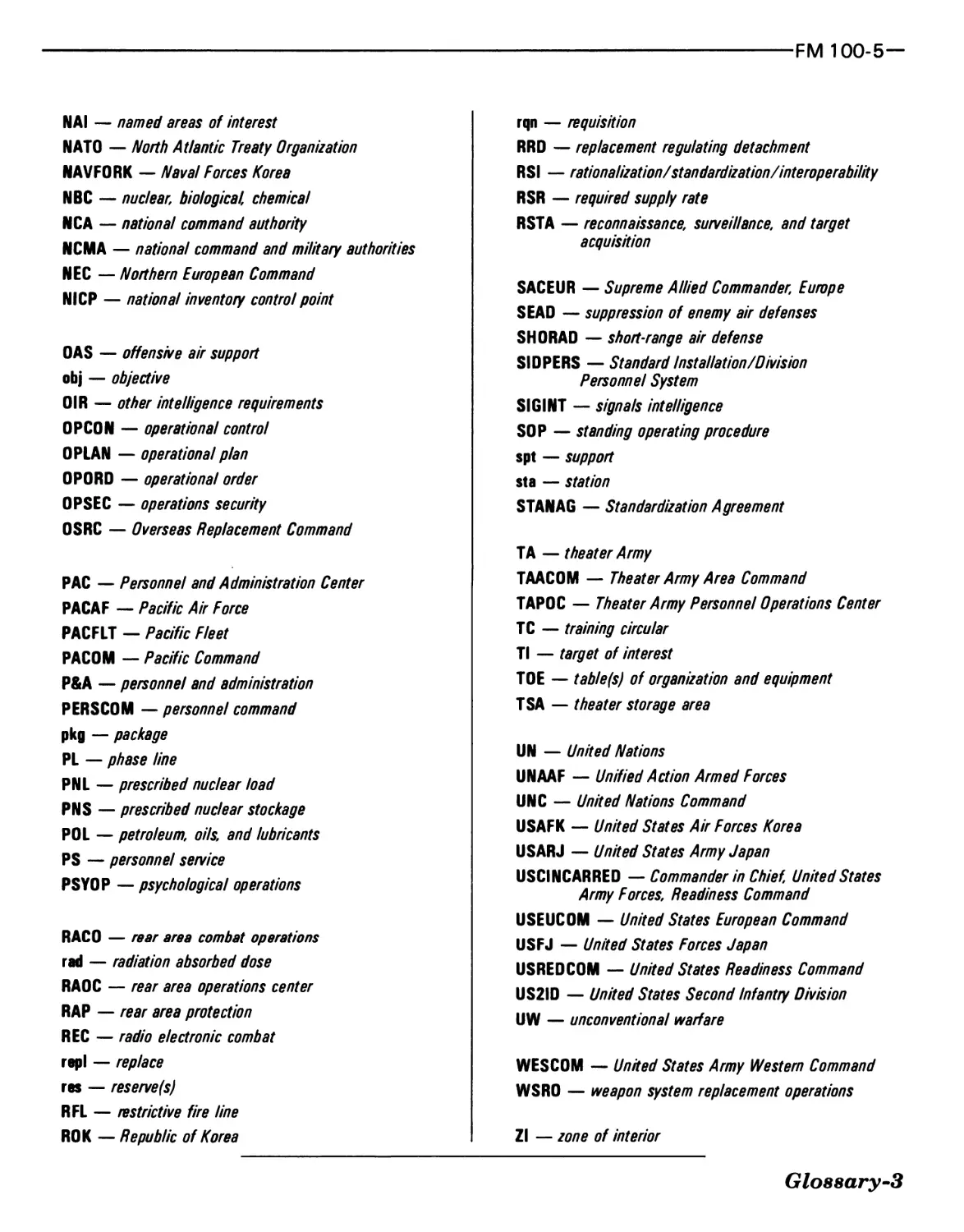

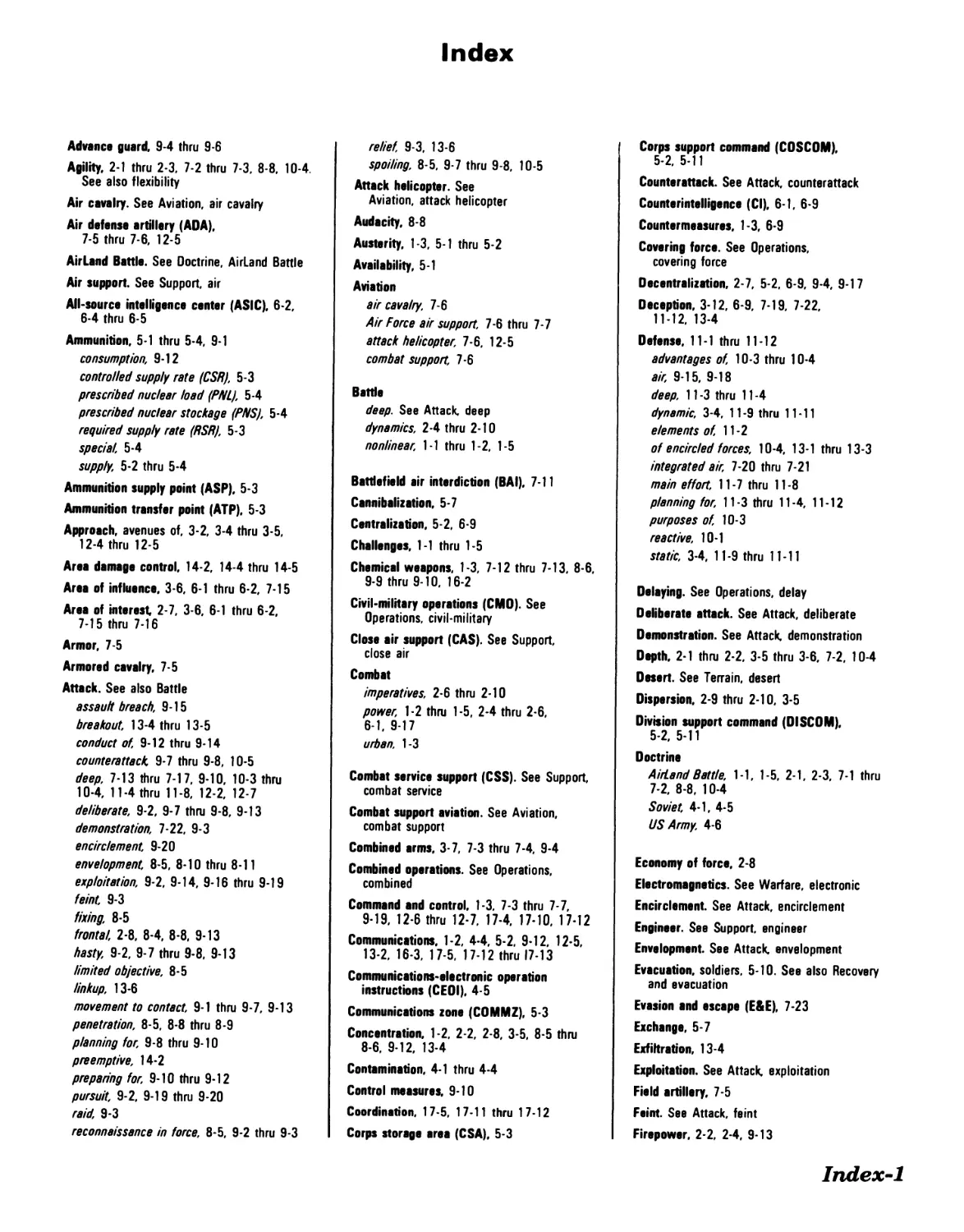
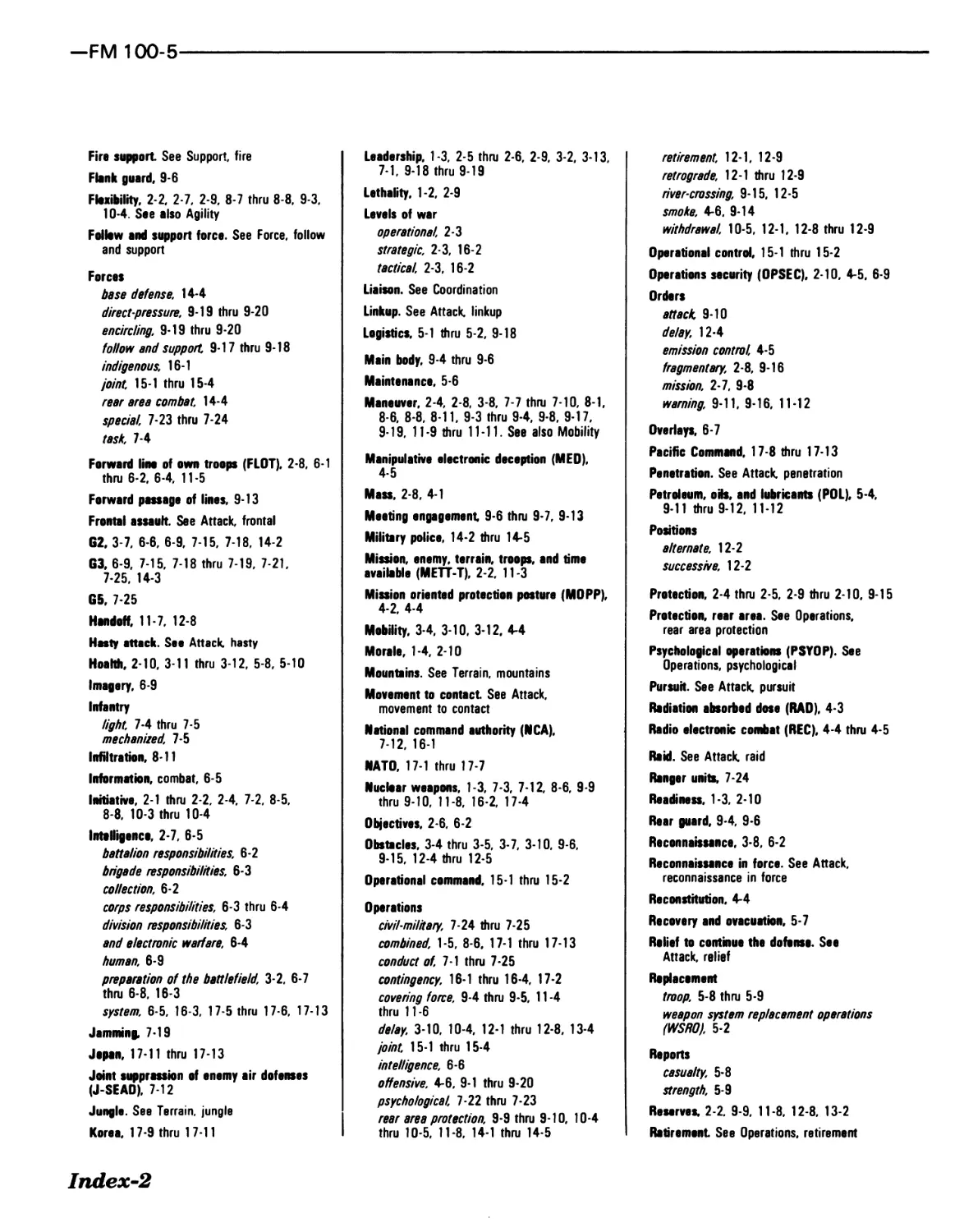
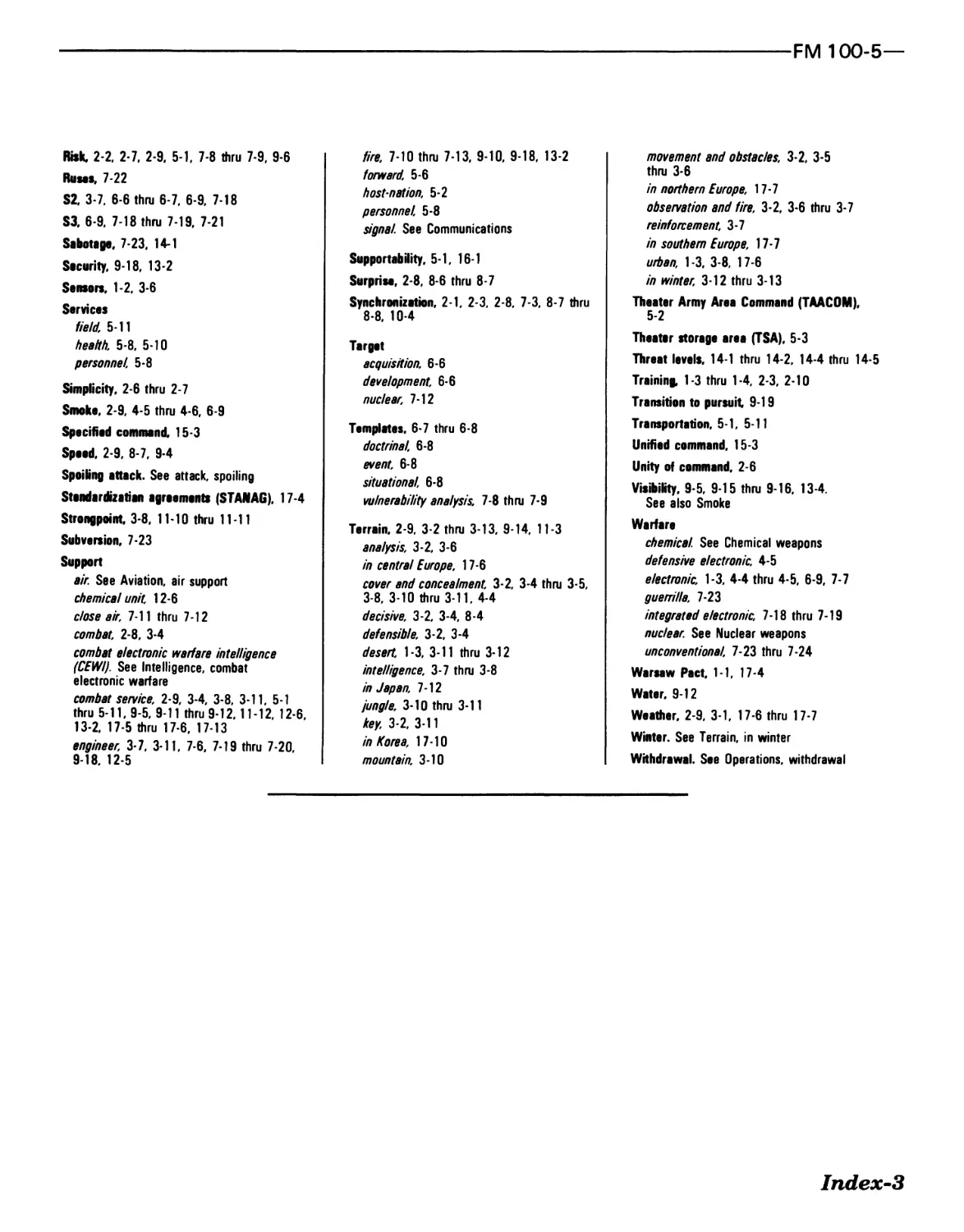
Tags: weapons military affairs military equipment army
Year: 1982


Text
                    OPERATIONS
FM100-5
0 101.20
100-5/3
Field Manual
*FM 100-5
No. 100-5
HEADQUARTERS
DEPARTMENT OF THE ARMY
Washington, DC, 20 August 1982
OPERATIONS
Preface
THE FUNDAMENTAL MISSION OF THE UNITED STATES ARMY IS TO
DETER WAR. Should conflict occur, FM100-5 is the Army’s keystone How
to Fight manual. It is consistent with NATO doctrine and strategy. The
manual emphasizes the application of conventional weapons; however, the
United States Army must be capable of operating in any environment
including the nuclear and chemical battlefield. Nuclear and chemical
weapons can be used only after authorization has been granted by the
national command authority. FM 100-5 provides operational guidance for
use by commanders and trainers at all echelons. It forms the foundation of
Army service school curricula and serves as the basis for developing Army
doctrine, training, and materiel systems and organizations.
FM 100-5 explains how the Army must conduct campaigns and battles in
order to win. It describes US Army operational doctrine involving
maneuver, firepower, and movement; combined arms warfare; and coopera-
tive actions with sister services and allies. It emphasizes tactical flexibility
and speed as well as mission orders, initiative among subordinates, and the
spirit of the offense. Specific operational details appear in other field
manuals and regulations.
FM 100-5 is based on the purpose, organization, responsibilities, and
goals of the US Army as set forth in FM 100-1. The principles of war, the con-
ditions of modern battle, and the fundamentals of military professionalism
and leadership used in this manual also come from FM 100-1. The terms and
graphics necessary to understand this manual are contained in FM 101-5-1.
Both FM 100-1 and FM 101-5-1 are required references.
Users of this publication are encouraged to recommend changes and
submit comments for its improvement. Key comments to the specific page
and paragraph in which the change is recommended. Provide a reason for
each comment to insure understanding and complete evaluation. To send
changes or comments, prepare DA Form 2028 (Recommended Changes to
Publications and Blank Forms) and forward it to Commandant,
USACGSC, ATTN: ATZL-SWT, Fort Leavenworth, Kansas 66027.
When used in this publication, “he,” “him,” “his,” and “men” represent
both the masculine and feminine genders unless otherwise stated.
•This publication supersedes FM 100-5, 1 July 1976.
i
— FM 100-5
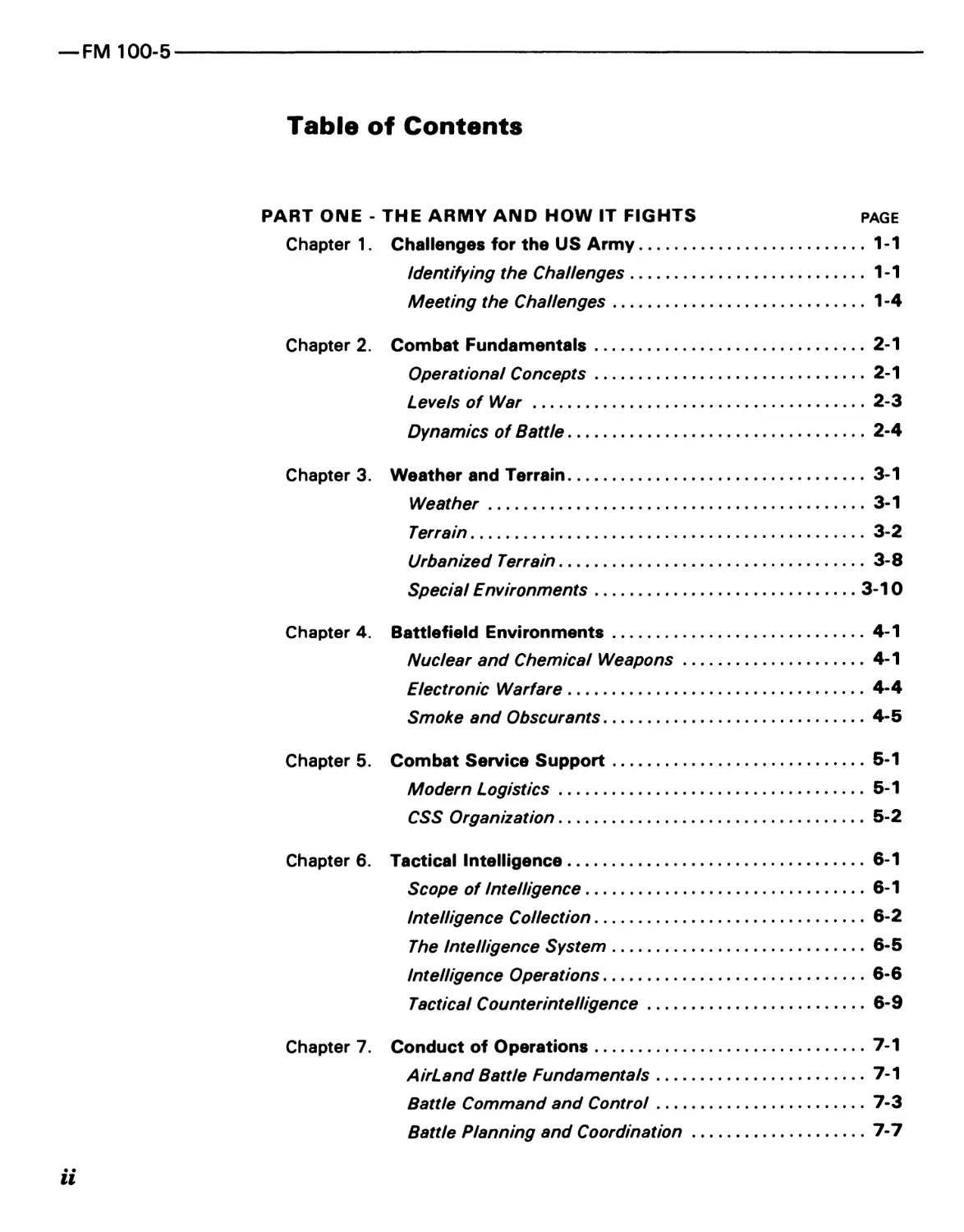
Table of Contents
PART ONE - THE ARMY AND HOW IT FIGHTS	page
Chapter 1.	Challenges for the US Army..........................1-1
Identifying the Challenges........................1-1
Meeting the Challenges............................1-4
Chapter 2.	Combat Fundamentals.................................2-1
Operational Concepts..............................2-1
Levels of War.....................................2-3
Dynamics of Battle................................2-4
Chapters. Weather and Terrain...................................3-1
Weather...........................................3-1
Terrain...........................................3-2
Urbanized Terrain.................................3-8
Special Environments.............................3-10
Chapter 4.	Battlefield Environments............................4-1
Nuclear and Chemical Weapons......................4-1
Electronic Warfare................................4-4
Smoke and Obscurants..............................4-5
Chapter 5.	Combat Service Support..............................5-1
Modern Logistics..................................5-1
CSS Organization..................................5-2
Chapter 6.	Tactical Intelligence...............................6-1
Scope of Intelligence.............................6-1
Intelligence Collection...........................6-2
The Intelligence System...........................6-5
Intelligence Operations...........................6-6
Tactical Counterintelligence......................6-9
Chapter 7.	Conduct of Operations...............................7-1
AirLand Battle Fundamentals.......................7-1
Battle Command and Control........................7-3
Battle Planning and Coordination..................7-7
ii
FM 100-5 —
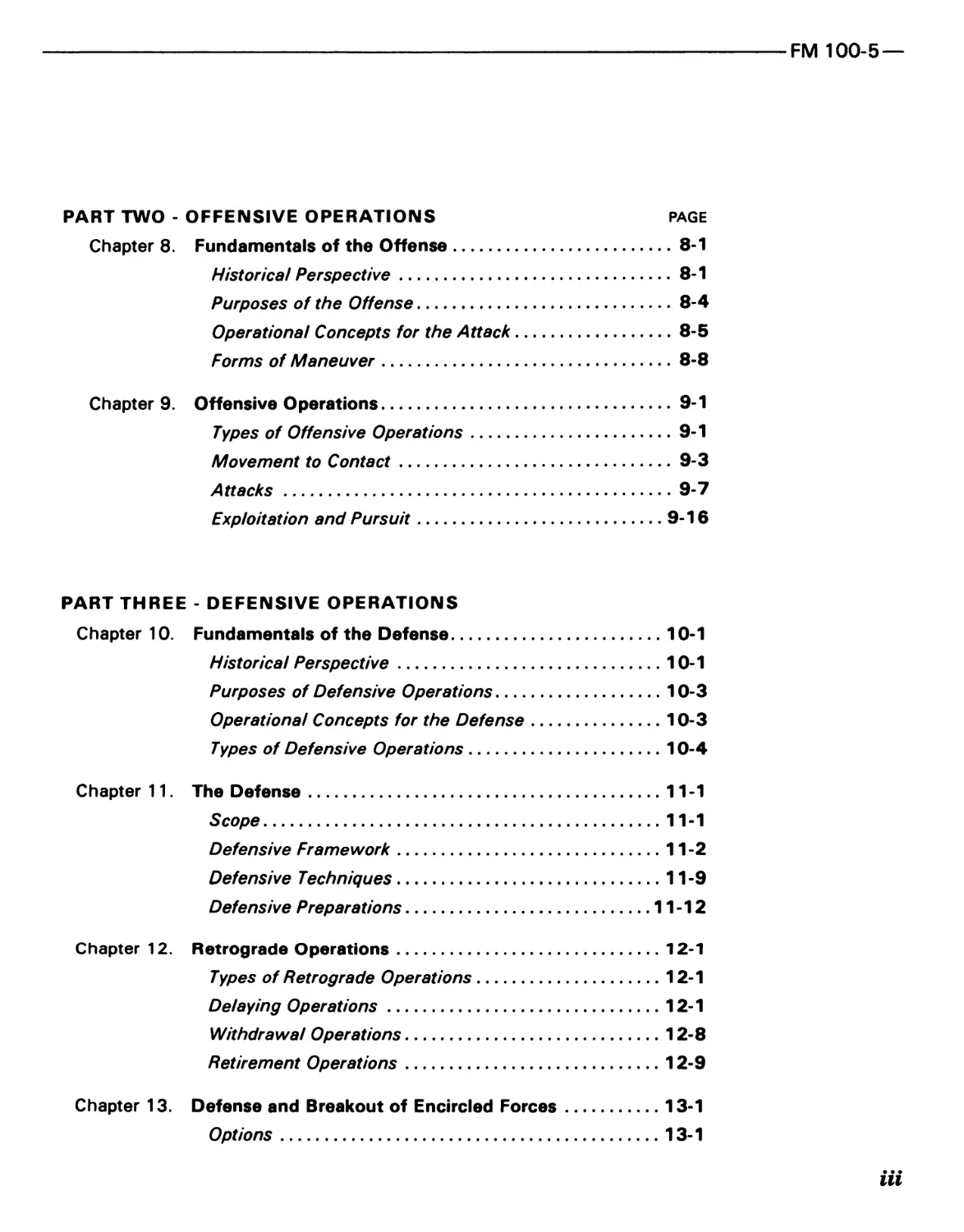
PART TWO - OFFENSIVE OPERATIONS	PAGE
Chapter 8.	Fundamentals of the Offense........................8-1
Historical Perspective...........................8-1
Purposes of the Offense..........................8-4
Operational Concepts for the Attack..............8-5
Forms of Maneuver................................8-8
Chapters. Offensive Operations................................9-1
Types of Offensive Operations....................9-1
Movement to Contact..............................9-3
Attacks .........................................9-7
Exploitation and Pursuit........................9-16
PART THREE - DEFENSIVE OPERATIONS
Chapter 10.	Fundamentals of the Defense......................10-1
Historical Perspective...........................10-1
Purposes of Defensive Operations................10-3
Operational Concepts for the Defense.............10-3
Types of Defensive Operations...................10-4
Chapter 11.	The Defense........................................11-1
Scope............................................11-1
Defensive Framework.............................11-2
Defensive Techniques............................11-9
Defensive Preparations.........................11-12
Chapter 12.	Retrograde Operations.............................12-1
Types of Retrograde Operations...................12-1
Delaying Operations..............................12-1
Withdrawal Operations...........................12-8
Retirement Operations...........................12-9
Chapter 13.	Defense and Breakout of Encircled Forces...........13-1
Options..........................................13-1
Hi
— FM 100-5
PAGE
Chapter 14.	Rear Area Protection............................14-1
Fundamentals..................................14-1
Command and Control...........................14-2
Planning and Executing Rear Area
Combat Operations .............................14-3
Area Damage Control...........................14-4
Responsibilities..............................14-5
PART FOUR - JOINT, CONTINGENCY, AND COMBINED
OPERATIONS
Chapter 15.	Joint Operations................................15-1
Organization and Command and Control..........15-1
Chapter 16.	Contingency Operations..........................16-1
Considerations ...............................16-1
Command and Control...........................16-2
Strategic Deployment..........................16-2
Employment....................................16-2
Chapter 17.	Combined Operations.............................17-1
NATO..........................................17-1
The Pacific Command...........................17-8
Combined Operations in Other Contingency Areas .. 17-13
APPENDICES
A.	References.......................................A-1
B.	The Principles of War ...........................B-1
GLOSSARY...............................................Glossary-1
INDEX.....................................................Index-1
iv
PARTONE
THE ARMY AND HOW IT FIGHTS
CHAPTER 1
Challenges for the US Army
There is no simple formula for
winning wars. Defeating enemy
forces in battle will not always
insure victory. Other national
instruments of power and persua-
sion will influence or even deter-
mine the results of wars. Wars
cannot be won, however, without a
national will and military forces
equal to the task. Although success-
ful military operations do not
guarantee victory, they are an
indispensable part of winning.
Winning campaigns and battles is
the focus of this manual.
IDENTIFYING THE
CHALLENGES
The US Army must meet a variety of
situations and challenges. In the 1980s it can
expect to be committed in either of two
environments. It may fight on a
sophisticated battlefield with an existing
infrastructure of communications, air
defense, logistic facilities, and ports. Or, on a
relatively unsophisticated battlefield, it may
have to create an infrastructure or choose to
fight without one. It must be ready to fight
light, well-equipped forces such as Soviet-
supported insurgents or sophisticated
terrorist groups. It must be prepared to fight
highly mechanized forces typical of Warsaw
Pact or Soviet surrogates in southwest or
northeast Asia. In the areas of greatest
strategic concern, it must expect battles of
greater scope and intensity than ever fought
before. It must anticipate battles fought with
nuclear and chemical weapons.
Such battles are likely to be intense, deadly,
and costly. To win, we must coordinate all
available military forces in pursuit of
CONTENTS
PAGE
IDENTIFY!NG THE CHALLENGES...............1-1
The Next Battlefield ,,,,,,..............1-1
Nonlinear Mneuvar Battles..............1-1
Lethal Systems.........................1-2
Sensors and Communications.............1-2
Nuclear and Chemical Warfare...........1-3
Command and Control. ..................1-3
Air Systems............................1-3
.........................1-3
Rear Area Combat.......................1-3
Urban Combat ..........................1-3
.........................1-3
Leadership ..............................1-3
Readiness ...............................1-3
Tr ......................................1-4
MEETING THE CHALLENGES.......1-4
common objectives. We must retain the
initiative and disrupt our opponent’s fighting
capability in depth with deep attack, effective
firepower, and decisive maneuver. Soldiers
and units must prepare for such battles, and
the Army’s operational concept must enable
it to win. AirLand Battle is the doctrine that
deals with these worldwide challenges. This
manual provides that doctrine.
The four basic challenges to the Army will
be the battlefield, leadership, readiness, and
training.
THE NEXT BATTLEFIELD
Nonlinear Maneuver Battles. In modern
battle, the US Army will face an enemy who
expects to sustain rapid movement during the
offense and who will probably use every
weapon at his disposal. Breaking or
1-1
—FM 100-5
BATTLE LINES
WILL BE INDISTINCT
restraining the enemy’s initial ground
attacks will not end the hostilities. We must
be prepared to fight campaigns of con-
siderable movement, complemented by
intense volumes of fire and complicated by
increasingly sophisticated and lethal
weapons used over large areas.
Opposing forces will rarely fight along
orderly, distinct lines. Massive troop concen-
trations or immensely destructive fires will
make some penetrations by both combatants
nearly inevitable. This means that linear
warfare will most often be a temporary
condition at best and that distinctions
between rear and forward areas will be
blurred. Air and ground maneuver forces;
conventional, nuclear, and chemical fires;
unconventional warfare; active reconnais-
sance, surveillance, and target-acquisition
efforts; and electronic warfare will be directed
against the forward and rear areas of both
combatants.
Lethal Systems. Potential enemies of the
United States will probably field large
quantities of high-quality weapon systems
whose range and lethality equal or exceed our
own. Potent ground and air systems, comple-
mented by closely-coordinated, precision-
guided munitions, will concentrate enormous
combat power, especially at the points of
decision.
Sensors and Communications. Wide-
ranging surveillance, target-acquisition
sensors, and communications that provide
intelligence almost immediately will affect
the range and scope of battle. Sensors offer
the commander more than just timely
information on deep enemy locations and
activity. They also serve as the basis for
attacking enemy follow-on forces with
artillery, Air Force attack aircraft, attack
helicopters, irregular forces, and nonlethal
weapons such as jamming and deception.
These attacks have but one purpose—to
support the ground commander’s overall
scheme. Therefore, the sensors and communi-
cations that make them possible are
particularly valuable.
1-2
FM 100-5—
Nuclear and Chemical Warfare. A
growing number of nations can employ
chemical and nuclear weapons and are
apparently willing to use them. US forces
must plan to fight in an environment where
nuclear and chemical weapons pose a clear
and present danger. Accordingly, they must
be organized, equipped, and trained to meet
the unique challenges to be faced on the
integrated battlefield. Tactical nuclear
weapons will drastically change the
traditional balance between fire and
maneuver. On the modem battlefield, nuclear
fires may become the predominant
expression of combat power, and small
tactical forces will exploit their effects. The
destructive effects of nuclear weapons will
increase the tempo of decisive combat.
Engagements will be short and violent.
Decisive battles may last hours instead of
days or weeks.
Command and Control. At the very time
when battle demands better and more effec-
tive command and control, modern electronic
countermeasures may make that task more
difficult than ever before. Commanders will
find it difficult to determine what is
happening. Small units will often have to
fight without sure knowledge about their
force as a whole. Electronic warfare,
vulnerability of command and control
facilities, and mobile combat will demand
initiative in subordinate commanders. The
commander who continues to exercise
effective command and control will enjoy a
decisive edge over his opponent.
Air Systems. Air mobility and air power will
extend the battle to new depths for all
combatants. Effective air defenses or air
superiority by one combatant could represent
a significant advantage in the conduct of
operations.
Austere Support. Our Army must be
prepared to fight its battles at the end of long,
vulnerable lines of logistical support. It may
have to fight outnumbered against an enemy
with significantly shorter supply lines.
Rear Area Combat. Support projected
forward from rear areas will be subject to
attack by subversion; terrorism; large
airmobile, amphibious, or airborne forces;
and long-range conventional, chemical, or
nuclear fires.
Urban Combat. Combat in built-up areas
will be unavoidable, especially in Europe.
Attack and defense in urban areas and the
fluid battle beyond them will require that
corps and divisions apply coherent plans for
urban warfare.
Desert Combat. Combat in vast arid
regions over extended frontages will require
imagination and skillful adaptation.
LEADERSHIP
The fluid nature of modern war will place a
premium on leadership, unit cohesion, and
effective, independent operations. The
conditions of combat on the next battlefield
will be less forgiving of mistakes and more
demanding of leader skill, imagination, and
flexibility than any in history. General
S. L. A. Marshall’s studies of the US Army
teach that American soldiers will fight reso-
lutely when they know and respect their
leaders and feel they are part of a good unit.
READINESS
Forward deployed forces may have to fight
on a few hours’ notice. Other components of
the force may have only days or weeks to
make final preparations for war.
Commanders must have effective plans for
those important days or weeks, and they
must train for the specific missions they
anticipate. They must insure that each
officer, NCO, and soldier is individually
prepared for battle and is able to perform his
job as part of the unit.
Unit readiness cannot be a reality without
logistical readiness—the availability and
proper functioning of materiel, resources, and
systems to maintain and sustain operations
on a fluid, destructive, and resource-hungry
battlefield. The training of support unitsis as
1-3
—FM 100-5
"The whole of military activity must. . .
relate directly or indirectly to the
engagement. The end for which a soldier is
recruited, clothed, armed, and trained, the
whole object of his sleeping, eating, drinking,
and marching is simply that he should fight
at the right place and the right time."
Karl von Clausewitz
important as the training of tactical units.
Support units should be rigorously trained
under conditions similar to those anticipated
in combat.
TRAINING
Soldiers must be prepared for combat both
professionally and psychologically. Training
is the cornerstone of success. Training is a
full-time job for all commanders in peacetime,
and it continues in wartime combat zones
regardless of other operations or missions.
On the day of battle, soldiers and units will
fight as well or as poorly as they were trained
before battle.
Soldiers receive most of their training in
their units. There they can best train as
individuals and as members of teams under
conditions that approximate battle. Unit
training aims at developing maximum
effectiveness with combined and supporting
arms. Once units meet basic standards,
commanders should review the same tasks
under more difficult conditions. Unit training
must simulate as closely as possible the
modern battlefield’s tempo and scope. Unit
training should include combined and
supporting arms teamwork, which is far more
effective than separate training.
The complexities of modern combat make it
increasingly important to concentrate on
unit training programs for leaders and
teams. Those who direct weapon systems and
small units must be as competent as those
who operate them. Commanders must strike
a balance between training soldiers and
subordinate leaders. They must take time to
train subordinate leaders, building their con-
fidence and teaching them to exercise
initiative before attempting complex
collective tasks. Such a practice will insure
soldier and unit morale, confidence, and
effectiveness.
MEETING THE CHALLENGES
The US Army can meet these challenges.
Armies win by generating superior combat
FM 100-5—
power in battles and throughout campaigns.
Superior combat power depends on three
fundamentals. First and foremost, it depends
on good people—soldiers with character and
resolve who will win because they simply will
not accept losing. Next, it depends on
armaments sufficient for the task at hand.
Finally, it depends on sound, well-
understood, and practical concepts for
fighting.
The character of modern battle and the
geographical range of US national interests
make it imperative that the Army fight as
part of a team with the tactical forces of the
US Air Force, the US Marine Corps, and the
US Navy. It is also critical that commanders
prepare themselves to fight alongside the
forces of one or more of our nation’s allies. As
it has been throughout the twentieth century,
teamwork in joint and combined operations
will be an essential ingredient of any battles
the Army will have to fight.
The AirLand Battle doctrine presented in
the following chapters outlines an approach
to fighting intended to develop the full
potential of US forces. Operations based on
this doctrine are nonlinear battles which
attack enemy forces throughout their depth
with fire and maneuver. They require the
coordinated action of all available military
forces in pursuit of a single objective.
Air and ground maneuver forces;
conventional, nuclear and chemical fires;
unconventional warfare; active recon-
naissance, surveillance, and target-
acquisition efforts; and electronic warfare
will be directed against the forward and rear
areas of both combatants. The AirLand
Battle will be dominated by the force that
retains the initiative and, with deep attack
and decisive maneuver, destroys its
opponent’s abilities to fight and to organize
in depth.
By extending the battlefield and
integrating conventional, nuclear, chemical,
and electronic means, forces can exploit
enemy vulnerabilities anywhere. The battle
extends from the point of close combat to the
forces approaching from deep in the enemy
rear. Fighting this way, the US Army can
quickly begin offensive action by air and land
forces to conclude the battle on its terms.
1-5

CHAPTER 2
Combat Fundamentals
An ARMY’S OPERATIONAL CON-
CEPT is the core of its doctrine. It is
the way the Army fights its battles
and campaigns, including tactics,
procedures, organizations, support,
equipment, and training. The
concept must be broad enough to
describe operations in all antici-
pated circumstances. Yet it must
allow sufficient freedom for tactical
variations in any situation. It must
also be uniformly known and
understood.
OPERATIONAL CONCEPTS
The object of all operations is to destroy the
opposing force. At the foundation of the US
Army’s operations are the principles of war
and their application to classical and modern
theories. The Army’s basic operational
concept is called AirLand Battle doctrine.
This doctrine is based on securing or
retaining the initiative and exercising it
aggressively to defeat the enemy. Destruction
of the opposing force is achieved by throwing
the enemy off balance with powerful initial
blows from unexpected directions and then
following up rapidly to prevent his recovery.
The best results are obtained when initial
blows are struck against critical units and
areas whose loss will degrade the coherence
of enemy operations, rather than merely
against the enemy’s leading formations.
Army units will fight in all types of opera-
tions to preserve and to exploit the initiative.
They will attack the enemy in depth with fire
and maneuver and synchronize all efforts to
attain the objective. They will maintain the
agility necessary to shift forces and fires to
the points of enemy weakness. Our
operations must be rapid, unpredictable,
violent, and disorienting to the enemy. The
pace must be fast enough to prevent him from
taking effective counteractions. Operational
planning must be precise enough to preserve
combined arms cooperation throughout the
CONTENTS
PAGE
OPERATIONAL CONCEPTS.....................2-1
Initiative...............................2-2
Depth....................................2-2
Agility..................................2-2
Synchronization..........................2-3
LEVELS OF WAR............................2-3
Strategic................................2-3
Operational..............................2-3
Tactical.................................2-3
DYNAMICS OF BATTLE.......................2-4
Combat Power.............................2-4
Maneuver...............................2-4
Firepower..............................2-4
Protection.............................2-4
Leadership.............................2-5
Combat Imperatives.......................2-6
battle. It must also be sufficiently flexible to
respond to changes or to capitalize on fleeting
opportunities to damage the enemy.
This requires that the entire force
thoroughly understand the commander’s
intent. Subordinate leaders must align their
operations with the overall mission. They
must develop opportunities that the force as a
whole can exploit. Large unit commanders
must encourage initiative in their
subordinates. They must also be able to shift
their main effort quickly to take advantage of
enemy weaknesses that their subordinates
discover or create. Success on the modern
battlefield will depend on the basic tenets of
AirLand Battle doctrine: initiative, depth,
agility, and synchronization.
"Rapidity is the essence of war; take
advantage of the enemy's unreadiness, make
your way by unexpected routes, and attack
unguarded spots."
Sun Tzu
2-1
—FM 100-5
INITIATIVE
Initiative implies an offensive spirit in the
conduct of all operations. The underlying
purpose of every encounter with the enemy is
to seize or to retain independence of action. To
do this we must make decisions and act more
quickly than the enemy to disorganize his
forces and to keep him off balance.
To preserve the initiative, subordinates
must act independently within the context of
an overall plan. They must exploit successes
boldly and take advantage of unforeseen
opportunities. They must deviate from the
expected course of battle without hesitation
when opportunities arise to expedite the
overall mission of the higher force. They will
take risks, and the command must support
them. Improvisation, initiative, and aggres-
siveness—the traits that have historically
distinguished the American soldier—must be
particularly strong in our leaders.
DEPTH
Depth, important to all US Army opera-
tions, refers to time, distance, and resources.
Momentum in the attack and elasticity in the
defense derive from depth. Knowing the time
required to move forces—enemy and
friendly—is essential to knowing how to
employ fire and maneuver to destroy, to
disrupt, or to delay the enemy.
Commanders need to use the entire depth of
the battlefield to strike the enemy and to
prevent him from concentrating his fire-
power or maneuvering his forces to a point of
his choice. Commanders also need adequate
space for disposition of their forces, for
maneuver, and for dispersion.
Depth of resources refers to the number of
men, weapon systems, and materiel that
provide the commander with flexibility and
extend his influence over great areas.
Commanders need depth of time, space, and
resources to execute appropriate counter-
moves, to battle the forces in contact, and to
attack enemy rear forces.
The battle in depth should delay, disrupt, or
destroy the enemy’s uncommitted forces and
2-2
isolate his committed forces so that they may
be destroyed. The deep battle is closely linked
with the close-in fight. All involved weapons,
units, and surveillance assets must con-
tribute to the commander’s overall objective.
When we fight an echeloned enemy, such
operations may be vital to success.
Reserves play a key role in achieving depth
and flexibility. Important in any battle is the
commander’s decision on the size,
composition, and positioning of his reserves.
They are best used to strike a decisive blow
once the enemy has committed himself to a
course of action or revealed a vulnerability.
Finally, commanders must be prepared to
engage enemy airborne or airmobile forces
that attack our rear areas. They must insure
that combat service support units can survive
nuclear and chemical strikes and still support
the fast-paced battle. These are other aspects
of the in-depth battle.
AGILITY
Agility requires flexible organizations and
quick-minded, flexible leaders who can act
faster than the enemy. They must know of
critical events as they occur and act to avoid
enemy strengths and attack enemy vulnera-
bilities. This must be done repeatedly, so that
every time the enemy begins to counter one
action, another immediately upsets his plan.
This will lead to ineffective, uncoordinated,
and piecemeal enemy responses and
eventually to his defeat.
An organization’s flexibility is determined
by its basic structure, equipment, and
systems. Units should have an appropriate
mix of soldiers and equipment to complete
their tasks. Mission, enemy, terrain, troops,
and time available (METT-T) should control
any permanent or temporary reorganization.
The mental flexibility necessary to fight on
a dynamic battlefield is more difficult to
describe but easier to achieve. Our Army has
traditionally taken pride in our soldiers’
ability to “think on their feet”—to see and to
react rapidly to changing circumstances.
Mental flexibility must be developed during
FM 100-5—
the soldier’s military education and
maintained through individual and unit
training.
SYNCHRONIZATION
Synchronized operations achieve maxi-
mum combat power. However, synchroni-
zation means more than coordinated action.
It results from an all-prevading unity of effort
throughout the force. There can be no waste.
Every action of every element must flow from
understanding the higher commander’s
concept.
Synchronized, violent execution is the
essence of decisive combat. Synchronized
combined arms complement and reinforce
each other, greatly magnifying their
individual effects. In AirLand Battle
doctrine, synchronization applies both to our
conventional forces and, when authorized, to
nuclear and chemical weapons. It also
characterizes our operations with other
services and allies.
Forceful and rapid operations achieve at
least local surprise and shock effect.
Commanders must look beyond these
immediate effects when they plan operations.
They must make specific provisions in
advance to exploit the opportunities that
tactical success will create.
LEVELS
War is a national undertaking which must
be coordinated from the highest levels of
policymaking to the basic levels of
execution. Strategic, operational, and
tactical levels are the broad divisions of
activity in preparing for and conducting
war. While the principles of war are
appropriate to all levels, applying them
involves a different perspective for each.
STRATEGIC
Military strategy employs the armed forces
of a nation to secure the objectives of national
policy by applying force or the threat of force.
Military strategy sets the fundamental
conditions for operations. Its formulation is
beyond the scope of this manual.
OPERATIONAL
The operational level of war uses available
military resources to attain strategic goals
within a theater of war. Most simply, it is the
theory of larger unit operations. It also
involves planning and conducting
campaigns. Campaigns are sustained
operations designed to defeat an enemy force
in a specified space and time with
simultaneous and sequential battles. The
disposition of forces, selection of objectives,
OF WAR
and actions taken to weaken or to out-
maneuver the enemy all set the terms of the
next battle and exploit tactical gains. They
are all part of the operational level of war. In
AirLand Battle doctrine, this level includes
the marshalling of forces and logistical
support, providing direction to ground and
air maneuver, applying conventional and
nuclear fires in depth, and employing uncon-
ventional and psychological warfare.
TACTICAL
Tactics are the specific techniques smaller
units use to win battles and engagements
which support operational objectives. Tactics
employ all available combat, combat support,
and combat service support. Tactics involve
the movement and positioning of forces on
the battlefield in relation to the enemy, the
provision of fire support, and the logistical
support of forces prior to, during, and
following engagements with the enemy.
At corps and division, operational and
tactical levels are not clearly separable. They
are guided by the same principles, and this
manual applies to both. An operation
designed to defeat an enemy force in an
extended area does so through operational
maneuver and a series of tactical actions.
2-3
—FM 100-5
DYNAMICS OF BATTLE
Dynamics of battle refers to the interaction
of factors that decide battle. Force ratios and
the effects of fire and maneuver are
significant in deciding battles; however, a
number of intangible factors often
predominate. Among these intangible factors
are state of training, troop motivation, leader
skill, firmness of purpose, and boldness—the
abilities to perceive opportunities, to think
rapidly, to communicate clearly, and to act
decisively. The effects of these factors create
tangible and reversible relationships. To
understand the dynamics of battle, it is
important to understand combat power and
the role of its component elements—
maneuver, firepower, protection, and
leadership.
COMBAT POWER
Combat power is relative, never an
absolute, and has meaning only as it
compares to that of the enemy. The
appropriate combination of maneuver, fire-
power, and protection by a skillful leader
within a sound operational plan will turn
combat potential into actual combat power.
Superior combat power applied at the
decisive place and time decides the battle.
Maneuver. Maneuver is the dynamic
element of combat, the means of concen-
trating forces in critical areas to gain and to
use the advantages of surprise, psychological
shock, position, and momentum which
enable smaller forces to defeat larger ones.
More specifically, it is the employment of
forces through movement supported by fire to
achieve a position of advantage from which
to destroy or to threaten destruction of the
enemy. The object of maneuver at the
operational level is to focus maximum
strength against the enemy’s weakest point,
thereby gaining strategic advantage. At this
level, successful maneuver is achieved
through skillful coordination of fire in depth
with movement of large units. At the tactical
level, maneuver contributes significantly to
sustaining the initiative, to exploiting
success, to preserving freedom of action, and
to reducing vulnerability. Successful
maneuver at this level depends upon skillful
movement along indirect approaches
supported by direct and indirect fires.
The effect created by maneuver is the first
element of combat power. Effective maneuver
demands battlefield mobility; knowledge of
the enemy and terrain generated by recon-
naissance and other intelligence activities;
effective command and control; flexible
operational practices; sound organization;
and reliable logistical support. It requires
imaginative, bold, competent, and
independent leaders; discipline, coordination,
and speed; well-trained troops; and
logistically ready units. Effective maneuver
protects the force and keeps the enemy off
balance. It continually poses new problems
for him, renders his reactions ineffective, and
eventually leads to his defeat.
Firepower. Firepower provides the
enabling, violent, destructive force essential
to successful maneuver. It is the means of
suppressing the enemy’s fires, neutralizing
his tactical forces, and destroying his ability
to fight. This is done by killing, wounding, or
paralyzing the enemy’s soldiers and by
damaging the materiel and installations
necessary for his continued combat effec-
tiveness. Firepower is delivered by personal
arms, crew-served direct fire weapons,
mortars, artillery, cannons and missiles, air
defense guns and missiles, attack helicopters,
Air Force and Navy aircraft, and Naval
gunfire bombardment.
The effect of firepower on the enemy and
not its unapplied or misused potential makes
a vital contribution to combat power. It is the
accuracy and effectiveness of munitions
which ultimately contribute to combat power.
Therefore, efficient target-acquisition
systems, viable command and control, a
steady supply of ammunition, and the
tactical mobility necessary to place weapons
within range of critical targets are necessary
ingredients of this element of combat power.
Protection. Protection is the shielding of the
fighting potential of the force so that it can be
2-4
FM 100-5—
applied at the decisive time and place. Protec-
tion has two components. The first includes
all actions to counter the enemy’s firepower
and maneuver by making soldiers, systems,
and units difficult to locate, to strike, or to
destroy. Among these actions are security,
dispersion, cover,, camouflage, deception,
suppression, and mobility. These actions
routinely include the reinforcement and
concealment of fighting positions, command
posts, and support facilities. The second
component includes actions to keep soldiers
healthy, to maintain their fighting morale,
and to diminish the impact of severe weather.
It also means keeping equipment in repair
and supplies from becoming lost.
As in the other elements of combat power,
the effects of protection contribute to combat
power. These effects are measured by the
fighting potential available at the moment of
decisive combat. It is in this way that the
activities listed above contribute to combat
power.
Leadership. Leadership provides purpose,
direction, and motivation in combat. Leaders
function through personal interaction with
their men and through command and control
systems and facilities. While leadership
requirements differ from squad to echelons
above corps, leaders must be men of
character; they must know and understand
soldiers and the physical tools of battle; and
they must act with courage and conviction.
The primary function of leadership is to
inspire and to motivate soldiers to do difficult
things in trying circumstances. Leaders must
also understand how to control and to
integrate fire and maneuver and how to use
terrain. They must know how to combine
direct and indirect fires, how to use air and
naval fires, and how to substitute massed
fires for massed troops.
This is the component upon which all
others depend. Again, it is the effect the
leader creates through proper application of
his potential maneuver, firepower, and pro-
tection capabilities which generates combat
power. Throughout the history of war, victory
LEADERSHIP IS
THE CRUCIAL ELEMENT
OF COMBAT POWER
2-5
—FM 100-5
has gone to the leader who understood and
used the means at his disposal to the best
advantage. Therefore, leaders are the crucial
element of combat power. It is up to them to
turn the potential of men, weapons, and
resources available into superior combat
power.
Leaders must set the preconditions for
winning on the battlefield; therefore, superior
combat power has its roots in proper
preparation. Preparation includes many
matters of long-term concern to the Army at
the highest levels—force design, equipment
design, and procurement, to name only a few.
The tactical commander has a more
immediate perspective. To him, preparation
involves logistic readiness and motivation. It
means continuous planning and training to
the moment of, and even during, battle. It
means training throughout campaigns
because every endeavor causes the unit to
learn either good or bad habits. Continuous
training under all conditions insures positive
skills that will contribute to success in battle.
Commanders must demand excellence under
all conditions and must strive to make it
habitual.
In the final analysis and once the force is
engaged, superior combat power derives from
the courage of soldiers, the excellence of their
training, and the quality of their leadership.
COMBAT IMPERATIVES
Success in battle—achieving superior
combat power—also depends on using tactics
appropriate to mission, enemy, terrain,
troops, and time available. The effectiveness
of maneuver, firepower, and protection
depends on how the commander combines
operational procedures, battle drills, or other
measures from an established repertoire to
solve a particular problem. Doctrine
establishes common techniques of fighting
throughout the force. The successful tactician
depends on proven techniques and on troops
who are well-versed in employing them.
Standardized practices actually enhance
flexibility; but they must be more than just a
2-6
series of routine approaches to solving types
of operational problems. As he plans and
fights the battle, the tactician must under-
stand the seven imperatives of combat:
1.	Insure unity of effort.
2.	Direct friendly strengths against enemy
weaknesses.
3.	Designate and sustain the main effort.
4.	Sustain the fight.
5.	Move fast, strike hard, and finish
rapidly.
6.	Use terrain and weather.
7.	Protect the force.
1.	Insure Unity of Effort
The principles of war that provide the basis
for this imperative are objective, unity of
command, and simplicity. Its fundamental
requirements are effective leadership and an
effective command and control system
through which the commander—
•	Learns what is going on.
•	Decides what to do about it.
•	Issues the necessary orders.
•	Keeps track of how the battle is going.
This process is dynamic. Its primary
measure of effectiveness is whether it
functions efficiently and more quickly than
the enemy’s. At its heart are the commander
and his system for command and control. The
commander must insure a unified, aggres-
sive, quick, precise, agile, and synchronized
effort throughout the force.
Unity of effort depends on motivation—
getting all involved to work quickly and well.
Important to motivation in a high-risk
environment are mutual trust, confidence,
loyalty, and pride—the notions that describe
relationships between leader and led.
Leaders must convince subordinates that
objectives are possible and thus deserve total
dedication.
Unity of effort requires that the
commander and his staff see the battlefield
realistically. To do this, they must con-
tinuously study their resources, the enemy,
FM 100-5—
and the terrain from a perspective that
extends from the unit’s rear boundary to the
forward edge of its area of interest. Because
he can never know everything, the
commander will make decisions based on
imperfect information. He must, therefore,
make realistic demands for intelligence in a
clear order of priority. Commanders must
avoid the temptation to gather more detail
than they need and thus clog the flow of
timely, vital information.
Unity of effort also requires continuous
sensing of the battle conditions, both enemy
and friendly, as the basis for sound decisions
and firm directions for the force as a whole.
Modern forces have decentralized and
institutionalized much of the decision
process, especially that involved with
supporting arms and services. As decision
making decentralizes, the need for unity of
effort grows. Commanders who are flexible
rather than mechanical will win decisive
victories.
A plan which promotes unity of effort must
have a well-defined, comprehensive mission
statement. The commander identifies his
goals through mission orders that leave his
subordinates the greatest possible freedom.
Because plans must be implemented by units
under stress, simple plans are best. If a plan is
necessarily complex, it must incorporate
simple control measures and insure that
subordinates’ individual tasks remain
simple. Since commanders cannot foresee,
plan, or communicate instructions for every
potential event, they should not attempt to
control every action of their subordinates.
The chaos of battle will not allow absolute
control. As battle becomes more complex and
unpredictable, decision making must become
more decentralized. Thus, all echelons of
command will have to issue mission orders.
Doing so will require leaders to exercise
initiative, resourcefulness, and imagination—
and to take risks.
Risk-taking in combat has two dimensions.
One has to do with the danger to men and
materiel involved in the mission; the other
with accomplishing the mission. All leaders
must take risks of both types independently,
based on a prudent assessment of the
situation. An informed risk, however, should
not be confused with a gamble. A gamble is a
resort to chance in the absence of either
information or control. Although a gamble
may be necessary in a desperate situation, a
subordinate should have his commander’s
approval.
Mission orders require commanders to
determine intent—what they want to happen
to the enemy. Their intent must be consistent
with their superiors’ and must be com-
municated clearly to their subordinates.
During battle, commanders must support
and develop the local successes of their
subordinates. They must commit reserves
where there is the greatest chance of success.
They must concentrate fires wherever the
enemy is vulnerable. While detailed orders
may be necessary at times, commanders
must trust their subordinates to make correct
on-the-spot decisions within the mission
framework. Such decentralization converts
initiative into agility, allowing rapid reaction
to capture fleeting opportunities. Mission
orders need to cover only three important
points:
•	They should clearly state the com-
mander’s objective, what he wants
done, and why he wants it done.
•	They should establish limits or controls
necessary for coordination.
•	They should delineate the available
resources and support from outside
sources.
The subordinate commander must fully
understand his commander’s intent and the
overall mission of the force. If the battle
develops so that previously issued orders no
longer fit the new circumstances, the
subordinate must inform his commander and
propose appropriate alternatives. If this is
not possible, he must act as he knows his
commander would and make a report as soon
as possible.
To insure that his concept is driving the
operation to completion, the commander
must follow up. He must have an overall view
2-7
-FM 100-5
of the battle based on reports from subor-
dinates, information from surveillance
systems, and his own personal observtions.
He must compare enemy and friendly
situations, assess progress, and if necessary,
issue fragmentary orders (FRAGO) to adjust
assigned tasks. This process of follow-up and
reassessment is one of the commander’s
critical responsibilities.
Direct Friendly Strengths Against
Enemy Weaknesses
The principles of war that provide the basis
for this imperative are maneuver and
surprise. To determine what tactics to use,
commanders must study the enemy. They
must know enemy organization, equipment,
and tactics—how the enemy fights. More
specifically, they must understand the
strengths and weaknesses of the enemy force
they are about to fight. Techniques that work
in one instance against one enemy may not
work against another enemy or even the
same enemy at a different time and place.
Commanders should determine and take into
account the capabilities, limitations, and
idiosyncrasies of particular enemy units.
The good tactician looks for an approach
that focuses his own strengths against the
enemy’s weaknesses. Weaknesses may result
from gaps in the enemy’s dispositions, his
predictability, or the character of his soldiers
or units. Commanders must strive to attack
the enemy where his operational, technical,
or human weaknesses make him most
vulnerable.
Meeting the enemy where he is strongest is
sometimes unavoidable, but doing so
deliberately is extremely hazardous.
However, it may be necessary to support an
indirect effort elsewhere with a direct
approach. Sometimes an immediate, violent,
quickly executed, direct frontal assault can
capitalize on enemy unreadiness.
Our tactics must appear formless to the
enemy until the last possible moment. They
must deceive him about our true intentions.
They must confuse him by threatening
2-8
multiple objectives, each of which he must be
prepared to defend. They must surprise him
whenever possible, simply by doing what he
least expects. All such efforts must be fully
integrated into operational plans.
Designate and Sustain
the Main Effort
The principles of war that provide the basis
for this imperative are mass and economy of
force. The commander identifies the main
effort when he states his intent. Designating
the main effort links each subordinate
commander’s actions to those around him.
Such a link maintains cohesion and insures
synchronization. Yet it also permits
initiative.
Whether in an attack, a defense, or any
other operation, the main effort is assigned
to only one unit. All other elements support
and sustain the effort of that unit. If that
unit encounters unexpected difficulties, or if
a secondary effort meets with unexpected
success, the commander may shift his focus
by designating a new unit to make the main
effort. In this way he can shift the concen-
tration of forces, fires, and required logistics
in the direction required to best achieve his
aim.
To succeed against superior numbers, the
commander must not limit his attack or
defense to the vicinity of the forward line of
own troops (FLOT). He supports the main
effort by fire or maneuver that reaches deeply
into the enemy’s zone of action. He strikes the
enemy’s vulnerable high-value targets or
engages his still undeployed follow-on forces.
Thus, the commander seeks to set the terms of
battle throughout the depth of the battlefield.
The purpose of concentrating effort is to
shock, paralyze, and overwhelm the enemy at
the chosen time and place. To achieve this
effect, the tactician designates the objective
and plans the employment of combat, combat
support, and logistics means, using each to
the greatest advantage in the overall scheme.
By proper integration he achieves an effect
that is greater than the sum of its parts.
FM 100-5—
The increased need for dispersion on the
nuclear-chemical-conventional battlefield
compounds the problem of concentration. To
move units rapidly and efficiently over pre-
selected and coordinated routes, tacticians
must plan and prepare extensively. They
must also select and coordinate alternate
routes in case primary ones are blocked.
Sustain the Fight
Battles or campaigns have often gone to
the side that has been most successful in
pressing the main effort to conclusion. To
sustain the momentum that early successes
generate, leaders must do two things. First,
they must deploy forces in adequate depth
and arrange for timely and continuous
combat and combat service support at the
outset of operations. Then, they must take
risks and tenaciously press soldiers and
systems to the limits of endurance for as long
as necessary.
Commanders deploy forces and logistic
resources in depth to insure continuous,
flexible operations and to protect the force. In
the attack, they echelon forces and logistic
resources in depth to maintain momentum
and to exploit success. In the defense, depth
insures continuity and flexibility for
maneuver. It provides options for the
defender if forward positions are penetrated.
In both attack and defense, deploying in
depth increases dispersion and decreases the
vulnerability of the total force to nuclear and
chemical fires.
To gage the risks involved in pressing
soldiers to the limits of their endurance,
commanders must understand the human
dimension. Ardant Du Picq, a nineteenth-
century student of the human dimension of
battle, appropriately stated that we can
“reach into the well of courage only so many
times before the well runs dry.” The
confusion, extreme stress, and lethality of the
modern battlefield place a heavy burden on
courage and endurance. Commanders must
assess human abilities and limitations as
they plan and fight their battles. They must
accurately gage which units should lead,
which should be replaced, and which should
be reinforced. They must also be aware of the
traditional concerns of weather, training,
and leadership.
5. Move Fast, Strike Hard, and
Finish Rapidly
The principles of war that provide the basis
for this imperative are maneuver and mass.
Speed has also always been important, but it
will be even more important on the next
battlefield because of sophisticated sensors
and the possibility of conventional, nuclear,
or chemical counterstrikes. To avoid
detection, our concentrations must be
disguised. To avoid effective counterstrikes,
they must be short.
Speed allows the commander to seize and to
hold the initiative, and thereby to maintain
freedom of action. Quick, decisive action also
makes the enemy react and deprives him of
the initiative. When this happens, units
should have well-conceived plans for
exploiting their successes.
в. Use Terrain and Weather
Terrain and weather affect combat more
significantly than any other physical factors.
The ground has an immense influence on
how the battle will be fought. It provides
opportunities and imposes limitations,
giving a decisive edge to the commander who
uses it best. Most battles have been won or
lost by the way in which combatants used the
terrain to protect their own forces and to
destroy those of the enemy. One of the best
investments of the commander’s time before
battle is an intensive personal reconnais-
sance of the terrain.
Weather affects equipment and terrain, but
its greatest impact is on the men. The
commander must understand how weather
and visibility affect his operations as well as
the enemy’s. He anticipates changes in the
weather, capitalizing on them when possible,
and uses smoke to alter visibility when it
suits his purposes. The impact of terrain,
weather, and visibility is developed in
chapter 3.
2-9
—FM 100-5
Protect the Force
Successful commanders preserve the
strength of the force. They do so by assuring
security, keeping troops healthy and
equipment ready, and sustaining discipline
and morale.
Tacticians assure security by taking pre-
cautions against surprise. They must use
aggressive reconnaissance, set out security
forces, maintain operational security, avoid
operational patterns, and practice deception.
When time permits, they must build
protective field fortifications. They must also
disperse troops, especially on the nuclear
battlefield. The degree of dispersion depends
on the value of their force as a target, on
whether it is mobile or static, and on the
probability of its being detected.
Leaders must habitually think about troop
health and equipment readiness. In the past,
disease and the elements have weakened
entire formations. Likewise, equipment that
is not properly maintained can fail, leaving
forces at a serious disadvantage. Com-
manders must insist on proper maintenance
both before and during battle. They must
anticipate needs, conserve resources, and be
ready for emergencies.
In battle, unit cohesion is important to
protection. Poor morale can weaken any unit.
Enemy psychological warfare, an
unsuccessful operation, or a surprising and
violent display of enemy strength can
degrade morale. Peacetime preparation,
however, will contribute directly to a unit’s
strength and durability in combat. Soldiers
who are always required to do it right in
training will instinctively do so in combat.
Marshall de Saxe wrote that “the soldier’s
courage must be reborn daily.” A leader, he
said, will insure this “by his dispositions, his
positions, and those traits of genius that
characterize great captains.... It is of all the
elements of war the one that is most
necessary to study.” Leaders create cohesion
and maintain discipline. Soldiers who serve
in disciplined, cohesive units will be on hand
with functioning equipment when the
decisive moment arrives.
2-10
CHAPTER 3
Weather and Terrain
Weather and terrain have
more impact on battle than any
other physical factor, including
weapons, equipment, or supplies.
The terrain on which battles are
fought will present opportunities to
both sides. In some cases the
advantages are unmistakably clear.
Control of Little Round Top at
Gettysburg, for example, was
decisive to the outcome. Indeed,
most battles have been won by the
side that used terrain to protect
itself and to reinforce fires to
destroy the enemy. To be effectual,
commanders must understand the
nature, uses, and reinforcement of
terrain. They must also understand
how weather affects troops and
equipment. To retain the initiative,
they must be able to operate in
adverse conditions and during
periods of limited visibility.
A
WEATHER
Weather affects equipment and terrain, but
its greatest impact is on the soldiers. Cloud
cover, rain, snow, dust, light conditions, and
temperature extremes will combine in
various ways to affect troop efficiency.
Control becomes difficult. Troops tend to seek
shelter and to neglect chores which expose
them to the elements. Security is difficult to
insure in stationary positions.
Perhaps the most important effect of
weather is on the soldier’s ability to function
effectively in battle. Inclement weather
generally favors an attacker because
defending troops will be less alert. Successful
defense under limited-visibility conditions
(night, fog, or smoke) depends on thorough
planning. Necessary movement must be
thoroughly rehearsed. At night, appre-
hension rises among troops waiting to
defend. While a successful defense under
these conditions depends on thorough
planning, limited visibility makes it easier to
move troops secretly and to achieve surprise.
At night the advantage also belongs to the
attacker.
Units must therefore be prepared to attack
at night—to switch from defense to offense or
to continue an attack already begun. Attack
under limited-visibility conditions should
strive to achieve surprise. It should be
pursued aggressively and violently with an
uncomplicated maneuver scheme.
Weather also affects some equipment and
weapon systems. Night, fog, or smoke reduce
the useful ranges of most weapon systems.
Despite technical advances in night vision
equipment, these conditions usually call for a
change in tactics. The blinding effect of
3-1
—FM 100-5
nuclear fires is greater at night than during
day. Nighttime atmospheric conditions
generally favor the use of chemical agents.
Sub-zero weather may improve traffica-
bility, but it also adds to maintenance
problems. Extreme heat reduces aircraft load
limits, and heat waves from the surface can
make optical systems less effective. Sand-
storms in the desert can raise havoc with
equipment.
Rain or snow and the resulting mud reduce
mobility. They place heavier loads on auto-
motive systems of all kinds, thereby
increasing maintenance requirements. They
also hamper recovery operations and replace-
ment of major items like tanks, infantry
fighting vehicles, trucks, and cannons.
Cloud cover reduces air support on both
sides and affects terminally guided artillery
projectiles. Weather can determine the dura-
tion of nuclear and chemical weapons’ effects
and the extent of downwind hazard.
Two general observations summarize the
effects of weather on operations:
•	Good physical condition, acclimatiza-
tion, and sound discipline at the small-
unit level can overcome the adverse
effects of weather and visibility. They
can give a well-prepared force an
advantage over an ill-prepared enemy.
•	The leadership time and effort required
to care for the soldiers who are
accomplishing the mission increases
proportionately with the severity of
weather.
The commander should select the best
course of action to complete the mission only
after thorough consideration of the favorable
and unfavorable effects of weather on person-
nel, weapon systems, and equipment.
TERRAIN
Terrain forms the natural structure of the
battlefield. Early in the planning process,
commanders must recognize its limitations
and possibilities, using it to protect friendly
operations by putting the enemy at a
disadvantage.
ANALYZING TERRAIN
Every level of command must study the
terrain’s limitations and opportunities.
Platoon leaders concentrate on wood lines,
streams, and individual hills in preparing
their operations. Corps commanders analyze
road nets, rail nets, drainage patterns, and
hill systems.
Commanders analyze terrain in light of the
unit’s mission. Such analysis will include a
unit’s assigned area of responsibility and the
surrounding terrain which may affect opera-
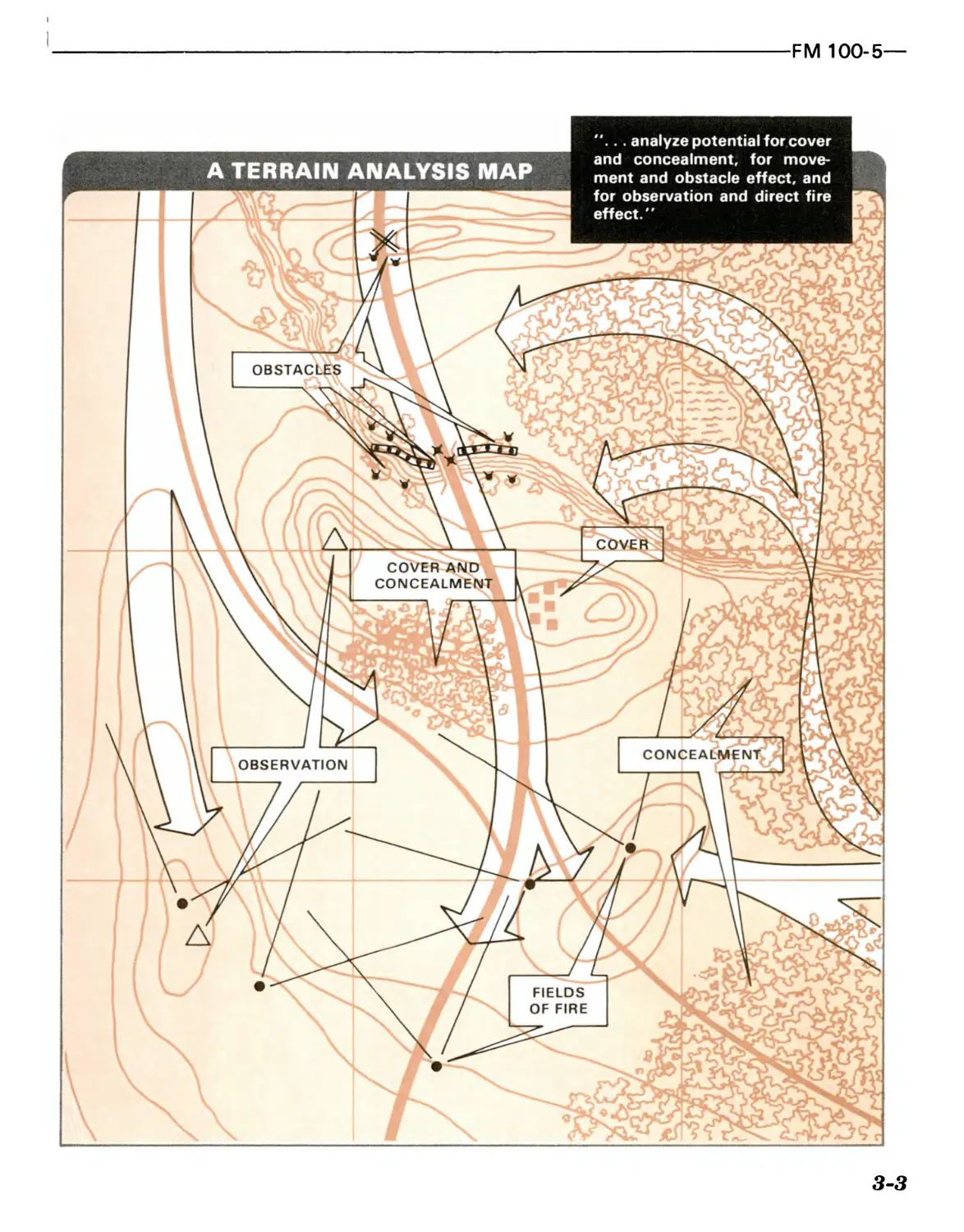
tions. They analyze potential for cover and
concealment, for movement and obstacle
effect, and for observation and direct fire
effect. They must recognize the battlefield’s
natural structure, and the necessity to
improve or overcome it to accomplish the
mission. Fire, maneuver, and obstacle plans
are designed and integrated to fit the terrain.
Terrain analysis, intelligence preparation
of the battlefield, and engineer operations are
all basic to the operational use of terrain.
Surrounding areas are included so that
approaches to the battlefield, its flanks, and
its rear are properly evaluated. After
studying the area in detail, they provide the
commander with an assessment, including
the ground’s general organization, dominant
features, chief avenues for movement, and
key areas. The staff or commander specifies
named areas of interest as a means of
focusing the surveillance and interdiction
efforts of the unit. In terrain analysis, intelli-
gence and operations officers identify signifi-
cant features such as obstacles and key or
decisive terrain, air and ground avenues of
approach, and defensible terrain.
3-2
FM 100-5—
3-3
—FM 100-5
Key Terrain. Key terrain refers to any
feature which, in the control of a combatant,
will affect the conduct of an operation. The
commander designates key terrain after he
has analyzed his mission.
Decisive Terrain. The commander may
designate certain key terrain as decisive
terrain if it will have an extraordinary impact
on his mission. Many battlefields may not
have decisive terrain. To designate terrain as
decisive is to recognize that the mission,
whether offensive or defensive, depends on
seizing or retaining it. The commander
designates decisive terrain to communicate
its importance in his concept of operations,
first to his staff and, later, to subordinate
commanders.
Avenues of Approach. Avenues of
approach are evaluated in terms of their—
•	Potential to support maneuver units of a
specified size and type.
•	Access to important areas and adjacent
avenues.
•	Degree of canalization.
•	Cover and concealment.
•	Effect on line-of-sight communications.
•	Obstacles.
A good avenue of approach must support
rapid movement along its length. Obstacles
should be avoidable or reducible in reason-
able time. The obstacle effects of nuclear
fires, atomic demolition munitions, and
scatterable mines must also be taken into
account. An avenue should be broad enough
to permit maneuver along its course. It should
have parallel spurs or branches to bypass
strong defenses. Enough covering terrain
should be available to permit part of the force
to overwatch the rest. Combat support units
and combat service support units must be
able to move along the avenue in support of
the attacking force. This may also be done
over parallel routes or along routes which are
uncovered as the attack gains ground.
If the enemy has air superiority, the avenue
should provide concealment from the air. Air
avenues for attack helicopters, airmobile
forces, and close air support have different
characteristics. A good air approach provides
terrain masking from air defense radar and
direct-fire air defense weapons.
Analyzing avenues of approach is as
important to the defender as to the attacker.
The defender must accurately determine the
main approaches to his sector and identify
the internal avenues which will permit him to
maneuver against the attacker.
Defensible Terrain. Defensible terrain
refers to ground that affords—
•	Long-range visibility.
•	Cover and concealment.
•	Obstacles which canalize or retard
movement into the defended area and
secure the flanks of the defender.
•	Covered routes between positions and
covered approaches to the attacker’s
flank or rear areas.
To a large degree, terrain in the defensive
sector will determine the design of the
defense. Static defenses can be mounted only
in areas where terrain makes bypassing
difficult or otherwise limits the movement of
an attacker to a few routes. Dynamic defenses
require maneuver space, good avenues of
movement, and strong positions in depth.
Special conditions, such as heavily urbanized
terrain, difficult cross-country mobility, or
dense vegetation, require special con-
sideration in the defense.
USING TERRAIN
Terrain can be used for cover and conceal-
ment, movement and obstacles, and obser-
vation and fire.
Cover and Concealment. Terrain can
protect a unit from observation and fire, or it
can hide forces. The cover from fire afforded
by slopes, folds, and depressions is critical
because it preserves the strength of the force.
A direct-fire unit in a covered defensive
position can dominate areas open to its front
without suffering casualties. Covered
3-4
FM 100-5—
positions are as important to command posts,
indirect fire units, combat support units, and
combat service support units as they are to
committed maneuver units. Nuclear and
chemical fires can overcome some of the
protection the ground affords. Yet com-
manders can insure acceptable cover in
active nuclear-chemical environments by
prudently dispersing units among multiple
covered positions. Whether maneuvering on
the ground or in the air, all forces should seek
the protection of covering terrain to the
greatest degree possible.
Urbanized terrain, broken hills, high
ground, and forested areas can be used to hide
forces, but in operations against well-
equipped forces, terrain alone cannot conceal
a force or facility. Electronic and thermal
emissions must be concealed, troops must be
camouflaged from overhead detection, and
even in wooded areas, movement must be
minimized. In spite of the fluid conditions
around the line of contact, there will still be
opportunities to conceal forces for short
periods.
Concealment of maneuver forces can be a
great tactical advantage. Defenders can use
it to draw the enemy deeply into prepared
defensive areas. Attackers can use it to avoid
being detected or engaged as they close. Stay-
behind forces, from patrol to battalion size,
can use it in areas which enemy attack has
bypassed.
When nuclear weapons are used, conceal-
ment of command posts, artillery units,
logistics facilities, and other high-value
targets is vitally important. Urban areas,
farm buildings, and other man-made
structures can hide and protect these
sensitive units or facilities.
Movement and Obstacles. There are few
truly impassable areas. The cliffs at Quebec,
the tides of Inchon, and the Ardennes forest
all appeared impassable to their defenders.
Historically, enterprising commanders have
won decisive victories by striking suddenly
over unlikely routes. We should actively seek
the indirect approaches in our own opera-
tions and protect difficult approaches to our
positions against surprise enemy incursions.
Roads, ridgelines, river valleys, and plains
are high-speed approaches on which fluid
battles may develop rapidly. Combat moves
slowly through swamps, thick forests, sandy
areas, and broken or mountainous terrain
that is traversable only through defiles or by
dismounted movement.
Normally, an area of operations will
contain both obstructing terrain and avenues
suitable for airmobile, mounted, or dis-
mounted movement. Terrain which canalizes
movement into a few areas allows the
defender to economize by concentrating on
the dangerous approaches. In such cases the
attacker secures the area before the defender
can occupy it, or he resorts to ground or aerial
bypass, infiltration, or nuclear fires. In pre-
dominantly open areas, the attacker will be
able to choose between many different
approaches, and the defender will be forced to
fight a mobile battle of considerable depth.
Natural or man-made obstacles that
parallel the direction of movement can
protect the flanks from attacks or counter-
attacks. When such obstacles cross an
avenue of approach they form lines of
resistance for the defender.
Obstacles vary in their effect on different
types of forces. Rail lines, small streams, and
villages along roads do not significantly
affect dismounted operations; however, they
may be of great value in slowing the pace of a
mounted operation. Adequately guarded
forests and marshes which can be traversed
by dismounted infantry or airmobile forces
are very difficult for armored forces to
penetrate.
The most promising approaches are often
those which appear unlikely. Often it is
possible to gain access to a high-speed ridge
approach by crossing difficult terrain
immediately to its front. Old roadbeds also
offer potential because they follow solid
ground and are usually not as well defended
as modern routes. Patton’s use of the Norman
roads of France and Israel’s 1967 penetration
3-5
—FM 100-5
of the Sinai along the trace of a Roman road
are good examples.
Observation and Fire. Contour and
vegetation affect fields of view and fire. With
limited visibility, direct-fire weapons are
ineffective, and movement entails little risk.
Remote sensors can be used to cue artillery
and cover some of the space which cannot be
observed directly. Large forests, jungles,
built-up areas, and tracts of broken ground
will absorb large numbers of troops and limit
both the possibilities of observation and the
effects of conventional fire.
Fields of observation and fire differ
according to weapon characteristics. Hilltops
and the tops of buildings make excellent
observation posts or radar sites, but are
rarely satisfactory positions for direct-fire
weapons. Tanks, missiles, and machine guns
must be sited where their effects will be the
greatest and dead space will be minimized.
Terrain must support the concept of any
operation. In planning the battle, the com-
mander considers the battlefield’s depth as
well as his area of immediate operations.
Terrain analysis extends into the territory
through which the enemy must move to
attack or to concentrate defensive forces.
Carefully evaluating areas of interest and
influence can predict the areas and routes the
enemy is most likely to use. Surveillance,
interdiction, and deep attack plans derive
from that prediction. Destroying bridges,
blocking defiles, or obstructing routes in
depth can separate enemy echelons, isolate
enemy positions, and create lucrative targets
for air or nuclear attack.
Analysis of the flanking and rear terrain is
necessary to facilitate changes in direction
and to anticipate threats created by enemy
maneuver. Commanders should also analyze
terrain in terms of air observation and fire. In
many cases, Army aircraft can overwatch
3-6
FM 100-5—
from flanking positions in woods and valleys
inaccessible to ground troops.
REINFORCING TERRAIN
Commanders must thoroughly understand
and improve the area prior to active opera-
tions. Preparation of the ground cannot be an
afterthought. The proper use and appropriate
reinforcement of terrain must be an integral
part of the commander’s concept. Artillery
fires, direct-fire killing areas, battle positions,
and appropriate terrain reinforcements such
as minefields and antitank obstacles must all
be completely meshed and wedded to the
ground.
Although the attacker determines the time
and place for attack, the defender has a clear
advantage in the preparation of the battle-
field. He must make the most of his oppor-
tunity to learn, to organize, and to improve
the terrain. The attacker must bear the
defender’s advantage in mind and allow him
as little time as possible to dig in, to obstruct
routes, to prepare counterattack approaches,
and to establish solid communications.
Attacking some positions, like the Kursk
salient of 1943, is feasible only before the
defender has improved his position. Once the
defense has occupied a strong position and
improved it, successful attack becomes far
more difficult.
Terrain reinforcement and mobility and
countermobility improvements are the
business of the maneuver commander.
Generally, a commander should concentrate
his engineer effort in two directions: to
develop an obstacle system in depth to
enhance his fires and to increase the vul-
nerability of enemy forces; to develop covered
positions beyond the capability of combat
units. To the maximum degree possible, he
should use combat troops to develop covered
positions and close-in obstacles.
Terrain reinforcement is a combined arms
operation with engineers and all other units
participating. Engineers install tank ditches,
minefields, abatis, craters, and demolitions
to canalize enemy movement, to hold the
enemy in areas where he can be destroyed by
fire, and to protect the flanks of maneuvering
forces. Artillery, aviation, and close air
support units emplace scatterable mines on
targets of opportunity to suppress enemy air
defense and artillery units and to interdict
follow-on enemy formations. Defending units
emplace minefields around their positions.
Maneuver units will often be responsible for
placing demolitions and obstacles and for
closing lines and gaps. Units, supported by
engineer equipment and by occasional labor,
develop their own covered and/or concealed
initial and subsequent positions. Operating
with leading maneuver elements, engineers
clear obstacles, construct bridges and rafts,
and support countermine operations.
Because engineers cannot be everywhere,
units must be capable of conducting counter-
mine operations. Engineers will assist with
minefields that are beyond the unit’s
capabilities.
Reinforcing terrain takes increasingly less
time and fewer resources as new engineer
systems are introduced. Such capabilities
allow rapid development of minefields and
covered fighting positions in response to
enemy movement and friendly operation
plans. Even with these developments, all
projects to reinforce terrain must be carefully
designed and realistically planned according
to clear priorities.
ACQUIRING TERRAIN
INTELLIGENCE
Sources of terrain intelligence include
military, civilian, and engineer maps;
topographical studies; civilian officials and
area residents; and air, space, and ground
reconnaissance units. The intelligence staff
officer (G2 or S2) is responsible for
assembling all available information on the
terrain and estimating its effect on opera-
tions. The commander, however, must
acquaint himself with the terrain as fully as
possible before combat. Because maps are
sometimes inaccurate or incomplete, com-
manders of battalions and smaller units
3-7
—FM 100-5
should conduct detailed personal reconnais-
sance. They should issue orders from vantage
points on the ground whenever possible.
URBANIZED TERRAIN
Commanders have always recognized the
importance of urban centers as strategic
objectives, but directly seizing cities and
towns has always been difficult. Sun Tzu
taught that “the worst policy of all is to
besiege walled cities.” Many armies have
learned the wisdom of these words at such
places as Stalingrad, Tobruk, Hue, and
Beirut. Such efforts consume enormous
resources, degrade the momentum of
offensive operations, restrict maneuver, and
consume time. Therefore, commanders
should not commit forces to urban areas
unless doing so can realize specific
advantages.
Modern armies that fight in the heavily
industrialized regions of the world may have
great difficulty in avoiding urban combat.
Previously separated population centers
have expanded to form extensive urban belts.
In Western Europe, for example, large cities
have combined or are combining into mega-
lopolises. Entire areas, such as the Ruhr and
Rhine-Main River complex, have assumed a
near-continuous urban character. Com-
manders and staff officers must learn to
analyze urbanized terrain and to plan effec-
tively for operating on it.
Maps often need updating to reflect the
latest in construction and terrain alteration.
Commanders and staff need to learn to work
with maps of different scales: lower scale for
greater resolution of detail within cities and
normal scale to control the overall battle. The
urban fight can be isolated from the overall
battle if commanders view the battles
separately.
Corps and division commanders are
responsible for major urban areas. At brigade
level and below, commanders concern them-
selves with smaller cities, towns, villages,
and strip areas. At lower levels of command,
3-8
the makeup and composition of urban terrain
become increasingly important. At these
levels, terrain should be analyzed from the
standpoint of fighting from or within urban
areas.
All of the considerations which apply to
terrain in general apply to urban terrain, but
engagement ranges are shorter and terrain
detail is more varied. Structures may replace
or supplement natural hills, obstacles, and
vegetation. In many cases, a sewer system
available for communications and small-unit
maneuvers or heavily constructed multistory
structures add a vertical dimension. The
cover and concealment available in urban
areas can be defensively advantageous.
Fighting from mutually supporting strong-
points in a village can slow or impede the
attacker and provide anchor points or islands
of resistance for a defense of maneuver and
counterattack. It can also create oppor-
tunities for offensive maneuver against an
attacker who has been halted and sits
exposed at the edge of an urban area.
The defender normally has the advantage
in built-up areas. He has readily available
protection as well as concealment and
covered routes of movement within the area.
On the other hand, the attacker can isolate
and bypass built-up areas, but he may be
required to attack others. He is then faced
with fighting from the outside into a well-
defended position. Both attacking and
defending forces will take advantage of
urban cover and concealment to position
command posts, stocks of supplies, and
combat service support units.
Commanders must use their forces to the
best advantage. An urban area can severely
limit the full potential of armored or
mechanized forces. Urban areas normally
degrade their mobility, maneuverability, and
weaponry. Available light infantry forces
hold well-protected positions in built-up areas
while minimizing their vulnerabilities to
modern weapons.
For details on how to fight on urbanized
terrain, see FM 90-10.
FM 100-5—
".. . large cities have combined
or are combining into mega-
lopolises. Entire areas, such as
the Ruhr and Rhine-Main River
complex, have assumed a near-
continuous urban character."
AREA DEVELOPMENT IN WEST GERMANY
HAMBURG
HANOVER
•BERLIN
LEGEND
VIRTUALLY NO
SETTLEMENT
NETHERLANDS
THE
FRANKFURT
AINZ HANAU
DISPERSED SETTLEMENT
FRANCE
SPARSE SETTLEMENT
STUTTGART
DENSE SETTLEMENT
VERY DENSE SETTLEMENT
COMPACT BUILT-UP AREA
SWITZERLAND
EAST GERMANY
^NURNBERG
MUNICH
CZECH.
AUSTRIA
3-9
—FM 100-5
SPECIAL ENVIRONMENTS
MOUNTAINS
Mountainous terrain exists throughout the
world from the northern regions to the
tropics. Therefore, the Army must maintain
the capability to operate in it. Both light
forces (infantry, airborne, and airmobile) and
heavy forces (armor and mechanized)
provide this capability. The mobility of light
forces comes primarily from the helicopter
and the boot, not from the piton and the rope.
Heavy forces will operate in the passes and
flat valleys of mountain ranges. Aviation
units will be important for reconnaissance,
antitank fire, and troop movement.
Mountainous terrain significantly
influences the use of weapons and equipment.
Fire is generally less effective than in normal
terrain because rocks and cliffs provide much
natural cover. Overhead and long-range
fires, however, can be greatly increased
because the elevation affords good obser-
vation. Occupying the heights in order to fire
down on the enemy is advantageous even
though slopes limit grazing fire and create
large dead spaces. Thus, weapons with a high
angle of fire—such as field artillery, mortars,
and grenade launchers—take on added
importance. Rugged mountain terrain makes
movement so difficult that all equipment
should be as light as possible, preferably air-
transportable.
Ground mobility in mountains is extremely
difficult. Highways usually run in the
valleys; existing roads and trails are
normally few and primitive; and cross-
country movement is particularly arduous.
Helicopters, however, can normally over-
come these difficulties. Although limited by
unfavorable weather, density-altitude
considerations, and enemy air defense, heli-
copters are extremely useful for moving
forces during mountain operations.
Finally, mountain combat lacks the unity
that is characteristic of combat in level or
rolling terrain. Major engagements typically
occur at the entrances and exits of passes.
This tends to give the battlefield a piecemeal
character and induces isolated conflicts
which are difficult for higher commanders to
control.
3-10
Mountainous terrain tends to favor the
defender and provides him with excellent
observation and firing positions. Man-made
obstacles intensify the natural obstacle of
rugged mountainous terrain. The defender
can easily deceive the enemy as to his
strength and dispositions. Because the
defender normally has more time to develop
lateral trails, he can usually shift forces on
the ground more rapidly than the attacker.
Delaying actions are particularly effective in
the mountains and can be accomplished by
smaller-than-ordinary forces. Nonetheless,
an aggressive attacker can sometimes
traverse mountains rapidly, as the US
campaign through the Eifel and the German
attack through the Balkans have
demonstrated.
A detailed discussion on how to fight in
mountains is in FM 90-6.
JUNGLES
The jungle regions of Asia, Africa, and the
Western Hemisphere are potential battle-
fields. Past wars have provided valuable
experience for the US Army in the conduct of
jungle operations. They have proven the
value of the infantry (particularly airmobile
infantry), artillery, and light armored forces
in jungle warfare.
Jungles vary from tropical rain forests and
secondary growth forests to swamps and
tropical savannas. The dominating features
of jungle areas are thick vegetation, constant
high temperature, heavy rainfall, and
humidity. These features restrict movement,
observation, fields of fire, communications,
battlefield surveillance, and target
acquisition. However, they also favor
military operations by providing excellent
cover and concealment.
The jungle environment is a serious
obstacle to movement. Dense vegetation,
gullies, steep hills and cliffs, rivers,
unfordable streams, and swamps hinder
movement. Vehicular movement is normally
canalized or impeded or made impossible.
Cross-country movement by foot is slow and
FM 100-5—
difficult. High mobility is attained most
effectively by air.
Jungle climate and vegetation dictate that
all equipment must be rugged, lightweight,
and man-portable. The fighting load of the
soldier should be under 40 pounds. All
weapons and equipment require daily
maintenance in a tropical climate. Combat
service support and engineer support will
exceed normal requirements because road
and rail networks are scarce.
The jungle contains numerous health
hazards for troops, particularly unac-
climatized soldiers who have little or no
resistance to many of the endemic diseases.
Thus, an increased disease rate may occur
from gastro-intestinal maladies and fungus
infections. Protection is required against
mosquitoes, flies, fleas, leeches, and other
parasites. If these health hazards are not
countered, disease may hospitalize more
troops than wounds do.
According to the type of vegetation, ground
observation in jungle areas can vary from a
few feet to 20 to 30 meters. Aerial observation
is often ineffective because of the jungle
canopy, heavy rain, low hanging clouds, fog,
and haze. While the jungle enhances
camouflage, vegetation does not protect the
soldier from enemy fire. Troops are prone to
mistake concealment for cover. For example,
in most jungle areas, trees will not usually
provide adequate cover. Surface irregu-
larities, such as ravines, gullies, and large
rocks, provide cover in jungle areas.
A detailed discussion of how to fight in
jungles is found in FM 90-5.
DESERTS
Many desert areas of the world are
potentially vital to the national interests of
the United States. The US Army may be
called on to fight in desert regions for a wide
variety of factors—strategic location, natural
resources, assistance to an ally, and deter-
rence of aggression, to name a few. Armor
and mechanized infantry forces are most
suitable to desert combat; however, airmobile
forces can also be advantageous. For the
initial lodgment, airborne forces are
valuable. Army and Air Force air may
support airborne and airmobile forces in
bearing the brunt of the fighting until heavy
forces arrive.
Deserts are semiarid and arid regions that
contain a wide variety of soils in varying
relief. Desert conditions can vary radically.
Temperatures often range from 30° to 130°F.
The unequaled visibility and flight
conditions of a clear day may be ruined by a
raging sandstorm that can halt all military
operations. Long periods of drought are inter-
rupted by sudden rains that bring flash
floods and mud but little relief from water
shortages. Large areas of generally excellent
trafficability are interspersed with insur-
mountable mountains, dunes, impassable
ravines, bogs, and sand seas. The
availability of water will be a prime factor in
planning and executing desert operations.
Selecting locations for supporting logistics
facilities and objectives will frequently be
based on water supply.
Flat desert areas have a significant effect
on military operations. Because the terrain
does not canalize large forces, large-scale use
of mines and obstacles becomes necessary.
The lack of prominent terrain features
severely increases the problem of land
navigation. Commanders must often use
dead-reckoning techniques. Key terrain in
the classic sense loses its importance to
smaller units. Although large cover is scarce,
small indentations and folds in the ground do
provide cover for small units and individual
weapons. Every effort must be made to
capitalize on existing cover.
Because of the sparse vegetation, conceal-
ment in the desert is more difficult than in
many other environments. Concealment,
however, is not only possible, it is absolutely
necessary. To survive on the desert battle-
field, forces must use camouflage nets,
pattern and mud painting, covers for reflec-
tive surfaces, and similar methods. In
general, easy observation and long fields of
3-11
—FM 100-5
fire make undetected advances and with-
drawals extremely difficult.
Deception measures of all types (feints,
ruses, and decoy equipment, for example)
become mandatory for success. Troops
should move at night or during sandstorms
while maintaining strict communications
security. Long-range engagements place a
premium on accurate gunnery at maximum
range.
The desert environment has a debilitating
effect on troops who have not been properly
acclimatized or trained. Continued exposure
to the sun causes profuse sweating, sunburn,
dehydration, cramps, heat exhaustion, and
even heat stroke. Proper field sanitation and
personal hygiene are necessary to prevent
dysentery and other diseases. The environ-
ment induces mental fatigue, impaired per-
ception, and depression, which, coupled with
the pressures of combat, can overwhelm the
soldier and render him ineffective. Acclimati-
zation and proper training can defeat these
environmental effects.
The desert has an even greater detrimental
affect on machines. Dust and sand can be as
deadly to our vehicles as enemy fire. If they
contaminate fuel, lubricants, and intake air,
dust and sand can ruin engines and erode
components. Intense command supervision
will insure continuous availability of these
three precious commodities—clean air, fuel,
and lubricants.
Vehicle cooling and electrical systems are
vulnerable to desert extremes of temperature.
Tracks, tires, and suspension systems wear
out rapidly in the desert. Sand and rocks
literally grind away rubber track parts, while
thorns repeatedly puncture tires. More spare
parts are required here than operations in
more moderate environments. The intense
desert heat can quickly cause communication
equipment to overheat and malfunction.
Proper operation of equipment, as well as
proper preventive maintenance, is necessary
to insure effective communications.
A detailed discussion of how to fight in
desert areas is in FM 90-3.
3-12
WINTER ZONES
It is quite possible that an enemy would
deliberately choose to attack in midwinter in
central Europe or the Korean peninsula. The
US Army must therefore maintain military
capability in this environment.
In arctic regions such as the polar ice cap,
survival of the force requires so many
resources that few may remain to accomplish
anything militarily useful. Therefore, the
likelihood is small that large forces will be
committed to such an extreme environment.
Nevertheless, the Army must be able to
operate air defense forces in the arctic
regions. It must be prepared to employ
airmobile elements for relief, resupply, recon-
naissance, and surveillance as necessary.
In addition to extreme cold and snow,
winter operations must endure other weather
phenomena, particularly in northernmost
regions. Whiteouts and grayouts cause a loss
of depth perception which increases the
hazards of flying, driving, or even walking.
Ice fogs can form over a body of troops,
bivouac areas, motor parks, or convoys,
thereby exposing their locations.
The most suitable time for ground opera-
tions is from midwinter to early spring before
the thaw. During winter months, units can
achieve excellent mobility on frozen ground.
However, when the ground thaws, cross-
country movement can become difficult at
best and can cause vehicles to become road
bound.
Extremely low temperatures affect
weapons. Metal becomes brittle in extreme
cold, and parts on all types of weapons break
with increased frequency. Many weapons
create ice fog which, on a still day, may
obscure the gunner’s vision and require
movement to another position after the first
shot. Bringing a weapon into a warm shelter
creates condensation which will freeze and
cause malfunction when the weapon returns
to the cold outside. Tank weapons face a par-
ticularly bad obscuration problem from ice
fog and the soft snow blown up by the muzzle
blast. Extreme cold also decreases tank gun
ammunition velocity and, hence, its
FM 100-5—
accuracy. Snow or mud can dampen the effec-
tiveness of field artillery or mortar rounds.
Finally, the winter environment signifi-
cantly increases the time required to perform
even simple tasks. Experience has shown
that five times the norm may be required in
extreme cold. The proper equipment and
training and the highest caliber of leadership
are the ingredients for successful operations
in this environment. Commanders must
recognize these factors and avoid a business-
as-usual attitude.
A detailed discussion of how to fight in
winter is in FM 31-71.
3-13

FM 100-5—
	BIOLOGICAL EFFECTS OF NUCLEAR RADIATION
	RAD*	ONSET OF INITIAL SYMPTOMS	INCAPACITATION	HOSPITALIZATION ANO DISPOSITION
	0-70	Within 6 hours slight incidence of transient headache and nausea. Vomiting in up to 5% of personnel in the upper part of dose range	None	Hospitalization not required; all return to duty
	70-150	Within 3 to 6 hours transient mild headache and nausea; some vomiting in up to 50% of group	None to slight decrease in ability to perform duties in up to 25% of group; up to 5% may be combat ineffective	Eventual hospitalization (20-30 days) or less than 5% in upper part of dose range; return to duty; no deaths anticipated
	150-450	Within 3 hours headache, nausea, and fatigue; slight incidence of diarrhea; over 50% of group vomits	Can perform routine tasks; combat or complex tasks may be hampered; over 5% will be combat ineffective; percent ineffective increasing with higher doses	Hospitalization (30-90 days) in upper range after latent period of 10-30 days; some deaths (less than 5% to 50% at upper end of range); return to duty questionable at higher doses
L	450-800	Within 1 hour severe nausea and vomiting; diarrhea, fever early in upper part of range	Can perform simple tasks; significant reduction in combat effectiveness in upper part of range; lasts more than 24 hours	Hospitalization (90-120 days for those surviving) for 100% of the group; latent period 7-20 days; 50% deaths at lower and increasing toward uper end; all deaths within 45 days
I	800-3000	Within 1/2 to 1 hour severe and prolonged vomiting, diarrhea, and fever	Significant reduction in combat effectiveness; in upper part of range transient period of complete combat effectiveness for some, followed by some response until end of the latent period	Hospitalization for 100%; latent period of less than 7 days; 100% deaths within 14 days
	3000-8000	Within 5 minutes severe and prolonged vomiting, diarrhea, fever, and prostration; convulsions may occur at higher doses	Completely incapacitated within 5 minutes; remain so for 30 to 45 minutes; then recover, but functionally impaired until death	Hospitalization for 100%; latent period of 1 to 2 days; 100% deaths within 5 days
	ABOVE 8000	Within 5 minutes the same symptoms as above	Complete, permanent incapacitation; unable to perform physically demanding tasks	Hospitalization for 100%; no latent period; 100% deaths in 15 to 48 hours
	•RAD - radiation absorbed dose.
4-3
-FM 100-5
MITIGATING ACTIONS
Against an enemy with a nuclear-chemical
capability, our forces must conduct opera-
tions with the knowledge that such weapons
may be used at any time. First use, and
especially surprise use, of nuclear-chemical
weapons by the enemy must not allow him to
win. Commanders must act to accomplish the
mission with least risk. Their plans should
include measures for survival and
reconstitution.
Units will survive by anticipating nuclear-
chemical attacks. They must take the
following steps to avoid becoming lucrative
targets:
•	MAINTAIN ALERTNESS. Commanders at
all levels need to be continually alert to
nuclear and chemical attack. They need
to balance risk to their units against
mission requirements. They need to
adjust dispersion and MOPP without
losing momentum.
•	INSTILL DISCIPLINE. The unit needs to
survive the shock of a nuclear or
chemical attack and continue the
mission. Troops should be physically
and psychologically conditioned by
frequent training in protective clothing.
Leaders must know what to do, set the
example, and motivate their soldiers.
•	AVOID DETECTION. Units must use
active and passive measures to defeat
enemy target-acquisition capabilities.
The commander of a unit that is a high-
priority target must consider displacing
whenever he suspects he has been
detected.
•	REMAIN MOBILE. Tactical mobility gives
the commander the best chances for
survival. He knows, however, that
chemical and radiological contami-
nation, tree blowdown, urban rubble,
fires, flooding, and cratering affect
mobility.
• DISPERSE FORCES AND INSTALLA-
TIONS. Combat service support installa-
tions and troops in compact assembly
areas are very vulnerable. The decision
to disperse is an important one. Disper-
sion needs to be done intelligently. It
must be based on knowledge of enemy
doctrine and weapons, and it must
include necessary provisions for
massing dispersed units on short notice.
The degree of acceptable dispersion will
depend on the tactical situation, enemy
capabilities, and available terrain.
• SEEK TERRAIN SHIELDING AND COVER.
Natural terrain shields troops from the
effects of nuclear and chemical
weapons. Foxholes with overhead cover
and simple shelters are used as much as
possible. Extensive construction will
usually take too long and will increase
the chance of detection.
• INSURE LOGISTIC PREPAREDNESS. The
logistic system must function in the
nuclear and chemical environment.
Critical supplies can be stored under
cover to prevent contamination.
Logistic facilities should be dispersed,
concealed, and redundant. Units should
have sufficient protective clothing,
decontamination equipment and
materials, and medical supplies to meet
initial demands.
• PLAN FOR RAPID RECONSTITUTION.
Commanders must be prepared to con-
tinue the mission after a nuclear or
chemical attack. Those who can recon-
stitute or replace lost units rapidly will
have the advantage in the continuing
battle. Following an enemy strike, com-
manders should assess, the damage
promptly and implement contingency
plans quickly to replace lost units.
ELECTRONIC
THE THREAT
Armies based on the Soviet model will
attempt to control the electromagnetic
spectrum through the use of radio electronic
combat (REC). They will analyze an
opponent’s communications system by
WARFARE
signals intelligence (SIGINT) to find the
terminals, links, and relays vital to command
and control. Then, following their com-
mander’s priorities, they will attempt to
destroy or to disrupt those communications.
4-4
FM 100-5—
Soviet forces will try to jam selected air
defense radars, but they will target most
radars for destruction by artillery.
Soviet intercept systems and jamming
devices are less sophisticated than US
systems, but they are formidable because of
sheer numbers and power. They are simple,
reliable, and rugged and can be operated
while on the move.
DEFENSIVE ELECTRONIC
WARFARE
Using countertactics to cope with enemy
electronic warfare may mean the difference
between survival or destruction. A command
post or a weapon system cannot survive if its
electronic emissions make it easy to identify
and locate. In an active electronic warfare
environment, the commander should take the
following steps to conceal emitters or to
deceive the enemy as to their identities and
locations:
•	Change radio frequencies often to make
it difficult for the enemy to identify
targets.
•	Use directional antennas as a means of
communicating only with the desired
receiver.
•	Issue emission control orders (EMCON)
to restrict use of the electromagnetic
spectrum or to prohibit transmissions
during particular periods. This prevents
the enemy from collecting emission
data. It may also prevent friendly
emissions from unintentionally inter-
fering with other critical friendly
systems.
•	Employ manipulative electronic decep-
tion (MED) to alter electromagnetic
profiles or to portray a notional unit in
support of deception, countersurveil-
lance, or an operations security
(OPSEC) plan.
•	Use wire or cable communications
whenever possible.
Operators must be trained to work in spite
of electronic warfare. Subject to the con-
straints of security and governmental
regulations, commanders should make their
tactical training in electronic warfare as
realistic as possible. Continued operations
during electronic warfare environment
require—
•	Operators trained to use communi-
cations-electronics operation instruc-
tions (CEOI) effectively.
•	Short transmissions (under 10 seconds
when possible; never more than 30
seconds).
•	Operation on the lowest power possible.
•	Emitters concealed by terrain masking.
•	Electronic warfare-locating assets to
target enemy REC assets for fire and air
attack.
•	Alternate means for passing informa-
tion.
•	Trained subordinates to act inde-
pendently in support of the overall
mission when communications fail.
SMOKE AND OBSCURANTS
SOVIET DOCTRINE
Soviet doctrine emphasizes extensive use of
smoke during tactical operations.
The Soviets use three basic types of smoke:
blinding, camouflaging, and false or decoy.
Each type is classified as frontal, oblique, or
flank depending on its placement relative to
the front line. Each type serves a different
tactical purpose, and all three can be
employed simultaneously. Soviet forces are
well-equipped with smoke munitions and
smoke-generating assets. These include
vehicle exhaust generators, smoke hand
grenades, and aerial-delivered smoke bombs.
Soviet forces use smoke to conceal friendly
positions or to confuse the attacker. Because
their doctrine asserts that smoke favors the
attacker, they train extensively to maintain
a rapid rate of advance in a smoke
environment.
Soviet defense doctrine calls for with-
drawal from the areas of heaviest smoke
concentration. When they want to keep the
terrain, Soviet troops will attempt to flank the
4-5
-FM 100-5
attacker and engage him in a crossfire.
Second echelon or reserve elements may also
reinforce Soviet units within the smoke area.
Soviet forces make use of active night
vision devices and passive infrared image
intensifiers as electro-optical counter-
measures in the smoke environment.
US ARMY DOCTRINE
US forces use smoke to increase their effec-
tiveness while reducing their vulnerability.
Specifically, smoke will—
•	Deny the enemy information.
•	Reduce the effectiveness of enemy
target-acquisition means.
•	Restrict nap-of-earth and contour
approaches for enemy aircraft.
•	Disrupt enemy movement, operations,
and command and control.
•	Create conditions to surprise the enemy.
•	Deceive the enemy.
Each level of command plans how to use
smoke to support its overall tactical plan. In
doing so, commanders must weigh how
smoke will degrade enemy combat effective-
ness against how it might adversely affect
friendly command and control and target
acquisition. During darkness and other
periods of reduced visibility, smoke can
further degrade enemy observation
capability, particularly enemy electro-optical
devices. It can increase the effectiveness of
conventional and scatterable mines and
chemical munitions. Similarly, smoke can
intensify the effects of electronic warfare on
enemy command and control. When a unit is
going to use smoke, it must coordinate with
adjacent, higher, and lower headquarters to
avoid disrupting their operations.
Smoke in Offensive Operations.
Commanders can maneuver units behind or
under smoke screens. This denies the enemy
information about our strength, position,
activity, and movdment. It also helps in
breaching obstacles, bypassing enemy
strongpoints, and reducing effectiveness of
enemy observers and weapon systems.
Deception screens enhance surprise and
prevent the enemy from concentrating his
defense against the main attack. Obscura-
tion smoke against enemy defensive
positions in depth helps isolate forward
enemy positions for assault.
Smoke in Defensive Operations. Smoke
employed with other munitions impedes and
disrupts the momentum of enemy
formations. It obscures suspected enemy
observers, conceals defensive positions,
screens disengaging forces, or conceals
counterattacking forces. Smoke screens can
silhouette assaulting forces and prevent
enemy aerial surveillance of assembly,
marshaling, staging, and logistic areas.
Smoke operations should not interfere with
friendly target acquisition, adjustment of
fires, or maneuver.
4-6
CHAPTER 5
Combat Service Support
The combat service support
(CSS) SYSTEM develops and main-
tains maximum combat power by
sustaining combat forces. It may
include administrative, chaplain,
civil affairs, food, finance, legal,
maintenance, medical, military
police, supply, transportation, and
other logistic services.
MODERN LOGISTICS
Commanders must plan tactics and
logistics concurrently to insure that the
tactical scheme of maneuver and fire support
are logistically supportable. They consider
the constraints that CSS planners identify.
They modify unsupportable plans or accept
the risks involved. To develop the support
scheme and to evaluate the CSS system’s
ability to support a particular operation, com-
manders should consider the following
factors:
• AVAILABILITY. Are there sufficient CSS
resources (trained soldiers; ammunition;
repair parts; trucks; tools; and
petroleum, oils, and lubricants fPOL]) to
provide the support required? Can more
be obtained if required? Will shortages
require that priorities be established? If
so, approximately when?
•	SUPPORTABILITY. If the resources are
sufficient, is the CSS system capable of
getting them where they are needed on
time?
•	RISK. To how much risk will CSS
resources be exposed by the tactical
scheme? When the CSS structure is
austere, how will the loss of a few
support personnel affect the mainte-
nance effort?
• FUTURE OPERATIONS. At the end of the
current operation, how well will the
CSS system be able to support con-
tingencies or future operations?
All commanders and staff officers should
know the capabilities of their CSS units, as
well as the CSS assistance available from the
next higher headquarters. To plan realis-
tically, anticipate problems, and reduce their
CONTENTS
PAGE
MODERN LOGISTICS......................5-1
Austerity.............................5-1
Requirements..........................5-2
CSS ORGANIZATION......................5-2
Units.................................5-2
Management............................5-2
Communications........................5-2
Operations............................5-2
Ammunition..........................5-2
Petroleum, Oils, end Lubricants.....5-4
Oihei Supplies......................5-4
Maintenance.........................5-6
Personnel...........................5-8
Transportation ....................5-11
impact, commanders should also remain
aware of their own CSS status:
•	Ammunition stocks.
•	Fuel.
•	Transportation system capacity.
•	Maintenance capabilities (mechanics
and spare parts).
AUSTERITY
In past wars, America had the time to
mobilize her industrial and manpower base
fully. The next conflict may escalate too
rapidly to permit full mobilization. The Army
may be forced to fight a come-as-you-are war
with the soldiers, weapon systems, and
supplies already on hand.
Future conflicts will be intense and
consume resources rapidly. Austerity will be
the rule; efficiency will be mandatory. Com-
manders will have to conserve CSS resources,
especially ammunition, POL, and repair
parts. When capabilities do not meet require-
ments, commanders must establish priorities
for support. For greatest efficiency, the
5-1
—FM 100-5
maintenance system must repair damaged
equipment far forward in the battle area,
preferably on site.
In theaters of operations, host-nation
support may offset some CSS requirements.
On the basis of peacetime agreements, host
nations may be able to furnish—
•	Supplies.
•	Facilities.
•	Transportation support (rail, road, in-
land waterway).
•	Materiel handling support.
•	Some maintenance support.
Most support from host nations will be
provided in the rear areas.
REQUIREMENTS
The CSS system supports weapon systems
and the soldiers who man them. Those who
direct the CSS effort insure that critical
weapon systems have sufficient ammunition
and fuel, that they are quickly repaired or
replaced, and that soldiers are available to
operate them. Combat equipment is armed,
fueled, fixed, and manned as close to the point
of employment as possible. Supplies are
provided to forward units according to the
commander’s priorities. Replacement
personnel are moved forward to maintain the
strength of front-line units. Weapon system
replacement operations (WSRO) provide
major weapon systems in a ready-to-fight
condition.
CSS ORGANIZATION
UNITS
Each level of command has a CSS element
to provide its support. From company team
level through division level, CSS elements are
built into the command’s table of organi-
zation and equipment (TOE) to provide
specified types and quantities of support. At
corps level and above, CSS is designed and
organized to provide the amounts and types
of support required by the force.
MANAGEMENT
At the division, corps, and theater Army
levels, CSS management is centralized, and
execution is decentralized. Control centers at
each of these echelons are linked through
automatic data processing equipment.
Within the theater of operations, three basic
types of control centers exist—one for
materiel and maintenance, one for transpor-
tation and movements, and one for personnel
management.
COMMUNICATIONS
The effectiveness of the CSS system
depends on adequate communications to
keep abreast of changing situations and
requirements. The CSS system operates best
with automated systems that transfer large
volumes of information rapidly. Such
automated systems must be backed up by
manual reporting procedures. Transceiver
terminals within the theater provide
channels of communication between the
sources of supply in the continental United
States (CONUS) and—
•	Division support command (DISCOM).
•	Corps support command (COSCOM).
•	Theater Army Area Command
(TAACOM).
•	Theater Army (TA) materiel manage-
ment centers (MMC).
Modern data and management informa-
tion links bring CONUS-based managers
and technicians close to the pulse of the
battlefield. Support managers transmit
information to the commander’s head-
quarters in response to his queries. Forward
CSS elements depend upon FM radios and
area communications systems to operate.
OPERATIONS
The CSS operational system performs
specialized functions at all levels in a theater
of operations.
Ammunition. The CSS system maintains
combat capability by providing unit basic
5-2
--------------------------------------FM 100-5
loads of ammunition, ammunition resupply,
and special ammunition.
Unit Basic Load
Units are authorized basic loads of
ammunition, expressed in rounds per weapon
system, to sustain them in combat until they
can be resupplied. The theater commander
normally establishes a unit’s basic load
based on—
•	Its mission.
•	The types and numbers of its weapon
systems.
•	Its transport capability.
•	The time necessary to effect resupply.
The basic load is carried into battle on the
unit’s cargo vehicles, on combat vehicles, and
30112004672843-001

FLDOO100030
with the individual soldier. Standing
operating procedures should prescribe distri-
bution of the basic load.
Resupply
To determine the requirements for a
specific operation or time period, combat
units develop a required supply rate (RSR) for
each type of ammunition. Expressed as
rounds per weapon per day, the RSR may
derive from experience or from reference
manuals. The operations officer (S3 or G3)
prepares the RSR for the commander during
the planning stages of the operation.
Requests are consolidated at each level until
they reach the highest Army headquarters in
the theater (corps, TA). At that level, the G3,
G4, and commander review the requirements
and availability of ammunition. Based on
this review, the commander establishes a
controlled supply rate (CSR), the actual
resupply rate. The CSR is expressed as
rounds per weapon per day by ammunition
item. Those ammunition items for which the
CSR is less than the RSR will normally be
identified in the appropriate annex of opera-
tions orders or in CSS plans or orders. After
consulting with their operations and logistic
staff officers, commanders will normally
establish priorities for the allocation of
ammunition.
Timely resupply of ammunition is critical.
Basically, it occurs in the four-step sequence
illustrated below.
AMMUNITION SUPPLY PROCEDURE
The bulk of
tonnage, high-demand resupply '
ammunition items from the
ammunition transfer point and
pick up all other ammunition at
the ASP.
area (CSA) in the corps rear area, -
and the ammunition supply point *
(ASP) located near the division
rear. An ammunition transfer
point (ATP) is located in each
brigade support area, and another
is located in the division rear area.
The division ammunition officer
(DAO) locates and supervises
operation of the ammunition
transfer point.
stockage for replenishing the
ammunition transfer point is
shipped from the CSA.
И Tactical units engaged in
battle draw most of the high-
□ Ammunition arrives at the
theater of operations.
И In the theater, it moves
through fixed ports or over the
shore.
El Once ashore, it moves to one
of several destinations depending
on theater needs. Whenever
possible, ammunition resupply
bypasses intermediate supply
facilities to reduce handling.
Ammunition storage and issue
units operate the theater storage
area (TSA) in the communications
zone (COMMZ), the corps storage


5-3
5-3 Fold in
The acronyms pertinent to the
CSS procedures illustrated in
this chapter appear below.
APOD	aerial port of debarkation
APOE	aerial port of embarkation
ASF	aeromedical staging facility
BSA	brigade support area
CPOC	Corps Personnel Operations Center
CSH	Combat Support Hospital
DARCOM	United States Army Materiel Development and Readiness Command
DLA	Defense Logistics Agency
DMMC	division materiel manage- ment center
DSA	division support area
DSU	direct support unit
FARP	forward arming and refueling point
GRREG	graves registration
GSA	General Services Administration
GSU	general support unit
MASF	mobile aeromedical staging facility
MP	military police
MRO	materiel release order
NICP	national inventory control point
OSRC	Overseas Replacement Command
P&A	personnel and administration
PERSCOM	personnel command
PS	personnel service
RRD	replacement regulating detachment
TAPOC	Theater Army Personnel Operations Center
Zl	zone of interior
Special Ammunition
To fight effectively, combat forces may
require nuclear and chemical special
ammunitions. The national command
authority (NCA) controls their allocation to
overseas theater commanders based on—
•	The mission.
•	Assignment of delivery units.
•	Availability of items.
*	Operational requirements.
•	Other considerations.
When use of nuclear weapons is authorized,
a nuclear special ammunition allocation is
established for planning purposes. It
specifies the numbers and types of nuclear
weapons a commander may expend during a
stated period. The prescribed nuclear load
(PNL) is the specific amount of nuclear
ammunition a firing unit will carry
depending on its mission, the tactical and
logistical situation, and its ability to
transport and to fire the load. Prescribed
nuclear stockage (PNS) is the specific amount
of nuclear ammunition placed in an
ammunition supporting unit or installation.
Like the PNL, it is based on the tactical and
logistical situation and on the unit’s ability to
receive, store, maintain, and issue the
ammunition. Stockage is not supplied in a
fixed amount or at a fixed rate, and resupply
is not automatic.
Chemical special ammunition allocation
designates the chemical ammunition a com-
mander may use when such ammunition is
authorized. Chemical ammunition stockage
specifies the quantity of items to be stocked in
a storage unit or installation. The command
decision to establish and replenish this stock
depends on the tactical and logistical
situation and on the unit’s ability to perform
the special functions required.
Petroleum, Oils, and Lubricants. The
CSS system maintains combat capability by
providing bulk POL supply and resupply.
Bulk POL
A dedicated supply system manages,
transports in special containers, and issues
the supply of bulk petroleum. As long as fuel
is available, it moves on demand to refill
storage containers of subordinate units. The
initial allocation derives from estimates that
using units develop based on experience or
standard planning data in FM 101-10-1. Such
estimates should consider special factors,
including terrain and weather and the type of
mission. Forecasts are refined and
consolidated at the brigade, forwarded to the
division MMC, and then forwarded to the
corps MMC.
Established requirements are compared to
force capabilities. Tactical battalions have
limited storage and distribution capa-
bilities—fuel tankers, tank and pump units,
and trailer-mounted pods. The supply and
transport battalion of the DISCOM has a
greater capability in its storage bladders,
containers, and petroleum tanker trucks.
Resupply
Resupply follows a seven-step procedure as
shown on the next page.
Other Supplies. The CSS system maintains
combat capability by providing—
•	Rations.
•	Water.
•	Clothing.
•	Personal-demand items.
•	Individual and unit equipment.
•	Fortification and barrier materials.
•	Major end items of equipment.
•	Repair parts.
•	Items intended to support nonmilitary
programs.
Medical supplies and equipment are provided
through medical channels.
Normally, the wartime supply system for
materiel provided by surface in a fully
developed theater follows an established
sequence such as shown on the next page.
Normally, the wartime supply system for
items provided by air lines of communication
(ALOC) in a fully developed theater also
5-4 Fold out
5-4
FM 100-5—
5-5
—FM 100-5
follows an established sequence (shown
below). In a contingency operation, the
highest Army headquarters deals directly
with the CONUS support base.
Maintenance. The CSS system maintains
combat capability with operations that
provide forward support, recovery and
evacuation, repair parts supply and direct
exchange, and battlefield controlled
exchange and cannibalization.
Forward Support
Organizational maintenance teams assess
equipment damage. They determine the
appropriate disposition based on the extent of
damage and the combat situation. To reduce
the time required to return equipment to
battle, support teams repair it as far forward
as possible. This is the essence of the forward
support maintenance concept. Under this
concept, maintenance support teams from
corps and division maintenance units in
forward areas assist the mechanics assigned
to combat units. Teams consider controlled
exchange of parts or components prior to
evacuation, but they do not remove parts
from systems which can be repaired quickly.
Extensively damaged systems may be
sources of repair parts.
SUPPLY BY AIR LINES OF COMMUNICATION
5-6
FM 100-5—
Recovery and Evacuation
Recovery operations remove materiel from
forward combat areas to nearby safe loca-
tions for immediate repair or, if forward
repair is not practical, to the unit’s field
trains. Other useful materiel, including
enemy materiel, is also retrieved from the
battlefield. Each unit is responsible for
recovering its own damaged equipment.
Wreckers and other recovery vehicles in the
maintenance element of the battalion move
equipment that cannot be repaired on site to
collection points along designated routes.
Immovable items remain in place until
supporting maintenance units can recover
them.
Evacuation operations move equipment
from the recovery site or maintenance collec-
tion point to an area where it can be repaired
or cannibalized or from which it can be
evacuated farther. Maintenance, supply, and
transportation elements coordinate evacua-
tion efforts.
Repair Parts Supply and
Direct Exchange
Direct support (DS) maintenance units
supply repair parts. Units can exchange
selected recoverable and repairable com-
ponents for serviceable items. Direct support
and general support (GS) maintenance units
requisition repair parts through supply
channels.
Battlefield Controlled Exchange
and Cannibalization
Forward maintenance support also
involves battlefield controlled exchange and
cannibalization. In controlled exchange,
maintenance units remove serviceable parts
from unserviceable but economically repair-
able equipment, using them on like equip-
ment so that it can be returned to combat
immediately. Unserviceable parts should
stay with the equipment from which the
serviceable parts were taken. Controlled
exchange decisions should be made as close
to the damaged or disabled equipment as
possible, preferably by using-unit mainte-
nance personnel. Both using and support
units will practice controlled exchange exten-
sively on the battlefield. To cannibalize is to
remove parts from irreparable equipment for
stockage or immediate use. Guidelines for
cannibalization and controlled exchange are
established at higher headquarters.
5-7
—FM 100-5
Personnel. The CSS system maintains
combat capability by providing support to
personnel.
Personnel support operations maintain
unit strength and see to the morale and
welfare of the individual soldier. Personnel
support includes—
•	Personnel services.
•	Chaplain activities.
•	Administrative services.
•	Legal services.
•	Health services.
•	Comptroller and finance services.
•	Morale and welfare support services.
•	Personnel automatic data processing
(ADP) support and services.
•	Public affairs.
Personnel Services
Accurate strength accounting necessary
for long-range tactical planning is handled
through the Standard Installation/Division
Personnel System (SIDPERS). To support
current operations, units feed personnel
status reports to the battalion Personnel and
Administration Center (РАС) by the most
expeditious means possible. Precision and
detail may be sacrificed in the interest of
timeliness. Personnel staff officers provide
immediate staff reports to commanders and
operation centers at each echelon.
Troop Replacement
The theater replacement system requires
centralized planning and decentralized
execution. Timely individual and unit
replacements keep combat units effective.
HQDA coordinates and directs the flow of
replacements. Without waiting for theater
requisitions, HQDA assigns personnel
replacements for the first 60 days. It does so
based on the strength of the deployed force
and on estimated battle losses. Using
requisitions and casualty reports from the
theater, it reevaluates and updates the
estimates to maintain a constant replace-
ment flow.
Commanders may have to adjust strength
between companies or battalions, moving
soldiers from some units to maintain the
effectiveness of others. Reorganizing units at
brigade level will provide quick replacements
until the requisition process can begin.
However, commanders must judge unit effec-
tiveness by more than personnel strength. It
is seldom a good idea to break up a proficient
team in combat.
Within the theater, replacement
requisitions begin at the lowest level that can
accurately determine needs. Each level of
command validates and adjusts its require-
ments, with critical military specialties
receiving the highest priority.
Casualty Reports
Prompt and accurate casualty reports are
of great importance. Casualty reporting
channels account for personnel, and they
influence the flow and distribution of
replacements.
Health Services
In all wars involving US troops, more
soldiers have been hospitalized by disease
and noncombat injuries than by enemy
action. The proportion has run as high as 3to
1. The health service mission is to conserve
fighting strength by promoting and
maintaining the general health of all soldiers
in the theater. Health service support
functions include—
•	Medical treatment and hospitalization.
•	Intratheater medical evacuation.
•	Medical regulating.
•	Blood bank services.
•	Medical materiel supply and mainte-
nance.
•	Dental services.
•	Veterinary services.
•	Preventive medicine.
•	Medical consultation.
Health service support within a theater of
operations is organized into levels: unit,
division, corps, and COMMZ. A system of
5-8
FM 100-5—
PERSONNEL REPORTING AND REPLACEMENT
REPLACEMENT FLOW
xx
DISCOM
COSCOM
APOD
KEY:
PERSONNEL INFORMATION
ASSIGNMENT INSTRUCTIONS
FLOW OF REPLACEMENTS—
INSTALLATION
OSRC
APOE
О
О
О
О
X
X
I I
P&A
w/RRD
REPL
w/RRD
CASUALTY
BRANCH
CASUALTY REPORTING
5-9
—FM 100-5
increasingly sophisticated treatment organi-
zations, beginning with the unit aidman,
provides medical treatment and hospitali-
zation. In general, each level of health service
support has treatment capabilities similar to
the levels just below it, as well as additional,
more sophisticated capability. Each level of
medical support has air or ground medical
evacuation assets. The preferred method is by
air. Use, however, depends on availability,
the treatment required, the locations of
adequate treatment facilities, tactical
situations, and weather. Patients will be
evacuated no farther than necessary. A
system of medical regulating elements
located at the medical command and control
headquarters controls this flow.
To insure that soldiers are physically able
to fight, commanders must establish compre-
hensive programs of health preservation and
restoration. The theaterwide health services
system provides four levels of medical
support, evacuation, and treatment facilities.
5-10
FM 100-5—
Field Services
Field services generally include—
•	Laundry.
•	Bath.
•	Clothing exchange.
•	Bakery.
•	Textile renovation.
•	Salvage.
•	Decontamination.
•	Graves registration.
•	Clothing renovation.
•	Post exchange sales.
•	The provision of general duty labor.
The supply and transportation battalion is
responsible for providing water.
In peacetime, divisions do not have graves
registration or clothing exchange and bath
capabilities. During wartime these capa-
bilities are provided by augmentation.
The DISCOM supply and service company,
when augmented with a graves registration
platoon, handles graves registration. If
graves registration platoons are not avail-
able during the early stages of combat, it may
be necessary to train unit personnel in
recovery, identification, care, and burial of
remains. Remains are evacuated to collection
points in the brigade support area, then to a
collection point in the division support area,
and from there to a corps collection point.
COSCOM field services companies, not the
division, provide laundry service. COSCOM
detachments also perform post exchange
sales, when provided. The supply and service
company, when augmented with a clothing
exchange and bath platoon, provides
clothing exchange and bath services.
The supply and service company salvages
damaged and irreparable equipment. The
company operates salvage collection points
in the brigade support areas and in the
division support area. These points are
normally collocated with the maintenance
battalion’s maintenance collection points. It
also operates salvage collection points in
support of units in the corps rear area.
Transportation. As the connecting link
between other logistic functions, transpor-
tation moves personnel and materiel. It
moves repaired equipment from maintenance
units to storage areas or using units. It moves
supplies, including repair parts, where they
are needed. It moves personnel replacements
from reception areas to combat units.
The transportation elements within a
theater perform three functions: modal opera-
tions, terminal operations, and movement
management. Modal operations move
personnel or materiel in any conveyance by
air, rail, road, and water. Terminal opera-
tions shift cargo from one mode of transpor-
tation to another or from one type of
transport within a mode to a different type.
Only echelons above the division have
terminal operations capability. Movement
management involves the staff planning and
coordination necessary to the transportation
system’s effectiveness.
5-11

CHAPTER 6
Tactical Intelligence
To BE EFFECTIVE, the commander
must know the battlefield. He must
surprise the enemy and catch him at
a disadvantage as often as possible.
He must avoid the enemy’s strengths
and exploit his weaknesses. To do
so, he must know the area of opera-
tions, the conditions, and the nature,
capabilities, and activities of his
enemy. He must know when and
where to concentrate combat power.
This information is obtained
through intelligence activities.
Intelligence provides the basis for
tactical and operational decisions.
This chapter describes the areas of
interest and influence and the
information-gathering resources of
each level of command. It also dis-
cusses how the intelligence system
links different echelons of com-
mand. Finally, it surveys how the
commander uses intelligence opera-
tions and tactical counter-
intelligence (CI) to see the
battlefield.
CONTENTS
PAGE
SCOPE OF INTELLIGENCE.................6-1
Areas of Influence....................6-2
Areas of Interest.....................6-2
INTELLIGENCE COLLECTION...............6-2
Battalion.............................6-2
Brigade ..............................6-3
Division..............................6-3
Corps.................................6-3
Echelons above Corps (Theater Army
and Army Group).......................6-4
THE INTELLIGENCE SYSTEM ..............6-5
INTELLIGENCE OPERATIONS...............6-6
Direction.............................6-6
Target Development....................6-6
Intelligence Preparation of the Battlefield.... 6-7
Overlays..............................6-7
Templates...........................6-7
TACTICAL COUNTERINTELLIGENCE..........6-9
Operations Security ..................6-9
Electronic Warfare....................6-9
SCOPE OF INTELLIGENCE
Commanders normally consider the
battlefield in terms of the time and space
necessary to defeat an enemy force or to
complete an operation before the enemy can
reinforce. Commanders should view the
battlefield as having two distinct areas: an
area of influence in which commanders fight
the current battle and a larger area of interest
in which commanders carefully monitor
enemy forces that might affect future
operations.
Areas of influence and interest are
important because they normally contain the
forces and features which constitute essential
elements of information (EEI). They are
means of focusing a unit’s collection effort on
the most important terrain or enemy units
during an operation. The actual dimensions
of influence and interest areas vary with the
factors of METT and reflect the design of
each operation. Time is the primary con-
sideration. Higher headquarters convert time
to distance so that reconnaissance, surveil-
lance, and target-acquisition resources can
focus to support the concept of operations. At
corps level, for example, an operation
generally takes 3 to 4 days. Therefore, the
corps area of influence extends for about 72
hours beyond the FLOT, covering an area
within which the corps will fight enemy
formations that influence the operation.
6-1
—FM 100-5
AREAS OF INFLUENCE
In an area of influence, commanders locate
and monitor the progress of those enemy
formations that can affect their current
operations, fighting them when necessary
with organic and/or supporting means. The
actual area of concern will vary in size with
the nature of the terrain, the mobility and
dispositions of the enemy, and the capability
of the friendly unit to react to enemy actions.
Commanders monitor enemy forces beyond
the FLOT or attack objectives according to
the criteria below.
Level of Command	Time Beyond FLOT or Attack Objectives
Battalion	up to 3 hours
Brigade	up to 12 hours
Division	up to 24 hours
Corps	up to 72 hours
Echelons above corps (EAC)	up to 96 hours
AREAS OF INTEREST
Areas of interest extend beyond areas of
influence. They include adjacent territory
occupied by enemy forces capable of affecting
a commander’s operations in the near future.
Commanders’ guidelines for these limits
appear below.
Level of Command	Time Beyond FLOT or Attack Objectives
Battalion	up to 12 hours
Brigade	up to 24 hours
Division	up to 72 hours
Corps	up to 96 hours
EAC	beyond 96 hours
Each echelon of command receives
information about enemy forces in its area of
interest primarily from higher and adjacent
commands. This information may also come
from tactical units, other services, allies, or
national agencies. It is provided to operating
units through the all-source intelligence
center (ASIC) system.
INTELLIGENCE COLLECTION
Continuous reconnaissance is the respon-
sibility of all commanders. With or without
specific orders, every unit must be prepared to
conduct reconnaissance, surveillance, and
target acquisition (RSTA) with every means
at its disposal. RSTA obtains reliable
information about the enemy and the area of
operations as quickly and as completely as
possible. With this information commanders
estimate enemy capabilities and courses of
action. Reconnaissance seeks to discover the
types, strengths, organizations, and
behaviors of enemy forces and their
locations, directions, and speeds.
The RSTA must be directed. The com-
mander must establish priorities for the EEI
he needs. He should task each reconnais-
sance activity or subordinate unit to work
first on the information essential for con-
tinued operations. The more rapidly the situa-
tion changes and the more far-ranging and
mobile combat operations are, the more
important reconnaissance becomes. Com-
manders routinely report essential RSTA
results to subordinate and adjacent units, as
well as to the next higher echelon of
command.
BATTALION
The battalion needs information about the
enemy forces it is fighting or may have to
fight. Tank and infantry companies, scouts,
ground surveillance radar (GSR) sections,
patrols, and artillery fire support teams
(FIST) are the organic and supporting forces
that obtain most of the information in the
battalion area of influence. The battalion
reports such information to its companies,
adjacent battalions, and the brigade. The
brigade and division provide area of interest
information to the battalion.
6-2
FM 100-5—
BRIGADE
A divisional brigade may have no organic
reconnaissance or security forces. The
brigade obtains information about the area of
influence from subordinate battalions,
divisional or corps intelligence units,
supporting field and air defense artillery
units, divisional or corps cavalry, and
adjacent brigades. The brigade reports the
information it collects to its battalions,
adjacent brigades, and the division. The
division or corps reports area of interest
information to the brigade.
DIVISION
In the attack, the division interdicts
echelons, reserves, and other enemy combat
and combat support forces that are
positioned in depth and can affect the opera-
tions of its brigades. In the defense, the
division interdicts enemy follow-on forces to
disrupt and delay them before they can join
the battle.
Division commanders should locate
enemy—
•	Regimental, divisional, and army
command posts.
•	Reserves.
•	Cannon and rocket artillery (par-
ticularly nuclear and chemical delivery
units).
•	Air defense, radio electronic combat,
aviation, airborne, and airmobile units.
•	Service support forces in, or moving to,
the division’s area of influence.
The division reports such information to
subordinate units, adjacent divisions, and
corps.
The division’s own troops and the RSTA
efforts of adjacent divisions and the corps
provide area of influence information about
enemy activities and terrain to the division.
The primary intelligence collection assets of
the division are its—
•	Subordinate brigades.
•	Cavalry squadron.
•	Military intelligence battalion.
•	Divisional artillery (especially its
target-acquisition units).
•	Nuclear, biological, and chemical (NBC)
reconnaissance platoon.
•	Air defense battalion.
•	Divisional engineer and aviation units.
Tactical air reconnaissance, corps, and
echelons above corps (EAC), including
national systems, may also provide
necessary information about locations,
strengths, and movements of enemy forces
and projections on when they will enter areas
of influence.
CORPS
The corps is generally the first level of com-
mand where reports from national and
tactical intelligence systems come together.
Analyzing this information, an attacking
corps commander directs, coordinates, and
supports divisions operating against enemy
combat and combat support forces. In the
defense, the corps interdicts follow-on enemy
forces, disrupting and delaying them before
they can join the battle.
Within his areas of influence, a corps com-
mander attempts to locate the enemy’s—
•	Division and army command posts.
•	Nuclear and chemical delivery systems.
•	Radio electronic combat units.
•	Logistics installations.
•	Communications centers.
•	Frontal aviation operations centers.
A corps gets this information from—
•	Subordinate divisions and brigades.
•	Armored cavalry regiments.
•	Artillery units.
•	Military intelligence groups.
•	Aviation groups.
•	Engineers.
•	Adjacent corps.
Tactical air reconnaissance, the reports of
theater air defense brigades, and the assets of
6-3
—FM 100-5
higher levels of command and allied forces
also contribute to the corps intelligence effort.
A corps provides the information it collects
to divisions, adjacent corps, and echelons
above corps. A corps needs to know what
enemy forces are in its area of interest, where
they are going, and when they are expected to
enter the corps area of influence. Echelons
above corps, including national systems,
provide this intelligence.
ECHELONS ABOVE CORPS
(THEATER ARMY AND
ARMY GROUP)
Division ground units and corps assigned
reconnaissance and surveillance units can
provide much of the information out to 150
kilometers beyond the FLOT. Military
intelligence and cavalry units, which have
primary responsibilities for intelligence
collection, carry much of this load.
Information and intelligence about the
enemy and areas beyond 150 kilometers from
the FLOT are provided to EAC and below by
Army intelligence and electronic warfare
(IEW) organizations at EAC. The Army IEW
structure at EAC fills US combat, support,
and national requirements and provides
intelligence for use by US joint and allied
commands. Army IEW units at EAC inter-
face with US Air Force and US Navy
intelligence operations; they can also
function with allied military forces and host
nations. Army IEW units at EAC work with
units from other US services and from
national agencies and request collection
coverage from them as required.
Army IEW units at EAC are tailored to fit
specific needs of the commands at EAC. IEW
at EAC supports both corps forces and Army
units at EAC. The IEW organizations can
also support a US unified or joint command
and other US service components. IEW
support to combined operations is conducted
in accordance with multinational agree-
ments, bilateral agreements, and less formal
arrangements between two or more nations.
ALL-SOURCE INTELLIGENCE CENTER SYSTEM
6-4
-FM 100-5—
THE INTELLIGENCE SYSTEM
The intelligence system coordinates the
collecting means of subordinate levels of
command, taps external sources and
supporting assets of higher levels of
command for intelligence, and analyzes the
information from all sources. It links all
levels of command together through ASICs
which provide rapid and reliable intelligence
for tactical commanders.
Intelligence, however, is not necessarily
the same as combat information. Raw data
that can be used for fire or maneuver as
received, without interpretation or integra-
tion with other data, is combat information.
Combat information is used for the rapid
tactical execution of maneuvers and fire
support in response to the immediate enemy
situation. Once validated, integrated,
compared, and analyzed, raw data may
become intellience. In some cases, the same
data can be both combat information and
intelligence.
Systems of intelligence and electronic
warfare support measures (ESM) acquire a
great deal of combat information. Those
systems must provide immediate
information to commanders for combat
action, and they must also forward the
information for processing by intelligence
production centers.
Combat systems operators, commanders,
and staffs must exchange combat
information freely to insure its timely exploi-
tation. Intelligence officers must be trained to
make immediate distribution. Higher
commands can sometimes supply necessary
intelligence. For example, EAC and national-
level collection assets support corp require-
ments, and corps collecting means support
division and brigade operations.
The intelligence and electronic warfare
organizations at EAC, corps, and division
analyze and integrate information from all
sources. Brigades, battalions, and companies
normally report combat information up, and
receive intelligence down, their respective
chains of command.
COMBAT INFORMATION AND INTELLIGENCE DISTINCTIONS
COMBAT INFORMATION
1.	READILY EXPLOITABLE INFORMATION
2.	NEAR REAL TIME DELIVERY FROM
SOURCE TO USER
3.	USED IMMEDIATELY FOR—
•	TACTICAL EXECUTION
•	TACTICAL TARGETING
•	MANEUVERING
INTELLIGENCE
1.	ALL-SOURCE/COMPLEX INFORMATION
2.	DETAILED ANALYSIS DELIVERED
IN HOURS
3.	USED BY HIGHER COMMANDERS FOR—
•	PLANNING
•	MOVEMENT/CONCENTRATION
•	LONG-RANGE TARGETING
6-5
—FM 100-5
NO COMMANDER CAN SUCCEED
UNLESS HE DEMANDS AND RECEIVES
THE INTELLIGENCE AND
COMBAT INFORMATION
HE NEEDS
INTELLIGENCE OPERATIONS
Intelligence operations are the organized
efforts of a commander to gather information
on terrain, weather, and the enemy.
Assembling an accurate picture of the battle-
field requires centralized direction, simul-
taneous action at all levels of command, and
timely distribution of information through-
out the command. Intelligence operations
normally begin before contact and continue
as the battle develops.
DIRECTION
Commanders provide direction for the
intelligence effort by articulating EEI and
other intelligence requirements (OIR) needed
in the decision-making process. To insure
that intelligence provides the basis for timely
tactical decisions, commanders must plan
and control intelligence operations with the
same level of interest and personal involve-
ment as they normally devote to combat
operations. Intelligence must respond to
commanders.
The intelligence officer (G2 or S2) must
inform the commander and all others con-
cerned regarding the enemy situation and
capabilities, terrain, and weather. The G2 or
the S2 converts the commander’s EEI and
OIR into specific missions for available
collection resources. He directs the evalua-
tion and interpretation of information
collected from all sources, and he directs the
timely dissemination of intelligence and
combat information to the concerned units.
TARGET DEVELOPMENT
Target development provides direct and
correlated information which meets the com-
mander’s target selection standards. These
standards support the overall tactical plan.
The targeting function correlates diverse
information and cues intelligence, surveil-
lance, and target-acquisition assets to
provide accurate and timely detection,
identification, and location of enemy activity
in sufficient detail for effective attack.
6-6
FM 100-5—
INTELLIGENCE PREPARATION
OF THE BATTLEFIELD
Intelligence preparation of the battlefield
(IPB) should start well before combat opera-
tions begin. The IPB is a continuous,
integrated, and comprehensive analysis of
the effects of terrain, weather, and enemy
capabilities on operations. Using overlays,
graphic displays, and templating techniques,
the IPB process increases the accuracy and
timeliness of the intelligence available to the
commander. Continuous IPB is a major func-
tion of the intelligence officer who—
•	Directs intelligence-collection
activities.
•	Assesses their results.
•	Refines the requirements for further
collecting efforts.
•	Develops targets.
•	Provides OPSEC information to the G3.
Overlays. In the initial analysis, a series of
overlays can clearly depict terrain and the
effects of weather:
•	OBSTACLE OVERLAYS mark existing
and reinforcing barriers or obstructions.
•	AVENUES-OF-APPROACH OVERLAYS
identify routes as good, poor, or best;
and they indicate the type of traffic for
the route—wheeled or tracked vehicles,
foot troops, helicopters, and high-
performance aircraft.
•	TRAFFICABILITY OVERLAYS specify the
type of soil and degree of slope and show
which vehicles can pass under which
conditions—drought, rain, snow, and
freezing or melting precipitation.
•	INTERVISIBILITY OVERLAYS indicate
how vegetation, terrain, and weather
interfere with visual contact.
OVERLAYS PROVIDE
INCISIVE INTELLIGENCE
ABOUT TERRAIN, WEATHER,
MOBILITY, AND VISIBILITY
Templates. The commander and his
intelligence officer review opposing force
doctrine and tactics before the battle begins.
This review, together with weather and
terrain information, allows the construction
of doctrinal, situational, and event templates.
Templates are normally prepared at corps
and division level, but separate brigades
conducting independent operations may also
6-7
—FM 100-5
develop them. These templates come in three
general types:
• DOCTRINAL TEMPLATES are models
based on enemy tactical doctrine. They
generally portray his frontages, depths,
echelon spacing, and force composition,
as well as his disposition of combat,
combat support, and combat service
support units for a given type of tactical
operation.
•	SITUATIONAL TEMPLATES are a series
of projections that portray how the
doctrinal templates will most probably
appear when they are applied to a
specific piece of terrain or an avenue of
approach under specific weather
conditions.
•	EVENT TEMPLATES serve as models
against which enemy activity can be
recorded and compared. They represent
a sequential projection of events that
relate to space and time on the battle-
field, and they indicate the enemy’s
ability to adopt a particular course of
action.
An enemy force preparing for action
usually follows a procedural sequence. It may
begin as he positions strongpoints in the
security zone up to 30 kilometers in front of
his main defense belt. Similarly, he may
conduct reconnaissance and move into
assembly areas before an attack. He must
also pre-position supplies, POL, and
ammunition; move command posts; and
displace his artillery well forward. These
events indicate his possible intentions. When
enemy activity points to a particular course of
action, the commander is alerted.
Once event templates have identified the
enemy’s general activities, the commander
and the intelligence officer direct their atten-
tion toward specific areas or windows of
interest. Comparing these windows with
doctrinal templates, the commander can
determine the enemy’s options and possible
courses of action.
Doctrinal templates postulate enemy dispo-
sitions and operations on the basis of
doctrinal norms and observed activities.
Thus, they are rough tools. Templates can be
used in preliminary targeting and for
directing surveillance or reconnaissance
operations. They must, however, be con-
sidered as approximations and be used care-
fully since they are subject to significant
error and are susceptible to the enemy’s
deception efforts.
EXAMPLE OF AN EVENT TEMPLATE
Event templates differ from
doctrinal or situational tem-
plates. Event templates are not
graphics inscribed on plastic or
They are chronological lists of
expected enemy actions that
indicate his intent. This tem-
plate details probable enemy
maneuver during the period
from seven days to
before attack.
6-8
FM 100-5—
TACTICAL COUNTERINTELLIGENCE
OPERATIONS SECURITY
Tactical CI supports OPSEC by identifying
vulnerabilities and by eliminating or con-
trolling the intelligence indicators
susceptible to hostile exploitations. Intelli-
gence support to OPSEC consists of
developing and analyzing data on the
enemy’s intelligence-collecting capabilities
and on friendly profiles. Such an analysis
uncovers the sensitive aspects of a planned
operation; determines essential elements of
friendly information (EEFI) that, if known
by the enemy, will compromise the operation;
and assesses friendly susceptibilities. The G2
or the S2 assists the G3 or the S3 in making
these determinations and risk assessments.
Then the G3 or the S3 OPSEC staff officer
uses them to propose effective counter-
measures to the commander.
Tactical CI also includes a wide range of
operations such as countersabotage, counter-
espionage, internal security investigations,
personnel, and information security. All are
designed to thwart hostile all-source
collecting efforts in a tactical environment.
The CI estimate assesses the enemy’s view of
friendly forces, identifies our vulnerabilities,
and recommends corrective actions that
should be included in the commander’s
OPSEC annex. Such actions might include—
•	COUNTERSURVEILLANCE—actions to
protect the true status of friendly
activities and operations.
•	COUNTERMEASURES —actions to
eliminate or to reduce the enemy intelli-
gence and electronic warfare threat.
•	DECEPTION—actions to create a false
picture of friendly activities and
operations.
To deceive the enemy, the commander must
first know how he collects information. The
enemy collects intelligence by using three
primary methods:
•	HUMAN INTELLIGENCE (HUMINT). This
threat can be minimized by aggressive
CI and security practices assisted by
territorial security forces —local
military, paramilitary, police, and
intelligence organizations.
•	IMAGERY. Detection from hostile over-
head platforms can be reduced by
concealment and camouflage.
•	ELECTROMAGNETICS. This threat is the
primary enemy tactical intelligence
capability. Communications and elec-
tronics discipline and security must be
imposed to shield our intentions and
actions from hostile electromagnetic
observation.
Tactical CI operations supported by intelli-
gence data and detailed preparation of the
battlefield are prerequisites to deception. The
enemy’s intelligence collection capability
must be accurately understood before any
deception operation is undertaken. For
deception, damaged equipment and weapons
can be realistically positioned. While
dummies cannot often deceive imagery, real
inoperative equipment can if it is placed in
realistic, covered, and camouflaged
positions. Phantom nets operated by
specially trained and equipped units can
deceive and mislead the enemy. Smoke can
also be used in decoy and deception opera-
tions to obscure the view of real, as well as
notional, positions and facilities. These
operations present a fictitious order of battle
and tend to overload enemy acquisition
systems. Tactical CI and OPSEC require
central management by the senior tactical
commander and decentralized execution.
Well used, CI and OPSEC can significantly
enhance the relative combat power of units.
ELECTRONIC WARFARE
Intelligence support to electronic warfare
(EW) involves intercepting signals and direc-
tion finding to provide target-acquisition
data for jamming, electronic deception, or
other forms of combat capability. The use of
an all-source data base to support the EW
function is discussed further in chapter 7.
6-9

CHAPTER 7
Conduct of Operations
Future battles and cam-
paigns have the potential for
extending over greater distances
and continuing longer than any
military operations of the past.
Victory in such battles will demand
complete unity of effort and
thoroughly synchronized air and
ground action. To win, our forces
must use every element of combat
power and keep each in operation.
They must also coordinate com-
bined arms effectively. Applying
Air Land Battle doctrine, a fully
synchronized small force can defeat
a much larger enemy force that is
poorly coordinated.
AIRLAND BATTLE
FUNDAMENTALS
AirLand Battle doctrine takes a nonlinear
view of battle. It enlarges the battlefield area,
stressing unified air and ground operations
throughout the theater. It distinguishes the
operational level of war—the conduct of
campaigns and large-unit actions—from the
tactical level. It recognizes the nonquanti-
fiable elements of combat power, especially
maneuver which is as important as fire-
power. It acknowledges the importance of
nuclear and chemical weapons and of elec-
tronic warfare, and it details their effects on
operations. Most important, it emphasizes
the human element: courageous, well-trained
soldiers and skillful, effective leaders.
In execution, the AirLand Battle may mean
using every element of combat power from
psychological operations to nuclear weapons.
The battlefield includes every area and enemy
unit that can affect the outcome of the imme-
diate fight, and it extends into the area of
interest where future operations will take
place. An innovative approach to fighting at
both the tactical and operational levels,
CONTENTS
PAGE
AIRLAND BATTLE FUNDAMENTALS.............7-1
BATTLE COMMAND AND CONTROL..............7-3
Combined Arms.........................   7-3
Units....................................7-4
Infantry........<.......,.............., 7-4
Mechanized Infantry....................7-5
Armor .............................    7-5
Armored Cavalry........................7-5
Field Artillery........................7-5
Air Defense Artillery..................7-5
Combat Engineers.......................7-6
Army Aviation..........................7-6
Air Support	  7-6
Electronic Warfare Units.............  7-7
BATTLE PLANNING AND
COORDINATION.............................7-7
Maneuver.................................7-7
Fire Support............................7-10
Offensive Air Support.................7-11
Joint Suppression of Enemy Air Defenses ..7-12
Nuclear Weapons.......................7-12
Chemical Weapons......................7-12
Deep Battle.............................7-13
Integrated Electronic Warfare...........7-18
Engineer Support........................7-19
Integrated Air Defense..................7-20
Airspace Coordination...................7-21
Communications..........................7-21
Deception...............................7-22
Psychological Operations................7-22
Unconventional Warfare..................7-23
Ranger Operations.......................7-24
Civil-Military Operations...............7-24
7-1
—FM 100-5
all arms, all services, and all means of
support.
To insure success, AirLand Battle doctrine
concentrates on—
•	Indirect approaches.
•	Speed and violence.
•	Flexibility and reliance on the initiative
of junior leaders.
•	Rapid decision-making.
•	Clearly defined objectives and opera-
tional concepts.
•	A clearly designated main effort.
•	Deep attack.
AirLand Battle offensives are rapid, vio-
lent operations that seek enemy soft spots,
remain flexible in shifting the main effort,
and exploit successes promptly. The attacker
creates a fluid situation, maintains the initia-
tive, and destroys the coherence of the enemy
defense. Using supporting and reserve units
flexibly, the attack must continue for as long
as it takes to assure victory.
AirLand Battle defenses combine static
and dynamic elements. Static strongpoints
and battle positions and dynamic delays and
counterattacks are supported by effective
deep attack. This allows the defender to
defeat the attacker’s momentum, to present
him with the unexpected, to defeat his com-
bined arms cooperation, and to gain the
initiative.
Whether attacking or defending, any US
force operating anywhere in the world must
secure the initiative as early as possible and
exercise it aggressively. It will use every
weapon, asset, and combat multiplier to gain
the initiative and to throw the enemy off
balance with a powerful blow from an
unexpected direction. It will follow up rapidly
to prevent his recovery. At the operational
level, the force will defeat the enemy by
destroying his critical units or facilities. At
the tactical level, both attrition and massed
fires, substituting for massed troops, will
occasionally facilitate decisive maneuver at
the operational level. At both the tactical and
7-2
operational levels and for all levels of
command, initiative, depth, agility, and
synchronization are the essence of AirLand
Battle doctrine.
Initiative, the ability to set the terms of
battle by action, is the greatest advantage in
war. Whether US forces are attacking or
defending, they must seize and preserve the
initiative to hasten the enemy’s defeat and to
prevent his recovery. Subordinate com-
manders must understand the well-defined
objectives thoroughly and be aggressive.
They must be able to act independently when
electronic warfare, the destruction of friendly
forces and headquarters, or the confusion of
war disrupt command and control
communications.
Depth refers to time, space, and resources.
Deep attack is neither a sideshow nor an
unimportant optional activity; it is an
inseparable part of a unified plan of opera-
tion. Plans for the deep battle must be
realistic, complete, and firmly linked to the
commander’s central concept for an
operation.
Combat will extend throughout the opera-
tional area, and deep actions will influence
the outcome of the battle between committed
forces. Improved sensors, long-range
weapons, and a responsive intelligence distri-
bution system can be used to great advantage
in the deep battle. Using all available assets,
the commander must protect his own rear
area and attack the enemy’s uncommitted
forces and support facilities. He must be
ready to carry the battle into new areas, to
fight and support for extended periods, to
operate without interruption even if the
enemy resorts to nuclear weapons, and to
convert battlefield successes into campaign
advantages.
Agility means acting faster than the enemy
to exploit his weaknesses and to frustrate his
plans. It implies a constant effort to pit
friendly strengths against enemy weak-
nesses. Agility involves maneuver which
concentrates friendly strength in vulnerable
areas and tactics which exploit friendly
FM 100-5—
technical, human, or geographical advan-
tages, while avoiding enemy strengths.
Good intelligence, imaginative planning,
flexible operational techniques, and respon-
sive tactical units are indispensable in
achieving superior agility. Mission orders,
initiative, maneuver, and the readiness to
exploit fleeting advantages rapidly all
foster agility.
Synchronization combines economy of
force and unity of effort so that no effort is
wasted either initially or as operations
develop. The commander’s concept of opera-
tion determines the design of all supporting
plans. Attaining the commander’s goal
usually depends on whether his maneuver
plan succeeds and on whether the combat
and combat support units accomplish their
critical tasks. The designated main effort
must be supported by every means necessary
and maintained or shifted as the battle
progresses or the campaign matures. In non-
linear combat, maneuver units from
company to corps must support their main
efforts continuously and modify them
quickly if the situation changes.
The actual or potential use of nuclear
weapons will significantly affect the battle.
Depending on deception, surprise, target
acquisition, and user boldness, nuclear
strikes can change the course of a battle
suddenly and decisively. Nuclear weapons
give the commanders the ability to hold the
enemy at risk throughout their areas of
influence. When facing a nuclear-capable
enemy, commanders plan and conduct their
operations so they can continue syn-
chronized operations without interruption if
nuclear weapons are used. When nuclear or
chemical weapons are being used, fire
support may be more important than
maneuver or combat support.
BATTLE COMMAND AND CONTROL
Command and control is the exercise of
command, the means of planning and
directing campaigns and battles. Its essence
lies in applying leadership, making
decisions, issuing orders, and supervising
operations. At the operational level it
concerns the organizations, procedures,
facilities, equipment, and techniques which
facilitate the exercise of command. A compre-
hensive discussion of all command and
control elements is contained in FM 101-5.
Staffing, equipment, and organizational
concerns vary among levels of command. In
every case, however, the only purpose of
command and control is to implement the
commander’s will in pursuit of the unit’s
objective. The system must be reliable,
secure, fast, and durable. It must collect,
analyze, and present information rapidly. It
must communicate orders, coordinate
support, and provide direction to the force in
spite of enemy interference, destruction of
command posts, or loss and replacement of
commanders. The key measure of command
and control effectiveness is whether it func-
tions more efficiently and more quickly than
the enemy’s. Effective operations depend on
its superiority.
Communications on the contemporary
battlefield will be uncertain. Opportunities to
inflict damage on the enemy and to
accomplish the mission will arise and pass
quickly. Command and control doctrine
assumes that subordinate commanders
exercise initiative within the context of the
higher commander's concept. Staff
assistance and coordination are
indispensable to conducting sustained
operations, but the mutual understanding
which enables commanders to act rapidly
and confidently in the crisis of battle is
equally important.
COMBINED ARMS
Victory on the battlefield will hinge on fully
synchronizing combat forces. Weapons and
units are more effective when they operate
jointly than when they function separately.
7-3
—FM 100-5
The term combined arms refers to two or
more arms in mutual support to produce com-
plementary and reinforcing effects that
neither can obtain separately. Technically,
combined arms refers to coordinating
weapons of differing characteristics. For
example, guns and missiles can combine in
the air defense of a key installation; or mines,
mortars, or grenade launchers can cover the
dead space of a machine gun’s field of fire.
Tactically, combined arms refers to coordi-
nating units of different arms or capabilities.
For example, armor and mechanized
infantry should operate together routinely.
Artillery and mortars must support their
maneuver, and engineers must assist it. Air
defense must cover vulnerable forces and
facilities. Complementary combined arms
should pose a dilemma for the enemy. As he
evades the effects of one weapon or arm, he
places himself in jeopardy of attack by the
other.
Combined arms also reinforce each other.
The effects of one supplement the effects of
another to create a cumulative effect. This
massing of effects is also discernible at both
technical and tactical levels. Technically, it
may involve engineer preparation of fighting
positions, the teamwork of observation and
attack helicopters, or the massing of all anti-
tank fires against an armored threat.
Tactically, it may involve concentrating all
types of maneuver forces or fires to create
mass.
At the tactical level, forces maneuver to
attack the enemy’s flanks, rear, or supporting
formations. Doing so sustains the initiative,
exploits success, and reduces vulnerability.
Normally supported by direct and indirect
fires, tactical maneuver attempts to obtain a
local position of advantage. Often part of the
maneuvering force provides fire to support
movements of other parts. Once it comes into
contact with the enemy, the maneuvering
force advances using the fire and movement
technique. One element of an engaged force
adds its suppressive direct fires to the
supporting indirect fires of mortars, artillery,
naval guns, or close air. This firepower makes
movement by another element possible. A
force may close with the enemy by alter-
nating its elements between fire and
movement.
At the operational level, corps and
divisions maneuver to envelop, to turn, to
penetrate, or to block enemy forces. Although
it may not be directly tied to fire, such move-
ment is also maneuver.
Effective use of maneuver and firepower
depends on good intelligence throughout a
unit’s areas of interest and influence. It also
requires sound staff and operational proce-
dures that permit rapid and coordinated
reaction to opportunity. Through battle drill,
battalions and smaller units attain the speed
and flexibility so necessary to effective
operations. In larger units, contingency
plans are the basis of this flexibility.
The basic combined arms maneuver
element is the battalion task force. Battalion
task forces are organized from infantry
battalions, tank battalions, and cavalry
squadrons. Field and air defense artillery,
engineers, and Air Force and Army air
elements provide support. Battalion task
forces can be infantry-heavy, tank-heavy, or
balanced. They can also be pure, depending
on the brigade commander’s plan. Armor and
infantry, the nucleus of the combined arms
team, provide flexibility during operations
over varied terrain. Infantry assists the
advance of tanks in difficult terrain, while
armor provides protection in open terrain.
They can develop both complementary and
reinforcing effects. A similar synergy exists
in defense or delay.
UNITS
Infantry. Light infantry can operate effec-
tively in most terrain and weather. In
mounted operations, infantry units can—
•	Occupy strongpoints as pivots for
maneuver.
•	Make initial penetrations for exploita-
tion by armor and mechanized infantry.
•	Attack over approaches that are not
feasible for heavy forces.
7-4
FM 100-5—
•	Capture or defend built-up areas.
•	Control restrictive routes for use by
other forces.
•	Follow and support exploiting heavy
forces.
In dismounted operations, airborne, air-
mobile, or other light infantry leads the
combined arms attack, and all other arms
support the infantry attack.
Mechanized Infantry. Mechanized
infantry complements armor in its ability to
hold ground. It provides overwatching anti-
tank fires and suppresses enemy infantry
and antitank guided missile elements.
Infantrymen can dismount—
•	To patrol difficult terrain.
•	To clear or to emplace obstacles and
minefields.
•	To infiltrate and to attack enemy
positions.
•	To protect tanks in urban and wooded
areas and in limited-visibility con-
ditions.
Mechanized infantrymen have the same
mobility as tankers but less firepower and
protection. Armor and mechanized infantry
must perform as a team to defeat enemy
armored forces on the modern battlefield.
When equipped with infantry fighting
vehicles, the mechanized infantry is signifi-
cantly more capable. So equipped, it can
accompany tanks in mounted assault. In the
attack, such infantrymen can act as fixing
forces. In the defense, they act as pivot points
for maneuvering tank-heavy forces.
Armor. In mounted warfare, the tank is the
primary offensive weapon. Its firepower,
protection from enemy fire, and speed create
the shock effect necessary to disrupt the
enemy’s operations and to defeat him. Tanks
can destroy enemy armored vehicles and
suppress enemy infantry and antitank
guided missile elements. Tanks can break
through suppressed defenses, exploit the
success of an attack by striking into the
enemy’s rear areas, and boldly pursue enemy
forces. Armored units can also blunt enemy
attacks and rapidly counterattack in force.
Armored units also have limitations. They
are vulnerable in close terrain, such as forests
and cities, and under limited-visibility
conditions. They cannot cross most rivers
and swamps without bridging, and they
cannot climb steep grades.
Armored Cavalry. The basic tasks of
armored cavalry units are reconnaissance
and security. The ability of armored cavalry
units to find the enemy, to develop the situa-
tion, and to provide the commander with
reaction time and security also make them
ideal for economy-of-force missions. Armored
cavalry forces can delay an attacking enemy
as well as assist in a withdrawal. They are
also capable of attacking and defending,
although these are not their normal missions.
Field Artillery. The principal fire support
element in fire and maneuver is the field
artillery. It not only provides conventional,
nuclear, or chemical fires with cannon,
rocket, and missile systems; but it also
integrates all means of fire support available
to the commander. Field artillery is capable
of suppressing enemy direct fire forces,
attacking enemy artillery and mortars, and
delivering scatterable mines to isolate and to
interdict enemy forces or to protect friendly
operations. It contributes to the deep battle by
delaying or disrupting enemy forces in depth
and by suppressing enemy air defense
systems to facilitate АгтУ and Air Force air
operations. The artillery can also screen
operations with smoke or illuminate the
battlefield. Normally as mobile as the
maneuver forces it supports, field artillery
can provide continuous fire in support of the
commander’s scheme of maneuver.
Air Defense Artillery. Air defense units
provide the commander with security from
enemy air attack by destroying or driving off
enemy close air support aircraft and
helicopters. Their fires can degrade the effec-
tiveness of enemy strike and reconnaissance
aircraft by forcing them to evade friendly air
7-5
—FM 100-5
defenses. Short-range air defense (SHORAD)
systems normally provide forward air
defense protection for maneuver units
whether they are attacking, delaying, with-
drawing, or repositioning in the defense. Air
defense secures critical facilities, such as
command posts, logistic installations, and
special ammunition supply points. It also
protects convoys and lines of communi-
cation. In conjunction with US Air Force
elements, Army air defense plays a signifi-
cant role in protecting friendly air maneuver
and in attacking enemy air maneuver units.
Combat Engineers. Combat engineers
contribute to the combined arms team by
performing mobility, countermobility, and
survivability missions. Mobility missions
include breaching enemy minefields and
obstacles, improving existing routes or
building new ones, and providing bridge and
raft support for crossing major water
obstacles. Countermobility efforts limit the
maneuver of enemy forces and enhance the
effectiveness of our fires. Engineers improve
the survivability of the friendly force by
hardening command and control facilities
and key logistic installations and by
fortifying battle positions in the defense. In
addition, combat engineers are organized,
equipped, and trained to fight as infantry in
tactical emergencies.
Army Aviation. Three types of Army
aviation units participate in combined arms
operations: attack helicopter, air cavalry,
and combat support aviation.
Attack Helicopter Units
These provide highly maneuverable anti-
armor firepower. They use natural cover and
speed to compensate for their vulnerabilities.
They are ideally suited for situations in
which rapid reaction time is important or
terrain restricts ground forces. Attack
helicopters are best suited for attacking
moving enemy armor formations. Attack
helicopter units—
• Overwatch ground maneuver forces
with antitank fires.
•	Attack the flanks and rear of attacking
or withdrawing enemy formations.
•	Counterattack enemy penetrations.
•	Conduct raids in enemy-held territory.
•	Dominate key terrain by fires for
ground maneuver forces.
Employed alone or working with close air
support aircraft and using tactics of a joint
air attack team (JAAT), attack helicopters
can defeat enemy armored formations. To be
most effective, however, such missions
require other elements of the combined arms
to suppress enemy air defense.
Air Cavalry Units
These perform the same missions of recon-
naissance and security as ground cavalry
and are therefore complementary parts of the
cavalry system. Because of its greater
mobility, air cavalry can reconnoiter and
maintain surveillance over a much larger
area in a shorter period of time than its
ground counterpart. During security opera-
tions, air cavalry reconnoiters, screens
forward and to the flanks of moving ground
forces, and acts as a rapid reaction force.
Combat Support Aviation
These units give dismounted infantry and
ground antitank units great tactical mobility,
moving them rapidly to the enemy’s flanks or
rear or repositioning them rapidly in the
defense. Combat support aviation can
quickly move towed field artillery units and
other lighter elements of the combined arms
team as the commander dictates. It can also
provide critical supplies to forward areas in
the defense and to attacking formations
when ground lines of communication have
been interdicted or overloaded.
Air Support. The Air Force is an equal
partner in the air-land battle. It supports the
battle with counterair and air interdiction
operations, offensive air support (OAS), and
tactical airlift operations. Counterair
operations achieve necessary air superiority
and insure that enemy air forces cannot
interfere with the operations of friendly air or
7-6
FM 100-5—
ground forces. Air interdiction operations
destroy, isolate, neutralize, or delay the
enemy’s military potential before it can
influence friendly operations. OAS is that
portion of offensive airpower in direct
support of ground operations and consists of
tactical air reconnaissance, battlefield air
interdiction (BAI), and close air support
(CAS).
Electronic Warfare Units. The military
intelligence battalion (combat electronic
warfare intelligence [CEWI]) detects
important enemy communications nets and
intercepts their traffic to provide the com-
mander with intelligence. It also directs
electronic countermeasures, primarily
jamming, against enemy fire direction and
command and control communications, air
defense radar, and electronic guidance
systems. This capability to locate the enemy,
to intercept his messages, and to hamper his
operations at critical periods contributes
directly and indirectly to the effectiveness of
combined arms operations.
BATTLE PLANNING
Assets available for an operation vary with
the level of command and the type of unit, but
in almost every case commanders must
coordinate—
•	Maneuver.
•	Fire support.
•	Deep battle.
•	Electronic warfare.
•	Engineer support.
•	Air defense.
•	Signal and command control.
•	Logistics (see chapter 5).
•	Other operations (deception, psychological
operations, unconventional warfare, ranger
operations, and civil-military operations).
MANEUVER
Maneuver is the dynamic element of battle,
the means of concentrating forces in critical
areas to gain the advantages of surprise,
position, and momentum which enable small
forces to defeat larger ones. Effective
maneuver maintains or restores initiative.
Using indirect approaches to avoid the
enemy’s greatest strength, friendly forces
maneuver to positions on enemy flanks and
rear. The attack strikes him where he is least
prepared and exposes his critical forces to
destruction. Maneuver maximizes the effec-
tiveness of firepower by restricting the
AND COORDINATION
enemy’s freedom to act and forcing him to
react, to concentrate his force, and thus to
expose himself.
US Army doctrine balances maneuver with
firepower. Maneuver and firepower are
inseparable and complementary elements of
combat. Although one might dominate a
phase of the battle, the coordinated use of
both characterizes all operations. Their joint
use makes the destruction of larger enemy
forces feasible and enhances the protection of
a friendly force.
Conversely, fire support helps to create
opportunities for maneuver. It destroys or
suppresses enemy forces and isolates areas of
immediate concern through deep attack. It
accomplishes the physical destruction which
maneuver makes possible and adds to the
shock effect of all ope/ations. When nuclear
weapons are used, maneuver may mainly
exploit the effects of fire.
In most cases the plan for maneuver is the
central expression of the commander’s
concept of operations. The maneuver plan—
•	Outlines the movements of the force.
•	Identifies objectives or areas to be
retained.
•	Assigns responsibilities for zones,
sectors, or areas.
•	Identifies maneuver options which may
develop during an operation.
7-7
—FM 100-5
The commander’s plan for maneuver deter-
mines the subsequent allocation of forces and
the design of supporting plans. Fires,
barriers, air defense priorities, electronic
warfare, deception efforts, combat support,
and combat service support arrangements
are normally subordinate to and coordinated
with the maneuver plan.
Commanders normally design the
maneuver plan to avoid the enemy’s strength
and to strike at his weaknesses. Maneuver
units can inflict the greatest damage on the
enemy by avoiding head-on encounters with
his deployed forces. Instead they should
operate on his flanks and rear, where direct
fire is most effective, psychological shock is
greatest, and the enemy is least prepared to
fight. By coordinating attacks on the enemy
in depth with attacks on his forward units,
the commander—
•	Preserves or secures the initiative.
•	Upsets the enemy’s plan.
•	Disrupts his coordination.
•	Destroys his most sensitive forces—
reserves, artillery, command and
control, and logistic support.
Maneuver in defensive counterattacks on the
enemy side of the FLOT in the defended
sector is particularly important and must be
planned in detail.
The maneuver plan should gain surprise. It
should use indirect approaches and flank
positions which do not attract immediate
attention. As a rule, a maneuver plan should
contain only the minimum necessary control
measures. Subordinate commanders should
have the greatest possible freedom to
maneuver.
The maneuver plan should disseminate
supplementary control measures. These
include on-order routes, axes, objectives, and
battle positions for implementation on order.
They will provide the necessary flexibility for
responding to changes in the situation.
The plan should designate axes of advance
and routes for the commitment or movement
of reserves or for the forward or rearward
7-8
passage of one unit through another. It
should also identify air axes for the maneuver
of attack helicopter and air cavalry units or
for the helicopter movement of light infantry
and other assets.
Movement of supporting units is also
critical to the success of the maneuver plan.
Commanders must assure the uninterrupted
support of field artillery, air defense,
engineer, military intelligence, and logistic
units. To do so they must plan multiple routes
throughout the area of operations and closely
control their use. Military police must be
prepared to facilitate these movements, to
prevent congestion, and to respond to
changes in the maneuver plan.
When planning operations, the com-
manders must take account of the effects of
nuclear and chemical weapons. Commanders
must consider the troop risk area (emergency
risk to unwarned exposed personnel), the sure
kill area, and countermobility areas (tree
blowdown and urban rubble). Vulnerability
analysis templates for specific weapons, such
as the one shown on the following page,
display these areas.
Commanders must not create lucrative
targets. They should also avoid positions
which can be isolated by obstacles that
nuclear weapons create.
Commanders must constantly seek to
minimize the overall risk by dispersing their
commands into small units that are not
worthwhile targets. Yet, they must maintain
sufficient concentration to accomplish the
mission. The size of the unit depends on its
function. The distance between units varies
in accordance with their size, mobility,
firepower, and the terrain.
The dilemma is dynamic; the degree of risk
changes as the distance between opposing
forces changes. Initially, maneuver forces
will disperse to avoid presenting a battalion-
size target. As the distance from the enemy
decreases, maneuver units will concentrate
over multiple routes at the decisive place and
time and will disperse again after defeating
the enemy.
FM 100-5—
USING A VULNERABILITY ANALYSIS TEMPLATE
RISK ANALYSIS
*^Oop
Using nuclear and chemical
weapons may reduce the required
size of maneuver elements. Such
weapons will sometimes allow
smaller units to accomplish
missions that would normally
require large massed forces. The
commander must determine what
size force to use and when it
should concentrate. If he masses
too late, he risks defeat in detail. If
he masses too soon, he risks
nuclear destruction. This dilemma
is graphed below.
In purely conventional opera-
tions, concentration increases the
chance of success. In nuclear
operations, on the other hand,
dispersal will decrease risk of
destruction. The graph does not
depict one key dimension-
duration. Speed in achieving the
necessary concentration and
rapid dispersal after the mission
are essential.
DENSITY OF TROOPS
7-9
—FM 100-5
The maneuver plan must also control the
airspace over a unit’s area of responsibility.
Air movements and maneuver in support of
the commander’s maneuver plan, including
specific routes and times, must coordinate
with air defense and ground maneuver units
whose areas will be overflown.
FIRE SUPPORT
The fire support plan includes mortars,
field artillery, naval gunfire, and air-
delivered weapons. The long range and great
flexibility of the fire support system make it
especially effective. The commander can use
it to support his maneuver plan, to mass
firepower rapidly without shifting maneuver
forces, and to delay, to disrupt, or to destroy
enemy forces in depth.
Fire support must be integrated with the
unit’s maneuver plan and its surveillance
and target-acquisition efforts. It must be
flexible enough to supply conventional
support without interruption as the tactical
situation changes. It must be capable of
shifting from conventional to nuclear or
chemical support during the course of an
operation.
The fire support system destroys,
neutralizes, or suppresses surface targets,
including enemy weapons, formations or
facilities, and fires from the enemy’s rear. It
also suppresses enemy air defense and
executes nuclear packages.
When nuclear weapons are available, the
fire support may become the principal means
of destroying enemy forces. The maneuver
may then be designed specifically to exploit
the effects of the fire support.
The weapons of the system are mortars,
guns, cannons, rockets, guided missiles, and
tactical fighter aircraft. These weapons are
coordinated by a network of fire support
teams, liaison parties, fire direction centers,
and fire support elements that work closely
with an appropriate ASIC and an artillery
headquarters. This network masses fires
against area targets or directs fires against
7-10
point targets. The force commander exercises
central control of the system.
Commanders at all levels are responsible
for integrating fire support into their plans.
Corps and division commanders who
command their own artillery employ their
artillery commanders as fire support coordi-
nators. Air Force and Navy liaison teams at
all levels down to battalion will normally
coordinate fires that are available from their
respective services. Supporting artillery units
provide commanders below division level
with fire support elements (FSE). Each cell is
capable of coordinating all the fire support
necessary for its commander’s plans.
In integrating fire support into operations,
the most important considerations are
adequacy, flexibility, and continuity. In
offensive operations, the main attack gets
priority fire support while long-range
systems strike defenses in depth, enemy
reserves, or targets such as command posts,
brigades, and defiles. In defense, a greater
balance of fire support is necessary, but
anticipated areas of the enemy’s main effort
are allocated stronger fire support.
When maneuver forces have missions such
as advance guard, flank guard, or covering
force, which take them beyond supporting
distance of the main body, commanders must
make special provision for their fire support.
This may be provided by CAS allocation,
direct support field artillery battalions,
dedicated batteries, or mortar support,
depending on the size of the force and its
mission.
Commanders must make special
provisions for foreseeable contingencies or
phases of a maneuver operation. These may
include—
•	Time-on-target attacks of ambush areas
in coordination with direct fires and a
particular obstacle.
•	Obscuration of an open area with smoke
to facilitate ground maneuver.
•	SEAD fires in conjunction with attack
helicopter, close air support, or joint air
attack team operations.
FM 100-5—
•	Final protective fires around a defen-
sive position.
•	Interdiction of a specific follow-on unit
to complete an attack in progress.
Commanders must also insure flexibility
by—
•	Holding some of the artillery in general
support.
•	Giving artillery units on-order missions
which orient them on likely con-
tingencies.
•	Reserving some of the allocated CAS
missions for the force commander’s use.
They must also distribute liaison teams
properly and plan possible road or air move-
ments before they become necessary.
Planners must recognize that long road
movements, for example, are time-consuming
and reduce support capability. Commanders
insure continuous support by designating
routes for artillery units and by planning air
movement of weapons and ammunition.
When rapid offensive progress occurs or
defensive counterstrokes are planned beyond
the FLOT, commanders must insure that
artillery units are in position to support the
maneuver.
The large number of targets acquired
during combat may generate demands for
fire support that exceeds the system’s
capacity. To deal with such overloads and yet
satisfy the most important demands, com-
manders must establish priorities. They can
express these priorities in allocating assets,
in positioning fire support units, in con-
straining ammunition expenditure, or in
guiding the attack to specified types of
targets.
The commander will also control fires by
using standard control measures such as the
fire support coordination line (FSCL), the
coordinated fire line (CFL), and the restric-
tive fire line (RFL). Specific details of fire
planning and direction are in FM 6-20.
Offensive Air Support. О AS is an integral
element of fire support in offensive and
defensive operations. Corps commanders will
be supported with CAS sorties, BAI, and
tactical air reconnaissance missions.
Tactical air reconnaissance supplies
intelligence gathered by observers and/or
sensors. Reconnaissance tasks include
identifying hostile forces and facilities and
collecting terrain and weather information.
Information acquired by tactical air recon-
naissance is of special value in the conduct of
the deep battle and must be disseminated
rapidly.
BAI is air action against hostile surface
targets nominated by the ground commander
and in direct support of ground operations. It
is the primary means of fighting the deep
battle at extended ranges. BAI isolates
enemy forces by preventing their rein-
forcement and resupply and by restricting
their freedom of maneuver. It also destroys,
delays, or disrupts follow-on enemy units
before they can enter the close battle. BAI
missions may be planned against targets on
either side of the FSCL in the ground com-
mander’s area of influence. Missions short of
the FSCL require close coordination with
ground units. Although all BAI missions
require joint planning and coordination, they
may not require continuous coordination in
the execution stage.
CAS is air action against hostile targets
near friendly forces. CAS complements and
reinforces ground fire. Each air mission must
be integrated with the ground commander’s
fire and maneuver scheme. This means that
aircraft are under either positive or
procedural control. Inherent in the ground
commander’s responsibility is the need to
suppress enemy air defenses. CAS can offset
shortages of surface firepower during critical
initial phases of airborne, airmobile, and
amphibious operations.
Because each offensive air support sortie is
a critical asset, its use must be planned and
employed carefully. Corps and division com-
manders normally distribute CAS to lower
levels; however, they should retain some CAS
missions at their own levels to influence the
conduct of operations. If BAI will be more
7-11
—FM 100-5
useful than CAS in a projected operation,
corps commanders should request BAI
emphasis early in the planning process.
Joint Suppression of Enemy Air
Defenses. Joint suppression of enemy air
defenses (J-SEAD) increases the overall effec-
tiveness of friendly air-land operations. The
two types of J-SEAD are campaign and
localized.
The Air Force component commander
conducts the theaterwide J-SEAD operation
against specific surface-to-air defense
systems. ТЪе locations of most campaign
targets will dictate this. However, Army
surface-to-surface weapons will complement
these efforts. More than one J-SEAD
campaign may be necessary during a
conflict.
Localized J-SEAD operations attack
specific ground targets or support airborne,
airmobile, or other air operations. Battalions
and larger Army units plan localized J-SEAD
operations to protect friendly aircraft and to
maximize the effect of offensive air support.
Such operations normally involve jammers,
suppressive fires, and passive measures such
as camouflage or deception to degrade the
effects of enemy air defenses. Localized
J-SEAD operations can use field artillery,
attack helicopters, direct fire weapons, and
electronic warfare.
Nuclear Weapons. When nuclear weapons
are in use, the fire support plan becomes more
potent and is subject to unique considera-
tions. The authority to use nuclear weapons
will be conveyed from the NCA through the
operational chain of command.
Using nuclear weapons requires advanced
planning, training, and logistic support. One
technique is to develop preplanned packages.
A package is a group of nuclear weapons of
specific yields for use in a specific area and
within a limited time to support a specific
tactical goal. Each package must contain
nuclear weapons sufficient to alter the
tactical situation decisively and to
accomplish the mission. For effective employ-
7-12
ment, it is essential to update and to refine
packages continuously.
Planning must reflect the constraints and
directives of higher authority, procedures for
warning friendly units, and responsibilities
for post-strike analysis. Careful selection of
targets, yields, aimpoints, and delivery
systems can limit collateral damage. Special
care must be taken not to create obstacles to
friendly maneuver through the use of nuclear
fire. Aircraft may deliver some weapons.
Other services must warn friendly aircraft to
avoid areas scheduled for nuclear strikes.
Thus, joint planning and coordination is
mandatory. The echelon which controls the
requested package is responsible for dissemi-
nating the warning.
In general, preferred targets are—
•	Enemy nuclear delivery systems.
•	Key command and control elements.
•	Support forces in the rear of committed
elements.
•	Follow-on or deep-echeloned forces.
•	Reserves.
This selective targeting allows friendly units
in contact to defeat engaged enemy forces by
conventional means.
Brigade and division commanders will
develop groups of targets in their areas of
influence on the basis of the above criteria or
their special operational needs. They will
limit collateral damage to the levels specified
in their planning guidance. The corps will
review its divisions’ nuclear fire plans and
will integrate them into its plans.
Chemical Weapons. US policy prohibits the
first use of lethal or incapacitating chemical
munitions. It also prohibits any use of bio-
logical weapons. However, because the
United States has reserved the right to
retaliate if enemies use chemical weapons,
Army units must be prepared to conduct
chemical operations. Only the NCA can
grant authority to employ chemical
munitions. When it does, it will also provide
specific guidance governing their use.
FM 100-5—
Commanders must be prepared to integrate
chemical weapons into nuclear and
conventional fire plans on receipt of chemical
release. Chemical weapons are individually
more lethal than conventional munitions.
However, the chemical expenditure rates
necessary to produce a significant effect on a
well-trained and well-equipped enemy may
approach those of conventional fires. Thus,
when they plan, commanders must carefully
consider how chemical weapons will affect
operations and logistics.
Modern chemical agents produce three
types of toxic effect that range from mild
incapacitation to high lethality depending on
concentration, degree of protection, and
length of exposure. Nerve agents usually
cause suffocation: breathing ceases. Blister
agents attack the respiratory tract, the eyes,
and the skin. Skin blistering is usually
delayed, but damage to the eyes and lungs
occurs rapidly. Deaths from blister agent
poisoning are not common. Blood agents
interfere with the ability of body tissue,
especially the brain, to absorb oxygen from
the blood.
Chemical agents are either persistent or
nonpersistent. They normally enter the body
through inhalation or through the skin. Per-
sistent agents may present hazards from
both inhalation and skin contact. Chemical
munitions can also have substantial blast
and fragmentation effects, producing
additional casualties or materiel damage.
When properly employed in mass and
without warning, chemical fires can—
•	Cause high casualties among poorly
trained or poorly equipped troops.
•	Degrade the effectiveness of weapons,
vehicles, and command posts by causing
their operators to wear protective
equipment.
•	Restrict the use of weapons, supplies,
and equipment by contamination.
•	Disrupt rear area operations and troop
movement.
•	Enhance the effects of other fire support
by slowing enemy movement.
•	Reduce the speed, cohesion, and
freedom of movement of enemy
formations.
•	Restrict or deny the use of key terrain.
•	Force the enemy to undertake decon-
tamination operations, thereby
producing fresh targets for chemical or
other fire support means.
DEEP BATTLE
The deep battle component of the Air Land
Battle doctrine supports the commander’s
basic scheme of maneuver by disrupting
enemy forces in depth. In either attack or
defense, timely and well-executed deep
actions against enemy forces not yet in
contact are necessary for effective opera-
tions. This is not a new discovery. US,
German, and Israeli campaign plans have
historically made use of long-range inter-
diction to gain local battlefield advantages.
Deep battle prevents the enemy from
massing and creates windows of opportunity
for offensive actions that allow us to defeat
him in detail.
The deep battle is based on a thorough IPB
and timely intelligence from organic and
higher sources. High-value targets must be
identified, and organic and support means
must be synchronized in the attack.
The corps is the focal point for intelligence
collection and distribution in the deep battle.
However, deep battle planning and execution
are just as important at division and lower
levels.
Our primary strike assets for deep attack
are air and artillery interdiction. Conven-
tional and unconventional military forces
can also interdict enemy movement in depth;
and while tactical electronic warfare systems
do not have the range to hit deep targets, they
can free artillery units for the deep battle.
Deception also plays a part in delaying,
disrupting, and diverting an enemy and in
frustrating his plans for committing follow-
on forces.
7-13
—FM 100-5
DEEP ATTACK
| "Deep battle opens opportip
nities for decisive action by
reducing the enemy's closure
rate and creating periods of
friendly superiority in order to
gain or to retain the initiative. If
the enemy is prevented from
| reinforcing his committed
forces, even temporarily, he
I may be defeated piecemeal."

When deep attack assets are limited, it is
impossible to destroy such follow-on forces.
However, it is possible to delay, to disrupt, or
to divert selected enemy forces by attacking
targets in those forces or blocking choke-
points in the terrain. To obtain an actual
tactical or operational advantage, these
efforts must be directed towards a specific
goal.
In the offense, the deep battle initially
isolates, immobilizes, and weakens defenders
in depth. As the attack continues, it sustains
momentum by preventing the reorganization
of coherent defenses, by blocking the move-
ment of enemy reserves, and by preventing
the escape of defending units. In the defense,
the deep battle prevents the enemy from
concentrating overwhelming combat power.
Its major objectives are to separate and to
disrupt attacking echelons, to protect the
defender’s maneuver, and to degrade the
enemy’s fire support, command and control,
communications, combat support, and
combat service support.
Deep battle opens opportunities for decisive
action by reducing the enemy’s closure rate
and creating periods of friendly superiority in
order to gain or to retain the initiative. If the
enemy is prevented from reinforcing his
committed forces, even temporarily, he may
be defeated piecemeal.
Long-range weapons will be relatively
scarce, but the choice of targets is apt to be
large. Therefore, the commander must select
targets of the highest possible mission value,
whose loss will substantially degrade enemy
capability.
7-14
FM 100-5—
Nuclear weapons are particularly effective
in engaging follow-on formations or forces in
depth because of their inherent power and
because of reduced concerns about troop
safety and collateral damage. Air maneuver
units, airborne or airmobile troops,
mechanized formations, and artillery can
also take part in the deep battle. Battlefield
air interdiction, however, is the most common
means of striking at extended ranges.
To conduct a deep attack successfully, the
fire support coordinator, the G3, and the G2
must cooperate fully. They must maintain
proper emphasis on the deep battle during all
phases of the operation.
Commanders will fight the enemy in an
area of influence designated by the next
higher level of command. This area normally
contains enemy forces whose actions can
affect the unit’s close battle. Commanders
simultaneously monitor activity beyond and
adjacent to their areas of influence in what is
called the area of interest. The area of interest
contains enemy units capable of affecting
future operations.
The exact dimensions of a unit’s areas of
interest and influence will vary with the
terrain, weather, and capabilities of friendly
and enemy forces. Corps will strive to
maintain surveillance of an area of interest
large enough to give 96 hours’ notice of the
approach of enemy divisions and armies. The
ASIC, using all assets of the corps and
obtaining support of higher echelons of com-
mand, collects this information under the
direction of the G2.
The corps area of influence should extend
far enough beyond the FLOT to permit a
corps to engage enemy forces which can join
or support the main battle within 72 hours.
Divisions must collect intelligence on enemy
forces up to 72 hours before they can reach the
defended area. Further, divisions should be
able to fight enemy forces up to 24 hours
before they reach the FLOT.
An area of interest may be irregular in
shape and may overlap the areas of adjacent
and subordinate units. The area will change
with the forward or rearward movement of
the FLOT as new avenues uncover and as
commanders assess mission, enemy, terrain,
AREAS OF INFLUENCE AND INTEREST
AREA OF INFLUENCE. The area
of influence is the assigned area of
operations wherein a commander
is capable of acquiring and
fighting enemy units with assets
organic to or in support of his
command. It is a geographical
area, the size of which depends
upon the factors of METT-T. It is
assigned by higher headquarters
and designated by boundaries and
a forward terminating line.
AREA OF INTEREST. The area of
interest extends beyond the area
of influence. It includes territory
which contains enemy forces
capable of affecting future opera-
tions. The area of interest is
usually within the next higher
headquarter's and a portion of
adjacent units' areas of influence.
7-15
—FM 100-5
and troops (METT). Higher headquarters
should provide intelligence on overlapping
areas of interest to all concerned com-
manders through the ASIC system.
Named areas of interest (NAI), routes or
avenues of approach, direction of enemy
movement, and specific enemy units may
combine to define an area of interest. They
also focus intelligence collection or fires
during the battle. Corps or divisions may
restrict the fires of adjacent or subordinate
units and Air Force operations by
designating no-fire areas. Close coordination
between corps and their divisions assures
that their deep battle plans complement and
do not duplicate each other.
The corps area of influence includes
divisional areas of influence just as the
division’s area of influence overlaps those of
its brigades. Each level of command fights its
deep battle simultaneously. In many
instances, enemy units will concern both
superior and subordinate commanders. For
example, both corps and divisions may follow
the second echelon divisions of an enemy
army. But divisions will fight enemy second
echelon regiments. Corps commanders
usually will fight the second echelon
divisions. Commanders may restrict the
engagement of particular forces or physical
targets in a subordinate’s area of influence.
They do so if the overall plan of defense calls
for unimpeded advance of the enemy on
certain approaches. They do so if it is in their
interest to defer destruction of an enemy force
or facility. In some cases the corps may
choose to limit its divisions’ deep battle
responsibilities and engage deep regiments
itself. Normally, however, the corps will
expect divisions to fight the defense in depth
and will allocate enabling resources.
DELAY OF FORCES TO PREVENT REINFORCEMENT
Deep attack takes four basic
forms. The first disrupts enemy
forces in depth with fire and
delays their arrival in the battle
area in order to isolate and to
defeat the forces in contact.
Deception, offensive EW,
artillery fires, and BAI may all
be used in this form of deep
attack.
7-16
FM 100-5—
DELAY OF FORCES TO ALLOW MANEUVER COMPLETION
The second form also attacks
enemy deep forces with fire. It
does not merely prevent them
from reinforcing committed
enemy units. Rather it pre-
vents them from interfering
with friendly counterattack
against the flanks or rear of
close-battle forces.
DECISIVE DEEP ATTACK
The third form is more complex
and more difficult to achieve. It
engages follow-on echelons
with both firepower and
maneuver forces while the
close battle continues. It pre-
vents the enemy from massing,
deprives him of momentum.
and subjects his whole force to
destruction. Using combined
arms to achieve its effects, this
form of attack will require
close coordination between
Army air and ground maneuver
forces, artillery, EW, and Air
Force BAI missions.
A fourth form of deep attack
destroys or neutralizes par-
ticular enemy threats or
advantages. For example, it
might target a nuclear-capable
weapon system within range of
the friendly force. It might
target bridging to prevent an
enemy river crossing. All of
these deep attacks use target
value analysis to focus very
narrowly on the purpose and
on the most lucrative targets.
7-17
—FM 100-5
INTEGRATED ELECTRONIC
WARFARE
EW is an effective tool of battle in a
combined arms context. It can support
operations by—
•	Deceiving the enemy.
•	Locating his electronic emitters.
•	Intercepting his transmissions.
•	Complicating his command and control
and his target-acquisition systems at
decisive junctures m the battle.
Planners should understand the relative
scarcity of EW weapons, their limitations,
and the transient nature of their effects.
The commander is the key to successfully
integrating electronic warfare into the opera-
tional scheme. He must understand its
potential impact on the battlefield and
provide the continuous guidance necessary to
its proper use.
When developing his concept of operation,
the commander should treat EW assets much
as he treats artillery assets. He should deploy
EW assets to committed units in the light of
their missions, the capabilities of available
systems, and potential enemy actions.
The commander and staff members must
understand the enemy’s electronic systems.
Commanders and staffs at corps and division
levels must sort out thousands of enemy
emitters and hundreds of communications
nets by function. Then they must determine
the ones that can disrupt the friendly combat
plan. Each enemy net or weapon system that
uses electronic emitters has a relative target
value. Commanders should identify nets
which have high tactical value to the enemy
but little or no intelligence value. Enemy fire
direction nets usually meet these criteria and
should be jammed and/or destroyed per SOP.
Enemy nets may routinely pass informa-
tion of intelligence value. SOP requires their
identification and monitoring. Jammers and
enemy radars cannot normally be jammed by
ground resources, and they pass virtually no
intelligence. SOP requires their destruction.
Such SOPs allow the commander and his
staff to focus on key emitters and nets that
require decisive action. Decisions to jam, to
7-18
destroy, or to exploit for intelligence require
routine reevaluation.
The G2 or the S2 is responsible to the com-
mander for intelligence, counterintelligence,
and target development. Working with the G3
or the S3, he will develop the intelligence,
counterintelligence, electronic warfare
support measures, and target development
requirements for planning and executing an
operation.
For EW, the G2 or the S2 will task his collec-
tion ground and airborne systems to develop
targets for interception, jamming, or destruc-
tion. His direction-finding equipment deter-
mines the approximate location of enemy
emitters. These locations provide valuable
information for targeting command posts,
key control points, and, in the case of radars,
the enemy weapon systems. Airborne direc-
tion finders available to a corps and its
divisions provide the most accurate locations
and do so at greater ranges than the ground
vehicular systems. Ground equipment,
however, provides the nucleus of locating
assets. Direction finders will assist in deter-
mining enemy intentions by providing a
picture of the battlefield.
The communciations-electronics officer
manages the defensive electronic warfare
battle. Defensive EW is discussed in
chapter 4.
The G3 or the S3 has the overall respon-
sibility for EW, but his primary focus will be
offensive EW or electronic combat. He must
fully implement the commander’s guidance
by developing plans and orders. The G3 or the
S3 is responsible for jamming missions, fire
missions, and deception operations.
The supporting military intelligence unit
provides an electronic warfare support
element (EWSE) to assist the G3 or the S3 in
coordinating EW activities. The EWSE will
collocate with the fire support element (FSE)
to facilitate target acquisition, fire planning,
and coordination.
The G3 or the S3 has staff responsibility for
attacking enemy electronic emitters by
FM 100-5—
electronic means (jamming). The FSE coordi-
nates both lethal and nonlethal means of
attack for the G3. Jamming should interrupt
or disrupt the enemy’s command and control
at the decisive moment on the battlefield.
When jamming is timed to coincide with
other combat actions, it can produce decisive
results. Like any other combat capability, it is
a scarce resource with specific applicability.
Jamming may be effective only for the short
periods of time the enemy needs to take
evasive action or to execute countermeasures.
Jammers support other combat actions—
•	To disrupt key command and control
nets, thus slowing or disorganizing the
enemy in critical sections.
•	To deny the enemy the ability to react to
changes on the battlefield, for example,
by committing reserves or changing
direction.
•	To reduce the effectiveness of enemy
fire support and air control nets.
•	To deny the enemy the use of his air
defense fire control nets.
•	To disrupt the enemy’s flow of critical
supplies, such as ammunition and POL.
Jammers are vulnerable to direction
finding and destruction by fire. They should
be used judiciously and moved often enough
to avoid destruction. The G3 or the S3 coordi-
nates the initial positioning of jammers and
other electronic warfare assets in the sectors
or zones of action of subordinate units. Their
subsequent movement must be coordinated
with the units in whose areas they are
located. Such units may best control any re-
location of ground mobile equipment. The
electronic warfare assets must be positioned
on favorable terrain away from command
posts and fighting positions. They must
remain close enough to the FLOT to be effec-
tive, but they cannot hinder the movement of
combat units.
The G3 or the S3 is also responsible for
electronic deception activities. Tbese should
tie to and enhance the overall deception effort
of the corps, and they should include
imitative communication deception (ICD)
and MED. ICD enters an enemy net, posing
as a member. It can simply harass or, by
passing changes in orders, disrupt the opera-
tions of the enemy unit. ICD is strictly
controlled. Applicable rules are in AR 105-86.
MED is an effective means of deceiving the
enemy that must also be carefully planned to
create the desired effect. It passes a false
picture of friendly unit dispositions and
intentions to the enemy. It can portray a
phantom unit by using the proper numbers of
radios and radars normally assigned to the
real unit. It can also portray a false image of a
unit’s intentions. Changing the number or
kind of radio messages passed during a given
period creates the illusion of a buildup of
personnel and supplies. Eliminating normal
radio traffic creates the illusion of radio
silence, typical practice prior to an attack.
The enemy is well-versed in both ICD and
MED and is likely to be wary of them. Our
efforts must be well-planned and based on
accurate data, or they will deceive no one.
Furthermore, if poorly done, they will only
deprive us of critical assets which could be
better employed elsewhere.
ENGINEER SUPPORT
Maneuver and fires must be coordinated
with a supporting engineer plan. The com-
mander’s decision and guidance for using
engineers should control the plan. At
maneuver brigade and battalion levels, the
maneuver unit S3 prepares the engineer plan.
At division and above, the engineer is respon-
sible for preparing the engineer plan under
the direction of the G3.
The engineer system has three basic
purposes: It preserves the freedom of
maneuver of friendly forces; it obstructs the
maneuver of the enemy in areas where fire
and maneuver can be used to destroy him; it
enhances the survivability of friendly forces
with protective construction. Engineer plans
must be fully coordinated with the scheme of
maneuver and fire support plans. They must
allocate units and furnish a clear list of
mission priorities.
7-19
—FM 100-5
Time, equipment, and materials may
restrict the amount of engineer work accom-
plished before and during battle. Engineer
plans must reflect these limitations
realistically. They must assess the necessary
trade-offs between survivability, mobility,
and countermobility tasks and assign
priorities. Normally, they must concentrate
in vital areas in support of the main effort
rather than throughout the force.
In offensive operations, engineers
normally concentrate their efforts in
supporting maneuver by—
•	Improving and maintaining routes.
•	Laying bridges.
•	Breaching and removing obstacles to
movement.
•	Installing protective obstacles to the
flanks of the attacking forces.
Some corps engineer units may be attached
to, or placed under operational control of,
divisions. Others will operate in direct or
general support.
In the defense, engineers reinforce the
terrain to anchor the defense in critical areas,
to maximize the effects of the defender’s fires,
and to facilitate the movement of counter-
attack forces. They also prepare positions
and roads or trails for moving reserve,
artillery, logistic, and other units. Doing so
enhances the survivability of forces and vital
facilities.
Corps engineer units are responsible for
employing atomic demolition munitions
against accessible hard targets. Maneuver
units will provide the required mission
support.
Engineer units must coordinate obstacle
plans in detail. They must destroy or emplace
bridges at the proper time, accurately place
and report gaps and flank obstacles, and
close routes left open for friendly maneuver or
withdrawal on time. All engineer, artillery,
and aviation units are responsible for
emplacing scatterable mines. Plans must
provide for the timely recording of in-place
7-20
obstacles, and key information must be
promptly disseminated to all affected units.
Engineer operations are time and labor
intensive. They must begin as early as
possible in the defense. They must also be
flexible enough to change as the battle
develops. They must include detailed plans
for emplacing scatterable mines rapidly,
installing bridging on short notice, and
placing or clearing obstacles in combat.
Denial plans will prevent or hinder the
enemy from occupying or using areas or
objects of tactical or strategic value. To the
maximum extent possible, all materials of
military value to the enemy will be removed
or destroyed prior to retrograde movements.
International agreements and national
policy restrict denial operations to military
objects. They prohibit destroying certain
materials and facilities for humanitarian
concerns. Each local commander must
strictly follow the theater policy on denial.
INTEGRATED AIR DEFENSE
US forces can no longer count on
unchallenged air superiority. Enemy air
forces will contest control of the air, and our
operations are likely to be conducted under
temporary or local air superiority, air parity,
or even enemy domination. Enemy air capa-
bility will require u< to coordinate air
defenses.
Corps and divisions will often possess
organic SHORAD units. High-to-medium-
altitude air defense (HIMAD) units may also
be assigned or attached to corps when higher
echelons are not providing them.
All air defense systems must be integrated
to preclude the attack of friendly aircraft and
to engage hostile aircraft. The Air Force
component commander in a theater is
normally the area air defense commander. He
is responsible for integrating all air defense
elements. He also establishes air defense
rules of engagement and procedures for all air
defense systems within the theater. HIMAD
systems are integrated by automated data
FM 100-5—
link to an Air Force control and reporting
center (CRC). Air defense rules and
procedures pass from the CRC through the
corps and division to SHORAD systems by
voice communication.
The commander locates air defense
battalions of corps and divisions to protect
his highest priority assets. These will vary
with each operation. When air attack is
likely, he should be concerned about—
•	Command posts.
•	Logistic facilities.
•	Artillery units.
•	Bridges or defiles.
•	Reserves.
•	Forward arming and refueling points.
•	Massed maneuver forces.
The unit air defense officer recommends air
defenses based on the commander’s guidance
for each operation. Passive defensive
measures will remain important since there
will rarely be enough air defense artillery
(ADA) weapons to provide complete
protection.
Like field artillery, ADA must provide con-
tinuous coverage of protected units during
mobile operations. Movements must be care-
fully planned, firing positions must be
cleared with sector or zone commanders, and
plans must be flexible enough to accom-
modate sudden changes. FM 44-1 and Joint
Chiefs of Staff Publication 8 contain detailed
discussions of air defense operation.
AIRSPACE COORDINATION
Airspace coordination maximizes joint
force effectiveness in the air-land battle
without hindering the combat power of either
service. Friendly aircraft must be able to
enter, to depart, and to move within the area
of operations free of undue restrictions, while
artillery fires in support of the ground force
continue uninterrupted. The tempo and com-
plexity of modern combat rule out a system
that requires complicated or time-consuming
coordination. Also, the likelihood of poor or
enemy-jammed communications dictates
maximum reliance on procedural arrange-
ment. To be simple and flexible, our airspace
coordination system operates under a
concept of management by exception.
Each service is free to operate its aircraft
within the theater airspace. Army aircraft at
low altitudes operate under the control of
Army commanders. Air Force aircraft at
medium and high altitudes operate under
control of the tactical air control system. The
boundary between low- and medium-altitude
regimes is flexible and situation-dependent.
Only when aircraft pass from one regime to
another is traffic coordination required.
Generally, Army aircraft operate without
restriction below coordinating altitudes
forward of the division rear boundary.
Passing information about major move-
ments or high concentrations of fire helps to
avoid conflicts.
The operations officer is responsible for the
airspace coordination of Army aviation. He
coordinates air routes and movements with
the aviation officer, the air defense officer,
the fire support coordinators, and aviation
unit commanders. Doing so insures the safe
movement of aircraft within his area of
responsibility. Routes, times of flight, and
other procedures must be precisely defined
and stringently observed to engage enemy
aircraft effectively.
COMMUNICATIONS
Signal support plans deliberately meet the
requirements of the operation. Means for
transmitting information and orders range
from the time-tested radio, wire, and
messenger systems to high-speed data links
and man-packed satellite communication
terminals. Commanders and staffs at all
echelons must understand the capabilities
and limitations of their systems. They must
be actively involved in insuring adequacy.
Atmospheric conditions, terrain, enemy EW
efforts, and nuclear EMP may hinder
electronic signal equipment. The key to
survivability is establishing command and
7-21
—FM 100-5
control procedures that—
•	Provide redundancy of communi-
cations.
•	Eliminate unnecessary reports.
•	Insure that subordinates know what to
do during communications interruption.
•	Do not overload communications and
use them only «when absolutely
necessary.
•	Minimize use of the most vulnerable
means.
•	Practice good operations security and
good communications security.
Each means of communication has its
strengths and weaknesses. Carefully
integrated means should give the most
flexible and reliable system possible.
DECEPTION
Deception misleads the enemy regarding
friendly intentions, capabilities, objectives,
and locations of vulnerable units and
facilities. The G3 assembles the deception
plan, making use of every unit and asset
available to project a plausible deception
story designed to elicit a specific enemy
reaction. He may use combat units; CEWI
units; elements of the signal, support,
command, and aviation units, as well as civil
affairs staff and other forces. The deception
effort may include demonstrations and ruses
as part of offensive or defensive maneuver
plans.
Demonstrations deceive the enemy by a
show of force in an area where no battle is
sought. Although forces may move as part of
a demonstration, they do not intend to
contact the enemy. For example, maneuver or
fire support forces might be positioned to
indicate an attack at a location other than
that actually intended.
Ruses are single actions that deliberately
place false information in enemy hands.
They may cause the enemy to disclose his
intentions, state of morale, or combat readi-
ness. One ruse is to use a few vehicles towing
chains to produce the dust clouds of a large
7-22
movement. Another is to move a few tanks
throughout an area at night to simulate
repositioning of forces. Manipulative
communications deception is a common
means of placing false or misleading
information in the enemy’s hands. FM 90-2
provides additional details on deception
operations.
PSYCHOLOGICAL OPERATIONS
Psychological operations (PSYOP) are an
important component of the political,
military, economic, and ideological actions
that support both long-term and immediate
objectives. Propaganda and other PSYOP
techniques for changing the attitudes and
behavior of target groups provide the com-
mander with his primary means of communi-
cation with opposing military forces and
civilian groups. When effectively integrated
with other operations, PSYOP add to the
relative combat power of the force. They
manipulate the psychological dimension of
the battlefield—
•	To reduce the combat effectiveness of
enemy forces.
•	To promote support for friendly forces
by foreign populations and groups.
•	To reduce the effectiveness of enemy
PSYOP directed toward friendly forces
and supporting civilian groups.
PSYOP must be effectively employed from
the theater to the division level. Based on
levels of employment, objectives, and
targeted groups, each of the following
categories is part of an integrated theater
PSYOP effort:
•	Strategic PSYOP, conducted to advance
broad or long-term objectives and to
create a psychological environment
favorable to military operations.
•	Tactical PSYOP, conducted to achieve
relatively immediate and short-term
objectives in support of tactical
commanders.
•	Consolidated PSYOP, conducted to
facilitate military operations, to reduce
interference by noncombatants, and to
FM 100-5“
obtain the cooperation of the civilian
population in the area of operations.
The G3 is responsible for integrating
psychological and combat operations. The
supporting PSYOP unit commander plans
and executes PSYOP. He normally provides
a small PSYOP staff element to the sup-
ported G3.
Effective integration of PSYOP is based on
the following fundamental principles:
•	Planning should begin early, concur-
rently with operational planning.
•	PSYOP must occur early in an
operation.
•	Scarce resources for conducting PSYOP
should be targeted against groups most
critical to success.
•	Campaigns of strategic, tactical, and
consolidation PSYOP must be
thoroughly coordinated and mutually
supportive.
•	All PSYOP units are part of a PSYOP
command to insure integration and con-
sistency of campaigns.
•	PSYOP must respond to changing
requirements of the battlefield.
UNCONVENTIONAL WARFARE
Unconventional warfare (UW), normally
conducted by US Army Special Forces,
operates deep in the enemy’s rear area.
Special Forces can disrupt the enemy’s
ability to prosecute the main battle by
conducting either unconventional warfare or
unilateral operations deep in his rear areas.
Normally, the unified commander assigns
missions through his Joint Unconventional
Warfare Command (JUWC). Special Forces
will provide support by responding to require-
ments from the tactical corps commander
when their elements are located in the corps
area of interest.
The US Army Special Forces conduct
unconventional warfare in a theater. These
operations concentrate on strategic goals and
have long-range and immediate effects on the
battle. They include interdicting enemy lines
of communications and destroying military
and industrial facilities. Special Forces
conduct PSYOP to demoralize the enemy and
to collect information in the enemy’s rear
areas. Special Forces organize, train, equip,
and advise resistance forces in guerrilla
warfare, evasion and escape (E&E), subver-
sion, and sabotage. Their greatest value to
commanders of conventional forces is in
fighting the deep battle and forcing the
enemy to deploy significant numbers of
combat forces to counter these activities.
Guerrilla warfare combines military and
paramilitary operations conducted in enemy-
held or hostile territory by irregular, pre-
dominantly indigenous forces. Guerrilla
operations are brief, violent offensive actions
conducted to complement, to support, or to
extend conventional military operations.
Guerrilla operations in support of a corps’
deep battle can assist the commander by
maintaining surveillance of a critical area,
by distracting enemy attention from objec-
tive areas, by attacking enemy fire support
units, and by interdicting key approaches.
E&E, subversion, and sabotage activities
are aspects of UW which contribute to the
strategic effort of conventional forces. E&E
moves military and selected civilian per-
sonnel out of enemy-held territory. Subver-
sion undermines the military, economic,
psychological, or political strength or morale
of a government. Sabotage injures or
obstructs the defense of a country by
destroying war materiel and human or
natural resources.
If the United States retains control of the
guerrilla forces after linkup with the conven-
tional forces, the guerrillas may augment
conventional forces. They may participate in
conventional combat operations or conduct
reconnaissance in support of conventional
forces. They may also relieve or replace
conventional units in the main battle area,
for example, to contain or to destroy bypassed
enemy units and enemy guerrilla elements.
Special Forces elements can deploy
unilaterally into the enemy’s rear area to
locate, to identify, and to destroy vital
7-23
—FM 100-5
targets. Special Forces detachments may
have the following missions:
•	Intelligence collection.
•	Target acquisition.
•	Terminal guidance for Air Force strike
aircraft and Army missile systems.
•	Interdiction of critical transportation
targets.
•	Destruction of nuclear storage sites and
command and control facilities.
•	Personnel recovery.
RANGER OPERATIONS
Ranger companies and battalions are
specially organized, trained, and equipped to
perform reconnaissance, surveillance, target
acquisition, ground interdiction, and raids in
the enemy rear. Ranger battalions can deploy
rapidly to any location in the world where an
immediate US military presence is required.
They can infiltrate the hostile area by air,
land, or sea. When adequately supported,
they are capable of independent operations.
Ranger missions should integrate into a plan
designed to destroy, to delay, and to dis-
organize the enemy. As an additional benefit,
they cause him to divert a significant portion
of his combat forces to rear area security.
Ranger operations normally take two
forms: quick response and deliberate. In
quick response, Ranger units accomplish
missions before the enemy can react to their
presence. Deliberate operations rely on—
•	Meticulous planning for every phase.
•	Detailed reconnaissance or surveillance
of a target area.
•	Deceptive countermeasures and
absolute secrecy, thorough preparation,
and rehearsals.
•	Decisive execution characterized by
surprise, speed, precision, and boldness.
In either kind, the mission should be com-
pleted and the unit extracted before the
enemy can react in strength.
Command and control of the ranger bat-
talion will normally be at a level where the
unit’s unique capabilities can be fully
employed on a worldwide or a theaterwide
basis. The command echelon to which the
Ranger battalion is attached must be able to
provide all resources necessary to employ it
properly.
Ranger units require access to real-time,
all-source tactical and strategic intelligence.
The controlling headquarters must have
interface with national-, theater-, and corps-
level intelligence collection and production
elements. It must provide timely, detailed,
processed intelligence to the Ranger
planning staff.
Insertion and extraction operations are
crucial to Ranger employment. Ranger bat-
talions must be provided mission-dedicated
assets when air insertion and extraction are
involved. Ranger units must also have effec-
tive and secure long-range communications
with controlling headquarters.
CIVIL-MILITARY OPERATIONS
Commanders must expect to fight in or
near populated areas. Centers of civilian
population have the potential of providing
supplies, facilities, services, and labor
resources that US commanders can use to
support military operations. Conversely,
uncontrolled and uncoordinated movement
of civilians about the battlefield, hostile
actions by the population, or failure to
cooperate with US forces can significantly
disrupt military operations. International
law, including the Geneva Convention of
1949, requires all commanders to maintain a
humane standard of treatment of civilians in
the battle area, to preserve law and order, and
to protect private property.
Civil-military operations (CMO) affect the
relationship between a military command
and the civilian populace. They include
activities conducted to assist civil authorities
and to control the population in the opera-
tional area. To obtain the cooperation of the
civilian population, CMO integrate psycho-
logical operations and civil affairs
operations.
7-24
FM 100-5—
The G3 supervises PYSOP, but the G5
coordinates those PYSOP directed against
civilian populations. PYSOP support CMO
through political, military, and economic
actions planned and conducted to mold the
opinions, attitudes, and behavior of foreign
groups to support US national objectives.
They also counter enemy PYSOP. The target
audience need not be under US control.
The G5 or the S5 staff supervises civilian
affairs activities. Civil affairs are those
activities which involve US military forces
and civil authorities and people in a friendly
country or area or those in a country or area
occupied by US military forces. This relation-
ship may be established prior to, during, or
after military action in time of hostilities or
other emergencies. In a friendly country or
area, US forces coordinate activities with
local agencies or persons, when possible.
Normally these relationships are covered by
a treaty or other agreement, expressed or
implied. In occupied territory, a military
government may have to exercise executive,
legislative, and judicial authority. Civil-
military activities—
•	Identify the local resources, facilities,
and support available for US
operations.
•	Coordinate the use of local resources,
facilities, and support such as civilian
labor, transportation, communications,
maintenance or medical facilities, and
miscellaneous services and supplies.
•	Minimize interference by the local popu-
lace with US military operations.
•	Assist the commander in meeting legal
and moral obligations to the local
populace.
7-25

PART TWO
OFFENSIVE OPERATIONS
CHAPTER 8
Fundamentals of the Offense
THE OFFENSE is the decisive form of
war, the commander’s only means of
attaining a positive goal or of com-
pletely destroying an enemy force.
Since great numerical advantages
are rare in war, the attacker will
normally economize in large areas
in order to develop local superiority
at the point of the main effort. The
attacker concentrates quickly and
strikes hard at an unexpected place
or time to throw the defender off
balance. Once the attack is under-
way, the attacker must move fast,
press every advantage aggressively,
and capitalize on each opportunity
to destroy either the enemy’s forces
or the overall coherence of his
defense.
CONTENTS
PAGE
HISTORICAL PERSPECTIVE...............8-1
PURPOSES OF THE OFFENSE..............8-4
OPERATIONAL CONCEPTS FOR
THE ATTACK...........................8-5
Concentration........................8-5
Surprise.............................8-6
Speed................................8-7
Flexibility..........................8-7
Audacity.............................8-8
FORMS OF MANEUVER....................8-8
Frontal Attack.......................8-8
Penetration..........................8-8
Envelopment.........................8-10
HISTORICAL PERSPECTIVE
From Yorktown in the Revolutionary War
to the Yalu River in the Korean War, the US
Army has a long history of successful offen-
sive campaigns. Sherman, Jackson,
MacArthur, Bradley, and Patton are names
which stand out from a long list of American
leaders who were expert in the attack.
General Grant also understood the essence
of offensive operations. Although he could
fight direct and bloody actions when
necessary, he was a master of maneuver,
speed, and the indirect approach. His
operation south of Vicksburg, called the most
brilliant campaign ever fought on American
soil, exemplifies the qualities of a well-
conceived, violently executed offensive plan.
Setting a pace of operations so rapid that
his enemies could not follow his activities,
Grant defeated the forces of Generals
Johnston and Pemberton in five engage-
ments. He covered 200 miles in 19 days,
capturing Jackson and driving the defenders
of Vicksburg into their trenches. Grant’s
4,000 casualties were only half as great as his
enemy’s. Within 6 weeks the 30,000 men of the
Vicksburg garrison surrendered, giving the
Union uncontested control of the Mississippi
and dividing the Confederacy.
The same speed, surprise, maneuver, and
decisive action will be required to win battles
of the future. Sensors and long-range
weapons of the deep battle, maneuver of
ground and air units, and effectively concen-
trated forces and fires will insure success.
8-1
After 6 months of fruitless
effort north of Vicksburg,
Grant masked his operation
with demonstrations and raids
as he moved his army south of
the fortress and crossed to the
eastern bank of the Mississippi
early in May. That turned the
Confederate defenses and put
the Union Army within reach of
the enemy's rear area. It also
separated Grant from his base
of operations and placed him in
enemy territory against an
army of equal strength.
THE BATTLE OF VICKSBURG
J
MECHANICSBURG
FM 100-5
ICKSBURG О
NTON
CAYUGA
ROCK- SPRINGS
GRAND GULF


LIVINGSTON
%\G
BROWNSVILLE
CLINTON
• DILLONS
CHAMPION'S
HILL
RAYMONO
HARPERSVILLE
Nonetheless, Grant retained
the initiative. Rather than
moving north on the most
obvious approach to his objec-
tive, he avoided the defenses
south of Vicksburg and used
the Big Black River to protect
his flank as he maneuvered
toward the city of Jackson. By
threatening both Jackson and
Vicksburg, Grant prevented
the Confederates from uniting
their forces against him. By
swinging to the east of the
fortress, he interdicted its main
line of support. His speed of
movement and his refusal to
establish conventional lines of
supply confused the enemy
and frustrated Confederate
attempts to strike at his rear.
FM 100-5
—FM 100-5
". . . when we speak of destroying the
enemy's forces . . . nothing obliges us to limit
this idea to physical forces: the moral
element must also be considered. "
Karl von Clausewitz
PURPOSES OF THE
OFFENSE
Destroying the enemy’s fighting force is
the only sure way of winning; therefore,
forces undertake offensive operations
primarily to destroy enemy forces. It is not
necessary to defeat every enemy combat
formation to win. Attacks that avoid the
enemy’s main strength but shatter the will of
the defending commander or reduce the
fighting capability of his troops are the
fastest and the cheapest way of winning.
Frontal attacks are nearly certain to be
costly in lives and equipment. Therefore, they
should be undertaken only when they will
inflict disabling losses on the enemy, neu-
tralize a major enemy force, or accomplish
some lesser effect for a specific and important
purpose. On the other hand, accomplished
tacticians have consistently preferred well-
conceived attacks against weakness rather
than force-on-force battles of attrition. They
know that destruction is most practical after
the enemy has been turned out of a position or
is caught in a posture vulnerable to fire.
Offensive operations also have secondary
purposes, all of which contribute to
destroying the enemy. Elements of large
attacking forces may undertake offensive
operations specifically—
•	To secure key or decisive terrain.
•	To deprive the enemy of resources or
decisive terrain.
•	To gain information.
•	To deceive and to divert the enemy.
•	To hold the enemy in position.
Attackers gain a decided advantage when
they seize decisive terrain. The Israelis did so
when they captured the Mitla Pass in 1967.
From such terrain, the attacker may deliver
or direct destructive fires. Seizing such ter-
rain may also prevent the enemy’s escape or
reinforcement. Capturing or destroying key
resources or features such as roads, railways,
oil lines, politically significant cities, or com-
munications centers denies their use to the
enemy or provides a psychological
advantage.
8-4
FM 100-5—
A limited-objective attack or reconnais-
sance in force may be the primary source of
information about enemy strength, dispo-
sitions, weapons, morale, supply, and inten-
tions. Such attacks occurred frequently in the
past. With the advent of improved electronic
sensors, they complement intelligence-
gathering means; they will remain necessary
in the future.
Supporting attacks deceive or distract the
enemy and delay his recognition of the main
attack. In conjunction with other deceptive
measures, they cause him to shift forces from
critical areas or to delay sending forces
against the main effort. Spoiling attacks can
disrupt enemy defensive preparations or pre-
empt his own offensive actions.
Some attacks prevent enemy movement.
Such fixing attacks keep the enemy from
interfering with friendly maneuver elsewhere
and normally facilitate envelopment or
pentration by a friendly force.
OPERATIONAL CONCEPTS FOR THE ATTACK
Surprise, concentration, and violence can
give the attacker his only significant
advantage—the initiative. If the attacker
loses the initiative, even temporarily or
locally, he will jeopardize the success of the
entire operation. To maintain the initiative,
the attacker must see opportunities, analyze
courses of action, decide what to do, and act
faster than the enemy—repeatedly. Aggres-
sive maneuver, responsive firepower, and
effective deep attack are essential to main-
taining the initiative.
On today’s battlefield the attacker must
maneuver rapidly, penetrate deeply, survive
powerful counterfires and countermeasures,
and above all, maintain momentum by main-
taining the initiative. If the attacker does not
preserve the momentum, the enemy will
recover from the shock of the first assault. He
will identify the attacker’s main effort and
mass forces and fires against it.
METT-T, weapons, and the higher com-
mander’s concept of operations determine the
conduct of an offensive operation. Whatever
the plan may be, concentration, surprise,
speed, flexibility, and audacity are
fundamental.
CONCENTRATION
First, concentration of effort is
essential. Successful twentieth-century
attacks have usually launched from sudden
concentrations and dispersed rapidly as
penetrating forces moved into the depths of
the defended area on divergent axes. The
Third Army’s attack through France, the
Soviet’s advance into Manchuria in 1945, the
United Nations’ counteroffensive in Korea,
and Israel’s Sinai campaign of 1967 provide
the best examples for the offensive designs of
the future. In all but the Soviet advance, the
attackers lacked significant numerical
advantage. Instead, they succeeded by
massing unexpectedly where they could
achieve a brief local superiority and by pre-
serving their initial advantage through
relentless exploitation. Similar situations
and tactics will occur even more rapidly on
the nuclear-chemical battlefield.
The battlefield is lethal, and the attacker
must succeed early and maintain a rapid
pace. Thus, division and corps commanders
should concentrate for the attack and employ
every combat capability available to them.
They should allocate enough combat, combat
support, and combat service support units to
permit them to adjust missions and task
organizations. Such support and flexibility
will allow the attacker to exploit oppor-
tunities as they arise.
Every level of command practices concen-
tration of effort. However, it is most effective
at division level and higher, where all combat
power, including logistic resources, can be
coordinated in support of the plan. When
8-5
—FM 100-5
concentrating forces for the attack, com-
mander must avoid patterns or obvious move-
ments which indicate the attack’s timing or
direction. Mobility, speed, security, and
deception are essential to concentrate forces
successfully.
Offensive operations, especially those
involving air-land ftperations, require arms
and services to cooperate closely to achieve
concentration of effort. Air-ground opera-
tions are complementary. Ground maneuver
forces will be the critical elements in an
attack, but their progress will depend on
Army and Air Force reconnaissance, close air
support, and tactical interdiction. The
attacker’s advance causes the defender to
concentrate and to move forces. This, in turn,
can create lucrative targets for air attack. Air
attack on enemy reserves and defenses in
depth promotes ground maneuver.
Concentration of combat and logistic
support is also essential to maintaining
offensive momentum. Historically, disrupted
engineer assistance, air defense coverage,
field artillery support, communications, and
logistic support have limited the success of
large offensives. These functions require
integrated staff planning.
Nuclear and chemical weapons
dramatically increase the possibilities for
sudden alterations on the battlefield, which
attacks can exploit. Troop concentrations
should be brief,deception should be of the
highest quality, and plans should be flexible
enough to accommodate sudden changes.
These imperatives, however, represent only
an extension of the characteristics of a sound
attack. Although risks will be greater, the
attacker will gain considerable protection
from nuclear fires by disrupting the
defender’s fire support system and by
confusing him with speed.
Under nonnuclear conditions, developing
schemes of maneuver and then planning fire
support to achieve their objectives are
normal. When nuclear weapons are
available, planning such fires and then
8-6
basing schemes of maneuver on their effects
may be preferable.
The commander must determine the size of
the maneuver forces and when they should
concentrate. If they mass too late, he risks
defeat in detail. If they mass too soon, he risks
nuclear destruction. To minimize the overall
risks, he can disperse into concentrated small
units. If less than battalion-size, they are not
worthwhile targets. As the distance from the
enemy decreases, maneuver units will
concentrate over multiple routes at the
decisive place and time.
Tactical schemes for the nuclear or the
chemical environment must stress rapid
movement, minimum massing, alternative
routes, and violent execution of simple plans
even when communications are lost. Nuclear
or chemical fire support may allow smaller
units to accomplish missions that would
require the massed forces in a conventional
battle.
SURPRISE
Second, the commander must strive to
surprise the enemy. Initiative allows him
to choose the time, place, and means of
launching his attack. This advantage must
throw the enemy off balance and prevent him
from recovering until the mission succeeds.
The basic requirement for surprise is to strike
the enemy at an unexpected place and time.
Striking at an unexpected place and time
normally means avoiding the enemy’s
strengths and attacking his weaknesses. It
creates ambiguity and elicits uncoordinated
responses. Basil Liddell Hart referred to all
such efforts as “the indirect approach.” He
further noted, “effective results have rarely
been attained unless the approach has had
such indirectness as to ensure the opponent’s
unreadiness to meet it. The indirectness has
usually been physical and always psycho-
logical.” Although a direct attack against
enemy strength may produce an immediate
effect, that effect will seldom be lasting.
Attacking forces cannot usually afford the
losses that result from a direct approach.
FM 100-5—
The enemy’s strength depends in part on
his numbers and resources. It also depends on
the morale of his troops, his dispositions, the
stability of his command and control, and the
effectiveness of his combat support and
logistic arrangements. Attacking any of
these soft underpinnings can seriously under-
mine his ability to fight. Divisions and corps
commonly use the indirect approach, but
smaller units can also apply it to their opera-
tions. In its broadest sense of gaining
surprise by avoiding the obvious, the indirect
approach is vital to offensive success.
SPEED
Third, the attack must move rapidly.
Demonstrations, deceptions, feints, and elec-
tronic warfare are means of creating or
prolonging the enemy’s confusion. Speed,
however, is absolutely essential to success. It
promotes surprise, keeps the enemy off
balance, contributes to the security of the
attacking force, and degrades the defender’s
countermeasures which cannot keep pace.
Speed can so confuse and immobilize the
defender that the attack becomes unstop-
pable. Finally, as it compensates for lack of
mass, speed can provide the momentum
necessary for attacks to achieve their aims.
Attacks move fast and follow recon-
naissance units or successful probes through
gaps in enemy defenses. They must shift their
strength quickly to widen penetrations, roll
up exposed flanks, and reinforce successes.
The attacker tries to carry the battle deep into
the enemy rear to break down the enemy’s
defenses before he can react. The enemy must
never be permitted to recover from the shock
of the initial assault, never be given the time
to identify the main effort, and above all,
never be afforded the opportunity to mass his
forces or supporting fire against the main
offensive effort.
Speed is built into operations through
careful planning. Commanders must identify
the best avenues for attack, plan the battle in
depth, provide for quick transitions to
exploitation and pursuit, and concentrate
and combine forces effectively. Speed
certainly depends on the violent execution of
the plan by fire and maneuver units, but it
will also depend on—
•	Availability and positioning of
engineers.
•	Use of air and ground cavalry.
•	Maintenance of effective air defense.
•	Responsive logistic support of the force.
FLEXIBILITY
th, the attack must be flexible,
an must foresee developments as far
ahead as possible. However, it must also
expect uncertainties, and it must be ready to
exploit opportunities. To preserve synchroni-
zation on a fluid battlefield, initial planning
must be detailed. Subordinates must under-
stand the higher commander’s aims so well
that they can properly exploit battlefield
opportunities even when communications
fail. The corps or division must coordinate
and support all arms and control operations
that may cover 50 to 80 kilometers daily and
change direction frequently.
The plan must use routes which permit the
maximum possible opportunities for
maneuver around strongpoints. A major
offensive operation must provide—
•	Branches from the main approach.
•	Plans for reversion to the defense and
for exploitation.
•	Provisions for changing the direction or
location of the main effort.
•	Provisions for combat at night or in
limited visibility.
Even if nuclear and chemical weapons do
not support the attack, commanders must
plan to protect the force from such enemy’s
strikes. Planning for maximum dispersion,
using multiple routes, and having reserves
assume major missions are all basic to an
attack on the next battlefield.
8-7
—FM 100-5
AUDACITY
Finally, audacity has always been the
keystone of successful offensives. To the
overly cautious around him, General George
S. Patton, Jr., once warned, “Never take
counsel of your fears. The enemy is more
worried than you are. Numerical superiority,
while useful, is not vital to successful offen-
sive action. The fact that you are attacking
induces the enemy td believe that you are
stronger than he is.”
In summary, the key terms of AirLand
Battle doctrine—initiative, depth, agility,
and synchronization—also apply to any suc-
cessful attack. Offensive operations—
•	Seize and retain the initiative through-
out the operation, never allowing the
enemy to recover from the shock of the
initial attack.
•	Fight the enemy throughout the depth of
his formations to frustrate his decision
making, his attempts to react to the
attack, and his attempts to sustain a
coherent defense.
•	Maintain agility and flexibility in using
fire, maneuver, and electronic warfare
to set the terms of battle and to create
confusion in the mind of the defender.
Just as he begins to react to one
threatening situation, he is faced with
another. This overloads the enemy’s
command and control system and
renders his reaction uncoordinated and
indecisive. Indecision and uncoordi-
nated actions can result in destruction of
the defending force if vigorously
exploited.
•	Synchronize all available combat capa-
bility in well-coordinated combined
arms actions. To create a violent overall
effect, every action of every soldier,
system, and unit should either
complement or reinforce the actions of
other soldiers, systems, and units.
Violent execution of flexible plans and
aggressive exploitation of enemy weak-
nesses can destroy a defense which is no
longer synchronized.
FORMS OF MANEUVER
Just as commanders must consider the
principles of war collectively and not as a list
of separate procedures, so must they view the
basic forms of maneuver. In actual opera-
tions, the frontal attack, penetration, and
envelopment will be used in combination.
Infiltration may be a part of both pene-
trations and envelopments. For example,
committed battalions in a divisional envelop-
ment may have to conduct penetrations in
their own sectors.
FRONTAL ATTACK
A frontal attack strikes the enemy across a
broad front and over the most direct
approaches. For deliberate attacks, the
frontal attack is unquestionably the least
preferable because it exposes the attacker to
the concentrated fire of the defender over the
most obvious approach.
As the quickest approach to the enemy,
however, frontal maneuver is useful for over-
8-8
whelming light defenses, covering forces, or
disorganized units. It is often the best form of
manuever for a hasty attack in a meeting
engagement or for exploiting the effects of
nuclear or chemical strikes immediately after
they occur. The frontal attack is also used in
exploitation and pursuit and during envelop-
ment by the committed subordinate
formations.
PENETRATION
A pentration breaks through the defense on
a narrow front, widens the gap thus created,
and seizes deep objectives to destroy the
coherence of the defense. Penetration will
frequently precede an envelopment. Shallow
penetrations by infantry may initiate
armored envelopments or penetrations.
Nuclear or chemical fires can also destroy
enemy defensive positions and assist in
making a penetration.
FM 100-5—
XXX
8-9
—FM 100-5
ENVELOPMENT
Envelopment avoids the enemy’s
strength—his front, where the effects of his
fires and obstacles are greatest. The attacker
maneuvers around or over the main defenses
to secure objectives on the enemy flank or
rear. There the defender is less able to concen-
trate fire, and the attacker enjoys numerical
superiority. Tacticians generally prefer
envelopment because the attacking force will
suffer minimum damage while gaining
maximum opportunities to destroy the
enemy. It also produces the greatest
psychological shock.
Envelopments aim at gaps between enemy
positions or at weak points in the defense.
Nuclear, chemical, or concentrated conven-
tional fire may create such gaps or weak-
nesses. Rapid and decisive attack can then
exploit them.
8-10
FM 100-5—
A turning movement is a variation of an
envelopment. The attacking force passes
around or over enemy defenses to secure
objectives deep in his rear area. In doing so, it
forces the enemy to abandon his positions, to
divert major forces to meet the threat, and to
fight in two directions simultaneously. The
speed of airborne and airmobile forces makes
them uniquely valuable for turning
movements. Because they will normally
attack beyond the range of other forces, they
need special support.
Infiltration is sometimes used in conjunc-
tion with penetration or envelopment. Infil-
trating units or parts of units move to favor-
able positions beyond enemy lines. The prime
consideration during the movement is to
avoid detection and engagement. Ideally,
infiltrations occur during reduced visibility,
over rough or difficult terrain, or through
areas the enemy has not occupied or covered
by surveillance.
While infiltration may also be conducted
during defensive operations, it is primarily
an offensive maneuver. The commander may
order an infiltration through gaps in the
enemy’s defenses—
•	To attack lightly held positions.
•	To attack strongpoints from the flank or
rear.
•	To occupy positions from which the
main effort can be supported.
•	To secure key terrain.
•	To conduct operations in the enemy rear
area.
8-11

CHAPTER 9
Offensive Operations
Offensive operations are
characterized by aggressive initia-
tive on the part of subordinate com-
manders, by rapid shifts in the main
effort to take advantage of oppor-
tunities, by momentum, and by the
deepest, most rapid destruction of
enemy defenses possible. The ideal
attack should resemble Liddell
Hart’s concept of the expanding
torrent. It should move fast, follow
reconnaissance units or successful
probes through gaps in enemy
defenses, and shift its strength
quickly to widen penetrations and to
reinforce its successes, thereby
carrying the battle deep into the
enemy rear. It should destroy or
bring under control the forces or
areas critical to the enemy’s overall
defensive organization before the
enemy can react.
TYPES OF OFFENSIVE
OPERATIONS
The five types of major offensive opera-
tions are—
•	Movement to contact.
•	Hasty attack.
•	Deliberate attack.
•	Exploitation.
• Pursuit.
Although these operations are roughly
sequential, any offensive operation has the
potential of developing into either a more
fluid type of operation or a defense. The whole
series can proceed by steps from movement to
contact to an eventual pursuit; however, an
attack can shift quickly forward or backward
along the scale as resistance varies. Com-
manders must organize for combat so that
they can change the operation from one type
to another without a delay for reorganization.
CONTENTS
PAGE
TYPES OF OFFENSIVE OPERATIONS .... 9-1
MOVEMENT TO CONTACT .....................9-3
Organization and Planning................9-4
Actions on Contact.......................9-6
ATTACKS..................................9-7
Types of Attacks ........................9-7
Planning, Preparing, and Conducting
Attacks .................................9-8
Planning for Attacks...................9-8
Preparing for Attacks.................9-10
Conducting Attacks....................9-12
Other Tactical Considerations...........9-14
Use of Terrain........................9-14
Flank Security........................9-14
Smoke Operations......................9-14
Protection from Air Attack ...........9-15
Breaching Obstacles...................9-15
River Crossing Operations ............9-15
Attacks During Limited Visibility.....9-15
EXPLOITATION AND PURSUIT................9-16
Exploitation............................9-16
Maneuver..............................9-17
Follow and Support Forces.............9-17
Fire Support..........................9-18
Security..............................9-18
Air Defense...........................9-18
Engineer Tasks........................9-18
Logistics.............................9-18
The Human Dimension...................9-18
Pursuit.................................9-19
Transition............................9-19
Command and Control...................9-19
Maneuver .............................9-19
They must also anticipate their dispositions
at the conclusion of the operation.
Movement to contact gains or reestablishes
contact with the enemy. It may be used when
9-1
— FM 100-5
neither opponent clearly has the initiative or
when the enemy has broken contact. The
Soviets, looking ahead to operations in a
nuclear or a chemical environment, regard it
as the type of operation likely to dominate
high-intensity warfare. Whether or not this is
the case, the movement to contact will
certainly be a part of any nonlinear battle.
Movement to contact involves rapid
movement, decentralized control, and the
hasty deployment of combined arms forma-
tions from the march to attack or to defend. It
should result in a meeting engagement as the
advancing force encounters the enemy.
Sensors observing the corps or the division
areas of interest may discover the enemy
before the covering force reaches him. No
matter how contact is made, however, seizure
of the initiative is the overriding imperative.
A hasty attack takes minimum planning. It
usually develops from a movement to contact,
but it can also be the means of quickly seizing
the initiative after a successful defense. The
principles of attack—concentration of effort,
surprise, speed, flexibility, and audacity—
apply in a hasty attack as in any other.
Rapid and decisive action requires simpler
schemes and greater reliance on SOPs and
independent execution. Battle drill at
company level and below often serves to
launch hasty attacks. Battalions employ pre-
conceived plans to launch hasty attacks.
Divisions and brigades improvise hasty
attacks or effect them through contingency
plans. A corps attacks from the march on the
basis of the hasty attacks of its divisions or
covering forces.
Commanders must thoroughly plan and
coordinate each deliberate attack. Planning
such an attack takes considerable time, but it
is sometimes necessary. Against well-
organized enemy defenses without apparent
gaps and weaknesses, a hasty attack would
fail. Synchronized execution is most
important. With sufficient information avail-
able to plan properly, attack actions will be
synchronized in time and space for all
elements of the force.
9-2
A bold exploitation should always follow a
successful attack, either to destroy the
enemy’s ability to reconstitute a defense or to
conduct an orderly withdrawal. Regardless of
the weather or time of day, successful
exploitations continue until the enemy force
is completely destroyed or can stop the
exploitation with a reorganized defense.
Psychologically, exploitations create
confusion and apprehension throughout the
enemy force and reduce enemy ability to
react. Thus, exploitation may well be
decisive. As enemy forces become
demoralized and the structure of the defense
begins to disintegrate, exploitation may
develop into pursuit.
Pursuit follows a successful attack and
exploitation. It cuts off and annihilates a
retreating enemy by maintaining direct
pressure on him and by intercepting and
destroying his main force.
In addition to the five major types of offen-
sive operations mentioned above, com-
manders must also be prepared to conduct the
special purpose operations:
•	Reconnaissance in force.
•	Raid.
•	Feint.
•	Demonstration.
•	Relief to continue the attack.
A reconnaissance in force is a limited-objec-
tive operation by a considerable force that
obtains information and locates and tests
enemy dispositions, strengths, and reactions.
Even when the commander is executing a
reconnaissance in force primarily to gather
information, he must be alert to seize any
opportunity to exploit tactical success. If the
enemy situation must be developed along a
broad front, the reconnaissance in force may
consist of strong probing actions to deter-
mine the enemy situation at selected points.
The enemy’s reactions may reveal major
weaknesses in his defensive system. Because
reconnaissance in force is primarily an infor-
mation-gathering operation, commanders
must carefully assess all risks involved. They
FM 100-5—
must make advance provisions either to extri-
cate the force or to exploit success.
A raid is an attack into enemy-held
territory for a specific purpose other than
gaining or holding terrain. The raiding force
always withdraws after it accomplishes its
mission.
A feint is a diversionary supporting attack
conducted to draw the enemy’s attention
from the main effort. It is normally executed
by brigades and smaller units. Feints are
usually shallow, limited-objective attacks
that go in before or during the main attack.
A demonstration is a show of force in an
area where a decision is not sought. It is
similar to a feint, but it does not make contact
with the enemy.
A relief to continue the attack is conducted
to bring fresh troops forward to continue
offensive operations, to introduce a new unit
into combat, to avoid excessive radiation
exposure, or to decontaminate forces that
have been exposed to chemical munitions.
While any pause in the attack is detrimental
to success, special circumstances may dictate
such a relief. Commanders conduct such an
operation after objectives have been seized,
units have dispersed, and enemy counter-
attacks are unlikely. An offensive relief can
be a forward passage of lines, an area relief,
or a relief in place. Forward passage of lines
and area relief are more common in the
offense than relief in place.
MANY SITUATIONS
CAN GENERATE A CALL
FOR RELIEF OF FORCES
MOVEMENT TO CONTACT
Movement to contact develops the combat
situation and maintains the commander’s
freedom of action after contact. This flexi-
bility, essential to maintaining the initiative,
is based on the following principles:
•	To locate and to fix the enemy, the com-
mander must lead with a small mobile
force, but he must also hold the bulk of
his force back far enough so that he can
maneuver without becoming inadver-
tently engaged in a decisive action. He
fights through light resistance with lead
9-3
—FM 100-5
units whenever possible to maintain the
momentum of the operation.
•	The commander must organize the force
into combined arms teams that are
ready to deploy and to attack rapidly in
any direction with the support of accom-
panying air and artillery.
•	The formation must provide for all-
around security—that is, to the flanks
and rear and against air attack, as well
as to the front.
•	The force must move aggressively with
maximum speed. A slow or a cautious
advance on a high-intensity battlefield
will be dangerous, because slow-moving
forces are easy to outflank or to target
for a nuclear strike.
•	The commander must decentralize
execution of the movement to leaders on
the front and flanks. However, he must
also maintain sufficient control to
assure that long-range supporting fires
are effective and that succeeding
echelons are prompt to follow up after
contact.
ORGANIZATION AND PLANNING
A corps and its divisions usually organize a
covering force, an advance guard, and a main
body for movement to contact. The main body
normally provides flank and rear security
forces.
9-4
FM 100-5-
The composition, size, and operation of the
covering force may influence the entire
course of the battle. It must include the
necessary fire support, logistic support, and
other resources necessary to enable it to fight
independently. In this regard it is essential
that the covering force include engineer
assets—bridging for hasty gap-crossing and
dozers and plows to reduce obstacles,
including minefields.
The covering force should be highly mobile
and well-balanced. It should be employed
well forward of the main body to reconnoiter,
to develop the enemy situation, and to
provide security so that the main body can
deploy and fight on the best possible terms.
Covering force operations may include
attacking to destroy enemy resistance,
securing or controlling key terrain, and con-
taining large enemy units.
The advance guard is a security force
provided by the main body. It operates to the
front of the main body to insure its uninter-
rupted advance and to protect it from surprise
attack by defeating, destroying, or delaying
the enemy. The advance guard may protect
the deployment of the main body and
facilitate its advance by removing obstacles,
repairing roads and bridges, or locating
bypasses.
The advance guard moves as fast as
possible but should remain within supporting
distance of the protected force. It performs
continuous reconnaissance to the front and
flanks and pushes back or destroys small
enemy groups before they can hinder the
advance of the protected force. When the
advance guard encounters large enemy
forces or heavily defended areas, it takes
prompt and aggressive action to develop the
situation and, within its capability, employs
offensive action to defeat the enemy. It
employs every means available to determine
the location, strength, disposition, and com-
position of the enemy. It may then have to
join in the attack. The advance guard must be
far enough in front of the main body to insure
that the commander of the protected force has
freedom of action. However, it must not be so
far in front that enemy attack can destroy it
before assistance arrives. The protected force
commander usually specifies how far in front
of his force the advance guard is to operate.
At night, in close terrain, and under con-
ditions of low visibility, those distances are
reduced.
The advance guard normally advances in
column until it makes contact. It may move
continuously or by bounds. It moves by
bounds when contact with the enemy is
imminent and the terrain is favorable.
Mechanized infantry, cavalry, and armored
units are most suitable for use in the advance
guard. Engineers should move with the
advance guard, but other support can
normally be provided by the main body.
The main body consists of combined arms
elements prepared for immediate action on
contact. Small units prepare by cross-
attaching combined arms and using battle
drill. Battalions and brigades prepare by
cross-attachment and the direct support of
artillery, engineers, air defense, and other
units necessary to maintain momentum.
Attack helicopter units will normally remain
at division and corps level until contact. Air
reconnaissance, close air support, battlefield
air interdiction, and counterair operations
are essential to the success of any large-scale
movement-to-contact operation. Local air
superiority or parity is also vital to their
success.
Combat service support to sustain the
elements of the main body must be decen-
tralized and readily available. Aerial
resupply may also be necessary to support a
large-scale movement to contact or to main-
tain its momentum.
Brigades, divisions, and corps move over
multiple parallel routes with numerous
lateral branches in order to remain flexible
and to reduce the time needed to initiate
maneuver. The speed, momentum, and
dispersion of the formation and its limited
electromagnetic emissions make targeting by
the enemy difficult. Once the force makes
9-5
—FM 100-5
contact and concentrates to overcome the
enemy, however, it becomes vulnerable to
nuclear and chemical strikes. The force must
concentrate, attack rapidly, and disperse as
soon as it overcomes resistance. Whether
employed in the covering force, the flank, or
the rear guard, air cavalry can assist by
providing rapid and timely information to
the commander.
In a movement to contact, a good command
and control system is imperative. The force
commander must be able to move quickly to
the area of contact. Then he must size up the
situation promptly, act quickly and aggres-
sively, and report the situation accurately.
To provide the commander with the earliest
possible warning of enemy movement in his
area of interest, long-range surveillance
should support a force that is moving to
contact. The information-gathering system,
especially at corps and division levels, should
provide current information as continuously
as possible. Taking these steps will reduce
battlefield uncertainties and provide the com-
mander with a much better chance to seize
and to hold the initiative.
Elements of the force must maintain con-
tinuous coordination. The advance guard
maintains contact with the covering force.
The lead elements of the main body maintain
contact with the advance guard. The rear
guard and flank guards maintain contact
with, and orient on, the main body. The main
body keeps enough distance between itself
and forward elements to maintain flexibility
for maneuver. This distance varies with the
level of command, the terrain, and the availa-
bility of information about the enemy.
Open terrain provides maneuver options on
either side of the line of march and supports
high-speed movement. It also allows greater
dispersion and usually permits more separa-
tion between forward elements and the main
body than close terrain does. Commanders
should never commit the main body to
canalizing terrain before its forward
elements have advanced far enough to insure
that it will not become trapped. As informa-
tion about the enemy becomes certain, the
commander may choose to follow closely to
decrease reaction time, or he may begin to
deploy in preparation for contact.
Speed of movement should be the greatest
allowed by the terrain, the mobility of the
force, and the enemy situation. The com-
mander must determine the degree of risk he
is willing to accept on the basis of his mission.
In a high risk environment, it is usually
better to increase the distance between
forward elements and the main body than to
slow the speed of advance. On a battlefield
where only the attacker is moving, he must
avoid blundering into enemy killing zones.
Therefore, as the advancing unit approaches
suspected enemy positions, the unit leader
must select covered and concealed routes and
keep part of his force in overwatching
positions.
Crossing obstacles in stride is generally
desirable. When possible, bridges are seized
intact in advance of leading elements. Air-
mobile forces are ideal for this mission. Lead
elements bypass or clear obstacles as quickly
as possible to maintain the momentum of the
movement. If lead elements cannot overcome
obstacles, follow-on elements may bypass
and take the lead. Follow-on forces breach
obstacles which will hinder the combat
service support of the force.
ACTIONS ON CONTACT
At any level of command, successful
movements to contact depend on—
•	Seizing the initiative early.
•	Developing the situation and planning
maneuver rapidly.
•	Attacking violently and resolutely.
•	Maintaining the momentum by syn-
chronizing combat elements, combat
support elements, and combat service
support elements.
A movement to contact often results in a
meeting engagement. A meeting engagement
can be a chance encounter between two
opposing forces. Such encounters often occur
in small-unit operations and when reconnais-
9-6
FM 100-5—
sance has been ineffective. But a meeting
engagement may also occur when each
opponent is aware of the other and both
decide to attack without delay to obtain a
tactical advantage, to gain a decisive terrain
feature, or to demonstrate superiority. A
meeting engagement may also occur when
one opponent deploys hastily for defense
while the other attacks before that defense
can organize.
A commander should determine quickly
whether he can bypass the enemy or whether
he must attack and destroy him. Bypassed
enemy forces must be reported to the next
superior headquarters, which then assumes
responsibility for their destruction or
containment. Generally, if a division’s
leading task force(s) cannot quickly bypass,
defeat, or fight through the enemy, the com-
mander must decide whether to conduct a
hasty attack. His alternative is to take the
time to develop the situation more carefully
and then to conduct a deliberate attack.
Usually, the available intelligence will
indicate clearly which course the commander
should follow. However, a hasty attack may
be necessary to insure that inferior forces are
not holding up the attack or luring it into an
unnecessary delay.
ATTACKS
The opportunity to attack may arise during
the course of battle, or it may be created by
skillful tactical leadership. Whatever the
source, the attack must be fast, violent,
resolute, shrewd, and coordinated.
TYPES OF ATTACKS
Attacks are of two basic types: hasty and
deliberate. Hasty attacks proceed from
meeting engagements or successful defenses.
In either case, the commander deploys and
attacks quickly to gain the upper hand or to
keep the enemy from organizing resistance.
The commander must be organized to make
immediate use of every available asset on the
shortest possible notice. Speed of attack will
offset a lack of thorough preparation, but
from the early moments of the meeting
engagement, commanders must commit
every available element of combat support to
the attack.
The actions taken must always be appro-
priate to the situation. In some instances
attacking with one unit and supporting with
two will be more advantageous than auto-
matically adopting the standard opposite
configuration. Air maneuver, long-range
sensors, extended range artillery, scatterable
mines, and nuclear weapons will increase the
speed, impact, and effectiveness of hasty
attacks.
Deliberate attacks are usually necessary
when the defender is well-organized and
cannot be turned or bypassed. Thoroughly
prepared deliberate attacks are characterized
by—
•	High volumes of fire.
•	Good intelligence.
•	Extensive preparation of attacking
troops.
•	Well-developed deception plans.
•	Complete exploitation of electronic
warfare.
•	Unconventional warfare.
•	Psychological operations.
The attacker must be organized in depth to
provide operational flexibility. Reserves
must be in position and prepared to replace
lead units or to exploit success wherever it is
achieved. Corps and divisions plan to attack
the enemy throughout their areas of influence
by blocking the movement of his reserves,
destroying his command posts, neutralizing
his artillery and preventing the escape of
targeted units.
Counterattacks and spoiling attacks stand
somewhere between hasty attacks and
9-7
—FM 100-5
deliberate attacks. They are based on reason-
able assumptions about the enemy and on the
battlefield conditions. Once the conditions
are met or nearly met, the commander
launches the attack if it supports his overall
mission. He coordinates the attack and
prepares the force better than for a hasty
attack.
A counterattack or a spoiling attack is
usually part of a defense or a delay. Each
attempts to destroy the attacking enemy or to
regain key terrain. When the balance of
power on the battlefield quickly changes, the
commander can boldly exploit the situation
by counterattacking to seize the initiative. All
necessary maneuver and support should be
preplanned to permit rapid execution and
maximum impact.
The same principles apply to both hasty
and deliberate attacks. The effect sought on
the objective is the same. The differences lie
in the amount of planning, coordination, and
preparation prior to execution—in other
words, how thoroughly the principles can be
applied, not whether they apply. Therefore,
because the hasty attack may be the rule
rather than the exception, commanders,
staffs, and units should be trained to react
quickly. Commanders must seek to achieve
as much as a well-planned and well-executed
deliberate attack can achieve despite the con-
straints of time and information. In practice,
a clear distinction seldom exists between a
hasty attack and a deliberate attack. Once
commanders decide to attack, any time taken
to prepare, plan, issue instruction, and
realign allows the defender additional time to
react and makes his defeat more difficult.
PLANNING, PREPARING, AND
CONDUCTING ATTACKS
The success of the deliberate attack
depends on the skill of commanders, staffs,
and leaders at all echelons in accomplishing
the many necessary preparations during the
time allowed.
9-8
Planning for Attacks. When the force
receives a mission, the commander and his
staff initiate the planning for an attack. They
develop tasks required to accomplish the
mission. To facilitate planning, coordination,
unity of effort, and control, they usually
translate the mission into specific objectives
for seizing control of the area or destroying
the enemy. Commanders use mission-type
orders to describe the intent and the overall
mission of the force clearly. They minimize
restrictions on subordinates’ freedom of
action.
Each commander must always have a plan
for exploitation so that the force does not
pause or lose momentum after seizing the
objective. Each must plan to fight through
the enemy’s resistance and to exploit
successes relentlessly. The plan should
facilitate rapid dispersion of concentrated
units or introduction of fresh forces to exploit
success.
In designating objectives, the commander
must consider the mission, the enemy situa-
tion (including his dispositions in depth),
troops available and their combat effec-
tiveness, the terrain, the weather, and the
time and space factors. After selecting objec-
tives, the commander can determine the
scheme of maneuver, allocation of available
forces, fire support plan, combat support, and
combat service support.
The scheme of maneuver seeks to gain an
advantage of position over the enemy, to
close with him rapidly, to overrun him if
possible, and to destroy his ability to resist.
The attack may strike against the enemy’s
front, flank, or rear and may come from the
ground or the air or a combination of both.
The commander determines the specific form
of maneuver or the combination of forms
after considering METT-T and weather. He
selects a scheme of maneuver that promises
to seize the objective most rapidly and also to
facilitate subsequent operations. Surprise
and indirect approaches are important in the
scheme of maneuver. When a geographically
indirect approach is not available, the com-
FM 100-5—
mander can achieve a similar advantage by
doing the unexpected—striking earlier, in
greater force, with unexpected weapons, or at
an unlikely place.
The scheme of maneuver identifies where
the main effort occurs. All of the force’s avail-
able resources must operate in concert to
assure the success of the main effort. The
plan of attack must also contain provisions
for exploiting success whenever it occurs.
Commanders must avoid becoming so
committed to the initial main effort that they
neglect opportunities. Commanders must be
prepared to abandon failed attacks and to
exploit any unanticipated successes or enemy
errors.
In some cases the situation may be so
obscure that commanders will not designate
a main attack initially. General George S.
Patton recommended assessing the situation
four hours after a division attacked to deter-
mine whether to continue or to shift the main
effort elsewhere.
Commanders determine allocation of
available forces concurrently with the
scheme of maneuver. They concentrate
attacking forces against enemy weaknesses.
They can weight the main attack by
positioning reserves, by assigning a
narrower zone to the main attack force, or by
assigning priority of fires to the main attack.
The main attack normally gets priority from
close air support, attack helicopters, combat
engineers, electronic warfare, combat service
support, and NBC defense units. The nuclear
fire plan and the plan for deep attack will also
be designed to weight the attack.
Supported with nuclear or chemical
weapons, small forces attacking at high
speed may achieve the same success as larger
forces supported with conventional fires.
Nuclear or chemical preparatory fires may so
reduce the enemy’s strength that deep,
multiple, and equally weighted attacks are
possible.
The commander influences the action by
shifting firepower assets such as air and
artillery. The reserve is the commander’s
principal means of influencing the action
decisively once the operation is under way.
The reserve reinforces success in the attack or
maintains attack momentum. The reserve
prepares for a number of specific con-
tingencies which may arise during the
attack. Commanders position the reserve
near the area to which it will most likely be
committed and reposition it as necessary to
assure it can react promptly.
The reserve’s strength and composition
vary with the contemplated mission, the
forces available, the type of offensive opera-
tion, the form of maneuver, the terrain, the
possible hostile reaction, and the situation.
When the situation is relatively clear and
enemy capabilities are limited, the reserve
may be small. If the situation is vague, the
attacker should lead with probing forces and
retain his freedom of maneuver until a gap, a
flank, or a weakness appears. When the situa-
tion is so obscure that it must develop before
the commander commits himself to a main
effort, the reserve may consist of half of the
available maneuver force.
Commanders should make a distinction
between true reserves and initially
uncommitted forces with subsequent
missions. An initially uncommitted force
may have the mission of moving through a
penetration another unit has made and
seizing a deeper objective. This mission
differs from both the reserve mission and the
follow and support mission normal to an
exploitation. A reserve force has no objective
prior to its commitment; a follow and support
force does. It supports the attack of the
element it is following by maintaining the
lines of communications and defeating or
containing bypassed enemy pockets of
resistance.
Rear area protection is a concern at all
echelons. It is a particular concern of
attacking corps and divisions, which must
allocate forces and other combat resources
appropriate to the threat. Lines of communi-
cations, reserves, and displaced support
9-9
—FM 100-5
elements are the logical targets of the
enemy’s defensive battle in depth. Air attack,
saboteurs, irregular and regular stay-behind
forces, or bypassed enemy units will all
present problems during the attack. Rear
area combat operations are treated at length
in chapter 14.
Commanders develop the fire support plan
for the entire force in general and the assault
elements in particular. This plan also covers
the reserve when it is committed. Com-
manders must decide whether or not to fire a
preparation. That decision is based on the
likelihood of surprising the enemy;
knowledge of the enemy’s strength and dispo-
sitions; nuclear, biological, and chemical
protection; available ammunition; and the
results desired.
The fire support plan allocates nuclear
weapons and fires to subordinate units,
nuclear weapons for preparation, and
numbers and types of weapons to be held in
reserve or in general support. Uncommitted
nuclear weapons in reserve give the com-
mander an additional, powerful means of
influencing the course of the operation once
their release has been granted. Likely loca-
tions for enemy reserve forces and weapons
remain under surveillance. Certain areas
may be so critical to the operation’s success
that they warrant specifically allocated
weapons and rapid, prearranged procedures
to call for fires. Commanders must evaluate
predicted obstacles caused by conventional,
nuclear, and chemical fires as they affect the
movement of friendly troops.
The deep battle plan supports the scheme of
maneuver. Enemy reserves, fire support
elements, command and control facilities,
and other high-value targets beyond the line
of contact are possible targets for attack. The
primary means of attack are—
•	BAI.
•	Long-range artillery.
•	Attack helicopter units.
•	Electronic countermeasure systems.
•	Special forces.
•	Ranger units.
•	Airmobile units.
•	Airborne units.
Separately or in combination, these means
can block enemy reinforcement, protect the
attacking force against counterattack, and
disorganize enemy fire support, air defenses,
and logistic support. They can slow the
reactions of the defender by jamming
communications and destroying command
posts. Airmobile and airborne forces can
divert forces, confuse the enemy, or seize key
terrain deep in the enemy’s rear area.
Preparing for Attacks. Time is essential
and must be intensely managed. Senior com-
manders at any echelon should use no more
than one third of the available preparation
time for planning and issuing orders.
Subordinates must have time to conduct
necessary reconnaissance and coordination
and to follow troop-leading procedures
throughout the force.
Attack orders include the measures for
coordinating and controlling operations.
Control measures describe and illustrate the
plan, maintain separation of forces, concen-
trate the effort, assist the commander in the
command and control of his forces, and add
flexibility to the maneuver plan. At a
minimum, they prescribe a line of departure,
a time of attack, and the objective. In
addition, they may assign zones of action and
name axes of advance, directions of attack,
routes, phase lines, checkpoints, and fire
control measures. Such control measures
should give subordinate commanders
maximum freedom yet insure a coordinated
effort.
Whenever possible, commanders should
issue orders face to face to avoid misunder-
standing. Subordinate commanders must
know what the command as a whole is
expected to do, what is expected of them, and
what adjacent and supporting commanders
are expected to do. Subordinate commanders
and staffs must have pertinent information
and as much time as possible to prepare their
9-10
FM 100-5—
plans. Warning orders that contain as much
information as practical are vital in
preparing for attack.
Coordination begins immediately on
receipt of a mission and is continuous
throughout the operation. When time allows,
the commander and/or his staff should
review plans of subordinates, giving
additional guidance as needed to insure an
overall coordinated effort.
In the final analysis, the success of the
operation depends on proper understanding
and aggressive execution at battalion level
and below. Soldiers will attack with the
required confidence, aggressiveness, and
resolve when they understand their own
tasks within the scheme of the overall plan SOLDIERS MUST BE KEPT AWARE
and when they know what their comrades on OF TH E OVERALL PLAN
the ground and in the air will do.
In preparing for offensive operations, com-
manders must integrate support and tactical
plans. They must also insure that their CSS
operators are kept fully informed during the
battle. The success actually achieved will
depend in part on the initiative and innova-
tion of CSS planners and operators.
In the offense, commanders should
generally position CSS facilities as close as
possible to the tactical units they support.
This reduces distances over which units must
travel to receive support. Only CSS elements
providing essential support (trucks with
ammunition and POL) should move forward
during the period just prior to the attack. If
possible, such movements should occur at
night.
When the plan calls for the attacking unit
to pass through a defending unit, CSS
planners should seek assistance from the
defending unit. It may be able to assist by
providing POL, medical aid, or other support.
Offensive operations use large amounts of
POL, but the selected course of action
influences the amount of POL required. Units
that travel over rough, broken ground will
consume more POL than similar units that
travel over a smooth terrain. By requesting
9-11
—FM 100-5
outside assistance in topping off combat
vehicles prior to an attack, the CSS operator
can keep his own bulk POL transporters full
so they will be available to refuel combat
units after the attack starts.
Ammunition consumption will normally be
high, but several factors can influence the
amount and types thht will be needed. If the
commander adopts a course of action which
strikes the enemy in a weakly defended
sector, consumption may be relatively light.
Units moving over open terrain may be well
exposed to enemy aircraft and use large quan-
tities of antiaircraft ammunition.
By estimating how much ammunition and
POL each unit of the command will consume,
CSS planners can prepare push package
shipments. These will be automatically
dispatched to supported units if communi-
cations break down.
The repair parts required to support an
attack will vary, depending on the selected
course of action. More repair parts will be
required to support an attack over rough
terrain.
A CSS unit on the move cannot normally
provide support. In planning displacements
of CSS units, CSS planners must insure
continuous support. This is particularly
necessary with regard to medical support.
Water can be as critical a commodity as
ammunition. Combat takes a tremendous
amount of energy and substantially
increases the human body’s requirement for
water. Vehicles operating under constant
mechanical strain also use large amounts of
water. Planners must consider water sources
along the route of advance. Operations in
desert areas can be limited by the sources of
water and means to transport it.
Communications between headquarters of
tactical units and CSS units are critical. The
tactical unit’s headquarters must keep the
CSS operators informed. This means that
CSS units must have sufficient radios, par-
ticularly because CSS units operate from a
9-12
number of dispersed locations (supply points
and/or maintenance contact teams).
Planners must select and use supply routes
carefully. When possible, trucks moving
supplies forward should use secondary routes
to avoid detection. They should also avoid
setting a pattern which could disclose the
locations of units being supported.
Combat units should carry as much
materiel as possible into battle because dis-
ruptions in the supply system can occur. The
CSS planners and commanders should
review the authorized stockage list and the
prescribed load list of each unit to insure that
transportation carries only combat essential
items.
Just prior to the attack, units move rapidly
into attack positions. This movement must be
thoroughly coordinated and planned in detail
to preserve surprise. Concentration of the
force should take place quickly and should
make maximum use of cover and conceal-
ment, signal security, and deception. Actions
that will alert the enemy to the coming attack
must be avoided since deception is vital to
success.
The attacking force organizes to cope with
the environment—to attack across obstacles
and rivers, during snow or rain, at night, or
on nuclear or chemical battlefields.
Engineers, NBC reconnaissance units, and
air defense artillery and aviation assets must
support maneuver throughout the attack.
Conducting Attacks. The attack must be
violent and rapid to shock the enemy and to
prevent his recovery until the defense has
been destroyed. The attacker must minimize
his exposure to enemy fires by using
maneuver and counterfire, avoiding
obstacles, maintaining security, insuring
command and control, and remaining
organized for the fight on the objective.
Commanders must be well forward for
psychological reasons as well as for good
control of their units. By commanding near
the source of combat information, they are
FM 100-5—
able to make assessments and issue
instructions. While on the move, forces com-
municate primarily by radio. Commanders
must zealously guard this means of
communications and demand discipline,
passing only essential information. They can
facilitate coordination by monitoring the
reports of adjacent units.
A force attacks under a variety of circum-
stances. It attacks most often as a result of a
meeting engagement that follows a
movement to contact, from defensive
positions after defeating an enemy attack, or
through an attacking or defending force. The
first two of these cases will most often result
in a hasty attack.
When a hasty attack fails and the com-
mander decides to resort to a deliberate
attack, he insures that the force does not
become disorganized or vulnerable to
counterattack or nuclear and chemical
attack. Positive command and control at this
juncture are imperative. Portions of the force
must take up hasty defensive positions; other
parts of the force are directed to assembly
areas. Rapid dispersion is essential, but it
must be orderly enough to allow the attack to
continue after a brief period of reorgani-
zation, consolidation, planning, and
coordination.
Attack often begins with a forward passage
of lines, an operation in which one friendly
unit moves forward through positions held by
another. It must be well planned and coordi-
nated to insure minimum congestion and
confusion. When possible, passage should be
through elements that are not in contact.
The respective subordinate unit com-
manders coordinate specific details of the
passage. Normally, the overall commander
assigns boundaries to designate areas
through which subordinate elements will
pass. Such boundaries usually correspond to
those of the stationary force. The unit in place
mans contact and passage points, supplies
guides, and provides information concerning
the enemy, minefields, and obstacles.
To insure continuous support without
increasing battlefield clutter, the stationary
unit may provide the initial logistic support.
Once started, the attacking unit moves
through as quickly as possible to minimize
the vulnerability of the two forces. The
moving force must assume control of the
battle as soon as its lead elements have
passed through the stationary force. Artillery
supporting the stationary force and its direct
fires should be integrated into the fire support
plan of the attacking unit.
Although indirect approaches are best, the
attack may require a powerful and violent
direct assault of enemy-occupied key or
decisive terrain. The purpose of the assault is
to destroy the enemy force or to seize the
ground it has occupied. Synchronized fires,
maneuver, and combat support are impera-
tive to achieve superior combat power at the
point of the assault. Artillery preparation,
suppressive fire, isolation of the enemy force,
concentration of combat power, and over-
running the enemy all combine to destroy the
defending force.
Commanders concentrate all available fire-
power on the enemy-occupied positions at the
beginning of the assault. These fires shift to
targets beyond the assault objective as troops
move on to the objective. This requires
detailed planning, precise execution, and con-
siderable discipline in the fire support force
as well as in the assault force. Dismounted
assault forces should move as close behind
their own fires as possible; armored forces
should assault under overhead artillery fire.
As the attacker reaches his assault objec-
tive, he must overcome enemy resistance with
violent, concentrated firepower and a rapid
advance. Speed during this phase of the
attack is absolutely essential to reduce
casualties and to avoid becoming stalled in
the enemy’s fields of fire. The assault must
move completely across the enemy-occupied
position. Fortified positions on the assault
objective are then attacked from the flank or
rear after the assaulting force has passed
around them.
9-13
—FM 100-5
A coordinated effort to suppress enemy
field artillery, air defense, and command and
control supports assaulting forces. The
enemy forces in depth posing the greatest
threat to the attacking force are nuclear or
chemical delivery systems, command and
control facilities of the force being attacked,
reserve forces, or fire support units. They are
jammed by combat electronic warfare intelli-
gence units, attacked by artillery or air, or
blocked by other maneuver forces during the
assault.
Once an enemy-occupied position is taken,
the force must disperse rapidly and initiate
the exploitation. Exploitation occurs either
by continuing the attack with the same force
or by passing another through it. Infantry
attacks on fortified defenses are normally
exploited by armor and mechanized forces.
Besides giving the enemy time to reorganize,
any pause in operations increases the force’s
vulnerability to counterattack or to nuclear or
chemical counterfires.
OTHER TACTICAL
CONSIDERATIONS
Use of Terrain. Attacking forces should
select avenues of approach that permit rapid
advance, allow for maneuver by the
attacking force, provide cover and conceal-
ment, permit lateral shifting of reserves,
allow good communications, resist con-
striction efforts by enemy engineers, and
orient on key terrain.
Battalion task forces and company teams
advance from one covered and concealed
position to the next. Divisions and corps
move along lines of communications that
provide for rapid advance of all combined
arms and supporting forces. To sustain
momentum, tank and mechanized task forces
must move forward; so must field and air
defense artillery, engineers, and combat
service support units.
Terrain chosen for the main effort should
allow rapid movement into the enemy’s rear
area. Commanders should normally identify
9-14
and avoid terrain that will hinder a rapid
advance; however, an initial maneuver over
difficult terrain may be desirable if the enemy
can be surprised. Commanders should
personally reconnoiter the terrain, par-
ticularly terrain where the main effort is to be
conducted.
As they move forward, combat elements
should provide as much mutual support as
possible. However, rapidly moving forces
should not generally be held back to preserve
a uniform rate of advance. Elements may
seize intermediate objectives to provide
mutual support and protection for an
adjacent unit moving on a more exposed
route.
Key terrain along the route of advance
must be either seized or controlled by fire.
When present, decisive terrain becomes the
focal point of the attack.
Flank Security. The attacking force com-
mander should not ignore the threat to his
flanks, which increases as the attack
progresses. He must assign responsibility for
flank security to attacking units or
designated security forces. To maintain
forward momentum, it may sometimes be
necessary to dispense temporarily with flank
protection. The speed of attack itself offers a
degree of security because it makes defensive
reactions less effective.
Obstacles overwatched by air or ground
cavalry or other security forces can improve
flank security. When flank obstacles are
emplaced, the commander should be mindful
of how they affect his maneuver options.
Smoke Operations. During offensive
operations, smoke degrades enemy observa-
tion. Smoke placed on or near enemy
positions blinds gunners and observers.
Delivered between friendly and enemy forces,
it screens friendly maneuver.
Smoke may also deceive the enemy as to the
attacker’s intentions. For example, smoke
may attract the enemy’s attention to one part
FM 100-5—
of the battlefield while friendly units attack
on another.
Protection from Air Attack. Cloud cover
or limited visibility conditions in conjunction
with a well-planned, ground-based air
defense effort are a great advantage to an
attack. Local air superiority during corps-,
division-, or brigade-size attacks is highly
desirable.
In the attack, SHORAD units protect
critical assets such as supporting artillery,
combat trains, and/or other potential targets
designated by the division commander. As
the maneuver elements move forward,
HIMAD units should relocate forward to
extend medium-altitude coverage for
attacking forces.
Breaching Obstacles. When facing an
organized defense, the attacker should expect
to encounter obstacles. Assisted by engineer
units with leading attack elements, forces
should bypass, breach, or cross natural
obstacles identified by map or ground
reconnaissance.
An attacker should bypass obstacles
whenever possible. Unable to bypass quickly,
he should begin breaching operations at
once. Even while breaching operations are
under way, the search for a bypass must go
on. Since obstacles are usually covered by
fire, it is important to act quickly to bypass or
to breach.
An assault breach usually occurs under
fire, with little opportunity for reconnais-
sance. Any pause to reorganize or to conduct
detailed reconnaissance would weaken the
attack’s momentum. When possible, combat
engineers moving with leading companies
perform the breach while tanks and infantry
overwatch. Because engineers cannot be
everywhere, however, all units must be
trained, organized, and equipped to conduct
hasty minefield breaches. In an assault
breach, rapid breaching devices clear lanes to
a width that will allow combat forces to con-
tinue the advance.
Combat engineers may conduct a
deliberate breach if time permits detailed
reconnaissance and planning. Normally, in a
deliberate breach, they will clear obstacles
completely.
River-Crossing Operations. Com-
manders must plan to quickly cross whatever
rivers or streams are in the path of advance.
A river crossing requires special planning
and support. The size of the obstacle and the
enemy situation will dictate how to make the
crossing. Regardless of how they cross the
river, attackers should do so without losing
momentum. Only as a last resort should the
attacking force pause to build up forces and
equipment. FM90-13 deals with the subject in
detail.
Attacks During Limited Visibility.
Darkness and other periods of limited visi-
bility offer great advantages to the attacker.
At such times attacks can—
•	Achieve surprise.
•	Exploit success.
•	Maintain momentum.
•	Rupture strong enemy defenses.
Modern night vision devices make night
combat more feasible and effective than ever
before. Because it lights the battlefield for
both sides, artificial illumination is appro-
priate only when night vision devices are not
available in sufficient quantities or when
ambient light levels are very low. Sources of
illumination such as searchlights provide
targets for the enemy.
The side equipped with passive devices has
a significant advantage. The decree of
advantage gained by using illumination
depends on the availability of night vision
devices to both attacker and defender. When
ambient light levels are high, passive night
vision devices will reduce many of the effects
of darkness. However, visibility will still be
impaired enough to reduce detection and
engagement ranges, length of bounds, and
movement on covered and concealed routes.
9-15
—FM 100-5
Snow, rain, fog, or smoke present special
problems in navigation, target acquisition,
and identification. Special training, use of
appropriate sensors, and careful planning
can overcome these difficulties.
When a defender is disposed in positions
that afford good long-range fields of fire, the
last 3,000 meters of the attack approach may
produce unacceptable losses. Under these
circumstances, attackers may delay for a
short period to take advantage of darkness,
bad weather, or fog.
Combat techniques in limited visibility are
similar to those in a deliberate attack during
daylight. Attackers need detailed knowledge
of enemy dispositions. The maneuver force
can often get closer to an enemy position by
capitalizing on the enemy’s inability to
acquire and to engage long-range targets as
well as on reduced mutual support between
enemy positions. Night attacks against
strongly defended positions should cover
relatively short distances (1 to 2 kilometers
from the line of departure to the objective).
Leaders at all levels should have the oppor-
tunity to reconnoiter the area of the attack as
far forward as possible during good visibility.
Wire will often be the primary means of
communications until the assault begins or
surprise is lost. Visual aids for recognition
may assist in control of forces. Colored lights
or luminous strips may help. Objectives will
usually be smaller than normal, but they
must be sufficiently prominent to insure easy
location.
Nuclear weapons fired at night will dazzle
friendly troops. When friendly forces use
nuclear fires at night, they should give
adequate warning and coordinate with the
operations of other friendly units. Attackers
can use nonpersistent chemical agents when
nuclear fire is unacceptable.
EXPLOITATION AND PURSUIT
Exploitation and pursuit proceed directly
from the attack and are initiated from attack
dispositions. Exploitation is the bold
continuation of an attack to maximize
success. Pursuit is the relentless destruction
of retreating enemy forces who have lost the
capability to resist.
EXPLOITATION
Exploitation forces drive swiftly for deep
objectives, seizing command posts, severing
escape routes, and striking at reserves,
artillery, and combat support units to prevent
the enemy from reorganizing an effective
defense. Exploitation forces should be large
and reasonably self-sufficient. Well-
supported by tactical air, air cavalry, and
attack helicopters, they should be able to
change direction on short notice. The com-
mander must provide his exploiting forces
with mobile support, including air resupply to
move emergency lifts of POL and
ammunition.
Planning for exploitation begins Suring
the preparation for the attack. To avoid
losing critical time, the commander tenta-
tively identifies forces, objectives, and zones
for the exploitation before his attack begins.
Subordinates watch the enemy’s defenses for
indications of disintegration. When the
opportunity to exploit occurs, commanders
must issue warning orders, group forces,
establish control measures, and arrange
combat service support quickly.
Commanders of committed forces must act
fast to capitalize on local advantages. Corps
and divisions should aim for an early and
rapid transition from attack to exploitation.
Most exploitations will be initiated from the
front rather than directed from the rear.
When possible, the leading forces of the
attack should retain the lead for the
exploitation.
Commanders normally designate
exploiting forces by issuing fragmentary
orders during the course of an attack.
9-16
FM 100-5—
Assigned missions include seizing objectives
deep in the enemy rear, cutting lines of
communication, isolating and destroying
enemy units, and disrupting enemy com-
mand and control. The exploiting force com-
mander must have the greatest possible
freedom of action to accomplish his mission.
He will take the initiative and move aggres-
sively and boldly. His objective—a critical
communications center, a mountain pass, or
key terrain that would significantly con-
tribute to destruction of organized enemy
resistance—may often be some distance
away. At other times, the objective may
simply be a point of orientation.
Exploitation should be decentralized. The
major commander maintains sufficient
control to alter the direction of the command
or to prevent its overextension. He relies on
his subordinates to find the fastest way to
their objectives, to deploy as necessary to
fight, and to seize all opportunities to damage
the enemy or to accelerate the pace of the
operation. The major commander uses
minimum control measures, but issues clear
instructions concerning seizure of key terrain
and the size of enemy forces which may be
bypassed.
The exploiting force commander must be
careful not to dissipate combat power in
achieving minor tactical successes or in
reducing small enemy forces. His aim is to
reach file objective with the maximum
strength as rapidly as possible. Control is
vital to prevent overextension of either the
exploiting force or the logistics required to
sustain it, especially if the enemy is capable
of regrouping unexpectedly to attack the
command. Available fires target enemy
forces that cannot be bypassed or contained.
Rapid advances provide security from
nuclear attack by keeping enemy forces off
balance and degrading their intelligence and
surveillance capabilities. Exploitation
continues day and night as long as the oppor-
tunity remains.
To sustain the exploitation and to insure
that supplies and support reach the force
safely and on time, commanders must give
specific attention to the control of logistic
units and convoys. Commanders must call
them forward and guide them around
bypassed enemy positions and obstacles.
Maneuver. Exploitation forces normally
advance rapidly on a wide front toward their
objectives. Leading elements maintain only
those reserves necessary to insure flexibility
of operation, continued momentum in the
advance, and essential security. Armored
and mechanized task forces are best suited
for exploitation on the ground. Airmobile
forces are extremely useful in seizing defiles,
crossing obstacles, and otherwise
capitalizing on their mobility to attack and
cut off disorganized enemy elements. They
can also seize key terrain such as important
river-crossing sites or vital enemy communi-
cations nodes along the exploiting force’s
route or in the enemy rear. Attack helicopter
units can interdict and harass enemy
armored forces retreating slowly.
Exploitation actions are speedy, bold, and
aggressive in reconnaissance, prompt to use
firepower, and quick to employ uncommitted
units. The force clears only enough of its zone
to permit its advance. It contains, bypasses,
or destroys those enemy pockets of resistance
too small to jeopardize the mission. It reports
bypassed enemy forces to adjacent units,
following units, and higher headquarters. It
attacks from the march and overruns enemy
formations or positions strong enough to pose
a threat to the mission. If the enemy is too
strong for leading elements of the exploita-
tion force to destroy and cannot be bypassed,
succeeding elements of the force will mount a
hasty attack.
Follow and Support Forces. In exploita-
tion and pursuit operations, follow and
support forces—
•	Widen or secure the shoulders of a pene-
tration.
•	Destroy bypassed enemy units.
•	Relieve supported units that have halted
to contain enemy forces.
9-17
—FM 100-5
•	Block the movement of enemy reinforce-
ments.
•	Open and secure lines of communica-
tions.
•	Guard prisoners, key areas, and
installations.
•	Control refugees.
The follow and support force is not a
reserve. It is a committed force and is
provided the appropriate artillery, engineer,
and air defense artillery support. In division
operations, brigades may have missions to
follow and support; in corps exploitations,
divisions may follow and support other
divisions.
Fire Support. Field artillery units should
always be available to fire into and beyond
retreating enemy columns. In some cases
field artillery battalions will be attached to
exploiting brigades. Nuclear or chemical
weapons may be useful for destroying enemy
artillery and reserves, closing routes of
escape, and engaging suitable targets of
opportunity, including enemy nuclear
delivery means. With sufficient nuclear or
chemical fire support, the exploitation can be
launched shortly after the attack itself.
Security. The exploiting force depends
primarily on its speed and enemy dis-
organization for security. Overextension is a
risk inherent in aggressive exploitation.
While senior commanders must be concerned
about overextension, they must guard
against being overcautious as well. They
must rely on aggressive reconnaissance by
air cavalry units and Air Force systems. In
addition, IEW units organic to exploiting
divisions can seek out enemy counterattack
forces and jam enemy command and control
and intelligence nets.
Air Defense. Adequate mobile air defense
units should accompany exploiting forces.
Air defense arrangements for the initial
attack should remain effective for the
exploitation. SHORAD systems continue to
move with the advancing maneuver forces.
9-18
They also move with and protect convoys,
trains, and vital command posts. The area air
defense commander may choose to position
HIMAD systems forward to provide coverage
for division and corps as the exploitation
gains ground. As formations are extended
and assets must cover more area, the air
defense coverage becomes less effective.
Thus, it is particularly important during an
exploitation that Air Force counterair opera-
tions establish local air superiority.
Engineer Tasks. Engineers integrated into
exploiting maneuver forces help breach
obstacles and keep forces moving forward.
Engineers also keep supply routes open and
unimpeded.
Logistics. Exploitation and pursuit may be
limited more by vehicle failures and the need
for fuel than by combat losses and ammuni-
tion. Transportation and supplies to sustain
the force become increasingly important as
the exploitation progresses. As supply lines
lengthen, security of routes will also become a
problem. The largest possible stocks of fuel,
spare parts, and ammunition should
accompany the force so that momentum does
not lag for lack of support. When possible, the
support troops of larger units should follow
the exploiting force echeloned along the main
supply route. Maintenance teams with the
attacking force repair disabled vehicles or
send them to collecting points along the MSR
for repair by maintenance units following the
main force.
Combat support and combat service
support arrangements must be extremely
flexible. In deep or diverging exploitations,
some combat support and some combat
service support units will commonly be
attached to maneuver forces.
The Human Dimension. Because troops
are frequently tired when the opportunity for
exploitation occurs, the commander must
exercise aggressive and demanding leader-
ship to keep units advancing. Meeting and
overcoming repeated light resistance can
actually add to the momentum of well-trained
FM 100-5—
units even if they are fatigued. When fatigue,
disorganization, or attrition has weakened
the force, or when it must hold ground or
resupply, the commander should exploit with
a fresh force. He should insure that it does not
congest routes and create a lucrative nuclear
target as it moves forward.
PURSUIT
Normally, a pursuing commander
maintains pressure on the enemy to prevent
the reconstruction of an orderly withdrawal
while he simultaneously dispatches forces to
encircle or to cut off the enemy. Pursuit
requires great energy and resolution on the
part of the attacking commander. Fatigue,
dwindling supplies, diversion of friendly
units to other tasks, and approaching
darkness may all be reasons to discontinue
the attack, but the commander must insist on
continuous pursuit as long as the enemy is
disorganized and friendly forces can
continue.
Transition. As the enemy becomes
demoralized and his defense begins to dis-
integrate, exploitation may develop into
pursuit. Commanders of all units in exploita-
tion must anticipate the transition to pursuit
and consider the new courses of action as
enemy resistance breaks down.
Successful pursuit requires unrelenting
pressure against the enemy to prevent
reorganization and preparation of defenses.
Pursuit completes the destruction of the
enemy force that has lost the ability to defend
and is attempting to disengage. A terrain
objective may be designated, but the enemy
force is the primary objective. The attacker
may be able to launch the pursuit after his
initial assault if he exploits nuclear fires
promptly.
Command and Control. Commanders are
located well forward and take decisive action
to insure that the momentum of the attack
continues. Because of the enemy’s disorgani-
zation, pursuit allows greater risks than
other types of offensive operations. Pursuit
operations are aggressive and decentralized.
TYoops and equipment in the pursuit push to
the utmost limits of their endurance during
both daylight and darkness.
Commanders must focus their attention
forward. They must delegate greater
authority than usual to deputy corps com-
manders and assistant division com-
manders, as well as to brigade and task force
executive officers, entrusting them to push
support forward aggressively.
Maneuver. In the pursuit, direct pressure
against retreating forces is maintained
relentlessly while an encircling force cuts
enemy lines of retreat. The pursuing force
attempts double envelopments of the
retreating main force when conditions
permit. It makes maximum use of airmobile
and air maneuver units. During the pursuit,
artillery, engineer, and combat service
support units will often be attached to the
maneuver units they support. Pursuit opera-
tions require—
•	A direct-pressure force that keeps
enemy units in flight, denying them any
chance to rest, to regroup, or to
resupply.
•	An encircling force to envelop the
fleeing force, cut its escape route, and, in
conjunction with the direct-pressure
force, to attack and to destroy the enemy
force.
The direct-pressure force conducts hasty
attacks to maintain contact and forward
momentum until the enemy force is com-
pletely destroyed. The direct-pressure force
prevents enemy disengagement and
subsequent reconstitution of the defense and
inflicts maximum casualties. It should
preferably consist of armor-heavy forces. Its
leading elements move rapidly along all
available roads and contain or bypass small
enemy pockets of resistance, which follow
and support units reduce. At every oppor-
tunity, the direct-pressure force envelops,
cuts off, and destroys enemy elements,
provided such actions do not interfere with its
primary mission.
9-19
—FM 100-5
The encircling force moves as swiftly as
possible by the most advantageous routes to
cut off enemy retreat. If necessary, it
organizes a hasty defense behind the enemy
to block his retreat.
The encircling force must be at least as
mobile as the enemy. It must be organized for
semi-independent operations. Airmobile and
airborne forces are ideally suited for this role.
An enveloping force gets to the enemy’s rear
area and blocks his escape so that he can be
destroyed between the direct-pressure and
enveloping forces. The enveloping force
advances along or flies over routes that
parallel the enemy’s line of retreat to reach
defiles, communications centers, bridges,
and other key terrain ahead of the enemy’s
main force. If the enveloping force cannot
outdistance the enemy, it attacks his main
body on one or both of its flanks. If an attempt
to cut the enemy’s escape routes fails, a new
enveloping force is immediately dispatched.
An encirclement can completely destroy
the enemy. During the exploitation of
successful penetrations into the enemy’s rear,
the commander may see possibilities for
cutting off and encircling enemy elements;
however, he must not initiate an encirclement
prematurely or divert from more important
missions. To encircle an enemy force, the
pursuing force must overtake the retreating
enemy and block his escape. Strong forces
should position themselves to block his
attempt to break through to the rear. Air-
mobile forces supported by attack helicopters
can perform this mission. Forces must
prevent enemy attempts to break out at any
point, including forests, broken terrain,
swamps, and water. All should be secured or
covered against enemy exfiltration. If
sufficient combat troops are not available,
fire or barriers, including nuclear and
chemical fires and scatterable mines, may
block gaps. Maneuver and fires of all forces
involved in the encirclement must be coordi-
nated. Constant pressure, including psycho-
logical operations, will weaken the enemy. He
must not have time to reorganize for an all-
around defense. If he forms a perimeter,
pursuit must repeatedly split it into smaller
elements until the encircled force is destroyed
or capitulates.
If time is not critical, the commander can
keep the encirclement closed, ward off break-
out attempts, and weaken the enemy by fire
alone. The collapse of a large and encircled
enemy force can be accelerated considerably
by nuclear or chemical weapons.
9-20
PART THREE
DEFENSIVE OPERATIONS
CHAPTER 10
Fundamentals of the Defense
THE DEFENSE denies success to an
attacking enemy. For this reason
some theorists have labeled defense
the less decisive form of war. To win,
one must attack. However, the
distinctions between defensive and
offensive operations of large forma-
tions are made primarily on their
intended purposes rather than on
the types of combat actions they
under take. Offensive combat is as
much a part of defensive operations
as strongpoint defenses or delaying
actions.
CONTENTS
PAGE
HISTORICAL PERSPECTIVE........10-1
PURPOSES OF DEFENSIVE
OPERATIONS....................10-3
OPERATIONAL CONCEPTS FOR THE
DEFENSE ......................10-3
TYPES OF DEFENSIVE OPERATIONS . . . 10-4
HISTORICAL PERSPECTIVE
A successful defense consists of reactive
and offensive elements working together to
rob the enemy of the initiative. It is never
purely reactive. The defender resists and
contains the enemy where he must but seeks
every opportunity to turn the tables. Early in
the battle, such opportunities will be local
and limited. As the battle develops, they will
become more numerous. This is especially
true when the defender uses reactive elements
to uncover enemy vulnerabilities and to
confuse or to disorganize his force. When the
attacker exposes himself, the defender’s
reserves or uncommitted forces counter-
attack. The defense that successfully attacks
the enemy’s plan can ultimately destroy his
uncoordinated force.
While reactive measures halt the enemy,
early counterattacks improve the chances for
total victory. The reactive phase of the battle
should end with a general counteroffensive.
Gettysburg, for example, was an entirely
reactive battle. The outcome depended on the
attacker’s errors, not on the defender’s
exploitation of them. At the Battle of Kursk in
1943, the defense was better balanced. Early
counterattacks strengthened the reactive
phase, and the entire defending army
ultimately went on the offensive to exploit its
gains.
A closer parallel to the fluid conditions,
rapid maneuver, and calculated risks of
future operations occurred in the Battle of
Tannenberg fought in East Prussia in
August 1914. While the majority of the
German army attacked France, General Max
von Prittwitz, commander of the German
Eighth Army, defended the province against
two Russian armies—Rennenkampfs First
Army and Samsonov’s Second. After failing
to halt the two forces with a series of counter-
strokes, Prittwitz notified the high command
that he would evacuate the province to set up
a defense on the Vistula River. As a result, he
was promptly relieved and replaced by
General Paul von Hindenburg.
Upon their arrival in East Prussia, Hinden-
burg and Chief of Staff, General Erich von
Ludendorff, adopted a plan conceived by
10-1
—FM 100-5
Chief of Operations, Lieutenant Colonel Max
Hoffman, to entrap and destroy Samsonov’s
Second Army. Leaving only a screen of
cavalry to confront Rennenkampfs army,
Hindenburg began to concentrate his forces
in the south. Five days later he halted, then
encircled and destroyed the Second Army
near Tannenberg. Samsonov’s army broke
up in panic, losing 125,000 men and 500 guns
from 26 to 31 August.
Turning back to the north, the Germans
then concentrated against the Russian First
Army, defeating and driving it out of East
Prussia. In this defensive campaign, the
Germans lost about 10,000 men while
imposing losses of 250,000 and effectively
ended the Russian threat to their eastern
provinces.
10-2
FM 100-5—
PURPOSES OF DEFENSIVE OPERATIONS
Defensive operations achieve one or more
of the following:
•	Cause an enemy attack to fail.
•	Gain time.
•	Concentrate forces elsewhere.
•	Control essential terrain.
•	Wear down enemy forces as a prelude to
offensive operations.
•	Retain tactical, strategic, or political
objectives.
The immediate purpose of any defense is to
cause an enemy attack to fail. The other listed
reasons contribute to purposes beyond the
immediate defense.
It may be necessary to gain time for
reinforcements to arrive or to economize
forces in one sector while concentrating
forces for attack in another. In either case, a
defense or a delay may achieve these
purposes.
In some cases a force may be defending
because it cannot attack. The defender then
uses his advantages of position and superior
knowledge of the terrain to cause the enemy
to extend himself. Once the enemy has been
weakened and adopts a defensive posture, the
defender maneuvers to destroy him with fires
or counterattacks.
In other cases, portions of a force may be
required to retain key terrain or essential
tactical, strategic, or political objectives. In
some instances, airmobile or airborne forces
must first seize and hold such objectives until
a larger force can link with the defender. An
underlying purpose of all defensive
operations is to create the opportunity to
change to the offensive. All activities of the
defense must contribute to that aim.
OPERATIONAL CONCEPTS FOR THE DEFENSE
Some military theorists think defense is the
stronger form of war because denying success
is easier than achieving it. Indeed, the
defender does have significant advantages
over the attacker. In most cases he not only
knows the ground better, but having occupied
it first, he has strengthened his position and
massed his forces. He is under the cover of his
own field artillery and air defense. Once the
battle begins, the defender fights from cover
against an exposed enemy. He uses the
terrain to mask his movements as he gathers
forces to block and to attack the enemy. The
defender can hold his major forces in reserve
until the attack has developed and then strike
the extended enemy over carefully selected
and prepared terrain within the defensive
area. The effects of obstacles, airpower, and
conventional weapons on exposed troops and
certain aspects of nuclear, chemical, and elec-
tronic warfare also favor the defender.
Balanced against these advantages,
however, is the attacker’s single greatest
asset—the initiative. The attacker chooses
the time and place of battle. He can concen-
trate first and surprise the defender by his
choice of ground, direction of approach, and
time of attack. He can also mislead the
defender to slow his recognition of the main
attack or distract him to delay his counter-
measures.
The attacker tries to shatter the defense
quickly and to maintain a fast pace to prevent
its reconstitution. The defender must slow the
tempo, giving himself time to react before he
ultimately isolates and destroys the
attacking forces.
The defender prevents the attacker from
focusing his full strength at one time and
place on the battlefield. Using deception,
operations security, and maneuver to appear
ambiguous and to confuse the enemy, the
defender must divert the attacker’s efforts
into unproductive ventures and into strikes at
nonexistent targets. These dissipate his
strength, use his resources, and throw him off
balance. Using terrain skillfully and inter-
dicting follow-on forces through deep attack,
the defender breaks the attacker’s ability to
10-3
—FM 100-5
sustain the momentum. The defender makes
it difficult for him to employ fire support
assets, to reinforce, to resupply, and to direct
attacking echelons. In essence, he destroys
the synchronization among the elements of
the attacking force.
Initially outnumbered, the defender must
take advantage of fighting from stationary,
protected positions. Deep attack, the actions
of security forces, and detailed fire and
barrier plans help contain and control the
attack. However, once the defender has
controlled the attacker and concentrated
forces in the area of the main attack, he gains
equally important advantages. He can
operate against exposed, precisely located
segments of the attacking force. He can
attack the overextended enemy with fires
from all sides and launch surprise counter-
attacks on his flanks and rear to destroy the
attacking force.
The defender’s ultimate task is to overcome
the attacker’s advantages and to gain the
initiative quickly. Napoleon’s Memoirs con-
tain his principles for conducting defensive
campaigns. They can be succinctly sum-
marized: The entire art of war consists of a
well-planned and exceptionally circumspect
defense followed by rapid, audacious attack.
The key terms of Air Land Battle doctrine—
initiative, depth, agility, and synchroni-
zation—also apply to any successful defense.
Defensive operations—
•	Seize the tactical initiative locally and
then generally as the entire force shifts
from defense to attack.
•	Fight the enemy throughout the depth of
his formations to delay and to dis-
organize him and to create oppor-
tunities for offensive action. The
defender must organize forces and
resources in depth to gain time and
space for flexibility and responsive
maneuver.
•	Maintain agility and flexibility in using
fire, maneuver, and electronic warfare
to set the terms of battle. Just as the
attacker commits himself, the defender
should change the situation and thereby
force a countermove. This overloads the
enemy’s command and control system
and renders his reaction uncoordinated
and indecisive. Effective agility can lead
to the enemy’s piecemeal destruction.
•	Synchronize all available combat capa-
bility in well-coordinated combat
actions. Violent execution of flexible
plans and aggressive exploitation of
enemy weaknesses can halt the
attacking force.
TYPES OF DEFENSIVE OPERATIONS
Types of defensive operations include the
defense, the delay, the defense of an encircled
force, and rear area protection operations.
Other combat activities normally associated
with defensive operations include counter-
attacks, passage of lines, withdrawals, and
reliefs to continue the defense. In defensive
operations, portions of large corps-or
division-size forces may be conducting any of
these operations or activities:
•	DEFENSE. The defense is a coordinated
effort by a force to defeat an attacker
and to prevent him from achieving his
objectives. The manner in which this is
done is developed in chapter 11.
•	DELAY. A delaying operation is usually
conducted when the commander needs
time to concentrate or to withdraw
forces, to establish defenses in greater
depth, to economize in an area, or to
complete offensive actions elsewhere.
In the delay, the destruction of the
enemy force is secondary to slowing his
advance. Counterattacks and defenses
by elements of a delaying force may be
necessary in such operations. Delay
operations are discussed in chapter 12.
•	DEFENSE OF ENCIRCLED FORCES.
Those defending units intentionally and
unintentionally bypassed on a
nonlinear battlefield must continue to
contribute to the overall defense. This is
the subject of chapter 13.
•	REAR AREA PROTECTION OPERATIONS.
The rear areas must be defended during
any operation. The threats may vary
10-4
FM 100-5—
from individual acts of sabotage to
major regimental attacks and even to
division-size airborne or airmobile
attacks. Chapter 14 addresses the
particulars of rear area protection
operations.
•	COUNTERATTACKS AND SPOILING
ATTACKS. Counterattacks and spoiling
attacks may enhance both the defense
and the delay. They may occur forward
of or within the main battle area.
Counterattacks by fire involve
maneuvering to engage an enemy’s
flank or rear. A well-executed counter-
attack to the flanks or rear of an enemy
just as he meets a resolute defense to his
front can entirely upset his plan.
Companies and larger forces may
launch counterattacks to retake critical
terrain or to destroy an enemy. They
may also assist a friendly unit to dis-
engage. Launched as the enemy gathers
his offensive force, a spoiling attack can
prevent him from attacking or give the
defender additional time to prepare.
•	WITHDRAWALS. In a withdrawal, all or
part of a force disengages from the
enemy for another mission in another
area. A partial withdrawal may be
necessary in either the defense or a
delay. Withdrawals are discussed in
chapter 12.
• RELIEFS TO CONTINUE THE DEFENSE.
There are two kinds of relief. The relief-
in-place is common when units have
similar organizations or when occupied
terrain must be retained. The area relief
is practical when units are dissimilar or
when improved defensive terrain is
located away from the line of contact.
All coordination, reconnaissance,
planning, and control for relief should be
simple and efficient. Control, speed, and
secrecy can insure simplicity and efficiency.
Control, the most important principle, should
receive the most command involvement. All
relief decisions must consider the time
available and allow for advance recon-
naissance. The larger the units involved in
the relief, the more time will be required for
planning and coordination. Both hasty and
deliberate reliefs must be concealed from the
enemy. Reliefs should be conducted during
periods of reduced visibility and when the
enemy is least likely to attack. Any change in
the defensive plan should normally wait until
the relief is complete.
10-5

CHAPTER 11
The Defense
Karl VON CLAUSEWITZ charac-
terized the ideal defense as a “shield
of blows.” At the onset of the attack
the defender yields the initiative.
However, he uses his prepared
positions and knowledge of the
ground to slow its momentum and to
strike the enemy with repeated,
unexpected blows. He defeats the
attacker’s combined arms, degrades
his strength and ability to concen-
trate, and destroys his force with
effective maneuver supported by
flexible firepower. He does not have
to kill each enemy tank, squad, or
combat system; he has only to
destroy the ability of the attacking
force to continue fighting.
SCOPE
US Army defensive doctrine is applicable
anywhere in the world. The commander
chooses a defense to fit his mission, the
nature of the enemy, the terrain, and the
capabilities of available units. He may elect
to defend well forward by striking the enemy
as he approaches. He may fight the decisive
battle within the main battle area (MBA). If
he does not have to hold a specified area or
position, he may draw the enemy deep into
the area of operations and then strike his
flanks and rear. He may even choose to pre-
empt the enemy with spoiling attacks if con-
ditions favor such tactics. In the past, all four
methods have proved decisive.
CONTENTS
PAGE
SCOPE ................................11-1
DEFENSIVE FRAMEWORK ..................11-2
Considerations........................11-3
Mission.............................11-3
Enemy...............................11-3
Terrain..........,........ .........11-3
Troops..............................11-3
Time . ►..........................  11-3
Options...............................11-3
Deep Battle Operations................11-4
Covering Force Operations.............11-4
Handoff . ........................... 11-7
Main Effort...........................11-7
Rear Area Protection Operations.......11-8
Reserve Operations....................11-8
DEFENSIVE TECHNIQUES..................11-9
DEFENSIVE PREPARATIONS...............11-12
Plans and Orders...................  11-12
Combat Service Support...............11-12
11-1
—FM 100-5
DEFENSIVE FRAMEWORK
Corps and divisions fight a unified air-land
defense organized into five complementary
elements:
•	A continuous deep battle operation in
the area of influence forward of the
FLOT.
•	A covering force operation to support
the main effort. *
•	A main effort in the main battle area.
•	Rear area protection (RAP) operations.
•	Reserve operations in support of the
main effort.
These elements perform different but
complementary functions in the defense. The
deep battle robs the attacker of the initiative
early and continues to limit his options
throughout the battle. Normally established
by corps, the covering force serves as the
forward security echelon and begins the fight
against the attacker’s leading echelons in the
covering force area (CFA). Covering force
actions are designed to facilitate the defeat of
the attack in the MBA where the main defen-
sive effort occurs, either at the FEBA or
further to the rear. Rear area protection
maintains the viability of command and
control and support for the overall effort. The
primary purpose of the reserve in the defense
is to maintain the commander’s flexibility. It
is best used to strike a decisive blow against
the attacker. The commander organizes his
defense around these functional elements
based on the factors of METT-T. He allocates
forces and other resources to these tasks and
shifts them as appropriate during the battle.
ORGANIZATION OF THE DEFENSE
11-2
FM 100-5—
CONSIDERATIONS
To plan effective defenses, commanders
must consider the five factors discussed
below.
Mission. The first consideration in planning
the defense is the mission. It defines the area
to be defended, and it must be analyzed in
terms of the higher commander’s overall
scheme. Defending broad frontages forces
the commander to accept gaps. Defending
shallow sectors in which there is little ground
to yield reduces flexibility and requires the
commander to fight well forward. Narrow
frontages and deep sectors increase the
elasticity of the defense and simplify concen-
tration of effort, which create a stronger
defense. In planning his defensive posture,
the commander also considers subsequent
missions.
Enemy. The second consideration in
planning the defense is the enemy—his
procedures, equipment, capabilities, and
probable courses of action. Defending com-
manders must look at themselves and their
sectors for weaknesses that the enemy will
seek to exploit and then act to counter them.
They may also be able to identify probable
enemy objectives and approaches to them. In
a defense against an echeloned enemy, they
must know how soon follow-on forces can
attack. If the defenders can delay such forces,
they can defeat a strong, echeloned enemy
piecemeal—one echelon at a time. If the
defenders can force the enemy to commit
follow-on echelons sooner than planned, they
upset his attack timetable, creating
exploitable gaps between the committed and
subsequent echelons.
Terrain. The third consideration in
organizing the defense is terrain. The
defending force must exploit any feature of
the terrain that impairs enemy momentum or
makes it difficult for him to mass or to
maneuver. Defenders must engage the
attacker at those points along his avenue of
approach where the terrain puts him at
greatest disadvantage. Controlling key
terrain is vital to a successful defense. Some
terrain may be so significant to the defense
that its loss would prove decisive. Decisive
terrain is usually more prevalent at brigade
and lower levels. Terrain itself is seldom deci-
sive in division or corps defense. However,
when it is, commanders must make it a focal
point of the defensive plan.
Troops. The fourth consideration is the
mobility and protection of the defending force
relative to the opposing forces. Armor and
mechanized forces can move on the battle-
field with minimum losses even under
artillery fire, while infantry cannot. Once
engaged, infantry elements must remain
where they are initially positioned and dug
in. They disengage when the attack is
defeated or when counterattacking forces
relieve the pressure on them. However,
infantry defenses against enemy infantry
attacks in close terrain can be fluid battles of
ambush and maneuver.
Time. The fifth consideration in organizing
the defense is time. The defense needs time for
reconnaissance; for preparing initial, supple-
mentary, and subsequent positions; for fire
planning; and for coordinating maneuver,
fires, terrain reinforcement, and logistic
support. To give MBA forces additional
preparation time, the commander may order
a high-risk delay by a covering force. Lack of
time may also cause a commander to
maintain a larger-than-normal reserve force.
OPTIONS
Based on his analysis, the commander
assigns missions, allocates forces, and appor-
tions combat support and CSS resources
within the framework of the overall defense.
He decides where to concentrate his effort
and where to take risks. This analysis also
establishes the advantages of defending
forward or defending in depth.
When he defends in the forward part of the
sector, the commander commits most of his
combat power and the main defensive effort
early. He may do so by deploying forces
11-3
—FM 100-5
forward or by planning counterattacks well
forward in the MBA or even forward of it. He
may select a defense in depth when the
mission is less restrictive, when defensive
sectors are deep, and when advantageous
terrain extends deep into the sector.
Normally, divisions and corps defend a wide
sector in depth. Elements in the CFA and
forward elements in the MBA identify,
define, and control the depth of the enemy’s
main effort while holding off secondary
thrusts. Then counterattacks on the flanks of
the main effort seal off, isolate, and destroy
penetrating enemy forces.
While METT-T may require forward
defense, it is the most difficult to execute
because it is inherently less flexible and more
dependent on synchronization than defense
in depth. The commander’s options are not
limited to a defense in depth or to a forward
defense. The conditions may favor an inter-
mediate form of defense.
DEEP BATTLE OPERATIONS
Deep battle operations in the defense turn
the table on the attacker by limiting his
options, destroying his plan, and robbing
him of the initiative. They can delay the
arrival of follow-on forces or cause them to be
committed where and when it is most advan-
tageous to the defense. They can also disrupt
enemy operations by attacking command
posts at critical stages in the battle or by
striking and eliminating key elements of an
enemy’s capability.
Areas of interest and influence extend far
enough forward of the FLOT to give the com-
mander time to react to approaching enemy
forces, to assess his options, and to execute
operations accordingly. The deep battle
begins before the enemy closes with the
maneuver forces. It goes on during combat in
the CFA and the MBA, and it usually con-
tinues after the direct contact between forces
has ended.
In fighting the deep battle, the commander
will maintain a current intelligence picture of
enemy forces throughout his area of interest.
Yet, he must focus his collection effort on
areas and units of particular concern. To
conduct a deep attack successfully, the fire
support coordinator (FSCOORD), G3, and G2
must cooperate to insure that deep battle
actions support the overall concept of the
defense.
As enemy formations approach the FLOT,
the commander will monitor them, seek high-
value targets, and disrupt and delay them.
Air-delivered weapons, field artillery fires,
tactical nuclear weapons, air maneuver
units, and unconventional warfare forces are
the chief means of the deep battle. Because
they are usually limited in number and effect,
commanders must use them wisely and
efficiently. Generally, more sensors and
weapons become available as the enemy
nears the FLOT. Effective employment of
maneuver units in deep attack requires
careful planning, IPB, and responsive
surveillance once operations are underway.
For a detailed discussion of the deep battle,
see chapter 7.
COVERING FORCE
OPERATIONS
In any form of defense, the covering force
serves as the forward security echelon. It
occupies a sector far enough forward of the
FEBA to protect MBA units from surprise,
allowing MBA commanders to reposition
forces to meet the enemy attack and pre-
venting enemy medium-range artillery fire
on the FEBA. The covering force gains and
maintains contact, develops the situation,
and delays or defeats the enemy’s leading
fighting forces.
Corps and division commanders may
establish a strong covering force as the first
echelon of a two-echelon defense. It may
battle leading enemy formations, causing the
enemy to commit follow-on battalions or
regiments and disclose his main effort.
During the action, the corps or next higher
level of command conducts the deep battle
11-4
FM 100-5—
against follow-on forces and prepares for
battle in the MBA.
The size and composition of the covering
force depends on METT-T and also on the
time that the MBA force needs to organize or
to occupy its positions. Normally the
covering force is organized around tank-
heavy task forces and divisional and regi-
mental cavalry. Ideally, a corps will employ
one or more armored cavalry regiments
because they are specially organized, trained,
and equipped for security missions. A corps
may use divisions or separate brigade units
instead of cavalry or with cavalry. A light
corps may have to use air cavalry, light
armor, or airmobile infantry in the CFA.
Light covering forces will be able only to
harass the enemy and to report his movement
as he approaches the MBA. In any case, the
covering force will require appropriate
additional artillery, engineer, CEWI, ADA,
and Army aviation units to perform its
mission successfully.
The corps or MBA divisions may control
the covering force as a separate force in their
own sectors. Brigades should control the
covering force only where terrain makes
other solutions impractical. Corps or division
control depends on the overall plan for
defense, the size of the CFA, the number of
battalion-size units to be employed, and the
time that MBA units have for preparing.
Corps and division operations officers
must monitor the covering force battle and
maintain coordination between it and the
deep battle. Above all, the covering force
battle must complement the overall defensive
plan. It must damage and mislead the enemy,
channel his attacks into desired areas, and
cover either the positioning or the relocation
of MBA forces.
Covering force battalions and squadrons
fight from a series of mutually supporting
battle positions that make maximum use of
the terrain and the force’s long-range fires.
Carefully planned indirect fires and
obstacles protect these positions. They also
help the covering force avoid an inappro-
THE COVERING FORCE DEFEATS
OR DELAYS THE ENEMY.
FORCING HIM TO
REVEAL HIS MAIN THRUST
AND DENYING HIM ACCESS
TO THE MAIN BATTLE AREA
11-5
—FM 100-5
priate decisive engagement. Normally, the
covering force will defend, delay, and attack
with its maneuver units. Delay by itself will
rarely provide enough protection.
The entire covering force should not with-
draw automatically when the first enemy
units reach the FEBA. It should adjust to the
enemy advance and cdntinue to fight or to
screen far forward. Doing so can increase the
chances for success even though the attack
has penetrated in some parts. Those parts
that remain forward can maintain surveil-
lance. They resist the enemy’s supporting
attacks and reconnaissance effort, upsetting
his coordination and allowing the MBA com-
mander to fight one battle at a time. Finally,
the covering force can stage a staggered
withdrawal. In observing and providing
access to enemy flanks, it facilitates counter-
attack forward of the FEBA. In some cases
the covering force can attack first-echelon
forces from the rear or drive between echelons
to isolate leading enemy units.
11-6
FM 100-5—
HANDOFF
Handoff must occur quickly and efficiently
to minimize vulnerability. It also requires
close coordination between the covering force
and MBA forces. The covering force com-
mander must retain freedom to maneuver
until he initiates the passage of lines. The
overall commander must establish contact
points, passage points, passage lanes, routes
to positions, resupply, and fire support coordi-
nation prior to the withdra wal of the covering
force. Normally battalion-size units of the
covering force hand off the battle to the
brigades through which they pass. After
passage, the covering forces normally move
to designated areas in the rear or MBA to
prepare for subsequent operations. Those
areas must be far enough away to keep the
withdrawn units from interfering with
operations.
Control of the deep battle passes to MBA
divisions as the covering force hands off the
battle. This usually occurs in one sector at a
time until the covering force has been com-
pletely withdrawn. A corps will continue to
fight its deep battle after the commander
commits MBA divisions to the defense.
MAIN EFFORT
Whatever the concept of operation, forces
fight the decisive defensive battle either at
the FEBA or within the MBA. The com-
mander positions forces in the MBA to
control or to repel enemy penetrations.
The commander assigns MBA sectors on
the basis of the defending unit’s capability,
the terrain within the sector, and the larger
unit’s mission. The assigned sector usually
coincides with a major avenue of approach.
The force responsible for the most dangerous
sector in the MBA normally receives priority
in the initial allocation of artillery, engineer,
and close air support. It is the main effort.
The commander strengthens the effort at the
most dangerous avenue of approach by
narrowing the sector of the unit astride it. He
may use armored cavalry units or other
maneuver forces to economize in rough
sectors and to concentrate the major units on
the most dangerous approaches, but he must
do so without splitting secondary avenues of
approach. The defensive plan must be
flexible enough to allow changes in the main
effort during the course of the battle.
A significant obstacle along the FEBA,
such as a river, favors a defense trying to
retain terrain. It adds to the relative combat
power of the defender. Reserves at all levels
destroy forces which have penetrated such
obstacles or established bridgeheads. Such
attacking forces must be destroyed while they
are small. If they are not, they can assist
following elements to cross, build rapidly in
strength, and rupture the coherence of the
defense.
Corps and division commanders—
•	Follow developments in the MBA.
•	Support important fights with
additional nuclear or conventional
firepower.
•	Adjust sectors.
•	Control movement of committed forces
as necessary.
•	Reinforce MBA units with fresh
maneuver forces.
•	Intervene at decisive junctures in the
battle with reserves.
As the close battle progresses, corps and
division commanders continue to fight the
deep battle. They monitor events beyond the
FLOT and fight follow-on enemy forces to
prevent them from outflanking defensive
positions or overwhelming committed forces.
The commander may also structure a deep
defense with elements deployed within the
MBA. He may enhance it by holding out a
large mobile reserve and by committing fewer
elements to the initial MBA defense. Com-
mitted elements in such a defense control the
penetration until counterattack can
eliminate it.
Large mobile forces may penetrate sections
of the MBA. Penetration and separation of
adjacent units is likely with nuclear and
chemical operations. Nonetheless, MBA
forces continue to fight while protecting their
11-7
—FM 100-5
own flanks, striking at the enemy’s, and
driving across penetrations when possible.
Division or corps reserves can defeat some
penetrations, but others will pass into the
corps rear area.
REAR AREA PROTECTION
OPERATIONS
In contemporary battle, protection of rear
areas will be very important. Because RAP
may divert forces from the main effort,
commanders should carefully balance their
assets against requirements and prepare to
take risks somewhere. For example, they may
have to decide between competing needs if the
rear area and the main effort both need
reserves simultaneously. To make such
decisions, commanders require accurate
information and nerve.
Rear area command and control and
support facilities must be dispersed and
redundant. Artillery and obstacles must
protect such facilities. Air defense forces
should be detailed to protect especially
sensitive areas and facilities in the rear if the
enemy succeeds in opening flight corridors
over the MBA. Reserves must be ready for
fluid counteroffensive operations in the rear
area—in essence, movement to contact.
Airmobile forces, attack helicopter and air
cavalry units, Air Force close air support
missions, and mechanized forces will be of
special value, as will be chemical fires and
low-yield nuclear weapons. For a detailed
discussion of RAP, see chapter 14.
RESERVE OPERATIONS
The primary purpose of reserves in the
defense is to counterattack to exploit enemy
weaknesses, such as exposed flanks or
support units, unprotected forces in depth,
and congestion. They also reinforce forward
defensive operations, containing enemy
penetrations or reacting to rear area threats.
Commanders should decide on the size,
composition, and mission of the reserve as
early as possible. Commanders down to
11-8
brigade will normally try to retain about one
third of their maneuver strength in reserve.
Timing is critical to counterattacks, but the
commander and his subordinates have little
latitude. They must anticipate the lead times
for committing reserves. Committed too soon,
the reserves may not be available for a more
dangerous contingency. Committed too late,
they may be ineffectual. Once he has com-
mitted the reserves, the commander should
form other reserves from uncommitted forces
or from forces in less threatened sectors.
In planning a counterattack, the com-
mander must carefully estimate the time and
distance for follow-on enemy echelons. Then
he must determine which of his units can
attack, where they will take positions after
the counterattack, and what interdiction or
deep attack will isolate the enemy. Counter-
attacking units seek to avoid enemy strength.
The most effective counterattacks seize
strong positions from which to fire on the
enemy’s exposed flanks and rear. If the force
is to stay and to defend after counterattack, it
must regain good defensive positions before
overwatching enemy units can interfere.
Reserves may be air or ground maneuver
units. Nuclear weapons may also be reserves
if the theater policy permits the commander
to use them freely. Reserves may exist at
battalion and task force levels, but
designated reserves are not usually available
at these or lower levels. At these levels
counterattacks are conducted by least
committed elements, by elements positioned
in depth, or by reinforcing elements that a
higher headquarters has attached for the
purpose. In any case, the commanders must
designate artillery units to support the
reserves on short notice.
Reserve airmobile forces can respond
rapidly. In suitable terrain they may
reinforce positions to the front or on a flank.
In a threatened sector they may be positioned
in depth. Airmobile forces are also suitable
for swift attack against enemy airborne units
landing in the rear area. Once committed,
however, they have limited mobility.
FM 100-5—
Because of the unique capabilities of attack
helicopter units, commanders hold them in
depth initially and commit them when
needed. They respond so quickly that com-
manders have a long decision window. The
mobility and firepower of attack helicopters
often make them the quickest and most effec-
tive means for stopping surprise tank attacks
and for destroying enemy tanks which have
broken through.
In addition to designating reserve forces,
commanders may choose to shift uncom-
mitted subordinate elements to reconstitute a
reserve or to concentrate forces elsewhere.
The most easily shifted forces are the reserves
of subordinate units. Commanders should
shift committed MBA forces laterally only as
a last resort because of three great risks.
First, the attacker can inhibit or prevent such
lateral movement with air or artillery inter-
diction and with nuclear or chemical
munitions. Second, when a force is engaged
even by small probing or reconnaissance
actions, it is neither physically nor psycho-
logically prepared to make lateral move-
ments. Third, vacating a sector, even
temporarily, invites penetration and
exploitation by alert follow-on forces.
DEFENSIVE TECHNIQUES
Defensive techniques apply to brigades,
battalions, and companies. Army doctrine
does not prescribe a single technique for
defense.
The defensive options form a continum. At
one end is the absolutely static defense
designed exclusively to retain terrain. It
depends primarily on firepower from fixed
positions. At the other end is the wholly
dynamic defense that focuses only on the
enemy. It depends primarily on maneuver to
disrupt and to destroy the attacking force.
Typically, large-unit operations combine
elements of both forms: the static which
controls, stops, or canalizes the attacker; and
the dynamic which strikes and defeats the
enemy’s committed forces. Defenses are pre-
dominantly static or dynamic depending on
the unit’s mission, composition, relative
strength, mobility and operational
environment.
Whatever the plans, commanders must
match available defending forces to the
terrain. For example, infantry can form static
pivots for maneuver and defensive strong-
points in rugged terrain, forests, and urban
RANGE OF DEFENSIVE TECHNIQUES
FIRE
AND
MANEUVER
STATIC
TECHNIQUE EMPLOYED IS DETERMINED—
• IN GENERAL BY MISSION. ENEMY. TERRAIN. AND
TROOPS AVAILABLE
MANEUVER
AND
FIRE
DYNAMIC
RETAIN
TERRAIN
• IN PARTICULAR BY TERRAIN /DEFENSIBILITY AND
OBSTACLE VALUE) AND TROOPS AVAILABLE
(MOBILITY AND DEGREE OF ARMORED PROTECTION)
DESTROY
FORCES
11-9
—FM 100-5
areas. Heavily armored units form the
dynamic elements of a defense. They can best
defend by moving between islands of
resistance and by using them to cover their
maneuver or to entrap the enemy.
In a dynamic defensive battle, com-
manders generally use tanks and over-
watching long-range antitank weapons.
They use short-range antitank and other
infantry weapons in urban, wooded, or
rugged areas to defend static positions. Each
commander decides on whether and how to
cross-reinforce, depending on his battle
plans. On some occasions, the brigade com-
mander may decide to use tank and
mechanized infantry battalions without
cross-reinforcing to make special use of the
capabilities of each. For example, he may
position a mechanized battalion in a cluster
of small villages all within supporting
distance of each other across an avenue of
approach. The tank battalion forms the
dynamic element, counterattacking the flank
or rear of the enemy force as it encounters the
dug-in mechanized infantry.
Strongpoints are the most static elements
of a defense. The strongpoint is essentially a
heavily fortified battle position—an antitank
nest which enemy forces cannot quickly over-
run or easily by-pass. Strongpoints locate on
terrain features critical to the defense or at a
bottleneck formed by terrain obstacles.
Strongpoints astride or along avenues of
approach in small urban areas may make it
possible to halt a vastly superior force for a
considerable time. When nuclear or chemical
11-10
FM 100-5—
weapons are in use, strongpoints must be well
camouflaged and protected, or forces must
occupy them just before the enemy’s arrival.
To be effective, the strongpoint must
surprise the enemy. It must congest and limit
his maneuver. It can set up a counterattack.
Commanders can extricate the force in the
strongpoint after it has accomplished its
mission and before enemy follow-on forces
arrive.
In organizing their defenses, corps,
divisions, brigades, and battalions will all
combine the static and dynamic forms.
However, they will probably vary the details
of their operations even in executing the same
plan.
Once the division commander decides
where he intends to employ his brigades,
brigade commanders organize tank,
mechanized, and infantry battalions for
combat on the basis of METT-T. Brigade com-
manders organize for defense by assigning
sectors or battle positions to subordinate bat-
talions or task forces. Sectors give battalion
task forces freedom to maneuver and to
decentralize force planning. Assigning
sectors to battalion task forces on the FEBA
in the MBA has four additional advantages.
It helps commanders plan fires and terrain-
reinforcing barriers. It allows commanders to
match teams to terrain. It permits the
forward task force to plan a battle in depth,
and it improves integration of direct and
indirect fires.
To retain control over maneuver and task
force positioning, the brigade commander
establishes initial battle positions. He does so
to concentrate task forces rapidly and to
manage them in open terrain with good fields
of fire. He controls maneuver outside those
battle positions and prescribes the position’s
primary directions of fire. He assumes
responsibility for fire and maneuver
planning among several battalions in
mutually supporting positions.
Whatever the defensive techniques, the
overall scheme should maximize maneuver
and offensive tactics. When the enemy has
committed his forces, the defender should
seize the initiative and counterattack over
familiar ground protected by his own
positions. He can destroy a halted, dis-
organized enemy.
11-11
—FM 100-5
DEFENSIVE PREPARATIONS
PLANS AND ORDERS
To coordinate combined and supporting
actions, soldiers and leaders of all arms must
prepare in detail. As soon as possible, the
commander describes his concept of opera-
tion in enough detail for his staff and subor-
dinate commanders to understand precisely
how he intends to fight the battle.
Time is of the essepce in getting the force
prepared. Warning orders and subsequent
verbal instructions can alert forces. Com-
manders cannot wait for the complete plan to
begin preparations. Maximum preparation
time increases defensive effectiveness. If time
allows, commanders should receive brief-
backs from their subordinates. These insure
that orders are understood and that imple-
menting plans match the overall concept and
are coordinated among adjacent units.
Deception plans and OPSEC guidance
must be a part of the defensive plan.. The
OPSEC effort should conceal the location of
the main defense and the disposition of forces
from the enemy. If the attacker finds under-
strength sectors, he will attack them. Dummy
battle positions can deceive the enemy.
Preparing and camouflaging positions can,
too. Commanders should avoid predictable
defensive preparation.
As he plans, the commander must evaluate
his vulnerability to nuclear or chemical
attack. He must specify the degree of risk he is
willing to accept and establish priorities for
his NBC defense units. He positions forces
and installations to avoid congestion, but he
must not disperse to the extent that he risks
defeat with conventional weapons. He plans
to mass forces at the last moment to avoid a
nuclear strike and an enemy exploitation of
it. He positions forces and plans and prepares
multiple routes so that nuclear or chemical
strikes do not hamper maneuver.
COMBAT SERVICE SUPPORT
To anticipate CSS needs, the logisticians
must understand how the battle will be
fought. Therefore, they must be involved
early in defensive planning. This will allow
them to plan the support of the defense and to
anticipate changing priorities.
Combat service support should—
•	Consider stockpiling limited amounts of
ammunition and POL in centrally
located battle positions in the forward
MBA that are likely to be occupied.
Plans should be made to destroy those
stocks if necessary.
•	Send push packages of critically needed
supplies on a scheduled basis. Regular
shipments of ammunition, POL, and
repair parts should be sent forward to
eliminate the need to call for supplies
repeatedly and to reduce the chance that
a lapse in communications will interrupt
supply. The receiving unit should be
resupplied until it issues instructions to
the contrary.
•	Resupply during periods of limited visi-
bility to reduce the chances of enemy
interference; infiltrate resupply
vehicles to reduce the chances of
detection.
•	Plan to reconstitute the CSS capability
lost to enemy fires. Potential replace-
ments from DISCOM CSS units should
be identified as early as possible to
reestablish lost capability.
•	Echelon CSS units in depth throughout
the defensive area. When a forward unit
displaces to the rear, another should be
designated to pick up the work load until
the displacing unit is again operational.
•	Use maintenance contact teams and dis-
patch them as far forward as possible to
reduce the need to evacuate equipment.
•	Consolidate different types of main-
tenance contact teams (vehicle, arma-
ment, missile) to maximize the use of
available vehicles and make sure such
teams have adequate communications.
11-12
CHAPTER 12
Retrograde Operations
A RETROGRADE OPERATION is an
organized movement to the rear or
away from the enemy. It may be
forced or voluntary, but in either
case the higher commander must
approve it. Forces conduct retro-
grade operations to harass, to
exhaust, to resist, to delay, and to
damage the enemy. Such operations
gain time, avoid combat under
unfavorable conditions, or draw the
enemy into an unfavorable position.
They are also useful in maneuver to
reposition forces, to shorten lines of
communications, or to permit the
use of a force elsewhere.
TYPES OF RETROGRADE
OPERATIONS
The three types of retrograde actions are
delays, withdrawals, and retirements. In
delays, units give up space to gain time. They
do not lose freedom to maneuver, and they
inflict the greatest possible punishment on
the enemy. In withdrawals, all or part of a
deployed force disengages from the enemy
voluntarily to free itself for a new mission.
Withdrawals may occur with or without
enemy pressure and with or without other
units’ assistance. In retirements, a force not
in contact with the enemy conducts an
administrative movement to the rear.
All retrograde operations are difficult, and
delays and withdrawals are inherently risky.
To succeed, they must be well-organized and
well-executed.
CONTENTS
TYPES OF RETROGRADE OPERATIONS 12-1
DELAYING OPERATIONS....................12-1
Delay From Successive Positions........12-2
Delay From Alternate Positions.........12-2
Delay Preparations.....................12-4
Orders...............................12-4
Planning.............................12-4
Organization.........................12-5
Delay Command and Control..............12-6
Delay Execution........................12-7
Beginning the Delay..................12-7
Maintaining Control and Coherence....12-7
Contesting the Initiative............12-7
Fighting the Deep Battle.............12-7
Concluding the Delay................12-7
Passage of Lines Under Pressure......12-8
WITHDRAWAL OPERATIONS..................12-8
RETIREMENT OPERATIONS..................12-9
DELAYING OPERATIONS
Delaying operations occur when forces are
insufficient to attack or to defend and when
the defensive plan calls for drawing the
attacker into an unfavorable situation. They
normally gain time—
•	To reestablish the defense.
•	To cover a defending or withdrawing
unit.
•	To protect a friendly unit’s flank.
•	To participate in an economy of force
effort.
12-1
—FM 100-5
Delays gain time by forcing the enemy to
concentrate repeatedly against successive
battle positions. As enemy units begin to
deploy for the attack, the delaying force with-
draws to new battle positions. The enemy
must repeat the same time-consuming
deployment at the next position. At the same
time, deep attack slows the enemy’s advance
and prevents him from massing over-
whelming combat power against the
delaying force.
A delaying force must—
•	Maintain contact with the enemy to
avoid being outmaneuvered.
•	Cause the enemy to plan and to conduct
successive attacks.
•	Preserve its freedom to maneuver.
•	Maintain operational coherence.
•	Preserve the force.
A delaying force can—
•	Harass, exhaust, weaken, and delay
enemy forces.
•	Expose or discover enemy weaknesses.
•	Avoid undesirable combat.
•	Gain time for the remainder of the force.
•	Conform to movements of other friendly
troops or shorten lines of communi-
cations.
•	Cover the deployment, movement,
retirement, or retreat of friendly units.
Although it will likely be outnumbered, the
delaying force must seize the initiative when-
ever possible to conceal a weakness or to dis-
rupt enemy plans. To provide the required
time, units with a delay mission may attack,
defend, screen, ambush, raid, or feint. A com-
mander who is delaying may defend initially.
He may shift to the delay only after the
enemy has concentrated overwhelming
combat power against his initial positions.
He can then gain time by occupying
succeeding battle positions and conducting
short counterattacks until he runs out of
space. If space is limited, he may have to
accept greater risks to accomplish his
mission. A commander’s orders may require
him to delay the enemy forward of a certain
line until a certain time. To do so, he would
have to accept a decisive engagement.
Cavalry units train and organize especially
for delaying operations. When available,
they should execute the delay.
DELAY FROM SUCCESSIVE
POSITIONS
Delay from successive positions occurs
when the sector is so wide that available
forces cannot occupy more than a single tier
of positions. Maneuver units delay continu-
ously on and between positions throughout
their sectors. This method is simple to
control. Delay from successive positions is
useful in less dangerous sectors. But it is
easier to penetrate than a delay from alter-
nate positions because the force has less
depth and less time to prepare.
DELAY FROM ALTERNATE
POSITIONS
Delay from alternate positions involves
two maneuver units in a single sector. While
the first is fighting, the second occupies the
next position in depth and prepares to
assume responsibility for the operation. The
first force disengages and passes through or
around the second. It then prepares to resume
the delay from a position in greater depth,
while the second force takes up the fight.
Delay from alternate positions is useful in
particularly dangerous avenues. This
method offers greater security than delay
from successive positions. But it requires
more forces and continuous coordination of
fire and maneuver, and it is less certain to
maintain contact with the enemy.
As the enemy’s main effort becomes clear,
commanders may add forces to threatened
sectors and withdraw them from uncontested
areas. But any delay maneuver must be alert
for opportunities to damage the enemy with
short, sharp offensive actions. Such actions
keep the enemy on guard and lengthen the
delay.
12-2
FM 100-5—
DELAY FROM SUCCESSIVE POSITIONS
STEP 1 Elements of the delaying force
disengage and move to the rear to
organize the next position.
INITIAL
DELAY
POSITION
SECOND
DELAY
POSITION
STEP 2 Elements remaining in contact
fight to the rear while maintaining con-
tinuous contact.
STEP 3 Elements rejoin parent
organizations at the next delay position
and continue the delay.
12-3
—FM 100-5
DELAY PREPARATIONS
Orders. The time available determines the
extent of preparations. It is not always
possible to complete preparations before the
delay starts. Consequently, commanders
prepare continuously and adapt plans as
situations develop.
The order for the delay outlines the entire
operation and describes its initial phase in
detail. The commander issues supplementary
orders during the battle to adjust and coordi-
nate the delay. Missions assigned to subordi-
nate elements and their sequence of execution
are often more restrictive than in other types
of operations. Sufficient initial guidance will
permit a subordinate commander to fight
effectively even if he is out of contact with his
commander. Each subordinate commander,
however, needs enough freedom to exploit
any advantage which develops at his level.
Planning. The delaying force commander
usually organizes his operation by iden-
tifying delay positions in depth throughout
his area of responsibility. These positions
normally follow natural lines of defensible
terrain across the sector. Times may be
assigned to delay positions to indicate the
minimum acceptable delay in each area. In
imposing time limits on the delay, com-
manders must carefully weigh the implied
risks.
Because sectors in a delay are usually wide,
commanders must organize maneuver forces
for independent operations. Every subordi-
nate commander of the delaying force must
understand his tasks and restrictions.
Artillery and engineer support will usually be
provided to the battalion or squadron level.
Attack helicopter units are also especially
valuable as reserves in a delay because they
are fast and effective against tanks.
Generally, regimental or division com-
manders should centralize control of attack
helicopter units.
The commander plans for offensive action
as part of his basic delaying maneuver. He
assigns responsibility for contemplated
counterattacks to specific units. Unless
12-4
reserves are prepared to strike and pre-
liminary plans for air, artillery, and engineer
support are ready, the delaying force will
miss opportunities.
Approaches
Maneuver elements fight delaying actions
in parallel sectors. Sectors coincide with
enemy avenues of approach. When avenues
of approach diverge or pass from one sector to
another, adjacent units must coordinate to
maintain control of the battle. Responsibility
for enemy avenues of approach is never
divided.
Flanks and gaps between units present
special problems. If coordination between
adjacent units is weak or if one unit creates a
gap by delaying too rapidly, the enemy may
be able to bypass or outflank the delaying
force. Liaison parties are exchanged between
adjacent units of different commands. Air
and armored cavalry units cover gaps,
protect exposed flanks, or engage enemy
forces which have penetrated forward
elements.
Obstacles
In organizing their positions, delaying
forces exploit natural obstacles. The delaying
commander formulates a barrier plan to
impede the enemy from using high-speed
approaches, to facilitate the defense of
positions, and to enhance the effects of fires
and maneuver. The barrier plan must be
realistic about time and available materiel,
and it must be integrated with the delay plan.
Direct or indirect fire must cover all obstacles.
Obstacles must be centrally managed and
carefully recorded to keep from interfering
with friendly maneuver.
Commanders must identify ground and air
avenues for friendly forces and mark them as
axes for possible counterattacks. They must
identify defiles and other constrictions.
Battle positions should guard these areas.
They must also identify routes that reinforce-
ments, artillery units, command posts, and
CSS elements will use and keep them under
control and free of obstacles. Alternate routes
should be available so that friendly forces
FM 100-5—
can bypass them if they are closed or
contaminated.
River Crossings
River crossings during the delay require
detailed planning. The commander must
initially position as much of his combat
support and CSS as possible across the river.
He must protect the existing bridges he plans
to use, and he must install any necessary
engineer bridges in advance. The delaying
force must be strong enough to hold the
enemy forward of the crossing area long
enough for uncommitted forces to cross and
to establish overwatching defensive posi-
tions. In unusual cases, it may be preferable
to destroy permanent bridges and to cross
delaying maneuver forces over engineer
bridging installed shortly before use.
Organization. Simplicity in organizing is
the key to control. Because delaying opera-
tions are widespread and fluid, command
relationships must be clearly defined.
Changes should be minimal once the opera-
tion is underway.
Most available maneuver forces deploy to
the initial delay position. To permit their
rapid employment over good routes, reserves
take positions well forward in covered areas.
Attached field artillery, engineers, and
military intelligence units will often provide
the kind of direct support normally used in
the attack or the defense.
Artillery units of the force take forward
positions to deliver fire on the enemy as soon
as he is detected. Artillery supports each
battalion-size maneuver force directly, but
the force artillery headquarters must retain
the capability to mass fire. Nuclear fires are
planned throughout the delay. Because wide
sectors may limit the ability to mass all
artillery assets, delaying forces often have
more than the normal allocation of artillery.
When assets are available, one battalion of
artillery should directly support each com-
mitted maneuver battalion or squadron.
Engineer Support
Engineers concentrate on reinforcing the
natural structure of the battlefield to obstruct
enemy approaches and to facilitate friendly
maneuver. They must begin work as soon as
the plan is formulated and continue through-
out the operation. As the battle progresses,
they must divert from the less threatened to
the more threatened sectors.
The force commander must employ
engineers in depth and amend the barrier
plan as the situation develops. He must
designate the commander responsible for
securing and executing each barrier. Com-
manders must set realistic priorities for
engineer effort and monitor its progress to
prevent it from dissipating. Commanders
should provide engineer support for each
major committed unit. They should also plan
similar support for the reserve on its com-
mitment. All units must know which barriers,
axes, and crossing sites are kept open for
their movements.
Attack Helicopter Support
Attack helicopters strike enemy tanks
along, behind, or beyond the FLOT. When the
enemy engages on narrow axes, attack heli-
copters can significantly contribute to the
delay, moving over flanking air axes to
engage follow-on forces. Initially held in
reserve at or above brigade level, attack heli-
copters support battalion, task force, or
squadron commanders as needed.
Air Defense Artillery Support
ADA authorities usually retain central
control and assign tactical missions to
support subordinate commands. ADA assets
in the delay protect reserves, command posts,
forward arming and refueling points, and
maneuver choke points such as bridges and
defiles. Air defense units must stay abreast of
the ground tactical situation so they can
anticipate requirements and displace as the
delaying force moves to the rear.
Signal Support
Additional signal support may be neces-
sary to support communications across the
wide frontages that are characteristic of
delaying operations.
12-5
—FM 100-5
Combat Electronic Warfare
Intelligence Support
CEWI gathers information, enhances
deception, and conducts electronic warfare
operations. The military intelligence bat-
talion assets of a division may be attached to
a brigade delaying force. Corps assets may
reinforce the military intelligence units of a
delaying regiment or division.
Chemical Onit Support
Chemical units provide smoke for
maneuver units and decontaminate troops
and equipment. Normally, decontamination
units provide general support to the force.
Logistic Support
Planning for CSS must reflect the nature of
delaying operations. To insure uninterrupted
service, maximum protection, and minimum
displacement, CSS installations should
locate well to the rear. They will maintain
maximum dispersion consistent with control
and local security. High priority items, such
as nuclear or chemical munitions, may
require added protection to prevent their loss
or capture. Plans must be made for their emer-
gency destruction. To reduce congestion and
interference with combat units, commanders
should have CSS units displace early,
normally in limited visibility.
Because delaying units redeploy rapidly,
commanders often attach supporting
elements to the maneuver force. Because
delaying actions usually consume large
amounts of fuel and ammunition, troops may
carry ammunition forward to fighting
positions and, if possible, will use fuel from
local sources.
Because maintenance and recovery
problems are complicated, forward support
elements of maintenance battalions furnish
contact teams to committed units. Additional
maintenance personnel may augment these
elements.
When possible, maintenance personnel will
repair equipment on site. Disabled vehicles
will be collected well forward for repair or
evacuation. When recovery is impossible,
equipment must be destroyed to prevent
capture. With the exception of medical equip-
22-6
ment and supplies, which must be
abandoned, all other materiel will also be
evacuated or destroyed.
To avoid destroying or evacuating supplies
unnecessarily, commanders must control
their flow into forward areas. When com-
manders contemplate a delay, they must plan
for early evacuation of excess supplies and
logistic facilities. Normally they should pre-
position supplies along routes of withdrawal.
Doing so will reduce the enemy’s ability to
interfere with supply operations, simplify
resupply, and permit early withdrawal of
supply units.
Medical evacuation requirements will be
unusually demanding in the wide sectors of a
delay. Commanders planning delays should
consider augmenting field ambulance
capability.
DELAY COMMAND AND CONTROL
The dynamic nature of the delay places a
premium on the commander’s ability to stay
abreast of his situation and to understand
what his options are as the operation
progresses. Each commander must be aggres-
sive in obtaining information and reporting
it. Even during active combat, staffs must
seek information actively and report
essential information to the commander
immediately. Division and corps com-
manders must pass gathered information to
the delaying unit.
Each commander must know the status
and location of his own units, flanking units,
and enemy units. To enhance coordination
each will use prominent terrain features,
redundant communications, rehearsals,
simple maneuver schemes, and liaison
parties. Wide frontages and multiple attacks
will make it impossible for the commander to
be present at every significant action. The
intensity of combat will limit his mobility.
Yet, he must know the condition of his own
forces, his logistic posture, and the obstacle
plan well enough to control the operation.
FM 100-5—
Commanders must closely monitor and
control radio communications during the
delay. They should use wire communications
between command posts, to reserves, and to
delay positions that are particularly
important. They should set up dummy
stations to deceive the enemy about strength
and mission.
DELAY EXECUTION
Divisions and smaller units maneuver
using delay from successive positions, delay
from alternate positions, or a combination of
the two. At least a portion of the delaying
force maintains constant contact with the
enemy. Long-range fire, maneuver, and
direct fire cause the enemy to deploy, to recon-
noiter, to maneuver, or even to halt. Nuclear
or chemical fires and short, violent counter-
attacks or ambushes disorganize and inflict
casualties on him. Spoiling attacks as the
enemy prepares to attack can also substan-
tially delay his advance.
Beginning the Delay. If no enemy contact
occurs, reconnaissance forces will aggres-
sively seek it on a wide front. They will repel
enemy reconnaissance forces and determine
the direction in which the enemy is moving.
At this point the delay begins.
A delaying force maintains continuous
contact with the enemy but avoids a decisive
engagement unless the mission demands it.
The delaying operation, which requires care-
ful planning, should resemble a dynamic
defense. Yet it must be flexible enough to
adjust to enemy maneuver. When the enemy
discovers he is facing a delay, he will
normally attempt to close and to penetrate.
Early intelligence of enemy movements
permits the defense to adjust and minimizes
enemy success.
Maintaining Control and Coherence.
Control and security during a delay derives
from planning. The commander must insure
its continued coherence by—
•	Minimizing gaps between forces.
•	Maintaining surveillance of gaps.
•	Insuring that displacing forces occupy
intended positions.
•	Maintaining unit integrity, especially of
smaller units.
•	Executing all elements of the barrier
plan properly.
•	Insuring that reports are timely and
accurate.
•	Maintaining contact with the enemy.
•	Acquiring intelligence about the area of
interest continuously and aggressively.
•	Maintaining a reserve.
Contesting the Initiative. A successful
delay requires commanders to take the initia-
tive whenever possible, throwing the enemy
off stride and disorganizing him with—
•	Direct and indirect fires that are violent
and coordinated.
•	Counterattacks and spoiling attacks.
•	Timely nuclear and chemical fires.
•	Skillful deception.
*	Aggressiveness.
•	Effective offensive air support.
Fighting the Deep Battle. Skillful offen-
sive air support and long-range fires can add
appreciably to the effectiveness of a delay.
Tactical air reconnaissance, BAI, and CAS
can help preserve the delay’s coherence, com-
plicate the enemy’s movement, and create the
conditions for counterattacks. Intelligence on
enemy movements in the delaying force’s
area of interest can assist the commander in
executing his maneuver and fire support
plans.
Concluding the Delay. The delay can be
concluded under several conditions, most
probably when enemy forces have halted the
attack or when the delaying force has
achieved its mission and has passed through
another force. If the attacking force has
halted because of attrition or logistic con-
siderations, the commander of a delaying
force can withdraw for another mission or
maintain contact. The higher commander
12-7
—FM 100-5
may choose to attack through a delaying
force. In this kind of operation, timing for
such an attack is usually critical. To facilitate
it, the delaying force must assist in the
forward passage of lines and provide
knowledge of the enemy and terrain.
Passage of Lines Under Pressure. If the
delaying force withdraws through a
defending force, it must pass through lines to
the rear and hand off the battle to the
defending force. The success of the delay’s
final stage requires—
•	Planning routes.
•	Coordinating passage points.
•	Recognizing signals.
•	Exchanging liaison parties.
•	Supporting with fires.
All this is especially difficult in limited
visibility. Transition should therefore occur
just forward of the new defense in such a way
as not to reveal its location and organization.
In many instances it will be preferable to
pass delaying units to the rear in sectors not
under direct attack. Commanders may do so
by maneuvering delay forces away from the
enemy’s front just before it reaches the main
defense. If the delaying force can lead an
aggressive enemy into the defense, it can
damage him heavily.
WITHDRAWAL OPERATIONS
When the commander finds it necessary to
reposition all or a part of his force, he con-
ducts a withdrawal. The deployed force
voluntarily disengages from the enemy. The
operation may occur with or without enemy
pressure and with or without assistance by
other units.
Without enemy pressure, withdrawing
requires effective security and depends
primarily on speed and deception. Stealth or
a nuclear or ground attack may be necessary
to divert the enemy’s attention. Commanders
must have contingency plans in case the
enemy detects the withdrawal and attacks.
Successful withdrawals normally occur at
night or during poor visibility. They also
occur in difficult terrain under friendly air
superiority even though poor visibility and
difficult terrain complicate friendly control.
Smoke and concealed routes can reduce the
enemy’s ability to observe friendly move-
ments, but commanders must anticipate
enemy interference by fires and maneuver in
depth.
Under enemy pressure, withdrawing
depends on maneuver, firepower, and control.
All available fires, perhaps even nuclear
fires, support the withdrawal of closely
engaged friendly forces. Forward elements
move to the rear by aggressive small-unit
delaying tactics. Rearward movement must
be tightly coordinated and controlled.
When simultaneous withdrawal is not
practicable, the commander must determine
an order of withdrawal. If he withdraws the
most heavily engaged units from the areas of
greatest enemy pressure first, the enemy may
encircle or destroy major elements of the com-
mand. If he withdraws the least heavily
engaged units first, he may lose all or a major
portion of the most heavily engaged units.
Commanders must decide what action best
preserves force integrity while accom-
plishing the mission.
Reserves deploy well forward to assist with-
drawing units by fire or ground attack. While
units are withdrawing under pressure,
reserves can launch spoiling attacks to dis-
organize, to disrupt, and to delay the enemy.
Reserves may also cover the withdrawal or
extricate encircled or heavily engaged forces.
Army aviation units secure flanks, delay
enemy armor, maintain command and
control, and transport troops and materiel.
12-8
FM 100-5—
WITHDRAWAL OPERATIONS

USING MULTIPLE ROUTES
Plans and orders for a withdrawal should
include—
•	New positions to be occupied and new
missions.
•	Organization for combat.
•	Zones or routes of withdrawal.
•	Provisions for security.
•	Plans for fire support.
•	Provisions for breaking contact when
the withdrawal is under enemy
pressure.
•	Deception measures.
•	Times and priorities for withdrawing
units.
RETIREMENT OPERATIONS
A retirement is a rearward movement by a
force not in contact with the enemy. It is
administrative in nature and execution, but
commanders should have contingency plans
if there is any chance of a meeting
engagement.
12-9

CHAPTER 13
Defense and Breakout of
Encircled Forces
TO DENY THE ENEMY PASSAGE
through a vital choke point
following breakthrough, a com-
mander may intentionally order a
force to remain in a strong position
on key terrain. He may assign it to
hold the shoulder of a penetration.
He might also leave a unit in position
behind the enemy or give it a mission
with a high risk of being entrapped.
During defense or delay operations,
units or adjacent elements of
different units may be uninten-
tionally cut off from friendly forces.
Whenever such an encirclement
occurs, the encircled commander
must understand the mission and the
higher commander’s plan clearly so
that he can continue to contribute.
OPTIONS
An encircled force must act rapidly to pre-
serve itself. The senior commander must
assume control of all encircled elements and
assess the all-around defensive posture of the
force. He must determine whether the next
higher commander wants his force to break
out or to defend the position. He must
reorganize and consolidate expeditiously. If
the force is free to break out, it should do so
before the enemy has time to block escape
routes. If it cannot break out, the senior com-
mander must continue to defend while
planning for and assisting in linkup with the
relieving force.
CONTENTS
PAGE
OPTIONS...........................13-1
Defending........................1 3-2
Breaking Out......................13-4
Linking Up ........................13-6
13-1
—FM 100-5
DEFENDING
In assuring an effective defense and con-
tributing to the combat effort, the com-
mander of the encircled force has many
simultaneous responsibilities:
•	REESTABLISH THE CHAIN OF COMMAND.
The commander must assure unity of
command. He must reorganize frag-
mented units and place troops separated
from their units under another unit’s
supervision. He must establish a clear
chain of command throughout the force.
•	ESTABLISH A VIABLE DEFENSE. The
commander must quickly establish an
all-around defense on defensible
terrain. The force may have to attack to
seize that ground. It must improve its
fighting positions rapidly and con-
tinuously (see graphic on next page).
•	ESTABLISH A RESERVE. If armor-heavy
units are available, the commander
should use them as a reserve and
position them centrally to take
advantage of interior lines. If only
infantry forces are present, then the
commander should designate small local
reserves to react to potential pene-
trations.
•	REORGANIZE FIRE SUPPORT. The com-
mander must reorganize all artillery in
the encirclement and bring it under
centralized control. He must reestablish
fire nets and coordination measures
rapidly. If mortars are available, he
must make provisions to mass their fires
in dangerous areas. He must distribute
artillery and mortars throughout the
enclave to limit their vulnerability to
counterfires. He must assess the availa-
bility of fire support from outside the
encirclement.
•	REORGANIZE LOGISTIC SUPPORT. The
commander must assess his logistical
posture quickly. He must centralize
control of all supplies. The force must
ration strictly and practice supply
economy. If possible, parachute drop or
helicopter lift will resupply the
encircled force. The force should
establish a centrally located medical
facility and evacuate wounded troops if
an air supply line is open. If the force
must break out without taking all of its
wounded, the commander must leave
behind adequate supplies and medical
personnel to care for them. The force
should evacuate those wounded who can
move with it without hindering its
chances for success.
•	ESTABLISH SECURITY. The commander
should position security elements as far
forward as possible to provide early
warning. He should initiate vigorous
patrolling immediately. He must
establish local security throughout the
force and insist on passive security
measures.
•	REESTABLISH COMMUNICATION. The
commander must rapidly reestablish
communications with higher head-
quarters and lateral communications
with adjacent units. He must receive
instructions and remain informed about
the battle outside the encirclement.
Encircled units can supply information
on the enemy’s rear area and deliver
important counterstrokes. When relief
and linkup are imminent, good
communications are essential.
•	LIMIT NUCLEAR OR CHEMICAL DAMAGE.
Encircled forces are particularly
vulnerable to enemy nuclear weapons
and chemical agents. If the enemy gives
positive indications of employing these
weapons, the encircled force should
establish increased nuclear and
chemical defense readiness. A decision
to break out earlier than anticipated can
be crucial to the survival of the force.
•	CONTINUE THE DEFENSE. Enemy forces
may attempt to split an encircled force
by penetrating its perimeter with
armor-heavy units. An energetic
defense, rapid reaction by reserves, and
antitank weapons in depth within the
encirclement can defeat such attempts.
As the defensive force weakens in the
battle, it may have to reduce the size of
the perimeter. The defense must
maintain coherence at all costs.
•	MAINTAIN MORALE. Soldiers in the
encirclement must not regard their
situation as being desperate or hopeless.
Commanders and leaders at all levels
must maintain the confidence of soldiers
by resolute action and positive attitudes.
To suppress rumors, they must keep
soldiers informed.
13-2
FM 100-5—
13-3
—FM 100-5
BREAKING OUT
The attack to break out of an encirclement
differs from other attacks only in that the
force must maintain a simultaneous defense
in other areas of the perimeter. The com-
mander of the encircled force must recognize
the essentials of breakout discussed below:
•	DECEIVE THE ENEMY. If it is not possible
to break out immediately, the com-
mander must attempt to deceive the
enemy by concealing his preparations
and redispositions. He must also make it
appear that the force will make a
resolute stand and await relief. Dummy
radio traffic that may be monitored or
landlines that might be tapped are good
means of conveying false information to
the enemy. The breakout should not take
the obvious route toward friendly lines
unless there is no other alternative.
•	EXPLOIT GAPS OR WEAKNESSES. Early
in the encirclement there will be gaps or
weaknesses in the encircling force.
Patrolling or probing actions will reveal
them. The attack should capitalize on
them. The resulting attack over a less
direct route or over less favorable
terrain may be the best course of action
if it avoids enemy strength and
increases the chance for surprise.
•	EXPLOIT DARKNESS AND LIMITED
VISIBILITY. Darkness, fog, or severe
weather favors the breakout. Encircling
force weapons are less effective in these
conditions, and the enemy will have
difficulty following the movements of
the breakout force.
•	ORGANIZE THE BREAKOUT FORCE. The
commander must reorganize the force so
that tank-heavy units, if available, lead
the attack. The remainder of the force
must fight a delaying action or defend
the perimeter during the initial stage of
the breakout. After penetrating the
encirclement, the main body moves out
of the area, preceded by the attacking
force and covered by a rear guard. The
commander must integrate CSS
elements into the formations for the
breakout. If the commander has suf-
ficient forces, he may organize a diver-
sionary attack just prior to the real
breakout attempt to draw off enemy
forces.
• CONCENTRATE COMBAT POWER AT THE
BREAKOUT POINT. The commander
must make every effort to produce over-
whelming combat power and to
generate momentum at the breakout
point. Perimeter forces must integrate
smoothly into the breakout column. The
encircled force must take risks on other
parts of the perimeter to insure the
success of the breakout. Forces left in
contact must fight a vigorous delaying
action on the perimeter so that no
portion of the force is cut off. The
perimeter force must be unified under
one commander. Supporting fires must
concentrate at the breakout point. Once
the breakout occurs, the rear guard
action may get priority for fires.
However, above all else, the force must
maintain the momentum of the attack,
or it will be more vulnerable to destruc-
tion than it was prior to the breakout
attempt (see graphic on next page).
• COORDINATE WITH SUPPORTING
ATTACKS. A nearby friendly force can
assist the breakout by launching a sup-
porting attack to divert enemy attention
and assets from the breakout effort. The
breakout attempt should occur just after
the enemy reacts to the supporting
attack.
• CONSIDER EXFILTRATION. If the
breakout attack appears too risky and a
relief operation is not planned, the only
other way to preserve a portion of the
force might be through organized exfil-
tration. An exfiltration effort is pre-
ferable to capture. It can distract the
enemy from his main effort and produce
intelligence for the main force. This
tactic organizes the encircled force into
small groups under small-unit leaders
and exfiltrates them during periods of
limited visibility through gaps in the
encircling forces. Equipment that
cannot be taken is left behind and
incapacitated in an inconspicuous way.
The wounded are left with supplies and
medical attendants. Some portion of the
force may have to remain to create a
diversion.
13-4
FM 100-5—
13-5
—FM 100-5
LINKING UP
If a breakout is not possible or desirable,
another force may attack the encircling
enemy forces to effect linkup. During such
attacks the encircled force may act as a
blocking force. The commander of the
encircled force must understand the
requisites for linkup discussed below:
• COORDINATE PLANS FOR LINKUP.
Relief attacks require thorough
preparation because they must be
coordinated with the actions of the
encircled force. At a minimum, coordi-
nation must be established for command
relationships between forces and
responsibilities of each force during the
operation, command and staff liaison,
schemes of maneuver, fire control
measures, communications plans,
actions following linkup, and logistics
support required by the encircled force.
•	ORGANIZE AND CONDUCT THE RELIEF
ATTACK. The size, composition, and
mission of the relieving force will
depend in part on the enemy situation
and the distance to the encircled force. It
will also depend on whether the relief
attack is intended to achieve an
additional purpose such as restoration
of a previous defensive line. Assault
forces with enough combat power to
achieve quick success make the relief
attack. The attempt will often occur at
night. Normally the encircled unit will
support the attempt with fire.
•	COORDINATE SUBSEQUENT ACTIONS.
The headquarters directing the linkup
operation establishes the command
relationships and responsibilities of the
two forces. After linkup, the two forces
can combine under the control of either
commander, or both forces can continue
to operate separately under a single
higher commander.
13-6
CHAPTER 14
Rear Area Protection
Just as we plan to fight in the
enemy’s rear area, so he plans to
fight in ours. The enemy will care-
fully coordinate his attacks in our
rear areas with his actions in the
main battle area. He will use agents,
saboteurs, terrorists, airborne and
airmobile forces, as well as bombing
and shelling to disrupt our logistical
bases, lines of communications
(LOC), and critical communications
facilities. Enemy forces will proba-
bly target nuclear and chemical
storage facilities and delivery
systems; command and control
headquarters; radar, electronic
warfare, and air defense artillery
sites; airfields; ports; logistic
installations; and even key civilian
industrial and utility installations.
The object of these rear area attacks
is to destroy critical links, to cause
disruption, and to degrade the capa-
bility of forces dedicated to support
or reinforce the main effort.
CONTENTS
PAGE
FUNDAMENTALS..................14-1
COMMAND AND CONTROL...........14-2
PLANNING AND EXECUTING
REAR AREA COMBAT OPERATIONS . ... 14-3
Base Defense Force ...........14-4
Response Force................14-4
Combat Force..................14-4
AREA DAMAGE CONTROL...........14-4
RESPONSIBILITIES..............14-5
FUNDAMENTALS
Rear area protection (RAP) operations
protect rear areas (division, corps, and
echelons above corps) and insure that the
support being provided to the main effort is
not interrupted. RAP prevents enemy incur-
sions into rear areas, minimizes the impact of
incursions which do occur, and limits
damage caused by natural disaster or enemy
attack. RAP applies to both bases and base
clusters. Bases are unit or multiunit defensive
positions with definite perimeters. Base
clusters are combat support and CSS rear
area units, which are grouped for RAP or
mission-related purposes but which have no
definite perimeters.
Rear area threat divides into three levels.
Level I includes activities of enemy agents,
sabotage by enemy sympathizers, and
activities of terrorist organizations. Level II
includes diversion, sabotage, and recon-
naissance conducted by tactical units smaller
than battalions. Level III includes airborne
operations, airborne insertions, and
amphibious operations, all of which are
battalion-size or larger. In addition, rear area
threats include conventional, chemical, and
nuclear shelling and bombing, as well as
natural disruptions such as floods, fires, and
earthquakes.
RAP operations must not degrade the
primary missions of CSS units, nor must they
require any more assistance from combat
forces than absolutely necessary. The keys to
rear area protection operations are sound
14-1
—FM 100-5
planning, early warning, and sufficient
rapidly deployable forces and resources.
Accordingly, they should provide—
•	Available forces to meet and to defeat
enemy actions in the rear area. Such
forces must be based on balancing all
battlefield needs throughout the area of
influence.
•	A system of graduated responses
beginning with rear area units that
defend themselves against small-scale
enemy incursions and that gain time
against large enemy forces until rein-
forcements arrive.
•	Rear area protection planning and
execution at all echelons of command
and staff.
The commander also takes whatever offen-
sive actions are necessary to inhibit the
enemy from launching attacks against the
rear area. In concept, such actions parallel
counterair operations which not only destroy
penetrating enemy aircraft but their airfields
as well. Therefore, the commander considers
using preemptive strikes to destroy or to
disrupt the enemy’s capability to launch
attacks against rear area units and facilities.
These are an integral part of deep attack
planning.
COMMAND AND CONTROL
The commander is responsible for insuring
that RAP planning and execution is totally
integrated into the command’s overall effort.
The commander’s staff plans, directs, and
coordinates RAP operations. Major staff
functions for RAP include rear area combat
operations, area damage control, civil-
military liaison, and base defense liaison.
The operation officer at the command head-
quarters supervises the integration of RAP
into all plans and operations. Intelligence
officers include rear area data in the intelli-
gence preparation of the battlefield.
Much of the day-to-day coordination is con-
ducted in the rear. Civil-military liaison,
carried out in the rear area, coordinates host-
nation interface. Base defense liaison, also
carried out in the rear area, provides RAP
planning assistance to units and bases. The
military police (MP) headquarters plans and
coordinates rear area combat operations. The
engineer headquarters plans and coordinates
area damage control. Command and control
is maintained through command channels.
At corps and below, the G2 is responsible
for identifying RAP intelligence require-
ments. The military intelligence (MI) group
or battalion CEWI provides the intelligence
to satisfy the requirement. At echelons above
corps, the theater Army MI officer identifies
intelligence requirements which the theater
Army MI brigade satisfies. Intelligence
support elements from the MI brigade are in
direct support of the MP command. They
assist in identifying RAP intelligence
requirements and in establishing priorities
with the MI brigade for real-time intelligence.
Rear area combat operations counter and
neutralize attacks using a combination of
combat, combat support, and CSS forces and
assets. Enemy attacks are countered by unit
and base defense measures, quick reaction
MP forces, and combat units. Unit and base
defense measures are the responsibility of the
respective unit and base commanders. MP
reaction forces supplement unit and base
efforts if the enemy force exceeds the capa-
bility of those units. Combat units are used
when the enemy force exceeds MP capability.
Area damage control (ADC) counters and
minimizes natural and man-made damage
using a combination of engineer, ordnance,
MP, chemical, civil affairs, maintenance,
medical, signal, supply, and transportation
forces and assets. Units and bases develop an
organic ADC capability for the same reason
that they develop a base defense capability.
Engineers coordinate ADC assistance when
damage exceeds unit and base capabilities.
14-2
FM 100-5—
At the division, the G3 integrates RAP
planning and execution and directs neces-
sary action from the division main command
post. Normal command communication nets
are used to receive and to provide necessary
information concerning RAP to the division
operations center. The division MP provide
limited rear area combat operations support
and response forces against Level II enemy
forces. The G3 plans and coordinates the
response used against Level III enemy forces.
This response mission is assigned to a
subordinate combat force for execution. The
division engineer battalion provides area
damage control support.
At the corps, the G3 integrates RAP
planning and execution and directs neces-
sary action from the corps main command
post (CP). Much of the day-to-day coordi-
nation is conducted from the rear CP. The
civil-military liaison and base defense teams
are located in the corps rear CP. The rear area
combat operation and area damage control
centers are located with the MP and engineer
headquarters, respectively. COSCOM units
report relevant rear area information to the
COSCOM headquarters, which in turn
passes it to the appropriate staff (MP,
engineer, and corps G3). Other rear area units
follow the same procedure through their
respective commands. The G3 keeps the com-
mander appraised of the situation and
requests additional assets when required.
When combat forces are assigned to
eliminate a Level III enemy force, the combat
commander assumes command of all
elements countering the enemy force and
reports through the G3 to the corps
commander.
At the theater Army, when host-nation
support is not viable, the commander
conducts RAP operations and planning in
much the same manner as the corps does. The
overall responsibility for RAP for US forces
and installations within the communications
zone rests with the theater Army commander.
The theater Army Deputy Chief of Staff for
Operations and Plans (DCSOPS) accom-
plishes the general planning, monitors
progress, and provides central guidance. The
MP command coordinates rear area combat
operations, and the engineer command
coordinates ADC. Assistance is coordinated
through command channels.
Subordinate MP and engineer units are
linked for coordination with TAACOMs, area
support groups, and units and installations.
The TAACOM commander insures that each
unit and installation is adequately covered
by RAP plans and resources. In those cases
where operations take place in a foreign
nation whose sovereignty remains viable,
RAP is the responsibility of the host nation.
The theater Army DCSOPS integrates RAP
and host-nation support. The MP command
coordinates rear area combat operations with
the host nation. The engineer command
coordinates ADC with the host nation.
TAACOMs, area support groups, and units
and installations, as well as MP and engineer
commands, are linked for coordination with
appropriate host-nation commands.
PLANNING AND EXECUTING
REAR AREA COMBAT OPERATIONS
RAP operations must anticipate enemy
attacks and plan for the defense and rein-
forcement of sensitive areas. For the
minimum disruption to friendly operations,
responses to such attacks must be rapid and
strong. Every effort must be made to defeat
enemy forces while they are in the air or on
the landing site. Once landed and dispersed,
they pose a much greater threat to friendly
forces.
Depending on the size of the enemy, rear
area combat operations are conducted by
three different forces, alone or in combina-
tion: the base defense force, the response
force, and the combat force.
14-3
—FM 100-5
THREAT LEVELS AND FRIENDLY RESPONSES
	THREAT LEVEL	DESCRIPTION	FRIENDLY RESPONSE
	Level 1:	Agents, saboteurs, terrorists.	Base defense forces.
	Level II:	Diversionary operations and sabotage by tactical units.	Military police.
	Level III:	Airborne, airmobile, or amphibious forces (battalion-size or larger).	Combat forces.
BASE DEFENSE FORCE
Well-planned and tenacious base defenseis
the keystone of effective rear area combat
operations. The base defense force operates
primarily against saboteurs, terrorists, and
special operations teams (Level I). When
attacked by diversionary forces or the recon-
naissance elements of tactical units (Level
П), base defense forces fix, isolate, or contain
the attack until MP or other forces can
respond. Bases may also be attacked by
battalion-size or larger enemy forces. In such
cases, base defense forces establish a base of
fire, such as small arms and antiarmor fires,
and coordinate any available indirect fires.
They will isolate, limit, or delay the enemy
attack until reinforcements arrive.
RESPONSE FORCE
When enemy forces (Level II) exceed base
defense capabilities, MP forces respond. MP
routinely provide surveillance of likely
avenues of approach and landing or drop
zones. They also provide early warning of
indications of rear area enemy activity. MP
identify, intercept, and destroy small enemy
forces before they can close on their objec-
tives. In the event of a major (Level III)
enemy incursion, MP determine the size and
intent of the enemy force, delay and disrupt
its progress, and assist combat forces to
defeat it.
COMBAT FORCE
Base defense and response forces are not
normally capable of countering battalion-
size airborne, airmobile, or amphibious
(Level III) incursions. Such major incursions
are the primary responsibility of a combat
force. This force can be a brigade-size unit
assigned from within the command
specifically for this purpose, a transient unit,
or host-nation forces. It can be the corps
armored cavalry regiment that has returned
from performing covering force or other
missions. It can also be a brigade from one of
the divisions or a newly arrived unit in the
theater, such as a separate brigade that is
awaiting rotation into the main effort.
During the early stages of conflict and when
combat units are unavailable to perform this
mission, host-nation forces may play a
critical role in assisting rear area protection.
The combat force operates under the con-
trol of the commander and is responsive to
direction from the operations officer. It is
positioned to facilitate its assigned mission.
Once a combat force is inserted against an
enemy in the rear area, the commander of
that force coordinates the execution of that
response and reports, through the operations
officer, to the commander.
AREA DAMAGE CONTROL
The lethality and range of modem weapon
systems and the enemy’s concept of striking
deep make rear areas as vulnerable as the
troops of committed units. Therefore, to mini-
mize disruption and to insure that they
sustain the main effort, all rear area units
14-4
FM 100-5—
must plan and train for ADC operations, just
as they plan and train for rear area combat
operations. ADC operations include preven-
tive and control measures taken prior to,
during, and after an enemy attack, major
accident, or natural disaster. ADC limits
damage, seals off affected areas, saves lives,
and salvages equipment. Thus, the primary
objectives of ADC operations are to minimize
a unit’s vulnerability and to facilitate its
ability to survive and reconstitute when
damage does occur.
Rear area units and bases cannot always
depend on dedicated support from outside
resources. Even if outside resources are
available, weapons of mass destruction may
alter the terrain and impede their timely
arrival. Therefore, commanders plan and
train for damage contingencies using organic
manpower and equipment.
RESPONSIBILITIES
Unit and base commanders plan for and
supervise base defense measures (RACO and
ADC) and identify requirements beyond
organic capability. Vulnerability analysis is
conducted for each base. RAP situation
reports are forwarded through command
channels and to supporting engineers and
MP. When collocated, commanders coordi-
nate defense and requirements.
Combat support and CSS commanders
coordinate the positioning of their units and
facilities and their defensive requirements
with the operations staff. These requirements
are used to develop rear area protection plans
and to establish priorities for the defense of
vital command and control and logistic
facilities.
When damage or enemy incursions do take
place, situation reports and requests for
assistance are made through command
channels and to supporting engineers and
the MP. Commanders insure that each base
and base cluster has a viable base defense
plan. Commanders must also insure that
RACO coordination with MP and ADC
coordination with engineers are adequate.
MP commanders are responsible for
planning and coordinating all three levels of
response and for conducting Level II rear
area combat operations. They review base
defense plans to insure adequacy while mini-
mizing mission degradation. MP provide
response forces when the enemy attack
exceeds unit and base defense capability. MP
fix, isolate, and contain Level III enemy
forces, coordinate the requirement for combat
forces with the command operations staff,
and assist the combat force. MP also aggres-
sively patrol the rear area to deter enemy
attacks.
Engineers command, plan, and coordinate
ADC operations. They execute ADC missions
beyond unit and base capability. They also
review unit and base ADC plans to insure
their adequacy.
For a comprehensive discussion of RAP
operations, see FM 31-85, FM 100-15(TEST),
and FM 100-16.
14-5

PART FOUR
JOINT, CONTINGENCY, AND COMBINED OPERATIONS
CHAPTER 15
Joint Operations
The army will seldom fight
ALONE. Because US military opera-
tions normally involve more than
one service, joint operations will be
the rule rather than the exception.
Command and control of joint forces
will conform to the provisions of the
Joint Chiefs of Staff Publication 2.
Each service’s doctrine and appli-
cable joint doctrine will prescribe
tactical employment.
CONTENTS
PAGE
ORGANIZATION AND COMMAND AND
CONTROL..........................15 1
Unified Command................... 15-3
Specified Command.................15-3
Joint Task Force..................1 5-3
Service Component.................15-3
ORGANIZATION AND COMMAND AND CONTROL
Joint forces include unified and specified
commands and joint task forces. Each
military service is responsible for providing
its contingent (composed of various types of
units) to unified and specified commands.
These contingents are called service com-
ponents but may have other titles such as
theater Army, naval fleet, fleet marine force,
or theater Air Force. Joint task forces (JTF)
normally draw units from the components.
For command and control, forces are
normally assigned to unified and specified
commands, but are attached to a JTF.
There are two distinct chains of command
involving joint forces—one for operations,
another for administrative and logistic
matters. For operations, orders to joint com-
mand commanders are issued from the
President or the Secretary of Defense or
through the Joint Chiefs of Staff (JCS) by
direction of the Secretary of Defense. The JCS
prepare plans and provide strategic and
operational direction for the armed forces,
including operations by commanders of
unified and specified commands. These com-
manders are responsible to the President and
Secretary of Defense for accomplishing their
assigned tasks.
The administrative chain of command
encompasses those functions of the military
services not included in strategic and opera-
tional direction. The military departments
are responsible for administrative and
logistic support of their forces wherever
employed. Service components of unified and
specified commands deal directly with their
respective departments on single service
matters.
Joint commanders are granted the
authority necessary to accomplish their
mission. Operational command and opera-
tional control in joint force terminology both
refer to the authority exercised by joint com-
manders over subordinate service com-
ponents. These terms are not interchange-
able in joint operations. Operational com-
mand uniquely applies to the authority exer-
cised by commanders of unified and specified
commands and subordinate unified com-
mands. Operational control is the authority
that subordinate joint task force com-
manders exercise in the conduct of specific
operations. The authority that military
departments exercise over their respective
components is commonly referred to as com-
mand less operational command.
15-1
— FM 100-5
15-2
FM 100-5—
Operational command and operational
control include four specific elements of
authority for joint commanders:
•	Composition of subordinate forces.
•	Assignment of tasks.
•	Designation of objectives.
•	Authoritative direction necessary to
accomplish the mission.
The critical factors that determine the
structure of a joint organization formed to
conduct a contingency operation are—
•	Missions and tasks assigned to the
commander.
•	Nature and scope of the operation.
•	Forces available.
•	Duration of the operation.
The organization should provide for cen-
tralized direction, decentralized execution,
and common doctrine, while at the same time
maintaining the identity of the separate
service components.
The commander in chief (CINC) of the
unified command develops operation plans
(OPLAN), operation plans in concept format
(CONPLAN), and operation orders
(OPORD). As the supported commander
(supported CINC), he has responsibility for a
specific geographical area.
UNIFIED COMMAND
A unified command is established and
designated by direction of the President. The
command is organized under a single unified
CINC and has a broad continuing mission.
The CINC is responsible to the Secretary of
Defense for accomplishing his broad and con-
tinuing mission and operates under the
strategic and operational direction of
the JCS.
A unified command is composed of
assigned forces of two or more services. These
forces, as service components, are under the
operational command of the unified com-
mander. The CINC exercises operational
command authority through service
component commanders. When tasked by
higher authority, he may establish a subordi-
nate JTF to conduct specific missions. Under
emergency conditions, the CINC has the
authority to use all facilities and supplies of
assigned forces to accomplish his mission.
SPECIFIED COMMAND
A specified command is similar to the
unified command. It is also established and
designated by direction of the President. The
commander is responsible to the Secretary of
Defense for accomplishing a broad, con-
tinuing mission. One of the major differences
between the unified and specified command
lies in composition. A specified command is
primarily a single service command, but may
have elements of other services assigned. The
specified command, as a joint command,
receives strategic and operational direction
from the JCS.
JOINT TASK FORCE
A JTF may be constituted and designated
by the Secretary of Defense or by the com-
mander of a unified command, specified
command, or an existing JTF. Normally it
performs missions having specific, limited
objectives or missions of short duration. It
dissolves when it has achieved its purpose.
The joint task force commander is respon-
sible to the commander, known as the
establishing authority, who created the JTF.
The JTF is composed of elements of two or
more services operating under a single JTF
commander. The JTF commander has opera-
tional control over the entire force and may
have direct command of his own service
component. He will usually augment his own
staff with representatives from the other
services. He exercises logistic coordination or
control only as necessary to meet his subordi-
nate commanders’ logistic needs.
SERVICE COMPONENT
Each service component commander is
responsible for recommending the proper
employment of his forces and for accom-
15-3
—FM 100-5-
plishing operational tasks assigned by the
joint commander. He is also responsible for
his service in matters of—
•	Internal administration and discipline.
•	Training in own service doctrine,
techniques, and tactics.
•	Designation of specific units to meet
joint requirements.
•	Logistics functions normal to the
component.
•	Tactical employment of service com-
ponent forces.
•	Service intelligence matters.
15-4
CHAPTER 16
Contingency Operations
In SUPPORT of national policy, the
NCA directs contingency operations
involving US forces overseas.
Usually such operations are urgent.
The size of a contingency force, its
mission, and the area of operations
vary. While plans exist for many
situations, detailed prior planning is
not possible for other, unforeseen
conditions. This chapter describes
the organization, deployment, and
use of Army elements as part of a
contingency force.
CONTENTS
PAGE
CONSIDERATIONS............16-1
COMMAND AND CONTROL.......16-2
STRATEGIC DEPLOYMENT......16-2
EMPLOYMENT................16-2
CONSIDERATIONS
The decision to commit US military forces
to a contingency operation involves many
factors, most of which are nonmilitary.
Military planning should provide for the
most effective use of forces committed to a
contingency. Military planners seek—
•	To provide multiple options to the NCA,
fully recognizing that military opera-
tions are subordinate to national
objectives.
•	To use the most current and authori-
tative guidance available. They should
know what US political authorities are pre-
pared to do before hostilities occur in
responding to threats to national interests.
•	To inform civilian authorities of the
risks associated with proposed plans.
•	To judge what additional resources
would effectively reduce those risks.
Military planners must analyze nine con-
siderations involving total force readiness,
availability, and appropriateness:
• MISSION. The mission analysis deter-
mines the tasks. A large force may have
to deter or to defeat surrogate forces of
an enemy state that attempt subversion
or invasion. It may have to face direct
intervention by an enemy state. A small
force may deploy to perform one of many
specialized missions. The mission may
call for deployment to a distant area or
for operations in specialized terrain.
•	ADEQUACY. A trained force adequate to
the task should be available.
•	DEPLOYABILITY. The means to deploy
the necessary force in the required time
frame should be available.
•	SUPPORTABILITY. The means to support
and to sustain the force long enough to
accomplish the mission should be
available.
•	AFFORDABILITY. The forces and other
resources for one mission must be
weighed against those for vital missions
elsewhere.
•	FORCE LEVELS. Light forces are easy to
deploy and to support. Once on the
ground, however, they may not be
adequate to the task—particularly if
they face tank-heavy forces or if they
operate over great distances. Heavy
forces are much more difficult to deploy
and to support. If the operation is far
from CONUS, it may be impossible to
commit a heavy force in time to accom-
plish the mission. Planners weigh the
considerations in each case to arrive at a
proper mix of forces.
•	USE OF INDIGENOUS FORCES. An
indigenous force may be available for all
or a part of the mission. Its capabilities
and the support required to sustain it
enter into planning considerations.
Combined with a small US combat force
or appropriate US logistic and fire
support, an indigenous force may be
16-1
—FM 100-5
sufficient. Under these circumstances,
US forces can operate under either a US
national command or a combined
command.
•	USE OF NUCLEAR WEAPONS. A
relatively small, rapidly deployable
force with nuclear weapons may be
assigned a contingency mission. This
force might succeed as a deterrent while
a larger, conventional force might
deploy too late.
•	USE OF CHEMICAL WEAPONS. A force
must take special precautions to survive
chemical attacks. The force must train
continuously in its employment area and
in gathering intelligence if it is to be
combat effective and to survive. Con-
tingency forces should also train to use
chemical weapons if the NCA directs
their use.
COMMAND AND CONTROL
The command and control needs in con-
tingency operations might lead to forming a
JTF from assets within the unified command
responsible for the contingency area. A JTF
could also be organized and deployed under
the control of the United States Readiness
Command (USREDCOM). This CONUS-
based unified command is charged with the
strategic deployment of Army and Air Force
general purpose forces from the United States
to support military operations worldwide.
The gaining unified command could be
responsible for employing the JTF, or the
NCA might retain control of the JTF through
the JCS or USREDCOM.
STRATEGIC DEPLOYMENT
The commander of the United States Army
Forces Command (FORSCOM) is also CINC
of the United States Army Forces, Readiness
Command (USCINCARRED). He supports
USREDCOM. Readiness Command forces
may fill Army requirements in a deploying
JTF or augment Army components of unified
commands overseas. Army forces normally
deploy on receipt of a JCS deployment order,
but they may also receive some movement
instructions from JCS warning or alert
orders. Transportation by sea is under super-
vision and monitoring of the Joint Deploy-
ment Agency (JDA).
During deployment planning, the gaining
Army component commander insures the
arrival of Army units into the operational
area in accordance with the CINC’s concept
of operations. The Army component com-
mander develops a tactical scheme for Army
forces to determine the types and numbers of
forces required. Subsequently, using the
backward planning technique, the Army
component commander develops his deploy-
ment plan in close coordination with the
other services. The location, nature, and
intensity of the conflict will determine the
composition of units needed and how they
will be phased during deployment.
EMPLOYMENT
The scope and nature of the contingency
influences both force organization and opera-
tions. Economy of force, mobility, surprise,
and bold, aggressive actions should achieve
decisive results. In keeping with the AirLand
Battle doctrine, operations should have flexi-
bility, imaginative leadership, thorough
planning, and skillful, decentralized
execution. Support from the other services is
essential to the success of the Army mission
in joint operations.
Commanders at appropriate levels main-
tain contingency plans for rapid force deploy-
ment. At the time of deployment and under
guidance from NCA, they modify these plans
to fit existing conditions. The Army com-
ponent for a contingency operation may
consist of any size Army force—a small
specialized element, a battalion or a brigade,
a corps or a multiple-corps force.
In planning to function as part of a joint
force in a contingency operation, the Army
component commander considers operations,
tactical environment, and support.
16-2
FM 100-5—
Operational considerations involve—
•	The joint force mission and the Army
component’s tasks.
•	Assumptions under which the planning
was conducted.
•	The joint commander’s concept of the
operation.
•	The probable or actual composition and
size of ground, air, and naval forces of
the joint force with any allied force.
•	Command relationships within the joint
force.
•	Specific operational aspects including
fire support (all services), communi-
cations, nuclear and chemical warfare
guidance, intelligence, psychological
operations, and unconventional
warfare.
Tactical environment involves—
•	Enemy capability for ground, air, naval,
electronic, nuclear, biological, and
chemical operations.
•	Enemy capability for unconventional
and psychological operations.
•	Geography, weather, and terrain in the
operational area.
•	The political situation and civil-military
responsibilities.
•	Language requirements.
•	In-country facilities.
Support operations involve—
•	Maximizing use of local resources.
•	Limiting supplies to essentials.
•	Limiting maintenance to initial direct
support (limited general support for
some systems).
•	Formulating a realistic medical evacua-
tion policy.
•	Maintaining and securing minimum
stockage levels.
•	Phasing in additional CSS capabilities
with follow-up elements as required.
Force planners normally seek to maximize
combat capability and to reduce support to
the bare essentials. A contingency force relies
heavily on strategic airlift for rapid deploy-
ment and resupply from CONUS. Early air
superiority, continuous tactical air support,
logistic resupply by air, and maintenance of
air lines of communications are essential to
such an operation’s success. Sea lift of out-
sized equipment, armored units, and bulk
supplies may be necessary. Additionally, the
Army component of a joint force will have to
provide certain combat service support com-
modities, services, and facilities to other
service components in the operations area.
A lack of adequate communications and
intelligence may hamper the initial phase of
contingency force operations. Limited
knowledge of the enemy may initially dictate
that initial combat actions consist of a move-
ment to contact or a reconnaissance in force.
Forces should establish long-range communi-
cations early to insure an effective flow of
information for decision making.
Contingency planning requires an all-
source intelligence system organized to meet
the needs of the commander of the deploying
force. The intelligence planning process
should be continuous and aggressively
managed. It should develop, maintain, and
update a data base keyed on worldwide con-
tingency requirements, with emphasis on
likely areas of employment. This data base
incorporates IPB. Upon alert notification, the
intelligence officer focuses his effort on the
specific objective area. He should rapidly
provide the commander only that informa-
tion critical to the combat operation.
Maintaining the intelligence data base
permits commanders to identify intelligence
gaps. These become immediate collection
requirements in a crisis. Updating the data
base and satisfying intelligence gaps
requires active coordination between the con-
tingency force and national intelligence
systems. National intelligence systems with
early deployed units play a key role in filling
the commander’s intelligence needs. After
deployment, they continue to supplement the
contingency force’s organic collection assets
in the objective area.
16-3
— FM 100-5
Army forces in contingency operations
should be more mobile than their potential
enemy. To achieve superior mobility, they
may need to include mechanized, armored,
and aviation units. Although costly, mobility
enhances the commander’s ability to fight.
16-4
CHAPTER 17
Combined Operations
In ADDITION to preparing for con-
tingency operations as part of a joint
US force, the Army must be prepared
for combined operations with forces
of allied nations. US Army forces
will operate in Europe under NATO
and in Korea as part of the United
States-Republic of Korea (US-ROK)
Combined Forces Command. In
these areas, they will operate under
procedures and principles developed,
practiced, and standardized in
peacetime. In other potential
combat theaters such as Japan,
agreements on principles and pro-
cedures are either nonexistent or
only partially developed. Such
theaters are the most demanding
because US and allied forces may
combine after hostilities begin. To
enhance the combined effort, US
commanders should be familiar with
any established arrangements. They
should also be flexible in adapting to
local conditions where such
arrangements do not exist.
NATO
ORGANIZATION
The 15 NATO nations mutually insure
their security and freedom. Article 5 of the
North Atlantic Treaty states, “The parties
agree that an armed attack against one or
more of them in Europe or North America
shall be considered as an attack against
them all.”
The principal military commands of NATO
are Allied Command Europe (ACE), Allied
CONTENTS
F AGF
NATO .....................................17-1
Organization .............................17-1
Operational Factors.......................17-4
Overview................................ 17-4
Command and Control.....................1 7-4
Field Standing Operating Procedures	17-4
Coordination, Liaison, and Language..... 17-5
Combat Organization.................. 17-5
Combat Plans and Orders.................17-5
Fire Support Relationships..............17-5
Communications..........................17-5
Intelligence............................ 17-5
Combat Service Support..................17-6
National Territorial Forces.............17-6
Environment.............................17-6
THE PACIFIC COMMAND	17 8
Organization ............................17-3
Operational Factors in Korea.............17-9
Overview................................179
North Korean Threat...................17-10
Environment.......................... 17-10
Command and Control.................. 17-10
Coordination, Liaison, and Language .... 17-11
RO К Army Combat Organization....... 17-11
Operational Factors in Japan........... 17-11
Overview..............................17-11
Environment...........................17-12
Command and Control...................Л1-Л2
Coordination. Liaison, and Language....17-12
Combat Organization...................17-12
Combat Plans and Orders...............17-12
Communications........................17-12
Intelligence..........................17-13
Combat Service Support................17-13
Japanese National Police Agency........17-13
COMBINED OPERATIONS IN OTHER
CONTINGENCY AREAS...........17	13
17-1
—FM 100-5
Command Atlantic (ACLANT), and Allied
Command Channel (ACCHAN). The ACE is
responsible for the defense of all NATO terri-
tory in Europe except Britain, France,
Iceland, and Portugal. It is also responsible
for all of Turkey, as well as for the air defense
of Britain. The ACLANT is responsible for
the North Atlantic area from the North Pole
to the Tropic of Cancer, including Portuguese
coastal waters. The ACCHAN exercises
control of the English Channel and the
southern North Sea.
The United States, the Federal Republic of
Germany, the United Kingdom, the Nether-
lands, Belgium, Luxembourg, and Canada
provide forces in ACE’s central region. In the
southern region of ACE, forces from the
United States join forces from Italy, Turkey,
the United Kingdom, and Greece. The
northern region of ACE includes military
forces from Germany, Norway, and
Denmark. Each national force may operate
outside its own territory; however, each
NATO nation retains sovereignty within its
territorial boundaries and controls political,
civil, and economic activity.
The United States European Command
(USEUCOM) is the senior US military head-
quarters in Europe. The USEUCOM develops
plans to support NATO’s strategy of flexible
response. It has operational command over
component forces assigned by the JCS in
peacetime.
For smaller contingency operations,
USEUCOM maintains specially tailored
force packages for rapid deployment through-
out the command. These include Air Force
fighter squadrons, an Army airborne bat-
talion combat team, and a Marine amphib-
ious unit (MAU) composed of a battalion
landing team and a composite helicopter
squadron.
National combat and combat support
forces are phased into NATO commands on
alert of impending hostilities. National com-
mands relinquish operational command of
these forces to NATO. A similar transfer of
authority occurs for post D-day augmen-
17-2
LEGEND
AAFCE — Allied Air Forces, Central Europe
AMF — Allied Command Europe,
Mobile Forces
CINCENT — Commander in Chief, Allied
Forces, Central Europe
CINCNORTH — Commander in Chief, Allied
Forces, Northern Europe
CINCSOUTH — Commander in Chief, Allied
Forces, Southern Europe
COMAIRSOUTH — Commander, Allied Air
Forces, Southern Europe
COMBALTAP — Commander, Allied Forces,
Baltic Approaches
COMCENTAG — Commander, Central Army
Group, Central Europe
COMFOURATAF — Commander, Fourth
Allied Tactical Air Force, Central Europe
COMLANDSOUTH — Commander, Allied
Land Forces, Southern Europe
COMLANDSOUTHEAST — Commander,
Allied Land Forces, Southeastern Europe
COMNAVSOUTH — Commander, Allied
Naval Forces, Southern Europe
COMNON — Commander, Northern Norway
COMNORTHAG — Commander, Northern
Army Group, Central Europe
COMSONOR — Commander,
Southern Norway
COMSTRIKFORSOUTH — Commander,
Naval Striking and Support Forces, Southern
Europe
COMTWOATAF — Commander, Second
Allied Tactical Air Force, Central Europe
COMUKADR — Commander, United
Kingdom NATO Air Defense Region
SACEUR — Supreme Allied
Commander Europe
tation forces arriving from outside Europe.
National commands prepare the units for
combat and then transfer operational com-
mand to NATO. However, each nation
FM 100-5—
17-3
—FM 100-5
retains responsibility to provide combat
support and combat service support to its
forces.
The implications of this command relation-
ship vary with the echelon of command. At
the higher echelons of NATO command and
staff, attention focuses upon adhering to
NATO procedures, coordinating allied forces,
and integrating effort effectively. Subordi-
nate echelons are concerned only with certain
routine NATO procedures and the coordi-
nation of allied and US forces in operations
and support.
Standardization Agreements (STANAG)
help to alleviate differences among allied
forces by establishing procedures and guide-
lines. As STANAGs are adopted, they become
part of each nation’s unilateral procedures,
incorporated into appropriate national
doctrinal and procedural publications.
The ultimate goal is interoperability in
both equipment and methods of operations,
allowing multinational forces to operate
smoothly and effectively together. Allied
tactical publications establish a basis for a
common understanding of doctrine among
nations and provide NATO commanders
with guiding principles.
OPERATIONAL FACTORS
Overview. In Europe, the ground forces of
both the Warsaw Pact and NATO are sup-
ported by modem, highly capable air forces.
Warsaw Pact forces are equipped with stan-
dardized weapons and have a common
doctrine. The NATO elements are much more
diverse. Areas requiring attention with
regard to NATO rationalization/standardi-
zation/interoperability (RSI) are—
•	Command and control.
•	Field standing operating procedures.
•	Coordination.
•	Liaison.
•	Language.
•	Combat organization.
•	Combat plans and orders.
•	Fire support relationships.
•	Communications.
•	Intelligence.
•	Combat service support.
•	National territorial forces.
•	Environment.
Command and Control. Various nations
place combat and combat support forces
(except intelligence and communications)
under NATO command. NATO usually
establishes operational command. Logistic
responsibility remains with the nation con-
cerned. At corps level and below, most forces
will be in a national organization. Cross-
attachment of different national maneuver
units is seldom practical below brigade level.
Each host nation also has overall respon-
sibility for rear area protection in its national
territory. The US elements in the area behind
the corps rear boundary are responsible only
for self-protection and coordination with
appropriate host nation authorities.
While the United States maintains positive
control of US nuclear weapons during peace-
time, NATO will exercise wartime opera-
tional command of forces and delivery
vehicles. Because the NATO strategy of
flexible response has nuclear options at
various levels of conflict, NATO forces
should be capable of operating effectively on
the nuclear-chemical-conventional battle-
field. Command and control and communi-
cations support for theater nuclear forces are
essential. To be as flexible as possible, com-
mand and control procedures must be kept
current, and communications, especially
situation reporting and message handling,
must be upgraded continuously.
Field Standing Operating Procedures.
Prearranged field SOPs and lists of
commonly used terms and symbols in the
language of the nations concerned are
necessary for effective operations. Peacetime
multinational training exercises develop
these. They should become part of the SOP for
NATO forces.
17-4
FM 100-5—
Coordination, Liaison, and Language.
Boundaries between forces of different
nations are particularly vulnerable. All allied
actions in areas adjacent to them must be
closely coordinated and have detailed liaison.
NATO must also establish operational pro-
cedures to insure mutual and responsive
tactical air, attack helicopter, and artillery
support. Contingency plans will adjust
boundaries and restructure forces.
In a multinational operation, recognizing
friendly and enemy forces takes on increased
importance. NATO should develop and exer-
cise standard procedures for battlefield
recognition.
Forces in a multinational structure need
effective liaison. Liaison team members
should be bilingual and know the organi-
zation, procedures, and equipment of the
forces with which they will operate.
US forces should be able to communicate in
the language of the forces with which they
operate. Besides requiring skilled interpreter-
translators in the usual positions such as
intelligence and liaison, battalion and higher
commanders will need enough language
capability to communicate with adjacent and
supporting commanders. Multiple language
word lists for such units as artillery should
help alleviate the communication problem.
All personnel should have training in the par-
ticular language so they can recognize road
signs, take directions, and effect simple
coordination.
Combat Organization. NATO forces must
thoroughly understand the organizations,
procedures, and functions of national tactical
units. For example, other national forces
normally operate under the brigade base con-
cept, which is similar to the US separate
brigade. Such brigades may have combat
support and CSS elements as part of their
normal structure. When a US brigade is
under operational command of an allied
division, US combat support and CSS must
be provided by the parent US division or by
other US supporting units.
Cross-attachment seldom occurs below
brigade level. Placing battalions or smaller
elements under the operational control of
other national forces is possible, but doing so
increases coordination requirements. This is
particularly evident in liaison teams,
communications, fire support, and CSS.
Combat Plans and Orders. Although all
NATO nations use standard formats for
plans and orders, commanders should take
into account differences in tactics, termi-
nology, and graphics. When issuing orders to
others and preparing to execute orders from
others, commanders must insure mutual
understanding through interpreters and
liaison teams and by personal contact.
Fire Support Relationships. In general,
NATO has standardized fire support coordi-
nation techniques. Advance planning and
training reduce the language problems when
support crosses national lines. Preplanning
can reduce reaction time for tactical air
support and conventional, nuclear, or
chemical fire support. Additional aids to
planners include bilingual liaison teams,
STANAGs, field SOPs, and multiple
language lists of key words.
Communications. To succeed in multi-
national operations, allied forces will have to
communicate well. Using the terms in allied
communication publications will reduce
transmission time and misunderstanding.
US personnel must be trained and ready to
use them.
Differences in equipment may also create
some difficulty. For example, US radio secure
voice equipment is not compatible with all
allied radio equipment. Some allied wire
secure equipment is not compatible with US
wire equipment. If equipment is not com-
patible, commanders must make local pro-
visions among all allied units to exchange for
the equipment necessary.
Intelligence. An effective NATO intelli-
gence system depends upon support from
national forces. Each allied nation has
17-5
—FM 100-5
intelligence data that major NATO com-
manders need. NATO intelligence channels
with a liaison element and automated data
processing capability can best disseminate
intelligence. The liaison element can use
Army component and other national data
bases, such as the National Security Agency
and nationally controlled signal intelligence,
HUMINT, CI, and imagery intelligence
operations. Provided with dedicated, secure
communications facilities, the liaison
element can furnish timely, appropriate
responses to NATO. This relationship is par-
ticularly significant when US commanders
at any level share a common boundary with
other national forces.
Combat Service Support. Each nation
must assure CSS to its own forces, but
efficiency and economy require maximum
mutual support among nations. In the past,
US forces have relied primarily on their
organic support. Now, however, they rely
more heavily on the highly developed
European national support structure. US
elements should be prepared to obtain com-
mon supply items from allied units or to pro-
vide items to them. Each nation must provide
its unique items to elements cross-attached to
other nations. Host nation support will
integrate into operational planning only if
firm commitments are made in advance.
National Territorial Forces. The US
combat service support commander coordi-
nates his activities with the host nation’s. In
the ACE central region, German Territorial
Forces provide some host nation support to
US and other NATO allies. The Territorial
Forces’ responsibility begins at the corps rear
boundary and extends to the national
boundary. Their primary missions include—
•	Insuring logistic and engineer support
of NATO forces within the scope of
national agreements.
•	Supporting NATO forces with local
resources.
•	Insuring cooperation between NATO
forces and civil defense authorities.
• Assuming responsibility for security,
damage control, military movement
control, and NBC reporting and
warning.
Organizations similar to the German Terri-
torial Forces exist in virtually every NATO
nation. Although most US forces will deploy
in Germany, US commanders in other NATO
regions will have to familiarize themselves
with local forces. In most, if not all, cases,
such forces will handle relationships between
US forces and the civil authorities.
Environment. US forces operating in
Europe will encounter widely diverse terrain
and climate conditions.
The Central Environment
US units must be capable of operating
effectively in the central region of ACE, as
well as on both its northern and southern
flanks. US commanders and troops must be
prepared to fight in the cold and wet environ-
ment of West Germany. Although there are
warm, sunny days in summer and snow
occurs in winter, low overcast with rain pre-
vails. During fall, winter, and early spring,
the fog frequently does not lift until midday.
On about one third of fall and winter
mornings, visibility is less than one
kilometer.
The cloud layer over Western Europe is
typically low with easterly movement.
Because ceilings are 1,000 feet or less during
the December-February period, commanders
can expect reduced close air support. Attack
helicopters may fly missions only one day out
of three.
Urbanization of Germany has a major
impact on military operations. Hundreds of
towns and cities have populations over
50,000. Small villages have grown together
along interconnecting valleys. While built-up
areas are natural strongpoints and offer pro-
tected facilities for command posts, they
restrict visibility, fields of fire, and maneuver
capability.
17-6
FM 100-5—
The Northern Environment
The Northern European Command (NEC),
also known as Allied Forces Northern Europe
(AFNORTH), is comprised of Norway,
Denmark, the Federal Republic of Germany
north of the Elbe River, and adjacent seas.
Within the northern region, two areas have
primary strategic significance—northern
Norway and Denmark. They are critical in
preventing the Warsaw Pact from projecting
seapower from east to west to disrupt sea
lines of communication for the central region.
Norway is 1,769 kilometers long with a
coastline exceeding 27,000 kilometers,
including fjords and the largest of its 150,000
islands. Its climate varies considerably.
Troops will need special winter equipment
and training to handle the 8-month freeze.
Fog, gales, and turbulence will hinder air-
mobile and air transport operations. Con-
ditions best for winter operations prevail
from February to April. Because road and rail
networks are almost nonexistent in central
and northern Norway, heavy rains after the
spring thaw will hinder operations. Most
favorable conditions for land operations
occur in early summer. During any season
concealment will be poor since only 10
percent of the region is wooded.
Denmark covers the Jutland Peninsula
and over 500 islands, 100 of which are
inhabited. The surrounding waters make
Denmark’s winters relatively mild. Some ice
and snow persist, but rain and fog are the
main limiting factors.
Amphibious operations are possible about
300 days a year. Air operations are possible
only about 200 days a year. This area is open
to amphibious, airborne, or airmobile
assault. Faced with a far greater threat of air
or sea envelopment here than in the central
region of ACE, commanders must be
especially flexible.
The Southern Environment
Allied Forces Southern Europe
(AFSOUTH) includes Italy, Greece, Turkey,
and the Mediterranean Sea. It stretches from
Turkey’s eastern border with the Soviet
Union to the Strait of Gibraltar, and from the
Alps south to the African littoral. AFSOUTH
guards NATO’s southern flank and its access
to the Middle East. The three combat areas
where US forces may serve are northern
Italy, northern Greece/Turkish Thrace, and
eastern Turkey. The Mediterranean Sea
dominates regional defense planning and
serves as the connecting link among the three
land combat areas.
Northern Italy is separated from NATO’s
central region by neutral Switzerland and
Austria, and from Greece by nonaligned
Yugoslavia and Albania. In the northern and
eastern border areas, the rugged Alps domi-
nate, dropping off sharply to the Veneto-
Friulana Plain to the south. The moun-
tainous terrain requires specially equipped
and trained troops. The plains and the Po
River Valley generally pose no major
obstacles to conventional mechanized
operations.
The terrain in northern Greece is moun-
tainous. Initially it favors the defense, but the
coastal plains area south of the mountains
and Turkish Thrace to the east restrict
defense in depth. If forces breach defensive
positions in the mountains, only the densely
populated areas of the Turkish Straits will
restrict lateral movement and maneuver
space. Defenders in this area must guard
against amphibious attacks in the Turkish
Straits/Black Sea coastal areas.
Eastern Turkey’s severe climate, limited
lines of communication, and rugged moun-
tains are major factors influencing military
operations. The winters are bitterly cold with
temperatures often dropping to -30° C, and
snows are deep. Mountains with peaks up to
5,000 meters surround a series of high,
sparsely populated plateaus. Terrain favors
the defender, permits defense in depth, and
generally restricts movement into and
through the area. However, the limited lines
of communication for resupply and reinforce-
ment and the distance of the area from other
NATO countries make defense difficult.
17-7
—FM 100-5
THE PACIFIC COMMAND
ORGANIZATION
The United States unified command with
the largest geographical area is the Pacific
Command (PACOM). Covering approxi-
mately 100 million square miles, it extends
from the west coast of the Americas through
the Pacific to the east coast of Africa and the
Indian Ocean and from the Aleutian Islands
to the South Pole.
All US armed forces in the Pacific are under
the Commander in Chief, Pacific
(CINCPAC). CINCPAC defends the United
States against attack throughout the Pacific
Ocean, Indian Ocean, and northeast and
southeast Asia areas. Operational command
of forces assigned to the PACOM is exercised
through the CINCPAC component com-
mands and subordinate unified commands.
The CINCPAC component commands are
Pacific Air Forces (PACAF), Pacific Fleet
(PACFLT) and US Army Western Command
(WESCOM). Subordinate unified commands
are US Forces Korea and US Forces Japan.
PACOM develops plans to support both
general war and regional contingencies. US
forces are forward deployed in Diego Garcia,
Guam, the Philippines, the Republic of Korea,
and Japan. Major Army commands
(МАСОМ) in the PACOM area are the
WESCOM, the Eighth US Army (EUSA) in
Korea, and the US Army Japan (USARJ).
Combat, combat support, and CSS forces
may augment forward deployed PACOM
forces upon alert of impending hostilities in
PACOM regions. In Korea or Japan, opera-
tional command of these forces will be
assigned to the subordinate unified com-
manders. Where no subordinate unified com-
mand exists, they will be assigned to joint
task force commanders for contingency
operations.
As in NATO, important differences in
capabilities, doctrine, and equipment exist
among various national forces in PACOM.
But few ST AN AGs currently exist. Therefore,
subordinate unified commands must con-
tinuously coordinate with allied forces in
operations and support. CINCPAC is also
responsible for coalitions between US and
allied forces in PACOM outside of Japan and
Korea.
17-8
FM 100-5—
OPERATIONAL FACTORS IN KOREA
Overview. United States forces in Korea are
part of a command structure which has
developed since the Korean War. The three
major commands in Korea are the United
Nations Command (UNC), the United States
Forces Korea, and the Combined Forces
Command (CFC).
The UNC was established in response to a
series of United Nations (UN) Security
Council resolutions passed immediately after
the North Korean attack against the
Republic of Korea (ROK) on 25 June 1950.
These resolutions called upon UN member
nations to provide assistance to the ROK,
requested that any forces provided be placed
under a “unified command,” authorized that
command to fly the UN flag, and called upon
the United States to provide a commander.
Unlike other UN peacekeeping forces, the
United Nations Command is not under the
direct control of the United Nations. Instead,
the United States, acting as the executive
agent for the UN, exercises strategic direc-
tion and guidance through the JCS to whom
the US Commander in Chief of the United
Nations Command (CINCUNC) reports. The
US withdrew most of its forces from the UNC
in 1957. CINCUNC’s former operational con-
trol of committed ROK military forces trans-
ferred to the Commander in Chief of the Com-
bined Forces Command (CINCCFC)in 1978.
However, CINCUNC retains a nontrans-
ferable responsibility for implementing the
1953 Armistice Agreement which ended the
overt hostilities of the Korean War.
The statutory basis for stationing US
forces in Korea is the 1954 Mutual Defense
Treaty between the United States and the
Republic of Korea and the 1967 Status of
Forces Agreement. Commander US Forces in
Korea (COMUSK), a subordinate unified
command under CINCPAC, exercises opera-
tional command over EUSA, US Naval
Forces Korea (NAVFORK), and US Air
Forces Korea (AFK).
The chief instrument for the defense of
Korea is the Combined Forces Command.
Commander in Chief, Combined Forces Com-
mand exercises combined operational com-
mand and/or control over all forces
COMPONENT COMMANDS IN KOREA
17-9
—FM 100-5
defending Korea. CFC provides credible
deterrence to prevent aggression and to
defeat the aggressor force should deterrence
fail.
Considerations unique to operations in
Korea include—
•	North Korean threat.
•	Environment.
•	Command and control.
•	Coordination, liaison, and language.
•	ROK Army (ROKA) combat organi-
zation.
North Korean Threat. The 1953 Armistice
Agreement ended the Korean War, but no
permanent political agreement has ever
replaced it. ROK and US forces face North
Korean forces along the 151-mile demili-
tarized zone (DMZ). The North Korean forces
pose an extremely powerful challenge. They
have expanded significantly, particularly
since 1972. They are positioned well forward
in an attack posture. Because North Korea is
closed, secretive, and harshly policed, intelli-
gence collection is difficult. Thus, North
Korea could launch an attack with little
warning, using large commando as well as
conventional forces.
Environment. Korea is a rugged, moun-
tainous peninsula with short, hot, and humid
summers and long, cold winters. The heavy
rains that occur from June to September often
cause damaging floods. An extensive rice
paddy agriculture and flooded river beds
reduce vehicular trafficability during the
summer. The mountainous terrain tends to
channel vehicular movement.
The terrain favors light infantry opera-
tions. But two major avenues of approach in
the western portion of the demilitarized zone
are suitable for mechanized and armored
forces. These avenues lead directly to Seoul,
the capital of the Republic of Korea. The
administrative, historical, economic, com-
mercial, and psychological heart of the
country, it contains 8 million people, one fifth
of the country’s population. Located just 40
17-10
kilometers from North Korea, Seoul is an
obvious objective of any North Korean
attack. Its defense, therefore, must begin as
far north as possible in the western sector of
the demilitarized zone.
Command and Control. Korea is unique in
that the CINCCFC exercises operational
command of committed forces in peacetime.
The CFC receives its strategic direction and
operational guidance from the US-ROK
Military Committee. The committee receives
its strategic direction and guidance from the
national command and military authorities
(NCMA) of the two nations. The CINCUNC,
who retains sole authority for implementing
the Armistice Agreement, has directive
authority over CINCCFC for Armistice
Agreement matters. So, CINCUNC con-
tinues to retain sole responsibility for main-
taining peace and the terms of the Armistice
Agreement, while CINCCFC is responsible
for defending the ROK.
The CINCCFC exercises combined opera-
tional command through ground, air, and
naval component commands. There is no
counterpart relationship in CFC. US officers
with ROK deputies command the ground and
air components, while an ROK admiral with
a US deputy commands the naval com-
ponent. ROK and US officers fill alternate
staff positions within the CFC down to the
branch chief level.
The CFC ground component commander
has operational control over the three head-
quarters responsible for the ground defense of
Korea: Capital Corps, Combined Field Army,
and First ROK Army (FROKA). Capital
Corps and FROKA consist entirely of
Republic of Korea elements. The Combined
Field Army, responsible for the critical
western sector of the DMZ, is a combined
headquarters commanded by a US lieutenant
general. A US Army element of the Combined
Field Army exercises operational control over
the 2d US Infantry Division, the major US
ground combat unit in Korea. This command
structure provides for the combined defense
of Korea while insuring that CINCUNC
FM 100-5—
HQ ROKA recruits and assigns
Korean soldiers to US Army
units. This program is called
Korean Augmentation to the
US Army (KATUSA). In effect
since 1950, it has played a vital
role in the defense of Korea.
PEACETIME GROUND COMPONENTS
GROUND
COMPONENT
COMMAND
COMMANDER
EUSA
CAPITAL
CORPS
(ROK)
FROKA
(ROK)
COMBINED
FIELD
ARMY
US ARMY
ELEMENT
KEY:
OPERATIONAL CONTROL
COMMAND LESS OPERATIONAL CONTROL
ROKA
UNITS
2D US
IN DIV
T
fulfills the important armistice-related
responsibilities.
Coordination, Liaison, and Language.
Very few Americans know enough Korean to
function in the Korean Army. Coupled with
cultural and doctrinal differences, this poses
potential problems for combined operations
in Korea. Thus, the CFC structure in Korea
requires high level coordination between US
and ROK forces. The Combined Field Army
Headquarters and Combat Support Coordi-
nation Teams in Capitol Corps and FROKA
serve to facilitate day-to-day working
relationships. US units currently stationed in
Korea train extensively for interoperability;
units deployed to Korea should be aware of
these difficulties.
ROK Army Combat Organization.
Although it has some mechanized and
armored units, the ROK Army is a light
infantry force. A typical ROKA infantry
division contains a division headquarters,
three infantry regiments of four battalions
each, an artillery group, a tank battalion, and
supporting units. A mechanized infantry
division consists of a division headquarters
and three mechanized infantry brigade head-
quarters. From among the division’s three
mechanized infantry, three motorized rifle,
and three tank battalions, various mixes are
attached to the mechanized infantry brigade
headquarters for specific tasks. In addition,
there is a self-propelled artillery brigade and
an armored reconnaissance battalion, as well
as supporting units.
OPERATIONAL FACTORS
IN JAPAN
Overview. The 1960 Treaty of Mutual
Cooperation and Security provides for US
and Japan mutual aid to resist armed attack.
In Japan, US Forces Japan (USFJ) serves
as the subordinate unified command to
CINCPAC. Since it will serve as the sup-
ported US command in the event of limited
war in Japan, it conducts combined opera-
tions with the Japanese Self-Defense Force
(JSDF). US Army Japan is the forward
17-11
— FM 100-5
deployed Army component of USFJ. The
USARJ will conduct combined ground opera-
tions with the Japanese Ground Self-Defense
Force (JGSDF) in support of USFJ-JSDF
joint operations. US combat, combat support,
and CSS forces may augment USARJ upon
alert of impending hostilities in Japan.
Some similarities exist in US Army-JGSDF
organization, doctrine, and equipment. The
following operational areas require special
attention:
•	Environment.
•	Command and control relationships.
•	Coordination and liaison.
•	Language.
•	Combat organization.
•	Combat plans and orders.
•	Communications.
•	Intelligence.
•	Combat service support.
•	Japanese National Police Agency
(JNPA).
Environment. Japan consists of five major
islands—Hokkaido, Honshu, Shikoku,
Kyushu, and Okinawa. Japan’s climate
parallels US east coast climate as it varies
from Maine to Georgia. Smog and haze fre-
quently surround industrial centers.
Steep mountains and hills dominate
Japan. The population is crowded into habit-
able areas. On the southern islands, cross-
country mobility is difficult because of moun-
tains and congested urban areas. These areas
favor light infantry forces. Mechanized and
armored forces can operate on Hokkaido
because it is not as built up as the rest of
Japan.
Command and Control. The command and
control of US and Japanese forces will
remain under the respective national com-
mand authorities. Because there is no
supreme commander, close coordination and
cooperation between US and Japanese forces
17-12
are necessary. Operational control may
apply during limited periods or in specific
situations. Coordination centers will provide
coordination among national combat,
combat support, CSS forces, and Japanese
host nation support. The US elements behind
the corps rear boundary are responsible for
self-protection in coordination with appro-
priate host nation authorities.
Coordination, Liaison, and Language.
To conduct effective operations, US and
Japanese forces must resolve differences in
field training operation procedures, reporting
systems, terms, and symbols. Peacetime
training exercises will identify and resolve
these problems. Bilateral liaison teams will
coordinate such matters as boundary
changes and fire support coordination
centers between adjacent units.
US forces should be able to communicate in
Japanese. Host nation interpreters and/or
translators attached to US battalion and
higher level commanders will assist in alle-
viating the communication problem.
Combat Organization. The JGSDF is
primarily a light infantry force with
divisions structured on a regimental base
concept. Communication difficulties and
differences in doctrinal procedures will limit
cross-attachment between US Army and
JGSDF units. No JGSDF corps headquarters
exists, but the JGSDF Army HQ is equivalent
to the US Corps HQ and may command from
two to eight divisions.
Combat Plans and Orders. The JGSDF
uses the US Army five-paragraph field order
format for plans and orders. However,
tactics, terminology, and graphics differ con-
siderably, and commanders should insure
mutual understanding of required actions.
They will often have to rely on graphic
displays, such as overlay operation orders.
Communications. US Army and JGSDF
will use allied communication publications
FM 100-5—
for operational conformity. Communication
STANAGs are not yet available. Interopera-
bility between US Army and JGSDF is
limited. At the tactical level, little interopera-
bility exists between radio teletypewriter
sets, and none exists between multichannel
systems. Single channel VHF/FM radios are
interoperable nonsecure over a limited
portion of the frequency spectrum. They are
not interoperable in the secure mode.
Initially, liaison teams with secure com-
munications capability will have to facilitate
combined operations.
Intelligence. Significant differences exist
between US and Japanese military systems
for collecting and disseminating intelligence.
Coordination centers and liaison elements
equipped with dedicated secure communica-
tions will furnish timely intelligence
exchange.
COMBINED OPERATIONS IN
US forces have not planned and coordi-
nated with indigenous forces and other
potential allies in many of the world’s
potential combat theaters. Commanders
should be prepared to establish workable
arrangements rapidly in these areas even
after hostilities begin. Every situation will be
unique. The possibilities for cooperating and
integrating efforts will depend upon the allies
Combat Service Support. Each nation is
responsibile for CSS to its own forces, but
efficiency and economy require maximum
mutual support. Host nation support allows
US forces to reduce support and strategic air-
lift assets. US and Japanese forces should be
prepared to conduct common supply
exchange. Firm host nation commitments,
established in advance, will facilitate opera-
tional planning.
Japanese National Police Agency. The
JNPA will assist US and Japanese forces
during combined operations. It has four
primary responsibilities:
•	Rear area security.
•	Rear area damage control.
•	Administrative military movement
control.
•	Civil defense coordination.
OTHER CONTINGENCY AREAS
involved and the nature of the operation. Yet
successful common missions will require
maximum integration. Experience in
Western Europe, Korea, and Japan indicates
that integration and standardization
procedures may vary, but certain factors are
common. Recognizing these factors and
planning for them will be critical to the
success of any combined operations.
17-13

APPENDIX A
References
REQUIRED PUBLICATIONS
Required publications are sources
which users must read in order to under-
stand or to comply with FM 100-5.
FIELD MANUALS (FM)
100-1 The Army
101-5-1 (HTF) Operational Terms and Graphics
RELATED PUBLICATIONS
Related publications are sources of
additional information. Users do not
have to read them to understand FM
100-5.
ARMY REGULATIONS (AR)
105-86	Performing Electronic Countermeasures in the United States and Canada
FIELD MANUALS (FM)
3-87(HTF)	NBC Reconnaissance and Decontamination Operations
5-100(HTF)	Engineer Combat Operations
6-20(HTF)	Fire Support for Combined Arms Operations
7-7(HTF)	The Mechanized Infantry Platoon/Squad
7-8(HTF)	The Infantry Platoon/Squad (Infantry, Airborne, Air Assault)
7-10( HTF)	The Infantry Rifle Company (Infantry, Airborne, Air Assault)
7-20(HTF)	The Infantry Battalion (Infantry, Airborne, Air Assault Ranger)
7-30(HTF)	Infantry, Airborne, and Air Assault Brigade Operations
8-10	Health Service Support in a Theater of Operations
11-50(HTF)	Combat Communications Within the Division
11-92(HTF)	Combat Communications Within the Corps
17-47(HTF)	Air Cavalry Combat Brigade (ACCB)
17-50(HTF)	Attack Helicopter Operations
17-95(HTF)	Cavalry
19-1	Military Police Support Divisions and Separate Brigades
21-40	NBC Defense (to be revised as FM 3-100)
24-1 (HTF)	Combat Communications
31-22	Command, Control, and Support of Special Forces Operations
31-71	Northern Operations (to be revised as FM 90-11)
31-85	Rear Area Protection (RAP) Operations (to be revised as FM 90-14)
33-1	Psychological Operations: US Army Doctrine
34-10( HTF)	Military Intelligence Battalion (CEWI) (Division)
41-10	Civil Affairs Operations
44-1 (HTF)	US Army Air Defense Artillery Employment
44-3(HTF)	Air Defense Artillery Employ- ment: Chaparral/Vulcan
44-23(HTF)	Air Defense Artillery Employ- ment, Redeye
44-90(HTF)	Air Defense Artillery Employ- ment, Hawk
71-1 (HTF)	The Tank and Mechanized Infantry Company Team
71-2JHTF)	The Tank and Mechanized Infantry Battalion Task Force
71-3(HTF)	Armored and Mechanized Brigade Operations
71-100(HTF)	Armored and Mechanized Division Operations
71-101 (HTF)	Infantry, Airborne, and Air Assault Division Operations
90-2(HTF)	Tactical Deception
90-3(HTF)	Desert Operations
90-4(HTF)	Airmobile Operations
90-5(HTF)	Jungle Operations
90-6(HTF)	Mountain Operations
90-10(HTF)	Military Operations on Urbanized Terrain (M0UT)
—FM 100-5
9O-13(HTF)	River Crossing Operations	2077	Order of Battle (Non-NATO
100-10	Combat Service Support		Troops)
100-15(TEST) Larger Unit Operations (to be revised as FM 100-15		2079	Rear Area Security and Rear Area Damage Control
100-26	Air-Ground Operations System	2082	Relief of Combat Troops
100-27	USA/AF Doctrine for Tactical	2088	Battlefield Illumination
	Airlift Operations	2091	Population Movement Control
101-5	Staff Officers' Field Manual:	2096	Reporting Engineer Information
	Staff Organization and		in the Field
	Procedure (will be revised as "Staff Organization and Operations" - HTF)	2099	Fire Coordination in Support of Land Forces
101-10-1	Staff Officer's Field Manual:	2101	Principles and Procedures
	Organizational, Technical, and		for Establishing Liaison
	Logistical Data	2103	Reporting Nuclear Detonations, Radio-Active Fallout, and
TRAINING CIRCULARS (TC)			Biological and Chemical Attacks
100-33	Division Electronic Warfare		and Predicting Associated
	Operations (to be superseded		Hazards
	by FM 34-40)	2104	Friendly Nuclear Strike
STANDARDIZATION AGREEMENTS			Warning to Armed Forces
	(STANAG)*		Operating on Land
2003	Patrol Reports	2113	Destruction of Military
2008	Bombing, Shelling, Mortaring,	2868	Technical Equipment
	and Location Reports		Land Force Tactical
2014	Operation Orders, Annexes		Doctrine - ATP-35
	to Operation Orders, Adminis-	2889	Marking of Hazardous Areas
	trative and Logistics Orders		and Routes Through Them
2017 2019	Orders to the Demolition Guard Commander and Demoli- tion Firing Party Commander	2904 3204 3345	Airmobile Operations - ATP-41 Aeromedical Evacuation Data/Forms for Planning Air
	Military Symbols		Movements
2020	Operational Situation Reports	3463	Planning Procedures for
2022	Intelligence Reports		Tactical Air Transport Opera-
2036	Land Minefield Laying, Marking,		tions for Free Wing Aircraft
	Recording, and Reporting	3465	Safety, Emergency, and
	Procedures		Signalling Procedures for
2041	Operation Orders, Tables and Graphs for Road Movement		Military Air Movement Fixed Wing Aircraft
2047	Emergency Alarms of Hazard or Attack (NBC and Air Attack Only)	3466	Responsibilities of Air Transport Units and User Units in the Loading and Unloading of Transport Aircraft in
2067	Straggler Control		Tactical Air Transport Operations
2070	Emergency War Burial	3570	Drop Zones and Extraction
	Procedures		Zones—Criteria and Marking
*STANAGs are available, upon request, from Naval Publications and Forms Center, 5801 Tabor Avenue, Philadelphia, PA 19120.
A-2
FM 100-5—
3700 NATO Tactical Air
Doctrine - ATP-33
3736	Offensive Air Support Opera-
tions - ATP-27
3805	Doctrine and Procedures for
Airspace Control in the Combat
Zone - ATP-40
MISCELLANEOUS PUBLICATIONS
JCS 8 Doctrine for Air Defense
from Overseas Land Areas
JCS 2 Unified Action Armed Forces
(UNAAF)
PROJECTED RELATED
PUBLICATIONS
These related publications are
scheduled for printing. Upon print, they
will be distributed automatically via.
pinpoint distribution (DA Form 12-11A
and 12-1 IB, subject area) and will not be
available for requisition from USA AG
Publications Center, Baltimore, until
indexed in DA Pam 310-1.
63-1	Combat Service Support Opera- tions,Separate Brigade
63-2	Combat Service Support Opera- tions,Division
63-3	Combat Service Support Opera- tions.Corps
63-4	Combat Service Support Opera- tions,Theater Army Area Command
90-8(HTF)	Counterguerilla Operations
90-10-1 (HTF)	An Infantryman's Guide to Urban Combat
90-11 (HTF)	Winter Operations (to supersede FM 31-71)
90-14( HTF)	Rear Area Combat Operations (RACO) (to supersede FM 31 -85)
100-15(HTF)	Corps Operations (to super- sede FM 100-15 (TEST))
100-16	Echelons Above Corps
100-2-1	Soviet Army Operations and Tactics
FIELD MANUALS (FM)
3-100	NBC Operations (to supersede FM 21-40)
5-101	Mobility
5-102	Countermobility
5-103	Survivability
17-50-3	Joint Air Attack Tactical (JAAT) Operations
19-16	Counterterrorism
34-1 (HTF)	Intelligence and Electronic Warfare Operations
34-20(HTF)	Military Intelligence Group (CEWI) (Corps)
34-30(HTF)	Military Intelligence Company (CEWI) (Armored Cavalry Regiment/Separate Brigade)
34-65	OPSEC Support
34-81	Weather Intelligence in Support of ArmyTactical Opera- tions (to supersede FM 31 -1)
BIBLIOGRAPHY
Ardant du Picq, Charles Jean Jacques
Joseph. Battle Studies: Ancient and Modern.
Translated by Colonel John N. Greely and
Major Robert C. Cotton. Harrisburg, PA: The
Military Service Publishing Company, 1947.
Clausewitz, Carl von. On War. Edited and
translated by Michael Howard and Peter
Paret. Princeton: Princeton University Press,
1976.
Hart, В. H. Liddel. Strategy: The Indirect
Approach. New York: Frederick A. Praeger,
1954.
Saxe, Marshall de. "Reveries on the Art of
War." In Roots of Strategy, edited by Brigadier
General Thomas R. Phillips, pp. 177-300.
Harrisburg, PA: The Military Service
Publishing Company, 1955.
Sun Tzu. "The Art of War. "\n Roots of Strategy,
edited by Brigadier General Thomas R.
Phillips, pp. 13-66. Harrisburg, PA: The
Military Service Publishing Company, 1955.
A-3

APPENDIX В
The Principles of War
The UNITED STATES ARMY pub-
lished its first set of principles of
war in a 1921 Army training regula-
tion. These principles were in large
measure drawn from the work of
British Major General J. F. C. Fuller,
who developed a set of principles of
war during World War I to serve as
guides for his own army. In the
ensuing years, these original prin-
ciples of war adopted by our Army
have undergone minor revisions and
changes, but have essentially stood
the tests of analysis, experimenta-
tion, and practice. For the United
States Army today, the principles of
war are—
•	OBJECTIVE
•	OFFENSIVE
•	MASS
•	ECONOMY
OF FORCE
•	MANEUVER
•	UNITY OF
COMMAND
•	SECURITY
•	SURPRISE
• SIMPLICITY
OBJECTIVE
Direct every military operation towards a
clearly defined, decisive, and attainable
objective.
As a derivative of the political aim, the
strategic military objective of a nation at war
must be to apply whatever degree of force is
necessary to allow attainment of the political
purpose or aim for which the war is being
fought. When the political end desired is the
total defeat of the adversary, then the
strategic military objective will most likely be
the defeat of the enemy’s armed forces and
the destruction of his will to resist. It is
essential, however, that the political purpose
be clearly defined and attainable by the con-
sidered application of the various elements of
the nation’s power. Not until the political
purpose has been determined and defined by
the President and Congress can strategic and
tactical objectives be clearly identified and
developed. Once developed, the strategic
objectives must constantly be subjected to
rigorous analysis and review to insure that
they continue to reflect accurately not only
the ultimate political end desired, but also
any political constraints imposed on the
application of military force.
Just as the strategic military objective
focuses on the political ends, so must tactical
military operations be directed toward
clearly defined, decisive, and attainable
tactical objectives that ultimately assist in
achieving the strategic aims. Similarly, inter-
mediate tactical objectives must quickly and
economically contribute, directly or
indirectly, to the purpose of the ultimate
objective. The selection of objectives is based
on consideration of the overall mission of the
command, the commander’s assigned
mission, the means available, and the
military characteristics of the operational
area. Every commander must clearly under-
stand the overall mission of the higher com-
mand, his own mission, and the tasks he
must perform and the reasons therefore; he
must consider each contemplated action in
light of his mission, and he must communi-
cate clearly to his subordinate commanders
the intent of the operation upon which the
command as a whole is about to embark.
B-l
— FM 100-5
OFFENSIVE
Seize, retain, and exploit the initiative.
While the principle of the objective requires
that all efforts be directed toward a clearly
defined common goal, the principle of offen-
sive suggests that offensive action, or mainte-
nance of the initiative, is the most effective
and decisive way to pursue and to attain that
common goal. This is fundamentally true in
both the strategic and tactical senses. While
it may sometimes be necessary to adopt a
defensive posture, this should be only a
temporary condition until the necessary
means are available to resume offensive
operations. An offensive spirit must be
inherent in the conduct of all defensive opera-
tions—the defense must be an active, not a
passive one. This is so because offensive
action, whatever form it takes, is the means
by which the nation or a military force
captures and holds the initiative, achieves
results, and maintains freedom of action. It
permits the political leader or the military
commander to capitalize on the initiative,
impose his will on the enemy, set the terms
and select the place of confrontation or battle,
exploit weaknesses and react to rapidly
changing situations and unexpected develop-
ments. No matter what the level, strategic or
tactical, the side that retains the initiative
through offensive action forces the foe to
react rather than to act.
MASS
Concentrate combat power at the decisive
place and time.
In the strategic context, this principle
suggests that the nation should commit, or be
prepared to commit, a predominance of
national power to those regions or areas of
the world where the threat to vital security
interests is greatest. For nations such as the
United States, which have global security
interests in terms of politico-military
alliances and commitments and resource
dependencies, the accurate and timely deter-
mination of where the threat to vital national
interests is greatest is becoming increasingly
more difficult. In today’s volatile world, the
nature and source of threat often change in
dramatic fashion. It is therefore incumbent
upon military strategists to anticipate the
most likely areas of concern and to develop
suitable contingency plans. Since every
possible contingency or trouble spot cannot
be anticipated, much less planned for, it is
absolutely essential for Army planners and
Army forces to retain flexibility of thought
and action.
In the tactical dimension, this principle
suggests that superior combat power must be
concentrated at the decisive place and time in
order to achieve decisive results. This
superiority results from the proper com-
bination of the elements of combat power at a
place and time and in a manner of the com-
mander’s choosing in order to retain the
initiative. The massing of forces, together
with the proper application of other
principles of war, may enable numerically
inferior forces to achieve decisive battle
outcomes.
ECONOMY OF FORCE
Allocate minimum essential combatpower to
secondary efforts.
As a reciprocal of the principle of mass,
economy of force in the strategic dimension
suggests that, in the absense of unlimited
resources, a nation may have to accept some
risk in areas where vital national interests
are not immediately at stake. This means
that, if the nation must focus predominant
power toward a clearly defined primary
B-2
FM 100-5 —
threat, it cannot allow attainment of that
objective to be compromised by unnecessary
diversions to areas of lower priority. This
involves risk, requires astute strategic
planning and judgment by political and
military leaders, and again places a premium
on the need for flexibility of thought and
action.
At the tactical level, the principle of
economy of force requires that minimum
means be employed in areas other than where
the main effort is intended to be employed. It
requires, as at the strategic level, the
acceptance of prudent risks in selected areas
in order to achieve superiority in the area
where decision is sought. Economy-of-force
missions may require the forces employed to
attack, to defend, to delay, or to conduct
deception operations.
MANEUVER
Place the enemy in a position of dis-
advantage through the flexible application
of combat power.
In the strategic sense, this principle has
three interrelated dimensions: flexibility,
mobility, and maneuverability. The first of
these involves the need for flexibility in
thought, plans, and operations. Such flexi-
bility enhances the ability to react rapidly to
unforseen circumstances. Given the global
nature of US interests and the dynamic
character of the international scene, such
flexibility is crucial. The second dimension
involves strategic mobility, which is
especially critical for an insular power such
as the United States. In order to react
promptly and to concentrate and to project
power on the primary objective, strategic air-
lift and sealift are essential. The final
strategic dimension involves manuever-
ability within the theater of operations so as
to focus maximum strength against the
enemy’s weakest point and thereby gain the
strategic advantage.
In the tactical sense, maneuver is an
essential element of combat power. It con-
tributes significantly to sustaining the initia-
tive, to exploiting success, to preserving
freedom of action, and to reducing vulner-
ability. The object of maneuver is to concen-
trate or to disperse forces in a manner
designed to place the enemy at a dis-
advantage, thus achieving results that would
otherwise be more costly in men and materiel.
At all levels, successful application of this
principle requires not only fire and move-
ment, but also flexibility of thought, plans,
and operations, and the considered applica-
tion of the principles of mass and economy of
force.
UNITY OF COMMAND
For every objective, insure unity of effort
under one responsible commander.
This principle insures that all efforts are
focused on a common goal. At the strategic
level, this common goal equates to the
political purpose of the United States and the
broad strategic objectives which flow there-
from. It is ihe common goal which, at the
national level, determines the military forces
necessary for its achievement. The coordi-
nation of these forces requires unity of effort.
At the national level, the Constitution pro-
vides for unity of command by appointing the
President as the Commander in Chief of the
Armed forces. The President is assisted in
this role by the national security organi-
zation, which includes the Secretary of
Defense and the Joint Chiefs of Staff at the
B-3
—FM 100-5
highest level, and the unified and specified
commands and joint task forces at the
operational levels.
In the tactical dimension, it is axiomatic
that the employment of military forces in a
manner that develops their full combat power
requires unity of command. Unity of
command means directing and coordinating
the action of all forces toward a common goal
or objective. Coordination may be achieved
by cooperation; it is, however, best achieved
by vesting a single tactical commander with
the requisite authority to direct and to coordi-
nate all forces employed in pursuit of a
common goal.
SECURITY
Never permit the enemy to acquire an
unexpected advantage.
Security enhances freedom of action by
reducing friendly vulnerability to hostile
acts, influence, or surprise. At the strategic
level, security requires that active and
passive measures be taken to protect the
United States and its Armed Forces against
espionage, subversion, and strategic intelli-
gence collection. However, implementation of
such security measures must be balanced
against the need to prevent them from
severing the link between the American
public and its Army. In addition, they should
not be allowed to interfere with flexibility of
thought and action, since rigidity and dog-
matism increase vulnerability to enemy
surprise. In this regard, thorough knowledge
and understanding of enemy strategy,
tactics, and doctrine, and detailed strategic
staff planning can improve security and
reduce vulnerability to surprise.
At the tactical level, security is essential to
the protection and husbanding of combat
power. Security results from the measures
taken by a command to protect itself from
surprise, observation, detection, interference,
espionage, sabotage, or annoyance. Security
may be achieved through the establishment
and maintenance of protective measures
against hostile acts or influence; or it may be
assured by deception operations designed to
confuse and dissipate enemy attempts to
interfere with the force being secured. Risk is
an inherent condition in war; application of
the principle of security does not suggest
overcautiousness or the avoidance of
calculated risk.
SURPRISE
Strike the enemy at a time and/or place and
in a manner for which he is unprepared.
To a large degree, the principle of surprise
is the reciprocal of the principle of security.
Concealing one’s own capabilities and inten-
tions creates the opportunity to strike the
enemy unaware or unprepared. However,
strategic surprise is difficult to achieve.
Rapid advances in strategic surveillance
technology make it increasingly more
difficult to mask or to cloak the large scale
marshaling or movement of manpower and
equipment. This problem is compounded in
an open society such as the United States,
where freedom of press and information are
highly valued. However, the United States
can achieve a degree of psychological
surprise due to its strategic deployment
capability. The rapid deployment of US
combat forces into a crisis area can forestall
or upset the plans and preparations of an
enemy. This capability can give the United
States the advantage in both a physical and
psychological sense by denying the enemy
the initiative.
B-4
FM 100-5 —
Surprise is important in the tactical
dimension for it can decisively affect the out-
come of battle. With surprise, success out of
proportion to the effort expended may be
obtained. Surprise results from going against
an enemy at a time and/or place or in a
manner for which he is unprepared. It is not
essential that the enemy be taken unaware,
but only that he become aware too late to
react effectively. Factors contributing to
surprise include speed and alacrity, employ-
ment of unexpected forces, effective intelli-
gence, deception operations of all kinds,
variations of tactics and methods of
operation, and operations security.
SIMPLICITY
Prepare clear, uncomplicated plane and
clear, concise orders to insure thorough
understanding.
In both the strategic and tactical
dimensions, guidance, plans, and orders
should be as simple and direct as the attain-
ment of the objective will allow. The strategic
importance of the principle of simplicity goes
well beyond its more traditional tactical
application: it is an important element in the
development and enhancement of public
support. If the American people are to commit
their lives and resources to a military opera-
tion, they must understand the purpose
which is to be achieved. Political and military
objectives and operations must therefore be
presented in clear, concise, understandable
terms: simple and direct plans and orders
cannot compensate for ambiguous and
cloudy objectives. In its military application,
this principle promotes strategic flexibility
by encouraging broad strategic guidance
rather than detailed and involved
instruction.
At the tactical level, simplicity of plans and
instructions contributes to successful opera-
tions. Direct, simple plans, and clear, concise
orders are essential to reduce the chances for
misunderstanding and confusion. Other
factors being equal, the simplest plan
executed promptly is to be preferred over the
complex plan executed later.
B-5

Glossary
AAFCE — Allied Air Forces. Central Europe
ACCB — air cavalry combat brigade
ACCHAN — Allied Command Channel
ACE — Allied Command Europe
ACLANT — Allied Command Atlantic
ADA — air defense artillery
ADC — area damage control
ADP — automatic data processing
AFNORTH — Allied Forces. Northern Europe
AFSOUTH — Allied Forces. Southern Europe
ALOC — air lines of communication
alt — alternate
amb — ambulance
AMF — Allied Command Europe, Mobile Forces
APOD — aerial port of debarkation
APOE — aerial port of embarkation
AR — Army regulation
ASF — aeromedical staging facility
ASIC — all-source intelligence center
ASP — ammunition supply point
ATP — ammunition transfer point
BAI — battlefield air interdiction
bde — brigade
BSA — brigade support area
CAS — dose air support
catk — counterattack
cdr — commander
CEOI — Communications-Electronic Operation
Instructions
CEWI — combat electronic warfare intelligence
CFA — covering force area
CFC — Combined Forces Command
CFL — coordinated fire line
ci — counterintelligence
CINC — Commander in Chief
CINCCFC — Commander in Chief, Combined
Forces Command
CINCENT — Commander in Chief, Allied Forces,
Central Europe
CINCNORTH — Commander in Chief, Allied Forces,
Northern Europe
CINCPAC — Commander in Chief, Pacific
CINCSOUTH — Commander in Chief, Allied Forces,
Southern Europe
CINCUNC — Commander in Chief, United
Nations Command
clr sta — clearing station
CMO — civil-military operations
COMAIRSOUTH — Commander, Allied Air Forces,
Southern Europe
COMBALTAP — Commander, Allied Forces,
Baltic Approaches
COMCENTAG — Commander Central Army Group,
Central Europe
COMFOURATAF — Commander, Fourth Allied Tactical
Air Force, Central Europe
COMLANDSOUTH — Commander, Allied Land Forces,
Southern Europe
COMMZ — communications zone
COMNAVSOUTH — Commander, Allied Nava! Forces,
Southern Europe
COMNON — Commander, Northern Norway
COMNORTHAG — Commander, Northern Army Group,
Central Europe
COMSONOR — Commander, Southern Norway
COMSTRIKFORSOUTH — Commander. Nava!Striking
and Support Forces, Southern Europe
COMTWOATAF — Commander, Second Allied Tactical
Air Force, Central Europe
COMUKADR —Commander, United Kingdom NATO Air
Defense Region
COMUSKOREA — Commander, United States
Forces, Korea
CON PLAN — operational plans in concept format
CONUS — Continental United States
COSCOM — corps support command
CP — command post
CPOC — Corps Personnel Operations Center
CRC — control and reporting center
CSA — corps storage area
CSH — Combat Support Hospital
CSR — controlled supply rate
CSS — combat service support
Glossary-1
—FM 100-5
DAO — division ammunition officer
DARCOM — United States Army Materiel Development
and Readiness Command
DCSOPS — Deputy Chief of Staff for Operations
and Plans
DISCOM — division support command
div — division
OLA — Defense Logistics Agency
DMMC — division materiel management center
DMZ — demilitarized zone
OS — direct support
OSA — division support area
DSU — direct support unit
EAC — echelons above corps
E&E — evasion and escape
EEFI — essential elements of friendly information
EEI — essential elements of information
EMCON — emission control orders
EMP — electromagnetic pulse
ESM — electronic warfare support measures
EUSA — Eighth US Army
EW — electronic warfare
FARP — forward arming and refueling point
FEBA — forward edge of the battle area
FIST — fire support team
fid — field
FLOT — forward line of own troops
FM — field manual
FORSCOM — United States Army Forces Command
FRAGO — fragmentary order
FROKA — First ROK Army
FSCL — fire support coordination line
FSCOORD — fire support coordinator
FSE — fire support element
GRREG — graves registration
GS — general support
GSA — General Services Administration
Glossary-2
GSR — ground surveillance radar
6SU — general support unit
HI MAD — high-to-medium-altitude air defense
HTF — how to fight
HUMINT — human intelligence
ICD — imitative communications deception
IEW — intelligence and electronic warfare
IPB — intelligence preparation of the battlefield
JAAT — joint air attack team
JCS — Joint Chiefs of Staff
JDA — Joint Deployment Agency
J6SDF — Japanese Ground Self-Defense Forces
JNPA — Japanese National Police Agency
JSDF — Japanese Self-Defense Force
J-SEAD — joint suppression of enemy air defenses
JTF — joint task force
JUWC — Joint Unconventional Warfare Command
KATUSA —Korean Augmentation to United States Army
LD — line of departure
LOC — lines of communication
MAA6 — Military Assistance Advisory Group
МАСОМ — major Army command
MASF — mobile а его medical staging facility
MAU — Marine Amphibious Unit
MBA — main battle area
MED — manipulative electronic deception
МЕП — mission, enemy, terrain, and troops
METT-T — mission, enemy, terrain, troops, and time
available
Ml — military intelligence
MMC — Materiel Management Center
MOPP — mission oriented protection posture
MOUT — military operations on urbanized terrain
MP — military police
MRO — materiel release order
MSR — main supply route
FM 100-5—
NAI — named areas of interest
NATO — North Atlantic Treaty Organization
NAVFORK — Naval Forces Korea
NBC — nuclear, biological, chemical
NCA — national command authority
NCMA — national command and military authorities
NEC — Northern European Command
NICP — national inventory control point
OAS — offensive air support
obj — objective
01R — other intelligence requirements
OPCON — operational control
OPLAN — operational plan
OPORD — operational order
OPSEC — operations security
OSRC — Overseas Replacement Command
РАС — Personnel and Administration Center
PACAF — Pacific Air Force
PACFLT — Pacific Fleet
PACOM — Pacific Command
P&A — personnel and administration
PERSCOM — personnel command
pkg — package
PL — phase line
PNL — prescribed nuclear load
PNS — prescribed nuclear stockage
POL — petroleum, oils, and lubricants
PS — personnel service
PSYOP — psychological operations
RACO — rear area combat operations
rad — radiation absorbed dose
RAOC — rear area operations center
RAP — rear area protection
REC — radio electronic combat
repl — replace
res — reserve(s)
RFL — restrictive fire line
ROK — Republic of Korea
rqn — requisition
RRD — replacement regulating detachment
RSI — rationalization/standardization/interoperability
RSR — required supply rate
RSTA — reconnaissance, surveillance, and target
acquisition
SACEUR — Supreme Allied Commander, Europe
SEAD — suppression of enemy air defenses
SHORAD — short-range air defense
SIDPERS — Standard Installation/Division
Personnel System
SIGINT — signals intelligence
SOP — standing operating procedure
spt — support
sta — station
STAN AG — Standardization Agreement
TA — theater Army
TAACOM — Theater Army Area Command
TAPOC — Theater Army Personnel Operations Center
TC — training circular
Tl — target of interest
TOE — table(s) of organization and equipment
TSA — theater storage area
UN — United Nations
UNAAF — Unified Action Armed Forces
UNC — United Nations Command
USAFK — United States Air Forces Korea
US AR J — United States Army Japan
USCINCARRED —Commander in Chief, United States
Army Forces, Readiness Command
USEUCOM — United States European Command
USFJ — United States Forces Japan
USREDCOM — United States Readiness Command
US2ID — United States Second Infantry Division
UW — unconventional warfare
WESCOM — United States Army Western Command
WSRO — weapon system replacement operations
Zl — zone of interior
Glossary-3

Index
Advance guard, 9-4 thru 9-6
Agility, 2-1 thru 2-3, 7-2 thru 7-3, 8-8, 10-4.
See also flexibility
Air cavalry. See Aviation, air cavalry
Air defense artillery (ADA),
7-5 thru 7-6, 12-5
AirLand Battle. See Doctrine, AirLand Battle
Air support. See Support, air
All-source intelligence center (ASIC), 6-2,
6-4 thru 6-5
Ammunition, 5-1 thru 5-4, 9-1
consumption, 9-12
controlled supply rate (CSR), 5-3
prescribed nuclear load (PNL), 5-4
prescribed nuclear stockage (PNS), 5-4
required supply rate (PSP), 5-3
special, 5-4
supply, 5-2 thru 5-4
Ammunition supply point (ASP), 5-3
Ammunition transfer point (ATP), 5-3
Approach, avenues of, 3-2, 3-4 thru 3-5,
12-4 thru 12-5
Area damage control, 14-2, 14-4 thru 14-5
Area of influence, 3-6, 6-1 thru 6-2, 7-15
Area of interest, 2-7, 3-6, 6-1 thru 6-2,
7-15 thru 7-16
Armor, 7-5
Armored cavalry, 7-5
Attack. See also Battle
assault breach, 9-15
breakout, 13-4 thru 13-5
conduct of, 9-12 thru 9-14
counterattack, 9-7 thru 9-8, 10-5
deep, 7-13 thru 7-17, 9-10, 10-3 thru
10-4, 11-4 thru 11-8, 12-2, 12-7
deliberate, 9-2, 9-7 thru 9-8, 9-13
demonstration, 7-22, 9-3
encirclement, 9-20
envelopment, 8-5, 8-10 thru 8-11
exploitation, 9-2, 9-14, 9-16 thru 9-19
feint, 9-3
fixing, 8-5
frontal, 2-8, 8-4, 8-8, 9-13
hasty, 9-2, 9-7 thru 9-8, 9-13
limited objective, 8-5
linkup, 13-6
movement to contact, 9-1 thru 9-7, 9-13
penetration, 8-5, 8-8 thru 8-9
planning for, 9-8 thru 9-10
preemptive, 14-2
preparing for, 9-10 thru 9-12
pursuit, 9-2, 9-19 thru 9-20
raid, 9-3
reconnaissance in force, 8-5, 9-2 thru 9-3
relief, 9-3, 13-6
spoiling, 8-5, 9-7 thru 9-8, 10-5
Attack helicopter. See
Aviation, attack helicopter
Audacity, 8-8
Austerity, 1-3, 5-1 thru 5-2
Availability, 5-1
Aviation
air cavalry, 7-6
Air Force air support, 7-6 thru 7-7
attack helicopter, 7-6, 12-5
combat support, 7-6
Battle
deep. See Attack, deep
dynamics, 2-4 thru 2-10
nonlinear, 1-1 thru 1-2, 1-5
Battlefield air interdiction (BAI), 7-11
Cannibalization, 5-7
Centralization, 5-2, 6-9
Challenges, 1-1 thru 1-5
Chemical weapons, 1-3, 7-12 thru 7-13, 8-6,
9-9 thru 9-10, 16-2
Civibmilitary operations (CMO). See
Operations, civil-military
Close air support (CAS). See Support,
close air
Combat
imperatives, 2-6 thru 2-10
power, 1-2 thru 1-5, 2-4 thru 2-6,
6-1, 9-17
urban, 1-3
Combat service support (CSS). See Support,
combat service
Combat support aviation. See Aviation,
combat support
Combined arms, 3-7, 7-3 thru 7-4, 9-4
Combined operations. See Operations,
combined
Command and control, 1-3, 7-3 thru 7-7,
9-19, 12-6 thru 12-7, 17-4, 17-10, 17-12
Communications, 1-2, 4-4, 5-2, 9-12, 12-5,
13-2, 16-3, 17-5, 17-12 thru 17-13
Communications-electronic operation
instructions (CEOI), 4-5
Communications zone (COMMZ), 5-3
Concentration, 1-2, 2-2, 2-8, 3-5, 8-5 thru
8-6, 9-12, 13-4
Contamination, 4-1 thru 4-4
Control measures, 9-10
Coordination, 17-5, 17-11 thru 17-12
Corps storage area (CSA), 5-3
Corps support command (COSCOM),
5-2, 5-11
Counterattack. See Attack, counterattack
Counterintelligence (Cl), 6-1, 6-9
Countermeasures, 1-3, 6-9
Covering force. See Operations,
covering force
Decentralization, 2-7, 5-2, 6-9, 9-4, 9-17
Deception, 3-12, 6-9, 7-19, 7-22,
11-12, 13-4
Defense, 11-1 thru 11-12
advantages of, 10-3 thru 10-4
air, 9-15, 9-18
deep, 11 -3 thru 11 -4
dynamic, 3-4, 11-9 thru 11-11
elements of, 11-2
of encircled forces, 10-4, 13-1 thru 13-3
integrated air, 7-20 thru 7-21
main effort, 11-7 thru 11-8
planning for, 11 -3 thru 11-4, 11-12
purposes of, 10-3
reactive, 10-1
static, 3-4, 11 -9 thru 11-11
Delaying. See Operations, delay
Deliberate attack. See Attack, deliberate
Demonstration. See Attack, demonstration
Depth, 2-1 thru 2-2, 3-5 thru 3-6, 7-2, 10-4
Desert. See Terrain, desert
Dispersion, 2-9 thru 2-10, 3-5
Division support command (DISCOM),
5-2, 5-11
Doctrine
AirLand Battle, 1-1, 1-5, 2-1, 2-3, 7-1 thru
7-2, 8-8, 10-4
Soviet, 4-1, 4-5
US Army, 4-6
Economy of force, 2-8
Electromagnetics. See Warfare, electronic
Encirclement. See Attack, encirclement
Engineer. See Support, engineer
Envelopment. See Attack, envelopment
Evacuation, soldiers, 5-10. See also Recovery
and evacuation
Evasion and escape (E&E), 7-23
Exchange, 5-7
Exfiltration, 13-4
Exploitation. See Attack, exploitation
Field artillery, 7-5
Feint. See Attack, feint
Firepower, 2-2, 2-4, 9-13
Index-1
—FM 100-5
Fire support See Support, fire
Flank guard, 9-6
Flexibility, 2-2, 2-7, 2-9, 8-7 thru 8-8, 9-3,
10-4. See also Agility
Follow and support force. See Force, follow
and support
Forces
base defense, 14-4
direct-pressure, 9-19 thru 9-20
encircling, 9-19 thru 9-20
follow and support 9-17 thru 9-18
indigenous, 16-1
joint, 15-1 thru 15-4
rear area combat, 14-4
special, 7-23 thru 7-24
task, 7-4
Forward lino of own troops (FLOT), 2-8, 6-1
thru 6-2, 6-4, 11-5
Forward passage of linos, 9-13
Frontal assault. See Attack, frontal
G2, 3-7, 6-6, 6-9, 7-15, 7-18, 14-2
G3, 6-9, 7-15, 7-18 thru 7-19, 7-21,
7-25, 14-3
G5, 7-25
Handoff, 11-7, 12-8
Hasty attack. See Attack, hasty
Health, 2-10, 3-11 thru 3-12, 5-8, 5-10
Imagery, 6-9
Infantry
light, 7-4 thru 7-5
mechanized, 7-5
Infiltration, 8-11
Information, combat, 6-5
Initiative, 2-1 thru 2-2, 2-4, 7-2, 8-5,
8-8, 10-3 thru 10-4
Intelligence, 2-7, 6-5
battalion responsibilities, 6-2
brigade responsibilities, 6-3
collection, 6-2
corps responsibilities, 6-3 thru 6-4
division responsibilities, 6-3
and electronic warfare, 6-4
human, 6-9
preparation of the battlefield, 3-2, 6-7
thru 6-8, 16-3
system, 6-5, 16-3, 17-5 thru 17-6, 17-13
Jamming, 7-19
Japan, 17-11 thru 17-13
Joint suppression of enemy air defenses
(J-SEAD), 7-12
Jungle. See Terrain, jungle
Korea, 17-9 thru 17-11
Leadership, 1-3, 2-5 thru 2-6, 2-9, 3-2, 3-13,
7-1, 9-18 thru 9-19
Lethality. 1-2, 2-9
Levels of war
operational, 2-3
strategic, 2-3, 16-2
tactical. 2-3, 16-2
Liaison. See Coordination
Linkup. See Attack, linkup
Logistics, 5-1 thru 5-2, 9-18
Main body, 9-4 thru 9-6
Maintenance, 5-6
Maneuver, 2-4, 2-8, 3-8, 7-7 thru 7-10, 8-1,
8-6, 8-8, 8-11, 9-3 thru 9-4, 9-8, 9-17,
9-19, 11-9 thru 11-11. See also Mobility
Manipulative electronic deception (MED),
4-5
Mass, 2-8, 4-1
Meeting engagement 9-6 thru 9-7, 9-13
Military police, 14-2 thru 14-5
Mission, enemy, terrain, troops, and time
available (METT-T), 2-2, 11-3
Mission oriented protection posture (MOPP),
4-2, 4-4
Mobility. 3-4, 3-10, 3-12, 4-4
Morale, 1-4, 2-10
Mountains. See Terrain, mountains
Movement to contact See Attack,
movement to contact
National command authority (NCA),
7-12, 16-1
NATO, 17-1 thru 17-7
Nuclear weapons, 1-3, 7-3, 7-12, 8-6, 9-9
thru 9-10, 11-8, 16-2, 17-4
Objectives, 2-6, 6-2
Obstacles. 3-4 thru 3-5, 3-7, 3-10, 9-6,
9-15, 12-4 thru 12-5
Operational command, 15-1 thru 15-2
Operations
civil-military, 7-24 thru 7-25
combined, 1-5, 8-6, 17-1 thru 17-13
conduct of, 7-1 thru 7-25
contingency, 16-1 thru 16-4, 17-2
covering force, 9-4 thru 9-5, 11 -4
thru 11-6
delay, 3-10, 10-4, 12-1 thru 12-8, 13-4
joint, 15-1 thru 15-4
intelligence, 6-6
offensive, 4-6, 9-1 thru 9-20
psychological, 7-22 thru 7-23
rear area protection, 9-9 thru 9-10, 10-4
thru 10-5, 11-8, 14-1 thru 14-5
retirement, 12-1, 12-9
retrograde, 12-1 thru 12-9
river-crossing, 9-15, 12-5
smoke, 4-6, 9-14
withdrawal. 10-5, 12-1, 12-8 thru 12-9
Operational control, 15-1 thru 15-2
Operations security (OPSEC), 2-10, 4-5, 6-9
Orders
attack. 9-10
delay, 12-4
emission control, 4-5
fragmentary, 2-8, 9-16
mission, 2-7, 9-8
warning, 9-11, 9-16, 11-12
Overlays, 6-7
Pacific Command, 17-8 thru 17-13
Penetration. See Attack, penetration
Petroleum, oils, and lubricants (POL), 5-4,
9-11 thru 9-12, 11-12
Positions
alternate, 12-2
successive, 12-2
Protection, 2-4 thru 2-5, 2-9 thru 2-10, 9-15
Protection, roar area. See Operations,
rear area protection
Psychological operations (PSYOP). See
Operations, psychological
Pursuit. See Attack, pursuit
Radiation absorbed dose (RAD), 4-3
Radio electronic combat (REC), 4-4 thru 4-5
Raid. See Attack, raid
Ranger units, 7-24
Readiness, 1-3, 2-10
Rear guard, 9-4, 9-6
Reconnaissance, 3-8, 6-2
Reconnaissance in force. See Attack,
reconnaissance in force
Reconstitution, 4-4
Recovery and evacuation, 5-7
Relief to continue the defense. See
Attack, relief
Replacement
troop. 5-8 thru 5-9
weapon system replacement operations
(WSRO), 5-2
Reports
casualty, 5-8
strength, 5-9
Reserves, 2-2. 9-9, 11-8, 12-8, 13-2
Retirement See Operations, retirement
Index-2
FM 100-5—
Risk, 2-2, 2-7, 2-9, 5-1, 7-8 thru 7-9, 9-6
Rums, 7-22
S2, 3-7, 6-6 thru 6-7, 6-9, 7-18
S3, 6-9, 7-18 thru 7-19, 7-21
Sabotage, 7-23, 14-1
Security, 9-18, 13-2
Sensors, 1-2, 3-6
Services
field, 5 -11
health. 5-8, 5-10
personnel. 5-8
Simplicity, 2-6 thru 2-7
Smoko, 2-9, 4-5 thru 4-6, 6-9
Specified command, 15-3
Speed, 2-9, 8-7, 9-4
Spoiling attack. See attack, spoiling
Stondardizatian agreements (STANAG), 17-4
Strongpoint, 3-8, 11-10 thru 11-11
Subversion, 7-23
Support
air. See Aviation, air support
chemical unit. 12-6
dose air. 7-11 thru 7-12
combat. 2-8, 3-4
combat electronic warfare intelligence
(CEWI}. See Intelligence, combat
electronic warfare
combat service. 2-9, 3-4, 3-8, 3-11, 5-1
thru 5-11, 9-5, 9-11 thru 9-12,11-12, 12-6,
13-2, 17-5 thru 17-6, 17-13
engineer. 3-7, 3-11, 7-6, 7-19 thru 7-20,
9-18, 12-5
fire, 7-10 thru 7-13, 9-10, 9-18, 13-2
forward, 5-6
host nation. 5-2
personnel. 5-8
signal. See Communications
Supportability, 5-1, 16-1
SurpriM, 2-8, 8-6 thru 8-7
Synchronization, 2-1, 2-3, 2-8, 7-3, 8-7 thru
8-8, 10-4
Target
acquisition. 6-6
development. 6-6
nuclear. 7-12
Templates, 6-7 thru 6-8
doctrinal. 6-8
event, 6-8
situational. 6-8
vulnerability analysis. 7-8 thru 7-9
Terrain, 2-9, 3-2 thru 3-13, 9-14, 11-3
analysis. 3-2, 3-6
in central Europe. 17-6
cover and concealment, 3-2, 3-4 thru 3-5,
3-8, 3-10 thru 3-11, 4-4
decisive, 3-2, 3-4, 8-4
defensible. 3-2, 3-4
desert, 1-3, 3-11 thru 3-12
intelligence. 3-7 thru 3-8
in Japan, 7-12
jungle, 3-10 thru 3-11
key. 3-2, 3-11
in Korea, 17-10
mountain. 3-10
movement and obstacles, 3-2, 3-5
thru 3-6
in northern Europe, 17-7
observation and fire, 3-2, 3-6 thru 3-7
reinforcement, 3-7
in southern Europe, 17-7
urban. 1-3, 3-8, 17-6
in winter. 3-12 thru 3-13
Theater Army Area Command (TAACOM),
5-2
Theater storage area (TSA), 5-3
Throat levels, 14-1 thru 14-2, 14-4 thru 14-5
Training, 1-3 thru 1-4, 2-3, 2-10
Transition to pursuit 9-19
Transportation, 5-1, 5-11
Unified command, 15-3
Unity of command, 2-6
Visibility, 9-5, 9-15 thru 9-16, 13-4.
See also Smoke
Warfare
chemical. See Chemical weapons
defensive electronic. 4-5
electronic, 1-3, 4-4 thru 4-5, 6-9, 7-7
guerrilla, 7-23
integrated electronic, 7-18 thru 7-19
nuclear. See Nuclear weapons
unconventional. 7-23 thru 7-24
Warsaw Pact, 1-1, 17-4
Water, 9-12
Weather, 2-9, 3-1, 17-6 thru 17-7
Winter. See Terrain, in winter
Withdrawal. See Operations, withdrawal
Index-3
FM 100-5
20 AUGUST 1982
By Order of the Secretary of the Army:
E. C. MEYER
General, United States Army
Chief of Staff
Official:
ROBERT M. JOYCE
Major General, United States Army
The Adjutant General
DISTRIBUTION:
Active Army: Two (2) copies to each DA Form 12-11 account, plus DA Form 12-11B, Require-
ments for Operations of Army Forces in the Field (Qty rqr block no. 405).
USAR and ARNG: To be distributed in accordance with DA Form 12-11B, Requirements for
Operations of Army Forces in the Field (Qty rqr block no. 405).
Additional copies may be requisitioned from the US Army Adjutant General Publications Center,
2800 Eastern Boulevard, Baltimore, MD 21220.