/



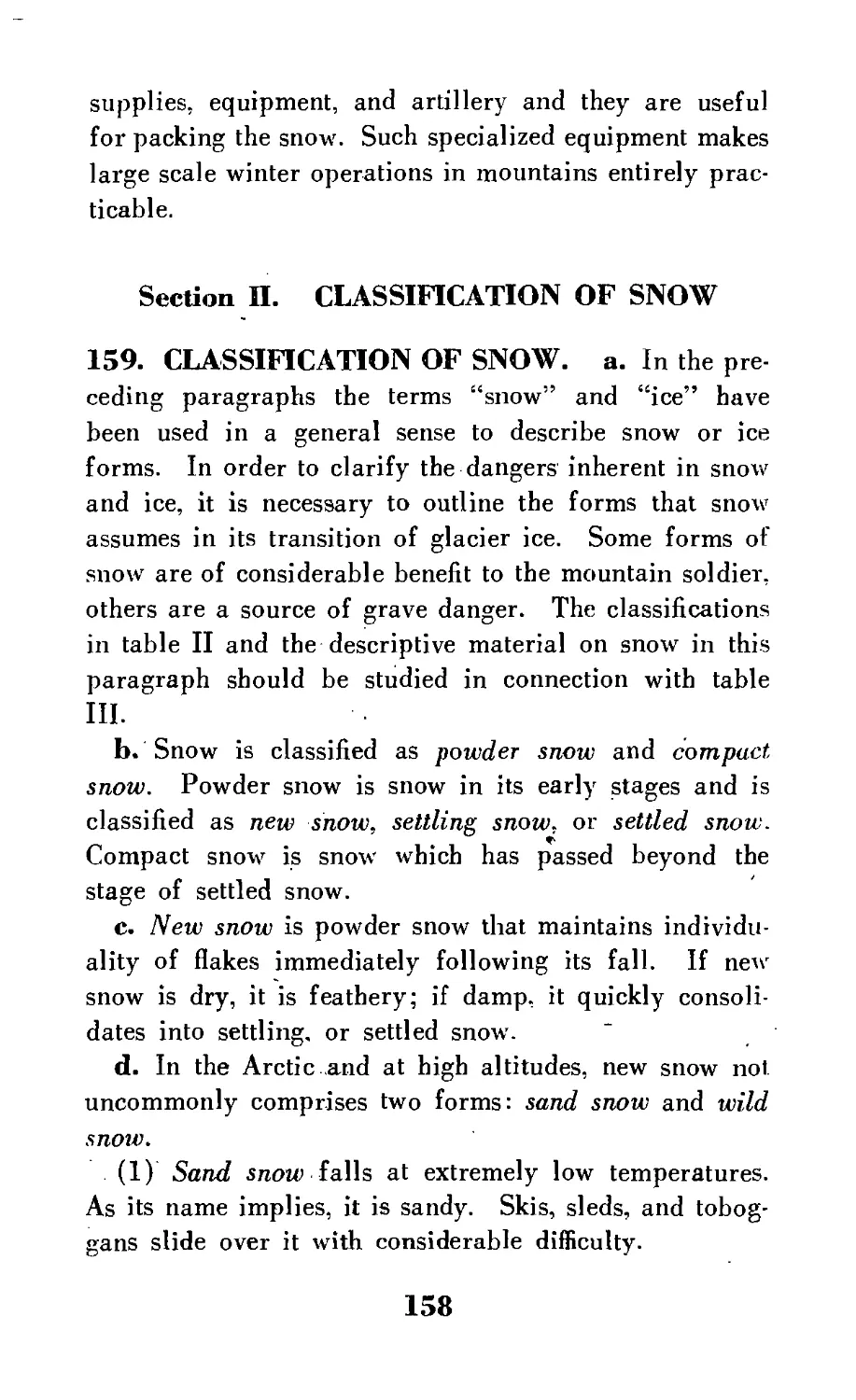



Tags: weapons military affairs
Year: 1944


Text
                    гй 7/M
WAR
DEPARTMENT FIELD MANUAL
MOUNTAIN
OPERATIONS
WAR DEPARTMENT
DECEMBER 1944
war department field manual
FM 70-10
MOUNTAIN
OPERATIONS
WAR DEPARTMENT • DECEMBER 1944
United States Government Printing Office
Washington: 1944
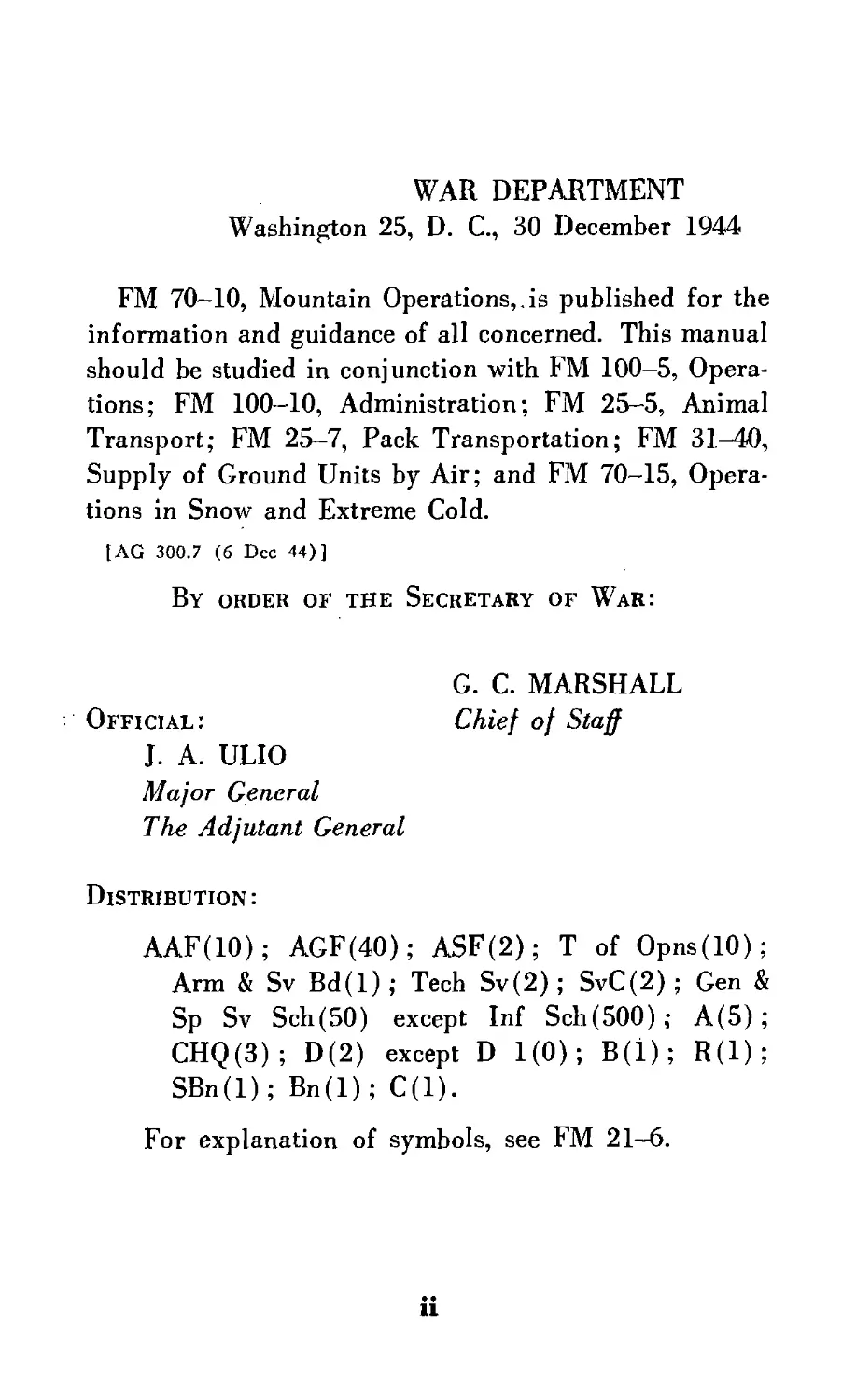
WAR DEPARTMENT
Washington 25, D. C., 30 December 1944
FM 70-10, Mountain Operations,.is published for the
information and guidance of all concerned. This manual
should be studied in conjunction with FM 100-5, Opera-
tions; FM 100-10, Administration; FM 25—5, Animal
Transport; FM 25-7, Pack Transportation; FM 31-40,
Supply of Ground Units by Air; and FM 70-15, Opera-
tions in Snow and Extreme Cold.
[AG 300.7 (6 Dec 44)]
By order of the Secretary of War:
G. C. MARSHALL
Official:	Chief of Staff
J. A. ULIO
Major General
The Adjutant General
Distribution:
AAF(10); AGF(40); ASF(2); T of Opns(10);
Arm & Sv Bd(l); Tech Sv(2); SvC(2); Gen &
Sp Sv Sch(50) except Inf Sch(500); A(5);
CHQ(3); D(2) except D 1(0); B(l); R(l);
SBn(l); Bn(l); C(l).
For explanation of symbols, see FM 21—6.
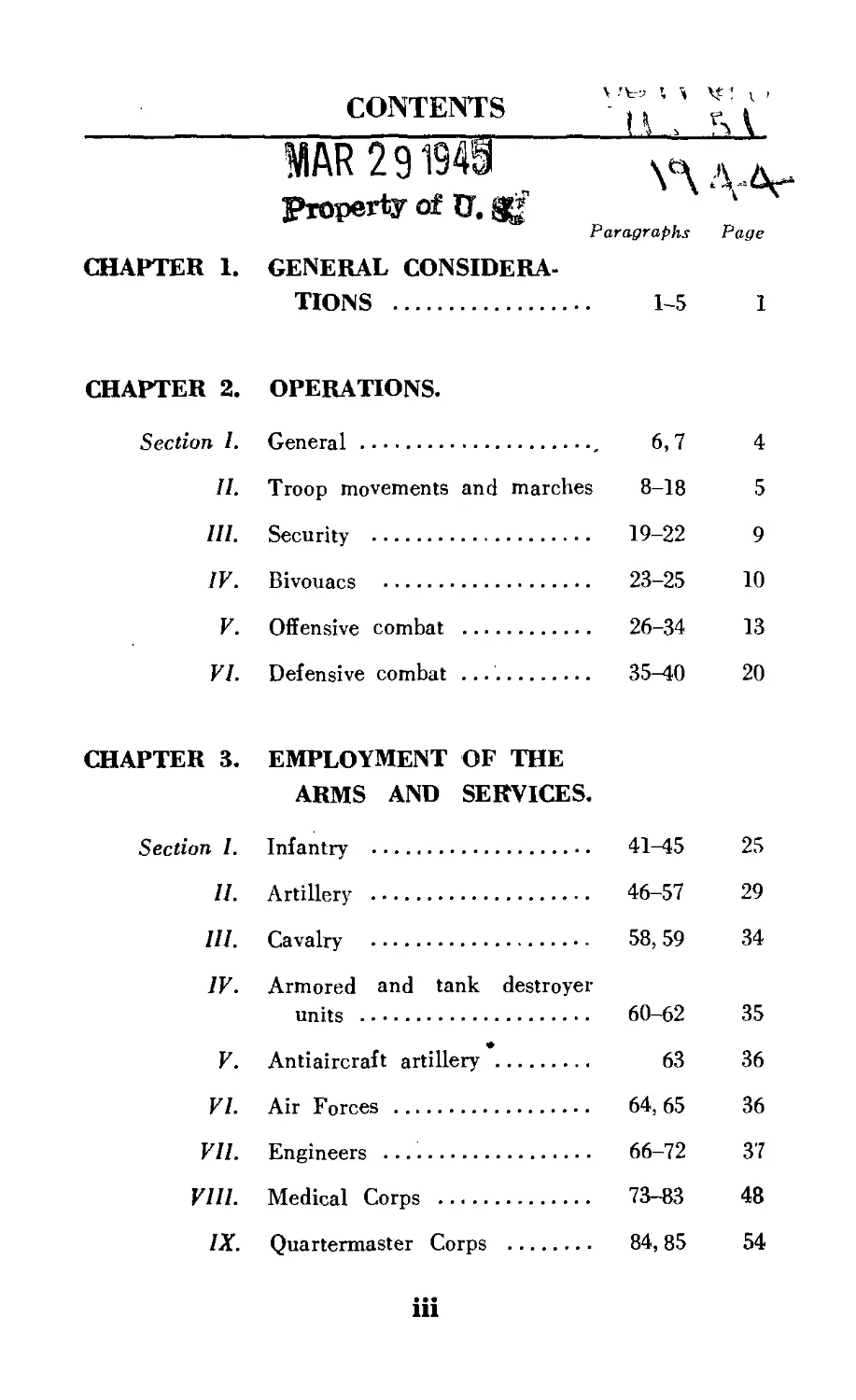
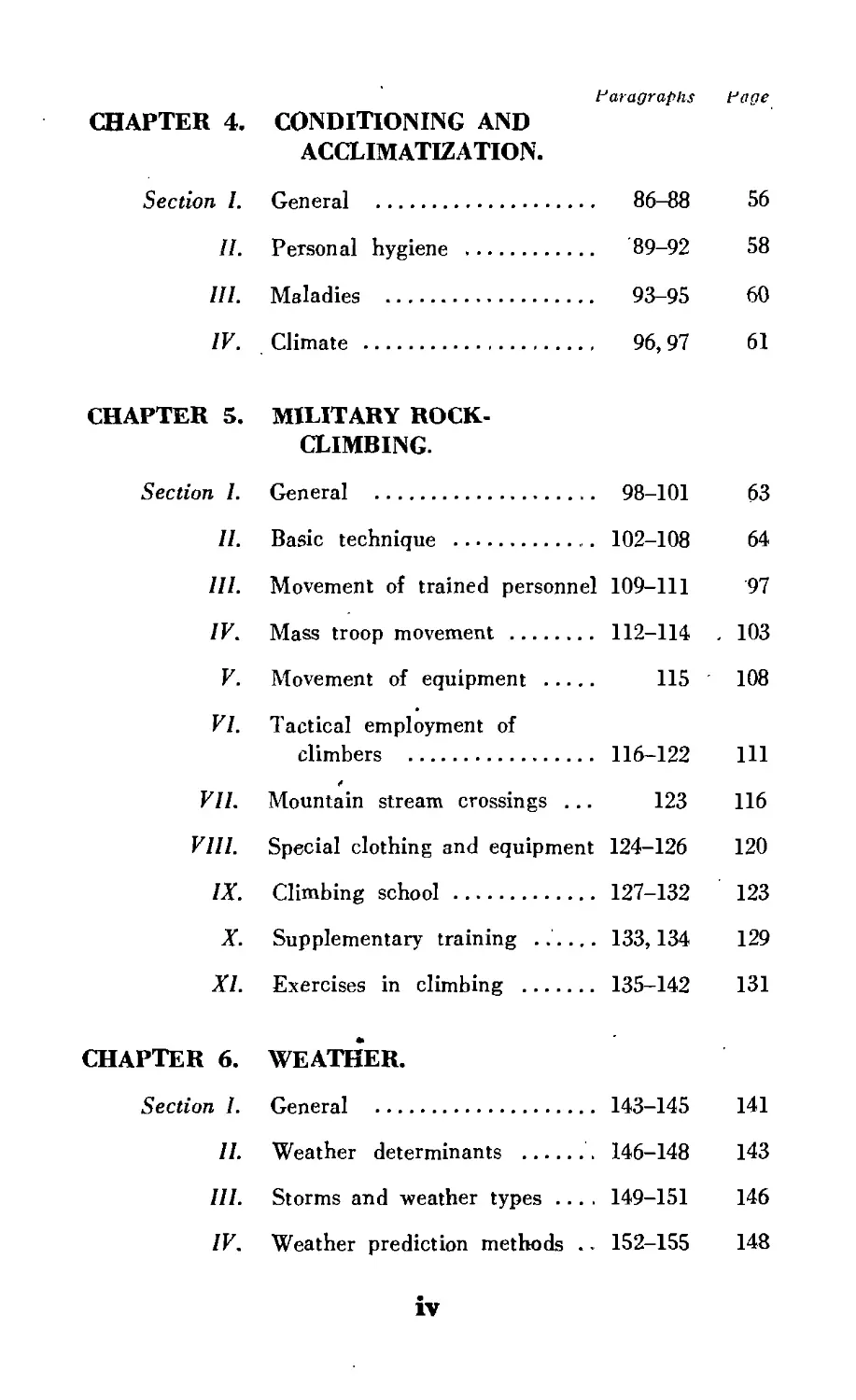
	CONTENTS	'	T, 4	: к A \
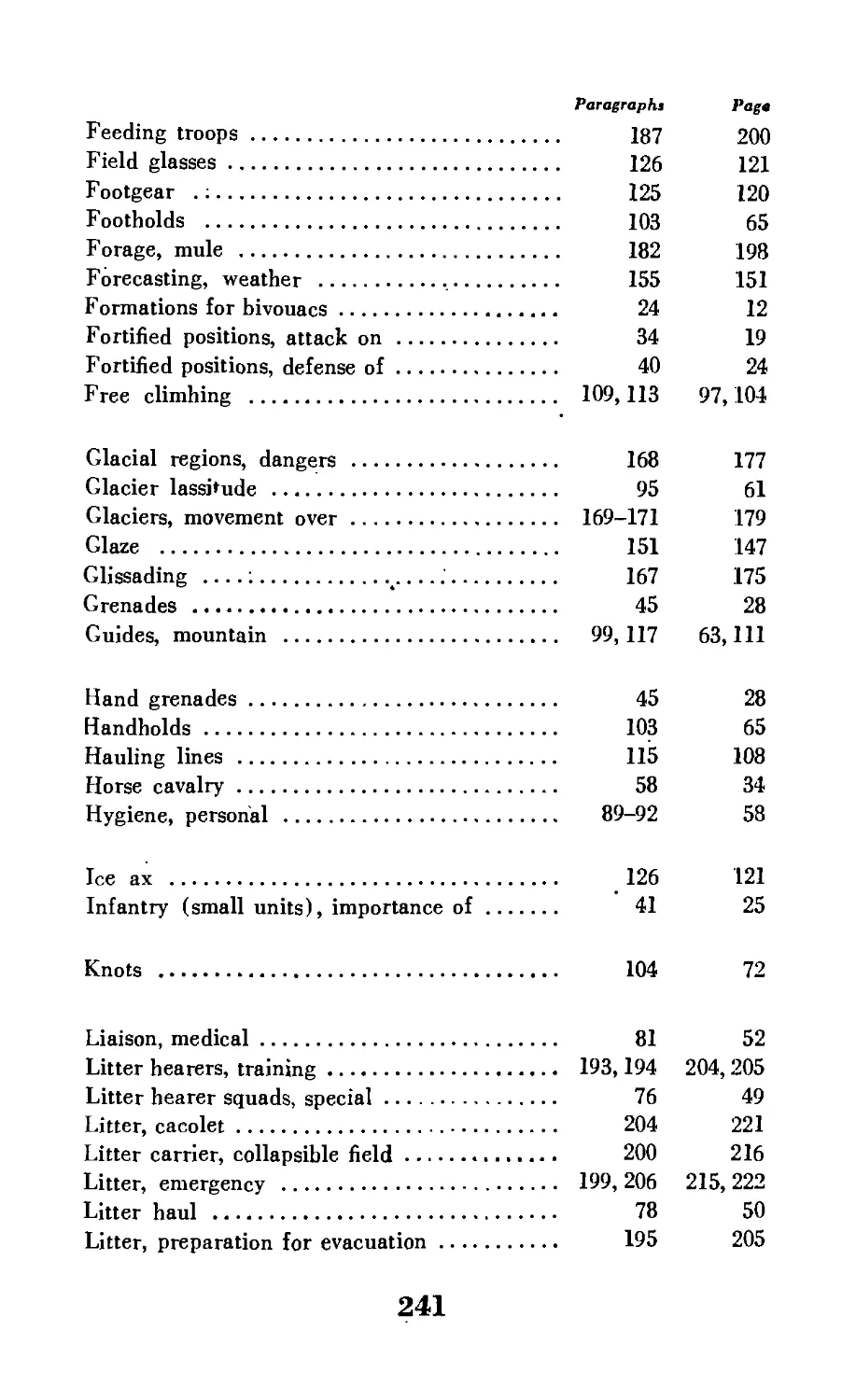
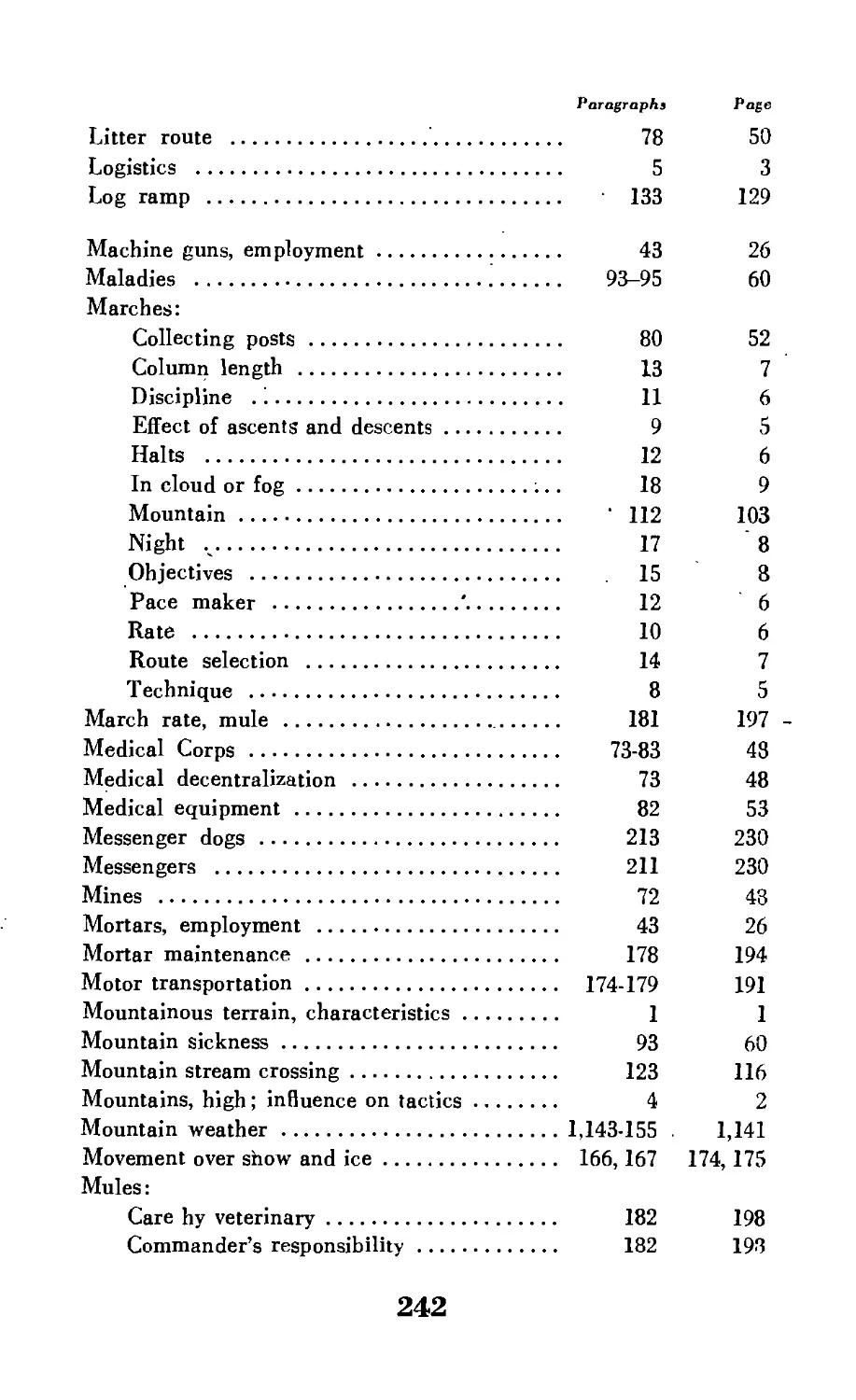
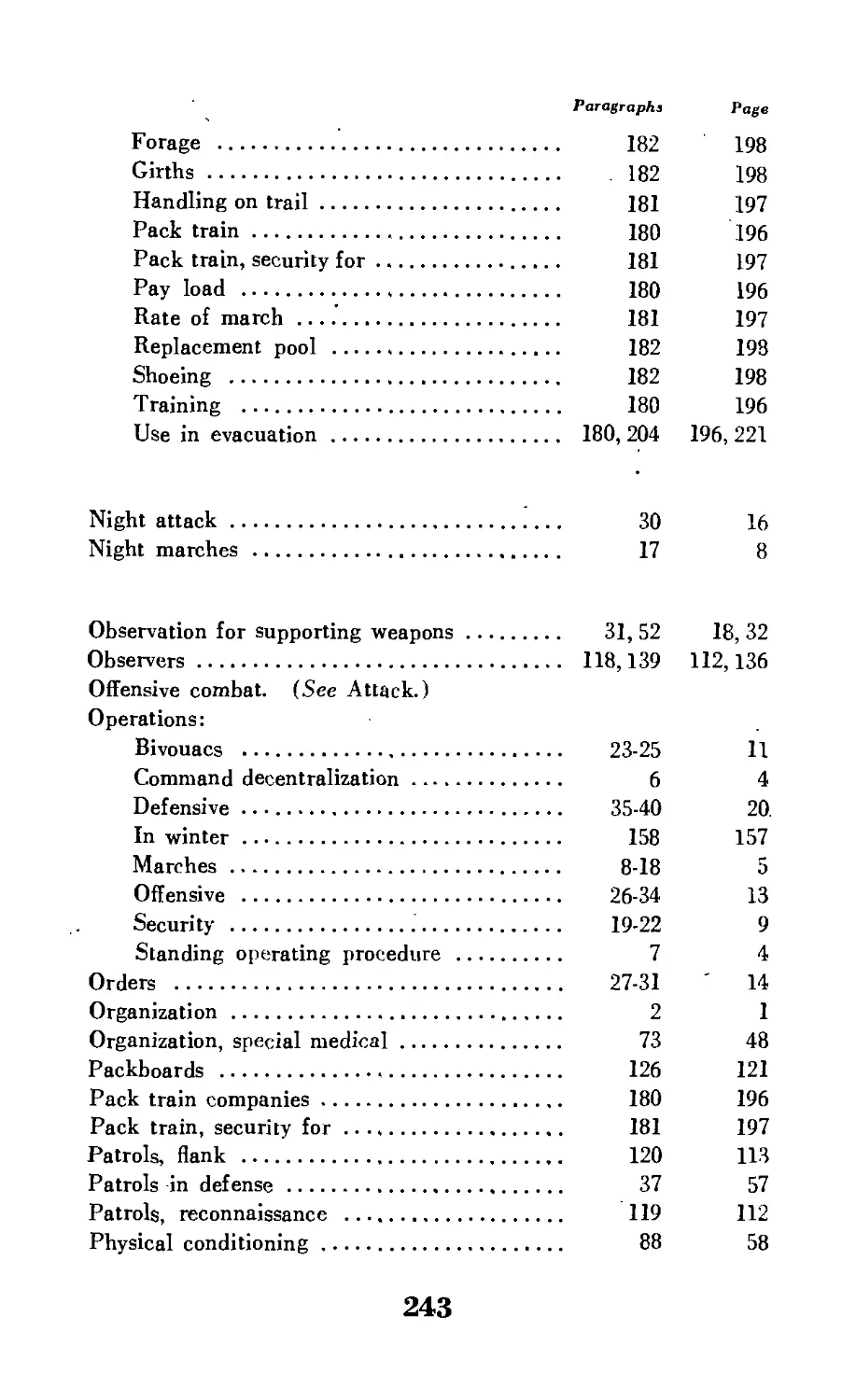
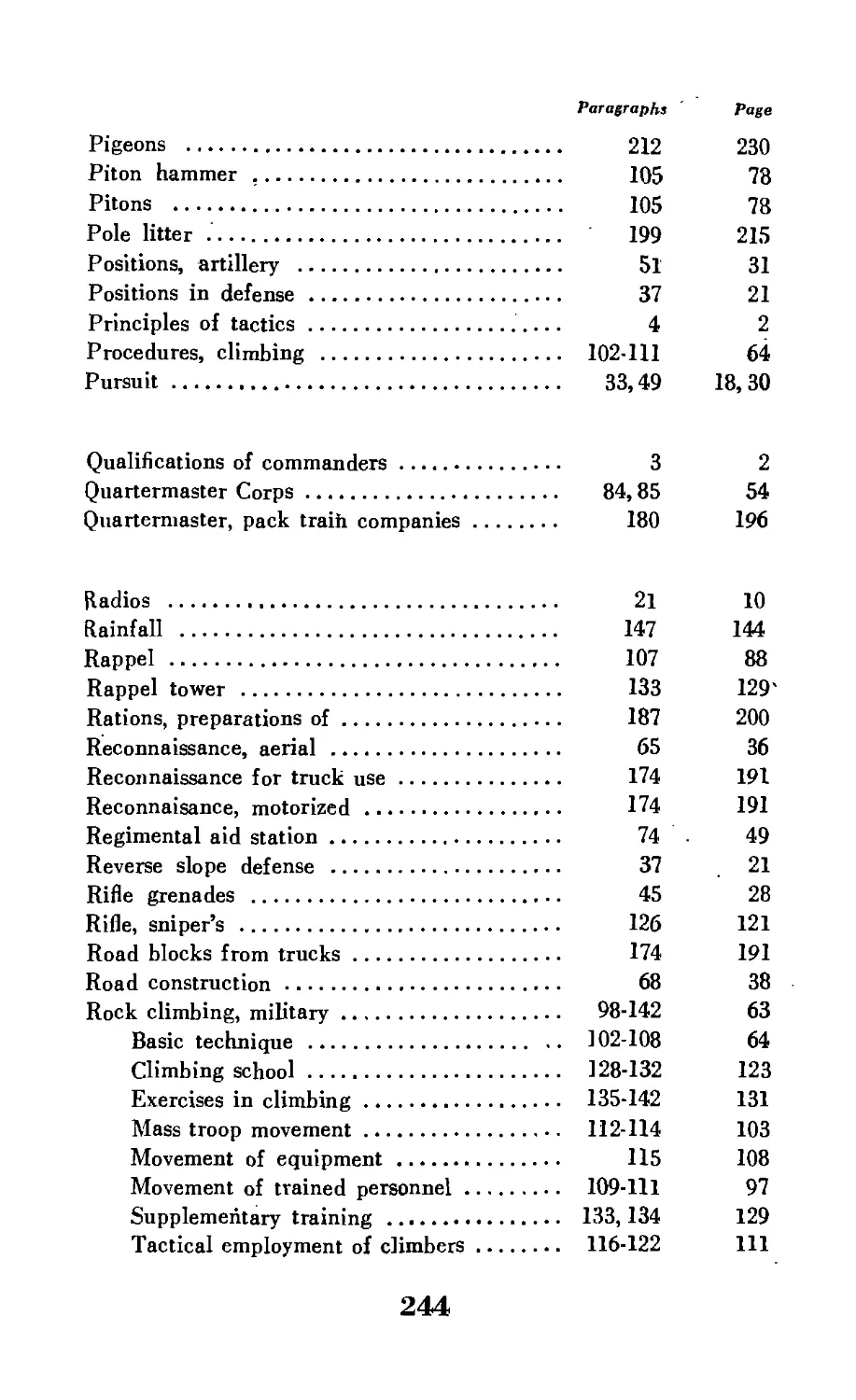
CHAPTER 1.	MAR 291943 Property of u. (gf Paragraphs GENERAL CONSIDERA- TIONS 	 1-5		Page 1
CHAPTER 2.	OPERATIONS.
Section I.	General 	,	6,7	4
II.	Troop movements and marches	8-18	5
III.	Security 		19-22	9
IV.		23 25	10
V.	Offensive combat 		26-34	13
VI.	Defensive combat 			35-40	20
CHAPTER 3.	EMPLOYMENT OF THE ARMS AND SERVICES.
Section I.	Infantry 		41—45	25
II.	Artillery 		46-57	29
III.	Cavalry 		58,59	34
IV.	Armored and tank destroyer units 		60-62	35
V.	Antiaircraft artillery 		63	36
VI.	Air Forces 		64, 65	36
VII.	Engineers 		66-72	37
VIII.	Medical Corps 		73-83	48
IX.	Quartermaster Corps 		84, 85	54
iii
Paragraphs Page
CHAPTER 4.	CONDITIONING AND ACCLIMATIZATION.
Section 1.	General 		86-88	56
II.	Personal hygiene 		89-92	58
III.	Maladies 		93-95	60
IV.	Climate 		96, 97	61
CHAPTER 5.	MILITARY ROCK- CLIMBING.
Section 1.	General 		98-101	63
II.	Basic technique 			102-108	64
III.	Movement of trained personnel	109-111	97
IV.	Mass troop movement 		112-114	. 103
V.	Movement of equipment 		115	108
VI.	Tactical employment of climbers 		116-122	111
VII.	Mountain stream crossings ...	123	116
VIII.	Special clothing and equipment	124-126	120
IX.	Climbing school 		127-132	123
X.	Supplementary training ......	133,134	129
XI.	Exercises in climbing 		135-142	131
CHAPTER 6.	WEATHER.
Section I.	General 		143-145	141
II.	Weather determinants 			146-148	143
III.	Storms and weather types ....	149-151	146
IV.	Weather prediction methods . -	152-155	148
IV
Paragraphs Page
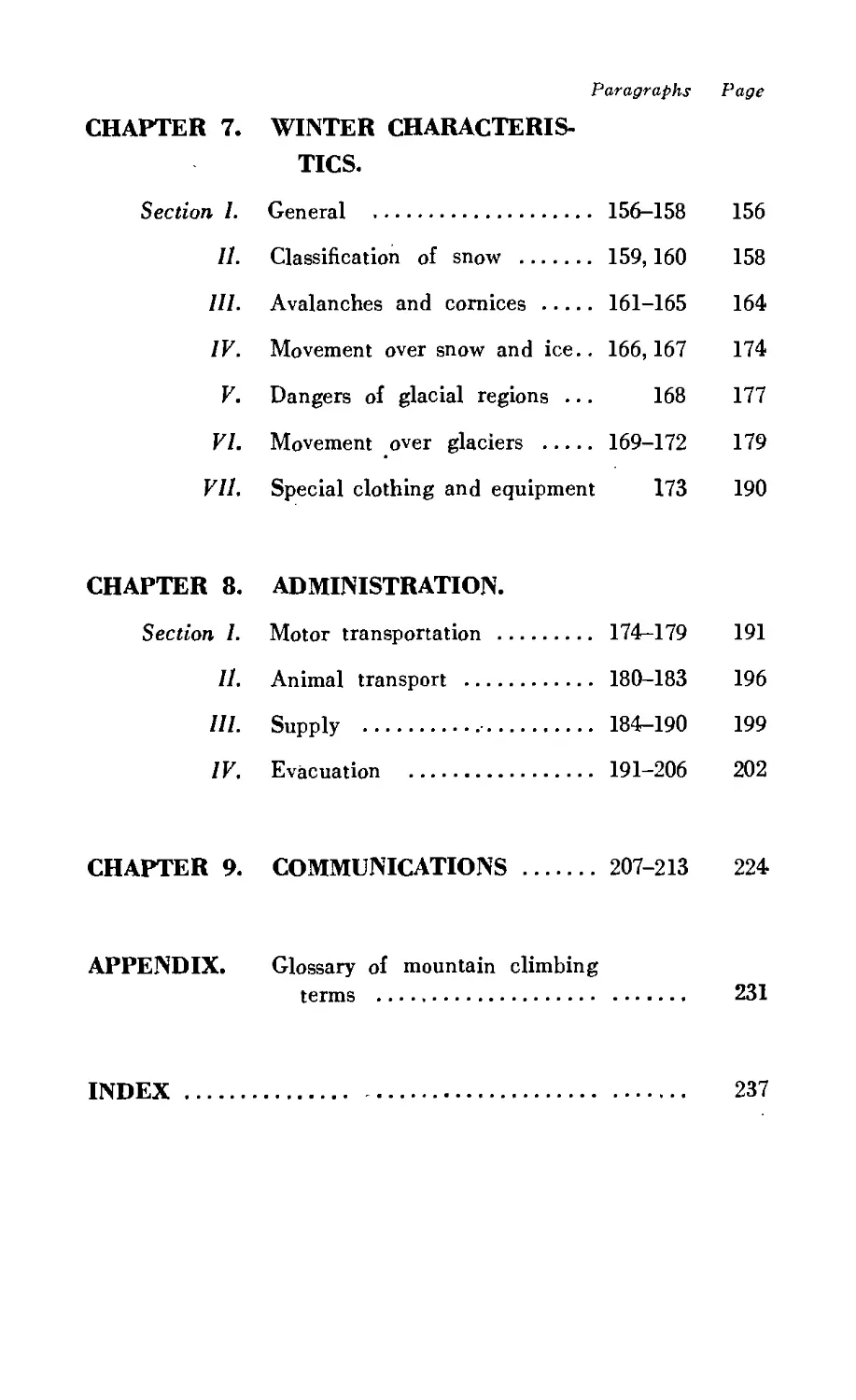
CHAPTER 7. WINTER CHARACTERIS-
TICS.
Section I.	General .................. 156-158	156
II.	Classification of snow ... 159,160	158
III.	Avalanches and cornices	... 161-165	164
IV.	Movement over snow and	ice..	166,167	174
V.	Dangers of glacial regions	...	168	177
VI.	Movement over glaciers	..... 169-172	179
VII.	Special clothing and equipment	173	190
CHAPTER 8.	ADMINISTRATION.
Section I.	Motor transportation ..... 174-179	191
II.	Animal transport .......... 180-183	196
III.	Supply ...................  184-190	199
IV.	Evacuation ................. 191-206	202
CHAPTER 9.	COMMUNICATIONS ............ 207-213	224
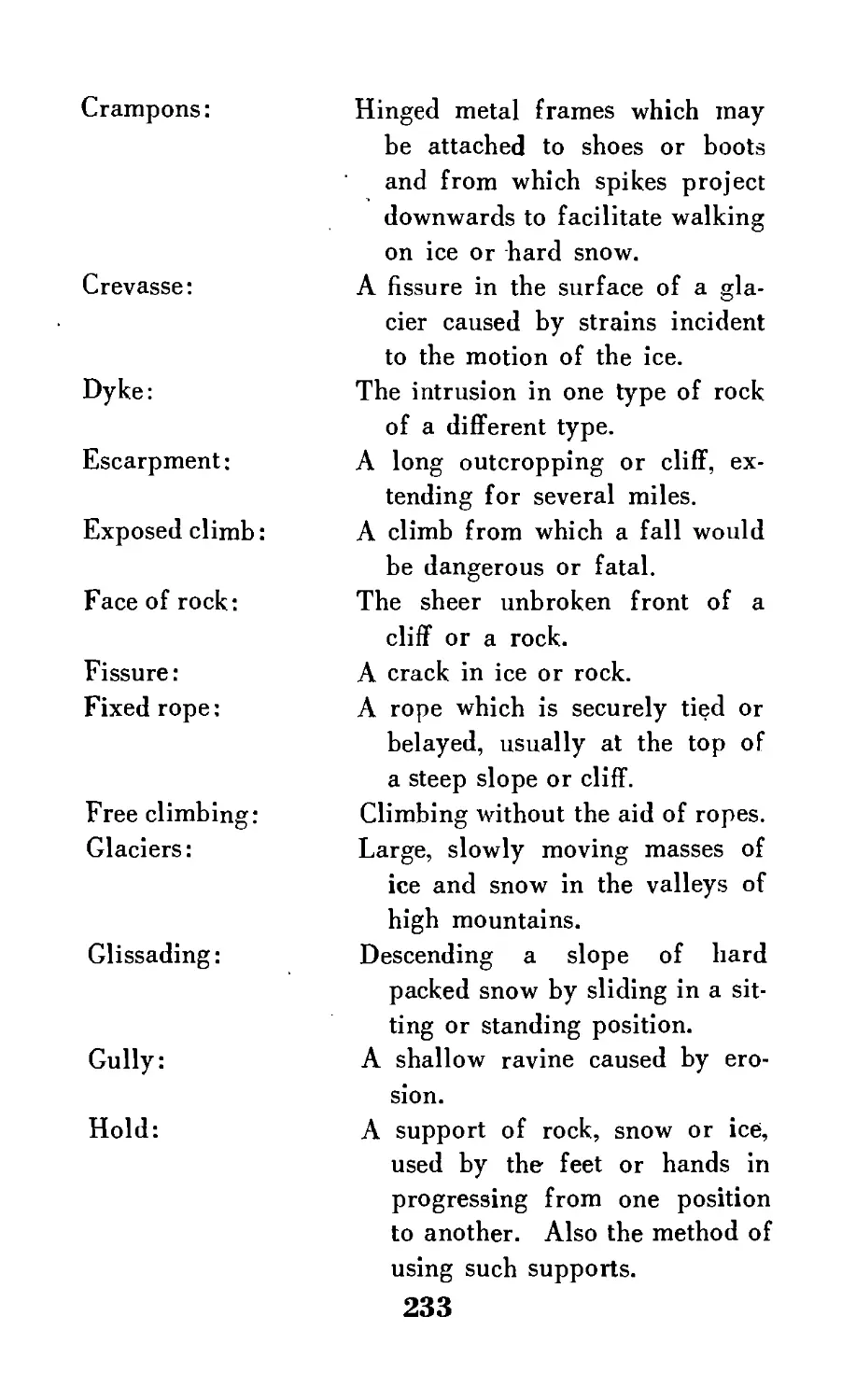
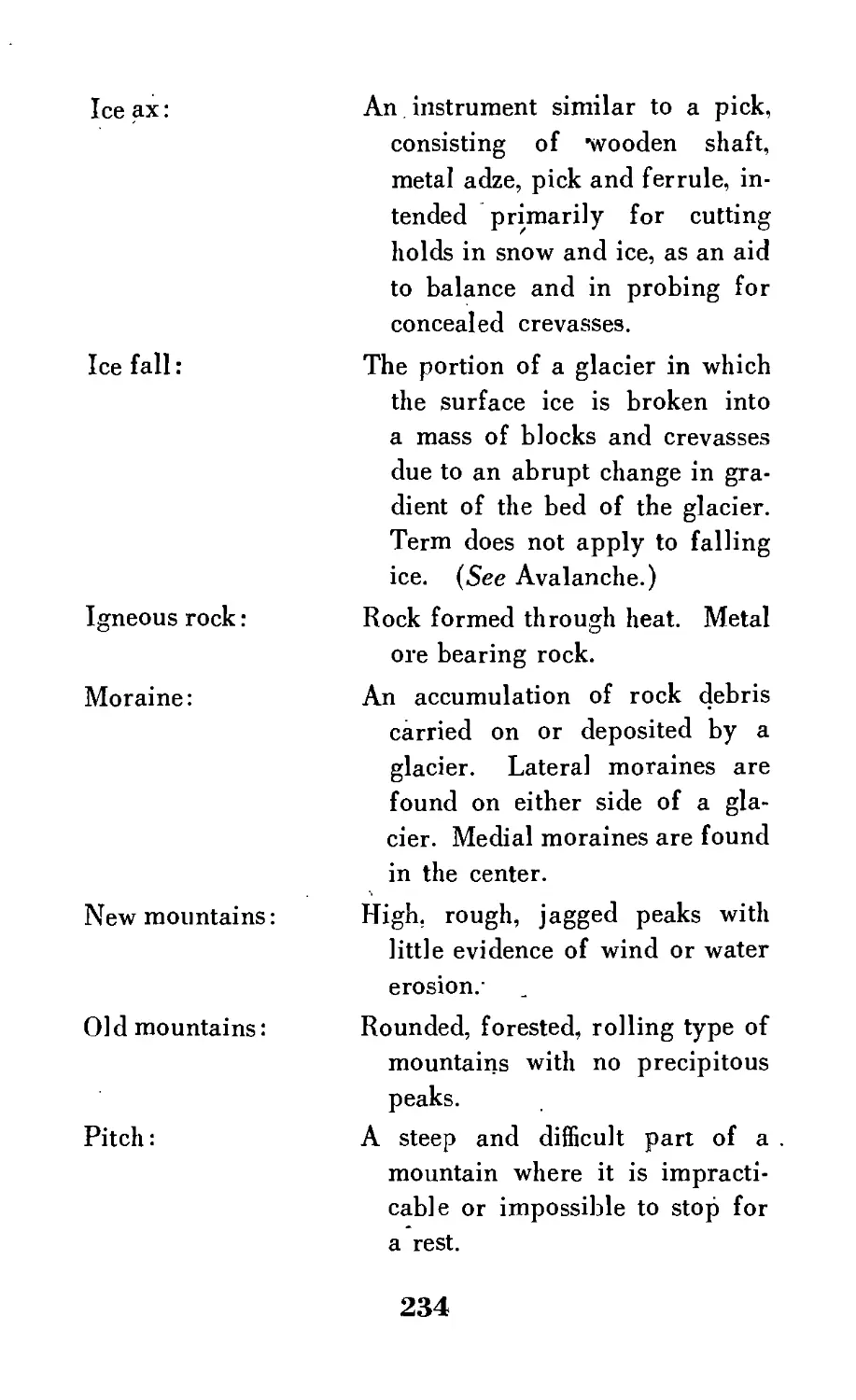
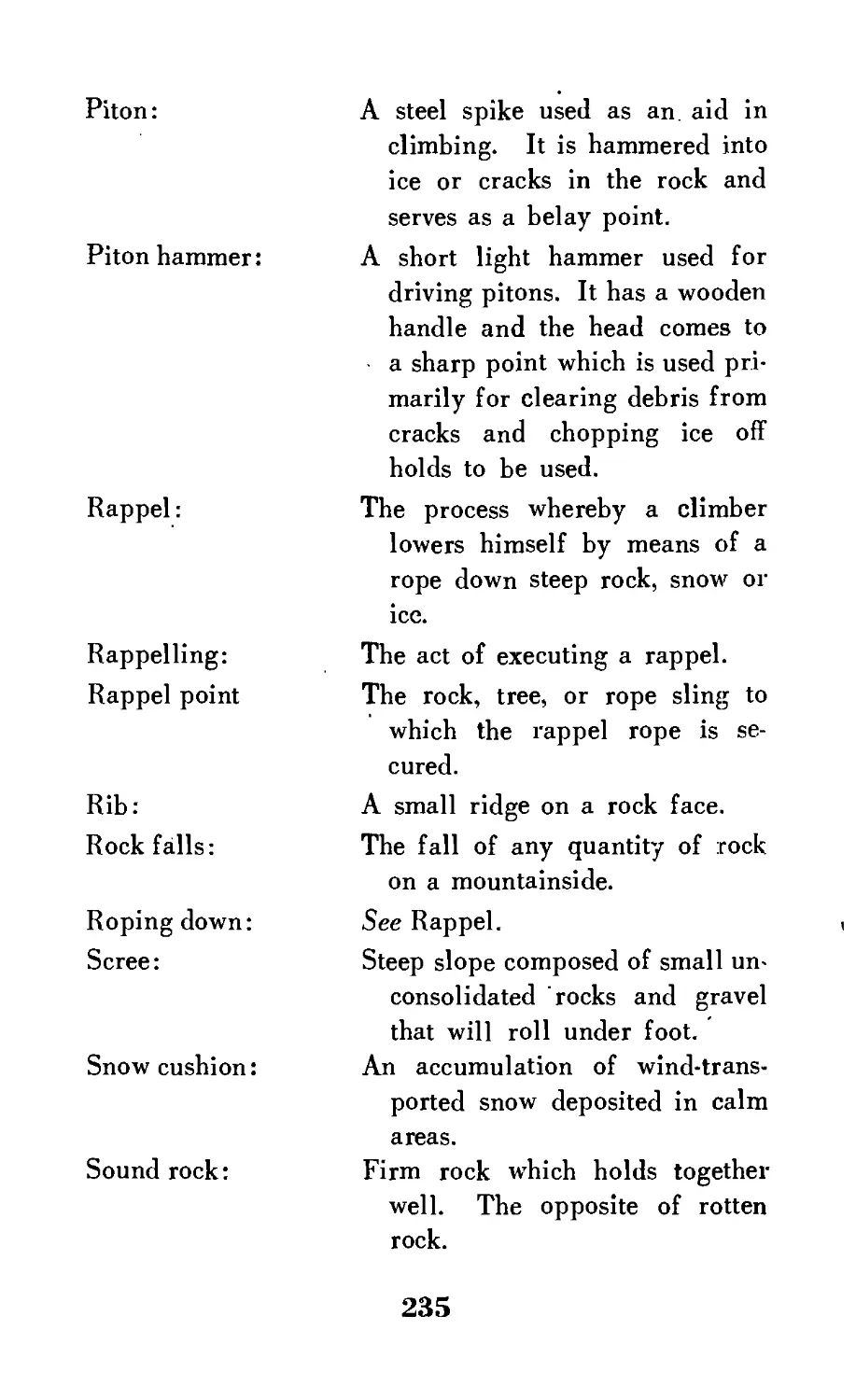
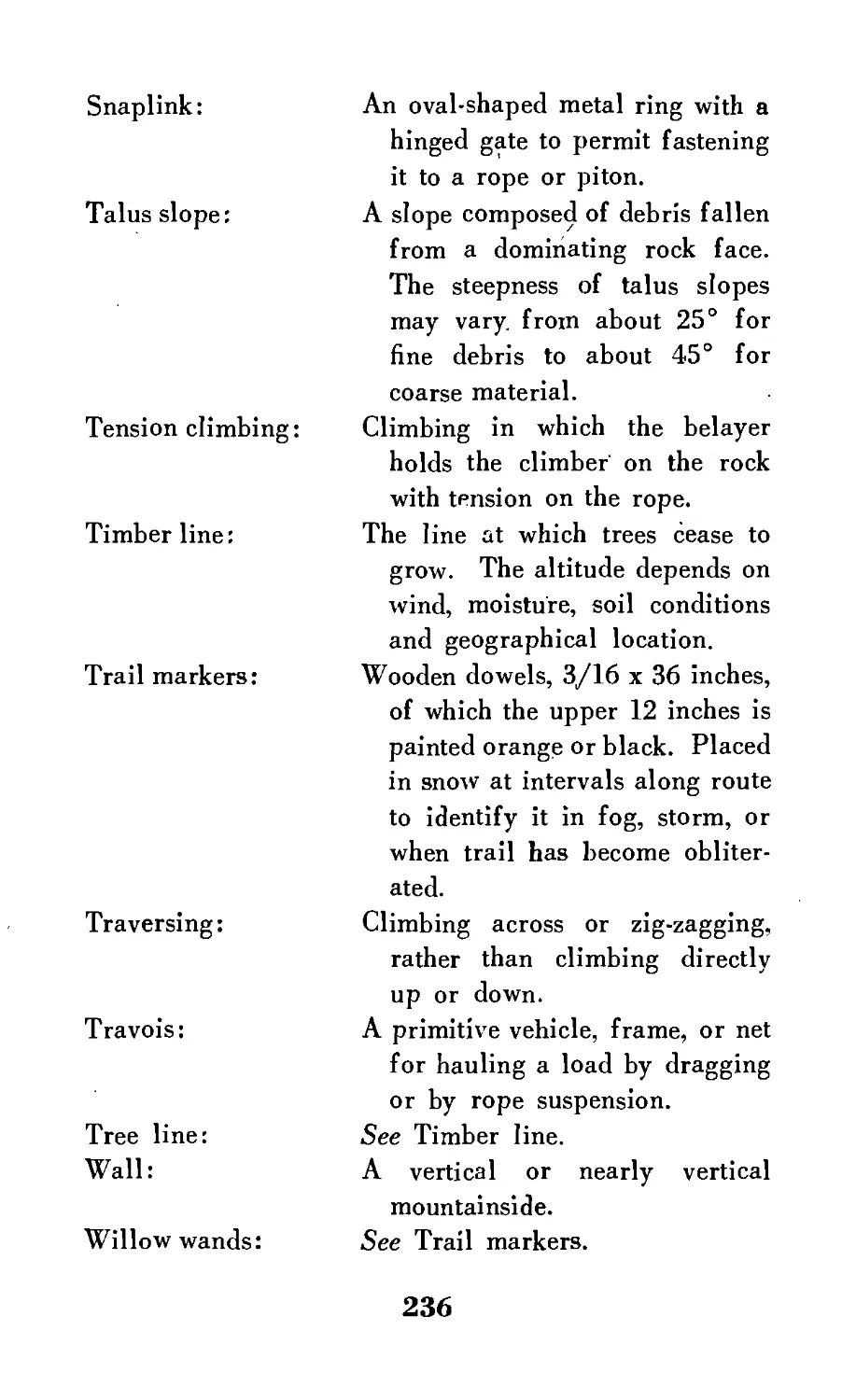
APPENDIX. Glossary of mountain climbing
terms ........................................... 231
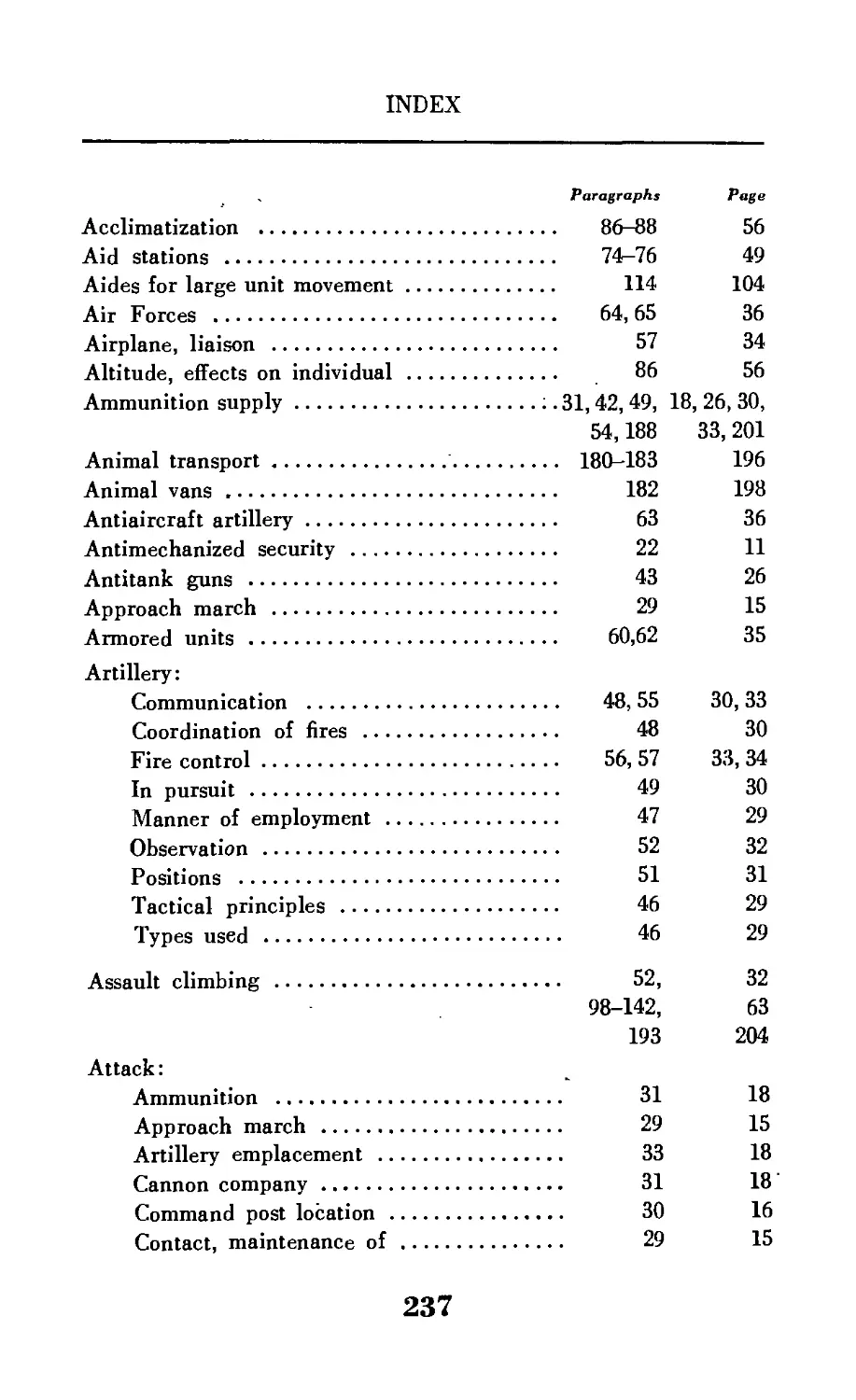
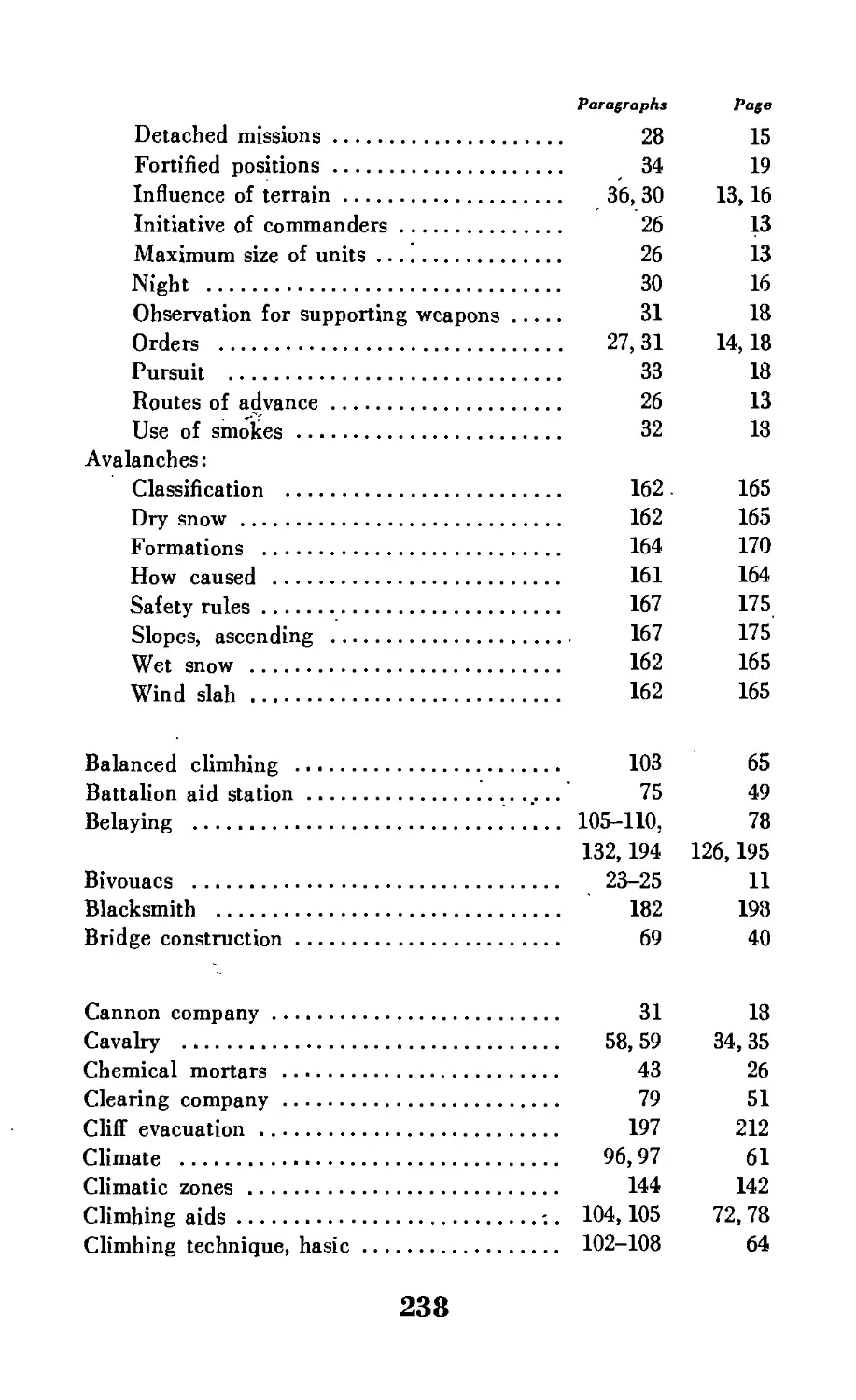
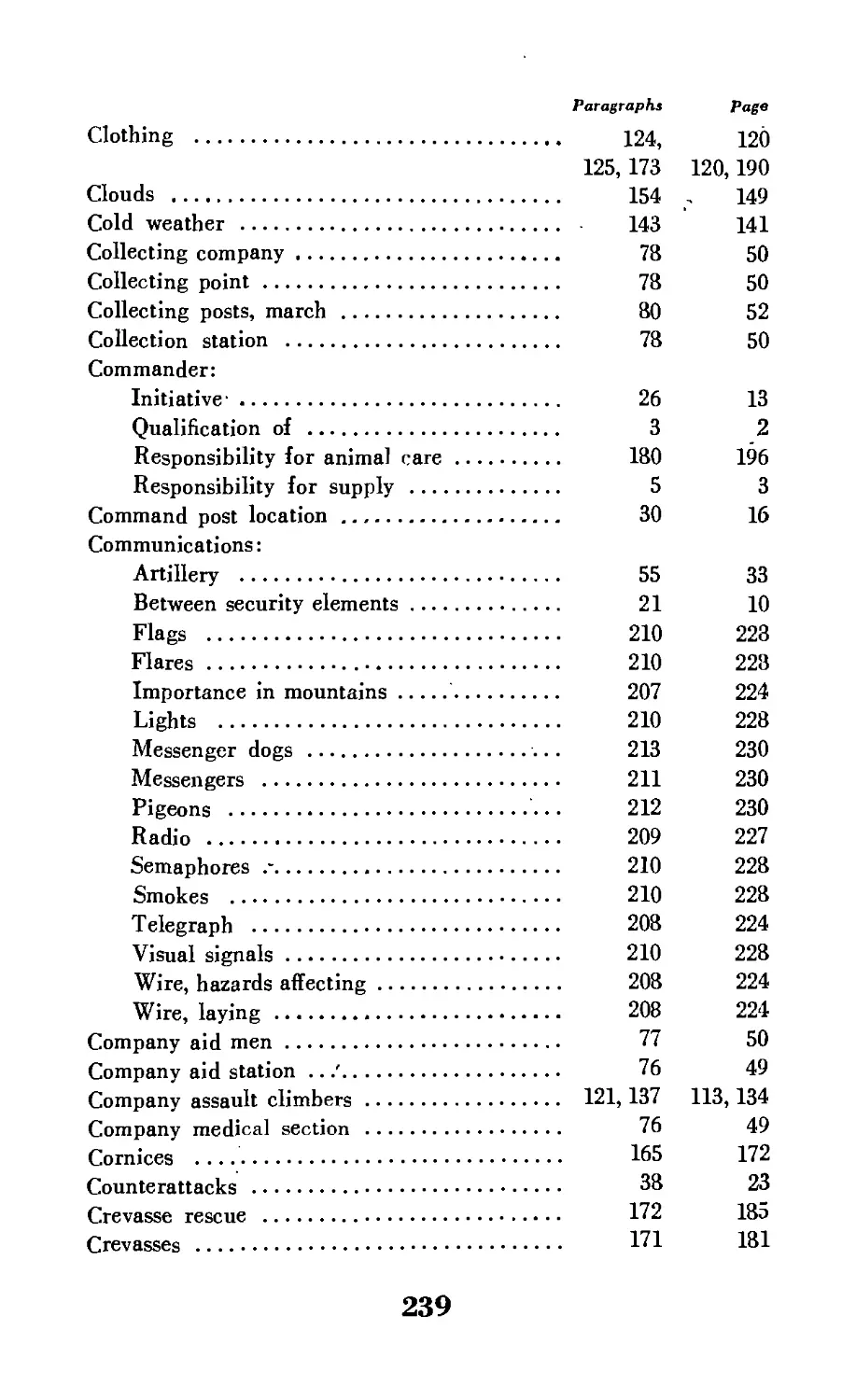
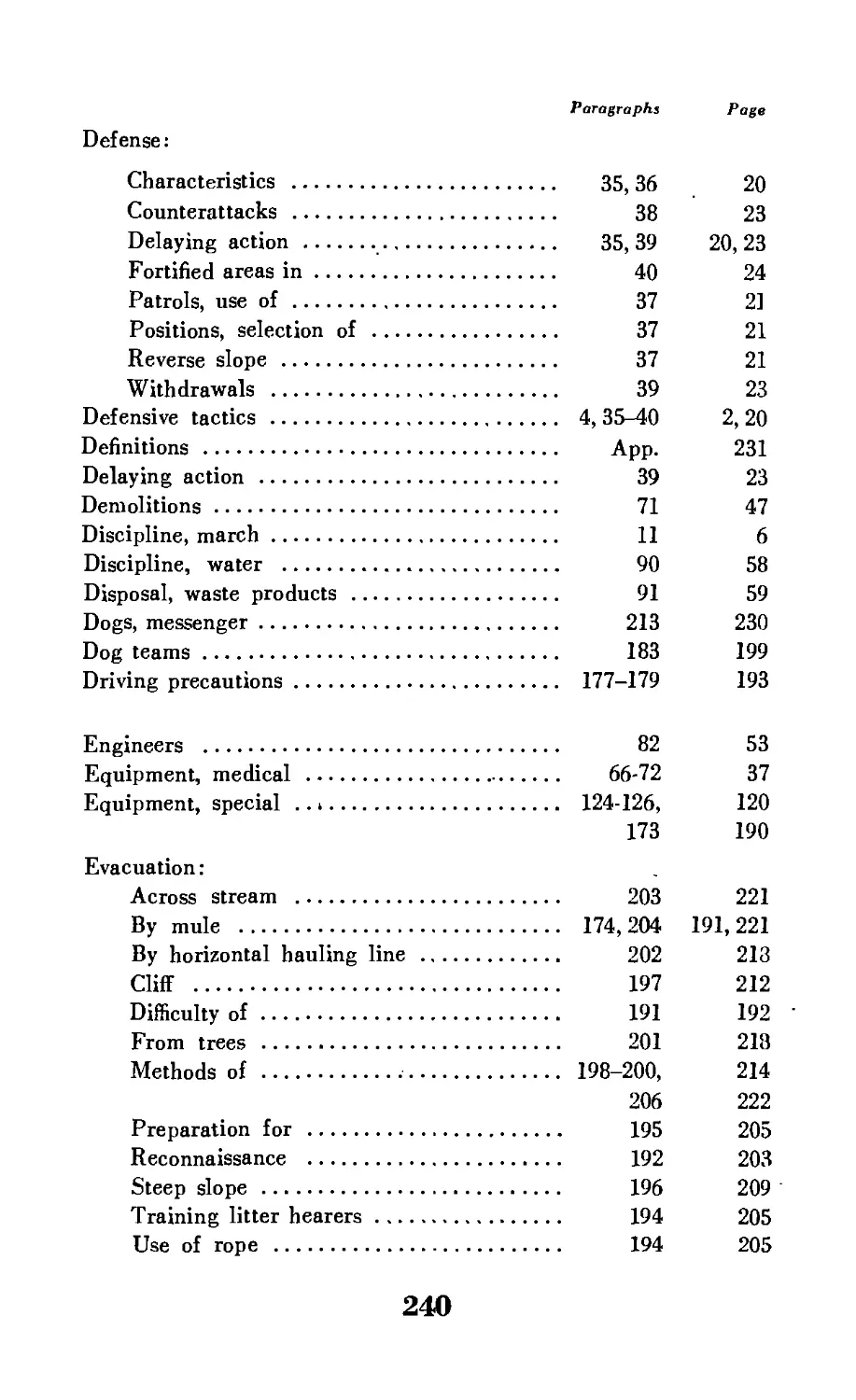
INDEX ............................................ 237
CHAPTER 1
GENERAL CONSIDERATIONS
1.	GENERAL, a. Terrain and weather are important
factors in the conduct of mountain operations.
b.	Mountainous terrain is usually characterized by
one or more of the following: exaggerated terrain fea-
tures, heavy woods or jungle, rocky crags and glaciated
peaks, compartmentation, routes of communication which
are limited in extent and of poor quality, extreme
weather conditions, or high altitudes. For terrain evalu-
ation, see FM 5—15 and 100-5.
c.	Mountain weather is characterized both in summer
and winter by inclemency, or by large temperature differ-
ences between day and night, and by sudden and local-
ized atmospheric disturbances such as violent rain and
snowstorms.
2.	ORGANIZATION, a. The organization of the
standard infantry division is suitable for operations in
low mountain terrain. Only minor modifications will be
required to fit' a specific situation. These usually take
the form of addition of pack transportation and elimina-
tion of vehicles and weapons not suitable for the terrain.
Complete reorganization and specialized technical train-
For military terms not defined in this manual, see TM 20—205.
1
ing, as well as the use of special clothing and equipment,
will be required for operations in alpine terrain.
b. Tactical units may be organized especially to fit
the different terrain compartments.
3.	COMMAND, a. Decentralization of command is
characteristic of mountain operations. All the combat
troops, equipment, and services in a terrain compartment
are placed under a single unified command.
b. Since the various echelons of the command are
often isolated by the configuration of the terrain, by
difficulties of communication, and by weather conditions,
commanders of subordinate units must often assume
more responsibility than in other terrain. All com-
manders must possess, to a high degree, character and
initiative. Combat in high mountains demands great
detail in planning and preparation.
4.	TACTICS. The same tactical principles govern
warfare in mountainous terrain as on any other terrain.
a.	In rugged mountains there are definite limits to
the employment of large forces. Deployment is greatly
hindered and restricted. Often adjacent units cannot
provide mutual support. Rapid employment and shift-
ing of reserve are difficult in the more restricted positions.
Small units have many occasions for sudden and bold
action. Opportunities to deceive the enemy are many.
b.	Small forces of mountain troops can prevent, im-
pede, harass, or canalize the movements of the main
enemy force so that when the decisive battle takes place
his troops are dissipated and he is compelled to fight
under unfavorable conditions.
c.	Soldiers must be prepared to advance over narrow
and twisting roads and paths, trackless terrain, steep
and slippery slopes, ravines, and precipices.
2-
d.	Relatively unimportant roles are played in moun-
tain warfare by the tank. The employment of heavy
infantry weapons and artillery is hampered by their bulk
and weight, by the considerable dead space in their fields
of fire; and by the difficulties of observation due to bad
weather and intervening terrain features. It is the infan-
try, above all, that must bear the brunt of the battle.
The importance of close combat increases as the efficiency
of other methods of fighting decreases.
e.	The focal points of mountain combat are the
heights. Gun emplacements and observation posts on
commanding heights can dominate the foreground. Ad-
vances are made along ridges, rather than through the
natural avenues of approach.
5.	LOGISTICS. a. Logistical considerations are
greatly affected in mountain operations. Time and space
factors are never fixed, but vary constantly with the
configuration of the terrain, the altitude, the scarcity of
roads, the season, and a number of other more routine
considerations. In general, a comparatively great
amount of time must be allowed for the movement of
troops and supplies. Distance is measured in time rather
than space. (See also FM 72-20.) Vertical distance
between points is often greater than the horizontal dis-
tance.
b. The commanding officer must issue orders, frag-
mentary if necessary, to his subordinates early in the
operations because of the time needed for movement of
troops and supplies along the small number of steep and
difficult routes, arid because of the unavoidable delays in
bringing troops into position, in modifying their posi-
tions, and in organizing supply functions.
3
CHAPTER 2
OPERATIONS
Section I. GENERAL
6.	GENERAL. Mountain terrain lends itself particu-
larly well to surprise, but successful surprise action
depends on mountain trained soldiers and a commander
who knows how to use them. Decentralization of control
is forced upon commanders of large units by prevailing
terrain and weather conditions. Hence, the initiative,
resourcefulness and judgment of small unit commanders
is taxed to the utmost, as they will be operating inde-
pendently or semi-independently for extended periods of
time.
7.	STANDING OPERATING PROCEDURE. In
order to facilitate mountain operations, a detailed stand-
ing operating procedure should be prepared by each unit,
including the platoon. This standing operating pro-
cedure should cover the organization of combat teams
down to and including the battalion, a normal procedure
for supply, making bivouacs and emergency shelters,
march rates and march formations, and any changes in
organization and equipment required for both summer
and winter operations.
4
Section II. TROOP MOVEMENTS AND
MARCHES
8.	MARCH TECHNIQUE. Troops that have acquired
the proper technique for marching in mountains are
capable of marching many times the distance than can
be covered by troops not so trained. The prime con-
sideration is to conserve the soldier’s strength and com-
bat , efficiency. The individual soldier must acquire a
steady rhythmic pace, decreasing in speed with the steep-
ness of the slope. In addition to the effect of the
terrain, the rate of march is further reduced by wind,
rain, intense heat, and fog. When climbing, the length
of the regular pace should be maintained, stepping
around rather than over obstacles, and keeping the feet
flat. Use of the balls of the feet alone should be
avoided. The knees should be slightly bent, and foot-
holds selected carefully. When traversing steep slopes
on soft ground it is desirable to kick footholds and to
take advantage of natural flat hummocks. When trav-
ersing steep slopes on hard ground, the feet should be
flat, rolling the ankle with the slope. Logs, sticks, or
small rocks should not be stepped on. When ascending
steep slopes the rate may vary from 40 to 85 steps per
minute, depending principally on the altitude. Over
uneven or difficult footing, a 5 foot distance between
men allows the soldier to adjust the length of his stride
and to keep moving without being forced to halt by
the varying speed of the man ahead.
9.	EFFECTS OF MARCHING. Improper pace or ca-
dence in marching uphill may result in serious injury
to the heart and respiratory organs. Descending pro-
5
duces continuing jars, the severity of which are in-
creased by the weight of a pack, resulting in strain
on the legs, pelvis, and spinal column. Climbing tires
the heart and lungs; descending causes great muscular
fatigue.
10.	RATE OF MARCH. The rate of march may sel-
dom be calculated exactly. To estimate the time required
to cover a given distance, add to the time required for
marching the map distance 1 hour per each 1,000 feet
ascent or 1,500 feet descent. For example, a 10-mile
march on a hard surfaced road required 4 hours. If
there is a total climb of 2,000 feet and a total descent
of 1,500 feet, the march will take 7 hours. Messengers,
and those required to move rapidly, may make excep-
tional speed by running down hill.
11.	MARCH DISCIPLINE. March discipline must be
rigorously enforced in every aspect. If a man is forced,
to stop to repair or readjust equipment or because of
illness or an injury, he should immediately fall out of the
column, and should not try to regain his place until the
next halt. All commanders must give continuous atten-
tion to keeping marching formations closed to proper
intervals. Ordinarily this can only be accomplished at
halts.. Stragglers must not be tolerated and the taking
of short cuts should be forbidden.
12.	PACE MAKING AND HALTS. The march unit
should be the company, rather than the battalion. An
experienced noncommissioned officer, carrying the same
load as the majority of the men, and marching at the
head of each company, maintains the pace ordered by
6
the march unit commander. The pace o£ the column
must be governed by the most heavily loaded element,
such as the heavy weapons company. It is advisable
to make a 5-minute halt to adjust clothing and equipment
after the first 15 minutes of marching, and the usual
10-minute halt after the first 50 minutes. At the regular
halts men should remove their packs and weapons. Lying
down with the feet elevated will help to freshen the legs
and prevent stiffness. Troops should be trained to clear
the trail immediately at all halts to allow messengers
to move along the column.
13.	COLUMN LENGTH. When a narrow trail neces-
sitates marching in single file, the length of an infantry
battalion may approximate 4 miles. The difference in
elevation between head and tail may be over 3,000 feet.
On a winding ascent, the trail distance between the point
and the main body may be 2,000 yards, although the
cross-country distance may be only a few yards. Under
such conditions, the main body may be closer to the
enemy than the point and may be fired upon at the same
time as the point, or even before the point is engaged.
14.	SELECTION OF ROUTES, a. Reconnaissance
of routes of march should be made and the route selected
on the basis of ease in marching as well as tactical secu-
rity. Factors governing the choice are availability of
ridge routes, good footing, contour travel, timber lines,
and geological formations such as ledges. Primitive
trails are usually found along ridges. Highways usually
follow the valleys. Movement down a valley, without
security on the high ground, invites ambush. Movement
on the crest of a ridge, where some of the best trails are
7
found, invites observed artillery fire. In an uncovered
march, a unit should march below the crest of the ridge
with flank security below both military crests observing
the valleys.
b. Timing and planning are important in order 'to
avoid halts or bivouacs on exposed terrain.
15.	SELECTION OF OBJECTIVES. Because of op-
tical illusions created by clear air, looking down from
heights, and intervening depressions, time and distance
will invariably be underestimated. Particular care must
be taken to select an objective which can be reached
within the time available. The route and alternate route
to the destination should be reconnoitered in advance.
One unexpected extension of a march will often produce
undue exhaustion which, in turn, will result in a late
arrival, a poorly prepared bivouac, and inefficient secu-
rity.
16.	MOVEMENT OVER DIFFICULT TERRAIN,
a. Movement over extremely difficult terrain such as
cliffs, rocky crags, ravines, glaciers, or deep snow, re-
quire special preparation, training, technique, and equip-
ment. (See chs. 5 and 7.)
b. On steep slopes, columns of pack animals should
not be permitted to get off the trail. Foot troops should
negotiate such slopes by traversing, or ziz-zagging.
17.	NIGHT MARCHES. When contact with the en-
emy is imminent or has been gained, most of the march-
ing will be at night. Night marches in mountains are
very difficult, often dangerous, and excessively tiring, and
therefore should be attempted only when absolutely
8
required by the situation. Daylight reconnaissance and
marking of routes to be used, as well as competent
guides, are essential to the success of a night march.
Distances between men, animals, and units are decreased.
While bright moonlight makes a night march easier, it
also improves enemy observation. It is extremely diffi-
cult to move along a rocky path at night without noise.
Dislodging of a single rock may start a rockslide that
can be heard over a mile away. Hoofs of pack animals
and hobnailed shoes will create telltale sparks. When
marching through woods or areas where trails are many
and indistinct, numerous connecting files will be required
between march units in order to maintain continuous
contact. It is usually impossible for anyone to move
up and down a column on a mountain path at night to
check on distances and maintain march discipline. All
orders must be relayed backward and forward through
the column.
18.	MARCHES IN CLOUDS OR FOG. Marches in
clouds or fog present the same difficulties as night
marches. Keeping a sense of direction is more difficult,
since clouds are often so dense that one can hardly see
the ground. Such conditions necessitate even closer
columns, a slower pace, and the use of audible signals.
The crowding together of units may cause serious tactical
disadvantages when the fog or cloud lifts. Lifting of
fog may occur very quickly; when this occurs, no time
should be lost in resuming normal formations and dis-
tances.
Section 1П. SECURITY
19.	GENERAL, a. Mountain terrain offers many
vantage points for enemy observation and ambush thus
9
requiring the placing of unusual emphasis on security.
Commanding ground must be occupied immediately by
security detachments strong enough to hold it against
hostile combat or reconnaissance patrols. Enemy posi-
tions that are not readily accessible to our troops without
undue loss of time may have to be neutralized by air
attack, artillery, or infantry heavy weapons, so as not
to impede the progress of the main body.
b.	When opposed by well trained and aggressive
enemy mountain troops, no mountain ranges or terrain
obstacles can be considered as insurmountable, and everv
conceivable approach must be guarded. The nature of
the terrain and network of communications will usually
force the enemy to concentrate on one or two outposts
and he will rarely attack several outposts at once.
c.	At night, enemy infiltration is a constant danger,
especially to rear installations. The use of additional
troops may sometimes be necessary in order to protect
rear installations adequately.
20.	LISTENING POSTS. A man’s voice in a valley
frequently can be heard on ridges 3,000 feet above.
Therefore listening posts are usually placed well up on
a ridge. Mountain streams often drown out all noises
for those near the stream when those higher on the ridge
can distinguish each distinct sound.
21.	FLANK SECURITY.  a. Because of the great
amount of time normally required for flank security
forces to reach and occupy dominant terrain features,
they must move well in advance of the main body, and
preferably are mounted or motorized. In the winter,
highly trained ski troops should be used for such difficult
10
and exhausting missions. If the sides of a valley are
very steep and rise 3,000 to 4,000 feet from the valley
floor, as is often the case, the strength and number of
flank guards and patrols, and the number of reconnais-
sance patrols, will have to be increased.
b. Every commander must consider the physical limi-
tations which the terrain imposes on the route selected
for any security detachment. Communication between
security elements and the main body, often impossible
except by radio, is another limiting factor. Roads or
trails, paralleling the route of the main body are seldom
available. Therefore, the movement of patrols across
country over rough and difficult terrain becomes so slow
and fatiguing that fixed flank patrols should be dis-
patched to occupy vantage points along the route of
march. Trained dogs for use in security and messenger
work are particularly valuable in mountain operations.
22.	ANTIMECHANIZED SECURITY. Surprise
raids by armored elements are rare, but should neverthe-
less be guarded against by means of road blocks, mines,
and antitank guns.
Section IV. BIVOUACS
23.	GENERAL, a. Most mountainous regions offer
few camp sites suitable for large units. The limited
areas and the increased time lengths of columns will
usually require battalions or companies, or even pla-
toons, to bivouac separately on the nearest suitable spot
to the halting point. This method will not necessarily
expose subordinate units to any great danger, as even
a platoon organized for all-around defense, can success-
11
fully withstand an attack by a larger force until sup-
ported by adjacent units. The best camp sites are on
gentle slopes, near streams and in wooded areas. Above
the tree line, tents and animals must be well dispersed
and camouflage discipline strictly enforced. In general,
mountain bivouacs should be located on commanding
ground with provisions for all-around defense of the
area. Unprotected small units should never bivouac in
a valley in the presence of the enemy, as they do not
possess sufficient force to outpost the surrounding high
ground.
b. For bivouacs in snow and extreme cold, see FM
70—15; for bivouacs in jungle, see FM 72—20.
24.	FORMATIONS, a. The company may bivouac
in a formation suitable for perimeter defense as de-
scribed in FM 7-20. If sufficient overhead cover is
available, the company should bivouac astride the road
or trail being used, with trails made for the flank pla-
toons. The use of platoon bivouacs will further reduce
the time required to close up at night and to move out'
in the morning.
b.	The battalion commander, when issuing his order
to halt, should indicate whether the battalion is to close
into platoon or company bivouacs, depending on the
density of cover, the time length of the column, and his
mission the following day.
c.	The actual set-up of bivouacs will vary consider-
ably due to the irregularities of the terrain. Living con-
ditions are continually improved if the same area is to
be used for more than one night. All types of shelters
may be dug in the side of a slope, using shelter halves
or pieces of canvas covered with grass or branches for
12
roofing. On a fixed front, bomb proof caverns may be
blasted out of bed rock and used for supply storage as
well as quarters. (See FM 70-15.)
25.	PRECAUTIONS, a. Smoke from a fire in a val-
ley will often rise in a column that can be seen for
several miles. Lights at night can be seen from distant
visible peaks. Exposed lights or fires should never be
permitted under combat conditions. The flash of a meat
can in a mess line can expose an otherwise well-concealed
bivouac. The outside of all mess gear' should be black-
ened and no items of equipment which reflect light
should be exposed.
b.	Tents, equipment, and supplies should not be
placed too close to dried-up stream beds during the sum-
mer months, as sudden rainstorms and cloud bursts may
turn the beds into raging torrents.
c.	Bivouacs should not be placed where rockfalls and
avalanches threaten.
Section V. OFFENSIVE COMBAT
26.	INFLUENCE OF TERRAIN, a. Mountain com
bat lacks the unity characteristic of combat in rolling
terrain, particularly in the offensive phase. The con-
figuration of the terrain tends to give battle a piecemeal
character and to divide it up into more or less isolated
conflicts difficult to control by higher commanders. Sub-
ordinate unit commanders must maintain their initiative
within the plan of the given mission and in accordance
with the expressed intentions of the higher command.
b.	Offensive action is characterized in all its phases
13
by surprise attacks and attempts at flanking maneuver,
combined with frontal action on a broad front. In all
offensive operations, the seizure of dominant terrain fea-
tures as intermediate and final objectives becomes the
core of the commander’s plans. Specific effort to cap-
ture vantage points for artillery observation must be
emphasized.
c.	In order to advance successfully, troops should
ordinarily work along ridges and high terrain features,
avoiding natural corridors of approach, which are usu-
ally mined and easily defended. In this manner the
enemy will be forced to abandon strongly defended posi-
tions in the valleys and natural approaches as they are
bypassed. The peaks and ridges will generally be heavily
defended by the enemy, and seizing the high ground will
usually necessitate a frontal attack. By moving up the
noses of the subsidiary ridges instead of the draws, the
cost of such an operation will be reduced.
d.	Restrictions imposed by the terrain usually limit
the size of units employed. A reinforced battalion is
the largest force which will normally be employed as
a unit in the attack.
27.	ORDERS, a. The attack order should emphasize
objectives and routes of advance rather than boundaries
or azimuth direction of attack. Successive objectives will
ordinarily be assigned.
b. In rugged terrain, unusual and unexpected oppor-
tunities will often present themselves to small unit lead-
ers. If these advantages are rapidly and aggressively
exploited, the whole action may be influenced. Because
of this, junior leaders should have some knowledge of
the over-all picture; orders must be general, allowing
14
initiative on the part of subordinates; and the higher
commander must be quick to seize the advantage gained
by one of his smaller units.
28.	DETACHED MISSIONS. Units sent on an inde-
pendent mission or on a flanking mission should be of
such composition that they can accomplish the mission
without additional support. Reinforcing a unit will often
be impossible because the length of time required to
move reserves is prohibitive. Supporting a unit by fire
will often be impossible because of intervening ridges.
29.	APPROACH MARCH, a. In a march along a
narrow ridgeline trail, the column length of a battalion
may be as much as 4 miles, and the time length, several
hours. Reinforcement of the advance guard, therefore,
may take 4 or 5 hours if movement must be across coun-
try. Each unit should be self-supporting for sustained
combat. The advance guard may be composed of one
rifle company reinforced by elements of the heavy weap-
ons company and a detachment of the ammunition and
pioneer platoon, the latter depending upon the condition
of trails and the availability of engineers. Elements of
a pack howitzer battalion if available, may also be at-
tached to the advance guard. The rear guard may be
one rifle platoon reinforced by light machine guns of its
company and by elements of the heavy weapons com-
pany. This plan will apply when limited ridgeline trail
nets prohibit the use of more than one trail. When more
trails are available, or when combat is imminent, parallel
columns, a wedge formation, or a formation with a unit
on each ridge and the main body in the valley in rear
can be used. In all cases, each unit separated from the
main body must be capable of fighting without support.
15
b.	Because of the time required to reconnoiter enemy
positions and because of the constant possibility of am-
bush. the rule, “Contact once gained should never be
lost,” is especially applicable.
c.	Lateral contact between adjacent units is seldom
continuous, and connecting patrols must be dispatched
frequently. Combat patrols must be sent to the flanks
to cover areas that have been bypassed.
d.	When the enemy abandons a position without
strong resistance and high casualties, patrols must be
dispatched and pursuit carried out cautiously, as the
enemy may be organized for combat on a more advan-
tageous position.
30.	ATTACK. a. Flanking action will sometimes be
impossible and the unit will be required to attack fron-
tally.
b.	Frontal daylight attacks in narrow sectors have
little chance of success. Such attacks are bound to be
canalized and observed, thus giving the enemy the oppor-
tunity to shift his reserves for counterattack. On the
other hand, if the attack is launched quietly and stealthily
at night, without initial supporting fires, there is a
greater chance of getting through for a surprise assault
without being exposed to observed and concentrated fire.
Jpon reaching the proximity of the enemy position, and
as soon as there is sufficient daylight, the infantry com-
mander should request artillery and inortar fire on
observed enemy positions and troop concentrations in
order to break up any possible counterattack.
c.	Simplicity of plan is the essence of a successful
night operation. Such planning must provide for con-
16
tinuous, effective control by the commander, and for
alternate action in the event that unforeseen develop-
ments arise. Characteristics of night attacks in the
mountains are:
(1)	Comparative ease in maintaining direction (usu-
ally uphill).
(2)	Difficulty in maintaining control.
(3)	Slow and methodical movement.
d.	The attack of a very steep position is frequently
made easier by the great amount of dead space. Halts
should not be made on top of a ridgeline objective.
Advance over crests should be made cautiously, in a
well-deployed formation. The attacker should continue
to push the enemy toward the next objective, or dig in
and reorganize well forward of the ridge crest. In case
of a halt to reorganize, leaders of assault units should
dispatch combat patrols to maintain contact with the
enemy.
e.	The crossing of a lateral valley and assault 'of a
well defended ridge are similar to the forcing of a river-
crossing. The purpose is to move a force across quickly
and economically and establish a bridgehead to permit
the crossing of the main body. This requires careful
reconnaissance, coordination of supporting fires, and
finally a carefully planned attack, preferably with the
use of smoke or at night. To move the entire force from
the ridge into the valley before the next ridge has been
secured, is to invite disaster.
f.	Battalion command posts should be close to the
front. This enables messengers to perform their missions
more rapidly with less chance of being lost, and battalion
staff officers to give closer personal supervision to the
operations. Although close to the front lines (200 to
17
500 yards), the pronounced defilade and the proximity
of supports and reserves will often give the command
post protection from enemy fire and infiltration.
31.	SUPPORTING WEAPONS, a. Infantry heavy
weapons, artillery forward observers, and survey parties
should closely follow advancing infantry to commanding
ground in order to give continuous support to the attack.
All infantry officers should be able to adjust the fire of
supporting weapons.
b.	The normal employment of cannon company how-
itzers for close support is usually impracticable. The
cannon company is usually employed, under regimental
control, to supplement the fires of the supporting artil-
lery battalion.
c.	Because of the difficulties of ammunition supply,
the standing operating procedure or field order should
include the percentage of field artillery and mortar am-
munition to be retained for close support of the assault
and for breaking up a counterattack. In addition, a fixed
number of rounds should habitually be kept in reserve
to be used only on the order of the unit commander.
32.	USE OF SMOKE. The use of smoke in various
phases of mountain operations assumes a high degree
of importance. Smoke often must be used in daylight
frontal attacks, stream crossings, withdrawals, and for
marking and identifying positions, targets and objectives.
Weather conditions such as snow storms and fog may
supplement smoke in concealing the attacker.
33.	EXPLOITATION AND PURSUIT, a. Each
local success should be exploited immediately and vigor-
18
ously by utilization of reserves for flanking attacks'on
adjacent enemy points of resistance, seizure of his’com-
munication centers, and cutting off the retreat of isolated
enemy forces. By interdiction fire the artillery should
cover to the limit of its range every conceivable escape
corridor. Frequent forward displacement of artillery is
so time-consuming that it is tactically unsound unless
the guns are so emplaced initially that they can be moved
forward on a road parallel to the axis of advance or
penetration. Participating aviation, if available, should
be called upon to attack retreating columns with its maxi-
mum strength, especially at centers of communication
and defiles. During exploitation, the security of rear
areas must be assured against action by small enemy
groups which may emerge from areas of doubtful passa-
bility.
b.	The fatigue of the attacking troops will exceed that
of the defender. For this reason, the troops of the attack-
ing echelon should not be used in the pursuit. Reserve
troops can be effectively used, particularly if committed
just prior to the capture of the objective.
c.	If no fresh troops are available for the pursuit,
patrols heavily reinforced with automatic weapons and,
when appropriate and practicable, mortars, may be or-
dered to follow the enemy closely and continue to force
him back. This will help to prevent counterattack.
34.	ATTACK AGAINST A FORTIFIED POSI-
TION. a. Attack against a fortified position is ex-
tremely difficult in mountains and requires more time
for planning, organization and preparation than in ordi-
nary terrain. Careful and continuous reconnaissance,
supplemented by the study of vertical and oblique aerial
19
photographs, is essential. The gaps in fortified positions,
defended only by mobile troops, may be expected to be
heavily mined and in a more irregular pattern than in
ordinary terrain. (See FM 31-50.)
b. Surprise flank attacks, coordinated with attack on
rear areas by airborne troops, and supported by highly
concentrated and accurate artillery preparations at the
critical points, may be employed in order to break
through fortified positions.
Section VI. DEFENSIVE COMBAT
35.	ADVANTAGES, a. Regardless of the size or
composition of the units involved, defensive combat in
the mountains has the following advantages:
(1)	Dominant terrain provides the defender, and de-
nies the attacker, observation and firing positions.
(2)	The slopes and other terrain features impose
difficulties on the attacker.
(3)	There are zones which are either impassable or
extremely difficult for the enemy to negotiate.
(4)	The lack, or scarcity, of roads places restrictions
on the use of tanks or other combat vehicles, and renders
them extremely vulnerable.
b.	The inherent advantages may be increased to a
great extent by man-made obstacles combined with long-
range observed artillery fire and aerial bombardment
along enemy routes of advance. A small number of well
placed demolitions is often sufficient to stop for a long-
time all enemy movements on a large section of the front.
c.	Mountainous terrain permits the defender to deceive
the enemy as to his strength, purpose, and dispositions.
20
Although it is difficult to move reserve units, the defender
can usually accomplish such movement more rapidly
than the attacker, since the former has more time to
prepare a network of lateral trails and his troops are
ordinarily less fatigued.
d.	Delaying action is particularly effective in moun-
tains and can be accomplished by a much smaller force
than is ordinarily needed. Roads and trails can easily
be made impassable for a long time by creating rock-
slides and blasting craters on the steepest parts, in nar-
row passes and, in general, where the obstructions cannot
be bypassed or easily removed.
36.	DISADVANTAGES. The disadvantages of de-
fense in mountains are:
a.	The compartmentation makes it difficult, or impos-
sible to shift fires of supporting weapons readily.
b.	It is usually difficult to maneuver support and
reserve units to execute counterattack plans.
. c. Grazing fire is often impossible in rugged mountain
terrain.
d.	Mountains with wooded slopes,, and moderately
difficult cliffs, enable the enemy to make decisive surprise
attacks at several points.
e.	Difficulty or digging necessitates longer time for
organization of positions.
37.	SELECTION OF POSITIONS, a. The selec
tion of defensive positions is governed by the necessity
for—
(1)	Barring routes of penetration which the enemy
might use.
(2)	Protecting routes of communication for the de-
21
fense, especially important cross-roads, bridges, and
lateral roads which might be used by the reserves.
(3)	Protecting the flanks by placing them against deep
ravines, vertical cliffs, or other areas difficult to penetrate.
(4)	Covering all areas of the front, no matter how
inaccessible to the enemy they may appear to be.
(5)	All-around defense, particularly since terrain con-
siderations may necessitate the organization of defensive
positions on successive ridges.
(6)	Forming a system of mutually supporting, inde-
-pendent'tactical groups which will cover all key terrain
features of a defensive area. Ravines should be covered
by mortar fire and blocked by antipersonnel mines and
barbed wire or other obstacles.
(7)	Effective observation of all hostile approaches in
order to have early information of enemy movement and
troop concentrations.
b.	The use of a preponderance of automatic weapons
is of greater importance in mountainous terrain than in
normal defensive situations. Bare ridges can often be
better covered by automatic fire from an adjacent ridge
than from any position on the ridge itself. Lateral com-
munication between these mutually supporting groups
should be established. Visual signals such as smoke,
flags, or pyrotechnics are usually the most dependable.
c.	When occupation of a forward slope would subject
the defenders to heavy observed fire, it may be best to
leave only a combat outpost on the military crest and
place the main line of resistance on a favorable reverse
slope. Such a location for the main line of resistance
will put the enemy in an unfavorable position for obser-
vation, employment of heavy weapons, and deployment,
and will give the defending weapons favorable positions
22
protected from observed artillery fire. The more difficult
the defense of a position, the more important it is to have
active patrols well forward to discover the dispositions
of enemy forces. (See FM 7—20 and 100-5.)
38.	COUNTERATTACK. Counterattacks, when
launched down a descending slope, have the advantage
of developing quickly with relatively little physical exer-
tion. If the slope is under enemy observation, a deep
counterattack is impracticable. When it is carried out
on a reverse slope or directly behind a topographical
crest immediately following a stubborn defense of the
crest, it may surprise the enemy before he has been able
to establish himself.
39.	WITHDRAWAL, a. The usual difficulties en-
countered in any withdrawal are increased when such an
operation becomes necessary in the mountains. Pursuing
troops can infiltrate and outflank if they advance rapidly
on routes parallel to the axis of communication of the
defender and emerge along lateral routes on the flanks
or in the rear. In addition, limited trail and road nets
hamper the withdrawal of equipment and supplies.
b.	When a retirement becomes necessary, the de-
fenders should provide delaying detachments, supported
by a system of obstacles, to cover the most critical cross-
roads and lateral routes. By taking advantage of natural
strong positions, and by providing the detachments with
a preponderance of automatic weapons, the strength of
such detachments may be held to a minimum.
c.	The retirement of the forces engaged in the various
terrain compartments must be closely coordinated to
prevent the cutting off of some units, or sudden break-
23
through by the enemy, which may result in the partial
or total destruction of supply columns and a disorderly
retreat.
d.	Artillery and aircraft should concentrate their fire
and bombardment on points'where the enemy must pass
through narrow gaps or over obstacles.
40.	FORTIFIED AREAS. Mountain terrain lends
itself to the establishment of strong fortified areas. For
a discussion of the defense of fortified areas, see FM
31-50.
a.	In valleys containing the principal routes of com-
munication, strongly fortified areas may be organized.
These defenses will generally consist of tiered works,
beginning at the lowest elevation in the valley in order
to enfilade the main route. Others on the slopes are
usually responsible for the opposite slope and long range
interdiction. In addition all approaches to the valley are
covered with extensive fields of antitank and antiper-
sonnel mines and other obstacles.
b.	Because the gaps and flanks are the most likely
points of attack, the bulk of fire power should be con-
centrated at such points. Every effort should be made
to hold these positions at all costs.
24
CHAPTER 3
EMPLOYMENT OF THE ARMS
AND SERVICES
Section I. INFANTRY
41.	TACTICAL PRINCIPLES, a. Because o£ its
self-sufficiency, great mobility, and versatility in the use
of its many weapons, infantry must necessarily carry the
chief weight of combat in mountains and must often
fight for long periods without the support of other arms.
Not only must small units be able to function under
decentralization of control, but also each soldier must
be able to depend upon himself for leadership and initia-
tive when separated from his immediate superior.
b. As in flat country, infantry acts by means of fire
and maneuver, but this method has a somewhat different
application in the mountains. In general, the effect of
fire is less than in average terrain, since mountainous
regions offer considerable natural cover such as rocks
and cliffs. Maneuver is constantly hampered by the
difficulties of the terrain, and fire support from adjacent
units cannot always be counted on. Movement will usu-
ally take the form of individual infiltration or successive
rushes by small groups for very short distances.
25
42.	FACTORS GOVERNING USE OF WEAPONS.
In the employment of infantry weapons the following
factors must be taken into consideration:
a.	The use of overhead and long-range fire can be
greatly increased due to the great differences in elevation
and the good observation afforded.
b.	The slopes of the terrain greatly affect range esti-
mation. An observer looking downward from a height
is likely to underestimate the distance; an observer look-
ing upward from low ground is likely to overestimate
the range.
c.	The steepness of slopes and irregularities of the
terrain counteract the effect of the grazing fire of auto-
matic weapons and limit the extent of beaten zones.
d.	The existence of a great amount of dead space gives
added importance to weapons with a high angle of fire,
as well as to hand and rifle grenades.
e.	The difficulties of ammunition supply make it nec-
essary that all commanders enforce a strict economy of
fire.
43.	EMPLOYMENT OF SUPPORTING WEA-
PONS. a. Machine guns. In employing machine
guns, frontal fire is the most commonly used and has
the advantage of being effective deep in the region
through which the enemy must operate. The terrain
frequently permits sustained overhead fire.- However,
the best positions for frontal fire are often the easiest
for the enemy to locate and the displacement of weapons
on forward slopes is both difficult and dangerous. As the
enemy closes in, the great amount of dead space and
steep angle of fire render frontal fire less effective.
26
Flanking fire may be delivered from ridges, gulleys, and
passes protected from enemy fire and observation.
b.	Mortars. Mortars are indispensable to moun-
tain operations.
(1)	The 81-mm mortars may be attached to companies
for marches, bivouacs, and the development for combat.
When the battalion makes a coordinated attack, or is
defending a narrow front, they are held usually under
battalion control. When a regiment beyond the range
of its supporting artillery makes a coordinated attack,
all 81-mm mortar platoons may be grouped under regi-
mental control and used to support the main effort.
When they are so used a detachment from the regimental
communication platoon may be added. In the attack
it may often be impossible to provide sufficient ammuni-
tion for all of the 81-mm mortars. Under such circum-
stances it is better to advance fewer mortars. This can
usually be determined in advance by considering how
far from the nearest road the mortars will be expected
to operate.
(2)	The 60-mm mortar is an ideal supporting weapon
for mountain combat because of its portability, ease of
concealment, and ammunition supply. If necessary, one
man, using a packboard, can carry a mortar complete
with base plate and bipod. The light weight of the
weapon facilitates its emplacement and use in the most
inaccessible terrain.
(3)	The employment of 4.2 chemical mortars is very
desirable since they can fire either smoke or high ex-
plosive shells at a greater range than the mortars of the
infantry regiment.
c.	Antitank guns. The 57-mm gun is limited in its
employment to the few roads that may exist. Since tank
27
threats are canalized, sufficient antitank protection can
usually be furnished by antitank grenades and rockets,
and mines and other obstacles. The 57-mm gun can
be used to advantage however, as protection for the rear
when a unit enters a mountainous region, or as an infan-
try assault gun against fortified areas. There are occa-
sions when the gun can be manhandled with the aid of
block and tackle, or winch. When not employed on one
of the above profitable missions, the antitank personnel
can best be used in the hand carry of ammunition to
forward rifle units and to supplement communication
personnel with additional wire carriers.
d.	Cannon company. Close support by the infan-
try cannon company weapons is seldom possible in mov-
ing situations. They can frequently be used to better
advantage when attached to supporting artillery and
employed as additional firing batteries. On a fixed front,
however, the accurate observed fire of infantry howitzers
and forward antitank guns is of great value in neutraliz-
ing enemy machine gun nests.
44.	SNIPERS. Due to the fine visibility and observa-
tion, frequent opportunities arise when snipers can be
used. The development and effective use of snipers
should be given special attention.
45.	GRENADES AND ROCKETS, a. Hand gre-
nades can be used to great advantage in mountainous
terrain. Close combat among rocks and cliffs reduces
the effectiveness of short range rifle fire, but increases
the effectiveness of hand grenades, particularly when they
can be thrown downhill. They are very effective in wip-
ing out machine gun nests and mopping up field fortifi-
28
cations. Men should be cautioned against throwing hand
grenades uphill in places where they are likely to roll
back on their own troops.
b. When the range exceeds that of the hand grenade,
the antitank rifle grenade and rocket are excellent weap-
ons for use in the neutralizing of pill boxes, bunkers,
and machine-gun emplacements.
Section II. ARTILLERY
46.	TACTICAL PRINCIPLES, a. The basic tacti-
cal pring^ples for artillery remain valid in mountains,
subject to the limitations imposed by the adversities of
terrain and weather encountered in mountains.
b. All types of artillery can be used in the mountains.
Light and medium artillery may be brought into position
with the aid of trucks, tractors, horses or mules, and by
the use of block and tackle or winches. Heavy motorized
artillery is limited to roads and their immediate vicinity.
Pack artillery, which can follow the infantry off moun-
tain trails over comparatively rough ground, provides
the most dependable weapons for close and continuous
support.
47.	LIMITATIONS, a. In mountain warfare, artil-
lery frequently is forced into decentralized employment
because of the limited space for gun positions and the
difficulty of fire control.
b.	Occupation of positions and replenishment of am-
munition are much more difficult and more time-consum-
ing than in level country.
c.	In order for the field artillery to perform its mis-
29
sion, it will frequently be necessary to bring field pieces
into positions which can be reached only by manhan-
dling and roping. All gun crews expected to operate
in mountains should be trained in roping and rigging.
d.	In order for the artillery to provide continuous
support it may be necessary to displace more frequently
than in average terrain.
48.	COORDINATION WITH INFANTRY. Com-
munication between artillery and the attacking echelon
of the infantry, and the coordination of. its fires with
those of infantry heavy weapons require special care.
The attacking echelon needs highly effective support up
to the very point of penetration. Without such support,
it is likely to draw fire just before reaching its objective.
An infantry attack over rising terrain is easier to support
up to’ the moment of penetration than one over descend-
ing terrain, although artillery fire may dislodge rocks
which will endanger the advancing troops. In the final
stage of the attack, machine guns and mortars must often
take the place of artillery.
49.	ARTILLERY IN PURSUIT. In a pursuit
through mountains, artillery fire is needed to help over-
come the resistance of enemy rear guards. In such action,
the timely resupply of ammunition becomes the critical
problem.
50.	ARTILLERY IN DEFENSE. Artillery defen-
sive fires in mountains must be more carefully planned
and prearranged than in other terrain. Areas of enemy
approach that are in dead spaces for field artillery fire
can usually be covered better by infantry mortars.
30
51.	POSITIONS. a. Good gun positions are usually
few in number. They should be selected for defilade,
cover, and accessibility to road nets. In general, gun
positions on commanding terrain are preferable to low
positions. They are better for performing antitank
missions, are less exposed to small-arms fire from sur-
rounding heights, have less chance of being caught in
rock-slides or avalanches, and reduce the amount of dead
space in the target area. Care must be taken, however,
that positions on commanding terrain have defilade.
When speed in the occupation of positions is essential,
a unit must often take the most convenient available
position, even a stream, bed or the road itself. Recon-
naissance for better positions should be continuous and
intensive. Camouflage nets should always be used in
open terrain. All men, animals, vehicles, and equipment
in proximity to gun positions should be kept in defilade.
b. When time is available positions should be pre-
pared with complete survey, including dead space charts.
Wire communications should be installed or a complete
plan and reconnaissance made for their installation.
Radios should be tested in their selected location. Gun
positions should be completely prepared, with emplace-
ments, ammunition pits, dugouts for personnel, posts for
sentinels, and complete camouflage. An initial supply
of ammunition should be stored at the gun positions.
Routes of approach should be pioneered and improved.
Observation posts should be selected and prepared. Fir-
ing data should be prepared for all probable targets.
Finally, a complete standing operating procedure for
occupation should be developed and rehearsed in ad-
vance.
31
52.	OBSERVATION, a. Since the field of vision
from the observation post will often extend up to the
point of penetration, but not deep into enemy terrain,
forward observers should accompany the attack echelon.
Additional observation should be furnished by artillery
liaison aircraft. Observation posts should’normally be
on the highest practicable points. Care must be taken,
however, to echelon them in height in order to avoid the
possibility of all observation posts being blanketed by
layers of clouds or fog. Observation posts should be
pushed boldly forward to peaks overlooking the enemy
positions. At least two forward observers per firing
battery are desirable. In heavily wooded terrain, for-
ward observers and liaison officers should be supplied
with lineman’s climbers.
b. In order that forward observers may reach the best
points of observation, it is often necessary that they be
qualified assault climbers. Forward observers and liai-
son officers and their parties, trained in assault climbing,
can accompany the infantry in ascending and descending
the most difficult mountains.
53.	USE OF VEHICLES. Motorized artillery will
be confined to roads and trails. Since this road net is
usually very limited, it is often advisable to strip batter-
ies of as many vehicles as can be spared. Since the
limited road nets of mountainous regions are especially
vulnerable to enemy artillery fire and aerial bombard-
ment, infiltration should be the normal method of march.
It is often impossible to turn vehicles around on moun-
tain roads; hence security and reconnaissance elements
should be far enough ahead to determine the advisability
of moving beyond each turn-around point.
32
54.	TARGETS. Because of the difficulty of supplying
ammunition, the selection of targets and the allotment
of ammunition is of great importance. Care must be
taken to avoid wasting ammunition on unprofitable tar-
gets. Because of the decentralized nature of mountain
operations, targets warranting great masses of artillery
fire may be fewer than in other terrain. One type of
target which will be especially profitable, however, is
a narrow defile which is being used as a route of supply,
advance, or withdrawal by the enemy and upon which
interdiction fire or heavy surprise concentrations can be
placed. Another type of target often found in the more
precipitous mountains is that presented by a large mass
of snow or rocks above enemy positions. Such masses
can be converted into highly destructive rockslides and
avalanches by artillery fire. Avalanches accounted for
more than half of the casualties inflicted in the alpine
fighting of World War I.
55.	COMMUNICATION. The two principal means of
communication, radio and wire, should be supplemented
by visual signaling. Intelligent and energetic use should
be made of all available means of communication.
56.	FIRE CONTROL, a. The problems of gunnery
in mountainous terrain are characterized by large angles
of site, large areas hidden from observation, and the
increased amounts of dead space.
b.	High angle fire should be employed to the fullest
extent.
c.	In mountainous terrain all fires should be observed.
If an observed firing chart is prepared without the aid
of survey, the gun positions should be plotted on adjusted
33
quadrant elevations as this will best account for the
variance in site between targets and batteries. A grid
sheet based on an accurate survey is the best firing chart.
Survey should be initiated as soon as possible. Registra-
tion on numerous check points is essential.
d.	Care should always be taken in measuring mini-
mum elevation for all parts of the battery’s zone of
fire as all high points may be occupied by friendly
observers.
57.	LIAISON PLANES, a. Liaison planes are nec-
essary for observation in mountain terrain. They may
also be assigned to follow the progress of an attack in
order to inform the commander of the most advanced
points reached by infantry or to supply advanced units.
However, this requires planes to fly low and thus expose
themselves to small-arms fire echeloned in height along
the mountain slopes.
b.	Liaison planes also provide quick and reliable
means of sending messages.
c.	In high mountains, liaison planes will not be able
to operate because of their limited maximum elevation.
Section III. CAVALRY
58.	HORSE CAVALRY, a. Horse cavalry may be
very useful in the mountain for reconnaissance and secu-
rity missions.
b. Cavalry units may be used to good advantage in
surprise raids on enemy communication lines and may
even be used as reserves, because they can transport their
34
fire power greater distances with less fatigue than the
infantry.
S9.	MECHANIZED CAVALRY. Mechanized cavalry
carries out its normal functions (FM 100—5), to the
extent that the terrain and road net permits. Since its
movements are canalized and restricted, it is very vulner-
able to ambush.
Section IV. ARMORED AND TANK
DESTROYER UNITS
60.	TANKS. Tanks cannot be employed to the best
advantage in mountain terrain, although they may be
used by large units in broad valleys and on extensive
plateaus. With the exception of their use in such regions,
they can be employed only in small units for limited
objective operations. (See FM 17-33.)
61.	TANK DESTROYERS. Tank destroyers have
the same limitations as tanks in mountain terrain. For
details of their employment see FM 18-5.
62.	EMPLOYMENT. Supply difficulties of tank and
tank destroyer units are an important factor in their
employment in mountains. Irf^idditiee, ‘their movement
along trail nets may seriously impede the flow of supply
for other units. Unless adequate provision can be made
for their movement and supply without interfering with
the movement and supply of the infantry forces engaged,
it is preferable to postpone their employment until more
favorable terrain and tactical considerations are encoun-
tered.
35
Section V. ANTIAIRCRAFT ARTILLERY
63.	EMPLOYMENT. Antiaircraft artillery missions
in mountains are the same as those in other terrain, but
the mobility of the weapons and the effectiveness of the
defense are impaired by the lack of roads and the conse-
quent inaccessibility of some of the best positions. It
may be necessary to eliminate the guns and employ only
the automatic weapons. The fact that low flying planes
usually follow routes marked by prominent passes and
large valleys facilitates antiaircraft defense.
Section VI. AIR FORCES
64.	MISSIONS. The primary missions of the air
forces in mountain operations are to gain and maintain
air superiority; to observe and attack enemy communica-
tion routes, personnel, materiel, and installations; to
maintain an active air defense system; to furnish visual,
photographic, radar, and weather reconnaissance infor-
mation for use of air and ground forces; and to facilitate
liaison and supply of units separated by impassable ter-
rain obstacles.
65.	RECONNAISSANCE. a. Aerial observation is
important and should be used to the full extent of its
availability. The obstructions offered by terrain to
ground means do not apply to the airplane.
b.	Aerial reconnaissance can penetrate ravines, slopes,
and defiles in a manner not easily done by ground means.
Aerial photographs can disclose roads, trails, watersheds,
the skyline, defiles, and defiladed areas. They may also
36
disclose many enemy installations, minor defenses, and
concentrations.
c.	Vertical photographs of mountains are distorted by
the accentuation of the relief and are difficult to assemble.
Aerial photographic reconnaissance affords the com-
mander of the ground troops a very useful aid for study-
ing the terrain both superficially and in detail. On
snowy backgrounds, aerial photographs give very precise
information about traffic, bivouac areas, troop disposi-
tions, and the position of enemy artillery.
d.	Oblique photographs and panoramas show the ter-
rain as similar to that seen by ground observers from
high points. They make it possible to study steep slopes,
determine details which cannot be seen in vertical photo-
graphs, discover enemy positions behind ridges, align
certain points, and correct mistakes on maps.
e.	The interpretation of photographs taken in the
mountains is more difficult than-of those taken elsewhere
and requires thorough knowledge of mountain terrain
characteristics. The interpreter should be well ac-
quainted with mountains as seemboth from ground obser-
vation points and the air.
f.	Night reconnaissance is very difficult because of the
confused nature of the terrain and the darkness at the
bottom of valleys. Moreover?’the planes should regulate
their flight on the highest summits and, at these altitudes,
the results of observation may be of doubtful value.
Section VII. ENGINEERS
66.	MISSIONS. A large proportion of troops oper-
ating in mountainous terrain should be engineers. The
basic mission of the engineers has to do with routes of
37
communication, and their maintenance, improvement,
and repair; the construction of new routes; and demoli-
tions. Mountain roads and trails require extensive im-
provement with increase of traffic and severe weather
conditions. The route of communication problem is
further complicated by enemy demolitions activities,
leaving road blocks, destroyed bridges, landslides, and
buried mines. The duties of engineers also include the
organization of permanent positions, an important task
because of the difficulties caused by the rocky nature of
the ground. There are other special missions, such as
the construction of shelters and field fortifications and
the installation and operation of aerial tramways and
cableways. In order to accomplish efficiently the work
assigned to them, engineers should be supplied with
mechanical aids, such as compressors, power drills,
motor saws, bulldozers, and large amounts of explosives,
as well as means of transportation, both motor transport
and pack trains.
67.	TRAINING. In order to provide maximum assist-
ance to the other arms, training of engineer troops in
mountain operations should cover the following:
a.	Assault climbing.
b.	Mountain road construction, maintenance, and re-
pair.
c.	Bridge construction using local materials.
d.	Rigging.
e.	Erection of tramways and cableways.
f.	Demolition.
68.	ROAD CONSTRUCTION, a. Road construc-
tion plans in rugged mountains must often contemplate
38
initially only the improvement of trails built from exist-
ing paths. Later, these may be further improved to ac-
commodate l/^-tor trucks and, eventually, heavier trucks.
b. The construction of roads in mountainous terrain
is one of the most important duties of an engineer unit.
All roads built on slopes in such areas are usually of
the cut-and-fill types. Roads will have to be built as
the situation changes, rather than according to a fixed
preconceived plan. Supply roads should, as far as pos-
sible, follow the contour lines. To avoid the silhouetting
of men and vehicles, no roads should be built along the
crests of ridges. Routes should be selected with special
regard to cover and the speed with which the roads can
be put into service. Routes should bypass marshy spots
and localities which require excessive rock blasting and
movement of large boulders.
. c. On sidehills, all advantage should be taken of nat-
ural routes, to reduce the amount of cutting and cribbing
to hold the road foundation. Trees may be cut for use
as cribbing and should be trimmed of all branches, then
placed on the downhill side of the road. The earth cut
from the uphill side is dumped on the cribbing. The aii
compressor and bulldozer should be used to the greatest
extent possible. The efficiency of the compressor de-
creases as the altitude increases. Special attention should
be given to drainage, as spring thaws and heavy rains
will wash out poorly constructed roads. The road beds
on sidehills should be banked to the inside to reduce
the cutting of ruts across the road by water. Such in-
ward banking will also cause wheeled vehicles that skid
in wet weather to slide into the bank rather than down
the mountain side.
<1. In mountains it may often be impossible to make
39
full use of normal engineer heavy equipment in road
and bridge construction, execution of demolitions, and
preparation of obstacles. In such cases, reliance must
be placed upon hand labor and light equipment. It may
often be necessary to add to the normal allotment of
hand tools and to supplement or replace construction
machinery by special light equipment. The type and
quantity of such special equipment will vary with the
situation, but can usually be determined by proper engi-
neer reconnaissance.
e. Underground water gives considerable trouble to
road builders. Localities where it is present should be
prepared for drainage, either by placing a culvert across
the road, or a heavy subcourse of large stones to allow
underground drainage. This condition may also be
counteracted by corduroying the road in that locality
with timber poles or logs cut at the spot. Special atten-
tion will necessarily be given to snow removal during
the winter months. This will entail the use of additional
engineer troops, and bulldozers and. snow plows. Maxi-
mum use must be made of crossing or bypassing expedi-
ents which require little material. Culverts, either
prefabricated or built on the spot, and fills may often
be substituted for bridges. For additional information,
see FM 70—15.
69.	BRIDGES. The construction of bridges is an es-
sential operation of any engineer unit. Specifications
for standard bridges may be found in FM 5—10. Special
bridges and bridge expedients useful in mountain opera-
tions are described in the following subparagraphs.
a.	Branches covered with snow. Branches are
used for bridge expedients for snowshoe, ski. and foot
40
troops. Small crossings may be made by laying branches
over or in shallow streams, then covering them with
snow. This allows the soldier to go across without re-
moving skis or snowshoes. Ice crossings may be rein-
forced- by laying branches, straw, or grass on the ice,
then flooding them with water and allowing them to
freeze.
b.	Floating expedients. Floating expedients, such
as rafts, can be made from logs of sawed timber, such
as chess from the ponton bridge, and rope lashings.
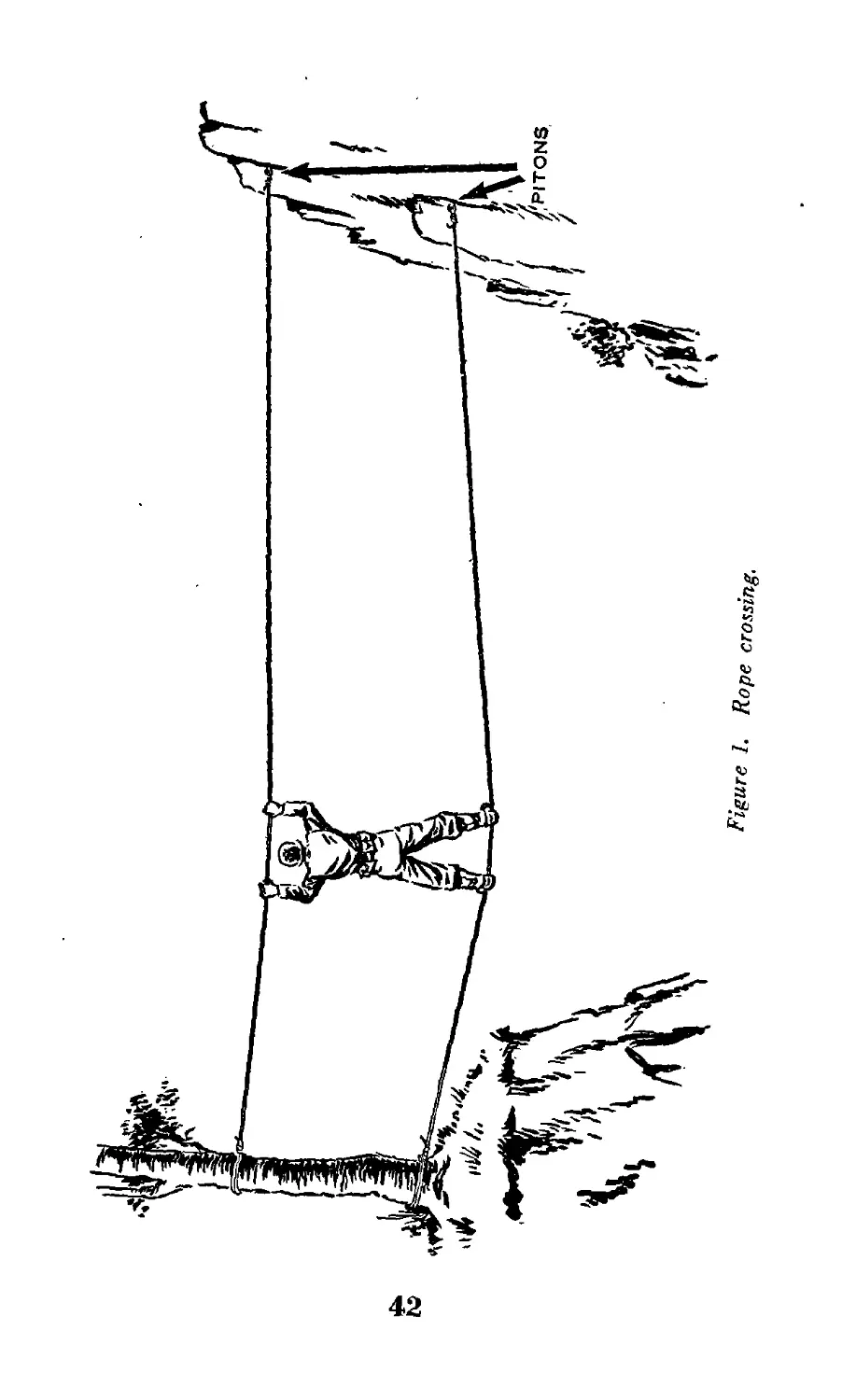
c.	Rope crossing (fig. 1). A rope crossing or hori-
zontal hauling line requires that an experienced moun-
tain climber go ahead to establish the anchors on the
opposite side of the crevasse or ravine to be crossed. A
snap link attachment made to the hand rope from a rope
around the waist of the man crossing may be used to
provide additional security.
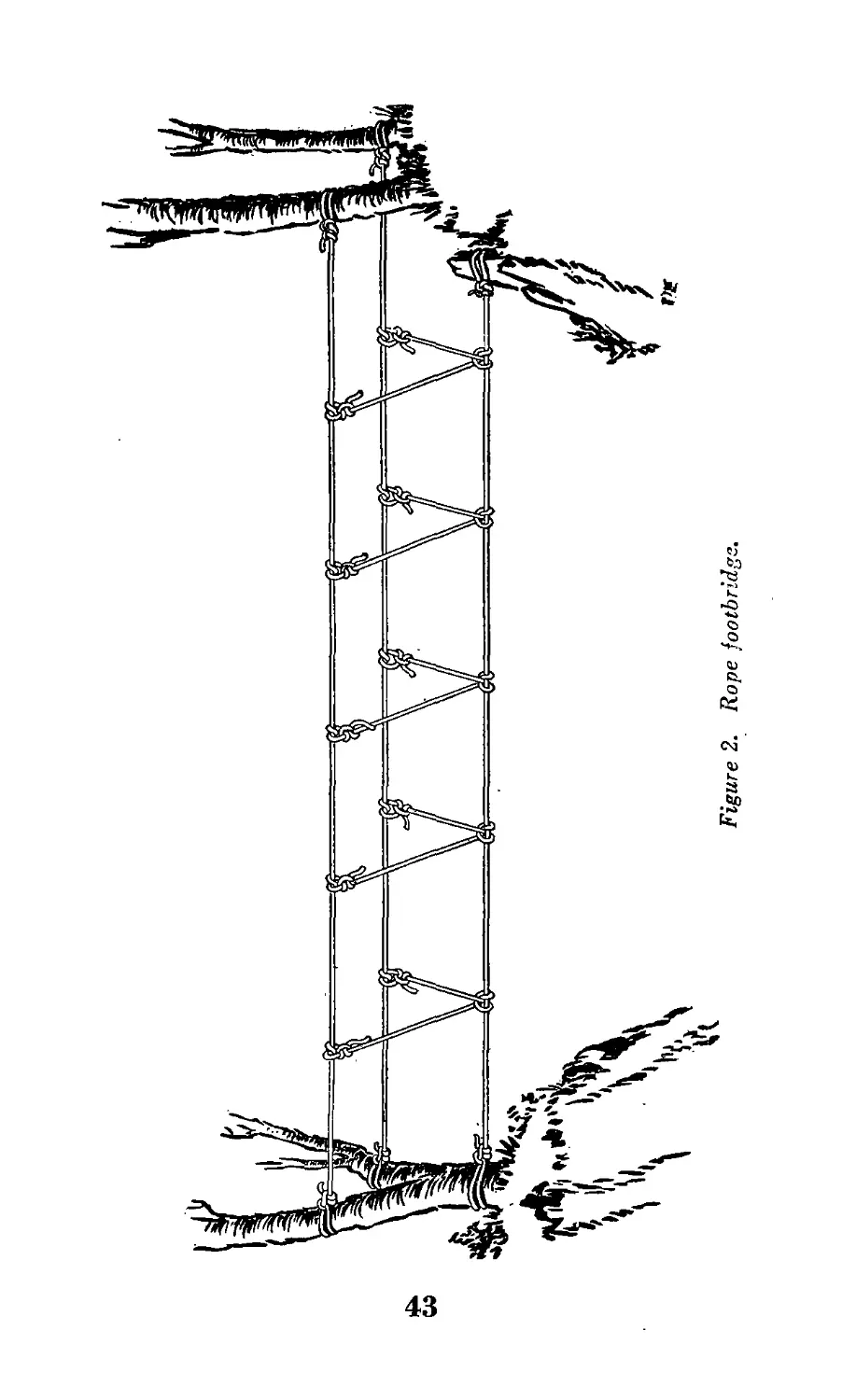
d.	Rope footbridge (fig. 2). For the rope foot-
bridge, a 1-inch rope is used for the walkway, and two
%-inch ropes for hand lines, which are attached to the
1-inch rope by means of short lashings. The tie used is
the clove hitch. Trees and rocks can be used as anchors.
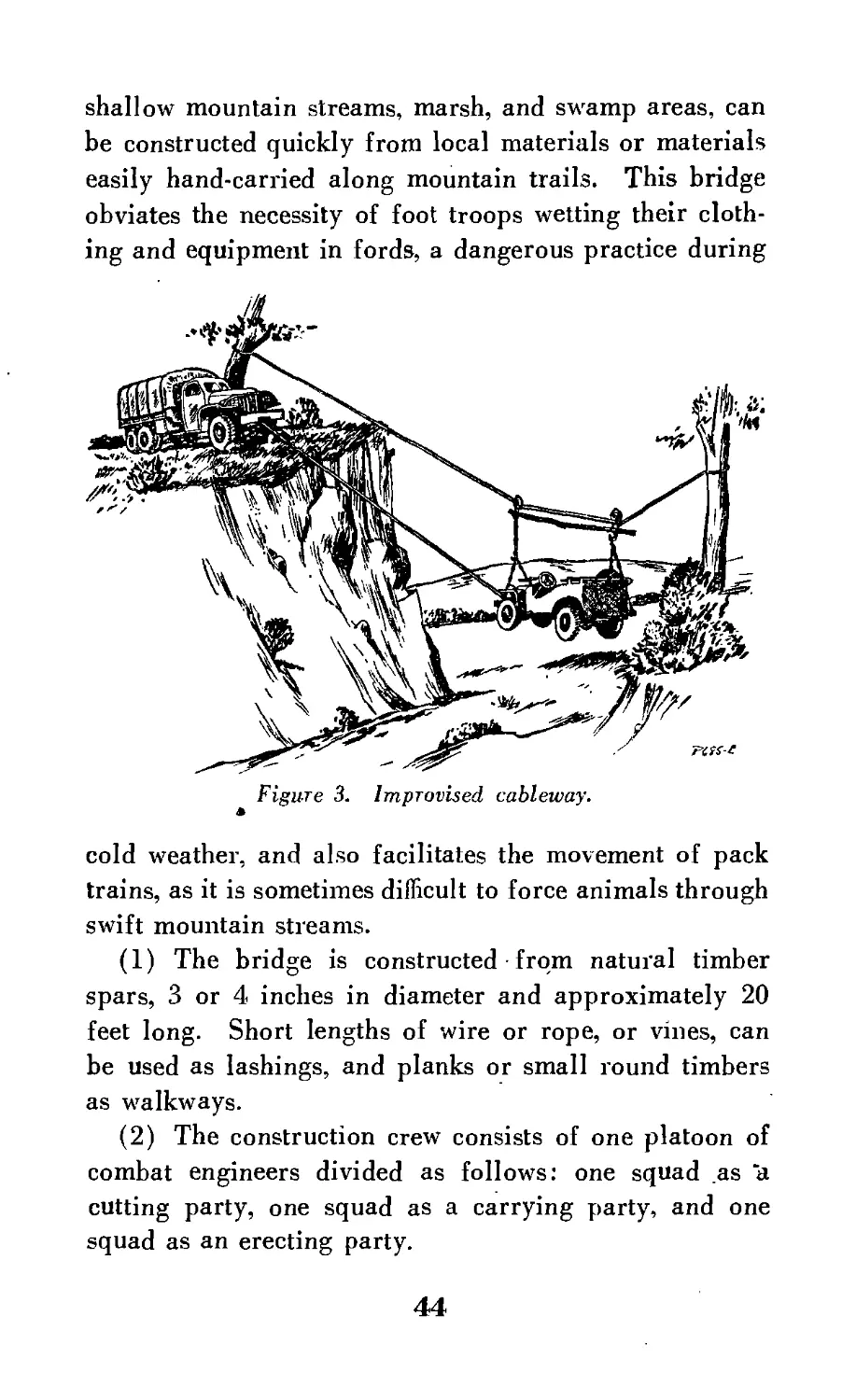
e.	Improvised cableway (fig. 3). An improvised
cableway may be constructed from steel cable or 1-inch
rope. Trees or suitable boulders can be used as anchor
points. Steel cable must be used for loads in excess of
500 pounds; 1-inch rope, is adequate for lesser loads.
(See TM 5-225.)
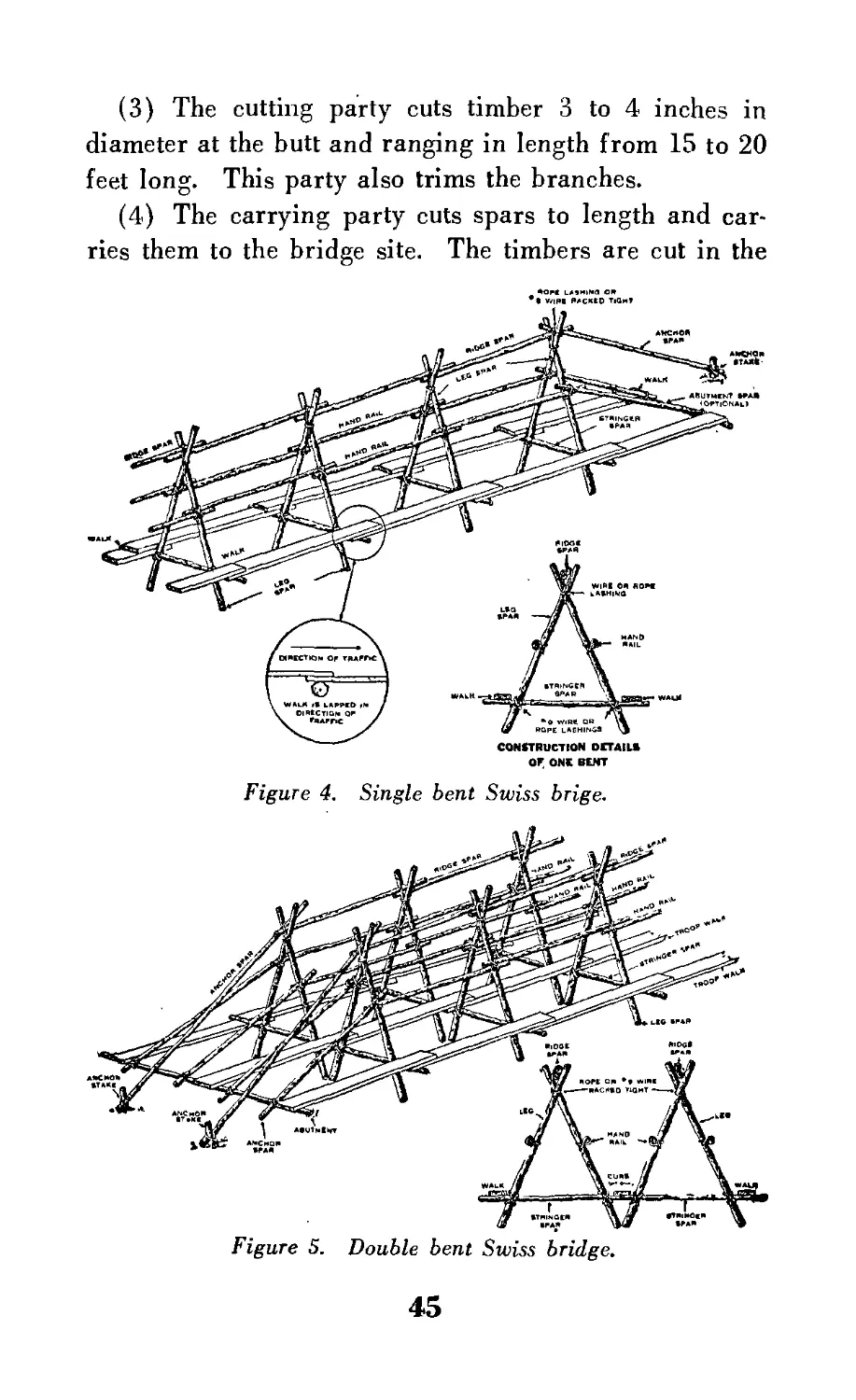
f.	Swiss bridge. The Swiss bridge, single bent (fig.
4) or double bent (fig. 5) types, is used as a support
bridge for infantry and pack animal units respectively.
This type of bridge, used for crossing very swift, wide,
41
Figure 1. Rope crossing.
Figure 2. Rope footbridge.
shallow mountain streams, marsh, and swamp areas, can
be constructed quickly from local materials or materials
easily hand-carried along mountain trails. This bridge
obviates the necessity of foot troops wetting their cloth-
ing and equipment in fords, a dangerous practice during
Figure 3. Improvised cableway.
cold weather, and also facilitates the movement of pack
trains, as it is sometimes difficult to force animals through
swift mountain streams.
(1)	The bridge is constructed from natural timber
spars, 3 or 4 inches in diameter and approximately 20
feet long. Short lengths of wire or rope, or vines, can
be used as lashings, and planks or small round timbers
as walkways.
(2)	The construction crew consists of one platoon of
combat engineers divided as follows: one squad as ‘a
cutting party, one squad as a carrying party, and one
squad as an erecting party.
44
(3)	The cutting party cuts timber 3 to 4 inches in
diameter at the butt and ranging in length from 15 to 20
feet long. This party also trims the branches.
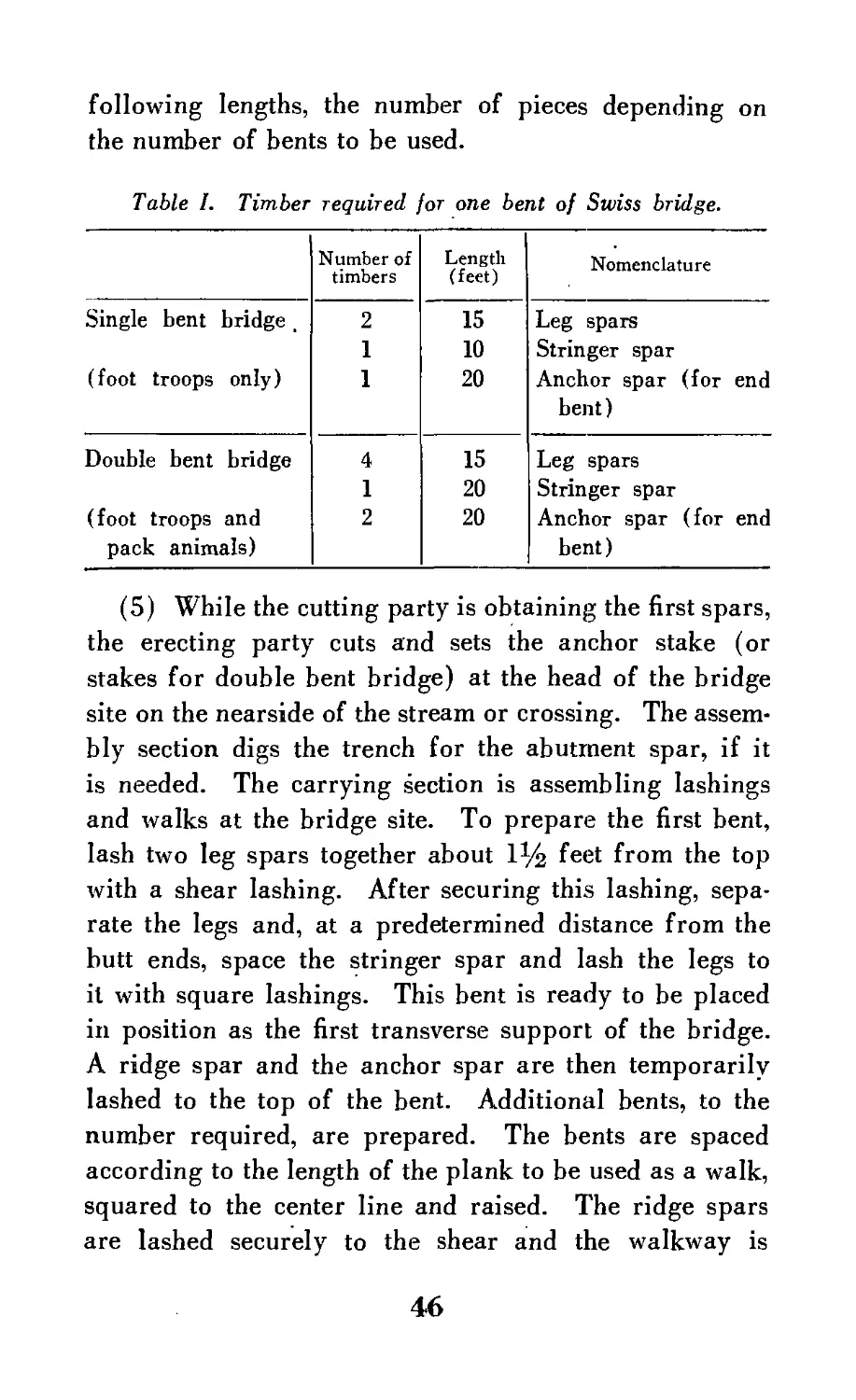
(4)	The carrying party cuts spars to length and car-
ries them to the bridge site. The timbers are cut in the
*1 WlRi R*CKI0 TiQhV
OF ONE BENT
Figure 4. Single bent Swiss brige.
Figure 5. Double bent Swiss bridge.
45
following lengths, the number of pieces depending on
the number of bents to be used.
Table I. Timber required for one bent of Swiss bridge.
	Number of timbers	Length (feet)	Nomenclature
Single bent bridge .	2	15	Leg spars
	1	10	Stringer spar
(foot troops only)	1	20	Anchor spar (for end
			bent)
Double bent bridge	4	15	Leg spars
	1	20	Stringer spar
(foot troops and	2	20	Anchor spar (for end
pack animals)			bent)
(5)	While the cutting party is obtaining the first spars,
the erecting party cuts and sets the anchor stake (or
stakes for double bent bridge) at the head of the bridge
site on the nearside of the stream or crossing. The assem-
bly section digs the trench for the abutment spar, if it
is needed. The carrying section is assembling lashings
and walks at the bridge site. To prepare the first bent,
lash two leg spars together about feet from the top
with a shear lashing. After securing this lashing, sepa-
rate the legs and, at a predetermined distance from the
butt ends, space the stringer spar and lash the legs to
it with square lashings. This bent is ready to be placed
in position as the first transverse support of the bridge.
A ridge spar and the anchor spar are then temporarily
lashed to the top of the bent. Additional bents, to the
number required, are prepared. The bents are spaced
according to the length of the plank to be used as a walk,
squared to the center line and raised. The ridge spars
are lashed securely to the shear and the walkway is
46
then laid. The lashing of one end o£ the anchor spar
at the top of the bent is secured; the opposite end is
lashed to the anchor stake. Where two ridge spars
overlap, no permanent lashing is placed until both are
in position. The length of the plank is available for use
as a walk. If no planks are available, round timbers
may be substituted as a walkway. Rope is suitable
for use as handrails.
(6)	The double bent bridge will easily support a
loaded pack animal on the center walkway. It will stand
in deep and swift water without appreciable damming
effects, since there are few spars which are in the stream
to catch debris.
70.	ENGINEER RECONNAISSANCE. Mountain en-
gineer reconnaissance should precede all engineer
operations, but not delay them. Small, dismounted re-
connaissance details are best adapted for this task.
71.	DEMOLITIONS, a. For most demolition work
in the mountains, the principles of FM 5—25 are ade-
quate. A few variations are found to apply in the case
of hardwood trees and in some types of soil. Blasting
a hardwood tree with an internal charge gives excellent
results; for external blasting, the tree usually has to be
overcharged.
b. For demolition in rocks and rock soil, normal pro-
cedure applies, except that fissures are often found which
have to be well filled and tamped with earth. A fougasse
made with rock and explosive can be very effective if
used on routes of approach in valleys. It may be con-
trolled, or set off by a booby trap device.
47
72.	MINES, a. An attacking force must know in what
areas antitank or antipersonnel mines are likely to be
used, and be prepared to deal with them. Mechanical
mine exploders are of little use in the mountains and
there is as yet no substitute for the removal of mines by
hand after they have been located by the employment of
detectors, visual inspection, probing, or a combination
of all of these methods.
b.	In general, a defending force lays antitank mines
mixed with antipersonnel mines in the comparatively
narrow approaches to its position which are passable
to tanks. On slopes not passable to tanks it employs
chiefly antipersonnel mines, paying particular attention
to logical approaches for foot troops. Laying of pat-
terned mine fields is the exception, rather than the rule.
c.	For details of mine laying and removal, see FM
5-31.
Section VIII. MEDICAL CORPS
73.	PRINCIPLES OF OPERATION, a. The prin
ciples of operation which control the movements of
troops in the mountains, as prescribed in FM 100-5, hold
true for the medical service as well as for the infantry.
b. The principles set forth in FM 8-10 should be
followed to the extent permitted by the situation, since
central control, when practicable, is more efficient than
decentralization. However, since the infantry adopts tac-
tics based on the maneuverability of semi-independent
small units, whether on the offense or defense, the con-
ventional distribution of medical installations must
usually be abandoned in mountain operations. The
employment of the aid station, either as a completely
centralized unit or divided, must be dictated by the tacti-
48
cal situation, the nature of the terrain, and the need for
the elimination of all delays in the evacuation of moun-
tain casualties.
74.	REGIMENTAL AID STATIONS. The regimen
tai aid station will usually follow the standard pro-
cedures of operation.
75.	BATTALION AID STATION. The infantry bat
talion is usually decentralized in mountain operations
to the extent that the centrally located battalion aid sta-
tion is impractical. Under such conditions it may be
necessary to divide the battalion medical section into
company medical sections, each of which actively and
closely supports its respective company on the march
and in combat'. This is especially true during enveloping
movements where reinforced rifle companies are widely
deployed to assault dominating ridges. The employment
of these aid stations or company medical sections will
be determined by the battalion surgeon.
76.	COMPANY AID STATIONS, a. In mountain-
ous terrain the adequate concealment and defilade usually
found will enable the company medical section, when
formed, to operate close to the front-line troops. It
should normally be located close to the company com-
mand post. The following advantages are obtained by
employing the above method:
(1)	Relatively short litter hauls for the company litter
team.
(2)	Direct liaison between the front line and the rear
medical establishments.
(3)	Close contact with the infantry company com-
49
manders from whom changes in plans concerning the
company may be quickly obtained.
(4)	Increased rate of evacuation.
b.	Since the company medical section installation will
at all times be small, the casualties will be sorted, given
only the necessary first-aid treatment and, if designated
as evacuees, provided with shelter and warmth. Speed
of evacuation must be stressed at all times.
c.	When company medical sections are formed, it is
desirable that the battalion medical section be able to
provide three six-man litter squads. In each squad, one
man should be designated as squad leader.
d.	By adequate planning and reorganization, the regi-
mental surgeon can so apportion the personnel in his
command that various emergencies and situations en-
countered in mountain operations can be met. Additional
personnel may be necessary. Assistance for medical per-
sonnel may be drawn from infantry reserve units, from
driver personnel, when the use of vehicles is restricted
or impossible, from collecting and clearing companies,
and from corps troops.
77.	COMPANY AID MEN. Company aid men must
be familiar with the hazards of the cold and wind and
proficient in the conservation of body heat and the con-
struction of small wind-breaking installations and shel-
ters.
78.	COLLECTING COMPANY, a. In mountainous
terrain, the difficulties of the collecting company of the
division medical battalion are greatly increased since,
instead of evacuating two or possibly three battalion aid
stations, it may become necessary to maintain a chain
of evacuation from six or more company medical sec-
50
tions. As a result, the collecting company may have to
he split into two or three sections, each section support-
ing its respective battalion. These sections may be sepa-
rated by ridges, thus requiring the independent operation
of ambulance shuttles to a common basic relay post.
This relay post may at times be the only central base
of communication between the various sections. A cen-
trally controlled collecting station should be instituted
whenever possible, and the splitting of the collecting
station into sections used only when the situation so
demands.
b. Since the defilade is generally excellent in moun-
tainous areas, the collecting station should be brought
as far forward as possible. Division collecting points
should be installed behind each of the company or bat-
talion aid stations in order to operate with the greatest
efficiency and to conserve the energy of the litter bearers.
The collecting points should be so installed that they
serve as warming stations where a casualty can be kept
sheltered from the inclemencies of the weather, and be
given supportive treatment until evacuated. Two medical
men should be assigned to operate each collecting point.
c. The litter bearer haul should be reduced to an
absolute minimum and vehicular transportation used
wherever possible. Frequently it may be advantageous
to assign additional litter bearers to the battalion medical
section to clear the field more rapidly, and assign 14-ton
trucks from the battalion section to the collecting com-
pany.
79.	CLEARING COMPANY. The tactical problem
of the clearing company in mountain operations is gener-
ally similar to that in flat terrain.
51
80.	MARCH PROCEDURES. Before a march is
started, the company medical sections, if formed, should
join their respective companies and follow closely be-
hind them, evacuating all casualties along the route of
march to collecting posts that have been designated by
the battalion surgeon and the collecting company com-
mander. These points should be sheltered areas promi-
nently marked to be recognized by the litter bearers or
drivers of vehicles. Each collecting post should be under
the supervision of two men from the collecting company.
They should be assigned to a specific post and should
join the column before the march begins. On reaching
their post they take charge of all casualties, treat them,
and rejoin their unit when the last casualty has been
evacuated.
81.	LIAISON, a. Adequate liaison does much to
speed evacuation of the wounded, and is essential in the
successful accomplishment of a medical mission. The
qualifications of the men designated as contact agents
should be a sense of responsibility, aggressiveness, and
intelligence. They must be well trained in map reading
and message writing, and should keep their commanding
officer constantly informed regarding the developments
on the front line.
b. Once established, communication between echelons
must be kept intact. All available means of communi-
cation should be utilized to the maximum. The estab-
lishment of the company aid station close to the front
line permits the medical officer or noncommissioned
officer to obtain first-hand information as to the progress
of the operation either by personal observation or by
contact with the infantry company commander. Litter
52
bearers can serve as an important source of information.
Messengers operating between medical installations and
command posts make possible utilization of radio and
telephone facilities.
82.	EQUIPMENT. Operations in mountainous ter-
rain require the medical personnel to carry additional
items of equipment necessary for the evacuation of casu-
alties, that is, ropes, pitons, and piton hammers. All
unnecessary items of equipment or those for which sub-
stitutes can be improvised should be left behind. Heavy
tentage, bulky chests, extra splint sets, excess litters and
unnecessary medical supplies should be stored. The
battalion surgeon should give due consideration to the
equipment and supplies to be carried forward, and
should make adequate plans for an equitable distribu-
tion of these items to the various company medical
sections. Since the aid station installation is usually
very small, only the bare necessities are carried on pack-
boards. The trays of the medical chests are filled with
vital medical supplies, and covered by three or four
blankets. This makes a convenient load to be lashed
to a packboard. Two men can easily carry the items
of equipment and supplies necessary for the installation
of a company aid station. If trays are not available,
blanket rolls can be made of the supplies and they can
be either lashed to packboards or carried in partially
folded litters. In addition to the above, it is advisable
to carry a few shelter halves and at least two hand axes
in each aid station section. It may be necessary to
pack-carry some equipment from the collecting station
for the installation of collecting points.
83.	SHELTER. Since the transportation of heavy
53
tentage is impracticable, shelter for casualties must be
improvised in cold weather in order to prevent undue
exposure to the weather with a resulting increase in the
number of shock cases. In the summer, or in warm
climates, such shelters may not be necessary. Satisfac-
tory shelters can be built of a few saplings, some ever-
green boughs, and available shelters halves or blankets.
Caves, rock overhangs, clumps of thick bushes, ruins,
fallen trees, and trenches covered by boughs will protect
the casualty from the mountain wind and the cold.
When casualties must be kept overnight, a better weather-
proofed shelter should be constructed. Detailed infor-
mation on shelters in cold weather operations may be
found in FM 70-15.
Section IX. QUARTERMASTER CORPS
84.	REFERENCES. For information on quartermas-
ter service in the theater of operations, see FM 10-10;
for information on supply of the infantry regiment, see
FM 7-30.
85.	GENERAL PRINCIPLES, a. Since the combat
unit in mountain operations is usually a reinforced in-
fantry battalion, with the resulting decentralization of
command, there must be a corresponding decentralization
of supply. The division quartermaster recommends the
method of distributing supplies to the assistant chief
of staff, G-4. Final determination of the method to be
employed is made by the division commander, based on
the G-A estimate of the situation. Because of the special
difficulties involved in supply during mountain opera-
54
tions, the division quartermaster may recommend the
establishment o£ a division supply point. In certain
cases, regimental supply points may be necessary for
servicing isolated front-line battalions. The location of
these supply points and the time that the various units
will draw their supplies should either be incorporated in
the field order or, in a rapidly changing situation, the
information should be furnished in fragmentary form.
b.	Labor for the handling of supplies at the division
supply points is furnished by the quartermaster service
elements of the division. Labor at unit distributing
points is furnished by the units receiving the supplies.
c.	It may often be necessary for the quartermaster to
devise special combinations and methods of distribution.
These will depend, to a large measure, on transportation
facilities, location of combat units, and type of terrain
in which operations are under way.
d.	Supply operations in mountainous terrain are
affected by the following additional factors:
(1)	Local resources are usually poor.
(2)	Ration needs of the troops and animals are in-
creased by the rigors of the terrain and, in cold weather,
by the climate.
(3)	The needs for equipment and fuel are increased
in cold weather.
e.	Careful planning by all echelons of command is
of the utmost necessity if supply is to function smoothly.
Unless plans are carefully made, the rapidly changing
tactical situation will cause a lengthening of supply lines
which may result in a retardation of supply, or even
its interruption. To prevent such occurrences, plans
should be made to organize advance supply points for
each tactical unit being serviced.
55
CHAPTER 4
CONDITIONING AND
ACCLIMATIZATION
Section I. GENERAL
86.	NECESSITY FOR CONDITIONING AND AC-
CLIMATIZATION. a. The training of soldiers in
mountains of low or medium elevations does not require
any special conditioning or acclimatization, since the
occurrence of altitude sickness with its chain of incapaci-
tating symptoms is extremely rare.
b. There is a need, however, for a conditioning and
acclimatization period of 10 to 14 days for troops to
be trained in altitudes of 8,000 feet or more. After a
week or two at high altitude, the average soldier will find
that he is less exhausted, his headache is gone, he sleeps
better and his appetite is normal, and as days pass he
will find that life in the mountains is definitely exhila, at-
ing. The essential reason for this change is that the
number of red blood cells in his blood have increased,
enabling more oxygen to be carried from his lungs to
the tissues of his body. During this period of acclimati-
zation the training program should provide for graduated
physical exercises, including short marches, together
with appropriate rest periods. In high mountains, it is
generally found that the air is dry and as a result perspi-
56
ration is more quickly evaporated. This tends to mislead
a person into thinking that he is not perspiring freely
due to the fact that his clothes are less frequently moist
even after strenuous exertion. This loss of fluid plus
the loss of salt through perspiration soon leads to acute
fatigue, associated with muscle cramps and heat exhaus-
tion, unless adequate precautions toward their replace-
ment are taken. The proper maintenance of the water
and salt balance is imperative in the mountains.
87.	PSYCHOLOGICAL ADJUSTMENT. The psy-
chological adjustment of the individual must be con-
sidered. Many persons who have lived at low altitudes
(sea level or slightly higher) all their lives may have
preconceived notions about the supposedly harmful
effects of high altitude on the human organism. To them
any abnormal complaint, however trivial, may be con-
strued as an ill effect of altitude, as a result of which
they may become unduly concerned about their physical
condition. This can be prevented by an active educa-
tional campaign in which it is shown that high altitudes
do not have the supposedly harmful effects. Frequently
men recently transported from a flat terrain cannot ap-
proach steep slopes or cliffs without inner qualms and
without a sense of insecurity. They must be slowly
introduced to them and their confidence progressively
developed until they can negotiate a passage across such
obstacles with assurance and ease. Men must be taught
the various handholds and footholds used, be indoctri-
nated with the principles of mountain marching, and
become familiar with the pitfalls to be avoided. These
capabilities are attained only through constant training
and application. There are many individuals who pos-
57
sess fear of height in varying degrees. It can be overcome
only by familiarity through practice.
88.	PHYSICAL CONDITIONING. Regardless of
previous army training, and of the amount of flat cross-
country marching practiced, the soldier newly initiated
into the mountains finds mountain marching arduous and
tiring. A new group of muscles is called into play, and
these muscles must be developed and hardened. Further-
more, a new technique of moving rhythmically must be
learned. This conditioning is attained only through
daily marches and climbs which result in increased
stamina and endurance. Simultaneously with this devel-
opment, men acquire increasing self-confidence in their
ability safely to negotiate terrain which previously they
considered impassable.
Section II. PERSONAL HYGIENE
89.	PRINCIPLES. The principles of personal hy-
giene and sanitation that govern the operations of troops
in the lowlands are applicable in the mountains as well,
and the same strict adherence to the policies prescribed
in FM 8-40 and 21—10 must be enforced. Alpine terri-
tory is relatively germ-free; however, low mountain areas
come in the same category as lowlands as far as sanitary
policies are concerned.
90.	WATER DISCIPLINE. Strict control must be
exercised over all sources of water supply. Troops must
realize that the general concept that mountain water is
safe for consumption is a fallacy. Water discipline must
be emphasized, since the water demand of an individual
58
in the mountains is great and, unless closely controlled,
he may drink polluted water. Fluids are lost through
respiration, perspiration, and urination; and this loss
must be replaced if the soldier is to operate with normal
efficiency.
91.	WASTE DISPOSAL. In mountainous terrain
without snow, disposal of human and kitchen waste prod-
ucts should follow the normal methods. For methods
which may be used under conditions of snow and ex-
treme cold, see FM 70-15.
92.	PERSONAL HABITS, a. Under extreme con-
ditions of cold, there is a general tendency for the indi-
vidual soldier to permit himself to become constipated
in order to avoid the inconvenience and discomfort of
straddling a latrine trench. This neglect should be dis-
couraged by all officers and noncommissioned officers of
the unit, since it ultimately induces a great prevalence
of illness among the troops. The soldier must be edu-
cated in the consequences which may result from poor
personal habits. This is a command function. Whenever
possible, heated latrines should be provided.
b. Personal cleanliness is especially important in ex-
treme cold. In freezing temperatures, the individual has
a tendency to neglect washing due both to the cold and
the scarcity of water. This may result in skin infections
and vermin infestation. If bathing is impossible for
any extended length of time, the soldier should at least
examine his skin and stimulate and cleanse it as much
as possible by briskly rubbing his body with a rough
towel. In this way, the occurrence of skin infections may
be kept to a minimum.
59
c. Particular attention must be devoted to the care of
the feet, in order to protect against trench foot and frost-
bite. The causative conditions for one or the other of
these disturbances are prevalent throughout the entire
year in high mountains. The feet should be kept dry
and socks and insoles changed at least once daily. The
principles of foot hygiene apply with greater force in
high mountains than they do in any other terrain.
Section III. MALADIES
93.	MOUNTAIN SICKNESS. Mountain, or altitude,
sickness is an acute temporary illness occurring in moun-
tains. The novice and experienced climber alike are
subject to this malady in altitudes as low as 4,000 to
5,000 feet. The cause is usually poor physical condition;
lack of acclimatization, or both. Symptoms may be head-
ache, nausea, vomiting, lack of appetite, insomnia, and
irritability. This condition can be relieved by rest. In
rare cases the patient must be taken to a lower altitude.
94.	VALLEY DISEASE. Valley disease occurs when
an individual acclimatized to high altitude returns to
the low altitudes. It is the opposite of mountain sick-
ness. While in the mountains there is an abnormal
increase in the number of red cells' to augment the
oxygen-carrying power of the blood, this increased power
is not needed at sea level and the body literally has too
much blood. The resulting symptoms are lassitude, in-
creased sweating, weight loss, headache, noises in the
ears, indigestion, irritability, depression, forgetfulness,
and neuralgialike pain. One or more of these symptoms
60
may be present at the same time. Depending on the
individual, they disappear within a few days to a few
weeks.
95.	GLACIER LASSITUDE. Glacier lassitude or
snow field lassitude is a transitory condition which often
assails climbers on hot days. Physical factors which
produce .this indisposition are hollows into which the
sun beats directly, reflected light, and stagnant or exces-
sively still air. The physiological factors which produce
this feeling of weakness are probably due to a disturb-
ance of the circulation. The cure is to get into an area
where there are moving air currents.
Section IV. CLIMATE
96.	GENERAL. Mountain climate has a very definite
effect on the physiology and pathology of the individual
because the human organism is sensitive to weather
changes and differing climates.
97.	MOUNTAIN AIR. a. Mountain air is relatively
pure. The higher one goes, the more nearly pure it
becomes. Above 5,000 feet it is practically germ-free.
The physical composition of the atmospheric air is prac-
tically the same at high altitudes as it is at sea level.
The apparent rarefaction of air at high altitudes is due
to the decreased partial pressure of the atmospheric oxy-
gen. The utilization of oxygen by the body is dependent
upon the pressure under which it is forced into the tis-
sues. Ultraviolet rays of high altitudes partially convert
oxygen into ozone, a gas which kills germs. Forests,
especially those with coniferous trees, lessen the per-
61
centage of carbon dioxide, and thus do their part in
purifying the air. The snow completes this purification
by drawing out of the air, and holding, all the impurities
which might still be able to contaminate the air.
b.	High mountain air is dry, especially in the winter
when the humidity in the air condenses into ice. This
dryness increases with the altitude. The amount of water
vapor in the air decreases in geometric proportion as the
altitude increases.
c.	Atmospheric pressure drops as the altitude in-
creases. The pressure varies, on the average, about %
inch for every 330 feet rise.
d.	The temperature drops as the air becomes more
rarefied. In an atmosphere containing a considerable
amount of water vapor, temperature drops about 1° F.,
for every 360 feet of rise in altitude. In very dry air
it drops about 1° for every 180 feet.
e.	An important characteristic of the atmosphere at
high altitudes is its luminosity. The sun’s rays are
neither absorbed nor reflected by the atmospheric haze
which fills the air of flat country, especially in cities.
The rare dry air of the mountains allows the visible rays
of the solar spectrum to pass in their entirety. In addi-
tion, a fraction of the invisible rays, among which are
the ultraviolet rays, also penetrates the haze. In pure
atmosphere, the proportion of ultraviolet rays remains
constant, regardless of the altitude.
62
CHAPTER 5
MILITARY ROCK-CLIMBING
Section I.	GENERAL
98.	IMPORTANCE. Military rock-climbing provides
a means for operating on rugged mountainous terrain or
shores. In such terrain there are two adversaries—the
enemy and, often more of a foe, the mountain. Special-
ized men and equipment must be used to combat the
mountain successfully.
99.	HOW IT IS USED. Soldiers skilled in military
rock-climbing can perform many essential missions in
rugged country. They can serve as guides, rock engi-
neers, observers-, snipers, scouts, patrol members, and
assault team members.
100.	EFFECT ON DEPLOYMENT. An estimate of
friendly or enemy capabilities in rugged terrain is possi-
ble only if the higher commanders are thoroughly famil-
iar with the capabilities of the rock-climber. All officers
who are to operate in mountainous terrain must be
oriented in this respect. As many officers as possible,
and at least one per company, should become expert
climbers.
63
101.	TRAINING REQUIREMENTS, a. Special-
ists. Units preparing for operations in mountainous ter-
rain should have climbing specialists in each unit down
to and including the company. They will usually func-
tion as teams of two men. The men must have reasonable
athletic ability, normal resourcefulness, mental toughness
a little higher than normal, and no great fear of height.
Prospective climbing experts should be selected with
care.
b. Semitrained climbers. Preparation for moun-
tain operations is not complete until the unit commander
knows how all his men will react to exposure to height
and to the out-of-the-ordinary muscular effort. A few
hours’ climbing for all men provides a valuable index
to each man’s future reaction to combat. Each man is
exposed to unknown, and therefore frightening, danger.
Fear of falling is a basic instinct, and inay be as hard
to fend as fear of enemy fire. Analysis of the man’s
reaction will enable the commander to place those who
will be stopped by fear of either fire or falling in a
position where they will not jeopardize safety of the
unit. Special training aids for troops are described in
section IX.
Section II.	BASIC TECHNIQUE
102.	MOUNTAIN WALKING. Mountain walking is
similar to walking in any rough country. The long
swinging stride can seldom be used, as the feet must
be lifted to clear obstructions or swung around them.
The lift or rise of each step should be kept as low as
possible to avoid unnecessary fatigue. The sole of the
64
foot should be placed flat on the ground to distribute
the weight as widely as possible and to obtain a better
purchase. The weight should be directly over the feet
on level walking, but in descending a forward lean to
bring the body more nearly perpendicular to the slope
will increase speed and relieve some of the shock to the
knees and spine. In ascending it is necessary to avoid
the impulse to lean in toward the slope. The walker
should use a steady rhythmic motion. On steep slopes
a zig-zag course is less fatiguing than a straight upward
climb. Details of march technique are discussed in para-
graph 8.
103.	BALANCE CLIMBING, a. Definition. Bal
ance climbing is the type of movement used to travel
on steep slopes. It is a combination of the balanced
movement of a tight-rope walker and the unbalanced
climbing of a man ascending a tree or ladder.
b. Body position. The soldier must climb with his
body in balance, which means that his weight should be
in poise over his feet or just ahead of them as he moves.
(See fig. 6.) His feet, not his hands, carry his weight,
Figure 6. Correct body position in relation to angle of slope.
65
except on the steepest cliffs. His hands are for balance.
Feet will not hold well when the climber leans in toward
the rock. With his body in balance the climber moves
with a rhythmic slow motion. He uses three points of
support (two feet and one hand, for example) whenever
possible, and prefers handholds that are waist to shoulder
high. He relaxes, because tensed muscles tire quickly;
when he rests, it is with his arms low, where circulation
is not impaired. He uses small intermediate holds rather
than stretching and clinging between widely separated
big holds. He avoids the spread-eagle position, in which
a man stretches so far he cannot let go. He climbs side-
wise to the rock where he can, rather than hug it too
closely. In descents he faces out where the going is easy,
sidewise where it is hard, and faces in where it is difficult
(fig. 7); he uses the lowest possible handholds.
c. Types of holds. (1) Pull holds (fig. 8) are
those that are pulled down upon and are the easiest holds
to use. They are also the most likely to break out.
(2)	Push holds are pushed down upon, help the
climber keep his arms desirably low, rarely break out,
but are more difficult to hold to in case of slip. A push
hold is often used to advantage in combination with a
pull hold.
(3)	Friction holds (fig. 9) are those dependent solely
on the friction of hands or feet against a smooth surface.
They are difficult to use’because they give a feeling,of
insecurity, which the climber tends to try to correct by
leaning closer to the rock, thereby only increasing his
insecurity. They often serve well as intermediate holds,
some of which will give needed support while the climber
moves over them, but would not hold him were he to
stop.
66
(4)	Cross-pressure holds are holds that do not exist
as useful single holds, but must be used in combinations
by exerting cross pressure between hands, arms, and legs.
There are several types:
(a)	The pinch hold, attained by pinching a protrud-
ing part between the fingers.
(b)	Pressing outward (fig. 10) or pulling inward with
the arms.
(c)	The lie-back (fig. 11), leaning to one side of an
offset crack, with the hands pulling and the feet pushing
against the offset side.
Figure 7. Descending traverse.
67
(d)	Inverted pull (fig. 12) or push holds, sometimes
called underholds, permitting cross pressure between
hands and feet.
(e)	Chimney climbing (fig. 13) where cross pressure
is exerted between the back and the feet or hands or
knees.
(5)	Footholds (fig. 14). The service shoe with rub-
ber sole will hold on slabs up to about 45°. On such
steep slopes the body should be kept vertical, with use
being made of small irregularities in the slope to aid
friction. Footholds less than 14 inch wide can be suffi-
cient for intermediate holds, even when they slope out.
Figure 8. Pull hold.
68
(6)	Shoulder stand (fig. 15). The shoulder stand, or
human ladder, is used to overcome a holdless lower sec-
tion of a pitch, to reach the easier climbing above.
d. Use of holds. A hold need not be large to be
good, nor need it be solid, so long as the pressure is in
the direction that holds it to the mountain. Experienced
Figure 9. Friction holds.
69
climbers use holds which are so small that they can
scarcely be seen. The climber must roll over his holds,
not try to skip or jump from one to another. It is, how-
ever, often desirable in traverses to use the hop step,
in which the climber changes feet on a small hold, re-
placing his outside foot with his inside foot so that he
may move sideways more easily. A slight upward hop
followed by precise foot work accomplish this useful
step.
e. Margin of safety. (1) A margin of safety is the
protective buffer a climber keeps between what he knows
to be the limit of his ability and what he actually tries
to climb.
Figure 10. Cross-pressure hold—pressing out with arms
{open chimney).
70
(2) The climber bases his margin of safety on experi-
ence gained with little or no risk in training, where he
learns to calculate his ability. This he learns by climbing
close to the ground, or tied to a rope held or paid out
by a trained man above. He climbs first on the easy
and obvious holds, next on the more difficult ones, and
finally on difficult pitches until he reaches the limit'of
his ability. When climbing thereafter he leaves a mar-
gin, which can be progressively smaller as he learns to
calculate better.
(3) The margin of safety should be calculated not
only for the pitch immediately ahead but for the entire
Figure 11. Cross-pressure hold—lie-back.
71
climb. The climber should plan his route and movement
far enough ahead so that he never finds himself in diffi-
culties beyond his ability.
104. ROPES AND KNOTS, a. Purpose. Much
of the climbing in military operations may be free climb-
ing; that is, without rope. However, on some steep
unbroken cliffs, where exposure is great, the rope is
necessary in party climbing. Fixed ropes and other aids
may be needed as well.
Figure 12. Inverted pull hold.
72
b.	Care of rope. "When rope is needed it is the
climber’s lifeline, and it should be cared for accordingly.
When not in use, the rope should always be coiled in
an approved manner. It should never be stepped on.
For long carries, it may be carried either over the neck
and one shoulder in a diagonal chest carry, or twisted
into a figure-8 and folded over in the pack.
c.	Inspection of rope. The climber cannot always
know that the rope he is to use has been properly cared
Figure 13. Cross-pressure hold—chimney technique.
73
for. He should therefore inspect it carefully before put-
ting it to any demanding use, particularly if a man’s life
is likely to depend on it. For exacting use, rope should
be new or nearly new, resilient, and free of serious cuts
or abrasions.
d.	Knots for the climber (figs. 16 and 17). (1)
The bowline knot is used for either end man on a rope,
or for the preliminary tie on the belay point of a fixed
rope. This is one of the easiest knots to untie after it
has held a heavy load.
(2)	The bowline on a coil is used to take up extra
rope around the climber’s body to relieve strain around
the waist in tension climbing and in the event of a fall,
and is used by the faller in practice belaying.
(3)	The butterfly knot is used in tying men in to the
middle of a rope. This knot reduces the strength of the
rope less than do other knots.
(4)	The square knot is used in tying two equal-diame-
ter ropes together. Make half hitches on each side with
the loose ends.
(5)	The fisherman’s knot is used in tying together two
ropes of unequal diameter.
Figure 14. Fooiholds.
74
Figure 15. Shoulder stand.
75
-J
С»
BOWLINE
BUTTERFLY
BOWLINE ON A BIGHT
Figure 16. Types of knots.
SQUARE KNOT
(6)	The slip knot is used for tying in fixed ropes, and
for anchoring the belayer.
(7)	The Prusik knot is one which will hold under
stress, and slide when the stress is removed. It may be
tied with a loop or on a bight. Its ratchet effect has
many uses, described separately in succeeding para-
graphs.
Figure 17. Prusik knot.
77
105. PITONS, SNAPLINK, AND HAMMER (fig.
18). a. Purpose. In conjunction with roped climb-
ing, pitons are driven into cracks in the rock to provide—
(1)	A secure point on the cliff to which the rope may
be hooked by means of a snaplink. If the leading
climber falls, he may then be held, pulley-wise, by a
man below him. Successive pitons are driven as the
climber moves upward.
(2)	Secure points along the course of a fixed rope
(par. 114) so that it will give greater support to troops
using the rope.
(3)	Anchor points for hauling lines. (See par. 115.)
b.	Types of pitons. There are four types of pitons
for rock, of which horizontals are most frequently used,
verticals least, in a ratio of about 5 to 1:
(1)	Vertical for cracks with flush sides, preferably
vertical.
(2)	Horizontal for flush or offset cracks, horizontal
or vertical.
(3)	Angle for wide, deep cracks, offset or flush, hori-
zontal or vertical.
(4)	Wafer for cracks that are thin, shallow, and flush
or with flared opening.
c.	Placing of pitons (fig. 19)., Pitons are placed
to reinforce the climber’s judgment. If well placed and
tested they will limit his fall to twice the distance he is
above the piton plus the amount of slack the belayer
lets run. In placing pitons the climber should—
(1)	Study the rock to see that driving of a piton will
not weaken it. Test rock for soundness by tapping with
hammer. Select a crack that is wide enough to take
% to % the piton shaft before hammering. Select the
right piton-one that the rock will support best and that
78
the snaplink can be hooked into after the piton is driven
in.
(2)	Drive the piton. While driving watch the rock
to see that it is not being weakened by further cracking.
Watch the piton to see that it goes in smoothly and to
notice if the point hits a dead end. Listen to the piton’s
sound at each blow; good verticals and horizontals
usually go in with a rising pitch; wafers and angles will
have no noticeable pitch so long as the ring is swinging
free. Drive the piton hard, until the head begins to
change shape. The greater the resistance overcome in
driving the piton, the firmer it will be. A well-driven
piton will withstand a direct outward pull of 1,000 to
2,000 pounds.
(3)	Test the piton. Pull up several feet of slack, snap
rope into snaplink, grasp doubled rope at least 2 feet
from the snaplink. Jerk vigorously outward, downward,
and to each side, observing the piton meanwhile, repeat-
ing if the test is questionable. Tap the piton. If the
pitch has changed much, drive the piton in as far as pos-
sible; if the sound regains its original pitch the piton is
good. If not, the crack has been enlarged and the piton
should be treated with suspicion. This test alone should
not be relied upon if the piton does not look good.
d.	Snaplink. This is used to facilitate fastening
the rope to the piton, and will hold a load of 2,000
pounds. In snapping into a piton, the climber should
see that the snaplink will not cause unnecessary friction
as he climbs beyond it, and that the gate is not likely
to open accidentally owing to pressure against rock, rope,
or piton.
e.	Hammer. The point is for chipping rock or ice
and cleaning out piton cracks, and not for pulling out
79
pitons, for the rest of the hammer is too lightly con-
structed to stand the stress.
f.	Secondhand pitons. Pitons that have been used,
removed, bent, and straightened should be treated with
suspicion. In training areas pitons already in place
should seldom be trusted, inasmuch as weathering will
80
loosen them in time, and only the man who has just
driven a piton has an adequate knowledge of how good
it is.
106. BELAYS, a. Purpose. In party climbing two
or three men are tied in to a 120-foot length of rope.
Belaying provides the necessary safety factor or tension,
enabling the- leader to climb. Without belaying skill,
NOT PREFERRED
BAD
Figure 19. Placing of pitons.
ALTERNATE
81
the use of rope in party climbing is a hazard, not a help.
When any one man is climbing, he is belayed from
above or below by another man, who may use any one
of several belay positions.
b.	Procedure for all positions. The belayer must
perform the following duties:
(1)	Run the rope from the climber through his feel-
ing hand (figs. 20, 21, and 22) around the hips to his
key hand, and make certain it will slide readily.
(2)	Anchor himself to the rock with a portion of the
climbing rope if his position is doubtful.
(3)	Be ready to move the key hand close in front
of the body so that body friction will be enough to help
check the rope in a fall.
(4)	Make sure remainder of rope is so laid out as to
run freely through the key hand.
(5)	See that rope does not run over sharp edges or
rock.
(6)	Avoid letting too much slack develop in the rope
through constant use of the feeling hand, except where
this hand is used as an anchor. Gently tug the line run-
ning to the climber, thus sensing his movement. Avoid
taking up slack too suddenly, as this may throw the
climber off balance.
(7)	Brace well for the final direction of a fall, so
that the force of the fall will, wherever possible, pull
the belay man more firmly into position. The climber
should neither trust nor assume a belay position which
he has not tried with some falls of a few feet in practice.
(8)	Where necessary, seek a belay position that offers
cover and concealment.
(9)	Be able, in case of fall, to perform the following
movements automatically:
82
(a)	Relax feeling hand and move key hand in toward
body for friction.
(b)	Let the rope slide enough so that braking action
is applied gradually.
(c)	Hold belay position, even if this, means letting
the rope slide several feet.
c.	Sitting belay (fig. 20). This is the preferred
position when pitons are not in use. Belayer should
attempt to get good triangular bracing between his two
legs and buttocks. Wherever possible, legs should be
straight. The rope should run around the hips at belt
level or lower and be above anchoring rope, and key
and feeling hands should be held inside of the thighs.
If the belay spot chosen is back from the cliff edge,
friction of rope over rock will be greater, and will
simplify holding of falls, but the direction of the pull
on the belayer will be directly outward. If the belay
spot chosen is at the very cliff edge, friction will be
much lower, but a fall will pull the belayer directly
down into his position. Such a spot will require the
belayer to hang his feet over the edge, and will not be
taken unless the sitting position slopes back and down
into the cliff.
d.	Standing belay (fig. 21). This is the weakest
military belay position, and is used only where it is
not possible to use the sitting belay. An anchor is almost
always essential.
e.	Piton belay (fig. 22). As soon as the leader
has placed a reliable piton, the direction of pull when
he falls will be forward and up. The belayer should
have a low anchor directly in line with this direction
of pull, and should run the belay rope just below his
buttocks. Both knees should be bent, to prevent the
83
rope from sliding up above the buttocks. The key arm
should be extended; when a fall occurs, the arm is
brought in, with steadily increasing resistance, to a posi-
tion in front of the hip where as much rope as necessary
is then allowed to slide through the hand. A fall is
easier to hold by a piton belay than by a sitting or stand-
ing belay, especially if there are several pitons in place,
because of the added* friction between rope, rock, and
snaplink. For this reason it is essential that the belayer
keep enough slack in the line to prevent the fall from
jerking to a stop; likewise, he must not resist the fall
too much when its impact first hits him.
f.	Tension belay (fig. 23). This is used when the
leader, having placed a piton, wishes to lean back on
his belay rope, either to rest or to drive in a higher
Figure 20. Sitting hip belay.
84
piton. The piton belay position is used, except that
the belayer, to support the leader, sits back into the
rope and brings his key hand close into his body to
provide all possible friction. A Prusik knot, tied with
a separate loop, placed by the feeling hand and run back
to the anchor, will serve to hold the leader and free the
belayer momentarily. The feeling hand can slide the
Prusik knot along the belay rope as rope is paid out; it
will hold when a direct pull comes on the knot. It
Figure 21. Standing hip belay.
85
should therefore not be on the rope if a heavy fall is
expected.
g.	Rock or tree belay. Where possible, the leader
passes his rope behind rock projections or trees, which
can serve the same protective purpose as pitons. He
should avoid passing the rope over sharp edges, or
crevices where the rope could jam or cause too much
friction as he climbs beyond. When a rock or tree belay
has been definitely established, the belayer should as-
sume the piton-belay position.
h.	Anchors. Experience in knowing what test a
good belay position will withstand will indicate to the
86
belayer when he should take time to anchor, and when he
need not. Until he has that experience, the belayer
should anchor each position, either to a rock, piton, or
tree, and should ordinarily use two half hitches on a
bight around the anchor. Small bushes may serve well
if the anchor rope is passed completely around the base.
The anchor should be tied with a portion of the climbing
rope next to the belayer, arid should be tied snugly
Figure 23. Tension belay.
87
enough to keep the belayer in position and not allow him
to be jerked against the anchor in case of fall. Given
a choice between anchoring to a rock point or belaying
around it, the belayer should prefer the anchor.
107. RAPPELS, a. Purpose. The climber with a
rope can descend quickly by means of a rappel—sliding
down a rope which has been doubled around such rappel
points as a tree, projecting rock, or two firm pitons tied
together. Several techniques may be used.
b. Establishing a rappel. (1) In selecting the
route, the climber should be sure the rope reaches the
bottom or a place from which further rappels will reach
the bottom.
(2	) The rappel point should be tested carefully, and
inspected to see that the rope will run around it when
one end is pulled from below.
(3	) If a sling rope must be used for a rappel point,
it should be tied double.
(4	) The first man down should—
(a)	Choose a smooth route for the rope, free of sharp
rocks.
(6)	Place loose rocks, which the rope might later dis-
lodge, far enough back on ledges to be out of the way.
(c)	Prevent the doubled rope from twisting together
by placing the index finger of the braking hand between
the two ropes.
(d)	See that the rope will run freely around the
rappel point when pulled from below.
(5	) Each man down signal “Off rappel” by pulling
alternately on each end of the rope, so that the rope
runs across the rappel point. This will be barely audible
88
at night, and will also assure retrieving of the rope after
everyone is down.
(6	) When the last man is down, the rope is recovered.
The climber should pull it smoothly, to prevent the rising
end from whipping around the down-moving rope, and
he should stand clear of falling rope and the rocks which
may be dislodged by it.
c.	The body rappel (fig. 24(1)). The climber
should face the rappel point and straddle the doubled
rope. From the rappel point the rope goes between the
legs, under the left buttock, up and over the left hip,
across in front of the chest, over the right shoulder, and
across the back to the left, or braking hand. The right
hand grasps the rope running to the rappel point at
about shoulder height. It is used only to steady the
body and hold it in the desired position. Trying to
support the weight with the right hand will result in a
rope burn. The left hand can be held to the rear
wherever comfortable, so long as the arm is nearly
straight. Friction can be increased by moving the hand
forward, and reduced by moving it backward. Control
of speed will be learned more easily, however, if the
hand itself is used as a brake. The climber then leans
away from the rock just far enough for the feet to hold,
with weight of the body supported by the rope, and de-
scends slowly, leading with the left leg to make certain
that the rope stays in place. The climber soon learns to
rappel in longer and longer bounds, and to use insulation
against heat on the shoulder and under the buttock. .
d.	The hasty rappel (fig. 24(2)). The rope from
the rappel point passes between the legs, under the left
buttock, up, and in front of the left hip, where it is held
by the left, or braking hand. The right hand is used as
89
in the body rappel. On gentle slopes and short (25 feet
or less) pitches the hasty rappel is superior to other
methods. It is easier to assume and remove, and the
climber will have less difficulty getting the rope to run
if it is wet or if the slope is gentle.
e.	The seat rappel. (1) Shoulder method (fig.
24(3)). Tie 10 feet of ^Д-inch rope into a sling, pass
the doubled sling behind the body below the hips, place
bight of each end in snaplink in front, and bring one
strand of doubled rope forward between legs and snap
it .in. Rope from the rappel point passes up through
(I) Body rappel.
Figure 24. Rappels.
90
the same snaplink, over the right shoulder and back to
the left hand. This method is cooler than the body
rappel, except at the shoulder, and is faster. It is safer
for men with heavy packs. However, it requires more
time for preparation.
(2) Hip method. The l^-inch sling loop is coiled
into a double loop, twisted into a figure-8 (with a com-
plete twist at the junction) which is put on in the same
manner as a supporter. The strands of a sling that pass
(2) Hasty rappel.
Fig. 24—Continued.
91
in front of the legs are all snapped into a snaplink.
From the rappel point the rope passes up through the
snaplink, around the right hip, behind the hack (just
below belt level) and around the left hip to the left
(braking) hand. Weight is placed on the rope. The
snaplink gate should now be to the left, its hinge toward
the body. This method is as fast as the shoulder method,
but concentrates the heat where it is easier to insulate
against it.
f.	Function of rappelling. Combat application of
rappelling is not likely to be frequent; but when rap-
pelling is necessary, speed, which requires practice, is
® Seat rappel.
Fig. 24—Continued.
92
important. Rappelling provides one of the best means
by which the novice can overcome fear of height and
become confident on steep slopes. When rappels are
used frequently, repeated and frequent checks of the rope
must be made. Bad cuts started by falling rocks or
sharp edges should be finished with a knife, so that no
person can later mistakenly assume the rope is safe.
Sharp rocks are likely to be particularly damaging when
rappels are used by novices, for their slow and jerky
descents will cause far more wear than the swift, con-
trolled rappels of the expert.
(j) Difficult to climb.	® Easy to climb.
Figure 25. Rock strata.
93
108. ROUTE SELECTION, a. General. Terrain
must be appreciated if an efficient route is to be found
through it with necessary speed. Every mountain-recon-
naissance unit should include climbers experienced
enough to be able to estimate friendly or enemy capa-
bilities in the region with particular reference to time,
skill, equipment, support, and weather required to cross
mountain obstacles, and the route necessary to avoid
mountain dangers themselves.
b. Rock-climbing reconnaissance. (1) Scope.
The military rock-climber must make detailed reconnais-
sance, noting, with respect to each rock obstacle, the best
approach, height, angle, type of rock, difficulty, distance
between belay positions, concealment along the route,
amount of equipment and number of trained climbers
needed to accomplish the mission on or beyond the rocks.
A key to good climb rates is to be found in the rock
strata. If the strata dip toward the climber (fig. 25(1))
holds will be difficult as the slope will be the wrong way.
However, strata sloping away from the climber and to-
ward the mountain mass (fig. 25(2)) will provide natu-
ral stairs, with incut holds and ledges.
(2) Vantage points. At least two vantage points
should be used, so that a three-dimensional understand-
ing of the climb can be attained. Use of early-morning
or late-afternoon light, with its longer shadows, is helpful
in this respect. Actual ground reconnaissance should be
made if possible.
(3) Dangers to avoid, (a) On long routes, changing
weather will be an important consideration. Wet or icy
rock can make an easy route almost impossible; cold
may reduce climbing efficiency to zero; snow may cover
holds; a cloudy night may be too dark for travel; a
94
lifting fog may remove necessary concealment too soon.
A weather forecast should be obtained if possible.
(6)	Smooth rock slabs are treacherous, especially
when wet or iced after a freeze and rain. Ledges should
then be sought.
(c)	Rocks overgrown with moss, lichens, or grass be-
come treacherous when wet. Cleated or nailed boots will
then be far better than smooth rubber.
(d)	Tufts of grass and small bushes that appear firm
may be growing from loosely packed and unanchored
soil all of which may give way if the grass or bush is
pulled upon. Grass and bushes should be used only for
balance by touch or as push holds, not as pull holds.
(e)	Gently inclined but smooth slopes of rock may
be covered with scree that will roll treacherously under-
foot. Here the climber must not lean in.
(/) Ridges may be free of falling rock, but are usu-
ally topped with the most unstable blocks in the region;
moreover, the climber is likely to skyline himself on a
ridge. A route along the side of a ridge just below the
top is usually best.
(g)	Gullies provide the best defilade, and often the
easiest routes, but are most subject to ambush and to
rockfalls from natural or enemy sources. The side, or
better, the wall of the gully is relatively free from this
danger.
(h)	Talus and moraine slopes (talus transported and
left precariously balanced by glaciers) are not only tir-
ing to the individual, but are a hazard to a party, since
unstable rocks may roll several yards when disturbed.
Climbers should close up intervals when climbing simul-
taneously. Large groups should attempt to find numer-
ous parallel routes.
95
(i)	Wild life, ranging in size from the ant to the
mountain goat, contribute to the mountaineering hazards,
usually through the faulty reaction of the climber who
is surprised. The surprised climber should think before
he acts.
(j)	In electrical storms lightning can endanger the
climber. Peaks, ridges, pinnacles, and lone trees should
be avoided.
(4) Rock falls, (a) Falling rock is the most com-
mon mountaineering danger for the rock-climber. The
most frequent causes of rock falls are: other climbers;
great changes of temperature in high mountains and
resultant splitting action of intermittent freezing and
thawing; heavy rain; grazing animals; enemy fire, demo-
litions, and other defensive works.
(b) Warning of a rock fall may be the cry “Rock,”
a whistling sound, a grating, a thunderous crashing, or
sparks where the rocks strike at night.
(c) Rock falls occur on all steep slopes, particularly
in gullies and chutes. Areas of frequent rock falls may
be indicated by abundant fresh scars on the rock walls,
fine dust on the talus piles, or lines, grooves and rock-
strewn areas on snow beneath cliffs.
(c?) Immediate action is to seek cover if possible to
move and if cover is available. If enough advance warn-
ing is given, the climber should watch the falling rock,
present his narrowest profile, and not commit himself
until he knows he is in danger. Otherwise he might move
directly into its path by blindly trying to avoid it.
(e) Rock-fall danger is minimized by clean and care-
ful climbing, and by judgment in choice of route.
96
Section III. MOVEMENT OF TRAINED
PERSONNEL
109. FREE CLIMBING. Much of the movement of
a trained climber whose mission may be that of guide,
observer, assault-team member, scout or other security,
will be without the aid or encumbrance of rope. Rope
and climbing equipment may not be available where
needed. The terrain may not be difficult enough to re-
quire use of rope. Enemy action may require greater
speed than will be possible with rope, the danger from
enemy fire overbalancing the danger of unroped falls.
Or, once the route for the main body has been selected
and found relatively easy to travel, security elements
may need to make only short scrambles to either flank.
Free climbing will usually sacrifice, however, the safety
and team work that result from use of the rope.
110. ROPED (PARTY) CLIMBING, a. Purpose.
Trained climbers tie together, two or three men to the
120-foot rope, whenever by so doing they increase their
mutual safety and ability on difficult rock. When one
man is climbing he is belayed from above or below by
another man.
b. Climbing procedure and rope signals. (1)
General. In belayed climbing, where only one man can
safely move at a time, the best man goes up first, and
down last, and is the leader. The least experienced man
does the opposite. When only two men are on a rope,
they can move about three times as fast as three men
on a similar 120 foot length of rope. Two ropes of
two men each are the strongest party that can travel
a given route quickly. Rope signals are used for silent
communication.
97
(2) Rope of two. (a) No. 2 ties in, assumes belay
position, anchors if necessary, belays, or motions No.
1 to climb.
(b) At same time No. 1 ties in, plans route, and
climbs on signal from No. 2.
(c) While No. 1 climbs, No. 2 watches him, the rope,
.the route, and the rock, and begins to put resistance on
the rope gradually when there is only about 20 feet of
slack left.
(<Z) The belayer should always anticipate the direc-
tion of any fall, and prepare his belay so that it will
be braced against the final direction of pull.
(e) When belay position is reached, 10 feet or more
from end of rope, No. 1 signals “Off belay” (two jerks
on taut rope), takes in slack rope, assumes belay posi-
tion, anchors if necessary, signals “Climb” (two jerks).
Whatever belay position is chosen by the leader will
probably be used by the second man when the leader
continues his climb. The position must be strong, be-
cause the leading climber, even when using pitons, will
usually fall more than 10 feet if he slips.
(/) No. 2 meanwhile replies “Off belay” (two jerks),
take off belay, answers “Climbing” (two jerks), follows
No. 1’s route climbing no faster than No. 1 takes up rope,
signaling “Slack” (three jerks) when he wants No. 1
to pay out slack, or repeating “Climbing” when No. 1
takes up rope too slowly.
(g) If No. 2 is a proficient enough climber, he be-
comes the leader for the next pitch to be climbed; if not,
he assumes No. 1’s belay position.
(A) All signals should be given on a taut rope. To
signal “Tension” climber places his weight on the rope
(or one jerk) and belayer holds; belayer allows rope
98
to run only on signal for slack, whereupon he pays out
only as much as is pulled in by the climber at that time.
(i) With two ropes of two men on the same route,
the idle rope provides security or anchor.
(3) Rope of three, (a) No. 1 climbs to the first
belay position, brings up No. 2, then continues to second
belay, providing what security he can while No. 2 brings
up No. 3 and follows No. 1.
(b) No. 3 provides security when not climbing, either
in the military sense, or, where desired, as anchor man
for No. 2 while he is belaying.
(c) Similarly, No. 1 may anchor No. 2 while No. 3
climbs.
(4) Pitons for safety. The leader of a climbing
party uses pitons for protection whenever he feels that
he is dangerously high above his belayer and is likely
to fall. He also uses them if they help to speed up
climbing, but does not use them in preference to natural
handholds, which are usually far quicker to use. The
leader using pitons should—•
(a)	Select, if possible, a route that will probably not
require pitons, as it takes a great deal of time to drive
them in.
(b)	Carry enough pitons and snaplinks to take him
over the pitch, allowing for bending and loss; they may
be carried in a pocket where they are easily reached when
in a delicate and awkward position.
(c)	Place and test the pitons carefully.
(d)	Choose a route for the rope that will reduce fric-
tion to a minimum.
(e)	When friction is great, pull out enough rope for
each step before taking it. If friction is too great, back
down, belayed through the top piton, and remove some
99
of the snaplinks from pitons which are not longer
needed. One method of reducing excessive friction is
as follows: start the climb with two belay ropes, the
belayer tending only one; snap in the second rope when
friction becomes great, and have the belayer tend this
rope instead, belaying through the pitons placed from
that point on; tie the first rope into a snaplink, and leave
it behind as a fixed line for subsequent climbers.
(/) Establish a well-planned belay and anchor, and
plan a means for the No. 2 man to take it over quickly
and securely' if the belay position is cramped. It may
be better for the No. 2 man to assume the lead.
(g) In a difficult position, snap into the piton as soon
as it is in far enough to be of any possible value, and
test it later.
(h) Have the last man up recover the snaplinks, but
not the pitons unless their need is anticipated, or the
available supply is small.
(5)	To remove pitons. The climber should knock them
back and forth in the crack with a piton hammer or rock,
and when they are somewhat loosened, pull them out with
a bight of the climbing rope which has been hooked into
the snaplink. It is advisable to be well braced when
pulling out pitons, as they often come out very suddenly,
and to see that no one is close enough to be struck by
the flying piton.
(6)	Friction. The worst hazard in using pitons is
the friction created where the rope bends around snap-
links, binds over rock between pitons, or runs around
the belayer’s body. The greater the friction, the more
the climber must pull on the rope, and the more likely
is his injury if he falls.
(7)	Tension climbing. In tension climbing, the be-
100
layer holds the leader to the rock by means of a rope
and pitons, the snaplink in each piton serving as a pulley.
Thus the leader may be above or to one side of his
belayer and still be able to climb, driving pitons suc-
cessively higher for tension, even though the natural
holds are inadequate. Tension climbing is necessary
when an easier route cannot be found or used. Often
it is used in one or more short difficult pitches in an
otherwise easy route. The tension climber should—•
(a)	Drive pitons no closer together than is necessary
for safety. The piton need not be so secure for holding
body weight as for holding a fall.
(b)	Never hook a finger in a piton, but put in a
snaplink and climbing ropes, and hold on to them.
(c)	Use rope slings for foot and handholds only when
tension from the belayer will not hold him through his
highest piton, high enough on the rock to place a higher
piton, or when its downward pull on the piton is the
safest pull.
(J) Rely on the belayer’s tension, keeping both hands
free for the work above.
(e)	Use alternate (two-rope) tension, for the most
difficult pitches. This is easier if there are two belayers.
However, if there is only one belayer, the following
method may be used: The rope from the leader’s waist
passes around the belayer’s waist. The second rope,
fastened around the leader’s hips, runs to the same side
of the belayer as the first rope, and beneath his hips.
The leader climbs, the belayer holding him to the cliff
with tension first on one rope, then on the other, always
keeping one of the ropes slack so that the leader can
snap into the next higher piton.
101
(f)	The belayer should anticipate the leader’s needs,
so that few signals need be given.
(g)	When the leader needs tension to climb a pitch,
the second man will also need assistance on that pitch.
This is furnished by rope slings left in the pitons or, if
alternate tension has been used, one of the two ropes
can be tied at the top as a hand line.
111. EXPEDIENTS, a. Simple fixed rope. As-
suming that a pitch is easy enough, or must be climbed
quickly by a few trained men, so that once the leader has
climbed the pitch the others need use the rope only for
guide line and occasional handhold, the following pro-
cedure may be used:
(1)	No. 1 ties in, plans routes, and climbs on signal
from No. 2.
(2)	No. 2 belays, or may need only to see that the
rope does not snarl.
(3)	At top of pitch No. 1 takes up slack, either ties
the rope securely to an anchor point or belays it around
his body, signals “Climb” (two jerks).
(4)	Others climb up rope, using it for all desired aid.
If there is a second rope of two men on the same route,
these men will climb the rope first, and make a similar
installation for the succeeding pitch. One man climbs
the rope at a time, and signals “Climb” when he has
reached the top. The man who is last up the pitch so
notifies No. 1, who coils the rope and continues with
the climb.
b. Continuous climbing. Following is the proce-
dure for dangerous, but not difficult climbing, in which
an unchecked slip would be disastrous, but where a slip
can easily be checked with a rope without using a belay
102
position. It may also be used for easy going between
difficult pitches, to save the time of unroping.
(1)	Party ties into rope. No. 1 carries one loose coil
of rope to be paid out if the rope is jerked suddenly.
He climbs slowly enough to minimize the effort of No. 2,
who carries the rest of the rope. He selects a route
behind trees or smooth rock points, so that these can give
an indirect belay in case of fall. On short, tough pitches
he may gather in rope from No. 2 after he is up.
(2)	Nos. 2 and 3 watch the rope ahead, prevent its
snagging in brush or loosening rocks, and keep it just
taut enough to prevent dragging. They carry extra rope
in a neat coil in either hand and take up or pay out rope
from their coils if they go faster or slower than the man
ahead. They climb as well as they can with the free
hand.
(3)	If there is any chance of a dangerous slip by one
or the other, each man constantly looks for a good stance
which he can get into quickly in order to stop the fall,
or for a tree or rock belay point.
Section IV. MASS TROOP MOVEMENT
112.	MOUNTAIN MARCHES. In assisting or pre-
paring for marches through rugged terrain by troops
with little or no mountain experience, the trained rock-
climber’s principal duties are:
a.	Route selection and reconnaissance. He looks for
the easy routes requiring neither special skill nor equip-
ment.
b.	Coaching in mountain technique. He advises his
unit on proper pace, formations, and methods of most
efficient mountain walking.
103
113.	FREE CLIMBING. In terrain so rugged that
precise routes must be followed, or on which fixed ropes
would be desirable for inexperienced men but are not
available, the trained climbers can be posted as guides
at critical points, to coach or otherwise assist the un-
trained men over the pitches. Rock-climbers can be
used to good advantage in giving all possible supple-
mentary training to unit personnel and replacements who
are to operate in mountain terrain. All possible expedi-
ents should be used to train such men to handle them-
selves efficiently and confidently.
114.	AIDS FOR LARGE-UNIT MOVEMENT. One
of the most important duties of the military rock-climber
is to assist the unskilled men of his unit over difficult
terrain. Aids for this work are fixed ropes, personnel
hauling lines, and guide lines. Expedients may often
serve well for all described equipment except rope.
a. Fixed ropes. (1) General. When a company
assault-climber team consists of six men, effort is made
to have them work as pairs within that team. The entire
team can simultaneously set up two fixed ropes on sepa-
rate routes, four men working on one route, two on the
other. The procedure below provides security, speed,
and as a final result a fixed rope that will adequately
support green troops.
(2) Procedure for four-man rope, (a) No. 1 ties
into climbing rope (carrying a second coil or rope over
his shoulder if climb is easy enough to permit it and a
second fixed rope is to be placed above the first); belayed
by No. 2 he climbs to the top, signals “Off belay,” ties
his climbing rope to an anchor point, signals “Climb”
and either goes out for security (if top has been reached)
104
or readies his coil of rope for repeating the process when
No. 2 joins him.
(b)	No. 2 belays No. 1; acknowledging “Off belay”
signal, he anchors the bottom of the climbing rope, pull-
ing it fairly tight, and on signal “climb” ascends, using
the anchored rope as a headline. At the top he either
goes out for security or belays No. 1 lip any further
pitch.
(c)	No. 3, tied in another rope with No. 4, follows
close behind No. 2, using the fixed rope, assumes belay
position at top, and signals “Climb.”
(d)	No. 4, belayed by No. 3, improve the usefulness
of the rope by anchoring it to pitons or other anchor
points every 10 to 15 feet, in such a way that several
men (one man to each section between anchor points)
may climb the rope at the same time, and it is tight and
close enough to the rock to require minimum exertion
of the hands and arms. Procedure for No. 4 is as fol-
lows: Leaving 15 to 20 feet of slack in the rope, No. 4
ties it to the bottom anchor with a butterfly cinch, selects
the best rope route for green troops, and with tension as
needed from No. 3, places necessary pitons, securing
the fixed rope to the pitons with figure-8 slip knots
tied 18 to 24 inches below each piton and cinched up
tight from immediately above. He places loose rocks
where they won’t be kicked, pads the rope where it rubs
against sharp rocks, clears out brush that will interfere
with pack-laden troops, and selects a route for the rope
that will be as free as possible of rocks falling from
natural or human causes. He anchors the rope at the
top with a butterfly cinch, and then prepares to service
the rope as troops use it, and assist men over difficult
spots.
105
(3) Procedure for two-man rope, (a) No. 5’s duties
are the same as above, except that he also ties into the
second rope instead of carrying it as a coil, having first
paid it out in loose coils on the ground which will not
tangle as he climbs. This second rope will be the fixed
rope.
(b) No. 6 ties in the first rope and belays No. 5 with
it. Upon receiving the signal “Climb” he follows the
procedure for No. 4, above. If a second fixed rope is
to be placed above the first pitch, No. 6 carries it up
the first pitch as a coil.
b. Hauling lines. Lines for hauling equipment
(par. 115) can be used for hauling personnel, particu-
larly the vertical hauling line which is superimposed on
difficult pitches of fixed ropes.
C. Guidelines. (1) A guide line designates a route
over easy terrain. When the protection of smoke, storm,
or darkness is used, a guide line may serve to lead from
a forward assembly area to the base of a fixed rope,
or to connect a series of fixed ropes. Any line, l/^-inch
rope or engineer tape, that will clearly mark the route
can be used as a guide line, as strength is not needed.
(2) When laying out a guide line the climber should
avoid crossing the desired route with the guide line. It
is confusing and tiring to step over a guide line at every
turn of the route. If the route is long, and time or lack
of material for lines requires it, lay guide line over only
those parts of the route that are hard to follow. When
connecting fixed ropes and forward assembly area, lay
guide line back from the fixed rope toward the unit. It
will then not be necessary to lay it all the way back. A
106
very short guide line (30 feet or less) is of value at the
base of a fixed rope if it is stretched at waist height and
leads directly to the fixed rope. To find the fixed rope at
night the soldier need only walk to the base of the cliff on
one side of the fixed rope, then follow the base until the
guide line is struck. When so used the guide line should
be anchored to a flexible branch that can act as a shock
absorber.
(3) When the 200-foot, l/^-inch line is used as a guide
line, 35 feet should first be cut off for connecting the
guide line to intermediate points of support. Used guide
line should then be saved, unworn portions being used
later for smaller guide lines, small pieces for sling rope.
d. General precautions. Until the trained rock-
climber has watched many inexperienced men on rock,
he almost invariably overestimates their ability. He must
remember the factors that will make the ascent of a fixed
rope difficult, perhaps dangerously so, to the untrained
man who arrives at the base of the fixed rope. ' He may
be winded from a long climb up talus, he may be heavily
encumbered by pack and weapon, his fingers may be
numbed from a long wait in a cold forward assembly
area; moreover, there is plenty of uncertainty ahead of
him. The fixed rope must be set up so that the soldier
arrives at the top ready to fight. Therefore, the route
should not be too steep, and should favor traverses rather
than straight ascents; the rope should not zig-zag across
the climber’s path, forcing him often to step over or
under it; series of linked sling-rope half hitches, an-
chored at the top, greatly aid gripping the rope in ascents
of steep pitches and overhangs. Assistance at a difficult
pitch will raise an uncertain man’s confidence.
107
Section V. MOVEMENT OF EQUIPMENT
115. HAULING LINES, a. Purposes. When inex-
perienced men carrying heavy loads are required to climb
fixed ropes, it may become necessary to set up hauling
lines to move the loads, and sometimes the men them-
selves, over gaps and streams or up cliffs. The lines may
be horizontal, diagonal, or vertical. Expedients may
often serve well for all described equipment except rope.
b.	Horizontal line. This is used across gaps and
streams. Both ends of a climbing rope are tied to suit-
able anchors, with a cinch at the most accessible end.
If nylon rope is not available, the line should never be
cinched so hard that there is less than 2 inches of slack
in 100 feet of unloaded line. The load is attached to
the line by means of a snaplink. Two climbing ropes
are tied into an endless pulling rope, with loops for loads
tied at the two knots so that a load may be placed on
one end of the line while the previous load is removed
from the other.
c.	Diagonal line. This is used for raising and low-
ering loads on cliffs. The line is anchored in the same
manner as the horizontal line, the cinch being tied at the
lower end. Where possible, the angle of the line should
be 45° or less. Often a bipod or boom must be impro-
vised to keep the top of the line away from the rock
and permit unloading. Heavy loads are attached by low-
ering the diagonal line to the load and lifting the load
to the hauling position. It may be necessary to release
the cinch to aid unloading at the top. Heavy loads may
be hauled from either the top or, more usually, from
the bottom, through use of snaplinks as pulleys. An
108
anchored Prusik loop will provide a ratchet effect in
heavy hauls, if desired.
d.	Vertical line (fig. 26). (1) When used. The
primary use of the vertical line is in conjunction with
the fixed rope, to assist men with packs on moderately
difficult pitches, or actually to lift and safeguard men
over very difficult pitches. For raising or lowering sup-
plies or equipment, the fixed line is unnecessary. Verti-
cal lines may sometimes be used on the steepest cliffs,
where there is not enough space at the bottom of the cliff
to set up a diagonal line, but where otherwise the diago-
nal line would have been preferred because it keeps the
load out from the cliff.
(2) Installation. The fixed line (if used) is installed
as for horizontal or diagonal lines. At the top a pulley
is improvised of sling rope and a snaplink (two snap-
links if no nylon hauling rope). The pulley is anchored
to a tree, pitons, or rock point high enough above the
upper unloading ledge to keep the hauling rope free or
almost free of the face. A bipod may be necessary to
accomplish this. For a 100-foot pitch two climbing ropes
are tied into an endless line similar to that used for
a pulling rope for the horizontal line, and the load is
pulled from below.
(3) Aiding personnel. When men are to be helped
to the top, they may be tied in with a butterfly-knot loop
slipped up under the pack, or, if enough snaplinks are
available, by the following quicker method: two 6-inch
butterfly knots are tied about 2% feet apart on either
side of the knot joining the two hauling ropes at the
bottom, and a like pair of butterflies are tied at the top.
The two knots are brought around behind the climber
and hooked together in front with a snaplink at about
109
110
belt level. A second man can be snapped in at the bot-
tom while the first is unsnapping at the top. Such hauls
of personnel should always be made in conjunction with
a fixed rope, by means of which each man can help
himself in rhythm with tugs on the hauling rope by the
crew below. Inexperienced men should have a safe and
easy place to get off the rope at the top.
Section VI. TACTICAL EMPLOYMENT OF
CLIMBERS
116.	GENERAL. There is no fundamental difference
between tactics in hilly terrain and precipitous terrain
except that time estimates for travel must be revised
substantially upward. The following paragraphs suggest
how climbing technique may be employed. Standing
operating procedures should be prepared in the required
detail by units concerned.
117.	GUIDES. Guides are primarily used as advisers
to unit commanders and to assist troops over minor rock
obstacles encountered in normally broken terrain. They
should possess excellent route-finding and pace-setting
ability and a thorough knowledge of the general practice
and theory of rock-climbing.
a.	As advisers they .should—
(1)	Suggest best route of march.
(2)	Inform unit commanders of natural dangers and
obstacles likely to be encountered.
(3)	Be prepared to estimate the time and means neces-
sary for the movement of troops or equipment between
any two given points.
Ill
b.	In assisting troops they should—
(1)	Maintain a steady pace at the head of the column,
to prevent bunching and straggling.
(2)	Help maintain proper march discipline with re-
spect to pace, cadence, and distance.
(3)	Be stationed at obstacles along the line of march
directing troops and indicating alternate routes over bot-
tlenecks.
c.	Guides may be given limited command authority
to insure their maximum effectiveness.
118.	OBSERVERS AND SCOUTS, a. The rules
for the selection of scouts and observers (FM 21—75)
hold true in the mountains. To the characteristics and
abilities normally required of a scout must be added
agility and thorough training in military rock-climbing.
The scout should also have a thorough grasp of mountain
terrain and terminology, so that he can make accurate
sketches and reports of his observations.
b. Scouts will ordinarily function in pairs. When a
scouting mission requires crossing of precipitous terrain
a climbing rope, a few pitons, six snaplinks, and a piton
hammer will complete the team’s climbing equipment.
119.	RECONNAISSANCE PATROLS, a. Recon-
naissance patrolling over precipitous rock terrain may
best be accomplished by small patrols of one or two pairs
of trained climbers.
b.	Climbers may be used in day or night reconnais-
sance. Allowances must be made for the added difficulty
and reduced speed of night climbing.
c.	Expedients for party climbing will be found helpful
in the execution of night patrols and will permit inclu-
112
sion of agile nonclimbers in the patrol. Addition of
nonclimbers will however, greatly decrease speed of
movement.
120.	FLANK PATROLS, a. Climbers may expedite
movement -of flank security elements over difficult rock
terrain. One or two climbers should be attached to each
element, depending on the size of flank elements and the
difficulty of movement.
b. When ruggedness of terrain is likely to enforce a
rate of march on the flanks that is slower than that of
the main body, flank security personnel should be
grouped near the advance party. Smaller elements are
then detached as necessary to reconnoiter and hold domi-
nant terrain features on the flanks of the line of march.
Flank outposts join the main body and proceed forward
to rejoin the pool of flank elements.
121.	COMPANY ASSAULT CLIMBERS IN AT-
TACK. a. One of the principal missions of military
rock-climbers will be to lead the attack on a precipitous
objective. The forces required to secure this objective
from counterattack will generally be small, either a rein-
forced company or at most a battalion.
b. A suggested standing operating procedure for a
company attack follows:
(1)	The assault of the cliff will preferably be made
at night, under cover of fog, or during a storm. If the
night is dark, ropes may have to be set up at dusk or
just after dawn. The noise of the movement -may be
covered by artillery or infantry fire. Undefended points
of attack should be chosen. The use of at least two sepa-
rated points increases the likelihood of success.
113
(2)	In the attack, a complete daylight reconnaissance
by the company assault team is desirable. If possible
six routes should be chosen covering a front of from
200 to 400 yards. Of these, the two easiest routes should
be picked for the installation of the first two ropes.
Concealed locations for mortars are chosen -and range
cards prepared in advance. Platoon assembly areas are
selected and routes to the foot of the cliff decided upon.
(3)	Under cover of darkness, the company moves into
its assembly area. Mortars go into position to deliver
unobserved fire if the attack should be detected. The
poorest adapted men and those likely to “freeze” on the
rope are segregated and posted as local security around
the assembly area. Those selected to climb the first rope
are lined up back from the foot of the cliff and under
cover. The assault climbing team will initially set up
two ropes at points as far apart as possible to give dis-
persion and still retain control. Nos. 1, 2, 3 and 4 will
establish one rope and Nos. 5 and 6 the other.
(4)	At the hour of the attack, Nos. 1 and 2 climb the
cliff, anchoring their climbing rope at the top, and imme-
diately move out to provide security. Nos. 3 and 4
follow as closely behind No. 2 as possible, place pitons,
and secure the first line. Nos. 5 and 6 climb to the top,
place their pitons over a different route, and secure their
line. They then set up a haiiling rope.
(5)	Six riflemen selected for their agility follow No.
2 up the fixed assault rope and relieve Nos. 1 and 2 as
security. The riflemen are followed by two observers
with radio and wire reel to direct the fire of company
and attached mortars. As soon as the hauling rope is
set up, both light machine guns are hauled up and put
in position to protect the climbing of the main body.
114
(6)	When а „горе has been established, one assault
climber remains at the rope to service the line and to
aid the inexperienced climbers up the route. The other
climbers will set up other ropes until four to six are
in position, depending upon the ease of installation. At
least two of the routes should have hauling lines which
can be manned by inexperienced men.
(7)	Following the mortar observers and the light
machine guns, a rifle platoon is moved to the top as
rapidly as possible. It reorganizes at the top and takes
up a defensive position that will protect the climbers
from observed small-arms fire. The platoon leader com-
mands all troops at the top of the cliff and integrates
the machine gun and mortar fire.
(8)	The assault platoon is followed by the company
headquarters, artillery liaison party, ammunition, and
the remaining riflemen. The 81-mm mortar units and
their rifle security are the last troops to climb the rope.
The ropes may be left in position for moving supplies
or evacuating wounded, or may be taken forward to aid
in a continuation of the attack.
(9)	In using the above standing operating procedure,
prior detailed planning and careful organization are
essential to success. When additional ropes or climbers
are required, these should be attached from other com-
panies within the regiment. The initial troops to climb
the cliff, including the first platoon, should climb with
only their,weapons and a minimum of ammunition. The
remainder of their equipment will be brought up by
hauling lines.
122.	COMBAT PATROLS, a. Patrols operating
over precipitous terrain should have as their base the
115
climber team. Nonclimbers may be ac[ded in varying
proportion according to the estimated climbing difficulty
and mission.
b.	If more than one point of attack is to be used, or
a more powerful patrol is needed, additional climbing
teams can be employed.
c.	Patrol leader should be familiar with abilities and
limitations of company climbers. He should be a trained
climber.
d.	Nonclimbers should be selected with careful consid-
eration of their natural agility and endurance.
Section VII. MOUNTAIN STREAM CROSSINGS
123.	PURPOSE AND PROCEDURE, a. The tech
nique of the trained climber may be used in crossing
mountain streams. Sudden rains or thaws can change
placid streams into roaring torrents. These may have
to be crossed without special equipment or the assistance
of specialized troops. All mountain soldiers should be
trained in crossing mountain streams.
b.	The best time for crossing is in the early morning
when the water is low. As glaciers, snow, or ice melt
during the day, the rivers rise, reaching their maximum
height between midafternoon and late evening, depending
on the distance from the source.
c.	Prior reconnaissance of possible crossings must be
made before the arrival of the main body, so that the
best place for the crossing may be selected. A crossing
point should be chosen, if possible at the widest point on
the stream, or where it branches into several smaller
streams. Cover should be available on the banks. Wher-
ever possible, select a point where there are few, if any,
116
large stones in the river bed. Water is turbulent over
large stones, while it flows smoothly over small stones.
Large stones increase the difficulty of maintaining an
easy footing. The place for crossing should be clearly
marked on both banks.
d.	Shoes should be worn to prevent foot injuries, but
socks should be removed and kept dry.
e.	A shallow stream with a moderate current can be
forded without the use of ropes or logs. Men should
cross in a line four abreast without linking the arms or
affording each other support. The strongest and most
able men are placed at the ends of the line for additional
safety. The river should be crossed at an angle, down-
stream. The feet should be wide apart, and kept flat
with the bed of the stream, and should always be set
down on the upper side of any obstruction in the stream
bed. The legs should be dragged through the water, not
lifted, so that the force of the current will not throw
the individual off balance and drag him under.
f.	Swifter and deeper rivers may be crossed by groups
of men assisting each other.
(1)	To cross using the ring method, a squad of men
form in a ring, locking hands with each other and plac-
ing the arms behind their backs. The body is bent well
forward.
(2)	In the chain crossing, a squad of men forms in
line, lock arms with each other, and then cross their own
arms and lock their hands in front to give added support.
The line then moves across diagonally downstream.
g.	Wherever possible, and when the degree of experi-
ence permits, torrential streams should be forded indi-
vidually in order to effect a speedier crossing. Only
experienced soldiers should attempt an individual cross-
117
ing of a strong, deep current. A balance pole may be
used and worked ahead of the individual, always on the
upstream side. The weight of the body must be evenly
distributed between the pole and the feet, to maintain
the necessary two points of support. The pole is first
moved forward and planted, and the feet are then moved
ahead.
h.	(1) Rapids, or a fast-moving deep stream which
is filled with large boulders, may be crossed by jumping
from stone to stone. Logs or trees may be felled from
the banks to facilitate the movement. As a safety meas-
ure, the rope should be used during the crossing. Indi-
viduals tie themselves in and are belayed by the security
man who must pay the rope out gradually in order that
the movements of the men will not be impeded. The
butterfly knot should be used for the tie-in. The standing
belay may be used by the security man.-
(2)	When jumping from boulder to boulder, the sol-
dier should jump from a crouching position, pushing
off simultaneously with both feet, and landing with both
feet flat on the rock.
(3)	The first man to cross rigs a rock belay and helps
to insure the safety of those following.
i.	(1) If the current of a river is rapid and deep, and
yet can be crossed by using a rope support, a hand line
is strung from bank' to bank. The most experienced
individual is tied in to a rope, and belayed across the
stream. The rope is then tied in to whatever supports
can be found on each bank, and the unit crosses in
column.
(2	) When crossing it is imperative that each indi-
vidual stay on the downstream side of the rope, as the
current has a tendency to pull one under the rope.
118
(3	) If equipment is being carried, it is advisable to
use snaplinks on the hand line for additional security.
(4	) For carrying an injured man across, a rope seat
may be made and attached to the individual who is to
carry the injured man. The injured man is then hoisted
to the back of the carrier and fitted into the rope seat.
For additional security, a snaplink attachment is made
to the hand line from a rope around the carrier’s waist.
The carrier then makes the crossing as prescribed for
the other individuals.
(5	) Rescue posts are set up at various points down-
river on both banks. These posts should be manned with
the best men, equipped with ropes and poles. If the
current sweeps a man off his feet and downstream, he is
then rescued at the rescue posts.
(6	) The last man to cross removes the rope from its
belay point, ties himself in, and is belayed across the
river from the opposite bank.
j. Where powerful torrents of water between sheer
cliffs are encountered, a horizontal hauling line should
be used.
(1)	The individual selected to take the rope across
must be the best trained, most experienced man in the
unit. He ties himself in securely, taking the two free
ends of the rope with him. The middle of the rope is
snaplinked onto a separate loop which has been securely
fixed to a large smooth rock, acting as anchor on the
near bank of the river. The man crossing uses a balance
pole as described in paragraph 123g. The stronger the
current, the greater is the angle at which the pole must
be placed in the water.
(2)	The crossing is assisted by the belayer, who pays
out the rope as the crossing man advances. If there are
119
large boulders protruding from the river and lying in
or near the path of the man crossing, he should utilize
the rocks by crossing so that the rope falls against the
upstream sides of the stones, thus affording himself an
intermediate belay.
(3)	As soon as the crossing man arrives on the oppo-
site bank, he ties the rope to a large smooth boulder,
looping the rope around the stone several times. If a
large rock is not available for this purpose, a piton can
be driven and the rope tied in with a snaplink. Stout
trees or stumps may also be used.
(4)	Once the rope is tied in, it is pulled taut and so
tightened from bank to bank that it is several feet above
the water.
(5)	Individual rope seats such as are used in rappel-
ing with a snaplink may be made up for each man. The
snaplink on front of the rope seat is then snapped into
the crossing rope and the individual swings out, pulling
himself across. Only one man should cross at a time.
Section VIII. SPECIAL CLOTHING AND
EQUIPMENT
124.	REFERENCE. For detailed information on
clothing and equipment, see TM 10-275.
125.	SPECIAL CLOTHING. Units operating in tem-
perate climates during the summer, tropical climates,
and in mountains that cannot be classified as alpine, will
not require any items of special clothing. The field
uniform prescribed for infantry units is satisfactory, with
120
the exception that service shoes should have the rubber
composition sole essential for good traction on rock.
Mountain boots with rubber-cleated soles may be avail-
able in certain combat areas. These boots hold better
in mud, snow, and on wet rock, give better protection
to the feet, and will last many times longer than service
shoes. Leggings should not be worn in difficult climbing.
126.	CLIMBING EQUIPMENT, a. Rope is per-
haps the most important single item of all the special
equipment needed. Quantities of rope will be needed
for a variety of purposes by all arms and services. The
7/16-inch and 14-inch manila rope and the IXj-inch sisal
rope are the sizes and types most commonly used for
lashing, hauling, and bridge construction. These ropes
can be used for assault climbing if nylon is not available.
The rope is issued in 120 foot coils. Strict supervision
is imperative in order to prevent needless cutting into
shorter lengths. Because rope weakens with age, weath-
ering, and rough treatment, it should not be used too
long at the risk of losing men and equipment, but should
be replaced as soon as it shows signs of age, nonre-
siliency, weakness, or excessive wear.
(1)	The rope is a soldier’s lifeline and should be
treated as such. It should be kept in good condition,
out of the dirt, out from underfoot, and in a cool, dry
place when possible. It should be inspected regularly
for fraying. Where badly frayed, it should be cut and
the loose ends whipped. A climbing rope should never
be spliced because of the danger of the splice jamming
in crevices or weakening the dynamic strength of the
rope.
(2)	Rope strength (minimum breaking strength)
121
when new: 7/16-inch nylon, 4,000 pounds; 7/16-inch
manila, 2,200 pounds; l/^-inch manila, 600 pounds. The
rope will lose about 40 percent strength in 9 months from
age alone. When manila rope is bent sharply, as around
a snaplink, it loses about 40 percent of its strength at
the bend. Similarly, knots weaken rope. Nylon loses
only about 3 percent in a snaplink bend. Manila loses
much of its stretch and effective strength after it has
been subjected to a very heavy load, as in a hard fall
or by being stretched too tight in a horizontal hauling
line. Nylon holds its elasticity much better. The effec-
tive strength of a new nylon in holding a fall is five
times that of new manila.
b.	Pitons will tear apart at about 2,000 pounds of
strain. Well-placed pitons have pulled out of cracks
at 600 to 2,200 pounds strain. They are weakened too
much for further use if bent back and forth severely in
removal.
c.	Snaplinks will open up, the metal straightening out,
at 2,000 pounds of stress. However, the gate will open
with just a few pounds if the snaplink is not placed
carefully on the pitons.
d.	The piton hammer point is used for chipping ice
off rocks and to help find and clean out cracks. The
head is for driving pitons in cracks. The handle is not
strong enough to permit pulling pitons out with the point.
e.	Packboards with adaptors for carrying various
weapons and loads, are useful carrying devices. They
are indispensable in terrain where most supplies and
equipment have to be manhandled. Any load that can
be carried by a man, regardless of size or shape, can be
lashed to a packboard and carried without discomfort,
leaving both hands free for climbing or handling weap-
122
ons. If necessary, packboards oan be utilized in the
construction of emergency litters or used to sleep on
when the ground is wet.
f.	Field glasses. The constant need for distant ob-
servation increases the use of field glasses. The distribu-
tion of alb field glasses in a unit must be made with
a view to deriving the maximum use from each pair.
g.	Sniper’s rifle. The frequent and excellent op-
portunities for sniping and for accurate long range rifle
fire suggest the increased use of the sniping rifle. Men
armed with this weapon must be thoroughly experienced
in its use and be specially trained as snipers.
h.	The ice-ax is primarily an aid in negotiating ice
fields and glaciers. It is also useful in mountain terrain
where steep grass slopes predominate.
Section IX. CLIMBING SCHOOL
127.	GENERAL. A carefully integrated, organized,
and competently staffed climbing school is the best means
for developing expert military rock-climbers. Training
should be continuous and uninterrupted for best results.
128.	SELECTION OF STUDENTS, a. Enlisted
men. Students should be volunteers who fully under-
stand exactly what they are undertaking. Preference
should be given to strong, wiry men of medium or above
average height, who have steady temperament and above-
average intelligence.
b. Officers. In the selection of officer students, men-
tal traits should receive prior consideration. Steadiness
and the ability to improvise are the most important;
123
intelligence and physical endurance are only slightly less
important.
129.	INSTRUCTORS, a. Selection. In addition
to meeting the qualifications of prospective students,
instructors should be able to explain clearly and demon-
strate precisely both theory and practice, when handi-
capped by lack of uniform instruction areas.
b.	Training. (1) Instructors should be given a
course closely resembling that to be given to students.
(2)	Training may be considered complete only when
a candidate cannot only do, but also can explain clearly
every operation he has been taught.
(3)	Care should be taken to acquaint instructor
classes with varied rock terrain to include all areas in
which he will teach.
(4)	Safety precautions must be stressed. Avoidance
of accidents depends largely on the instructor’s under-
standing of their causes.
c.	Duties. The instructor is responsible for the
safety and training of his class and the proper care of
the equipment. Students should be graded on ability to
perform required operations, understanding of subject
matter, and special leadership or instructional ability.
Continued unsatisfactory grades should result in the re-
jection of the student receiving them.
130.	SUPERVISORS. The supervisor oversees the
conduct of training. He should—
a. Make sure that safety precautions are not being
overlooked.
b.	Correct errors of technique and instruction.
124
c.	See that grades and other necessary records are
maintained properly.
d.	Act on all complaints and suggestions personally
if possible, or refer complaints to proper authority.
e.	Solicit suggestions for improvement of training
from instructors and students.
f.	Assign areas fairly and see to it that classes do not
endanger or interfere with each other.
g.	Encourage interchange of areas by instructors, and
encourage regular exchanges of areas with other super-
visors.
h.	Acquaint himself with, and constantly seek to de-
velop, improved techniques and training methods.
i.	Organize and be prepared to present demonstra-
tions.
131.	CLASS ORGANIZATION. The following or-
ganization is suggested:
a.	The company, under the chief instructor, is grouped
into an even number of platoons.
b.	Classes are grouped into platoons under the control
of the platoon supervisor and his assistant. Size of pla-
toons is governed by the limiting effect of terrain on
control. Platoon size should not normally exceed 12
classes. Platoons should be kept intact so far as circum-
stances permit.
c.	The basic class contains 6 men. At the beginning,
classes may contain 10 men. Individual soldiers should
be grouped according to organization. Officers should be
grouped according to component and organization. No
class should contain both officers and enlisted men until
the climbing exercise phase of instruction.
125
132.	TRAINING AIDS. a. General. Training aids
should be used to supplement practical work on the
rocks, not as a substitute for it.
b. Training films. Training films and film strips
should be used primarily for orientation. In the absence
of appropriate films, lectures supplemented by posters
are an adequate expedient.
c. Belay tower. (1) Function. Cliffs suitable for
safe holding of severe practice falls are seldom available.
The belay tower (fig. 27) will accommodate six classes,
two ropes being used concurrently on each face.
(2) Number. Enough belay towers should be built
to accommodate one-third of all classes at one time.
(3) Employment.' (a) Faller ties into end of climb-
ing rope with bowline on a coil under buttocks. Number
of loops on coil is changed periodically to distribute
wear on rope.
(b)	Belayer ties in on end of ropes using bowline,
assumes desired position, and anchors with bight of
climbing rope to eye-bolt in anchor plate.
(c)	Instructor takes position on top of tower between
belayers vjhere he can see fallers and belayers.
(d)	Practice falls progress in severity until the be-
layer holds, to the instructor’s satisfaction, falls of 4 feet
(measured by the amount of slack accumulated by the
faller prior to his fall) for the sitting and the standing
positions. ~~
(e)	Faller and belayer change over and procedure is
repeated until entire class has received instruction.
(/) Unoccupied students may learn rope signals while
rehearsing rope management for slow-motion, simulated
falls.
(g) Rope signals will be used throughout practice fall
126
instruction, excepting as a warning for a fall, which will
be “Fall.”
(Л) The training company is divided into two groups,
each using the belay tower and vicinity for % day.
(i)	Each group is divided into three smaller groups,
two of which may practice falls at one time. The third
group receives instruction in knot tying. Knot tying
groups change every 80 minutes.
127
d. Log ramp (fig. 28). (1) Construction. A wall
substitute may also be constructed from logs and rough
lumber. This wall is built of peeled logs, 10 to 12
inches in diameter and about 30 feet long, placed ver-
tically against a gravel bank, or braced to stand at an
angle of 75° from the horizontal. A high ramp of logs'
at an angle of 45° is valuable for basic climbing. Two
separate climbing routes are laid out with crossovers to
Figure 28. Log ramp as training aid.
128
permit traversing at several points. Hand and footholds
outlining the routes are chiseled. Some of the holds
should be cut to slope down and out, and others should
be vertical to provide cross-pressure for hands and feet.
A fingertip traverse, having handholds but not footholds,
is desirable for strengthening the hands.
(2)	Use. Pitons, bolts, or piping may be inserted
for belays and climbing. Belayers can snap into these
by using a rope sling and leaning out from the logs.
Tapered wood blocks should be placed above pitons to
prevent the climber from hitting the projecting pitons
in case of falls.
Section X. SUPPLEMENTARY TRAINING
133.	PURPOSE. The function of supplementary
training is to—
a.	Familiarize unit commanders of climbers with mili-
tary rock-climbing.
b.	Achieve coordination between climber teams and
their units.
c.	Recondition climbers who have long been absent
from mountain terrain.
d.	Provide necessary training for personnel who arc
not being trained as expert climbers.
134.	METHOD OF TRAINING, a. Orientation.
Troops and unit commanders can be orientated by means
of a 1-day familiarization course, to include explanation
and demonstration of all major phases of training. The
demonstration maybe spectacular, to hold audience inter-
est, but it should not misrepresent either the skills or the
proper employment of the climber.
129
b.	Practical work. All unit personnel should prac-
tice—
(1)	Balance climbing on low pitches with safe landing
spot.
(2)	Hauling lines; spectators should be encouraged
to haul each other up and down.
(3)	Fixed ropes on a moderately difficult route calcu-
lated to increase respect for trained military rock-climb-
ers. This, and other phases of practical work, should be
under the supervision of instructors and trained unit
climbers, if these are available.
c.	Coordination. Having received training in mili-
tary rock-climbing, climbers of units should, in unit
problems and maneuvers, be given the opportunity to
demonstrate and develop their skill as climbers and their
value to their unit when used as such.
d.	Conditioning. (1) Troops who are not used to
operating in mountain terrain or who have not done so
for a long time will lose most of the benefits of special-
ized training if they are not in strong physical condition.
Steep, rocky terrain, gravel pits, quarries, log ramps,
rappel towers, and cross-country marches with natural
and artificial obstacles, are excellent conditioners.
(2) Every man must receive training in the use of
fixed ropes.
(3) One company in 4 consecutive weeks, training
twice a week on the course described below, can acquire
the necessary proficiency. The company can be put over
the course in 20 minutes. The course should include:
(a)	A 40-foot suspension traverse between trees,
poles, or rocks.
(b)	A hand-over-hand rope climb ascending a low-
130
angle log ramp where feet and legs, and not the hands,
are used to lift the body.
(c)	Descent of low-angle slope where a hand-over-
hand climb down, or rappel, can be accomplished.
(4) Properly conducted mountain marches emphasiz-
ing proper pace, breathing and technique of movement
are valuable.
e. Climbers may be used as instructors in mountain
marching and over normally broken terrain. They
should be allowed to practice climbing under the super-
vision of the battalion climbing officer.
Section XI. EXERCISES IN CLIMBING
135. GENERAL, a. Purpose. Exercises outlined
in this section are only suggestions and may require
revision to suit them to existing terrain. They should be
short, vigorously executed, and provide climbing action
for all participating students. When action stops, stu-
dents lose interest.
b.	Instructors. All instructors charged with the
duty of observation and criticism should be thoroughly
familiar with the purpose and method of the exercise,
as well as all climbing technique and tactics concerned.
They should make suggestions necessary for safety or
to supplement data omitted from previous training of
the student.
c.	Students. Orientation of students to all phases
of the exercise should precede the problem. Students
who are charged with the responsibility of moving un-
trained troops during exercises should be cautioned
against the possible reactions when untrained men are
exposed to height and rock fall.
131
d.	Critique. The critique should be held in view
of the rock terrain used in the exercise. As a basis for
the critique, errors commonly committed in each exercise
should be discussed, and the students should be com-
mended for absence of errors as well as criticized for
the errors committed.
136. MOUNTAIN-WALKING COURSE, a. Pur-
pose. To indicate proper technique in travel through
various terrain types and obstacles.
b. Method. (1) The course should be laid out to
include an ascent and descent of about 500 feet in %
mile, passing over or through large and small talus, steep
grassy slopes, woods, ledges, easy chimney, down timber,
and scree.
(2) The student travels the course as part of a column
of squads under squad control. He is given no coaching
ahead of time, but is allowed to use his own judgment.
(3) Instructors should be posted at various obstacles
along the course to observe proper and improper tech-
nique. They should make notes if necessary, and prepare
to take part in critique.
c. Common errors. (1) Talus. Too much use of
hands for balance; poor rhythm in pace, with stops and
starts from rock to rock; not enough care used in select-
ing well-anchored rocks to step on; stepping too far or
too high. The route should be selected several steps
ahead, and the climber should move with a confident
rhythmic stride. Silent movement is desirable.
(2)	Steep grass slopes. Failure to use uphill side of
clumps for steps; selection of too steep a route; leaning
in to the hill.
(3)	Woods. Tendency on steep slopes to grasp small
132
trees for support, thus shaking tree crowns and disclosing
position; branches whipped in faces of others. Trees
should be grasped at base, low enough to eliminate
quiver. Climber should move only in wind when enemy
observation is suspected. Branches should be pushed
over the head and backward.
(4)	Ledges. Tendency to walk toward inside, where
projections may throw soldier off balance and where
footholds are often poorer; tendency to lean in for pro-
tection. The climber should choose a route free from
cliff on uphill side, remain upright in posture, taking
care not to step on small gravel that might roll underfoot.
(5)	Easy chimney. Usually such an obstacle be-
comes a bottleneck, and delays entire column. Several
routes should be taken over bottleneck to designated
assembly point.
(6)	Down timber. Entire body raised in stepping
over log; loose bark on slippery surface used for foot-
hold. The climber should walk around obstacle if it is
at all difficult; step over it rather than upon it, leading
with the uphill foot; if stepping upon it, he should not
raise the entire body.
(7)	Scree. Not enough care in selecting footholds
with best support on ascents; leaning back on descents;
failure to move continuously enough to make use of
momentum to prevent sliding during short traverses
between islands of support; failure to follow in packed
footprints of man ahead.
(8)	Pace. Too fast. Proper cadence on long steep
marches may vary from 75 down to 40 and lower. Under
heavy load, in high altitude, on 3,000 to 4,000-foot
climbs, or at night, the rest step may be used (short
pause after each step).
133
(9)	Distance. Neither great enough nor properly-
used; excessive accordion action in column, with many
starts and stops. With correct distance of 5 feet between
men, 10 to 20 yards between squads, 30 to 50 between
platoons, and with this distance slowly taken .up or let
Out as the terrain requires, no man should have to stop
anywhere on the course. Unit leader must anticipate
closing of the gap between units, and shorten and slow
his pace to delay or prevent closing of the gap.
(10)	Route. Too steep, or failing to make good use
of best footing. Route should be no steeper than permits
walking with foot flat on slope rather than on toes. Lead
man should select his footing carefully; others should
follow in his footsteps.
137. COMPANY ASSAULT CLIMBERS IN AT-
TACK (par. 121). a. Purpose. To indicate correct
procedure for the company assault team in attack of a
steep rock obstacle.
b.	Method. (1) Obstacle. A 100- to 200-foot cliff.
(2)	Situation. Because of apparent inaccessibility of
cliff, top of cliff is held very lightly. No recent enemy
action has been observed.
(3)	Student team. Six men with basic weapon and
appropriate climbing equipment will—
(a)	Make a visual reconnaissance of the cliff.
(b)	Give an estimate of the time necessary to establish
two fixed ropes up it.
(c)	Make a plan of attack.
(4)	Instructor. Issues fragmentary field order cover-
ing situation and hour of attack. He observes all phases
of preparation and execution, and prepares a critique
with the aid of an observer on top of the cliff.
134
c.	Common errors. (1) Lack of previous plan-
ning; estimate of time and equipment wrong or lacking.
(2) Poor reconnaissance; failure of reconnaissance
to disclose best route; noisy reconnaissance.
(3) Improper placing of fixed rope; operation noisy;
pitons poorly placed; rope tied in poorly; poor route
selected; security not established at top of cliff; inade-
quate organization.
138. ROCK-ENGINEER COURSE (par. 115). a.
Purpose. To indicate possible procedures for the move-
ment of an 81-mm mortar over various types of terrain
and obstacles.
b.	Method. (1) The course should be laid out to
include—
(a)	The ascent of a cliff 35 to 45 feet high, a cliff
65 to 90 feet high, and a steep talus slope over 150 feet
long.
(b)	The descent of a steep rock or dirt slope of 40°
to 45°.
(c)	The crossing of a gap, §uch as a steep-walled
ravine, or between a pinnacle and the main rock face.
(d)	The descent of a 40 to 60 foot vertical rock face.
(2)	Student engineer team. Two men with equip-
ment they have selected after ground reconnaissance, are
charged with responsibility of the movement of an 81-mm
mortar section over the prescribed course.
(3)	The instructors. These are posted at each obsta-
cle. They observe the solution of each problem by the
student, and help prepare and assist in delivering a cri-
tique.
c.	Common errors. (1) Faulty estimate of equip-
ment needed.
135
(2)	Best hauling line not used; lines not in best
locations.
(3)	Insufficient use of mortar crews to assist in move-
ment of weapons.
(4)	Improperly tied knots or cinches; poorly an-
chored lines; failure to observe common-sense precau-
tions.
(5)	Failure to exercise proper care to avoid damaging
weapons.
139. ESTABLISHING OBSERVATION AND
SNIPER POSTS, a. Purpose. To test individual
climber’s and two-man climbing team’s ability to over-
come difficult terrain obstacles quickly and silently in
reaching designated positions.
b. Method. (1) Obstacle. A face, ridge, chimney,
or pinnacle (route boundaries may have to be defined)
which will test the climbing team’s or climber’s ability.
Probable direction of enemy designated.
(2) Team. Single climbers should not be used if
climbing is exposed and difficult. The two-man team or
combinations of two-man teams are ideal. Climbers
armed with basic weapon proceed after visual reconnais-
sance to cliff and climb to designated position, using all
possible cover and concealment. Climbers take up con-
cealed positions and record presence of objects or per-
sons visible using methods outlined in FM 21-75.
(3) Instructor. He observes and records the actions
of the climbers from designated enemy position; helps
prepare and may deliver a critique.
c. Common errors. (1) Failure to make adequate
reconnaissance.
136
(2)	Failure to select easiest covered route or covered
position.
(3)	Failure to maintain tactical silence.
(4)	Unnecessarily slow climbing; poor rope manage-
ment, causing rocks to fall.
144). SCOUTS, a. Purpose. To test the ability of
individual climbers, or of two-man climber teams to
select a suitable line of march over broken and steep
terrain; to recognize those portions of the line of march
which will require special aids; to recognize common
dangers.
b. Method. (1) Course. To include an ascent and
descent of at least 1,000 feet, and at least 1 horizontal
mile in length; broken and steep terrain, rock cliffs and
other terrain obstacles; a wide selection of routes.
(2) Student. Equipped with basic weapon, compass,
map, notebook, pencil, and climbing equipment, the scout
or scout team will proceed from the initial point (indi-
cated on map) toward a designated objective. He will
choose the best possible line of march, recognizing the
special aids his unit will have to employ in following
him. He will make a sketch and make notes of obstacles
and danger areas, such as those subject to rock fall from
natural and artificial causes. Where terrain bottlenecks
occur, he will reconnoiter them and adjacent terrain for
alternate routes.
(3) Instructor. He accompanies scout(s), observing
and recording mistakes. He assists in preparing and may
help to deliver a critique.
c. Common errors. (1) Failure to make succes-
sive visual reconnaissances from commanding terrain
features encountered in line of march.
137
(2)	Poor choice of route; failure to go around, rather
than over prominent terrain obstacles; failure to avoid
terrain features most subject to enemy observation or
swept by rock fall.
(3)	Failure to reach designated point.
(4)	Failure to record obstacles encountered and alter-
nate routes as required.
141. SCOUTING AND PATROLLING BY NIGHT,
a. Purpose. To demonstrate the ability of the patrol
to apply the principles of night scouting and patrolling
(FM 21-75) to military rock-climbing.
b. Method. (1) Course. Laid out to include walk-
ing on leaf-covered slopes, talus, moderately difficult
climbing, easy scrambling; setting up and use of rappel.
Difficult climbing should be low (not higher than 12
feet above a good landing spot) and should not exceed
a 70° angle.
(2) Student,. Single climbers or groups, equipped
with a climbing rope, travel course, maintaining tactical
silence and light discipline.
(3) Instructor. Instructors are posted at frequent
intervals along the course. They listen for unnecessary
noises and direct patrol from station to station; prepare
comments for use in the critique.
c. Common errors. (1) Rolling or kicking rocks,
causing them to fall. This error can be corrected by
keeping weight over feet, and by moving carefully with
special attention to how the rear foot is raised.
(2)	Shaking trees and branches, disclosing position.
(3)	Failure to rappel carefully so that rocks are not
knocked loose.
(4)	Failure to avoid sky-lining.
138
142. COMBAT PATROL, a. Purpose. To give
the climber team and attached elements practice in func-
tioning as a climber combat patrol.
b.	Method. A tactical problem, in which the
climber combat patrol, under control of the company-
climbing officer, is called upon to eliminate an enemy
combat outpost on dominant and precipitous terrain.
For the problem a suitable terrain feature is selected,
and a situation and fragmentary attack order is given.
(1)	Terrain obstacles are a cliff or spur 50 to 200
feet high, and a talus approach of more than 100 feet, if
possible.
(2)	The situation is tactical. Enemy position is held
by a light machine-gun section and mortar section with
rifle security, at a distance of 1,500 yards from friendly
forward elements.
(3)	The patrol leader is informed of situation and
given attack order at H-3 hours. He makes a visual
reconnaissance, forms a plan of attack, and briefs his
squad and climber team leaders.
(4)	The climber noncommissioned officer divides
climbers into three units of two men each, and procures
necessary climbing equipment, rations, weapons and am-
munition for climbers.
(5)	The squad leader divides his squad into security
element, base of fire element, and a maneuver element
to be attached to each two-man element of the climber
team. He draws necessary ammunition and rations.
(6)	Attack. Combat patrol crosses line of departure
at H-hour and attack continues according to plan.
(7)	Observers. Instructors acting as observers accom-
pany patrol and are stationed with enemy detail on
139
objective. They record observation and assist in prepar-
ing and delivering critique.
c.	Common errors. (1) Failure to organize attack
effectively or procure necessary equipment.
(2)	Assault teams are not coordinated well with base
of fire element.
(3)	Climbers do not attack aggressively.
(4)	Climbers warn enemy of their presence prema-
turely by shouting or dislodging rocks.
(5)	Climbers do not choose best routes; are stopped
unnecessarily by difficulty or enemy fire through failure,
to use covered approach.
140
CHAPTER 6
WEATHER
Section I. GENERAL
143.	IMPORTANCE, a. Mountain weather can be
either a dangerous obstacle to operations or a valuable
aid, according to how well it is understood and to what
extent advantage is taken of its peculiar characteristics.
Trained men who are well clothed, equipped, and
supplied may often convert such weather into an ally
rather than an enemy.
b. Weather often determines the success or failure
of the mission. Mountain weather is highly change-
able. Military plans arranged in advance of an opera-
tion are relatively inflexible. Every effort must be made
to anticipate the weather, and also to allow sufficient
latitude in the time schedule so that the leaders of
subordinate missions can use their initiative in turning
the highly important weather factor in their favor.
The clouds that frequently cover the tops of mountains,
and the fogs that cover valleys offer an excellent means
of concealing movements which normally would have
to be made under cover of darkness or smoke. Mud
can be overcome by diligent pioneering and intelligent
use of motor equipment. The harmful effects of cold
141
can be prevented in large measure by the use of proper
clothing and the conditioning of personnel. Advantage
must be taken of every clear minute to do the things that
cannot be done when observation is obscured.
c. The safety or danger of almost all high mountain
regions, especially in winter, depends upon a change
of a few degrees of temperature above or below the
freezing point. The comfort and health of men and
animals are affected. Ease and speed of travel are largely
dependent on weather. When snow covers the ground,
weather determines if wheeled vehicles, tracked vehicles,
or animals can operate efficiently. Terrain that can be
crossed swiftly and safely one day becomes impassable
or highly dangerous the next because of snowfall, rain-
fall, or a rise in temperature. The reverse can happen
just as quickly. The prevalence of avalanches depends
mostly on weather factors.
144.	CLIMATIC ZONES. The effects of temperature,
precipitation, and wind in mountain regions result in
several different climatic zones according to the altitude.
In the middle latitudes, the valley bottoms may have a
grassland-agricultural climate, while the midslopes favor
a forest zone, and the summits reach into the alpine
climate of low temperature, strong wind and snow.
145.	GENERAL CHARACTERISTICS. Mountain
weather is very uneven. Hurricane winds and gentle
breezes may be found a few paces apart. The weather
in exposed places contrasts sharply with the weather in
sheltered ones. Weather changes in a single day can
be so erratic that in one locality one may experience
hot sun and cool shade, chill wind and calm, gusts of
142
rain or snow, and then intense sunlight again. This
variability results from the life cycle of a local storm
or from the movement of traveling storms. In addition,
the effects of storms are modified by the following local
influences:
a.	Variations in altitude.
b.	Differences in exposure to the sun and to prevail-
ing winds.
c.	Distortion of storm movements and the normal
winds by irregular mountain topography. These local
influences dominate summer storms. During summer
the weather fluctuations are at a maximum, although they
are less severe than winter changes.
Section II. WEATHER DETERMINANTS
146.	TEMPERATURE. a. Temperature inver-
sion. Normally, a temperature fall of from 3° F., to
5° F., per thousand feet gain in altitude will be en-
countered. Frequently, oh cold, clear, calm mornings
when the march starts from a valley, the temperature
increases as altitude is gained. This reversal of the
normal situation is called “temperature inversion.”
b. Solar heating. At high altitudes, solar heating
is responsible for the greatest temperature contrasts.
More sunshine and solar heat are received above than
below the clouds. The important effect of altitude is
that the sun’s rays pass through less of the atmosphere
and more direct heat is received than at lower levels
where solar radiation is absorbed and reflected by dust
and water vapor. There may be differences of 40° F.,
to 50° F., between the temperature in the sun and that
143
in the shade. Special care must be taken to avoid sun-
burn and snow blindness which result from the com-
bined action of intense sunlight and the reflected rays
from snow fields or clouds. Besides permitting rapid
heating, the clear air at high altitudes also favors rapid
cooling at night. Consequently the temperature rises fast
after sunrise and drops quickly after sunset. Much of
the chilled air drains downward, so that the differences
between day and night temperatures are greater in valleys
than on slopes.
147.	CLOUDINESS AND PRECIPITATION, a.
Cloudiness and precipitation increase with height
until a zone of maximum precipitation is reached; above
this zone they decrease. Maximum cloudiness and pre-
cipitation occur near 6,000 feet elevation in middle
latitudes and at lower levels as the poles are approached.
Usually a dense forest marks the zone of maximum
rainfall.
b. Slopes facing the prevailing wind are cloudier,
foggier, and receive heavier precipitation than those to
the lee of the wind, especially when large bodies of
water lie to the windward. However, at night and in
winter, valleys are likely to be colder and foggier than
high slopes. Heads of valleys often have more clouds
and precipitation than adjacent ridges and the valley
floors.
148.	WIND. a. In high mountains the ridges and
passes are seldom calm; however, strong winds in pro-
tected valleys are rare. Normally, wind velocity in-
creases with altitude, since the earth’s frictional drag
is strongest near the ground, and this effect is accen-
144
tuated by mountainous terrain. Winds are accelerated
when they are forced over ridges and peaks or when
they converge through mountain passes and canyons.
Because of these funnelling effects, the wind may blast
with more force on an exposed mountainside than on
the summit itself. In most cases, the local wind direc-
tion is controlled by topography.
b. The force exerted by wind quadruples each time
the wind speed doubles; that is, wind blowing at 40
miles per hour pushes four times harder than does a
20-mile-per-hour wind. With increasing wind strength,
gusts become more important, and may be 50 per cent
higher than the average wind velocity. When wind
strength increases to the hurricane speed of 80 miles
per hour, men should hug the ground during gusts and
push ahead in lulls. If a hurricane wind blows where
there is sand or snow, dense drift fills the air, and rocky
debris or chunks of snow crust skip along near the
surface.
c. In general, the velocity of the winds accompanying
local storms is less than that of winds with traveling
storms. There are two winds which result from the
daily cycle of solar heating. During calm, clear days
in valleys subject to intense solar radiation, the heated
air rises and flows gently up the valleys. This wind is
called a “valley” or “up-valbey” breeze. On clear nights
the mountainsides lose heat rapidly and cool the sur-
rounding air which settles downslope to produce the
“mountain” or “down-valley” breeze. The down-valley
breeze, by pouring cold air into a valley, is responsible
for - temperature inversions, in which the temperature
increases with altitude.
145
Section III.	STORMS AND WEATHER TYPES
149.	THUNDERSTORMS, a. Although thunder-
storms are local in nature and usually of short duration,
they can be real handicaps to operations in the moun-
tains. In the alpine zone above timberline, a thunder-
storm lashes with driving snow and sudden squally winds.
Ridges and peaks become focal points of concentrated
electrical activity which are highly dangerous.
b. Purely local thunderstorms develop from rising
air columns resulting from the intense heating by the
sun of a relatively small area. They occur most fre-
quently in the middle or late afternoon. Scattered fair
weather clouds of the cumulus type often appear harm-
less, but when they continue to grow larger and reach
a vertical depth of several thousand feet, they may turn
into thunderstorms on very short notice.
c. Thunderstorms striking at night or in the early
morning are associated with major changes in the
weather situation, which often result in a long period
of foul weather before clearing on the high summits.
Thunderstorms striking at these times may also be part
of a “line storm” and if so, are followed by a prolonged
period of cool dry weather.
150.	FOG. On windward slopes, persistent fog, as well
as cloudiness and precipitation, frequently continue for
days, and are caused primarily by the local barrier
effect of the mountain on prevailing winds. Any cloud
bank appears as a fog from within. Fog limits visibility
which, in turn, hampers operations by increasing the
possibility of accidents. It also facilitates surprise at-
tacks. If fog is wet or accompanied by precipitation.
146
additional clothing will be needed for protection against
the uncomfortable combination of cold and wetness.
When traveling without landmarks, it will be necessary
to use a compass and a map, and to keep track of the
distance and courses, in order to follow a route.
151.	TRAVELING STORMS, a. The most severe
weather conditions, storms involving strong winds and
heavy precipitation, are the result of widespread atmos-
pheric disturbances which generally travel in an easterly
direction. If a traveling storm is encountered in the
alpine zone during winter, all of the equipment and skill
of the soldier will be pitted against low temperatures,
hurricane gusts and blinding snow.
b.	Traveling storms result from the interaction of cold
and warm air. Although the heart of the storm is a
moving low pressure area, the “warm front,” which
marks the advancing thrust of warm air, and the “cold
front” of onrushing cold air are more important features
than the center itself, from which they radiate.
c.	The sequence of weather events with the approach
and passing of a traveling storm depends on the state
of the storm’s development, and whether the location of
its path is to the north or south of a given mountain
area. Generally, scattered cirrus clouds merge into a
continuous sheet which thickens and lowers gradually
until it becomes alto-stratus. At high levels, this cloud
layer appears to settle. Lower down, a stratus'deck may
form overhead. A storm passing to the north may bring
warm temperatures with southerly winds and partial
clearing for a while, before colder air with thunder
showers or squally conditions moves in from the north-
147
west. However, local cloudiness often obscures frontal
passages in the mountains. The storm may go so far
to the north that only the cold front phenomena of heavy
clouds, squalls, thunder showers, and colder weather are
experienced. The same storm passing to the south would
be accompanied by a gradual wind shift from north-
easterly to northwesterly, with a steady temperature fall
and continuous precipitation. After colder weather moves
in, the clearing at high altitudes is usually slower than
the onset of cloudiness, and stormy conditions may last
several days longer than in the lowlands.
d.	Glaze is a form of precipitation deposited only
under the special conditions found in traveling storms.
When light rain or drizzle falls through air below 32°
F., and strikes a surface that also is below 32° F., it
freezes to the surface in the form of glaze. Glaze usually
forms near the warm front of a storm and only persists
if colder weather follows.
Section IV.	WEATHER PREDICTION
METHODS
152.	WEATHER FORECASTING, a. The use of
the portable aneroid barometer, thermometer, and hy-
grometer can be of great assistance in making local
weather forecasts. Reports from other localities, and
from the weather service of the air forces, are also of
great value.
b. In order to be utilized to its fullest extent, the
resulting forecast must get down to the small-unit leaders
who are expected to make use of favorable weather for
specific missions.
148
153.	CAUSES OF BAD WEATHER. Most of the
bad weather experienced in mountain regions is paused
by—
a.	Local storms in the form of thunderstorms, with
or without showers.
b.	Traveling storms which may be accompanied by
radical and severe weather changes over a broad area.
Usually, each type of storm may be identified by the
clouds associated with it.
c.	Seasonal moisture bearing winds of the monsoon
type which bring consistently bad weather to some moun-
tain ranges for weeks at a time.
154.	CLOUD TYPES. It is possible to differentiate
between local and traveling storms, and estimate their
probable occurrence, by recognition of the following
cloud types:
a.	Cirrus clouds are composed of ice crystals and
occur 4 to 7 miles high. They may be detached white
clouds with fibrous structure, or they may be extensive
thin veils.
b.	Alto stratus clouds are dark clouds that form a
continuous uniform sheet at elevations from 8,000 to
16,000 feet. They may cover the sky completely and
develop from the descending and thickening cirrus or
the merging of high cumulus types.
c.	Cumulus clouds resemble great patches of cotton
or giant heads of cauliflower and form at any height
from 1,500 to 7,000 feet. Their bases are flat, but their
tops vary in size and height. Cumulus clouds are bril-
liant white in direct sunlight, but dark on the shaded
149
side. Alto cumulus clouds are similar in form, but
smaller, and appear in uniform layer or cloud deck at
8,000 to 16,000 feet.
d.	Cumulo nimbus (thunderheads) are overgrown and
darkened cumulus clouds that are yielding, or are likely
to yield, precipitation. A single cumulo nimbus cloud
mass may extend from a base at % mile elevation to
a height of 6 or 7 miles.
e.	Stratus clouds are similar to alto stratus, but much
lower. They may develop from a fog layer in which
the bottom portion has evaporated, or where upslope
winds are blowing. Often they are associated with mois-
ture precipitation and usually are seen below 3,000 feet,
except where they are forced up over a mountain or lie
in high valleys.
Figure 29. Cirrus clouds.
150
155.	WEATHER PREDICTIONS. Each of the cloud
types characterizes one or several phases in a given
weather situation. The following are the most common
weather indications, although they are not always appli-
cable. An individual remaining in one mountain region
for several weeks in any season can add indications for
that area based on his own experience with local weather
changes.
a.	Traveling storms. The approach of a traveling
storm is indicated when—
(1)	A thin veil of cirrus spreads over the sky, thick-
ening and lowering until alto stratus clouds are formed.
(See fig. 29.) The same trend is shown at night when
Figure 30. Confused layers of clouds.
151
a halo forms around the moon and then darkens until
only the glow of the moon is visible. When there is
no moon, cirrus only dims the stars, while alto stratus
hides them completely.
(2)	(a) Low clouds which have been persistent on
lower slopes begin to rise at the time upper clouds
appear.
(h) Confused layers of clouds move in at different
heights and become more abundant. (See fig. 30.)
(3)	Lens-shaped clouds accompanying strong winds
lose their streamlined shape and other cloud types appear
in increasing amounts.
(4)	A change in the direction of the wind is accom-
panied by a rapid rise in temperature not caused by
Figure 31. Thickening of scattered cumulus.
152
solar radiation (Chinook, Foehn wind). This may also
indicate a warm, damp period.
(5)	An intense green sky is observed shortly after
sunrise in mountain regions above timberline.
b.	Local disturbances. Indications of local thun-
derstorms, showers, or squally weather are:
(1)	An increase in size and rapid thickening of scat-
tered cumulus clouds during the afternoon. (See fig.
31.)
(2)	The approach of a line of large cumulus or cum-
ulo nimbus clouds with an advance guard of alto cumu-
lus. At night, increasing lightning to windward of the
prevailing wind gives the same warning.
(3)	Massive cumulus clouds hanging over a ridge or
summit both at night or in the daytime.
Figure 32. Plumes of blowing snow.
153
c.	Strong winds. Indications from strong winds,
seen at a distance, may be:
(1)	Plumes of blowing snow from the crests of ridges
and peaks, or ragged shreds of cloud moving rapidly.
(See fig. 32.)
(2)	Persistent lens-shaped clouds, or a band of clouds,
over high peaks and ridges or downwind from them.
(3)	A turbulent and ragged banner cloud which hangs
in the lee of a peak.
d.	Fair weather. Fair weather may be associated
with—
(1)	A cloudless sky and shallow fog or layers of
smoke or haze at valley bottoms in early morning; or
from a vantage point of high elevation, a cloudless sky
Figure 33. Small cumulus clouds.
154
that is quite blue down to the horizon or down to where
a level haze layer forms a secondary horizon.
(2)	Conditions under which small cumulus clouds
appearing in the forenoon do not increase, but decrease
or vanish, during the day. (See fig. 33.)
(3)	Clear skies, except for a low cloud deck which
does not rise or thicken during the day. (See fig. 34.)
e.	During precipitation. When there is precipita-
tion and the sky cannot be seen:
(1)	Very small snowflakes, ice crystals, or drizzle
indicate that the clouds above are thin and there is fair
weather at high altitudes.
(2)	A steady fall of snowflakes or raindrops indicates
that the precipitation has begun at high levels and that
bad weather is likely to be encountered on ridges and
peaks.
Figure 34. A low cloud deck.
155
CHAPTER 7
WINTER CHARACTERISTICS
Section I. GENERAL
156.	REFERENCE. For a detailed description of
operations in snow and extreme cold, see FM 70-15.
157.	GENERAL CHARACTERISTICS, a. Moun-
tainous regions in cold and temperate zones are charac-
terized during winter by the following:
(1)	A great amount of snow, which remains during
most of the year in the high regions.
(2)	Extreme cold, often reaching 40° or more below
zero in some areas, and severe snow storms which impose
great hardships on the troops.
(3)	Snow starts to fall at varying times in the autumn
according to the geographical location, altitude, and ex-
posure. The snow cover differs with the altitude and
may also differ greatly from year to year. A deep snow
cover greatly changes the problems of living in the moun-
tains, especially by increasing the difficulties of communi-
cation, transportation, and sanitation. Even a small
amount of snow restricts the movement of men, animals,
and vehicles. The deeper the snow, the more it hampers
and canalizes the movement of columns. If it is over
156
a foot deep, movement by foot troops must be accom-
plished with the aid of skis and snowshoes. Pack animals
will be confined to plowed roads and packed trails, and
motor vehicles will not be able to proceed any further
or any faster than the snow removal equipment will
permit. The emplacement of artillery becomes an ex-
tremely slow and laborious process. In some cases, it
may be necessary to transport the artillery on sleds or
specially constructed runners. Prime movers for heavy
artillery must be augmented or replaced by caterpillars,
tractors, or other track-laying vehicles.
(4)	A great many slopes which are easy to negotiate
in the summer become difficult and even dangerous to
climb in the winter because of frozen and snow covered
ground and the risk of avalanches. When winds reach
a great velocity, traffic becomes almost impossible.
Nevertheless, a great deal can be done to improve traffic
conditions. If there is sufficient man-power and mechani-
cal equipment, the principal routes can be kept clear.
Snow removal is usually a continuous process because
of drifting snow and frequent snow falls.
b.	Snowy conditions are met in high mountains at
all seasons of the year.
158.	EFFECT OF SPECIAL TRAINING AND
EQUIPMENT. Small units of mountain troops, spe-
cially equipped, can carry out operations in the moun-
tains during the winter, and because of their special
training are aided, rather than retarded, by the snow.
The importance and effectiveness of winter operations
has taken on an added significance since the adoption of
special clothing, skis, snowshoes, and track-laying snow
vehicles. Such vehicles can be used to haul personnel,
157
supplies, equipment, and artillery and they are useful
for packing the snow. Such specialized equipment makes
large scale winter operations in mountains entirely prac-
ticable.
Section II. CLASSIFICATION OF SNOW
159.	CLASSIFICATION OF SNOW. a. In the pre
ceding paragraphs the terms “snow” and “ice” have
been used in a general sense to describe snow or ice
forms. In order to clarify the dangers inherent in snow
and ice, it is necessary to outline the forms that snow
assumes in its transition of glacier ice. Some forms of
snow are of considerable benefit to the mountain soldier,
others are a source of grave danger. The classifications
in table II and the descriptive material on snow in this
paragraph should be studied in connection with table
III.
b.	Snow is classified as powder snow and compact,
snow. Powder snow is snow in its early stages and is
classified as new snow, settling snow, or settled snow.
Compact snow is snow which has passed beyond the
stage of settled snow.
c.	New snow is powder snow that maintains individu-
ality of flakes immediately following its fall. If new
snow is dry, it is feathery; if damp, it quickly consoli-
dates into settling, or settled snow.
d.	In the Arctic and at high altitudes, new snow not
uncommonly comprises two forms: sand snow and wild
snow.
(1)	Sand snow falls at extremely low temperatures.
As its name implies, it is sandy. Skis, sleds, and tobog-
gans slide over it with considerable difficulty.
158
Powder snow
Table H. Classification of snow.
Compact snow
159
New snow Settling snow
Settled snow
New firn snow Advanced firn snow (neve)
Glacier ice
Table III. Avalanche formations.
	Type of snow	Composition of enow before dielodgment	Where or when found	Characteristics of avalanche
DRY SNOW	Wild snow	Extremely light un-	May occur on any slope,	Most unstable . of all
AVALANCHES		stable snow with a minimum of cohesion.	even in woods. Espe- cially dangerous up	avalanches. May be dislodged by sound.
		Skis sink deeply.	to 12 hours after snowfall. May turn into dry new snow avalanche.	Consists of suffocating clouds of fine snow not confined to chan- nels. Very destructive. Speed may be greater than 100 mph.
(1) Dry powder	Dry new snow	Ordinary dry snow Tall- ing at low tempera- tures.	May occur on any slope greater than 22° for at least 3 days after snowfall, on north dopes for longer periods.	May start gradually or with extreme sudden- ness. Whole slopes affected. Contains con- siderable number of snow blocks and is therefore extremely destructive. Speed may be greater than 100 mph.
	Dry settled	Fallen dry powder snow	Rare, but may-occur on	Much like dry new snow
	snow	in a settled state. Steps kicked easily.	slopes greater than 35°.	avalanche but more restricted in areas and contains more blocks. Speed may be greater than 100 mph.
(2) Dry old
snow
WET SNOW Damp snow
AVALANCHES
161
(1) New, settled Medium wet
snow or old
snow
Closely consolidated
granular snow. Steps
kicked with difficulty.
Slightly damp snow.
Begins to stick on
skis or clog boot
soles. Has strong in-
ternal cohesion.
Moderate internal lu-
brication. Balls easily.
Heavy snow.
Very rare. Generally
caused by movements
of associated glacier,
earthquakes, etc.
May occur on any slope
during light thaw oc-
casioned by sun or
foehn wind. Danger-
ous only when firm
anchorage is lacking.
May occur on any slope
during thaw. Dislodg-
ment caused by lack
of anchorage, human
agency, etc.
Many blocks. High
speed.
Dislodges as a blanket.
Forms large snow
boulders. Speed
greater than 15 mph.
Commonly occurs in
spring. Periodically
follows in same
courses. Often con-
fined to gullies in
lower slopes. May
have considerable
depth. Very danger-
ous, but not insidious
due to regularity.
Speed greater than
30 mph.
162
Table III. Avalanche formations—Continued.
	1 Type of snow	,	Composition of snow before di-dodgment	Where or when found	Ch'aracteristics of avalanche
	Saturated snow	Runs like mud. Mini- mum internal cohe- sion.	May occur on all slopes of greater than 15° during hot sun or rainy weather. Dis- lodges irrespective of anchorage.	Resembles dry snow avalanche in flow and speed, but is without accompanying cloud. Very destructive.
AVALANCHES WIND SLAB		Consolidated snow of varying toughness de- posited by moist wind. Minimum an- chorage to base. Dull, chalky appearance of surface, but may be covered by other snow.	Occurs almost exclu- sively on lee slopes. May dislodge on gen- tle gradients.	Characterized by sudden settling of snow and fracture of surface into slabs. Large areas may avalanche. Ex- tremely dangerous be- cause of difficulty of recognition.
ICE AVALANCHES		Almost exclusively gla- cier ice.	On any part of moun- tain carrying hang- ing glaciers. Caused largely by movement of the glaciers.	Consists of large blocks that become partly or completely pulverized. It resembles a dry snow avalanche.
(2)	Wild snow is very dry new snow which falls
during complete calms and low temperatures. It is ex-
tremely light and feathery and very unstable.
e.	Settling snow is powder snow consisting of flakes
which have begun to lose their individuality.
f.	Settled snow is powder snow in which the flakes
have interlocked and united. This is the settled powder
to which skiers refer.
g.	New firn snow is compact, granular snow that is
composed of closely associated grains instead of indi-
vidual flakes. Heat-softened- new firn snow is referred
to by skiers as spring snow.
h.	Advanced firn snow or neve consists of closely
associated grains of ice, separated by air spaces.
i.	Glacier ice is composed of crystals of advanced firn
snow cemented by a film of ice. There are no air spaces
between the grains and any air spaces present are within
the grains themselves.
160. SNOW FORMATIONS, a. The above de-
scribed forms of snow are subject to various modifica-
tions during their transition from dry new snow to glacier
ice. Sun, humidity, and wind are important modifying
factors in this transition. The following phenomena are
important to the mountain soldier:
b.	Sun crust is any snow the superficial layer of which
has been melted by heat and subsequently refrozen. A
layer of snow that is sun crusted throughout its thickness
becomes firn snow. Sun crust commonly overlies powder
snow.
c.	Wind crust Or wind-packed snow is usually found
on windward slopes and is anchored firmly to the under-
lying snow. A moist wind blowing over snow slopes
163
causes the surface snow to become compacted. Deposit-
ing of drifting snow is not involved. Inasmuch as the
snow forming wind-packed snow has not been trans-
ported, the crystals are not greatly affected by abrasion.
Consequently, they reflect much light. Wind crust is
safe.
d.	A wind slab is formed from snow transported and
deposited by a moist wind. In order for the wind to
make such deposit, there must be a decrease in the veloc-
ity of the transporting wind. Therefore, wind slabs are
found almost exclusively on lee slopes. While the slabs
themselves are well compacted, they are loosely anchored
to the underlying surface; in fact, all wind slabs have
an air space between the slab and the underlying snow.
Having been transported by wind, the component grains
are rounded and do not reflect the light. For this reason
the surface of a wind slab has a dull, chalky appearance.
Wind slabs are extremely dangerous.
Section III. AVALANCHES AND CORNICES
161.	CAUSES OF AVALANCHE, a. The danger of
avalanches is an item which must be given careful con-
sideration. Avalanches occur when the weight and the
pressure of the snow overcome the power of resistance
and friction of the under layer, or when the tension in
the snow cover is disturbed. The chief influences which
have a bearing on the starting of avalanches are the
composition and slope of the under layer, the composi-
tion of the snow, and the thickness of the snow cover.
b. Boulders, shrubs, trees, and especially woods tend
to keep avalanches from forming. Bushes hold the snow
164
back only when they are not completely buried. Their
elastic branches later favor avalanches because of coun-
terpressure. The exact angle at which the snow may
slide off in avalanches is hard to determine. There is
doubtless avalanche danger on a 24° slope under certain
conditions such as smooth ground, grass, and hard snow.
A convex surface is much more likely to avalanche than
a concave one.
162.	TYPES OF AVALANCHES, a. Avalanches
are classified according to the type of snow of which they
are composed, as follows:
(1)	New snow.
(a)	Dry, new snow, or powder snow. (See fig. 35.)
Figure 35. Dry snow avalanche—composition of snow layers.
165
(b)	Wet, new snow. (See fig. 36.)
(2)	Old snow or wet spring snow.
b. Dry snow avalanches are the most dangerous. The
snow is powdery, fine-grained, loose, fluffy, and dry. It
does not pack well. The farther it slides, the more snow
it picks up., A very strong gust of wind rushes ahead of
the falling avalanche, usually with such power that
houses are swept away and woods laid flat. Powdery
snow avalanches occur most often in the winter after
a snow fall and a rapid drop in temperature. Even
during a Ibng period of extreme cold, there is a danger
of avalanches occurring after a heavy fall of new snow.
In high mountains these avalanches must be considered
likely during cold weather at every season of the year.
Figure 36. JFet snow avalanche—composition of snow layers.
166
(1)	Snow cushipn and wind-slab avalanches belong
to the class of powdery snow avalanches. The wind
plays an important part in stratifying the snow. Snow
rarely falls in high mountains during calm weather. The
wind drifts the snow flakes across the ridges. On the
leeward side, huge masses of loose snow come to rest.
Loose snow is blown out from the summits in long
streamers even in fine weather, so that the windward
slopes become rock hard and can usually be climbed only
with crampons. If the leeward slope is entirely covered
with loose snow, there is danger of avalanches. If only
small portions of the slope are covered with dry snow,
they are known as snow cushions.
(2)	Wind slab avalanches occur most commonly on
slopes or on the ridges where the wind can drift the very
fine powdery snow onto an old, firm underlayer of snow
and harden it to a great extent. The most dangerous
feature of’a wind slab avalanche is that it gives a false
impression of solidarity because of the hard s'urface over-
lying uncompacted snow, or air pockets. It settles sud-
denly with a dull crack as soon as it is weighted, or even
as soon as it is cut by the sharp edge of a ski. The whole
slope breaks off on a definite line more or less straight
across the slope, and the snow breaks up in cracks and
angular blocks which slide, shoved beside and over each
other, rush towards the valley and, according to the slope,
either remain as blocks or turn into powder snow ava-
lanches.
(3)	Slopes with snow cushions and wind slabs must
be crossed with the greatest care. If the ice-ax can be
forced through the crust into the deep, soft snow below,
it is a snow cushion. The breaking up into small blocks
with a definite cleavage across the slope indicates a wind
167
slab. No slope which appears to be a wind slab should
be approached from below. Traversing such a slope is
even more dangerous. When the dull sound of the set-
tling snow mass is heard, it is usually too late to with-
draw.
c. Wet or damp new snow avalanches, which contain
snow that packs well because of its moisture, settles fast,
and starts sliding because of its weight, occur when wet
snow falls and is worked on by sun and wind. Changes
in weather conditions, warm or southerly storms, and
rain, favor their starting.
d. Old snow or ground avalanches are composed of
wet, heavy compacted, granular firn snow. Warm winter
rain, strong sunshine and, in the spring, melting snow
start snow masses moving. They usually come down in
existing gullies and hollows. In the spring they occur
with great regularity in the same spots. These avalanches
are less dangerous for the climber, since they can be
forecast from the weather and the peculiarities of the
locality. Great caution must be exercised on avalanche
slopes. These sometimes appear safe, but should never
be trusted, as a fall may be fatal.
163.	SAFETY RULES. The following rules of con-
duct should be adhered to whenever it becomes necessary
to negotiate a slope that threatens to avalanche:
a.	Avalanche cords should be worn. These are brightly
colored cords about 65 to 100 feet in length, one end of
which is tied around the body while the other drags
behind. These facilitate rescues of buried persons be-
cause the cord ordinarily remains near the surface.
b.	Distance between climbers should be kept accord-
168
ing to the danger zone. Visual contact is necessary at
all times.
c.	Buried persons should be searched for systemat-
ically. Rescuers should line up across the slope about
6 feet apart. They then move up or down the slope in
a line looking for signs of the victim sticking out of the
avalanche snow, especially on the perimeter. If nothing
is seen they descend (or ascend) probing with avalanche
probes (10-foot rods) or ski poles. If nothing is found,
parallel trenches at б-foot intervals are dug as shown
in figure 37. The snow beneath and between the trenches
is also probed. The time element is important. The
man when found should be given artificial respiration.
d.	Slopes are traversed more safely high up under the
cliffs at the top of an avalanche slope in deep, well-
Figure 37. Method of avalanche rescue.
169
packed steps with the ice-ax well driven in on the uphill
side. Steep hollows and gullies should be crossed one
at a time. Avalanche slopes should be ascended directly
uphill without traversing, preferably along the line of
the greatest number of obstacles to the avalanche, such
as rocks and trees.
e.	When caught by an avalanche, one should keep the
feet high, and the head up, and attempt to remain on
the surface by the use of swimming motions. Avalanches
are more dangerous for a skier than for a climber on
foot because the skis drag the skier down to the bottom
of the snow. Crossing dangerous slopes on skis or snow-
shoes disturbs the equilibrium of the snow and causes
it to slide more easily. For this reason it is advisable
to remove the skis and have the men ascend or descend
straight up and down the slope. Falls should be avoided
on slopes where avalanche dangers exist.
f.	Slopes along supply routes may be cleared of ava-
lanche snow. This can be done by use of mortar fire or
grenades at the point where the snow is in greatest ten-
sion. A skier, belayed from above, can stamp off the
avalanche.
164.	AVALANCHE FORMATIONS. Figures 38, 39,
and 40 illustrate different types of slopes and avalanche
formations. (See also tables II and III.)
a.	Figure 38 shows two avalanche slopes separated
only by a narrow stream. The brook X can undermine
the snow so that avalanches may come from both sides.
An individual moving along the valley bottom may pre-
cipitate avalanches from either side. There is no possible
means of escape.
b.	Due to the fact that the snow is disturbed by the
170
man moving at Y (fig. 39), an avalanche starts above
this point. It falls to the valley, colliding with the
moraine. This is also an extremely dangerous type.
c.	An avalanche caused by the man moving at Z (fig.
40) brings down the snow above which runs out onto the
wide valley floor. The chances for escape or rescue are
comparatively good.
Figure 38. Danger of double avalanche.
171
165.	CORNICES (fig. 41). Cornices, which develop
during stormy and windy snow falls, are snow formations
built out from ridges and the edges of plateaus to a
length of many feet. They should never be stepped on,
since they break off easily and fall down the steep slopes
often starting avalanches. Cornices are hard to recognize
from the windward side. Whenever it is likely that one
Figure 39, Danger of avalanche against moraine.

172
exists near the top of a ridge, the snow should be care-
fully tested and probed with the ice-ax or ski pole.
Under no circumstances should one advance to the very
edge to test it. In most cases, a cornice can be avoided.
If it must be crossed, this should be done only by some-
one who is belayed with a rope. It is often possible to
WIDE VALLEY FLOO
AVALANCHE
SLOPE
Figure 40. Avalanche running out in wide valley, less dangerous.
173
chop a way through a cornice from below without too
much danger. Walking under cornices must be avoided,
especially when the wind or sun is strong. When a
plateau edge or ridge has a zig-zag shape, there is particu-
lar danger from the cornices at the places where the
angle changes. If forced to negotiate a cornice, indi-
viduals must keep far enough from each other so that
a minimum number of casualties will result if it breaks
and falls.
Figure 41. Cornice.
Section IV. MOVEMENT OVER SNOW AND ICE
166.	GENERAL, a. Movement over snow with the
aid of skis and snowshoes is discussed in detail in FM
70-15.
b. The principles which apply to movement over
rocky terrain also apply to oversnow travel when skis or
snowshoes are not used. Where snow lies over a founda-
174
tion other than glacier ice, and the terrain is not steep,
no special techniques are called for. Efficient progress
depends largely upon proper route selection and on using
such procedures as minimize exertion. Rock climbing
requires gymnastic agility, combined with good judgment
in selecting a safe and direct route. Snow and ice move-
ment makes few gymnastic demands, but a leader needs
a greater degree of experienced judgment than he needs
on rock.
167.	MOVEMENT OVER SNOW AND ICE. a.
On very steep slopes in deep snow, the climber may
climb straight up facing the slope. The ice-ax driven
directly into the snow provides a quick and effective
protection in case of a slip. It is usually best, however,
to climb snow slopes in a zig-zag fashion in order to
conserve strength. If the snow is hard frozen firn, boot
nails will hold until the slope becomes really steep, and
even then small steps are often adequate. Where it is
difficult to make an effective scrape with the boot, a
scrape with the adze end of the ice-ax makes an effective
step.
b.	When descending in snow, one can usually come
straight down even in steep terrain. Movement downhill
should be slow and deliberate and with an even pace.
The heels should be kicked vigorously into the snow
wherever it is hard packed. The body may be kept erect
with the help of the ice-ax, which may be jammed into
the snow at each step for additional safety.
c.	Step-cutting in ice is done with the pick end of the
ice-ax. In cutting snow ice a blow directly in and another
diagonally toward the first will usually fashion a rough
step which may be finished off with the adze end of the
175
ice-ax. Water ice is harder and requires more blows.
The blows should be directed into the ice at as near
a right angle as possible to reduce the danger of flaking
off the outside layers. The step should slope slightly
inward. It does not need to be commodious except at
resting places. In climbing steps may be cut straight up
or on a diagonal line of ascent. In descending it is
seldom practicable to do anything except to cut steps in
a diagonal line. Handholds are necessary where the ice
face is steep and some method must be used to prevent
the body from swinging out.
d.	Use of crampons greatly facilitates ice and snow
climbing. Balance is very important and the ankle
should be flexed so that the crampon points are at right
angles to the slope. On hard snow the points of the
crampons will bite easily, but on ice the foot should be
stamped down hard to drive the spikes in.
e.	Belays are more difficult to secure on ice and snow
than on rock but they are equally necessary. In general
they are obtained by use of the ice-ax, although pitons
are sometimes used; for rappelling a belay can be cut
directly into the ice itself.
f.	On hard packed snow slopes'which can be seen from
top to bottom and which are not too steep, it is possible
to glissade. (See fig. 42.) Glissading should not be
attempted unless the bottom of the slope can be seen,
otherwise, unseen obstacles may result in serious falls.
Glissading in a sitting position is always dangerous. In
the standing position, the body must always be kept erect,
as nearly upright as possible, and with the ice-ax firmly
held in the hands. The ice-ax is pressed back into the
snow when necessary. Turning the toes to one side or
the other changes the course of descent. Turning sharply
176
to the side on which the ice-ax is held increases the
pressure on the ice-ax and brings one to a stop. To slow
down, pressure on the ice-ax is sufficient. Glissading
down solidly frozen ice slopes is dangerous, and should
not be attempted.
Figure 42. Glissading.
Section V. DANGERS OF GLACIAL REGIONS
168.	PRINCIPAL DANGERS, a. The principal
dangers of glacial regions are crevasses, ice-falls, and
ice avalanches.
177
b.	Glacial crevasses make movement on a snow cov-
ered glacier very treacherous. In winter, when visibility
is poor, the difficulty of recognizing them is increased.
Toward the end of the summer, crevasses are broadest
and are covered by the least snow. Snow bridges con-
stitute the greatest potential danger in movement over
glaciers.
c.	In a steep pitch of a glacier, ice pinnacles and
towers rise amid a composition of criss-cross crevasses.
These break off and fall because of gradual melting, their
own weight, and the movement of the glacier. Ice ava-
lanches result and often threaten men at the foot of ice
and rock cliffs. The greatest dangers lie in the gullies
below hanging glaciers. Such threatened zones must be
crossed as fast as possible and are safer before sunrise.
d.	Light and heat rays reflected from ice, snow, water,
and bright rocks irritate and burn the skin very rapidly,
causing glacial sunburn. Sunburn can occur on cloudy
days. A strong wind will make the burn more severe.
Before making a long march on snow or glaciers, the
face should not be washed with soap and water, but
rubbed with an acid-free salve such as lanolin. Men
should not shave. It is particularly dangerous to expose
parts of the body which are not accustomed to the sun’s
rays. As soon as any part of the body becomes burned,
it should be protected from further exposure. Particu-
larly bad cases of burn very often lead to fever and also
to a lessening of muscular activity. It may often take
several days before the casualty is fit for duty.
e.	Snow blindness occurs when snow is shining
brightly on an expanse of snow, and is due to the reflec-
tion of ultraviolet rays. It is particularly likely to occur
178
after a fall of new snow, even when the rays of the sun
are partially obscured by a light mist or a fog. In most
cases, snow blindness is due to negligence or failure on
the part of the soldier to use his goggles. Symptoms of
snow blindness are a sensation of grit in the eyes, pain
in and over the eyes, watering, redness, headache, and
photophobia (distaste for light). Pontocain or butyn
ointment and zinc sulphate drops are the prescribed
treatment for snow blindness. A poultice of cold used
tea leaves may be used to give relief if the drops are
not available. Dark eye shades or bandages should be
placed over the eyes.
Section VI. MOVEMENT OVER GLACIERS
169.	USE OF ROPE (fig. 43). A roped party of two,
while ideal for rock climbing, is at a great disadvantage
on a snow-covered glacier, since it is almost impossible
for one man alone to rescue another who has fallen into
a crevasse. The best combination is a four-man party,
two teams of two men each, tied in on a single rope.
The rope interval between members of the party need
not exceed 30 feet, but a party moving over a snow-
covered glacier must maintain almost the full rope inter-
val at all times. However, each member should carry
in a coil enough of the intervening rope to eliminate
a direct pull on his body loop. The rope should touch
the snow as little as possible, since a wet rope kinks
badly and may freeze and become unmanageable. It is
best to travel roped at all times when on the snow-covered
part of a glacier. At times, it may be desirable to use
the rope on the snow-free part also.
179
170.	ROUTES, a. The courses followed by glaciers
provide natural avenues of movement, just as do river
valleys. The mountain soldier must appreciate the limi-
tations imposed by nature on glacier movement.
b. Access to the surface of the lower part of a glacier
may be easy or it may be extremely difficult depending
upon the abruptness of the margins and the numbers
of crevasses in the ice. The transition from moraine to
glacier ice is often so gradual that no difficulty is encoun-
tered, but in other places, an ice cliff or crevasse may
bar progress. Where margins are steep, steps may have
to be cut with the ice-ax. However, before this is done,
Figure 43. Method of carrying rope coil when moving
on glaciers.
180
a search should be made for a shallow crevasse that
cleaves the margin and has a bottom which slopes up
to the surface.
c. Access to the upper part of a glacier is often easier
than to the lower part. Not only are the margins in
the upper part likely to be less abrupt, but fallen rocks
and the remnants of snow avalanches often provide
bridges to the surface.
171. CROSSING CREVASSES, a. Crevasses which
gape wide open are obvious, and their presence is an
inconvenience rather than a danger to movement. Nar-
row cracks can be jumped, provided the take-off and
landing spots are firm and offer good footing. Wider
cracks will have to be circumvented unless a solid piece
of ice joins the two lips and is strong enough to support
the weight of the party. Such pieces of ice may occur
below the glacier surface, and may run diagonally across
the crevasse.
b.	In the zone that divides seasonal melting from per-
manent falls of snow, large crevasses remain open,
though their depths may be clogged with masses of snow.
Narrow cracks may be covered. In this zone, the snow
which covers glacier ice melts more rapidly than that
which covers crevasses. The differentiation between gla-
cier ice and narrow, snow-covered cracks is immediately
apparent, for the covering snow is white, whereas the
glacier ice is gray.
c.	Usually, the upper part of a glacier is permanently
snow covered. The snow surface here will vary in con-
sistency from dry powder to consolidated snow. Below
this surface cover of snow are found other snow layers
that become more crystalline in texture with depth, and
181
gradually turn into glacier ice. It is in this snow-covered
upper part of a glacier that crevasses are most difficult
to detect, for even wide crevasses may be completely
concealed by snow bridges.
d.	Snow bridges are formed of windblown snow which
builds a cornice over the empty interior of the crevasse.
As the cornice grows from the windward side, a counter-
part is formed on the leeward side. The growth of the
leeward portion will be slower than that to windward
so that the juncture of the two cornices occurs over the
middle of the crevasse only when the contributing winds
blow equally from each side of the crevasse. Bridges
can be formed also without wind, especially during heavy
falls of dry snow, and since cohesion of dry snow de-
pends only on an interlocking of the branches of delicate
crystals, such bridges are particularly dangerous.
e.	Once a crevasse has been completely bridged, its
detection is difficult. (See fig. 44.) Bridges are gener-
ally slightly concave because of the settling of the snow,
and this concavity is perceptible in sunshine, but impos-
sible to detect on dull days or during a snow storm. If
the presence of hidden crevasses is suspected, the leader
of a roped party must probe the snow in front of him
with the shaft of his ice-ax or with some similar instru-
ment. As long as a firm foundation is encountered, the
party may proceed, but should the shaft meet no opposi-
tion from an underlying layer of snow, a crevasse is
probably present. In such a situation, probe closer to
the standing place to make sure that the party is not
standing on the bridge itself. If so, retreat gently from
the bridge and determine the width and direction of the
crevasse. Follow and probe the margin until a more
resistant portion of the bridge is reached. When moving
182
parallel to a crevasse, all members of the party except
the leader should keep well back from the edge, and,
follow a course parallel to that of the leader.
Figure 44. Probing for a crevasse. .
f.	A crevasse should be crossed at right angles to its
trend unless a diagonal bridge is clearly visible. When
a bridge which seems sufficiently strong to hold a mem-
ber of the party has been located, proceed as follows:
(1)	The leader and second man take up positions at
least 10 feet back from the edge of the crevasse. The
third man stands the full rope distance behind the second
man.
(2)	The second man belays the leader by plunging
the shaft of his ice-ax firmly into the snow surface, taking
a loop around it with the rope, and paying out line as
the leader advances. If the snow is too powdery to pro-
vide a good anchorage for the ice-ax, the second man
should sit in the snow with his feet braced in front of
him, and use the hip belay prescribed for rock climbing.
(3)	The leader should move forward, carefully prob-
ing the snow and evaluating the strength of the bridge,
until he reaches firm snow on the far side of the crevasse.
183
(4)	Having crossed the crevasse, the leader should
_ belay the second man in the same manner as described in
(2) above.
(5)	When the second man has crossed safely, the
leader should move forward to a secure position while
belays are provided for remaining members of the party
by each succeeding climber.
(6)	In case the rope interval is insufficient for the
leader to reach firm snow, the second man must unrope,
undo the knot, and have the third man move up to a
position which will allow the leader to reach a secure
position.
g. In crossing crevasses, distribute the weight Over as
wide an area as possible. The use of skis or snowshoes
is recommended for this purpose. If afoot, glide the
feet into position. Do not stamp the snow. Many fragile
bridges have been crossed by lying down and edging
over to the other side.
Figure 45. Belaying a leader who has fallen through a
snow bridge.
184
172. CREVASSE RESCUE, a. A fall through a
snow bridge results either in the climber’s becoming
jammed in the hole broken by his feet, or in being sus-
pended within the crevasse by the rope. (See fig. 45.)
b.	If the leader has fallen only partially through the
snow bridge, he is supported by the snow forming the
bridge. He should not thrash about. This will only
enlarge the hole and will result in deeper suspension.
All his movements should he slow and aimed at rolling
out of the hole and distributing his weight over the
remainder of the bridge. Pulling on the rope with one
or hoth hands is of great assistance. The victim can
help himself more than he can he helped hy the second
man, whose duties consist primarily of belaying the rope
firmly to check any further break-through on the leader’s
part. It generally is safer to retain the pack, as its hulk
often prevents a deeper fall. Discarding the pack may
mean its loss if a larger hreak-through occurs. Should
a climber other than the leader experience a partial fall,
the rescue procedure will he the same as for the leader.
c.	(1) When the climber is suspended hy the rope,
the length of his fall depends upon how quickly the rope
can he checked and where in the bridge the break takes
place. If the fall occurs close to the near edge of the
crevasse, it usually can he checked before the climber
has fallen more than 5 or 6 feet. However, if he is
nearly across, the fall will cause the rope to cut through
the bridge, and then even an instantaneous check hy the
second man will not prevent a considerable fall.
(2)	In such a fall, it is necessary to act promptly to
relieve the constriction of the loop around the victim.
The victim can ease the strain hy lifting himself on the
rope, but he can do so for only a very short period,
185
during which time those on the surface must ascertain
the conditions existing in the crevasse. For example,
where firm masses of snow clog the crack some distance
below the surface, it is easier to lower the victim to such
a platform and begin rescue operations from there. In
estimating the conditions within the crevasse, it should
be remembered that it is almost impossible to hear the
voice of the victim even a short distance from the hole
through which he fell. Therefore, one member of the
party, while belayed by another, must approach the hole
in order to gain the required information.
d.	(1) Since a snow bridge is usually strongest at the
edge of the crevasse, a fall is most likely to occur some
distance away from the edge. In such places, the rope
usually bites deeply into the snow, thus greatly increas-
ing friction for those pulling from above. In order to
reduce friction, place an ice-ax or ski under the rope
and at right angles to the stress. (See fig. 46.) If a ski
is used, place the running surface down so that the rope
will not cut On the edges. Push the ice-ax or ski.forward
as far as possible toward the edge of the crevasse. If
the victim is able to reach firm footing within the cre-
vasse, and thus relieve the strain on the rope, the support
may be placed at the most advantageous point.
(2) Whether or not the victim is able to reach firm
footing within the crevasse, the rescue procedure remains
essentially the same. A spare rope is of great value.
If none is available, as many members of the party as
necessary will have to unrOpe to provide sufficient rope
to reach the fallen man. The simplest and quickest pro-
cedure is to lower the loose end of this rope until he
can reach it; it then is securely belayed on the surface.
While he is being pulled up he aids himself by pulling
186
himself up on the anchored rope. His progress is aided
by the rescuers’ taking up the body line.
e.	An alternate procedure is to tie a nonslipping noose
at the end of the fixed rope and let it down to the fallen
man. (See fig. 47.) He passes it inside his body loop,
and down to a level where he can place one or both feet
in the noose and stand erect. By slackening the body
Figure 46. Ascending from crevasse on a fixed rope.
187
line in this way, it can be taken in and made fast by
the belayer. The fallen man then places his weight on
the body line while the foot loop is raised from above
and made fast. An upward step is thereby provided for
him. By a repetition of these operations, he approaches
the lip of the crevasse. If an overhang is encountered
here, the best procedure is for him to grasp the fixed
Figure 47. Ascending from crevasse by means of foot on
fixed rope.
188
rope, place both feet against the snow or ice of the
crevasse wall and “walk” out over the overhanging snow
while the slack on the body line is taken in and belayed
from above.
f.	If the suspended man is unconscious or otherwise
injured by his fall, it may be necessary for another mem*
ber of the party to descend below him and, by means
of the procedure outlined above, lift the fallen man on
his shoulders. This procedure requires a doubling of the
fixed rope. The descent may be made by the rappel
technique used in rock climbing, or a man may be low-
ered from above. In either case, a stirrup loop must
be tied in the end of the doubled fixed rope for use in
raising the rescuer, and with him the injured man. The
successful accomplishment of this maneuver depends in
large measure upon the skill of those belaying and taking
in slack from above. There are three ropes that require
careful manipulation: The body line of the victim, the
body line of the rescuer, and the doubled fixed rope.
If possible, more than one man should participate, one
to belay and take in slack on the two body lines, the
other, alternately to raise and belay the doubled fixed
stirrup rope. Do not haul an injured man if his injuries
are likely to be aggravated by such procedure unless the
safety of the entire party would be jeopardized by having
a member of the party descend into the crevasse.
g.	Usually a leader who has been extricated from a
suspended fall should not be permitted to resume imme-
diately the responsibility of route selection. A free fall
of only a few feet and the resulting rescue operations
are a severe strain on a man, and may even result in
shock.
189
Section VII. SPECIAL CLOTHING AND
EQUIPMENT
173. GENERAL. Winter operations in snow-covered
mountains in the temperate, as well as in the frigid zones,
require the use of special clothing and equipment. It is
important that troops be thoroughly indoctrinated and
trained in the proper use, care, and maintenance of such
special clothing and equipment in order to derive the
maximum benefit therefrom. These subjects are dis-
cussed in detail in TM 10-275 and FM 70-15.
190
CHAPTER 8
ADMINISTRATION
Section I. MOTOR TRANSPORTATION
174. GENERAL, a. Reconnaissance of the available
road net will usually determine the type and the maxi-
mum number of trucks that can profitably be employed
in any particular mountain operation. Most of the heavy
type motor trucks are roadbound and limited to improved
roads. Mountain roads or trails usually are unimproved.
Bridges are often narrow and of a flimsy construction
and require reinforcement before they are adequate for
military traffic. Few roads are built on ridges where
troops will operate.
b.	Motor transportation in mountainous terrain must
be drastically reduced. Only those trucks carrying loads
which cannot be packed should be allowed beyond a
previously designated truckhead. Only prime movers
and 1Д-Юп trucks should be taken into combat. The list
of trucks to be left behind, which may average two-thirds
of the total, should be part of the standing operating
procedure of each unit. When the mountains have been
crossed and the road net branches out, the trucks left
behind can be brought forward under convoy.
c.	Full advantage must be taken of motor transporta-
191
tion to move ammunition and rations as far forward as
possible during hours of darkness in order to reduce the
high percentage of combat personnel required for pack-
ing and hand carry.
d.	Motorized reconnaissance may be advantageously
employed in the large valleys. Light combat vehicles
can render excellent service in screening, pursuit, and
attack against the enemy flank.
e.	Demolished vehicles, when properly placed, make
very effective emergency roadblocks.
175.	TRAFFIC CONTROL. Traffic control must be
rigidly maintained to prevent traffic congestion and delay.
The responsibility for establishing and maintaining traffic
control must be delegated to one person within the bat-
talion or larger unit. Telephones should be installed to
control traffic on long stretches of one-way road. Traffic
jams can be largely avoided if the following precautions
are taken: establishing a block system for one-way roads;
granting of priorities to loaded ammunition trucks and
ambulances; preventing turn arounds except on places
especially prepared and designated for that purpose;
requiring troops to march off the roads. When trucks
must pass each other on a narrow road, the one on the
safer side should move forward only after that on the
more dangerous side has pulled over as far as possible
and has come to a full stop.
176.	MAINTENANCE, a. Maintenance of motor
transportation assumes unusual importance in mountain
operations. Prior to and during operations in steep
terrain, the safety devices of all vehicles must be checked
continually, since failure on the part of any may have
192
disastrous results. Proper adjustment of brakes is espe-
cially important. The emergency brake must be adjusted
so that it is capable of holding the vehicle on any slope
without the aid of gears or foot brakes. One failure
which is extremely dangerous when vehicles are descend-
ing steep slopes and depending on the braking power
of the engine is the slipping out of gear of the trans-
mission. Winches should be checked for proper lubrica-
tion and proper adjustment of the automatic brake.
b. For information on special care of equipment in
extreme cold, see FM 70—15 and appropriate technical
publications.
177.	MOVEMENT ON STEEP GRADES, a. Steep
grades are constantly encountered in mountainous ter-
rain. All grades should be negotiated, as far as pos-
sible, by driving; winching should be considered a last
resort. Chains are frequently necessary due to the pres-
ence of ice or mud on the road surface.
b. Short, steep pitches may be climbed by building
up momentum in the approach. Generally, however,
steep grades should be approached with a slow, steady
pull; when this procedure is followed, the vehicle will
normally go higher before traction fails and winching
must be resorted to. When winching is necessary, the
route selected should provide frequent anchor points in
the form of trees or rocks. The more frequently anchor
points are used, the greater the mechanical advantage
that can be obtained by the use of snatch blocks. When
trees or rocks are not available, the ground-anchor can be
used. At each point where winching is necessary, the use
of one prime mover to winch other vehicles or howitzers
in turn as they arrive at that position is recommended.
193
When howitzers are being winched up or down, the trails
of the weapons should be downhill. When winching on
steep slopes, less strain is placed on the winch if the
gear of the vehicle being winched is placed in neutral,
and the winch allowed to pull steadily. The power on
the winch must not be released too suddenly, as this
places undue strain on the cable. Care must be taken
at all times to clear obstructions from the route in front
of the wheels.
c. When there is sufficient'traction, prime movers with
howitzers in. tow can be driven down most grades. The
vehicles should be placed in lowest gear. A man with
a large chock, stationed beside each wheel of the truck
and howitzer, provides emergency stoppage for the
vehicle. Two men should apply the howitzer brakes,
keeping them as tight as possible, but not letting them
skid the wheels. A rope should be fastened to the uphill
end of the howitzer to prevent it from “jack-knifing.”
d. When the ground becomes too slippery or the grade
too steep to provide traction, all prime movers and how-
itzers must be lowered by block and tackle or winch. In
lowering by winch, care must be taken to see that the
automatic brake does not overheat. Slow operation of
the winch, and proper adjustment of the automatic
brake will prevent this. In all descents and ascents, wet
weather, and not the steepness of the grade, will be the
limiting factor.
178.	DAYLIGHT DRIVING. In daytime driving on
mountain roads, all vehicles should normally remain in
open column because of their vulnerability to air attack.
Extreme care must be exercised on all roads because of
the many sharp, blind curves and steep grades. All curves
194
must be taken at' a speed which will enable the driver
to halt the vehicle in half the visible road space. Either
up or downhill grades should be taken in a gear ratio
that will enable the vehicle to take the entire hill without
shifting. Caution must be exercised to see that the speed
of the vehicle does not exceed two-thirds of the speed
(listed on the chart in the cab of the vehicle) for that
particular gear ratio. Hills should be descended with a
combination of braking and engine. Neither should be
used alone to bring a vehicle downhill. On routes where
pioneer work must be done before the vehicles of the
organization can pass, a pioneer group under an officer,
consisting of one prime mover with trailed load and
sufficient personnel and pioneer equipment, should pre-
cede the column by several hours. Guides should be
posted at dangerous places, especially when backing and
turning are required, to give directions to each driver
just before he starts to negotiate the difficult section.
179.	DRIVING AT NIGHT. Because the danger of
blackout driving in mountains will often exceed the
danger of enemy action, driving without lights on narrow
winding mountainous roads should be held' to a mini-
mum. When blackout driving is necessary because of
enemy observation it should be limited to those stretches
of road visible to the enemy. At these points signs and
guides should be posted to give special instructions to
each driver as he approaches. Trucks should be in close
column. Only when the driver can definitely see the
road or the tail light of the vehicle in front is it safe to
drive without an assistant driver preceding on foot. Lead
vehicles should not exceed 5 miles per hour.
195
Section П. ANIMAL TRANSPORT
180.	USE. a. Pack trains are used beyond the point
where motor transport can go; in some instances, de-
pending on the terrain and road net, they are used exclu-
sively. This type of transport increases in value and
necessity in direct proportion to the scarcity or poor
condition of roads.
b.	Quartermaster pack troops (companies) are nor-
mally assigned to tactical units and installations along
supply and evacuation routes. Mules of the pack troops
(company) are trained for herd operation by platoons.
When operating with infantry, engineers, and medical
units, the mule leaders are provided by the units to
which the pack troops (companies) are attached.
c.	A minimum of 300 mules per infantry division is
required in the mountains where motor vehicles can
operate on improved roads. Where no roads are avail-
able 1,200 mules per regiment may. be needed. Short
distances require fewer mules because more trips per
day can be accomplished. Mules become fatigued more
rapidly in mountainous terrain and care should be taken
not to destroy their usefulness by overwork.
d.	All mules operating with infantry, engineer, or
medical units must be trained to hand leading. Training
in animal management and pack transportation is nec-
essary for all infantry, engineer, and medical personnel.
Animal management and similar subjects are discussed
in FM 25—5; pack transportation is treated in FM 25-7.
e.	Without mules, the burden of resupply falls on the
individual soldier, and to utilize combat troops as porters
tends to defeat their purpose.
196
f.	The average pay load for American mules is ap-
proximately 200 pounds. Since Class I requirements are
% ton per day infantry battalion, and Class V require-
ments, 5 to 6 tons per day per infantry battalion in active
combat, a section of 50 to 65 mules per infantry bat-
talion would be required for sustained action, if animals
are not used to pack weapons. When animals are used
to carry all weapons, equipment, and supplies, 100 to
150 mules will be required. If inferior mules or donkeys
are employed, the number of animals required will be
increased because of the decreased load capacity of the
individual animal.
g.	In addition to the supply mules, there should be at
least 24 mules per front-line battalion for the evacuation
of wounded and resupply of medical equipment. These
mules should be carefully selected and trained to hand
lead. One mule can carry one seriously wounded (litter
case), or two casualties who are able to maintain their
balance and ride upright.
181.	MARCHES. a. A loaded mule’s pace is very
different from that of a man. It will climb faster than
a man with a pack, and descend more slowly. On nor-
mal mountain paths a mule can climb at the rate of
1,650 vertical feet per hour and descend at the rate of
1,000 vertical feet per hour. When descending, a mule
is extremely careful. It looks over the place where it
will place its foot and tries to lessen the shock of the
load by taking short steps.
b.	Since columns of men and mule trains have dif-
ferent rates of march, each should use different paths
so that they will not have to walk with an unnatural pace.
If this is not possible, and the tactical situation permits,
197
the mules can be placed at the head of the column when
climbing, and at the rear when descending. A mixed
column should always adopt the march rate of the slow-
est element.
c.	A mule leader should walk beside the animal’s
head on the downhill side of the path traversing a slope
or along the edge of an escarpment. The mule has an
instinctive tendency to walk on the inside edge of the
path as far from the downhill side as possible. During
halts, the mule is led off the path and placed with its
head towards the downhill slope. If the mule were
stopped with its head towards the uphill slope, it might
draw back off the path and fall down the slope or cliff.
d.	Pack trains should avoid steep grassy slopes with-
out trails, as they are very slippery. Slopes covered with
loose rock or gravel and areas covered with sharp rocks
or boulders are dangerous and should also be avoided.
e.	Pack trains are very vulnerable to air attack and
ambush and must be provided with adequate security
both on the march and in bivouac. Since the enemy will
frequently have excellent observation overlooking all
forward valley roads and trails, pack trains must usually
work at night or during periods of low visibility.
182.	CARE. a. Mules working in the mountains for
an extended period must receive ample forage. This
should average 10 pounds of oats and 14 pounds of hay
per day. These figures can be reduced to one-third for
periods up to 10 days without materially reducing the
efficiency of the animals. When mountain grazing is
possible, these figures can be further reduced.
b.	Pack saddles should be provided with a breast
band. On particularly steep descents, the girths should
198
be checked for snugness to make sure that the load does
not slip forward.
c.	A veterinary officer should always accompany the
larger detachments. The rigors and hazards of mountain
operations make it imperative that veterinary officers be
physically capable and hardened and that they have
considerable experience and special knowledge of moun-
tain conditions and their effect on pack animals.
d.	In addition to their regular equipment and special
shoes for the animals, the members of the blacksmith
section should each have a dressing pouch in order to
render first aid to animals in the absence of the veteri-
nary officer.	*
e.	Commanders are responsible if the animals cannot
travel, become tired prematurely, or stumble because of
improper use of the calks, and must insure that men
are well trained in their handling. (See TM 2-220.)
f.	Animal vans are useful for transporting mules in
rear areas. If these are not available, 2%-ton trucks with
side extensions and sand footing may be substituted.
g.	It is usually desirable that a mule replacement pool
be maintained at the supply base and that all forage be
left at the pool.
183.	DOG TEAMS. In some regions dog team trans-
portation may be used during the winter months. (See
FM 25-6 and 70-15.)
Section III.	SUPPLY
184.	GENERAL. Units operating in remote mountain
areas cannot depend upon local sources of supply since
such sources usually provide only the bare necessities for
199
the inhabitants. This means that troops operating in this
type of terrain must depend entirely on transported sup-
plies. The amount of supplies that can be moved is
usually very limited since hand-carry must be used to a
large extent. Ordinarily, three stages or means of trans-
portation are required: vehicles wherever roads permit,
pack animals from truck (vehicle) heads as far as trails
or terrain permit, and finally individual soldiers or.
porters.
185.	SUPPLY BY AIR. When a unit becomes iso-
lated from its lines of communications because of wide
flanking taovements, supply by air may be resorted to.
(See FM 31-40 and 70—15.) Unpredictable weather and
air currents, cloud-covered peaks, and lack of emergency
landing places makes this method hazardous, especially
in alpine terrain.
186.	ROLLS. Except in a coordinated attack on a lim-
ited objective, rolls or packs should rarely be dropped.
Difficulties of supply will congest the limited road net
so that bedding will seldom reach the troops at night.
187.	RATIONS. The use of the standard company
kitchen is limited. С, K, or 10-in-1 rations will normally
replace the В ration, but one hot meal per day should
be served if possible. Hot meals may be prepared in the
rear and moved forward on U^-ton trailers, pack animals,
or porters using packboards. Extra heating units from
field ranges, or small detachment stoves, should also be
brought forward so that the food may be heated in the
event that it cannot be consumed for some time. This is
especially desirable when a unit is expected to be iso-
200
lated from its lines of communication for an extended
period. More food is required for the strenuous work
of mountain fighting and for maintaining body heat in
cold weather than under ordinary conditions. For this
reason, therefore, every effort should be made to serve
hot prepared meals at every opportunity. Small gaso-
line stoves (1-burner cooking outfit) or individual fuel
tablets and improvised heating methods are highly rec-
ommended for use by outposts, patrols, and other small
groups which have no other means of heating their food.
188.	AMMUNITION. Ammunition supply points must
be moved forward frequently and kept relatively close
to the front lines in order to reduce the difficulty and the
delay in delivery that are usually imposed by precipitous
terrain. The location of the ammunition supply point
must be considered when emplacing weapons in order to
reduce the ammunition haul to a minimum.
189.	WATER. In many mountainous regions, water
is abundant during all seasons. No matter how pure
and clean mountain water may appear to be, purification
is necessary and should be accomplished by approved
methods. In some mountainous regions where there is
little or no water, provisions must be made for carrying
great quantities by the already overtaxed transportation
system. Each company or battery will require two addi-
tional mules or a 14-ton truck with trailer for this pur-
pose. The regulation 5-gallon water can has been found
to be a very satisfactory container for mountain use.
Whenever the use of any other type becomes necessary,
the weight and bulk of the container should be seriously
considered.
201
190.	MOVEMENT IN ROCKY TERRAIN. In diffi-
cult rocky terrain, supplies will often have to be moved
up vertical cliffs and across deep crevices. Such move-
ment can best be accomplished by means of improvised
cable-ways, block and tackle, hoists, and winches.
Section IV.	EVACUATION
191.	GENERAL CONSIDERATIONS, a. The evac-
uation of wounded in mountain warfare presents a diffi-
cult problem. In addition to the task of carrying a
casualty to the nearest medical installation there is im-
posed the burden of traversing a rough terrain which in
itself ipay offer obstacles to an individual free of any
load.
b.	The proportion of walking wounded to litter
wounded cases is markedly decreased in mountains since
even a slightly wounded individual may find difficulty
and pain in struggling over the rugged terrain. As a
result, the casualty, although initially classified as a
walking wounded, may finally become a litter case.
c.	In cold weather and in high mountains, speed of
evacuation is vital. The incidence of shock following
even a slight injury is very common in the cold and
requires that a wounded man be treated very shortly
after the occurrence of his injury and be removed from
the field in as short a time as possible.
d.	Special consideration must be given to the con-
servation of manpower. Litter hauls must be kept as
short as the tactical situation will permit. A litter team
is not capable of carrying a patient over mountainous
terrain for the same distance as over flat territory. In
202
order to decrease the extent of the litter haul, all for-
ward medical installations should be as close as possible
to the front line troops.
e.	It is important to be able to predict the number of
casualties that can be evacuated with available person-
nel. It has been demonstrated that, when the average
terrain grade exceeds 20° to 25°, the four-man litter team
is no longer efficient and should be superseded by a six-
man team. The average mountain litter team should be
capable of climbing 400 to 500 vertical feet of ’average
mountain terrain and return with a casualty in approxi-
mately 1 hour.
f.	Another factor to be considered is night evacua-
tion. Wounded should be located and evacuated during
the day, as few would survive the vicissitudes of a night
on a mountain during cold weather. Night evacuation
over rough terrain is generally impracticable and the
results are rarely commensurate with the effort. It
should be attempted only when the route has been recon-
noitered previously, has been marked with tracing tape,
and has had a rope hand line installed. If routes are
exposed to enemy observation and fire by day, night
evacuation should be resorted to. When enemy activity
makes it impossible to evacuate the wounded before
dark, they should be brought to a sheltered place, treated,
and prepared for the night. In the morning they may
be removed with safety.
192.	PLAN. The first and most important task before
evacuation can be instituted is a thorough reconnaissance
to arrive at a complete estimation of the terrain features
and the road network. To this information is added a
consideration of the prevailing climatic condition, the
203
facilities and personnel on hand, and the tactical mission
to be accomplished. Only after all these factors are
assembled can a true medical evacuation plan be formu-
lated. To arrive at the final selection of routes, the fol-
lowing considerations must be kept in mind:
a.	Snow and ice are firmest during the early morning
hours.
b.	Streams are shallowest during the early morning.
c.	Mountain stream beds afford poor routes of evacu-
ation because of rough slippery rocks and because the
stream generally follows the steepest part of the slope.
d.	Damp talus slopes provide poor routes of evacua-
tion, since the moss covered rocks are slippery and afford
poor footing. In general, all talus slopes should be
avoided, since they result in accidental injuries to the
litter bearers.
e.	Routes should be chosen just below the crest of a
ridge since there the trails are the easiest to follow and
the areas the easiest to traverse.
f.	When the prevailing slopes are steep, the most
direct route down the slope should be chosen. In such
cases, traversing the slope should be kept to a minimum.
193.	PRINCIPLES OF EVACUATION, a. The
methods of evacuation described in later paragraphs are
not necessarily the only methods to be employed, al-
though they have proven themselves satisfactory, and are
to date the best known methods for handling casualties.
However, medical personnel must at all times maintain
an open mind towards new techniques and be ready to
improvise and improve on the methods advocated. Maxi-
mum utility must be obtained from every item of med-
ical equipment on hand.
204
b. In evacuating a casualty fron> mountainous areas—
(1)	Select the smoothest route of evacuation to pre-
vent the occurrence or increase of shock.
(2)	Avoid unnecessary handling of the casualty.
(3)	Place the legs of a casualty with a fractured leg
on the elevated section of the litter.
(4)	Cover the head of each casualty with his helmet
to protect him against falling rock.
(5)	If the route of evacuation is long and arduous
and the casualty gives signs of shock which may become
severe, leave him at a relay post or warming station
under proper medical care until it is considered safe to
continue his evacuation.
194.	SPECIAL TRAINING, a. Prior to training the
litter team in basic mountain evacuation, litter teams
should receive instruction in assault climbing. (See
ch. 5.)
b.	Litter bearers and aid men must be thoroughly
familiar with the use and care of rope as an item of
equipment, and with the knots ordinarily used. (See
par. 104 and figs. 16 and 17.)
c.	Since litter teams will frequently find it necessary
to evacuate casualties over extremely dangerous terrain,
it is absolutely necessary that through constant practice
they become proficient in the technique of belaying and
the choice of belay points, to support adequately the
litter and litter bearers, thus preventing serious falls.
(See par. 106.)
195.	PREPARATION FOR EVACUATION (fig.
48). a. To prepare a litter for the process of evacua-
tion, pass one end of an 8 to 10 foot length of %-inch
205
rope through one litter stirrup; pass the rope as a clove
hitch around the litter brace joint; bring the end of the
rope through the opposite stirrup of the litter; then tie
the loose end to the belay rope with a bowline knot. This
becomes the head of the litter. The rope acts as the
belay rope for the litter and team. A stick, 12 inches
long and 1 inch in diameter, placed inside the clove
hitch along the hinge joint, will prevent the hinge joint
from collapsing when obstacles are encountered.
b. (1) A casualty may be lashed to the litter in a
variety of ways depending on the route of evacuation.
If the route is short and relatively easy, no fixation will
be necessary. On the other hand, if the evacuation must
pass over a cliff or down a very steep slope, the casualty
must be securely fixed to the litter. This is especially
important if he is unconscious. In securing a casualty
to a litter, the pelvic bones lend themselves most favor-
ably to the tie, since injuries of the leg, abdomen, chest,
or arms will not be involved in the procedure. A folded
blanket is placed under the casualty’s hips and folded
like a diaper over his abdomen. This eases materially
pressure caused by the sling, at the points of contact.
Using a 24-foot length of l^-inch rope, construct a pelvic
sling of two clove hitches to fit the hips and upper thighs
snugly. (See fig. 49(1).) From the sling, the rope is
hitched around each of the upper stirrups of the litter,
lashed across the chest of the casualty and tied to the
opposite stirrup to prevent him from falling forward.
(See fig. 49(2).) Another section of 14-inch rope 12
feet long is tied from the sling to each of the lower stir-
rups and then the ends are secured across the feet of
the casualty. (See fig. 49(3).) In this manner he cannot
slip from the litter either feet-first or head-first, since he
206
is suspended from his hips by the two guy ropes. When
rope is not available, the casualty may be lashed to the
litter with pistol belts or the litter securing straps.
(2) In the event that the patient is wrapped in blan-
kets or a sleeping bag, the above method cannot be used.
A clove hitch is made with one loop about the small of
the patient’s back and the other loop about his hips, just
Figure 48. Method of fastening belay rope to litter.
207
Method of fastening
leg rope to pelvic eling.
^3) Securing legs to foot of litter
Figure 49. Securing casualty to litter.
208
below the buttocks. The running end from the upper
loop is passed through the upper stirrup and across the
patient’s chest and secured. The running end from the
lower loop is passed through the lower stirrups in a
similar fashion.
196. ASCENDING AND DESCENDING SLOPES,
a. In ascending a steep slope, the litter is prepared and
the casualty immobilized ’as described in paragraph
195b. (See fig. 50.) Two litter bearers take their places
at the head of the litter, and a third, using the litter
sling, takes his place at the foot. A thin sapling passed
through the stirrups and extending 18 inches on either
side of the lines affords a more secure grip for the two
litter bearers at the head of the litter. The fourth and
fifth men take their positions along the extended rope
which is in the hands of the sixth, or belay, man. At'the
signal UP ROPE, the fourth, fifth,zand sixth men pull
while the first, second, and third men lift the litter and
slowly climb. The men carrying the litter should not try
to do all the work but should allow themselves to be
pulled up the slope while they hold the litter off the
ground. Men should exchange positions at each halt
so that the work will be distributed equitably. When
each bejay point is reached, the litter is placed on the
ground and a new belay position further up the slope is
taken. Since this type of evacuation is very laborious,
animals or vehicles for towing should be used when
possible.
b. In making the descent, the litter is prepared as
above and the casualty immobilized on the litter. (See
fig. 51.) One man acts as belay man and another takes
his position on the rope assisting him in lowering the
209
litter. The three litter bearers take their positions as for
the ascent. The sixth man may assist with the litter or
precede the team, picking a trail, making the passage
more negotiable by clearing away shrubs and vines, and
making a reconnaissance so that the. team need not re-
trace its steps if a cliff should be encountered. In making
the descent, the most direct practicable passage should
be taken. All available trees and rocks should be used
as belay positions.
c. If the slope is relatively free of underbrush or
Figure 50. Steep slope evacuation—ascending.
210
trees, a three-man team may be used. In this procedure
skids are placed under the litter. Two saplings, each 15
to 20 feet long and about 3 inches in diameter at the
heavy end, are cut. The small ends are placed between
the canvas and the litter brace at the foot of the litter
and secured; the butt ends are secured inside and to the
stirrups at the head of the litter. In this manner, the
butt ends of the saplings project about 9 to 14 feet
beyond the head of the litter and act as a travois. One
man, using an improvised rope sling, takes his position
at the foot of the litter. (See fig. 52(1).) The second
and third man are belay men, relieving each other as
the rope is paid out by assuming successive belay posi-
tions. (See fig. 52(2).) In this way the descent need
211
not be interrupted while the belay position is being
changed. Using this method of evacuation, it has been
demonstrated that a casualty can be evacuated 200 to 250
vertical feet in about 10 minutes and that vertical faces
of rocks 4 to 6 feet high can be descended without diffi-
culty.
197. CLIFF EVACUATION, a. Evacuation via cliffs
should be used only when absolutely necessary and only
by experienced personnel. The cliff with the smoothest
face is chosen for the route. In this method, at least four
120-foot ropes are necessary.
Figure 52, Litter travois.
212
b.	The casualty is secured to the litter in the usual
manner. Two poles, 8 feet long, are cut from trees with
a diameter of 4 to 6 inches and used as runners. Both
ends of the poles are beveled. The poles are attached
to the stirrups by rope or wire; at the points of fixation,
notches are made so that the rope will not be worn un-
Figure 53. Cliff evacuation—descent.
213
necessarily by friction. A rope is attached to each stirrup
at the foot of the litter for use as guy ropes in order to
prevent the litter from spinning during the descent.
c.	The litter is lowered over the cliff by two men
while a third man belays it. (See fig. 53.) Meanwhile
a fourth man escorts the litter on the descent by rappel-
ling down a rope which parallels the route of evacuation,
and assists the litter over projecting obstacles. The guy
ropes are held taut by the fifth and sixth men who take
widely separated positions at the bottom of the cliff. They
can also help to ease the litter over protruding rocks by
stepping away from the cliff and adding tension to the
guy ropes. As the litter approaches the bottom of the
cliff, the guy rope operators approach the litter, mean-
while maintaining tension on the ropes, and when close
enough grasp the litter handles and lower it to the
ground.
d.	The same procedure can be used in evacuating a
casualty up a cliff except for the following variations:
(1)	An additional man will be needed at the top of
the cliff to help raise the litter up and over the edge.
(2)	The guy ropes must be attached to the stirrups at
the head of the litter, instead of the foot.
(3)	In the case of an overhanging cliff, a shears
(A-frame) must be constructed at the top. (See FM 5-10
and TM 5-225.)
198.	CARRIERS. a. Casualties who are not seriously
injured but cannot negotiate a descent by themselves
may be carried down by a carrier who is belayed from
above. The carrier, in  making his descent, leans away
from the slope as much as possible and walks sidewise
allowing the belay man to support him. Facing the
214
slope and descending backwards should be avoided
since it leads to unnecessary falls. By keeping his lower
leg well braced, keeping the weight of the casualty high
on his back, and by grasping trees and rocks, he can
descend very steep slopes with relative ease.
b.	To secure the casualty to a carrier with a. rope,
the carrier rests on his hands and knees while the cas-
ualty straddles his back. (See fig. 54.) A 12-foot length
of %-inch rope is used. The center of the rope is placed
under the casualty’s buttocks. The right loose end is
passed under the carrier’s right armpit, across his chest,
over his left shoulder, and under the casualty’s left arm;
the left loose end is passed under the carrier’s left arm-
pit, across his chest, and over his right shoulder, and
under the casualty’s arm, and the tie is made across the
casualty’s back. If the carrier suffers from the pressure
of the rope against his chest, the rope may be crossed
behind his neck instead of over the chest, before securing
the ends around the casualty. The carrier’s shoulders
should be padded to prevent cutting by the rope.
c.	An alternative method is to use two pistol belts
hooked together, and draped over the carrier’s shoulders.
The casualty straddles the carrier and the belay man
secures the loose ends of the pistol belts under the cas-
ualty’s buttocks. Slackness in the pistol belt sling should
be avoided, since the carrier is most comfortable when
the casualty rests high on his back. (See FM 8—35.)
199.	POLE CARRY (fig. 55). The pole-carry method
should only be considered as a last resort, since it is
very difficult for the litter bearers to handle. Its use is
advisable only when narrow ledges must be traversed.
The casualty is wrapped in two blankets and suspended
215
from a 14-foot pole by rope, pistol belts, or web belts.
In suspending the casualty, all excess slack should be
avoided, since it increases the side-sway during carry.
A two-man team, one on each end of the pole, carries the
casualty. If the pole is long enough, a four-man team
may be used.
200.	FIELD LITTER CARRIER. The collapsible
field litter carrier may be used in the mountains pro-
vided the springs are removed and the brackets secured
to the axle. The head of the litter is secured to the
brackets of the litter carrier. By removing the springs,
the center of gravity is lowered and the stability of the
carrier is increased. Along level ground or in descend-
Figure 54. One-man carry using rope sling.
216
ing, two men can easily handle the vehicle. When ascend-
ing slopes, a six-man team is used. Two men take their
places at the foot of the litter and escort it while the
other four men pull the vehicle by means of a rope tied
in the usual manner through the stirrups of the litter.
This means of evacuation can be used on relatively
smooth slopes only.
201.	EVACUATION FROM TREES (fig. 56). It is
best to use two men for the evacuation of wounded
from trees, although one can accomplish the task by
himself if necessary. Casualties in trees are usually
either tied in place and cannot help themselves, or else
have fallen and become wedged in such a way that they
are helpless. One man climbs the tree, taking one end
of the rope with him. He passes the rope over a branch
in the tree above the position of the casualty and then
ties a bowline on a bight. He slips one loop over each
thigh of the casualty and then with the same rope ties a
bowline around the casualty’s chest. A man on the
ground belays the casualty and lowers him from the
Figure 55. Pole carry.
217
tree. The first man escorts the casualty in his descent
and prevents his movement from being impeded by inter-
vening limbs or branches.
202.	HORIZONTAL HAULING LINE (fig. 57). a.
The horizontal hauling line is one of the most complex
Figure 56. Tree evacuation—method of securing casualty
with rope.
218
of the various methods of evacuation discussed so far.
It is primarily used in those cases where a steep slope
or cliff has to be passed and where, at the same time,
there is an intervening obstacle such as a swiftly run-
ning mountain stream. It can also be used to span a
chasm when bridges are demolished. This method
should be instituted only where there will be a consider-
able number of casualties, such as at a warming station
or collecting point, and should not be installed for the
evacuation of only one or two. It can be used to lowe^ or
raise casualties over the obstacles. The hauling line is
installed as follows:
(1) By means of a bowline, a %-inch rope is secured
to a tree far enough back from the edge of the cliff
(6 to 10 feet) to permit freedom of movement by the
medical personnel. On the opposite side, the other end
of the rope is passed around another fixed point (tree,
boulder, or possibly a vehicle) and, by means of a but-
terfly knot, is pullfed as taut as is deemed necessary. All
traverse rope should have a Certain amount of slack.
(2) (a) To suspend the litter, two snaplinks are
placed upon the traverse rope and one long litter carry-
ing strap attached to each. A lower and upper retrieving
rope is attached either to the litter stirrup or to the
respective snaplinks. In the latter case the loose ends of
each rope are tied together above the center of the litter
so that when drawn up or down both snaplinks move
simultaneously.
(6) If snaplinks are not available, two empty adhesive
tape spools, 1 inch wide, may be utilized and the long
litter carrying straps affixed to them. If these are used
they should be placed on the traverse rope before the
rope is fixed at both ends.
219
(3) After the casualty has been secured to the litter,
the litter is raised and the litter carrying straps or sus-
pension ropes are passed through the stirrups and fas-
tened together or else secured to the opposite stirrup.
b. The operation of the hauling line is as follows:
(1) Ascent. Three men can easily raise the litter
along the traverse by pulling on the upper retrieving
rope. The pull should be steady and smooth in order
to prevent jolting and sway.
(2) Descent. A gentle pull on the lower retrieving
rope is enough to break the inertia and let gravity do
the rest. During the descent, the men on the upper side
should control the speed of the descent through their
retrieving rope. It may be necessary to pull the casualty
the last few feet when the litter nears the low point of
the slack in the traverse rope.
Figure 57. Evacuation by horizontal hauling line.
220
203.	EVACUATION ACROSS STREAMS. Moun-
tain streams or rivers are relatively shallow, but almost
all possess strong rushing currents. In addition, the beds
are often strewn with boulders covered by silt and mossy
growths which afford very treacherous footing. To cross
mountain streams safely, the element of support to the
individual is of great importance. To attain this, two
ropes are tied to trees on one bank and then pulled as
taut as possible around trees on the opposite bank; the
interval between ropes should be about 1% feet. The
four litter bearers take their usual positions at each
handle of the litter and then, by placing themselves
between the ropes, place their free arms over their respec-
tive ropes and lean on them. These ropes will afford
sufficient support for the team to cross the stream without
mishap. In the case of a two-man team, the litter bearers
take their positions between the ropes, place their arms
over the ropes so that the support is the armpit of each
man, and then raise the litter. A two-man team should
use litter slings. When a very swift current is encoun-
tered, a rope may be attached to the litter and two
additional men lend support by pulling the litter across
while it is supported by the four litter bearers.
204.	CACOLET UTTER (fig. 58). The cacolet lit-
ter may be used on a mule; however this arrangement
is not considered very satisfactory for transporting seri-
ously wounded since the motion of the litter is violent
in rough terrain. A litter bearer must walk alongside the
mule and steady the litter.
205.	EVACUATION IN SNOW (fig. 59). Although
litter bearers mounted on snowshoes will usually evacu-
ate casualties on snow-covered mountains, downhill evac-
221
uation can be speeded up considerably when litter
bearers are equipped with skis and toboggans. A trained
skier can straddle the front end of a toboggan carrying
a casualty, and guide it downhill. Speed and direction
are controlled by stemming with the skis. For details
of evacuation in snow, see FM 70-15.
206.	EXPEDIENTS, a. A serviceable emergency lit-
ter may be improvised in a few minutes when packboards
are available. The litter is made by lashing two pack-
boards to a pole frame. A casualty can be securely
fastened to the litter by using the packboard straps.
b. The methods of evacuation described above present
the fundamental means for overcoming natural obstacles.
Knowing these various methods the medical soldier can,
Ьу using his own intelligence and ingenuity, amplify or
curtail the procedures discussed. He should be observ-
ant, use every available item of equipment to the best
advantage, improvise on every possible occasion, and
utilize the available local means, whether animal or
222
mechanical, in order to conserve his own energy and
manpower. Horses, mules, donkeys, cattle, wagons, carts,
and sleds, if on hand, should be put into use whenever
possible.
223
CHAPTER 9
COMMUNICATIONS
207. GENERAL. In mountainous country a com-
mander must give signal communication high priority
in his planning and supervision. In most instances,
communications can be maintained if regular equipment
is supplemented by ropes, packboards and lamps and
flags for visual signaling. Alternate parallel signal chan-
nels and combinations of wire and interconnecting radio
channels are required to achieve maximum efficiency.
For information on communications see FM 7-24 and
24-5.
208. WIRE. a. Wire is tire most dependable means
of maintaining contact. . However, it must be laid with
far more care and forethought than in ordinary terrain,
in order to protect it from avalanches, rock falls, land-
slides, heavy storms, and deep snow.
b. The difficulties of laying and recovering wire are
lightened by the use of i/j-ton 4x4 trucks along side
roads or trails not being used by more important motor
transport. If trucks cannot be used, back-reels can be
improvised by mounting hand reels on a wooden frame
which can be lashed to a packboard. In laying wire
across country, it is much easier to lay downhill than
224
uphill. In laying wire up to observation posts from
battalions or batteries it is often easier and quicker to
carry the wire forward on a reel, reconnoitering a route
while doing so, and then to lay it back to the battalions
or batteries.
c. All wire sections should avoid roads which are
being used as main routes of advance. Due to the long
distances and difficult routes involved, it is often advis-
able to simplify the wire net by having one wire serve
several purposes. In the artillery fire distribution cen-
ter, telephones can be T-spliced to battery trunk lines if
the laying of a separate line is impracticable.
d.‘ The truck reel is unsatisfactory for use in cross-
country operation on foot, unless it is lashed to a pack-
board along with the phone and other equipment which
must be carried by the individual. This method is limited
to the use of assault wire. Field wire can be efficiently
laid from vehicles and should be used whenever the road
net makes it possible.
e.	In using assault wire great care must be taken in
handling and laying since it is easily abraded or broken.
Due to high winds and rough treatment, shorts will occur
frequently, usually at tie-ins. A solution to this is to
separate the conductors about 4 feet, then tie in each
strand at 6-inch intervals on a tree or rock. No strength
is lost by this method and, if the insulation is ruptured,
no short across the line occurs.
f.	Roads and trails should be used as guides only,
the wire being laid at least 5 feet off the trail. Where
no trails exist, wire should be laid over the less acces-
sible routes. This is to prevent troops from using the
wire as a guide and consequently breaking it. With
225
practice, wire teams can climb an easy route and swing
the wire over an extremely difficult one. On steep slopes,
wire should be tied in more frequently and tagged more
often. This prevents interruption and simplifies mainte-
nance.
g.	Because of the uncertainty of radio communication,
it is important that the wire system function continu-
ously, during displacements as well as when command
posts and observation posts are stationary.
h.	In a battalion attack with two companies abreast,
wire should be laid, when practicable, just behind the
attacking echelon of each leading company. The com-
pany commander, following the wire crew, carries a field
telephone or a sound-powered telephone and reports in
to the battalion command post at prearranged intervals.
When the units reach their objectives, lateral wire may
be laid between the companies.
i.	In the attack of a ridge, wire may be laid initially
along a trail which may wind or zig-zag up the moun-
tain. When the objective is gained, the wire crew should
lay wire back to the command post on the azimuth,
if at all possible. A relief wire crew can start picking
up the wire along the trail, prepared to continue the
advance when it reaches the top. This method shortens
the length of wire to be policed, conserves wire, protects
it from traffic, and removes it from the most obvious
targets.
j.	The use of telegraph is not limited by mountainous
terrain, and - should be resorted to as much as possible.
The equipment is easily portable and will frequently
function on lines unsuitable for telephone. Streams can
be used for the grounding of telegraph circuits.
226
209. RADIO, a. Radio communication in mountain-
ous terrain is frequently unreliable. This unreliability
is due mainly to three factors: mountain and tree masks,
rough handling (often unavoidable), and adverse
weather. Low frequency amplitude modulated sets are
best for mountain communication. The use of a relay
set on the top of the mask will aid high frequency sets
in crossing these masks. Artillery liaison and forward
observer radios should be packed on packboards, so that
when it is necessary to move across country, time will
not be lost in packing them. The satisfactory operation
of radios in this type of terrain will depend, to a great
extent, on the resourcefulness and perseverance of the
operators. The use of half-wave antennae oriented to
utilize the directional characteristics will also be of
value.
b.	Radios have increased ranges on peaks or crests,
but static interferences with reception. The position of
the transmitter with respect to the mountains between it
and the receiver affects the strength of the signal. If
the angle from the transmitter to the highest point on
the line between the transmitter and receiver is less than
45°, the loss of energy is of no practical significance.
The greater the angle, the more energy is absorbed by
the intervening terrain, and the range. Deep ravines
and gullies and humid, leafy woods likewise reduce the
strength of signals. Radios in rock caves and rock tun-
nels frequently can neither send nor receive. Shifting a
set a few feet often improves short-wave transmission and
reception.
c.	The extreme and rapid changes in temperature
encountered in mountains create a definite problem in
keeping radio sets and batteries dry and at an even
227
temperature. Battery failure, moisture, and cold are the
principal causes of reduced efficiency of the standard
hand-carried radio. Radio operators should carry as
many extra batteries as possible. In cold weather it may
be necessary to wrap the set in a moisture-proof bag
and keep it in a warm place. Extra batteries can be
carried in the inside pockets. On warm days the batteries
should be kept out of the sun. Radios should be moisture
and fungus proofed.
d.	Certain of the heavier' radio sets are capable of
being broken down and transported by packboards. Drill
in packing, unpacking, and the setting into operation of
such sets must be practiced until each member of the
team is thoroughly familiar with the packing of each
part, and the placing of each in the proper place. This
will develop speed in handling and also insure against
the loss of a vital part during a hurried move under
difficult conditions.
e.	For the operation and maintenance of radio equip-
ment in extreme cold, see FM 70-15.
210.	VISUAL SIGNALING, a. Visual signaling as-
sumes increased importance in the mountains. Long lines
of sight afford many excellent opportunities for its use.
Visual equipment, being light in weight, is more easily
carried than other communication equipment. It can also
be easily improvised. Observation points are almost
always available.
b.	The semaphore method of visual signaling has
proven very successful, being both easy to learn and
usable at distances up to 4,000 yards. It is desirable
for all officers, noncommissioned officers, reconnaissance
and communication personnel, and messengers of units
228
operating in mountains to be able to read and send sema-
phore. It has been found that its use is not confined
to communication personnel only, but that any soldier
may have to send, however slowly, some important mes-
sages. A soldier may often be separated by only a short
distance by impassable terrain from someone with whom
it is necessary to communicate. The alphabet can be
learned by the average soldier in 5 or 6 hours of proper
instruction. Thereafter about 20 minutes of visual sig-
naling drill daily will keep him in practice. Utmost
precision in the execution of each move should be
stressed from the beginning of the instruction. Care
should be exercised in selecting the background for the
flags, and in achieving all possible security from enemy
interception. Wigwag is slow and clumsy, but can be
read over somewhat longer distances and can be sent
from less exposed positions.
c.	The blinker light can be read at least 1 mile in
clear daylight and several miles on clear nights. Radio
operators should use the standard procedure in sending
messages by blinker; prearranged message codes can be
flashed by an operator who does not know the inter-
national code. Signal lamp equipment or, if this is not
available, a flashlight, is also very useful.
d.	Lamps and flags for visual signaling purposes will
have to be improvised or procured as additional equip-
ment.
e.	Because observers must be well forward and be-
cause wire is limited, infantry heavy weapons personnel
must often depend on visual signaling. In the com-
mander’s plans for coordinating supporting fires, he
must provide for the use of visual signaling to comple-
ment other means.
229
211.	MESSENGERS, a. Messengers are necessarily
slow in the mountains and require intensive training to
become dependable. In rough heavily wooded country,
% mile per hour is considered fair speed. Even a trained
messenger with a map can become lost in the daytime.
b. Messengers should be taught to depend on natural
terrain features for orientation, rather than relying too
much on roads and other man-made landmarks in finding
their routes. It is seldom safe to send a single messen-
ger because of the possibility of his being ambushed or
lost. When in a new position, messengers should be
sent to the command post prior to darkness to find the
route. Since darkness will change the appearance of
the trail, messengers should back-track after dark in
order to familiarize themselves with landmarks in dark-
ness. When operating in snow covered terrain, all mes-
sengers should be proficient skiers.
212.	PIGEONS. Homing pigeons may be used suc-
cessfully in the mountains. (See FM 24-5 and 11—80.)
They are, however, subject to the following limitations:
a.	The pigeon may have to be kept longer than the
maximum prescribed time (2 days and 3 nights) because
of the slowness and difficulty of interchange of birds
that have not been released.
b.	Rain may cause the pigeon serious difficulty in
Aying.
c.	There are numerous birds of prey in the mountains
which will kill pigeons.
213.	MESSENGER DOGS. Well trained messenger
dogs are dependable and may be useful in mountain
operations.
230
APPENDIX
GLOSSARY OF MOUNTAIN
CLIMBING TERMS
Alpine terrain:	High, barren mountains with little or no vegetation, most of which is above the tree line.
Anchor rope:	The part of a climbing rope tied from a belayer to a nearby anchor point to prevent the be- layer from being pulled from his belay position in case of a fall by the climber.
Assault rope:	A rope secured to. the face of a rock by pitons, trees, or other supporting objects to aid climb- ers in ascending and descend- ing.
Avalanche:	The fall of a mass of snow or ice down the slope of a mountain. Does not apply to rock.
Belaying;	The paying out of a rope tied to a climber and running around the body of a belayer or around a tree, rock, or through a snap- link. This term also includes the application of braking ac- tion on a rope by the belayer in order to prevent a dangerous fall by the climber.
231
Belay point:	Point selected and used by the belayer from which he can best protect a climber and himself from a fall. Also a tree, rock, piton, or other object to which a rope may be tied for the pur- pose of belaying.
Bergschrund:	A large crevasse which separates the moving ice of a glacier from the anchored ice of the mountain mass.
Calcareous rock:	Shale rock; rock containing cal- cium.
Chimney:	A vertical fissure in a rock large enough to accommodate the body of a climber.
Chockstone:	A stone which has dropped into a chimney and become lodged there, or a piece of the original dyke.
Chute:	A chutelike fissure in the rock caused by erosion or glacial action. May be vertical or slop- ing. Generally wider than a chimney.
Cliff:	A high, steep rock face.
Continuous climbing:	When all members of a roped climbing party move simultane- ously.
Cornice:	A mass of snow overhanging the leeward side of a ridge.
Crack:	A fissure in the rock only large enough to introduce fingers, feet, arms, legs, or pitons. 232
Crampons:	Hinged metal frames which may be attached to shoes or boots and from which spikes project downwards to facilitate walking on ice or hard snow.
Crevasse:	A fissure in the surface of a gla- cier caused by strains incident to the motion of the ice.
Dyke:	The intrusion in one type of rock of a different type.
Escarpment:	A long outcropping or cliff, ex- tending for several miles.
Exposed climb:	A climb from which a fall would be dangerous or fatal.
Face of rock:	The sheer unbroken front of a cliff or a rock.
Fissure:	A crack in ice or rock.
Fixed rope:	A rope which is securely tied or belayed, usually at the top of a steep slope or cliff.
Free climbing:	Climbing without the aid of ropes.
Glaciers:	Large, slowly moving masses of ice and snow in the valleys of high mountains.
Glissading:	Descending a slope of hard packed snow by sliding in a sit- ting or standing position.
Gully:	A shallow ravine caused by ero- sion.
Hold:	A support of rock, snow or ice, used by the feet or hands in progressing from one position to another. Also the method of using such supports. 233
Ice ax:	An instrument similar to a pick, consisting of wooden shaft, metal adze, pick and ferrule, in- tended primarily for cutting holds in snow and ice, as an aid to balance and in probing for concealed crevasses.
Icefall:	The portion of a glacier in which the surface ice is broken into a mass of blocks and crevasses due to an abrupt change in gra- dient of the bed of the glacier. Term does not apply to falling ice. (See Avalanche.)
Igneous rock:	Rock formed through heat. Metal ore bearing rock.
Moraine:	An accumulation of rock debris carried on or deposited by a glacier. Lateral moraines are found on either side of a gla- cier. Medial moraines are found in the center.
New mountains:	High, rough, jagged peaks with little evidence of wind or water erosion.-
Old mountains:	Rounded, forested, rolling type of mountains with no precipitous peaks.
Pitch:	A steep and difficult part of a . mountain where it is impracti- cable or impossible to stop for a rest.
234
Piton:	A steel spike used as an. aid in climbing. It is hammered into ice or cracks in the rock and serves as a belay point.
Piton hammer:	A short light hammer used for driving pitons. It has a wooden handle and the head comes to a sharp point which is used pri- marily for clearing debris from cracks and chopping ice off holds to be used.
Rappel:	The process whereby a climber lowers himself by means of a rope down steep rock, snow or ice.
Rappelling:	The act of executing a rappel.
Rappel point	The rock, tree, or rope sling to which the rappel rope is se- cured.
Rib:	A small ridge on a rock face.
Rock falls:	The fall of any quantity of rock on a mountainside.
Roping down:	See Rappel.
Scree:	Steep slope composed of small un- consolidated rocks and gravel that will roll under foot.
Snow cushion:	An accumulation of wind-trans- ported snow deposited in calm areas.
Sound rock:	Firm rock which holds together well. The opposite of rotten rock.
235
Snaplink:	An oval-shaped metal ring with a hinged gate to permit fastening it to a rope or piton.
Talus slope:	A slope composed of debris fallen from a dominating rock face. The steepness of talus slopes may vary, from about 25° for fine debris to about 45° for coarse material.
Tension climbing:	Climbing in which the belayer holds the climber' on the rock with tension on the rope.
Timber line:	The line at which trees cease to grow. The altitude depends on wind, moisture, soil conditions and geographical location.
Trail markers:	Wooden dowels, 3/16 x 36 inches, of which the upper 12 inches is painted orange or black. Placed in snow at intervals along route to identify it in fog, storm, or when trail has become obliter- ated.
Traversing:	Climbing across or zig-zagging, rather than climbing directly up or down.
Travois:	A primitive vehicle, frame, or net for hauling a load by dragging or by rope suspension.
Tree line:	See Timber line.
Wall:	A vertical or nearly vertical mountainside.
Willow wands:	See Trail markers.
236
INDEX
Acclimatization ............
Aid stations ...............
Aides for large unit movement
Air Forces .................
Airplane, liaison ..........
Altitude, effects on individual
Ammunition supply...........
Animal transport............
Animal vans ................
Antiaircraft artillery......
Antimechanized security .. ..
Antitank guns ..............
Approach march .............
Armored units ..............
Artillery:
Communication .........
Coordination of fires ...
Fire control...........
In pursuit ............
Manner of employment .
Observation ............
Positions .............
Tactical principles ...
Types used .............
Assault climbing ...........
Attack:
Ammunition ..................
Approach march ........
Artillery emplacement ..
Cannon company..........
Command post location .
Contact, maintenance of
Paragraphs	Page
86-88	56
74-76	49
114	104
64, 65	36
57	34
86	56
31,42,49,	18, 26, 30,
54,188	33, 201
180-183	196
182	198
63	36
22	11
43	26
29	15
60,62	35
48,55	30, 33
48	30
56, 57	33, 34
49	30
47	29
52	32
51	31
46	29
46	29
52,	32
98-142,	63
193	204
31	18
29	15
33	18
31	18
30	16
29	15
237
Paragraphs Page
Detached missions............................. 28	15
Fortified positions .......................... 34	19
Influence of terrain................... 36, 30	13,16
Initiative of commanders...................... 26	13
Maximum size of units ........................ 26	13
Night ........................................ 30	16
Observation for supporting weapons.....	31	18
Orders ................................ 27,31	14, 18
Pursuit ....................................... 33	18
Routes of advance.............................. 26	13
Use of smokes ................................. 32	18
Avalanches:
Classification ............................... 162.	165
Dry snow ..................................... 162	165
Formations ................................... 164	170
How caused ................................... 161	164
Safety rules.................................. 167	175
Slopes, ascending ............................ 167	175
Wet snow .................................... 162	165
Wind slab ................................... 162	165
Balanced climhing ............................... 103	65
Battalion aid station ...........................  75	49
Belaying ................................... 105-110,	78
132,194 126,195
Bivouacs ...................................... 23-25	11
Blacksmith ...................................... 182	198
Bridge construction............................... 69	40
Cannon company.................................... 31	18
Cavalry ....................................... 58,59	34,35
Chemical mortars ................................. 43	26
Clearing company ................................. 79	51
Cliff evacuation ................................ 197	212
Climate ................................... 96,97	61
Climatic zones .................................. 144	142
Climhing aids................................. 104,105	72,78
Climhing technique, basic.................... 102-108	64
238
Paragraphs	Page
Clothing ..................................... 124,	120
125, 173	120,190
Clouds ....................................... 154	.	149
Cold weather ..................................... 143	141
Collecting company................................. 78	50
Collecting point .................................. 78	50
Collecting posts, march ........................... 80	52
Collection station ................................ 78	50
Commander:
Initiative-.................................... 26	13
Qualification of ............................... 3	2
Responsibility for anima] care................ 180	196
Responsibility for supply ...................... 5	3
Command post location ............................. 30	16
Communications:
Artillery ..................................... 55	33
Between security elements...................... 21	10
Flags ........................................ 210	228
Flares ....................................... 210	228
Importance in mountains....................... 207	224
Lights ....................................... 210	228
Messenger dogs ..............................  213	230
Messengers ................................... 211	230
Pigeons ...................................... 212	230
Radio ........................................ 209	227
Semaphores ................................... 210	228
Smokes ....................................... 210	228
Telegraph .................................... 208	224
Visual signals................................ 210	228
Wire, hazards affecting....................... 208	224
Wire, laying ................................. 208	224
Company aid men.................................... 77	50
Company aid station ...'........................... 76	49
Company assault climbers ................... 121,137 113,134
Company medical section ........................... 76	49
Cornices ......................................... 165	172
Counterattacks .................................... 38	23
Crevasse rescue .................................. 172	18o
Crevasses ........................................ 171	181
239
Paragraphs	Page
Defense:
Characteristics .......................... 35,36	20
Counterattacks ................................. 38	23
Delaying action ............................  35,39	20,23
Fortified areas in.............................. 40	24
Patrols, use of ................................ 37	21
Positions, selection of ........................ 37	21
Reverse slope .................................. 37	21
Withdrawals .................................... 39	23
Defensive tactics ............................ 4,	35-40	2, 20
Definitions ...................................... App.	231
Delaying action .................................... 39	23
Demolitions ........................................ 71	47
Discipline, march................................... 11	6
Discipline, water .................................. 90	58
Disposal, waste products ........................... 91	59
Dogs, messenger.................................... 213	230
Dog teams.......................................... 183	199
Driving precautions............................ 177-179	193
Engineers .......................................... 82	53
Equipment, medical .............................. 66-72	37
Equipment, special .. ........................ 124-126,	120
173	190
Evacuation:
Across stream ...................................... 203	221
By mule ................................... 174,204	191,221
By horizontal hauling line .................... 202	218
Cliff ......................................... 197	212
Difficulty of.................................. 191	192
From trees .................................... 201	218
Methods of .............................   198-200,	214
206	222
Preparation for ............................... 195	205
Reconnaissance ................................ 192	203
Steep slope ................................... 196	209
Training litter hearers........................ 194	205
Use of rope ................................... 194	205
240
Paragraphs Paga
Feeding troops...................................... 187	200
Field glasses....................................... 126	121
Footgear .;......................................... 125	120
Footholds .......................................... 103	65
Forage, mule ....................................... 182	198
Forecasting, weather .............,................. 155	151
Formations for bivouacs.............................. 24	12
Fortified positions, attack	on ...................... 34	19
Fortified positions, defense of...................... 40	24
Free climhing ................................ 109,113	97,104
Glacial regions, dangers ........................... 168	177
Glacier lassitude ................................... 95	61
Glaciers, movement over ........................ 169-171	179
Glaze .............................................. 151	147
Glissading ....;...................................  167	175
Grenades ............................................ 45	28
Guides, mountain ................................ 99,117	63,111
Hand grenades........................................ 45	28
Handholds .......................................... 103	65
Hauling lines ...................................... 115	108
Horse cavalry........................................ 58	34
Hygiene, personal ................................ 89-92	58
Ice ax ............................................. 126	121
Infantry (small units), importance of.........	41	25
Knots .............................................. 104	72
Liaison, medical..................................... 81	52
Litter hearers, training...................... 193,194 204, 205
Litter hearer squads, special........................ 76	49
Litter, cacolet..................................... 204	221
Litter carrier, collapsible field................... 200	216
Litter, emergency ............................  199,	206 215, 222
Litter haul ......................................... 78	50
Litter, preparation for evacuation.................. 195	205
241
Paragraphs	Page
Litter route ..................................... 78	50
Logistics ......................................... 5	3
Log ramp .......................................  133	129
Machine guns, employment.......................... 43	26
Maladies ..........................i........	93-95	60
Marches:
Collecting posts ............................. 80	52
Column length ................................ 13	7
Discipline ................................... 11	6
Effect of ascents and descents................. 9	5
Halts ........................................ 12	6
In cloud or fog......................:..	18	9
Mountain .................................. '	112	103
Night ........................................ 17	8
Objectives ................................... 15	8
Pace maker ....................'.............. 12	6
Rate ......................................... 10	6
Route selection .............................. 14	7
Technique ..................................... 8	5
March rate, mule ................................ 181	197	-
Medical Corps ................................. 73-83	48
Medical decentralization ......................... 73	48
Medical equipment ................................ 82	53
Messenger dogs .................................. 213	230
Messengers ...................................... 211	230
Mines ............................................ 72	48
Mortars, employment .............................. 43	26
Mortar maintenance .............................. 178	194
Motor transportation......................... 174-179	191
Mountainous terrain, characteristics............... 1	1
Mountain sickness................................. 93	60
Mountain stream crossing......................... 123	116
Mountains, high; influence on tactics.......	4	2
Mountain weather .......................... 1,143-155	1,141
Movement over show and ice.................. 166,167	174, 175
Mules:
Care hy veterinary........................... 182	198
Commander’s responsibility .................. 182	193
242
Paragraphs	Page
Forage ....................................... 182	198
Girths........................................ 182	198
Handling on trail............................. 181	197
Pack train.................................... 180	196
Pack train, security for...................... 181	197
Pay load ...................................   180	196
Rate of march ................................ 181	197
Replacement pool ............................. 182	198
Shoeing ...................................... 182	198
Training ..................................... 180	196
Use in evacuation ....................... 180,	204	196, 221
Night attack........................................ 30	16
Night marches ...................................... 17	8
Observation for supporting weapons............. 31,	52	18, 32
Observers...................................... 118,139	112,136
Offensive combat. (See Attack.)
Operations:
Bivouacs ..................................  23-25	11
Command decentralization........................ 6	4
Defensive................................... 35-40	20.
In winter..................................... 158	157
Marches...................................... 8-18	5
Offensive .................................. 26-34	13
Security ................................... 19-22	9
Standing operating procedure ................... 7	4
Orders .......................................... 27-31	14
Organization ........................................ 2	1
Organization, special medical....................... 73	48
Packboards ........................................ 126	121
Pack train companies............................... 180	196
Pack train, security for .......................... 181	197
Patrols, flank ..................................   120	113
Patrols in defense ................................. 37	57
Patrols, reconnaissance ........................... 119	112
Physical conditioning............................... 88	58
243
Paragraphs Page
Pigeons .......................................... 212	230
Piton hammer ..................................... 105	78
Pitons ........................................... 105	78
Pole litter ...................................... 199	215
Positions, artillery .............................. 51	31
Positions in defense .............................. 37	21
Principles of tactics .............................. 4	2
Procedures, climbing ......................... 102-111	64
Pursuit ..................................... 33,49	18,30
Qualifications of commanders........................ 3	2
Quartermaster Corps.......................... 84,85	54
Quartermaster, pack traih companies..........	180	196
Radios ...................................... 21	10
Rainfall ......................................... 147	144
Rappel ........................................... 107	88
Rappel tower ..................................... 133	129'
Rations, preparations of.......................... 187	200
Reconnaissance, aerial ............................ 65	36
Reconnaissance for truck use ..................... 174	191
Reconnaisance, motorized ......................... 174	191
Regimental aid station............................. 74	49
Reverse slope defense ............................. 37	21
Rifle grenades .................................... 45	28
Rifle, sniper’s .................................. 126	121
Road blocks from trucks........................... 174	191
Road construction ................................. 68	38
Rock climbing, military........................ 98-142	63
Basic technique ......................... 102-108	64
Climbing school.......................... 128-132	123
Exercises in climbing.................... 135-142	131
Mass troop movement...................... 112-114	103
Movement of equipment ....................... 115	108
Movement of trained personnel............ 109-111	97
Supplementary training ................. 133,134	129
Tactical employment of climbers......... 116-122	111
244
Rock engineers ...............................
Rockets ......................................
Rock falls ...................................
Rolls, individual ............................
Roped climbing ...............................
Ropes ........................................
Routes affecting tactics .....................
Routes of advance.............................
Routes, selection of..........................
Paragraphs
138
45
108
186
110
104,106,
107
4
26
108
135
28
94.
200
97
72,81
88
2
13
94
Sanitation ................................. 89,90	58
Security:
Antimechanized ................................... 22	11
Approach march .............................. 29	15
Communication between	elements.........	21	10
Flank ..................................'	21	10
Listening posts.............................. 20	10
Night ........................................ 19	9
Outposts...................................... 19	9
Pack trains ................................ 181	197
Use of commanding	ground...................... 19	9
Shelters, improvised ....................••..	83	53
Signal communication. (See Communications.)
Smoke in attack................................... 32	18
Snipers..................................... 44,139	28,136
Snaplinks ....................................... 105	78
Snow blindness................................... 168	177
Snow, classification of..................... 159,160	158,163
Solar heating ................................... 148	144
Storms ..................................... 149-151,	146
153,154	.149
Stream crossing ................................. 123	116
Streams, evacuation	across ...................... 203	221
Supply:
Air ............................................. 185	200
Ammunition ...........................11,	42,182 18, 26,198
Decentralization of ................... 85	54
245
Paragraphs Page
Factors affecting	....................... 85	54
Methods of ................................... 184	199
Movement ..................................... 190	202
Plans for ..................................... 85	200
Water ..................................... 90,189	58,201
Tactical use of assault climbers............... 116-122	111
Tactics ......................................	4,41	2,25
Tank destroyer units............................. 61,62	35
Terrain, dominant .................................. 26	13
Terrain, mountainous,	characteristics.........	1	1
Thunderstorms ..................................... 149	146
Toboggan, evacuation by............................ 205	221
Traffic control............................... 53,176	32,192
Training, care exercised in ..................... 86-88	56
Transport, animal ............................. 180-183	196
Transportation, motor.......................... 174-179	191
Troops, feeding ................................... 187	200
Truck driving.................................. 177-179	193
Trucks:
As road hlocks...............................  174	191
Limitations on use............................ 174	191
Maintenance of ............................... 176	192
Reconnaissance for use ....................... 174	191
Use in mountains.............................. 174	191
Valley disease ...................................   94	60
Veterinary ........................................ 182	198
Visual signals..................................... 210	228
Walking, mountain ............................ 102,136	64,132
Waste products, disposal ............-.............. 91	59
Water discipline ................................... 90	58
Water requirements ................................. 90	58
Water supply ....................................... 90	58
Weapons, factors governing use ..................... 42	26
Weather determinants .......................... 146-148	143
Weather, mountain, characteristics............1,143-155	1,141
Weather predicting methods..................... 152-155	148
246
Paragraphs
Page
Winds ................
Wind velocity.........
Winter characteristics
Wire communication .
Withdrawals ..........
148	144
148	144
156-173	156
208	224
39	23
☆ U. S. GOVERNMENT PRINTING OFFICE : 194S-622476
247