/


Author: Thorp E.O.
Tags: mathematics board games games combinatorics probability theory gambling
ISBN: 0-89746-019-7



Text
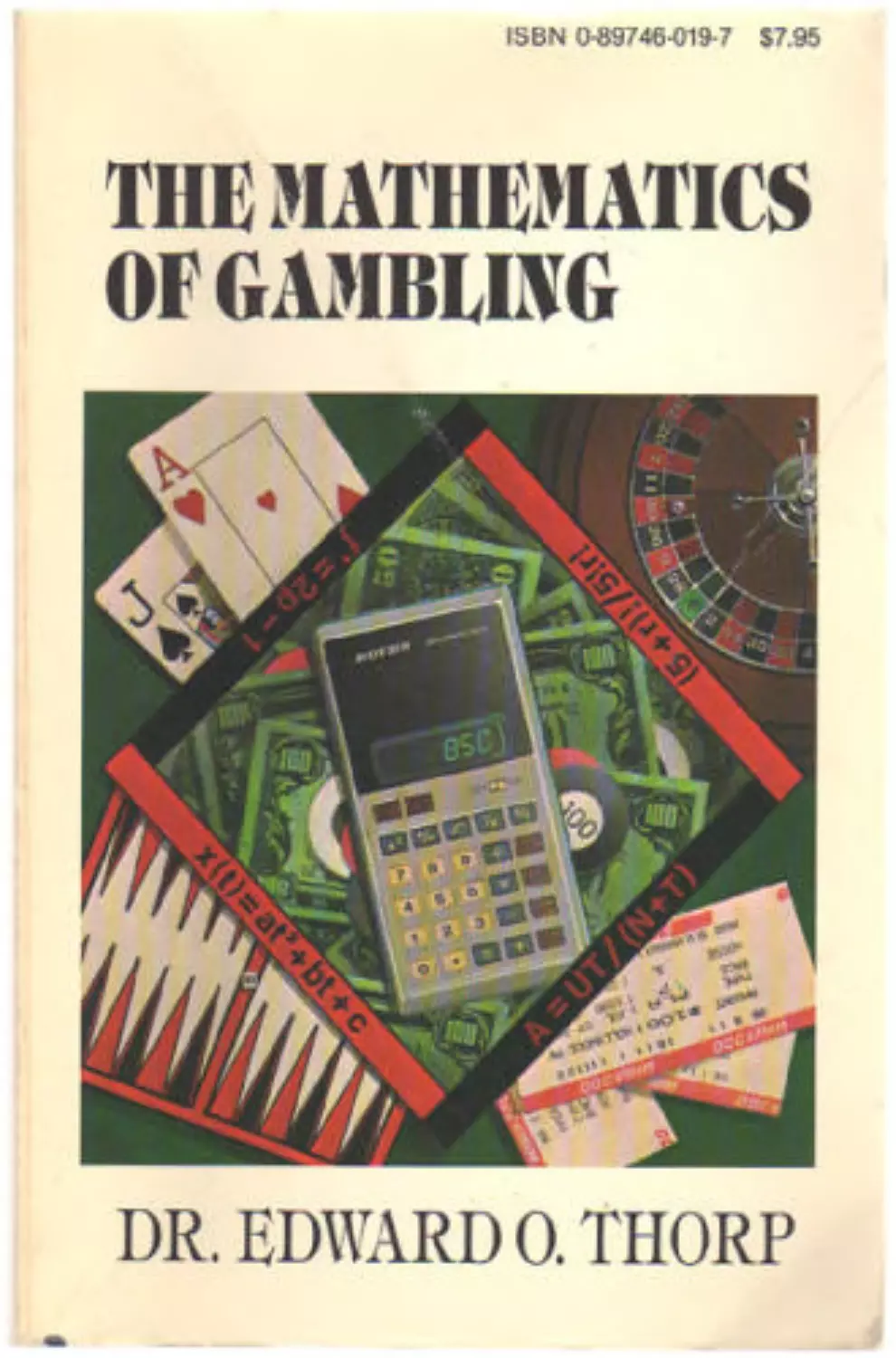
                    ISBN 0-89746-019-7 S7.95
THE MATHEMATICS
OF GAMBLING
DR. EDWARD 0. THORP

THE
MATHEMATICS
OF GAMBLING
By
Dr. Edward O. Thorp

Table of Contents
SECTION ONE-CARD GAMES .................1
Chapter 1:	Introductory Statement....3
Chapter 2:	Blackjack................11
Chapter 3:	Baccarat.................29
SECTION TWO—THE WHEELS ................41
Chapter 4:	Roulette.................43
Chapter 5:	The Wheel of Fortune.....65
SECTION THREE-OTHER GAMES.................71
Chapter 6:	Horse Racing.............73
Chapter 7:	Backgammon...............83
SECTION FOUR-MONEY
MANAGEMENT............................ill
Chapter 8:	Mathematical Systems ...113
Chapter 9:	Optimal Betting.........125
Appendices.........................131
Keeping Your Gaming Knowledge Current.141

About the Author
Edward Thorp is adjunct professor of finance and mathematics
at the University of California at Irvine, where he has taught
courses in finance, probability and functional analysis. He
previously taught at the University of California at Los Angeles,
the Massachusetts Institute of Technology and New Mexico State
University.
Thorp’s interest in gambling dates back almost 30 years, while
he was still in graduate school at UCLA. It was here that he first
formulated his dream of making money from the development
of a scientifically-based winning gambling system. His first sub-
ject of study was the roulette wheel, which offered him the op-
portunity to use modem physics to predict the resting place of
the ball.
With the roulette work unfinished, Thorp’s attention was diverted
by the blackjack work of Baldwin, Cantey, Maisel and McDer-
mott. He set to work on this new problem. With the aid of a com-
puter, Thorp developed the basic strategy and the five-count, ten-
count and ultimate counting strategies. He used these methods
with success in the Nevada casinos. The work was first publiciz-
ed in a scientific journal and saw broad public exposure in the
1962 book Beat the Dealer. The book underwent a revision in
1966 and it is still regarded as the classic early work in the “black-
jack revolution” which continues to this day.
In the late 1960s, Thorp developed with Sheen Kassouf a suc-
cessful method for stock market investing involving warrants that
proved so profitable that Thorp turned $40,000 into $100,000 in
two years. The strategy was published in Beat the Market in 1967.
Additionally, using this strategy and further refinements, Thorp
manages a multi-million-dollar investment portfolio. He is Presi-
dent of Oakley Sutton Management Corp, and Chairman of the
the Board of Oakley Sutton Securities Corp.
Thorp has continued to advance new theories for gambling and
other games, as well as the stock market.
Section One
Card Games
Casino card games such as baccarat and blackjack
differ significantly from casino games such as craps,
roulette, and slot machines in that they are not indepen-
dent trial processes-that is, the cards that already have
been played do affect the odds on subsequent hands.
Consider for a moment the game of blackjack, where
the cards used on a round are put aside and successive
rounds are dealt from an increasingly depleted pack.
The cards are reshuffled before a round If the remain-
ing unused cards would be insufficient to complete a
round or earlier, usually at the casino’s discretion. What
the early research on blackjack (contained in Beat the
Dealer} showed and what has been confirmed repeated-
ly in the intervening 23 years is that the end pack pro-
vides favorable situations often enough to give the
player an overall advantage.
While it is foolish to keep a record of past decisions
at craps in orderto determine which numbers are “hot”
or “cold" (the dice have no memory), an ability to keep
track of which cards have been played and knowledge
of their relationship to the player’s expectation can be
beneficial, as long as the cards are not reshuffled after
every hand.
]
The Mathematics of Gambling
The ability to keep track of the cards played does not
alone guarantee gambling success at a particular дата
Indeed, one of the chief tasks of this section will be
to examine the usefulness of card counting strategies
in baccarat, considering the bets offered and the nature
of the game.
In Chapter 2, we will comment on blackjack systems,
as well as statistical methods useful in detecting
casino cheating. The latter subject is important to those
who play the game seriously, because cheating in-
cidents can erode any small edge the player may gain
through the use of basic strategy and card counting.
2
Chapter 1
Introductory Statement
The casino patron who decides to “try his luck” at the tables
and the horse player who wagers at the racetrack confront what
seem to be formidable adversaries. The casinos hope to have the
advantage on every bet offered and, at the track, the pari-mutuel
takeout of 17-25 % on every bet assures all but a few will wind up
losers.
As soon as he enters the casino, the player must make several
important decisions, the first being: What game do I play? Even
after this choice is made, most games offer additional options: Do
I play individual numbers or the even-money bets in roulette? Do
I stand with a pair of eights in blackjack or should I hit or split the
pair? Should I bet pass or the one-roll propositions in craps?
The horse player is offered a number of choices as well. He is
usually faced with a field of six to 12 horses. He can play one or
more horses to win, place, or show, in addition to combining any
number of horses in the exotic or “gimmick” wagers.
All of these choices have “right” answers, if the player seeks to
maximize his return or minimize his loss. They all can be at least
3
The Mathematics of Gambling
partially solved through the use of mathematical theory. The
intelligent player must have a basic understanding of the
mathematics behind the game or games he plays if he is to survive
financially or actually profit. There are situations where the
player has the advantage. The most-publicized example, of
course, is casino blackjack. The game has become tougher in
recent years due to casino countermeasures, but blackjack can
still be profitable for the sophisticated player. There could be
several other favorable games, as the reader will soon discover.
A familiarity with basic probability will allow the alert gambler
to discover those positive expectancy games and exploit them
where they exist. A vast knowledge of mathematics is not
required. Some of the finest poker players in the country never
went to college, but they do have a sense of what makes a good
poker hand and what their chances of having the best hand are
after all the cards have been dealt.
Mathematical Expectation
1 have already made reference to the concept of mathematical
expectation. This principle is central to an understanding of the
chapters to follow.
Imagine for a moment a coin toss game with an unbiased coin
(a coin we assume will produce 50% heads and 50% tails). Sup-
pose also that we are offered an opportunity to bet that the next
flip will be heads and the payoff will be even money when we win
(we receive a $1 profit in addition to the return of wager). Our
mathematical expectation in this example is:
(.5X1) + (.5)(-1) = 0
The mathematical expectation of any bet in any game is com-
puted by multiplying each possible gain or loss by the probability
of that gain or loss, then adding the two figures. In the preceding
example, we expect to gain nothing from playing this game. This
is known as afair game, one in which the player has no advantage
or disadvantage.
Now suppose the payoff was changed to 3/2 (a gain of $1.50 in
addition to our $1 bet). Our expectation would change to:
4
Introductory Statement
(,5X1.50) + (.5X-1)= + .25
Playing this game 100 times would give us a positive expectation
of $25.
The two examples presented thus far are admittedly simple, but
often this type of analysis is all that is needed to evaluate a prop-
osition. Consider the “dozens” bet in roulette. Our expectation
for a $1 bet is:
(12/38X2) + (26/38X -1) = - .0526
As another example, suppose that on the first hand of four-
deck blackjack the player bets $12, he is dealt 6,5, and the dealer
then shows an ace up. The dealer asks the player if he wants
insurance. This is a separate $6 bet. It pays $12 if the dealer’s hole
card is a ten-value. It pays -$6 otherwise. A full four-deck pack
has 64 tens and 144 non-tens. Assuming the deck is “randomly”
shuffled (this means that all orderings of the cards are equally prob-
able), the chances are equally likely that each of the 205 unseen
cards is the dealer’s hole card. Thus the player’s expectation is:
(64/205X12)+ (141/205)(-6) = -78/205
or about -$.38. The player should not take insurance.
Different betting amounts have different expectations. But the
player’s expectation as a percent of the amount bet]& always the
same number. In the case of betting on the Red in roulette, this is
18/38 - 20/38 = -2/38 = -1/19 or about -5.26%. Thus, the
expectation of any size bet on Red at American double-zero
rouletteis -l/19orabout -5.26% of the total amount bet. Soto
get the expectation for any size bet on Red, just multiply by
-5.26%. With one exception, the other American double-zero
roulette bets also have this expectation per unit bet. The player’s
expectation per unit is often simply called the player’s disadvan-
tage. What file player loses, the house wins, so the house advan-
tage, house percentage, or house expectation per unit bet by the
5
The Mathematics of Gambling
player is +5.26%.
A useful basic fact about the player’s expectation is this: the
expectation for a series of bets is the total of the expectations for
the individual bets. For instance, if you bet $1 on Red, then $2,
then $4, your expectations are -$2/38, -$4/38, and -$8/38.
Your total expectation is -$14/38 or (a loss of) about -$.37.
Thus, if your expectation on each of a series of bets is - 5.26% of
the amount bet, then the expectation on the whole series is
-5.26% of the total of all bets. This is one of the fundamental
reasons why “staking systems” don’t work: a series of negative
expectation bets must have negative expectation.
Repeated Trials
Expectation is the amount you tend to gain or lose on average
when you bet. It, however, does not explain the fluctuations from
expectation that occur in actual trials.
Consider the fair game example mentioned earlier in the
chapter. In a series of any length, we have an expectation of 0. In
any such series it is possible to be ahead or behind. Your total profit
or loss can be shown to have an average deviation from expecta-
tion of about VN. Let D = T —E be the difference of deviation be-
tween what you actually gain or lose (T), and the expected gain or
loss (E). Therefore, for 100 bets, the average deviation from E =0
is about $10 (in fact, the chances are about 68% that you’ll be
within $10 of even; they’re about 96% that you’ll be within $20 of
even). For ten thousand $1 bets it’s about $100 and for amillion $1
bets it’s about $1,000. Table 2-1 shows what happens. For
instance, the last line of Table 1-1 says that if we match coins one
million times at $1 per bet, our expected gain or loss is zero (a
“fair” game). But on average, we’U be about $1,000 ahead or
behind. In fact, we’U be between +$1,000 and -$1,000 about
68% of the time. (For a miUion $1 bets, the deviation D has
approximately a normal probability distribution with mean zero
and standard deviation $1,000.) We call the total of the bets in
a series the “action,” A. For one series of one million $1 bets,
the action is $1,000,000. However (fifth column) D/A=0.001, so
6
Thble 1-1
number of bets N (A = $N)	expected gain E	average size of D is about ,/n"	about 68% of time T is between	average size of D/A	about 68% of time T/A is between
100	0	10	10 and - 10	0.1	0.1 and -0.1
10,000	0	100	100 and - 100	0.01	0.01 and -0.01
1,000,000	0	1000	1000 and -1000	0.001	0.001 and -0.001
The Mathematics of Gambling
the deviation as a percent of the action is very small. And about
68% of the time T/A is between -.001 and +.001 so as a per-
cent of the action the result is very near the expected result of
zero. Note that the average size of D, the deviation from the ex-
pected result E, grows—contrary to popular belief. However, the
average size of the percentage of deviation, D/а, tends to zero,
in agreement with a correct version of the “law of averages.”
For $1 bets on Red at American roulette, the corresponding
results appear in Table 1-2. Notice that in the last column the
spread in T/A gets closer and closer to E/A = —.0526 This is where
we get the statement that if you play a “long time” you’ll lose
about 5.26% of the total action. Note, too, in column 4 that there
appears to be less and less chance of being ahead as the number of
trials goes on. In fact, it can be shown that in all negative expecta-
tion games the chance of being ahead tends to zero as play
continues.
Using the concept of action, we can now understand the
famous “law of averages.” This says, roughly, that if you make a
long series of bets and record both the action (Д) and your total
profit or loss CD, then the fraction T /A is approximately the same
as the fraction E/A where E is the total of the expected gain or loss
for each bet. Many people misunderstand this ‘ ‘law. ’ ’ They think
that it says the E and T are approximately the same after a long
series of bets. This is false. In fact, the difference between E and T
tends to get larger as A gets bigger.
Now, the ordinary player probably won’t make a million $1
bets. But the casino probably will see that many and more. From
the casino’s point of view, it doesn’t matter whether one player
makes all the bets or whether a series of players does. In either
case, its profit in the long run is assured and will be very close to
5.26% of the action. With many players, each making some of
the 1,000,000 bets, some may be lucky and win, but these will
generally be compensated for by others who lose more than the
expected amount. For instance, if each of 10,000 players take
turns making a hundred $1 bets, Table l-2tellsus that about 68%
of the time their result will be between +$4.74 and -$15.26.
8

Table 1-2
N (A = $ N)	E	D-Ум	about 68% of time T is between	D/A-1//N	about 68% of time T/A Is between
100	$5.26	10	+	$4.74 and- $15.26	0.1	+.0474 and -.1526
10,000	- $526.00	100	- $426.00 and - $626.00	0.01	-.0426 and -.0626
1,000,000	-$52631.00	1,000	-$51631.00 and -$53631.00	0.001	-.0516 and -.0536
The Mathematics of Gambling
About 16% of the time the player wins more than $4.74 (“lucky”)
and about 16% of the time the player loses more than $15.26
(“unlucky”). But players cannot predict or control which group
they’ll be in.
This same “law of averages” applies to more complicated
sequences of bets. For instance, suppose you bet $10 on Red at
roulette (E = - .53), then bet $100 on “players” at Baccarat
(E = -$1.06), then bet $10 on a hand in a single-deck blackjack
game where the ten-count is 15 tens, 15 others (E = +$.90). The
total E is $.53-$1.06+$.90= -$.69. The total A is $10 + $100
+ $10 = $120. If you make a long series of bets and record E and
A as well as your gains and losses for each one, then just as in the
coin matching example (Table 1-1) and the roulette example
(Table 1-2), the fraction D/А tends to zero so T/A tends to E/A.
That means that over, say, a lifetime, your total losses as a percent
of your total action will tend to be very close to your total expecta-
tion as a percent of your action.
If you want a good gambling life, make positive expectation
bets. You can, as a first approximation, think of each negative
expectation bet as charging your account with a tax in the amount
of the expectation. Conversely, each positive expectation bet
might be thought of as crediting your account with a profit in the
amount of the expectation. If you only pay tax, you go broke. If
you only collect credits, you get rich.
10
Chapter 2
Blackjack
Blackjack, or twenty-one, is a card game played throughout
the world. The casinos in the United States currently realize an
annual net profit of roughly one billion dollars from the game.
Taking a price/eamings ratio of 15 as typical for present day com-
mon stocks, the United States blackjack operation might be com-
pared to a $15 billion corporation.
To begin the game a dealer randomly shuffles the cards and
players place their bets. The number of decks does not materially
affect our discussion. It generally is one, two, four, six or eight.
There are a maximum and minimum allowed bet.
The players’ hands are dealt after they have placed their bets.
Each player then uses skill in his choice of a strategy for improving
his hand. Finally, the dealer plays out his hand according to a fixed
strategy which does not allow skill, and bets are settled. In the case
where play begins from one complete randomly shuffled deck, an
approximate best strategy (i.e., one giving greatest expected
return) was first given in 1956 by Baldwin, Cantey, Maisel, and
McDermott.
The Mathematics of Gambling
Though the rules of blackjack vary slightly, the player follow-
ing the Baldwin group strategy typically has the tiny edge of
+. 10 %. (The pessimistic figure of — .62 % cited in the Baldwin’s
group’s work was erroneous and may have discouraged the authors
from further analysis.) These mathematical results were in sharp
contrast to the earlier and very different intuitive strategies
generally recommended by card experts, and the associated player
disadvantage of two or three percent. We call the best strategy
against a complete deck the basic strategy. Determined in 1965,
it is almost identical with the Baldwin group strategy and it gives
the player an edge of +.13 against one deck and —.53 against
four decks.
If the game were always dealt from a complete shuffled deck,
we would have repeated independent trials. But for compelling
practical reasons, the deck is not generally reshuffled after each
round of play. Thus as successive rounds are played from a given
deck, we have sampling without replacement and dependent
trials. It is necessary to show the players most or all of the cards used
on a given round of play before they place their bets for the next
round. Knowing that certain cards are missing from the pack, the
player can, in principle, repeatedly recalculate his optimal strategy
and his corresponding expectation. (The strategies for various
card counting procedures, and their expectations, were determined
directly from probability theory with the aid of computers. The
results were reverified by independent Monte Carlo calculations.)
Blackjack Systems
All practical winning strategies for the casino blackjack player,
beginning with my original work in 1961, are based on this
knowledge of the changing composition of the deck. In practice
each card is assigned a point value as it is seen. By convention the
point value is chosen to be positive if having the card out of the
pack significantly favors the player and negative if it significantly
favors the casino. The magnitude of the point value reflects the
magnitude of the card’s effect but is generally chosen to be a small
integer for practical purposes. Then the cumulative point count is
taken to be proportional to the player’s expectation.
12
Blackjack
To a surprising degree, the player’s best strategy and cor-
responding expectation depend only on the fractions of each type
of card currently in the pack and only change slowly with the size
of the pack. Thus the better systems “normalize” by dividing the
cumulative point count by the total number of as yet unseen
cards. Most point count systems are initialized at zero cumulative
total for the full pack, and the normalized cumulative count is
taken to indicate the change in player expectation from the value
for the full pack.
The original point count systems, the prototypes for the many
subsequent ones, were my five count, ten count, and “ultimate
strategy. ” An enormous amount of effort by many investigators
has since been expended to improve upon these count systems.
Some of these systems are shown in Table 2-1 (courtesy of Julian
Braun).
The idea behind these point count systems is to assign point
values to each card which are proportional to the observed effects
of deleting a ‘ ‘small quantity” of that card. Table 2-2 (courtesy of
Julian Braun, private correspondence) shows this for one deck
and for four decks, under typical Las Vegas rules. One must com-
promise between simplicity (small integer values) and accuracy.
My “ultimate strategy” is a point count based on moderate
integer values which fits quite closely the data available in the early
1960s. Until recently all the other count systems were simplifica-
tions of the “ultimate.”
System 1 (Table 2-1) does not normalize by the number of re-
maining cards. Thus the player need only compute and store the
cumulative point count. Normalization gives the improved results
of system 2, but requires the added effort of computing the
number of remaining cards and of dividing the point count by the
number of remaining cards when decisions are to be made. In
practice the player can estimate the unplayed cards by eye and use
it with system 1 and get almost the results of system 2 with much
less effort. Systems 2, 3, 5 and 7 all divide by the number of
remaining cards.
13
The Mathematics of Gambling
Table 2-1
Table 2-1, Braun’s simulation of various point count
systems. “Bet 1 to 4” means that 1 unit was bet except for
the most advantageous x % of the situations, when 4
was bet. To compare systems, x was approximately the
same in each case, 21(%).
STRATEGY/SYSTEM		RESULTS OF SIMULATED DEALS-PLAYER’S ADVAN.
		Flat Bet	Bet 1 to 4
1	Basic Braun + -	.2%	1.4%
2	Braun + -	.7%	2.0%
3	Revere Pt. Ct.	.6%	2.1%
4	Revere Adv. + -	.5%	1.6% to 1.8% +
5	Revere Adv. Pt. Ct. - 71	.6%	2.0%
6	Revere Adv. Pt. Ct. - 73	.8%	2.1% to 2.3% +
7 Thorp Ten Count		.7%	1.9%
8 Hi-Opt		.8%	2.1% to 2.3% +
14
Blackjack
Thble 2-1 (continued)
SYSTEM #	2	BASIC POINT COUNTS CARD 345678 9 T			A	+ N?t	SIDE ACE COUNT?	X(C) 1 DECK 4 DECK
1	1	111100	0	-1 -	1	NO	NO	.963	.961
2	1	111100	0	-1 -	1	YES	NO	.963	.961
3	1	222210	0	-2 -	2	YES	NO	.979	.977
4 5	1 2	111100- 3 3 4 3 2 0 -	1 1	-1 -3 -	0 4	YES YES	YES NO	.885 (.968)* .994	.884 (.968)* .994
6 7	2 4	2 3 4 2 1 0 - 4 4 4 4 4 4	2 4	-3 -9 -	0 4	YES YES	YES NO	.924 (.995)* .720	.922 (.997)* .709
8	0	111100	0	-1	0	YES	YES	.874 (.938)*	.871 (.939)*
t Normalized.
* Improvement with ace adjustment.
Table 2-2
Changes in Player Expectation by Removing Individual Cards
One deck Top of Deck Expectancy = 0.10%
	Cards removed	A	2	3	4	5	6	7	8	9	10	d*	d/13
	Expectation (%)	-.48	.50	.56	.70 .86	.56	.41	.12	-.06	-.39
	Change in Expectation (%)	-.58	.40	.46	.60 .76	.46	.31	.02	-.16	-.49	.31	.024
	4*	-.604	.376	.436	.576 .736	.436	.286	-.004	-.184	-.514
	Four decks Top of Deck Expectancy			= -0.532%
	Cards removed	A	2	3	4	5	6	7	8	9	10	d*	d/13
	Expectation (%)	-1.130	-.147 •	-.081	.059 .236	-.078	-.239	-.525	-.714	-1.019
	Change in Expectation (%)	-.598	.385	.451	.591 .768	.454	.293	.007	-.182	-.487	.221	.017
	ui*	-.615	.368	.434	.574 .751	.437	.276	-.010	-.199	-.504
*See Appendix A.
Blackjack
Systems 4, 6 and 8, which are also normalized, have the first
new idea. They assign a point count of zero to the ace for strategy
purposes. This is consistent with the evidence: in most instances
that have been examined, the optimal strategy seems to be relative-
ly unaffected by changes in the fraction of aces in the pack.
However, the player’s expectation is generally affected by aces
more than by any other card (Table 2-2). Therefore these systems
keep a separate ace count. Then the deviation of the fraction of
aces from the normal 1/13 is incorporated for calculating the
player’s expectation for betting purposes*
The (c) column in Table 2-1 still remains to be explained. It is a
numerical assessment of a particular system’s closeness to an ideal
system based on the change in expectation values contained in
Table 2-2, The calculation of the (c) value eliminates the necessity
of simulating a large number of hands (say a million) to evaluate a
strategy. The computation of these numbers requires some
advanced mathematical background, so its explanation is left to
the appendix.
Cheating: Dealing Seconds
Various card counting systems give the blackjack player an
advantage, provided that the cards are well shuffled and that the
game is honest. But many methods may be used to cheat the
player. I have been victimized by most of the more common
techniques and have catalogued them in Beat the Dealer.
One of the simplest and most effective ways for a dealer to
cheat is to peek at the top card and then deal either that card or the
one under it, called the second. A good peek can be invisible to the
player. A good second deal, though visible to the player, can be
done so quickly and smoothly that the eye generally will not detect
it. Although the deal of the second card may sound different from
the deal of the first one, the background noise of the casinos
usually covers this completely. Peeking and second dealing leave
no evidence. Because these methods are widespread, it is worth
knowing how powerful they are.
Does even a top professional blackjack counter have a chance
♦See Appendix A, pg. 131.
17
The Mathematics of Gambling
against a dealer who peeks and deals seconds? Consider first the
simple case of one player versus a dealer with one deck. This is an
extreme example, but it will illustrate the important ideas.
I shuffle the deck and hold it face up in order to deal practice
hands. Because I can see the top card at all times, dealing from a
face-up deck is equivalent to peeking on each and every card. I
will deal either the first or second card, depending on which gives
the dealer the greatest chance to win. I will think out loud as an
imaginary dealer might, and the principles I use will be listed as
they occur. The results for a pass through one deck are listed in
Table 2-3 (pp. 20-21). There were nine hands and the dealer won
them all.
On hands one, two, four, six, eight and nine, the dealer wins by
busting the player. Because there is only one player, it does not
matter what cards the dealer draws after the player busts.
When there are two or more players, the dealer may choose a
different strategy. If, for example, the dealer wishes to beat all the
players but doesn’t want to peek very often, an efficient approach
is simply to peek when he can on each round of cards until he finds
a good card for himself on top. He then retains this card by deal-
ing seconds until he comes to his own hand, at which time he deals
the top card to himself. That strategy would lead to the dealer
having unusually good hands at the expense of the collective
player hands; because some good hands have been shifted from
the players, the player hands would be somewhat poorer than
average.
A player could detect such cheating by tallying the number of
good cards (such as aces and 10s) which are dealt to the dealer as
his first two cards and comparing that total with the number of
aces and 10s predicted by theory. In Peter Griffin’s book, The
Theory of Blackjack, he describes how he became suspicious
after losing against consistently good dealer hands. Griffin writes
that he “... embarked on a lengthy observation of the frequency
of dealer up cards in the casinos I had suffered most in. The result
of my sample, that the dealers had 770 aces or 10s out of 1,820
hands played, was a statistically significant indication of some
sort of legerdemain.” Griffin’s tally is overwhelming evidence
18
Blackjack
that something was peculiar. The odds against such an excess of
ten-value cards and aces going to the dealer in a sample this size
are about four in ten thousand.
Another approach the dealer might select is to beat one player
at the table while giving everybody else normal cards. To do this,
the dealer peeks frequently enough to give himself the option of
dealing a first or second to the unfortunate player each time that
player’s turn to draw a card comes up. Dealing stiffs to a player so
that he is likely to bust is, as we see from the chart in Table 2-3, so
easy to do that the player has little chance.
If all dealers peeked and dealt seconds according to the
cheating strategy indicated in Table 2-3,1 estimate that with one
player versus the dealer, the dealer would generally win at least 95
percent of the time. With one dealer against several players, the
dealer would win approximately 90 percent of the time. Anyone
who is interested can get a good indication of what the actual
numbers are by dealing a large number of hands and recording
the results.
The deadliest way a dealer can cheat is to win just a few extra
hands an hour from the players. This approach is effective
because it is not extreme enough to attract attention, or to be
statistically significant and therefore detectable over a normal
playing time of a few hours. For example, the odds in blackjack
are fairly close to even for either the dealer or the player to win a
typical hand. Suppose that by cheating the dealer shifts the
advantage not to 100 percent but to just 50 percent in favor of the
house. What effect does this have on the game?
If we assume that the player plays 100 hands, a typical total for
an hour’s playing time, and we also assume that the player bets an
average of two units per hand, then being cheated once per 100
hands reduces the player’s win by one unit on the average. A pro-
fessional player varying his bet from one to five units would prob-
ably win between five and 15 units per hour. The actual rate
would depend upon casino rules, the player’s level of skill, and the
power and variety of winning methods that he employed. Let’s
take a typical professional playing under good conditions and
29
Table 2-3
Top Hand Card	Card Dealt	Comment	Plr. Gets	Hr. Total	Dlr. Gets	Dlr. Total	Result
1	1	First		2	2
5	Second (4)	Dlr. trys for good card			4	4
5	Second (10)	Dlr. will have 9: Plr. gets stiff	10	12
5	First				5	9
4	First	Worsens Plr. stiff	4	16
5	Second (8)	Prevent Plr. 21	8	24 bust			Dlr. wins
5	First	Doesn't matter			5	14
9	First	Doesn't matter			9	23 bust
2	4	First		4	4
К	First				10	10
Q	First	Give Plr. stiff	10	14
J	Second IJ)	J will bust Plr. (Second turns out to be J. too!)	J	24 bust			Dlr. wins
J	First	Doesn't matter			J	20
3	A			3
A	First				A	1. 11
3	First	Bldg, potential stiff	3	6
J	First				J	BJ	Dlr. wins
4	2	First		2	2
9	First	Would make Fir 11. so Dlr. takes			9	9
К	First	Give Plr. stiff	К	12
Q	Second 131	Guarantees Dlr. win			3	12
Q	First		Q	22 bust			Dlr. wins
8	First				8	20
5	5	First		5	5
J	First				J	10
A	Second (Al	Guarantees Dlr. win (Second was A, too!)	A	6.16
A	First				A	BJ	Dlr. wins
Blackjack
Table 2-3 (continued)
6	8	First		8
	Q	First				Q	10
	6	First	Give Plr. stiff	6	14
	2	Second (3)				3	13
	2	First	Give Plr. worse stiff	2	16
	6	First		6	22 bust			Dlr. wins
	4	First				4	17
7	7	First		7	7 -
	6	Second (A)				A	1. il
	e	First		6	13
	6	Second (KI				К	BJ	Dlr. wins
8	6	First		6	6
	10	First				10	10
	к	First	Give Plr. bad stiff	К	16
	9	Second (2)	Dlr. must win			2	12
	9	First		9	25 bust			Dlr. wins
	10	First	Doesn't matter	10		10	22 bust
9	8	hirst		И	8
	Q	First				Q	10
	7	First		7	15
	10	Second (5)	Dlr. must win			5	15
	10	First		10	25 bust			Dlr. wins
	7	First				7	22
The Mathematics of Gambling
The Mathematics of Gambling
assume that his win rate is ten units per hour and his average bet
size is two units. Given those assumptions, being cheated ten
times per hour or one-tenth of the time would cancel his advan-
tage. Being cheated more than ten percent of the time would prob-
ably turn him into a loser.
Cheating in the real world is probably more effective than in the
hypothetical example just cited, because the calculations for that
example assume cheating is equally likely for small bets and big
bets. In my experience, the bettor is much more likely to be
cheated on large bets than on small ones. Therefore, the dealer
who cheats with maximum efficiency will wait until a player
makes his top bet. Suppose that bet totals five units. If the cheat
shifts the odds to 50 percent in favor of the house, the expected
loss is 2-1 /2 units, and just four cheating efforts per 100 hands will
cancel a professional player’s advantage. A cheating rate of five
or ten hands per 100 wifi put this player at a severe disadvantage.
We can see from this that a comparatively small amount of
cheating applied to the larger hands can have a significant impact
on the game’s outcome. This gives you an idea of what to look for
when you are in the casinos and think that something may be
amiss.
Missing Cards: The Short Shoe
I have heard complaints that cards have been missing from the
pack in some casino blackjack games. We’ll discuss how you
might spot this cheating method.
In 1962,1 wrote on page 51 of Beat the Dealer, “Counting
the... cards... is an invaluable asset in the detection of cheating
because a common device is to remove one or more cards from the
deck.” Lance Humble discusses cheating methods for four-deck
games dealt from a shoe in his International Blackjack Club
newsletter. He says, “The house can take certain cards such as
tens and aces out of the shoe. This is usually done after several
rounds have been dealt and after the decks have been shuffled
several times. It is done by palming the cards while they are being
22
Blackjack
shuffled and by hiding them on the dealer’s person. The dealer
then disposes of the cards when he goes on his break.” But
cheating this way is not limited to the casino. Players have been
known to remove “small” cards from the pack to tilt the edge
their way. The casino can spot this simply by taking the pack and
counting it; the player usually has to use statistical methods.
In the cheating trade, the method is known as the short shoe.
•Let’s say the dealer is dealing from a shoe containing four decks
of 52 cards each. In 52 cards, there should be 16 ten-value cards:
the tens, jacks, queens and kings. Logically, in four decks of 208
cards, there should be 64 ten-value cards. I’ll call all of these
“tens” from now on. Casinos rarely remove the aces—even
novice players sometimes count these.
Suppose the shift boss or pit boss takes out a total of ten tens;
some of each kind, of course, not all kings or queens. The shoe is
shortened from 64 tens to 54 tens, and the four decks from 208
cards to 198 cards.
The loss of these ten tens shifts the advantage from the player to
the dealer or house. The ratio of others/tens changes from the
normal 144/64 = 2.25 to 144/54 =2.67, and this gains a little over
one percent for the house. How can you discover the lack of tens
without the dealer knowing it?
Here is one method that is used. If you’re playing at the black-
jack table, sit in the last chair on the dealer’s right. Bet a small fixed
amount throughout a whole pack of four decks. After the dealer
puts the cut card back only, let’s say, ten percent of the way into
the four shuffled decks and returns the decks into the shoe, then
ready yourself to count the cards. Play your hand mechanically,
only pretending interest in your good or bad fortunes. What
you’re interested in finding out is the number of tens in the whole
four-deck shoe.
Let’s say the shift boss has removed ten tens. (Reports are that
they seem to love removing exactly ten from a four-deck shoe.)
When the white cut card shows at the face of the shoe, let’s say
that the running count of tens has reached 52. That means
mathematically that if all 64 ten-value cards were in the shoe,
23
The Mathematics of Gambling
then, of the remaining 15 cards behind the cut card, as many as 12
of them would be tens, which mathematically is very unlikely.
This is how one detects the missing ten tens because the dealer
never shows their faces but just places them face down on top of
the stack of discarded cards to his right, which he then proceeds to
shuffle face down in the usual manner preparatory to another
four-deck shoe session.
Although at first the running count is not easy to keep in a real
casino situation, a secondary difficulty is estimating the approx-
imate number of cards left behind the cut card after all the shoe
has been dealt. To practice this, take any deck of 52 cards and cut
off what you think are ten, 15 or 20 cards, commit yourself to
some definite number, and then count the cards to confirm the
closeness of your estimate. After a while, you can look at a bunch
of cards cut off and come quite close to their actual number.
In summary, count the number of tens seen from the beginning
of a freshly shuffled and allegedly complete shoe. When the last
card is seen and it is time to reshuffle the shoe, subtract the
number of tens seen from the number that are supposed to be in
the shoe—64 for a four-deck shoe—to get the number of unseen
ten-value cards which should remain. If 54 ten-value cards were
seen, there should be ten tens among the unused cards. Then
estimate the number of unseen cards. You have to be sure to add
to the estimated residual stack any cards which you did not see
during the course of play, such as burned cards. Step four is to ask
whether the number of unseen ten-value cards is remarkably large
for the number of residual cards. If so, consider seriously the
possibility that the shoe may be short. For instance, suppose there
are 15 unseen cards, ten of which are supposed to be ten-values. A
computation shows that the probability that the last 15 cards of a
well-shuffled four-deck shoe will have at least ten ten-value cards
is 0.003247 or about one chance in 308.
Thus the evidence against the casino on the basis of this one
shoe alone is not overwhelming. But if we were to count down the
same shoe several times and each time were to find the remaining
cards suspiciously ten-rich, then the evidence would become very
24
Blackjack
strong. Suppose that we counted down the shoe four times and
that each time there were exactly 15 unseen cards. Suppose that
the number of unseen tens, assuming a full four decks, was nine,
11, ten, and 13 respectively. Then referring to Table 2-4, the pro-
babilities to six decimal places are H(9) = .014651 to have nine
or more unseen tens, and for at least 11, ten, and 13 respectively,
the chances are Щ11) = .000539, H(10) = .003247, and H(13)
= .000005. These correspond to odds of about 1/68,1/1,855,1/308
and 1/200,000 respectively. The odds against all these events hap-
pening together is much greater still. In this example, the evidence
strongly suggests that up to nine ten-value cards are missing. There
can’t be more than nine missing, of course, because we saw all
but nine on one countdown.
If the casino shuffles after only 104 cards are seen, it is not so
easy to tell if ten ten-value cards were removed. A mathematical
proof of this is contained in the appendix. *
This discussion should make it clear that the method suggested
is generally not able to easily spot the removal of ten-value cards
unless the shoe is counted several times or is dealt down close to
the end.
One of the interesting ironies of the short shoe method of
cheating players is that neither the shift boss nor the pitboss—the
latter bringing the decks of cards to the dealer’s table—need tell
the dealer that his shoe is short. Thus, the dealer doesn’t necessarily
have to know that he’s cheating. After all, he’s just dealing. It’s an
open question how many dealers know that they’re dealing from
a short shoe.
Reports are that the short shoe is a frequent method that
casinos use in cheating at blackjack using more than one deck.
The tables with higher minimums (say $25) are more tempting
candidates for short shoes than those with the lower minimums.
An experienced card counter can improve the method by count-
ing both tens and non-tens. Then he’ll know exactly how many
unseen cards there are, as well as unseen tens. Table 2-4 can then
be used with greater confidence.
In practice, you don’t need to count through a shoe while bet-
25
♦See Appendix B, pg. 136.
The Mathematics о/ Gambling
Table 2-4
К Number Of Unseen Ten-value Card»	P(K) Probability Of Exactly К Unseen Tent	H(K) Probability At tea st This Many Unseen Tens
0	.003171	1.000000
1	.023413	.996829
2	.070618	.973416
3	.160423	.894598
4	.220732	.734176
5	.217437	.513443
6	.156380	.296008
7	.083431	.137626
8	.036132	.050782
9	.011404	.014651
19	.002707	.003247
11	.000475	.000539
12	.000059	.000065
13	.000005	.000005
14	.000000	.000000
15	.000000	.oooooo
ting (and thus losing money in the process) to find out that the
casino is cheating. If you suspect foul play, count while standing
behind the player to the dealer’s right.
You might easily catch a short shoe by simply counting all the
cards that are used, whether or not you see what they are. Then if
the remaining cards, at the reshuffle, are few enough so you can
26
Blackjack
accurately estimate their number, you can check the total count.
For instance, you count 165 cards used and you estimate that 31
± 3 cards remain. Then there were 196 ± 3 cards rather than the
208 expected, so the shoe is short.
A casino countermeasure is to put back a 4,5 or 6 for each ace
or ten-value card removed. Then the total number of cards
remains 208, and the casino gets an even greater advantage than it
would from a short shoe.
Cards do get added to the deck, and there’s a spooky coin-
cidence to illustrate this. On page 51 of Beat the Dealer, I wrote in
1962, ‘ ‘One might wonder at this point whether casinos have also
tried adding cards to the deck. I have only seen it done once. It is
very risky. Imagine the shock and fury of a player who picks up
his hand and sees that not only are both his cards 5s, but they are
also both spades.” And then 15 years later in 1977, a player in a
one-deck game did get a hand with two of the same card—the 5 of
spades. Walter Tyminski’s casino gaming newsletter, Rogue et
Noir News, reported on page 3 of the June 15,1977 issue, “What
would you do if the player at your right in a single blackjack game
had two 5 of spades? Nicholas Zaika, a bail bondsman from
Detroit, had that experience at the Sahara in Las Vegas on May 24
at a $5 minimum table.
“Zaika wasn’t in the best of humor because he had reportedly
lost $594,000 at other Sahara tables, by far the largest loss he
has ever experienced. Zaika had the blackjack supervisor check
the cards and there were 53 cards in the deck, the duplicate be-
in the 5 of spades., .The gamer has engaged the services of Las
Vegas attorney George Grazadei to pursue claims he feels that
he has against the casino...
"The Sahara denies any wrongdoing and says that it is
cooperating fully with the investigation... Players aren’t likely to
introduce an extra 5 because the presence of the extra 5 favors the
house and not the player.”
Suppose instead of just counting tens used and total cards used,
you kept track of how many aces, 2s, 3s, queens, kings, and so on
were used. This extra information should give the player a better
27
The Mathematics of Gambling
chance of detecting the short shoe. The ultimate proof would be
to count the number of each of the 52 types of cards which have
been used. Mathematical readers might wish to investigate effec-
tive statistical or other ways of using information for detecting
shoes in which the numbers of some of the cards have been
changed.
28
Chapter 3
Baccarat
The games of baccarat and chemin de fer are well known gam-
bling games played for high stakes in several parts of the world.
Baccarat is said to be a card game of Italian origin that was in-
troduced into France about 1190 A.D. Two forms of the game
developed. One form was called baccarat and the other was called
chemin de fer. The most basic difference between these two games
is simply that three hands are dealt in baccarat (called baccarat
en banque in England) and two hands are dealt in chemin de fer
(called baccarat-chemin de fer in England and Nevada).
The cards ace through nine are each worth their face value
and the cards ten, jack, queen and king are each worth zero points.
A hand is evaluated as die sum modulo ten of its cards, i.e., on-
ly the last digit of the total is counted. The object of the game
is to be as close to eight or nine as possible with two cards, or
as close to nine as possible with at most three cards if one does
not have eight or nine on his first two cards. Then the high hand
wins.
The games of baccarat and chemin de fer became popular in
29
The Mathematics of Gambling
public casinos all over Europe, as well as in private games, about
1830. At the present time, one or both of these games are well
known in London, southern France, the Riviera, Germany and
the United States. A form of chemin de fer, which we shall call
Nevada baccarat, has been played in a few Nevada casinos since
1958.
The rules, structure and format of the three games have strong
similarities. I studied Nevada baccarat with William E. Walden
most intensively because the casinos where it is played were readi-
ly accessible. Our techniques can be carried over to the other
forms of baccarat and chemin de fer.
We were originally motivated by the observation that baccarat
and chemin de fer have several points of resemblance to the game
of blackjack, or twenty-one. The fact that practical winning
strategies for twenty-one have been discovered suggested that
there might also be practical winning strategies for baccarat and
chemin de fer. In contrast to the situation in twenty-one, we found
that there are no current practical winning strategies for the main
part of the game, i.e., for the money Banker and Player bets.
Rules and Procedures
To begin the Nevada baccarat game, eight decks of cards are
shuffled and a joker is placed face up near the end. The cards are
then put into a wooden dealing box called a shoe. The first card is
exposed, and its value is noted, face cards being counted as tens.
Then this number of cards is discarded, or “burned.”
The table has twelve seats, occupied by an assortment of
customers and shills. A shill is a house employee who bets money
and pretends to be a player in order to attract customers or
stimulate play. We refer to them indiscriminately as “players.”
There are two principal bets, called “Banker” and “Players.”
Any player may make either of these bets before the beginning of
any round of play, or “coup.”
To begin the evening’s play, two of the players are singled out.
One is termed The Banker and the other is termed The Player. The
seats are numbered counterclockwise from one to twelve. Player
30
Baccarat
number one is initially The Banker, unless he refuses. In this case
the opportunity passes counterclockwise around the table until
someone accepts. The Player is generally chosen to be that player,
other than The Banker, who has the largest bet on the Player. We
have not noticed an occasion when there were no bets on The
Player. When we played, there were shills in the game and they
generally bet on The Player (except when acting as The Banker,
when they generally bet on The Banker).
The Banker retains the shoe and deals as long as the bet
“Banker” (which we also refer to as a bet on The Banker) does
not lose. When the bet “Players” (which we also refer to as a bet
on The Player) wins, the shoe moves to the player on the right.
This player now becomes The Banker. If the coup is a tie, the
players are allowed to alter their bets in any manner they wish.
The same Banker then deals another coup.
To begin a coup, The Banker and The Player are dealt two
cards each. As we noted above, the cards ace through nine are
each worth their face value and tens and face cards are each worth
zero points. Only the last digit in the total is counted.
After The Banker and The Player each receive two cards, the
croupier faces their hands. If either two-card total equals 8 or 9
(termed a natural 8 or a natural 9, as the case may be), all bets are
settled at once.
If neither The Player nor The Banker have a natural, The
Player and The Banker then draw or stand according to the set of
rules in Table 3-1.
The high hand wins. If the hands are equal, there is a tie and no
money changes hands. Players are then free to change their bets in
any desired manner. If the coup being played is complete when
the joker is reached, the shoe ends and the cards are reshuffled.
Otherwise the coup is first played out to completion. Then the
shoe ends and the cards are reshuffled. However, the casino may
reshuffle the cards at any time between coups.
31
The Mathematics of Gambling
Table 3-1
Player having
0-5	draws a.card
6-7	stands
8-9	turns cards over
Banker having	draws when	does not draw when
	The Player draws	The Player draws
0	none, 0-9
1	none, 0-9
2	none, 0-9
3	none, 0-7,9	8
4	none, 2-7	0,1,8,9
5	none, 4-7	0-3,8,9
6	6,7	none, 0-5,8,9
7	stands	stands
8	turns cards over	turns cards over
9	turns cards over	turns cards over
The Main Bets
Two main bets against the house can be made. One can bet on
either The Banker or The Player. Winning bets on The Player are
paid at even money. Winning bets on The Banker are paid 0.95 of
the amount bet. The five percent tax which is imposed on what
otherwise would have been an even-money pay-off is called
“vigorish.” For eight complete decks, the probability that The
Banker wins is 0.458597, and the probability of a tie is 0.095156.
The basic idea of the calculation of these numbers is to consider
all possible distinct six-card sequences. The outcome for each
sequence is computed and the corresponding probability of that
32
Baccarat
sequence is computed and accumulated in the appropriate
register. Numerous short cuts, which simplify and abbreviate the
calculation, were taken.
The house advantage (we use advantage as a synonym for
mathematical expectation) over The Player is 1.2351 percent. The
house advantage over The Banker is 0.458597X5
percent—1.2351 percent or 1.0579 percent, where 2.2930 percent
is the effective house tax on The Banker’s winnings. If ties are not
counted as trials, then the figures for house advantage should be
multiplied by 1 /0.904844, which give a house advantage per bet
that is not a tie, over The Banker of 1.1692 percent and over The
Player of 1.3650 percent. The effective house tax on The Banker
in this situation is 2.5341 percent.
We attempted to determine whether or not the abnormal com-
positions of the shoe, which arise as successive coups are dealt,
give rise to fluctuations in the expectations of The Banker and
The Player bets which are sufficient to overcome the house edge.
It turns out that this occasionally happens but the fluctuations are
not large enough nor frequent enough to be the basis of a practical
winning strategy. This was determined in two ways. First, we
varied the quantity of cards of a single numerical value. The
results were negative.
We next inquired as to whether, if one were able to analyze the
end-deck perfectly (e.g. the player might receive radioed instruc-
tions from a computer), there were appreciable player advantages
on either bet a significant part of the time. We selected 29 sets of
13 cards each, each set drawn randomly from eight complete
decks. There were small positive expectations in only two
instances out of 58. Once The Player had a 3.2% edge and once
The Banker had a 0.1% edge.
We next proved, by arguments too lengthy and intricate to give
here, that the probability distributions describing the conditional
expectations of The Banker and The Player spread out as the
number of unplayed cards decreases. Thus there are fewer advan-
tageous bets of each type, and they are less advantageous, as the
number of unplayed cards increases above 13. The converse oc-
33
Thble 3-2
Bacarrat (Eight Decks)
	Subtract one Card of Value	Change In Player Bet	Advantage of: Banker Bet	Relative Point Values (Banker)	An Approximate Point Count
4k	0	-0.002%	+ 0.002%	2	0
	1	-0.004%	+ 0.004%	4	1
	2	-0.005	+ 0.005	5	1
	3	-0.007	+ 0.007	7	1
	4	-0.012	+ 0.012	11*	2 ?
	5	+ 0.008	-0.008	-8	-1	§ 1	a
Table 3-2 (continued)
6	+ 0.011	-0.011	-11	-2
7	+ 0.008	-0.008	-8	-1
8	+ 0.005	-0.005	-5	-1
9	+ 0.003	-0.003	-3	0
★Arbitrarily reduced from 12 to 11 so points in pack total zero
The Mathematics of Gambling
The Mathematics of Gambling
curs as the number of unplayed cards decreased below 13.
The observed practical minimum ranged from eight to 17 in
one casino and from 20 up in another. The theoretical minimum,
when no cards are burned, is six. Thus the results for 13 unplayed
cards seem to conclusively demonstrate that no practical win-
ning strategy is possible for the Nevada game, even with a com-
puting machine playing a perfect game.
To see why, consider the accompanying Table 3-2 (pp. 34-35),
based on Table 2 of Walden’s thesis.
From this Table we see the effect of removing one of any card
from the eight-deck baccarat pack. Proceeding in the way we
developed the theory of blackjack, we get relative point values
which are listed in the next to the last column. The last column
gives a simpler approximate point count system.
We would now like to know how powerful a point count
system in baccarat is compared with point count systems in black-
jack. To do this we compute the root mean square (RMS) value of
the column called “Change in Advantage of Banker Bet.”
We do this by squaring each of those numbers, counting the
square for zero-value cards four times because there are four
times as many. Then we add these squares, divide by 13 and take
the square root. The resulting root mean square or RMS value is
.0064%. That measures how fast the deck shifts from its base start-
ing value for a full pack.
Taking one card of a given rank (we think of there being 13
ranks) changes the fraction of any of these 13 ranks by an amount
32/416-31/415 which equals .00222. If we divide the RMS value
by this value we get .0288 as a measure of how rapidly this advan-
tage of the two bets shifts from the starting value as die composi-
tion of the deck changes.
Now we are going to compare this with the situation in black-
jack. Table 3-3, for one-deck blackjack, can be treated in the
same way to see how fast the advantage changes in blackjack.
The Table is from Peter Griffin’s book, Theory of Blackjack
Revised, page 44. We get RMS value of0.467%. The correspond-
ing change in the fraction of a single rank when one card is drawn
36
Baccarat
Table 3-3 One-Deck Blackjack
Subtract One Card of Value	Change in Advantage of Player
A	-0.61%
2	0.38%
3	0.44%
4	0.55%
5	0.69%
6	0.46%
7	0.28%
8	- .00%
9	-.18%
10	.51%
is 4/52-3/51 or .0181. The ratio of RMS value to this value is
.258%. If we divide this by the corresponding result in baccarat
we get 8.97, which tells us that as the true count in blackjack varies
the change in player advantage or disadvantage shifts nine times
as fast in blackjack as it does in baccarat.
37
The Mathematics of Gambling
Note that dividing the RMS value by the “change in fraction”
of a single pack adjusts the one-deck blackjack figures and the
eight-deck baccarat figures so they are comparable. If we had
used, for example, an eight-deck blackjack table instead, we still
would have had a final ratio of about nine times.
This allows us to translate how well a point count in baccarat
works compared with one in blackjack. In baccarat we start out
with more than a 1 % disadvantage and with eight decks. Imagine
a blackjack game with an eight-deck pack and a 1% disadvan-
tage. Now imagine play continues through the blackjack deck.
The blackjack deck advantage from a - 1 % starting level might,
on very rare occasions, shift 9% to a + 8% advantage.
As often as this happens in blackjack would be the approx-
imate frequency with which we would get 1 /9th as much shift in
baccarat; meaning from a - 1 % advantage to a 0% advantage or
break even for the banker bet. Since there are two bets, banker
and player, the player bet would also be break even or better
about as often.
The conclusion is that you might expect to break even or better
in eight-deck baccarat about twice as often as you would expect to
have an 8% edge in eight-deck blackjack. How often would you
have a 1% advantage in eight-deck baccarat? About twice as
often as you would get a 17 % edge in blackjack. The obvious con-
clusion is that advantages in baccarat are very small, they are very
rare and the few that occur are nearly always in the last five to
20 cards in the pack.
The Tie Bet
In addition to wagers on the Player or Banker hands, the casinos
offer a bet on “ties.” In the event the Banker and Player hands
have the same total, this bet gains nine times the amount bet.
Otherwise the bet is lost. The probability of a tie is 9.5156%,
hence the expectation of the bet is —4.884%.
It is clear, however, that the probability and thus the expecta-
tion of a tie depends on the subset of unplayed cards. For in-
stance, in the extreme and improbable event that the residual deck
38
Baccarat
consists solely of ten-value cards, the probability of a tie is equal to
one and the expectation is nine. Thus card counting strategies are
potentially advantageous.
Using computer simulation, random subsets of different sizes
were selected from a complete 416-card (eight deck) pack. The
results were disappointing from a money-making perspec-
tive—the advantages which occur with complete knowledge of
the used cards are limited to the extreme end of the pack and are
generally not large. Practical card counting strategies are at best
marginal, and at best precarious, for they are easily eliminated by
shuffling the deck with 26 cards remaining.
39

Section Two
The Wheels
It doesn’t require an extensive mathematical back-
ground to look at the 38 identically-sized spaces on an
American roulette wheel (note the 35-1 payoff on a
single number) and conclude that the game is
unbeatable. With a 1/38 chance of having a number
come up on the next spin and the 35-1 payoff, it is easy
to calculate the often-quoted expectancy of the player
of -5.26. The odds for other wheels, especially the
Wheel of Fortune, appear even more against the player.
The unbeatability of the roulette wheel is based on
the mechanical perfection of the wheel—such a con-
clusion is based on the assumption that the ball has
an equal chance of landing in each pocket. This may
or may not be true, although Allan Wilson, in The Casino
Gambler’s Guide, and others give fairly convincing
evidence for the existence of biased wheels—wheels
sufficiently biased to overcome the house advantage.
The very mechanical perfection of the wheel,
however, would suggest the applicability of the laws
of physics to prediction of the next number, whether
the game is roulette or the Wheel of Fortune. Just as
the future position of a planet can be predicted quite
accurately, so can an understanding of the physical
laws at work minimize the uncertainty surrounding the
41
The Mathematics of Gambling
resting place of the ball or the final position of the
wheel.
It is not possible, of course, to obtain an exact predic-
tion. But this is not absolutely necessary to assure a
profit. As Marvin Karlins has pointed out in his book
Psyching Out Vegas, “Simply being able to predict
which half of the wheel the ball will plunk into would
give the player such a whopping edge that he could go
for the chandeliers.. .and make it.”
The following two chapters Investigate the promise
of this approach to beating the wheel as well as
discussing some of the difficulties that might arise im-
plementing such a strategy in the casino environment.
42
Chapter 4
Roulette
It was the spring of 1955.1 was finishing my second year of
graduate physics at U.C.L.A. In the course of the next year I
would make three decisions that would shape my life for the next
28 years. I married (my present wife, Vivian), I changed my field
of study from physics to mathematics, and I began to toy with
the fantasy that I could shatter the chains of poverty through a
scientifically-based winning gambling system.
I was living in Robison Hall, the student-owned cooperative.
For $50 a month and four hours work a week, we got our room
and board. I had lived in the co-ops for nearly six years of
undergraduate and graduate work, on a budget of about $100 a
month. Part of this came from scholarships and, in the early
years, I got some help from home. But I was basically self-
supporting like most of the other 200 or so co-op residents.
I attended classes and studied from 50 to 60 hours a week,
generally including Saturdays and Sundays. I had read about the
psychology of learning in order to be able to work longer and
harder. I found that “spaced learning” worked well: study for an
43
The Mathematics of Gambling
hour, then take a break of at least ten minutes (shower, meal, tea,
errands, etc.)- One Sunday afternoon about 3 p.m., I came to the
co-op dining room for a tea break. The sun was streaming
through the big glass windows. (Robison, designed by Richard
Neutra in the ’30s, was very radical for that time. It had so many
big sheet glass windows that it was often called “the glass house.”)
My head was bubbling with physics equations, and several of my
good friends were sitting around chatting.
In our mutual poverty the conversation readily turned to fan-
tasies of easy money. We began to speculate on whether there
was a way to beat the roulette wheel. In addition to me, the group
included math majors Mel Rosenfeld and Andy Bruckner (now
professors of mathematics at U.C. Santa Barbara), Tom Scott,
and engineering major Rick Rushall. After all these years it’s hard
to be sure of exactly who said what, but we began the discussion
by acknowledging that mathematical systems were impossible.
ГП demonstrate this in a future chapter.
Then we kicked around the idea of whether croupiers could
control where the ball will land well enough to significantly affect
the odds. I will show later that this is impossible under the usual
conditions of the game. (The incredible thing is that logical
reasoning could even be used to settle such a question.) It was a
short brainstorming step to wondering whether wheels were im-
perfect enough to change the odds to favor the player. Those in
the group who “knew” assured me that the wheels are veritable
jeweled watches of perfection, carefully machined, balanced and
maintained. This is false. Wheels are sometimes imperfect
enough so they can be beaten. I had no experience with gambling,
or with casinos, or with roulette wheels, so I accepted the
mechanical perfection of roulette wheels.
But mechanical perfection, for a physicist, means predictability.
You can’t have it both ways, I argued. If these wheels are very im-
perfect the odds will change enough so we can beat them. If they
are perfect enough we can predict (in principle) approximately
where the ball will land. Suddenly the orbiting roulette ball seem-
ed like the planets in their stately and precise, predictable paths. In
44
Roulette
my mind there was that intuitive “click’ ’ of discovery that I would
experience again and again. Unknowingly, I had just taken the
first step on a long journey in which I would discover winning
systems such as those for blackjack and for the options market,
and I would accumulate a wealth I never imagined.
One side argued that it is a long way from prediction in princi-
ple to practical prediction. My group said that, over and over, the
story of science has been a rapid leap from a theoretical vision
(E=MC2) to an unexpected practical result (nuclear power
plants). By now our initial group of people agreed that the idea
had merit and might well work. The novel debate attracted
listeners, some of them cynical. They challenged us to prove the
idea worked. The ten minute “study break” had run into a couple
of hours. We adjourned with the half definite idea of “doing
something.”
In the following weeks the idea kept coming back to me:
measure the position and velocity of the roulette ball at a fixed
time and (maybe) you can then predict its future path, including
when and where the ball will spiral into the rotor. (The rotor is the
spinning circular central disc where the ball finally comes to rest in
numbered pockets.) Also measure the rotor’s position and velocity
at a (possibly different) fixed time and you can predict the rotor’s
rotation for any future time. But then you will know what section
of the rotor will be there when the ball arrives. So you know (ap-
proximately) what number will come up!
You can see that the system requires that bets be placed after the
ball and rotor are set in motion and somehow timed. That means
that the casinos have a simple, perfect countermeasure: forbid
bets after the ball is launched. However, I have checked games
throughout the world, including Reno, Las Vegas, London,
Venice, Monte Carlo, and Nice. Only in a few cases were bets for-
bidden after the ball was launched. A common practice instead
was to call “no more bets” a revolution or two before the ball
dropped into the center.
The simple casino countermeasure meant that there were two
problems: (1) find out whether exact enough predictions could be
45
The Mathematics of Gambling
made to get a winning edge, first in theory and then in the casino
itself, and (2) camouflage the system so the casinos would be
unaware of its use. If we could solve the prediction problem, the
camouflage was easy. Have an observer standing by the wheel
recording the numbers that came up, as part of a ‘ ‘system. ” Many
do this so it doesn’t seem out of place. But the observer also wears
a concealed computer device with timing switches. His real job is
to time the ball and rotor. (Much later we settled on toe-operated
switches, leaving both hands free and in the open.) The computer
would make the prediction and transmit it by radio to the bettor.
The bettor, at the far end of the layout, would appear to have no
connection to the observer-timer. The bettor would have a poor
view of ball and rotor and would not pay much attention to them.
To further break any link between timer and bettor, I would have
several of each, with identical devices. They would each come and
go “at random.”
The important bets have to be placed after the ball is launched.
A bettor who only bet then, and who consistently won, would
soon become suspect. To avoid that, I planned to have the bettor
also make bets before the ball was launched. These would be
limited so their negative expectation didn’t cancel all the positive
expectation of the other bets. I became a radio amateur
(W6WM) when I was 13 (back in 1945 when there weren’t easy
novice-class tests), so I thought I could build the radio link and
other electronic gadgetry.
This left me with the prediction problem to solve. More than a
year passed without much time for roulette: I got my Master’s
degree in Physics (June 1955) and wrote the first part of my Ph.D.
thesis on nuclear shell structure (Mayer-Jensen theory). The
mathematical problems that I ran into led me in the fall of 1955 to
take graduate math courses. I needed so many that I got my
Ph.D. in math instead! And early in 19561 got married. I had
been working as a tutor and one of my “students” was T.T.
Thornton. He was an independently wealthy, knowledge-loving
bachelor of about 45, who had degrees in English and chemistry.
Now he was getting a degree in mathematics, just for the pleasure
46
Roulette
of it. He was an excellent student who didn’t need a tutor but had
hired me simply to learn faster and more efficiently.
We shared bits and pieces of our hopes, dreams, and
enthusiasms.
After I had mentioned the roulette project, I was surprised and
touched by his gift of a half-sized wheel. It was black plastic
(bakelite?) made in France. I learned later that it cost the enor-
mous sum of $25. Though I had thought about the roulette
system off and on, the gift of this wheel (sometime in 1958,1 recall)
got me to work more seriously on it. My first idea was to use a
home movie camera to film the orbiting ball. I then plotted the
amount the ball had traveled versus the number of the frame of
the film. I expected that the pictures were taken at a uniform rate
of 24 (?) frames per second so I could plot (angular) distance
traveled versus time as in Figure 4-1. Instead of a smooth graph
like the solid line in Figure 4-1, my first film showed a peculiar
wavy structure, like the dashed line.
After thinking about this, I guessed that this was because the
camera did not run at uniform speed. By taking a movie of a stop-
watch that timed in hundredths of a second, I found that the
camera did vary in speed. Photo stores confirmed this. The
distortion of the curve in Figure 4-1 is analogous to the way a
musical tone is distorted by a phono turntable whose speed varies
slightly.
My next move was to take a movie of the rotating ball and the
stopwatch. This gave me an accurate time for each frame. (I still
have a roll of these pictures, postmarked January 16,1959.) But
there was still some “ripple” to the curves. (I later learned that
even a slight tilt would cause this.) Worse, I found that the curves
were not consistent from spin to spin. The situation was
something like Figure 4-2. This meant the ball behaved differently
from spin to spin. This meant that the distance it traveled varied
even with the same initial velocity. This doomed predictability
on my wheel.
I found with further experiments that my half-sized wheel was
really very irregular. The track was curved like a tube and the ball
47
The Mathematics cf Gambling
ball leave*
track here	Figure 1.
48
Figlire 4-2
The Mathematics of Gambling
“rattled around” erratically, up and down, as it orbited. The slick
bakelite surface was moulded, not machined. The ball also skidded
and bounced. And there was a horizontal junction which added
irregularities to the track.
But full-sized wheels were not like that. In December 1958,1
made my first visit to the casinos. I observed several regulation
wheels and found that the ball moved smoothly in its track. Also
the track was a pair of flat-beveled, carefully-machined surfaces,
not a tube. When I saw how good the casino wheels were, I was
more convinced than ever that prediction was possible. But I
needed a full-sized wheel and some good laboratory equipment to
continue. How could I pay for it? I got my Ph.D. in June of 1958
and was teaching at U.C.L.A. Though my wife was finally able
to stop working, we had no savings and I barely supported us.
I couldn’t ask her to go back to work to buy me a roulette wheel
and to finance my pipe dream.
But I persisted. I simulated the study of the problem of whether
the roulette ball would, for the same starting velocity, travel about
the same distance along the track. I set up a little vee-shaped
inclined trough. I would start a marble from a fixed height (a
mark on the trough) and measure how far across the floor it roll-
ed. I was encouraged but not surprised to find that the distance
the marble went could be predicted closely from the starting
height.
One memorable evening when my in-laws were due for dinner,
I ran overtime on a marble experiment. They came into the kit-
chen wondering why I hadn’t come to greet them at the door.
They found me rolling marbles down a little wooden trough and
across the floor. All over the floor were little distance markers and
pieces of tape.
In early 1959 Vivian and I spent time with Mel and Judy
Rosenfeld, working on a radio link for the casino test of my yet to
be completed roulette system. We took model airplane radio con-
trol equipment and altered it somewhat. We succeeded in getting
a workable but somewhat inconvenient radio link.
Then around March or April of 1959,1 pushed the roulette pro-
50
Roulette
ject aside. Twelve man years of blackjack calculations arrived,
courtesy of Baldwin, Cantey, Maisel and McDermott. I had
convinced myself (as described in Beat the Dealer) that I could
devise a winning blackjack card counting system and now I set to
work on this intensely. The impractical marble roller now said he
could beat the casinos at blackjack. What next?
I wrote my blackjack computer programs in the summer and
fall of 1959. Testing, then debugging followed, and then from late
1959 through early 1960 my computer production runs produced
the basic results that gave me the five-count system in early 1960.
Then during 19601 worked out most of the ten-count system and
the ideas for the ultimate strategy. I also made the computer runs
and worked out the methodology so that all of today’s so-called
“one parameter” blackjack systems could be readily devised by
anyone versed in the use of computers. In December 1960, The
Notices of the American Mathematical Society carried the
abstract of my upcoming talk, “Fortune’s Formula: The Game
of Blackjack.” Life would never be the same again. The intense
professional and public interest aroused by the abstract, even
before the talk, led me to seek quick publication in a scientific
journal. I chose to try the Proceedings of the National Academy
of Sciences. I needed a member of the Academy to communicate
(i.e. approve and forward for recommended publication), so I
sought out the one mathematics member of the Academy at
M.I.T., Claude Shannon.
Claude Shannon: Genius
Shannon, then in his early forties, was and is one of the most
famous applied mathematicians in the world. As one genius
among many, he was relatively unnoticed as a graduate
student—until he handed in his master’s thesis. It developed the
mathematical theory of switching electrical networks (e.g.
telephone exchanges) and became the landmark paper in the sub-
ject. After receiving his doctorate, Shannon worked at Bell labs
for several years and then became world-famous for papers
51
The Mathematics of Gambling
establishing the mathematical foundations of information
theory.
I was able to arrange a short appointment early one chilly
December afternoon. But the secretary warned me that Shannon
was only going to be in for a few minutes, not to expect more, and
that he didn’t spend time on subjects (or people) that didn’t
interest him (enlightened self-interest, I thought to myself).
Feeling both awed and lucky, I arrived at Shannon’s office
for my appointment. He was a thinnish alert man of middle
height and build, somewhat sharp featured. His eyes had a genial
crinkle and the brows suggested his puckish incisive humor. I told
the blackjack story briefly and showed him my paper. We changed
the title from “A Winning Strategy for Blackjack” to “A
Favorable Strategy for Twenty-One” (more sedate and respect-
able). I reluctantly accepted some suggestions for condensation,
and we agreed that I’d send him the retyped revision right away
for forwarding to the Academy.
Shannon was impressed with both my blackjack results and my
method and cross-examined me in detail, both to understand and
to find possible flaws. After my few minutes were up, he pointed
out in closing that I appeared to have made the big theoretical
breakthrough on the subject and that what remained to be
discovered would be more in the way of details and elaboration.
And then he asked, “Are you working on anything else in the
gambling area?”
I decided to spill my other big secret and told him about
roulette. Several exciting hours later, as the wintery sky turned
dusky, we finally broke off with plans to meet again on the
roulette project. Shannon lived in a huge old three story wooden
house on one of the Mystic Lakes, several miles from Cambridge.
His basement was a gadgeteer’s paradise. It had perhaps a hun-
dred thousand dollars worth of electronic, electrical and
mechanical items. There were hundreds of categories, like
motors, transistors, switches, pulleys, tools, condensors,
transformers, and on and on.
Our work continued there. We ordered a regulation roulette
52
Roulette
wheel from Reno and assembled other equipment including
(most important) a strobe light and a large clock with a second
hand that made one revolution in one second. The dial was divided
into hundredths of a second and still finer time divisions could be
estimated closely. We set up shop in “the billiard room,” where a
massive old dusty slate billiard table made a perfect solid stable
mounting for the roulette wheel.
Analyzing the Motion
My original plan was to divide the various motions of ball and
rotor into parts and analyze each one separately. They were:
•	The ball is launched by the croupier. It orbits on a horizontal
track on the stator until it slows down enough to fall off this
(sloped) track towards the center (rotor). Assume at first that (a)
the wheel is perfectly level, and (b), the velocity of the ball
depends on how many revolutions it has left before falling off.
Referring to Figure 4-2, (b) means that every spin would produce
the same curve, not different ones like my half-sized wheel. Put
another way, this means that if you timed one revolution of the
ball on the stator, you could tell how many more revolutions and
how much more time until the ball left the track. If these assump-
tions turned out to be poor, we would attempt to modify the
analysis.
•	Next analyze the portion of the ball orbit from the time the
ball leaves the track until it crosses from the stator to the rotor. If
the wheel is perfectly level and there are no obstacles, then it seems
plausible that this would always take the same amount of time.
(We later kamed that wheels are often significantly tilted. This
tilt, when it occurs, can affect the analysis substantially. We even-
tually learned how to use it to our advantage.) There are,
however, vanes, obstacles, or deflectors on this portion of the
wheel. The size, number, and arrangement vary from wheel to
wheel.
On average, perhaps half the time these have a significant effect
on the ball. Sometimes they knock it abruptly down into the
53
Hie Mathematics of Gambling
rotor, tending to cause it to come to rest sooner. This is typical of
“vertical” deflectors (ones approximately perpendicular to the
ball’s path). Other times they “stretch out” the ball’s path, caus-
ing it to enter the rotor at a more grazing angle and to come to rest
later, on average. This is typical of “horizontal” deflectors (ones
approximately parallel to the ball’s path).
•	Assume the rotor is stationary (not real), and beat that situa-
tion first. Reasoning; if you can’t beat a stationary rotor, you
can’t beat the more complex moving rotor. Here the uncertainty
is due to the ball being “spattered” by the frets (the dividers be-
tween the numbered pockets). Sometimes a ball will hit a fret and
bounce several pockets on, other times it will be knocked
backwards. Or it may be stopped dead. Occasionally the ball will
bounce out to the edge of the rotor and move most of a revolution
there before falling back into the inner ring of pockets. Thus, even
if we knew where the ball would enter the rotor, the “spattering”
from the frets causes considerable uncertainty regarding where it
finally stops. This tells you that there is no possible reliable
“physical” method for predicting ahead of time which pocket the
ball is going to land in, unless the wheel is grossly defective or
crooked. That makes the roulette method “used” in the movie
“The Honeymoon Machine,” where the players forecasted the
exact pocket, an impossibility. It also tells you that successful
physical prediction can at most forecast with an advantage which
sector of the wheel the ball will end in.
•	Assume now that the rotor is moving. Generally the ball and
rotor move in opposite directions; increasing the velocity of the
ball relative to the rotor. We’ll assume this is always the case. I’ve
never seen or heard of a casino spinning ball and rotor in the same
direction. If this were done, the relative motion of ball and rotor
would be even less than with a stationary rotor and prediction
would be easier yet. With a moving rotor, the amount of ball
“spattering” is increased and predictability is further reduced.
Note that this change depends on the rotor velocity. Since that
varies from time to time and from croupier to croupier, tliis adds
further complexity. It turns out that the velocity of the rotor
changes very slowly, so it is possible to predict with high accuracy
54
which part of the rotor will be “there” at the predicted time and
place that the ball leaves the stator.
I will now take you through a simplified version of what we first
tried to do. Later, with that overview to guide us, I’ll explain some
of the modifications we had to make and describe our casino
experiences.
First, let’s consider part 1, the motion of the ball on the track.
The actual function x(t), which describes the number of remain-
ing revolutions x versus the remaining time t, is theoretically very
complex. *
Our first problem, and the key one, was to predict when and
where on the stator the ball would leave the track. This problem
was key because once we knew this, everything else except rotor
velocity was a “constant.” And rotor velocity is easy to measure
in advance and incorporate into the prediction, as we shall see.
Our method was to measure the time of one ball revolution. If the
time were short, the ball was “fast” and had a long way to go. If
the time were “long,” the ball was “slow” and would soon fall
from the track.
We hit a microswitch as the ball passed a reference mark on
the stator. This started the electronic clock. This was at time t,
(to go) withxj revolutions to go. (There are many such “marks”
available on all actual casino wheels.) When the ball passed the
reference mark the second time we hit the switch again, stopping
the electronic clock. That was at a time t0 (left to go) before the
ball left the track) with x0 revolutions left. The clock measured
ti - t2, the time T for one revolution (so Xj — xa = 1.)*
Movie Experiments
The function xft) which we are using in this illustration is not
the actual one. The actual x(t) can be determined by a “movie
experiment ’ ’ like the ones I described earlier which I did in 1959on
my half-size wheel. To do this experiment today, get a full-size
roulette wheel, a large clock which reads accurately in hundredths
of a second or better, and a video camera or movie camera. Then
take a movie of the orbiting ball. The successive frames give
♦See Appendix C, pg. 137.
♦See Appendix D, pg. 137.
55
The Mathematics of Gambling
values for t and x(t), which can be plotted to get an x(t) curve like
that of Figure 4-3. Several movies should be made to see how
much the x(t) curve varies from one spin to another. This uncer-
tainty is a source of errors in determining T, that I’ll discuss later
on. These x(t) errors can be incorporated into the theory in the
same way as the timing errors. They each cause some uncertainty
in the predicted XfT) value. The data from the movie experiment
can be improved if the camera frames are synchronized to a strobe
so that the motion of both ball and clock is ‘ ‘stopped’ ’ rather than
blurry. I didn’t do this in my original movies, so I got a short
blurry arc, instead of a ball, in each frame.
If an appropriate clock is not available, you can use a high
quality phonograph turntable instead. These rotate at very
uniform speeds which can be verified for your turntable with a
strobe. Now get a stiff paper disc and mark the edges in equal
small units. Number these units (much as you would a “circular* ’
ruler) for ease in reading. Now place a thin fixed pointer just
56
Roulette
above the disc. When the disc rotates, you have a very accurate
clock whose hand is fixed and whose face moves. If you use a
paper disc of polar coordinate graph paper (glued, perhaps, to an
old record), there will be 360 equally spaced degree marks.
At 33’/з r.p.m., each mark is 1/200 sec. At 45 r.p.m., each
mark is 1/270 sec., and at 78 r.p.m., each mark is 1/468 sec. On a
12-inch disc, the 360 marks will be spaced about a tenth of an inch
apart so additional marks can be used or the pictures can simply
be read to a fraction of an interval. Record test discs with equally
spaced “spokes,” for use with a strobe for testing turntables, are
also available and can be used.
Timing Errors
Shannon and I used the switch which measured T to flash a
strobe as well as start and stop the clock. We discovered the lights
and the strobe flash ‘ ‘stopped ’ ’ the ball at each of the two instants
the switch was hit. This allowed us to see how much the ball was
off the reference mark. Since we knew approximately how fast
the ball was moving, we could tell about how much in time we
were early or late in hitting the switch. This enabled us to correct
the times recorded on the clock, thereby making the data much
more accurate. We also learned from the visual feedback how to
become much more accurate at timing.
Here’s an illustration. Suppose the track of the wheel was 25
inches in diameter. (I don’t have any of this equipment now so
I’m remembering back over 20 years and recalling about what the
sizes, velocities, etc. seemed to be. They’ll be close enough to be
representative and good enough to show you how to do it all
again, better for you if you want to.) Suppose the ball is inch in
diameter and T, the time for one revolution, is 0.8 seconds. Then
the track is 78.54 inches in length, or 98.17 ball diameters. If the
ball center is one diameter away from the reference mark when
the strobe flashes, then the timing error is about 1/98.17 of Tor
about 8/1000 of a second. There will be one of these errors when
the switch is first hit and another when it is hit the second time.
With practice we were able to reduce each error to a typical (root
57
The Mathematics of Gambling
mean square) size of one ball diameter or about 8/1000 seconds.
According to the theory of errors, the two errors together give a
typical (root mean square) size of V2/1000 or about 11.2/1000
seconds.
These errors would be unobservable in casino play, so we
couldn’t correct for them there. The critical question is how do
they affect the prediction? *
A Simple Casino Countermeasure
It should be clear that for this method to work, we have to time
the ball (and rotor) before placing our potentially winning bets.
(Earlier bets are losing, on average, so are only camouflage.)
Thus, the casino must allow us to continue to bet for a time after
the ball is launched. I have observed roulette wheels all over the
world: Monte Carlo (our final goal), Nevada, Puerto Rico, Nice,
Venice, and London. The practice has been, generally but not
always, to allow bets until the bail was almost ready to fall off the
track. This was much longer than we needed. Be warned again,
though; all the casino needs to do to prevent our method is to for-
bid bets once the ball is launched. That simple perfect
countermeasure is the Achilles heel of the system and a major
reason why I never made a total effort to implement it. (People
who use the system in casino play say the casinos don’t catch on
and don’t use the countermeasure. But if the player is not really
careful, I would expect the casino to catch on.)
The ball timing errors cause errors in predicting both the time
and place the ball leaves the track. Even if the spiral path of the
ball down the stator into the rotor is always the same in time and
distance, this still yields errors in predicting when and where on
the rotor the ball enters. *
*See Appendix E, pg. 138.
♦See Appendix F, pg. 138.
58
Roulette
Error Analysis
We have a long list of sources for errors in the prediction of the
ball’s final position. They are:
El Rotor timing—use 1.4 pockets to illustrate.
E2 Ball timing—use 5.5 pockets to illustrate.
E3 Variations in ball ‘‘paths ’ ’ on rotor (see Figure 4-1). Error size
is unknown, call it X.
E4 Ball path down stator: error due primarily to “deflectors”
and varies with the type and placement. Use seven pockets to
illustrate.
E5 Variation in distance ball travels on rotor: error due primarily
to frets between pockets “spattering” ball, plus occasional
very long paths along the rim of the rotor “outside” the
pockets. Use six pockets to illustrate.
E6 Tilted wheel. (We didn’t know about this yet.)
Fbr illustrative purposes, assume the errors approximately obey
the normal probability distribution. Then the standard deviation
(typical size) of the sum of several errors is the square root of
the sum of all the squared errors. For instance, using “pockets”
as our unit, combined errors E4 + E5 have typical size y/(62 +
I2) = V85 = 9.2 pockets. Now add on the timing errors: E; +
E2 + E4 4- E5 have typical size V(142 + 5.52 + 62 + V2) =
V1T7.21 = 10.8 pockets. Thus the timing errors in this example
cause very little additional error: just 10.8 -9.2, or 1.6 pockets*
Of course, we haven’t added in E3 yet and, if X is big enough, it
could ruin everything. Possible variations in the ball orbit
behavior on the stator were difficult for us to measure because we
found it hard to tell at exactly what point the ball lost contact with
the outer wall of the wheel. We also learned from both our own
lab experiences and from watching in the casinos why the orbit
varied somewhat. Once a drunken, cigar-smoking bettor knocked
his ash onto the track. This was hard to clear out. It got on the ball
and spread out on the track. That immediately changed the ball’s
59
*Sce Appendix G, pg. 140.
The Mathematics of Gambling
behavior. Skin oil from our fingers or the croupier’s would slowly
‘ ‘poison” ball and track and seem to affect the orbit behavior.
If we or the croupier gave the ball lots of axial “spin” (in the
sense of tennis or ping pong), it could take several revolutions
around the track before this abnormal spin energy was converted
to orbit energy. (We named this effect after the famous quantum
mechanics concept of “ spin-orbit coupling.”) On the other
hand, the ball might be launched with no spin or backspin, so it
would skid for a while before spin and orbit got “into synch.”
Advantage Versus Error
Obviously, the greater the error, the less the advantage. If we
assume the total prediction error E is (approximately) normally
distributed, then we can construct a table showing the player’s
expected gain or loss as a function of E.
Table 44 gives the results for a bet on the best pocket and also
for a bet on the best “octant.” The best octant is a set of five
pockets, two on each side of the best pocket.
The Table shows that, when the prediction error is normally
distributed, the typical forecast error (standard deviation) must
be 16 pockets or less, in order for the bettor to have an advantage.
This is 16/38, or about 0.42 revolutions. This is true both for bets
on the best pocket and the best octant. Since the best octant
includes four pockets that aren’t quite as good as the best, the ad-
vantage is somewhat less for a given typical error E. However, as
we will see later in discussing the KeUy-Breiman system for money
management, it is generally better for a small to medium-sized
bankroll to bet the best octant.
Kimmel and the Dealer’s Signature
Stephen Kimmel asserted that a dealer who works eight hours a
day, 50 weeks a year, tends to spin the ball and rotor in a habitual,
regular way. This would make possible accurate predictions—a
bet on ten pockets, Kimmel contended, would have a 50% chance
of success. His views were contained in an article “Roulette and
Randomness” in the December, 1979 issue of Gambling Times.
60
Roulette
Table 4-4
Typical Error E (No. of Pockets!	Percent Advantage Betting on Beat
	Pocket	Octant
0	3500.00	620.00
1	1278.53	611.06
2	610.69	467.86
3	376.52	328.65
4	258.12	236.98
5	186.76	175.71
6	139.09	132.62
7	105.00	100.89
8	79.41	76.65
9	59.54	57.60
10	43.77	42.38
11	31.19	30.18
12	21.24	20.52
13	13.54	13.03
14	7.73	7.37
16	3.47	3.24
Typical Error E (No. of Pockets)	Percent Advantage Betting on Beet
	Pocket	Octant
16	0.46	0.30
17	-	1.62	- 1.72
18	-	3.01	- 3.07
19	-	3.90	- 3.94
20	-	4.46	- 4.49
21	-	4.81	- 4.82
22	-	5.01	- 5.02
23	-	5.13	- 5.13
24	-	5.19	- 5.19
25	-	5.23	- 5.23
26	-	5.24	- 5.25
27	-	5.25	- 5.25
28	-	5.26	- 5.26
29	-	5.26	- 5.26
30	-	5.26	- 5.26
oe	-	5.26	- 5.26
I don’t believe Kimmel’s approach works. Here’s why: there
are three important conditions that must remain roughly constant
throughout play for the player to take advantage of the regularity
of the dealer’s signature. These conditions are (1) the rotor velocity
should be approximately the same each time the ball is spun, (2)
the spinning ball should make approximately the same number of
revolutions each time, and (3) the initial position of the rotor
when the dealer launches the ball should be approximately the
same each time. This third condition, which is not mentioned in
Kimmel’s article, is crucial.
6Z
The Mathematics of Gambling
By way of illustration, suppose that the rotor velocity was
exactly the same each time and that the dealer spun the bail exactly
the same number of revolutions in each instance. Suppose further
that the ball spun exactly eight revolutions and the rotor four
revolutions during this time. Given those assumptions, the ball
would land about 12 revolutions beyond the point where it was
launched. In other words, if the number 13 was passing the ballas
the dealer released it, the bail would arrive 12 revolutions later,
relative to the spinning rotor, at approximately the number 13.
You can see, however, that if the number 2 on the rotor was
closest to the bail at the instant it was released, the ball would then
end up near that number 12 revolutions later.
If the dealer releases the ball without regard to which number
on the spinning rotor is closest to the launch point, the ball would
randomly fall on the rotor 12 revolutions later. In this case, there
would be no predictability whatsoever, even though the rotor
velocity is absolutely fixed and the number of ball revolutions
constant. Any variance in rotor velocity or number of ball revolu-
tions would further guarantee a random outcome. Because Kim-
mel did not discuss variations in the point of release, I do not
believe in his method.
There is a better approach to this statistical analysis of roulette.
Watch a dealer and count the number of revolutions the ball
makes on the stator from the time of release until it crosses onto
the rotor. Note how constant that number of revolutions is. The
results of your observations can be statistically stated as some
average number of revolutions plus an error term.
Next, count the number of revolutions the rotor makes during
the time the ball is on the stator. This will give you another average
for the number of rotor revolutions, plus a second error term.
Finally, count how far the ball travels on the rotor after it has
crossed the divider between the rotor and stator. You can sum-
marize these results as some average number of revolutions or
pockets plus an error term.
In order for this approach to work, it is necessary that the
square root of the sums of the squares of the error terms be less
62
Roulette
than 17 pockets. The proof of this appears in Table 4-4 which
shows what the rate of return is, given various root mean square
errors. That table demonstrates that a positive return is possible
only when that root mean square error is less than 17 pockets.
Now for the improved method. In the unlikely event that the
root mean square error is less than 17 pockets, then—and only
then—you have a chance to win. The key lies in using the position
of the rotor when the ball is launched as your starting point for
predicting where the ball will fall out on the wheel.
For example, suppose you find that for a certain dealer the ball
travels eight revolutions with a root mean square error of five
pockets. Suppose also that during this time, the rotor travels four
revolutions, with a root mean square error of six pockets. And
suppose still further that once the ball is on the rotor, it travels 13
pockets with a root mean square error of eight pockets. Given
these suppositions, you can predict that the ball will travel eight
revolutions plus four revolutions plus 13 pockets from the launch
position, or 13 pockets beyond that point. The root mean square
error is the square root of five squared plus six squared plus eight
squared. This turns out to be 11.2 pockets, well within the
required error of less than 17 pockets. In this case, the prediction
system would work.
However, I think you will find that when you collect this data,
the errors at each stage are several times as large as I have used in
this example. My own observation is that the dealer error in the
number of revolutions for the ball spin is about 20 pockets for the
more consistent dealers; it is much larger with a less consistent
one. I also noticed that the rotor velocity is not nearly as constant
as Kimmel would like. That is because die dealer gives it an extra
kick every few spins to rebuild its velocity.
It is also true that the deflecting vanes on the sides of the rotor
add considerable randomness to the outcome, as do the frets or
spacers between the pockets. The upshot is that I don’t believe
that any dealer is predictable enough to cause a root mean square
error of less than 17 pockets. I’m willing to examine proof to the
contrary, but I would be very surprised if anyone could ever pro-
65
The Mathematics of Gambling
duce it.
If a dealer dutifully practiced spinning the ball a fixed number
of revolutions, and if a motor drive spun the rotor at a constant
velocity, and if we have a very good way of deciding exactly which
number is opposite the ball just as it is released, it might be barely
possible to gain a small prediction advantage. I consider even that
very unlikely.
In closing, I’U give you the perfect casino countermeasure to
the strategy of the dealer’s signature, pretending for the moment
that the strategy worked. First, the casino halts the betting before
the dealer spins the ball. Second, the dealer closes his eyes or looks
away from the wheel when he releases the ball so that he has no
knowledge of which number on the rotor is closest to the ball
when it is launched. Then, for the reasons explained above, the
result will be perfectly random.
64
Chapter 5
The Wheel of Fortune
In the last chapter, I described a system for winning at roulette
based on physical prediction. That system was developed largely
in 1961 and 1962 in collaboration with Claude Shannon at MIT.
One by-product was an even simpler system for physical predic-
tion of the Wheel of Fortune. A story about me and blackjack
card-counting in Life magazine, March 27,1964, reported on this
in a section entitled “Beating the Wheel of Fortune with the Big
Toe.”
While I was at the Fifth Annual Conference on Gambling and
Risk Taking at Caesars Tahoe in October of 1981,1 collected data
on a Wheel of Fortune at Caesars. I wanted to see whether their
wheels could still be predicted in the same way.
My Casio C-80 watch has a digital stop watch feature which
times to 1/100 of a second. I used it to time one revolution of the
wheel and then recorded how many revolutions it went. I col-
lected the data in Table 5-1 at the Wheel of Fortune nearest to
Caesars’ cashier cage.
To see how predictable the Wheel was, I looked for a
65
&
Table 5-1
Wheel of Fortune Data								Time
				Caesars Tahoe
Observation	Time	Further	Revs R	Prediction	Error	Error	Expected	Difference
Number	T	Raw Data	Decimal	P	P—R	In "Pegs"	Time E	T—E (Sec)
1	5.11	3.5 + 22p	3.907	3.856	-.051	— 2.8	5.08	+ .03
2	5.33	3.5- 2p	3.463	3.527	+ .064	3.5	5.38	-.05
3	5.09	4 - 6p	3.889	3.889	.000	0.0	5.09	.00
4	4.83	4 + 15p	4.278	4.345	.067	3.6	4.87	-.04
5	5.87	3 - 9p	2.833	2.876	.043	2.3	5.91	-.04
6	5.67	3 + 10p	3.185	3.095	-.090	— 4.9	5.59	+ .08
7	7.14	2 - 6p	1.889	1.901	.012	0.6	7.16	-.02
8	5.78	3 + 3p	3.056	2.972	-.084	-4.5	5.70	.08
9	4.66	4.5+ 8p	4.648	4.687	.039	2.1	4.68	-.02
10	5.16	4 - 9p	3.833	3.778	-.055	-3.0	5.12	.04
11	6.37	2.5- 9p	2.333	2.419	.086	4.6	6.48	-.11
12	6.93	2 + 3p	2.056	2.024	-.032	-1.7	6.88	.05
The Mathematics of Gambling
The Wheel of Fortune
mathematical curve which would best fit these data points. A
curve which worked well was R = A times T to the В power where
A = 121.545 and В = -2.11153. In the equation, T is the time
for the wheel to make one revolution and R is the number of addi-
tional revolutions which it then travels. Intuitively, if T is short,
the wheel did one revolution quickly so it will go far and R will be
large. But if T is long, the wheel was slow and will stop soon so R
will be small.
The letter p in the third column of the Table (“raw data”)
stands for “pegs.” The wheel has pegs separating the payoff
numbers. As the wheel rotates, the pegs push past a flexible “flap-
per.” This gradually slows the wheel. When the wheel stops, the
winning number is the one with the flapper between its pegs.
The raw data column gives 3.5 + 22p for observation number
1. This means that the wheel traveled 3.5 revolutions plus 22 pegs
or further numbers. Since there are 54 numbers in all, it went 3.5
+ 22/54 or 3.907 revolutions in all. That is shown under
“decimal” in column 4.
The prediction P is made from the equation. The ‘‘error’ ’ P-R
is the amount the prediction is off from what actually happened.
Strictly speaking, what I am calling a prediction is only a fit to the
data. The fit approaches a “true” fit more closely as more data is
included. However, there is generally a difference between the
“true” fit and the actual fitted equation.
New data tends to cluster around this slightly different
unknown true fit, so it will tend to deviate from the actual fit to
the data by this extra amount. Thus, we expect future data to be
predicted by the equation not quite as well as the data in Table 5-1.
The error P-R has a standard deviation (“typical size”) of
.0587 revolutions, or 3.2 numbers. The true curve location (stan-
dard deviation of the curve) is probably within .0169 revolutions
or 0.9 numbers, on average. Considering this and the greatest
positive and negative values in the column, error in “pegs” sug-
gests that the prediction will almost always be within five “pegs”
or positions of the actual outcome.
Table 5-2 shows the actual arrangement of numbers on the
67
The Mathematics of Gambling
wheel. They are listed in order, clockwise, as seen by the player.
Each number gives the profit per unit bet. Thus, a player who bets
on 2 wins $2 for each $ 1 bet. The number marked 40A, and called
Caesars, pays 40 to 1 and the number 40B, called Cleo, also pays
40 to 1. A bet on one of them does not win if the other one comes
up.
There are 24 “ones” in Table 5-2. Thus, if each of the 54
numbers comes up once, “one” wins 24 times and loses 30 times
for a loss of 6 units in 54 unit bets, or an expected loss rate of
-6/54 = -1/9 = 11.1%. Similar calculations lead to Table 5-3.
For the player who doesn’t predict, the house edge is enormous.
This is a game to avoid.
Table 5-2
Table 5-3
2	1	40A	2	1	2
1	2	1	10	1	5
1	2	1	20	1	2
1	5	2	1	10	1
2	5	1	2	1	40B
1	2	1	5	2	1
10	1	5	1	2	1
20	1	2	1	5	2
1	10	1	2	5	1
Number	Hous*	3 Edge
1	6/54	11.1%
2	9/54	16.7%
5	12/54	22.2%
10	10/54	18.5%
40A	13/54	24.1%
40B	13/54	24.1%
Now let’s see what the player advantage might be from predic-
tions. Suppose for the sake of discussion that the final wheel posi-
tion is always within five numbers of the predicted wheel position.
For any prediction in the eleven number strip centered around
40A, we should bet on 40A. In 54 spins where each final position
occurred once, we will place 11 bets on 40A and win one of them
for a gain of 40 -10 = 30 units.
The discussion is the same for 40B. For any prediction in either
of the eleven number strips surrounding each 20, twenty-two
numbers in all, we bet on 20. In twenty-two bets we expect to win
20 units twice and lose one unit twenty times for a net gain of
68
The Wheel of Fortune
twenty units. This leaves 54-44 or ten predicted positions where
we need instructions.
There are four 10s in this left-over set of ten positions. Suppose
we bet the 10 each time one of these positions is predicted. It seems
plausible to suppose that we would win ten units four times and
lose 1 unit six times for a net gain of 40 - 6 =34 units. (Actually,
since the 10s in this case are either the predicted number or within
one position of the predicted number, we expect to do better still.
Finally, in 54 unit bets we net 30 units from 40A, 30 units from
40B, 20 units from the two 20s, and 34 units from the four 10s, for
a total of 114 units/54 units or a 211% rate of return.
It may be possible to improve both the timing procedure and
the method of exploiting predictability. This would improve the
results.
We see now that the Caesars wheel can be predicted well
enough so that we can beat it if the casino will let us put down bets
after the wheel has been set in motion.
69

Section Three
Other Games
While we have so far concerned ourselves solely with
casino games, some of the principles we have used are
equally applicable to other gambling situations. In this
section, we apply mathematical theory to horse race
betting and backgammon.
Horse racing is the number one spectator sport in
America and a large amount of its success in this
regard can be attributed to the wagering opportunities.
The racegoer becomes a participant in the spectacle.
While we offer no surefire system, we do suggest an
approach that shows promise for the gambler-investor.
Backgammon is an exceedingly complicated game
from a mathematical point of view. Because of the
possibility of repeated restarts by the counters, the
game is potentially infinite. This impedes analysis, but
we offer several insights into the end game and the
doubling cube, parts of the game where optimal
strategies can be computed.
77

Chapter 6
Horse Racing
While so far I have limited myself to discussing casino games,
the concepts presented apply equally to other gambling games,
such as horse racing. At die racetrack, one is offered a variety of
different wagering possibilities. The player can wager on one or
more horses to win, place, or show, as well as combine any
number of horses in die various exotic bets (daily double, exactas,
quinellas, etc.) The goal of the gambler at the racetrack is to
isolate in each race those bets that yield a positive return, after
considering the pari-mutuel takeout and breakage.
One approach with applications in horse racing involves the use
of a technique called hedging. Hedging, often used in the
securities and financial markets, involves taking two or more
investment positions simultaneously. The risks should cancel out
and an excess rate of expected return should remain.
Why “Hedge?”
In the securities and finance markets, to hedge is to take two
or more investment positions simultaneously. The risks should
73
The Mathematics of Gambling
cancel out and an excess rate of expected return should remain.
In a real horse race (or any pari-mutuel contest for that mat-
ter), the true probabilities are not known. If we knew the true
probabilities or had better estimates than the pari-mutuel pool
offers, we might find horses with a positive expectation. Then
we could simply bet directly on those horses instead of develop-
ing the following method for the daily double.
There is a plausible argument which upholds the pari-mutuel
pool’s estimate of the true horse winning probabilities: “If there
were a method of predicting horse winning probabilities, and these
probabilities differed enough from the pari-mutuel pool’s estimate
to give the predictor an advantage, then he would place bets and
by so doing would cause the pari-mutuel pool odds to shift in
such a way as to reduce that advantage. With many bettors and
much information and available computing power die overall ef-
fect is to reduce such advantages so they are small or even become
disadvantages.”
In other words, “If you could beat the casinos at blackjack,
then they would change the game so you couldn’t. Thus, there
isn’t any system for beating them.”
If we assume that pari-mutuel pool probabilities are true prob-
abilities then the horse hedge system does not improve our edge
over the track take! You might think that makes the horse hedge
idea useless, but this is not true. Consider the daily double pool:
The payoffs should be consistent with the probabilities in the
individual race win pool; but in general, they aren’t consistent.
Thus, we have a chance to use the probabilities based on the
individual race win pools.
The Daily Double
Let’s apply the horse hedge idea to the daily double bet. The
same idea, with some modifications, also applies to exactas, pick
six and similar bets and to exactas, quinellas and trifectas in jai alai.
For a little background on the daily double, I quote from the
book Science in Betting: The Players and the Horses, by E. R.
Da Silva, and Roy M. Dorcus:
74
Horse Racing
In daily double betting, any horse in the first race can be
combined with any horse in the second race, and to win
the bettor must successfully select the winners of both races.
Some bettors combine all of the horses in the first two races.
If there are ten horses in each race, in order to cover all
possible combinations of horses, one would have to buy one
hundred tickets at $2.00 each. If by chance long-odds horses
won both races, it would be possible to make a profit on
that single daily double. However, such a situation is not
common throughout a week or a season. One daily double
$2.00 ticket at Del Mar recently paid $2,878.60, another paid
$685 and there were in addition three others during this
season which paid over $200—yet actual returns for this
season were only $6,808. The average number of horses was
eleven in the first race and ten in the second. To have com-
bined all these horses in all the daily doubles for this season
would have cost $200 per race, and since there were forty-
two days in this season, the total cost would have been
$9,240, producing a loss of several thousand dollars.
Notice that they consider betting equal amounts on each horse.
From one season at Del Mar, they found that $9,240 in total bets
were returned; $6,808 for a payback fraction of 0.74 or a loss of
26% of the amount bet. Thus, betting equal amounts on each com-
bination did not work.
Illustrated in Table 6-1 is the horse hedge method for daily
doubles in a real race. The Table lists the winning probabilities
based on odds for the first race at Del Mar on August 13, 1980.
The horses are listed according to post position in the first col-
umn. The second column has the handicapping odds given in the
L.A. Times on the morning of race day. The third column is ob-
tained from these odds by taking the right hand number in the
second column and dividing by the sum of the two numbers.
For example, 30-1 gives a probability of 1/31 — 0.0323. For
the horse in the 13th post position, 7-2 gives a probability of 2/9
= 0.2222. When there is no track take, the probabilities calculated
this way must add up to 1.00.
75
The Mathematics of Gambling
Table 6-1
Horse Ip-p-l	AM. Odd* [h-c-1	Prelim. Probs.	First Race Corrected Probs.	Final Odds: 1	Prelim. Probs.	Corrected Probs.
1	30-1	0.0323	.0246	114,80	.0086	.0068
2'	4-1	0.2000	.1526	110	.2439	.1922
3	2-1	0.3333	.2544	0.70	.5882	.4635
4	201	0.0476	a	8	8	s
5	5-1	0.1667	.1272	7.30	.1205	.0949
6	6-1	0.1429	.1090	12.10	.0763	.0601
7	40-1	0.0909	.0694	24.00	.0400	.0315
8	30-1	0.0323	.0246	72.60	.0136	.0107
9	30-1	0.0323	s	8	8	8
10	8-1	0.1111	.0848	6.40	.1351	.1065
11	15-1	0.0625	.0477	52.50	.0187	.0147
12	20-1	0.0476	.0363	82.50	.0120	.0094
13	7-2	0.2222	s	8	8
14	8-1	0.1111	s	8	8
15	10-1	0.0909	.0694	81.20	.0122	.0096
	sum	1.7237
After scratches		1.3105	1.0000	1.2691	1.0000
		Estimated track take			21.20%
When there is a track take, the probabilities calculated from
the final payoff odds at race time will equal more than 1.00. In
fact, they add to 1/K, where К is the fraction of the pool, which
is returned to the bettors. This rule is not quite exact due to the
irregular effects of breakage, but the effects are generally small
and not worth discussing.
In order to correct for probabilities that do not add up to 1.00,
we add them, deducting horses which may have been scratched.
We then use the final total and divide it into the preliminary pro-
babilities so that it equals 1.00. (Corrected probabilities appear
in column four.)
Column five gives the final odds on various horses. Column
six has corresponding uncorrected probabilities and column seven
lists corrected probabilities. Notice that column six adds to 1.2691;
by dividing this into 1.00 we get 0.7880 which corresponds to a
track take of 21.30% for this particular race.
76
Horse Racing
Column three equaled 1.7237 before deducting the horses which
were later scratched, making the track take too large. The sum
for Del Mar is typically about 1.20; therefore the handicapper’s
setting of the odds was not consistent. On average, the odds were
set too low in this race for the horses. When four horses were
scratched, the odds on the remaining horses gave probabilities
which equaled 1.3105. That is the typical sum at Del Mar.
Table 6-2 presents the probability calculations for the second
race. The fourth column appears to equal 0.9999, but shows
1.0000, because the entries have been rounded off to four places.
The final outcome of the daily double: horse 2 won the first
race; horse 1 won the second race; and a winning $2 ticket paid
back $38.60 or $19.30 per unit bet. The amount bet on each of
the 15 x 8 or 120 combinations is proportional to the product
of the corresponding probabilities.
For example, if we use the corrected probabilities based on the
morning odds, we have .1526 for horse 2 in the first race and
.1725 for horse 1 in the second race. The product of these two
numbers is .0263. That means we bet .0263 of our total unit bet
on the combination which actually won the daily double.
Horse lP-P-1	A,M.odds [h.c.]	Table 6-2			Prelim. Probs.	Corrected Probs.
		Prelim. Probs,	Second Race
			Corrected Probs.	Final Odds: 1
1*	7-2	.2222	.1725	2.60	,2778	.2313
2	15-1	.0625	.0465	18.80	.0505	.0421
3	3-1	.2500	.1947	5.90	.1449	.1207
4	6-1	.1429	.1109	13.30	.0699	.0582
5	5-2	.2857	.2218	3.80	.2083	.1735
8	6-1	.1429	.1109	1580	.0595	.0496
7	10-1	.0909	0706	2.80	.2632	.2192
в	10-1	,0909	.0706	6.90	,1266	.1054
	SUM	1.2830	1.0000		1,2007	1.0000
		Estimated track take			18.72%
77
The Mathematics of Gambling
Therefore, we have a return of $19.30 x this probablity or .5080
of a unit which means we lost 49.2% of our bet. If we had used
the final odds, the probabilities are .1922 and .2313. Their pro-
duct is .0445 and we would receive this amount x $19.30 or .8580
of a unit, or a loss of 14.2%.
On page 127, Da Silva and Dorcus warn you that:
In doing any statistical work on daily doubles, the reader
must be careful not to use the actual closing odds of the
horses, as listed the day following the races in result charts
from newspapers or from the Form or the Telegraph, since
these last-minute odds are not available to the daily double
bettor for either the first or the second races. The bettor
must rely only upon the probable odds for statistical study
of daily double betting, odds which are given in the Morn-
ing Line at the tracks, in the Form or Telegraph under dif-
ferent handicappers such as Sweep, Analyst, Trackman, or
given in the track programs.
Furthermore, in dealing with these probable odds, the bet-
tor must remember that they may or may not correspond
to the last-minute closing odds on the toteboard.
(For the first race only, the actual odds that we would use in
practice may be fairly close to these final odds if we were actual-
ly at the track watching the toteboard.) At this point, we can see
difficulties with the horse hedge idea as it relates to the daily
double.
For example, there is a minimum $2 bet. In order to approx-
imate the various probabilities of the typical one hundred or so
combinations, we have to make several hundred $2 bets which
requires a substantial bankroll. Another problem is that the final
pari-mutuel pool odds are unknown. Even if we did know the
odds on the individual races, the true probabilities of the individual
horses winning in their respective races would still be unknown.
Therefore, we don’t know if the horse hedge method will give
us an advantage over the track take.
Even if it does give us an advantage, we don’t know if we can
gain enough to overcome the track take for an overall advantage.
78
Horse Pacing
This is the reason why this system needs further development.
One way to get around the difficulties is to keep a record of
the final odds and the corresponding probabilities and bet accord-
ingly. If pari-mutuel odds are a fair estimate of the true odds,
then this indicates the sort of gain to be had from horse hedging.
If the gain is large enough to produce a substantial advantage,
then there might still be an advantage if we use good odds that
are available to us at the time we place our bets.
To show you how to keep this sort of record, I will use one
average figure to correct of the track take. Table 6-3 shows the
sum of the uncorrected probabilities for the first five races on
three consecutive days. The days are August 13, 14 and 15, 1980
at Del Mar. The two entries followed by question marks suggest
that there may be data errors or newspaper misprints. Except for
the two questionable figures, the uncorrected probability sums
are close to 1.20. The average, of the 13 remaining races in Table
6-3 works out to be 1.2033.
Table 6-3 Uncorrected Probability Sum*
Race #	8113/ao	8/14/80	8/15/80
1	1.2691?	1.1970	1.2177
2	1.2007	1.1968	1.2104
3	1.2064	1.1973	1.2026
4	1.1960	1.2049	1.2059
5	1.2062	0.9966?	1.1986
To simplify, I shall use 1.20 in my computations in Table 6-4.
The fractions estimate the investment returned for each day the
horse hedge system is used at Del Mar. If you want to construct
a similar table, get extensive racing records from your track, and
determine whether the method works over a past sample.
79
Table 6-4
8
Del Mir
Race Date	Race 1 Winner Odds.-1	Prelim. Prob.	Corrected Prob.	Race 2 Winner Oddrl	Prelim. Prob.	Corrected Prob.	Product of Probe.	Daily Double Payback for 1	Fraction Returned
ал 3/80	3.10	.2439	.2033	2.60	2778	.2315	.0470	19.30	.9080
8/14/80	2.50	.2857	.2381	.50	.6667	5556	,1323	6.50	.8600
8/15/80	0.70	-5882	.4902	1.90	3448	2874	.1409	5-50	.7748
8/16/80	1.80	3571	2978	2.30	Л030	2525	.0752	12.90	.9695
8/17/80	5.50	.1538	.1282	6.70	.1299	.1082	.0139	50.30	.6979
8/18/80	1.60	3848	J205	9.50	.0952	.0794	.0254	41.60	1.0582
8/20/80	0.90	5263	.4386	5.30	.1587	.1323	.0560	17.80	1.0327
8/21/80	2.20	.3125	.2604	6.40	.1351	.1126	.0293	45.50	1.3343
8/22/80	1.70	.3704	2086	11.60	.0794	.0661	.0204	36.90	.7532
8/23/80	7.40	.1190	.0992	1.10	.4762	3968	.0394	27.60	1.0865
Ten races: estimated average fraction returned 0.9476
The Mathematics of Gambling
Horse Racing
Table 6-4 shows the idea at Del Mar. The second, third, and
fourth columns list the corrected probabilities based on the final
odds of 2-1 for the winning horse in the first race. The fifth, sixth,
and seventh columns do the same thing for the second race. The
eighth column is the product of these probabilities (the pari-mutuel
estimate of the probability of a pair of horses winning the daily
double). For the last column, multiply the payback on $1 which
is the fraction of the unit be returned to us.
In our sample of ten races, we get an estimated payback of
94.76 %, or a loss of 5.24 %. We are estimating the average effec-
tive track take as 16.67 % so the system does better than average
but still does not win.
For a clear explanation of daily double betting, exactor or ex-
acta betting, odds, and trifecta betting, I refer you to the appendix
of Hamess Racing Gold, by Prof. Igor Kusyshyn, published by
International Gaming Inc., 1979 ($14.95).
The New York Racing Association takeout is currently 17%
although it has been 14%. The California takeout is 15.75%. Of
course the effect of breakage is to increase the average takeout
somewhat beyond these figures.
Readers who want to know more about the calculation of win-
ning probabilities based on the pari-mutuel odds should read
Chapter 3 in Horse Sense, by Burton P. Fabricand, published by
David McKay and Co., 1965. The book is hard to obtain, but
I believe you can find it in the larger libraries.
Fabricand takes a sample of 10,000 races, with 93,011 horses
and 10,035 winners (some dead heats). He finds that the average
loss, from betting on the favorites (high pari-mutuel probability
of winning), is considerably smaller than the average loss from
betting the long shots (low pari-mutuel probability of winning).
For extreme favorites, the sample showed a profit and for horses
with a pari-mutuel win probability of 30% or more the average
loss was just a few percent. It ranged gradually higher as the odds
lenghtened for horses with odds of 20 to 1 or more and pari-mutuel
probabilities averaging about .025; the average loss to the bettors
was 54 percent.
81
The Mathematics of Gambling
This indicates that the odds, from the pari-mutuel pool for win-
ners, are systematically biased; they can be improved by incor-
porating a correction factor based on a data sample similar to
Fabricand’s. The correction would increase the probabilities
assigned to the favorites and decrease the probabilities assigned
to the long shots systematically.
A more readily available source for the same information is
Fabricand’s latest book The Science of Winning, published by Van
Nostrand Reinhold in 1979. On page 37, a table shows how a
player’s expectaton varies with the odds. The sample has 10,000
races with 10,035 winners because of dead heats.
In 1984 a book by Ziemba and Hausch, Beat the Racetrack:
A Scientific Betting System, appeared with a practical winning
method at the track. I went to Hollywood Park with the author
William T. Ziemba, Ph.D., and used the system successfully. The
idea of true win probabilities discussed in this chapter is used
by them to check the place and how pari-mutual pools. When
horses in these pools are significantly under bet, they offer positive
expectations. Good bets appear on average about once per two
races.
82
Chapter 7
Backgammon
Backgammon has taken its place alongside bridge as a favorite
pastime of sophisticated gamers. It is essentially a racing game,
where each player tries to get his pieces off the board first. But,
thanks to the doubling cube, it’s also a gambling game, played for
high stakes in clubs across the country. The basics of this intrigu-
ing board game are really very easy to master. (See The Rules
of Backgammon, pp. 84-85.)
This chapter will focus on several aspects of backgammon that
can be solved mathematically. You will learn useful but simple
odds for bearing off with only two men left. Most good players
already know this. But don’t go away, good players. Later you
will learn facts about backgammon that few in the world are
aware of.
As an introduction to end positions, suppose you are White and
it is your turn to roll in the position of Diagram 1. The doubling
cube is in the middle.
83
Diagram 1
Questions:
1.	What is your chance to win?
2.	Should you double?
3.	How much do you gain or lose by
doubling?
4.	If you double, should Black accept?
5.	How much does Black gain or lose by
accepting your double?
White wins only if he bears off on his next roll. So to help us
solve end positions of this type, we calculate a table of chances to
take off men in one roll. The exact result is given in Table 7-1, and
the chances to the nearest percent are given in Table 7-2.
As you can see from Table 7-1, the exact chances of winning if
you have a man on the five point and a man on the two point are
19 in 36 or .5277.. .Table 7-2 gives your chances to the nearest
percentage, or 53%. Now you have the answer to question 1.
To see how Table 7-1 is calculated, recall that there are 36
equally likely outcomes for the roll of two dice. These are listed in
Table 7-3.
84
Backgammon
Table 7-1
a man on the	0 pt	1 Pt	2 Pt	3 pt	4 pt	5 pt	6 pt
0 pt	off	36	36	36	34	31	27
1 Pt	36	36	36	34	29	23	15
2 Pt	36	36	26	25	23	19	13
3 pt	36	34	25	17	17	14	10
4 pt	34	29	23	17	11	10	8
5 pt	31	23	19	14	10	6	6
6 pt	27	15	13	10	8	6	4
Table 7-2
a man on the	0 pt	1 Pt	2 pt	3 pt	4 pt	5 pt	6 pt
0 pt	off	100%	100%	100%	94%	86%	75%
1 P*	100%	100%	100%	94%	81%	64%	42%
2 pt	100%	100%	72%	69%	64%	53%	36%
3 pt	100%	94%	69%	47%	47%	39%	28%
4 pt	94%	81%	64%	47%	31%	28%	22%
5 pt	86%	64%	53%	39%	28%	17%	17%
6 pt	75%	42%	36%	28%	22%	17%	11%
85
The Mathematics of Gambling
Table 7-3
second die shows*- V first die shows	1	2	3	4	5	в
1	1-1	1-2	1-3	1-4	1-5	1-6
2	2-1	2-2	2-3	2-4	2-5	24
3	3-1	3-2	3-3	3-4	3-5
4	4-1	4-2	4-3	4-4	4-5	4-в
5	5-1	4 -				-'
6	61	C :				- -
Think of the two dice as labelled “first” and “second.” It
might help to use a red die for the “first’ ’ die and a white one for
the “second’ ’ die. Then if the red (first) die shows 5 and the white
(second) die shows 2, we call the outcome 5-2. If instead the first
die shows 2 and the second die shows 5, this is a different one of
the 36 rolls and we call it 2-5. Outcomes are named x-y where x is
the number the first die shows and у is the number the second die
shows.
To see that White has 19 chances in 36 to win in the situation
presented in Diagram 1, we simply count winning rolls in Table
7-3. If either die shows at least 2 and the other shows at least 5,
White wins. He also wins with 2-2,3-3, and 44. This gives the 19
(shaded) winning outcomes in Table 7-3.
As another example, suppose the two men to bear off are both
on the six point. Then if two different numbers are rolled, White
can’t come off in one turn. Of the six doubles, only 3-3 or higher
works. This gives four ways in 36 or 11%, in agreement with
Tables 7-2 and 7-3. This simple counting method produces all the
numbers in Table 7-1.
Now we are ready to answer question 2. Should White double,
in Diagram 1? The answer is yes, and here’s why. We have seen
86
Backgammon
that White wins, on average, 19 times in 36. If we say the stake is
one unit, then if he does not double, in 36 times he wins one unit
19 times and loses 1 unit 17 times for a gain of two units/36 times
= 1/18 =0.055.. .If White (/oesdouble, Black can either accept
or fold. Suppose Black accepts. Then the stakes are two units and
a calculation like the previous one shows White gains an average
of four units /36 times = 1/9 =0.111.. .unit per time. White
gains twice as much by doubling as by not dou-
bling. If Black folds instead, then White wins one unit at once,
which is even better.
This also answers the rest of the questions. In answer to ques-
tion 3, White gains an extra 5.55% of aunit, on average, by dou-
bling. Answer to question 4: Black should accept. He loses 1/9
unit on average by accepting and one unit for sure by folding.
This answers question 5: if Black makes the error of folding, he
loses an extra 8/9 unit or 89%.
The usefulness of Table 7-2 is generally limited to situations
where you have just one or two rolls left before the game ends.
But it is surprising how often the Table is valuable. Here are some
more examples to help alert you to these situations. In Diagram 2,
Black has the doubling cube. White has just rolled 2-1. How does
he play it?
If Black rolls double on the next turn, he wins at once and it
won’t matter what White did. So White only needs to consider the
case where Black does not roll doubles. Then White will have one
more turn, and he wants to leave himself with the greatest chance
to bear off on that turn. White can move one man from the 5
point to the 4 point and one man from the 5 point to the 3 point.
By Table 7-2, this gives him a 47 % chance to win if Black does not
roll doubles. Or, White can move one man from the 5 point to the
2 point, leaving the other man on the 5 point. This gives him a
53 % chance to win if Black does not roll doubles, so this is the best
way to play the 2-1.
87
Diagram 2
BLACK'S OUTER BOARD
lift. 11 Pt. 10PI. »Pt. SPt. TPl.
BLACK’S HOME BOARD
«Pt. SPt. 4 Pt. 3Pt. IPt. IPt.
12Pt. HPt. ICPt. 9Pt. SPt. TPt.
WHITE’S OUTER BOARD
«Pt. SPt. 4Pt. TPt. IPt. IPt.
WHITE’S HOME BOARD
In Diagram 3, White’s problem is to avoid a backgammon: if
Black wins before the White men escape from Black’s home
board, Black will win 3 units. Otherwise, he will only gammon
White for two units.
Diagram 3
BLACK’S HOME BOARD
BLACK’S HOME BOARD
WHITE'S OUTER BOARD
S3
WHITE’S OUTER BOARD
Backgammon
White has just rolled 4-1. He must use the4 to move the man on
the bar to the Black 4 point (dotted circle). White can then move
thi an on to the Black 5 point, in which case, if Black does not
rol rubles, White’s situation on his last turn is shown in
Di un3a.
Diagram 3a
;hance for White to remove both men from Black’s home
bo , m the next roll is the same as the chance to bear off both
men when one is on the 4 point and the other is on the 2 point.
According to Table 7-2, this is 64%.
Suppose instead White plays both men to the Black 4 point.
Then Diagram 3b shows the board if he survives Black’s next roll.
His chance to save himself from backgammon is the same as
bearing off two men from the 3 point in one roll. Table 7-2 gives
47%. Therefore, the play in Diagram 3a is best.
If instead White rolled 4-2 in Diagram 3, he could enter on 2
and move his other man to the 7 point, giving an 86% chance
(Table 7-2, man on 5 point and man on 0 point) to escape Black’s
home board on the next roll. Or he could play to leave his two
89
Diagram 3b
back men on the Black 5 and 4 points. This gives only a 6947b
chance and is the inferior choice.
An outstanding reference work is Backgammon by Paul
Magriel, The New York Times Publishing Company, 1977, $20.
Most of Table 7-1 appears there on page 404. A convenient
reference for practical play is the “Backgammon Calculator,”
Doubleday, 1974, $1.95. This handy cardboard wheel has most of
Table 7-2 on the back.
Here are some questions to check your understanding. Refer to
Diagram 2, assuming Black has the doubling cube and White has
just rolled 2-1.
1.	Should Black double after White
makes the best move?
2.	How much would Black gain or lose
by so doubling?
90
Backgammon
3.	Should White accept a Black double?
If he does, instead of folding, how
much does he gain or lose?
4.	What is the best way for White to play
3-2 in Diagram 2?
We will now present the complete, exact solution to all
backgammon positions when each player has only one or two
men left in his own home board. Don Smolen and I calculated it in
1975 and kept it to ourselves for several years.
I realize that it is often not practical or desirable to use the tables
I provided during the game. Fortunately, many of these situations
are covered by a handy rule that appeared in a “Sheinwold on
Backgammon” column in the Los Angeles Times. Sheinwold
considers the situation in Diagram 4. The problem is whether
White, having rolled 6-2, should play the 2 so that he leaves his
two men on 5 and 2 or 4 and 3.
Diagram 4
91
The Mathematics of Gambling
We solved this same problem earlier when discussing Diagram
2. We saw then from Table 7-2 that leaving men on 5 and 2, is best
because it gives White a 53% chance to get off on the next turn,
whereas leaving men on 4 and 3 gives only a 47% chance. Now
consider the general question: If you have to leave one or two men
after your turn, what is the best “leave”? Assuming that the posi-
tions between which you must choose have the same pip count,
the correct rules, which Sheinwold gives, is:
Rules for Leaving One or Two Men
(1)	If possible, leave one man rather than two.
(2)	If you must leave two men, leave them on different points,
if possible.
(3)	If you still have a choice, move off the 6 point.
(4)	If you are already off the 6 point, move the man on the
lower point.
It is easy to prove these rules correct by using Table 7-2. This is
shown again here in condensed form as Table 7-4.
Table 7-4
a man on the	1 Pt	- 2 pt. .	3 Pt	4 Pt	__	6 Pt ;
a pt	100% '	1 pip	100% 2 pipe	100% 3 pip*	94% 4 pipa	5 pipe	75% 6 pips
i pt	100% 2 pip*	100% 3 pips	94% 4 pip*	81% 5 pips	64% 6 pip*	42% 7 pip*
2 pt		72% 4 pip»	69% 6 pip*	64% 6 pip*	53% 7 pip*	36% 8 pip*
3 ₽t			47% 6 pipa	47% 7 pips	39% 8 pip*	28% 9 pip*
4 pt	•			31% 8 pip*	28% 9 pip*	22% 10 pip*
$ pt					17% 10 pip*	17% 11 Pip*
6 pt						11% 12 pips

92
Backgammon
To check the rules, we simply check Table 74 for each pip
count to see if it always tells us which of two ‘ ‘leaves’ ’ to pick. For
example, with a pip count of 6, part (1) of the rule says correctly
that Opt. -6 pt. is best. Then (2) says correctly that among the three
remaining two-men positions, 3 pt. -3 pt. is worst. Inasimilarway
the rule is verified in turn for positions with pip counts of 4,5,6,7,
8, and 10. There’s nothing to check for pip counts of 1,2,3, and 9
because the choices are equally good for these pip counts. There’s
nothing to check for counts of 11 and 12 because for these pip
counts there is only one choice of position.
More examples illustrating the rule appear in How Good are
You at Backgammon: 75 Challenging Test Situationsby Nicolaos
and Vassilios Tzannes, Simon and Shuster, 1974. You can use
these rules to solve at once test situations 40,41,42, and 43. The
authors give a rule (page 94) but it is neither as clear nor as simple
as ours.
We proved the rule for leaving one or two men just for the case
where you will have at most one more turn to play. In that
case,the percentages in Table 74 let us compare two positions to
see which is better. What if there is a chance that you’U have more
than one turn? This could happen, for instance, if we change
Diagram 4 so that Black has five men on the one point instead of
four. Then Black could roll non-doubles on his next turn, leaving
three men on the 1 point; White could roll 1-2 on his next turn,
reducing his 5 pt. -2 pt. position to one man on the 4 point: Black
could roll non-doubles again, leaving one man on the 1 point;
and White then gets a second turn. It turns out that the rule gives
the best choice against all possible positions of the opponent, not
just those where you will have at most one more turn to play.
(Note: There is one possible, unimportant exception that might
arise, but the error is at most a small fraction of a percent.)
Now we return to the Thorp-Smolen solution of all end games
with just one or two men in each home board. We will label home
board positions as follows: 5+3 where there is a man on the
5 point and a man on the 3 point, with the largest number first.
With both men on, say, the 4 point, we call the position 4+4.
93
The Mathematics of Gambling
With only one man on the 5-point we write 5+0. Think of the 0 as
indicating that the second man is on the 0 = ‘ ‘off” point.
There are six home board positions with one man, namely
1 +0,2+0,.. .6+0. There are 21 home board positions with two
men. Thus there are 27 one- or two-man positions for each player. *
Table 7-5 gives the first part of our solution. It tells Player
One’s “expectation,” rounded to the nearest percent, if One has
the move and Two owns the cube. By One’s expectation we mean
the average number of units One can expect to win if the current
stake is ‘ ‘one unit” and if both players follow the best strategy. Of
course, if a player doesn’t follow the best strategy, his opponent
can expect on average to do better than Table 7-5 indicates.
The A above 6+0 means this column also applies to any count
of up to 3 pips: 1 +0, 2 +0, 1 + 1,3 +0, or 2 +1. The C above
6+0 means that this column also applies to 4 + 0,3 +1,5 + 0, or
4 +1. The A for Player One means the same as for Player Two.
We will illustrate the use of the Table with Diagram 5.
Diagram 5
BLACK'S OUTER BOARD
11 PL 11 Pt, WPL 9 FL «-
UPu ПР1. 1QPL 9Pt. IPt. 7Pt.
WHITE’S OUTER BOARD
94
*See Appendix H, pg. 140.
Backgammon
95
The Mathematics of Gambling
It is White’s turn to move so he becomes Player One. Player
Two, or Black, has the cube. We look along the row 6+5 and the
column 4+3. Table 7-5 shows Player One’s (White’s) expectation
as 03, so White has a 3 % advantage. He expects to win on average
3% (more exactly, 2.54%) of the current stake. If the current
stake is $1,000, White should accept a Black offer to “settle” the
game if Black offers more than $25.40. If Black offers less, White
should refuse.
Table 7-6 gives the expected gain or loss (to the nearest percent)
for Player One when he has the move and the doubling cube is in
the middle.
Unlike Table 7-5, in this case One has the option of doubling
before he moves. If One does not double, Two will be able to dou-
ble on his turn. If One doubles, Two then has the choice of accept-
ing the double or folding. If Two accepts, play continues with
doubled stakes and Two gets the cube. If Two folds, he loses the
current (undoubled) stakes and the game ends.
Table 7-7 gives the expected gain or loss for Player One when he
has the move and the doubling cube. The columns for 6+4,5+5,
6+5, and 6+6 are the same as for Table 7-6 so they have been
omitted.
In this case, One has the option of doubling before he moves.
However, in contrast to Table 7-6, if One does not double, he
keeps the cube so Two cannot double on his next turn. If One
does double, Two can accept or fold. If he accepts, the stakes are
doubled, play continues, and Two gets the cube. If instead Two
folds, he loses the current (undoubled) stake and the game ends.
Table 7-8 also tells whether Ohe should double and whether Two
should accept when One has the cube.
Doubling strategy is the same whether One has the cube or it is
in the middle, except for the shaded region. If he makes the
mistake of doubling, Two should accept. When the cube is in the
middle, One should double for positions in the shaded regions
and Two should accept.
We will now show how to use the tables to play perfectlym any
of the 27 x 27 = 729 end positions covered by the tables. We’U
96
Backgammon
Table 7-6
97
The Mathematics of Gambling
Table 7-7
98
Thble 7-8
Tw* Ии Ow h«K	A 2 + 1	3+1 4+0	4+1 5+0		6+0	2+2	3+2	4+2 5+1	5+2	3+3 4+3	6+1	5+3	6+2	4+4	5+4 6+3	6+4	5+5	6+5 6+6
2 + 1 A
3 + 1, 4+0							One S	itjuld Г	)oub]e
4+1, 5+0							1	1 Two Should Fold
6+0	Two May A		cepL or		Fold
2+2
3+2	Onp S	iould	Double
4+2,5+1	Two S	hould	Accept
5+2
3+3
4+3
6+1
5+3	One Should		Nut Do		uble
6+2	1 Two Should		Accept		F"
4+4
5+4,6+3
6+4
5+5
6+5
6+6
Backgai
The Mathematics of Gambling
run through sample end games step by step, showing player
expectation, doubling strategy, and the best way to play each roll.
I earlier referred to a book entitled How Good Are You at
Backgammon: 75 Challenging Test Situations by Nicolaos and
Vassilios Tzannes, Simon and Shuster, 1974. Consider first Situa-
tion 74 from the Tzannes’ book. This is shown in Diagram 6.
Diagram 6
It is Black’s turn so he is Player One. Black doubles. Should
he? If he does, should White accept? The cube is in the middle.
We look in Table 7-8, row 6 + 1, column 1+1. Black should not
double. If he does, White should accept. (This is correctly recom-
mended by Tzannes’ book.) Table 7-6 shows that Black’s expec-
tation under best play, which means not doubling, is -17%. If
instead Black has the cube, we use Tables 7-7 and 7-8. In this
example we get exactly the same answer. This isn’t always the
case, though, as we will see.
№0
Backgammon
This example is also easy to analyze directly. If Black bears off
in his next turn he will win. The chances are 15/36 (Table 7-1). If
he does not bear off at once, White will win and Black will lose. So
if the current stake is 1 unit, and Black does not double, Black’s
expected gain is +1 unit X15/36 -1 unit X 21/36 = -6/36 =
-16 2/3%. Now suppose Black doubles and White accepts.
Then Black’s expected gain is + 2 units X15/36 - 2 units X 21/36
= -12/36 = -33%. On average Black will lose an extra 16
2/3% of a unit if he makes the mistake of doubling and White
accepts.
It’s easy to see from this type of reasoning that if Player One
has any two-man position and Player Two will bear off on the
next turn, then Player One should not double (if he can) when his
chance to bear off in one roll is less than 50%. If his chance to bear
off is more than 50%, he should double. Referring to the same
Table 7-1 proves this rule which the Tzannes cite for these special
situations:
With double three, six-one, six-two (or
anything worse)
Keep dumb, hope for the best. Anything
better, don 7 delay,
Double the stakes with zest.
The Tzannes’ Situation 73 is similiar.
Here is a trickier situation that I don’t think you could figure
out without help from the tables. Suppose White has 6 + 6, Black
has 4+4, White is to roll and the doubling cube is in the middle.
This is shown in Diagram 7. Should White double? How does the
game proceed for various rolls?
White is Player One. He consults Table 7-6 and sees his expec-
tation is 16%. But Table 7-8 tells White not to double. We now
show how to use that table to play optimally for a sample series of
rolls. Suppose White rolls 3-1. How does he play it? He can end
up with 6+2 or with 5+3.
101
Diagram 7
The rule stated earlier says that 5+3 looks better because it
gives him a greater chance to bear off on the next turn. This is
proven by the tables as follows: after White plays, it will be
Black’s turn. Black will be Player One with 4+4, White will be
Player Two with either 5 +3or6 +2. The cube will be in the mid-
dle. Which is best for White? Consult Table 7-6. We find Player
One (Black) has an expectation of 88 % if White has 5 + 3 whereas
Black has 96% if White has 6 + 2. White wants to keep Black’s
expectation down so he plays to leave 5+3.
The situation after White makes this move is shown in Diagram
8.
Black is to roll and the cube is in the middle. Should Black dou-
ble? Should White accept? Table 7-8 says Black should double
and White should accept. Table 7-6 says Black’s expected gain is
88% of the one-unit stake.
Next Black rolls 2-1. He can leave 4 +1 or 3 + 2. The rule men-
tioned says 4+1 is better. To confirm this, note that after Black
moves, White will be Player One with 5+3, Black will be Player
102
Backgammon
Two with either 4 + 1, or 3 +2 and White will have the cube.
Therefore we consult Table 7-7, not Table 7-6. If Black leaves
4 +1, White’s expectation is 2% of the current two-unit stake. If
Black leaves 3+2, White’s expectation is 15%. Therefore Black
leaves 4 + 1.
Diagram 8
It is now White’s turn. The situation is shown in Diagram 9.
The stake is 2 units, White’s expectation is 2% of 2 units or .04
unit and White has the cube. What should he do? Table 7-8 tells us
White should not double.
White now rolls 5-2, leaving 1+0. Black does not have the
cube. Table 7-5 gives his expectation as 61% of 2 units or 1.22
units. He wins or loses on this next roll.
The tables show certain patterns that help you to understand
them better. For instance, for a given position it is best for Player
One to have the cube. It is next best for Player One if the cube is in
the middle and it is worst for Player One for Player Two to have
the cube. Therefore for a given position, Player One’s expecta-
tion is greatest in Table 7-7, least in Table 7-5, and in between in
ЮЗ
Diagram 9
Table 7-6. For instance, with Player One having 6+6 and Player
Two having 4+4, Player One’s expectation is 25% if he has the
cube, 16% if it is in the middle, and 7% if player Two has the
cube.
Sometimes two or even all of the expectations are the same. For
instance, if Player One has 6+6 and Player Two has 6+5, Player
One’s expectation is 71% if he has the cube or if it’s in the mid-
dle. If Player Two has the cube Player One’s expectation drops
to 36%.
Examination of the doubling strategies in Table 7-8 shows that
the positions where Player One should double and Player Two
should fold are the same whether Player One has the cube or the
cube is in the middle. Although this happens for the two-man end
positions we are analyzing here, it is not always true in backgam-
mon. The positions where Player One should double and it
doesn’t matter if Player Two accepts or folds also are the same in
Table 7-8. But some of the positions where Player One should
104
Backgammon
double and Player Two should accept are different. If Player One
has the cube, Table 7-8 shows that he should be more conser-
vative. Intuitively, this is because if he has the cube and does not
double, he prevents Player Two from doubling, whereas if the
cube is in die middle, Player Two cannot be prevented from
doubling.
Table 7-8 leads to an example that will confound the intuition
of almost all players. Suppose Player One has 5 + 2 and has the
cube. Consider two cases: (a) Player Two has 1 +0 and (b) Player
Two has 6+0. In which of these cases should Player One double?
Clearly 6 +0 is a worse position than 1 +0. And the worse the
position the more likely we are to double, right? So of the four
possible answers (double 1 +0 and 6+0, double 1 +0 but not
6+0, double 6 +0 but not 1 +0, don’t double 1 +0 or 6 +0) we
“know” we can eliminate “double 1 +0, don’t double 6+0,”
right? WRONG. The only correct answer, from Table 7-8 is: dou-
ble 1 + 0 but don’t double 6+0. Try this on your expert friends.
They will almost always be wrong. If they do get it right they pro-
bably were either “lucky” or read this chapter. In that case if you
ask them to explain why their answer is correct, they probably
won’t be able to.
You may think that the loss would be slight by doubling 6 +0
erroneously. But you have an expected gain of 29% by not dou-
bling (Table 7-7) whereas by doubling it can be shown that your
expectation drops to only 11%.
The exact explanation is complex. The basic idea, though, is
that if Player One doubles Player Two, Player Two accepts, and
Player One doesn’t win at once, Player Two can use the cube
against Player One with great effect at Players Two’s next turn.
Jacoby and Crawford discuss what is essentially the same ex-
ample (they give Player Two 4 + 1 instead of 6+0) on pages
116-117 of their excellent The Backgammon Book, Viking Press,
New York, 1970. Table 7-8 shows that essentially the same situa-
tion occurs when Player One has 5 + 2 and Player Two has 4 +1,
5 + 0,6+0,2+2 or 3 +2andfor no other two-man end positions.
Tables 7-5,7-6,7-7, and 7-8 present the complete, exact solu-
105
The Mathematics of Gambling
tions to two-man end games in backgammon. The tables were
calculated by a general method I have discovered for getting the
complete exact solution to all backgammon positions that are
pure races (j.e. the two sides are permanently out of contact). The
intricate and difficult computer programs for computing Tables
7-5 through 7-8 were written by Don Smolen so Tables 7-5
through 7-8 are our joint work. Don was a computer scientist at
Temple University. He is now trading stock options on the floor
of the American Stock Exchange. A skilled backgammon player,
he won the 1977 American Stock Exchange tournament.
♦ * ★
106
Backgammon
The Rules of Backgammon
«Pt. SPt. 4 Pt. SPt. J Pt. IPt.
WHITE'S HOME BOARD
The backgammon board is divided into two rectangles by the
bar. Each side of the board contains six points of alternating col-
ors. The game is played with light and dark pieces called stones,
with the lighter color designated “White” and the darker color
“Black.” Each player has fifteen stones.
The stones are initially arranged as shown in the diagram
above. In this case, the Black player would be seated at the bot-
tom of the board, while White would be at the top. The points are
numbered on the diagram for the sake of clarity; no numbers ap-
pear on an actual backgammon board. The six points in the upper
righthand comer constitute Black’s inner table. The six points at
the lower right are White’s inner table. The object of the game is
to move your stones around the board until they are all in your in-
ner table. In this case, White would move his stones counter-
clockwise and Black would progress clockwise. Once your stones
are all in your inner table, you begin to bear them off, and the first
player to remove all of his stones from the board wins the game.
107
The Mathematics of Gambling
Backgammon is played with two dice, which are shaken in and
rolled from a cup. To begin play, each player rolls one die, and the
high roll gets the first turn. The first move is determined by the
two numbers which the opponents rolled. From then on, each
player rolls two dice when it is his turn to move. The two numbers
rolled dictate the players’ moves as follows. Suppose the numbers
on the dice are 5 and 3. The player may a.) move one stone five
points and then three more, b.) move one stone three points then
five more, or c.) move one stone five points and another stone
three. When a double number is rolled, the player may make four
moves. A roll of 3-3 would allow moving one stone 12 points, four
stones 3 points each, or any other pattern involving groups of
three.
When moving his stones around the board, no player may land
on a point occupied by two or more opposingstones. Suchapoint
is considered made by the opponent and often interferes with the
way in which a player intended to take his turn. On the other
hand, a point occupied by a single stone is a blot. This point is
vulnerable to being hit by an opposing stone that lands on it.
When a stone is hit, it is sent off the board and onto the bar, where
it must remain until it can be entered on the opponent’s inner
table. The player whose stone has been hit is forbidden to make
any other moves until he has entered his stone from the bar.
In order to enter, the player must roll a number which allows
him to move to a point on his opponent’s inner table which is not
made. For example, say White has hit one of Black’s blots, send-
ing it to the bar. White has made points 3, 5, and 6 on his inner
table. In this situation, Black must roll a 1,2, or 4 in order to enter
his stone.
Once a player has succeeded in moving all fifteen of his stones
into his inner table, he may begin bearing off. This consists of
removing stones from the points and off the board according to
the numbers rolled. For example, a roll of 3-4 means that a player
may remove stones from positions 3 and 4. If he has no stones on
one or both of these points, he bears off from the next lowest
point. The ‘ ‘race’ ’ to bear off continues until one player has taken
108
Backgammon
all his stones off the board. He, of course, is the winner.
A player is credited with having won a double game, or a gam-
mon, if he bears of f all his stones before his opponent has borne off
any. If a player wins agame while his opponent still has a stone on
the winner’s inner table or on the bar, he has made a backgam-
mon and wins triple the stakes.
If you play backgammon for money, a doubling cube is used.
This cube bears the numbers 2,4,8,16,32, and 64. At any point
during the game, one player may double the stakes. His opponent
must either accept the double or forfeit the game. If he accepts,
the opponent gains possession of the cube and may “turn the
cube” back at his opponent whenever he feels he has the upper
hand in the game. It’s not hard to see that high stakes game can
result very easily from a game in which the lead changes hands fre-
quently.
109

Section Four
Money
Management
The importance of money management and bet siz-
ing has been stressed increasingly in recent years and
rightly so. For even if the player has discovered a
favorable betting situation, how he wagers determines
his success or failure. Ultimately, it is the “bottom line”
on which a gambler’s performance is judged. It is fine,
of course, to describe the favorable situation to a friend
or business associate, but the next question is likely
to be “How much money are you making from this
situation?”
The problem for the gambler is that much of the ad-
vice on money management is conflicting or confus-
ing, or simply based on false premises. There are hun-
dreds of schemes designed to overcome the house
edge in roulette and craps based solely on manipulating
the size of one’s bets. As will be seen, all such attempts
are futile.
Even assuming the player has discovered a favorable
game (i.e., one offering a positive expectation), the ques-
tion naturally arises: How does one best use a limited
amount of capital to exploit this positive expectation?
Wager too boldly and the player risks losing his entire
m
The Mathematics of Gambling
bankroll, even though he or she may have made only
favorable bets. This is commonly known as gambler’s
ruin. On the other hand, betting too conservatively the
player severely limits his opportunity to make a good
return on his capital.
Fortunately for the player, there exists a
mathematical theory for committing resources in
favorable games. This will be discussed in Chapter 9.
112
Chapter 8
Mathematical Systems
Before looking at the optimal strategy for exploiting a positive
expectancy situation, it may be worthwhile to evaluate what I
refer to as mathematical systems. Although here I use roulette as
an example, the principles apply equally to craps and the Wheel
of Fortune.
By a “mathematical system” I mean a system where the player
decides which bet to make using only the following information:
(1) a record of what numbers have come up on some number of
past spins, and
(2) a record of the bets he has made, if any, on those spins.
We assume here that when the player bets, for him all numbers
are equally likely to come up on each spin of the wheel. This
means not using biased wheels or physical prediction method.
Roulette has long been the prototype of unbeatable gambling
games. It is normally regarded as a repeated independent trials
process which generates at each trial precisely one from a set of
random numbers. Players may wager on particular subsets of
random numbers (e.g., the first dozen, even, an individual
number, etc.), winning if the number which comes up is a number
of the chosen subset. A player may wager on several subsets
U3
The Mathematics of Gambling
simultaneously and each bet is settled without references to the
others. To fix the discussion, let’s consider the standard
American wheel. This has thirty-eight numbers, namely 0,00,1,
2,...36.
The mathematician’s assumption, that each of these numbers
is equally likely beforehand to come up on any spin of the ball
and wheel, seems plausible. The wheels are carefully machined
and balanced by the manufacturer. They are checked from time
to time by the casinos. When they show signs of wear they may be
thoroughly reconditioned. Even if the wheel has irregularities
which make some numbers more favored than others, if the
player does not know this and his system is not designed to exploit
this, then mathematical reasoning—based on the assumption that
all numbers are equally likely to come up—gives correct conclu-
sions about that player’s system.
The Doubling-up System
One more assumption must be made to properly evaluate
mathematical systems. We must also assume there is a smallest
allowable house (minimum) bet (such as $1) and a greatest
allowable house (maximum) bet (such as $1000). Casinos need to
fix a maximum bet in order to stop the simple mathematical
system of “doubling up.” To see why, imagine we’ve found a
casino with no maximum. We bet $1000, because Red pays even
money or 1 for 1. If we lose, we double and bet $2000 on the sec-
ond turn. If that wins, we net $1000 on the two turns. If the sec-
ond bet loses, we double again and bet $4000 on the third turn.
Having lost $3000 on the first two turns, a win of $4000 on the
third turn nets $1000 on the cycle of three turns. We continue
doubling our bet after each loss. Finally, when we win, we have a
net gain of $1000. We put this $1000 safely aside and start a new
cycle of doubling until we win with a bet of $1000 on the Red.
Each completed cycle wins another $1000net. Table 8-1 illustrates
this cycle.
The doubling-up system in Table 8-1 with no casino limit on
bets is being discussed not because anyone would ever be allowed
П4
Mathematical Systems
Table 8-1
turn #	amount bet	total profit If cycle ends on this turn	chance cycle ends on or before this turn
			exact	decimal aooroximatlon
1	$	1,000	$1,000	l-(20/38)	0.4737
2	3	2,000	$1,000	1-(2 0/3 81?	0.7230
3	$	4,000		l-(20/38p	0.8542
4	$	9,000		1-(2O/38J*	0.9233
5	$	16,000		1—{20/38}®	0.9596
6	$	32,000		1-(20/38)®	0.9787
7	$	64,000		1- (20/38/	0.9888
9	$ 128,000		1-(20/38)?	0.9941
9	$ 256,000		l-(20/38p	0.9969
10	S 512,000		1-(2 0/38?°	0.9984
11	51,024,000		i-uo/se)11	0.9991
31	SlOOOx 230 or		Мго/зв)31	0.999,999,997,7
	about a trillion
36	SlOOOx 235 or		1-(20/Зв/®	0.999,999,999,9
	about 34 trillion
100	about 56x 10?2		1-(2 0/3 a/00
n	51000 х2П-1	$1,000	1-(20/38)П
to do it, but to illustrate ideas we will be using. To see how
ridiculous the system would be, note that if the first ten turns of a
cycle have lost, on the eleventh turn the player bets 1,024times his
initial bet. His initial bet was $1,000, so he bets $1,024,000. Of
course the chance is small that this will happen. The last column
shows a chance of0.9984 that the cycle ends on or before the tenth
turn, hence that the eleventh bet is never made. Thus, the chance
of reaching the eleventh turn is only 1 -0.9984 = 0.0016 or 0.16%
or about one chance in 613. But if the doubling-up system is used
long enough, it will happen.
115
The Mathematics of Gambling
With 30 losses in a row, the player is supposed to bet about
one trillion dollars on the thirty-first turn. This is about the net
worth of the New York Stock Exchange. On turn 36, the bet is
about $34 trillion. This exceeds the net worth of the world! (The
net worth of the U.S.A, is about 6 trillion current dollars. I’d guess
the net worth of the world to be about $30 trillion.) The player
should arrange from the start to have unlimited credit, reasonably
pointing out that since he must eventually win he is sure to pay off!
Real casinos don’t go for this. They have house limits (which
they may increase sometimes under special circumstances) and
credit limits. So this ‘ ‘sure-fire winning system’ ’ is never used. But
players for centuries have used modified doubling-up systems in
actual casino play. An illustration is given in Table 8-2. Here the
player starts by betting $ 1 on Red. He keeps doubling his bet until
he wins. Then he starts the cycle over with a $1 bet on Red. Each
cycle produces a $1 profit unless—and here is the catch—he loses
ten times in a row and then wants to bet $1024 on the eleventh turn
of the cycle. The house Emit prevents that and prevents further
doubling if the player loses on his eleventh turn.
Notice from Table 8-2 that if the player wins after nine or fewer
losses, he wins $1 and successfully completes the cycle. But if
he loses ten times in a row, he can bet only $1000 on the eleventh
turn. If he then wins, he loses “only” $23 on this cycle. But if
he loses on the eleventh turn, he loses $2023 on the cycle, for
a major disaster. Of course, the chance of ever reaching the
eleventh turn of a cycle is as we saw before, only about one chance
in 613.
Is this system any good, or do the chances of loss on the
eleventh turn ruin it?
We are going to find out that the “house percentage advan-
tage” on Red is not changed in the slightest by the doubling-up
system. In fact, the disaster of the eleventh turn is exact compen-
sation to the casino for the high chance the player has of winning
$1 per cycle. We will show this by a computation. But what is
perhaps truly amazing is that this is also true for all mathematical
systems, no matter how complex, including all those that can ever
116
Mathematical Systems
Table 8-2
turn #	emount bet	total $ losses before bet	net profit if cycle ends, this turn	chance of this result
				exact	decimal approximation
1	1	0	1	18/38	0.4737
2	2	1	1	го'йх ib/38	0.2493
3	4	3	1	(2QZ38)2X 13Z38	0.1312
4	8	7	1	(2tlWx 1808	0.0691
5	16	IS	1	(2QO8)\ 1808	0.0363
6	32	31	1	(2OO8)5x 1808	0.0191
7	64	63	1	(2ЦО8)6х 1808	0.0101
8	128	127	1	(2808)7x 1808	0,0053
9	256	25S	1	(2CK38)8x 1808	0.002789
10	512	511	1	q (2808) X 1808	0.001468
11	1000	1023	-23	(2808)10x 1808	0.000773
			or-2023	(2ЦО8)11	0.000858
total * 1
be discovered. Since there are an infinite number of such systems,
we cannot prove this by computation (an infinite amount of time
would be needed to do the required infinite number of computa-
tions). Instead, I will indicate how the mathematician, by logic
(like the logic of, say, plane geometry with its axioms, theorems
and proofs) can show that none of this infinite number of systems
is any good.
A lot of what I’m saying is easier than it sounds. For instance,
to see that there are an infinite number of systems for roulette, all,
I have to do is give you any endless list of systems. Here is one such
list (always bet on Red); System 1. Bet $1 on Red if Red came up
one turn ago; if it didn’t come up one turn ago, bet $2. System 2.
Always bet $1 on Red if it came up two turns ago; if it did not
come up two turns ago, bet $2. And so on for systems 3,4,... etc.
117
The Mathematics of Gambling
I didn’t say my list of systems would be interesting, only that it
would be endless!
The doubling-up system can be good for some fun even if it
doesn’t alter the house edge. Suppose you’re in Las Vegas with
your spouse or your date. It’s almost dinner time and you say
casually, “Dinner for two will run us about thirty dollars. Why
don’t we eat for free? I’ll just pick up $30 at this roulette wheel.
It’ll only take a few minutes.” If you have $2100 in your pocket
and the house limits are from $1 to $1000 on Red, you can use the
doubling-up system. You need to complete 30 cycles without ever
having a string of eleven losses. You will win $1 per cycle, for a
total of $30, and be off to dinner.
How safe is this scheme? What are your chances? Table 8-1
says that the chance a cycle lasts lOtumsorless, and therefore you
win $1, is 0.9984. The chance that you do this 30 times in a row
turns out to be 0.998410 or 0.9522, so the chance you will succeed
is over 95%. If you set your sights lower, say $20 or $10, then the
chances of success go up to 96.79% and 98.38%, respectively.
But be warned: if you fail, you can lose as much as $2023.
An important factor in determining the risk of failure is the ratio
of the house maximum bet on Red to the minimum bet. To
illustrate, suppose instead of $1 to $1000 for a ratio of 1000, the
betting limits were $2 to $500, for a ratio of 500/2 =250. Then if
we start a cycle with a $2 bet, we hit the house limit on the ninth
spin, after eight losses. (To see this, use Table 8-2 and double all
the numbers in the second, third and fourth columns, because we
start with a $2 bet rather than a $1 bet, as before.) Now the chance
the cycle ends in eight turns or less is (from the last column of
Table 8-1) 0.9941. Thus to win $30 you need to complete 15 cycles,
the chance of which is 0.994115 or 0.9152. If you try this in a
roulette game with better odds, say single-zero European style,
the chance of success increases.
The doubling-up system is one of a class of systems that are
sometimes called martingales. The origin of the term is given in
the American Heritage Dictionary, New College Edition, which is
the most informative definition I have seen on this. The word
118
Mathematical Systems
evolved from a similarly named village of Martigues in the Pro-
vence district of southern France, whose residents were viewed as
peculiar and were roundly ridiculed with Gallic expertise. Their
bizarre behavior included such things as gambling with the
doubling-up system and lacing up their pants from behind. To use
the doubling-up system became known as gambling “al la mar-
tigalo” (fem), “in the Martigues manner,” i.e., “in a ridiculous
manner.”
There are many other popular “mathematical” systems.
“Tripling up,” where the player bets 1,3,9,27, etc. until he wins,
then repeats, is like doubling up, but it wins faster and runs into
trouble (in the form of the house limit) faster.
If you want to know more about “mathematical systems,”
consider these books:
The book Casino Gambling, Why You Win, Why You Lose,
by Russell T. Barnhart (Brandywine, N.Y., 1978, $12.95). Barn-
hart is a skilled magician and a longtime student of gambling. He
has gambled extensively all over the world so he knows both the
theory and practice of Ids subject. The book has 50,000 spins from
an actual wheel and an elaborate discussion of mathematical or
“staking” systems.
Allan Wilson’s classic Casino Gambler’s Guide has con-
siderable material on systems and their fallacies. His treatment of
biased roulette wheels may be the best ever written.
Richard Epstein’s engaging treatise, The Theory of Gambling
and Statistical Logic, Revised, (Academic Press, 1977) is a land-
mark in the subject. Much of it requires a university-level
mathematics background. However, it is the best single reference
work in print on the general subject of games and gambling, and
even the general reader can glean much from browsing through it.
Now I’ll explain why mathematical systems like the doubling-
up system, cannot reduce the casino percentage.
The Problem with Doubling Up
One reason I chose roulette to illustrate mathematical systems
is that it is easy to understand the odds and probabilities.
1®
The Mathematics of Gambling
One correct version of the so-called * ‘law of averages’ ’ says that
in a “long” series of bets, you will tend to gain or lose “about”
the total expectation of those bets. This means that a series of
“bad” bets is also “bad,” and that systems don’t help.
Applying these ideas to the doubling-up system, let’s calculate
the player’s expectation for one cycle. Think of a complete cycle
as a single (complicated-looking) bet. Now refer to Table 8-2. The
fifth column gives the probability that the cycle ends on turn #1,
#2, etc. and the fourth column gives the gain or loss for each of
these cases. Multiply each entry in the fourth column by the cor-
responding entry in the fifth column. Then add the results:
$1 x 18/38 +$1 x20/38 x 18/38 + ... + $1 x (20/38)’ x 18/
38—$23 x (20/38)'° X18/38—$23 x (20/38)'° x 18/38 -$2023 x
(20/38)'1 which simplifies to 1 - 24 x (20/38)'° - 2000 x (20/38)''
= 1-0.0391... -1.7168... = -$.7560266578.........Thus, the
expected loss to the bettor is about -$.76 per cycle.
Now let’s calculate the expected (or “average’ ’) amount bet on
one cycle. Referring again to Table 8-2, we see that if the cycle
ends on turn #1, the total of all bets is $1, if it ends on turn #2, the
total of all bets is $1 + $2, if it ends on turn #3, the total is
$1 + $2 + $4, etc. If the cycle ends on turn #11, the total amount
bet is $2,023. (To get these totals as of the end of any turn, add
columns two and three.) Then multiply these total amounts bet by
the chances in column five to get $1 x 18/38+$2 x (20/38) x
(18/38) + $4 x(20/38)2 x(18/38) + ... +$512 X(20/38)’ x
(18/38) + $2023 x(20/38)‘°x (18/38)
+$2023 x (20/38)" which simplifies to $2 x(18/38) x((4O/38)10
- l)/(40/38-l)+$2024x(20/38)10 -$1 =$14.3645065. If we
divide the expected loss by the average bet per cycle we get
-$.756... + $14.36... 1/19 exactly or -5.26%.
These calculations are tedious, and for each system the details
are different, so they have to be done again. And there are an
infinite number of gambling systems, so calculations can never
check them all out anyhow. Clearly this is not the way to under-
stand gambling systems. The correct way is to develop a general
no
Mathematical Systems
mathematical theory to cover gambling systems. That has been
done and here’s how it works. First we define the action in a
specified set of bets to be the total of all bets made. From what we
have said, your expected (gain or) loss is your action (i.e., the total
of all your bets) times the house edge. For example, if you bet $10
per hand at blackj ack and play for 10 hours, betting 100 hands per
hour, you have made a thousand $10 bets, which is $10,000 worth
of ‘ ‘action. ” I f you are a poor blackj ack player and the casino has
a 3% edge over you, your expected loss is $10,000 * 3% =$300.
Your actual loss may be somewhat more or somewhat less.
If Nevada casino blackjack grosses a total of $400 million per
year and the average casino edge over the player is 2% of the
initial wager, then we can determine the total action (A) per year:
.02A=$400,000,000 so A=$20 billion. Thus from these figures
we would estimate $20 billion worth of bets are made per year at
Nevada blackjack. The 2% figure might be substantially off. We
could get a fairly accurate idea of the true figure by making a
careful statistical sampling survey. If, instead, the figure is 4%,
then A=$10 billion. With 1 %, A=$40 billion per year.
Guidelines for Evaluating Systems
The general principles we have discussed apply to almost all
gambling games, and when they apply, they guarantee that
systems cannot give the player an advantage.
To help you reject systems, here are conditions which
guarantee that a system is worthless:
I. Each individual bet in the game has negative expectation.
(This makes any series of bets have negative expectation.)
П. There is a maximum limit to the size of any possible game.
(This rules out systems like the no-limit doubling up system
discussed.)
Ш. The results of any one play of the game do not “influence”
the results of any other play of the game. (Thus, in roulette, we
assume that the chances are equally likely for all of the numbers
121
The Mathematics of Gambling
on each and every future spin, regardless of the results of past
spins.)
IV. There is a minimum allowed size for any bet. (This is
necessary for the technical steps in the mathematical proof. Most
people would take for granted that there is such a minimum,
namely some multiple of the smallest monetary unit. In the
U. S. A., the minimum allowed bet is some multiple of one cent. In
West Germany, it may be some multiple of the pfenning, and so
forth.)
Under these conditions, it is a mathematical fact that every
possible gambling system is worthless in the following ways:
(1)	Any series of bets has negative expectation.
(2)	This expectation is the (negative) sum of the expectations
of the individual bets.
(3)	If the player continues to bet, his total loss divided by his
total action will tend to get closer and closer to his expected
loss divided by his total action.
(4)	If the player continues to bet it is almost certain that he
wiH:
(a)	be a loser;
(b)	eventually stay a loser forever, and so never again
break even;
(c)	eventually lose his entire bankroll, no matter how large
it was.
To give you an idea of how valuable this result is for spotting
worthless systems, here are some examples of systems which can-
not possibly give the player an advantage:
1.	All the roulette systems I have ever heard of, except the
following two types, (a) Biased wheels, in which condition (I) may
be violated; the numbers are no longer equally likely, so bets on
some numbers may have positive expectation, (b) Physical
prediction methods, in which the position and velocity of ball and
rotor are used to predict the outcome.
2.	All craps systems I have ever heard of, except possibly those
using either crooked dice or physical “control” of dice.
(Note: While at the Fifth Annual Gambling Conference at Lake
122
Mathematical Systems
Tahoe, I saw a dice cheat control the dice, at a private showing.
I then saw him win at a casino. I heard he did this regularly. His
badly mutilated body was found in the Las Vegas area a year later.
3.	Any systems for playing keno, slots and chuck-a-luck.
As a further illustration, consider the book Gambling Systems
That WIN, published by Gambling Times, 1978, paperback, $2.
Of the fourteen systems given there, our result applies at once to
eight. (The other six are one blackjack system, four racing
systems, and a basketball system.)
(In the case of sports bets, it is generally difficult to determine
whether condition I is satisfied. In the case of blackjack, condition
I fails if the player counts cards, and there are, in fact, some win-
ning systems, as most of you know.)
This leaves eight systems in WIN: four craps systems, one bac-
carat system, two roulette systems, and a keno system.
Conditions I through IV hold for all eight systems so none of
them are winning systems. Nor do any of them reduce the house
edge in the slightest. However, they may be entertaining. Also, in
games like keno, craps, and roulette, where the expectation may
vary from one game to another or from one type of bet to
another, some ways to bet are “smarter” (translation—less
dumb; more accurate translation—less negative expectation but
still losing) than others.
For those who are prepared to lose, but want to lose more slowly,
such systems may be of interest.
In most cases, the basic information is a list of the various bets
in the game and their expectation. Then, if you must play, choose
only bets with the least negative expectation. The “system” com-
plexities and hieroglyphics are not essential.
It may amuse you to see why condition IV is needed. Suppose,
instead, that there is no minimum bet and that we are playing Red
at roulette. Our first bet is Si ,000. There is an 18/38 chance that
we win $1,000 and a 20/38 chance we lose $1,000. Now suppose
that the second bet is $0.90, the third bet is $0.09, the fourth bet
is $0,009, the fifth bet is $0.0009, etc. (Remember: no minimum.)
Then the total of all bets from the second on is $0.99999...=$1.00.
123
The Mathematics of Gambling
The total gain or loss on these bets is between—$1.00 and +$1.00.
The total action on all bets is $l,000+$l=$l,001.
If we won the first bet, our total winnings (T) will always be be-
tween $999 and $1,001. This happens with probability 18/38.
Therefore, conclusions 4(a), 4(b), and 4(c) fail. Also, our total
action is $1,001 so T/A is always between $999/$l,001 and
$l,001/$l,001. But our expected gain (E) is negative so E/A is less
than 0. Therefore, if we win the first bet, T/A does not tend to get
closer and closer to E/A. Therefore, conclusion 3 also fails.
Conclusion 4(c) also deserves some comment. Actually, there is
an insignificantly small chance the player can win the casino’s
bankroll before losing his. But even for moderate-size casino
bankrolls,this possibility is so tiny as to be negligible, no matter
how large the player’s bankroll! We will discuss this in the next
chapter. It is also discussed at some length in the 1962 edition of
my book Beat the Dealer, and in Feller’s great An Introduction
to Probability and its Applications, Vol. I, Wiley. Thus, a more
exact version of conditions I-IV would include information about
the size of the casino bankroll. Then conclusion 4 would include
information about the tiny chance that 4(a), (b), and (c) don’t
happen.
As far as I know, the most elementary mathematical proof ever
given for all this is in my textbook, Elementary Probability,
available from Robert E. Krieger Publishing Co., Inc., 645 New
York Avenue, Huntington, New York 11743. The proof is outlined
on pp. 84-85, exercises 5.12 and 5.13. It requires no calculus and
can be followed by a good high school mathematics student if he
or she works through pp. 1-85.
We now have a powerful test for showing that a system doesn’t
win. This keeps us from wasting our money and time buying or
playing losing systems. It also helps us in our search for systems
that do win, by greatly narrowing the possibilities.
124
Chapter 9
Optimal Betting
It is somewhat ridiculous to discuss an optimal money manage-
ment strategy when the player has a negative expectancy. As
indicated in Chapter 8, with an enforced house maximum and
minimum wager, there is no way to convert a negative expectation
into a positive expectation through money manipulation. Any
good money management plan says not to wager in such a situa-
tion. Players facing a negative expectancy should look elsewhere
for a gambling game or, at the very least, bet insignificant
amounts and write off in their mind the expected loss as
“entertainment.”
After the gambler has discovered a favorable wagering situa-
tion, he is faced with the problem of how best to apportion his
limited financial resources. There exists a rule or formula which
you can use to decide how much to bet. I will explain the rule
and tell you the benefits that are likely if you follow it.
Let’s begin with a simple illustration that I deliberately exag-
gerated to better get the idea across. Suppose you have a very rich
adversary who will let you bet any amount on heads at each toss of
125
The Mathematics of Gambling
a coin and that you both know that the chance of heads is some
number p greater than ’/2. If your bet pays even money, then you
have an edge. Now suppose p = 0.52, so you tend to win 52 per-
cent of your bets and lose 48 percent. This is similar to the situa-
tion in blackjack when the ten-count ratio is about 1.5 percent.
Suppose too that your bankroll is only $200. How much should
you bet? You could play safe and just bet one cent each time. That
way, you would have virtually no chance of ever losing your $200
and being put out of the game. But your expected gain is .04 per
unit or .04 cents per bet. At 100 one cent bets an hour, you expect
to win four cents per hour. It’s hardly worth playing.
Now look at the other extreme where you bet your whole
bankroll. Your expected gain is $4 on the first bet, more than if
you bet any lesser amount. If you win, you now have $200. If you
again bet all of it on your second turn, your expected gain is $8
and is more than if you bet any lesser amount. You make your
expected gain the biggest on each turn by betting everything. But
if you lose once, you are broke and out of the game. After many
turns, say 20, you have won 20 straight tosses with probability.
.52™ =0.000002090 and have a fortune of $104,857,600, or you
have lost once with probability 0.9999979I0and have nothing. In
general, as the number of tosses increases, the probability that
you will be ruined tends to 1 or certainty. This makes the strategy
of betting everything unattractive.
Since the gambling probabilities and payoffs at each bet are the
same, it seems reasonable to expect that the “best” strategy will
always involve betting the same fraction of your bankroll at each
turn. But what fraction should this be? The “answer” is to bet p
- (1 - p) = 0.52 - 0.48=0.04, or four percent of your bankroll
each time. Thus you bet $4 the first time. If you win, you have
$104, so you bet 0.04 x $104 = $4.16 on the second turn. If you
lost the first turn, you have $96, so you bet 0.04 x $96=$3.84on
the second turn. You continue to bet four percent of your
bankroll at each turn. This strategy of ‘ ‘investing” four percent of
your bankroll at each trial and holding the remainder in cash is
known in investment circles as the “optimal geometric growth
126
Optimal Betting
portfolio” or OGGP. In the 1962 edition of Beat the Dealer, I
discussed its application to blackjack at some length. There I called
it the Kelly system, after one of the mathematicians who studied
it, and I also referred to it as (optimal) fixed fraction (of your
bankroll) betting.
Why is the Kelly system good? First, the chance of ruin is
“small.” In fact, if money were infinitely divisible (which it can be
if we use bookkeeping instead of actual coins and bills, or if we
use precious metals such a gold or silver), then any system where
you never bet everything will have zero chance of ruin because
even if you always lose, you still have something left after each
bet. The Kelly system has this feature. Of course, in actual prac-
tice coins, bills or chips are generally used, and there is a minimum
size bet. Therefore, with a very unlucky series of bets, one could
eventually have so little left that he has to bet more of his bankroll
than the system calls for. For instance, if the minimum bet were
$1, then in our coin example, you must overbet once your
bankroll is below $25. If the minimum bet were one cent, then you
only have to overbet once your bankroll falls below 25 cents. If
the bad luck then continues, you could be wiped out.
The second desirable property of the Kelly system is that if some-
one with a significantly different money management system bets
on the same game, your total bankroll will probably grow faster
than his. In fact, as the game continues indefinitely, your bankroll
will tend to exceed his by any preassigned multiple.
The third desirable property of the Kelly system is that you tend
to reach a specified level of winnings in the least average time. For
example, suppose you are a winning card counter at blackjack,
and you want to run your $400 bankroll up to $40,000. The
number of hands you’ll have to play on average to do this will,
using the Kelly system, be very close to the minimum possible us-
ing any system of money management.
To summarize, the Kelly system is relatively safe, you tend to
have more profit, and you tend to get to your goal in the shortest
time.
/27
The Mathematics of Gambling
Blackjack Money Management
The Kelly system calls for no bet unless you have the advan-
tage. Therefore, it would tell you to avoid games such as craps and
keno and slot machines. However, if you have the knowledge and
skill to gain an edge in blackjack, you can use the Kelly system to
optimize your rate of gain. The situation in blackjack is more
complex than the coin toss game because (1) the payoff on a one-
unit initial bet can vary widely, due to such things as dealer or
player blackjacks, insurance, doubling down, pair splitting, and
surrender, and (2) because the advantage or disadvantage to the
player varies from hand to hand.
However, we can apply the coin toss results to blackjack by
making some slight modifications. First, let’s see where the coin
toss example’s best fixed fraction of four percent came from. The
general mathematical formula for the Kelly system is this: In any
(single) favorable gambling situation or investment, bet that frac-
tion of your bankroll which maximizes E In (1 + f), where E is
the expected value and In is the natural logarithm (to the base
e-2.71828..This In function is available on most hand
calculators. In the case of coin tossing, the best fraction, which I
call/*, is given for a favorable bet by f*=2p — 1, where p is the
chance of success on one toss, and /* = 0 if p = 1/2, i.e., if the
game is either fair or to your disadvantage. Note too that/*=2p
— 7 is coincidentally your expected gain per unit bet.
Now your expected gain in blackjack varies from hand to
hand. If we think of successive hands as coin tosses with a varying
p, then we should bet/* -2p - 1 whenever our card count shows
that the deck is favorable. When the deck is unfavorable, we
‘ ‘should’ ’ bet zero. Uston-type team play approximates this ideal
of betting zero in unfavorable situations. You can also achieve this
sometimes by counting the deck and waiting until the deck is
favorable before placing your first bet. But it is impractical to bet
zero in unfavorable situations, so we bet as small as is discreet.
Think of these smaller, slightly unfavorable bets as a “drain” or
“tax” which “water down” the overall advantage of the
128
Optimal Betting
favorable bets. To compensate for this reduced advantage, f*
should generally be “slightly” smaller than the 2p - 1 computed
above. Another effect of the small, slightly unfavorable bets is to
increase the chance of ruin a little.
The most important blackjack “correction” to the f* com-
puted for coin tossing is due to the greater variability of payoff.
Peter Griffin calculates that the “root mean square” payoff on a
one-unit blackjack bet is about 1.13. It turns out then that/*
should be corrected to about (2p - 1)/1.27 or about .79timesthe
advantage. Shade this to .75 because of the “drain” of the small,
unfavorable bets and we have the farily accurate rule: Бэг
favorable situations at blackjack, it is (Kelly) optimal to bet a per-
cent of your bankroll equal to about 3/4 percent advantage. For
instance, with a $400 bankroll and a one percent advantage, bet
3/4 of one percent of $400, or $3.
The Kelly System for Roulette
In general in roulette, the house has the edge, and the Kelly
system says, “don’t bet.” But in my chapter on physical predic-
tion at roulette, I described a method where we (Shannon and I),
with the aid of an electronic device, had an edge of approximately
44 percent on the most favored single number. That corresponds
to a win probability of p = 0.04, with a payoff of 35 times the bet,
and a probability of 1 - p = 0.96 of losing the bet. It turns out
that /* = .44/35 =. 01257. The general formula for /* when you
win A times a favorable bet with probability p and lose the bet
with probability 1-p, is f*=e/A where e=(A + l)p-l >0
the player’s expected gain per unit bet or his advantage. Here
A -35, p = .04, and e=0.44. In the coin toss example, A -1,
p = .52, and e=.04.
Using any fixed betting function/, the “growth rate” of your
fortune is G(f)=p In (l+Af) + (l-p)ln(l-f). After Nbets
you will have approximately exp[N G(f)Jtimes as much money,
where exp is the exponential function, also given on most pocket
calculators.
129
The Mathematics of Gambling
For the roulette single number example, using my hand
calculator (an HP65) gives G(f*) = 0.04 In (1 + 35f*) + 0.96 In
(1 - f*) = . 04 In (1.44) + 0.96 In (0.98743) = .04 X .36464 +
0.96 x (—0.01265) = 0.1459 - .01215 = .00244. After 1,000
bets, you will have approximately exp[2.44]=11.47 times your
starting bankroll.
Notice the small value of /*. That’s because the very high risk
of loss on each bet makes it too dangerous to bet a large fraction
of your bankroll. To show the advantages of diversification, sup-
pose instead that we divide our bet equally among the five most
favored numbers, as Shannon and I actually did in the casinos. If
one of these numbers come up, we win an amount equal to (35
- 4)/5 of our amount bet, and if none come up, we lose our bet.
Thus A =31/5 = 6.2 The other four numbers are not quite as
favored as the best number. However, to illustrate diversification,
suppose that the five-way bet has the same .44 advantage. This
corresponds to p = 0.20. Then/* = .44/6.2 = 0.07097, so you bet
about seven percent of your bankroll and G(f*) = 0.20 In (1 +
6.2f*) + 0.80 In (1 — f*) = 0.01404. This growth rate is about
5.75 times that for the single number. After 1,000bets, you would
have approximately 1.25 million times your starting bankroll.
Such is the power of diversification.
What is the price of deviating from betting the optimal Kelly
fraction/*? It turns out that for bet payoffs like blackjack, which
can be approximated by coin tossing, the “performance loss” is
not serious over several days play. But for the roulette example,
the performance loss from moderate deviations from the Kelly
system is considerable.
130
APPENDICES
APPENDIX A.
Suppose point count systems which are “closer” to the relative
u, values of Table 2-2 are likely to be "better.” To test this we
require a precise meaning for “better” and a precise measure of
“closeness.” We begin by basing the definition of “better” on the
notions of probabilistic dominance, and of risk, used in
mathematical finance.
Definition 1. Let F and G be probability distribution functions.
Then F probabilistically dominates G if F(x) < G(x) for all x.
If in addition F(x0) < GCx^ for at least one Xq then F strictly
probabilistically dominates G. If F and G arise from random
variables X and Y, respectively, or from probability measures и
and v, respectively, then the defined terms apply to these pairs
if they hold for F and G.
That F probabilistically dominates G is equivalent to P (X > x)
>P(Y>x) for all x. If X is the player expectation from point
count system A and Y is the player expectation from system B, then
this means that the chance of finding expectations of x or more
is always at least as good as using A as it is by using B. One can
show that this means that a player following A has at least as great
an expected return as В with “the same risk level.”
131
The Mathematics of Gambling
However, probabilistic dominance is inadequate as a definition
of “better” because the typical situation is that F is “spread out”
more in both directions from the mean full deck expectation
Eo=O. Thus F dominates G for x > Eo and G dominates F for
x < Eo. In fact G is (to a good approximation) a convex con-
traction of E More precisely, if EF and EG are the respective
means of F and G, we will find EF > EG > Eo with Y-Eo a con-
vex contraction (this is equivalent to the notion “less risky than”
of portfolio theory); of X - EP. Thus F is both “spread out
more” than G and translated in the positive direction more. The
reason why EF, EG > Eo is because Eo is the expectation using
the basic strategy and constant bets, equivalent to the full pack
expectation. When (advantageous) counting systems are used, the
strategy for playing hands is improved whenever the player has
seen any cards other than the ones he and the dealer use on the
first round. Since this generally happens with positive probabili-
ty, we then have EF, EG > Eo.
Definition 2. Point count system A is better than system В if
Ef Eg and also P(X>x) P(Y>x) for x>EG.
Typically count systems satisfy EF > EG > Eo and X-
EF=a(Y-EG), a > 1 (a special case of convex contraction).
These conditions imply A is better than B.
Assume that the betting systems b(E) are numerical functions
of the expectation E. Further assume b(E)=l if E <0 and b(E) > 1
if E>0. These are the ones generally considered. The popular
fallacious systems such as the martingales (e.g. “doubling up”),
and the La Bouchere which incorporate past results, are of no
interest here.
Theorem 3. With the preceding notation and assumptions, if
A is better than B, then for any betting system bB(E) based on
the В point count, there is a betting system bA(E) based on the
A point count such that the return RA per unit bet by A (approx-
imately) probabilistically dominates RB. Further, RA and RB have
approximately the same risk. In fact RA=RB+c, where c>0.
132
Appendices
Proof: If F and G are continuous, define bA by
bA(F~‘(G(E) ) )=bB(E). Then note that the first unit of each bet
has expectation EA for A and EB for B. The remainder of the bet
is non-zero only if E > EF. Then for corresponding percentiles
of the respective distributions, A places the sames bets as B. But
F(E) s G(E) if E > Ep so A has in each instance at least as
great expectation, hence has at least as great expectation overall.
Thus the total expected return to A is at least as large as for B.
Also RA > RB per unit since the bets placed have the same
distribution.
In reality F and G are not continuous; instead they are finite.
But they may be arbitrarily closely approximated by continuous
distributions so the result extends, with one qualification. If F
or G is discontinuous, extend the graphs of F and G by adding
vertical^ segments at the discontinuity points so that the exten-
sions F and G have inverses defined on (0,1). Then for those
E' such that G is discontinuous at E' or F is discontinuous at
F-'(G(E')) it may be necessary to define bA(F"‘(G(E')))
“probabilistically”, so it is multiple-valued, each value occurr-
ing with specified probabilities.
To show that RA=RB+c, which implies the same risk, it suf-
fices to assume that at each percentile level у for the distribu-
tions F and G we have the conditional distributions given у satis-
fying F(x|y)=G(x-f(y)|y) where f(y) > 0. Since this only holds
approximately in practice, we have RA=RB+c.
Now we turn to the problem of measuring “closeness” of a
given count to the ‘ ‘ultimate’ ’ strategy. We shall assume that point
count strategies are of the form C=(cl,c2,...c13) where ct is the
value assigned for an ace, c2,...,c,> are the point counts for
ranks 2 through 9, and cl0=...=cn are the point counts for
tens, jacks, queens, and kings respectively. In practice these are
lumped together and only ten point count values are specified.
By writing C with 13 components we gain a symmetry which
yields substantially simpler proofs. Note that C and aC, a=0,
are equivalent and will be identified.
133
The Mathematics of Gambling
Definition 4. If ЕД Е,=0 the ultimate strategy U=(u(,.. .u13)
is the one given by и,=Д E, where ДЕ] is the change in expec-
tation from removing one ith card from the complete pack. If
d=SA Ej=O then U is given by ц-d/B.
In Table 2-2, we have d for one deck is .024 and d for four
decks is .017. The u rows are calculated in Table 2-2 from
Definition 4.
It is tempting to think of U as representing to good approxima-
tion the direction of the gradient E at f, =... =f13=l/13 of the
player’s expectation E(f,,... ,f13) as a function of die fraction fj
of the cards from i=l to 13. Then we calculate (C)=O
U/ПСII«U/ИСII• IIUll, i.e. the projection of C in the E direction.
The numerator is the inner or scalar product and IIСII =(Ec2)'\
Next we claim that X (C) gives the approximate ratio of the
spread of the C distribution Fc about Ec to the U distribution Fu
about Eu. Then X (C) is the desired measure of closeness. In
particular, for approximately the same risk per unit, and the same
distribution of die bet sizes, it would follow that E(RU) ±
E(Rc)/(C). Then C, and C2 are arbitrary strategies E(RC])/E (RQ
i X (С,)/ X (C2) for the same risk level and distribution of bet
sizes. Thus the “power” of a strategy C is proportional to its X (C).
This conclusion is true but the argument must resolve two
obstacles:
(1) In the preceding discussion we treated C, U, VE, etc. as
though they were given in Cartesian coordinates when in feet they
are not.
(2) The probability distribution of E(fp... ,f13 must be con-
sidered in reaching the conclusion and in general will invalidate it.
Note further that both U and C are linear approximations to
an in general curved “surface”. Also in the real case the domain
is a large finite subset of points of the possible (f,,...,fD), each
of positive probability. (The original discovery of winning black-
jack systems [Thorp, 1961], was motiviated by this model.) First
I introduced the E(n....nl3) “surface”, where n is the number
of cards remaining of denomination i. Intuitive arguments “con-
134
Appendices
vinced” me that the E surface should have substantial deviations
from Eo, the full deck expectation. The next step was to approx-
imate by “the” E(fp... ,f]3) “surface”, and then to “linearize”
the problem by assuming that E(ft,... ,fn) = Eo + E k. Д f,
where Д ^=^-1/13.) Thus there is the approximation of a
discrete problem by a continuous one. Nonetheless, we shall show:
Theorem 5. If the probability distribution of (fp... ,fl3) is ap-
proximately rotationally symmetric about (1,... ,1)/13 then the
relative power of any point count system C is proportional to
(C)=C.U/IICII« Hull. The powers of two count systems which ex-
ploit the count information equally (e.g. if one normalized by the
number of as yet unseen cards so does the other; if one carries
a side ace count for betting and sets the ace equal to 0 for strategy,
so does the other, etc.) are approximately proportional to their X’s.
Proof.
135
The Mathematics of Gambling
APPENDIX B.
Suppose (Hypothesis I) that the shoe really has four complete
decks. Then the number Xof unseen ten-value cards among the
104 cards (two decks) not seen will average 32. In the general case
with U unseen cards, T tens in the whole pack, and N non-tens in
the whole pack, the average value A of X is given by A = UT/(N
+ T). In our example, U=104, T=64 and N=144, so we get
A-104 x 64/208=32. But there will be a fluctuation around
this number. Mathematicians use the standard deviation S to
measure this fluctuation. The formula S2 = [UTN/T + N)2](l -
(U - 1)/N + T - 1)J.
For our example, S2 = (104 x 64 x 144/2082)[(l - 103/207)(
— 11.1304, so S = у/11.1304 = 3.3362. To a good approxima-
tion, X is “normally distributed” with mean A = 32 and stan-
dard deviation S = 3.3362.
Now, suppose instead (Hypothesis II) that the deck has ten ten-
value cards removed. Then U= 94, 7=54 and A=IM If Yis the
number of unseen cards, we have the real A =25.6364, but we
think there are ten more ten-value cards. So assuming incorrectly
that no ten-values are gone, the number that we deduce for Y has
an average of A + 10=35.6364. The real S2 for Y is 94 x 54 x
134/1982 (1 - 93/197) = ^9.1593, so S=3.0264.
What we want to know is whether to believe Hypothesis I
(“null hypothesis”) or Hypothesis II. This is a classic statistics
problem. It turns out that in order for us to have a good chance to
believe the correct hypothesis, the A value for Xand Yneed to be
at least two and preferably several Sunits apart. In this example,
they differ by only 35.6364 - 32 =3.6364 which is about one S
unit. Of course, repeated countdowns of this same shoe will again
increase our ability to tell whether the shoe is short.
136
Appendices
APPENDIX C
For this first simple discussion, let’s suppose x(t)-a exp (bt)
+ c, where a, b, and c are constants and exp is the exponential
function. This is one of the simplest mathematical functions that
has the right “shape.” (Note: Mathematical readers may wish to
redo this discussion using the quadratic x(t) = at2 + bt + c to
see the difference.)
I recall that the ball velocity at the point where it fell from the
track was about 0.5 revolutions per second (r.p.s.) and that ten
revolutions earlier it was about 2 r.p.s. Using this and the choice
t - 0 when the ball leaves the track gives a -10/3, b=3/20, and
c= — 10/3. Thus, x(t)=10(exp(3t/20) — l)/3 in r.p.s., and this
gives an angular velocity v in r.p.s. of v(t) = 14exp(3r/20). Figure
4-1 shows a graph of x(t).
APPENDIX D.
A calculation shows, for our illustrative x(t) function, that
xf/T) - l/exp(3T/20) — 1) — 10/3. Thus, from T we can predict
the number of revolutions until the ball leaves the track. For in-
stance, if T= 1 sec., we predict the ball will leave the track in
xJl) = l/(exp(3/20) - 1) -10/3=2.85 revolutions after the
switch is hit the second time. If instead T=‘A sec., then we predict
x^/2) =9.51 revolutions.
137
The Mathematics of Gambling
APPENDIX E.
Math readers: dx0(T)/dT= — (3x0(T) +10)2/60. It can be
shown that for the x(t) of this example, the error Д x0T in the
prediction of x0(T) due to an error Д T in measuring T, is given
by Д x0(T) = — (3x0(T) + 10)2T/60 = -3 T/(20[exp(3T/20)
—I]2). For instance, if T = 0.8 sec. and Д T =0.012 sec., we
have a prediction error of Д x0(0.8) = 0.11 revs or 4.2 numbers
on the wheel. In our illustration T = 0.8 sec. means x0(T) =
4.51 revolutions to go. The time to go is (20/3)loge(3x0(t)/10 +
1) or 5.70 sec. We have somewhat less time than this to bet.
APPENDIX E
In our example, the equation for t0(T) is t0(T) =
(20/3)loge(3/10)/exp(3T/20) - 1) ) = (20/3)logf(3x0(T)/10 + 1).
The error is approximately Д t0(T) = - (&T)exp(3T/20)
/(exp(3T/20) - 1). Thus again, if T = 0.8 sec. and Д T = 0.012
sec., Д t0(T) = —0.106 sec. With a rotor speed of 0.33 r.p.s.,
this causes a rotor prediction error of 0.036 rev. or 1.3 pockets.
In our example then, we measured T too large by 0.012 sec. This
led us to believe the ball would leave the track at a point about
4.2 pockets before where it did. Therefore, we forecast impact
on the rotor 4.2 pockets early. It also led us to believe the ball
would leave the track sooner in time. Thus, we thought the rotor
wouldn’t revolve as for as it did. This made us forecast impact
another 1.3 pockets early, for a total error of 5.5 pockets early.
There are other important sources of error, so our final predic-
tions were not this good. But they were good enough.
In summary, note that an error where Д T is positive, i.e., we
think T is bigger than it really is because we hit the switch early
the first time or late the second time, leads us to think the ball
138
Appendices
is slower than it is. That makes us think x0(T) is shorter. Thus,
we expect the ball at the rotor too soon and forecast impact on
the rotor ahead of where it tends to occur. Conversely, if T is
negative (last on the first switch or early on the second), we think
T is smaller, the ball is faster, and mistakenly forecast x0(T) and
t0(T) as too big. Then we predict impact behind where it tends
to occur.
The rotor angular velocity, followed a law close to r(t) =Aexp
(- bt). A typical value for A was 0.33 rev./sec. The “decay” or
“slowing down” constant b was very small. The rotor is massive
and spins on a well-oiled bearing (on our casino wheel, it was the
pointed end of a sturdy steel shaft). In the course of a minute or
two, the slowing was hardly perceptible. (Note: Stroboscopic
“beat frequency” techniques, plus an accurate clock, can quickly
and easily give a very precise measurement of b and the slowing
down.)
Let’s take b=—logt(10/ll)/120 or 0.000794/sec., which cor-
responds to a slowing down from 0.33 rev./sec. to 0.30 rev./sec. in
two minutes. This seems like the right order of magnitude. To put
the rotor position into the tiny computer we were going to build,
we planned to hit a rotor timing switch once when the zero passed
a reference mark on the wheel, and then hit the switch again when
the zero passed the reference mark a second time. Since the rotor
velocity was small and nearly constant, this was a less “sensitive”
measurement. Therefore, we planned to do it first, shortly before
the ball was spun.
How much error in the ball’s final position (pocket) comes
from rotor timing errors? Assume for simplicity that the rotor
makes one revolution in about three seconds (.33 rev./sec.) and
that we can neglect the slowing down of the rotor. Then, as in the
ball timing, we might expect a typical (root mean square) size of
about 11.2/1,000 seconds for the combined effect of the two er-
rors. If the rotor really makes one revolution in 3.000 seconds,
and we think it takes 3.0112 seconds, then in 30 seconds we think
the wheel will travel 9.9628 revolutions whereas it really travels
10.0000 revolutions. Thus, the rotor goes .0372 rev. or 1.4 pockets
farther than expected. Similarly, if we think the rotor takes 2.9888
139
The Mathematics of Gambling
seconds for one revolution, then in 30 seconds the rotor goes
.0375 rev. or 1.4 pockets less than we expected.
APPENDIX G.
I am using the normal approximation for the statistical discus-
sion. I think it is very nearly an accurate description of what
happens and that this approximation only slightly affects
the discussion.
APPENDIX H.
In general, there are exactly (5+r)!/5!r! home board positions
with exactly r men. There are exactly (6+r)!/6!r!-l home board
positions with from one to r men. Thus, since r=15 is possible
in the actual game, there are a total of 211/6! 15! -1=54,263 dif-
ferent home board positions for one player. The symbol r!, read
“r factorial,” means Ix2x3x.. .xr. Thus 1!=1, 21=2, 3!=6, 4!
=24, etc.
140
Scholarly References
For those readers who are especially interested in the technical
work behind the material in this book and other work by Pro-
fessor Thorp, here is a list of some of his related scholarly
publications.
Game Theory
1.	“A Favorable Strategy for Twenty-One,” Proceedings of the
National Academy of Sciences 47 (1961). 110-112. (MR #B846).
2.	BOOK: Beat the Dealer: A Winning Strategy for the Game
of Twenty-One, Random House, New York, 1962; Vintage paper-
back also, 1966; revised edition, 1966.
3.	“A Partial Analysis Of Go,” (with W E. Walden), The
(British) Computer Journal 7:3 (1964), 203-207. (MR33 #2424),
(Z 123, 340).
4.	‘A Favorable Side Bet in Nevada Baccarat,” (with W. E.
Walden), Journal of the American Statistical Association 61, Part
I (1966), 313-328.
5.	“Repeated Independent Trials and a Class of Dice Problems,”
(Mathematical Note), American Mathematical Monthly (August-
September 1964), 778-781. (Z 123, 364).
6.	“Optimal Gambling Systems for Favorable Games,” Review
of International Institute of Statistics 37:3 (1969), 273-293. (Z191,
497).
141
7.	“Solution of a Poker Variant,” Information Sciences 2/2
(1970), 299-301. (MR S42 #8952), (Z 205, 232).
8.	“A Computer-Assisted Study of Go on M x N Boards,” (with
W. E. Walden), Lecture Notes in Operations Research and
Mathematical Systems in Theoretical Approaches to Non-
Numerical Problem Solving, Vol. 28, R. Banerji and M. D.
Mesarovic, eds., Springer-Verlag, New York, 1970, 303-343; later
revised version, Information Sciences 4:1 (1972), 1-33 (MR45
#8684), (Z 228.68028).
9.	“Non-Random Shuffling With Applications to the Game of
Faro,” Journal of the American Statistical Association, 842-847,
December 1973. Much expanded version appears in Gambling
and Society, edited by W. Eadington, Charles C. Thomas,
Springfield, Illinois, 1975, as: Probabilities and Strategies for the
Game of Faro, pp. 531-560.
10.	“The Fundamental Theorem of Card Counting With Ap-
plications to Trente et Quarante and Baccarat,” (with W. E.
Walden) International Journal of Game Theory 2 (1973), 109-119.
(Z 258.90054)
11.	“Backgammon: Part I, The Optimal Strategy for the Pure
Running Game,” Proceedings of the Second Annual Conference
on Gambling, Lake Tahoe, 1975. ms. 42 + pp. See news report
on this paper in: “Beating the Game,” an article by Dietrick E.
Thomsen, Science News, Vol. 107, March, 1975.
12.	“Blackjack Systems,” Proceedings of the Second Annual
Conferrence on Gambling, Lake Tahoe, 1975. ms. 15 + pp. See
news report on this paper in: “Beating the Game,” an article by
Dietrick E. Thomsen, Science News, Vol. 107, March, 1975.
Probability, Statistics
13.	BOOK: Elementary Probability, Wiley, New York, 1966.
Mathematical Finance
14.	BOOK: Beat the Market, (with S. Kassouf), Random House,
New York, 1967.
142
15.	“Portfolio Choice and the Kelly Criterion,” Proceedings
of the 1971 Business and Economics Section of the American
Statistical Association 1972, 215-224. To be reprinted in Invest-
ment Decision-Making, edited by J. Bicksler. Reprinted in
Stochastic Optimization Models in Finance, Academic Press,
edited by W. T. Ziemba, S. L. Brumelle, and R. G. Vickson,
1975, pp. 599-620.
16.	“The Capital Growth Model: An Empirical Investigation,”
(with James Bicksler), Journal of Financial and Quantitative
Analysis, March 1973, Vol. УШ, No. 2, pp. 273-287.
General Interest
17.	“A Professor Beats the Gamblers”, The Atlantic Monthly,
June, 1962. Reprinted in "The Gambler’s Bedside Book,” John
K. Hutchens, ed., Tapliniger, New York, 1977, pp. 166-177.
143