/



Text
                    '17.10.20.update

CONTROL SYSTEM

20-001

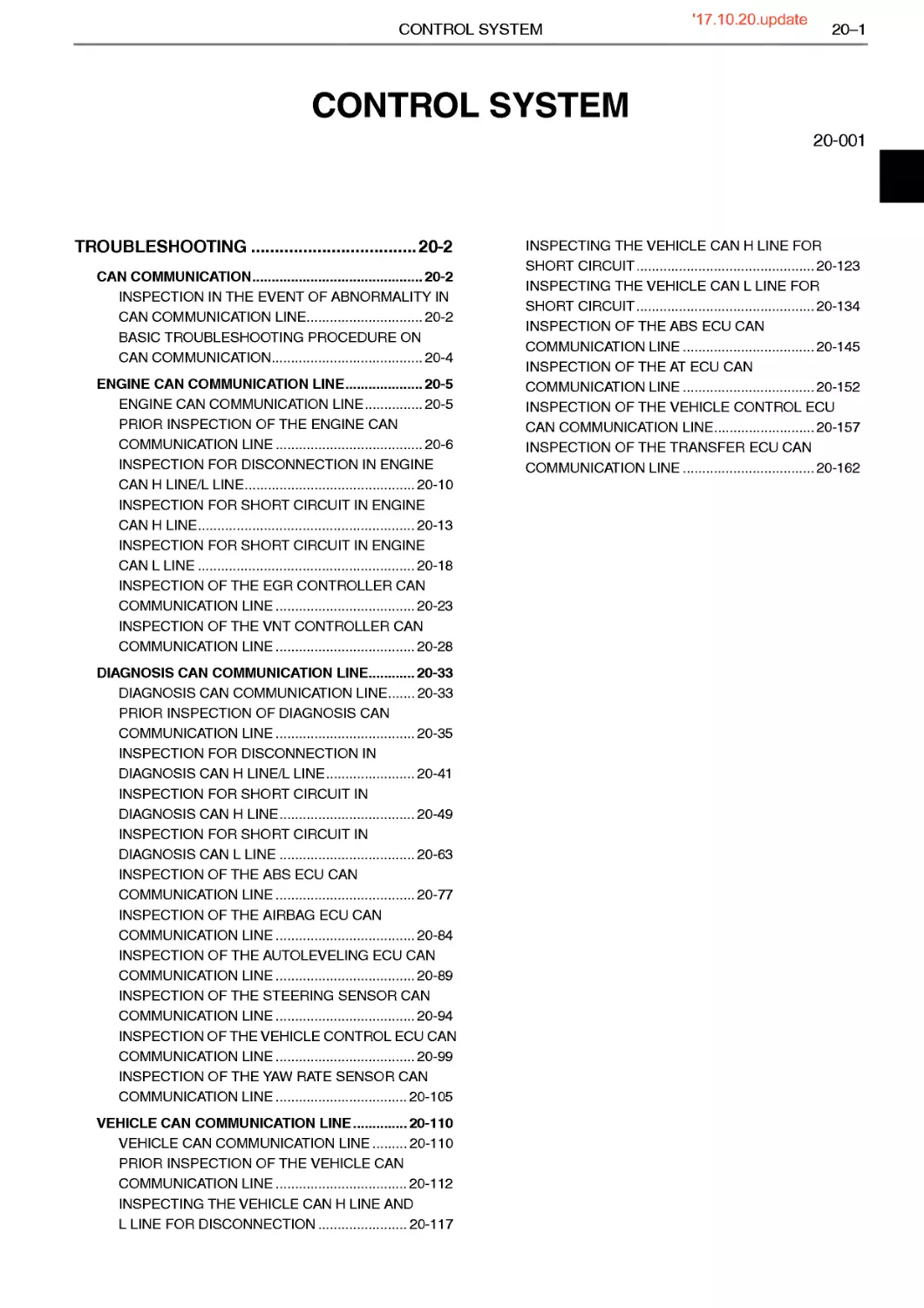
TROUBLESHOOTING.....................20-2

CAN COMMUNICATION................20-2

INSPECTION IN THE EVENT OF ABNORMALITY IN
CAN COMMUNICATION LINE.........20-2

BASIC TROUBLESHOOTING PROCEDURE ON
CAN COMMUNICATION..............20-4

ENGINE CAN COMMUNICATION LINE....20-5

ENGINE CAN COMMUNICATION LINE..20-5

PRIOR INSPECTION OF THE ENGINE CAN
COMMUNICATION LINE.............20-6

INSPECTION FOR DISCONNECTION IN ENGINE
CANH LINE/L LINE................20-10

INSPECTION FOR SHORT CIRCUIT IN ENGINE
CANH LINE.......................20-13

INSPECTION FOR SHORT CIRCUIT IN ENGINE
CAN L LINE......................20-18

INSPECTION OF THE EGR CONTROLLER CAN
COMMUNICATION LINE..............20-23

INSPECTION OF THE VNT CONTROLLER CAN

INSPECTING THE VEHICLE CAN H LINE FOR
SHORT CIRCUIT...................20-123

INSPECTING THE VEHICLE CAN L LINE FOR
SHORT CIRCUIT...................20-134

INSPECTION OF THE ABS ECU CAN
COMMUNICATION LINE..............20-145

INSPECTION OF THE AT ECU CAN
COMMUNICATION LINE..............20-152

INSPECTION OF THE VEHICLE CONTROL ECU
CAN COMMUNICATION LINE..........20-157

INSPECTION OF THE TRANSFER ECU CAN
COMMUNICATION LINE..............20-162

COMMUNICATION LINE...............20-28

DIAGNOSIS CAN COMMUNICATION LINE....20-33

DIAGNOSIS CAN COMMUNICATION LINE.20-33

PRIOR INSPECTION OF DIAGNOSIS CAN
COMMUNICATION LINE..............20-35

INSPECTION FOR DISCONNECTION IN
DIAGNOSIS CAN H LINE/L LINE......20-41

INSPECTION FOR SHORT CIRCUIT IN
DIAGNOSIS CAN H LINE.............20-49

INSPECTION FOR SHORT CIRCUIT IN
DIAGNOSIS CAN L LINE.............20-63

INSPECTION OF THE ABS ECU CAN
COMMUNICATION LINE...............20-77

INSPECTION OF THE AIRBAG ECU CAN
COMMUNICATION LINE...............20-84

INSPECTION OF THE AUTOLEVELING ECU CAN
COMMUNICATION LINE...............20-89

INSPECTION OF THE STEERING SENSOR CAN
COMMUNICATION LINE..............20-94

INSPECTION OF THE VEHICLE CONTROL ECU CAN
COMMUNICATION LINE..............20-99

INSPECTION OF THE YAW RATE SENSOR CAN
COMMUNICATION LINE.............20-105

VEHICLE CAN COMMUNICATION LINE....20-110

VEHICLE CAN COMMUNICATION LINE.20-110

PRIOR INSPECTION OF THE VEHICLE CAN
COMMUNICATION LINE...............20-112

INSPECTING THE VEHICLE CAN H LINE AND
L LINE FOR DISCONNECTION.........20-117
TROUBLESHOOTING

CAN COMMUNICATION

INSPECTION IN THE EVENT OF ABNORMALITY IN CAN COMMUNICATION

LINE

EN01H20ZZZ030602006001

1.	CAN COMMUNICATION LINE

(1)	CAN communication line consists of two harnesses - CAN communication H line and CAN communication L
line. Harnesses are made of twisted pair wires.

2.	BEHAVIOR DURING NORMAL OPERATION

(1)	The meter indicates /displays the control information from each system.

(2)	The indicated/displayed information of the meter is transmitted to the meter constantly at regular time intervals.

(3)	The meter concludes that the operation of the sending system is normal by the receipt of the displayed informa-
tion of each system at regular time intervals.

Control information of each system			Display the shift indicator  	Each indicator light  	Indicator needles in various meters


CAN communication = Interchange of control information at regular time intervals

SHTS20ZZZ0300002
3.	BEHAVIOR IN THE EVENT OF ABNORMALITY

(1)	If the meter cannot receive the displayed information of each system within the time specified, the meter judges
that there has been an abnormality in the harness system or in the other system, and shows the sign of shift indi-
cator within the meter, stoppage of the function, abnormality of the indicator display. Also each system detects
the communication abnormality and shows DTC code.

(2)	When the DTC code such as above is identified, there is a possibility of the malfunction in harness system or in
the ECU, therefore, a root cause analysis of the malfunction will be implemented.

4.	ROOT CAUSE ANALYSIS AND IDENTIFICATION OF MALFUNCTION

HINT

EURO3 compliant vehicles (without ES start) are not equipped with a vehicle control ECU.

(1)	The root cause of malfunction is analyzed by the following steps:

1.	Check the information displayed on the meter.

2.	Implement the troubleshooting of vehicle control ECU and check the diagnosis code which is showing
the abnormal communication.

3.	Implement the troubleshooting of engine ECU and other system. Then check the diagnosis code
which is showing abnormal communication.

4.	Check the continuity and the resistance value in the CAN communication line.

•	The meter and vehicle control ECU are installed on all vehicles, and the physical connecting locations are
both ends of each CAN communication line.

•	Other systems are connected to the CAN communication line (CAN1 line) between the vehicle control ECU
and the meter, and to the CAN communication line (CAN2 line) between the gateway ECU and the CAN-
TMN1. The vehicle information is received/transmitted among the respective systems.

a.	The corresponding vehicles to EURO4 and EURO5 regulations with diesel engines equipped vehicles
They are composed of the following 2 CAN bus line which are the CAN communication line between the
engine ECU and the meter, and also the CAN communication line between the engine ECU and the CAN-
TMN1 (terminal resistor).

b.	The diesel engines equipped vehicles corresponding to EURO3 regulations

Engine They are composed of 2 CAN bus line of the CAN communication line between the ECU and the
meter.

• CAN communication lines are connected and branched with junction connectors, providing aggregation
points/branch points of vehicle information.

(2)	By checking the information displayed on the multi-information display and the diagnosis code of the vehicle con-
trol ECU, vehicle information of which system is not received/transmitted from/to vehicle control ECU and the
meter can be identified.

(3)	With the results above, the malfunction areas are identified by checking the continuity between the respective
ECU and junction connectors and between the respective junction connectors.

(4)	Also, if it is determined that not all vehicle information is transmitted or received, disconnect the connectors con-
nected to all ECU CAN communication lines, and check the harness system only.

(5)	If no abnormality is detected in the harness systems, it will be determined to be an abnormality in ECU.
BASIC TROUBLESHOOTING PROCEDURE ON CAN COMMUNICATION

EN01H20ZZZ030602006002

1.	SYMPTOMS OF VEHICLE

•	Control function is deactivated/released = Do not activate when the driver attempts to operate I Being released
while activation.

•	The meter indicates abnormalities. (0 km/h is indicated or no segment indication etc.)

•	DTC which indicates communication abnormality is detected.

2.	TROUBLESHOOTING PROCEDURES

(1)	Check the meter indications.

(2)	Check the diagnosis code of vehicle control ECU.

(3)	Check the diagnosis codes of the systems equipped with the vehicle.

(4)	Inspection of harness (Checking for conduction between CAN communication H line and H line and between L
line and L line for ECU with terminal resistor)

(5)	Inspection of harness (Check the existence of +B/GND short-circuit in CAN communication line)

(6)	Inspection of harness (Check the resistance value between CAN communication H line and L line)

(7)	Check the connector insertion.

(8)	Check each ECU.

• Implement the inspection of the bus line/ECU according to the above result obtained.

3.	CAN CONNECTION CONFIGURATION

SHTS20ZZZ0300004
ENGINE CAN COMMUNICATION LINE

ENGINE CAN COMMUNICATION LINE

EN01H20ZZZ030602023001

*When CAN communication abnormality (DTC) is detected, conduct "Prior inspection of engine CAN communica-
tion line" first.

CONNECTION DIAGRAM

2

EGR
controller

VNT
Controller

SHTS20ZZZ0300005

CAN COMMUNICATION LINE MALFUNCTION PART DETERMINATION TABLE

1. ENGINE ECU

Detected DTC/Trouble symptom	Estimated malfunction part	DTC diagnosis/lnspection item
U1122 (EGR controller CAN communication abnormality)	1	•	Prior inspection of the engine CAN communication line  •	Inspection of the EGR controller CAN communication line
U1123 (VNT controller CAN com- munication abnormality)	2	•	Prior inspection of the engine CAN communication line  •	Inspection of the VNT controller CAN communication line
Multiple CAN communication abnormalities detected(U1122, U1123)	3, 4,5	• Prior inspection of the engine CAN communication line