/














Tags: military affairs military positions army
Year: 1944



Text
WAR DEPARTMENT PAMPHLET NO. 21-17
NEW
HORIZONS
WAR DEPARTMENT • 21 OCTOBER 1944
WAR DEPARTMENT
Washington 25, D. C., 21 October 1944.
[A. G. 461 (17 Jul 44)]
Distribution:
All Sv C (Surg) (10) ; T of Opns (Surg)
(10) ; Depts (Surg) (10) ; Def C (Surg)
(10) ; Base C (Surg) (10) ; Island C
(Surg) (10) ; PE (Surg) (10) ; all Hosps
under jurisdiction of ASF (10) ; add cop-
ies will be requisitioned by ASF Hosps
in accordance with Cir No. 264, W. D.,
1944 on basis of (1) per patient.
For explanation of symbols, see FM 21-6.
CONTENTS
Page
No Hospital is Fun.......................... 1
Furloughs . . . Your Folks . . . Patience... 3
Have You Been Overseas?..................... 4
Physical Reconditioning..................... 6
Exercise Speeas Recovery.................... 7
Wake Up Sleepy Muscles..................... 13
What Would You Like to Learn?.............. 18
Orientation................................ 20
Relax, Have Fun............................ 23
Entertainment ............................. 27
There is A Place for You in the Army........28
— People are no damn good.**
NO HOSPITAL
IS FUN
THIS BOOK IS ALL ABOUT YOU. It is
not an AR. Neither is it a lecture. It is
straight common-sense about your future
in the Army and as a civilian. You are in
an Army hospital, but not like an ordinary
patient. You are here as a soldier—a first
class American fighting man temporarily
laid up for repairs.
The repairs will be fast and thorough. The
Army has the finest doctors. These doctors
have an obligation to use the most modern
equipment, the best medicines and all their
skill to give you the best medical care in
the world.
You, too, have an obligation while you are
here. An obligation to help yourself. This
means complete cooperation with the people
who know how to make you well. They
know what’s good for you.
1

FURLOUGHS
Naturally, you’d like a furlough. Who wouldn’t?
However, for your own health’s sake, the choice
of time will be made by the doctor to fit in with
his plan for your full recovery. This means you’ll
get that sick leave or furlough the minute it will
not interfere with your treatment—usually as soon
as you graduate from the ward to Class II of the
advanced reconditioning section.
YOUR FOLKS
You have an obligation to your people as well as
to yourself for your own recovery. When you’re
told to exercise an injured knee joint or stiff
shoulder, do it with confidence. It will pay off
later when you recover use of the injured member.
PATIENCE
WITH A PURPOSE
Everything you do here will have a purpose to help
your body mend and to shorten your stay. It takes
time for bones to knit, joints to flex, muscles to
toughen, wounds to heal. It takes courage to wait.
Your serenity and determination in helping your-
self will surely help the patients near you.
3
HAVE YOU BEEN
OVERSEAS?
Yes. Then the men who have not been across will
look to you as a seasoned soldier. Your poise, self-
reliance and stability can establish courtesy, under-
standing and discipline in the ward. Some men
make mistakes. Do your best to avoid making them.
Don’t belittle the guy who hasn’t been across—
he couldn’t help it. Don’t try to dictate your own
treatment — the doctors know your needs a lot
better than you do. Don’t be impetuous and de-
mand service when that means interrupting what
is being done for other patients.
Hospital life is almost as informal as the supper
table in a big boarding house. There are no secrets.
This means you must go out of your way to re-
spect the other fellow’s privacy. Help him over the
rough spots of his recovery. You can do this by
preserving a soldierly attitude that cheers him up
when he’s in the dumps; gives him fortitude when
he’s in pain. You’ve seen how a good Sergeant can
bolster the confidence of recruits. You have that
opportunity now in your ward and you strengthen
yourself when you use it.
4

PHYSICAL
RECONDITIONING
While you are here you will recover sturdiness
and good health. You will go through four classes
as a patient. These classes are established so that
the doctors can plan your recovery in progressive
stages from the day you enter the hospital to the
day you march out a well soldier.
в
THESE ARE THE FOUR CLASSES:
Class IV—when you’re confined to your bed under-
going direct medical or surgical treatment.
Class III—when you’ve gotten out of bed and can
walk around the ward or outdoors, but are still
receiving medical treatment.
Class II—when you’ve perceptibly toughened, but
still a little weak, and resume the life of a soldier
in training.
Class I—when your strength has returned so that
you can spend eight hours a day toughening up
to go hack to your outfit.
EXERCISE SPEERS RECOVERY
Whatever your injury is, it will heal quicker if
the rest of your body is kept strong and vital while
you are in bed. Suppose your leg is immobilized
in a cast. The injured leg will mend quicker if
you maintain strength in your good leg by doing
simple'bed exercises. If your shoulder is injured,
exercising your arms and legs will help it to mend.
As soon as you are ready, you will be asked to do
certain bed exercises. You will perform these
exercises with the full approval of your doctor.
7

The aim is to reeducate and return the injured
part to normal function and, at the same time,
strengthen the rest of your body. There will never
be any danger of your condition being aggravated
by the exercises you are asked to do.
You will benefit by these exercises. At first, even
limited movement of the injured part may be pain-
ful and difficult, hut this initial distress is nothing
compared with the wonderful satisfaction of re-
covering competence later. It makes more sense
than anything you ever did in your life.
SET YOURSELF A GOAL
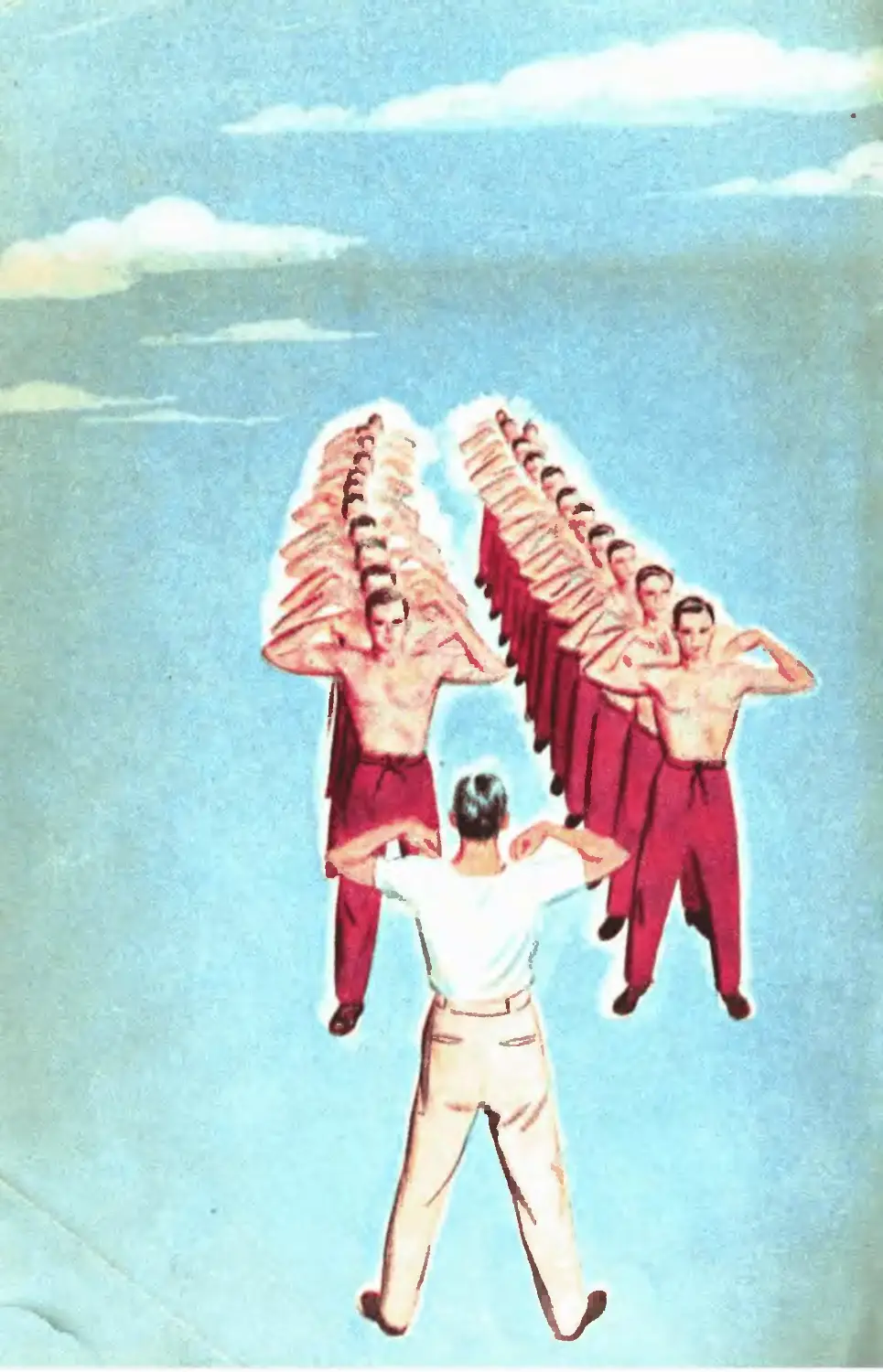
Whether you’re doing the exercises in bed, or lined
up in a ward—when the Ward Master calls the
count, keep a check each day to see how much you
can do. For instance, if you can do seven counts
on an arm exercise on Monday, try for eight counts
on Tuesday. This way you can measure your own
progress. Do each exercise as long as you possibly
can. You benefit from calisthenics only when you
perform the exercise to the point of fatigue. This
is the over-load principle of muscular development,
well known to football coaches and athletes. It
means simply that you get stronger when the body
develops increased strength to meet increased de-
mand.

FROM BED TO OUTDOORS
Once you’re up and about, you’ll do ward exercise;
and have lots of time for outdoor games and exer
cises. Table tennis, deck tennis, volley ball, base
ball, badminton. You can fit your exercises to wha
your body can take. It will all add up to wha
athletes call “fighting edge”—the pink of conditioi
—where you’re alert and ready. With returnin;
good health will come a sense of relaxed well-being
1
Г v
WAKE UP
SLEEPY MUSCLES
OCCUPATIONAL THERAPY WORKS
MIRACLES IN BRINGING
SPEEDY, COMPLETE RECOVERY
If you’ve ever been in a Penny Arcade you’ve
probably seen a machine that tests a man’s grip.
You’ve watched a crowd gather round while
the Charles Atlas in the group slips his penny
in the slot, takes a firm grip on the handles, and
s-q-u-e-e-z-e-s.
Maybe he scores high, maybe he doesn’t—it makes
no difference. The man has brought into play cer-
tain muscles of his hands that probably haven’t
been used for months.
This is one of the principles of Occupational Ther-
apy—to provide work for muscles that have grown
flabby through inactivity — to return to normal
strength and usage members or parts of your body
that have been injured.
Once the repair work has been done on your in-
jury, your doctor will write a prescription for a
type of work you should do to help nature com-
plete the mending. It will be a special prescription
that considers all aspects of your disability.
Engage in a hobby that will encourage
muscles formerly used in your work or sport.	13

THERAPY STARTS IN BED
Some Occupational Therapy will start while you
are a Class IV patient in bed—like making camou-
flage netting (a swell way to recover the use of a
stiff shoulder), or moulding with clay (an excel-
lent way to loosen the stiffness of burned surface
skin or injured tendons, muscles and joints).
WORK WITH A PURPOSE
When you’re a Class III patient you will have your
chance to go to a completely rigged out occupa-
tional therapy shop. Here you can have some real
pleasure making things out of wood, leather and
clay. You’ll be assigned work that carries out the
doctor’s prescription. For instance, if the trick is
to recover the flexibility of a stiff knee after an
operation, you’ll work at a foot-powered saw that
operates like a bicycle. Here you’ll bring into play
muscles and tendons that control normal use of
the knee. At the same time, you’ll be making
things out of wood with the saw.
If the trick is to get used to an artificial limb,
you’ll spend time and have fun playing chess or
checkers (with specially devised men) that soon
will give you deftness and certainty. Did you see
Making a camouflage net or web belt exercises
the same muscles you use when fly casting.	15

McGonigal in the movie? Or get a copy of WD
Pamphlet 8-7, “Helpful Hints To Those Who
Have Lost Limbs.”
THE “ОТ” KNOWS HER JOB
The women who supervise the work in the shop
are trained for it. They know precisely how to
devise work for you to do that will accomplish
the most good in your recovery. If you goldbrick
on the job you’re wasting precious time in achiev-
ing full recovery.
A 4-STAR COMBINATION
It’s easy to see how the things that are happening
to you in the hospital work together to promote
your recovery. First, while you’re a Class IV pa-
tient, direct medication or surgery to accomplish
the physical repair. Next, when you’re hack in
bed, exercises and occupational therapy to start
the mending job on the disability. Then courses
of study to relax tension and learn new things.
Finally, that glad day when the doctor says it’s
okay to get out of bed. You’ll know then that your
own help toward your recovery is the best thing
you ever did.
Clay modeling exercises hand muscles, loosens
taut skin, helps you regain finger flexibility.	17
WHAT WOULD YOU
LIKE TO LEARN?
A man is happiest when he is doing something for
his own good. While you are here you’ve got time
to think about your future and to plan for it. The
immediate aim is to get well quickly and return
to your outfit. It needs you. The long-term aim
is the day you return home a poised, American
civilian. In this hospital you have an opportunity
to prepare yourself for both steps through the
United States Armed Forces Institute.
18
IT’S FUN TO LEARN
There is satisfaction in learning anything that’s
useful. While you’re here you’ve got time to do it.
Would you like to learn Algebra or Physics or
Radio or News Reporting or a Foreign Language?
Would a course in accounting tie-in with your job
before the war? These and other excellent USAFI
self-teaching courses are yours for the asking. You
can keep up with your outfit by studying a course
required in your Army job, or you can work for
your school or college diploma. Whichever you
do, choose a course that interests you and will
help you.
FOR FURTHER DETAILS . . .
Your hospital will give you a copy of the little
green booklet “It’s Fun to Learn.” If you have
any further questions about USAFI, speak to your
Educational Reconditioning officer or Ward officer.
19
ORIENTATION
Like most soldiers, you’ve got a keen interest in
how the war is going. After all, you, and some
eleven million others like you, are writing the his-
tory of this war—a good enough reason for wanting
to know what is going to be in the book!
Those of you who have been over there already
have done a swell job. If there be doubters, let
them ask the dead Japs at Tarawa, Guam, Saipan
. . . or the Nazis scattered from Africa through
Italy and France and in Germany itself. Those
of you who are going over will do a bang up job,
too. We know that, because Americans have been
doing it ever since the battle for Wake Island.
A MAN DOES A BETTER JOB
IF HE KNOWS WHY
But the task is a dirty and tough one and all of
you will do it better if you know why you are
doing it. It’s tough to stop tanks. It’s tough to
fight strafing planes. But it’s a lot easier to do it
when you know why you are being called upon to
stick out your neck.
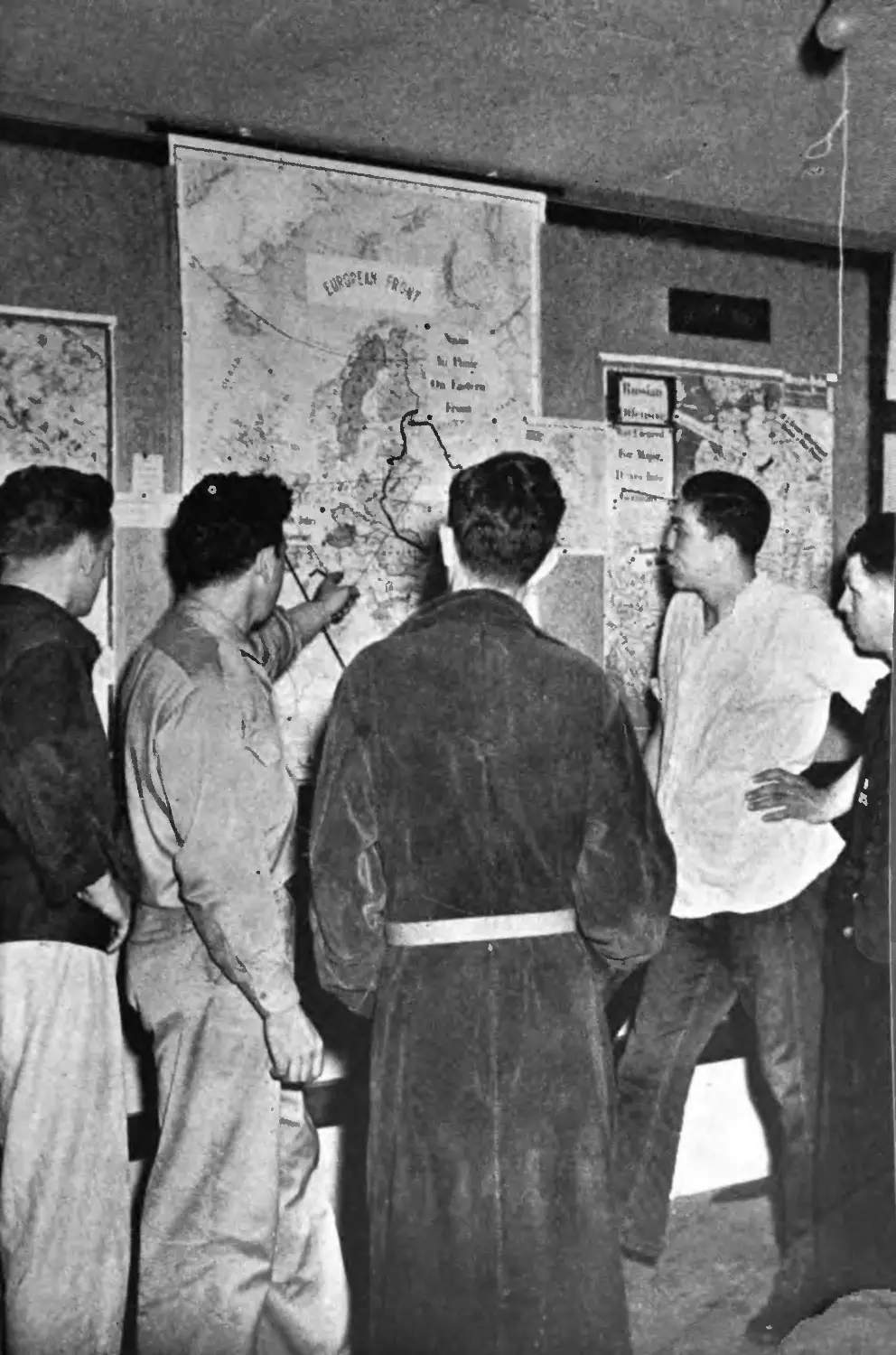
Keep an eye on war progress. Swap opinions
and experiences. Attend Orientation meetings.
20

SHARE YOUR EXPERIENCES
If you are back from overseas then you’ve got a lot
to tell the men who haven’t yet had their chance.
And if you haven’t yet gone over, you will have
a lot of questions to ask of the men who have been
there. As a matter of fact, whether you have been
over or not is not nearly as important as is your
knowing why we have to go over and how we are
doing!
IT’S YOUR PROGRAM
Swing in and take a personal interest in it. This
is your program and “it’s on company time.”
What do you really know about why we are fight-
ing? Do you know the kind of guy the Nazi and
Jap is? What do you know about our British and
Russian and Chinese Allies? And why ought you
to know?
What do you know about what the other arms or
branches of the service are contributing to the
winning of the war? What do you know about
the plans for the postwar world in which you are
going to live?
In short, what do you know? The Orientation
meeting will help you get the answers. Don’t miss
a good bet!
22
RELAX, HAVE FUN
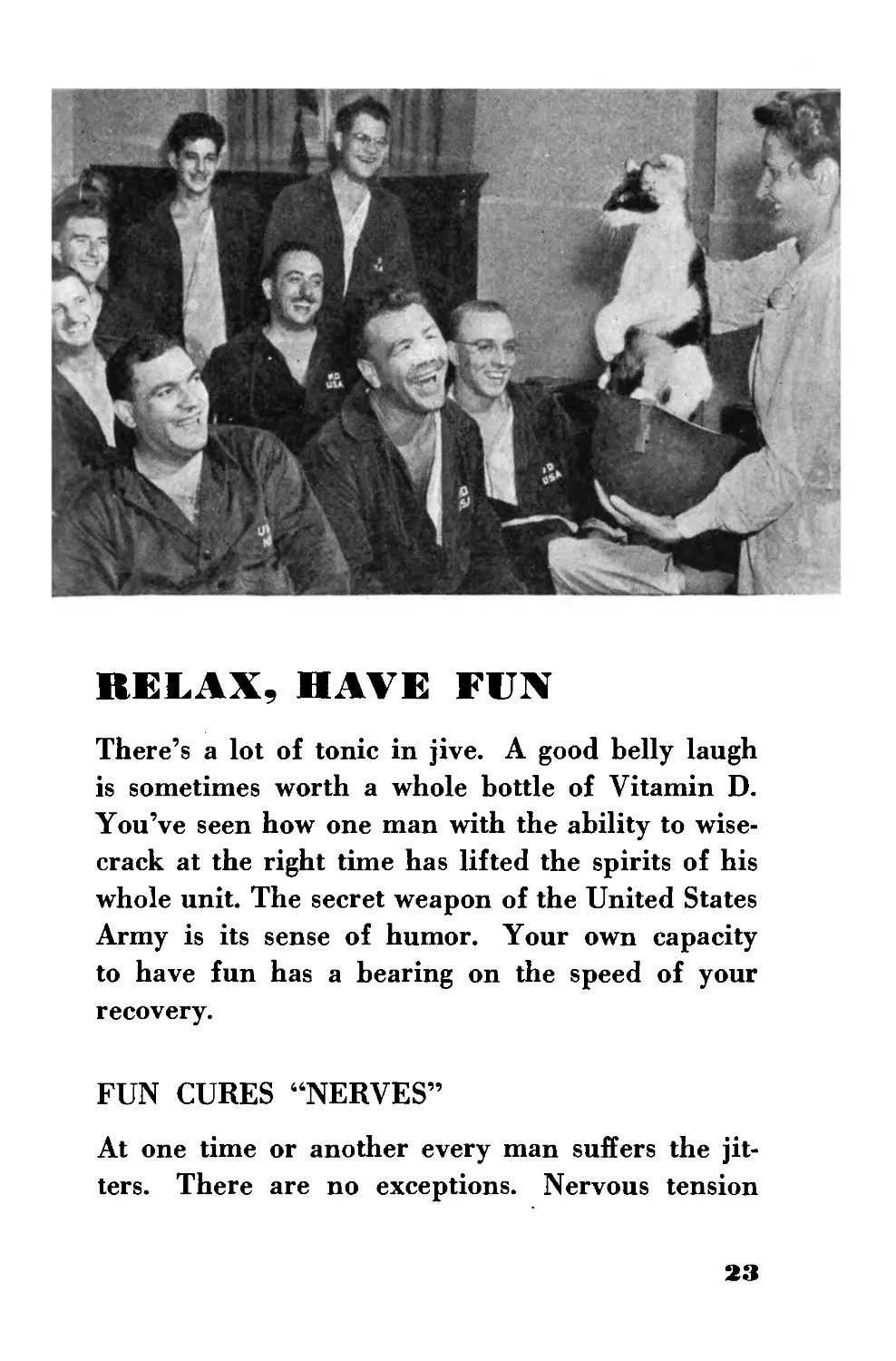
There’s a lot of tonic in jive. A good belly laugh
is sometimes worth a whole bottle of Vitamin D.
You’ve seen how one man with the ability to wise-
crack at the right time has lifted the spirits of his
whole unit. The secret weapon of the United States
Army is its sense of humor. Your own capacity
to have fun has a bearing on the speed of your
recovery.
FUN CURES “NERVES”
At one time or another every man suffers the jit-
ters. There are no exceptions. Nervous tension
23
has a direct relationship to your recovery. The
trick is to develop interests that take you out of
yourself. Plunge in on activities here at the hos-
pital that genuinely interest you. Project your
thinking to the other fellow and his problems.
THERE’S PLENTY TO DO
When you’re up and about as a Class III patient,
plan to spend a part of each day in the Red Cross
auditorium. Do what you like, but do something.
Maybe it’s table tennis. Maybe it’s only a tight
game of checkers with a guy in the next bed. Find
the recreation that you “feel up to.” It’s a per-
fectly sensible idea to talk it over with your doctor.
He can tell you exactly what games, sports, and
recreation will have a directly beneficial effect on
your disability.
A TIP ABOUT LETTERS
When writing home to your family, your wife or
girl, tell them about the things you are doing to
help your recovery and what the hospital is doing.
Those to whom you write will appreciate all that
is being done. Their interest and encouragement
will help you.
24
GET SUNSHINE
Get outdoors as much as you can. The sun is a
great healer. If you feel up to it, join in group
games like badminton or volley ball. When you
get tired, stretch out on the grass and relax.

ENTERTAINMENT
A man can find everything his mood calls for in
music. Your own serenity while you are here in
the hospital can be fortified by deliberately join-
ing the group around the victrola in the Red Cross
room—or next to the radio. Or, when entertainers
come to the ward (whether you think it’s corny
or not) by forgetting yourself for a while.
The same thing goes for the movies. When you’re
still a Class IV patient you’ll see regular showings
in the ward of “GI” movies. When you’re up and
about you’ll have a chance to attend showings of
first run features in the Red Cross auditorium. Go.
It’ll do you good.
DANCES, SOLDIER SHOWS
Maybe you have a special talent that will help the
Special Service officer and the Red Cross workers
in planning local entertainments. Maybe you’re
an amateur magician. Perhaps you’re expert at
card tricks. Maybe you’ve always been interested
in radio or playing a musical instrument. Tell the
Ward officer or Special Service officer about it.
Go and see the Red Cross workers. Offer your
services. You’ll get a kick out of joining the group
—and, again, it will help speed up your recovery.
27
THERE IS A PLACE FOR YOU
IN THE ARMY
YOUR OUTFIT NEEDS YOU. During your last
weeks here in the hospital you will soldier as a
Class I patient with other men slated to return to
duty. Your body will toughen. You’ll get as brown
as a berry. With returning good health will come
a refreshing sense of well-being. You’ll improve
your knowledge of nomenclature and tactics. You
will be “out” of the hospital while you’re still
“in” it.
If, for one reason or another, you do not go back
to your old outfit, every effort will be made to find
a spot for you that makes full use of your experi-
ence and competence. You will still have the
satisfaction of completing your mission as a mem-
ber of the Army of the United States while your
country is at war.
28
☆ U.S. GOVERNMENT PRINTING OFFICE: 1944—610649