/































Tags: military affairs military positions army
Year: 1949



Text
                    /Д'/ DEPARTMENT OF THE ARMY PAMPHLET 21-41
в
aif
U$3 J
PERSONAL CONDUCT
FORq ^ents department
THESOLMZ.
DEPARTMENT OF THE ARMY • FEBRUARY 1949
DEPARTMENT of the army pamphlet
21-41
This pamphlet supersedes WD Pamphlet 21-13, 16 September 1946
PERSONAL CONDUCT
FOR
THE SOLDIER
DEPARTMENT OF THE ARMY • FEBRUARY 1949
United States Government Printing Office
Washington: 1949
DEPARTMENT OF THE ARMY
Washington 25, D. C., 3 February 1949
Department of the Army Pamphlet 21-41, Personal
Conduct for the Soldier, is published for the infor-
mation and guidance of all concerned.
[AG 461 (13 Oct 48)]
By order of the Secretary of the Army :
OMAR N.’ BRADLEY
Chief of Staff, United States Army
Official :
EDWARD F. WITSELL
Major General
The Adjutant General
Distribution :
Army:
Tech Sv (2); Adm Sv (2); AFF (40); OS
Maj Comd (5); A (5); D (2); R (2);
Bn (2); C (6); Sch (50); ROTC (2);
Special distribution.
Air Force:
USAF (10).
For explanation of distribution formula, see
TM 38-405.
ii
FOREWORD
With your entrance into the Army, you start a mode
of living somewhat different from that encountered
in a civilian community where the daily life of the
individual can be as private as one cares to make it.
In the Army, however, you live in close association
with others from many different walks of life. The
degree of success and contentment you attain while in
the Army will depend to a great extent on the consid-
eration you show to others and they to you.
This book outlines a code of personal good conduct
which is as applicable to the civilian as to the soldier.
You are familiar with most of the items covered in it.
However, a review of these principles will stand you
in good stead, and, if followed, will help you not only
during your stay in the Army, but throughout life.
OMAR N. BRADLEY
Chief of Staff, United States Army
ui

CONTENTS
Page
Chapter 1. MANNERS.
In George Washington’s Time ................ 1
Common Sense Courtesy....................... 2
Respect for Others ......................... 4
Loyalty .................................... 7
Respect for Men Under You .................. 8
Tact ....................................... 8
Self Control .............................. 10
Sense of Humor ............................ 11
Respect for Women ......................... 13
Appearance ................................ 14
Bragging ...........*...................... 15
The Courteous Leader ...................... 16
Manners and	Good Will.................... 17
Chapter 2.	BEHAVIOR IN GARRISON AND FIELD.
Getting Along with Men .................... 19
In the Barracks ........................... 19
The Day Room .............................. 22
Company Area .............................. 22
Orderly Room .............................. 23
Supply Room ............................... 24
In the Field .............................. 25
Undesirable Traits and Habits ............. 28
Chapter 3.	TABLE MANNERS.
More Than One Way to Eat................... 30
Making Mealtime a Pleasure ................ 31
Spoons, Knives, and Forks.................. 32
Using the Spoon ....................... 32
Using the Knife and Fork............... 34
Habits to Be Avoided ...................... 35
Thoughtfulness of Others .................. 38
In the Mess Hall .......................... 38
v
Page
Chapter 4.	SOCIAL RELATIONSHIPS.
Popularity ................................. 41
Appearance ................................. 41
Little Things .............................. 42
Introductions .............................. 44
Conversation ............................... 48
The Words You Use........................... 53
Clubs ...................................... 55
Dances ..................................... 56
Little Attentions .......................... 58
In Private Homes ........................... 59
Chapter 5.	BEHAVIOR IN PUBLIC PLACES.
On the Street .............................. 61
At the Theater ............................. 63
On Public Carriers.......................... 64
In Taxicabs ................................ 67
When Walking ............................... 67
In Hotels .................................. 68
In Restaurants ............................. 70
On the Telephone ........................... 71
On Picnic Parties .......................... 72
Chapter 6.	SOLDIERLY CONDUCT ABROAD.
Another Job to Do........................... 73
The Braggart Soldier ....................... 73
Universal Good Manners...................... 75
Different Customs .......................... 76
Ambassadors of Good Will ................... 78
INDEX.................................................. 79
VI
This pamphlet supersedes WD Pamphlet 21-13,
16 September 1946
CHAPTER 1
MANNERS
IN GEORGE WASHINGTON'S TIME
Figure 1. Washington wrote a book on manners.
George Washington wrote a book on manners. He
called it Rules of Civility and Decent Behavior in
Company and Conversation. Here is the first rule:
“Every Action done in Company, ought to be with
Some Sign of Respect to those that are Present.” Here
is his last, which can stand all alone as a guide to good
manners: “Labour to keep alive in your Breast that
Little Spark of Celestial fire called Conscience.”
1
Most* of the rules are based on consideration for
others and self-control. If a man is considerate of
others and in control of himself, his manners are
usually good even though he doesn’t know a dessert
spoon from a soup ladle. Many of George Washing-
ton’s rules are as good now as when they were written.
This is because they are based on sound principles.
COMMON SENSE COURTESY
Courtesy and manners are based upon just plain
common sense consideration for others. Our manners
show, in a way, the respect we have for our country,
Army, ourselves, family, friends, and for those whom
we meet. Other persons form their opinions of us or
evaluate our character or temperament by comparing
our behavior with the behavior of their friends. People
Figure 2. Manners and customs change to some extent with
the times.
2
as a rule are not normally rude or discourteous to those
they love or respect.
Manners, customs, and personal behavior differ in
localities, States, and other countries, yet all peoples
have some type of manners. They do not always ex-
press themselves alike, and are not always understood.
Some, of course, do not concern themselves with
manners of better taste, and some may think themselves
smart to be conspicuous by display of plain bad
manners. Some learn from their mistakes; others never
do until no one cares 'whether they do or do not.
Manners and customs change to some extent with
the times and differ in various parts of the world.
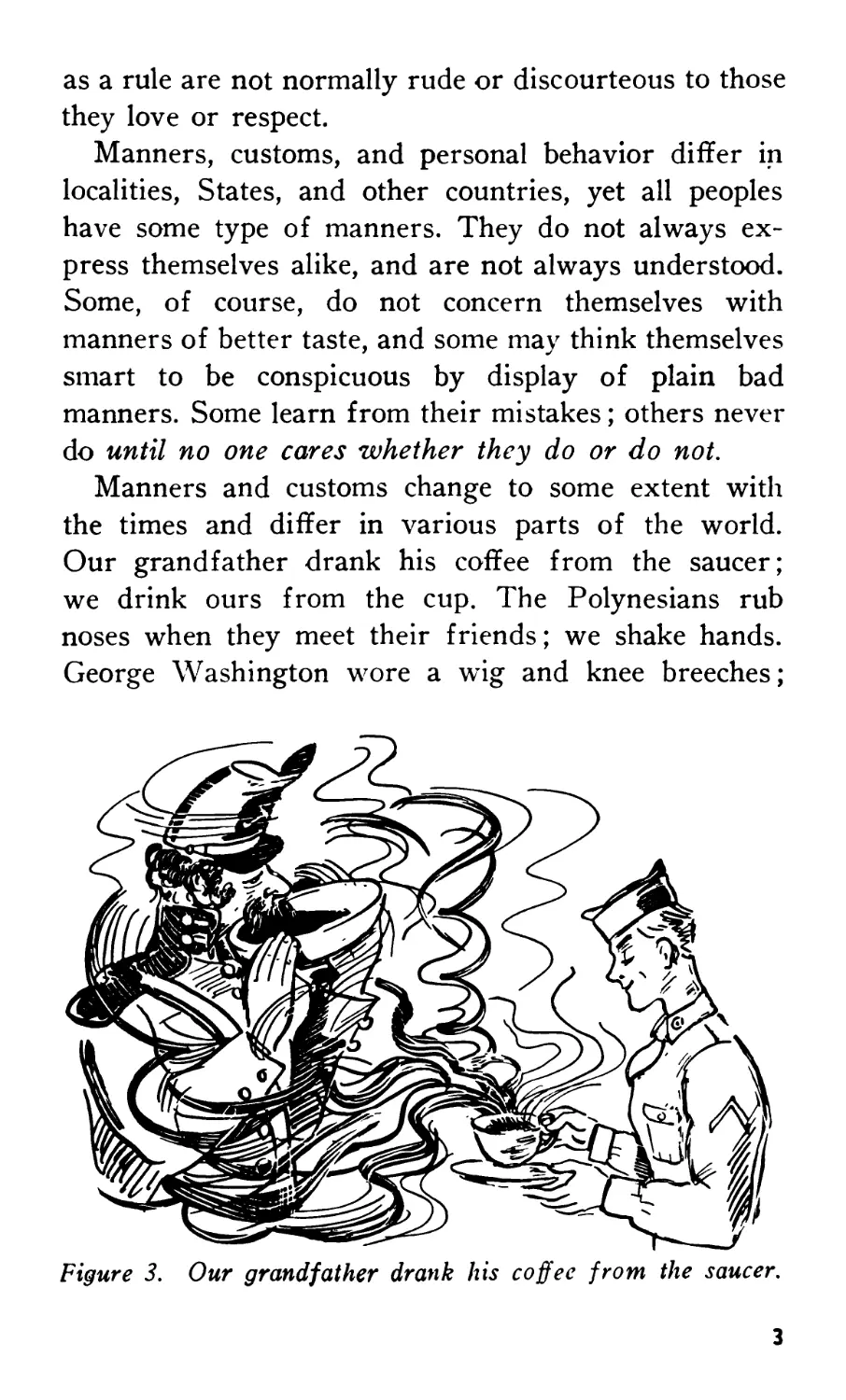
Our grandfather drank his coffee from the saucer;
we drink ours from the cup. The Polynesians rub
noses when they meet their friends; we shake hands.
George Washington wore a wig and knee breeches;
Figure 3. Our grandfather drank his coffee from the saucer.
3
grandfather wore high button shoes and grandmother
wore a hoop skirt or a bustle. Our grandparents fol-
lowed the customs of their times; we follow the
customs of our time. It’s just common sense to conform
to the accepted customs and rules of our day. It is
not difficult for a person to learn to follow the cus-
toms of good taste. The man who wishes to do the
right thing by his friends and fellow workers will
have many friends.
Figure 4. Polynesians rub noses when they meet friends.
RESPECT FOR OTHERS
A well-mannered man generally respects people of
all races, nationalities, and religious faiths. He is a
citizen of a country that is the “melting pot” of the
world. Immigrants came from every land the sun
shines on. Some were white; some were black; some
were yellow; and some were brown. There were
4
Catholics, Protestants, Jews, persons who professed
some other faith, or persons who professed no faith.
But all these became Americans. In 1776 the Con-
gress of the Thirteen Colonies adopted the Declaration
of Independence, which said, “We hold these Truths
to be self-evident, that all Men are created equal, that
they are endowed by their Creator with certain inalien-
able rights.” Upon the principles set forth in that
declaration, our country, whose Constitution guaran-
tees freedom under moral law, was organized.
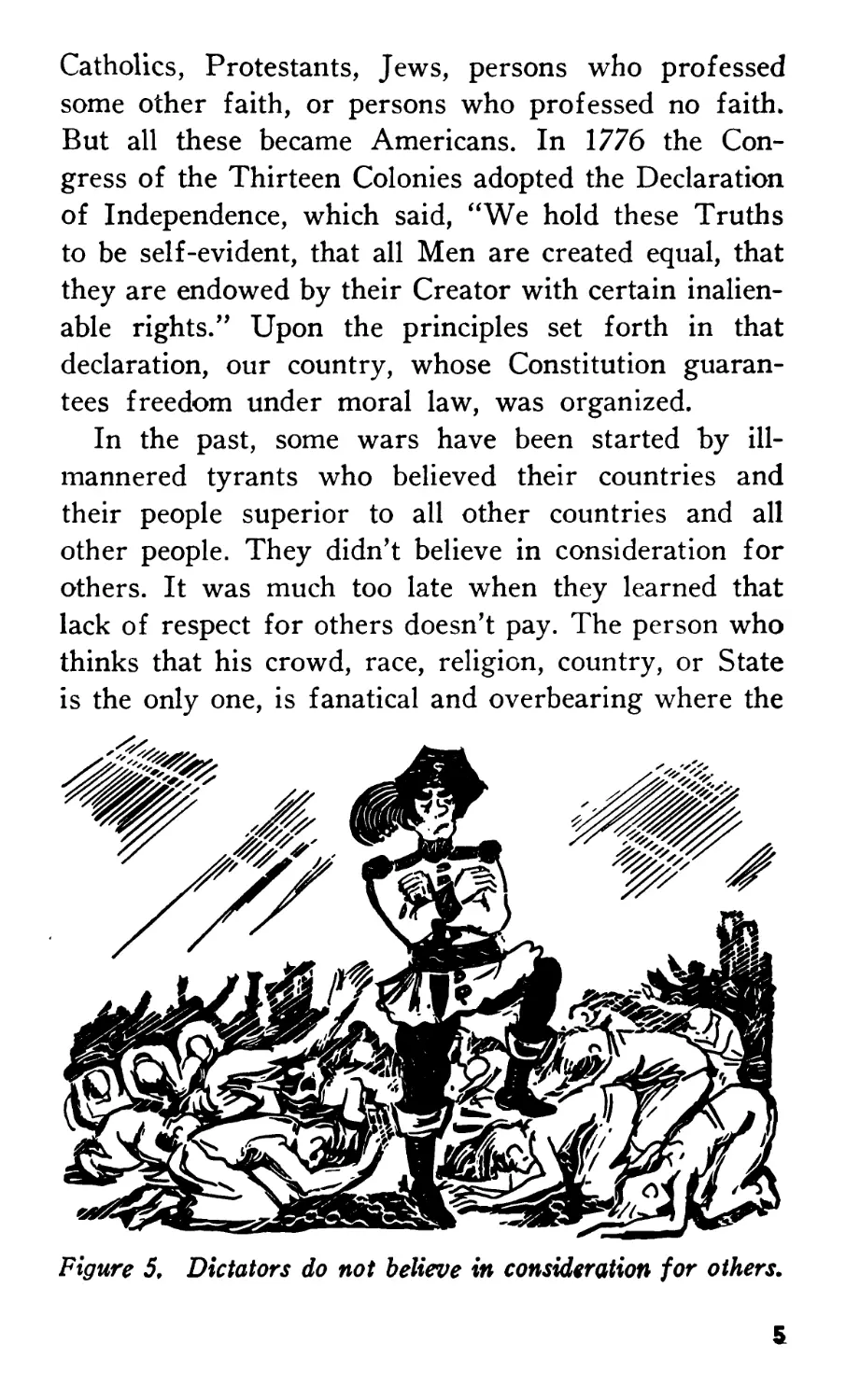
In the past, some wars have been started by ill-
mannered tyrants who believed their countries and
their people superior to all other countries and all
other people. They didn’t believe in consideration for
others. It was much too late when they learned that
lack of respect for others doesn’t pay. The person who
thinks that his crowd, race, religion, country, or State
is the only one, is fanatical and overbearing where the
Figure 5, Dictators do not believe in consideration for others.
5
rights of others are concerned. He does not believe in
the principles of a just form of government.
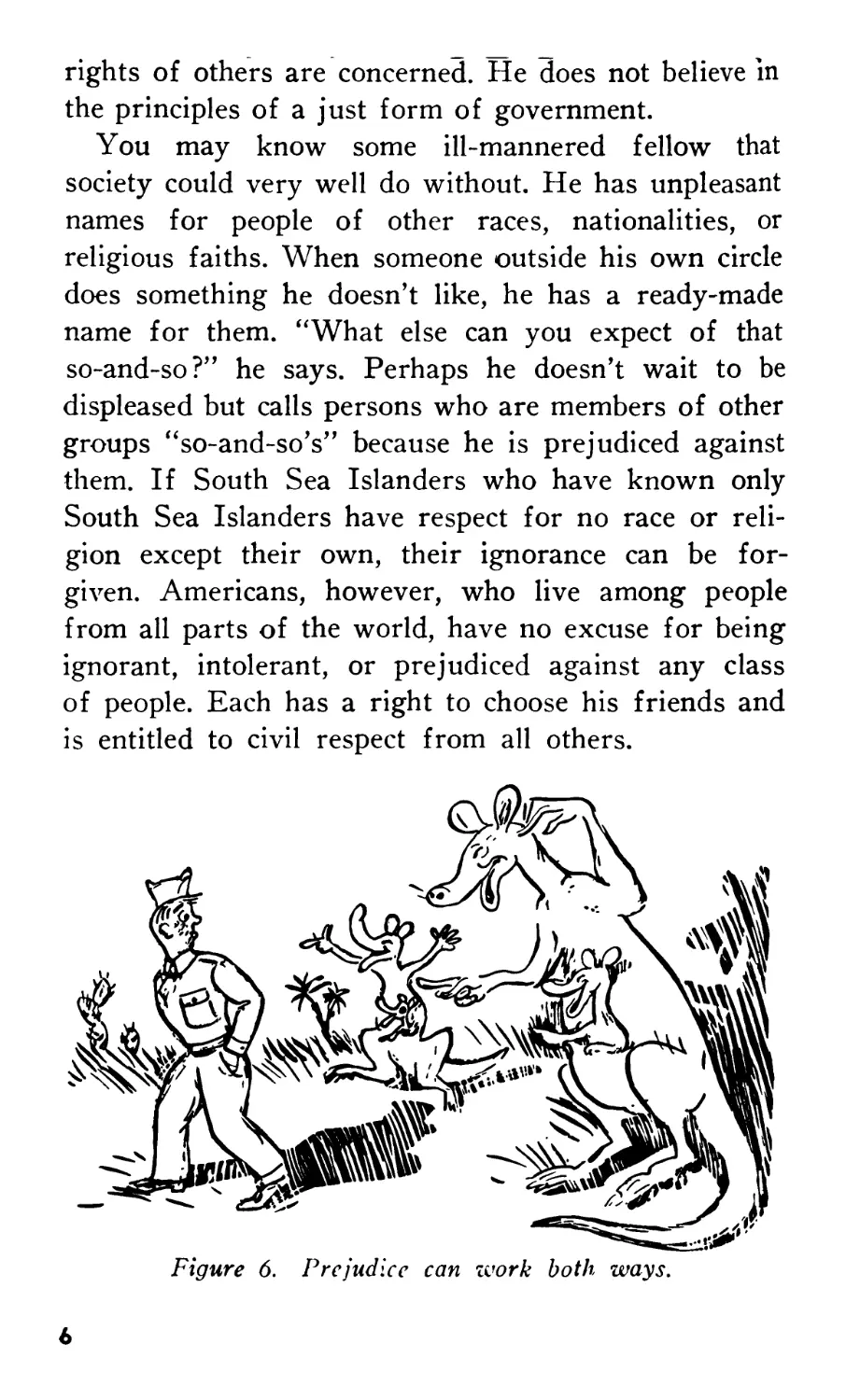
You may know some ill-mannered fellow that
society could very well do without. He has unpleasant
names for people of other races, nationalities, or
religious faiths. When someone outside his own circle
does something he doesn’t like, he has a ready-made
name for them. “What else can you expect of that
so-and-so?” he says. Perhaps he doesn’t wait to be
displeased but calls persons who are members of other
groups “so-and-so’s” because he is prejudiced against
them. If South Sea Islanders who have known only
South Sea Islanders have respect for no race or reli-
gion except their own, their ignorance can be for-
given. Americans, however, who live among people
from all parts of the world, have no excuse for being
ignorant, intolerant, or prejudiced against any class
of people. Each has a right to choose his friends and
is entitled to civil respect from all others.
Figure 6. Prejudice can work both ways.
6
LOYALTY
You can respect the rights of other races and coun-
tries and still be loyal to your own. The man who
isn’t proud of his people and his country does not
respect himself nor will he be respected. Intelligent
Americans who love America can understand why the
English love England, why the Chinese love China,
and why the Brazilians love Brazil. You can be proud
of the country your forefathers came from and still,
be a loyal American.
Character and the kind of behavior we’re talking
about go hand in hand. Character is made up of
honor, truth, and loyalty, which are very closely
related. The lack of these characteristics is easily
detected through observation of one’s conduct and
behavior.
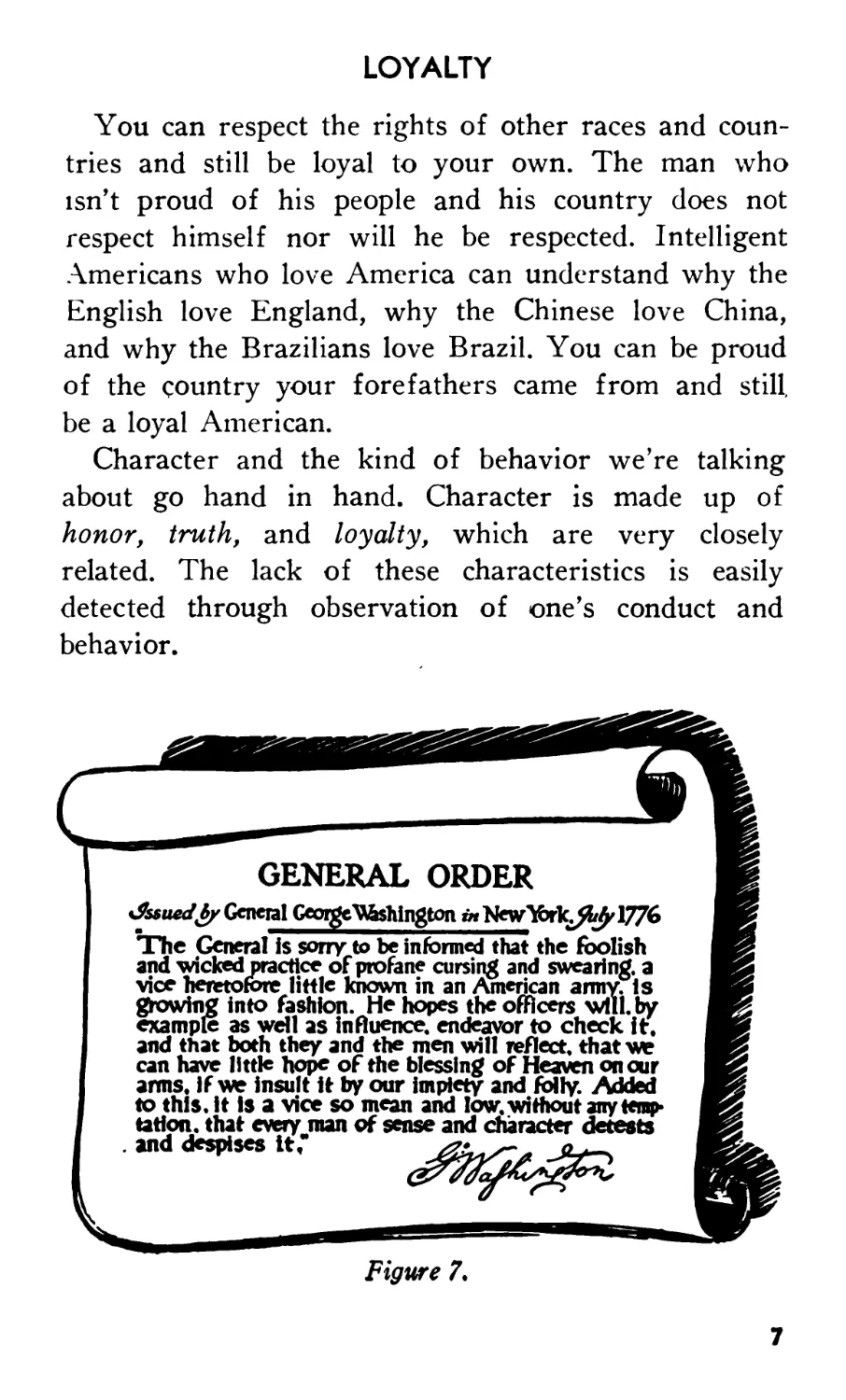
GENERAL ORDER
issued by General Geoige^&shington ш New Yykjkfr 1776
The General is sorry to be informed that the foolish
and wicked practice of profane cursing and swearing, a
vice heretofore little known in an American army, is
growing into fashion. He hopes the officers will, by
example as well as influence, endeavor to check it.
and that both they and the men will reflect, that we
can have little hope of the blessing of Heaven on our
arms, if we insult it by our impiety and folly. Added
to this. It is a vice so mean and low. without any temp-
tation. that every man of sense and character detests
. and despises it,"	°*-,
Figure 7,
7
RESPECT FOR MEN UNDER YOU
Your leadership ability will be largely determined
by the treatment accorded your subordinates. It will
he well to observe a cardinal rule of George Wash-
ington—“Use no reproachful language against anyone;
neither curse nor revile.” Your courtesy toward your
supervisors is necessarily marked by more formality
than is used toward your equals, or those whose
position is lower than yours. Don’t let this becloud
the essential fact that your treatment of others reflects
your character, not their relative position. You may
be as informal as the occasion permits but maintain
your own standards of courtesy in dealing with all
people. Courtesy shown persons under you builds up
their self-respect, aids them in maintaining their indi-
vidual dignity, and earns their loyalty. But above all,
it marks you as a considerate person. No one can
misconstrue ypur courtesy to your supervisors if you
are equally thoughtful, if less formal, toward those who
hold equal status with you or those under your
supervision.
TACT
A man who uses tact is usually well-mannered and
very likely to succeed in any job which requires him
to deal with people. Tact is somewhat like charm,
hard to define, but very important. Charm may be a
part of one’s natural characteristics, as well as tact
to a certain degree, and both may be acquired. Each
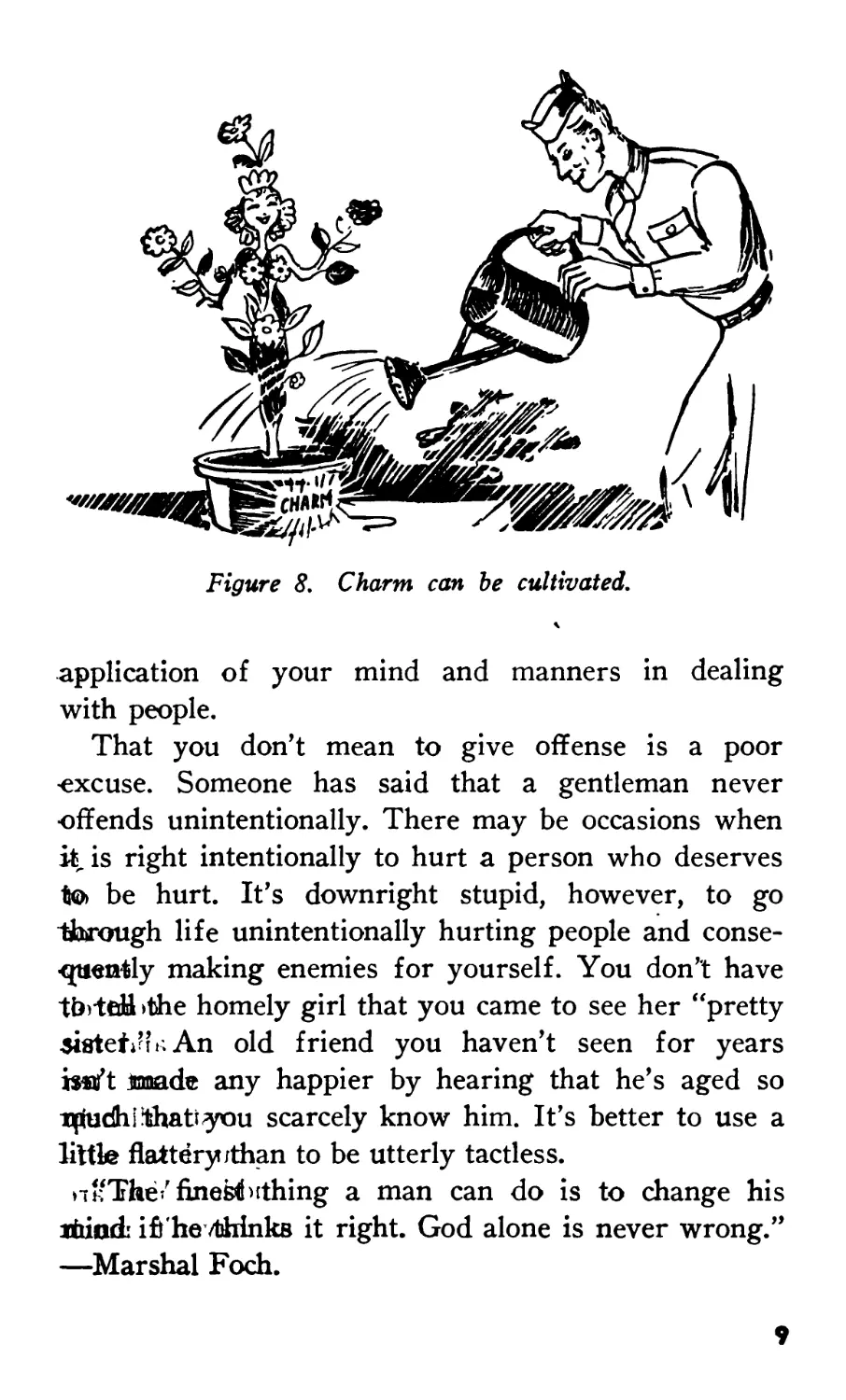
can be cultivated and improved. Briefly, tact is the
skillful use of your personality and common sense in
dealing with others. You can be tactful by the careful
8
Figure 8, Charm can be cultivated.
application of your mind and manners in dealing
with people.
That you don’t mean to give offense is a poor
'excuse. Someone has said that a gentleman never
offends unintentionally. There may be occasions when
it. is right intentionally to hurt a person who deserves
be hurt. It’s downright stupid, however, to go
through life unintentionally hurting people and conse-
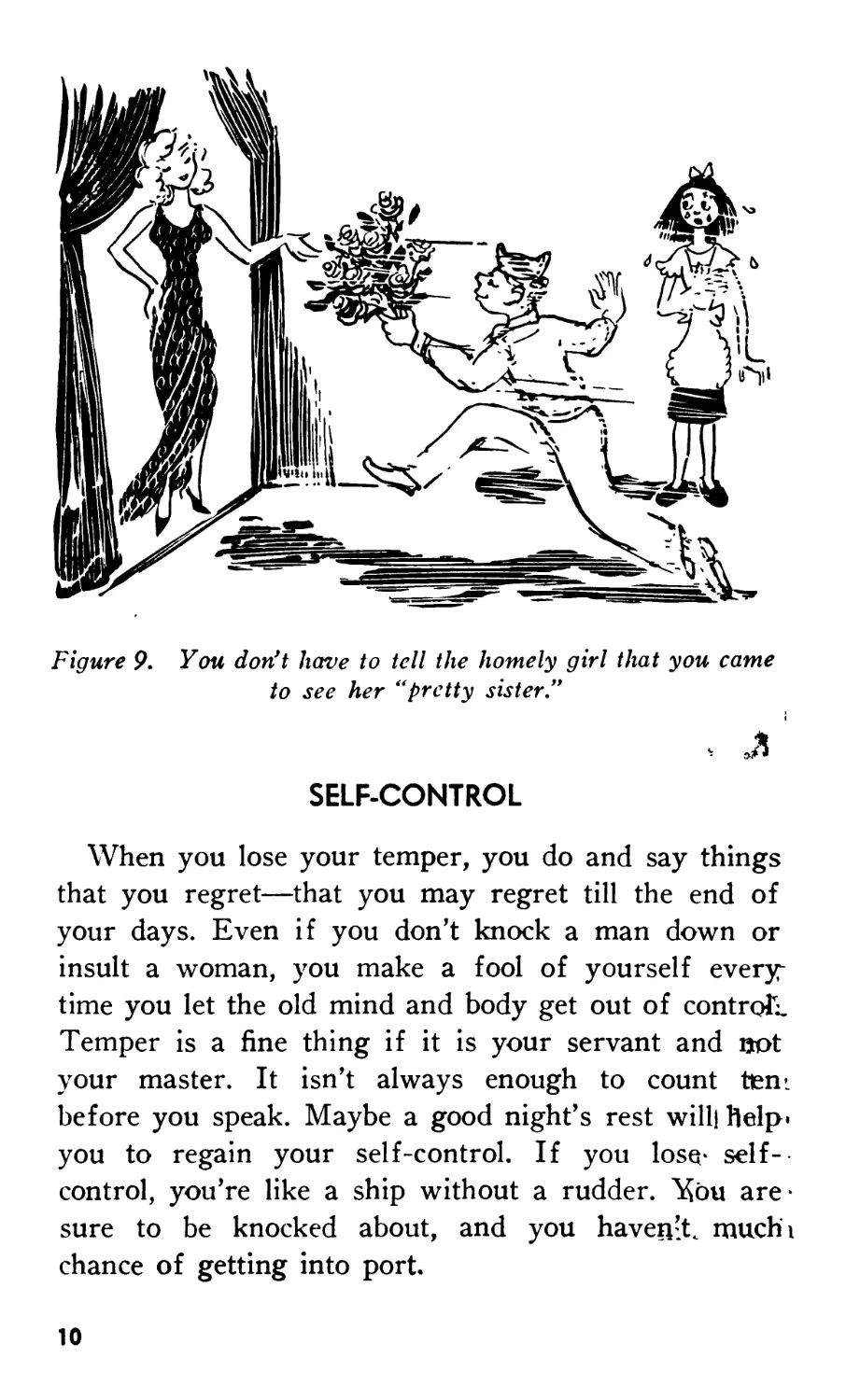
quently making enemies for yourself. You don’t have
tMfiH >the homely girl that you came to see her “pretty
jisteti’kAn old friend you haven’t seen for years
heft made any happier by hearing that he’s aged so
x^ftidhi that*you scarcely know him. It’s better to use a
little flattery/than to be utterly tactless.
n“The*'finebfHthing a man can do is to change his
xtdnd ifi'he /thinks it right. God alone is never wrong.”
—Marshal Foch.
9
Figure 9. You don't have to tell the homely girl that you came
to see her “pretty sister.”
. л'
SELF-CONTROL
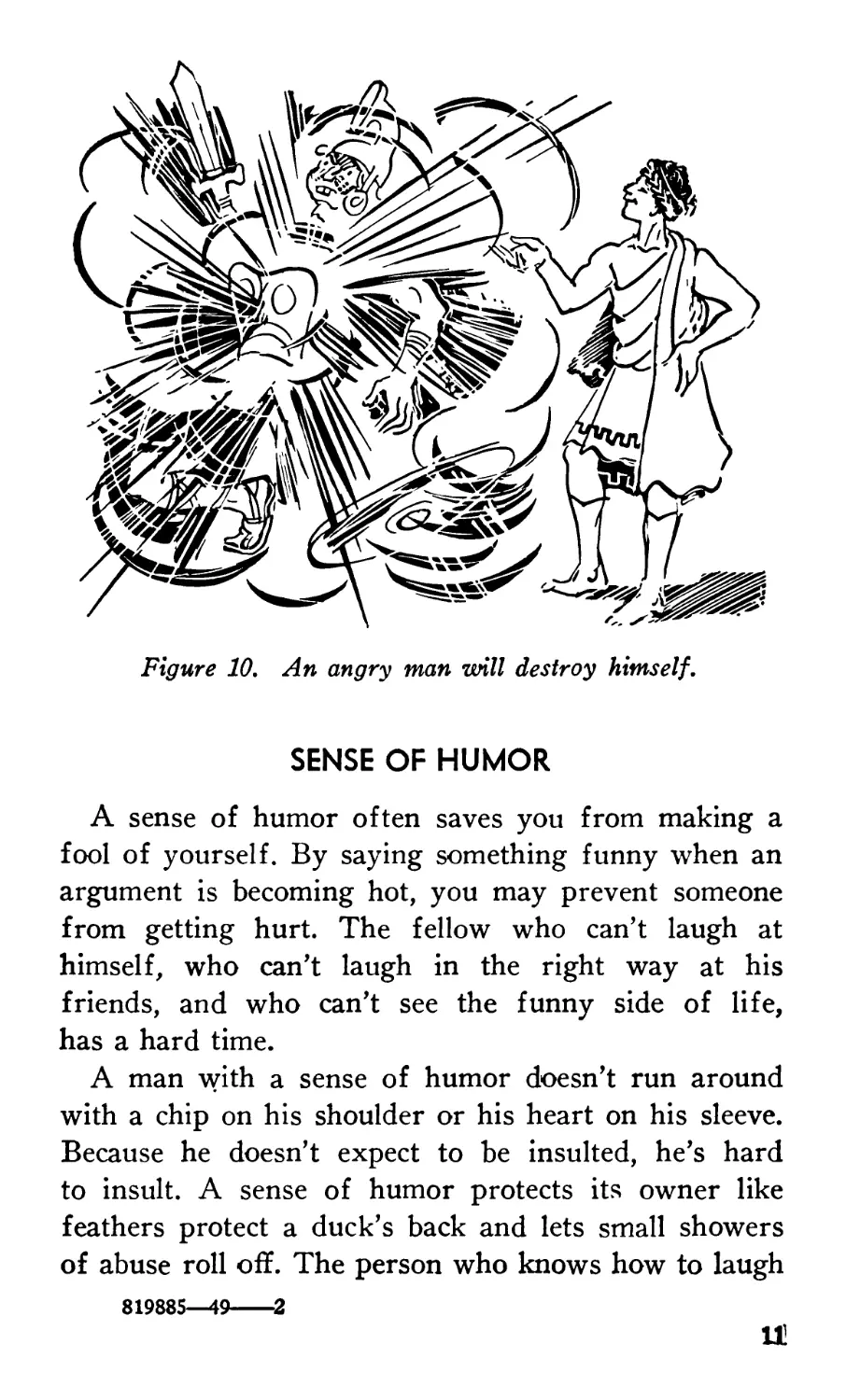
When you lose your temper, you do and say things
that you regret—that you may regret till the end of
your days. Even if you don’t knock a man down or
insult a woman, you make a fool of yourself every-
time you let the old mind and body get out of control!
Temper is a fine thing if it is your servant and iatot
your master. It isn’t always enough to count tern
before you speak. Maybe a good night’s rest will! help*
you to regain your self-control. If you lose- self-
control, you’re like a ship without a rudder. You are*
sure to be knocked about, and you haven’t, muchi
chance of getting into port.
10
Figure 10, An angry man will destroy himself.
SENSE OF HUMOR
A sense of humor often saves you from making a
fool of yourself. By saying something funny when an
argument is becoming hot, you may prevent someone
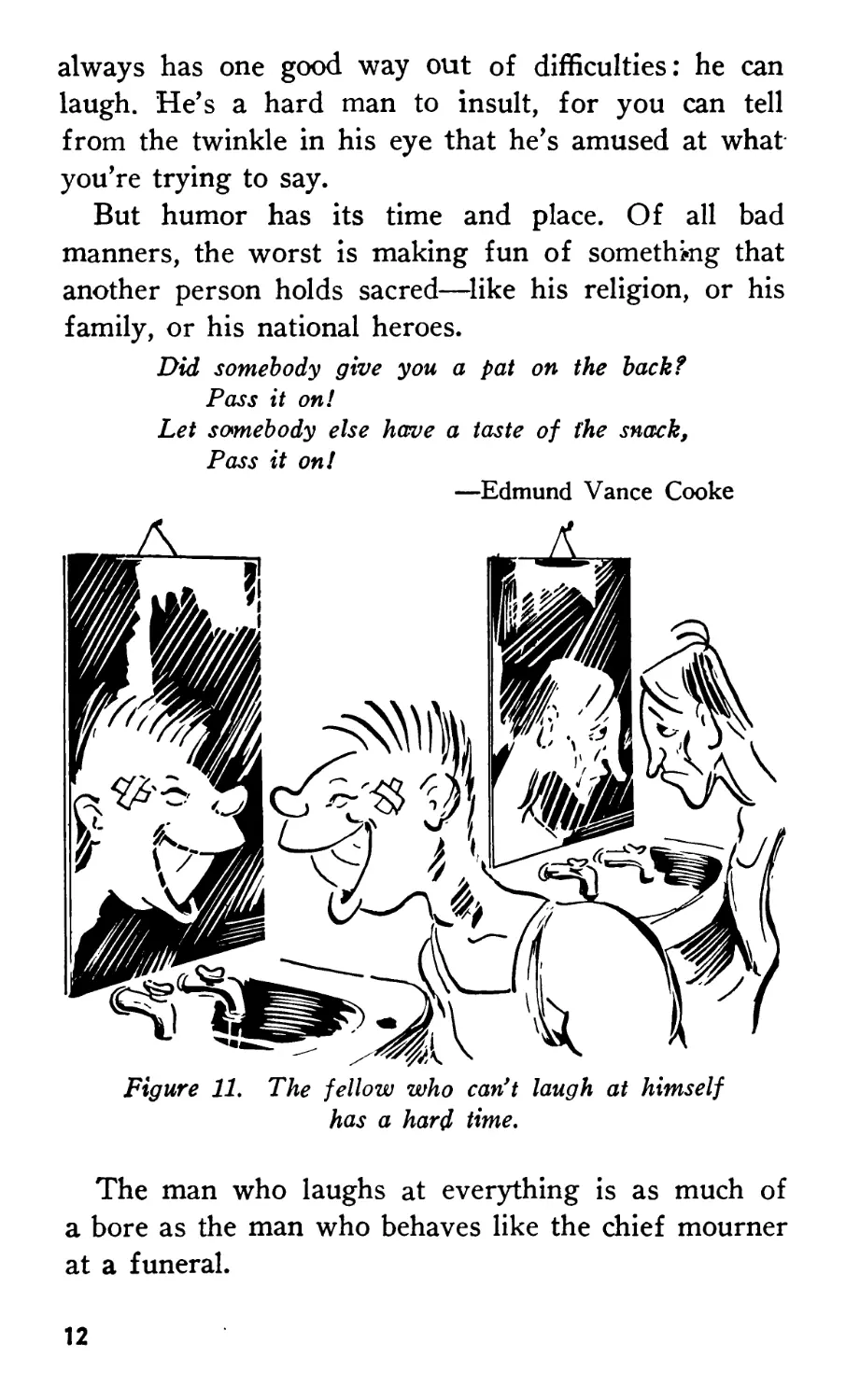
from getting hurt. The fellow who can’t laugh at
himself, who can’t laugh in the right way at his
friends, and who can’t see the funny side of life,
has a hard time.
A man with a sense of humor doesn’t run around
with a chip on his shoulder or his heart on his sleeve.
Because he doesn’t expect to be insulted, he’s hard
to insult. A sense of humor protects its owner like
feathers protect a duck’s back and lets small showers
of abuse roll off. The person who knows how to laugh
819885—49---2
If
always has one good way out of difficulties: he can
laugh. He’s a hard man to insult, for you can tell
from the twinkle in his eye that he’s amused at what
you’re trying to say.
But humor has its time and place. Of all bad
manners, the worst is making fun of something that
another person holds sacred—like his religion, or his
family, or his national heroes.
Did somebody give you a pat on the back?
Pass it on!
Let samebody else have a taste of the snack,
Pass it on!
—Edmund Vance Cooke
Figure 11. The fellow who can't laugh at himself
has a hard time.
The man who laughs at everything is as much of
a bore as the man who behaves like the chief mourner
at a funeral.
12
RESPECT FOR WOMEN
Beware of the man who speaks disrespectfully of
women. Your sister or one of your friends may be his
next victim. It is unlawful to slander, and the guilty
are punishable by law. The fellow who believes every-
thing he hears is little or no better than the one who
does the slandering. Refrain from the habit of “loose
talk” as it is a dangerous practice.
In the Army you will frequently see members of
the Women’s Army Corps (WAC). Accord them the
same respect and courtesies you extend male officers,
noncommissioned officers, and other enlisted person-
nel. They are doing a fine job and have established
an excellent record in the Army.
Respect for women is an American tradition. Your
disrespect may not always hurt women, but it may
hurt you. There are some men who argue that women
Figure, 12, Do not be misled by loose-talking scoundrels.
13
have stepped off their pedestals and don’t deserve to
be respected. You should be considerate of women,
for you have some pretty close relatives in the group.
Your mother is a woman; your wife or the girl you’re'
planning to marry is a woman; and in future years
you may have daughters and granddaughters. Do not
be misled by loose-talking scoundrels.
APPEARANCE
Other Department of the Army publications explain
how to dress. If you are the right kind of soldier you
will take a great deal of pride in your uniform and
the way you wear it. You will keep it pressed and
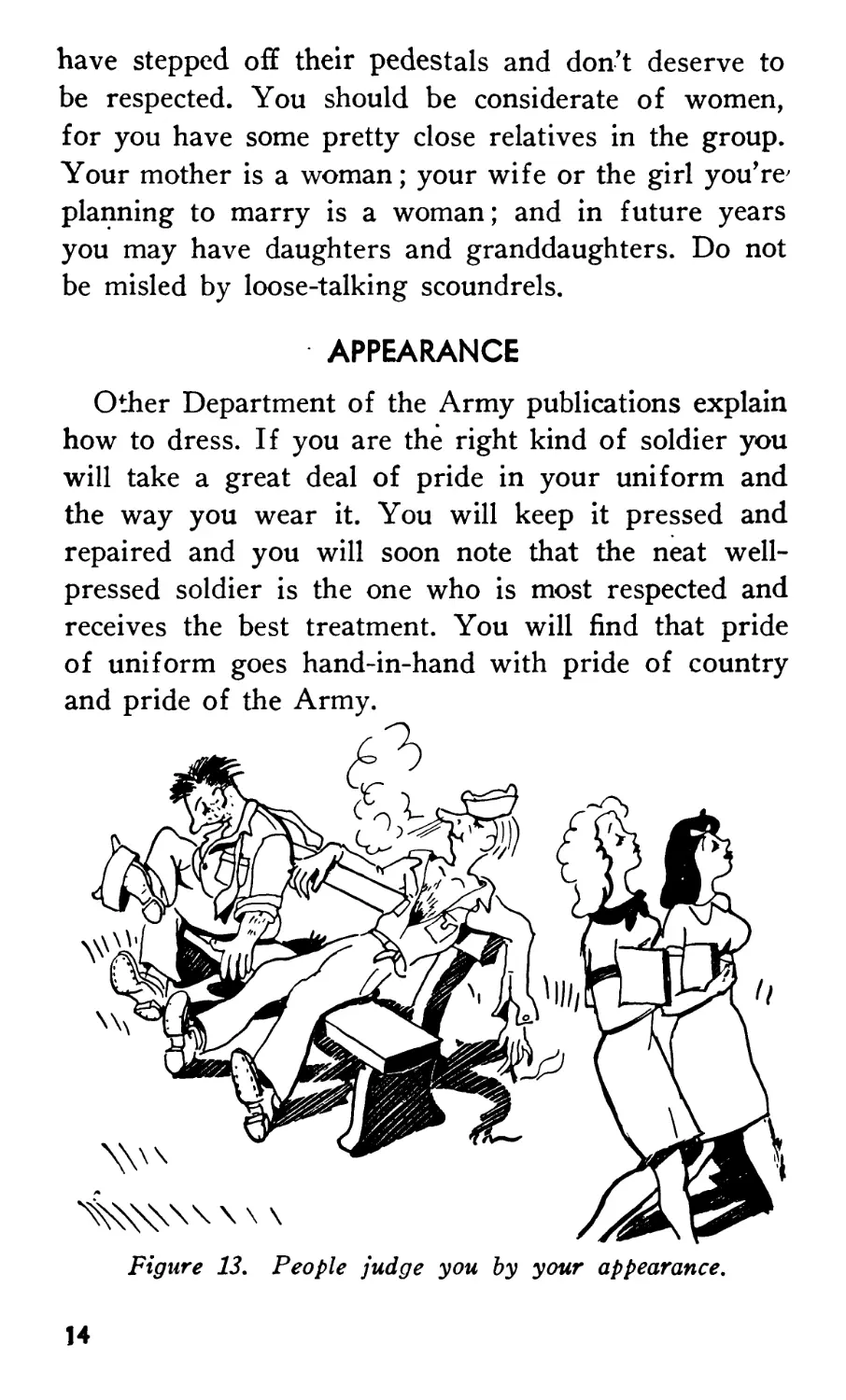
repaired and you will soon note that the neat well-
pressed soldier is the one who is most respected and
receives the best treatment. You will find that pride
of uniform goes hand-in-hand with pride of country
and pride of the Army.
Figure 13. People judge you by your appearance.
14
BRAGGING
The well-mannered man is popular, and he has a
good time. Perhaps politeness will not take you around
the world, as you have often heard that it will, but
it will make the going much easier. Certainly, brag-
ging will not carry you very far. Bragging, as you
have probably noticed, is usually done by one who
is trying to cover a feeling of inferiority. He knows
he is “small fry,” but he wants you to think he is a
“big shot.” Don’t be the “fall guy” for his tall tales
as you will soon learn that he is a “fake.”
Figure 14. Bragging is usually done to cover an
inferiority complex.
George Washington had a rule that read: “A Man
ought not to value himself of his Achievements, or
rare Qualities of wit; much less of his riches, Virtue
or Kindred.” Others will evaluate your character.
15
THE COURTEOUS LEADER
Most great leaders are kind and courteous. They
have followers who work hard and they wouldn’t have
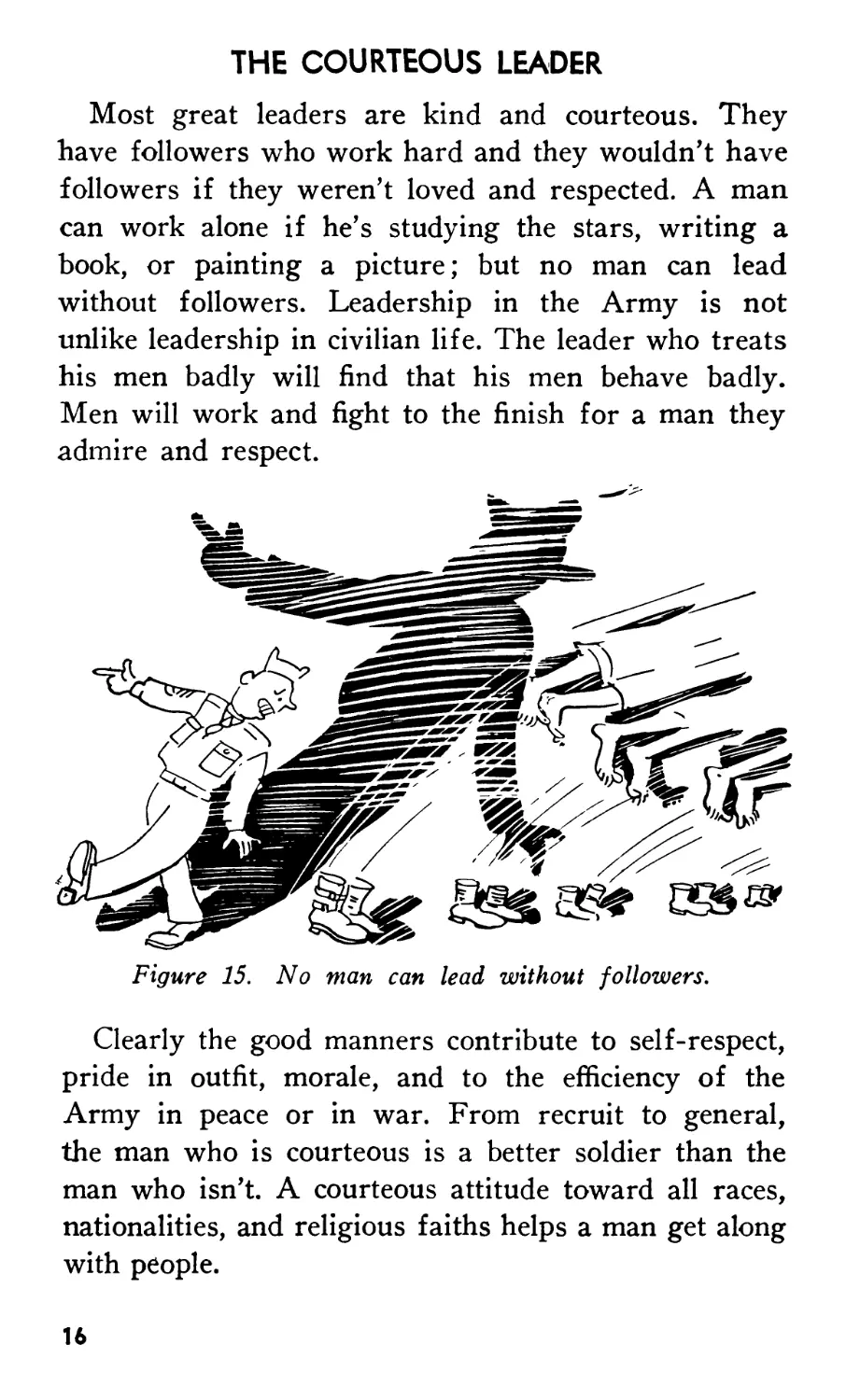
followers if they weren’t loved and respected. A man
can work alone if he’s studying the stars, writing a
book, or painting a picture; but no man can lead
without followers. Leadership in the Army is not
unlike leadership in civilian life. The leader who treats
his men badly will find that his men behave badly.
Men will work and fight to the finish for a man they
admire and respect.
Figure 15. No man can lead without followers.
Clearly the good manners contribute to self-respect,
pride in outfit, morale, and to the efficiency of the
Army in peace or in war. From recruit to general,
the man who is courteous is a better soldier than the
man who isn’t. A courteous attitude toward all races,
nationalities, and religious faiths helps a man get along
with people.
16
MANNERS AND GOOD WILL
Maybe you don’t think it’s important to be popular
with civilians; but if you aren’t, you can lead a dreary
life outside of an Army post. You may recall the
sad poem that Kipling wrote about poor, unpopular
Tommy Atkins, the British soldier:
“I went into a public ’ouse to get a pint o’ beer,
The publican ’e up and sez, ‘We serve no red coats
here’”
Possibly Tommy’s manners weren’t acceptable. Cer-
tainly, if yours aren’t, civilians will be treating you
as Tommy was treated. Although honesty, loyalty,
courtesy, and other virtues are the best policy to
follow, one should do so as a matter of principle rather
than a means to an end. Courtesy reflects credit on
the Army, and its personnel is better off if they have
the good-will of civilians.
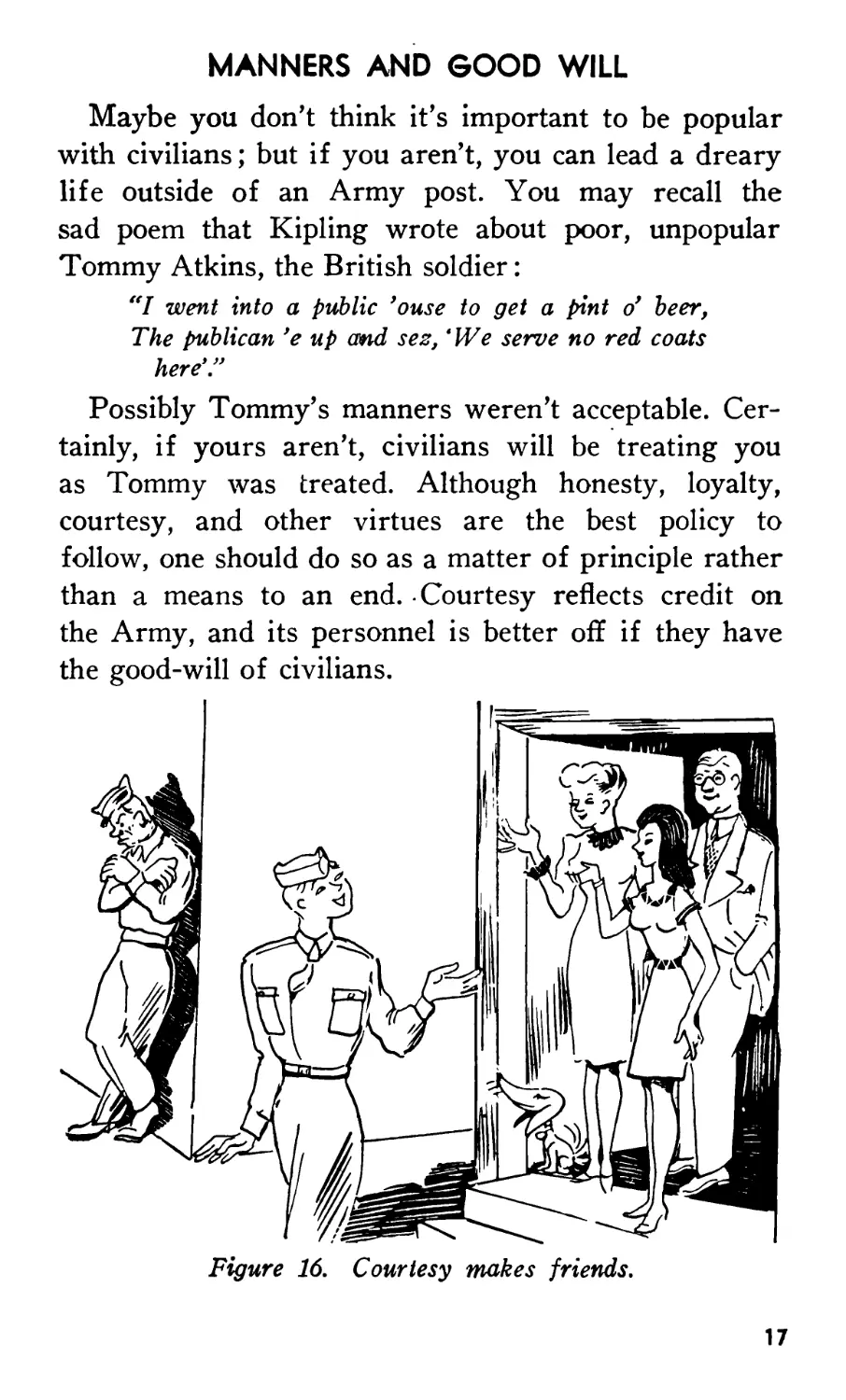
Figure 16. Courtesy makes friends.
17
At times, troops are stationed in many countries
and places that have been visited by few Americans.
If you are so assigned you’ll find it profitable to make
friends—not enemies. Personal conduct is even more
important abroad than in our own country.
18
CHAPTER 2
BEHAVIOR IN GARRISON AND FIELD
GETTING ALONG WITH MEN
Uncle Sam’s soldiers ordinarily have comfortable
quarters, where they can lead pleasant, normal lives
if they observe the rules of common courtesy. When
you entered the Army, you moved from a little house
to a big house where you live closely with dozens of
other men instead of living with your family or with
relatives or friends.
There can’t be happiness in a cottage or a mansion
if people who live there don’t have consideration for
each other and a common interest in the place. If you
are a member of a large family, you know what dis-
turbance can be caused when the rights of individuals
are violated. It is much the same in the Army house;
you will be expected to cooperate and assume your
share of the work in keeping it a fit place in which
to live. Other men will not stand for your shirking
your share of the work.
If you want to be happy and be a success as a
soldier you must learn to get along with men. Learning
to live and work with others may be the most important
lesson of your whole life. The Army is an excellent
place to learn such a lesson.
IN THE BARRACKS
In the barracks you don’t have a room of your own,
but you can have some privacy and a great deal of
independence if the men in your company respect
19
Figure 17. Consideration for others.
each other’s rights. It is well to remember the Golden
Rule: “Do unto others as you would have them do
unto you.”
Upon entering the Army, you became a member
of a group. As such, you must put the welfare of
the group above your welfare as an individual. After
the lights are out, most men want to sleep. Keep quiet
and let them sleep. Don’t start horse-play and loud
talking. If you must talk, go into the day room and
talk quietly. If your company permits radios, use them
in accordance with the rules governing their use. Don’t
awaken some soldier to tell him about the party you
attended. The story will be better appreciated the
next morning.
There are many ways to become a nuisance, and
every one of them should be avoided. You know the
fellow who flops on a bed other than his own, and
20
doesn’t smooth out the wrinkles when he gets up.
You also know the “moocher.” When it’s time to
dress for a date, the “moocher” always finds that his
coat needs pressing. He borrows yours and brings it
back all ready for the cleaner. He can smell your
cigarettes before you open the carton. He never has
polish or a shoe brush. In fact, he never has the right
thing in the right place at the right time. Chiselers
and moochers are numerous. Do what you can to dis-
courage chiseling and mooching within your organi-
zation.
Clean-up night will test the esprit de corps of your
outfit. If everybody does his job well, your company
will be through cleaning in time for the second movie.
Gold-bricking slows up the work. Of course, the
whole task is made easier when the squad room has
been kept clean.
21
The latrine is a place where consideration of all is
very important. The wash bowls are used by 40 to 60
men, and should be cleaned by each person when he
has finished. Clean up the mess you make and the
other fellow will do the same. Dispose of used razor
blades, soap wrappers, etc., in the receptacles provided.
Observe the rules. Flush the toilet and the urinal
after using them and don’t throw trash in the urinal
for the attendant to clean out later. Don’t mistake
the toilet seat for an easy chair in a reading room.
Little pieces of soap left on the floor of the shower
room may be the cause of an accident.
DAY ROOM
The day room is similar to the living room in your
home. All the men in your company can have a good
time there if they act like self-respecting members of a
big family. Keep the place tidy and have consideration
for the other men who are using it. Every company
has its day room customs. Find out what these are
and observe them.
Take your turn at the game tables so that other men
may take theirs. Talk enough but not too much.
Among the worst pests in the day room are the
men who won’t observe the rule for closing time.
Have some consideration for the day room orderly,
who has to clean and close the room for the night.
COMPANY AREA
The company area is like the yard around a home.
The residents can make it sightly or unsightly,
and they are judged by its appearance. So take
pride in your company area. You won’t be proud
22
of cigarette butts and trash thrown around, and you
won’t enjoy picking them up. Consequently, the best
plan is not to scatter trash around the area. If you
like grass and flowers, don’t walk on the lawn and
borders. Suggest improvements, even at the risk of
being asked to do the work. You’ll get your money’s
worth every time you step out of the barracks. Here’s
a small suggestion but not too small to mention:
Hang your washing on the racks provided for it and
not just anywhere, and take it down as soon as it’s
dry. The company area is your yard, and you’re
its keeper.
Figure 19. Take care of the place . . . You LIVE there.
ORDERLY ROOM
The first sergeant has many duties to perform
which concern you. You should treat him with polite-
ness, and be considerate of his official position. Don’t
bother him with trifles that can be handled by your
platoon sergeant. When you do see him on some
23
mportant matter, transact your business as quickly aS
>ossible. There are probably other soldiers waiting to
lee him on business which is as important as yours.
Find out the hours of “mail call” and be on hand.
T you miss one “mail call,” be on hand for the next,
soldierly conduct is always required in the orderly
oom—and that’s something the first sergeant, as well
is the recruit, should remember.
SUPPLY ROOM
The supply sergeant is another man who has head-
iches you can help prevent. It doesn’t take too much
effort to find out when and where laundry is collected
md delivered. That statement applies also to shoe
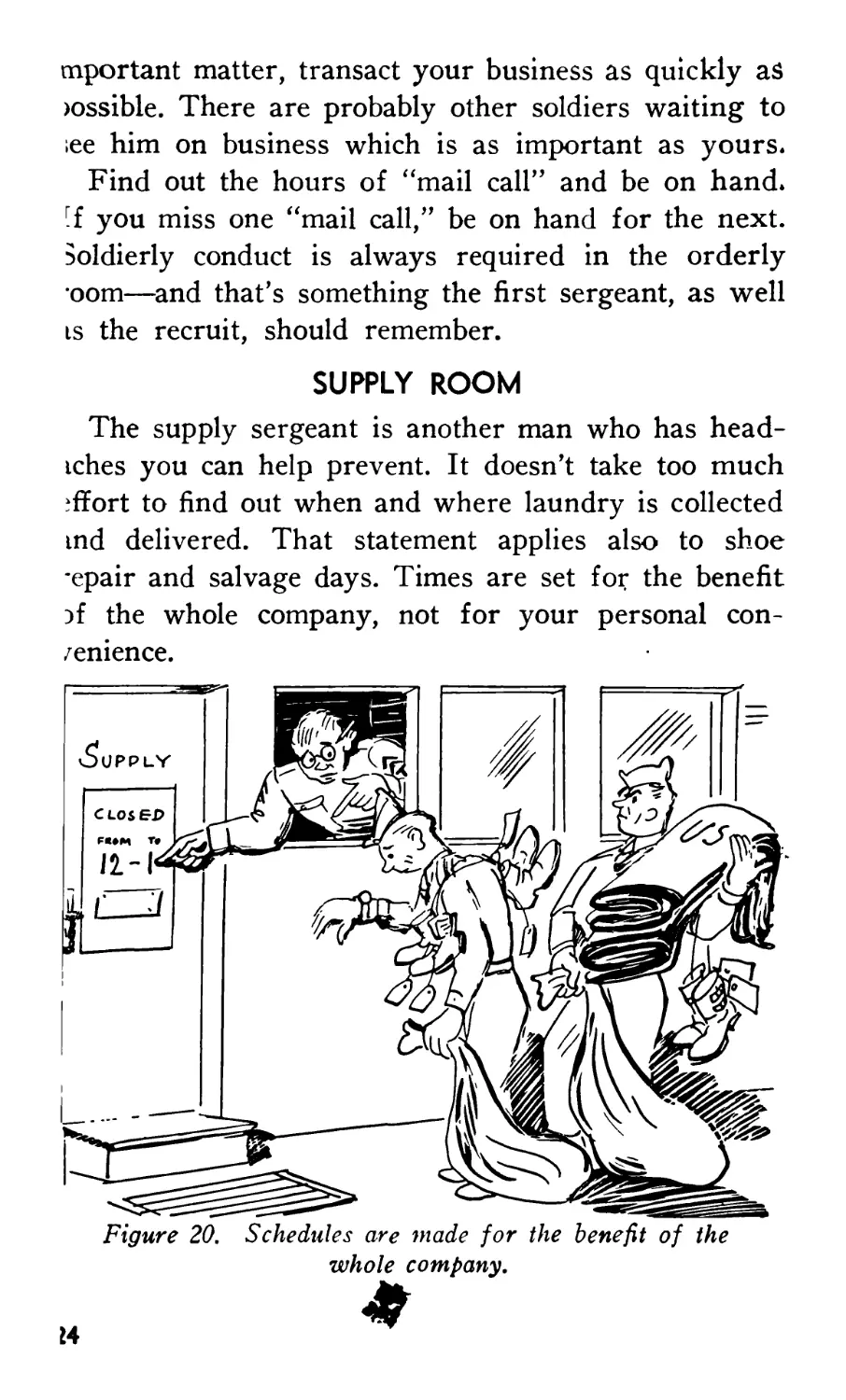
•epair and salvage days. Times are set for the benefit
)f the whole company, not for your personal con-
venience.
The sooner you learn that the supply sergeant
won’t take back tools unless you’ve cleaned them, the
less friction there will be. In your dealings with the
supply room, it’s well to remember:
"It is not the individual
Or the Army as a whole,
But the everlastin' teamwork
Of every bloomin' soul."
IN THE FIELD
Common courtesy is just as important in the field
as in garrison. Many men often feel that common
courtesies are discarded when they get into the field.
This is far from the truth.
Life in the field is greatly affected by the weather.
Under delightful weather conditions it can be quite
pleasant, but in bad weather it’s usually anything
but comfortable. Here’s where it takes courage to
accept the bad and not let it get you down. Your
griping won’t help a bit; in fact, it makes it worse
because griping is contagious.
In the field, soldiers are thrown closer together
regardless of rank. This does not mean that the chain
of command is broken. The primary concern of the
leader is the welfare of his men. Cooperation is essen-
tial for success and good behavior is a good sign of
cooperation.
Consider two men living in a “pup” tent. You and
your “buddy,” your clothes, your field packs, and
your rifles are huddled together on less than 35 square
feet of ground space, with the canvas roof close over-
head. It takes a lot of real consideration for each
other to keep you from getting on each other’s nerves.
25
When you’re living in a “pup” tent, nothing is
mofe important than order and cleanliness. When
the “gas alarm” is sounded at 2 o’clock in the morn-
ing, no soldier has charity enough to forgive a tent-
mate whose disorder slows down the take-off. Sleeping
in close quarters is none too pleasant. Sleeping close
to a man who is unclean is not pleasant. Consider the
other fellow and keep clean.
Lend the other fellow a hand when he needs your
help. Stubborn field equipment may keep a man from
being ready when the company moves out. For a little
help you’ll get more thanks than you may deserve.
Be considerate of the man with a load heavier than
yours, exchange loads and give him a break for a
mile or two. The fellow who says he’s sick has a right
to the benefit of your doubt until you find he’s “gold-
bricking.” It doesn’t take long to label the “fakers.”
Figure 21, Don't get on one another’s nerves.
26
We’ve already said that self-control and manners
can’t be separated. The man who drinks all the water
in his canteen and then tries to chisel a drink from
you violates the principles of water discipline and field
training. It’s quite proper to refuse his request.
In the field, men are exempt from certain duties
because of the importance of the work they must
perform — never because of their rank. If a man
is performing an important duty, it is only right
that some other man should perform his routine
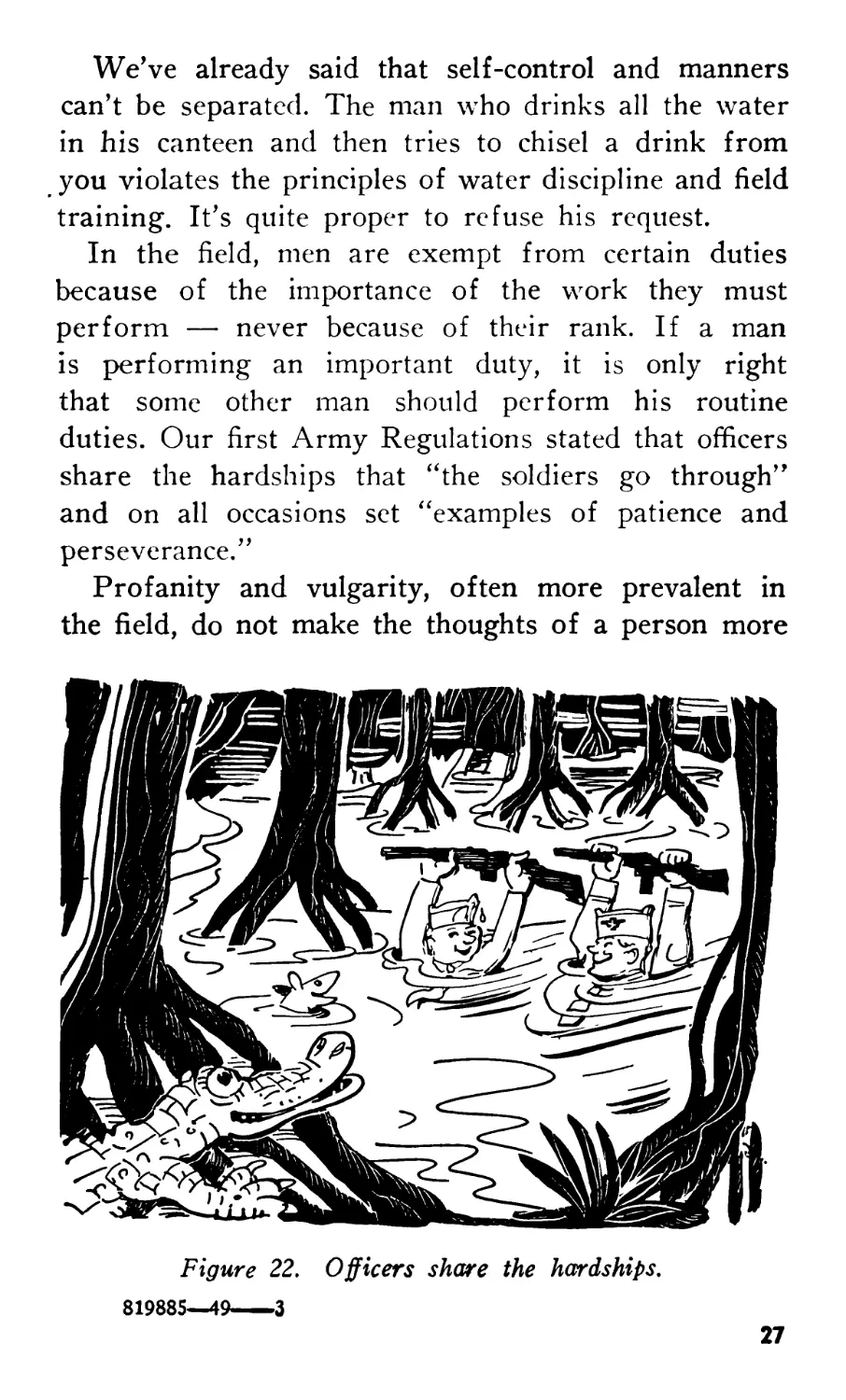
duties. Our first Army Regulations stated that officers
share the hardships that “the soldiers go through”
and on all occasions set “examples of patience and
perseverance.”
Profanity and vulgarity, often more prevalent in
the field, do not make the thoughts of a person more
Figure 22. Officers share the hardships.
819885—49----3
27
effective. There’s a chance that only the oaths and
vulgar language will be heard. The use of profane,
vulgar, and obscene language should be discouraged
by all men. A good rule to follow is to avoid the use
of profane and obscene language in all conversations.
Improper behavior and loose talk may cost the life
of a friend and that friend may be you. Failure to
obey security measures may result in disaster for
your unit.
UNDESIRABLE TRAITS AND HABITS
Persons in the military service have opportunity
to visit many places, stop over in many hotels, eat
in various restaurants, and be entertained in many
public and private clubs. They travel extensively.
They are often guests of members of business men’s
Figure 23, Profanity won’t make commands more effective.
2S
clubs and are accorded the hospitality of many benev-
olent associations. Most military personnel behave like
the gentlemen they are and are appreciative of the
attentions and considerations shown them. Some
thoughtless individuals, however, have the undesirable
habit of appropriating small articles as reminders of
their various good times. Such genteel thievery of
towels, silverware, ashtrays, and the like does not
enhance the reputation of the Army as a whole and
has the effect of branding military personnel as
unwanted guests. If you covet a towel displaying the
name — “Hotel Ritz” see the manager and buy it.
Your recreation away from the post will depend
a great deal on the attitude and cooperation of the
civilians. You may be sure that if your reception is
cold it is the result of another soldier’s misconduct
and you are associated with that other soldier simply
because you wear the same uniform. Misconduct of
a few soldiers in public places can bring discredit on
the entire Army and it is because of these thoughtless
few that it has been necessary to station military
police wherever military personnel are to be found
in large numbers. If they demand that you wear your
uniform correctly, behave properly, and avoid intoxica-
tion, it is to protect the Army, yourself, and those
who follow you. And remember that you also are
subject to civilian laws and regulations while you are
on pass or furlough. Your uniform doesn’t exempt
you from arrest and detention by civilian police officers
while you are off duty and away from the post.
29
CHAPTER 3
TABLE MANNERS
MORE THAN ONE WAY TO EAT
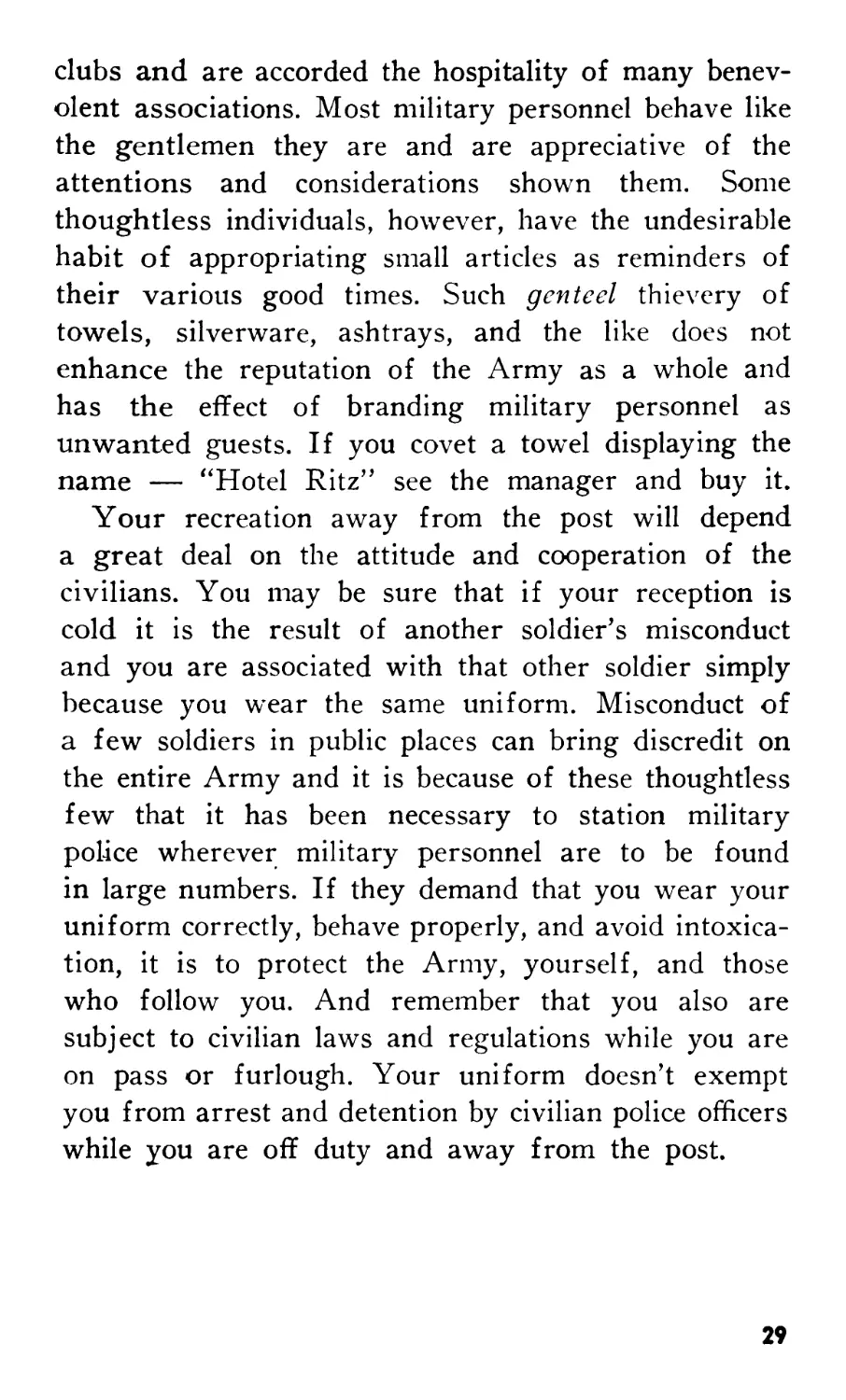
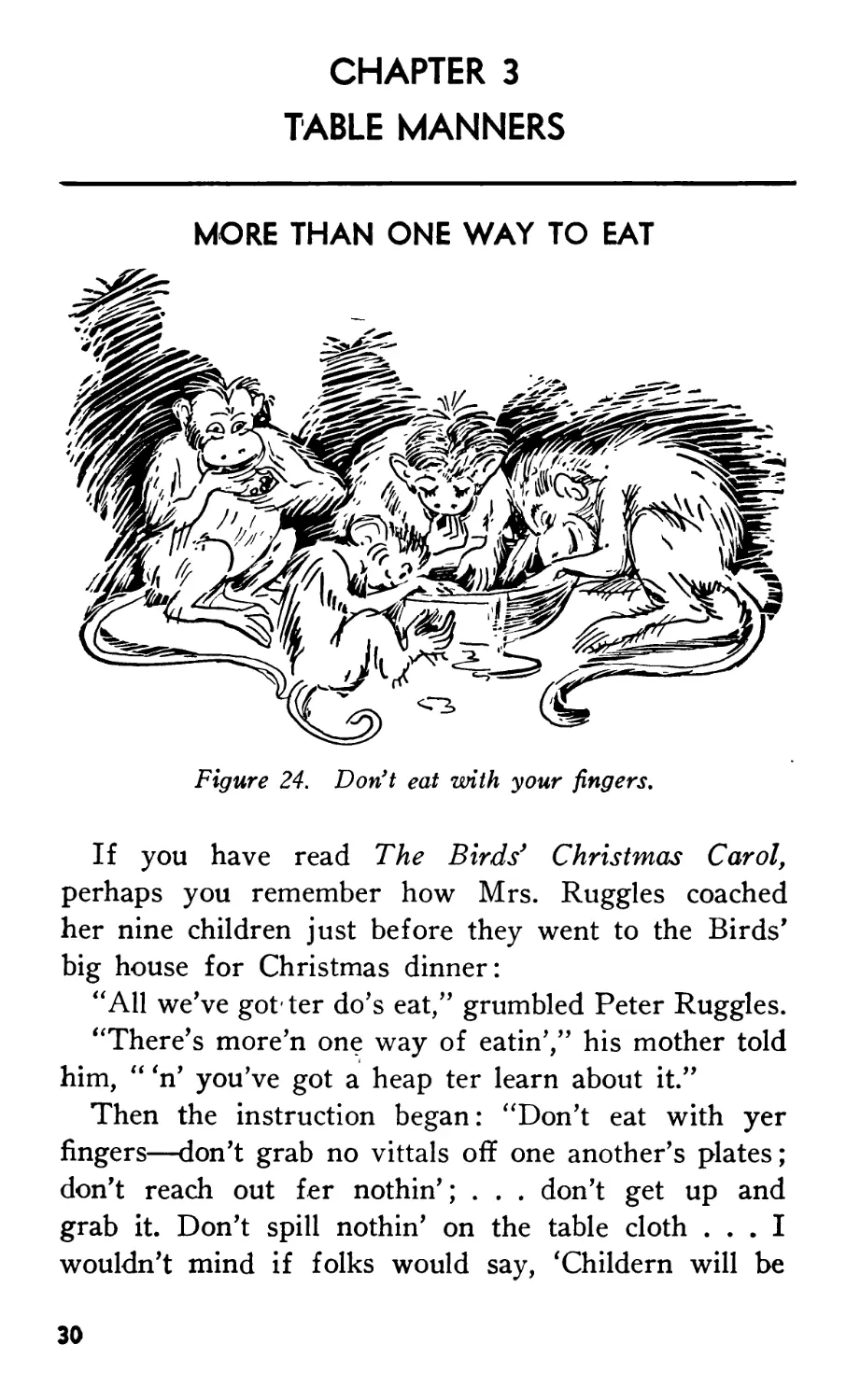
Figure 24. Don't eat with your fingers.
If you have read The Birds’ Christmas Carol,
perhaps you remember how Mrs. Ruggles coached
her nine children just before they went to the Birds’
big house for Christmas dinner:
“All we’ve got-ter do’s eat,” grumbled Peter Ruggles.
“There’s more’n one way of eatin’,” his mother told
him, “ ‘n’ you’ve got a heap ter learn about it.”
Then the instruction began: “Don’t eat with yer
fingers—don’t grab no vittals off one another’s plates;
don’t reach out fer nothin’; . . . don’t get up and
grab it. Don’t spill nothin’ on the table cloth ... I
wouldn’t mind if folks would say, ‘Childern will be
30
childern’; but they won’t. They’ll say, 'Land o’ Good-
ness, who fetched them childern up?’”
Though Mrs.' Ruggles’ English can’t be taken as a
model, there was sense in what she said. Table man-
ners are tell-tale. They give people a pretty good idea
of how you were “fetched up.”
The Golden Rule, somewhat reworded, is an excel-
lent guide to table manners: “Don’t do anything at
the table that you don’t like to see other people do.”
MAKING MEALTIME A PLEASURE
Good table manners, like all other polite behavior,
are based upon consideration for others. In unim-
portant details, they vary from country to country
and from century to century. Europeans think the
way we eat corn on the cob is savage. The Chinese
use chop sticks; we use knives and forks. Today,
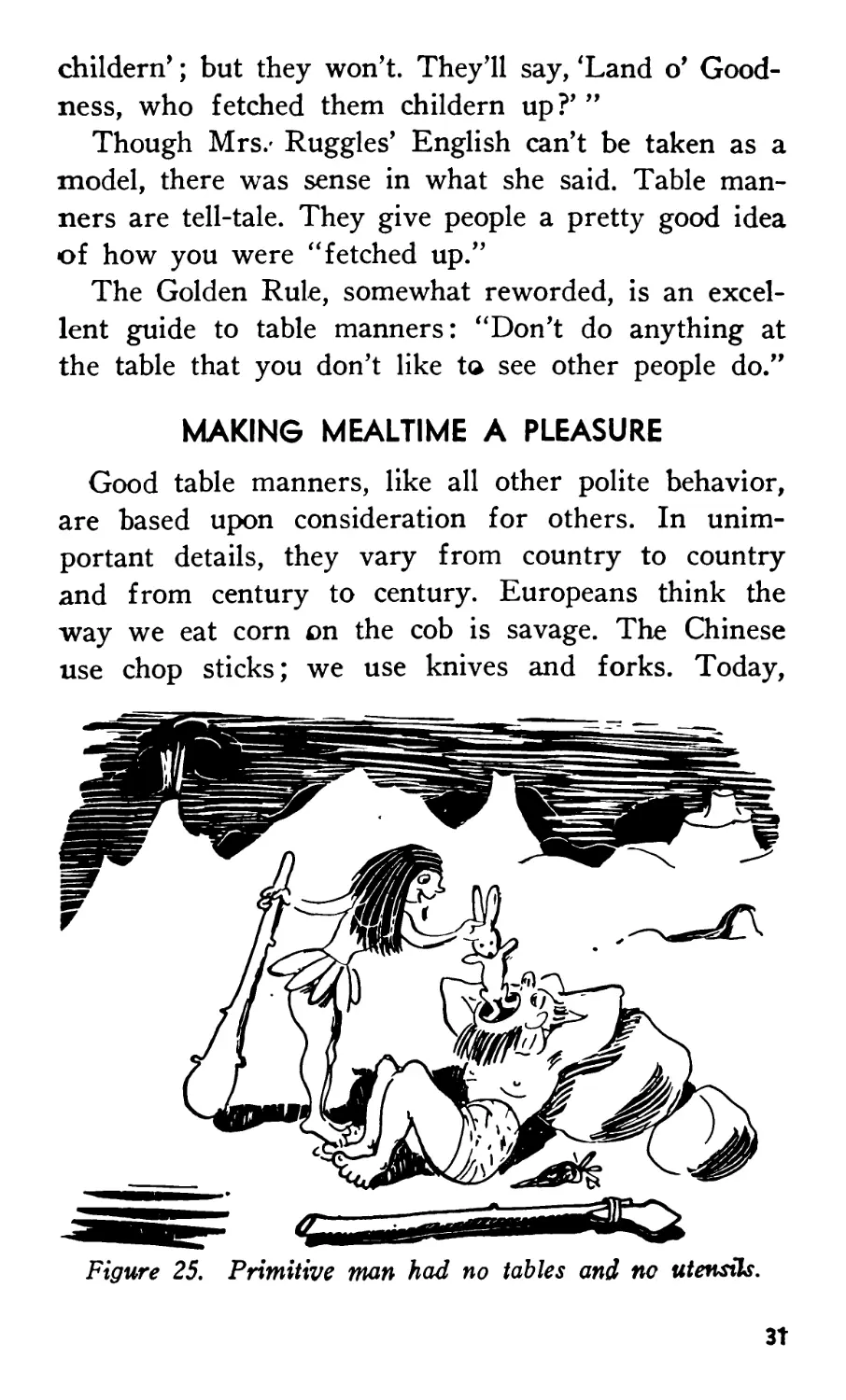
Figure 25. Primitive man had no tables and no utensils.
3T
however, good table manners are nearly the same
throughout the world.
Civilized men nowhere in the world enjoy mealtime
if the dining room, the china, the eating utensils, the
cooks, the waiters, and the people at the table are
dirty. Appetites can go away in a hurry if food is
called by some disgusting nickname. Food that is
thrown on a plate is scarcely appetizing. There isn’t
any doubt that a meal tastes better if the food is
properly prepared, properly served, and properly eaten.
SPOONS, KNIVES, AND FORKS
You’ve often heard that fingers came before forks.
Primitive man had no tables and no table utensils.
Standing or squatting on the ground, inside the cave
or outside, he used his fingers for. tearing meat from
the bones and stuffing it into his mouth. A spoon
made from the bark of a tree seems to have been his
first table utensil. The knife, a crude affair, was
invented for use as a weapon and later used for cut-
ting meat. The fork was invented last. Before its day,
food was eaten with fingers and spoons, and even
with knives. Now each utensil has its special purpose.
Using the Spoon
Once an all-purpose utensil, the spoon is now used
only for eating fruit cocktails, semisolid foods, soft
boiled eggs, grapefruit, melons, soups, cereals, and
soft desserts, and for stirring coffee, tea, and cocoa.
If vegetables—for example, stewed tomatoes—are
served in juicy form, it’s only common sense to eat
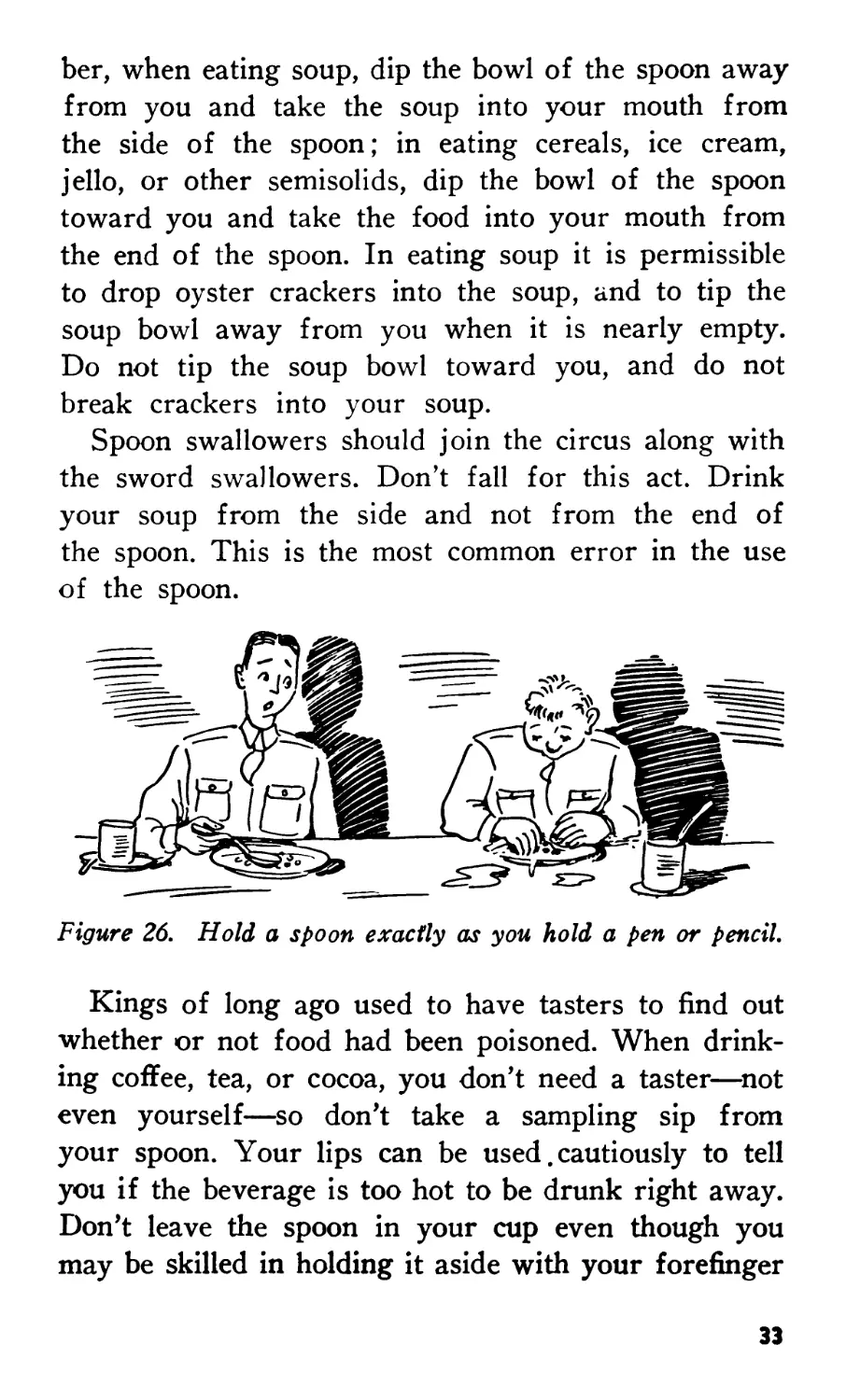
them with a spoon. Hold a spoon somewhat as you
hold a pen or pencil when preparing to write. Remem-
32
ber, when eating soup, dip the bowl of the spoon away
from you and take the soup into your mouth from
the side of the spoon; in eating cereals, ice cream,
jello, or other semisolids, dip the bowl of the spoon
toward you and take the food into your mouth from
the end of the spoon. In eating soup it is permissible
to drop oyster crackers into the soup, and to tip the
soup bowl away from you when it is nearly empty.
Do not tip the soup bowl toward you, and do not
break crackers into your soup.
Spoon swallowers should join the circus along with
the sword swallowers. Don’t fall for this act. Drink
your soup from the side and not from the end of
the spoon. This is the most common error in the use
of the spoon.
Figure 26. Hold a spoon exactly as you hold a pen or pencil.
Kings of long ago used to have tasters to find out
whether or not food had been poisoned. When drink-
ing coffee, tea, or cocoa, you don’t need a taster—not
even yourself—so don’t take a sampling sip from
your spoon. Your lips can be used. cautiously to tell
you if the beverage is too hot to be drunk right away.
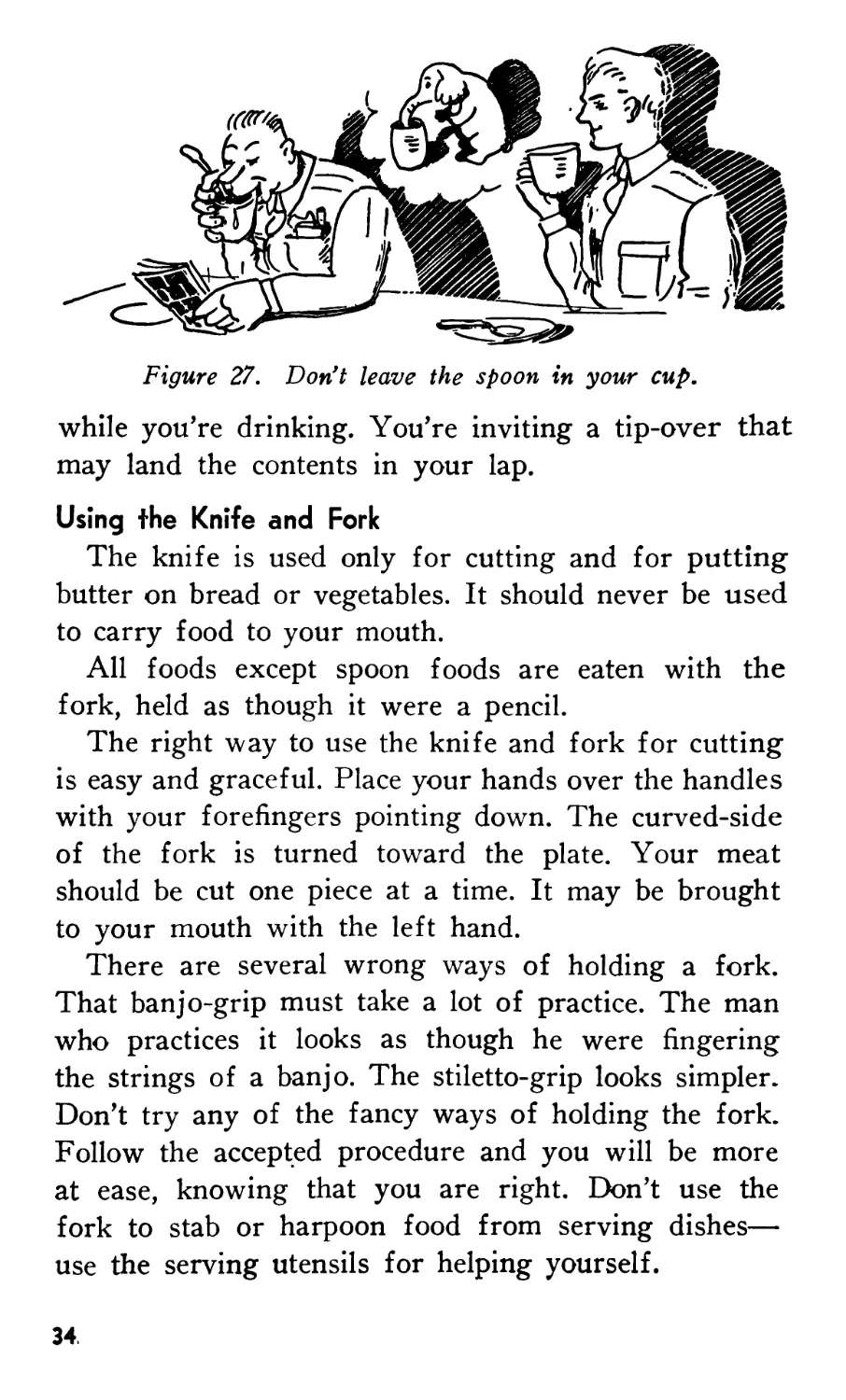
Don’t leave the spoon in your cup even though you
may be skilled in holding it aside with your forefinger
33
Figure 27. Don't leave the spoon in your cup.
while you’re drinking. You’re inviting a tip-over that
may land the contents in your lap.
Using the Knife and Fork
The knife is used only for cutting and for putting
butter on bread or vegetables. It should never be used
to carry food to your mouth.
All foods except spoon foods are eaten with the
fork, held as though it were a pencil.
The right way to use the knife and fork for cutting
is easy and graceful. Place your hands over the handles
with your forefingers pointing down. The curved-side
of the fork is turned toward the plate. Your meat
should be cut one piece at a time. It may be brought
to your mouth with the left hand.
There are several wrong ways of holding a fork.
That banjo-grip must take a lot of practice. The man
who practices it looks as though he were fingering
the strings of a banjo. The stiletto-grip looks simpler.
Don’t try any of the fancy ways of holding the fork.
Follow the accepted procedure and you will be more
at ease, knowing that you are right. Don’t use the
fork to stab or harpoon food from serving dishes—
use the serving utensils for helping yourself.
34
When the knife and fork aren’t being used, they
should be laid on your plate and not Dropped against
the plates.
HABITS TO BE AVOIDED
Good table manners don’t attract attention to the
act of eating. Fingering articles on the table, using
the tableware to draw pictures on the table cloth, or
to play a tattoo on the glass will make you conspicuous
and annoying. Don’t sprawl over the table, but assume
a comfortable, respectable position at the table; and
don’t be in a hurry, impatient, or do things that may
be embarrassing to your companions at the table.
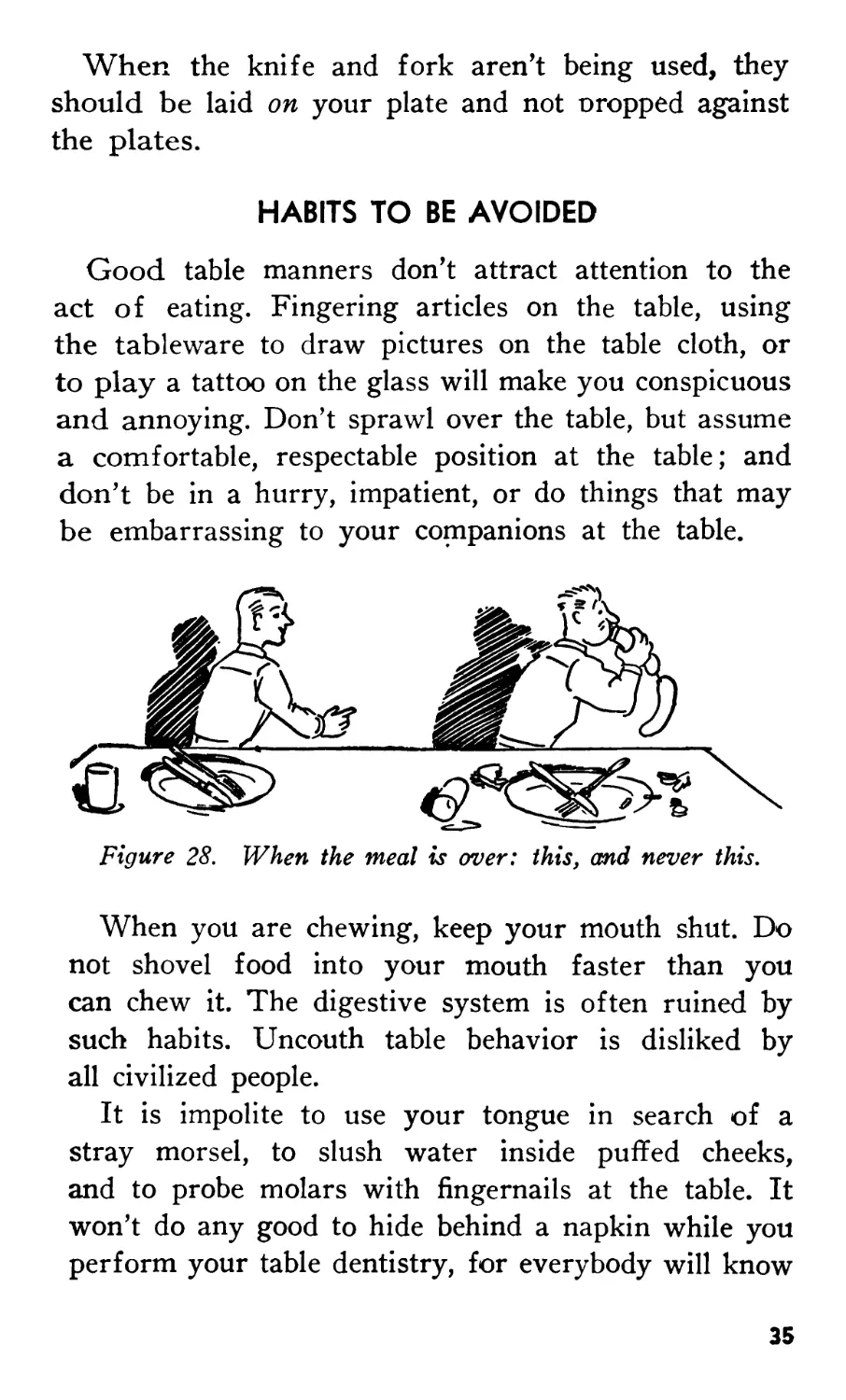
Figure 28. When the meal is over: this, and never this.
When you are chewing, keep your mouth shut. Do
not shovel food into your mouth faster than you
can chew it. The digestive system is often ruined by
such habits. Uncouth table behavior is disliked by
all civilized people.
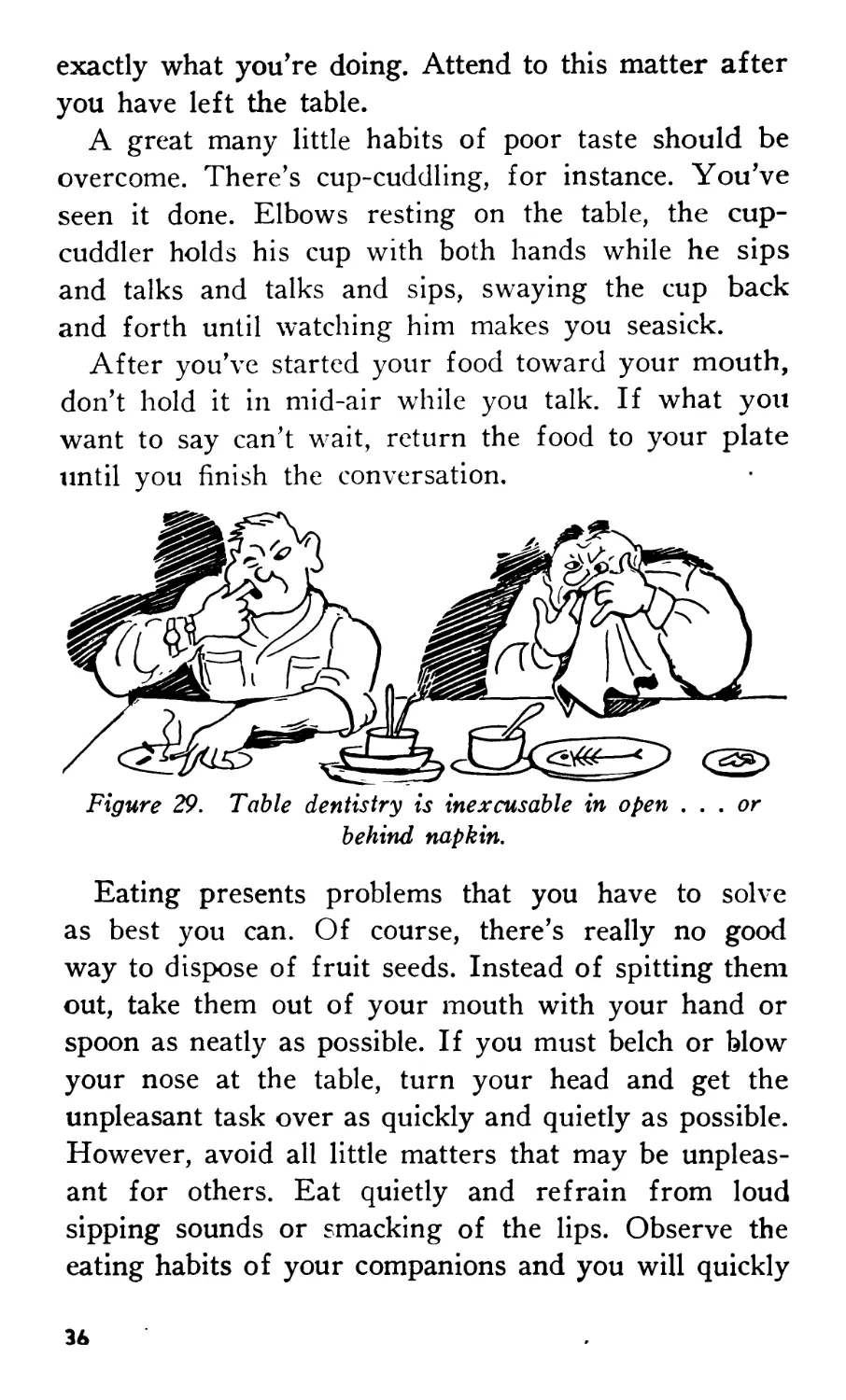
It is impolite to use your tongue in search of a
stray morsel, to slush water inside puffed cheeks,
and to probe molars with fingernails at the table. It
won’t do any good to hide behind a napkin while you
perform your table dentistry, for everybody will know
35
exactly what you’re doing. Attend to this matter after
you have left the table.
A great many little habits of poor taste should be
overcome. There’s cup-cuddling, for instance. You’ve
seen it done. Elbows resting on the table, the cup-
cuddler holds his cup with both hands while he sips
and talks and talks and sips, swaying the cup back
and forth until watching him makes you seasick.
After you’ve started your food toward your mouth,
don’t hold it in mid-air while you talk. If what you
want to say can’t wait, return the food to your plate
until you finish the conversation.
Figure 29. Table dentistry is inexcusable in open ... or
behind napkin.
Eating presents problems that you have to solve
as best you can. Of course, there’s really no good
way to dispose of fruit seeds. Instead of spitting them
out, take them out of your mouth with your hand or
spoon as neatly as possible. If you must belch or blow
your nose at the table, turn your head and get the
unpleasant task over as quickly and quietly as possible.
However, avoid all little matters that may be unpleas-
ant for others. Eat quietly and refrain from loud
sipping sounds or smacking of the lips. Observe the
eating habits of your companions and you will quickly
ЗА
learn what table manners are acceptable. If you should
take a mouthful of food that’s too hot, don’t spit the
food out, but drink water quickly. Blowing hot food
does very little good. Try eating small bites or taking
small sips.
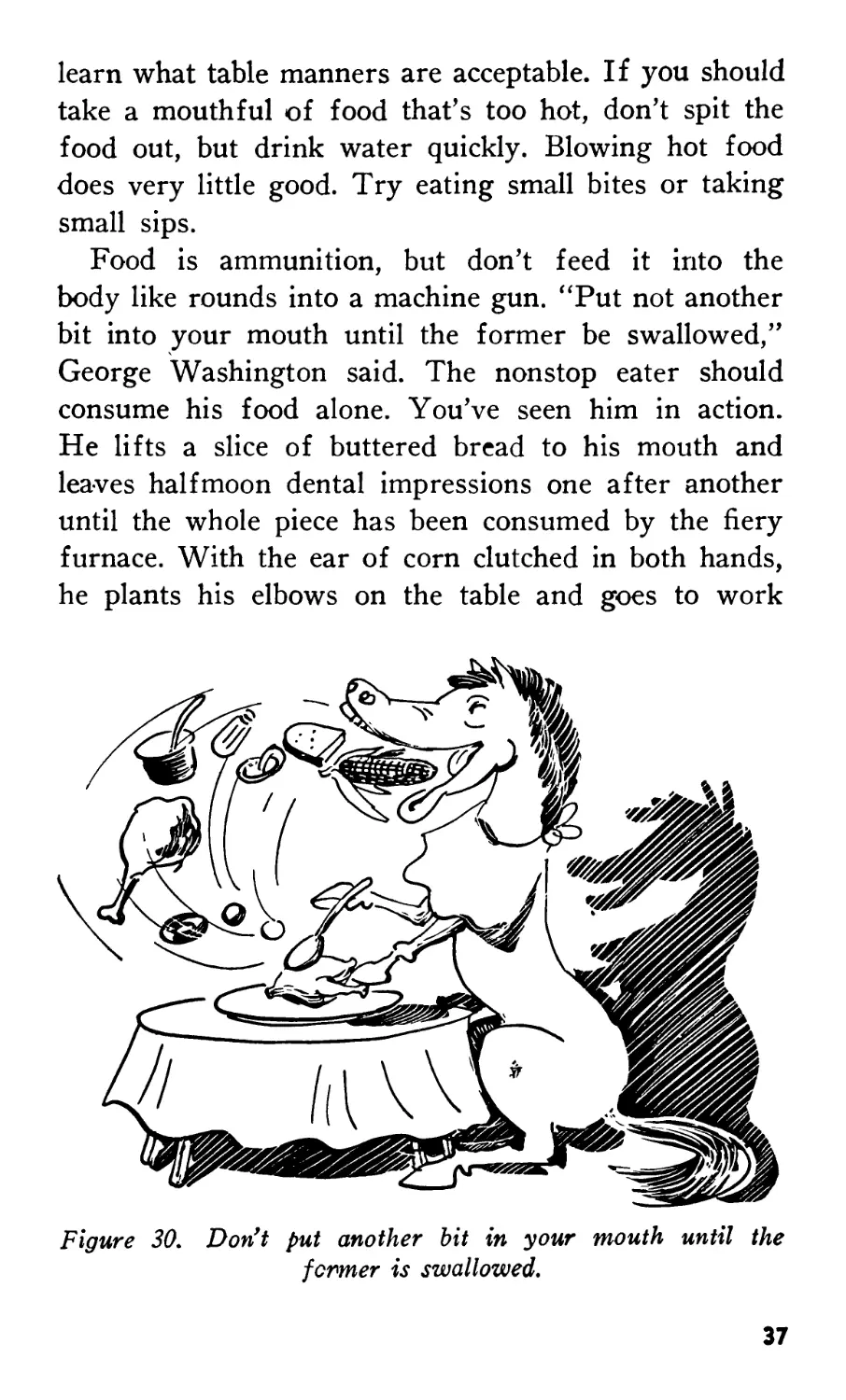
Food is ammunition, but don’t feed it into the
body like rounds into a machine gun. “Put not another
bit into your mouth until the former be swallowed,”
George Washington said. The nonstop eater should
consume his food alone. You’ve seen him in action.
He lifts a slice of buttered bread to his mouth and
leaves halfmoon dental impressions one after another
until the whole piece has been consumed by the fiery
furnace. With the ear of corn clutched in both hands,
he plants his elbows on the table and goes to work
Figure 30. Don’t put another bit in your mouth until the
former is swallowed.
37
with determination, sounding very much like a horse
eating.
Smoking at a table is no longer considered bad
form. Using tableware as ash trays, however, will
probably never be good form. It’s a messy habit; it
makes extra work; and should be avoided if possible.
THOUGHTFULNESS OF OTHERS
In dining rooms and mess halls no one has a right
to be thoughtless of others. That you didn’t mean to
offend is no excuse. Train yourself to think of the
other fellow. Absent-mindedness at the table is selfish
and bad-mannered. Remember to pass the bread, the
salt and pepper, and the sugar. Don’t help yourself
to more than your share from any dish or platter.
Be in a good humor at mealtime. A grouch at the
table is an aid to indigestion. Experience has proved
that a person’s frame of mind has an effect on diges-
tion. Anger causes food to feel like a hard knot in
your stomach, and it interferes with the digestive
processes.
IN THE MESS HALL
Some time ago Jiggs and Maggie of comic strip
fame were discussing manners. Jiggs, of course, had
done something like eating with his knife, tucking a
napkin under his chin, or picking his teeth and Maggie
was telling him how important it was to have good
table manners.
“I’ve got good table manners,” said Jiggs, “but I
don’t want to use ’em at home.”
A great many men feel as Jiggs did. In their own
homes and mess halls they treat manners like new
38
shoes, which might get the shine rubbed off if they
were not saved for special occasions. But manners
are like muscles which develop with use. They aren’t
natural unless they have become habits. If you don’t
practice good table manners every day, you’ll be as
awkward as an armchair commando doing pushups
when you try them out on special occasions.
Good manners in mess halls are the same as good
manners in private homes, restaurants, and dining
cars.
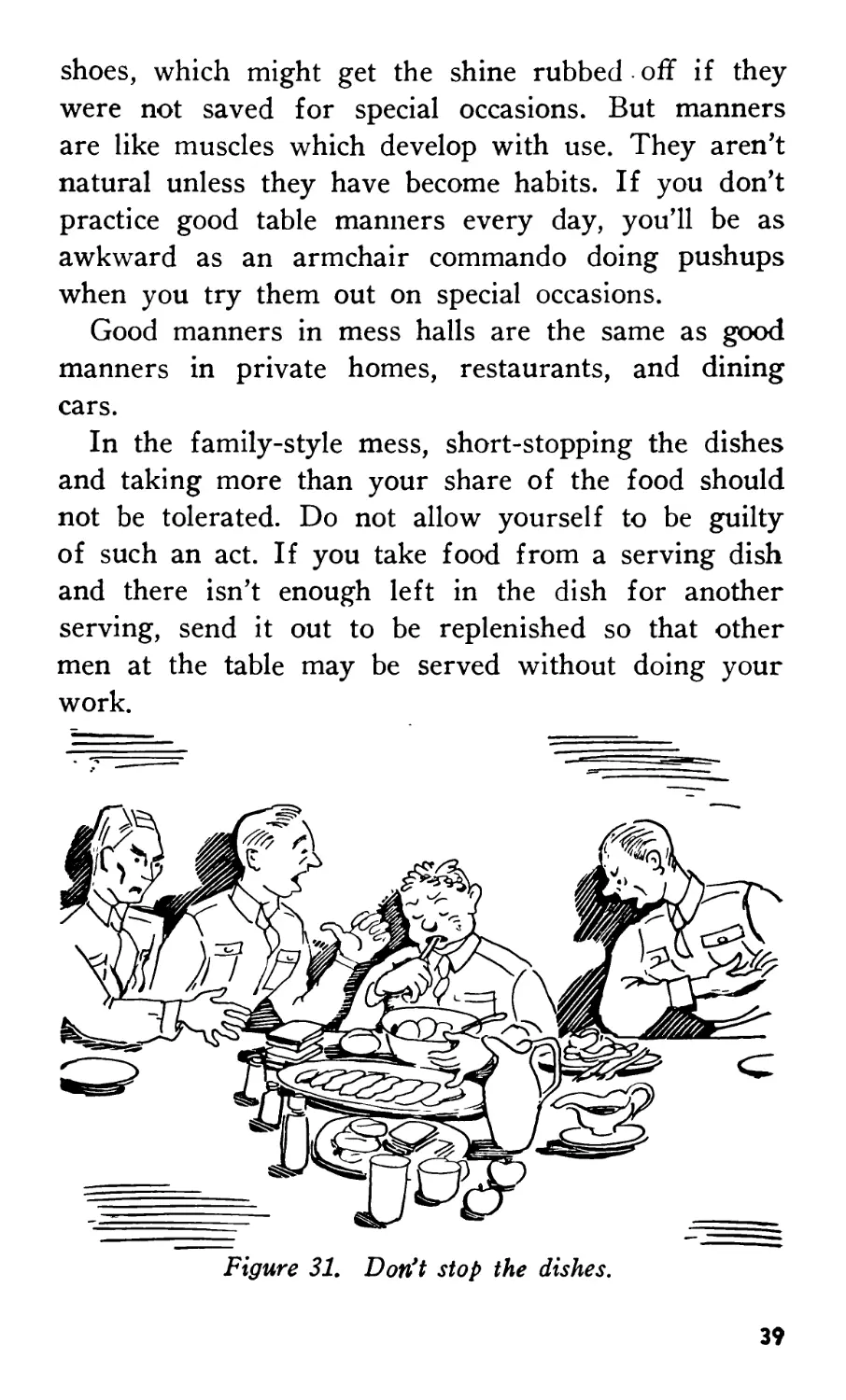
In the family-style mess, short-stopping the dishes
and taking more than your share of the food should
not be tolerated. Do not allow yourself to be guilty
of such an act. If you take food from a serving dish
and there isn’t enough left in the dish for another
serving, send it out to be replenished so that other
men at the table may be served without doing your
work.
Figure 31. Don't stop the dishes.
39
The Army mess can be much like the dining room
in a well-run home if the men who serve and the
men who are served are courteous. Men don’t want
food thrown at them or . slammed on the table. You
shouldn’t handle mashed potatoes like cement and a
spoon like a trowel. Don’t scoop; lift a spoonful of
potatoes (or anything else) carefully and put it neatly
on your plate. Try to imagine your father at the head
of the table and your mother at the foot, and behave
as they’d like to see you behave at home.
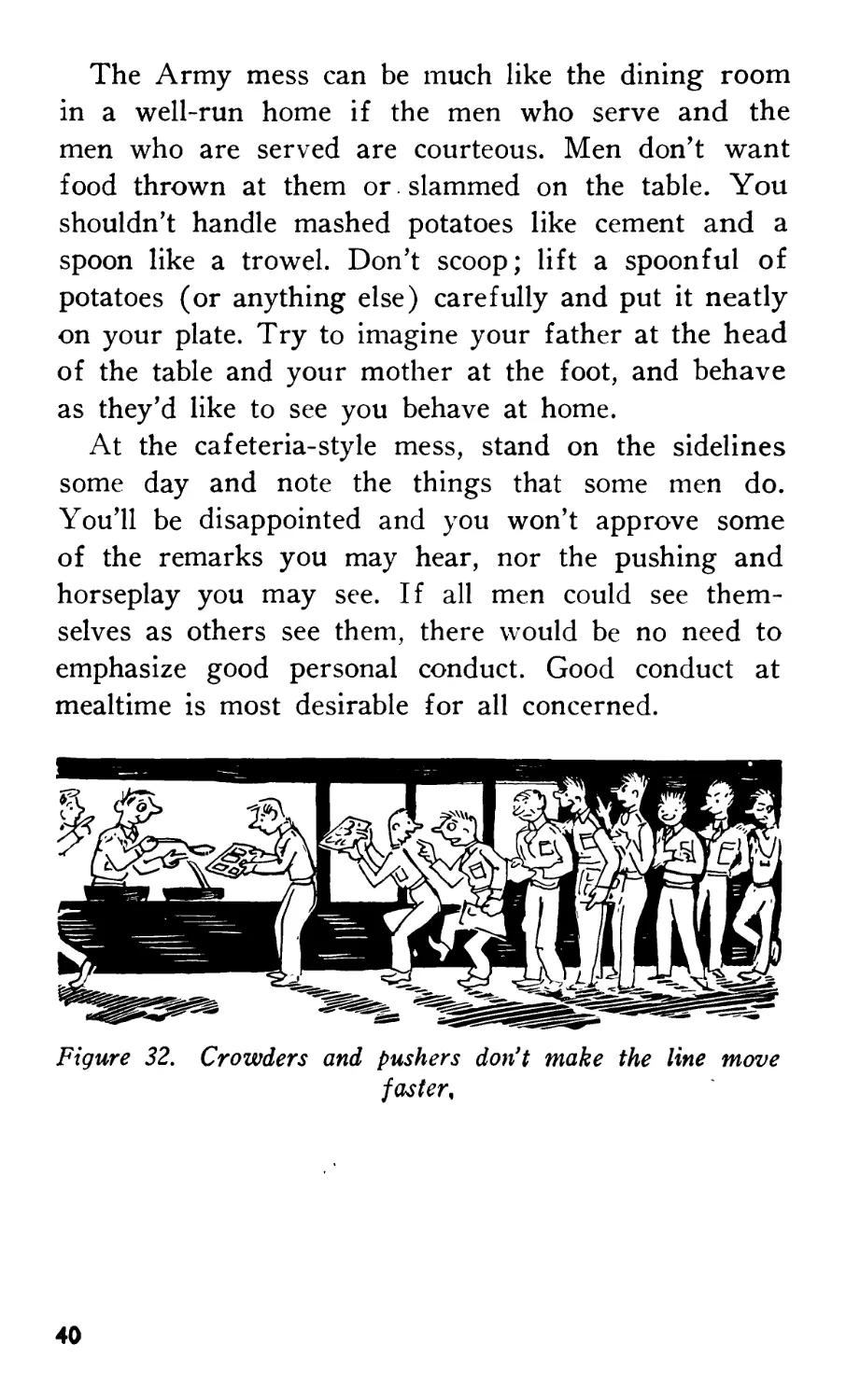
At the cafeteria-style mess, stand on the sidelines
some day and note the things that some men do.
You’ll be disappointed and you won’t approve some
of the remarks you may hear, nor the pushing and
horseplay you may see. If all men could see them-
selves as others see them, there would be no need to
emphasize good personal conduct. Good conduct at
mealtime is most desirable for all concerned.
Figure 32. Crowders and pushers don't make the line move
faster.
40
CHAPTER 4
SOCIAL RELATIONSHIPS
POPULARITY
Don’t let any man “kid” you into thinking that he
doesn’t want people to like him. As far as the ques-
tion of popularity is concerned, there are two kinds
of people in the Army—those who want popularity
and know how to get it, and those who want popularity
and don’t know how to get it. On the post and off
the post, men with manners are the ones who make
the most friends and have the best time.
A wise old philosopher remarked a long time ago
that “A man should keep his friendships in constant
repair.” It’s best to prevent friendships from becom-
ing broken.
APPEARANCE
A neat appearance is valuable to you off the post
and on the post. You’ve known the importance of
body cleanliness since your mother scrubbed your
neck and ears; you’ve read about it in school books;
and you’ve heard a great deal about it since you
entered the Army.
Girls are ashamed of a man whose hands and nails
are dirty, whose teeth are covered with yellow film,
whose hair is long and shaggy and uncombed, whose
shoes are muddy, and whose uniform is wrinkled and
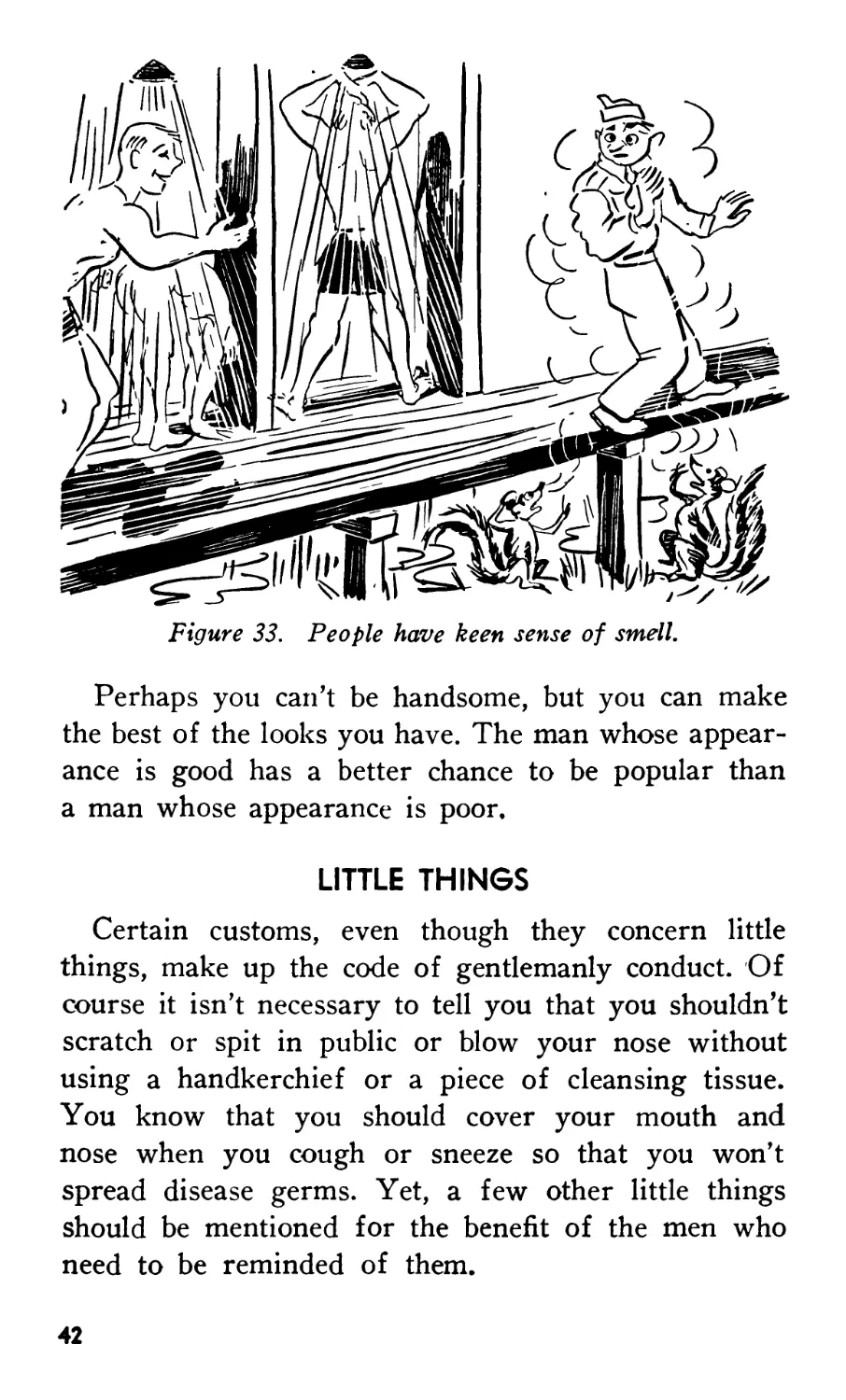
bagging at the knees; remember, too, that people have
a keen sense of smell.
41
Figure 33. People have keen sense of smell.
Perhaps you can’t be handsome, but you can make
the best of the looks you have. The man whose appear-
ance is good has a better chance to be popular than
a man whose appearance is poor.
LITTLE THINGS
Certain customs, even though they concern little
things, make up the code of gentlemanly conduct. Of
course it isn’t necessary to tell you that you shouldn’t
scratch or spit in public or blow your nose without
using a handkerchief or a piece of cleansing tissue.
You know that you should cover your mouth and
nose when you cough or sneeze so that you won’t
spread disease germs. Yet, a few other little things
should be mentioned for the benefit of the men who
need to be reminded of them.
42
Though nobody should be treated disrepectfully. a
gentleman’s attitude toward women and older men is
somewhat different from his attitude toward men his
own age or younger. Older people don’t expect the
kind of attention that makes them feel like Methuse-
lah’s grandparents, and girls don’t want you to put
on the Sir Walter Raleigh act and throw down your
coat every time there’s a mud puddle in their path.
Nevertheless, both appreciate the little attentions that
gentlemen are expected to observe.
You don’t call people who are old enough to be
your parents by their first names unless they request
you to do so.
You listen to older people’s opinions and if you
disagree, you do so politely.
You stand when women and older men enter a
room, remain standing until they are seated, and stand
again whenever they stand.
When you are indoors with women or older men,
you uncover your head. You are quick to perform
such little courtesies as opening windows, moving
chairs, and picking up articles.
You open doors and let women and older men
come in or out ahead of you.
You help a woman to be seated at a dining table
by pulling out her chair. You hold a woman’s coat
while she slips her arms into the sleeves. You help
a woman on and off cars and busses. You assist her
to cross the street safely.
You do a great many other little things—not because
women and older people are helpless but because by
established custom gentlemen are expected to do them.
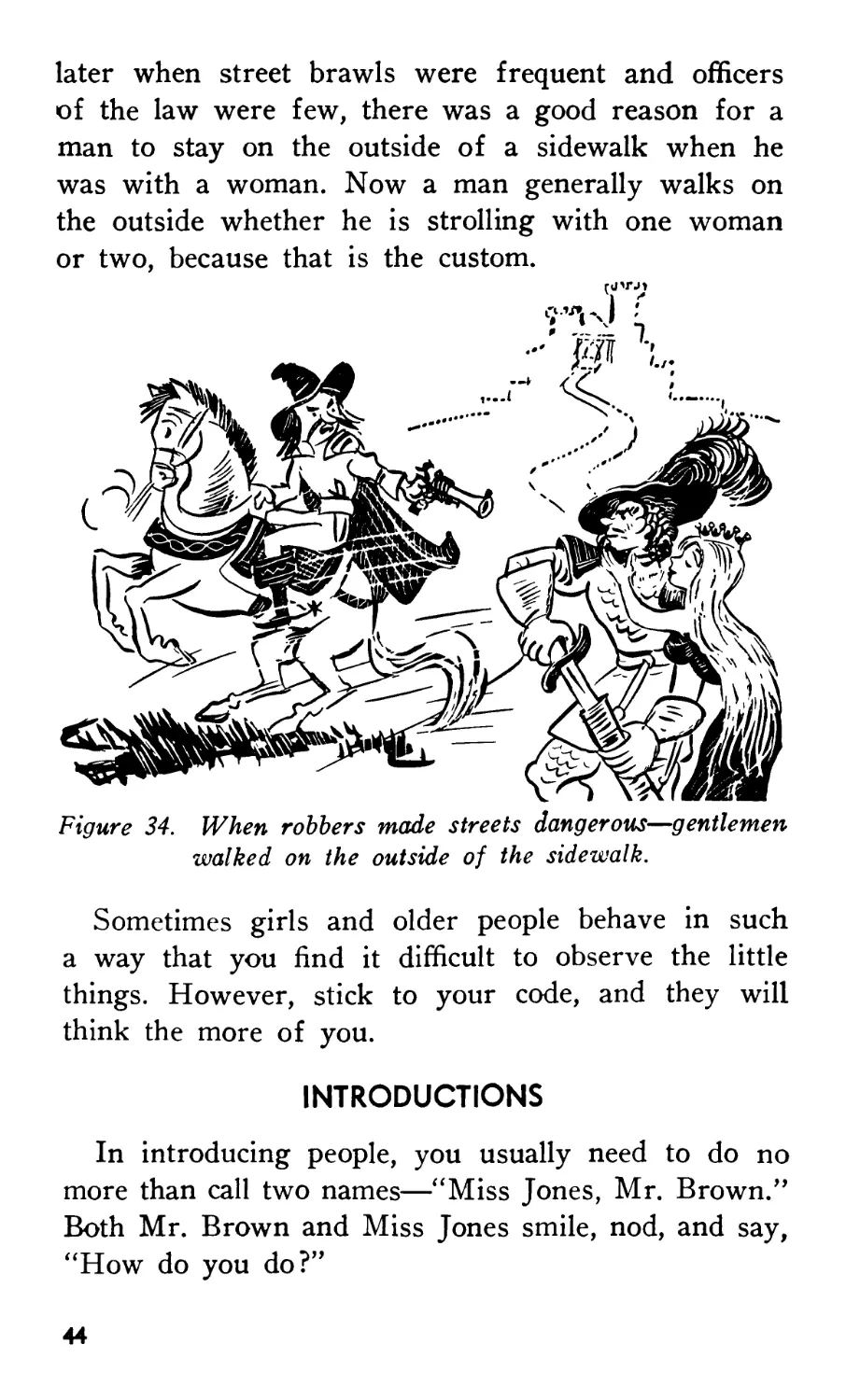
Long ago when robbers made highways dangerous and
819885—49---4
43
later when street brawls were frequent and officers
of the law were few, there was a good reason for a
man to stay on the outside of a sidewalk when he
was with a woman. Now a man generally walks on
the outside whether he is strolling with one woman
or two, because that is the custom.
Figure 34. When robbers made streets dangerous—gentlemen
walked on the outside of the sidewalk.
Sometimes girls and older people behave in such
a way that you find it difficult to observe the little
things. However, stick to your code, and they will
think the more of you.
INTRODUCTIONS
In introducing people, you usually need to do no
more than call two names—“Miss Jones, Mr. Brown/’
Both Mr. Brown and Miss Jones smile, nod, and say,
“How do you do?”
44
If you have reason to think that two people have
met before you can put your introduction in the form
of a question—“Miss Jones, you know Mr. Brown,
don’t you?” She replies either “Yes” or “No” and
adds, “How do you do?”
If you are introducing one old friend to another,
you can be less formal and say something like this,
“Jane, this is John Brown. John, this is Jane Jones.
Two such good friends of mine should know each
other.”
If you are introducing your wife, your father, your
mother, your brother, or your unmarried sister, you
do not call the last name but merely say for example,
“My wife, Mr. Brown.” If you are introducing your
married sister, you say, “My sister, Mrs. Smith,
Mr. Brown.” If the person to whom you are intro-
ducing your wife, your sister, and your brother is an
old friend whom you want to call by their first
names, it is proper to say, “My wife, Mary; my sister,
Lucy; my brother, Bill—John Brown.”
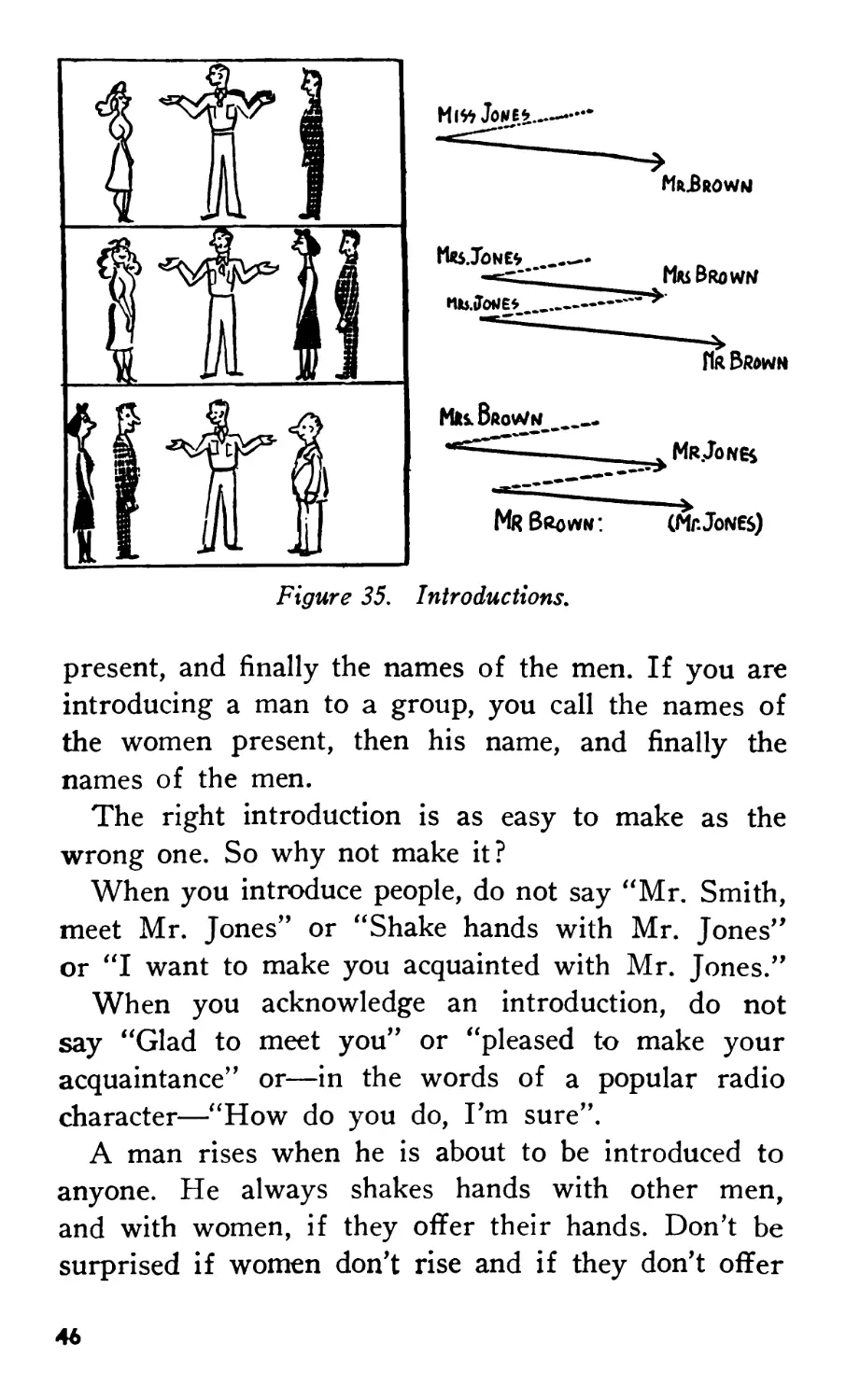
You always introduce a man to a woman—that is,
you call the woman’s name first. When introducing
a husband and wife to a woman (Mr. and Mrs. Brown,
for example, to Mrs. Jones) you say, “Mrs. Jones,
Mrs. Brown—Mrs. Jones, Mr. Brown.” You don’t
say “Mr and Mrs. Brown, Mrs. Jones.” When intro-
ducing them to a man you say, “Mrs. Brown, Mr.
Jones—Mr. Brown, Mr. Jones.”
In introducing two women or two men, you call
the names of the older first—if there is much differ-
ence in ages.
If you are introducing a woman to a group, you
call her name first, then the names of the women
45
Figure 35. Introductions.
MrBrown
MrsJone* _____
__________________Mrs Bro wn
»WoNE*____________
Hr Brmnn
Mk Brown_______-
-—-------------Mr Jones
Mr Brown?	(Mr.Jones)
present, and finally the names of the men. If you are
introducing a man to a group, you call the names of
the women present, then his name, and finally the
names of the men.
The right introduction is as easy to make as the
wrong one. So why not make it?
When you introduce people, do not say "Mr. Smith,
meet Mr. Jones” or “Shake hands with Mr. Jones”
or “I want to make you acquainted with Mr. Jones.”
When you acknowledge an introduction, do not
say “Glad to meet you” or “pleased to make your
acquaintance” or—in the words of a popular radio
character—“How do you do, Гт sure”.
A man rises when he is about to be introduced to
anyone. He always shakes hands with other men,
and with women, if they offer their hands. Don’t be
surprised if women don’t rise and if they don’t offer
46
their hands, because they may remain seated while
acknowledging introductions. If a woman extends her
hand, take it; but never extend yours first.
Now a word about handshaking! Give a warm,
hearty grip that clearly says you’re glad the intro-
duction is taking place. Avoid the “dishrag flip,”
which reminds you of a trained dog sitting on his
hind legs and offering his paw. Don’t turn your hand
into a dead fish and let it lie in the other person’s
hand clammy and cold. Don’t work an extended arm
up and down like a pump handle. Don’t mistake your
hand for a crushing machine and crack the bones in
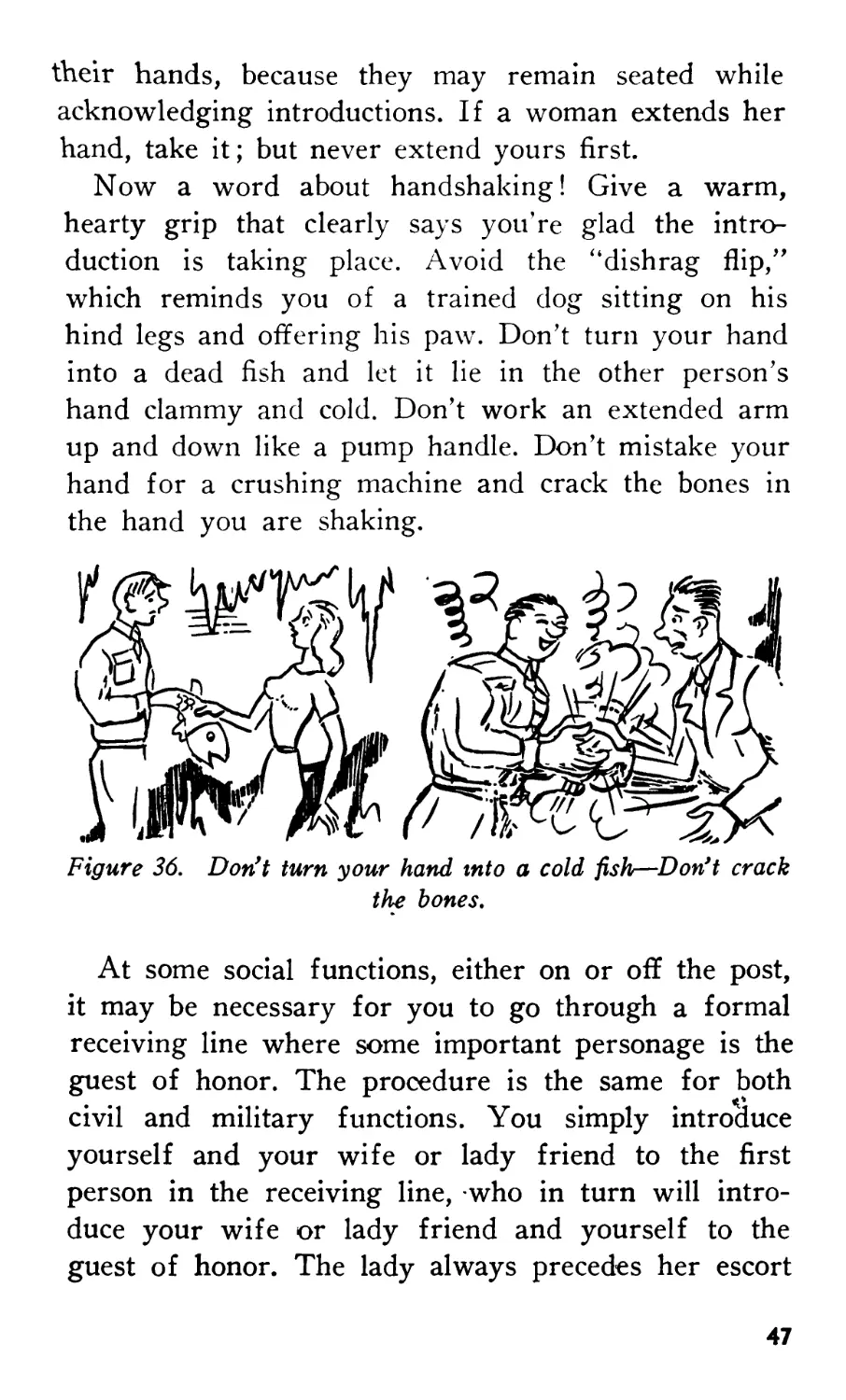
the hand you are shaking.
Figure 36. Don’t turn your hand into a cold fish—Don’t crack
the bones.
At some social functions, either on or off the post,
it may be necessary for you to go through a formal
receiving line where some important personage is the
guest of honor. The procedure is the same for both
civil and military functions. You simply introduce
yourself and your wife or lady friend to the first
person in the receiving line, who in turn will intro-
duce your wife or lady friend and yourself to the
guest of honor. The lady always precedes her escort
47
through the receiving line. Just watch those in the line
ahead of you and you will be in proper order.
CONVERSATION
One of the biggest differences between lower animals
and people is that lower animals don’t talk and people
do. The savage invented speech so that he could get
what he wanted and express his thoughts. Civilized
man improved speech because he came to want more
things and to have more thoughts to express. A person
can talk to himself; but it takes two people to converse,
which means—as you know—to talk together.
Though we are going to put up a few danger signals
for your guidance, the conversation field is not planted
with land mines, which will blow you up if you make
a mistake. Remember that you will be surrounded
by friends and not by snipers ready to take aim as
soon as you stick your head up. If you are thoughtful
of the people you meet, you can be natural and have
nothing to worry about. If you can’t think of any-
thing to say, don’t be afraid to be silent.
Good conversation helps you get along with people.
First of all, it is a give-and-take affair. In other words,
listening well is just as important as talking well.
The biggest bore is the person who talks too much,
not the one who talks too little. If you want to be
invited to some house the second time, don’t ride your
hobbyhorse straight through an evening’s conversation.
You can think of a hundred examples of the bore
who gives and never takes. There’s the would-be
scientist who gives free lectures on the atomic bomb
or jet propulsion or poison gas and never hears you
48
when you try to change the subject. There’s the
mechanic who gives lessons on the future of aviation
or the insides of automobiles or the operation of sub-
marines. If the hobbyhorse rider would look at the
faces around him, he’d know whether or not people
were still interested in what he was saying. When
in doubt, change the subject. If the group wants to
hear more about your hobby, there’ll be a question
that will get you going again.
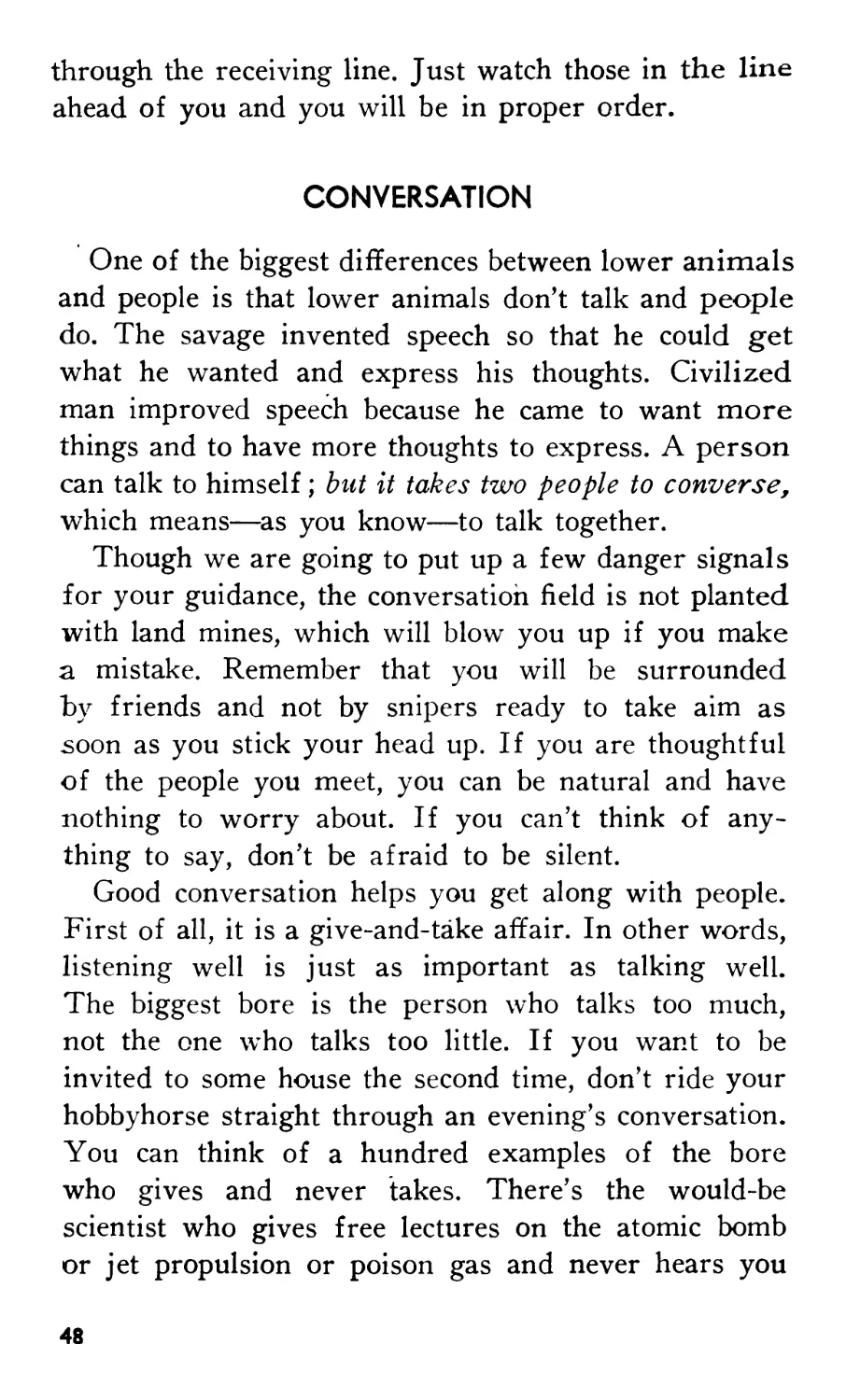
Figure 37. The biggest bore is the hobbyhorse rider.
The fellow who closes every subject that’s brought
up is about as bad as the fellow who never closes a
subject. Perhaps you’ve been thrown with one of these
door-slammers. You fish through your mind for some-
thing that will interest him and pull out a topic that
ought to be good for at least 5 minutes, but “bang’*
goes the door in your face. Have you ever seen a
49
girl struggle with a door-slammer? If so, you may
have heard something like this:
Place: A service club dance.
Characters: Polly Pretty and Dingle Dumbbell.
Polly (after a painful silence) : “Don’t you think the music
is simply divine?”
Dingle: “No, it’s lousy.”
(Silence.)
Polly: “I saw ‘Storm over Broadway’ last night. It was
marvelous.”
Dingle: “Lousiest picture I ever saw.”
(Silence.)
Polly: “Do you like to dance?”
Dingle: “It’s better than doing nothing, I suppose.”
(Polly sighs and gives up, hoping that Dingle will not ask
her to dance again.)
“Butting in” is as objectionable as door-slamming.
A good conversationalist hears the other fellow
through before he puts in his own 2 cents’ worth.
Even if what you have to say isn’t particularly impor-
tant, you should be allowed to finish saying it. As a
rule, the “butt-in” wants to talk about himself. He
can always go you one better before you have had
a chance to get going. If you mention a train wreck
you were in yesterday, he butts in to tell you about
the much worse one he was in last year. Wait for a
pause in the conversation before you begin to talk.
Funny people are good company. But don’t forget
that funny people «are born, not made. If you’re a
wit, be thankful for your gift. If you aren’t, don’t
think you can become one by imitating a wit. Nobody
knows exactly what made Will Rogers funny and
yet he could say “Good evening, ladies and gentlemen”
in such a way as to make an audience laugh uproar-
iously. To a group of college students he gave the
50
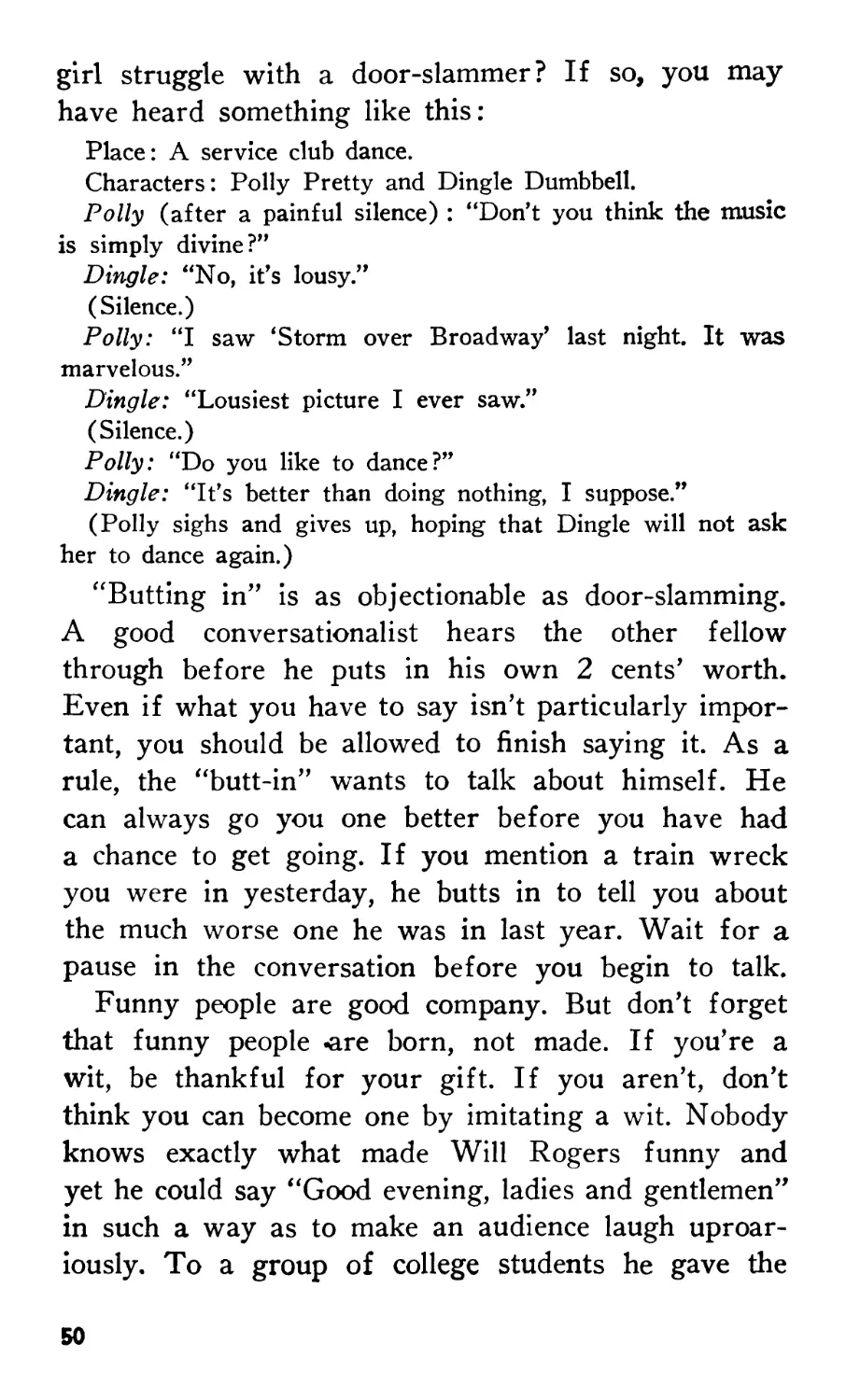
Figure 38. The “butt-in” wants to talk about himself.
following advice one day: “Education’s a fine thing.
Take all you can get. I haven’t no education. So I
earn a living making a fool of myself.”
When Will Rogers said funny things, however, he
didn’t make a fool of himself. But people who try to
be funny when they don’t know how only make
fools of themselves. There’s a big difference between
the natural wit and the clown. Puns and wisecracks
are all right if they’re given in small doses. The
clown doesn’t converse. He puts on an act, which
you can stand just so long and no longer.
“A little nonsense now and then
Is relished by the best of men”
But be sure to talk more sense than nonsense.
Will Rogers used his gift in the right way. He
never hurt anyone nor made an enemy. The expla-
nation is found in his own words—“I never met a
51,
man I didn’t like.” So we come rolling back to the
place where we started. If the funny man will do as
he would like to be done by, he not only can be the
life of the party but also can be so popular as always
to be invited again.
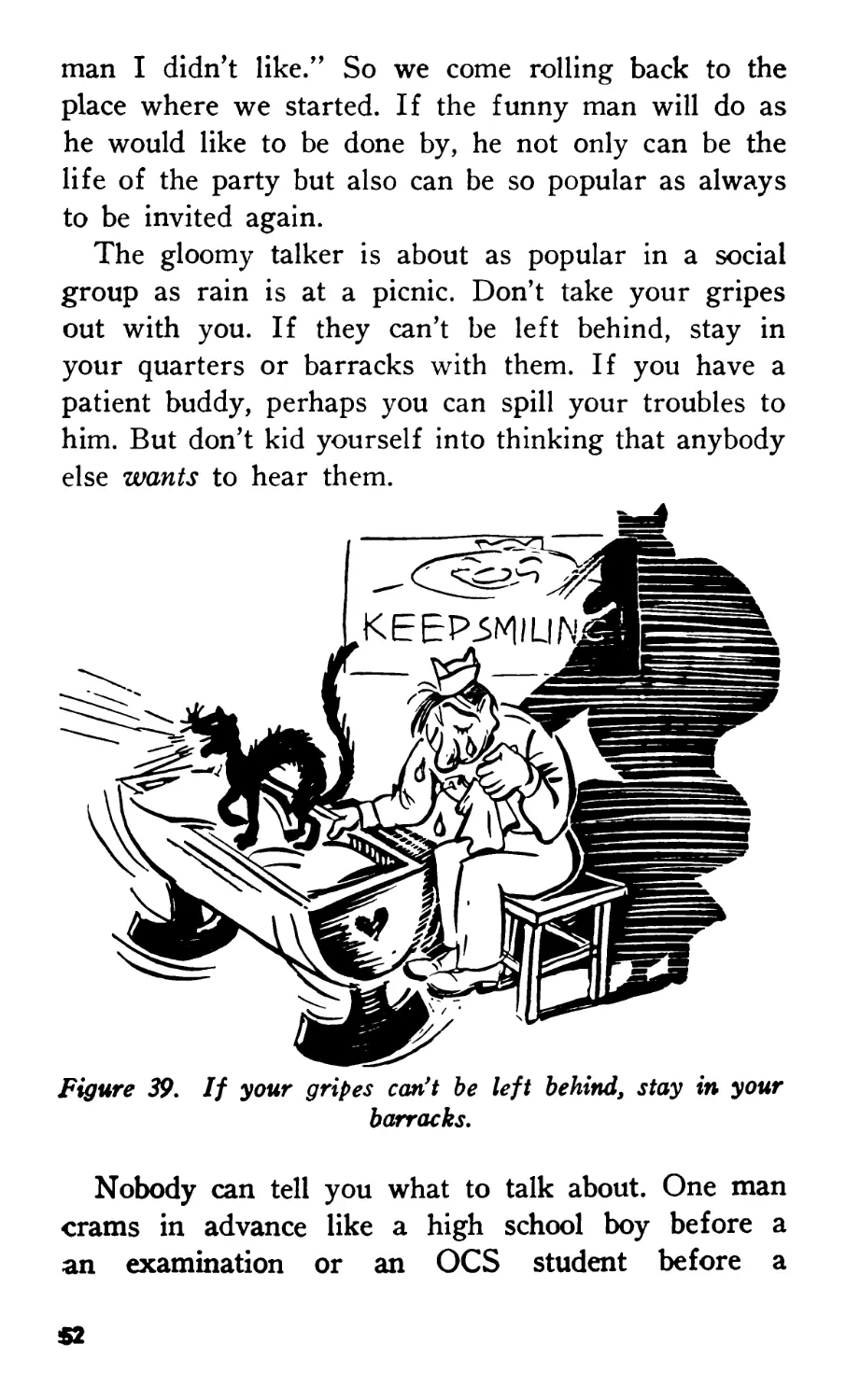
The gloomy talker is about as popular in a social
group as rain is at a picnic. Don’t take your gripes
out with you. If they can’t be left behind, stay in
your quarters or barracks with them. If you have a
patient buddy, perhaps you can spill your troubles to
him. But don’t kid yourself into thinking that anybody
else wants to hear them.
Figure 39. If your gripes cant be left behind, stay in your
barracks.
Nobody can tell you what to talk about. One man
crams in advance like a high school boy before a
an examination or an OCS student before a
52
test. When he knows that he will be talking to a group
of smart people, he brushes up on current events by
reading the morning paper carefully and glancing over
one of the magazines that features the news of the
week. Then, when conversation stops, he can refer to
what the United States did that week or how the
South Pacific islanders are behaving. That’s not a
bad idea, provided you don’t prepare yourself to
deliver a lecture. It’s not necessary, however. If you
take it easy and listen to the conservation, you’ll think
of enough interesting things to say.
THE WORDS YOU USE
Since there are so many good English words, why
use the bad ones? When you use profanity, most
people will find you objectionable.
You are judged by the way you talk as well as
by the way you look and the way you act. The Eng-
lish which most people know is usually better than
the English they speak. Some men are careless; and
others seem to believe that one way to be a good
fellow is to use bad grammar. The man who talks
liks this knows better:
“I ain’t got no clean blouse.”
“Me and him is on KP.”
“He oughta took you instead o’ he and I.”
“The pipe busted.”
“Gimme one o’ them potatoes.”
“I seen him when he done it.”
In Europe educated people learn a number of lan-
guages through necessity. In America we get along
well enough with just one language. Surely we can
learn to speak it correctly.
53
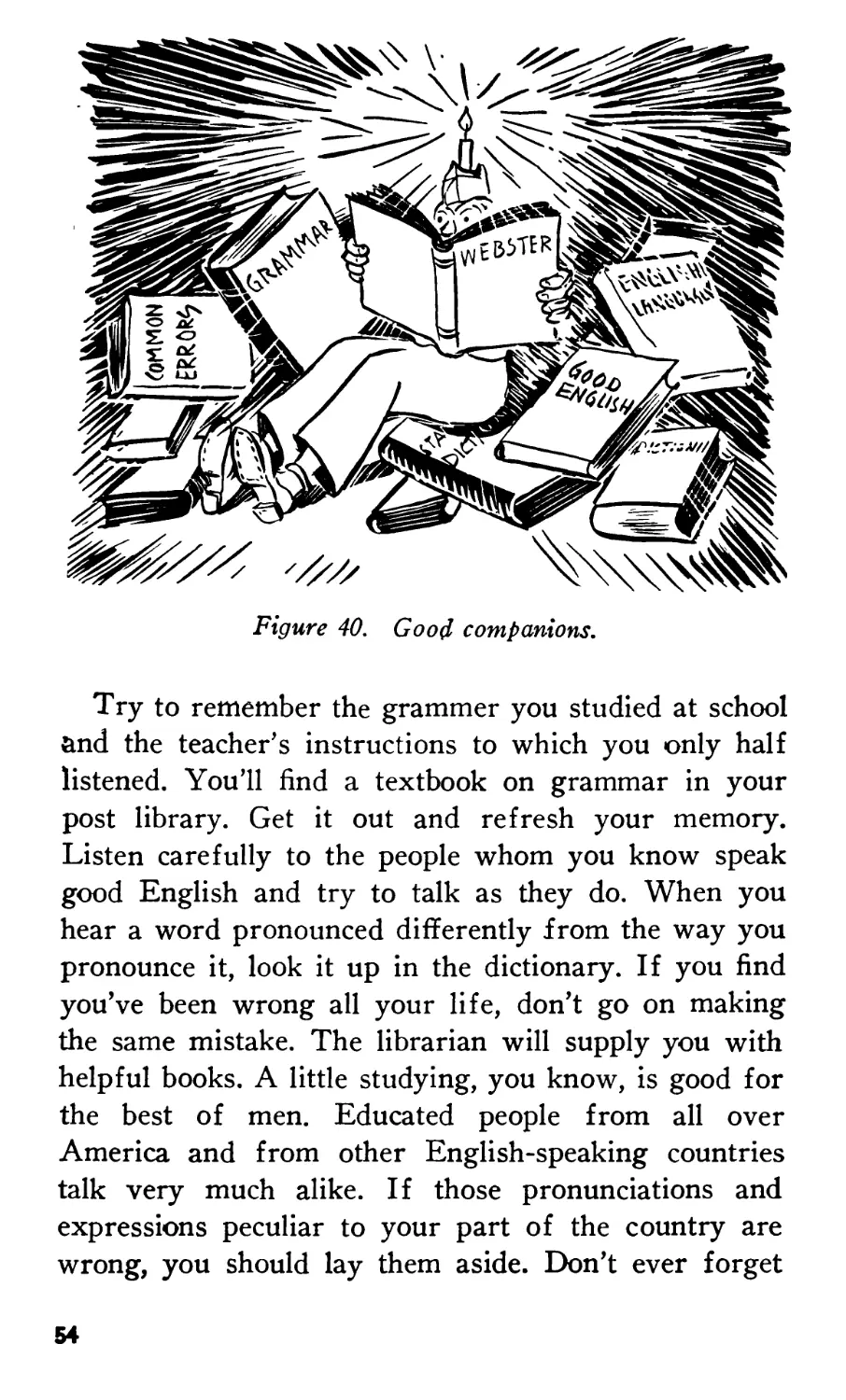
Figure 40. Good companions.
Try to remember the grammer you studied at school
and the teacher’s instructions to which you only half
listened. You’ll find a textbook on grammar in your
post library. Get it out and refresh your memory.
Listen carefully to the people whom you know speak
good English and try to talk as they do. When you
hear a word pronounced differently from the way you
pronounce it, look it up in the dictionary. If you find
you’ve been wrong all your life, don’t go on making
the same mistake. The librarian will supply you with
helpful books. A little studying, you know, is good for
the best of men. Educated people from all over
America and from other English-speaking countries
talk very much alike. If those pronunciations and
expressions peculiar to your part of the country are
wrong, you should lay them aside. Don’t ever forget
54
that good English helps you succeed in social groups
as well as in your work. Remember, too, that the best
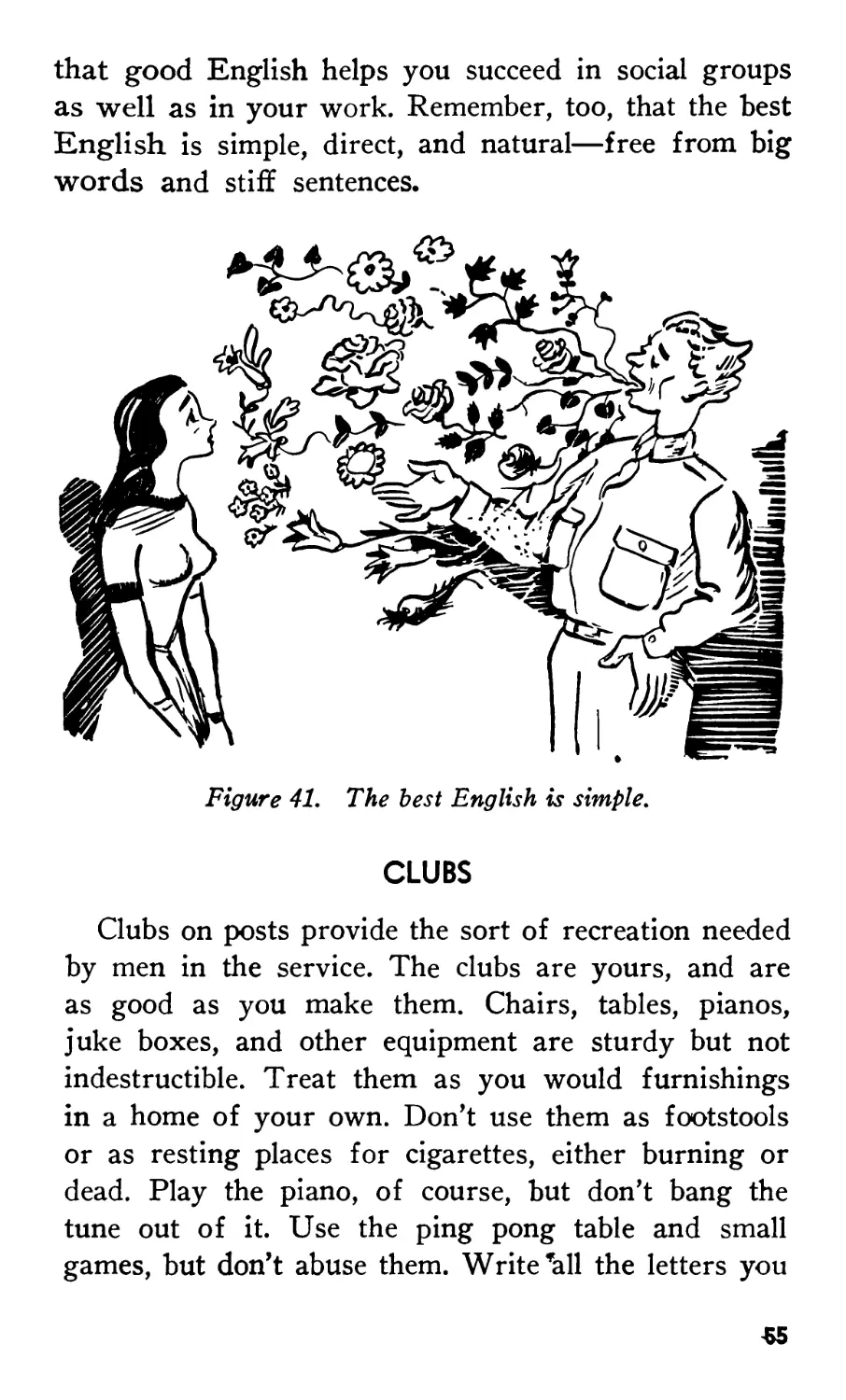
English is simple, direct, and natural—free from big
words and stiff sentences.
Figure 41. The best English is simple.
CLUBS
Clubs on posts provide the sort of recreation needed
by men in the service. The clubs are yours, and are
as good as you make them. Chairs, tables, pianos,
juke boxes, and other equipment are sturdy but not
indestructible. Treat them as you would furnishings
in a home of your own. Don’t use them as footstools
or as resting places for cigarettes, either burning or
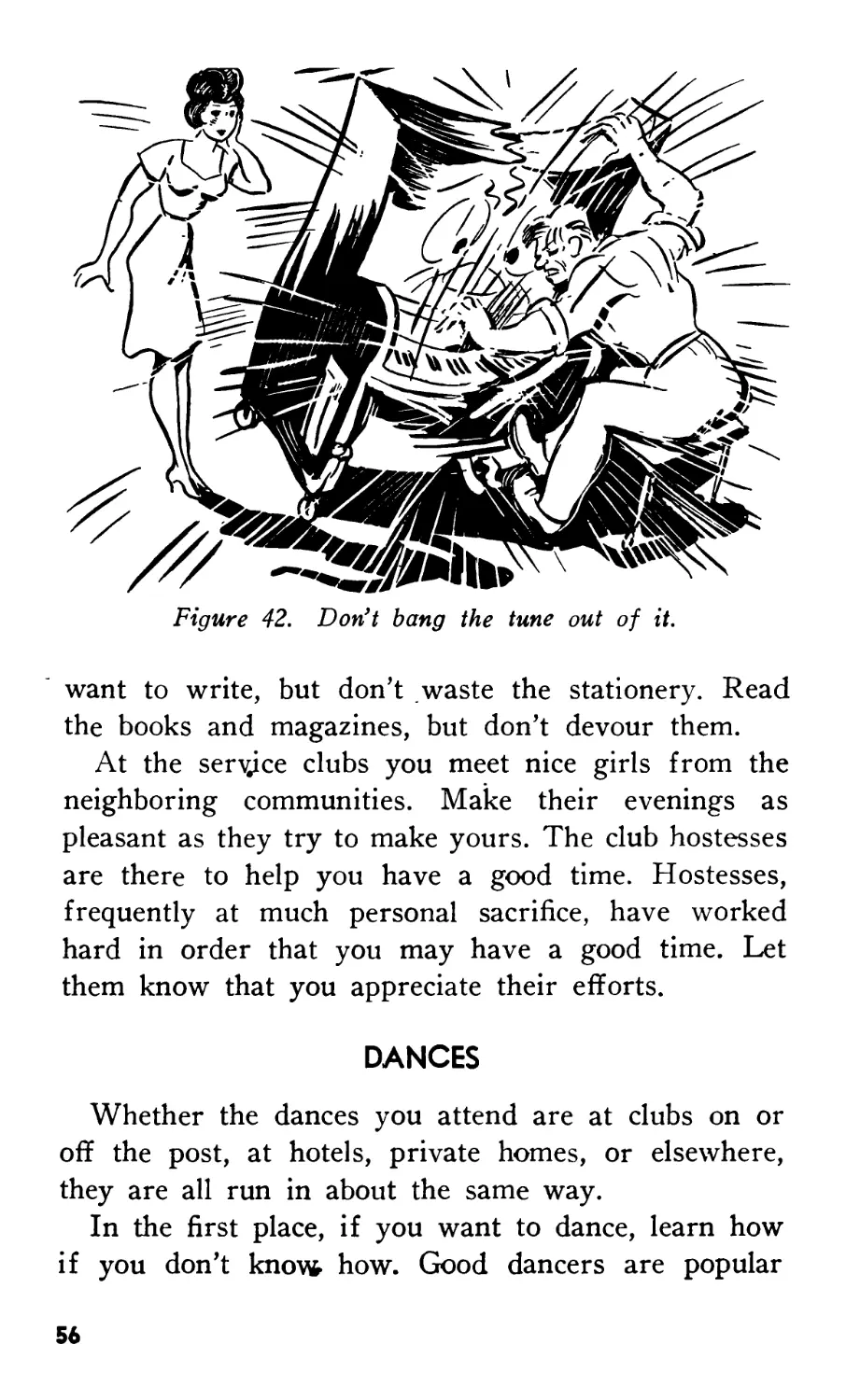
dead. Play the piano, of course, but don’t bang the
tune out of it. Use the ping pong table and small
games, but don’t abuse them. Write ’’all the letters you
-Б5
Figure 42. Don’t bang the tune out of it.
want to write, but don’t .waste the stationery. Read
the books and magazines, but don’t devour them.
At the service clubs you meet nice girls from the
neighboring communities. Make their evenings as
pleasant as they try to make yours. The club hostesses
are there to help you have a good time. Hostesses,
frequently at much personal sacrifice, have worked
hard in order that you may have a good time. Let
them know that you appreciate their efforts.
DANCES
Whether the dances you attend are at clubs on or
off the post, at hotels, private homes, or elsewhere,
they are all run in about the same way.
In the first place, if you want to dance, learn how
if you don’t knov^ how. Good dancers are popular
56
with the girls. Remember to dress appropriately for
dances.
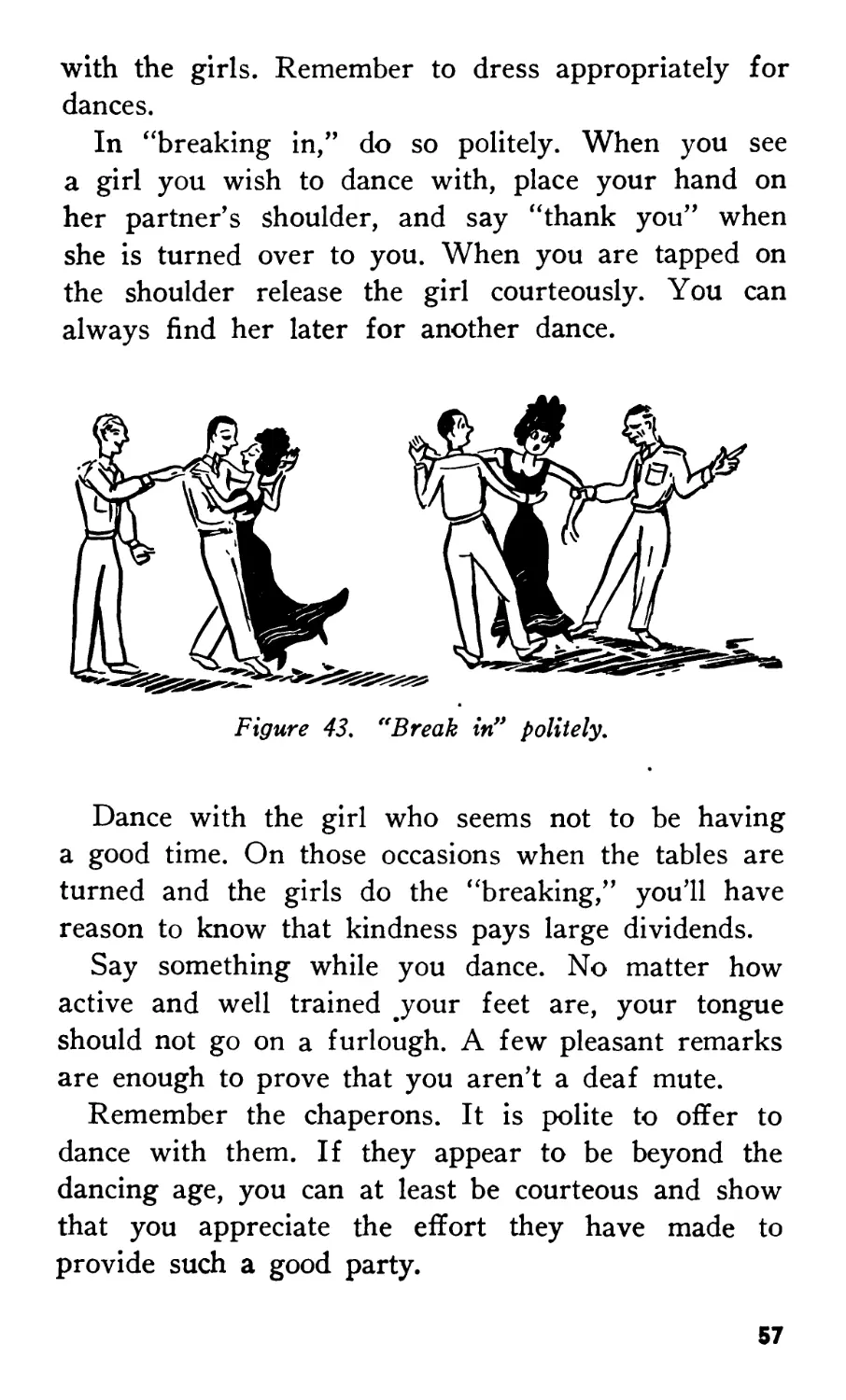
In “breaking in,” do so politely. When you see
a girl you wish to dance with, place your hand on
her partner’s shoulder, and say “thank you” when
she is turned over to you. When you are tapped on
the shoulder release the girl courteously. You can
always find her later for another dance.
Figure 43. “Break in” politely.
Dance with the girl who seems not to be having
a good time. On those occasions when the tables are
turned and the girls do the “breaking,” you’ll have
reason to know that kindness pays large dividends.
Say something while you dance. No matter how
active and well trained .your feet are, your tongue
should not go on a furlough. A few pleasant remarks
are enough to prove that you aren’t a deaf mute.
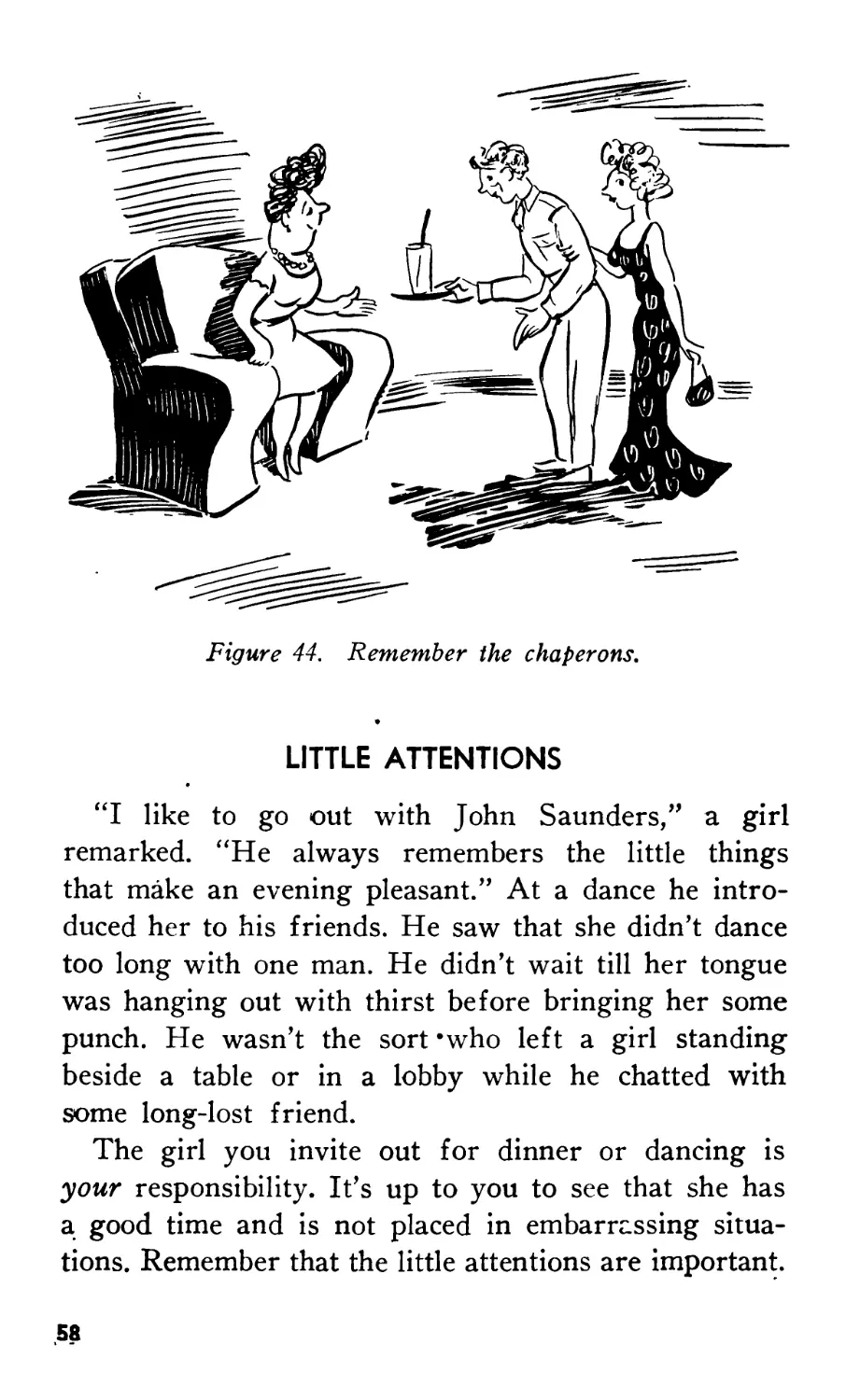
Remember the chaperons. It is polite to offer to
dance with them. If they appear to be beyond the
dancing age, you can at least be courteous and show
that you appreciate the effort they have made to
provide such a good party.
57
Figure 44. Remember the chaperons.
LITTLE ATTENTIONS
“I like to go out with John Saunders,” a girl
remarked. “He always remembers the little things
that make an evening pleasant.” At a dance he intro-
duced her to his friends. He saw that she didn’t dance
too long with one man. He didn’t wait till her tongue
was hanging out with thirst before bringing her some
punch. He wasn’t the sort ’who left a girl standing
beside a table or in a lobby while he chatted with
some long-lost friend.
The girl you invite out for dinner or dancing is
your responsibility. It’s up to you to see that she has
a good time and is not placed in embarrassing situa-
tions. Remember that the little attentions are important.
58
IN PRIVATE HOMES
There’s nothing more pleasant than visits to private
homes. On Thanksgiving, Christmas, New Year’s, and
other holidays, blind invitations frequently come.
Mrs. Jones wants to entertain four soldiers, and you
। draw a lucky number. At church and at social gather-
ings you meet people who invite you to dinner or for
week ends. The mother of the girl you’ve dated a
number of times says that you might as well occupy
(the guest room Saturday night instead of traveling
back to camp. A friend writes a friend that you are
close by, and you get a note asking you to drop in
to meet a group of people.
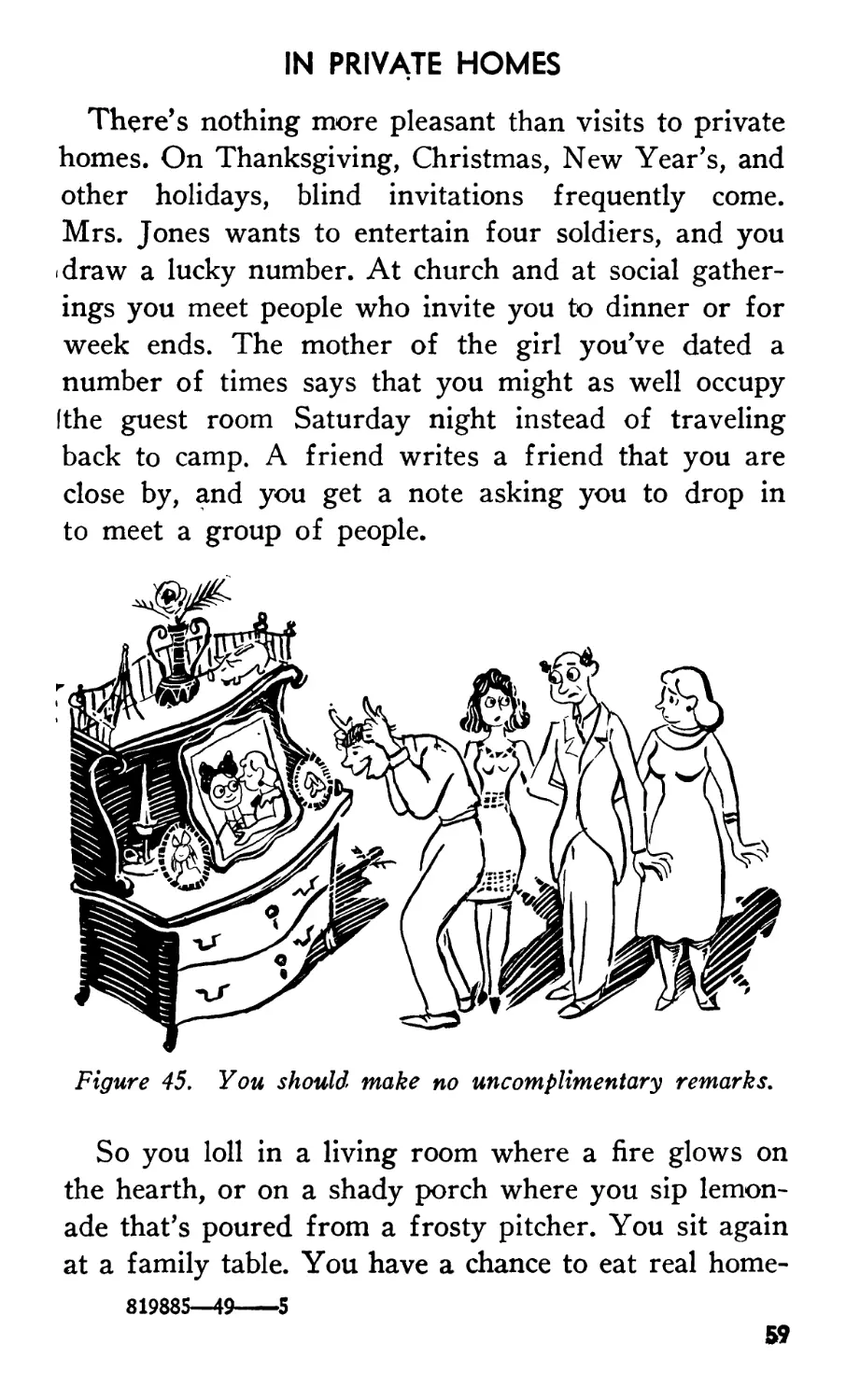
Figure 45. You should make no uncomplimentary remarks.
So you loll in a living room where a fire glows on
the hearth, or on a shady porch where you sip lemon-
ade that’s poured from a frosty pitcher. You sit again
at a family table. You have a chance to eat real home-
819885—49---------5
59
cooked food again. At midnight you may join the
family raid on the ice box. You have a good time;
you’d like to come again. If your behavior is good,
you may be invited again.
It is important that you accept plans that are made
for you. As a guest, you do what others do. You
criticize nothing. You make no uncomplimentary
remarks about the home. You should offer to help
with the chores or the dishes. You ask permission to
smoke if you have not been invited to do so. Before
you turn on the radio, you find out what kind of
program other people like.
Civilians who invite military men to their homes
do not expect their hospitality to be returned. They
do expect common courtesy, however. Express your
appreciation to the girl’s family, as well as to the
girl. When you are transferred, drop a little note to
the people who have entertained you, saying that they
have made your tour of duty pleasant.
Occasionally you may attend a wedding or at least
be introduced to some newlyweds. You will want to
say some nice things. However, it is not necessary
to make a speech. It is good taste to congratulate the
bridegroom, but do not congratulate the bride. You
simply extend her your very best wishes.
60
CHAPTER 5
BEHAVIOR IN PUBLIC PLACES
ON THE STREET
Off the post you are a representative of the United
States Army. The uniform you wear sets you apart.
If you are slovenly in appearance, if you are rowdy
and bad-mannered, the Army gets the blame. “That’s
a soldier for you,” the stranger remarks. “The less
we see of the Army, the better off we’ll be.” When
soldiers are not in combat, the public looks at things
more critically.
When you go walking on Main Street, take your
manners with you. Even though soldiers are welcome
guests in a patriotic American town, citizens don’t
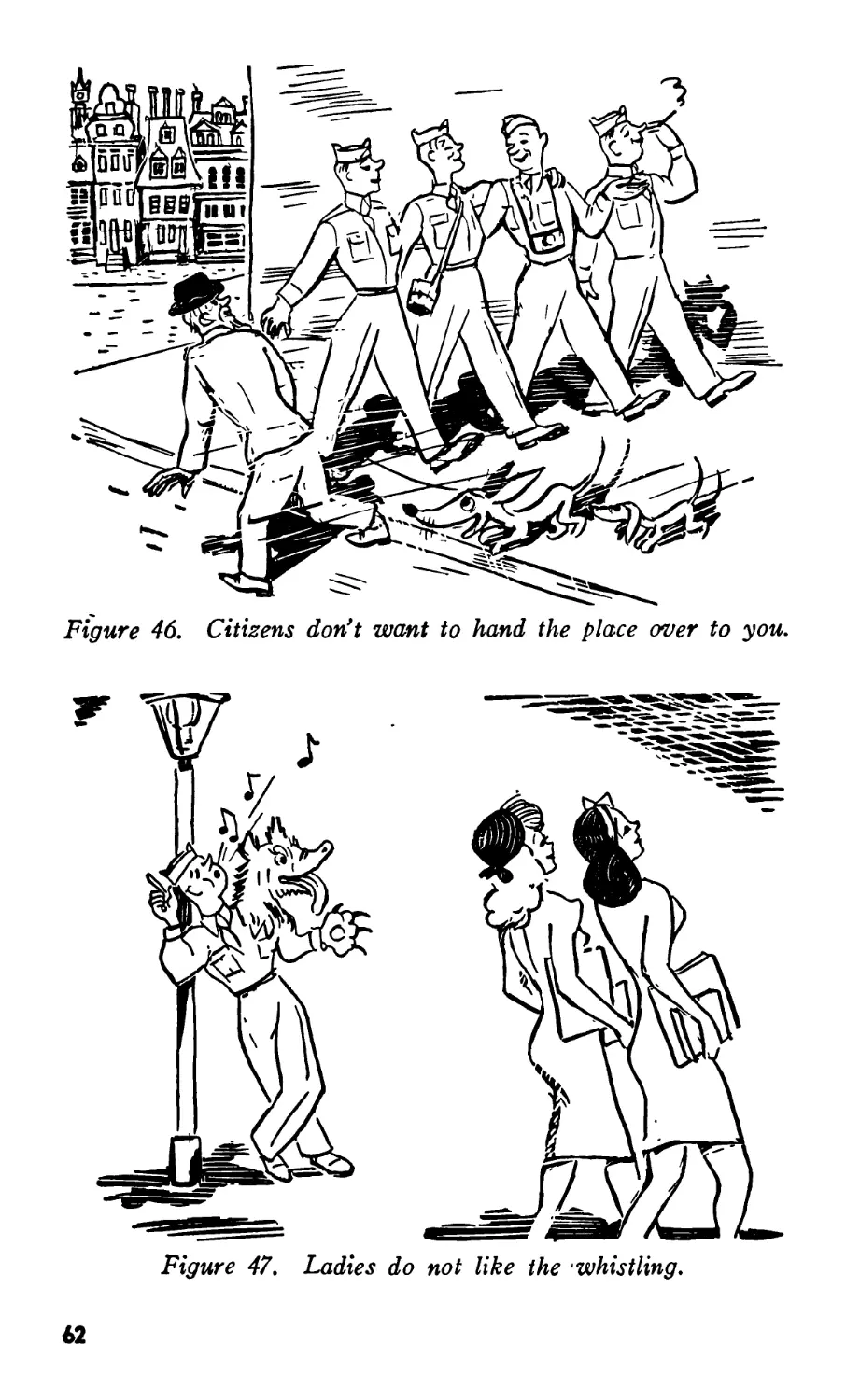
want to hand the place over to you.
If soldiers stroll four abreast and force other people
off the sidewalk, Mr. and Mrs. John Q. Public will
have a poor opinion of soldiers at your post.
Gentlemen never appear on the streets or in public
places when they have had too much to drink. If you
ever have the bad judgment to take too much to
drink you should go home at once. All soldiers should
feel a deep responsibility toward their fellow soldiers
in this respect and should protect them from possible
injury by seeing that they return to their post if
drunk. Public opinion, respect for the uniform, and
your own personal safety demand that you stay sober.
Therefore, conduct yourself in such a way as to pre-
vent trouble for yourself and your post. Do not drink
to excess at any time.
61
Figure 46. Citizens don’t want to hand the place over to you.
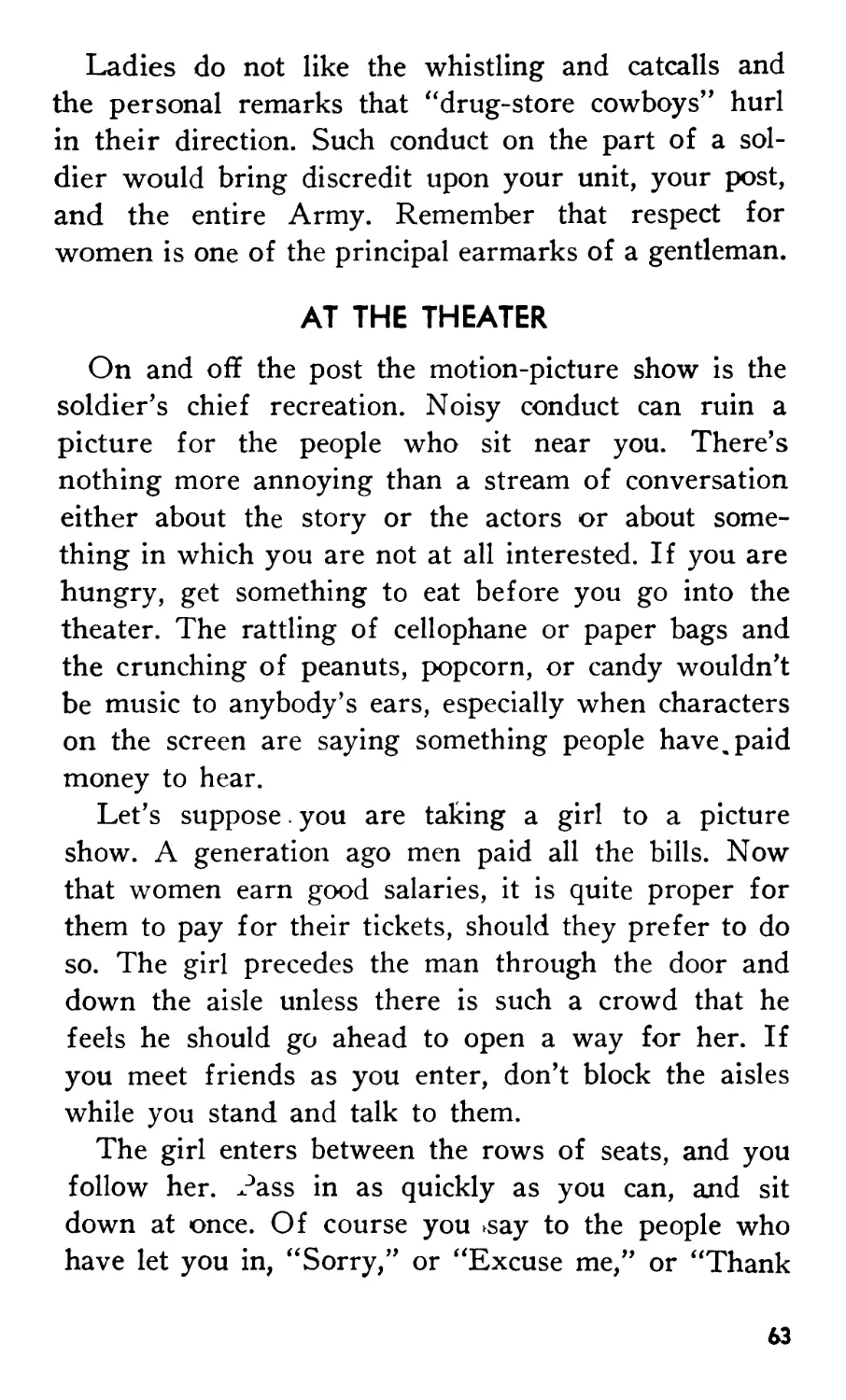
Figure 47. Ladies do not like the whistling.
62
Ladies do not like the whistling and catcalls and
the personal remarks that “drug-store cowboys” hurl
in their direction. Such conduct on the part of a sol-
dier would bring discredit upon your unit, your post,
and the entire Army. Remember that respect for
women is one of the principal earmarks of a gentleman.
AT THE THEATER
On and off the post the motion-picture show is the
soldier’s chief recreation. Noisy conduct can ruin a
picture for the people who sit near you. There’s
nothing more annoying than a stream of conversation
either about the story or the actors or about some-
thing in which you are not at all interested. If you are
hungry, get something to eat before you go into the
theater. The rattling of cellophane or paper bags and
the crunching of peanuts, popcorn, or candy wouldn’t
be music to anybody’s ears, especially when characters
on the screen are saying something people have,paid
money to hear.
Let’s suppose. you are taking a girl to a picture
show. A generation ago men paid all the bills. Now
that women earn good salaries, it is quite proper for
them to pay for their tickets, should they prefer to do
so. The girl precedes the man through the door and
down the aisle unless there is such a crowd that he
feels he should go ahead to open a way for her. If
you meet friends as you enter, don’t block the aisles
while you stand and talk to them.
The girl enters between the rows of seats, and you
follow her. 2ass in as quickly as you can, and sit
down at once. Of course you >say to the people who
have let you in, “Sorry,” or “Excuse me,” or “Thank
63
Figure 48. Don't block the aisles.
you,” and you smile when you say it. Watch what-
ever you’re carrying and don’t drag it over people’s
heads or laps. When someone wants to pass you during
the show, give him room to do so either by rising or
by turning your legs to the side.
Since you have entered last, you leave first; but
when you reach the aisle, you step back and let the
girl go first unless you need to make a path for her
through the crowd.
ON PUBLIC CARRIERS
Foreigners are always amazed by the amount of
traveling Americans do. If our pocketbooks permit,
we take trips frequently. Therefore, on trains and
busses you meet all the types of people who make
up our population. To them you are the Army. By
A4
looking and acting the part of a soldier and gentle-
man, make Mr. and Mrs. John Q. Public proud of
the Army and you.
Our grandmothers wouldn’t have talked to strange
men, but their granddaughters are sometimes willing
to talk to presentable men they meet on trains and
busses. Under no consideration should you force
attention upon a lady who appears reluctant to receive
it, and above all, never try to lead the conversation
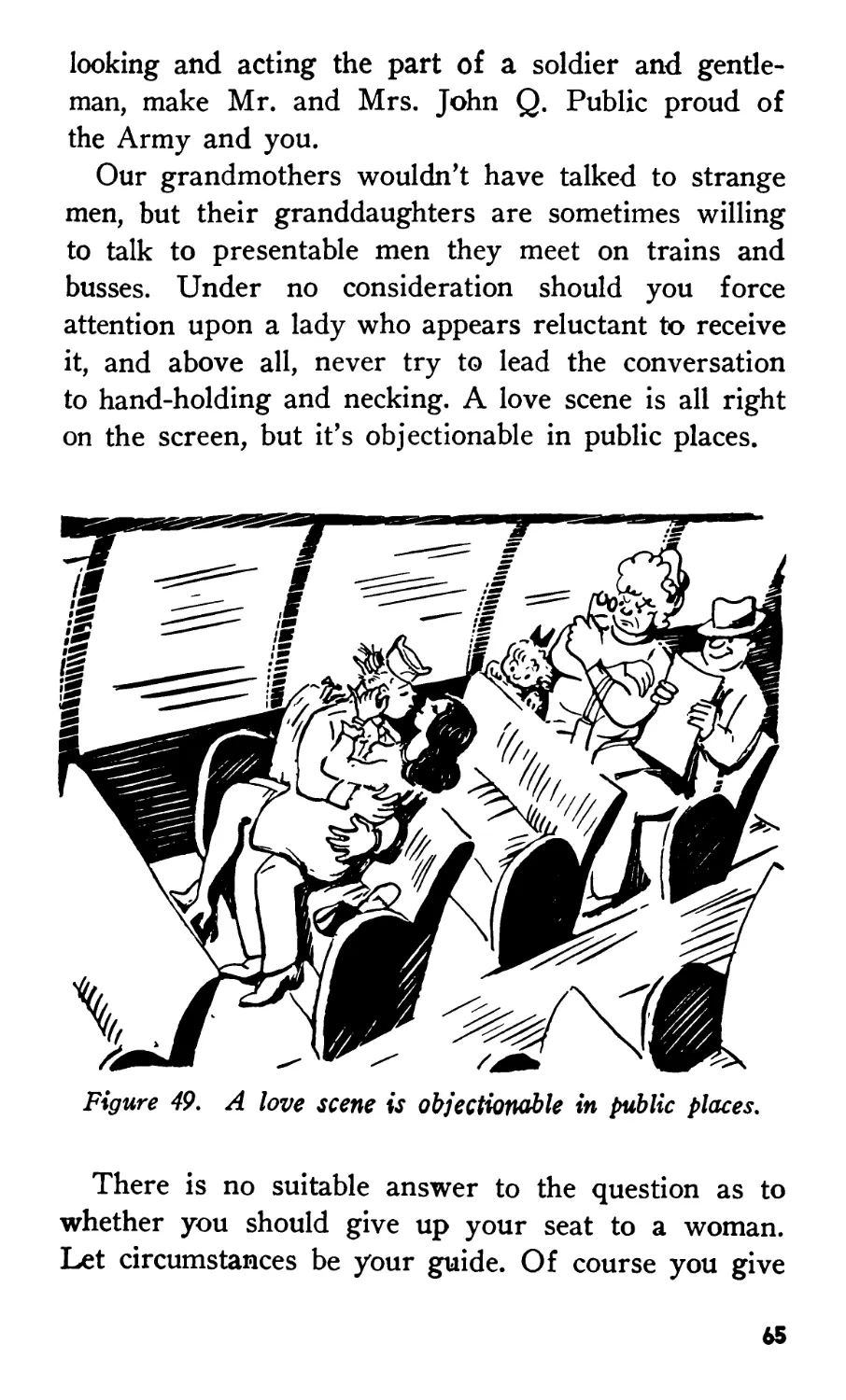
to hand-holding and necking. A love scene is all right
on the screen, but it’s objectionable in public places.
Figure 49. A love scene is objectionable in public places.
There is no suitable answer to the question as to
whether you should give up your seat to a woman.
Let circumstances be your guide. Of course you give
65
up your seat to people who are old or lame or ill,
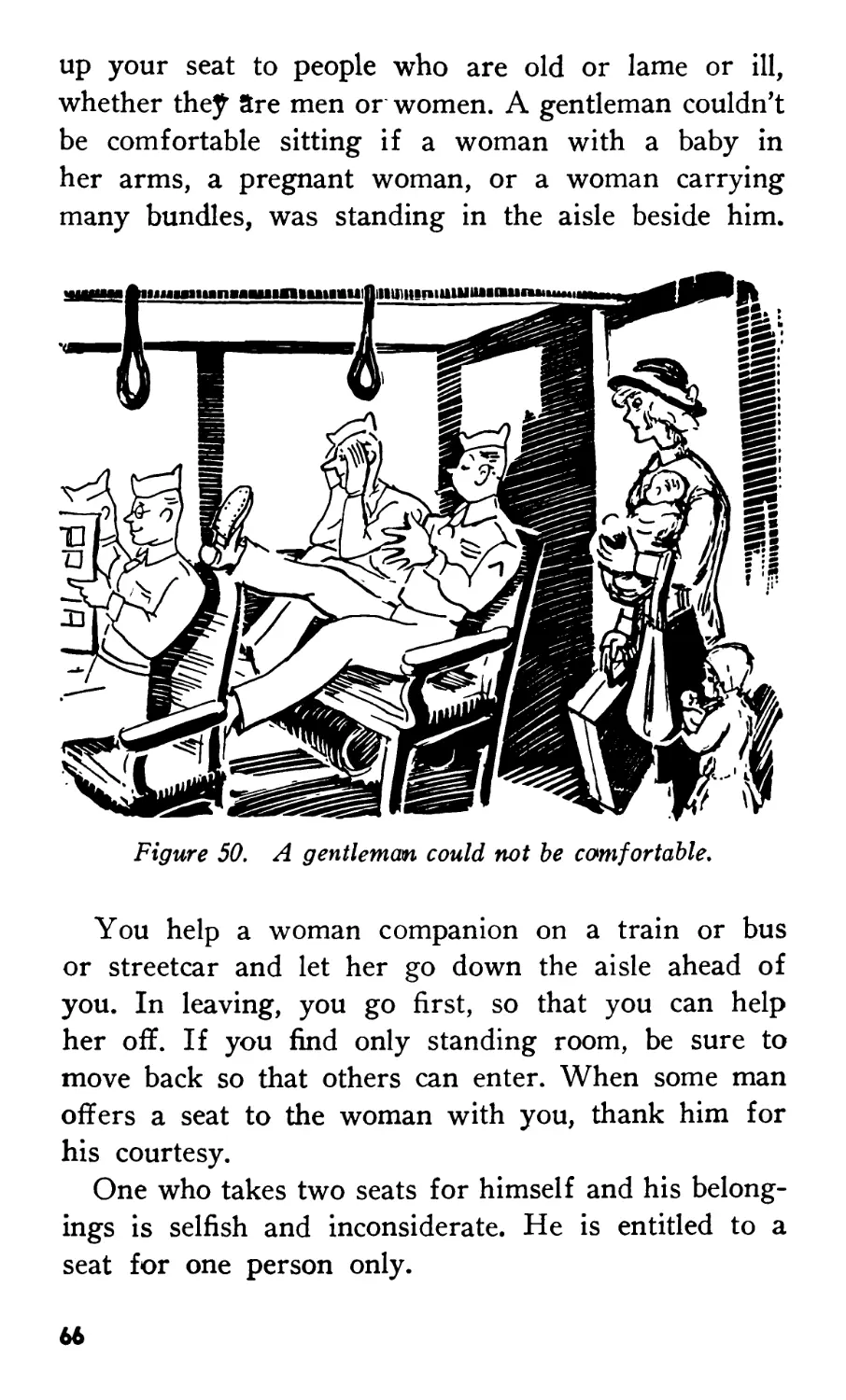
whether they Йге men or women. A gentleman couldn’t
be comfortable sitting if a woman with a baby in
her arms, a pregnant woman, or a woman carrying
many bundles, was standing in the aisle beside him.
Figure 50. A gentleman could not be comfortable.
You help a woman companion on a train or bus
or streetcar and let her go down the aisle ahead of
you. In leaving, you go first, so that you can help
her off. If you find only standing room, be sure to
move back so that others can enter. When some man
offers a seat to the woman with you, thank him for
his courtesy.
One who takes two seats for himself and his belong-
ings is selfish and inconsiderate. He is entitled to a
seat for one person only.
66
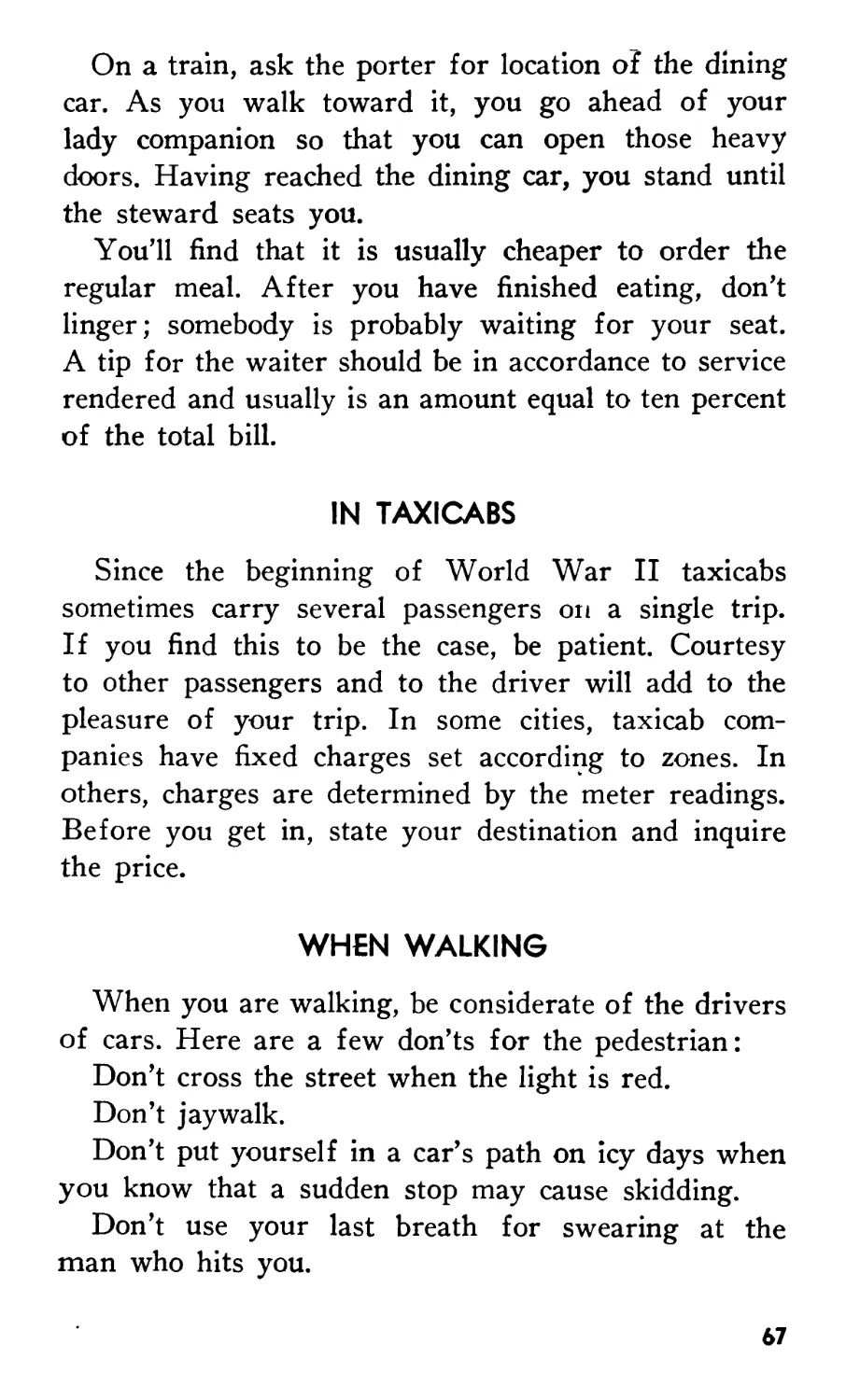
On a train, ask the porter for location of the dining
car. As you walk toward it, you go ahead of your
lady companion so that you can open those heavy
doors. Having reached the dining car, you stand until
the steward seats you.
You’ll find that it is usually cheaper to order the
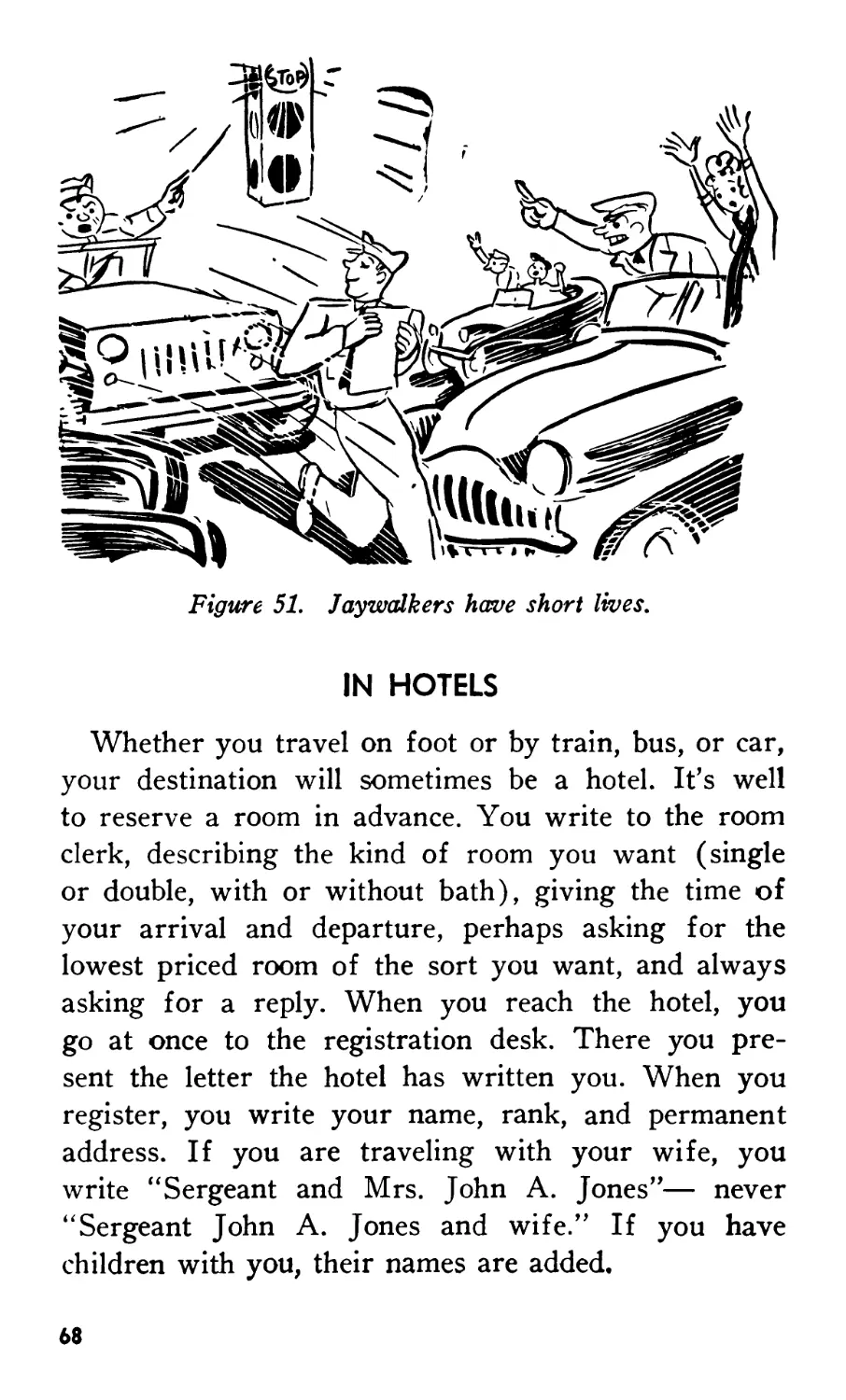
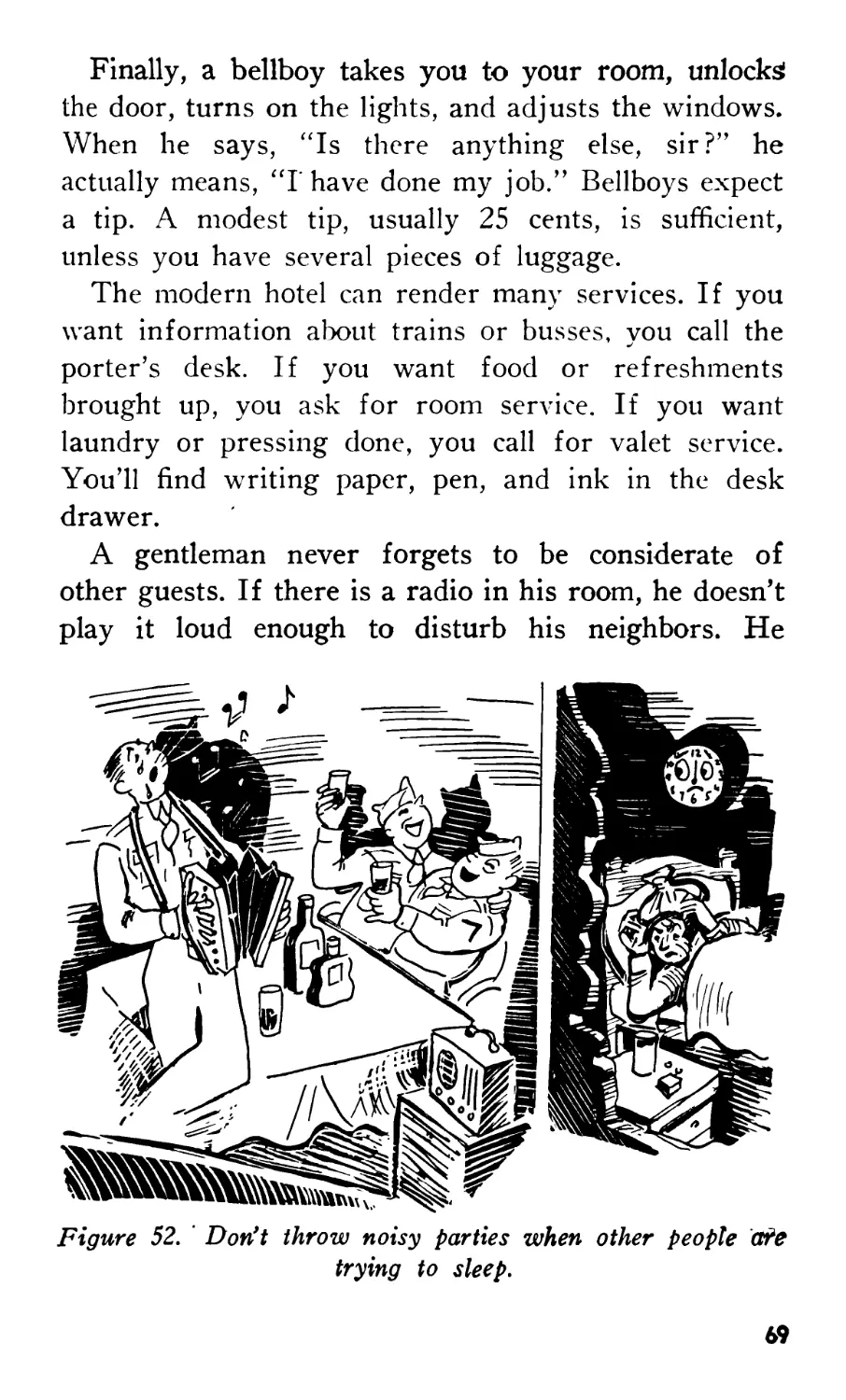
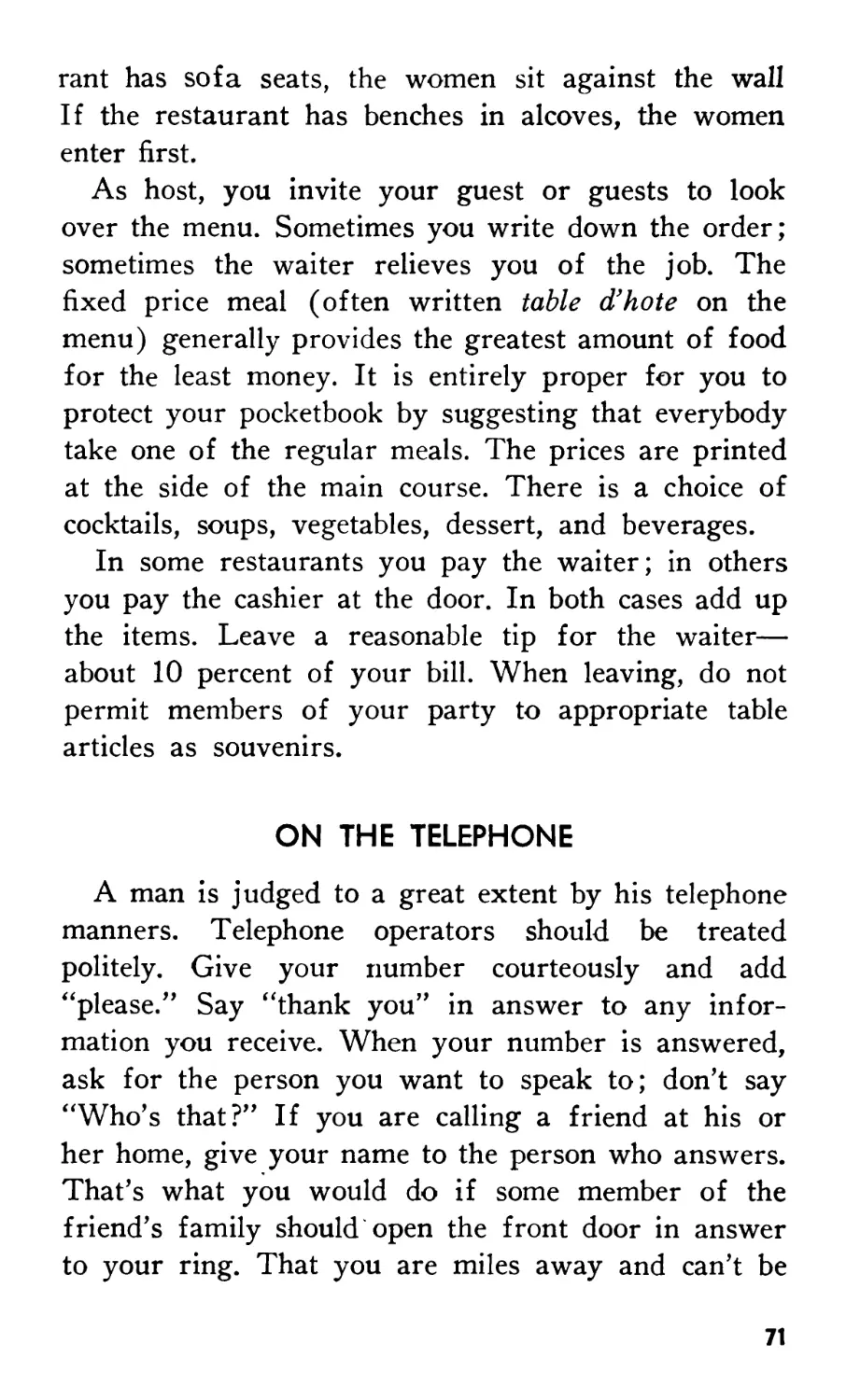
regular meal. After you have finished eating, don’t
linger; somebody is probably waiting for your seat.
A tip for the waiter should be in accordance to service
rendered and usually is an amount equal to ten percent
of the total bill.
IN TAXICABS
Since the beginning of World War II taxicabs
sometimes carry several passengers on a single trip.
If you find this to be the case, be patient. Courtesy
to other passengers and to the driver will add to the
pleasure of your trip. In some cities, taxicab com-
panies have fixed charges set according to zones. In
others, charges are determined by the meter readings.
Before you get in, state your destination and inquire
the price.
WHEN WALKING
When you are walking, be considerate of the drivers
of cars. Here are a few don’ts for the pedestrian:
Don’t cross the street when the light is red.
Don’t jaywalk.
Don’t put yourself in a car’s path on icy days when
you know that a sudden stop may cause skidding.
Don’t use your last breath for swearing at the
man who hits you.
67
Figure 51. Jaywalkers have short lives.
IN HOTELS
Whether you travel on foot or by train, bus, or car,
your destination will sometimes be a hotel. It’s well
to reserve a room in advance. You write to the room
clerk, describing the kind of room you want (single
or double, with or without bath), giving the time of
your arrival and departure, perhaps asking for the
lowest priced room of the sort you want, and always
asking for a reply. When you reach the hotel, you
go at once to the registration desk. There you pre-
sent the letter the hotel has written you. When you
register, you write your name, rank, and permanent
address. If you are traveling with your wife, you
write “Sergeant and Mrs. John A. Jones”— never
“Sergeant John A. Jones and wife.” If you have
children with you, their names are added.
68
Finally, a bellboy takes you to your room, unlocks!
the door, turns on the lights, and adjusts the windows.
When he says, “Is there anything else, sir?” he
actually means, “Г have done my job.” Bellboys expect
a tip. A modest tip, usually 25 cents, is sufficient,
unless you have several pieces of luggage.
The modern hotel can render many services. If you
want information about trains or busses, you call the
porter’s desk. If you want food or refreshments
brought up, you ask for room service. If you want
laundry or pressing done, you call for valet service.
You’ll find writing paper, pen, and ink in the desk
drawer.
A gentleman never forgets to be considerate of
other guests. If there is a radio in his room, he doesn’t
play it loud enough to disturb his neighbors. He
Figure 52. Don't throw noisy parties when other people a?e
trying to sleep.
69
doesn’t have noisy parties when other people are
trying to sleep. He is not rowdy in the lobby, parlor,
dining room, or bar. He removes his cap when he is
in the parlor, dining room, or bar. He tips, but not
extravagantly. Above all, a military man’s appearance
should always be of the sort to reflect credit upon him-
self and the service.
IN RESTAURANTS
No matter where you’re stationed, you’ll be taking
meals at restaurants in many places. Eating out is an
American custom.
Wherever you are having a meal, don’t forget your
table manners. Yet there is a difference between climb-
ing on a stool in front of a bare counter and being
seated at a table covered with a white linen cloth,
silver, and crystal. In every restaurant, it is customary
for a soldier to remove his cap and/or overcoat, un-
less he is a guard escort under arms.
When you have entered a restaurant, stand near
the door until the head waiter or waitress escorts you
to a table. If there is a check room, a man usually
leaves his hat and coat. A woman, however, usually
wears her coat to the table and then drops it over the
back of her chair. The woman with you follows the
waiter toward the table, and you follow her. The
waiter seats your companion, and you seat yourself.
If two men accompany one woman, the woman sits
between them; and if two women are accompanied
by one man, the man sits between them. When two
couples are seated at a square table, the men face
each other, and the women do likewise. If the restau-
70
rant has sofa seats, the women sit against the wall
If the restaurant has benches in alcoves, the women
enter first.
As host, you invite your guest or guests to look
over the menu. Sometimes you write down the order;
sometimes the waiter relieves you of the job. The
fixed price meal (often written table d'hote on the
menu) generally provides the greatest amount of food
for the least money. It is entirely proper for you to
protect your pocketbook by suggesting that everybody
take one of the regular meals. The prices are printed
at the side of the main course. There is a choice of
cocktails, soups, vegetables, dessert, and beverages.
In some restaurants you pay the waiter; in others
you pay the cashier at the door. In both cases add up
the items. Leave a reasonable tip for the waiter—
about 10 percent of your bill. When leaving, do not
permit members of your party to appropriate table
articles as souvenirs.
ON THE TELEPHONE
A man is judged to a great extent by his telephone
manners. Telephone operators should be treated
politely. Give your number courteously and add
“please.” Say “thank you” in answer to any infor-
mation you receive. When your number is answered,
ask for the person you want to speak to; don’t say
“Who’s that?” If you are calling a friend at his or
her home, give your name to the person who answers.
That’s what you would do if some member of the
friend’s family should open the front door in answer
to your ring. That you are miles away and can’t be
71
seen is no reason why you shouldn’t be as courteous
as you would be face-to-face. If you are calling a
friend at an office, it is well to give your name and
state your business. Office telephones should be used
briefly for personal matters of greatest importance.
A voice of low pitch carries better and is more pleas-
ant to the listener. Above all, talk naturally, as you
would to a person sitting beside you.
ON PICNIC PARTIES
What American doesn’t love a picnic—in a park,
on a beach, or just on a country roadside? Well-
mannered people can go picnicking without destroying
the scenery. Ill-mannered people leave bottles, boxes,
cans, and fragments of food behind for others to
clean up. They start forest fires with lighted cigarettes
or embers that they failed to put out before leaving.
Go picnicking, by all means, but police the grounds
carefully before leaving.
72
CHAPTER 6
SOLDIERLY CONDUCT ABROAD
ANOTHER JOB TO DO
People throughout the world know of, respect, and
frequently envy the United States and its people. The
American soldier abroad represents the United States
to these people. Don’t let our country, its Army, and
its people down by your misconduct wherever you may
be stationed.
Figure 53. Some American soldiers did not live up to the
expectations of foreigners.
THE BRAGGART SOLDIER
Destruction of property is not the only kind of
bad behavior. Bragging hurts us, too. Europeans have
73
known the braggart soldier a long time. For hundreds
of years he has been a comic character in plays, where
his swaggering, boasting, and stupidity were immensely
amusing. When Europeans see a braggart soldier who
has come from across the ocean, they do not find him
amusing. Many oriental people have met the braggart
soldier for the first time, and they do not like him.
Bragging makes enemies everywhere in the world.
Figure 54. Destruction of property is bad behavior.
Qi course, to our way of thinking, America is tops.
Keep your thoughts to yourself, however, when you
are in a foreign country. We fought a war, but we
didn’t have our standard of living lowered, our cities
bombed, our houses demolished, our farms turned
into battlefields, and our money made worthless. People
who have suffered heavy losses don’t like to hear
their poverty contrasted with American wealth, and
the small possessions they have managed to hold on to
74
contrasted with the fine things that you have back
home.
Because you are the best-p^id soldier in the world,
don’t mention your pay to a foreign soldier. Don’t
flash your roll of greenbacks unless you want to make
enemies for yourself and your country.
Figure 55. Don't flash your money in destitute areas.
UNIVERSAL GOOD MANNERS
All over the world, consideration for other people
is the basis of good manners. The principles set down
in chapter 2 hold good whether you are in London or
Paris, Moscow or Constantinople, Calcutta or Shang-
hai, whether you are with the Melanesians in the
swamps of New Guinea or with the Eskimos on the
glaciers of Alaska. If you are governed by common
sense and the law of kindness, you can’t go far wrong
wherever you are.
819885—49--6
75
? DIFFERENT CUSTOMS
Though basic principles are the same everywhere,
each country has its own customs. China, for example,
once had 3,000 rules of conduct with the force of law.
Don’t be alarmed, for you won’t have to learn all the
rules of any foreign country. Booklets have been pre-
pared to give you what is most important to know
about the customs of the - countries in which you are
stationed. When in doubt,Г ask your* company com-
mander. He knows or Will get the information you
need; If you keep your mind and your ears and eyes
open, you’ll be- all right’ '	;; , . ‘
The main thing to remember is that America is.
about the most informal, country in the world arid-
that you can’t be as hail-fellow-well-met anywhere else
as you have been at home. In other countries^ wpmen
are apt to be insulted if a strange man speaks to-fhem.
Figure 56, In some countries women are insulted if a strange,
man looks at them.
The customs of some countries in this respect have
been observed by its people for centuries with little
change. Should you visit any of these countries, bear
in mind that you are a visitor and you will find the
people and their customs very interesting.
Don’t make fun of customs that are new to you.
Your behavior is probably as funny to the Hindu as
the Hindu’s behavior is to you. Don’t laugh at the
Mohammedans when they pray five times a day facing
their holy city of Mecca. Who are we Americans to
ridicule anybody’s clothes? Our swallowtail coats, zoot
suits, and women’s hats are funnier than flowing
robes, turbans, and grass skirts. Remember that what-
ever you say is likely to be understood by some pass-
erby, for everywhere people understand some English.
Foods also vary from country to country. If you
persist in sticking to the diet you’re accustomed to,
Figure 57, No men ever were given a greater opportunity for
world-wide service.
77
you’ll miss a great deal of pleasure. You’ve noticed
that most of the best eating places in America have
foreign names. Even the word “chef” came from the
French, who have done a great deal to improve the
food served in America. The Chinese are said to be
the best cooks in the world. You’ll be glad if you
eat the food foreigners know how to prepare. It’s fun
to try the native dishes.
Many years ago a writer put it this way: “When
you are abroad, live in the manner of the place.” In
other words, you’ll get along better in Rome if you
do as Romans do.
AMBASSADORS OF GOOD WILL
Personnel of the United States Army constitute the
majority of Americans living abroad. No men ever
were given a greater opportunity for world-wide serv-
ice. To the people of other countries you are not indi-
viduals; you are the United States.
Your forefathers fought long and hard to achieve
the high place among the family of nations that the
United States now holds. Democratic government did
not come as a gift to the Thirteen Original Colonies or
to the young republic that was set up after the Revo-
lutionary War. It was won by bitter battles at home
and abroad.
Peace and good will among all nations must be
established; otherwise our soldiers who fell in World
Wars I and II died in vain. No one individual can
perform this mission; but you can do a great deal as
a member of the Army of the United States of
America.
78
INDEX
Page
Americans .................................... 6,	18, 70, 72
74, 76, 78
Ambassadors ........................................... 78
Anger.................................................. 38
Appearance ...................................... 14,	22, 41
Appreciation .......................................... 60
Army ..................................... 17,	19, 20, 25, 29
40, 41, 61, 64, 73
78
Army regulations ...................................... 27
Atkins, Tommy ......................................... 17
Attitude towards older people ......................... 43
Barracks ........................................... 19,	23
Behavior ......................................... 1,	2, 35
Garrison .......................................... 19
Field ....................................... 25,	27, 76
Public places ..................................... 61
Birds’ Christmas Carol, The ........................    30
Blowing nose .......................................... 42
Books ....................................	54
Bore .................................................. 48
Braggart .............................................. 73
Bragging ........................................... 15,	73
Breaking-in ........................................... 57
Busses ...................................... 43,	64, 65, 68
Butting-in ............................................ 50
Catcalls .............................................. 63
Chain of command....................................... 25
Chaperon .............................................. 57
Character ........................................... 7,	15
Charges ............................................... 67
China ............................................... 7,	76
Chinese .......................................... 7,	31, 78
79
Page
Chiselers ............................................. 21
Cleanliness ........................................ 26,	41
Clubs ........................................... 28,	55, 56
Common sense ........................................... 2
Company area .......................................... 22
Conduct ..................................... 18,	24, 40, 42
61, 70
Abroad ............................................. 73
Congress ................................................ 5
Consideration ......................................... 69
Conversation .................................... 48,	53, 65
Cooke, Edmund Vance .................................... 12
Cooperation ........................................... 25
Coughing .............................................. 42
Courteous soldier ...................................... 16
Courtesy .................................. 2,	8, 16, 17, 25
40, 67, 72
Criminals ............................................. 29
Customs ...................................... 3,	42, 44, 76
Dance.................................................. 56
Day room .............................................. 22
Declaration of Independence ............................ 5
Dentistry, table ...................................... 35
Door-slammer .......................................... 49
Dress .............................................. 14,	57
Drink .............................................. 27,	61
Drug-store cowboys .................................... 63
England ................................................ 7
English ................................... 7,	31, 53, 54, 77
Esprit de corps ........................................ 21
Europeans .......................................... 31,	73
Field, in the.......................................... 25
Fingers ............................................... 32
First sergeant ........................................ 23
Flattery ............................................... 9
Foch, Marshal .......................................... 9
Foods .................................................. 77
80
Page
Fork ....................................... 31,	32, 34, 35
French ................................................ 78
Friendship ............................................ 41
Gentleman ...................................... 9,	43, 69
Golden Rule........................................ 20,	31
Good humor............................................. 38
Good taste ............................................. 3
Good will ............................................. 17
Grammar ......................•........................ 53
Griping ........................................... 25,	52
Grouch ................................................ 38
Habits:
Undesirable ................................... 28,	35
To be avoided ..................................... 35
Eating ............................................ 36
Hand-shaking .......................................... 47
Headwaiter ............................................ 70
Hindu ................................................. 77
Hobby horse rider ..................................... 48
Holidays .............................................. 59
Hostesses ............................................. 56
Hotels ........................................ 28,	56, 68
Service ........................................... 69
Humor.................................................. 12
Introduction .................................... '	44, 58
Jay walk............................................... 67
Jiggs and Maggie ...................................... 38
John Q. Public .................................... 61,	65
Kipling ............................................... 17
Knife ............................................. 31,	34
Latin America .......................................... 7
Latrine ............................................... 22
Laundry ............................................... 24
Leadership ......................................... 8,	16
Library ............................................... 54
81
Little attentions ........................
Loose talk ...............................
Loyalty ..................................
Magazines ................................
Mail call ................................
Manners ..................................
Table ...............................
Rules ...............................
Married men .............................
Meals, on the train .....................
Mealtime ................................
Menu ....................................
Mess:
Cafeteria-style .......................•
Family-style ........................
Mess hall ...............................
Methuselah ..............................
Misconduct ..............................
Mohammedan ..............................
Moocher .................................
Page
58
13
7
56
24
1, 2, 6, 15, 16
17, 27, 39, 41
70, 71, 75
30, 32, 35
1
19
67
31
71
40
39
38
43
29
77
21
Non-stop eater .......................................... 37
Order ................................................... 26
Orderly room ............................................ 23
Oriental people ........................................  74
Pay ..................................................... 75
Piano ................................................... 55
Picnics ................................................  72
Ping pong ............................................... 55
Platoon sergeant ........................................ 23
Politeness .............................................. 15
Polynesians .............................................. 3
Popularity............................................... 41
Private homes ........................................... 59
Profanity ............................................... 27
82
Page
Quarters ................................................. 19
Radio ................................................ 20,	69
Raleigh, Sir	W alter ..................................... 43
Receiving line ....................................... 46,	47
Recreation ........................................... 55,	61
Registering in	hotels .................................... 68
Reservation	......................................... 68
Respect:
For others ............................................ 4
For men under you ..................................... 8
For women .............................. 13
Restaurants .......................................... 28,	70
Revolutionary War ........................................ 78
Rogers, Will ............................................  50
Ruggles, Mrs.............................................. 30
Scratching ............................................... 42
Security measures ........................................ 28
Self-control ...................................... 2,	10, 26
Sense of humor............................................ 11
Shelter tent ......................................... 25,	26
Smoking .................................................. 38
Sneezing ................................................. 42
Social relationships ..................................... 41
South Sea Islanders ................................... 6,	53
Spitting ................................................. 42
Spoon ............................................ 31,	32, 33
Swallowers ........................................... 33
Souvenirs ................................................ 70
Standards of living ...................................... 74
Stationery ............................................... 56
Supply room .............................................. 24
Supply sergeant .......................................... 24
Table d’hote ............................................. 71
Tact ...................................................... 8
Taxicab .................................................. 67
Telephone ................................................ 71
83
Temper .................................
Theater ................................
Thoughtfulness .........................
Tips ...................................
Tools ..................................
Topics of conversation .................
Trains .................................
Tyrants ................................
Uncle Sam ..............................
Uniform ................................
United States...........................
Vulgarity ..............................
WAC ....................................
Waitress ...............................
Walking ..........’.....................
Washing ................................
Washington, George .....................
Water discipline .......................
Weather ................................
Wedding ................................
Week ends ..............................
Whistling ..............................
Wits ...................................
Women ................................. 13,
Women’s Army Corps .....................
Page
10
63
38
67, 69, 71
25
52
64, 65, 66
5
19
13, 14
53, 73, 78
27
13
70
6Z
23
, 3, 7, 15, 37
26
25
60
59
63
50
41, 43, 45, 46
63, 65, 70
13
84
NOTES
85
NOTES
86
NOTES
82
NOTES
8в
NOTES
89
NOTES
☆ U. S. GOVERNMENT PRINTING OFFICE: 1949—819885
90