/


Tags: military affairs military positions army
Year: 1959



Text
                    МП
Resistance
OBE
™ТТП
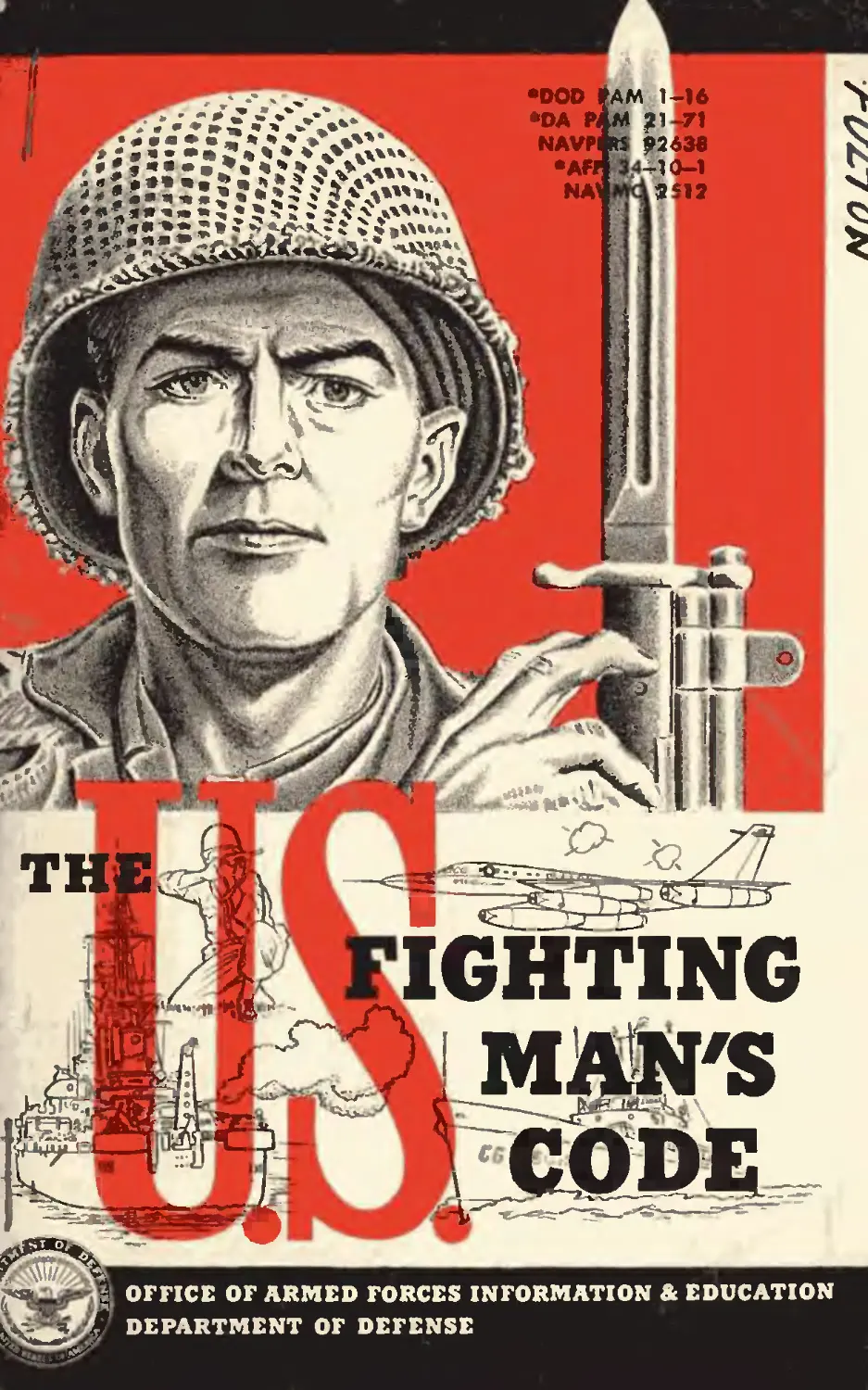
I I Ж FIGHTING
 llj MAN’S
CODE
Published by the
OF ARMED FORCES
ON and EDUCATION
ent of Defense
Thl« pamphlet wpersedei DOD Pom 8-1/DA Pam 21-71/AFP 34-10-1, Nov. 1955.
EXECUTIVE ORDER 10631
CODE OF CONDUCT
FOR MEMBERS OF THE
ARMED FORCES OF THE UNITED STATES
By virtue of the authority vested in me as
President of the United States, and as Com-
mander in Chief of the Armed lOorces of the
United States, I hereby prescribe the Code of
Conduct for Members of the Armed Forces of
the United States which is attached to this
order and hereby made a part thereof.
Every member of the Armed Forces of the
United States is expected to measure up to the
standards embodied in this Code of Conduct
.while he is in combat or in captivity. To ensure
achievement of these standards, each member
of the Armed Forces liable to capture shall lie
provided with specific training and instruction
designed to better equip him to counter and
withstand all enemy efforts against him, and
shall be fully instructed as to the behavior and
obligations expected of him during combat or
captivity.
The Secretary of Defense (and the Secretary
of the Treasury with respect to the Coast Guard
except when it is serving as part of the Navy)
shall take such action as is deemed necessary
to implement this order and to disseminate and
make the said Code known to all members of
the Armed Forces of the United States.
THE WHITE HOUSE
August 17, 1955
For sale by the Superintendent of Documents, U.S. Government Printing Office
Washington 25, D.C. - Price 50 cents
i мп an Amerlcanfiglitiug man. 3 serve in the
forces irfiicli" guard my country and our wag of
life. 3 am prepared to glue my life in their defense.
3 will newer surrender of my own free wifi. Sfin
Command, 3 wifi never surrender my men white
i they still have the”means toresisf.
5f 9 am Captured 3 will continue to resist by aft
means available. 3 will make every effort to
escape and aid others to escape. Q will accept
neither parole nor spcciaffivorsfrom the enemy.
3f 3 become yprisouev gf rvar, 3 wifi keep Jaitfi
with myJeUowjpriscnem 3 wifi give no informa-
tion nor takejpart in any action which might Ge
harmful" to my comrades. 3f 3atrt_ senior, 3 will
take command, 3f not, 3 wifi obey the lawfuf
orders gf" those appointed over me and wifi bach
them up in every way.
When questioned, should 3 become a prisoner
of wav, 3 am bound to give only name, rank,
service number and date of birth. 3 wifi evade
answering jnrtfierquestions to the utmost of my
ability. 9 wifi make no orafior written statements
disloyahto try Country and its allies or harmful
to their cause.
3 will never forget that 3 am art American
jigffting man, responsibCeJpr mu actions, and
dedicated to tfiejprinciples wmcfi”made my
countnj free. 3 Will trust in my God and in th£
"United Statesof America., ’
Ш

IV
CONTENTS
Page
Foreword.................................. 1
Introduction............................. 2
1.	The New Role of the POW................... 4
2.	The Lessons of History.................. 12
3.	Outbreak in Korea....................... 27
4.	''Progressives'' and "Reactionaries".	38
5.	Interrogation........................... 44
6.	Indoctrination.......................... 51
7.	Propaganda.............................. 59
8.	Probing for Weak Spots.................. 66
9.	The POW Can Resist....................   73
10.	The Code Is Your Armor................. 80
11.	The Geneva Rules....................... 90
12.	You Guard Our Country................. 100
13.	Never Say Die......................... 106
14.	Keep Up the Fight..................... 114
15.	Keep Faith............................ 122
16.	By Word and By Deed................... 132
17.	Faith Will Triumph.................... 140
Bibliography........................... 148
v
FOREWORD
During and after the Korean war it became appar-
ent that many U.S. fighting men had been inade-
quately prepared for the ordeal they faced in Korea.
Accordingly, a “Code of Conduct for Members of the Armed
Forces of the United States” was drawn up. Based on
traditional ideals and principles, the Code is intended to
give guidance to all members of the Armed Forces in any
future conflict.
Since the Code was proclaimed in 1955, each of the Serv-
ices has improved its instruction on how to avoid capture
and what to do if taken prisoner of war. Each Service
program has been analyzed, and the best points are
reflected in this revised pamphlet, “The U.S. Fighting
Man’s Code.” Some of the material in the booklet has
been drawn from Army Pamphlet No. 30-101, “Commu-
nist Interrogation, Indoctrination, and Exploitation of
Prisoners of War” ; The Airman, official journal of the Air
Force; and the Naval Training Bulletin. Materials and
suggestions have been received also from the U.S. Marine
Corps, and these are reflected in this pamphlet.
The assistance of all of the Services is acknowledged
with thanks.
1
INTRODUCTION
The United States is proud of the record of its fighting
men. The overwhelming majority of them have met
the standards of the Code of Conduct from the beginning
of our military history. Every war has produced outstand-
ing examples of their devotion to duty, country, God.
Although the Code of Conduct grew out of studies of
behavior in Korea, that conflict also had its heroes, too
many to list here. The individual acts of courage and
fortitude by Americans in Communist prison camps alone
would fill volumes. For their exemplary conduct while
prisoners of war, many American fighting men were
decorated.
But the fact remains that in Korea, as in every other
war, a few Americans did less than their best to avoid
capture—and a few of those who were captured cooper-
ated with the enemy. Who is responsible? Certainly, the
men concerned. But the military Services, the Department
of Defense, and our Nation must assume a share of the
responsibility.
An indomitable will to resist is not acquired overnight.
Nor can it be supplied by military training alone. For it
rests on character traits instilled in our homes, our
schools, our churches—traits such as self-confidence, self-
reliance, self-discipline, self-respect, moral responsibility,
and faith in country and God.
The serviceman equipped with the will reinforced by
the skill to resist is prepared for whatever military serv-
ice has in store for him. Both the will and the skill to
resist a Communist foe are strengthened by knowledge of
Communist tactics and techniques.
The serviceman who understands the nature of Com-
munist enslavement will do his utmost to avoid it. Guided
by the precepts of the Code of Conduct, and profiting by
the experiences of those unfortunate enough to have been
captured by the Communists, he will never surrender him-
self or his men while there is the slightest chance of avoid-
2
ing it. He will never give up the fight before the situation
is truly hopeless.
If capture is inevitable, he will continue the battle in the
prisoner-of-war camp. He will make every reasonable
effort to escape and help others who attempt to escape.
He will resist enemy efforts to make a tool of him. He
will strive to maintain the unity of his group. He will
assume leadership if necessary, or obey the leader of his
group.
In so doing, he will be fulfilling his mission and uphold-
ing the tradition of U.S. fighting men of the past.
3
Chapter 1
THE NEW ROLE OF THE POW
Something baffling happened to the American fighting
man who became a prisoner of war in Korea. It
baffled' his Service, the Department of Defense, and our
Nation as well.
The POW expected interrogation and brutal treatment.
He knew the Communists would try to squeeze military
information from him, and he certainly did not think they
would use kid gloves. In this situation, he was to give
only his name, rank, service number, and date of birth.
He would evade answering other questions to the utmost
of his ability.
If tortured, he could pray for strength to withstand his
ordeal.
If possible, he would try to escape and rejoin U.S. forces.
Otherwise, based on the experience of past wars, the
POW could expect to “sit out” the remainder of the con-
flict in a prison camp.
The POW got what he expected . . . plus much he had
not expected!
ASSAULT ON THE MIND
The moment a POW fell into Communist hands in Korea,
his captors launched an assault upon his mind and his
spirit. Taking advantage of his bewilderment, they plotted
their every move with a definite end in view.
The Communist aim: To make prisoners of war serve
the cause of international communism.
Accordingly, American POW’s were subjected to a well-
planned and well-organized type of warfare with which
few were familiar and for which few were prepared.
Briefly, this warfare was aimed at undermining their
loyalty to their country and their faith in the democratic
4
way of life—and thereby, conditioning them to accept
communism.
How did the enemy wage this new type of war against
our fighting men? What strategy and tactics were em-
ployed? What kind of weapons were used? A thorough
study of hundreds of interviews with repatriated Amer-
ican prisoners provided the answers to those questions.
Where the Communists were most successful in making
a prisoner do as they wished, they preyed upon his defects,
his lack of knowledge, and his lack of experience. It fol-
lows, then, that if U.S. fighting men in Korea had known
what to expect and had been prepared, those who became
POW’s could have spared themselves much agony . . . and
could have put up much more effective resistance.
As long as the Communists threaten direct or indirect
aggression to free nations anywhere, the danger of war
continues. The United States and her allies will seek
by every honorable means to avoid a shooting war. In the
event of hostilities, however, you—as a U.S. fighting man—
could become a prisoner.
The prisoner’s life is never an easy one. And life as a
prisoner of the Communists is especially grim, since it
holds ordeals beyond the usual hardships of captivity.
Hence, you will want to avoid it to the best of your
ability. In doing so, you will not only be following the
honorable course—set forth clearly in Article II of the
Code—but you will be serving your own best interests as
well. Some alternatives to surrender are indicated in
chapter 13. If you fail to explore every alternative when
threatened with capture, you will be making a serious
mistake—possibly a fatal mistake.
BE PREPARED
The purpose of this booklet is to help you prepare your-
self for any eventuality. By reviewing what happened in
past wars, especially in Korea, and by examining what the
Communists are trying to achieve, you will be better pre-
pared for what may lie ahead.
5
Specifically, this booklet aims to acquaint you with some
of the tactics, techniques, and methods of Communist
interrogation, indoctrination, and handling of prisoners of
war, and to suggest some defenses against these enemy
weapons. It is intended to show you also how the U.S.
Fighting Man’s Code can serve as your armor, either in
combat or in a POW camp.
“Knowledge is power.” This holds just as true for the
U.S. fighting man facing the Communist aggressor as it
does for the scientist in the laboratory. Much of the
knowledge and much of the strength you need to sustain
you as an effective fighting man will sustain you also if
you become a prisoner.
To combat Communists effectively, either in battle or in
a prison camp, remember this:
•	International communism seeks world domination.
•	Communists will use military force when it suits their
purpose.
6
•	Military force is simply one way of winning control
of the world.
•	Communists also keep up an unrelenting war of propa-
ganda, subversion, sabotage.
In North Korea, most American POW’s learned the hard
way that no enemy is a friend in a prisoner-of-war camp;
that friendships must be developed among their own people
and not with the enemy. In the event of another con-
flict with a Communist foe, American fighting men can
expect similar treatment. All Communists are trained for
one purpose—defeat of the capitalist democracies, especially
the United States.
If you ever find yourself a prisoner of the Communists
and are tempted to think that war has swept on beyond
you, just remember: there is no such thing as "time out”
in the global struggle between communism and the forces
of freedom. Your Communist captor will not take “'time
out” to provide shelter, food, or medical care. Whatever
care or help he gives you will not be for humanitarian
reasons. It will be given to help advance the Communist
cause.
How could the Communists use you? What would they
expect of you?
THEY SEEK INFORMATION
First, as in previous wars, they would be seeking military
information. There is nothing new about this. Captors
have been seeking this from prisoners since the days of
primitive warfare. Next, they will attempt to get all kinds
of nonmilitary information—about you, your fellow pris-
oners, and your country. Your instructions in either case
remain the same.
You will give only your name, rank, service number,
and date of birth. You will evade answering other ques-
tions to the utmost of your ability.
If you were defending a vital spot, you would not sur-
render it simply because enemy fire threatened your life.
To do so would be to undermine the safety of your outfit
7
and your country. By the same token, if you become a
POW, you will not give the enemy any information he
can use against your fellow POW’s, your fighting forces,
your country, or your country’s allies.
A Communist interrogator may threaten a POW with
death, torture, or solitary confinement. If the POW gives
him what he wants because of these threats, he is as
disloyal as the man who surrenders in combat to save
his own hide.
If ever you are taken prisoner of war, a big test will
come when you are first interrogated. Refuse to give
anything but your name, rank, service number, and date of
birth and you improve your chances of survival. If you
waver, you are lost! If you allow your Communist captor
to drag other information from you—military or other-
wise—he will keep making more and more demands. In
the end, he will force you into a shameful collaboration.
The Communists will use whatever means they feel is
the most effective to get the information they want. Being
8
only human, they prefer to do this the easy way. If they
can get what they want from you with sweet talk, so much
the better for them. But if you indicate a willingness to
talk, or cooperate, you are a better subject for further
questioning than the prisoner who obviously will not
cooperate. If you show you are afraid of harsh treatment,
you invite it.
What can you expect when you resist? In later chap-
ters, you will read of men who did resist—even when
threatened with death or physical torture. Some of them
did die, victims of Communist brutality. But many more
lived . . . and came home with honor !
The path of honor is never easy for a fighting man.
But it is the only path for a man who respects himself
and loves his country!
THEY WANT TO USE YOU
Apart from information, what will the Communists be
seeking from you if you ever become a POW?
They will want to use you in the cause of communism.
This does not mean that they want you to become a mem-
ber of the Communist Party. Even in the Soviet Union,
the Communist Party has accepted only 8 million members
out of a total population of 200 million. However, the
Communists would like to have you become an open cham-
pion of their ideas. If they succeed in getting you to
cooperate, they will find many uses for you—both as a POW
and after you are repatriated. For example, while you’re
a POW, they would like for you to broadcast propaganda
messages to the folks back home. After you are released
they would like for you to help pave the way for commu-
nism in the USA. They will not be concerned in the least
with your welfare, your rights, or your happiness as an
individual. They will be concerned with you only as a
tool of communism.
The Communists will sometimes offer small bribes or
rewards to get you to do what they want. If you prove
uncooperative, they will not hesitate to use force.
9
For example, suppose the Communists want you to be
an informer—to tattle on your fellow POW’s. If any POW
values a few cigarettes and some candy more than he does
his honor and the welfare of his fellow POW’s, he can
make a deal. If he can supply information of more than
routine usefulness, his reward may be more. Suppose he
refuses! He may be subjected to all kinds of penalties,
from beatings to solitary confinement. But he still has
his honor I
GUISES OF COMMUNISM
Some of what happened in Korea may be outmoded if
and wlien another war breaks out. If so, and if you be-
come a POW, be alert for new tricks and new ways to
cover up old tricks. Communism assumes many disguises.
At various times and places, it may present itself as
friendly and considerate. On the other hand, depending
on the situation, it may be displayed in all its naked
brutality. Some American prisoners observed both sides
and many guises during their captivity in Korea. Others
saw only one side of communism. Most Americans were
impressed by the manner in which communism can undergo
quick changes from one guise to another. Any man falling
into Communist hands in the future should be prepared to
10
encounter communism in any of the forms it may assume—
even the indignant denial that it is communism at all.
No matter how the Communists change their tactics,
their motives and broader purposes will not change. Learn
these, and you will understand that whatever they want
you to do will have some calculated end in view, and that
end will be to advance the Communist cause.
IN CONCLUSION
The odds are that you will never become a prisoner of
the Communists. At the same time, in any realistic
appraisal of what lies ahead, it is a possibility that can-
not be overlooked.
If such a fate should overtake you, you may be sure
that your Government will do everything possible to rescue
you. Meantime, until such help comes, you will have to
rely on your own resources. This is the hard, cold truth !
In summing up, remember that the Communists have
three basic uses for prisoners of war. They may seek to
use any prisoner in one or more of these ways:
•	As a source of military information.
•	As a champion of communism.
•	As a stooge to do their dirty work.
All three possibilities are repulsive. Yet your Govern-
ment would be doing you a disservice if it did not try to
make you aware of them. As bad as they are, fear of the
unknown is worse. An ugly truth is no less ugly if it
remains in hiding.
Face the facts! You’ll find them, unadorned, in this
pamphlet.
505596°—59----2
M
Chapter 2
THE LESSONS OF HISTORY
Fob a full understanding of today’s prisoner-of-war
problem, knowledge of the past is essential. This can
help you prepare for the future.
Looking back to prehistoric times, we know that primi-
tive man and his barbarian descendant annihilated or
enslaved all captive foemen. In time it occurred to the
conqueror to hold a captured leader as hostage. Such a
victim was Lot. According to Scripture, he was freed by
the forces of Abraham—perhaps the earliest prisoner-
rescue on record.
The Romans sported with their war prisoners, often
using them for target practice or for gladiatorial shows
to amuse the public. Enslaved warriors rowed Caesar’s
galleys to North Africa and Britain, and were killed when
they could no longer pull an oar. “’Slay, and slay on!”
Germanicus ordered his Rhineland invaders. “Do not
take prisoners! We will have no peace until all are
destroyed.”
Chivalry developed in the Western World with the rise
of Christianity, the concept of “Do unto others.” The
code of knighthood served to curb the warrior’s steel. The
true knight refused to slay for slaughter’s sake. Facing
battle, he was pledged to remain true to his king or cause,
even if captured. The disclosure of a trust or the deliver-
ance of a friend to the enemy was treacherous and merited
swift punishment.
Thus rules for the fighting man in combat or in cap-
tivity were linked to knightly concepts ’ of duty, honor,
loyalty to friend, and gallantry to a worthy foe.
Some time during the Crusades a prisoner-interrogation
rule developed. The captive knight was permitted to
divulge his name and rank—admissions necessitated by the
game of ransom. However, the medieval foot soldier
continued to risk death or enslavement at the hands of a
conquering enemy, without hope of escape through ransom.
12
In Europe, during the 17th century, the idea emerged
that prisoners of war were charges of the capturing sov-
ereign or state. No rules for their treatment had been
formulated, but they were protected from servitude and
personal revenge. Later, during the 18th century, captivity
came to be considered a means of preventing the prisoner’s
return to friendly forces. This was a step forward.
Military prisoners were no longer considered guilty of
crimes against the state.
THE AMERICAN REVOLUTION
To discourage desertions during the Revolution,. the
United States established the death penalty for prisoners
who, after capture, took up arms in the service of the
enemy. Duress or coercion was recognized as mitigating
only in the event that immediate death had been threat-
ened. This was the first definition of required prisoner
conduct.
Since George III decreed that all Americans who re-
volted against Crown authority were war criminals subject
to’ hanging, Revolutionary soldiers and sailors went to war
under the shadow of the gallows. The noose was relaxed
only because it proved impractical and because English
liberals deplored such high-handed tyranny. Soon after
the outbreak of hostilities, prisoner exchanges were begun
and paroles arranged.
THE AMERICAN CIVIL WAR
During the Civil War, about 3,170 captured Federals
joined the Southern forces, and about 5,450 captured Con-
federates joined the Federal army. War Department Gen-
eral Order No. 207, issued 3 July 1863, apparently was
intended to curb widespread surrender and subsequent
parole to escape further combatant service. It provided,
among other things, that it was the duty of a prisoner
of war to escape. Punishment for misconduct was based
on three criteria :
•	Misconduct where there was no duress or coercion.
13
•	Active participation in combat against Federal forces.
•	Failure to return voluntarily.
In cases involving disloyal prisoners of war, the ques-
tion of duress—or degree of duress—was weighed in the
balance. The Union Judge Advocate General recognized
coercion as a defense. It was held that “extreme suffer-
ing and privation which endangered the prisoner’s life”
might justify his enlistment with the enemy. However, if
the prisoner made no effort to escape when opportunity
offered, he was liable to a desertion charge.
Lieber’s Code. Civil War prison camps were harsh. In
Southern camps, particularly Andersonville and Florence,
men suffered greatly from malnutrition and lack of medi-
cation. The Union prison on Johnson’s Island in Lake
Erie was a bleak Alcatraz, and Union stockades at Point
Lookout on the Potomac were described as “hell holes.”
Humane citizens, North and South, appealed for lenient
treatment of captives. In 1863 President Lincoln requested
Professor Francis Lieber to prepare a set of prisoner rules.
Lieber’s Instructions for the Government of Armies of the
United States were probably the first comprehensive code
of international law pertaining to prisoners of war to be
issued by a government. Based on moral precepts that
recognized the enemy as a fellow human with lawful rights,
Lieber’s code contained the following injunctions:
•	A prisoner of war is subject to no punishment for-
being a public enemy, nor is any revenge wreaked
upon him by the intentional infliction of any suffering,
or disgrace, by cruel imprisonment, want of food, by
mutilation, death, or any other barbarity.
•	A prisoner of war remains answerable for his crimes
committed before the captor’s army or people, (for
crimes) committed before he was captured, and for
which he has not been punished by his own authori-
ties.
•	A prisoner of war ... is the prisoner of the govern-
ment and not of the captor.
14
Many Civil War prisoners were confined in tents (above)
or makeshift structures (belozv) and lacked the most ele-
mentary sanitary facilities.
15
•	Prisoners of war are subject to confinement or im-
prisonment such as may be deemed necessary on
account of safety, but they are to be subjected to
no other intentional suffering or indignity.
•	A prisoner of war who escapes may be shot, or other-
wise killed in flight; but neither death nor any other
punishment shall be inflicted upon him simply for
his attempt to escape, which the law of order does
not consider a crime. Stricter means of security
shall be used after an unsuccessful attempt at escape.
•	Every captured wounded enemy shall be medically
treated according to the ability of the medical staff.
Lieber’s code was a step forward. The Confederacy
agreed to abide by the code but could not always fulfill
the code’s intention. For example, the code required that
prisoners’ rations be similar to those issued their captors.
But the South was slowly starving under pressure of
blockade, and Southern soldiers as well as their prisoners
suffered from the scarcity of food.
Interrogation and Information. In the American Civil
War, espionage, military intelligence, and counterintelli-
gence were important features. In previous wars, few
trained intelligence operators had served the American
forces. Efforts to gather’ military information had been
haphazard and disorganized. The advent of the Pinkerton
Service which operated with McClellan, the Federal Secret
Service under Colonel Lafayette Baker, and a well-organized
Confederate Secret Service put intelligence-gathering (and
defensive counterintelligence) on a modernized basis.
Spies were called “scouts.” As old as war was the rule
that enemy spies, caught in disguise, faced death. They
were beyond the pale of prisoner-of-war exemptions. The
Civil War featured many heroic spy exploits. It also
featured daring raids on enemy lines to take prisoners for
interrogation.
The officer or man who gave his captors military infor-
mation was as dangerous to country and cause as the
16
deliberate traitor. So soldiers were enjoined “not to talk.”
Lieber set down the rule:
•	Honorable men, when captured, will abstain from giv-
ing to the enemy information concerning their own
army, and the modern law of war permits no longer
the use of any violence against prisoners, in order
to extort the desired information, or to punish them
for having given false information.
The rule was easier to recite than observe. On the one
hand, there was the interrogator ordered by his chiefs to
acquire vital information—intelligence that might win a
battle and save many lives. On the other hand, there was
the prisoner, sworn to withhold information that might
cost a battle and the lives of his countrymen. Here are the
opposing forces for a cruel contest.
Despite Lieber’s rules, prisoners were sometimes chained
together, placed in brutal irons, or “bagged” (a suffocating
canvas sack tied over the head). They were placed in soli-
tary confinement and denied water. These vicious meas-
ures were used more often to wring information from a
captive than as disciplinary punishments. Such “third
degrees” were conducted privately, usually by military
police or Secret Service agents.
Backsliding there was on both sides. However, the gen-
eral trend was toward more humane treatment of POW’s.
The going was slow, but the steps were in the right direc-
tion.
THE INTERNATIONAL RED CROSS
In 1864, the Swiss philanthropist Henri Dunant wrote a
book that set the stage for a conference at Geneva and
the founding of the International Red Cross. The Red
Cross offered relief to all combatants, regardless of the flag
they served. All participants agreed that “the sanitary
personnel might continue its duty in the presence of the
enemy.” Through the determined campaigning of Clara
Barton, the United States joined the convention in 1882,
and the American Red Cross was organized.
17
Dunant’s work inspired the founding of other prisoner-
relief societies. In 1874, a conference was held in Brus-
sels at the instigation of the Russian Government. Dele-
gates of all the major European nations attended. A code
based on Lieber’s was projected. The Brussels code was
not ratified, but it strongly influenced the first Hague
Conference, which met at the turn of the century.
Czar Nicholas II sponsored the Hague Conference of 1899,
which produced a Convention with respect to laws and
customs of war on land. Representatives of 26 nations
attended the conference. Discussed were disarmament
proposals and the possibility of establishing a world court.
The delegates negotiated various agreements relating to
warfare and war prisoners.
The prisoner-of-war code adopted at The Hague was
based on the one proposed at Brussels. It embodied many
of Lieber’s original stipulations. Prisoners of war were
to be considered as lawful and disarmed enemies. They
were captives of the hostile government and not in the
power of the individual captors or jailors. It was agreed
that unruly prisoners could be punished for insubordina-
tion, but humane treatment was required.
Twenty-four of the attending powers ratified the Hague
Convention. Signers included the United States, Germany,
France, England, and Russia. A hopeful generation
called the conference the “First Parliament of Man.”
Acting on a Russian proposal, the Netherlands called a
second Hague Conference in 1907. During this conference,
the powers reaffirmed their adherence to the principles
previously adopted.
THE FIRST TOTAL WAR
Another conference was in the making when the First
World War exploded. German intentions seemed only
too clear when the Kaiser’s spokesman described a treaty
with Belgium as a “scrap of paper.”
The concept of total war—mustering an entire nation and
its forces for the conflict—was not new. But in the mod-
18
ern sense, it was first advocated by a Prussian militarist
before World War I. If rules and codes abetted the war
effort, observe them. If they didn’t, they were unrealistic
and to be dispensed with. Total war was no gentleman’s
game. Any expedient that spelled victory was justifiable.
This concept was not entirely accepted by the High Com-
mand, but the Prussian school generally endorsed a policy
of SclireklicJikeit (planned terror or “Frightfulness”) to
subdue defiant enemy peoples. Prussian “Frightfulness”
was amateurish, and not very effective. But it did repre-
sent a 20th-century development in psychological warfare.
Its usefulness was countered when it backfired in another
area—propaganda warfare.
The Germans introduced another innovation during
World War I. This new element could be called “political
warfare.” As distinguished from propaganda, it involved
the process known today as political indoctrination.
At Limburg and Zossen, the Germans set up what were
known as “political camps.” To these camps were sent
prisoners who seemed likely subjects for subversion. The
inmates were quartered in comfortable barracks. Instead
of the normal prisoner ration they were fed the best food
available. Tobacco and candy were plentiful. During the
first eighteen months of the war, Irish prisoners were
selected for these segregated camps.
As reported by Major H. C. Fooks in his book Prisoners of
War: “One commandant talked to his men and stated that
the emperor was aware of the downtrodden state of Ireland,
and wished that the Irish captives be placed in a separate
camp, where they would be better fed and treated better
than the English captives.”
By and large, the Germans met with little success. Most
of the Irish POW’s resisted subversion. But the Germans
were pioneering. They were setting a pattern for the future.
At war’s end approximately 2,200,000 prisoners were in
the hands of the Central (Germanic) Powers. The Allies
were holding 615,900. The Americans had captured some
49,000 Germans and the Germans, 4,120 Americans. A total
19
of 147 Americans died in the enemy’s prison camps. Few
Americans escaped from Germany, but daring attempts were
made. On the whole, the American prisoners were well
treated.
In reviewing World War I—the first total war—one may
note four major developments :
•	Scientific intelligence warfare.
о Psychological warfare.
•	Propaganda warfare.
•	Political warfare.
All dealt with the human mind, and all would be brought
to bear on future prisoners of war—in World War II and in
Korea.
THE SECOND TOTAL WAR
During World War II a total of 129,701 Americans were
captured by the Axis enemy.
At this model German prisoner-of-war camp near Wetzlar,
Germany, Allied airmen captured duriny World War II
received excellent care.
20
These liberated American inmates of a German prison hos-
pital at h'achsnnieht ( World IlO/r If) show the effects of a
starration diet.
I’erhaps fearing reprisal more than public opinion, the
German military were fairly careful in handling American
POW's -with some exceptions. Americans captured in Italy’
were given similarly correct treatment.
In the matter of prisoner interrogation, the German mili-
tary’ seem to have behaved well enough—at least toward the
21
Americans. There was none of the brutalizing that existed
in such Japanese camps as Ofuna and Ashio, where Ameri-
can submariners were tortured.
The Americans captured by General Homma’s forces on
Bataan Peninsula and at Corregidor were fortunate if they
reached a prison camp alive. In the Bataan Death March
General Wainwright’s surrendered troops endured one of the
most excruciating ordeals of the war. Britons and Aus-
tralians caught at Singapore were treated with similar
brutality.
Airmen and submariners bore the brunt of interrogation
ordeals. Reason: they usually possessed information of
more value to the enemy than an infantryman’s. They may
have flown from a carrier or perhaps sailed from some hid-
den island base. The name of the flattop, the location of the
base—this was vital intelligence. The submariner knew a
dozen secrets: his sub’s cruising range, its radar and sonar
devices, its torpedo gear. One of the best kept secrets of the
war, and one of the most important, was the depth at which
a U.S. submarine could operate.
So pilots and submarine sailors who were captured “got
the works.” The Japanese did not employ subtle interroga-
tion methods. Prisoners were flogged and tortured. They
were treated to such Oriental punishments as judo experts
and hatchet men could devise. The ordeal of one submarine
skipper who “took it” hardly bears recital—cigarette burns,
bamboo splinters under the fingernails .... But the Jap-
anese did not extract from him the diving depth of U.S.
submarines.
In the Pacific after the war, Americans found the graves
of American destroyermen who had been beheaded and the
bodies of other American prisoners who had been drenched
with gasoline and burned alive.
These grim deeds, which the present Japanese Govern-
ment condemns as heartily as we do, may be regarded as the
exception. However, even where the treatment was more
humane, the realities of war were making themselves felt.
The blockaded Japanese were reduced to meager rations.
22
The Philippines and the Home Islands were undergoing non-
stop bombardment. Consequently, food and medical supplies
were at barrel-bottom. The POW’s received the leftovers.
But beheadings, torture, the Palawan massacre, and the
Bataan Death March were on the record. Like the Malmedy
massacre in the Belgian Bulge, like Buchenwald and Belsen,
they awaited an accounting. The outraged people of the
United Nations demanded retributive justice.
The Germans applied other and seemingly more effective
interrogation methods. Consider the testimony of Joachim
Scharff, an interrogator stationed at Auswerstelle West,
Oberursel, Germany. This was the camp where all captured
aviators (except Russian) were brought for questioning.
From “all but a handful” of the 500 Americans questioned,
Scharff obtained the information he was after. Scharff’s
methods were not so remarkable. It might be said that he
killed his victims with kindness.
In the war there were many “Scharffs.” Not all of them
were on the German side. Adept Allied interrogators pumped
information from case-hardened Luftwaffe pilots and U-boat
skippers. In the closing days of the war they pumped their
rivals—captured Nazi interrogators—among them Joachim
Scharff.
THE COMMUNIST SHADOW
That coming events cast their shadows proved true in the
Soviet treatment of Axis prisoners taken during World War
II. liven then the Soviets demonstrated methods that they
and other Communist nations were to use in later years.
The Communist pattern was beginning to unfold in Octo-
ber 1941, when the Red (Soviet) Army sent a directive to
all Communist interrogators, which read in part: “From the
very moment of capture by the Red Army, and during the
entire period of captivity, the enemy enlisted men and offi-
cers must be under continuous indoctrination by our polit-
ical workers and interrogators.”
This was followed by a series of directives that explained
in detail what type of information would be extracted from
23
German prisoners first, how the interrogations should ’ be
conducted, and the manner and extent of the indoctrination.
Analysis of these directives revealed that the Communists
were more interested in economic and political information
than in purely military information, though they did not
overlook military information. Military information was
sought, as a rule, soon after the prisoner was captured and
while he was being evacuated from the combat zone to the
rear.
Physical Pressure. The Communist interrogators used
physical pressure against German POW’s in an effort to
lower their resistance to interrogation and to make the job
of the interrogator easier. Physical pressure, when used,
was directed against selected individuals and not against
groups of prisoners. The Communists realized that physical
pressure against a prisoner group would strengthen the
unity of the group and defeat their purpose of obtaining
information. Examples of the types of physical pressure
exerted against selected individual prisoners are: Solitary
confinement; requiring the prisoner to assume rigid and un-
comfortable positions for long periods of time; prolonged
interrogation of the prisoner by using relays of fresh inter-
rogators ; depriving the prisoner of sufficient sleep or rest;
and denying the prisoner the use of the latrine.
When the Soviet interrogators relaxed their pressure,. it
was not for humane reasons. They were being realistic.
After all, the object of interrogation is to obtain informa-
tion. A badly injured prisoner, or one too exhausted or
confused to talk intelligently, is of no use to the interro-
gator ; therefore, there are definite limits on the amount of
physical pressure that can be exerted on a man under inter-
rogation. It should be noted that such methods as those
mentioned above were reserved for selected prisoners who
were known, or thought, to possess important information;
they were not applied to the prisoner population as a whole
because of the obvious expense in both manpower and time.
The Indoctrination Process. Although some Communist
attempts at indoctrination of German prisoners were made
near the front lines almost immediately after capture, the
24
organized, concerted indoctrination program began at per-
manent POW camps.
The basic technique was to discredit not only Hitler but
the whole German concept of government. The Communists
attacked all German leaders and all German schools of
thought. Every social system except communism was de-
scribed as being against the common man. Communism was
advanced as the salvation of the workers and the guardian
of peace.
Propaganda. Communist propaganda was perhaps the
most effective part of the Communist indoctrination of
German prisoners. The Communists collected a large num-
ber of diaries and letters of dead German officers that indi-
cated defeatist attitudes after Hitler’s forces began to slow
down on all fronts. These documents were disseminated to
newly captured prisoners. They were used to discredit and
degrade the officer class and served to create doubt and to
weaken the enlisted prisoners’ faith in their officers and in
Germany.
German prisoners were asked to make recordings, sup-
posedly to be broadcast to relatives in Germany. The re-
cordings were broadcast, instead, as propaganda to the
opposing troops on the front line, and gave the impression
that life with the Soviets was pleasant. These propaganda
recordings caused many Germans to surrender to the Red
Army.
“Peace” was the basic theme of the Communists. How-
ever, this theme was merely a front to hide their true
motives. In actuality, it meant peace on Communist terms.
Through fraud, deception, and some German collaborators,
numerous German prisoners signed “peace petitions,” which
the Communists published throughout the world. These
“petitions” gave German soldiers and civilians the false im-
pression that only the Communists wanted peace. As a
matter of fact, the current Communist “peace crusade’'
started in their prisoner-of-war camps in 1945.
Handling of Japanese POW’s. Communist methods of han-
dling Japanese prisoners of war were generally the same as
25
those employed in handling German prisoners. The interro-
gation procedures were the same, as were the techniques of
indoctrination. The illegal and unjustified detaining of Jap-
anese prisoners for years after hostilities had come to an
end paralleled the illegal holding of German prisoners, some
of whom were released as late as October 1955, more than
ten years after their capture. Others, so-called “war crim-
inals,” may never be released.
IN CONCLUSION
The interrogation and indoctrination methods used by the
Soviets against German and Japanese prisoners of war fol-
lowed the same pattern as those used against the Russian
people. They are a Communist trademark, an established
procedure peculiar only to communism.
At the close of World War II, these facts had already been
written on the pages of history. Unfortunately, much of
what was on those pages was still a Communist secret. If
we had known all the facts and had taken them to heart, we
could have spared ourselves much grief during the Korean
war.
26
Chapter 3
OUTBREAK IN KOREA
Armed with Soviet weapons, North Korean Communist
forces invaded South Korea on 25 June 1950. Six days
later a battalion of the U.S. 24th Infantry Division was
rushed to Korea from Japan.
Thus began one of the strangest wars in American history.
Our cause was simple and just, but our objectives were
frequently confused in the public mind.
The Korean war had three aspects. There was the civil
war aspect—North Koreans fighting South Koreans for con-
trol of a divided country. There was the collective aspect—
the first United Nations’ attempt to stop a treaty-breaking
aggressor. And there was the cold war aspect—the Western
powers blocking the expansion of Communist imperialism.
The causes of the war, United Nations’ objectives, and the
need for American intervention were not clearly delineated
in the public mind. This lack of understanding prevailed
among American civilians and fighting men.
The Communists attempted to exploit to the fullest this
condition both in international propaganda and in dealing
with our prisoners of war.
THE COLD FACTS
The United States began a piecemeal build-up of the fight-
ing forces in Korea. The first units to reach Korea were not
well prepared for combat. However, by November 1950, the
North Koreans had been completely beaten, their capital
was in Allied hands, and their remnant forces were scat-
tered and disorganized. The victory seemed assured until
the Chinese Red avalanche crashed over the Yalu.
In late November, the Chinese opened a massive counter-
offensive, hurling our forces into retreat. Early in Decem-
ber, American and Allied forces were trapped at the Chang.
Jin Reservoir. By fierce fighting they broke the trap and
fought their way to Hungnam, where they were evacuated.
505596°—59----3
27
There ensued a winter of baek-to-wall battling in subzero
cold.
It was during this grueling period, which began in July
1950, that most of the American POW’s were captured.
"DEATH MARCHES"
The first ordeal the prisoners had to suffer—and often the
worst—was the march to the POW camps. The North
Koreans frequently tied a prisoner’s hands behind his back
or bound his arms with wire. Wounded prisoners were
jammed into trucks that jolted, dripping blood, along broken
roads. Many of the wounded received no medical attention
until they reached the camp. Some were not attended to
until days thereafter.
The marching prisoners were likely to be beaten or kicked
to their feet if they fell. A number of the Communist officers
were bullwhip barbarians. They were particularly brutal to
28
South Korean captives. Many ROK prisoners were forced
to dig their own graves before they were shot—an old orien-
tal custom applied to the execution of criminals. Some
Americans, with their hands tied behind their backs, were
shot by the enemy.
So the journeys to the prison camps were “death marches.”
On one of these marches, 700 men headed north. Before
the camp was reached, 500 had perished.
The camps were what might be expected in a remote
corner of Asia. Prisoner rations were scanty—a basic diet
of rice occasionally leavened with some foul kind of soup.
The average American could not stomach such fare. Sick-
ness broke out in the camps, and many of the men suffered
long sieges of dysentery.
The men suffered much from cold in winter and heat in
summer. Water was often scarce; bathing became difficult.
Barracks were foul and unsanitary.
In the best of the camps, the men behind the barbed wire
were sometimes given tobacco, a few morsels of candy, occa-
sional mail. A few Red Cross packages got through. How-
ever, the enemy consistently refused to permit the Interna-
tional Red Cross to inspect prisoner-of-war camps. There
was good reason!
THE "BAD" CAMPS
In the worst of the camps, the prisoners existed by the
skin of their teeth and raw courage. Men in the “bad” camps
were known to lose 50 pounds in weight in a matter of
weeks.
The “bad” camps included the so-called “Bean Camp” near
Suan, a camp known as “Death Valley” near Pukchin, an-
other camp called “The Valley,” apparently in the vicinity
of Kanggye. Among the worst camps were the “Interroga-
tion Center” near Pukchin and a neighboring disciplinary
center called “The Caves.” This last was literally composed
of caverns in which the men were confined. Here they were
forced to sleep without blankets. Their food was thrown at
them. There were no latrine facilities. In “The Caves” the
29
prisoners were reduced to a degree of misery and degrada-
tion almost unbelievable. Those sent to ‘'The Caves" were
prisoners accused of insubordination, breaking camp rules,
attempting to escape, or committing some other so-called
crime. The testimony of survivors suggests that the "crime”
was seldom fitted by the punishment.
The primary interest of the North Koreans was to impress
United Nations captives aud Korean civilians with their
“superiority” over “Western barbarians.” They operated on
the theory that “might is right" and demonstrated that
“right” by some of the most inhumane types of atrocities
and brutalities that Western civilization has seen. To im-
press the civilian population, the North Korean Communists
placed American captives on display in the village squares
of Korea. They beat aud even murdered exhausted, sick,
and wounded Americans who could not defend themselves.
Mistreatment of American prisoners by the North Koreans
had no relationship to interrogation and political indoctrina-
tion. Actually, the North Koreans -were not primarily inter-
ested in collecting intelligence information or exploiting the
prisoners of war. They did not conduct an organized pro-
gram of indoctrination.
They did conduct some interrogations of United Nations
prisoners. These were limited, crude, and aimless, and did
not produce enough tactical or political information to con-
stitute an achievement. One of the stock questions was.
“Why did the United States invade North Korea?” Most
Americans questioned by the Koreans were asked, “How
many automobiles has each American?” The manner in
which the Koreans conducted their limited interrogations,
using threats and beatings, usually resulted in opposition
by the prisoners rather than cooperation.
CAPTURE BY THE CHINESE
The brutal manner in which the North Koreans treated
captives became known to thousands of the United Nations
forces. As a result, many Americans felt that capture by
the Chinese would bring similar treatment. Therefore, when
an American captive of the Chinese was not shot or other-
30
wise mistreated, he was pleasantly surprised and, in many
instances, assumed an attitude of gratitude. He discovered
that a display of kindness and friendliness had replaced the
harshness of the North Koreans.
For example, an American captured by the Chinese was
given a vigorous handshake and a pat on the back. The
enemy introduced himself as a friend of the workers of
America and then proceeded to give the I’OW an “explana-
tion'’ of the Korean campaign. The I’OW was told that the
Chinese people were not against the American workers but
against American capitalism. He was told that the "Wall
Street warmongers” were responsible for the war in Korea.
In many instances, the Chinese did not search the American
captives. They frequently offered them American cigarettes.
This display of apparent friendship caught most Americans
totally offguard, and many never recovered. They did not
know7 the hard fact that the Chinese were lenient only when
it suited their purpose. That the Chinese soldiers were
.31
trained and indoctrinated themselves in communism and all
of its techniques was demonstrated by their bitter criticism
of everything American and by repeated references to the
“capitalists.”
After the initial contact with the enemy, some Americans
seemed to believe that the enemy was sincere and harmless.
They relaxed and permitted themselves to fall into a well-
disguised trap by a cunning enemy.
The Chinese Communist leaders, military and political,
were educated—many, in the United States.^ Many also
spoke English fluently. Most of them possessed a fairly
good understanding of Americans and of the other nation-
alities that composed the United Nations forces. They were
shrewd, and they recognized the potential value to the Com-
munist cause of converting prisoner-of-war camps into lab-
oratories in which they could experiment with various
methods of group-handling and indoctrination of United
Nations prisoners, especially Americans.
THE FIRST BRIEFING
Shortly after capture, American prisoners were escorted
to a point some distance behind the front lines. The Chinese
used these points for assembling and briefing the prisoners
before marching them to permanent prison compounds.
When assembled at the collecting point, the prisoners were
briefed by an English-speaking Chinese Communist officer.
The officer told the prisoners that the war in Korea was a
civil war, like the Civil War in the United States in 1861.
The prisoners were told that the United States was the real
aggressor in Korea and that the American capitalists forced
other nations to send troops to Korea to help fight a war for
Wall Street. The prisoners were told that the military
aggression by the United States sb angered the Chinese
people that the “workers” of China decided to “volunteer”
for military duty and come to the rescue of the North
Korean people. The prisoners were told that the war in
Korea was illegal because the Congress of the United States
did not declare war against the People’s Republic in North
Korea.
32
The Communist officer further told the prisoners that, in
view of the fact that the war was not legal, the Chinese and
Korean people would not consider the captives-prisoners of
war but rather as “students.” As students they would be
reeducated by the Chinese and Korean People’s Govern-
ments. The ^reeducation about which the enemy spoke meant
indoctrination—Communist indoctrination.
PERMANENT CAMPS
After the prisoners had undergone the briefing at the
collecting points and had been identified and tagged, they
were evacuated to one of the permanent camps in North
Korea. The evacuation under the Chinese was more orderly
and less ruthless than under the North Koreans—another
instance of the Communist deception technique in operation.
The sick and wounded were assisted by Korean civilians
who used carts to help them along the marches. The food
en route did not meet American standards but was far better
than the food given prisoners by the Koreans. Medical care
for the marching prisoners was poor, but the Chinese made
what they had available to the more serious cases of sick
and wounded.
After arriving at permanent camps, the prisoners were
immediately organized into units comparable in size to
United States Army units. They were grouped into squads,
platoons, and companies, each under a unit leader. Orig-
inally, the leaders were selected by the Chinese Communists
on the basis of leadership qualities, military bearing, and a
loud, commanding voice. This manner of selection, however,
was discarded almost immediately because the units were
run too much like regular military organizations, and this
was contrary to the Communists’ strategy. The enemy re-
examined the original leaders, checked their backgrounds,
and determined which ones could be depended upon to lead
the units in the way the Communists wanted them led. In
many instances, the unit leaders were studied as potential
group leaders and monitors for indoctrination classes. Obvi-
ously, the objective behind all this was to gain and maintain
complete control over the prisoners.
33
After the Chinese had established a POW organization
that would satisfy their purposes, they began a conditioning
process designed to render the prisoners more vulnerable to
their propaganda assaults and to their political indoctrina-
tion program. The enemy’s initial objective was to gain the
prisoners’ neutrality, if not cooperation, by undermining
their sense of duty, their friendships, and their democratic
ideals. To attain this, the enemy had no set of rules. No
trick was too dirty or mean, no weakness too unjust to ex-
ploit, no threat too violent or subtle to be used again and
again to batter the resistance of the prisoners and to crush
their will.
Fear, threats, confusion, tension, isolation, retaliation,
informers, and censorship of mail were used effectively by
the Chinese Communists. Since these control measures
played such an important part, and since they will probably
be used again and again in any future situation of this kind,
it is important to explain some of them in detail.
SPREADING FEAR
The Chinese Communists first generated fear among the
prisoners by warning them that they might be strafed by
our own planes in Korea. This was not an unfounded warn-
ing, because we had air superiority in Korea at the time,
and the Chinese did not report accurately the locations of
the various POW inclosures. This warning created a pecul-
iar fear in the minds of the prisoners—fear of harm by
friendly forces. Stories of atrocities and brutalities, a few
of which were based on fact, were deliberately spread. In
this instance, the implication was that in some rare and
unusual situation, the enemy might find it necessary to re-
sort to torture, but if he did it would be as a last resort for
the sake of discipline. The enemy spread rumors that some
prisoners might be shipped to Manchuria or to China and
that the trip might be a one-way affair.
Another rumor deliberately planted and spread by the.
enemy was that if prisoners did not cooperate with the
Chinese and Korean People’s Governments for peace, some
might not be repatriated. This inspired the greatest fear in
34
the prisoners—of spending an indeterminate period as pris-
oners of the Communists.
Playing on basic human instinct and emotions, the enemy
started a rumor that food might be withheld from those
prisoners who did not cooperate with the enemy. This
rumor, coupled with another that even the primitive medical
care would be withheld in case of illness, intensified the
normal fear of sickness and disease. This fear increased
further when the prisoners considered the fact that they
were living under conditions far below the normal sanitary
standards in the United States and other modern countries
of the world.
Perhaps the most significant and destructive fear was fear
of the unknown. The Chinese played upon it in the hope of
reducing the resistance of the prisoners. This caused some
prisoners to weaken and a few to accede to Communist de-
mands. An analysis of this aspect of group-handling by the
Chinese Communists reveals that the prisoners actually
.35
were more afraid of the unknown than of the things they
could see, feel, and hear.
INFORMING
One of the most vicious and despicable tactics employed
by the Chinese Communists was to organize nets of in-
formers. The enemy had two types of informers. One was
the unwitting informer. He had no specific instructions
from the enemy nor, as a matter of fact, did he realize that
he was serving as an informer. He was called to the enemy
headquarters at various times and engaged in general con-
versation. The conversation would always lead to prison
life and prisoner activities. Through careless talk, the pris-
oner gave the enemy information about other prisoners and
unwittingly informed on them.
The other type was the regular informer, who reported
to the enemy at night or at other specific hours designated
by the enemy. He gave the enemy information about other
prisoners through weakness or to enhance his position in the
eyes of the enemy. In certain instances a regular informer
deliberately gave the enemy false information about some
prisoner or prisoners, which resulted in unwarranted pun-
ishment or hardship for the victims. As a result, prisoners
were tried and severely punished for offenses about which
they knew nothing—the work of the informer.
The position of the informer was so insecure that he had
to report any questionable act in case someone else informed
on him, thus causing him to lose his position. These “ques-
tionable” acts included such indefinable misconduct as “un-
wholesome” or “hostile” attitude, the recording of “improper
notes” at an indoctrination lecture, and expressing “a capi-
talistic philosophy.” The type of prisoner recruited by the
enemy for this work was the opportunist, who stopped at
nothing to further his own gains. In return for informing,
the Chinese enemy permitted him to conduct various activ-
ities, such as selling food to hungry prisoners. The informers
were feared to some extent by the other prisoners, but their
attitude and conduct more frequently were viewed with
anger, shame, and disgust.
36
IN CONCLUSION
Despite the wide publicity given to informers and collabo-
rationists, they did not set the pattern for our fighting men
in Korea. The large majority of American prisoners resisted
the enemy in the highest tradition of the service and of our
country. Of those who resisted, some were singled out for
brutal treatment. Some of these cases will be discussed in
later chapters. In the long run, however, those Americans
who resisted fared about as well physically and materially
as the few who chose the road of least resistance. And they
had this decided advantage—the personal satisfaction of
having acted in the highest moral tradition of a nation
under God.
37
Chapter 4
"PROGRESSIVES"
AND "REACTIONARIES"
Who were the “progressives” and who were the “reac-
tionaries”?
These words took on special meanings in the prison camps
of North Korea. American fighting men who considered
themselves liberals were proud to be called “reactionaries”
for demonstrating firm resistance in a Communist prison
camp. On this point, they saw eye to eye with their more
conservative buddies. And both liberal and conservative
POW’s looked with contempt on the POW who came to be
known as a “progressive.”
How did a man become a “progressive”?
If he began to show the “proper spirit”—to cooperate with
his captors—he was lectured and handed Communist litera-
ture. A docile prisoner who read the literature and listened
politely to the lectures was graduated to a better class.
Finally he might be sent to “Peaceful Valley.” In this lenient
camp the food was relatively good. Prisoners might even
have tobacco. And here they were given all sorts of Marxian
propaganda.
The graduates from “Peaceful Valley” and others who
accepted Communist schooling were called “progressives.”
And there were shades of meaning !
THE "PROGRESSIVE" ROLE
A British study described a “progressive” POW as one
who accepted the political, economic, and social gospel of
Marx, Engels, Lenin, and Stalin—even if he was not quite
sure what this was. In order to be fully accepted as a “pro-
gressive,” however, the prisoner had to do more than pas-
sively accept communism. He had to become a Communist
propagandist and assist the Chinese, not only by giving them
all the military information he had but also by acting as an
38
informer, revealing the plans and thoughts of his fellow
prisoners, and helping to spread communism among them
and among his family and friends at home. Thus he would
show that he had become “politically conscious.”
The second and more literal application of the “progres-
sive” label became apparent in the systematic exploitation
of a prisoner’s services once he had given in on just one
issue. Often the first bit of cooperation with the enemy
seemed minor in nature; and the prisoner could rationalize,
with the captor’s help, to justify the act. But the first con-
cession paved the way for a second, and so on down the line.
With each “progressive” step down collaboration road, the
chance of turning back became more remote. Thus some
prisoners learned too late that they couldn’t be just “a little
bit” of a collaborator so long as the Communists wanted
their services.
The “progressives” were called upon to deliver lectures,
write pamphlets, and make propaganda broadcasts. They
wrote speeches condemning capitalism and “American ag-
gression in Korea.” They organized a group known as
“Peace Fighters.”
On a percentage basis, fewer officers than enlisted men
were “progressives.” However, the officers’ influence, unfor-
tunately, was strong on the enlisted men. “If the Captain
can do it, why can’t I?” “If the Colonel signs a peace peti-
tion and orders the rest of us to do it, we have to follow
orders, don’t we?” Altogether, the officers and enlisted men
who resisted were on a spot. That most of them refused to
join the “progressives” (and rejected a promise, sometimes
unfulfilled, of better food, minor luxuries, and mail call)
says something for the spirit of both officers and enlisted
men.
The Communists soon learned that Americans were not
readily sold on communism. Even those of lesser education,
or perhaps having little appreciation of their own country’s
principles, were by no means eager to accept this foreign
ideology or to submit to it. The early “converts” turned
out to be simply opportunists seeking to better their own lot
without regard to the consequences for their fellow pris-
oners.
THE "REACTIONARY" LABEL
How did the “reactionary” fare? He could expect to be
separated from those prisoners whom the enemy deemed to
be more susceptible. While there was good chance the “re-
actionary” would experience some solitary confinement, in
time the Communists found themselves short of facilities for
handling all resisters in that manner. Thus small “reac-
tionary” groups formed, increasing in size as time went by,
isolated to prevent their interference with the subjugation
program in the “progressive” camps. Brought together by
virtue of their demonstrated resistance to the enemy, these
were men who could, despite any personal differences among
themselves, present a united front against the enemy and
help each other survive.
Still, the “reactionary” label was no guarantee that the
prisoner was permanently free from enemy efforts to sub-
40
jugate him. Any American who signed a propaganda leaflet,
a peace petition, or a germ-war confession was a big feather
in the enemy’s hat. Logically, the higher the rank of the
prisoner the more useful would be such service to the enemy.
Also, the “breaking” of a senior officer, a “notorious reac-
tionary,” or anyone who had demonstrated leadership and
other strong qualities that had earned the respect and trust
of fellow prisoners, was of tremendous benefit in the Com-
munist effort to convince other prisoners (and people back
home) that resistance was futile. For that reason, various
“reactionaries” were subjected to pressures often loosely
referred to as “brainwashing.”
Breakdown of leadership was what the enemy wanted.
Officers were usually segregated. “Progressives” were placed
in leadership positions. And if the enemy’s appointees
weren’t obeyed by the other POW’s, punishments were in
store for the “insubordinate prisoners.”
41
THAT LONESOME ROAD
What did the “progressive” expect to gain in the long run
. . . after the Korean war was over? Was he thinking that
far ahead ?
It is doubtful that any of the “progressives” became sin-
cere converts to the Communist ideology. Even in the case
of the turncoats—21 American prisoners who refused re-
patriation and remained in Red China—the seemingly logi-
cal assumption that they had been converted has proved
erroneous. Perhaps this - misconception was fostered by
frequent references to them during the repatriation process
as “those who chose communism.” Indications are that this
misleading phrase was introduced by Communist publica-
tions.
In any event, reports by returned American prisoners on
the actions of those men indicated that they remained for
quite different reasons. The subsequent return of some of
the 21 further refutes the idea that they “chose commu-
nism.” One of these, interviewed in Hong Kong and asked
why he stayed in Red China in the first place, replied, .
I’ll tell you this much—it wasn’t for political reasons.”
Why did the 21 refuse repatriation? Perhaps, in some
cases, they feared vengeance at the hands of men they had
betrayed, or at the hands of friends of men who had died
because of their treason.
THE LAST MILE
Having cut himself off from his own country and his own
people, what can the collaborator expect from the Commu-
nists? The answer became apparent during the Korean war
and it is just as true today.
The Communists know that the turncoat will be no more
trustworthy for them than he was for his own side. The
enemy cannot expect to gain actual allegiance from a col-
laborator if for no other reason than that he has none to
give. For a change of allegiance, the ultimate possibility of
collaboration, would, necessitate a willingness to die for the
enemy. Obviously, the prisoner who betrays his own people
42
out of fear for his life isn’t going to be willing to die for
anyone else, either.
No matter where collaboration begins, the Communists
continue to press a POW for further services until they have
no further use for him. At that point they drop him ; and
no one is anxious to pick him up. Certainly his prison-mates
will have little use for him, since his collaboration with the
enemy, no matter what it was, will have in some manner
inflicted further hardship on them. Perhaps even more im-
portant, from the standpoint of his chances for survival, the
collaborator will have little respect for himself.
Whatever the Communists may promise in exchange for
collaboration, their payoff will be small. Any slight advan-
tage the collaborator might gain as a result of service to the
enemy will be of no value over an extended period of im-
prisonment. In the long run. the resister and the col-
laborator may fare about the same in the purely physical
sense. But psychologically, there will be a big difference.
For the man who gives in will have several handicaps: A
sense of failure, or remorse; the loss of respect, both self-
respect and that of his fellow prisoners, that in time may
well destroy his will to live. In any case, “Man does not live
by bread alone." In a Communist prison, where bread is
likely to be scarce, sustenance of the spirit—hope, faith, and
will—may well be the determining factor in survival.
Having kept faith, the “reactionary” is the winner.
605596°—59---4
43
Chapter 5
INTERROGATION
A POW should be prepared for brutal treatment if inter-
rogated soon after capture by an enemy seeking
military information of immediate value. Tactical inter-
rogation, wherein time is of the essence, is more likely than
any other to include severe physical torture. Certainly it
will include many threats, probably beginning with the first
refusal on the part of the captive to give information.
During the Korean war, practically all Air Force POW’s
were given special attention. The primary objective of the
Chinese Communists was to use them for propaganda pur-
poses, particularly for germ-warfare propaganda. How-
ever, they were grilled also for military information.
Not only in fliers but in all POW’s, the Chinese interroga-
tors tried to create a fear that, by some mysterious process,
they would break under questioning. The idea of “brain-
washing” was spread by the Communists to create the false
impression that their method and manner of conducting
interrogations were irresistible.
METHODS ARE KNOWN
Actually, the methods used by the Communists to obtain
information are not new, mysterious, or irresistible. They
have been used for centuries. These methods are based on
the simple idea of progressively weakening an individual’s
physical and moral strength. They are not based on some
weird psychological theory. Numerous persons have faced
Communist interrogation and withstood so-called Commu-
nist “methods” for weeks, months, and even years, without
“breaking” or even demonstrating fear of any kind. Many
of those persons have returned without showing any pecul-
iar or unusual ill-eifects as a result of their experiences.
Communist interrogation of United Nations prisoners of
war in Korea revealed this significant principle—that
Communist objectives frequently limit the use of physical
44
coercion or torture. The interrogator knows that the pris-
oner cannot answer questions after he is dead. Alive, re-
fusing to yield, the prisoner remains a potential source of
information to his captors; dead he is worthless. Although
the Communists will attempt to make use of a prisoner’s
natural anxiety and fear, most of the prisoners who are
subjected to Communist interrogation will not be physically
tortured, even though they refuse to cooperate with the
enemy. The reasons for this vary, but a very important one
is that the Communists are practical in their approach to
interrogation. They learned during their early reign of
terror in the Soviet Union that physical violence, more
frequently than not, stiffens group resistance, rather than
the reverse.
NATURE OF INTERROGATION
Interrogation has some characteristics of both a science
and an art. It resembles a science when conducted by a
45
shrewd and trained interrogator who knows what he wants
and proceeds in an orderly, logical, and determined fashion.
Interrogation resembles an art when the interrogator
establishes a relationship between himself and the person
being interrogated wherein the latter is subtly persuaded to
cooperate in giving information beyond the simple answer-
ing of questions. The interrogator, by demonstrating pa-
tience, tolerance, sympathy, and understanding, is able to
obtain cooperation in achieving his desired results.
Some of the Chinese Communist interrogators in Korea
were skilled and possessed the drive, tolerance, and patience
to obtain the information they were after. Often they knew
English and were well-informed about life in the United
States. Some had been educated in the United States and
were familiar with the economic and political institutions of
the United States. In fact, some of the enemy personnel
in the interrogation section were better informed on certain
aspects of American life than many of the prisoners.
From the first interrogation, the Communists tried to
confuse the American POW's into questioning the sincerity
of our objectives in Korea. “Divide and conquer” was the
insidious keynote. Only a few Americans were casualties
in this battle to capture their minds in the POW camps.
The Communists, nevertheless, regarded their interrogation
and indoctrination program as an effective weapon in
exploiting American POW’s.
FIRST INTERROGATION
The Communists began their interrogation soon after a
POW was captured. With a downed flier, it began almost
immediately after he was picked up. With other POW’s, it
began at the collecting point where they were brought to-
gether. However, the first conversation was more like an
interview than a real interrogation:
Generally, the enemy asked the prisoners several routine
questions and a few questions on the military situation in
the United Nations areas. After completing his direct inter-
rogation, the enemy distributed numerous forms and told
the prisoners to sign them. Some of these forms carried

American, International Red Cross, or one of many other
headings, most of which were invalid. In addition to sign-
ing and completing these forms, the prisoners were told to
sign just their names on blank pieces of paper, which the
enemy collected and subsequently used for propaganda
purposes.
Many Americans signed the various forms because they
did not know or believe at the time that the enemy would
use the contents of the forms for purposes of incrimination.
During the initial interrogation, many Americans talked
freely with the enemy and answered most of the questions
asked. The lack of resistance during the initial interroga-
tion by the enemy resulted from the apparent friendliness
the Chinese had displayed when the prisoners were captured.
At the various collecting points were Chinese whose duties
were to screen the completed forms and record the results
of the initial interrogations. They studied the answers to
the questions on the various forms and compiled a per-
sonnel file on each prisoner, which included the question-
naires, results of the initial interrogation, and the blank
slips of paper on which the prisoners had signed their
names. These files were later forwarded to the camps to
which the prisoners were assigned, and the results of all
subsequent interrogations were added to them.
An analysis of the results of the interrogations enabled
the Communists to select or determine the subjects or atti-
tudes that should be emphasized and exploited in the indoc-
trination program. In this way they could hand-tailor the
indoctrination given to the various groups of prisoners.
At the permanent camps, appropriate physical facilities
were provided by the prison command. The United States-
British Prisoner of War Camp Number 5, located near the
city of Pyoktong, North Korea, was the model for all other
camps in Korea. The interrogation sections were located
in the camp headquarters, usually near the commanding
officer or near the security officer. They were equipped
with wire recorders, exposed and hidden microphones, two-
way mirrors, and a version of a lie detector. The interroga-
tors were Chinese officers, assisted by Chinese women,
47
whose duties primarily were to record interrogations on
paper in Chinese characters and maintain accurate rosters
of prisoners who had and who had not been interrogated.
The sections operated on a 24-hour basis and conducted some
of the most fruitful interrogations at night.
PRETENSE IS FUTILE
Alone and disarmed, what can one man do under such
interrogation? If he yields, he knows he is disgracing him-
self and undermining his country’s safety. Yet when he
holds out, he knows he may be in for rough treatment.
Is there an easier way out?
Just after the Korean war, there was talk about such a,
solution. One suggestion was that members of our Armed
Forces should be instructed, if taken prisoner, to “confess
to anything.” Not only would this take the pressure off the
POW, it was argued, but it would also confuse the enemy
since he would not know where truth left off and fiction
began.
This strategy was to have included the preliminary
announcement to the world that our men would do this if
captured, thereby “nullifying” the propaganda value to the
enemy of any such things as false confessions and peace
petitions. In its original form, the “confess-to-anything”
formula made clear that it was to apply only to such things
as false confessions and propaganda. In the realm of
military information and maintenance of unquestionable
faith with fellow captives, there could be no deviation from
a rigid standard.
It was a fine theory I However, experience has shown
that once a prisoner started answering questions, the skilled
interrogator could be certain of gaining some information
from him if he had sufficient time. By no means does this
mean, as some have contended, that an interrogator can get
all that he wants from a prisoner in due time. It does
mean, however, that the prisoner who tries to outmaneuver
the interrogator is certain to divulge some information.
Baiting a trap for the POW, the Communists will allow
him to “get away” with pretense during interrogation:—
48
even encourage it—for the simple reason that they want the
prisoner to develop a habit of pretending. One official study
of Communist methods in attempting to elicit false “germ
warfare” confessions from captive American fliers describes
them as something of a training process. .. The victim was
not simply confronted with demands for a false “confes-
sion” : he was enticed into pretense. First the subject of
“germ warfare” was discussed in very general terms, with
broad hints that the prisoner knew quite well what it was
all about. Suggestions were made that if the prisoner “had
something on his conscience,” it would be to his own advan-
tage to “unburden himself.” This could go on for days or
weeks, until the prisoner himself might ask if he was being
accused of such activity. To this, the enemy would often
respond with something to this effect: “I have accused you
of nothing. However, if you have something on your
conscience . . .!”
The prisoner was left to figure out for himself exactly
what was wanted. If he did figure it out and if he did
comply, he soon learned that “tongue-in-cheek” compliance
was not enough. He must learn to speak, write, and act
as if his false confession—however preposterous—was en-
tirely true. Since he was “confessing” to a “horrible
atrocity,” he must also pretend feelings of guilt, shame, and
even repentance.
Where such pretense supported Communist propaganda,
as in the case of a “confession” to genn warfare, the Com-
munists could—and did—go along with it indefinitely. But
where they had encouraged the POW to lie as a way of
trapping him, they showed no leniency when the conflict in
his stories became apparent.
The prisoner whose lies led him into the Communist trap
was considered a more grievous offender than the man who
refused to answer, for in addition to wasting the interroga-
tor's time he proved that he was “insincere” and “had not
learned the truth.” An interrogator was more likely to
desire personal vengeance against the prisoner who “sold”
him ou false information than against the prisoner who
maintained a position of respectful noncompliance.
49
SUMMARY
The means employed by the Communists to obtain infor-
mation from United Nations prisoners of war were not new,
unique, mysterious, or irresistible. They were recognized
and understandable methods of undermining an individual’s
physical and moral strength. By deception, and by other
tricks, the Communists obtained apparently useless informa-
tion from prisoners who did not realize that all information
is important. The success of the enemy’s program of in-
terrogation depended, to a large extent, on the prisoners’
lack of knowledge of what was happening to them—a factor
on which the Communists have always relied.
The American fighting man should remember that the
Communist interrogator is not a superman with mystic
powers and unique methods by which he can accomplish the
impossible. He is not all-knowing, nor is he all-powerful,
even when dealing with a seemingly powerless victim, such
as a prisoner of war.
It would be foolish, however, to underestimate the skill
of the Communist interrogator. Effective resistance to in-
terrogation, as one ex-prisoner has put it, is not so much a
matter of outwitting the interrogator as of outlasting him—
by determined, steadfast refusal to cooperate in the face of
all manner of treachery, threat, coercion, and even death.
Those who resisted completely the most skilled Communist
interrogators deserve the gratitude and admiration of every
American, for they are examples of courage, determination,
and endurance.
Chapter 6
INDOCTRINATION
When plunged into a Communist indoctrination mill,
the average American POW was under a serious
handicap. Enemy political officers tried to force him to
read Marxian literature, to participate in debates. He was
prodded to tell what he knew about American politics and
history. Lectures — study groups — discussion groups — a
blizzard of propaganda and hurricanes of violent oratory
were all a part of the enemy technique.
To many American prisoners this procedure came as a
complete surprise and they were unprepared. That some
refused to read the literature, participate in the debates, or
engage in political discussions with their skilled captors is a
tribute to their courage.
But to a frightened, confused, and hungry prisoner,
deprived of leadership and guidance, these initial steps by
the Communist enemy were effective. Although most pris-
oners did not realize what was happening to them as the
program progressed and while they were being subjected to
interrogation, there were no secrets about what the enemy
planned to do along the line of “reeducating” the prisoners.
It was reiterated numerous times that they were “students,”
and, as students, they were going to be reeducated along
Communist lines. This fact was made clear at the very
beginning. It was never altered.
Basically, the indoctrination program had two main
objectives. One was to indoctrinate completely a small,
select group of prisoners in the actual theory and practice
of communism as a world conspiracy. The second objective
was to undermine the faith and trust of the other prisoners
in their country, their government, and its political leaders
—not to make Communists out of all the prisoners.
In attempting to achieve the first objective, the Commu-
nists selected the prisoners on whom they felt they could
depend, gave them special training, tutoring, and counsel-
51
ing, and extended them special treatment. This was in
keeping with the Communist concept, as advanced by Lenin,
that a small, select, disciplined group should lead the
masses. As an incentive for the ‘'chosen few” to apply
themselves to the task of betraying their country and their
fellow prisoners, the Communists told them that they were
the ‘‘liberators” of the masses, and promised them positions
of leadership in the United States—after a Communist-
directed revolution had replaced our democratic system
with a Communist form of government.
In pursuing their second objective, the Communists con-
sistently smeared the United States. Any imperfections of
our political and economic institutions were distorted com-
pletely out of proportion. At no time was mention of the
true democratic principles of the United States Government
permitted in discussions. In addition to attacking Ameri-
can concepts of democracy, the Communists launched attack
52
after attack against.American statesmen by name, claiming
that (hey were the chief perpetrators of war and evil.
The Communists felt that if they could succeed in the
second objective—subverting the prisoners’ loyalty—these
Americans would be less opposed to communism after their
repatriation to the United States. The Communists also
reasoned that these ex-prisoners would he more likely to be
sympathetic to any Communist conspiracy against the
United States. Part of their plan called for the thoroughly
indoctrinated prisoners, upon their return to the United
States, to assume leadership of the subverted ex-prisoners
and urge (hem to support the Cotnnninist conspiracy through
the instrumentality of the Communist Party.
OTHER OBJECTIVES
In support of these two main but general objectives,
there were specific objectives that had a more direct effect
on the lives of the prisoners. To facilitate internal control
of the prisoner population, the Chinese Communists at-
tempted to organize a net of informers to relay to the camp
53
authorities information concerning the activities of other
prisoners. Through informers, the Chinese Communists
were able to thwart many escape attempts. Informers also
furnished the Chinese Communists information concerning
prisoners who were actively resisting indoctrination.
Another objective was to recruit collaborators to assist
the Chinese Communists in implementing the indoctrination
program. These collaborators would give propaganda lec-
tures, write articles, and attempt to talk other prisoners
into signing “peace petitions,” surrender leaflets, and other
types of propaganda.
Still another objective, which fortunately had no success,
was to recruit potential agents to perform espionage or sub-
versive activities for the Communists after repatriation.
The few who agreed to work for the Communists realized
soon after their repatriation that they had been duped and
notified the American authorities of this Communist plot.
COMMUNIST FRONTS
Every Communist activity in North Korea was geared for
one general purpose—to support the overall mission of
political indoctrination. Early in the war, for example,
there were various Peace Committees, whose job was to
smear America as a warmonger and to laud Communists as
champions of peace. In addition to operational committees
for indoctrination, the Communists established a number
of committees for the administration of the prisoners.
These were: Sanitation Committee, Daily Life Committee,
Athletic Committee, Mess Committee, and a Committee for
Prisoner Morale. The membership of these committees,
like that of the others, was made up of prisoners. At all
levels of committee activities there were Communist politi-
cal advisers who insured discipline, control, and nondevia-
tion from the established routines of the program.
Most Americans have heard about Communist-front
organizations. A Communist front is an organization con-
ceived by Communists, inspired by Communists, controlled
by Communists, and directed by Communists, but which has
as a “front” some popular or pseudo-patriotic cause. The
54
various committees in the prison camps in North Korea
served as fronts for the Communist enemy. POW’s who
became members served the Communist enemy in North
Korea in the very same manner in which other naive individ-
uals have served the Communist conspiracy outside of
prison camps.
PHASES OF INDOCTRINATION
The Communists administered their indoctrination pro-
gram in two general phases. The first can be called the
preparatory phase, the second the implementation phase.
Preparatory Phase. This phase, a “softening-up” or “con-
ditioning” process, was conducted through the medium of
a series of lectures on the imperfections of the governments
under which the prisoners lived before capture. The United
States Government and its economic and political systems
constituted the main target for all lectures. During this
phase, the United States was accused of instigating the
war in Korea.
Implementation Phase. This phase of indoctrination was
devoted to selling communism as a way of life to be
preferred over the democratic system. The Communists
used an old technique during this phase—comparing one
with the other, pointing up the favorable aspects of com-
munism and emphasizing the so-called “defects” of democ-
racy. The enemy pictured the Communist state as a state
in which every man, woman, and child lives a life of happi-
ness, free of poverty and class discrimination.
METHODS OF CONTROL
The Communists used the carrot-and-stick method of
controlling POW’s. When the carrot failed, they relied on
three sticks: repetition, harassment, and humiliation.
Repetition. This technique was used against all prisoners
at one time or another during their captivity. Some pris-
oners, yielding to pressure, memorized certain material and
were questioned and examined on it for days, weeks, and
months. They were asked to answer the same questions
over and over again. They were required to read and re-
55
read Communist propaganda over and over again. By
repetition the enemy caused some prisoners with relatively
poor formal education to memorize heavy works on com-
munism and economics. Some of these prisoners memorized
entire sections of books by Stalin and Lenin. As a result
of this repetition technique, some prisoners who had not
advanced beyond the sixth grade could recite long essays
on communism and its economic and political theories.
Harassment. This technique, like repetition, was used
against a great number of prisoners during their captivity.
Harassment was employed on a precise schedule that did
not vary from day to day, week to week, or month to month.
Its purpose was to create a state of anxiety in the prisoners
—to keep them tense and in a state of constant uncer-
tainty. It was also contrived to make the prisoners believe
that harassment would end eventually, and that they could
then live as normally as possible in prison. Harassment
was usually based on trumped-up charges against prisoners.
These charges could be anything from a very minor infrac-
tion of the rules to a major offense, such as striking an
enemy officer. However, it worked best on, and was
designed for, prisoners who committed minor offenses in
connection with the indoctrination program.
Humiliation. This technique was designed to be used
against prisoners who demonstrated a great deal of per-
sonal pride. Its objective was to break down a prisoner’s
personal pride by making him look ridiculous in the eyes of
the other prisoners—to provoke shame and embarrassment
in him. To assure its effectiveness, it was almost always
used by the enemy in the presence of other prisoners.
GENERAL RESULTS
The results of Communist indoctrination in North Korea
by the Chinese must be appraised in the light of the
enemy’s objectives. As mentioned earlier, the Communists
in North Korea did not attempt to convert every United
Nations prisoner. They wanted to indoctrinate a few
selected prisoners whom they could trust to accept com-
munism as a way of life. These could subsequently develop
56
into Communist revolutionists. Primarily, the Communists
in North Korea desired to destroy, or at least reduce, the
hostility felt by the prisoners toward the Communist cause.
They attempted to plant seeds of doubt that would grow
and produce an attitude less opposed to communism.
In the light of those objectives, it is reasonable to
assume that the Communist program of indoctrination in
North Korea was successful to some degree. Official find-
ings revealed that a small, select group of United Nations
prisoners of war in North Korea was indoctrinated by
the enemy in the theory and practice of communism. They
also revealed that an undetermined number of other United
Nations prisoners of war did not accept communism as such,
but adopted an attitude of “seeing both sides” of commu-
nism, observing some “good” points here and there. These
sources further showed that the indoctrination weakened
the old beliefs of some prisoners, confused other prisoners,
and frustrated still others. With the exception of the
allegedly indoctrinated prisoners, the others who saw
merit in some aspects of communism failed to visualize com-
munism as a threat to their democratic governments or the
political institutions in their countries.
SUMMARY
The political indoctrination program had two major
objectives:
•	The first was to indoctrinate a small, select group of
prisoners in the theory and practice of communism,
not as it appears through Communist propaganda but
as it actually exists—an international conspiracy.
•	The second objective was to weaken the loyalty of the
prisoners to their countries by undermining their
political, religious, and moral convictions and thereby
so confusing them that when they returned to their
native countries they would be less opposed to
communism.
Some American POW’s did not know what the Communist
program was all about. Some were confused by it. Self-
57
seekers accepted it as an easy out. A few may have be-
lieved the business. They signed peace petitions and
peddled Communist literature. It was not an inspiring
spectacle. It set loyal groups against cooperative groups
and broke up camp organization and discipline. It made
fools of some men. and tools of others. And it provided the
enemy with stooges for propaganda shows.
Fortunately, that was not the whole story. The over-
whelming majority of United Nations prisoners of war
rejected communism as a system of government and as a
way of life. Generally, the Americans returned to their
country wiser in the ways of communism and stronger in
their faith in the United States of America.
58
Chapter 7
PROPAGANDA
Propaganda is the very lifeblood of communism. It
keeps the Communist world conspiracy alive. Without
propaganda, communism could never have grown and
spread as it has. Through propaganda, the Communist
leaders sound the keynote of the current “party line’’ to be
followed and parroted by their underlings. The terms
“Wall Street warmongers,” “Yankee imperialism,” and
“decadent democracies” are but a few that were conceived
by Communist propagandists. The “big-lie” technique, em-
ployed in the germ-warfare accusations leveled against the
United States, exemplifies typical Communist propaganda
in action.
It should have been expected, therefore, that the Com-
munists would try to use U.N. prisoners in Korea for
propaganda purposes. In the prisoner-of-war camps,
propaganda was the backbone of the enemy’s indoctrina-
tion program.
The tie-in with the worldwide Communist plot is shown
by the fact that several Soviet propaganda experts were
attached to the Chinese Communist prison organization and
actively supported the Chinese in all phases of prisoner-
of-war administration. The presence of these experts from
the Soviet Union was one of the reasons that group-
handling in North Korea by the Chinese was so similar to
Communist group-handling in Germany, Poland, and the
Soviet Union. One such expert was from the Moscow
Academy of Propaganda, where career Communist propa-
gandists are specially trained in the propaganda themes
best suited for each of the geographical areas of the world
or for each of the various racial groups.
In addition to the Soviets serving on the propaganda stall,
an Australian newspaperman and longtime Communist and
a British Communist correspondent served as advisers to
the Communist propaganda chief. These two Western
newspapermen were responsible for giving the propaganda
505596°— 59——5
59
a “Western slant” and presenting it in a familiar Western
format.
PROPAGANDA OBJECTIVES
The objective of all Communist propaganda in North
Korea was the glorification of communism and the degrada-
tion of the United States. It was the common element of
communism present in all Communist activities of the prison
command.
The basic theme of Communist propaganda in North
Korea was peace, and that general theme never changed
because the “peace offensive” by Communists throughout the
world has never changed. The Communists were talking
peace back in 1930 and said then that they would lull the
free world into a state of peace and then strike with a
clenched fist. In more recent times, the Communists have
been trying actively to achieve that objective. In 1947, the
Communists held a series of conferences in Moscow and
made plans for an international peace offensive. A similar
60
conference was held in 1949. As a result of these peace con-
ferences, the Stockholm Peace Convention, the Chicago
Peace Crusade, and the Helsinki Peace Conference followed.
The latter conferences were held to convince the world that
communism was a peaceful movement and that the Com-
munists were the real champions of peace. At the same
time, the Communists were accusing the Western powers of
preparing for World War III. This strategy followed the
plans made by the Communists at their various conferences
for peace.
In 1950, the Communists accelerated the peace offensive as
a result of the war in Korea. Propaganda generated in
North Korea by the Chinese Communists was designed for
the prisoners, for the Communist and non-Communist worlds,
and for the high command of the world Communist con-
spiracy. The manner in which a typical "peace petition”
was used by the Communists in North Korea serves as a
good example of the far-reaching effects of this type of
propaganda.
Communist propagandists prepared the basic material for
peace petitions. The petitions then were forwarded to the
prison camps for signatures. After each petition had been
signed by several hundred prisoners, the Communist propa-
gandists checked it and made whatever additions would
more specifically support the overall Communist objectives.
The peace petition was then sent to certain strategic coun-
tries. such as the United States. England, India, Japan, and
all Communist countries. In those countries, certain Com-
munist agencies received them for further dissemination.
For example, in the United States, the Daily Worker, the
Communist Party, and the National Peace Center received
the petitions and distributed them to the “’front organiza-
tions." In addition to Communist agencies, one other organ-
ization received at least five copies of almost every petition
signed in North Korea by United Nations prisoners. That
agency was the United Nations. The reason for this is
obvious.
Few, if any, United Nations prisoners who signed peace
petitions thought those documents would find their way into
61
every Communist channel in the world and eventually reach
the United Nations as an “indictment” of the United States.
Too late they realized that they had helped the Communists
with two propaganda objectives, which were (1) to portray
Communists as lovers of peace and (2) to demonstrate to
the world that communism had won hundreds of United
Nations prisoners over to its cause.
PROPAGANDA TARGETS
Certain special propaganda targets were designated by the
Communists. These, as a rule, were the aspects of American
life that the Communists believed they could attack on the
basis of their imperfection. The Communists attacked these
targets by using false “confessions” made by prisoners, in
which they leveled charges against the United States and
against the American way of life. For example, some pris-
oners volunteered to write long papers on American banking,
relating it to war and profits. Other prisoners wrote on
racial discrimination and religious intolerance, making it
appear that these practices were usual and not exceptional
in the United States. The Communists would take this
material, distort it, and fashion it into propaganda against
the United States.
The most ambitious and far-reaching propaganda effort
was the extraction of utterly false germ-warfare charges,
which were coordinated with the “peace offensive.” The
Communists obtained from some United Nations prisoners
“confessions” in which the prisoners allegedly admitted that
they personally had engaged in germ warfare against the
Korean civilian population. Such “confessions” were not, in
themselves, enough to support the Communist charges, so
the Communists also used “confessions” from other pris-
oners who said they believed that America used germ-war-
fare weapons against the Korean people. The prisoners’
voices were recorded, and the comments of those who heard
and saw them were recorded.
By actual count, the Communists broadcast the germ-war-
fare charges against the United States throughout Asia at
least 415 times during one period of 17 days. They prepared
62
1
and distributed the “confessions” in book form, complete
with photographs of the “bombs” and the United Nations
prisoners who admitted using the “bombs.” So determined
were the Communists to discredit the United States that the
charges were officially presented to the United Nations Gen-
eral Assembly by delegates from the Soviet Union. These
charges were so serious that the United States Government
found it necessary to issue an official denial.
On a lesser scale, the Communists tried many other tricks.
They tried to propagandize the free world into believing
that they were providing the United Nations prisoners with
facilities comparable to those the prisoners had enjoyed be-
fore their capture. The Communists believe that nothing
produces better “proof” than a picture. So, in pursuit of
their objective, they made numerous photographs of pris-
oners enjoying basketball, tennis, swimming, and checkers
in a modern recreational clubhouse. These photographs were
63
disseminated to the world under glowing' captions, indicating
that the prisoners in North Korea were well treated by the
Communists.
For months, prisoners did not receive any mail whatsoever
because the Communists were withholding it. At the same
time, the Communists did not permit the prisoners to write
letters to the United States. At the propaganda center, how-
ever, the enemy made numerous “prop” photographs of
prisoners sitting at tables in the clubhouse writing letters or
reading alleged mail from their families in the United
States. These “props,” like the others, were given wide
dissemination in the free world to create the false impres-
sion that the Communist enemy in North Korea was permit-
ting a free exchange of communications between the pris-
oners and their families. Some such “prop” photographs
even had captions “urging” the prisoners to write to their
families.
"TOWARD TRUTH AND PEACE"
This publication was the official organ of the Communist
prison command and was under the supervision of the
propaganda section. Although it was staffed by United Na-
tions prisoners, a Communist propagandist served as adviser
and insured that the newspaper would not deviate from the
accepted policies. The paper appeared to be a purely pris-
oner activity, with prisoners contributing to it as editorial
writers or as reporters of camp news. However, most of the
articles were Communist-inspired, supporting the enemy and
severely attacking the United States and the United Nations.
The prisoners submitted an average of 600 articles for each
issue, of which approximately one dozen were published.
The ones that were not published in the paper were pub-
lished in a wall newspaper—a sheet placed on all company
and unit bulletin boards at all camps. “Toward Truth and
Peace” was published at United States-British Prisoner of
AVar Camp Number 5 and was circulated to all other camps.
A WORD TO THE WISE
Of the various aspects and techniques of communism,
propaganda is one vital element that the American fighting
64
man should know, understand, and be able to evaluate in the
light of Communist objectives. The mere recognition of
Communist propaganda is a defense against Communist in-
doctrination, because indoctrination is nothing more than an
organized distortion of facts and fabrication of falsehoods
disseminated through the medium of propaganda.
It should be reiterated, too, that the American fighting
man should view Communist propaganda in the light of
Communist objectives—local, national, and worldwide. Com-
munist propaganda never changes its basic line of exalting
communism and criticizing capitalism, especially capitalism
as it exists in the United States. All local Communist prop-
aganda has a direct or indirect relationship with worldwide
Communist propaganda.
A 19Jf2 scene at Death Camp (Camp O'Donnell) on Luzon.
After the photographer snapped this picture of American
prisoners of war, selected for their healthy appearance, the
rice was removed.
65
Chapter 8
PROBING FOR WEAK SPOTS
From the moment a POW falls into their hands, the Com-
munists begin probing him for weak spots. Sometimes
they cajole; sometimes they threaten. In either case, they
are trying to find ways to make him do their bidding.
Sometimes by direct threat, sometimes by subtle implica-
tion, the prisoner is made to feel that unless he does the
enemy’s bidding, he will die. In early stages of captivity
the threat is more likely to be direct: “Answer the question!
— Write a self-criticismI — Sign this peace petition! Or
you will die I”
Captain Theodore Harris, an Air Force POW, experienced
this in dramatic fashion during the Korean war. One day
he was forced to dig his own grave. Then he was told he
would be shot unless he signed a confession that he had
dropped germ bombs on North Korea. When he refused, he
was placed before a firing squad. Triggers were pulled, but
the guns were empty.
P>y his bravery, Captain Harris won this game of Russian
roulette. But this did not end his troubles. Throughout his
14 months as a POW, the Communists kept probing—prob-
ing—probing.
TACTICS CAN CHANGE
Sometimes a POW will respond to a threat of death with
hopeless resignation, rather than with the determination
that moved Captain Harris. When this happens, the Com-
munists can do a quick about-face. Dead, the POW is of no
value to them. Their job now is to find other ways of making
him do what they want him to do.
Next conies a period of “reassurance” to bring the man out
of his fatalistic, resigned mood. “We do not kill prisoners,”
he is told, “we have a lenient policy.” Great “sympathy” is
shown by the enemy for this unfortunate fellow, much “con-
cern” for the things concerning him the most. But at the
66
first sigh of relief or flicker of hope in the prisoner’s eyes,
there follows: “Of course, if you are to qualify for our
lenient treatment, you must demonstrate your willingness
to cooperate.”
In some such manner it begins. Like a cat toying with a
mouse, the captor manipulates the prisoner’s emotions, alter-
nating between wistful hope for release and abject fear of
death. Whether the threats are direct or implied, the skilled
interrogator does his best to hold the captive on the fine
edge of indecision. He relies on the tug of war between the
prisoner’s hopes and fears to wear down his resistance. For
67
a prisoner, except for the opportunist, does not decide to
collaborate; he submits gradually—“progressively,” from
the Communist point of view.
DECENCY IS UNKNOWN
In probing for weak spots, the Communists make no con-
cessions to decency. They know that food, medicine, and
mail are important items in prisoner-of-war camps, more so
than in normal life. In North Korea, they used these things
to break down prisoner resistance. Each had a place in the
enemy’s program of indoctrination, and each was used by the
enemy in a variety of ways, for a variety of reasons.
Food. Food was manipulated, not so much by the enemy
as by prisoners whom the enemy had selected to distribute
it. “Progressives” or collaborators in several camps were
given the responsibility of issuing food. They manipulated
the food as a reward for cooperating with the enemy. Al-
though this practice was not the general rule, it nevertheless
was used to persuade certain prisoners.
Medicine. Medicine and medical treatment for a time were
offered to prisoners as special rewards. The fact that the
enemy did not allow the captive American medical officers
to attend the sick and wounded prisoners indicates that
medical treatment was considered a controlled function re-
served for the enemy to use as he determined. Many Ameri-
can lives could have been saved if the enemy had acted
humanely by dispensing available medicine and by permit-
ting American doctors to care for the sick and wounded
prisoners.
Mail. Under the provisions of the Geneva Convention, and
under the established policy of the International Red Cross,
the detaining power is required to deliver the mail to the
prisoners after it has been censored. Such mail must be
conveyed by the most rapid method at the disposal of the
detaining power. Instead of following this established pro-
cedure, the Communist enemy used the mail as a weapon
and released it piecemeal in many instances as a reward for
“cooperation.”
68
To break clown the resistance of the prisoners, the Com-
munists established a “system” of releasing mail. If they
wanted to gain control of an individual prisoner, they would
select and release only letters whose contents reflected worry
and discontent, or conveyed bad news. Naturally, such let-
ters would have an adverse effect on the prisoner. Knowing
what the normal reaction would be, the enemy approached
the prisoner and, by hints and insinuations, further added
to his worries and loneliness. The Communists tried to con-
vince the prisoner that, they were the only friends he had.
By withholding favorable letters from the prisoner, they
weakened his spiritual bond with his family. In some cases,
the enemy practically divorced prisoners from their families
and loved ones simply by manipulating the mails. By so
doing, the enemy hoped to establish himself as the only prop
on which the prisoners could lean for moral support.
At this stage, Communist pressure would be applied gently.
The Communist captors would do their best to arouse the
POW’s self-concern. “You must consider yourself,” they
would tell him. Then they would add that he owed nothing
to the “fat capitalists” who were living in luxury while he
suffered in prison. Under the pressures of the moment, the
POW frequently forgot that the very enemy who pretended
this sympathy was responsible for his suffering.
GIVE-UP-ITIS
Sometimes the Communists defeated their own purpose by
pushing a man too far. Thus they learned that the same
factors and circumstances that had aided them in their
efforts to subjugate and exploit a prisoner can also destroy
the prisoner’s will to live! And in many cases, death inter-
vened to end a POW’s troubles.
Unquestionably, the physical hardship of imprisonment
accounts for most of the deaths; lack of medical care for
the wounded and sick, for example. But time and again
when survivors were asked how some particular prisoner of
their acquaintance had died, the answer was, “He just gave
up.”
69
Investigation of the nature of “give-up-itis” showed certain
similarities in all cases. One of the most noticeable was
what might be termed the “withdrawal.” Each prisoner who
died in such a manner had isolated himself from the others.
Not only had he avoided conversation or association, but he
had actually resisted—in the earlier stages when he had
strength to resist—overtures of friendship or assistance
from others. In the latter stages, he had lacked the strength
to tell anyone to leave him alone, but his unresponsiveness
had usually been enough to discourage any would-be Samar-
itans.
Most often the victim huddled in a corner. He would
cover his head with a blanket, if he had one, or some piece
of his clothing—anything to shut himself off more com-
pletely. He refused to eat, if anyone bothered to offer him
food. He soiled himself rather than get up and go to the
latrine. Usually, when he died his body would be drawn up
into an approximation of the prenatal position. Each
“victim” of “give-up-itis” died utterly alone. Rarely, if
ever, did any of the witnesses sincerely mourn his passing.
WHILE THERE'S LIFE . . .
The Communists do not want to promote “give-up-itis”
any more than a lobsterman wants to promote a disease that
will kill his lobsters. Most of the men who resisted the more
extensive pressures realized somewhere along the line that
the enemy did not want them to die; at least not while they
were under special duress. Often, in fact, the Communists
exerted considerable effort to keep a prisoner alive if he
became dangerously ill. And they tried to prevent him from
killing himself if he appeared suicidally inclined. This is
perhaps explained in part by the simple fact that the Com-
munists want martyrs for their “cause,” not against it.
This was shown in the case of Captain Theodore Harris,
previously mentioned. Once, as a protest against the type of
questions being asked him, he went on a hunger strike that
lasted 12 or 13 days. His Chinese captors finally got him to
end the strike by agreeing not to ask him any more ques-
tions about germ warfare. They honored their agreement
70
for one month—until he had regained some of his strength.
Then they began probing again for weak spots.
The Communists have learned through long experience
that severe physical mistreatment is not the best way to
obtain reliable information from a prisoner. Though an in-
terrogator may be able to force a man to talk by using
torture, he does not know whether answers so obtained are
reliable or false. The answer may have been made up for
the simple purpose of stopping the torture. Nor do all men
break down and talk under torture. Sometimes unconscious-
ness or shock relieves them of all pain; in other cases, so
intense is the hatred and defiance aroused that they over-
whelm all other sensations.
Consider the case of a tough Army Sergeant named Tal-
bert, who was a POW in Korea. Questioned again and again,
he stuck to name, rank, serial number, and date of birth.
In telling of his experiences, he said the Communists made
71
him kneel on sharp boards, they put him in a grave, they
made him stand outside in the winter cold in his underwear.
They shot a pistol behind his head.
“If I got no other satisfaction out of the war,” he said,
“I do have the satisfaction of knowing that I didn’t tell
those-----—___________anything and they couldn’t make me
tell them.”
In probing for weak spots, the Communists frequently
meet “Sergeant Talberts.” They provide food for thought.
72
Chapter 9
THE POW CAN RESIST
The Communists have learned that if they push a POW
too far too soon, their advantage will be lost. A pris-
oner’s acceptance of his fate—death, torture, or whatever—
deprives them of their main lever against him : fear.
At the moment of his decision to resist the enemy, come
what may, the prisoner will have overcome the main psycho-
logical obstacles to survival. This conquest of fear on his
part relieves his mind of frustration. He retains hope, but
he is no longer torn between hope and fear. His mind is
now alert to problems of survival and escape. No longer is
he dreamy and wishful; henceforth, he will avail himself of
At the risk of death, American prisoners of war celebrated
the J/th of July, 19J/2, in a Japanese prison camp on Mindanao,
Philippine Islands.
73
every opportunity to care for himself and help others do the
same. He welcomes work details that might offer an oppor-
tunity to pilfer from enemy supplies or scavenge for food in
fields or woods. Rather than bemoan his circumstance, he
makes the best of it: thus he counters the captors’ efforts
to make him feel dependent on them.
THE POW MUST BE ALERT
Despite his apparent victory, the POW must remain alert.
His Communist captors have not given up ; they probably
are biding their time . . . just as they did with Captain
Harris during his hunger strike. When they think the time
is ripe, they will renew their efforts.
If ever you become a POW and find yourself at this point
in your relations with your Communist captors, remember
this: not only must you get outside yourself: you must stag
outside yourself. For the man who is free in spirit, “stone
walls do not a prison make, nor iron bars a cage.”
Even if you are kept isolated for long periods of time, you
can stag outside yourself if you think of yourself as a
fighting man, still fighting for your country. Think of your
fellow Americans who are counting on you to help preserve
our way of life. Think of your fellow POW’s whose welfare
will often depend on your success in resisting subjugation.
You are not alone I
TOGETHER WE STAND
Although long periods of solitary confinement are a possi-
bility for which you must be prepared if you become a
prisoner of war, the chances are much greater that you will
spend most of your time in the company of other POW’s.
If so, you can draw strength from them, and they will draw
strength from you. This was proved again and again in
Korea.
Especially inspiring was the record of the Turkish pris-
oners captured while fighting on the side of the U.N. forces.
Although almost half of the Turkish POW’s had been
wounded before being captured, not one died in prison. In
an article on prisoners of war that appeared in The Aew
74
'Yorker of 26 October 1957, Brigadier General Willis A.
Perry, USA, was quoted as follows :
At Death Valley, one of the temporary prison camps
established by the North Korean Communists in the early
days of the war, where the sick and wounded poured in
for weeks in a ghastly stream, the Turks lost not a single
man out of a hundred and ten, while we lost four hundred
to eight hundred out of fifteen hundred to eighteen hun-
dred. When a Turk got sick, the rest nursed him back to
health. If a sick Turk was ordered to the hospital, two
well Turks went along. They ministered to him hand and
foot while he was there, and when he was discharged, they
carried him back to the compound. The Turks all shared
their clothing and their food equally. When the Com-
munists did the cooking for the camp, two Turks were
dispatched to bring back food for the group, and it was
divided in equal portions down to the last morsel. There
was no hogging, no rule of dog eat dog.
505596°—59---6
75
While it is true that some Americans fell short of what
was expected of them, this was not the general rule. Many
servicemen exhibited pride in themselves and their units.
This was particularly pronounced in those who had belonged
to the same unit for years. They stood by one another like
that “band of brothers” inspired by Nelson. If a man was
sick, his fellow POW’s took care of him. They washed his
clothes, bathed him, and pulled him through. They exhibited
true fraternal spirit, comradeship, military pride. These
men did not let each other down. Nor could the Korean
Reds win much cooperation from them.
Wherever resistance was successful, esprit de corps and
discipline were important factors. This was true of Ameri-
cans as well as Turks. In their hatred of communism, how-
ever, the Turks were even more outspoken than the Ameri-
cans. Having lived near the Communist world where they
could see communism at close range, the Turks loathed
everything communistic. They broke camp rules and refused
to obey even reasonable requests simply because those re-
quests were made by Communists.
ANTAGONISM DOES NOT HELP
While such behavior showed courage, it is generally true
that an unduly antagonistic attitude will not help you if you
become a POW. The best course is to maintain a proper
and formal military bearing. While no course of action can
relieve all hardship, respectful refusal to give information
or to comply with other improper demands is less apt to
incur further physical maltreatment than are those actions
or mannerisms that in themselves might insult or infuriate
the captors.
Self-respecting demeanor and formal propriety in the face
of all threats and abuses will in some measure hinder the
enemy’s efforts, perhaps in time thwart them altogether.
Arrogance, on the other hand, cannot but bring on further
abuse. A captor can hardly be expected to accept personally
abusive or insulting language from a captive. Nor would
he be likely to permit for long an insolent attitude or actions
disrespectful to himself. A little common sense—an appraisal
76
of the situation from the captor’s point of view—will show
why proper military bearing is the most desirable conduct
in the face of whatever the enemy might threaten or do.
SUICIDE IS NO WAY OUT
As a fighting man, you are prepared to give your life for
your country. If you fear that under torture you may do
or say something that would hurt your country, the thought
of suicide may have occurred to you. If so, get rid of that
thought NOW.
Neither your country nor your Service will countenance
suicide. Nor will your God ! Suicide runs counter to the
teachings of both Christianity and Judaism.
You are prepared to give your life only when you are so
overwhelmed that you can no longer resist. If you choose
to die at the hands of the enemy rather than to yield in such
a way that you compromise your country, you will have
died a hero’s death. Between death and dishonor, you will
have chosen death.
You have no such choice if you contemplate suicide to
escape torture. If you resist to the bitter end in a POW
camp and if death comes at the hands of the enemy, you will
have lived and died as a fighting man. But if you die by
your own hand because you are afraid you will not be able
to uphold your honor and your country’s honor when the
test comes, you actually will have surrendered—finally, and
for all time.
Suicide is no way out!
THE BREAKING POINT
Resistance by a fighting man can bring on his death, either
in combat or as a POW. A wise man understands and
accepts this. He knows also that resistance can lead to his
survival. What will be his own fate, he cannot say.
It has been said that “every man has his breaking point.”
If by this we mean that any man can be broken physically,
driven to the point where he may collapse because of pain,
hunger, or lack of sleep, the statement is true. However, it
77
is not true if we mean that a man of integrity can reach a
point at which—to escape further suffering—he will con-
sciously and willingly do or say things to dishonor himself
and his country.
Viewed thus, anyone who still holds that “every man has
his breaking point” is necessarily including himself among
the breakable. He also is demonstrating a fairly common
human shortcoming: namely, he is trying to justify his own
self-recognized shortcomings by telling himself that “every-
body is like that.” A man may very well not be sure how
much physical or mental stress he can withstand until he is
put to the test. He can be taken at his word if he announces
in advance that he has no values, principles, or convictions
for which he is willing to endure more than minor incon-
venience.
HE WHO DIES RESISTING
The man who dies resisting is not broken. Nor is one who
is driven to mental distraction. Men were driven to distrac-
tion by psychological pressures in the Communist prison
camps of Korea. But this was a form of mental escape,
much as unconsciousness is relief from physical suffering.
When the pressures were removed, mental faculties soon
were restored. The man who dies for something in which
he believes does so willingly, and without regret unless the
regret is such as that expressed by Nathan Hale—that he
had “but one life to lose.”
Our foes in the past have expressed admiration for U.S.
fighting men who fought valiantly against them or held fast
to their convictions at all costs. The Communists actually
fear the man who proves himself willing to die rather than
submit to their demands. His resistance creates for them
something of a dilemma ; even though they are in a position
to kill him if they wish, to do so would create a martyr
against their “cause.” This they wish to avoid. Further
than that, such resistance proves that the Communists are
not invincible, negating the Marxist premise that commu-
nism is the “irresistible wave of the future.”
78
So long as there remains a man who is willing to die for
his convictions, it cannot be said that “every man has his
breaking point.” Those who would claim for themselves the
title of. U.S. fighting man, and all others who stand reso-
lutely for human dignity and freedom, must be persons of
such convictions and faith. So long as. men live there will
be those who, by one means or another, will strive to force
their ways upon all mankind. Only so long as other men
are willing to die for their principles, will they continue to
know—or even deserve to know—the meaning of freedom !
79
Chapter 10
THE CODE IS YOUR ARMOR
Every war has its disturbing aftermath. There is al-
ways another side to the Victory coin. If the victory is
not clearly imprinted and the war has ended in what seems
a stalemate, the coin becomes suspect. In any event, there is
usually a postwar inventory. If losses have been heavy and
objectives obscure, the coin may seem debased.
The inventory after the War of 1812 was unpleasant.
There were some painful reactions after the Spanish-Amer-
ican War.
In a great war, some battles are inevitably lost. Military
leaders study these battles, determined to uncover unistakes,
if any were made, so that errors in kind may be avoided in
the future.
Correction of possible errors and the need for a unified
plan for the future led the Department of Defense to ex-
amine closely the prisoner-of-war situation in Korea. Accord-
ingly, the Defense Advisory Committee on Prisoners of War
was organized early in 1955 to study the problem.
Guidelines for the Committee were given by Honorable
Charles E. Wilson, then Secretary of Defense. In a memo-
randum to Mr. Carter L. Burgess, then Chairman of the
Committee, he had this to say:
I am deeply concerned with the importance to our na-
tional security of providing Americans who serve their
country in battle with every means we can devise to
defeat the enemy’s techniques. To assure the success of
our Armed Forces it is equally as essential to arm them
with the best weapons of the mind and body as it is to
provide them with the machines of war.
Our national military needs must be met. This requires
that each member of the Armed Forces be thoroughly in-
doctrinated with a simple, easily understood code to gov-
ern his conduct while a prisoner of war. However, this
80
military need must be met in a manner compatible with
the principles and precepts basic to our form of govern-
ment. Enforcement must be accomplished with justice
and understanding.
A SEARCHING STUDY
Going to work immediately, the Committee made a search-
ing study of the POW problems raised by the Korean war.
After a review of the treatment of POW’s in past centuries,
the Committee scrutinized what the Communists had done
to U.S. fighting men who became prisoners in Korea. It
studied the Communist methods of interrogation, indoctri-
nation, and propaganda described in previous chapters.
Delving into statistics, the Committee faced these facts:
A total of 4,428 American fighting men were recovered
from enemy prison camps in Korea. The prison exchanges
began with “Operation Little Switch” in April 1953. Some
600 Allied prisoners were returned in exchange for ten times
“Operation Little Switch.” American soldier in first group
of sick and wounded POW’s exchanged in Korea reaches
Japan, 21 April 1953.
81
"Operation Big Switch.” U.N. prisoners, released by Com-
munist forces for repatriation, arrive at Panmunjom, Korea,
5 August 1953.
that many Communist Chinese and North Koreans. During
subsequent “Operation Big Switch” most of the American
prisoners were recovered. At this time it was learned that
2,730 Americans had died in Korean prison camps. This was
a ghastly death toll—38%, or nearly four out of every ten.
By joint action of the Services, all of the prisoners recov-
ered were screened by military intelligence agencies. Of the
565 whose conduct was questioned, 373 were cleared or the
charges against them were dropped after investigation. Of
the remaining 192 suspects, the cases of 47 were forwarded
to the appropriate field commanders for investigation to
determine whether they warranted trial by courts-martial.
Only 14 of the 47 cases were tried by courts-martial, and of
the 14, three were acquitted and 11 convicted.
Typical Charges. A POW was accused by 180 others of
delivering anti-U.S. speeches, informing on fellow prisoners,
82
hoarding food, teaching classes in communism, and ordering
men to sign peace petitions. There was no evidence he
suffered duress.
Another case involved a POW accused by many witnesses
of “ratting” on his prison-mates, beating a sick prisoner,
forcing a fellow prisoner out into the snow and leaving him
there to die.
There was a POW who allegedly courted favors of his
captors as soon as he reached prison camp. He was charged
with confiscating the small tobacco ration dealt to the other
men and eating more than his share of the food. Allegedly,
he made the heartless remark, “The more men who die here,
the more food for the rest of us.” He signed peace petitions,
made propaganda broadcasts, and evidently “ratted” on
other prisoners. There was no evidence that he was coerced.
There was evidence that a POW informed on fellow pris-
oners planning to escape. He wrote Red literature for his
captors. He was put in charge of a spy system that led to
the punishment of “reactionaries” in his camp. He asked
for the Job. No “brainwashing” there.
Turncoats. The Committee studied the cases of the 21
turncoats who decided to stay with the Communists. Their
number included men accused of informing—which suggests
a good reason for electing to remain in the enemy’s country.
Evidence indicates that few of these 21 were “sincere” con-
verts to communism. Expediency, opportunism, and fear of
reprisal doubtless influenced some of the group.
No Drugs Used. The Committee also learned that POW’s
in Korea had not been drugged. Other methods, such as
denial of food or sleep, had been equally effective and more
practical.
POW SHORTCOMINGS
The “brainwashing” question was thoroughly investigated.
In some cases this time-consuming and coercive technique
was used to obtain confessions. Most of the prisoners, how-
ever, were not subjected to brainwashing but were given
high-powered indoctrination for propaganda purposes.
83
Only a handful of the POW’s in Korea were able to main-
tain absolute silence under military interrogation. Nearly
all of the American prisoners went beyond the “absolute”
name, rank, number, date of birth restriction.
Reviewing the interrogation matter, the Committee felt
that the steps taken up to 1955 by the Armed Forces had
been decidedly inadequate.
The Committee heard evidence which revealed that many
of the POW’s knew too little about the United States and
its ideals and traditions. So the Chinese indoctrinators had
the advantage.
The uninformed POW’s were up against it. They couldn’t
answer arguments in favor of communism with arguments
in favor of Americanism, because they knew very little about
their America. The Committee heard a number of ex-POW’s
state that a knowledge of communism would have enabled
them to expose its fallacies to their camp-mates. The Red
indoctrinators tried hard to win the support of factory
workers. But as one of them put it, “We’d heard all that
gulf before. Back home. We knew their line.” Knowledge
was a defense weapon.
While it might be argued that few of the men became
sincere converts to communism—indeed, the percentage
seems to have been infinitesimal—the inability of many to
speak up for democracy distressed loyal POW’s. Active
collaborators aside, there were certain passive prisoners who
“went along.” They lacked the weapon of knowledge.
However, such conduct was not typical of U.S. prisoners
in Korea. On this point, the Committee expressed itself as
follows:
A few statistics may prove reassuring to anyone who
thinks the Armed Forces were undermined by Communist
propaganda in Korea.
A total of about 1,600,000 Americans served in the
Korean war. Of the 4,428 Americans who survived Com-
munist imprisonment, only a maximum of 192 were found
chargeable with serious offenses against comrades or the
84
United States. Or put it another way. Only 1 out of 23
American POW’s was suspected of serious misconduct.
When one realizes that the Armed Forces come from a
cross-section of the national population, the record seems
fine indeed. It seems better than that when one weighs
in the balance the tremendous pressures the American
POW’s were under. Weighed in that balance, they cannot
be found wanting.
THE REMEDY
As the Committee grappled with these problems, answers
gradually became apparent.
In a war for the minds of men, the enemy’s methods can
be successfully combated by military training and civilian
education. In battle and in captivity the fighting American
is no better than his training and character. Military school-
ing can teach him combat skills. Such know-how is a “must.”
But skill must be reinforced by will—by moral character
and by basic beliefs instilled in home and classroom long
before a lad enters the military service. Pride in country
and respect for its principles—a sense of honor—a sense of
responsibility—such basics should be established long before
“basic training,” and further developed after he enters the
Armed Forces.
As the Committee saw it, united action was needed. Al-
though all the Services had regulations on conduct, the U.S.
Armed Forces had never had a clearly defined code of con-
duct. There had been piecemeal legal restrictions and regu-
lations but no comprehensive codification. However, despite
this lack of a code, American fighting men had demonstrated
through all wars that they do not surrender easily. They
had never surrendered in large bodies. When overwhelmed
and captured, they had—in the main—acquitted themselves
with honor. Still, a clear-cut code was desirable.
Accordingly, the Committee undertook to draft a code of
conduct that would reflect the basic principles by which U.S.
fighting men have lived since the days of the Revolution.
But was some change needed to meet new conditions? For
85
example, should a POW be given any leeway in answering
questions beyond name, rank, service number, and date of
birth?
There was something to be said by experienced officers
who felt that a man could be taught to hold his own in the
battle of wits against enemy interrogators. Authorities
pointed out that the Geneva Convention did not impose
“absolute silence” on the interrogated war prisoner. There
were clauses indicating that he might discuss his employ-
ment, his finances, his state of health, or “conditions of
captivity” if necessity demanded. In short, he did not have
to remain mute.
The Committee agreed that the main line of resistance
must be drawn as far forward as possible. The name, rank,
and service number provision of the Geneva Convention was
accepted as this line of resistance.
In the face of experience, it was recognized that the POW
might be subjected to an extreme of coercion. Even then he
86
is expected to avoid by every means any disloyalty in word
or deed to his country, his Service, or his comrades.
THE CODE IS PROCLAIMED
After long study and earnest deliberation, the Committee
came to its decision. That decision is embodied in the Code
of Conduct for Members of the Armed Forces of the United
States. The Code, duly proclaimed by President Eisenhower,
is as follows:
Article I
I am an American fighting man. I serve in the forces
which guard my country and our way of life. I am prepared
to give my life in their defense.
Article II
I will never surrender of my own free will. If in com-
mand I will never surrender шу men while they still have
the means to resist.
Article III
If I am captured I will continue to resist by all means
available. I will make every effort to escape and aid others
to escape. I will accept neither parole nor special favors
from the enemy.
Article IV
If I become a prisoner of war, I will keep faith with my
fellow prisoners. I will give no information nor take part
in any action which might be harmful to my comrades. If I
am senior, I will take command. If not, I will obey the
lawful orders of those appointed over me and will back them
up in every way.
Article V
When questioned, should I become a prisoner of war, I am
bound to give only name, rank, service number, and date of
birth. I will evade answering further questions to the ut-
most of my ability. I will make no oral or written state-
ments disloyal to my country and its allies or harmful to
their cause.
87
Article VI
I will never forget that I am an American fighting man,
responsible for my actions, and dedicated to the principles
which made my country free. I will trust in my God and in
the United States of America.
YOUR ARMOR
The Code is your armor. It was hammered out for you by
successive generations of fighting men, who loved their coun-
try and who demonstrated their love by what they did. In
drafting the Code, the Committee merely put down on paper
certain basic ideals and rules by which these fighting men
had lived. Tried and tested, the Code meets the needs of
this new age.
The conscience and heart of all America are needed in
the support of this Code, and the best of training that can
be provided in our homes, by our schools and churches and
by the Armed Forces will be required for all who under-
take to live by this Code.
Thus spoke the Committee in a letter to the Secretary of
Defense. Signed by all the members, the letter continued,
in part, as follows :
America no longer can afford to think in terms of a
limited number of our fighting men becoming prisoners of
war and in the hands of an enemy in some distant land.
Modern warfare has brought the challenge to the doorstep
of every citizen, and so the Code we propose may well be
a Code for all Americans if the problem of survival should
ever come to our own main streets.
And then too the United States must constantly be
aware of her high position of world leadership, and the
Code we propose must consider the standard of the Ten
Commandments and of our Constitution, as well as our
pledge to the United Nations.
No Code should overlook the watermarks of America’s
greatness or bow to the easier courses which might entrap
more easily our men as alleged war criminals and weaken
88
their fiber for the many ordeals they may face. We must
bear in mind the past and future significance of the reser-
vation made by Soviet Russia and other Communist na-
tions to Article 85 of the Geneva Convention of 1949 on
prisoners of war.
How does this reservation affect you? How can you meet
the obligations imposed upon you by the Geneva rules and
by the Code? How can the Code protect you?
These and other questions will be considered in the re-
maining chapters.
89
Chapter И
THE GENEVA RULES
Any discussion of atrocities, brutalities, and mistreat-
ment of prisoners must logically include some reference
to the provisions of the Geneva Conventions of 1929 and
1949. These grew out of the Hague regulations, mentioned
in Chapter 2.
Troubled by the terrible death toll of prisoners in World
War II, delegates of many countries met at Geneva in 1949
to formulate and define higher standards of treatment for
POW’s. The articles of the earlier Geneva Convention were
clarified and strengthened. It was agreed that the detaining
power would be responsible for the health and welfare of
any prisoners held. Fifty-seven nations signed the new
Geneva treaty.
In general, the rules provide that prisoners of war must
be treated humanely. Specifically forbidden are “violence to
life and person . . . cruel treatment and torture . . . out-
rages upon personal dignity, in particular humiliating and
degrading treatment.”
Under the articles of the Convention, prisoners must be
given decent housing, nourishing food, adequate clothing,
and the right to communicate with their families.
They may not be punished for refusing to answer ques-
tions of any kind.
They are to be given medical care, and allowed to worship,
exercise, and participate in sports and intellectual pastimes.
Machinery was set up to enable protecting powers and the
International Red Cross to have access to camps and to
investigate conditions in them.
In short, the Convention spells out in detail the treatment
to be accorded prisoners of war.
THE COMMUNIST RECORD
The Soviet Union signed the 1949 Convention as did eight
other nations in the Communist bloc. The U.S.S.R. and its
90
satellites held out, however, on certain points. One of their
reservations concerned Article 85 of the Convention Relative
to the Treatment of Prisoners of War. The Article reads:
“Prisoners of war prosecuted under the laws of the De-
taining Power for acts committed prior to capture shall
retain, even if convicted, the benefits of the present Conven-
tion.”
The Soviet delegate entered the following reservation:
“The Union of Soviet Socialist Republics does not con-
sider itself bound by the obligation, which follows from
Article 85, to extend the application of the Convention to
prisoners of war who have been convicted under the law of
the Detaining Power, in accordance with the principles of
the Nuremberg trial, for war crimes and crimes against
humanity, it being understood that persons convicted of such
crimes must be subjected to the conditions obtaining in the
country in question for those who undergo their punishment.”
Under this reservation, a prisoner of war convicted of an
alleged war crime under the laws of the captors loses the
protection afforded a prisoner of war by the Geneva rules.
Therefore, a confession or a statement by a prisoner is
likely to be used to convict him as a “war criminal” and
thus, according to this Communist bloc device, deny to him
any protection under the terms of the Geneva Convention,
including' repatriation until his sentence is served.
This reservation was a disturbing sign of Soviet intention.
Moreover, it set the pattern for later action by other Com-
munist countries.
Early in the Korean war, the United States and the Gov-
ernment of South Korea announced that they would act
in accordance with the humanitarian principles contained
in the Geneva Convention Relative to the Treatment of
Prisoners of War of 12 August 1949. A few days later,
North Korea said that the terms of the Convention were
being followed. Still later, the Red Chinese stated that
they were following the provisions of the Convention “with
reservations.”
505596°—59---7
91
The effect of these reservations became painfully apparent
when the Communists deluded prisoners and tricked them
into admitting acts that the Communists claimed were
“war crimes.” Then they used this admission, either verbal
or written, to convict prisoners as “war criminals” and to
declare that they had lost their status as prisoners of war.
In practice, the articles of the Convention were consist-
ently violated by the Red Chinese and the North Koreans
in their treatment of prisoners.
An investigating committee of the U.S. Senate noted that:
•	American prisoners of war were placed in solitary con-
finement for long periods of time.
•	They were shackled.
•	They were subjected to the curiosity and insults of the
local populace.
•	They were physically maltreated.
•	They were not given adequate medical attention or
adequate clothing.
•	Officers were forced to work.
•	Prisoner-of-war camps and hospitals were not properly
marked and identified.
All of these practices were in direct violation of specific
articles in the 1949 Geneva Convention.
IMPORTANCE OF THE CONVENTIONS
Because experience has shown that the Communists will
observe the Convention only when it suits their purpose,
one must inevitably wonder why we should be concerned
with it.
There are at least two reasons why you should have
some knowledge of the provisions of the Geneva Convention.
1. The United States is a law-abiding Nation. We have
ratified the Geneva Convention and we will abide by it—
both as a Nation and as individuals. Your conduct as a
U.S. fighting man will be judged accordingly.
92
2. The second reason is equally important from your per-
sonal standpoint. If you do not know the provisions of
the Convention, you might violate some of them unwittingly.
The Communists, although they may not observe all the
provisions of the Convention, have demonstrated that they
are quick to seize upon alleged violations.
In case you ever become a POW, here are some of the
important Geneva rules you should know:
•	You must give your name, rank, service number, and
date of birth (Article 17).
•	You may not renounce any of the rights to which you
are entitled under the Geneva Convention (Article 7).
•	You are subject to medical inspection at least once a
month (Article 31).
•	If you are a physician, a surgeon, a dentist, a nurse, or
a medical orderly, you may be required to care for
POW’s who need your services even if you are not
93
attached to the medical service of your branch of the
Armed Forces (Article 32).
•	You must salute officers of the enemy and show them
any other mark of respect required of their own
forces. However, officer POW’s must salute only
officers of higher rank . . . except for the camp
commander, who must be saluted regardless of his
rank (Article 39).
•	Enlisted POW’s who are physically fit may be required
to work. However, noncommissioned officers who are
prisoners of war may only be required to do super-
visory work. Unless he volunteers, a POW may not be
employed on labor of an unhealthy or dangerous
nature. Nor may any POW be assigned to labor
deemed humiliating by the detaining power when per-
formed by a member of its forces. Prisoners of war
may not be compelled to do, nor may they volunteer for,
the following classes of work when these have a mili-
tary character or purpose: (1) Public works and
building operations; (2) transport and handling of
stores; (3) public utility services (Articles 49-54;
62).
•	If you have cash in excess of a fixed amount when cap-
tured, it may be taken from you and held in account
for you. However, before repatriation the detaining
power must give you a statement showing the credit
balance due you. The United States is responsible
for settling with you any credit balance due from
the detaining power at the end of your captivity
(Articles 58, 64, 66).
•	You are subject to the laws, regulations, and orders in
force in the armed forces of the detaining powers.
If accused of a violation, you may be brought to
trial (Article 82).
RULES FOR ESCAPE
Under the Code of the U.S. Fighting Man, you must make
every effort to escape and to help others to escape if you
should be captured. The Geneva Convention recognizes
94
that prisoners will attempt to escape and limits punish-
ment for POW’s attempting it to mild disciplinary action.
However, you should know that you can be prosecuted in
the enemy’s courts for serious criminal acts committed while
you are trying to escape.
Article 93 of the Geneva Convention states that “offenses
committed by prisoners of war with the sole intention of
facilitating their escape and which do not entail any
violence against life or limb, such as offenses against public
property, theft without intention of self-enrichment, the
drawing up or use of false papers, or the wearing of civilian
clothing, shall occasion disciplinary punishment only.”
The disciplinary punishment so authorized (Article 89)
consists of the following:
(1)	A fine which shall not exceed 50 percent of the
advances of pay and working pay which the pris-
- oner of war would otherwise receive under the
provisions of Articles 60 and 62 during a period of
not more than thirty days.
(2)	Discontinuance of privileges granted over and
above the treatment provided for by the present
Convention.
(3)	Fatigue duties not exceeding two hours daily.
(4)	Confinement.
The punishment referred to under (3) shall not be
applied to officers.
In no case shall disciplinary punishments be in-
human, brutal or dangerous to the health of prisoners
of war.
You may steal the food or clothing—even money in small
amounts—that you need to effect your escape and yet retain
your status as a prisoner. But if you commit a murder,
or steal valuables to enrich yourself, while attempting to
escape, there are no limitations on the punishment you may
be sentenced to as a result of appropriate judicial proceed-
ings, except that it must be the same as provided for
members of the armed forces of the detaining power who
have committed the same acts.
95
POINTS TO REMEMBER
The United States may, as a sovereign nation, prescribe
certain rules of conduct, compatible with the Geneva Con-
vention, for its military personnel who become prisoners of
war.
Article 105 of the Uniform Code of Military Justice is an
example of such a rule. This article, concerning the
punishment of misconduct by a United States serviceman
while a prisoner of war, provides:
Any person subject to this code who, while in the
hands of the enemy in time of war—
(1) for the purpose of securing favorable treatment by
his captors acts without proper authority in a man-
ner contrary to law, custom, or regulation, to the
detriment of others of whatever nationality held by
the enemy as civilian or military prisoners; or
96
(2) while in a position of authority over such persons
maltreats them without justifiable cause; shall be
punished as a court-martial may direct.
Another example of rules of conduct prescribed by the
United States is the Code of Conduct for members of the
Armed Forces of the United States.
Filially, remember this: If ever you become a POW, you
are expected to abide by all of the Geneva rules that affect
you personally, even though the enemy is observing only
those he chooses to observe. In some instances, captives
have been able to induce their captors to comply with the
Geneva rules, but this cannot be expected of a Communist
captor.
During World War II, Colonel Paul R. Goode, at the risk
of his life, demanded that his German captors accord the
prisoners of war the rights to which the Geneva Convention
entitled them. The Colonel, who commanded a regiment of
the 29th Infantry Division, was captured soon after the
Allied invasion of Normandy while personally leading an
attempt to rescue elements of his division. Stumbling into
a German bivouac in the darkness of night, he was over-
powered and wounded by the enemy. Colonel Goode as-
sumed the leadership of his fellow prisoners, American and
British officers, organizing them along the lines of a regi-
ment and maintaining the highest morale among them until
his release in May 1945. He narrowly missed being shot
for an attempt to escape but continued to work toward that
end and to help others in their attempts. For his superior
leadership, character, and soldierly conduct, Colonel Goode
was awarded the Legion of Merit.
Whether or not your captor follows the Geneva rules, you
should abide by them as a law-abiding fighting man of a
law-abiding Nation. You can’t force good faith on your
Communist captor. But you can demonstrate to him and
to the world that we Americans live up to our word—as
individuals and as a Nation.
97

am. an Americanj-ighfmg man. serve in 'the
•forces which" guard mu, countru, andour xvay of
Life.. am prepared to give mu, fife in their defense.
99
Chapter 12
YOU GUARD OUR COUNTRY
I am an American fighting man. I serve in
the forces which guard my country and our way
of life. I am prepared to give my life in
their defense.
—Article I, The U.S. Fighting Man’s Code.
These words were quoted with deep conviction.
The speaker was Admiral Arthur Radford, appearing
on 25 October 1955 at the Second National Conference on
Spiritual Foundations. The Code of Conduct had been
proclaimed during the preceding summer, and Admiral
Radford—then Chairman of the Joint Chiefs of Staff—
was discussing its meaning.
“I believe,” he said, “most of you realize this is written
in the form of a creed. Possibly some of you feel that it
is written mostly for those of us in uniform. If so, you
are not wrong. It is written as a guiding precept to be
followed by the men in our Armed Forces.
“I would suggest, however, that this creed could very
well be a part of every American’s attitude. There is no
hidden meaning, nor is there lack of meaning, when you
pledge: T serve in the forces which guard my country and
our way of life.’ These words are the key to the part
played by the mind and the spirit in our national security.
They signify: Militant Liberty.
“. . . Every American should be dedicated to this mis-
sion. It is not sufficient for only a relatively few to defend
the United States. In our present peril, people everywhere
must unite in the fight against militant international com-
munism, or any other threat to our American way of life.”
The people of the United States have united in this fight.
But if the need arises to defend our country on the battle-
field or in the prisoner-of-war stockade, the United States
relies on you.
You are an American fighting man I
100
YOU GUARD OUR WAY OF LIFE
What is this American way of life which you—as a
member of the Armed Forces—are sworn to defend? Can
you define it? Admiral Radford did so in a few simple
words.
“My own understanding of the American way of life is
many-fold,” he said. “First it is Freedom and Liberty.
“Freedom began with a belief in human dignity, and it
grew with the history of the world. Often it came in con-
flict with tyranny and despotism. Often it was knocked
down, but always it arose to fight again. It would fight,
and lose, and then fight again.
“We learned this in history when Moses stood before
Pharaoh and said: ‘Let my people go.’ We read it again
when the barons stood before King John and the Magna
Carta was embodied into laws. We lived it still again in
the epic of Valley Forge.
101
“Our Founding Fathers were adept at choosing the right
words to explain the meaning of our way of life. Thomas
Jefferson called it ‘Life, Liberty and the pursuit of Happi-
ness.’ Patrick Henry summed it up when he said: ‘Give
me liberty or give me death.’
“All of you know well the other meanings of our four
freedoms. They are all part of the American way of life:
—freedom of religion, freedom of press, freedom of assem-
bly, freedom of speech, and many more. We have lived
with these freedoms so long, and have enjoyed them so
much, that we are prone to take them for granted.”
Continuing, Admiral Radford cited faith as a “second
primary ingredient in our American way of life.”
“Faith,” he continued, “is our belief in the equality of
man in the sight of God. It is our belief in what Alexander
Hamilton referred to as ‘the Sacred Rights of Mankind.’
Far beyond the point of lip service, we must all believe that
each and every human is entitled to ‘Life, Liberty, and the
pursuit of Happiness.’ These are the ‘substance of things
hoped for.’
“That cold winter at Valley Forge was truly an ordeal.
The suffering from freezing and starvation almost led
American troops to abandon their cause. Faith in their
God; faith in their great leader, George Washington; and
faith in the righteousness of their cause inspired the cour-
age with which these men were victorious in their hour of
trial. These are the ‘evidence of things not seen,’ to return
again to the words of the New Testament.
“Without such faith, we could not be ready, as written in
the Code of Conduct, ‘to give my life in their defense.’ But
with it, we can meet successfully any future hour of trial.”
Admiral Radford called next for “individual acceptance
of responsibility” to defend our way of life against any
threat. Then he asked how we could meet the Communist
threat.
“The answer lies,” he said, “in the heart, the mind, and
in the spirit of all Americans. We must teach a better
102
understanding and appreciation of ‘the American way of
life’; we must rebuild the conviction that our path is the
closest to that which God would have us follow, that it is
truly worthy of personal sacrifices.”
YOU ARE PREPARED TO GIVE YOUR LIFE
Toward the close of his address, Admiral Radford voiced
this thought:
“We must spread the word, both at home and abroad.
We must call on the good offices and influence of the home,
church, school, and Armed Forces, to develop the sound
minds and dedicated spirits upon which our national secu-
rity is fundamentally based. We can take our cue from
Nathan Hale, who, when asked by his captors if he had any
last words, simply said: T only regret that I have but one
life to lose for my country.’ ”
Life held great promise for Nathan Hale. A graduate of
Yale, he had taught in Connecticut. His parents wanted
him to enter the ministry. However, soon after the Lexing-
ton alarm in 1775, he wrote his father that “a sense of duty”
urged him to “sacrifice everything” for his country. Soon
afterwards he entered the Army as a lieutenant, and a few
months later he became a captain.
After the retreat of the Army from Long Island in 1776,
General Washington asked for a discreet officer to enter the
British lines and get information as to British plans. Hale
volunteered and was accepted.
Disguised as a Dutch schoolmaster, he visited the British
camp where he made full drawings and memoranda of all
the desired information. However, on his return, he was
captured by the enemy. Taken before General Howe, of the
British forces, Hale was ordered executed the next morning.
Denied the comfort of a Bible or a clergyman, Hale stood
facing the gallows. Instead of cringing, he spoke those last
words that revealed the full measure of his devotion to his
country.
In death, Nathan Hale served as an inspiring example to
other Revolutionary fighting men struggling to safeguard
103
our country’s new freedom. Ever since that tragic day in
1776, his name has symbolized the selfless devotion that
American fighting men of all generations have felt for our
country.
From their final resting places, other heroic fighting men
speak also—to you, the men who have fallen heir to their
task of defending our Nation. They speak in the words
of the poet:
Take up our quarrel with the foe:
To you from failing hands we throw
The torch; be yours to hold it high.
If ye break faith with us who die
We shall not sleep, though poppies grow
In Flanders fields.*
♦John McCrae, “In Flanders Fields.”
104

9 ivill never surren6er of my oivnjree wid. df in
dotnman6, Q tuid never surrender my men. while
they still have tfuTmeans to resist.
a
105
Chapter 13
NEVER SAY DIE
I will never surrender of my own free will.
If in command, I will never surrender my men
while they still have the means to resist.
—Article II, The U.S. Fighting Man’s Code.
The tradition of “’never surrender" was born during the
Revolutionary War. On land and at sea, U.S. fighting
men proved their mettle.
On 23 September 1779, John Paul Jones, Captain of the
Bonhomme Richard, challenged two British ships of war,
the Serapis and the Countess of Scarborough. Old and slow,
the Richard, was outclassed. The Serapis was beating in
one of the Richard’s sides while blowing out the other. The
Richard, caught fire again and again. Meanwhile, the
waters in her hold were rising alarmingly.
“Do you ask for quarter?” called the captain of the
Serapis.
‘“I have not yet begun to fight,” Jones hurled back.
The outcome is well known. After three and a half hours
of fighting, the Serapis struck her flag. Then Jones and his
crew boarded the Serapis and watched with mixed emotions
as the Richard, sank.
The spirit of John Paul Jones has inspired America’s
fighting men ever since. On many occasions, the will to
resist, no matter how unfavorable the odds, has served other
fighting men as well as it did Jones.
In modern war, combat units or individual combatants
may frequently find themselves isolated from the main
body of friendly forces. Without communications, the
situation may appear hopeless. Even with radio or other
communications, the isolated unit or individual cannot be
completely aware of what goes on outside the immediate
area.
However, there are innumerable instances in which iso-
106
lated units have fought their way out or have held fast
until joined by other friendly forces.
Sometimes our men have fought their way out; at other
times they have slipped through enemy lines. Airmen shot
down deep in enemy territory have walked hundreds of
miles, living off natural foods from the land and avoiding
capture, in order to reach friendly territory. Soldiers,
sailors, airmen, or marines—they were fulfilling their mis-
sions and their obligations.
. . . OF YOUR OWN FREE WILL
Recognizing the different circumstances—the confusion,
uncertainty, apprehension, and other pressures on the man
who finds himself isolated in combat—-the simple guideline
suggests itself—-the fighting man must never surrender of
his own free will.
It should not be necessary to define the meaning of “his
own free will,” as some have asked. If a man gives up, he
will know full well whether his surrender was willful. No
505596°—59---S
107
amount of rationalizing will rid him of the stigma of failure
to himself if his surrender was voluntary, born of weak-
ness. His sense of failure and the realization of his lack
of will are with him for the rest of his life.
As long as a fighting man can inflict casualties on the
enemy, he is selling himself short if he does not. For the
casualties he inflicts, however few, or the disruption he
effects in the enemy’s attack may be the determining factor
in repelling the enemy and in his rejoining friendly forces.
In case he is isolated and can no longer inflict casualties,
perhaps because he lacks ammunition, it becomes his duty to
evade capture.
Once in Korea, a machine-gunner found himself isolated.
Having used all the available ammunition and worn out two
gun barrels in the process, he sat helplessly—or so it
seemed—in his foxhole as hordes of attacking Chinese
Communist soldiers streamed by. But as the last of the
enemy passed his position, his own forces moved in from the
flanks and cut off the Chinese.
Suppose a man surrenders while he still has the means
to fight back or can remain in hiding. What can he expect to
gain? Four out of ten American prisoners of the Com-
munists died in Korea. Untold numbers were coldly exe-
cuted shortly after laying down their arms, and these were
not included in the “prisoner” statistics. The odds are in
favor of the man who sticks by his guns. And realizing
that many of the deaths in a prison camp result from lack
of will, how much less is the chance of survival for the
fellow whose surrender to the enemy is for that very same
reason ?
IF IN COMMAND . . .
No responsible U.S. commander advocates suicidal resist-
ance when nothing is to be gained by further fighting. The
view of the average commander was expressed by Vice
Admiral C. A. Lockwood, USN (Ret.), in these words:
“I am not advising anyone to fight to the death. When
your chances of being captured or killed are so strong that
further resistance is useless, then it is the duty of the
108
senior man present to decide what must be done. After all,
great generals, in many wars, have surrendered their troops
to prevent useless loss of life, but you must always remem-
ber that you may be occupying a strategic position which
must be held as long as possible in order to keep the enemy
from getting behind our own lines. There are a number of
alternatives to surrender, such as slipping through the sur-
rounding enemy lines to your own troops or even back of
the enemy lines.”
One other alternative is simply to fight your way out, and
this is what the First Division of the U.S. Marine Corps
did in Korea in late 1950. Caught in a mountainous area
near the Chosin reservoir, the Division was surrounded by
Chinese Communists. The aim of the Chinese was plain:
They intended to annihilate the Marines. Not only would
this be a demoralizing blow to all United Nations forces, but
it would eliminate a sizable element of the then available
American combat strength. For this task the enemy had
tremendous numerical superiority. With no relief possible,
unquestionably the problem for the surrounded unit became
109
one of survival and breakout. As the Marine commander
pointed out, when a fighting- unit is surrounded by the
enemy there is no such thing as retreat.
Three weeks of fighting in subzero cold preceded the
10-day ordeal of the breakout. There were daily instances
of smaller units and individuals breaking out of smaller
pockets of isolation, fighting their way or infiltrating through
Communist forces, sometimes simply to join a larger force
that still had to fight its way out. These included British
Commandos, U.S. Army men, and men from other forces—
fighting men all.
Casualties? Of course there were—heavy casualties.
Some due to the constant assault by the enemy, others due
to the bitter elements of the North Korean winter. But
how many more would there have been if they had sur-
rendered? How many would have died as prisoners of war?
Command Knows No Rank. Often the decision to keep
fighting or to surrender will be made not by an officer but
by an enlisted man. During- a land battle, more of direct
command authority will be exercised by squad leaders than
by generals, for the simple reason that there are more of
them. Not infrequently, when casualties are high, even
the senior private in the remnants of a combat unit must
assume leadership of his unit. He may not be as well
prepared in terms of training- or experience as those of
higher rank, but he remains in command for the duration
of the battle or until properly relieved. That command
carries with it certain responsibilities and demands that
cannot be set aside. It is his job, in short, to keep his men
fighting as a unit as long as they can fight effectively.
IN CONCLUSION
If individuals and commanders were permitted to sur-
render whenever a situation seems desperate it would be an
open invitation to all weak of will or depressed in spirit.
As an individual, a member of the Armed Forces may
never voluntarily surrender himself. When he is isolated
and can no longer inflict casualties on the enemy, it is his
duty to evade capture and rejoin the nearest friendly forces.
110
The responsibility and authority of a commander never
extend to the surrender of his command to the enemy while
it has power to resist or evade. When isolated, cut off, or
surrounded, a unit must continue to fight until relieved, or
able to rejoin friendly forces by breaking out or evading the
enemy.
No matter how tough the going, a U.S. fighting man never
says die.
Ill
3f £) am Captured Q will continue to resist 6ц ad
means availafLe. 6 wid made every effort to
escape and aid otders to escape. mid accept
neitner parole nor speciafjfavorsjrom tdc enemy.
113

Chapter 14
KEEP UP THE FIGHT
If I am captured, I will continue to resist
Ъу all means available. I will make every
effort to escape and aid others to escape.
I will accept neither parole nor special favors
from the enemy.
—Article III, The U.S. Fighting Man’s Code.
However determined a fighting man may be to avoid it,
there remains a possibility that he will be captured
by the enemy. The POW could be any one of these:
•	The soldier or marine rendered unconscious or badly
wounded in battle.
•	The sailor adrift at sea, whose raft is hardly equipped
to engage an enemy warship or effect an amphibious
assault on an unfriendly beach.
•	The airman bailing out over enemy territory and com-
ing down in a populated area or perhaps into the
waiting hands of an armed patrol; or caught during
his long, evasive trek to freedom.
What can the POW do when he faces his Communist
captors? He knows they will try to subjugate him and use
him to defeat his own country. Disarmed, he could feel
completely helpless—if he let himself. But he is not alone!
His country and his Service are with him in spirit . . .
guiding and sustaining him in this crucial hour. When a
POW repeats to himself the words of the Code, he is com-
muning with his fellow Americans. He knows he is fight-
ing their fight ... as well as his own. He is one with
them, and they are one with him . . . even though he may
be thousands of miles from home. Living by the Code, the
POW knows also that he is keeping faith with America’s
fighting men of past generations. From these sources, he
draws strength to resist his Communist captors.
114
... BY ALL MEANS AVAILABLE
That the “means available’’ for resistance after capture
are limited is quite obvious. A physical attack on an in-
terrogator, for example, will he used as an excuse for
more violent physical abuse of the prisoner. Sometimes
the prisoner will have to "take” treatment against which
his instincts rebel.
Consider the case of one POW in Korea. When his
Chinese guard wiped his feet on the POW’s clothes, the
POW struck him. For this, the POW was placed in a
box about 30 inches square. Kept there for nine hours,
the POW became temporarily paralyzed. Afterwards, his
arms were handcuffed to his ankles for three or four days ;
following this, he was handcuffed in a conventional manner
for about six weeks.
We can admire the courage of the POW. At the same
time, we recognize that this kind of resistance serves no
useful purpose. It takes "guts” to stand calmly in the
face of insult and abuse, but it will most often be the best
thing to do.
For the time being, the POW’s best resistance is passive
resistance. The means he still possesses are his mental
faculties and his moral code—the determination and the
will to resist. These must be kept alive in the captive
lighting man because they are what will keep him alive.
That the Communist enemy is aware of these “means”
too, and their importance, is evidenced in his prolonged
and continuous efforts to destroy them.
YOU WILL MAKE EVERY EFFORT TO ESCAPE
AND AID OTHERS TO ESCAPE
The fighting man has one alternative to “taking” what-
ever treatment his captors apply—for as long as they choose
to apply it. That is, of course, escape. He, must concen-
trate all his resources toicard escape—both for himself and
others. This will entail the full application of his re-
maining means—wits, will, and patience. Furthermore,
the Geneva Convention impliedly recognizes the right of
115
\
a prisoner of war to try to escape by providing a limitation
of punishment for certain offenses—•'such as offenses
against public property, theft without intention of self-
enrichment, the drawing up or use of false papers, or the
wearing of civilian clothing"—when such offenses are com-
mitted with the sole intention of facilitating escape and do
not entail any violence against life or limb.
fi’cmcmbcr these pi'orisions, and abide by them if you
become a I’OW. Never give your Communist captor any
valid reason for labeling you a war criminal.
Above all else, use good judgment in planning to escape.
Bo alert to opportunities of the moment—the careless guard
or a friendly one interested in deserting—or moments of
confusion created by an air raid or attack by friendly
forces. Such opportunities may be the only ones you will
get. They are more likely to occur in the early stages of
captivity, before transfer to a prison camp.
By all means make advance plans and preparations if
you can, but don't expect that this will be possible in
IIS
any Comnimiist ।irisoner-of-war canip. Once in an estab-
lished camp, you may be able to organize an underground
(“scape committee. 'Phis can increase your chances of
making a successful escape.
Eor reasons previously cited, physical violence against
enemy personnel during escape from a I’OW camp should
be avoided except as a last resort, when the situation is
desperate. (That is. if a prisoner feels death by the
enemy's hand is imminent anyway, and as a lighting man
he is determined to take some of the enemy with him in
his linal battle.) Except in snch extremely desperate cir-
ciiuistaiiees'. it is advisable for the prisoner to avoid violence
during liis escape from camp and his trek to freedom until
his objective—friendly forces or neutral territory—is ac-
tually in view and until such physical action might elimi-
nate the final obstacles to his bid for freedom.
One pilot who escaped his captors in Korea against
tremendous odds is Major Ward Millar (then Captain).
117
As his plane plunged into enemy territory both of his
ankles were broken. Dragging himself on his stomach
to a creek, he attempted to gain cover, but the Communists
soon spotted him. From the moment of his capture, Cap-
tain Millar began planning to escape. He eluded his guards
before his improperly set ankles had healed and started
his slow, painful trek to freedom on foot, using sticks as
crutches and hobbling along in ill-fitting galoshes. As
hope of a successful escape was dimming, he enlisted the
help of a Korean—a sergeant in the North Korean army—
who also wanted to escape the Communists. The two
succeeded in signalling a U.S. helicopter, which flew them
to safety.
YOU WILL ACCEPT NEITHER PAROLE . . .
A captor’s devices—especially a Communist captor’s—to
subdue a prisoner or render him complacent are many and
varied. Among the more subtle of these is the offer of
“parole”—an agreement whereby, in exchange for certain
privileges or freedom of movement, the prisoner gives cer-
tain promises to the detaining power, such as the promise
that he will not try to escape.
It is sometimes suggested that captured Chaplains and
medical personnel should accept parole in order to minister
to other prisoners. In accordance with the Geneva Con-
vention, parole is not necessary for such persons in that
they are “retained” personnel, rather than prisoners, with
minimal restrictions placed upon them in order that they
may render their services as needed. However, you should
remember that the Communists did not honor that ruling
during the Korean war and cannot be expected to in the
future.
Recognizing that the captor is in a position to make
parole terms advantageous to themselves and disadvanta-
geous to an unwitting captive, the United States expressly
forbids her captive fighting men to enter into such agree-
ment with the enemy.
118
. . . NOR SPECIAL FAVORS
Another ruse of captors such as the Communists is to
offer special favors. However innocent these offers may
seem, you may be sure there are strings attached. The
cigarette or bit of candy offered by an interrogator at the
beginning of a session, apparently to establish a relaxed
atmosphere, may place the prisoner under an obligation.
The wisest course is to reject all offers of favors, even in
exchange for what may seem to be very minor concessions.
Such offers should be .reported promptly to the senior in
command of the prisoner group.
There are several reasons why favors should not be
accepted—-even as a "‘planned” deception, so that the pro-
ceeds may be divided among the group. In the first place,
such a deception would necessarily involve pretense, which
could lead to a trap. For another, there can be no overall
benefit to the group for the simple reason that the favors—
or the funds to purchase them—will have come from the
sources allotted for the prisoners anyway. The prisoner
who accepts favors and keeps them for himself is indi-
rectly stealing from his fellows. And even if he accepts
them in order to share them with the others later, he is
contributing to the downfall of his group by allowing the
enemy to increase his control over it. It thus becomes
apparent that the captive fighting man must not accept
special favors from the enemy.
IN CONCLUSION
The fight is everywhere. Even in the prison camp!
When the use of physical weapons is denied, the mental
and moral “will to resist” must be kept alive in every
prisoner.
A POW has no alternatives. Either he resists, to death
if necessary, or progressively submits, in time completely,
to the dictates of his captors. Nor is death any less likely
in submission than in resistance. It may be different in
submission—more lingering—but the more to be avoided
because of that. Certainly this leaves little choice for the
fighting man who cherishes freedom.
119
He will escape if able to do so and will help others to
escape. He will not sign or enter into a parole agreement.
In the POW camp as in battle, there is no place for the
coward. In either place, the watchword is:
“Keep up the fight.”
120
f decome aj?risoner of wav, £5 wid deepjaitd
with myjfUoiv^pvisoners. wid give no informa-
tion nor fake part in any action wdicd migdt de
harmflC to my comrades, f^f am. senior, will
fade command, not, wiLL оЬё_ц fde IrnyfuC
or6evs£f tnose appointed over me and wid Gacd
tnem up in every way.
Chapter 15
KEEP FAITH
If I become a prisoner of war, I will keep
faith with my fellow prisoners. I will give
no information nor take part in any action
which might be harmful to my comrades. If
I am senior, I will take command. If not,
I will obey the lawful orders of those appointed
over me and will back them up in every way.
—Article IV, The U.S. Fighting Man’s Code.
One of the worst acts an American can commit is to
give aid and comfort to the enemy by informing on,
or otherwise harming, fellow prisoners. A POW must
avoid helping the enemy identify fellow prisoners who may
have knowledge of particular value to the enemy, even if
this course brings coercive interrogation.
If ever the Communists hold you as a prisoner, they will
try in many ways to make you an informer. At the same
time, they will try to break down your faith in your fellow
POW’s and their faith in you. In Korea, they deliberately
placed many prisoners under a cloud of suspicion—by
requiring their company on walks or by frequently calling
them to headquarters for interrogation—in order to create
the impression that they were “cooperating.” This practice
had a two-fold purpose. It made it difficult to detect an
actual informer by hiding him within a selected group. It
also cast suspicion on every other individual in the group.
YOU WILL GIVE NO INFORMATION
WHICH MIGHT BE HARMFUL
Faced by such tactics, the fighting man who becomes a
prisoner of war must keep faith with his fellow prisoners.
It is natural during a long term of confinement for men
to discuss intimately their past lives and their future
dreams, as well as matters of immediate concern, such as
thoughts or plans of escape. They will talk with each
122
other of many things they would not wish disclosed to the
enemy. The need for mutual confidence is obvious.
In this connection, an inspiring example was set by Derek
Godfrey Kinne, captured on 25 April 1951.
In July 1952,. the Chinese Communists accused Kinne of
being uncooperative. He was brutally interrogated about
other prisoners of war who had uncooperative views.
“As a result of his refusal to inform on his comrades, and
for striking back at a Chinese officer who assaulted him,”
his citation for gallantry in captivity stated, “he was twice
severely beaten up and tied up for periods of 12 and 24
hours, being made to stand on tip-toe with a running noose
around his neck which would throttle him if he attempted
to relax in any way.”
In conclusion, Kinne’s example was cited as “an inspira-
tion to all ranks who came into contact with him.”
YOU WILL TAKE PART IN NO ACTION
WHICH MIGHT HARM YOUR COMRADES
The Central Peace Committee was one of several organiza-
tions used by the Communists to support their political in-
doctrination program in Korea. Composed of prisoners, the
committee helped prepare material to be used in courses
given to other POW’s. From the setup and activities, it
should have been apparent that this committee was being
used to undermine POW resistance and to mislead them as
to the role of the United States in the Korean war and in
world affairs.
Nevertheless, two American prisoners played key roles.
One had charge of indoctrination. The other had charge
of propaganda. Both took instructions from the Commu-
nists. Under this committee was an elaborate workshop
staffed by approximately 30 prisoners. The principal duty
of the prisoners stationed there was to pose for propaganda
pictures. For example, 10 men would be shown playing
basketball. Others would be snapped playing tennis, swim-
ming, or engaging in other sports or recreational activities.
505596°—59----9
123
Subsequently these pictures would appear in various
newspapers. The purpose, obviously, was to convey the
impression that UN prisoners in Korea were being well
treated by the Communists.
By their actions, the POW’s who worked on this com-
mittee helped give an erroneous picture of their fellow
POW’s. At a time when world opinion should have been
mobilized against atrocities in Communist POW camps,
some of our own men were helping to avert this. For their
labors, they received a “mess of pottage.”
Here, if you ever become a POW, is an example of what
not to do. There will be many other things also. The
Communists are clever, and they will propose many things
that cannot be predicted. Keep alert! Make up your mind
now that in peace or in war, in combat or in a POW camp,
you NEVER will take part in any action that could harm
your fellow fighting men.
IF YOU ARE SENIOR,
YOU WILL TAKE COMMAND
Strong leadership is essential to discipline. Without dis-
cipline, camp organization, resistance, and even survival
may be impossible. Personal hygiene, camp sanitation, and
care of the sick and wounded are imperative. Officers and
enlisted men of the United States will continue to carry
out their responsibilities and exercise their authority after
capture. The senior officer or enlisted man eligible to com-
mand within the prisoner-of-war camp or group will assume
command according to rank (or precedence) without regard
to Service. This responsibility and accountability may not
be evaded. If the senior officer or enlisted man is incapac-
itated or unable to act for any reason, command will be
assumed by the next senior.
Such command can be exercised, even when conditions
make it seem impossible. This was demonstrated in Korea.
For their inspiring conduct while prisoners of war, 56
American soldiers were decorated. Consider the conduct
of four, selected at random—Corporal Donald R. Bittner,
124
Sergeant Gale W. Carter, Lieutenant Colonel John J. Dunn,
and Corporal Richard F. Douglass. Their citations speak
for themselves.
Corporal Bittner’s "leadership and personal example in
defying his captors and in discouraging collaborators
raised the morale of his fellow prisoners and bolstered
their faith in American ideals.” The Corporal headed
an active prisoner organization to keep collaborators in
line. For repeatedly refusing to sign propaganda docu-
ments, he incurred such punishments as hard labor for
more than a year and confinement in a cold room for two
months.
Sergeant Carter, who also led a prisoner resistance group,
“was severely punished and mistreated for his activities.
However, throughout the periods that he was subjected to
solitary confinement, hard labor, and starvation, he re-
mained steadfast in his devotion to duty and country.”
Lieutenant Colonel Dunn, then Major, was the senior
officer in a group of several hundred American POW’s.
125
He received the Legion of Merit for his “courageous and
outstanding leadership, despite the multitude of difficulties
confronting him and without regard for the fact that he
was sick and wounded at the time he assumed those im-
portant responsibilities. He was instrumental in main-
taining the morale and welfare of his comrades, assisting
many to defy communistic teachings and to maintain hope
necessary to remain alive. Throughout the period of cap-
tivity he constantly demanded more food, clothing, and
better living conditions essential to the preservation of
life.”
Corporal Douglass, whose “determined stand against
Communist teachings gave heart to those with less spirit
and fortitude . . . risked severe punishment by liberating
from confinement a fellow prisoner suffering from mal-
nutrition and cold.”
But superior leadership was not a monopoly of the
Army. Lieutenant Colonel William G. Thrash, a U.S.
Marine Corps aviator, won a Gold Star in lieu of a second
Legion of Merit for his conduct as a senior officer in a
Korean prison camp. Although threatened with harsh
punishment if he attempted to organize resistance, and
under constant surveillance, he went to work tightening
discipline and uniting the prisoners—officers from several
nations. For his work in counteracting Communist in-
doctrination, the Colonel endured solitary confinement for
eight months, intense mental pressure, and physical mal-
treatment. These efforts to “break” him succeeded only
in strengthening his influence upon the other prisoners.
YOU WILL OBEY LAWFUL ORDERS
The Communists in Korea attempted to prevent group
unity by suppressing leadership. Prisoners were ordered
to report to the Communist camp officials if any of their
seniors in rank attempted to exercise authority. That
there may be weaklings and opportunists who will comply
must be considered. This happened in several instances.
Against such odds, the establishment of order and dis-
cipline by the prisoners themselves is difficult, to say the
126
least. And even when established, it will need constant
reinforcement, as the Communists will do their best to
undermine it. But it must be done, and it can be—as was
proven in Korea—if men will stand together behind proper
leadership. Obviously, the senior officer can effectively
fulfill his responsibilities in this regard only when those
of lesser rank obey his lawful orders and back him up
in every way.
Being a POW does not relieve you as a serviceman from
your obligation to follow designated leaders. When pris-
oners reject the authority of their superiors and refuse to
obey lawful orders, discipline and organization break down.
This is just what the Communists want, for they know
how important discipline is to the success of any resistance
movement in a prison camp.
There is the possibility, of course, that the prisoner in
authority may be an opportunist, a weakling, or one who
will collaborate with the enemy. To prevent wholesale
betrayal of the group by such a person, it is stipulated
that only lawful orders must be obeyed. This does not
mean that a prisoner can arbitrarily refuse to obey orders.
But, obviously, if a senior tells a subordinate to sign a
propaganda leaflet or perform some other collaborative
service for the enemy, it is not a lawful order and should
be refused. By the same token, collaboration by a senior
is not justification for similar action by those of lesser
rank.
IN CONCLUSION
Sometimes keeping faith calls for strange action. If some
strange act contributes to the welfare of the POW group,
it should be judged by what it accomplishes.
In Korea, for example, a POW was showing early signs
of “give-up-itis.” lie was soon rejecting food and spurning
the attention of his fellow POW’s who were trying to
“snap him out of it.” Nothing his fellow POW’s said os
did seemed to make much difference. Expressions of
sympathy seemed only to increase his self-pity.
One day when chow was being passed out, a Navy Chief
127
Petty Officer noticed that this POW had failed to claim his
portion. When called, the POW replied that he was not
hungry.
“Tell that___________________,” said the Chief, “to go out
and dig his own grave before he gets too weak to do it.
Otherwise, some of the rest of us will have to do it for
him, and we’ve got more important things to do.”
Soon afterwards the man came over and ate his chow.
Then he began to come out of his shell, and soon he
overcame his “give-up-itis.”
“It was shock treatment,” explained the Chief afterwards,
“and it worked. He had passed the stage where kind
words or sympathy would have helped him.”
Apart from “give-up-itis,” there will be many cases in
any POW camp where individual prisoners dislike one
another. But no matter what your feelings as a prisoner
may be, all disagreements must be resolved within the
POW group.
128
“Behind-the-barracks” settlement of personal feuds is
extremely risky in a prison camp. For one thing, injuries
do not heal easily in the absence of decent food and medical
facilities. Furthermore, such incidents are difficult to
conceal from the ever-watchful eyes of the captors. Com-
munist camp administrators like nothing better than op-
portunities to remonstrate with prisoners for their “bad
attitudes” toward each other and to “counsel” them on
their conduct. Such incidents provide the best possible
opportunity for the enemy to aggravate discord and sow
seeds of distrust.
Remember how essential teamwork was on your high
school or college football team? You wouldn’t slug your
worst enemy if he was on your team. You’d cover up
your own personal feelings and guard him while he was
carrying the ball for your team.
How much more vital it is, then, for you to keep faith
with your fellow fighting men!
129

у
When questioned should Q bedome a prisoner
of war, 5 am boun6 to give only name, rank,
setrice number and Sate of birth. will evade
answering furtlieqquestions to the utmost of
ability. will make no огаГог written statements
dislqyaCto my Country and its allies or (aarmful
to tbeir cause.
131
Chapter 16
BY WORD AND BY DEED
When questioned, should I become a prisoner
of war, I am bound to give only name, rank,
service number and date of birth. I will evade
answering further questions to the utmost of
my ability. I will make no oral or written
statements disloyal to my country and its
allies or harmful to their cause.
—Article V, The U.S. Fighting Man’s Code.
Every fighting man possesses some military information
of potential value to the enemy. By revealing it to
the enemy he might bring death to his comrades or dis-
aster to his unit. Indeed, one man may have some small,
seemingly unimportant bit of knowledge that could com-
plete a composite intelligence picture for the enemy and
enable the enemy to defeat major forces of his own country.
The length of time he has been in service; how long and
where he was trained; how long in combat—any such
information will serve to improve the enemy’s appraisal
of our fighting strength and potential.
YOU ARE BOUND TO GIVE
ONLY NAME, RANK, SERVICE
NUMBER, DATE OF BIRTH
If you become a prisoner of war, there is an obvious
need for some communication with your captors. To fulfill
their obligations under the Geneva Convention, your cap-
tors need to know who you are. Moreover, they need to
identify you so unmistakably that you will not be con-
fused with any other member of our Armed Forces. This
is in your interest as well as in theirs, since you will want
your Service and your loved ones to know what has
happened to you.
For this reason, you are bound by the Code and the
Geneva rules to give your name, rank, service number,
and date of birth if captured. (For those who wonder
132
why the date of birth is required, it is simply to establish
your identity more completely.) If you refuse to give
this information, you may be denied privileges you other-
wise might enjoy.
By the same token, you are expected to help identify
any of your comrades who may be too badly wounded or
too ill to identify themselves. In so doing, you will apply
the same restrictions that you would if you were being
questioned about yourself.
Assume your captors are Communists. You know they
will honor their obligations under the Geneva Convention
only if it serves their ends. Why, then, you may ask
yourself, should you give them any information? Why
should you give them even your name when they probably
will try to use it for propaganda purposes?
This is a risk you must take. When you give the Com-
munists personal information they can relay to your Gov-
133
ernment and your loved ones, you have no guarantee they
will not misuse it. However, in spite of this possibility,
you could not afford to give your Communist captors a
bona fide excuse for not relaying word of your capture to
your Government.
Remember, finally, that we Americans honor our obli-
gations. Under the Code and the Geneva rules, you are
obligated to give your name, rank, service number, and
date of birth. This you can and should do in good
conscience.
YOU WILL EVADE ANSWERING
FURTHER QUESTIONS TO THE
UTMOST OF YOUR ABILITY
Ideally, if ever you become a POW, you should give your
captors no information other than name, rank, service
number, and date of birth. Don’t be stampeded into going
beyond this.
There are instances on record where Americans, when
summoned for interrogation, have been so terrified by
their own unrealistic imagining of what would happen
to them that it was not even necessary for their captors
to question them. These men had frightened themselves
so badly that they poured out any information they had.
Other prisoners, almost as frightened, held out until the
Communists mentioned that “it would be better” for the
POW if he talked. In the prisoner’s frightened state,
he thought this statement was a threat of all kinds of
torture and unknown, mysterious outrages—so that this
remark was all that it took to make him give in. In
this way, by playing on fear and lack of knowledge, the
Communists had their work done for them—-the prisoners
had defeated themselves.
Actually, the Defense Advisory Committee on Prisoners
of War has never been able to verify even one case in
which a POW was killed because he refused to answer
questions. Keep this in mind I
Whatever you do, don’t try to evade questioning by
134
making up a story. Sometimes highly trained and skilled
persons can deceive a trained interrogator, but then for
only a short period of time. Any improvised story, clutched
by a desperate, confused, frightened prisoner of war, will
probably be more of an aid to the enemy than a hindrance.
The interrogator is always at an advantage, because the
prisoner does not know exactly what information the
interrogator has. The prisoner’s answers are carefully
screened by enemy intelligence experts, and false infor-
mation is easily detected. After his story is destroyed,
the prisoner is then at the mercy of his captors.
Playing stupid is something else. A POW who knows
he cannot fool an interrogator with false information may
evade answering further questions by appearing to know
so little that the interrogator gives up.
This happened in the case of a Navy fighter-bomber
pilot who was shot down behind enemy lines in Korea.
After capture, his system was to be very polite, to be
sorry that he didn’t know this or that. He knew nothing
about the new planes. He did not know where the bases
were . . . nor did he know how long the runways were.
This sort of game continued during most of his six months
as a POW.
Just before the pilot was released, an interrogator told
him he was a disgrace to his uniform . . . that he was
the most ignorant naval officer he (the interrogator) had
ever encountered.
Yes, the officer was dumb . . . like a fox !
He had resisted successfully to the utmost of his ability.
YOU WILL MAKE NO
DISLOYAL STATEMENTS
On first thought, your pledge to make no disloyal state-
ments seems merely an expression of fundamental decency.
You find it hard to conceive of a situation in which you
would break your pledge. Yet a number of American
POW’s signed germ-warfare confessions in Korea, and
many others signed peace petitions that cast reflections
135
on United States policy and objectives. These men did
not intend to be disloyal. Undoubtedly, they were pres-
sured into signing. Yet the effect of their statements was
definitely harmful to our country. What led them to act
as they did? How can you steel yourself now to with-
stand such pressures if ever you become a POW?
First, let it be understood that for every American who
made a disloyal statement while he was a POW in Korea,
there were many, many others who refused to do so.
Follow the example of the majority.
Consider the case of an Air Force captain whose plane
was struck by Communist antiaircraft fire over North
Korea on 8 April 1952. He was ejected, and as he fell
into range, a squad of Chinese Communists opened fire.
On the ground, he saw stealthy figures running toward
him, still firing. With his service .45, he killed two of
more than 200 Communists who converged on him. Over-
powered, he was taken prisoner.
133
The captain was charged with germ warfare and “mur-
dering- Chinese Communist volunteers” in his last ditch
fight. Despite unrelenting pressure, he steadfastly re-
fused to sign any statements disloyal to his country. After
a midnight trial, he was confined in a camp for unde-
sirables. As a member of the camp’s escape committee, he
tried three times to make it to U.N. lines. All three at-
tempts failed. Finally, on 31 August 1953, he was re-
patriated in “Operation Big Switch.”
Courage and faith sustained the captain through his
ordeal. They can sustain you also if ever you are pressured
to make a disloyal statement.
IN CONCLUSION
In the face of experience, it is recognized that you, if
you should become a POW, may be subjected to an extreme
of coercion. Still, you must resist to the limit of your
ability. Don’t expect to fall back to successive lines of
resistance. Once you have gone beyond the first—your
name, rank, service number, and date of birth—in almost
any respect whatever, you have taken the first step that
leads to collaboration. On the first line you must endeavor
to stand to the end.
137

£5 will never_forget that am an American
jficjGvttrig man, responsi6Ce_^or my actions, and
dedicated to ttaejprindrples which"made any
country free. £> will trust in any God and in the
United States ofAmerica.
505596° --59 .. Ю
139
Chapter 17
FAITH WILL TRIUMPH
I will never forget that I am an American
fighting man, responsible for my actions, and
dedicated to the principles which made my
country free. I will trust in my God and in
the United States of America.
—Article VI, The U.S. Fighting Man’s Code.
An American is responsible and accountable for his
actions. Prisoner-of-war status doesn’t change this
nor does it change the obligation to remain faithful to the
United States and to the principles for which it stands.
Throughout his captivity, a prisoner should look to his
God for strength to endure whatever may befall. He
should remember that the United States of America will
neither forget nor forsake him, and that it will win the
ultimate victory.
The life of a prisoner of war is hard. He must never
give up hope. He must resist enemy indoctrination. Pris-
oners of war who stand firm and united against the enemy
will aid one another in surviving their ordeal.
NEVER FORGET THAT YOU
ARE A FIGHTING MAN
If you become a POW, you will be fighting for your country
in a new arena.
Keep this constantly in mind. Never let yourself be
lulled into a feeling that you are “out of the war” . . .
that your only problem is to survive until you can be
repatriated.
When you face a Communist interrogator, you are under
fire—just as truly as if bullets and shell fragments were
flying around you. In trying to make you do his bidding,
the enemy is attacking the United States of America and
our way of life. If you succumb, your country is the
loser.
140
Disarmed and unable to put up physical resistance, you
will fight with your mind and your spirit. If you yield
no military information, you help safeguard your country’s
fighting strength. If you remain faithful to your fellow
POW’s, you help keep up a united front in this new arena
of war. Resist every attempt at indoctrination, and you
beat back a Communist offensive. Turn back every Com-
munist effort to use you for propaganda, and you help
protect the good name of your country and maintain your
own personal integrity as well.
Remember always that the Communists are waging a
relentless war to overthrow our country and our way of
life. Your role may change, but you are never out of the
conflict as long as you remain alive.
Never forget that you are an American fighting man.
YOU ARE RESPONSIBLE
FOR YOUR ACTIONS
The provisions of the Uniform Code of Military Justice
continue to apply, whenever appropriate, to members of
141
the Armed Forces while they are prisoners of war. Keep
this in mind if you become a POW. The circumstances
of your capture and your conduct during the period of
your detention are subject to examination, with due re-
gard for your rights as an individual and consideration
for the conditions of your captivity.
Still, you are a fighting man, and your Government ex-
pects you to act like one.
Any man may face odds that overwhelm him despite his
best efforts. If this explains your capture, your Govern-
ment will be understanding.
While you are a POW, your conduct will be weighed by
your fellow prisoners. You will weigh your own conduct.
You will know in your own mind, whether or not you are
acting as a responsible fighting man.
If your conduct as a prisoner of war requires official
examination, your guilt or innocence will be determined
not by sentiment but by the actual facts. In short, your
conduct will be judged by what could reasonably be ex-
pected of a loyal, dedicated fighting man under the con-
ditions you are called upon to endure.
Acquit yourself with honor, and you will have won the
undying gratitude of your fellow countrymen I
For inspiration, look to the records of those heroes who
stood up against staggering odds while prisoners of war
in Korea. There were weaklings, of course, and much
has been written about them. More important, there were
many heroes—from the Army, the Navy, the Air Force,
and the Marine Corps—and too little has been written
about them I
Major Walter R. Harris, USMCR, for example, won the
Legion of Merit for his adamant resistance. As the rec-
ognized leader of a prisoner group in North Korea, he
welded the prisoners into a disciplined military organi-
zation and conducted educational and religious programs.
He did his best to help those who attempted to escape and
142
macle certain they knew the probable punishment if
recaptured.
When Major Harris’ influence among the prisoners came
to the attention of his captors, they tried to force him to
sign compromising statements. This he refused steadfastly
to do, in spite of solitary confinement, loneliness, hunger,
and physical torture.
YOU ARE DEDICATED TO PRINCIPLES
THAT MADE YOUR COUNTRY FREE
We hold these truths to he self-evident, that
all men are created equal, that they are en-
dowed by their Creator with, certain unalien-
able Rights, that among these arc Life, Liberty
and the pursuit of Happiness. That to secure
these rights, Governments are instituted among
Men, deriving their just powers from the con-
sent of the governed . . .
The Declaration of Independence contains the essence
of our democratic faith. It was meant to give form to the
sentiments of the colonists, to provide a common statement
of a new Nation’s reasons for carrying on the fight for
freedom. The principles expressed in the Declaration
heartened the soldier in the Revolutionary War, and those
same principles serve as a time-tested standard for the
American fighting man today.
If you become a POW of the Communists, you will expect
intensive indoctrination in atheistic communism, which
rejects the idea of individual liberty expressed in the
Declaration of Independence. It is your duty as a fighting
man to carry on the battle in the prison camp by resisting
Communist indoctrination efforts with all your ability.
Your best answers to the Communists lie in the basic
principles that have made our country great and free.
Your best weapon is an appreciation of the true meaning
of these principles.
Your steadfast adherence to the principles of freedom
and democracy will help both you and your fellow prisoners.
143
The Defense Advisory Committee on Prisoners of War
found that when a few American POW’s signed peace
petitions and peddled Communist literature it had far-
reaching results.
So long as the principles that have made our country
free claim our love and respect, so long will our free and
representative government endure and be a source of hope
to those who seek human freedom and who believe in the
dignity and worth of every human being. Such principles
are worth fighting for—on the battlefield or in a POW camp.
TRUST IN GOD
Most religions consider valor and patriotism virtues of
the highest order. The person with firm religious con-
victions, whatever his religion, and the courage to defend
those convictions at any cost, is ..able to defend himself
and to maintain his integrity as a man and as a fighting
man.
If you are a devoutly religious man you do not need to
be reminded that your faith is a source of courage and
strength in time of peril. Men who recognize the existence
of God and believe in the importance of a man’s soul
recognize also that there are worse things than death;
as a result, the idea of death does not appall them. They
may not always understand why things are happening as
they are, but they believe with firm conviction that God
will not forsake the man who trusts Him and lives by
His commandments. When death ends this earthly struggle,
it opens the door to everlasting life.
The United States, when still a young, hard-pressed
Nation, proudly proclaimed its position to the world in
its slogan, “In God We Trust.” This heritage helps ex-
plain why there are few atheists in the Armed Forces.
Even those men who do not subscribe to a formal creed of
any kind generally recognize a God who rules the world
with justice and mercy.
Centuries ago, a soldier wrote the 23rd Psalm. Its
message has echoed in the minds and hearts of other
soldiers in each succeeding generation:
144
Yea, though I walk through the valley of the
shadow of death, I will fear no evil; for thou
art with me; thy rod and thy staff, they
comfort me.
TRUST IN YOUR COUNTRY
Your country expects you, as a member of the Armed
Forces, to support it to the utmost of your ability. In
return, you may expect your country to support you.
In times of war, communications sometimes break down.
Messages from home may never reach you. Undoubtedly,
you will worry about your family.
If you are a prisoner of war, these worries and fears
will be aggravated. Meantime, you will be subjected to
a steady onslaught of propaganda and lies about the defeat ‘
of American forces and the victories of the enemy.
In such circumstances, remember this: The United
States of America will win the war, and she will not forget
you—no matter what the enemy says.
In signing the Executive Order that put the Code of
Conduct for the Armed Forces into effect, the President
of the United States declared:
No American prisoner of war will be forgotten by the
United States.
Every available means will be employed by our govern-
ment to establish contact with, to support and obtain the
release of all our prisoners of war.
Furthermore, the laws of the United States provide
for the support and care of dependents of members of the
Armed Forces including those who become prisoners of
war. I assure dependents of such prisoners that these
laws will continue to provide for their welfare.
IN CONCLUSION
The U.S. Fighting Man’s Code sets a high standard for
members of the Armed Forces of the United States. But
it is a reasonable standard—one based on principles and
ideals that have made America free and strong, on moral
qualities found in all men of integrity and character. And
145
it is a standard that every member of the Armed Forces
of the United States is expected to meet. Complete and
loyal support of the Code is to the best interests of the
American fighting man, his comrades, the United States,
and the free world.
The written Code of Conduct is a direct outgrowth of
the Korean conflict. But the Code’s importance extends
far beyond the limits of a single war or a single group
of Americans.
Every American citizen—whether in or out of uniform—
must share the responsibility for preserving our freedom
and our way of life. For in modern warfare, the home
front is but an extension of the fighting front. There are
no distant front lines, remote no-man’s lands, far-off rear
areas. Courage and loyalty are expected of every American.
And every American might well adopt as his own personal
code the Code of Conduct for the serviceman.
Scientific advances have resulted in weapons so for-
midable that they stagger the imagination of mankind.
Less tangible but no less formidable are the psychological
weapons the Communists have devised. Their method of
treating captives is but one of the weapons they use in
their unending, worldwide war for the minds and hearts
of men.
We cannot take freedom for granted. Threats to Amer-
ican security must be met with appropriate American
weapons.
The physical weapons of war are assured by American
enterprise, science, and industry.
The mental and moral weapons are supplied by the
strength, will, and minds of the American people.
So long as the weapons, whatever they be, are wielded by
men of honor and integrity, who believe in—-and practice—
the principles upon which this Nation was founded, so
long will our Nation be free and invincible.
146
147
BIBLIOGRAPHY
BOOKS AND DOCUMENTS
Beck, F., and Godin, W. Russian Purge and the Extraction
of Confession. New York, Viking Press, 1951.
Biderman, A. D. Communist Techniques of Coercive In-
terrogation. Air Force Personnel and Training Research
Center Development Report TN-56-132, Lackland Air
Force Base, Texas, 1956.
Blair, Clay. Beyond Courage. New York, David McKay
Co., Inc., 1955.
Command and the Code—Never Surrender. Officers’ Call.
Department of the Army, DA Pam 355-6, July 1956.
Communist Interrogation, Indoctrination and Exploitation
of American Military and Civilian Prisoners. Hearings
Before the Permanent Subcommittee on Investigations
of the Committee on Government Operations, 84th Cong.,
2d Sess., 1957. Senate Report No. 2832, 84th Cong., 2d
Sess., 1957.
Communist Interrogation, Indoctrination, and Exploitation
of Prisoners of War. Department of the Army, DA
Pam 30-101, May 1956.
Communist Psychological Warfare (Brainwashing). Con-
sultation with Edward Hunter. Committee on Un-
American Activities, House of Representatives, 85th
Cong., 2d Sess., 1958.
Giovanitti, Len. The Prisoners of Combine D. New York,
Henry Holt, 1957.
Hansen, Col. Kenneth K. Heroes Behind Barbed Wire.
Princeton, New Jersey, D. Van Nostrand Co., Inc., 1957.
Hunter, Edward. Brainwashing: The Story of the Men
Who, Defied It. New York, Farrar, Straus and Cudahy,
1956.
I Am an American Fighting Man. Troop Topics. De-
partment of the Army, DA Pam 355-51, 6 May 1957.
148
Kinkead, Eugene. In Every War But One. New York,
W. W. Norton & Co., Inc., 1959.
Kirk, Russell. The American Cause. Chicago, Henry
Regnery Co., 1957.
The Law of Land Warfare. Department of the Army.
FM 27-10, July 1956.
Lectures on the Geneva Conventions of 12 August 1949.
Department of the Army. DA Pam 20-151.
Manual for Courts-Martial United States.
Meerloo, A. M. The Rape of the Mind: the Psychology
of Thought Control, Menticide, and Brainwashing.
Cleveland, World Publishing Co., 1956.
Millar, Ward. Valley of the Shadow. New York, David
McKay Co., Inc., 1955.
Operations Research Office, Johns Hopkins University.
Study of Combat Stress in Korea. ' 0R0-T-41 (FEC),
Dec. 1952.
Rigney, Harold W. Four Years in a Red Hell. Chicago,
Henry Regnery Co., 1956.
Sargant, William Walters. Battle for the Mind. Garden
City, New York, Doubleday, 1957.
Segal, Julius. Factors Related to the Collaboration and
Resistance Behavior of U.S. Army PW’s in Korea. Tech-
nical Report 33, Human Resources Research Office, The
George Washington University, Washington, D.C., 1956.
Thompson, Elizabeth M. War Prisoner Repatriation. Edi-
torial Research Reports, 3 Dec. 1952, 11: 823-40.
Thorin, Duane. A Ride to Panmunjom. Chicago, Henry
Regnery Co., 1956.
Treaties Governing Land Warfare. Department of the
Army. DA Pam 27-1, Dec. 1956.
The Uniform Code of Military Justice.
Whitcomb, Edgar D. Escape from Corregidor. Chicago,
Henry Regnery Co., 1958.
149
White, William Lindsay. The Captives of Korea; An
Unofficial White Paper on the Treatment of War Pris-
oners. New York, Charles Scribner’s Sons, 1957.
ARTICLES IN PROFESSIONAL AND OFFICIAL
PERIODICALS
Berle, A. A., Jr. “Legal Background of Communist Methods
of Interrogation and Indoctrination.” Bulletin of the
New York Academy of Medicine, Sep. 1957, 33: 645-53.
Bettleheim, Bruno. “Individual and Mass Behavior in
Extreme Situations.” Journal of Abnormal and Social
Psychology, 1943, 38: 417-52.
Biderman, A. D. “Communist Attempts To Elicit False
Confessions from Air Force Prisoners of War.” Bulletin
of the New York Academy of Medicine, Sep. 1957, 33:
616-25.
“The Communist War in POW Camps.” Department of
State Bulletin, 16 Feb. 1953, 28 : 273-75.
Driscoll, Col. John J. “It Could Have Been You.” Air
Force Magazine, Nov. 1952, 35 : 23-27.
Farber, I. E., Harlow, H. F., and West, L. J. “Brainwash-
ing, Conditioning, and DDD (Debility, Dependency, and
Dread).” Sociometry, Dec. 1957, 20: 271-85.
Henderson, B. A. “Communist Indoctrination Methods.”
Military Review, Nov. 1955, 35: No. 8, 27-38.
Hinkle, L. E., and Wolff, H. G. “Communist Interrogation
and Indoctrination of ‘Enemies of the State.’ ” A.M.A.
Archives of Neurology and Psychiatry, Aug. 1956, 76:
115-74.
Hinkle, L. E., and Wolff, H. G. “The Methods of Interro-
gation and Indoctrination Used by the Communist State
Police.” Bulletin of the New York Academy of Medicine,
Sep. 1957, 33: 600-15.
150
Johnson, Capt. James R. “If You Are Captured . . .”
Marine Corps Gazette, Nov. 1952, 36: 60-62.
Klumper, G. H. “Army Psychiatry in Korea Following the
Cease Fire Agreement.” American Journal of Psychiatry,
1955, 112: 260-9.
Lifton, R. J. “Home by Ship: Reaction Patterns of
American Prisoners of War Repatriated from North
Korea.” American Journal of Psychiatry, 1954, 110:
732-9.
Lifton, R. J. “ ‘Thought Reform’ of Western Civilians in
Chinese Communist Prisons.” Psychiatry, 1956, 19:
173-95.
Lifton, R. J. “Chinese Communist ‘Thought Reform’: Con-
fession and Re-Education of Western Civilians.” Bulletin
of the New York Academy of Medicine, Sep. 1957, 33:
626—44.
Maloney, J. C. “Psychic Self-Abandon and Extortion of
Confessions.” International Journal of Psychoanalysis,
1955, 36: 53-60.
Marren, J. J. “Psychiatric Problems in Troops in Korea
During and Following Combat.” U.S. Armed Forces
Medical Journal, May 1956, 7: 715-26.
Mayo, C. W. “The Role of Forced Confessions in the Com-
munist ‘Germ Warfare’ Propaganda Campaign.” Depart-
ment of State Bulletin, 9 Nov. 1953, 29: 641-7.
Meerloo, A. M. “Pavlovian Strategy as a Weapon of Menti-
cide.” American Journal of Psychiatry, 1954, 110 : 809-13.
“Misconduct in the Prison Camp: A Survey of the Law
and an Analysis of the Korean Cases.” Note to Prisoners
of War Section. Columbia Law Review, May 1956,
56: 709-94.
Murray, J. C. “The Prisoner Issue.” Marine Corps
Gazette, Aug. 1955, 39: 32-40; Sep. 1953, 39: 28-35.
Prugh, George S., Jr. “The Code of Conduct for the Armed
Forces.” Columbia Law Review, May 1956, 56: 678-707.
151
Prugh, George S., Jr. “Prisoners at War: the POW
Battleground.” Dickinson Law Review, 1956, 60: 123-50.
Schein, E. H. “The Chinese Indoctrination Program for
Prisoners of War.” Psychiatry, 1956, 19: 149-72.
Strassman, H. D., Thaler, M., and Schein, E. H. “A Pris-
oner of War Syndrome: Apathy as a Reaction to Severe
Stress.” American Journal of Psychiatry, 1956, 112 : 998-
1003.
Thorin, Duane. “Code of Conduct Training.” Naval Train-
ing Bulletin, Spring 1958.
ARTICLES IN POPULAR PERIODICALS
“American Hero; Interview.” W. R. Dean. Scholastic,
18 Nov. 1953, 63: 6.
“American Prisoners in Korea.” E. Kinkead. Reporter at
Large. New Yorker, 26 Oct. 1957, 33: 114.
“Analyze ‘Mind Washing.’ ” Science News Letter, 16 May
1953, 63: 310-11.
“Bugs and Buddy-Buddy, Washed Brains of POWs: Can
They Be Rewashed?” Newsweek, 4 May 1953, 41: 35-7.
“Asiatic POWs Throw the Book at Reds.” Saturday Live-
ning Post, 14 Nov. 1953, 226: 10-11.
“Atrocities in Korea.” America, 12 Dec. 1953, 90: 283.
“Back from Red Death Camps, POW’s Rediscover Freedom.”
Newsweek, 17 Aug. 1953, 42: 29.
“Back of Germ Warfare Hoax—-Tortures: U.S. Officers’
Own Story of Forced ‘Confessions.’ ” U.S. News & World
Report, 4 Sep. 1953, 35: 24; 18 Sep. 1953, 35: 20-6.
“Big Lie; How Reds Got Germ Confessions.” Life, 9 Nov.
1953, 35: 51.
“Brain Warfare—Russia’s Secret Weapon.” Allen W.
Dulles. U.S. News & World Report, 8 May 1953, 54-58.
152
“Brainwashing.” Time, 8 Oct. 1951, 58: 39-40.
“Brain Washing in Stalinist China.” D. H. Lew. Vital
Speeches, 1 June 1952, 18: 497-501.
“Brainwashing at Work.” Time, 26 May 1953, 59: 41.
“Burial Above Ground.” E. E. Fahy. Life, 8 Sep. 1952,
33: 126-46.
“Captive Sales Audience.” N ewsweek, 2 Nov. 1953, 42: 81.
“The Changed Concept of Man.” Fulton J. Sheen. Vital
Speeches, 15 Nov. 1953, 20: 83-5.
“The Cliches of Conduct.” News Republic, 29 Aug. 1955,
133: 4.
“Code Also for Prisoners of Defeatism.” D. Lawrence.
U.S. News <£ World Report, 26 Aug-. 1955, 39: 128.
“Code for Our POWs.” America, 3 Sep. 1955, 93: 524-5.
“Conflict Over PWs.” America, 17 Oct. 1953, 90: 63.
“Courage and Loyalty Are Not for GI’s Only.” Saturday
Evening Post, 17 Sep. 1955, 228: 10.
“Cowardice in Korea.” Time, 2 Nov. 1953, 62 : 31.
“Destroying American Minds; Russians Made It a Science;
Text of Report to Political Committee, UN.” G. W. Mayo.
U.S. News & World Report, 6 Nov. 1953, 35: 97-101.
“Dogs, Rats—and Now, Men.” New Republic, 9 Nov. 1953,
129: 8.
“Forced Confessions.” Science News Letter, 21 July 1951,
60: 43.
“General Clark Reports on Korea.” U.S. News <& World
Report, 14 Aug. 1953, 35: 82-5.
“Germ Warfare: Forged Evidence.” Time, 9 Nov. 1953,
62 : 22.
153
“Germ Warfare: The Lie That Won.” Fortune, Nov. 1953,
48: 92-4.
“GIs Outshine Eggheads in Resisting Reds.” Saturday
Evening Post, 31 Oct. 1953, 226: 10.
“Have We Let Our Sons Down?” E. Kinkead. McCall’s,
Jan. 1959, 86: 4.
“Heroism of General Dean Is Revealed When Most Famous
POW Is Set Free.” Life, 14 Sep. 1953, 35: 42M5.
“How Much Red Brainwashing Do We Expect a GI to
Take?” Saturday Evening Post, 16 April 1955, 227: 10.
“How Reds Tortured U.S. Prisoners.” U.S. News & World
Report, 2 Sep. 1955, 39: 26-7.
“How Reds Used Captive Brains.” Life, 27 May 1957,
42: 77-82.
“How U.S. Prisoners Broke Under Red ‘Brain Washing'.’ ”
Richard Wilson. Look, 2 June 1953, 80-83.
“I Saw Red China from Inside.” John D. Hayes. U.S.
News & World Report, 13 Mar. 1953, 26-32.
“I Came Back from a Red Death Cell.” Robert T. Bryan,
Jr. Saturday Evening Post, 17, 24, and 31 Jan.; 7 Feb.
1953.
“I Was Stalin’s Prisoner.” R. A. Vogeler with L. White.
Saturday Evening Post, 27 Oct.; 3, 10, 17, and 24 Nov.;
1 Dec. 1951.
“It’s Easy to Bluff Americans.” B. Fay. Colliers, 16 May
1953, 131: 20-3.
“Just a Stone’s Throw” (Anti-Communist North Korean and
Chinese Prisoners). Time, 28 Sep. 1952, 62: 19.
“Korean Puzzle; Americans Who Stay.” U.S. News &
World Report, 9 Oct. 1953, 35: 38-40.
“The Korean Prisoner-of-War Issue.” Paul H. Douglas.
Vital Speeches, 1 July 1953, 19: 568-70.
154
“A Line Must Be Drawn.” Time, 29 Aug. 1955, 66: 16-17.
“Marines to the Rescue.” Reporter, 8 Sep. 1955, 13 : 2-4.
“From the Ordeals of Prisoners of War in Korea—Moral
Mandate for All Americans.” Life, 27 Aug. 1955, 39 : 31-4.
“The New Code for War Prisoners.” Christian Century,
7 Sep. 1955, 72: 1012.
“Operation Persuader Backfires.” America, 31 Oct. 1953,
90: 115.
“Ordeal in the Desert; Teaching Men How to Resist Brain-
washing.” P. Wyden. Newsweek, 12 Sep. 1955, 46: 33-5.
Discussion, 19 Sep. 1955, 46: 36-8.
“Prescription for Our P.O.W.’s.” W. Keempffert. Science
Digest, Dec. 1953, 34: 29-30.
“Prisoners of War.” Christian Century, 4 Nov. 1953, 70:
1254-6.
“The Prisoners.” Commonweal, 16 Oct. 1953, 59: 25-9.
“Prisoners Swayed—Didn’t Fall . . .” (Interview with С. B.
Peterson). U.S. News & 'World Report, 28 Aug. 1953, 35:
28.
“The Prisoners Who Broke.” U.S. News & World Report, 1
Aug. 1953, 35: 30-31.
“Pro-Communist Twenty-Three.” America, 10 Oct. 1953, 90:
35.
“Pros on Trial.” America, 29 Aug. 1953, 89: 511.
“The Rats.” Newsweek, 24 Aug. 1953, 42 : 30.
“ ‘Reactionaries.’ ” Time, 7 Sep. 1953, 62 : 32.
“Real Story of Returned Prisoners.” (Tape recordings of
GIs back from Korea.) U.S. News & World Report, 29
May 1953, 54-63.
505596’—59---11
155
“Red Torture Broke Few GI’s.” U.S. News & World Report,
26 Aug. 1955, 39: 38-9.
“Resistance to the Death by PW’s.” America, 3 Oct. 1953,
90 : 1.
“Riots and Repatriation Rules.” Newsweek, 12 Oct. 1953,
42: 36.
“The Roots of Courage.” Colliers, 30 Sep. 1955, 136: 106.
“The Second Humiliation.” Time, 9 Nov. 1953, 62: 26.
“Snafu at Valley Forge.” Newsweek, 18 May 1953, 41:
44-46.
“A Soldier’s Soldier.” Time, 7 Dec. 1953, 62: 27-30.
“Story of GI Turncoats.” U.S. News & World Report, 28
June 1957, 42: 58-64.
“Terror and Torture: Five Prisoners’ Stories.” Newsweek,
17 Aug. 1953, 42: 32.
“Terrors of Brain-Washing Ordeal.” Harold W. Rigney.
Vital Speeches, 1 June 1956, 22: 504-9.
“They Chose Freedom.” Scholastic, 28 Oct. 1953, 63: 12.
“They Refuse To Go Home.” Scholastic, 7 Oct. 1953, 63: 17.
“To a Young Progressive.” Time, 19 Oct. 1953, 62: 32.
“Torture Techniques of Communist Prosecutors in Iron
Curtain Countries.” Scholastic, 15 Mar. 1950, 56: 22.
“Tough Prisoners.” Time, 21 Sep. 1953, 62: 28-9.
“Train Pilots To Resist Brain Washing.” Science Digest,
Jan. 1955, 37: 30.
“Training by Torture.” Time, 19 Sep. 1955, 66: 21; Dis-
cussion, 10 Oct. 1955, 66: 8.
“A Turncoat Comes Home.” L. Bergquist. Look, 25 June
1957, 21: 125-8.
“Valley Forge GIs Tell of Their Brainwashing Ordeal.”
William Brinkley. Life, 25 May 1953, 108-24.
“We Can Baffle the Brainwashers!” D. V. Gallery. Satur-
day Evening Post, 22 Jan. 1955, 227: 20.
156
“What a Man Must Do; Servicemen’s Code.” Newsweek,
29 Aug. 1955, 46: 18.
“What About Reds Among Freed U.S. Prisoners?” News-
week, 17 Aug. 1953, 42: 21.
“What Communists Did to Americans in Korea: Official
Report.” U.S. News & World Report, 26 Aug. 1955, 39:
49-8.
“What Is Brainwashing?” F. O. Stockwell. Christian
Century, 28 Jan. 1953, 70: 104-5.
“What To Do About Brainwashing.” U.S. News <£ World
Report, 8 July .1955, 39: 24t-5.
“Why Did Many GI Captives Cave In?” Interview with
Maj. William E. Mayer. U.S. News & World Report,
24 Feb. 1956, 40: 56-72.
“Why Did Some GIs Turn Communist?” B. Stapleton
and T. D. Harrison. Colliers, 27 Nov. 1953, 132 : 25-8.
“Why POWs Collaborate.” Science News Letter, 11 May
1957, 71: 301.
“Why Some GIs Stay with Reds: Interview.” S. S.
Dickenson. U.S. News & World Report, 13 Nov. 1953,
35: 33.
“Without Honor.” Newsweek, 13 July 1953, 43: 30.
RELATED BIBLIOGRAPHIES
Biderman, A. D., Herman, Louis M., and Howard, Harwell.
Reading Materials in Chinese Communist Indoctrination
Attempts Against American Prisoners of War. Air Force
Personnel and Training Research Center, Lackland Air
Force Base, Texas.
Communist Exploitation and Indoctrination of POW’s. Air
University Library, Special Bibliographies, 1956.
Oklahoma Medical Research Foundation, Behavioral Science
Section. POW Research Project, Unclassified Bibli-
ography, 30 Sep. 1956.
157
THE SECRETARY OF DEFENSE
WASHINGTON
6 August 1959
THE U.S. FIGHTING MAN'S CODE (DOD Pam 1-16). This
official Department of Defense publication is for the use of per-
sonnel in the military Services.
By order of the Secretaries of the Army, the Navy,
and the Air Force :
Official :
L. L. LEMNITZER,
General, United States Army,
Chief of Staff.
R. V. LEE,
Major General, United States Army,
The Adjutant General.
H. P. SMITH,
Vice Admiral, United States Navy,
Official :	Chief of Naval Personnel.
К. M. McMANES,
Rear Admiral, United States Navy,
Assistant Vice Admiral of Naval Operations/
Director of Naval Administration.
158
THOMAS D. WHITE,
Official:	Chief of Staff, United States Air Force.
J. L. TARR,
Colonel, United States Air Force,
Director of Administrative Services.
R. McC. PATE,
General, U.S. Marine Corps,
Official :	Commandant of the Marine Corps.
WALLACE M. GREENE, Jr.,
Major General, U.S. Marine Corps,
Deputy Chief of Staff (Plans).
Distribution :
Army:
Active Army:
3 Copies per each	100 Military Personnel: Plus
ASA (CMA) (2)	TJAG (2)
ASA (FM) (2)	TPMG (2)
ASA (LOG) (2)	TAG(XO) (2)
ASA (MP&RF) (2)	CofCh (2)
ASA (2)	Tech Stf, DA (2)
CofS (2)	USCONARC (15)
DCSPER (2)	US ARADCOM (15)
ACSI (2)	US ARADCOM Rgn (15)
DCSOPS (2)	OS Maj Comd (15)
DCSLOG (2)	OS Base Cornel (5)
ACSRC (2)	Log Comd (5)
CAMG (2)	MDW (15)
CoA (2)	Armies (15) except
CUSARROTC (2)	First US Army (17)
CofF (2)	Corps (5)
CINFO (30)	Div (10)
CNGB (2)	USATC (10)
CLL (2)	Brig (5)
DRD (2)	Regt/Gp/Bg (5)
CRD (2)	Bn (5)
CMH (2)	Co/Btry (2)
TIG (2)	Instl (5)
159
USMA (75)
USACGSC (20)
USAWC (20)
Br Svc Sch (20)
Specialist Sell (10)
PMST Sr Div Units (2)
PM ST Jr Div Unite (2)
PMST Mil Sch Div Units
(2)
Ret Dist (2)
RMS (2)
MAAG (2)
Mil Msn (2)
ARMA (2)
NG: State AG (3) ; Div (3)'J Brig (1) ; Regt/Gp
(2) ; Bn (1) ; Co/Btry (2).
USAR: Div (3) ; Brig (3) ; Regt/Gp (3) ; Bn (3) ;
Co/Btry (2).
For explanation of abbreviations used, see AR
320-50.
Air Force:
F.
160
U. S, GOVERNMENT PRINTING OFFICE: 1959