/


Tags: military positions army
Year: 1946



Text
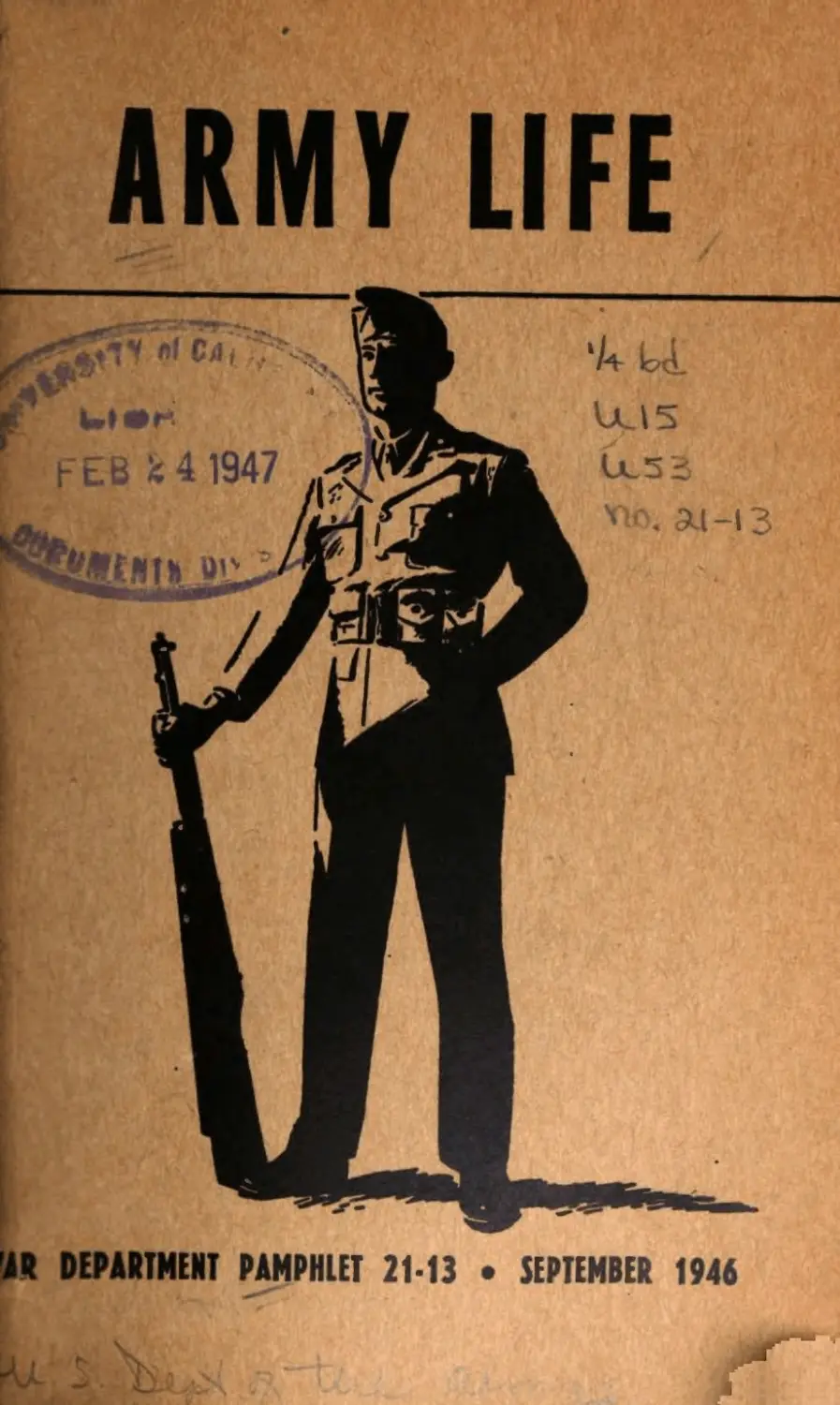
                    ARMY LIFE
К DEPARTMENT PAMPHLET 21-13 • SEPTEMBER 1946
W A R DEPARTMENT PAMPHLET
21—13
This pamphlet supersedes WD Pamphlet 21-13, 10 August 1944.
ARMY LIFE
WAR DEPARTMENT
SEPTEMBER 1946
United States Government Printing Office
Washington: 1946
WAR DEPARTMENT
Washington 25, D. C., 16 September 1946
War Department Pamphlet 21-13, Army Life,
is published for the information and guidance of
all concerned.
[AG 461 (7 Jun 45)]
By order of the Secretary of War:
Official:	DWIGHT D. EISENHOWER
Chief of Staff
EDWARD F. WITSELL
Major General
The Adjutant General
Distribution :
MDW(IO); RC(3000) (one (1) per indi-
vidual upon induction); Ind Dis (10);
A (10); No oversea distribution.
For explanation of distribution formula,
see FM 21-6.
MEMBERS OF THE ARMY
OF THE UNITED STATES
I am glad to have the opportunity of welcoming
you into the Army of the United States. Our’s
is a proud Army. This pride has developed not
only through victory in war but also through the
manner in which the members of the Army have
conducted themselves over the period of the
years. As a new member of the Army you are
expected to act to bring credit to the service,
maintaining the traditions established by the
soldiers who have served before you.
This booklet, Army Life, has been prepared to
help you off to a good start. It will provide the
answers to most of your current questions includ-
ing information as to how the Army expects you
to conduct yourself.
You will find that the same traits of character
such as dependability, honesty, and initiative that
make for successful living in civil life are equally
important in the Army. I hope that the experi-
ences and friendships you will have in the Army
will be of great value to you in the years to come.
DWIGHT D. EISENHOWER
Chief of Staff
iii
CONTENTS
Chapter I. ITS A NEW LIFE.
Page
You Have a Place in This Army
Know-How Is a Help.................................. 2
This Booklet's Part...........................   2
Use Your Head................................... 3
Don’t Worry the Folks at Home................... 4
You Make Your Own Morale........................ 5
Face the Facts.................................. 6
Training Comes Before Fighting
Training Makes the Difference....................... 9
Training Is a Two-Way Proposition............... 10
Know Your Training Tools........................ 11
Technical Manuals and Field Manuals....	11
Army Regulations............................ 11
Training Circulars and War Department
Circulars ........................... 13
War Department Pamphlets.................... 13
Technical Bulletins and Supply Bulletins. .	13
Learn the Army’s Language....................... 13
Understand the 24-Hour “Army Time” System
“Army Time” Is Your Time............................ 14
Privileges Are Part of This Life
Letters Mean h Lot................................. 15
Letters Are Mailed Free........................ 16
Railroad Tickets Are Cheaper................... 17
Theaters, Hotels, Reduce Rates................. 17
Other Privileges............................... 17
You're the World's Best-Paid Soldier
Ratings Bring Higher Pay........................... 18
iv
Pats
Table of Basic Monthly Pay.................... 19
Some Soldiers Earn Extra Pay.................. 19
Some Draw Allowances.......................... 20
Travel Pay Is Allowed......................... 20
“Stoppages” Are Deductions.................... 20
Signing the Pay Roll.......................... 21
The Army Assists in Private Affairs
Allotments of Pay (Class E)....................... 22
Family Allowances Provide for Dependents. .	23
Table A, Schedule of Initial Family Allowances 26
Table B, Schedule of Monthly Family Allow-
ances and Deductions.......................... 27
Insurance Is Inexpensive...................... 28
Savings Facilities Are Provided....... ....... 29
Bonds—An Investment in America and in Your
Own Future ................................ 30
You Can Obtain Legal Advice and Assistance .	31
You May Need a Will........................... 31
You May Need a Power of Attorney.............. 33
The Civil Relief Act May Benefit You........	34
You Don’t Pay Income Tax on Service Pay .	34
Emergency Medical Care Is Given Dependents 35
Maternity Care Is Provided.................... 35
Chapter 2. TIME ON YOUR HANDS.
Get Away from It All!
Furloughs Are Major Vacations..................... 36
Passes Allow Short Leaves..................... 38
Permanent Passes May Be Earned................ 39
Emergency Furloughs Are Sometimes Granted 39
Furloughs May Be Extended..................... 40
Emergency Sickness While On Furlough........	40
Civilian Agencies Serve You
The USO Unites Many Groups........................ 43
The Red Cross Links You with Home............. 44
Other Agencies Offer Specific Services......	45
Page
You’re A Soldier—Wherever You Go
Soldiers Are Subject to Civil Law.......... 46
You Are Judged by Your Appearance.......... 47
You Suffer for Others* Misconduct.......... 47
Be Wary Away from the Post................. 48
Understand Oversea Veterans................ 49
Men of Other Services Are Friendly......... 49
The Women’s Army Corps Is Part of Your
Army ..................................... 60
Use Your Off-Duty Hours Well
Entertainment Is Arranged................... 53
Go to the Movies........................... 53
Service Clubs Offer Added Facilities......	53
The Day Room Is Your Club Room............. 54
The “PX” Provides Handy Shopping........... 54
Visitors May Use Guest House............... 55
Religion Helps You Face Hard Duty.......... 55
Athletics Keep You Alert................... 56
Chapter 3. YOUR PERSONAL WELFARE.
Group Living Can Be a Good Life
Learn by Living with Others................. 58
Teamwork Wins.............................. 59
Companionship Has a Price.................. 60
Some Good Rules of Conduct................. 61
Goldbricking Doesn’t Pay................... 61
Get Ahead Honestly......................... 62
Beware of Rumors!.......................... 62
Homesickness Isn’t Incurable............... 63
Most of All, You’re On Your Own............ 64
Food Is Ammunition—Use It Carefully
Rations Vary According to Use............... 67
“Take All You Want—Want All You Take!” 70
Fighting Men Need a Fighting Diet.......... 71
vi
Page
Protect Your Own Health
Do Your Part....................................... 72
Personal Hygiene .............................. 73
Sick Call Comes Every Day................. 73
Early Treatment Is Essential.............. 74
Cleanliness Comes First................... 75
Exercise Makes You Fit.................... 76
Care for Your Teeth....................... 77
Avoid Exposure ........................... 77
Good Habits for Good Health............... 78
Sex............................................ 79
Sex as a Moral Matter..................... 80
Sex as a Physical Matter.................. 80
Sex as a Personal Matter.................. 83
Think for Yourself........................ 84
First Aid Is of First Importance
First, Learn the “Don’ts”.......................... 85
—Then Do These Things.......................... 87
Use the First Aid Packet....................... 88
Read the Manuals............................... 88
Chapter 4. WORKING AS A SOLDIER.
Making the Most of Your Opportunities
“Information” Puts Your Mind to Work.............	89
You Can Enroll in the Armed Forces Institute 90
Specialists’ Schools Are Operating............. 91
Self-Education Is Every Man’s Opportunity. .	92
Plan to Progress Within the Army............... 92
Opportunities for Becoming an Officer........	92
Know the Ranks and Ratings..................... 93
You Can Identify Every Soldier................. 94
Insignia of Grade, U. S. Army.................. 95
Don’t Be a Phony Hero!......................... 99
You Must Know “The School of the Soldier**
Understand the Terms.............................. 100
The Nature of Commands........................ 102
vii
Page
Assume the Position of Attention............ 102
You Join a Formation....... ................ 104
You May Be Given a Rest..................... 105
Actions Are in Cadence...................... 107
Some Commands Are “By the Numbers”.........	107
Facings at a Halt........................... 107
You March at Close Interval................. 110
March Smartly .............................. Ill
Double Time Is Faster Marching.............. Ill
The Formation Changes Direction............. 112
Marches Not at Attention.................... 116
Your Formation Halts........................ 116
The Group “Dresses”......................... 117
The Formation Closes. 4. ................... 117
Study the Regulations....................... 118
Yours Are the Best Arms and Equipment
Handle With Care!............................ 119
Protect Your Weapons........................ 119
Know Your Weapons.........................   120
Your Equipment Is Good and Complete........	120
Typical Arms of the U. S. Army.............. 123
There Will Be Inspections!.................. 128
Wear the Uniform Properly................... 128
Everyone Shares in the Work
You Share the Work........................... 132
Interior Guard:
Its Purpose Is Protection............... 133
Composition of the Guard................ 133
You Start as a Private of the Guard....	134
Memorize Your Guard Orders (General
Orders) .............................. 136
Other Details:
“KP” Is a Necessary Chore................ 137
You Will Have Fatigue Details........... 138
You’ll Hear Police Call................. 138
viii
Chapter 5. UNDERSTAND YOUR ARMY.
Page
How the Army Is Organized
You Get a Fresh Start........................... 139
Yours Is a People’s Army.................... 140
There Are Two Major Commands................ 142
Army Ground Forces...................... 142
Army Air Forces......................... 142
Authority Pyramids to the Top............... 145
Understand Your Own Unit.................... 147
Know Your Chain of Command.................. 149
Make Your Own Unit the Best................. 150
You Live Under a New Law
The Articles of War............................. 154
Company Punishment ......................... 155
Absence Without Leave....................... 155
Desertion ...................................156
Caring for Equipment........................ 156
Misconduct ................................. 157
Military Information ....................... 157
Company Regulations......................... 158
Post Regulations............................ 158
Enforcement................................. 159
What Military Courtesy Means to You
The Salute Has Meaning...................... 160
How to Salute............................... 162
When Not to Salute.......................... 164
When to Salute.............................. 165
Other Things to Know........................ 166
Reporting to an Officer..................... 167
Addressing Military Men..................... 167
Chapter 6. IN THE FUTURE.
Look to Tomorrow!
Don’t Try to Learn It All at Once............... 169
Today’s Training Is Based Directly On Ex-
perience .................................. 170
ix
Page
Your Equipment Gives You an Advantage... .	171
Your Training Makes You Superior............ 172
Marches Will Make You Tough................. 172
Bivouacs Take You Into the Open............. 174
Maneuvers Simulate Combat................... 174
Security Is a Universal Need................ 176
Some Values That You Will Receive........... 177
You'll Be Ready ... If You're Needed
It Takes Preparedness........................ 178
Appendix. Common Military Terms and Abbrevia-
tions	.................................................. 180
Index ....................................................... 192
Personal	Record ........................................... 202
This pamphlet supersedes WD Pamphlet 21-13, 10 August 1944.
CHAPTER 1
ITS A NEW LIFE
YOU HAVE A PLACE
IN THIS ARMY
You are now a member of a large
military organization whose pri-
mary job is to provide protection
for a democratic people who want
peace for the world.
Probably you have conditioned your mind to
self-sacrifice. Yet—at this moment—you may
feel merely lost. You know that you are sharing
common experiences with millions of other men,
many of them much like yourself; yet—right
now—your impressions of the soldier’s life and
work are probably confused.
This is natural. Meeting your Army face-to-
face is an experience full of surprises and nervous
strains.
You are not only confused; you are curious.
You know that all these things have happened
before—but they haven’t happened to уогс before!
You find yourself accepting advice and informa-
tion—from those who know and from those who
i don’t.
I
KNOW-HOW IS A HELP. Will you accept one more
bit of advice? It is this: There is more mental
comfort, more personal satisfaction, in knowing
your place and your part in this Army than in
any other single thing you can now do for your-
self. Be selfish about it, if you like; learn your
job because knowing how to handle yourself will
make you feel better. A knowledge of your duties
and obligations, your rights and opportunities,
will one day make you more valuable to the Army
and your country. That, too, will give you a
personal satisfaction in the long run.
THIS BOOKLET’S PART. These words reach you as
your Army life is beginning. They have been
written by men who have gone through what you
are now experiencing. They are intended to help
you become the finest soldier in the world by
answering many of the questions on your mind,
by putting you at ease in your new surroundings.
Much of the material in this booklet refers to
your basic training. You will want to know
about this as quickly as possible. All of the in-
formation will be valuable to you regardless of
your assignment within the service.
A later section of this booklet tells how the
job to which you will be assigned fits into the
organization of the whole Army. It tells you
what later training to expect. It prepares you to
seek specialized work which you may be able to
do better than others can do it, and which you
will enjoy doing. It is the groundwork for ad-
vancement in rank and responsibility.
2
Ask questions in class; they help others as well as you.
Before you concern yourself with* those things,
however, it is wise to adapt your ideas, your
hopes, your personality to Army life. Learning
how to live companionably and comfortably
among your fellow soldiers is the first part of
your job.
USE YOUR HEAD. You may feel that in many small
matters the Army does your thinking for you. It
tells you what to wear, when to eat, how to turn
around. There are obvious reasons for this.
Don’t misinterpret them.
In the broad sense, this Army has a great
respect for your mind. The advanced training
techniques, the opportunities for specialists, the
provisions for self-education and recreation are
examples of this fact. This booklet, as a matter
of fact, is evidence that the Army recognizes your
right to wonder and to know.
You, too, must respect your own mind. Don’t
з
sit back and stop thinking simply because you
will have food and a place to sleep anyway. Ask
questions—some day the answers may save your
life. Take advantage of all the ways of learning
that are available—you can earn promotions.
Use the fcilities for relaxation—they keep you
bright and alert.
Above all, let your mind rule your feelings. If
you hear rumors (and you will!), reason it out
that whatever affects you also affects the Army—
so that nothing too bad for you will be allowed
to happen. If you are given orders which seem
not to make sense, remember that they are issued
by persons who have more information at hand
than you have.
DON’T WORRY THE FOLKS AT HOME. You realize,
of course, that all those who love you are worried
about you—not so much because of anything
specific, but because you are away from home and
their watchful care. Nothing is gained if you
write or tell these loved ones that you are endur-
ing unspeakable hardships, or undergoing a
training program that would tax Superman. If
you try to get sympathy for yourself by concoct-
ing such tales, you will be doing it at the cost of a
great deal of worry at home. Tell your folks at
home the truth about your life; don’t dwell on
the hard side of things nor the uncertainties of
the future. They’ll be interested in your accom-
plishments, your work, your fun. Give them a
chance to be proud of their soldier.
YOU MAKE YOUR OWN MORALE. When a soldier
thinks about himself, he may say that he feels
pretty good or that he likes his job; when anyone
else thinks about him, the word “morale” is sure
to come up. Let’s dispose of that confusing word
once and for all.
According to one humorous book on Army life,
soldiers’ morale is something civilians talk about.
Certainly soldiers talk less about it. They know
what it is and they know how good it is; they
don’t have to talk.
New soldiers soon learn that good morale isn’t
just made of girls to dance with at the USO. nor
of uniforms that fit, nor even of letters from
home. All these things which remind soldiers
that they have the respect, concern, and best
efforts of the folks at home and of Army authority
are but one side of the picture.
Good morale is also the product of just being
a good soldier. As you share experiences and
hardships with other soldiers, you earn a right
to that quiet pride which is part of every fighting
man’s personal strength. This is a pride which
comes of having gotten through, when the going
was tough.
There is more to good morale. It comes from
knowing that you are in an Army which has never
lost a war. It comes from belonging to the
company with the squarest commanding officer
who ever lived; to the platoon with the drill
award to its credit; to the squad with the greatest
guys in the world.
Good morale comes from knowing that what
5
you are doing is worth while. It is studying the
manuals when your time is your own; staying
in formation» when your every muscle aches;
facing danger when your every instinct says,
“Go back!” Morale isn’t just feeling good; it’s
what you learn the hard way.
Good morale comes from confidence—in your
training, in your weapons, in your leaders.' It is
knowing that you know your job thoroughly and
that you are a better fighting man than your
enemy.
Good morale is contagious. When you have it,
your buddies have it. It keeps them working and
training as you do; it will keep them fighting at
your side—if your life depends on them. When
you know that you and Jack and Harry might
face death together and won’t let each other
down—then, soldier, you’ve got gob<J morale!
FACE THE FACTS. As you read this you may be
wondering why this is happening to you—why
you’re in uniform. We’ve seen the cost of unpre-
paredness. We paid in lives and money for our
lack of training when the war was brought to
our door. If we are to have peace, we must be
prepared to maintain it.
While you have time, think what freedom
means. Think over the fact that America stands
for more than the highest standard of living in
the world—it stands for the highest level of free-
dom that men have ever known.
Maybe the Army seems like a strange place
to talk about freedom. Actually, there couldn’t
6
be a better place. Certainly . . . you give up
many things and learn, perhaps for the first time
in your life, to take orders from another man.
But your present job is to learn how to protect
and defend that freedom.
Soldier, it’s up to you! You’ve got many inter-
esting and exciting times ahead of you. It will
be hard work . , , . but it will also be fun if
taken in the right spirit. Be proud to be a soldier
in the best Army in the world . . . the United
States Army in the grandest country in the world.
703881—46—2
7
TRAINING COMES BEFORE
FIGHTING
ЪтттИ Y°u know that before your Army
И fill Hfe is over you’ll find yourself in
i	some tough situations and that
you'll have to make some hard
decisions. You realize that unless you get off to
a good start you may never get in step.
That’s the right way to look at it. Begin at the
beginning. And the beginning is your training.
Think of it in this way—
Learning how to fight is now your business.
It is a strange one to most of us. Things we don’t
understand are disturbing, so you may be dis-
turbed about whether you will be ready and able
to fight if you have to. This is every soldier’s
personal problem. You have thought about it, of
course; perhaps you have worried about it.
Have you been hiding some very dark thoughts
about yourself from everyone? Have you called
yourself a coward? Are you afraid you won’t be
strong enough to carry through the fight? Have
you worried that you might “crack up”?
The best way to beat a problem is to bring it
into the open. Think clearly about any fears you
may have. Consider how you might overcome
them. There is one factor more important than
any other in overcoming fear. It is training.
TRAINING MAKES THE DIFFERENCE. Skill, not
muscle alone, makes a champion in the ring. It
also makes the soldier who wins.
If you have never been much of a fighter, it has
probably been because you didn’t see anything
worth fighting about or because there are better
ways to settle most disputes. Even if you have
avoided fights because every time you opened
your mouth you seemed to find somebody’s fist
in it, you’re not necessarily afraid to fight. Any
reasonably intelligent person stays away from
fights he knows he is likely to lose. When some-
thing happens so that you have to fight, the thing
to do is to learn кого to fight. Knowledge and
training build confidence and skill. These dispel
fear.
You must take your training seriously. Train-
ing will make you—as an individual—able to win
your fights. Give it your best. If you do, you
will find that you can do a lot of things you didn’t
know you could do. You will see reasons why you
can do them better than any enemy could—rea-
sons ranging from the better food you eat and
the better rifle you fire to your own capacity for
learning.
In developing your own abilities, you will over-
come the fear of fighting which comes of not
knowing how to fight. Beyond that, you will find
a deeper strength in knowing that you can rely
on your equipment and supplies, on the battle
tactics planned for you, on the fellows who are
your buddies and allies.
9
TRAINING IS A TWO-WAY PROPOSITION. Good
soldiers aren’t born; they’re made.
Men function effectively as members of a group
because they have learned to—usually the hard
way. Some men learn more rapidly than others
do, but Army training is so carefully planned
and standardized that, no matter how much or
how little schooling you have had, you can become
a good soldier.
Right at the beginning you must understand
that training is a two-way proposition: the first
part is teaching; the second, learning. Your in-
structors can’t do all the work; they can’t make
you learn. They will prepare lessons carefully.
You must contribute just as much. Study before
your classes and afterwards. Review in your
mind what you have been told. Read available
manuals. Discuss points of the lessons with
other fellows in your classes.
The second thing which you must never forget
Study—Your instructors can’t do it all.
10
is that if you don't learn, YOU WILL BE THE
LOSER. You can loaf while others earn promo-
tions. You can go on feeling insecure while
others develop self-confidence through know-how.
The Army will go ahead anyway. But if you
don’t learn now, you zvon't be among the winners.
KNOW YOUR TRAINING TOOLS. While your in-
structor is your closest source of information you
must learn to use other sources. The Army pro-
vides a book or booklet on almost every part of
your training. Ask your first sergeant to lend
or issue you the appropriate one.
You will want to see most often the Field
Manuals and Technical Manuals. Some of the
Field Manuals contain training information for a
particular arm or service such as the Field Ar-
tillery or the Signal Corps. Others are “basic”
Field Manuals for troops of all services such as
FM 23-5, on the Ml rifle. The Technical Manuals
give detailed information on every weapon and
piece of equipment.
Manuals and other training publications are
listed in FM 21-6. The Army’s training films,
film strips, and film- bulletins are listed in FM
21-7. Charts, posters, and similar training aids
are listed in FM 21-8. Learn to ask for them by
number.
The final authority for everything in the Army
is contained in the Army Regulations, or “AR’s.”
These are the rules by which the Army governs
itself. A regulation covers practically everything
you may do or experience in Army life. To find
и
8 ManUaI Or а« Army ReguJation .s
ТМ 9-1322
TECHNICAL MANUAL
ISONNtt ONLY
OMI»>AX F MAiNTENAMX
3-1NC1I <;CN MS AND
3-INCH Gt N CARRIAGE Ml
д/?Л/у
IK МГТКММЕЖ 1941
You ll use these
three types
of Army
publications.
12
revised, “Changes” are issued. For example, the
first alteration in AR 35-5540 would be known as
“AR 35-5540, Changes No. 1.” The letter “C”
is sometimes used as an abreviation of the word
“Changes.” Later on, the AR is reprinted in
corrected form.
In order to keep its information and rules up-
to-date, the Army publishes numbered leaflets
which are known as Training Circulars (TC’s)
and War Department Circulars (referred to in
print as “WD Cir”). These present later informa-
tion and directives, or new information not yet
covered in manuals.
Much information which the Army wants to
give its men does not exactly fit into the publica-
tions already listed. This is printed in War
Department Pamphlets (numbered just like
manuals). You are now reading a War Depart-
ment Pamphlet.
There are other special means of giving you
Army information, such as Technical Bulletins
and Supply Bulletins on specialized subjects.
These publications are explained in FM 21-6. An
understanding of the publications listed above
will make it possible for you to improve your
training and to be a more successful soldier.
LEARN THE ARMY’S LANGUAGE. Just as many
businesses and professions have special terms
which best describe their tools and methods of
operation, so has the Army a special language of
its own. Commonly-used words such as “pass,”
“ration,” and “detail” have specific and exact
13
meanings.in the Army. You will get along more
comfortably in your work if you learn to use the
Army’s own words.
A list of common military words and expres-
sions is included as an appendix. TM 20-205 will
give you a more complete listing.
UNDERSTAND THE 24-HOUR
"ARMY TIME" SYSTEM
FROM MIDNIGHT TO NOON FROM NOON TO MIDNIGHT
•’ARMY TIME” IS YOUR TIME. You will see and
hear references to hours of the day in “Army
time.” This is a way of expressing time in four
digits, of which the first two refer to the hour
and the last two to minutes; the system works on
a 24-hour basis, so that there is no “AM” or “PM.”
For the first 12 hours of the day, Army time is
very similar to the system you know. For ex-
ample, 1 hour after midnight is 0100; 30 minutes
later, it is 0130; 5 minutes after that, it is 0135,
and so on to 1200, which is noon. The first hour
after noon is 1300, the next, 1400, and so on to
2400, which is midnight. Learn to use this system
of time and use it exclusively.
PRIVILEGES ARE PART
OF THIS LIFE
When you wear the uniform of the
Army of the United States, you can
benefit by special privileges. These
stem from the respect and concern
of the people for whom you serve. Don’t abuse
your position, either by expecting too many favors
or by being ungrateful for those extended.
LETTERS MEAN A LOT. This Army is pretty human;
it knows that letters will mean a great deal to
you. It not only provides many places around
camps where they may be written; it delivers
your mail as promptly as possible.
At the same time the Army asks you to be
careful to whom you write and what you say. As
time goes on, you will learn many details of mili-
tary activities such as troop movements, new
weapons and other things. Don’t write about
such matters. The Army has a Bureau of Public
Relations that releases information of this type
when it is known that it does not harm the Army
or the country. The types of military information
which the Army desires to be safeguarded are
listed in AR 380-5. In general, you can expect
to be advised by your noncommissioned officer or
4 officers if certain information is to be safe-
guarded.
15
LETTERS ARE MAILED FREE. One of your privileges
as a soldier is mailing without postage your per-
sonal letters and post cards. Include your name,
grade, rank, serial number, and organization in
the return address in the upper left-hand corner
Fill out f tee-mail envelopes completely, as shown.
of your envelope or post card; the word “Free”
must appear in the upper right-hand corner in
your own handwriting.
Free mailing does not apply to letters sent to
you, except, of course, those sent by other mem-
bers of the armed forces. It does not apply to
letters written by your wife or relatives. Also,
when you send the following types of mail, you
have to pay the regular postage: air, registered,
insured, or c.o.d. mail; newspapers, magazines or
books, printed folders or cards larger than or-
dinary post cards, wedding invitations or an-
nouncements of any kind; merchandise.
16
RAILROAD TICKETS ARE CHEAPER. When you are
traveling at your own expense—as on a furlough
—you are entitled to a special second-class rail-
road rate of 114 cents per mile. This is a
considerable saving; be sure to ask for a “Fur-
lough ticket.” This rate applies only to round-trip
tickets and entitles you to coach or chair-car
accomodations only. You will have to pay full
fare for both one-way and first-class Pullman
tickets.
THEATERS, HOTELS REDUCE RATES. If you stay in
a hotel, you should ask whether it has a special
rate for service men; many of them reduce their
regular rate by 20 percent or more for men in
uniform. Many theaters and motion picture
houses offer soldiers good seats at cut prices. Rate
reductions take many forms, from free use of
toll bridges to lower taxi fares.
OTHER PRIVILEGES. Other types of privileges are
mentioned elsewhere in this booklet. These range
from food and lodging for yourself at the USO,
to free medical and dental care for your family.
17
YOU’RE THE WORLD’S
BEST-PAID SOLDIER
Army pay must be thought of at all
times in terms of the extras which
go with it. Not only are America’s
fighting men among the best paid,
but they receive the best living quarters available,
good clothing and excellent food, medical and
dental care, certain tax exemptions, allowances
for dependents, debt relief, and free entertain-
ment and recreation.
In these terms, many soldiers are better paid
than they were as civilians. You can be prac-
tically certain that you will receive enough actual
cash to take care of all essentials, and that you’ll
have some left over for extras to make life more
pleasant.
RATINGS BRING HIGHER PAY. As an inductee,
you are an enlisted man, seventh grade. If you
devote yourself to your work and demonstrate to
your unit commander that he can always depend
upon you, you can advance to a higher grade, with
higher monthly base pay, as shown in the table on
the next page.
я
TABLE OF BASIC MONTHLY PAY

FIRST GRADE	Q		MASTER SERGEANT AND FIRST SERGEANT		$165.00
SECOND GRADE	6	h 1	TECHNICAL SERGEANT.	._	135.00
THIRD GRADE			STAFF SERGEANT AND TECHNICIAN THIRD GRADE	115.00
FOURTH GRADE			SERGEANT AND TECHNICIAN FOURTH GRADE	100.00
FIFTH GRADE			CORPORAL AND TECHNICIAN FIFTH GRADE..	90.00
SIXTH GRADE			PRIVATE, FIRST CLASS		80.00
SEVENTH GRADE			PRIVATE					75.00
SOME SOLDIERS EARN EXTRA PAY. For every 3
years you spend in the service, your base pay is
increased 5 percent. This is known as “longevity
pay?’
If you are awarded the Congressional Medal
of Honor, the Distinguished Service Cross, the
Distinguished Service Medal, the Distinguished
Flying Cross, or the Soldier’s Medal, you receive
an additional $2 per month from the date of your
act of heroism or extraordinary achievement.
Each additional citation awarded in lieu of an-
other medal brings an additional $2 per month.
The combat infantry badge entitles its wearer to
an additional $10 per month, the expert infantry
badge to $5 per month, and the medical badge to
$10 per month.
19
If you are in the Air Corps and are taking
regular and frequent flights, you will receive
additional pay amounting to 50 percent of your
total base pay, longevity, and foreign service pay,
and any awards carrying compensation.
If you are a jumper in a parachute unit, either
as a rated parachutist or as a student undergoing
jump training, and are not on a flight-pay status,
you will receive additional pay of $50 per month.
Any enlisted man not in an aviation or parachute-
jumping pay status, who is required to participate
in regular and frequent glider flights may receive
tip to $50 per month additional pay.
For foreign service, including Alaska, your
base pay is increased 20 percent.
SOME DRAW ALLOWANCES. Soldiers on special
assignments which make it impossible for them
to eat at Army messes are given ration allow-
ances. Men of the first three grades who choose
to eat away from the post are given a monetary
ration allowance; they may eat on the post, how-
ever, by paying for each meal.
TRAVEL PAY IS ALLOWED. If you are transferred
on special orders and not as a member of a group
in the charge of an officer, you will be given a
travel order which you can exchange for a ticket.
You will also be given meal tickets or an allow-
ance in cash for meals.
“STOPPAGES" ARE DEDUCTIONS. A “stoppage” of
your Army pay is a legal deduction. Stoppages
о
are entered on the pay roll, and you can verify
the amounts of your stoppages when you sign the
pay roll.
The most common stoppages are deductions
for laundry service and for the value of arms,
equipment, or other Government property lost or
destroyed through abuse or negligence, or for the
cost of repairs of damages to such property.
Forfeitures of pay through action by court
martial are another example of pay stoppages.
SIGNING THE PAY ROLL. You must sign the pay
roll each month in order to get paid. Your first
sergeant will inform you when to sign it. If you
fail to sign the pay roll or sign it incorrectly, you
will be “red lined,” which means that your name
is crossed off the pay roll. In such a case, you will
not be paid at the regular time, which normally
is the last day of the month, but will have to wait
until a supplementary pay roll is prepared at a
later date.
21
THE ARMY ASSISTS
IN PRIVATE AFFAIRS
It is imperative that you arrange
your personal affairs at once. Pro-
vide for the welfare, protection,
and security of your dependents;
make sure that they understand fully and receive
all the rights and benefits to- which they are en-
titled. If you have not yet arranged for the
management and disposition of your property, do
so immediately.
In putting your private affairs in shape you
can obtain help from your company commander
and the personal affairs officer or the legal
assistance officer at your post, camp, or station.
The personal affairs officer will assist you or your
dependents with information and guidance con-
cerning your nonlegal personal problems, the
rights and privileges to which you may be en-
titled, and the proper agency or organization
through which you may secure these rights. The
legal assistance officer (a lawyer in the military
service) will help you with your legal problems.
Members of The Judge Advocate General’s De-
partment also assist with personal legal problems.
ALLOTMENTS OF PAY (CLASS E). A class E allot-
ment is a definite portion of your pay which you
22
authorize to be paid to another person or to an
institution, in a prescribed manner. (Do not
confuse allotments with allowances. Allotments
are purely voluntary on your part, and may be
discontinued at any time you desire.)
You may allot as much of your pay as you wish
(including extras), provided that after all deduc-
tions you will not receive less than $10 per
month yourself, or such other amount as your
commanding officer may consider necessary for
your essential personal needs. Aviation pay and
parachute pay may not be included in the amount
which you voluntarily allot, but may be allotted
to your dependents by the War Department if you
are officially reported as missing.
The authorized purposes for which you may
make an allotment are: the support of depend-
ents (money to be paid directly to them or to a
bank within the United States); life insurance
premiums; savings (including checking ac-
counts) ; war bonds.
In wartime, in the event of your capture by the
enemy, the payment of allotments in force will
continue as long as you are a prisoner of war.
If you are listed “missing in action,” allotments
will be continued until the War Department has
evidence of your death or until you return to its
jurisdiction. Thus the desirability of making
allotments is apparent.
FAMILY ALLOWANCES PROVIDE FOR DEPENDENTS.
Under the Servicemen’s Dependents’ Allowance
Act of 1942, as amended by the Act of 26 October
703881—46—8
23
1943, you may be entitled to a monthly allowance
for certain relatives. Your wife and children are
eligible for a family allowance whether they are
dependent upon you or not. A former wife,
divorced and not remarried, to whom alimony has
been decreed and is still payable, is also eligible.
A grandchild is eligible on the same basis as a
child if you have taken the place of a parent for
at least a year.
Parents,, step parents, brothers, and sisters are
eligible if they are dependent upon you for either
their chief support or a substantial portion of
their support. However, if payment is made to
an individual who is dependent upon you for chief
support, then no payment may be made to other
individuals in this group of relatives dependent
upon you for only a substantial portion of their
support.
Common-law wives are eligible for allowances
if the common-law marriage is recognized as a
valid marriage in the State in which the relation-
ship was entered into. Illegitimate children are
eligible when paternity is acknowledged in writ-
ing by the soldier or when the soldier has been
declared father of the child by the court or
ordered to contribute to the child’s support.
Family allowances fall into three categories—
class A, which covers your wife and children, or
a divorced wife who has not remarried and to
whom alimony has been decreed and is still pay-
able; class B, which covers your parents,
brothers, and sisters if they are dependent upon
you for a substantial portion of their support;
24
and class B-l, which covers your parents,
brothers, and sisters if they are dependent upon
you for the chief portion of their support. There
are two types of these allowances—the initial
allowances, paid for your first month in service,
and the monthly allowances, paid regularly for
each later month of your service.
If you apply within 15 days of your entry into
the service for the initial family allowances and
fulfill the required conditions, the Government
will pay to class A, or class B-l dependents the
allowances shown in table A, without deduction
from your pay. IF AN INITIAL FAMILY AL-
LOWANCE IS PAID YOU WILL NOT RE-
CEIVE THE MONTHLY ALLOWANCE FOR
THAT SAME MONTH. If you apply for the
initial allowance and your application for a
monthly allowance is approved, the monthly al-
lowance will commence the first of the month
following your entry into the service.
For thd regular monthly allowance for depend-
ents, a certain amount is deducted from your
pay, and to this the Government adds a contribu-
tion whose size is determined by the type and
number of your dependents. These allowances
are shown in table B.
If anything about these tables is not clear, your
first sergeant or finance officer will explain them
to you, or you can consult AR 35-5540. These
are some of the things about which soldiers in-
quire most often:
An application for a family allowance may be
filed in behalf of a class A dependent by the
25
Table A.	Schedule of Initial
Family Allowances
Closes of dependents	RATES (For month of entry only)
Class A r	Wife; no child		$50

Va	Wife; 1 child 		80
Л P’
$20 ^ог each additional child		20
£ No wife; 1 child 		42
$20 for each additional child		20
Class B-l Ц	One parent 	.		50
Ал Two parents or 1 parent, 1 brother jr	or sister 		68
A	$11 for each additional brother or sister		11
No parent, 1 brother or sister .......	42
$11 for each additional brother or If sister 		11
26
Table В.	Schedule of Monthly Family
Allowances and Deductions
Classes of deductions	Govern- ment contri- bution	Deduc- tion from pay of enlisted man	Total paid to depend- ent(s)
Claes A (compulsory upon applica- tion) . ф	Wife, no child . 		$28	$22	$50
Wife, one child 		58	22	80
$20 for each additional child	20
No wife, one child		20	22	42
$20 for each additional child	20
Divorced wife (alimony payable). Allowance not л	to exceed amount of ali- 9	топу fixed by court .	|	l 20	22	42.
Divorced wife, one child . . |	50	22	72
ффф $20 for each additional child	20		• •
Class В (Optional when dependency proved) With no class A or class B-l: A Parents, brothers, sisters (any  number) 		15	22	37
Monthly allowances
Cla.88 B-l (Optional when depend- ency proved) With no class A. w		same as initial al- lowances for Class B-l. Deduction from enlisted man’s pay is $22 in each case.
Combination of classes A and В or A and B-l: » 		Allowances same as stated above. De- duction from en- listed man’s pay is $27.
27
soldier, the dependent, or someone acting for the
dependent. Applications for family allowances
for class В and class B-l dependents may also be
filed by the soldier, the dependent, or someone
acting for the dependent; but these allowances
will not be granted or paid unless the soldier
consents to the payment. The dependency of class
В and class B-l dependents is established by
filling out a certificate of dependency WD AGO
Form 620 (certificate to be completed by all adult
individuals living in one household claiming
dependency on enlisted man in Army).
You may have both class A and class В or B-l
allowances for your family. For instance, if you
have a wife and one child, a mother who is de-
pendent upon you for the chief portion of her
support, and two sisters who are dependent upon
you for a substantial portion of their support, the
Government would pay them a total of $130. This
would be based upon the rate of $80 for the wife
and one child (class A dependents) and $50 for
the mother (class B-l dependent). No additional
money would be paid for the sisters (class В
dependents) when allowances are paid to the
mother. You would contribute $27 from your
pay and the Government would contribute the
rest.
INSURANCE IS INEXPENSIVE. You are eligible for
National Service Life Insurance in amounts from
$1,000 to $10,000 in multiples of $500.
This insurance is less expensive than any other
insurance available. It is easy to obtain, and
28
payment is made simply by an allotment from
your pay. It provides the easiest and surest way
of providing for the future of your dependents in
the event of your death. You won’t even have to
take an examination if you apply within the first
120 days of your service; after that time, an
examination is required.
This insurance is issued under the 5-year level-
premium plan and is payable only upon the death
of the insured. It may be converted to other
forms after it has been in effect for 1 year. After
5 years the policy ceases unless converted to an-
other form which you can carry on as a civilian.
On policies issued on or before 31 December
1945, a 3-year extension has been authorized.
The advantages of carrying the cheapest pos-
sible life insurance of a type specifically designed
for soldiers are too obvious to require elaboration.
Don’t fail to take advantage of this protection
for your dependents.
SAVINGS FACILITIES ARE PROVIDED. In the Army
you need spend very little cash for ordinary living
expenses. Chances are you will have something
left out of each month’s pay. It’s only common
sense that if you begin now to save as much of
that balance as you can, you will eventually have
a mighty useful nest egg. You can understand,
too, that if you have some cash of your own you
will be able to get off to a much better start in
civilian life.
That is why the Army makes it as easy as
possible for you to save money. One of these
29
handy services is called “Soldiers’ Deposits.’*
(See AR 35-2600.) It is very much like an or-
dinary savings bank account. Here’s how it
works: You can deposit any amount from $5 up
with your disbursing officer. Amounts left on
deposit for 6 months draw interest of 4 percent
from the date of deposit until date of withdrawal
or until you leave the service. A deposit book is
issued in your name and you can make with-
drawals for good reason.
The Government is responsible for your money.
It cannot be used to satisfy legal judgments which
may be made against you. A deserter forfeits
his deposit and interest.
All you have to do to make a Soldiers’ Deposit
is to give notice to your first sergeant, who will
attend to the necessary details.
BONDS—AN INVESTMENT IN AMERICA AND IN
YOUR OWN FUTURE. The amount of money you
save while you serve in the army is an entirely
personal matter. No one is going to force you to
be thrifty. But bear this in mind: when your
army service is completed, you will probably need
some money to help you get reestablished in
civilian life. One way to accumulate this nest
egg—a way that many soldiers have adopted—is
to buy bonds.
For members of the armed forces there is a
special GI bond which is issued in $10 denomi-
nations at a purchase price of $7.50. Under the
class В allotment plan you can buy one or more
a month out of your pay. Of course, you can
30
buy bonds of larger denominations if you prefer,
but monthly deductions from your pay must
correspond to the full purchase price of one or
more bonds. You cannot make partial or install-
ment payments.
The soldier with foresight takes advantage of
the pay roll deduction method of purchasing
bonds. He knows that when he buys bonds he
makes a sound investment—one which helps his
Government and helps himself.
YOU CAN OBTAIN LEGAL ADVICE AND ASSIST-
ANCE. At most posts, camps, and stations in the
United States and at many oversea installations
you will find legal assistance officers. These men
are lawyers in the military service whose job is
to help you. Feel free to call upon them for help
in any personal legal matter.
These officers can handle most cases which do
not require court action. If, however, your case
does involve court appearances or the services of
a civilian lawyer, your legal assistance officer
knows how to help you get civilian counsel. This
legal advice and assistance is available to your
dependents also.
YOU MAY NEED A WILL. You are the best judge
of the question, “Do I need a ^11?” If you own
property or are in a financial position which
makes a will advisable, consult your lawyer or
your legal assistance officer about making a will.
When a person dies without a will, his property
ordinarily is distributed in accordance with the
3'
appropriate State laws. Unless you are sure
that the State laws which would apply in your
case would meet your wishes, it is only common
sense to make your own will.
If you already have a will, go over it to see
that it expresses your present wishes. You need
a new will if a person named in the old will has
died, you have changed your legal residence, there
has been a substantial change in your financial
position, or witnesses to your will have died or
otherwise become unavailable. A new will may
be advisable if you have been divorced, married,
had a new child born, or have adopted a child.
Every will should be made or changed with the
advice of a lawyer so that it will fit your wishes
and meet local requirements. However, an
emergency may arise in which it becomes neces-
sary to make a new will or change an old one and
no lawyer is available. In such a case you can
use the form of will given in section XI, WD
Pamphlet 21-5.
If that pamphlet is not available, write a simple
statement in your own handwriting of how you
want your property to be distributed. Here is an
example: “This is my will. I give $100 to my
brother John Doe of 111 Z Street, New York,
N. Y. I give all the rest of my property to my
wife Jane Doe of*222 X Street, New York, N. Y.”
Date and sign your name at the bottom of this
statement before three friends whom you have
asked to act as witnesses to your will. They then
sign their names, permanent home addresses, and
Army serial numbers (if any) below your sig-
32
nature. Your will must be dated and signed by
you in the presence of all the witnesses assembled
together and then immediately signed by each of
them at that time in the presence of you and one
another. Since the witnesses may some day have
to appear in court, it is advisable that you choose
persons who live near the place where the will
is to be filed for probate, if such choice is possible.
This should be regarded only as a temporary will
and you should replace it with a more carefully
drawn will as soon as time and circumstances
permit.
Any will you make should be kept in a safe
place or perhaps mailed to your home or to a
trusted friend. If you wish, you can mail it to
The Adjutant General for safekeeping. To do
this, place the will in an envelope, seal it, and
write on the outside, “Will of.......................
(Your name)
Army serial number................to be delivered to
(Name and address of person to whom you wish
.....................................in case of my
the will delivered)
death/’ Place the envelope containing the will in
another envelope addressed to The Adjutant Gen-
eral, United States Army, Washington 25, D. C.
YOU MAY NEED A POWER OF ATTORNEY. A situ-
ation may arise in which it becomes necessary to
have someone who can act for you in regard to
your property and affairs at times when you are
33
not accessible. You can grant another person the
authority to act for you through a legal document
known as a “power of attorney.” Grant such
authority only to someone in whom you have
complete trust and confidence. Because the State
laws regarding powers of attorney vary greatly,
you should see your lawyer or legal assistance
officer for advice in preparing and executing any
power of attorney.
THE CIVIL RELIEF ACT MAY BENEFIT YOU. The Sol-
diers’ and Sailors’ Civil Relief Act of 1940, as
amended, protects your civil legal rights while you
are in military service. There is nothing in this
act which relieves you from payment of debts or
other obligations. But in certain cases it does
give you temporary relief. In general, if you are
unable to pay premiums on commercial insurance
policies, to pay taxes, or to perform obligations
with reference to rights and claims to public
lands, you may obtain relief under this act. In
some cases, leases made before you entered serv-
ice may be terminated. If you have any problems
of this sort, your legal assistance officer can tell
you how the provisions of this act apply to you.
YOU DON’T PAY INCOME TAX ON SERVICE PAY.
Enlisted men and warrant officers do not have to
pay an income tax on their service pay. You do
not have to file income tax returns for this pay.
If, however, you have outside sources of income,
the usual tax laws will apply to that portion of
your income which is not classed as “compensa-
34
tion received for active service in the military
forces.”
EMERGENCY MEDICAL CARE IS GIVEN DEPEND-
ENTS. The Army offers medical and hospital care
in cases of emergency illnesses to the dependents
of men in service. However, dependents may be
admitted to Army hospitals only when beds are
not required for military personnel. Under nor-
mal conditions your dependents will be able to
obtain treatment if an emergency arises. Dental
treatment is given to dependents in emergency
cases when facilities are available.
MATERNITY CARE IS PROVIDED. Wives and babies
of enlisted men of the fourth, fifth, sixth, and
seventh grades and of Army aviation cadets can
obtain maternity and infant care without cost.
This service provides medical, nursing, and hos-
pital care before, during, and after the child's
birth. Care for infants may continue until they
reach the age of 1 year.
Application forms for requesting care are
available at local health and welfare agencies,
American Red Cross chapters, prenatal clinics,
military posts, and through local physicians. Your
wife has to sign the form. Make sure she knows
your Army serial number, for she will need it to
complete the application blank.
CHAPTER 2
TIME ON YOUR HANDS
GET AWAY FROM IT ALL!
Because it expects you to work very
hard as a soldier, the Army is liberal
in allowing time off when you can
be spared from your duties. During
your period of basic training and later basic-
specialist training, you will probably be kept too
busy to have much time to get away from the
post. Later, however, you will enjoy the passes
and furloughs, which give you a chance to rest,
refresh your viewpoint, and come back to the job
ready to work harder than ever before.
Passes and furloughs are granted as a privilege.
They are not a right to which you are specifically
entitled. Your commanding officer will grant
them to you when he feels that your absence from
your post will not interfere too seriously with
your work or your training. They are a reward
for good conduct and satisfactory work; they are
an incentive offered to men who are willing to put
forth extra effort. Rules regarding passes and
furloughs are given in AR 615-275.
FURLOUGHS ARE MAJOR VACATIONS. A furlough
36
is an authorized leave of absence from your camp
or station. Army Regulations state that you can-
not receive more than 30 days of furlough per
year. The day you leave on furlough is considered
a day of absence; the day you return to camp
regardless of the hour, is a day of duty. If you
are granted a furlough of 10 days, for example
from January 1 to January 10 inclusive, you must
report back for duty sometime on January 11.
Furloughs do not ordinarily last for more than
15 days. Extra time for travel is sometimes
allowed when extreme distances must be covered.
While you are away, you will be continued on
the pay roll. After you return, you will receive an
allowance for rations for the time spent away
from camp. Also, buy a reduced-rate, round-trip
furlough ticket if you are traveling by railroad.
Carry your furlough with you at all times while
you are away from the post. Military police
(MP’s) may ask to see it at any time (on trains
or busses, in the city, when you are leaving or
arriving at camp). They will want to check that
your absence from camp is authorized.
PASSES ALLOW SHORT LEAVES. A pass is a writ-
ten or oral permit for you to leave camp to visit
a nearby place, and is not included in your total
furlough time. The maximum length of time for
38
a pass is 3 days. A written pass, like a furlough,
should be carried on your person at all times so
that you can produce it upon request. No allow-
ance is made for ration points or the cost of your
food during the time when you are away on a pass.
PERMANENT PASSES MAY BE EARNED. Unless
otherwise specified by your camp commander your
unit commanding officer may issue a permanent
(class A) pass to you when he believes that your
conduct and progress as a soldier entitle you to
this privilege. A permanent pass authorizes you
to travel within specified limits, usually one or
two neighboring towns within 50 miles of camp,
during off-duty hours. It usually authorizes your
presence in these places between 1700 each day,
and reveille the following day and all day Sunday.
A class A pass eliminates the bother of applying
for a special pass each time you want to leave the
post.
EMERGENCY FURLOUGHS ARE SOMETIMES
GRANTED. If there is a death or serious illness in
your immediate family you will usually be granted
an emergency furlough or pass. If such a situa-
tion arises, inform your commanding officer imme-
diately. He will ask the American Red Cross to
investigate the circumstances of your case. If the
circumstances are confirmed, your commanding
officer will then decide whether or not the
emergency necessitates your release from duty
to visit your home. Valuable time may be saved
if your family immediately informs their local Red
703881—46—4
39
Cross chapter of the emergency. The local chap-
ter will, in turn, telegraph the necessary infor-
mation to the chapter at your post.
FURLOUGHS MAY BE EXTENDED. If while you are
on a furlough or pass there is an illness or death
in your family, or if a similar emergency occurs
which would make it extremely difficult or impos-
sible for you to return as scheduled, you may con-
tact your commanding officer and request an
extension of your leave. Use the telephone or
telegraph if time is short. Again, the circum-
stances may be investigated by the American Red
Cross before the extension is granted. Allow suf-
ficient time for this investigation before the time
when you would normally have to return, so that
in case the request is refused you can get back to
your-post on time and not be classified “AWOL”
(absent without leave).
If you are delayed on your return so that you
fail to report at the time ordered, bring documen-
tary proof of the cause for the delay. If a train
is late, for example, the train conductor or station
agent will give you a statement to this effect. If
you are in an automobile wreck (and not hospi-
talized) get a statement from a policeman as to
the time and place of the accident and the duration
of the consequent delay.
EMERGENCY SICKNESS WHILE ON FURLOUGH.
If you become ill while on furlough and need
medical attention, go to your nearest Army dis-
pensary or hospital. As a soldier, you are always
entitled to Army medical care. Your furlough
40
time will terminate immediately upon admission.
The surgeon in charge will notify your company
commander the date you have been admitted to
the hospital and you will then be carried on your
company roster as “absent—sick.” When you are
finally discharged from the hospital you will re-
turn to your furlough status.
Should you have an accident or become ex-
tremely sick while on furlough so that you cannot
reach Army medical attention, your expenses
incurred by using a civilian doctor, ambulance, or
hospital will be taken care of by the Army. But
as soon as possible the Army wants you to come
under the care of its own medical facilities, so get
to an Army hospital when you can. Notify your
company commander as quickly as you can when
an emergency makes civilian medical care neces-
sary.
Treatment will be provided if you're sick on furlough.
41
Your health is a vital concern. For your own
protection, take good care of yourself at all times,
especially when you’re off the post. Have a good
time but don’t spoil your vacation and ruin your
health by overtaxing yourself.
42
CIVILIAN AGENCIES
SERVE YOU
Private citizens know that when you
leave your camp you want to be
able to meet people, to enjoy your-
self, to be treated with respect and
consideration. They know that you have limited
time and money. They realize that as a soldier
you may be either a very pleasant person or a
completely undesirable one; they are willing to
let you show your merits as an individual.
Unless you make life difficult for yourself or
happen to be very unfortunately situated where
the problem is simply too big to be solved com-
pletely, you will probably be very pleased with
the treatment private citizens accord you. The
people’s response to your needs and desires are
an expression of their esteem and appreciation.
You should treasure these as you do the more
personal affection and respect of your own family.
THE USO UNITES MANY GROUPS. The United Serv-
ice Organizations provides your service club in
town. It operates recreation, club, games, and
shower rooms; sleeping quarters; information
and travel bureaus; dances; libraries; study
classes; rest rooms and free checking in railroad
43
The Red Cross even brings refreshments to you in the field.
stations and clubhouses; motion pictures. This
national organization unites the efforts of many
groups which have dedicated themselves to your
welfare. Don’t hesitate to use these services.
They are maintained especially for you.
THE RED CROSS LINKS YOU WITH HOME. The
American Red Cross acts as a go-between for
soldiers and civilians. This organization has a
paid or volunteer representative in every section
and city of the United States. If you have a fam-
ily problem or are anxious about affairs at home,
ask the Red Cross director at your camp to help
you. The services rendered locally at camps
range from emergency loans of money for fur-
loughs to wrapping paper for Christmas presents.
Once you get into the field you’ll find that the
Red Cross worker is a friend you’ll always wel-
44
come. Whether it’s just doughnuts and coffee
brought around in their clubmobile or a dance put
on for you in a strange land, the Red Cross people
will always be on the job to make things easier.
OTHER AGENCIES OFFER SPECIFIC SERVICES. In
almost every city there are groups which either
offer services in addition to their participation
in the USO, or which function independently. In
addition, private citizens will want to be friendly
and make things more pleasant for you. Accept
their friendship but don’t take it for granted or
violate their hospitality.
45
YOU'RE A SOLDIER—
WHEREVER YOU GO
When you step outside the gates of
your post, you don’t leave your mili-
tary life entirely behind you. In
every situation, you remain a rep-
presentative of the Army, just as at home your
actions reflect upon your family. You remain
subject to military law and regulations, and your
relations with civilians and with members of other
services must be those of a good soldier.
SOLDIERS ARE SUBJECT TO CIVIL LAW. Being a
soldier does not give you any special license or
privilege «to violate civilian laws. While you are
on furlough or pass, you are subject to civil
authorities and required to comply with all traffic
regulations and other laws. Any police official
may, if he believes conditions justify it, arrest
and detain you while you are away from your
post and not on duty.
Even though you may be entirely innocent,
forcible resistance to arrest in such a situation
is an offense. If you interfere with a civilian
policeman who is placing another soldier under
arrest, it is considered both a civil offense and a
violation of the Articles of War which prohibit
“conduct to the prejudice of good order and mili-
tary discipline.” (See ch. V.) Military police are
46
also assigned to civilian areas to see that good
order and decency are maintained among per-
sonnel of the armed forces.
YOU ARE JUDGED BY YOUR APPEARANCE. If you’re
the right kind of soldier you will very soon take
a great deal of pride in the way you wear your
uniform. You’ll soon notice that the neat, well
pressed soldier is the one who is respected and
receives the best treatment.
Don’t go to town unless you’re in the prescribed
uniform and unless your uniform is pressed and
clean, free from tears, and with every button
sewed on. Read chapter IV of this booklet and
AR 600-40 for regulations regarding the proper
wearing of the uniform.
YOU SUFFER FOR OTHERS’ MISCONDUCT. The kind
of recreation you enjoy away from camp depends
in part upon the attitude and cooperation of
civilians. If you are snubbed or mistreated by a
civilian, it may be because some other soldier is
responsible, and you are associated with him be-
cause of your uniform. There have been times
when the misconduct of a few soldiers in trains,
buses, and other public places, has brought dis-
credit upon the whole Army. These thoughtless
few have been drunken and boisterous and annoy-
ing to others; some have damaged property.
Military police are now distributed widely to
control that sort of thing. If they demand that
you show your pass, wear your clothes neatly, be-
have with dignity and avoid intoxication, it is to
47
protect other soldiers who will follow you. If
they ask you for aid in any situation, it is your
duty as a member of the armed forces to render
all possible assistance.
BE WARY AWAY FROM THE POST. It is natural
when people see you in uniform that they will talk
to you about the Army. It is also natural that
being in the Army you will enjoy talking about it.
You will probably pride yourself on the amount
of information on the Army that you may have
that your listeners may not have. However, you
should exercise care that you do not reveal even
scraps of information on classified military mat-
ters—information such as the units that are at
your camp, the total number of troops at your
camp, research or field tests that may be in
progress, and possible movements of units. Be
especially wary of strangers. Even patriotic and
well-intentioned civilians may innocently disclose
information you give them to enemy agents.
Report civilian malpractices, such as over-
charges on taxi fares or goods, to your command-
ing officer. If conditions in a restaurant or night
club near your camp are unsanitary or indecent,
report the situation. Camp authorities have the
power to investigate these places, and to declare
those which are not to the best interests of sol-
diers “off limits.” No soldiers may enter any
placed marked “off limits,” and this efficiently
stifles the business of a racketeering tradesperson.
When you are on duty, your relations with
civilians are governed by the orders you carry.
48
Be safe. Don't tell what you know.
You should be courteous and considerate, but your
first duty is to follow your orders and complete
your military mission.
UNDERSTAND OVERSEA VETERANS. You. will meet
a number of oversea veterans, both on the post
and off. Most of them bear the very best wishes
toward you as a fellow soldier. A few, however,
look upon those who have not seen foreign service
in about the way that an older member of a club
looks upon a new initiate. If that happens, it is
your best bet to take the treatment in good humor.
MEN OF OTHER SERVICES ARE FRIENDLY. A num-
ber of movies and a good deal of interservice com-
petition in peacetime spread the notion that
soldiers and sailors, for example, automatically
started battles-royal on sight. This simply is not
so. Sailors, marines, coast guardsmen, and
merchant mariners can be counted upon as
49
friends. A soldier in a “Navy town/’ as a matter
of fact, is more likely to be accorded special cour-
tesies than to be set upon at every street corner.
Of course, there is a limit to good will. If you
and your friends develop an argument with a man
of another service, you can expect that his mates
will side with him. On the whole, though, if you
don’t make your own trouble, you can count on a
hearty “Hi, Mate!” from any of the seagoing-
service men.
All Services Comprise the Armed Forces.
THE WOMEN'S ARMY CORPS IS PART OF YOUR
ARMY. Members of the Women’s Army Corps are
your sisters-in-service. If you think that the Army
life is too tough for a girl—for your own sister,
for example—you must have even greater respect
for the girls who are going through with this
tough job. If you feel that a uniform makes a
girl look less feminine, you must appreciate that
50
the WAC’s have voluntarily surrendered many of
the attractive and delicate things of life which are
dear to every girl. Remember that, like you, they
have a definite job to do.
There is no regulation prohibiting social activi-
ties between enlisted men of the Army and en-
listed women of the WAC. Many WAC detach-
ments hold open house parties on week-ends, and
Army units in camps where there are WAC’s fre-
quently issue group or individual invitations to
WAC’s for their dances and parties.
51
USE YOUR OFF-DUTY
HOURS WELL
At first it may seem that you are
pursued every minute with whistles
and bugles and the loud cries of
sergeants. Later you may complain
that you have more time on your hands than you
know what to do with; that Army life is boring.
Somewhere between these extremes lies the
truth. The Army gets a very full day’s work from
every man; it will from you, as well. From dawn
to dusk, 6 days a week, you will be busy. Some-
times special duties such as interior guard will
keep you occupied through the night or the
seventh day. Still, there remain unfilled hours
between supper and bedcheck, and most of your
Sundays.
The Army understands that although you are
technically on call 24 hours a day, you need rest
and recreation. It appreciates that you need time
to yourself; that you will be a better soldier be-
cause of this free time. It offers you many
opportunities to use your off-duty hours well.
You owe it to yourself to have the same regard
for your leisure. Don’t use these hours just hold-
ing down a bunk in the barracks; don’t seclude
yourself from the other men; don’t be timid about
participating in activities or enjoying the facilities
52
available. Simply doing something is good for
your state of mind.
There is little chance for a soldier to be as
lonely in camp as he can be on a street corner in a
strange town. Unless you have definite plans for
your own entertainment, you will usually do
better to stay away from town and to make use
of the recreations which your own camp offers.
The following paragraphs suggest the variety
which you may enjoy.
ENTERTAINMENT IS ARRANGED. Your unit or or-
ganization has a special services officer whose duty
is to arrange social activities, such as parties,
dances, trips, excursions, games, etc., and to se-
cure athletic equipment for your use. Your camp
or station, too, has an officer to arrange free shows,
interunit games, radio programs, dramatics, a
camp newspaper, and similar activities. Even if
you do not choose to participate in these activities,
you can enjoy them as part of the audience.
GO TO THE MOVIES. The Army Motion Picture
Service operates one or more theaters in your
camp. The latest and best pictures are made
available at the absolute minimum cost to you.
Frequently stage shows sponsored by the USO
and other civilian agencies are presented in these
theaters for your recreation.
SERVICE CLUBS OFFER ADDED FACILITIES. Most
camps operate service clubs for enlisted men,
where you can relax and meet your friends, civil-
53
ian as well as military. These clubs are run by
hostesses, who arrange entertainment such as
dances, amateur shows, bingo games, dancing’
classes, and music appreciation groups. A library,
game room, and soda fountain or restaurant are
frequently maintained. Many posts provide
handicraft-studio shops for carrying on your
favorite hobbies.
THE DAY ROOM IS YOUR CLUB ROOM. Your or-
ganization probably has a day room, furnished by
money from your organization fund. This is usu-
ally less formal and more masculine than the
service club. There are no hostesses, no guests.
There is no planned program. You may swap
yarns, listen to the radio, write letters, read, or
play games.
THE "PX" PROVIDES HANDY SHOPPING. The post
exchange (PX) is your community store, owned
jointly by you and the other enlisted men of your
camp. Profits of the exchange are distributed
monthly to welfare funds which benefit all mili-
tary personnel. Your organization receives a
proportionate share of the profits realized by your
PX. Moneys received from this source constitute
the greater portion of receipts into your unit
fund which is used to provide you with recrea-
tional facilities, furnishings for your day room,
athletic equipment, and labor-saving devices for
your mess.
The PX usually operates a general store where
you may buy at very low prices all necessities and
many luxuries to make life more pleasant.
54
All PX's operate under the jurisdiction of the
Army Exchange Service. In this manner it is
possible to make arrangements with most vendors
to obtain the best popular merchandise so that the
prices charged you are less than those you would
pay for the same article in a commercial store.
Many PX’s have branches, such as a tailor shop,
shoe repair shop, gift shop, barber shop, res-
taurant, and soda fountain, which are operated
solely for your convenience.
VISITORS MAY USE GUEST HOUSE. The post ex-
change at most camps operates a guest house to
provide inexpensive lodgings on the post for
visitors. Because of the great number of these
visitors, it is advisable to make reservations long
before your visitors are expected to arrive.
RELIGION HELPS YOU FACE HARD DUTY. Every
camp in the country and every organization over-
seas has facilities for divine worship. The chap-
lains who serve in the camps and with the fighting
men extend their efforts and compassion into
every element of their men’s lives.
The chaplains are available for advice or con-
sultation on any religious or moral problems, and
they are also considerately helpful in any other
personal matters brought to them. You can see
your chaplain without asking the permission of
any superior. You can attend the church service
of your choice each week, unless you have specific
duties with which such attendance would inter-
fere. Most chapels also conduct programs during
midweek.
703881—46—6
55
Athletics will keep you conditioned.
Religion is always most strengthening and help-
ful to people whose lives are troubled, and whose
realization is greatest that forces beyond their
own control may alter their lives. As a soldier
you can find peace and comfort in religion. With
a foundation of religious understanding, you can
build a broader character out of the experiences
which await you. At the very beginning of your
military service, establish the habit of attending
chapel; get to know your chaplain.
ATHLETICS KEEP YOU ALERT. Your organization
fund and your officers will provide a great variety
of organized and individual sports. You may
56
want to let off steam with a basketball or baseball
game, or you may want nothing more strenuous
than a game of pool or table tennis, but in either
case the competition and the fellowship of playing
will give you a lot of fun . . . participate!
CHAPTER 3
YOUR PERSONAL WELFARE
GROUP LIVING CAN BE
A GOOD LIFE
Most men are continually beset by
two fears of opposite kinds. They’re
afraid they’ll be alone and lonely—
or that they’ll have no privacy. For
its men, the Army settles the matter quite neatly.
They live as a group, sharing pleasures and hard-
ships together on an equal basis; yet each man has
rights which all others must respect unfailingly
because consideration works for all or for none.
LEARN BY LIVING WITH OTHERS. A considerable
part of what you can expect to learn in the Army
will come from living closely with other men. The
Army—the “great equalizer”—brings you to-
gether with types of people you may never have
known. Their experiences and backgrounds, dif-
ferent from your own in most cases, can show you
a great deal about your countrymen and save you
from many mistakes which they may have made.
You have probably never been in a situation in
which everyone had as much in common as you
and the men around you now have. If there is
a tough road march, every one of your buddies
knows exactly how your feet hurt; if there is a
58
flu epidemic, you take your chances together. A
young fellow may carry an older one’s pack part
of the way; someone may save the life of the
fellow who kept all of you awake with his snoring
during your training days. The toughest among
you will learn something of the special apprecia-
Y our buddies represent every social and racial background.
tion for other fellows which life in the Army
develops. You will find out why soldiers know
that war is a nasty business, but one which brings
out something fine in men. You will understand
why it is so hard to explain it to civilians.
TEAMWORK WINS. When everyone does all in his
power for the success of the whole outfit, that’s
teamwork. If you and your mates pull together
now in training, you will be a closely-knit,
smoothly-functioning unit.
As part of a team, you will be given specific
59
jobs to do. This doesn’t mean that you shouldn’t
use your initiative. On the contrary, if you see
something that needs being done, pitch in and do
it. That kind of thing spreads; it makes the
team spirit that wins. Take pride in doing things
well as an individual, and all of you will find a
growing pride in your whole organization.
COMPANIONSHIP HAS A PRICE. The companion-
ship of your barracksmates will do you a lot of
good in many ways. They’ll kill your gloom at
times—even when you want to enjoy feeling
miserable. Seeing them stand up and take it will
make it easier for you to carry on when the going
is tough—too tough for you to make it alone.
Living your life together with others has a
price, though: You have to do your part.
Each man is responsible, for example, for all of
the equipment issued to him. This equipment, as
well as his personal belongings, is often exposed
in the barracks and elsewhere, where anyone
might take it.
The welfare and morale of the whole group
demand that every man’s property be perfectly
safe. No soldier, regardless of the circumstances,
should take or tamper with the belongings of an-
other. Don’t even borrow things from your
closest friends without permission. You may for-
get to mention that you have taken them, and the
loss will be as distressing as an actual theft would
be until you remember to return what you
borrowed.
Barracks life will not be pleasant unless each of
60
you can move about freely, confident that your
belongings are safe. Once distrust begins, it
spreads beyond control. Each man must remem-
ber that some day his very life may depend upon
those who live around him now.
Living successfully with others requires con-
sideration of their rights and preferences as well
as of their property. Remember—your barracks-
mates are as anxious as you are to live in good
fellowship, decency, cleanliness, and reasonable
quiet. The following are some good rules of
conduct to observe. Follow them and you will
find that consideration for others pays dividends
in kind to you.
SOME GOOD RULES OF CONDUCT
Respect the property of others.
Keep your equipment clean.
Always keep your body clean.
Observe good table manners.
Be quiet during quiet hours.
Don’t be loud or foul-mouthed.
Do your share in cleaning up.
Don’t spread “latrine rumors.”
Don’t be a chronic “griper.”
Always be a good sport.
GOLDBRICKING DOESN’T PAY. Avoid goldbrick-
ing. It’s a practice that really doesn’t pay. If
you are tempted, remember that there are two
sides to the matter; first, if your shirking makes
the boys around you work harder, they will get
back at you; second, if you let some sergeant who
is an old master at detecting goldbrickers catch
6i
you in the act, you'll get yourself plenty of ma-
terial to write home about—after your blisters
have healed enough so you can write again!
GET AHEAD HONESTLY. If you don’t already
know the terms, you will soon hear about “buck-
ing” and “sharpshooting.” These are two ways
some men use to try to get ahead.
“Bucking” implies all the things a soldier can
honestly do to gain attention and promotion. The
Army encourages individuals to put extra effort
into drill, extra “spit and polish” into personal
appearance. At times this may make things un-
comfortable for others who prefer to take things
easier, but it stimulates a spirit of competition
and improvement which makes ours a better
Army.
“Sharpshooting” is the process of trying to
make others look bad so that you will seem better
by comparison. A soldier who habitually volun-
teers to point out others’ mistakes in classroom
recitations, for example, is a sharpshooter; so is
one who asks questions he hopes his instructor
can’t answer.
Such tricks demoralize a unit.. The other men
resent them.
The best rule is to be yourself. If you’re really
good, your superiors will recognize the fact. When
a man tries to advance himself at the expense of
others, his officers usually recognize what he is
doing.
BEWARE OF RUMORS! You have been told, and
will be told many more times, to “zip your lip,”
62
and to “avoid spreading military rumors.” There
are two factors to this situation: first, military
information must be kept secure, an<T second,
rumors often have a bad effect on other men.
On the personal side, you will also hear many
rumors. This is inevitable. Anything which in-
terests one man in an Army organization interests
all others, because everyone has a common future.
When a rumor reaches you, consider what the
effect will be on your friends if you pass it on. A
rumor which worries or frightens them will hurt
their work, diminish the effectiveness of their
training, make living with them harder. Why
make yourself part of such a vicious chain ? Break
it!
HOMESICKNESS ISN’T INCURABLE. At the begin-
ning of your military service, and perhaps later
Ignore rumors spread by “guardhouse lawyers.”
63
at critical times, you may be homesick. Under-
stand that this is not some special burden which
you bear alone; it happens to everyone. You will
see that men who have been in the Army longer
are less troubled by homesickness. The same
thing will happen to you—no matter how you
feel about it now. Realizing that the misery is
going to wear away makes it easier to stand while
it is fresh and strong.
You can’t force yourself to avoid thinking about
home. Trying to do that only makes it worse.
You can deliberately wrap yourself Up in activi-
ties around you. Games, drills, company shows,
friends—all these occupy your time and attention.
Seek them so that automatically there will be less
energy left over for feeling sorry for yourself.
And don’t let yourself go soft and enjoy the mis-
ery of homesickness. You’re a soldier; treat your
mind like a soldier’s mind.
MOST OF ALL, YOU'RE ON YOUR OWN. You are
part of a group; you enjoy the benefits of group
living—but more than ever before, you must de-
pend upon yourself. You may miss the personal
care, affection and sympathy of your mother or
your wife. There is no substitute for them. Face
the hard fact that you must be strong enough to
survive without the mental cushioning and com-
fort you have had in the past.
In the Army, when you cut your finger or have a
headache, you won’t get a lot of sympathy. The
best you can ask is to be left alone until you feel
better—provided, of course, that your ailment is
64
not serious enough for you to go on sick call. The
fact that your barracksmates appear oblivious to
your aches and pains doesn’t mean that they don’t
care how you feel; it’s simply that men living a
hard life act that way. Being on your own when
you feel a bit bad gives you good conditioning
for a time when you may have to bear much
greater pains—on your own.
65
FOOD IS AMMUNITION —
USE IT CAREFULLY
One man in three is suffering from
some form of malnutrition or some
type of improper eating habit when
he enters the Army. This includes
the sandwich-lunch office workers and the lunch-
box laborer; the can-opening apartment dweller
and the “money crop” farmer. It includes the
wealthy and the poor. It includes the men who
will gripe about Army food at every meal which
doesn’t include fried chicken or sirloin steaks. It
may—whether you know it or not—include you.
Within their first 6 months in the Army, most
inductees gain an average of 6 pounds per man.
They eat three full meals a day, at regular hours.
They learn to eat some foods they never saw be-
fore, and to like some dishes they never liked
before. They benefit from a balanced diet, getting
the essential calories, vitamins, and minerals that
they need. They become part of an Army which
is better fed than any other; better fed than any
civilian population.
This is what is happening to you, even if you
are only vaguely aware of it. Your own reactions
to Army food should prove interesting to you as
time passes. You may be uncomfortable the first
few times you eat in a mess hall, among strangers.
66
It takes a very short time to learn how to ask
for what you want, and to talk to fellows who
just don’t remain strangers. You may not like to
have to eat at specified times, but you soon realize
that having everyone eat at the same time makes
it possible for the food to be served hot and freshly
cooked. It doesn’t take long to notice that mess
halls can offer a greater variety than can your
own home. It will be a great day when you have
to admit (probably only to yourself!) that Army
chow isn’t the beans, canned willie, and slum-
gullion that your father talked about in World
War I; that it’s plenty good eating and—if it
weren’t for KP!—you wouldn’t have a squawk in
the world!
RATIONS VARY ACCORDING TO USE. In a matter
as interesting and important as your own food,
you should understand something about the terms
and types involved.
In the Army, “mess” means a meal, or in
broader terms, all meals.
“Ration” was originally defined as the money
value of a soldier’s food for 1 day. Today it has
come to mean the allowance of actual food for one
soldier for 1 day, and the money value is spoken
of as a “ration allowance.”
“Garrison rations” are the food issued to troops
in camps and stations in peacetime.
“Field Ration A” is the wartime equivalent of
the garrison ration. It is served in mess halls in
the continental United States and includes perish-
able items such as fresh meats, fruits, and vege-
67
THESE ARE RATIONS SPECIALLY
RATION C
68
DEVELOPED FOR FIGHTING MEN
RATION К
69
tables. It represents the healthiest, best-balanced
three square meals you've probably ever had.
“Field Ration B” is the ration normally issued
for troops overseas. In nutritive content it ap-
proximately equals Field Ration A, but does not
include any foods which require refrigeration or
which cannot be stored and shipped. Most of the
foods are canned or dehydrated. When properly
cooked, this ration provides appetizing, filling,
and nourishing meals.
There are various other field rations intended
for specific situations, and others are being intro-
duced or tested and considered. The ones which
you may hear mentioned most frequently are the
following: Field Ration C, consisting of canned
foods for issue to individuals when it is not prac-
tical for a unit to carry bulk supplies; Field
Ration D, consisting of chocolate bars for use by
individuals in emergencies; and Field Ration K,
consisting of paraffin-coated boxes of foods for
use in combat situations. The Army also provides
specialized rations for lifeboats, for stranded
pilots, and parachutists, etc. For a complete de-
scription of types of rations, see AR 30-2210.
"TAKE ALL YOU WANT—WANT ALL YOU TAKE!”
If you do not already realize it, you will soon learn
that the Army is scrupulously careful to control
consumption and eliminate waste. This care is
particularly close with regard to food.
Enough rations will be issued for you to have a
theoretical share of 514 pounds of food per day.
Actually there will be even more than that for
70
you to eat if you want it. Your ration equals
about 4,500 calories per day.
The important thing is that you must not take
more food on your plate or tray than you can
actually eat. Food not requested can be used in
a number of tasty dishes made from leftovers.
Food taken on your plate and not eaten is wasted.
Don’t eat regular meals anywhere except in
your own mess hall unless you have a very good
reason. There is food ready for you at the mess
hall, and if you fail to eat it, it may be wasted.
Don’t be finicky about certain foods. Give them
a try and you may find that you like them as Army
cooks prepare them.
FIGHTING MEN NEED A FIGHTING DIET. The ration
that you eat has been carefully developed and
planned by outstanding dietitians and nutrition-
ists. It is balanced to your needs. Each item
has been put in the ration for a specific purpose.
A great effort has been made to include only those
foods that a majority of men like. Despite this
at times you may be served foods that you don’t
think you like. In order to build your body into
an efficient, hard-hitting fighting machine you
should try to eat at least a small portion of each
food served.
This matter of food likes and dislikes has been
proved to be mainly a matter of habit. Don’t say,
“I can’t eat that.” Give it a try—take just a
little, and even if it tastes a bit unusual at first,
remember that you’re getting the vitamins that
will make you see better at night, make your load
lighter on the last mile of a hike, keep you physic-
ally fit.
703881—46—6
71
PROTECT YOUR OWN
HEALTH
Your good health is one of your
country’s most valued military as-
sets. Your physical self will receive
more interest and care than will any
r weapon. You belong to a group whose physical
condition is most carefully guarded.
DO YOUR PART. Remember—this is group pro-
tection. The Army can go just so far. Your
personal health and welfare still depend upon your
own good care and good sense. The Army gives
you periodic medical and dental examinations—
but if you have a sore throat or a toothache, you
must take the first step in correcting it by report-
ing it.
The Army provides showers in your latrine—
but it has to depend upon you to wash behind
your own ears and to protect yourself against
athlete’s foot. It provides sound advice and
efficient preventive medicine to keep you from
contracting a venereal disease. It expects your
own care and character to make them work.
Some basic rules and information about first
aid which you should learn and remember appear
later in this booklet. The two physical aspects
of your everyday life which you should consider
72
now and toward which you should establish sen-
sible attitudes are personal hygiene and sex.
If you feel ill report for daily sick call.
Personal Hygiene
Keeping physically fit is considered a duty in
the Army. To this end, you must train yourself
in regular and sensible habits of eating, exercis-
ing, eliminating, and resting. Combine a few
simple habits of personal hygiene with your regu-
lar required Army routine, and almost certainly
you will be healthier than you were as a civilian.
SICK CALL COMES EVERY DAY. Sick call is a for-
mation held daily to enable you to receive medical
examination and treatment quickly and conveni-
ently when you need it. You do not have to wait
to be told to report for this formation. When you
feel that you should see a doctor, .report at the
73
appointed time to your first sergeant, who will
enter your name on the sick report, or “sick book.”
Then you and the other men on sick call will be
sent to the dispensary for examination and minor
treatments. Those needing further treatment
will be admitted to the hospital; the others will be
returned to duty. In some cases men who are not
sufficiently ill to be sent to the hospital may be
confined to their quarters for rest.
In an emergency, you can get medical treatment
without waiting for sick call. Have the first
sergeant enter your name on the sick report and
he will send you directly to the dispensary without
delay. If necessary, a doctor will be called to
you.
If you believe that you need eyeglasses, false
teeth, arch supports for your shoes, etc., the first
step is to report on sick call and consult with a
medical officer.
EARLY TREATMENT IS ESSENTIAL. Any time you
do not feel perfectly well, or believe that you have
a disease of any kind, you should report on sick
call. Don’t wait to see whether the symptoms
will get worse. Diseases are most readily spread
in their early stages. Often before you feel really
sick you may be a source of infection to your
friends. Don’t try to treat yourself. Nearly all
medicines may be harmful in unskilled hands.
If you have a cold, headache, diarrhea (loose
bowels), sore eyes, a body rash, or feel feverish,
report on sick call immediately.
74
CLEANLINESS COMES FIRST. No other single habit
of hygiene is as important as keeping yourself
clean. An unclean body is offensive to others. It
also may be a source of disease to you as well as
to your buddies. Be considerate of your barracks-
mates as well as of yourself by observing these
rules:
Wash your hands. You are most likely to get
disease germs on your hands when you go to the
toilet. Clean your hands after every time. Always
wash your hands before you eat.
Keep your body clean. Take at least one shower
a day when facilities permit. If bathing facilities
are not available, scrub your body frequently with
a wet cloth. When bathing, pay particular atten-
tion to your armpits, the parts between your legs,
under the foreskin, and your feet. Dry yourself
carefully, particularly under your arms, between
your toes, and in your crotch.
Hair should be short. Long hair is often un-
sanitary and a source of infection. It can also get
in the way at the wrong time, so the Army asks
you to cut it short and keep it short.
Keep fingernails clean. Short fingernails are
less likely to break and are easier to keep clean
than are long ones.
Report irritations. If you should get athlete’s
foot, head lice, public lice (“crabs”), or have a
continued itching on your body or head, report on
sick call. These things can be cured quickly and
easily by your Army doctor. If you have done
your best to keep yourself clean, they will not be
a discredit to you.
75
Change clothing often. Change your under-
Wear and shirts at least twice a week; more often
when possible. Socks should be changed daily.
When laundry facilities are limited, wash your
own clothes. If water is not available, shake your
clothing well and hang it in the sunlight for at
least 2 hours.
EXERCISE MAKES YOU FIT. Most soldiers lead a
physically rigorous life. Others, however, in ad-
ministrative jobs or specialized crafts, find that
they are subjected to more nerve strain than
physical exertion. These men must remember
that physical fitness can only be achieved through
participation in physical exercise, supplemented,
of course, by sufficient rest, recreation, good food,
and by other sensible health practices.
The benefits of physical exercise under condi-
tions of reasonable living habits are self-evident
You find that you can not only do more work, but
you enjoy doing it. This enjoyment results from
the lack of fatigue, and this in turn results from
the large reserve of energy which exceeds the
demands of the work. An unpleasant task be-
comes less so to an individual who is physically
fit.
The specific individual requirements are:
Eliminate physical defects. Use the medical
and dental facilities.
Get plenty of sleep. You should sleep at least
8 hours each night. If your job is particularly
vigorous, you may require more sleep.
Rest and relax. Mental and emotional tensions
76
use up a great deal of energy. Simply “let loose”'
of yourself for a few minutes each day, as if you
were going to sleep. This will benefit you in great
proportion to the time it takes.
Avoid overindulgence. Moderation in consump-
tion of food and drink is essential to avoid becom-
ing fat and easily fatigued.
CARE FOR YOUR TEETH. Brush your teeth at least
twice a day. One brushing should always be
before going to bed. Brush the teeth on both the
inside and outside, away from the gums and to-
ward the cutting surfaces. Remove any particles
that remain between the teeth with thread or floss
that will not injure the gums. If your teeth ache
or you discover a cavity, report on sick call.
AVOID EXPOSURE. Stay away from any person
who you know has a disease, or who you think
might have a disease, unless it is your assigned
duty to take care of him. Ask your friends to
stay away from you when you think you are
becoming ill.
These are some good rules to remember in
maintaining the physical condition which is es-
sential to a fighting man:
Eat properly and form the habit of having
the bowels move regularly.
Drink plenty of water at intervals, but never
when overheated.
Change wet clothes and shoes for dry ones
as quickly as possible.
Never borrow cups, pipes, cigarettes, or
wind-blown musical instruments.
77
GOOD HABITS
FOR
GOOD HEALTH
CHANGE WET CLOTHES.
DON'T BORROW
VENTILATE YOUR BARRACKS.
CLOSE GARBAGE CANS.
78
Don’t borrow handkerchiefs, towels, shaving
brushes, or razors.
Keep insects away from food and don’t
handle pets before eating.
When on KP, keep screens shut and garbage
cans tightly closed.
Keep your barracks clean and report any
vermin as soon as discovered.
Keep your living quarters ventilated, par-
ticularly at night.
Take salt as directed to avoid fatigue and
heat prostration.
The development of an adequate state of phy-
sical fitness is an individual and personal problem.
No program can help a man unless he wants to
be fit. For further details on personal hygiene
and for instructions on health measures in the
field, consult FM 21-10.
Sex
Your Army is aware that sex is an important
consideration in the lives of its men. It has had
notable success in facing and overcoming sex
problems. These problems affect all the group,
but you cannot help but think of them in terms
of your own personal welfare. Consider the sub-
ject in its many aspects, and take to heart what
your Army advises as it applies to you.
Sex has a moral aspect; it also has a physical
one. Soldiers are concerned with sex as men,
but also as soldiers who live away from home,
family, and normal outlets for energy, and who
79
wear a uniform which gives them a special appeal.
Individually, each soldier has private considera-
tions.
SEX AS A MORAL MATTER. Let’s be honest about
this thing right at the beginning. The act with
which this section is concerned is sexual inter-
course.
Many people like to seem “smart” or sophisti-
cated when they talk about sex. You may some-
times listen to them, even let them influence you—
but you know the truth: sexual intercourse with-
out marriage is everywhere condemned as wrong.
No arguing around the point alters this, or the
fact that you know it. You want to be able to
like and respect yourself. If you persist in doing
things which you know are wrong, you pay the
consequences: You have to live with yourself.
SEX AS A PHYSICAL MATTER. It is a proved medi-
cal fact that sexual activity is NOT necessary to
maintain good health. Don’t let anyone tell you
that lack of it will make you a weakling. As a
matter of fact, men who refrain from sexual acts
are frequently stronger, owing to their conserva-
tion of energy.
Don’t be distressed by such natural occurrences
as nocturnal emissions of semen (“wet dreams”).
These are merely normal discharges of excess
semen; they do NOT mean that anything is wrong
with you.
Physically, no consideration of sex is more
worthy of thought than the possibility of venereal
diseases. They are almost always spread by sex-
80
ual intercourse. Avoid sexual intercourse outside
of marriage, and you can feel reasonably sure
that you will not have a venereal disease.
If you do have sexual intercourse outside of
marriage, you should take certain precautions to
lessen your chance of getting a venereal disease.
These precautions are known as “prophylaxis.”
The mechanical prophylactic (condom, rubber,
safety) should be put on before the sexual act
begins and should be removed carefully after it
has been finished. You should then report to a
prophylactic station within 2 hours, preferably
sooner, for chemical prophylaxis. You can get
chemical prophylaxis at your dispensary or at one
of the prophylactic stations located in almost all
towns and cities near camps. Any MP, police-
man, or fireman can direct you to one of these
stations. The treatments are free. They are not
painful. The tnore quickly you report for treat-
ment after exposure, the less chance you have of
venereal infection. Never wait more than 2 hours.
If prophylactic stations are not available, or if
for other reasons you are not able to get to one
for a treatment, the Army provides individual
chemical prophylactic kits to be used after ex-
posure. These kits are readily available through
your company or at your post exchange. Each
kit contains the necessary chemicals and an in-
struction sheet telling how you can give yourself
a chemical prophylactic. These kits are simple
to use; they are effective, and should be used as
soon as possible after exposure.
When you report for prophylactic treatment, no
81
one will criticize you for exposing yourself. No
report will be made to your unit. Only the care-
less or ignorant soldier gets a venereal disease.
If you find that you have a venereal disease,
don’t lose your head. It can be cured. Report on
sick call. Your carelessness or ignorance has let
down your Army, but nevertheless it will take
care of you with the best medical treatment.
These diseases can be cured much more quickly
if proper treatment is begun early. If you think
that you might have syphilis, gonorrhea, or soft
chancre, do not try to treat yourself; never go to
an advertising quack doctor. In either of these
ways, you can damage your health for the rest of
your life. Report on sick call at once if you think
Best protection against venereal disease is
to avoid exposure.
you might have any of the symptoms of the dis-
ease as described in the pamphlet “Sex Hygiene
and Venereal Disease” which will be given to you
or in the films which you will see. Failure to
report such a disease is an offense punishable by
court martial. Even if you do not report it, it will
be discovered sooner or later at a regular exami-
nation. By concealing a venereal disease, you
would have nothing to gain, and a very great deal
to lose.
SEX AS A PERSONAL MATTER. Sex is a primary
biological urge; nevertheless, you can and should
learn to control it.
You can control sex by keeping busy with other
things. Avoid things which make you think of
sex; “Pin-up girl” pictures, for example, are fun
to have, but they are also constant irritants.
Athletics are a particularly good substitute for
sex. Any kind of recreation or hobby helps,
because it keeps your mind busy. Hard work of
any kind diminishes sex interest, and hard phy-
sical work can make you forget about it entirely.
You will notice this at times when your training
is most intensive.
It is not enough for you to stay away from
prostitutes. Obviously, contracts with them are
almost certain to bring disaster. Most soldiers
know this, and accordingly prostitution is less of
a problem now than it was. Today, according to
actual records, most venereal disease in soldiers
comes from the “amateur” girls, the so-called
“pick-ups” or “victory girls.” Lots of these girls
83
look clean, but many of them have a venereal
disease. This means that you must be careful at
all times.
Be realistic. Remember that if you pick up a
girl, she knows very little about you. If she id
willing to have sex relations with you, she woulff
be willing with others. Isn’t it certain that she
knew very little about the last one who picked her
up ? How can even she know that she is not
infecting you?
THINK FOR YOURSELF. Some things which can be
said about sexual self-control apply to all soldiers;
others apply only to certain ones.
For example, young men who find themselves
away from home and with considerable free time
after their basic training are exposed to tempta-
tions which are new and likely to be more
exciting to them than they are to older men.
Consequently, they have to use a higher degree of
self-discipline, and avail themselves more of
recreational facilities.
Married men must decide for themselves
whether it is permissible to seek any feminine
companionship away from home. They must
realize that while such society may make life seem
easier and their own attitudes brighter, innocent
ventures can go further than intended, and in case
of trouble, a married man has more to lose than
has an unmarried one.
No one can say everything which applies to
your own case. You must use your own mind
to stay out of trouble, to be happy in your Army
life, and to do your duty fully as a soldier.
84
FIRST AID IS
OF FIRST IMPORTANCE
You are in good health when you
enter the Army. Everything from
a balanced diet to competent medi-
cal care is provided to put you in
even better shape. In rigorous training or in
combat, however, there may be times when your
very life will depend, not upon health, but upon
your knowledge of first aid. No other part of
your training is more important to you as an
individual.
First aid consists of the temporary emergency
measures which a soldier can carry out for him-
self or a companion in a case of sudden illness or
accident before the services of a medical officer
can be secured. Very often the only first aid
necessary is to prevent further injury to the
patient by well-meaning meddlers.
FIRST, LEARN THE "DON'TS." People who want to
be helpful can harm a person who has been in-
jured if they become excited and start doing
things just to be doing something. Before you
do anything at all for a patient, recall these
“don’ts”:
Don’t get excited. Your excitement may
frighten the patient and it can easily lead you to
do the wrong thing.
85
Don’t move the patient until the extent of the
injury is determined. If there are broken bones
or internal injuries, dragging the patient around
will cause complications.
Don’t let the patient move. Keep him warm
and lying comfortably, with his head level with
his body. He may be suffering from shock, and
shock can be fatal.
Don’t give liquids to an unconscious patient.
Liquids may enter the windpipe and strangle a
person who cannot control his own reflexes.
Don’t give stimulants of any type. In many
cases they may be exactly the wrong thing.
Don’t revive an unconscious patient. Trying
to bring him back to consciousness may aggravate
shock.
Don’t wash a wound, as with soap and water.
Let the medical officer sterilize the wound when
he arrives.
Don’t attempt to “explore” a wound or remove
blood clots or foreign matter; leave this for the
medical officer.
Don’t use iodine in or around the eyes or in a
body cavity.
Don't do too much. When you have done every-
thing you know to be right for the situation, don't
do anything more. It’s not fair to the patient to
work off your own excitement by constantly an-
noying him with helps which may be wrong. If
the injury appears to be serious, don’t take the
patient to a hospital or dispensary; bring medical
assistance to the patient.
86
—THEN DO THESE THINGS. The best things to do
for an injured or ill person in most cases are the
ones which common sense would direct.
Keep him warm. Cover him well and be sure
that he has something under him to prevent
chiling by contact with the ground. Warmth is
most important in preventing shock, even on a
warm day. If possible, fill canteens with hot
water and place them between his legs and under
his armpits—always outside his clothes, to avoid
burning him.
Keep them calm. Act normally yourself, keep
bystanders from crowding around, and assure the
patient that, medical aid is coming.
Loosen clothing to make breathing easy.
Stop bleeding by the best means available.
Get a medical officer or an enlisted man of the
Medical Corps as quickly as possible.
703881—46—7
87
USE THE FIRST AID PACKET. Among the items of
your equipment is a first aid packet. Never open
the airtight container until you are going to use
the contents; it has been packed under pressure
and you will not be able to restore the packet.
You will be given detailed instruction in the use
of the packet.
R£AD THE MANUALS. You may be able at some
time to save your own or another’s life because of
a knowledge of first aid. Time invested in read-
ing manuals on the subject is well spent. They
are FM 8-50 and FM 21-11.
98
CHAPTER 4
WORKING AS A SOLDIER
MAKING THE MOST
OF YOUR OPPORTUNITIES
The Army offers opportunities of
many kinds to help its men train
themselves now as citizens of the
future. You, as a citizen-soldier,
can protect your own future by being an alert
and informed soldier.
’’INFORMATION” PUTS YOUR MIND TO WORK.
The Army wants you to think straight, to think
for yourself. It needs soldiers who can test an
idea for truth or falsehood, who pride themselves
on being responsible, intelligent citizens. The
Army offers help and encouragement through its
“Troop Information Program.”
In the troop information program, you will be
shown a series of motion pictures on current
topics. Maps and booklets will be provided for
your study, and you will hear lectures and dis-
cussions by qualified officers and men. You’ll
probably be surprised at the frankness with which
every subject is discussed. Give your full atten-
tion to the program and you will benefit now as a
soldier, and later as a citizen.
89
YOU CAN ENROLL IN THE ARMED FORCES INSTI-
TUTE. The United States Armed Forces Institute,
an official agency of the War and Navy Depart-
ments, has been providing educational opportuni-
ties to more than 1,000,000 men in the service
since April 1942, and will continue to offer
educational opportunities through the Madison,
Wisconsin, headquarters, and the oversea USAFI
branches. Over 250 correspondence courses in a
wide range of subjects at high-school, technical-
school, and college level are available. One fee,
$2.00, enrolls any service man or woman for these
correspondence or self-teaching courses. Service
personnel stationed within continental limits of
the United States may ordinarily enroll for only
one course at a time. Upon completion of one
course, enrolled individuals may apply for an
additional course without further charge. Ap-
You may develop your skills at a specialists* school.
90
proximately eighty-five colleges and universities
offer correspondence courses to military person-
nel through USAFI. The Government will pay
part of the cost of these courses. Some 300 high-
school and college textbooks, known as Education
Manuals, have been selected and developed for
use in locally organized classes. USAFI supplies
these books without charge. Self-teaching texts
are also available at junior and senior high-school
level. These books are designed to be studied
effectively without the assistance of an experi-
enced teacher. An accreditation service has also
been developed as an aid to service personnel who
desire to have their educational experience re-
ported to civilian educational institutions for
academic credit evaluation.
You may enroll by asking your librarian,
Special Services officer or Red Cross Field Direc-
tor for a form, or by asking for one by letter to
the Commandant, U. S. Armed Forces Institute,
Madison, Wisconsin.
SPECIALISTS' SCHOOLS ARE OPERATING. After
you have finished your basic training, you will be
available for consideration as a student at one of
the specialists’ schools operated by the various
branches of the Army. Each school has courses
in subjects appropriate to the work of its branch.
Your unit commander may select you to study at
one of these schools if your aptitude has impressed
him; or at the proper time you may request this
by presenting for consideration your qualifications
and past experience in the field.
703881—46—8
91
SELF-EDUCATION IS EVERY MAN'S OPPORTUNITY.
Most camps have libraries. Service clubs also
frequently have libraries and most day rooms
have some books. All orderly rooms are supplied
with manuals on subjects related to the work of
the unit. Invest some of your free time in serious
study; its rewards in personal satisfaction and in
advancement are very well worth it.
PLAN TO PROGRESS WITHIN THE ARMY. A few
men in the Army are thoroughly satisfied with
their civilian accomplishments; they ask no more
after their military service is completed than to
go back to their old jobs.
Many more hope to do better than they did
before. They realize that an honorable discharge
will be just the beginning of a new round in the
battle for success and security. These are the
ones who should work hardest for advancement
within the ranks. Prospective employers are cer-
tain to be more impressed by men who have
earned promotions in the Army than by those who
have just served. Furthermore, success is a way
of living; it is a habit which is never forgotten,
once acquired.
You can win advancement by observing the
specific suggestions made here. More than that,
you must see or make your own opportunities to
do extra work or to do your assigned work
especially well. Keep mentally alert. Stay “on
the ball.° It won’t go unnoticed.
OPPORTUNITIES FOR BECOMING AN OFFICER. As
92
an enlisted man in the Army, you have a chance
to become an officer—slim, yes but the opportunity
is open for a few each year. There are two roads
open to become an officer. These are through
selection and successful completion of either the
Officer Candidate School or the United States
Military Academy.
Information concerning requirements for at-
tendance at Officer Candidate School is contained
in AR 625-5.
Information concerning appointment of en-
listed men to the United States Military Academy
is contained in section VI, WD Circular 151, 1945.
KNOW THE RANKS AND RATINGS. In dealing with
other military men, you will have to be able to
recognize their ranks and ratings to know what
authority they hold.
Your superiors will be of three types—commis-
sioned officers, warrant officers, and noncommis-
sioned officers.
Commissioned officers are those, from general
of the Army to second lieutenant, who have been
commissioned by the President, in his capacity
of Commander-in-Chief of the Army.
Warrant officers, senior and junior grade, and
flight officers hold warrants of their grade, issued
by the Secretary of War. They rank between
commissioned officers and noncommissioned of-
ficers. They rate salutes and are addressed by
the title “Mister.”
Noncommissioned officers, from master ser-
geants to corporals, are appointed by their
93
superiors when they have proved themselves
worthy. They do not rate salutes, and are ad-
dressed by prefixing their ranks to their last
names.
Privates, first class, are not considered non-
commissioned officers, although promotions to this
rank are awarded as in the cases of the latter.
YOU CAN IDENTIFY EVERY SOLDIER. As you pro-
gress in your military service, you will find that
each branch of the Army has things of which it is
particularly proud. Men who serve together in
any branch have a good deal in common. They
like to be able to recognize each other. For this
reason the uniform includes distinctive marks
for each branch. These are of two types: colored
hat cords and metal collar insignia. These are
the identifying colors of the various cap braids:
The Adjutant General's Department: Dark
blue piped with scarlet.
Air Corps: Ultramarine blue piped with
golden orange.
Cavalry: Yellow.
Chemical Corps: Cobalt blue piped with
golden yellow.
Coast Artillery: Scarlet.
Corps of Engineers: Scarlet piped with
white.
Detached Enlisted Men's List: Green.
Field Artillery: Scarlet.
Finance Department: Silver-gray piped with
golden yellow.
Infantry: Light blue.
94
INSIGNIA OF GRADE, U. S, ARMY
COMMISSIONED OFFICERS
GENERAL OF
THE ARMY
★
LIEUTENANT
GENERAL
MAJOR
GENERAL
BRIGADIER
GENERAL
COLONEL LT. COLONEL	MAJOR
(Silver)	(Gold)
CAPTAIN
★
FIRST
LIEUTENANT
(Silver)
SECOND
LIEUTENANT
(Gold)
0
CHIEF
WARRANT
OFFICER
WARRANT
OFFICER
JR. GRADE
NONCOMMISSIONED OFFICERS
MASTER
SERGEANT
TECHNICAL
SERGEANT
STAFF
SERGEANT
TECHNICIAN
3D GRADE
SERGEANT
TECHNICIAN
4TH GRADE
CORPORAL
TECHNICIAN
STH GRADE
PRIVATE
FIRST CLASS
95
ARMY GROUND
FORCES
ARMY AIR
FORCES
These are typical shoulder patches.
Medical Department: Maroon piped with
white.
Military Police: Yellow piped with green.
Ordnance Department: Crimson piped with
yellow.
Quartermaster Corps: Buff.
Signal Corps: Orange piped with white.
Tanks: Green piped with white.
Tank Destroyer: Golden orange with black.
Transportation: Brick red with golden
yellow.
Women’s Army Corps: Old gold piped with
moss green.
You may qualify for these badges on the rifle range.
MARKSMAN SHARPSHOOTER
EXPERT
| RIFLE |
96
Wear your sleeve insignia as shown in these diagrams.
In addition to these devices, which serve as
broad identification of the assignment of each
individual, each assigned man wears a shoulder
sleeve insignia (“shoulder patch”) which identi-
fies the service or unit to which he is attached.
Finally, so that a man’s allegiance to his own
organization may be shown, many units have
their own identifying marks. These are known
as “pins” and are worn on the blouse lapels by
enlisted men and on the shoulders by commis-
sioned officers.
Even individuals’ personal service may be
shown by devices worn on the uniform. Distinc-
tive chevrons commonly known as “hash marks”
97
are worn for each 3 years’ service in the Army;
other chevrons and bars are worn for oversea
service—or for wounds received in World War I.
This is the proper way to wear insignia
on your blouse and cap.
98
When a man serves with special distinction or
honor, the Army awards decorations and medals.
Ribbons are issued to represent the medals, and
the ribbons are customarily worn on the blouse.
Campaign ribbons are also awarded for service
in the various theaters of operations.
Very soon, you will have an opportunity to
qualify as a gunner with one or more types of
weapons. For qualifying as an expert gunner,
sharpshooter (1st class gunner) or marksman
(2d class gunner), you will be awarded a badge
which you will wear on your blouse. A bar is
worn under the badge for each type of weapon
with which you have qualified. These are listed
in AR 600-75.
Other special badges are awarded to men in the
infantry, parachute troops, and aviation troops.
DON’T BE A PHONY HERO! Occasionally men are
wearing decorations, medals, and campaign rib-
bons to which they are not entitled. There are
severe penalties for such misrepresentations. The
time may come when you will be awarded a medal
for especially distinguished service. When that
happens, you will want to know that this recogni-
tion of your acts of sacrifice or heroism is reserved
exclusively for you and the others who have served
so well. In the meantime, do not cheat those who
have already won them by wearing decorations
and medals you haven’t earned.
99
YOU MUST KNOW "THE
SCHOOL OF THE SOLDIER"
One of the reasons for the success
of Army training is that it teaches
every subject from the very begin-
ning; from the ground up. There
may be times when you will wish that your
instructors would assume that you know the fun-
damentals; more often, you will be grateful for
the primary instruction which gives you a solid
foundation for your later learning.
This booklet is the primer which is intended to
give you a good start on your way toward becom-
ing a military man. Accordingly, the military
drill instruction in it is limited to the basic things
which you should know early in your Army career.
Technically, this is known as the steps and facings
of the School of the Soldier.
Until you know these steps and facings you will
seem awkward in military formations; you will be
uncomfortable. Learn these first lessons now.
UNDERSTAND THE TERMS. The first time you join
a military formation you will hear terms which
you must understand.
A “rank” is a line of men standing side-by-side.
A “file” is a line of men standing one behind
another.
too
“Distance” is the space between men or groups,
measured from front to rear.
“Interval” is the space between men or groups,
measured laterally; for example, the normal in-
terval between men in a rank is an arm’s length.
IAN К
ILE
You should know these terms.
101
To “dress” means to bring yourself in line with
the other men in your rank. Normally, dress is
to the right.
To “cover” or “cover down” means to bring
yourself in line in file; that is, to place yourself
directly behind the man ahead of you.
THE NATURE OF COMMANDS. Almost all com-
mands are in two parts. The first part is known
as the “preparatory command,” and the second
part is known as the “command of execution.”
The first part is given to forewarn you; the sec-
ond part is a signal to perform as ordered. For
example, the command right face, is given as 1.
right, 2. FACE. At the command right do not
make any move; merely prepare for the command
FACE, which will follow. You may have a
tendency at first to be overanxious. Avoid “an-
ticipating the command.” By waiting for the
command of execution, you contribute to the pre-
cision of movement of your whole group.
ASSUME THE POSITION OF ATTENTION. You will
be expected to memorize the description of “The
Position of the Soldier,” or “Attention”:
•Heels on the same line and as near each
other as the conformation of the man
permits.
•	Feet turned out equally and forming an
angle of 45°.
•	Knees straight without stiffness.
•	Hips level and drawn back slightly.
•	Body erect and resting equally on hips.
102
Chest lifted and arched.
Shoulders square, and falling equally.
Arms hanging straight without stiffness.
Thumbs placed along seams of trousers.
Memorize “The Position of the Soldier,”
or “Attention.”
103
•	Backs of hands turned out (not front).
•Fingers held naturally.
•	Head erect and squarely to the front.
•	Chin drawn in so that axis of head and neck
is vertical.
•	Eyes straight to the front.
•	Weight resting equally on the heels and
balls of the feet.
•	In assuming the position, the heels are
brought together smartly and audibly.
YOU JOIN A FORMATION. At the command fall
IN, you and the other men form yourselves in
ranks (as directed) with the taller men to the
right. This is a formation in line. On falling in,
each man except the one at the extreme left of
each rank extends his left arm at shoulder height,
with the palm of his hand down and with his
fingers extended and joined. Each man except the
one at the right of each rank turns his head to the
right so that he can see to place himself in align-
ment. Each man’s shoulder lightly touches the
extended fingers of the man to his right. As soon
as proper intervals have been established, each
NORMAL INTERVAL
CLOSE INTERVAL
л л л
104
man drops his arm smartly to his side, turns his
head to the front and automatically assumes the
position of attention.
The person in charge of the group may give the
order, 1. AT CLOSE INTERVAL, 2. FALL IN. This
command is executed in the same manner as al-
ready described, except that to establish close
intervals (4 inches), each man places his left hand
on his hip, with the heel of his hand resting on
his hip and with his fingers and thumb joined and
pointing down and his elbow in the plane of his
body.
YOU MAY BE GIVEN A REST. Men are not ordi-
narily held at attention for long periods. There
are four other positions, known as the “rests.”
These are “Fall out,” “Rest,” “Parade rest,” and
“At ease.”
At the command fall out you are permitted to
leave the ranks but are required to remain in the
immediate vicinity. You resume your former
position at the order fall in.
At the command REST you may move around as
long as you keep one foot in place, and you are
permitted to talk.
At the command parade rest given when you
are at attention, move your left foot smartly 12
inches to the left, keeping both legs straight so
that your weight rests equally on them. At the
same time, clasp your hands behind your back,
palms to the rear, with the thumb and fingers of
your right hand clasping your left thumb lightly.
While this position is classified as a “rest,” it is
105
ordinarily used for ceremonies, such as Retreat.
Preserve silence, and do not move.
At the command at ease you may move about
as long as your right foot remains in place. You
are not permitted to talk. This command is fre-
PARADE REST
106
quently given when the formation is to receive
instructions.
ACTIONS ARE IN CADENCE. Good soldiers have a
characteristic manner of walking. Part of this is
due to the rate at which they walk. This rate,
known as “cadence,” is 120 steps per minute, or
2 per second. This is the cadence of “quick time.”
All steps and facings, as well as the manual of
arms, are executed normally at “quick time.”
SOME COMMANDS ARE "BY THE NUMBERS." When
you are learning to drill, your instructor may
want you to make each movement separately, and
at his command. To accomplish this, he will give
commands “by the numbers.” For example, he
will say, “By the numbers RIGHT FACE.” The
command of execution is equivalent to the count
of ONE. At the command of execution, make the
first move only and hold that position. For the
second movement he will command TWO, and you
execute the second part of the facing. Do not
execute commands by the numbers unless specific-
ally ordered.
FACINGS AT A HALT. Your formation will usually
be faced to the side before it moves. Normally,
the formation will face to the right, so that the
tall men who were at the right of each rank be-
come the front men.
At the command, 1. right, 2. FACE, raise your
left heel and right toe at the same time, and turn
by pivoting on your right heel, assisted by pres-
107
sure on the ball of your left foot. At the next
count, in the cadence of quick time, bring your
left foot in line alongside your right. The facing
is completed in two counts.
The command, 1. left, 2. FACE, is executed
similarly on the left heel and the ball of the right
foot.
RIGHT FACE
TWO
108
To face the formation to the rear at a halt, the
command will be given, 1. about, 2. FACE. At
the command of execution, move your right toe
approximately one-half the length of your own
foot to the rear of, and slightly to the left of,
your left heel. (The exact position of your right
TWO
A
109
toe depends on the size of your feet.) This is done
on the first count and without changing the posi-
tion of the left foot. At this position you will
have most of your weight on the heel of your left
foot; your right leg will be straight, without
stiffness. At the second count, face to the rear
by turning to the right on your left heel and the
ball of your right foot. If you have placed your
right toe properly on the first count, the turn will
bring your feet together so that your heels are
even. Do not swing your arms as you make the
turn. The facing is completed in two counts.
YOU MARCH AT CLOSE INTERVAL If your unit
has formed in several ranks and then faced to the
side, the men will be in column with normal inter-
val between files. A column usually marches with
close interval between its files. The command is,
CLOSE—MARCH
THREE FILES
TWO FILES
110
1. CLOSE, 2. MARCH. At the command of execu-
tion, given at a halt, the base squad (guide file)
stands fast and the squads away from the guide,
side step toward the base squad until the interval
between men is 4 inches. If the command is
given while marching, the squads away from the
guide oblique toward the guide until the interval
between men is 4 inches, and take up the half-step
when abreast of the base squad. The base squad
takes up the half-step until the dress has been
regained. The command to resume normal inter-
val is 1. extend, 2. MARCH. At this command of
execution, the procedure of close march is re-
versed.
MARCH SMARTLY. The command to move the
formation ahead is 1. forward, 2. MARCH. At
the preparatory command forward do not lean
forward. It will help you start marching smoothly
if you slightly shift your weight to your right leg
at this command, but do not make the movement
noticeable. At the command march, step off
smartly with your left foot. Remember that all
steps and marchings from the halt begin with the
left foot, except 1. right step, 2. MARCH. March
at a cadence of 120 steps per minute, taking a 30-
inch pace with each step. Swing your arms,
without bending them at the elbows, 6 inches to
the front of and 3 inches to the rear of the position
where they naturally hang.
DOUBLE TIME IS FASTER MARCHING. “Double
time” amounts to jogging or dogtrotting in an
orderly fashion. The command is, 1. double time,
703881—46—9
III
2. MARCH. The cadence is 180 steps per minute
(3 per second). To resume quick time from
double time, the command is, 1. QUICK time, 2.
MARCH.
THE FORMATION CHANGES DIRECTION. Your
commander may have the formation turn as a
column, so that each man turns as he reaches a
prescribed point, or he may have each man turn
simultaneously.
At the command, for example, 1. COLUMN right,
2. MARCH, given while marching so that the
command of execution comes as the right foot
strikes the ground, the first man in the right file
advances one more step, pivots on the ball of his
left foot, then steps off in the new direction with
his right foot. His first step is 30 inches; then
he takes 15-inch half-steps until the other men
of his rank, who have taken oblique turns around
the point of his pivot, have caught up and aligned
themselves with him. Then all of this rank re-
sumes full steps. The second man in the right
file continues marching at the command of execu-
tion, but as he reaches the original man’s pivot
point (on his third step after the command of
execution) he executes the turn, takes a 30-inch
step followed by half-steps until the other men
of his rank are aligned with him. Then that rank
resumes full steps. The movement continues
accordingly.
The command, 1. column left, 2. MARCH, is
executed in the same manner except that each
man of the left file makes the pivot on the ball of
112
COLUMN RIGHT MARCH
his right foot, while the men of the other files
oblique around the pivot point.
A column left command of execution is given
as the left foot strikes the ground and a column
right command of execution is given as the right
foot strikes the ground.
113
BY THE RIGHT FLANK MARCH
114
When a column movement is executed from the
halt, the movement is the same, except for the
first rank. Whether the movement is to the right
or left, the first pivot man swings in the new
direction on the ball of his right foot, and steps
off with his left foot, while the other men of the
first rank swing obliquely around him. Other
ranks take the pivot normally as thejr reach it.
The flank movements differ from column move-
ments in that every man executes the command
at the same instant. For example, at the com-
mand, 1. by THE RIGHT FLANK, 2. MARCH, given
as the right foot strikes the ground, each man
does what the first pivot man would do in a column
movement. That is, he takes one more step,
pivots on the ball of his left foot and steps off with
a full step on his right foot. No half-steps are
taken in flank movements.
The command, 1. by the left flank, 2.
MARCH, given as the left foot strikes the ground,
is executed by taking one more step, pivoting on
the ball of the right foot, and stepping off with
the left foot. Avoid swinging your arms exces-
sively, or buckling at your knees as you turn.
Stand erect and make the pivots squarely.
Like the flank movements, the command, 1. TO
the rear, 2. MARCH, is executed by all men at
the same time. The command of execution is
given as the right foot strikes the ground. Each
man takes one more step, pivots to the right on
the balls of both feet at the second count and then
immediately steps off with his left foot.
115
ONE
MARCHES NOT AT ATTENTION. If it is necessary
for you to march for a considerable distance, you
may be given relief from the position of attention.
At the command, 1. at ease, 2. MARCH, you
may break cadence—that is, get out of step with
the other men—and carry yourself in a less rigid
posture than the position of attention. You are
required to maintain silence.
At the command, 1. route step, 2. MARCH,
you may break cadence, ease your posture and
talk.
At the command, 1. platoon (or other unit), 2.
ATTENTION, resume the march at attention.
YOUR FORMATION HALTS. At the command, 1.
PLATOON (or other unit), 2. HALT, given as either
не
foot strikes the ground, take one more step and
on the second count bring your feet together.
THE GROUP ’•DRESSES." Having halted and faced
left to bring the group to its original formation,
you may be given the command, 1. dress right,
2. DRESS. At this command, raise your left arm
at shoulder level, with palm down and fingers ex-
tended and joined; turn your head to the right and
bring yourself into “dress,” or alignment, with
the man to your right. Hold this position until
given the command, 1. READY, 2. FRONT. Then
resume the position of attention. Do not slap
your left arm at your side as you bring it down.
If your unit is out of position, it may be given
steps to the side or rear. At the command, for
example, 1. right step, 2. MARCH, move your
right foot 12 inches to the side, and at the next
count, bring your feet together. Repeat this two-
count step until given the command, 1. platoon
(or other unit), 2. HALT. This is the only step
which begins on the right foot.
At the command, 1. left step, 2. MARCH,
move the left foot 12 inches to the side and con-
tinue the procedure as in “Right step, march.”
At the command, 1. backward, 2. .MARCH,
commence taking steps 15 inches each directly to
the rear at the cadence of quick time. The halt
may be given as either foot strikes the ground,
and the halt is executed in two counts.
THE FORMATION CLOSES. Having completed its
march or function, your formation will be termi-
nated by the command, dismissed.
117
STUDY THE REGULATIONS. The information pre-
sented in this chapter is merely an introduction
to The School of the Soldier Without Arms (Dis-
mounted). You will find that skill in military
drill will give you an individual and a group
pride. Experience has shown this to be so uni-
versally true that it is certain to be the case with
you. When you have free time and before your
training reaches the point where you must know
more than these primary steps, marchings and
facings, ask your First Sergeant for a copy of
FM 22-5 (often referred to as “The IDR”). Study
this manual carefully and you can distinguish
yourself as a basic soldier.
118
YOURS ARE THE BEST
ARMS AND EQUIPMENT
It's not wishful thinking or self-
praise for you to know that you are
the best-armed soldier in the world.
Comparison of our own arms with
those of other countries proves what you would
naturally expect—that the productive capacity
and facilities of the world’s greatest manufac-
turing nation have produced weapons and
machines which, on the whole and in almost every
specific case, surpass those of any other country.
You, as a soldier, will be interested now in the
weapons which you will use later.
HANDLE WITH CARE! Many men who have had
little experience with firearms are now in our
Army as recruits. Sooner or later, each of them
must handle weapons for the first time. Whether
you are an old hand or a novice at weapons-
handling, handle them with care! These weapons
are made to kill. Never keep ammunition among
your personal effects; turn it in where it will be
safe. Never leave a patch, plug, or other obstruc-
tion in the chamber or the bore. Consider every
weapon to be loaded until you have examined it
and proved it to be unloaded.
PROTECT YOUR WEAPONS. Your life may depend
some day upon the weapons issued to you. If
119
You will alternate as coach and pupil on the range.
your treatment of them makes them inefficient or
defective you will put yourself at a fatal disad-
vantage in battle. Of course, there will be a great
many inspections from time to time as a check
on your ability to keep your weapon clean and in
proper working order.
You must learn the habit of taking care of your
weapon now, however, or you may not do the
proper things in the future when most of your
actions will be based on habit. Start the habits
right. Very minor details of maintenance make
a great deal of difference in weapons. Proper
oiling, cleaning, and stacking are completely
necessary to the care of these precision
mechanisms.
KNOW YOUR WEAPONS. Different weapons have
different uses, and different types are issued to
120
troops whose functions differ. If you are at all
smart, you will know thoroughly the weapons
issued to your unit; if you have any initiative,
you will find ways to become familiar with other
types as well. In the excitement of combat you
might be ordered to do a type of work or duty
which you have never expected; you might have
to defend yourself with another kind of weapon
than you used in training. Be ready for any-
thing!
On the following pages are examples of the
weapons now being used by your Army.
For more detailed information on these and
other weapons, consult the manuals of the FM
23- series.
YOUR EQUIPMENT IS GOOD AND COMPLETE. The
equipment which is issued to you is well planned
and well made. Use it as directed and care for
it properly.
Your Government Issue equipment is loaned to
you; it belongs directly to the Government. If
you are negligent and your equipment is lost,
damaged or destroyed through your own careless-
ness, you will have to pay for it by signing a
Statement of Charges for a deduction from your
pay, as prescribed in AR 35-6640.
It is your responsibility to keep your clothing
and equipage in good condition. These are some
suggestions which will help:
Care of clothing. Your clothing is supposed to
fit when it is issued to you. You will notice that
arrangements have been made for careful and
121
personal fitting of all garments. If you do get
an ill-fitting garment, turn it in at the supply
room of your Receiving Company at your Recep-
tion Center, together with instructions for alter-
ations. These alterations will be made rapidly
and at no cost to you and will be complete enough
to make your uniform fit.
If later on you want other alterations, you can
arrange for them privately. For this purpose,
many units have their own soldier-tailors, whose
services are available at minimum rates; or, you
may give the work to civilian tailors—but be sure
that they are accustomed to doing Army work and
know how to do the job.
If you gain or lose weight so that in time your
clothes no longer fit, you may exchange the gar-
ments at your supply room for others of proper
size. If the clothing becomes unusable through
fair wear and tear, you may turn it in as salvage.
Keep garments neatly on hangers or folded in
your barrack bag or foot locker when they are
not in use. Don’t let dust accumulate on clothing
which is not being worn. Do not put clothing in
barrack bags or foot lockers when it is damp, as
the dampness will cause mildew in places where
air cannot circulate. If you find grease spots on
your clothing, remove them before they have a
chance to become imbedded in the fabric.
Insignia and buttons having a gold finish may
be cleaned with ammonia and water or with pre-
pared solutions or treated cloths which you may
buy at the PX. Don’t use abrasives (sand, steel
wool, etc.) on these articles, as they will remove
the gold finish.
,122
TYPICAL ARMS OF THE U. S. ARMY
123
ROCKET LAUNCHER. 2J6*INCH, MT
("BAZOOKA").
124

In order to have frequent changes of clothing,
you may wash some of your laundry yourself. If
you do, be careful with woolens. Hot water will
cause them to shrink. Stretch them back to size
after washing. Do not use soaps containing lye on
clothes whose color you want to keep. “GI soap,”
for example, will cause shirts and web equipment
to fade. Drying clothing in the sun will also cause
fading or bleaching.
Shoes Need Special Care. Your feet are meas-
ured scientifically to assure a correct fit in your
shoes. If you think that there is any doubt that
you have been issued the proper size, your Supply
Sergeant will advise you of the proper procedure.
New shoes should be broken in before they are
used for marching. If there is sufficient time,
you can do this by wearing the new shoes for
short periods until the leather has loosened to
conform to the shape of your feet. If there is
not time enough for that, put the shoes on, soak
them in cold water for about 2Ц minutes, and
allow them to dry naturally while they are on
your feet.
Never force the drying by putting any leather
articles near a fire, radiator or stove; this will
dry out the oil and make the leather become brittle
and very uncomfortable.
To clean your shoes or boots, first remove all
dirt or mud with a stick or other dull object;
never use a knife or glass. Next clean them with
a sponge or soft cloth and a heavy lather of castile
soap or saddle soap. Do not use hot water or
allow the leather to soak too long. Wipe off the
126
Proper care of equipment will save trouble later.
soap with a damp cloth or sponge. Rub the
leather with a clean cloth until dry. If your shoes
are of a finished leather, shine them with a good
polish. If they are unfinished use dye and wax
polish in either liquid or paste form.
Clean Web Equipment Gently. Your web equip-
ment—such as the pistol belt and pack harness—
is very tough, but it should be cleaned gently.
Brush it frequently with a dry, stiff brush. A
“GI scrub brush” will do if it is not wet or soap-
caked. When washing web equipment, always
use a face soap; lye soaps are too harsh.
Scrub Your Mess Equipment. It is probably
necessary to do no more than to remind you to
keep your mess equipment “clean enough to eat
out of.” Mess equipment which is not cared for
may cause scurvy or diarrhea—either of which
703881—46—10
127
is very unpleasant. Wash the meat can and uten-
sils in soap and hot water and rinse them in
boiling water after every use. Do not dry them
with a cloth; wave them in the air until they are
dry. Do not carry carbonated or acid drinks or
liquor of any kind in your canteen or canteen
cup; these will affect the metal so that drinking
from the canteen may make you desperately ill.
Plastic equipment is easy to keep clean. Wash
it in soap and water. Keep it away from extreme
heat and cold and be careful not to drop it.
Complete instructions on the care of your cloth-
ing and equipment may be found in FM 21-15
and other War Department publications.
THERE WILL BE INSPECTIONS! Inspections on Sat-
urdays, and on other days as ordered by your
company commander, will be held to determine
that you have all the items issued to you, and that
these items are in proper condition. Inspections
serve this practical purpose; they are not intended
to harass you. If you fail to maintain your
equipment as it should be, you will be punished,
or “gigged.” That, you will agree in your more
honest moments, is the only way the Army has to
be sure that all the men will observe small matters
which become important in a large group.
WEAR THE UNIFORM PROPERLT. Wearing the uni-
form of the Army of the United States is an honor
to the extent that the wearers bring honor to that
uniform. The men who have preceded you have
done their part. It is your obligation to maintain
the traditions of smartness and gallantry which
they have established.
As the name implies, the uniform must be worn
in a uniform manner according to published
regulations. Some of these are stated in Army
Regulations and apply to all men; others are local
rules determined by service commands, posts,
different branches of the Army or your own unit.
It is your responsibility to familiarize yourself
Display full field equipment as illustrated.
with those which apply to you. You will be given
general instruction, and your bulletin board will
show local regulations.
General rules which you must observe in all
situations are these:
Keep all buttons buttoned. When neckties are
not required, however, the collar of the shirt may
be left unbuttoned.
Do not wear white socks with low shoes.
Do not mix uniforms, such as an olive drab cap
with cotton khaki or work clothes.
Do not alter the uniform. You may not “peg”
trousers or drape blouses or pad shoulders exces-
sively.
Do not decorate the uniform. Civilian acces-
sories such as watch chains, fraternity or school
or organization pins, must not be seen on the
uniform.
Avoid unauthorized clothing. Shirts, caps, ties,
and belts of different shades or materials than the
issued ones are not approved. Military police and
officers are authorized to enforce regulations re-
garding the uniform in any place. Do not feel
that these regulations end when you step outside
your camp.
Keep your uniform neat. When laundering,
cleaning, and pressing are available, it will be
considered your own fault if you fail to use these
facilities.
Keep your uniform in repair. Missing buttons
and small rips and tears are things you can take
care of yourself. Shoes whose soles or heels are
run down should be turned in for repair before
130
the wear has gone too far. They can be repaired
adequately if turned in promptly; you may be
charged for them if you let them get in an unre-
pairable condition before turning them in. Cloth-
ing which needs major repairs should be turned
in promptly.
Always wear your identification tags. These
are considered part of your uniform, and your
officers may ask you to show that you are wearing
them at any time on or off the post.
Regulations regarding the uniform apply at all
times on the post, and at all times off the post
except when you are in your own home and in
the company of not more than three persons in-
cluding yourself.
EVERYONE SHARES
IN THE WORK
In a large department store, the
greatest number of employees are
not salespeople. The greatest num-
ber are behind-the-scenes workers.
The cooperation of these unseen partners makes
it possible for the sales staff to carry on a suc-
cessful business.
The relationship of people in the Army is even
closer. Not only is everyone working toward the
same end, but all the people, when they finish their
day’s work, must live under the same roof. There-
fore, the job of housekeeping in the Army is an
extensive business.
In a company, the barracks and surrounding
area must be guarded at all times. Someone must
be on duty in the company orderly room at all
hours. Meals must be prepared, dishes washed.
You will have part of the responsibility of keeping
your own house in order.
YOU SHARE THE WORK. Complete efficiency and
fairness can be maintained among many men
only by the operation of an established system.
With this in mind, the Army provides rosters,
which are the responsibility of your First Ser-
geant. There are guard rosters, and rosters for
132
KP, latrine orderlies, and Charge of Quarters.
Men’s names are rotated so that every man who
is eligible for certain details in accordance with
his rank, is placed on detail only in his turn.
There are other odd jobs to which, perhaps be-
cause of certain abilities, you may be detailed.
You must not regard these duties as punishment.
If there is work to do, someone must do it.
Privates walk guard, serve as KP’s and latrine
orderlies. Noncommissioned officers, doing their
share, are detailed as Corporals or Sergeants of
the Guard and as Charge of Quarters. Commis-
sioned officers are assigned to duty as Officer of
the Day, Staff Duty Officer, etc.
You must pitch in with enthusiasm and coop-
erate as a member of a closely-related group. At
work, as at play, you must share and share alike.
Interior Guard
ITS PURPOSE IS PROTECTION. In garrison and in
the field, Government property must be protected.
Order must be preserved. Police regulations must
be enforced. Internal security must be provided.
To carry out these duties is the responsibility of
the Interior Guard.
COMPOSITION OF THE GUARD. The size of the
guard, the areas it is to tour, and its special orders
are determined by the Commanding Officer of
your camp or post. He also prescribes the uni-
form, equipment, and tours of duty. The guard
itself is under the supervision of the Officer of the
Day.
133
A sentry has full command of his post—obey his orders.
The personnel of an interior guard usually
consists of:
An Officer of the Day.
An Officer of the Guard.
A Sergeant of the Guard.
Three Corporals of the Guard.
Buglers of the Guard (usually one).
Privates of the Guard (as many as pre-
scribed) .
YOU START AS A PRIVATE OF THE GUARD. When
you have made sufficient progress in your military
training, you will be detailed as a Private of the
Guard. Each time you serve a tour, you will be
given credit on the roster and will not have to do
guard duty again until all the other men on your
roster have taken their tours of duty.
A tour of duty lasts 24 hours. (In some organi-
zations the guards are relieved from active guard
duty during daylight hours so that they can con-
tinue their training or serve at other duties.)
At the end of the tour, a new guard relieves the
old.
Each guard is divided into three parts called
reliefs. A relief consists of a corporal and enough
sentinels to man all posts of the guard at one
time. The posts are numbered, and each sentinel
takes charge of one of them. Each relief serves
for 2 hours and then rests for 4 hours while the
two other reliefs are serving.
While you are on guard but not on post, do not
remove your clothing or equipment, or leave the
immediate vicinity of the guard house without
permission of the sergeant, who is Commander of
the Guard. An emergency might arise which
would require your presence at once.
When you are posted as a sentinel of the guard,
you represent your Commanding Officer. You
are required to enforce his orders on and in the
vicinity of your post. Military law and order and
the security of persons and property under your
charge rest upon you. Your responsibility as a
sentinel of the guard is a grave one, for the safety
of your organization depends upon the way you
watch while others rest. That is why sleeping on
post and other improper actions by a sentinel are
considered such serious offenses and are punish-
able by court-martial.
Before you report for guard duty, your uniform
and equipment must be in first-class condition.
Clean up and shine up before you go on guard.
i
MEMORIZE YOUR GUARD ORDERS. There are two
types of orders: general and special orders.
Before you are detailed for guard you will be
instructed in procedure. You may familiarize
yourself with the many prescribed details of this
duty by reading FM 26-5.
General Orders
General orders apply to all sentinels. Follow-
ing are the general orders which you are required
to memorize:
I.	To take charge of this post and all Govern-
ment property in view.
2.	To walk my post in a military manner, keep-
ing always on the alert and observing
everything that takes place within sight or
hearing.
3.	To report all violations of orders I am in-
structed to enforce.
4.	To repeat all calls from posts more distant
from the guard house than my own.
5.	To quit my post only when properly relieved.
6.	To receive, obey, and pass on to the sentinel
who relieves me all orders from the Com-
manding Officer, Officer of the Day, and
officers and noncommissioned officers of the
guard only.
7.	To talk to no one except in line of duty.
8.	To give the alarm in case of fire or disorder.
9.	To call the Corporal of the Guard in any case
not covered by instructions.
is
10.	To salute all officers and all colors and stand-
ards not cased.
II.	To be especially watchful at night and, dur-
ing the time for challenging, to challenge all
persons on or near my post, and to allow no
one to pass without proper authority.
Special Orders
Special orders apply to particular posts and
duties. Special orders are posted in the guard
house or guard tent for you to learn. Memorize
the special orders pertaining to the post to which
you are assigned before you go on duty.
Other Details
"KP" IS A NECESSARY CHORE. If ever you’ve had
a broom in your hand or have helped wash dishes
at home, you have some understanding of the
duties of kitchen police, or “KP.”
Your company mess hall will be in the charge
of one officer and a mess sergeant. The actual
preparation of meals is the duty of the cooks.
Various jobs necessary for the operation of a
smooth-running mess hall will be delegated to the
KP’s. Dishes and pots and pans must be washed.
Stoves and floors must be kept spotless. Vege-
tables have to be peeled. Food has to be served.
The performance of KP is not to be considered
a m6nial job. It is one of the regular duties to
which all privates are detailed. It is no fun, but
neither is it the terrifying experience which jokes
may have led you to expect; it is simply hard work
in which you must share.
YOU WILL HAVE FATIGUE DETAILS. Hygiene and
all-around cleanliness are essential when many
men live together. They bathe and wash in one
room, the latrine, which must be kept sanitary.
Every day, one or two men will be detailed to this
job, and will be given credit on the duty roster.
You will also have to do your share in cleaning the
barracks each day, and particularly before inspec-
tions; you will join the other men in conditioning
the area in which you live—cutting grass, laying
walks, etc.
YOU’LL HEAR POLICE CALL. The pride of an or-
ganization often can be measured by the appear-
ance of the area which it occupies. Well-dis-
ciplined units never allow their grounds to become
littered.
Although everyone is instructed not to cast
refuse on the ground, papers, matches, and cigar-
ette butts do gather around buildings. Therefore,
a time is designated, usually early in the morning,
for the entire company to '‘police the area,” pick-
ing up all refuse. Learn to shred the tobacco in
cigarettes and to roll the paper into a small ball
before you throw them away. Place papers and
other waste in the proper receptacles. This will
reduce the work on police call and give you a neat
living area.
138
CHAPTER 5
UNDERSTAND YOUR ARMY
HOW THE ARMY
IS ORGANIZED
You are now part of a large organi-
zation whose successful operation is
dependent upon the smooth func-
tioning of the smallest unit. You,
as part of this organization, will do better work
when you understand how the job assigned to
you is related to all the others, its importance, and
its essentiality to the success of the whole.
YOU GET A FRESH START. Your greatest immedi-
ate interest is likely to be in the use that is to be
made of you, personally. Understand at the
beginning that you are getting a fresh start in
life. Past mistakes don’t count against you; other
fellows’ advantages, influence and “breaks” are
out of the picture. You start on an even basis
with every other man inducted at the same time
that you are.
Your placement will depend upon many things.
One of the more important is the Army General
Classification Test, which you will take soon after
reporting to an induction center or reception
center. Don’t be panicky or nervous when you
take this test. The Army is merely trying to find
139
FROM CIVILIAN TO CITIZEN-SOLDIER
YOU TAKE THE OATH OF
ENLISTMENT, THEN CO TO
—A RECEPTION CENTER. TO
BE CLASSIFIED, EQUIPPED.
YOU MAY TRAIN AT A
UNIT OR REPLACEMENT CENTER,
THEN JOIN A TACTICAL
UNIT FOR MORE OF IT,
OR CO TO A SCHOOL TO
BECOME A SPECIALIST.
THEN YOU’RE READY—THE
WORLD’S FINEST SOLDIERl
140
out all it can about you so that it can place you
where your ability can be best utilized. But do
your best when taking the test.
You will be interviewed as part of the classi-
fication procedure. Speak freely to the classifier;
some hobby, special interest or schooling which
you have had may help him place you where you
will work happily and well.
When you leave the reception center, equipped
and classified, you will report for training as a
member of some branch such as the Infantry, Air
Corps, Engineers, or Ordnance. Within this
branch there is full opportunity for you to shape
your own military career to win an assignment
of the type you are fitted for and prefer.
The nature of your training cannot be forecast.
You may go from the reception center to a replace-
ment center or a unit training center for basic
and basic specialist training. Following that, you
may join a tactical unit for further training in
the field. Selected men may be sent to specialists’
schools where they will learn trades and special-
ties needed in their own branches. Some men are
drawn out of their own units to join cadres, the
men around whom new units are built. The
important thing to remember is that your own
efforts have a tremendous bearing upon your own
destiny. You won’t get lost in the crowd except
through your own fault.
YOURS IS A PEOPLE’S ARMY. In many countries
the soldiers are professional, and their officers
engage in political activity which often overpowers
141
the government. In America, the Constitution
specifically averted such a situation by making
the Army subordinate to the elected officials of
the Government. Only Congress can declare war;
the President is Commander in Chief of the Army.
The President with the concurrence of Congress
appoints the Secretary of War and the command-
ing generals who serve under him. The accom-
panying Chart shows how the people, through
their votes, direct our Army as they do our
Government.
THERE ARE TWO MAJOR COMMANDS. For or-
ganizational purposes the Army is divided into
two groups—those who fight on the ground, and
those who work with the arms to maintain their
effectiveness make up the Army Ground Forces;
those who fight in the air or work for the air
fighters make up the Army Air Forces. Each of
these forces has its own Commanding General
and staff and functions directly under the Chief
of Staff.
The Army Ground Forces is composed of the
Infantry, Field Artillery, Coast Artillery, Antiair-
craft Artillery, Cavalry, Airborne troops, and
Armored Force units. Some of these fighting
men are specialists within their own branches.
The Army Air Forces includes Headquarters
Army Air Forces, Air Defense Command, Strate-
gic Air Command, Tactical Air Command, Air
Materiel Command, Air Training Command, Air
Proving Ground Command, Air Transport Com-
mand, Air University, and the Theater Air
Commands.
'42
AMERICA'S ORGANIZATION FOR WAR
In addition to the two major commands the
Army has a number of staff agencies and services.
These include: The War Department General
Staff, The War Department Special Staff and the
703881—46—11
143
ARMY ORGANIZATION CHART
144
Administrative and Technical Staffs and Services.
The Administrative and Technical Staffs and
Services include the: Adjutant Generals’ Depart-
ment, Judge Advocate Generals’ Department,
Corps of Chaplains, Provost Marshal Generals’
Office, Special Services Division, Finance Depart-
ment, Chemical Corps, Medical Department,
Corps of Engineers, Quartermaster Corps, Signal
Corps, Ordnance Department, and Transportation
Corps.
For administrative purposes the United States
is divided geographically into six army areas and
the Military District of Washington. The main
function of an army area is to relieve combat
troops of administrative details. They furnish
such installations as induction, reception, and re-
placement centers, proving grounds, depots and
arsenals, and the United States Military Academy
at West Point. While you are in training, you
will be stationed within an army area.
AUTHORITY PYRAMIDS TO THE TOP. The unit to
which you are assigned will be but one element of
a large unit, and it, in turn, is but one element of
a still larger unit. You will want to understand
the terms which describe this rising authority.
If you are in the artillery, your unit is known
as a “battery”; in the cavalry it is called a
“troop”; in the infantry and most other branches
it is a “company.” (Units of the AAF are de-
scribed separately below.)
Note.—The Army Air Forces is the entire command of the Commanding
General of the AAF. An air force of the Army is a unit of the AAF.
145
Two or more companies (or troops or batteries)
make up a “battalion,” and two or more battalions
comprise a “regiment” or in the artillery, a
“group.” Two or more infantry regiments, to-
gether with other troops attached directly to
headquarters, make up a “division,” which is the
basic large combat element of the ground forces.
Ordinarily a division includes three regiments,
which account for the term, “triangular division.”
Two or more divisions, together with special
assigned troops, make up a “corps” (sometimes
called an army corps). Two or more of these
corps make up a “field army” (or army). (Note
that the Army is not the same as an army, of which
there may be several in action.)
In the AAF the smallest complete administra-
tive unit is a “squadron.” Three or four of these
make up a “group.” Two or more groups make
up a “wing.” Two or more wings may make up an
“air force,” and two or more air forces may make
up a “command.” There may be “fighter” wings
and “bomber” wings and “composite” bomber-
fighter wings.
The commanding general of a field army or of
an air force is responsible to the commanding
general of his theater of operations, defense com-
mand or task force.
A “theater of operations” is a prescribed area
of land or sea (or both) in which .all military
operations are under the authority of one com-
mander.
A “defense command” is a section of the United
States which functions much as a theater of oper-
146
ations does overseas, except that the authority of
the commanding general covers only military
operations concerned with defense of his area,
rather than all military operations within it.
A “task force” is made up of the combat and
service units necessary to carry out a specific
operation. It does not have a fixed organization
and may vary greatly in size and composition
depending entirely upon its mission.
UNDERSTAND YOUR OWN UNIT. It helps avoid
confusion to know your relationship to the large
units, and commands of our Army. For everyday
living as a soldier, you must know the organiza-
tion of your own unit and your relationship to the
officers and noncommissioned officers in it.
Unless you are in the Army Air Forces, which
are described below, your unit’s organization will
follow a fairly standard pattern. The company,
battery, or troop has a commanding officer, or
“CO.” Ordinarily he is a captain, although under
unusual circumstances a first lieutenant or major
may be a unit commander. His first assistant is
the executive officer, or “Exec.” The executive
officer’s primary responsibilities are often plans
and training, although he may have almost any
other authority delegated to him by the com-
mander. One officer in each smaller unit super-
vises all supply matters, and another is respon-
sible for the mess and mess personnel. The ad-
ministration of the company (or its equivalent
unit) reaches the enlisted men through the first
sergeant, who is aided by a company clerk. Non-
commissioned officers serve in rotation as Charge
147
TYPICAL COMPANY ORGANIZATION
————————
COMPANY
COMMANDER
MESS
MESS OFFICER*
MESS SERGEANT
COOKS
COOK'S HELPERS
ADMINISTRATION
lit SERGEANT
COMPANY CLERK
BUGLER
ORDERLY
CHARGE OF QUARTERS
TRAINING
SUPPLY
SUPPLY OFFICER^
SUPPLY SERGEANT
ASSISTANTS

Basic Technical Tactical
148
of Quarters. While serving, they are responsible
for the unit’s properties and discipline during the
absence of the CO and first sergeant. The men
of the unit are divided into platoons, each of which
has an officer at its head. These platoon officers,
usually lieutenants, may have other responsibili-
ties ; one may serve also as recreation officer, and
another as intelligence or mess or supply officer,
for example. Each platoon is divided into sec-
tions, headed by a staff sergeant or sergeant, and
each section into squads, headed by sergeants or
corporals; in other cases the platoons may be
divided only into squads, headed by staff ser-
geants or sergeants. Minor variations in this
organization are based on the differences in the
combat jobs each has to do.
In the Army Air Forces, the closest equivalent
to the company is the “squadron,” since it is the
smallest complete administrative unit, with its
own pay roll, etc. The squadron is usually com-
manded by a major, and is composed of three or
four flights, which may be compared to platoons.
KNOW YOUR CHAIN OF COMMAND. In the
Army, all orders are issued “through channels,”
or following the “chain of command.” This ex-
tends from the bottom to the top. A commanding
general of a division issues orders to his regi-
mental commanders; they, in turn, issue orders
to their battalion commanders; a battalion com-
mander makes a request or inquiry of the
divisional commander through his regimental
commander. This system has a sound basis. An
149
organization as tremendous as the Army would
bog down without such a system. In your own
case, the reason for “channels” is that you must
learn to look confidently to your immediate
superiors for guidance and orders. You will have
to depend upon what they tell you in combat. So
you start in your training period to build your
mental attitude for the battlefield.
Your chain of command is from you to your
squad leader to your section leader to your pla-
toon leader. If you desire to speak directly to
your CO, the chain of command is through your
first sergeant.
Orders issued to you through channels carry all
the weight of all the authority above the superior
who issues the order. Orders must be obeyed; if
you question them, execute them anyway; your
questions are in order afterward, but not before.
If you feel that you are being unjustly treated, you
must go through the proper channels to reach an
authority capable of reviewing the situation.
MAKE YOUR OWN UNIT THE BEST. Your company
is only one “family” in the post, camp, or station
community. Just as you have obligations to your
company-family, it has its larger obligations to
the community in which it exists. It can only
discharge them properly when each individual
does his part.
The camp-community promotes various projects
for the welfare of the entire military establish-
ment. Whatever form these activities may take,
it is up to you to contribute your individual efforts
150
to whatever portion of the work is assigned to
your company.
You may say to yourself, “I’m only one guy in
millions. I’m not important. Let the generals
do the worrying.”
That attitude is wrong. An army is no better
than its divisions; a division is no better than its
regiments; a regiment is no better than its com-
panies ; and a company is no better than its men.
That “men” means YOU. There is also’an old
adage that a chain is no stronger than its weakest
link . . . you are definitely a link in the defense
chain of your country. You are really a pretty
important guy. The example you set is going to
have considerable weight in determining whether
there will be any weak links in the chain which is
your company.
The Army itself has always been a proud or-
ganization, made up of proud units. You’re in the
best Army in the world; in the best division of
that Army; in the best regiment of that division;
the best company of that regiment and the best
platoon, section, and squad of that company. If
you think that way and do your share of the job
to make it true, yours will be a top-notch outfit!
151
striction.
YOU LIVE
UNDER A NEW LAW
Discipline has never been a popular
word with Americans because usu-
ally it has been thought of in
connection with punishment and re-
Actually, discipline suggests a disciple
—a willing follower. It is willingness that sepa-
rates the soldier who follows from the soldier
who must be driven.
Order in the Army can only be established and
maintained by discipline. Did you ever think
what would happen if we did not possess the
habits of discipline? We’d have an armed mob
. . . but not an Army.
The need for discipline is recognized in many
places outside the Army. It reaches its highest
form in teams, such as a football team which
demands that most of the men subordinate them-
selves so that a few can make the spectacular
plays which win for them all. It exists in factor-
ies, where craftsmen follow the specifications of
others; in offices, where each worker specializes
in some assigned job, as directed.
Armies are more in need of discipline, for sev-
eral reasons. First, the work of making war is
not the personal choice of any of us; we do it
because it has to be done, not because we as
individuals like to do it. Because of that, we
152
can’t be allowed as individuals to decide which
part of the job each of us will do, or how each
part will be done. For another thing, the organi-
zation must be prepared for situations in which
leaders may be lost. Personal loyalty to a com-
mander is not enough. If he is killed, his men
must accept orders from his successor immedi-
ately and without question to carry on the battle.
Finally, the tremendous size of the Army demands
that there be uniform ways of doing things. We
live together in very close quarters and sometimes
in trying circumstances, and if every man lived
according to his personal whims, some would
encroach upon and annoy all the others. Disci-
pline subordinates selfish considerations to the
group good.
The evidences of military discipline are in the
spring of a private’s step, the snap in a sergeant’s
salute, the sharp eye and confident commands of
an officer. These are signs which everyone can
see and hear. Discipline is more than this. It is
the ability to march along your regimental road
at attention after coming in dog-tired from a 20-
mile hike. It is, finally, the will power to drive
yourself on and on for a minute after your enemy
has had to give up because he could stand no
more. One definition of the “unbeatable dough-
boy” is, “A man who can always take one more
step and fire one more shot.”
Discipline is instilled in men through instruc-
tion, pride, tradition, regulations. You will develop
your own appreciation of the other factors which
build discipline, as time passes. You must know
153
and understand the different kinds of laws and
regulations immediately.
THE ARTICLES OF WAR. The Articles of War are
the military laws of the United States, enacted by
Congress to control the conduct of the armed
forces and to govern military justice. Like most
of our civil laws, they are common-sense rules
whose purposes are very easy to understand. If
you play the game, you will not be likely to break
them.
The Articles of War are always read and ex-
plained to you shortly after you are inducted into
the service. Normally, they will be read to you
again every 6 months. If you don’t understand
any of these Articles, ask your first sergeant for
an explanation. You remember that in civilian
courts ignorance of the law was no excuse. The
same applies in military courts.
You don’t have to know every Article to keep
you out of trouble. Use a little horse sense. These
Articles only prohibit and penalize conduct which
you yourself know to be wrong. They are all
extremely important, but there are a few that you
should know in full and it would be very wise to
study them carefully and know their full mean-
ing. The Articles of War can be found in “A
Manual for Courts-Martial.”
There are three types of courts-martial: a
“General” court, consisting of not less than five
officers; a “Special” court, consisting of not less
than three officers; and a “Summary” court,
consisting of one officer. Offenses of greater im-
154
portance and those whose penalties are more
severe are tried before the larger courts.
COMPANY PUNISHMENT. The most generally used
Article is the 104th. Under it, your commanding
officer may give you “company punishment” for
1 week only, for a minor offense which he believes
does not warrant a trial by court-martial. If you
think, however, that he is being unfair you can
ask to be tried by court-martial. In many cases,
if you are tried and found guilty, the sentence
imposed will be more severe than the punishment
given by the company commander. You do have,
however, the legal right to this choice.
Company punishment might consist of with-
holding privileges, extra fatigue, restriction to
company area, or hard labor without confinement.
Company punishment is the only punishment
under the Articles of -War that is not entered in
your service record.
ABSENCE WITHOUT LEAVE. It is extremely im-
portant that you understand the meaning of
Article 61, covering “absence without leave,” gen-
erally known as AWOL. You are absent without
leave whenever you fail to report on time at, or
leave your properly appointed place of duty, com-
mand, guard, quarters, station or camp, without
permission. The punishment for being AWOL
may be stiff, especially in time of war, unless the
offense is a minor slip-up for which there is a
good excuse. Much may depend upon your being
at a certain place at a certain time. Don’t take
any chances, because there is no way for you to
I '
know when the offense might be most serious
because of orders which you can’t know about in
advance.
DESERTION. Desertion is covered in Article 58.
This is one of the most serious offenses in the
Army. If you leave your post or duty with no
intention of returning, you may be sentenced to
death, or at the very least to a dishonorable dis-
charge from the Army with loss of all rights of
citizenship. Do you actually know what this
means? After serving a stiff prison sentence, a
deserter loses all rights to vote or hold a public
office; it is extremely difficult to find any kind of
job. In other words, the crime carries a stigma
that will never wear off. In wartime there can
be little distinction made between AWOL and
desertion.
CARING FOR EQUIPMENT. The clothing and equip-
ment issued to you must be cared for properly.
Selling, destroying, losing, disposing of, or
neglecting to take proper care of it, is cause for
trial by court-martial, under Article 83. You
will also have to pay for any article lost or de-
stroyed. (You do not, of course, have to pay for
clothing and equipment which wears out through
fair wear and tear.)
MISCONDUCT. All offenses not specified in the
Articles of War are covered in Article 96, “Gen-
eral.” These include disorderly conduct and
bringing discredit upon the military service, by
such acts as not paying debts, writing checks you
156
Read your bulletin board twice each day.
cannot cover, lending money for interest, and
gambling in violation of orders. Even such
minor acts as thumbing rides or wearing a dirty
uniform can be punishable under this Article.
The court-martial will determine what sentence
to impose for these acts of misconduct. Remem-
ber one thing: you can’t “get away” with any-
thing. The Army has been in business for a long
time and is always one step ahead of you, so don’t
try to outsmart it.
MILITARY INFORMATION. Under Article 81 it is
an offense punishable by death, dr any other pun-
ishment a court-martial may direct, to give infor-
157
mation to an enemy, either directly or indirectly.
Facts you think unimportant might be just what
the enemy is looking for to piece together infor-
mation that might destroy you and your buddies.
Never speak or write any military intelligence
unless your duty requires it. Above all, never
reveal any Restricted, Confidential, or Secret
information to civilians, no matter how friendly
they are to you. (For definitions of these terms see
app.)
COMPANY REGULATIONS. Your greatest source
of official information will be the company bul-
letin board. This bulletin board is usually outside
of the orderly room or headquarters tent. It is
required that you read the notices carefully every
day. You will be held responsible for knowing
all information posted on the board. It tells many
things you need to know about your work, such
as guard details, duty rosters, company regula-
tions, and special uniforms and equipment needed
for different occasions. It also lets you know
where and when you will be paid. In addition, it
lists motion picture programs, the dates of USO
shows and dances, athletic events, religious serv-
ices, and many other items of interest to you.
POST REGULATIONS. In addition to company
regulations, there are post regulations that you
must observe. These regulations are strictly en-
forced by the Military Police and to break them
would mean an infraction of the Articles of War.
Typical post regulations would be: not allowing
you to enter certain military buildings and civilian
158
establishments, forbidding the wearing of un-
authorized clothing, driving a vehicle in excess
of the post speed laws, etc.
If you acquaint yourself with your company
and post regulations, it is unlikely that you will
break any of them.
ENFORCEMENT. Officers, warrant officers, and
noncommissioned officers of the Army and mem-
bers of the military police are required to enforce
the Articles of War. In addition, members of the
Navy, Marine Corps, and Coast' Guard shore
patrols, and officers, warrant officers, noncom-
missioned officers, and petty officers of these
services are authorized and directed to take all
possible measures, including arrest and confine-
ment, if necessary, whenever they witness viola-
tions of the Articles.
Always use common sense in your conduct,
accept advice from MP’s and your superiors in
good grace, and you will stay out of trouble.
708881—46—12
WHAT MILITARY COURTESY
MEANS TO YOU
“Military courtesy” is a simple term
which is often misinterpreted.
Courtesy is an attitude and a
manner which makes human affairs
run more smoothly. In civilian life, it is natural
to express a courteous attitude towards friends
and toward the people you live with and work
with. It makes people like you and cooperate
with you.
Civilians determine for themselves whether
they will be successes or failures. They can work
well with others or work alone but not so well.
Military men, however, have no choice; they must
work together. They cannot be permitted the
luxury of failure when their country’s welfare
depends upon them. For this reason, the Army
requires them to treat each other courteously, for
experience has shown that a courteous manner
among men who work together will improve the
efforts and results of all. Military courtesy is
expressed in such gestures as the salute, addres-
sing individuals by their proper titles, and by
alert, respectful deportment.
Many would be just as courteous and perhaps
happier about the whole thing if it were merely
suggested that military persons accord each other
160
proper courtesy. Others, however, would un-
thinkingly break the chain of courtesies which
brings maximum cooperation. Accordingly, there
are regulations which establish standards for
courtesy. The result is that even if the gestures
are made at first because of the regulations, they
become matters of habit.
Gain the conviction that you can like your
buddies for the things you have in common, that
you can depend upon each other in your joint
efforts. This contributes to the efficiency of our
work and to the victory for which we all work.
THE SALUTE HAS MEANING. There has been a lot
of unnecessary talk about the salute. Most of this
talk comes from civilians, who completely mis-
understand its purpose and significance. They
take it to be an acknowledgment of the soldier’s
inferiority to his officer. Nothing is further from
the truth. The salute is a privilege.
Every officer salutes every other officer, just as
every enlisted man salutes every officer. The
highest ranking general in the Army is bound to
return the salute of the greenest buck private.
The same general, however, does not have to salute
the wealthiest man in the country, or any other
civilian except the President in his capacity as
Commander in Chief. The salute is one of the
many things which all military men have in
common to bind them together.
The salute has an additional purpose. A soldier
has not learned his military trade until he has
developed a respect for authority. The salute is
I6i
evidence of this respect. In the Army, an officer
does not determine his own authority nor take as
much of it onto himself as he feel he should have
or can handle; his authority is prescribed and is
his duty and responsibility. The salute which the
officer receives is directed to his officership,
rather than to himself as an officer. When you
salute your company commander or platoon
leader, you are acknowledging respect for that
position, as well as to the man who holds it.
HOW TO SALUTE. When you salute, raise your
hand smartly until the tip of your forefinger (in-
dex finger) touches your headgear, above and
slightly to the right of your right eye. Always
remember to keep your thumb and fingers ex-
tended and joined, palm to the left, with your
hand and wrist straight. Keep your upper arm
horizontal, and the forearm inclined at an angle
of 45°. At the same time, turn your head and
eyes toward the person or flag you are saluting.
When you have saluted, drop your hand smartly
to your side (without smacking the side of your
trousers) and turn your head and eyes to the
front.
You will find that some men put a little flourish
on the end of their salutes. Don’t imitate them;
a “razzle-dazzle” salute is very bad taste. Learn
the regulation salute and practice it before a
mirror until you can do it automatically. Then
use no other.
Never salute with a cigarette, cigar, or pipe in
your mouth. This is both unmilitary and impolite.
162
A smart salute characterizes a good soldier.
If you are walking toward an officer, salute when
he is 6 paces away, or at his nearest point of
approach if it is apparent that he is not going
to approach to within 6 paces. Ordinarily, don’t
salute anyone who is more than 30 paces from
you. (A pace is an ordinary 30-inch step.) Don’t
salute when you are running; slow down to a
163
walk and then salute. The manner in which you
salute shows the kind of soldier you are. A smart
salute indicates a proud, well-disci plined^soldier;
a half-hearted, sloppy salute gives you away as a
recruit.
You are required to salute all commissioned
officers, both male and female, of the Army, Navy,
Marine Corps, Coast Guard, members of the Army
and Navy Nurse Corps when on posts. Do not
salute noncommissioned officers nor commissioned
officers when off the post.
WHEN NOT TO SALUTE. 1. If you are a member
of a work detail. (You do salute if you are in
charge and not working.)
2.	When actively participating in athletics.
3.	When carrying articles in both hands.
4.	When driving a vehicle in motion.
5.	When you and the officer are both riding in
public vehicles.
6.	At mess.
7.	At social functions.
8.	If you are in ranks, at ease, and an officer
speaks to you. (Come to attention but don’t
salute.)
9.	In campaign or under simulated campaign
conditions, except when reporting to a senior.
10.	If you are a member of a guard, engaged
in the performance of a specific duty, the proper
execution of which prevents saluting.
11.	If you are a prisoner.
164
SALUTE ALL OFFICERS out-
of-doors.
WHEN TO SALUTE
SALUTE BEFORE REPORTING to
an officer; and after receiving his
orders or instructions.
AFTER A CONVERSATION with an
officer, salute when either you or he
is to leave.
SALUTE WHEN the National An-
them or To the Colors is played
and you are out-of-doors.
SALUTE THE national colors
or standards whenever you
pass them out-of-doors.
12.	Never salute indoors unless you are re-
porting to or leaving an officer, or on duty as a
sentinel.
13.	Saluting commissioned officers is not re-
quired off of military posts.
14.	If you are in doubt as to whether you should
salute or not, it is always better to salute.
OTHER THINGS TO KNOW. If you are in charge
of a formation out-of-doors and an officer passes
your group, call the formation to attention and
salute. If an officer passes in rear of your forma-
tion, call the group to attention, face the front, but
do not salute. If you are in a building and an
officer enters, call attention (if you see him first)
remove your headgear and remain at the position
of attention until the officer gives you “rest” or
“at ease.” If an officer enters a tent or room
used as an office, workshop, or recreation room,
you need not come to attention unless you are ad-
dressed by the officer.
On guard duty, a sentinel armed with a rifle
salutes by presenting arms after first halting and
facing the music, person, or colors. During hours
of challenging, the first salute is given as soon as
the officer has been duly recognized and has
advanced. A sentinel armed with a carbine does
not salute after challenging, but stands at “Port
arms” until the challenged party has passed. A
prison guard armed with a rifle executes the rifle
salute.
If you are in a vehicle when the National
Anthem or To the Colors is played, stop the ve-
166
hide, get out and salute. When the Anthem is
being played, face the music; when To the Colors
is played, face in the direction of the flag.
REPORTING TO AN OFFICER. If you want to speak
to your company commander, you normally obtain
the first sergeant’s permission. Then when you
report to the commanding officer, you say: “Sir,
Private Jones has the first sergeant’s permission
to speak to the company commander.” When
either an enlisted man or a junior officer reports
to an officer in his office, he removes his headdress
(unless under arms), knocks, and enters when
told to do so. He advances to within two paces
of the officer’s desk, halts, salutes, and says: “Sir,
Private Jones (or Lieutenant Adams) reports to
Captain Smith.” When the business is completed,
the junior officer salutes, executes “about face,”
and withdraws. If you are reporting to an officer
for pay, answer “Here” when your name is called,
step up to the pay table, salute the officer making
payment, and count your money before you leave
the room. The officer making payment does not
return your salute.
ADDRESSING MILITARY MEN. When you address an
officer or a noncommissioned officer always ad-
dress him by his title.
All general officers are addressed as General.
Lieutenant colonels are addressed as Colonel.
First and second lieutenants are addressed as
Lieutenant. Chaplains are called Chaplain, war-
rant officers Mister, and Army nurses by their
rank. Noncommissioned officers, including tech-
167
nicians, are addressed according to their rank;
master, first, technical, staff, and buck sergeants,
and technicians third grade and fourth grade are
called Sergeants; technicians fifth grade are
addressed as Corporal; Privates First Class are
called Private.
In the Army, rank is an important thing be-
cause it expresses the authority vested in the
individual. As you become accustomed to it and
make some progress in grade, you’ll like the new
idea. The little swell of pride that comes the first
time someone calls you “Corporal” will begin to
pay off for all the effort you put into learning
military courtesy!
168
CHAPTER 6
IN THE FUTURE
LOOK TO TOMORROW!
Much of your time in the Army will
be spent outdoors and except for
certain phases of instruction,
weather conditions will not alter
training. It’s true that snow and storm can slow
up troops on the march; that rain and low clouds
force planes to remain grounded. But the battle
objectives of the Army are too precious and vital
for a general to issue an order, “Called off on ac-
count of rain!” Certainly it’s uncomfortable to
slosh through mud and to sleep on the cold ground
with only a layer of damp leaves and a GI blanket
for a mattress. Everyone, nevertheless, must
try to continue operating in the same manner, at
the peak of efficiency, under all conditions.
DON’T TRY TO LEARN IT ALL AT ONCE. It’s not
possible to grasp and retain everything which you
must learn in a short time. Don’t expect to look
like a tough old-timer and to feel seasoned and
assured in a week or a month. Don’t force your-
self to cram everything into your brain. Don’t
fret because some things which are taught to you
may seem contrary to everything you have ever
169
known. You’ll have to file away much of your
civilian knowledge for future use.
There’s no reason now to be concerned about
how you can possibly comprehend the functioning
of a U. S. rifle, caliber .30, Ml; how you’re ever
going to be able to tell from a black-and-white
Army map where machine guns should be em-
ployed ; what is meant by “terrain features.” Take
it easy. These things come one at a time.
What makes us a great Nation is that we have
learned these things one by one in the hard way
until now we can accept an almost impossible
national crisis and change it quickly and efficiently
into a unifying force. When such a crisis arose,
our production of planes, ships, ammunition, and
other war materiel was redoubled, tripled, and
even quadrupled—and we also produced a great
Army from individual civilians who learned the
Army answers one by one.
Sometimes we, too, are amazed at our ability
to accomplish things in a minimum of time. Some-
times we think back and wonder how these things
were done. So it will be with you. After your
basic training, after you have thoroughly ab-
sorbed the doctrines of the Army, the sure, solid
feeling that you are a darned good soldier, you
will look back and wonder how you could have
learned so much so quickly.
TODAY'S TRAINING IS BASED DIRECTLY ON EXPERI-
ENCE. The great majority of the men in our
Army went through the same period of adjust-
ment as you. This is all the more reason why it
170
Training like this will prepare you to win in combat.
will be easier for you. The officers and noncom-
missioned officers responsible for your training
program have had to learn the same things that
you must learn. They have benefited by trial and
error. They know how new soldiers should be
instructed^ what subjects must be taught and how
much time should be spent on each. They incor-
porate into their training plans for you many
pertinent details about conditions under fire,
gathered from men who have been overseas.
YOUR EQUIPMENT GIVES YOU AN ADVANTAGE.
A soldier who has the fullest loyalty to his officers
and organization, and the utmost confidence in the'
weapons he carries, the truck he drives, the fire-
power of his artillery and the range and maneu-
verability of his plane, can perform on the
battlefield as a completely efficient soldier.
YOUR TRAINING MAKES YOU SUPERIOR. Your
training is the most efficient in the world.
Ours is a potent Army because we Americans
have a tremendous ability to learn speedily as
individuals and to act cooperatively as members
of teams.
You doubtless have a deep and entirely proper
curiosity about the training which is expected to
remodel you into a fighting man. This is a good
time to mention the outdoor activities which have
not been described previously and which are going
to give you new abilities and self-confidence.
MARCHES WILL MAKE YOU TOUGH. Remember
the old days when you went on picnics, tramping
through the woods with your girl friend? Or
when you got up at daybreak to go on a hike and
fishing jaunt with another fellow? Even though
you were tired at the end of the day, you had fun,
didn’t you? You didn’t spend much time figuring
out just how many miles you had walked.
You’ve heard, since your first recollection of
information on the military way of life, about
Army marches. Like many other things done in
the Army, you’ve probably ridiculed this as a
waste of time, as an unnecessary means of exhaust-
ing the soldier.
172
To win a battle, troops must arrive on the
battlefield at a specified time, in good physical con-
dition and ready to fight. Men who have been
over there will tell you that there is nothing they
would trade for the physical conditioning and
hardening they received in training. Being able
to march all day and fight all night is sometimes
the margin between victory and defeat, life and
death.
Along with calisthenics—physical training—
and games, marches are part of your training to
get you into the best physical shape. They put
into action many muscles of your body which you
may not have used for years; they are an “all-
over” conditioner.
A march is different from a hike, in that it is a
regular, measured walk. Whether you are on the
parade ground at camp and marching at attention,
or in the field and talking and singing at route
step, it is controlled. It is a hike with discipline.
After your first march you will be tired, but
you probably will not be completely worn out. The
length of your marches will start at a fairly easy
point, and will be increased as you increase your
ability to “take it.”
If you feel very tired and hot, you will have
your canteen of water. In order to avoid excessive
perspiration, remember to drink as little out of it
as possible; your best bet is to drink none at all
until the march is over. At the end of each hour
you will be halted for 10 minutes. There’s noth-
ing quite so relaxing as a 10-minute break. You
can stretch out on the ground in the shade, smoke
173
a cigarette, and think that an Army march is not
too tough, after all. When you are able to say
that to yourself, you will have come a long way
toward becoming a good soldier.
BIVOUACS TAKE YOU INTO THE OPEN. Bivouack-
ing is your first training for living in some of the
conditions which combat imposes.
In a zone of combat, your time would be spent
outdoors with no shelter in bivouac but pup tents,
motor vehicles, and improvised or natural means
of concealment and camouflage. As you soon will
learn, the enemy can get much information about
troop movements and plans by your bivouac dis-
cipline. It is essential, therefore, for you to main-
tain definite rules that will help protect you.
When it rains or is exceptionally cold, naturally
there will be a certain amount of discomfort. Even
so, there are many ways of effecting a maximum
of protection from the elements. Here, common
sense plays a strong role. The site you select to
pitch your shelter half or bedroll should be dry.
Avoid damp, low ground or a spot where a stream
will flow when it rains. When you make your
bed, level off the ground so that there will be no
stones under you. Before you put your blanket
down, make a mattress of dry grass, leaves, or
pine needles—even newspaper, if the ground is
cold.
MANEUVERS SIMULATE COMBAT. If you played
on a football team in school you know that before
your very first game you went through weeks of
174
preparation. You practiced individually and as a
group. The final test of your success as a football
team came in “the big game.”
In the Army, all your individual and group
training may be put to the test, too. And the
battle is the pay-off. The results are counted in
victory or defeat.
There are certain things that cannot be taught,
cannot be learned, back in camp. No matter how
adept you are, no matter how good a soldier you
prove to be in every respect, no one—especially
you—knows exactly how you will react to battle
conditions. To determine this as closely as pos-
sible, the Army conducts maneuvers.
Maneuvers are mock battles. Many of the con-
ditions which occur in actual warfare are dealt
with on maneuvers. You will be made to sense
what warfare is like in every respect except for
one: Safety precautions will be taken to avoid
casualties.
There will be an “enemy” army, made up of
other units, and it will do all it can against your
' unit. You will eat out of mess kits, sleep on the
ground, travel in convoy at night under strict
blackout conditions. You won’t light matches or
smoke cigarettes unless you have absolute con-
cealment. You may “be captured” by the enemy.
Some days you won’t shave, sometimes you will
get lost and will have to find your way by compass.
There won’t be any road signs or civilian automo-
bile road maps.
Maneuvers are not only an experience to show
you what it is like in combat. They are also a
703881—46—13
175
test to determine whether you and your unit have
had sufficient and proper training. Any unit that
functions efficiently on maneuvers is a unit that
should be a “crack” outfit on the battlefront.
SECURITY IS A UNIVERSAL NEED. From your earli-
est days, when you rushed to your father or
mother for protection, to recent times, when you
put your money in the bank “for a rainy day,”
you have sought security in some way or another.
You lived in a house to protect you from the ele-
ments. You paid taxes to maintain police and
fire departments in your town. You bought insur-
ance against accidents and death; bonds to help
safeguard your future.
In investing your money and expending your
time in such ways, you relieved yourself of
anxiety and concern. You became secure in the
knowledge that you were prepared to meet any
situation. You couldn’t be taken by surprise.
Security in the Army is exactly the same thing
except that instead of protection against fire,,
theft, or loss of a job, we protect ourselves against
the actions of the enemy.
Your training will teach you a great deal about
this element of your self-protection. The Army
provides sentinels, patrols, scouts, outposts—all
for security against unforeseen actions. You will
appreciate that at all times you are depending not
solely upon yourself but also upon the cooperative
efforts of many others, from the gas sentinel to
the walkie-talkie radio man at a forward outpost.
Much of your fighting strength comes from them.
176
SOME VALUES THAT YOU WILL RECEIVE. The per-
sonal benefit that you receive from your Army
service will depend a lot on yourself—on the in-
terest that you take in your work and how you
apply yourself. Some of the benefits that you
should obtain are these:
Physical well-being. Through proper medical
attention, good food and exercise, and physical
and military training you should develop physic-
ally.
Travel. Army posts are located in all parts of
the United States and in many parts of the world.
You will have an opportunity to travel during
your Army service.
Trades. Each man in the Army is trained in
one or more specialties. Many of these specialties
have a counter part in civilian life and your-Army
training and experience will be valuable in gaining
employment in civilian life.
Fellowship. Probably the richest experience
that comes to a man in the service is comradeship.
Lasting friendships are developed when men play
and work together.
177
YOU’LL BE READY . . .
IF YOU’RE NEEDED
Now that you’ve read this pamphlet
on “Army Life,” you can see that
you’re going to be kept quite busy
during your service in the Army.
Your training in garrison and on maneuvers will
be so complete that you will not only understand
all of it, but, if you are ever put to the battle
test, your training will come back to you instinc-
tively. You will know every phase of your job.
You will know your weapons ‘and equipment in
such a way that you can get the fullest intended
use out of them.
IT TAKES PREPAREDNESS. Keep in mind that, while
America is at peace, there is still a big job to be
done by every officer and enlisted man in the
Army. If there were any guarantee that the
world would remain at peace for all time, there
would be no need for an Army ... or Navy
. . . or Air Force. But there is no such guar-
antee! Just as we have police and fire depart-
ments trained and equipped to protect us from
crime and fires in our towns and cities, so we must
have an adequate and trained Army to protect
America against any and all disturbers of world
peace. It’s our best insurance against the horrors
of war.
178
That’s where you come in soldier. If you value
the right to have and to do what you want, the
privilege to plan your own life, to work at what-
ever job you choose, to worship as you please
. . . you’ve got to be prepared and trained to
defend and protect those rights against any and
all forces that would threaten your American
way of life.
The reward for your term of service in the
Army will be in the security, the safety, and the
freedom that you and your family will enjoy in
the future. You’ll have the satisfaction of know-
ing that you did your share in making this a safer
and better country in which to live!
с
APPENDIX
COMMON MILITARY TERMS AND
ABBREVIATIONS
for complete list see TM 20-205.
A
A................... Army; air.
AA.................. Antiaircraft.
AAA................. Antiaircraft artillery.
A-l................. Personnel section of an air $taff.
A-2................. Intelligence section of an air staff.
A-3................. Operations and training section of an
air staff.
A-4.................» Supply section of an air staff.
AAF................. Army Air Forces.
Abn................. Airborne.
ABREAST............. On the same line.
ABSENT WITH-	Away from post or duty without	per-
OUT LEAVE	mission, and with	no	intention	to
desert.
AGF................. Army Ground Forces.
AGO................. Adjutant General’s Office.
ALLOTMENT........... A portion of pay authorized to be
paid to a person or institution.
ALLOWANCE........... Money or an equivalent (paid to
soldier for quarters or rations or to
a soldier’s dependents for their sup-
port).
ANC................. Army Nurse Corps.
APO................. Army post office.
AR.................. Army Regulations. (See ch.	V.)
ARREST.............. Relieved from duty and restricted to
specified area.
ARTICLES OF The code of laws for the government
WAR................. of the Army.
ARTILLERY........... Large cannon; also the branch which
operates them.
ASN................. Army Serial Number—identification
number issued to each person in mili-
tary service.
180
APPENDIX
ASSEMBLY........... A signal by drum or bugle announ-
cing a formation.
ASTP............... Army Specialist Training Program.
(See ch. IV)
AS YOU WERE A military command rescinding a
previous command which has not yet
been carried out.
ATTACH............. Place an individual or unit tempo-
rarily under a commander other than
its own.
AUS................ Army of the United States.
AW................. Articles of war. (See ch. V.)
AWOL............... Absent without leave.
В
BALANCE............ The center of gravity of a rifle.
BAR................ Browning Automatic Riflle.
BARRACK BAG A cloth bag for articles of dlothing
and equipment.
BARRACKS........... Buildings which house troops.
BATTERY............ An artillery unit corresponding to a
company.
BATTLE SIGHT A fixed position of the rear sight of
a rifle for use at close ranges.
BIVOUAC............ An area in the field where troops
rest or assemble without overhead
cover, or with shelter tents or im-
provised shelter.
BLOUSE............. The service coat.
BN................. Battalion.
BOOBY TRAP......... A concealed explosive	charge.
BRIG :............. Brigade; brigadier.
BULLETIN	The board where official	notices are
BOARD	posted.
C
C.................. Changes	(in published	material).
CAC................ Coast Artillery Corps.
CADENCE............ The rate	of march in steps	per min-
ute.
CADRE.............. Key group of officers and men or-
ganized to establish and train a new
unit.
APPENDIX
CAMP............... A temporary post where soldiers are
stationed.
CAMPAIGN........... A planned series of related military
operations.
CANTONMENT......... A semipermanent camp for troops.
CASUALS............ Unassigned military personnel.
CAV................ Cavalry.
CDD................ Certificate of disability for discharge,
stating that a soldier is physically
unfit for military duty.
CE................. Corps of Engineers.
CHALLENGE.......... A word or other sound used by a sen-
tinel to halt and identify persons on
or near his post.»
CHANNELS........... The route of official communications.
CHARGE............. A formal statement of. accusation in
a court-martial.
CHARGE OF	The noncommissioned officer in
QUARTERS	charge of organization headquarters
for a particular period of time.
CHEVRONS........... V-shaped cloth stripes worn on the
sleeve of a soldier’s uniform to de-
note grade, length of service, or
wounds.
CLASSIFIED......... Information whose distribution is
limited according to its classification
as “Secret,” “Confidential,” or “Re-
stricted.”
CLOSE ORDER........ Normal formation for drill as con-
trasted with combat drill.
. CO................ Commanding officer.
COLOR.............. A flag, especially one carried by dis-
mounted units; colors.
COMBAT DRILL....... Drill conducted for the purpose of
giving training information and
movements designed for use by small
units in battle; usually conducted at
extended distances and intervals.
COMMISSARY....... The warehouse or sales store where
supplies are issued or sold.
COMPANY	Limited punishment, ordered by the
PUNISHMENT company commander.
182
APPENDIX
CONFIDENTIAL Classification given to information
permitted to reach only persons who
need it to carry out their duties.
Although not “Secret,” such infor-
mation is less freely circulated than
that classified as “Restricted.”
COURT-MARTIAL.. A military court.
CP................. Command post.
CPL................ Corporal.
CWO................ Chief Warrant Officer; unauthorized
abbrev: Chemical Warfare Officer.
CML C.............. Chemical Corps.
D
DAY ROOM........... Recreation room of a unit.
D/D................ Dishonorable discharge.
DEML............... Detached enlisted men’s	list—men
not assigned to duty with any par-
ticular branch.
DETAIL............. A group of men assigned to a par-
ticular duty, usually temporary.
DOG TAGS........... Identification tags.
DRY RUN............ Practice operation.
DS................. Detached service.
DUTY ROSTER........ A list of names of men assigned to
duty.
E
ELEMENT............ A part of a larger unit.
EM................. Enlisted man (men).
ENGR............... Engineer.
ENI................ Enlisted.
ERC................ Enlisted Reserve Corps.
EXPERT............. The highest attainment in marks-
manship.
EXTRA DUTY......... Additional duty performed by an en-
listed man either as company pun-
ishment or for which additional pay
is given.
F
FATIGUE............ Labor, as distinguished from strictly
military duties.
FATIGUES........... Herringbone twill work clothes.
FIELD MUSIC........ Drums and bugles.
183
APPENDIX
FIELD RATION........ Ration issued only in actual articles,
rather than in money allowances.
FM .................	Field manual.
FOOT LOCKER......... A small trunk.
FORMATION........... An orderly, prescribed arrangement
of individuals.
FORT................ A permanent post where troops are
stationed.
FOXHOLE............. A protective pit.
FULL FIELD.......... Full equipment carried by a soldier.
FURLOUGH............ An authorized absence from duty
granted in writing by the command-
ing officer.
G
G-l................. Personnel officer or section.
G-2................. Intelligence officer or intelligence
section.
G-3................. Plans, operations, and training officer
or section.
G-4................. Supply officer or section.
GARRISON	A military prisoner, other than a
PRISONER	prisoner of war, who is lawfully held,
is awaiting trial, or is sentenced to
confinement but not to discharge.
GARRISON	Food allowance, issued in money, pre-
RATION	scribed in peacetime for all persons
entitled to a ration.
GEN	...... General.
GENERAL COURT Court-martial of not fewer than five
officers and empowered to try any
crime punishable by the Articles of
War.
GENERAL	General of the armies of the United
OFFICERS States, general of the army, general,
lieutenant general, major general,
brigadier general.
GENERAL ORDER An official order of interest to an en-
tire command.
GENERAL	Eleven orders which pertain to inter-
ORDERS	ior guard duty; instructions common
to alb
GENERAL	A prisoner sentenced to a dishonor-
PRISONER	able discharge.
GI.................. Government issue.
'84
APPENDIX
GUARDHOUSE......... Building or tent which is head-
quarters of the guard.
GUARD ROSTER Part of the duty roster, listing men
available for guard duty.
GUIDON............. A small flag designating a unit.
H
HQ................. Headquarters.
I
IDENTIFICATION Metal tags worn around the	neck by
TAGS	military personnel; “dog tags.”
INF................ Infantry.
IN KIND............ Rations or quarters issued	as such
rather than as a money allowance.
INOCULATION........ Immunization of personnel	against
certain physical diseases or mental
fears.
INSIGNIA........... Ornament designating rank, unit,
service, or honors.
INTERIOR	Guard duty performed within the
GUARD	limits of a post, camp, or station.
INTERVAL........... Space between elements in line.
J
JA................. Judge advocate.
JEEP............... One-quarter-ton 4x4 truck.
К
KP................. Kitchen police.
I
LATRINE............ Washroom and toilet facilities in
barracks, or pit or trench used as a
field toilet.
LEGAL	A lawyer in the Army detailed to
ASSISTANCE	help servicemen and their dependents
OFFICER	with personal legal problems.
LIAISON ........... Contact or communications between
units.
LINE OF DUTY....... Performance of authorized or pre-
scribed duty.
LINE OFFICER....... An officer belonging to a combat arm
of the Army.
f о
A P P E N D I X
LONGEVITY PAY
MALINGERING
MESS..........
MILEAGE.......
MILITARY
POLICE
MISSION.......
MORNING
REPORT
MOS...........
MP............
M/R...........
NCO..........
NONPAY STATUS
О.............
ОС............
0/C...........
ocs ..........
OD ...........
OFF ..........
OFFICIAL
OFF LIMITS
OG
ORD...........
ORDERLY ROOM
An additional pay given because of
length of service.
M
Avoiding duty by feigning incapacity
or illness.
An army meal; place where meals
are served.
Pay for travel performed in the mili-
tary service.
Soldiers who guard property, prevent
crime, enforce laws and regulations
within the Army.
A specifically assigned task.
A daily personnel report showing the
status of an organization.
Military occupational specification.
Military police.
Morning report.
N
Noncommissioned officer.
The status of military personnel who
are not available for duty because of
their own fault or neglect. Absence
without leave and time lost because
of illness incurred through fault and
not in line of duty are examples of
causes for placing persons on non-
pay status.
О
Office, order or officer (when used in
combination).
Officer candidate.
Officer in charge.
Officer candidate school.
Officer of the day; olive drab.
Officer (when used alone).
Authorized.
Areas or places which soldiers are
forbidden to visit.
Officer of the guard.
Ordnance.
The office of a company or similar
organization.
186
APPENDIX
ORIENT............. To familiarize oneself with a new
place or subject; to relate a map to
corresponding terrain.
P
PASS............... Written permission by company com-
mander to be absent from duty.
PAY ROLL........... The voucher signed by enlisted men
to acknowledge correctness or re-
ceipt of pay.
PE................. Port of embarkation;	unauthorized
abbrev: POE.
PFC................ Private, first class.
PIECE.............. A rifle or gun.
. PITS............. The protected area below the	targets
on a rifle range.
PM................. Provost marshal.
POLICE UP.......... Clean up.
POST............... A place where troops are stationed;
a sentinel’s beat.
POR................ Preparation for Oversea Replace-
ment.
POST EXCHANGE	An Army store.
PRO................ Public Relations Office (or Officer).
PROPHYLAXIS	A treatment to prevent veneral in-
fection.
PUP TENT........... Shelter tent for two men.
PW................. Prisoner of war.
PX................. Post exchange.
Q
QM................. Quartermaster.
QUARTERS........... Lodgings of military personnel.
R
RA................. Regular Army.
RANGE.............. The distance from gun to target; the
practice area in which weapons are
fired.
187
APPENDIX
RANK................ A line on which elements are placed
abreast of each other; grade of com-
missioned officer.
RAR................. Regular Army Reserve.
RATING.............. Grade of noncommissioned officer.
RATION.............. The amount of food allowed for one
person for 1 day.
RECONN AIS-	Group or individual	procuring	of
SANCE	military information.
RECONNOITER......... To make a reconnaissance.
RELIEF.............. Troops which replace	others;	a	part
of the guard; type of map which
shows terrain graphically.
RES................. Reserve.
RESTRICTED.......... Classification given to military docu-
ments for official use only. Restricted
matter is denied to the general public
but has wider distribution than mat-
ter classified as “Confidential” or
“Secret.”
RETREAT............. Evening ceremony during which the
colors are lowered for the day.
REVEILLE............ The first daily formation at which
the presence of soldiers is checked.
RICOCHET............ A projectile which deflects off the
ground or other object.
ROLL................ A list of names by rank and grade
of the members of an organization.
ROLL CALL........... Calling the members of an organi-
zation by name.
ROSTER.............. A list of names.
ROTC................ Reserve Officers* Training Corps.
ROUND............... A single cartridge or shell.
ROUTE COLUMN........ A close order formation for marching
when not near the enemy.
ROUTE STEP.......... A step used on a march in which
troops are not required to march at
attention, in cadence, or to maintain
silence.
RTC................. Replacement Training Center.
RTO................. Railroad transportation office (or offi-
cer).
188
APPENDIX
S
s/c		Statement of charges.
SECRET	Classification given to official docu- ments whose disclosure might en- danger national security or be of great advantage to the enemy. Secret documents are available only to those whose duties require the information in them and are more closely guarded than those classified “Restricted” or “Confidential.”
SENTINEL	A soldier posted as part of a guard.
SERIAL NUMBER	The individual number assigned each member of the Army.
SERVICE	The formal history and record of a
RECORD	soldier.
SERVICE RIBBON	A ribbon awarded for specific service worn in lieu of a medal.
SERVICE STRIPE	A stripe worn by a soldier indicating 3 years’ service.
SHELL	Metal case filled with an explosive.
SICK BOOK	The form listing the names of men
OR REPORT	who go on sick call and showing the medical officer’s disposition of each case.
SICK CALL		The call for those who desire medical treatment.
SIGC		Signal Corps.
SO		Special orders.
SOLDIER’S	Medal awarded for heroic service not
MEDAL	involving conflict with the enemy.
SOP		Standing operating procedure.
SPECIAL COURT	. A court-martial, requiring at least three officers in attendance.
SPECIAL DUTY	. Duty other than that usually as- signed.
SPECIAL ORDER	An official order pertaining to specific individuals.
SPECIAL	Instructions to sentinels, pertaining
ORDERS	to a particular post.
S/R		. Service record.
ss		. Selective Service; Silver Star Medal.
STAFF OFFICER	Officers on the staff of a superior.
STAGING AREA	Concentration area near PE where unit is inspected, and supplied before oversea shipment.
189
APPENDIX
STANDARD	The national colors carried by
mounted troops.
STANDING	Instructions to be followed as a mat-
OPERATING	ter of routine.
PROCEDURE
STANDING	Permanent orders, always in force,
ORDER	such as those issued for defense
against chemical attack.
STATEMENT OF A form signed by individual testify-
CHARGES	ing to the loss or damage of Army
property for which deductions from
pay will be made.
STRADDLE	A temporary field latrine.
TRENCH
STRAGGLE........... To lag.
STRIPES............ Chevrons.
SUMMARY	A court-martial	requiring	only	one
COURT	officer. .
T
T/A................ Table of Allowances—list	of	equip-
ment authorized for posts, camps,
and stations.
TAPS............... The last listed bugle call blown at
night.
T/BA............... Table of Basic Allowances—list of
equipment authorized for units and
individuals.
T/E................ Table of Equipment—list of equip-
ment to be taken with unit on change
of station, and, normally, into the
field.
TERRAIN............ An area of ground considered as to
its extent and natural features.
TM ................ Technical Manual.
T/O................ Table of Organization—chart show-
ing the number, ranks, and duties of
personnel in a unit.
T/O & E	Table of Organization and Equip-
ment.
TOUR OF DUTY A task or duty of a specified duration;
one’s turn in a scheduled duty.
TRANSFER	A change in assignment.
TRAVEL PAY Pay for authorized travel in the mili-
tary service.
 э
APPENDIX
TRUE COPY.......... An exact copy of a document or other
paper, certified by a commissioned
officer.
U
UNCASE............. To remove the canvas covering from
colors or standards.
UNCOVER............ To remove one’s hat.
UNDERARMS.......... Carrying a weapon or wearing an
item of equipment pertaining to a
weapon.
UNIT............... An organization varying in size from
a squad to a division.
UTC................ Unit training	center.
V
VERBAL ORDER....... Oral order.
VO................. Verbal order.
VOUCHER............* A paper, usually in a prescribed form,
which records or attests a financial
transaction.
W
WAC................ Women’s Army Corps.
WARRANT	A rank bestowed by the Secretary of
OFFICER	War and rating between noncom-
missioned officers and commissioned
officers.
WD................. War Department.
WO ................ Warrant officer.
WOJG............... Warrant officer, junior	grade.
703881—46—14
191
INDEX
p«c«
.Absence without leave..........................40,	155
Adjutant General, The ........................... 144
Air force (see also Army Air Forces) .....142,	145, 146
Airborne troops ................................. 142
Air Transport Command............................ 142
Allotments .....................................22,	30
Allowances:
Common questions concerning ................. 25
For dependents .............................. 23
For meals while traveling ..................  20
For rations off post ........................ 20
Furlough ration ............................. 36
Schedule of initial ....................:.... 26
Schedule of monthly ......................... 27
American Red Cross ..........................40,	44, 91
Antiaircraft Artillery ....................... 142,	145
“Anticipating the command” .......•.............. 100
Armed Forces Institute, U. S...................... 90
Armored Force.................................... 142
Army Air Forces.................................  142
Army Corps ...................................... 146
Army General Classification Test................. 139
Army Ground Forces .............................  142
Army Regulations ................................. 11
Army time ........................................ 14
AR’s ............................................  11
Articles of War ................................46,	154
Attention, position ............................... 102
AWOL ...........................................40,	155
Badges, gunnery	96, 98
B.A.R. (automatic rifle) .......................... 123
Basic training. (See Training.)
Battalion ....................................... 146
Battery............................................ 145
“Bazooka” (rocket launcher) ....................... 124
Bivouac ........................................... 174
Bomber command .................................. 146
“Bucking” .......................................  62
“By the numbers” .................................. 107
Cadence ......................................... 107
Carbine, U. S., caliber .30, Ml.................... 123
Cavalry.....................:...................... 142
. 192
INDEX
Page
Chain of command ................................. 149
Changes (in published matter) ..................... 12
Channels ......................................... 149
Charge of quarters ......................132,	133, 147
Chemical Corps..................................... 145
Chevrons ...................................... 95,	96
Civil law, soldiers	subject to .................... 46
Civil Relief Act of	1940 .......................... 34
Classification .................................... 139
Close interval ................................104, 110
Clothing (see also Uniform):
Care and alteration ......................... 122
Care prescribed by Article of War 83 ........ 156
Conservation ................................ 121
Exchange (salvage) .......................... 122
Washing ..................................... 125
“C.O ” ........................................147, 150
Coast Artillery .................................. 142
Commanding officer (of unit) ....................  146
Commands ......................................... 149
Company .......................................... 145
Clerk ....................................... 147
Punishment .................................. 155
Confidence ................................5,	8, 63, 150
Conservation:
Clothing and equipment ............................ 121
Food ......................................... 70
Weapons ...................................... 119
Prescribed by Article of War 83............... 156
Corporal of the Guard ............................. 136
Corps ............................................. 145
Courage ...................................6,	171, 172
Court-Martial ..................................83,	154
Defense command .................................. 142
Dependents:
Allowances ................................... 23
Instructions for providing ................... 23
Medical care ................................. 35
Desertion ........................................ 156
Details ........................................... 156
Discipline ....................................... 152
Enforced through Articles of War..........154,	159
Display of equipment	for	inspection ............. 129
Distance .......................................... 101
Division ......................................144,	146
193
INDEX
Pan
Double time ....................................... Ill
Dress (alignment) ..............................101, 117
Drill. (See School of the Soldier.)
Duty rosters....................................132, 138
Education (see also Schools, Specialists, Training):
Every man’s opportunity......................... 92
Of self ......................................... 2,	3
Element.........................................145,	146
Emergency (see also First aid, Legal matters,
privileges):
American Red Cross aid ............................. 44
Furloughs and passes ........................... 39
Illness on furlough ............................ 40
Engineers, Corps of ............................... 145
Equipment:
Care of prescribed by Article of War 83	156
Gives you a battle advantage................... 171
Mess .......................................... 127
Webb........................................... 127
Executive officer (of unit) ....................... 147
Expert gunner ...................................... 99
Facings........................................ 100-118
Fear ......................................8,	9, 178, 179
Field Army ........................................ 142
Field Artillery ................................... 142
Field Manuals ...................................... 11
Fighter command ................................... 147
File ...........................................101-110
Films. (See Motion pictures.)
First aid .......................................... 85
First Sergeant, duties..........................147,	151
Food. (See Rations.)
Formation:
Closing a ..................................... 117
In column ..................................... 112
In line ....................................... 115
Joining a ..................................... 104
Free postage. (See Letters.)
Furlough	,	........................... 36
Furlough tickets (railroad) ........................ 38
194
INDEX
Page
General Orders ..................................... 136
“Gig” .............................................. 128
“Goldbricking” ...................................... 61
Group .............................................. 117
Guard .............................................. 134
Guests .............................................. 55
“Hash marks” ........................................ 97
Hat cords...........................................  94
Health (see also First aid, Medical care, Sex).
Care of teeth .................................... 77
Dependent upon cleanliness ...................... 75
Good habits ..................................... 78
Personal protection ............................. 72
Protection of through early treatment ........... 74
Sex activity not necessary ...................... 80
Through athletics and exercise .................. 76
Through proper eating ........................... 77
Homesickness ........................................ 63
Hospitalization. (See Medical care.)
Hostess house	  55
Howitzer, 105-mm, M2A1 ............................. 124
Hygiene:
Personal ..........................................73,	79
Sex ............................................. 79
Identification tags ................................ 131
Illness. (See First aid, Health, Medical care, Sex,
Sick call.)
Income taxes......................................... 34
Indexes to regulations and publications ............. 11
Infantry ........................................... 142
Insignia cleaning .................................  122
Inspections, purpose .............................   128
Display of equipment ........................... 129
Preparation .................................... 130
Instructors, relations ...........................10,	11
Insurance, National Service	Life .................. 28
Interior Guard ................................. 133,	138
Interval:
Close, defined ................................... 104
In marching................................ 110
Normal, defined ..........-....................  100
Illustrated ............................... 101
195
INDEX
Page
Judge Advocates ................................... 145
Provide legal advice ....................... 31
Kitchen Police (KP) ............................133, 137
Law. (See Articles of War, Civil Law.)
Leave of Absence. (See Furlough, Pass.)
Legal matters:
Aid in private affairs.......................... 22
American Bar Association advice ................ 31
Civil Relief Act of 1940 ....................... 34
Income taxes ................................... 34
Last will and testament ........................ 31
Legal assistance officer........................ 31
Power of attorney .............................. 33
Letters:
Affect morale .................................. 15
Form for addressing............................. 16
Mailed free .................................... 16
Military information............................ 15
Libraries ....................................43, 92, 93
Machine gun, Browning, caliber .30	  124
Mail. (See Letters.)
Maneuvers	....174, 175
Manuals ................ .	11
Marches	100, 101, 110, 112, 116, 118
Road	173
Marksman	96, 99
Material Command	(AAF)	  142
Meal tickets	20
Medals	96, 97
Medical care (see also First aid, Health, Sex).
After first aid	  87
Early treatment essential ...................... 74
For dependents ................................. 35
Of veneral diseases ............................ 82
On daily sick call ............................. 73
On furlough .................................... 40
Periodic examination ........................... 72
Medical Department	  145
Mess equipment, cleaning	127
Military courtesy	160, 168
Military information, security ..........15, 46, 62, 157
196
INDEX
Page
Military Police:
Check absences from post ........................38, 47
Enforce Articles of War ........................ 159
Enforce civil law .............................. 46
Enforce uniform regulations .................... 47
Your duty to assist ............................ 48
Military terms ............................100,	180-191
Misconduct ......................................... 156
Morale ............................................ 5-7
Mortar, 60-mm, М2 .................................. 124
Motion pictures ..............................11,	53, 89
National Service Life Insurance .................... 28
Officer of the Day ........................133,	134, 136
Officer of the Guard ............................... 134
Officers:
Commissioned ................................93, 133
Enforce Articles of War ....................... 159
Insignia of grade .............................. 95
Manner of addressing ........................... 93
Noncommissioned .............................93, 133
Warrant......................................... 93
Off limits ......................................... 48
Opportunities:
For leadership ................................. 92
In off-duty hours .............................. 52
Orders (see also Commands):
General........................................ 136
Special ....................................... 137
Ordnance Department ............................... 145
Organization of—
An air force .................................. 146
A company...................................147-149
Field army and subordinate units............144-146
The Army ................................2,	139-149
The Army Air Forces ........................142-149
The Army Ground Forces .....................142-149
Orientation ........................................ 89
Pass............................................. 38-40
Patches, shoulder................................... 96
197
INDEX
Page
Pay:
Added for—
Foreign service ............................. 20
Medals and citations ....................... 19
Parachute jumping .......................... 20
Regular flying duty ........................ 20
Extras included ................................. 18
For rations ..................................... 20
For travel ...................................... 20
Increased by ratings...........................   18
Stoppages of ...................................  20
Table of monthly base pay........................ 19
Pay roll .........................................21,	38
Personal affairs (see also legal matters).
Pins ................................................ 97
Police call......................................... 138
Position of the Soldier............................. 102
Positions........................................102-106
Postage. (See Letters.)
Post Exchange ....................................... 54
Posts (guard) ....................................   134
Pride:
Builds discipline............................... 153
In training .................................... 170
In uniform .................................. 47,	128
In unit ........................................ 150
Private of the Guard ............................... 134
Privileges (see also Pay).
Civil Relief Act benefits ........................ 34
Income tax exemptions............................ 34
Insurance ....................................... 28
Legal assistance................................. 31
Letters mailed free ............................. 16
Medical care while on furlough .................. 40
Medical, dental, obstetrical care ............... 35
Passes and furloughs ............................ 36
Reduced-rate railroad tickets ................... 17
Reduced-rate theater tickets, etc. .............. 17
Savings facilities .............................. 29
Promotions:
Bring added pay ................................. 18
Earned by learning ............................... 4
Equal opportunity .............................. 139
Impress future employers ........................ 92
Win them honestly ............................... 62
198
INDEX
Page
Prophylaxis ......................................... 81
Provost Marshal General............................. 145
Publications ........................................ 11
Quartermaster Corps ................................ 145
Railroad tickets .................................17, 38
Ranks of officers.................................... 93
Ranks in formation ................................. 100
Ratings...........................................18, 93
Rations .......................................... 66-71
Ration allowance .................................... 20
“Red line” .......................................... 21
Regiment.........................................144,	146
Relationships:
In group living ............................. 58-63
Of elements in Army organization ...........142-150
To civil laws .................................. 46
With-
in ar rackmates ............................ 60
Civilians ............................... 43-48
• Dependents ........................................ 23
Folks at home...............................  4
Instructors................................  10
Men of other services ...................... 49
Oversea veterans ........................... 49
Wacs ......................................  50
Reliefs (guard) .................................... 135
Religion ............................................ 55
Repair of shoes and uniforms........................ 130
Ribbons.............................................. 99
Rifle:
Browning Automatic ............................. 123
U. S., caliber .30, M1903....................... 123
U. S., caliber .30, Ml.......................... 123
Rocket launcher .................................... 124
Rosters, operation .........................132,	137, 138
Rumors ..........................................  4,	62
Salute ............................................. 162
Salvage............................................. 122
Savings facilities .................................. 29
School of the Soldier............................. 89-99
199
INDEX
Page
Schools:
For specialists................................91, 141
U. S. Armed Forces Institute .................... 90
Section ...........................................  150
Sentry ..........................................133-137
Sergeant of the Guard............................... 133
Service club.......................................45, 53
Sex ................................................. 79
Sharpshooter.......................................96, 99
“Sharpshooting” ..................................... 62
Shoes............................................... 120
Sick book ........................................... 74
Sick call ........................................... 73
Signal Corps ....................................... 145
“Soldiers’ Deposits”	savings system.................. 30
Specialist schools .................................. 91
Specialists, opportunities ........................ 3, 141
“Springfield” (rifle) ............. ................ 123
Squad .............................................. 149
Squadron ......................................  146,	149
Staff divisions..........,.......................... 145
Statement of charges ............................... 121
Steps ...........................................100-118
Stoppages (of pay) .................................. 20
Supply bulletins .................................... 13
Task force ......................................... 147
Technical Bulletins ................................. 13
Technical Manuals.................................... 11
Technical services ................................. 145
Theater of Operations .............................. 146
Ribbons for service ............................. 99
Time. (See Army time.)
Tour of duty (guard) ..............................  134
Training:
A two-way proposition ........................... 10
Basic, material on .............................. 11
In specialist schools ........................... 91
Manuals as tools ................................ 11
Purposes ......................................... 9
Related to fighting .............................. 9
Self, to think as a soldier.................... 64, 89
Techniques ....................................... 3
Through self-education .......................... 92
Through U. S. Armed Forces Institute ............ 90
200
INDEX
Page
Training Aids, index ............................ 11
Training Circulars............................... 13
Training Command (AAF) ........................... 142
Transportation Corps ............................. 145
Troop........................................... 145
Uniform:
Contribution to morale ........................... 47
Improper wearing punishable .................. 130
Proper wearing ............................... 128
United Service Organizations ................5,	17, 43
U. S. Armed Forces Institute .................... 90
USO.............................................. 43
Veneral diseases ...............................  81
Veterans, oversea .............................49,	83
“Victory girls” ................................. 83
WAC ............................................. 50
War Bonds ....................................... 30
War Department circulars ........................ 13
War Department pamphlets ........................ 13
Weapons......................................... 119
Web equipment................................... 127
Will ............................................ 31
• Wing .......................................... 146
Women’s Army Corps .............................. 50
201
PERSONAL RECORD
Name........................Army	Serial No.............
Home address...........................................
In case of emergency notify............................
My beneficiary is
Inducted at			 On			194
Blood type	Vaccinated			 194	.
Inoculations	Kind		 194
	Kind		 194
	Kind		194
................................................. 194
Kind
......	.........................194
Kind
Height: Entering sei vice	Leaving service
Reported at		On		194
Reported at		On		194
Reported at		 On			194
Promoted to		 On	194
Promoted to		 On	194
Promoted to	On	194
Weight	Date	Weight	Date
Weight	Date	Weight	Date
Rifle (carbine)	(pistol) No.
Rifle (carbine)	(pistol) qualifying score
202
Furlough days.........194...........days	194
.......... days 194.................days.....194
Government Insurance Policy Number.................
Amount monthly........... Date taken out...........
War Bonds Serial No...........Maturity	value......
☆ U. S. GOVERNMENT PRINTING OFFICE: 1946—703881
203