/
























































Text
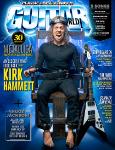
                    SPECIAL COLLECTOR’S ISSUE
GUITAR & BASS

T R A N S C R I P T I O N S

ERIC CLAPTON
BAD LOVE
ERIC GALES

(WITH JOE BONAMASSA)

I WANT MY CROWN
THIN LIZZY
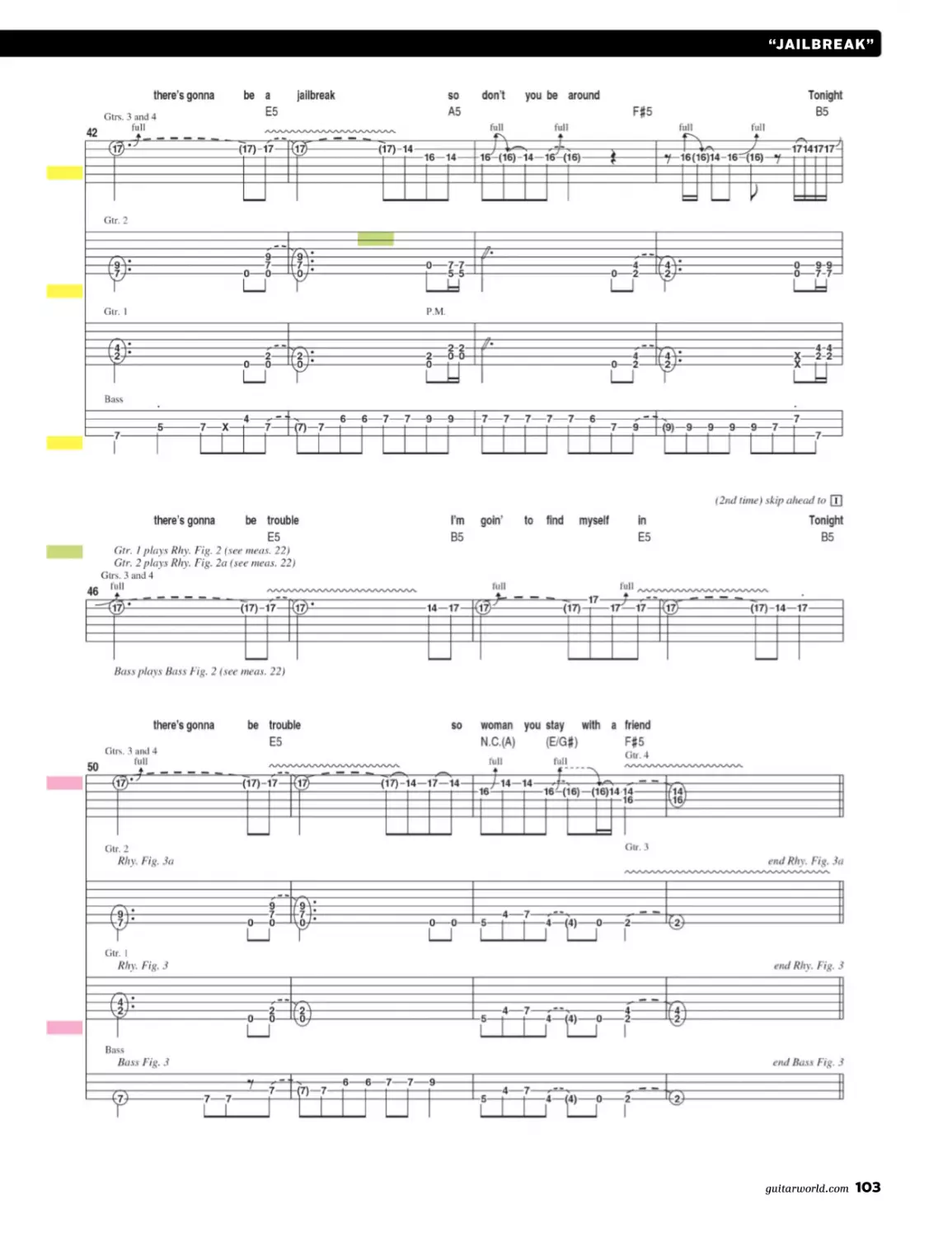
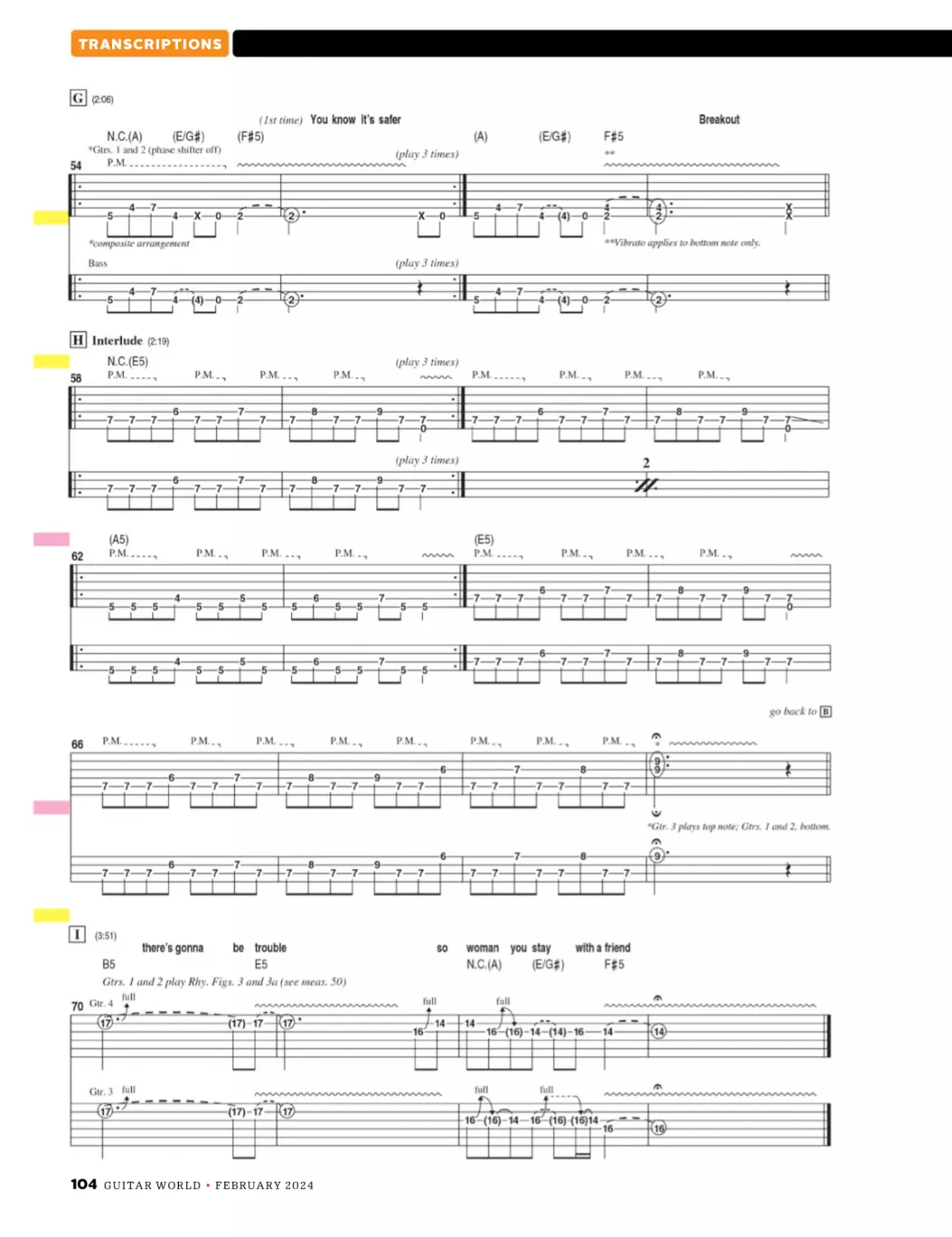
JAILBREAK

CL A
E
T
A

P TO N T R

IB

E

THE UL
TI M

UT

R!
THE GEHAE ALBUMS!
S! T
G
N
HE
O
T
S
E
N
TH
I
ND
0s

HA s & ’8
W
O
SL s, ’70
S WITH THER,
’60
W
E
I
V
R
E
INT TEVE LUKA TON
AMP
LEE, S
ALBERTAMER, PETER FR
EDDIE KR & MORE!

REVIEWED!
JACKSON’S NEW
AMERICAN SERIES
VIRTUOSO

JOE BONAMASSA

STIFF LITTLE FINGERS

GEORGE BENSON
SONIA ANUBIS

STEVE LYNCH

WOODSHED
VOL. 45 |

NO. 2 |

FEBRUARY 2024

A PRICEY “FOOL”
HOW FITTING IS it that, during the final
days of putting this issue together, Eric
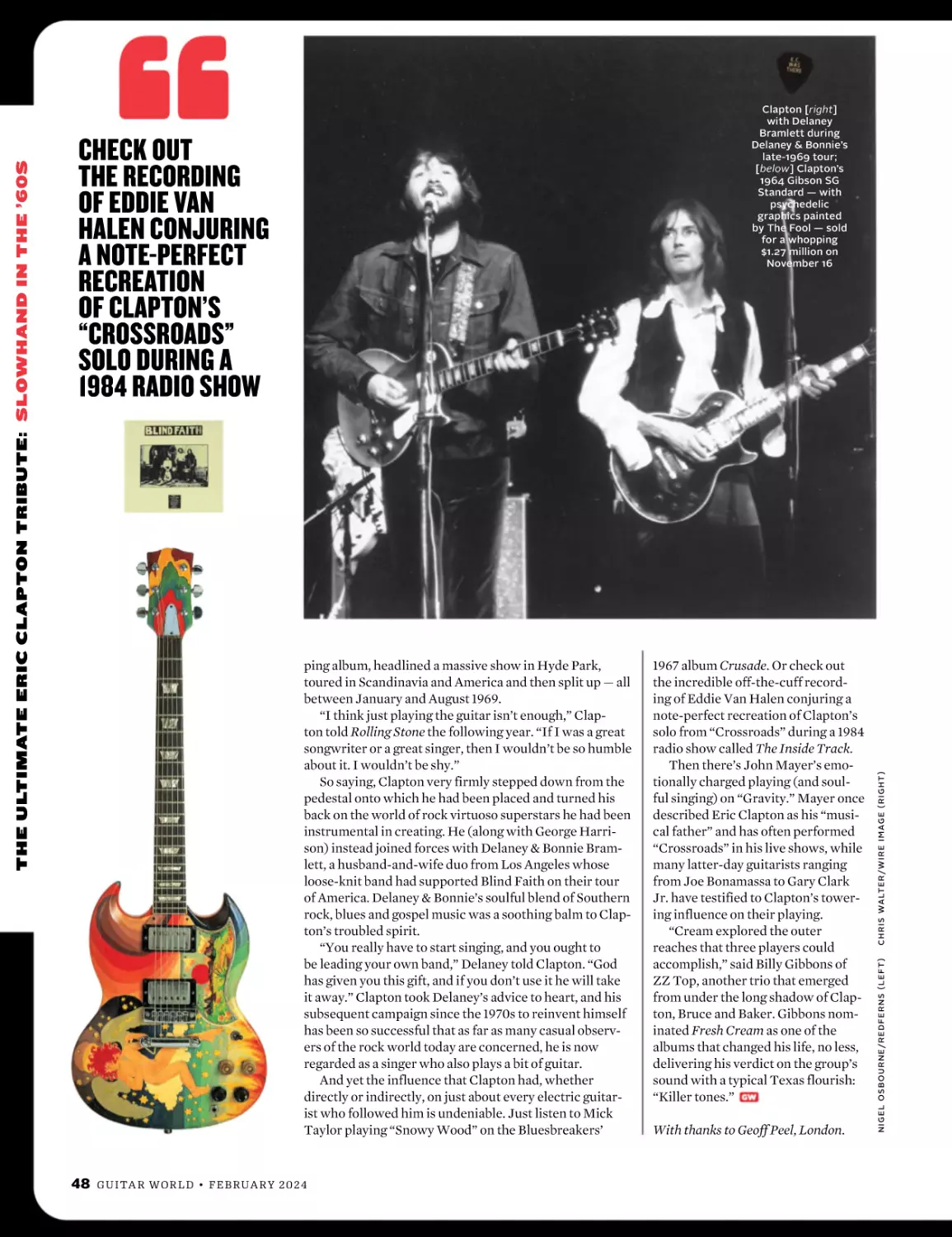
Clapton’s famed 1964 Gibson SG Standard — better known as “The Fool” — sold for $1.27 million?
That figure makes it not only the most expensive
Clapton guitar ever sold at auction (remember
that Blackie sold for a tidy sum a few years back),
but also one of the most expensive guitars sold at
auction — ever. It should come as no surprise that
the buyer was one of the world’s most renowned
vintage guitar collectors, businessman and Indianapolis Colts owner Jim Irsay. How nice for him!
Anyway, speaking of E.C., it’s a shame we weren’t able to interview him (or George
Terry) for this issue (I believe our latest Clapton interview — written by yours truly
— appeared in our July 2016 issue). Here’s hoping he’ll take part in the next one.
That said, I do love the cast of Clapton characters we’ve assembled for this issue,
including Phil Palmer, Albert Lee, Chuck Kirkpatrick, Albhy Galuten and more.

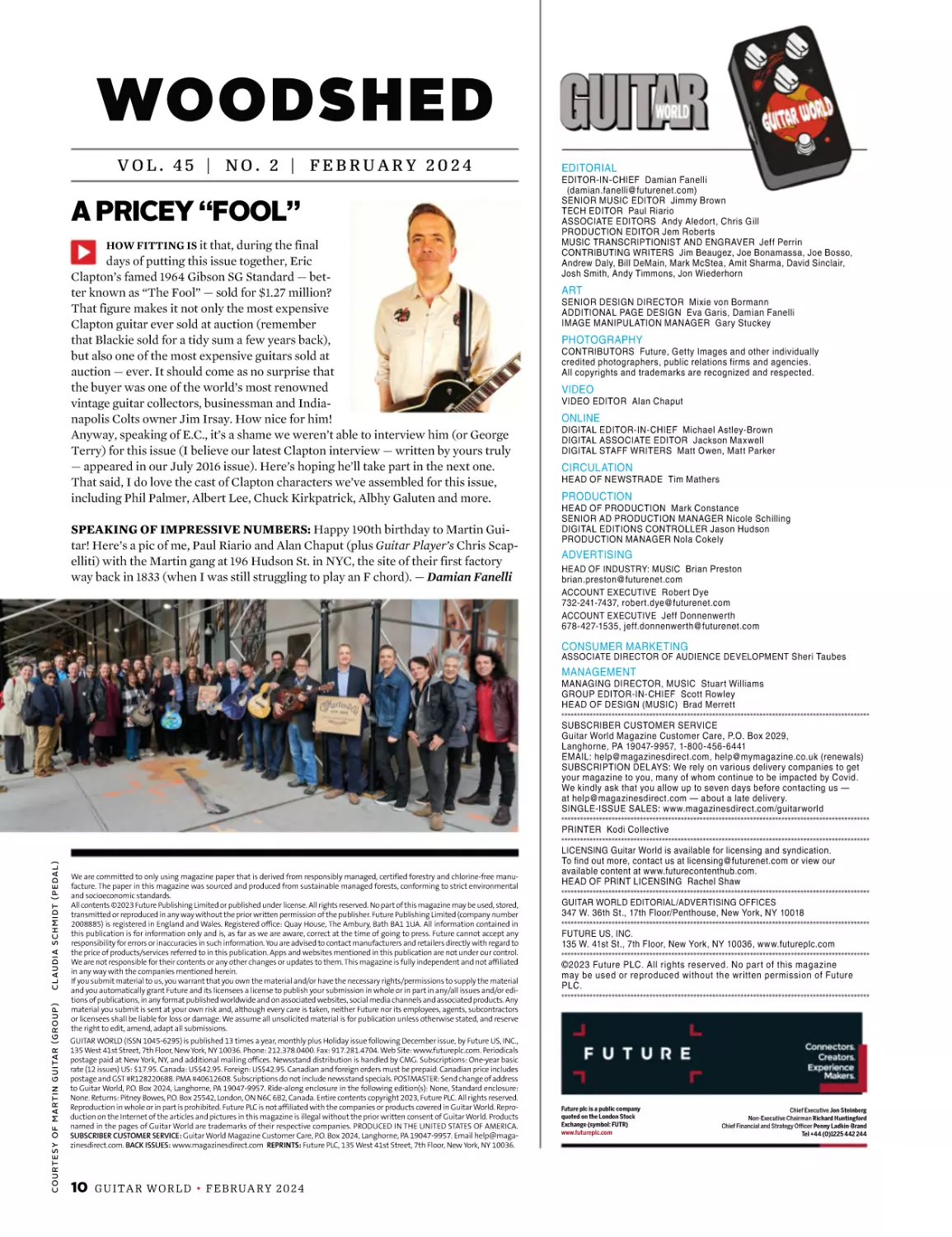
SPEAKING OF IMPRESSIVE NUMBERS: Happy 190th birthday to Martin Guitar! Here’s a pic of me, Paul Riario and Alan Chaput (plus Guitar Player’s Chris Scapelliti) with the Martin gang at 196 Hudson St. in NYC, the site of their first factory
way back in 1833 (when I was still struggling to play an F chord). — Damian Fanelli

EDITORIAL

EDITOR-IN-CHIEF Damian Fanelli
(damian.fanelli@futurenet.com)
SENIOR MUSIC EDITOR Jimmy Brown
TECH EDITOR Paul Riario
ASSOCIATE EDITORS Andy Aledort, Chris Gill
PRODUCTION EDITOR Jem Roberts
MUSIC TRANSCRIPTIONIST AND ENGRAVER Jeff Perrin
CONTRIBUTING WRITERS Jim Beaugez, Joe Bonamassa, Joe Bosso,
Andrew Daly, Bill DeMain, Mark McStea, Amit Sharma, David Sinclair,
Josh Smith, Andy Timmons, Jon Wiederhorn

ART

SENIOR DESIGN DIRECTOR Mixie von Bormann
ADDITIONAL PAGE DESIGN Eva Garis, Damian Fanelli
IMAGE MANIPULATION MANAGER Gary Stuckey

PHOTOGRAPHY

CONTRIBUTORS Future, Getty Images and other individually
credited photographers, public relations firms and agencies.
All copyrights and trademarks are recognized and respected.

VIDEO

VIDEO EDITOR Alan Chaput

ONLINE

DIGITAL EDITOR-IN-CHIEF Michael Astley-Brown
DIGITAL ASSOCIATE EDITOR Jackson Maxwell
DIGITAL STAFF WRITERS Matt Owen, Matt Parker

CIRCULATION

HEAD OF NEWSTRADE Tim Mathers

PRODUCTION

HEAD OF PRODUCTION Mark Constance
SENIOR AD PRODUCTION MANAGER Nicole Schilling
DIGITAL EDITIONS CONTROLLER Jason Hudson
PRODUCTION MANAGER Nola Cokely

ADVERTISING
HEAD OF INDUSTRY: MUSIC Brian Preston
brian.preston@futurenet.com
ACCOUNT EXECUTIVE Robert Dye
732-241-7437, robert.dye@futurenet.com
ACCOUNT EXECUTIVE Jeff Donnenwerth
678-427-1535, jeff.donnenwerth@futurenet.com

CONSUMER MARKETING

ASSOCIATE DIRECTOR OF AUDIENCE DEVELOPMENT Sheri Taubes

MANAGEMENT

MANAGING DIRECTOR, MUSIC Stuart Williams
GROUP EDITOR-IN-CHIEF Scott Rowley
HEAD OF DESIGN (MUSIC) Brad Merrett
SUBSCRIBER CUSTOMER SERVICE
Guitar World Magazine Customer Care, P.O. Box 2029,
Langhorne, PA 19047-9957, 1-800-456-6441
EMAIL: help@magazinesdirect.com, help@mymagazine.co.uk (renewals)
SUBSCRIPTION DELAYS: We rely on various delivery companies to get
your magazine to you, many of whom continue to be impacted by Covid.
We kindly ask that you allow up to seven days before contacting us —
at help@magazinesdirect.com — about a late delivery.
SINGLE-ISSUE SALES: www.magazinesdirect.com/guitarworld

C O U R T E S Y O F M A R T I N G U I TA R ( G R O U P )

C L A U D I A S C H M I DT ( P E D A L )

PRINTER Kodi Collective

We are committed to only using magazine paper that is derived from responsibly managed, certified forestry and chlorine-free manufacture. The paper in this magazine was sourced and produced from sustainable managed forests, conforming to strict environmental
and socioeconomic standards.
All contents ©2023 Future Publishing Limited or published under license. All rights reserved. No part of this magazine may be used, stored,
transmitted or reproduced in any way without the prior written permission of the publisher. Future Publishing Limited (company number
2008885) is registered in England and Wales. Registered office: Quay House, The Ambury, Bath BA1 1UA. All information contained in
this publication is for information only and is, as far as we are aware, correct at the time of going to press. Future cannot accept any
responsibility for errors or inaccuracies in such information. You are advised to contact manufacturers and retailers directly with regard to
the price of products/services referred to in this publication. Apps and websites mentioned in this publication are not under our control.
We are not responsible for their contents or any other changes or updates to them. This magazine is fully independent and not affiliated
in any way with the companies mentioned herein.
If you submit material to us, you warrant that you own the material and/or have the necessary rights/permissions to supply the material
and you automatically grant Future and its licensees a license to publish your submission in whole or in part in any/all issues and/or editions of publications, in any format published worldwide and on associated websites, social media channels and associated products. Any
material you submit is sent at your own risk and, although every care is taken, neither Future nor its employees, agents, subcontractors
or licensees shall be liable for loss or damage. We assume all unsolicited material is for publication unless otherwise stated, and reserve
the right to edit, amend, adapt all submissions.
GUITAR WORLD (ISSN 1045-6295) is published 13 times a year, monthly plus Holiday issue following December issue, by Future US, INC.,
135 West 41st Street, 7th Floor, New York, NY 10036. Phone: 212.378.0400. Fax: 917.281.4704. Web Site: www.futureplc.com. Periodicals
postage paid at New York, NY, and additional mailing offices. Newsstand distribution is handled by CMG. Subscriptions: One-year basic
rate (12 issues) US: $17.95. Canada: US$42.95. Foreign: US$42.95. Canadian and foreign orders must be prepaid. Canadian price includes
postage and GST #R128220688. PMA #40612608. Subscriptions do not include newsstand specials. POSTMASTER: Send change of address
to Guitar World, P.O. Box 2024, Langhorne, PA 19047-9957. Ride-along enclosure in the following edition(s): None, Standard enclosure:
None. Returns: Pitney Bowes, P.O. Box 25542, London, ON N6C 6B2, Canada. Entire contents copyright 2023, Future PLC. All rights reserved.
Reproduction in whole or in part is prohibited. Future PLC is not affiliated with the companies or products covered in Guitar World. Reproduction on the Internet of the articles and pictures in this magazine is illegal without the prior written consent of Guitar World. Products
named in the pages of Guitar World are trademarks of their respective companies. PRODUCED IN THE UNITED STATES OF AMERICA.
SUBSCRIBER CUSTOMER SERVICE: Guitar World Magazine Customer Care, P.O. Box 2024, Langhorne, PA 19047-9957. Email help@magazinesdirect.com. BACK ISSUES: www.magazinesdirect.com REPRINTS: Future PLC, 135 West 41st Street, 7th Floor, New York, NY 10036.

10

GU I TA R WOR L D • F EBRUA RY 2024

LICENSING Guitar World is available for licensing and syndication.
To find out more, contact us at licensing@futurenet.com or view our
available content at www.futurecontenthub.com.
HEAD OF PRINT LICENSING Rachel Shaw
GUITAR WORLD EDITORIAL/ADVERTISING OFFICES
347 W. 36th St., 17th Floor/Penthouse, New York, NY 10018
FUTURE US, INC.
135 W. 41st St., 7th Floor, New York, NY 10036, www.futureplc.com

©2023 Future PLC. All rights reserved. No part of this magazine
may be used or reproduced without the written permission of Future
PLC.

Future plc is a public company
quoted on the London Stock
Exchange (symbol: FUTR)
www.futureplc.com

Chief Executive Jon Steinberg
Non-Executive Chairman Richard Huntingford
Chief Financial and Strategy Officer Penny Ladkin-Brand
Tel +44 (0)1225 442 244

CON T EN TS
VOL. 45 |

NO. 2 |

FEBRUARY 2024

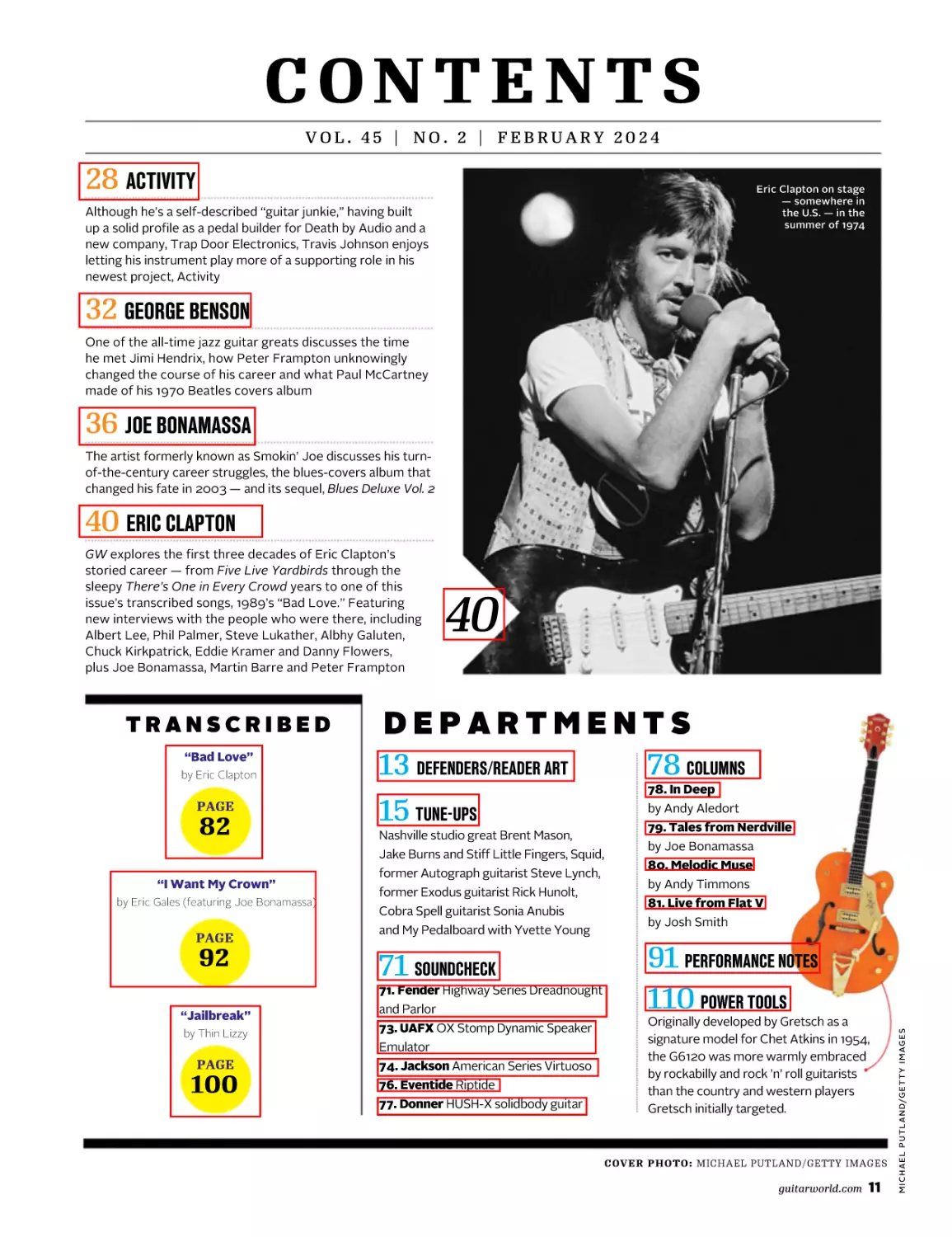
28 ACTIVITY

Eric Clapton on stage
— somewhere in
the U.S. — in the
summer of 1974

Although he’s a self-described “guitar junkie,” having built
up a solid profile as a pedal builder for Death by Audio and a
new company, Trap Door Electronics, Travis Johnson enjoys
letting his instrument play more of a supporting role in his
newest project, Activity

32 GEORGE BENSON
One of the all-time jazz guitar greats discusses the time
he met Jimi Hendrix, how Peter Frampton unknowingly
changed the course of his career and what Paul McCartney
made of his 1970 Beatles covers album

36 JOE BONAMASSA
The artist formerly known as Smokin’ Joe discusses his turnof-the-century career struggles, the blues-covers album that
changed his fate in 2003 — and its sequel, Blues Deluxe Vol. 2

40 ERIC CLAPTON
GW explores the first three decades of Eric Clapton’s
storied career — from Five Live Yardbirds through the
sleepy There’s One in Every Crowd years to one of this
issue’s transcribed songs, 1989’s “Bad Love.” Featuring
new interviews with the people who were there, including
Albert Lee, Phil Palmer, Steve Lukather, Albhy Galuten,
Chuck Kirkpatrick, Eddie Kramer and Danny Flowers,
plus Joe Bonamassa, Martin Barre and Peter Frampton

“Bad Love”
by Eric Clapton

PAGE

82

“I Want My Crown”
by Eric Gales (featuring Joe Bonamassa)

PAGE

92

“Jailbreak”
by Thin Lizzy

PAGE

100

DEPARTMENTS
13 DEFENDERS/READER ART
15 TUNE-UPS

78 COLUMNS

Nashville studio great Brent Mason,
Jake Burns and Stiff Little Fingers, Squid,
former Autograph guitarist Steve Lynch,
former Exodus guitarist Rick Hunolt,
Cobra Spell guitarist Sonia Anubis
and My Pedalboard with Yvette Young

71 SOUNDCHECK

71. Fender Highway Series Dreadnought
and Parlor
73. UAFX OX Stomp Dynamic Speaker
Emulator
74. Jackson American Series Virtuoso
76. Eventide Riptide
77. Donner HUSH-X solidbody guitar

78. In Deep
by Andy Aledort
79. Tales from Nerdville
by Joe Bonamassa
80. Melodic Muse
by Andy Timmons
81. Live from Flat V
by Josh Smith

91 PERFORMANCE NOTES
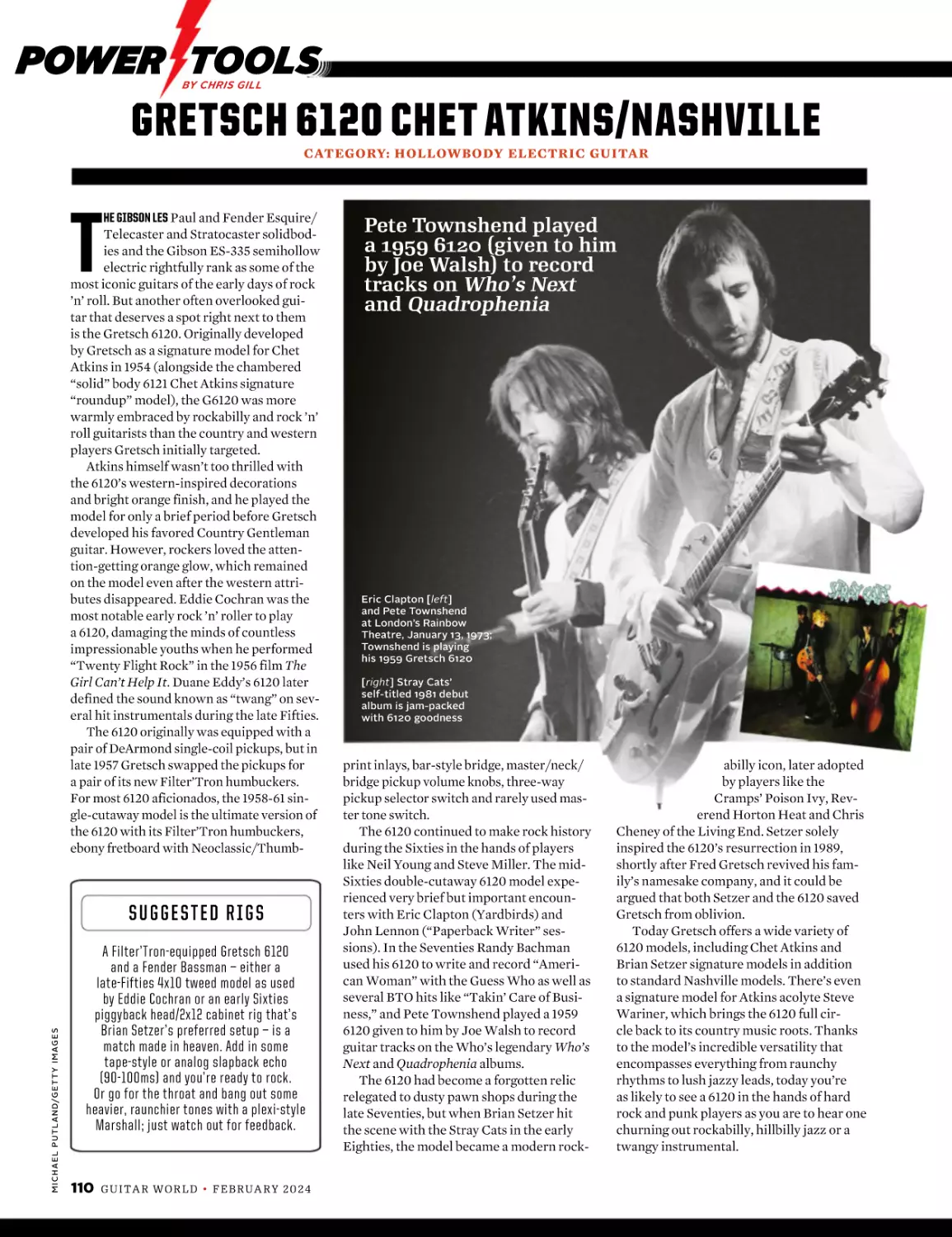
110 POWER TOOLS

Originally developed by Gretsch as a
signature model for Chet Atkins in 1954,
the G6120 was more warmly embraced
by rockabilly and rock ’n’ roll guitarists
than the country and western players
Gretsch initially targeted.

COV E R PH OT O: MI C H A E L P U T L A N D/ G E T T Y I M AG E S

guitarworld.com

11

M I C H A E L P U T L A N D/ G E T T Y I M A G E S

TRANSCRIBED

40

STAY CONNECTED WITH GUITAR WORLD ON
AND GET THE LATEST GUITAR NEWS, INSIDER UPDATES, STAFF REPORTS AND MORE!

READER
ART

OF THE MONTH

If you’ve created a drawing,
painting or sketch of your
favorite guitarist and would
like to see it in an upcoming
issue of Guitar World, email
GWSoundingBoard@
futurenet.com with a JPG
or PDF of the image!
And obviously, include
your name!
ERIC CLAPTON BY ERIC ROSALE

DEFENDERS

STEVIE RAY VAUGHAN BY LANCE GEBHARDT

of the Faith

John Robinson
Cassius “Banjo” Pritchett
AGE: 17
GUITARS: D’Angelico Premier Bedford,
Dixon 5-string banjo, Squire Bullet Mustang
SONGS I’VE BEEN PLAYING: Rob Zombie
“House of 1000 Corpses,” Louis Armstrong
“La Vie En Rose”
GEAR I WANT MOST: Jackson x Series
sl4x Soloist, Leslie speaker

AGE: 66
GUITARS: PRS SE Custom 22
semi-hollowbody, Gretsch 5420T,
Fender Ultra Telecaster, Fender 75th
Anniversary Strat, Rickenbacker 360/12,
Epiphone IBG ES-339, 175th Anniversary
Martin D-35, Gretsch Parlor Penguin
SONGS I’VE BEEN PLAYING: Originals
and original arrangements of classic covers
in multiple genres
GEAR I WANT MOST: Gretsch White
Falcon, Fender Vibroverb

Dennis Bradley
AGE: 51
HOMETOWN: Colorado Springs, CO
GUITARS: Ernie Ball Music Man 20th
Anniversary JP6, ESP USA M-II NTB FR,
ESP USA M-III FR, Jackson Jeff Loomis Kelly
Signature, PRS Mark Tremonti Signature,
Taylor 6- and 12-strings and many more
SONGS I’VE BEEN PLAYING: Classic rock
hits from the 1960s to the 1990s with my
cover band, Mimic; and anything by Iron
Maiden, Dio and Ozzy (with Randy Rhoads)
GEAR I WANT MOST: ESP USA M-II NTB FR
in the “blood splatter” finish

Are you a Defender of the Faith? Send a photo, along with your answers to the questions above,
to GWSoundingBoard@futurenet.com. And pray!
guitarworld.com

13

SONIA
ANUBIS

17

18
RICK HUNOLT

STIFF LITTLE
FINGERS

AUTOGRAPH'S
STEVE LYNCH

22

20

SQUID

24

26
YVETTE YOUNG

P H O T O B Y T E R R Y W Y A T T/ G E T T Y I M A G E S

Brent Mason — with
his ubiquitous primer
gray Fender Tele —
performs at the
Country Music Hall
of Fame and Museum
in Nashville,
October 22, 2017

The Gray Ghost

SESSION ACE BRENT MASON EXPLAINS WHY — AND HOW — HE OCCASIONALLY
TRIES TO SOUND LIKE SOMEONE OTHER THAN BRENT MASON
By Andrew Daly
AFTER REPORTEDLY PLAYING on
over a thousand records, Brent Mason
has gotten his sound dialed in. And it’s
a good thing, as he’s a session man who
relies on reliability. But that’s not all Mason
strives for when he enters his “office.”
“There are times when I try hard not
to sound like me,” he says. “I end up in so
many different types of situations, and I
really do need to be a chameleon. I straddle
the line between retaining what I do and not
wanting to always sound like Brent Mason.”

That’s a tall order, considering Mason
has made a career of sounding distinctly
like himself across records bearing the
names of artists like George Strait, Alan
Jackson, Shania Twain, Zac Brown and
dozens more.
“Sometimes I’ll put the Telecaster
down,” he says, “And I’ll grab a Gretsch,
ES-335 or even a Les Paul. I intentionally
won’t grab the Tele, and that’ll inspire
me to play a lick I might not have thought
of if I did. I like to grab a guitar that will

inspire me to play something differently.
But even that’s based on the artist. If it’s
George Strait, it’s the Tele. But if it’s more
R&B-sounding, I may go for the ES-335.”
If you’re privy to Mason’s chickenpickin’ ways, said Tele should be familiar.
But if you’re just logging on, the story
of how he acquired his primer gray ’67
Fender Tele should be interesting.
Mason instantly perks up when asked
about the guitar: “I knew it was special,
but not right away,” he says. “I originalguitarworld.com

15

NEWS + NOTES

“I straddle the
line between
retaining what I do
and not wanting
to always sound
like Brent Mason”

twangy instrumental country music in
an era when boy bands reigned supreme.
Still, the solo life never appealed to Brent
Mason; no, it’s long been the session life
for him.
“Session players don’t get the credit
they deserve,” he says. “You’ve gotta
be able to turn on a dime. But there’s a
real gray area about how sessions are
credited, and some of the signature licks
session players come up with are ones
people won’t know they wrote. You can
try and formulate a lawsuit, but that will

be the last session you ever do.”
And when asked what the secret to
making it as a session player is, Mason
says: “It’s not about you,” he says. “You’re
there to support the record. Sometimes,
it’s doing something profound; other
times, it’s doing the obvious. But most of
all, It’s about maintaining the element
of surprise while giving them what they
want; meaning, when it’s time to grab that
Tele and sound like Brent Mason, I do
that. Being able to make those decisions
might just be what lengthens your career.”

INTRODUCING

CRYMWAV

24/7 (Electric Pudding Records)
SOUND: Comprising former Smash Fashion
singer/guitarist Roger Deering and shredmeister Lloyd Stuart Casson, the LA-based hard
rockers channel the furious fire of Motörhead
and UFO, cut through with the melodic sensibilities of Cheap Trick. With darker sounds than
their previous band, every track sounds like an
instant stadium-filling anthem.
KEY TRACK “American Carnage”

16

GU I TA R WOR L D • F EBRUA RY 2024

The Gems

Phoenix (Napalm Records)
SOUND: Formed from the ashes of Thundermother, these Swedes deliver hard-hitting,
take-no-prisoners, old-school rock and metal
while displaying influences ranging from Zep to
Maiden. Guitarist Mona Lindgren nails the rolling,
riff-laden essence of classic Jimmy Page, displaying taste and flair in equal measure, peeling off
blistering, blues-fired licks with careless aplomb.
KEY TRACK: “Send Me to the Wolves”

Grave Secrets

Till Your Lungs Fall Out (Wiretap Records)
SOUND: LA’s Grave Secrets combine elements of
punk, hardcore, emo and powerpop. Thoughtful,
melodic guitar lines and riffs interweave, setting
up a backdrop for punchy, incisive solo work.
A handful of chugging, mid-paced tracks demonstrate the band’s ability to move beyond the
restrictive confines of genre pigeonholing.
KEY TRACK: “Drugs”
— Mark McStea

I N T R O D U C I N G ( F R O M L E F T ) : K E R RY D O N O VA N , M I K A E L H A LT É N , P R O V I D E D/ P R

A closer look at Mason’s
Tele in 2014; Fender
released their Brent
Mason signature
Telecaster in 2020

R I C K D I A M O N D/ G E T T Y I M A G E S F O R N A M M ( M A S O N )

ly grabbed another Tele when I went into
the store that day with Don Kelley [Nashville bandleader known for his lengthy
residency at Robert’s Western World]; it
was Don who bought the gray one, and I
grabbed a mustard-colored one. And that
evening, we were playing a club, and I
grabbed Don’s gray one and immediately
said, ‘Man, I wish I’d bought this one.’
“Luckily,” Mason says, “Don was
known for trading guitars, so I traded him
the mustard-colored one for the primer
gray one. There’s just something about
the sound of that guitar; I think it’s the
swamp ash, which is kinda perforated. It
must have been floating around in some
swamp water, and when they dried it out,
it gave it a certain acoustic quality that’s
fatter sounding with extra thump.”
Tele in hand, Mason established himself as a premier session player within
the Nashville circuit. And sure, he’s had
his solo moments, with Hot Wired (1997)
checking in as one for the books — especially if you were the type who spent
their childhood enamored with

NEWS + NOTES

Cobra Spell

FOR SONIA ANUBIS AND HER
NETHERLANDS-BASED, ALL-FEMALE
BAND, IT’S ALL ABOUT THE EIGHTIES
— AND THEIR FANS ARE EATING IT UP
By Joe Bosso

Anubis could click her heels and
magically transport herself to another time
and place, she would wing herself to the
late 1980s and land smack dab on the L.A.
Sunset Strip. “I would fit right in — I just
know it,” she says. “That was when the
coolest music came out, in my opinion.
Ratt, Dokken, W.A.S.P., L.A. Guns, Great
White. They were such great bands, and
they made records that are timeless.”
Anubis channels her passion for Eighties glam metal in her band Cobra Spell.
Formed in 2019, the Netherlands-based,
all-female outfit specializes in original
tunes that recall the golden days of big hair,
pointy guitars, leather, sex and sleaze. “It’s
kind of funny that I’m so nostalgic about a
period that existed before I was born,” she
says. “But I see lots of people my age who

AXOLOGY
• GUITARS Jackson Custom Shop WR1
Warrior, Jackson Raven Warrior
• AMPS EVH 5150
• EFFECTS BOSS GT-1000 Guitar Effects
Processor

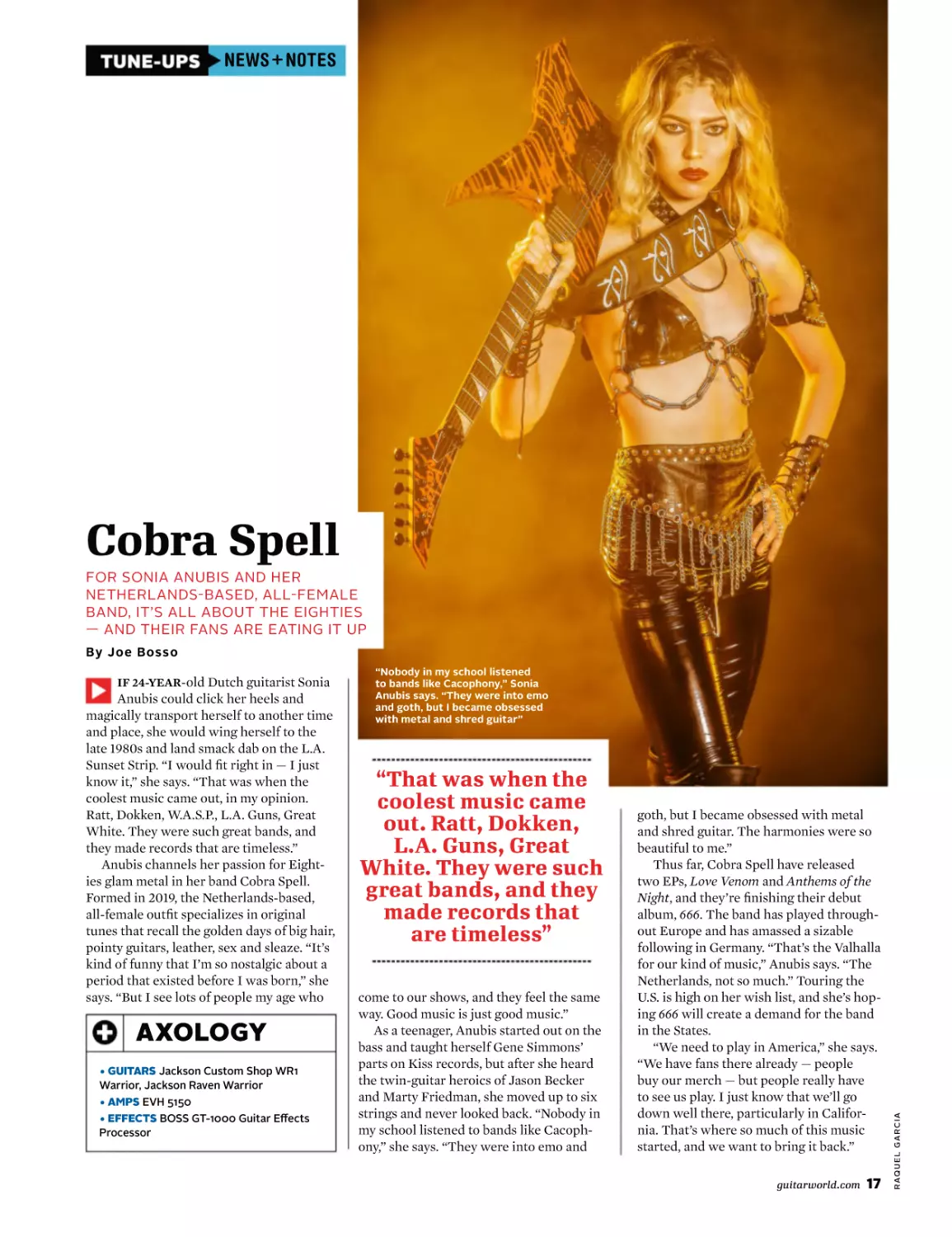
“Nobody in my school listened
to bands like Cacophony,” Sonia
Anubis says. “They were into emo
and goth, but I became obsessed
with metal and shred guitar”

“That was when the
coolest music came
out. Ratt, Dokken,
L.A. Guns, Great
White. They were such
great bands, and they
made records that
are timeless”
come to our shows, and they feel the same
way. Good music is just good music.”
As a teenager, Anubis started out on the
bass and taught herself Gene Simmons’
parts on Kiss records, but after she heard
the twin-guitar heroics of Jason Becker
and Marty Friedman, she moved up to six
strings and never looked back. “Nobody in
my school listened to bands like Cacophony,” she says. “They were into emo and

goth, but I became obsessed with metal
and shred guitar. The harmonies were so
beautiful to me.”
Thus far, Cobra Spell have released
two EPs, Love Venom and Anthems of the
Night, and they’re finishing their debut
album, 666. The band has played throughout Europe and has amassed a sizable
following in Germany. “That’s the Valhalla
for our kind of music,” Anubis says. “The
Netherlands, not so much.” Touring the
U.S. is high on her wish list, and she’s hoping 666 will create a demand for the band
in the States.
“We need to play in America,” she says.
“We have fans there already — people
buy our merch — but people really have
to see us play. I just know that we’ll go
down well there, particularly in California. That’s where so much of this music
started, and we want to bring it back.”
guitarworld.com

17

RAQUEL GARCIA

IF 24-YEAR-old Dutch guitarist Sonia

NEWS + NOTES

DieHumane

FORMER EXODUS GUITARIST
RICK HUNOLT RE-EMERGES
— SHARP AS EVER — ON THE
GROTESQUE , A GENRE-MELDING
METAL MASTERPIECE
By Jon Wiederhorn
BETWEEN 1983 AND 2005, Rick

Hunolt played on six full-length
Exodus studio albums and regularly toured
with the top-tier thrash band. However,
during a period of intense personal turmoil
in 2006, Hunolt was replaced by Heathen
guitarist Lee Altus, and aside from a couple
of guest appearances, he remained largely
MIA for 15 years.
“Once you’ve been in one of the best
thrash bands in the world, it’s pretty hard
to figure out what to do next,” Hunolt says.
Then in 2021, Hunolt’s childhood friend,
Skinlab vocalist Steve Esquivel, referred
the guitarist to a melodic, cinematic Texas
band called DieHumane that was looking
for a lead guitarist. Hunolt received rough
demos of two songs and couldn’t stop
listening to them.
“I was blown away by the big choruses,
strong melodies and spacious arrangements,” Hunolt says. “I thought, ‘Man, I
could see myself playing to this.’ It’s a big
change, but if I’m gonna do something
outside of thrash, this is exactly what I
want to do.”
He contacted DieHumane’s multi-

P R O V I D E D/ P R

AXOLOGY
• GUITAR Siggi-Braun Signature RH-1 V
• AMPS Marshall 9200 stereo power amp
and two EL34 cabinets
• EFFECTS Neural DSP Quad Cortex

18

GU I TA R WOR L D • F EBRUA RY 2024

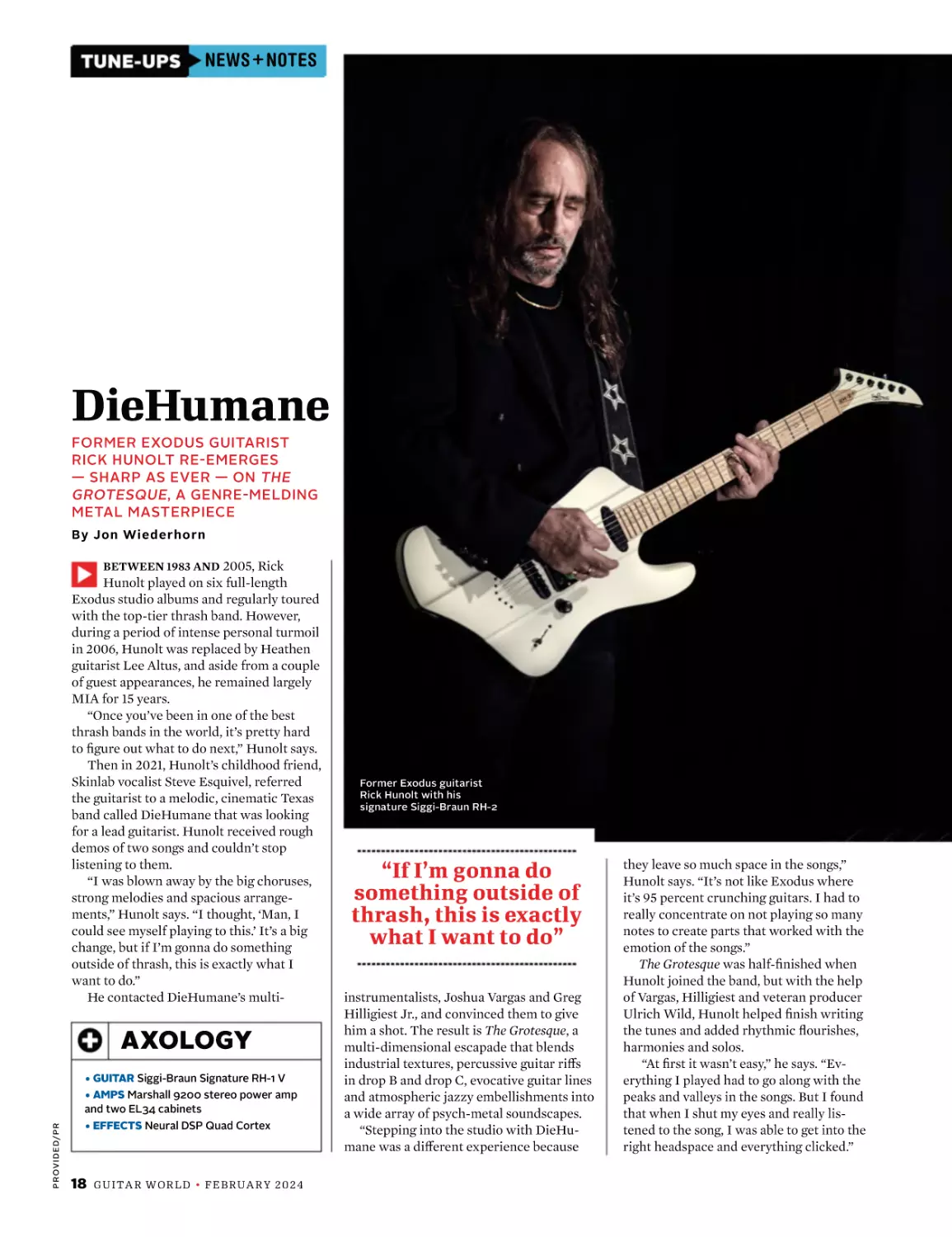
Former Exodus guitarist
Rick Hunolt with his
signature Siggi-Braun RH-2

“If I’m gonna do
something outside of
thrash, this is exactly
what I want to do”
instrumentalists, Joshua Vargas and Greg
Hilligiest Jr., and convinced them to give
him a shot. The result is The Grotesque, a
multi-dimensional escapade that blends
industrial textures, percussive guitar riffs
in drop B and drop C, evocative guitar lines
and atmospheric jazzy embellishments into
a wide array of psych-metal soundscapes.
“Stepping into the studio with DieHumane was a different experience because

they leave so much space in the songs,”
Hunolt says. “It’s not like Exodus where
it’s 95 percent crunching guitars. I had to
really concentrate on not playing so many
notes to create parts that worked with the
emotion of the songs.”
The Grotesque was half-finished when
Hunolt joined the band, but with the help
of Vargas, Hilligiest and veteran producer
Ulrich Wild, Hunolt helped finish writing
the tunes and added rhythmic flourishes,
harmonies and solos.
“At first it wasn’t easy,” he says. “Everything I played had to go along with the
peaks and valleys in the songs. But I found
that when I shut my eyes and really listened to the song, I was able to get into the
right headspace and everything clicked.”

NEWS + NOTES

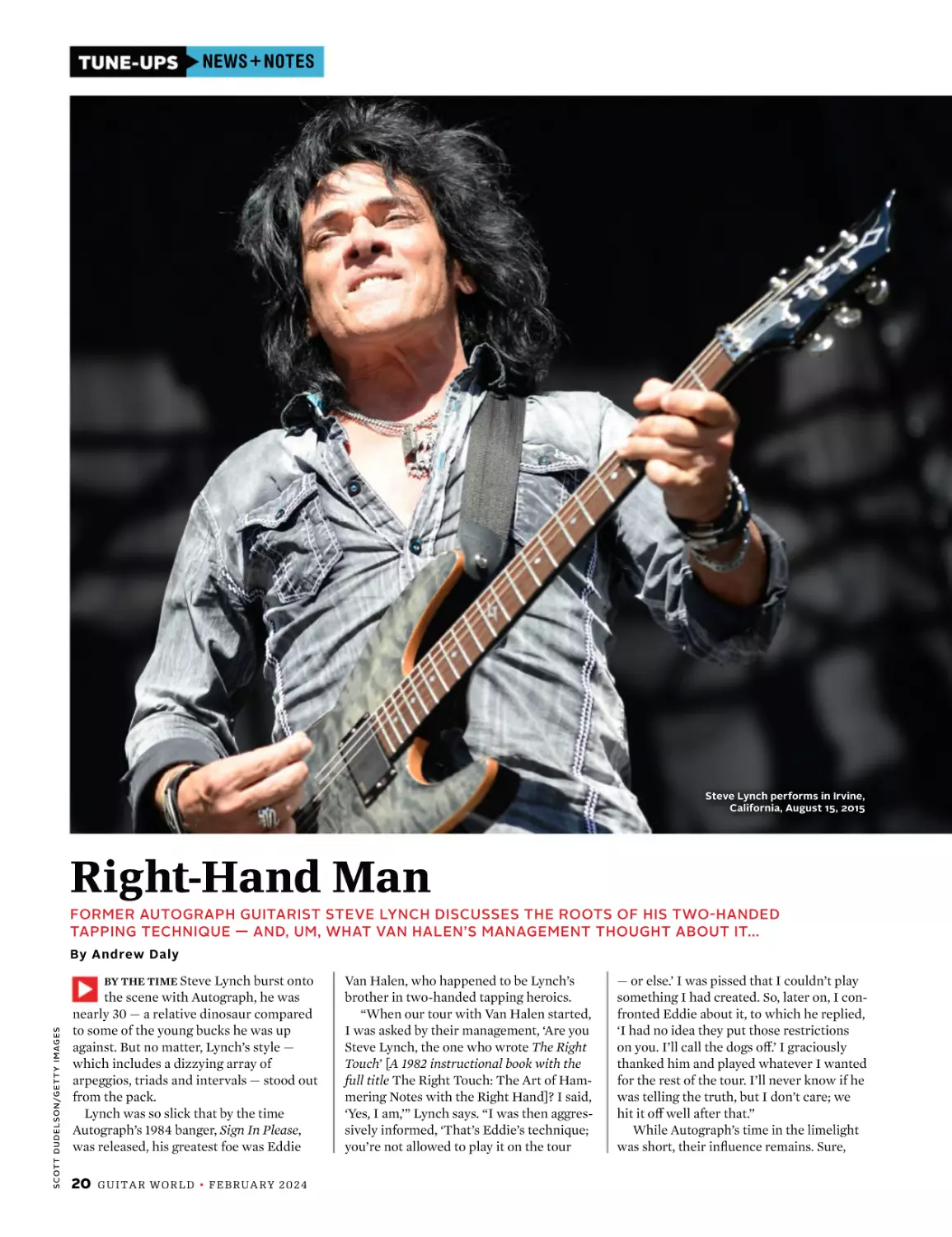
Steve Lynch performs in Irvine,
California, August 15, 2015

Right-Hand Man

FORMER AUTOGRAPH GUITARIST STEVE LYNCH DISCUSSES THE ROOTS OF HIS TWO-HANDED
TAPPING TECHNIQUE — AND, UM, WHAT VAN HALEN’S MANAGEMENT THOUGHT ABOUT IT...

S C OT T D U D E L S O N / G E T T Y I M A G E S

By Andrew Daly
BY THE TIME Steve Lynch burst onto
the scene with Autograph, he was
nearly 30 — a relative dinosaur compared
to some of the young bucks he was up
against. But no matter, Lynch’s style —
which includes a dizzying array of
arpeggios, triads and intervals — stood out
from the pack.
Lynch was so slick that by the time
Autograph’s 1984 banger, Sign In Please,
was released, his greatest foe was Eddie

20

GU I TA R WOR L D • F EBRUA RY 2024

Van Halen, who happened to be Lynch’s
brother in two-handed tapping heroics.
“When our tour with Van Halen started,
I was asked by their management, ‘Are you
Steve Lynch, the one who wrote The Right
Touch’ [A 1982 instructional book with the
full title The Right Touch: The Art of Hammering Notes with the Right Hand]? I said,
‘Yes, I am,’” Lynch says. “I was then aggressively informed, ‘That’s Eddie’s technique;
you’re not allowed to play it on the tour

— or else.’ I was pissed that I couldn’t play
something I had created. So, later on, I confronted Eddie about it, to which he replied,
‘I had no idea they put those restrictions
on you. I’ll call the dogs off.’ I graciously
thanked him and played whatever I wanted
for the rest of the tour. I’ll never know if he
was telling the truth, but I don’t care; we
hit it off well after that.”
While Autograph’s time in the limelight
was short, their influence remains. Sure,

they couldn’t duplicate the breakneck success of “Turn Up the Radio,” but that hasn’t
stopped Lynch from making it known that
— greatest hits aside — Autograph mattered.
“We’d played in other bands before
our Sunset Strip days, but Autograph was
different,” Lynch says. “We went from
guys playing and rehearsing together for
fun to opening for Van Halen. Suddenly
we were driving across the U.S. in a dilapidated Winnebago to play in front of an
18,000-seat sold-out venue opening for the
biggest band in the world, and we didn’t
even have a name yet. On that treacherous journey, we devised a name we could
use... Autograph. Then RCA signed us to
a three-album deal backstage at Madison
Square Garden... who would have thought?
Measuring our importance is hard, but we
earned the right to be there.”
Taking some time away from his ongoing
solo work and potential plans for an Autograph reunion, Steve Lynch dialed in with
GW to discuss his approach to the guitar,
the recording of his finest solos and more.
Describe the early evolution of your
style.

The spark was lit when the Beatles played
on Ed Sullivan’s show in 1964. My older
sister had some of her cute girlfriends over
to watch, and when I saw their reaction to
the performance, I thought, “That’s what I
want to do!” And that’s when I received an
acoustic made of particle board from the
Sears & Roebuck catalog, with strings so
high off the neck you had to stand on them
to make a note come out. My style evolved
when I stopped listening to other guitarists
and started listening to jazz, which guided
me in an obscure direction. But when
Autograph formed, I had to abandon my
progressive side for a more commercially
accepted style. It didn’t bother me much,
though... I had to pay the rent somehow.
[Laughs]
What are the origins of your two-hand
tapping technique?

I first saw Harvey Mandel playing around
with it at a soundcheck at a club in downtown Seattle in the early Seventies. That’s
what first inspired me. Then I saw a local
guy named Steve Buffington experimenting with it, which made me pursue it more.
But Emmett Chapman, the inventor of
the Stick, made me immerse myself in it.
He did a clinic at GIT [Guitar Institute of
Technology, now Musicians Institute], and
I was awestruck by the sounds he created.
I immediately began to train my hand and
began writing the two-hand theory, including arpeggios, triads, chord inversions,
scales, intervals and double-stops.

Did being well-versed in music theory
aid in crafting solos?

I would have never been able to create the
solos I did without my theory knowledge.
But I didn’t necessarily think about theory
when creating them; it just happened. I’ve
never created a solo with a guitar in my
hands. I would have the band play a couple
of bars with vocals before the solo, then
play through the solo section, and then
come back in with a couple of bars after
the solo with vocals, all while I recorded
it. Then I’d take that recording home and
listen to it until I heard the solo unfold in
my mind. I’d then built the solo part by part
until I felt it was complete.

“I was then
aggressively
informed, ‘That’s
Eddie Van Halen’s
technique; you’re not
allowed to play it on
the tour — or else’”
Can you recount the recording of your
“Turn Up the Radio” solo?

It took me five eight-hour days to create
that solo. Whenever I thought I had it, I’d
listen to it the next day and think it sucked.
I knew the song could be a hit, so I wanted
the perfect solo. At the end of that fifth day,
I listened to the recording I’d done at home
and realized I had it. I went into the studio
the next day and laid it down. I played my
custom-made Charvel through a midSixties Marshall head and 4x12 cab with a
little delay and reverb from the outboard
gear. I doubled the solo, as I always do. On
the first track, we ran the Studer two-inch
analog machine at 101 percent speed to be
slightly below pitch when played back at
normal speed. We recorded at 99 percent
on the second track, so it was slightly above
pitch when played back. This gave the illusion there was a phaser or flanger applied.
What combination of amps, pedals
and guitars are you using?

I’m not touring now, so I’m not using any
particular amps, just my Headrush and
Roland GR-55 guitar synth for recording.
But I’m also looking into the latest version
of Guitar Rig and AmpliTube for my home
recordings. At the moment, I’m way too
busy to tour, but that may very well change
soon. My favorite guitars are the ones I
had custom-made by Dale Roberts from

his shop in Jacksonville, Florida. They are
perfect for my hands and sound the best for
the two-handed technique, which requires
a lot of output and sustain. I also use my
Strats, Les Pauls and whatever others I
have lying around.
Is it a challenge to create new music
for a low-attention-span world?

There are no obstacles, with the internet
and social media to promote your material worldwide and the convenience of
recording from your home. You don’t need
a record contract; you can write and record
with anyone at any time, anywhere. One
slice of advice is to release singles one at
a time and do your best on the writing,
performance, arrangement and production
for each. If you wish to complete a full collection of songs, that’s fine, but most people
never listen to the whole album.
Do you feel beholden to your past?

I don’t feel obligated to do anything I’ve
previously done because I’ve evolved musically. The past doesn’t define who I am; I’m
very grateful for the success I’ve had with
Autograph and will always cherish those
memories... and may again someday, but
I’m just not reliant on it. Most musicians
who genuinely love their craft feel the
same. I’m completely comfortable where
I am now because I think new adventures
await everywhere.
What’s next for you?

I’m still writing for my project, Blue
Neptune, which will be a solo effort. I see
it as a modern-day The Dark Side of the
Moon, my favorite album. It will be singles.
And there’s potential for me to revisit a
reformed Autograph. I never rule that out.
But it would not be with the current lineup
who are “performing as Autograph.” It
would be a fresh start with new personnel
with a different perspective. Only time will
tell. Other than that, I’m just a kid who,
against all odds, dug out a name from the
rubble. I am incredibly grateful for it, but
I’m still that kid from Seattle who went to
L.A. to follow a dream and found it.
guitarworld.com

21

NEWS + NOTES

LOST CLASSICS:

Stiff Little
Fingers

FRONTMAN/GUITARIST
JAKE BURNS TAKES US BEHIND
THE SCENES OF THE PUNK
LEGENDS’ CLASSIC 1979 ALBUM,
INFLAMMABLE MATERIAL
By Mark McStea
INFLAMMABLE MATERIAL, THE

incendiary 1979 debut album from
Northern Irish punks Stiff Little Fingers, is
one of only a handful of truly essential
albums from the era. Packed full of instant
classics, it features many songs that still
appear in the band’s live set, including the
anthemic “Alternative Ulster,” plus
“Suspect Device” and “Wasted Life.”
We asked singer/guitarist Jake Burns
— the only constant member of the band’s
lineup since their formation (although
original bass player Ali McMordie is now
back on board) — to give us the lowdown
on how the album was made. It went a bit
like this…

V I R G I N I A T U R B E T T/ R E D F E R N S

Did you have a lot of songs on hand
when you went in to record Inflammable
Material?

No, we literally went into the studio and
recorded our live set. We didn’t have anything else on hand at all except one song
that we didn’t like. The whole thing was
done in 10 days — mostly live with just a
couple of overdubs. We’d been playing the
songs live for a while, so we were already
really tight as a band. Geoff Travis and
Mayo Thompson were officially “producing” the record, but they didn’t know what
they were doing in terms of production,
really, and we certainly didn’t. It was very
much the blind leading the blind, but that
made it very exciting. It was all about the
quality of the songs. We didn’t spend a lot
of money getting a glossy production or
anything. We didn’t even use a tuner, so I’m
guessing a lot of the songs probably aren’t
in concert pitch. We just tuned to whoever’s guitar sounded most in tune. [Laughs]
That’s how green we were in the studio.

22

GU I TA R WOR L D • F EBRUA RY 2024

What was the writing process between
you and Gordon Ogilvy, who co-wrote a
number of key songs and was also your
manager?

It’s not the way it was painted in the media
at the time, where they tried to imply that
Gordon was some kind of Svengali figure,
because
he was a few years older than us.
XXXXXXXX XXXXX XXXXX
WeXXXXXXXXX
just connected really well, and sometimes he’d have an idea that would spark a
song, or maybe I’d suggest something. We
used to joke about the whole Svengali rubbish. He became our manager, which was
our idea and not his, as he seemed to have
a bit of what it takes; he seemed sensible.
[Laughs] He was the world’s most reluctant
rock band manager ever. There are songs
where we share a writing credit, such as
“Alternative Ulster,” where it was just one
line that he came up with. There were
other songs where he’d come up with a lot
of the lyrics. There was no real hard and
fast rule to how we wrote together.
“Alternative Ulster” has one of the most
distinctive riffs of the punk era. Did you
know the song had a touch of magic when
you recorded it?

No, not at all. It was written for the fanzine
of the same name. They’d given us some
support, and Gavin Martin, who ran the
fanzine, asked if we could give them “Suspect Device” as a flexi-disc to give away

with the magazine, but we said it was due
to be a single on our own label. So I said
I’d write a song for them, and I came up
with “Alternative Ulster.” We played it at a
show, I asked Gavin what he thought, and
he said he thought it was shit. [Laughs]
We were a little crestfallen; I remember
saying to the guys that I felt it was pretty
good and, of course, it’s probably our most
beloved song. The version you hear on the
record was recorded as a demo for Island
Records, who almost signed us. We just
recorded it as we did it live, and Ed Hollis,
the producer, said we needed to double up
the guitars. Of course, there was no click
or count-in for the riff, so I had no way
of knowing when it was about to start to
try to double it. [Laughs] I had to totally
guess where the first guitar came in; it took
forever to try to get the second guitar close
to the first guitar.
“Barbed Wire Love” has, surprisingly,
become a perennial favorite, considering
that it was all done a bit tongue-in-cheek.

I know; it was done as a bit of light relief,
just to see if we could pull off those doowop harmonies, which sounded pretty
good in the studio. We tried to come up
with as many bad puns as we could, and
somehow it’s become a song that the fans
love to sing along with. We were a rock ’n’
roll band and it was supposed to be fun.

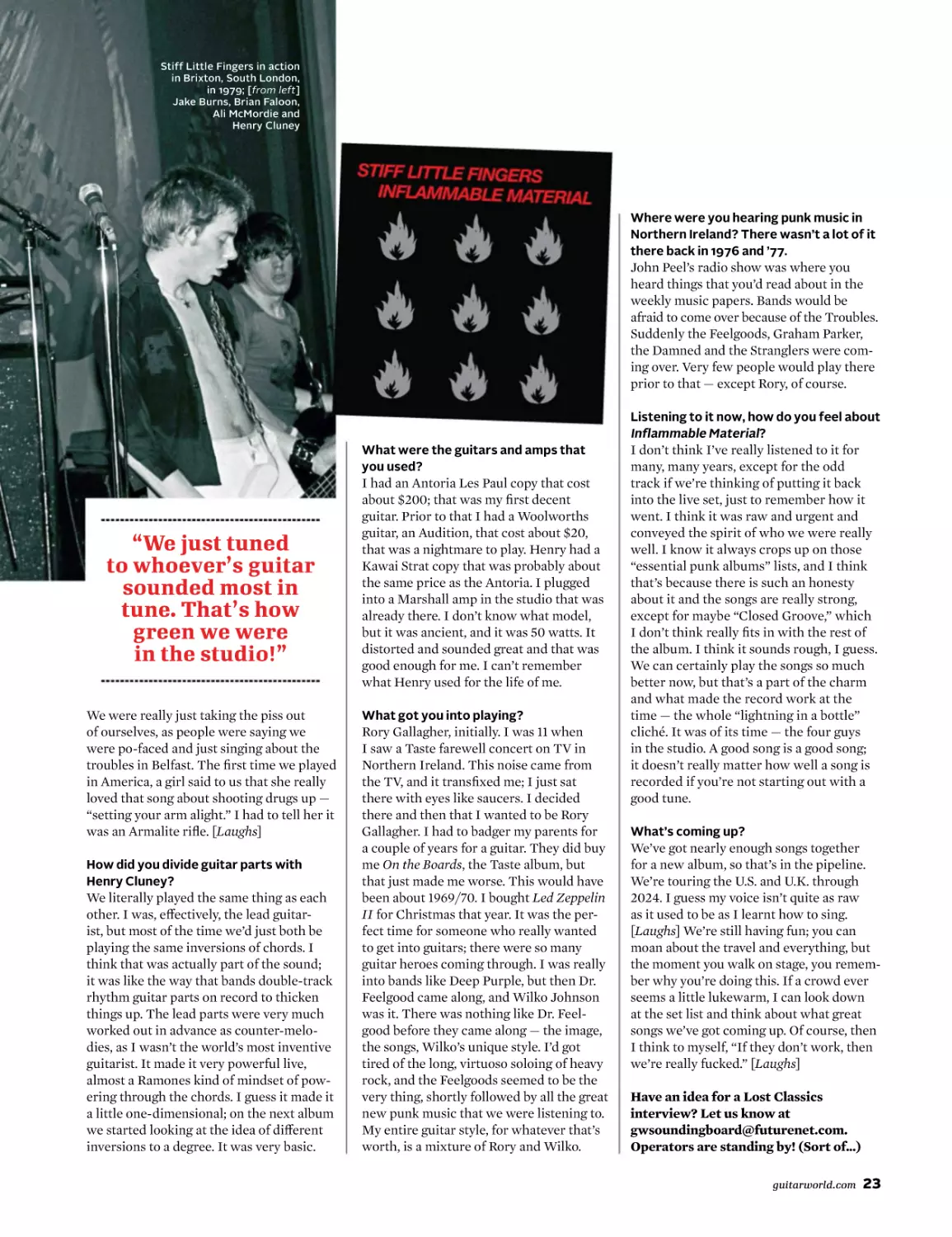
Stiff Little Fingers in action
in Brixton, South London,
in 1979; [from left]
Jake Burns, Brian Faloon,
Ali McMordie and
Henry Cluney

Where were you hearing punk music in
Northern Ireland? There wasn’t a lot of it
there back in 1976 and ’77.

John Peel’s radio show was where you
heard things that you’d read about in the
weekly music papers. Bands would be
afraid to come over because of the Troubles.
Suddenly the Feelgoods, Graham Parker,
the Damned and the Stranglers were coming over. Very few people would play there
prior to that — except Rory, of course.

What were the guitars and amps that
you used?

“We just tuned
to whoever’s guitar
sounded most in
tune. That’s how
green we were
in the studio!”
We were really just taking the piss out
of ourselves, as people were saying we
were po-faced and just singing about the
troubles in Belfast. The first time we played
in America, a girl said to us that she really
loved that song about shooting drugs up —
“setting your arm alight.” I had to tell her it
was an Armalite rifle. [Laughs]
How did you divide guitar parts with
Henry Cluney?

We literally played the same thing as each
other. I was, effectively, the lead guitarist, but most of the time we’d just both be
playing the same inversions of chords. I
think that was actually part of the sound;
it was like the way that bands double-track
rhythm guitar parts on record to thicken
things up. The lead parts were very much
worked out in advance as counter-melodies, as I wasn’t the world’s most inventive
guitarist. It made it very powerful live,
almost a Ramones kind of mindset of powering through the chords. I guess it made it
a little one-dimensional; on the next album
we started looking at the idea of different
inversions to a degree. It was very basic.

I had an Antoria Les Paul copy that cost
about $200; that was my first decent
guitar. Prior to that I had a Woolworths
guitar, an Audition, that cost about $20,
that was a nightmare to play. Henry had a
Kawai Strat copy that was probably about
the same price as the Antoria. I plugged
into a Marshall amp in the studio that was
already there. I don’t know what model,
but it was ancient, and it was 50 watts. It
distorted and sounded great and that was
good enough for me. I can’t remember
what Henry used for the life of me.
What got you into playing?

Rory Gallagher, initially. I was 11 when
I saw a Taste farewell concert on TV in
Northern Ireland. This noise came from
the TV, and it transfixed me; I just sat
there with eyes like saucers. I decided
there and then that I wanted to be Rory
Gallagher. I had to badger my parents for
a couple of years for a guitar. They did buy
me On the Boards, the Taste album, but
that just made me worse. This would have
been about 1969/70. I bought Led Zeppelin
II for Christmas that year. It was the perfect time for someone who really wanted
to get into guitars; there were so many
guitar heroes coming through. I was really
into bands like Deep Purple, but then Dr.
Feelgood came along, and Wilko Johnson
was it. There was nothing like Dr. Feelgood before they came along — the image,
the songs, Wilko’s unique style. I’d got
tired of the long, virtuoso soloing of heavy
rock, and the Feelgoods seemed to be the
very thing, shortly followed by all the great
new punk music that we were listening to.
My entire guitar style, for whatever that’s
worth, is a mixture of Rory and Wilko.

Listening to it now, how do you feel about
Inflammable Material?

I don’t think I’ve really listened to it for
many, many years, except for the odd
track if we’re thinking of putting it back
into the live set, just to remember how it
went. I think it was raw and urgent and
conveyed the spirit of who we were really
well. I know it always crops up on those
“essential punk albums” lists, and I think
that’s because there is such an honesty
about it and the songs are really strong,
except for maybe “Closed Groove,” which
I don’t think really fits in with the rest of
the album. I think it sounds rough, I guess.
We can certainly play the songs so much
better now, but that’s a part of the charm
and what made the record work at the
time — the whole “lightning in a bottle”
cliché. It was of its time — the four guys
in the studio. A good song is a good song;
it doesn’t really matter how well a song is
recorded if you’re not starting out with a
good tune.
What’s coming up?

We’ve got nearly enough songs together
for a new album, so that’s in the pipeline.
We’re touring the U.S. and U.K. through
2024. I guess my voice isn’t quite as raw
as it used to be as I learnt how to sing.
[Laughs] We’re still having fun; you can
moan about the travel and everything, but
the moment you walk on stage, you remember why you’re doing this. If a crowd ever
seems a little lukewarm, I can look down
at the set list and think about what great
songs we’ve got coming up. Of course, then
I think to myself, “If they don’t work, then
we’re really fucked.” [Laughs]
Have an idea for a Lost Classics
interview? Let us know at
gwsoundingboard@futurenet.com.
Operators are standing by! (Sort of...)
guitarworld.com

23

NEWS + NOTES

Squid Gets
Some Ink
HOW U.K. UPSTARTS SQUID
OVERCAME IMPOSTER
SYNDROME TO DEVELOP
A MAGNETIC POST-PUNK
GUITAR SOUND

R A L LY F E S T I VA L & S I E N N A LO R R A I N E G R AY ( B OT H P H OTO S )

By Gregory Adams
SINCE 2016, U.K. quintet Squid have
made a big splash through their blend
of razor’s-edge post-punk riffing and deceptively complex, hypnotic polyrhythmia — a
feat on full display across their recently
released sophomore full-length, O
Monolith. The act have amassed a sizable
fandom and plenty of critical adoration
along the way, to the point where they’re
now picking up prized spots at summer
institutions, including the U.K.’s Glastonbury Festival. While Squid’s music has
earned them that acclaim, guitarist Anton
Pearson nevertheless says he and the rest
of the group experienced a daunting wave
of imposter syndrome the moment they
walked into Peter Gabriel’s Real World
Studios in Wiltshire, England, to make
their latest release.
“Going somewhere like Real World
where massive, massive artists record
on a regular basis — artists that are way
bigger than we ever want to be — felt a
bit strange,” Pearson says of tracking in
the same room that’s hosted the likes of
Harry Styles, Roger Waters, Robert Plant
and more. He does, however, suggest that
Squid’s comparatively modest residency
yielded monolithic results. “We heard
about other artists that stayed there for six
months and spent shitloads of money making albums; we were there for two weeks.
It never felt familiar, but we did manage
to get comfortable enough to feel like we
were performing our best.”
“Maybe part of the imposter syndrome
is just how mad it was to be given that
much trust and understanding, that someone’s got so much faith in your music to let
you go in and work on a project,” says coguitarist Louis Borlase of why they felt so

24

GU I TA R WOR L D • F EBRUA RY 2024

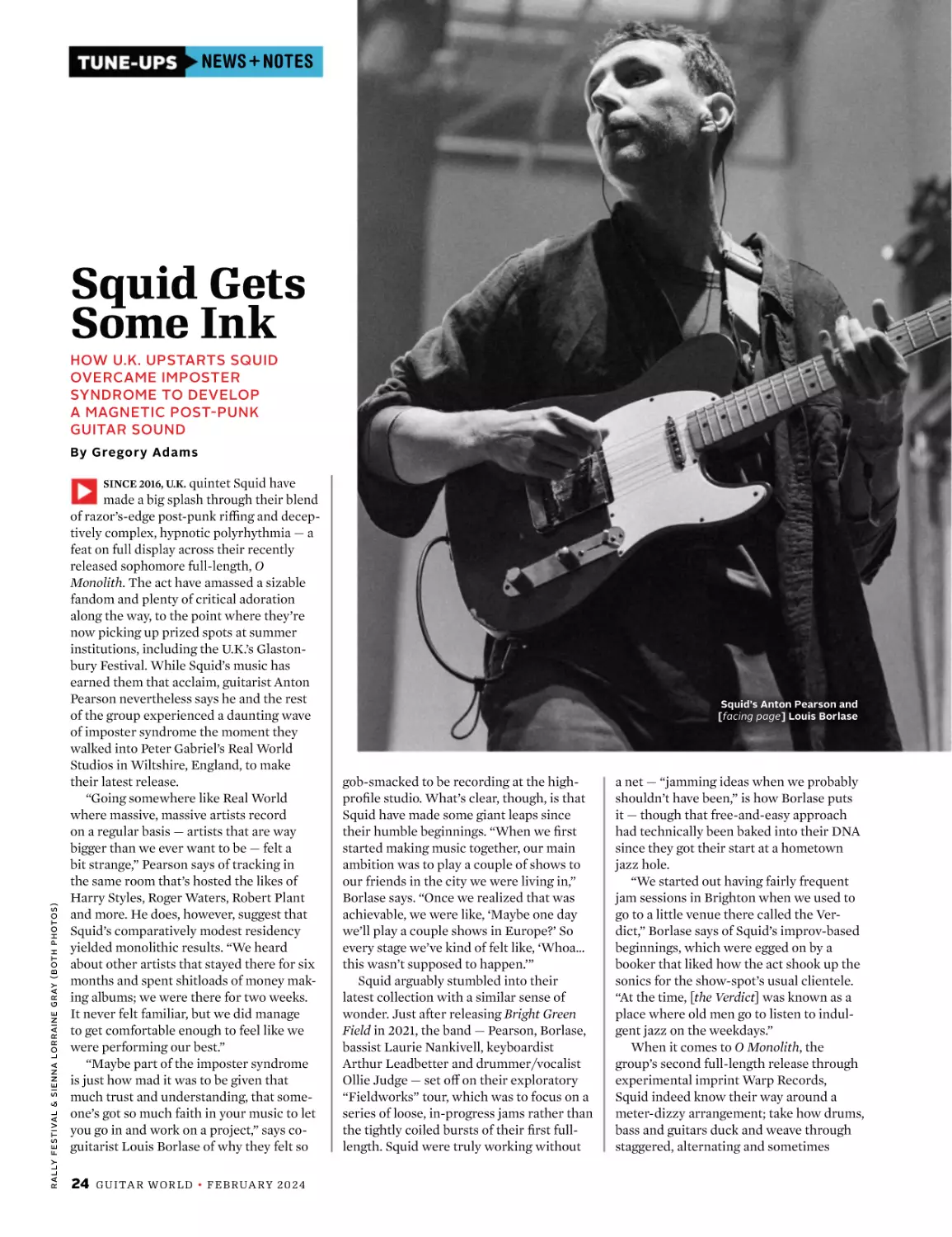
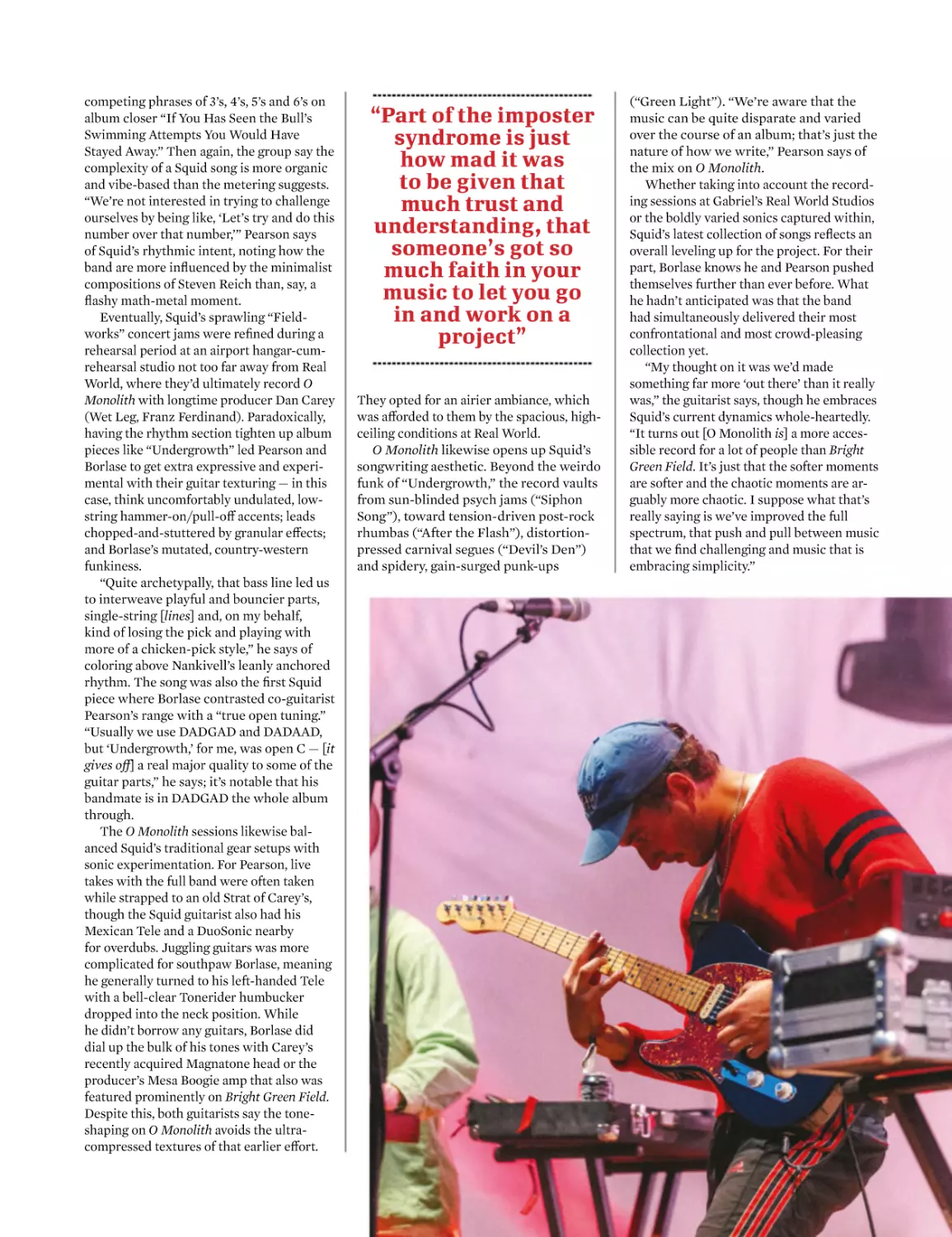
Squid’s Anton Pearson and
[facing page] Louis Borlase

gob-smacked to be recording at the highprofile studio. What’s clear, though, is that
Squid have made some giant leaps since
their humble beginnings. “When we first
started making music together, our main
ambition was to play a couple of shows to
our friends in the city we were living in,”
Borlase says. “Once we realized that was
achievable, we were like, ‘Maybe one day
we’ll play a couple shows in Europe?’ So
every stage we’ve kind of felt like, ‘Whoa…
this wasn’t supposed to happen.’”
Squid arguably stumbled into their
latest collection with a similar sense of
wonder. Just after releasing Bright Green
Field in 2021, the band — Pearson, Borlase,
bassist Laurie Nankivell, keyboardist
Arthur Leadbetter and drummer/vocalist
Ollie Judge — set off on their exploratory
“Fieldworks” tour, which was to focus on a
series of loose, in-progress jams rather than
the tightly coiled bursts of their first fulllength. Squid were truly working without

a net — “jamming ideas when we probably
shouldn’t have been,” is how Borlase puts
it — though that free-and-easy approach
had technically been baked into their DNA
since they got their start at a hometown
jazz hole.
“We started out having fairly frequent
jam sessions in Brighton when we used to
go to a little venue there called the Verdict,” Borlase says of Squid’s improv-based
beginnings, which were egged on by a
booker that liked how the act shook up the
sonics for the show-spot’s usual clientele.
“At the time, [the Verdict] was known as a
place where old men go to listen to indulgent jazz on the weekdays.”
When it comes to O Monolith, the
group’s second full-length release through
experimental imprint Warp Records,
Squid indeed know their way around a
meter-dizzy arrangement; take how drums,
bass and guitars duck and weave through
staggered, alternating and sometimes

competing phrases of 3’s, 4’s, 5’s and 6’s on
album closer “If You Has Seen the Bull’s
Swimming Attempts You Would Have
Stayed Away.” Then again, the group say the
complexity of a Squid song is more organic
and vibe-based than the metering suggests.
“We’re not interested in trying to challenge
ourselves by being like, ‘Let’s try and do this
number over that number,’” Pearson says
of Squid’s rhythmic intent, noting how the
band are more influenced by the minimalist
compositions of Steven Reich than, say, a
flashy math-metal moment.
Eventually, Squid’s sprawling “Fieldworks” concert jams were refined during a
rehearsal period at an airport hangar-cumrehearsal studio not too far away from Real
World, where they’d ultimately record O
Monolith with longtime producer Dan Carey
(Wet Leg, Franz Ferdinand). Paradoxically,
having the rhythm section tighten up album
pieces like “Undergrowth” led Pearson and
Borlase to get extra expressive and experimental with their guitar texturing — in this
case, think uncomfortably undulated, lowstring hammer-on/pull-off accents; leads
chopped-and-stuttered by granular effects;
and Borlase’s mutated, country-western
funkiness.
“Quite archetypally, that bass line led us
to interweave playful and bouncier parts,
single-string [lines] and, on my behalf,
kind of losing the pick and playing with
more of a chicken-pick style,” he says of
coloring above Nankivell’s leanly anchored
rhythm. The song was also the first Squid
piece where Borlase contrasted co-guitarist
Pearson’s range with a “true open tuning.”
“Usually we use DADGAD and DADAAD,
but ‘Undergrowth,’ for me, was open C — [it
gives off] a real major quality to some of the
guitar parts,” he says; it’s notable that his
bandmate is in DADGAD the whole album
through.
The O Monolith sessions likewise balanced Squid’s traditional gear setups with
sonic experimentation. For Pearson, live
takes with the full band were often taken
while strapped to an old Strat of Carey’s,
though the Squid guitarist also had his
Mexican Tele and a DuoSonic nearby
for overdubs. Juggling guitars was more
complicated for southpaw Borlase, meaning
he generally turned to his left-handed Tele
with a bell-clear Tonerider humbucker
dropped into the neck position. While
he didn’t borrow any guitars, Borlase did
dial up the bulk of his tones with Carey’s
recently acquired Magnatone head or the
producer’s Mesa Boogie amp that also was
featured prominently on Bright Green Field.
Despite this, both guitarists say the toneshaping on O Monolith avoids the ultracompressed textures of that earlier effort.

“Part of the imposter
syndrome is just
how mad it was
to be given that
much trust and
understanding, that
someone’s got so
much faith in your
music to let you go
in and work on a
project”
They opted for an airier ambiance, which
was afforded to them by the spacious, highceiling conditions at Real World.
O Monolith likewise opens up Squid’s
songwriting aesthetic. Beyond the weirdo
funk of “Undergrowth,” the record vaults
from sun-blinded psych jams (“Siphon
Song”), toward tension-driven post-rock
rhumbas (“After the Flash”), distortionpressed carnival segues (“Devil’s Den”)
and spidery, gain-surged punk-ups

(“Green Light”). “We’re aware that the
music can be quite disparate and varied
over the course of an album; that’s just the
nature of how we write,” Pearson says of
the mix on O Monolith.
Whether taking into account the recording sessions at Gabriel’s Real World Studios
or the boldly varied sonics captured within,
Squid’s latest collection of songs reflects an
overall leveling up for the project. For their
part, Borlase knows he and Pearson pushed
themselves further than ever before. What
he hadn’t anticipated was that the band
had simultaneously delivered their most
confrontational and most crowd-pleasing
collection yet.
“My thought on it was we’d made
something far more ‘out there’ than it really
was,” the guitarist says, though he embraces
Squid’s current dynamics whole-heartedly.
“It turns out [O Monolith is] a more accessible record for a lot of people than Bright
Green Field. It’s just that the softer moments
are softer and the chaotic moments are arguably more chaotic. I suppose what that’s
really saying is we’ve improved the full
spectrum, that push and pull between music
that we find challenging and music that is
embracing simplicity.”

NEWS + NOTES

MY PEDALBOARD
YVETTE YOUNG
WHAT THE COVET GUITARIST SEES WHEN SHE LOOKS DOWN

T I M M O S E N F E L D E R / G E T T Y I M A G E S ( YO U N G )

C O U R T E S Y O F Y V E T T E YO U N G ( B O A R D )

Interview by Andrew Daly
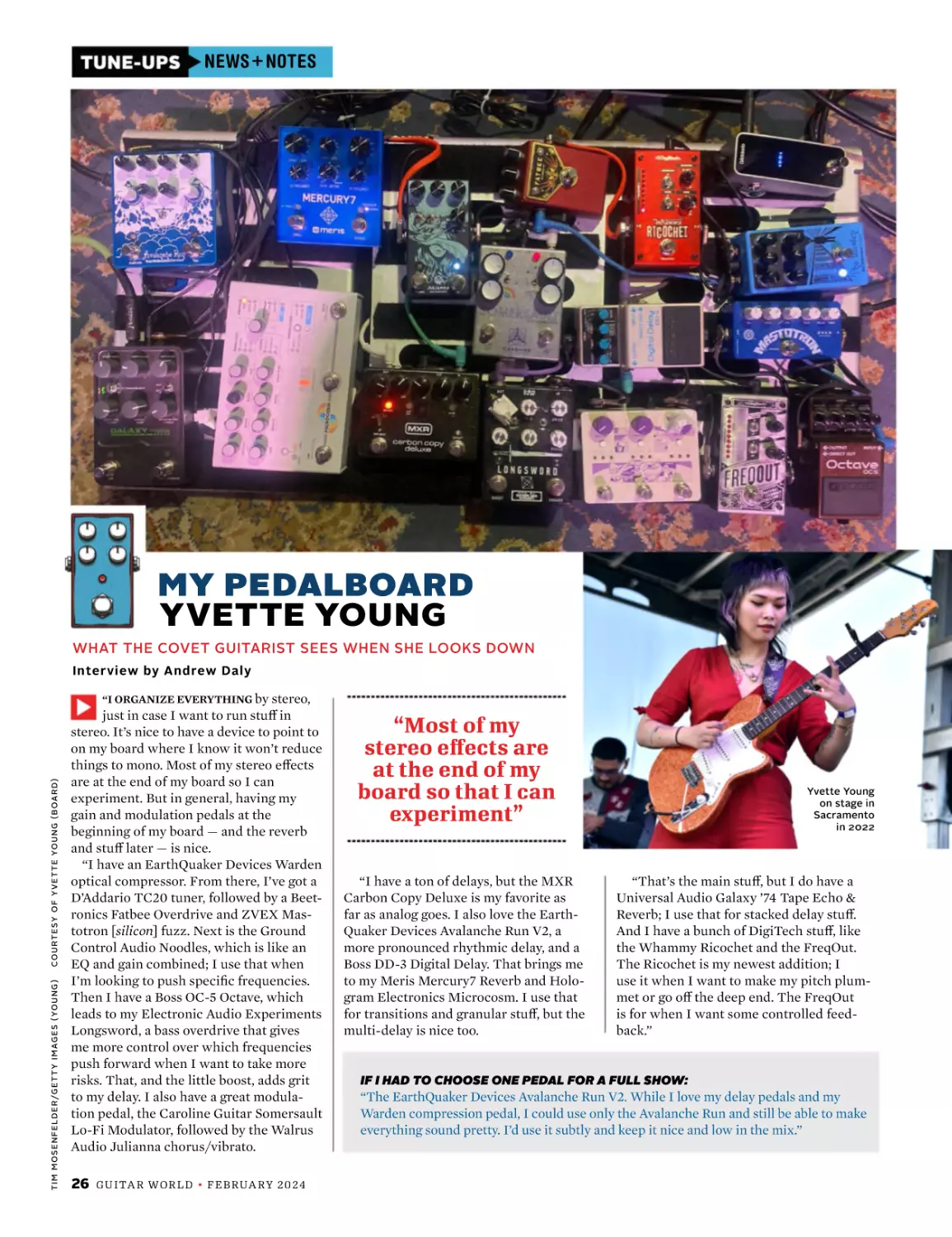
“I ORGANIZE EVERYTHING by stereo,
just in case I want to run stuff in
stereo. It’s nice to have a device to point to
on my board where I know it won’t reduce
things to mono. Most of my stereo effects
are at the end of my board so I can
experiment. But in general, having my
gain and modulation pedals at the
beginning of my board — and the reverb
and stuff later — is nice.
“I have an EarthQuaker Devices Warden
optical compressor. From there, I’ve got a
D’Addario TC20 tuner, followed by a Beetronics Fatbee Overdrive and ZVEX Mastotron [silicon] fuzz. Next is the Ground
Control Audio Noodles, which is like an
EQ and gain combined; I use that when
I’m looking to push specific frequencies.
Then I have a Boss OC-5 Octave, which
leads to my Electronic Audio Experiments
Longsword, a bass overdrive that gives
me more control over which frequencies
push forward when I want to take more
risks. That, and the little boost, adds grit
to my delay. I also have a great modulation pedal, the Caroline Guitar Somersault
Lo-Fi Modulator, followed by the Walrus
Audio Julianna chorus/vibrato.

26

GU I TA R WOR L D • F EBRUA RY 2024

“Most of my
stereo effects are
at the end of my
board so that I can
experiment”
“I have a ton of delays, but the MXR
Carbon Copy Deluxe is my favorite as
far as analog goes. I also love the EarthQuaker Devices Avalanche Run V2, a
more pronounced rhythmic delay, and a
Boss DD-3 Digital Delay. That brings me
to my Meris Mercury7 Reverb and Hologram Electronics Microcosm. I use that
for transitions and granular stuff, but the
multi-delay is nice too.

Yvette Young
on stage in
Sacramento
in 2022

“That’s the main stuff, but I do have a
Universal Audio Galaxy ’74 Tape Echo &
Reverb; I use that for stacked delay stuff.
And I have a bunch of DigiTech stuff, like
the Whammy Ricochet and the FreqOut.
The Ricochet is my newest addition; I
use it when I want to make my pitch plummet or go off the deep end. The FreqOut
is for when I want some controlled feedback.”

IF I HAD TO CHOOSE ONE PEDAL FOR A FULL SHOW:

“The EarthQuaker Devices Avalanche Run V2. While I love my delay pedals and my
Warden compression pedal, I could use only the Avalanche Run and still be able to make
everything sound pretty. I’d use it subtly and keep it nice and low in the mix.”

G U I TA R

W O R L D

PA G E
F E B R U A R Y

2 8
2 0 2 4

Story by AMIT SHARMA

PARANORMAL
ACTIVITY
Activity guitarist and
Trap Door Electronics
head honcho
TRAVIS JOHNSON
thrives in that hard-to-find
world where electronics and
synths peacefully coexist
with heavily effected guitars

T HOUGH HE’S A SELF-DESCRIBED
“guitar junkie,” having played in a number
of bands over the years and built up a solid
profile as a pedal builder for Death by Audio
and a new company, Trap Door Electronics, Travis Johnson enjoys letting his instrument play more of a supporting role in his
newest project, Activity.
The Brooklyn-based quartet just released
their second album, Spirit in the Room,
with electronics and synths co-existing
with heavily effected clean guitars — to the
point where it can be a challenge discerning which is exactly which. It’s this ethereal and eclectic approach to sonic experimentation that allows Johnson and his
bandmates — Jess Rees (guitar/vocals/
keys), Bri DiGioia (bass/vocals) and Steven
Levine (drums) — to prevail in the abstract,
dreaming up floaty atmospheres that eventually morph into meditative trances. As
he explains to Guitar World, the group is
undertaking more of a modern twist on psychedelic rock, though with some obscure

[far left] Travis Johnson in action with Activity. “While this is the
furthest I’ve ever been from ‘guitar music,’ the guitar is the only
thing I truly know how to play,” he says
[left] The Exit Index Redux pedal by Johnson’s company,
Trap Door Electronics — “mutant tremolo, gnarled distortion”

MAKSIM AKELIN (JOHNSON)

TRAP DOOR ELECTRONICS (PEDAL)

for the instruments to play over. We’ll
have the sample going through the PA
really loud and the rest of us feeling
out whatever we can imagine or do. It
pushes you into a place where you’re no
longer having to carry the song, because
there’s already this pre-existing core to
it. It’s this subliminal thing. And a lot of
the pedals I use, including what I make
in my own company, Trap Door Electronics, are to make guitars sound less
like guitars.
vintage influences coalescing with leftfield British sounds from the Nineties.
“I guess it was a conscious decision
to have the guitars sit in the background
like that,” Johnson says. “Sometimes
it’s up front, but a lot of the time it’s not.
We’re influenced by a lot of krautrock
like Can and Neu! and more recent stuff
like Broadcast, Portishead and Beak.
With those bands, there is guitar — it’s
definitely in there — but quite often you
can’t tell if it’s the main thing the song
was written around. We’re all about the
swirl of noise as a whole.
“And while this is the furthest I’ve
ever been from ‘guitar music,’ the guitar is the only thing I truly know how to
play. My previous projects were always
inching closer and closer to this sound.
I started off playing indie rock, which is
very guitar-driven, then moved toward
music that was mixed with electronics but still mainly guitars. Then I got
more into samples in my previous band,
Grooms. When that band ended, it was
close to this, and now I’ve decided to go
even further in that direction.
What’s your approach when it comes
to blending guitars with other instruments like keyboards and synths?

The electronic stuff is often written on
a sampler like the Elektron Digitakt.
Then we bring it into the practice space

It’s an interesting talking point.
To some guitarists that might sound
like sacrilege; to others, that’s often
where the beauty lies.

A lot of it boils down to taste and preference. Do you want the sound of a drum
machine with a really distorted guitar over it, like Nine Inch Nails? Or do
you want to hear something more subtle, where it’s an element but not single-handedly carrying the song? Both
are totally cool, but I guess we fit into
the latter. It’s hard to say what our
approach is because it took such a long
time for us to get where we are now,
honing it so that when I get something
going on the sampler, I have a good idea
of what I want everything else to be. It
took time feeling it out. Having references like Can really helped, because I
often wonder what they would do. But
interestingly they didn’t have all the
gear we have now! I guess I’m going
along with what sounds cool with the
tools available to me.
Tell us about your main guitars
and amps on this album.

My main guitar is an American Jaguar from 2004, or sometimes a crappy
Nineties Squier Strat, which I put
Fender American Vintage ’65 pickups
in. All my guitars are in weird tunings,
and these are tunings I’ve always generally stuck with. I really like [low to

high] C# G# C# F F C, which has this nice
“seventh chord” kinda sound [C#maj7].
None of my guitars are that expensive;
it’s just the stuff I could afford at the
time, going into a Vibrolux, which is a
great pedal-platform amp.
Speaking of pedals, tell us more about
your role at Death by Audio.

I started off by just helping out, and
by the end I was a small-percentage
owner. At some point in 2018 I decided
it was time to move on and do other
things, but I hadn’t really figured out
what that was at that point. So a lot of
the stuff you’re hearing is from Death
by Audio. Almost every song on this
album has one of their pedals. My friend
Jeff Berner [ex-Psychic TV] produced
the album and actually ended up telling
me to turn the Evil Filter off because it
was always on! I’d run on a certain setting for the cutoff with a Moog expression pedal, which I’m constantly using
for different parts. I might go for a really
rolled-off kind of sound with no highs,
for example. And I was also using the
Death by Audio Rooms [Stereo Reverb]
a lot. The distortion on the first album
came from a JHS Colour Box; on this
one it was the Recovery Effects Pearl.
I also love my Boss PS-3 Pitch Shifter/
Delay.
On which songs specifically can
we hear these pedals?

On “Department of Blood,” there’s no
guitar at all. By the third track, “Careful Let’s Sleepwalk,” things get really
noisy. Me and Jess were going for this
“total chaos in one take” kinda vibe,
going as crazy as we can. For me, a lot
of those extreme noises came from the
PS-3 on the detune setting. I’d send that
into the reverb and do a lot of string
scrapes to make it sound really atmospheric. There are also some actual guitar parts on the song, too… but they’re

guitarworld.com

29

is more expensive. Not prohibitively,
but there’s less margin for profit and
things are harder to source. It took a
while to get everything I needed. This
pedal is basically an obsolete op-amp
that wants to be abused and create this
sputtering envelope tremolo sound. I
bought a couple of thousand op-amps
once I found them!
[above] Johnson — with his 2004 Fender Jaguar — on stage with Activity;
[top right] “The heart of the Exit Index Redux is [its] obsolete op-amp, which is…
obsolete! I can only find old ones,” Johnson says

pretty minimal! My favorite song on the album is “Where
the Art Is Hung,” which is sung by Jess while I do really
subtle stuff in the background. I’d be adjusting the cutoff on the Evil Filter with massive amounts of reverb
from the Rooms alongside some detune from the PS-3.
I’d rock the expression pedal fully open for that Cocteau
Twins (Lexicon 480L processor), really bright crystalline sound. Those pedals ended up on almost every song
in some combination. I was also running synths through
those pedals. And speaking of synth sounds, I used the
Eventide PitchFactor on a few things. There’s a synth setting that makes your guitar sound like a Theremin. I used
that on “Sophia.” Jess has a totally different rig, she uses
stuff by Hudson Electronics and the Cutting Room Floor
reel-to-reel overdrive/echo by Recovery Effects, among
other things.
Exactly what are you hoping to achieve with Trap Door
Electronics?

It all started last summer. My first pedal is the Exit Index
Redux, because when I was at Death by Audio I did
this limited-edition pedal there called the Exit Index.
I noticed they were starting to go for more than what
they should have been, and I didn’t want people spending too much money on them. There were also a few
things I wanted to tweak. I wanted it to get a lot louder
and I wanted the expression function to do more. I’m an
expression addict; I love sweeping through sounds as I’m
playing. On the original I hadn’t quite nailed everything
it should do. I also wanted the tremolo to sound better —
because it’s a big weird messy tremolo pedal, basically,
but one that also distorts.

It feels like good timing. Many would say the world has

30

GU I TA R WOR L D • F EBRUA RY 2024

gone effects mad in recent years.
Just look at what happened with
the DigiTech Bad Monkey after
JHS owner Josh Scott featured it
on his YouTube channel.

It’s true! I started the company not
long ago and feel lucky that people
have been buying my pedals. I’ve
become more aware of new companies over the last few years — there
are loads out there. As for Josh, I
think it’s really cool how he’s started
his channel and, sure, he mentions
the products JHS sell, but he also
loves recommending all these other
companies doing cool stuff. He’s
the genuine article. That guy really
loves pedals — to the point where
he’ll talk about other brands and
rival products.
Aren’t parts more expensive and
harder to source right now?

They can be. That’s another thing
I realized; in the four years since
I’d been at Death by Audio, things
had changed. Costs were different because of Covid, especially
semiconductors. The heart of the
Exit Index Redux is this obsolete
op-amp, which is… obsolete! I can
only find old ones. I did wonder to
myself if I’d chosen the wrong time
to go into this, because everything

What’s next for your brand?

Right now I’m working on the schematic for a prototype. It’s a gainstagey distortion that can go from
boost to overdrive to distortion to fuzz
to oscillation, with a nasty-sounding filter that can bring out a lot of different tones, depending on what you
want. I think it’s going to be pretty
cool! This will actually be the second
prototype for it because the first one
came back and I wasn’t in love with
it, so I wanted to tweak it. I think the
third pedal will have these interesting filter chips I found, which I want
to experiment with. Most of it will be
stuff that enables you to sound less
like a guitarist and more like a synth
player if you want, but it will suit more
traditional applications too.
Finally, what would you say is the
greatest pedal ever made?

I don’t know! I will probably regret
saying this, but the Boss PS-3 is amazing. I originally got it for that backwards, shimmery ambience on setting 7. That pedal came out in the midNineties and decades later I still hear
bands using it in the coolest ways.
There are 11 modes and they all sound
different. You can put a guitar or a
drum machine through it, so it can do
a lot more than most pedals.
For fuzz, I think the Fuzz War wins
every time. It’s Death by Audio’s flagship and just sounds awesome, doing
everything I’d want a Big Muff to do
without losing any of the frequencies I
want to keep when I turn it on. I’d say
tuners are pretty important too!

HIS FIRST
The New Boss Guitar
of George Benson (1964)

D AV I D R E D F E R N / R E D F E R N S ( L E F T )

R O B V E R H O R S T/ R E D F E R N S ( R I G H T )

Walking to New Orleans
(2019)
HIS LATEST

One of the all-time jazz guitar greats on meeting Jimi Hendrix,
how Peter Frampton changed the course of his career
and what Paul McCartney thought of his Beatles tribute
By Joe Bosso

EORGE BENSON REALLY wants
to talk about the new
album he’s cutting. It’s
his first studio recording since 2019’s Walking
to New Orleans, and as he
says, “It’s going to be something really
special.”
He starts to divulge a detail or two,
then abruptly stops. “Well, that’s
about all I can say right now,” he says.
When pressed for any kinds of tidbits, he laughs and relents every so

slightly. “I can’t let out exactly what
it is, but it’s something different from
anything I’ve ever done, and I’m working with one of the top arrangers of
our time. That’s about as far as I can go
with that. I’m keeping it under my hat
for now.”
In actual fact, musically speaking,
there isn’t much the 80-year-old guitar legend hasn’t done. After cutting
his teeth in organist “Brother” Jack
McDuff’s jazz band in the early Sixties, Benson struck out on his own

and released The New Boss Guitar of
George Benson. From there, he never
looked back. His virtuosic chops and
artful sense of style, combined with an
unshakable taste for adventure, quickly
established him as one of the most
exciting and original jazz guitarists
since Charlie Christian. But Benson —
also blessed with a smooth and soulful tenor singing voice — wouldn’t limit
his gifts to the strictly jazz market, and
over the years he spanned pop, rock,
R&B, disco, blues and Latin music (his

“THEY SAID, ‘MAN, GEORGE BENSON WOULDN’T EVEN LET HENDRIX SIT IN AND PLAY’...
32

GU I TA R WOR L D • F EBRUA RY 2024

PERSONALITIES // GEORGE BENSON

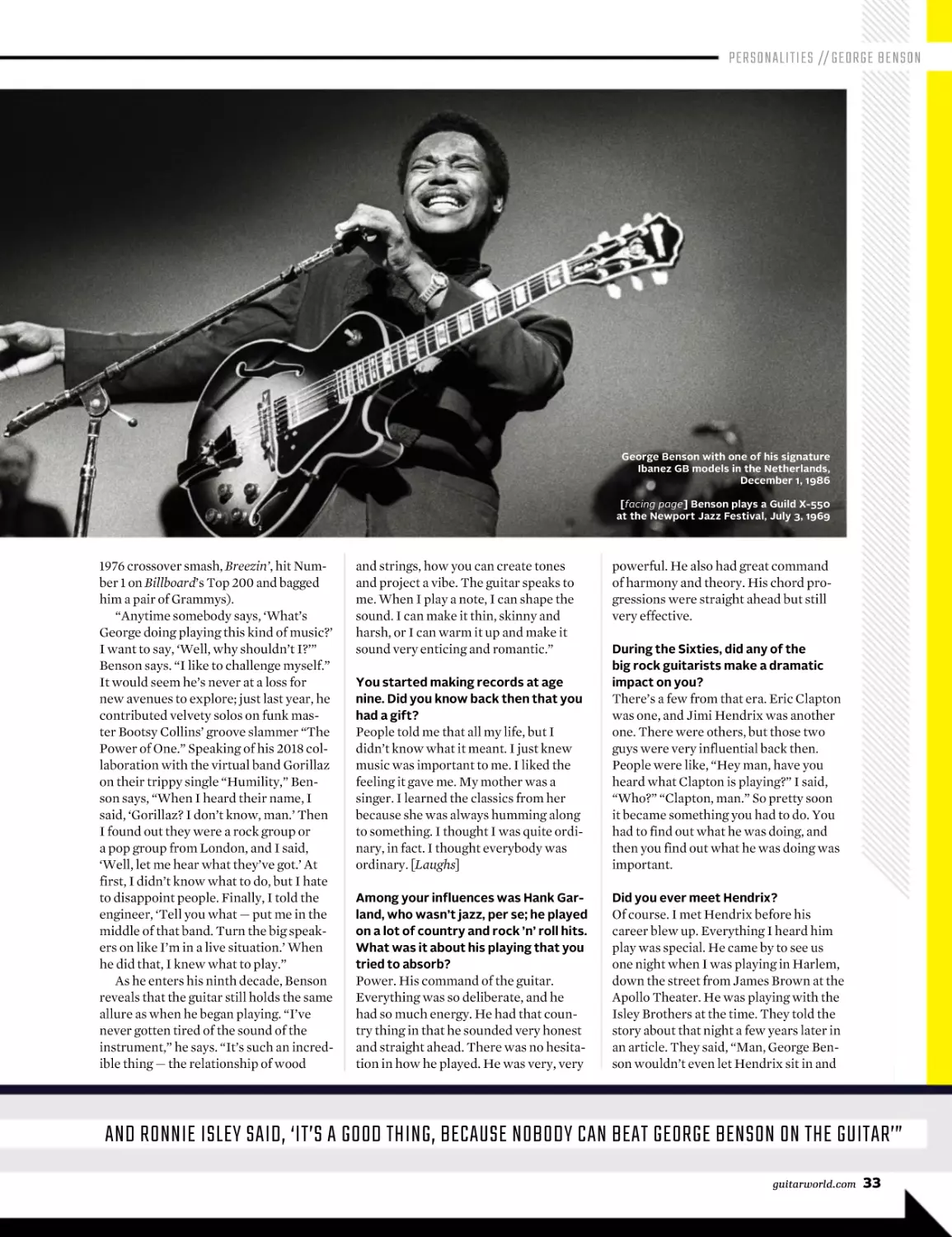
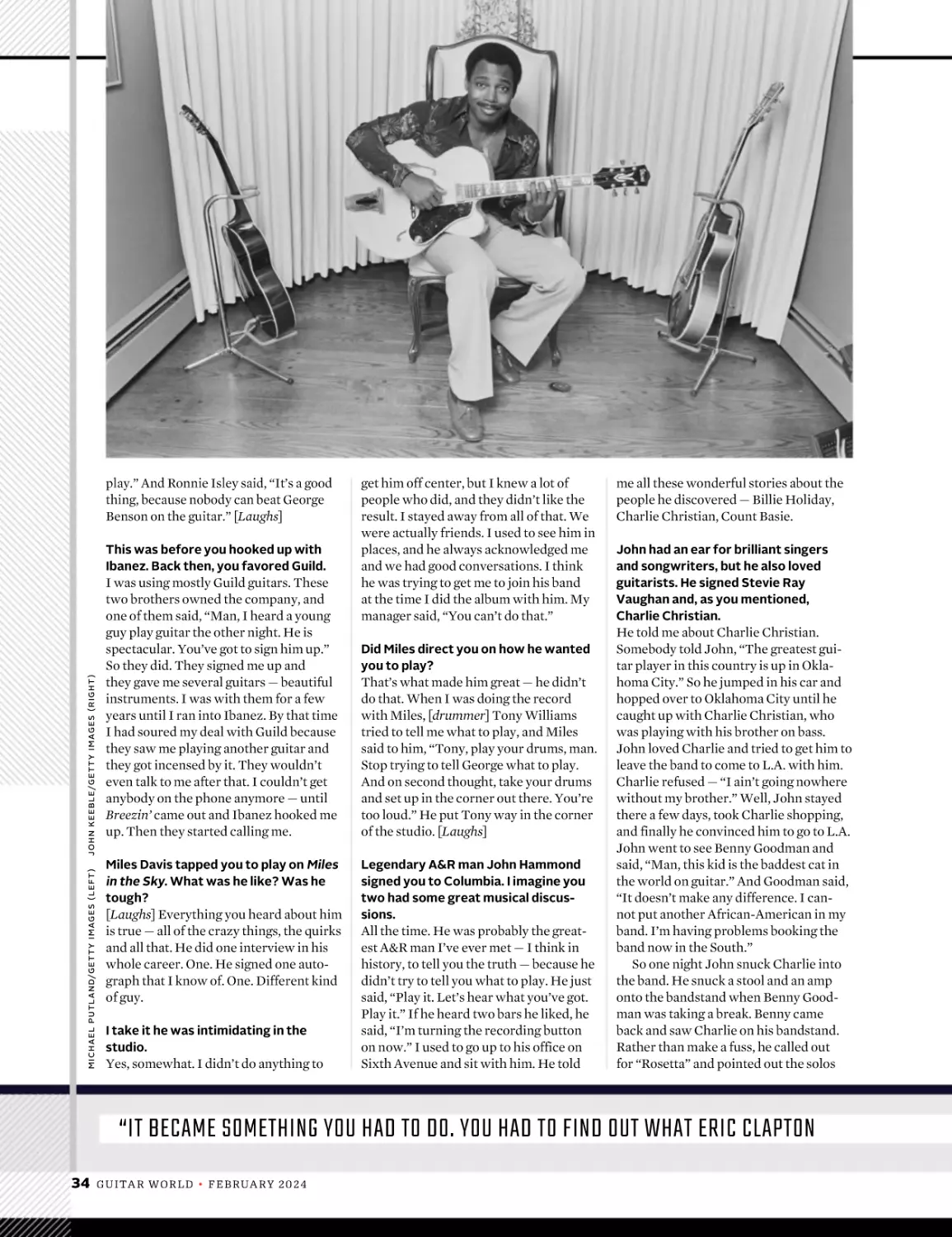
George Benson with one of his signature
Ibanez GB models in the Netherlands,
December 1, 1986
[facing page] Benson plays a Guild X-550
at the Newport Jazz Festival, July 3, 1969

1976 crossover smash, Breezin’, hit Number 1 on Billboard’s Top 200 and bagged
him a pair of Grammys).
“Anytime somebody says, ‘What’s
George doing playing this kind of music?’
I want to say, ‘Well, why shouldn’t I?’”
Benson says. “I like to challenge myself.”
It would seem he’s never at a loss for
new avenues to explore; just last year, he
contributed velvety solos on funk master Bootsy Collins’ groove slammer “The
Power of One.” Speaking of his 2018 collaboration with the virtual band Gorillaz
on their trippy single “Humility,” Benson says, “When I heard their name, I
said, ‘Gorillaz? I don’t know, man.’ Then
I found out they were a rock group or
a pop group from London, and I said,
‘Well, let me hear what they’ve got.’ At
first, I didn’t know what to do, but I hate
to disappoint people. Finally, I told the
engineer, ‘Tell you what — put me in the
middle of that band. Turn the big speakers on like I’m in a live situation.’ When
he did that, I knew what to play.”
As he enters his ninth decade, Benson
reveals that the guitar still holds the same
allure as when he began playing. “I’ve
never gotten tired of the sound of the
instrument,” he says. “It’s such an incredible thing — the relationship of wood

and strings, how you can create tones
and project a vibe. The guitar speaks to
me. When I play a note, I can shape the
sound. I can make it thin, skinny and
harsh, or I can warm it up and make it
sound very enticing and romantic.”
You started making records at age
nine. Did you know back then that you
had a gift?

People told me that all my life, but I
didn’t know what it meant. I just knew
music was important to me. I liked the
feeling it gave me. My mother was a
singer. I learned the classics from her
because she was always humming along
to something. I thought I was quite ordinary, in fact. I thought everybody was
ordinary. [Laughs]
Among your influences was Hank Garland, who wasn’t jazz, per se; he played
on a lot of country and rock ’n’ roll hits.
What was it about his playing that you
tried to absorb?

Power. His command of the guitar.
Everything was so deliberate, and he
had so much energy. He had that country thing in that he sounded very honest
and straight ahead. There was no hesitation in how he played. He was very, very

powerful. He also had great command
of harmony and theory. His chord progressions were straight ahead but still
very effective.
During the Sixties, did any of the
big rock guitarists make a dramatic
impact on you?

There’s a few from that era. Eric Clapton
was one, and Jimi Hendrix was another
one. There were others, but those two
guys were very influential back then.
People were like, “Hey man, have you
heard what Clapton is playing?” I said,
“Who?” “Clapton, man.” So pretty soon
it became something you had to do. You
had to find out what he was doing, and
then you find out what he was doing was
important.
Did you ever meet Hendrix?

Of course. I met Hendrix before his
career blew up. Everything I heard him
play was special. He came by to see us
one night when I was playing in Harlem,
down the street from James Brown at the
Apollo Theater. He was playing with the
Isley Brothers at the time. They told the
story about that night a few years later in
an article. They said, “Man, George Benson wouldn’t even let Hendrix sit in and

AND RONNIE ISLEY SAID, ‘IT’S A GOOD THING, BECAUSE NOBODY CAN BEAT GEORGE BENSON ON THE GUITAR’”
guitarworld.com

33

play.” And Ronnie Isley said, “It’s a good
thing, because nobody can beat George
Benson on the guitar.” [Laughs]

M I C H A E L P U T L A N D/ G E T T Y I M A G E S ( L E F T )

JOHN KEEBLE/GETTY IMAGES (RIGHT)

This was before you hooked up with
Ibanez. Back then, you favored Guild.

I was using mostly Guild guitars. These
two brothers owned the company, and
one of them said, “Man, I heard a young
guy play guitar the other night. He is
spectacular. You’ve got to sign him up.”
So they did. They signed me up and
they gave me several guitars — beautiful
instruments. I was with them for a few
years until I ran into Ibanez. By that time
I had soured my deal with Guild because
they saw me playing another guitar and
they got incensed by it. They wouldn’t
even talk to me after that. I couldn’t get
anybody on the phone anymore — until
Breezin’ came out and Ibanez hooked me
up. Then they started calling me.
Miles Davis tapped you to play on Miles
in the Sky. What was he like? Was he
tough?

[Laughs] Everything you heard about him
is true — all of the crazy things, the quirks
and all that. He did one interview in his
whole career. One. He signed one autograph that I know of. One. Different kind
of guy.
I take it he was intimidating in the
studio.

Yes, somewhat. I didn’t do anything to

get him off center, but I knew a lot of
people who did, and they didn’t like the
result. I stayed away from all of that. We
were actually friends. I used to see him in
places, and he always acknowledged me
and we had good conversations. I think
he was trying to get me to join his band
at the time I did the album with him. My
manager said, “You can’t do that.”
Did Miles direct you on how he wanted
you to play?

That’s what made him great — he didn’t
do that. When I was doing the record
with Miles, [drummer] Tony Williams
tried to tell me what to play, and Miles
said to him, “Tony, play your drums, man.
Stop trying to tell George what to play.
And on second thought, take your drums
and set up in the corner out there. You’re
too loud.” He put Tony way in the corner
of the studio. [Laughs]
Legendary A&R man John Hammond
signed you to Columbia. I imagine you
two had some great musical discussions.

All the time. He was probably the greatest A&R man I’ve ever met — I think in
history, to tell you the truth — because he
didn’t try to tell you what to play. He just
said, “Play it. Let’s hear what you’ve got.
Play it.” If he heard two bars he liked, he
said, “I’m turning the recording button
on now.” I used to go up to his office on
Sixth Avenue and sit with him. He told

me all these wonderful stories about the
people he discovered — Billie Holiday,
Charlie Christian, Count Basie.
John had an ear for brilliant singers
and songwriters, but he also loved
guitarists. He signed Stevie Ray
Vaughan and, as you mentioned,
Charlie Christian.

He told me about Charlie Christian.
Somebody told John, “The greatest guitar player in this country is up in Oklahoma City.” So he jumped in his car and
hopped over to Oklahoma City until he
caught up with Charlie Christian, who
was playing with his brother on bass.
John loved Charlie and tried to get him to
leave the band to come to L.A. with him.
Charlie refused — “I ain’t going nowhere
without my brother.” Well, John stayed
there a few days, took Charlie shopping,
and finally he convinced him to go to L.A.
John went to see Benny Goodman and
said, “Man, this kid is the baddest cat in
the world on guitar.” And Goodman said,
“It doesn’t make any difference. I cannot put another African-American in my
band. I’m having problems booking the
band now in the South.”
So one night John snuck Charlie into
the band. He snuck a stool and an amp
onto the bandstand when Benny Goodman was taking a break. Benny came
back and saw Charlie on his bandstand.
Rather than make a fuss, he called out
for “Rosetta” and pointed out the solos

“IT BECAME SOMETHING YOU HAD TO DO. YOU HAD TO FIND OUT WHAT ERIC CLAPTON
34

GU I TA R WOR L D • F EBRUA RY 2024

PERSONALITIES // GEORGE BENSON
— “Horns, all right, now guitar!” Charlie started playing and everybody jumped
out of their seats. They never heard anything like that. They ran over to the bandstand and they wouldn’t let him stop
playing. That’s how he got into Benny
Goodman’s band.
I’ve always loved your tribute to the
Beatles, 1970’s The Other Side of
Abbey Road. Did any of the Fab Four
ever talk to you about it?

When that record came out, the industry
hated it. All the jazz people hated it. But
Paul McCartney sent word back to me
— “Man, we love what you did with our
music.” That was great compensation. I
knew the album would mean something
one day.
A few years later, Breezin’ hit Number
1. What did you think at the time?

That it was impossible! [Laughs] I’ll tell
you, the guy who probably helped me
get there was Peter Frampton. Remember, he had the biggest record ever at
the time; he was dominating the covers of magazines. He was the one you
had to defeat in order to get the cover of
Record World and all those magazines.
But he said something in an article that
really spurred me on. He said, “I listen to
George Benson records all the time.”
I was like, “What? You mean this
genius, this kid selling all these records,
listens to my music? I don’t sell no
records!” [Laughs] But that’s what he
said. So I said, “Let me listen to his
records and see what he’s doing that
makes his music so outstanding.” I
started listening to his music, and I
thought, “OK, he’s got percussion over
here, and he’s got that going on. Let me
try some of that.”
You became something of a pop star.
You also did disco tunes. Did you get
flak from any of your early jazz fans?

Always. But one thing I understand about
this world, if you go left, they’ll say, “You
should have gone right,” and vice versa.
That’s common stuff, and it happened to
a lot of my friends. It broke Wes Montgomery’s heart when he went home to
play in Indianapolis. He was a star by
then, and he was playing at a local arena
downtown. Every time he played a pop
tune, his older fans would boo. Then he
would play the jazz tunes and they would

Benson in action in
Southend-on-Sea, England,
June 29, 2022
[facing page] Benson
at home, September 5, 1977

go crazy. He was caught in the middle of
all of that. I understand how that works.
The greatest thing that happened to
me in that regard was when I did a record
with Frank Sinatra. He asked me to sit
beside him, and he said, “George, your
guitar playing, we all know what that is,
man. You’re fantastic. But I love your
voice.” After he said that, I couldn’t listen
to people talk about my vocals anymore. I
didn’t even hear them.
Speaking of vocals, what about scatting? Many listeners never heard you
do that until you came out with “On
Broadway” and “This Masquerade.”
How does scatting inform your phrasing on the guitar?

It’s all the same brain. They both have
their physical limitations. When one cannot do a certain thing, the other one can.
It took me years to figure. When I was a
kid, I’d listen to Charlie Parker’s “Just
Friends.” His solo — I couldn’t play it, but
I could sing every note. When I started
doing that on my records, I found that

was easy. Of course, what I was doing
was lightweight compared to Charlie
Parker, but I did like improvising.
How many signature models have you
had with Ibanez?

I think we’ve got about 15 signature guitars, maybe more. What I really like is
that they offer refinements for guitar collectors and people who are trying to find
something different to play. It gives them
options, and every now and then they’ll
come up with a gem like the GB10, something very special that you’ve got to have
in your collection.
You’ve been with the company for
more than 40 years. Is there some sort
of refinement on any of the guitars you
haven’t done yet?

No, I’m taking information from people
who play guitar. The new up-andcoming people are still giving me
information. The company takes that
information to make the best guitars
they can.

WAS DOING — AND THEN YOU FIND OUT WHAT HE WAS DOING WAS IMPORTANT”
guitarworld.com

35

“I use those vintage
Les Pauls and Teles and
Strats and 335s because
I want to get the right
sound for the music,”
Bonamassa says

by J i m B ea u gez

THE PAST two decades, Joe Bonamassa
has been a familiar face in these pages, as a
widely appreciated, virtuosic blues guitarist, as well as an avid caretaker of the instrument’s legacy, who
has collected and preserved not only hundreds of guitars, but
also mountains of classic amplifiers and guitar ephemera.
As such, it might be difficult for readers today to imagine
a time when he was just another struggling guitarist trying to
make his mark in music. But after being ushered into the ranks
of B.B. King and Danny Gatton before age 13, and forming the
band Bloodline with Waylon Krieger, Erin Davis and Berry
Oakley Jr. — the sons of Robby Krieger of the Doors, Miles
Davis and the Allman Brothers Band bassist — Smokin’ Joe
Bonamassa, as he was known then, tanked as a solo artist.
And what was his plan B when his high-profile 2000 debut,
A New Day Yesterday, and its 2002 follow-up, So, It’s Like
That, failed to meet expectations? “Uh, I don’t know, become

a cop?” he says today, drolly. Instead of trading his love of the
beat for a life on the beat, though, he took the experience as a
call to follow his own instincts.
Now that he had some real blues to sing about, Bonamassa
went back to his musical roots in search of the spark that lit
him up years earlier. He found it, and in turn a rabid audience,
with his 2003 covers record, Blues Deluxe, which featured a
rejuvenated Bonamassa taking on songs by Robert Johnson,
B.B. King, John Lee Hooker, Buddy Guy and others.
“I’ve had a couple of breakouts,” he says. “I would say in
2003 [with Blues Deluxe], after we started getting some traction in Europe, and then in 2009 when we did the Royal Albert
Hall for the first time — that was the real explosion. But everything had been leading up to that moment.”
Blues Deluxe Vol. 2, which was released in October, doesn’t
cover the same old ground, though. Backed by his core band
as well as a bright and blustery horn section and jump-blues

P hotog ra p h by Ki t Wood

GU I TAR WOR L D

piano, Bonamassa puts his spin on the
Peter Green-era Fleetwood Mac roadhouse jam “Lazy Poker Blues,” Bobby
Bland’s soul classic “Twenty-Four Hour
Blues” and six other blues tunes. There’s
also a pair of originals, one co-written
with Tom Hambridge, and the albumcloser, “Is It Safe to Go Home,” written
by Josh Smith — Bonamassa’s fellow Guitar World columnist — who also produced
the album.
We talked with Bonamassa about how
things have changed for him since his first
Blues Deluxe installment, curating obscure
cuts from lesser-known blues artists, and,
of course, the vintage guitars and amps he
used to bring Blues Deluxe Vol. 2 to life.
Twenty years ago, Blues Deluxe was
something of a last-ditch effort to save
your music career. Can you take us back
to those days?

I was on Sony Music and was dropped.
By 2003, I had no record deal, no prospects and couldn’t draw a crowd. My manager and I had to make a choice. It’s either
we’re gonna close the doors [and] I’ll be
a session guy or a road player or whatever. And he said, “Let’s just make a blues
record and fuck it all,” you know? Because
at that point we were listening to consultants, and radio this and that, and it just
wasn’t me. So, I made a “me” record, and it
was the first record I made that really connected to people. We were very lucky that
it connected the way it did. We made the
record in seven days with $10,000.
I thought [doing Blues Deluxe Vol. 2]
would be a fun project — pick some songs,
do it in the [same] spirit and ask the question, ‘Hey, am I better now or worse now
than I was 20 years ago?’ I think I’m a better singer now, and I think a more mature
artist, and that’s pretty much [why] we
picked songs that meant something, that
were a little more sophisticated than the
first record, with real strings and horns
because we had a budget — unlike the first
record.

ELEANOR JANE

Why do you think the original Blues
Deluxe resonated with an audience
where your first two albums didn’t?

When an artist stops listening to other
people’s advice about what they should be
doing and goes, ‘I’m gonna do it my way,’
that’s when you start winning. You have
to tap into something in your soul that you
believe in, because if you don’t believe in
it, how are you gonna get anybody else to
believe in it? That’s really what happened,
and I think that’s why it resonated at that
point.

38

GU I TA R WOR L D • F EBRUA RY 2024

“I think I’m a better singer
now, a more mature artist —
that’s why we picked songs
that meant something”

There are definitely some more obscure
names here than on the first volume.
How did you narrow down the tracklist?

Josh [Smith, producer] had a list, I had a
list. We both agreed that we wanted to do
“Twenty-Four Hour Blues” off Dreamer
[1974] from Bobby Bland. I wanted to do
“I Want to Shout About It,” because that
was always one of my favorite Ronnie Earl
songs, and then “[Well I] Done Got Over
It,” the Bobby Parker song. And then we
did the Pee Wee Crayton song “Win-O.”
It’s just one of those things where before
you know it, you’ve got a record.
From a guitar-playing perspective, did
these songs challenge you in a way that

maybe the ones on the first volume
didn’t?

From a guitar standpoint, none of it’s giant
stuff. I mean, you just gotta play the blues,
you know? But when you’re 25 and nobody
gives a shit, you’ve got two chips on your
shoulders. When you’re 45 and established,
you’re not not so keen on just ramming your
guitar prowess down everybody’s throat all
the time. To me, the challenge is mitigating
those urges to overplay, but really stinging
the notes and making it say something.
How do you think you’ve grown during
the two decades the Blues Deluxe albums
bookend?

I’m more seasoned, and you hear things

differently. You phrase things differently.
That’s one of the most obvious differences
between [now and] 20 years ago. My voice
is clearer, it’s higher, and it’s just because I
learned how to sing. When I was 25, I didn’t
know how to sing. I was shouting into a
microphone and wondering why it sounded
so rough. But then I took all the lessons and
figured it out.
When in your life did a name like Pee Wee
Crayton come into play?

Before I heard Pee Wee’s music, I saw a picture of him holding a very rare ’55 Fiesta
Red Strat that Leo Fender built for him.

There’s two things about Leo Fender. He
got so many things right the first time —
like, a Broadcaster is essentially a Telecaster. But because of a gentleman’s agreement between Fred Gretsch and Leo
Fender, they dropped the word Broadcaster. So a Nocaster is essentially a Broadcaster, but they cut the word Broadcaster
off the logo. They call them clipped logos.
By October of ’51, with the television now
becoming a thing, they renamed it a Telecaster. Now, the difference between an
October ’51 Telecaster and a Broadcaster,
other than a very few things — like, the
knobs were taller in ’50, whatever — it’s

’54 Strat and put some scratches into it on
the stage? I was like, no, you know? For me,
that thing’s been preserved for 70 years,
and it’s my job to keep it preserved. Am I
lucky enough to have another one that’s
beat up that I could play? Absolutely. So I
have to thread both lines. I’m a player first;
that’s what affords me the guitars. But I also
have to go, ‘Okay, this is gonna be for the
collection, this is gonna be for the stage.’
Were you true to the instruments played
by the artists you were covering?

Yeah, I busted out the Flying V for the
Albert thing. Albert used the ’67 on “Born

“YOU HAVE TO TAP INTO SOMETHING
IN YOUR SOUL THAT YOU BELIEVE IN,
BECAUSE IF YOU DON’T BELIEVE
IN IT, HOW ARE YOU GONNA GET
ANYBODY ELSE TO BELIEVE IN IT?”

He was an L.A. guy, and the guitar is a very
famous guitar, which is at the Blues Hall of
Fame Museum in Memphis. He had a run
from like, ’58 to ’61; those were his years,
and he was a big star in the blues community. He had a great way of phrasing and
playing and singing, and just the song structures I thought were cool. He’s just one of
those guys that, once you do the deep-dive
into the late-Fifties blues, his name will
always come up.
With your extensive guitar collection,
you’re able to bring anything to the table.
When revisiting the Blues Deluxe concept, did you dig back into your gear
vault?

Well, I didn’t use the Jubilee Marshalls.
I still use them live, but I basically used
a high-powered tweed [Fender] Twin, a
Dumble-modded Fender Vibrolux with an
Ultraphonix mod and a [Marshall] JTM45
with a 4x12. And then for the two or three
songs we cut in Nashville, I used the 3x10
Fender Bandmaster 1956 and a low-powered Twin 1956. But I use those vintage Les
Pauls and Teles and Strats and 335s because
I want to get the right sound for the music.
Also, you recently acquired the famous
Norman Harris Broadcaster. That’s a
pretty important piece, not only for
Fender but for electric guitar in general.

essentially the same guitar. But when you
see Broadcaster on the headstock, the price
goes up because it is a ’50, and it does represent the first-year DNA. Now that guitar
is 73 years old and just as relevant today as
it was 73 years ago. There’s not many things
that have ever been designed, not just musically, but in general, that could say that.
I mean, cars don’t look the same, houses
don’t look the same, you know what I
mean? Things have moved on. Yet, for some
reason, the Telecaster, the classic-design
Les Paul, which to me is a ’57, the Stratocaster series two, gen-three P-Bass with the
Strat head, the Jazzmaster, the Jaguar, all
this stuff didn’t go through a lot of delineations. Leo got it right the first time. The
Jazz bass, other than the stack knob versus the three-knob configuration, it’s essentially the same. So the Broadcasters are a
very important guitar in the sense that it
represents the beginning of a historical
journey in American manufacturing.

Under a Bad Sign,” and the Korina, but
he had three. And so I actually ended up
using my ’67 sparkling burgundy V that’s
in mint condition on the record. I had the
[1958 “Famous Amos”] Korina with me and
just the ‘67 pinged harder, and it was a little harder to play, too. But for “Lazy Poker
Blues,” that’s the ’59 sunburst Les Paul.
“Done Got Over It,” that’s the ’59 sunburst
Les Paul. “Twenty-Four Hour Blues,” that’s
a 1961 ES-355 mono, so it’s basically a 335
but with 355 appointments, no Varitone,
and not stereo.

What is in your current circle of favorite
guitars?

We pretty much curated everything, you
know? We sifted through a bunch of songs
and just like, ‘Hey, can I pull this off?’ But
the other thing is, does it need to be done?
There’s so many covers records now, full of
songs that are well-worn paths. I don’t need
to add to the noise, you know what I mean?
I’d rather pick songs that are killer or that
mean something to us.

Ninety percent of my guitars are in mint
condition, untouched, unmolested. Perfect
museum grade. Then there’s about 50 to 60
guitars that are the last 10 percent, [which]
are the ones I play on the road. Those are
more beat up. So, as a collector, you have to
go, is your ego large enough to take a mint

Were there any wildcard songs, just
“out there” ideas that made the cut?

Josh brought an original song that I
thought was really good, and we cut it [for]
the end of the record, a song called “Is It
Safe to Go Home.” I think it’s one of the
stars of the record.
Were there any covers that were
out of left field?

guitarworld.com

39

SLOWHAND IN THE

’60s

A

OF

INVENTS THE MODERN ELECTRIC GUITAR
SOUND AND FOREVER CHANGES HOW
WE ALL PLAY GUITAR
By DAVID SINCLAIR

T IS DIFFICULT, in retrospect, to convey the impact that Eric Clapton had on the
world of electric guitar playing in 1966. For
one thing, Clapton himself has spent most
of his career since 1970 in denial about his
achievements in revolutionizing the sound
and status of the instrument, and he has been
only too happy to let the spotlight fall instead
on those who followed in his footsteps,
including Jimi Hendrix, Jeff Beck, Jimmy
Page and too many others to count.

But even allowing for Clapton’s
latter-day reticence, it takes a
supreme effort of either memory
or imagination to fully appreciate
how different the state and sound of
electric guitar playing was prior to
the release of John Mayall’s Blues
Breakers with Eric Clapton in 1966.
The prototype guitar heroes of the
Fifties and early Sixties were either
moody types such as Link Wray and

Duane Eddy, or bands like the Ventures and, in the U.K., the Shadows,
whose guitar star was the clean-cut
Hank Marvin. What they shared was
a guitar sound that seemed to have
been recorded at the bottom of the
Grand Canyon. Layers of echo and
reverb were added to a precise plectrum and fingering style that placed
the ability to conjure a haunting melody cloaked in a deep, twanging

Eric Clapton — with
the Bigsby-equipped
Gibson Les Paul that
he borrowed from
the Rolling Stones’
Keith Richards —
performing with
Cream at the Windsor
(England) Jazz and
Blues Festival,
July 31, 1966. It was one
of the new band’s first
live appearances
D AV I D R E D F E R N /
REDFERNS

THE ULTIMATE ERIC CLAPTON TRIBUTE: SLOWHAND IN THE ’60S

O n M a y 1 7, 1 9 64 ,
t h e Ya r d b i r d s
unexpectantly
showed up
at Lord Willis’
h o u s e i n Ke n t ,
E n g l a n d , fo r
re a s o n s t h a t
must have
m a t t e re d t o
someone a very
long time ago;
[from left]
Eric Clapton
— w i t h h i s p re John Mayall
Fe n d e r - a n d -Vo x
setup, Lady
W i l l i s , Ya r d b i r d s
drummer
Jim McCarty
and guitarist
C h r i s D re j a ,
w h 0 ’s s i t t i n g
on his own
Vo x A C 3 0

TO M M Y L E A / D A I LY M I R R O R / M I R R O R P I X V I A G E T T Y I M A G E S

42

GU I TA R WOR L D • F EBRUA RY 2024

tone above all other considerations.
Clear enunciation of individual notes
played cleanly in tandem with a deft
tremolo bar technique was central
to the sound of records ranging from
Wray’s “Rumble” to any number
of Shadows hits, from “Apache” to
“Man of Mystery.”
As the new wave of beat groups
got into their stride, particularly in
the U.K., guitarists became emboldened and started to take a more
unfettered approach, often informed
by the stylings of the original American blues guitarists. Brian Jones supplied a loud, super-aggressive slide
guitar part to the front of the Rolling Stones’ “I Wanna Be Your Man.”
Dave Davies offered a raw, runaway solo on the Kinks’ first hit,
“You Really Got Me.” Pete Townshend introduced some startling feedback effects on the Who’s “Anyway,
Anyhow, Anywhere.” Jeff Beck layered experimental, Eastern-sounding, psychedelic solos across the
Yardbirds hit “Shapes of Things”
and its B-side, “You’re a Better Man
Than I.” But none of these early outliers had truly captured what a fullblown, modern electric guitar sound
could be — or was about to become.
Clapton, meanwhile, had been
not-so-quietly working up to his
piece de resistance for some time. As
the guitarist in the Yardbirds from
1963 to 1965, he gained a cult following that was out of proportion to the
traditional status of a non-frontman
musician in a band. This was thanks
in part to his cool fashion sense and
stage presence, but in even larger
part to his incendiary soloing skills.
The band’s debut album, Five Live
Yardbirds, released in the U.K. in
December 1964, was both a blueprint
and a harbinger of what was to come.
A raw, scrappy, low-budget production, Five Live Yardbirds was
recorded without fuss or fanfare
at one of the band’s regular shows
at the Marquee Club in London on
March 20, 1964. It was notable for
many things; the incredible energy
of the performance was evident from
the opening surge of Chuck Berry’s
“Too Much Monkey Business,” in
which Clapton and bass player Paul
Samwell-Smith engage in a whirling, skirling, insanely propulsive
blast of soloing that had a foretaste

ONE THING FIVE
LIVE YARDBIRDS
DID NOT POSSESS
WAS ANYTHING
REMOTELY
RESEMBLING A
MODERN LEAD
GUITAR SOUND.
THAT WAS ABOUT
TO CHANGE...

of the punk aesthetic about it. Clapton’s developing skill as a soloist was
clearly on display throughout numbers such as Eddie Boyd’s slow blues
“Five Long Years” and a rip-roaring
take on John Lee Hooker’s “Louise.”
The recording also captured several extended improvised passages
— what the band referred to as their
“rave-ups” — in songs such as Howlin’ Wolf’s “Smokestack Lightning”
and a ragged version of Bo Diddley’s
call-and-response epic “Here ’Tis,”
in which Samwell-Smith and Clapton performed a high-speed duel
amid a closing sequence of indistinct aural mayhem from band and
audience alike. These rave-ups were
quite unlike anything that any other
“pop” or beat bands of the pre-rock
era had committed to tape and were
a precursor of the working practices
that Clapton would later pursue with
monumental results in Cream.
What Five Live Yardbirds did
not possess was anything remotely
resembling a modern lead guitar sound. Throughout his tenure
with the Yardbirds, Clapton mostly

played a red Fender Telecaster through a Vox AC30.
The sound this produced, although perfectly acceptable for the period, was comparatively thin and trebly with virtually no sustain. Clapton continued to use
the Telecaster when he initially joined John Mayall’s
Bluesbreakers in April 1965. But the following month
he bought a sunburst 1960 Gibson Les Paul Standard
with humbucking pickups, which turned out to be a
game-changer. This instrument, which became known
as “the Beano Burst” after the nickname of the album
he recorded with the Bluesbreakers the following year
(Clapton is reading a Beano comic in the cover photo),
has acquired a mythical status in the guitar world
— not least because it was stolen soon after Clapton
joined Cream in 1966 and has since vanished into a
swirling mist of rumors as to its whereabouts, rumors
that continue to surface to this day.
“The Les Paul has two pickups, one at the end of
the neck, giving the guitar a kind of round jazz sound,
and the other next to the bridge giving you the treble,”
Clapton explained in his 2007 autobiography. “What I
would do was use the bridge pickup with all of the bass
turned up, so the sound was very thick and on the edge
of distortion. I also used amps that would overload. I
would have the amp on full and I would have the volume on the guitar also turned up full, so everything was
on full volume and overloading. I would hit a note, hold
it and give it some vibrato with my fingers until it sustained and then the distortion would turn into feedback. It was all of these things, plus the distortion, that
created what I suppose you could call ‘my sound.’”
While the heavy, humbucking resonance of the Les
Paul was key to the overall sound, so too was the new
Marshall amplification that Clapton also bought into at
this time. A small, innovative business run by Jim Marshall, an ex-drummer, the company was at that time
based in Hanwell, West London, from where Clapton
acquired a Marshall model 1962 2x12 combo based on
the JTM45 design. This new setup produced a much
fuller, more powerful sound than his Tele-and-Vox
combo, and even before the release of the Beano album,
it was clear something special was in the air.
Mayall’s Bluesbreakers didn’t tour, exactly; they
simply played six or seven nights a week as a matter of
course. “We were paid £35 a week,” Clapton recalled.
“It was a set wage no matter how much work you did.
The idea was that you would play a gig, and when you
were done you might have to play again that night.
A not un-typical night might involve travelling up to
Sheffield to play the evening gig at eight o’clock, then
heading off to Manchester to play the all-nighter, followed by driving back to London and being dropped
off at Charing Cross station at six in the morning.”
It is not altogether clear when the graffiti proclaiming that “Clapton is God” started to appear on the
streets of London. But the equipment overhaul and
the intense gigging schedule had clearly elevated the
guitarist into an exalted zone as a performer. There is
a live recording of the Bluesbreakers playing “Call It
Stormy Monday” at the Flamingo Club on March 17,
1966 — two weeks before Clapton’s 21st birthday and

guitarworld.com

43

44

GU I TA R WOR L D • F EBRUA RY 2024

Blues Breakers with Eric Clapton ushered in a new era, not just
in the playing of music but also
the marketing of it. It was released
July 22, 1966, with little fanfare and promptly rose to Number 6 in the U.K. albums chart. This
was unheard of for an act that had
enjoyed no previous success in the
singles chart, and its unexpected
yet emphatic progress was a key
moment in the process whereby
albums started to take over from
singles as the barometer of a band’s
success.
With its revolutionary guitar sound and compelling spiritual
vigor derived from the musicians’
deep love and knowledge of American blues forms, the impact of the
album was seismic on many levels.
A generation of guitarists received
the wake-up call of their careers, and
within a year the British Blues Boom
would be in full swing. More than
that, it was effectively the first “rock”
album.
“When we heard the Beano
album, that was like… Nobody had
ever heard a guitar sound like that,”
Kenny Vaughan said. “Johnny ‘Guitar’ Watson records from the 1950s
had some wicked-ass sounds. And,
of course, Guitar Slim and Earl King
— they both had great sounds. And
Link Wray had a brash, rude sound.
But they weren’t like that. Nobody
had that Eric Clapton sound on that
record.”
Nobody had it — and now everybody wanted it. Unfortunately for
Mayall, by the time the Beano album
was released, Clapton had already
left the group. Ever the pragmatist,
Mayall immediately recruited Peter
Green to replace him and continued
his eight-days-a-week schedule playing to ever-expanding audiences.
Clapton, meanwhile, had embarked
on another project that would further define the role of the modern
guitar hero and redraw the boundaries of the rock genre he had already
done so much to invent.
Cream were the first power/guitar trio and the first group of any
kind to bring a flamboyantly virtuoso musical technique to bear on the
traditionally basic structures of popular music. Drummer Ginger Baker
and bass player/vocalist/harmonica
man Jack Bruce were highly evolved
musicians with backgrounds in jazz,

A GENERATION
OF GUITARISTS
RECEIVED THE
WAKE-UP CALL
OF THEIR CAREERS,
AND WITHIN
A YEAR, THE
BRITISH BLUES
BOOM WOULD
BE IN FULL SWING

where the impulse to experiment
and improvise at length was taken as
part of the basic motivation for performing. To play with musicians
like these gave Clapton an opportunity to deploy his technique to its full
extent and explore musical avenues
that took him far beyond the confines of performing in a regular band.
Cream were a short-lived and volatile combination of individuals, but
it’s worth remembering the spirit
of optimism that brought the group
together. “Musically we are idealistic,” Clapton told Penny Valentine
in July 1967. “When I first met Ginger and Jack I realized they were the
only two musicians I could ever play
with.”
Cream played their first gig at
the Twisted Wheel in Manchester on July 29, 1966, the night before
England won the World Cup, and
the trio’s first album, Fresh Cream,
was released just five months later
on December 9. The chronology
of the 1960s gets a bit hazy after all
this time, but it is worth noting that
Jimi Hendrix released his first single, “Hey Joe,” one week after Fresh
Cream. Indeed, when Hendrix’s
manager Chas Chandler was trying
to persuade Hendrix to move from
New York to London, one of Chan-

M A R K A N D C O L L E E N H AY WA R D/ R E D F E R N S

THE ULTIMATE ERIC CLAPTON TRIBUTE: SLOWHAND IN THE ’60S

a month before the Beano album was recorded — that has
been hailed by several commentators as one of the best
blues guitar solos ever. Clapton’s tone, along with the outrageous timing and aggressive phrasing on this recording, is little short of supernatural. Nashville guitar great
Kenny Vaughan [Marty Stuart & His Fabulous Superlatives] spoke for many when he called it “just the most
wicked-ass… frantic, most intense guitar solo you ever
heard on a blues in your life.”
It sounds phenomenal in every department — even
today. But imagine how it must have sounded to the guy
who had just wandered into the bohemian neighborhood
of nightclubs, strip joints and coffee bars on Wardour
Street in 1966 and happened to hear that solo. It must
have been like hearing music from another planet.
Against the odds, the Beano album caught something
of the thrill of that moment in time, making it one of the
most successful exercises in the art of capturing lightning
in a bottle yet undertaken in the modern recording era.
“We went into the Decca studios in West Hampstead for three days in April [1966] and played exactly
the set we did on stage, with the addition of a horn section on some of the tracks,” Clapton said. “Because the
album was recorded so quickly, it had a raw, edgy quality about it which made it special. It was almost like a live
performance. I insisted on having the mic exactly where
I wanted it to be during the recording, which was not too
close to my amplifier, so that I could play through it and
get the same sound as I had on stage.”
That was all very well for Clapton. But for producer
Mike Vernon and engineer Gus Dudgeon, it wasn’t quite
that simple, as Mayall recounted in his 2019 autobiography. “I recall that the engineer, Gus Dudgeon, was horrified that Eric was intending to play through his Marshall
amp at full volume,” Mayall said. “This simply wasn’t the
acceptable way to do things in 1966. However, Eric stood
his ground, refusing to turn his amp down. Mike Vernon
had to mediate in order for us to start.”
“It took a while to get a sound that everybody was
happy with, especially Eric, but everybody had to take on
board that we were going into an unknown era,” Vernon
told Harry Shapiro in 2011. “Nobody in Decca studios had
ever witnessed somebody coming into the studio, setting
up their guitar and amp and playing at that volume. People in the canteen behind the studio were complaining
about the noise. Normally they’d never hear it, but this
was travelling around the studio complex. People were
saying, ‘What the bloody hell is that?!’ and coming to see
what was going on.”
The resulting album — Blues Breakers with Eric Clapton by John Mayall — marked Year Zero for the modern
electric guitar sound. Clapton’s tone was nothing short
of revolutionary and, harnessed to the skill and visceral
emotional quality of his solos (especially on slow numbers “Have You Heard” and “Double Crossing Time”),
produced an effect of a different magnitude to anything
that had gone before. Kudos to Mayall for assembling a
great collection of new and traditional blues songs and
stamping his singular English mark on them. And respect
to the fine rhythm section of John McVie (bass) and
Hughie Flint (drums). But this album was all about Clapton using his Gibson/Marshall setup to redefine the sonic
and technical norms of electric guitar playing.

Cream perform
“I Feel Free,” a Fresh Cream
track, on Top of the Pops
in London, January 25, 1967;
[from left] Jack Bruce
(playing a Fender Bass VI),
Ginger Baker and Clapton
(playing what is commonly
called the Fresh Cream
’Burst)

dler’s key bargaining chips was to promise that once they
were in London, he would arrange for Hendrix to see his
hero, Eric Clapton, playing with Cream. It was perhaps
no coincidence that Hendrix also elected to form a trio as
opposed to a conventional four-man band on his arrival
in London.
With Fresh Cream, Clapton further extended the range
of sounds and musical sensibilities available to the modern guitar hero. On “Sweet Wine,” he constructed a latticework of interlocking guitar lines — some of them little
more than wails of feedback, others hauntingly melodic —
to create a passage that was more of a soundscape than a

guitar solo. He developed an extraordinary sense of narrative in his solos
— which even on the extemporized
blues rumble of “Spoonful” or the
two-chord chant of “I’m So Glad”
seemed to hang together as if they
were totally spontaneous and carefully structured at the same time.
As they toured America, the trio’s
facility for improvising around a
commonly understood framework
became ever more finely developed.

They played many times at the Fillmore Auditorium in San Francisco,
where promoter Bill Graham gave
them carte blanche to play for as
long and as loud as they liked, even
if the show went on until dawn the
next day.
“It was very liberating,” Clapton recalled. “We’d go off in our own
directions, but sometimes we would
hit these coincidental points… and
we would jam on it for a little while

guitarworld.com

45

46

GU I TA R WOR L D • F EBRUA RY 2024

ES-335. He generally used two 100watt Marshall stacks, each comprising a model 1959 100-watt head, a
model 1960 angled 4x12 cabinet and
a model 1960B flat-fronted 4x12 cabinet. “I set them full on everything,”
Clapton told Rolling Stone in 1967.
“Full treble, full bass and full presence, same with the controls on the
guitar. If you’ve got the amp and guitar full, there is so much volume that
you can get it 100 miles away and it’s
going to feedback — the sustaining
effect — and anywhere in the vicinity
it’s going to feedback.”
Clapton gradually introduced various pedals into his setup. He was
the first “name” guitarist to release
a track featuring a wah pedal —
the Vox V846 (later reissued as the
Clyde McCoy) — which he used on
“Tales of Brave Ulysses,” released as
a U.K. B-side to “Strange Brew” in
June 1967. Although Hendrix ultimately made much more extensive use of the wah and did far more
to popularize it, his first use of the
pedal wasn’t heard on record until
“Burning of the Midnight Lamp,”
a U.K. single released in August
1967. Clapton also used a Dallas
Arbiter Fuzz Face, notably to beef
up the iconic riff of “Sunshine of
Your Love” and to add extra saturation and sustain to his sound on
“White Room” and others. He used
other pedals and effects — including the revolving (Leslie) speaker
sound heard on “Badge” — but often
his amp and guitar settings, combined with his extraordinary touch,
were all it took to generate a spe-

cific sound, such as the high, pure
“woman” tone he conjured on “Outside Woman Blues” and others.
The huge popularity and acclaim
that greeted Clapton and Cream
inspired a transformation in popular music on many levels. The sheer
volume at which they played and the
heavy, riff-based style of songwriting they developed paved the way
for Black Sabbath and Deep Purple — both founded in 1968 — and
the subsequent birth of heavy metal.
And Cream’s fondness for improvising unleashed a tsunami of extended
jamming among the heroes of the
heavy rock genre they had done so
much to create. It’s hardly an exaggeration to say that by their example Cream transformed a concert
and record industry previously dominated by the three- or four-minute
song structure into a world where
long-form improvisation and instrumental free-for-alls became commonplace, if not the norm.
Hendrix certainly took it as the
model for his live performances, as
did Led Zeppelin — who, of course,
started life as the New Yardbirds
and thereby carried forward the
legacy of the original Clapton raveups that got the ball rolling in the
first place. And over the next few

M I C H A E L O C H S A R C H I V E S/ G E T T Y I M A G E S ( R I G H T )

and then go back into our own thing. I had never experienced anything like it. It was nothing to do with lyrics or
ideas; it was much deeper, something purely musical. We
were at our peak during that period.”
This semi-improvised approach led to one of the most
celebrated guitar solos of all time, in the shape of the comparatively concise and structured live version of “Crossroads” recorded on March 10, 1968, on a mobile studio
parked outside the group’s gig at the 5,400-capacity Winterland Ballroom in San Francisco, and first presented to
the wider world as the opening track on the live disc of
the double-album Wheels of Fire, released on August 9 of
that year in the U.K. (June 14 in the U.S.).
Clapton’s phrasing, timing and choice of notes on this
version was sensational, as he started in a low register and
gradually climbed over two verses building tension and
excitement. After another verse of vocals (“Going down
to Rosedale…”), he came back in for a second stretch
of solos, doubling the intensity in all departments for
another three verses. Never repeating himself or losing
his way through the intense three-way wrestling match
going on between the guitar, bass and drums, he pulled
out a succession of soaring blues licks and double-stop
bends to create a thrilling climax that was both superaggressive and intensely focused. In the many polls, lists
and tabulations of Clapton’s greatest guitar solos, this is
the one that invariably comes out at the top.
Surprisingly, by modern standards, all the sound of the
guitar (and the bass, for that matter) at Cream’s shows
was generated from the back line. None of the speakers
for the instruments was miked up and put through the
PA, even in venues of 5,000 capacity or more. The PA systems of the time were still unbelievably rudimentary; a
couple of WEM columns or a Marshall 200-watt system
for the vocal mics and maybe a couple of overhead mics
for the drums was considered sufficient for a gig at the
Royal Albert Hall in London.
The incredible sound that Clapton got with Cream (as
with Mayall before that) was a function of the outrageous
volume at which he played his Gibsons, which were usually either the 1964 SG Standard affectionately known
as “The Fool,” a ’63/’65 one-pickup Firebird 1 or a ’64

CLAPTON WAS
THE FIRST “NAME”
GUITARIST TO
RELEASE A TRACK
FEATURING A WAH
PEDAL — THE VOX
V846 — WHICH
HE USED ON
“TALES OF BRAVE
ULYSSES”

M I C H A E L P U T L A N D/ G E T T Y I M A G E S ( L E F T )

THE ULTIMATE ERIC CLAPTON TRIBUTE: SLOWHAND IN THE ’60S

February 19, 1967: A shot
of Clapton playing the Fresh
Cream ’Burst at the Starlite
Ballroom, Greenford,
England. Just a few weeks
later, it would suffer a
headstock injury, with
Clapton switching to an SG

BONAMASSA’S
PICKS
JOE CHOOSES SOME
UNDERAPPRECIATED
’60S CLAPTON GEMS

“DOUBLE CROSSING TIME”
FROM BLUES BREAKERS
WITH ERIC CLAPTON (1966)

THERE’S ONE SONG that I feel is
overlooked from the Bluesbreakers record — “Double Crossing
Time.” It’s like this slow blues, and
it’s so damn devastating. Obviously, that album has a lot of cover
songs, but that doesn’t matter,
you know? The fact remains that
it changed the game and re-did
the landscape as far as electric
blues. You cannot deny that. That
was especially true for people in
the U.S. when they — like me —
began their adventure through
the blues via London Records.
But that was the one record and
the one song that really got me. I
heard that and said, “Oh, my God,
just wow.” And it’s the sound I’m
still forever chasing. We all are.

Clapton in mid
1969 — playing his
1964 Gibson ES-335
— during the Blind
Faith months

“DESERTED CITIES OF THE HEART”
FROM WHEELS OF FIRE (1968)

ONE SONG YOU never hear
being talked about is Cream’s
“Deserted Cities of the Heart.” I
really do think it was one of their
best, and it’s very overlooked.
Clapton had this kind of sitar
sound happening on the guitar
solo, which was so cool. And the
way Jack [Bruce] kinda screamed
like James Brown, where he got
really deep, was memorable.
This song is just a cool psychedelic rock classic you never hear
people mention. You always
heard about “White Room,” “Sunshine of Your Love” and “Crossroads,” but for me, this song
was an instant classic.
— Interview by Andrew Daly

years bands such as Ten Years After
(at Woodstock), Mountain, Humble Pie and many others piled in
with ever more extravagant performances that trod an increasingly
erratic line between grand musical
visions and wanton grandiloquence.
In 1968 Canned Heat filled two
sides of their double-album Living
the Blues with one track, “Refried
Boogie,” a 40-minute epic of non-

stop noodling and nebulosity.
It all got to be a bit too much for
Clapton. He was particularly affected
by a negative review of a Cream show
in Rolling Stone by Jon Landau, who
described the band as “three virtuosos romping through their bag…
always in a one-dimensional style”
and Clapton as “a master of the blues
clichés of all of the post-World War
II blues guitarists.”
“And it was true!” Clapton said
later. “The ring of truth just knocked
me backward.”
By that point, Clapton had been
performing for many years at a level
of intensity that had become impossible to maintain. There was an emotional cost to digging so deep into his
reserves of musical creativity night

after night, not to mention the physical toll of doing so at
such punishingly high volumes.
“When you’re in your mid-20s you’ve got something
that you lose,” Clapton reflected in an interview with
Q magazine in 1986. “If I was a sportsman I would have
retired by now. You’ve just got a certain amount of dynamism that you lose when you turn 30. You have to accept
that otherwise you’re chasing a dream.”
Looking back on that period much later, he recalled
that, “There were times too when, playing to audiences
who were only too happy to worship us, complacency set
in. I began to be quite ashamed of being in Cream, because
I thought it was a con. Musically I was fed up with the virtuoso thing. Our gigs had become nothing more than an
excuse for us to show off as individuals, and any sense of
unity we might have had when we started out seemed to
have gone out of the window.”
Clapton made one last roll of the guitar hero dice with
the ill-fated supergroup Blind Faith, which came into
being, recorded and released a U.S. and U.K. chart-top-

guitarworld.com

47

ping album, headlined a massive show in Hyde Park,
toured in Scandinavia and America and then split up — all
between January and August 1969.
“I think just playing the guitar isn’t enough,” Clapton told Rolling Stone the following year. “If I was a great
songwriter or a great singer, then I wouldn’t be so humble
about it. I wouldn’t be shy.”
So saying, Clapton very firmly stepped down from the
pedestal onto which he had been placed and turned his
back on the world of rock virtuoso superstars he had been
instrumental in creating. He (along with George Harrison) instead joined forces with Delaney & Bonnie Bramlett, a husband-and-wife duo from Los Angeles whose
loose-knit band had supported Blind Faith on their tour
of America. Delaney & Bonnie’s soulful blend of Southern
rock, blues and gospel music was a soothing balm to Clapton’s troubled spirit.
“You really have to start singing, and you ought to
be leading your own band,” Delaney told Clapton. “God
has given you this gift, and if you don’t use it he will take
it away.” Clapton took Delaney’s advice to heart, and his
subsequent campaign since the 1970s to reinvent himself
has been so successful that as far as many casual observers of the rock world today are concerned, he is now
regarded as a singer who also plays a bit of guitar.
And yet the influence that Clapton had, whether
directly or indirectly, on just about every electric guitarist who followed him is undeniable. Just listen to Mick
Taylor playing “Snowy Wood” on the Bluesbreakers’

48

GU I TA R WOR L D • F EBRUA RY 2024

1967 album Crusade. Or check out
the incredible off-the-cuff recording of Eddie Van Halen conjuring a
note-perfect recreation of Clapton’s
solo from “Crossroads” during a 1984
radio show called The Inside Track.
Then there’s John Mayer’s emotionally charged playing (and soulful singing) on “Gravity.” Mayer once
described Eric Clapton as his “musical father” and has often performed
“Crossroads” in his live shows, while
many latter-day guitarists ranging
from Joe Bonamassa to Gary Clark
Jr. have testified to Clapton’s towering influence on their playing.
“Cream explored the outer
reaches that three players could
accomplish,” said Billy Gibbons of
ZZ Top, another trio that emerged
from under the long shadow of Clapton, Bruce and Baker. Gibbons nominated Fresh Cream as one of the
albums that changed his life, no less,
delivering his verdict on the group’s
sound with a typical Texas flourish:
“Killer tones.”
With thanks to Geoff Peel, London.

C H R I S WA LT E R / W I R E I M A G E ( R I G H T )

CHECK OUT
THE RECORDING
OF EDDIE VAN
HALEN CONJURING
A NOTE-PERFECT
RECREATION
OF CLAPTON’S
“CROSSROADS”
SOLO DURING A
1984 RADIO SHOW

NIGEL OSBOURNE/REDFERNS (LEFT)

THE ULTIMATE ERIC CLAPTON TRIBUTE: SLOWHAND IN THE ’60S

Clapton [right]
with Delaney
Bramlett during
Delaney & Bonnie’s
late-1969 tour;
[below] Clapton’s
1964 Gibson SG
Standard — with
psychedelic
graphics painted
by The Fool — sold
for a whopping
$1.27 million on
November 16

SLOWHAND IN THE

’70s

PUTS ASIDE HIS GUITAR HEROICS,
WEATHERS DRUG AND DRINK
ADDICTIONS AND DEVELOPS A DEEPER,
MORE WELL-ROUNDED ARTISTRY
By BILL DeMAIN

N LATE 1968, Eric Clapton and Steve Winwood had a conversation that would help define
Clapton’s direction in the coming decade. “We
discussed the philosophy of what we wanted to
do,” Clapton recalled in his autobiography. “Steve
said that for him, it was all about unskilled labor,
where you just played with your friends and fit
the music around that. It was the opposite of virtuosity, and it rang a bell with me because I was
trying so hard to escape the pseudo-virtuoso
image I had helped create for myself.”

Indeed, Clapton’s Sixties hadn’t
been so much swinging as swashbuckling. From the Yardbirds to the
Bluesbreakers to Cream to Blind
Faith, he leapt from band to band,
wielding Teles, Les Pauls, SGs and
335s, while fanatics with spray-paint
cans started a new three-word graffiti gospel across England — “Clapton is God.” In the final days of
Cream, the by-then reluctant mes-

siah’s go-to escape for sanity was
the Band’s 1968 debut album, Music
from Big Pink. That, and the music
of J.J. Cale, with its understatement,
groove and economy, became stylistic templates for Clapton, as did
a brief tour in 1969 with Delaney
& Bonnie, who encouraged him to
focus on his singing and songwriting.
So began the transition from ‘God’
to ‘good all-rounder.’

Eric Clapton (with
Blackie) on stage
in the U.S. circa 1977

MICHAEL OCHS
A R C H I V E S/ G E T T Y
IMAGES

THE ULTIMATE ERIC CLAPTON TRIBUTE: SLOWHAND IN THE ’70S

Of course, it wasn’t just musical influences that were shaping
him. He came into the decade with
a developing addiction to heroin,
which — after his first solo album —
became so debilitating that it sidelined him for two and a half years.
When he finally managed to get
clean, it was only to trade one dependency for another; to read the chapters about the Seventies in Clapton’s
autobiography is to almost feel contact drunkenness, so prevalent was
his boozing. But like many alcoholics, he was high-functioning, and he
continued to tour and make records.
What follows is a roundup of
those records and key moments,
along with conversations with a few
supporting players who were integral to Clapton’s Seventies.

ERIC CLAPTON (1970)
OPENING SONGS
SAY so much.

Released in
August 1970, Eric
Clapton, his first
solo album, could
have rung in the new decade with
the heralding guitar chime of “Let It
Rain,” the big brass gallop of “After
Midnight” or the kicked-down
doors of Leon Russell’s “Blues
Power.” Instead, he chose to slunk
into the 11-song sequence with a
funky instrumental jam called, well,
“Slunky.” Led by Bobby Keys’ sax,
it’s a minute-and-a-half before
Clapton’s guitar appears, and even
then, he’s mostly just idling on one
note with wrist-shaking vibrato and
repeating a six-note blues lick… So,
what’s the message here? It’s very
much about subverting, then
redefining, Clapton’s guitar hero
status. As he put it to Circus, “Until
I’m either a great songwriter or a
great singer, I shall carry on being
embarrassed when people come on
with that praise stuff about my
guitar solos.”
To that end, this album really
does make a steady move forward
on those fronts. The lilting “Easy
Now,” with its falsetto break melody
and major-to-minor shifts, is an
obvious nod to George Harrison (big
strumming courtesy of “Ivan the
Terrible,” Clapton’s beloved

52

custom-made Tony Zemaitis
12-string). “Bottle of Red Wine”
shuffles with searing, less-is-more
blues licks. “Lonesome and a Long
Way from Home” features one of
Clapton’s most soulful, confident
vocals. And even though he’d later
complain that his voice sounded
“too young” on this record, he
strikes a balance between the grit
and laid-back phrasing that would
define his style.

LAYLA AND OTHER
ASSORTED LOVE SONGS (1970)
RELEASED JUST
THREE months

after his self-titled
debut, Derek and
the Dominos’
Layla and Other
Assorted Love Songs marked the last
of the five legendary bands that
Clapton would join or lead before
officially going solo.
With classics like the title track,
“Why Does Love Got to Be So Sad,”
“Bell Bottom Blues” and his blazing
cover of Freddie King’s “Have You
Ever Loved a Woman,” the record
was an exorcism for Clapton, working through his tortured love for Pattie Boyd, the wife of George Harrison. Because Clapton’s name and
image was absent from the sleeve
(the label later added stickers
explaining that “Derek is Eric!”), the
record initially didn’t sell.

FRIENDLY GUNSLINGERS: AN
INTERVIEW WITH CHUCK KIRKPATRICK

ENGINEER CHUCK KIRKPATRICK

— one of the last surviving members
of the team behind Layla and Other
Assorted Love Songs — spoke to us
about his impressions of Clapton’s
playing and his “friendly gunslinger”
competition with Duane Allman.
What was your impression
of Eric Clapton in 1970?

From day one, he just wanted to play
the blues, in a pure sense. He was
trying to escape all that “Clapton
is God” stuff. He just wanted to be
in a band. Because he was the most
famous, he was the bandleader. But
he didn’t dictate.
How did Eric and Duane meet?

GU I TA R WOR L D • F EBRUA RY 2024

We all went to see the Allman Brothers perform in Miami,
and afterwards, Eric invited Duane back to Criteria Studios. At midnight, Duane walks in. Moments later, they
were sitting down with guitars, laughing and trading licks.
Were they competitive?

Well, I remember the session for “Why Does Love Got to
Be So Sad?” Duane and Eric came in to overdub solos. Eric
went out, while Duane stayed in the control room, and he
played a great solo. Then Tom Dowd said, “Now, Duane,
you go out there and do one.” So Duane played a great
solo, came back, and Eric says, “Well, I want to do mine
again!” This went on for at least an hour or two. [Laughs]
It was a gunfight, but a friendly one.
What gear did Clapton use?

His “Brownie” Stratocaster into a Fender Champ. He
would crank it all the way up, and that was the sound he
liked. It was very easy to record because it really didn’t
make all that much noise in the room. He also used a
blonde Fender Bandmaster for cleaner, fatter rhythm
parts. But all the solos are played through the Champ,
with no effects.
Did you have the sense during the making of this
record that it was going to be as successful as it
eventually became?

When it came out, Atlantic either didn’t get behind it,
or people were confused by the band name. The record
didn’t take off until a few years later. What I thought then
is what I still think — it’s one of the greatest guitar records
ever made.

1971 TO 1973: I LOOKED AWAY

FROM 1971 TO ’73, Clapton was

in “self-imposed exile,” as he
slipped deeper into heroin addiction. He admitted that, initially,
he was swayed by the drug’s
romantic mythology, surrounding the lives of musical heroes
Charlie Parker and Ray Charles.
“But addiction doesn’t negotiate, and it gradually crept
up on me, like a fog,” Clapton said. He half-heartedly tried
clinics and therapies, but mostly spent his days “eating
junk food, lying on the couch and watching TV.”
His guitar skills atrophied.
There were only two musical interludes during this
period — George Harrison’s August 1971 Concert for Bangladesh in New York and a January 13, 1973, concert
at London’s Rainbow Theatre (see photo on page 110),
which was basically a rescue mission led by Steve Winwood and Pete Townshend “to prop Eric up and teach
him how to play again.”
Finally, a stint on the family farm of his then-girlfriend,
Alice Ormsby-Gore, helped Clapton “trade isolation for
gregarious living” and rediscover the guitar and music.
While he admitted that he traded one abusable substance
for another, Clapton said he left the farm “fit, clean and
buzzing with excitement at the possibilities ahead.”

“DUANE
ALLMAN
PLAYED A
GREAT SOLO,
CAME BACK,
AND ERIC SAYS,
‘WELL, I WANT
TO DO MINE
AGAIN!’ THIS
WENT ON FOR
AT LEAST AN
HOUR OR TWO”

Derek and
the Dominos’
Bobby Whitlock [left] and
Eric Clapton
(with Brownie)
perform “It’s
Too Late” on
The Johnny
Cash Show.
The episode,
which was shot
November 5,
1970, was aired
January 6, 1971

D I S N E Y G E N E R A L E N T E R TA I N M E N T C O N T E N T V I A G E T T Y I M A G E S

461 OCEAN BOULEVARD (1974)
THE TITLE OF 461 Ocean Boulevard
represents the oceanside Miami
address where Clapton started redefining himself musically. At Clapton’s
request, Derek and the Dominos bassist Carl Radle had put together a core
band, including Tulsa-based drummer Jamie Oldaker
and pianist Dick Sims. They were joined by local session
guitarist George Terry, keyboardist Albhy Galuten and
backing vocalist Yvonne Elliman (Mary Magdalene in
Jesus Christ Superstar) at Criteria, with Tom Dowd in the
producer’s chair.
For three weeks, working mostly through the wee
hours, Clapton and the band jammed on blues covers by
Robert Johnson and Willie Dixon and worked up three
originals. There were a few extroverted moments, especially on “Mainline Florida” and “Motherless Children,”
which retooled a 1927 gospel standard into a steamrolling
romp. But mostly, the record sustains a slowburn intensity — much influenced by J.J. Cale — especially on “Give
Me Strength,” “I Can’t Hold Out” and the gospel-esque
“Let It Grow.” The set’s surprise hit came via a cover of
Bob Marley’s “I Shot the Sheriff,” which Clapton fought
to leave off the record, but which helped make said

— CHUCK
KIRKPATRICK

record a Number 1 platinum-seller.
Re-learning to play, his guitar solos
are tasteful and simple throughout,
more melodic than the “gymnastic
playing” he’d come to resist. Clapton
said, “I knew I could still play from
the heart, and no matter how primitive or sloppy it sounded, it would be
real. That was my strength.”

THE TURNING POINT: AN INTERVIEW
WITH ALBHY GALUTEN

BEST KNOWN FOR co-producing
the Bee Gees’ Saturday Night Fever
soundtrack, Albhy Galuten also
worked with Diana Ross, Dolly Parton and Jellyfish. Starting as Tom
Dowd’s assistant on the Derek and
the Dominos record, Galuten joined
Clapton’s studio band as keyboardist for 461 Ocean Boulevard, remaining part of the team for the rest of the
decade. He also co-wrote Slowhand’s
closing track, “Peaches and Diesel,”
with Clapton.

Why was 461 Ocean Boulevard
such an important album for
Clapton?

When Eric came back, he was clean,
more relaxed and done with wanting
to be famous. 461 was a turning point.
He was leaving the bombast behind
him. It was more like, “I just want to
play with my friends in a band and
make a nice record. We’re not going
to worry about hits.” He even said to
me, “If I knew what hits were, then
all blues records would be hits.” Even
though the album is laid-back, there’s
an intensity to it, and that came out
of his history of very emotional situations in his life.
You’d worked with Clapton a few
years earlier. How had his guitar
playing changed?

When he was younger, I think he was
trying to impress people. Then as he
got older, he was just trying to play
the song. Eric put in his 10,000 hours
to get his technique to where it was

guitarworld.com

53

flawless. And then once he let it go,
he was like Oscar Peterson or Ella
Fitzgerald, where your instrument
is second nature. He could play
whatever he thought of.
How did you come to write
“Peaches and Diesel” with him?

I had this little riff on a guitar and
Eric liked it. He was very generous
to develop it with me and give me
a co-writing credit. But then he’s
always been that way. Years later,
he’d make sure his producers got
paid royalties from SoundExchange
when most big artists never bothered.
What do you think of those
Seventies Clapton albums now?

They stand up — for their realness
and their humanity.
And your lasting impression
of Eric during that period?

The main thing about Eric is he
always loves playing. That’s his
whole reason for being.

54

E.C. WAS HERE (1975)
“C’MON, ERIC,
DO some

Cream!” yelled a
disgruntled fan
at a show in 1974.
Such catcalls
weren’t uncommon in the Seventies, and they got under Clapton’s
skin.
Clapton admitted that his 1975
live album, E.C. Was Here, was a
way of “filling that space that people were complaining about.” Of
the six tracks, four are straightahead blues, and the other two
from Blind Faith. Most top out over
seven minutes long. Robert Johnson’s “Rambling On My Mind,”
more than any, proved that Clapton
was still an inspired architect. For
three-and-half minutes, over four
separate key modulations, Clapton
leans into Blackie with deep bends
and a fiery abandon that recalls the
Bluesbreakers’ “Beano” album from
nine years earlier.

GU I TA R WOR L D • F EBRUA RY 2024

THERE’S ONE IN EVERY CROWD (1975)
CLAPTON WANTED TO call 461’s
sequel E.C. Is God: There’s One in Every
Crowd, but his label failed to see the
humor. Returning to Miami’s Criteria
Studio with the same creative team and
his road band well-tightened would
have seemed to ensure success. But despite a couple of
memorable songs — the sinewy “Singin’ the Blues” and
the buoyant, Allmans-like “High,” with Clapton and
George Terry on tandem leads — the material doesn’t
measure up. Both “Swing Low Sweet Chariot” and “Don’t
Blame Me” try to replicate the reggae vibe of “I Shot the
Sheriff,” while “Opposites” and “Better Make It Through
Today” meander without quite arriving.

NO REASON TO CRY (1976)
CLAPTON TOLD CRAWDADDY in 1975,
“I think I’ve explored the possibilities
of that laid-back feel. The next studio
album will be stronger, with stage
numbers.”
And was it? Well, sort of. Upping
stakes to the West Coast of the U.S.A., No Reason to Cry
included a sprawling cast of contributors, including Bob

M I C H A E L P U T L A N D/ G E T T Y I M A G E S ( A B O V E , B OT H P H OTO S )

THE ULTIMATE ERIC CLAPTON TRIBUTE: SLOWHAND IN THE ’70S

Eric Clapton and
his band in a truly
lovely hotel room
in 1975 [clockwise
from left]: drummer Jamie Oldaker,
Clapton (holding the
bound-headstock
Martin), keyboard
player Dick Sims,
guitarist George
Terry, backing
vocalists Yvonne
Elliman and Marcella
Detroit, and bassist
Carl Radle

Clapton — holding
a cassette — and
Pattie Boyd on
board a private jet
in or near the U.S.
in 1978

H U LTO N - D E U T S C H C O L L E C T I O N / C O R B I S/ C O R B I S V I A G E T T Y I M A G E S ( FA R R I G H T )

[right] Clapton
with Don Willams

Dylan, Ronnie Wood, Billy Preston and the Band. But
Clapton didn’t leave much room for himself, sounding
more like a guest than the confident leader (his bandmates called him “Captain Clapton”) he was on the
previous two albums. On the Dylan-penned “Sign Language,” the two share lead vocals, though it sounds like
neither claims the mic; meanwhile, the Band’s Robbie Robertson plays the (bizarre) guitar solo while
his Band-mate, Rick Danko, sings lead on “All Our
Past Times.” Newcomer vocalist Marcy Levy gets the
most spotlight here, doing her best Linda Ronstadt on
“Innocent Times” and “Hungry.” Overall, it’s an album
that goes by pleasantly enough, but hardly invites
repeated listens.

SLOWHAND (1977)
THE FRONT-LOADED Slowhand is
the purest distillation of everything
Clapton was aiming for in the Seventies. His spirit guide, J.J. Cale,
resides in the cover of “Cocaine”
and the slippery country-blues
groove of “Lay Down Sally,” Clapton’s highest-charting single of the decade. And there’s the happy-everafter sequel to “Layla,” the gentle “Wonderful Night.”
Apparently written in frustration while he was waiting
for Pattie Boyd to get dressed for a party, Clapton
delivers it in dewy tones, both vocally and with his
Strat. As a contrast to the lean economy of Side 1, polished by new producer Glyn Johns, Clapton stretches
out for “The Core,” an eight-minute response to all
those frustrated fans who missed his extended solos.
The other highlight is John Martyn’s “May You
Never,” which is one of Clapton’s warmest, most
affecting vocals from any of his albums. Glyn Johns

wrote in his autobiography, “It was
like falling off a log working with this
lot. Because they had been on the
road for a few weeks, Eric and the
band were in great form. There [was]
a camaraderie between them socially
as well as musically, Eric’s sense of
humor leading the way.”

BACKLESS (1978)
“FOR MOST OF the
Seventies, I was
content to lie back
and do what I had
to do with the least
amount of effort,”
Clapton said. “I was very grateful to
be alive.” Clapton’s final studio album
of the decade, Backless, brims with
that feeling as it returns to the winning formula of Slowhand, with Glyn
Johns producing 10 easy-to-like
songs. There’s a J.J. Cale cover (“I’ll
Make Love to You Anytime”), a
Marcy Levy duet (“Roll It”), a “Lay
Down Sally” sequel (“Watch Out for
Lucy”), two Dylan tunes and an eightminute traditional blues that gives
Clapton and George Terry room to
stretch out on solos (“Early in the
Morning”). But it’s the final song
that’s most memorable, a rocking
tribute to the musical city that influenced so much of Clapton’s Seventies
work — “Tulsa Time.”

WHEN E.C. WAS LIVIN’ ON TULSA TIME

IN 1978, NASHVILLE-based songwriter
Danny Flowers was playing guitar
on the road with country star Don
Williams. The band had a night off in
Tulsa. “It was the middle of blizzard,
and I wrote ‘Tulsa Time,’ in about 30
minutes in my hotel room while watching The Rockford Files — like you do,”
Flowers says with a laugh. “I was thinking about my musician friends who
lived there — Jamie Oldaker and Dick
Sims, who played with Eric — and the
vibe of the place.”
The next day, at a rehearsal, the
band started working up Flowers’ new
song. Williams heard it and loved it.
Flowers says, “He said, ‘Get me the
lyric, I want to record it.’” A week later,
they were opening a concert for Clapton in Nashville. Flowers says, “Eric
used to come to our shows and was
a big fan of Don’s.” Afterwards, Flowers was hanging out with Williams in
Clapton’s hotel room.
“We were playing guitars, and Don
says, ‘Danny, play that new song.’ So
I’m doing it, and Don’s playing rhythm
and Eric’s playing Dobro. I thought I’d
died and gone to heaven. When I got
through, Eric said, ‘I love that song
and I want to record it right away.’
Don said, ‘No, you can’t record it. It’s
mine!’ They were play-arguing. I said,
‘If you’re gonna fight, I’m not gonna let
either one of you have it.’”
A few months later, Flowers bought
a copy of Backless. “And there it was,
my name on the back of a Clapton
album,” he says. “It was a beautiful
thing.”
Knowing that much of Clapton’s
music in the Seventies felt like a
tribute to Tulsa’s J.J. Cale, Flowers
says, “One of the biggest compliments
I ever got about ‘Tulsa Time’ was
somebody who knew J.J. asked him if
he had written that song, and he said,
‘No, but I wish I had!’”

SLOWHAND IN THE

THE ULTIMATE ERIC CLAPTON TRIBUTE: SLOWHAND IN THE ’70S

’70s

PRESENCE
OF THE

KRAMER
LEGENDARY PRODUCER/ENGINEER
EDDIE KRAMER DISCUSSES THE RECORDING
OF DEREK AND THE DOMINOS’ OFTEN
OVERLOOKED LIVE ALBUM, IN CONCERT
By ANDREW DALY

F

EW PRODUCERS/ENGINEERS
have affected guitar music in the way Eddie
Kramer has. Having worked with Jimi Hendrix, Jimmy Page, Ace Frehley and Buddy Guy
(and that’s just the tip of the iceberg), Kramer has long
had a bead on all things six-string.
But looking beyond the studio — which accounts for an
expansive list of albums — Kramer’s deepest impact may
well be on the live side of things, which features classics like
Kiss’ Alive!, Led Zeppelin’s The Song Remains the Same and
Derek and the Dominos’ In Concert. The double live album,
which was released in January 1973 (two years after the
band’s breakup), was not only a brilliant 89 minutes and 45
seconds of blues-rocking, jam-banding, guitar-driven glory
by way of Eric Clapton, but actually a favorite of Kramer’s,
despite its status as a relatively deep cut within Clapton’s
hefty discography.
“That album doesn’t get enough attention,” Kramer
says. “But it should — the performances were amazing,”
a sentiment with which most serious Clapton fans might
very well agree. And yet, when we talk about live records
from the Seventies, In Concert is rarely mentioned. In
fact, when Derek and the Dominos are mentioned at all
(like on page 52, for instance), it’s usually in the context
of their one and only studio album, 1970’s Layla and Other
Assorted Love Songs. But interestingly, going into the two
shows at New York City’s Fillmore East in October 1970,
Kramer hadn’t even heard the Layla album — not that it
mattered, as he had a vision.
“I don’t believe I’d heard it,” he says. “I hardly had time

56

GU I TA R WOR L D • F EBRUA RY 2024

to breathe in those days; I was so
freaking busy jumping from studio to
studio that I barely had time to sleep.
But I don’t think that left me at a disadvantage; I knew I could get a good
sound because the Fillmore sounded
like a million bucks. All I had to do
was ensure that the mics were in the
right place and the levels were
correct — and to just keep the tape
rolling.”
Kramer might not have been
overly familiar with Layla and Other
Assorted Love Songs, but he was definitely familiar with Clapton. “Oh,
Clapton was respected,” Kramer
says. “He was admired and loved,
just like Hendrix and Page. I loved
how Clapton played — as did Jimi,
for that matter — so it was a case of
being a member of the admiration
society. He could play a ballad, but
he also had a fantastic tone, which I
thought was superb.”
And so, when going into Derek
and the Dominos’ first Fillmore East
set, Kramer’s directive was simple: take what he knew, get it laid to
tape, get a hell of a sound and make a
record that captures every bit of on-

stage magic.
But how did he get there in the
first place?
“As I seem to remember, I got a
call from the record company, saying, ‘Eric’s gonna do this thing, but
it’s not going under his name, and
it’s going to be live. Can you record it
at the Fillmore East?’ Now, the Fillmore East was my second home,
and if I wasn’t under the stage with
the remote recording system, I was
out in the alleyway with a recording truck.”
That truck, which Kramer specifically refers to as “the Fedco truck,”
was where he was stationed as
Clapton and the band — which
included the Layla lineup, minus
Duane Allman (who was on stage
with the Allman Brothers Band,
about an hour and a half away from
the Lower East Side in Stony Brook,
New York, that night) — took the
stage. “It was a converted bread van,
and man, I loved that little bread
van,” Kramer says. “It had a great
console and great machines. But the
cool thing about the Fillmore East
was the room, meaning it didn’t

A rare photo
of Eric Clapton —
in Derek and the
Dominos mode —
at the band’s live
debut at the Lyceum
Theatre, London,
June 14, 1970

KO H H A S E B E / S H I N KO M U S I C / G E T T Y I M A G E S ( D E R E K )

D AV I D C O R I O/ R E D F E R N S ( K R A M E R )

[below]
Eddie Kramer mans
the mixing desk
at Manhattan Center
Studio in New York
City, March 29, 1994

matter if bands were playing solo
acoustic or as a full-on horn band;
the sound in that room was always
amazing because the stage was constructed with two layers of oak,
which acted like a plenum with great
bottom end.”
As evidenced by Kramer’s recording on that fall evening in 1970, the
Fillmore East and the Fedco truck
did their job, providing a perfect
soundscape for picking up a historical and iconic concert event. Be it the
nine-minute-plus rendition of “Why
Does Love Got to Be So Sad” — aka
one of Clapton’s rare outright bluesshred extravaganzas — or the titanous version of “Let It Rain,” which
punches in at nearly 18 minutes, In
Concert showcases a star-crossed
band firing on all cylinders.
And so, given the magic radiating
off the stage that night, it shouldn’t
come as a surprise that Kramer
soaked up reels of tape with relative
ease. “All I had to do was put the mics
up, add a touch of EQ, and man, I was
done,” he says. “That performance
was so dynamic. And Eric Clapton,
man, he has a touch on guitar that

“MY MEMORY OF THAT
NIGHT GOES BACK TO
ME JUST SITTING IN
THE TRUCK, LISTENING
TO THE SOUNDS BEING
PRODUCED AND
ENSURING I GOT
EVERYTHING I WANTED”
— EDDIE KRAMER

few other guitar players have. He has
this delicate touch where needed —
much like Jimi had — but he can be
absolutely roaring when he needs
to be. But he’s also melodic — and
he was that night. He was just wonderful.
“My memory of that night goes
back to me just sitting in the truck,
listening to the sounds being produced and ensuring I got everything

I wanted. As far as me dialing Eric in, he had a different
dynamic range than someone like Jimi Hendrix, but it
was the same process. Eric had his tone, which was a little
softer, and that was a different type of band and not that
kind that was screaming in your face.”
As for why he continues to love In Concert a full 51
years after its release, Kramer keeps it simple, sending
us off by saying, “It came out great. The band was great,
and the audience had a lot of love for them. The interaction between Eric, the audience and the band was special.
Man, they were tight.”

guitarworld.com

57

SLOWHAND IN THE

’70s

The front and back
of Eric Clapton’s
main Seventies
and early Eighties
Strat, Blackie,
photographed
in 2000
ROBERT KNIGHT
ARCHIVE/
REDFERNS

BLACK
MAGIC
THE STORY OF
ERIC CLAPTON’S
ICONIC BLACKIE
STRATOCASTER
By CHRIS GILL
BOUT A DOZEN or so guitars that Eric
Clapton played during his career have
become icons, including his 1960 Gibson Les Paul Standard “Beano ’Burst,”
1964 Gibson SG Standard with psychedelic graphics painted by The Fool, 1956
Fender “Brownie” Stratocaster, 1964
Gibson ES-335, the vintage 1939 Martin 000-42 flattop he used for his 1992
MTV Unplugged appearance and various
Fender Eric Clapton Signature Stratocasters he used from the late Eighties onward.
However, the one Eric Clapton guitar that is probably
the most iconic of them all is the Fifties Stratocaster that he
nicknamed “Blackie.” This guitar made its public debut in
Clapton’s hands at his “comeback” show at London’s Rainbow Theatre on January 13, 1973, and it remained his faithful companion on stage continuously for the next 12 years,
through his 1985 world tour, when the guitarist retired the
Strat from action after the tour’s completion. As a result, it
was his main guitar for a longer continuous period than any
single other instrument he has owned. Blackie also appeared
on the cover of several of Clapton’s best-selling albums,
including Slowhand, Backless, Just One Night and Time
Pieces, cementing its legendary iconic status.
Blackie’s story began in late 1970, a few years earlier than
its public debut. While Clapton was in Nashville on November 5, 1970, to film a performance with Derek and the Dominos for The Johnny Cash Show, he went on a guitar shopping
spree before the taping. First, he bought a 1966 Martin 00028 converted to 45 specs by Mike Longworth from GTR, a
shop run by George Gruhn, Tut Taylor and Randy Wood. Still

58

GU I TA R WOR L D • F EBRUA RY 2024

itching from the guitar-acquisition
bug, he wandered around the corner
to the Sho-Bud guitar shop owned
by pedal steel guitar legend Buddy
Emmons.
“Sho-Bud had things like Rickenbackers in the front of the shop
going for quite high prices,” Clapton
recalled. “In the back they had this
second-hand department, and there
was a row of Stratocasters, almost
like clothes on pegs. They were all
maple-neck Stratocasters from the
Fifties, selling for about $100-$150
each. I bought all of them. I couldn’t
believe that Strats had sunk so low in
public opinion. I felt like I’d stepped
into a gold mine.”
The reason Clapton felt similar to
Howard Carter excavating King Tutankhamun’s tomb was that Fifties
Fender guitars still remained a rarity
across the pond in his British homeland. Clapton and his English guitarplaying acquaintances like Jeff Beck
and Jimmy Page all lusted for the
maple-neck Fenders they saw on the
covers of classic albums by American
rock ’n’ roll and blues artists as well
as in films like The Girl Can’t Help It.
Even though newer Fender models
with rosewood necks were becoming more common in the U.K. by
1970, maple-neck Strats, Teles and
Esquires from the Fifties were the
stuff that dreams were made of.
“I owned this album by Johnny
‘Guitar’ Watson that had the song
‘Gangster of Love’ on it (Johnny ‘Guitar’ Watson, King Records, 1963),”
Slowhand said. “The cover showed
Johnny holding this sunburst Strat
with a blonde maple neck. I had
never come across a Strat with a
maple neck before. All the Strats I
had seen in England were like the
ones the Shadows played, and they
all had rosewood necks. Buddy
Holly also played a sunburst Strat
with a maple neck, and that became
my Holy Grail. Eventually I found
Brownie at Sound City in London.
Even though I already had Brownie,
seeing all of those maple neck Strats
at Sho-Bud was like a religious experience.”

Clapton took all six of the Strats
he bought from Sho-Bud home to
England. He gave three of them away
as gifts to his friends George Harrison, Pete Townshend and Steve
Winwood and kept the other three
for himself. After playing the trio
for a few weeks, he discovered that
he preferred different attributes of
each. This inspired him to combine
his favorite parts of each into a single
instrument.
The neck and neck plate stamped
with the serial number 20036 came
from a 1957 Strat. The neck featured
a very distinct V-shaped profile. “It’s
the most extreme V on a maple neck
that I’ve found,” he said. “It was a
beautiful neck and had a lovely feel.
It’s really refined, like a racer. All you
had to do was pick it up and it played
itself.”
The pickups and pickguard
assembly came from another Strat,
but the exact year is unknown. Some
reports claim that two of the pickups
were from the mid Fifties while the
other was from 1970, but video shot
when Fender’s Custom Shop examined Blackie, to painstakingly reproduce it for the Tribute Series Eric
Clapton Blackie Stratocaster, shows
three identical-looking back plates
on the pickups.
“The one thing that Blackie’s
pickups have that we can never get
from new pickups is that in-between
tone,” Clapton said. “It’s the sound
you get when you combine the middle and bridge pickups. The sound
that I got from that combination
on Blackie was one of the greatest
sounds you can get out of a Stratocaster.”
The alder body came from a 1956
Strat featuring a very rare, original custom black paint job that was
done at the Fender factory. The fact
that Clapton found such a rare guitar was an act of divine providence.
Had Clapton assembled his guitar
using a standard sunburst body, the
general public may not have been
able to tell the difference between it
and his Brownie Strat. The black-finished alder body already had a good

amount of wear and tear when Clapton bought the guitar, and it continued to acquire battle scars as a badge of
honor in his hands over the years.
“I took the best components from three guitars —
the body out of one, the neck of another, the pickups
and scratchplate of another — and put them into one,”
Clapton succinctly summarized. “That’s what became
Blackie.”
After Clapton assembled Blackie in 1970, it became
his constant companion in the studio and at concert performances. In addition to the aforementioned albums,
he used it to record 461 Ocean Boulevard, There’s One in
Every Crowd, E.C. Was Here, No Reason to Cry, Another
Ticket, Money and Cigarettes and Behind the Sun. Clapton played Blackie at his most important concerts during
this period, including the Band’s “Last Waltz” concert on
November 25, 1976, at San Francisco’s Winterland Ballroom, his performances alongside Freddie King in London and Dallas in 1976, his 1979 North American tour
with Muddy Waters, the 1983 A.R.M.S. Charity concerts
and tour and the Live Aid concert at Philadelphia’s JFK
Stadium on July 13, 1985.
Clapton later brought Blackie out of retirement for a
rare handful of occasions, including his 1991 Royal Albert
Hall concerts and a 1990 Japanese television commercial
for Honda, where he was seen in a New York recording
studio playing a new guitar solo for “Bad Love.”
“Something is just magical about that guitar,” Clapton said in his guitar book, Six String Stories. “Maybe
it’s all the tender loving care I’ve given it over the years.
That’s probably why I like having second-hand guitars
and old vintage guitars. This may sound superstitious, but

guitarworld.com

59

SLOWHAND IN THE

L A R RY H U L S T/ M I C H A E L O C H S A R C H I V E S/ G E T T Y I M A G E S

THE ULTIMATE ERIC CLAPTON TRIBUTE: SLOWHAND IN THE ’70S

’70s

you never know who owned a guitar before. That person may have
been a master and he may have put
something in there. The way the guitar was played and handled seems to
stay with the guitar, and you inherit
that if you’re lucky or aware enough
to acknowledge it.”
Even though Blackie’s neck had
become excessively worn down over
a dozen years of constant use, Clapton was reluctant to part with it
when he put it up for sale on June
24, 2004, for Christie’s Crossroads
Guitar Auction. Blackie sold for
$959,500, raising nearly a million
dollars for the Crossroads Centre, a
treatment and rehabilitation clinic
for chemically dependent and compulsively addicted persons located in
Antigua that Clapton founded. The
guitar was purchased by Guitar Center and was most recently on display
at the retailer’s Times Square Manhattan location until the store closed.
It also appeared at the Metropolitan Museum of Art’s Play It Loud:
Instruments of Rock & Roll exhibition in 2019.
Although Blackie is now retired, it
lives on in many ways. In addition to
the Fender Custom Shop’s detailed
limited edition relic reproduction
of Blackie, Fender’s Eric Clapton
Signature Stratocaster, which has
remained in continuous production
since 1988, was developed using the
iconic Strat as its blueprint.
“It was hard for me to part with
Blackie, but I had to put it into perspective,” Clapton said. “It was the
guitar that I chose for my return to
recording in 1974. My working relationship with Blackie was exclusively and extensively through the
Seventies and mid Eighties, and then
after that it was removed from working life. Blackie was simply worn out,
and I was worried about taking it on
the road. It just seemed to be unfair.
It’s like taking a very old man and
expecting him to do the impossible
every night.
“But I get seriously attached to an
instrument, and I felt that Blackie
had become part of me. I developed
a lot of trust and security with that
instrument. It’s a remarkable guitar. A guitar like Blackie comes along
maybe once in a lifetime.”

60

GEORGE TERRY
SLOWHAND’S RIGHT-HAND
MAN By BILL DeMAIN

F

Rolling Stone. “He was good for me that way
ROM 1974 TILL very late in the
because I’m very lazy. I need the help.”
decade, George Terry was the second
It was also Terry who lobbied for “I Shot the
guitarist to Clapton, and sometimes
Sheriff” during the 461 sessions. “I gave Eric the
his understudy. “There were live concerts back
Bob Marley record Burnin’ and did my best hype
then when Eric would be too drunk to play,” says
on reggae music, telling him to play along and
Chuck Kirkpatrick, who was a childhood friend of
have fun,” Terry said.
Terry’s. “As a guitar player, George is technically
Terry would go on to contribute more material,
perfect. There’s his intonation, his sense of time,
writing “Mainline Florida” and co-writing “Don’t
his ability to learn parts. But he was not in Eric’s
Blame Me” with Clapton and “Lay Down Sally”
league in terms of blues guitar.”
with Clapton and Marcy Levy. Another Clapton/
“He was the perfect number two for Eric,”
Terry composition, “Let Me Stay,” turned up on
Albhy Galuten adds. “It was like the Don FelderTerry’s 2004 album, Guitar Drive.
Joe Walsh [Eagles] relationship — Don being abWhile Terry was recording the album that
solutely meticulous, Joe playing whatever strikes
would become 1981’s Life, Clapton called
him in the moment.”
to say he needed him for a few dates.
Terry, an in-demand session guitarist
“George flat out told Eric, ‘No’,” Kirkpatrick
who worked with the Bee Gees, ABBA
[from left]
says. “That didn’t sit well. Eric said, ‘Fine.
and Joe Cocker, first met Clapton in
George Terry,
Carlos Santana Pack up all the cases and guitars that
1970. Four years later, he was invited
and Eric Clapton belong to me and ship them back. You’re
to the studio for the recording of 461
on stage in Palo
Ocean Boulevard.
Alto, California, done.’ George had been through a lot with
August 6, 1975 Eric, and I think it had run its course.”
“George was a hustler,” Clapton told

GU I TA R WOR L D • F EBRUA RY 2024

SLOWHAND IN THE

’80s

MR. SLOWHAND’S

WILD RIDE
BOARDS A TRAIN WITH ANOTHER
TICKET AND DISEMBARKS EIGHT
YEARS LATER AS A FULLY-FLEDGED
JOURNEYMAN
By ANDREW DALY

ESPITE KICKING
THINGS off with a bang alongside

Jeff Beck for 1981’s Amnesty International benefit in London, which many
signaled as “a return to form,” Eric
Clapton wasn’t ready for the Eighties. It seems obvious now, but looking back, even Clapton would probably agree. To that end, the downfall, if
you could call it that, wasn’t so much
steep as it was somber, with Clapton

progressively moving away from his
patented “woman tone,” which had
come by way of blending various
humbucker-equipped guitars with
cranked Marshall amps.
Going into the Seventies, Clapton was still considered “God” by
some. But by 1980, at 35, he was perhaps one of your lesser gods, shelling out soft rock accented by even
softer — but still kinda bluesy — licks.

But it wasn’t all bad, as by the early
Eighties, Clapton had assembled
a rocking, all-British band featuring Gary Booker on keys, Dave Markee on bass, Henry Spinetti (younger
brother of actor Victor Spinetti, who
starred in three Beatles movies) on
drums, and most importantly, the
ever-capable and entirely essential
Albert Lee on guitar.
When Lee wandered into Clap-

Clapton — during the
final “active duty” days
of Blackie — on stage
at the Hordern Pavilion
in Sydney, Australia,
November 1984

PETER CARRETTE
ARCHIVE/GETTY
IMAGES

THE ULTIMATE ERIC CLAPTON TRIBUTE: SLOWHAND IN THE ’80S

ton’s camp in 1978, the idea was to
spice up Clapton’s backing band.
“We’d known each other for a long
time, and we ended up doing a session together in London in 1978 for
Marc Benno,” Lee says. “We played
together for a week on that. At the
end of the session, Eric’s manager
[Roger Forrester] came up to me and
said, ‘How would you feel about
coming out on the road with Eric
to play second guitar?’ I thought,
‘That sounds like fun’ — and off we
went.”
Considering that Clapton was
grappling with self-inflicted issues
including (but not limited to) drug
and alcohol addiction, Lee coming
along wasn’t just about providing a
capable live partner; with his fingerstyle approach and hybrid-picking
technique that was entirely different
from Clapton’s, Lee brought new flavors and positive energy to the party.
Moreover, he inserted some sorely
needed blues edginess — or call it
country sharpness — into a mix that
had become increasingly soft-rock.
None of this was lost on Clapton,
who, despite his status, has reportedly always been generous — certainly, to bandmates who deliver the
goods. Clapton was so happy to have
Lee on board that he gifted him a
coveted ’58 Gibson Les Paul. “At our
very first rehearsal, we were talking
about guitars,” Lee says. “I happened
to mention a Les Paul Custom that I
had in the Sixties, and I was regretting the fact I’d sold it to buy something else; it was a big mistake. So
Eric said, ‘Oh, yeah, I’ve got one of
those at home somewhere.’ I thought
no more about it — and I thought
he’d forgotten about it. But the
roadie showed up the next day with a
’58 Les Paul Custom, and he handed
it over to me to use. Eric was a Strat
man by then, so he wasn’t using it.”
Despite the softness seeping
its way into his studio recordings,
once on the road with Lee, Clapton seemed invigorated, leading to
the recording of two December 1979
performances at Budokan Theater
in Tokyo that became the beloved
1980 double live album, Just One
Night. Unlike what was to come,
Just One Night found Clapton and
friends brimming with passion and
raw energy (Case in point: the band’s
dramatic, eight-minute-long take
on Otis Rush’s “Double Trouble”).

64

BONAMASSA’S
PICKS
JOE CHOOSES HIS
FAVORITE CLAPTON
TUNE FROM THE ’80S

“FOREVER MAN” FROM
BEHIND THE SUN (1985)

ONE OF MY favorite ever songs
from Clapton is “Forever Man.” It’s
a sound that many guys his age
were going for back then, which
married where he’d been with the
sound of the Eighties — and also
shed some light on where he was
going afterward. I guess he was
doing a Don Williams-type thing,
you know? I’ve always felt that
“Forever Man” had a real Tulsa
feel but also was kind of European in some of its style
and influence.
The song starts off great and has
such a hook. Then that cool riff
comes along; I just love it. Many
people think Clapton peaked in
the Sixties or Seventies, but he
was at his best once he was in his
40s. Once you get to that age,
you still have piss and vinegar
like when you’re in your 20s, but
you’re more mature.
I think those things began to
coalesce for Clapton, and that’s
why you get a very winning song
like “Forever Man.” It’s an example
of how just when you think you’ve
got him figured out, Eric Clapton
will turn around and fuck you up
on guitar like no other. He can still
play better, has better songs, and,
to this day, still brings it.
— Interview by Andrew Daly

More memorable still is the fact that
the record showcases the interplay
between Clapton and Lee — especially when it comes to their respective solos on the extended version of
J.J. Cale’s “Cocaine.”
It’s important to know that Lee —
despite the pride associated with the
performance (he played the country-tinged second solo while Clapton played the bluesy first solo) —
doesn’t quite look at it that way. “I
never really felt it was a guitar battle,”
Lee says. “I felt it was a conversation,
really. Also, I sang two or three songs
[including “Setting Me Up” and Rick
Danko’s vocal parts on “All Our Past
Times”]. Throughout the whole time
I was with Eric, really, I was the harmony singer. There were no girl sing-

GU I TA R WOR L D • F EBRUA RY 2024

ers in those years. It was mainly down to me.”
One would’ve assumed that Clapton would take the
energy he found on the road into the studio for his next
record, and its title, Another Ticket, seemed to foreshadow as much. Instead, when Clapton and his band hit
Compass Point Studios in Nassau, Bahamas, in 1980, the
edge that once defined him was still missing in action.
Retrospect says that 1981’s Another Ticket was a modest success, as evidenced by its position at Number 18
on the U.K. charts (and the Top 10 status of its Claptonpenned single, “I Can’t Stand It”). But Clapton’s music
was never meant to be modest — especially with such a
rocking yet blues-leaning band. That’s not to say Another
Ticket is poor; it’s more to say that at 35, it seemed Clapton was more interested in blues complacency than juicing up the genre as he had a decade prior.
Still, “Floating Bridge” features some interesting
tones, and the overall tragic nature of the album, which
centers around death, and in the case of “Rita Mae,”
murder, could be seen as an example of Clapton leaning into his blues heritage, albeit in a highly mellowedout fashion. Indeed, it seems Slowhand was wallowing
in misery by this time, which is precisely why Another
Ticket is a bit low on gusto.
It was bad enough that Clapton had gone from innovative dragon slayer to a yacht rock-leaning softy nearly
overnight, leading to cookie-cutter album after cookiecutter album. But making matters worse — and this was

M I C H A E L P U T L A N D/ G E T T Y I M A G E S

Jeff Beck [left]
and Clapton
have some fun
on Bobby “Blue”
B l a n d ’s “ Fa r t h e r
Up the Road” at
L o n d o n ’s T h e a t re R o y a l D r u r y
Lane, September
9, 1981. The
Amnesty International charity
show — known
a s T h e S e c re t
Po l i c e m a n ’s
Other Ball —
w a s p ro d u c e d
by John Cleese
and eventually
re l e a s e d a s a
film and album

nothing new by the early Eighties —
was his worsening alcoholism, which
by 1982 had reached code red status. Somewhere in between fits of
complacency and a sudden ‘Come to
Jesus’ moment that saw him “deepen
his commitment to Christianity,”
Clapton checked himself into rehab
to sort himself out. Specifically, he
checked himself in during January 1982 — but not before hopping
on a plane and drinking himself into
oblivion one last time out of fear that
he’d never drink again.
That sounds pretty damn awful,
and according to Clapton, it was. “In
the lowest moments of my life, the
only reason I didn’t commit suicide
was that I knew I wouldn’t be able to
drink anymore if I were dead,” Clapton said in his autobiography. “It was
the only thing I thought was worth
living for, and the idea that people
were about to try and remove me
from alcohol was so terrible that I
drank and drank and drank, and they
had to practically carry me to the
clinic.”

“‘HOW WOULD
YOU FEEL ABOUT
COMING OUT ON
THE ROAD TO PLAY
SECOND GUITAR?’
I THOUGHT, ‘THAT
SOUNDS LIKE FUN’
— AND OFF WE
WENT”
— ALBERT LEE

Despite doctors’ orders not to engage in activities
that would trigger alcohol consumption or stress, Clapton, seemingly brimming with energy, hit the studio to
record what would be his next album, 1983’s Money and
Cigarettes, a name chosen because Clapton is said to
have felt that those two things were all he had left. Sadly,
Clapton’s new and more clear-headed lease on life did
not result in a change of musical course, with Money and
Cigarettes providing more of the same low-energy content he’d been perpetrating since the mid-to-late Seventies. The only difference is that now Clapton couldn’t
lean on addiction as an excuse for his amour-propre.
And to be sure, it wasn’t his band’s fault, either —
especially given that slide ace Ry Cooder and master
bassist Donald “Duck” Dunn were added to the mix,
moves that should have been inspiring. But this was
Clapton, after all, and while Money and Cigarettes might
have been past its sell-by date out of the gate, it does
have its moments, such as “Man in Love,” the “All Along
the Watchtower”-esque “Ain’t Going Down” and — best
of all — the blazing six-string interplay between Clapton
and Lee on “The Shape You’re In,” which Lee remembers well. “We had such different approaches to the
music,” he says. “I was always very conscious about trying to accompany and supplement what he was doing.
That’s what people pay to hear, and he was happy to let
me step out and play.”
Money and Cigarettes dropped in February of 1983
and was touted as a comeback album, which was to feature a sober and supposedly more creative Clapton. But
success was again measured in modesty, with the album
topping out at Number 20 in several countries. In short,
this was not a level of success for someone who had
achieved “God” status.
Another wrinkle showed up when a younger, hipper,
far more aggressive-sounding and also Strat-wielding
gunslinger from Texas — Stevie Ray Vaughan — inserted
himself into the conversation via his debut record, Texas
Flood, which was released in June 1983. For too long,
Clapton had been asleep at the wheel, mainly providing records to use as white noise for lazy drives through
the countryside or the desert. It had been years since
he unleashed himself and made his Strat squeal, but
now SRV was here with a record stacked with tracks
to bump, grind and sweat to, including “Love Struck
Baby,” “Pride and Joy” and his version of Buddy Guy’s
“Mary Had a Little Lamb,” quite possibly leaving Clapton a smidge envious. For the first time since the aforementioned “Clapton is God” graffiti, Clapton’s status as
a premier bluesbreaker had been challenged. And while
you might think his ego and track record kept him from
caring, if Albert Lee is to be believed, Clapton was, at the
very least, listening to what SRV was doing.
“[Eric] got a great joy out of listening to other guitarists,” Lee says. “He especially loved Stevie Ray
[Vaughan].” Literally within months of Texas Flood’s
release, Clapton changed his style, guitar tone and overall vibe to something — well, with a bit more heft to it.
More on that later.
Looking back on his time with Clapton, Lee says, “I
think I did a pretty good job, but I never really looked
at the whole deal as me competing with him. We were
all there to make music, and my style worked alongside

guitarworld.com

65

THE ULTIMATE ERIC CLAPTON TRIBUTE: SLOWHAND IN THE ’80S

him. It was complementary rather
than competitive.”
Meanwhile, SRV released another
barnburner of a record in 1984’s
Couldn’t Stand the Weather, further
loosening Clapton’s once ironclad
grip on blues-rock guitar. Vaughan
also was being compared (in these
very pages) to Jimi Hendrix; after all,
he was serving up blistering covers
of “Voodoo Child (Slight Return),”
“Little Wing” and “Third Stone from
the Sun” night after night.
But Clapton had a retort of sorts —
1984’s masterful The Pros and Cons
of Hitch Hiking — which saw him
partnering up with Roger Waters
for the latter’s first post-Pink Floyd
foray. Once he was perched beside
Waters, Clapton was a man on fire,
dishing out solos that still read back
as some of the best of his career. To
this point, Clapton had made a tactical error by meandering around
and releasing blues-like but mostly
blues-adjacent pop filler, forsaking
the “song within the song” approach
that many of his Cream, Blind Faith
and Derek and the Dominos solos
had shown. But with Waters, as evidenced by songs like “5:01 AM (The
Pros and Cons of Hitchhiking)” and
“4:41 AM (Sexual Revolution),”
Clapton threw everything he had at
the wall, and nearly all of it stuck.
In short, the album and its subsequent tour showcased the array of
E minor, heavily compressed, toneperfect solos and riffs that proved
Clapton could still be “God” — even
if SRV were here to stay; and SRV
wasn’t going anywhere. But that
shouldn’t have been an issue, as
Clapton was back amid the conversation and primed and ready to take on
the remainder of the Eighties, right?
You would have thought that, and
in some ways, it was true. Yes, Clapton did revamp his look, tone and
approach. And yes, he was prepared
to back up the success alongside
Waters with his own success. But
the thing is, Clapton wasn’t ready for
the Eighties, and by late 1984, he had
become painfully aware of that. And
so, while on a split from his wife, Pattie Boyd, Clapton teamed up with —
and this still seems odd — Phil Collins to help right the ship, along with
legendary producer Ted Templeman, resulting in 1985’s Behind the
Sun.
One of the most significant issues

66

“ERIC SAID, ‘YOU
DON’T HAVE ANY
CALLUSES.’ HE
SEEMED DISAPPOINTED, BUT I
HAD JUST GOTTEN
OUT OF THE SHOWER, SO MY HANDS
WERE SOFT”
— STEVE LUKATHER

with Clapton’s work, dating back to
the mid-Seventies, was that his guitar playing had taken a backseat to
whatever sounds he felt would grant
him chart success, stripping him
of what made him great in the first
place. Surely, Clapton was aware of
this — especially with the guitar-forward SRV gobbling up headlines and
air time — and Behind the Sun certainly has its share of memorable
solos and riffs.
So that was one problem sorted;
but now, another presented itself,
which admittedly is subjective:
an over-reliance — probably at
the behest of Collins — on drum
machines and synthesizers. Case in
point, here’s how Guitar World put
it back in 2015: “The last minute and
a half of ‘Just Like a Prisoner’ might
represent Clapton’s mid-Eighties high-water mark, at least from a
shred perspective. The song features
what could easily be considered
one of his ‘angriest’ solos. He even
keeps playing long after the intended
fade-out point, until the band stops
abruptly. Maybe he was upset about
the overpowering Eighties production, ridiculous synthesizers and
obtrusive, way-too-loud drums that
threaten to hijack the song at any
moment.”
But on the bright side, while Clapton’s old band was gone, Behind the

GU I TA R WOR L D • F EBRUA RY 2024

Sun does feature a ton of quality players, such as Fleetwood Mac’s Lindsey Buckingham, who played rhythm
guitar on “Something’s Happening,” and Toto’s Steve
Lukather on “See What Love Can Do” and the album’s
most memorable track, the polarizing yet beloved
“Forever Man.”
Looking back on how he ended up at the Behind the
Sun sessions, Lukather almost seems embarrassed, saying, “I wasn’t very important to the album at all. Honestly, I feel like I did very little in those sessions. I remember being very nervous and thinking I should play really
simple so that people wouldn’t even know I was there.”
As for Clapton’s state of mind at a time when the
urgency to deliver a competitive record must have been
at the forefront, Lukather says, “Eric was really nice to
me, but we weren’t close. I added very little to his stuff, I
think. I remember walking in, and Eric examined my fingers and said, ‘You don’t have any calluses.’ He seemed
disappointed, but I had just gotten out of the shower, so
my hands were soft!”
Indeed, Clapton now seemed ready for the Eighties…
or he was at least prepared to try and sound like something out of the Eighties. On the strength, if you could
call it that, of Templeman and Collins’ techy production,
Clapton had a hit on his hands. “Forever Man” was very
well received, even if it, along with the rest of the album,
sounded more akin to Steve Winwood ala High Life than
anything he’d done back when he was universally considered the greatest guitarist on the planet.

R O B V E R H O R S T/ R E D F E R N S ( C L A P TO N / L E E )

N I G E L O S B O U R N E / R E D F E R N S ( S T R AT )

Albert Lee [left]
and Clapton
do their thing
in Rotterdam,
Netherlands,
April 23, 1983.
“When we played
together, he’d
always play great
things around
the chords,”
Lee says

The reinvigorated Clapton wasn’t
letting any time go to waste, either.
Only a year after Behind the Sun (not
to mention the Edge of Darkness
soundtrack, which he recorded with
Michael Kamen), he delivered the
super-slick August, which was successful courtesy of tracks like “It’s in
the Way That You Use It” and “Tearing Us Apart,” which featured Tina
Turner. But retrospect tells a different story, and it’s hard to deny that
August is probably Clapton’s worst
record — especially as far as the
Eighties are concerned. Not even a
track like “Miss You,” which features
some of Clapton’s most inspired
playing of the decade, could save
an album entirely bogged down by
synths, gated reverb and guitars that
are often buried in the mix.
In his search for success, Clapton
not only fell off the wagon of sobriety but also saw his marriage to Boyd
come to an end. The latter was a bit
of karma, seeing as he’d stolen her
from his best friend, George Harrison, in the Seventies, but the former was especially unfortunate, as

it came at a time when Clapton was seen as regaining his
footing. In the wake of a second and still successful trip to
rehab, Clapton emerged prepared to reclaim the throne
again. And much like he had with Waters in ’84, he set
his own music aside and played session man, this time for
Harrison, who was due for a renaissance of his own — and
got one via 1987’s Cloud Nine.
It was a serendipitous meeting of musical minds; with
Clapton seemingly being unencumbered by the pressures
of measuring up to his past, he laid down some of his best
Eighties work on tracks like “Cloud 9,” “That’s What It
Takes,” “Devil’s Radio” and “Wreck of the Hesperus.” On
the backside of those tracks, among other hits, Cloud Nine
was a success, and a now sober and soon-to-be-single
Clapton began ruminating on his next move, seeing him
begin to write many of the songs that would appear on his
final — and best — album of the Eighties, Journeyman.
Everything about Journeyman was different. For starters, it came on the heels of the successful (and truly awesome) 1988 box set, Crossroads, which showcased many
of Clapton’s older and sometimes out-of-print-on-vinyl
hits to a new and now CD-consuming generation. The
positive reception for Crossroads, coupled with the fact
that SRV had been slightly down for the count while battling his own addiction demons, allowed Clapton the
space to reorient himself. Moreover, Clapton had found
himself, meaning he rediscovered that long-lost “woman
tone” he’d been missing, much of which can be attributed
to his new signature Fender Stratocaster (see below). Yes,
Journeyman has its share of Eighties production — no one
can deny that. But it’s also loaded with blues numbers,
including “Before You Accuse Me,” “Running on Faith”

The engine behind Journeyman,
Fender’s Eric Clapton Strat,
which was issued in 1988

SIGN HERE, MR. CLAPTON!
THE ORIGINAL 1988 Fender Eric Clapton Stratocaster was Fender’s first official signature
model — aka, the guitar that kicked off the company’s highly successful artist program (BTW,
Fender’s latest installment, the Bruno Mars Signature Strat, was announced in early November).
The initial collaboration with Clapton took Blackie (See page 58) as its basic inspiration, with
a V-shape neck profile and more modern tweaks, including Gold Lace Sensor pickups and a
25dB mid-boost circuit. Clapton used prototypes of the guitar in 1986 during his Eric Clapton &
Friends shows, and it soon became Fender’s most successful signature guitar. To hear the guitar
in action — in the Eighties, anyway — check out his 1989 album, Journeyman. The guitar can be
heard on every track. Well, almost… As Clapton told us in 1988, “The only song I don’t use it on
is ‘Hard Times,’ where I used the ES-335 to get a kind of an old studio sound, a more acoustic
blues guitar tone.” — Damian Fanelli

guitarworld.com

67

Clapton — with
his new signature
Fender Strat —
in the Netherlands,
July 6, 1989

PETER FRAMPTON, ALBERT
LEE AND MARTIN BARRE,
FORMERLY OF JETHRO
TULL, EXPLAIN WHAT SETS
CLAPTON’S PLAYING APART
FROM THE PACK
PETER FRAMPTON: “It’s his attention to the past and his fluidity. He has
a very intoxicating style. In some of
the Cream songs, he lifted solos from
Albert King, Freddie King — all of the
Kings — and he put them into his own,
which I thought was fantastic. In fact,
my favorite Eric solos ever were from
that 1968 farewell concert Cream
did at the Albert Hall, when he was
playing the Gibson ES-335. But Eric is
very forward-thinking. By the time he
was touring with Delaney & Bonnie in
1969, I think he was envisioning what
he wanted to do in the years ahead.
He already had so much credibility and
presence as a player, going into the
Seventies, that I think he’d had enough
of the guitar hero thing and wanted
to expand, writing songs and singing.
Which he did — brilliantly.”
ALBERT LEE: “As a guitarist, he’s in
total command of what he does. His
ideas, his phrasing, how melodic he can
be. When he’s on, he’s just brilliant. I
spent five years on the road with him.
He was drinking at the time, and he’d
have the occasional bad night, but
most nights, he’d be absolutely brilliant, and everyone in the band would
be astounded by what he played. I
think by the early Seventies, he disliked
that image of being a guitar god. But
he surpassed that because he turned
into a really good singer and songwriter. That’s what I admire about him
most — his songwriting and choice of
songs that he covers. When we played
together, he’d always play great things
around the chords. It always astounded
me, because I’d do a solo and play
something far more complicated than
what he was doing. Then his solo
would just have a simplicity, and be
nicer and sweeter to the ear. And that’s
what the general public likes.”
MARTIN BARRE: “Eric Clapton was
the hot ticket for wannabe guitarists,
including myself! We devoured every
Cream album for inspiration and information and played them to destruction! I never met him, unfortunately,
but I followed his career through the
many years of touring and always had
great respect for him as a person
as well as a musician.”
— Interviews by Bill DeMain

68

GU I TA R WOR L D • F EBRUA RY 2024

and “Hard Times.”
A critical addition to the sessions was Robert Cray,
who lent his licks to six of the album’s 12 tracks and
even co-wrote “Old Love” with Clapton. Sadly, Cray
declined to be interviewed for this story; however,
another venerable six-string veteran — Phil Palmer
— also played a role on Journeyman, especially the
album’s signature track, “Bad Love.”
“I had run into Eric in a little club in London called
the Mean Fiddler,” Palmer says. “I looked up while
playing and was shocked to see Eric standing there.
Long story short, we got to talking, and Eric said to
me, ‘Phil, it’s nice to see you. I’m making a record, and
I’d like you to drop by and play on a few tracks. I did
so, and the first track we did was ‘Bad Love.’”
Looking back on how he approached the track,
given that his fingerstyle approach was in stark contrast to Clapton’s, Palmer says, “Musically, Eric was a
very generous guy. I loved working with him because
he encouraged me to play. Of course, you have to
learn not to step on what Eric’s doing, but through
my session work, I’d learned how to adapt, and Eric
had a good way of letting me know in an unspoken
way when I should jump in. He’d give a nod, and off
I’d go.”
Of note, Palmer is only credited with lending a
hand to “Bad Love,” but he recalls being heavily
involved with two additional tracks, “Old Love” and
“Running on Faith,” saying, “Eric encouraged me to
play loud, which was like a dream come true. I wasn’t
always encouraged to do that in other sessions, but
Eric did. And I remember that by that point, I’d gotten the idea that my long-used [Fender] Nocaster was
pretty valuable, so I didn’t use that with Eric. Eric
supplied me with one of his signature Strats, which
were great guitars put together in the Fender Custom

Shop. I still use them.”
Looking back, it’s easy to see why
Journeyman is considered Clapton’s best album of the Eighties, even
if some reviewers, such as Robert
Christgau, likened it to a “fluke,” saying, “[Clapton] has no record-making
knack. He farms out the songs, sings
them competently enough and marks
them with his guitar, which sounds
kind of like Mark Knopfler’s.”
That’s harsh criticism, and perhaps there’s some truth to it, but
regardless, Journeyman gave Clapton the success and singularity he
needed. Moreover, it finally gave
him something to compete against
SRV, who released his own comeback album (of sorts) in 1989, In Step.
But this time, Clapton bettered SRV,
as Journeyman reached Number 1 on
the Album Rock Chart and landed
him a Grammy for Best Male Rock
Vocal Performance in 1990. Not too
shabby.
As for Palmer, he stayed on with
Clapton, hitting the road in support
of Journeyman and proving his most
capable sideman since Lee left him
half a decade prior. Looking back,
Palmer says, “That album was just
great… but it’s hard to quantify. The
band was magnificent, and spontaneous things would happen daily.”
As for what he learned from Clapton, Palmer says, “The biggest lesson

F R A N S S C H E L L E K E N S/ R E D F E R N S

THE ULTIMATE ERIC CLAPTON TRIBUTE: SLOWHAND IN THE ’80S

IT’S IN THE WAY
THAT YOU USE IT

I got from Eric was to relax. I played with him hundreds
of times, and when I stood behind him on stage, I saw that
he was most at home. Maybe not in the studio, but live,
Eric was free. He wasn’t nervous on stage, so that was the
biggest lesson — to enjoy the moment.”
Palmer makes a good point: Clapton was always freer
on stage than in the studio. It’s probably why he kicked
off the decade so successfully with Just One Night, and
it’s perhaps why many felt his appearance alongside Jeff
Beck at the Amnesty International benefit would signal
a return to form. And if he’d carry that same vigor into
the studio, we’d look back on Clapton’s decade in the doldrums a bit differently.
But then again, it wasn’t all bad, and some of us, even
though albums like Behind the Sun and August play back
more like dollar bin and thrift store fodder than albums
to remember, have a ton of personal memories tied to the
likes of “Forever Man,” “It’s in the Way That You Use it”
and “She’s Waiting.” And to be sure, no one can take away
the God-like strokes of genius heard on Clapton’s collaborations with Roger Waters, and to a lesser extent, George
Harrison.
And so, the Eighties did little to encourage the idea
that Clapton was “God,” but in the end, it didn’t entirely
dispel the notion, either. As for Lee, when he looks back,
he admits, “I haven’t listened back [to Clapton’s Eighties music] in a long time, so I can’t name a specific track.
But I like the later stuff; the solos are really melodic, even
though I’m not really into Eric for the guitar solos. I think
he’s a great writer and a really good singer. The whole
package works for me as a listener.”

As for Lukather, who sheepishly
lent a hand to one of Clapton’s most
polarizing Eighties moments in “Forever Man,” he seems to echo Lee’s
sentiment, saying, “I am embarrassed
even to be a part of the whole thing,
but Eric is great. He was a huge influence on me, and I wore his stuff out.
What can I say that hasn’t already
been said?”
While the Eighties may have been
choppy for Clapton, if anything, what
he’ll most be remembered for is the
redemptive way he rounded the
decade out. In truth, not many artists
could survive such critical onslaught,
the unintentional creation of eventual thrift store fodder and those perpetual assertions of “God” status being
revoked, but Clapton did.
And so, for Eric Clapton, the Eighties wasn’t only about music or even
about guitar; it was about acrossthe-board survival and living to fight
another day. Clapton might not have
been ready for the Eighties, but he
sure as hell did his damndest to survive them — and to eventually come
out on top.

“I’D LEARNED HOW
TO ADAPT, AND
ERIC HAD A GOOD
WAY OF LETTING
ME KNOW IN AN
UNSPOKEN WAY
WHEN I SHOULD
JUMP IN. HE’D
GIVE A NOD,
AND OFF I’D GO ”
— PHIL PALMER

Bill DeMain contributed to this feature.

United States Postal Service

published and owned by a non-profit organization). The purpose, function and

Statement of Ownership, Management, and Circulation

nonprofit status of this organization and the exempt status for federal income tax

(Requester Publications) (Required by 39 U.S.C. 3685)

purposes: Has Not Changed During Preceding 12 Months

1. Publication Title: GUITAR WORLD

13. Publication Title: GUITAR WORLD

1,829

1,541

e. Total Free or Nominal Rate Distribution
(Sum of 15d. (1), (2), (3) and (4))

2,067

1,752

f. Total Distribution (Sum of 15c and e)
2. Publication Number: 6403

14. Issue Date for Circulation Data: November

45,113

42,950

g. Copies Not Distributed
3. Filing Date: October 16, 2023

15. Extent and Nature of Circulation:
a.

4. Issue Frequency: Monthly, plus special issue in December
5. Number of issues Published Annually: 13

Total Number of Copies

(Net press run)

46,783

44,705

h. Total (Sum of 15f and g)
45,180

b. Legitimate Paid and/or Requested Distribution (by Mail or Outside the Mail)

i. Percent Paid and/or Requested Circulation

(1) Mailed Outside-County Paid Subscriptions Stated on PS Form 3541 (Include paid

(15c divided by f times 100)

95.43%

distribution above nominal rate, advertiser’s proof copies, and exchange copies)
6. Annual Subscription Price: $23.95
7. Complete Mailing Address of Known Office of Publication: Future US Inc., 130

17,198

16. Electronic Copy Circulation

distribution above nominal rate, advertiser’s proof copies, and exchange copies)

a. Paid Electronic Copies

0

Constance, Telephone: 01225 442244

0

b. Total Paid Print Copies (Line 15c) + Paid Electronic Copies (Line 16a)
43,113

(3) Paid Distribution Outside the Mails Including Sales
Through Dealers and Carriers, Street Vendors, Counter Sales ,and Other Paid

8. Complete mailing address of headquarters or business offices of the

25,915

45,180
25,405

95.43%

0

Publisher: Stuart Williams, Future US Inc., 130 West 42nd Street, 7th Floor, New York,

c. Total Paid and/or Requested Circulation

NY 10036-7804

(Sum of 15b (1), (2), (3) and (4)

43,113

Editor: Damian Fanelli, Future US Inc., 130 West 42nd Street, 7th Floor, New York, NY

0

42,950

d. Free or Nominal Rate Distribution (By Mail and Outside the Mail)

Managing Editor: Damian Fanelli, Future US Inc., 130 West 42nd Street, 7th Floor,

(1) Free or Nominal Rate Outside-County

New York, NY 10036-7804

Copies Included on PS Form 3541
237
0

1 Percent or More of Total Amount of Bonds, Mortgages, or Other Securities. None
12. (Must be completed if the publication title shown in item 1 is a publication

17. Publication of Statement of Ownership for a Requester Publication is required
and will be printed in the 01/01/2024 issue of this publication.
18. Signature and Title of Executive Vice President, Group Publishing Director,

211

(2) Free or Nominal In-County Copies Included on PS Form 3541

NY 10036

I certify that 50% of all my distribution copies (electronic and Print) are paid
above a nomimal price.

10036-7804

11. Known Bondholders, Mortgagees, and Other Security Holders Owning or Holding

96.08%

Mail)

Publisher, Editor:

10. Owner: Future US Inc. (Future PLC), 7th Floor, 130 West 42nd Street, New York,

44,702

d. Percentage Paid (Both Print & Electronic Copies (16b divided bt 16c x 100)

(4) Paid Distribution by Other Classes of Mail Through the USPS (e.g. First-Class
9. Full Names and Complete Mailing Addresses of

42,950

c. Total Print Distribution (Line 15F) + Paid Electronic Copies (Line 16a)

Distribution Ouside USPS

publisher: Future US Inc., 130 West 42nd Street, 7th Floor, New York, NY 10036-7804

96.08%

17,545

(2) Mailed In-County Paid Subscriptions Stated on PS Form 3541 (Include paid
West 42nd Street, 7th Floor, New York, NY 10036-7804, Contact Person: Mark

44,702

Business Manager, or Owner: Mark Constance, Group Head of Production,
10/16/2023

0

(3) Free or Nominal Rate Copies Mailed at Other Classes Through the USPS (e.g.

I certify that all information furnished on this form is true and complete. I

First-Class Mail)

understand that anyone who furnishes false or misleading information on this
0

0

form or who omits material or information requested on the form may be

(4) Free or Nominal Rate Distribution Outside the Mail

subject to criminal sanctions (including fines and imprisonment) and/or civil

(Carriers or other means)

sanctions (including civil penalties)

FE B RUARY 2024

Fender Highway Series
Dreadnought and Parlor
By Chris Gill
FENDER HAS CONSIDERABLY upped its game in the acoustic
guitar realm over recent times by greatly expanding its offerings as
well as introducing bold innovations like the Acoustasonic models. The
new Highway Series continues that expansion and innovation with
models that combine some of the Acoustasonic’s features in a package
created to be more focused on traditional acoustic guitar tones and
performance rather than
providing an electric/
acoustic hybrid.
The Highway Series
currently consists of
two different models
— the Dreadnought
and the Parlor — and
each are available
with a choice of
either a spruce or
mahogany top. From
a frontal view, the
Dreadnought and Parlor look similar to their regular purely
acoustic counterparts but just a little smaller. There’s a
familiar-looking round soundhole and rosewood pin
bridge, but the pickup mounted along the upper edge of
the soundhole below the 20th fret, two top-mounted
control knobs, beveled edges that reveal a good portion
of the chambered mahogany body and signature Fender
six-on-a-side headstock suggest something different is
going on.
And indeed, something different is going on. The
tapered floating x-braced top is mounted upon a 2 ¼-inch
thick thinline mahogany body that is slightly wider than an
average solidbody guitar but about half the thickness of

Fender
Highway Series
Dreadnoughts
in mahogany
[left] and spruce
[far left] A closer
look at the
checkerboard
rosette and top
purfling

guitarworld.com

71

SOUNDCHECK

a traditional acoustic flattop. The checkerboard rosette
and top purfling provides the aesthetic appeal of a deluxe
guitar without being too audacious or flashy.
The body features chambers carved out of a slab of
wood, starting out similar to a solidbody design, which
helps prevent feedback while still delivering genuine
acoustic guitar resonance and a lightweight, comfortable
feel. The Dreadnought model measures about 15 inches
across the lower bout, while the Parlor measures slightly
less at 14 ½ inches but has a much narrower and curvier
waist and considerably slimmer upper bout.
The bolt-on mahogany neck has a 25 ½-inch
(Dreadnought) or 24 ¾-inch (Parlor) scale length, slim
C-shape profile, 12-inch radius and 1.6875-inch nut width
for playability comparable to an electric guitar neck, while
the rosewood fretboard, satin finish and narrow tall frets
retain a traditional acoustic vibe.
With electronics that are designed to offer warm,
rich authentic acoustic tones, the Highway Series is a
straight-up acoustic-electric model. The Fishman Fluence
Acoustic pickup and electronics deliver amplified tones
with natural acoustic character. The controls consist of
a volume knob and a contour knob that morphs between
two distinct EQ settings, providing everything from crisp
attack (with shimmering treble for driving strummed
rhythms that cut through a mix) to warm, round tones that
are ideal for fingerstyle or solo singer/songwriter voice
accompaniment.
Thanks to its longer scale length (which means extra
string tension) and slightly larger overall body and sound
chamber size, the Dreadnought model has more prominent
bass and a more aggressive, instantaneous attack. The
Parlor model
sounds a little
warmer and
mellower, and the
more restrained
bass character
results in an
overall tone that
is more balanced.
The spruce top
versions of both
models have
brighter treble
response and more pronounced attack than the mahogany
top variants, which have a more even, almost compressed
attack, and treble that is more sonorous than brilliant.
Both models sound surprisingly good unplugged, with
unexpectedly lush, reverberant resonance and ample but
moderate volume projection that is perfect for practicing

CHEAT
SHEET

72

STREET PRICE
$999.99
MANUFACTURER
Fender, fender.com

GU I TA R WOR L D • F EBRUA RY 2024

Fender Highway
Series Parlor
models in spruce
[left] and
in mahogany

in an apartment without annoying the neighbors.
Plugged in, both the Dreadnought and Parlor models
deliver their best performance as an acoustic-electric
that can hold its own on stage with electric guitars,
basses and amplified keyboards without feedback. The
Highway Series guitars’ slim, contoured bodies are also a
lot more comfortable to play on stage for extended periods
than a traditional acoustic. The rear-mounted battery
compartment makes it super easy to change batteries
in seconds, and the side-mounted output jack keeps the
guitar cable out of the way.
Designed to look and sound like a full-size acoustic
steel string flattop guitar while providing the comfort, feel
and playability of an electric, Fender’s Highway Series
Dreadnought and Parlor will equally satisfy acoustic
purists looking for no-compromise tone and dynamics
when plugging in, as well as electric players seeking an
acoustic-electric with a familiar, comfortable feel.

PROS: Comfortable thinline body;
rich, dynamic amplified acoustic tones;
comfortable neck
with electric neck
playability.

CONS: Unplugged
acoustic tone is not
quite as loud
or dynamic as a
traditional full-size
acoustic.

THE BOTTOM LINE
With its slim body and electric-style neck,
true acoustic tones both unplugged and
amplified and traditional styling, the
Fender Highway Series may be the ultimate acoustic-electric for both acoustic
purists and electric players who want to
stay in their comfort zones.

SOUNDCHECK

UAFX OX Stomp
Dynamic Speaker
Emulator
By Chris Gill
IN MY PREVIOUS review of UAFX stomp boxes, I mentioned how Universal Audio was bringing the sounds

of classic studio gear to the stage. Their new OX Stomp pedal also brings studio-quality sound to the stage, but this time
around they’ve adapted modern software processing instead
of classic hardware, harnessing the power of UA’s outstanding Dynamic Speaker Modeling technology in a stomp box
format. OX Stomp also provides effects like 1176 compression, reverb, delay, modulation and more to provide complete studio-polished sounds.
OX Stomp is basically the rig section (speaker/room/mic
emulation and effects) of UA’s OX Amp Top Box — in other
words OX without the reactive load box, headphone amp,
digital connections, etc. OX Stomp’s pedal format allows
users to configure a pedalboard fly rig with an amp emulation pedal like the UAFX Lion ’68, Dream ’65 and so on, or
various other companies’ units, but it’s also great to use in
the studio with an amp head and your favorite reactive load
box, an amp’s line out (with speaker load) or to upgrade or
provide alternative speaker emulation for amp modeling
hardware and software. However, even though it’s a stomp
box it’s not really designed to be used going into a standard
amp rig — you can do that and get good sounds, but to hear
OX Stomp at its best you’ll want to use it with full-range
studio monitors, FRFR cabs or a stage PA system.
With 22 different speaker emulations ranging from 1x10
and 1x12 cabs to various 4x12 cabs, six cab mics/six room
mics (condenser, dynamic, ribbon) and four simultaneous
stereo effects (four-band EQ plus low/high cut, 1176 compression, delay with modulation effects like flanger or chorus, and reverb), OX Stomp provides everything your guitar
signal needs for post-amp studio polish. Users can configure
custom rigs that store all of those features’ settings, and six
rigs are instantly accessible via a rotary switch on the pedal’s
top panel. OX Stomp stores up to 1,000 rigs internally, and
rigs are assigned to the pedal’s rig selector via the UAFX
Control app for iOS and Android devices.
Other top panel controls include Room for adjusting room
ambience, Speaker Drive for adjusting dynamic responsiveness from tight to distorted cone cry, Output (overall output
level) and separate Mic 1 and Mic 2 knobs that adjust the
level of the corresponding mics. Mic Select toggle switches
for Mic 1 and 2 select Dynamic, Condenser or Ribbon mic
models. Rear panel jacks include pairs of TS ¼-inch stereo

CHEAT
SHEET

STREET PRICE:
$399
MANUFACTURER:
Universal Audio,
uaudio.com

PROS: Vast selection of speaker cabs;
studio-quality post
effects; easy to use
on stage or in studio;
dynamic responsiveness and authentic
room ambience.

inputs and outputs and a USB C connector for downloading
software updates.
UA’s Dynamic Speaker Emulation truly lives up to its
name by providing dazzlingly authentic speaker and miked
room tones that truly sound and feel like guitar speaker cabinets. I preferred the sound of OX Stomp to the IRs in several
expensive amp modelers I own, and especially loved using
OX Stomp in a mix-and-match rig with my favorite classic
tube heads and Suhr Reactive Load box. The EQ, 1176, delay/
modulation and reverb effects are all first class and add an
alluring finishing touch for studio sound perfection — these
effects are worth the pedal’s price alone.
Users have mentioned problems with Bluetooth connections between the OX Stomp and mobile devices with
the UAFX Control app. Installing both the latest operating
system and updated version of the software should eliminate
most problems. I preferred using the app on a tablet device,
which made it easier to set up rigs and adjust various parameters. The factory rigs provided with OX Stomp are so good
that you may never need to tweak or program your own.

CONS: UAFX Control app Bluetooth
connection can be
unreliable; unbalanced outputs may
require DI box in
some applications.

THE BOTTOM LINE
The UAFX OX Stomp allows guitarists to enjoy UA’s world class Dynamic
Speaker Technology with their favorite
amp modelers or even “real world” amps
(via a reactive load box or line out) in an
easy-to-use stomp box format ideal for
the stage and studio.

guitarworld.com

73

SOUNDCHECK

CHEAT
SHEET

Jackson Guitars
American Series Virtuoso
By Paul Riario
SO, WHERE DO I start? Jackson released

STREET PRICE:
$1,949.99 – $1,999.99
MANUFACTURER:
Jackson Guitars,
jacksonguitars.com
PROS: Flawless construction
and setup; A pair of Seymour Duncan JB TB-4 bridge and ’59 SH-1N
neck humbucking pickups along
with advanced switching options
offer classic and heavy tones; the
speed neck with 12-16” compound
radius with rolled edges provides
comfort for speedy playing styles;
Floyd Rose 1500 double-locking
tremolo ensures tuning precision.
CONS: Expensive. Progressive
and metal players may favor active
pickup choices instead.
THE BOTTOM LINE: The Jackson American Series Virtuoso is a
tier-one instrument where attention to detail is not only felt but
heard, and a clear reminder why an
American-made guitar is still something to behold

74

GU I TA R WOR L D • F EBRUA RY 2024

yet another guitar that looks an awful
lot like the numerous others in their ranks of
fast-playing and sleekly designed instruments.
I don’t want to be cynical here because you
— like me — are dying to know what’s so
mind-blowingly different about the new Jackson American Series Virtuoso, so hang on.
A year ago, Jackson launched the American
Series Soloist SL3 to rave reviews. Now, with
the release of the American Series Virtuoso,
Jackson elevated the fanfare with an ultra-slick
promotional video that featured major djent
and metal artists like Periphery’s Misha Mansoor and Revocation’s Dave Davidson, along
with virtuosic metal titan Marty Friedman
as the centerpiece, followed by metal’s new
wave of up-and-comers such as Heriot’s Debbie Gough and Clint Tustin of Erra — all playing the guitar while showcasing their diverse
range of shred-tastic styles behind a chugging
backdrop of original music. If you haven’t seen
it, it’s worth a look to see the American Series
Virtuoso in the capable hands of metal’s brightest stars to date.
But gathering up a bunch of influential
shredders is still not enough to persuade
what’s so unique here, so allow me to dig in and
divulge what’s notable. On the surface, what’s
new is that the American Series Virtuoso
arrives as a dual-humbucker guitar with a bolt-

on speed neck as opposed to the Soloist SL3’s
HSS pickup configuration and neck-throughbody construction. It’s apparent that Jackson is
building upon their extensive lineup of superoctane-performance guitars, but what’s key is
that once you get a hold of the Virtuoso in your
hands, it’s unmistakable what makes it a cut
above the rest. Until now, I’ve held and auditioned so many import guitars (like the Jackson X-Series Dinky I reviewed) that I’ve nearly
forgotten what it’s like to play one constructed
in the USA. That being said, it’s like a slap to
the face — where you quickly realize there’s
a tangible upscale refinement to the Virtuoso
that makes it a substantially serious instrument
because it’s so well made. What’s more, after
a cursory test drive with it, you’ll find that it
effortlessly improves your rhythmic and fleetfingered acrobatics so instantaneously, that it’s
enough to say, “This one’s a keeper.”
According to Jackson Guitars, the Virtuoso features “150-plus hand-crafted details…”
And while I can’t even begin to list how that’s
achieved, I can offer that every inch of the guitar feels like a level-up in precision with its
build. The generously sculpted and satin-finished alder body comfortably presses against
your body to make you feel connected to it. Its
bolt-on “speed neck” is graphite-reinforced
with a smoothly contoured “handshake heel,”
and boasts an alternating five-piece caramel-

SOUNDCHECK

THE
SPECS

ized maple-to-maple neck construction along
with a streaked ebony fingerboard with rolled
edges, a 12- to 16-inch compound radius and
24 jumbo frets. As an old-school shredder,
I’ve always preferred a bolt-on neck to most
neck-through-body designs, and here, Jackson’s “speed neck” is accurately portrayed,
with a slim and shallow profile that makes any
impulse for wide interval stretches and burning up the fretboard an open invitation.
Jackson’s sonic engine proclivities often
include the powerful combo of the Seymour Duncan JB TB-4 bridge and ’59 SH-1N
neck humbuckers, both of which are directly
mounted to the body for more responsiveness
and purer tone. For its control layout, there are
dome-style knobs for volume and tone, and a
five-way blade switch allowing for a range of
full-humbucking and split-coil tonal flavors.
Jackson also favors a Floyd Rose 1500 Series
double-locking tremolo as its steadfast bridge
system for whammy wanderlust, and rounding out its premium components, Gotoh MG-T
locking tuners and Dunlop dual-locking strap
buttons keep tuning and guitar stability in
check respectively.
Surprisingly, the most polarizing aspect of
the Virtuoso among influencers and user comments has been the guitar’s satin shell pink finish (c’mon, people) and, of course, the steep
cost. Since I received that particular finish, I’ll

stick my head out and say I love it (hey, I came
from the Eighties), but I’m aware my metal
brethren gravitate toward colors that resemble the abyss — so rejoice, there’s a satin black
finish for thou, as well as more neutral finishes
like mystic blue and specific ocean.
I alluded to it before, but its setup and low
action are spot-on right out of the sturdy Foam
Core case it comes in. What’s immediately discernible by raking the strings is the guitar’s
response yields incredible depth and sustain,
whereas with most import guitars I’ll hear a
plinky or blunted sound. This, naturally, is the
result of skillful craftsmanship at play here,
which already tells me the Virtuoso is gonna
slay when plugged in. But does it chug? Indeed,
it boldly chugs. The duo of Duncans delivers the requisite heft and aggressive output to
accommodate most metal styles along with
more nuanced tones when set in the 2 and 4
split-coil positions on the selector switch. Altogether, it’s a proven recipe of heavy and classic
tones for passive pickups regardless that most
shredders generally prefer active pickups. But
here I find no issue, and am of the mindset that
these sound pleasingly raw and lively. All in
all, the Virtuoso is a premium instrument with
American-made provenance, and that reflects
in its higher price tag, but if money is no object,
it soars as an ultra-fast guitar that you’re going
to want to burn many fretboard miles on.

BODY MATERIAL: Alder
BODY FINISH: Satin
NECK: Five-piece caramelized
maple/maple/caramelized maple/
maple/caramelized maple
NECK CONSTRUCTION: Bolton with graphite reinforcement
NECK FINISH: Hand-rubbed
satin urethane
SCALE LENGTH: 25.5”
(64.77 cm)
FINGERBOARD: Steaked ebony
FINGERBOARD RADIUS:
12”-16” compound radius
(304.8 mm to 406.4 mm)
FRETS: 24 jumbo
INLAYS: Mother of pearl offset
dot with Luminlay side dots
TRUSS ROD: Heel-mount truss
rod adjustment wheel
PICKUPS: Seymour Duncan JB
TB-4 Direct Mount and Seymour
Duncan ’59 SH-1N Direct-Mount
CONTROLS: Volume, Tone
SWITCHING: 5-position blade:
Position 1. Bridge, Position 2.
Bridge Outer Coil and Neck Inner
Coil, Position 3. Bridge and Neck,
Position 4. Bridge Inner Coil and
Neck Outer Coil, Position 5. Neck
BRIDGE: Floyd Rose 1500 Series
Double-Locking Tremolo
HARDWARE FINISH: Black
TUNING MACHINES: Locking
Gotoh MG-T

guitarworld.com

75

SOUNDCHECK

Buzz Bin

Eventide Riptide
By Pau l Ria rio
SAY THE NAME Eventide and what comes to mind is the

company’s much-lauded H90 Harmonizer and H9 Max
processors. I know it was a NASA-sized undertaking to cram
their astronomical multi-effects and pitch-perfect harmonizer
technology into those pedalboard-friendly stompboxes, but now
Eventide has introduced the Riptide — a more down-to-earth,
compact 2-in-1 pedal with an onboard overdrive and Uni-Vibe
effect that can be run in stereo. Eventide is making an audacious move by combining two classic effects — effects that many
musicians generally use as standalone stompboxes — but more
intriguingly, two effects that the company doesn’t have any bragging rights to yet. So how does the Riptide fare? Read on.
Similar to the pedals in Eventide’s streamlined dot9 series, Riptide’s advanced functionality is buried under the hood and simplified to good old-fashioned knob twisting and button pushing on its surface. Its controls consist of Vibe (Mix for chorus/
vibrato), Speed and Intensity, for “Vibe” — while the “Drive” section includes Drive, Tone and Level… all easy to comprehend so
far. The bonus here is that Riptide has dual voicings per effect that
are accessed by pressing the LED buttons just above their corresponding Drive and Vibe footswitches. The color of the LED
(green or red) identifies the voice selected. For Drive, green designates a dynamic, mid-focused “Screamer” crunch, while red
introduces a smoother, crunchier boost. On the Vibe side, green
ushers in a vintage Uni-Vibe swirl, and red delivers a deeply
phased vibe. For even more versatility, there’s an LED Swap button allowing you to change the order of the signal chain (Vibe into
Drive or Drive into Vibe) and any combination of parameters can
be mapped to an expression pedal.
Riptide can also be set up in either Preset or Perform (manual)
modes. In Preset mode, there are five onboard slots to save presets (expandable to 127 via MIDI) that you can toggle down with
the footswitch and view from the Preset LED ladder. In Perform
mode, the respective Drive and Vibe footswitches simply turn the
effects on and off, and what’s useful is the footswitches are dualaction latching or momentary. The pedal offers multiple bypass
options with buffered, relay, DSP+FX or kill dry, and also provides MIDI support over TRS or USB. The rear panel has a mono/
stereo switch and guitar/line level switch along with input and

CHEAT
SHEET

76

STREET PRICE:
$299
MANUFACTURER:
Eventide,
eventideaudio.com

GU I TA R WOR L D • F EBRUA RY 2024

PROS: Overdrive
and Uni-Vibe in one
pedal; Stereo operation; dual voicings
per effect; Crisp and
detailed Uni-Vibe
swirl; Thick overdrive; Ability to save
five onboard presets
(127 more via MIDI).

stereo output jacks, exp jack and USB input. Finally, Riptide’s
“Catch-up” mode lets players dial in their sound when toggling
between presets/parameters, and more preset editing options are
available using Eventide Device Manager (EDM) software.
Off the bat, the Riptide sounds so incredibly sophisticated with
its drive and vibe duo that you forgive its digital heart ably replicating an analog circuit-latory system. Both effects have a different texture for sure, and a much faster response than any vintage
unit, and it’s kinda cool to have both in one pedal. What Drive may
lack in warmth, it makes up in heaps of thick and layered crunch
that can approach distortion along with a full-sounding bottom end. It’s more detailed and rich than most guitar processors
that offer a multitude of overdriven colors. Riptide’s Green-Vibe
sounds smooth and expressive, and while it doesn't have the complexity of a vintage Shin-ei Uni-Vibe, the Riptide spins with a pronounced psychedelic swirl. I also dug the Red-Vibe voicing that
generates a deep liquid swirl, chewy chorus and throbby phase
sounds. But what makes the Riptide head and shoulders above
other pedals is its ability to run its Uni-Vibe in stereo and your
ability to hear the wonderful nuances of being able to swap the
order of effects. Was I swept away? Yeah, you could say that.
CONS: Digital.
Some may prefer
the analog sound
of standalone UniVibe and Overdrive
pedals.

THE BOTTOM LINE
The Eventide Riptide packs a
walloping punch of Uni-Vibe
swirls and crunchy overdrive
in one pedal that sounds even
more present and detailed in
stereo.

SOUNDCHECK

Donner HUSH-X
solidbody guitar
By Ch ris G ill
WAY BACK IN the early Forties, Les Paul
invented a minimalist solidbody electric
guitar that he called “The Log.” About 80 years
later, Donner Music has introduced perhaps the
closest soulmate to that guitar since the introduction of the Steinberger in the Eighties. Donner calls the HUSH-X a travel guitar, but it’s really
a full-size instrument that feels, performs and
sounds like a traditional solidbody, albeit one that
can be packed into a compact case that looks like a
carrying bag for a two-piece pool cue.
Donner offers one version of the HUSH-X guitar: a mahogany version with two finishes — a
sunburst and a natural finish. The guitar has a
one-piece neck-thru-body design, and lightweight metal frames attach to either side via sliding clamps to provide a leg rest and armrest. The
headless design is facilitated by a six-saddle fixed
bridge with built-in thumbscrew tuners. Neck features include a 25 ½-inch scale, 22 medium frets,
asymmetrical profile, HPL (high-pressure laminate) fingerboard, 403mm radius and 1.65-inch
wide bone nut with zero fret.
The pickups consist of a high-output humbucker
with an unspecified magnet type at the bridge and
an Alnico V single-coil pickup located about 2-3/4
inches from the 22nd fret, which is more like the
middle than the neck placement. Resistance measurements for our test example were about 13k
ohms for the humbucker and 5.4k ohms for the
single-coil, providing a useful balance of hot-rodded humbucker and classic vintage single-coil
tones. Other electronic features include a concentric master volume/tone knob with the low-resistance volume control on the outside, an active/
passive switch for headphone monitoring in the
active position and 1/8-inch Aux input and headphone output jacks.

CHEAT
SHEET

STREET PRICE:
$349
MANUFACTURER:
Donner Music,
donnermusic.com

Weighing less than five pounds, the Donner HUSH-X is super comfortable to play, with
the metal frame extensions helping balance the
instrument and preventing neck dives. The neck
feels the same as any good C-profile neck, and the
fretwork is outstanding.
Plugged into an amp, the HUSH-X sounds fullbodied and dynamic, with the humbucker rivaling
the tone of many regular solidbodies — in fact, I
doubt most guitarists would be able to tell the difference in a blind tone test. The sound is so good
that I’m starting to question whether the expensive exotic tone woods that so many guitarist lust over really make much of a difference other than in an aesthetic sense.
The humbucker has a great classic rock
growl through an overdriven amp with
ample balls and bite, while the singlecoil pickup has a Strat-like presence
and zing that’s perfect for blues, funk
and slinky rock rhythms.
One feature I particularly liked was
the easy-access rear compartment that
makes it super easy to change batteries and anchor the strings’ ball ends
when changing strings. That the
headless design allows the use of
regular strings thanks to a locking clamp system above the nut.
Donner loads up the HUSHX with a ton of goodies that add
generous extra value. These
include a reinforced carrying bag, a clip-on tuner, earbud
headphones, 9-volt battery, Allen
wrenches (stowed in the battery
compartment), extra screws, picks,
guitar and case straps and more.

PROS: Extremely
compact breakdown
travel design; affordable; big-sounding
pickups; plays and
feels like traditional
solidbody electric.

CONS: Singlecoil pickup is placed
more toward the
middle than the neck
due to the location of
the truss rod adjustment cover.

THE BOTTOM LINE
The minimal design of the Donner HUSH-X
certainly is compact and lightweight enough
to deserve its “travel guitar” distinction, but
it performs every bit as good as a traditional
full-size solidbody, making it a great affordable all-around axe.

guitarworld.com

77

COLUMNS

For video of this lesson, go to
guitarworld.com/february2024

IN DEEP

by Andy Aledort

SING THE SONG,
PART 2

FIG. 1

More on emulating vocals
with and without a slide

LAST MONTH, I discussed the virtues of

78

GU I TA R WOR L D • F EBRUA RY 2024

FIG. 2

Now let’s reinterpret the melody with
a slide. As shown in FIGURE 2, the slide
is only used to sound the melodic phrases
that fall on beats 1 and 4, with finger fretting
used to add the rhythm part sounded on the
bottom two strings. As before, my goal here
is to accentuate the qualities that the slide
affords, such as gliding smoothly between

pitches or adding wide, expressive vibratos
both above and below the target pitch.
While most of the slide phrases are
played in the same position as those played
without the slide, in bar 5 I chose to move
the phrase from the B and G strings over to
the top two strings, as this creates a different quality to the vocal melody.

GW associate editor Andy Aledort’s latest album, Light of Love,
is available now.

ALISON HASBACH

aiming to emulate the sound of the human
voice when playing single-note lines and
detailed a variety of ways to do so, with and
without a slide. Those distinct qualities
heard in the way vocal melodies are often
articulated, such as the use of vibrato and
glissandos — “gliding” between pitches —
serve to deepen the emotional impact of the
musical performance.
The same is true when playing lines on
the guitar, and this can be achieved by incorporating various articulation techniques,
such as string bends, finger slides, hammerons, pull-offs and vibrato. When utilizing a
slide, there are other inherent articulation
techniques that cannot be achieved without
it. In either scenario, it’s helpful to imagine
that the guitar is “singing” the words as well
as the notes, as this will guide one to shape
each note in a most musical way.
As we did last month, let’s use the Elmore
James blues classic “It Hurts Me too” as our
template for further exploration. Elmore is
one of the most expressive singers ever, so
emulating his vocal delivery on the guitar
will sound great, though doing so does pose
some challenges.
FIGURE 1 illustrates a melodic line akin
to the song's second verse, fretted conventionally, without the slide. As was the case
in last month’s examples, the melodic elements of the vocal fall on beats 1 and 4 here
while a supplemental rhythm part is added
in the spaces, on beats 2 and 3. I choose to
fingerpick the lines instead of using a pick,
as I find that this affords a greater variety in
the timbre of each note.
When playing the single-note phrases on
beats 1 and 4, notice that almost every note
is altered in some way, either with a bend,
vibrato or pull-off. These techniques provide movement and direction as each phrase
is stated and aid in telling a more musical
story.
In bar 7, across beats 2, 3 and 4, a chromatically descending turnaround is played
based on pairs of notes that are 6ths apart:
the 6ths are fretted on the A and G strings,
and the open high E string serves as a repeating pedal tone as the shape descends.

COLUMNS

TALES FROM
NERDVILLE

For video of this lesson, go to
guitarworld.com/february2024

by Joe Bonamassa

TOOLS OF THE
TRADE, PART 11

FIG. 1

1962/63 Gibson Les Paul/SG
with Bigsby
FOR ME, THE Gibson SG was a guitar that

FIG. 2

FIG. 3

primarily on the E minor pentatonic scale
(E, G, A, B, D). The sound is great, but it’s a
bit strident. In FIGURE 2, I’ve got the tone
rolled back to “5,” which retains the necessary “cut” but sounds more full-bodied. In
FIGURE 3, I switch to the neck pickup with
the tone on “10,” and, to my ears, I still have

the aggression of the treble but more of the
typical warmth the neck pickup provides.
I find the SG to be a versatile guitar and
completely different from a Les Paul. The
double cutaway, where the neck meets the
body and the positioning of the pickups
make the SG its own animal.
J E F F FA S A N O

took me about 30 years to figure out. For
the longest time, I wasn’t able to get on with
SGs. I found that the balance of the instrument always felt a little off — they were often headstock-heavy — and it often sounded
a little too bright for my taste.
About five years ago, I happened to
come across a really good one and had an
epiphany. I decided, “I’m going to commit
to getting it together on the SG, and the best
way to do that is to start performing with
it.” Since then, I’ve been using them all the
time onstage and in the studio. This revolutionized my way of looking at a humbuckerequipped guitar. What I found was that
there are a few tricks to getting an SG to
sound the way I wanted it to.
Today’s tool of the trade is a Les Paul/
SG that I refer to as my “Mick Taylor” guitar because Mick was known for playing a
1962/63 Les Paul/SG during his late Sixties/
early Seventies tenure in the Rolling Stones.
It’s a PAF-equipped guitar, meaning it’s
fitted with “patent applied for” Gibson pickups. In 1960, the single-cutaway Les Paul
was replaced with the thinner double-cutaway version but for a time was still referred
to as a “Les Paul Standard” by Gibson. In
1963, Gibson temporarily suspended their
relationship with Mr. Les Paul, at which
time the instrument became known simply
as the SG, which stands for solid guitar.
Another twist with today’s instrument
is that it’s fitted with a “horseshoe” Bigsby
vibrato unit, like Taylor’s guitar. Some
people don’t get on with what I like to call
the “5-speed transmission,” but I happen
to like them. My Tommy Bolin guitar has a
horseshoe Bigsby too.
My trick with the SG is in regard to its
bridge pickup tone knob: I set it on “5” and
pretend that that’s “10.” My reasoning for
this is that I find that this setting balances
better with the neck pickup with its tone on
“10.” This way, I can switch back and forth
between pickups, and the guitar provides
the exact sound I’m looking for.
In FIGURE 1, I’m using the bridge pickup
with the tone on “10.” These licks, as well
as those in FIGURE 2 and 3, are based

Joe Bonamassa is one of the world’s most popular blues-rock guitarists —
not to mention a top producer and de facto ambassador of the blues.

guitarworld.com

79

COLUMNS

MELODIC
MUSE

For video of this lesson, go to
guitarworld.com/february2024

by Andy Timmons

POSITION
PLAYER

FIG. 1

Utilizing position shifts
in “Ghost of You”

80

GU I TA R WOR L D • F EBRUA RY 2024

FIG. 2

FIG. 4

FIG. 3

specific way. For example, after playing the
first two notes, E and D, at the 7th and 5th
frets on the A string, I slide from D up to E
with my 1st finger so that I can fret the next
note, G, on the A string with my pinkie. This
move allows me to then easily shift up to 9th
position in bar 2.
In bar 3, over an implied C chord, I begin

in 7th position with the notes G and E then
shift up to 10th position in bar 4 over Am.
Bars 5-7 are essentially recaps of bars 1-4,
followed in bar 8 by a shift up to 12th position. The lines in bars 9-16 are executed
with an abundance of shifts, all chosen to
allow each note to “speak” with emotion
and individuality.

Andy Timmons is a world-renowned guitarist known for his work with
the Andy Timmons Band, Danger Danger and Simon Phillips. Check out his
new instructional course, “The Art of Story Telling.”

SIMONE CECHETTI

FOR THE NEXT few columns, I’d like to
present my song “Ghost of You,” which I
recorded with the Andy Timmons Band for
our 2006 album, Resolution. This proved to
be a very pivotal record for me, as it marked
a point when I really began digging into
“tone questing,” and it was also the first
record where I did not include any overdubs. There’s just one guitar, backed by bass
and drums throughout the entire record. It
proved to be a transitional turning point for
me because this is how I’ve since recorded
every album.
FIGURE 1 illustrates the tune’s opening
16-bar “verse” melody. It’s played at a moderate tempo and with a swing-16ths feel,
which means that the pairs of 16th notes
on each downbeat and eighth-note upbeat
are played like the first and third notes of a
16th-note triplet.
Most of the melody is based on the E
minor pentatonic scale (E, G, A, B, D),
though reference is made in bars 4, 7, 10, 11,
14 15 to the E Aeolian mode (E, F#, G, A, B,
C, D), which adds F# and C. E Aeolian works
well with the underlying chord progression,
Em - C - Am, as it includes the triadic tones
for each chord: Em (E, G, B), C (C, E, G) and
Am (A, C, E).
FIGURE 2 shows “power chord” versions of these chords, and FIGURE 3 depicts full triadic voicings of Em, C, Am. During the song’s intro, I add some atmospheric
sounds prior to kicking off the verse section.
As shown in FIGURE 4, I begin with natural
harmonics (N.H.) at the 12th fret and strike
the strings with the volume off. I then roll
up the volume and add some bar vibrato.
In bar 2 of FIGURE 4, I play a natural
harmonic at the B string’s 5th fret, sounding a high B note, which I then repeatedly
bend up a half step to C by pushing down
on the string behind the nut. This technique
has been used to great effect by players
like Jimmy Page and Jimi Hendrix, among
many others, so I encourage you to experiment with it.
Let’s go back to FIGURE 1 and look at
how I chose to articulate the verse melody.
Instead of just fretting the notes in a single
position, I utilize unusual shifts on each
string, so that each note is articulated in a

COLUMNS

LIVE FROM
FLAT V

For video of this lesson, go to
guitarworld.com/february2024

by Josh Smith

PUTTING IN
THE REPS

FIG. 1

More on using repetition as
a phrase-building technique
FIG. 2

FIG. 3

FIG. 4

FIG. 5

FIG. 6

FIG. 7

hook. By playing the repeating vibrato-ed
bends in FIGURE 4, we’ve set a certain
style of dynamic by picking hard and bending and shaking the string.
If I were to start a solo with FIGURE 5,
I can follow it by playing virtually the same
idea an octave higher, but this time with
bent double-stops in the place of single
notes, as in FIGURE 6. The note choices

differ, but both phrases have the same dynamic punch, and I’ve created an effective
hook. FIGURE 7 offers another example
of twisting a melodic phrase into different
rhythmic syncopations.
As you play around with these ideas,
you’ll find that repetition is a great way
to get people, even non-musicians, to be
drawn to what you’re playing.

Josh Smith is a highly respected blues-country-jazz master and all-around
tone wizard. His new album, 2022’s Bird of Passage, is out now.

guitarworld.com

81

O L LY C U R T I S/ F U T U R E

AS I STATED last month, three tools I like
to use to build soloing ideas are repetition,
call-and-response and “handcuffs.” I began
this discussion by demonstrating various
ways to utilize repetition as a phrase-building tool. In this lesson, I’ll present some
more ways to use repetition as an effective
soloing springboard.
Last month, I illustrated how to take a
simple B.B. King- or Albert Collins-type
phrase and repeat it with slight variations.
This month, I’d like to focus on repeating a
rhythmic motif (short idea) but with different notes. In this way, it's the rhythm of the
line that creates the catchy hook.
FIGURE 1 is a B.B. King-style lick, played
in the key of A in the classic 10th-position
“B.B. box.” For those unfamiliar, the “B.B.
box” is recognized as a fretboard shape
wherein the index finger frets the root note
on the B string, in this case, A at the 10th
fret. The other notes found in the box are
generally a combination of minor and major pentatonic tones (A minor pentatonic:
A, C, D, E, G; A major pentatonic: A, B, C#,
E, F#). The important hook to this riff is the
rhythm. The riff is a five-note phrase that
initially starts on the upbeat of beat 4 in the
pickup bar, but then it begins again on the
upbeat of beat 3 in bars 1 and 3. The hook
is that we hear a recognizable, repeating
melody but it continually falls in different
places in the measure.
Let’s say we begin with the basic phrase,
as shown in FIGURE 2; we can then “answer” it by “borrowing” its rhythm to create the melodic phrases shown in FIGURE
3. Bar 1 sounds a quick hammer/pull lick
between D, Eb, D and C, followed by D and
C. In bar 3, I move the idea down an octave
and use two-note double stops, sounding
the notes D, Eb, D and C on the G string
along with the notes at the same frets on
the B string: F#, G, F# and E. And, akin to
FIGURE 1, this phrase “flips” from beat 1 to
beat 4 in bar 3.
There are so many cool ways to utilize
repetition with different notes. Along with
repeating the rhythmic syncopation of a
phrase, one can also repeat oneself dynamically, which will create another type of

TRANSCRIPTIONS

“BAD LOVE”
Eric Clapton

As heard on JOURNEYMAN
Words and Music by ERIC CLAPTON and MICK JONES • Transcribed by JEFF PERRIN

82

GU I TA R WOR L D • F EBRUA RY 2024

“BAD LOVE”
W O R D S A N D M U S I C B Y E R I C C L A P TO N A N D M I C K J O N E S .
C O P Y R I G H T © 1 9 8 9 B Y E .C . M U S I C LT D. A N D H E AV Y P E TA L M U S I C .
I N T E R N AT I O N A L C O P Y R I G H T S E C U R E D. A L L R I G H T S R E S E R V E D.
REPRI NTED BY PERMISSION OF HAL LEONARD LLC.

guitarworld.com

83

TRANSCRIPTIONS

84

GU I TA R WOR L D • F EBRUA RY 2024

“ BAD LOVE”

guitarworld.com

85

TRANSCRIPTIONS

86

GU I TA R WOR L D • F EBRUA RY 2024

“ BAD LOVE”

guitarworld.com

87

TRANSCRIPTIONS

88

GU I TA R WOR L D • F EBRUA RY 2024

“ BAD LOVE”

guitarworld.com

89

TRANSCRIPTIONS

90

GU I TA R WOR L D • F EBRUA RY 2024

“ BAD LOVE”

Performance Notes

HOW TO PLAY THIS MONTH’S SONGS By Jimmy Brown

“BAD LOVE”

“I WANT MY CROWN”

Eric Clapton

WIDELY HAILED
AS one of the

highpoints of Eric
Clapton’s long, illustrious career, this
hit song from 1989
finds the guitaristvocalist in top form,
as he turns in an inspired, fiery performance
that brings to mind his earlier work on the
epic 1970 track “Layla,” with Derek and
the Dominos, and on the late Cream classic
“Badge,” from 1969.
Following a dreamy synth and fretless bass intro, the song’s main guitar riff
gets under way at 0:25 (see section B, bar
12), with Clapton artfully employing a wah
pedal to impart vocal-like inflections to a
soulful melody that’s based on the D minor
pentatonic scale (D, F, G, A, C).
Notice Clapton’s use of quick, decorative finger slides in the main riff, which lend
the line added soulfulness. He utilizes his
3rd finger for both the upward and downward single-note slides between G and A.
In bar 15, he uses his 3rd and 4th fingers
together for the two-note slide. The rhythm
section joins in at section C (bar 20), with
Clapton octave-doubling his main riff (see
Gtrs. 1 and 2) in a way not unlike what he
had done in the intro and chorus riff to
“Layla,” which is also in the key of D minor.
Pay careful attention to the use of subtle
quarter-step bends and finger vibratos in
these parts, all of which are performed by
pushing the string(s) upward, away from
the palm.
Clapton boldly begins his solo in an unusual D minor pentatonic box shape way up
high on the neck, as if celebrating the fact
that his modern Stratocaster sports 22 frets.
This works out great for the opening C-to-D
bend and alternating D-octaves string skipping lick. The whopping two-and-a-halfstep bend in bar 64 — from E all the way up
to A (!) — is best performed on the G string,
due to its lower tension, compared to that of
the B or high E. Nonetheless, bending a note
that far is a pretty demanding technique.
Use your 3rd finger to push the string at the
21st fret and be sure to reinforce it, or back
it up, with both your 2nd and 1st fingers,
placed one and two frets behind it, while
also momentarily hooking your thumb over
the top side of the fretboard for anchorage.

Eric Gales (featuring
Joe Bonamassa)

THIS SLICKLY
CRAFTED arrange-

ment celebrates
modern blues guitar
sensation Eric Gales’
talent, artistry and
technical prowess,
and the song is presented as a pretext for
a playful lead guitar duel with the equally
renowned and accomplished Joe Bonamassa. Both axmen turn in inspired, tastefully ripping solos on their similarly styled
instruments (with Joe playing a Fender
Stratocaster and Eric sporting his signature
Magneto Eric Gales RD-3 guitar), and the
exhibition match ends in a satisfying draw.
The contest gets underway after the
song’s 3rd chorus, at section H. Joe solos
first, then he and Eric proceed to trade
eight-bar phrases, then “fours,” then “twos”
over a funky vamp in A, each demonstrating
their improvisational creativity and technical virtuosity, with breathtaking displays
of smooth, clean alternate picking, bold,
precise string bends and shimmering finger
vibratos.
Both six-string pugilists base the
majority of their solo lines on the A minor
pentatonic scale (A, C, D, E, G) but also
draw upon other resources to serve up some
colorful melodies. For example, check out
Bonamassa’s chromatic descent on the high
E string in bars 63 and 64 — the “A minordrop line cliche” (A - G# - G - F#) — and
Gales’ imaginatively winding 16th-note run
in bars 79-82, for which he combines notes
from the A Mixolydian mode (A, B, C#, D, E,
F#, G) and the A blues scale (A, C, D, Eb, E, G)
and uses hammer-ons, pull-offs and legato
finger slides to create a smoothly rolling
melodic contour.
Notice also how both improvisers will
often utilize adjacent, overlapping “box”
patterns of A minor pentatonic within a
single phrase and smoothly traverse them,
by either sliding audibly or silently shifting
a finger up or down a string. Gales’ first solo
at section I offers some great examples of
this approach in action. As always, when
sliding, use a light touch and try not to press
down on the string any harder than necessary to produce a clear tone, as doing so will
only increase friction and drag, making the
slide needlessly difficult.

“JAILBREAK”
Thin Lizzy

SHOWCASING
THE MUSCULAR

hard-rock riffing
of Brian Robertson
and Scott Gorham,
with both guitarists
sporting matching
Les Pauls plugged
into cranked Marshall stacks, this title track
from Thin Lizzy’s 1976 breakout album
presents the band’s quintessential twin-guitars lineup performing one of their simplest
yet most powerful and popular songs. With
charismatic songwriter, vocalist, and pickstyle bassist Phil Lynott leading the charge
and drummer Brian Downey laying down
a driving eighth-note groove throughout
the arrangement, the boys serve up a suite
of punchy, hooky riffs that are built from
either root-5th power chords or single-note
ensemble melodies.
Per their signature modus operandi,
Roberton and Gorham take a “complimentary doubling” approach to their rhythm
parts, playing mostly identical riffs and
accompaniments while in spots employing different voicings of the same chord in
overlapping registers — for example, see
the opening E5 — or playing the very same
notes but on different strings, as with the
B5 chord at the beginning of the chorus (see
section D, bar 22). The result is slightly contrasting timbres that together form a huge
wall of sound. The two six-stringers similarly approach their lead parts (Gtrs. 3 and
4), mostly doubling each other and skillfully
synchronizing the quivers of their finger
vibratos, then splitting off into harmony
notes in a couple of spots, namely over the
held E5 chord at the end of the interlude (in
bar 69) and during the song’s final two bars
(72 and 73).
Also noteworthy is the guitarists’ effective application of palm muting (P.M.) during the breakdown at section G, where they
play a subdued iteration of the haunting
single-note line from the end of the preceding chorus. This “hush” moment makes for a
dramatic build-up to the climactic chromatic-climb riff that follows at section H. Here,
they employ palm muting again, but only to
the E and A pedal tones, allowing the higher, unmuted melody notes to “pop.” Be sure
to downpick all the notes here, to achieve
the desired “pumping eighths” sound.
guitarworld.com

91

TRANSCRIPTIONS

“I WANT MY CROWN”

Eric Gales (featuring Joe Bonamassa)
As heard on CROWN
Written by JAMES HOUSE, ERIC GALES and JOE BONAMASSA • Transcribed by JEFF PERRIN

92

GU I TA R WOR L D • F EBRUA RY 2024

“I WANT MY CROWN”
WRITTEN BY JAMES HOUSE, ERIC GALES AND JOE BONAMASSA.
COPYRIGHT © 2020 JAMES IN THE HOUSE MUSIC (BMI, ADMINISTERED BY WIXEN MUSIC UK LTD O/B/O WIXEN MUSIC PUBLISHING, INC.),
DOWNFORCE MUSIC (ADMINISTERED BY CTM PUBLISHING) AND SMOKIN’ JOE ANALOG MUSIC CO. (ASCAP).
ALL RIGHTS RESERVED. USED BY PERMISSION.

guitarworld.com

93

TRANSCRIPTIONS

94

GU I TA R WOR L D • F EBRUA RY 2024

“ I WANT MY CROWN ”

guitarworld.com

95

TRANSCRIPTIONS

96

GU I TA R WOR L D • F EBRUA RY 2024

“ I WANT MY CROWN ”

guitarworld.com

97

TRANSCRIPTIONS

98

GU I TA R WOR L D • F EBRUA RY 2024

“ I WANT MY CROWN ”

guitarworld.com

99

TRANSCRIPTIONS

“JAILBREAK”
Thin Lizzy

As heard on JAILBREAK
Words and Music by PHILIP PARRIS LYNOTT • Transcribed by JEFF PERRIN

100

GU I TA R WOR L D • F EBRUA RY 2024

“JAILBREAK”
WORDS AND MUSIC BY PHILIP PARRIS LYNOTT.
COPYRIGHT © 1976 PIPPIN-THE-FRIENDLY-RANGER MUSIC CO. LTD. COPYRIGHT RENEWED.
ALL RIGHTS CONTROLLED AND ADMINISTERED BY UNIVERSAL - POLYGRAM INTERNATIONAL PUBLISHING, INC.
ALL RIGHTS RESERVED. USED BY PERMISSION. REPRINTED BY PERMISSION OF HAL LEONARD LLC

guitarworld.com

101

TRANSCRIPTIONS

102

GU I TA R WOR L D • F EBRUA RY 2024

“JAILBREAK”

guitarworld.com

103

TRANSCRIPTIONS

104

GU I TA R WOR L D • F EBRUA RY 2024

%
0
8
E
V
A
S
D
N
A
E
SUBSCRIB
TS
PLUS

GET 2 FREE GIF

B3HMAG

FREE
GIFTS

ORDER FORM

COMPLETE ALL INFORMATION BELOW & RETURN WITH PAYMENT TO: GUITAR WORLD PO BOX 2029 LANGHORNE, PA 19047-9957

SUBSCRIBE TODAY

SHIP TO ADDRESS

BILL TO ADDRESS

FOR FASTEST SERVICE
CALL 1-800-456-6441

YES! THIS IS A GIFT SUBSCRIPTION

NAME (PLEASE PRINT)

AND MENTION CODE B3HMAG

PAYMENT ENCLOSED

(CHECK PAYABLE TO GUITAR WORLD)

24 PRINT ISSUES
FOR $43.99

ADDRESS

NAME (PLEASE PRINT)

CITY

ADDRESS

12 PRINT ISSUES
FOR $23.95

STATE

T-SHIRT SIZE
M

L

XL

XXL

ZIP

E-MAIL
Check here for news and offers from other Future brands.

CITY

STATE

ZIP

*Offer is valid on US orders only, visit us at magazinesdirect.com or call 1-800-289-9839 for international pricing and other subscription options. Free gifts are fulfilled once
payment is processed. T-shirt design may vary. Digital book will be emailed 7-10 days after payment is processed, device is not included. Your first issue and t-shirt will arrive 4-6
weeks after your payment is processed, please allow additional time for overseas deliveries. Newsstand cover price is $9.99, 12 issues annually.

POWER TOOLS
BY CHRIS GILL

GRETSCH 6120 CHET ATKINS/NASHVILLE
CATEGORY: HOLLOWBODY ELECTRIC GUITAR

T

HE GIBSON LES Paul and Fender Esquire/
Telecaster and Stratocaster solidbodies and the Gibson ES-335 semihollow
electric rightfully rank as some of the
most iconic guitars of the early days of rock
’n’ roll. But another often overlooked guitar that deserves a spot right next to them
is the Gretsch 6120. Originally developed
by Gretsch as a signature model for Chet
Atkins in 1954 (alongside the chambered
“solid” body 6121 Chet Atkins signature
“roundup” model), the G6120 was more
warmly embraced by rockabilly and rock ’n’
roll guitarists than the country and western
players Gretsch initially targeted.
Atkins himself wasn’t too thrilled with
the 6120’s western-inspired decorations
and bright orange finish, and he played the
model for only a brief period before Gretsch
developed his favored Country Gentleman
guitar. However, rockers loved the attention-getting orange glow, which remained
on the model even after the western attributes disappeared. Eddie Cochran was the
most notable early rock ’n’ roller to play
a 6120, damaging the minds of countless
impressionable youths when he performed
“Twenty Flight Rock” in the 1956 film The
Girl Can’t Help It. Duane Eddy’s 6120 later
defined the sound known as “twang” on several hit instrumentals during the late Fifties.
The 6120 originally was equipped with a
pair of DeArmond single-coil pickups, but in
late 1957 Gretsch swapped the pickups for
a pair of its new Filter’Tron humbuckers.
For most 6120 aficionados, the 1958-61 single-cutaway model is the ultimate version of
the 6120 with its Filter’Tron humbuckers,
ebony fretboard with Neoclassic/Thumb-

M I C H A E L P U T L A N D/ G E T T Y I M A G E S

SUGGESTED RIGS
A Filter’Tron-equipped Gretsch 6120
and a Fender Bassman — either a
late-Fifties 4x10 tweed model as used
by Eddie Cochran or an early Sixties
piggyback head/2x12 cabinet rig that’s
Brian Setzer’s preferred setup — is a
match made in heaven. Add in some
tape-style or analog slapback echo
(90-100ms) and you’re ready to rock.
Or go for the throat and bang out some
heavier, raunchier tones with a plexi-style
Marshall; just watch out for feedback.

110

GU I TA R WOR L D • F EBRUA RY 2024

Pete Townshend played
a 1959 6120 (given to him
by Joe Walsh) to record
tracks on Who’s Next
and Quadrophenia

Eric Clapton [left]
and Pete Townshend
at London’s Rainbow
Theatre, January 13, 1973;
Townshend is playing
his 1959 Gretsch 6120
[right] Stray Cats’
self-titled 1981 debut
album is jam-packed
with 6120 goodness

print inlays, bar-style bridge, master/neck/
bridge pickup volume knobs, three-way
pickup selector switch and rarely used master tone switch.
The 6120 continued to make rock history
during the Sixties in the hands of players
like Neil Young and Steve Miller. The midSixties double-cutaway 6120 model experienced very brief but important encounters with Eric Clapton (Yardbirds) and
John Lennon (“Paperback Writer” sessions). In the Seventies Randy Bachman
used his 6120 to write and record “American Woman” with the Guess Who as well as
several BTO hits like “Takin’ Care of Business,” and Pete Townshend played a 1959
6120 given to him by Joe Walsh to record
guitar tracks on the Who’s legendary Who’s
Next and Quadrophenia albums.
The 6120 had become a forgotten relic
relegated to dusty pawn shops during the
late Seventies, but when Brian Setzer hit
the scene with the Stray Cats in the early
Eighties, the model became a modern rock-

abilly icon, later adopted
by players like the
Cramps’ Poison Ivy, Reverend Horton Heat and Chris
Cheney of the Living End. Setzer solely
inspired the 6120’s resurrection in 1989,
shortly after Fred Gretsch revived his family’s namesake company, and it could be
argued that both Setzer and the 6120 saved
Gretsch from oblivion.
Today Gretsch offers a wide variety of
6120 models, including Chet Atkins and
Brian Setzer signature models in addition
to standard Nashville models. There’s even
a signature model for Atkins acolyte Steve
Wariner, which brings the 6120 full circle back to its country music roots. Thanks
to the model’s incredible versatility that
encompasses everything from raunchy
rhythms to lush jazzy leads, today you’re
as likely to see a 6120 in the hands of hard
rock and punk players as you are to hear one
churning out rockabilly, hillbilly jazz or a
twangy instrumental.

9000

&

5 0

T H

A N N I V E R S A R Y

TONE
PIONEERS
The inside story of how
BOSS revolutionized effects

R ARE &
COLLECTIBLE

N
&

IS

RT

A

K

A

C

AT
W AN
A A
Z

PLUS DRIVE, DEL AY & CHORUS LEGENDS

R A EX
T
T
I N FT O
TE
E N
R V FF E A
I E EC M
W
PS
S TS

Exploring the most sought-after
BOSS pedals in history

&

P R E S E N T

CONTENTS
4 A TRADITION

OF INVENTION

HOW ONE INNOVATIVE COMPANY CHANGED THE
SOUNDSCAPE OF MODERN MUSIC IN FIVE DECADES

The milestones that led the
Japanese firm to the cutting edge
of the modern music scene

10 THE HOLY TRINITY

BOSS’s 50th Anniversary pedals
are the ultimate collector’s editions

Music is about shared experiences. The
feeling of connection you get when
someone loves the same music as you do
is one we all know. But some gear becomes
so universal, so widely adopted and trusted
by musicians, that it, too, becomes part of
our shared musical experience. The effects
pedals made by BOSS over the past 50 years
can fairly lay claim to this rare accolade.
Few items of gear are as instantly
recognizable as a DS-1, for example, and
it’s no surprise because millions have been
sold over the years. The genius of BOSS
is that its products feel like they belong to everyone – from session
pros to metallers, to kids thrashing out their first three-chord punk
in the garage. BOSS pedals are some of the most widely imitated
and modded effects in the world, and they also appear on more hit
records than you could easily list. Wherever you look in music, you’ll
see and hear BOSS gear in action – from Loop Stations to overdrives,
from synths to tech-enabled amplifiers.
That’s why, as the company celebrates 50 historic years in
production, we’ve put together this beautiful collector’s edition guide
to the heritage, sounds and innovative tech that BOSS has rocked the
world with over the past five decades – continuing to surprise and
inspire musicians, but always reliable and ready for any stage. Join us
in the following pages as we chart the milestones and iconic tones of
a company that at once feels like the biggest name in effects and part
of the family. Enjoy the issue.

11 ANATOMY OF

A BOSS PEDAL

10 pedal design features
popularized by BOSS

12 MASTER CRAFT

Waza Craft pedals provide
classic tones, custom voicings
and enhanced functionality

16 HISTORY REPEATING
How BOSS’s trailblazing delay
pedals changed the world

20 ELECTRIC DREAMS

Celebrating the gear that put
Roland and BOSS at the forefront
of guitar-based synthesis

22 GAME-CHANGERS

BOSS’s innovation to enable
easier music-making goes way
beyond effects

24 THE POWER

& THE GLORY

How BOSS became the secondbiggest amp builder in the world

28 COLLECTIBLE
COMPACTS

The BOSS compacts that have
reached collectible status

32 UNDER THE
INFLUENCE

Jamie Dickson Editor-in-chief, Guitarist

Artists and gear designers alike
are inspired by BOSS’s creations

4

HISTORY

BOSS 50 TH ANNIVERSARY

A TR ADITION OF INVENTION
BOSS still lives by its famous motto – ‘We design the future’ – but don’t overlook the
milestones that led the Japanese firm to the cutting edge of the modern music scene

A

ny show, any stage, any pedalboard, any
backline – for more than half a century, BOSS
has been the constant strand of DNA in a
music scene endlessly shedding its skin. Of
course, it is the visionary Japanese company’s nature
to look to the future, to the products still to be invented,
the technologies as yet untapped and the generations of
musicians waiting to make their mark. But as outgoing
president Yoshihiro Ikegami reminds us, it is only by
reflecting on the road already traveled that this stillquesting company can forge ahead.
“Our 50-year history is a testament to our commitment
to quality and innovation,” says Ikegami of a journey
whose headline statistics include 18 million total units
sold and the release of 140 compact pedal models, not
to mention the status of the world’s second-biggest
amp builder since launching the Katana in 2016. “It’s
a legacy we’re incredibly proud of. While we strive for
breakthroughs, we must also cherish our history. Our
history is the foundation upon which we build our future.
It’s crucial to balance innovation with the wisdom and
experience that 50 years have provided us.”

BOSS TIMELINE:

A 50-Year Legacy

Rewind to the 1960s and the guitar effects scene was
the Wild West. If you knew which doors to knock on,
and were famous enough to jump the waiting list, then
Photography
maverick-genius artisans like Roger Mayer could be
Olly Curtis
commissioned to build a one-off pedal in their London,
U.K. workshops. But there was no coherent effects sector,
no industry standard, no single manufacturer giving
1. Overdrive pedals have
become commonplace
players what they needed to lead the charge for the
but it was BOSS that
gathering rock ’n’ roll revolution.
made them a mainstream,
In the U.S.A., an exasperated Gibson had discontinued
affordable product with
its own fuzzbox, while in Japan, Roland had dipped a toe
the 1977 debut of the OD-1
into the effects market with early
like the AG-5 Funny Cat
“IT’S A LEGACY WE’RE units
and AF-100 BeeBaa, but found
INCREDIBLY PROUD OF. they were an acquired taste
(with the company’s founder
WHILE WE STRIVE FOR and chairman Ikutaro Kakehashi
explaining that it
BREAKTHROUGHS, WE memorably
was “like trying to persuade a
MUST ALSO CHERISH person who has never eaten
octopus to try a slice”).
The arrival of BOSS in
OUR HISTORY” Yoshihiro Ikegami
1973 changed everything. In
those first years, the newcomer existed hand-in-glove
with parent company Roland – itself only founded by
Kakehashi a year earlier, as the successor to Ace Tone –
even to the point of sharing engineers. But while BOSS
would rapidly become its own entity, the two firms’ early
tag-team creativity would prove key to BOSS’s seminal
pedal release of 1976, with the CE-1 Chorus Ensemble
pedal underpinned by virtually identical circuitry to
Roland’s iconic JC-120 Jazz Chorus amp.
As Kakehashi told The BOSS Book, it was only once
the CE-1 had appeared in a photo of jazz great Herbie
Hancock that sales ignited. “America is such a big place,
it’s hard to find a spark to light the fire. But then, once the
fire has been caught, it leads to scorching sales. In just a
month, we unloaded stocks of the CE-1 that we’d been
stuck with for 18 months.”
Even if the company had never made another pedal,
the CE-1 would have earned BOSS its place in the
gear chronicles. The revelation came in 1977, as the
simultaneous launch of its first three compact pedals
– in the form of the OD-1 Over Drive, PH-1 Phaser and
SP-1 Spectrum – announced the Japanese company’s
intentions to systematically perfect every effect on the
market (and invent plenty more besides).
Words

Henry Yates

1972
Roland Corporation
founded in
Osaka, Japan

1973
BOSS precursor,

MEG Electronics,
founded in Osaka

1976
CE-1 Chorus Ensemble: first

BOSS-branded stompbox and
world’s first chorus pedal

BOSS 50 TH ANNIVERSARY

HISTORY

5

The seminal BOSS
CE-1 Chorus Ensemble
pedal featured the same
circuitry used in Roland’s
also groundbreaking
JC-120 amplifier

“BEFORE BOSS, THERE JUST
WASN’T A WIDE ENOUGH
SELECTION… THEY KICKED IT
INTO HIGH GEAR, ECLIPSED
EVERYTHING ELSE” Robert Keeley

6

HISTORY

BOSS 50 TH ANNIVERSARY

“I think we needed the creativity and the
manufacturing style of the Japanese to really get effects
pedals into the modern world,” reflects Robert Keeley,
the highly respected founder of Keeley Electronics.
“Before BOSS, there just wasn’t a wide enough selection
and, in my opinion, it wasn’t built as well as BOSS could
do it. It took a team of engineers to kinda line out all
the effects that were possible. Y’know, different types
of drives, phasers, flangers, chorus, echo – BOSS just
kinda outlined how effects should be organized and the
parameters for each of the sounds. They really kicked it
into high gear, eclipsed everything else that was going on.
And all those things, they put together in a really great
package, obviously.”

Solid Foundations

For BOSS, operation was never an afterthought. Aside
from the color-coding that identified each effect class,
those first compacts established BOSS’s enduring calling
card of heavy-duty uniformity. Unlike temperamental
rival pedals, these units were built on the foundation of an
aluminum die-cast chassis, with electronic FET switches
that prevented the on/off switching noise and frequent
failures of mechanical contacts. For added practicality,
the BOSS units featured non-slip rubber bases and
footswitch pads and the unprecedented choice between
battery or AC power.
“One thing that can’t be overlooked is that BOSS pedals
are built like a tank, which meant the pros would tour
with them,” says Daniel Steinhardt of That Pedal Show.
“I could see the BOSS pedals at the feet of my guitar
heroes, the very same ones I could buy from my local
music shop.”
As Ikegami points out, those practical features were
not the result of any single visionary. “BOSS’s strength
lies in teamwork. In the early days, our team worked

1977
First BOSS compact pedals:
OD-1 Over Drive, PH-1
Phaser and SP-1 Spectrum

relentlessly to develop products like our iconic compact
pedal. The dedication and passion that went into these
early products have become the heart of our product
creation process. They put a great deal of thought into
creating the best shape, size and everything else. While
we’ve made minor improvements over the years, the
essence remains the same.
in the early days, it was
“I COULD SEE THE BOSS Even
a collective effort to shape the
PEDALS AT THE FEET OF company’s future.”
From the vantage point of
MY GUITAR HEROES, THE 2023, that first wave of BOSS
feels like a series of big
SAME ONES I COULD pedals
bangs for guitar effects, the
BUY FROM MY LOCAL tremors still felt in the modern
sector. The CE-1, for example,
MUSIC SHOP” Daniel Steinhardt was the first stepping stone
towards the Japanese company’s
dominance of the chorus effect class, with that pedal’s
founding principles still evident in a modern range that
includes the CE-2w, CE-5 and CH-1 compacts, alongside
multi-modulation units like the MD-200 and MD-500,
whose 28 different algorithms are underpinned by state
of the art 32-bit floating-point processing.
The PH-1 Phaser, meanwhile, was the starting pistol
for a modulation effect with its own hardcore following,
that first pedal’s DNA still found in the PH-3 Phase
Shifter (now massively extended with features like the
Rise/Fall modes that allow mindblowing unidirectional
3. Because the market
grew to trust the qualities
phasing). Only a handful of effects fans had even heard
common to all BOSS
of flanger before BOSS developed the BF-1 in 1977 (today,
pedals, notably reliability
the stereo BF-3 is the global benchmark). Similarly,
and great tone, BOSS
BOSS’s game-changing DM-1 Delay Machine of 1978 is
could afford to develop
interesting variations on
now saluted as a stone-cold trailblazer. Transmuting the
successful themes such as
delay effect from tape-based units such as Roland’s Space
the DS-2 Turbo Distortion,
Echo devices into a more practical stompbox format, it
which built on the success
evolved into the DM-2 Delay compact pedal in 1981.
of the ageless DS-1
2. Bold, diverse colors
made BOSS pedals
instantly recognizable –
and yet the standardized
utility and toughness of
their core design was the
real key to their success

1978
DS-1 Distortion (DS-1w

Distortion now available
in Waza Craft range)

1981
DM-2 Delay:
iconic BBD
analog delay

BOSS 50 TH ANNIVERSARY

Inspect the modern range and you’ll not only find an
updated tribute to the Delay Machine in the form of the
DM-101 but also descendants of the mid-’80s’ DD-2 and
DD-3 (both the Japanese firm’s first digital pedals and
the world’s first compact digital delays). It seems that
with delay, as with so many of BOSS’s classic products,
what goes around, comes around, sweeping up new
advocates in every incarnation. As the great Steve Vai
once noted of the DD-7: “It’s a beautiful workhorse.”
Among those pioneers of 1977, the biggest ripples
were felt from the OD-1. For a guitarist to crave dirt in
their sound was a notion that went back to The Kinks’
Dave Davies slashing his amp speaker cones, if not
before. But when it was unveiled at that year’s NAMM
Show, this banana-yellow stompbox represented a
watershed release that brought a whole new sound
and concept to the table.
Back in the early ‘60s, the first fuzz pedals had set out
to reproduce a novel kind of signal distortion originating
from faulty recording gear. Now, the OD-1 finally delivered
on the brief of simulating an overdriven amp at more
practical volumes while supplying a rich, characterful,
harmonic tone that let the nuances of a player’s picking
style shine through. Crucially, this new overdrive effect
was designed differently to existing distortions: instead
of trimming the sine waves equally at the top and bottom
of the unaltered signal as they entered the effect circuitry,
BOSS’s engineers did this clipping asymmetrically. All
the players on the stage needed to know, though, was that
the OD-1 sounded incredible. As Steinhardt says: “Most
guitarists had one of these in front of them at some point.”
Once again, the original OD-1 was just the start of
BOSS’s love affair with grit. As rock ’n’ roll swaggered
into a new decade – evolving from the classic rock
and punk of the 70s to highly technical hair-metallers
and the New Wave of British Heavy Metal – overdrive
became an essential seasoning that every band applied
differently. Meanwhile, BOSS’s range ran alongside the
scene through every twist, supplying a thousand torn-up
tones from its spiraling compact line-up.

HISTORY

7

Kurt Cobain remains one
of the most iconic users
of BOSS distortion,
pictured here in 1991
using a DS-2. Cobain’s
scrawled-on DS-1 would
go on to sell for a record
sum at auction in 2022

Driven By Success

1983
DD-2 Digital Delay (world’s first digital
delay pedal) and TU-12 (world’s first
automatic chromatic tuner)

1987
RV-2 Reverb:

world’s first digital
reverb pedal

PHOTO BY IAN DICKSON/REDFERNS/GETTY IMAGES

While the OD-1 would remain in production until 1985
(and lives on in the OD-3), players demanding more
flexibility jumped at the SD-1 Super OverDrive on its
debut in 1981, this latest pedal adding an active tone
control to cut or boost treble (it remains in production
to this day). Just as seminal was the DS-1, whose
knife-through-butter distortion, lengthy sustain, rich
harmonics and flow from savage to subtle sounds
were made possible by electrically clipping the signal
waveform. Famously, Kurt Cobain’s heavily battered
and graffitied DS-1 sold at auction last year for $75,000.
But budget-conscious players will be pleased to hear it’s
still available as the current standard DS-1 – and also as
the DS-1w (part of the Waza Craft series).

1991
MT-2 Metal Zone:
million-selling
high-gain unit

1995
BD-2 Blues Driver

released: influential
low-gain design

2001
RC-20 Loop

Station: first Loop
Station pedal

8

HISTORY

BOSS 50 TH ANNIVERSARY

4. With its methodical
approach to product
design, BOSS almost
single-handedly defined
new genres of pedal such
as high-gain distortion
– as evidenced by its
‘chainsaw’ voiced HM-2
Heavy Metal pedal

The DS-1 might be BOSS’s all-time bestseller, but this
orange-tinted series boasts another icon in the DS-2
Turbo Distortion of 1987, whose twin modes made it
perfect for players who covered both rhythm and lead,
and a rig mainstay of stars like John Frusciante of Red
Hot Chili Peppers.
As the decade turned, BOSS’s presence remained
undimmed. Launched in 1991, and going on to sell over
a million units, it only took one look at the jet-black MT-2
Metal Zone to know BOSS’s highest-gain pedal meant
business (and while that distinctive midrange scream is
indeed all over heavy-mob albums from the period, it was
also used by Prince). Meanwhile, for players who wanted
to hear every last drop of soul in their fretwork, there
was 1995’s BD-2 Blues Driver, its responsive roar evoking
the vintage valve amps becoming rarer each year. Green
Day’s Billie Joe Armstrong nailed the appeal when he
explained that: “I used a BOSS Blues Driver to make the
solos punch harder on ¡Uno!, ¡Dos!, ¡Tré!”
Overdrive might be the first effect in many young
players’ rigs, but it’s just the tip of BOSS’s remit. During
those opening three decades, the firm practically defined
every effect on the pedalboard, with releases spanning
from 1987’s RV-2 Digital Reverb to 1996’s SYB-3 Bass
Synthesizer (both the first of their kind). Even ‘straightto-the-amp’ purists will bend their own rules with a
TU-3 Chromatic Tuner.
Soon, the wisdom gained from all those standalone
stomps fused into the inaugural BOSS multi-effects,

Artist Favorites:

ADRIAN UTLEY
“The first BOSS pedal I ever got was a DM-2 Delay, which I bought
in the ‘80s along with a wah-wah pedal. I thought it was amazing.
I used to do this Wah Wah Watson type of thing with them both.
The DM-2 may have a simple layout with three knobs, but you can get
loads of different sounds out of it. I love the switch, too – it’s super
functional and quiet. You can just stamp it off when it’s going mental.
That was one of the things with Portishead, cutting echoes abruptly.
When I switch it off, I want it off – no trails. Same with sampling and
mixing: when you cut the sample, you cut the echo. I always liked that
chopped-off-on-the-beat thing.
“You can hear the DM-2 on Portishead’s Roseland [NYC Live] album.
When we first started playing live, I used a Roland RE-301 Chorus Echo.
I’ve got an [SRE-]555 [Chorus Echo] and an [RE]-201 Space Echo at
the moment. But I’ve had so many problems with tape that I’ll tend to
reach for the BOSS [RE-202] Space Echo now. I love it. It sounds really
good, as does the RV-5 Reverb. I bought it for the Spring mode thinking
I wouldn’t ever use the Modulate mode, but I’ve never used anything
else! It’s been on my pedalboard for the last 15 years. In fact, I’ve got
three of them – one for each pedalboard, plus a spare.
“I like to use a BOSS [TR-2] Tremolo and a CE-5 Chorus Ensemble
with keyboards. I use the Tremolo to get an on/off square wave
effect and the Chorus Ensemble for widening out string sounds.
The CE-3 Chorus is really good, too. I’ve also got a DS-1 Distortion, a
CS-3 Compressor, which I used on an acoustic for an extreme sound,
and a PS-5 Super Shifter I’ve recorded with a couple of times to get
diving sounds. I recently traded a PN-2 Tremolo/Pan for something
with a mate. That pedal is great for panning stuff in a mix. I’ve also
been looking for a VB-2 Vibrato as I always loved the sound of those.
And, of course, I’ve got some Chromatic Tuner pedals. Those are just
industry-standard. They’re the pedalboard equivalent of Levi jeans
and Converse Chuck Taylors.
“I love the compact pedal design – BOSS just got it right!
These pedals are really important to all of us.”

2007
Fender FBM-1 ’59

Bassman & FDR-1 ’65
Deluxe Reverb Amp

2014
First Waza Craft pedals: BD-2w
Blues Driver, DM-2w Delay
and SD-1w Super OverDrive

2015
500 Series pedals
introduced to
BOSS line-up

2016
Katana guitar

amplifier range
launched

BOSS 50 TH ANNIVERSARY

HISTORY

9

“THE FIRST BOSS PEDAL I EVER
GOT WAS A DM-2 DELAY. IT
MAY HAVE A SIMPLE LAYOUT,
BUT YOU CAN GET LOADS
OF DIFFERENT SOUNDS” Adrian Utley
as the ME-5 of 1988 signposted us towards the mighty
processing power of modern-day units like the GT-100
and GT-1000, both loaded with flawless recreations of
the greatest amps and effects in the world. As Johnny
Marr told BOSS: “You’d be super-surprised how great
the drives and distortions are with the COSM modeling
technology. This [GT-100] that you can throw in a bag
and stick in the boot of your car – only 10 years ago, you’d
need a 15 or 20U rack.”
In 2001, as the Japanese firm crossed into the new
millennium, its next release actively set the course of
the music scene. The sound-on-sound tracking made
possible by the original RC-20 Loop Station – packleader of the new Twin Pedal series – was initially used
by solo guitarists to turn their one-man shows into
epic symphonies. But the modern Loop Station range –
culminating in the six stereo tracks of the RC-600 – can
be found at the feet of vocalists, beatboxers, DJs and more.
“I got a loop pedal when I was 14,” says Ed Sheeran, whose
stadium-filling career began with the RC-20XL at his feet.
But for every superstar using BOSS, there’s a thousand
more passionate up-and-comers relying on this
hardware to carry them forward. 50 years since the
Japanese company’s touchdown, every sound in your
head can be found somewhere within that kaleidoscope
of effects, and all of them are waiting at every music store

2019
200 Series pedals
introduced to
BOSS line-up

in the world. “Why is BOSS such an important brand in
the story of guitar effects?” ponders Daniel Steinhardt.
“I think it comes down to two main things: innovation
and accessibility. Since I was a kid, I’ve never walked
into a music store without finding BOSS pedals available.
Regardless of your location, you could easily get your hands
on them, and they consistently delivered superb sound.”
As the BOSS story reaches 2023 with another fistful
of game-changing gear – including the NS-1X Noise
Suppressor, BP-1w Booster/Preamp and pedal versions
of Roland’s legendary SDE-3000 rack gear – nobody
could deny it’s been quite a half-century. And as
Yoshihiro Ikegami concludes, the best way to treat a
storied past is as a springboard into the future. “BOSS’s
50-year history is the foundation on which we stand,
and it’s essential to respect and
it. At the same time,
“THE DEDICATION AND cherish
we must continue to have the
HARD WORK THAT HAVE courage to seek breakthroughs.
Our philosophy should guide
BROUGHT US TO THIS us as we explore new frontiers
music technology. The
POINT SHOULD INSPIRE in
dedication and hard work that
US TO REACH GREATER have brought us to this point
should inspire us to reach even
HEIGHTS” Yoshihiro Ikegami greater heights…”

5. Past, present and
future always interweave
and inform one another
at BOSS. The tonal
lessons learned in making
benchmark analog pedals
in the 1970s, such as the
DM-2, find expression
today in digital pedals that
sound as vibey as their
analog forebears, such as
the recent, superb RE-202
recreation of the RE-201
Space Echo tape delay

2021
TB-2w Tone Bender:
collaboration with
Sola Sound

2023
DM-101 Delay Machine,

SDE-3000D Dual Digital
Delay and RV-200 Reverb

10

50 TH ANNIVERSARY PEDALS

BOSS 50 TH ANNIVERSARY

THE HOLY TRINIT Y
Limited to a production run of just 7,000 units each – and featuring one-off finishes –
BOSS’s 50th Anniversary DS-1, SD-1 and BD-2 are the ultimate collector’s editions
Words
Henry Yates
Photography
Olly Curtis

Among the unique
features of these 50th
Anniversary pedals is
a dedicated four-digit
serial number, found on
the rear of the unit

BOSS DS-1-B50A Distortion

It is, quite simply, the best-selling BOSS compact pedal
of all time – deployed in a thousand different genres
since 1978, putting dynamite under the heels of everyone
from Prince to Kurt Cobain. Whether in the form of
the revolutionary original unit or the new DS-1-B50A
release with limited-edition finish, there’s more to that
iconic orange stompbox than meets the eye.
With BOSS engineers hitting
on the masterstroke of a twostage circuit that incorporated
both op-amp and transistor gain
stages, the result is a unique,
character-rich distortion with
full-bodied bottom-end, far
removed from the inferior drive
pedals of the era. For openended flexibility, the familiar
line-up of Tone, Level and
Distortion controls lets you dial
up anything from subtle boost to room-shaking gain –
all while allowing the flavor of your guitar, pickups and
amp to shine through. A stone-cold classic, then and now.

BOSS SD-1-B50A Super OverDrive

Having invented the overdrive concept with the OD-1 in
1977, BOSS launched the SD-1 four years later to perfect it.
Crucially, where its big brother had offered two controls,
Level and Overdrive, this latest arrival of 1981 raised the
sonic options through the roof with an additional Tone
dial, letting players cut or boost highs in real time, and all

underpinned by a circuit designed to beautifully break
up the tone while retaining the intrinsic character of the
instrument and the subtleties of the fretwork.
Those revolutionary foundations remain fundamentally
unchanged in the SD-1-B50A edition, which, like its
stablemates here, has a silver thumbcrew, gold-capped
knobs, commemorative anniversary emblem, plus
a dedicated four-digit serial number and bespoke
packaging. Of course, it still supplies the glorious
harmonic-rich roar that identifies the SD-1 from a single
riff – alongside the open-ended tone-shaping that has
drawn players as eclectic as Eddie Van Halen, Richie
Sambora and Mark Knopfler. If you’ve never welcomed
the legend to your pedalboard, now’s the time.

BOSS BD-2-B50A Blues Driver

Don’t be misled by the name: the BD-2 certainly excels
at blues and blues-rock, but since 1995 this genrecrossing blue brick has been the drive unit of choice for
any guitarist who wants to hear the soul in their fingers.
Channeling classic valve amp distortion, the Blues Driver
complements every element of your rig while capturing
the playing nuances that lesser filth pedals miss, from the
shiver of vibrato to the plectrum attack.
With Level, Gain and Tone controls, the BD-2 is
supremely flexible in operation – some players even use it
as a simple boost – while finding the sonic sweet spot will
reward you with a super-responsive serving of old-school
grit. With A-list exponents spanning from Radiohead’s
Jonny Greenwood to Kevin Parker of Tame Impala, choose
the BD-2-B50A Blues Driver and you’ll be in good company.

BOSS 50 TH ANNIVERSARY

ANATOMY OF A PEDAL

11

ANATOMY OF
A BOSS PEDAL
10 pedal design features popularized by BOSS

Words
Stuart Williams

Multi-Function
LED

Battery
Thumbscrew

Battery
Compartment

Die-Cast
Housing

Silent Switching

This LED comes on when

Early BOSS pedals

What’s clever about a

The iconic BOSS pedal

of electronic switching,

your BOSS pedal is

featured a slotted version,

battery compartment?

housing has remained

removing the problematic

engaged and indicates

but the thumbscrew

BOSS pedals house the

a consistent form factor

pops and clicks that can be

that the pedal is on and

makes quick battery

battery away from the

since the OD-1 was

introduced when operating

working. Its other useful

changes a doddle, without

circuit board, so in the

introduced in 1977. This

mechanical, latching

function is to let you

the need for any additional

event of a leak you’re

die-cast housing is strong

switches. What’s more,

know when your battery

tools. Plus, thanks to its

unlikely to ruin your pedal.

enough to withstand

BOSS footswitches undergo

is running low on juice: if

hinged cover, you won’t

It’s kept in position by a

being run over – but, being

a thorough 100,000-press

your effect is on but the

even need to disconnect

comfortable fit, reinforced

aluminum, remains light

test using bespoke

LED doesn’t light up, it’s

or remove the pedal

with foam, so you won’t

enough for you to carry

machinery to ensure they

time to change the battery.

from your ’board.

strain the battery clip.

a ’board full of them.

won’t let you down.

Pedal Base

Power Jack

Switch Plate

Batteries are fine, but

Stepped
Control Section

Color-Coding

Every BOSS compact

All BOSS compact

A further, often-

pedal features a rubber-

what if your PP3 runs out

Many early stompboxes

pedals adhere to the

overlooked feature of all

coated baseplate. Not

of juice mid-set? BOSS

were put together in flat,

same dimensions, along

BOSS compact pedals

only does this element of

compact pedals removed

flush-profiled boxes. It

with similar layouts.

is the large switch plate.

the design add grip and

this problem from the

seems obvious these

So, to make it easier to

This minimizes the target

withstand drag from your

outset with the inclusion

days, but BOSS’s stepped

spot which pedal you’re

area on a dark stage,

cables if you’re using it

of a power supply jack,

control section takes the

about to stomp on at a

meaning you’ll never fail

without a pedalboard,

which – along with the

risk out of knocking (or

glance, BOSS was one

to engage or bypass the

but it can also keep the

center-negative pin

worse, damaging) the

of – if not the – first to

pedal. It’s also covered

pedal in position up to

configuration – is now an

pedal’s controls while

color-code its stompers by

with non-slip rubber,

a 60-degree angle.

industry standard.

switching with your feet.

effects type.

just to be sure.

BOSS was an early adopter

12

WAZA CRAFT

BOSS 50 TH ANNIVERSARY

M ASTER CR AFT
If classic tones with custom voicings and enhanced functionality is what you’re after,
in a package that’s built to the highest possible quality, Waza Craft is for you…

T

he cult appeal of effects pedals has exploded in
recent years and one manifestation of that has
been the rise of modded versions of classic pedals
by BOSS. But while imitation may be the sincerest
form of flattery, BOSS saw this as an opportunity to offer
something better: boutique-grade versions of classic
BOSS pedals and all-new premium pedals designed by its
own team of tone experts. This was how BOSS’s de facto
custom shop – ‘Waza Craft’– was born in 2014.
In Japan, the term ‘Waza’ – represented by the kanji
character – means ‘art and technique’. Accordingly,
BOSS pedals bearing that emblem are the highest
quality, in terms of design and craftsmanship, that the
company offers and are built exclusively in Japan. They
also address a problem that many unofficially modded
versions of BOSS pedals have suffered from – in the
process of squeezing new sounds from classic circuits,
modders often lost the essence of what made the
original pedal great.
“Many of them made a difference in sound by adding or
replacing parts,” says Mitsuhiro Wakiyama, division head

general manager, Effector Development Department,
and one of the key members of the team that developed
Waza Craft. “Changing the components produces a
Photography
sound that is different from the original – however, the
Olly Curtis
original quality is lost. Waza Craft was born because
we know that we can advance to a higher level without
losing the original quality. Because we know the original
– and build the circuit from scratch – we can create sound
with more freedom, while maintaining the original
quality. This [Waza Craft concept] was based on the
proposal of Yoshi Ikegami,
was then president of
“WAZA CRAFT WAS who
the BOSS Corporation.”
With this ethos driving
BORN [TO] ADVANCE
the project forward, BOSS
TO A HIGHER LEVEL launched the first Waza
effects in 2014 with
WITHOUT LOSING THE Craft
a trio of classic pedals that
ORIGINAL QUALITY” had each been given the
‘hot-rod’ treatment by
BOSS’s design team: the
Mitsuhiro Wakiyama
BD-2w Blues Driver, the
SD-1w Super OverDrive and the DM-2w Delay. Setting
the pattern for subsequent Waza Craft releases, the three
new compact pedals offered classic tones but also unique,
custom voicings accessible at the flick of a switch. For
example, the Custom mode on the BD-2w delivers “an
expanded tonal range, with increased body and sustain”,
as BOSS explains it.
1. Malina Moye’s powerful
But the ‘custom’ approach didn’t end there. Under
guitar style has been built
the hood, the new Waza Craft compact pedals featured
on the foundation of BOSS
boutique-grade components that offered benefits such
drive and distortion tones,
especially those of the
as a lower noise floor. An instant success, the debut
MT-2 Metal Zone, which
threesome of Waza Craft pedals was followed by equally
she credits as having
exacting and tone-tailored versions of BOSS classics,
surprising depth and
including the CE-2w Chorus, DC-2w Dimension C, DS-1w
nuance for a distortion
Words

Jamie Dickson

Artist Favorites: M ALINA MOYE
“My first BOSS pedal was the DS-1 Distortion. I remember

or what I want the instrument to sound like. Your guitar

will make you step up as a player and let you hear the

the first time I tried it, I was like, ‘This makes me sound

still has the aesthetics and sweet spots you like.

intricate things you’re doing with the guitar.

killer – I love it!’ Certain effects can just up your game.
And you can’t go wrong with the DS-1.

“The Metal Zone has such a good tonal range – you

“BOSS pedals are 100 per cent reliable when we’re

can make it sound really dark or really light. Each venue

traveling. They’re extremely well made and can take a

“I think some of the greatest guitarists are those who

is different, so it’s great to be able to dial in your tone

beating. And the switching works great – whether you hit

figured out alternative ways to get their message across

to suit the room using the EQ. There are so many cool

it light or hard, it just works. I also love the colors. When

and came up with something different. Experimenting is

sweet spots and feedback things that sound really good

it’s dark on stage, it’s good to be able to see what you’re

what makes the guitar great. I like to take that approach

when you solo. I use the Metal Zone and Blues Driver

stepping on. It was smart to make them loud colors. I

with gear, and I discovered one of my favorite pedals

for a majority of solos. I’ll often want to just wail with

love the yellow overdrives, orange distortions, blue Blues

is the Metal Zone. I love its rich, buttery sound. It cuts

the Metal Zone. The tone is big – it sounds like I’m in a

Driver and black Metal Zone with the orange writing.

through. The sound is big and full, and it kicks ass in

room full of Marshall stacks. The Blues Driver is nice

BOSS pedals have personality.

stadiums. It’s killer. Also, my guitar still sounds like my

and crunchy. I love it. It feels like a red velvet cake – just

guitar – I mean, the Metal Zone doesn’t mask its qualities,

a hint of sweetness and not overpowering. That pedal

“Thank you to BOSS for creating these beautiful pedals.
They help me express my voice and what I’m trying to do.”

BOSS 50 TH ANNIVERSARY

WAZA CRAFT

The BP-1w is the newest
addition to the Waza Craft
line, offering players the
tone-enhancing sound of
two classic BOSS preamps
and one new clean boost

“EACH PEDAL HAS ITS
OWN UNIQUE CHARACTER.
IT IS CUSTOMIZED TO A
CONTEMPORARY SOUND”
Mitsuhiro Wakiyama

13

14

WAZA CRAFT

BOSS 50 TH ANNIVERSARY

Distortion and many others. If we look more closely at the
DS-1w, one of the most hotly anticipated of all Waza Craft
pedals when it launched in 2022, we see how Waza Craft
unites tradition with progression very clearly.
The DS-1w retains the distinctive crisp distortion that
made the original DS-1, launched in 1978, one of the
best-selling pedals of all time. But it also introduces a
new custom ‘C’ voicing from its two-stage gain circuit,
which Guitarist magazine described this way in its
review of the DS-1w shortly after it launched: “Switching
over to C mode, you’ll notice a volume jump as it’s 6dB
louder with a different midrange profile. The sound is
thicker with the mids poking
giving more presence
“EACH PART IS forward,
to cut through a mix, and that
CAREFULLY SELECTED extra 6dB offers much more
leeway in adjusting the Level
AND THE ANALOG for a boost. What’s more, there’s
sensitivity to picking
CIRCUIT IS EQUIPPED increased
and volume knob control,
WITH EVERY DETAIL” engendering a more dynamic
playing experience suited to
a range of musical scenarios.”
Mitsuhiro Wakiyama
Mitsuhiro Wakiyama of
BOSS explains the design approach behind the DS-1w
and other pedals in the Waza Craft range even more
succinctly: “Each pedal has its own unique character.
It is customized to a contemporary sound… while taking
advantage of the original qualities,” he reflects.
It’s important to note that Waza Craft isn’t just about
creating pedals for tone connoisseurs but about putting
enhanced functionality in the hands of guitarists. Take
the example of the Waza Craft TU-3w Chromatic
3. As well as offering new
Tuner. Based on the globally popular TU-3 tuner, the
functions and voicings,
Waza Craft pedals
TU-3w offers signal-chain enhancements that will
also feature enhanced
appeal to tech-savvy players with complex pedalboards,
componentry offering
including a premium-quality signal buffer that can be
lower noise floor and
turned off for true-bypass operation should you need
other benefits
2. It’s hard to improve on
one of the best-selling
pedals of all time, but the
Waza Craft DS-1w adds an
extra-juicy Custom voicing
that brings a mid-rich,
expressive new sound
to this ageless design

impedance-sensitive pedals downstream of the TU-3w to
‘see’ unbuffered signal.
It’s details such as this that set Waza Craft pedals
apart – they are not designed to make BOSS’s excellent
Standard compact pedals obsolete. On the contrary,
Waza Craft pedals are built on the timeless bedrock of
those iconic effects. However, Waza Craft pedals do offer
customized, premium-quality functions and sounds to
guitarists that seek nuanced control of their tone in a
superlatively built package.
Waza Craft also gave rise to BOSS’s hugely successful
Katana range amps, which were developed from tech used
in the Waza Amp Head. The philosophy has also been
extended to pro-spec tone tools such as the Tube Amp
Expander, a variable reactive loadbox, 100-watt analog
power amplifier, IR loader and loudspeaker emulator in
one. True to the Waza Craft ideal, all of these products
open up new horizons for tone aficionados while retaining
the core reliability and usability for which BOSS is
renowned. The Waza Craft project has also allowed BOSS
to create pedals inspired by seminal ‘60s-era fuzzboxes,
such as the TB-2w Tone Bender, and – most recently –
pedals that bring together hand-picked elements of other
BOSS effects to make an entirely new design.

Tone Boost

Such is the nature of the latest Waza Craft pedal to make
its debut, the BP-1w Booster/Preamp. Most guitarists
have, by now, recognized how useful and tonally
flattering a good ‘always on’ preamp effect can be, while
every player needs a boost from time to time to help
solos punch through the mix or drive an amp harder.
Keen-eared guitarists also know that some effects not
specifically designed to act as boosts nonetheless contain
great-sounding preamp circuits. BOSS embraced this
idea with the BP-1w, bringing together vintage preamp
sounds from the landmark BOSS CE-1 Chorus Ensemble
and Roland RE-201 Space Echo, both known for the

BOSS 50 TH ANNIVERSARY

flattering tonal character they bring to the signal chain.
Engage the pedal’s CE-1 or RE-201 modes and you’ll
discover two classic preamp voices in newly controllable
form, which can be used to lift and push your signal or
simply add attractive color to your sound.
“The ‘CE’ mode is based on the preamp sound of
the CE-1, and the ‘RE’ mode is based on the preamp
sound of the RE-201,” Mitsuhiro Wakiyama says. “But
although the sound is based on [those classic effects],
it does not just boost the sound; it produces a pleasant
saturation for the guitarist. You can also enjoy changes
in tone due to differences in input impedance and
changes in the guitar volume.”
True to the Waza Craft ethos, the BP-1w also features
a third, brand-new NAT boost mode that gives a
transparent hike in output for when you simply want
‘more’ of what you’ve already got. It’s one of those
pedals with a simple premise but a wealth of tonal
flexibility, a tonal utility tool that is anything but
workaday in its sonic influence.
“To achieve these goals, each part is carefully selected
and the analog circuit is equipped with every detail,”
Mitsuhiro Wakiyama says. “This is Waza Craft.”

WAZA CRAFT

15

ART & CRAFT Three Waza Craft Pedals To Try
DC-2w Dimension C

CE-2w Chorus

DM-2w Delay

If you crave shimmering cleans

An irresistible offering for fans

Every guitarist should have a

as lush and spatially rich as

of classic modulation pedals,

characterful analog delay based

the best rackmount chorus

the CE-2w provides guitarists

on ‘bucket brigade’ circuitry

devices, you should check

with the era-defining mono

for those chewy, viscerally

out the DC-2w. BOSS says the

chorus tones of the original

exciting echo sounds. Based

“Dimension is a one-off effect

80s-era CE-2 Chorus but adds

on the original DM-2 analog

that enhances tonal space”, and

the choice of stereo operation

delay, launched in 1984, the

that certainly captures the floaty,

for the first time as well as tones

Waza Craft version also offers a

ethereal character of this unique

from the equally influential CE-1,

Custom mode with more clarity,

effect, which brings together

putting everything from rotary

for times when a more pristine

both the tones of the original

speaker-style swirls to warm,

sound is needed, as well as more

Dimension C pedal and studio-

evocative chorus sounds at

than doubling the available

grade voices from the rackmount

your fingertips.

delay time.

Roland SDD-320 Dimension D. By
interactive use of four switches
on the front panel, the DC-2w
offers the user 20 unique and
evocative sounds.

16

DELAY PEDALS

BOSS 50 TH ANNIVERSARY

HISTORY REPEATING

BOSS’s trailblazing delay pedals changed the world – now the modern range salutes
the Japanese firm’s storied past while forging ahead with bold new creations

I

magine a time before the delay pedal. An era when
guitarists couldn’t conjure slapbacks or ping-pongs at
the click of a footswitch. To anyone who came up during
Photography
BOSS’s half-century reign, the notion is unthinkable.
Olly Curtis
After all, with today’s range offering everything from
next-gen trailblazers like the DD-500 to modern takes on
classic units like the Space Echo, Delay Machine, DM-2,
DD-3 and SDE-3000, fans of this vital effect have never
had such mindblowing tools under their boots.
But delay wasn’t always so accessible or user-friendly.
When the original tape echo
first pricked up ears in
BY REINVENTING ITS effect
the 1940s, it was the preserve
CLASSIC HARDWARE of professionals players in top
recording studios, and created
FOR THE MODERN AGE, using bulky mechanical reelmachines notorious for
BOSS HAS REMAINED to-reel
their expense and impracticality.
Still, for the select few with
HISTORY’S GREATEST
access to the technology,
EXPONENT OF DELAY astonishing sounds were
possible. In subsequent years,
a run of tape-based delay units rose and fell, from the
Echoplex to the Watkins Copicat. But arguably the first
to achieve global use was 1974’s RE-201 Space Echo,
developed by BOSS’s sister company Roland. Outgoing
president Yoshihiro Ikegami started his long career at
Roland assembling these units – and they’re still widely
saluted as the greatest tape delay of all-time.
Employing a capstan-driven tape format that reduced
the mechanical parts, the Space Echo’s branding implied
its speciality: unlike simpler rivals, the Roland supplied a
widescreen, spacey flavor, sweetened by onboard reverb.
As everyone from Hank Marvin to Bob Marley agreed,
there was nothing quite like it.
Even so, while the original RE-201 was an industrystandard for studios at the highest level, the original unit’s
Words

PHOTO BY MAT HAYWARD/GETTY IMAGES

Henry Yates

cost and dimensions were a non-starter for the majority of
musicians who plied their trade on the stage. Fortunately,
by 1978, the fast-rising BOSS company was ready to pick
up that gauntlet, having forged its own identity beyond
Roland, and now ready to innovate on its own terms.
That year, BOSS launched its first echo unit in the
form of the DM-1 Delay Machine, employing the chargecoupled device (CCD) technology usually associated
with cameras and offering flexible analog delays of up to
500 milliseconds. While the Space Echo remained more
capable in outright performance, the Delay Machine
eclipsed it for practicality, with the tank-tough metal
chassis and on/off footswitch announcing that delay was
easily practical as a live effect for the first time. And soon,
with BOSS’s early compact stompboxes flying off shelves
at the turn of the decade, the company’s ever-curious
engineers wondered: could the DM-1’s revolutionary
delay capabilities be shrunk further still?

Evolution Of Delay

In 1981, the DM-2 answered that question in style.
Identified by its magenta chassis, this was BOSS’s first
compact analog delay, now featuring bucket brigade
device (BBD) tech – with a huge 4,096 stages – that
granted up to 300 milliseconds of delay while making the
sound warmer and softer. Just as important, the DM-2’s
keen pricing granted access to players at every level. As
Robert Keeley of Oklahoma-based Keeley Electronics
remembers: “The DM-2 was one of the few affordable
analog delays you could get in the ‘80s.”
Analog delay would endure – and still has plenty of
advocates – but by the early ‘80s, the digital age was upon
us. As with tape echo before it, digital delay was initially
the preserve of pro players and high-end studios who
could afford rackmount gear like the Roland SDE-3000.
Once again, it took a bold move from BOSS to level the
playing field, as to the Japanese engineers’ happy surprise

Artist Favorites: ED O’BRIEN
“My first delay pedal was a DD-3 [Digital Delay]. Someone

virtually all DD-5. I didn’t use many pedals at the time, but

that, too, although I’ll still need a DD-5. I think the [original

had a BOSS half-rack Digital Delay unit at one of our first

the BOSS DD-5 was one of my favorites because I could get

Roland] SDE-3000 is amazing. That ‘80s era of delays was

ever band rehearsals and it sounded immense. After

so many different sounds out of it. I love using it for ring

really special, and BOSS totally nailed it. Daniel and I have

hearing that, I saved up and bought a DD-3. It still sounds

modulator-style noises. I play around with that pedal a lot

very similar tastes in delays, and I’m always waiting for

good. I’ve got a DD-3T (with tap tempo) on my current

and it’s been on every Radiohead pedalboard I’ve gone out

his validation. With the SDE-3000D, he said, ‘BOSS have

’board, the one Daniel Steinhardt built for me. The DD-3 has

with because it’s the only delay that can make those OK

knocked it out of the park.’

a sound; that ‘80s digital thing, one of those sounds we all

Computer sounds.

loved. It sounds slightly cleaner than an analog delay, but

“When I go out on tour again, the [DM-101] Delay

“Delays are like any pedal inasmuch they have their own
character. Each one does something differently and, for

Machine is probably going on the ’board. I can store

me, it’s an emotional thing. Like, how do I hear and see the

sounds in there, which I can’t do with the Electro-Harmonix

record emotionally? I’m not one of those guys who has one

80s, while the DD-5 is the sound of the 90s. The DD-5 was

Memory Man. The Delay Machine is extraordinary. And if I

delay and that’s my sound. It’s an expensive habit – I have

key to the sound of The Bends and OK Computer. It was

can make the SDE-3000D [Dual Digital Delay] work I’ll use

lots of delays – but, as you can tell, I’m a big fan of BOSS!”

still has lots of character.
“I also love the DD-5. To me, the DD-3 is the sound of the

BOSS 50 TH ANNIVERSARY

DELAY PEDALS

As technology advanced,
so did the hallmark sounds
of BOSS delay pedals,
from the CCD-based DM-1
through the BBD-based
DM-2 to today’s multifunctional DM-101

17

DELAY PEDALS

BOSS 50 TH ANNIVERSARY

PHOTO BY PETE STILL/REDFERNS/GETTY IMAGES

18

they discovered the IC chip from the SDE-3000 would
also (just) fit in a compact battery-powered pedal.
As Masao Takahashi of BOSS’s Development Division
recalled in The BOSS Book, transitioning into the digital
era was a labor of love (“The DD-2 took the longest of any
product to develop”). But that original unit in the ongoing
2. Eddie Van Halen was
DD series drew a line in the sand upon its 1983 release.
an iconic early adopter
of Roland’s original
Not only the world’s first digital delay stomp, but BOSS’s
rackmount SDE-3000
first digital pedal of any kind, the DD-2 was also the
digital delay
foundation for 1986’s even-more-popular DD-3 that lives
on in the form of the modern DD-3T.
3. A special edition SDE3000EVH Dual Digital
For those who’d only known analog delay, that first
Delay was co-developed
DD-2 was a revelation, boasting a glassy clarity and vastly
with Eddie Van Halen’s
increased range that topped out at 800 milliseconds. “You
long-time tech, Matt
Bruck, and Pete Thorn
have to include the DD-2 in the list of most influential pedals
using the late guitarist’s
ever,” says That Pedal Show’s Daniel Steinhardt. “The firstoriginal instruments and
ever digital delay in a compact pedal. There’s no player of my
rigs at the legendary
generation who doesn’t remember when they first heard
5150 Studios
that almost one-second delayed repeat. It was truly epic.”
But the story of delay is an ongoing saga, not a history
lesson. Few guitar effects have crossed more generational
boundaries, bled into more genres or stayed so relevant
in the modern scene, and BOSS’s
to innovation –
“THE DD-5 WAS KEY commitment
embodied by the motto ‘We
TO THE SOUND OF design the future’ – is evident in
the post-millennial product line.
‘THE BENDS’ AND ‘OK
In 2013, the TE-2 Tera Echo
proved a game-changer, powered
COMPUTER’. I COULD by the Multi-Dimensional
GET SO MANY SOUNDS Processing (MDP) whose
ambience effect responds to how
OUT OF IT” Ed O’Brien a player attacks the strings. In
1. BOSS deftly mirrored
the styling cues of the
original RE-201 Space
Echo tape delay in its
recent, latter-day digital
recreation, the RE-202

2015, the DD-500 met the demands of the most ambitious
music-makers, nailing historic and modern voicings with
12 studio-quality delay modes, while blowing the sonic
parameters wide open with constantly evolving system
software. “It all ensures the DD-500 ranks among the
best high-end delay units available today,” wrote Michael
Astley-Brown in Total Guitar.
New blood is essential, but some legends are too good
to be consigned to the history books. Since the mid-’70s,
some of BOSS and Roland’s most storied hardware has
burned brightly before falling out of production and into
cult status. The original CCD-based Delay Machine was
only in production until 1979, for instance, while the first
incarnation of the DM-2 lasted just three years before
being superseded by 1984’s DM-3.
Since the millennium, however, with the planet’s most
skilled designers and engineers at its disposal, BOSS
has performed an unprecedented magic trick, bringing
back the icons that made its reputation, now bolstered by
cutting-edge features that propel this vintage hardware
squarely into the 21st century. Power up the modern BOSS
Space Echo RE-202, for example, and you’ll detect all
the tonal signatures that built the legend in the ‘70s, from
the character-soaked preamp circuit to the unbeatably
atmospheric spring reverb (the dead-on tape emulation
even factors in motor speed fluctuations). But this is
no museum piece: not only is the reborn pedal-format
Space Echo unfailingly reliable on the road, it also ticks
contemporary boxes with new features including a
doubled delay time, true stereo I/O and a fourth virtual
tape head for five more tone combinations.
Likewise, on first inspection of the BOSS DM-101 Delay
Machine, you’ll be convinced the clocks have turned back.

BOSS 50 TH ANNIVERSARY

DELAY PEDALS

19

In reality, this regeneration of the legend pushes analog
delay far beyond what was feasible in the late ‘70s, with
12 modes delivering every texture of mono and stereo
delay imaginable, all created by up to eight internal BBDs,
forensically shaped by digital CPU control.
Analog connoisseurs have also cheered the comeback
of the BOSS DM-2, with the iconic magenta stompbox
now refreshed as the DM-2w Waza Craft, offering both a
faithful reproduction of the original’s warm vintage effect,
and the Custom mode that unlocks a cleaner sound and
over twice the delay time (800 milliseconds).
For fans of digital delay, meanwhile, this year’s biggest
news was the reimagining of Roland’s fabled rack gear of
the ‘80s. Now in a pedal format, the BOSS SDE-3000D
nails the inimitable musical character of its namesake,
while allowing open-ended modern operation with fully
independent delays, flexible internal routing, expanded
I/O, MIDI support and 100 memories for storing setups.
Then there’s the stardust of the SDE-3000EVH, with
its recreations of the stereo delays that drove Eddie Van
Halen’s epic three-cabinet live sound (you’ll even find
eight EVH-curated presets bottling the precise settings
from the late maestro’s personal delay units).
Times change and technology marches onward, but by
reinventing its classic hardware for the modern age – in
parallel with brand-new releases – BOSS has defended its
crown as history’s greatest exponent of delay. Long may
those sonic ripples spread.

BOSS DELAY SETTINGS Five iconic delay sounds to try out today

VINTAGE SLAPBACK
DM-2w Delay

SPACE ROCK
RE-202 Space Echo

ESSENTIAL DELAY
DD-3T Digital Delay

OFFICIAL EDDIE VAN HALEN
SDE-3000EVH Dual Digital Delay

ED O’BRIEN SETTING
DD-5 Digital Delay

REPEAT RATE: 3 o’clock

INPUT: Guitar

E.LEVEL: 12 o’clock

PRESETS: A 01 through B 04

E.LEVEL: 3:30 o’clock

ECHO: 2 o’clock

TAPE: Aged

FEEDBACK: 12 o’clock

INTENSITY: 9 o’clock

MODE SELECTOR: 11 (Heads 1, 2 & 4)

TIME: 12.5 to 800ms

Eddie Van Halen made great use of Roland’s

D.TIME: 8 o’clock

MODE: C

SATURATION: 11 o’clock

MODE: S/M/L

SDE-3000 rackmount delay, and this

MODE: 2

WOW & FLUTTER: 1 o’clock

F.BACK: 3:45 o’clock

official EVH/BOSS collaboration packs two

Slapback delay dates back

REPEAT RATE: 12 o’clock

Arriving in the mid-

of these vintage units into one stompbox.

When it comes to finding

to the 1950s era of rock

INTENSITY: 11 o’clock

’80s, the timeless DD-3

Eight officially curated presets instantly

new and unexpected

’n’ roll and rockabilly and

ECHO VOL: 12 o’clock

design remains a flexible

recall settings and sounds from the

sounds, BOSS delay pedals

was first created using

REVERB/BASS/TREBLE: Season to taste

pedalboard staple of

master’s expansive live rig.

are ripe for exploration.

tape to elicit a distinctive,

countless guitarists.

Here, Radiohead guitarist

slappy sound redolent of

The BOSS RE-202 recreates the magic of

BOSS’s current ‘T’ version

Ed O’Brien shows us

short room reflections.

the legendary Roland RE-201 Space Echo by

includes a handy tap

how he masterfully

The DM-2w Delay

emulating the unit’s preamp, multi-head tape

tempo function accessed

manipulates one of his

reproduces this classic

delay and spring reverb. This setting includes

either by holding the switch

favorites, the DD-5 Digital

thickening effect using

the RE-202’s extra (fourth) tape head and

down or via an external

Delay, to produce some

BBD analog circuitry.

produces a rhythmic, multi-layered sound.

stomp switch.

otherworldly effects.

20

SYNTH

BOSS 50 TH ANNIVERSARY

ELECTRIC DREA MS

Your guitar isn’t limited solely to traditional sounds. Roland and BOSS have been at the
forefront of guitar-based synthesis for decades – and they’re showing no signs of stopping

T

he late ‘70s were all about progression, and
a synergy between the production of more
explorative gear and the experimental musicians
using it made for expanded creative horizons.
Guitarists were becoming increasingly more comfortable
with complex rack-based effects in order to bring the
sound of the studio to the stage. And so guitar-controlled
synthesizers were the answer to the rhetorical question:
why should keyboard players have all the fun?
BOSS’s parent company, Roland, recognized this early,
and its first foray into the merging of guitars and synths
came in 1977 with the GR-500. This powerhouse paired a
full stand-mounted analog synth with the GS-500 guitar
controller to offer guitar players unprecedented sonic
potential, and was the catalyst for placing Roland guitar
synths in the hands of the likes of Jeff Beck, Jimmy Page,
Andy Summers, Steve Hackett and more.
The GR-500 synth unit comprised five sections that
could be blended, modulated and filtered to create a
huge-sounding mix of electronic and guitar sounds.
Synth-wise, it had the Polyensemble, Bass (which could
be assigned to respond to: all six strings; the lowest
three strings only; or the lowest two strings only)
and Solo Melody modes, as well as a section for the
GS-500’s magnetic pickup. It even had the ability to pass
control voltages from the guitar to an external synth,
with the audio looped back and combined with that
of the GR-500.
Each of the GR-500’s three synthesis modes featured
a three-stage envelope (Attack, Decay and Sustain),
plus a VCF (Voltage Controlled Filter) whose cut-off

Words
Stuart Williams
Photography
Olly Curtis
& Phil Barker

1. Small is beautiful: the
state-of-the-art GK-5
pickup is the gateway to
complex, multi-timbral
sounds generated by
the formidably powerful
BOSS GM-800 Guitar
And Bass Synthesizer

frequency could be modulated by pitch, an LFO, an
envelope or a foot-operated pedal.
Of course, with all of these options, the GS-500
controller was also bursting with features. So many, in
fact, that it required a 24-pin serial cable to send all of
its signals to the GR-500. First up are the pickups, with
a standard magnetic humbucker joined by Roland’s
divided pickup – the forebear to the current GK-5 model
– to create a signal for each string. But in addition to
this, the large pool in the neck pickup position housed a
sustainer section, which vibrated the strings EBow-style
for infinite sustain. The GS-500 was also fitted with
no fewer than six volume controls, a master tone knob,
and eight switches to collectively control most of the
GR-500’s parameters remotely.

Next-Generation Synthesis

Fast forward to today, and Roland and BOSS have
continued the development of their guitar synthesizers,
arriving at the most recent: the BOSS GM-800. It’s
a triumphant display of
progression,
THE GR-500 SYNTHESIZER technological
packing a mesmerizing array of
PAIRED WITH THE GS-500 classic and contemporary synth
sounds into a compact floorGUITAR CONTROLLER TO based unit. BOSS’s latest GK-5
pickup works in tandem
OFFER GUITAR PLAYERS divided
with the GM-800 to deliver
UNPRECEDENTED lightning-fast, accurate tracking.
The GM-800 sound generation
SONIC POTENTIAL is based on the same ZEN-Core
engine found in Roland’s flagship
synth workstations, with over 1,200 internal voices
ranging from sampled acoustic instruments to widescreen
soundscapes. The GM-800 also benefits from an evergrowing range of creative options through Roland Cloud.
The advanced processing means that each of the
GM-800’s 150 scenes can comprise up to four individual
parts, each playing a different sound, plus a rhythm part.
Alongside the sounds, there’s a dedicated MFX effects
processor (with a choice of over 90 effects) and EQ for
each part, two master effects processors that can be
applied globally, plus a master EQ and compressor.
There’s connectivity, too, of course, with MIDI I/O,
stereo audio outputs and the facility for two external
footswitches or expression pedals. Thanks to the BOSS
Tone Studio integration, taking a deep dive into the
settings and sculpting huge, multi-timbral synth patches
is a process that’s made reassuringly simple.
So, through a combination of cutting-edge pitch
conversion and tracking, and powerful, rock-solid
processing and effects, the GM-800 represents the
progression of Roland/BOSS’s synth-guitar DNA in
a relatively compact and incredibly creative package.

BOSS 50 TH ANNIVERSARY

SYNTH

21

THE BOSS GM-800 REPRESENTS THE
PROGRESSION OF ROLAND/BOSS’S SYNTHGUITAR DNA IN A RELATIVELY COMPACT
AND INCREDIBLY CREATIVE PACKAGE

Debuting in 1977, Roland’s
GR-500 synth and its
accompanying GS-500
guitar controller opened
the door to new sonic
possibilities. Today, the
bleeding edge of guitarsynth tech is embodied by
the BOSS GM-800 (left),
which packs exponentially
more power into its
sleek blue enclosure

22

GAME-CHANGERS

BOSS 50 TH ANNIVERSARY

GA ME-CHANGERS
You might know BOSS for its distinctive stompboxes, but the innovation
to enable easier music-making goes way beyond effects
Words
Stuart Williams

1. BOSS’s boundarypushing Waza-Air
system delivers
‘amp-in-room’ tones
enhanced by gyroscopic
sensor technology

O

ver the past 50 years, BOSS has established
itself and remained the first name in guitar
effects pedals. But outside of its colorgenerating stompboxes and multi-effects
units, the company has turned its attention to many
other areas in order to make playing music easier
and more inspiring. Here, we’re taking a look at three
current BOSS products which do exactly that.

Waza-Air Wireless Personal
Guitar Amplification System

Headphones are a big deal these days, but BOSS’s
Waza-Air Wireless Personal Guitar Amplification
2. Comfort and durability
System is much more than simple ‘cans’. As the title
are integral parts of the
suggests, the Waza-Air combines the convenience of
the Waza-Air design,
jamming alone with premium guitar tones, wireless
ensuring nothing gets in
connectivity and gyroscopic sound immersion via the
the way of your playing
BOSS Tone Studio App for iOS
Android devices.
WAZA-AIR COMBINES and
The included WL-T
THE CONVENIENCE OF Transmitter plugs into your
guitar, while the personal
SILENT PRACTICE WITH monitors receive your signal, as
well as Bluetooth for streaming
PREMIUM GUITAR TONES, songs and jam tracks from your
completely cable-free.
WIRELESS CONNECTIVITY device,
There are five Katana-derived
AND GYROSCOPIC amp types to choose from,
along with 50 effects, and by
SOUND IMMERSION connecting to Tone Studio

you’ll be able to edit, store and recall your favorite
tones anywhere, at the touch of a button.
The Waza concept is all about innovation, of course,
and BOSS has equipped the Waza-Air system with its
immersive 3D ambience and spatial audio technology
to simulate the sound of your amp in a room – even
dynamically shifting with your head movements – in
surround, or as a simulated backline. It’s a complete
solution for portable, wireless, silent practice, without
feeling like you’re confined to traditional headphones.

Waza Tube Amp Expander

Guitarists love valve amps, but while we can agree that
the tone of a cranked valve amp is a sonic delight, it’s
less of a practical one in today’s world. The Waza Tube
Amp Expander continues the Waza Craft concept of
innovation by providing a do-it-all solution to using your
valve amp, live and in the studio. Crucially, it’s equipped
with a variable reactive load box, which enables you
to dial in your amp’s sweet spot at manageable volume
levels. It also features a 100-watt Class A/B analog power
amp that can be used in conjunction with other lower
wattage amplifiers, significantly increasing output while
expanding options.
Want to record your valve amp in a home environment
without resorting to mic’ing up a cab? The Waza Tube
Amp Expander also features 22 mic’d speaker cab
emulations, with control over nine microphone types and
five virtual room options. The whole signal can be routed
through the balanced outputs or built-in USB audio

BOSS 50 TH ANNIVERSARY

3. The Waza Tube Amp Expander helps
players get more from their valve amps. It
can give low-wattage amps the power to
command big stages or, conversely, it can
help you capture the dynamic, complex
tones of a flat-out 100-watt head while
bringing in-the-room output levels down –
and much more besides

4. The ES-8 Effects
Switching system not
only grants one-touch
controllability to groups
of your favorite pedals but
also boasts its own in-built
effects suite, making it a
hugely powerful tool

interface, so you can record your amp tone silently. You
can even plug in headphones directly and use your valve
tones for practicing, too.

ES-8 Effects Switching System

There’s never been more choice when it comes to
effects, but as our pedalboard requirements grow more
sophisticated, what if we want to switch a number of
pedals on, off or both all at once? BOSS’s ES-8 Effects
Switching System not only takes care of this situation but
also presents a whole new dimension when it comes to
using a collection of individual pedals, by removing the
‘linear’ nature of individual stompboxes.
BOSS has long been a pioneer in effects switching systems,
such as 1982’s SCC-700 Sound Control Center, which
allowed up to seven pedals to be switched simultaneously.
Today, with eight separate effects loops (plus an additional
volume loop) and 800 memories, the programmable ES-8
can switch your entire pedal chain – and any combination
within it – in and out at the press of a button. It can also
rearrange the order of your chain on a patch-by-patch
basis, giving you the flexibility of a digital effects unit from
a fully analog signal path, while maintaining the finelytuned tones of your carefully selected pedals.
Handy functionality – including parallel loop
configuration, dual amp outputs, MIDI I/O and multiple
footswitch/expression pedal connectivity – means the
ES-8 can act as a complete switching system for your
entire rig. If you want to unlock the full creative potential
of your gear, it’s a definite game-changer.

OUTSIDE OF PEDALS
AND MULTI-EFFECTS
UNITS, BOSS HAS
TURNED ITS ATTENTION
TO OTHER AREAS TO
MAKE PLAYING MUSIC
EASIER AND MORE FUN

GAME-CHANGERS

23

24

AMPS

BOSS 50 TH ANNIVERSARY

THE POWER & THE GLORY
BOSS’s status as an effects heavyweight is set in stone – but lesser-known is how the
visionary company reached the summit of the amp sector in under a decade

B

reaking into the modern amp market is not a
mission for the faint-hearted. On one side, you’ll
find the old guard, eternally sworn to the valve
technology they created back in the ‘50s and ‘60s,
still dining out on war-stories of Hendrix, Woodstock and
4x12 backlines looming like monoliths. On the other, the
high-tech disruptors, shredding conventional wisdom,
casting aside manufacturing tradition, dragging the
sector ever-further from physical hardware towards
apps and plug-ins.
Both philosophies are valid, and each has its advocates.
But if BOSS’s status as the second-biggest amp builder in
the world proves anything, it’s the appetite for products
that walk a perfect middle path between tradition
and revolution. Inspect the modern BOSS amp range
– comprising the Katana, Nextone, Waza, CUBE and
Acoustic series – and you’ll find hardware that feels
reassuringly human, offering the hands-on tangibility
that makes plugging into a great amp so satisfying. Look
a little closer, though, and you’ll detect the innovation
that underpins BOSS’s design philosophy, with lively
and responsive amp sounds called up at the twist of
a dial, signature tones crafted using editing software,
and a thousand other paradigm-shifting leaps.
To some, BOSS’s rise as an amp builder might seem
like an overnight success, sparked by the runaway sales
of the Katana series from 2016. In fact, to those that

know, there’s a precedent and considerable pedigree
underpinning the boom. Anyone with even a passing
knowledge of the amp scene will recall that sister
Photography
company Roland had already planted its flag in 1975
Olly Curtis
with the legendary JC-120, a 2x12 combo dubbed the
‘king of clean’ for its glassy, stereo chorus-sweetened
shimmer, seen in the rigs of everyone from Metallica’s
James Hetfield to The 1975.
Likewise, by 1978, the ultraportable CUBE series – then
BOSS’S AMPS SATISFY a Roland range, rebranded as
AN APPETITE FOR BOSS in 2021 – gave musicians
on the move a professional level
PRODUCTS THAT WALK of performance for the first time.
the top end, from 2014, the
A PERFECT MIDDLE PATH At
Blues Cube was attracting some
BETWEEN TRADITION of the scene’s most discerning
names, from Eric Johnson to
AND REVOLUTION Robben Ford. As for BOSS,
scan the history books and
you’ll find the brand dipped a toe into the market with
1. Since its release in
tidy practice combos like the MG-10 (released in the
1975, Roland’s legendary
mid-’80s and long-discontinued). But it wasn’t until the
Jazz Chorus amplifier has
appeared on the stages of
post-millennium era that the Japanese firm truly forged
many guitar icons – Limp
into the amp sector with full intent, capturing the public
Bizkit’s Wes Borland
imagination for something other than its rainbow of
delivers his clean tones
globally acclaimed effects pedals.
with a pair of JC-120s
Words

Henry Yates

PHOTO BY JIM DYSON/GETTY IMAGES

At The Cutting Edge

Everything changed in 2016. That January, BOSS
announced its ambitions and reset the norm with the
launch of the 150-watt Waza Amp Head: a four-channel
tone machine that earned admiring reviews for the
organic, frayed-edge response of its Tube Logic circuitry,
delivered through a stylish 2x12 or 4x12 cab. “It’s an
attractive alternative to a tube head,” wrote Guitar World,
“ready for the biggest stages.”
But BOSS had another ace to play, and later that year
came the big reveal that sent ripples through the amp
scene. Even before you saw the hardware in the flesh,
the Katana sounded evocative, aptly named after the
traditional curved sword carried by Japan’s ancient
samurai warriors, in a nod to the new amp’s precision
and artistry. Just as compelling was the pitch, with a press
release welcoming a new amp series that “embodies
BOSS’s determined pursuit of the ultimate rock sound”.
But that first wave of Katana amps – a line-up
comprising the Katana-100, Katana-100/212, Katana-50
and Katana-Head – only revealed the true extent of
their powers when a player pushed a guitar lead into
the input jack. It only took a few riffs to realize that,
for the first time, authentic valve-worthy tones and
forward-thinking modern features could co-exist in
harmony. Uniquely, the Katana hit the neglected sweet

BOSS 50 TH ANNIVERSARY

AMPS

25

No valves required:
from the seminal JC-120
(pictured at the back here)
onwards, Roland and BOSS
have trailblazed fantasticsounding amps that do
not rely on vacuum tube
technology for pro-grade
tone. The popularity of
the Katana series of amps
shows the concept is
more valid than ever

ROLAND HAD
ALREADY PLANTED ITS
FLAG IN 1975 WITH THE
LEGENDARY JC-120,
A 2X12 COMBO DUBBED
THE ‘KING OF CLEAN’

26

AMPS

BOSS 50 TH ANNIVERSARY

spot between time-honored and template-breaking
philosophies – and sat within reach of budget-conscious
working musicians, to boot.
Today, firing up a Katana amp for the first time is
still a revelation, the range’s garage-band pricing at
odds with a professional spec that suggests a boutique
recording amp. Since the range was introduced in 2016
it has steadily grown to include: premium Katana-Artist
3. The Roland Blues Cube
models; the desktop Katana-Air; the newly released
was, for many players, a
Katana-Air EX; and the ultra-compact Katana-Mini.
watershed amp – the first
Regardless of the specific model there are features in
non-valve combo that
common. Most players start with the Amp Type dial,
really sounded and felt
like an old tweed amp
cycling their sound between Clean, Crunch, Lead, Brown
and Acoustic (Brown offering
sonic salute to Eddie
“FOR ALL THOSE GUYS BOSS’s
Van Halen’s famously warm and
WANTING TO GIG characterful ‘brown’ sound).
Nominally, then, the Katana
AND KEEP EVERYTHING could be classed as a ‘modeling
But that term doesn’t
IN ONE BOX, THE amp’.
do justice to the gulf between
KATANA-ARTIST IS A less refined products claiming
to recreate famous valve amp
GREAT OPTION” Rabea Massaad tones and the Tube Logic
circuitry at the heart of these
Japanese-built amplifiers, which genuinely brings the
alive-in-your-hands response of a valve glowing red-hot.
It’s complemented by the Class A/B analog power amp
section, which underlines that organic, character-soaked
response, and delivers it through custom-designed
speakers that make the air move. Meanwhile, the Variable
Power Control lets players dig out those same fit-to-burst
tones at feasible home volumes.
But perhaps the masterstroke of the Katana range
is that it stands on the shoulders of a half-century of
guitar-effects innovation. Boasting 60-plus effects, taken
direct from BOSS’s key stompboxes since the 70s – not
to mention the ability to edit, store or deep-dive with the
almost-infinite voicings of BOSS Tone Studio software
– the Katana feels like a blank canvass, making each
guitarist feel like they own a custom-tuned signature
amp, no matter how many millions of players start from
the same factory-spec foundation. As MusicRadar’s
Daryl Robertson wrote earlier this year of the Katana-50
MkII EX: “There is no genre this amp cannot do.”
2. The BOSS Acoustic
Singer Live amp is a nextgen acoustic/vocal amp
that offers progressive
features such as Acoustic
Resonance for natural
guitar sounds. It can also
analyze your vocals and
harmonize on them

It was true, and from its launch in 2016, the Katana
swiftly cut a swathe across stages worldwide, appearing
everywhere from the backlines of school bands to the
rigs of pro players like Andy James, Ola Englund and
Rabea Massaad. “The Katana-Artist is a really impressive
addition to the range,” said the YouTuber of the premium
model released in 2018. “For all those guys wanting to gig
and keep everything in one box – whether it be all your
effects, the functionality, the different tones – this is a
great option. I can’t fault it. But then, I couldn’t fault the
other Katana amps…”

Next-Level Amplification

With over one million Katana amps sold, a less
adventurous firm might have marked time. But
BOSS’s next move underlined its refusal to rest on
past glories. By 2018, the whispers in gear circles told
of a brand-new BOSS amplifier range, pushing the
concept of valve-less guitar amps to unprecedented
levels. Enter the Nextone. At first glance, these latest
combos (originally released in 80-watt Artist 1x12
and compact 40-watt Stage variants) offered a more
traditional amp experience, finished with silver-trim
grille cloth, featuring familiar Clean and Lead channels
and a streamlined selection of core effects (reverb, delay,
tremolo and boost).
But the giant leap came in the choice of four Class A/B
analog power amp circuits, with a twist of the rotary knob
letting players travel through time and cross the Atlantic,
choosing between the proud bark of US-style 6L6/6V6
voicings and the creamy roar of the EL34/EL84 valves
associated with the golden age of British rock.
Remarkably, the Nextone didn’t just sound like a
line-up of classic valve amps: it truly felt and reacted like
each one of them, with the series’ Tube Logic foundation
meaning each power amp mode revoiced the entire
circuit from input to output. “In use, the Nextone sounds
scarily realistic,” wrote Nick Guppy in Total Guitar. “It’s
one of the best-sounding solid-state amps on the market.”
To excel at one design discipline is hard enough.
To excel at two is a rare feat indeed. But in the postmillennium, BOSS is acknowledged as a specialist across
both pedalboard and backline, its effects and amplifiers
offering a one-stop solution for tone that turns heads.
The future of amplification has truly arrived.

BOSS 50 TH ANNIVERSARY

AMPS

27

TO EXCEL AT TWO
DESIGN DISCIPLINES IS A
RARE FEAT, BUT BOSS IS
ACKNOWLEDGED AS A
SPECIALIST ACROSS
’BOARD AND BACKLINE

K ATANA VS NEXTONE: At A Glance
If you’re in the market for a professional, high-caliber value

The Katana series is unbeatable for players who demand

As such, while these amps lean towards rock, no genre

amp, you might find your shortlist boils down to the BOSS

digital flexibility. Perhaps you’re in a busy function

is off-limits. By comparison, the Nextone doesn’t have

Katana or Nextone and wonder which is right for you. Of

band with every song in the setlist requiring a different

quite as many built-in sonic options. But if your priority

course, the best approach is always to trial both amps at

tone. That’s where the Katana’s huge variety of amp

is organic-sounding, authentic recreation of history’s

your local Roland stockist and trust your ears. But each

types and onboard effects becomes invaluable: it’s like

greatest valve tones – complete with a reactive Class A/B

product is conceived for a subtly different player, and it’s

a portable library of all-time-great tones (and that’s

power amp – you simply won’t find a better contender

a useful jump-off to grasp the fundamental differences.

before you even factor in the BOSS Tone Studio editor).

than this unique new type of amp.

28

COLLECTIBLES

BOSS 50 TH ANNIVERSARY

COLLECTIBLE COMPACTS
The BOSS compact pedals may be colorful little objects of desire to many,
but it seems that some of them are more desirable than others...

Trevor Curwen
& Jamie Dickson
Photography
Olly Curtis &
Phil Barker

1. The Edge used the
PW-2 Power Driver on
U2’s Vertigo tour, but
the pedal was relatively
obscure for some years
before rocketing up in
desirability in recent times

B

OSS revolutionized the pedal world with the
1977 release of its first compact pedals – the OD-1
Over Drive, PH-1 Phaser and SP-1 Spectrum. Since
then, the compact series has been ubiquitous
and there can’t be many guitarists who haven’t owned
one at some time. But while there’s a massive range of
BOSS compacts available to buy new, yet more models
have been discontinued over the years. Perhaps they
were ahead of their time, or possibly their qualities were
overlooked in a crowded marketplace – and thus only
remained in production for a couple of years. Today, the
very scarcity of such pedals has granted them a cachet
and collectibility that has made them among the most
sought-after effects in the world.
You only have to look at the Instagram pages of
collectors such as @boss_pedal_collector and @boss_
pedal_aficionado to see that the BOSS collecting bug is
not purely about visual impact or a completist desire to
own them all – many early BOSS pedals are desirable for

their unique sonic qualities and can still play a part at the
cutting edge of music. Before we take a look at the rarest
compact pedals, however, we must first give an honorary
mention to some earlier and larger BOSS effects.
Although Roland had released pedals earlier (the AP-7
Jet Phaser and AF-100 BeeBaa fuzz to name just two),
the first pedal to appear under the BOSS name was the
CE-1 Chorus Ensemble in 1976. BOSS had previously
put the newly minted chorus effect into its synths and
JC Jazz Chorus amps, but the CE-1 put it into a pedal
and these, long out of production, are still very much
in demand today and not just with guitarists – you’ll
find many a CE-1 used in the recording studio for its
spacious stereo sound. There were other larger-format
BOSS pedals from the period, too, such as the DB-5
Boss Driver (used by Rory Gallagher in the 90s), BF-1
Flanger and the GE-10 Graphic Equalizer, all of which
are now rare and collectible, but let’s move on to those
discontinued compacts…

Slow Burners

PHOTO BY BRIAN RASIC/GETTY IMAGES

Words

First up, the SG-1 Slow Gear, a black auto-swell pedal –
with its circuit DNA rooted in the NF-1 Noise Gate – that
was only in the BOSS catalog for three years. It muted
the attack and swelled the volume of a note’s tail, while
Sensitivity and Attack knobs allowed the user to tailor the
effect. BOSS actually puts digital Slow Gear emulations
in its large GT-series floorboards, but if you want the real
thing they occasionally come up for sale and command
a price that matches their scarcity. Online marketplace
Reverb.com reports that, in 2022, vintage SG-1s changed
hands for an average price of $550, with some examples
fetching nearly $650.
Slightly longer-lived in its original production run, the
HM-2 Heavy Metal was produced from 1983 until 1991 –
the same year BOSS introduced the perennially popular
MT-2 Metal Zone. It is very much the sound of Swedish
death metal and in demand by anyone wanting that
original buzzsaw sound. And it seems that’s an itch some
people simply have to scratch – original examples have
seen a 12 per cent rise in value over the past year alone,
according to Reverb.com.
Staying with drive effects, the FZ-2 Hyper Fuzz (1993 to
1997), closely related to the vintage Univox Super-Fuzz,
offered two distinct fuzz voices and gain boost combined
with a two-band active EQ for some tremendously
powerful and now highly sought-after sounds. More
intriguing still, however, is the recent surge in interest in
the PW-2 Power Driver, available from 1996 until 2000
and used by The Edge on U2’s Vertigo tour. A drive pedal,
it has the expected Level and Drive knobs, plus Fat and
Muscle knobs for control over bass and mids. Yet despite
its relatively brief association with U2, it remained a
sleeper until relatively recently – but made up for lost

BOSS 50 TH ANNIVERSARY

Irish blues-rock legend
Rory Gallagher was a
prolific user of BOSS
pedals in the later stages
of his career, including the
large-format DB-5 Boss
Driver, pictured below

THE VERY SCARCITY OF
DISCONTINUED BOSS
PEDALS HAS MADE
THEM AMONG THE
MOST SOUGHT-AFTER
EFFECTS IN THE WORLD

COLLECTIBLES

29

30

COLLECTIBLES

BOSS 50 TH ANNIVERSARY

time during the past two years and saw the single largest
jump in value of any BOSS pedal during that period,
according to Reverb.com.
Another pedal that features on many collectors’
wishlists is the 1984 DF-2 Super Distortion & Feedbacker,
a distortion pedal with a feedbacking function that
sustained a note if you held down the footswitch, and
had a name change to Feedbacker & Distortion in 1985,
making the earlier version more collectible. Moving away
from the dirt pedals, one of the first trio of pedals released
in 1977, the SP-1 Spectrum was in production for about
four years. Its role was to boost a
band of frequencies. The
“THE CE-1 PREAMP IS select
boosted frequency was variable
A SECRET WEAPON, between 500Hz and 5kHz via
the Spectrum knob, while a
AS IS THE RE-201 Balance knob set the blend of
and EQ’d sound. The
PREAMP. BOTH HIT THE normal
PN-2 Tremolo Pan, meanwhile,
FRONT-END OF THE AMP was a precursor to the TR-2
Tremolo pedal, but, unlike that
PRETTY GOOD” Joe Bonamassa pedal, features stereo outputs,
allowing it to be used as an autopanner. Besides the standard Rate and Depth controls
you get four selectable modes – tremolo in square and
sawtooth flavors or panning in both flavors.
3. Fuzz pedals form their
Bag any one of the above and you’ll be the envy of
own genre within the
many a BOSS aficionado and the possessor of a unique
collectible pedals market
and BOSS is very much a
tone machine.
2. As the forefather of a
long line of era-defining
BOSS chorus pedals, the
original CE-1 commands
used prices in line with its
historic-kit cachet

part of it through soughtafter effects such as the
FZ-2 Hyper Fuzz

4. The ‘history reimagined’
appeal of the BOSS Waza
Craft Tone Bender TB-2w
saw it sell out almost
instantly on launch in 2021

What Makes A Pedal Collectible?

There are several factors that may have a bearing on
both the collectibility and the cost of discontinued
pedals. One thing to note is that the earlier pedals were
made in Japan while production later moved to Taiwan,
and those Japanese units are the more collectible and

Artist Favorites:

JOE BONA M ASSA
“I’ve been using a DD-3 [Digital Delay] for as long as I’ve had
an effects loop – about 30 years! I run them in the effects loop
because it’s clean and sounds right to me. It’s the only delay I know
of where all the knobs can be set at noon and you’re good. To me,
BOSS delay is still the industry standard. I know they’re up to the
DD-8 now, but I still love using the DD-3 or even the [DSD-2] Digital
Sampler/Delay, which is similar to a DD-2. All the early BOSS
Digital Delay pedals and ‘80s Roland rack gear, like the SDE-3000,
sound so organic. At the time, 12- and 16-bit digital processing
was some of the best tech available and it still sounds amazing.
“I’m old-school. I like the BOSS choruses – including the CE-1
Chorus Ensemble – and I have a couple of Roland Space Echo
units. The tape delay sound melts away beautifully; it almost
feels like reverb. They do a thing. If you want Andy Summers,
1983, get a CE-1 Chorus Ensemble – chorus, a little slapback
and some reverb, and that’s pretty much it. The CE-1 preamp is
a secret weapon, as is the RE-201 [Space Echo] preamp. Both
hit the front-end of the amp pretty good. A lot of people run the
CE-1 on the low input setting, but I like to use the high input. It
does something unique. It really loves a clean amp. Making up
the volume and hitting the input hard on the amp gives you kind
of a crunch thing. I like to put a compressor after the CE-1 so it’s
hitting the front of the amp with a little bit of compression.
“I also like the [BD-2] Blues Driver, but my favorite BOSS dirt
pedal – and I know this is going to sound really fucking strange –
is the [MT-2] Metal Zone. Being a child of the ‘80s, I really dug the
Metal Zone. I was a Metal Zone guy. I thought you could get some
cool midrange things out of it with a clean amp. Just because it’s
called the Metal Zone, that doesn’t mean you need to run the gain
all the way up. The OD-1 [Over Drive] was good, too, and the silver
BOSS Fuzz pedals are interesting – especially the one they did
with Sola Sound: the [TB-2w] Tone Bender.”

BOSS 50 TH ANNIVERSARY

COLLECTIBLES

31

expensive, especially if you find a really early one with
a silver (rather than black) thumbscrew to access the
battery compartment. The label on the base of the pedal
also has a significance, which is why you’ll often see
pedals listed as ‘black’ or ‘silver label’, and then there are
different versions and circuit revisions that have taken
place over the years.
As an example, let’s take a look at the humble DS-1,
the orange distortion pedal that started life in 1978 and
has never been out of production. Let’s face it, there
are loads of these about, but, barring the really rare
commemorative models out there, the most revered early
version is made in Japan, has a silver screw and black
label. It’s perhaps really about the circuitry, though –
early versions used a Toshiba preamp chip, but in 1994
the pedal (by now made in Taiwan) was redesigned to
use an op-amp. There have been other changes since and
while all DS-1s may be in the same distortion ballpark,
there’s plenty for players and collectors to think about.
Another strand to this story is the BOSS collaborations
with other companies, starting with pedals officially
licenced by Fender and launched in 2007; the FDR-1 and
FBM-1 were designed to recreate the sound of Fender
amps, the ’65 Deluxe Reverb and ’59 Bassman respectively.
There was also the FRV-1 ’63 Fender Reverb based on the
standalone reverb tank immortalized in surf music.

Collaborative Collectibles

Perhaps the most sought-after of collaborative pedals,
though, isn’t quite so old. The TB-2w was a collaborative
effort between BOSS and Sola Sound in 2021 to create
a compact pedal version of the renowned 60s fuzz, the
Tone Bender Professional MKII. This was a limited run
of just 3,000 pedals, the limited run being a necessity
due to component availability, namely the germanium
transistors at the heart of the circuit. These, of course,
all sold out rather quickly (Guitarist magazine couldn’t
even get hold of one to review) and, needless to say, used
examples come at a premium. In fact, while prices of
rare vintage BOSS pedals may have softened somewhat
recently, Reverb.com reports that the TB-2w remains hot
property. Occasionally fetching four-figure sums since
their release, these pedals regularly change hands for
several hundred dollars.
Coming right up to date, another collaboration is
with JHS Pedals and was created to celebrate the 40th
anniversary of compact pedals. The JB-2 Angry Driver
is a melding of the BD-2 Blues Driver with JHS Pedals’
Angry Charlie. While this is not exactly a collectible at the
moment as it is still readily available, it might not always
be around. Maybe you should get one while you can…
Now, while many BOSS pedals have disappeared, they
can also come back. So far we haven’t mentioned such
revered early classics as the CE-2 Chorus, the DM-2 Delay
or the DC-2 Dimension C, all of which are still sought
after in their original versions. The thing is, if it’s the
sound of these pedals that you want, rather than a vintage
example, you need look no further than the Waza Craft
series of premium versions of much loved and long gone
pedals (see page 12). The CE-2w, DM-2w, DC-2w and
several others are all available now, but perhaps they will
become the unobtainium collector’s items of the future.

32

GUITAR CULTURE

BOSS 50 TH ANNIVERSARY

UNDER THE INFLUENCE
Inspiring artists and gear designers alike, BOSS gear has shaped much of the last
half-century of music. Here, we consider the company’s impact on guitar culture
Words
Henry Yates

1. Laura-Mary Carter of
Blood Red Shoes finds the
DM-2w Waza Craft Delay to
be “quite synthy... you can
make it sound like some
of the parts I made on the
album [Get Tragic]”
2. Laura says of her OC-3
Super Octave that it offers
“pure low-end that you
can build a tone with”,
alongside distortion pedals

H

alf a century is a long time in rock ’n’ roll. Just as
we’ve witnessed a thousand bands and genres
blow up then burn out since 1973, scanning the
archives reveals a long line of gear that launched
to fanfare but left the faintest of thumbprints.
With no shortage of game-changing releases to its
name – from the world’s first digital delay in the form
of the DD-2 to the OD-1 pedal that single-handedly
invented the overdrive concept – BOSS could have rested
on past glories. But in 2023, as we find the Japanese
company at the heart of the modern music scene, a
position it has held for 50 years, it’s a glowing testament
to a lifelong ethos of letting the players of each era
become the musicians they want to be.
So, what is the secret to BOSS’s enduring status as the
brand that built the world’s pedalboard? Perhaps it’s
partly down to practical benefits. After all, one of the
seismic shifts sparked by BOSS is that effects pedals
no longer have the whiff of elitism, but are viewed as
everyday tools for working musicians. BOSS pedals
have become a byword for affordability, availability
and unbeatable toughness: whoever you are, wherever
you’re based, whatever your budget, you can pick one up
from your local music shop and trust it to survive on the
toughest gig circuit.

“You know, not only did the BOSS sound become
the staple,” says Robert Keeley, founder of Keeley
Electronics, “but they were also built extraordinarily
well. Once BOSS has made a pedal, it just works exactly
right. The construction quality, the switching, the buffers
– they just provided all the right features to guitar players
to make it a truly satisfying experience.”
Just as important, compared with the early effects
pedals that typically featured one footswitch, no dials,
another BOSS departure was to add onboard tone-shaping
features that let players of every persuasion dig out their
signature sound. “It’s one thing to say that a chorus pedal
sounds great, but it’s another to be so inspired by the sound
that you create a tune around it,” says Daniel Steinhardt
of That Pedal Show. “This, I think, is the most significant
contribution made by BOSS. So much music has been
inspired by the sound of these little boxes. When BOSS
released a new pedal, you simply had to try it out.”
Infinitely flexible and accessible to all, it’s no surprise
that BOSS gear has been used on countless landmark
recordings since 1973. Yet what’s most interesting to note
is that these products are not tied to any one single genre
but bend to the vision of whoever plugs them in. The
Cure’s Robert Smith, Steve Vai, Kurt Cobain and Glenn
Frey of the Eagles are players with nothing obvious in

3. The late Irish blues and
rock hero Gary Moore was
just one of the legions of
guitarists who have relied
on the TU series of tuners
4 The battered enclosure
of Gary’s HM-2 Heavy
Metal pedal bears witness
to heavy use, seen here
alongside a DSD-3 Digital
Sampler that was also part
of Moore’s pedal arsenal

BOSS 50 TH ANNIVERSARY

Australian songsmith Kirin
J Callinan performs with a
multi-hued crescent of 17
BOSS pedals at London’s
O2 Shepherd’s Bush
Empire, UK in 2018

common, but all have used the DS-1 Distortion in wildly
different contexts. While Josh Homme, Kirk Hammett,
Joe Perry and Kevin Shields of My Bloody Valentine are
unlikely to appear on the same festival bill, the DD-7
Delay has featured on the pedalboards of all four.
As for the TU-3 Chromatic Tuner, it’s a strong
contender for the world’s most ubiquitous pedal. “That
one is my favorite – it makes everything else sound good,”
says Lzzy Hale of Halestorm. “You can have the best
pedals in the world, but if the guitar’s out of tune…”
Genre aside, rolling generations of musicians have
found a place for BOSS gear at the heart of their
pedalboards. Old-school virtuosos like Eric Johnson,
Joe Satriani and Gary Moore might have been early
adopters, but they passed the baton to Mark Bowen and
Lee Kiernan of Bristol alt-rockers Idles (who between
them are proud owners of the VB-2w Vibrato, TU-3w
Chromatic Tuner, PS-6 Harmonist and RE-20 Space
Echo). From Jake Bugg’s stinging vintage/modern
indie-folk (bolstered by the BD-2 Blues Driver and AC-3
Acoustic Simulator) to Australian maverick Kirin J
Callinan (who uses a massive 17 BOSS pedal on stage to
recreate the fearless sonic adventurism of albums like
Embracism), the Japanese brand has always surfed the
zeitgeist right alongside the new wave of players.

PHOTO BY OLLIE MILLINGTON/REDFERNS/GETTY IMAGES

THESE PRODUCTS ARE NOT
TIED TO ANY ONE SINGLE
GENRE BUT BEND TO THE
VISION OF WHOEVER
PLUGS THEM IN

GUITAR CULTURE

33

34

GUITAR CULTURE

BOSS 50 TH ANNIVERSARY

“You plug enough gear into each other and it fills up the
whole space and there’s a song,” considers Callinan of his
experimental writing process. “You jam it out and then
when the lyrics finally come, it might be six months down
the track. But also, you can’t give the gear all the credit
because no two people sound the same with the same
piece of equipment. A lot still has to come from yourself.”
And while BOSS has been present at the birth of every
rock ’n’ roll moment that matters, even the world’s
greatest designers refer to these products as their
benchmark. “I’ve been influenced by BOSS on so many
levels,” says Keeley. “If I’m
thinking, like, ‘How am
WHATEVER FORM THE ever
I gonna fix this problem?’, I’ll
GEAR OF THE FUTURE say, ‘Well, how did BOSS fix
it?’ I still compare my Keeley
TAKES, TRUST BOSS TO stuff to all the brand-new
stuff to make sure our
DESIGN IT IN THE IMAGE BOSS
buffers are switching as quiet
OF THE MUSICIANS as theirs and the noise levels
are comparable. It’s impossible
ON THE GROUND to beat modern-day BOSS stuff.
You have to know where the
bar is. And you have to keep an eye on the BOSS products
to know what’s going on. Like the new [SL-2] Slicer –
that’s a magical-sounding piece of gear. I need to buy
one of those.”
BOSS might be the sound of the last half-century, but
perhaps even more exciting is the mark it will surely
make on the next. Whatever form the guitar effects and
amps of the future take, trust the Japanese company
to design them in the image of the musicians on the
ground. As outgoing BOSS president Yoshihiro Ikegami
explains: “Our goal is to remain at the forefront of the
music technology industry. We’ll keep focusing on
The SY-200 Synthesizer
unlocks yet more sonic
creating high-quality, user-friendly products that inspire
doors for guitar players in
musicians. Our dedication to innovation will drive us
2023 – it’s intriguing to
forward. We’re excited to see where the next 50 years
consider what will come
will take us…”
next from BOSS
5. Robert Keeley describes
the BOSS SL-2 Slicer as
“magical-sounding gear”
and salutes the company’s
impeccable quality control

Artist Favorites:

LEE KIERNAN, IDLES
“My first BOSS pedals were an Over Drive, Distortion and
Compressor. This was around the year 2000. Every weekend,
I’d go into Sound Control in Bristol – which is now called PMT
– and there were loads of BOSS pedals in there. When I joined
Idles about 10 years ago, the boys were like, ‘You’re going to
need some delay and reverb effects,’ so I instantly bought a
BOSS RE-20 Space Echo double pedal. It’s very good at what it
does – it sounds good and makes some weird noises, which is fun.
I haven’t had it on the ’board for a while, though; I switched to the
BOSS Waza Craft DM-2w Delay, which is incredible. The DM-2w
is a top-end BOSS pedal.
“Everyone says the same things about BOSS pedals: they’re
reliable, relatively inexpensive and built like tanks. But I think
people don’t talk enough about how fun they are. I mean, it’s
amazing how many weird sounds you can get out of the DM-2w.
I like to turn the Intensity up so it’s screaming, then pull the
Repeat Rate down to get subby drops. Stuff like that makes it fun,
but you can also get a really cool post-punk slap out of it, and just
the most amazing ‘80s-sounding delays. The new RE-202 Space
Echo is a lot of fun, too. It’s a massive upgrade to the RE-20. I have
an original Roland RE-201 [Space Echo], but the RE-202 does the
same cool things you can do with real tape.
“In terms of BOSS pedals on my ’board right now, I have the
half-size [TU-3S Chromatic] Tuner, the Waza Craft DM-2w Delay,
and the [PS-6] Harmonist. I use the Harmonist mostly for rises
– like a ramp up in pitch. It’s the primary sound for my guitar part
in When The Lights Come On from the album Crawler. And there’s
a section in Never Fight A Man With A Perm [from Joy As An Act

Of Resistance] where I use the Harmonist. I like it for noise.
“Looping is something I’m really interested in at the moment,
and I recently got the RC-5 Loop Station. It’s incredible – really
intuitive. I wanted it mainly for writing to begin with, but I found
it’s cool to loop a part and then play with the ’board. I also got the
SY-1 [Synthesizer] for making pad sounds. But then I discovered
the SY-200 Synthesizer, which is insane!”

9000

9001