/


Author: Grafton Ph.
Tags: history of religion alcohol decanter publisher wine travel guide the wine lovers travel guide magazine
Year: 2023


Text
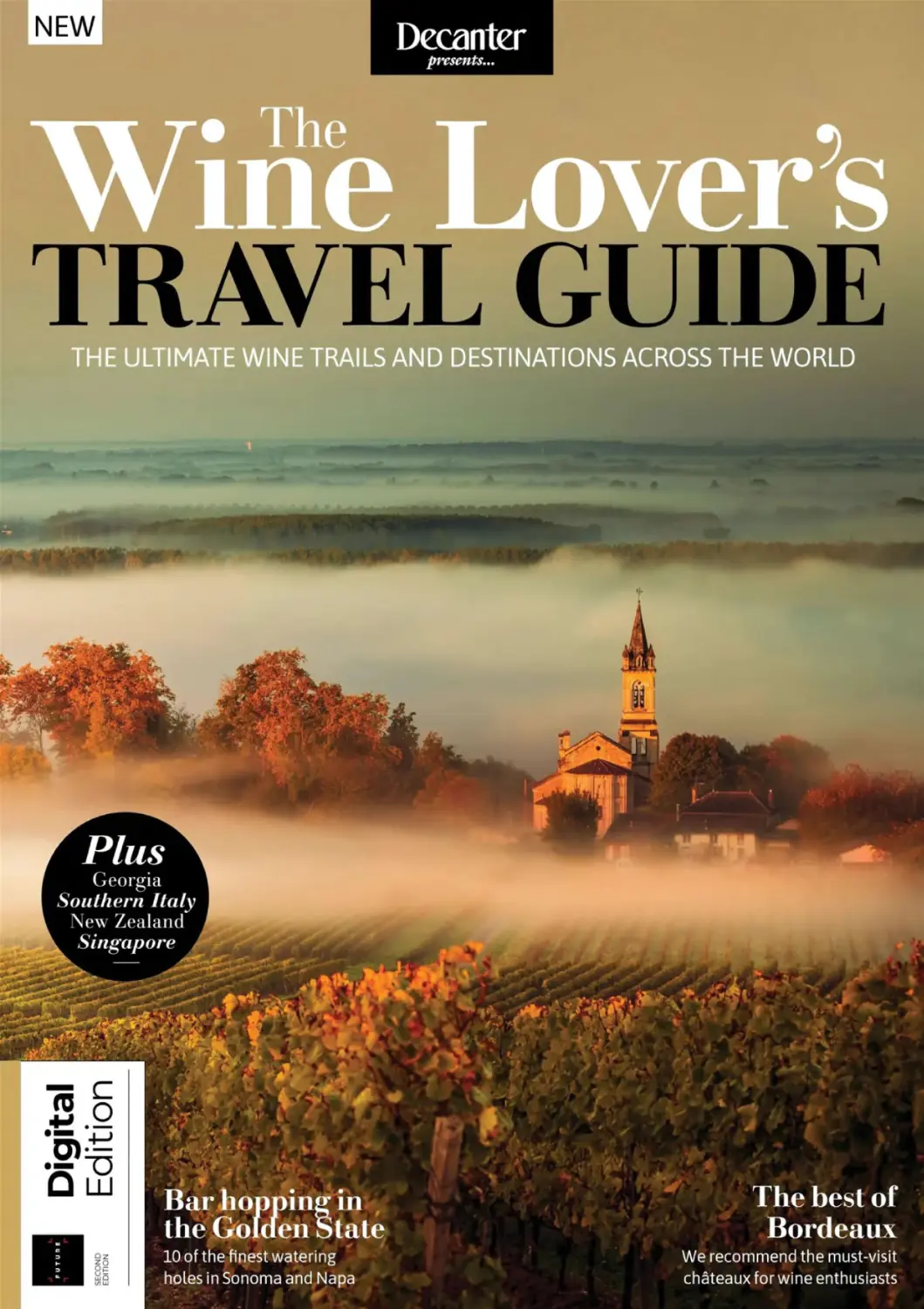
                    NEW
Decanter
presents...
Wine Lover’s
TRAVEL GUIDE
THE ULTIMATE WINE TRAILS AND DESTINATIONS ACROSS THE WORLD
Bar hopping in
the Golden State
10 of the finest watering
holes in Sonoma and Napa
The best of
Bordeaux
We recommend the must-visit
chateaux for wine enthusiasts

Welcome...
From rhe sunny vineyards of Napa Valley to the temperate
estates of England's south coast, discover some of the world's
best-kept travel secrets for wine-lovers. Take a tour of
France's most prestigious wine-producing chateaux and find
out how this thriving wine region has become a mecca for
connoisseurs. Elsewhere, discover the hidden gems of the
New World, from South America's rich reds to New Zealand's
bkmes. As you travel the globe in search of great wine, well
share with you our choice of accommodation, restaurants and
experiences to make your trips truly spectacular.
FUTURE
Wirie Lover’s
TRAVEL GUIDE
Future PLC Quay House, The Ambury. Bath, BAI 1UA
Bookazine Editorial
Group Editor Philippa Grafton
Compiled by Thomas Parrett
Senior Art Editor Andy Downes
Head of Art & Design Greg Whitaker
Editorial Director Jon White
Decanter Editorial
Editor-in-Chief Chris Maillard
Magazine Editor & Regional Editor
(Champagne. Alsace, Loire) Amy Wislocki
Content Manager & Regional Editor
(US. Canada. Australia. NZ. South Africa) Tina Gellie
Editor. Decanter Premium & Regional Editor
(rest of France) Georgina Hindle
Editor, Decanter China & Regional Editor
(Asia, Northern & Eastern Europe) Sylvia Wu
Regional Editor (Spain, Portugal, South America) Julie Sheppard
Regional Editor (Italy) James Button
Associate Editor Natalie Earl
Production Editor David Longfield
Art Editor Patrick Grabham
Cover images
Getty Images
Photography
All copyrights and trademarks are recognised and respected
Sales & Marketing
Commercial Director Clare Dove
Events & Awards Director Victoria Stanage
Head of Sales Sonja van Praag
Head of Marketing Alex Layton
International
Head of Print Licensing Rachel Shaw
I icensing@)futu renet.com
www.fut u recontenthub.com
Circulation
Head of Newstrade Tim Mathers
Production
Head of Production Mark Constance
Production Project Manager Matthew Eglinton
Advertising Production Manager Joanne Crosby
Digital Editions Controller Jason Hudson
Production Managers Keely Miller, Nola Cokely,
Vivienne Calvert. Fran Twentyman
Printed in the UK
Distributed by Marketforce, 5 Churchill Place. Canary Wharf, London, E14 SHU
www.marketfbrceco.uk Тек 0203 787 9001
Decanter The Wine Lover’s Travel Guide Second Edition (DBZ5140)
О 2023 Future Publishing Limited
We are committed to only using magazine paper which is derived from responsibly managed,
certified forestry and chlorine-free manufacture The paper in this bookazine was sourced
and produced from sustainable managed forests, conforming to stnet environmental and
socioeconomic standards.
All contents C 2023 Future Publishing Limited or published under licence All rights reserved.
No part of this magazine may be used, stored, transmitted or reproduced in any way without
the poor written permission of the publisher Future Publishing limited (company number
2008885) is registered in England and Wales Registered office Quay House. The Ambury,
Bath BAI 1UA. All information contained in this publication is for information only and is. as far
as we are aware correct at the time of going to press. Future cannot accept any responsibility
for errors or inaccuracies in such information You are advised to contact manufacturers and
retailers directly with regard to the price of productsServces referred to in this publication. Apps
and websites mentioned in this publication are not under our control We are not responsible for
their contents or any other changes or updates to them. This magazine is fully independent and
not affiliated in any way with the companies mentioned herein.
FUTURE
Connectors.
Creators.
Experience
Makers
Futiae pic is a pubic
company quoted on the
London Stock Exchange
(symbol FUTPj
wwwJut ur epiccom
Chet Executive ailah Byng Thorne
Non Executive Charman Richard Huntirvgford
Chiel Financial and Strategy Office» Penny Ladkin-Brand
Tel *44 (0)1225442244
Part of the
Decanter
bookazine series
For press freedom
with responsibility
Decanter
The Wine Lover’s Travel Guide
CONTENTS
08 Bordeaux, France I he estates of Bordeaux have it
all: history, art, stunning landscapes and, of
course, great wine. With a bit of planning, you
can experience the best the region has to offer.
16 Lubcron & Vendoux, France Look ahead to
future holidays by planning a road trip through
the beautiful countryside that straddles the
regions of the Rhone Valley and Provence.
22 Piedmont, Italy You could easily devote an entire
trip to the Langhc area alone, but you can roam
further afield in Piedmont to find a wealth of
other great travel experiences too.
30 Como, Italy Long an exclusive destination, this
delightful waterside city offers the best of Italian
style, accommodation and indulgent days on the
water, surrounded by stunning mountains.
34 Franciacorta, Italy Franciacorta is not often high
on the tourist itinerary. But with its stunning
hills and lake, pre-Ronian history and many
wineries to explore, you wont want to leave.
40 Southern Italy Italy’s southern regions have
varied cultures but arc united by their passion
for wine and hospitality. We share our top wine
destinations in the south.
46 Madrid, Spain From traditional tabernas to
trendy tapas bars and bustling markets,
Madrid’s food and drink culture is as expansive
as rhe city itself
50 Rioja, Spain This region is renowned for its
vineyards, but the landscape is enhanced by
incredible culture. Follow our guide to explore
the area's bodegas, wines and other delights.
56
Georgia After decades of conflict that obscured
much of its rich cultural heritage, celebrate this
country’s rebirth with a winding adventure from
bars and restaurants to family-run wineries.
Never miss an issue
(io lo decanter.com/snbscribe for details
Subscribe to Decanter
6 | Decanter | The Wine trover s Travel Guide
62 Scandinavia Stockholm, Oslo and Copenhagen
arc all major players in the gastronomy world.
Our expert local guide takes you to some of their
most exciting culinary treasures.
68 Dublin, Ireland Most may be drawn to the pubs
and distilleries, but Dublin’s growing food and
wine scene is attracting those in the know,
offering everything you need for a quick getaway.
72 Soho, England The busy streets of Soho form the
beating heart of London's West End and
are home to wine-focused venues that, like the
area, do things a little differently
76 Napa & Sonoma, USA Whether you're after the
reverence of a classic institution, a youthful
quirky vibe or the surprise of a revamped old
favourite, there’s a wine bar for you.
82 US wine roads less travelled Taste the
freewheeling spirit of American winemaking
in these five ‘other’ US states that slip under the
radar of many wine tourists.
92 Montreal, Canada This bilingual city's
cosmopolitan, multicultural influences and
scenic backdrop make it a must-visit for any
travelling foodie.
96 I long Kong I lome to a wide array of restaurants
and shops with seriously impressive wine-
lists, it’s easy to see why Hong Kong is a
favourite destination for fine wine enthusiasts
in Asia.
100 Singapore This vibrant city-island-nation can
be something of a sensory overload, with the
humid climate, multiple languages spoken and a
plethora of gastronomic options.
104 Margaret River, Australia 1 his 5km driving
route is an ideal starting point to explore
Margaret River, Western Australia’s most
famous wine region.
110 Christchurch, New Zealand In the face of
adversity, this city has rebuilt itself with
community at its core - evident in its
restaurants, wine bars and wineries.
114 Cordoba, Argentina We head to Argentina’s
second largest citv and its surroundings, with a
dream itinerary for a five-day tour introducing
three very diverse wine regions.
120 Rio de Janeiro, Brazil Colourful Rio is home to
a varied food and drink scene, from lively street
markets to sublime steakhouses. I here’s also
Brazil's burgeoning wine industry to discover.
124 Montevideo & Caneloncs, Uruguay If you're
visiting South America, schedule a relaxed
stop-off in Uruguay to discover the country’s
growing reputation for quality wines.
Decanter I The Wine Lovers Travel Guide I 7
MUST VISIT CHATEAUX:
THE BEST OF BORDEAUX
The estates of Bordeaux have it all: history, art, stunning landscapes and, of course,
great wine. With a bit of planning, you can experience the best the region has to offer.
Jane Anson recommends 10 unmissable chateaux

FRANCE
Bordeaux remains a favourite
destination for wine-touring holidays.
But with 6,500 estates here, where do
you start? Selecting chateaux that are near to
each other but show differing approaches can
be a fun and rewarding way to plan your trip,
as with every visit you put a new piece of the
puzzle into place. Each pair of chateaux
described here can be visited in one day,
allowing for a long, slow lunch in between, or
a walk through the nearby countryside.
White vs red
CARBONNIEUX & HAUT-BAILLY
Although Bordeaux is 90% red wine, there are
many brilliant white wines to discover in the
region, and splitting your day between both is
a fascinating reminder that for much of the
20th century, Bordeaux made more white than
red. You will find examples of white wines all
over Bordeaux, and you could easily do this
pairing in several appellations (try Chateau
Thieuley/Chateau de Reignac in Entre-Deux-
Mers, or Chateau Chantegrive/Chateau de
Portets in Graves) - but for Bordeaux’s best-
known whites, head to Pessac-Leognan.
Photographs: Vincent Bengold (previous pages); Francois Poincet; Alain Benoit
MORNING
Chateau Carbonnieux
Pessac-Leognan CCG
Owned by brothers Eric and Philibert Perrin (no
relation to the Chateau de Beaucastel Perrins in
the Rhone), this wonderful estate is pretty much
split down the middle into the production of red
and white wine, with 50ha of red and 42ha of
white - more of the latter than any other Pessac-
Leognan estate. The resulting white is a brilliant
wine full of creamy concentration, made with
the two best-known local varieties, Sauvignon
Blanc and Semi lion. It’s an excellent estate to
visit: the property dates back to the 13th
century, and for a long time was owned by
Benedictine monks known for their exceptional
white wines. In 1786, Thomas Jefferson visited
and left his mark by planting an American
pecan tree, which still stands today.
There are a range of tours available here,
from the ‘Classic’ €10 tour with a tasting of two
wines, to the ‘Prestigious’ tour for €20, with a
tasting of three wines and a food platter. A food
and wine matching workshop is also on offer,
pairing five cheeses and three wines for €22.
Open Monday to Friday all year, plus Saturdays
from May to October, www.carbonnieux.com
AFTERNOON
Chateau Haut-Bailly
Pessac-Leognan CCG
Only red wine is made at this 30ha American-
owned estate, and it is easily some of the best
Maps: Maggie Nelson
‘Although Bordeaux is 90% red
wine, there are many brilliant
white wines here as well’
in the whole of Bordeaux. It’s just along the
road from Carbonnieux, so making a visit
between the two properties is easy and
enjoyable on foot or by bike if you are staying in
the area. The wine is classically graceful, full of
softly curling woodsmoke, tobacco and rich
black fruits - the tasting here is a must. The
Haut-Bailly estate’s history can be traced back
to at least 1461, and the current chateau is
from the 19th century, standing in contrast to
the sleek modern cellars. It boasts a well-
stocked boutique that sells books, picnic gear
and a ton of interesting gifts. For special
occasions, you can arrange private dining with
the on-site chef. A new winery is currently
under construction.
A number of different visits are on offer,
ranging from €20 for one hour, to €50 for the
90-minute ‘Collector’s’ session. All include a
tour and tasting, www.haut-bailly.com
Cutting edge vs low tech
MONTROSE & PONTET-CANET
These are two of Bordeaux’s most celebrated
and iconic names, both producing incredible
wines but reaching their goals by entirely
different routes. A day spent visiting one and
then the other is eye-opening.
Jane Anson is a
Decanter contributing
editor and the DWWA
Regional Chair for
Bordeaux. She is a
Bordeaux resident and
the author of Bordeaux
Legends
10 | Decanter | The Wine I .oxer's Travel Guide

MORNING
Chateau Montrose
St Estephe 2CC
Head up to St-Estephe, where you’ll find
Chateau Montrose along the banks of the
Garonne river, the far end of its vineyards
practically grazing the fishermen’s huts along
the river. One of the most impressive chateaux
to visit in Bordeaux, this 90ha estate is at the
cutting edge of vineyard technology with a
stunning 10,000m2 cellar and luxurious
design touches at every turn. It is also one of
the greenest chateaux in the region, with
geothermal technology, a permaculture
orchard, a system for capturing the carbon
dioxide produced during fermentation and the
use of electric tractors in the vineyard.
In the vineyard things are obsessively
tracked and recorded to ensure precision
viticulture. The number of plots, for example,
stood at 24 when director Herve Berland
arrived in 2011. Today there are 110, the
result of dividing and sub-dividing to ensure
that all the tiny differences between the plots
are respected throughout the growing season
and at harvest. You will leave astonished by
how much expense, effort and expertise goes
into making the greatest wines of Bordeaux. >
Decanter I The Wine Lovers Travel Guide I 11
FRANCE
There is no fee to visit, but you do need to
book your tour in advance.
www.chateau-montrose.com
AFTERNOON
Chateau Pontet-Canet
Pauillac 5CC
Just a 15-minute drive south and you cross over
into Pauillac, home of the iconic classified
estate of Pontet-Canet. You’d be forgiven for
thinking that you’ve stepped back in time, as
owner Alfred Tesseron and director Jean-
Michel Com me have gone resolutely old- school.
Farming is organic, as at Montrose, and also
biodynamic, with all biodynamic preparations
made on-site. There are even eight Breton draft
horses used for vineyard work across at least
half of the 81 ha estate-
if they aren’t out working, you can visit them
in their well-kept stables. Cellar work is equally
traditional. Everything is manual, from
destemming and sorting at harvest, to filling
cement vats made out of the sand, clay and
gravel taken from the surrounding land during
the construction of a cellar extension. No
electricity is allowed anywhere near the vats,
except for LED lighting, and everything is
powered by geothermal energy.
There is no fee, but visits here are typically
reserved for professionals only, though they
may be extended to wine-tasting groups,
sommeliers and collectors - it’s definitely
worth trying, www.pontet-canet.com
A Breton draft horse in
Historic vs newly created
DE LA RIVIERE & GEORGE 7
Over its 2,000 years of winemaking history,
Bordeaux has continually reinvented itself,
helped by constant innovation and new
arrivals. Nothing brings that home more clearly
than a day visiting one of its oldest and one of
its newest estates. And Fronsac on the Right
Bank is a lovely place to do this, with views over
the Dordogne and Isle rivers.
MORNING
Chateau de La Riviere
Fronsac
Among the oldest chateaux in Bordeaux, this
stunning property was constructed in 1577 by
Gaston de 1’Isle on the remains of a defensive
camp built by Charlemagne. It’s hard to miss, as
it stands tall over the countryside on lOOha of
parkland and gardens that are worth a visit.
Best of all are the 8ha of limestone caves that
are still used for ageing the wine. They offer a
brilliant way to get up close to the limestone
terroir that dominates not only Fronsac but
also St-Emilion, Castillon and beyond. A range
12| i>‘eanler | The Wine I.overs Travel Guide
MUST-VISIT CHATEAUX: THE BEST OF BORDEAUX
of visits are geared to different audiences,
including families. You can even order a picnic
to eat in the beautiful courtyard. Although it’s a
French-run estate, the owners are Chinese, so
you might also want to try the pu’er tea
ceremony (€25) to learn the history of this
traditional tea, with a tasting.
Open Monday to Friday all year, plus
Saturdays from May to October. Visits are by
appointment only. A cellar tour and tasting
costs €10, while a cellar tour and a tasting of
individual grape varieties to show Right Bank
and Left Bank differences is €25.
www.chateau-de-la-riviere.com
AFTERNOON
Chateau George 7
Fronsac
For something completely different, head to the
tiny Chateau George 7, created only a few years
ago by British owner Sally Evans, who changed
career to become a winemaker armed only
with a WSET Diploma and a positive attitude.
It’s not easy to find completely new estates in
Bordeaux, and it’s fascinating to hear about her
journey: finding a run-down farm, converting it
Above from top:
Chateau George 7 is
a recent addition to
Bordeaux; Sally Evans,
owner of George 7,
cycling in Fronsac
into a house and equipping an empty cellar
building. As for the chateau name, George
means ‘tiller of soil’ in Greek; it’s also a
reference to the English patron saint. And the
7? It’s possible that Prince William’s son George
may one day take the name George VII, so
Evans used this part of the name to ‘pay tribute
to the old while venturing into the new’, as she
puts it. The chateau opened for business in
2017, although the first vintage was almost
entirely wiped out by frost, making 2018 the
true inaugural year. You get to see real hands-
on winemaking here - with a bit of help from
her consultants, Evans picks the grapes, prunes
the vines, and lugs the barrels around. Thank
goodness it’s only 3ha at this stage. She is also
very happy to share her experiences and
motivations with others who might be looking
to get into winemaking. She can also help you
arrange an electric bike tour around Fronsac -
particularly useful, as there are some steep
slopes in this appellation.
Tours start from €8 (and are free for
under-18s) and are held most days from April
until October.
www.chateaugeorge7.com
Decanter | The Wine Lover’s Travel Guide | 13
Photograph: Guillard Jacques-Scope-lmage/Alamy
Left Bank vs Right Bank
LAMARQUE & PEYBONHOMME-LES-
TOURS
It’s not easy to take in both banks in a single
day without quite a bit of driving, but this
would be a novel way to do it - heading from AP
Haut-Medoc over to AP Blaye via the ferry that
runs between Lamarque and Blaye. You can
take your car on board the ferry. Refer to the
tourism website Bernezac for timetables (ww.
bernezac.com).
MORNING
Chateau de Lamarque
Haut-Medoc
One of the most amazing chateaux in the
Medoc, located between Margaux and Pau iliac,
Lamarque should be far better known to wine
tourists. It’s definitely worth spending a full
morning here as there is so much history to
soak in, and extremely charming owners to
take you through it. The chateau itself is, in
part, 1,000 years old, built originally as a
fortress by Garsion de Lamarque to counter the
lingering threat of Viking raids. It is perfectly
preserved, with a 13th-century keep where the
family’s private wine collection is stored. A
former chapel dates back to the 11th century,
and even the winery contains a row of well-
preserved old oak vats, which conceal a more
modern interior. The current owner, Pierre-
Gilles Gromand-Brunet d’Evry, is a direct
descendant of Garsion de Lamarque.
It’s an excellent Haut-Medoc wine to boot.
Visits and tastings are by appointment only.
www.chateaudelamarque.fr
AFTERNOON
Chateau Peybonhomme-Les-Tours
Blaye
You’re going to want to head to the Citadelle de
Blaye when you disembark from the ferry, as
this UNESCO World Heritage fortress built by
renowned military engineer Vauban is one of
the best preserved in France. There is a small
vineyard there, and you can attend a wine
tasting in the Cellier des Vignerons. However,
Blaye is also a great place to visit an estate, as
lots of owners live on site. I would recommend
Peybonhomme-Les-Tours in the commune of
Cars, overlooking the estuary. It is certified
biodynamic, with great wines produced by the
welcoming Bossuet-Hubert family. There are
several wines to look out for, particularly
amphora-aged bottling Energies and a
sparkling blanc de noir - all low sulphur and
showcasing the many interesting developments
happening in Bordeaux with a more hands-off,
natural approach to winemaking. Visits are by
appointment only, www.huberbvigneron.com
Above: Chateau
Peybonhomme-Les-
Tours overlooks the
Gironde estuary
14 | Decanter I The Wine lever’s Travel Guide
MUST-VISIT CHATEAUX: THE BEST OF BORDEAUX
Photographs: Pierre Yves Queignec: Centre Francois Mauriac de Malagar - www.malagar.fr
Literary vs artistic
MALROME & MALAGAR
If you are a fan of books or art, there are two
estates that give you the pick of both, about
50km to the southeast of Bordeaux on the edge
of Entre-Deux-Mers.
MORNING
Chateau Malrome
Bordeaux Superieur
Art lovers shouldn’t miss this 45ha estate at
St-Andre-du-Bois - it dates back to the 14th
century and has been delivering harvests
without stopping through wars and revolutions
ever since. Best known for its connection to the
artist Henri de Toulouse- Lautrec, it was owned
by his mother and he died here in 1901. It’s
worth a visit for its Toulouse-Lautrec exhibition
-you can walk through his apartments and see
some of his original sketches, including
19th-century graffiti - but also for its
contemporary art foundation. The new Franco-
Vietnamese owners, Kim Valery Huynh and his
daughters Melanie and Amelie, hold regular
exhibitions. There is also a restaurant, Adele
(named after Toulouse-Lautrec’s mother) - an
outpost of the popular Claude Darroze
restaurant in Langon - that is open Wednesday
to Sunday and has an excellent Sunday brunch.
A guided visit is €12, including a tasting.
Access to the Toulouse-Lautrec apartment is
available only through the guided tour.
uww. malrome.com
Above: the art gallery
at Chateau Malrome
Below: Domainede
Malagar was the home
of renowned author
Francois Mauriac
AFTERNOON
Domaine de Malagar
Cdtes de Bordeaux
Although you can see vines around this
property near St-Maixant, the wine sold here is
produced by Jean Merlaut in a winery at the
bottom of the hill, close by but not open to the
public. Called Chateau Malagar, it is made in
Cotes de Bordeaux red, AP Bordeaux white and
rose, and sweet white Premieres Cotes de
Bordeaux. In addition to buying wine at
Malagar, you can also check out an exhibition
about the life of one of Bordeaux’s most famous
authors, Francois Mauriac, winner of the Noble
Prize in Literature in 1952, who used to live
here. But one of the best things that you can do
when visiting Malrome and Malagar is walk -
there is a footpath that connects the two
estates. The 7km journey is open to any
enthusiastic hiker, and twice a year the estates
host a joint celebration called Sur le Coteau des
Artistes, where you start at Malrome with a
visit and a tasting, then walk over to Malagar
for a picnic followed by a visit, then return by a
different footpath. It’s a full day, but a
wonderful way to get to know the beautiful
landscape around the Garonne valley in this
part of Bordeaux. The dates for 2020 had not
yet been announced at the time of this
magazine’s publication.
Open daily from February to November. A
guided visit is €8, including a tour of the house,
the Mauriac exhibition and the park.
www.malagar.fr В
Decanter | The Wine Lover's Travel Guide I 15
LUBERON g? VENTOUX
Captivating mountain views, welcoming chateaux and wines that match perfectly with
the classic local cuisine. Look ahead to future holidays by planning a road trip through
the beautiful countryside that straddles the regions of the Rhone Valley and Provence
in southeast France, says Carolyn Boyd
LUBERON & VENTOUX
Fact file
LUBERON&
VENTOUX PRIMARY
GRAPE VARIETIES
Luberon
White Grenache Blanc,
Clairette Blanche,
Vermentino,
Bourboulenc, Roussanne,
Marsanne, Ugni Blanc,
Viognier
Red Syrah, Grenache Noir,
Mourvedre, Carignan,
Cinsault
Ventoux
White Grenache Blanc,
Roussanne, Bourboulenc,
Clairette, Marsanne,
Viognier, Vermentino
Red Carignan, Cinsault,
Grenache Noir, Syrah,
Mourvedre
As I gaze down the avenue of plane
trees towards Chateau Pesquie, I’m
surrounded by much of what the
diverse Vaucluse department in France’s
southeastern country has to offer: verdant
vineyards encircle the elegant chateau, and
the white-peaked Mont Ventoux towers above
a landscape that cradles the Luberon and
Ventoux appellations. Nearby, sleepy
Mormoiron is one of the many characterful
villages to explore both here and to the south
in the Luberon regional nature park. And, as if
this wasn’t enough to spoil me, the vineyards
in the prestigious smaller appellations of
Chateauneuf-du-Pape, Gigondas and
Vacqueyras are within a 40-minute drive.
At Chateau Ревдшё (www.chateaupesquie.
com), brothers Frederic and Alexandre
Chaudiere are the third generation of their
family to make wine. They adore the location,
with Mont Ventoux lying just to the northeast.
‘Here on the Rhone, we’re in a corridor
between the mountains, but also close to the
Mediterranean,’ explains Frederic as he shows
me around the vineyard. ‘Meanwhile, Mont
Ventoux creates a kind of amphitheatre and,
although the temperature is around 30°C in
the day, it is much cooler at night, which
allows for longer maturation - we’re one of
the last to harvest in the whole area?
We walk around the organically farmed
vineyards, planted with parcels of 50-year-old
Carignan vines, along with Cinsault, Grenache
and Mourvedre, Clairette, Roussanne and
Viognier, and admire the nine-year-old Syrah
vineyards planted with bright yellow blooms
of broom and gypsum to improve soil quality.
In the winery, soil samples and detailed
three-dimensional maps demonstrate the
unique geography and terroir. The Ventoux
appellation (see map on pl8) is quickly growing
in popularity and this is one producer ready
to offer guests a truly Proven^ale experience,
with hampers for picnics in the gardens,
vineyard walks and harvest days.
Nearby, other family-run vineyards such as
Domaine du Tix (www.domaine-du-tix.com)
share the same 350m elevation, with its hot
days and cool nights, and they also welcome
visitors for tastings.
Enchanting exploration
To make the most of those hot days, I spend a
couple of them in the Parc naturel regional du
Luberon, which enjoys a similar climate to
the Ventoux appellation just to its north. It’s
also one of the most enchanting areas in this
part of the Provence interior, abounding with
golden-stone villages and lavender fields. The
terroir offers conditions for vineyards
Photograph: Stevens Fremont/Getty Innages
Decanter | The Wine Lover's Travel Guide I 17
FRANCE
GETTING THERE
The easiest airport
to reach is Marseille,
which is served by
several airlines. The
one nearer to the
destinations detailed
here, however, is
Avignon. Both Marseille and Avignon are served
by direct trains on Eurostar. From Marseille, it is
about a 90-minute drive to Mormoiron; from
Avignon, the drive is 45 minutes.
to produce perfect drinks for summer
evenings - fruity whites and pale roses that
pair so well with the region’s typical fish,
olive oil and tomato-based dishes. At the
Domaine de la Citadelle (www.domaine-
citadelle.com), near the village of Menerbes, it
isn’t only the wide range of excellent wines
that draws visitors, but its unusual collection
of corkscrews, as well.
The domaine’s Musee du Tire-Bouchon
holds 1,200 bottle openers of every age,
provenance, shape and size. As I gaze into the
many cabinets, it strikes me that getting into
one’s bottle of wine as easily as possible has
long been an art form. There is everything
from corkscrews that double as shaving
brushes, swords or pistols, to some salacious
ones - brass legs akimbo, forming a‘T’ shape.
Photographs: Domaine de la Citadelie; www.senanque.fr; iStock/Getty Images Plus. Maps: Maggie Nelson
5
6
1
2
3
Orange
Fontaines
Avignon
L’lsle-sur-
la-Sorgue
Durance
CHATEU NEL*
V, DI PAPE
Menerbes eB
LUBERON REGIONAL
NATIONAL PARK
ч_[)973
GoljIoh
Ansouis
kilometres
SOUTHERN
RHONE
Wineries to visit
Chateau Pesquie
Domaine du Tix
Domaine de la Citadelle
Aureto wine cellar
Marrenon
Chene Bleu
inieux
COTES DU
LUBERON
Crestet®
D977Z " DENTELLES
(il(KAI)VS' &MONTMIRAIL
c De
Abbaye Notre-Dame
gde Senanque
• Gordes
...---- MON!
LeBarroux^Q V^O^X
COTES DU
0938 VENTOUX
Г/ □
itras Mormoiron#	г
‘Exploring the different villages
is one of the region’s greatest
pleasures, especially when so many
have good vineyards nearby’
On the hill behind the winery and museum,
the domaine’s botanic garden overlooks the
vineyards and Menerbes perched on a ridge
nearby, with raised beds that each contain a
different herb or medicinal plant. Inhaling them
is as much a treat for the senses as the tasting
I take part in when I return to the winery,
sipping different blends of the 17 different
grapes grown across the vineyard’s 50ha.
Exploring the different villages is one of
the region’s greatest pleasures, especially
when so many have good vineyards nearby.
After wandering the cobbled streets of
Bonnieux, its jumble of terracotta-roofed
houses piled up on a hill, I drive on to the
Aureto wine cellar fwww.uureto./r). Belonging
to the nearby luxury estate, La Coquillade,
the breathtaking views add a further wow
factor to the award-winning wines here.
The architecturally striking winery, with
its filigree-iron wall coverings, offers tastings,
workshops and tours. Further to the
southeast, beyond Ansouis, a village with
a medieval chateau, you can explore the
vineyard of the Marrenon wine estate
(www.marrenon.com) in the company of one of
its winemakers, complete with a gourmet
picnic among the vines. >•
Carolyn Boyd is a
widely published
journalist, editor and
communications
consultant, specialising
in French travel, food
and drink, also
publishing at www.
francetra veller. co. и к
18 I Decanter | The Wine Lover’s Travel Guide
My perfect day in Vaucluse
MORNING
Take a quick dip in the pool before
breakfast at La Coquillade*, then head out
along the road for the 15-minute journey
to Domaine de la Citadelle (seeleft), a
family-run vineyard near Menerbes that
makes southern Rhdne wines from 17
different grape varieties. It also has a
quirky corkscrew museum and botanic
garden. Enjoy a vertical tasting, then head
on towards Gordes, a 20-minute drive
north through wild countryside and
fragrant maquis. Explore the village, then
head north for a hair-raising drive along
dramatic gorges to the Abbaye Notre-
Dame de Senanque (www.senanque.fr),
where monks grow lavender in the fields
outside the famous abbey.
LUNCH & AFTERNOON
Double back for a light but delicious lunch
at the bistro restaurant at Les Bories*,
then loop around to the west for a
half-hour journey to L’lsle-sur-la-Sorgue.
This is France’s capital of antiques, so
spend the afternoon exploring the flea
markets on the river’s quaysides and the
enclaves known as villages for vintage
finds and curious objets, as well as high-
quality antiques. For a late-afternoon
winery tour and tasting, visit Chateau
Pesquie (seep83) near Mormoiron, half an
hour north. The winery exhibits give an
excellent explanation of the terroirs of
the Ventoux appellation, and it offers
tastings of the wines made from such
varieties as Grenache, Syrah and Viognier.
EVENING
It’s just a 15-minute drive to Crillon le
Brave*, a beautifully designed, ‘scattered’
hotel that occupies different buildings in
a once-dilapidated village. While the
gastronomic restaurant has a more
sophisticated menu, the view from the
terrace of the bistro is second to none:
a panorama that encompasses Mont
Ventoux’s chalky peak, vineyards, olive
groves and villages. Tuck into dishes
made with fresh Proven^ale produce as
you watch the sun go down.
For details of entries marked with an
asterisk (*), please see p87
Decanter | The Wine Lover’s Travel Guide | 19
Photographs: Herve Fabre Photography;
Les Bories; Niels van Kampenhout/Alamy Stock Photo
No boundaries
I finish my journey with a foray back to the
north, where a patchwork of appellations is
cradled in the southern Rhone valley. To the
west, below Orange, are the exclusive vineyards
of Chateauneuf-du-Pape, and I drive past those
of Cotes du Rhone cru villages Beaumes-de-
Venises, Vacqueyras, Gigondas and Seguret in
quick succession. Where I’m destined, though,
is the crossroads at which four of the southern
Rhone’s appellations meet.
On the hill behind the village of Crestet, I
drive narrow, pine-shaded lanes to find Chene
Bleu (www.chenebleu.com), a wine estate that
envelops you in its natural surroundings. After
buying it in 1993, Xavier and Nicole Rolet
painstakingly restored the medieval priory at
its heart, seeing the potential of the vineyard
‘The terroir offers conditions for
vineyards to produce perfect drinks
for summer evenings - fruity whites
and pale roses that pair so well
with the region’s typical dishes’
with an altitude of 550m. As 1 arrive, Xavier’s
daughter Danielle is there to show me around
the extraordinary setting, which is overlooked
by the Dentelles de Montmirail. As I admire
the saddle of land where the Ventoux, Seguret,
20 | Decanter I The Wine Lover's Travel Guide
LUBERON & VENTOUX
Your Luberon & Ventoux
address book
ACCOMMODATION
Chateau de Montcaud, Sabran
A short hop over the Rhone river,
this new four-star hotel run by
friendly Swiss couple Rolf and
Andrea Bertschi has a superb
restaurant and a very
knowledgeable sommelier. Makes
a good base if you’re including
Chateauneuf-du-Pape in yourtrip.
www.chateaudemontcaud.com
Crillonle Brave
This ‘scattered hotel’, which
occupies historic buildings in the
village of the same name, enjoys
a breathtaking view of Mont
Ventoux. Its refurbished rooms
were designed by top French
architect Charles Zana.
www.crillonlebrave.com
LaCoquillade,Gargas
An eco-friendly and luxurious
resort looking out over the
surrounding vineyards belonging
to its own winery Aureto. Explore
the area on high-quality bicycles
from the on-site cycling centre.
www.coquillade.fr
Cotes du Rhone and Gigondas appellations
meet, I hear a cuckoo call, frogs croaking and
the warm breeze blowing through the trees.
Here they welcome the Mistral wind; it helps
fend off disease in the vines.
We continue inside, where Danielle points
out the level of dedication and adoration that
has gone into the winery; from Nicole’s exquisite
friezes that adorn the walls surrounding the
concrete vats, to humorous medieval-style
wine labels. Afterwards, I taste the acclaimed
wines that do not adhere to appellation
boundaries. ‘It was a brave move as first-time
winemakers, but it’s paid off!’ says Danielle.
When I leave, she thanks me for making the
tricky journey to see them, but with chambres
d'hotes, gourmet dinners and wine courses on
offer, it’s a trip I’m willing to make again. □
RESTAURANTS
La Figuiere, Fontaine de Vaucluse
Tucked away in a corner of the
village near the river Sorgue, this
classic bistro restaurant offers an
idyllic courtyard under the shade
of parasols. Its menu features
French and Provencale classics.
www.lafiguiere-provence.fr
La Table de Xavier Mathieu, Joucas
In a small village between Gordes
and Roussillon, chef and Provence
native Xavier Mathieu brings
together Provenqale ingredients
for his exquisite dishes, served on
the terrace of the restaurant,
overlooking the Luberon valley.
www.lephebus.com
Les Bories, Gordes
This one-star Michelin restaurant
near Gordes sees chef Gregory
Mirer, who previously worked for
the late, celebrated Joel Robuchon
in Paris, serve refined dishes using
the best Provenqale produce.
www.hotellesbories.com
SHOPS & LEISURE
Les Delices du Luberon
Stock up on delicious produce to
take home with you at Les Delices
du Luberon, where you’ll find jars
of tapenade, traditional Provenqale
herbs and delicious olive oils. Shops
in L’lsle-sur-la-Sorgue, Avignon
and St-Remy-de-Provence.
www.delices-du-luberon.fr
L’lleauxBrocantes
The town of L’lsle-sur-la-Sorgue is
the French capital of antiques and
bric-a-brac, where you’ll find chic
stores alongside its canals, as well
as brocante villages such as L’lle
aux Brocantes, where several
dealers assemble in each space.
www.lileauxbrocantes.com
Sun-E-Bike
The Luberon region is hilly, but
with the help of an electric bike,
a pedal between vineyards can be
a pleasure rather than a challenge.
This bike rental service offers
self-guided vineyard tours starting
from Bonnieux (as well as other
locations), www.sun-e-bike.com
Decanter | The Wine I.over's Travel Guide I 21
PIEDMONT
You could easily devote an entire trip to the Langhe area alone, with its endless
rolling hills covered in vines, fabulous range of places to stay and world-class
gastronomy seemingly at every turn. But, says Alessandra Piubello, you can roam
further afield in Piedmont to find a wealth of other great travel experiences too
о
о
£ ying at the foot of the Alps in the
I northwestern corner of Italy,
| -1___J Piedmont is sheltered on three sides
§ by mountains (the Alps and Apennines),
5. and blessed with the ideal climate for
§ viticulture. Here, the vines and landscapes
| seem to create a living painting: simply
§ letting your gaze wander down the rows of
I vines provides a sense of plenitude rivalled
f by few places on earth.
Piedmont embodies the history and culture
2 of Italian wine, and draws wine lovers from
§ around the world. It is famous for its ‘Three Bs’
* - Barolo, Barbaresco and Barbera. The first
two, made only from Nebbiolo grapes, are its
most prestigious wines; the third is for everyday
drinking. That said, the region’s sheer diversity
of native varieties can leave even the most
clued-up connoisseur feeling overwhelmed.
The vines planted on this well-suited terroir are
often centuries old, nurtured by generations of
skilled wine-growers who have clung to
tradition and produced some incredible wines.
Immersive Langhe
All of Piedmont’s wine-growing zones make
fantastic destinations for gastronomic,
viticultural and cultural tours, and can be >•
Fact file:
Piedmont
Planted area 44,667ha
Climate Continental
Key regions Barolo
DOCG, Barbaresco
DOCG, Roero DOCG,
Asti DOCG
Key grapes Red
Nebbiolo, Barbera,
Dolcetto; White
Moscato Bianco, Arneis,
Cortese, Erbaluce
Beautiful, vine-covered slopes and hilltop villages
of the Langhe, so characteristic of Piedmont’s
Barolo and Barbaresco regions
ITALY
GETTING THERE
Torino Caselie airport is
located 16km outside
Turin. Hireacarand
head for the Langhe,
about an hour to the
southeast. From there
you can head back up
to Alto Piemonte and Novara (1.5 hours to the
north), back down to Monferrato (another hour
from there) and lastly to Asti (20 minutes).
loosely grouped into four macro-areas. First,
let’s head into the heartland of Piedmont wine:
Langhe e Roero, with its bucolic landscape
dominated by hills scattered with vineyards, is
on the UNESCO World Heritage List. Alongside
the iconic Barolos and Barbarescos, other
wines to taste here are Arneis (white), Roero
(mainly Nebbiolo) and Dogliani (Dolcetto).
There are some 14 regional wine shops, many
housed in castles and stately homes, which
offer buying advice and tastings. The area is
also home to the celebrated white truffle - the
town of Alba holds an annual truffle festival
during October and November - and there
are many shops selling this local treasure.
Take your love of truffles a step further and
accompany a trifolau (truffle-hunter) with his
faithful tabui (truffle-hunting dog), or enjoy a
tasting experience: book through the Centro
Nazionale Studi Tartufo (www.tuber.it).
And be sure not to miss the Saturday food
market in Alba’s streets and squares. As well
as truffles, one of the world’s finest hazelnut
varieties, the 1GP Nocciola Tonda Gentile, is
cultivated here and is the key ingredient for
many of the local sweets and desserts.
If you love walking, the Mangialonga
(www.mangialonga.com) is a 4km hike through
the vineyards of La Morra, with plenty of food
and wine tasting along the way. Suspended in
2020 and 2021 due to Covid-19, it will next be
held on 28 August 2022. Meanwhile the
Limit of
Piedmont
wine region
Novara
GATTINARA
Novara
Piedmont wineries
•Alessandna
MONFERRATO
1 Ceretto
2 Renato Ratti
3 Castello di Neive
4 Bera Valter
5 Malvira
6 Marziano Abbona
7 Michele Chiarlo
8 Braida
9 La Raia
10 Antichi Vigneti
t..; Limit'd*! Piedmont’
wine region
. LANGHE
Dogliani
Rocchetta
Tanaro
BARBARESCO
MONFERRATO
Asti
• Canelli	FT*’
Тепле
Torino Caselle
Airport
Vercelli*
PO
Casale •
Monferrato
Turin
Bra*
La Morra
PIEDMONT
DOGLIANI Г

Other wine
regions
0	10	20	30
kilometres
‘Simply letting your gaze
wander down the rows of vines
provides a sense of plenitude
rivalled by few places on earth’
Collision! festival in Barolo (www.collisioni.it)
blends rock music, literature, food and wine.
Major performers from around the world take
partinit every July.
What else to do in this part of Piedmont?
You can wander among the castles, through
the villages and museums (particularly the
WiMu wine museum and Corkscrew Museum,
both in Barolo), and marvel at the panoramic
views over the Langhe.
So much to see
Venturing northwards, in Alto Piemonte
Nebbiolo creates fresher, less structured wines
- particularly in Gattinara and Ghemme -
than its cousins in the Langhe. You’ll also find
white wines made from the Erbaluce grape, in
sparkling, dry still and dessert passito styles.
You could visit Novara, where the Basilica di
San Gaudenzio (www.turismonovara.it) is
famous for its monumental 121m-high cupola
designed by Alessandro Antonelli and added
in the 1880s-climb up for sweeping vistas
over the city as far as Monte Rosa in the Alps
to the northwest; while the city’s Castello
Visconteo Sforzesco (www.ilcastellodinovara.it),
is set in one of Piedmont’s loveliest parks.
Heading back south, the next stop is in the
third macro-area, Monferrato. Another World
Alessandra Piubelloisa
widely published writer
and editor from Verona.
She reports on many
aspects of Italian
culture, principally
wine and food, and
is a DWWA judge
Maps: Maggie Nelson
24 | Decanter | The Wine Lover's Travel Guide
Heritage Site, famous for its Inferndt (series of
unique, hand-dug wine cellars), this is the
home of Barbera, Dolcetto and Cortese, but
also the birthplace of Italy’s earliest sparkling
wines in the last of our macro-areas: Asti. As
you explore the vast underground cathedrals
dug into the tufa in Canelli, and meander
around castles, craft shops and cultural sights,
make sure to enjoy some Moscato d’Asti,
Barbera d’Asti and Ruche di Castagnole.
Wineries to visit
Antichi Vigneti di Cantalupo
Ghemme is at the heart of northern Piedmont’s
time-honoured wine country. Here, Alberto
Alunno has managed Cantalupo since 1981
and is devoted to his native terroir, which
boasts an exceptional - albeit not unique -
mineral complexity that imbues Ghemme
Nebbiolos with finesse and elegance. Alunno’s
wines are a prime example - treat yourself to a
taste of one of the older vintages. The estate’s
nerve-centre is its spectacular 1,200m2 cellar
built beneath the hillside: an underground
amphitheatre of wide steps stacked with
barrels of various sizes mirrors the gradient of
the slope above. Upon entering, you are met
with an awe-inspiring view of all the precious
casks displayed in this ‘theatre of ageing’. A
door leads to a corridor lined with small cells
that can each store up to 5,000 bottles. Divided
by cru, the bottles slumber there for at least a
year, nestled in red velvet, www.cantalupo.net
Above: Valter and Alida
Bera with their sons
Umberto and Riccardo
Bera Valter
If Neviglie has become a favourite port of call
for many Moscato lovers, it owes much of its
fame to the efforts of the Bera family, which
stretches back centuries. The Bera winery sits
on the road leading to the medieval village,
immortalised by the Piedmontese writer
Верре Fenoglio. It’s worth visiting for a stroll
around the winding streets and its >
Decanler I The \\ inc Lover’s Travel Guide I 2o
ITALY
Ceretto’s transparent
‘grape’ tasting suite
juts out over its
vineyards at Alba
sweeping views of the surrounding hills. The
manor house stands majestically on the vine-
clad hill to the left of the road, with the new
house and modern, recently expanded winery
below. If you’re after a superb Moscato d’Asti,
look no further - Bera is a standard-bearer.
Valter began bottling it in the 1970s, and now
works with his sons Umberto and Riccardo.
While best known for their Moscato, more
recently the family has branched out to make
Nebbiolo-based wine too. www.bera.it
Above: Giuseppe and
Raffaella Bologna,
brother and sister
owners of Braida
Braida
As a local singer-songwriter put it, ‘this town
has no surprises: a church, six houses and 10
vineyards’ - but there are plenty of reasons to
visit Rocchetta Tanaro. Here, Giacomo Bologna
‘Braida’ (he lent his family nickname to the
winery) made history with his innovative
cask-aged Barbera. You’ll be able to taste a
range of the estate’s Barberas, from the
lightest, most frivolous offerings to more lush
and complex ones. With his irresistible
friendliness, enthusiasm and empathy, Giacomo
Bologna put Rocchetta Tanaro on the map; a
town where one can still sense the infectious
personality of this special man who adored his
land, its wine (made from Barbera), his family
and friends. His two children, Raffaella and
Giuseppe, are both oenologists and have
inherited their father’s values, smilingly
describing themselves as ‘dynamic
conservatives’. The warm welcome
you’ll be given by this remarkable
family is as moving and
memorable as the wines
themselves.
www.braida.it
Below: Italo Stupino,
who co-owns Castello
di Neive with siblings
Anna, Giulio and Piera
Castello di Neive
Set among rolling, vine-covered hillsides is the
18th century Castello di Neive, with dreamy
views across the landscape. Close to Barbaresco,
Neive is one of Italy’s prettiest villages. In the
19th century, oenologist Louis Oudart (later
employed by the Savoy royals to help create
the first Barolo) created some fine red wines
in the castle cellars. The Castello’s more recent
history began when the Stupino family bought
the property in the 1960s. Today, the affable
Italo runs the estate - he helped bring about
the comeback of the white Arneis grape and
began a clonal selection programme here in
1982. This winery is worth visiting just for the
stunningly beautiful castle itself, its vaulted
cellar filled with wooden casks. But taste its
Barbaresco, from the monopole cru of Santo
Stefano - one of the most important vineyards
in the Langhe. www.castellodineive.it
Ceretto
From its headquarters at Tenuta
Monsordo Bernardina, Alba, the Ceretto
L family oversees three other wineries
(in Castiglione Falletto, Barbaresco
261 Decanter I The \\ ine Lovers Travel Guide
and Santo Stefano Belbo), covering a total of
160ha, with vineyards in the most prestigious
crus. Patrons of the arts, the Cerettos are also
passionate foodies, operating two restaurants
and a patisserie, where the star ingredient is
Piedmont hazelnuts. Visit for not one, but
several unique experiences. Take in the giant
transparent ‘grape’ jutting out over the
vineyards at Alba, for wine tastings immersed
in nature. Equally striking is the clear glass
cube set into the hilltop at Bricco Rocche; and
Above: ‘revel in nature’
at La Raia’s eco-friendly
farmstay restaurant
the Chapel of Barolo at the Brunate vineyard,
reinterpreted by artists Sol LeWitt and David
Tremlett. Alessandro Ceretto, the third
generation of the family at Ceretto, began
converting the vineyards to organic farming in
2010. They received certification in 2016, and
all the crus are now farmed biodynamically.
The wines are pleasingly stylish, elegant and
enjoyable, www.ceretto.it
La Raia
A microcosm of wellbeing and an oasis of
biodiversity: this is La Raia. Owned by the
Rossi Cairo family, this enchanting place
allows visitors to revel in nature as they
sample a selection of impressive Gavi wines.
Step inside and the experience will stay with
you forever. The project began in 2003 in the
heart of Gavi, home of the Cortese grape. The
estate now includes a Demeter-certified
biodynamic winery; a farmstay with restaurant,
spa and pool; a reimagined Italian garden; a
park with display of contemporary artworks,
and a cultural foundation. Its 180ha comprise
45ha of vineyards, along with arable land,
cattle pastures, hazelnut groves and woods of
Decanter | The Wine Ixivers Travel Guide | 27
ITALY
chestnut, acacia, elder and oak, which provide
habitats for numerous wildlife species. The
winery’s one-of-a-kind cellar features a glass
wall and rammed earth construction, built
using the age-old, eco-sustainable pise
technique, which lends its name to the
estate’s Gavi cru, Pise, www.la-raia.it
Malvira
This family-run estate was founded in 1974
on just 2ha. Today it covers 42ha. In Piedmont
dialect, Malvira means ‘badly turned’ -
relating to the estate’s original plot which,
unlike its new location, was north- rather than
south-facing. The estate is one of the leading
producers of Roero, with plots in some of the
most renowned crus, from Mombeltramo to
Renesio, Saglietto, San Michele and Trinita in
the Canale area. The second-generation
Da monte brothers - Roberto looks after the
vineyards and Massimo the cellar - are now
flanked by their sons, Giacomo and Francesco.
With their unwavering passion for promoting
their terroir and pursuing quality, the
Damontes are an inspiration to all local
growers. Certified organic in 2014, the estate
is situated at the foot of the Trinita vineyard,
and sprawls around the stunning Villa Tiboldi.
Here, the family welcomes wine lovers to its
guesthouse, complete with restaurant and
pool, www.malvira.com:www.villatiboldi.com
Marziano Abbona
Celso Abbona was one of the first in his
generation to believe in the grape that thrives
on the hills of Dogliani: Dolcetto. Hardly
surprising, then, that his son Marziano, the
owner and founder of this winery, named its
flagship wine Papa Celso. With more than 50
harvests under his belt, Marziano is a larger-
than-life character on Piedmont’s wine scene -
a chat with him, complete with anecdotes and
facts, offers crucial insights into the heritage
of this unique zone. The winery has become a
Photograph: Alessandro Vecchi; Eros Borgatta; Andrea Pesce
Major art installations
at Michele Chiarlo’s
Art Park La Court
‘Art Park La Court is the largest
open-air museum in a vineyard,
with works by world-renowned
artists and sculptors along a
magical, immersive art walk’
beacon of winemaking and hospitality, with
its underground cellar surrounded by a ring of
hills overlooking a lake, an attractive brick-
vaulted tasting room and the new farmstay.
Dogliani, with its hilltop castle towering above
the old town, is worth visiting, as is the
Bottega del Vino Dogliani, where you can
sample Dolcettos from about 45 local
producers, www.abbona.com
Michele Chiarlo
Few names in winemaking have forged the
history of an entire terroir quite like Chiarlo.
With roots firmly planted in the Asti hills, this
family has always been passionate about
Barbera, but over the years it has also cherry-
picked the finest crus in Langhe, Monferrato
and Gavi. The must-see winery has a vertical
lawn on its facade, which hints at the family’s
interest in preserving the equilibrium of
nature. The property often hosts art shows,
and 10 minutes away is an awe-inspiring
Below: the winery
at Renato Ratti is
designed to blend
into the landscape
Above: Dogliani producer Marziano Abbona with
(from left) wife Bruna, daughters Mara and Chiara
281 Drcanlrr | The Wine Lover's Travel Guide
Your Piedmont address book
place: the Art Park La Court is the largest
open-air museum in a vineyard, with works
by world-renowned artists and sculptors
arranged along a magical, immersive art walk
set against magnificent landscapes. In Cerequio,
Palas Cerequio (50 minutes from the winery)
is the first resort hotel dedicated to Barolo
crus: its Chiarlo cellar is a treasure trove.
www.michelchiarlo.it
Renato Ratti
One of the forefathers of Barolo, Renato Ratti
was the first to craft a single-vineyard Barolo;
to draw the map of historic vineyards; to
invent the Albeisa bottle. And as president of
the Barolo consorzio, he helped draft the
DOCG bylaws. He began making wine in the
early 1960s at L’Annunziata, a Benedictine
abbey. The complex houses the Museo Ratti,
with displays of ancient viticultural and
vinification tools. Ratti’s son Pietro had the
winery redesigned, and his love and respect
for the region shines through in the way the
winery blends into the landscape, its flowing
lines echoing the rolling hills. Admire the
Conca and Marcenasco plots from the tasting
room’s floor-to-ceiling windows as you sample
wines that bear the true hallmarks of this
terroir. www.renatoratti.com □
ACCOMMODATION
Bogogno Golf Resort
In Bogogno commune, in the
northern part of the region, this
eco-sustainable, low-impact resort
is ideal for sports and exercise
(golf, tennis, five-a-side football, a
gym and a pool), relaxation in the
wellness area and spa, and fine-
dining while admiring spectacular
views of Monte Rosa. Rooms are
large and comfortably appointed.
www.bogognogolfresort.com
Langhe Country House B&B
Set in beautiful gardens, this
boutique hotel in Neive has been
expertly renovated in rustic-chic
style. Its six suites blend modern
amenities and old-world charm,
topped off by Nadia and
Alessandro’s superb hospitality.
Unwind by the pool, or try your
hand at a cookery course.
www.langhecountryhouse.it
Locandadel Pilone
An exquisitely restored farmhouse
outside Alba, warm and elegant in
equal measure. Bright, spacious
rooms overlooking the vineyards
feature antique furniture. Take a
dip in the pool and dine in the
Michelin-starred restaurant.
www.locandadelpilone.com
WHERETO EAT
BREAKFAST
Pasticceria Barbero
Its windows look out from beneath
the porticoes in the centre of
Cherasco. The house speciality here
is the legendary Baci di Cherasco
hazelnut-chocolate pralines,
invented by Marco Barbero, who
founded the patisserie in 1881.
www.barberocioccolato.it
PIEDMONT
LUNCH
La Piola
A piola is a traditional, friendly
osteria serving local fare. Don’t be
fooled by the chalkboard menu:
this bright, appealing eatery in
Alba uses the same suppliers as
three-star Michelin Piazza Duomo
upstairs, and chef Enrico Crippa is
behind both projects. Order the
classics: the Piedmontese antipasto
selection and trolley of boiled meats
with sauces, www.lapiola-alba.it
Repubblicadi Perno
A cosy, authentic osteria in
Monforte d’Alba offering top-
notch Langhe cuisine. Order the
agnolotti del plin (stuffed pasta),
seasonal vegetables with bagna
cauda (a hot garlic and anchovy
dip) and the finanziera (chicken and
beef sweetbreads). Reservation
only, www.larepubblicadiperno.it
DINNER
La Ciau del Tornavento
With vineyard views and a cellar of
some 65,000 bottles, this Michelin-
starred restaurant in Treiso is a
gourmet mecca thanks to its chef-
owner Maurilio Garola. French
influenced Piedmontese classics
include truffle and fish dishes.
The tasting menu is pure delight!
www.laciaudeltornavento.it
La Madernassa
Michelangelo Mammoliti is one of
Italy’s most talented young chefs.
This two-star Michelin restaurant
in Guarene offers creative cuisine,
flavoured with herbs from the
resort’s own kitchen garden.
www.lamadernassa.it
Decanter I The Wine Lover's Travel Guide I 29
ills
A glimpse of Lake Como
from one of the picturesque
streets of Bellagio
tvwwww
* w
MYCOMO
Alessandra Piubello
MY COMO
Long an exclusive destination, this delightful waterside city offers the best of
Italian style, accommodation and indulgent days on the water, all surrounded
by stunning mountain scenery. Alessandra Piubello reports
Less than an hour north of
Milan and just 6km from the
Swiss border, the charming
city of Como sits at the southern tip of
its eponymous, inverted Y-shaped
lake’s western leg, in a narrow bay
flanked by wooded morainic hills.
This breathtaking natural landscape
has been used as a movie location
countless times, and many actors and
celebrities own villas here: George
Clooney and Brad Pitt, among others.
Traces of viticulture at Lake Como
date back to the Raetians in the Iron
Age, and Leo Tolstoy mentioned it in
the 19th century. But vines were
abandoned in favour of mulberry
cultivation for silk manufacturing -
Como is famed for its silk, and its
Museo della Seta silk museum (www.
museosetacomo.com) is worth a visit.
Como’s recent winemaking revival
highlights the characteristic features
of a sunny, windy terroir with its own
special microclimate. Its savoury,
light-bodied wines pair beautifully
with classic lake-fish dishes such as
perch risotto or grilled whitefish.
Nestled within the city walls are
Como’s genteel porticoes, set among
Renaissance houses and the fine
Duomo. The Tempio Voltiano (www.
alessandrovolta.it) is the museum
dedicated to physicist Alessandro
Volta, the illustrious Como-born
inventor of the electric battery.
But to really feast your eyes, take a
romantic stroll along the lakeshore,
admiring villa after villa and their
beautiful gardens. Also make sure to
visit the neo-classical gem Villa Olmo,
which hosts exhibitions and events.
Wander back to the city centre via the
pier that leads to the Life Electric
sculpture and stand surrounded by
water, admiring the lake in all its
glory - sunset is the ideal time.
To truly understand the local
saying, ‘the lake should be seen from
the lake’, meander through its least
explored corners towards the only
island, Comacina (where spectacular
firework displays mark the feast of San
Giovanni in late June); or hop over to
the ‘pearl of the lake’, Bellagio, on the
tip of the promontory where the lake
splits into two legs. The shoreline is
dotted with beautiful mansions, such
as Villa Erba in Cernobbio and Villa
Carlotta (Tremezzo), as well as tiny
Romanesque churches and medieval
villages. So without further ado, rent
a boat from Tasell (www.tasell.com),
which has been in the business for
more than a century.
Not to be missed is the Como to
Brunate funicular: the panorama from
the top is unforgettable. Walk through
the village, famous for its art nouveau
villas, up to the Voltiano lighthouse,
and climb to the top to be rewarded
with some awe-inspiring views!
Alessandra Piubello is a widely published
journalist, author and editor based in
Verona. She reports on many aspects of
Italian culture, principally wine and food
Photographs: iStock/Getty Images Plus; www.artedolcelyceum.it
My top 10 in Como
D Arte Dolce Lyceum
In one of Como’s most picturesque spots
- an arched facade inside the walled old
town - this patisserie, ice cream parlour
and delicatessen will satisfy your every
craving with its freshly made, whimsical
sweet and savoury offerings. Its
confectionary delights are a balm for the
soul: indulge in some exquisite pastries and
a hot chocolate, www.artedolcelyceum.it
E Visini
An historic delicatessen near the Duomo,
recently transformed into a multifaceted
experience by its second generation of
owners. Come here for takeout dishes
(classic Italian, vegetarian, healthy or
international), artisan gourmet foods,
cafe, wine shop, wine bar and bistrot with
cookery courses. Fancy a picnic on the lake?
They can prepare one for you. www.visini.it
E Caffe Milani
With more than 80 years of expertise in
importing and roasting coffee, Caffe
Milani lies 4km from Como. A coffee-
culture discovery experience awaits here.
Browse the museum - divided into
botanical ‘islands’ - and the technical
training centre, before enjoying a freshly
brewed cup of coffee, or buy some to take
home.www.caffemilani.it
Deainler | The Wine Lover's Travel Guide | 31
ITALY
Photographs: Gazing and Grazing
□ I Tigli in Theoria
Chef Franco Caffara earned Como’s first
Michelin star at his restaurant I Tigli al Lago
in 2012, achieving the same recognition
after he opened I Tigli in Theoria in 2014 at
the beautifully renovated 15th-century
bishop’s palace. It houses an exquisite
restaurant with special old-world charm,
offering unforgettable contemporary
cuisine. The impeccably curated multi-
room interior includes one dedicated
solely to aperitifs and cocktails, and
there’s also a delightful garden.
www.theoriagallery.it
E Osteria del Gallo
This storied eatery in Como’s centre was
once a literary haunt. Today, it serves
down-home cooking with a seasonal
menu that uses fresh local ingredients.
The warm, old-style osteria also sells
wines, amaro herbal liqueurs from the
Como area (try one called Piz) and
regional deli products (sample some
Valchiavenna bresaola or local cheeses).
www.osteriadelgallo-como.it
E Da Gigi
In the old town, Enoteca da Gigi has been
passionately run by the same family since
1930. It’s where the locals come to enjoy
an aperitif of excellent white, red or
bubbly. An array of Italian and
international bottles is available to buy, or
to drink at the chic wine bar or tables
outside, www.enotecagigi.com
E Le Speciality Lariane
This family business was founded by Marco
Molli in 1985 in Lenno (on the lake, about a
50-minute drive from Como). It specialises
in smoking and dry-curing freshwater fish,
particularly the lake’s iconic missoltino
(shad), as well as lake-fish bottarga (roe)
and marinades. You’ll find all these
delicacies for sale in the shop on the
premises.www.lespecialitalariane.it
Map: Maggie Nelson
GETTING THERE
Fly to Milano Malpensa, and you can rent
a car and drive to Como in 45 minutes.
COMO
Main appellation Terre Lariane IGT
Planted area lOOha
Main grapes Merlot, Chardonnay,
Riesling, Pinot Nero, Verdese
Climate Pre-alpine, with lacustrine
influences
Cantine Angelinetta
Heading northwards past picturesque
lakeside villages, 90 minutes from Como is
Domaso. Emanuele Angelinetta’s winery
is perched in a striking position right
above the water. Its vineyards cling to the
hillside on steep terraces with drystone
walls, and among them is the area’s only
native variety, the Verdese: be sure to
taste it. www.cantineangelinetta.com
E Silvio
Set in the gardens of Villa Melzi, 30km
from Como, Silvio is a prestigious spot
that has been Lake Como’s premier fish
restaurant for more than a century. Owner
Cristian is a fisherman - he can take you on
a fishing trip aboard his skiff. The house
speciality is missoltini (dried shad).
www.bellagiosilvio.com
E Ristorante Mistral
With its tastefully luxurious ambience and
scenic terrace overlooking the water, the
Michelin-starred Mistral in Bellagio is the
restaurant of one of the lake’s most
elegant hotels, Villa Serbeloni. Chef Ettore
Bocchia uses molecular gastronomy to
create innovative haute cuisine, alongside
more traditional recipes.
www.ristorante-mistral.com □
32 | Decanter I The Wine Lovers Travel Guide
* ON SALE NOW! *
Explore the world's most
impressive wonders
This is the ultimate travel companion for anyone who loves to explore the world.
From bucket-list favourites to places you didn’t even know existed,
your line-up of must-visit destinations is about to get a whole lot bigger!
Ordering is easy. Go online at:
FUTURE
л	i
WWW.MAGAZINESDIRECT.COM
--- Or get it from selected supermarkets & newsagents -
Franciacorta
Most famous for its prestigious sparkling wines, Franciacorta in Lombardy
is not often high on the tourist itinerary. But with its stunning hills and lake,
pre-Roman history and many wineries to explore, you won't want to leave
STORY CARLA CAPALBO
Have dinner in any self-respecting
restaurant in Italy, or a pre-d inner
aperitive in a bar there, and you'll be
offered a glass of Franciacorta. The sparkling
wines from this small, terroir-driven DOCG wine
area in Lombardy, northern Italy, arc Italy's
answer to Champagne: high-quality, home-grown
bubbles of prestige. II these wines are less well
known outside Italy it's because the majority of
the 17.5 million bottles produced in Franciacorta
each year are drunk in Italy.
‘Up and down the country, a glass of
Franciacorta is our preferred way to celebrate
or start a meal,’ says Silvano Brescianini, the
president of the Franciacorta consorzio. it’s an
expression of Italianita - Italianness.'
Franciacorta is as tied to Italy's national
identity as Parmesan cheese or Parma ham.
'1 here’s a long history behind this loyalty:
Franciacorta has been known for its wines since
at least the Middle Ages, when Germanic tribe
the Lombards held a seat of power in Brescia,
in the southeast. The most likely origin of the
region's name is from the Latinfranchae curtcs
-‘exempt from paying taxes' - due to the tax-free
zone created there in the 11th century, although
some theories suggest Charlemagne named it
Franciacorta, to mean Little (or short) France.
It's a scallop of land near Bergamo, less than one
hour's drive east of Milan within a crescent of
hills, bordered by the Lago d’Iseo lake to the
north and the flat Po valley to the south.
PERFECTLY FORMED
Unlike many more sprawling wine regions,
Franciacorta is compact, just 25km by 10km, with
almost з.оооЬа of vineyards. So it's the perfect
place to spend a long weekend or take a detour
for a few days from Milan. You can quickly get
a feel for the landscape, visit wineries small and
Monte Isola in the middle of
the deep blue Iseo lake
ITALY
"The sparkling wines from this small,
terroir-driven DOCG wine area in northern
Italy are Italy’s answer to Champagne’
large and cat sonic great food. There’s also a
selection of complementary activities to make it
more fun, such as horse-riding through the
vineyards or exploring the Strada del Vino
Franciacorta wine route (franciacorta.net - click on
'The road tab) on e-bikes. The pre-alpine Iseo lake
is small but spectacular, with Monte Isola, the
largest inhabited lake island in Europe, at its
centre. Boating is available on the lake, and those
who fancy a romantic getaway can stay at lakeside
hotels, a short drive from the vineyards.
Franciacorta DOCG is a sparkling wine made
using the ‘metodo classico' - or traditional
method - during which the wine undergoes a
natural second fermentation in the bottle as in
Champagne (as opposed to in a large tank in the
Charmat method used for Prosecco).
For Franciacorta DOCG wines, the release date
cannot be less than 25 months from the harvest,
and many wineries age their more prestigious
wines even longer. During this long ageing
process, the wines acquire complexity and staying
power. As is rhe case with Champagne, the dosage
added after disgorgement of the spent yeast
deposits determines the level of dryness, ranging
from extra brut to demi-sec; some are also made
without dosage, completely dry. Franciacorta can
be paired with a large assortment of foods, from
savoury antipasti to pastas, seafoods and even
some meats and cheeses.
The f ranciacorta wine route weaves in and out
of the vineyards, so the most direct way to visit
wineries is by car. A good start is at rhe Berlucchi
cellars (see *My perfect day] right). Guido Berlucchi
and his ocnologist Franco Ziliani were the
"grandfathers’of Franciacorta, who began making
sparkling wines in the area 60 years ago. Before
then, still wines were the norm in the region.
THE WINERIES MAKING WAVES
‘Franciacorta's character derives from its terroir
- the pebbly, well-draining morainic soils that arc
interspersed here with marine sediments, and the
lake that tempers our weather,’ says Silvano
Brescianini as we tour the vineyards of rhe Barone
Pizzini estate (baronepizzini.it), where he is
executive vice president. "That’s why Chardonnay,
Pinot Nero and Pinot Bianco do so well here.'
Brescianini has also been a champion of the only
local variety to be included in the blend for
Franciacorta, Erbamat. This rare white grape has
been known since at least 1564 and has large,
compact bunches and higher acidity than
Chardonnay, so it's perfect for Franciacorta. ‘Very
few plants of Erbamat remained but we’ve been
cultivating it and we now have two vineyards.’
Carla Capalbo is an awarded
food, wine and travel writer,
author and photographer, and
a regular contributor to
Decanter. Since 1998, among
other titles, she has authored
three books focusing on the
regional food and wines of
Italy. See carlacapalbo.com
36 I Decanter | The Wine Lovers Travel Guide
MY PERFECT DAY IN FRANCIACORTA
MORNING
Wherever I'm sleeping in Franciacorta,
I have breakfast at Pasticceria Roberto
(pasticceriaroberto.com) in Erbusco.The
pastries and buns are excellent, including
the cloud-light brioche veneziana (filled
with creme patissiere). For extra calories,
try the cappuccino della nonna, enriched
with egg. I'm happiest with a spremuta
d'arancia, freshly squeezed orange juice.
From there, it's a short drive to visit the
most historic winery in Franciacorta,
Guido Beducchi (berlucchi.it). At its heart
is the handsome 17th-century palazzo
where, in 1961, the first 3,000 bottles of
a sparkling wine 'in the French style' were
made by Franco Ziliani. Today, award-
winning wines are still made by the
Ziliani family and aged in the palazzo's
imposing underground cellars.
LUNCH a AFTERNOON
Lunch is on the spectacular terrace of
Albereta Relais (albereta.it). Once the
working home of the late great Italian
chef Gualtiero Marchesi, the kitchen has
maintained the maestro's focus on clean
flavours and excellent ingredients and
technique, even if the menu has been
internationalised. If you, like me, love
organic wines and heroic viticulture, the
two young owners of Corte Fusia winery
(cortefusia.com) focus on reclaiming
abandoned hillside vineyards from which
they make characterful wines, and you
can arrange to walk with them in their
sloping, rocky vineyards on Monte Orfano
with views over the Po valley before a
tasting in their courtyard headquarters.
From there it's a short hop to the cellars of
1701 (1701franciacorta.it). Silvia and
Federico Stefini's cellars may be less
picturesque, but their biodynamic
viticulture and winemaking (for some of
their wines) in large Italian clay jars makes
this a must for natural wine lovers. You can
also visit their large walled vineyard.
EVENING
I've saved room for dinner at my favourite
traditional trattoria in Palazzolo sull'Oglio.
Award-winning Osteria della Villetta
(osteriadellavilletta.it), which dates back
to 1900, is a classic: family-run, hospitable
and fairly priced. Sample wonderful home
cooking and selected local wines at
wooden tables in rooms that are rich in
atmosphere. Just nearby I'll happily retire
to Cappuccini Resort (cappuccini.it). The
former 18th-century monastery was
completely abandoned until Rosalba
Tonelli Pelizzari lovingly restored it - with
her own artistic style - and now includes
14 rooms, terraced gardens, a restaurant
and a uniquely picturesque spa.
Decanter I The Wine Lovers Travel Guide | 37
ION!
Franciacorta wineries
5 Corte Fusia
6 1701
7 Vigneti Cenci
1	Berlucchi cellars
2	Barone Pizzini
3	Santa Lucia
4	Ca’ del Bosco
...... Franciacorta
wine route
Paratico
Lake
kilometres
Palazzc
sull’Ogl
•to
io
The hope is to produce even more distinctive
wines from Erbamat in the future.
Pierluigi Villa, of Santa Lucia winery
(santaluciafranciacorta.it), is another fan of
Erbamat and has played a central role in its recent
history. An ampclographcr by profession (one
who studies and classifies grape vines), he studied
local grapes in Brescia and helped to classify the
variety. I le even makes small quantities of a pure
Erbamat sparkling wine. ‘This grape's natural
higher acidity means we can let it ripen longer
than Chardonnay and make wines that can’t be
mistaken for any other part of the world.'
Impressively, 80% of Eranciacorta’s vineyards arc
now being grown organically. That includes those
of the trendsetting Ca' del Bosco (cadelbosco.com),
where huge investment has produced a modernist
cellar and sculpture park that shouldn’t be missed
by fans of modern art.
While the biggest estates boast showstopping
cellars and landscaped gardens, it’s visits to the
smaller, family-run estates that are the most
illuminating about the Italian wav of life. Giuliana
Cenci and her son Maurizio Bassi live in an
18th-century cascina, or country’ farmhouse.
510
Monticelli
J Corte ’’’"'TProvaglio eBrusati
г Franca П d'lseo <
..........» К-ДйГ
Torbiato
Erbusco ?
iCapriolo
Rodengo
Saiano г
Cologne	q
Coccaglio* EleRovato
**'**4i.Jpassirano
Cazzago •
San Martino \
‘'’"’••SGussago
\ Cellatica
Paderno
Franciacorta 51Q
FRANCIACORTA
DOCG
LOMBARDY
Getting there
Two airports are close to Franciacorta:
Milano Linate and Orio sulSerio,
which is close to Bergamo and
operated primarily by Ryanair.
From there it's easiest to rent a car.
Vigneti Cenci (vigneticenci.com), on the slopes of
Monte Orf ano. Its courtyard, with shaded tables
and overhanging vine pergola, is the perfect place
to taste their wines after a walk into the vineyards
to sec the views. ‘My father started out making
still wines but realised that the sparkling wines
made here were more exceptional,’ says Cenci.
‘We’re carrying on that tradition and offering the
hospitality that makes Franciacorta so special.’
38 | Decanter | The Wine Giver s Travel Guide
FRANCIACORTA
YOUR FRANCIACORTA ADDRESS BOOK
ACCOMMODATION
Agriturismo Locande le Quattro Terre
For a restful stay immersed in the
countryside at Corte Franca, this winery
agriturismo offers spacious rooms, a
restaurant with local dishes and easy access
to the lake and wineries.quattroterre.it
Corte Lantieri, Capriolo
The agriturismo of a fine winery, Lantieri di
Paratico, is surrounded by vineyards and has
its own restaurant and pooL cortelantieri.it
Hotel Araba Fenice, Iseo
If it's the lake you fancy, stay at this gorgeous
hotel right on the shore, with lake views
and a real feeling of the Grand Tour.
arabafenicehotel.it
RESTAURANTS
Dispensa Pani e Vini, Torbiato
Wine shop, wine bar and restaurant, this is
a perfect place for a meal or for sampling
wines accompanied by assorted cheeses
and salumi in a handsome contemporary
setting. You can also buy bottles to take
away, dispensafranciacorta.com
Ristorante Radici, Iseo
In the centre of the lakeside village of Iseo,
with an outdoor terrace, this is a great
place to sample fresh lake fish and local
pastas after a stroll along the lakefront.
radici-ristorante-iseo.business.site
Ristorante Dina, Gussago
A gem for fans of Italian modern cuisine:
chef Alberto Gipponi's idiosyncratic
five-table restaurant in a vaulted interior
successfully explores textures and flavours,
emotions and ideas, dinaristorante.com
SHOPS a MARKETS
Cantine di Franciacorta, Erbusco
This is the place to find a huge range of the
area's wines at cellar prices. Great for
tastings and for buying bottles to take home.
@ cantinefranciacorta
Gelateria Leon d'Oro, Iseo
On the waterfront, this is the best ice cream
in the area. Don't miss their fresh fruit
flavours. @gelaterialeondoro
Iseo market
Friday morning is the time to explore the big,
busy weekly market in the streets around
Piazza Garibaldi in Iseo. comune.iseo.bs.it
Find out more...
Details about the Strada del Franciacorta
wine route, sports, hospitality and the
wineries are available on the consorzio's
excellent website, franciacorta.net Ш
I
a
Decanter I The Wine I .overs Travel Guide | 39
SOUTHERN ITALY
FOR WINE LOVERS
Italy's southern regions have varied cultures but are united by their passion for wine and
hospitality. From seaside villas with vineyards to winery-owned hotels amid
ancient caves, Carla Capalbo shares her top wine destinations in the south
Photograph: Matteo Carassale
The pool at Capofaro
Locandaonthe
island of Salina
1

Any lover of Italian wine who also loves
to travel will have undoubtedly visited
Tuscany and, hopefully, Piedmont in
their search for wonderful places to stay on
wine estates. Far fewer have explored the
fantastic regions of Italy’s south, below Rome.
I’m passionate about these southern regions.
To me, they express the most quintessentially
Mediterranean aspects of Italian culture - not
only for their sun and sea, but also for the rich
layers of culture that have been left there by
thousands of years of occupation, from the
Greeks and Byzantines to the Arabs and
Bourbons. Pick any one in my selection of
fabulous places to visit, each with a link to
wine, and you will leave seduced by the food,
wine and hospitality of the Italian meridione.
Sergio Mottura,
La Tana dell’Istrice
Above: the medieval
village of Civitella
d’Agliano, home of
La Tana dell’Istrice
Below: Marenna
restaurant at Feudi di
San Gregorio
and cooking classes to day trips, as well as the
chance to experience the grape and olive
harvests in season. Best of all is the proximity
of the Mottura family: Sergio and his sons are
gracious hosts and bring this slice of la dolce
vita to life, www.sergiomottura.com
Feudi di San Gregorio
SORBO SERPICO, CAMPANIA
Feudi di San Gregorio winery has long been a
beacon of stylish modernity in the rural hills
of the Campanian hinterland. Less than an
hour’s drive east from Naples, the landscape
changes as it begins to climb towards the
upper reaches of the Apennines, the Italian
peninsula’s ‘backbone’. Set on a high point
above Sorbo Serpico, a few kilometres from
Avellino, with stunning views of hills and
CIVITELLA D’AGLIANO, LAZIO
Sergio Mottura’s winery is about 90 minutes’
drive south of Rome, at Civitella d’Agliano, in
the beautiful post-volcanic landscape that
characterises so much of central Italy. The
estate’s headquarters are in a handsome villa
in the heart of the medieval village, a short
distance from its organic vineyards featuring
the white Grechetto and red Montepulciano
d’Abruzzo varieties, among others.
Named La Tana dell’Istrice (‘the
porcupine’s lair’), the family’s spacious villa
has been converted into 11 rooms for guests,
without losing sight of its historical origins.
The pretty dining room and well-equipped
kitchens offer lunches and dinners by
appointment. Children are welcome too, and
will find the large swimming pool set in the
midst of the vineyards irresistible. There are
lots of optional activities, from wine tastings
42 | Decanter | The Wine Lover's Travel Guide
SOUTHERN ITALY FOR WINE LOVERS
vines, the winery’s central buildings were
designed by the Japanese architect Hikaru
Mori in 2001. She brought a pared-down,
elegant aesthetic to an area best known for its
rusticity. The graphic design of the late
Massimo Vignelli complemented her
minimalist directive and gave Feudi its
unmistakable look.
Visitors can tour the cellars and vineyards,
view its modern art installations, learn about
the low-impact approach the winery now
practises, and eat in the award-winning
panoramic restaurant, Marenna. Here the
food features Campanian ingredients,
Neapolitan traditions and dishes that
complement the estate’s wines, from the three
classic local DOCGs - Fiano di Avellino, Greco
di Tufo and Taurasi - as well as from more
recent projects, like the sparkling Dubl wines
from native grapes vinified in the style of
Champagne, www.feudi.it
Il Palazzotto Residence
2 & Winery
2 MATERA, BASILICATA
z
2 This extraordinary hotel in the ancient cave
~ city of Matera is owned by the Francesco
| Radino winery. The winery’s estate and
| vineyards are located at Rionero in Vulture,
I about 90 minutes’ drive from Matera, where
2 the D’Angelo family - who bought the winery
| in 2015 - produce organic wines from
| Aglianico and other local grapes.
The Sassi, as the city’s cave dwellings are
g. called, run down through a canyon and were
| inhabited continuously for centuries - if not
millennia - until the 1950s, when the
2 inhabitants were moved out due to abject
§ poverty. After careful restoration, Matera was
£ made a UNESCO World Heritage Site in 1993.
Carla Capalboisan
award-winning food,
wine and travel writer.
Her books include The
Food and Wine Guide
to Naples and
Campania, and Cheeses
of the Amalfi Peninsula
Above right: guest
houses at I Cacciagalli
in Campania
The city has now been brought fully back to
life, and this hotel is an example of beautiful
design that enhances but does not overpower
the ancient structures.
Taste the family’s wines in a spectacular
underground wine lounge complete with
limestone carvings and arches. If you feel like
splurging, opt for one of the suites, as they
occupy the most stunning spaces. The hotel is
within walking distance of the cathedral, and
the city’s lively central streets with their many
restaurants and shops. Matera was a joint
European Capital of Culture in 2019, and
repays any visit with an unforgettable
experience, www.ilpalazzottomatera.it
I Cacciagalli
TEANO, CAMPANIA
For lovers of natural wines, this biodynamic
estate in the province of Caserta (northwest of
Naples) offers a stylish yet affordable place to
stay with the family. The look is spare but well
designed, with wrought iron, wood and pale
natural fabrics setting the tone. The pool has
been landscaped to look more like a small
lake, and the house accommodations are set
in pretty countryside.
The wines are made in large clay amphorae
by Mario Basco, and he and his young family
live on the property and look after the guests
themselves. They grow the local varieties of
this post-volcanic area, including Aglianico,
Falanghina, Fiano and Piedirosso. In the
restaurant, ingredients are sourced from local
organic producers and meals are served in an
attractive dining room.
This is a wonderful part of the country to
explore, with the majestic Reggio di Caserta -
a royal palace designed by Vanvitelli for the
House of Bourbon and based on Versailles -
not far away, www.icacciagalli.it
Decanter I The Wine [.over's Travel Guide | 43
Photographs: Ezio Pietro, Maria D’Onghia; Matteo Carassale; Laurent Dupont
Vinilia Wine Resort
MANDURIA, PUGLIA
If Primitivo is your favourite grape, Manduria
is a great place to find it. The sun-baked flat
vineyards, often with bush vines stretching
right down to the sea, have an ancient appeal
to them: a testament to their Magna Grecian
heritage. The landscape here is punctuated by
Baroque churches, stone truHi, centennial
olive trees and defensive watchtowers once
used for sighting Ottoman and Saracen
marauders. Manduria is 35km from Taranto
and 50km from Brindisi, on Italy’s Puglian
‘heel’, and makes an excellent base from which
to explore both coasts.
Vinilia Wine Resort is located here, in an
imposing, early 20th-century stone castle.
The handsome villa has been converted into a
comfortable hotel and spa with its own
Michelin-starred restaurant, Casamatta, that
features modern Puglian cooking. There’s also
a large pool for relaxing on hot days.
While the resort’s vineyards are situated a
few kilometres away, the town of Manduria is
well worth visiting and has an interesting
wine museum dedicated to the culture of its
native grape, Primitivo. There are fabulous
beaches nearby, as well as villages and local
wineries to explore, www.viniliaresort.com
Capofaro Locanda
& Malvasia
SALINA, SICILY
The Tasca d'Almerita family has long been
considered the royalty of Sicilian winemaking.
Its headquarters are in the Sicilian heartlands
at Regaleali, but in recent years its estates
have expanded into other parts of Sicily. The
jewel in that crown is Capofaro on the island
of Salina, one of the volcanic Aeolian islands
that belong to Sicily.
Capofaro is the perfect idyllic getaway for
wine lovers. The 27 rooms, each with its own
entrance, are built among vineyards where the
grapes for the delicious dessert wine, Malvasia
Map: Maggie Nelson
delle Lipari, are grown. The estate overlooks
the sea, so there are beaches nearby, plus a
central pool at the resort itself. The restaurant
offers the best of the Mediterranean: fresh
seafood, sun-nourished vegetables and the
accents - like capers, olives, anchovies and
wild herbs - that give Sicilian food its distinct
character. The chef, Ludovico De Vivo, creates
his recipes from the many cultural influences
that form Sicily’s well-flavoured cuisine,
including rustic peasant dishes and
aristocratic food from the region’s golden age.
For those who want to learn how to make
them, cooking classes are available on
demand. Day trips to the other islands are also
available, as are tours of Salina, and yoga
retreats, www.capofaro.it
Below: the terrace at
Capofaro Locanda
441 Decanter | The Wine Lover’s Travel Guide
Planeta, La Foresteria
MENFI, SICILY
Planeta was the first winery in Sicily with a
vision to communicate the island’s viticultural
greatness to a modern international audience.
The Planeta family has always understood the
value of Sicily’s diversity and has been
enthusiastic in helping to build wine tourism
on the island through its hospitality.
The winery headquarters are in Menfi, on
the southwest coast of Sicily, and that’s where
the Planetas have created their country house
hotel (they also have seven rooms in central
Palermo). La Foresteria offers 14 rooms, a
stunning infinity pool, scented herb gardens
and beach access.
A relaxed, country-chic aesthetic runs
through the bedrooms, the large kitchen and
reception rooms. There’s great food to be had,
with cooking classes on offer - as well as wine
tastings from all of the family’s estates. In
warm weather, eat outside on the terrace
overlooking the vineyards. Day trips include
the Greek temples of Selinunte and Segesta,
the olive groves of Belice, the fish market of
Mazara del Vallo and explorations of the
cultural centre and salt flats of Marsala.
Planeta can also provide wine tours to its
other estates at Noto and on Mount Etna.
www.planetaestate.it
Argiolas
SERDIANA, SARDINIA
The Argiolas family has been the leading light in Sardinian wine for
three generations. It helped the world discover native grape varieties
such as Vermentino and Cannonau, and has consistently won awards
for its wines.
Recently, the family has enlarged its hospitality portfolio, and now
offers the chance to visit the winery and vineyards... by Segway, if you
dare! You can even have an aperitivo in the vineyard, to enjoy with
local cheeses and salumi. There’s also an experimental vineyard of
unusual native grapes on show and, in season, the chance to see the
verdant olive groves.
For those more interested in food, the estate’s restaurant serves
Sardinian specialities, with the possibility of getting a cooking lesson
from the chef, www.visitargiolas.it E
Decanter I The Wine Lover's Travel Guide | 4э
null III f
Яппи in c
аД||||||Ш I '
И I J?..
ПППТ в tqvjX
iiiiiii в ЖЖ
MADRID
Shawn Hennessey
MY MADRID
From traditional tabernas to trendy tapas bars and bustling markets, Madrid's
food and drink culture is as expansive as the city itself. Get to know its varied
neighbourhoods one by one, advises Shawn Hennessey
Photographs: Stefano Politi Markovina/Alamy: www.guiarepsol.com
Madrid can be an
overwhelming experience,
but it turns out that the
trick to savouring Spain’s capital is to
take it in bite-sized pieces. It took me
several visits over the past 30 years to
finally warm to what I at first felt was
an impersonal, sprawling metropolis.
Then I learned from friends who
live here to take it barrio by barrio,
and get to know the very different
personalities of each neighbourhood.
From trendy Malasana to upscale
Salamanca; from multicultural
Lavapies and hip Barrio de las
Letras to traditional La Latina;
each barrio has something unique
to offer.
Happily, there has also been a surge
of great new wine bars with a focus on
small producers, both Spanish and
international, plus chefs returning to
the fundamentals of Spanish cooking.
You can taste the past and present of
Madrid in dishes such as the classic
callos a la madrilena (tripe stew) at El
Fogon de Trifon (see Facebook), or try
innovative adaptations of traditional
todo la vida (lifelong) favourites at
Media Ration (www.mediaracion.es).
My top 10 in Madrid
0 Angelita
Sommelier David Villa Ion and his brother
Mario run this exceptional wine bar and
bistro. More than 100 wines are available
by the glass or half glass, perfect for
pairing. Their menu is short and ever-
changing, with organic veg from their
mother Angelita’s own garden outside the
city, www.madrid-angelita.es
Local wines are also back in vogue.
Vinos de Madrid acquired its DO
status in 1990, and since then has
been gaining a reputation for higher-
quality, small-production wines. The
DO is divided into three demarcated
sub-regions: Arganda, Navalcarnero
and San Martin, each of which makes
its own distinct styles of wine.
Many wineries such as Las Moradas
and Saavedra in San Martin have
embraced wine tourism, while
specialist single-parcel producers
such as Comando G and Maranones in
the mountainous Sierra de Gredos
area are committed to reviving native
Garnacha and Albillo vines.
Back in Madrid you’ll find no
shortage of food markets, but if you
want to try a more castizo (rootsy or
authentic) experience, then try the
places where locals still go to shop and
snack. Mercado Vallehermoso in the
district of Chamber! combines a
small-producers market of 22 stalls
with a variety of wine and tapas bars.
Meanwhile, in boho Barrio de las
Letras, bordering on Lavapies,
Mercado de Anton Martin is a hip
version of an unpretentious local
market, with bars serving tapas, craft
beer and wine dotted throughout.
The Matadero in Arganzuela, a
former slaughterhouse that has been
transformed into an international
living arts centre, is a constantly
changing creative space combining
art, cinema, design and culture, with
an artisan local food market on the
last weekend of each month.
While San Isidro is probably the
most traditional of Madrid’s annual
festivals, the fiestas of San Lorenzo in
Lavapies and La Paloma in La Latina
are the lively ones, with a buzzy street-
party vibe and parades. The latter
features competitions of chotis, a style
of traditional Madrileno music and
dance with Bohemian roots.
Madrid is not only a moveable
feast, it’s a fast-moving one. Even long-
time residents can find it difficult to
keep up. It’s impossible to see or taste
it all at once, but with each visit you’ll
find new reasons to return.
Shawn Hennessey is a writer and Sherry
educator, offering unique food and wine
experiences in her adopted city of Seville.
Find her at www.azahar-sevilla.com
El Amano
With chef Javier Goya and somm-maitre
extraordinaire Fran Ramirez at the helm of
this venture in the heart of Barrio de las
Letras, great food, outstanding wines and
knowledgeable service are guaranteed.
Pop in for a mano tapas at the bar - to be
eaten with your hands - or book a table in
the restaurant, www.amanomadrid.com>*
Decanter | The Wine Lovers Travel Guide | 47
SPAIN
□	Taberna Palo Cortado
Paqui Espinosa pays tribute to Sherry with
a comprehensive selection of all styles,
along with non-Sherry options, available
by the glass and pairing perfectly with the
seasonal Andalusian dishes on the menu.
www.tabernapalocortado.es
□	Taberna de Pedro
Pedro Garcia de la Navarra’s charming
tavern, a stone’s throw from El Prado
museum, is all about providing excellent
products at reasonable prices. Traditional
dishes are complemented by a splendid
cheese board and a fantastic wine list
created by Garcia de la Navarra’s brother
Luis, www.latabernadepedro.com
El Lakasa
Dream team Cesar Martin (chef) and
Marina Launay (front-of-house) have
mastered that special blend of impeccable
service and an intelligent seasonal menu.
Almost everything is available in half-
portions, including the wines by the glass.
The all-day kitchen in this fun, trendy
venue makes it a great spot for late
lunches or early dinners, www.lakasa.es
E Casa Gerardo
Cheese, please. This 80-year-old bodega
Map: Maggie Nelson
boasts an impressive cheese list with an
equally impressive selection of wines,
including vermouths and Sherries. Great
old-school atmosphere with friendly
service. See Facebook
E Bodegas Ricla
Founded in 1867, this tiny mother-and-son
operation, just steps from the Plaza Mayor,
is a classic stop for vermouth. It’s a basic,
no-nonsense tapas bar filled with
memorabilia of a bygone age. Be sure to
try the cal I os (tripe stew) or the famous
meatballs. See Facebook
□	La Fisna Vinos
Working simultaneously as importers,
distributors and retailers, Delia Baeza and
lhaki Gomez Legorburu have converted a
rustic tavern in Lavapies into a cosy wine
bar and shop. Choose from a selection of
unique French and Spanish wines from
small producers, most sold exclusively
here, at very affordable prices, along with
Photographs: www.tabernapalocortado.es:www.dondeviajamos.com
delicious tapas. See Facebook
Taberna Verdejo
This small but perfectly formed tavern run
by Marian Reguera and team has a menu
full of tasty traditional cooking, a terrific
wine list, a blackboard overflowing with
Sherries by the glass and, best of all, the
kind of service that makes you feel as
welcome as you would be in your own
home, www.tabernaverdejo.com
E Zalamero
Partners Ana Losada and David Moreno
are the heart and soul of this lovely tavern.
A cosy bar greets you, leading to a
tasteful, minimalist dining area beyond.
With 40-50 wines that change weekly
and a market-based menu, it is simply
spectacular, www.zalamerotaberna.com
*+8 | Decanter I The Wine Lover's Travel Guide
* ON SALE NOW! *
The essential companion
for ambitious homeowners
We’ve pulled together the experts’ best advice on how to look after your house
and realise its full potential, from simple home maintenance hacks and decorating
step-by-steps, to budget-blowing projects to add value to your home.
Ordering is easy. Go online at:
FUTURE
WWW.MAGAZINESDIRECT.COM
---- Or get it from selected supermarkets & newsagents -
STORY YOLANDA ORTIZ DE ARRI
This historic region is renowned for its vineyards, but the
Landscape is enhanced by ancient caves, monasteries and
award-winning architecture. Follow Decanter's local guide
to explore the area's bodegas, wines and other delights


SPAIN
An old marketing slogan defined
Rioja as ‘The Land of a
Thousand Wines'. Such a claim
may sound exaggerated, especially if
you think of the big-brand, cheap and
cheerful crianzas lined up on
supermarket shelves, but it feels less
ridiculous once you discover the
region's diversity, which goes well
beyond its wines. Spanning 150km west
to east along the Ebro river, Rioja is
best visited by car. Driving offers you
the chance to properly explore the
vineyard-lined roads that traverse the
region's seven river valleys, meander
through hilltop towns set against two
mountain ranges and admire the award-
winning architecture and ancient
monasteries straddling the Camino de
Santiago pilgrims' trail.
If you’d prefer to relax and let others
do all the work, local guides such as
Riojatrck (riojatrek.com) or Amcli
"Most of Rioja’s historic caves are now
used as private leisure spaces, but a few
still operate as fully fledged wineries’
«52 I Decanter I Thr Wine levers Travel Guide
RIOJA
(ameliriojatours.com) can do the
organising for you. Direct your efforts,
instead, towards indulging in the rich
food scene, whether that be dining at
a top-class restaurant or a lower-key
experience sampling tapas and a glass
of local vino in Logrorio's famous Calle
Laurel or the busy Tastavin wine bar
nearby on Calle Sanjuan.
Whether you choose the buzz of the
city or the peaceful atmosphere of pretty
villages such as Samaniego or Brinas for
your stay, spring and early summer are
probably the best seasons for travelling
to rhe region. Alternatively, plan your
trip to coincide with the grape harvest in
September and October.
As there are no great distances
involved, it is easy to get to charming
villages off the beaten track such as
Labraza, in the far east of Rioja Alavcsa.
I leading west, Sajazarra has a beautifully
preserved castle and is among the
prettiest villages in Spain. In 1899,
remains of its medieval walls were
witness to rhe first outbreak of
phylloxera in Rioja, in a local vineyard.
A full agenda
To enjoy a bird’s-eye view of the region,
there's nothing like driving up the
A-2124 on a clear day, towards the
summit of the Sierra de Cantabria
mountains. Stop at rhe Balcdn de la
Rioja lookout for panoramic views of
the vineyards and villages on both sides
of the river.
If this view is key to understanding the
geography of Rioja, then the medieval
hilltop town of Laguardia offers a
different outlook - a stunning panorama
of vines and wineries set against the
backdrop of the mountains. Bodegas
Ysios (bodegasysios.com) and its wavy
metal roof provide the perfect
Instagram-ready shot, especially if you
manage to catch rhe clouds sliding over
the crest of the Sierra Cantabria down
rhe slope for that Foehn effect. Daily
‘winecar' tours, vineyard walks, and
tutored tastings can be booked online.
If you’d prefer to enjoy this view from
a chaise longue, glass of wine in hand, the
place to go is the stylish new wine bar
outside the gates of Bodegas Javier San
Pedro Ortega (bodegasjaviersanpedro.com).
Javier, a fifth-generation grower,
makes a diverse range of wines, from ►
MY PERFECT
DAY IN RIOJA
MORNING
After an invigorating sleep and
breakfast at the tranquil Palacio
Tondon (palaciotondon.com) in
Brinas, complete with views of
the Ebro river and the vines of
Vina Tondonia, grab your walking shoes and hop in the car for a 10-minute drive to
Remelluri (remelluri.com). The estate is not open for tours, but visitors are welcome
to enjoy a self-guided walk through its organic vineyards, taking a peek at the
10th-century necropolis and ancient stone lagar (wine press), carved from a huge
granite boulder among the vines. A
short drive southwest is Haro and its
Barrio de la Estacion (railway station
district: see p84). You’ll be spoilt for
choice, but regardless of whether you
go to CVNE (cvne.com), with its ageing
cellar designed by architect Gustave
Eiffel, or to Gomez Cruzado
(gomezcruzado.com), the smallest of
the seven wineries, fun is guaranteed.
LUNCH a
AFTERNOON
If you want to combine
a winery tour with a
tasting and a bite to eat,
Bodegas Rod a (roda.es)
in Barrio de la Estacion
offers just that with
its lovely balcony
overlooking the river.
Alternatively, you can
drive for 30 minutes to Laguardia with a stopover at the San Vicente lookout in
Elciego to take in the views of the Marques de Riscal Hotel and its multicoloured
roof standing in contrast to the surrounding landscape. Once in Laguardia, head to
Amelibia (restauranteamelibia.com) outside the city walls, for a delicious meal
prepared with seasonal ingredients and a wine list featuring small Rioja producers.
Wandering through the streets of Laguardia is a joyful experience, particularly
outside the peak holiday season. Another nearby hilltop town, San Vicente de la
Sonsierra is also dotted with imposing buildings such as the Bodega Teodoro Ruiz
Monge (bodegateodororuizmonge.com), which is run by an artisanal grower who
will happily show you around the family’s centenarian cellars and vineyards.
EVENING
For dinner, drive back to Haro, but
this time head to the old town. In one
of its many squares, you will find
Nublo (nublorestaurant.com), a
restaurant set in a 16th-century
palace where all the food is cooked
over open flames.
Decanter | The \\ ine I.oxers Travel Guide | i")3
aromatic whites to serious single-
vineyard reds. Daily visits to rhe winery
can be booked online, or enjoy a ‘quick
guided tasting (with tapas) in the bar.
Architecture and wine are deeply
entwined in Rioja, from iconic modern
buildings such as Frank Gehry’s Hotel
Marques de Riscai in Eleiego
(marquesderiscal.com) to traditional
wineries including Conde de los Andes
in Ollauri (bodegasollauri.com) with its
intricate maze of underground cellars
housing dozens of historical vintages.
Few people know more about this
than architcct-turncd-wincmakcr Javier
Arizcuren. As well as restoring Conde de
los Andes and building modern wineries
such as Finca de los Arandinos
(jincadelosarandinos.com), he makes a
handful of quality wines from his family
vineyards in Rioja Oriental. Arizcuren
may one day restore his ancestors cellar
in Quel’s 18th-century bodega district
but, for now, he works in a garage winery
- the only one in the centre of Logrono
that is open to visitors. Check the
website for details (arizcurenvinos.com).
Immerse yourself in Rioja
Like those in Quel, most of Rioja's
historic caves are now used as private
leisure spaces, but a few still operate as
fully fledged wineries. A typical example
is Bodegas Lecea (bodegaslecea.com). one
kilometres
ORIENTAL
GETTING
THERE
Logrono is a
90-minute drive
from Bilbao airport
and Madrid is less
than four hours
away. There are
also direct links by
train and bus.
of 300 underground cellars created in the
16th century in San Asensio. The Lecea
family makes genuinely traditional wine,
including its carbonic maceration red
Corazon de Lago. Anyone visiting at the
end of the harvest is invited to join in the
fun and tread the Tempranillo grapes
with their feet in the old stone press.
Otherwise, bookable tours are available:
a standard ‘English’ option (Monday to
Friday only); a daily‘premium tour',
which offers visitors the chance to help
out in the vineyard (sustenance
included); and a ‘gastronomic visit’
complete with a Rioja lunch.
For a touch of glamour, Haro's famous
Barrio de la Estacidn (railway station
To enjoy a bird’s-eye
view of the region,
there’s nothing like
driving up the A-2124
on a clear day’
district) hosts the biennial Haro Station
Wine Experience. Novisit to Rioja is
complete without going to the Barrio,
with its seven centuries-old wineries, but
if you plan your trip for June 2022, you
will have the chance to visit six of the
prestigious bodegas in the barrio - La
54 I Decanter I The Wine Lovers Travel Guide
RIOJA
Rioja Aka, Muga, CVNE, Bilbainas,
Roda and Gomez Cruzado - and taste
their full range of wines paired with
pintxos prepared bv some of the region s
famous chefs. Tickets arc available to buy
from the I faro Station website
(lacatadelbarriodelaestacion.com).
Note that Lopez de I leredia Vina
Tondonia (lopezdeheredia.com). the Barrios
oldest neighbour, is no longer open to
visitors, but you can still peek into its
decanter-shaped store built by Zaha
I ladid (see ‘Diversity] pjo) and buy its
wines - apart from the cult releases.
Staged not far from Riojas golden mile,
the Batalla del Vino or‘Wine Battle'
(harowinefight.com) is a raucous annual
partv which involves hundreds of people
happily throwing wine at each other. It
normally takes place on 29 June, although
Covid-19 put a stop to all that. I lowever,
given its popularity, the Battle is likely to
return soon. □
ACCOMMODATION
Hospedena de los Parajes
Located in Laguardia, this hotel has
spacious rooms, a bar in a 15th-century
cellar and two restaurants offering
generous, traditional dishes.
hospederiadelosparajes.com
Hotel Calle Mayor Logrono
Set in the town's historic centre, this
small hotel is handy if you want to enjoy
the tapas and wine bars a few blocks
away without having to drive. Helpful
staff and excellent breakfast.
hotekallemayor.com
Palacio de Samaniego
Luxury rooms in a 17th-century palace
YOUR RIOJA ADDRESS BOOK
owned by the Rothschild family. Expect
an outdoor lap pool, creative dishes In
the restaurant and the chance to visit the
Macan estate, co-owned by Vega Sicilia.
palaciodesamaniego.com
RESTAURANTS
Hector Oribe
Family-owned, this restaurant offers one
of the best lunchtime menus in Rioja
Alavesa, hence its popularity among
wine producers. Oribe's traditional food
is matched by a cellar containing more
than 100 wines, hectororibe.es
Ikaro
Run by a young Spanish-Ecuadorian
couple, this 'fine dining' one-star
Michelin, but moderately priced,
restaurant offers a creative vision of local
gastronomy combined with some fusion
dishes, restauranteikaro.com
Venta Moncalvillo
A one-star Michelin restaurant owned by
brothers Ignacio and Carlos Echapresto
(see 'Who's Who', p28). Many of the
ingredients are sourced from their
vegetable garden, visible from the dining
room. The wine cellar boasts more than
1,300 cuvees, with a focus on Rioja.
ventamoncalvillo.com/web
PLACES TO VISIT
Erroiz
Few people are aware that Rioja also
produces some excellent olive oiL At this
mill in Lanciego, you can see old groves
and sample extra-virgin oils, erroiz.eus
Vivanco Museum of Wine Culture
Next to the Vivanco winery in Briones,
this museum houses a grapevine garden
with more than 220 varieties, a vast
wine-themed art collection with works
by the likes of Picasso and Warhol, and
one of the world's finest collections of
corkscrews, vivancoculturadevino.es
PHOTOGRAPHS MEDIAPRODUCTION/GETTY IMAGES. PHOTONONSTOP/ALAMY STOCK PHOTO. DESIGN PICS INC/ALAMY STOCK PHOTO. AGEFOTOSTOCK/ALAMY STOCK PHOTO. GONZALO AZUMENDI/GETTY IMAGES, JAMES STURCKE/ALAMY STOCK PHOTO. MAPS MAGGIE NELSON
Decanter | The Wine boxers Travel Guide | 5o
A WINE LOVER’S
GUIDE TO GEORGIA
After decades of conflict that obscured much of its rich cultural heritage, this country is
rediscovering itself. Celebrate its rebirth with a winding adventure from the bars and
restaurants of the capital to the family-run wineries of rural villages, says Carla Capalbo
Three of my grandparents were born in
Italy; they emigrated to America
before World War I but never forgot
their Italian childhoods. My Piemontese
grandmother, Marie, often talked to me about
her own grandmother. She lived simply in the
country, had a pet pig called Cleopatra, made
о cheese from her cows’ milk, kept silkworms,
g extracted lanolin from sheep’s wool and grew
g vegetables and grapes for the family’s wine.
। I was resident in Italy for more than 20
5 years and spent much of that time living in -
§ and writing about - rural communities in
| several regions. By then, European Union rules
| had ended this type of integrated agriculture.
£ Even in areas where monoculture was
2 shunned, it was no longer possible nor
§ desirable to produce a little of everything.
£ Vineyards are rarely still interspersed with
fruit trees; you can no longer keep a few
goats or cows for home use: most animals
have been grouped indoors with more
industrial husbandry. I always regretted not
having been able to experience Sicily or
Piedmont as it was then. Self-sufficient
agriculture appeals to me and seems ever
more important.
Maybe that’s why I fell in love so quickly
with Georgia. Within days of being there for
the first time, eight years ago, I felt I’d finally
found home. Driving west from Tbilisi with a
group of fellow wine lovers who, like me, had
attended the second international qvevri
symposium, I parsed the landscape from my
window. Here were simple, two-storey houses
surrounded by vegetable patches, fruit trees
and vines that resembled my childhood
stories. Fields were small and often flanked
‘Being
there for
the first
time, I felt
I’d finally
found
home’
GEORGIA
Photographs: Carla Capalbo(4); Carla Capalbo/Cephas
by woods or decorative wrought iron. As our
coach slowed and wove around cows idling in
the road, or passed pigs lazing in muddy
ditches, I felt a kind of thrill.
So many animals are free in Georgia,
they’re a symbol of the country’s desire for
self-determination. (The animals have owners,
but they’re let out of their pens each morning
to spend the days as they choose.) I might not
yet have mastered Georgian, but 1 understood
something of the country’s rural lifestyle.
Slow the pace
Georgia is undergoing a period of self-
discovery after the fall of the Soviet system, of
which it was an unwilling part. If the Soviet
times imposed a vision of standardised
industrialisation and tried to cancel much of
Georgia’s cultural heritage, today the focus is
on unearthing and celebrating those native
customs. From polyphonic song and dances to
regional recipes and native grapes, this is an
exciting time of rebirth in Georgia.
The best way to experience these things is
to visit rural winemakers. Many hospitable
families have begun receiving guests in their
homes and wineries (often the same thing),
offering meals, wine tastings, music and more.
Of the dozen or so regions in Georgia, it’s
primarily the central ones that produce the
most wine. (The mountains of Svaneti, Kazbegi
and Tusheti in the north are too high for vines
to grow.) While eastern Kakheti is still by far
the largest producer of grapes, the central and
western parts of the country are full of
fascinating people working with the ever-
expanding range of native Georgian varieties.
My advice for those wanting to travel in
Georgia is to do it slowly. Spend a few days in
Tbilisi and then take the time to wander
through small villages and side roads to really
experience the countryside. The easiest way is
to hire a driver (usually also the most
economical solution) who can get you to what
are often obscure villages and wineries. Road
signage has recently improved, but navigating
is sometimes tricky.
While many producers may not have
modern websites, they are all on Facebook;
that’s the best place to reach them. Always
make appointments before heading into the
countryside as producers are not always
available. Here is a short compendium of
places to go in central and western Georgia,
by region. There are many more!
Tbilisi
This beautiful city is fun to explore on foot.
From the historic old town, built onto the
steep Mtkvari river bank, wander up little
streets of colourfully painted wooden houses -
RUSSIA
—
SAMI
Martvili
O’ Kutaisi
Black
Sea
GVRIA
IMERETI
ADJ
Batumi1
Vardzia •
TURKEY
Georgia
1	Scientific Research Centre of Agriculture
2	Chardakhi Cellar & Home Restaurant
3	Archil Guniava 5 Oda Family Marani
4	Ramaz Nikoladze 6 Zurab Topuridze
Khashuri
Saguramo
Mtskheta© *11
^J^ilisie
KARTLI
•Manavi
SighAaghi
KAKHETI ‘ X
ARMENIA ••
AZERBAIJAN
Map: Maggie Nelson
kilometres
‘From polyphonic song and
dances to regional recipes and
native grapes, this is an exciting
time of rebirth in Georgia’
many of which are now hotels - to Narikala
fortress above. From there take the funicular
for a bird’s-eye view of the Peace Bridge and
the presidential palace. The main street,
Rustaveli Avenue, is home to many grand
buildings, including the National Museum,
which houses ancient qvevri from digs, and
fine early gold artefacts (www.museum.ge).
For a lunch of home-cooked flavours, try
the tiny Salobie Bia in Ivane Machabeli Street,
if you can get in. Or, in warm weather, go
across the street to the Writer’s House for a
more elegant meal in the villa’s shady gardens.
I love eating at Vino Underground, where the
cooked-to-order food pairs so well with the
wines. This natural wine bar is still the hub for
Georgia’s family growers, and it’s the best
place to sample or buy qvevri wines (Galaktion
Tabidze Street).
If you like this neighbourhood and are on a
tight budget, check out Black Tomato Hostel
(see Facebook) - it’s very cool! Higher up, with
great views over the city, Hotel Gomi 19 is also
affordable and incredibly welcoming
(hotelgomil9@gmail.com).
In the last five years, lots of great new
places have opened. Stamba is a stunningly
designed central hotel, brasserie and
Carla Capalboisthe
author and
photographer of the
award-winning book,
Tasting Georgia: A
Food and Wine Journey
in the Caucasus (Pallas
Athene, London;
Interlink, USA). Its
newly revised edition is
out now in hardback
and paperback
o8 | Deeanler | The Wine Lover's Travel Guide

GEORGIA
Photographs: Carla Capalbo; Kostyantyn Manzhura/Alamy Stock Photo; Aaron Geddes/Getty Images, Grethe Ulgjell/Alamy Stock Photo
garden in an ex-printing factory. It’s a sister
project to the trendsetting Rooms Hotels and,
between them, they have revitalised the area
around Rustaveli Metro (www.stambahotel.
com). Alubali is a fun, relaxed place for a drink
or bite, in the courtyard garden, and it’s open
’til late (Akhvlediani Street).
The Wine Factory is another industrial
conversion featuring several bars and
restaurants, including the latest version of
chef Tekuna Gachechiladze’s Culinarium
cooking school and chef’s table (see Facebook).
A few streets away, at Saidanaa (@saidanaa_J,
Nathan Moss is producing high-quality
charcuterie from Georgian pigs, and is
opening a cafe to feature his products
(Sharadhidze Street). They go so well with
the qvevri wines.
Kartli G- lower Mtskheta
Mtianeti
This central part of Georgia is due west and a
little north of Tbilisi and can be reached in a
day trip from the capital. To see Georgia’s 425
or more native grape varieties, book to visit
the Scientific Research Centre of Agriculture
in Saguramo (www.srcu.gov.ge), an impressive
viticultural institute. The national collection,
begun in 2009, extends over 44ha of vines -
a row for each variety. You can’t taste the wines
these grapes make, but it’s a fascinating place,
especially in season when the grapes are visible.
Not far away is Chardakhi village, where
pioneering qvevri winemaker Iago Bitarishvili
and his wife Marina Kurtanidze (www.iago.ge)
have their cellar and home restaurant. The
food and wine - of local white Chinuri grapes
- are exceptional here (chardakhi@gmail.com).
Don’t miss the iconic Svetitskhoveli
cathedral in Mtskheta, once the country’s
capital and a Unesco World Heritage Site. And
just outside Mtskheta, on the Tbilisi bypass
road, Salobie is Georgia’s favourite fast-food
restaurant (see Facebook), selling delicious
stewed beans with cornbread, kebabs and
juicy khinkali dumplings.
Imereti
Further west from Tbilisi, Imereti is a region of
small hills, farms and woodland, and is home
to many fine family wine producers. They
work in qvevri as this is a production centre
for the clay winemaking pots. At Maqatubani,
on the main road from Khashuri to Kutaisi,
Zaliko Bozhadze (qvevri.maqatubani@yahoo.
com) is a master potter whose wares can be
seen from the road. His studio and large kiln
are a few steps down from it.
Archil Guniava, in the tiny village of Kvaliti,
is one of the region’s finest winemakers
(archilguniavawinecellar@gmail.com, or see
Facebook). Don’t miss his qvevri cellar, with
buried vessels of many sizes, it’s my favourite!
His wines of white Tsolikouri and red
Otskhanuri Sapere are fresh and drinkable.
Closer to Kutaisi, at the unpronounceable
Nakhshirghele, the enfant terrible of Georgian
wines, Ramaz Nikoladze, makes some of the
purest, most complex of the qvevri wines of
white (or amber) Tsolikouri. His wife Nestan is
a fabulous cook too (georgianslowfood@yahoo.
com). Kutaisi, the Imereti region’s capital, has a
great covered food market. Before the
coronavirus shutdown, airlines flew into its
Kutaisi airport direct from European cities.
Hopefully they will again.
Samegrelo
In the country’s far west, the Samegrelo region
borders the Black Sea and has a more
temperate, humid climate than eastern
Georgia. One of my favourite places to eat and
taste wines here is at Oda Family Marani,
outside Martvili, which is famous for its
spectacular river caves. It's run by Keto
60 | Decanter | The Wine Lover's Travel (Juide
A WINE LOVER'S GUIDE TO GEORGIA
‘Many hospitable
families have begun
receiving guests in
their homes and
wineries, offering
meals, wine tastings
and more’
Ninidze and Zaza Gagua, who each produce
characterful wines from rare local varieties
including the light red Ojaleshi, Orbeluri and
Dzelshavi (Gagua under the banner of Vino
M’artville with his friend and partner Nika
Partsvania). Keto has built a fascinating
outdoor wicker room with a dirt floor and
open fire on which she cooks many traditional
dishes (oda.wines@gmail.com).
If you’re driving to or from the highlands of
Svaneti, stop for a meal in Zugdidi, at Diaroni
(www.diaroni.ge). This large restaurant serves
local fare, from cheesy cornbread to spicy ribs.
Guria & Adjara
South of Samegrelo, these regions lead down
the Black Sea coast to the picturesque seaport
of Batumi. The vegetation of citrus and exotic
plants is unique in Georgia. Until recently, tea
was cultivated here and exported throughout
the Soviet Union. Hazelnuts are now the
favoured cash crop, but a few growers are
working to re-establish the coast’s native
grape varieties, especially Chkhaveri. Zurab
Topuridze, with his Iberieli brand wines (www.
iberieli.com), was the first to bottle it, but other
small producers now follow his lead.
Chkhaveri produces a super-drinkable, light
and refreshing red-rose that goes well with the
seafood from the coast, especially the noble
Black Sea turbot. You’ll find it at the daily fish
market in Batumi, and can get it cooked for
lunch next door at the small restaurant
Balagani Fish and Grill on Gogebashvili Street
(www.gobatumi.com). Don’t miss the other local
speciality: egg-topped, cheesy khachapuri
bread shaped like a boat.
Kakheti
For more places to visit in eastern Georgia and
Tbilisi, see my Travel feature in Decanter June
2016 issue, also available on Decanter.com
(‘Georgia: Restaurants, hotels and shops’). Ш
Decanter I Tlw* Wine Lover's Travel Guide | 61
Scandinavia
A food and wine
lover's guide
Stockholm, Oslo and Copenhagen are all major players in the gastronomy world,
home to restaurants and bars offering inventive cuisine and eclectic wine menus.
Our expert local guide takes you to some of their most exciting culinary treasures
STORY ASA JOHANSSON
Forget meatballs and pickled herring. The
restaurant scene in Scandinavia has never
been as animated as it is today; you'll find
an enticing combination of old and new, of
innovation and tradition, and of laid-back bars
and elegant Michelin-star restaurants.
Scandinavia's many eco-friendly initiatives
extend to the wine and food world, too, with a
focus on sustainable, locally sourced ingredients
and natural and biodynamic wines.
Stockholm
In Sweden, 70% of all wines arc sold through
Systcmbolagct, rhe Swedish off-trade monopoly.
While the monopoly stores mainly provide big
brands and bag-in-box wines, restaurants and
bars, particularly in the Swedish capital, offer
great alternatives, with creative lists full of
small-scale wines from all over the world.
In recent years, there has been an explosion of
new wine bars in Stockholm, creating an energetic
wine scene. One venue is Ambar (ambarvinbar.se).
a cosy wine bar near St Eriksplan square in the
city centre. Kun by Englishman Damon Young,
the warmly lit bar has a laid-back vibe and has
become a second home to many locals. Hie wine
list is eclectic, specialising in natural wines, with
a particular focus on orange wines. Young and his
staff also prepare a small selection of delicious
Asian dishes in the tiny kitchen, and both the
food and wine list are good value.
‘Stockholm’s wine scene has exploded over the
past few years, with new wine bars popping up
all over, many with a unique approach,’ says
Young. ‘We have become an active community,
supporting each other rather than competing
against one another.’
Less than 2km away is Babette (babeue.se).
a busy neighbourhood bistro that is elegant yet
relaxed - and never disappoints. Sit at the
counter and watch the chefs produce simple,
flavourful dishes. I he menu changes daily; look
out for the irresistible gourmet pizzas with
creative toppings. The long and carefully sourced
wine list is varied, featuring artisanal wines from
around the world, from Jura to Oregon, and
1 lungary to Tasmania. Babette's owner-sommelier
Fredrik Lundberg is on hand to guide you through
the list, and he talks passionately about everything
from different grapes to producer profiles.
To anyone who wants to take a deep dive into
Nordic cuisine, there arc two places with a firm
Above from left Bjorn
Frantz6n from Frantz^n
restaurant (see p86), and
a roasted courgette and
sourdough bread creme
starter at Babette.
Below: Stockholm old city
seafront during Christmas

SCANDINAVIA
hold on Stockholm’s culinary scene, Ihe first is
Hantverket (resrauranghanrverker.se/en) in
Ostermalm, one of the most affluent areas of
Stockholm. 'Ihe award-winning head chef Stefan
Ekengren offers a simple, more rustic take on
artisanal Swedish cuisine, resulting in a range of
clever, unpretentious dishes. The chanterelle
sandwich with roe, spiced cheese, sour cream,
leek, dill and rye bread is a must-try. There are
both classic and niche wines on the drinks list,
which also features two large sections for
Swedish cider and craft beer. Ihe service here is
passionate and genuine.
Ihe second is the sophisticated one-star
Michelin restaurant Agrikultur (agrikulrur.se) on
Roslagsgatan. For those seeking a Michelin-star
meal, there arc nine restaurants to choose from in
Stockholm. At Agrikultur, the interior design is
Scandinavian minimalism at its most stylish,
where even’ corner could be featured in a design
magazine. Nonetheless, the ambience is warm
and welcoming. Chefs Joel Ahlin and Filip Fasten
enjoy contrasts - something that shows in
everything they do.
In the open kitchen, with its Aga and wood-
fired oven, the ambitious team makes traditional
Swedish dishes with a twist, offering imaginative
combinations of vegetables alongside a small
selection of noble cuts, all sourced from local,
sustainable suppliers. 'Ihe wine list, however, is
fairly classical, and is centred around a small
"Stockholm’s wine scene has exploded
over the past few years, with new wine
bars popping up all over Damon Young
number of producers. 1 lead sommelier Jon
Bcrgqvist explains: "I like to build a wine list based
on a few selected areas and try to get a depth in
both producers and age before broadening it out.’
Lovers of Burgundy, Rioja and Montalcino will
not be disappointed. For example, you 11 find a
selection of vintages of Brunellodi Montalcino
from Stella di Campalto going back to 2004.
Agrikultur celebrated its first Michelin star in
2018, and in the same year city-centre restaurant
Frantzcn (resrauranrfranrzen.com) became
Sweden’s first three-star Michelin restaurant, just
a couple of months after opening. Frantzcn is big,
with modern and luxuriously stripped-down
spaces set over 521m2 on three floors. Despite the
large surface area, you 11 still struggle to get a
table. Only 23 people at a time get the chance to
enjoy Bjorn Frantzcn's cuisine, but more than
100,000 people vie for each of the 600 seats
released every’ month on the restaurant’s website.
‘I get a lot of inspiration from our Nordic
ingredients,’ says the acclaimed chef, who is set to
make his UK debut in 2022 by opening a
restaurant in I larrods. ‘I lere in the north, we are
forced to be very focused on raw materials,
because it is such an extreme climate up here. Ihe
seasons differ so much, and it is important to
adapt.’ I liscuk dish. French toast with seasonal
truffle, balsamic vinegar, aged cheese and truffle
tea, is a permanent fixture on the menu. Ihe wine
list includes more than 1,700 labels from some of
the world's most prestigious wine regions.
641 Decanter | The \\ ine Lover's Travel Guide
Oslo
Norway's capital Oslo is a city where modern and
medieval cultural influences sit side by side.
Located at rhe end of the Oslofjord, a picturesque
narrow body of water, the city has a stunning
backdrop, and there are more than 40 islands
within the city limits alone. Modestly sized for a
capital, with only 670,000 inhabitants, everything
is within walking distance. The city has recently
become a foodie hotspot.
Welcoming diners from all over the world,
Maacmo (maaemo.no). in contemporary waterside
development Bispevika, is the only three-star
Michelin restaurant in Norway, and draws on
more than one Scandinavian country in its style.
The name is Finnish and means ‘mother earth',
while the chef Esbcn I lolmboc Bang is Danish.
I le interprets Norwegian food traditions in a
modern way by looking at local culture through
a contemporary lens.
Another hip restaurant in Oslo is Katla
(katlaoslo.no) by chef Atli Mar Yngvason, who
previously ran Pjoltergcist, a hard-to-find,
speakeasy-style dark basement venue that was
one of the most popular restaurants in the city
before it closed in 2018. Atli has now started
again, and at Katla, situated in Tullinlokka, the
darkness has been replaced with big windows and
high ceilings, and it is easy to find. Rather than
following the strict New Nordic path (see box).
Atli is doing his own thing here. I le's still using
New Nordic: at the heart of Scandinavian food
The Swedish travel and food writer
Anna Norstrom describes the new
Nordic cuisine in the following way:
'The New Nordic cuisine is perhaps
not so new anymore. Today it’s
referred to as just "Nordic".
'Behind it all is a food manifesto
initiated by restaurateur, author and
Noma co-founder Claus Meyer in
2004 and signed by many Nordic
chefs, including Rene Redzepi of
Noma (see p89) and Mathias
Dahlgren from Sweden.
'It changed the way we look upon
food in the Nordics. Instead of looking
to French cuisine as the only
authentic fine dining, we started
acknowledging our own surroundings
- and what we have here.
'Currently at the top of the World's
50 Best list for the fifth time, Noma
has been the restaurant most closely
connected with this kitchen style. Its
core values are local sourcing, using
and preserving local produce - and
reconnecting to our Nordic food
heritage so that old methods and
thinking don't disappear. The global
comeback of the use of fermentation,
has much to do with this.
'The strength of the manifesto that
underlies the Nordic cuisine is that it
can be implemented anywhere - just
take out "Nordic" and add your own.'
local ingredients, but there arc influences from
Mexico, Korea and Japan on the menu. The wine
list has a large selection of organic and
biodynamic wines from all over the world, with
a particularly impressive French selection. Don't
miss Katin’s highly sought-after Margaritas served
before or with the meal, or in the bar area, which
serves food until 1.30am.
One of Oslo's most exciting newcomers is Rest
(resraurantresr.com). tucked away just oft
Decanter | The \\ ine lever’s Travel Guide | 6э
SCANDINAVIA
"Oslo has a stunning backdrop, and has
recently become a foodie hotspot’
Kirkegata. I lerc, chefJimmy 0icn has taken the
no-waste philosophy to a new level. I he name of
the restaurant refers to ‘leftovers’, and the goal is
to work towards zero waste, which involves using
ingredients that no one else wants.
It could be parts of the animal that arc too
difficult for most chefs to make into something
delicious, or ingredients considered to be out of
date when in fact the}7 arc better than ever. Even
the plates at Rest are made from leftovers such as
old oyster shells and chicken feet. It might not
seem inviting to eat leftovers, but 0ien will
convince anyone having doubts.
For something a little more classical,
Statholdergaardcn (sratholdergaarden.no) is a safe
choice. In a charming 17th-century building in
the city centre, Bocuse d’Or winner Bent Stiansen
has been offering lavish dining for a quarter of a
century. For Oslo, this is the obvious choice for
special occasions and celebrations. It is old-
fashioned, in a beautifully positive way, with
tablecloths reaching the floor, and attentive and
polished service. I he six-course tasting menu
will not disappoint.
As for the wine scene in Oslo, wine bars arc
popping up one after the other like mushrooms in
the Scandinavian forests. A favourite among wine
lovers in Oslo is Territoriet (rerritoriet.no), an
intimate wine bar in an area that's bustling with
bars and restaurants. The wine list includes
everything from easygoing Cava to top Bordeaux
and grand cru Burgundy, as well as boutique
producers from the USA or South Africa - and it
offers almost 400 wines by the glass.
Copenhagen
Whether you're looking for a bistro or a Michelin-
star restaurant, you should find something that
fits the bill in Copenhagen. 'I he restaurant scene
is among the world's most innovative, and caters
to all budgets, tastes and situations. The food and
wine renaissance here began, of course, with
Noma (noma.dk). In 2003, chef Rene Rcdzcpi
opened the doors to what became a milestone for
Danish gastronomy and New Nordic cuisine.
In 201B, following a year’s hiatus, the restaurant
reopened in a new, lakeside location in Christiania,
the former base of an experimental anarchist
community that proclaimed itself self-governing
and self-sufficient. I lere, chef Redzepi has
greenhouses and gardens from which he sources
the ingredients for his highly acclaimed summer
menu. Forced to close its doors during the
pandemic, the famous restaurant adapted by
selling cocktails and hamburgers outdoors. This
summer, Noma reopened again and was awarded
a third Michelin star in September.
Over rhe past 10 years, Copenhagen’s
restaurants have developed an even stronger focus
on making exquisite meals from local, seasonal
ingredients. Copenhagen continues to surprise,
time alter time, and today there are 14 Michelin-
star restaurants in the citv. Still, it offers a wide
range of culinary experiences, formal and
informal, innovative and traditional.
Copenhagen is also one of the world's largest
hubs for natural wine. A favourite spot is the
informal and passionate Ancestrale wine bar
(aneestrale.dk) in the Vesterbro area. Once famous
66 I Decanter I The Wine Lovers Travel Guide
PHOTOGRAPHS SEN U/GETTY IMAGES FREDRIK SKOGKVIST. STEFAN WETTAI NEN,
ANNE VALEUR. NICLAS HECHMANN, ROBIN VAN LONKHUIJSEN/AFP VIAGETTY IMAGES
as the red-light district, today it houses an eclectic
mix of fashion stores, sex shops, bars, restaurants
and family living. At Ancestraleyou can expect
mouthwatering small plates and a great selection
of natural wine from all over the world. And you’ll
also undoubtedly experience the homely‘hygge’
- the Danish concept of finding comfort, pleasure
and warmth in simple, soothing things such as a
cosy atmosphere or rhe feeling of friendship.
A rising star since its opening in 2017 is Mes
(resraurant-mes.dk), owned by chef Mads Rye
Magnusson, the former chef at three-star
Michelin Geranium. The motto of this inviting
little restaurant, set across the street from
Orstcds Park, is ‘affordable luxuiy’. Creativity and
playfulness are the guiding principles here,
whether it is about interior design, the wine in
the glass, or the menu that changes frequently.
Mes is a perfect stop for anyone wanting to
expand their culinary vision without breaking the
bank. 'Ihe simple ‘snacks' arc excellent, for
example blinis with smoked cheese cream,
pickled beetroot, and sweetcorn croquette with
browned butter, tarragon and chicken skin mayo.
Ihe wine list puts a lot of focus on Germany and
Jura, two of the chefs favourite wine regions.
You can’t leave Copenhagen without eating the
traditional smorrebrod (literally meaning
‘buttered bread’). Essentially it is an open-faced
‘The restaurant scene in Copenhagen
is among the world’s most innovative,
with 14 Michelin-star restaurants’
sandwich, usually made with rye sourdough
bread, and comprising different combinations
of seafood, meat, vegetables and condiments,
typically enjoyed with a local beer or aquavit
spirit. For a particularly innovative version, you
could head to Selma (selmacopenhagen.dk), where
Swedish chef Magnus Pcttcrsson has renewed the
Danish tradition. He offers an a la carte menu
with, for example, a smorrebrod with new
potatoes, chicken skin, leek, hazelnuts,
elderflower and cress. 'I here is also an affordable
set menu, and a large selection of local craft beers
from Mikkcllcr on tap.
Finally, John's Hotdog Deli (@johnsjwtdogdeli)
has legendary status in Copenhagen. From his
humble food truck by the central train station.
John Michael Jensen serves the best hot dogs in
town. Maybe it is due co the quality meat from
I lallegaard on Bornholm island, the homemade
toppings, or the hot, hot sauce? Don’t be surprised
to meet some of the aforementioned chefs in the
queue if you go for a late-night snack. Ш
Decanter | The Wine Lovers Travel Guide | 67

MY DUBLIN
Fionnuala Synnott
MY DUBLIN
Most tourists may be drawn to the pubs and distilleries, but Dublin's growing
food and wine scene is attracting those in the know, offering everything you
need for a quick getaway, says Fionnuala Synnott
No one was more surprised
than me when I decided to
move to Dublin but, after
many years in London, tired of not
seeing the horizon, its small scale was
a welcome relief. In this city of half a
million, nothing is very far. You can
easily meander from Trinity College to
St Stephen’s Green, picking up a
perfect flat white from one of the
great independent cafes. Or walk
alongside the Liffey and feed the deer
in Phoenix Park - the largest walled
park in any capital city in Europe.
The Irish landscape is known for its
rugged beauty. If you have only a
couple of days in Dublin, a day trip to
Glendalough or Howth will give you a
taster. Dublin’s proximity to the sea
and the mountains never ceases to
delight me. At the height of summer,
you can easily fit in a two-hour hike
somewhere craggy and beautiful after
work and forget you were even in the
office that morning. If watersports are
more your thing, you can try kite
surfing on Bull Island (a UNESCO
Biosphere) or even go swimming off a
Mar tel lo tower.
Dublin may be known primarily for
its whiskey and its beer, but there is a
growing wine scene, with natural and
biodynamic wines increasing in
popularity. As a non wine-producing
nation, we espouse a broad church of
styles. You are just as likely to find a
glass of Slovenian orange wine as a
Swiss wine on the hippest wine lists.
The Irish food scene is also growing
apace thanks to the likes of Jordan
Bailey and his wife Majken Bech
Bailey, who left three-star Michelin
Maaemo in Oslo to open Aimsir, a
24-seater restaurant just outside
Dublin that celebrates Irish produce.
Dublin is full of history and is close
to areas of outstanding natural
beauty, but it’s the people that make it
truly memorable. This is not a city for
wallflowers. Dubliners are all about
the banter and the craic, and you can
rest assured that perfect strangers will
talk to you.
This bonhomie is particularly
evident when music is involved. From
incredible buskers (check out Allie
Sherlock singing her heart out on
Grafton Street) to trad sessions in
pubs, Dubliners never miss an excuse
for a chat and a singsong.
Whatever you do, avoid St Patrick’s
Day. It always rains and you can’t get a
seat in any pub. Instead, come in the
summer to make the most of the long
daylight hours and explore Dublin’s
coastline in the golden light.
Fionnuala Synnott worked as a wine
journalist and sommelier in London
before moving to Ireland to import wine.
She has lived in Dublin for six years
My Top 10 in Dublin
Photographs: Brian Morrison: www.pigletwinebar.ie
D Green Man
Run by the wonderful David Gallagher
(aka the nicest man in the Irish wine
industry) and his lovely wife Claire, this
wine bar and shop has a great selection of
natural and classic wines. A bit further out
but worth it for the opportunity of being
‘Green Manned’. Anyone in the know buys
their wine here, www.greenmanwines.ie
E Fish Shop
Owners Peter and Jumoke Hogan have
come a long way from the converted shed
where they first started serving fish and
chips. Nowadays, Fish Shop is made up of
two sites: a fish restaurant, and a wine bar
where they serve their perfect fish and
chips alongside fabulously interesting
wines by the glass, www.fish-shop.ie
E Piglet
This wine bar is the brainchild of
Toulousain Thibaud Harang and Venetian
Enrico Fantasia. Located on the more
attractive fringes of Temple Bar, Piglet is a
retreat from it all. The wine list specialises
in eclectic Italian wines and old vintages
from the Rhone and southwest France. Try
the octopus! www.pigletwinebar.ie
D Variety Jones
Exciting, beautifully presented food,
executed by Keelan Higgs, the head chef
and owner who happens to have one of
the best beards in town. The wine list,
carefully curated by Vanda Ivancic, is all
natural but manages to have something to
win over everyone, even the sceptics.
www.varietyjones.ie
Decanter I The Wine I .over’s Travel Guide | 69
IRELAND
E First Draft Coffee & Wine
Dubliners take their coffee very seriously.
None more so than Ger O’Donohoe, who
runs this picturesque cafe in Portobello.
O’Donohoe likes his wine just like his
coffee - with the least amount of
intervention possible. Try a homemade
gougere while sipping a chilled glass of
Lambrusco or Palomino under flor.
www.firstdraftcoffeeandwine.com
Photographs: www. facebook.com/firstdraftcoffeeandwine; www. bastible.com: wwkv.sheridanscheesemongers.com
Loose Cannon
Full of cult classics and skinny jeans, Loose
Cannon is the place for natural wine. This
tiny wine bar is famous for its cheese
toasties and nights that can get out of
hand. When you hit that second bottle you
will need one of the excellent cheese and
charcuterie boards. The coppa is
particularly good, www.loosecanon.ie
E Forest & Marcy
This light-filled wine room is Sandy and
John Wyer’s second restaurant. Carefully
constructed dishes are paired with
well-selected wines by the glass and
served from behind a long zinc bar. The
menu is seasonal but the fermented
potato bread, bacon and cabbage has
Map: Maggie Nelson
very deservedly become a staple here.
www.forestandmarcy.ie
Bastible
Run by chef Barry Fitzgerald and his
partner Claremarie Thomas, Bastible is a
wonderful neighbourhood restaurant
near Portobello. The well-priced menu
often includes great plant-based dishes as
Thomas is veggie. In fact, its vegetarian
nights sell out in minutes. Wines from
artisan producers are carefully selected
by the staff and are rotated regularly.
www.bastible.com
Montys of Kathmandu
A Nepalese restaurant with a surprisingly
eclectic wine list. From Tibetan wine to
Krug Clos d’Ambonnay, this Temple Bar
legend has it all. You are just as likely to
find a tourist with a curry craving here as a
Michelin-star sommelier hunting for great
Riesling on his night off. www.montys.ie
E Sheridanscheesemongers
If you’re not Irish, you may be forgiven for
not knowing that Ireland makes some
amazing cheese. This tiny shop off Grafton
Street is full of tempting morsels: from
Irish charcuterie to artisan bread, wine
and lots of perfectly ripe cheese, it has
all the makings of a perfect picnic, www.
sheridanscheesemongers.com □
701 Decanter I The Wine Lover’s Travel Guide
PERFECT PAIRINGS
FOR EVERY MEAL
In this brand-new title from the makers of Decanter and
Country Life magazines, we reveal the tricks to ensuring harmonious
wine pairings for every dish!
Hvmlhc makers of
— Decanter » country life
WINE&DINE
▼ ’	л MIAN TO PAIRING WINE WITH FOOD
tuppssentialcomraniontopaiki
THE
ON SALE
21 recipes with
expert wine
. matches л

What too*
W’1	every kind of dish...
RU1:Xen.°break.hej2
4uqW“'0₽l‘9|<^
I	L Ordering is easy. Go online at:
future magazinesdirect •com
I	Г Or get it from selected supermarkets & newsagents

LONDON'S SOHO FOR WINE LOVERS
London’s Soho
for wine lovers
The busy streets of Soho form the beating heart of London's West End and are
home to wine-focused venues that, Like the area, do things a Little differently
STORY FIONA BECKETT
Лкн of city centres have ended up looking
rather too similar these days, so when
you travel it’s nice to end up in places
that are a bit different. In London, there are few
places as distinctive as Soho. Bounded by Oxford
Street, Shaftesbury Avenue and Regent Street, it’s
the epicentre of London’s theatreland, restaurant
industry and nightlife, and yet it still remains a
lively residential neighbourhood, which adds to
its particular character.
Wine has always been part of the scene here
- ‘Old Soho used to mean drunks, basically,’ says
restaurateur Andrew Edmunds - but what docs
the area have to offer the wine lover today? Quite
a lot as it happens. This is where to go for wines
that are hard to find and still (just about)
affordable - and not just in private members’
clubs either (Soho is home to the famous
Groueho Club and Soho House).
Edmunds’ eponymous restaurant on Lexington
Street is one of the longest-established venues
since Soho began to be gentrified in the 19608.
It would be easy to overlook its modest entrance
and dining room, but it serves appealingly simple
food in the St John vein (the cast London
restaurant reputed for its simple, nose-to-tail
fare, where Andrew Edmunds’ chef used to work),
and a wine list you would cross London for.
Despite the number of gems on his list, which
at the time of writing included four Chassagne-
Montrachets (‘a bit of an accident'), and Vieux
Chateau Ccrtan by both the half-bottle and
magnum, Edmunds admits it’s harder than it was
to find bargains. ‘Back in the 1980s, the difference
in price between the nastiest supermarket wine at
£3 and a serious bottle at £30 wasn't that big. Ihe
same bottle could now be £4,000.'
‘We've been pulling in our horns when it comes
to paying for hugelv expensive wines. We used to
have an allocation of I larlan [from California]
but then found it was all consumed by one man
who bought it because he could. I le used to order
two bottles and share it with the staff.'
You can also find a slice of old Soho at The
French I louse on nearby Dean Street, which,
despite some excellent cooking from Neil
Borthwick, is notable for the low prices, rather
than the quality, of its wines. But if you want to
do a spot of people-watching or, better still,
eavesdropping on some classic Soho gossip (as in,
‘I le got sacked from the Criterion [Theatre] for
being drunk. 1 le was always a heavy drinker...’),
then there isn’t a better place.
AN INSTITUTION REIMAGINED
From Ihe French 1 louse, a short walk along lively
Old Compton Street (home to legendary wines
and spirits emporium Gerry’s) and into Greek
Street takes you to the most notable newcomer in
the area: Noble Rot Soho. Ihe second restaurant
in the Noble Rot stable (the original is in Lamb’s
Conduit Street in nearby Bloomsbury) is in the
building formerly occupied by the Gay Hussar,
the fabled Hungarian hangout of left-wing
politicans and journalists in the 1960s and ’70s.
Proprietors Mark Andrew and Dan Keeling have
remained faithful to rhe look and spirit of the
original restaurant, thus avoiding upsetting the
so-called Goulash Co-operative - the group of
I lussar fans who attempted to buy the restaurant
when it was put up for sale a couple of years ago.
‘We didn’t buy the lease to rip out all the
furnishings,’ says Keeling firmly. They’ve kept all
the wooden panelling and the original lamps,
while the first-floor dining room has a triptych of
murals by award-winning cartoonist Martin
Rowson, depicting the great and the good of Soho
over the past half-century.
With his music background (he was MD of
Island Records), Keeling is the perfect ►
Decanter | The Wine Lovers Travel Guide | 73
ENGLAND
custodian. Two members of Coldplay - Will
Champion and Johnny Buckland - are backers in
the venture, for example. Soho has always
attracted an artsy crowd.
'I he Gay I lussar was always more noted for
excess than discrimination. ‘Wine was just the
fuel for social activity. There was quite a lot of
ropey Bull's Blood,’ says Keeling. Now, it's at the
cutting edge of the London wine scene, with the
extensive wine list on an iPad and 75ml tasters by
the glass (follow its Instagram @noblerotsoho to sec
what's open that day - ifyou can get in).
1 here's a long list of Champagnes (also very
Soho) - a drink that's dear to Keeling's heart.
‘When people ask, “what are the most exciting
wine regions?". Champagne is top of my list. It
should be drunk at the end of the meal, as well as
the beginning. Bordeaux and Burgundy obviously
have their place too. We recently had a Chateau
Batailley 1985 in really good condition for
Eyo-ESo. In most restaurants, the average
Bordeaux is five to six years old. There's a sweet
spot between £50 and E70 where you can find a lot
to gratify We're nor super-cheap, but we do set
our to be good value.'
Noble Rot's food, overseen by Stephen I larris
- of one-star Michelin gastropub I he Sportsman
on the north Kent coast - is also better than the
old Hussar's, with a nod to its I lungarian roots in
the form of goulash (in the winter), and a duck
liver parfait-filled choux bun with Tokaji jelly as
a regular ‘amuse'. I he £18 set lunch menu is a joy.
When I visited recently, the acclaimed late TV
chef Robert Carrier's legendary pate aux herbes
had been revived, sitting alongside head chef
Alex Jackson's take on Provencal food.
ON THE LIST
Just around the corner is another relatively recent
addition, basement wine bar 'Ihe Black Book,
from former sommeliers Xavier Rousset MS and
Gearoid Devaney MS. Ihe pair originally opened
the venue in 2019 as Trade, a members' club for
the hospitality industry, but it's now open to all.
Rousset, who also co-owns Blandford Comptoir
in Marylcbone and Cabotte in the City, cheerfully
admits he purloined the idea from neighbouring
10 Greek Street (which has its own hand-written
‘little black book’ of rarer wine gems), saying that
it enables them to buy just a couple of wines that
might be available on a ‘when it's gone, it's gone'
basis. ‘We'll buy a Barolo or Brunello for £40
ex-VAT and sell it for £80 including VAT. We're
open till 3am from Thursday to Saturday, but it’s
not a club where the music is loud, and people
appreciate that. They’re also pretty much
guaranteed to get in. A lot of the trade don’t come
in until after work, at 2am.'
Clockwise from above:
Maison Francois; 10 Greek
Street Black Book
Don’t overlook 10 Greek Street, though. It’s
appealing menu is short, fresh and seasonal, and
its original black book includes rarities such as
Conti Costanti. Brunello 2012 by the glass. Ihe
beers, meanwhile, come from owner Luke
Wilson's own brewer}’, Braybrooke Beer Co.
dhen, for sheer unabashed Vegas-stylc glam,
heading towards Mayfair (bur ven’ much still in
Soho) there's Bob Bob Ricard, owned by Russian
restaurateur and wine lover Leonid Shutov. I lere,
just around the corner from the famous artsy
shopping hotspot Carnaby Street, you can drink
both Dom Perignon and Chateau d’Yqucm by the
glass (just hit the ‘press for Champagne' button
for the former). Ihe food, too, is splendidly
flamboyant. I can recommend the lobster
mac'n’cheese as well as the classic turbot
coulibiac, caviar ‘degustation’ and some
spectacularly delicious Russian dumplings.
ECLECTIC APPEAL
Shutov’s approach since he opened the restaurant
in 2008 - and it's one that fits Soho perfectly - is
to offer the best-known names with minimal
mark-ups. Dom Perignon 2010 is on the list at
£138 at the time of writing - less than vou would
pay at many retailers, or at Soho institution
Kcttncr's, where it’s £225. He says he consciously
741 Decanter I The Wine levers Travel Guide
located rhe restaurant in Soho. ‘I liked the idea of
having a much more eclectic and varied clientele
than areas such as Mayfair and Knightsbridge
x seem to attract. An interesting clientele
I inevitably enhances the entire experience one
| has at a restaurant.’
|	Just over on the other side of Piccadilly - so not
g strictly Soho bur a mere five-minute walk away
§ - is Maison Francois and its brilliant new wine
о bar Franks, where you can enjoy the sort of
ш- old-school French cooking you all too rarely f ind
| in France these days. And the extensive wine list,
| defined by wine director Daniel Illsley as ‘cast of
> Soho in terms of its DNA', is more the kind you
2	J
I would expect to find in Paris: organic, sustainable
| and low-intervention.
5 ‘Bordeaux and Burgundy may be our meat and
| drink,’ says Illsley, who also owns 1 heat re of Wine
J in Greenwich, ‘but we’re just as interested in
| what's off the beaten track - wines such as the
| Connivence 2018, a collaboration between
§ Armand I leitz and Aurelien Febvre that takes
a fruit from both the Cotcaux de 1'Auxois [in the
I Cote d'Or’s west] and the Cotes de Beaune.' But,
§ despite the restaurant's name, it’s not all about
I French wine. ‘We take an imaginative look at the
о rest of the world. It's a terroir-driven list without
£ talking too much about rocks,' adds Ilslcy.
WHERE TO DRINK AND EAT
WELLAROUND SOHO
Andrew Edmunds
46 Lexington Street, W1F OLP
andrewedmunds.com
The French House
49 Dean Street, W1D5BG
frenchhousesoho.com
Noble Rot Soho
2 Greek Street, W1D4NВ
noblerot.co.uk/soho-restaurant
10 Greek Street
10 Greek Street, W1D4DH
10greekstreet.com
The Black Book
23 Frith Street, W1D4RR
blackbooksoho.co.uk
Bob Bob Ricard
1 Upper James Street, W1F9DF
bobbobricard.com/soho
Maison Francois and Frank's
34 Duke Street, SW1Y6DF
maisonfrancois.london
Fiona Beckett is a contributing
editor to Decanter. Find her work
on matchingfoodandwine.com
What's great about Soho and its environs,
particularly now the area has been pedestrianised
and has extra covers, is that you don't have to trek
halfway across London to drink well. That has,
of course, always been the case here, but post-
pandemic it’s even more welcome. Ш
Decanter | The Wine Lover’s Travel Guide | 7.Э
USA
BEST WINE BARS
IN NAPA E?
Whether you're after the reverence
of a classic institution, a youthful
quirky vibe or the surprise of a
revamped old favourite, there's a
wine bar for you in Jess Lander's pick
of 10 must-try venues
With roughly 1,000 wineries, a
bounty of Michelin-starred
restaurants and new luxury hotels
popping up around every corner, Napa and
Sonoma businesses are constantly being
pushed to up the ante and diversify in order to
stand out from the stiff competition. The local
wine bars are no exception.
A wave of new venues have entered the scene
with trendy and playful designs made for the
Instagram age, while some old wine-country
favourites have gallantly bounced back better
than ever after falling victim to the recent
earthquakes and fires. These join the ranks of
the tried and true classics, who have no need
for pageantry and thrive on their reputable
wine lists alone.
As for food, it’s a given, though it ranges
from late-night nibbles to farm-fresh veggies
and gourmet burgers that go above and
beyond the customary condiments.
This is all good news for California wine
country visitors, for there is literally a wine
bar for everyone. Interested in expanding your
palate? Order a glass of Hungarian Kadarka at
downtown Napa’s newest addition, Compline.
Looking to party? Stroll another block down
First Street to Cadet. Strictly sparkling? Check
out The Jade Room or Sigh, Sonoma’s lively
bubbles bars. You get the idea.
In the same way that one prefers a buttery
Chardonnay and another a complex Cabernet,
Napa and Sonoma wine bars aren’t one size
fits all, but rather choose your own adventure.
Jess Lander is a
wine, food and
travel writer based
in Napa Valley
SONOMA
№
4 МММ
r  I ---------------------------------------------- ' •


761 Decanter | The Wine I .overs Travel Guide
BEST WINE BARS IN NAPA & SONOMA
Bounty Hunter Wine Bar
J
NAPA
Carrying more than 400 rare
bottles from all over the globe in
its wine shop and offering
40-plus pours by-the-glass,
Bounty Hunter is proof that
smoky barbecue can pair with so
much more than Zinfandel.
Housed in an 1880s brick
building downtown, Napa’s
favourite barbecue joint feels
like a modern-day saloon (it also
has a collection of more than 40
whiskeys) and has been grilling
up ribs, brisket, pulled pork and
its specialty beer-can chicken for
25 years. Unpretentious to its
core, Bounty Hunter approaches
wine with a refreshing lightness.
Each dish on the menu is listed
with a suggested pairing, whites
and reds are listed in definable
categories - ‘Rich and Textured’
or ‘Bold but Balanced’ - and
wine flights have pun-tastic
names, like ‘Let’s Get Fizz-ical’
and ‘Pinot Envy’.
975First St, Napa
www.bountyhunterwinebar.com

The Jade Room santa rosa
Once inside the unassuming 4th Street
entrance in slightly gritty downtown Santa
Rosa, The Jade Room’s classic Hollywood
banana leaf wallpaper suddenly transports
you to the Beverly Hills Hotel. Chic, vibrant
and fun, Sonoma’s newest wine bar doesn’t
take itself too seriously. Case in point: a bright
neon sign that reads ‘Poppin’ Bottles’ has
launched The Jade Room to instant social
media fame since opening in early 2019. Relax
in Palm Springs-inspired, mid-century modern
furnishings: plush green sofas with flamingo
pillows and overstuffed, blush-coloured swivel
armchairs. Bubbly is the main focus, with
roughly 10 sparkling wines and Champagnes
served by the glass, in flights, or Champagne
cocktails (and on Sundays, they host a two-
hour, bottomless mimosa brunch). The food
menu consists of mostly shared plates, such as
oysters, a cheese and charcuterie spinner, and
a trio of grilled cheese sliders. But fitting for
The Jade Room’s mostly millennial clientele,
single-serving dishes can be found under a
section titled ‘The Selfie’. >-
645 4th Street, Santa Rosa
www. thejaderoomsr. com
Decanter I The Wine Ixivefs Travel Guide I 77
USA
Compline napa
Equal parts wine bar, restaurant and wine
shop, Compline (pronounced kom-plin)
opened in 2017, just in time for downtown
Napa to undergo a major revitalisation. Master
Sommelier Matt Stamp and his partner Ryan
Stetins handpicked an extensive selection of
Napa and Sonoma wines from boutique and
often lesser-known producers, but locals
actually flock to their simple and intimate
indoor/outdoor space in search of wines that
aren’t local. The 32-page list spans Virginia to
the Pacific Northwest, nine countries in
Europe, and the southern hemisphere, but
while wine is obviously the focus, food doesn’t
take a back seat. The burger and duck-fat fries
are legendary. Check the calendar before you
go. A few Mondays a month, Compline takes
wine lovers on a deep dive into a different
wine region - from Champagne to Santorini
- as part of its World Tour education series.
1300 First St #312, Napa
w w w. compline wine, com
The Fig Cafe & Wine Bar glen ellen
From adored Sonoma restaurateur
Sondra Bernstein, this cosy little
wine bar is a great way to get a
taste of her downtown Sonoma
hotspot The Girl & The Fig
without braving the crowds
(a master of farm-to-table before
it became over-used restaurant
jargon, it’s exceedingly tough to
get into without a reservation).
But The Fig Cafe & Wine Bar, set in
the sleepy, under-the-radar
Sonoma County town of Glen
Ellen, is Bernstein’s best-kept
secret, serving up many of her
hearty French-country dishes -
from fried green tomatoes to
steak frites - to anyone who
simply walks in. Bernstein’s
penchant for Rhones is evident
on the wine list, curated with
by-the-glass offerings of Grenache,
Cinsault, Viognier and Roussanne,
all of which are seldom-grown
varieties in Napa and Sonoma.
On Wednesdays, local vintners
pop in to showcase their wines via
complimentary tastings, when it’s
surely the most happening affair
in town.
13690 Arnold Drive, Glen Ellen
www.thefigcafe.com
Photograph: Megan Steffen
78 | Decanter I The Wine levers Travel Guide
BEST WINE BARS IN NAPA Et SONOMA
Photograph: Loren Hansen
Carpe Diem napa
A downtown Napa staple for nearly a decade,
Carpe Diem received national exposure after
the 2014 Napa earthquake, when images of
the destroyed wine bar - its awning torn and
splayed across spilled bricks on the street -
were broadcast across all of the major media
outlets. But Carpe Diem took its name to heart
and miraculously reopened 10 months later,
this time with even more square footage.
A classic, dimly lit wine bar, Carpe Diem isn’t
flashy or pretentious and the wine list has
bottles for every budget (get a magnum of
Flowers, Sonoma Coast Chardonnay 2014 for
just $90). The ostrich burger topped with
cherry coriander compote and brie is the
specialty (order it ‘Carpe style’ to add an
organic poached duck egg) and if you really
want to feign that you’re a local, ask for the
off-menu quack and cheese, a gourmet mac
and cheese with duck confit.
10012nd St, Napa
www. carpediemnapa. com
Photographs: www.opentdble.com:www.donapa.com
Willi’s Wine Bar santarosa
A beloved Sonoma institution for
15 years, Willi’s Wine Bar burned
to the ground in the 2017
wildfires, but after much pleading
from its loyal followers, it
triumphantly rose from the ashes,
reopening in a new location in
spring 2019. From the outside, the
sleek and contemporary space
located in a Santa Rosa shopping
centre might not look quite as
homey as the original roadhouse,
but Willi’s laid-back, friendly
spirit that is Sonoma County’s
signature lives on within - as does
a handful of its most popular
small plates, like the Moroccan
lamb chops and Tunisian roasted
carrots. A mix of hyper-local and
international, the wine list boasts
more than 50 selections by the
glass, a whopping 16 wine flights
and a private stash of premium,
hard-to-find bottles. While you’re
there, take a peek above the bar
where a single horseshoe hangs.
It’s the only thing saved from the
2017 wreckage - an inspiring
symbol of survival.
1415 Town and Country Drive,
Santa Rosa
www. starkrestaurants. com
Decanter I The Wine Lover's Travel Guide | 79
USA
Sigh SONOMA
‘Come quickly, I am tasting the stars.’ These
words, famously attributed to Dom
Perignon, are the centerpiece in a wall of
bubbly-themed quotes stamped on mirrors
at Sonoma County’s original Champagne
bar. Located just off the historic Sonoma
Plaza, proprietor Jayme Powers (a former
wine educator for Napa’s Schramsberg
Vineyards) opened Sigh after recognising
the need for a dedicated sparkling authority
in California wine country. Dripping in gold
and silver, the glamorous space fits the
theme with luxe lounge areas, an oval-
shaped marble bar and mid-century
modern chandeliers that mimic the pop of a
Champagne cork. A hen-party hotspot on
weekends, Sigh serves mostly Champagne
and Californian sparklings by the glass and
in flights that you can pair with cheese or
caviar - and if you tell the staff it’s your
birthday, they just might break out the
Champagne Gun.
120 West Napa St, Sonoma
www.sighsonoma.com
Photograph: Garrett-Rowland
Cadet Wine & Beer Bar napa
Tucked back into a downtown
Napa alleyway around the corner
from a Subway, Cadet isn’t the
kind of place you’ll stumble upon,
and yet it’s almost always busy.
Female power-duo Colleen
Fleming and Aubrey Bailey run
this joint like it’s a nightly house
party, popping rare bottles of
Champagne, letting patrons pick
out vinyl for the record player and
grilling up cheesy paninis. Every
Wednesday, different producers
take over the bar for featured
tastings. It’s usually boutique
California wineries that you’ve
never heard of, but recently
Laurent-Perrier pulled up in a
classic pink car full of its prized
Champagnes. The parties Cadet
throws every few months are total
debauchery - picture magnums,
costumes, DJs, circus performers
and the occasional keg stand, as
the bar’s red glow radiates well
past curfew.
930 Franklin St, Napa
www.cadetbeerandwinebar.com
80 | Decanter | The Wine Lover’s Travel Guide
Photographs: Kelly Puleio
BEST WINE BARS IN NAPA & SONOMA
Fern Bar sebastopol
Admittedly, Fern Bar is more of a cocktail
bar - bar manager Sam Levy left his post at
the three-star Michelin Meadowood to run
the cocktail programme - but it couldn’t
be left off this list for two reasons: it’s
utterly upmarket, and it has one of the
only natural wine-focused lists around.
Located in Sebastopol’s The Barlow, an
open-air, industrial marketplace built on
the site of an old apple cannery, Fern Bar
opened its doors in late 2018 and feels like
a library set within a garden conservatory.
There’s wood and greenery everywhere
you look, including a single wall covered in
fern-printed wallpaper, but also tufted
leather furniture, vintage books and a
bevy of taxidermy birds. While this isn’t
the place to grab a full dinner, the small
plates such as bone marrow, fried bread
and locally sourced Butcher’s Nuggets,
make for some seriously delectable hors
d’oeuvres.
6780 Depot St, Suite 120, Sebastopol
www.fernbar.com
Goose & Gander st Helena
This St Helena locale has long been known for
its craft cocktails, dating back to its bygone
days as the venerable Martini House. The
multi-page cocktails and spirits menu comes
in a thick, bible-like book, but the wine list is
even more epic, compiling more than 100
Napa Valley reds alone and some of the most
coveted bottles ($7,500 for a Screaming Eagle
2007, anyone?). Instead of entering through
the front of the 1923 craftsman-style
bungalow, walk around to the basement bar -
a cavernous speakeasy where the locals hang
out. The famous Martini House Mushroom
Soup was so cherished that Goose & Gander
still serves it today, seven years after opening.
Follow it up with The G&G Burger with duck-
fat fries. You won’t regret forking out the extra
$6 to add the bone marrow on top. Ш
1245 Spring St, St Helena
www.gooseandgander.com
Photograph: www.goosegander.com
Decanter | The Wine Lover's Travel Guide | 81
USA
US wine roads
less travelled
Taste the freewheeling spirit of American winemaking in these five 'other' US states...
STORY KATIE KELLY BELL
America’s big-name wine states - California,
Washington, Oregon, New York and Virginia - arc
well known to wine lovers. But smaller (though no
less quality-driven) appellations in Idaho, Colorado, Texas,
North Carolina and Michigan are among other exciting US
wine destinations worth exploring.
While vastly different, these less-famous wine states share
some important universal truths. For a start, you wont find
more likely to be $5 rather than $50 per person. The wineries
you'll visit arc almost always intimate, family-run operations,
and more often than not the person whose name is on the
bottle will be the one pouring you a sample.
Most importantly, the wines will be anything but
predictable - expect to find intriguing riffs on less-famous
grape varieties such Malvasia, Lcmbcrgcr and Dornfclder.
A true taste of America’s entrepreneurial soul is yours to
enjoy when vou take these wine roads less travelled.
roads clogged with chauffcured limos, and your tasting fees are
US WINE ROADS LESS TRAVELLED
Idaho
With its intriguing mix of volcanic and glacial
soils, Idaho was once a promising wine-growing
region. Indeed, some of the first vines planted in
rhe Pacific Northwest were established in
Lewiston, Idaho in the 18G0S. Today, the state
is home to 65 vineyards, 69 wineries and three
AVAs: Eagle Foothills (an AVA within Snake
River Valiev with 3zha under vine), Lewis-Clark
Valley and Snake River Valley.
There are more cows than people here, and the
state’s defining quality is its dramatic geologic
history, which inspires the vivid-sounding
nomenclature of destinations such as I Jell’s I lalf
Acre, Sawtooth Mountains and Lava Hot Springs.
Idaho is a basin where glaciers melted and
stayed, leaving a mix of sediment and soil. Several
young volcanoes also influence the wines, says Stc
Chapelle Winery winemaker Meredith Smith:
‘We have cinder pits from volcanoes in our
vineyards and they impart special flavours, such
as dark red fruit notes, spice and cigar box?
Its arid climate, long sunny days and cool
nights, together with high elevation (upwards of
900m) are distinctive qualities. With yzSha under
vine, the largest AVA, Snake River Valley (which
also overlaps into Oregon state to the west] is
spread across the cities of Caldwell, Boise and
Garden City - all within a short drive from one
another. ‘Snake River Valley is on the same latitude
as Rioja in Spain and the northern Rhone?
explains Earl Sullivan, winemaker for Telaya
Wine Co (telayawine.com), ‘so Tempranillo, Syrah
and Viognier do really well?
With just 39ha under vine, Lewis-Clark Valley
AVA in northern Idaho [also overlapping into
Washington state] sits at the base of the Bitterroot
Mountains. Vines were planted here as early as 1872,
and one might still stumble across abandoned
vineyards. Lewis-Clark Valley is part of Idahos
‘banana belt’, where more temperate conditions
favour varieties such as Cabernet Sauvignon and
other late-ripening Bordeaux grapes. ►
‘Snake River Valley is on the same latitude
as Rioja in Spain and the northern Rhone’
----------Earl Sullivan, Telaya Wine Co
NORTH CAROLINA
'-----
I he most logical base (or touring Idaho
wineries is the capital city of Boise and the nearby
Sunnyslope Wine Trail (about 30 minutes’ drive
away). 1 lere.you can rent a bike and visit several
wineries via the 40km Boise River Greenbelt.
Stop for a private tour and tasting at Telaya Wine
Co - its Turas 2018. a blend of Syrah, Petit Verdot,
Merlot, Tempranillo and Sangiovese, won Best
Red Wine at the 2020 Idaho Wine Competition.
In Sunnyslope, look for the richly textured
Panoramic Shoshone Falls Malbec 2018 from
Ste Chapel 1c Winery (scechapelle.com), one of
Idaho s oldest producers and a standard-bearer
for the Snake River Valley terroir. It also runs
concerts and has yurts for overnight stays. Next
door, Sawtooth Winery (sawcoothwinery.com) also
hosts concerts and themed dinners, or just visit to
taste its Classic Fly Riesling or Sparkling Brut.
At nearby Williamson Orchards & Vineyards
(willorch.com), you'll have the chance to pick
cherries and sip its wonderfully delicate Albarino
2019, a Best in Show winner at the 2020 Idaho
Wine Competition.
Idaho: stay & eal
Inn at 500 Capitol (innat500.com)
is a contemporary property in the
centre of Boise, with luxurious
touches such as fireplaces and
private balconies, and three
top-floor penthouse suites.
Richard's Restaurant & Bar
(richardsboise.com) is located in the
hotel and serves sophisticated
Italian fare along with a wine list
that features several Idaho wines.
Book early as it's a local favourite.
Located in Boise's hip Linen
District, The Modern Hotel and Bar
(themodernhotei.com) is a stylish,
reimagined ex-Travelodge, owned
and operated by a Basque family.
Top: Ste Chapelle Winery at
Sunnyslope, western Idaho
Above: barrels at Clearwater
Canyon, which runs preview
tastings for its club members
(Boise has the largest concentration
of Basques outside Spain.) Guests
love the hotel's popular cocktail bar
and restaurant Txikiteo, helmed by
James Beard Award-nominee Nate
Whitley and focused on local
ingredients. The Grove Hotel
(grovehotelboise.com) is one of
Boise's most luxurious properties,
located in the heart of downtown
and within walking distance of
almost everything. It has a spa, hot
tub, pool and a beautifully upscale
restaurant, Trillium. In Caldwell on
the Sunnyslope Wine Trail, visit Grit
(grit2c.com) for inspired comfort food
Colorado
I ligh in elevation and anchored by the visually
stunning Grand Mesa, the largest flat-top
mountain in the world, western Golorado wine
country is a study in superlatives. I he state has
two official AVAs, Grand Valley and West Elks,
which range in elevation from i,2oom-2,ioom,
making them among the highest vineyards in the
world. Indeed, Colorado’s high desert has
captivating scenery but it tends to lx* overshadowed
by the deluxe appeal of the state’s many ski towns.
Here, close to the Utah border, you'll find fewer
tourists, more locals, the world’s second-largest
concentration of geologic arches (Rattlesnake
Canyon), and plenty of award-winning wine.
With a truncated growing season,
unpredictable weather patterns and dramatic
diurnal temperature changes (upwards of io°C).
many vintners describe winemaking here as a
challenging adventure. ‘We never know what
Mother Nature is going to throw at us. You can't
set a clock by nature's whim the way you can in
California wine country,’ explains Kevin Webber,
co-foundcr of Carboy Winery (carboywinery.com),
one of Colorado’s largest wineries.
The Grand Valley’s arid, high-elevation setting
has soils that tend to be more alkaline than those
- the slow-fried chicken is a must-try.
of Napa, yielding wines that taste more Old
World than New World. Syrah. Viognier and
84 I Decanter | The Wine Lover's Travel Guide
Colorado: slay & eat
In Grand Junction, locals love Bin 707 Foodbar
(bin707.com), where chef/owner Josh
Niemberg (a 2020 James Beard Best Chef
Mountain Region semi-finalist), serves up fresh,
inspired Colorado cuisine from the best local
provisions he can source. Hotel Maverick
(thehotelmaverick.com) is a new, nicely
appointed upscale hotel located on the campus
of Colorado Mesa University. It offers a rooftop
restaurant, and easy access to wine trails.
In the small, unassuming town of Palisade,
Peche (pecherestaurantcolorado.com) is an
exquisite culinary discovery, serving simple and
fresh ingredients, artfully prepared. Try the Thai
fried chicken paired with Storm Cellar Riesling
and finish the meal with a portion of its
marvellous rhubarb cheesecake.
For an overnight stay in Palisade, Spoke &
Vine (spokeandvinemotei.com) is a brilliantly
renovated motel that offers a hip, friendly,
no-fuss vibe. The owners take pride in the good
coffee, plush beds and being pet-friendly, so
leave any pretensions at the door.
"We never know what Mother Nature
is going to throw at us’
---------------------Kevin Webber, Carboy Winery
other Rhone varieties fare well in Grand Valley,
as do Bordeaux grapes, especially Cabernet Franc.
Not far from Grand Valley, snug in the embrace
of the Rocky Mountains, the West Elks AVA is
home to true mountain terroir, with grapes
cultivated at altitudes as high as 1,950m. The result
is varieties such as Riesling, Pinot Gris and Pinot
Noir, which can tolerate a cooler growing season
with intense UVA sunlight.
The Grand Valley region is home to a mix of rhe
old west and the new west, blended with the
regions historic mining culture. The towns of
Grand Junction and Palisade arc 12 minutes apart
and either one makes a good base for wine touring
- several wineries have tasting rooms in both
towns. In Colorado, getting outside is almost a
requirement, so tour the tasting rooms in your
hiking boots, or rent bikes and visit on two
wheels. Grand Valley is one of the state’s top
mountain-biking destinations; it’s also ideal for
canyoneering, white-water rafting and lengthy
hikes. West Elks, which is just over an hour's drive
from Grand Junction, has a smaller wine trail
featuring 10 wineries, making it an easy day trip.
Above: Mount Garfield and
vineyards at Palisade in Grand
Valley, western Colorado
Carboy is betting on sparkling wine and
cultivating more cold-hearty hybrids. At its
recently opened tasting room in Palisade, start
with the Native Fizz Rose, a со-fermented blend
of North American hybrid grapes Verona,
Aromella and Vignoles. Red Fox Cellars
(redfoxcellars.com) is another fine choice to quench
your thirst in Palisade. Sip a wine cocktail, sample
one of its eight on-tap craft ciders, or try its
Nebbiolo 2017, a Governor’s Cup double gold
medal winner in 2019.
Across the river is the Colterris Winery at the
Overlook (cokeiTis.com) tasting room, panoramic
views of the Colorado river and rows of lavender
and roses forming a beautiful backdrop - and the
wine measures up as well. Order a charcuterie
sampler and a bottle of the Petit Verdot 2017
- another Governor’s Cup double gold winner.
Around the corner. Maison la Belle Vic Winery
(maisonlabellevie.com) makes a sumptuous Vin de
Peche, a Muscat fortified with peaches, from a
family recipe that dates back to the latc-iBoos.
Ask about its wine-paired dinners as well.
In West Elks, The Storm Cellar winery
(stormcellarwine.com), founded by sommeliers
Jayme I lenderson and Steve Steese, focuses on
aromatic whites and roses. Tastings are intimate
affairs and private tastings are an option too. Top
tastes include the 2019 RRV, a mouthwatering
blend of Roussanne, Riesling and Viognier. ►
Decanter I The \\ inc Ijover’s Travel Guide | 8.Э
USA
Texas
Texas is rhe second largest US stare. For
perspective, it’s about 20% larger than France, and
has roughly 200 wineries and eight official AVAs
(Bell Mountain, Escondido Valley, Fredericksburg,
Mesilla Valley, Texas Davis Mountains, Texas
High Plains, Texas Hill Country’ and Texoma).
Despite its impressive size, winemaking is chiefly
concentrated in two distinct areas: Texas 11 ill
Country and 11 igh Plains. Most of the state's
grapes are cultivated in 11igh Plains, while most
of rhe tourism and consumption takes place in
Texas 11 ill Country. Spend a minute in the I ligh
Plains AVA and you'll appreciate why - dominated
by semi-arid, windy conditions, it's a high-elevation,
vastly flat region of roughly 3.2m hectares in west
Texas. Andrew Sides, winemaker for Lost Draw
Cellars, describes it as ‘ideal for winemaking but
not for the faint of heart'. 'Ihe area has rich, sandy
loam soils - primarily ancient seabed, underneath
which is a deep limestone bed that imparts an
intriguing mincrality to the wines.
Ihe High Plains may be the state's primary
growing region, but it’s the scenic charms of Texas
11 ill Country that draw the crowds. The climate
here is more moderate, and the soils are more on a
granite uplift. Concentrated around the town of
Fredericksburg (which is equidistant from San
Texas: slay & eat
The universal favourite for overnight stays is
Hoffman Haus (hoffmanhaus.com), a luxury
bed-and-breakfast well situated in the heart of
Hill Country. Outlet 201 Guest Houses (@
outlot201GH), an 8km drive from Fredericksburg's
historic Main Street, offers three guest houses
designed in keeping with the area's traditional
'Sunday Haus' style homes. Each one has a pantry
stocked with homemade banana bread, fresh
fruit and drinks. For a boutique hotel experience,
the Trueheart Hotel (thetruehearthotel.com)
offers 13 rooms furnished in a colourful and
playful style. Or for something quirkier,
consider the adults-only 1940s aviation-centric
Hangar Hotel (hangarhotel.com).
You’ll have your pick of places to eat and
drink in Fredericksburg, but a dish of goose and
truffle ravioli with mixed farm greens, wine
reduction sauce and pecans at Otto's German
Bistro (ottosfbg.com) tops the list for a dose of
the region’s Hessian history. Cabernet Grill
(cabemetgrill.com) is popular with locals, and
has one of the largest selections of Texas wines
in the state - a great place to taste options not
on the Hill Country tasting trail
Clockwise from right visitors
enjoy a stop on the Texas Hill
Country wine trail* Lost Draw
Cellars, THP Ros6 blend; the
tasting room at William Chris
Vineyards; co-founder and
winemaker David Kuhlken of
Pedernales Cellars
Antonio and Austin), Hill Country’ enjoys a
lingering Germanic influence as many Germans
settled here in the mid-i8oos. It is also the home
of former president Lyndon Johnson and known
for its profusion of bluebonnet wildflowers in the
spring. Warmer-climate varieties such as Viognier
and Tempranillo thrive in both I ligh Plains and
Hill Country. You'll also find Sangiovese,
Roussanne, Mourvedre and some Tannat.
At William Chris Vineyards (williamchriswines.
com), 32km cast of Fredericksburg, a glass-walled
tasting room looks out over the vineyards. Order
a picnic lunch if you want to enjoy wines al fresco,
or consider a seat inside for the Library Tasting
experience that features an in-depth look at the
range and breadth of its terroirs and vintages.
Tire Signature Scries of wines at Pedernales
Cellars (pedernalescellars.com), back towards
Fredericksburg, features delicious single-barrel
expressions, best enjoyed in the tasting room with
views over the Pedernales river valley. Becker
Vineyards (beckervineyards.com) has a long history
of winemaking in Hill Country’ (former first lady
Ladybird Johnson was a fan of its Chardonnay).
Book a tour and reserve library tasting paired
with cheeses for the best experience, and if you
visit in the spring you'll enjoy the full bloom of its
fields of wildflowers and lavender plants.
Another worthy stop is at Bingham Family
Vineyards (binghamfamilyvineyards.com). It scooped
five awards at the 2021 San Francisco Chronicle
Wine Competition - including gold for its
Dugout 2018 Bordeaux blend.
Ihe charming courtyard at Lost Draw Cellars
(lostdraivcellars.com) in Fredericksburg is a big draw
for live music at weekends, and a glass or two of
its Reserve Roussanne (2018). Book a wine and
charcuterie tasting if you want some light bites. ►
86 I Decanter I I he Wine lever’s Travel Guide


‘It’s the scenic charms of Texas I till
Country that attract the crowds'

Decanter | The Wine lx»ver‘s Travel Guide | 87
USA
North Carolina
The geography in this long and narrow state
ranges from mountains to coastline; in between
rhe two is where the finest winemaking happens
- the North Carolina Piedmont. The entire state
has more than 200 wineries and six AVAs
(Appalachian High Country, Crest of the Blue
Ridge, Haw River Valley, Swan Creek, Upper
I liwassec I lighlands and Yadkin Valley) spread
across a wide distance; it is a daunting state to
explore and grape expressions vary widely. In fact,
explains Louis Jeroslow, owner of Elkin Creek
Vineyard in Yadkin Valley: ‘We haven t found many
grape varieties that don’t do well here. Ifs an
exciting time where people are planting everything
they can get their hands on. Right now, variety
diversity is the defining feature in North Carolina?
For the purposes of touring, and to ensure
access to a nice density of wineries, Yadkin Valiev
and Swan Creek offer the greatest opportunity.
This slice of North Carolina is the envy of the
state with its serene, smooth-edged mountains.
Located northeast of Asheville, North Carolina's
groovy, beer-loving town, Yadkin Valley is the
oldest, most established AVA in North Carolina
(circa 2003). I here are 48 wineries in the region
and vines here grow in the type of sandy clay
found in Tuscany, while the temperature and
humidity averages arc almost exactly like those in
Bordeaux. ‘These vines don't know they arc in
North Carolina,’ says Jeroslow. ‘Their roots are in
Italy and the fruit and leaves are in France.'
During your exploration of Yadkin, you can
take an interesting detour into the Swan Creek
AVA, a sub-appellation of Yadkin Valley. These
wines tend to have a distinctive mineral note
- thanks to the area’s proximity to the Brushy
Mountains, an isolated spur of the Blue Ridge
Mountains with unique mineral deposits.
Kick off your Yadkin Valley wine trail with
stops at the new Pilot Mountain Winery &
Vineyards (pilounnwincyards. com) and JOLO
Winery & Vineyards (jolovincyards.com). Both
wineries enjoy amazing views of the distinctive
Pilot Mountain - a quartzite dome that’s unlike
any other mountain in North Carolina and the
defining geographical feature in Yadkin Valley.
Further north. Round Peak Vineyards
(roundpcak.com) is popular for both its Nebbiolo
4We haven’t found many
grape varieties that don’t
do well here’
--------Louis Jeroslow, Elkin Creek Vineyard
881 Decanter | The Wine Lover's Travel Guide
US WINE ROADS LESS TRAVELLED
Clockwise from top: JOLO
Winery a Vineyards lies close
to the domed Pilot Mountain;
tasting room at Pilot Mountain
Vineyards, Yadkin Valley; vines
extend over 4ha at Stony Knoll
Vineyards; one of the Klondike
Cabins at Grassy Creek
North Carolina: slay & eat
The Rockford Inn (rock fordbedandbreak fast,
com) is an historic antebellum home that dates
back to 1848. Located in the village of
Rockford, it offers a quiet escape, with pretty
gardens and easy access to the Yadkin Valley
wineries. Nearby, the Wine Lodge at Stony
Knoll Vineyards (stonyknollvineyards.com) is
a carefully restored 1860s homestead that
features two winery houses overlooking the
vines at Round Peak Vineyards.
For a more rustic vibe, consider a stay at
Klondike Cabins (thekiondikecabins.com) at
Grassy Creek Vineyard (grassycreekvineyard.
com), 24km west; they were formerly the
hunting cabins for the Hanes family of
Hanesbrands textile fame.
In Pilot Mountain, End Posts Restaurant at
JOLO Winery & Vineyards is a wonderful option
for a lunch of shared plates and tapas. Harvest
Grill at Shelton Vineyards is a local favourite,
while on Sundays, Elkin Creek Vineyard serves
up brick oven gourmet pizzas, but plan ahead
and make a reservation - it's very popular.
and its 18-hole disc golf course that wanders
through the vineyards; it has two cabins for rent,
and a brewery. Visitors to Shelton Vineyards
(shclconvincyards.com) enjoy the local speciality
sonker with their wine at the winery’s 1 larvest
Grill restaurant- its a cobbler-style dessert
handed down through generations in the area.
At Elkin Creek Vineyard (clkincrcckvincyard.com)
they'll pour the flagship wine, the Bordeaux blend
Rossa (2017), but Jeroslow admits it's the Dornfeldcr
that sells like hotcakcs. ‘We make it in the traditional
German table-wine style, just a touch off dry to
accent the herbal character; visitors love it,' he says.
Llama-trekking is on offer at Divine Llama
Vineyards (divincllamavincyards.com), where you
can sip the well-regarded Reserve Merlot before
taking a 3km llama trek - a perfect way to explore
the mountainous terrain. ►
Decanter I The Wine Lover's Travel Guide I 89
Michigan
Michigan winters arc notoriously brutal and yet
its winemaking industry thrives, owing much of
its success to a particular microclimate created by
ancient glacial activity. While there are five AVAs
in the state (Fennville, Lake Michigan Shore,
Irclanau Peninsula, Old Mission Peninsula and Tip
of the Mitt), the two most prominent (Leelanau,
Old Mission Peninsula) got their start more than
10,000 years ago as powerful glaciers formed the
Great Lakes and created the peninsulas.
Surrounded by the waters of Lake Michigan,
the Leclcnau Peninsula and Old Mission
Peninsula AVAs enjoy the moderating influence
of the lake effect on winter's bitter temperatures,
extending the harvest season and ultimately
benefiting the aromatic, acid-driven varieties that
do best here. Traverse City is the central point
between both AVAs, which together comprise the
Traverse Wine Coast, an easily navigable tasting
trail comprising 40 wineries, making it the largest
collection of winemakers in the Midwest.
Ihe glaciers may have done the landscaping,
but most locals agree the Michigan wine industry
really owes its reputation to the late Ed O'Keefe,
the founder of Chateau Grand Traverse winery
(cgtwines.com). According to Mike Kent, public
relations manager for Traverse City Tourism, in
the 1970s. O'Keefe ‘had the crazy idea that because
of the moderate microclimate on these
peninsulas, you could pursue winemaking. He
was right, and in just 30years we've seen
tremendous growth and our wines have won
many prestigious awards'.
Today, the Traverse Wine Coast and its two
peninsulas are home to 60% of Michigan's total
wine production. Ihe focus in this area is on
cool-climate aromatic reds and whites such as
Riesling and Pinot Gris, as well as rose made from
Pinot Noir and Cabernet Franc - and the
occasional Lemberger. Incredible views of Lake
Michigan framed by picturesque hillsides
Above: vines at the Ciccone
Vineyard & Winery on the
Leelanau Peninula
‘The Traverse Wine Coast is an easily
navigable tasting trail comprising 40
wineries, the largest collection of
winemakers in the Midwest
90 I Decanter | The Wine lever's Travel Guide
US WINE ROADS LESS TRAVELLED
ILLUSTRATION ROSS BECKER/INKLING ILLUSTRATION. PHOTOGRAPHS KIMBERLEY TESKE FETROW.
JOHN COLETTI/GETTY IMAGES. SAM DEAN (3). TONY DEMIN. ANDY WAKEMAN. JOHN ROBERT WILLIAMS PHOTOGRAPHY
topped with quaint lighthouses ean be found
throughout the region.
Any visit to this area must include a stop at
O'Keefe's pioneering winery. It's a great place to
watch the sunset while enjoying a flight of wines
paired with seasonal menu offerings. It also has
accommodation - The Inn at Chateau Grand
Traverse - ifyou want to make a night of it. Left
Foot Charley (lcfijoorcharlcy.com) in Traverse City
has a century-old historic root cellar where it now
ages its wines. Try the Sparkling Island View
Vineyard Pinot Blanc 2018, crafted from
Michigan’s oldest Pinot Blanc planting (dating
back to 1995).
On the Leelanau Peninsula, Ciccone Vineyard
Clockwise from top left: at
Chateau Grand Traverse, vines
overlooking Grand Traverse
Bay; Left Foot Charley, on the
outskirts of Traverse City; the
Boathouse restaurant on Old
Mission Peninsula
& Winery (cicconcvincyard.com) is well-known for
red expressions, especially the Cabernet Franc
and Lee La Tagc Bordeaux blend, both medal-
winning wines. You may recognise the name - the
owner and founding winemaker is pop star
Madonna's father. Black Star Farms
(blacksrarfarms.com), recognised for its quality
Riesling, has wineries on both peninsulas, but the
Suttons Bay location (5km away) delivers an
all-in-one winery experience with a luxury inn
(Inn at Blackstar Farms), restaurant (I {earth &
Vine Cafe), and access to several hiking trails
spread over 64(13. Just a 10-minute drive away,
45 North Vineyard and Winery (fortyfivenorth.
com), so named for the 45th latitude line that runs
right through its winery, invites visitors to
wander a lovely 5km trail that winds throughout
the vineyards; or take a scat by the fire in the
tasting barn, featuring handcrafted posts and
beams, and indulge in the lemon cream notes of
its extremely popular Unwooded Chardonnay. Ш
Michigan: stay & eat
Traverse City and its wine coast are
well known as havens for delicious
farm-to-table cuisine. If you love a
food truck, visit The Little Fleet
(thelittlefleet.com), a permanent
selection of food trucks serving up
everything from local brews and
wine to burgers and barbecue. More
upscale, consider the waterfront
dining option at the Boathouse
(boathouseonwestbay.com), on Old
Mission Peninsula - pair the local
speciality, smoked whitefish pate,
with a crisp unoaked Chardonnay.
Village Cheese Shanty
(viliagecheeseshanty.com) in
Fishtown, Leland, features more
than 60 types of cheese and local
cherry preparations; people have
been known to drive long distances
to eat one of its epic sandwiches.
For an immersive wine country
stay, book at Chateau Chantal
(chateauchantal.com) on Old
Mission Peninsula, which offers
cooking classes and wine dinners,
and rooms with a view over Grand
Traverse Bay. Park Place Hotel
(park-place-hotel.com) is one of the
oldest hotels in town and a landmark
in Traverse City, while the sprawling
Grand Traverse Resort and Spa
(grandtraverseresort.com), 13 km from
Traverse City, is owned by Ottawa
and Chippewa Indians, offering
everything from gambling to golf.
Decanter | The Wine Lover’s Travel Guide | 91

MY MONTREAL
Marie-Helene Boisvert
MY MONTREAL
This famously bilingual city is often dubbed the 'Paris of Canada', and its
cosmopolitan, multicultural influences and scenic backdrop make it a must-
visit for any travelling foodie, as Marie-Helene Boisvert reports
There is no denying the eclectic
vibe of Montreal. Vast cultural
diversity has greatly
influenced the flair and innovation of
our gastronomic creations - one of
Montreal’s greatest strengths. You can
dine somewhere new every night of
the year, never visiting the same place
twice. In the last decade, Montreal has
become one of the most renowned
gastronomic destinations in the
world, due in part to its famous chefs
- names such as Normand Laprise,
Martin Picard, Marie-Fleur St-Pierre
and Charles-Antoine Crete.
Montreal is a mecca for poutine: a
Quebecois dish made of fresh-cut
french fries topped with cheese curds
and gravy that first appeared in 1950s
rural Quebec and is now widely
popularised across Canada. But there’s
much more to discover beyond this
delicious Canadian specialty. This
island city has multiple facets to be
explored. To best achieve this, you’ll
need to avoid those most renowned
spots that have made Montreal such a
famous food destination.
From a wine perspective - as in
New York - Montreal is experiencing a
notable eagerness for natural wines.
Never have sommeliers been so
curious, aware and forward-thinking
as with this current wine craze.
Famous for the spectacular autumn
colours of its maple trees, an autumn
visit to the province of Quebec is a
winning choice. Autumn is also the
season of most wine fairs - beginning
in October with Raw Wine, an
independent wine fair created by
Isabelle Legeron MW with a focus on
natural wine. The Salon VIP (private
import wines) follows at the end of
October with more than 1,000
selections from the portfolios of 100
winemakers. Lastly, La Grande
Degustation de Montreal in early
November is the largest of the three.
Also in November, MTL a Table
brings together some of the city’s finest
restaurants - an opportunity to sample
an appetising array of options to suit
even the most adventurous eaters.
While here, make sure to visit any
SAQ shop, the government-owned
retail alcohol network, selling wine
and liquor. There are few other cities
in the world where you can find such a
variety of wines, representing so many
different countries. Little wonder the
best sommeliers in the world come
here to train rigorously for
competitions.
Marie-Helene Boisvert is a Montreal-
based wine writer and social media
consultant for the wine business
My top 10 in Montreal
Photographs: Art Kowalsky/Alamy; www.capsabox.com
E Capsa
How often can you go out for brunch and
be offered a glass of fino to pair with your
plate? Owned by a Quebecois chef and a
Portuguese sommelier, Capsa offers a
typical brunch menu with a delectable
Portuguese touch in a downtown setting.
The result is delicious and savoury!
www.capsabox.com
□ Manitoba
Chef Simon Mathys aims to help
Montrealers reconnect with and discover
the food of Canada’s First Nations. The
main dish here is prepared with seal,
served rare in a buckwheat creamy sauce
as eaten by the Inuit First Nations
traditionally. An exciting experience.
www.restaurantmanitoba.com
□ Taverne Square Dominion
Located in the heart of Montreal since
1927, the atmosphere of this tavern is both
fancy and casual at the same time. The
extended wine list boasts selections of
Burgundy and Bordeaux classics, some
rare German and even Quebecois wines to
pair with French bistro cuisine. And it’s a
known go-to for wine connoisseurs.
www.tavernedominion.com
□ Furco
It is in a warm atmosphere close to Place
des Festivals that Furco welcomes you
with an effortless yet tasty menu of	>•
Decanter | The Wine I ver’s Travel Guide | 93
CANADA
fresh plates. A perfect setting for the first
glass of wine of the evening. The wine list
is full of new discoveries, such as
Xinomavro blanc de noir or natural
Austrian orange wine, www.barfurco.com
El Vinvinvin
This new natural wine bar with a lively
atmosphere is the must-visit place for
chatting with friends while tasting wines
from small producers. Menu choices such
as small fresh veggie plates and fish pair
well with the sparkling and white wines
offered. Lovers of German and Austrian
wine will be especially pleased to note the
wine list’s showcasing of these countries.
www.vinvinvin.ca
Map: Maggie Nelson
E Moleskine
Easily one of my favourite Friday night
spots in Montreal. The best pizza in town,
a great cellar and a good selection of wine
by the glass. You can sit just in front of the
wood-fired oven or go upstairs to enjoy a
fancier, semi-private ambience. There will
be vinyl spinning - bring you dancing
shoes! www.moleskinerestaurant.com
Photographs: www.le409.ca; Virginie Gosselin /www.barfurco.com
E Agrikol
Fine Haitian cuisine for those cold
Montreal evenings. Owned by two
members of the band Arcade Fire, this
restaurant offers an introduction to
Haitian cuisine in a lively Caribbean
atmosphere. The wine list is limited, but
eccentric. Try some ti-punch, a typical
rum-based cocktail, www.agrikol.ca
Le 409
Indian cuisine can easily be found around
Montreal, but seldom is it offered in such a
great and casual ambience. Located in the
old port of Montreal near Downtown, this
Indian pub is the perfect spot for early
dinner before visiting a nearby museum.
Visitors will find delicious Indian
gastronomy paired with a great selection
of wines by the glass, www.le409.ca
Moccione
Located on Rue Villeray near Jarry Park,
this Italian restaurant recently marked its
first anniversary, and it has everyone
talking. The classic dishes transport you to
the heart of Italy. The use of fresh, simple
and tasty ingredients is the chef’s secret
here, www.moccione.com
Ш Le Petit Alep
No trip to Montreal would be complete
without a stroll around the most popular
outdoor market - Jean-Talon. Directly
facing, Petit Alep serves richly flavoured
Middle Eastern cuisine. Ask to speak with
the sommelier, whose competent advice
and stories will open you to a whole new
world of discovery. It’s also possible to
visit the impressive underground cellar.
www.petitalep.com
94 | Decanter I The W ine Lover's Travel Guide
* ON SALE NOW! *
Experience the world's
most spectacular drives
Prom the world-famous Route 66 to Scotland’s North Coast 500, put your
pedal to the metal and discover breathtaking routes, stunning scenery and
how to plan your own unforgettable adventures
Ordering is easy. Go online at:
www.magazinesdirect.com
r ------ Or get it from selected supermarkets & newsagents -
Hong Kong
for wine lovers
Home to a wide array of restaurants and shops with seriously impressive wine lists,
it's easy to see why Hong Kong is a favourite destination for fine wine enthusiasts in Asia
FEATURE JEANNIE CHO LEE MW
Hong Kong's world-famous
city skyline, featuring Victoria
Harbour and its Star Ferry
HONG KONG FOR WINE LOVERS
When wine duty was eliminated in
I long Kong in 2008, the wine scene
changed dramatically. All the major
wine auction houses swooped into the city
within months of the announcement, thousands
of new wine importers and retailers opened
shop, and the city became a magnet for
internat ional chefs and sommeliers. By 2010,
I long Kong’s wine auction sales eclipsed those
of New York and London, making it the highest
revenue generator for most of the major wine
auction houses and a mccca for fine wine lovers
in Asia.
Then, just as dramatically, the summer of 2019
abruptly halted this growth: I long Kong was
wracked with protests that affected nearly all
businesses in tourism, hospitality; and food and
beverage. Just as the protests started to settle
down in early 2020, the global pandemic further
dampened the market.
Despite these challenging times, if you ask
an Asia-based wine lover which city comes to
mind for enjoying and buying fine wines, the
most likely answer will be Hong Kong.
Although tourism has halted since the
pandemic, China continues to flex its muscles
via online wine auctions and website orders,
and there's growing demand for Burgundy
wines. 'I he sheer range and availability of fine
wines from around the world in I long Kong is
staggering - at wine shops, supermarkets and
on restaurant wine lists.
So here arc my top 10 places for fine wine
lovers to visit in I long Kong.
1.	L'ATELIER DE JOEL ROBUCHON
Largest wine list in Hong Kong
With more than 3,400 labels, EAtelier de Joel
Robuchon has the largest and most impressive
wine list in I long Kong. Whether you arc looking
for a simple, well-priced bottle of Domainc de 1'A
or a vertical of Chateau Margaux or Latour going
back to the 1920s, this restaurant wine list has the
deepest selection of mature vintages of top
French wines. In addition to the main list, diners
also have access to the 16,800 wines from its sister
property, Lisboa cellars in Macau - just order the
wines a week or two in advance, robuchon.hk
Shop 401, Landmark Atrium, 15 Queen’s Road Central,
Central
2.	RESTAURANT PETRUS AT ISLAND
SHANGRI-LA
Extensive list of French classics
Since 1991, Petrus has set the standards for fine
French cuisine in I long Kong island, just as
Gaddi's has done across the harbour in Tsim Sha
Tsui. What sets Petrus apart from other French
fine-dining restaurants is its impressive food and
wine pairing events held throughout the year. The
1,800-wine list, which features 27 different Petrus
vintages, has been augmented by the current wine
director Yohann Jousselin MS. shangri~la.com
Level 56, Pacific Place, Supreme Court Road, Central
3.	L'ENVOL
Excellent newcomer with a well-curated wine list
In two years, L'Envol has achieved two Michelin
stars and a long list of followers, not just for its
cuisine but for its thoughtful wine list. Chef
Olivier Elzer creates lighter, healthier versions
of French classics and the wine list is equally
innovative. The contemporary; stylish setting
echoes the cuisine and wine list, marriocc.com
The St Regis Hong Kong, 1 Harbour Drive,
Wan Chai
4.	AMBER St SOMM
Innovative and trendy fine-dining and wine bar
Amber showcases the creativity of its talented
chef Richard Ekkcbus, who refined the menu in
2019 to offer a healthier contemporary fine-
dining experience. Minimising ingredients such
as butter and sugar, Ekkebus uses plant-based
oils, agave and seaweed as alternatives. The
extensive wine list has something for everyone,
with wines from Austria, Lebanon, Portugal and
Slovenia. For a more casual experience, head next
door to Somm. This wine bar and bistro lists 101
wines, many of them available in 75ml, 125ml,
375ml and 500ml measures, mamiarinoriencal.com
The Landmark Mandarin Oriental Hong Kong,
15 Queen's Road Central, Central	►
Decanter I The Wine Lover's Travel Guide I 97
CHINA
CHINA
Guangzhou
Macao-______
T0“S [llONG M>N<;|
haixa\ South China
Sea
5. PUN
Wine-focused Cantonese restaurant and bar
PUN stands out for its large 2,000-labcl list that
rivals those of hotels and fine-dining venues,
offering deep verticals of large-format wines,
complemented by excellent modern Cantonese
cuisine by chef Ming Wong. Ihe wine list's
strength is Burgundy (the venue was opened by
the owners of Chateau de Meursault and Chateau
de Marsannay), with multiple vintages of many
top Burgundy estates. Its Bordeaux selection is
also extensive, piin-hk.com
The Steps, H Code, 45 Pottinger St, Central
T’Atelier de Joel Robuchon has the largest
and most impressive wine list in Hong Kong
6. LUNG KINGHEEN
Cantonese haute-cuisine with great wines
Most of the two- and three-star Michelin
Cantonese restaurants in I long Kong - including
Forum, Tin Lung Hccn and T'ang Court - have
ven’ good wine lists. But for a well-curated, select
list, Lung King I leen stands out. To pair with the
Cantonese dishes, there is a wonderful selection
of wines from Alsace and an extensive list of
Burgundies that range from the rare Domainc
Ramonet, Bienvenues-Batard-Montrachet 2012
to more casual wines such as Domainc Rapct's
Pcrnand-Vcrgclcsscs icr Cru Sous Frctille 2014.
What really attracts people to Lung King I leen
is rhe food, which is impeccable and detailed, as
you'd expect from the world’s first Chinese
restaurant to receive three Michelin stars.
fourscasons.com
Four Seasons Hotel Hong Kong, 8 Finance Street,
Central
7. MEGAN'S KITCHEN
Local favourite for hot pot and wine
For a truly local Hong Kong dining experience,
head to Megan’s Kitchen tor a hot pot and wine
meal. Its 12-pagc food menu has everything from
fresh seafood, noodles, duck and poultry dishes to
a huge range of barbecue items. But it is famous
for its hot pot, where you choose from 15 diff erent
soup bases and more than 100 fresh ingredients to
dip into it. Ihe wine list is extensive, with very
low mark-ups - occasionally you can even find
wines at below retail prices. Л place to go with a
group of close friends to enjoy simple Cantonese
comfort food and a wonderful, value-for-money
wine list, mcganskitchcn.com
Lucky Centre, 165-171 Wan Chai Road, Wan Chai
Above: Baked whole abalone
puff with diced chicken at
Lung King Heen
HONG KONG FOR WINE LOVERS
‘The sheer r ange and
availability of fine wines
from around the world in
Hong Kong is stagger ing’
8.	BATARD
Great restaurant within a wine shop
Batard opened in 2020, in the middle of the
Covid-19 pandemic, bur it has quickly become a
favourite among wine lovers in I long Kong. The
reason is simple: the casual restaurant is housed
within the popular Fine Wine Experience wine
shop. Thousands of different wines - available at
retail prices - can be enjoyed at Batard without
corkage. Despite opening during a difficult year,
the restaurant is fully booked months in advance.
batardhk.com
The Fine Wine Experience, Shop E, 165-166
Connaught Road West, Sai Ying Pun
9.	THINKWINE
French wine restaurant and bar for serious wine lovers
This new wine bar that opened its doors in 2019 is
often praised and frequented by many wine
professionals in town. I he well-curated 500-labcl
wine list is not the only attraction - the eclectic,
casual-chic restaurant is sub-divided into cosier
areas such as the private room, wine cellar and
balcony, and the food, while simple, is very well
executed. T he wines arc selected by Romain
Loriot, the owner and experienced sommelier
who worked for numerous restaurants such as the
Comptoir Group (I long Kong), Rech (Paris) and
The Dorchester (London). Unlike most restaurant
wine lists in Hong Kong, this list is dominated by
lesser-known, good-value wines, thinkwinchk.com
LL Tower, 2 Shelley Street, Central
10.	LA CABANE
Pioneering natural wine bar and bistro
I long Kong is blessed with numerous wine bars
dotted throughout the citv, but La Cabane, which
opened in 2012, is one of the pioneers, starting out
in 2010 as a wine shop that specialised in
importing natural wines into I long Kong. Its
continuing popularity is not just due to its well
thought-out selection of natural wines, but also
the casual, rustic decor and laid-back atmosphere.
The wine list is predominantly French, but it also
includes a good selection of natural wines from
Australia, Austria, Italy, New Zealand, South
Africa and even the Czech Republic and the UK.
lacabane.hk
62 Hollywood Road, Central
Cho Lee’s top Hong Kong wine retail spots
A unique aspect of Hong Kong's
wine scene is its strong BYOB
culture, with many restaurants and
hotels offering a one-for-one: buy
one wine from the list and bring one
bottle with no corkage. It would
therefore be remiss not to mention
the best retail shops where you can
buy a great bottle of wine to bring to
your favourite restaurant. Watson's
Wine (watsonswine.com) is the
largest retailer, with 28 stores
throughout the city - its Central and
Pacific Place shops have the
greatest Bordeaux selection with
450 lines each, and nearly as many
Burgundy options. Enoteca
(enoteca.com.hk), originally from
Japan, has eight stores in Hong
Kong and its largest selection can be
found in the Tsim Sha Tsui store.
Ponti Winecellars
(pontiwineceliars.com.hk) is
another reliable retailer and has
been around since 1988; its Central
and Tsim Sha Tsui stores both carry
hundreds of fine wines from around
the world, including a strong Italian
selection. Rare a Fine Wines
(rarenfinewines.com.hk) and
Burgundy etc (etcwineshops.com)
are part of the Altaya Group
(altayagroup.com) and have six
stores between them. All carry a
large selection of wines, with their
core offering being Bordeaux,
Burgundy and Napa wines. A
relative newcomer to the scene is
The Fine Wine Experience
(finewineexperience.com), with two
wine shops and an impressive list of
fine wines that is heavily skewed
towards Burgundy and Bordeaux.
Another distinctive part of Hong
Kong's wine-and-dine scene is the
importance of private members'
clubs. Nearly all private clubs have
exceptional wine lists with much
lower mark-ups than in restaurants;
so if you are visiting and have a local
friend, get them to bring you to one
of the following clubs with extensive
wine lists: Hong Kong Country Club
(countryclub.hk), The Hong Kong
Jockey Club (hkjc.com), The Aberdeen
Marina Club (aberdeenmarinaclub.
com), or The Hong Kong Club
(thehongkongclub.hk). Ш
g
>
s
I
*4
S


=> 2
II
s
|i
h
Decanter | The Wine Lovers Travel Guide | 99

MY SINGAPORE
Ch’ng PohTiong
MY SINGAPORE
This vibrant city-island-nation can be something of a sensory overload,
with the humid climate, multiple languages spoken and a plethora of
gastronomic options. Resident Ch’ng Poh Tiong is the ideal local guide
Singapore was blinged onto
the world stage in 2018,
when Crazy Rich Asians was
flashed across the world’s
cinema screens. I haven’t seen it, but
can assure you that one doesn’t need
to be unduly rich, nor remotely crazy
to have a great time in the Lion City,
or Singapura, as my country is known
in the Malay language.
Just two degrees above the equator,
the bonus to coming here is you can
travel super-light. Humidity being
even higher (80%-90%) than the
thermometer readings, all public
transportation - buses, underground
MRT and taxis or Grab (which bought
out Uber) - is air-conditioned. Almost
every shopping centre will have free
wifi connectivity.
Singapore makes a great base for
exploring the rest of southeast Asia.
Our award-winning airport - served
by international and budget airlines -
will readily patch you on to other
exotic destinations in the likes of
Cambodia, Indonesia, Laos, Malaysia,
Myanmar, the Philippines, Thailand
and Vietnam.
Being a former British colony - we
became independent on 9 August 1965
- English is spoken and understood
practically everywhere. We drive on
the left, the same side as the UK,
which makes crossing roads easier to
navigate. British electrical appliances
will fit snugly into the same kind of
power socket.
If you come from the UK, possibly
it’s not worth buying wine in
Singapore - it is more expensive here
due to the relatively high duty and 7%
Goods & Services Tax. Australian and
New Zealand wines are also
considerably cheaper in their
countries of origin. Perhaps only
mainland Chinese, Indonesians and
Malaysians would buy wine when in
Singapore. There are a few wine fairs,
but their dates are not set in stone.
Nor are they as elaborate or big in
scale as the ones in Europe.
There are, however, good places to
imbibe. Prices in some restaurants
can be attractive for European visitors
and a wine shop out in the airport will
make you want to inaugurate and end
your Singapore visit there by popping
some Champagne: you won’t believe
the prices.
You can eat 24/7 in Singapore. Our
street food is tasty and great value for
money. There is nothing junk about it
- on the contrary, it is almost always
freshly cooked to order.
One of the most popular and
ubiquitous foods in the wee hours is
found in Indian Muslim shops that sell
curries, fried noodles, and the ultra-
popular roti prata, a light, fluffy
flatbread also known as roti canai. But
it’s worth noting that most of these
stores don’t allow alcohol.
Ch’ng Poh Tiong is a widely published
wine writer, broadcasterjudge and
consultant, and a vice-chair at the
Decanter Asia Wine Awards
My top 10 in Singapore
Photographs: Findlay/Alamy: www.bottlesandbottles.com
В 8 by Bottles & Bottles
Industry veteran Koh Chin Liang’s Bottles
& Bottles has nine shops in top locations.
Two are at the airport: one in the Jewel
complex, and the newest at Terminal 3.
Not only a retail outlet, you can also opt to
drink your wine purchased in the shop, at
the very same price. A long table seats 25.
www.bottlesandbottles.com.sg
□	Jade Palace Seafood
Restaurant
Founded in 1998, and offering Yue, better
known as Cantonese cuisine, Jade Palace
boasts one of the world’s most reasonably
priced wine lists. It is also one of only two
restaurants in the world displaying
paintings by Singapore’s ‘national
treasure’ Tan Swie Hian - the other is at
Chateau Cordeillan-Bages in Pauillac.
a work commissioned by Jean-Michel
Cazes. www.jadepalace.com.sg
E Madame Fan
Brainchild of Alan Yau (Hakkasan and
Wagamama), Madame Fan features
modern Cantonese fare, an eye-catching
bar and plush private rooms. Located
directly across from Raffles, in a building
that housed the British military’s Britannia
Club in the 1950s, a live band and
chanteuse entertain on Thursday, Friday
and Sunday nights, www.madamefan.sg
Decanter | The Wine Lover’s Travel (inkle | 101
SINGAPORE
E Whiskey Library
Claiming to have 1,000 whiskies, The
Whiskey Library is on the ground floor of
The Vagabond Club, a boutique Marriott
hotel in a part of old Singapore not far
from Little India, the Desker Road red light
district, and Jalan Besar which has many
small and very good eateries and bars that
stay open until the small hours. The
furnishings, complete with velvet curtains
and gold ironwork decorations, are
reminiscent of Empire style. Serves lunch,
and offers live jazz on Thursday night.
www.hotelvagabondsingapore.com
E No Menu
Known for its delicious home-made pasta,
apple tart and outstanding olive oil, No
Menu is family-owned and managed, in
the kitchen and front of house. This is the
only place in Singapore where you can
drink the wines of Walter Massa; the
vigneron is a long-time friend of
restaurateur/chef Osvaldo Forlino, who
arrived in 2002 from Giarolo in Piedmont.
Both are champions of Timorasso, the
ancient white Piedmontese grape variety
which Massa revived and ferments in
stainless steel tanks using wild yeasts.
www.osvaldo.sg/nomenu
Imperial Treasure Shanghai
My favourite Chinese restaurant in
Singapore offers dishes from Huaiyang
and Shanghainese, Sichuan and
Cantonese cuisine of a very high order.
The wine list is reasonable, although BYO
is also permitted with a corkage charge.
The restaurant is inside a popular
shopping mall along bustling Orchard
Road, www.imperialtreasure.com
□	Sin Hoi Sai
This Singaporean zi zar - literally 'stir fry’
- is behind a bus stop on Tiong Bahru
Road, with tables along an open walkway.
You can opt to dine under the stars or in an
air-conditioned room they acquired
several years ago. The pepper crab here is
Photographs: www.danielfooddiary.com;www.marriott.co.uk
Map: Maggie Nelson
possibly Singapore’s best; chilli crab is
good too, and prawn paste deep-fried
chicken is equally delicious when it’s not
too dry. BYO is free of charge. Note that
other restaurants with identical English
spelling in their names are not branches.
Open Monday-Sunday 4pm-4am.
www.sinhoisai.com.sg
Fish Pool
A Champagne and oyster bar found in the
same building as Madame Fan. At time of
publication, it is only open for private
events, and the ‘mermaids’ will most likely
not be performing. Once normal times
return, however, enjoying Champagne
Louis Roederer while watching a pair of
mischievous mermaids frolic is what every
Singapore visitor deserves.
www.thencoclub.com/fishpool
□	Islamic
Looking forward to its centenary in 1921,
Islamic has the best fish dum biryani you
can forage on our island in the sun.
Founder Abdul Rahiman was head chef to
the Alsagoff family, wealthy Arab spice
traders and landowners. The third
generation is in charge. Fans of their
briyani include presidents, prime ministers
and royalty of the region. This commoner
has grown up on their fish briyani. No
alcohol allowed, so I take home and
secretly relish it with the forbidden fruit
juice, www.islamic.sg
E Ah Orh Seafood
Ah Orh is on the ground floor of a block of
HDB or Housing Development Board flats
(115 Jalan Bukit Merah). More than 80% of
Singaporeans and residents live in this
type of state-built housing. The restaurant
bears the nickname of its late founder Goh
Liang Chit, who came from China’s
Guangdong province - ‘Orh’ means ‘black’
or ‘dark’ in the Teochew/Chaozhou
dialect, referring to his unusually deep
complexion for a Chinese person.
Must-haves include cold Sri Lankan crab
and steamed pomfret. BYO with no
corkage. Open 11am-2pm, 5.30-10pm.
www.ahorhseafood.sg В
102 | Recanler | The Wine Lovers Travel Guide
* ON SALE NOW! *
The essential companion to
broaden your wine horizons
Fancy yourself as a budding sommelier? Pick up The Wine Lover’s Handbook
today to discover more about the wine world, from rhe ideal destinations for
food and wine, to the best buys you can make to drink or to age.
NEW
424
wines tasted
& rated
4 inside
Ordering is easy. Go online at:
i штн°вда
WINES OF
thIworld
Top deStin*11*1*
for wine lovers
THE WINE
LOVER’S
HANDBOOK
\Ok |ОГ»ЬКЯ
i HE МОЬГР
1 |ИЕ2 Ot
FUTURE
www.magazinesdirect.com
— Or get it from selected supermarkets & newsagents —
TOM CULLITY WINE
TRAIL, Margaret River
This 5km driving route is an ideal starting point to explore Margaret River, Western
Australia's most famous wine region. Resident Danielle Costley
reveals a kaleidoscope of superb tastes and experiences along the way
Spectacular coastlines, lush forest,
valleys blanketed with grapevines - it
all awaits in Western Australia’s
Margaret River region, where winemaking is
its lifeblood and ancient soils nourish its soul.
Some of the world’s finest Chardonnays and
Cabernets are produced here, in a region that
celebrates its wines as much as the abundance
of fresh produce, especially in November
during the annual Gourmet Escape wine and
food festival (usually in November, visit
htt ps://gou rmetescape.com.au).
While its origins date back to the 1920s,
with the planting of an Italian grape variety
called Fragola, it wasn't until 1967 - when Dr
Tom Cullity established Vasse Felix winery -
that the Margaret River wine region was truly
born. Cullity’s humble enterprise began with
just 3ha of land and plantings of Cabernet
Sauvignon, Shiraz, Malbec and Riesling.
Times have certainly changed since then,
with 175 wineries now established throughout
the region, many with restaurants that feature
local produce as the dish of the day.
The Tom Cullity Wine Trail (www.
margaretriver.com/itinerary/tom-cullity-wine-
trail) pays homage to this vigneron and
cardiologist. Stay in Margaret River (300km
south of Perth) and take a day or two to drive
along the 5km stretch of Tom Cullity Drive
that is dotted with family-run wineries,
wildflowers during spring and a gushing
Wilyabrup Creek in l he winter months. Stop
for a glass of wine, a waterside picnic or
a fine-dining lunch, and discover Margaret
River’s evolution from humble beginnings.
Fact file
MARGARET RIVER
Area under vine
5,480ha, accounting
for 2% of Australia’s
wine production and
25% of Australia’s
premium wine
production
Varieties planted 36
Wine producers 175
Cellar doors 90
Below: Vasse Felix
vineyard and winery
AUSTRALIA
GETTING THERE
Fly direct to Perth,
Western Australia’s
capital. From there,
hire a car and drive the
300km, three-hour
drive south to Margaret
River. Or book a Cessna
turbo-prop seaplane or helicopter
and be there in an hour.
Begin your journey at The Margaret River
Chocolate Company (www.chocolatefactory.
com.au), where you will find more than 200
chocolate products, including truffles made
with gin and tonic or salted caramel, as well as
macadamia nut clusters, gourmet chocolate
bars and chocolate-coated honeycomb.
Maps: Maggie Nelson
Fill your picnic basket at Providore (www.
providore.com.au), a gourmet deli stacked with
homemade tapenades, jams, chutneys, cured
meats, dressings, cheeses, olive oil, wine and
liqueurs. Everything is made on site - even the
cold-pressed extra virgin olive oil from its
Tuscan olive trees, with most produce picked
from its organic vegetable garden.
A visit to the cellar door at Heydon Estate
(www.heydonestate.com.au) reveals the family’s
‘This region celebrates its
wines as much as the
abundance of fresh produce’
passion for cricket, with wine labels such as
The Urn and Hallowed Turf. Try the Cherry
Viognier Rose or The Willow Chardonnay.
You’ll be surrounded by French oak
barriques in a contemporary barrel room
when stopping by for a tasting at Thompson
Estate (www.thompsonestate.com). Established
by Peter Thompson in 1994, the Four Chambers
label acknowledges his - and Tom Cullity’s -
parallel careers of vigneron and cardiologist.
The picturesque Juniper Estate (www.
juniperestate.com.au) is situated on the banks
of Wilyabrup Creek. The rustic cellar door
offers a good selection of varietal wines >
Photograph: www.margaretriver.com
Danielle Costley is a
freelance food, drinks
and travel journalist
based in Margaret
River. She is the
founder of SouWester
Spirits, an artisan
distillery in Margaret
River, and author of
Beyond the Farm Gate:
a culinary journey
through Australia's
South West
106 | Decanter I The Wine Ixwer’s Travel Guide
My perfect day in Margaret River
MORNING
Stay at Cape Lodge (www.capelodge.
com.au), a stylish country house hotel.
Opt for an inclusive experience, which
incorporates breakfast, afternoon tea
and a vineyard tour. Rooms are light and
spacious, offering garden or lake views.
After breakfast at the lodge, drive
south for 20 minutes to taste your way
through some of the region’s finest
Chardonnays, Cabernets and more at
Xanadu Wines (www.xanadu.com).
LUNCH & AFTERNOON
Not far from here is Voyager Estate
(www.voyagerestate.com.au), where
your sensory exploration of the region
continues with a four- or seven-course
gourmand feast created by Galician-born
head chef Santiago Fernandez, and
inspired by the estate’s wines. Plating is
an artwork, each dish featuring the native
botanicals of the region.
On the return trip to your
accommodation, stop at Domaine
N a t u ra Iiste (w ww. domainenaturaliste.
com.au), whose cellar door opens
directly onto its vineyard. Try a wine flight
paired with cheeses or a charcuterie
plate. Arrive back at Cape Lodge for
afternoon tea, followed by an escorted
vineyard tour and wine experience.
EVENING
Enjoy sunset drinks on the lakeside
deck and a three- or five-course Trust
the Chef menu. The restaurant’s
modern French bistro fare is infused
with fresh Western Australian seafood,
accompanied by a wine list featuring
local and French varieties.
Decanter | The Wine Lovers Travel Guide I 107
1081 Decanter | The Wine Ixiver’s Travel Guide
Photograph: Ian Dagnall/Alamy Stock Photo

‘Stop for a glass of
wine, a waterside
picnic or a fine-dining
lunch, and discover
Margaret River’s
evolution from
humble beginnings’
from winemaker Mark Messenger. A quiet
achiever, the winery is renowned for its award-
winning reds, but the Fianos are equally
impressive. Keep an eye out for the rare Baudin
black cockatoos that live on the property.
Follow the winding blue gum- and jarrah-
lined road until you arrive at a mud-brick
cellar door. This colonial-style tasting room
was built by the Devitt family from the mud in
its dam when they founded Ashbrook Estate
(www.ashbrookwines.com.au) 40 years ago.
Riesling was the most-planted variety in
Margaret River then, and while Chardonnay
and Cabernet are the hallmark varieties of the
region today, the Devitts continue to produce
a Riesling from those original vines.
At Vasse Felix (www.vassefelix.com.au), toast
the man who saw the potential of this region
with a glass of the Tom Cullity Cabernet
Sauvignon-Malbec. Margaret River’s wine
journey began from those grapes, picked from
the founding vineyard.
While here, indulge in Brendan Pratt’s
Japanese- and Korean-infused fine-dining
cuisine, including kingfish wing in a smoked
eel and mushroom XO sauce partnered with
the Heytesbury Chardonnay. Or book a Cellar
Experience tour with a stroll through the
organic vines, before a back-vintage tasting in
The Vault, which houses Tom Cullity’s first
bottle of Cabernet Sauvignon-Malbec from its
first vintage in 1972.
You’ve come to the end of the trail, but
finish on a sweet note at Bettenay’s Nougat
(www.bettenaysmargaretriver.com.au). Watch
the confectionery being made while enjoying a
piece or two and sipping on a honey liqueur. □
Opposite page, clockwise from top: Voyager
Estate; rare Baudin black cockatoos, as seen at
Juniper Estate; Settlers Tavern; Vasse Felix’s Tom
Cullity Cabernet Sauvignon-Malbec; Ashbrook
Estate cellar door; the cheese platter at Providore
Your Margaret River address book
ACCOMMODATION
Constellation Apartments
Stay on the town’s main street at
these stylish one-bedroom flats,
complete with modern conveniences
and original artworks, www.
constellationapartments.com.au
Olio Bello
Glamp in a safari-style lakeside
bungalow at this organic olive
grove. Stroll to the cafe next door
for an olive oil tasting, lunch and
glass of wine. Breakfast hampers
and dinner platters are also
available, www.oliobello.com
Pullman Resort
Let the ocean lull you to sleep at
this resort on Bunker Bay where a
boardwalk leads to the beach.
Choices range from studio rooms to
family bungalows, www.
pullmanbunkerbayresort.com.au
RESTAURANTS
Bunkers Beach House
Dine on sustainably caught local
seafood in this absolute beachfront
dining. Dishes change daily but can
include roast whole nannygai fish or
dry-aged amberjack carpaccio.
www.bunkersbeachhouse.com.au
La Scarpetta Trattoria
Enjoy traditional Italian cuisine and
homemade pasta in a relaxed
vintage-chic setting, with an
extensive Italian and local wine list.
www.lascarpetta.com.au
Pizzica
Authentic wood-fired Italian pizzas
and charcoal-grilled t-bone steaks,
pork ribs and lamb chops in this
humble, yet welcoming rustic
pizzeria, www.pizzica.com.au
Yarri
Drive 45km north to Dunsborough
and tuck into authentic Australian
cuisine, where locally foraged
native foods star on this ever-
changing menu, www.yarri.com.au
BARS
River Hotel
A favourite watering hole for
locals to while away an afternoon
in the beer garden with a selection
of locally crafted spirits and beer,
accompanied by live music or a
silent disco, www.theriverhotel.
com.au
Settlers Tavern
With 600 wines on its award-
winning list, the tavern also offers
small pours of select back-vintage
wines via the Coravin preservation
system, www.settlerstavern.com
SHOPS & TOURS
Margaret River Collaborative
Here, several artisanal producers
specialising in local, handmade
products are showcased under the
one roof. There’s coffee, tea, crafts,
clothing, cheese, artworks, body
products and wine, margaret-
river-collaborative.business.site
Walk Talk Taste
Bring your appetite on this walking
brunch tour and discover some of
the region’s best local produce. Sip
on cold-drip coffee with chocolate,
freshly made ice cream from a local
dairy, pair cheeses with wine, and
taste freshwater marron (crayfish).
www.walktalktaste.com
Decanter | The Wine Lovers Travel Guide I 109
A city tram passes
by Christchurch
Cathedral, as it
was before the
2011 earthquake
MY CHRISTCHURCH
Jo Bates
MY CHRISTCHURCH
In the face of adversity, this New Zealand city has rebuilt itself with community
at its foundation - evident in its welcoming restaurants, wine bars and
destination wineries. It's an exciting time to visit, says Jo Bates
Momentum is gathering in
Christchurch that will
shake off any unwanted
monikers associated with the
earthquakes that have reshaped New
Zealand’s southern city. Over 10 years
into its recovery, a new city and
skyline are forming.
The city changes daily as buildings
are completed and heritage treasures
restored. Neo-Gothic civic buildings
and modernist gems were felled in
2011, but enough remain that the
landscape is still aesthetically rich.
Yet perhaps it’s the less tangible
forces emerging from the rubble that
are truly shaping the city.
Christchurch had earned a
reputation for conservatism. When
the chandeliers and chimneys came
down in the quakes, the social
barriers fell too. Conduits for new
ways of thinking burst forth.
Yet while this new course was well
underway, the city was hit again - this
time by a terror attack in March 2019
that targeted the Muslim community.
The nation went into shock as 51
people were killed by a lone gunman.
Prime Minister Jacinda Ardern
responded with compassion, and the
people of Christchurch doubled down
and opened their hearts and homes to
their Muslim neighbours.
It’s a lot for a city to endure, let
alone overcome. However, many locals
say that the new social fabric is far
more sustainable. The city will never
be the same, nor does it want to be.
The energy and dynamism is palpable
- the groundswell is that anything can
achieved, which makes Christchurch
an exciting place to be right now.
There’s much to do in the city itself,
the ocean is a 20-minute drive east,
and the North Canterbury wine region
is less than an hour’s drive north.
Exploring the coast is a must, and
the Godley Head walkway is a prime
spot. Starting at Taylors Mistake
beach, you’ll walk past a string of
Kiwiana cribs (humble little holiday
homes), then scene-stealing views.
On the way back, take Summit
Road to Lyttelton, a port town full of
character and characters. Stop at Civil
& Naval, a bar-eatery where local
musos muse alongside wharfies
thumbing copies of The New Yorker.
About 70 wineries dot the North
Canterbury region, with its own
distinctive microclimate. It’s home to
destination wineries such as Black
Estate and Pegasus Bay, which have
award-winning restaurants.
As a wine region, North Canterbury
is still finding its identity. However,
it’s evolving as a hub for organic and
biodynamic wine (and food), with the
The Hermit Ram, Greystone, Pegasus
Bay, The Boneline and Terrace Edge
leading the way. Come for the North
Canterbury Food & Wine Festival in
March (www.ncwineandfood.co.nz) or
the South Island Wine & Food Festival
in December (www.winefestival.co.nz).
Jo Bates has travelled extensively in
her journalism career and is now based
in New Zealand
My Top 10 in Christchurch
Photographs: Travelscape Images/Alamy; www.inati.nz
D Inati
Simon and Lisa Levy have created an
absorbing dining experience at this
restaurant they established in 2017. The
couple met in London, Simon’s hometown
(Lisa is from Hawke’s Bay, NZ), but they’ve
become locals through their sophisticated
eatery that buzzes like a London hotspot.
A former head chef for Gordon Ramsay,
Simon says that - aside from serving
quality food and wine - their ethos is
about breaking down barriers and
building relationships (easily done at the
bar-cum-chef’s table). The boeuf-nuts is
a signature dish and the Our Collection
wine list stocks some serious New Zealand
vintages, www.inati.nz
El Gatherings
Chef Alex Davies describes his innovative,
immaculately executed, plant-based
dishes as ’an expression of myself, my
values and who I am -1 think it’s important
to respect the environment we live in and
honour the people who are doing things
properly and looking after the earth’.
The care is all there on the plate, and his
intimate restaurant serves wines from Bell
Hill, Greystone, Mountford and Rippon
Valley, with more from Alfred, the wine
bar next door, www.gatherings.co.nz
Decanter I The Wine lever’s Travel Guide I 111
NEW ZEALAND
Photographs: www.facebook.com/alfredchch;www.truthloveandcleancutlery.com
E Alfred
Co-owned by Gatherings’ Davies and
Omer Shadich, this unpretentious local
bar serves natural wines. Shadich is the
man behind the bar, and he likes to keep
hard-to-source New Zealand and
international wines at an approachable
price, but there’s a top shelf for those with
the budget. From Waipara to Georgia,
he’ll lead you through his thoughtful
selection. See Facebook
□ Vesuvio
The brick-paved courtyard of this little
Papanui Road local has seen numerous
long nights thanks to its great live music
and formidable wine list, with European
greats alongside North Canterbury wines.
The cocktails are classic, the food is
delicious, and the calendar of happenings
includes poetry, live music, vinyl nights
and kitchen takeovers. Owner Matt
Lingens is a stalwart of the Christchurch
food scene and his staff know their wine.
www.vesuvio.co.nz
E Gin Gin
Gin Gin exemplifies the pop-up nature of
bars and eateries that evolved after the
2011 quakes. With buildings razed and
nowhere to go, people felt a desperate
need to connect and socialise, and places
appeared in a makeshift, haphazard kind
of way. This hole-in-the-wall bar further
extends the theme with a rotating line-up
of food trucks that pull up outside to serve
delicious morsels. It boasts more than 80
gins (including local and New Zealand-
made), and the wines focus solely on the
South Island, www.gingin.business.site
Riverside
Aptly named (the lovely Avon river runs
close by), this seven-day farmers’ market
gives the city a pumping new heart.
Riverside brings together the region’s
best food producers and purveyors in
their first permanent home - no more
shipping containers and Portakabins - a
beautifully crafted building. As well as
local-produce vendors, there are eateries
Bea ley Avenue
CHRISTCHURCH
Moorhouse Avenue
Christchurch
Ki more Street
with Greek, Vietnamese, Korean,
Argentinian, Mediterranean and European
cuisines filling the hall, www.riverside.nz
E Vino Fino
Weekly guided tastings with winemakers
and Masters of Wine for a mere NZ$20
(about £10) are among the many good
things here. Knowledgeable staff and a
good catalogue of local, New Zealand and
international wines complete the offering.
They can also arrange overseas deliveries,
should you find yourself fixated with a
dazzling North Canterbury Riesling or
two. www.vinofino.co.nz
BearLion Foods
Chef Alesha Bilbrough-Collins prepares
quality deli fare with passion and flair.
You’ll pick up on Ottolenghi influences
(she worked at the Israeli-English chef’s
restaurant in London before returning to
Christchurch to set up BearLion).
Avon
River
Pacific
Ocean
SOUTH ISLAND
NEW ZEALAND
Avon-Heathcote
Taylors
Mistake
beach
God ley
Head
Latimer
Square
250	500
metres
Bi I broug h-Collins uses local, organic
produce to prepare small-batch fare -
stop in for picnic provisions and head to
the coast, www.bearlionfoods.co.nz
E Earl
This inner-city bistro has an inviting
at-home feel. Only it’s so much better than
home - the welcome is always warm, the
chefs in the open kitchen are obligingly
chatty and the washing up is taken care of.
Earl serves modern Mediterranean cuisine
at lunch and dinner and has a tightly
edited wine list. There’s also the very
tempting aperitivo offering from
3pm-5pm. www.earl.co.nz
EE Pinot Cave & Grater Goods
When musician Flip Grater returned from
Paris to Christchurch with her French
husband Youssef Iskrane, they felt bereft
of the wine bars they’d left behind. So they
established their own, Pinot Cave, in an
old warehouse, where they host events
with European flair: a mushroom festival,
a tasting of Pinot Nouveau fresh from the
barrel. They serve predominantly, though
not exclusively, natural and vegan wines
sourced from New Zealand and abroad.
They also serve vegan food - their KFT,
Kentucky Fried Tofu, has become a hit.
www.gratergoods.co.nz Ш
Map: Maggie Nelson
112 | Decanter I The Wine Liner's Travel Guide
* ON SALE NOW! *
Discover the greatest wines
from across the globe
From the sunny vineyards of McLaren Vale to the looming chateaux of
Bordeaux, take a tour of the world’s most famous wine regions and find out
how the industry is evolving in all four corners of the world
Ordering is easy. Go online at:
www.magazinesdirect.com
Or get it from selected supermarkets & newsagents
Road tripping in
Cordoba
Jr
We head to Argentina's second largest city and its
surroundings in the centre of the country, with a
dream itinerary for a five-day tour introducing three
very diverse wine regions
STORY SORREL MOSELEY-WILLIAMS
Cordoba often plays third fiddle to
Argentina’s glamorous capital Buenos
Aires and the country’s key wine city
Mendoza, but this picturesque province is a
surprisingly diverse destination.
A rich 16th-century history, tracts of rolling
countryside and hospitable Fernandito*-sipping
Cordobeses have long ensured its reputation as
a favourite with domestic travellers (*the local
favourite mixed drink of Fernet-Branca amaro
with cola). And now Cordoba is making its mark
as a wine destination. While the 1573-fbundcd
eponymous provincial capital, with its UNESCO
heritage Jesuit Block and buoyant nightlife, is a
fascinating cultural introduction, Cordoba’s
winemaking regions make for an exciting road
trip. Sierras and mountains paint a dramatic
landscape, replete with rivers, cattle ranches,
and opportunities for outdoor adventures such
as parasailing, horse riding and hiking... Like
Mendoza [750m and up], Cordoba province is
elevated [about 350П1-550П1] but, at about 470km
to the northeast of Mendoza, is under a less
intense Andean gaze.
Jesuit and Spanish colonial history weave a
colourful architectural tapestry, the perfect
backdrop to the region’s 400-ycar-old story of
winemaking that began with sacramental wine.
In its heyday, the Sierras Chicas hills were home
to i,5ooha of vineyards, and while only 27711a are
ARGENTINA
cultivated by 20 bodegas in three key regions
today, it represents a shift to quality over
abundance. Л prevalent Germanic culture means
Cordoba province also hosts Latin Americas
largest Oktoberfest, backed by a dynamic craft
beer scene to perk up tannin-saturated palates
Day 1
SIERRAS CHICAS & COLONIA CAROYA
Cordoba's wine story begins a 40-minute drive
north of the provincial capital in Colonia Caroya.
Its an ideal day trip, but better extended with an
overnight estancia stay. Take the scenic, slightly
longer route through quaint villages that open up
to peach and f ig orchards, and onto vineyards.
The Jesuits constructed estancias here and in
nearbyJcstis Maria in 1616 and 1618 respectively,
beacons on the viceroyalty’s Camino Real (Royal
Route) to Buenos Aires and the Rio de la Plata,
from where the f irst sacramental wine, produced
in Colonia Caroya, set sail to cross the Atlantic
for Felipe Vs sipping pleasure. When Italian
immigrants from Veneto and Friuli settled here
from around 1878, given land in return for work,
their agricultural (and charcuterie) know-how
and their introduction of V’iris lahrusca Isabella
helped write the next chapter. Anccllotta landed
a century later, cultivated first in Caroya before
the Zuccardi family took the variety to Mendoza.
Visits to Terra Camiare (terracamiare.com) and
La Caroyense (hodegalacaroyense.com.ar). founded
in 1928 and 1930, recount Caroya’s past and future.
Oenologist Gaby Campana contributes to setting
the province’s winemaking standard at Terra
Camiare, while the magnitude of the 505Ы vats at
La Caroyense showcases the area's bygone
winemaking muscle. I ourth-gcncration vintner
Gaby plays around with old Isabella and Pinot
Noir (known as lafrancesa, ‘the French one’) vines.
I le’s a pioneer who microvinifies Anccllotta,
Sauvignon Blanc and Chardonnay in concrete
eggs. His top-line Socavones Capitulum Semilion
comes from Quilino, a desert-like area where
summer temperatures can reach 45°C.
Other Quilino projects include Piensa Wines
(bodegapiensa.com. ar). led by Bordeaux-based
Alejandro Lopez, whose Cabernet Sauvignon-
Cabemet Franc Reserva adds local DNA with
small percentages of Isabella and Viognier, while
Bodega Del Gredal's (delgredal.com) small-
production Misitorco Sauvignon Blanc from
nearby San Pedro Norte is a herbaceous surprise
among Cordoba’s strong red pack. Tty Del
Gredal’s vintages with superb Colonia Caroya
salami, which has held a GI (geographical
indication) since 2014, at La Cautiva Parrilla
steakhouse in Jesus Maria (@lacautivaparrilla).
1161 Decanter | The Wine Lovers Travel Guide
Cordoba at a glance
Vineyards planted 277ha
Wineries 20 bodegas across
five regions
Regions (five) Sierras Chicas,
Valle de Calamuchita, Traslasierra,
Punilla, Norte Cordobes
Main grapes
White Sauvignon Blanc,
Chardonnay, Viognier
Red Isabella, Pinot Noir, Malbec,
Merlot, Ancellotta, Tannat
Tours Rutur (ruturviajes.com.ar)
Car hire Sixt (+54 3515694310)
More info cordobaturismo.gov.ar
(click 'Que hacer', then
'Caminos del Vino')
ROAD TRIPPING IN CORDOBA
History abounds at La Caroyense, which in its
1970s heyday picked millions of kilos of grapes.
Today ocnologist Agostina Lucchesi makes
500,000 litres of traditional-method espumoso
sparkling, two grappa spirits and Lagrim ilia, a
sacramental wine, plus red varietals. A former
co-op, the heritage is evident in oak casks and
stained glass windows.
WHERE TO EAT Chef Martin Altamirano
brings European Michelin experience to
La Torgnole near Ascochinga (lacorgnolexontar).
creating a whimsical seasonal tasting menu;
sample Piensa’s red blends here
WHERE TO STAY Once the home of 19th-
century president Julio Argent ino Roca, rise and
shine to sweet birdsong at Pueblo Estancia La Paz,
a beautiful rural bolthole constructed in 1830
(puebloescancialapaz.com)
DAYS 2 & 3
VALLE DE TRASLASIERRA
I here s plenty to savour in Traslasicrra - a hilly
southwest region about three hours’ drive from
Jesus Maria, dotted with charming towns and
villages such as San Javier and Yacanto - from
Granja Verbena's Sardo goat's cheese to the
handcrafted local Fernet Bcney amaro brand
distilled with more than 40 highland herbs.
Overlooked by ruddy-faced Champaqui,
Cordoba’s tallest peak at 2,790m, Traslasicrra
offers activities galore such as cubd/gums (horse
riding) with gaucho Alejandro Oliva of Los Teros,
who also gives carriage-driving lessons, while
anglers can fish for pejerrey (silverside) at Diquc
La Vina reservoir. Cooling off in one of the
numerous shallow rocky streams is a treasured
simple pleasure in summer. Winemaker Nicolas
‘A prevalent Germanic culture
means Cordoba pr ovince hosts
Latin America’s largest Oktoberfest'
Jascalcvich leads Traslasierra's movement at
Bodega San Javier (bodegasanjavier.com.ar), setting
out in 2001 to recover the region’s lost wine
heritage. Two decades on, standout bottlings that
adhere to organic agriculture include Champaqui
Gran Reserva Malbec-Cabcmct Sauvignon and a
stylish Noble Malbec rose, while he also runs a
cosy inn surrounded by vineyards.
Goyo and Ana Araoz de Lamadrid also paired
their winemaking project (in partnership with
Richard Kirton) with a delightful lodge bolthole
(hotelybodega.com.ar) tucked away in San Javier.
Besides cultivating loha of Malbec and Syrah
vines with Mendoza-based viticulturist Federico
Zaina, xerophile fan Goyo also keeps a 450-spccics
Cactusarium and leads guided visits at weekends
that culminate in a three-wine tasting with
picada (charcuterie and finger-food).
Driving local sustainable identity is paramount
at La Matilde, a biodynamic winery and farm
plus intimate ю-room hotel run by Pablo Asef
(fincalamatilde.com.ar). Viticulturist Matias
Michelini helped Asef get the vineyard off the
ground a decade ago, and although today Bodega
San Javier's Jascalcvich vinifies Malbec and
Tannat here, Rhbne-style whites are also on the
horizon. 7he sustainable approach continues at
De Adobe restaurant, with chefs picking organic
vegetables from their own garden; it also stocks
Above: traditional Espiche
(foam ceremony) is the first
ceremony at Oktoberfest in
Villa General Belgrano
Left the pretty courtyard of
the Museo Histdrico UNC,
housed in the old university in
the Jesuit Block. Cordoba
Below left: a horseback rider
explores the pampas trails
through the Sierras Chicas
hills near Cordoba
Decanter I The Wine Lovers Travel Guide | 117
ARGENTINA
‘Overlooked by
Champaqui, Cordoba’s
tallest peak, Traslasierra
offers activities galore’
local Traslasierra wines, such as Finca El Boleado s
Viognier and Bodega Viarago’s Malbec duo; the
latter opens its cellar door in Villa de las Rosas
with prior reservation (@viaragobodega).
WHERE TO EAT Buenos Aires transplant
Nitu Digilio left molecular cuisine (El Bulli in
Catalonia, among others) to create abundant
burgers at the charming 19th-century Pepcrina
in La Poblacidn (@peperinarescaurante)
WHERE TO STAY Recharge batteries at Posada
La Matilde, a kingdom of tranquillity and
biodynamic vineyards (posadalamacilde.com.ar)
Day 4
VALLE DE CALAMUCHITA
A three-hour drive east takes you on the winding
mountain road known as the Camino de los
Grandes Lagos, which makes for a radical
contrast to the prairie-flat Colonia Caroya and
Traslasierras green hills. The principal Los Molinos
dam, popular with water skiers and pejerrey
anglers, guarantees a cooler climate in which the
Calamuchita valley’s white varieties are stating
their case. While Oktoberfest may draw in the
hop heads to Calamuchita’s largest town Villa
General Belgrano to celebrate, the Italian
connection continues in Calamuchita, a relatively
newer wine region. Ar Famiglia Furfaro, brothers
Jorge and I lugo first planted on slopes
overlooking Los Molinos in 2012. converting a
potato farm into Villa Ciudad Parque’s first
vineyard (famigliafurfaro.com). Highlights from
Famiglia Furfaro's mainly red portfolio include a
powerful French oak-aged Cabernet Franc blend,
while Primaterra Chardonnay’s refreshing acidity
is most enjoyable. I lugo runs a restaurant in Italy
but he returns for harvest, making this the best
time to visit, as the brothers arc together and
their infectious laughter reverberates around the
log-constructed tasting room over a picada.
Off the beaten track in Los Rcartes is Rio del
Medio (bodegariodelmedio.com.arK which is owned
by Carlos and Laura Testa. Ihe petit bodega's star
is Malabar, a zingy Sauvignon Blanc named
‘Argentina's Revelation 2021’ in Decanter
contributor Patricio Tapia's Descorchados guide,
and it's best savoured while enjoying the rocky
landscape and watery panorama of Los Molinos
Getting there
Cordoba is most easily reached by air, with
numerous daily flights from Buenos Aires.
Flight time is lhr 23mins. Alternatively you
can hire a car in Buenos Aires or take the bus;
drive time is about 10 hours on RN9
dam. Close by is Vista Grande (fincavisragrande.
com.ar). an ideal spot to refuel with a picnic
among the vines. I Icre, Daniela Martinelli leads
this 4ha family project that started out as dad
Daniel's hobby and today produces 14,000 bottles
across nine labels. I ler experimental approach is
really paying off, со-fermenting Cabernet Franc
and Merlot in stainless steel tanks and cultivating
118 I Decanter I Tlie Wine Lovers Travel Guide
PHOTOGRAPHS ISTOCK/GETTY IMAGES PLUS (3), DESIGN PICS INC/ALAMY STOCK PHOTO.
ANDRES A RUFFO/GETTY IMAGES. GUILLERMO MANSILLA/EYEEM/GETTY IMAGES MAPS MAGGIE NELSON
Rhone whites. Surmenage, a fresh Roussanne-
Chardonnay blend, is particularly promising.
Calamuchita’s latest bricks-and-mortar project
is Sineres Champanera (@sineresespumante), which
opened to visitors in October 2021.1 lusband-and-
wife team Emiliano Guzman and Andrea Fissore
drive forward traditional-method sparkling wine,
a radical take on bubbles for hop-loving Villa
General Bclgrano. For a Cordoba-wide panorama,
Brazilian sommelier and regional transplant
Cristiano Yamamoto, who used to lead the wine
programme at Four Seasons hotel Buenos Aires,
runs tastings in English. Portuguese and Japanese
around Calamuchita (mobile: +54 9 л 3014 9501).
WHERE TO EAT Beat the summer heat with
cider on tap and a Neapolitan-style pizza at
Above: picking the grapes
at Sineres Champanera
Top: sundown in Cdrdoba,
where there are plenty of
lively nightlife options
El Taller in Villa General Bclgrano town, touted
as the finest slice in all of Cdrdoba (@eltallervgb)
WHERE TO STAY A stately hotel on the
outskirts of Villa General Bclgrano, Akos de
Bclgrano is a peaceful sanctuary away from the
ce n t га 1 h u b bu b (altosdebelgrano.com.a r)
DAY 5
CORDOBA CITY
The provincial capital's dining and nightlife is
vibrant and well priced, and a 90-minure drive
back from Villa General Bclgrano, so it’s worth
tagging on an extra night. After a day’s sightseeing
in the historic Jesuit Quarter or zipping alongside
Suquia river on an e-scooter with Get Move (@
get.move.cba), refreshment is due with a pint of
Golden Ale co-fermentcd with Isabella grape
must at I loppers pub’s spacious roof terrace (@
hoppers_ce rue ceria). Cordoba’s nightlife is alive with
pubs and cocktail bars in the Gtiemes district, such
as Francis, and an evening is best rounded off
listening (or dancing) to cuarteto at Estadio de
Centro dance hall, fuelled by one last Femandito.
WHERE TO EAT Devour the lunchtime tasting
menu at El Papagayo (elpapagayo.meitre.com), a slip
of a restaurant artfully helmed by chef Javier
Rodnguez; with a list of 30 or more Cordoba wines
WH ERE TO STAY A block from central Plaza
San Martin, Azur Real Hotel's creature comforts
include a subterranean water circuit spa and
Bruma restaurant (azurrealhotel.com) E
Decanter | The Wine Lout's Travel Guide | 119
The iconic Christ the
Redeemer statue atop
Corcovado, and
Sugarloaf Mountain
in Rio de Janeiro
MY RIO DE JANEIRO
Georgia Grimond
MY RIO DE JANEIRO
Colourful Rio is home to a varied food and drink scene, from lively street
markets to sublime steakhouses. There's also Brazil's burgeoning wine industry
to discover. Georgia Grimond shares her highlights
Rio, with its dazzling good
looks and electric spirit,
steals the heart of most first-
time visitors. There are few other
cities in the world that are fringed by
sweeping sandy beaches, backed by
jungle-strewn mountains and bathed
in hot sunshine for much of the year.
These awesome surroundings, plus
the laid-back attitude of the Cariocas
(as locals are known) and the
seductive sound of samba are an
understandably irresistible
combination for many.
I first fell prey to Rio’s charms at
Carnival in 2011. After five hedonistic
days of dancing in the streets followed
by a lazy recovery on the coast, she
had me in her clutches. Three years
later, I returned to live, arriving just in
time to see the 2014 World Cup kick
off and preparations for the 2016
Olympics get under way. Beyond
carnivals and huge international
sporting events, however, lies a
low-key and relaxed city, dotted with
distinctive neighbourhoods and
infused with a fascinating history.
Eating out is both a key to the city
and a window to the country. Brazil’s
abundance is reflected in the breadth
and quality of ingredients available,
and whether you choose to eat at a
street stall or in a high-class
restaurant, you’ll come across eclectic
influences from the north to the
south. Discovering everyday snacks
such as pao de queijo (cheesy dough
balls) or tasting an Amazonian fish
like pirarucu can be a revelation.
Locals, it has to be confessed,
generally drink draught beer or
caipirinhas (a punchy mix of fresh
lime, cachac;a and sugar). Imported
wine can be expensive and there has
been a certain - if undeserved -
snobbery about domestic wines. But
with the country’s economy opening
up in the past 20 years, the Brazilian
wine industry is now blossoming.
Excellent wineries are producing
espumante and eminently drinkable
whites and reds that are being
recognised beyond Brazil’s borders.
The vast majority of wine is grown
in the far south by small producers,
often of Italian or German descent,
who are now experimenting with
Merlot, Chardonnay and Cabernet
Sauvignon grapes, along with varieties
such as the Portuguese Touriga
Nacional and Italian Teroldego. Some
winemakers are also turning their
hand to natural, organic and
biodynamic wines.
The fact that the Brazilian wine
industry is so young and has been
relatively sheltered from outside
influence and convention means that
discovering the country’s produce is
an unusual, exciting and very
enjoyable journey.
Georgia Grimond is a freelance travel
and culture journalist with a deep love of
Brazil. She lived in Rio de Janeiro from
2014 to 2017 and still visits often
My top 10 in Rio de Janeiro
Photographs: David Wall/Alamy; www.lasai.com.br
D Braseiro da Gavea
A firm neighbourhood favourite, Braseiro
is an old-fashioned Rio restaurant where
the waiters wear white shirts and bow ties,
and wheel around with laden trays. There’s
only one thing to go for here: picanha
(a tender cut of beef) served with the
house accompaniments, which include
banana farofa, broccoli rice and salad.
www.braseirodagavea.com.br
E Lasai
Michelin-starred Lasai represents the best
of fine dining in Rio. Though chef-owner
Rafa Costa e Silva has taken influence
from his time in Spain’s Basque Country,
the restaurant uses only local and
indigenous ingredients, many grown in its
own gardens. For the full experience, go
for the 15-course ‘festival’ tasting menu
with paired wines, www.lasai.com.br
E CT Boucherie
Brazilians are big on steak, and at CT
Boucherie choice cuts are served up with
a rotating selection of sumptuous side
dishes, including grilled banana, pureed
parsnips and farofa (crunchy manioc
crumbs). Celebrated chef Claude
Troisgros selects his top six wines, which
are largely Brazilian and include three
sparkling, www.troisgrosbrasil.com.br >-
Decanter | The Wine Liver's Travel Guide I 121
BRAZIL
□	I raja Gastro
Small, homely I raja Gastro serves only
handpicked Brazilian wines, showcasing
the best of the country’s bottles together
with a concise but adventurous menu of
native dishes. The signature deep-fried
tapioca balls stuffed with cured cheese sit
alongside grilled scallops with yoghurt
and passion fruit, and picadinho, a diced
beef stew, www.irajagastro.com.br
E Azumi
Brazil is home to the world’s largest
Japanese diaspora, so it’s no surprise that
the sushi here is exceptional. The glitterati
get their fill at Sushi Leblon, but for a more
authentic experience visit Azumi. The
restaurant may be no-frills, but the food is
sublime and the choice of sake
commendable. See Facebook
E Aprazivel
Set in the hilly bohemian neighbourhood
of Santa Teresa, Aprazivel is a must-visit
for the views as well as the food. Rustic yet
sophisticated, it serves hearty Brazilian
dishes, with an extensive, Brazil-heavy wine
list. Standout dishes include grilled palm
heart with basil and cashew pesto, and
octopus 'carnival’, www.aprazivel.com.br
Map: Maggie Nelson
□	Bar Urea
Bar Urea sits at the bottom of Sugarloaf
Mountain in a secluded spot that looks out
over Guanabara Bay. It has a restaurant,
but instead choose petiscos from the bar
and perch on the sea wall to watch the
boats loll and listen to the locals gossiping
beside you. www.barurca.com.br
□	Cru Natural Wine Bar
Capitalising on the success of their nearby
Winehouse, Cru Natural Wine Bar is the
second opening from Anglo-Brazilian pair
Dominic and Selene Parry. It stocks only
naturally fermented and organic wines,
such as orange Riesling, Faccin Pinot Noir
and Cacique Maravilla Pipeho from Chile.
Customers can have a chance to meet
producers at regular events and tastings.
See Facebook
La Bicyclette
Rio’s must-visit botanical gardens are a
wonderland of towering palms, exotic
Photographs: www.irajagastro.com.br;www.afar.com
trees, tropical flowers, resident monkeys
and birds. You can enjoy breakfast before
your visit or lunch afterwards at nearby
La Bicyclette, a French cafe. It serves
chunky stuffed sandwiches on homemade
bread and also offers a cracking croque
monsieur, along with a handful of wines.
www.labicyclette.com.br
EE Feira de Sao Cristovao
Arguably, some of Brazil’s best food
comes from the country’s northern
stretches, where African and Caribbean
influences infuse the cuisine. Feira do Sao
Cristovao is a merry melting pot of food
stalls serving local delicacies such as
acaraje (black-eyed pea and shrimp
fritters) or cabrito ensopado (slow-
cooked goat) with a soundtrack of live
music, www.feiradesaocristovao.org.br
122 | Decanter I The Wine Lover’s Travel Guide
* ON SALE NOW! *
Uncover your own corner
of this beautiful planet
The best travel memories are found in places nobody else knows about; serene,
spectacular, and secret in equal measure. Hidden Travel Gems features over 1OO
of these untapped destinations to add to your post-pandemic bucket list.
Ordering is easy. Go online at:
FUTURE
WWW.MAGAZINESDIRECT.COM
---- Or get it from selected supermarkets & newsagents -

4k «
If you’re visiting South America, schedule a relaxed stop-off in Uruguay - a nation of 3.5
million people who love to dance and will offer a warm welcome. You’ll discover the
country’s growing reputation for quality wines too, says Amanda Barnes

MONTEVIDEO
&CANELONES

>
Г
MONTEVIDEO & CANELONES
FACT FILE:
URUGUAY
Exploring Uruguay and its wine regions
feels like you’ve just been let in on one
of South America’s best kept secrets.
One of the smallest countries on the
continent, Uruguay doesn’t have the same
bombastic personality as some of its Latin
American neighbours, but sits as a silent siren
for those in the know. Uruguay’s steadily
growing economy and progressive politics
have made it a haven for international
investment, and its sleepy capital city is
increasingly cosmopolitan, with Uruguay’s
wine culture coming to the fore. As word gets
out, there’s no better time to discover its
capital, Montevideo, and nearby wine route.
Discovering Montevideo
The tortured notes of the ivories being tickled
are all the more soul-stirring under
candlelight. The pianist expertly pulls us
through undulating emotions as he pieces
together tango songs that were first written on
the streets of Montevideo a century ago.
Although this tango dinner show at Primuseum
(see pl29) is number one on TripAdvisor, the
small collection of warmly lit tables huddled
around the piano and its pile of crusty old
music sheets is satisfyingly intimate and
personal. The friendly waiter pours me
another glass of rich Tannat as 1 dig into my
steak and wonder why Montevideo never
received the same acclaim for its steak and
tango as Buenos Aires.
Tango was, after all, invented between the
ports and streets of both cities, and the steak
is every bit as good (if not better, dare 1 say) in
this country where cows outnumber people
three to one. But Uruguayans don’t boast
about their claim to tango or steak. Nor do
they often confess that they have the longest
carnival in the world - their 40 days makes
Rio’s six look positively meagre. ‘We don’t
really like to talk about ourselves too much,’
a Uruguayan friend tells me the next evening
over wine in a hip urban market, Mercado
Ferrando (see pl29). ‘It just isn’t our style.’
Although no one will admit it, style seems
effortless in Montevideo. The streets are a
parade of architecture movements ranging
from neoclassical giants like the Palacio Salvo
and Teatro Solis theatre to belle-epoque
facades and modernist beach houses, which
are all nonchalantly strung together. Even the
airport has garnered design awards.
‘Montevideo has more art-deco
architecture than any city other
Left: Montevideo’s coastline and harbour at
Puertito del Buceo in the Pocitos neighbourhood
Decanter I The Wine Lover's Travel Guide I 125
Photograph: ElOjoTorpe/Getty Images
URUGUAY
street performance combining political satire
with comedy and song is a pillar of Uruguayan
carnival, but performances and rehearsals are
held year-round. Another rich cultural
expression of Uruguay is candombe - an
invigorating dance performed to the beat of
many drums, which tells the tales of the
African slave experience in Uruguay.
Canelones wine route
From culture to wine, the journey is easy,
vineyards appearing before you reach the city
limits - nearby Canelones became Uruguay’s
prime vine-growing territory in the 20th
century precisely because of its proximity to
the thirsty domestic market. The mild Atlantic
climate is also conducive to quality grape
production, with rich clay soils spread across
the undulating hillsides which channel
refreshing coastal breezes-essential in this
more humid climate.
Although Canelones hosts two-thirds of
Uruguay’s wine production, 90% of the
wineries are family-owned and it is often the
than New York - and yet it’s still off the radar
as a destination,’ British-born Karen Higgs,
author of the Guru'Guay Guide to Montevideo,
tells me over coffee in the Old City where she’s
been based since 2000. ‘The secret delights of
Montevideo are not immediately evident,
which is what makes their discovery all the
more delightful.’
Montevideo’s streets can in fact feel eerily
quiet during the afternoons, and it’s hard to
believe that one-third of the country lives
here. In the world’s most laid-back capital city,
sipping yerba mate on the 22km seafront
promenade constitutes a significant portion of
weekend plans. In the evening, however,
Montevideo is a hive of cultural activity -
albeit mainly behind closed doors.
The Old City’s historic bars and cafes are a
>. good place to start, and hark back to the
§ golden era of Uruguay’s literati (including
| many tango composers). Catching a milonga
| dance is a quintessential Montevideo
•2 experience, but it is perhaps the murga that
2 gives you a deeper insight into the
f idiosyncrasies of Uruguayan culture. This
Above: Montevideo’s
Plaza Independencia,
bordering downtown
family who welcome you in. Most are boutique
producers, and each family puts its own
unique stamp on its wines - as a result,
exploring Canelones provides a wealth
‘In Canelones, 90% of wineries
are family-owned, and it’s often
the family who welcome you in’
GETTING THERE
Montevideo airport has
daily flights to Madrid,
Miami and Buenos
Aires, or you can take a
two-hour ferry from
Buenos Aires.
/4, Rio de Janeiro
,rV. BRAZIL *
-
> r---------1	Atlantic
Л I Canelones |	Ocean
-•>	Porto
F Alegre
• И URUGUAY
Buenos . ..
Aires Montevideo
Maps: Maggie Nelson
1261 Decanter I The Wine Lover’s Travel Guide
My perfect day in Canelones & Montevideo
“ MORNING
c
§ Although locals drink yerba mate - an
| infusion of the dried leaves of a native
£ holly plant, often drunk from a hollowed
I gourd-youmay need coffee. The Lab
| (www.thelab.com.uy) has a great spot in
? Punta Carretas where you can start the
° day, coffee in hand, striding around the
! windy peninsula. Montevideo’s greatest
| asset is being right on the water and a
S coastal walk is the most invigorating way
| to start (or end) the day.
I After the morning traffic abates, head
| into Canelones where every winery visit
2 is a personal affair. One of my favourite
f trips is to Reinaldo de Lucca (www.
£ deluccawines.com), a true vigneron in
every sense of the word, who talks about
vine-growing in the most poetic of ways.
LUNCH & AFTERNOON
For lunch, head to Lo de Porro (Batlleу
Ordonez 664) in Las Piedras, a typical bar
of yesteryear where wine is served by the
jug and pasta is freshly rolled each day.
Afterwards, it’s an easy drive to the
Pisano brothers (www.pisanowines.
com), 10 minutes back up the road in
Progreso. Each of the brothers (Daniel,
Gustavo and Eduardo) has unique
insights into Uruguayan wine (sales,
winemaking and viticulture respectively)
and a tasting with them is unforgettable.
Ask to taste with the youngest
generation of Pisano, Gabriel, who is at
the forefront of Uruguay’s new-wave
wines with his boutique label Vifia
P ro g reso (w w w. vinaprogreso.com).
EVENING
Nightlife starts late in Montevideo, so
take an early-evening stroll around the
Old City absorbing the ambience, street
art and architecture. Then spend the rest
of the evening nibbling and imbibing
while hopping between the growing
number of wine bars and cocktail spots
in the city, before ending with some live
music or a milonga, which continue into
the wee hours.
Bodega Bouza has
7.5ha of vines near
Pan de Azucarhill in

MONTEVIDEO & CANELONES
of diversity in wine styles and varieties.
‘A big difference in Uruguay [compared to
Chile and Argentina] is that we do experience
significant vintage variation here, which keeps
us on our toes!’ explains Eduardo Boido,
winemaker at Bouza (www.bodegabouza.com),
which sits at the gateway of Canelones. ‘Some
years are better for white varieties and others
for red, but Tannat emerged as Uruguay’s
champion because we get great colour, acidity
and concentration year on year.’
Tannat is Uruguay’s most widely planted
grape variety, but there are many others that
show promise, including Albarino. The Bouza
family was the first to plant this Galician
white grape, which thrives in Uruguay’s
similar Atlantic conditions, as an ode to its
Galician ancestors. This Spanish flair also
makes its way onto the menu at Bouza’s
excellent restaurant, which vies for attention
with its extensive vintage car collection.
Another top spot for lunch is Artesana
(www.artesanawinery.com), some 30 minutes’
drive deeper into Canelones. This boutique
winery was the first to plant Zinfandel,
inspired by the California-based owners, and
its outdoor restaurant among the vines is an
excellent place to sample Uruguay’s only
Zinfandel paired with a wood-fire menu.
The Pizzorno family (www.pizzornowines.
com) also offers an intimate lunch and tasting,
where you can explore its 80-year winemaking
heritage and allow your mind - and tannic
preconceptions - to be blown by tasting
Uruguay’s first carbonic-maceration Tannat.
Another interesting exploration of Tannat
is tasting the Familia Deicas terroir range at
Juanico (www.juanico.com), one of Uruguay’s
leading producers with the oldest cellar in the
country, constructed in 1830. Other notable
historic wine families to visit include Carrau
(www.bodegascarrau.com), Antigua Bodega
Stagnari (www.antiguabodegastagnari.com.uy),
Varela Zarranz (www.varelazarranz.com) and
Los Nadies (www.bodegalosnadies.com), ranging
from major players to boutique.
There’s no lack of cellars to discover tucked
into the folds of Canelones and Montevideo,
and the wine families of this region will
encourage you to continue your discovery of
Uruguayan wine by visiting the nearby wine
routes of Atlantida, Colonia and Maldonado
too. Start planning your next trip to Uruguay
now - you’ve just been made privy to South
America’s best-kept wine secret. □
Amanda Barnes travels widely and is editor of
www.southamericawineguide.com, a guide to
travel and wine in Argentina, Chile, Brazil,
Uruguay, Bolivia and Peru
Your Canelones & Montevideo
address book
ACCOMMODATION
Casa Sarandi
For a home away from home,
Casa Sarandi B&B offers plenty
of character, comfort and all the
insider information you could
want. A cultural immersion in
Montevideo’s Old City.
www. casasarandi. com
Photographs: Per Karlsson - BKWine.com/Alamy: www.casasarand/.com; Andia/Getty; www.alacarta.com.uy
Sofitel Montevideo
This 1921 art deco hotel is dubbed
‘palace in the sand’ for its prime
beachside location in upmarket
Carrasco. The epitome of opulent
luxury, with handsome suites, a
great restaurant, well-stocked
cellar and a ritzy casino.
h ttps://sofitel.accorhotels. com
RESTAURANTS
Alquimista
Tucked away in a peaceful corner
of Carrasco, this B&B-turned-
restaurant has tables set in
different rooms of the house and
garden, making you feel more like
a guest than a diner. The innovative
and colourful Uruguayan dishes are
top restaurant quality.
www. alquimistamonte video, com
Mercado del Puerto
Eating at Montevideo’s main
market is more about the all-round
experience than the quality. A
carnivore’s delight, your eyes will
water at the sight of so much asado
(slow-cooked barbecue) - and
that’s before the smoke hits.
w w w. m erca dodelpuerto. com
Primuseum
If you want a side of tango with
your steak, Primuseum is the place
for you. This intimate restaurant
set in an antiques museum in the
Old City serves a Uruguayan
tasting menu while local musicians
deliver a captivating show.
w w w.primuseum. com
WINE BARS & SHOPS
Barolo
The impressive cellar of Barolo
stocks some 160 labels which can
be ordered by the glass or flight, or
uncorked at Fellini restaurant next
door, www.fellini.uy
Madiran & Mercado Ferrando
This urban market has several
eateries, barsand boutiques
ranging from gastronomy book
shops to artisanal tap houses. Wine
lovers should visit Madiran wine
bar for its eclectic selection.
www.mercadoferrando. com
Montevideo Wine Experience
Under the expert eye (and fluent
English conversation) of Nicolas
and Liber, a couple of hours here
will give you a whirlwind
introduction to Uruguayan wine.
Stay late for the live music
sessions. See Facebook
Decanter I The Wine Lovers Travel Guide I 1 29
SUBSCRIBE &
SAVE UP TO 61%

Choose from over 80 magazines and make great savings off the store price!
Binders, books and back issues also available
Simply visit www.magazinesdirect.com
No hidden costs |£h Shipping included in all prices © We deliver to over 100 countries Q Secure online payment
L magazinesdirect.com
FUTURE	9
i	г Official Magazine Subscription Store

Wine Lover’s
TRAVEL GUIDE
US roads less travelled
Taste the freewheeling spirit of
American winemaking
Scandinavia
We reveal Oslo, Stockholm and
Copenhagen's culinary delights
Piedmont, Italy
Discover the vineyards nestled
among this region's rolling hills