/




Text
                    Amber Open Source Project
Amber 2 Core Specification
March 2015

Amber

Amber 2 Core Specification

March 2015

Table of Contents
1
2
3
4

5
6
7
8
9

Introduction ......................................................................................................................................

3

1.1
1.2

Amber 23 Features .........................................................................................................
Amber 25 Features .........................................................................................................

4
4

Amber 23 Pipeline Architecture .............................................................................

6

2.1
2.2

ALU .............................................................................................................................................
Pipeline Operation ...........................................................................................................

7
8

Instruction Set ...............................................................................................................................
Instruction Set Encoding ................................................................................................

11
14

4.1
4.2
4.3
4.4
4.5
4.6
4.7
4.8

Condition Encoding .........................................................................................................
Opcode Encoding ............................................................................................................
Shifter Operand Encoding .........................................................................................
Register transfer offset encoding .........................................................................
Shift Encoding .....................................................................................................................
Load & Store Multiple ....................................................................................................
Branch offset ........................................................................................................................
Booth's Multiplication Algorithm ............................................................................

14
15
15
16
17
17
18
18

Interrupts ..............................................................................................................................................
Registers ..............................................................................................................................................
Cache ........................................................................................................................................................
Amber Project ................................................................................................................................

20
21
22
23

8.1
8.2

Amber Port List ..................................................................................................................
Amber 23 Verilog Files .................................................................................................

23
23

License ....................................................................................................................................................

26

Released under the GNU Lesser General Public License (v2.1) terms

2 of 26

Amber

1

Amber 2 Core Specification

March 2015

Introduction
The Amber processor core is an ARM-compatible 32-bit RISC processor. The Amber
core is fully compatible with the ARM® v2a instruction set architecture (ISA) and is
therefore supported by the GNU toolset. This older version of the ARM instruction
set is supported because it is not covered by patents so can be implemented without a
license from ARM. The Amber project provides a complete embedded system
incorporating the Amber core and a number of peripherals, including UARTs, timers
and an Ethernet MAC.
There are two versions of the core provided in the Amber project. The Amber 23 has
a 3-stage pipeline, a unified instruction & data cache, a Wishbone interface, and is
capable of 0.8 DMIPS per MHz. The Amber 25 has a 5-stage pipeline, seperate data
and instruction caches, a Wishbone interface, and is capable of 1.0 DMIPS per Mhz.
Both cores implement exactly the same ISA and are 100% software compatible.
The Amber 23 core is a very small 32-bit core that provides good performance.
Register based instructions execute in a single cycle, except for instructions involving
multiplication. Load and store instructions require three cycles. The core's pipeline is
stalled either when a cache miss occurs, or when the core performs a wishbone
access.
The Amber 25 core is a little larger and provides 15% to 20% better performance that
the 23 core. Register based instructions execute in a single cycle, except for
instructions involving multiplication. Load and store instructions also execute in a
single cycle unless there is a register conflict with a following instruction. The core's
pipeline is stalled when a cache miss occurs in either cache, when an instruction
conflict is detected, or when the core performs a wishbone access.
Both cores has been verified by booting a 2.4 Linux kernel. Versions of the Linux
kernel from the 2.4 branch and earlier contain configurations for the supported ISA.
The 2.6 version of Linux does not explicitly support the ARM v2a ISA so requires
more modifications to run. Also note that the cores do not contain a memory
management unit (MMU) so they can only run the non-virtual memory variant of
Linux.
The cores were developed in Verilog 2001, and are optimized for FPGA synthesis.
For example there is no reset logic, all registers are reset as part of FPGA
initialization. The complete system has been tested extensively on the Xilinx SP605
Spartan-6 FPGA board. The full Amber system with the A23 core uses 32% of the
Spartan-6 XC6SLX45T-3 FPGA Look Up Tables (LUTs), with the core itself
occupying less than 20% of the device using the default configuration, and running at
40MHz. It has also been synthesized to a Virtex-6 device at 80MHz, but not yet
tested on a real Virtex-6 device. The maximum frequency is limited by the execution
stage of the pipline which includes a 32-bit barrel shifter, 32-bit ALU and address
incrementing logic.
For a description of the ISA, see "Archimedes Operating System - A Dabhand Guide,
Copyright Dabs Press 1991", or "Acorn RISC Machine Family Data Manual, VLSI

Released under the GNU Lesser General Public License (v2.1) terms

3 of 26

Amber

Amber 2 Core Specification

March 2015

Technology Inc., 1990".

1.1

Amber 23 Features
•

3-stage pipeline.

•

32-bit Wishbone system bus.

•

Unified instruction and data cache, with write through and a read-miss
replacement policy. The cache can have 2, 3, 4 or 8 ways and each way is 4kB.

•

Multiply and multiply-accumulate operations with 32-bit inputs and 32-bit
output in 34 clock cycles using the Booth algorithm. This is a small and slow
multiplier implementation.

•

Little endian only, i.e. Byte 0 is stored in bits 7:0 and byte 3 in bits 31:24.

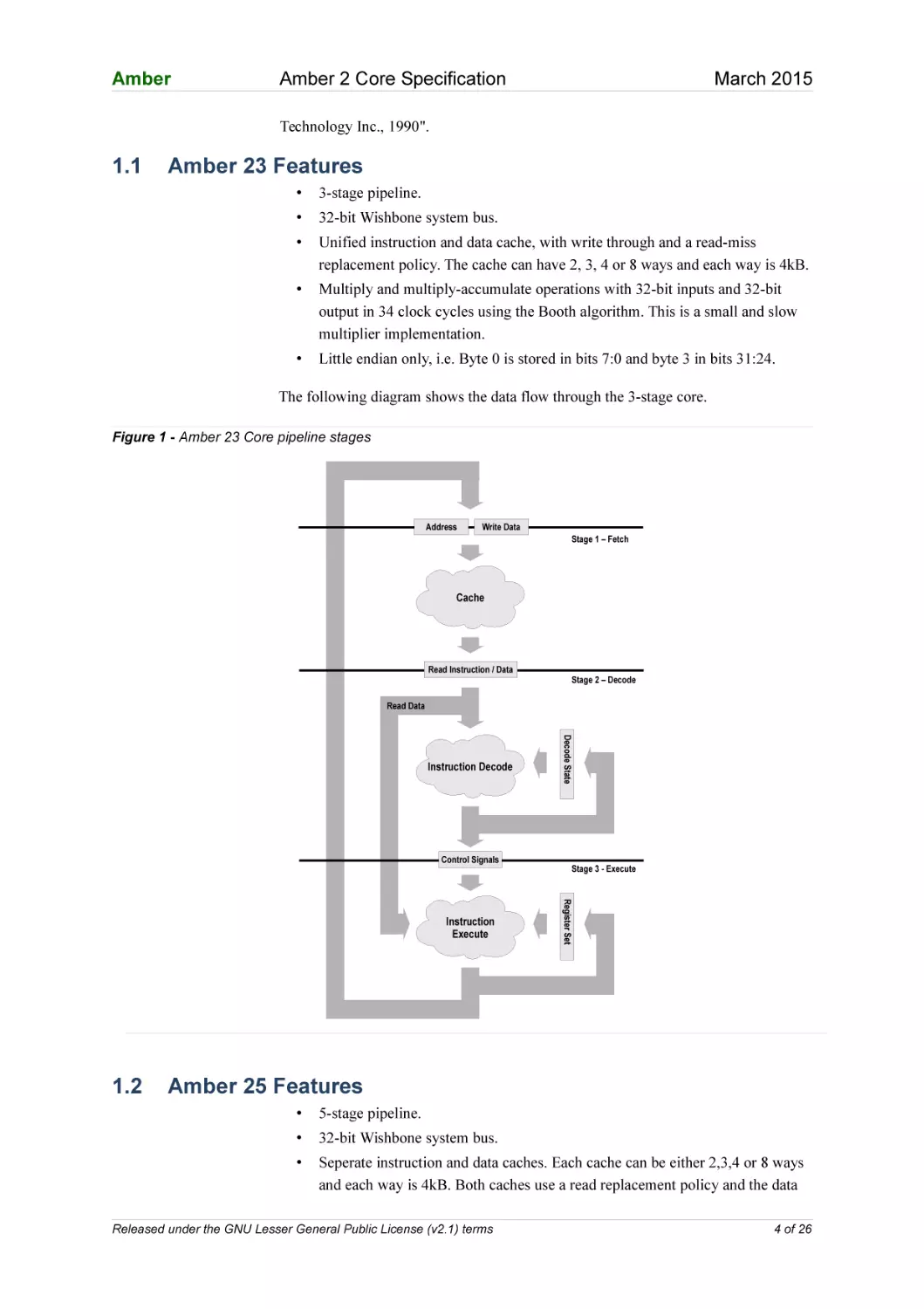
The following diagram shows the data flow through the 3-stage core.
Figure 1 - Amber 23 Core pipeline stages

Address

Write Data
Stage 1 – Fetch

Cache

Read Instruction / Data

Stage 2 – Decode

Read Data

Control Signals

1.2

Stage 3 - Execute

Register Set

Instruction
Execute

Decode State

Instruction Decode

Amber 25 Features
•

5-stage pipeline.

•

32-bit Wishbone system bus.

•

Seperate instruction and data caches. Each cache can be either 2,3,4 or 8 ways
and each way is 4kB. Both caches use a read replacement policy and the data

Released under the GNU Lesser General Public License (v2.1) terms

4 of 26

Amber

Amber 2 Core Specification

March 2015

cache operates as write through. The instruction cache is read only.
•

Multiply and multiply-accumulate operations with 32-bit inputs and 32-bit
output in 34 clock cycles using the Booth algorithm. This is a small and slow
multiplier implementation.

•

Little endian only, i.e. Byte 0 is stored in bits 7:0 and byte 3 in bits 31:24.

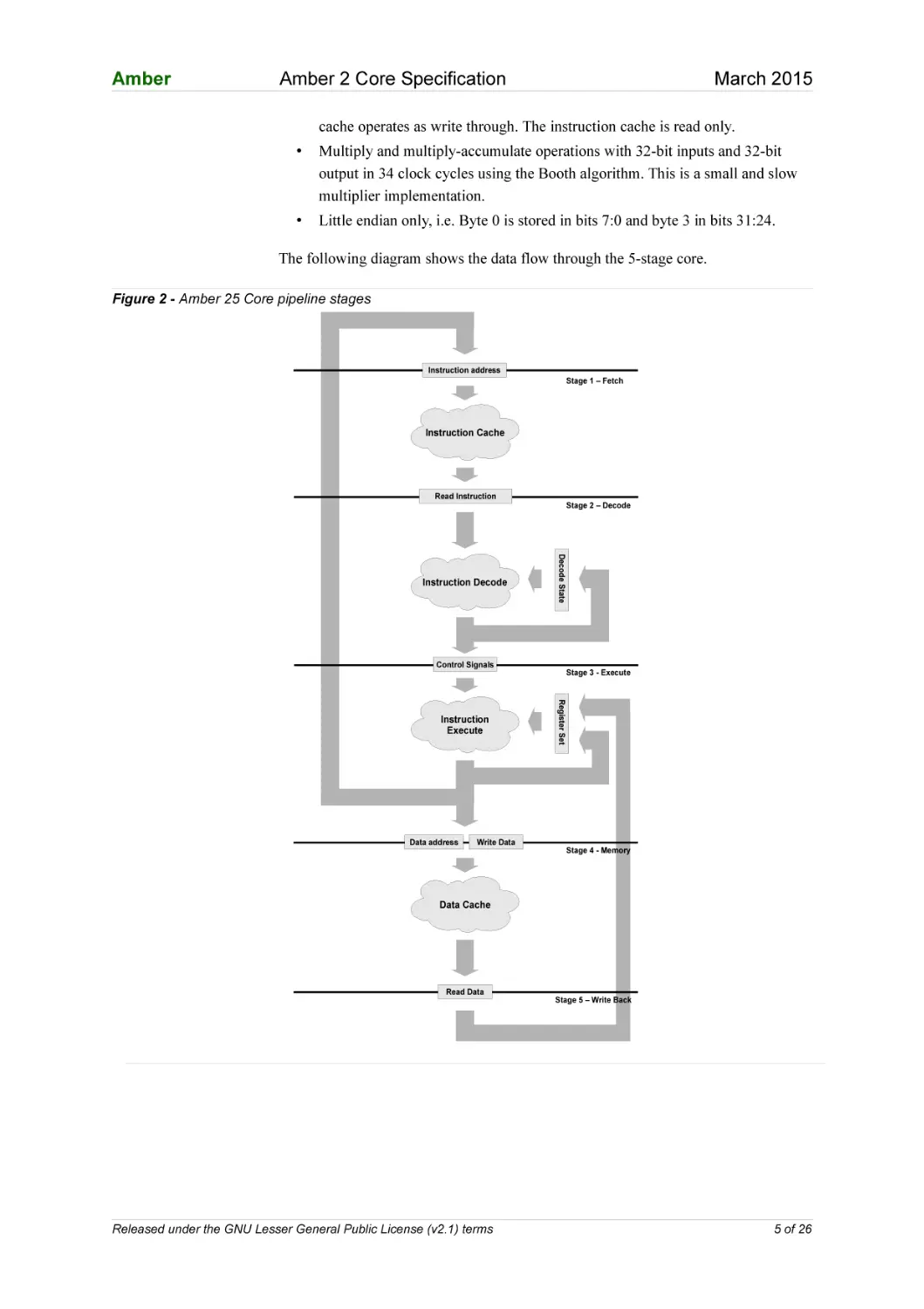
The following diagram shows the data flow through the 5-stage core.
Figure 2 - Amber 25 Core pipeline stages

Instruction address
Stage 1 – Fetch

Instruction Cache

Read Instruction

Control Signals

Data address

Write Data

Stage 3 - Execute

Register Set

Instruction
Execute

Decode State

Instruction Decode

Stage 2 – Decode

Stage 4 - Memory

Data Cache

Read Data

Released under the GNU Lesser General Public License (v2.1) terms

Stage 5 – Write Back

5 of 26

Amber

2

Amber 2 Core Specification

March 2015

Amber 23 Pipeline Architecture
The Amber 2 core has a 3-stage pipeline architecture. The best way to think of the
pipeline structure is of a circle. There is no start or end point. The output from each
stage is registered and fed into the next stage. The three stages are;
•

Fetch – The cache tag and data RAMs receive an unregistered version of the
address output by the execution stage. The registered version of the address is
compared to the tag RAM outputs one cycle later to decide if the cache hits or
misses. If the cache misses, then the pipeline is stalled while the instruction is
fetched from either boot memory or main memory via the Wishbone bus. The
cache always does 4-word reads so a complete cache line gets filled. In the
case of a cache hit, the output from the cache data RAM goes to the decode
stage. This can either be an instruction or data word.

•

Decode - The instruction is received from the fetch stage and registered. One
cycle later it is decoded and the datapath control signals prepared for the next
cycle. This stage contains a state machine that handles multi-cycle instructions
and interrupts.

•

Execute – The control signals from the decode stage are registered and passed
into the execute stage, along with any read data from the fetch stage. The
operands are read from the register bank, shifted, combined in the ALU and the
result written back. The next address for the fetch stage is generated.

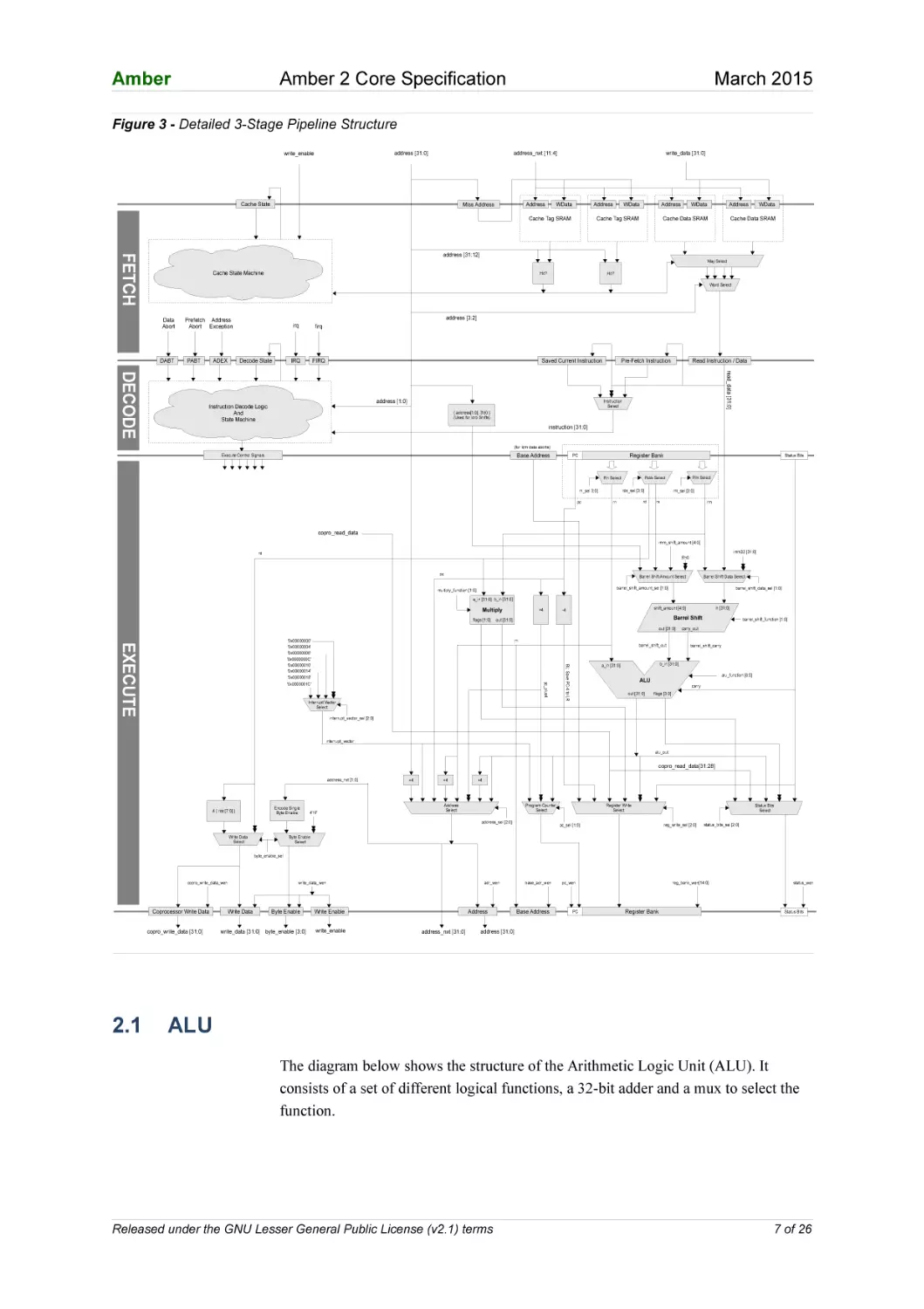
The following diagram shows the datapath through the three stages in detail. This
diagram closely corresponds to the Verilog implementation. Some details, like the
wishbone interface and coprocessor #15 have been left out so as not to overload the
diagram completely.

Released under the GNU Lesser General Public License (v2.1) terms

6 of 26

Amber

Amber 2 Core Specification

March 2015

Figure 3 - Detailed 3-Stage Pipeline Structure
address [31:0]

write_enable

address_nxt [11:4]

Cache State

Address

Miss Address

write_data [31:0]

WData

Address

Cache Tag SRAM

WData

Address

Cache Tag SRAM

WData

Address

Cache Data SRAM

WData

Cache Data SRAM

FETCH

address [31:12]
Way Select

Cache State Machine

Hit?

Hit?
Word Select

Data
Abort

DABT

address [3:2]

Prefetch Address
Abort Exception

PABT

ADEX

Decode State

irq

firq

IRQ

FIRQ

Saved Current Instruction

Read Instruction / Data

read_data [31:0]

DECODE

address [1:0]

Instruction Decode Logic
And
State Machine

Pre-Fetch Instruction

Instruction
Select
{ address[1:0], 3'd0 }
(Used for ldrb Shifts)

instruction [31:0]
(for ldm data aborts)

Base Address

Execute Control Signals

Register Bank

PC

Rm Select

Rd/s Select

Rn Select
rds_sel [3:0]

rn_sel 3:0]
pc

Status Bits

rm_sel [3:0]

rd

rn

rs

rm

copro_read_data
imm_shift_amount [4:0]
imm32 [31:0]

rd

5'h0

pc

Barrel Shift Amount Select

Barrel Shift Data Select

barrel_shift_amount_sel [1:0]

multiply_function [1:0]

barrel_shift_data_sel [1:0]

a_in [31:0] b_in [31:0]

Multiply
flags [1:0]

+4

Barrel Shift

rn

barrel_shift_out

pc_plus4

Interrupt Vector
Select

carry_out

barrel_shift_carry

b_in [31:0]

a_in [31:0]

BL: Save PC-4 to LR

EXECUTE

'0x0000001C'

barrel_shift_function [1:0]

shifter_operand[31:0]
out [31:0]

'0x00000000'
'0x00000004'
'0x00000008'
'0x0000000C'
'0x00000010'
'0x00000014'
'0x00000018'

in [31:0]

shift_amount [4:0]

-4

out [31:0]

alu_function [8:0]

ALU
carry
out [31:0]

flags [3:0]

interrupt_vector_sel [2:0]

interrupt_vector
alu_out

copro_read_data[31:28]
address_nxt [1:0]

4 { rds [7:0] }

Encode Single
Byte Enable

4'hF

+4

+4

+4

Address
Select

Program Counter
Select
address_sel [2:0]

Write Data
Select

Register Write
Select

Status Bits
Select
reg_write_sel [2:0]

pc_sel [1:0]

status_bits_sel [2:0]

Byte Enable
Select
byte_enable_sel

copro_write_data_wen

Coprocessor Write Data
copro_write_data [31:0]

2.1

write_data_wen

Write Data

Byte Enable

write_data [31:0] byte_enable [3:0]

adr_wen

Write Enable
write_enable

Address
address_nxt [31:0]

base_adr_wen

Base Address

pc_wen

PC

reg_bank_wen[14:0]

Register Bank

status_wen

Status Bits

address [31:0]

ALU
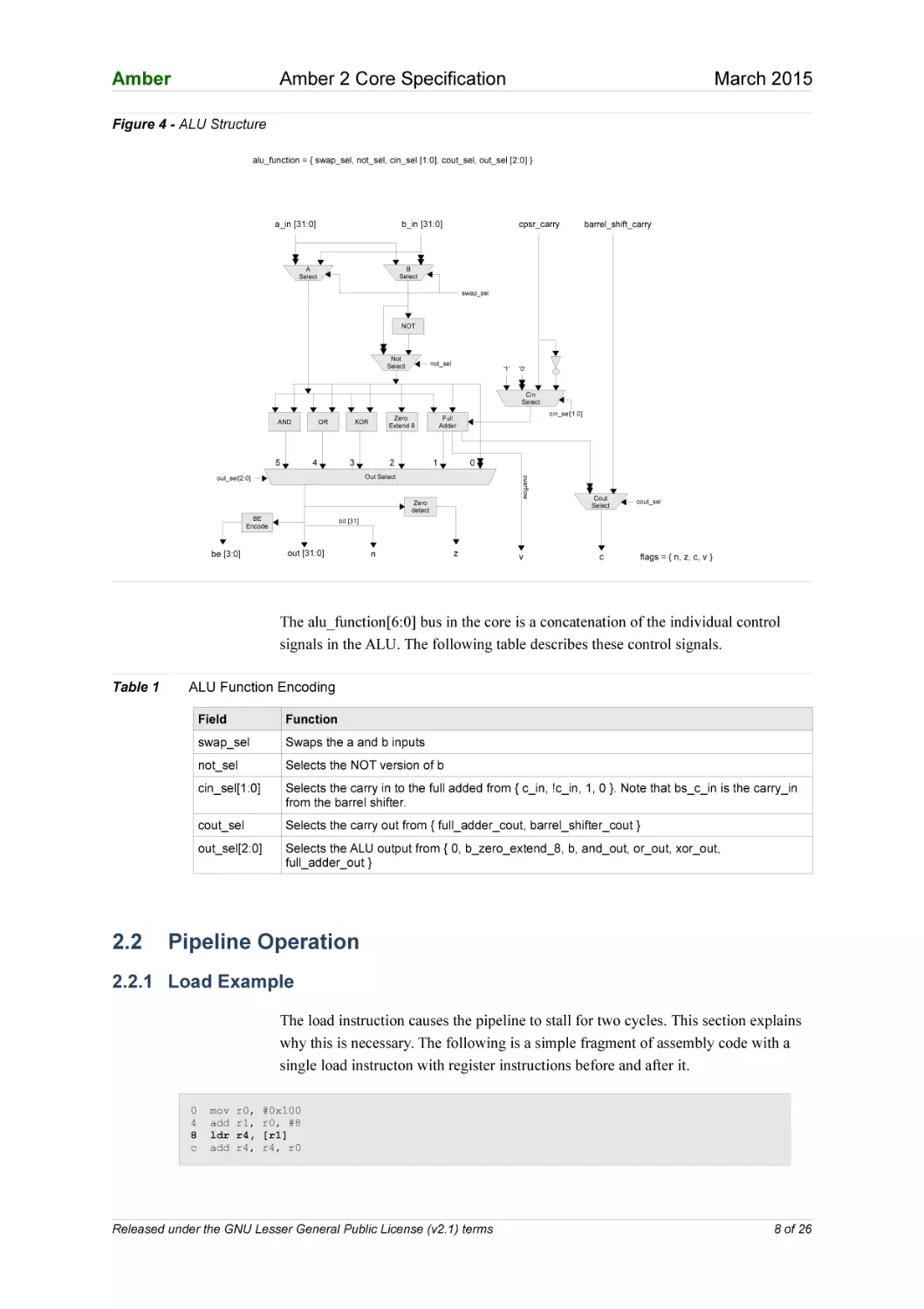
The diagram below shows the structure of the Arithmetic Logic Unit (ALU). It
consists of a set of different logical functions, a 32-bit adder and a mux to select the
function.

Released under the GNU Lesser General Public License (v2.1) terms

7 of 26

Amber

Amber 2 Core Specification

March 2015

Figure 4 - ALU Structure
alu_function = { swap_sel, not_sel, cin_sel [1:0], cout_sel, out_sel [2:0] }

a_in [31:0]

b_in [31:0]

cpsr_carry

barrel_shift_carry

B
Select

A
Select

swap_sel

NOT

Not
Select

not_sel

'1'

'0'

Cin
Select
AND

5

OR

4

Zero
Extend 8

XOR

3

2

cin_sel[1:0]

Full
Adder

1

0
overflow

Out Select

out_sel[2:0]

Zero
detect
BE
Encode

be [3:0]

Cout
Select

cout_sel

bit [31]

out [31:0]

n

z

v

c

flags = { n, z, c, v }

The alu_function[6:0] bus in the core is a concatenation of the individual control
signals in the ALU. The following table describes these control signals.
Table 1

2.2

ALU Function Encoding
Field

Function

swap_sel

Swaps the a and b inputs

not_sel

Selects the NOT version of b

cin_sel[1:0]

Selects the carry in to the full added from { c_in, !c_in, 1, 0 }. Note that bs_c_in is the carry_in
from the barrel shifter.

cout_sel

Selects the carry out from { full_adder_cout, barrel_shifter_cout }

out_sel[2:0]

Selects the ALU output from { 0, b_zero_extend_8, b, and_out, or_out, xor_out,
full_adder_out }

Pipeline Operation

2.2.1 Load Example
The load instruction causes the pipeline to stall for two cycles. This section explains
why this is necessary. The following is a simple fragment of assembly code with a
single load instructon with register instructions before and after it.
0
4
8
c

mov
add
ldr
add

r0,
r1,
r4,
r4,

#0x100
r0, #8
[r1]
r4, r0

Released under the GNU Lesser General Public License (v2.1) terms

8 of 26

Amber

Amber 2 Core Specification

March 2015

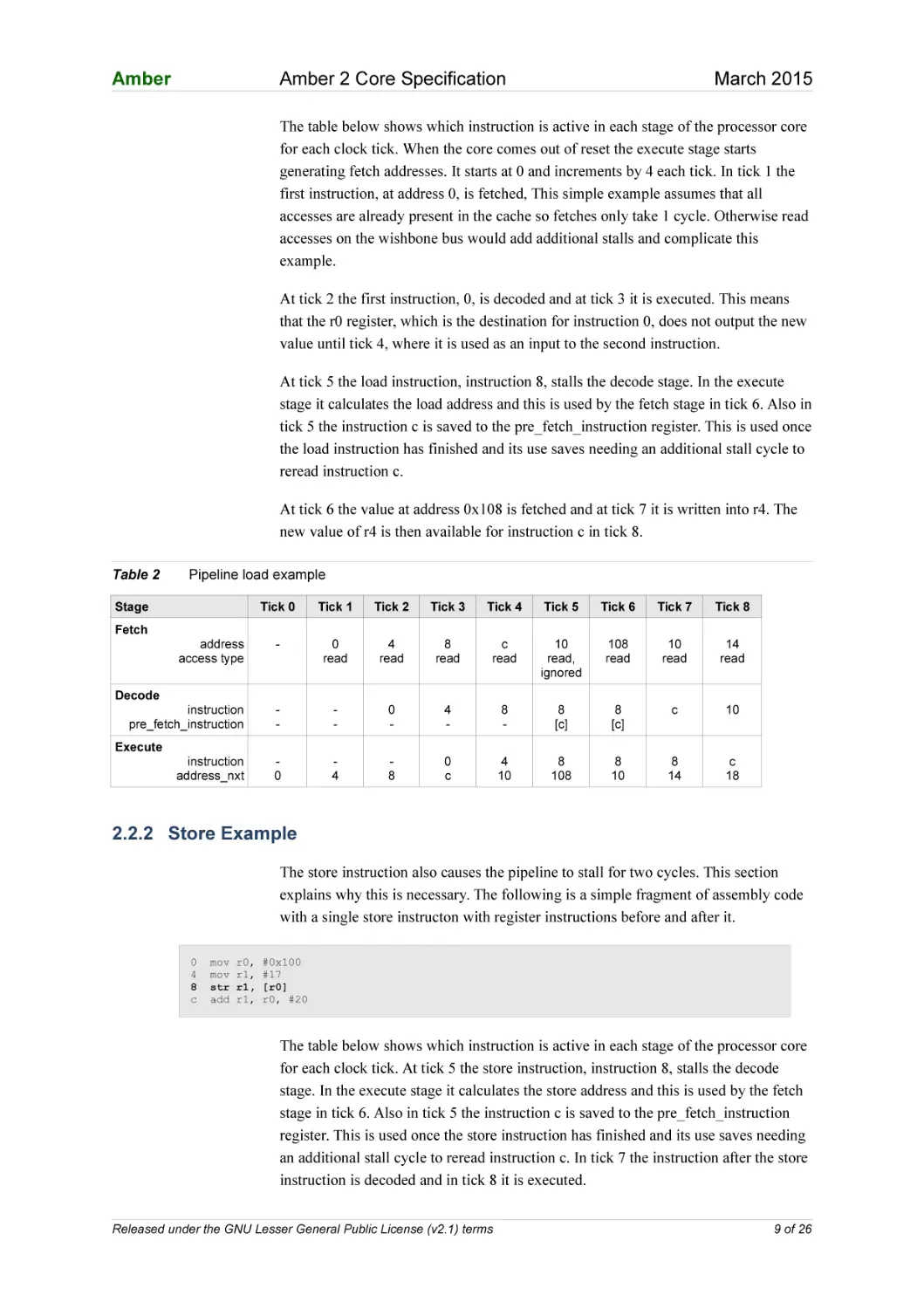
The table below shows which instruction is active in each stage of the processor core
for each clock tick. When the core comes out of reset the execute stage starts
generating fetch addresses. It starts at 0 and increments by 4 each tick. In tick 1 the
first instruction, at address 0, is fetched, This simple example assumes that all
accesses are already present in the cache so fetches only take 1 cycle. Otherwise read
accesses on the wishbone bus would add additional stalls and complicate this
example.
At tick 2 the first instruction, 0, is decoded and at tick 3 it is executed. This means
that the r0 register, which is the destination for instruction 0, does not output the new
value until tick 4, where it is used as an input to the second instruction.
At tick 5 the load instruction, instruction 8, stalls the decode stage. In the execute
stage it calculates the load address and this is used by the fetch stage in tick 6. Also in
tick 5 the instruction c is saved to the pre_fetch_instruction register. This is used once
the load instruction has finished and its use saves needing an additional stall cycle to
reread instruction c.
At tick 6 the value at address 0x108 is fetched and at tick 7 it is written into r4. The
new value of r4 is then available for instruction c in tick 8.
Table 2

Pipeline load example

Stage

Tick 0

Tick 1

Tick 2

Tick 3

Tick 4

Tick 5

Tick 6

Tick 7

Tick 8

address
access type

-

0
read

4
read

8
read

c
read

10
read,
ignored

108
read

10
read

14
read

instruction
pre_fetch_instruction

-

-

0
-

4
-

8
-

8
[c]

8
[c]

c

10

0

4

8

0
c

4
10

8
108

8
10

8
14

c
18

Fetch

Decode

Execute
instruction
address_nxt

2.2.2 Store Example
The store instruction also causes the pipeline to stall for two cycles. This section
explains why this is necessary. The following is a simple fragment of assembly code
with a single store instructon with register instructions before and after it.
0
4
8
c

mov
mov
str
add

r0,
r1,
r1,
r1,

#0x100
#17
[r0]
r0, #20

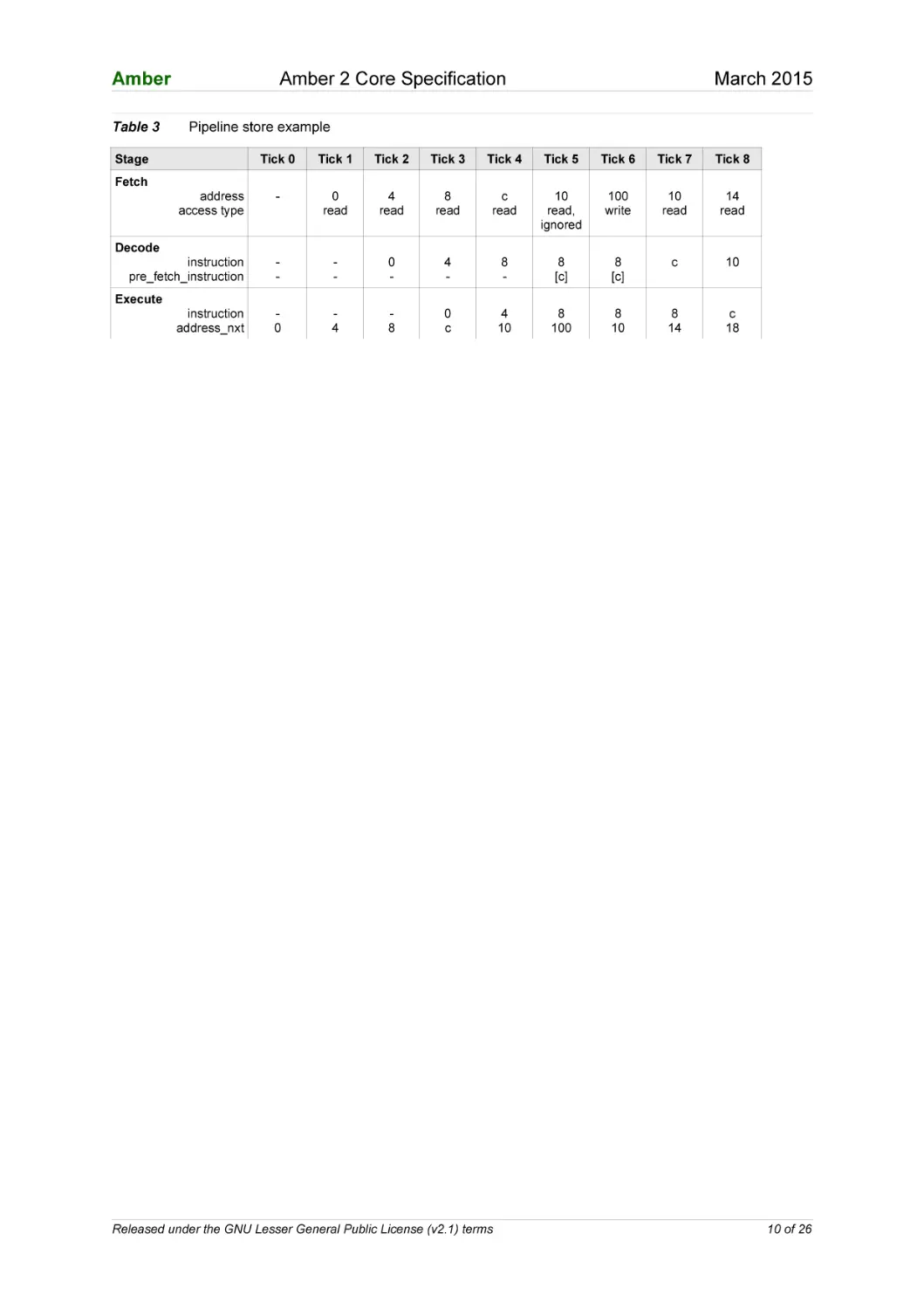
The table below shows which instruction is active in each stage of the processor core
for each clock tick. At tick 5 the store instruction, instruction 8, stalls the decode
stage. In the execute stage it calculates the store address and this is used by the fetch
stage in tick 6. Also in tick 5 the instruction c is saved to the pre_fetch_instruction
register. This is used once the store instruction has finished and its use saves needing
an additional stall cycle to reread instruction c. In tick 7 the instruction after the store
instruction is decoded and in tick 8 it is executed.
Released under the GNU Lesser General Public License (v2.1) terms

9 of 26

Amber
Table 3

Amber 2 Core Specification

March 2015

Pipeline store example

Stage

Tick 0

Tick 1

Tick 2

Tick 3

Tick 4

Tick 5

Tick 6

Tick 7

Tick 8

address
access type

-

0
read

4
read

8
read

c
read

10
read,
ignored

100
write

10
read

14
read

instruction
pre_fetch_instruction

-

-

0
-

4
-

8
-

8
[c]

8
[c]

c

10

0

4

8

0
c

4
10

8
100

8
10

8
14

c
18

Fetch

Decode

Execute
instruction
address_nxt

Released under the GNU Lesser General Public License (v2.1) terms

10 of 26

Amber

3

Amber 2 Core Specification

March 2015

Instruction Set
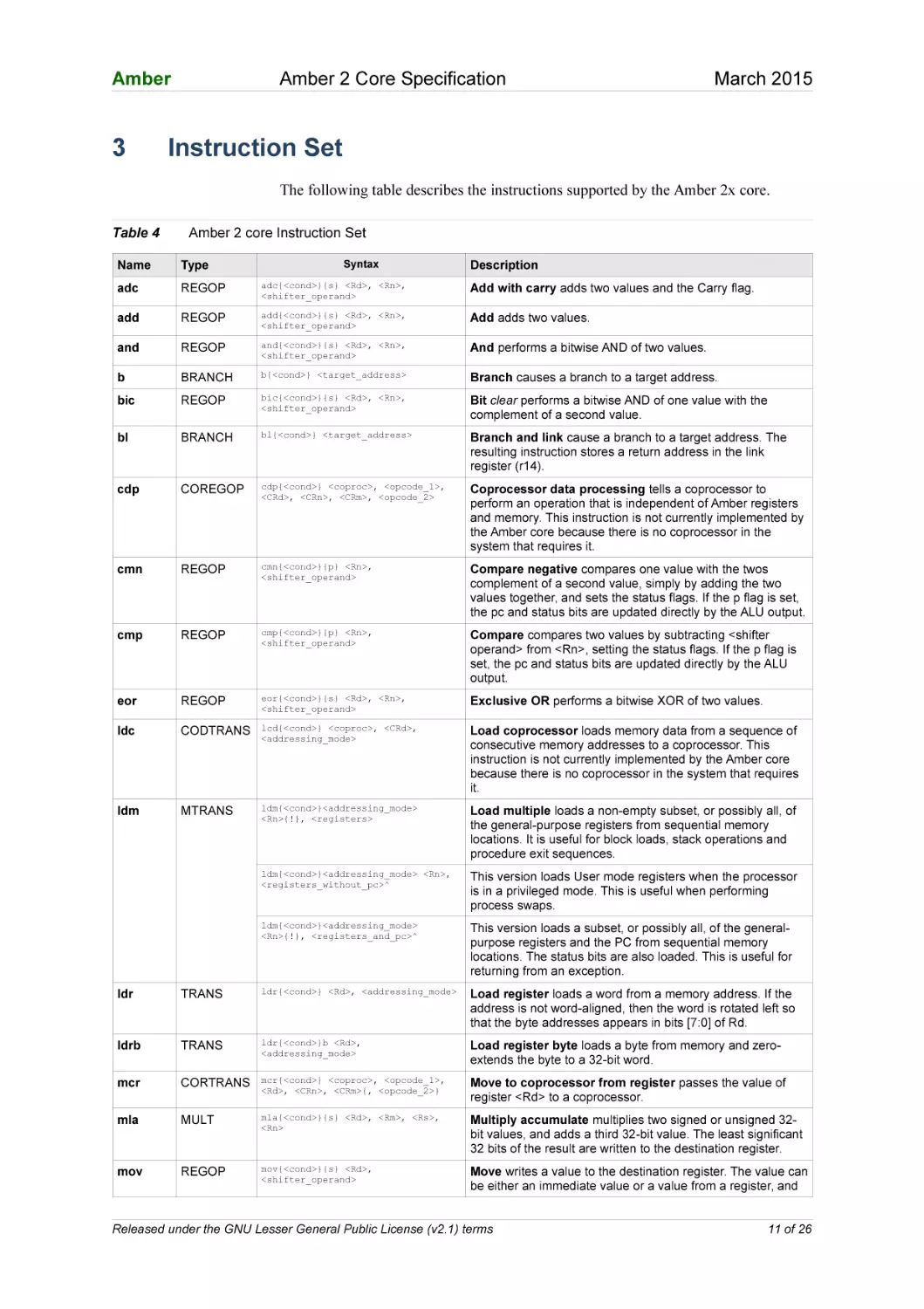
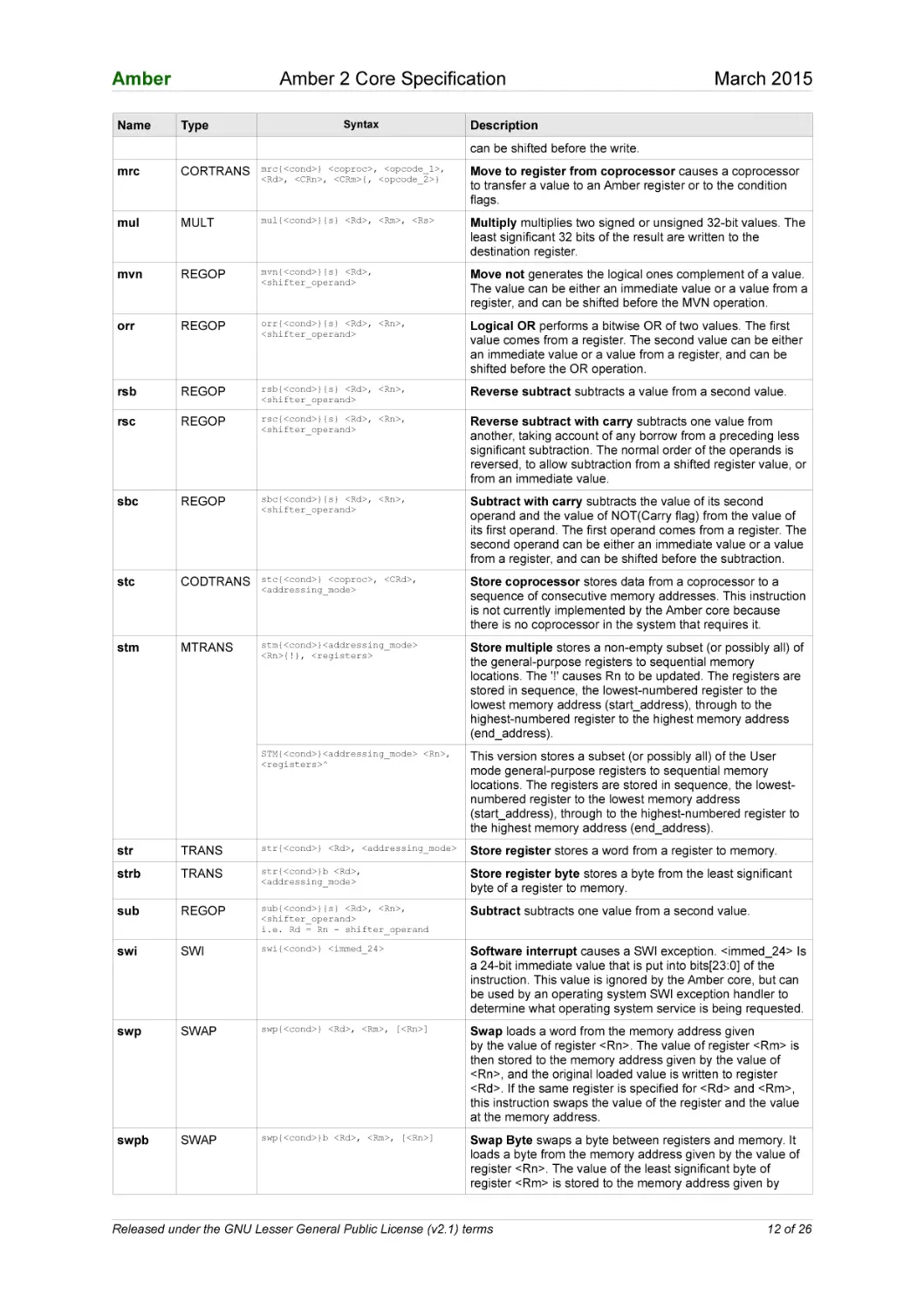
The following table describes the instructions supported by the Amber 2x core.

Table 4

Amber 2 core Instruction Set

Name

Type

adc

REGOP

adc{<cond>}{s} <Rd>, <Rn>,
<shifter_operand>

Add with carry adds two values and the Carry flag.

add

REGOP

add{<cond>}{s} <Rd>, <Rn>,
<shifter_operand>

Add adds two values.

and

REGOP

and{<cond>}{s} <Rd>, <Rn>,
<shifter_operand>

And performs a bitwise AND of two values.

b

BRANCH

b{<cond>} <target_address>

Branch causes a branch to a target address.

bic

REGOP

bic{<cond>}{s} <Rd>, <Rn>,
<shifter_operand>

Bit clear performs a bitwise AND of one value with the
complement of a second value.

bl

BRANCH

bl{<cond>} <target_address>

Branch and link cause a branch to a target address. The
resulting instruction stores a return address in the link
register (r14).

cdp

COREGOP

cdp{<cond>} <coproc>, <opcode_1>,
<CRd>, <CRn>, <CRm>, <opcode_2>

Coprocessor data processing tells a coprocessor to
perform an operation that is independent of Amber registers
and memory. This instruction is not currently implemented by
the Amber core because there is no coprocessor in the
system that requires it.

cmn

REGOP

cmn{<cond>}{p} <Rn>,
<shifter_operand>

Compare negative compares one value with the twos
complement of a second value, simply by adding the two
values together, and sets the status flags. If the p flag is set,
the pc and status bits are updated directly by the ALU output.

cmp

REGOP

cmp{<cond>}{p} <Rn>,
<shifter_operand>

Compare compares two values by subtracting <shifter
operand> from <Rn>, setting the status flags. If the p flag is
set, the pc and status bits are updated directly by the ALU
output.

eor

REGOP

eor{<cond>}{s} <Rd>, <Rn>,
<shifter_operand>

Exclusive OR performs a bitwise XOR of two values.

ldc

CODTRANS

lcd{<cond>} <coproc>, <CRd>,
<addressing_mode>

Load coprocessor loads memory data from a sequence of
consecutive memory addresses to a coprocessor. This
instruction is not currently implemented by the Amber core
because there is no coprocessor in the system that requires
it.

ldm

MTRANS

ldm{<cond>}<addressing_mode>
<Rn>{!}, <registers>

Load multiple loads a non-empty subset, or possibly all, of
the general-purpose registers from sequential memory
locations. It is useful for block loads, stack operations and
procedure exit sequences.

ldm{<cond>}<addressing_mode> <Rn>,
<registers_without_pc>^

This version loads User mode registers when the processor
is in a privileged mode. This is useful when performing
process swaps.

ldm{<cond>}<addressing_mode>
<Rn>{!}, <registers_and_pc>^

This version loads a subset, or possibly all, of the generalpurpose registers and the PC from sequential memory
locations. The status bits are also loaded. This is useful for
returning from an exception.

Syntax

Description

ldr

TRANS

ldr{<cond>} <Rd>, <addressing_mode>

Load register loads a word from a memory address. If the
address is not word-aligned, then the word is rotated left so
that the byte addresses appears in bits [7:0] of Rd.

ldrb

TRANS

ldr{<cond>}b <Rd>,
<addressing_mode>

Load register byte loads a byte from memory and zeroextends the byte to a 32-bit word.

mcr

CORTRANS

mcr{<cond>} <coproc>, <opcode_1>,
<Rd>, <CRn>, <CRm>{, <opcode_2>}

Move to coprocessor from register passes the value of
register <Rd> to a coprocessor.

mla

MULT

mla{<cond>}{s} <Rd>, <Rm>, <Rs>,
<Rn>

Multiply accumulate multiplies two signed or unsigned 32bit values, and adds a third 32-bit value. The least significant
32 bits of the result are written to the destination register.

mov

REGOP

mov{<cond>}{s} <Rd>,
<shifter_operand>

Move writes a value to the destination register. The value can
be either an immediate value or a value from a register, and

Released under the GNU Lesser General Public License (v2.1) terms

11 of 26

Amber
Name

Amber 2 Core Specification
Type

Syntax

March 2015

Description
can be shifted before the write.

mrc

CORTRANS

mrc{<cond>} <coproc>, <opcode_1>,
<Rd>, <CRn>, <CRm>{, <opcode_2>}

mul

MULT

mul{<cond>}{s} <Rd>, <Rm>, <Rs>

Multiply multiplies two signed or unsigned 32-bit values. The
least significant 32 bits of the result are written to the
destination register.

mvn

REGOP

mvn{<cond>}{s} <Rd>,
<shifter_operand>

Move not generates the logical ones complement of a value.
The value can be either an immediate value or a value from a
register, and can be shifted before the MVN operation.

orr

REGOP

orr{<cond>}{s} <Rd>, <Rn>,
<shifter_operand>

Logical OR performs a bitwise OR of two values. The first
value comes from a register. The second value can be either
an immediate value or a value from a register, and can be
shifted before the OR operation.

rsb

REGOP

rsb{<cond>}{s} <Rd>, <Rn>,
<shifter_operand>

Reverse subtract subtracts a value from a second value.

rsc

REGOP

rsc{<cond>}{s} <Rd>, <Rn>,
<shifter_operand>

Reverse subtract with carry subtracts one value from
another, taking account of any borrow from a preceding less
significant subtraction. The normal order of the operands is
reversed, to allow subtraction from a shifted register value, or
from an immediate value.

sbc

REGOP

sbc{<cond>}{s} <Rd>, <Rn>,
<shifter_operand>

Subtract with carry subtracts the value of its second
operand and the value of NOT(Carry flag) from the value of
its first operand. The first operand comes from a register. The
second operand can be either an immediate value or a value
from a register, and can be shifted before the subtraction.

stc

CODTRANS

stc{<cond>} <coproc>, <CRd>,
<addressing_mode>

Store coprocessor stores data from a coprocessor to a
sequence of consecutive memory addresses. This instruction
is not currently implemented by the Amber core because
there is no coprocessor in the system that requires it.

stm

MTRANS

stm{<cond>}<addressing_mode>
<Rn>{!}, <registers>

Store multiple stores a non-empty subset (or possibly all) of
the general-purpose registers to sequential memory
locations. The '!' causes Rn to be updated. The registers are
stored in sequence, the lowest-numbered register to the
lowest memory address (start_address), through to the
highest-numbered register to the highest memory address
(end_address).

STM{<cond>}<addressing_mode> <Rn>,
<registers>^

This version stores a subset (or possibly all) of the User
mode general-purpose registers to sequential memory
locations. The registers are stored in sequence, the lowestnumbered register to the lowest memory address
(start_address), through to the highest-numbered register to
the highest memory address (end_address).

TRANS

str{<cond>} <Rd>, <addressing_mode>

Store register stores a word from a register to memory.

strb

TRANS

str{<cond>}b <Rd>,
<addressing_mode>

Store register byte stores a byte from the least significant
byte of a register to memory.

sub

REGOP

sub{<cond>}{s} <Rd>, <Rn>,
<shifter_operand>
i.e. Rd = Rn - shifter_operand

Subtract subtracts one value from a second value.

swi

SWI

swi{<cond>} <immed_24>

Software interrupt causes a SWI exception. <immed_24> Is
a 24-bit immediate value that is put into bits[23:0] of the
instruction. This value is ignored by the Amber core, but can
be used by an operating system SWI exception handler to
determine what operating system service is being requested.

swp

SWAP

swp{<cond>} <Rd>, <Rm>, [<Rn>]

Swap loads a word from the memory address given
by the value of register <Rn>. The value of register <Rm> is
then stored to the memory address given by the value of
<Rn>, and the original loaded value is written to register
<Rd>. If the same register is specified for <Rd> and <Rm>,
this instruction swaps the value of the register and the value
at the memory address.

swpb

SWAP

swp{<cond>}b <Rd>, <Rm>, [<Rn>]

Swap Byte swaps a byte between registers and memory. It
loads a byte from the memory address given by the value of
register <Rn>. The value of the least significant byte of
register <Rm> is stored to the memory address given by

str

Move to register from coprocessor causes a coprocessor
to transfer a value to an Amber register or to the condition
flags.

Released under the GNU Lesser General Public License (v2.1) terms

12 of 26

Amber
Name

Amber 2 Core Specification
Type

Syntax

March 2015

Description
<Rn>, the original loaded value is zero-extended to a 32-bit
word, and the word is written to register <Rd>. Can be used
to implement semaphores.

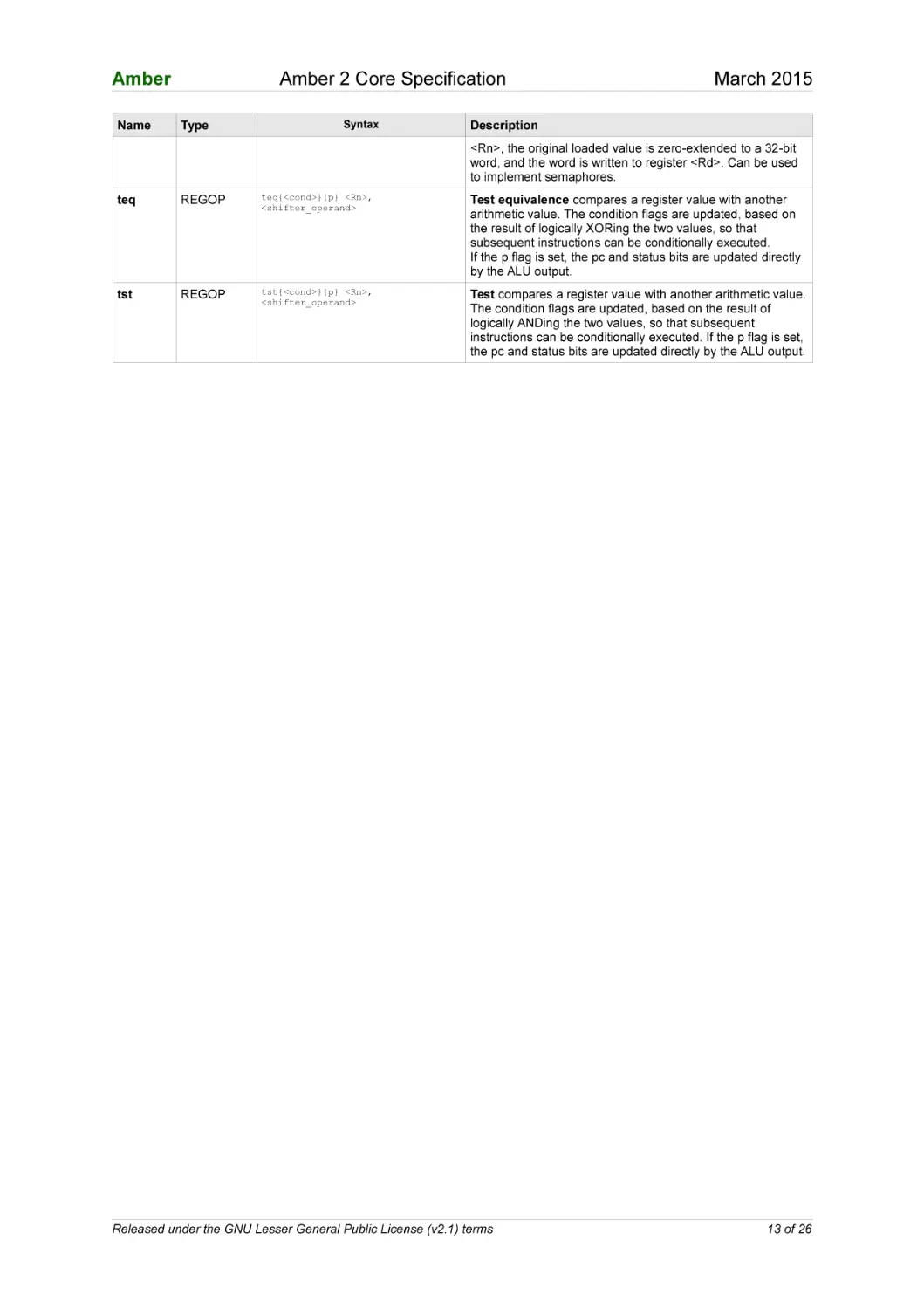
teq

REGOP

teq{<cond>}{p} <Rn>,
<shifter_operand>

Test equivalence compares a register value with another
arithmetic value. The condition flags are updated, based on
the result of logically XORing the two values, so that
subsequent instructions can be conditionally executed.
If the p flag is set, the pc and status bits are updated directly
by the ALU output.

tst

REGOP

tst{<cond>}{p} <Rn>,
<shifter_operand>

Test compares a register value with another arithmetic value.
The condition flags are updated, based on the result of
logically ANDing the two values, so that subsequent
instructions can be conditionally executed. If the p flag is set,
the pc and status bits are updated directly by the ALU output.

Released under the GNU Lesser General Public License (v2.1) terms

13 of 26

Amber

4

Amber 2 Core Specification

March 2015

Instruction Set Encoding

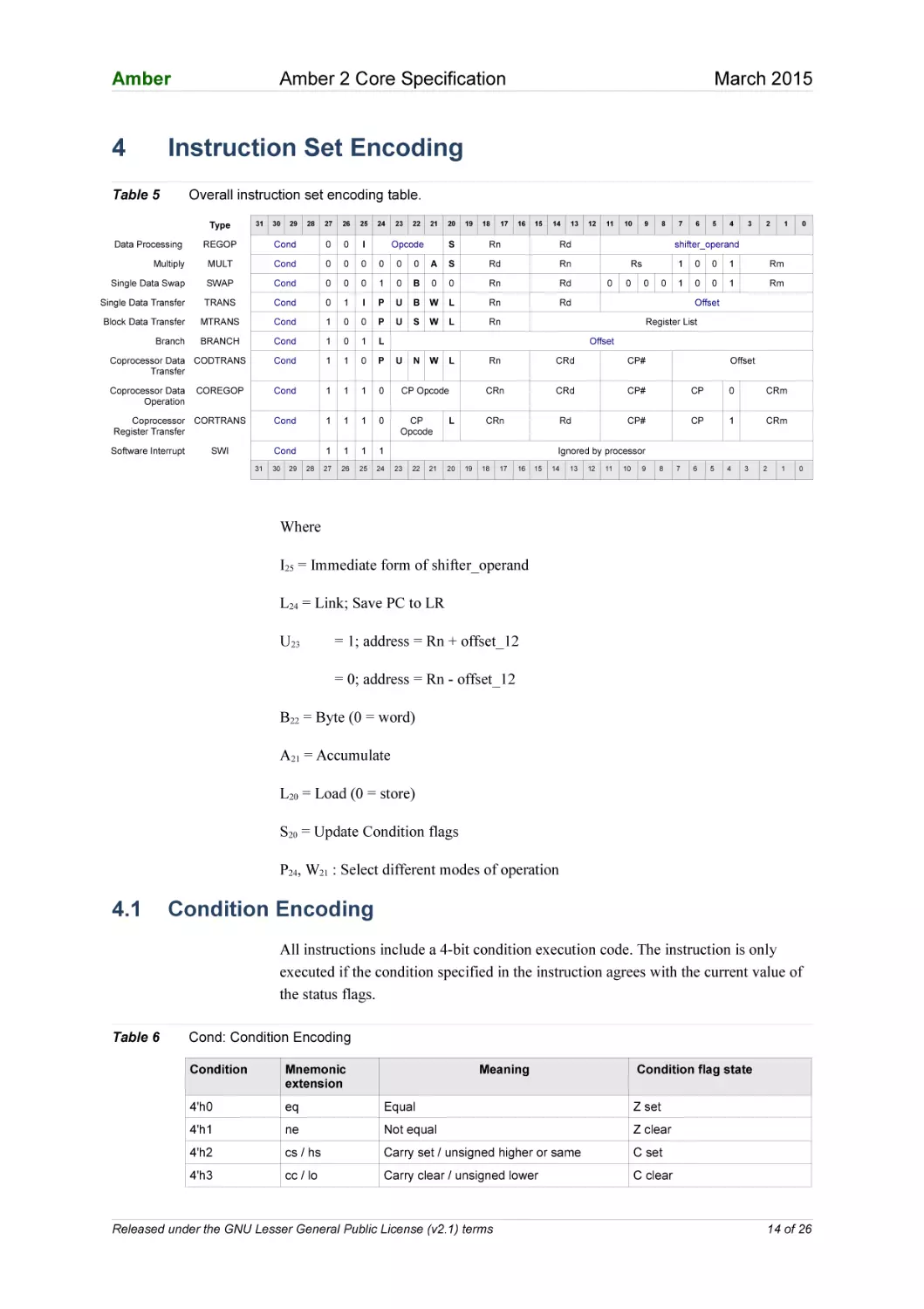
Table 5

Overall instruction set encoding table.
27

26

25

REGOP

Cond

0

0

I

MULT

Cond

0

0

0

Type
Data Processing
Multiply

31

30

29

28

24

23

22

21

Opcode
0

0

0

A

20

19

18

17

16

15

14

13

S

Rn

Rd

S

Rd

Rn

Single Data Swap

SWAP

Cond

0

0

0

1

0

B

0

0

Rn

Rd

Single Data Transfer

TRANS

Cond

0

1

I

P

U

B

W

L

Rn

Rd

Block Data Transfer

MTRANS

Cond

1

0

0

P

U

S

W

L

Rn

Branch

BRANCH

Cond

1

0

1

L

Coprocessor Data CODTRANS
Transfer

Cond

1

1

0

P

Coprocessor Data
Operation

COREGOP

Cond

1

1

1

0

Coprocessor CORTRANS
Register Transfer

Cond

1

1

1

0

Software Interrupt

SWI

Cond
31

30

29

28

1

1

1

1

27

26

25

24

12

11

10

9

8

7

6

5

4

3

2

1

0

shifter_operand
Rs
0

0

1
0

0

1

0

0

1

Rm

0

0

1

Rm

Offset
Register List
Offset

U

N

W

L

Rn

CRd

CP#

CP Opcode

CRn

CRd

CP#

CP

0

CRm

CP
Opcode

CRn

Rd

CP#

CP

1

CRm

L

Offset

Ignored by processor
23

22

21

20

19

18

17

16

15

14

13

12

11

10

9

8

7

6

5

4

3

2

1

0

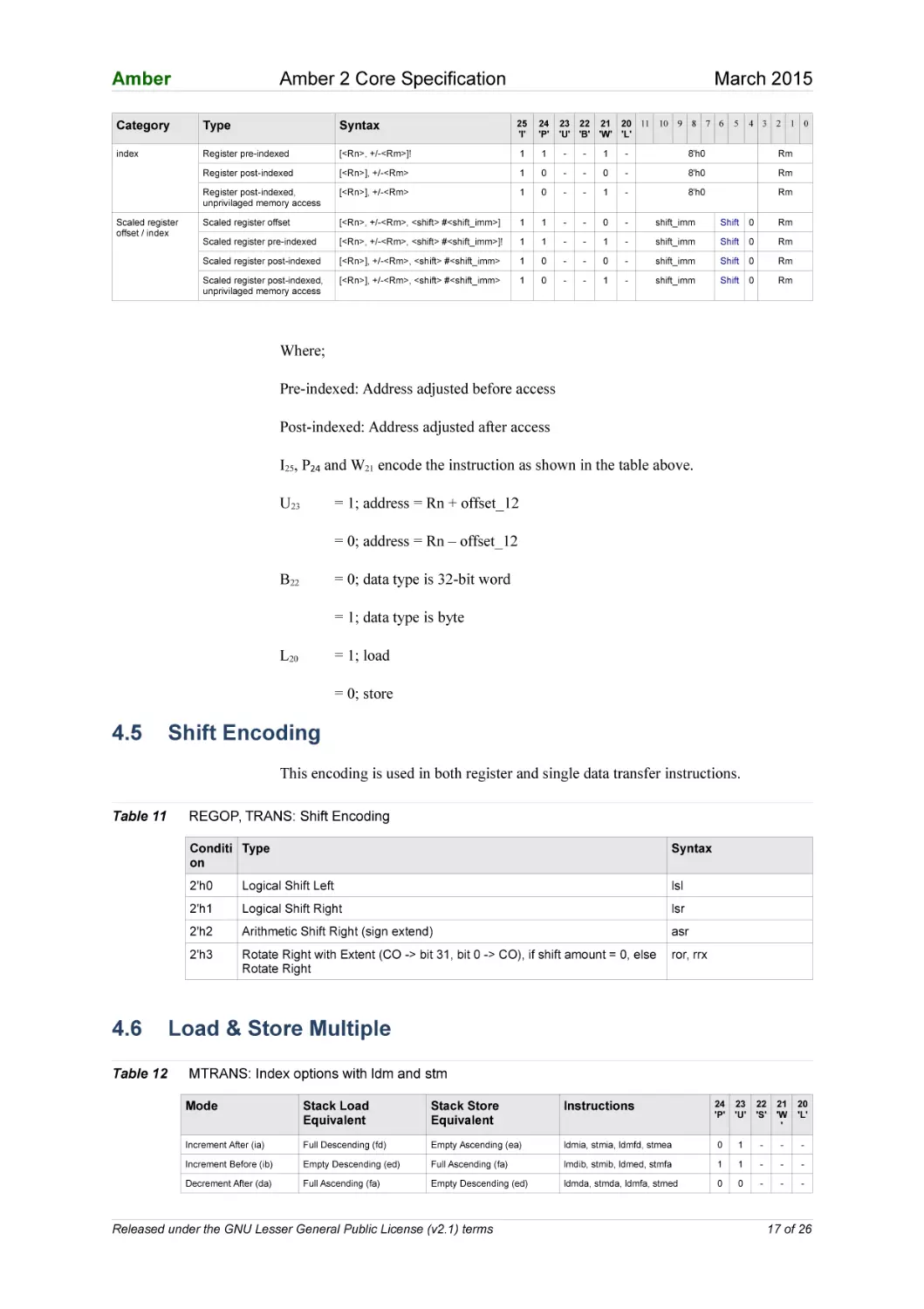
Where
I25 = Immediate form of shifter_operand
L24 = Link; Save PC to LR
U23

= 1; address = Rn + offset_12
= 0; address = Rn - offset_12

B22 = Byte (0 = word)
A21 = Accumulate
L20 = Load (0 = store)
S20 = Update Condition flags
P24, W21 : Select different modes of operation

4.1

Condition Encoding
All instructions include a 4-bit condition execution code. The instruction is only
executed if the condition specified in the instruction agrees with the current value of
the status flags.

Table 6

Cond: Condition Encoding
Condition

Mnemonic
extension

Meaning

4'h0

eq

Equal

Z set

4'h1

ne

Not equal

Z clear

4'h2

cs / hs

Carry set / unsigned higher or same

C set

4'h3

cc / lo

Carry clear / unsigned lower

C clear

Released under the GNU Lesser General Public License (v2.1) terms

Condition flag state

14 of 26

Amber

4.2
Table 7

Amber 2 Core Specification
Condition

Mnemonic
extension

4'h4

mi

Minus / negative

N set

4'h5

pl

Plus / positive or zero

N clear

4'h6

vs

Overflow

V set

4'h7

vc

No overflow

V clear

4'h8

hi

Unsigned higher

C set and Z clear

4'h9

ls

Unsigned lower or same

C clear or Z set

4'h10

ge

Signed greater than or equal

N == V

4'h11

lt

Signed less than

N != V

4'h12

gt

Signed greater than

Z == 0,N == V

4'h13

le

Signed less than or equal

Z == 1 or N != V

4'h14

al

Always (unconditional)

-

4'h15

-

Invalid condition

-

Meaning

Condition flag state

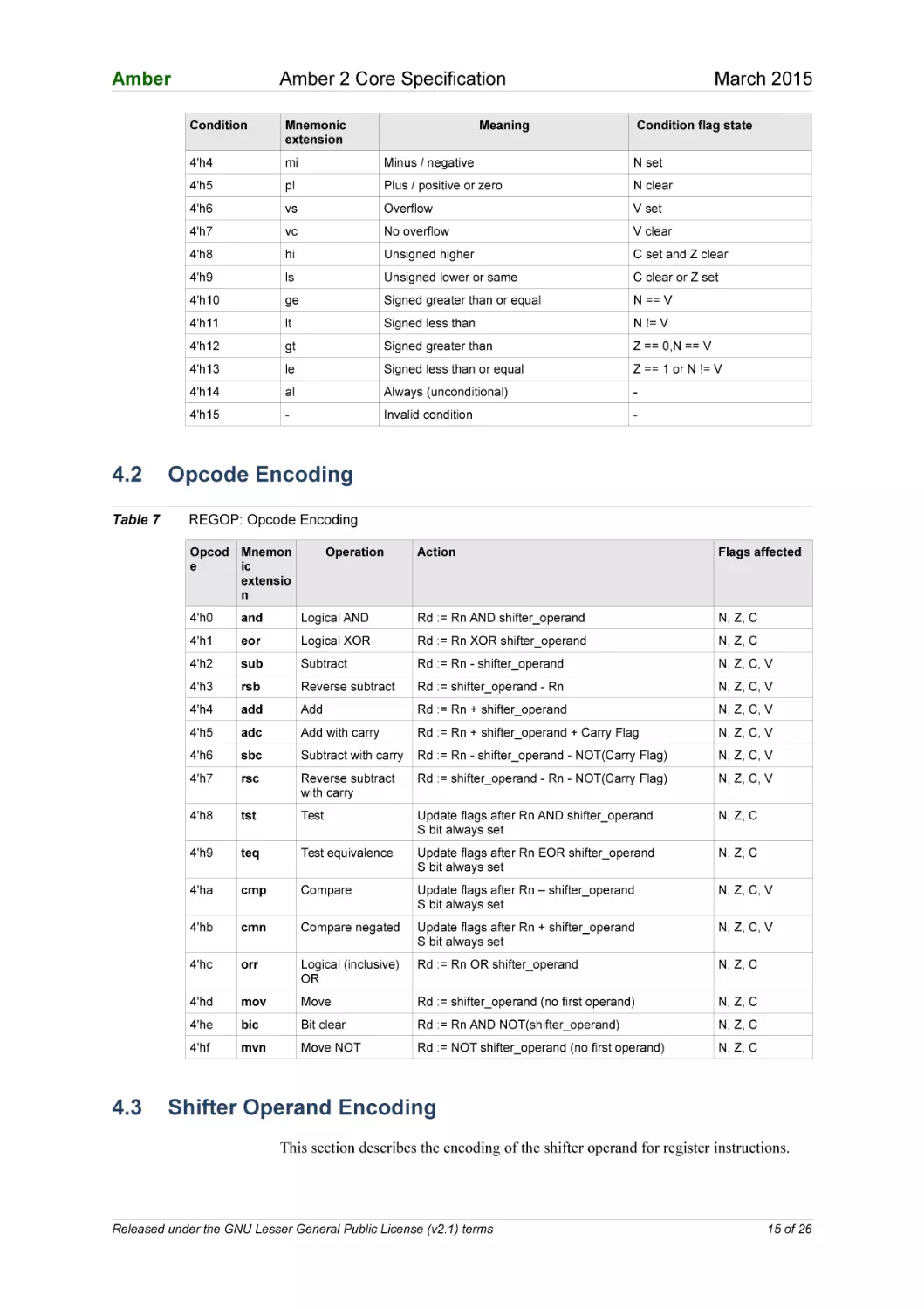
Opcode Encoding
REGOP: Opcode Encoding
Opcod Mnemon
e
ic
extensio
n

4.3

March 2015

Operation

Action

Flags affected

4'h0

and

Logical AND

Rd := Rn AND shifter_operand

N, Z, C

4'h1

eor

Logical XOR

Rd := Rn XOR shifter_operand

N, Z, C

4'h2

sub

Subtract

Rd := Rn - shifter_operand

N, Z, C, V

4'h3

rsb

Reverse subtract

Rd := shifter_operand - Rn

N, Z, C, V

4'h4

add

Add

Rd := Rn + shifter_operand

N, Z, C, V

4'h5

adc

Add with carry

Rd := Rn + shifter_operand + Carry Flag

N, Z, C, V

4'h6

sbc

Subtract with carry

Rd := Rn - shifter_operand - NOT(Carry Flag)

N, Z, C, V

4'h7

rsc

Reverse subtract
with carry

Rd := shifter_operand - Rn - NOT(Carry Flag)

N, Z, C, V

4'h8

tst

Test

Update flags after Rn AND shifter_operand
S bit always set

N, Z, C

4'h9

teq

Test equivalence

Update flags after Rn EOR shifter_operand
S bit always set

N, Z, C

4'ha

cmp

Compare

Update flags after Rn – shifter_operand
S bit always set

N, Z, C, V

4'hb

cmn

Compare negated

Update flags after Rn + shifter_operand
S bit always set

N, Z, C, V

4'hc

orr

Logical (inclusive)
OR

Rd := Rn OR shifter_operand

N, Z, C

4'hd

mov

Move

Rd := shifter_operand (no first operand)

N, Z, C

4'he

bic

Bit clear

Rd := Rn AND NOT(shifter_operand)

N, Z, C

4'hf

mvn

Move NOT

Rd := NOT shifter_operand (no first operand)

N, Z, C

Shifter Operand Encoding
This section describes the encoding of the shifter operand for register instructions.

Released under the GNU Lesser General Public License (v2.1) terms

15 of 26

Amber
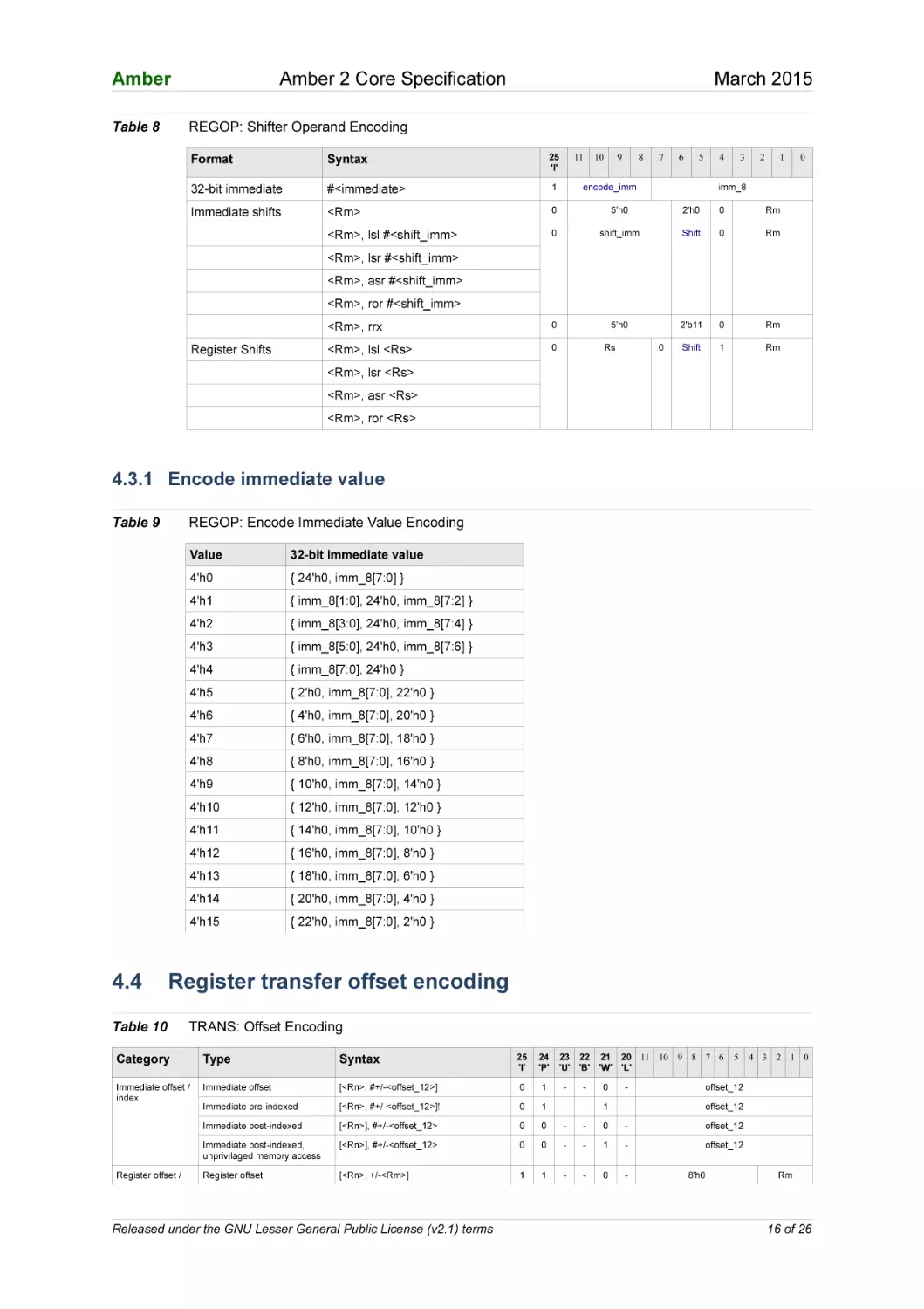
Table 8

Amber 2 Core Specification

March 2015

REGOP: Shifter Operand Encoding
Format

Syntax

25
'I'

32-bit immediate

#<immediate>

1

Immediate shifts

<Rm>

0

5'h0

2'h0

0

Rm

<Rm>, lsl #<shift_imm>

0

shift_imm

Shift

0

Rm

<Rm>, rrx

0

5'h0

2'b11

0

Rm

<Rm>, lsl <Rs>

0

Shift

1

Rm

11

10

9

8

7

6

5

4

encode_imm

3

2

1

0

imm_8

<Rm>, lsr #<shift_imm>
<Rm>, asr #<shift_imm>
<Rm>, ror #<shift_imm>

Register Shifts

Rs

0

<Rm>, lsr <Rs>
<Rm>, asr <Rs>
<Rm>, ror <Rs>

4.3.1 Encode immediate value
Table 9

4.4

REGOP: Encode Immediate Value Encoding
Value

32-bit immediate value

4'h0

{ 24'h0, imm_8[7:0] }

4'h1

{ imm_8[1:0], 24'h0, imm_8[7:2] }

4'h2

{ imm_8[3:0], 24'h0, imm_8[7:4] }

4'h3

{ imm_8[5:0], 24'h0, imm_8[7:6] }

4'h4

{ imm_8[7:0], 24'h0 }

4'h5

{ 2'h0, imm_8[7:0], 22'h0 }

4'h6

{ 4'h0, imm_8[7:0], 20'h0 }

4'h7

{ 6'h0, imm_8[7:0], 18'h0 }

4'h8

{ 8'h0, imm_8[7:0], 16'h0 }

4'h9

{ 10'h0, imm_8[7:0], 14'h0 }

4'h10

{ 12'h0, imm_8[7:0], 12'h0 }

4'h11

{ 14'h0, imm_8[7:0], 10'h0 }

4'h12

{ 16'h0, imm_8[7:0], 8'h0 }

4'h13

{ 18'h0, imm_8[7:0], 6'h0 }

4'h14

{ 20'h0, imm_8[7:0], 4'h0 }

4'h15

{ 22'h0, imm_8[7:0], 2'h0 }

Register transfer offset encoding

Table 10

TRANS: Offset Encoding

Category

Type

Syntax

25
'I'

24
'P'

Immediate offset /
index

Immediate offset

[<Rn>, #+/-<offset_12>]

0

1

-

-

0

-

offset_12

Immediate pre-indexed

[<Rn>, #+/-<offset_12>]!

0

1

-

-

1

-

offset_12

Immediate post-indexed

[<Rn>], #+/-<offset_12>

0

0

-

-

0

-

offset_12

Immediate post-indexed,
unprivilaged memory access

[<Rn>], #+/-<offset_12>

0

0

-

-

1

-

offset_12

Register offset

[<Rn>, +/-<Rm>]

1

1

-

-

0

-

Register offset /

Released under the GNU Lesser General Public License (v2.1) terms

23 22 21 20 11 10
'U' 'B' 'W' 'L'

9

8

7 6

8'h0

5

4 3

2

1 0

Rm

16 of 26

Amber

Amber 2 Core Specification

March 2015
23 22 21 20 11 10
'U' 'B' 'W' 'L'

9

8

7 6

5

4 3

2

1 0

Category

Type

Syntax

25
'I'

24
'P'

index

Register pre-indexed

[<Rn>, +/-<Rm>]!

1

1

-

-

1

-

8'h0

Rm

Register post-indexed

[<Rn>], +/-<Rm>

1

0

-

-

0

-

8'h0

Rm

Register post-indexed,
unprivilaged memory access

[<Rn>], +/-<Rm>

1

0

-

-

1

-

8'h0

Rm

Scaled register offset

[<Rn>, +/-<Rm>, <shift> #<shift_imm>]

1

1

-

-

0

-

shift_imm

Shift

0

Rm

Scaled register pre-indexed

[<Rn>, +/-<Rm>, <shift> #<shift_imm>]!

1

1

-

-

1

-

shift_imm

Shift

0

Rm

Scaled register post-indexed

[<Rn>], +/-<Rm>, <shift> #<shift_imm>

1

0

-

-

0

-

shift_imm

Shift

0

Rm

Scaled register post-indexed,
unprivilaged memory access

[<Rn>], +/-<Rm>, <shift> #<shift_imm>

1

0

-

-

1

-

shift_imm

Shift

0

Rm

Scaled register
offset / index

Where;
Pre-indexed: Address adjusted before access
Post-indexed: Address adjusted after access
I25, P24 and W21 encode the instruction as shown in the table above.
U23

= 1; address = Rn + offset_12
= 0; address = Rn – offset_12

B22

= 0; data type is 32-bit word
= 1; data type is byte

L20

= 1; load
= 0; store

4.5

Shift Encoding
This encoding is used in both register and single data transfer instructions.

Table 11

4.6
Table 12

REGOP, TRANS: Shift Encoding
Conditi Type
on

Syntax

2'h0

Logical Shift Left

lsl

2'h1

Logical Shift Right

lsr

2'h2

Arithmetic Shift Right (sign extend)

asr

2'h3

Rotate Right with Extent (CO -> bit 31, bit 0 -> CO), if shift amount = 0, else
Rotate Right

ror, rrx

Load & Store Multiple
MTRANS: Index options with ldm and stm
Mode

Stack Load
Equivalent

Stack Store
Equivalent

Instructions

24
'P'

23
'U'

22
'S'

21
'W
'

20
'L'

Increment After (ia)

Full Descending (fd)

Empty Ascending (ea)

ldmia, stmia, ldmfd, stmea

0

1

-

-

-

Increment Before (ib)

Empty Descending (ed)

Full Ascending (fa)

lmdib, stmib, ldmed, stmfa

1

1

-

-

-

Decrement After (da)

Full Ascending (fa)

Empty Descending (ed)

ldmda, stmda, ldmfa, stmed

0

0

-

-

-

Released under the GNU Lesser General Public License (v2.1) terms

17 of 26

Amber

Amber 2 Core Specification

March 2015

Mode

Stack Load
Equivalent

Stack Store
Equivalent

Instructions

24
'P'

23
'U'

22
'S'

21
'W
'

20
'L'

Decrement Before (db)

Empty Ascending (ea)

Full Descending (fd)

lmddb, stmdb, ldmea, stmfd

1

0

-

-

-

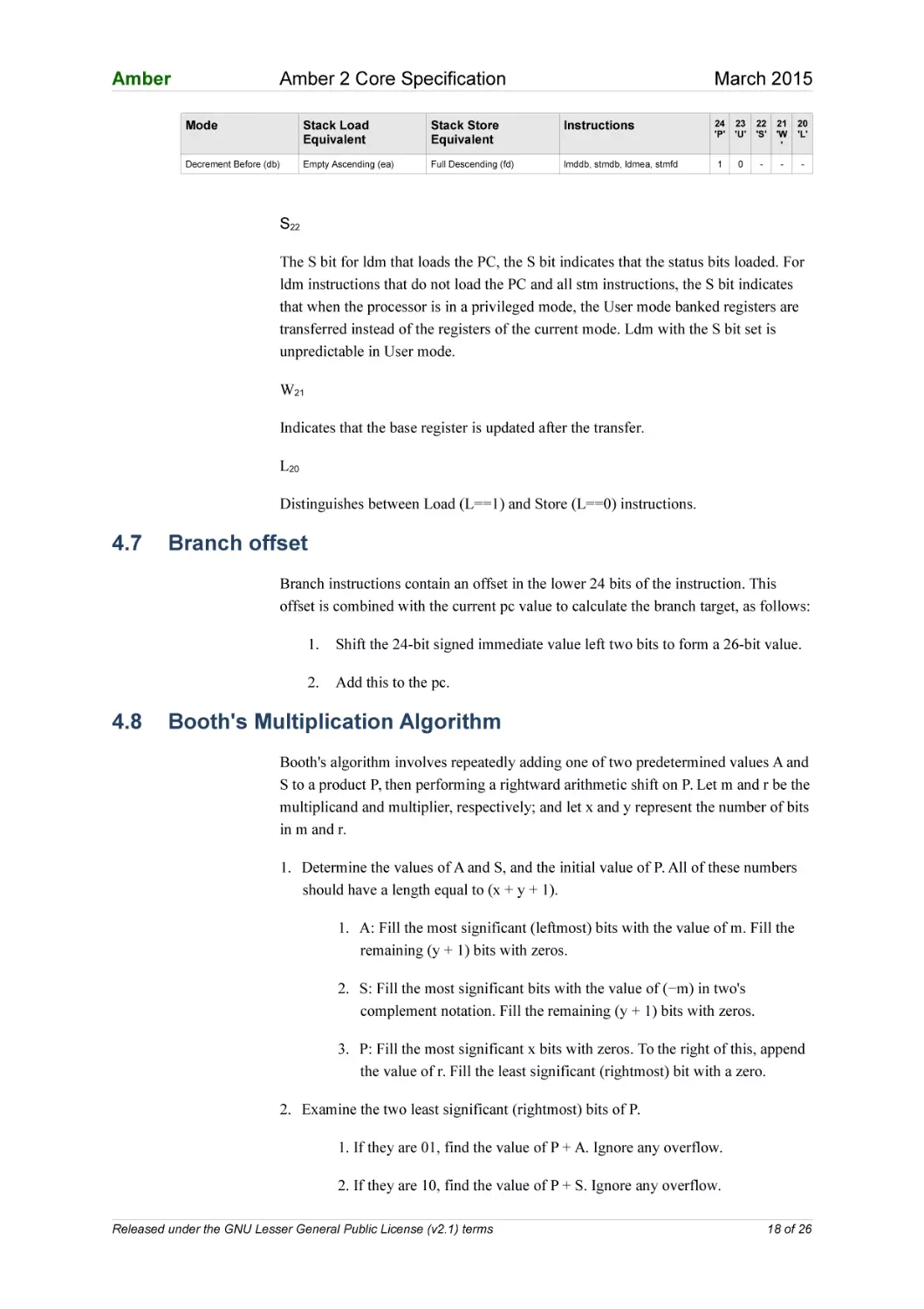
S22
The S bit for ldm that loads the PC, the S bit indicates that the status bits loaded. For
ldm instructions that do not load the PC and all stm instructions, the S bit indicates
that when the processor is in a privileged mode, the User mode banked registers are
transferred instead of the registers of the current mode. Ldm with the S bit set is
unpredictable in User mode.
W21
Indicates that the base register is updated after the transfer.
L20
Distinguishes between Load (L==1) and Store (L==0) instructions.

4.7

Branch offset
Branch instructions contain an offset in the lower 24 bits of the instruction. This
offset is combined with the current pc value to calculate the branch target, as follows:

4.8

1.

Shift the 24-bit signed immediate value left two bits to form a 26-bit value.

2.

Add this to the pc.

Booth's Multiplication Algorithm
Booth's algorithm involves repeatedly adding one of two predetermined values A and
S to a product P, then performing a rightward arithmetic shift on P. Let m and r be the
multiplicand and multiplier, respectively; and let x and y represent the number of bits
in m and r.
1. Determine the values of A and S, and the initial value of P. All of these numbers
should have a length equal to (x + y + 1).
1. A: Fill the most significant (leftmost) bits with the value of m. Fill the
remaining (y + 1) bits with zeros.
2. S: Fill the most significant bits with the value of (−m) in two's
complement notation. Fill the remaining (y + 1) bits with zeros.
3. P: Fill the most significant x bits with zeros. To the right of this, append
the value of r. Fill the least significant (rightmost) bit with a zero.
2. Examine the two least significant (rightmost) bits of P.
1. If they are 01, find the value of P + A. Ignore any overflow.
2. If they are 10, find the value of P + S. Ignore any overflow.

Released under the GNU Lesser General Public License (v2.1) terms

18 of 26

Amber

Amber 2 Core Specification

March 2015

3. If they are 00, do nothing. Use P directly in the next step.
4. If they are 11, do nothing. Use P directly in the next step.
3. Arithmetically shift the value obtained in the 2nd step by a single place to the
right. Let P now equal this new value.
4. Repeat steps 2 and 3 until they have been done y times.
5. Drop the least significant (rightmost) bit from P. This is the product of m and r.
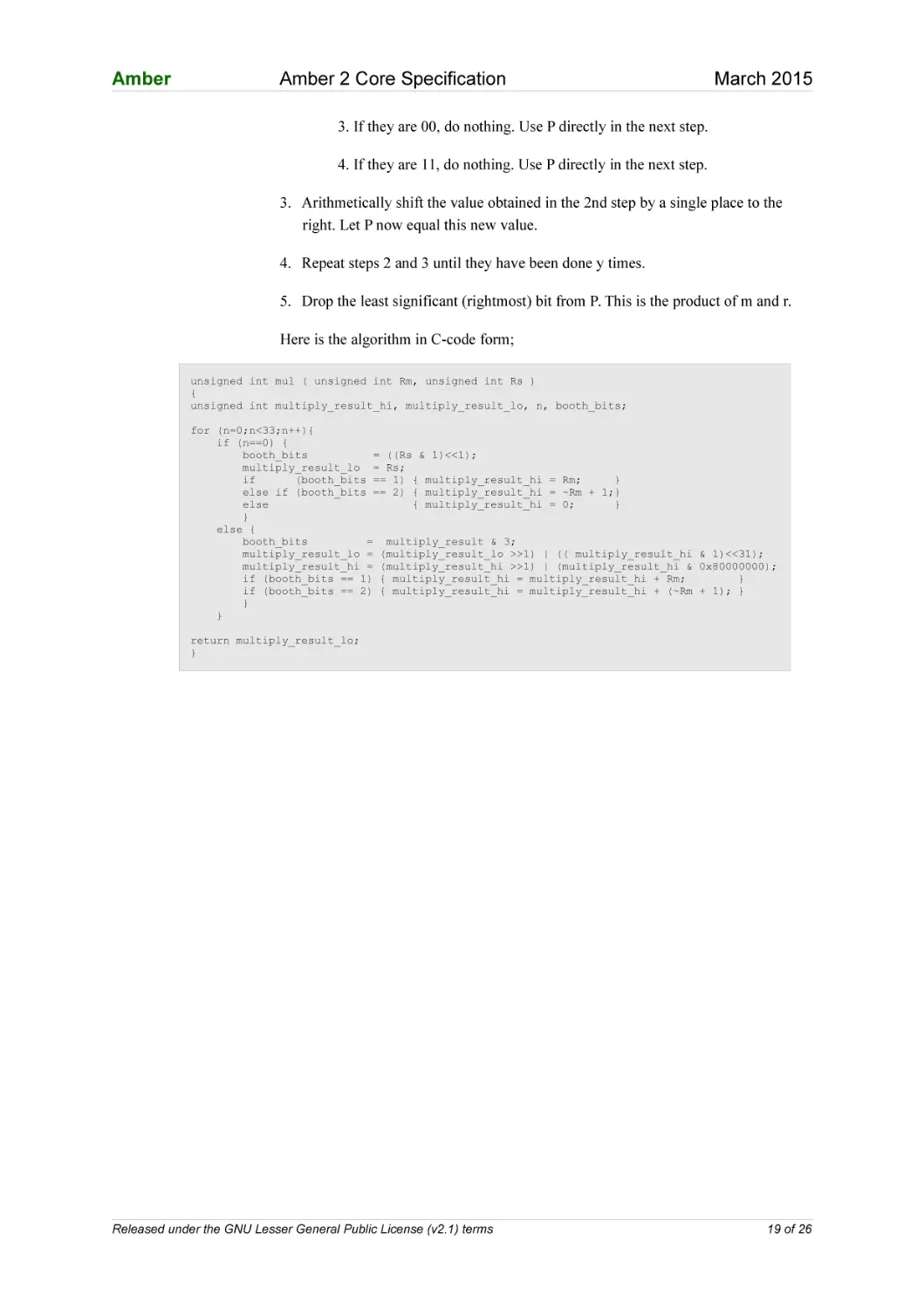
Here is the algorithm in C-code form;
unsigned int mul ( unsigned int Rm, unsigned int Rs )
{
unsigned int multiply_result_hi, multiply_result_lo, n, booth_bits;
for (n=0;n<33;n++){
if (n==0) {
booth_bits
= ((Rs & 1)<<1);
multiply_result_lo = Rs;
if
(booth_bits == 1) { multiply_result_hi = Rm;
}
else if (booth_bits == 2) { multiply_result_hi = ~Rm + 1;}
else
{ multiply_result_hi = 0;
}
}
else {
booth_bits
= multiply_result & 3;
multiply_result_lo = (multiply_result_lo >>1) | (( multiply_result_hi & 1)<<31);
multiply_result_hi = (multiply_result_hi >>1) | (multiply_result_hi & 0x80000000);
if (booth_bits == 1) { multiply_result_hi = multiply_result_hi + Rm;
}
if (booth_bits == 2) { multiply_result_hi = multiply_result_hi + (~Rm + 1); }
}
}
return multiply_result_lo;
}

Released under the GNU Lesser General Public License (v2.1) terms

19 of 26

Amber

5

Amber 2 Core Specification

March 2015

Interrupts

Table 13

Interrupt Types
Interrupt Type

Processor Mode

Address

Reset

Supervisor (svc)

0x00000000

Undefined Instructions

Supervisor (svc)

0x00000004

Software Interrupt (SWI)

Supervisor (svc)

0x00000008

Prefetch Abort (instruction
fetch memory abort)

Supervisor (svc)

0x0000000C

Data Abort (data access
memory abort)

Supervisor (svc)

0x00000010

Address exception

Supervisor (svc)

0x00000014

IRQ (interrupt)

IRQ (irq)

0x00000018

FIRQ (fast interrupt)

FIRQ (firq)

0x0000001C

-

User (usr)

-

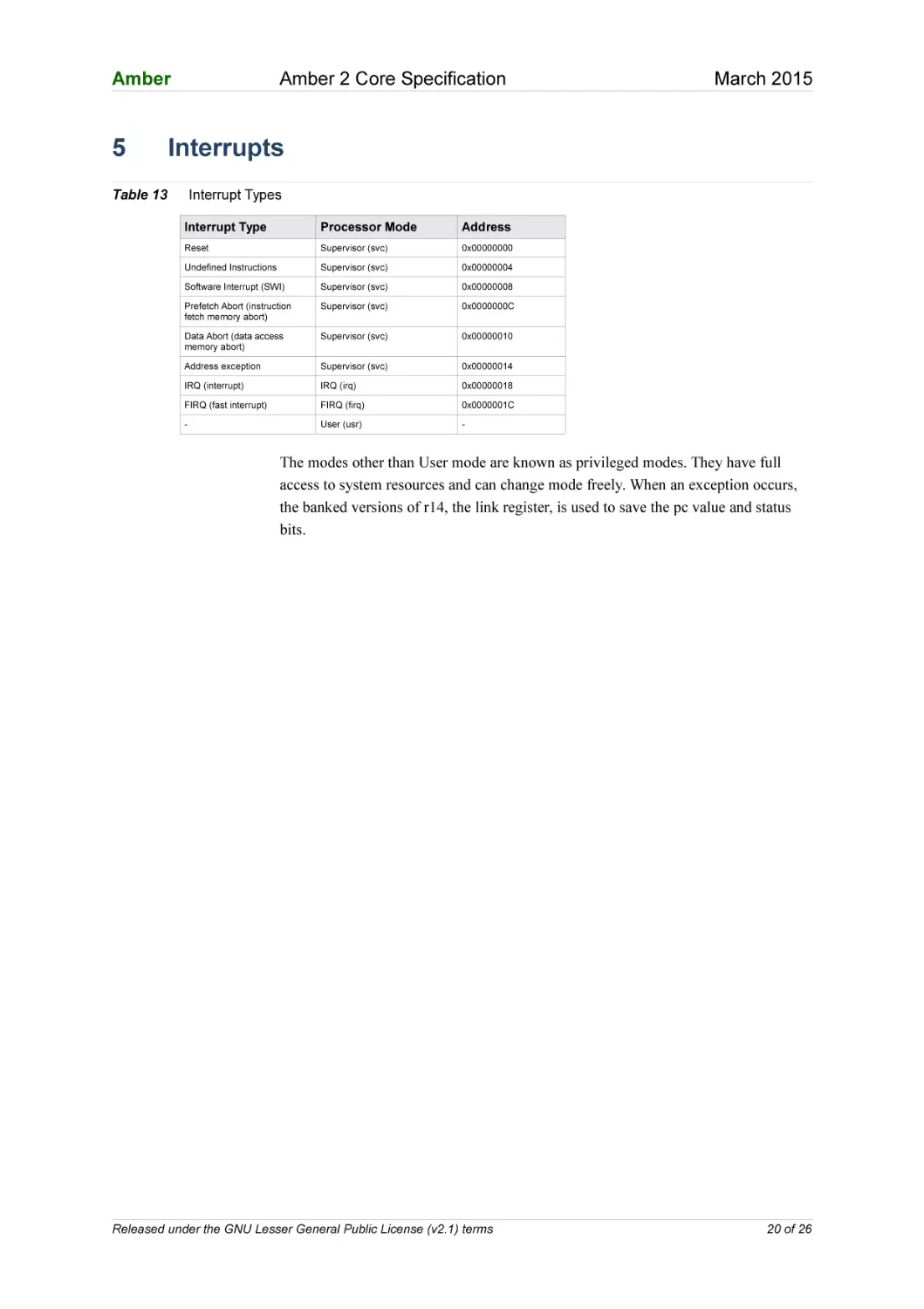
The modes other than User mode are known as privileged modes. They have full
access to system resources and can change mode freely. When an exception occurs,
the banked versions of r14, the link register, is used to save the pc value and status
bits.

Released under the GNU Lesser General Public License (v2.1) terms

20 of 26

Amber

6

Amber 2 Core Specification

March 2015

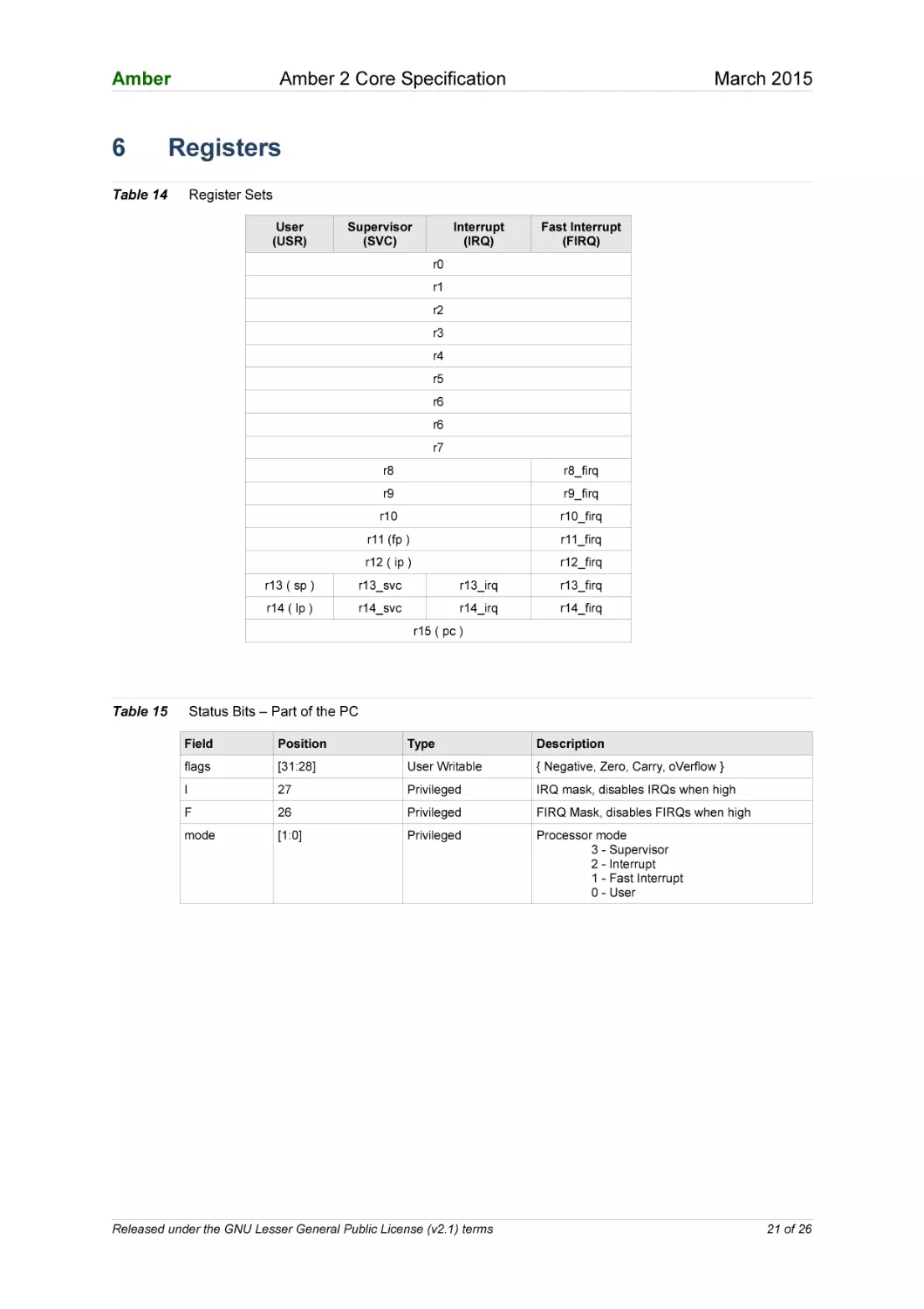
Registers

Table 14

Register Sets
User
(USR)

Supervisor
(SVC)

Interrupt
(IRQ)

Fast Interrupt
(FIRQ)

r0
r1
r2
r3
r4
r5
r6
r6
r7
r8

r8_firq

r9

r9_firq

r10

r10_firq

r11 (fp )

r11_firq

r12 ( ip )

r12_firq

r13 ( sp )

r13_svc

r13_irq

r13_firq

r14 ( lp )

r14_svc

r14_irq

r14_firq

r15 ( pc )

Table 15

Status Bits – Part of the PC
Field

Position

Type

Description

flags

[31:28]

User Writable

{ Negative, Zero, Carry, oVerflow }

I

27

Privileged

IRQ mask, disables IRQs when high

F

26

Privileged

FIRQ Mask, disables FIRQs when high

mode

[1:0]

Privileged

Processor mode
3 - Supervisor
2 - Interrupt
1 - Fast Interrupt
0 - User

Released under the GNU Lesser General Public License (v2.1) terms

21 of 26

Amber

7

Amber 2 Core Specification

March 2015

Cache
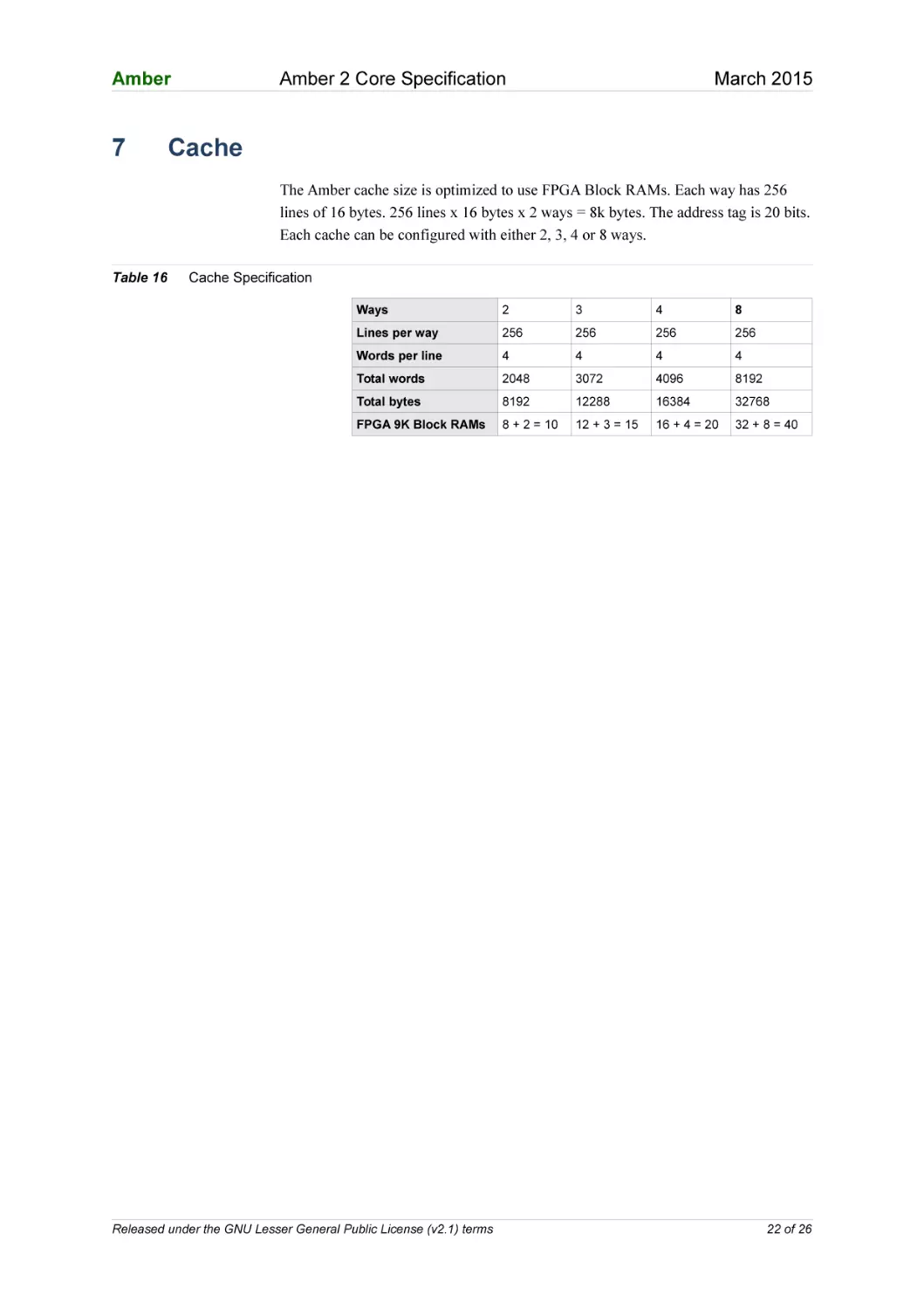
The Amber cache size is optimized to use FPGA Block RAMs. Each way has 256
lines of 16 bytes. 256 lines x 16 bytes x 2 ways = 8k bytes. The address tag is 20 bits.
Each cache can be configured with either 2, 3, 4 or 8 ways.

Table 16

Cache Specification
Ways

2

3

4

8

Lines per way

256

256

256

256

Words per line

4

4

4

4

Total words

2048

3072

4096

8192

Total bytes

8192

12288

16384

32768

FPGA 9K Block RAMs

8 + 2 = 10

12 + 3 = 15

16 + 4 = 20

32 + 8 = 40

Released under the GNU Lesser General Public License (v2.1) terms

22 of 26

Amber

8

Amber 2 Core Specification

March 2015

Amber Project
The Amber project is a complete processor system implemented on an FPGA
development board. The purpose of the project is to provide an evironment that gives
an example usage of the Amber 2 core, and supports a set of tests that verify the
correct functionality of the code. This is especially important if modificatiosn to the
core are made.

8.1

Amber Port List
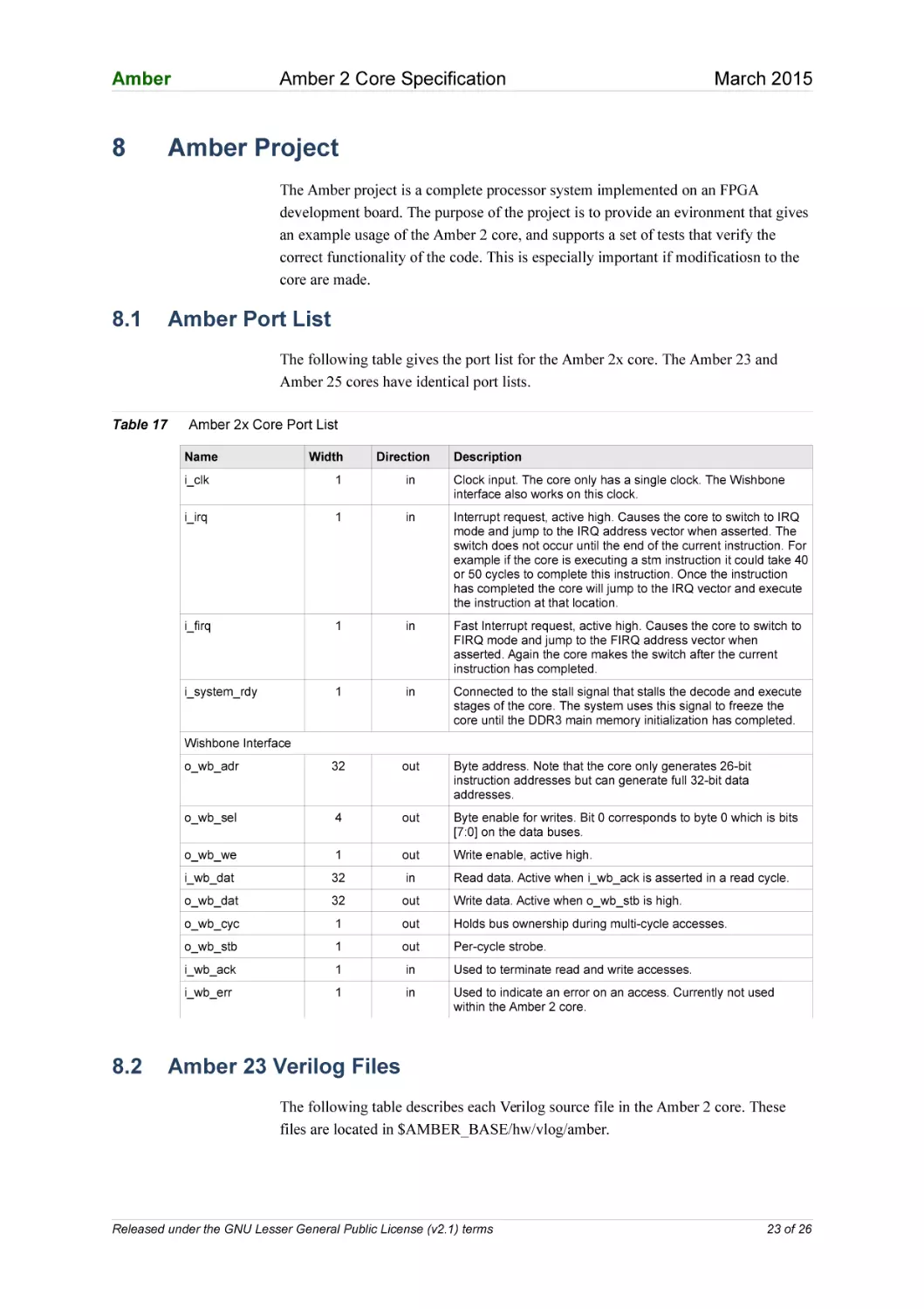
The following table gives the port list for the Amber 2x core. The Amber 23 and
Amber 25 cores have identical port lists.

Table 17

Amber 2x Core Port List
Name

Width

Direction

Description

i_clk

1

in

Clock input. The core only has a single clock. The Wishbone
interface also works on this clock.

i_irq

1

in

Interrupt request, active high. Causes the core to switch to IRQ
mode and jump to the IRQ address vector when asserted. The
switch does not occur until the end of the current instruction. For
example if the core is executing a stm instruction it could take 40
or 50 cycles to complete this instruction. Once the instruction
has completed the core will jump to the IRQ vector and execute
the instruction at that location.

i_firq

1

in

Fast Interrupt request, active high. Causes the core to switch to
FIRQ mode and jump to the FIRQ address vector when
asserted. Again the core makes the switch after the current
instruction has completed.

i_system_rdy

1

in

Connected to the stall signal that stalls the decode and execute
stages of the core. The system uses this signal to freeze the
core until the DDR3 main memory initialization has completed.

o_wb_adr

32

out

Byte address. Note that the core only generates 26-bit
instruction addresses but can generate full 32-bit data
addresses.

o_wb_sel

4

out

Byte enable for writes. Bit 0 corresponds to byte 0 which is bits
[7:0] on the data buses.

o_wb_we

1

out

Write enable, active high.

i_wb_dat

32

in

o_wb_dat

32

out

Write data. Active when o_wb_stb is high.

o_wb_cyc

1

out

Holds bus ownership during multi-cycle accesses.

o_wb_stb

1

out

Per-cycle strobe.

i_wb_ack

1

in

Used to terminate read and write accesses.

i_wb_err

1

in

Used to indicate an error on an access. Currently not used
within the Amber 2 core.

Wishbone Interface

8.2

Read data. Active when i_wb_ack is asserted in a read cycle.

Amber 23 Verilog Files
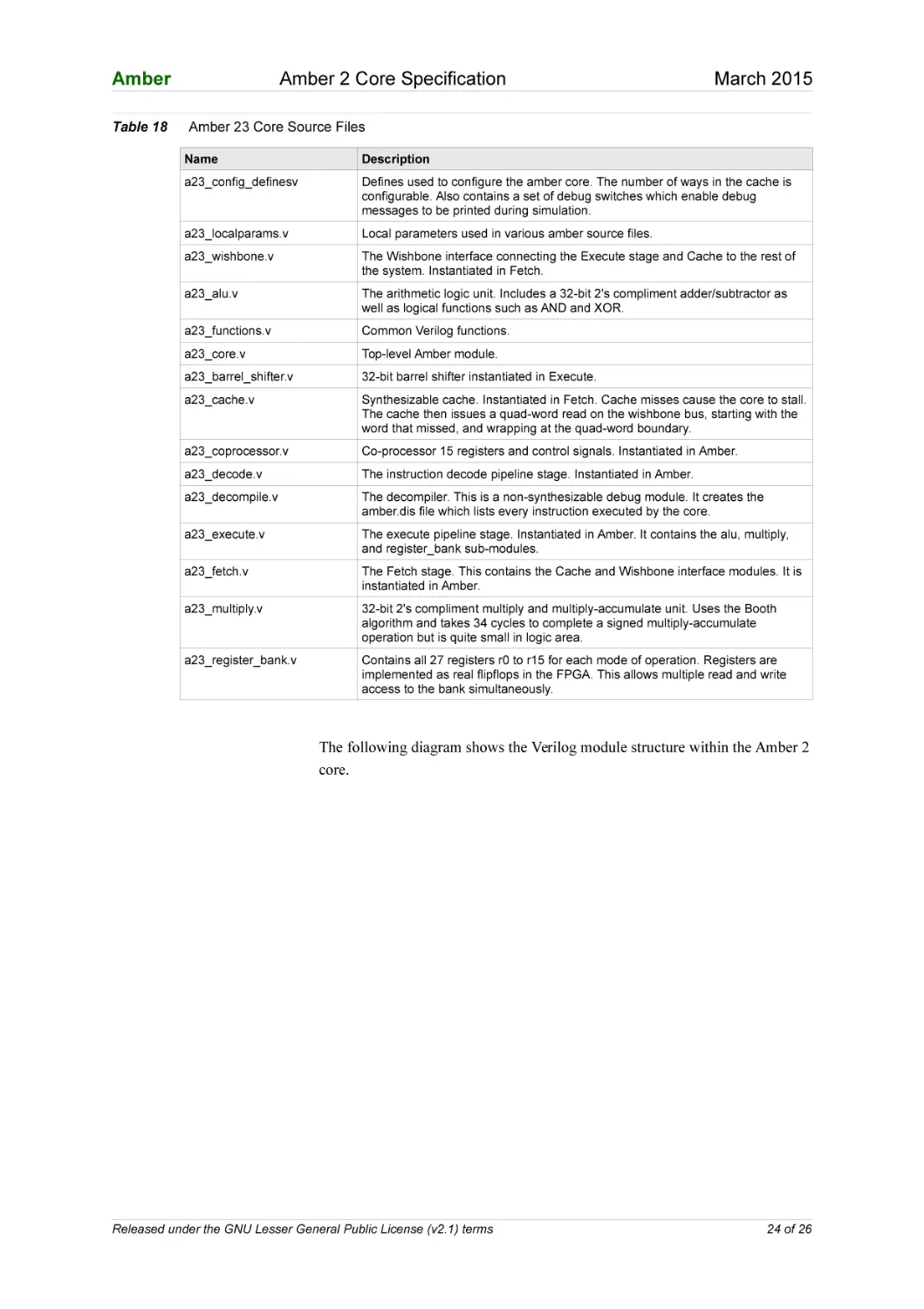
The following table describes each Verilog source file in the Amber 2 core. These
files are located in $AMBER_BASE/hw/vlog/amber.

Released under the GNU Lesser General Public License (v2.1) terms

23 of 26

Amber
Table 18

Amber 2 Core Specification

March 2015

Amber 23 Core Source Files
Name

Description

a23_config_definesv

Defines used to configure the amber core. The number of ways in the cache is
configurable. Also contains a set of debug switches which enable debug
messages to be printed during simulation.

a23_localparams.v

Local parameters used in various amber source files.

a23_wishbone.v

The Wishbone interface connecting the Execute stage and Cache to the rest of
the system. Instantiated in Fetch.

a23_alu.v

The arithmetic logic unit. Includes a 32-bit 2's compliment adder/subtractor as
well as logical functions such as AND and XOR.

a23_functions.v

Common Verilog functions.

a23_core.v

Top-level Amber module.

a23_barrel_shifter.v

32-bit barrel shifter instantiated in Execute.

a23_cache.v

Synthesizable cache. Instantiated in Fetch. Cache misses cause the core to stall.
The cache then issues a quad-word read on the wishbone bus, starting with the
word that missed, and wrapping at the quad-word boundary.

a23_coprocessor.v

Co-processor 15 registers and control signals. Instantiated in Amber.

a23_decode.v

The instruction decode pipeline stage. Instantiated in Amber.

a23_decompile.v

The decompiler. This is a non-synthesizable debug module. It creates the
amber.dis file which lists every instruction executed by the core.

a23_execute.v

The execute pipeline stage. Instantiated in Amber. It contains the alu, multiply,
and register_bank sub-modules.

a23_fetch.v

The Fetch stage. This contains the Cache and Wishbone interface modules. It is
instantiated in Amber.

a23_multiply.v

32-bit 2's compliment multiply and multiply-accumulate unit. Uses the Booth
algorithm and takes 34 cycles to complete a signed multiply-accumulate
operation but is quite small in logic area.

a23_register_bank.v

Contains all 27 registers r0 to r15 for each mode of operation. Registers are
implemented as real flipflops in the FPGA. This allows multiple read and write
access to the bank simultaneously.

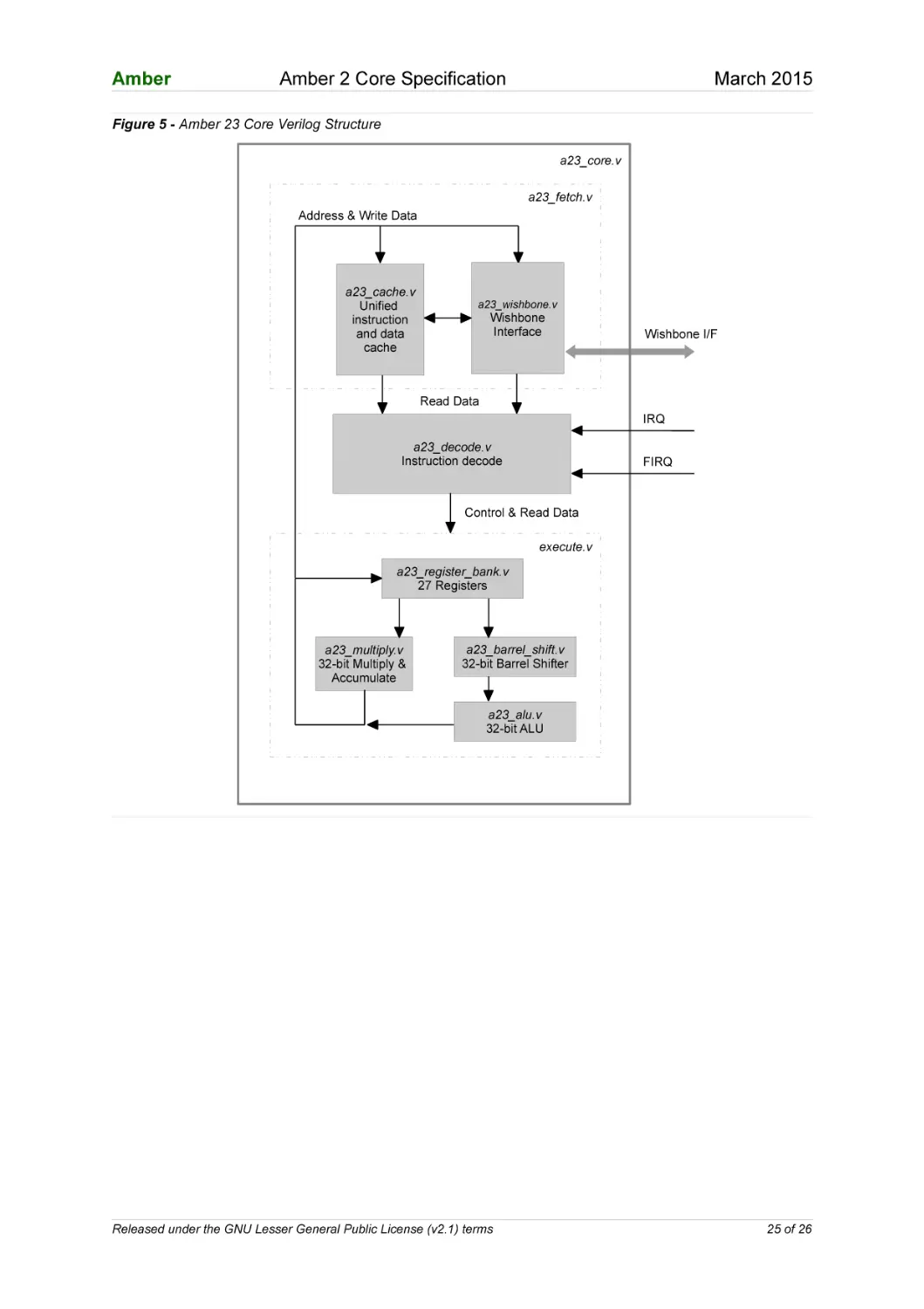
The following diagram shows the Verilog module structure within the Amber 2
core.

Released under the GNU Lesser General Public License (v2.1) terms

24 of 26

Amber

Amber 2 Core Specification

March 2015

Figure 5 - Amber 23 Core Verilog Structure
a23_core.v
a23_fetch.v
Address & Write Data

a23_cache.v
Unified
instruction
and data
cache

a23_wishbone.v

Wishbone
Interface

Wishbone I/F

Read Data
IRQ
a23_decode.v
Instruction decode

FIRQ

Control & Read Data
execute.v
a23_register_bank.v
27 Registers

a23_multiply.v
32-bit Multiply &
Accumulate

a23_barrel_shift.v
32-bit Barrel Shifter

a23_alu.v
32-bit ALU

Released under the GNU Lesser General Public License (v2.1) terms

25 of 26

Amber

9

Amber 2 Core Specification

March 2015

License
All source code provided in the Amber package is release under the following license
terms;
Copyright (C) 2010 Authors and OPENCORES.ORG
This source file may be used and distributed without
restriction provided that this copyright statement is not
removed from the file and that any derivative work contains
the original copyright notice and the associated disclaimer.
This source file is free software; you can redistribute it
and/or modify it under the terms of the GNU Lesser General
Public License as published by the Free Software Foundation;
either version 2.1 of the License, or (at your option) any
later version.
This source is distributed in the hope that it will be
useful, but WITHOUT ANY WARRANTY; without even the implied
warranty of MERCHANTABILITY or FITNESS FOR A PARTICULAR
PURPOSE. See the GNU Lesser General Public License for more
details.
You should have received a copy of the GNU Lesser General
Public License along with this source; if not, download it
from http://www.opencores.org/lgpl.shtml
Author(s):
- Conor Santifort, csantifort.amber@gmail.com

Released under the GNU Lesser General Public License (v2.1) terms

26 of 26