/




















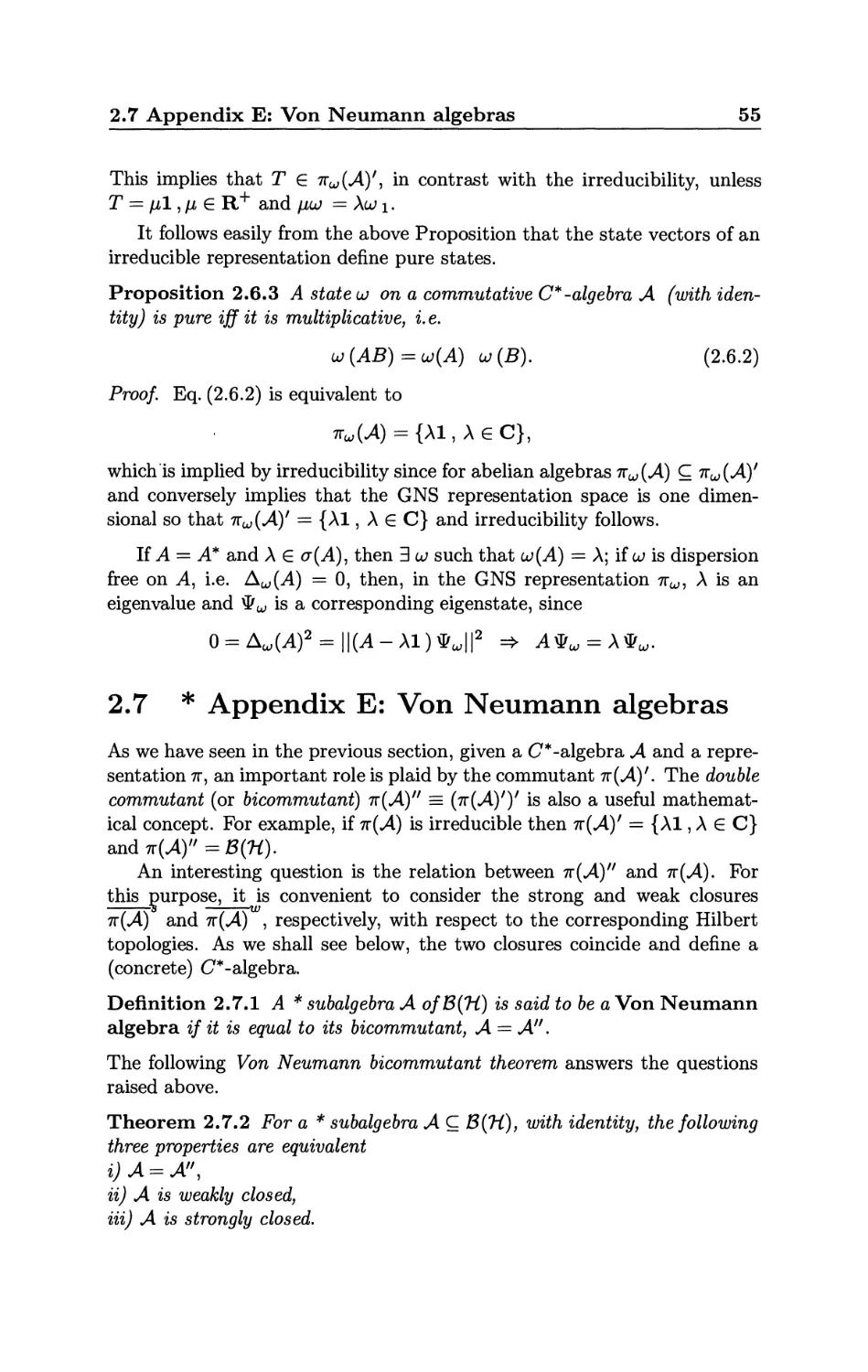
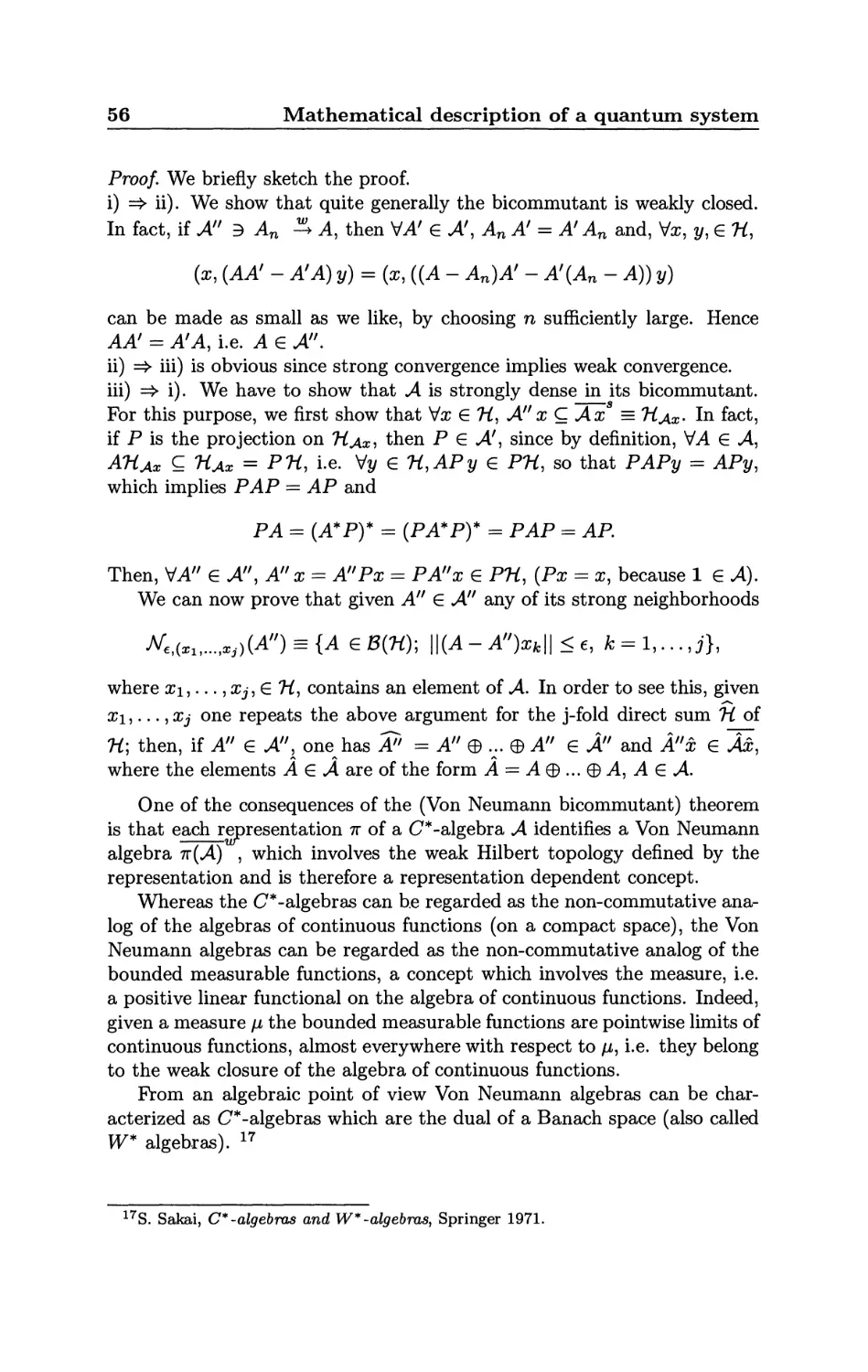
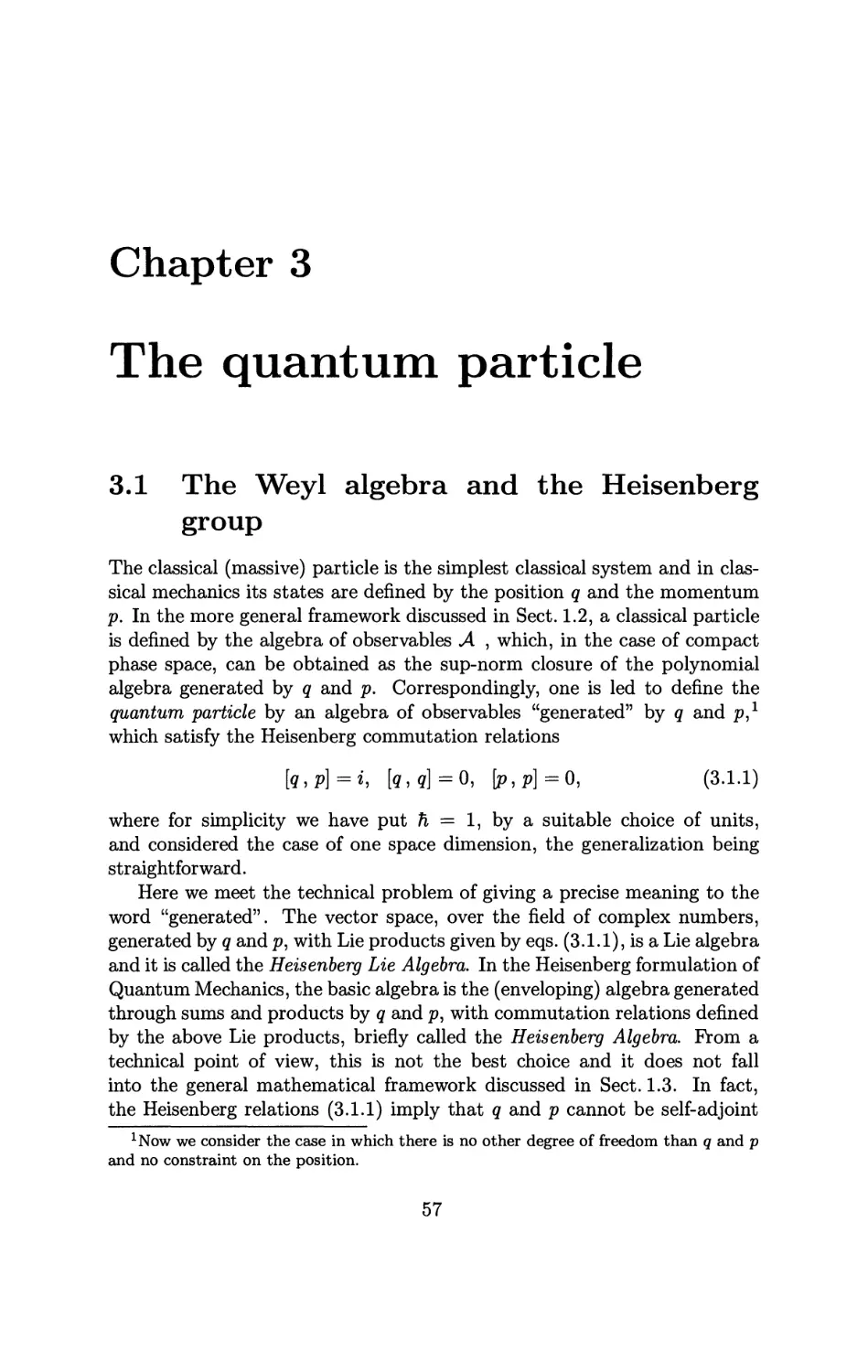
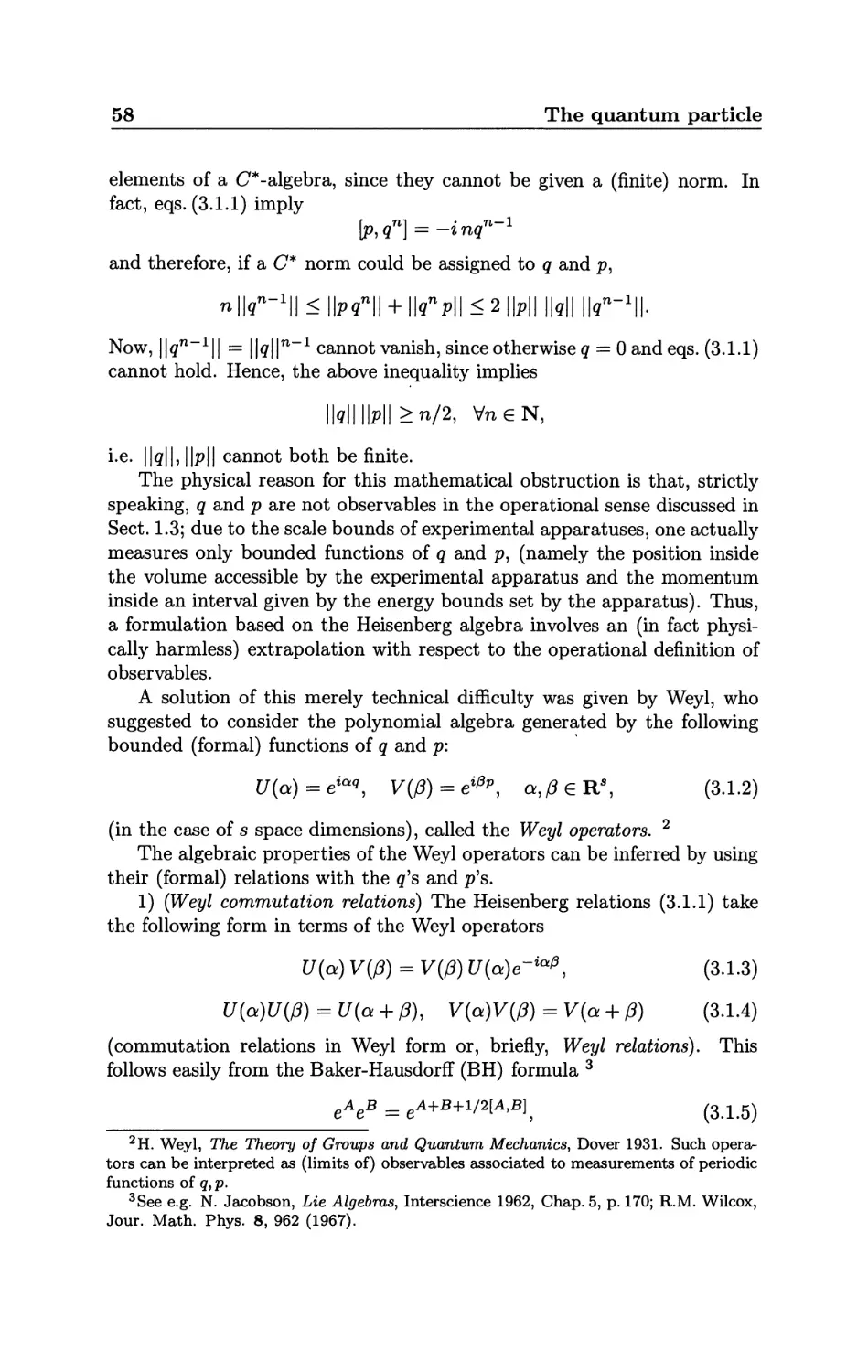






















Text
                    An Introduction to the
Mathematical Structure
of
Quantum Mechanics
A Short Course for Mathematicians
Lecture Notes by F. Strocchi
Advanced Series in Mathematical Physics-Vol. 27

Advanced Series in Mathematical Physics^ Vol. 27
An Introduction to the
Mathematical Structure
of
Quantum Mechanics
A Short Course for Mathematicians
Lecture Notes by F. Strocchi
Scuola Normale Superiore, Italy
YJ? World Scientific
RSEY • LONDON • SINGAPORE • BEIJING • SHANGHAI • HONG KONG • TAIPEI • CHENNA

Published by
World Scientific Publishing Co. Pte. Ltd.
5 Toh Tuck Link, Singapore 596224
USA office: 27 Warren Street, Suite 401-402, Hackensack, NJ 07601
UK office: 57 Shelton Street, Covent Garden, London WC2H 9HE
Library of Congress Cataloging-in-Publication Data
Strocchi, F.
An introduction to the mathematical structure of quantum mechanics :
a short course for mathematicians / F. Strocchi.
p. cm. ~ (Advanced series in mathematical physics ; v. 27)
Includes index.
ISBN 981-256-431-4 (alk. paper)
1. Quantum theory~Mathematics. 2. Mathematical physics. I. Title. II. Series.
QC174.17.M35S77 2005
530.12-dc22
2005042407
British Library Cataloguing-in-Publication Data
A catalogue record for this book is available from the British Library.
Copyright © 2005 by World Scientific Publishing Co. Pte. Ltd.
All rights reserved. This book, or parts thereof, may not be reproduced in any form or by any means,
electronic or mechanical, including photocopying, recording or any information storage and retrieval
system now known or to be invented, without written permission from the Publisher.
For photocopying of material in this volume, please pay a copying fee through the Copyright
Clearance Center, Inc., 222 Rosewood Drive, Dan vers, MA 01923, USA. In this case permission to
photocopy is not required from the publisher.
Printed in Singapore by World Scientific Printers (S) Pte Ltd

Preface
These notes were written for a short series of lectures at the Scuola Normale
Superiore, Pisa, in the academic years 1993-94,1994-95,1995-96, in order to
fulfill a request by the mathematicians to have a short (half-semester) course
for mathematical students willing to learn the main ideas and mathematical
structure of Quantum Mechanics.
Since the books on Quantum Mechanics are hundreds and some of them
very good, also for a mathematically minded student, one could reasonably
question the need of having another one. The main point is that, contrary
to Classical Mechanics, Quantum Mechanics is not part of the common
education of mathematical students, even if this theory is at the roots of
important developments of modern mathematics, as briefly discussed in
the Introduction. Perhaps one of the reasons is that most of the books
on Quantum Mechanics start from emphasizing and discussing the many
experimental facts, which led to the crisis of Classical Mechanics, whose
appreciation require a non-superficial familiarity with classical physics, with
the result that the tight logical and mathematical structure of Quantum
Mechanics is usually relegated to a secondary level. In particular, the usual
presentation, which assumes that states are described by vectors of a Hilbert
space (and observables by Hilbert space operators) on the basis of the so-
called superposition principle, may not be appealing to a mathematical
student. On the other hand, the books on the mathematical foundations
of Quantum Mechanics, above all the beautiful books by J. Von Neumann,
G. Mackey, J.M. Jauch, C. Piron, do not seem to have the introductory
character suitable for undergraduate students.
Moreover, the C*-algebraic formulation of Quantum Mechanics, which
has unquestionable advantages for logic and conceptual economy, especially
for a mathematically oriented audience, and has played a crucial role for
the recent non-commutative extensions of Calculus, Geometry, Probability
etc, has not yet become standard in quantum mechanics textbooks.
The aim of these notes is to introduce the mathematical student to the
basic mathematical structure and foundations of Quantum Mechanics, by
emphasizing as a starting point the C*-algebraic structure of the algebra
of observables, which defines a physical system.
v

vi
Preface
An effort is made in motivating and possibly simplifying Segal's
postulates for Quantum Mechanics; the C*-algebraic structure of the algebra
generated by the observables is argued to follow essentially from simple
basic physical ideas, by exploiting the operational definition of measurements
and the duality between states and observables.
Once the C*-algebraic structure of the observables is accepted, the
mathematical structure of Quantum Mechanics, namely the description of
the physical states by Hilbert space vectors and the representation of the
observables by Hilbert space operators, then follows from the GNS and
Gelfand-Naimark theorems; Schroedinger Quantum Mechanics is then the
direct consequence of the Heisenberg commutation relations and the Von
Neumann uniqueness theorem.
No pretension of completeness is made about the subject; the scope is
that of an introductory short course on the basic knowledge of Quantum
Mechanics which should hopefully become part of the common education
also of mathematicians. A few basic examples of quantum systems, in
primis the hydrogen atom, are worked out with attention to the
mathematical setting and logic.
An effort is made in simplifying the technical points and the proofs,
especially in the short account of C*-algebra theory, and in reducing the
background knowledge needed to the minimum; the basic notions of
probability theory and of Hilbert space operators are required.
The chapters or paragraphs marked with an asterisk were not part of
the short course and were discussed in additional lectures; they are
included here for completeness and may be skipped in a first reading. The
increasing interest on the functional integral approach to quantum
mechanics and more generally the deep connection between quantum mechanics
and stochastic processes has motivated the brief account given in Chapter
6, with emphasis on the main ideas and the basic mathematical structures.
The effectiveness of the functional integral approach for both the
solution of quantum mechanical problems and the analysis of general properties
is briefly discussed in Chapter 6; in particular its relevance for Feynman
perturbative expansion, the classical limit, the interplay between
quantization and topology, the discussion of coupling constant analyticity are
worked out in some simple, but illuminating cases.
Since the C*-algebraic approach has proved inevitable for the
mathematical description of quantum systems with infinite degrees of freedom,
and useful for the discussion of deep theoretical physics problems, like
spontaneous symmetry breaking, phase transitions, quantum statistical
mechanics, quantum field theory etc, the lectures might turn out to be useful
also for theoretical physics students, who might also profit from a look to
the functional integral approach beyond the heuristic presentations usually
adopted in theoretical physics books, especially in view of its use for a
non-perturbative approach to quantum field theory and many body theory.

Preface
vii
I am grateful to the Accademia dei Lincei and the University of Rome
11 La Sapienza" for inviting me to give a series of lectures and for the
opportunity of confronting this presentation of Quantum Mechanics with a very
selected audience. The preparation of these lectures notes has benefited
from enlightening discussions and collaboration with G. Morchio, to whom
I am greatly indebted. I thank also the students of my courses for pointing
out misprints or unclear points in the preliminary draft of the notes.

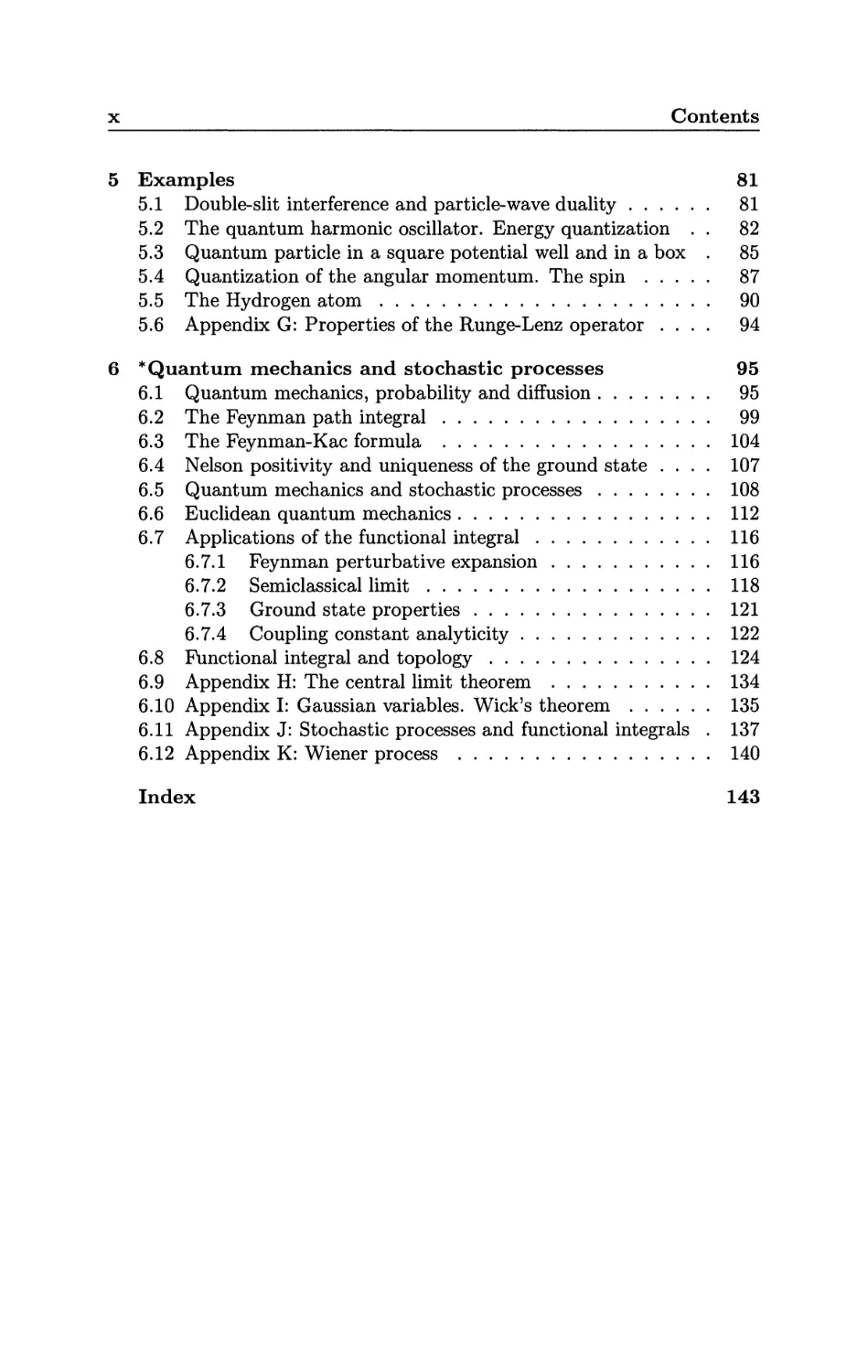
Contents
0 Introduction 1
1 Mathematical description of a physical system 7
1.1 Atomic physics and the crisis of classical mechanics 7
1.2 Mathematical description of classical Hamiltonian systems . 10
1.3 General mathematical description of a physical system ... 16
1.4 Appendix A : C*-algebras 24
1.5 Appendix B: Abelian C*-algebras 26
1.6 Appendix C: Spectra and states 30
2 Mathematical description of a quantum system 37
2.1 Heisenberg uncertainty relations and non-abelianess .... 37
2.2 States and representations. GNS construction 40
2.3 Gelfand-Naimark theorem: observables as operators .... 44
2.4 The probabilistic interpretation. * Quantum probability . . 46
2.5 *Quantum logic 52
2.6 Appendix D: States and representations 54
2.7 * Appendix E: Von Neumann algebras 55
3 The quantum particle 57
3.1 The Weyl algebra and the Heisenberg group 57
3.2 Von Neumann uniqueness theorem 60
3.3 The Schroedinger representation and wave function 63
3.4 Gaussian states. Minimal Heisenberg uncertainty 65
4 Quantum dynamics. The Schroedinger equation 67
4.1 Quantum dynamics. The quantum Hamiltonian 67
4.2 The dynamics of a free quantum particle 70
4.3 Quantum particle in a potential 71
4.4 Appendix F: Hamiltonian self-adjointness and dynamics . . 74
IX

X
Contents
5 Examples 81
5 A Double-slit interference and particle-wave duality 81
5.2 The quantum harmonic oscillator. Energy quantization . . 82
5.3 Quantum particle in a square potential well and in a box . 85
5.4 Quantization of the angular momentum. The spin 87
5.5 The Hydrogen atom 90
5.6 Appendix G: Properties of the Runge-Lenz operator .... 94
6 * Quantum mechanics and stochastic processes 95
6.1 Quantum mechanics, probability and diffusion 95
6.2 The Feynman path integral 99
6.3 The Feynman-Kac formula 104
6.4 Nelson positivity and uniqueness of the ground state .... 107
6.5 Quantum mechanics and stochastic processes 108
6.6 Euclidean quantum mechanics 112
6.7 Applications of the functional integral 116
6.7.1 Feynman perturbative expansion 116
6.7.2 Semiclassical limit 118
6.7.3 Ground state properties 121
6.7.4 Coupling constant analyticity 122
6.8 Functional integral and topology 124
6.9 Appendix H: The central limit theorem 134
6.10 Appendix I: Gaussian variables. Wick's theorem 135
6.11 Appendix J: Stochastic processes and functional integrals . 137
6.12 Appendix K: Wiener process 140
Index
143

An Introduction to the
Mathematical Structure
of
Quantum Mechanics
A Short Course for Mathematicians

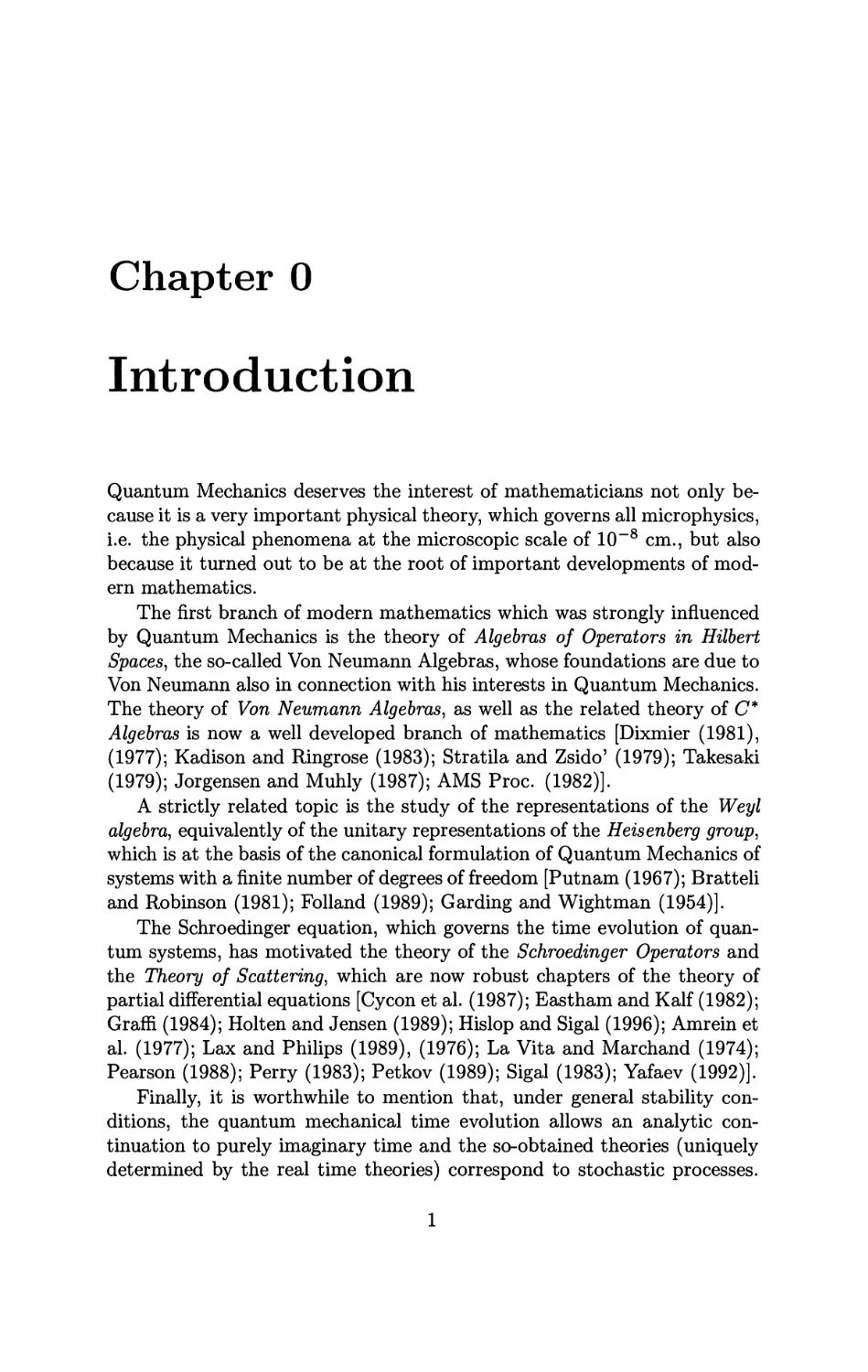
Chapter 0
Introduction
Quantum Mechanics deserves the interest of mathematicians not only
because it is a very important physical theory, which governs all microphysics,
i.e. the physical phenomena at the microscopic scale of 10~8 cm., but also
because it turned out to be at the root of important developments of
modern mathematics.
The first branch of modern mathematics which was strongly influenced
by Quantum Mechanics is the theory of Algebras of Operators in Hilbert
Spaces, the so-called Von Neumann Algebras, whose foundations are due to
Von Neumann also in connection with his interests in Quantum Mechanics.
The theory of Von Neumann Algebras, as well as the related theory of C*
Algebras is now a well developed branch of mathematics [Dixmier (1981),
(1977); Kadison and Ringrose (1983); Stratila and Zsido' (1979); Takesaki
(1979); Jorgensen and Muhly (1987); AMS Proc (1982)].
A strictly related topic is the study of the representations of the Weyl
algebra, equivalently of the unitary representations of the Heisenberg group,
which is at the basis of the canonical formulation of Quantum Mechanics of
systems with a finite number of degrees of freedom [Putnam (1967); Bratteli
and Robinson (1981); Folland (1989); Garding and Wightman (1954)].
The Schroedinger equation, which governs the time evolution of
quantum systems, has motivated the theory of the Schroedinger Operators and
the Theory of Scattering, which are now robust chapters of the theory of
partial differential equations [Cycon et al. (1987); Eastham and Kalf (1982);
Graffi (1984); Holten and Jensen (1989); Hislop and Sigal (1996); Amrein et
al. (1977); Lax and Philips (1989), (1976); La Vita and Marchand (1974);
Pearson (1988); Perry (1983); Petkov (1989); Sigal (1983); Yafaev (1992)].
Finally, it is worthwhile to mention that, under general stability
conditions, the quantum mechanical time evolution allows an analytic
continuation to purely imaginary time and the so-obtained theories (uniquely
determined by the real time theories) correspond to stochastic processes.
1

2
Introduction
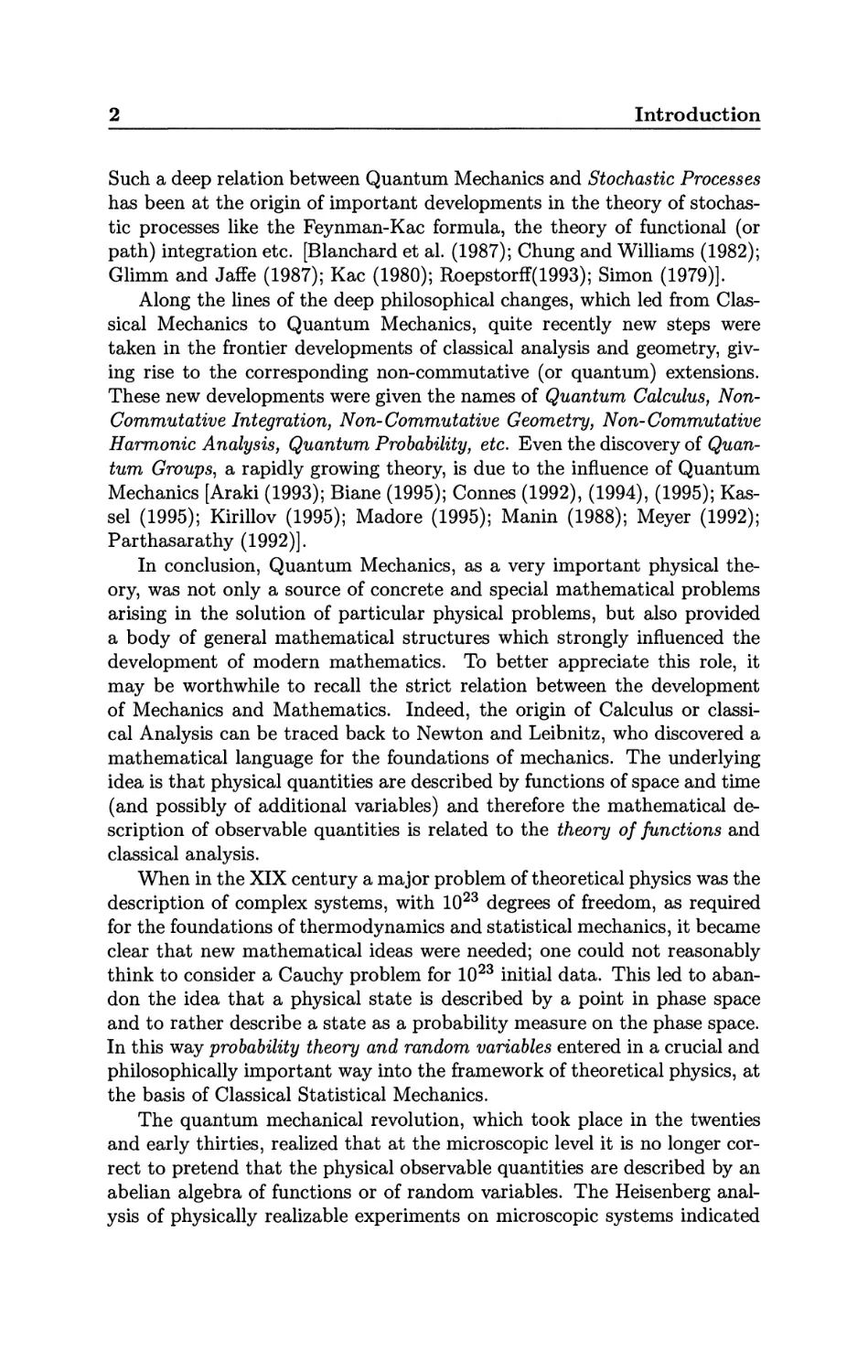
Such a deep relation between Quantum Mechanics and Stochastic Processes
has been at the origin of important developments in the theory of
stochastic processes like the Feynman-Kac formula, the theory of functional (or
path) integration etc [Blanchard et al. (1987); Chung and Williams (1982);
Glimm and Jaffe (1987); Kac (1980); Roepstorff(1993); Simon (1979)].
Along the lines of the deep philosophical changes, which led from
Classical Mechanics to Quantum Mechanics, quite recently new steps were
taken in the frontier developments of classical analysis and geometry,
giving rise to the corresponding non-commutative (or quantum) extensions.
These new developments were given the names of Quantum Calculus, Non-
Commutative Integration, Non-Commutative Geometry, Non-Commutative
Harmonic Analysis, Quantum Probability, etc. Even the discovery of
Quantum Groups, a rapidly growing theory, is due to the influence of Quantum
Mechanics [Araki (1993); Biane (1995); Connes (1992), (1994), (1995); Kas-
sel (1995); Kirillov (1995); Madore (1995); Manin (1988); Meyer (1992);
Parthasarathy (1992)].
In conclusion, Quantum Mechanics, as a very important physical
theory, was not only a source of concrete and special mathematical problems
arising in the solution of particular physical problems, but also provided
a body of general mathematical structures which strongly influenced the
development of modern mathematics. To better appreciate this role, it
may be worthwhile to recall the strict relation between the development
of Mechanics and Mathematics. Indeed, the origin of Calculus or
classical Analysis can be traced back to Newton and Leibnitz, who discovered a
mathematical language for the foundations of mechanics. The underlying
idea is that physical quantities are described by functions of space and time
(and possibly of additional variables) and therefore the mathematical
description of observable quantities is related to the theory of functions and
classical analysis.
When in the XIX century a major problem of theoretical physics was the
description of complex systems, with 1023 degrees of freedom, as required
for the foundations of thermodynamics and statistical mechanics, it became
clear that new mathematical ideas were needed; one could not reasonably
think to consider a Cauchy problem for 1023 initial data. This led to
abandon the idea that a physical state is described by a point in phase space
and to rather describe a state as a probability measure on the phase space.
In this way probability theory and random variables entered in a crucial and
philosophically important way into the framework of theoretical physics, at
the basis of Classical Statistical Mechanics.
The quantum mechanical revolution, which took place in the twenties
and early thirties, realized that at the microscopic level it is no longer
correct to pretend that the physical observable quantities are described by an
abelian algebra of functions or of random variables. The Heisenberg
analysis of physically realizable experiments on microscopic systems indicated

Introduction
3
that the measurement of an observable in general limits the precision by
which another observable can be subsequently measured. The
mathematical abstraction of this deep physical fact is the realization that the algebra of
observables is not described by an algebra of functions, but rather by an
algebra of operators in a Hilbert space. As mentioned before, the passage from
the commutative structure of classical mechanics and/or of classical
statistical mechanics to the non-commutative structure of quantum mechanics
is the deep and crucial feature shared by the modern non-commutative
extension of calculus, probability, geometry etc
Last but not least, quantum mechanics had a dramatic impact on the
development of mathematical logic, giving rise to the so-called Quantum
Logic : whereas the lattice of propositions of classical logic has the
structure of a Boolean algebra (equivalently that of a lattice of commutative
projections), the lattice of quantum propositions is non-boolean and it
corresponds to a lattice of non-commutative projections [Birkhoff and Von
Neumann (1936); Beltrametti and Cassinelli (1981); Cohen (1989); Garden
(1984); Hooker (1975); Pitowski (1989); Redei (1998)].
The aim of these lectures is to provide at least the flavor of the
philosophical revolution induced by quantum mechanics concerning the
mathematical description of physical systems. The lectures are primarily addressed to
people interested in questions of principle and in the mathematical
foundations of physical theories, also in view of the fertile mutual influence
between theoretical physics and mathematics.
In order to make the ideas at the basis of quantum mechanics
understandable also to people with a mathematical education but with no great
familiarity with physics, we will reduce the detailed description of the many
experimental facts which led to the crisis of classical mechanics to the
minimum and will rather extract and emphasize the overall simple and profound
message for the mathematical description of quantum systems.
Once the Heisenberg revolutionary discovery has been accepted, namely
that there are intrinsic limitations to the precise measurements of physical
quantities (Heisenberg's uncertainty relations) leading to the non abelianity
of the algebra of observables, the whole mathematical structure of Quantum
Mechanics follows as a theorem (Gelfand-Naimark): the states of a physical
system are described by vectors of a Hilbert space and the observables by
Hilbert space operators. Also the Schroedinger formulation of Quantum
Mechanics in terms of wave functions follows from Von Neumann uniqueness
theorem on the regular (irreducible) representations of the Weyl algebra.
Those who will hopefully find the subject sufficiently interesting and
stimulating are warmly referred to standard textbooks to deepen the
mathematical and logical structure of quantum mechanics and to appreciate its
impact on the description of the physical world [Dirac (1958); Feynman et
al.(1963); Heisenberg (1930); Jauch (1968); Von Neumann (1955); Mackey
(1963); Piron (1976); Segal (1963)].

4
Introduction
GENERAL REFERENCES
J. Dixmier, Von Neumann Algebras, North-Holland 1981
J. Dixmier, C* Algebras, North-Holland 1977
R.V. Kadison and J.R. Ringrose, Fundamentals of the Theory of
Operator Algebras, Vol.I-IV, Academic Press 1983
S. Stratila and L. Zsido', Lectures on Von Neumann Algebras, Abacus
Press 1979
M. Takesaki, Theory of Operator Algebras, Vol.1, Springer 1979
P.E.T. Jorgensen and P.S. Muhly eds., Contemporary Mathematics Vol.
62, Operator Algebras and Mathematical Physics, Am. Math. Soc 1987
Proc Symposia in Pure Mathematics, Operator Algebras and
Applications, Vol.1,11, Am. Math. Soc 1982
O. Bratteli and D.W. Robinson, Operator Algebras and Quantum
Statistical Mechanics, Vol.1, Springer 1979; Vol.11, Springer 1981
G.B. Folland, Harmonic Analysis in Phase Space, Princeton Univ. Press
1989
L. Garding and A.S. Wightman, Proc. Natl. Acad. Sci. USA, 40, 617
(1954)
C.R. Putnam, Commutation Properties of Hilbert Space Operators and
Related Topics, Springer 1967
H.L. Cycon et al., Schroedinger Operators, Springer 1987
M.S.P. Eastham and H. Kalf, Schroedinger type operators with
continuum spectra, Pitman 1982
S. Graffi, Schroedinger Operators, CIME course 1984, Lect. Notes Math.
1159, Springer 1985
P.D. Hislop and I.M. Sigal, Introduction to Spectral Theory with
Applications to Schroedinger Operators, Springer 1996
M. Schechter, Operator Methods in Quantum Mechanivs, North-Holland
1981
W.O. Amrein et al., Scattering Theory in Quantum Mechanics. Physical
Principles and Mathematical Methods, W.A. Benjamin 1977
J.A. La Vita and J.P. Marchand eds., Scattering Theory in Mathematical
Physics, D. Reidel 1974
P.D. Lax and R.S. Phillips, Scattering Theory, Academic Press 1989
P.D. Lax and R.S. Phillips, Scattering Theory for Automorphic
Functions, Princeton Univ. Press (Ann. Math. Studies) 1976
D.B. Pearson, Quantum Scattering and Spectral Theory, Academic Press
1988

Introduction
5
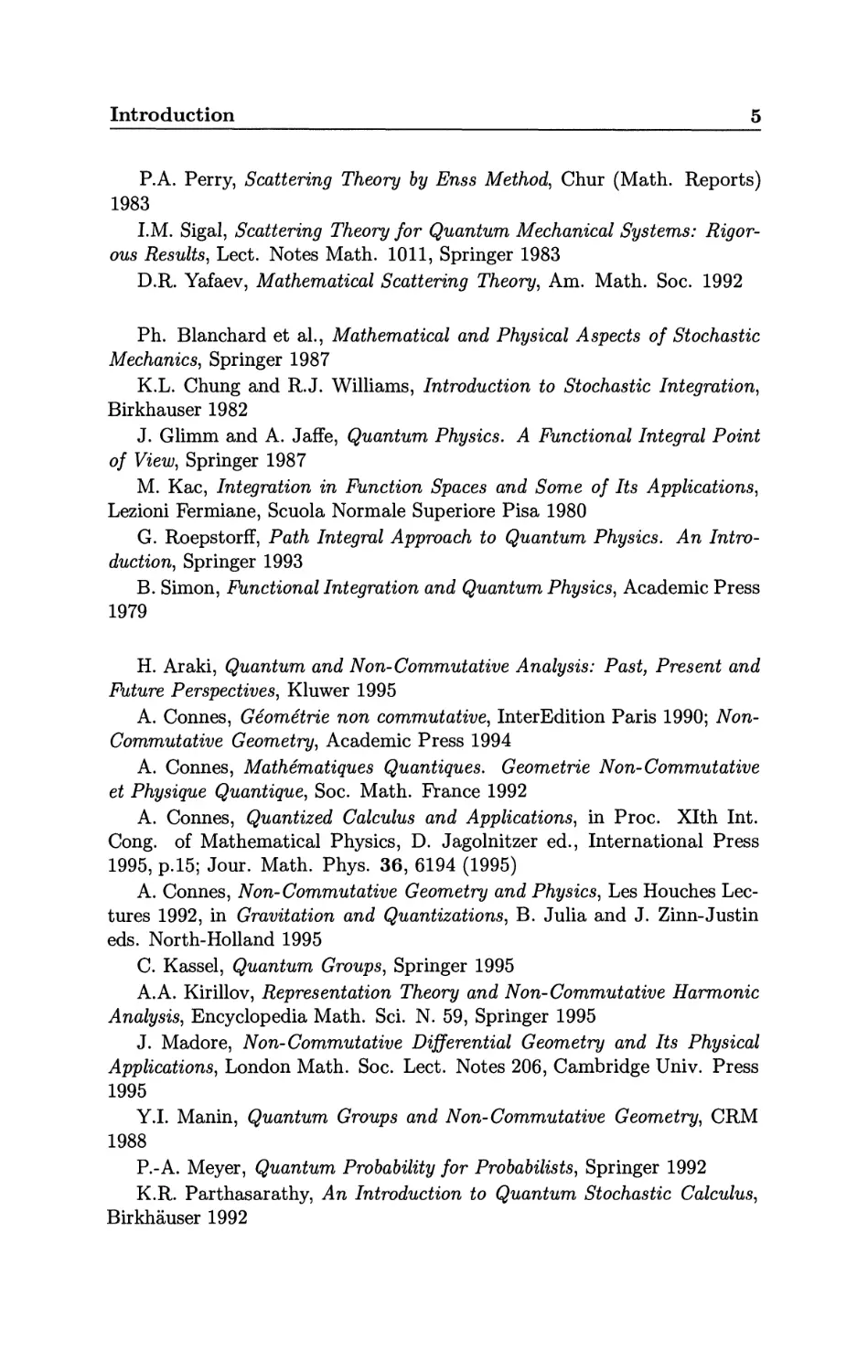
P.A. Perry, Scattering Theory by Enss Method, Chur (Math. Reports)
1983
I.M. Sigal, Scattering Theory for Quantum Mechanical Systems:
Rigorous Results, Lect. Notes Math. 1011, Springer 1983
D.R. Yafaev, Mathematical Scattering Theory, Am. Math. Soc 1992
Ph. Blanchard et al., Mathematical and Physical Aspects of Stochastic
Mechanics, Springer 1987
K.L. Chung and R.J. Williams, Introduction to Stochastic Integration,
Birkhauser 1982
J. Glimm and A. Jaffe, Quantum Physics. A Functional Integral Point
of View, Springer 1987
M. Kac, Integration in Function Spaces and Some of Its Applications,
Lezioni Fermiane, Scuola Normale Superiore Pisa 1980
G. Roepstorff, Path Integral Approach to Quantum Physics. An
Introduction, Springer 1993
B. Simon, Functional Integration and Quantum Physics, Academic Press
1979
H. Araki, Quantum and Non-Commutative Analysis: Past, Present and
Future Perspectives, Kluwer 1995
A. Connes, Geometric non commutative, InterEdition Paris 1990; Non-
Commutative Geometry, Academic Press 1994
A. Connes, Mathematiques Quantiques. Geometrie Non-Commutative
et Physique Quantique, Soc Math. France 1992
A. Connes, Quantized Calculus and Applications, in Proc Xlth Int.
Cong, of Mathematical Physics, D. Jagolnitzer ed., International Press
1995, p.15; Jour. Math. Phys. 36, 6194 (1995)
A. Connes, Non-Commutative Geometry and Physics, Les Houches
Lectures 1992, in Gravitation and Quantizations, B. Julia and J. Zinn-Justin
eds. North-Holland 1995
C. Kassel, Quantum Groups, Springer 1995
A.A. Kirillov, Representation Theory and Non-Commutative Harmonic
Analysis, Encyclopedia Math. Sci. N. 59, Springer 1995
J. Madore, Non-Commutative Differential Geometry and Its Physical
Applications, London Math. Soc Lect. Notes 206, Cambridge Univ. Press
1995
Y.I. Manin, Quantum Groups and Non-Commutative Geometry, CRM
1988
P.-A. Meyer, Quantum Probability for Probabilists, Springer 1992
K.R. Parthasarathy, An Introduction to Quantum Stochastic Calculus,
Birkhauser 1992

6
Introduction
P. Biane, in Lectures on Probability Theory, Lect. Notes Math. 1608,
Springer 1995
G. Birkhoff and J. von Neumann, Ann. Math. 37, 823 (1936)
E.G. Beltrametti and G. Cassinelli, The Logic of Quantum Mechanics,
Addison Wesley 1981
D.W. Cohen, An Introduction to Hilbert Space and Quantum Logic,
Springer 1989
R.W. Garden, Modern Logic and Quantum Mechanics, A. Hilger 1984
C.A. Hooker ed., The Logico-Algebraic Approach to Quantum
Mechanics, D. Reidel 1975
I. Pitowsky, Quantum Probability and Quantum Logic, Lect. Notes
Phys. 321, Springer 1989
M. Redei, Quantum Logic in Algebraic Approach, Kluwer 1998
P.A.M. Dirac, The Principles of Quantum Mechanics, Oxford Claredon
Press 1958
R.P. Feynman et al., The Feynman Lectures on Physics, Vol.Ill, Addison
Wesley 1963
W. Heisenberg, The Physical Principles of the Quantum Theory, Dover
1930
J.M. Jauch, Foundations of Quantum Mechanics, Addison Wesley 1968
J. Von Neumann, Mathematical Foundations of Quantum mechanics,
Princeton University Press 1955
G.W. Mackey, Mathematical Foundations of Quantum Mechanics, W.A.
Benjamin 1963
C. Piron, Foundations of Quantum Physics, W.A. Benjamin 1976
I.E. Segal, Ann. Math. (2), 48, 930 (1947); Mathematical Problems of
Relativistic Physics, Am. Math. Soc 1963

Chapter 1
Mathematical description
of a physical system
1.1 Atomic physics and the crisis of classical
mechanics
Quantum mechanics was invented on the basis of very cogent physical
reasons. The large body of physical motivations and experimental facts, which
are usually regarded as convincing enough by physicists, may appear not
sufficiently forcing to mathematicians, also in view of the fact that the
philosophical change involved is rather dramatic. To make the message
more direct we will only briefly recall the basic experimental facts, which
led to the crisis of classical mechanics for the description of atomic physics;
we will rather dwell on the logical consequences of Heisenberg uncertainty
relations and on the new mathematical structures which follow from them.
We list some of the most important phenomena in conflict with classical
physics:
1) Atomic physics. There is a host of experimental evidence that an atom
consists of a nucleus, made of neutrons and protons, and of electrons bound
to it in a sort of planetary system, with the Coulomb potential playing the
role of the gravitational potential. For example, the hydrogen atom has a
nucleus made of a proton, of positive charge e, and an electron (of negative
charge -e); the mass of the proton is about 1800 times the mass of the
electron me :_ 10~27 gr. Such a planetary picture, which on one side is strongly
supported by experimental data (typically Rutherford's experiment with a
particles) leads to the following classical paradoxes:
i) all atoms have approximately the same dimensions :_ 10~8 cm., whereas
classically the dimension of the orbit of a planet varies with the energy
7

8
Mathematical description of a physical system
(which can be arbitrary)
ii) the atoms are stable and therefore so must be the electron orbits,
incompatibly with the laws of electrodynamics, according to which an
accelerated charge emits electromagnetic radiation with inevitable energy loss.
The electron should therefore collapse on the nucleus and a simple
calculation shows that correspondingly the lifetime of an orbit of dimension 10~8
cm. should be of 10~10 sec; in this case the dimensions of an atom would
rapidly become those of its nucleus, namely of the order of 10~13 cm.
iii) the spectrum of the radiation absorbed or emitted by an atom, under
the influence of external forces, consists of a discrete series of frequencies,
contrary to the laws of classical physics, according to which the frequency
v of a planetary motion and therefore the radiation spectrum varies
continuously with the dimensions of the orbit, for example for a circular orbit
of radius r
is = (27r)-1J—r-§. (1.1.1)
All this suggests that only a discrete set of orbits is allowed, equivalently
that only a discrete set of frequencies of the electron (periodic) motion are
allowed (quantization of the electron periodic motion).
2) Photoelectric effect. If light of short wavelength is sent on a metallic
surface, electrons are emitted (roughly they gain enough energy to escape
from being bounded inside the metal). Classically, one would expect that
the phenomenon is crucially governed by the energy carried by the
electromagnetic radiation, i.e. by the light intensity. On the contrary, what
happens is that the crucial quantity is the frequency v of the
electromagnetic wave; indeed
i) the electron emission occurs only if v > vo = frequency threshold (which
depends on the metal),
ii) the maximum kinetic energy T of the emitted electrons is a function of
the frequency,
T = a(y - i/0),
a a positive constant, rather than a function of the intensity of the radiation,
iii) the effect of the intensity (for fixed frequency v) is only that of increasing
the number of emitted electrons (not their energy !).
As argued by Einstein, this suggests that at the microscopic level the
electromagnetic radiation of frequency v does not carry energy in a
continuous way, proportional to the radiation intensity, but rather in discrete
fractions called quanta or photons each with energy
E = hv, (1.1.2)
where h = 6.6 10~27ergsec is the Planck constant (and with momentum
p = hv/c), and that the probability of more than one photon absorption by

1.1 Atomic physics and the crisis of classical mechanics 9
one electron is depressed. For fixed frequency, the intensity of the radiation
is proportional to the number of photons carried by it and not to the energy
of each photon (quantum character of the electromagnetic radiation). In this
case, this can be interpreted as the evidence for the particle or corpuscular
behaviour of light at the microscopic level.
3) Particle-Wave duality of matter. The above corpuscular behaviour
of light (related to the way energy is carried by e.m. radiation) does not
require a corpuscular localization of photons. In fact, in general they are
not strictly localized in space; they are described by "wave functions" and
this explains why interference and diffraction phenomena characterize the
electromagnetic waves (particle-wave duality of photons). For example, in
Bragg's experiment, if one sends a beam of light of wavelength A on the
plane surface of a crystal made of lattice planes at distance d, then, if 6
is the incidence angle of the light beam on the crystal surface, the optical
paths of two rays reflected by two lattice planes at distance d differ by
the amount 2d sin 6. Therefore, one has constructive interference for the
reflected rays if 2d sin# = n A, n £ N.
A similar experiment was done by Davisson and Germer replacing the
light beam by a well focused beam of electrons, all of (approximately) the
same energy E. The result was a constructive interference if 2d sin 6 =
nh/p, where p = \JlmE is the electron momentum. This indicates a wave
behaviour of matter with wave length A given by the De Broglie relation
A = h/p = h/y/2mE (1.1.3)
(particle-wave duality of matter).
There are other important experimental facts which played a relevant
role in the birth of Quantum Mechanics, like the black-body radiation and
the temperature dependence of the specific heats of gases, but their
discussion would lead us too far.1
The above sketchy account of the experimental facts, which led to the
crisis of Classical Mechanics, may not provide a convincing evidence for
the need of radical changes, especially if one is not familiar with the sharp
constraints of classical physics. The implications of the above experiments
at the level of general strategies may not appear logically inevitable, but a
critical analysis would actually show that there is no alternative to changing
the roots of classical physics.2 Regrettably, we have to omit a detailed
1A discussion of the experiments at the basis of quantum mechanics can be found in
many textbooks, see e.g. A. Messiah, Quantum Mechanics, North-Holland 1961 Vol. I,
Chaps. I-III; S-I. Tomonaga, Quantum Mechanics, North-Holland 1962, Vol.1, Chap. 1,2;
M. Born, Atomic Physics, Blakie 1958, Chap. VIII, Sects. 1-3.
2See e.g. J.A. Wheeler and W.H. Zurek, Quantum Theory and Measurement,
Princeton University Press, 1983; A. Peres, Quantum Theory: Concepts and Methods, Kluwer
1993.

10
Mathematical description of a physical system
discussion of these points, also because it would rely on a non-superficial
mastering of physical arguments. Rather, we will follow the simpler logic
of showing that the foundations of quantum mechanics can be deduced
essentially by a single crucial fact, namely the Heisenberg's realization of the
uncertainty relations, which affect the measurement of physical quantities
at the microscopic level.
To fully appreciate the strength of Heisenberg intuition, we will start by
a general revisitation of the mathematical structures and ideas underlying
the foundations of classical mechanics.
1.2 Mathematical description of classical
Hamiltonian systems
In order to realize the roots of the conflict between atomic physics and
classical physics, we will isolate the basic structure underlying the
mathematical description of a classical mechanical system.
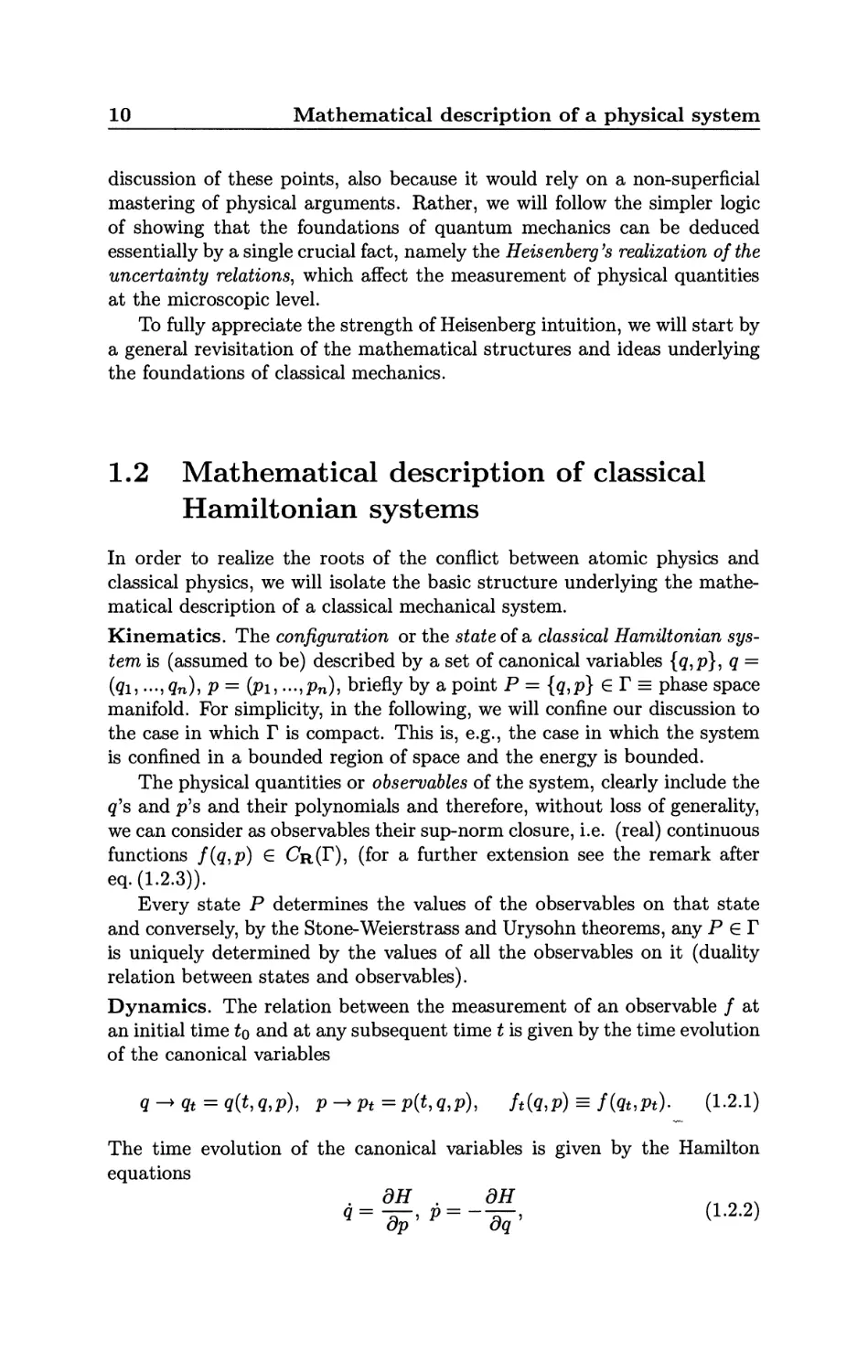
Kinematics. The configuration or the state of & classical Hamiltonian
system is (assumed to be) described by a set of canonical variables {tf.p}, q =
(Qu •••> Qn), P = (pi, -,Pn), briefly by a point P = {q,p} eT = phase space
manifold. For simplicity, in the following, we will confine our discussion to
the case in which T is compact. This is, e.g., the case in which the system
is confined in a bounded region of space and the energy is bounded.
The physical quantities or observables of the system, clearly include the
q's and p's and their polynomials and therefore, without loss of generality,
we can consider as observables their sup-norm closure, i.e. (real) continuous
functions f(q,p) £ Cr(T), (for a further extension see the remark after
eq. (1.2.3)).
Every state P determines the values of the observables on that state
and conversely, by the Stone-Weierstrass and Urysohn theorems, any P £ T
is uniquely determined by the values of all the observables on it (duality
relation between states and observables).
Dynamics. The relation between the measurement of an observable / at
an initial time to and at any subsequent time t is given by the time evolution
of the canonical variables
q-*Qt = q(t,q,p), p-*Pt=p(t,q,p), ft(q,p) = f(quPt). (1.2.1)
The time evolution of the canonical variables is given by the Hamilton
equations
. dH . dH

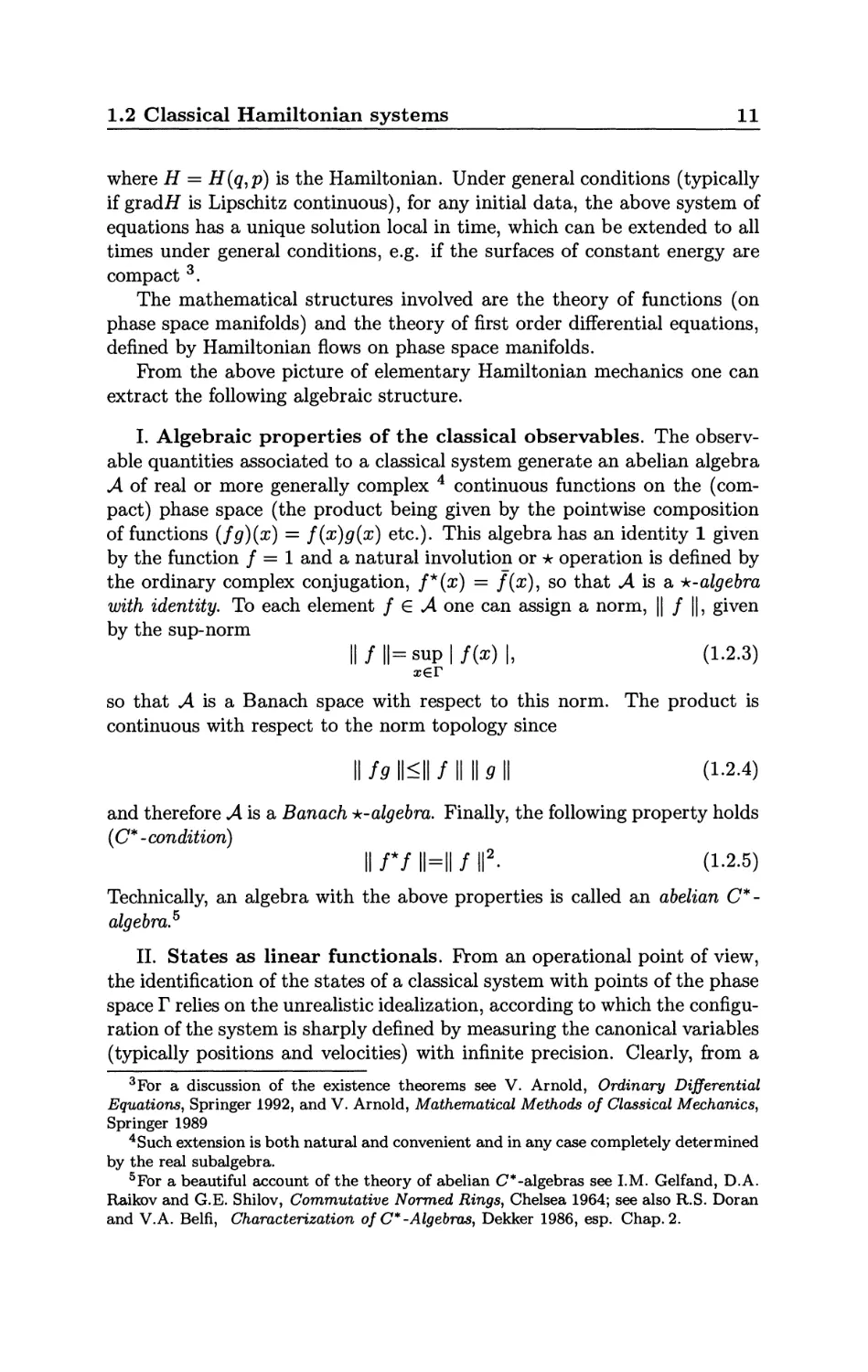
1.2 Classical Hamiltonian systems
11
where H = H(q,p) is the Hamiltonian. Under general conditions (typically
if gv&dH is Lipschitz continuous), for any initial data, the above system of
equations has a unique solution local in time, which can be extended to all
times under general conditions, e.g. if the surfaces of constant energy are
compact 3.
The mathematical structures involved are the theory of functions (on
phase space manifolds) and the theory of first order differential equations,
defined by Hamiltonian flows on phase space manifolds.
From the above picture of elementary Hamiltonian mechanics one can
extract the following algebraic structure.
I. Algebraic properties of the classical observables. The
observable quantities associated to a classical system generate an abelian algebra
A of real or more generally complex 4 continuous functions on the
(compact) phase space (the product being given by the pointwise composition
of functions (fg)(x) = f{x)g{x) etc). This algebra has an identity 1 given
by the function / = 1 and a natural involution or • operation is defined by
the ordinary complex conjugation, f*(x) = f(x), so that A is a *-algebra
with identity. To each element f £ A one can assign a norm, || f ||, given
by the sup-norm
|| / ||= sup I /(re) |, (1.2.3)
so that A is a Banach space with respect to this norm. The product is
continuous with respect to the norm topology since
II fg \\<\\ f IIII 9 II (1-2.4)
and therefore A is a Banach •-algebra. Finally, the following property holds
(C* -condition)
II /*/ 11=11 / II2- (1-2-5)
Technically, an algebra with the above properties is called an abelian C*-
algebra.5
II. States as linear functiorials. From an operational point of view,
the identification of the states of a classical system with points of the phase
space T relies on the unrealistic idealization, according to which the
configuration of the system is sharply defined by measuring the canonical variables
(typically positions and velocities) with infinite precision. Clearly, from a
3For a discussion of the existence theorems see V. Arnold, Ordinary Differential
Equations, Springer 1992, and V. Arnold, Mathematical Methods of Classical Mechanics,
Springer 1989
4 Such extension is both natural and convenient and in any case completely determined
by the real subalgebra.
5For a beautiful account of the theory of abelian C*-algebras see I.M. Gelfand, D.A.
Raikov and G.E. Shilov, Commutative Normed Rings, Chelsea 1964; see also R.S. Doran
and V.A. Belfi, Characterization of C* -Algebras, Dekker 1986, esp. Chap. 2.

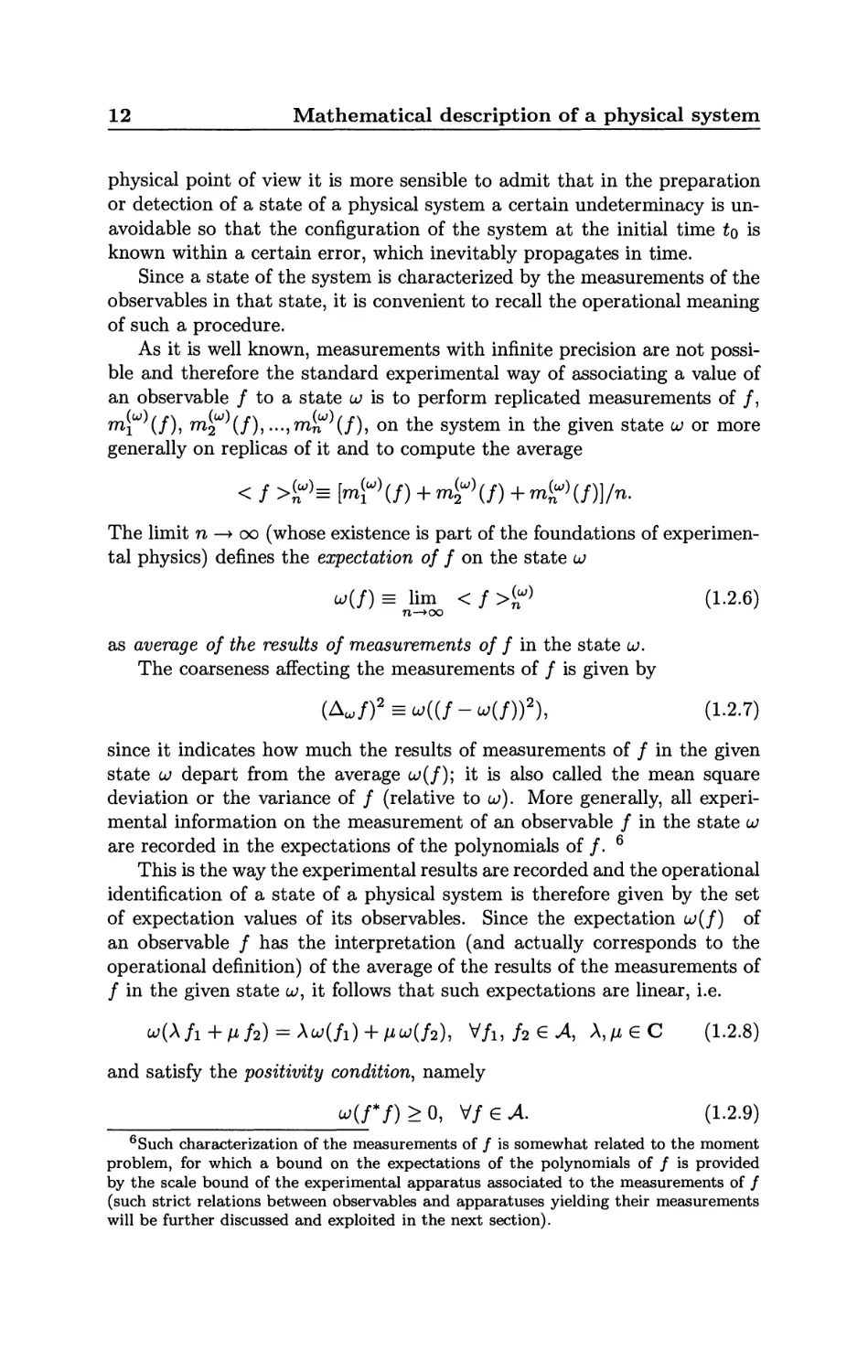
12
Mathematical description of a physical system
physical point of view it is more sensible to admit that in the preparation
or detection of a state of a physical system a certain undeterminacy is
unavoidable so that the configuration of the system at the initial time to is
known within a certain error, which inevitably propagates in time.
Since a state of the system is characterized by the measurements of the
observables in that state, it is convenient to recall the operational meaning
of such a procedure.
As it is well known, measurements with infinite precision are not
possible and therefore the standard experimental way of associating a value of
an observable f to a state uj is to perform replicated measurements of /,
mi (/)> m2: (/)> •••5mn (f), on the system in the given state uj or more
generally on replicas of it and to compute the average
< / >£->= [mf\f) + m<?\f) + m^(/)]/n.
The limit n —► oo (whose existence is part of the foundations of
experimental physics) defines the expectation of f on the state uj
u(f) = lim <f >£"> (1.2.6)
n—>oo
as average of the results of measurements of f in the state uj.
The coarseness affecting the measurements of / is given by
(A„f)2=u((f-u;(f))2), (1.2.7)
since it indicates how much the results of measurements of / in the given
state uj depart from the average uj(f); it is also called the mean square
deviation or the variance of / (relative to a;). More generally, all
experimental information on the measurement of an observable / in the state uj
are recorded in the expectations of the polynomials of /. 6
This is the way the experimental results are recorded and the operational
identification of a state of a physical system is therefore given by the set
of expectation values of its observables. Since the expectation uj{f) of
an observable / has the interpretation (and actually corresponds to the
operational definition) of the average of the results of the measurements of
/ in the given state uj, it follows that such expectations are linear, i.e.
^(Afi+/if2) = Ao;(fi) + /ia;(f2), Vfi, f2 G A A,/iGC (1.2.8)
and satisfy the positivity condition, namely
c^f*f)>0, V/GA (1.2.9)
6 Such characterization of the measurements of / is somewhat related to the moment
problem, for which a bound on the expectations of the polynomials of / is provided
by the scale bound of the experimental apparatus associated to the measurements of /
(such strict relations between observables and apparatuses yielding their measurements
will be further discussed and exploited in the next section).

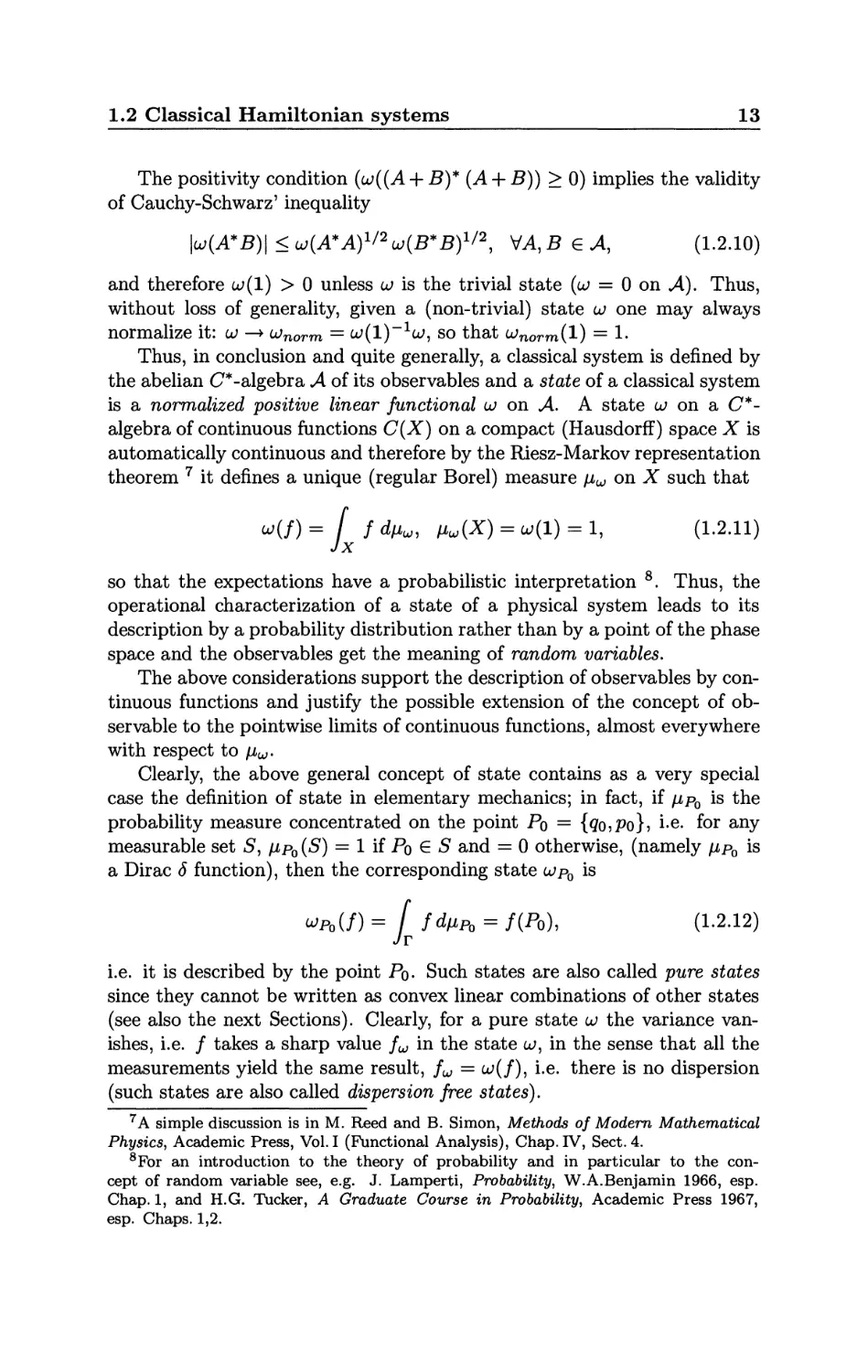
1.2 Classical Hamiltonian systems
13
The positivity condition (uj((A + B)* (A + B)) > 0) implies the validity
of Cauchy-Schwarz' inequality
\u(A*B)\ < uj(A*A)^2uj(B*B)^2, VA, B e A, (1.2.10)
and therefore uj(1) > 0 unless uj is the trivial state (w = 0 on A). Thus,
without loss of generality, given a (non-trivial) state uj one may always
normalize it: uj —> uJnorm = uj(1)~1uj, so that u;norm(l) = 1.
Thus, in conclusion and quite generally, a classical system is defined by
the abelian C*-algebra A of its observables and a state of a classical system
is a normalized positive linear functional u; on A A state uj on a, C*-
algebra of continuous functions C(X) on a compact (Hausdorff) space X is
automatically continuous and therefore by the Riesz-Markov representation
theorem 7 it defines a unique (regular Borel) measure {i^ on X such that
"(/)= / fdvL„, M*) = "(-) = !, (i-2-11)
fx
so that the expectations have a probabilistic interpretation 8. Thus, the
operational characterization of a state of a physical system leads to its
description by a probability distribution rather than by a point of the phase
space and the observables get the meaning of random variables.
The above considerations support the description of observables by
continuous functions and justify the possible extension of the concept of
observable to the pointwise limits of continuous functions, almost everywhere
with respect to ji^.
Clearly, the above general concept of state contains as a very special
case the definition of state in elementary mechanics; in fact, if jipQ is the
probability measure concentrated on the point P$ = {qo,po}, i.e. for any
measurable set 5, jipQ (S) = 1 if Pq £ S and = 0 otherwise, (namely jip0 is
a Dirac 5 function), then the corresponding state ujp0 is
«fb(/) = / idliPo = f(Po), (1-2-12)
i.e. it is described by the point Po- Such states are also called pure states
since they cannot be written as convex linear combinations of other states
(see also the next Sections). Clearly, for a pure state uj the variance
vanishes, i.e. / takes a sharp value fu in the state uj, in the sense that all the
measurements yield the same result, fu = uj(f), i.e. there is no dispersion
(such states are also called dispersion free states).
7 A simple discussion is in M. Heed and B. Simon, Methods of Modern Mathematical
Physics, Academic Press, Vol.1 (Functional Analysis), Chap. IV, Sect. 4.
8 For an introduction to the theory of probability and in particular to the
concept of random variable see, e.g. J. Lamperti, Probability, W.A.Benjamin 1966, esp.
Chap. 1, and H.G. Tucker, A Graduate Course in Probability, Academic Press 1967,
esp. Chaps. 1,2.

14
Mathematical description of a physical system
For the general states defined above the time evolution can be defined
by duality in terms of the time evolution of the observables
Mf) = ^(/t). (1.2.13)
The above mathematical description of a state of a classical system
is not only strongly suggested by operational arguments, concerning the
measurement of physical quantities, but it is absolutely necessary for the
mathematical and physical description of complex systems, i.e. when the
number of degrees of freedom become very large, typically 1023 for ther-
modynamical systems. In this case, it is technically impossible to control
an initial value problem for such a large number of variables and it is also
physically unreasonable to measure all of them. Moreover, such idealistic
description of a complex system is not what is required on physical grounds
to account for the time evolution of physically realizable measurements.
Thus, the mathematical and physical description of a complex system
inevitably requires new mathematical ideas and structures with respect to
those of classical analysis, namely the theory of random variables. This was
indeed the revolutionary step taken by Boltzmann in laying the foundations
of Classical Statistical Mechanics and in deriving classical thermodynamics
from the mechanical properties of complex systems.
III. Algebraic Dynamics. Under general regularity conditions, in the
concrete case of the canonical realization of a classical system, the time
evolution {g,p} —> {qt, Pt} is continuous in time tER, with a
continuous dependence on the initial data at time to and therefore it defines a
one-parameter family of continuous invertible mappings ato,t of C(T) into
itself,9 which preserves all the algebraic relations, including the *-operation
(by eq. (1.2.2) at(f g) = at(f)at(g), at(/*) = (at(/))*). A linear
invertible mapping of a C*-algebra into itself, which preserves the algebraic
relations is called a *-automorphism (it follows from a general result that
it necessarily preserves the norm, see e.g. Proposition 2.2.3 in the next
chapter).
Quite generally, given an abelian C*-algebra A of observables a time-
translation invariant (reversible) dynamics, (i.e. one which depends only
on the difference t — to), can be algebraically defined as a one-parameter
group of *-automorphisms at of A, t £ R and by duality one can define a
one-parameter group of transformations a* of states into states given by
uh(A) = (a»(A) = w(at(A)), (1.2.14)
9In the case of non regular dynamics, i.e. when the algebra of continuous functions
on r is not stable under time evolution, one has to identify the observables with a larger
C*-algebra, than that of the continuous functions on T, in order to guarantee stability
under time evolution (a necessary requirement for a reasonable physical interpretation).

1.2 Classical Hamiltonian systems
15
(time evolution of the states). The abstract version of the continuity in
time is that for any state lj , u)(at (^4)), is continuous in time VA £ A\
technically at is said to be weakly continuous.
The recognition of the above mathematical structure at the basis of the
standard description of classical systems suggests an abstract
characterization of a classical (Hamiltonian) system, with no a priori reference to the
explicit realization in terms of canonical variables, phase space, continuous
functions on the phase space, etc In this perspective, since a physical
system is described in terms of measurements of its observables, one may take
the point of view that a classical system is defined by its physical properties,
i.e. by the algebraic structure of the set of its measurable quantities or
observables, which generate an abstract abelian C*-algebra A with identity.
The states of the system being fully characterized by the expectations of
the observables are described by normalized positive linear functionals on
A and the dynamics is a one-parameter group of *-automorphisms of A.
It is important to mention that quite generally, by the Gelfand-Naimark
representation theorem 10, an (abstract) abelian C*-algebra A (with
identity) is isometrically isomorphic to the algebra of complex continuous
functions C(X) on a compact Hausdorff topological space X, where X is
intrinsically defined as the Gelfand spectrum of A.
From the point of view of general philosophy, the picture emerging from
the Gelfand theory of abelian C*-algebras has far reaching consequences
and it leads to a rather drastic change of perspective. In the standard
description of a physical system the geometry comes first: one first specifies
the coordinate space, (more generally a manifold or a Hausdorff topological
space), which yields the geometrical description of the system, and then one
considers the abelian algebra of continuous functions on that space. By the
Gelfand theory the relation can be completely reversed: one may start from
the abstract abelian C*-algebra, which in the physical applications may be
the abstract characterization of the observables, in the sense that it encodes
the relations between the physical quantities of the system, and then one
reconstructs the Hausdorff space such that the given C*-algebra can be
seen as the C*-algebra of continuous functions on it. In this perspective,
one may say that the algebra comes first, the geometry comes later. The
total equivalence between the two possible points of view indicates a purely
algebraic approach to geometry: compact Hausdorff spaces are described
by abelian C*-algebras with identity, whereas if the algebra does not have
an identity one has a locally compact Hausdorff space.
Non-commutative geometry is the structure emerging when the algebra
is non-commutative. n
10 For the convenience of the reader a brief outline of the Gelfand-Naimark theory is
given in Appendix B.
11 A. Connes, Non Commutative Geometry, Academic Press 1994.

16
Mathematical description of a physical system
1.3 General mathematical description of a
physical system
In this section we argue that the structure of C*-algebra of observables
and states is the suitable language for the mathematical description of a
physical system in general (including the atomic systems), with no reference
to classical mechanics and its standard paradigms. 12
I. Observables. From an operational point of view, a physical system is
defined by its physical properties, i.e. by the set O of the physical quantities
(briefly called observables) which can be measured on it and by the relations
between them. Each observable has to be understood as characterized by
a concrete physical apparatus yielding its measurements.13
For any A € O and A £ R, one can define the observable XA as the
observable measured by rescaling the apparatus by A. By similar
considerations one justifies the existence of elementary functions of an observable
like the powers (with the standard elementary properties): if A £ (9, A2
may be interpreted as the observable associated with squaring the
apparatus scale (equivalently by squaring the results of measurements). Similarly,
one defines the powers Am, and their products Am An = Am+n. It follows
from this definition that A0 is the observable whose results of
measurements always take the value 1, independently of the state on which the
measurement is done.
In the same way, one defines a polynomial of A as the observable
obtained by taking as the new apparatus scale the given polynomial function
of the scale for A. An element A £ O is said to be •positive if all the results
of measurements of A are positive numbers. By the operational definition
of elementary functions of A, this implies that (and it is actually equivalent
to) A is of the form A = B2, B e O.
II. States. A state uj of a physical system is characterized by the results
of the measurements of the observables in the sense that the average over the
results of measurements of an observable A, when the system is in a state u,
defines the expectation u>(A) and the state lj is completely characterized by
12 The C* -algebraic approach to classical and quantum physics has been pioneered by
I. Segal, Ann. Math.(2) 48, 930 (1947); Mathematical Problems of Relativistic Physics,
Am. Math. Soc. 1963; see also P. Jordan, J. Von Neumann and E.P. Wigner, Ann. Math.
35, 29 (1934) for an early proposal and G.G. Emch, Algebraic Methods in Statistical
Mechanics and Quantum Field Theory, Wiley-Interscience 1972, esp. Chap. 2, for a
historical review and a systematic treatment.
13 The possibility that two distinct experimental apparatuses effectively define the same
observable will be discussed below. It is convenient to deal with dimensionless
observables, whose measurements are defined as ratios with respect to a set of reference
measurements (e.g. of length, mass etc.); such a choice of scale is implicit in each physical
apparatus.

1.3 General mathematical description of a physical system 17
all its expectations a;(A), when A varies over 0\ thus a; is a (real) functional
on O. By the operational definition of u>(A) it easily follows that a; is a
homogeneous functional
u (AA) = Xu(A) , VA <e R, (1.3.1)
and that u (An + Am) = u (An) + u (Am).
The realization that the only operational way of characterizing a state
is in terms of its expectations of the observables, requires that two states
yielding the same expectations must be identified, i.e.
u>i(A)=U2(A), VAE<9 , (1.3.2)
must imply uj\ = U2, (briefly the observables separate the states).
On the other hand, if we put at the basis of the mathematical description
of a physical system the fact that the experimental way of identifying an
observable is in terms of its expectations on the states, then two observables
A and B having the same expectations on all the states, u(A) = u(B), Vu;,
cannot be distinguished. Such property of the states, of completely
characterizing the observables and their relations, can be viewed as a completeness
of the states with respect to the observables. This means that the states
define an equivalence relation, denoted by ~, between the elements of O :
A ~ J5, if w(A) = u)(B) for all the physical states u, (for example two
distinct experimental apparatuses may effectively define the same
observable). Two equivalent observables must therefore be identified and in the
following the set O of observables will always denote the corresponding set
of equivalence classes.
The definition of the zeroth power of an observable A implies that for
any physical state u (A0) = 1, since all the results of measurements take
the value 1 and therefore so does their average. Thus, all the zeroth powers
of observables fall in the same equivalence class which will be called the
identity and denoted by 1. Clearly, for any state
w(l)= 1, (1.3.3)
i.e. a state of a physical system is a normalized functional on O.
From the existence of products of powers of an observable follows the
existence of a product of 1 with any observable:
Al= AA°= A= 1A.
As we have also seen in the previous section, a crucial positivity property
must be satisfied by the states. Since the expectation u>(A) is the average
over the results of measurements in the state uj , it follows that for any state
u, if A is positive, then
u(A) =uj (B2) > 0,
(1.3.4)

18
Mathematical description of a physical system
i.e. a; is a normalized positive functional on O.
By the completeness property of the states in identifying the observ-
ables, all the properties of an observable A have to be encoded in its
expectation values and therefore, in particular, the positivity of an observable
A has to be equivalently described by the positivity of all its expectations,
u(A) > 0 for all u.
III. C*-algebraic structure. Since, as discussed above, an observable
A is defined in terms of a concrete experimental apparatus, which yields
the numerical results of measurements in any state, and since each concrete
experimental apparatus has inevitable limitations implying a scale bound
independent of the state on which the measurement is performed, the results
of measurements of A in the various states is a bounded set of numbers, with
bound related to the scale bound of the associated experimental apparatus.
To each observable A it is then natural to associate the finite bound
| |A| | ee sup |u;(A)| <oo. (1.3.5)
LJ
Clearly, by the homogeneity of the states
\\XA\\= \X\\\A\\, VA6R. (1.3.6)
Moreover, since the states separate the observables, ||A|| = 0 implies A = 0.
From the definition of ||A|| it follows that
P2H = Pll2- (1-3-7)
In fact, by definition, for any physical state u, u;(||A||l ± A) > 0, so that
||A||1 ± A are both positive; then (||j4||1 - A) (\\A\\1 + A) is a positive
polynomial of A and
P||2 - u (A2) = u, ((P||l - i4)(P||l + A)) > 0, Vo; (1.3.8)
which implies ||A||2 > ||A2||. On the other side, the positivity of
(||A||1±A)2 = ||A||2 + A2±2||A||A
implies that for any state uj
2||A|||u,(A)| < ||A||2+a;(A2)<||A||2-|-||A2|| (1.3.9)
and therefore HAH2 < ||A2||.
The duality relation between observables and states allows to display
and define linear structures in O. We have already argued that the sum
of polynomials of one observable has a well defined operational meaning;

1.3 General mathematical description of a physical system 19
actually for a larger class of pairs A, B, (e.g. the kinetic and the potential
energy) the sum can be defined in the sense that there is an observable C
such that
u(C)=u(A) +u(B)=u(A + B), Vu; (1.3.10)
and (by the duality relation between states and observables) one may write
C = A-\-B £ (9. For arbitrary pairs, A, J9, the sum defined by the
expectations (1.3.10) may not correspond to an element of O and therefore it leads
to an extension of (9, (on which the states are positive linear functionals),
for which the definition of the powers (A-f- B)n may not have a direct
operational meaning. The possibility, adopted in the sequel, of introducing the
powers of A + B for any pair A, J9, with the same algebraic properties of
the powers of the generating observables and the extension of the states to
them as positive linear junctionals is therefore a non-trivial extrapolation
over the strict physically motivated structure. The so-obtained extension
of (9 will still be denoted by (9.
Clearly, from eqs. (1.3.5), (1.3.10), ||A + B\\ is well defined and
\\A + B\\< IIAH + ||B||. (1.3.11)
Thus || || is a norm on (9, which becomes a pre-Banach space. Technically
it is convenient to consider the norm completion of (9, so that by a standard
procedure one gets a real Banach space.
By definition of the norm, any state of the physical system satisfies
\w{A)\ < \\A\\, (1.3.12)
i.e. any state is continuous with respect to the topology defined by the
norm {norm topology) and therefore it has a unique continuous extension
to the norm completion of (9, hereafter still denoted by (9.
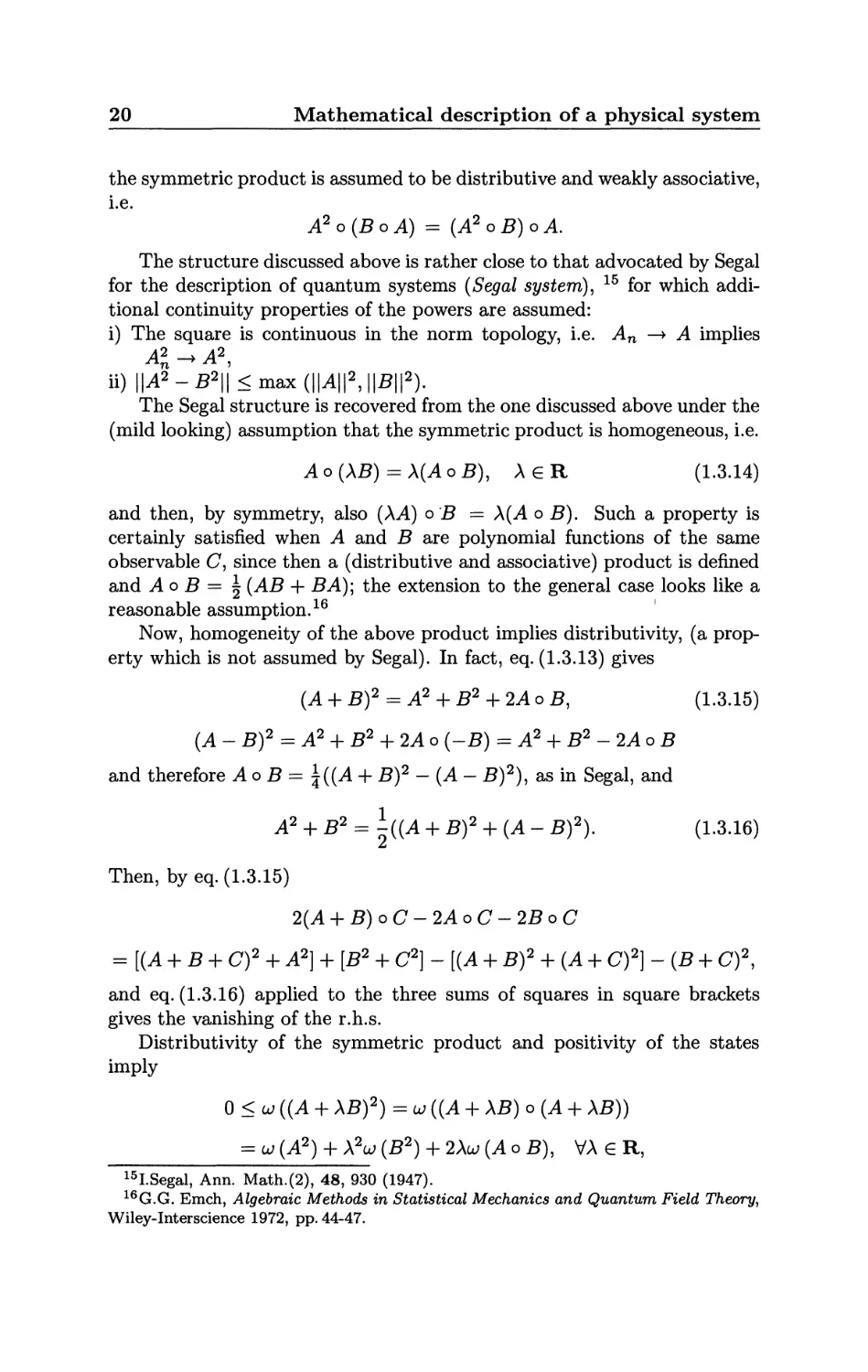
The powers of the sum A + B allow to define the following symmetric
product
AoB = ~ ((A + Bf - A2 - B2) =BoA, (1.3.13)
which however is not guaranteed to be distributive and associative.
The so obtained structure is close to that advocated by Jordan, the so-
called Jordan Algebra, 14 for which no topological structure is assumed, but
14P. Jordan, Zeit f. Phys. 80, 285 (1933); L.J. Page, Jordan Algebras, in Studies in
Modern Algebra, A.A. Albert ed., Prentice Hall 1963; N. Jacobson, Structure and
Representations of Jordan Algebras, Am. Math. Soc. 1968; H. Upmeier, Jordan Algebras in
Analysis, Operator theory and Quantum Mechanics, AMS 1980; H. Hanche-Olsen and
E. St0rmer, Jordan Operator Algebras, Pitman 1984.
A Jordan algebra is said to be special if the symmetric product arises from an
associative product: A o B = | (AB + BA): otherwise it is said to be exceptional. The
analysis of exceptional Jordan algebras does not seem to have led anywhere for possible
physical applications (for a general review see A.S. Wightman, Hilbert Sixth Problem:
Mathematical Treatment of the Axioms of Physics, in Proceedings of Symposia in Pure
Mathematics, Vol. 28, Am. Math. Soc. 1976).

20 Mathematical description of a physical system
the symmetric product is assumed to be distributive and weakly associative,
i.e.
A2 o (B o A) = (A2 o B) o A.
The structure discussed above is rather close to that advocated by Segal
for the description of quantum systems (Segal system), 15 for which
additional continuity properties of the powers are assumed:
i) The square is continuous in the norm topology, i.e. An —► A implies
A2 __> ^2
a)||i45-W<max(P||M|B||a).
The Segal structure is recovered from the one discussed above under the
(mild looking) assumption that the symmetric product is homogeneous, i.e.
A o (AB) = X(A o B), A <E R (1.3.14)
and then, by symmetry, also (AA) o B = \(A o B). Such a property is
certainly satisfied when A and B are polynomial functions of the same
observable C, since then a (distributive and associative) product is defined
and A o B = \ (AB + BA)\ the extension to the general case looks like a
reasonable assumption.16
Now, homogeneity of the above product implies distributivity, (a
property which is not assumed by Segal). In fact, eq. (1.3.13) gives
(A + B)2 = A2 + B2 + 2A o B, (1.3.15)
(A - B)2 = A2 + B2 + 2A o (-B) = A2 + B2-2AoB
and therefore A o B = \((A + B)2 - (A - J5)2), as in Segal, and
A2 + B2 = h{A + B)2 + (A - B)2). (1.3.16)
Then, by eq. (1.3.15)
2(A + B) o C - 2A o C - 2B o C
= [(A + B + C)2 + A2] + [B2 + C2} - [(A + B)2 + (A + C)2] - (B + C)2,
and eq. (1.3.16) applied to the three sums of squares in square brackets
gives the vanishing of the r.h.s.
Distributivity of the symmetric product and positivity of the states
imply
0<u((A + AB)2) =u>((A + AB) o (A + AB))
= lj (A2) + A2u; (B2) + 2Aa; (A o B), VA <E R,
15I.Segal, Ann. Math.(2), 48, 930 (1947).
16G.G. Emch, Algebraic Methods in Statistical Mechanics and Quantum Field Theory,
Wiley-Interscience 1972, pp. 44-47.

1.3 General mathematical description of a physical system 21
so that
\u) (A oB)\<uj (A2)1/2 u) (J52)1/2 (1.3.17)
and
PoB||<p||||B||. (1.3.18)
Now, the continuity properties i) assumed by Segal follow easily. In fact,
from distributivity one has A2 — A2 = (An + A) o (An — A) and therefore
\\Al- A*\\<\\An- A\\{\\An- A\\ + \\2A\\),
which implies i). Equation ii) follows from the positivity of the squares and
of the states, from the definition of the norm and from eq. (1.3.7), since
Va, b e R, |a2 - b2| < max (a2, b2).
As shown by Segal, the above structure allows to recover most of the
mathematical basis for the description of quantum systems, like the concept
of compatible observables, the joint probability distribution for compatible
observables etc However, the mathematical language becomes easier if
one makes the technical assumption that the so obtained Segal system
O can be embedded in a complex extension A generated by complex linear
combinations of elements of (9, such that
1) the symmetric product arises from an associative (but not necessarily
commutative) product in A, i.e. VA, B € O
AoB = ^(AB + BA),
2) a * operation is defined on A with the properties that VA, B £ (9,
A,/i£C
(AA + iaB)* = XA + fiB,
(AB)* = J5A,
3) VA £ •A, A* A is positive and the states can be extended from O to A by
linearity as linear functionals, with the natural extension of positivity
u) (A*A) > 0, VA <E A ,
and with the properties
PJ5|| = supw \U(AB)\ < \\A\\ \\B\\, \\A*A\\ = \\A*\\ \\A\\. (1.3.19)
Positivity, u ((XA + 1 )*(XA + 1)) > 0, implies
u(A*)=u(A) , p*|| = p||, VAe.4. (1.3.20)

22
Mathematical description of a physical system
The so-obtained extension A has the properties of a C*-algebra with
identity 1, O is the subset of *-invariant (also called self-adjoint) elements
and A is generated by O.17
Necessary and sufficient conditions have been given for the existence of
such an extension, 18 but their physical interpretation is not transparent.
Honestly, this should be regarded as a technically motivated assumption.
A Segal system which allows such an extension is called special and
exceptional otherwise; so far no one seems to have succeeded in giving an
interesting physical application of exceptional Segal systems, which are actually
very difficult to construct. In the following discussion, we shall therefore
assume that the observables generate a special Segal system.
The arguments discussed in this section do not pretend to prove as a
mathematical theorem that the general physical requirements on the set of
observables necessarily lead to a C*-algebraic structure, but they should
provide sufficient motivations in favor of it. In any case, the above
mathematical structure is by far more general than the concrete structure
discussed in Sect.2 for classical systems. As we shall see, the mathematical
setting of quantum mechanics can be derived with a very strict logic solely
from the C*-algebraic structure of the observables and the operational
information of non-commutativity codified by the Heisenberg uncertainty
relations (Sect. 2.1). In this way one has a (in our opinion better motivated)
alternative to the Dirac-Von Neumann axiomatic setting, which can
actually be derived through the GNS theorem 2.2.4, the Gelfand-Naimark
theorem 2.3.1 and Von Neumann theorem 3.2.2. For these reasons we adopt
the following mathematical framework:
1. A physical system is defined by its C*-algebra A of observables (with
identity).
2. The states of the given physical system are identified by the
measurements of the observables, i.e. a state is a normalized positive
linear functional on A. The set S of physical states separates the
observables, technically one says that S is full, and conversely the
observables separate the states.
In the mathematical literature, given a C*-algebra A, any normalized
positive linear functional on it is by definition a state; here we allow the
17For an introduction to C*-algebras see e.g. M. Takesaki, Theory of Operator
Algebras, Vol. I, Springer 1979, Chap. I; R.V. Kadison and J.R. Ringrose, Fundamentals of
the Theory of Operator Algebras, Vol. I, Academic Press 1983, Chap. 4; O. Bratteli and
D.W. Robinson, Operator Algebras and Quantum Statistical Mechanics, Vol. I, Springer
1987, Sects. 2.1- 2.3; the basic textbook is J. Dixmier, C*-algebras , North-Holland 1977.
For the convenience of the reader a few basic notions about C*-algebras are presented
in the Appendices.
18D. Lowdenslager, Proc. Amer. Math. Soc. 8, 88 (1957). For physically motivated
conditions see E.M. Alfsen and F.W. Schultz, Geometry of State Spaces of Operator
Algbras, Birkhauser 2003.

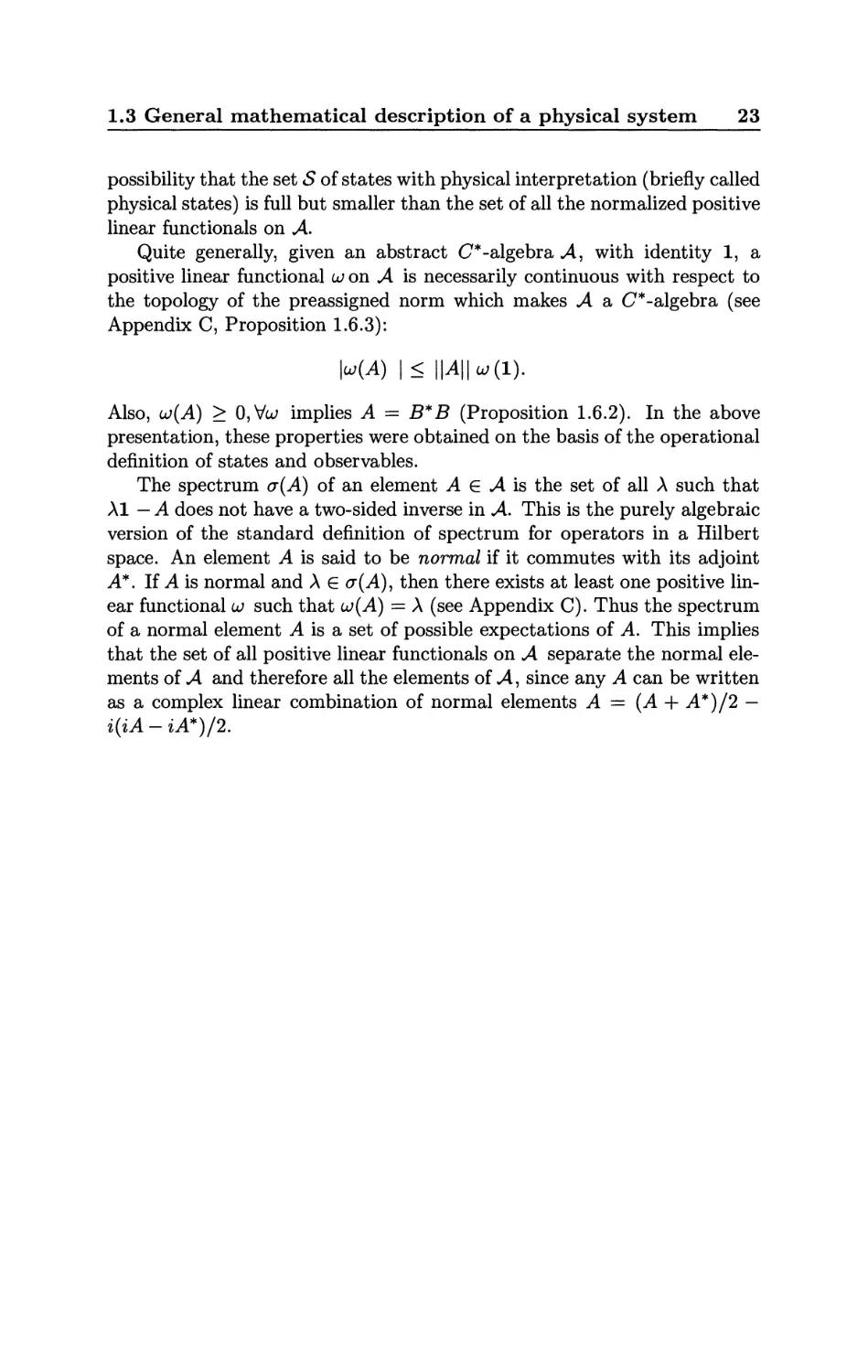
1.3 General mathematical description of a physical system 23
possibility that the set S of states with physical interpretation (briefly called
physical states) is full but smaller than the set of all the normalized positive
linear functionals on A.
Quite generally, given an abstract C*-algebra *4, with identity 1, a
positive linear functional a; on .A is necessarily continuous with respect to
the topology of the preassigned norm which makes A a C*-algebra (see
Appendix C, Proposition 1.6.3):
\«,(A) |<PII"(1).
Also, u>(A) > 0,Vu; implies A = B*B (Proposition 1.6.2). In the above
presentation, these properties were obtained on the basis of the operational
definition of states and observables.
The spectrum a(A) of an element A € A is the set of all A such that
XI —A does not have a two-sided inverse in A. This is the purely algebraic
version of the standard definition of spectrum for operators in a Hilbert
space. An element A is said to be normal if it commutes with its adjoint
A*. If A is normal and A £ cr(A), then there exists at least one positive
linear functional uj such that w(A) = A (see Appendix C). Thus the spectrum
of a normal element A is a set of possible expectations of A. This implies
that the set of all positive linear functionals on A separate the normal
elements of A and therefore all the elements of A, since any A can be written
as a complex linear combination of normal elements A = (A + A*)/2 —
i(iA-iA*)/2.

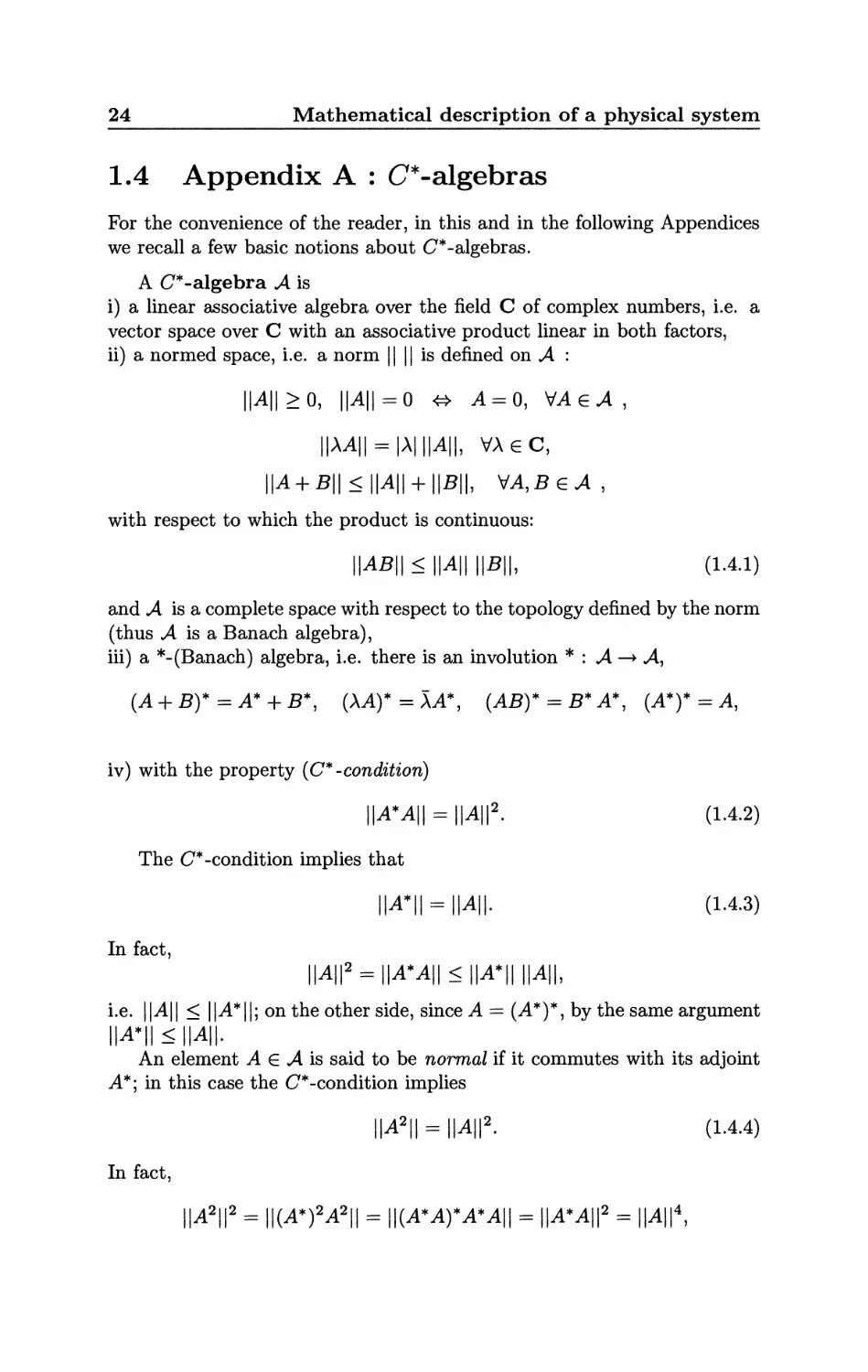
24 Mathematical description of a physical system
1.4 Appendix A : C*-algebras
For the convenience of the reader, in this and in the following Appendices
we recall a few basic notions about C*-algebras.
A C*-algebra A is
i) a linear associative algebra over the field C of complex numbers, i.e. a
vector space over C with an associative product linear in both factors,
ii) a normed space, i.e. a norm 11 11 is defined on A :
HAH >o, ||i4||=0 <=> 4 = 0, VAeA ,
IIAAIIHAIIIAH, VAGC,
P + £||<||A|| + ||J3||, VA,BeA,
with respect to which the product is continuous:
\\AB\\ < ||4| ||fl||, (1.4.1)
and .A is a complete space with respect to the topology defined by the norm
(thus .A is a Banach algebra),
iii) a *-(Banach) algebra, i.e. there is an involution * : A —► A,
(A + B)* =A* + B\ (AA)*=AA*, (AJ5)* = J5*A*, (A*)* = A,
iv) with the property (C* -condition)
\\A'A\\ = ||A||2. (1.4.2)
The C* -condition implies that
P*|| = PII- (1-4-3)
In fact,
P||2 = ||^4|| <p*||P||,
i.e. UAH < ||A*||; on the other side, since A = (A*)*, by the same argument
\\A*\\<\\A\\.
An element A € A is said to be normal if it commutes with its adjoint
A*; in this case the C*-condition implies
P2H = ll^ll2- (1-4-4)
In fact,
P2||2 = ||(A*)2^2|| = ||(,4M)MM|| = \\A*A\\2 = p||4,

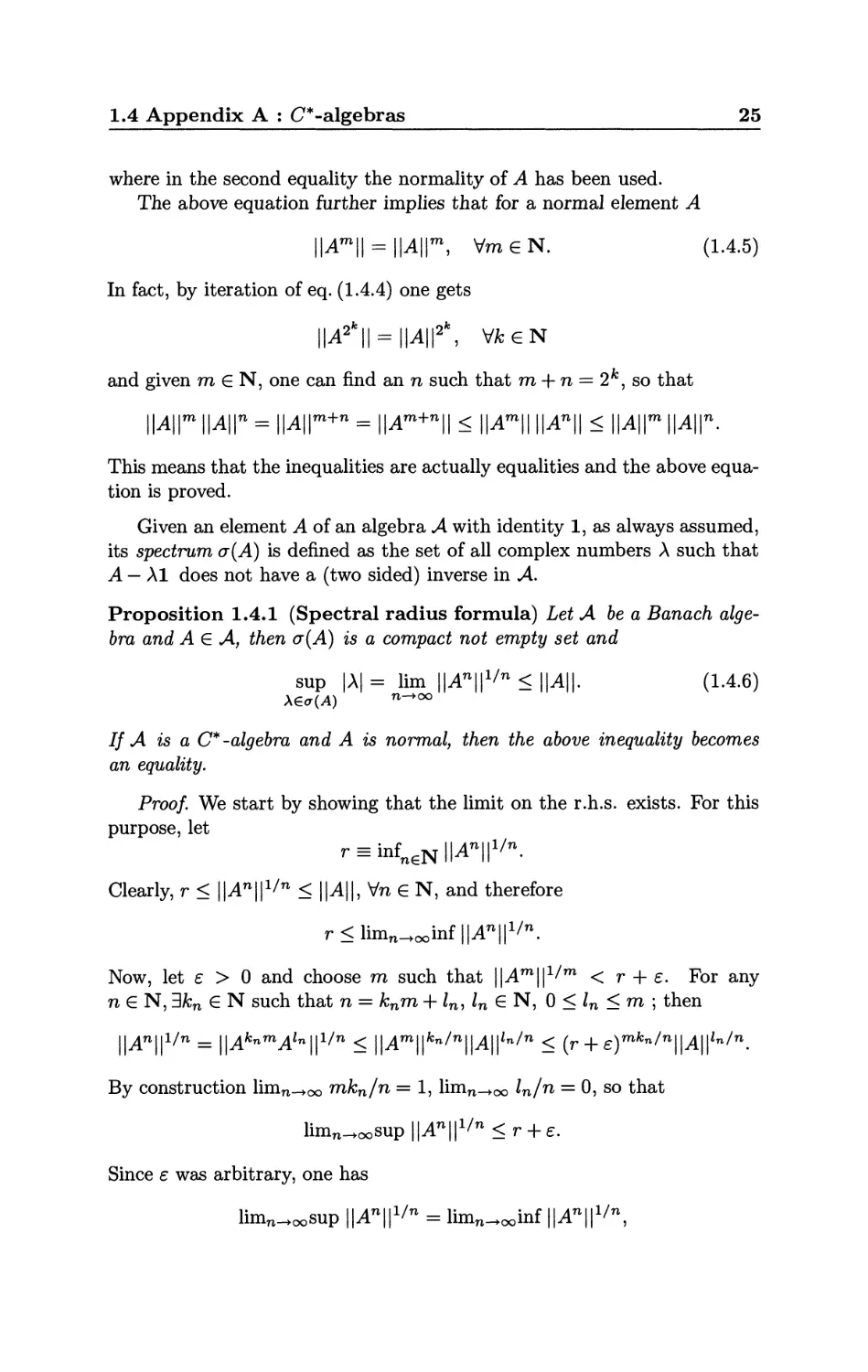
1.4 Appendix A : C*-algebras
25
where in the second equality the normality of A has been used.
The above equation further implies that for a normal element A
||Am|| = ||A|P, VmGN. (1.4.5)
In fact, by iteration of eq. (1.4.4) one gets
||A2fc|| = ||A||2\ VfcGN
and given m £ N, one can find an n such that m-\-n = 2k, so that
\\A\r \\A\\n = nAnm+n = nAm+nn < nAmn nAnn < \\A\r \\A\\n.
This means that the inequalities are actually equalities and the above
equation is proved.
Given an element A of an algebra A with identity 1, as always assumed,
its spectrum o~(A) is defined as the set of all complex numbers A such that
A — XI does not have a (two sided) inverse in A.
Proposition 1.4.1 (Spectral radius formula) Let A be a Banach
algebra and A £ A, then cr(A) is a compact not empty set and
sup |A|= lim ||i4n||1/n<||i4||. (1.4.6)
A€<t(A) n^°°
If A is a C* -algebra and A is normal, then the above inequality becomes
an equality.
Proof. We start by showing that the limit on the r.h.s. exists. For this
purpose, let
r = iii*BeNp»||1/B.
Clearly, r < P"!!1/" < p||, Vn e N, and therefore
r<limn^00inf||i4B||1/'».
Now, let e > 0 and choose m such that P"1!!1/™ < r + e. For any
n£N, 3kn £ N such that n = knm + /„, ln e N, 0 < ln < m ; then
ll^niil/n _ |M/s„m^„nl/n <- |Mmi|fc„/nii^i|in/n < (r + e)m/s"/nP|l'™/n.
By construction limn_,oo mkn/n = 1, linin-,^ ln/n = 0, so that
limn_0osuppn||1/n<r + e.
Since e was arbitrary, one has
limn_+00sup \\An\\1/n = limn_wnf pn||1/n,

26
Mathematical description of a physical system
i.e. the limit exists. The equality for normal elements of a C*-algebra
follows trivially from eq. (1.4.5).
To conclude the proof, we note that the existence of a norm allows an
extension of the standard analytic calculus to Banach algebras (see e.g. the
quoted book by Gelfand, Raikov and Shilov); in particular, by the extension
of the Cauchy-Hadamard theorem of elementary analytic calculus, r_1 is
the radius of convergence of the series 1 + zA + z2A2 + ..., z £ C,A £ A ,
which converges to (1 — zA)'1 for \z\ < r_1 and has a singularity for \z\ =
r"1. Thus, (/il — A)"1 exists if |/x| > r, and r = supA€(7(A) |A|; moreover
cr(A) is closed because the analyticity domain C/a(A) of (A — zl)-1 is
open.
By a similar argument, cr(A) cannot be empty, otherwise (Al — A)-1
would be an entire function in the whole complex A plane, vanishing for
|A| —> oo and therefore zero everywhere, contrary to the existence of A-1
(implied by a(A) = 0).
The above Proposition implies that if all elements, except 0, of a Banach
algebra A are invertible, then A is isomorphic to the complex numbers; in
fact, if A £ &(A) ^ 0, then Al — A is not invertible and therefore it must
be 0, i.e. A = Al (Gelfand-Mazur theorem).
A family T = {Aa,a £ 1} is said to generate a (normed) algebra A if
the polynomials of T are dense in A.
1.5 Appendix B: Abelian C*-algebras
A C* -algebra A is called abelian or commutative if the product is
commutative.
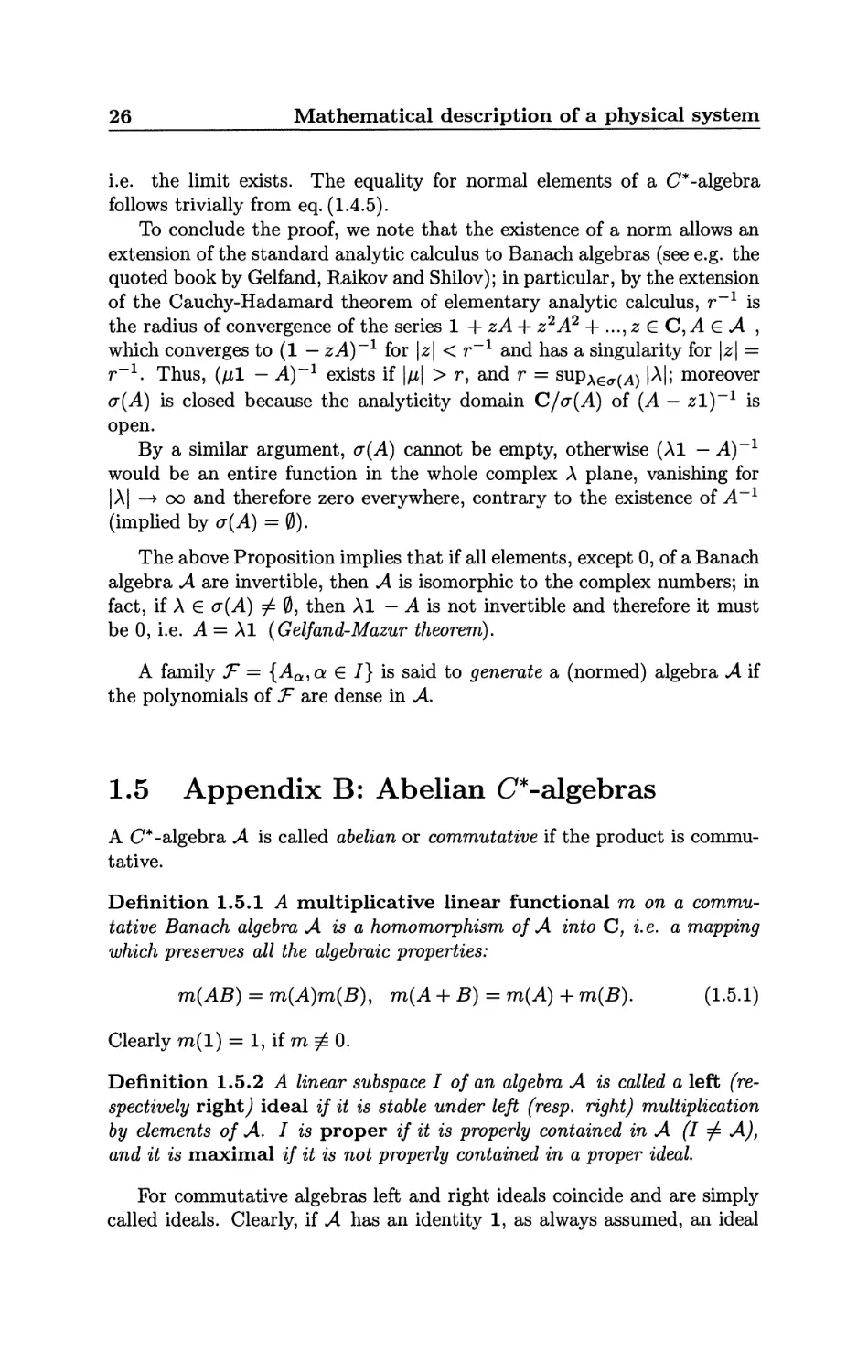
Definition 1.5.1 A multiplicative linear functional m on a
commutative Banach algebra A is a homomorphism of A into C, i.e. a mapping
which preserves all the algebraic properties:
m(AB) = m(A)m(B), m(A + B) = m(A) +m(B). (1.5.1)
Clearly ra(l) = 1, ifm^O.
Definition 1.5.2 A linear subspace I of an algebra A is called a left
(respectively right,) ideal if it is stable under left (resp. right) multiplication
by elements of A. I is proper if it is properly contained in A (I ^ A),
and it is maximal if it is not properly contained in a proper ideal.
For commutative algebras left and right ideals coincide and are simply
called ideals. Clearly, if A has an identity 1, as always assumed, an ideal

1.5 Appendix B: Abelian C* -algebras
27
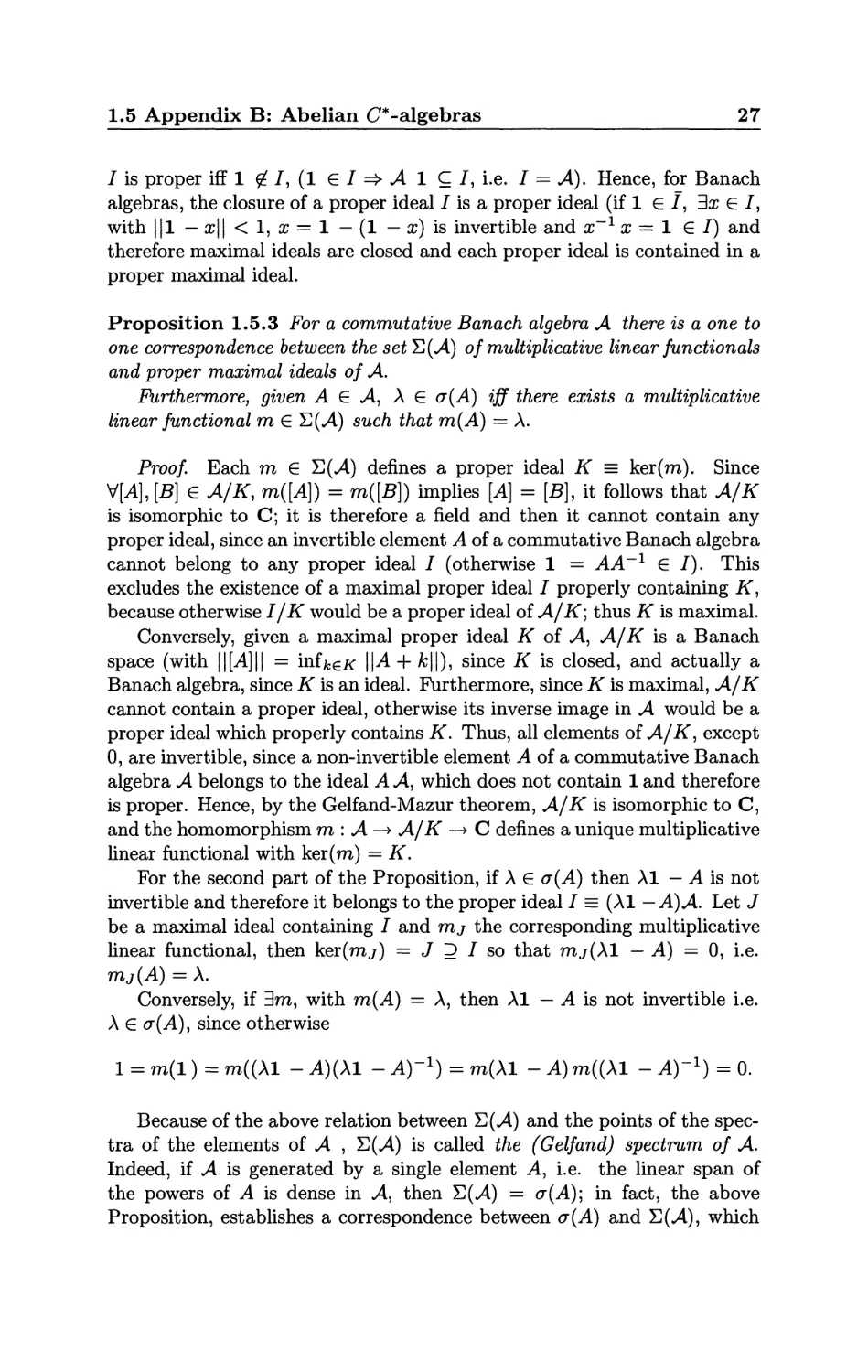
J is proper iff 1 £ J, (1 e I => A 1 C J, i.e. J = .A). Hence, for Banach
algebras, the closure of a proper ideal J is a proper ideal (if 1 £ J, Bx £ J,
with ||1 — x|| < 1, x = 1 — (1 — x) is invertible and x_1 x = 1 £ J) and
therefore maximal ideals are closed and each proper ideal is contained in a
proper maximal ideal.
Proposition 1.5.3 For a commutative Banach algebra A there is a one to
one correspondence between the setH(A) of multiplicative linear junctionals
and proper maximal ideals of A.
Furthermore, given A £ A, A £ &(A) iff there exists a multiplicative
linear functional m £ ^(A) such that m(A) = A.
Proof Each m £ ^(A) defines a proper ideal K = ker(m). Since
V[A], [B] £ A/K, m([A]) = m([B}) implies [A] = [B], it follows that A/K
is isomorphic to C; it is therefore a field and then it cannot contain any
proper ideal, since an invertible element A of a commutative Banach algebra
cannot belong to any proper ideal J (otherwise 1 = AA_1 £ J). This
excludes the existence of a maximal proper ideal J properly containing K,
because otherwise I/K would be a proper ideal oiA/K\ thus K is maximal.
Conversely, given a maximal proper ideal K of A, A/K is a Banach
space (with \\[A]\\ = infkeK \\A + fc||), since K is closed, and actually a
Banach algebra, since K is an ideal. Furthermore, since K is maximal, A/K
cannot contain a proper ideal, otherwise its inverse image in A would be a
proper ideal which properly contains K. Thus, all elements of A/K, except
0, are invertible, since a non-invertible element A of a commutative Banach
algebra A belongs to the ideal A A, which does not contain 1 and therefore
is proper. Hence, by the Gelfand-Mazur theorem, A/K is isomorphic to C,
and the homomorphism m : A —> A/K —> C defines a unique multiplicative
linear functional with ker(m) = K.
For the second part of the Proposition, if A £ 0"(^4) then Al — A is not
invertible and therefore it belongs to the proper ideal I = (XI —A) A. Let J
be a maximal ideal containing J and mj the corresponding multiplicative
linear functional, then ker(mj) = J 3 / so that mj (Al — A) = 0, i.e.
mj(A) = A.
Conversely, if 3m, with m(A) = A, then Al — A is not invertible i.e.
A £ o-(A), since otherwise
1 = m(l) = m((Al - A)(A1 - A)"1) = m(Al - A) m((Al - A)"1) = 0.
Because of the above relation between Y1(A) and the points of the
spectra of the elements of A , ^(A) is called the (G elf and) spectrum of A.
Indeed, if A is generated by a single element A, i.e. the linear span of
the powers of A is dense in A, then U(WA) = cr(A)\ in fact, the above
Proposition, establishes a correspondence between cr(A) and U(WA), which

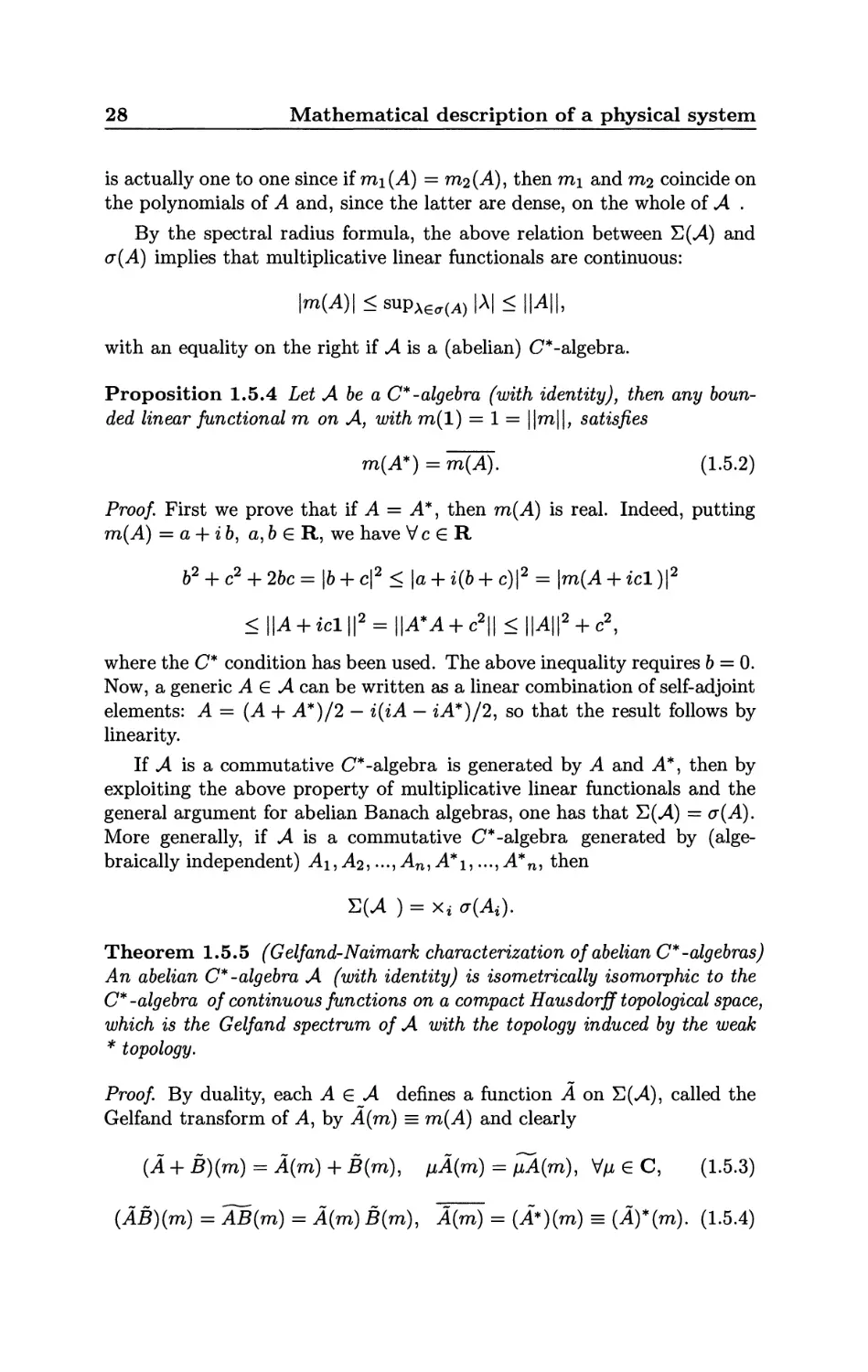
28
Mathematical description of a physical system
is actually one to one since if mi (A) = rri2(A), then mi and rri2 coincide on
the polynomials of A and, since the latter are dense, on the whole of A .
By the spectral radius formula, the above relation between Y1(A) and
cr(A) implies that multiplicative linear functionals are continuous:
\m(A)\<supX£l7{A)\\\<\\A\\,
with an equality on the right if A is a (abelian) C*-algebra.
Proposition 1.5.4 Let A be a C*-algebra (with identity), then any
bounded linear functional m on A, with m(l) = 1 = ||m||, satisfies
m(A*) = m(A). (1.5.2)
Proof. First we prove that if A = A*, then m(A) is real. Indeed, putting
m(A) = a + i b, a, b £ R, we have VcGR
b2 + c2 + 2bc = \b + c|2 < |a + i(b + c)|2 = |m(A + id)|2
< ||A + icl ||2 = ||A*A + c2|| < P||2 + c2,
where the C* condition has been used. The above inequality requires b = 0.
Now, a generic A £ A can be written as a linear combination of self-adjoint
elements: A = (A + A*)/2 - i(iA - iA*)/2, so that the result follows by
linearity.
If A is a commutative C*-algebra is generated by A and A*, then by
exploiting the above property of multiplicative linear functionals and the
general argument for abelian Banach algebras, one has that Ti(A) = &(A).
More generally, if .A is a commutative C* -algebra generated by
(algebraically independent) Ai, A2,..., An, A*i,..., A*n, then
X(A ) = Xi a(Ai).
Theorem 1.5.5 (Gelfand-Naimark characterization of abelian C*-algebras)
An abelian C*-algebra A (with identity) is isometrically isomorphic to the
C*-algebra of continuous functions on a compact Hausdorff topological space,
which is the Gelfand spectrum of A with the topology induced by the weak
* topology.
Proof By duality, each A £ A defines a function A on U(WA), called the
Gelfand transform of A, by A(m) = m(A) and clearly
(A + B)(m) = A(m) + J5(m), fiA(m) = fjA(m), V/i £ C, (1.5.3)
(AJ5)(m) = AJ5(m) = A(m) J5(m), A(m) = (A*)(m) = (A)*(m). (1.5.4)

1.5 Appendix B: Abelian C*-algebras
29
Thus, the functions A, for A € A, form an abelian *-algebra A. By the
above Proposition, for each m G 'E(A), m(A) is a point of cr(A), which is
a closed set, and
\A(m)\ = \m(A)\<supX£a{A)\X\ = \\A\l
H^Hoo = supm€S(tA) \A(m)\ = supA€(7(A) |A| = ||A||. (1.5.5)
Thus A is isometrically isomorphic to A.
We shall now show that U(-A) is a compact topological space and that
A = C(E(A)). For this purpose, we note that %(A) is a closed subset of
the closed unit ball B of the set A* of continuous linear functionals on A.
Indeed
i) each m £ ^(A) is a continuous functional since |m(A)| < ||A||, and, since
1 e A and m(l) = 1,
IN|oo = supA€>l |m(A)|/||A|| = l,
i.e. me B.
ii) the weak * topology on A* is defined by the following basic
neighborhoods: given e > 0, Ai,..., An € A, the neighborhood of lis
UAlt...tAn&e) = {leA*: \l(Ai)-T(Ai)\ < e, i = l,..,n}.
With respect to such a topology A * is a Hausdorff topological space and
the unit ball B C A * is compact, by the Alaoglu-Banach theorem19. The
topology induced on T,(A) by the weak * topology is called the Gelfand
topology and it is the weakest topology under which all the functions A(m)
are continuous. Clearly, U(-A) is a Hausdorff space because the weak *
topology is Hausdorff.
iii) it remains to prove that U(-A) is a weak * closed set of B. As a matter
of fact, if ma £ E(^4) and ma —> / in B, then VA, B £ A
ma(AB) = ma(A) ma(B) =» l(AB) = 1(A) 1(B),
i.e. / is multiplicative.
Finally, since by definition A separates the points of T,(A), and it is
closed by eq. (1.5.5), by the Stone-Weierstrass theorem it is the whole
CV(A)).
Examples. To better grasp the properties of C*-algebras it is
instructive to work out the following Exercises.
1. Let X be a compact Hausdorff topological space and C(X) the C*-
algebra of the continuous functions on X.
19See e.g. N. Dunford and J.T. Schwartz, Linear Operators. Part I: General Theory,
Interscience 1958; M. Reed and B. Simon, Methods of Modern Mathematical Physics,
Academic Press, Vol. 1, p. 115.

30 Mathematical description of a physical system
a. Determine the spectrum a(f) for / £ C(X) and show that VF £ C(C),
a(F(f)) = F(a(f)).
b. Verify explicitly the validity of eq. (1.4.6).
c Determine independently the proper maximal ideals of C(X) and its
multiplicative linear functionals; verify Proposition 1.5.3 and that U(C(X))
= X. [Hints: If, given a proper maximal ideal /, Va; G X, there is a fx £ /
such that fx(x) ^ 0, then, by exploiting the compactness of X, one could
construct a never vanishing h E I and hh~x = 1 £ J, so that J is not
proper. If the support K of a multiplicative measure /i on X (i.e. the
smallest compact set such that /i(f) = 0, if supp fC\K = 0) contains two disjoint
open sets K\,K<z, then 3g £ C(X), suppp C K^ such that /i(p) 7^ 0 and
V/ g C(X), supp/ C Kx, 0 = M/0) = M(/)M<?), i-e. M/) = 0.]
2. Let .M be the set of diagonal n x n matrices. Verify that M is a C*-
algebra. Determine the spectrum of M € M and the Gelfand spectrum of
M.
1.6 Appendix C: Spectra and states
We discuss general properties of the states of a C*-algebra A and their
relation with the spectra of the normal elements of A.
Proposition 1.6.1 Let A,B be C*-algebras and A C B, then for any A £
A, the set cta(A) ofX £ C such that XI — A is not invertible in A coincides
with
a (A) = {A £ C : Al — A is not invertible in B}.
Proof. In fact, if (Al —A)-1 exists in B, it can be expressed as a convergent
power series, i.e. it is the norm limit of partial sums each belonging to A,
so that also (Al — A)-1 belongs to A.
Proposition 1.6.2 Given a normal element A of a C*-algebra A, then
any continuous function F = F(A, A*) of A, A* defines an element of
A and o~(F) = F(a(A)), where ~ denotes the Gelfand transform.
Proof. Let A a be the abelian algebra generated by A, A* and 1; by
the Gelfand-Naimark theorem, F defines an element of Aa C A and,
by the preceding Proposition, a(F) = a^A(F) = a(F) = Range F =
F(RangeA) = F(a(A)).
By Proposition 1.6.2 the functional calculus for normal A follows from
the calculus on functions; e.g. a(A) C R+ iff A > 0 and in this case
A1/2 > 0 defines A1/2. Similarly, the decomposition A = A+ - AL, with
A± > 0, A+A_ = 0 yields A = A+ - A_, a(A±) > 0, A+ A_ = 0.

1.6 Appendix C: Spectra and states
31
The following properties are equivalent and define the set A+ of the
positive elements, 20
l)a{A)<Z%\\A\\\, 2)A = B2,B = B*, 3) ||1 - A/\\A\\ \\ < 1,
4) A = C* C.
A+ is a closed convex cone, since 3) is stable under closure and
multiplication of A by positive numbers, and VA, B, with ||j4|| = ||J5|| = 1, one has
||1-(>1 + S)/2||<I(||1-^| + ||1-J5||)<1.
Proposition 1.6.3 A linear functional uj on a C*-algebra A, with identity,
is positive iff: 1) uj is bounded, 2) \\uj\\ = uj (1).
Proof. Let uj be positive, then by the Cauchy-Schwarz' inequality
\uj (A*J3)|2 < uj (A* A) uj (£*£),
which implies
k(4) |2<u;(l)u;(A*A).
Thus, to get continuity it suffices to prove that
cj(A*A)<\\A\\2oj(1),
i.e. that for any positive J5, uj (B) < ||J9||u;(l). This follows easily from
the discussion after Proposition 1.6.2, in particular from the equivalent
definitions of positive elements. In fact, one has that
||B||1 -J5>0
and therefore, by the positivity of a;,
uj(B)<\\B\\uj(1).
Conversely, let uj be bounded and | |a; 11 = uj (1); it suffices to take uj(1) =
1 and consider A with ||A|| = 1. By Proposition (1.5.4) uj(A* A) is real and
one has
\1-uj (A*A)| = \uj (1 - A*A)\ < ||1 - j4M|| < 1,
where the first inequality follows from the continuity of uj and the last from
the positivity of A*A (see the equivalent property 3 above). This requires
u;(A*A)>0.
20Clearly, 1) <=> 2), by the existence of A1/2. 1) => 3), since a(l - A/||A||) = 1 -
cr(A)/||A|| C [0, 1] and conversely, ||1-A/||A|| || < 1 implies cr(l-A/||A||) C [-1,1], i.e.
<r(A) C [0,2||A||]. For the equivalence 4) <=> 1), one notes that A = a\ — a2_, a± = AlJ.2
and (Ca-)* (Ca_) = a-(a^ — a2_) a_ = —al G — A+. On the other hand, by writing
D = Ca- = a\ + ia2, ai = at, one has DD* = -D*D + 2a\ + 2a2 G A+. Now, if
A g <t(D*D) U {0}, 3E = (D*D - Al)"1 and the identities (DD* - \1){DED* - 1) =
A = (DED*-1)(DD*-\1) imply A ^ a(DD*)U{0} and by symmetry a(D*D)U{0} =
a(DD*)U {0} ; then, one gets a contradiction, unless a_ = 0.

32 Mathematical description of a physical system
Proposition 1.6.4 Let A be a normal element of a C*-algebra A, then
A £ cr(A) iff there exists a positive linear functional uj on A such that, for
any -polynomial V(A, A*), one has uj (P(A, A*)) = V(\, A).
Proof Let Aa be the abelian algebra generated by A, A* and the identity.
By Proposition 1.6.1, A £ cr^(A) and by Proposition 1.5.3 there exists a
multiplicative linear functional uj a on A a (and therefore u^(l) = 1), such
that (jua(A) = A, uA(A*) = A and therefore lja(P(A,A*)) = P(A,A).
Furthermore, uj a is positive on Aa and therefore, by Proposition 1.6.3, is
a bounded linear functional with ||um|| = <*m(1 ) = 1- Since A a is a closed
subalgebra of A , by the Hahn-Banach theorem uj a has an extension uj to
A with ||u;|| = HomII = <*m(1) = 1 = ^(1). By Proposition 1.6.3, a; is a
positive linear functional on A and coincides with uja on Aa-
Conversely, if u;(P(A, A*)) = P(A, A), then a; is a multiplicative linear
functional on Aa and uj(A) = A. Then, by Proposition (1.5.3), A £ cr(A).
As an immediate consequence of the above Proposition we have
Proposition 1.6.5 The positive linear Junctionals on a C*-algebra A
separate the elements of A.
Proof Let A, B £ A, A ^ B. Then, ||A - B\\ ^ 0 and, putting A - B =
Ai + iA2, with Ai = A*, i = 1,2, one has ||Ai|| + ||A2|| > 0. Without loss
of generality we consider the first case ||j4i|| ^ 0. Then A = ||Ai|| £ cr(Ai)
and by the preceding Proposition there exists a state uj such that 0 ^ A =
a;(Ai) = Reu;(A-J3).
Proposition 1.6.6 An element A of a C*-algebra A is positive iffuj(A) >
0, for all positive linear functional uj.
Proof In fact uj{A) > 0, Vu;, implies uj{A - A*) = 0, Vu;, i.e. A = A*, and
therefore if A £ cr(A), 3a; such that uj{A) = A, (see the proof of Proposition
1.6.4 above) i.e. A > 0 and a (A) C [0, ||A||],
Positivity allows to introduce a natural ordering of linear functionals:
given two positive linear functional uj i, 0J2, oji is said to majorize uj 2,
briefly uji > uj 2, if uji — uj<z is a positive linear functional.
The functional calculus developed above allows to prove the spectral
representation of a bounded self-adjoint operator A on a Hilbert space W,
(the so-called spectral theorem), which generalizes the standard
representation of an n x n hermitian matrix M
n
M = Y,^iPu (1.6.1)
2=1
where A* are the eigenvalues of M and Pi are the projections on the
corresponding eigenvectors (if A* = Aj, Pi and Pj have to be chosen as two
independent projections on the corresponding two dimensional space).

1.6 Appendix C: Spectra and states
33
Theorem 1.6.7 For a bounded self-adjoint operator A one can write the
following spectral representation
A= [ AdP(A),
J<j(A)
with dP(A) a projection valued measure defined on the spectrum of A.
A simple proof of the spectral theorem exploits the construction of
projection operators P(A) which correspond to the characteristic functions of
intervals A = [a, b) C a (A) (see below for their explicit construction). They
are characterized by the property of projecting on the subspace Ha Q W,
such that the corresponding expectations of A are in A; thus
aP(A) < AP(A) < bP(A). (1.6.2)
Clearly, AP(A) = 0 if A H a(A) = 0, and if U.A* = a(A), A* n A-,- = 0, for
i 7^ f, then
P(UA,) = X>(A*) =-• (1-6.3)
Now, if Vk € [Afc, /ifc) = Afc, 6 = max|/ifc — Afc|, and UA^ = a(A) one has
from eq. (1.6.2)
X>* " "k)P(Ak) < A - X>^(Afc) < ][>* - ^)P(Afc)
and
6<A-Y^"kP(&k)<5,
k
i.e. the Riemann sums X^fc^(Afc) converge to A as 6 —> 0. Thus, as in
the ordinary case, one may introduce the operator valued integral
which gives the spectral representation of A in terms of the projection
valued measure dP(A).
The existence of the projections P(A) can be argued by explicit
construction. Since A2 > 0, by the remark after Proposition 1.6.2, one may
define the positive square root \/A* and A — V~A* < 0. The projection P+
on the subspace W+ = {x £ W; (A — VA^)x = 0} has the meaning of the
projection on the subspace on which the expectations of A are positive, i.e.
AP+ = A+ > 0. Clearly 1 — P+ projects on the subspace on which the
expectations of A are negative. By the same reasoning applied to the operator
A\ = A — XI one defines the projection P+(A), (corresponding to the sub-
space on which A > A), and finally for A = [A, /i), P(A) = P+(A) - P+(/x)
is the required projection.

34 Mathematical description of a physical system
A more elegant and compact proof of the spectral theorem can be
obtained by exploiting the functional calculus and Proposition 1.6.2.
First, if A is a self-adjoint (more generally a normal) element of a
C*—algebra A, a possible realization of the Gelfand isomorphism A a —>
C(E(AO) = C(a(A)) is given by A(X) = A, F(A) = F(A), for any
continuous function F. In fact, in this way one realizes an isometric isomorphism
between the polynomial *-algebra generated by A and the *-algebra of
polynomials on C(a(A)) and by continuity such an isomorphism extends to the
continuous functions on C(cr(A)).
The second step is to note that a vector x £ H defines a positive linear
functional (x, F(A) x) on the the algebra of continuous functions F of A,
and therefore a positive linear functional on C(a(A)). Then, by the Riesz-
Markov theorem there exists a (unique) regular Borel measure jix such that
(a,, F(A) x) = [ F(X) dfix(X). (1.6.5)
Ja(A)
By the polarization identity
(x, Ay) = -[(a, + y, A(x + y)) - (x - y, A(x - y))
-i(x + iy, A(x + iy)) + i(x - iy, A(x - iy))) (1.6.6)
also (x, F(A)y) is a continuous linear functional on C(a(A)) and therefore
expressible in terms of a complex measure iixy on C(a(A))
{x,F{A)y)= [ F(X)dfixy(X). (1.6.7)
Ja(A)
Such a spectral representation allows to extend the Gelfand Naimark
isomorphism F{A) —► F{X) from the continuous functions of A to the bounded
Borel functions J5, by putting
Or, B(A)y) = [ B(X) dfixy(X). (1.6.8)
Ja(A)
In fact, the r.h.s. is a continuous sesquilinear form on H and by the Riesz
lemma identifies a unique operator B.
In particular, if x(A) denotes the characteristic function of the Borel set
A, the corresponding operator P(A) (called a spectral projection) satisfies
i) (projection) P(A) = P(A)*, P(Ak) P(Aj) = P(Ak n A,)
ii)P(0) = O, P(a(A)) = l
iii) (a-additivity) If Aj fl Ak = 0, Vf ^ k
N
P(UAk) = s- Jim V?(Afe).

1.6 Appendix C: Spectra and states
35
Such a system of projections is called a partition of unity, since if UA^ =
cr(A), Aj D Afc = 0, cr-additivity gives
l = Y>(Afc).
k
Now, for any fixed x £ W, the expectation fix(A) = (x, P(A)x) defines
a measure on the Borel sets of a(A) and by a standard measure theoretical
argument
(x,F(A)x) = [ F(\)d(x,P(\)x), (1.6.9)
where d(x, P(X)x) denotes the integration with respect to fix. Riesz lemma
then gives the spectral representation of F(A) and, in particular,
A= [ AdP(A), (1.6.10)
Ja(A)
where dP(X) is the projection valued measure defined by the family of
projections P(A).
As a simple application we have obtain Stone's theorem
Theorem 1.6.8 A bounded self-adjoint operator A defines a
one-parameter group of strongly continuous unitary operators U(t), t £ R, of which
A is the generator in the sense that
strong- lim t'1 (U(t) - 1) = iA. (1.6.11)
Proof The unitary group U(t) is defined by the spectral integral
U(t) = eiAt= [ eiXtdP(X), (1.6.12)
J<r(A)
with dP(A) the spectral measure defined by A. The group law and unitarity
follow from the Gelfand isomorphism and the spectral representation.
The strong continuity and eq. (1.6.11) follows from the dominated
convergence theorem respectively applied the the sequence /t(A) = — 1 -f
exp(iAt) which converges pointwise to zero, for t —> 0, and it is
dominated by 2 and to the sequence Aft = t_1(exp (iA t) — 1) which converges
pointwise to i A and it is dominated by |A|, for t —> 0.

Chapter 2
Mathematical description
of a quantum system
2.1 Heisenberg uncertainty relations and
non-abelianess
The puzzling situation, briefly discussed in Sect. 1.1, which
characterizes the conflict between classical physics and the experimental results on
microscopic (atomic) systems, was brilliantly clarified by Heisenberg, who
identified the basic crucial point which marks the deep philosophical
difference between classical physics and the physics of microscopic (atomic)
systems, briefly called quantum systems.
In the mathematical description of classical systems outlined in Sect.
1.2, it was recognized that dispersion free states are an unrealistic
idealization (which would require infinite precision of measurements) and more
correctly a state identified by realistic measurements defines a probability
distribution on the random variables which describe the observables.
Nevertheless, from the experience with classical macroscopic systems it was
taken for granted that the ideal limit of dispersion free states could be
approximated as closely as one likes, by refining the apparatus involved
in the preparation and the identification of the state. This means that,
e.g. even if one cannot prepare a state in which the g's and p's take a
sharp value, one can prepare states u in which the mean square deviations
or variances (A^g)2, (A^p)2 are as small as one likes. This agrees with
the assumption that the C* -algebra of observables of a classical system is
abelian (see also the discussion below). This philosophical prejudice seems
strongly supported by experiments on macroscopic systems, but it is not
so obvious when one deals with microscopic or atomic systems.
As a matter of fact, sharper and sharper measurements of the position
37

38 Mathematical description of a quantum system
of a particle, require instruments capable of distinguishing points at smaller
and smaller scales. Now, for macroscopic systems, e.g. a material particle,
to all effects it is enough to identify its position with a precision of a few
orders of magnitude smaller than its size, so that for the realizability of the
corresponding instruments one needs a control of the physics at scales which
are still "macroscopic". The situation changes if one wants to localize the
position of an atomic particle of size 10~8 cm or of a nucleus of size 10~13
cm. In fact, an accurate analysis of the operational ways of preparing a state
of an atomic particle with sharper and sharper position and momentum
shows that there are intrinsic limitations.
As argued by Heisenberg,1 any attempt to measure the position of an
atomic particle with sharper and sharper precision will produce a larger
and larger disturbance on the microscopic system, with the result that the
mean square deviation of the measurements of the momentum will become
larger and larger. For example, a precise measurement of the position can
be obtained by taking a "photograph", which requires sending light on the
particle and the shorter the light wavelength A is the sharper is the "picture"
((Ag) (AA-1) > l/47r). The picture is actually the result of a reflection of
light by the particle and, since light rays carry energy and momentum, the
reflection of light will change the particle momentum. It is an experimental
fact that the shorter the wavelength is the larger is the recoil momentum
of the particle, so that the smaller (A^q)2 is the larger is (A^p)2. The
Einstein relation pra(i = h/\, eq. (1.1.2), between the wavelength and the
momentum of the radiation reflected by the particle, leads to the explicit
bound (Auj q) (Aw p) > h/4ir.
The above very sketchy, but important physical argument can be refined
and extended to the various possible ways of measuring q and p. The
result of such an analysis led Heisenberg to the conclusion that for any
state lj there is an intrinsic limitation in the relative precision by which q
and p can be measured, independently of the state u. More precisely, if
qj,Pj denote the components of q and p in the j-th direction, the following
limitation holds:
(Ao; qj) (Awpj) > h/47T = ft/2. (2.1.1)
The above relations, called the Heisenberg uncertainty relations, should
be regarded as inevitable limitations when one tries to measure the position
and the momentum of a physical system and, therefore, when one tries to
prepare a state with sharper and sharper values of position and velocity.
Clearly, since h is very small, the above inequality is relevant only for
microscopic systems and this is the crucial point where atomic physics
departs from classical physics.
We now investigate the implications of Heisenberg uncertainty relations
for the mathematical description of an atomic system. Given a state u
*W. Heisenberg, The Physical Principles of the Quantum Theory, Dover 1930.

2.1 Heisenberg uncertainty relations and non-abelianess 39
and any two observables A = A*, B = J5*, which for simplicity can be
taken of zero mean, we work out an algebraic lower bound on the product
Auj(A)Au;(B)=uj(A2)1/2uj(B2)1/2.
Since (A - iXB)(A + iXB) > 0, VA £ R, positivity of uj implies
u) (A2) + \X\2u (B2) + iXuj ([A, B]) > 0, (2.1.2)
where [A, B] = AB — BA. Since the last term is real, the positive-definite-
ness of the quadratic form in A requires
±w{A2)w{B2)> \w(i[A,B})\\
i.e.
Aw (A) Au (B) > \ \u {[A, B\)\. (2.1.3)
Now, by Heisenberg analysis we know that uncertainty relations affect
the mean square deviations of measurements of qj and pj and that this
limitation is independent of the state; this strongly indicates, as realized
by Heisenberg, that its roots must be looked for at the algebraic level.
Indeed, since the general relations and properties of measurements must be
encoded in the algebraic structure of the algebra of observables, which is
defined in terms of measurements, the limitations in the relative precision
of measurements should be read off in terms of algebraic relations. If the
r.h.s. of eq. (2.1.3) is independent of u, [A, B] must be a multiple of the
identity and Heisenberg idea is that the uncertainty relations arise as direct
consequences of the following Heisenberg commutation relations
qj Pk - Pk qj = ihSjkl, (2.1.4)
where Sjk is the Kronecker symbol and the i is needed because [q,p]* =
— [q,p]. The choice with i replaced by — i would be equally possible and
the corresponding theory would be equivalent. Thus, the position and
momentum of an atomic particle cannot be described by a commutative
algebra.
Another example of uncertainty relations are those affecting the
measurements of the orbital angle and of the angular momentum; more
generally uncertainty relations occur for any pair of canonically conjugated
variables.2
The deep philosophical conclusion out of the above discussion is that
for the mathematical description of atomic systems one needs an algebra of
observables which is non-abelian. Clearly, as always in the great physical
discoveries, this is not a mathematical theorem and a great intuition and
2For an excellent review with reprints of the fundamental papers see J.A. Wheeler
and W.H. Zureck, Quantum Theory and Measurement, Princeton University Press 1983;
see also the references given in Sect. 1.1.

40
Mathematical description of a quantum system
ingenuity was involved in Heisenberg foundations of Quantum Mechanics.
To give up the abelian character of the algebra of observables may look as a
very bold step, but it should be stressed that the commutativity of
observables is a property of our mathematical description of classical macroscopic
systems and it is not justified to extrapolate to the microscopic level the
prejudices derived from our experience with the macroscopic world. The
only guide must be the recourse to operational considerations and, as shown
by Heisenberg, they indicate a non-abelian structure.
In conclusion, from the above considerations it follows that the right
language for the mathematical description of quantum systems is the theory
of (non-abelian) C*-algebras and as such the mathematical structure of
quantum mechanics can be viewed as a chapter of that theory.
2.2 States and representations. GNS
construction
Having recognized that the observables of a quantum system generate a
non-abelian C*-algebra and that the states of the system are positive
linear functionals on it, we now face the question of how such an abstract
structure can be used for concrete physical problems, for calculations ,
predictions etc We have therefore to find concrete realizations of the above
structure. In the abelian case, thanks to the Gelfand-Naimark theory, we
know that an abelian C*-algebra is isometrically isomorphic to the algebra
of continuous functions on its Gelfand spectrum and therefore in general
abelian C* -algebras are represented by algebras of continuous functions on
a compact space. In the non-abelian case, it is not a priori obvious what
are the concrete realizations of C*-algebras. For this purpose we start with
the following Definitions.
Definition 2.2.1 A * homomorphism between two ^-algebras A and B
(with identities) is a mapping n : A —> B, which preserves all the algebraic
relations including the * , namely it is linear
7r(AA + /xJ3) = A7r(A) + /i7r(J3), \/A,BeA , A,/i£C,
* preserving, i.e. tt(A*) = (7r(A))*, and multiplicative
7r(AB)=7r(A)7r(B), n(lA) = lB.
If 7r is one to one and onto (bijective), it is called a * isomorphism.
A * isomorphism of A into itself is called a * automorphism.
Definition 2.2.2 A representation n of a C*-algebra A, in a Hilbert
space H, is a * homomorphism of A into the C*-algebra B(H) of bounded
(linear) operators in H.

2.2 States and representations. GNS construction
41
A representation is faithful if ker tv = {0}.
A representation is said to be irreducible if {0} and TC are the only
closed subspaces invariant under tv(A).
Clearly, in an irreducible representation every vector \I/ £ TC is cyclic,
i.e. 7r(A)^ is dense in TC. A representation tt in a Hilbert space TC, with a
cyclic vector \I/ shall be briefly denoted by (TC, 7r, \I>).
Proposition 2.2.3 If n is a * homomorphism between two C*-algebras
A and B (with identities), then \/A £ A
\\*(A)\\B < \\A\U. (2.2.1)
If it is a * isomorphism the equality holds.
Proof We first consider the case A = A*. Then, if Al — A has an inverse,3
so does 7r(Al — A) = XI — 7r(A), so that the following inclusion of spectra
holds:
<tb(*(A)) C aA(A).
By the spectral radius formula applied to the abelian algebras generated
by land A, and by land 7r(A), respectively, one has
MA)\\B = rB(*(A))<rA(A) = \\A\\A,
where rs, rj, denote the spectral radius in B and in A , respectively.
Then, for a generic A £ A , we have
\\n(A)\\l = \\t(A*A)\\b < \\A*A\\A = \\A\\A.
If 7r is a * isomorphism, then it is invertible and by using eq. (2.2A) for
the inverse we get
\\*(A)\\ = m||.
As a first important structural result we prove that any state won a
C*-algebra A defines a representation ttu; of A in a Hilbert space Huj ,
through the so-called Gelfand-Naimark-Segal (GNS) construction. The so
obtained representation is briefly called the GNS representation defined by
the state u.
Theorem 2.2.4 (GNS) Given a C*-algebra A (with identity) and a state
u, there is a Hilbert space Huj and a representation tt^j : A —► B(Huj ),
such that
i) Huj contains a cyclic vector ^uj ,
ii) u(A) =(9u,iru(A)9U;),
3Here and in the following discussion, for simplicity the identities in A and in B will
be denoted by the same symbol 1.

42 Mathematical description of a quantum system
Hi) every other representation n in a Hilbert space H^ with a cyclic vector
\1> such that
u(A) =(<L>,7r(>4)*), (2.2.2)
is unitarily equivalent to ttoj , i.e. there exists an isometry U : H^ —> Huj
such that
UTT^U"1 = TTu, (A), U^=^uj. (2.2.3)
Proof. .A is a vector space and the state uj defines a semidefinite inner
product on A
(A, B) = lj (i4*B), (A, A)=u> (A*A) > 0. (2.2.4)
The set
J = {A e A , lj (J5*A) = 0, VJ5 g A}
is a left ideal of A, i.e. A J C J. We can therefore consider the quotient
space A /J, the elements of which are the equivalence classes [A] = {A -f-
J5, B £ J}. The inner product induced on .4 /J by a;is well defined and
strictly positive. The completion of A /J with respect to the topology
induced by such an inner product is a Hilbert space Huj .
To each A £ A we can associate an operator 7T(j (A), acting on Hu , by
putting
iru(A)[B] = [AB], (2.2.5)
(ttu;(A) is well defined since [B] = [C] implies n^ (A)[B] = ir^ (A)[C],
because J is a left ideal). Furthermore
||jtw (A)[B}\\2 = ([AB], [AB]) = u(B*A*AB) = u>B(A*A)
<u,b(i)PH2 = ||[£]II2PII2,
since u b(A) = u (B*AB) is a positive linear functional and therefore
continuous.4 Thus
IK, (A)|| <\\A\\ (2.2.6)
and, since n^ (A)*[B] = n^ (A*)[B], itu is a * homomorphism of A into
With the identification ^uj = [1 ], we get nuj (A)^uj = [A], so that Situ
is cyclic Finally,
(*UJ,7rUj(A)*Uj) = ([l],[A])=u(l*A) = u(A) . (2.2.7)
The isometry U is defined by
U^TTu (A)Vu = 7T(A)#.
In fact, U is norm preserving by eq. (2.2.2) and its range is dense, so that it
has a unique extension to a unitary map from Hu to H. The last equation
4See Proposition 1.6.3 of Appendix C.

2.2 States and representations. GNS construction
43
of the theorem is easily proved on the dense set 7r(A)& and therefore
inW.
The GNS construction is very important from a general mathematical
point of view, since it reduces the existence of Hilbert space
representations of a C*-algebra to the existence of states, which is guaranteed by
Proposition 1.6.4 of Appendix C.
It is also important for the implications on the description of physical
systems discussed in Sect. 1.3, since it says that the (experimental) set of
expectations of the observables given by a state have a Hilbert space
interpretation in terms of a representation of the observables by Hilbert space
operators and the description of the state (expectations) in terms of matrix
elements of a Hilbert space vector. Thus, the basis of the mathematical
description of quantum mechanical systems need not to be postulated, as
in the Dirac-Von Neumann axiomatic setting of quantum mechanics, 5 but
it is merely a consequence of the C*-algebra structure of the observables
argued in Sect.L3 and of the fact that, by its operational definition, a state
defines a positive linear functional on them. If the algebra A is abelian
the GNS representation defined by a (faithful) state uj is equivalently
described by the probability space (H(-A), HMu;, /i), with UMu; the family of
/immeasurable subsets of U(-A) and jiu the Riesz-Markov measure defined
by uj (see Sect. 2.4).
Given a state uj , the vectors of the representation space Hu define
states on A since V<l> e Hoj , tp(A) = ($, itu (A) $) is a positive linear
functional on A . The so obtained states have the physical interpretation
of states obtained by "acting" on uj by observables, i.e. by physically re-
alizables operations, since, by the GNS construction, vectors of the form
7r(A)^oj , Ae A are dense in H^ .
Thus, the GNS construction gives a mapping between states and Hilbert
space vectors, correspondingly called state vectors, so that the observables
are represented by operators and the expectations <p(A) are given by the
"matrix elements" ($, n^ (A) $).
Clearly, if $ £ Hw is cyclic, the representation (Hoj , i^uj , $) is uni-
tarily equivalent to the GNS representation defined by the state (f(A) =
($, nu (A)$), since the two representations are related as in iii) of the GNS
Theorem above.
Quite generally, two representations of a C*-algebra are unitarily
equivalent if they are related by an isometry as in eq. (2.2.3). In general, given
any two states uj\, UJ2, the corresponding GNS representations need not
to be unitarily equivalent.
5See e.g. P.A.M. Dirac, The Principles of Quantum Mechanics, Oxford Claredon
Press 1958.

44
Mathematical description of a quantum system
Given any two states uj \, uj 2 the convex linear combination
uj = Xuji + (l-A)o;2, 0<A<1, (2.2.8)
is also a (normalized) state, called a mixture of the states uj 1, uj 2, or briefly
a mixed state, and uj majorizes the functionals Xuj 1 (i.e. a; —A a; 1 is positive)
and (1 — A)o; 2- A state a; is called a pt/re state if it cannot be written as a
convex linear combination of other states, equivalently if the only positive
linear functionals majorized by a; are of the form Aa;, 0 < A < 1.
One can show that the GNS representation defined by a state uj is
irreducible iff a; is pure (Appendix D). Thus, a mixed state a; cannot be
represented by a state vector of an irreducible representation; rather, e.g. it
is represented by a density matrix in an irreducible representation n in a
Hilbert space W, i.e. there exists a positive trace-class operator p in W, (i.e.
such that Tr \p\ < 00), with Trp = 1, such that
uj{A) = Tr (p 7r(A)), VA G A . (2.2.9)
Given a representation n, the set of states of the above form (which
include as a special case the state vectors, when p is a one-dimensional
projection), is called the folium of the representation ir.
A state uj is faithful if a; (A* A) > 0, VA ^ 0 and clearly the corresponding
GNS representation is faithful.
2.3 Gelfand-Naimark theorem: observables
as operators
By the GNS theorem, every state defines a concrete realization of a C*-alge-
bra as operators in a Hilbert space, but this realization may not be faithful
and one would like to characterize the faithful representations in general.
This is the content of the Gelfand-Naimark (GN) theorem, by which every
C*-algebra is isomorphic to an algebra of bounded operators in a Hilbert
space, the vectors of which describe a full set of states.
Thus, the GN theorem can be read as the derivation of two basic Dirac-
Von Neumann axioms (about the representations of states and observables
in quantum mechanics) merely from the C*-algebraic structure of the
observables. Such a general Hilbert space description is equivalent to a
representation in terms of continuous functions and probability measures only
if the algebra of observables is abelian (see below). The GN theorem is
therefore very important for the mathematical description of a physical
system, because it settles the basic difference between classical and
quantum physics.
Theorem 2.3.1 (Gelfand-Naimark) A C* -algebra A is isomorphic to an
algebra of (bounded) operators in a Hilbert space.

2.3 Gelfand-Naimark theorem: observables as operators 45
Proof. Let T be a family of states on A, with the property that they separate
A, 6 and consider the direct sum 7 of the GNS representations defined by
W = 0a; zF Hu , tt = 0a; €^ 7rw , i.e. [7r(j4)aj]w = 7rw(j4) xw.
Clearly, since Vu; £ J7, 11^0,(^4)11 < ||A||, the direct sum 7r(A) is a bounded
operator in H
MA)x\\2 = Y/\\MA)xu\f<\\A\\*Y,\M\2 = U\\2\\x\\2
and 7r is a representation of .A into B(H). Since the family T is separating,
VA £ A , A 7^ 0, there exists at least one u such that n^ (A) ^ 0 and
therefore 7r(A) ^ 0. Hence, ker7r = {0}, i.e. n is a * isomorphism between
.A and the C*-algebra 7r(A) and, by Proposition 2.2.3,
MM = U\\.
It is an instructive exercise to get the Gelfand-Naimark characterization
of abelian C*-algebras from the above theorem. In fact, by Proposition
2.6.2 the irreducible representations n^ are defined by pure states, which
for abelian C*-algebras are multiplicative (Proposition 2.6.3), so that the
corresponding representation are one dimensional 7Tuj (A) = uj (A)l. Then
the family T of all inequivalent irreducible representations coincides with
the Gelfand spectrum and the faithful representation 7r(A) = 0a; ^t ^u {A)
is given by the collection {u (A), a; £ J7}, i.e. by the function A(u) = u (A).
Furthermore,
Halloo = suPa, \A(u;)\ = suPa, \u(A)\ = \\A\\.
With the weak* topology T is a compact Hausdorff topological space by the
Alaoglu-Banach theorem and the functions A are continuous (by the same
6The existence of such a family is guaranteed by construction in our approach, as
discussed is Sect. 1.3, and it is actually true in general for C*-algebras as proved in
Proposition 1.6.5.
7We recall that given a family Ha, a £ 7, of Hilbert spaces, one defines the direct sum
*W = ®ot€i Wot as the set of vectors of the form x = {xa, a £ /}, with Y, \\x ct\\ <C CO.
The scalar product
({x<x},{y<x}) = ]P(aa,ya)
is well defined since
I VJ(*a,tfo)| < J2 K*-*-)! ^ 51l|a!c"11 l|ya|1
<(5^II^H2)1/2(5^ll!/a||2)1/2<00.
Similarly one proves that {cca} + {ya} £ H and that H is complete.

46
Mathematical description of a quantum system
arguments as in the last part of the proof of Theorem 1.5.5). This approach
shows one basic difference between the abelian and the non abelian case.
In the first case, the set of pure states defines a "classical" space; in the
second case, the set of pure states defines a "quantum" or "non-commutative"
space, whose points are the Hilbert spaces of the GNS representations
defined by the pure states. Whereas in the first case each representation is one
dimensional and each element A £ A can only take one value, in the
second case in each representation, i.e. in each point of the non commutative
space, an element A acts as an operator.
2.4 The probabilistic interpretation.
* Quantum probability
Given a normal element A £ A, one may consider the abelian algebra Aa
generated by A, A* and 1, the Gelfand spectrum of which coincides with
the spectrum a(A) of A; then, by the Riesz-Markov theorem, a state u on
A defines a probability measure iiUtA on &(A), so that VJ5 £ Aa
lj(B)= [ B(X) d/io,,A(A), (2.4.1)
Ja(A)
with B{\) the Gelfand transform of B.
In this way, for any given observable the probabilistic interpretation of
a state follows quite generally from its being a positive functional, exactly
as in the classical theory (see Sect. 1.2). 8 In the non abelian case,
however, one meets substantial differences: the probability measure is not the
same for all the observables; a state defines one probability measure for
each abelian algebra generated by a normal element of A, but not a joint
probability distribution for all observables. This structure has been taken
as a prototype of what is nowadays called Quantum Probability.9
8 We do not enter into the problem of the description of the interaction between the
(quantum) system and the instrument (the so-called measurement problem) and the
related "reduction of the wave packet", because a detailed theory of such an interaction
is still under discussion and in fact goes beyond the structure discussed in these lectures.
Arguments for the decoherence of classical apparatuses as a consequence of the their
macroscopic character have been discussed in K. Hepp, Helv. Phys. Acta 45, 237
(1972); the "reduction of the wave packet" amounts to the instability of macroscopic
systems against their existence as mixtures, leading to sharp macroscopic states. For a
beautiful review of these problems see A.S. Wightman, Some comments on the quantum
theory of measurement, in Probabilistic Methods in Mathematical Physics, F. Guerra et
al. eds., World Scientific 1992.
9See e.g. S.P. Gudder, Quantum Probability, Academic Press 1988; P.A. Meyer,
Quantum Probability for Probabilists, Springer 1993; P. Biane and R. Durrett, Lectures
on Probability Theory, Springer 1994.

2.4 The probabilistic interpretation. Quantum probability 47
To clarify the relation and differences between classical and quantum
probability we briefly recall the basic ideas of classical probability theory.
The underlying structure is the abstract measure theory, which
generalizes Lebesgue theory. The latter one is based on the triplet (R, B, /i), where
B is the family of Borel sets of R, namely the smallest family of subsets
closed under complementation and countable unions and containing each
open interval, and \i is the Lebesgue measure defined on each open interval
(a, b) by /i((a, b)) = |b - a| and having a unique cr-additive Borel regular 10
extension to B.
In strict analogy, the abstract measure theory is based on the following
structure
i) a set Q, and a family E of subsets of fi, closed under complementation
and countable unions with OgE, (i.e. a a—field of subsets of fi), called
the measurable sets. The pair (fi, E) is called a measurable space.
ii) a measure ji on E, i.e. a map E —> R+ U oo with the property that
a) /i(0) = 0,
b) fi(\JiAi) = Ei M^i). if Ai n A3 = 0, Vi ^ j.
For technical reasons and for simplicity, we shall also assume that ji is
a finite, i.e.
c) fi = UiAi, with ji(Ai) < oo.
A measurable function f : Q, —> R is a function with the property that
VJ5 £ B (the family of Borel sets of R), /^(B) e E. Clearly, in this case
one can define the integral of /
Jo.
as in the ordinary Lebesgue case.
The theory of probability is the mathematical description of random
variables, i.e. of functions of events which have a certain probability of
occurrence. To make these concepts more precise, one considers the set Q,
of events, which may occur.
A few basic operations are naturally defined on events
a) if A and B are two events, the union A U B is the event which occurs if
at least one of the two events occurs
b) the complement Ac of the event A is the event which occurs if A does
not occur
10A <j-additive measure is Borel regular if it is defined on all Borel sets and has the
following property: V5 G B
jji(S) = supc{jji(C);C C 5, C compact and Borel}
= inf0{M(C); S C O, O open}.

48 Mathematical description of a quantum system
c) the intersection An B is the event which occurs if both A and B occur
d) the impossible event is denoted by 0 and clearly Q, = the union of all
events, is the certain event.
One easily recognizes in the above structure the basic features of the
propositional calculus (see below), i.e. the events form a Boolean algebra
of sets. In conclusion, the basic elements of the theory of probability are a
set Q, and a family H of subsets of fi, closed under complementations and
unions, with 0, fi £ U.
A probability is defined on U by assigning a positive function /i : £ —>
[0, 1] with the obvious meaning that /i(A), A £ U is the probability that the
event A occurs. It is rather clear that ji must have the following properties
in order to describe the probability of occurrence of events
a)/i(0)=O, fx(fi) = l,
b) if A n B = 0, /i(A U B) = fi(A) + fi(B).
From an operational point of view, the probability n(A) can be defined
as the limit of the frequency vn(A) of occurrence of the event A, during N
observations or trials, performed on the given system, or on replicas of it,
when the number N goes to infinity
/i(A) = lim un(A).
N-+oo
As realized by Kolmogorov, n the theory of probability becomes
naturally embedded in the abstract measure theory if the family of events U
is closed under countable unions and the probability ji is required to be a-
additive; hence /i becomes a probability measure . It is not difficult to justify
these requirements on the basis of operational considerations.12 Then, the
triple (fi, U, /i) is called a probability space.
A random variable f is a measurable function on Q, and its expectation
with respect to the probability measure ji is defined by
<f>n= [ fdfJL.
The probability distribution function /i/(x), x £ R associated to the random
variable / is the measure on R defined by
^f(B)=fi(f-1(B)), VBSB.
Clearly, each probability measure ji assigns a probability to each event
and it defines a positive linear functional on the algebra A of bounded
random variables
UnU) = fdV= xdfif(x).
Jo. ./R
11 A.N. Kolmogorov, Foundations of the Theory of Probability, Chelsea 1956.
12See e.g. P.R. Halmos, Measure theory, Van Nostrand 1950, Chap. IX.

2.4 The probabilistic interpretation. Quantum probability 49
From this point of view, the basic difference between classical and
quantum probability is that in the latter case the algebra of observables
A cannot be realized as an algebra of random variables on a probability
space; such a realization is possible for each commutative subalgebra of A,
but the probability spaces corresponding to two non-commuting observables
are different.
This basic difference can be traced back to the different structure of
classical and quantum events, where the events can be given the physical
interpretation of outcomes of trials or of experiments. By relying on the
logical structure of propositions (for more details see the next Section), in
terms of which the events can be described, one can argue in general 13
that the family of events has the structure of an orthocomplemented lattice
with a smallest or zero element 0 and a largest or unit element 1.
For the convenience of the reader, we briefly recall that a lattice is a set
L with
1) a partial order relation <, (i.e. a binary relation satisfying Va, b, c, £ L:
(reflexivity) a < a; (antisymmetry) a < b, b < a =^a = b; (transitivity)
a < b, b < c => a < c),
2) two binary operations V and A, called join and meet, satisfying
a < a V b, b < a V b, (a < c, b < c) => a V b < c,
a A b < a, a A b < b, (c < a, c < b) =^ c < a A b.
The join and meet operations are commutative (a V b = b V a, etc),
associative (a V (b V c) = (a V b) V c etc), idempotent (a V a = a, b A b = b)
and absorptive (i.e. a V (a A b) = a A (a V b) = a). Moreover a < b, a A b =
a? a v b = b are all equivalent relations.
The partial order relation may be given the meaning of inclusion or of
"smaller than or equal to", the join operation corresponds to the supre-
mum or the least upper bound or to the set theoretical union, the meet
corresponds to the infimum or to the greatest lower bound or to the set
intersection.14 Thus, e.g. given two events a, b, the order relation a < b
has the meaning that a is included in b, a V b is the event corresponding to
(a or b), a A b is the event corresponding to (a and b) etc
A lattice is complete if it contains a smallest or zero element 0 and a
largest or unit element 1, characterized by 0 < a, a < 1, Vo G L. A
lattice is orthocomplemented if Va £ L there exists an element a', called
13G. Birkhoff and J. von Neumann, Ann. Math. 37, 823 (1936); G. Mackey,
Mathematical Foundations of Quantum Mechanics, Benjamin 1963, esp. Sect. 2.2; J.M. Jauch,
Foundations of Quantum Mechanics, Addison Wesley 1968, esp. Chap. 5; C. Piron,
Foundations of Quantum Physics, Benjamin 1976, esp. Chap. 2.
14For more details see e.g. G. Birkhoff, Lattice Theory, Am. Math. Soc. 1963; P.R.
Halmos, Lectures on Boolean Algebras, Van Nostrand 1963.

50
Mathematical description of a quantum system
the complement of a, such that a V a' = 1, a A a' — 0, (a')' = a, and
a <b => b' < a*'. A lattice is distributive if
a A (b V c) = (a A b) V (a A c), (2.4.2)
equivalently if a V (b A c) = (a V b) A (a V c). A complete orthocomplemented
distributive lattice with zero and unit elements is called a Boolean algebra.15
It is easy to check that the a-field E of subsets of a set fi is a Boolean
algebra and it is a deep result by Stone that any Boolean algebra is
isomorphic to a lattice of subsets of a set, with the join and meet operations
corresponding to unions and intersections, the complement to the set
complementation, 0 to the empty set and 1 to the union of all lattice elements.
It is also not difficult to justify that the outcomes of trials or of
experiments (typically parametrized by the yes/no outputs) have a lattice
structure, 16 but distributivity is a crucial property, which is satisfied by
classical events, but not by quantum events. For example, in the
double slit interference experiment (discussed in Sect. 5.1) the quantum events
a=interference pattern produced by the particle on the screen, b= the
particle has passed through the slit 1, V= the particle has passed through the
slit 2, do not satisfy lattice distributivity since a is incompatible with both
b and b' (the interference pattern does not appear if the particle passes
through one of the slits!), so that
0 = aAb = aAb' = (aAb)V(aA b'),
whereas
a A (b V bO = a A 1 = a.
As a consequence of this lack of distributivity, the lattice of quantum events
is not isomorphic to a family of subsets of a set as in the classical case,
where classical probability theory can be applied, but rather to a family of
orthogonal projections on a Hilbert space W, with the partial order relation
given by the projection inclusion (P < Q iff PQ = QP = P), the join
P V Q given by the orthogonal projection on the span of PH U QW, the
meet P A Q by the orthogonal projection on PH C\ QH and the complement
P' by 1 — P = P1-. It is easy to see that lattice distributivity fails if the
projections do not commute.
Another way of discussing the structural difference between classical and
quantum probability is by realizing that a classical probability space can
15 In a Boolean algebra B one may define a difference a — b = a A b' and an addition
modulo 2 or symmetric difference a + b= (a' A 6) V (a A b'. Then B with + as addition
and A as multiplication is an algebraic commutative ring with unit 1 and zero 0, over the
field K = {0,1}; since a + a = ®, every element is idempotent and B is of characteristic
2.
16See e.g. the above references to Birkhoff and von Neumann, to Jauch and to Piron.

2.4 The probabilistic interpretation. Quantum probability 51
equivalently be described by a triple (W, V, ip), where H is a Hilbert space,
V a set of commutative orthogonal projections in H and ip a vector of H. In
fact, given a triplet (:Q, E, //), one can consider the quotient E = E/^, J^ =
{A £ E, /i(^4) =0} and the C*-algebra .4. of bounded measurable functions
on Q, generated by the characteristic functions of the sets of E. Then ji
defines a faithful state uj M on A by
«>M)= / f{x)dii(x),
Jo.
(u;M(|f|2) = 0 implies that f is equivalent to the zero element), and by
the GNS theorem uj M defines a representation of A, in a Hilbert space W,
with cyclic vector \P]_. This representation is clearly isomorphic to the
representation given by L2(fi, /i), with the elements of .A represented by
multiplication operators and the cyclic vector given by an element f (x) G H
with spectral measure dfi(x). Clearly the algebra A is generated by the
family V of orthogonal commutative spectral projections. In conclusion we
have constructed the triplet (W,A ip).
Conversely, given an abelian C*-algebra of operators with a cyclic
faithful state ^i, by the Riesz-Markov theorem there exists a spectral measure
/i on the spectrum ft of A, such that VA £ A
(*lJA*1)= / A(x)M*)>
Jo.
with A a bounded multiplication operator, i.e. we recover the triplet
(fi, E,/i), where E is the family of /i-measurable sets of fi, modulo the
sets of zero measure.
In this logic, quantum probability is defined by a triplet (W, A, ?/>), where
H is a Hilbert space, A is the C*-algebra of observables (in general non-
commutative) and ip is a state on A] equivalently, instead of A one may
use the set V of orthogonal projections on H which generate the
observables. Whereas in the commutative case the family V has the structure of a
Boolean algebra, in the quantum non-commutative case it has the structure
of an orthocomplemented non-distributive lattice. Also a state is a more
general concept than a measure; a state a; on .A defines a measure ji^^Ai for
each abelian subalgebra A\ of A, but not a single measure for A. As in the
case of a probability measure, a state defines a positive linear functional on
the observable algebra, but subadditivity fails in general:
^(PiVP2)£ "(Pi) +"(ft),
if the projections Pi, P2 do not commute.

52
Mathematical description of a quantum system
2.5 * Quantum logic
The mathematical structure at the basis of classical logic is that of a
Boolean algebra, i.e. of an orthocomplemented complete lattice
satisfying the distributive law, and therefore by Stone theorem it is isomorphic
to a lattice of subsets of a set, which corresponds to a commutative
algebra. Quantum logic is the generalization of classical logic in which
lattice distributivity does not hold and consequently it corresponds to a non-
commutative algebra. For the convenience of the reader, a brief sketch
of the above structures is outlined below; for more details we refer to the
references given in the Introduction.
The aim of mathematical logic is a formal theory of reasoning and the
basic structure is the propositional calculus, by which simple propositions (
henceforth denoted by latin letters a, b,...) can be combined and the truth or
falsity of the resulting assertion is formalized in terms of basic mathematical
operations:
1) the equivalence of two propositions a, b is denoted by a = b,
2) the negation or complement of a proposition a is denoted by a' (a is true
iff a' is false),
3) the disjunction of two propositions a, b is denoted by a Vb (it corresponds
to the assertion "a or b", in the non-exclusive sense),
4) the conjunction is denoted by a A b (it corresponds to the assertion "a
and b"),
5) the implication of b by a is denoted by a < b (equivalently one may write
b> a) and can be characterized by a = a A b, equivalently by a V b = b.
From the logical interpretation one has that the operations V, A are
commutative, associative, idempotent and absorptive (see the previous Section)
and that the implication is a partial order relation, (i.e. reflexive,
antisymmetric and transitive). Furthermore one has that
a < a V b; a < c, b < c, =r>aVb<c,
a> c, b > c, =$► a Ab > c,
since if a is true also "a or b" is true etc Similarly one has
(a')' = a; a < b =» b' < a',
(a A b)' = a' V b'; (aVb)' = a'Ab'.
The disjunction of all propositions is implied by any proposition and it
has the meaning of the trivial proposition, since it is always true; it will
be denoted by 1. Similarly, the conjunction of all propositions implies all
propositions, it has the meaning of the absurd proposition, since it implies
a and the negation of a, it is always false and it is denoted by 0. Clearly
aVa'-l, aAa'-O.

2.5 Quantum logic
53
Thus one has the structure of an orthocomplemented complete lattice as
defined in the previous Section.
The crucial characteristic property of classical mathematical logic is the
distributivity of the operations V, A:
aA(bVc) = (aAb) V(aAc),
aV(bAc) = (aVb) A(aVc).
The meaning is rather transparent in terms of its logical interpretation; e.g.
the first equation says that "a and (b or c)" is equivalent to "(a and b) or
(a and c)". The implications are worthwhile to be remarked; for example,
choosing c = b' in the first equation, one has that any proposition a can be
"decomposed" along b and b':
a = (aAb) V(aAb'),
i.e. the proposition a is equivalent to "(a and b) or (a and not-b)".
Thus, classical mathematical logic has the structure of a Boolean algebra
and by Stone theorem is isomorphic to a lattice of subsets of a set.
As stressed by Birkhoff and Von Neumann the lattice of propositions for
quantum systems does not satisfy distributivity. Indeed if a and b are not
compatible propositions, e.g. yes/no outputs of experiments corresponding
to non-compatible (i.e. non-commuting) observables, then aAb = 0 = aAb'
and the decomposition of a derived above from distributivity cannot hold.
For an explicit example, see e.g. the case of the double slit interference
discussed in the previous Section. Classical mathematical logic applies only
to propositions which refers to compatible, i.e. commuting, observables.

54 Mathematical description of a quantum system
2.6 Appendix D: States and representations
For the convenience of the reader, we present a few useful results on states
and representations. For a deeper insight the reader is referred to the
textbooks on C*-algebras listed in the Introduction and in Sect. 1.3.
Proposition 2.6.1 A representation n of a C* -algebra A in a Hilbert space
H is irreducible iff the commutant
7r(A)' = {Ce B(W), [C, tt(A)} = 0, VA G A} (2.6.1)
consists only of multiples of the identity.
Proof If 3C £ 7r(A)', which is not a multiple of the identity, so is C*
and we may take C self-adjoint (C —► C + C*,i(C — C*)). Then, its
spectral projections define non-trivial subspaces of H invariant under n(A),
i.e. tt(A) is reducible.
Conversely, if tt(A) is reducible, there exists a non trivial (orthogonal)
projection P^ 1 on an invariant subspace and [P,7r(,yl)] = 0; then the
commutant cannot consists only of multiples of the identity.
Proposition 2.6.2 The GNS representation defined by a state uj is
irreducible iff' uj is pure.
Proof. If the representation is reducible, let P ^ 1 be the projection on
a non-trivial invariant subspace. Then P ^w 7- 0, (1 — P) ^u) ^ 0,
because ^oj is cyclic, and P7r(A) (1 — P) = 0 = (1 — P) n(A) P, because
P commutes with n{A). Thus
a>(A) = {VLJ,irLj(A)VLJ)
= (P*W,7TW(A)P*W) + ((1 -P)ttw,7Tw(i4)(l -P)\M
Since the so defined a; 1, a; 2 are states, a; cannot be pure.
Conversely, if n^ is irreducible, suppose that a; is a mixture of the states
uj i,lj 2. Then, 3A £ (0,1) such that a; majorizes Ao; 1 and therefore
Ao; i(A*B) defines a bounded sesquilinear form on Hu ,
Ao;i(A*A)<o;(A*A)<||A||2
and, by the Riesz representation theorem, there exists a bounded operator
T on Ww , such that, VA, P, C <E 4 , Aa; i(A*P) = (*w , ?r(A*) Ttt(P) *w )
and
a;(A*TCP) = Aa; i(A*CP) = Aa; i((C*A)*P)
- a;((C*A)*TP) = oj(A*CTB).

2.7 Appendix E: Von Neumann algebras
55
This implies that T £ 71^ (.A)', in contrast with the irreducibility, unless
T = /il, ji £ R+ and jiu = \u i.
It follows easily from the above Proposition that the state vectors of an
irreducible representation define pure states.
Proposition 2.6.3 A state uj on a commutative C*-algebra A (with
identity) is pure iff it is multiplicative, i. e.
uj(AB)=u(A) u(B). (2.6.2)
Proof. Eq. (2.6.2) is equivalent to
7rw(^) = {Al,AGC},
which is implied by irreducibility since for abelian algebras ^(A) C ^(A)'
and conversely implies that the GNS representation space is one
dimensional so that tt^AY = {Al, A £ C} and irreducibility follows.
If A = A* and A £ <r(A), then 3 uj such that lj(A) = A; if u is dispersion
free on A, i.e. ACt,(A) = 0, then, in the GNS representation iru, A is an
eigenvalue and ^i^ is a corresponding eigenstate, since
0 = AW(A)2 = ||(A-A1)*W||2 =» A*W = A*W.
2.7 * Appendix E: Von Neumann algebras
As we have seen in the previous section, given a C*-algebra A and a
representation 7r, an important role is plaid by the commutant 7r(A)'. The double
commutant (or bicommutant) n(A)" = (^(.A)')' is also a useful
mathematical concept. For example, if 7r(A) is irreducible then n^A)' = {Al, A £ C}
*ndir(A)"=B(H).
An interesting question is the relation between ^{A)n and ir(A). For
this purpose, it is convenient to consider the strong and weak closures
tt(A) and tt(A) , respectively, with respect to the corresponding Hilbert
topologies. As we shall see below, the two closures coincide and define a
(concrete) C*-algebra.
Definition 2.7.1 A * subalgebra A ofB(H) is said to be a Von Neumann
algebra if it is equal to its bicommutant, A = A".
The following Von Neumann bicommutant theorem answers the questions
raised above.
Theorem 2.7.2 For a * subalgebra A Q B(H), with identity, the following
three properties are equivalent
i)A = A",
ii) A is weakly closed,
Hi) A is strongly closed.

56 Mathematical description of a quantum system
Proof. We briefly sketch the proof.
i) => ii). We show that quite generally the bicommutant is weakly closed.
In fact, if A!' 3 An -^ A, then VA' <E A\ An A' = A' An and, Vx, y, £ W,
(*, (AA' - A'A) y) = (x, ((A - An)A' - A'(An - A)) y)
can be made as small as we like, by choosing n sufficiently large. Hence
AA' = A!A, i.e. A £ A".
ii) => iii) is obvious since strong convergence implies weak convergence,
iii) => i). We have to show that A is strongly dense in its bicommutant.
For this purpose, we first show that \/x £ H, A"x C Ax = Hax- In fact,
if P is the projection on Hax, then P £ A', since by definition, VA £ A,
AH ax C HAx = PH, i.e. Vy £H,APy £ PH, so that PAPy = APy,
which implies PAP = AP and
PA = (A*P)* = (PA*P)* = PAP = AP.
Then, VA" G 4", A" x = A!'Px = PA;/x <E PW, (Px = x, because 1 <E A).
We can now prove that given A" £ A" any of its strong neighborhoods
K,(Xl,...,xj)(A") = iA eB(w); \\(A-A")xk\\<e, k = l,...,j},
where x±,..., Xj, G W, contains an element of A. In order to see this, given
xi,...,Xj one repeats the above argument for the j-fold direct sum H of
W; then, if A" £ A"', one has A" = A" 0 „. 0 A" £ i" and A"x £ 3i,
where the elements iei are of the form A = A0...0A, A £ A.
One of the consequences of the (Von Neumann bicommutant) theorem
is that each representation n of a C*-algebra A identifies a Von Neumann
algebra tt(A) , which involves the weak Hilbert topology defined by the
representation and is therefore a representation dependent concept.
Whereas the C*-algebras can he regarded as the non-commutative
analog of the algebras of continuous functions (on a compact space), the Von
Neumann algebras can be regarded as the non-commutative analog of the
bounded measurable functions, a concept which involves the measure, i.e.
a positive linear functional on the algebra of continuous functions. Indeed,
given a measure ji the bounded measurable functions are pointwise limits of
continuous functions, almost everywhere with respect to /x, i.e. they belong
to the weak closure of the algebra of continuous functions.
From an algebraic point of view Von Neumann algebras can be
characterized as C*-algebras which are the dual of a Banach space (also called
W* algebras). 17
7S. Sakai, C* -algebras and W*-algebras, Springer 1971.

Chapter 3
The quantum particle
3.1 The Weyl algebra and the Heisenberg
group
The classical (massive) particle is the simplest classical system and in
classical mechanics its states are defined by the position q and the momentum
p. In the more general framework discussed in Sect. 1.2, a classical particle
is defined by the algebra of observables A , which, in the case of compact
phase space, can be obtained as the sup-norm closure of the polynomial
algebra generated by q and p. Correspondingly, one is led to define the
quantum particle by an algebra of observables "generated" by q and p,1
which satisfy the Heisenberg commutation relations
[q,p]=h [</,</] =0, |p,p]=0, (3.1.1)
where for simplicity we have put ft = 1, by a suitable choice of units,
and considered the case of one space dimension, the generalization being
straightforward.
Here we meet the technical problem of giving a precise meaning to the
word "generated". The vector space, over the field of complex numbers,
generated by q and p, with Lie products given by eqs. (3.LI), is a Lie algebra
and it is called the Heisenberg Lie Algebra. In the Heisenberg formulation of
Quantum Mechanics, the basic algebra is the (enveloping) algebra generated
through sums and products by q and p, with commutation relations defined
by the above Lie products, briefly called the Heisenberg Algebra. From a
technical point of view, this is not the best choice and it does not fall
into the general mathematical framework discussed in Sect. 1.3. In fact,
the Heisenberg relations (3.LI) imply that q and p cannot be self-adjoint
*Now we consider the case in which there is no other degree of freedom than q and p
and no constraint on the position.
57

58
The quantum particle
elements of a C*-algebra, since they cannot be given a (finite) norm. In
fact, eqs. (3.1.1) imply
\p,qn] = -inqn-1
and therefore, if a C* norm could be assigned to q and p,
n||«n-1||<||p«n|| + ||«np||<2||1,||||c2||||c2»-1||.
Now, ||an_1|| = |k||n_1 cannot vanish, since otherwise q = 0 and eqs. (3.LI)
cannot hold. Hence, the above inequality implies
||a|||b||>n/2, VnGN,
i.e. \\q\\, \\p\\ cannot both be finite.
The physical reason for this mathematical obstruction is that, strictly
speaking, q and p are not observables in the operational sense discussed in
Sect. 1.3; due to the scale bounds of experimental apparatuses, one actually
measures only bounded functions of q and p, (namely the position inside
the volume accessible by the experimental apparatus and the momentum
inside an interval given by the energy bounds set by the apparatus). Thus,
a formulation based on the Heisenberg algebra involves an (in fact
physically harmless) extrapolation with respect to the operational definition of
observables.
A solution of this merely technical difficulty was given by Weyl, who
suggested to consider the polynomial algebra generated by the following
bounded (formal) functions of q and p:
U{a) = eiaq, V(fl) = eif3p, a,pe Rs, (3.1.2)
(in the case of s space dimensions), called the Weyl operators. 2
The algebraic properties of the Weyl operators can be inferred by using
their (formal) relations with the a's and p's.
1) (Weyl commutation relations) The Heisenberg relations (3.LI) take
the following form in terms of the Weyl operators
U(a) V{fi) = V(p) U(a)e-ia^, (3.1.3)
U(a)U(p) = U(a + /?), V{a)V(fi) = V(a + /?) (3.1.4)
(commutation relations in Weyl form or, briefly, Weyl relations). This
follows easily from the Baker-Hausdorff (BH) formula 3
eAeB=eA+B+l/2[A,B]t (g j g)
2H. Weyl, The Theory of Groups and Quantum Mechanics, Dover 1931. Such
operators can be interpreted as (limits of) observables associated to measurements of periodic
functions of q, p.
3See e.g. N. Jacobson, Lie Algebras, Interscience 1962, Chap. 5, p. 170; R.M. Wilcox,
Jour. Math. Phys. 8, 962 (1967).

3.1 The Weyl algebra and the Heisenberg group
59
which holds if C = [A,B] commutes with A and B.
The BH formula can be easily derived under the general assumption
that A, B and A + B are densely defined operators in a Hilbert space with
a common dense domain of analytic vectors (namely a domain on which
one can freely apply A, J5, A + J5, and their exponentials). In fact, putting
G(a) = e~aABeaA,
one has
dG(a)/da = -e"aA[A, J5]eaA = -C,
which implies G(a) = —aC + G(0), i.e.
Be~aA = e-aAB + aC e~aA.
Then, putting
F(a) = e~aB e-«Ae«(*+B) eXp(a2C/2),
one has dF(a)/da = 0, which implies
F(a) = F(0) = 1,
i.e. the validity of the BH formula.
The abstract algebra Aw generated by (abstract) elements U(a), V(/3),
a,/? £ R (through complex linear combinations and products), satisfying
eqs.(3.1.3), (3.1.4), is called the Weyl algebra. 4
2) (Unitarity) There is a natural definition of * on U(a), Vr(/3),
corresponding to the self-adjointness of q and p,:
f/(a)* = U(-a), ViPY = V(-P),
so that, by the Weyl relations, U(a), V(f3) are unitary
U{a)*U(a) = U(a)U(a)* = 1,
and similarly for V(/3).
3) (Norm) To get a C*-algebra one has to assign a C* norm to the
elements of Aw and take the norm closure. The C* condition requires
4It is worthwhile to remark that the Heisenberg algebra can be recovered from the
Weyl algebra under the mild condition that the Weyl operators are represented by weakly
continuous (Hilbert space) operators (see below). On the other side, the Weyl algebra
can be constructed from the Heisenberg algebra under suitable regularity conditions, like
that the common dense domain, on which the Heisenberg relations hold, is a domain
of essential self-adjointness for N = q2 + p2 (for a discussion of these problems see
e.g. C.R. Putnam, Commutation Properties of Hilbert Space Operators and Related
Topics, Springer 1967). The advantage of the Weyl operators and the Weyl commutation
relations is that they are not affected by domain problems and they maintain a meaning
also when the Heisenberg relations cannot be derived.

60
The quantum particle
that U, V and U V have norm equal to one and therefore so must have any
monomial of U's and V's, since by the Weyl relations it can be reduced to
a product U V (times a phase factor). One can show that also the norm of
an arbitrary element of the Weyl system is fixed, in the sense that there is
a unique C* norm on Aw such that the completion of Aw, with respect to
it, is a C* algebra.5 Such an abstract C*-algebra will still be denoted by
Aw and called the Weyl C*-algebra.
In conclusion, the quantum particle can be defined as the physical
system characterized by the Weyl C*-algebra. The first basic problem is then
to determine the states of a quantum particle, i.e. the representations of
the Weyl C*-algebra Aw-
The relation between the Heisenberg Lie algebra and the Weyl
algebra involves the standard mathematical step of associating a Lie group to
a given Lie algebra through the exponential map: in our case the group
is the Heisenberg Lie group. It can be defined as the Lie group with
elements labeled by triples (a,/?, A), a,/3 £ RS,A £ R, with the following
group law (a,/?, A)(a', /?', A') = (a + a7,/? + /?', A + A' + [a'/3 - a/?']/2).
Such a composition law follows easily from the identification: (a, /?, A) <-»
exp i(aq + (3p + Al) and the Weyl relations. It is a non-compact Lie group.
The mathematical description of the states of a quantum particle therefore
amounts to find the representations of the Weyl C*-algebra, or,
equivalent ly, of the unitary representations of the Heisenberg group. 6
3.2 Von Neumann uniqueness theorem
The classification of the representations of the Weyl algebra is trivialized
by Von Neumann theorem, according to which all the regular irreducible
representations are unitarily equivalent. The regularity condition is an
extremely mild request and it is standard in the theory of representations
of Lie algebras and Lie groups.
Definition 3.2.1 A representation n of the Weyl algebra (or a unitary
representation of the Heisenberg group) in a separable Hilbert space H is
regular ifit(U{a)), 7r(V(P)) are (one-parameter groups of unitary
operators) strongly continuous in a, /?, respectively.
For unitary operators in a Hilbert space, strong continuity is actually
equivalent to the apparently weaker condition of weak continuity, since, for
unitary operators U(t), one has
\\(U(t)-l)V\\2 = 2 ||^||2 - 2Re (*,U(t) *).
5J. Slawny, Comm. Math. Phys. 24, 151 (1971); J. Manuceau, M. Sirugue, D.
Testard and A. Verbeure, Comm. Math. Phys. 32, 231 (1973).
6See e.g. G.B. Folland, Harmonic Analysis in Phase Space, Princeton Univ. Press
1989.

3.2 Von Neumann uniqueness theorem
61
For separable spaces, weak continuity is in turn equivalent to weak mea-
surability, 7 i.e. to the property that the matrix elements ($, U(t) #) are
(Lebesgue) measurable functions. This shows how reasonable is the
regularity condition. Moreover, by Stone's theorem on one-parameter groups
of strongly continuous unitary operators, 8 regularity is equivalent to the
existence of the generators of the Weyl operators, namely q and p, as self-
adjoint unbounded operators in H. Furthermore, one can show that they
have a common invariant dense domain.9 Thus, regularity allows to
reconstruct the Heisenberg algebra from the Weyl algebra.
Theorem 3.2.2 (Von Neumann) All the regular irreducible
representations of the Weyl C* -algebra are unitarily equivalent.
Proof. It is convenient to introduce the following more general Weyl
operators
W{a,P) = e~ia^2V(P) U{a) = eia^2U{a) V(J3), (3.2.1)
which have the following properties:
W(a,/3)* = W(-a,-/3), W>,/3)* W(a90) = 1, (3.2.2)
W{a, f5)W(n, 5) = W{a + 7, /? + S)e-ila*-'*M2
= e*(7/5-Q*) W(n,5) W(a,(3). (3.2.3)
The idea of the proof is to show that for any regular irreducible
representation 7r in a Hilbert space W, there exists a vector #0 £ W, called
the Fock state vector, which is cyclic by the irreducibility of 7r, with the
property that
(tfo, *(W(C 0)) *o) = exp [-(|a|2 + |/3|2)/4]. (3.2.4)
Since monomials of Ws can be reduced to a single W, apart from a phase
factor, eq. (3.2.4) determines all the expectations of Aw on \I>o and by iii)
of the GNS representation theorem n is unitarily equivalent to the GNS
representation of the state ujf defined by
uF(W(a,/3)) =exp[-(|a|2 + |/3|2)/4].
Such a representation is called the Fock representation.
7J. Von Neumann, Ann. Math.(2), 33, 567 (1932). For a simple account see M. Reed
and B. Simon, Methods of Modern Mathematical Physics, Vol. I, Academic Press 1972,
Chap. VIII, Sect. 4.
8See e.g. Appendix F below.
90. Bratteli and D.W. Robinson, Operator Algebras and Quantum Statistical
Mechanics, Vol.11, Springer 1981, Sect. 5.2.3.

62
The quantum particle
To construct \J/o> we note that, thanks to the regularity of 7r, the integral
P = (1/2tt) fdadP exp[-(|a|2 + |/3|2)/4]tt(W>,/3)) = P*
exists as a strong limit of Riemann sums, since exp[—(|a|2 + |/3|2)/4] £
LX(R2) and 7r(W(a, (3)) is strongly continuous and bounded in a, /3 .
Moreover, P cannot vanish, since, otherwise, V7,5 £ R
(1/2tt) /,dad/3[e-(|Q|2+l/3|2)/47r(W(a,/3))]ei(7/3-Q^
= 7t(W(-7, -<J))P7r(Wr(7,5)) = 0,
i.e. the Fourier transform of the matrix elements of the operator in square
brackets would vanish and therefore 7r(W) = 0. Finally,
Pir(W(a,P))P = c-(lal2+l^2)/4P, (3.2.5)
since the left hand side is
(2tt)-2 j^d&dJd&'e-^+M2^
x c-<(7(/*+*')-*(«+7'))/2 n(W{a + 7 + 7', /? + 5 + J7))
and by a change of variables, 7+7' = A:—a, J-f-o7' = ^—/?, 7—7' = /i, c7—<$' =
A, the integration is reduced to Gaussian integrals, which yield the r.h.s. of
eq. (3.2.5). This equation implies P2 = P, (by putting a = 0 = /?), so that
P is a (non-zero) projection. Thus, 3\I>o with P\I>o = *o, ||*o|| = 1 and by
eq. (3.2.5) it satisfies eq. (3.2.4).
Actually, by the irreducibility of n, P is a one dimensional projection.
In fact, if $ is orthogonal to #0 and P $ = $ one has
(*, tt(W>, /?)) *0) = (i5 *, 7r(W^(a, /3))P *0) = (*, P*(W(a, 0))P *0)
= exp [-(H2 + |/3|2)/4] (*, P tt0) = 0.
This implies (3>,A\I>o) = 0> VA £ Aw, and, since every vector of an
irreducible representation is cyclic, one gets $ = 0.
Equation (3.2.4) is equivalent to (-id/da + d/d(3 + (3)u;F(U(a) V(/3)) =
0, i.e. (q + ip)90 = 0.

3.3 The Schroedinger representation and wave function 63
3.3 The Schroedinger representation and
wave function
Since by Von Neumann theorem all regular irreducible representations of
the Weyl C*-algebra are unitarily equivalent, it suffices to find one. Thus,
we write down the so-called Schroedinger representation its- Henceforth,
for simplicity 7Ts(A), A £ Aw will be denoted by A. The Hilbert space is
H = L2(RS,d3x), s = space dimension (3.3.1)
and V^GH we put
(U(a)i>)(x) = eiax ^(x), (V(P) i>){x) = i>{x + /?) = ^(x). (3.3.2)
It is clear that U(a), V(/3) are unitary operators in H and that they define
a strongly continuous representation of the Weyl C*-algebra:
(17(a) V(0)iP)(x) = (U(a) ^)(x) = eiax </>(x + /3),
(V(/3) U(a)1>)(x) = eia^x+^ ^{x + 0),
U(a)U((3)ip = U(a + 0)i/>, V(a)V(0)ip = V(a + /3)i/>.
It remains to prove that the Schroedinger representation is irreducible. In
fact, if not, there would exist an invariant non trivial (proper) subspace Ji\
and a vector <j> 6 H± ■ Then, given tp e Hi
0 = (4>, U(a) V{0)1>) = J dxeiax ^(x)^(x),
i.e. the Fourier transform of (jnj)p vanishes and therefore so does <fiipp.
Hence,
supp^ D supp-0/3 = 0, V/3 G R
and since by varying /? one can translate the support of i\) as one likes, (j>
must vanish.
The physical consequences displayed by the Schroedinger representation
are that the pure states of a quantum particle are represented by vectors in
L2(RS), i.e. by L2-functions. They are called Schroedinger wave functions.
By Stone's theorem, the strong continuity of U(a), V(/3) implies that the
derivatives —idU(a)/da\a=o,—idV(f3)/d/3\(3=o, exist as strong limits on a
dense domain and define the corresponding generators q and p, respectively,
as unbounded (densely defined) operators in L2:
(qip)(x) = xr/j(x), ipeDq = {ipe L2, xip <E L2}, (3.3.3)
(jnl>)(x) = -i(d/dx)il>(x), ip <E Dp = {</> <E L2, dtp/dx <E L2}, (3.3.4)

64
The quantum particle
(here and in the following the derivative of an L2 function is always
understood in the sense of distributions).
The dense domain D = {-0 £ <S(RS)} (<S denotes the Schwartz space of
C°° functions of fast decrease) is a common dense domain of essential self-
adjointness 10 for q and p and it is easy to check that on D they satisfy the
Heisenberg relations. Thus, one has also a representation of the Heisenberg
algebra. Here, we realize a substantial difference between the classical and
the quantum case: the position is represented by a multiplication operator
and the momentum by a differential operator.
An observable is represented by a bounded (self-adjoint) operator A in
H and the expectations lj^^A), ip £ W, are given by
urfi(A)= / dx$(x)(Arl>)(x).
Explicitly, the action of A on -0 is specified by saying which function of q
and p, A corresponds to. If A is a (bounded) function of q, say F(q), then
A is represented by the multiplication operator F(x). The potential energy
defined by the potential V = V(q) is therefore represented by V(x).
For such operators, the probabilistic interpretation is particularly simple
in the Schroedinger representation, since
urj,(A(q)) = / dxip(x)A(x)ip(x),
so that A can be regarded as a random variable with a probability
distribution function ^(z)!2 dx. The situation is different for operators which
are functions of the momentum (e.g. the kinetic energy T = p2/2m
represented by —A/2m) ; they cannot be interpreted as random variables with
the same joint probability distribution ^(z)!2 dx. In fact, one has
Wil>(p) = / dxilj(x)(—id/dx)ip(x),
which is not of the above form for A(q).
This means that the description of a quantum system cannot be done in
terms of the classical theory of probability; rather it provides the prototype
of what is called quantum probability (see Sect. 2.4). On the other hand,
since the Fourier transform is a one to one mapping of L2 into L2, a state
vector of H, described by ift(x), is equally well uniquely described by the
10For the basic concepts of self-adjointness and of essential self-adjointness see e.g.
M. Reed and B. Simon, Methods of Modern Mathematical Physics, Vol.1 (Functional
Analysis), Academic Press 1972, Chap. VIII, Sect. 2. For the convenience of the reader
a brief account, also in connection with the problem of the existence of the dynamics, is
presented in Appendix F.

3.4 Gaussian states. Minimal Heisenberg uncertainty 65
Fourier transform ip(k), so that the above expectation values can also be
written in the following form
u^(A(q))= f dk$(k)A(id/dk)j>(k),
Ui,(p)= fdkijj(k)kijj(k)= [dk$\2(k)k.
In this form the probabilistic interpretation is simple for the functions of
the momentum, but not for the functions of the position.
Since any ip(x) £ L2 completely defines a state, it determines the
expectations and therefore the probabilistic interpretations for both q and
p. In fact, it provides much richer information than the probability
distribution for q, namely |-0(x)|2, since the multiplication by a phase factor:
i/j(x) —► exp (ipox) ip(x) does not change |-0(x)|2, but it changes the Fourier
transform of -0 and therefore the probability distribution for p. As a
consequence of the non abelianess of the algebra generated by q and p, the
probability distributions for the two variables cannot be prescribed in a
completely independent way, as in the classical case, since the Heisenberg
uncertainty relations must hold.
A typical phenomenon of the quantum mechanical description is that,
given two states represented by -01. -02 £ L2, also
1p(x) =1pl(x) +^2(x)
is a state vector, which is said to be a superposition of the state vectors
-01, -02. It is worthwhile to remark that the probability distribution of
the observable F(q), defined by i/j(x), is not the sum of the probability
distributions |,0i(x)|2 and ^(z)!2, but it contains mixed or interference
terms tyiixtyzi?) + ^2(x)ipi(x). This is the origin of the wave properties
of a quantum particle, since it is responsible for constructive or destructive
interference phenomena as for optical waves.
3.4 Gaussian states. Minimal Heisenberg
uncertainty
From the discussion of the previous section it follows easily that the state
u represented by the following Gaussian wave function
1>{x) = (27ra2)-1/4 exp [-(x - x0)2/4a2] eibx (3.4.1)
describes a quantum particle "essentially" localized in xq , with A^; q = a
and uj (p) = b. Briefly one also says that the above wave function describes

66
The quantum particle
a wave packet peaked at x = xo, with a spread Ax — a. State vectors
of this form have the characteristic property of minimizing the Heisenberg
uncertainty, namely
(AUJq)(AUjp) = l/2. (3.4.2)
This can be checked by an easy computation of Gaussian integrals, since
the Fourier transform of a Gaussian is a Gaussian. It is not difficult to see
that the above equation selects the Gaussian state vectors. In fact, putting
q = q-uj(q), p = p-u{p)
one has
1 = \u([q, p})\ = 2 |Im u>(qp)\ < 2 \u(qp)\
<2Aw(g)Aw(p),
where the Cauchy-Schwarz' inequality has been used in the last step. The
minimal uncertainty is obtained iff both inequalities above become
equalities i.e. if u((q — uj(q))(p — w(p))) is purely imaginary and
(q-u(<i))ipu> = /i(p-^(p))^, /iec.
Thus, /i = — iA, A £ R and one has the equation, (ip in the domain of the
operators involved),
(x + \(d/dx)- <x> -iA < p >)ip = 0.
Putting
1>(x) = exp[-(x- < x >)2/2\}ei<p>^-<x>)(j){x),
one easily finds that ^ is a (normalization) constant, A = 2AUJ(q)2 and the
above Gaussian wave function is recovered (the above mentioned domain
conditions are obviously satisfied).
The above Gaussian wave functions describe states which are the closest
ones to the classical states since they describe a particle with the best
localization in both position and momentum (respectively around < x >=
xo and <p >).
The Gaussian state vector with <x>=0, <p>=0, Ax = l/\/2 is
the representative of the Fock state uj f, introduced in Sect.3.2, as one can
easily check by a Gaussian integration. It follows easily that the Fock state
vector can be characterized by the following equation
(a;-r-ip)#o = 0. (3.4.3)
It may be worthwhile to mention that a position uncertainty of 10 ~8 cm
(the atomic radius) allows a momentum uncertainty up to :_ 0.5 • 10~27 g
cm sec-1, which becomes critical only for particles of very small size, like
the electron (me ^- 10~27 g).

Chapter 4
Quantum dynamics- The
Schroedinger equation
4.1 Quantum dynamics. The quantum
Hamiltonian
The analysis of the mathematical description of a physical system in terms
of observables and states on the basis of measurements performed on the
system can be extended to the relation between measurements at
different times. In this way one gets a general mathematical description of a
dynamical system in algebraic terms. x
If A is an observable defined by an experimental apparatus at a given
time e.g. t = 0, the same kind of measurement performed at a later time t
defines the corresponding observable At. Due to the intrinsic limitation of
the precision of experimental measurements, one cannot make a
measurement at a sharp time, a finite time interval being always involved. Hence,
some time averaging is always involved and the label t can be given the
meaning of the central value of the non-zero time interval during which the
measurement is done (and over which a time average takes place).
In the following discussion, for simplicity, we restrict our considerations
to non-dissipative systems so that, by choosing experimental apparatuses
whose functioning does not depend on time, the relation between
measurements on the system at different times, say t±, ti, only depends on the time
difference t<i — t>\- Thus, the discussion of Sect. 1.3 indicates that the algebra
A generated by the observables is the same at any time and that the time
1For a general approach to quantum dynamics and a general discussion of C*
dynamical systems see O. Bratteli and D.K. Robinson, Operator Algebras and Quantum
Statistical Mechanics, Vol.I, Springer 1987, Sects. 2.7.1, 3.2.2.
67

68
Quantum dynamics. The Schroedinger equation
translation A —► At = at(A) preserves all the algebraic properties,
including the * , i.e. it defines a *- automorphism at of A. When t varies one
actually gets a one-parameter group of automorphisms at,tGR, (algebraic
dynamics), since clearly at^a^A)) = atl+t2(A).
The stability of the algebra of observables under time evolution is
therefore a necessary physically motivated requirement. In a constructive
approach, the identification of the algebra of observables may not be trivial
and therefore, if one starts with a putative candidate A for the algebra
of observables, it is possible that one must enlarge A to obtain stability
under time evolution. 2 By the same physical considerations, the family of
physical states must be stable under time evolution, at *, t £ R.
The general considerations of Sect. 1.3 and the unavoidable time average
involved in any actual measurement lead to the condition that, for any state
u, the expectation uj(at(A)) is continuous in t, technically that at is weakly
continuous (see the similar discussion in Sect. 1.2 for the classical case).
In conclusion, the general mathematical description of a physical
dynamical system involves a triple (A, 5,at,tGR), where A is the C*-algebra
of observables, S the set of physical states and at the algebraic dynamics.
Since time translation is a "physically realizable operation", it is natural
to associate to a given (physical) state u the set of states which are either
related to it by action of observables or by time translations. Thus, one
is led to consider representations n stable under time translations, in the
sense that, if uj belongs to the folium of 7r, so does a*u;.
For an irreducible representation 7r, this implies that n o at is unitarily
equivalent to n and therefore at is implemented by a unitary operator U(t):
7r(at (A)) = Ult)-1 tt(A) U(t), VA e A . (4.1.1)
The weak continuity of at then implies that U(t) may be chosen as a weakly
continuous group (in t). 3 Then, by Stone's theorem,4 one can write
U(t)=exp(-itH), WeR, (4.1.2)
where the generator H is a self-adjoint operator in H^ with dense domain
Dh (of self-adjointness) and is the strong derivative of U(t) on Dh , i.e.
strong-limt_0 i t_1(U(t) - 1) * = H *, V*GDff.
Furthermore, Dh contains a dense domain D invariant under U(t), on
which H is essentially self-adjoint (see Appendix F). Then, V\I> £ D, putting
2M. Fannes and A. Verbeure, Comm. Math. Phys. 35, 257 (1974); G.L. Sewell, Lett.
Math. Phys. 6, 209 (1982); G. Morchio and F. Strocchi, Jour. Math. Phys. 28, 622
(1987).
30. Bratteli and D.K. Robinson, loc. cit., Vol.1, Ex. 3.2.14, Ex. 3.2.35.
4See M. Reed and B. Simon, Methods of Modern Mathematical Physics, Vol.1,
Academic Press 1972, Sect. VIII.4; for a brief sketch see Appendix F below.

4.1 Quantum dynamics. The quantum Hamiltonian 69
9(t) = U(t)9, we have
s|tf(t) = #*(*). (4.1.3)
This is the (time) evolution equation in Schroedinger form and H is called
the (quantum) Hamiltonian.5
From a constructive point of view, a quantum mechanical model is
defined by specifying the Hamiltonian H as a self-adjoint operator in the
representation space Hn and the evolution problem amounts to solve eq. (4.1.3)
for any initial data ^ in an invariant domain D of essential self-adjointness
of H. This defines the "propagator" U(t), tGR, for any *EH. Actually,
by Stone theorem, the existence and uniqueness of solutions of eq. (4.1.3),
i.e. of U(t), is equivalent to the self-adjointness of H.
The evolution problem can be equivalently formulated in terms of the
evolution of the observables, rather than of the states. From eqs. (4.LI),
(4.1.2), omitting the symbol n and putting A(t) = U(t)*AU(t), one has
jtA(t)=i[H,A(t)\, WAG A . (4.1.4)
These are the evolution equations in Heisenberg form and it is clearly
enough to solve them for a set of A's which generate the entire algebra.6
Such solution defines a one parameter unitary group [/(t),tGR, such that
at{A) = U{t)*AU(t), VAeA .
The above considerations apply to any quantum system, including those
with infinite degrees of freedom. For the simple case of a quantum particle,
the Weyl algebra is generated by the a,p, so that their time evolution
determines that of the Weyl algebra. The evolution equations for a, p read
dq/dt = i [H, q], dp/dt = i [H, p].
They are the strict analog of the classical Hamilton equations with the
Poisson brackets replaced by the commutators. Indeed, if e.g. H = T(p) +
V(q), (with T and V regular functions), from the Heisenberg commutation
relations one gets 7
dq/dt = dH/dp, dp/dt = -dH/dq.
5 Here we keep working in suitable units so that K = 1; otherwise one would have
U(t) = exp(—itH/h) and an K would appear in front of d/dt in eq. (4.1.3).
6The above equation does not have a purely algebraic content, since in general the
Hamiltonian is an unbounded operator and therefore it does not belong to the C* -algebra
of observables; what one can actually measure are bounded functions of the Hamiltonian
(see the analogous discussion in connection with the Heisenberg and the Weyl algebras
in Sect. 3.1). Thus, to give a meaning to the derivative dat (A)/dt, one must work in a
given representation. In fact, for general quantum systems (including those with infinite
degrees of freedom, for which Von Neumann theorem does not apply and more than one
representation is available) the Hamiltonian is a representation dependent concept.
rThis may easily checked in the Schroedinger representation, where q and p correspond
to differential operators.

70
Quantum dynamics. The Schroedinger equation
4.2 The dynamics of a free quantum particle
In Sect. 3.3 we have characterized the mathematical description of a
quantum particle in terms of the Schroedinger representation; therefore, to
define the dynamics, one has to specify the Hamiltonian as an operator in
H = L2(RS).
For this purpose, we first consider the case of a free quantum particle
of mass m, which, in analogy with the classical case, is defined by the
property that the momentum is a constant of motion and the position is a
linear function of time:
dp(t)/dt = 0, dq(t)/dt = p/m.
It is easy to recognize the Hamiltonian H = H(q,p), which yields the
above equations as evolution equations in Heisenberg form. In fact, from
eqs. (4.1.4) we have 0 = dp(t)/dt = i [H,p(t)] = i [H,p], so that H must be
a function of p only. Furthermore, since i [H, q] = p/m, H = H — p2/2m
commutes with both p and q and therefore with the whole Weyl algebra
(generated by them). Since the Schroedinger representation is irreducible,
H must be a multiple of the identity and since, as in the classical case, the
Hamiltonian is defined up to a constant multiple of the identity, without
loss of generality, one can take
V2 A
H = H0 = £- = - — ; (4.2.1)
2m 2m' v ;
where the explicit representation of p as a differential operator has been
used. Hence, the evolution equation in Schroedinger form reads
i^(x,t) = ~i,(x,t). (4.2.2)
This is the Schroedinger equation for a free quantum particle in Rs; for
any initial data ip(x) £ D(Ho) = {-0 £ L2, A-0 £ L2}, the domain of self-
adjointness of Ho (see Appendix F), the solution exists and it gives the
wave function ip(x,t) at time t. In fact, the equation is easily solved by
Fourier transform in the variable x:
jj(k,t)=e-itk2/2m<4>(k,0), (4.2.3)
so that
1>(x, t) = (2tt)-s/2 f d8k eikx e-ftfc2/2m ^ q) = f dx' G0(x, x'\ t) ^{x').
The function Go(x,x';t) is called the kernel of exp(—iHot) as integral
operator in L2.

4.3 Quantum particle in a potential
71
It is interesting to work out the time evolution of the Gaussian wave
functions describing states close to the classical ones. For simplicity we
consider the one dimensional case; the wave function
1>(x,0) = Ce~(x/2Aox)2 eimvx/h,
where C is a normalization constant and the physical constant h has been
reestablished for the numerical calculations, describes a quantum particle
localized at the origin with average momentum mv. At time t we have
1>(x,t) = C[l +
2iht
m(2A0x)2
-1/2
imv t/2h imvx/h
x exp
(x - vtf
where
so that
(2Atx)2
(2Atx)2 = (2A0x)2
/ im(2A0x)2\
V 2ht J
1 +
2ht
2ht
f 2ht V
h/>(M)|2 = \C\2(A0x/Atx)2 e-^-t)2/(2AtXf
This shows that the peak of the wave packet moves with velocity v =
< p > /m, as for the motion of a free classical particle, and the spread Atx
increases with time (spreading of the wave packet in time).8
It is important to stress that the time t needed to double the initial
spread crucially depends on the mass of the particle: for an atomic particle
like a hydrogen atom, m = 1.7 x 10~24gr, Aox = 10~8cm, one has t ~
6 x 10~13 sec, whereas for a macroscopic particle of mass m = 10~3 gr, with
A0x = 10~3cm, one has t _ 0.3 x 10¹¹ years.
4.3 Quantum particle in a potential
In classical mechanics the dynamics of a particle in a (position dependent)
potential V(q) is governed by the Hamiltonian H = p2/2m+ V(q). In close
analogy, the quantum particle in a potential is described by a Hamiltonian
of the same form (with a proper interpretation of the symbols) and in the
Schroedinger representation it reads
H = -- + V(X).
(4.3.1)
8The increase of spreading depends on the condition that at t = 0 the wave function
minimizes the Heisenberg uncertainty and it holds also for backward (in time) evolution.

72
Quantum dynamics. The Schroedinger equation
To formulate the problem correctly, one should remark that, in general,
the r.h.s. of the above equation does not uniquely identify a densely defined
self-adjoint operator in L2 and therefore, according to Stone's theorem, it
does not (uniquely) define a dynamics. Even if —A/2m and V(x) separately
define self-adjoint operators, it is not guaranteed that their sum does; in
general the above equation defines a symmetric operator, but symmetric
operators may have several or no self-adjoint extensions.9 This is a
typical problem of functional analysis, which is crucial for the foundations of
quantum dynamics also from a physical point of view, since different self-
adjoint extensions give rise to different spectra and to different quantum
dynamics.10 It should also be stressed that the solution of this problem
corresponds to the solution of the Cauchy problem for the Schroedinger
equation, because the definition of H as a self-adjoint operator guarantees
the existence of the unitary operator e~ltH, i.e. the existence of the time
evolution for any initial data in L2.
Simple, but powerful criteria for self-adjointness were given by Rellich
and especially by Kato.11 We list the basic results; for their discussion and
proofs we refer the reader to the beautiful exposition in Reed and Simon
book (Vol. II). A brief sketch is given in Appendix F.
Definition 4.3.1 Let Ho, Hi be densely defined operators in a Hilbert space
H, with domain D(Ho) C D(Hi), then Hi is said to be smaller in the sense
of Kato if there exist real numbers a < 1 and b such that V<I> £ D(Ho)
||ffi*|| <a||£r0*|| + 6||*||. (4.3.2)
Theorem 4.3.2 If Ho is self-adjoint on D(Ho) and Hi is a hermitian
operator smaller than Ho in the sense of Kato, then H = Ho + Hi, with
domain D(Ho) is self-adjoint.
Theorem 4.3.3 Let V £ L2(R3) + L°°(R3) be a real potential, then V is
smaller than Ho = — A/2m on the domain D(Ho) of self-adjointness of Ho
and — A/2m + V(x) is self-adjoint on D(Ho).
9 For a review of this problem, which appears in the theory of unbounded (Hilbert
space) operators, see e.g. N.I. Akhiezer and I.M. Glazman, Theory of Linear Operators in
Hilbert Spaces, Pitman 1981; M. Reed and B. Simon, Methods of Modern Mathematical
Physics, Vol.11 (Fourier Analysis, Self-Adjointness), Academic Press 1975, Chap. X.
10 This problem is usually overlooked in the textbooks on Quantum Mechanics. A
simple and clear discussion (also in connection with its physical relevance) is given in A.S.
Wightman, Introduction to some aspects of the relativistic dynamics of quantum fields,
in High Energy Electromagnetic Interactions and Field Theory, M. Levy ed., Cargese
Lectures, Gordon and Breach 1967, pp. 171-291, Sect. 8. The problem is discussed at
length in the above quoted book by M. Reed and B. Simon, Chap. X. Quite generally,
this is one of the basic problems of the mathematical theory of Schroedinger operators.
11T. Kato, Perturbation Theory for Linear Operators, Springer 1966.

4.3 Quantum particle in a potential
73
Theorem 4.3.4 Let V <E Lz2oc(Rn), V > 0, then H = -A/2m + V is
essentially self-adjoint on Co°(Rn), (the set of infinitely differentiate
functions of compact support).
The relevance of the above theorems is that they cover the case of the
Coulomb potential, which governs atomic physics, and most of the
potentials used in nuclear physics. From these theorems it follows that in
Quantum Mechanics the N-body problem, with a two-body potential of
the class covered by Kato theorems, has a unique solution global in time,
whereas the corresponding problem in Newtonian (classical) mechanics is
not known to have solutions global in time.
In conclusion, for a potential V in Kato class, the Cauchy problem for
the evolution partial differential equation
i ^(x, t) = (- A + V(x)) i>{x, t), (4.3.3)
^,0) = ^D(-A),
called the Schroedinger equation, is well posed and the corresponding initial
value problem has a unique solution global in time.

74
Quantum dynamics. The Schroedinger equation
4.4 Appendix F: Hamiltonian self-adjointness
and dynamics
In the construction of the observables as operators in a Hilbert space H,
one usually starts with unbounded operators like q and p and one faces the
problem of giving a meaning to (bounded) functions of the canonical
variables, as self-adjoint operators in H. The general solution of this problem
(operator calculus) is given by the spectral theorem, which allows the
construction of (continuous) functions of an operator A, provided A is defined
as a self-adjoint (or at least normal) operator.12
Thus, e.g. given the hermitian (unbounded) operator p = —id/dx, in
order to define eiap, a £ R, one needs a self-adjoint extension of it. This
problem is not a mere mathematical subtlety, but corresponds to concrete
physical issues. For example, if one considers a quantum particle in a box,
which for simplicity will be considered as the one dimensional interval [0,1],
the unbounded operator —id/dx is naturally well defined as an hermitian
operator on the C°°([0,1]) functions of compact support contained in (0,1).
This, however, is not enough for defining its spectrum and a corresponding
operator calculus.
The physical reason is easily understood if one realizes that, by Stone
theorem, the exponential expiap is well defined iff p is self-adjoint; on the
other hand, for a small exp lap acts as translation operator on Co°([0, 1]) so
that to get it well defined on L2([0, l],dx) one must specify what happens
when the translated wave function starts hitting the boundary.
The one-parameter family of self-adjoint extensions of the differential
operator — i d/dx, called pe, 0 < 0 < 2tt, do in fact correspond to the
possible behaviours at the boundary: po is defined on the domain Dq consisting
of all absolutely continuous functions with square integrable derivatives,
satisfying the boundary condition 13
The complete orthonormal set {ipn(x) = expiAnx, n £ N} are eigenfunc-
tions of pe with eigenvalues An = 27rn + 6 (this implies that pe is self-
adjoint). None of the domains Dq is stable under the action of the operator
q — x, so that pe cannot be applied to qipn £ Dq and this resolves the
12See e.g. the above quoted books by Akhiezer and Glazman and by Reed and Simon.
A proof of the spectral theorem is given below.
13A function f is absolutely continuous in [a, b] if Ve, 35 s.t. J^ \f(%i) — f(Vi)\ < £>
for any finite collection of disjoint intervals [x{, yi] with £^ \x{ —y%\ < 8. For p$ see the
book by M. Reed and B. Simon, quoted in footnote 9, Sect. X.l, Example 1.

4.4 Appendix F: Hamiltonian self-adjointness and dynamics 75
paradox which would arise by naively taking the expectation of [q,p] = i
on ifjn.14
In the case of a quantum particle living in R, (more generally in Rs),
there is a unique self-adjoint extension of —id/dx, characterized by the
dense domain of square integrable functions with square integrable
derivatives (no boundary condition is needed also on physical grounds).
The analysis of the self-adjoint extensions of differential operators
becomes crucial for the construction of the evolution operator exp(—itH),
t £ R, starting from a formal Hamiltonian H = —A/2m + V(x). This
problem is essentially solved by Kato's theorems mentioned in Sect. 4.3, (a
beautiful account is given in Reed and Simon book, Vol.II. For the
convenience of the reader, a sketchy account is given below).
We recall that, given a densely defined operator A on the Hilbert space
H, its adjoint A* is so defined: its domain D(A*) is the set of all x £ W, with
the property that there exists x* (depending on x) such that \/y £ D(A)
(Ay,x) = (y,x*),
(uniqueness of a;*, for given x, follows from D(A) being dense), and on such
a domain A* is defined by A*x = x*. Then, one has
(Ay, x) = (y, A*x), V y £ D(A), x £ D(A*). (4.4.1)
Equation (4.4.1) implies kerA* C (RanA)-1. On the other side, by
eq. (4.4.1) x £ (RanA)-1 implies x £ D(A*) and A*£ = 0, i.e. x £ kerA*;
thus, (RanA)-1 C kerA*. In conclusion
kerA* = (RanA)-. (4.4.2)
B is an extension of A, briefly A C B, if D(A) C D(B) and A = B on
D(A); if D(A) is dense B* C A*. A densely defined operator A is hermitian
or symmetric if
(Ax, y) = (x, Ay) Vx, y £ D(A); (4.4.3)
then A C A*. An operator A is closed if, whenever D(A) 3 and
Axn —> y, then x £ D(A) and Ax = y. It follows easily that A* is closed,
since D(A*) 9xn->x and A*xn —► y implies V2; £ D(A)
(Az,x) = \im(Az,xn) =\im(z,A*xn) = (z,y), (4.4.4)
14The Heisenberg commutation relations hold on the dense domain of Cq° functions,
but there is no common dense domain of analytic vectors for q and p and one has modified
Weyl relations in agreement with the physical interpretation. E.g., etf3pe=0 describes a
translation x -► x + p mod 1 and one has eif3po eictx e~if3Po = e^^+P mod x\ (see Sect.
6.8 for more details).

76 Quantum dynamics. The Schroedinger equation
i.e. x £ D(A*) and, by definition of the adjoint, A*x = y. An operator
is closable if it has a closed extension; the closure A of A is the smallest
closed extension. Thus, any hermitian operator is closable and
AC AC A*. (4.4.5)
A hermitean operator A is self-adjoint if A = A*. A is essentially self-
adjoint if its closure A is self-adjoint. The self-adjointness domain Da
contains a dense set D of vectors, called analytic vectors, on which the
exponential series of etA, t > 0, converges strongly; A is essentially self-
adjoint on D (see Reed and Simon book Sect. X.6).
As a preliminary material for the discussion of Kato's theorems, we
briefly discuss some criteria of self-adjointness and a characterization of
the self-adjoint extensions of a closed symmetric operator.15
Theorem 4.4.1 A hermitian operator A, acting on a Hilbert space H, is
self-adjoint iff
Ran(A ± i) = H. (4.4.6)
Proof Let A be self-adjoint. Then, ker(A=pi) = {0}: in fact, Vx £ D(A) =
D(A*), (x,Ax) = (Ax,x) = (x,Ax) is real and 0 = (x, (A =p i):r) implies
(x, x) = 0. Thus, ker(A=pi) = {0} and by eq. (4.4.2), applied to the operator
A ± i, one gets Ran(A ± i) = H. To get eq. (4.4.6) it remains to prove that
Ran(A ± i) is closed: in fact, since Vxn £ D(A),
||(A ± i)(xn - xm)\\2 = \\A(xn - xm)||2 + \\xn - Zm||2, (4.4.7)
the strong convergence of (A±i)xn implies that of Axn and of xn and since
A is closed,
lim (A ± i)xn = (A ± i) lim xn, i.e. Ran(A ± i) is closed.
Conversely, eq. (4.4.6) implies that \/x £ D(A*) there exists y £ D(A)
such that
(A* - i)x = (A- i)y = (A* - t)y, (4.4.8)
(since A C A*); then, since, by eqs. (4.4.2), (4.4.6), ker(A* - i) = {0},
eq. (4.4.8) implies x = y, i.e. D(A*) = D(A) and A is self-adjoint.
Theorem 4.4.2 A hermitian operator A is essentially self-adjoint iff
Ran(A ±i) = H. (4.4.9)
Proof By using eq. (4.4.7) as above one has
Ran(A ± i) = Ran(A ± i)
and the statement follows from the preceding theorem applied to A.
15 For a general discussion see the above quoted book by Reed and Simon and N.
Dunford and J. Schwartz, Linear Operators, Interscience 1958, Sect. XII.4.

4.4 Appendix F: Hamiltonian self-adjointness and dynamics 77
In general, given a symmetric operator A, the lack of fulfillment of
condition (4.4.6) is characterized by
n± = dim Ran(A ± i)- = dim ker(A* =F *)» (4.4.10)
which are called the deficiency indices of A.
Theorem 4.4.3 A closed symmetric operator A has self-adjoint extensions
iffn+ = n_. Its self-adjoint extensions B are characterized in the following
way
D(B) = {y\y = yA + y+ + UBy+, va e D(A), y+ e fcer(A* - i)},
with Ub a unitary operator: ker(A* — i) —► fcer(A* + i), and
By = AyA + i y+ - i Ub y+.
Given a hermitian differential operator A, (A C A*), typically defined on
the set of C°° functions of compact support, a way to get an essentially
self-adjoint extension is to extend it to L2 functions which have sufficient I?
derivatives and possibly specify boundary conditions so that the differential
equation
(A* ± i) </> = 0
has no solution in L2, (for illustration see the example of the operator
-id/dxinL2([0,l])).
We can now prove the Kato-Rellich theorems.
Theorem 4.4.4 Let Ho be a self-adjoint operator on D(Ho) and Hi a
symmetric operator smaller than Ho in the sense of Koto, then H = Ho+Hi
is self-adjoint on D(Ho).
Proof It suffices to prove the self-adjointness of H/X for A large enough,
equivalently, by Theorem 4.4.1, that Ran(if ±i A) = H. This follows easily
from
B = H1(H0±i A)"1
being well defined with ||J5|| < 1. In fact, ||J5|| < 1 is a necessary and
sufficient condition for the convergence of the Neumann series
oo
X)(-B)» = (l + B)-1> (4.4.11)
71=0
and the identity
H±iX=(l +B)(H0±iX)
implies that Ran(if ± i A) = H, since Ran(#o ±iX) = H and 1 + B is
invertible.

78 Quantum dynamics. The Schroedinger equation
For the proof of ||J5|| < 1 one exploits the Kato smallness condition. In
fact, V% e D(H0) the identity
\\(Ho ± i A) xll2 = ||#ox||2 + A2 Hxll2, A G R+,
implies H^oxll < \\(Ho±iX) xll, Hxll < A"2 \\(H0±iX) xll, so that,
V^GH,x= (Ho ± iA)"11> e D(H0) (since H0(H0 ± tA)"1 is bounded)
and the Kato smallness condition gives
^(/.oiiAr^H^oll/roxll + fcllxll
< (a + ftA-^IKJyodbtA) xll < l|V»||,
since a < 1 and for A large enough a + bA_1 < 1.
Theorem 4.4.5 Let V = Vi + V2, Vi G L2(R3), V2 G L°°(R3) be a real
potential, then V is smaller than Ho = —A/2m on D(Ho) (the domain of
self-adjointness of Ho) and
H = - A/2m + V
is self-adjoint on D(Ho).
Proof Clearly D(V) D Cg°(R3) and for any given a > 0, 3/3 > 0 such that
V</> e C0°°(R3)
Halloo <a||A^||+/3||^||. (4.4.12)
In fact, putting h(k) = (1 + fc2/2m)_1, one has
(27r)3/2||V||oo = (27r)3/2sup^| = sup\ Jd3keikx^(k)\
< J d'kimi^mu < whwuh-'w
= C||(Fo + l)^||<C(||FoV|| + IMI).
Now, putting i>x(k) = X3i>(Xk), A e R+, one has ||V!||i = ||V>a||i, \\i>\\ =
\-3/2\\i>x\\ and
(27r)3/2||^||00 < ll^lx = HVoJIi < CA-1/2 ||Fo^|| + c ^i^i^
i.e. eq. (4.4.12) holds with a as small as one likes. Then, one has
||V^||<||Vl||||V||oo +II^Hoo INI
< 2ma||V1|| \\H0iP\\ + (/3||Vi|| + ||V2||oo) IMI,

4.4 Appendix F: Hamiltonian self-adjointness and dynamics 79
i.e. V is smaller than Ho on Co°(R3) and clearly it remains so also on the
domain of self-adjointness of Ho. 16 The self-adjointness of H follows from
Theorem 4.4.4.
We conclude this Appendix with the characterization of self-adjoint
operators as generators of one-parameter strongly continuous groups of
unitary operators (Stone Theorem).
First we remark that the spectral theorem proved in Appendix C
extends to unbounded operators. In fact, if F is a finite (but not necessarily
bounded) Borel function of a bounded self-adjoint operator A, the r.h.s. of
eq. (1.6.10) still defines an operator F(A) with domain
DF = {xe H\ I \F(\)\2d(x, P(X)x) < oo},
since \/x E Dp the sequence of vectors
F(A)Kx= [ F(X)dP(X)x = [F(X)X(F-1([0,K)))dP(X)x
J\F(\)\<K J
converges strongly as K —► oo, thanks to the characterization of Dp
\\(F(A)K+J-F(A)K)x\\2= f \F(X)\2d(x,P(X)x)^0.
Jk<\f(\)\<k+j
Now, given a self-adjoint (unbounded) operator A, VAo EC, Ao ^ 0(A),
its resolvent
R(X0) = (X0 - A)~\ (4.4.13)
is a normal bounded operator, with a spectral representation
R(X0)= [ XdP(X).
■Mfl(Ao))
Since F(X) = Ao — A-1 for A ^ 0 and F(0) = 0 is a finite Borel function, by
the above argument the corresponding spectral integral defines an operator
which coincides with A = Ao — i^(Ao)-1 on Dp. Finally, in terms of the
new measure
H(B) = P{F-\B)), VB6B(R)
16Since Cq° C D(Ho) any ip € D(Hq) defines a continuous linear functional on C£°,
i.e. a Schwartz distribution, and as such satisfies
(ip,HoiP) = (-A<p,iP) = (<p,-AiP), V^GC0°°.
Thus, the domain of the adjoint of —A consists of all the ip G I/2, such that the
distributional derivative Atp belongs to L2. Clearly, this is also the domain of self-adjointness
of Jf0.

80 Quantum dynamics. The Schroedinger equation
one gets the standard spectral representation of A on a suitable (dense)
domain
A= [ \d/JL(\). (4.414)
J a (A)
The above spectral representation allows to extend Theorem 1.6.8 to
the case of an unbounded self-adjoint operator A, with the derivative taken
on vectors of the self-adjointness domain of A.
Conversely, given a one-parameter group of strongly continuous unitary
operators U(£), the generator A is defined by
A1> = i d[U(t)tl>]/dt,
on the domain
DA = {</> £ H\ U(t)ip is differentiable in t, at t = 0}. (4.4.15)
Clearly, by the unitarity of U(t), Vi/>, <j> £ DA, (ip, A<j>) = (Aip, (/)), i.e. A
is symmetric.
Furthermore, A is densely defined, since i) DA contains the U(t)
invariant (Garding) domain G, generated by the vectors of the form <pf =
f dtf(t)U(t)(f, f £ X>(R), which are well defined thanks to the strong
continuity of U(t), and on which A<pf = —i(ff>, and ii) G is dense because
\/<p EH, (ffn —► </?, whenever fn is a smooth approximation of the Dirac 5,
as n —► oo.
Moreover, -0± £ Ran(A ± i)1 implies, V% £ G,
|ty±, tf(*)x) = ±W±, tf(*)x) = ±*M*)
i.e. F(£) = F(0)e±t, which is incompatible with the boundedness of U(t),
unless F(Q) = 0. Hence, by Theorem 4.4.2 A is essentially self adjoint on
G.
Finally, if A denotes the unique self-adjoint extension of A and V(t) =
eiAt, V-0, (j) £G one has
|ty, V(«)« (7(t) 0) = |(V(*M U{t)4>) = 0,
i.e. V(*)*17(*) = const = 1 and A = A.

Chapter 5
Examples
5.1 Double-slit interference and
particle-wave duality
To clarify the particle-wave duality briefly mentioned in Sect. 1.1, we
consider the following idealized experiment (a realistic one based on the same
mechanism would require a more sophisticated experimental setting).
We consider an impenetrable plane n with two circular slits or holes
of radius S and at a distance d from it a parallel plane acting as a screen
5. n can be taken as the x — y plane, with holes centered along the x-
axis at x\ = —a and X2 = a, respectively and S as the plane z = d.
Electrons, all with (approximately) the same energy, are shot from below
the plane n and, by means of a detector on the screen, one measures the
probability distribution of electrons arriving at the screen. For classical
particles one would get a probability distribution P(x,y,d) which is the
sum of the probabilities Pi, P2 corresponding to the cases in which only
one of the two holes is open:
P(x, y, d) = Pi (X, y, d) + P2(x, y, d). (5.1.1)
For a quantum particle, this is no longer the case and one gets an extra
interference term Pi2(x,y,d) which, depending on the point (x,y) on the
screen, may act constructively or destructively, with the result that P will
be greater or smaller than P\ + P2. This phenomenon is typical of a
wavelike behaviour and, in fact, interference patterns are observed if light is sent
on the plane (Young experiment).
A better understanding of the wave behaviour of a quantum particle can
be obtained by actually computing the probability distribution P according
to the laws of Quantum Mechanics. If at the initial time t = 0, the electron
81

82
Examples
wave function is the sum of two Gaussians centered at the two holes
^(x,0)=^i(x,0) + ^2(x,0),
<Mx, 0) = Cexp [-(x - Xi)2/(2A0x)2} e-V/(2Aoy)2 ei<Pz>z e-*2/(2A0*)2
= <l>(y,z)<l>i(x), i = l,2,
with C a suitable normalization constant, Aoz, Aoy, A02 smaller than 6,
< Pz > > 0, then at a later time t the wave function is the superposition
of two wave functions given by formulas similar to those of Sect.4.2. The
probability distribution on the screen z = d, for t « md/ < pz >, (m being
the electron mass) is then given by
P{x,y,d,t) = \<il){x,y,d,t)\2
= |0(2/,d,t)|2 (|01(x,t)|2 + |02(o;^)|2 + 2Re(0i(x,t)02(x,t)))
and one observes the occurrence of interference terms, contrary to
classical probability theory.1 It should be noted that such an interference
phenomenon occurs even if only one electron is sent at a time towards the
double slit plane, (self-interference).
5.2 The quantum harmonic oscillator.
Energy quantization
In analogy with the classical case, the (one dimensional) quantum harmonic
oscillator is defined by the following Hamiltonian
In the classical case, the possible values of the energy form a continuum
set; we want to show that in the quantum case only discrete values are
possible. For this purpose, according to the general discussion about the
relation between spectrum and expectation values (see Sect. 1.3, Appendix
C, Prop. 1.6.4) we have to determine the spectrum of the Hamiltonian,
which describes the quantum energy.
According to the discussion of Sects. 3.3, 4.3, one can work out the
problem in the Schroedinger representation; since the potential satisfies
the condition of Theorem 4.3.4,
H = -h2 A/2m + mu 2 x2/2
1 For a nice discussion of the above (idealized) experiment and its deep philosophical
implications see R.P. Feynman, R.B. Leighton and M. Sands, The Feynman Lectures on
Physics, Vol. I, Addison-Wesley 1963, Chaps. 37, 38.

5.2 The quantum harmonic oscillator. Energy quantization 83
is essentially self-adjoint on Cq°(R) and its spectrum can be determined
by Hilbert space techniques.
We will rather determine the spectrum by algebraic methods. For this
purpose, to simplify the computations, we perform a change of variables
qf = (muj/h)1/2 q, p' = (mhu)-1/2p, H' = (huj)-1 H and introduce the
so-called destruction and creation (unbounded) operators
a = (a7 + ip'VA a* = (a7 - tpO/A (5.2.2)
which obey the following commutation relations
[a,a*] = l. (5.2.3)
Then, the Hamiltonian H' can be written as
H' = (l/2)(a* a + a a*) = a* a + 1/2 = N + 1/2
and one has
[iV,a] = -a, [iV,a*] = a*.
The point is to prove that the spectrum of N is discrete. In a certain
sense, the following analysis can be viewed as an alternative proof of Von
Neumann theorem, once one has disposed of the technical point that in
a regular representation the operators q and p have a common invariant
dense domain D of analytic vectors for p2 + q2. 2
Since N is self-adjoint, one may define the unitary operator T(s) =
exp (isN), s € R and prove that (on D)
T(s) aT(s)-1 = e~is a, T(s) a* T(s)-1 = ei8 a*. (5.2.4)
In fact, F(s) = T(s)aT(s)* satisfies
dF(s)/ds = i eisN [N, a] e~isN = -iF(s),
which implies F(s) = exp (-is) F\0), so that the above equation holds.
Equations (5.2.4) imply that T(27r) commutes with a, a* and therefore
with the (Heisenberg) algebra generated by them; by irreducibility, T(27r)
must be a multiple of the identity, say T(27r) = exp i01, and therefore
T'(s) = T(s) exp (-250/27T) satisfies T'(2tt) = T'(0) = 1. Then, the
spectral representation of T'(s)
T'{s)= [ dE(X)eisX, N' = N-0/27r
J<t(N')
2This follows quite generally, as proved in O. Bratteli and D.K. Robinson, Operator
Algebras and Quantum Statistical Mechanics, Vol. II, Springer 1981, Sect. 5.2.3; it is easy
to check it directly in the Schroedinger representation.

84
Examples
gives
0 = (T'(2tt) - 1 )2 = f dE(\) (ei2n A - l)2,
J<r(N')
so that supp dE(X) C Z, i.e. the spectrum of N' and therefore of N and of
H' is discrete {energy quantization).
One can compute the spectrum explicitly. Let 0 < A £ cr{N) and \1/A a
corresponding eigenvector; then a\l/A is well defined and ^ 0, since
\\a*x\\2 = (*x,NVx) = \\\VX\\2 > 0,
and one has
T(s)aVx = T(s)aT(-s)ei3XVx = ei(A"1)sa#A.
The above equation says that also A — 1 £ &(N). Since the argument
applies to any A > 0, this is compatible with the positivity of a(N) only
if 0 £ cr(N) and a\J/0 = 0- Actually <r(N) = {n, n £ N} since a similar
argument with a replaced by a* shows that a* \£A has eigenvalue A + 1.
This explains the name of destruction and creation operators since they
decrease, respectively increase, the energy. In conclusion, the spectrum of
the Hamiltonian is
a(H) = {En = hu(n +1/2), n £ N}. (5.2.5)
The eigenvector \I>o corresponding to n = 0 is the Fock vector
introduced in Sect. 3.2; this follows easily from the fact that iV\I>o = 0 implies
Havl/oll2 = (*o,JV*o) = 0> i-e. a#o = 0, which coincides with eq. (3.4.3).
In the Schroedinger representation, the Fock condition amounts to the
following differential equation
y/2aV0(x?) = {x' + d/dx')90(x?) = 0,
whose solution is the Gaussian wave function discussed in Sect. 3.4. The
eigenfunctions corresponding to n ^ 0 are obtained by applying a* n-times
*n&) = (nl)-1'2 (a*)n*0(x?) = (n!2n)-1/2e-^2/2jHrn(:r/)?
where Hn{x') are the Hermite polynomials of degree n and parity (-l)n.
It is interesting to note that for a classical harmonic oscillator of given
energy E, only the configurations for which V(x) = mu2x2/2 < E are
accessible, whereas for the quantum harmonic oscillator the probability
of finding the particle at a point x for which V(x) > E is non-zero. For
example, for the harmonic oscillator in the ground state, one has |^o(^)|2 ¥"
0 also for \x\ > y/2E/mu2. This does not mean that there is a violation of
the energy conservation since a measurement of the position is inevitably
accompanied by a momentum transfer and therefore by a change of the
energy.

5.3 Quantum particle in a square potential well and in a box 85
5.3 Quantum particle in a square potential
well and in a box
We consider a quantum particle of mass m = 1/2 in one dimension subject
to a square potential well (in units with h = 1)
V(x) = 0, \x\ > L; V(x) = V0 < 0, \x\ < L,
and study the spectrum of the Hamiltonian 3 H = —(d/dx)2 + V(x).
Since —(d/dx)2 is a positive operator, H > V(x) > Inf V(x) = Vb and
therefore E £ cr(H) only if E > Vb. Furthermore, E > 0 belongs to the
continuous spectrum, since in this case the eigenvalue equation
-{d/dx)2 ^(x) = (E- V{x)) iP(x), </> e D(-A),
implies that, for \x\ > L, ip(x) ~ Ai exp (iv^z) + A2 exp(—i\[Ex) g L2.
Such a continuous spectrum is doubly degenerate.
We now discuss the region Vb < E < 0. Since the potential is even, if
*4)(x) is a solution, so is i){—x) and one may consider solutions with definite
parity: ^)±(x) = ±ip±(—x). One has
i)±(x) = Aepx, p=\E\^2, x<-L,
i)±{x) = B(eikx ± e~ikx), k = y/E - Vb, \x\ < L.
The condition that ip G D(—A) requires that -0± be continuous together
with their derivatives at the points x = — L, x = L. Thus, one gets for the
parity even solutions -0-j.,
A/2B = epL cos(kL), pA/2B = epL k sin(fcL),
which imply ktg(kL) = p. Similarly, for the parity odd solutions one
gets k cotg(fcL) = —p. These equations may be easily solved by graphical
methods and one finds that there are discrete solutions (at least one if
Vb < E < 0 and no solution if E = Vb; E = 0 would lead to non*L2
behaviour). Thus, the energy spectrum for Vb < E < 0 is discrete (energy
quantization). The corresponding eigenfunctions are essentially localized
inside the potential well and clearly remain so at any time (bound states).
By a similar method one can determine the energy spectrum when
V(x) = VL > 0, \x\ > L, V(x) = 0, \x\ < L.
3For the study of the spectrum of the Schroedinger operators see the references given
in the Introduction and e.g. A. Galindo and P. Pascual, Quantum Mechanics 7, Springer
1990.

86
Examples
Now the points of the spectrum must satisfy E > V(x) > Inf V(x) = 0
and the spectrum is continuous for E > Vl- For E <Vl one gets the same
equations as before, with however k = y/E, p= \E — Vl]1/2.
The eigenvalue spectrum becomes very simple if we let Vl —> oo, i.e. if
we consider a quantum particle inside an impenetrable box of size 2L. In
this case, the equation for the parity even solution requires tg(L£'1/2) = oo,
i.e. y/E = (2m + 1)tt/2L, m £ N, whereas for the parity odd solutions
one has tg(LE1^2) = 0, i.e. y/E = 2rmr/2L. In conclusion the spectrum
consists of the points
En = (tt/2L)2 n2, n <E N. (5.3.1)
Clearly, there is no continuous spectrum (quantization of the energy).
In all the cases discussed above, the quantum behaviour significantly
differs from the classical one.4 In particular, for a bounded potential there
is a non vanishing probability of finding the quantum particle in regions
which are energetically forbidden in the classical case, as discussed for the
quantum oscillator (tunnel effect).
In the case Vl —> oo, the wave function is non-zero only inside the box
—L<x<L and it vanishes at the boundaries \x\ = L (but its derivative
does not). The point is that the limiting potential Vi, = oo does not satisfy
Kato criterium so that the differential operator H = —(d/dx)2 + V(x) does
not define a (unique) self-adjoint operator on D(—(d/dx)2) (see Appendix
F). In fact, in this limit the model describes a free quantum particle confined
to live in the interval —L<x<L, and the differential operator —(d/dx)2,
which is well defined on Do = Cq°(—L, L), does not define a time evolution
unless one specifies one of its self-adjoint extensions, which are parametrized
by the boundary conditions for -0 and its first derivatives.
4For a nice discussion of potential well problems, also as models of physical systems,
see J.-M. Levy-Leblond and F. Balibar, Quantics, North-Holland 1990, Chap. 6.

5.4 Quantization of the angular momentum. The spin 87
5.4 Quantization of the angular momentum.
The spin
In the previous sections we discussed the quantum version of the position,
momentum and energy and found significant differences with respect to
the classical case; another basic quantity is the angular momentum and we
shall discuss its quantum properties in this section. We consider a quantum
particle and its (orbital) angular momentum'defined in analogy with the
classical case as
Lj =6jkiXkPi, (5.4.1)
where j, k,l = 1,2,3, Ejki is the totally antisymmetric tensor, £123 = 1,
and sum over repeated indices is understood, as usual. In constructing
the quantum version of classical physical quantities as functions of q and
p an ambiguity arises because the order of the variables is not irrelevant
in the non abelian case; here, however, there is no problem because by the
Heisenberg commutation relations Sjkixkpi = £jkiPi%k-
By using the commutation relations between xk and pi and the identity
[A, BC] = [A, B]C + B[A, C], we get
[Lj, Lk] = ihejkiLi. (5.4.2)
For simplicity, in the following discussion, we will put % = 1 by a suitable
choice of units. One recognizes in the above equations the Lie algebra
relations of the generators of 50(3). Since 50(3) is a compact Lie group, its
irreducible unitary representations in a Hilbert space are finite dimensional
and the spectrum of the generators is discrete.5 This means that the
quantum (orbital) momentum is quantized. Due to the physical relevance of this
result, taken for granted the technical fact that for unitary representations
there is a common dense domain of analytic vectors for all the generators,6
we present an explicit derivation, which also gives the form of the spectrum
in each irreducibile representation.
Putting L2 = £\ L?, one easily sees that the commutation relations
(5.4.2) imply
[Lu L2} = eijk(Lk Lj + Lj Lk) = 0, (5.4.3)
so that, by irreducibility, L2 must be a multiple of the identity, say A21,
since L2 is a positive operator.
The case A = 0 requires L2 = 0, Vi, i.e. Li = 0, i.e. the trivial
representation. We then take A > 0 and determine the spectrum of anyone
5 Quite generally, representations of compact topological groups can be reduced to
unitary representations and the irreducible ones are finite dimensional; see e.g. A.O.
Barut and Raezka, Theory of Group Representations and Applications, World Scientific
1986, Chap. 6.
6E. Nelson, Ann. Math. 70, 572 (1959); see also the above quoted book by Barut
and Raezka, Chap. 11, Sect. 4.

88
Examples
of the generators, say L3. Since L2 > L2, we have a(L3) C [—A, A], i.e. the
spectrum is bounded from below and from above. Thus, all the L^s are
bounded. Furthermore, putting L± = L\ ± i L2, one has
[L3, L±] = ±L±, eiaL* L± e~iaL* = e±i8L±. (5.44)
The last equation implies that el2nL3 commutes with all the generators and
therefore by irreducibility is a multiple of the identity; by an argument
similar to that used in Sect. 5.2, one concludes that the spectrum of L3 is
discrete (angular momentum quantization).
For the explicit determination of the spectrum, let Z3 £ cr(L3) and \J//3
the corresponding eigenvector, then
L3L±Vl3 = (l3±l)L±yl3,
so that, if L±^i3 ^ 0, also Z3 ± 1 is an eigenvalue and L± have the meaning
of raising and lowering operators. Since the spectrum of L3 is bounded,
the sequence Z3 ± n must terminate, i.e. there must be a maximal value
l3 = Z such that L+\l/z = 0 and a minimal value I3 = k such that L_\l/fc =- 0;
furthermore Z — k £ N. Since
0 = (tf/, L-L+Vt) = (tf/, (L2 - L\ - L3)*i) = X2- 1(1 + 1),
0 = (**, L+mk) = (*fc, (L2 - L2 + L3)Vk) = X2- k(k - 1),
one has A2 = /(/ + 1) = k(k - 1). This equation implies / = A2 - I2 > 0,
—k = A2 — k2 > 0 and has only two solutions: k = —I and k = Z + l and only
the first is acceptable, because, by definition, k < I. Thus, Z — A; = 2Z is an
integer and the spectrum consists of the 2Z +1 points — Z, — Z + l,...,/ — 1,/.
The above derivation of the spectrum of the angular momentum has
been obtained by using only the commutation relations (5.4.2); now we
fully exploit the consequences of eq. (5.4.1). By using polar coordinates for
the arguments of the wave functions, x\ = rsin0 cos^, x<i = rsin0sin(/>,
£3 = rcos#, we have the following representation
L3 = -i d/d(t>, L± = e±i(t,(i cot 6 d/d<j> ± d/d6)
and the condition that ip(xi,X2,x3) = -0(r, 0,0) is an eigenfunction of L3
implies that
^(r,0,0) =ei/3^(r,0).
The requirement that -0 be single valued, -0(r, 0,0+27r) = -0(r, 0,0), further
implies that Z3 is an integer, say m, and so is Z. The explicit form of i)(r,6)
is obtained by solving the eigenvalue equation for L2. The solutions are
given by the so-called spherical harmonics Yim(0, (/)):
j>(r,0,<l>) = 1>(r)Ylm(0,<l>),
(5.4.5)

5.4 Quantization of the angular momentum. The spin 89
with ip(r) an undetermined function. Clearly, iiL2ip = Z(Z+1) ip, Lsip = Z-0,
then L2e^i\) = (Z + 1)(Z + 2)e^. Thus the spectrum of L2 in L2(R3)
contains all the points 1(1 + 1), / £ N.
It is not difficult to see that Us(a) = e~laL3 implements the rotation of
angle a around the third axis, in the sense that
(%(aW(r,fl,^)=^(r,fl,^-a).
Equivalently, Us(a) induces a rotation of angle a on the operators, through
the equation A' = U$(a) A Uz(ot)*\ it is easy to check these transformations,
e.g. for small a, for the operators x or p. Quite generally,
U(n,a) = e-iaL-n
implements the rotations of angle a around the direction n, so that if A
is a scalar function, then [Lj,A] = 0. On the other hand, if A is a vector
function of x and p, its transformation properties yield
[Lj,Ak] =iejkiAi. (5.4.6)
Equations(5.4.6) imply that if L2ip = 1(1 + l)-0, Lzi\) = lip, then one has
L2 (Ai + iA2)'0 = (I + 1)(Z 4- 2) (Ai + A2)'0- The commutation relations
between an operator A and the angular momentum characterize its
transformation properties under rotations.
One may wonder whether the representations of the Lie algebra (5.4.2)
corresponding to half-integer I have any physical interest. As we have just
seen, they cannot describe the orbital angular momentum (5.4.1), but they
could describe other forms of angular momentum than that given by (5.4.1).
As a matter of fact, there is experimental evidence that most elementary
particles have an additional intrinsic angular momentum S called spin,
which is not a function of q and p, and it rather corresponds to other
non strictly mechanical degrees of freedom, like the angular momentum of
a spinning top in the pointlike limit. Therefore the spin describes other
degrees of freedom and it commutes with q and p. The algebraic relations
(5.4.2), which characterize an angular momentum, still hold
[Sj,Sk]=iejklSh (5.4.7)
but the absence of the constraint (5.4.1) allows for half-integer
representations, namely those for which the eigenvalue of S2 is s(s + 1) with s half-
integer. From a group-theoretical point of view, they correspond to spinor
representations 7 of the group 5U(2), the universal covering of 50(3) (both
groups have the same Lie algebra).
A particle with spin is defined by an extended Weyl algebra, including
the spin operators, e.g. 5(7) = exp(i7 • S), 7 £ R3. The Hilbert space
7See e.g. E. Cartan, The theory of spinors, Hermann 1960.

90
Examples
of the extended Schroedinger representation is H = L2(Rd) x C2s+1 and
the wave function is a 2s + 1-component L2 function, or spinor. As a
basis in spin space one can take the 2s + 1 eigenvectors of S3, ip83(x),
53 = -5,-5+1,...,5, With (S3tl>a3)(x) = $3 ^3(2,); (S±1p83)(x) = lp33±l(x),
for ±53 < s, respectively, and = 0 otherwise. For a particle with spin, the
generator of rotations around n, including the spin degrees of freedom, is
the total angular momentum J = L + S.
It is useful to work out explicitly the case s = 1/2, which covers most
of the elementary particles with spin, such as the electron, the proton, the
neutron etc; the spin representation is two-dimensional and it is easy to
see that Si = (l/2)a{, with oi the Pauli matrices
5.5 The Hydrogen atom
As discussed in Sect. 1.1, the basic motivation for the birth of Quantum
Mechanics was the description of atoms and the explanation of atomic
spectra. The latter ones indicate that, contrary to the classical case, only
discrete orbits are allowed, equivalently only discrete values of the energy
are permitted; furthermore the stability of the atoms strongly suggests that
there is a lowest energy orbit.
We shall see how the theory discussed in the previous sections provide
an explanation of these phenomena. The problem amounts to determine
the spectrum of the Hamiltonian, which for the hydrogen atom (i.e. an
electron bound to a proton) reads
«2 e2
ff =£---, (5.5.1)
2m r ' K J
where m is the reduced mass, m = memp/(me + mp), me is the electron
mass and mp « 1800me is the proton mass. More generally, for an electron
bound to a nucleus of charge Ze, the Coulomb potential is —Ze2/r. To
simplify the formulas, we shall use the so-called atomic units, according
to which the unit of length is ao/Z, with ao = h2/me2 (the radius of the
first Bohr orbit), the angular momentum is measured in units of ft, the
momentum p in units hZ/ao and the energy in units Z2e2/2ao. Then, the
Hamiltonian reads
H = p2~ 2/r. (5.5.2)
To determine its spectrum one can proceeds by analytic methods, by using
the Schroedinger representation; this is an example of analysis of the spec-

5.5 The Hydrogen atom
91
trum of Schoedinger operators. 8 We shall rather use algebraic methods.9
By an argument similar to that used for the one-dimensional problems, one
can show that E > 0 belongs to the continuous spectrum and it does not
describe bound states (similarly to the classical case). We are therefore
interested in the negative spectrum.
First, we remark that the spin does not enter in the potential and will
be neglected. Since H is a scalar function of q and p, it commutes with the
orbital angular momentum
[H, L] = 0. (5.5.3)
It is convenient to introduce the quantum version of the Laplace-Runge-
Lenz vector
x • x'
Ai = — - (1/2)eijk(Pj Lk + LkPj) = — - eijkPj Lk + ipu (5.5.4)
r r
which plays an important role in the classical case, where it describes a
vector pointing in the direction of the major axis of the orbit, with a size
equal to the eccentricity, apart from numerical factors; its constancy in time
corresponds to the orbit being closed, a characteristic property of the r~2
central forces. 10
Since A is a vector function of x, p, we have
[Lj,Ak] =iejkiAi. (5.5.5)
Furthermore, one has
L A = A L = 0, (5.5.6)
where the first equality follows from the preceding equation and the second
from
p • L = L • p = EijkXjpkpi = 0,
L • x = x • L = EijkXiXjPk = 0,
A L = -EijkPjLkLi = -(l/2)eijkPj[Lk,Li] = -iSjiPjLi = 0.
As in the classical case, A is a constant of motion, i.e.
[H, A] = 0. (5.5.7)
In fact,
[H,x/r] = (-i/r3)(L A x - x A L)
8See e.g. P.A.M. Dirac, The Principles of Quantum Mechanics, 4th ed., Oxford
Claredon Press, 1958, Sects. 38, 39; A. Galindo and P. Pascual, Quantum Mechanics,
Springer 1990.
9W. Pauli, Z. Phys. 36, 336 (1926); English transl. in Sources of Quantum
Mechanics, B.L. Van der Waerden ed., North-Holland 1967; V. Bargman, Z. Phys. 99, 576
(1936).
10See e.g. W.H. Heintz, Am. Jour. Phys. 42, 1078 (1974).

92
Examples
and since 2x/r3 = — i[H, p] and r3 and H commute with L, the right hand
side becomes
-(1/2)(LA [H,p] - [H,p] AL) = (l/2)[ff,(pAL-LAp)].
By simple algebraic computations one proves (see Appendix G) that n
A2 = l + # + #L2, (5.5.8)
[Ai, Aj] = -i Eijk Lk H. (5.5.9)
Now, He = P£H, with Pe the spectral projection corresponding to the
part of the energy spectrum contained in [—oo, — e], e > 0, is left invariant
by L and A and on it (—if)-1/2 is a well defined operator. We can then
introduce the following operators
J± = (1/2)(L« ± (-Hy^Ai) (5.5.10)
and recognize that as a consequence of above equations we have
[Jf, J£\ = feiw J/S [J/, J*"] = 0, (5-5.11)
(J+)2 = (J")2 = -(1/4)(1 + H-1). (5.5.12)
Equations (5.5.11) and the first of (5.5.12) are the relations which
characterize the Lie algebra of SO(4) and from the above equation we get
# = -(l + 4(J+)2)-1. (5.5.13)
Since J± satisfy the commutation relations of two independent angular
momenta, by the results of Sect. 5.4, the spectrum of (J+)2 is discrete and
the corresponding eigenvalues are of the form j(j+l), with 2j a non negative
integer. This implies that the negative spectrum of the Hamiltonian is
discrete and the energy eigenvalues have the following form (in atomic units)
E=-mrw--hsE*> (5-5-14)
where n = 2j + 1 is a positive integer and each eigenvalue is (2j + l)2
degenerate. In ordinary units one would have En = —mZ2 e4/2n2h . By a
more detailed analysis one can show that all positive n occur in the bound
state spectrum of the hydrogen atom. 12
11 The first relation is the quantum version of the classical orbit relation given by
Kepler's law of conical sections.
12In fact, the eigenspace corresponding to the eigenvalue n = 2j + 1 contains states
with J+ = j = J~ which are therefore eigenstates of L3 = J^" + J$ with eigenvalue
I = 2j\ correspondingly L2 must have eigenvalue l'{l' + 1), V > 2j. Conversely, the
eigenspace corresponding to L2 = 1(1 + 1), contains vectors with L3 = I; then J3 must
have eigenvalues j > 1/2 and (J-)2 must have eigenvalues greater than j(j + l), j > 1/2.

5.5 The Hydrogen atom
93
The important conclusions of the above result are
i) contrary to the classical case, the energy spectrum of the bound states is
discrete, as if only a discrete set of orbits were allowed
ii) the energy of the bound states is bounded below, i.e. there is a lowest
energy state or ground state, corresponding to n = 1; this implies stability
since an atom in the ground state cannot make transition to a lower energy
state when the electromagnetic radiation is taken into account
iii) in the emission or absorption of electromagnetic radiation, associated to
transitions from one energy level to another, only discrete amounts of energy
are released or absorbed, (AE)nm = En — Em, and, by the Einstein relation
between energy and frequency of the quanta of the (emitted/absorbed)
electromagnetic radiation, only discrete frequencies occur
Vnm = (En ~ Em)/h.
This explains the atomic spectra.
As a final comment, it is worthwhile to note that the hydrogen atom
provides a very important example of the phenomenon by which quantum
Hamiltonians are more regular than their classical counterparts. In fact, for
the classical Coulomb two-body problem the energy is not bounded below
and under a perturbation, like emission of electromagnetic radiation, the
system collapses with the electron falling on the nucleus; in the quantum
case the Hamiltonian is bounded below. For the three-body problem the
singularities of the interaction potentials which prevent the control of the
global existence of solutions in the classical case become somewhat harmless
in the quantum case, where the global existence is fully under control.

94
Examples
5.6 Appendix G: Properties of the Runge-
Lenz operator
For the convenience of the reader, we reproduce the derivation of the
eqs. (5.5.8), (5.5.9) since it is usually omitted in the literature or presented
in a perhaps less direct form. We start by computing £\ A2. Since
Ai = Xi/r - eijkPj Lk + ipi = Xi/r - eijk Lkpj - ipi,
we have (summation over repeated indices understood)
AiAi = (xi/r - €ijk Lkpj - ipi)(xi/r - eunpi Ln + ipi)
= 1 - Sijk(xi/r)pjLk + i(xi/r)pi - eijkLkpj(xi/r) + eijkeunLkpjPiLn
-ieijkLkpjPi - ipi(xi/r) + ieunpiPiLn +p2.
Since
i[(xi/r),Pi] = -2/r, eijkeunLkPjPiLn = L2p2 - (L • p)2 = L2p2,
-£ijk{{xi/r)pjLk + Lkpj(xi/r)) = -r"1 h\ - L^r-1 = -2L2k/r,
we get A2 = 1 + H + HL2. Now we compute the commutator [A*, Aj]. For
this purpose, it is convenient to note that
Aj = Xj/r - l/2ejki(pkLi + Ltpk)
= Xi/r - Xjp2 - pj x • p = A] = Xj/r - p2Xj - p • xpi?
where we have used
x • p = p • x + 3i, [p • x, pj] = ipj = [x • p, pj].
Now
£ijk [Aj, Ak\ = lSijkAjAk
= £ijk(xj/r - p2Xj - p • yipj){xk/r - xkp2 - pk x • p)
= -2 Li(p2 x • p - p • xp2 + [xfc/r,pfc]) = -2i L{(p2 - 2/r) = -2i HLi
and by multiplying the so obtained equation by eun and summing over i,
one gets eq. (5.5.9).

Chapter 6
* Quantum mechanics and
stochastic processes
6.1 Quantum mechanics, probability
and diffusion
As stressed before, the relation between quantum mechanics and probability
is very strong. Indeed, for any commutative C*-algebra generated by a
set of commuting observables, a state defines a probability measure on
its spectrum; in particular, if Aq denotes the C*-algebra generated by the
Weyl operators U(a) = exp (ia q), a £ R, then the Fock state (see Sect. 3.4)
defines a Gaussian probability measure on the spectrum R of q so that q
becomes a Gaussian random variable with zero mean and variance 1/2.
A deeper relation between quantum mechanics and probability theory
arises from the following relation: the propagator of a free particle in the x
representation, namely the kernel of exp {—%Ho{t — to)) as integral operator
in L2(R, dx), (we consider the one dimensional case and use units such that
fi = 1 = rn)
nt * +\ / (27rt(t - tc
Go(x,x0',t-t0) = < v
[ 5{x - xq),
\2 j
-t0))-1/2e-(x-x°r/nt-to)^ (t-t0) >o,
(t - t0) = 0,
becomes the kernel K of the semigroup exp (—Hot), t £ R+, for the heat
or diffusion equation
du/dr = DAu, (6.1.1)
|(47tD(t-to)
\S(x-x0),
„, x i V—V -To))-l/2e-(x-xo?/AD(T-TQ) T_To>0,
K(x,Xo\T-T0)= { Vr/ ,
95

96
Quantum mechanics and stochastic processes
with diffusion constant D = 1/2, x provided one takes t = —ir, r £ R+.
This relation is sometimes briefly summarized by the catch-words that
for imaginary time the Schroedinger equation goes into the heat or diffusion
equation (Sects, 6.3, 6.5).
Now, as discovered by Einstein, 2 an important property of the diffusion
equation is its probabilistic interpretation in terms of a stochastic process,
the Brownian motion (see below). Einstein's discovery opened a new way
of looking to diffusion-like equations and stimulated Wiener in laying the
foundations of the mathematical theory of stochastic processes 3 and their
relation with parabolic equations. 4 In view of the above relation between
the Schroedinger and the diffusion equation, a natural question is whether
also quantum mechanics has a similar interpretation in terms of classical
stochastic processes. That this is indeed the case has been advocated by
Feynman, 5 who suggested an interpretation of quantum mechanics, in
particular of the Schroedinger propagator e~iHt, in terms of "averages"
over classical paths or trajectories, (Feynman path integral) and later taken
up by Nelson. 6 A derivation will be presented in Sect. 6.2.
A full discussion of this problem falls outside the scope of these notes;
in the following sections we will address the following basic questions:
1) in which sense can the Feynman path integral approach lead to a
stochastic interpretation of quantum mechanics? How far and how deeply can such
a stochastic interpretation of quantum mechanics be carried through?
2) Apart from the philosophical implications of a stochastic interpretation
of quantum mechanics, what is the advantage of looking at quantum
mechanics from the stochastic processes (or functional integral) point of view?
As we shall see, whereas the link between imaginary-time quantum
mechanics and stochastic processes is mathematically sound, the Feynman
path integral for e~tHt is more problematic,7 since it is not an integral in
the conventional mathematical sense, i.e. it is not defined by a a-additive
1 The heat propagator K can be easily derived as the solution of the Fourier transform
of the heat equation with initial condition K = 8{x — xq).
2 A. Einstein, Investigations on the theory of brownian movement, Dover 1956.
3For a historical review see M. Kac, Bull. Amer. Math. Soc. 72, Part II, 52 (1966).
4 Actually, quite generally, the contraction semigroups which describe the time
evolution of parabolic equations can be expressed in terms of probability measures (see, e.g.
D.W. Stroock and S.R.S. Varadhan, Multidimensional Stochastic Processes, Springer
1979, esp. Chap. 3) so that such equations have a physical interpretation in terms of
statistical or probabilistic phenomena.
5R. Feynman, Rev. Mod. Phys. 20, 367 (1948).
6E. Nelson, Jour. Math. Phys. 5, 332 (1964); Dynamical theories of Brownian
motion, Princeton Univ. Press 1967; Quantum Fluctuations, Princeton Univ. Press
1985.
7For a discussion see S. Albeverio and R. H0egh-Krohn, Mathematical theory of
Feynman path integrals, Springer 1976; S. Albeverio, S. Paycha and S. Scarlatti, in Functional
Integration, Geometry and Strings, Z. Haba and J. Sobczyk eds., Birkhauser 1989; L.S.
Schulman, Techniques and Applications of Path Integration, J.Wiley 1981.

6.1 Quantum mechanics, probability and diffusion 97
measure, as in the ordinary case8 (see below and Appendix K). Hence, the
probabilistic interpretation of the Feynman path integral in terms of a
conventional stochastic process seems to be precluded. On the other hand, the
relation between imaginary-time quantum mechanics and stochastic
processes is not only interesting from a conceptual point of view (Sects. 6.5,
6.6), but also because it yields non-trivial technical tools for solving or
shedding light on important quantum mechanical problems, since the wisdom
gained on stochastic processes can be exploited (Sects. 6.4, 6.7).9
To motivate the above considerations better, we briefly review the
probabilistic interpretation of the heat equation, discovered by Einstein. For this
purpose, following Smoluchowski approach, we discretize the space of the
motion, for simplicity taken one-dimensional, and approximate the motion
of the Brownian particle by a jump of length Ax during each discretized
time spacing Ar. The probabilistic character of this motion is described
by giving a probability p that the jump is forward (and q = 1 — p that the
jump is backward)(one-dimensional random walk). Successive jumps are
considered as independent and we denote by Xj the jump at time fAr.
For simplicity, take p = q. Then, the Xj are independent random variables
with zero mean and variance
< X] >= l/2(Ax)2 + l/2(Ax)2 = (Ax)2, < Xj Xk >= Sjk (Ax)2.
If D(n) denotes the displacement at time nAr, its probability distribution
is given by
P(D(n) = jAx) = (0-+n)/2)!((„_j)/2)! 2^ = \(j + n)/2 J F
for j + n even and zero otherwise, since the number njorwj\)ack of
forward/backward jumps satisfy riforw - ni,ack = j, riforw + n\>ack — n, i-e.
nforw = (n + j)/2.
To discuss the space and time continuum limit, it is convenient to define
the displacement at time r by linearly interpolating the displacement
between [t/At] and [r/Ar] +1, where the square brackets denote the integer
part. Then, the mean square displacement is given by
[r/Ar]
<Dn(r)2>=(Ax)2[r/Ar], Dn(r) = ]T Xj, n = [r/Ar].
3=1
Since, in the continuum limit given by Ax —► 0, At —► 0, we aim to describe
a particle motion with non-zero mean square displacement, (Ax)2/At must
8R.H. Cameron, Jour. Math. Phys. 39, 126 (1960).
9See the comprehensive book by B. Simon, Functional Integration and Quantum
Physics, Academic Press 1979 and M. Kac, Integration in Function Spaces and Some
of Its Applications, SNS Pisa 1980; S. Albeverio, in Proceedings of Symposia in Applied
Mathematics Vol.52, Am. Math. Soc. 1997, p. 163.

98 Quantum mechanics and stochastic processes
converge to a non-zero limit, say a, and we have to take Ax ~ ay/Ar. The
probability distribution of the displacement Dn(r) at time r = nAr is the
same as that of the normalized sum
v j=i
where the Yj = y/nXj are identically distributed random variables with
zero mean and variance no? At = a2r.
For each fixed time r, At = r/n and the continuum limit corresponds
to letting n —► oo. Then, by the central limit theorem10 the probability
distribution of 5n(r), and that of Dn(r), converges weakly to the Gaussian
distribution
p(x, r) dx = (2a2 r Tr)"1/^"*2/2^ dx.
One easily recognizes that p(x, r) is the propagator for the heat or diffusion
equation, (with diffusion constant D = a2/2), and therefore the latter can
be interpreted as the probability that a particle moving with a random walk
and initially in zero (i.e. with probability distribution S(x)) be in x at time
t; hence, the solution u(x, r) of the heat equation describes the random
walk propagation of the initial probability distribution u(x, 0). The heat
propagation can then be seen as the result of random steps, in the limit
in which the microscopic size of the steps is negligible with respect to the
macroscopic scale of space and of time (continuum limit), i.e. the heat
propagation is a probabilistic propagation . Equivalently, as discovered
by Einstein, the probability distribution density of the random Brownian
motion is the fundamental solution of the diffusion equation. n
The connection between the random walk and the diffusion equation can
also be seen by noticing that, putting A = Ax, 6 = At, p(nA, (k + 1)6) =
P(D((k + 1)6) = nA), one has
p(nA, (fc + 1)6) = (1/2)p((n + l)A,k6) + (1/2)p((n - 1)A, Arf),
i.e.
[p(nA, (k + 1)6) - p(nA, k6)}/6
= (A2/26)\p((n + 1)A,k6) - 2p(nA,k6) +p((n - l)A,k6))/A2.
In the r.h.s. one recognizes the finite difference approximation of the La-
placean, so that, letting 6, A —> 0, in such a way that A2/26 = D, nA —> x,
k6 = r, the above difference equation goes into the diffusion equation (6.LI)
for the probability distribution density p(x,r).
10See e.g. J. Lamperti, Probability, Benjamin 1966; a short proof is given in Appendix
H, for the convenience of the reader.
11 The continuum limit of the asymmetric random walk, corresponding to p ^ q, gives
the probability distribution function of a Brownian particle in the presence of a constant
force; see e.g. M. Kac, Am. Math. Monthly, 54, 369 (1954).

6.2 The Feynman path integral
99
6.2 The Feynman path integral
The relation between quantum mechanics and (lagrangean) classical
mechanics was obviously a question of interest for the founders of quantum
mechanics and in a seminal paper 12 Dirac proposed an analogy between the
quantum propagator, i.e. the kernel of exp (-iH(t - to)/h), and the
exponential of the classical action, i.e. the integral of the classical Lagrangean,
and argued that in the limit h —► 0
G(x, x0\t- t0) « jVei5'-'o(*>*o)/&5
where AT is a normalization constant and St-tQ(x, xo) is the classical action
for trajectories starting from x0 and ending at x, during the time interval
t-t0.
Indeed a simple relation can be established in the case of a free particle:
(for simplicity we consider the one-dimensional case) the classical trajectory
is given by x(s) = x0 + s v, s £ [t, to], so that
St,to(x,x0) = (m/2) / ds(dx(s)/ds)2 = (ra/2) v2 (t - t0)
J tQ
= m(x-x0)2/2(t-to),
since v = (x(t) — xo)/(t — to). Thus one has
The non-trivial extension of such a relation to the case of non-zero potential
was the great achievement by Feynman 13 and led him to the discovery of
the Feynman path-integral representation of e~iHt.
The following is one of the standard derivations of the Feynman path-
integral representation of e~lHt 14 as a limit of averages over polygonal
paths when the time difference of the corners of the polygon tends to zero.
12P.A.M. Dirac, Phys. Zeit. Sowietunion, 3, 64, 1933, reprinted in Selected Papers
on Quantum Electrodynamics, J. Schwinger ed., Dover 1958; see also P.A.M. Dirac, The
Principles of Quantum Mechanics, Oxford Claredon Press 1958, Sect. 32.
13R.R Feynman, Rev. Mod. Phys. 20, 367 (1948); see also R.P. Feynman and A.R.
Hibbs, Quantum Mechanics and Path Integrals, McGraw-Hill, 1965. For the history and
the anecdotes see S. Schweber, QED and the men who made it, Princeton Univ. Press
1994, Chap. 8
14See M. Reed and B. Simon, Methods of Modern Mathematical Physics, Vol.11,
Academic Press 1975; L.S. Schulman, Techniques and Applications of Path Integration,
J.Wiley 1981; S. Albeverio, in Proceedings of Symposia in Applied Mathematics Vol. 52,
V. Mandrekar and P.R. Masani eds., Am. Math. Soc. 1997, p. 163 and references
therein.

100
Quantum mechanics and stochastic processes
The starting point is Trotter product formula which generalizes the
classical theorem by Lie (Lie product formula) according to which: if A
and B are finite-dimensional matrices then
eA+B = \im(eA/neB/n)n.
n—»>oo
Theorem 6.2.1 (Trotter product formula) If Ho and V are self-adjoint
operators and Ho + V is essentially self-adjoint on the dense domain D =
D(H0)nD{V), then
e-it{H0+V) = str(mg _ j^ (e-itHQ/n e-itV/nyi% (6 2 2)
Moreover, if Ho and V are bounded below, the same formula holds for
imaginary times t = —ir, r £ R+.
Proof. We briefly sketch the proof for Ho, V bounded. 15 Putting
Cn = eOHB)/^ Dn-eA/neB/n
we have to prove that \\D% — C£|| —► 0 and for this we exploit the identity
n
Dn-Cn = Y1Dfc_:L (D ~ C) °n~k'
fc=i
Since
\\Cn\\ < c(IWI+H*">/» ||Dn|| < ell^l/-ellBH/n,
we have
||£)n _ Cn|| < y^e(||A|H-||B||)(fc-l)/n ^ _ q^ e(||A|| + ||B||)(n-fc)/n
fc=l
<n||Dn-Cn||e(ll^+llBll).
Now, by expanding the exponentials we have
Dn-Cn = R/n2, R = [A, B]/2 + 0(l/n)
and
\\K- C|| = 0(l/n) -> 0.
15For the proof when ifo + ^ is self-adjoint see E. Nelson, Jour. Math. Phys. 5, 332
(1963); M. Reed and B. Simon, Methods of Modern Mathematical Physics, Vol.1,
Academic Press 1972, Sect. VIII.8; B. Simon, Functional Integration and Quantum Physics,
Academic Press 1979, p. 4. For the case of essential self-adjointness and imaginary times
t = —it, r € R+, see J. Glimm and A. Jaffe, Quantum Physics. A Functional Integral
Point of View, Springer 1987, Appendix A.5.

6.2 The Feynman path integral
101
The idea of the proof can be extended to the case of H0 -f V self-adjoint
(see Nelson, loc. cit.). 16
We can now derive the Feynman path formula. For simplicity, we
consider the one dimensional case, with V continuous and bounded below.
By using eq. (6.2.1), for the kernel of exp(-itH0/K), V0 e S(R) we
have
^-iHot/nh^iVt/nh^^
where Nn = (nm/27riht)1/2, and by applying Trotter formula to the Hamil-
tonian H = Hq + V, we get
(e-iHt/hij)(x) = lim JV£ [ dxn-1...dx1eiS^^x^n~1^Xo^h^(x0)dxo,
n->oo J
(6.2.3)
n_i / r / — \2
5t|n(aJ,aJn-i,...,a?o) = 5^- y f ^z * J -Vfa)
where all improper integrals are defined as symmetric infinite volume limits
and all limits are in the L2 sense (furthermore the formula extends to
all i\) € W, since exp—itH/h and its Trotter approximants are bounded
operators).
To visualize eq. (6.2.3) and get an interpretation of the limit, introduce
the polygonal (piecewise linear) path 7n(s), s £ [0, t], with jn(tj = jt/n) =
Xj, which can be regarded as the n-th step approximation of a trajectory
7(5) passing through the points x\,...xn-\ at times tj = jt/n. As n
increases, one gets a finer time slicing and a more refined point crossing by
the trajectory. Then, Sn can be seen as the Riemann sum approximation
of the integral
St(l(-)) = A(m/2)7(*)2 - VMs)))d8
Jo
16One uses the same identity on tp G D:
||(DS - C£)tf|| < suPo<s<t n||(i% - CWW.II, *. = e-^H°+vH-
Furthermore, for each s, limn n \\(Dn — Cn)ips\\ = 0, since for e = t/n —> 0
5 - lime-toe'1 (e~ieA e~ieB - e-^A+B) )i/;s = 0.
A uniform estimate for s G [0, t] is obtained by the uniform boundedness principle applied
to D equipped with the norm |||xlll = 11 (A + -Oxl I + llxll> which makes D a Banach
space and n (Dn — Cn) a family of bounded operators, so that
n ||(D„-Cn) VII < const |||^|||.
Moreover, the set {ips, s G [0, t]} is compact, since [0, t] 3 s —> tps G D is ||| |||-
continuous; hence the above limit in n is uniform.

102 Quantum mechanics and stochastic processes
On the other side, the integral over the intermediate points xi, ...,xn_i
can be interpreted as the integration over all possible paths or trajectories
starting from x$ at t = 0 and ending at x at time t.
Thus, one is led to the Feynman path integral formula for the propagator
G(x,xo\t,0)= lim N%
n—*oo
= / 2>y(-) e'^W'", (6.2.4)
where the first equation is a mathematical result and in the second 2>y(-)
has the "heuristic" meaning of integration over all the classical trajectories
satisfying the given boundary conditions at time 0 and t.
From a physical point of view, this formula has strong conceptual
implications, since it suggests that the quantum propagation from xq to x in
the time interval [to, t] is the result of an "average" over the classical paths
starting from x$ at time to and ending at x at time t, just as the
propagation of a Brownian particle can be seen as the result of an average over
classical paths (as discussed in Sect. 6.1 and in more detail in the following
Section). It is clear that this point of view provides a completely new and
revolutionary interpretation of quantum mechanics, since it establishes an
unexpected link with classical mechanics and it suggests a strong relation
with stochastic processes.
The formula (6.2.4) also provides a simple way of understanding the
relation between classical and quantum mechanics. In fact, in the limit h —►
0 by the stationary phase approximation the contributions from regions in
path space in which 5t(7(0) ^ 0 1S not stationary are expected to be
washed out by the oscillatory phase (at least of order h); the dominant
contribution comes from the stationary points of the classical action, i.e.
from the classical solutions. The quantum effects, i.e. the deviations from
the classical solutions, are then interpreted as "quantum" fluctuations (see
Sect. 6.7.2 for more details).
From a practical point of view, such a formula has played a very
important role in the development of quantum mechanics and has led to the
breakthrough of Feynman perturbative expansion for Quantum
Electrodynamics and to its successful predictions (for a historical perspective see the
quoted book by Schweber). It should also be mentioned that the Feynman
path integral formula has strongly influenced the development of the theory
of stochastic processes.
From a technical point of view the first equality in eq. (6.2.4) has a
sound mathematical basis and can be taken as the definition of the Feynman
path-integral; the name "integral" merely accounts for its being the limit
I dx1..Axn-1eiSt>n(x>Xn-1>'-->Xo)/h

6.2 The Feynman path integral
103
of integrals. The second equality, which writes the limit as a functional
integral meets non-trivial mathematical problems. 17
The symbol 2>y(-), which should be the limit of NZYOjZi dxj, is ill
defined because both Nn and the product of flat Lebesgue measures are
divergent when n —► oo. Actually, as proved by Cameron
cannot define a measure on path space in the standard sense (see Appendix
K) and therefore the Feynman path integral is not a (functional) integral;
a probabilistic interpretation, though very suggestive, is thus precluded.
Furthermore, for the existence of the classical action JQ 7(5)2 ds the
trajectories involved in the sum should have square integrable derivatives, but
nothing prevents the relevant paths from being rather irregular (as we shall
see below) so that for them the classical action is not defined 18; thus the
integrand is also meaningless.
As we shall see in the next Section, the fundamental contribution by Kac
was to realize that such problems are overcome for imaginary times, i.e. for
the semigroup e~rH, r > 0, since then the divergence of the normalization
constant compensates for the vanishing of exp — JJ* 7(s)2 ds. The result is
that
converges to a well defined measure in the limit n —► 00, the Wiener
measure for the Brownian motion, and provides an explicit construction of
a measure in an infinite dimensional space. The corresponding theory is
called "euclidean quantum mechanics" because in quantum field theory the
imaginary time turns Minkowski space into a euclidean space.
17For a general overview of the mathematical problems of the Feynman path-integral
see S. Albeverio, S. Paycha and S. Scarlatti, in Functional Integration, Geometry and
Strings, Proceedings of the XXV Karpacz Winter School, Z. Haba and J. Sobczyk eds.,
Birkhauser 1989, p. 230, which contains an extensive bibliography.
18 For a simple check of the fact that the set of paths with finite action are
irrelevant, even in the more regular euclidean case, see S. Coleman, Aspects of Symmetry,
Cambridge University Press 1985, Chap. 7, Appendix 3.

104 Quantum mechanics and stochastic processes
6.3 The Feynman-Kac formula
A full probabilistic interpretation of the Feynman path integral can be
obtained if one takes imaginary times, i.e. if one considers the kernel of
e~rH, r > 0, rather than that of eltH, as discovered by Kac, {Feynman-
Kac formula). 19 The interest of such a formula is both technical and
philosophical. First, the control of the semigroup e~rH, r > 0, gives in any
case non-trivial information on the unitary group eltH; in particular one
may learn about non-perturbative properties of the spectrum of H and of
its eigenfunctions. 20
Secondly, and more importantly, (as we shall discuss in Sect. 6.5), if
the Hamiltonian has a lowest energy state (ground state) \I>o5 the complete
description of a system of quantum mechanical particles (including the
solution of the dynamical problem) is fully encoded (see Sect. 6.5) in the
so-called correlation functions (Wightman functions)
W(*i, -,*n) = (*o, q{ti)...q(tn) tfo)-
Now, as a consequence of the positivity of the energy with respect to
the ground state, such functions are boundary values of analytic
functions, with analyticity domains which contain the imaginary time points
T\ = iti, ...,rn = itn (see Sect. 6.5 below). Thus, the imaginary time
correlation functions (called Schwinger functions) fully determine the theory; for
them the Feynman-Kac formula applies and a probabilistic interpretation is
possible. Also from a mathematical point of view the gain is very relevant
since the standard measure theoretical wisdom becomes available. Thirdly,
one has a mathematical control on integration in infinite dimensional path
space.
We briefly sketch the proof of the Feynman-Kac formula, eq. (6.3.2)
below, referring the interested reader to more complete accounts.21 Our
aim is to indicate the main ideas involved in the proof and to point out the
crucial role of the imaginary time in providing the damping factor
<T _ \^n r m (xi-xi-l \2
g Jn == (> Z-yf=i n~T\ r/n /
which, when combined with the proper normalization constant, leads to
the Wiener measure in the limit n —> oo, and to the link with stochastic
processes and with integration in infinite dimensional spaces.
19M. Kac, Proc. 2nd Berkeley Symp. Math. Stat Probability, (1950), p. 189.
20See B. Simon, Functional Integration and Quantum Mechanics, Academic Press
1979, for an extensive discussion, as well as S. Albeverio, in Proc. Symp. Appl. Math.
Vol. 52, Am. Math. Soc.1997, p. 163.
21 See, e.g. J. Glimm and A. Jaffe, Quantum Physics. A Functional Integral Point of
View, Springer 1987, Sect. 3.2; M. Reed and B. Simon, Methods of Modern Mathematical
Physics. Vol.11, Academic Press 1975, Sect.X.ll.

6.3 The Feynman-Kac formula
105
For simplicity, we shall assume that the potential V is (real) continuous
and bounded from below.
The starting point is again the Trotter formula leading to the analog of
eq. (6.2.3), with it replaced by r, (for simplicity we put m = 1, ft = 1),
(e~rHij)(x)= lim(AT7f)n f dxn-1..Ax1e-s*^Xn-^XQ^{x0)dx0,
71-+QO J
s*(x,x^lt ...,*o) = E \ \\ (^Tur1)2 + v^)
Xji — X,
with N& = (nfiirr)1'2^ e S.
To control the limit on the right hand side, we note that for n
operators AjJ = l,...,n, in L2(R,dx), acting as multiplication by bounded
continuous functions Aj (x), we have (tj = jr/ri)
(e-(T/n)HQ Al e-(T/n)HQ A2...e-(^)"o An ^)(x0)
= / dx1...dxnK(x0,x1',r1)A1(x1)...K(xn-1,xn]Tn - Tn-!) An(xn)ip{xn)
f n
= / dx1...dxnPTu...,Tn(x0,xi,...,xn)Y[ Aj(xj)ij(xn). (6.3.1)
Where, thanks to the positivity of the kernel K of e~rH°, the P's have the
meaning of joint probability distributions for functions which depend only
on a finite number of points of the trajectories which start from xq at r = 0
and pass through Xj = x{tj) at r = Tj = jr/n. Such joint probabilities
satisfy the compatibility conditions 1-3 (see Appendix J), as a consequence
of the semigroup property of e~rH°. Thus, by the Nelson version of Kol-
mogorov theorem (see Appendix J), they define a functional measure on
path space, i.e. the right hand side can be written as a functional integral
in terms of the Wiener measure dWXQ(x(-)) over the space X of continuous
trajectories starting from xq (see Appendix K)
L
dWXQ(x(-)) JJ Aj(x(tj))</>(*n), xn = x(t). (6.3.2)
To complete the proof of the Feynman-Kac formula we have to discuss
the limit n —► oo of the above expression with Aj = e~^~T^-^v^x^\
j = l,...n, Xj = x(jr/n),ro = 0. Now, for continuous paths, V(x(s)) is
continuous and Riemann integrable in s; then, by the convergence of the
Riemann sums to the integral, for each continuous path,
lim c-E;=i(^-^-i)v(^))=c-/oT^(-))d- = e-v^
n—»oo

106 Quantum mechanics and stochastic processes
i.e. pointwise on the points of X corresponding to continuous paths. Since
dW^-almost all paths are continuous (Appendix K) the convergence is
dWXQ-almost everywhere in X. Moreover, since V is bounded from below
(tj-Tj-! =r/n)
[ |#r(T))e-^=i(ri-ri^ / \1>{x{T))\dWX0
Jx Jx
= e~TVmin (e-rHo\ip\)(xo) < oo.
Thus, by the dominated convergence theorem e~ Jo v(x(a» 3 'ls dWXo inte-
grable and the expression (6.3.1) converges to the Feynman-Kac formula
(e-rHiP)(x)= [ dWx{x{-))e~ S*V{x{8))d8 ^(x(t)). (6.3.3)
Jx
The extension to ip £ L2 is obtained as a limit, by a dominated convergence
argument (see the above estimate) and by the continuity of the operator
e-rH.
The above formula remains valid in the general case of V £ L2 + L°°,
where one gets the integrability of the potential V(x(s)) for dWXo-almost
all trajectories (for the proof see Reed and Simon book quoted above).
The Feynman-Kac formula expresses the action of e~rH on an L2
function as a functional integral over paths with a measure d[ix = dWxe~v,
which can be interpreted as a perturbation of the Wiener measure and it
is the analog of the Feynman path integral weight V(x(-))expiSt(x(-)),
(which, instead, cannot be given the meaning of a measure in the standard
mathematical sense).
The mathematical control of the limit yielding the measure d/ix, on the
infinite dimensional path space, has been made possible by i) the positivity
of the heat kernel, which provides the link with probability and measure
theory, ii) the damping effect of the imaginary time, which yields both the
convergence of (N^)n e~Tn and the integrability of e~v. Both properties i)
and ii) fail for real times and this failure is at the origin of the obstructions
pointed out by Cameron for a measure theoretical content of the Feynman
path integral.

6.4 Nelson positivity and uniqueness of the ground state 107
6.4 Nelson positivity and uniqueness of the
ground state
The Feynman-Kac (FK) formula does not only represent a conceptually
deep result for its stochastic interpretation of the kernel /C of e~rH, but it
also proves useful for global non-perturbative control of the eigenfunctions
oiH.
An important property which follows directly from the FK formula is the
strict positivity of the kernel /C, if the potential is continuous and bounded
below. In fact, one version of the FK formula expresses directly K as a
functional integral
/C(x,x,;0,r) = / ^(x(.))e"/o ^U)^ (6A1)
where dWx^x> is the conditional Wiener measure, i.e. the Wiener
measure with the condition that both end points of the path are fixed x(r) =
x1\x(0) = x:
dWXtX>=dWx6(x(T)-x').
The strict positivity of /C easily follows from the above functional integral
representation in terms of a positive measure.
Such a property has very important consequences and it leads to Nelson
positivity of the Schwinger functions (see below). As pointed out by Glimm
and Jaffe 22 it implies the uniqueness of the ground state and that its wave
function can be chosen to be strictly positive.
The proof exploits a generalization of the Perron-Frobenius theorem,
which states that the maximum eigenvalue of a matrix with strictly
positive elements has no multiplicity and the corresponding eigenvector can be
chosen positive. The generalization to a bounded symmetric operator A in
L2(Rs,dx) requires the strict positivity of the kernel A(x,y), namely that
for any (non-trivial) non-negative L2-function -0, Aip is strictly positive
almost everywhere. In fact, this implies that A is a positive operator and if
A = supa(A) is an eigenvalue of A, and if) is a corresponding eigenfunction,
0<\ = dxdyA(x,y)ip(x)ip(y) < / dxdyA(x,y)\tl>(y)\\tl>(x)\.
Since A = sup |(<^, A(p)\, the equality must hold. Hence, the function
A(x, y) ip(x) ip(y) must be real and positive, since its integral coincides with
that of its modulus. This implies
rp(x) = eia \t/j(x)\, a.e., a e R,
22See J. Glimm and A. Jaffe, Quantum Physics. A Functional Integral Point of view,
Springer 1987, Sect. 3.3.

108 Quantum mechanics and stochastic processes
so that i\) can be chosen to be positive, actually strictly positive, since
A'0 = A'0>O, by the strict positivity of A.
Finally, if there were two eigenfunctions with eigenvalue A, both could
be chosen strictly positive and therefore could not be orthogonal.
In the case of the kernel /C, A = supa(e~H) = e-inM#) and if \ is
an eigenvalue 23 the corresponding eigenfunction &o(x) describes a ground
state of H; by the strict positivity of /C the ground state is therefore unique,
up to a phase, and its wave function can be chosen strictly positive. The
uniqueness of the ground state and the strict positivity of its wave function
have strong mathematical and physical implications and it is very rewarding
that they appear as simple consequences of the Feynman-Kac formula.
6.5 Quantum mechanics and stochastic
processes
The links between quantum mechanics and stochastic processes can be
strengthened by discussing the relation between (real time) quantum
mechanics and its imaginary time version. We consider quantum systems with
Hamiltonians satisfying the stability condition:
I.(Spectral condition) The spectrum of the Hamiltonian is bounded
below: Inf a(H) = c > —oo.
This condition prevents the system from collapsing to lower and lower
energy states under small (external) perturbations. It is this property which
prevents the atoms from collapsing (see Sect. 5.5). The constant c can be
put equal to zero, by a rescaling which does not change the dynamics.
Actually, we shall consider systems for which the stability condition holds
in the following stronger form 24
I\(Strong spectral condition) 0 = Inf a(H) is an eigenvalue.
The corresponding eigenstate, which is unique (up to a phase) by the
argument of Sect. 6.4, is called the ground state and denoted by \I>o-
For simplicity, we consider the case of a spinless particle subject to a
potential, which is continuous and bounded below. As in the classical case,
the solution of the dynamical problem is given by the knowledge of the
time evolution of q, p. Actually, since p(t) = mq(t), it is enough to know
the operators q(t), tER, equivalently U(a,t) = expiaq(t), a,t £ R, on a
dense set. Now, the algebra Aq,H generated by the U(a, t)'s is irreducible if
23For conditions which assure this property see M. Reed and B. Simon, Methods of
Modern Mathematical Physics, Vol. IV, Academic Press 1978, Sect. XIII. 12.
24In some cases, like for a periodic potential, this may require a non-regular
representation of the canonical algebra; see e.g. J. Loffelholz, G. Morchio and F. Strocchi, Lett.
Math. Phys. 35, 251 (1995).

6.5 Quantum mechanics and stochastic processes
109
Aw is so, since if a bounded operator C commutes with Aq,H, it commutes
with q(t) and p(t), i.e. with Aw- Hence, any vector, in particular \I>o5 is
cyclic for AqtH and the ground state expectations (Wightman functions)
WQl,...,an(*i,...,*n) = (tto, ^(ai,*i)...^(an,*n)*o) (6.5.1)
fully determine the operators U(a, t).
Under general regularity conditions for the dynamics25 one may equiv-
alently consider the ground state correlation functions of q(t)
W(ti,...,*„) = (*o,^i)..^(*n)*o) =< ^i),-.,^n) > . (6.5.2)
Since the Wightman functions fully determine the theory it is important
to point out their general properties. The invariance of \I>o under time
evolution implies the invariance of the correlation functions under time
translations
Wl. [Time translation invariance)
Wai,.,an(tl,..,t„) = Wai on(tl+*,..-,tn + «) (6.5.3)
= W/ai,...,an(£l,---,£n-l), £j = *j+l ~ tj,
i.e. the W are actually functions of the difference variables.
For simplicity, by using a multiindex and multicomponent notation we
shall denote the correlation functions by Wa(£) and sometimes even omit
the multiindex a.
The strong continuity of the time evolution implies that the W's are
continuous bounded functions of their arguments and therefore
W2. (Temperedness) The Wightman functions are tempered distributions.
By the spectral theorem, the spectral condition says that the Fourier
transform W(u) of W(£) satisfies the following
W3. (Spectral condition)
Wa(w) = 0, if, for some j, Uj < 0. (6.5.4)
This is easily seen e.g. for the two point function for which one has W(u) =
< qdE(uj)q >, with dE(u) the spectral measure of the Hamiltonian and
dE(u) = 0 for u < 0. Quite generally, V*, $,
F{t) = (*, eitH *) = /(*, dE(u) $)eit0J = f F(uj)dujeituJ,
25E. Nelson, J. Funct. Anal. 11, 211 (1972); J. Frohlich, Comm. Math. Phys. 54, 135
(1977). The conditions essentially amount to bound q(t), as an operator valued tempered
distribution in t, by the Hamiltonian ±q(f) < Cf (H+c), f G <S, with Cf some continuous
norm on «5 and c a constant. Then ^o is in the domain of the polynomials of q at various
times and the corresponding ground state correlations are tempered distributions.

110
Quantum mechanics and stochastic processes
with supp F C R+. Thus the Laplace transform of F, F(z = t + irj), 77 > 0,
exists and it is analytic in the upper half plane 77 — Im z > 0.
Since the Wightman functions are defined by Hilbert scalar products
one has the following 26
W4. (Hilbert Space Positivity condition) For any terminating sequence
{fjeS(R?)j = i...}i foGC,
N f
By a GNS type argument, one can easily show that from the ground state
expectations of Aq,H one can reconstruct the Hilbert space and the quantum
mechanical description of the system (Wightman reconstruction theorem),
i.e. the Wightman functions encode the full (real time) quantum mechanical
information.
The imaginary time version is obtained by noticing .that the support
properties of W imply that its Laplace transform is an analytic function
W(Q = W(Ci,...,Cn-i), for Cj = £j + Mfe, £j € R, Vj > 0 and the
original function W(£) is the boundary value of W(Q. Now, the analyticity
domain of W(Q contains the imaginary time points, also called euclidean
points, C = {Cj = * 5j5 sj > 0, j = 1, ...,n — 1} and therefore the
correlation functions at imaginary times (Schwinger functions) in the difference
variables
Sa{s) = Sa(si,...,sn-i) = Wa{isi,...,isn-i) (6.5.5)
determine the coefficients of the power series expansion of W(Q and
therefore the theory at real time.
Clearly, one may also introduce imaginary time analogs of the W
5a(ri,...,rn) = Wa(«ri,...,irn) = 5a(5i,».,5n-i), Sj=Tj+i-Tr (6.5.6)
The condition Sj > 0 means that the imaginary times are chronologically
ordered: T\ < T2 < ... < rn.
The Schwinger functions correspond to the following correlation
functions
Sa{su ■», *n-i) = (*o, eiaiq e~3*H ei(*>q...e~8^H el^q *0), *j > 0,
which involve the probabilistic kernel e~sH. Thus, they can be obtained by
a functional integral. For — T < T\ < T2 < ... < rn < T, sj = Tj+i — Tj > 0
one can write the above expectation value as
J_Tt V(x(s))ds ialX(ri) -ianx(Tn)
dxdx'90(x)90(x') / dWx,x>(x(-))i
26The condition follows from the positivity of the scalar products of vectors obtained
by applying polynomials of the operators etaq(f) = J dt f(i) U(a, i) to \l/o.

6.5 Quantum mechanics and stochastic processes
111
where dWx,x> is the conditional Wiener measure for trajectories with end
points x(—T) = x\ x(T) = x, see eq. (6.4.1) with a symmetric choice of the
initial and final times — T, T.
The above expression involves the wave function of the ground state,
whose knowledge is part of the solution of the dynamical problem. To get a
more useful formula from a constructive point of view, one notices that by
the spectral theorem and the strong spectral condition I', for any positive
L2 wave function 3>0 one has
*o(*o, $o) = lim e~~2Tif$0,
T—+00
Z=|(*o, $o)| = lim \\e-TH$o\\= lim ZT-
T-+00 T-+00
Therefore, the Schwinger functions can be obtained by the following
limit
lim Zp2(*0, e-(T1+T)Hctel«c--lHeia2q...e~3n-lHeto»«e-(T-r»>H*o)
T-+00
T-+00
where
lim Zr2 [ dfiw(x(-))e I-TV^3^ds ctai*(n) ...cta»*(r») ? (6.5.7)
^00 y
d^iv(x(-)) = / dxdx'^oO^^o^dWz,^^-))
and $0 has the meaning of boundary conditions at times —T,T.
It is worthwhile to remark that the functional integral representation
of the Schwinger functions has a meaning also for unordered (imaginary)
times, and therefore one may define an extension of the Schwinger functions
for arbitrary times. The so defined functions satisfy the following property
^Qw(i)...Qw(n)(T,n-(l)j •••5T7r(n)) = «->ai...an \Tl> •••,7"n),
where n denotes an arbitrary permutation of the indices l,...,n.
Correspondingly, the Schwinger functions S of the difference variables, eq. (6.5.6),
get defined also for non positive arguments.
From a constructive point of view, it is convenient to consider the
perturbation with respect to the harmonic oscillator rather than to the free
particle (whose ground state cannot be described by an L2 wave function).
For this purpose, one may split the Hamiltonian as
H = H'0 + V\ H{> = -A/2 + q2/2, V' = V-q2/2
and one may write formulas similar to those discussed above, with 3>o the
ground state of the new "free" Hamiltonian H'0 and dWx,X' replaced by

112 Quantum mechanics and stochastic processes
the conditional functional measure associated with the Ornstein-Uhlenbeck
velocity process, 27 i.e. with the positive kernel of e~rH<>.
The above equation for the Schwinger functions is the imaginary time
(or euclidean) version of the Gell-Mann-Low formula 28 and expresses the
solution of the quantum mechanical problem as a quadrature, in terms of
a functional integral.
In the theoretical physics literature the path integral formula for the
Schwinger functions is often written in the (heuristic) Feynman
path-integral form
< x(T1),...Mrn) >= Z-1 J'Vx(.)e-1 d''m*«/2+v(aBWMx(ri)J...Jx(rn)J
Z= fvx{')e-sBM'», SE(x(-)) = f ds[mx(s)/2 + V(s)), (6.5.8)
where SE = T + V is the imaginary time (or euclidean) action; instead of
the Wiener measure the formula involves the ill defined product of Vx(-)
and e~T, and the non L2 function ®o(x) = 1 is used as boundary condition.
6.6 Euclidean quantum mechanics
As we have seen in the previous section, the ground state correlation
functions at imaginary times provide complete information on the quantum
mechanical system and have an interpretation in terms of a stochastic
process. This approach to quantum mechanics, which exploits the wisdom of
the theory of stochastic processes and expresses the solution as a functional
integral has received much attention over the last years. The functional
integral approach has proved very useful for the discussion of important
quantum mechanical problems as well as for non-perturbative insights about the
solutions, also in the infinite dimensional case of quantum field theory or
many body theory. 29
The recognition of the power of such an approach to quantum mechanics
is probably at the roots of the point of view that such an alternative
formulation of quantum mechanics supersedes the Heisenberg operator approach.
Actually, it has even become fashionable to formulate quantum
mechanical models directly in the imaginary time or euclidean version, without a
careful check of their being well posed as real time quantum mechanical
27For a more detailed discussion see J. Glimm and A. Jaffe, Quantum Physics. A
Functional Integral Point of View, Springer 1987, Sects. 3.2-3.4.
28M. Gell-Mann and F. Low, Phys. Rev. 84, 350 (1951).
29See B. Simon, Functional Integration and Quantum Mechanics, Academic Press
1979; S. Albeverio, in Proceedings of Symposia in Applied Mathematics Vol.52, Am.
Math. Soc. 1997. A brief discussion of the usefulness of the functional integral approach
is given in the next section.

6.6 Euclidean quantum mechanics
113
models. This problem is not merely academic, because in the
manipulations or approximations of the functional integral one should keep under
control the fulfillment of the general properties which guarantee the
recovery of a real time interpretation. This section is devoted to the discussion of
the general properties of the Schwinger functions which guarantee that they
arise by analytic continuations to imaginary times of quantum mechanical
models.
As a trivial consequence of the analogous property of the Wightman
functions we have
51. (Translation invariance)
Sa(Tl + 5, ...,Tn + S) = 5a(Ti, ...,Tn). (6.6.1)
This means that the corresponding stochastic process is stationary.
By the functional integral representation of the Schwinger functions one
gets their symmetry under permutations n of their arguments
52. (Symmetry)
5Q7r(1)...Q7r(n)(r7r(i),...,T7r(n)) =5Ql...an(Ti,...,Tn). (6.6.2)
From a conceptual point of view such a property has far reaching
consequences, because it implies that euclidean quantum mechanics is described
by an abelian algebra of (random) variables. This has indeed been
emphasized as the revolutionary feature of the Feynman path integral approach,
especially for his strong relation with classical (statistical) mechanics. It
should be stressed that such an abelian structure has been obtained for
the imaginary time version and that the non-abelian structure of quantum
mechanics is here encoded in the different boundary values taken by the
Schwinger functions when one approaches the real axis from above and from
below (see e.g. the case of the two point function).
By definition, the Schwinger functions are analytic functions of their
arguments for chronologically ordered times and so are also their symmetric
extensions to unordered (imaginary) times, if the times are non-coincident,
i.e. Tj 7^ Ti if j 7- i, or if Sj = Tj+i — Tj ^ 0, \/j. Furthermore, for
chronologically ordered times the Schwinger functions are the Laplace transforms
of the Wightman functions, which are tempered distributions. This implies
that the Schwinger functions have at most polynomial singularities at
coincident times. The mathematical characterization of such properties yields
the following condition. 30
30See B. Simon, The P(<j>)2 Euclidean (Quantum) Field Theory, Princeton Univ. Press
1974, Theor.II.3, Theor. II.5, Theor. II.8; for a handy account see e.g. F. Strocchi,
Selected Topics On The General Properties Of Quantum Field Theory, World Scientific
1993, Sect. 3.5.

114
Quantum mechanics and stochastic processes
53. (Laplace transform condition)
5a(5i,...,5n_i)G<S(R^-1)/ (6.6.3)
where ^(R™-1)' denotes the continuous linear functionals on the family
^(R^"1) of test functions in ^(R71-1) with support in R^_1. 31
The next important property is the euclidean counterpart of the posi-
tivity condition of the Wightman functions. For this purpose, putting
Vn(r, 5i,..., sn) = e~rH eia^ e~SlH...e~3^H eia»q #0 = *n(r, s),
we have
(tf n(r, *), *m(r;, S')) = S(sn-1, ..., 5i, T + t', S[, ..., 5^_i)
= 5(-rn, -.., -ri, -r, t', ...,r^).
Therefore, by the positivity of the Hilbert scalar product, one has
54. (Reflexion Positivity) For any terminating sequence {fj £ <S(R^_)},
putting OfjiTu.^Tj) = ^(-ri,...,-^),
N f —
/] / dri...dTj+fc0fJ(Tj,...,Ti)S^
This crucial property was discovered by Osterwalder and Schrader and
for this reason it is also called the OS-positivity condition. It is thanks to
this property that one recovers a Hilbert space of states from the Schwinger
functions and an acceptable real time interpretation. 32
A family of Schwinger functions satisfying S1-S4 define what can be
called euclidean quantum mechanics. The proof that S1-S4 do guarantee
the reconstruction of the real time quantum mechanics, may be done along
the same lines of the real time (Wightman) reconstruction theorem, by a
GNS type argument. 33
For the class of quantum mechanical models discussed above, for which
the kernel of e~rH is strictly positive (see Sect. 4), the Schwinger functions
31 We do not dwell on this technical (but relevant) point, for which we refer to the
references of the preceding footnote.
32 For a characterization of the stochastic processes associated with the euclidean
version of quantum mechanics, in particular for the relation between the OS-positivity
condition and the Markov property, and for the discussion of the associated semigroup
structure see A. Klein, Jour. Funct. Anal. 27, 277 (1978) and B. Simon, The P{<f>)2
Euclidean (Quantum) Field Theory, Princeton Univ. Press 1974.
33For the details of the proof see e.g. the references listed in footnote 30.

6.6 Euclidean quantum mechanics
115
satisfy the following additional property
S5. (Nelson positivity) The Schwinger functions
Sa(si,...,sn-i) = (^o,eiQl9e-Slif...e-s-lif eia^0)
define a positive linear functional uje on the euclidean algebra Ae generated
by the functions U(a,r) = elOLX^T\ (closed in the sup norm).
This follows from the positivity of the ground state wave function \J/o(#)
and the strict positivity of the kernel of e~rH (see Sect. 6.4). This positivity
property is also easily readable from the functional integral representation
of uje
u>E(F(x(T1),...,x(rn)))
= / dxdx'W~0(x)V0(x') f dWx,x,(x(.)) e~ S-t yWs»ds F(x(n),.», x(rn)),
which is clearly positive if so is F.
Quite generally, the property of Nelson positivity by itself guarantees
that the Schwinger functions can be written in terms of a (positive)
functional measure over the space of trajectories as discussed in Appendix J.
Whereas OS-positivity is crucial for the real time interpretation and
therefore it cannot be dispensed with, Nelson positivity is less compulsory
and in fact may fail in some quantum mechanical models, for which a
possible functional integral representation may require complex measures.34
See e.g. J. Loffelholz, G. Morchio and F. Strocchi, Ann. Phys. 250, 367 (1996).

116
Quantum mechanics and stochastic processes
6.7 Applications of the functional integral
The conceptual aspects of the functional integral approach to quantum
mechanics have been discussed in the previous sections. Now we would like
to argue in favor of its usefulness in solving quantum mechanical problems
and to point out its advantages with respect to the operator approach,
especially in providing non-perturbative information.
6.7.1 Feynman perturbative expansion
Historically, one of the main motivations for the functional integral
approach to quantum mechanics is that it yields a simple and compact
perturbative expansion (Feynman perturbative expansion).
The idea is to expand the exponential exp — J_T V(x(s)) ds in the
functional integral representation of the ground state correlation functions (or
of the kernel K of e~rH) and to reduce the computation of each order
to Gaussian integration. In fact, by performing such an expansion in the
analog of eq. (6.5.7), one has a functional integral of the form
J d»w(x(-)) Y^-l)^!)-1 UT V(x(s))ds\ x(ti)...z(t„),
and by an interchange of integrations (Fubini's theorem) one gets terms of
the form
/ ds1...dsk / dfiw(x('))V(x(si))...V(x(sk))x(T1)...x(rn).
By exploiting the symmetry of the integrand in the variables si,...sk one
may reduce the integration to the ordered sector s\ < $2 < ... < sk.
k\ / dsi / ds2... / dsk / dfiwV(x(si))...V(x(sk))x(ri)...x(rn).
By the symmetry of the Schwinger functions one may consider the case of
ordered times n < ... < rn, split the original integration interval (—T,T)
into n + 1 subintervals (-T, n),..., (rn,T) and get a series each term of
which involves a Gaussian integration of a time ordered product of random
variables. When V is a polynomial, such a Gaussian integration is easily
done with the help of Wick's theorem (see Appendix I). This is Feynman
(euclidean) perturbative expansion. 35
35R.P. Feynman, Rev. Mod. Phys. 20, 367 (1948). For a mathematical discussion of
the perturbative expansion of the euclidean functional integral see B. Simon, Functional
Integral and Quantum Physics, Academic Press 1979, Sect. 20.

6.7 Applications of the functional integral
117
The same expansion can be applied to the functional integral
representation of the kernel K,{x,t\x' ,t'), eq. (6.4.1), and for the k-th order term
one gets
(-l)k fTdSl... fT dsk f dWx,x,V(x(Sl))...V(x(sk)),
Jr' Jsk-i J
where dWx^x> denotes the conditional Wiener measure obtained by fixing
the path end points x(r) = x,x{t') = x'. By an easy extension of the
Feynman-Kac formula, essentially given by the functional integral
representation of the kernel of
c-(r--i)H0 A^ e-(si-S2)H0mmmAh(q) e-(3k-T')HQ
(with Aj(q) bounded function of #), as discussed in Sect.6.5, one may write
the k-th order term as
(—l)h / dsi... / dsk I dx\...dxkK{x,t\x\,s\)
Jt' JSk-i J
V(xi) K(x1,s1;x2, s2) V(x2)...K(xk, sk\x\t'). (6.7.1)
Equation (6.7.1) has a suggestive pictorial representation obtained by
drawing a segment in space time with end points (x,r), (y, s) for each
propagator K(x,t\ y, s) and a bubble at (y, s) for the factor V(y). The so obtained
diagram is a Feynman diagram pictorially "representing" a Brownian
propagation from (x,t) to (xi,5i), where an interaction occurs with V(x\),
followed by a propagation from (xi,si) to (£2, $2), e^c* ^ne visualization
of the perturbative expansion in terms of Feynman diagrams provides an
easy bookkeeping of the various terms.
The same strategy can be applied to the Feynman path-integral for the
real time propagator and for the k-th term one gets the same formula as
above, with the imaginary time kernel K replaced by the real time kernel
G. In this way one gets the real time perturbative expansion, as given
by Feynman, as well as its pictorial representation in terms of (real time)
Feynman diagrams. They have a pictorial interpretation in terms of free
propagation of the particle from, say, x to y\ in the time interval s\— t, where
it interacts with the potential V(yi,si) and then propagates freely to y2,
where it interacts with the potential V(y2, s2) etc, the n-th order involving
n interactions. The actual propagation is then the result of summation over
all such motions, with the interaction points integrated over. 36 Each order
36R.P. Feynman, Phys. Rev. 76, 749 (1949); Phys. Rev. 76, 769 (1949); R.P.
Feynman and A.R. Hibbs, Quantum Mechanics and Path Integrals, McGraw-Hill 1965,
Chap. 6 . For an elementary account of the case of non-relativistic quantum mechanics
see e.g. E. Corinaldesi and F. Strocchi, Relativistic Wave Mechanics, North-Holland
1963, Chap. IV, and L. Schulman, Techniques and Applications of Path Integration,
Wiley 1981, Chap. 10.

118
Quantum mechanics and stochastic processes
of such a perturbative expansion, eq. (6.7.1), does no longer involves path
integration, and it is mathematically well defined without the problems
of the Feynman path integral. This fact has led to the point of view,
sometimes adopted in the literature, of defining the Feynman path integral
by its perturbative expansion. The drawbacks of this position are the lack of
control of the convergence of the perturbative series, which generically does
not converges and in the most favorable cases has to be understood as an
asymptotic series, and the fact that in this way one looses one of the main
virtues of the functional integral approach, namely its non-perturbative
character.
6.7.2 Semiclassical limit
Another virtue of the functional integral approach is to provide a simple
discussion of the classical limit and furthermore it allows to take advantage
of the classical solutions for the quantum mechanical problem. For example,
one may develop a perturbative expansion in which non-linear and/or non-
perturbative effects encoded in the classical solutions can be taken into
account at zero order of the expansion.
The classical limit is defined by h —► 0 and it can be discussed at the level
of the functional integral by the infinite dimensional version of Laplace's
method or saddle-point approximation. 37
The idea is that, in the limit h —> 0, an integral of the form
fb
1(h) = / dxf(x)e~s(<x)/h,
J a
with s[x) > 0, f(x) and s(x) regular in [a,b], is dominated by the minima
of s(x) and by the quadratic expansion of s(x) around its minima . This
can be easily seen in the one dimensional case, since, if the interval [a, b]
does not contain stationary points of s(x), i.e. s'(x) ^ 0 there, then one can
make a (invertible) change of variables z = s(x)/h, x = x(z), and obtain
h / e-z}(x(z))/s'{x(z)) dz »^0 & e~3^h f(x)/s'(x),
Ja(a)/h
where by the mean value theorem x is a point of [a, b]. On the other hand, if
xo is a minimum of s(x), by restricting the integral to [xo — e, xo + e] and by
expanding s(x) around xo and by a change of variables y = h~1^2(x — xo)
one obtains
/e/VK
■e/y/K
37See A. Erdelyi, Asymptotic Expansions, Dover 1956, Sect. 2.4; F.W.J. Olver,
Introduction to Asymptotics and Special Functions, Academic Press 1974, Sect. 3.7.

6.7 Applications of the functional integral
119
which for h —> 0 (by a Gaussian integration) behaves like
Vhf{x0)e-8(xo)/h{27r/s"(xo))1/2
and dominates over the previous term (as s(x) — s(xo) > 0). By the same
reason stationary points, which are not minima, give subdominant
contributions to the asymptotic behaviour.
The same argument can be used for the n-dimensional case; the
quadratic term in the expansion of s(x) gives now a quadratic form (y, d2Sy)
with d2S the matrix of the second derivatives of s at the minimum. Again
the behaviour for h —> 0 is obtained by a Gaussian integration and one has
the following asymptotic behaviour
^e-S(*o)/&(27r)n/2 (det025)-l/2>
The functional integral case can be heuristically obtained by using the
formal expression (6.5.8) and by expanding the euclidean action around the
minimizing trajectories xci(r), i.e. the solutions of the classical euclidean
equations, with appropriate boundary conditions.
In this way, one gets the following asymptotic behaviour, for h —> 0, for
the kernel of e'Htlh
/C(a,,a,';T,0) - N^/he-s"^x'^h (detd2Sf (r))"1/2,
where AT is a normalization constant, which can be fixed by comparison
with the explicit expression of the free kernel
K{x,x;t,0) = (m/27TTfc)1/2 - NVh(detd2S^cl(r)y1/2.
In conclusion, one has
A more convincing argument can be obtained by working on the
polygonal path approximation and by expanding the n-th order finite difference
action Sfjj around its minima, which are given by the solutions of the finite
difference (euclidean) equations of motion. As above, one may argue that
the quadratic term of the expansion gives the leading contribution with
respect to the higher order terms. Thus, one ends up with a Gaussian
integration leading to the determinant of the finite dimensional second order
variation of 5^, as in the n-th dimensional case discussed above. Thus, for
the n-th order expression of the propagator one gets
2r<n)(a,,a,';T,0) - (m/27rRr)1/2c-s?/*(det5^n(r)/det5if(r))1/2.

120 Quantum mechanics and stochastic processes
The control of the limit n —► oo is made easier by the fact that the ratio
of the two determinants is better behaved than each of them (this can be
regarded as an example of renormalization). The limit of the determinant
ratio r(r) can be computed explicitly 38 and it is given by r(r) = r/A(r)
with A(t) solution of the equation
md2A(r)/dr2 + V"(xd(r)) A(r) = 0,
with boundary conditions A(0) = 0, A'(0) = 1.
The above formula (6.7.2) for the semiclassical limit displays a deep
connection between quantum mechanics and classical mechanics; in
particular it provides a strong support and clarification of Dirac proposal. The
saddle point approximation discussed above yields the exact result when
the action is at most quadratic. It is very instructive to compute the kernel
K in the case of the harmonic oscillator. The result is
\ 27rftsinh (wt) J
Sci = (mo;/2 sinner)) [(x'2 + x2) cosher) - 2xx'}.
To deduce the above formula one remarks that the differential operators
A = —d2/ds2 -f-o>2, and A0 = —d2/ds2, s £ [0,r], with boundary conditions
-0(0) = ip(r) = 0, have the following eigenvalues (nn/rf+uj2 and (n7r/r)2,
n = 1,2,..., respectively, (corresponding to the eigenfunctions ipn(s) =
(2/r)1/2sin(n7r5/r)) and therefore
det A/det A0 = ]P(1 + (ur/nTr)2) = sinh ujt/{ujt).
n>0
The semiclassical limit shows that even if the classical solutions, which
are continuously differentiable, belong to a set of zero measure,
nevertheless they dominate the classical limit. This indicates that the irregular
behaviour of the relevant trajectories is a "quantum" effect and disappears
in the limit ft —> 0; it can be viewed as due to the rapid fluctuations around
the classical trajectory. From a mathematical point of view, one is facing
the intriguing situation in which a set of points of zero measure determine
the asymptotic (h —> 0) behaviour of the functional integral.
38LM. Gelfand and A.M. Yaglom, Jour. Math. Phys. 1, 48 (1960); J.H. Van Vleck,
Proc. Nat. Acad. Sci. 14, 178 (1928); W. Pauli, Pauli Lectures on Physics, Selected
Topics in Field Quantization, C.P. Enz ed., MIT Press 1973; S. Coleman, Aspects of
Symmetry, Cambridge Univ. Press 1985, Chap. 7; L.S. Schulman, Techniques and
Applications of Path Integration, Wiley 1981. For a rigorous discussion of the semiclassical
limit of the euclidean functional integral see B. Simon, Functional Integration and
Quantum Physics, Academic Press 1970, Chap. VI.

6.7 Applications of the functional integral
121
Another interesting feature of the semiclassical limit is that it provides
an alternative perturbative expansion in powers of ft, rather than in powers
of the strength of the potential. The lowest order is given by the quadratic
term in the expansion of the action around its minimum and it is not
necessarily given by the theory with V = 0 (or with the quadratic term
of the potential). In this way, one builds up an expansion in which non-
perturbative features, encoded in the classical solutions, can be taken into
account at zero order.
For example, for the anharmonic oscillator defined by the potential V =
H2x2 + A2x4, A > 0, the above expansion at the lowest order leads to the
Orstein-Uhlenbeck process, rather than to the Wiener process. Even more
interesting is the double well potential V = X(x2 — a2)2, for which the lowest
order of the above expansion is given by the quadratic expansions around
the two absolute minima x = ±a, rather than the quadratic expansion
around x = 0. In quantum field theory and in many body theory, such an
expansion corresponds to the so-called loop expansion 39.
The semiclassical limit can be discussed also for the Feynman path
integral. In this case the limit h —► 0 is governed by the stationary phase
approximation, by which
/ f(x)ei9^x^hdx ~ Vhf(x0)ei3(x°Vh (2i7r/5,,(x0))1/2,
J a
where xo is a stationary point of s(x) in [a, b]. 40 The infinite dimensional
case is however more delicate and more difficult than for the saddle point
approximation. Heuristic arguments can be found in the book by Schulman
quoted before; a rigorous approach has been undertaken by Albeverio and
collaborators. 41 The nice feature of the Feynman path integral is that the
semiclassical limit is dominated by the solution of the real time classical
equations of motion.
6.7.3 Ground state properties
By using the spectral theorem, one can easily show that
strong- lim e-*(H-E0) = pQj
t—»oo
39See S. Coleman, Aspects of Symmetry, Cambridge Univ. Press 1985, Chap. 5,
Sect. 3.4, where one can also find a clear discussion of the merits of such an expansion.
For the advantages of the loop expansion, with respect to the ordinary perturbative
expansion in the strength of the potential, in many body theory see J.W. Negele and H.
Orland, Quantum Many-Particle Systems, Addison-Wesley 1988, esp. Sect. 2.5.
40If s'(x) ^ 0 in [a,b], by a change of variable z = s(x) and by partial integration one
sees that the integral decreases like h. For an integral around the stationary point xo,
one expands s(x) and performs a Gaussian-like integration as before.
41S. Albeverio and Z. Brzezniak, Ann. Phys. 113, 177 (1993) and references therein.

122 Quantum mechanics and stochastic processes
where Eo is the ground state energy and P$ the projection on the ground
state.
Thus, for any state i\) with a non-trivial spectral support on [Eo, Eo + 8],
6 > 0, one has
(^e-^^ooC-^IMtto)!2
and therefore
E0 = - lim t-l\og(^,e~tHi>),
t—»-oo
|W>, *o)|2 = lim etE°(i,,e-tHip).
t—*oo
Since the right hand sides of the above equations have a functional
integral representation, one can in this way get information on the ground
state energy and wave function. For this purpose, one can e.g. use the
semiclassical expansion discussed above. 42
6.7.4 Coupling constant analyticity
As already remarked, the functional integral is very powerful for non-
perturbative questions, since, in contrast with the perturbative expansion,
it displays the solution as an integral.
A typical question is whether the perturbative expansion converges
and/or what type of information about the exact solution can be derived
from it. To illustrate this problem, we consider the anharmonic oscillator
defined by the potential V = fix2 + gx4, fi, g £ R+, (which is also the
simplest prototype of scalar field theory and corresponds to the (j)A model
in 0+1 dimensions). The question is the status of the perturbative
expansion in g around the point g = 0, of the euclidean correlation functions.
One expects that the so obtained series does not converge, since for g < 0
the Hamiltonian is unbounded from below, instability occurs and this does
not fit with analyticity in g at the origin. 43 One can actually show that
the coefficients of the power series increase faster than n! and that indeed
the perturbative series diverges. The series is however asymptotic to the
solution and therefore it provides non trivial information. 44
To give the flavor of the effectiveness of the functional integral for the
above problems we briefly discuss the analyticity properties of an ordinary
42Simple interesting examples of this strategy are discussed in S. Coleman, Aspects
of Symmetry, Cambridge Univ. Press 1985, Chap. 7, Sects. 2-2.4. General quantum
mechanical problems are discussed in B. Simon, Functional Integration and Quantum
Physics, Academic Press 1979.
43 A similar argument about the necessary divergence of the pertubative series in
Quantum Electrodynamics has been discussed by F. Dyson, Phys. Rev. 85, 631 (1952).
44See B. Simon, Functional Integration and Quantum Physics, Academic Press 1979,
Sect. 20; A.S. Wight man, in Mathematical Quantum Field Theory and Related Topics,
Montreal 1977, J.S. Feldman and L.M. Rosen eds., Am. Math. Soc. 1988, p. 1.

6.7 Applications of the functional integral
123
integral of the form
Z(^g) = J
dxe~^-gx\ /i>0,
which mimics the partition function of a zero dimensional (j)4 model.
The perturbative series in powers of g reads
VJ5"Zn(M), Znifi) = (nO-^-l)"/*-2"-1/3 [e-ftf^-Wdifp.
n **
The last integral is related to the T function
T(2n + 1/2) = 2v/^2-4n(4n)!/(2n)!
which increases like (2n)! for large n. Hence, the coefficients of the series
increase like 2nn! and the series cannot converge, in agreement with Dyson
argument. By estimating the rest of the Taylor series, however, we get
k
\Z(fi,g) -J^9nZn\ < Ckgk+1\Zk+1\,
71=0
i.e. the perturbative series is asymptotic to the exact solution. 45
For /i < 0 the model mimics the double well potential; to discuss its
analyticity properties it is convenient to complete the square and consider
the modified "action" g(x2 + ji/2g)2, which differs from the original one by
the factor exp(—/i2/4p). With this modification of the action one gets a
perturbative series in powers of 4g//j? which is asymptotic to the solution,
but the original one is not. 46
45 We recall that a series J^ anxn is asymptotic at the origin to a function f(x), which
is C°° in (0,e), if Vfc f(x) - X^n=oanXn = °(xfc) for x ~* 0+- This imPlies that
an = (n!)"1dnf(0+)/dxn.
46For a detailed analysis of this very simple, but nevertheless instructive model, we
refer to Wightman contribution quoted above.

124 Quantum mechanics and stochastic processes
6.8 Functional integral and topology
The functional integral approach is particularly useful for the
quantization of systems with constraints, since their fulfillment can be realized by
suitably restricting the functional measure to the admissible trajectories,
47 whereas the Hamiltonian approach is in general less direct and more
cumbersome.
The functional integral also proves useful for discussing quantum
mechanics on manifolds, e.g. a quantum particle living on a (closed) manifold.
The problem is not trivial because the local translations on the manifold
do not automatically exponentiate to give the Weyl relations and
topological constraints may intervene. To show the effectiveness of the functional
integral approach we shall discuss the example of a quantum particle
on a circle. The example may appear physically trivial, but it is instead
very instructive for the general strategy and for the new phenomena which
appear: i) the occurrence of supers election rules, namely the existence of
a non trivial center of the observables, ii) the existence of inequivalent
representations of the observable algebra, in contrast with Von Neumann
uniqueness theorem of ordinary quantum mechanics, iii) the existence of
automorphisms of the observable algebra which are not implemented by
unitary operators in irreducible representations of the observable algebra
(the so-called phenomenon of spontaneous symmetry breaking) iv) the
interplay between topology and quantization. The model is also a prototype
of phenomena which play a crucial role in gauge quantum field theory.
1. The C*-algebra. The canonical variables, which describe a classical
particle of mass m on a circle of radius R, are the angle (j), 0 < (j) < 2n, and
the conjugated momentum p^ = mR2<j), hereafter denoted by p. Since (j) is
defined only modulo 27T only periodic functions of (j) may describe observable
quantities and the role of the Weyl algebra of ordinary quantum mechanics
is now taken by the C*-algebra A generated by em<^, el(3p, n £ Z,/3 £ R.
The algebraic structure is given by the Weyl relations (eqs. (3.1.3), (3.1.4))
with a replaced by n).
The algebra A has a non-trivial center Z generated by V(2tt) = ei27rp
and therefore A does not have irreducible faithful representations. Each
irreducible representation n is labeled by an angle 0 £ [0,27r), (see below),
defined by 7r^(e*27rp) = e%Q. Von Neumann uniqueness theorem does not
apply and in fact one has inequivalent irreducible representations of A,
strongly continuous in /3, briefly called regular.
2. The representations. In order to classify the irreducible regular
representations of .A, we note that the representations no, with 7ro(el2np) =
47L.D. Faddeev, Theoret. Math. Phys. 1, 1 (1970); P. Senjanovic, Ann. Phys. 100,
227 (1976); C. Teitelboim and M. Henneaux, Quantization of Gauge Systems, Princeton
Univ. Press 1992.

6.8 Functional integral and topology
125
e%9, are related by the automorphisms pe
pe(W{n, /?)) = eaf* W(n, /?), 0 = 0/2tt (6.8.1)
corresponding to W(9,0) W(n,/3) W(-6,0). In fact, for any ttq, the
representation
MA) = MP~9(A))
satisfies
7r0(ei2^) = 1.
If we show that the irreducible representations n of A, with 7r(ei27rp) = 1
are all unitarily equivalent, we have also shown that any ne is uniquely
determined by 0 (up to isomorphisms), since it is givan by
MA) = Mpe(A)), VAGA
For this purpose, as in the proof of Von Neumann theorem, we show that
for any irreducible regular representation n with 7r(e*27rp) = 1, the
corresponding Hilbert space H^ contains a (cyclic) vector \I>o such that
(*o,7r(^(n,i8))*o) = *nlo.
Now, for any such representation 7r(W^(0, (3)) = 7r(W^(0, (3 + 27r)), i.e.
7r(W^(0, j3)) is a periodic function. Thus, the operator
r27T
P=(2tt)-1 / d(3ir(W(0,(3)) = P*
Jo
is well defined and it cannot vanish because
7r(Wr(-n,-7))P7r(Wr(n,7)) = (27T)"1 /' d0ir{W(O, f3))einf3
and the vanishing of the right hand side would imply the vanishing of
the periodic function 7r(W^(0, /?)), which is excluded by the unitarity of
n(W(0, P)).
Furthermore,
/7T /»27T
d7ein7 / d7'n(W(0,P + 27')) = 6n,o.
-7T JO
The proof then continues as in the case of Von Neumann theorem.
The representation 7r0 defines an abstract C*-algebra Aper isomorphic
to 7T0=o(.A), which may be identified with the C*-algebra generated by
W{n,0) and Wper(0,P) with Wper(0,(3 + 2tt) = Wper(0,/3),
Wper (0, P) Wper (0, /?') = Wper (0,13 + 13') = Wper (0,13 + 0 mod 2tt),

126 Quantum mechanics and stochastic processes
Wper(0, /?) W{n, 0) = W(n, 0) Wper(0, /?) e^n = e1^2 Wper{n, /?).
The above generalization of Von Neumann theorem shows that all the
irreducible regular representations of Aper are unitarily equivalent.
The analog of the Schroedinger representation of Aper is given by the
representation space L2([0,27r),d^) , with 7r(W(n,0)) acting as the
multiplication operator etn^ and 7r(Wper(0,/3)) acting as a rotation <j> —> <j> + /?
mod 27T, with generator p = —id/dcj) on periodic functions (see Appendix
F). This defines the Schroedinger representation of A with 0 = 0.
The corresponding representations of A with 0 ^ 0 are then given by
(*o(W(0,P))1>){<l>) = i*o(p9(W(0, P))1>)(4>)
= e^(7T0(^(0, /3))</>)(<£) = </# + £ mod27r)e^. (6.8.2)
Representations with different 0 correspond to different self-adjoint
extensions, denoted by pe, of the differential operator —id/dcj), and are
labeled by the angle appearing in the boundary conditions -0(27r) = ip(0)et9,
(see Appendix F). It is clear from the above equations that the above
Schroedinger representation with 0 = 0 corresponds to p = —id/dcj) on
periodic functions, whereas the corresponding representation with 0^0
corresponds to a realization of the generator as pe = —id/dcj) + 0/27T on
periodic functions. A unitarily equivalent representation is given by ([.]
denotes the integer part)
(tt£(W(0, /?))</>)(<£) = ^(0 + /3mod27r)e^(^+/3)/27r],
corresponding to pe = —id/dcj) on quasi periodic functions satisfying the
boundary condition i/j(27t) = ip(0)eie. This representation corresponds to
the self-adjoint extension which arises starting from —id/dcj) on C°°
functions with support in (0, 2tt).
The representations of A can thus be seen to arise from those of Aper
through the lifting of S1 to its universal covering space R, which involves
the first homotopy group 7Ti = Z of the circle. 48 A point of x e R is in
fact identified by a point of the circle <j> and an integer n, called winding
number, x = <j> + 27rn, n = [x/2-k).
One of the interesting features of this model is the interplay between
topology and quantization, in connection with the occurrence of a non-
trivial centre of the observable algebra. Such a feature is present in other
more realistic models like electrons in a periodic potentials (the so-called
Bloch electrons) 49 and, in our opinion, characterizes the vacuum structure
48See e.g. I.M. Singer and J.A. Thorpe, Lecture Notes on Elementary Topology and
Geometry, Scott, Foresman and Company 1967.
49See J. Loffelholz, G. Morchio and F. Strocchi, Lett. Math. Phys. 35, 251 (1995).

6.8 Functional integral and topology
127
of Quantum Chromodynamics, where the centre is represented by the so-
called large gauge transformations. 50
3. The functional integral. We shall now discuss the role of the
topology of the manifold on the corresponding stochastic process. For this
purpose, as in Sect. 6.3 we consider the kernel of exp —Hr. Now, in each
irreducible representation 7T0, the dynamics of a free particle on a circle is
described by the (self-adjoint) Hamiltonian He = p^/(2mR2). The
spectrum of He is discrete with eigenfunctions
</>n(<£) = (27T)-1/2e^ e^>, 0 = 0/(2tt),
corresponding to the eigenvalues
Een = E(n + 0)2, E = (2mR2)-1, n = 0,±1, ....
Now, we can easily compute the kernel of exp (—Her) by the spectral
representation theorem in terms of (the kernel of) the spectral projections
P„(<M')
K6(<f>, <j>>; r, 0) = VJ Pn(d>, <(>>) e-W) * = VJ ^n(<j>'y ^nMc-^*')T
n n
_ ^-lg^A^-Er^ V^ e-Ern2-\-n(iA<l>-2Eer)
n
where A^ = (j) — (j)'.
By using the Poisson summation formula 51
m=oo n=oo
Y\ e-Am2+2™mz = {-K/A)1'2 Y, e-^z+n»2/4A, (6.8.3)
50For the role of topology in QCD see R. Jackiw in S.B. Treiman, R. Jackiw, B. Zumino
and E. Witten, Current Algebra and Anomalies, World Scientific 1985, esp. pp. 253-267;
S. Coleman, Aspects of Symmetry, Cambridge Univ. Press 1985. The model mimics
Quantum Chromodynamics without fermions and in this analogy the automorphisms of
eq. (6.8.1) correspond to the "chiral" transformations induced by the topological charge.
For the relation with gauge theories and the role of the center of the observables see J.
Loffelholz, G. Morchio and F. Strocchi, Ann. Phys. 250, 367 (1996).
51 See e.g. P. Henrici, Applied and Computational Complex Analysis, Vol.2, Wiley
1977, Sect. 10.6 IV. Given a function f G LX(R) one can construct its periodization (of
period 1) fper(x) = Ylm f(x+m) (tne series being convergent in the norm of I/1([0,1))),
whose Fourier coefficients are
/»1 /»oo
cn= dxfper(x)e-27rinx = / dxf(x)e-27rinx = f(2irn).
JO J -oo
Thus, one gets the Poisson summation formula
J2 /(* + "») = /Per(x) = VJ j dyf(y) e-^»(v-»).
m n
By evaluating it at the point x = 0, for the function f(y) = e~Ay +2*ivz, and by
performing a Gaussian integration, one gets eq. (6.8.3).

128
Quantum mechanics and stochastic processes
the expression for Kq can be cast in a more convenient form
KB{fa <f>'\ r, 0) = (AttEt)-1'2 ]T z~in9 e-tt-<t>'+2™)2^Er) (6.8.4)
n
= Y,e-in6Kn{<t>,<t>'\T,Q).
n
The kernel Kq=o is positive and satisfies the semigroup property, so
that by the same argument of Appendix J, there is a functional measure
d/i0,0',r(</>(-)) on the Path space (51)T,T = [0, oo] for trajectories starting
from (j)' at time t = 0 and ending at <j> at time t = r, such that
K9=o(<t>, <t>'\ r, 0) = f d^,rW.)). (6.8.5)
The so defined measure is closely related to the Wiener measure. In
fact, the kernel Kn, defined in eq. (6.8.3), has the same form of the heat
kernel K (the kernel Kq=q is the 27T periodization of K) and can be given
the meaning of probability that a trajectory starting from (j)' reach the
point <j> at time r after n crossings of the origin (counted algebraically,
e.g. positive/negative if clockwise/anticlockwise). In this way the winding
number enters in characterizing the trajectories and becomes a stochastic
variable. Thus, we can write
/ dAty,0'.r(0(-)) = ]T / dWx=<t,+27rn,x'=<t>'(x(')), (6.8.6)
where dW is the Wiener measure on trajectories x(r) £ RT = (51 x Z)T
starting from (j)' and ending at <j> + 27rn. The above functional integral
representation extends to kernels of products of e~Hrj and multiplication
operators A((/>j), as in the case of a quantum particle on a line (Sect. 6.3,
eq. (6.3.1)).
4. The topological term. The case of 0 ^ 0 is slightly more intriguing
since the kernel Kq is not positive and therefore it cannot define a positive
functional measure, nor have an interpretation in terms of a probability
measure. To simplify the discussion, we consider the unitarily equivalent
kernel
Lo(<l>, <t>'\ r, 0) = e"*> Ko(<t>, 4>'\ r, 0) e*"*'. (6.8.7)
Now, by repeating the same steps of the derivation of the Feynman-Kac
formula in Sect. 6.3 and taking into account the periodicity of Lq in the
variables (/), (j)', one gets the following representation for it
/oo
dxi...dxfc_1e-Sfc(*+27rn'Xfc-1--'Xl'*')-ieA",
■oo

6.8 Functional integral and topology
129
where ATfc = (kmR2/27tt)1//2 ,Sk is the k-th order finite difference euclidean
action as in Sect. 6.3, with xo = ft, x = <j> + 27rn, and An = <j> + 27rn — ft'.
The sum
Sek = Sk+i8An
can be interpreted as the k-th order polygonal approximation of the
following classical euclidean action
Se = (m/2) [ x2(s)ds + i§ [ x(s)ds, (6.8.8)
Jo Jo
which differs from the standard free action by the so-called topological term,
proportional to 8.
A few remarks may be worthwhile. First, the non-trivial topology of
the circle has led to a modification of the heuristic Feynman prescription,
since the classical Lagrangean of a classical particle on a circle does not
contain any 8 parameter. This parameter appears as a hidden parameter,
which shows up at the quantum level and it is related to the existence of
inequivalent representations of the observable algebra.
The role of the topological term may look puzzling , since a total
derivative in the classical Lagrangean has no effect on the equations of motion,
and in fact it does not affect the euclidean equations. However, the
construction of the momentum from the abelian euclidean algebra generated
by <f>{r) involves the Hamiltonian and the topological term changes the
definition of the momentum conjugated to (j>.
In terms of correlation functions, the role of the topological term is
that of changing the boundary conditions for the wave functions at times
-T,T, (eq. (6.5.7), i.e. 90(x) -> ei§x 90(x)). In the thermodynamical limit
T —> oo, one goes from the correlation functions of the ground state of Hq=o
to those of the ground state of Hq. 52 This should not be too surprising,
since the topology is related to global properties of the manifold (which are
not seen locally) and global properties of the dynamics are encoded in the
ground state.
Finally, the topological term is complex and this explains why the
corresponding functional measure is complex. This means that Nelson positivity
fails, but one can show that Osterwalder-Schrader positivity is satisfied; this
feature is shared by gauge quantum field theory models (see the references
of the previous footnote).
5. The charged field algebra. Charged sectors. To appreciate
the role of the non-trivial topology of the manifold (and also the relation
between this model and gauge quantum field theory), it is convenient to
extend the algebra A by embedding it into the standard Weyl algebra Aw,
52J. Loffelholz, G. Morchio and F. Strocchi, Lett. Math. Phys. 35, 251 (1995); Ann.
Phys. 250, 367 (1996).

130
Quantum mechanics and stochastic processes
(generated by the W^(a,/3),a,/3 £ R, eq. (3.2.1)), hereafter called field
algebra. This corresponds to introducing the "decompactified" variable q,
such that (j) = q mod 27T, equivalently, to embedding the circle in the line.
Such an extension of A naturally leads to the concept of a gauge group G
of automorphisms, 7m, m £ Z of the field algebra, with the property that
they leave A pointwise invariant. They have the following form 53
7m(W>, /?)) = ei27rma W>, /?), m <= Z, (6.8.9)
and can be obtained by the adjoint action of the elements W(0,27rm) of
the centre of A.
Here, the gauge group G has the meaning of the group of translations of
the "decompactified" variable q by 27rm, i.e. q —> q + 27rm, and correspond
to rotations on the circle of angle 27rm. The gauge transformations are
labeled by the winding number m related to the first homotopy group of
the circle. In the analogy with gauge quantum field theory, they correspond
to the so-called large gauge transformations of QCD. One of the interesting
feature of the model is to display the relation between the origin of the
gauge group and the non-trivial topology of the manifold.
The elements of the field algebra which are not in the observable
algebra are called charged fields, since they are the analog of the charged
fields in gauge quantum field theory and Aw plays the role of the field
algebra extension of the observable algebra . The adjoint action of W(8,0)
on W(n, (3) gives the automorphisms pe, defined by eq. (6.8.1), (therefore
called charged automorphisms):
W(§, 0) W(n, P)W(-0,0) = p9(W(n, /?)).
Actually, the extension from A to Aw can be seen as the minimal
extension which includes operators which intertwine between inequivalent
representations of the observable algebra (called charged sectors in analogy
with quantum field theory) and unitarily implement the automorphisms of
eq. (6.8.1).
The representation kq=q can be obtained as the GNS representation
defined by the ground state fle=o of He=o
Cl9=0(W(n, /?)) = 6n,0 = (tto, W(n, /?) tt0),
#0(<£) = (27T)"1/2 <E L2([0,2tt),#). The state
£lo(W(n,P)) = Sle=o(pe(W(n,(3))) = e™ 6n,0
53For the general mathematical structure underlying this construction see F. Acerbi,
G. Morchio and F. Strocchi, Lett. Math. Phys. 27, 1 (1993); Jour. Math. Phys., 34,
899 (1993).

6.8 Functional integral and topology
131
defines the representation 7T0, through the GNS construction. The
corresponding cyclic vector in He is #0 = (27r)_1/2 em ^ as can be seen by using
eq. (6.8.1).
It is worthwhile to remark that, even if both He=o and He are
isomorphic to L2([O,27r),d0), there is no vector $0 in He=o such that
i.e. the two representations are indeed inequivalent. 54 Thus, the
automorphisms pe which have the meaning of algebraic symmetries cannot be
implemented by unitary operators in any 7T0, i.e., as one says, they are
spontaneously broken symmetries', they are instead unitarily implemented,
in each (irreducible) representation n of the field algebra, by 7r(W(6,0)).
This technical advantage is at the basis of the standard strategy in the
quantization of gauge quantum field theories in terms of a field algebra
which includes charged fields.
6. Non regular representation of the Weyl algebra. As we have
seen in Sect. 3, the irreducible regular representations of the field algebra
Aw are given, up to unitary equivalence, by the standard Schroedinger
representation ns in H = L2(R,dx). This is a reducible representation of
the observable algebra A, and in fact irs(V(27r)) commutes with all the
observables and (therefore) defines a superselection rule. 55 Thus, not any
(bounded) self-adjoint operator in H describes an observable and one of
the Dirac-Von Neumann axioms for quantum mechanics fails (clearly the
algebraic approach discussed in Sects. 2,3 does not have such a problem
and actually provides the right way to clarify it). 56 The Hilbert space
H = L2(R, dx) decomposes as a direct integral
H= dOHe,
Jo
over the spectrum of 7rs(V(27r)) and one recovers in this way the
irreducible representations He of A\ in particular the ground states ^E%
correspond to improper eigenvectors of 7rs(V(2ir)), since the spectrum of
7rs(V(27r)) is continuous.
The requirement that the (irreducible) representation n of the field
algebra decomposes as a direct sum of the irreducible representations of the
observable algebra, i.e. that W(0, fS) is regularly represented and that the
54This can also be seen by noting that Qe(W(0, 2ir)) = eie, whereas for any state
* € H0=o, (tf, Mei2np) *) = 1-
55 This implies that there is no observable with non vanishing matrix elements between
vectors with different spectral support relative to V(2ir) and therefore one cannot observe
or prepare a coherent superposition of such vectors.
56For a beautiful review on superselection rules in quantum mechanics see A.S. Wight-
man, Nuovo Cim. 110 B, 751 (1995).

132 Quantum mechanics and stochastic processes
spectrum of 7r(W^(0, 27t)) is a pure point spectrum, so that the ground
states of the Hamiltonians H$ exist as proper vectors of 7^, selects a
unique irreducible representation n of the field algebra in which W(a, 0) is
non-regularly represented. 57 In fact, if e%e is a point of the spectrum of
ir(V(2ir)) and ujq is the corresponding eigenstate
eie (je{U{a)) = ue{U(a)V{27r))
= u>9{V(2ir) U(a) V(-2tt) V(2tt)) = ei{27ra+e) ue(U(a)),
so that ujq{U{ol)) = 0 if a 0 Z and one cannot have strong continuity in a.
Moreover, if P$ denotes the projection on the eigenspace of ir(V(27r)) with
eigenvalue one, then Pq 7r(V((3)) P$ is a periodic function of period 27T and
the strong continuity of 7r(Vr(/3)) allows an easy extension of the argument
for the representations of Aper to prove that H* contains a vector \I>o such
that
The GNS representation defined by such a state 58 contains the dense
subspace Do of vectors of the form \I/ = ]Tn an7r(U(an)) \I>o5 where the sum
runs over a finite set, with scalar product
(*, *) = ^2anbmu0{U{-an)U{l3m)) = ]Tanbn.
n,m n
Do may be represented by almost periodic functions ip(x) = ^2n aneXOLnX,
iGR with scalar product given by the ergodic mean
(</>,(£)= lim (2L)"1 / dx^{x)$(x).
L-+oo J__L
Finally the Hilbert space H* is obtained by closing Do and can be identified
with the space of formal sums
Y>„eiQ"*, {an}€l2.
n
It is not difficult to recognize that H^ does indeed decompose as the
direct sum over 8 E [0,27r) of the spaces He discussed before. One can
show that the Hamiltonian H = p2/2m can be obtained as a strong limit
(on a dense domain) of elements of the observable algebra, that it has a
unique ground state given by ^o and that it leaves each He invariant. One
can also develop a functional integral approach to the ground state
correlation functions of the fields in terms of a Wiener like measure and an
57F. Acerbi, G. Morchio and F. Strocchi, Jour. Math. Phys. 34, 899 (1993); J.
Loffelholz, G. Morchio and F. Strocchi, Lett. Math. Phys. 35, 251 (1995).
58See J. Loffelholz, G. Morchio and F. Strocchi, Lett. Math. Phys. 35, 251 (1995).

6.8 Functional integral and topology
133
ergodic mean. The different representations of the observable algebra are
defined by the states #0 = (27r)~1//2 el0x, which are the ground states of the
restriction of the Hamiltonian to the subspaces He. Such representations
can be obtained as the thermodynamical limit of correlation functions as
discussed in Sect. 6.5, eq. (6.5.7), by suitably choosing the boundary
condition wave functions at times —T, T. The topological term has the effect
of changing such boundary conditions. For a more expanded discussion see
the reference of the last footnote.

134
Quantum mechanics and stochastic processes
6.9 Appendix H: The central limit theorem
Theorem 6.9.1 (Central limit) Let {Yj},j = l,...,n, be a sequence of
independent identically distributed random variables with zero mean and
with finite variance a. Then, the probability distribution of the normalized
sum
5^) = 4 (Zyj)>
converges weakly (i.e. as probability measure), as n —> oo, to a Gaussian
distribution with zero mean and variance a.
Proof For the proof one exploits the fact that the probability distribution
d/i/ (x) of a random variable / is fully characterized by its Fourier transform,
called its characteristic function,
cf(t) = / eitx d[if(x) = < eitf >, ten. (6.9.1)
Thus, by the independence and equal distribution of the Ij's
n
< eitSn >= Y[ < expi(t/y/n)Yj >=< exp i(t/,y/n)Y1 >n= c(t/y/n)n,
i=i
where c(t) = cy^t). Furthermore, since < Y\ >= 0 and by the dominated
convergence theorem one may interchange the limit with the integral, one
has
Urn J (eitx - l)t~2 dfiYl(x) = -(1/2) f x2 dfiYl(x) = -a/2,
i.e.
(c(t) - l)/t2 «t_0 -<r/2.
Hence, c(t) = 1- at2/2 + o(t2) and
c(t/y/n)n = (1 - t2a/2n + o(l/n))n -> e"*2^2.
This proves the weak convergence stated in the Theorem.

6.10 Appendix I: Gaussian variables. Wick's theorem 135
6.10 Appendix I: Gaussian variables. Wick's
theorem
A Gaussian random variable f : fi, —> R with mean ji and variance a2 is
characterized by the following distribution function
dfif(x) = (27ra2)-1/2 exp [-{x -ji)2/2a2} dx. (6.10.1)
For a2 —> 0 it reduces to 5(x — fi). The Gaussian distribution is also called
normal and denoted by AT(/i, a2). Henceforth, for simplicity, unless specified
otherwise, we shall always consider Gaussian variables of zero mean, ji — 0.
The Fourier transform of d/if or characteristic function is given by
Cf(t) = exp(—t2a2/2) and in terms of it one can easily compute the n-
th moments of /
<fn>=f xn dflf^ = < xn > < x2n+l >= ^
< x2n >= (-i)2n(d/dt)2ncf(t)\t=0 = {(2n)\/n\)a2n/2n.
A set /i,...,/n of random variables is called jointly Gaussian if their
joint characteristic function is
c/i,...,/n(*i5 •». *n) =< exp (i Y^Uh) >= exp [-(1/2) J^ Av ***il-
(6.10.2)
with A an nxn symmetric real positive definite matrix, < A\j >—< ft fj >.
If M = A"1 one has59
d»fu...Jn(xu...,xn) = (27r)-n/2(detA)-1/2 exp[-(1/2) 53 MijXiXj],
(6.10.3)
The computations with Gaussian variables are made easier by the use
of Wick's theorem 60
59We recall that for any nxn complex symmetric matrix A, with [A, A*) = 0, A4-A* >
0 and with n non-zero eigenvalues A*, and any (complex) vector a*, (a, x) = Y2ai xi
I
dxi...dxnexp[-(l/2)(x, Ax) + (a,x)\ = (27r)n/2(det A)"1/2 e<a'A 1<x)/2,
since a change of variables x = A~la + y and the diagonalization of A by an orthogonal
matrix lead to a product of elementary Gaussian integrals.
60G.C. Wick, Phys. Rev. 80, 268 (1950). For a discussion in the context of
Gaussian processes see B. Simon, The P((j>)2 Euclidean (Quantum) Field Theory, Princeton
University Press 1971, Chap. I.

136 Quantum mechanics and stochastic processes
Theorem 6.10.1 (Wick) ff/i,...,/n are jointly (not necessarily distinct)
Gaussian random variables, then
< /i»./2fc >= J2 < /*i fh > '" < /** /i* >' < /i-/2fc+i >= 0.
pairs
(6.10.4)
where the st/ra is over all the (2k)\/(2kk\) ways of writing the product
fi-"f2k as a product of k unordered (distinct) pairs.
Proof First we note that the random variables fi-./j are jointly Gaussian
iff Va = (ai,...an) G Rn, / = Yji=i ai fi 1S Gaussian. This follows from
the fact that if /i../j are jointly Gaussian the characteristic function of /
is given by
cf(t) =< c«£<** >= cfl...fn(tau...,tan) = c-(V2)E^^i;
conversely, if / is Gaussian
with Aij =< fifj >.
The equations of the Theorem can then be obtained by taking suitable
derivatives of the joint characteristic function at t = 0.
Another useful tool for computations is the notion of Wick n-th power
: fn : of a Gaussian random variable. It is recursively defined by
: /° := 1, : fn := / : f^1 : -(n - 1) < f2 > : fn~2 : . (6.10.5)
Similarly, one defines the Wick exponential as an L1 convergent series of
Wick powers
oo
:expA/:=VJ(A"/n!) :/" :, A e R.
n=0
By differentiating order by order one can easily prove that
: expA/ := expA// < expA/ >= exp(-A2 < f > /2) expA/.
An easy consequence of this equation is that for any two random variables
/i5 /2,
<: exp Ai /i : : exp A2 f2 :>= exp (Ai A2 < /i f2 >),
where we have used that Ai /i + A2 f2 is a Gaussian variable. By
differentiation one also gets
<: f? : : f? :>= 6nmn\ < h h >" •

6.11 Appendix J: Stochastic processes
137
6.11 Appendix J: Stochastic processes and
functional integrals
A stochastic process is a family of random variables, {/t, t £ T}, defined
on the same probability space (fi,E,/i), where T is some index set. This
implies that for any finite set £i, ...tn £ T, one has joint probability
distributions
dl1ft1,...,ftn(xl>—>xn) = dV>tu...,tn(xl,~-,Xn) = Ptu...,tn(Xl,...,Xn)dXi...dxn,
(in the last notation P may be a Schwartz distribution), which satisfy the
compatibility conditions:
1) d/itl,...,tn(^i,...,^n) is a positive measure
-)/^tlf...,tn=l
3) / Pti,...,tn(Xl,...,Xn)dx1 =Pt2,...,tn(Z2,...,Zn).
A process is called Gaussian if the finite dimensional measures are of
the form of eq. (6.10.3).
Whereas it is relatively simple to construct stochastic processes when
the index set is finite or even denumerable, structural problems arise when
T is not denumerable (and ft is at least a Schwartz distribution in t) 61.
The basic result in this direction is Kolmogorov theorem, by which the
knowledge of the joint probability distributions d/it1,...,tn(^i, •••, xn) for any
finite set t±,..., tn, satisfying l)-3), uniquely determine (up to isomorphisms)
the stochastic process {/t,£ £ T}.
The theorem does not only solve an existence problem, but it also sheds
light on the concept of stochastic process and it establishes a deep
connection between stochastic processes and functional integrals, i.e. measures on
infinite-dimensional spaces of paths or trajectories.
For this purpose, we note that given a family {ft,t £ T} of random
variables, defined on the same probability space (fi,E,/i), also called
basic space, for each u £ fi, ft{w) defines a function of t, i.e. a path or
trajectory associated with the point uj. As it is standard in the theory of
random variables, one can view a random variable / : fi —> Rn as a variable
x = {xj,j = l,...,n} £ Rn, (coordinate space picture), with probability
distribution d/i/(x) induced by / and /i on Rn, with the natural mapping
of ft into Rn and of E in the Borel a-field of Rn, (see Sect. 2.4). The
case of a stochastic process {ft,t £ T} with T infinite dimensional and,
for simplicity, ft £ R, can be regarded as the case in which the coordinate
space Rn becomes infinite-dimensional with cardinality T, namely RT, and
a point of such a space can be viewed as a path {xt, t £ T}.
61 See J.L. Doob, Stochastic Processes, Wiley 1953, Ch. II; for a lucid brief account see
J.L. Doob, Bull. AMS 53, 15 (1947).

138 Quantum mechanics and stochastic processes
Following Nelson, in order to treat the case in which the path may pass
through infinity, it is convenient to consider the one-point compactification
R = RU{oo} of R, and RT as "coordinate" space or path space. This is not
a restriction if the finite dimensional probability distributions vanish when
one of the variables goes to infinity (or more generally give the same weight
to =Loo); on the other hand, this choice is technically very useful because, by
Tychonoff theorem,62 RT with the product topology is a compact Hausdorff
space.
The standard version of Kolmogorov theorem constructs the measure
on path space starting from the so-called cylinder sets,
Ctu...,tntA = {xe RT;(xtl,...,xtn) <E A},
with A a Borel set of Rn, where only a finite set of "coordinates" are
constrained, all the others being let free. The finite dimensional probability
distributions (satisfying the compatibility conditions l)-3)) define the
measure on the cylinder sets and by a general measure theoretical result due to
Kolmogorov the so defined measure has a unique extension to the a-algebra
generated by the cylinder sets. In such a version, a crucial role is played
by the cylinder sets: the a-algebra generated by them coincides with the
Baire a-algebra (namely the minimal algebra needed for the measurability
of the continuous functions) 63 which may be smaller than the a-algebra
of Borel sets (namely the algebra generated by all open sets) of RT and
therefore be inadequate for the discussion of interesting functional integral
problems.
A very elegant version of Kolmogorov theorem, which directly gets a
regular Borel measure 64 on path space X = RT, is due to Nelson. 65
The idea is to resolve the ambiguity connected with the choice of the a-
algebra of sets by emphasizing the role of the continuous functions (in
agreement with the logic discussed in Sects. 1.2, 1.3), in determining the
probability measure on the basic space. The strategy is to translate the
information carried by the finite dimensional probability distributions into
a positive linear functional on the set Cfin(X) of continuous functions of
the trajectories, which depend only on the values taken at a finite number
62See e.g. the quoted book by Reed and Simon, Vol. 1, p. 100.
63 For a compact Haussdorff space the Baire <r-algebra is that generated by the compact
Gs sets, namely by the (compact) countable intersections of open sets. For a simple
discussion of the distinction between Baire and Borel sets see M. Reed and B. Simon,
Methods of Modern Mathematical Physics, Vol. I, Academic Press 1973, Sect. IV.4. For
the role of Baire and Borel <r-algebras in the context of stochastic processes see E. Nelson,
Ann. Math. 69, 630 (1959).
64In general, a Baire measure has many extensions to the Borel <r-algebra, but only
one which is regular (see P.R. Halmos, Measure Theory, Springer 1974, Chap. X, Theor.
H; D.L. Cohn, Measure Theory, Birkhauser 1980, Chap. 7).
65E. Nelson, Ann. Math. 69, 630 (1959); Quantum Fluctuations, Princeton University
Press 1985, Sect. 1.3.

6.11 Appendix J: Stochastic processes
139
of times, and then use the Riesz-Markov theorem to get a regular Borel
measure on the path space.
More precisely, F £ Cfin(X) if there exists & finite subset To = {£1,..., tn}
C T such that F(x(-)) = F(x'(-)), whenever the two trajectories x{t),x'(t)
take the same values for all times t £ To, i.e. F is a function depending
only on the values taken by the trajectories at the times ti,...,tn,
F(x(.))=F(x(t1),...,x(tn)).
Clearly, Cf%n(X) 3 1= F{x(-)) = 1. Then one may define a positive linear
functional on Cfin(X)
L(F)= / F(xu...,xn) d/itl,...,tn(xi,...,xn), L(l) = l,
which is well defined, thanks to the compatibility conditions 1-3.
Since Cfin(X) contains the identity and separates the points of X, by
the Stone-Weierstrass theorem it is dense in C(X), in the sup norm. Then,
L has a unique extension to a positive linear functional on C(X) and by the
Riesz-Markov theorem determines a unique regular probability measure v
on X, such that VF £ Cfin(X)
L(F)= [ F(x(t1),...,x(*n))dv.
Jx
In this way, one proves the existence of a regular functional measure
on RT and its construction is unique starting from the finite dimensional
probability distributions, thanks to the property of regularity.

140 Quantum mechanics and stochastic processes
6.12 Appendix K: Wiener process
For the convenience of the reader we briefly discuss the basic properties of
the Brownian motion viewed as a Wiener stochastic process, i.e. in terms
of a functional integral defined by the Wiener measure.
The position x(t) of a Brownian particle, which at time t = 0 starts
from xo = 0, is a stochastic variable with probability distribution given
by the heat kernel K(x,0;£,0) (see Sect.6.1). For any n-ple ti,...tn, by
the semigroup property of K, the joint probability distributions given by
products of if's
d.Uti.....tn(Zi, ..., Xn) = K(xn, Zn-15 *n, tn-1)...K(x2, X^ t2, *l) K(xU 0; *i, 0)
satisfy the compatibility conditions of Appendix J. Thus, they define a
stochastic process {x(t), t £ [0, oo)}, identified by a functional measure
dWo(x{-)) on the space X of trajectories starting from x(0) = 0, with the
following expectations (for simplicity we put D = 1/2)
<x(t1)>= I x(t1)dW0(x(-))= J dx1x1K{xu0\tu0) = 0,
< x(ti) x(t2) >= / dxi dx2 xi x2 K(x2, x\\ t2, t\) K(xi, 0; ti, 0)
= / dxixlK(xuO;ti,0) = tu 0 < ti <t2,
and in general
< x(t{)x(t2) >= (-|*i - t2\ + \h\ + \t2\)/2 = min(ti,t2). (6.12.1)
The process is Gaussian (see Sect. 6.1) and therefore all the higher moments
are computed in terms of the first two (see Appendix I). (For this reason the
Brownian motion is sometimes defined as a Gaussian process with xo = 0,
zero mean and variance mm(ti,t2).)
By the costruction discussed in Appendix J, one obtains in this way
a functional measure dW^o, which is called the Wiener measure and the
corresponding process is the Wiener process .
If one tries to use the above strategy to control the limit n —► oo in
eq. (6.2.3) with V = 0, when the kernel is
Ga(x',x;t\t) = {2^-t)a)-1'2e-^-x^'2a^-t\
with a £ C, Re a > 0, one finds that the polygonal approximation cannot
define a a-additive measure in the limit, unless Im a = 0. 66 The point is
66R.H. Cameron, Jour. Math and Phys. 39, 126(1960); for the essence of the argument
see M. Reed and B. Simon, Vol. II, Problem 64.

6.12 Appendix K: Wiener process
141
that
lim
n—+00
/ dx1...dxnGa(xn,xn-i',t/n)...Ga(x2,x1]t/n) = 1,
/
dx1..Axn\Ga(xn,xn-1-,t/n)\...\Ga(x2,x1-,t/n)\^ (|a|/Rea)n -> 00,
so that if a complex measure dfi existed when Ima^O, it could not have
finite variation, since / |d/i| = 00 and it could not be a-additive.67
From the variance one can derive the regularity properties of the
trajectories on which the functional measure is concentrated.
First, the relevant trajectories can be chosen Holder continuous of order
a, for any a < 1/2, and therefore continuous. 68 This follows from Kol-
mogorov regularity theorem according to which if xu t £ R is a stochastic
process and
E(\xt - x3f) =< \xt - x3f ><c\t- s|1+7, 7 < /?,
then the process can be realized in terms of trajectories which are a-H61der
continuous, for any a < 7//?. 69 For the Brownian motion, since \xt — xs\ is
a Gaussian variable, < \xt—x3\2n >= Cn < \xt—xs\2 >n and by eq.(6.12.1)
and symmetry < \xt — xs\2 >= \t - s|, so that one has Holder continuity
for any a < 1/2 - (2n)_1, Vn.
Secondly, apart from a set of zero Wiener measure, the trajectories of the
Brownian motion do not have continuous derivatives. A simple indication
of this fact comes from
< \xt - xs\2/\t - s|2 >= \t - s|_1
so that the limit t —► s is divergent. A more precise argument is obtained
by using the following relations. A function / : [a, b] —► R is absolutely
continuous if there exists a g € Lx(a, b) such that
f(x) = f(a)+ f g(y)dy.
J a
This property is equivalent to the almost everywhere existence of the
derivative /' £ L1. Absolute continuity implies that / is of bounded variation,
i.e.
n
67See e.g. I.E. Segal and R.A. Kunze, Integrals and Operators, Springer 1978, Sect. 4.2.
68 We recall that a function / is Holder continuous of order aina domain D if there
is a constant c such that |f(x) — f(y)| < c\x — y|a, Vx, y G D.
69 For the proof see e.g. B. Simon, Functional Integration and Quantum Physics,
Academic Press 1979, Th. 5.1, p. 43.

142
Quantum mechanics and stochastic processes
where n is any partition {a = ti < ... < tn+i = b}, since
E l/(x'+i) - /(x*)l ^ E / \9(v)\ dy = / l5(y)l*y.
Finally, if / is continuous and of bounded variation, then its quadratic
variation in [a, b]
A<2>/= lim E 1/(^+0 -fW
< SUP \f(xi+1) - f(Xi)\ E l/(*i+l) - /(«j)|
vanishes, because / is uniformily continuous in [a, b] and
El/(zi+i)-/(*i)|<c
i
since / is of bounded variation.
Therefore, to prove that the relevant trajectories of the Brownian motion
are not continously differentiable it suffices to prove that their quadratic
variation in [a, b] is almost surely non zero, i.e. that, for t £ [a, b], A^x =
b — a, in L2(X, dW). Indeed, < A^x >= b — a, and for any partition 7r,
putting |7r| = supj \tj+i —tj\,
< |At2>/|2 >=< | E l/fo+i) - f(*i)\2 I2 >= (b -a)2+ 2 Y>+1 - U)2
i i
so that
< |At2)/ - (b - a)|2 >< 2|tt|(6 - a) -> 0
when |7r| —► 0.
This shows that the Wiener measure is supported by trajectories which
have a rather irregular behaviour and therefore, in dealing with the
corresponding functional integral, the validity of approximations based on
regular paths is problematic.

Index
abelian C*-algebra, 26
adjoint, 75
Alaoglu-Banach theorem, 29
algebra of observables, non-abelian,
39
algebraic dynamics, 14, 68
angular momentum quantization,
87
asymptotic series, 123
atomic physics, 7
atomic spectra, 93
automorphism, 14, 40
Baire a-algebra, 138
Baker-Hausdorff formula, 58
bicommutant, 55
Boolean algebra, 50
Borel measure, regular, 138
Borel regular measure, 47
Borel sets, 47
bound states, 85
bounded linear functional, 28
Brownian motion, 96, 140
C*-algebra, 24
C*-algebra, abelian, 11
C*-condition, 24
C*-algebra of classical observables,
13
C*-algebra of observables, 22
central limit theorem, 134
charged automorphism, 130
charged sectors, 129
classical Hamiltonian system, 10
closed operator, 75
closure of an operator, 76
commutant, 54
commutative C*-algebra, 26
commutative Banach algebra, 27
Coulomb potential, 90
coupling constant analyticity, 122
cyclic vector, 41
deficiency indices, 77
density matrix, 44
diffusion equation, 96
dispersion free states, 13
double-slit interference, 81
energy quantization, 82, 85
essentially self-adjoint, 76
euclideam quantum mechanics, 112
euclidean action, 112
euclidean algebra, 115
euclidean equations, 119
euclidean points, 110
euclidean quantum mechanics, 103,
114
events, 47
existence of the dynamics, 74
expansion in ft, 121
expectation, 12, 16, 48
faithful representation, 41
faithful state, 44
Feynman diagram, 117
Feynman path integral, 96, 99,102,
106, 121
Feynman perturbative expansion,
116
143

144
Index
Feynman-Kac formula, 104
Fock representation, 61
Fock state, 61, 66
Fock vector, 84
folium of a representation, 44
functional integral, 103, 105, 106,
112,127
functional integral and topology,
124
functional integral representation,
111
functional integral, applications,
116
functional, linear positive, 31
gauge group, 130
gauge transformations, large, 127,
130
Gaussian process, 137
Gaussian random variable, 135
Gaussian states, 65
Gelfand spectrum, 27
Gelfand transform, 28
Gelfand-Mazur theorem, 26
Gelfand-Naimark representation
theorem, 15
Gelfand-Naimark theorem, 44
Gelfand-Naimark theorem, abelian
case, 28
Gell-Mann-Low formula, 112
GNS representation, 41
GNS representation, irreducible,
54
ground state properties, 121
ground state, uniqueness, 108
Hamiltonian bounded below, 93
heat equation, 96
heat kernel, 95
Heisenberg algebra, 57
Heisenberg commutation relations,
39, 57
Heisenberg evolution equation, 69
Heisenberg Lie algebra, 57
Heisenberg Lie group, 60
Heisenberg uncertainty relations,
38
Heisenberg uncertainty, minimal,
65
Hermite polynomials, 84
hermitian operator, 75
homomorphism, 40
Hydrogen atom, 90
ideal, 26
ideal, proper, maximal, 26
imaginary time, 96, 110
interference, 65
irreducible representation, 41, 54
isomorphism, 40
Jordan algebra, 19
Kato criteria, 72
Kato-Rellich theorem, 77
Kolmogorov theorem, 138
Laplace transform condition, 114
lattice, 49
lattice of quantum events, 50
lattice, complete, 49
lattice, distributive, 50
lattice, non-distributive, 51
lattice, orthocomplemented, 49
loop expansion, 121
mathematical logic, 52
measurable function, 47
measurable sets, 47
measure, 47
measure in infinite dimensions, 137
measure theory, abstract, 47
mixed state, 44
multiplicative linear functional, 26
multiplicative state, 55
Nelson positivity, 107, 115
non-commutative geometry, 15
non-regular representations, 131

Index
145
normal element, 23, 24, 32
observables, 10, 16
observables, C*-algebraic structure,
18
observables, classical, 11
Ornstein-Uhlenbeck process, 112
OS-positivity condition, 114
particle-wave duality, 9, 81
path, 137
path space, 138
Pauli matrices, 90
Peroon-Frobenius theorem, 107
photoelectric effect, 8
photons, 8
physical system, 22
positive element, 31, 32
positivity condition, 12, 110, 114
positivity of states, 17
probabilistic interpretation, 13, 46
probability, 48
probability distribution function,
48
probability measure, 48
probability space, 48
probability theory, 47
propagator, 69, 95
pure state, 13, 44, 54
quanta, 8
quantum chromodynamics, 127
quantum dynamics, 67
quantum Hamiltonian, 67, 69
quantum harmonic oscillator, 82
quantum logic, 52
quantum N-body problem, 73
quantum particle, 57
quantum particle in a box, 74
quantum particle in a potential,
71
quantum particle on a circle, 124
quantum particle, free, 70
quantum probability, 46, 49, 64
quantum system, 37
random variable, 13, 47, 48
random walk, 97
reflection positivity, 114
regular representation, 60
renormalization, 120
representation, 40
Riesz-Markov theorem, 13
Runge-Lenz operator, 91, 94
Runge-Lenz vector, 91
saddle point approximation, 118
Schroedinger equation, 70, 73
Schroedinger evolution equation,
69
Schroedinger representation, 63
Schroedinger wave function, 63
Schwinger functions, 104,110,113
Segal system, 20
Segal system, special, 22
self-adjoint, 76
self-adjoint extension, 74
self-adjointness criteria, 76
self-adjointness of the Hamiltonian
72
semiclassical limit, 118, 120
SO(3) Lie algebra, 87
SO (4) Lie algebra, 92
spectra and states, 30
spectral condition, 108, 109
spectral condition, strong, 108
spectral projection, 34
spectral radius, 25
spectral theorem, 32
spectrum, 25
spherical harmonics, 88
spin, 87
spinor, 90
spinor representations, 89
spontaneous symmetry breaking,
124
spontaneously broken symmetry,
131

146
Index
square well potential, 85
stability condition, 108
state as normalized positive linear
functional, 22
state of a classical system, 10, 13
state of a physical system, 16
states and representations, 54
states, as linear functionals, 11
stationary phase approximation,
121
stochastic process, 137
Stone theorem, 35, 79
strictly positive kernel, 107
strong closure, 55
SU(2) group, 89
superposition of state vectors, 65
superselection rule, 124, 131
topological term, 128
trace-class operator, 44
trajectory, 137
Trotter product formula, 100
tunnel effect, 86
unitarily equivalent, 42, 43
Von Neumann algebra, 55
Von Neumann bicommutant
theorem, 55
Von Neumann uniqueness theorem
61
wave packet, 66
wave packet spreading, 71
wave properties, 65
weak closure, 55
weakly continuous, 15
Weyl C*-algebra, 60
Weyl algebra representation, 60
Weyl commutation relations, 58
Weyl operators, 58
Wick theorem, 116, 135
Wiener measure, 103, 105, 106
Wiener process, 140
Wightman functions, 104, 109
winding number, 126