/









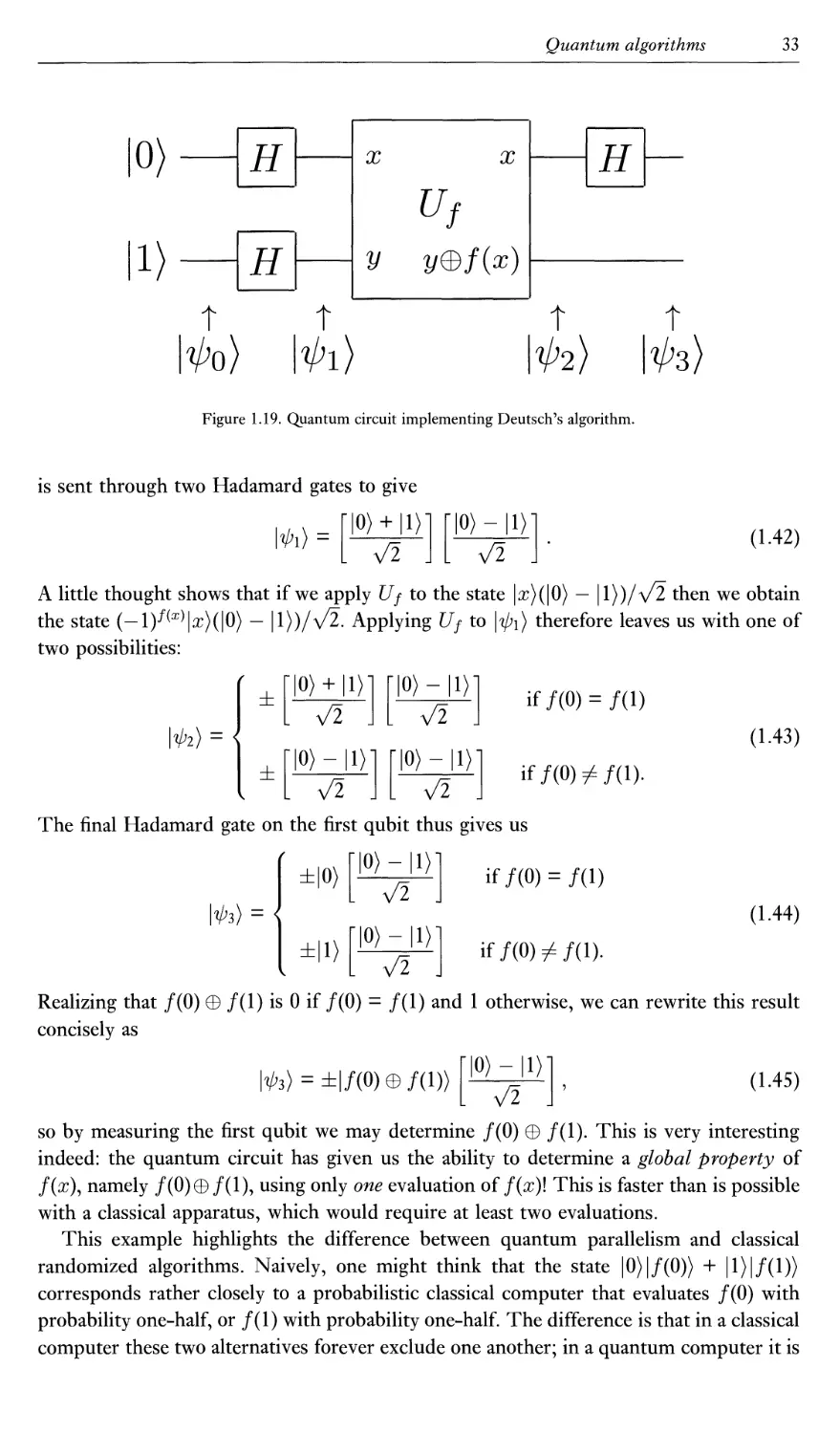

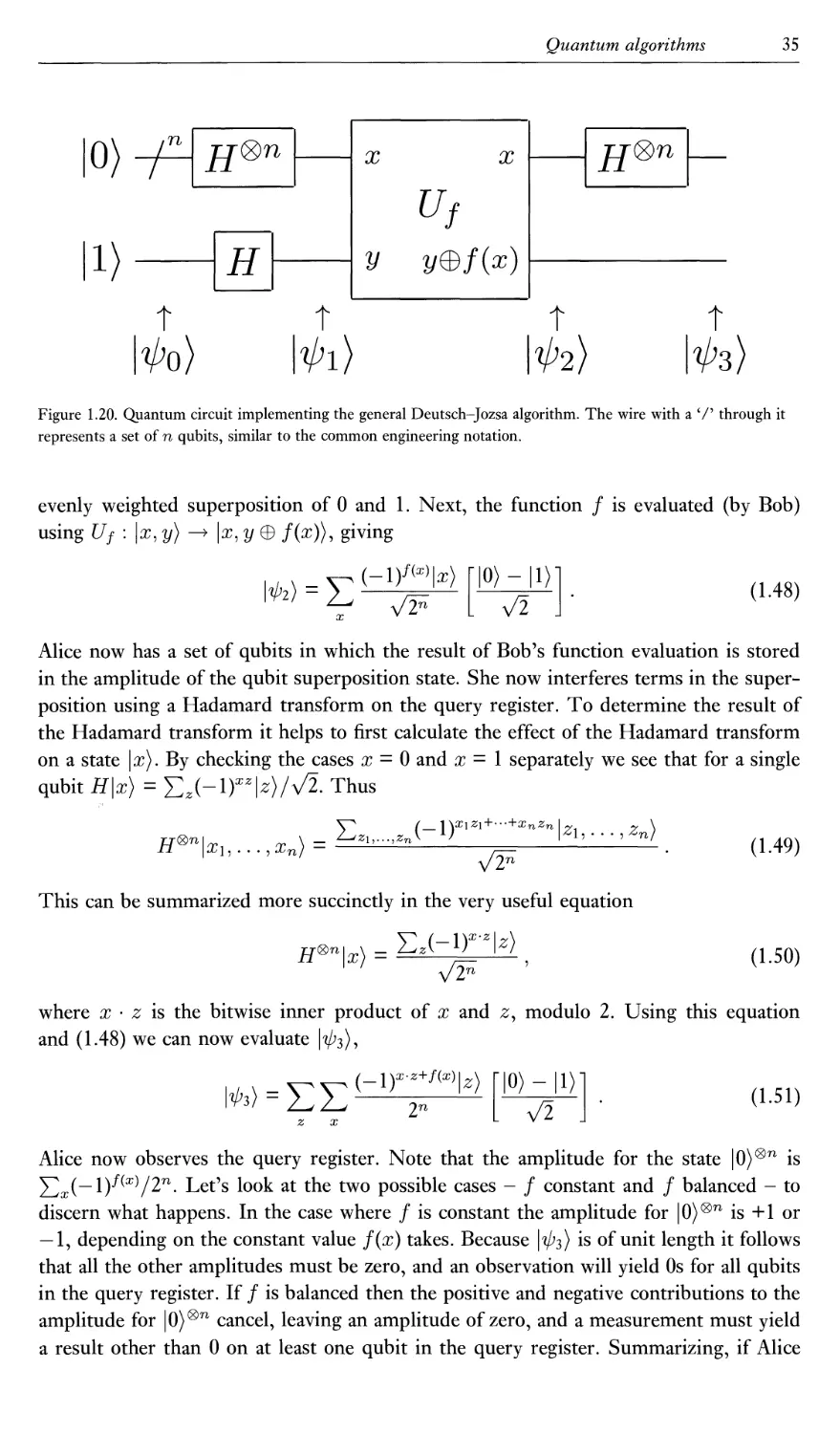


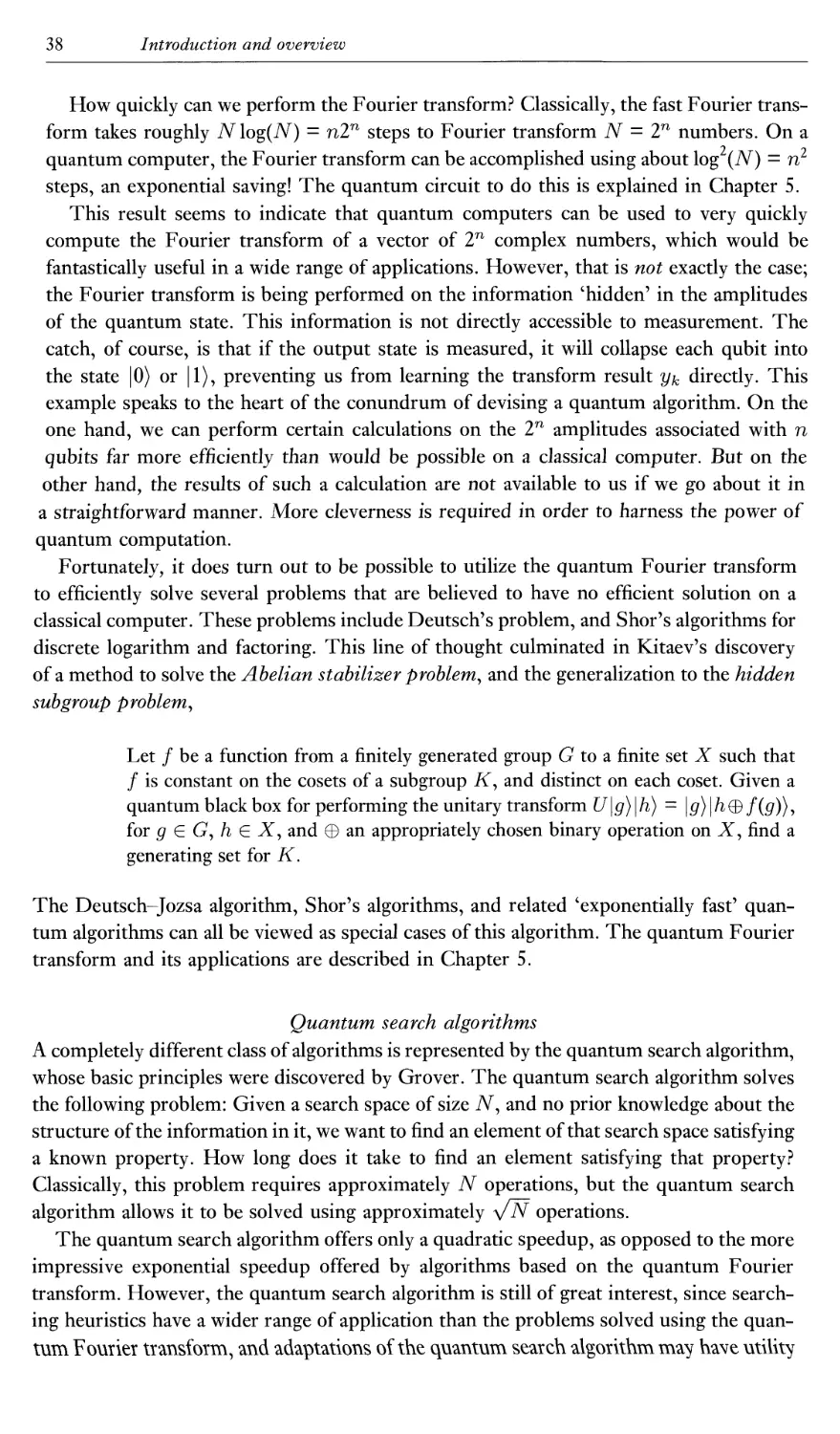


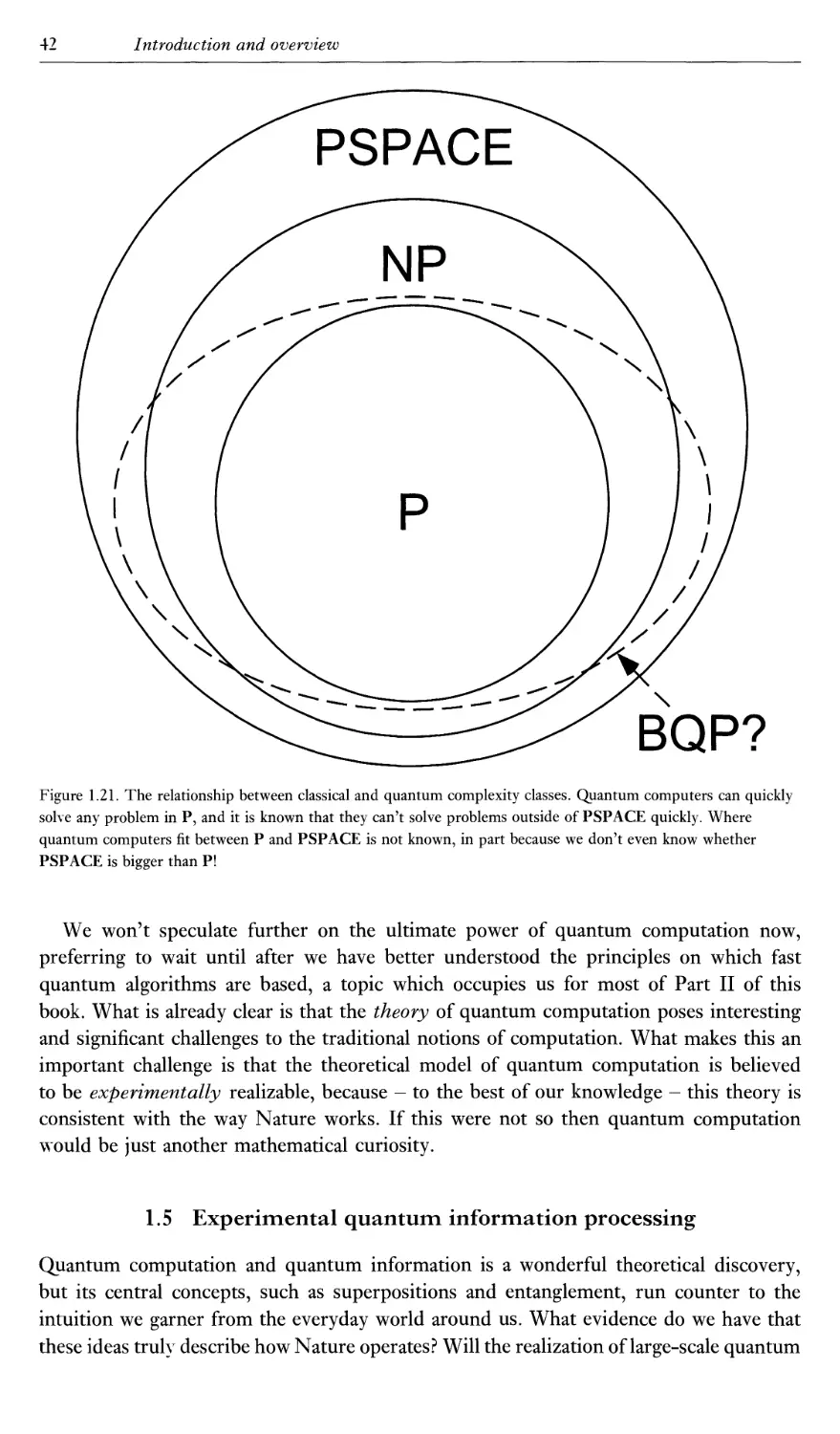







Author: Nielsen M. A. Chuang I. L.
Tags: physics mathematical physics cambridge university press cambridge series on information and the natural sciences quantum computation
ISBN: 0-521-63503-9
Year: 2004



Text
                    ntum Comp^
antum I
lAEL A.NIELSEN
'>WD ISAAC L.CHUANG
i

Chuangand Nielsen have produced thefirstcomprehensive
study ofquantum computation.Todevelopa robust under-
standingofthis subject one must integrate many ideas whose
origins are variously within physics, computerscience, or
mathematics. Untilthistext, puttingtogetherthe essential
material, much less mastering it, has been a challenge. Our
Universe has intrinsic capabilities and limitations on the pro-
cessingof information. What these are will ultimately
determine the course oftechnology and shape oureffortstofind a
fundamental physical theory. This book is an excellent wayfor
any scientist orgraduate student-in any ofthe related fields-
toenterthe discussion.
Michael Freedman, Fields Meda'ist, Microsoft
Nielsen and Chuang's new text is remarkably thorough and
up-to-date, covering many as pectsofthis rapidly evolvingfield
from a physics perspective, complementingthecomputer
science perspective ofGruska's 1999 text. The authors have
Thistextisacomprehensiveintroductionto succeeded in producing a self-contained bookaccessibleto
the main ideas and techniques ofthefield of anyone with a good undergraduate background in math,
quantum computation and quantum infor- computerscienceorphysical sciences. An independent
mation. Until now, the rapid rate of progress studentcouldspendanenjoyableyearreadingthisbookand
and its cross-disciplinary nature have made emergereadytotacklethe^cHurentliteratureanddoserious
itdifficultfornewcomerstothefieldto research. Tostreamlinetheexposition.footnoteshavebeen
obtain a broad overview ofthe most impor- gathered into short but lively Histoo^andFurtherReading
^ ^^ u • J ix sections at the end of each chapter,
tanttechniquesand results. ^ ^"~^->=
Michael Nielsen and IsaacChuangaskthe ^^"'^"^ BennettlNJL
question: what are the ultimate physical jhis is an excellent book. The field is already too bigto cover
limitstocomputation and communication? completely in one book, but Nielsen and Chuanghave made
Theydescribe in detail such remarkable a good selection oftopics, and explain the topics they have
effectsasfastquantum algorithms,quatum chosen very well.
teleportation, quantum cryptography, and PeterShor, AT&T Research
quantum error-correction. A wealth of
accompanyingfigures and exercises illustrate and develop the
material in more depth. A special feature is the tutorial introductions
toquantum mechanics and computerscience included in Partlofthe
book, ensuringthat the subject is accessible even without a
background in physics orcomputerscience. In Part II, the authors present
quantum computation, and describe what a quantum computer is,
how it can be used to solve problemsfasterthanfamiliar'classical'
computers, and the real-world implementation ofquantum
computers. Part III concludes the book with an in-depth treatment ofquantum
information, explaining how quantum states can be used to perform
remarkable feats ofcommunication,togetherwith a discussion of how
it is possible to protectquantum states againstthe effects of noise.
This exciting text will be ofinteresttobeginninggraduate students
and researchers in physics,computerscience, mathematics, and CAAIBILIDGE
electrical engineeringwith an interest in quantum computation UNIVERSITY PRESS
and quantum information, and may be used as a text in courses \www.cambridge.org
on the subject.
PeterShor, AT&T Research
CAMBRIDGE
UNIVERSITY PRESS
\Aravw.cambridge.org

Quantum Computation and Quantum Information
This text is a comprehensive introduction to the main ideas and techniques
of the field of quantum computation and quantum information. Until now,
the rapid rate of progress and its cross-disciplinary nature have made it
difficult for newcomers to the field to obtain a broad overview of the most
important techniques and results.
Michael Nielsen and Isaac Chuang ask the question: what are the ultimate
physical limits to computation and communication? They describe in detail
such remarkable effects as fast quantum algorithms, quantum teleportation,
quantum cryptography and quantum error-correction. A wealth of
accompanying figures and exercises illustrate and develop the material in
more depth. A special feature is the tutorial introductions to quantum
mechanics and computer science included in Part I of the book, ensuring that
the subject is accessible even without a background in physics or computer
science. In Part II, the authors present quantum computation, and describe
what a quantum computer is, how it can be used to solve problems faster
than familiar 'classical' computers, and the real-world implementation of
quantum computers. Part III concludes the book with an in-depth treatment
of quantum information, explaining how quantum states can be used to
perform remarkable feats of communication, together with a discussion of
how it is possible to protect quantum states against the effects of noise.
This exciting text will be of interest to beginning graduate students and
researchers in physics, computer science, mathematics, and electrical
engineering with an interest in quantum computation and quantum
information, and may be used as a text in courses on the subject.
Michael Nielsen is a Postdoctoral Research Fellow at the University of
Queensland. He was born in Brisbane, Australia, and received his education
at the University of Queensland, obtaining postgraduate degrees in
Mathematics and Physics before receiving his Ph.D. in Physics as a
Fulbright Scholar at the University of New Mexico. He has held a visiting
position at the Los Alamos National Laboratory, and was the Tolman
Postdoctoral Fellow at the California Institute of Technology.
Isaac Chuang is with IBM Research, and also serves as a consulting professor
at Stanford University. He received his doctorate in Electrical Engineering
from Stanford University, where he was a Hertz Foundation Fellow, and
also holds degrees in Physics and in Electrical Engineering from MIT. Dr.
Chuang is a native of Louisville, Kentucky and enjoys reading, hiking, and
playing his violin.

Quantum Computation and Quantum Information
Michael A. Nielsen & Isaac L. Chuang
m CAMBRIDGE
^WM
UNIVERSITY PRESS

PUBLISHED BY THE PRESS SYNDICATE OF THE UNIVERSITY OF CAMBRIDGE
The Pitt Building, Trumpington Street, Cambridge, United Kingdom
CAMBRIDGE UNIVERSITY PRESS
The Edinburgh Building, Cambridge CB2 2p.U, UK
40 West 20th Street, New York, NY 1001U4211, USA
10 Stamford Road, Oakleigh, VIC 3166, Australia
Ruiz de Alarcon 13, 28014 Madrid, Spain
Dock House, The Waterfront, Cape Town 8001, South Africa
http: / / www. Cambridge. org
(c) Cambridge University Press 2000
This book is in copyright. Subject to statutory exception
and to the provisions of relevant collective licensing agreements,
no reproduction of any part may take place without
the written permission of Cambridge University Press.
First published 2000
Reprinted 2001 (twice)
Printed in the United Kingdom at the University Press, Cambridge
Typeset in Monotype Ehrhardt 10i/13pt, in UTyXIs [EPC]
A catalogue record of this book is available from the British Library
Library of Congress Cataloguing in Publication data
Nielsen, Michel A., and Chuang, Isaac L.
Quantum Computation and Quantum Information / Michael A. Nielsen and Isaac L. Chuang.
p. cm.
Includes bibliographical references and index.
ISBN 0-521-63503-9
1. Physics. I. Title.
QA401.G47 2000
511^8-dc21 98-22029 CIP
ISBN 0 521 63235 8 hardback
ISBN 0 521 63503 9 paperback

To our parents,
and our teachers.

Contents
Preface pcige xv
Acknowledgements xxi
Nomenclature and notation xxiii
Part I Fundamental concepts 1
1 Introduction and overview 1
1.1 Global perspectives 1
1.1.1 History of quantum computation and quantum information 2
1.1.2 Future directions 12
1.2 Quantum bits 13
1.2.1 Multiple qubits 16
1.3 Quantum computation 17
1.3.1 Single qubit gates 17
1.3.2 Multiple qubit gates 20
1.3.3 Measurements in bases other than the computational basis 22
1.3.4 Quantum circuits 22
1.3.5 Qubit copying circuit.^ 24
1.3.6 Example: Bell states 25
1.3.7 Example: quantum teleportation 26
1.4 Quantum algorithms 28
1.4.1 Classical computations on a quantum computer 29
1.4.2 Quantum parallelism 30
1.4.3 Deutsch's algorithm 32
1.4.4 The Deutsch-Jozsa algorithm 34
1.4.5 Quantum algorithms summarized 36
1.5 Experimental quantum information processing 42
1.5.1 The Stern-Gerlach experiment 43
1.5.2 Prospects for practical quantum information processing 46
1.6 Quantum information 50
1.6.1 Quantum information theory: example problems 52
1.6.2 Quantum information in a wider context 58
2 Introduction to quantum mechanics 60
2.1 Linear algebra 61
2.1.1 Bases and linear independence 62
2.1.2 Linear operators and matrices 63

Contents
2.1.3 The Pauli matrices 65
2.1.4 Inner products 65
2.1.5 Eigenvectors and eigenvalues 68
2.1.6 Adjoints and Hermitian operators 69
2.1.7 Tensor products 71
2.1.8 Operator functions 75
2.1.9 The commutator and anti-commutator 76
2.1.10 The polar and singular value decompositions 78
2.2 The postulates of quantum mechanics 80
2.2.1 State space 80
2.2.2 Evolution 81
2.2.3 Quantum measurement 84
2.2.4 Distinguishing quantum states 86
2.2.5 Projective measurements 87
2.2.6 POVM measurements 90
2.2.7 Phase 93
2.2.8 Composite systems 93
2.2.9 Quantum mechanics: a global view 96
2.3 Application: super dense coding 97
2.4 The density operator 98
2.4.1 Ensembles of quantum states 99
2.4.2 General properties of the density operator 101
2.4.3 The reduced density operator 105
2.5 The Schmidt decomposition and purifications 109
2.6 EPR and the Bell inequality 111
3 Introduction to computer science 120
3.1 Models for computation 122
3.1.1 Turing machines 122
3.1.2 Circuits 129
3.2 The analysis of computational problems 135
3.2.1 How to quantify computational resources 136
3.2.2 Computational complexity 138
3.2.3 Decision problems and the complexity classes P and NP 141
3.2.4 A plethora of complexity classes 150
3.2.5 Energy and computation 153
3.3 Perspectives on computer science 161
Part II Quantum computation 171
4 Quantum circuits 171
4.1 Quantum algorithms 172
4.2 Single qubit operations 174
4.3 Controlled operations 177
4.4 Measurement 185
4.5 Universal quantum gates 188

Contents
4.5.1 Two-level unitary gates are universal 189
4.5.2 Single qubit and CNOT gates are universal 191
4.5.3 A discrete set of universal operations 194
4.5.4 Approximating arbitrary unitary gates is generically hard 198
4.5.5 Quantum computational complexity 200
4.6 Summary of the quantum circuit model of computation 202
4.7 Simulation of quantum systems 204
4.7.1 Simulation in action 204
4.7.2 The quantum simulation algorithm 206
4.7.3 An illustrative example 209
4.7.4 Perspectives on quantum simulation 211
5 The quantum Fourier transform and its applications 216
5.1 The quantum Fourier transform 217
5.2 Phase estimation 221
5.2.1 Performance and requirements 223
5.3 Applications: order-finding and factoring 226
5.3.1 Application: order-finding 226
5.3.2 Application: factoring 232
5.4 General applications of the quantum Fourier transform 234
5.4.1 Period-finding 236
5.4.2 Discrete logarithms 238
5.4.3 The hidden subgroup problem 240
5.4.4 Other quantum algorithms? 242
6 Quantum search algorithms 248
6.1 The quantum search algorithm 248
6.1.1 The oracle 248
6.1.2 The procedure 250
6.1.3 Geometric visualization 252
6.1.4 Performance 253
6.2 Quantum search as a quantum simulation 255
6.3 Quantum counting 261
6.4 Speeding up the solution of NP-complete problems 263
6.5 Quantum search of an unstructured database 265
6.6 Optimality of the search algorithm 269
6.7 Black box algorithm limits 271
7 Quantum computers: physical realization 277
7.1 Guiding principles 277
7.2 Conditions for quantum computation 279
7.2.1 Representation of quantum information 279
7.2.2 Performance of unitary transformations 281
7.2.3 Preparation of fiducial initial states 281
7.2.4 Measurement of output result 282
7.3 Harmonic oscillator quantum computer 283
7.3.1 Physical apparatus 283

Contents
132 The Hamiltonian 284
7.3.3 Quantum computation 286
7.3.4 Drawbacks 286
7.4 Optical photon quantum computer 287
7.4.1 Physical apparatus 287
7.4.2 Quantum computation 290
7.4.3 Drawbacks 296
7.5 Optical cavity quantum electrodynamics 297
7.5.1 Physical apparatus 298
7.5.2 The Hamiltonian 300
7.5.3 Single-photon single-atom absorption and refraction 303
7.5.4 Quantum computation 306
7.6 Ion traps 309
7.6.1 Physical apparatus 309
7.6.2 The Hamiltonian 317
7.6.3 Quantum computation 319
7.6.4 Experiment 321
7.7 Nuclear magnetic resonance 324
7.7.1 Physical apparatus 325
7.7.2 The Hamiltonian 326
7.7.3 Quantum computation 331
7.7.4 Experiment 336
7.8 Other implementation schemes 343
Part III Quantum information 353
8 Quantum noise and quantum operations 353
8.1 Classical noise and Markov processes 354
8.2 Quantum operations 356
8.2.1 Overview 356
8.2.2 Environments and quantum operations 357
8.2.3 Operator-sum representation 360
8.2.4 Axiomatic approach to quantum operations 366
8.3 Examples of quantum noise and quantum operations 373
8.3.1 Trace and partial trace 374
8.3.2 Geometric picture of single qubit quantum operations 374
8.3.3 Bit flip and phase flip channels 376
8.3.4 Depolarizing channel 378
8.3.5 Amplitude damping 380
8.3.6 Phase damping 383
8.4 Applications of quantum operations 386
8.4.1 Master equations 386
8.4.2 Quantum process tomography 389
8.5 Limitations of the quantum operations formalism 394

Contents
9 Distance measures for quantum information 399
9.1 Distance measures for classical information 399
9.2 How close are two quantum states.^ 403
9.2.1 Trace distance 403
9.2.2 Fidelity 409
9.2.3 Relationships between distance measures 415
9.3 How well does a quantum channel preserve information? 416
10 Quantum error-correction 425
10.1 Introduction 426
10.1.1 The three qubit bit flip code 427
10.1.2 Three qubit phase flip code 430
10.2 The Shor code . 432
10.3 Theory of quantum error-correction 435
10.3.1 Discretization of the errors 438
10.3.2 Independent error models 441
10.3.3 Degenerate codes 444
10.3.4 The quantum Hamming bound 444
10.4 Constructing quantum codes 445
10.4.1 Classical linear codes 445
10.4.2 Calderbank-Shor-Steane codes 450
10.5 Stabilizer codes 453
10.5.1 The stabilizer formalism 454
10.5.2 Unitary gates and the stabilizer formalism 459
10.5.3 Measurement in the stabilizer formalism 463
10.5.4 The Gottesman-Knill theorem 464
10.5.5 Stabilizer code constructions 464
10.5.6 Examples 467
10.5.7 Standard form for a stabilizer code 470
10.5.8 Quantum circuits for encoding, decoding, and correction 472
10.6 Fault-tolerant quantum computation 474
10.6.1 Fault-tolerance: the big picture 475
10.6.2 Fault-tolerant quantum logic 482
10.6.3 Fault-tolerant measurement 489
10.6.4 Elements of resilient quantum computation 493
11 Entropy and information 500
11.1 Shannon entropy 500
11.2 Basic properties of entropy 502
11.2.1 The binary entropy 502
11.2.2 The relative entropy 504
11.2.3 Conditional entropy and mutual information 505
11.2.4 The data processing inequality 509
11.3 Von Neumann entropy 510
11.3.1 Quantum relative entropy 511
11.3.2 Basic properties of entropy 513
11.3.3 Measurements and entropy 514

Contents
11.3.4 Subadditivity 515
11.3.5 Concavity of the entropy 516
11.3.6 The entropy of a mixture of quantum states 518
11.4 Strong subadditivity 519
11.4.1 Proof of strong subadditivity 519
11.4.2 Strong subadditivity: elementary applications 522
12 Quantum information theory 528
12.1 Distinguishing quantum states and the accessible information 529
12.1.1 The Holevo bound 531
12.1.2 Example applications of the Holevo bound 534
12.2 Data compression 536
12.2.1 Shannon's noiseless channel coding theorem 537
12.2.2 Schumacher's quantum noiseless channel coding theorem 542
12.3 Classical information over noisy quantum channels 546
12.3.1 Communication over noisy classical channels 548
12.3.2 Communication over noisy quantum channels 554
12.4 Quantum information over noisy quantum channels 561
12.4.1 Entropy exchange and the quantum Fano inequality 561
12.4.2 The quantum data processing inequality 564
12.4.3 Quantum Singleton bound 568
12.4.4 Quantum error-correction, refrigeration and Maxwell's demon 569
12.5 Entanglement as a physical resource 571
12.5.1 Transforming bi-partite pure state entanglement 573
12.5.2 Entanglement distillation and dilution 578
12.5.3 Entanglement distillation and quantum error-correction 580
12.6 Quantum cryptography 582
12.6.1 Private key cryptography 582
12.6.2 Privacy amplification and information reconciliation 584
12.6.3 Quantum key distribution 586
12.6.4 Privacy and coherent information 592
12.6.5 The security of quantum key distribution 593
Appendices 608
Appendix 1: Notes on basic probability theory 608
Appendix 2: Group theory 610
A2.1 Basic definitions 610
A2.1.1 Generators 611
A2.1.2 Cyclic groups 611
A2.1.3 Cosets 612
A2.2 Representations 612
A2.2.1 Equivalence and reducibility 612
A2.2.2 Orthogonality 613
A2.2.3 The regular representation 614

Contents
A2.3 Fourier transforms 615
Appendix 3: The Solovay-Kitaev theorem 617
Appendix 4: Number theory 625
A4.1 Fundamentals 625
A4.2 Modular arithmetic and Euclid's algorithm 626
A4.3 Reduction of factoring to order-finding 633
A4.4 Continued fractions 635
Appendix 5: Public key cryptography and the RSA cryptosystem 640
Appendix 6: Proof of Lieb's theorem 645
Bibliography 649
Index 665

Preface
This book provides an introduction to the main ideas and techniques of the field of
quantum computation and quantum information. The rapid rate of progress in this field
and its cross-disciplinary nature have made it difficult for newcomers to obtain a broad
overview of the most important techniques and results of the field.
Our purpose in this book is therefore twofold. First, we introduce the background
material in computer science, mathematics and physics necessary to understand
quantum computation and quantum information. This is done at a level comprehensible to
readers with a background at least the equal of a beginning graduate student in one or
more of these three disciplines; the most important requirements are a certain level of
mathematical maturity, and the desire to learn about quantum computation and quantum
information. The second purpose of the book is to develop in detail the central results of
quantum computation and quantum information. With thorough study the reader should
develop a working understanding of the fundamental tools and results of this exciting
field, either as part of their general education, or as a prelude to independent research in
quantum computation and quantum information.
Structure of the book
The basic structure of the book is depicted in Figure 1. The book is divided into three
parts. The general strategy is to proceed from the concrete to the more abstract whenever
possible. Thus we study quantum computation before quantum information; specific
quantum error-correcting codes before the more general results of quantum information
theory; and throughout the book try to introduce examples before developing general
theory.
Part I provides a broad overview of the main ideas and results of the field of
quantum computation and quantum information, and develops the background material in
computer science, mathematics and physics necessary to understand quantum
computation and quantum information in depth. Chapter 1 is an introductory chapter which
outlines the historical development and fundamental concepts of the field, highlighting
some important open problems along the way. The material has been structured so as
to be accessible even without a background in computer science or physics. The
background material needed for a more detailed understanding is developed in Chapters 2
and 3, which treat in depth the fundamental notions of quantum mechanics and
computer science, respectively. You may elect to concentrate more or less heavily on different
chapters of Part I, depending upon your background, returning later as necessary to fill
any gaps in your knowledge of the fundamentals of quantum mechanics and computer
science.
Part II describes quantum computation in detail. Chapter 4 describes the fundamen-

Preface
Parti
Fundamental
Concepts
^>7 I :-
^ ^^ /^Introduction ^
r Quantum X, l^and Overview J
V Mechanics y--^ ^T' ^
Computer^ I
Science >-^
Part II
[ pgrt III" n
Quantum
Computation
Quantum
Information
^T^
Quantum
Circuits
Q
Quantum ^i
Fourier Transform> ^'"
Q
Noise and TVu,
Quantum Operations'-^
Distance X
IVleasures^Jj'
Quantum r|~i
Search >'
G
r Physical
Realizations >
Quantum
Error-Correctiony
Figure 1. Structure of the book.
tal elements needed to perform quantum computation, and presents many elementary
operations which may be used to develop more sophisticated applications of quantum
computation. Chapters 5 and 6 describe the quantum Fourier transform and the quantum
search algorithm, the tv^o fundamental quantum algorithms presently knov^n. Chapter 5
also explains how the quantum Fourier transform may be used to solve the factoring and
discrete logarithm problems, and the importance of these results to cryptography.
Chapter 7 describes general design principles and criteria for good physical implementations of
quantum computers, using as examples several realizations which have been successfully
demonstrated in the laboratory.
Part III is about quantum information: what it is, how information is represented and
communicated using quantum states, and how to describe and deal with the corruption of
quantum and classical information. Chapter 8 describes the properties of quantum noise
which are needed to understand real-world quantum information processing, and the
quantum operations formalism^ a powerful mathematical tool for understanding
quantum noise. Chapter 9 describes distance measures for quantum information which allow
us to make quantitatively precise what it means to say that two items of quantum
information are similar. Chapter 10 explains quantum error-correcting codes, which may be
used to protect quantum computations against the effect of noise. An important result in
this chapter is the threshold theorem^ which shows that for realistic noise models, noise
is in principle not a serious impediment to quantum computation. Chapter 11 introduces
the fundamental information-theoretic concept of entropy^ explaining many properties of
entropy in both classical and quantum information theory. Finally, Chapter 12 discusses
the information carrying properties of quantum states and quantum communication chan-

Preface xvii
nels, detailing many of the strange and interesting properties such systems can have for
the transmission of information both classical and quantum, and for the transmission of
secret information.
A large number of exercises and problems appear throughout the book. Exercises are
intended to solidify understanding of basic material and appear within the main body of
the text. With few exceptions these should be easily solved with a few minutes work.
Problems appear at the end of each chapter, and are intended to introduce you to new
and interesting material for which there was not enough space in the main text. Often the
problems are in multiple parts, intended to develop a particular line of thought in some
depth. A few of the problems were unsolved as the book went to press. When this is the
case it is noted in the statement of the problem. Each chapter concludes with a summary
of the main results of the chapter, and with a 'History and further reading' section that
charts the development of the main ideas in the chapter, giving citations and references
for the whole chapter, as well as providing recommendations for further reading.
The front matter of the book contains a detailed Table of Contents, which we encourage
you to browse. There is also a guide to nomenclature and notation to assist you as you
read.
The end matter of the book contains six appendices, a bibliography, and an index.
Appendix 1 reviews some basic definitions, notations, and results i^i elementary
probability theory. This material is assumed to be familiar to readers, and is included for ease of
reference. Similarly, Appendix 2 reviews some elementary concepts from group theory,
and is included mainly for convenience. Appendix 3 contains a proof of the Solovay—
Kitaev theorem, an important result for quantum computation, which shows that a finite
set of quantum gates can be used to quickly approximate an arbitrary quantum gate.
Appendix 4 reviews the elementary material on number theory needed to understand
the quantum algorithms for factoring and discrete logarithm, and the RSA cryptosystem,
which is itself reviewed in Appendix 5. Appendix 6 contains a proof of Lieb's theorem,
one of the most important results in quantum computation and quantum information,
and a precursor to important entropy inequalities such as the celebrated strong subad-
ditivity inequality. The proofs of the Solovay-Kitaev theorem and Lieb's theorem are
lengthy enough that we felt they justified a treatment apart from the main text.
The bibliography contains a listing of all reference materials cited in the text of the
book. Our apologies to any researcher whose work we have inadvertently omitted from
citation.
The field of quantum computation and quantum information has grown so rapidly in
recent years that we have not been able to cover all topics in as much depth as we would
have liked. Three topics deserve special mention. The first is the subject oi entanglement
measures. As we explain in the book, entanglement is a key element in effects such as
quantum teleportation, fast quantum algorithms, and quantum error-correction. It is,
in short, a resource of great utility in quantum computation and quantum information.
There is a thriving research community currently fleshing out the notion of entanglement
as a new type of physical resource, finding principles which govern its manipulation and
utilization. We felt that these investigations, while enormously promising, are not yet
complete enough to warrant the more extensive coverage we have given to other subjects
in this book, and we restrict ourselves to a brief taste in Chapter 12. Similarly, the
subject of distributed quantum computation (sometimes known as quantum communication
complexity) is an enormously promising subject under such active development that we

sviii Preface
have not given it a treatment for fear of being obsolete before publication of the book.
The implementation of quantum information processing machines has also developed
into a fascinating and rich area, and we limit ourselves to but a single chapter on this
subject. Clearly, much more can be said about physical implementations, but this would
begin to involve many more areas of physics, chemistry, and engineering, which we do
not have room for here.
How to use this book
This book may be used in a wide variety of ways. It can be used as the basis for a variety
of courses, from short lecture courses on a specific topic in quantum computation and
quantum information, through to full-year classes covering the entire field. It can be
used for independent study by people who would like to learn just a little about quantum
computation and quantum information, or by people who would like to be brought up to
the research frontier. It is also intended to act as a reference work for current researchers
in the field. We hope that it will be found especially valuable as an introduction for
researchers new to the field.
Note to the independent reader
The book is designed to be accessible to thfe independent reader. A large number of
exercises are peppered throughout the text, whiph can be used as self-tests for understanding
of the material in the main text. The Table of Contents and end of chapter summaries
should enable you to quickly determine which chapters you wish to study in most depth.
The dependency diagram. Figure 1, will help you determine in what order material in
the book may be covered.
Note to the teacher
This book covers a diverse range of topics, and can therefore be used as the basis for a
wide variety of courses.
A one-semester course on quantum computation could be based upon a selection of
material from Chapters 1 through 3, depending on the background of the class, followed
by Chapter 4 on quantum circuits. Chapters 5 and 6 on quantum algorithms, and a
selection from Chapter 7 on physical implementations, and Chapters 8 through 10 to
understand quantum error-correction, with an especial focus on Chapter 10.
A one-semester course on quantum information could be based upon a selection of
material from Chapters 1 through 3, depending on the background of the class. Following
that. Chapters 8 through 10 on quantum error-correction, followed by Chapters 11 and 12
on quantum entropy and quantum information theory, respectively.
A full year class could cover all material in the book, with time for additional readings
selected from the 'History and further reading' section of several chapters. Quantum
computation and quantum information also lend themselves ideally to independent research
projects for students.
Aside from classes on quantum computation and quantum information, there is another
way we hope the book will be used, which is as the text for an introductory class in
quantum mechanics for physics students. Conventional introductions to quantum mechanics
rely heavily on the mathematical machinery of partial differential equations. We believe
this often obscures the fundamental ideas. Quantum computation and quantum informa-

Preface xix
tion offers an excellent conceptual laboratory for understanding the basic concepts and
unique aspects of quantum mechanics, without the use of heavy mathematical machinery.
Such a class would focus on the introduction to quantum mechanics in Chapter 2, basic
material on quantum circuits in Chapter 4, a selection of material on quantum algorithms
from Chapters 5 and 6, Chapter 7 on physical implementations of quantum computation,
and then almost any selection of material from Part III of the book, depending upon
taste.
Note to the student
We have written the book to be as self-contained as possible. The main exception is that
occasionally we have omitted arguments that one really needs to work through oneself
to believe; these are usually given as exercises. Let us suggest that you should at least
attempt all the exercises as you work through the book. With few exceptions the exercises
can be worked out in a few minutes. If you are having a lot of difficulty with many of
the exercises it may be a sign that you need to go back and pick up one or more key
concepts.
Further reading
As already noted, each chapter concludes with a 'History and further reading' section.
There are also a few broad-ranging references that might be of interest to readers.
Preskill'st^^^^^^] superb lecture notes approach quantum computation and quantum
information from a somewhat different point of view than this book. Good overview articles on
specific subjects include (in order of their appearance in this book): Aharonov's review of
quantum computation^"^^^^^^], Kitaev's review of algorithms and error-correction^^^^^^^],
Mosca's thesis on quantum algorithms^^^^^^^, Fuchs' thesis^^^^^^^ on distinguishability
and distance measures in quantum information, Gottesman's thesis on quantum error-
correctiont^^^^^], Preskill's review of quantum error-correction^^^^^^], Nielsen's thesis on
quantum information theoryt^^^^^], and the reviews of quantum information theory by
Bennett and Short^^^^^ and by Bennett and DiVincenzo^^^^^l Other useful references
include Gruska's bookt^^^^^^, and the collection of review articles edited by Lo, Spiller,
and Popescut^^P^^].
Errors
Any lengthy document contains errors and omissions, and this book is surely no exception
to the rule. If you find any errors or have other comments to make about the book,
please email them to: qci^squint. org. As errata are found, we will add them to a list
maintained at the book web site: http: //www. squint. org/qci/.

Acknowledgements
A few people have decisively influenced how we think about quantum computation and
quantum information. For many enjoyable discussions which have helped us shape and
refine our views, MAN thanks Carl Caves, Chris Fuchs, Gerard Milburn, John Preskill
and Ben Schumacher, and ILC thanks Tom Cover, Umesh Vazirani, Yoshi Yamamoto,
and Bernie Yurke.
An enormous number of people have helped in the construction of this book, both
directly and indirectly. A partial list includes Dorit Aharonov, Andris Ambainis, Nabil
Amer, Howard Barnum, Dave Beckman, Harry Buhrman, the Caltech Quantum Optics
Foosballers, Andrew Childs, Fred Chong, Richard Cleve, John Conway, John Cortese,
Michael DeShazo, Ronald de Wolf, David DiVincenzo, Steven van Enk, Henry Everitt,
Ron Fagin, Mike Freedman, Michael Gagen, Neil Gershenfeld, Daniel Gottesman, Jim
Harris, Alexander Holevo, Andrew Huibers, Julia Kempe, Alesha Kitaev, Manny Knill,
Shing Kong, Raymond Laflamme, Andrew Landahl, Ron Legere, Debbie Leung, Daniel
Lidar, Elliott Lieb, Theresa Lynn, Hideo Mabuchi, Yu Manin, Mike Mosca, Alex Pines,
Sridhar Rajagopalan, Bill Risk, Beth Ruskai, Sara Schneider, Robert Schrader, Peter
Shor, Sheri Stoll, Volker Strassen, Armin Uhlmann, Lieven Vandersypen, Anne Ver-
hulst, Debby Wallach, Mike Westmoreland, Dave Wineland, Howard Wiseman, John
Yard, Xinlan Zhou, and Wojtek Zurek.
Thanks to the folks at Cambridge University Press for their help turning this book
from an idea into reality. Our especial thanks go to our thoughtful and enthusiastic
editor Simon Capelin, who shepherded this project along for more than three years, and
to Margaret Patterson, for her timely and thorough copy-editing of the manuscript.
Parts of this book were completed while MAN was a Tolman Prize Fellow at the
California Institute of Technology, a member of the T-6 Theoretical Astrophysics Group
at the Los Alamos National Laboratory, and a member of the University of New Mexico
Center for Advanced Studies, and while ILC was a Research Staff Member at the IBM
Almaden Research Center, a consulting Assistant Professor of Electrical Engineering
at Stanford University, a visiting researcher at the University of California Berkeley
Department of Computer Science, a member of the Los Alamos National Laboratory T-6
Theoretical Astrophysics Group, and a visiting researcher at the University of California
Santa Barbara Institute for Theoretical Physics. We also appreciate the warmth and
hospitality of the Aspen Center for Physics, where the final page proofs of this book were
finished.
MAN and ILC gratefully acknowledge support from DARPA under the NMRQC
research initiative and the QUIC Institute administered by the Army Research Office.
We also thank the National Science Foundation, the National Security Agency, the Office
of Naval Research, and IBM for their generous support.

Nomenclature and notation
There are several items of nomenclature and notation which have two or more meanings in
common use in the field of quantum computation and quantum information. To prevent
confusion from arising, this section collects many of the more frequently used of these
items, together with the conventions that will be adhered to in this book.
Linear algebra and quantum mechanics
All vector spaces are assumed to be finite dimensional, unless otherwise noted. In many
instances this restriction is unnecessary, or can be removed with some additional technical
work, but making the restriction globally makes the presentation more easily
comprehensible, and doesn't detract much from many of the intended applications of the results.
A positive operator A is one for which {il)\A\il)) > 0 for all \ip). A positive definite
operator A is one for which (^|A|^) > 0 for all \ip) j^O. The support of an operator
is defined to be the vector space orthogonal to its kernel. For a Hermitian operator, this
means the vector space spanned by eigenvectors of the operator with non-zero eigenvalues.
The notation U (and often but not always V) will generically be used to denote a unitary
operator or matrix. H is usually used to denote a quantum logic gate, the Hadamard
gate^ and sometimes to denote the Hamiltonian for a quantum system, with the meaning
clear from context.
Vectors will sometimes be written in column format, as for example.
@.1)
and sometimes for readability in the format A,2). The latter should be understood as
shorthand for a column vector. For two-level quantum systems used as qubits, we shall
usually identify the state |0) with the vector A,0), and similarly |1) with @, 1). We also
define the Pauli sigma matrices in the conventional way - see 'Frequently used quantum
gates and circuit symbols', below. Most significantly, the convention for the Pauli sigma
z matrix is that (Jz\^) — |0) and (Jz\^) — —11), which is reverse of what some physicists
(but usually not computer scientists or mathematicians) intuitively expect. The origin
of this dissonance is that the +1 eigenstate of cJz is often identified by physicists with a
so-called 'excited state', and it seems natural to many to identify this with 11), rather than
with |0) as is done in this book. Our choice is made in order to be consistent with the
usual indexing of matrix elements in linear algebra, which makes it natural to identify the
first column of Gz with the action of a^ on |0), and the second column with the action
on |1). This choice is also in use throughout the quantum computation and quantum
information community. In addition to the conventional notations Gx-> <Jy and Gz for the
Pauli sigma matrices, it will also be convenient to use the notations (Ji, (J2, cts for these

Nomenclature and notation
three matrices, and to define ctq as the 2x2 identity matrix. Most often, however, we use
the notations /, X, Y and Z for (Jq, (Ji^cji and (J3, respectively.
Information theory and probability
As befits good information theorists, logarithms are always taken to base two, unless
otherwise noted. We use log(x) to denote logarithms to base 2, and \n{x) on those rare
occasions when we wish to take a natural logarithm. The term probability distribution
is used to refer to a finite set of real numbers, Px-, such that Px^^ and YlxPx — 1- The
relative entropy of a positive operator A with respect to a positive operator B is defined
by S{A\\B) = tv{A\ogA) - tr(AlogS).
Miscellanea
0 denotes modulo two addition. Throughout this book 'z' is pronounced 'zed'.
Frequently used quantum gates and circuit symbols
Certain schematic symbols are often used to denote unitary transforms which are useful in
the design of quantum circuits. For the reader's convenience, many of these are gathered
together below. The rows and columns of the unitary transforms are labeled from left to
right and top to bottom as 00 ... 0, 00 ... 1 to 11 ... 1 with the bottom-most wire being
the least significant bit. Note that e^^/"^ is the square root of z, so that the 7r/8 gate is the
square root of the phase gate, which itself is the square root of the Pauli-Z gate.
Hadamard \^
Pauli-X _
Pauli-y _
Pauli-Z _
Phase
7r/8 _
H
X
Y
Z
^
TJ
1
r V2
u
[{
n 1
' [1 -1
ro 11
[1 oj
'0 -i]
i 0 J
1 01
0 -ij
ri 0]
[0 i\
I 0 ■

Nomenclature and notation
controlled-NOT
swap
controlled-Z
controlled-phase
X
Hzh -^
H5h
Toffoli
-^
0 0 0
0 10 0
0 0 0 1
.0 0 10.
0 0 0
0 0 10
0 10 0
.0001
10 0 0
0 10 0
0 0 10
0 0 0-1
10 0 0
0 10 0
0 0 10
0 0 0 V
10 0 0 0 0 0 0
0 10 0 0 0 0 0
0 0 10 0 0 0 0
0 0 0 10 0 0 0
0 0 0 0 10 0 0
0 0 0 0 0 10 0
0 0 0 0 0 0 0 1
0 0 0 0 0 0 10
Fredkin (controlled-swap)
10 0 0 0 0 0 0
0 10 0 0 0 0 0
0 0 10 0 0 0 0
0 0 0 10 0 0 0
0 0 0 0 10 0 0
0 0 0 0 0 0 10
0 0 0 0 0 10 0
0 0 0 0-0 0 0 1
measurement
qubit
classical bit
n qubits
Projection onto |0) and |1)
wire carrying a single qubit
(time goes left to right)
wire carrying a single classical bit
wire carrying n qubits

I Fundamental concepts
1 Introduction and overview
Science offers the boldest metaphysics of the age. It is a thoroughly human
construct, driven by the faith that if we dream, press to discover, explain, and
dream again, thereby plunging repeatedly into new terrain, the world will
somehow come clearer and we will grasp the true strangeness of the universe. And
the strangeness will all prove to be connected, and make sense.
- Edward O. Wilson
Information is physical.
- Rolf Landauer
What are the fundamental concepts of quantum computation and quantum information.^
How did these concepts develop? To what uses may they be put? How will they be
presented in this book? The purpose of this introductory chapter is to answer these questions
by developing in broad brushstrokes a picture of the field of quantum computation and
quantum information. The intent is to communicate a basic understanding of the central
concepts of the field, perspective on how they have been developed, and to help you
decide how to approach the rest of the book.
Our story begins in Section 1.1 with an account of the historical context in which
quantum computation and quantum information has developed. Each remaining section
in the chapter gives a brief introduction to one or more fundamental concepts from the
field: quantum bits (Section 1.2), quantum computers, quantum gates and quantum
circuits (Section 1.3), quantum algorithms (Section 1.4), experimental quantum information
processing (Section 1.5), and quantum information and communication (Section 1.6).
Along the way, illustrative and easily accessible developments such as quantum tele-
portation and some simple quantum algorithms are given, using the basic mathematics
taught in this chapter. The presentation is self-contained, and designed to be accessible
even without a background in computer science or physics. As we move along, we give
pointers to more in-depth discussions in later chapters, where references and suggestions
for further reading may also be found.
If as you read you're finding the going rough, skip on to a spot where you feel more
comfortable. At points we haven't been able to avoid using a little technical lingo which
won't be completely explained until later in the book. Simply accept it for now, and come
back later when you understand all the terminology in more detail. The emphasis in this
first chapter is on the big picture, with the details to be filled in later.
1.1 Global perspectives
Quantum computation and quantum information is the study of the information
processing tasks that can be accomplished using quantum mechanical systems. Sounds pretty

Introduction and overview
simple and obvious, doesn't it? Like many simple but profound ideas it was a long time
before anybody thought of doing information processing using quantum mechanical
systems. To see why this is the case, we must go back in time and look in turn at each
of the fields which have contributed fundamental ideas to quantum computation and
quantum information - quantum mechanics, computer science, information theory, and
cryptography. As we take our short historical tour of these fields, think of yourself first
as a physicist, then as a computer scientist, then as an information theorist, and finally
as a cryptographer, in order to get some feel for the disparate perspectives which have
come together in quantum computation and quantum information.
1.1.1 History of quantum computation and quantum information
Our story begins at the turn of the twentieth century when a unheralded revolution was
underway in science. A series of crises had arisen in physics. The problem was that the
theories of physics at that time (now dubbed classical physics) were predicting absurdities
such as the existence of an 'ultraviolet catastrophe' involving infinite energies, or electrons
spiraling inexorably into the atomic nucleus. At first such problems were resolved with
the addition of ad hoc hypotheses to classical physics, but as a better understanding
of atoms and radiation was gained these attempted explanations became more and more
convoluted. The crisis came to a head in the early 1920s after a quarter century of turmoil,
and resulted in the creation of the modern theory of quantum mechanics. Quantum
mechanics has been an indispensable part of science ever since, and has been applied
with enormous success to everything under and inside the Sun, including the structure
of the atom, nuclear fusion in stars, superconductors, the structure of DNA, and the
elementary particles of Nature.
What is quantum mechanics? Quantum mechanics is a mathematical framework or set
of rules for the construction of physical theories. For example, there is a physical theory
known as quantum electrodynamics which' describes with fantastic accuracy the
interaction of atoms and light. Quantum electrodynamics is built up within the framework of
quantum mechanics, but it contains specific rules not determined by quantum mechanics.
The relationship of quantum mechanics to specific physical theories like quantum
electrodynamics is rather like the relationship of a computer's operating system to specific
applications software — the operating system sets certain basic parameters and modes of
operation, but leaves open how specific tasks are accomplished by the applications.
The rules of quantum mechanics are simple but even experts find them
counterintuitive, and the earliest antecedents of quantum computation and quantum information
may be found in the long-standing desire of physicists to better understand quantum
mechanics. The best known critic of quantum mechanics, Albert Einstein, went to his
grave unreconciled with the theory he helped invent. Generations of physicists since have
wrestled with quantum mechanics in an effort to make its predictions more palatable.
One of the goals of quantum computation and quantum information is to develop tools
which sharpen our intuition about quantum mechanics, and make its predictions more
transparent to human minds.
For example, in the early 1980s, interest arose in whether it might be possible to use
quantum effects to signal faster than light - a big no-no according to Einstein's theory of
relativity. The resolution of this problem turns out to hinge on whether it is possible to
clone an unknown quantum state, that is, construct a copy of a quantum state. If cloning
were possible, then it would be possible to signal faster than light using quantum effects.

Global perspectives
However, cloning - so easy to accomplish with classical information (consider the words
in front of you, and where they came from!) - turns out not to be possible in general in
quantum mechanics. This no-cloning theorem^ discovered in the early 1980s, is one of
the earliest results of quantum computation and quantum information. Many refinements
of the no-cloning theorem have since been developed, and we now have conceptual tools
which allow us to understand how well a (necessarily imperfect) quantum cloning device
might work. These tools, in turn, have been applied to understand other aspects of
quantum mechanics.
A related historical strand contributing to the development of quantum computation
and quantum information is the interest, dating to the 1970s, of obtaining complete
control over single quantum systems. Applications of quantum mechanics prior to the 1970s
typically involved a gross level of control over a bulk sample containing an enormous
number of quantum mechanical systems, none of them directly accessible. For example,
superconductivity has a superb quantum mechanical explanation. However, because a
superconductor involves a huge (compared to the atomic scale) sample of conducting metal,
we can only probe a few aspects of its quantum mechanical nature, with the individual
quantum systems constituting the superconductor remaining inaccessible. Systems such
as particle accelerators do allow limited access to individual quantum systems, but again
provide little control over the constituent systems.
Since the 1970s many techniques for controlling single quantum systems have been
developed. For example, methods have been developed for trapping a single atom in an
'atom trap', isolating it from the rest of the world and allowing us to probe many different
aspects of its behavior with incredible precision. The scanning tunneling microscope
has been used to move single atoms around, creating designer arrays of atoms at will.
Electronic devices whose operation involves the transfer of only single electrons have
been demonstrated.
Why all this effort to attain complete control over single quantum systems? Setting
aside the many technological reasons and concentrating on pure science, the principal
answer is that researchers have done this on a hunch. Often the most profound insights
in science come when we develop a method for probing a new regime of Nature. For
example, the invention of radio astronomy in the 1930s and 1940s led to a spectacular
sequence of discoveries, including the galactic core of the Milky Way galaxy, pulsars, and
quasars. Low temperature physics has achieved its amazing successes by finding ways to
lower the temperatures of different systems. In a similar way, by obtaining complete
control over single quantum systems, we are exploring untouched regimes of Nature in
the hope of discovering new and unexpected phenomena. We are just now taking our first
steps along these lines, and already a few interesting surprises have been discovered in
this regime. What else shall we discover as we obtain more complete control over single
quantum systems, and extend it to more complex systems.^
Quantum computation and quantum information fit naturally into this program. They
provide a useful series of challenges at varied levels of difficulty for people devising
methods to better manipulate single quantum systems, and stimulate the development of
new experimental techniques and provide guidance as to the most interesting directions
in which to take experiment. Conversely, the ability to control single quantum systems
is essential if we are to harness the power of quantum mechanics for applications to
quantum computation and quantum information.
Despite this intense interest, efforts to build quantum information processing systems

Introduction and overview
have resulted in modest success to date. Small quantum computers, capable of doing
dozens of operations on a few qubits represent the state of the art in quantum computation.
Experimental prototypes for doing quantum cryptography - a way of communicating in
secret across long distances — have been demonstrated, and are even at the level where they
may be useful for some real-world applications. However, it remains a great challenge
to physicists and engineers of the future to develop techniques for making large-scale
quantum information processing a reality.
Let us turn our attention from quantum mechanics to another of the great intellectual
triumphs of the twentieth century, computer science. The origins of computer science
are lost in the depths of history. For example, cuneiform tablets indicate that by the time
of Hammurabi (circa 1750 B.C.) the Babylonians had developed some fairly sophisticated
algorithmic ideas, and it is likely that many of those ideas date to even earlier times.
The modern incarnation of computer science was announced by the great
mathematician Alan Turing in a remarkable 1936 paper. Turing developed in detail an abstract
notion of what we would now call a programmable computer, a model for computation
now known as the Turing machine^ in his honor. Turing showed that there is a Universal
Turing Machine that can be used to simulate any other Turing machine. Furthermore,
he claimed that the Universal Turing Machine completely captures what it means to
perform a task by algorithmic means. That is, if an algorithm can be performed on any piece
of hardware (say, a modern personal computer), then there is an equivalent algorithm
for a Universal Turing Machine which performs exactly the same task as the algorithm
running on the personal computer. This assertion, known as the Church—Turing thesis
in honor of Turing and another pioneer of computer science, Alonzo Church, asserts the
equivalence between the physical concept of what class of algorithms can be performed
on some physical device with the rigorous mathematical concept of a Universal Turing
Machine. The broad acceptance of thiVthesis laid the foundation for the development of
a rich theory of computer science.
Not long after Turing's paper, the first computers constructed from electronic
components were developed. John von Neumann developed a simple theoretical model for
how to put together in a practical fashion all the components necessary for a computer
to be fully as capable as a Universal Turing Machine. Hardware development truly took
off, though, in 1947, when John Bardeen, Walter Brattain, and Will Shockley developed
the transistor. Computer hardware has grown in power at an amazing pace ever since, so
much so that the growth was codified by Gordon Moore in 1965 in what has come to be
known as Moore's law^ which states that computer power will double for constant cost
roughly once every two years.
Amazingly enough, Moore's law has approximately held true in the decades since
the 1960s. Nevertheless, most observers expect that this dream run will end some time
during the first two decades of the twenty-first century. Conventional approaches to
the fabrication of computer technology are beginning to run up against fundamental
difficulties of size. Quantum effects are beginning to interfere in the functioning of
electronic devices as they are made smaller and smaller.
One possible solution to the problem posed by the eventual failure of Moore's law
is to move to a different computing paradigm. One such paradigm is provided by the
theory of quantum computation, which is based on the idea of using quantum mechanics
to perform computations, instead of classical physics. It turns out that while an ordinary
computer can be used to simulate a quantum computer, it appears to be impossible to

Global perspectives
perform the simulation in an efficient fashion. Thus quantum computers offer an essential
speed advantage over classical computers. This speed advantage is so significant that many
researchers believe that no conceivable amount of progress in classical computation would
be able to overcome the gap between the power of a classical computer and the power of
a quantum computer.
What do we mean by 'efficient' versus 'inefficient' simulations of a quantum computer?
Many of the key notions needed to answer this question were actually invented before
the notion of a quantum computer had even arisen. In particular, the idea of efficient
and inefficient algorithms was made mathematically precise by the field o^computational
complexity. Roughly speaking, an efficient algorithm is one which runs in time polynomial
in the size of the problem solved. In contrast, an inefficient algorithm requires super-
polynomial (typically exponential) time. What was noticed in the late 1960s and early
1970s was that it seemed as though the Turing machine model of computation was at
least as powerful as any other model of computation, in the sense that a problem which
could be solved efficiently in some model of computation could also be solved efficiently
in the Turing machine model, by using the Turing machine to simulate the other model
of computation. This observation was codified into a strengthened version of the Church-
Turing thesis:
Any algorithmic process can be simulated efficiently using a Turing machine.
The key strengthening in the strong Church-Turing thesis is the word efficiently. If
the strong Church-Turing thesis is correct, then it implies that no matter what type of
machine we use to perform our algorithms, that machine can be simulated efficiently
using a standard Turing machine. This is an important strengthening, as it implies that
for the purposes of analyzing whether a given computational task can be accomplished
efficiently, we may restrict ourselves to the analysis of the Turing machine model of
computation.
One class of challenges to the strong Church-Turing thesis comes from the field of
analog computation. In the years since Turing, many different teams of researchers have
noticed that certain types of analog computers can efficiently solve problems believed to
have no efficient solution on a Turing machine. At first glance these analog computers
appear to violate the strong form of the Church-Turing thesis. Unfortunately for analog
computation, it turns out that when realistic assumptions about the presence of noise in
analog computers are made, their power disappears in all known instances; they cannot
efficiently solve problems which are not efficiently solvable on a Turing machine. This
lesson - that the effects of realistic noise must be taken into account in evaluating the
efficiency of a computational model - was one of the great early challenges of quantum
computation and quantum information, a challenge successfully met by the development
of a theory oi quantum error-correcting codes znd fault-tolerant quantum computation.
Thus, unlike analog computation, quantum computation can in principle tolerate a finite
amount of noise and still retain its computational advantages.
The first major challenge to the strong Church-Turing thesis arose in the mid 1970s,
when Robert Solovay and Volker Strassen showed that it is possible to test whether an
integer is prime or composite using a randomized algorithm. That is, the Solovay—Strassen
test for primality used randomness as an essential part of the algorithm. The algorithm
did not determine whether a given integer was prime or composite with certainty. Instead,
the algorithm could determine that a number was probably prime or else composite with

Introduction and overview
certainty. By repeating the Solovay-Strassen test a few times it is possible to determine
with near certainty whether a number is prime or composite. Of especial interest at the
time the Solovay-Strassen test was proposed was that no efficient deterministic test for
primality was known. Thus, it seemed as though computers with access to a random
number generator would be able to efficiently perform computational tasks with no
efficient solution on a conventional deterministic Turing machine. This discovery inspired
a search for other randomized algorithms which has paid off handsomely, with the field
blossoming into a thriving area of research.
Randomized algorithms pose a challenge to the strong Church-Turing thesis,
suggesting that there are efficiently soluble problems which, nevertheless, cannot be efficiently
solved on a deterministic Turing machine. This challenge appears to be easily resolved
by a simple modification of the strong Church-Turing thesis:
Any algorithmic process can be simulated efficiently using a
probabilistic Turing machine.
This ad hoc modification of the strong Church-Turing thesis should leave you feeling
rather queasy. Might it not turn out at some later date that yet another model of
computation allows one to efficiently solve problems that are not efficiently soluble within Turing's
model of computation? Is there any way we can find a single model of computation which
is guaranteed to be able to efficiently simulate any other model of computation.^
Motivated by this question, in 1985 David Deutsch asked whether the laws of physics
could be use to derive an even stronger version of the Church-Turing thesis. Instead of
adopting ad hoc hypotheses, Deutsch looked to physical theory to provide a foundation
for the Church-Turing thesis that would be as secure as the status of that physical theory.
In particular, Deutsch attempted to define a computational device that would be capable
of efficiently simulating an arbitrary physical system. Because the laws of physics are
ultimately quantum mechanical, Deutsch was naturally led to consider computing devices
based upon the principles of quantum mechanics. These devices, quantum analogues of
the machines defined forty-nine years earlier by Turing, led ultimately to the modern
conception of a quantum computer used in this book.
At the time of writing it is not clear whether Deutsch's notion of a Universal
Quantum Computer is sufficient to efficiently simulate an arbitrary physical system. Proving
or refuting this conjecture is one of the great open problems of the field of quantum
computation and quantum information. It is p^sible, for example, that some effect of
quantum field theory or an even more esoteric Effect based in string theory, quantum
gravity or some other physical theory may take us beyond Deutsch's Universal
Quantum Computer, giving us a still more powerful model for computation. At this stage, we
simply don't know.
What Deutsch's model of a quantum computer did enable was a challenge to the strong
form of the Church-Turing thesis. Deutsch asked whether it is possible for a quantum
computer to efficiently solve computational problems which have no efficient solution on
a classical computer, even a probabilistic Turing machine. He then constructed a simple
example suggesting that, indeed, quantum computers might have computational powers
exceeding those of classical computers.
This remarkable first step taken by Deutsch was improved in the subsequent decade
by many people, culminating in Peter Shor's 1994 demonstration that two enormously
important problems - the problem of finding the prime factors of an integer, and the so-

Global perspectives
called 'discrete logarithm' problem - could be solved efficiently on a quantum computer.
This attracted widespread interest because these two problems were and still are widely
believed to have no efficient solution on a classical computer. Shor's results are a
powerful indication that quantum computers are more powerful than Turing machines, even
probabilistic Turing machines. Further evidence for the power of quantum computers
came in 1995 when Lov Grover showed that another important problem - the problem of
conducting a search through some unstructured search space - could also be sped up on
a quantum computer. While Grover's algorithm did not provide as spectacular a
speedup as Shor's algorithms, the widespread applicability of search-based methodologies has
excited considerable interest in Grover's algorithm.
At about the same time as Shor's and Grover's algorithms were discovered, many
people were developing an idea Richard Feynman had suggested in 1982. Feynman had
pointed out that there seemed to be essential difficulties in simulating quantum
mechanical systems on classical computers, and suggested that building computers based on
the principles of quantum mechanics would allow us to avoid those difficulties. In the
1990s several teams of researchers began fleshing this idea out, showing that it is indeed
possible to use quantum computers to efficiently simulate systems that have no known
efficient simulation on a classical computer. It is likely that one of the major applications
of quantum computers in the future will be performing simulations of quantum
mechanical systems too difficult to simulate on a classical computer, a problem with profound
scientific and technological implications.
What other problems can quantum computers solve more quickly than classical
computers.^ The short answer is that we don't know. Coming up with good quantum
algorithms seems to be hard. A pessimist might think that's because there's nothing quantum
computers are good for other than the applications already discovered! We take a
different view. Algorithm design for quantum computers is hard because designers face two
difficult problems not faced in the construction of algorithms for classical computers.
First, our human intuition is rooted in the classical world. If we use that intuition as an
aid to the construction of algorithms, then the algorithmic ideas we come up with will
be classical ideas. To design good quantum algorithms one must 'turn off one's classical
intuition for at least part of the design process, using truly quantum effects to achieve
the desired algorithmic end. Second, to be truly interesting it is not enough to design an
algorithm that is merely quantum mechanical. The algorithm must be better than any
existing classical algorithm! Thus, it is possible that one may find an algorithm which
makes use of truly quantum aspects of quantum mechanics, that is nevertheless not of
widespread interest because classical algorithms with comparable performance
characteristics exist. The combination of these two problems makes the construction of new
quantum algorithms a challenging problem for the future.
Even more broadly, we can ask if there are any generalizations we can make about the
power of quantum computers versus classical computers. What is it that makes quantum
computers more powerful than classical computers - assuming that this is indeed the
case.^ What class of problems can be solved efficiently on a quantum computer, and how
does that class compare to the class of problems that can be solved efficiently on a classical
computer.^ One of the most exciting things about quantum computation and* quantum
information is how little is known about the answers to these questions! It is a great
challenge for the future to understand these questions better.
Having come up to the frontier of quantum computation, let's switch to the history

Introduction and overview
of another strand of thought contributing to quantum computation and quantum
information: information theory. At the same time computer science was exploding in the
1940s, another revolution was taking place in our understanding of communication. In
1948 Claude Shannon published a remarkable pair of papers laying the foundations for
the modern theory of information and communication.
Perhaps the key step taken by Shannon was to mathematically define the concept of
information. In many mathematical sciences there is considerable flexibility in the choice
of fundamental definitions. Try thinking naively for a few minutes about the following
question: how would you go about mathematically defining the notion of an information
source.^ Several different answers to this problem have found widespread use; however,
the definition Shannon came up with seems to be far and away the most fruitful in
terms of increased understanding, leading to a plethora of deep results and a theory
with a rich structure which seems to accurately reflect many (though not all) real-world
communications problems.
Shannon was interested in two key questions related to the communication of
information over a communications channel. First, what resources are required to send
information over a communications channel.^ For example, telephone companies need
to know how much information they can reliably transmit over a given telephone cable.
Second, can information be transmitted in such a way that it is protected against noise
in the communications channel.^
Shannon answered these two questions by proving the two fundamental theorems of
information theory. The first. Shannon's noiseless channel coding theorem^ quantifies
the physical resources required to store the output from an information source.
Shannon's second fundamental theorem, the noisy channel coding theorem., quantifies how
much information it is possible to reliably transmit through a noisy communications
channel. To achieve reliable transmission in the presence of noise. Shannon showed that
error-correcting codes could be used to protect the information being sent. Shannon's
noisy channel coding theorem gives an upper limit on the protection afforded by error-
correcting codes. Unfortunately, Shannon's theorem does not explicitly give a practically
useful set of error-correcting codes to achieve that limit. From the time of Shannon's
papers until today, researchers have constructed more and better classes of error-correcting
codes in their attempts to come closer to the limit set by Shannon's theorem. A
sophisticated theory of error-correcting codes now exists offering the user a plethora of choices
in their quest to design a good error-correcting code. Such codes are used in a multitude
of places including, for example, compact disc payers, computer modems, and satellite
communications systems.
Quantum information theory has followed with similar developments. In 1995, Ben
Schumacher provided an analogue to Shannon's noiseless coding theorem, and in the
process defined the 'quantum bit' or 'qubit' as a tangible physical resource. However,
no analogue to Shannon's noisy channel coding theorem is yet known for quantum
information. Nevertheless, in analogy to their classical counterparts, a theory of quantum
error-correction has been developed which, as already mentioned, allows quantum
computers to compute effectively in the presence of noise, and also allows communication
over noisy quantum channels to take place reliably.
Indeed, classical ideas of error-correction have proved to be enormously important
in developing and understanding quantum error-correcting codes. In 1996, two groups
working independently, Robert Calderbank and Peter Shor, and Andrew Steane, discov-

Global perspectives
ered an important class of quantum codes now known as CSS codes after their initials.
This work has since been subsumed by the stabilizer codes, independently discovered by
Robert Calderbank, Eric Rains, Peter Shor and Neil Sloane, and by Daniel Gottesman.
By building upon the basic ideas of classical linear coding theory, these discoveries greatly
facilitated a rapid understanding of quantum error-correcting codes and their application
to quantum computation and quantum information.
The theory of quantum error-correcting codes was developed to protect quantum states
against noise. What about transmitting ordinary classical information using a quantum
channel.^ How efficiently can this be done.^ A few surprises have been discovered in this
arena. In 1992 Charles Bennett and Stephen Wiesner explained how to transmit two
classical bits of information, while only transmitting one quantum bit from sender to
receiver, a result dubbed superdense coding.
Even more interesting are the results in distributed quantum computation. Imagine
you have two computers networked, trying to solve a particular problem. How much
communication is required to solve the problem.^ Recently it has been shown that
quantum computers can require exponentially less communication to solve certain problems
than would be required if the networked computers were classical! Unfortunately, as yet
these problems are not especially important in a practical setting, and suffer from some
undesirable technical restrictions. A major challenge for the future of quantum
computation and quantum information is to find problems of real-world importance for which
distributed quantum computation offers a substantial advantage over distributed classical
computation.
Let's return to information theory proper. The study of information theory begins with
the properties of a single communications channel. In applications we often do not deal
with a single communications channel, but rather with networks of many channels. The
subject oi networked information theory deals with the information carrying properties
of such networks of communications channels, and has been developed into a rich and
intricate subject.
By contrast, the study of networked quantum information theory is very much in its
infancy. Even for very basic questions we know little about the information carrying
abilities of networks of quantum channels. Several rather striking preliminary results have
been found in the past few years; however, no unifying theory of networked information
theory exists for quantum channels. One example of networked quantum information
theory should suffice to convince you of the value such a general theory would have.
Imagine that we are attempting to send quantum information from Alice to Bob through
a noisy quantum channel. If that channel has zero capacity for quantum information,
then it is impossible to reliably send any information from Alice to Bob. Imagine instead
that we consider two copies of the channel, operating in synchrony. Intuitively it is clear
(and can be rigorously justified) that such a channel also has zero capacity to send
quantum information. However, if we instead reverse the direction of one of the channels, as
illustrated in Figure 1.1, it turns out that sometimes we can obtain a non-zero capacity
for the transmission of information from Alice to Bob! Counter-intuitive properties like
this illustrate the strange nature of quantum information. Better understanding the
information carrying properties of networks of quantum channels is a major open problem
of quantum computation and quantum information.
Let's switch fields one last time, moving to the venerable old art and science o^
cryptography. Broadly speaking, cryptography is the problem of doing communication or

10
Introduction and overview
Figure 1.1. Classically, if we have two very noisy channels of zero capacity running side by side, then the combined
channel has zero capacity to send information. Not surprisingly, if we reverse the direction of one of the channels,
we still have zero capacity to send information. Quantum mechanically, reversing one of the zero capacity channels
can actually allow us to send information!
computation involving two or more parties who may not trust one another. The best
known cryptographic problem is the transmission of secret messages. Suppose two parties
wish to communicate in secret. For example, you may wish to give your credit card
number to a merchant in exchange for goods, hopefully without any malevolent third party
intercepting your credit card number. The way this is done is to use a cryptographic
protocol. We'll describe in detail how cryptographic protocols work later in the book, but
for now it will suffice to make a few simple distinctions. The most important distinction
is between private key crypto systems and public key cryptosy stems.
The way a private key cry ptosy stem works is that two parties, 'Alice' and 'Bob', wish
to communicate by sharing z private key., which only they know. The exact form of the
key doesn't matter at this point - think of a string of zeroes and ones. The point is that
this key is used by Alice to encrypt the information she wishes to send to Bob. After
Alice encrypts she sends the encrypted information to Bob, who must now recover the
original information. Exactly how Alice encrypts the message depends upon the private
key., so that to recover the original message Bob needs to know the private key, in order
to undo the transformation Alice applied.
Unfortunately, private key cry ptosy stems have soili^ severe problems in many contexts.
The most basic problem is how to distribute the keys.^ In many ways, the key distribution
problem is just as difficult as the original problem of communicating in private - a
malevolent third party may be eavesdropping on the key distribution, and then use the
intercepted key to decrypt some of the message transmission.
One of the earliest discoveries in quantum computation and quantum information was
that quantum mechanics can be used to do key distribution in such a way that Alice and
Bob's security can not be compromised. This procedure is known as quantum
cryptography or quantum key distribution. The basic idea is to exploit the quantum mechanical
principle that observation in general disturbs the system being observed. Thus, if there is
an eavesdropper listening in as Alice and Bob attempt to transmit their key, the presence
of the eavesdropper will be visible as a disturbance of the communications channel Alice
and Bob are using to establish the key. Alice and Bob can then throw out the key bits
established while the eavesdropper was listening in, and start over. The first quantum
cryptographic ideas were proposed by Stephen Wiesner in the late 1960s, but unfortu-

Global perspectives 11
nately were not accepted for publication! In 1984 Charles Bennett and Gilles Brassard,
building on Wiesner's earlier work, proposed a protocol using quantum mechanics to
distribute keys between Alice and Bob, without any possibility of a compromise. Since
then numerous quantum cryptographic protocols have been proposed, and experimental
prototypes developed. At the time of this writing, the experimental prototypes are nearing
the stage where they may be useful in limited-scale real-world applications.
The second major type of cryptosystem is the public key crypto system. Public key
cryptosystems don't rely on Alice and Bob sharing a secret key in advance. Instead, Bob
simply publishes a 'public key', which is made available to the general public. Alice
can make use of this public key to encrypt a message which she sends to Bob. What
is interesting is that a third party cannot use Bob's public key to decrypt the message!
Strictly speaking, we shouldn't say cannot. Rather, the encryption transformation is
chosen in a very clever and non-trivial way so that it is extremely difficult (though not
impossible) to invert, given only knowledge of the public key. To make inversion easy. Bob
has a secret key matched to his public key, which together enable him to easily perform
the decryption. This secret key is not known to anybody other than Bob, who can therefore
be confident that only he can read the contents of Alice's transmission, to the extent that
it is unlikely that anybody else has the computational power to invert the encryption,
given only the public key. Public key cryptosystems solve the key distribution problem
by making it unnecessary for Alice and Bob to share a private key before communicating.
Rather remarkably, public key cryptography did not achieve widespread use until the
mid-1970s, when it was proposed independently by Whitfield Diffie and Martin Hellman,
and by Ralph Merkle, revolutionizing the field of cryptography. A little later, Ronald
Rivest, Adi Shamir, and Leonard Adleman developed the RSA cryptosystem.^ which
at the time of writing is the most widely deployed public key cryptosystem, believed to
offer a fine balance of security and practical usability. In 1997 it was disclosed that these
ideas - public key cryptography, the Diffie-Hellman and RSA cryptosystems - were
actually invented in the late 1960s and early 1970s by researchers working at the British
intelligence agency GCHQ.
The key to the security of public key cryptosystems is that it should be difficult to
invert the encryption stage if only the public key is available. For example, it turns out
that inverting the encryption stage of RSA is a problem closely related to factoring.
Much of the presumed security of RSA comes from the belief that factoring is a problem
hard to solve on a classical computer. However, Shor's fast algorithm for factoring on
a quantum computer could be used to break RSA! Similarly, there are other public key
cryptosystems which can be broken if a fast algorithm for solving the discrete logarithm
problem - like Shor's quantum algorithm for discrete logarithm - were known. This
practical application of quantum computers to the breaking of cryptographic codes has
excited much of the interest in quantum computation and quantum information.
We have been looking at the historical antecedents for quantum computation and
quantum information. Of course, as the field has grown and matured, it has sprouted
its own subfields of research, whose antecedents lie mainly within quantum computation
and quantum information.
Perhaps the most striking of these is the study of quantum entanglement.
Entanglement is a uniquely quantum mechanical resource that plays a key role in many of the
most interesting applications of quantum computation and quantum information;
entanglement is iron to the classical world's bronze age. In recent years there has been a

12 Introduction and overview
tremendous effort trying to better understand the properties of entanglement considered
as a fundamental resource of Nature, of comparable importance to energy, information,
entropy, or any other fundamental resource. Although there is as yet no complete theory
of entanglement, some progress has been made in understanding this strange property of
quantum mechanics. It is hoped by many researchers that further study of the properties
of entanglement will yield insights that facilitate the development of new applications in
quantum computation and quantum information.
1.1.2 Future directions
We've looked at some at the history and present status of quantum computation and
quantum information. What of the future.? What can quantum computation and
quantum information offer to science, to technology, and to humanity.? What benefits does
quantum computation and quantum information confer upon its parent fields of computer
science, information theory, and physics.? What are the key open problems of quantum
computation and quantum information.? We will make a few very brief remarks about
these overarching questions before moving onto more detailed investigations.
Quantum computation and quantum information has taught us to think physically
about computation^ and we have discovered that this approach yields many new and
exciting capabilities for information processing and communication. Computer scientists
and information theorists have been gifted with a new and rich paradigm for
exploration. Indeed, in the broadest terms we have learned that any physical theory^ not just
quantum mechanics, may be used as the basis for a theory of information processing
and communication. The fruits of these explorations may one day result in information
processing devices with capabilities far beyond today's computing and communications
systems, with concomitant benefits and drawbacks for society as a whole.
Quantum computation and quantum information certainly offer challenges aplenty
to physicists, but it is perhaps a little subtle what quantum computation and quantum
information offers to physics in the long term. We believe that just as we have learned to
think physically about computation, we can also learn to think computationally about
physics. Whereas physics has traditionally been a discipline focused on understanding
'elementary' objects and simple systems, many interesting aspects of Nature arise only
when things become larger and more complicated. Chemistry and engineering deal with
such complexity to some extent, but most often in a rather ad hoc fashion. One of
the messages of quantum computation and information is that new tools are available
for traversing the gulf between the small and the relatively complex: computation and
algorithms provide systematic means for constructing and understanding such systems.
Applying ideas from these fields is already beginning to yield new insights into physics.
It is our hope that this perspective will blossom in years to come into a fruitful way of
understanding all aspects of physics.
We've briefly examined some of the key motivations and ideas underlying quantum
computation and quantum information. Over the remaining sections of this chapter we
give a more technical but still accessible introduction to these motivations and ideas, with
the hope of giving you a bird's-eye view of the field as it is presently poised.

Quantum bits 13
1.2 Quantum bits
The bit is the fundamental concept of classical computation and classical information.
Quantum computation and quantum information are built upon an analogous concept,
the quantum bit^ or qubit for short. In this section we introduce the properties of single
and multiple qubits, comparing and contrasting their properties to those of classical bits.
What is a qubit.? We're going to describe qubits as mathematical objects with certain
specific properties. 'But hang on', you say, 'I thought qubits were physical objects.' It's
true that qubits, like bits, are realized as actual physical systems, and in Section 1.5 and
Chapter 7 we describe in detail how this connection between the abstract mathematical
point of view and real systems is made. However, for the most part we treat qubits as
abstract mathematical objects. The beauty of treating qubits as abstract entities is that it
gives us the freedom to construct a general theory of quantum computation and quantum
information which does not depend upon a specific system for its realization.
What then is a qubit.? Just as a classical bit has z state - either 0 or 1 - a qubit also
has a state. Two possible states for a qubit are the states |0) and |1), which as you might
guess correspond to the states 0 and 1 for a classical bit. Notation like '| )' is called the
Dirac notation^ and we'll be seeing it often, as it's the standard notation for states in
quantum mechanics. The difference between bits and qubits is that a qubit can be in a
state other than |0) or |1). It is also possible to form linear combinations of states, often
called superpositions'.
|V') = a|0)+^|l). A.1)
The numbers a and C are complex numbers, although for many purposes not much is
lost by thinking of them as real numbers. Put another way, the state of a qubit is a vector
in a two-dimensional complex vector space. The special states |0) and |1) are known as
computational basis states., and form an orthonormal basis for this vector space.
We can examine a bit to determine whether it is in the state 0 or 1. For example,
computers do this all the time when they retrieve the contents of their memory. Rather
remarkably, we cannot examine a qubit to determine its quantum state, that is, the
values of a and /3. Instead, quantum mechanics tells us that we can only acquire much
more restricted information about the quantum state. When we measure a qubit we get
either the result 0, with probability |ap, or the result 1, with probability |/3p. Naturally,
|ap + |/3p = l, since the probabilities must sum to one. Geometrically, we can interpret
this as the condition that the qubit's state be normalized to length 1. Thus, in general a
qubit's state is a unit vector in a two-dimensional complex vector space.
This dichotomy between the unobservable state of a qubit and the observations we
can make lies at the heart of quantum computation and quantum information. In most
of our abstract models of the world, there is a direct correspondence between elements
of the abstraction and the real world, just as an architect's plans for a building are in
correspondence with the final building. The lack of this direct correspondence in quantum
mechanics makes it difficult to intuit the behavior of quantum systems; however, there
is an indirect correspondence, for qubit states can be manipulated and transformed in
ways which lead to measurement outcomes which depend distinctly on the different
properties of the state. Thus, these quantum states have real, experimentally verifiable
consequences, which we shall see are essential to the power of quantum computation and
quantum information.

14 Introduction and overview
The ability of a qubit to be in a superposition state runs counter to our 'common sense'
understanding of the physical world around us. A classical bit is like a coin: either heads
or tails up. For imperfect coins, there may be intermediate states like having it balanced
on an edge, but those can be disregarded in the ideal case. By contrast, a qubit can exist
in a continuum of states between |0) and |1) - until it is observed. Let us emphasize
again that when a qubit is measured, it only ever gives '0' or T as the measurement
result - probabilistically. For example, a qubit can be in the state
^|0> + ^l.>. A.2)
which, when measured, gives the result 0 fifty percent (|l/v2p) of the time, and the
result 1 fifty percent of the time. We will return often to this state, which is sometimes
denoted |+).
Despite this strangeness, qubits are decidedly real, their existence and behavior
extensively validated by experiments (discussed in Section 1.5 and Chapter 7), and many
different physical systems can be used to realize qubits. To get a concrete feel for how a
qubit can be realized it may be helpful to list some of the ways this realization may occur:
as the two different polarizations of a photon; as the alignment of a nuclear spin in a
uniform magnetic field; as two states of an electron orbiting a single atom such as shown
in Figure 1.2. In the atom model, the electron can exist in either the so-called 'ground'
or 'excited' states, which we'll call |0) and |1), respectively. By shining light on the atom,
with appropriate energy and for an appropriate length of time, it is possible to move
the electron from the |0) state to the |1) state and vice versa. But more interestingly, by
reducing the time we shine the light, an electron initially in the state |0) can be moved
'halfway' between |0) and |1), into the |+) state.
Figure 1.2. Qubit represented by two electronic levels in an atom.
Naturally, a great deal of attention has been given to the 'meaning' or 'interpretation'
that might be attached to superposition states, and of the inherently probabilistic nature of
observations on quantum systems. However, by and large, we shall not concern ourselves
with such discussions in this book. Instead, our intent will be to develop mathematical
and conceptual pictures which are predictive.
One picture useful in thinking about qubits is the following geometric representation.

Quantum hits
15
Because |a|+|/3|=l,we may rewrite Equation A.1) as
cos
-|0) + e
lif
Sin ■
|i)
A.3)
where 0, (/: and 7 are real numbers. In Chapter 2 we will see that we can ignore the factor
of e*^ out the front, because it has no observable effects^ and for that reason we can
effectively write
= cos-10) + e^^sin-|l).
A.4)
2' ' V
The numbers 6 and (/: define a point on the unit three-dimensional sphere, as shown in
Figure 1.3. This sphere is often called the Block sphere^ it provides a useful means of
visualizing the state of a single qubit, and often serves as an excellent testbed for ideas
about quantum computation and quantum information. Many of the operations on single
qubits which we describe later in this chapter are neatly described within the Bloch sphere
picture. However, it must be kept in mind that this intuition is limited because there is
no simple generalization of the Bloch sphere known for multiple qubits.
Figure 1.3. Bloch sphere representation of a qubit.
How much information is represented by a qubit.? Paradoxically, there are an infinite
number of points on the unit sphere, so that in principle one could store an entire text
of Shakespeare in the infinite binary expansion of 6. However, this conclusion turns
out to be misleading, because of the behavior of a qubit when observed. Recall that
measurement of a qubit will give only either 0 or 1. Furthermore, measurement changes
the state of a qubit, collapsing it from its superposition of |0) and |1) to the specific state
consistent with the measurement result. For example, if measurement of |+) gives 0,
then the post-measurement state of the qubit will be |0). Why does this type of collapse
occur.? Nobody knows. As discussed in Chapter 2, this behavior is simply one of the
fundamental postulates of quantum mechanics. What is relevant for our purposes is that
from a single measurement one obtains only a single bit of information about the state of
the qubit, thus resolving the apparent paradox. It turns out that only if infinitely many

16 Introduction and overview
identically prepared qubits were measured would one be able to determine a and C for
a qubit in the state given in Equation A.1).
But an even more interesting question to ask might be: how much information is
represented by a qubit if we do not measure it} This is a trick question, because how
can one quantify information if it cannot be measured.? Nevertheless, there is something
conceptually important here, because when Nature evolves a closed quantum system of
qubits, not performing any 'measurements', she apparently does keep track of all the
continuous variables describing the state, like a and /3. In a sense, in the state of a qubit.
Nature conceals a great deal of'hidden information'. And even more interestingly, we will
see shortly that the potential amount of this extra 'information' grows exponentially with
the number of qubits. Understanding this hidden quantum information is a question
that we grapple with for much of this book, and which lies at the heart of what makes
quantum mechanics a powerful tool for information processing.
1.2.1 Multiple qubits
Hilbert space is a big place.
- Carlton Caves
Suppose we have two qubits. If these were two classical bits, then there would be four
possible states, 00, 01, 10, and 11. Correspondingly, a two qubit system has four
computational basis states denoted |00), |01), |10), |11). A pair of qubits can also exist in
superpositions of these four states, so the quantum state of two qubits involves associating
a complex coefficient — sometimes called an amplitude — with each computational basis
state, such that the state vector describing the two qubits is
1^) = aoolOO) + aoilOl) + aio|10) + an|Jl). A.5)
Similar to the case for a single qubit, the measurement result x {= 00, 01,10 or 11) occurs
with probability \oix\^^ with the state of the qubits after the measurement being \x). The
condition that probabilities sum to one is therefore expressed by the normalization
condition that X^xgIO,!}^ \^x\^ ~ ^^ where the notation '{0,1}^' means 'the set of strings
of length two with each letter being either zero or one'. For a two qubit system, we could
measure just a subset of the qubits, say the first qubit, and you can probably guess how
this works: measuring the first qubit alone gives 0 with probability |aooP + |ci;oi P, leaving
the post-measurement state
,^,^^a»,|00).a».|01) ^^^^
Vlaoor + l<^oir
Note how the post-measurement state is re-normalized by the factor y^j^ooP+l^oTF
so that it still satisfies the normalization condition, just as we expect for a legitimate
quantum state.
An important two qubit state is the Bell state or EPR pair.,
This innocuous-looking state is responsible for many surprises in quantum computation

Quantum computation Yl
and quantum information. It is the key ingredient in quantum teleportation and super-
dense coding, which we'll come to in Section 1.3.7 and Section 2.3, respectively, and
the prototype for many other interesting quantum states. The Bell state has the property
that upon measuring the first qubit, one obtains two possible results: 0 with probability
1/2, leaving the post-measurement state \(^') — |00), and 1 with probability 1/2, leaving
|(/;') = |11). As a result, a measurement of the second qubit always gives the same result
as the measurement of the first qubit. That is, the measurement outcomes are correlated.
Indeed, it turns out that other types of measurements can be performed on the Bell
state, by first applying some operations to the first or second qubit, and that interesting
correlations still exist between the result of a measurement on the first and second qubit.
These correlations have been the subject of intense interest ever since a famous paper
by Einstein, Podolsky and Rosen, in which they first pointed out the strange properties
of states like the Bell state. EPR's insights were taken up and greatly improved by John
Bell, who proved an amazing result: the measurement correlations in the Bell state are
stronger than could ever exist between classical systems. These results, described in
detail in Section 2.6, were the first intimation that quantum mechanics allows information
processing beyond what is possible in the classical world.
More generally, we may consider a system of n qubits. The computational basis states
of this system are of the form \x\X2 .. .Xn)^ and so a quantum state of such a system
is specified by 2^ amplitudes. For n = 500 this number is larger than the estimated
number of atoms in the Universe! Trying to store all these complex numbers would not
be possible on any conceivable classical computer. Hilbert space is indeed a big place.
In principle, however. Nature manipulates such enormous quantities of data, even for
systems containing only a few hundred atoms. It is as if Nature were keeping 2^^^ hidden
pieces of scratch paper on the side, on which she performs her calculations as the system
evolves. This enormous potential computational power is something we would very much
like to take advantage of. But how can we think of quantum mechanics as computation?
1.3 Quantum computation
Changes occurring to a quantum state can be described using the language of quantum
computation. Analogous to the way a classical computer is built from an electrical circuit
containing wires and logic gates, a quantum computer is built from a quantum circuit
containing wires and elementary quantum gates to carry around and manipulate the
quantum information. In this section we describe some simple quantum gates, and present
several example circuits illustrating their application, including a circuit which teleports
qubits!
1.3.1 Single qubit gates
Classical computer circuits consist of wires and logic gates. The wires are used to carry
information around the circuit, while the logic gates perform manipulations of the
information, converting it from one form to another. Consider, for example, classical single bit
logic gates. The only non-trivial member of this class is the NOT gate, whose operation
is defined by its truth table., in which 0^1 and 1^0, that is, the 0 and 1 states are
interchanged.
Can an analogous quantum not gate for qubits be defined? Imagine that we had
some process which took the state |0) to the state |1), and vice versa. Such a process

18
Introduction and overview
would obviously be a good candidate for a quantum analogue to the NOT gate. However,
specifying the action of the gate on the states |0) and 11) does not tell us what happens to
superpositions of the states |0) and |1), without further knowledge about the properties
of quantum gates. In fact, the quantum NOT gate acts linearly^ that is, it takes the state
a|0) + /3|l) A.8)
to the corresponding state in which the role of |0) and |1) have been interchanged,
a|l)+/3|0). A.9)
Why the quantum NOT gate acts linearly and not in some nonlinear fashion is a very
interesting question, and the answer is not at all obvious. It turns out that this linear
behavior is a general property of quantum mechanics, and very well motivated empirically;
moreover, nonlinear behavior can lead to apparent paradoxes such as time travel, faster-
than-light communication, and violations of the second laws of thermodynamics. We'll
explore this point in more depth in later chapters, but for now we'll just take it as given.
There is a convenient way of representing the quantum NOT gate in matrix form,
which follows directly from the linearity of quantum gates. Suppose we define a matrix
X to represent the quantum not gate as follows:
X
0 1
1 0
A.10)
(The notation X for the quantum NOT is used for historical reasons.) If the quantum
state a|0) + /3|1) is written in a vector notation as
a
A.11)
with the top entry corresponding to the amplitude for |0) and the bottom entry the
amplitude for |1), then the corresponding output from the quantum NOT gate is
X
a
a
A.12)
Notice that the action of the NOT gate is to take the state |0) and replace it by the state
corresponding to the first column of the matrix X, Similarly, the state |1) is replaced by
the state corresponding to the second column of the matrix X.
So quantum gates on a single qubit can be described by two by two matrices. Are there
any constraints on what matrices may be used as quantum gates.? It turns out that there
are. Recall that the normalization condition requires |ap+|/3p = lfora quantum state
a|0) + ^|1). This must also be true of the quantum state \ip^) = a'|0) + P^\\) after the
gate has acted. It turns out that the appropriate condition on the matrix representing the
gate is that the matrix U describing the single qubit gate be unitary^ that is U^U = /,
where G^ is the adjoint of U (obtained by transposing and then complex conjugating
G), and / is the two by two identity matrix. For example, for the NOT gate it is easy to
verify that X'^X = I.
Amazingly, this unitarity constraint is the only constraint on quantum gates. Any
unitary matrix specifies a valid quantum gate! The interesting implication is that in
contrast to the classical case, where only one non-trivial single bit gate exists - the NOT

Quantum computation
19
Figure 1.4. Visualization of the Hadamard gate on the Bloch sphere, acting on the input state (|0) + \\))/Vl.
gate - there are many non-trivial single qubit gates. Two important ones which we shall
use later are the Z gate:
A.13)
which leaves |0) unchanged, and flips the sign of |1) to give —11), and the Hadamard
gate,
H =
_1_
7!
A.14)
This gate is sometimes described as being like a 'square-root of NOT' gate, in that it turns
a |0) into (|0) + |l))/\/2 (first column of iJ), 'halfway' between |0) and |1), and turns
|1) into (|0) — |l))/\/2 (second column of iJ), which is also 'halfway' between |0) and
|1). Note, however, that H^ is not a NOT gate, as simple algebra shows that H^ = /, and
thus applying H twice to a state does nothing to it.
The Hadamard gate is one of the most useful quantum gates, and it is worth trying to
visualize its operation by considering the Bloch sphere picture. In this picture, it turns
out that single qubit gates correspond to rotations and reflections of the sphere. The
Hadamard operation is just a rotation of the sphere about the y axis by 90°, followed by
a reflection through the x-y plane, as illustrated in Figure 1.4. Some important single
qubit gates are shown in Figure 1.5, and contrasted with the classical case.
a\0)+P\l)
a\0)+P\l)
a\0)+p\l)
X
z
H
C\0)+a\l)
a\0)-f3\l)
""^ITt^ + I^^T
Figure 1.5. Single bit (left) and qubit (right) logic gates.
There are infinitely many two by two unitary matrices, and thus infinitely many single

20
Introduction and overview
qubit gates. However, it turns out that the properties of the complete set can be
understood from the properties of a much smaller set. For example, as explained in Box 1.1,
an arbitrary single qubit unitary gate can be decomposed as a product of rotations
cos
sin
2 _
sm
cos
2 ^^-^ 2
and a gate which we'll later understand as being a rotation about the z axis,
- -iCl2 Q
0
o^/3/2
A.15)
A.16)
together with a (global) phase shift - a constant multiplier of the form e*". These gates
can be broken down further - we don't need to be able to do these gates for arbitrary
a, E and 7, but can build arbitrarily good approximations to such gates using only certain
special ^^^(i values of a, /3 and 7. In this way it is possible to build up an arbitrary single
qubit gate using a finite set of quantum gates. More generally, an arbitrary quantum
computation on any number of qubits can be generated by a finite set of gates that is said
to be universal for quantum computation. To obtain such a universal set we first need
to introduce some quantum gates involving multiple qubits.
Box 1.1: Decomposing single qubit operations
In Section 4.2 starting on page 174 we prove that an arbitrary 2x2 unitary matrix
may be decomposed as
U^e''
-03/2
0
0
oiC/2
COS
sin
— sm
cos
-i5l2
0
0
oiS/2
A.17)
2 ^^" 2
where a, /3, 7, and 5 are real-valued. Notice that the second matrix is just an
ordinary rotation. It turns out that the first and last matrices can also be understood
as rotations in a different plane. This decomposition can be used to give an exact
prescription for performing an arbitrary single qubit quantum logic gate.
1.3.2 Multiple qubit gates
Now let us generalize from one to multiple qubits. Figure 1.6 shows five notable multiple
bit classical gates, the AND, OR, xoR (exclusive-OR), nand and NOR gates. An important
theoretical result is that any function on bits can be computed from the composition of
NAND gates alone, which is thus known as a universal gate. By contrast, the xoR alone or
even together with NOT is not universal. One way of seeing this is to note that applying
an XOR gate does not change the total parity of the bits. As a result, any circuit involving
only NOT and XOR gates will, if two inputs x and y have the same parity, giy^ outputs
with the same parity, restricting the class of functions which may be computed, and thus
precluding universality. \^
The prototypical multi-qubit quantum logic gate is the controlled-NOT or CNOT gate.
This gate has two input qubits, known as the control qubit and the target qubit,
respectively. The circuit representation for the CNOT is shown in the top right of Figure 1.6;
the top line represents the control qubit, while the bottom line represents the target

Quantum computation
21
a—I >o—NOT a
(a)
l^>'
ORb
(e)
(f)
(c)
b-i
a-
b—\
a AND b
(b)
*^I>-
(d)
a NAND b
l^^y-am^b = ^^^^^^)-j>^
controlled-NOT
1^) T 1^)
\B)
Uc
N ■
-e-
\B®A)
10 0 0
0 10 0
0 0 0 1
0 0 10,
Figure 1.6. On the left are some standard single and multiple bit gates, while on the right is the prototypical
multiple qubit gate, the controUed-NOT. The matrix representation of the controUed-NOT, UcN-, is written with
respect to the amplitudes for |00), |01), |10), and |11), in that order.
qubit. The action of the gate may be described as follows. If the control qubit is set to
0, then the target qubit is left alone. If the control qubit is set to 1, then the target qubit
is flipped. In equations:
|00) ^ |00); |01) ^ |01); |10) ^ |11); |11) ^ |10).
A.18)
Another way of describing the CNOT is as a generalization of the classical XOR gate, since
the action of the gate may be summarized as \A^B) -^ |A, 5 © A), where 0 is addition
modulo two, which is exactly what the xoR gate does. That is, the control qubit and the
target qubit are xoRed and stored in the target qubit.
Yet another way of describing the action of the CNOT is to give a matrix
representation, as shown in the bottom right of Figure 1.6. You can easily verify that the first
column of Ucn describes the transformation that occurs to |00), and similarly for the
other computational basis states, |01), |10), and |11). As for the single qubit case, the
requirement that probability be conserved is expressed in the fact that Ucn is a unitary
matrix^ that is, UJj^Ucn — ^•
We noticed that the CNOT can be regarded as a type of generalized-xoR gate. Can
other classical gates such as the nand or the regular xoR gate be understood as unitary
gates in a sense similar to the way the quantum NOT gate represents the classical NOT
gate.? It turns out that this is not possible. The reason is because the xOR and NAND gates
are essentially irreversible or non-invertible. For example, given the output A® B from
an XOR gate, it is not possible to determine what the inputs A and B were; there is an
irretrievable loss of information associated with the irreversible action of the XOR gate.
On the other hand, unitary quantum gates are always invertible, since the inverse of a
unitary matrix is also a unitary matrix, and thus a quantum gate can always be inverted
by another quantum gate. Understanding how to do classical logic in this reversible or
invertible sense will be a crucial step in understanding how to harness the power of

22 Introduction and overview
quantum mechanics for computation. We'll explain the basic idea of how to do reversible
computation in Section 1.4.1.
Of course, there are many interesting quantum gates other than the controlled-NOT.
However, in a sense the controlled-NOT and single qubit gates are the prototypes for all
other gates because of the following remarkable universality result: Any multiple qubit
logic gate may be composed from CNOT and single qubit gates. The proof is given in
Section 4.5, and is the quantum parallel of the universality of the NAND gate.
1.3.3 Measurements in bases other than the computational basis
We've described quantum measurements of a single qubit in the state a|0) + /3|1) as
yielding the result 0 or 1 and leaving the qubit in the corresponding state |0) or |1),
with respective probabilities \a\^ and |/3p. In fact, quantum mechanics allows somewhat
more versatility in the class of measurements that may be performed, although certainly
nowhere near enough to recover a and C from a single measurement!
Note that the states |0) and |1) represent just one of many possible choices of basis
states for a qubit. Another possible choice is the set |+) = (|0) + |l))/\/2 and |—) =
(|0) - |l))/\/2. An arbitrary state \^) = a|0) +^|1) can be re-expressed in terms of the
states 1+) and | —):
It turns out that it is possible to treat the |+) and | —) states as though they were the
computational basis states, and measure with respect to this new basis. Naturally, measuring
with respect to the |+), |—) basis results in the result'+' with probability \a + C\^/2 and
the result '—' with probability |a — /3p/2, with corresponding post-measurement states
1+) and |—), respectively.
More generally, given any basis states \a) and \b) for a qubit, it is possible to express an
arbitrary state as a linear combination a\a) + f3\b) of those states. Furthermore, provided
the states are orthonormal., it is possible to perform a measurement with respect to
the |a), |6) basis., giving the result a with probability \a\^ and b with probability \C\^.
The orthonormality constraint is necessary in order that |ap + |/3p = laswe expect for
probabilities. In an analogous way it is possible in principle to measure a quantum system
of many qubits with respect to an arbitrary orthonormal basis. However, just because it
is possible in principle does not mean that such a measurement can be done easily, and
we return later to the question of how efficiently a measurement in an arbitrary basis can
be performed.
There are many reasons for using this extended formalism for quantum
measurements, but ultimately the best one is this: the formalism allows us to describe observed
experimental results, as we will see in our discussion of the Stern-Gerlach experiment
in Section 1.5.1. An even more sophisticated and convenient (but essentially equivalent)
formalism for describing quantum measurements is described in the next chapter, in
Section 2.2.3.
1.3.4 Quantum circuits \
We've already met a few simple quantum circuits. Let's look in a little more detail at
the elements of a quantum circuit. A simple quantum circuit containing three quantum
gates is shown in Figure 1.7. The circuit is to be read from left-to-right. Each line

Quantum computation 23
in the circuit represents a wire in the quantum circuit. This wire does not necessarily
correspond to a physical wire; it may correspond instead to the passage of time, or perhaps
to a physical particle such as a photon - a particle of light - moving from one location
to another through space. It is conventional to assume that the state input to the circuit
is a computational basis state, usually the state consisting of all |0)s. This rule is broken
frequently in the literature on quantum computation and quantum information, but it is
considered polite to inform the reader when this is the case.
The circuit in Figure 1.7 accomplishes a simple but useful task - it swaps the states
of the two qubits. To see that this circuit accomplishes the swap operation, note that the
sequence of gates has the following sequence of effects on a computational basis state
|a,6),
|a, h) —> |a, a © 6)
—^ |a © (a e 6), a © 6) = |6, a © 6)
—> |6,(a©6)©6) = |6,a), A.20)
where all additions are done modulo 2. The effect of the circuit, therefore, is to
interchange the state of the two qubits.
-^
^
e-*-^— —^
Figure 1.7. Circuit swapping two qubits, and an equivalent schematic symbol notation for this common and useful
circuit.
There are a few features allowed in classical circuits that are not usually present in
quantum circuits. First of all, we don't allow 'loops', that is, feedback from one part of the
quantum circuit to another; we say the circuit is acyclic. Second, classical circuits allow
wires to be 'joined' together, an operation known as fanin, with the resulting single wire
containing the bitwise OR of the inputs. Obviously this operation is not reversible and
therefore not unitary, so we don't allow FANiN in our quantum circuits. Third, the inverse
operation, FANOUT, whereby several copies of a bit are produced is also not allowed in
quantum circuits. In fact, it turns out that quantum mechanics forbids the copying of a
qubit, making the FANOUT operation impossible! We'll see an example of this in the next
section when we attempt to design a circuit to copy a qubit.
As we proceed we'll introduce new quantum gates as needed. It's convenient to
introduce another convention about quantum circuits at this point. This convention is
illustrated in Figure 1.8. Suppose U is any unitary matrix acting on some number n of
qubits, so U can be regarded as a quantum gate on those qubits. Then we can define a
controlled-U gate which is a natural extension of the controlled-NOT gate. Such a gate
has a single control qubit., indicated by the line with the black dot, and n target qubits.,
indicated by the boxed U. If the control qubit is set to 0 then nothing happens to the
target qubits. If the control qubit is set to 1 then the gate U is applied to the target qubits.
The prototypical example of the controlled-?/ gate is the controlled-NOT gate, which is
a controlled-?/ gate with (/ = X, as illustrated in Figure 1.9.
Another important operation is measurement, which we represent by a 'meter' symbol.

Introduction and overview
Figure 1.8. Controlled-f/ gate.
-e-
X
Figure 1.9. Two different representations for the controlled-NOT.
as shown in Figure 1.10. As previously described, this operation converts a single qubit
state 1^) = a|0) +/3|1) into a probabilistic classical bit M (distinguished from a qubit by
drawing it as a double-line wire), which is 0 with probability |ap, or 1 with probability
\fi\'-
1^)
M
Figure 1.10. Quantum circuit symbol for measurement.
We shall find quantum circuits useful as models of all quantum processes, including
but not limited to computation, communication, and even quantum noise. Several simple
examples illustrate this below.
1.3.5 Qubit copying circuit.^
The CNOT gate is useful for demonstrating one particularly fundamental property of
quantum information. Consider the task of copying a classical bit. This may be done
using a classical CNOT gate, which takes in the bit to copy (in some unknown state x)
and a 'scratchpad' bit initialized to zero, as illustrated in Figure 1.11. The output is two
bits, both of which are in the same state x.
Suppose we try to copy a qubit in the unknown state |^) = a |0) + 6 |1) in the same
manner by using a CNOT gate. The input state of the two qubits may be written as
a|0)+6|l) |0) = a|00)+6|10),
A.21)
The function of CNOT is to negate the second qubit when the first qubit is 1, and thus
the output is simply a |00) + 6 |11). Have we successfully copied |^).^ That is, have we
created the state |^)|^).^ In the case where |^) = |0) or |^) = |1) that is indeed what this
circuit does; it is possible to use quantum circuits to copy classical information encoded
as a |0) or a |1). However, for a general state |^) we see that
1^I^) = a'lOO) + a6|01) + a6|10) + 6'|11).
A.22)

Quantum computation
25
X
0 —\y x®y\— X
^) = a\Q)+h\l)
|0>
-e-
a|00)+6|ll)
Figure 1.11. Classical and quantum circuits to 'copy' an unknown bit or qubit.
Comparing with a|00) + 6|11), we see that unless ah — Q the 'copying circuit' above does
not copy the quantum state input. In fact, it turns out to be impossible to make a copy
of an unknown quantum state. This property, that qubits cannot be copied, is known
as the no-cloning theorem, and it is one of the chief differences between quantum and
classical information. The no-cloning theorem is discussed at more length in Box 12.1
on page 532; the proof is very simple, and we encourage you to skip ahead and read the
proof now.
There is another way of looking at the failure of the circuit in Figure 1.11, based on
the intuition that a qubit somehow contains 'hidden' information not directly accessible
to measurement. Consider what happens when we measure one of the qubits of the state
a 100) + h\\\). As previously described, we obtain either 0 or 1 with probabilities \a\^
and |6p. However, once one qubit is measured, the state of the other one is completely
determined, and no additional information can be gained about a and h. In this sense, the
extra hidden information carried in the original qubit |^) was lost in the first
measurement, and cannot be regained. If, however, the qubit had been copied, then the state of
the other qubit should still contain some of that hidden information. Therefore, a copy
cannot have been created.
1.3.6 Example: Bell states
Let's consider a slightly more complicated circuit, shown in Figure 1.12, which has a
Hadamard gate followed by a CNOT, and transforms the four computational basis states
according to the table given. As an explicit example, the Hadamard gate takes the input
|00) to (|0) + |1))|0)/V2, and then the CNOT gives the output state (|00) + |11))/V2.
Note how this works: first, the Hadamard transform puts the top qubit in a superposition;
this then acts as a control input to the CNOT, and the target gets inverted only when the
control is 1. The output states
\M-\''^'\''^
|. s-|01)-|10)
A.23)
A.24)
A.25)
A.26)
are known as the Bell states^ or sometimes the EPR states or EPR pairs^ after some of
the people - Bell, and Einstein, Podolsky, and Rosen - who first pointed out the strange
properties of states like these. The mnemonic notation |/3oo), |/3oi), lAo), |Ai) ^^^Y be

26
Introduction and overview
understood via the equations
lA
xy/
|0,y) + (-lf|l,y)
V2
A.27)
where y is the negation of y.
In
|00)
|01)
|10)
111)
(|00) +
(|01) +
(|00) -
(|01) -
Out
|11))/V2 =
|10))/V^E
|11))/V2e
|10))/V2 =
= \M
= |/3oi)
= lAo)
^ I/3.1)
X
y
H
\Pxy)
-^
Figure 1.12. Quantum circuit to create Bell states, and its input-ouput quantum 'truth table'.
1.3.7 Example: quantum teleportation
We will now apply the techniques of the last few pages to understand something non-
trivial, surprising, and a lot of fun - quantum teleportation! Quantum teleportation is a
technique for moving quantum states around, even in the absence of a quantum
communications channel linking the sender of the quantum state to the recipient.
Here's how quantum teleportation works. Alice and Bob met long ago but now live
far apart. While together they generated an EPR pair, each taking one qubit of the EPR
pair when they separated. Many years later, Bob is in hiding, and Alice's mission, should
she choose to accept it, is to deliver a qubit |^) to Bob. She does not know the state of
the qubit, and moreover can only send classical information to Bob. Should Alice accept
the mission.^
Intuitively, things look pretty bad for Alice. She doesn't know the state |^) of the
qubit she has to send to Bob, and the laws of quantum mechanics prevent her from
determining the state when she only has a single copy of |^) in her possession. What's
worse, even if she did know the state |^), describing it precisely takes an infinite amount
of classical information since \ip) takes values in a continuous space. So even if she did
know 1^), it would take forever for Alice to describe the state to Bob. It's not looking
good for Alice. Fortunately for Alice, quantum teleportation is a way of utilizing the
entangled EPR pair in order to send |^) to Bob, with only a small overhead of classical
communication.
In outline, the steps of the solution are as follows: Alice interacts the qubit |^) with
her half of the EPR pair, and then measures the two qubits in her possession, obtaining
one of four possible classical results, 00, 01, 10, and 11. She sends this information to
Bob. Depending on Alice's classical message. Bob performs one of four operations on his
half of the EPR pair. Amazingly, by doing this he can recover the original state |^)!
The quantum circuit shown in Figure 1.13 gives a more precise description of quantum
teleportation. The state to be teleported is |^) = a|0) +/3| 1), where^a and E are unknown
amplitudes. The state input into the circuit |^o) is
l^o) = |V')l/3oo>
A.28)

Quantum computation
11
\M'
\k)
H
-^
li)
t
1^2)
Ml
M2
t
1^3)
X^'2 \ Z-^1
\h
m
Figure 1.13. Quantum circuit for teleporting a qubit. The two top lines represent Alice's system, while the bottom
line is Bob's system. The meters represent measurement, and the double lines coming out of them carry classical
bits (recall that single lines denote qubits).
1
V2
a|0)(|00) + |ll)) + /3|l)(|00) + |ll))
A.29)
where we use the convention that the first two qubits (on the left) belong to Alice, and
the third qubit to Bob. As we explained previously, Alice's second qubit and Bob's qubit
start out in an EPR state. Alice sends her qubits through a CNOT gate, obtaining
|t/.,) = -^[a|0)(|00) + |ll)) + /3|l)(|10) + |01))
She then sends the first qubit through a Hadamard gate, obtaining
1^2) = I [a(|0) + |1»(|00) + 111)) + /3(|0) - |1))(|10) + |01))
This state may be re-written in the following way, simply by regrouping terms:
1^2) = \ [m (a|0) + /3|1)) + |01) (a|l) + /3|0))
A.30)
A.31)
+ |10)(a|0)-/3|l)) + |ll)Hl)-/3|0))
A.32)
This expression naturally breaks down into four terms. The first term has Alice's qubits
in the state |00), and Bob's qubit in the state a|0) + P\l) - which is the original state
1^). If Alice performs a measurement and obtains the result 00 then Bob's system will
be in the state \ip). Similarly, from the previous expression we can read off Bob's post-
measurement state, given the result of Alice's measurement:
A.33)
A.34)
A.35)
A.36)
Depending on Alice's measurement outcome, Bob's qubit will end up in one of these
four possible states. Of course, to know which state it is in. Bob must be told the result of
Alice's measurement - we will show later that it is this fact which prevents teleportation
001-
01 ^
10^
111-
-^ 1^^3@0)) = [a|0) + /3|l)]
-^ 1^3@1)) = [a|l>+/3|0)]
-^ 1^^3A0)) =[a|0)-/3|l)]
-^ 1^3A1)) = [a|l)-/3|0)]

28 Introduction and overview
from being used to transmit information faster than light. Once Bob has learned the
measurement outcome. Bob can 'fix up' his state, recovering |^), by applying the appropriate
quantum gate. For example, in the case where the measurement yields 00, Bob doesn't
need to do anything. If the measurement is 01 then Bob can fix up his state by applying
the X gate. If the measurement is 10 then Bob can fix up his state by applying the Z
gate. If the measurement is 11 then Bob can fix up his state by applying first an X and
then a Z gate. Summing up. Bob needs to apply the transformation Z^^X^^ (note how
time goes from left to right in circuit diagrams, but in matrix products terms on the right
happen ^r^^) to his qubit, and he will recover the state |^).
There are many interesting features of teleportation, some of which we shall return
to later in the book. For now we content ourselves with commenting on a couple of
aspects. First, doesn't teleportation allow one to transmit quantum states faster than
light.^ This would be rather peculiar, because the theory of relativity implies that faster
than light information transfer could be used to send information backwards in time.
Fortunately, quantum teleportation does not enable faster than light communication,
because to complete the teleportation Alice must transmit her measurement result to
Bob over a classical communications channel. We will show in Section 2.4.3 that without
this classical communication, teleportation does not convey any information at all. The
classical channel is limited by the speed of light, so it follows that quantum teleportation
cannot be accomplished faster than the speed of light, resolving the apparent paradox.
A second puzzle about teleportation is that it appears to create a copy of the
quantum state being teleported, in apparent violation of the no-cloning theorem discussed in
Section 1.3.5. This violation is only illusory since after the teleportation process only the
target qubit is left in the state |^), and the original data qubit ends up in one of the
computational basis states |0) or 11), depending upon the measurement result on the first
qubit.
What can we learn from quantum teleportation.^ Quite a lot! It's much more than
just a neat trick one can do with quantum states. Quantum teleportation emphasizes the
inter changeability of different resources in quantum mechanics, showing that one shared
EPR pair together with two classical bits of communication is a resource at least the
equal of one qubit of communication. Quantum computation and quantum information
has revealed a plethora of methods for interchanging resources, many built upon quantum
teleportation. In particular, in Chapter 10 we explain how teleportation can be used to
build quantum gates which are resistant to the effects of noise, and in Chapter 12 we show
that teleportation is intimately connected with the properties of quantum error-correcting
codes. Despite these connections with other subjects, it is fair to say that we are only
beginning to understand why it is that quantum teleportation is possible in quantum
mechanics; in later chapters we endeavor to explain some of the insights that make such
an understanding possible.
1.4 Quantum algorithms
What class of computations can be performed using quantum circuits.^ How does that class
compare with the computations which can be performed using classical logical circuits.^
Can we find a task which a quantum computer may perform better than a classical
computer.? In this section we investigate these questions, explaining how to perform
classical computations on quantum computers, giving some examples of problems for

Quantum algorithms
29
which quantum computers offer an advantage over classical computers, and summarizing
the known quantum algorithms.
1.4.1 Classical computations on a quantum computer
Can we simulate a classical logic circuit using a quantum circuit.^ Not surprisingly, the
answer to this question turns out to be yes. It would be very surprising if this were not
the case, as physicists believe that all aspects of the world around us, including classical
logic circuits, can ultimately be explained using quantum mechanics. As pointed out
earlier, the reason quantum circuits cannot be used to directly simulate classical circuits
is because unitary quantum logic gates are inherently reversible^ whereas many classical
logic gates such as the NAND gate are inherently irreversible.
Any classical circuit can be replaced by an equivalent circuit containing only reversible
elements, by making use of a reversible gate known as the Toffoli gate. The Toffoli gate
has three input bits and three output bits, as illustrated in Figure 1.14. Two of the bits are
control bits that are unaffected by the action of the Toffoli gate. The third bit is a target
bit that is flipped if both control bits are set to 1, and otherwise is left alone. Note that
applying the Toffoli gate twice to a set of bits has the effect (a, 6, c) -^ (a, 6, c 0 ab) -^
(a, 6, c), and thus the Toffoli gate is a reversible gate, since it has an inverse - itself.
Inputs
a b
0 0
0 0
0 1
0 1
1 0
1 0
1 1
1 1
c
0
1
0
1
0
1
0
1
Outputs
a'
0
0
0
0
1
1
1
1
b' c'
0 0
0 1
1 0
1 1
0 0
0 1
1 1
1 0
a
c
a
■^
b
c^ ab
Figure 1.14. Truth table for the ToffoH gate, and its circuit representation.
The Toffoli gate can be used to simulate nand gates, as shown in Figure 1.15, and
can also be used to do FANOUT, as shown in Figure 1.16. With these two operations it
becomes possible to simulate all other elements in a classical circuit, and thus an arbitrary
classical circuit can be simulated by an equivalent reversible circuit.
The Toffoli gate has been described as a classical gate, but it can also be implemented
as a quantum logic gate. By definition, the quantum logic implementation of the Toffoli
gate simply permutes computational basis states in the same way as the classical Toffoli
gate. For example, the quantum Toffoli gate acting on the state 1110) flips the third qubit
because the first two are set, resulting in the state 1111). It is tedious but not difficult
to write this transformation out as an 8 by 8 matrix, f7, and verify explicitly that U is
a unitary matrix, and thus the Toffoli gate is a legitimate quantum gate. The quantum
Toffoli gate can be used to simulate irreversible classical logic gates, just as the classical

30
Introduction and overview
a
b
a
1 0 1 0 a6 = -.(a6)
Figure 1.15. Classical circuit implementing a nand gate using a Toffoli gate. The top two bits represent the input
to the NAND, while the third bit is prepared in the standard state 1, sometimes known as an ancilla state. The
output from the nand is on the third bit.
a
0
-^
a
a
Figure 1.16. fanout with the ToffoH gate, with the second bit being the input to the fanout (and the other two
bits standard ancilla states), and the output from fanout appearing on the second and third bits.
Toffoli gate was, and ensures that quantum computers are capable of performing any
computation which a classical (deterministic) computer may do.
What if the classical computer is non-deterministic, that is, has the ability to generate
random bits to be used in the computation.? Not surprisingly, it is easy for a quantum
computer to simulate this. To perform such a simulation it turns out to be sufficient to
produce random fair coin tosses, which can be done by preparing a qubit in the state
|0), sending it through a Hadamard gate to produce (|0) + |l))/v^, and then measuring
the state. The result will be |0) or |1) with 50/50 probability. This provides a quantum
computer with the ability to efficiently simulate a non-deterministic classical computer.
Of course, if the ability to simulate classical computers were the only feature of
quantum computers there would be little point in going to all the trouble of exploiting quantum
effects! The advantage of quantum computing is that much more powerful functions may
be computed using qubits and quantum gates. In the next few sections we explain how
to do this, culminating in the Deutsch-Jozsa algorithm, our first example of a quantum
algorithm able to solve a problem faster than any classical algorithm.
1.4.2 Quantum parallelism
Quantum parallelism is a fundamental feature of many quantum algorithms. Heuristi-
cally, and at the risk of over-simplifying, quantum parallelism allows quantum computers
to evaluate a function f{x) for many different values of x simultaneously. In this section
we explain how quantum parallelism works, and some of its limitations.
Suppose f{x) : {0, 1} ^ {0, 1} is a function with a one-bit domain and range. A

Quantum algorithms
31
convenient way of computing this function on a quantum computer is to consider a two
qubit quantum computer which starts in the state |x, y). With an appropriate sequence
of logic gates it is possible to transform this state into |x, y © /(x)), where © indicates
addition modulo 2; the first register is called the 'data' register, and the second register the
'target' register. We give the transformation defined by the map |x, y) -^ \x^y^ f{x)) a
name, Uf, and note that it is easily shown to be unitary. If y = 0, then the final state of the
second qubit is just the value f{x). (In Section 3.2.5 we show that given a classical circuit
for computing / there is a quantum circuit of comparable efficiency which computes the
transformation Uf on a quantum computer. For our purposes it can be considered to be
a black box.)
|o)+|i)
|0)
X
X
Uf
y y(Bf{x)
^)
Figure 1.17. Quantum circuit for evaluating /(O) and /(I) simultaneously. Uf is the quantum circuit which takes
inputs like \x,y) to \x^y ® f{x)).
Consider the circuit shown in Figure 1.17, which applies Uf to an input not in the
computational basis. Instead, the data register is prepared in the superposition (|0) +
|l))/\/2, which can be created with a Hadamard gate acting on |0). Then we apply G/,
resulting in the state:
|0,/@)) + |l,/(l))
A.37)
This is a remarkable state! The different terms contain information about both /(O) and
/(I); it is almost as if we have evaluated f{x) for two values of x simultaneously, a feature
known as 'quantum parallelism'. Unlike classical parallelism, where multiple circuits each
built to compute f{x) are executed simultaneously, here a single f{x) circuit is employed
to evaluate the function for multiple values of x simultaneously, by exploiting the ability
of a quantum computer to be in superpositions of different states.
This procedure can easily be generalized to functions on an arbitrary number of bits, by
using a general operation known as the Hadamard transform^ or sometimes the Walsh-
Hadamard transform. This operation is just n Hadamard gates acting in parallel on n
qubits. For example, shown in Figure 1.18 is the case n = 2 with qubits initially prepared
as |0), which gives
|o) + |l)^ /^|o) + rOA _ |oo) + |oi) + |iQ) + 111)
V2
V2
A.38)
as output. We write H^'^ to denote the parallel action of two Hadamard gates, and read
'(8)' as 'tensor'. More generally, the result of performing the Hadamard transform on n

32 Introduction and overview
qubits initially in the all |0) state is
X
where the sum is over all possible values of x, and we write H®'^ to denote this action.
That is, the Hadamard transform produces an equal superposition of all computational
basis states. Moreover, it does this extremely efficiently, producing a superposition of 2^^
states using just n gates.
H\—
H\—
Figure 1.18. The Hadamard transform H® on two qubits.
Quantum parallel evaluation of a function with an n bit input x and 1 bit output, /(x),
can thus be performed in the following manner. Prepare the n + 1 qubit state |0)®'^|0),
then apply the Hadamard transform to the first n qubits, followed by the quantum circuit
implementing Uf. This produces the state
In some sense, quantum parallelism enables all possible values of the function / to be
evaluated simultaneously, even though we apparently only evaluated / once. However,
this parallelism is not immediately useful. In our single qubit example, measurement of the
state gives only either |0, /(O)) or 11, /(I))! Similarly, in the general case, measurement of
the state Yl^ |x, f{x)) would give only f{x) for a single value of x. Of course, a classical
computer can do this easily! Quantum computation requires something more than just
quantum parallelism to be useful; it requires the ability to extract information about more
than one value of f{x) from superposition states like Ylx \^-> fi^))- Over the next two
sections we investigate examples of how this may be done.
1.4.3 Deutsch's algorithm
A simple modification of the circuit in Figure 1.17 demonstrates how quantum circuits
can outperform classical ones by implementing Deutsch's algorithm (we actually present
a simplified and improved version of the original algorithm; see 'History and further
reading' at the end of the chapter). Deutsch's algorithm combines quantum parallelism
with a property of quantum mechanics known as interference. As before, let us use the
Hadamard gate to prepare the first qubit as the superposition (|0) + |1))/a/2, but now
let us prepare the second qubit y as the superposition (|0) — |l))/v^, using a Hadamard
gate applied to the state |1). Let us follow the states along to see what happens in this
circuit, shown in Figure 1.19.
The input state
l^o) = |01) A.41)

Quantum algorithms
33
|0)
1)
H
H
t t
H
t t
'02) 1^3)
Figure 1.19. Quantum circuit implementing Deutsch's algorithm.
is sent through two Hadamard gates to give
1^^!) =
rio) + ii>i
[ V2 \
rio>-ii>i
[ V2 \
A.42)
A little thought shows that if we apply Uf to the state |a:)(|0) — |l))/\/2 then we obtain
the state (—l)-^^^^|x)(|0) — \\))/V2. Applying Uf to \ipi) therefore leaves us with one of
two possibilities:
IV'2> =
±
-^
\
rio) + ii>i
L V2 J
no>-ii>i
[ V2 J
[|o)-|i)l
V V2 J
rio)-ii)i
[ %/2 J
if/@) = /(l)
A.43)
if/@O^/(l).
The final Hadamard gate on the first qubit thus gives us
l^3> = \
[ ±|0)
±ll)
no)-|i>i
rio>-ii)i
if/@) = /(l)
if/@)^/(l).
A.44)
Realizing that /(O) © /(I) is 0 if /(O) = /(I) and 1 otherwise, we can rewrite this result
concisely as
"|o)-|i)-
\i,^) = ±1/@) © /(I))
V2
A.45)
SO by measuring the first qubit we may determine /(O) © /(I). This is very interesting
indeed: the quantum circuit has given us the ability to determine a global property of
f{x), namely /@)©/(l), using only one evaluation of f{x)\ This is faster than is possible
with a classical apparatus, which would require at least two evaluations.
This example highlights the difference between quantum parallelism and classical
randomized algorithms. Naively, one might think that the state |0)|/@)) + |1)|/A))
corresponds rather closely to a probabilistic classical computer that evaluates /(O) with
probability one-half, or /(I) with probability one-half. The difference is that in a classical
computer these two alternatives forever exclude one another; in a quantum computer it is

34 Introduction and overview
possible for the two alternatives to interfere with one another to yield some global property
of the function /, by using something like the Hadamard gate to recombine the different
alternatives, as was done in Deutsch's algorithm. The essence of the design of many
quantum algorithms is that a clever choice of function and final transformation allows
efficient determination of useful global information about the function - information
which cannot be attained quickly on a classical computer.
1.4.4 The Deutsch-Jozsa algorithm
Deutsch's algorithm is a simple case of a more general quantum algorithm, which we shall
refer to as the Deutsch-Jozsa algorithm. The application, known as Deutsch's problem^
may be described as the following game. Alice, in Amsterdam, selects a number x from
0 to 2^^ — 1, and mails it in a letter to Bob, in Boston. Bob calculates some function
f{x) and replies with the result, which is either 0 or 1. Now, Bob has promised to use
a function / which is of one of two kinds; either f{x) is constant for all values of x,
or else f{x) is balanced, that is, equal to 1 for exactly half of all the possible x, and 0
for the other half. Alice's goal is to determine with certainty whether Bob has chosen a
constant or a balanced function, corresponding with him as little as possible. How fast
can she succeed.?
In the classical case, Alice may only send Bob one value of x in each letter. At worst,
Alice will need to query Bob at least 2^^/2+1 times, since she may receive 2'^/2 Os before
finally getting a 1, telling her that Bob's function is balanced. The best deterministic
classical algorithm she can use therefore requires 2'^/2 + 1 queries. Note that in each
letter, Alice sends Bob n bits of information. Furthermore, in this example, physical
distance is being used to artificially elevate the cost of calculating /(x), but this is not
needed in the general problem, where f{x) may be inherently difficult to calculate.
If Bob and Alice were able to exchange qubits, instead of just classical bits, and if Bob
agreed to calculate f{x) using a unitary transform Uf, then Alice could achieve her goal
in just one correspondence with Bob, using the following algorithm.
Analogously to Deutsch's algorithm, Alice has an n qubit register to store her query
in, and a single qubit register which she will give to Bob, to store the answer in. She
begins by preparing both her query and answer registers in a superposition state. Bob
will evaluate f{x) using quantum parallelism and leave the result in the answer register.
Alice then interferes states in the superposition using a Hadamard transform on the query
register, and finishes by performing a suitable measurement to determine whether / was
constant or balanced.
The specific steps of the algorithm are depicted in Figure 1.20. Let us follow the states
through this circuit. The input state
|^o) = |Or"|l> A.46)
is similar to that of Equation A.41), but here the query register describes the state of n
qubits all prepared in the |0) state. After the Hadamard transform on the query register
and the Hadamard gate on the answer register we have
IV'.) = E
In
|o>-|i)
A.47)
V2
The query register is now a superposition of all values, and the answer register is in an

Quantum algorithms
35
Figure 1.20. Quantum circuit implementing the general Deutsch-Jozsa algorithm. The wire with a '/' through it
represents a set of n qubits, similar to the common engineering notation.
evenly weighted superposition of 0 and 1. Next, the function / is evaluated (by Bob)
using Uf : \x, y) -^ \x,y® f{x)), giving
m = J2
(-l)^W|rc)
V2^
|0)
ID
V2
A.48)
Alice now has a set of qubits in which the result of Bob's function evaluation is stored
in the amplitude of the qubit superposition state. She now interferes terms in the
superposition using a Hadamard transform on the query register. To determine the result of
the Hadamard transform it helps to first calculate the effect of the Hadamard transform
on a state |:r). By checking the cases x = 0 and x = I separately we see that for a single
qubit H\x) = E^(-lf 1^)/v^- Thus
y (_ 1)^1^1+
^1,
2n
This can be summarized more succinctly in the very useful equation
A.49)
A.50)
where x - z is the bitwise inner product of x and z, modulo 2. Using this equation
and A.48) we can now evaluate l^s),
1^3) = EE
(^—\\x-z+f(x)\
z)
2"
|0)-|i)
V2
A.51)
Alice now observes the query register. Note that the amplitude for the state |0)'^'^ is
X]^(-1)-^^^V2^. Let's look at the two possible cases - / constant and / balanced - to
discern what happens. In the case where / is constant the amplitude for |0)®'^ is +1 or
— 1, depending on the constant value f{x) takes. Because l^s) is of unit length it follows
that all the other amplitudes must be zero, and an observation will yield Os for all qubits
in the query register. If / is balanced then the positive and negative contributions to the
amplitude for |0)®'^ cancel, leaving an amplitude of zero, and a measurement must yield
a result other than 0 on at least one qubit in the query register. Summarizing, if Alice

36
Introduction and overview
measures all Os then the function is constant; otherwise the function is balanced. The
Deutsch-Jozsa algorithm is summarized below.
Algorithm: Deutsch-Jozsa
Inputs: A) A black box Uf which performs the transformation
\x)\y) -^ \x)\y © fix)), for X G {0,..., 2- - 1} and f{x) G {0, 1}. It is
promised that f{x) is either constant for all values of x, or else f{x) is balanced,
that is, equal to 1 for exactly half of all the possible x, and 0 for the other half.
Outputs: 0 if and only if / is constant.
Runtime: One evaluation of Uf. Always succeeds.
Procedure:
1.
2.
|0)^
ID
1
2"--l
a;=0
|0)
ID
4.
5.
X
EE
|o)-|i)
/_j\a:-2;+/(a:)|^\
|0)
v^
initialize state
create superposition using
Hadamard gates
calculate function / using Uj
perform Hadamard transform
measure to obtain final output z
We've shown that a quantum computer can solve Deutsch's problem with one
evaluation of the function / compared to the classical requirement for 2'^/2 + 1 evaluations.
This appears impressive, but there are several important caveats. First, Deutsch's
problem is not an especially important problem; it has no known applications. Second, the
comparison between classical and quantum algorithms is in some ways an apples and
oranges comparison, as the method for evaluating the function is quite different in the
two cases. Third, if Alice is allowed to use a probabilistic classical computer, then by
asking Bob to evaluate f{x) for a few randomly chosen x she can very quickly determine
with high probability whether / is constant or balanced. This probabilistic scenario is
perhaps more realistic than the deterministic scenario we have been considering. Despite
these caveats, the Deutsch-Jozsa algorithm contains the seeds for more impressive
quantum algorithms, and it is enlightening to attempt to understand the principles behind its
operation.
Exercise 1.1: (Probabilistic classical algorithm) Suppose that the problem is not
to distinguish between the constant and balanced functions with certainty, but
rather, with some probability of error 6 < 1/2. What is the performance of the
best classical algorithm for this problem.?
1.4.5 Quantum algorithms summarized
The Deutsch-Jozsa algorithm suggests that quantum computers may be capable of solving
some computational problems much more efficiently than classical computers.
Unfortunately, the problem it solves is of little practical interest. Are there more interesting

Quantum algorithms 37
problems whose solution may be obtained more efficiently using quantum algorithms.?
What are the principles underlying such algorithms.? What are the ultimate limits of a
quantum computer's computational power.?
Broadly speaking, there are three classes of quantum algorithms which provide an
advantage over known classical algorithms. First, there is the class of algorithms based
upon quantum versions of the Fourier transform, a tool which is also widely used in
classical algorithms. The Deutsch-Jozsa algorithm is an example of this type of
algorithm, as are Shor's algorithms for factoring and discrete logarithm. The second class
of algorithms is quantum search algorithms. The third class of algorithms is quantum
simulation, whereby a quantum computer is used to simulate a quantum system. We now
briefly describe each of these classes of algorithms, and then summarize what is known
or suspected about the computational power of quantum computers.
Quantum algorithms based upon the Fourier transform
The discrete Fourier transform is usually described as transforming a set Xq, .. ., Xn-i
of N complex numbers into a set of complex numbers 7/O5 • • • 5 2/A^-i defined by
. AT-l
y, ^ -L ^ e^^^.VA^x, . A.52)
Of course, this transformation has an enormous number of applications in many branches
of science; the Fourier transformed version of a problem is often easier than the original
problem, enabling a solution.
The Fourier transform has proved so useful that a beautiful generalized theory of
Fourier transforms has been developed which goes beyond the definition A.52). This
general theory involves some technical ideas from the character theory of finite groups,
and we will not attempt to describe it here. What is important is that the Hadamard
transform used in the Deutsch-Jozsa algorithm is an example of this generalized class
of Fourier transforms. Moreover, many of the other important quantum algorithms also
involve some type of Fourier transform.
The most important quantum algorithms known, Shor's fast algorithms for factoring
and discrete logarithm, are two examples of algorithms based upon the Fourier
transform defined in Equation A.52). The Equation A.52) does not appear terribly quantum
mechanical in the form we have written it. Imagine, however, that we define a linear
transformation U on n qubits by its action on computational basis states |j), where
0 < i < 2^ - 1,
k=0
It can be checked that this transformation is unitary, and in fact can be realized as a
quantum circuit. Moreover, if we write out its action on superpositions.
2^-1 . I'^-i
j=o ^ ^ k=o
J=0
g27rijfc/2-^.
V-X
\k) = J2 yk\k), A.54)
k=0
we see that it corresponds to a vector notation for the Fourier transform A.52) for the
case AT = 2^.

38 Introduction and overview
How quickly can we perform the Fourier transform? Classically, the fast Fourier
transform takes roughly N\o%{N) — nl^ steps to Fourier transform N — 2^ numbers. On a
quantum computer, the Fourier transform can be accomplished using about log (A^^) = in?
steps, an exponential saving! The quantum circuit to do this is explained in Chapter 5.
This result seems to indicate that quantum computers can be used to very quickly
compute the Fourier transform of a vector of 2^ complex numbers, which would be
fantastically useful in a wide range of applications. However, that is not exactly the case;
the Fourier transform is being performed on the information 'hidden' in the amplitudes
of the quantum state. This information is not directly accessible to measurement. The
catch, of course, is that if the output state is measured, it will collapse each qubit into
the state |0) or |1), preventing us from learning the transform result y^ directly. This
example speaks to the heart of the conundrum of devising a quantum algorithm. On the
one hand, we can perform certain calculations on the 2^ amplitudes associated with n
qubits far more efficiently than would be possible on a classical computer. But on the
other hand, the results of such a calculation are not available to us if we go about it in
a straightforward manner. More cleverness is required in order to harness ih^ power of
quantum computation.
Fortunately, it does turn out to be possible to utilize the quantum Fourier transform
to efficiently solve several problems that are believed to have no efficient solution on a
classical computer. These problems include Deutsch's problem, and Shor's algorithms for
discrete logarithm and factoring. This line of thought culminated in Kitaev's discovery
of a method to solve the Abelian stabilizer problem^ and the generalization to the hidden
subgroup problem^
Let / be a function from a finitely generated group G to a finite set X such that
/ is constant on the cosets of a subgroup K^ and distinct on each coset. Given a
quantum black box for performing the unitary transform U\g)\h) - \g)\h^f{g))^
for ^ E G, /i G X, and 0 an appropriately chosen binary operation on X, find a
generating set for K.
The Deutsch-Jozsa algorithm, Shor's algorithms, and related 'exponentially fast'
quantum algorithms can all be viewed as special cases of this algorithm. The quantum Fourier
transform and its applications are described in Chapter 5.
Quantum search algorithms
A completely different class of algorithms is represented by the quantum search algorithm,
whose basic principles were discovered by Grover. The quantum search algorithm solves
the following problem: Given a search space of size A^^, and no prior knowledge about the
structure of the information in it, we want to find an element of that search space satisfying
a known property. How long does it take to find an element satisfying that property.?
Classically, this problem requires approximately A^ operations, but the quantum search
algorithm allows it to be solved using approximately VN operations.
The quantum search algorithm offers only a quadratic speedup, as opposed to the more
impressive exponential speedup offered by algorithms based on the quantum Fourier
transform. However, the quantum search algorithm is still of great interest, since
searching heuristics have a wider range of application than the problems solved using the
quantum FouTieT transform, and adaptations of the quantum search algorithm may have utiUty

Quantum algorithms 39
for a very wide range of problems. The quantum search algorithm and its applications
are described in Chapter 6.
Quantum simulation
Simulating naturally occurring quantum mechanical systems is an obvious candidate for
a task at which quantum computers may excel, yet which is believed to be difficult
on a classical computer. Classical computers have difficulty simulating general quantum
systems for much the same reasons they have difficulty simulating quantum computers -
the number of complex numbers needed to describe a quantum system generally grows
exponentially with the size of the system, rather than linearly, as occurs in classical
systems. In general, storing the quantum state of a system with n distinct components
takes something like c^ bits of memory on a classical computer, where c is a constant
which depends upon details of the system being simulated, and the desired accuracy of
the simulation.
By contrast, a quantum computer can perform the simulation using kn qubits, where
k is again a constant which depends upon the details of the system being simulated. This
allows quantum computers to efficiently perform simulations of quantum mechanical
systems that are believed not to be efficiently simulatable on a classical computer. A
significant caveat is that even though a quantum computer can simulate many quantum
systems far more efficiently than a classical computer, this does not mean that the fast
simulation will allow the desired information about the quantum system to be obtained.
When measured, a kn qubit simulation will collapse into a definite state, giving only kn
bits of information; the c^ bits of 'hidden information' in the wavefunction is not entirely
accessible. Thus, a crucial step in making quantum simulations useful is development of
systematic means by which desired answers can be efficiently extracted; how to do this
is only partially understood.
Despite this caveat, quantum simulation is likely to be an important application of
quantum computers. The simulation of quantum systems is an important problem in
many fields, notably quantum chemistry, where the computational constraints imposed
by classical computers make it difficult to accurately simulate the behavior of even
moderately sized molecules, much less the very large molecules that occur in many important
biological systems. Obtaining faster and more accurate simulations of such systems may
therefore have the welcome effect of enabling advances in other fields in which quantum
phenomena are important.
In the future we may discover a physical phenomenon in Nature which cannot be
efficiently simulated on a quantum computer. Far from being bad news, this would be
wonderful! At the least, it will stimulate us to extend our models of computation to
encompass the new phenomenon, and increase the power of our computational models
beyond the existing quantum computing model. It also seems likely that very interesting
new physical effects will be associated with any such phenomenon!
Another application for quantum simulation is as a general method to obtain insight
into other quantum algorithms; for example, in Section 6.2 we explain how the quantum
search algorithm can be viewed as the solution to a problem of quantum simulation. By
approaching the problem in this fashion it becomes much easier to understand the origin
of the quantum search algorithm.
Finally, quantum simulation also gives rise to an interesting and optimistic 'quantum
corollary' to Moore's law. Recall that Moore's law states that the power of classical

40 Introduction and overview
computers will double once every two years or so, for constant cost. However, suppose
we are simulating a quantum system on a classical computer, and want to add a single
qubit (or a larger system) to the system being simulated. This doubles or more the
memory requirements needed for a classical computer to store a description of the state
of the quantum system, with a similar or greater cost in the time needed to simulate the
dynamics. The quantum corollary to Moore's law follows from this observation, stating
that quantum computers are keeping pace with classical computers provided a single
qubit is added to the quantum computer every two years. This corollary should not be
taken too seriously, as the exact nature of the gain, if any, of quantum computation over
classical is not yet clear. Nevertheless, this heuristic statement helps convey why we
should be interested in quantum computers, and hopeful that they will one day be able
to outperform the most powerful classical computers, at least for some applications.
The power of quantum computation
How powerful are quantum computers.^ What gives them their power.^ Nobody yet knows
the answers to these questions, despite the suspicions fostered by examples such as
factoring, which strongly suggest that quantum computers are more powerful than classical
computers. It is still possible that quantum computers are no more powerful than classical
computers, in the sense that any problem which can be efficiently solved on a quantum
computer can also be efficiently solved on a classical computer. On the other hand, it
may eventually be proved that quantum computers are much more powerful than
classical computers. We now take a brief look at what is known about the power of quantum
computation.
Computational complexity theory is the subject of classifying the difficulty of
various computational problems, both classical and quantum, and to understand the power of
quantum computers we will first examine some general ideas from computational
complexity. The most basic idea is that of a complexity class. A complexity class can be
thought of as a collection of computational problems, all of which share some common
feature with respect to the computational resources needed to solve those problems.
Two of the most important complexity classes go by the names P and NP. Roughly
speaking, P is the class of computational problems that can be solved quickly on a classical
computer. NP is the class of problems which have solutions which can be quickly checked
on a classical computer. To understand the distinction between P and NP, consider the
problem of finding the prime factors of an integer, n. So far as is known there is no fast
way of solving this problem on a classical computer, which suggests that the problem is
not in P. On the other hand, if somebody tells you that some number p is a factor of
n, then we can quickly check that this is correct by dividing p into n, so factoring is a
problem in NP.
It is clear that P is a subset of NP, since the ability to solve a problem implies the ability
to check potential solutions. What is not so clear is whether or not there are problems
in NP that are not in P. Perhaps the most important unsolved problem in theoretical
computer science is to determine whether these two classes are different:
P / NP. A.55)
Most researchers believe that NP contains problems that are not in P. In particular,
there is an important subclass of the NP problems, the NP-complete problems, that are

Quantum algorithms 41
of especial importance for two reasons. First, there are thousands of problems, many
highly important, that are known to be NP-complete. Second, any given NP-complete
problem is in some sense 'at least as hard' as all other problems in NP. More precisely,
an algorithm to solve a specific NP-complete problem can be adapted to solve any other
problem in NP, with a small overhead. In particular, if P ^ NP, then it will follow that
no NP-complete problem can be efficiently solved on a classical computer.
It is not known whether quantum computers can be used to quickly solve all the
problems in NP, despite the fact that they can be used to solve some problems - like
factoring - which are believed by many people to be in NP but not in P. (Note that
factoring is not known to be NP-complete, otherwise we would already know how to
efficiently solve all problems in NP using quantum computers.) It would certainly be
very exciting if it were possible to solve all the problems in NP efficiently on a quantum
computer. There is a very interesting negative result known in this direction which
rules out using a simple variant of quantum parallelism to solve all the problems in
NP. Specifically, one approach to the problem of solving problems in NP on a quantum
computer is to try to use some form of quantum parallelism to search in parallel through
all the possible solutions to the problem. In Section 6.6 we will show that no approach
based upon such a search-based methodology can yield an efficient solution to all the
problems in NP. While it is disappointing that this approach fails, it does not rule out
that some deeper structure exists in the problems in NP that will allow them all to be
solved quickly using a quantum computer.
P and NP are just two of a plethora of complexity classes that have been defined.
Another important complexity class is PSPACE. Roughly speaking, PSPACE consists
of those problems which can be solved using resources which are few in spatial size (that
is, the computer is 'small'), but not necessarily in time ('long' computations are fine).
PSPACE is believed to be strictly larger than both P and NP although, again, this has
never been proved. Finally, the complexity class BPP is the class of problems that can be
solved using randomized algorithms in polynomial time, if a bounded probability of error
(say 1 /4) is allowed in the solution to the problem. BPP is widely regarded as being, even
more so than P, the class of problems which should be considered efficiently soluble on
a classical computer. We have elected to concentrate here on P rather than BPP because
P has been studied in more depth, however many similar ideas and conclusions arise in
connection with BPP.
What of quantum complexity classes.^ We can define BQP to be the class of all
computational problems which can be solved efficiently on a quantum computer, where a
bounded probability of error is allowed. (Strictly speaking this makes BQP more
analogous to the classical complexity class BPP than to P, however we will ignore this subtlety
for the purposes of the present discussion, and treat it as the analogue of P.) Exactly
where BQP fits with respect to P, NP and PSPACE is as yet unknown. What is known
is that quantum computers can solve all the problems in P efficiently, but that there
are no problems outside of PSPACE which they can solve efficiently. Therefore, BQP
lies somewhere between P and PSPACE, as illustrated in Figure 1.21. An important
implication is that if it is proved that quantum computers are strictly more powerful than
classical computers, then it will follow that P is not equal to PSPACE. Proving this latter
result has been attempted without success by many computer scientists, suggesting that
it may be non-trivial to prove that quantum computers are more powerful than classical
computers, despite much evidence in favor of this proposition.

42
Introduction and overview
BQP?
Figure 1.21. The relationship between classical and quantum complexity classes. Quantum computers can quickly
solve any problem in P, and it is known that they can't solve problems outside of PSPACE quickly. Where
quantum computers fit between P and PSPACE is not known, in part because we don't even know whether
PSPACE is bigger than P!
We won't speculate further on the ultimate power of quantum computation now,
preferring to wait until after we have better understood the principles on which fast
quantum algorithms are based, a topic which occupies us for most of Part II of this
book. What is already clear is that the theory of quantum computation poses interesting
and significant challenges to the traditional notions of computation. What makes this an
important challenge is that the theoretical model of quantum computation is believed
to be experimentally realizable, because - to the best of our knowledge - this theory is
consistent with the way Nature works. If this were not so then quantum computation
would be just another mathematical curiosity.
1.5 Experimental quantum information processing
Quantum computation and quantum information is a wonderful theoretical discovery,
but its central concepts, such as superpositions and entanglement, run counter to the
intuition we garner from the everyday world around us. What evidence do we have that
these ideas truly describe how Nature operates.? Will the realization of large-scale quantum

Experimental quantum information processing 43
computers be experimentally feasible? Or might there be some principle of physics which
fundamentally prohibits their eventual scaling? In the next two sections we address these
questions. We begin with a review of the famous 'Stern-Gerlach' experiment, which
provides evidence for the existence of qubits in Nature. We then widen our scope,
addressing the broader problem of how to build practical quantum information processing
systems.
1.5.1 The Stern-Gerlach experiment
The qubit is a fundamental element for quantum computation and quantum information.
How do we know that systems with the properties of qubits exist in Nature? At the time
of writing there is an enormous amount of evidence that this is so, but in the early days
of quantum mechanics the qubit structure was not at all obvious, and people struggled
with phenomena that we may now understand in terms of qubits, that is, in terms of two
level quantum systems.
A decisive (and very famous) early experiment indicating the qubit structure was
conceived by Stern in 1921 and performed with Gerlach in 1922 in Frankfurt. In the
original Stern-Gerlach experiment, hot atoms were 'beamed' from an oven through a
magnetic field which caused the atoms to be deflected, and then the position of each atom
was recorded, as illustrated in Figure 1.22. The original experiment was done with silver
atoms, which have a complicated structure that obscures the effects we are discussing.
What we describe below actually follows a 1927 experiment done using hydrogen atoms.
The same basic effect is observed, but with hydrogen atoms the discussion is easier
to follow. Keep in mind, though, that this privilege wasn't available to people in the
early 1920s, and they had to be very ingenious to think up explanations for the more
complicated effects they observed.
Hydrogen atoms contain a proton and an orbiting electron. You can think of this
electron as a little 'electric current' around the proton. This electric current causes the atom
to have a magnetic field; each atom has what physicists call a 'magnetic dipole moment'.
As a result each atom behaves like a little bar magnet with an axis corresponding to the
axis the electron is spinning around. Throwing little bar magnets through a magnetic field
causes the magnets to be deflected by the field, and we expect to see a similar deflection
of atoms in the Stern-Gerlach experiment.
How the atom is deflected depends upon both the atom's magnetic dipole moment -
the axis the electron is spinning around - and the magnetic field generated by the Stern-
Gerlach device. We won't go through the details, but suffice to say that by constructing
the Stern-Gerlach device appropriately, we can cause the atom to be deflected by an
amount that depends upon the z component of the atom's magnetic dipole moment,
where z is some fixed external axis.
Two major surprises emerge when this experiment is performed. First, since the
hot atoms exiting the oven would naturally be expected to have their dipoles oriented
randomly in every direction, it would follow that there would be a continuous distribution
of atoms seen at all angles exiting from the Stern-Gerlach device. Instead, what is seen
is atoms emerging from a discrete set of angles. Physicists were able to explain this by
assuming that the magnetic dipole moment of the atoms is quantized^ that is, comes in
discrete multiples of some fundamental amount.
This observation of quantization in the Stern-Gerlach experiment was surprising to
physicists of the 1920s, but not completely astonishing because evidence for quantization

44
Introduction and overview
effects in other systems was becoming widespread at that time. What was truly
surprising was the number of peaks seen in the experiment. The hydrogen atoms being used
were such that they should have had zero magnetic dipole moment. Classically, this is
surprising in itself, since it corresponds to no orbital motion of the electron, but based
on what was known of quantum mechanics at that time this was an acceptable notion.
Since the hydrogen atoms would therefore have zero magnetic moment, it was expected
that only one beam of atoms would be seen, and this beam would not be deflected by
the magnetic field. Instead, two beams were seen, one deflected up by the magnetic field,
and the other deflected down!
This puzzling doubling was explained after considerable effort by positing that the
electron in the hydrogen atom has associated with it a quantity called spin. This spin
is not in any way associated to the usual rotational motion of the electron around the
proton; it is an entirely new quantity to be associated with an electron. The great physicist
Heisenberg labeled the idea 'brave' at the time it was suggested, and it is a brave idea, since
it introduces an essentially new physical quantity into Nature. The spin of the electron
is posited to make an extra contribution to the magnetic dipole moment of a hydrogen
atom, in addition to the contribution due to the rotational motion of the electron.
+ ^)
z)
Figure 1.22. Abstract schematic of the Stern-Gerlach experiment. Hot hydrogen atoms are beamed from an oven
through a magnetic field, causing a deflection either up (| + Z)) or down (| — Z)).
What is the proper description of the spin of the electron? As a first guess, we might
hypothesize that the spin is specified by a single bit, telling the hydrogen atom to go up or
down. Additional experimental results provide further useful information to determine if
this guess needs refinement or replacement. Let's represent the original Stern-Gerlach
apparatus as shown in Figure 1.22. Its outputs are two beams of atoms, which we shall
call I + Z) and \ — Z). (We're using suggestive notation which looks quantum mechanical,
but of course you're free to use whatever notation you prefer.) Now suppose we cascade
two Stern-Gerlach apparatus together, as shown in Figure 1.23. We arrange it so that the
second apparatus is tipped sideways., so the magnetic field deflects atoms along the x axis.
In our thought-experiment we'll block off the | — Z) output from the first Stern-Gerlach
apparatus, while the | + Z) output is sent through a second apparatus oriented along the
X axis. A detector is placed at the final output to measure the distribution of atoms along
the X axis.
A classical magnetic dipole pointed in the +z direction has no net magnetic moment
in the x direction, so we might expect that the final output would have one central peak.
However, experimentally it is observed that there are two peaks of equal intensity! So
perhaps these atoms are peculiar, and have definite magnetic moments along each axis,
independently. That is, maybe each atom passing through the second apparatus can be

Experimental quantum information processing
45
+ ^>
X)
Figure 1.23. Cascaded Stern-Gerlach measurements.
described as being in a state we might write as | + Z) | + X) or | + Z) | — X), to indicate
the two values for spin that might be observed.
oven
Z
\ + Z)
\-z) ^
-^B
X
1+^)
l-^>
^ H
z
+ Z)
z)
Figure 1.24. Three stage cascaded Stern-Gerlach measurements.
Another experiment, shown in Figure 1.24, can test this hypothesis by sending one
beam of the previous output through a second z oriented Stern-Gerlach apparatus. If
the atoms had retained their \ + Z) orientation, then the output would be expected to
have only one peak, at the | + Z) output. However, again two beams are observed at
the final output, of equal intensity. Thus, the conclusion would seem to be that contrary
to classical expectations, a | + Z) state consists of equal portions of | + X) and | — X)
states, and a | + X) state consists of equal portions of | + ^) and \ — Z) states. Similar
conclusions can be reached if the Stern-Gerlach apparatus is aligned along some other
axis, like the y axis.
The qubit model provides a simple explanation of this experimentally observed
behavior. Let |0) and |1) be the states of a qubit, and make the assignments
| + Z)^|0) A.56)
\-Z)^\\) A.57)
|+X)^(|0) + |1»/V^. A.58)
|-X)^(|0)-|1»/V2 A.59)
Then the results of the cascaded Stern-Gerlach experiment can be explained by assuming
that the z Stern-Gerlach apparatus measures the spin (that is, the qubit) in the
computational basis |0), 11), and the x Stern-Gerlach apparatus measures the spin with respect to
the basis (|0) + |l))/\/2, (|0) — |l))/v^. For example, in the cascaded z-x-z experiment,
if we assume that the spins are in the state \+ Z) = |0) = (| + X) + | — X))/V2 after
exiting the first Stern-Gerlach experiment, then the probability for obtaining | + X)
out of the second apparatus is 1/2, and the probability for | — X) is 1/2. Similarly, the
probability for obtaining | + Z) out of the third apparatus is 1/2. A qubit model thus
properly predicts results from this type of cascaded Stern-Gerlach experiment.

46 Introduction and overview
This example demonstrates how qubits could be a believable way of modeling systems
in Nature. Of course it doesn't establish beyond all doubt that the qubit model is the
correct way of understanding electron spin — far more experimental corroboration is
required. Nevertheless, because of many experiments like these, we now believe that
electron spin is best described by the qubit model. What is more, we believe that the
qubit model (and generalizations of it to higher dimensions; quantum mechanics, in other
words) is capable of describing every physical system. We now turn to the question of
what systems are especially well adapted to quantum information processing.
1.5.2 Prospects for practical quantum information processing
Building quantum information processing devices is a great challenge for scientists and
engineers of the third millennium. Will we rise to meet this challenge? Is it possible at
all? Is it worth attempting? If so, how might the feat be accomplished? These are difficult
and important questions, to which we essay brief answers in this section, to be expanded
upon throughout the book.
The most fundamental question is whether there is any point of principle that prohibits
us from doing one or more forms of quantum information processing? Two possible
obstructions suggest themselves: that noise may place a fundamental barrier to useful
quantum information processing; or that quantum mechanics may fail to be correct.
Noise is without a doubt a significant obstruction to the development of practical
quantum information processing devices. Is it z fundamentally irremovable obstruction
that will forever prevent the development of large-scale quantum information
processing devices? The theory of quantum error-correcting codes strongly suggests that while
quantum noise is a practical problem that needs to be addressed, it does not present a
fundamental problem oi principle. In particular, there is a threshold theorem, for
quantum computation, which states, roughly speaking, that provided the level of noise in a
quantum computer can be reduced below a certain constant 'threshold' value, quantum
error-correcting codes can be used to push it down even further, essentially ad
infinitum, for a small overhead in the complexity of the computation. The threshold theorem
makes some broad assumptions about the nature and magnitude of the noise occurring in
a quantum computer, and the architecture available for performing quantum
computation; however, provided those assumptions are satisfied, the effects of noise can be made
essentially negligible for quantum information processing. Chapters 8, 10 and 12 discuss
quantum noise, quantum error-correction and the threshold theorem in detail.
A second possibility that may preclude quantum information processing is if
quantum mechanics is incorrect. Indeed, probing the validity of quantum mechanics (both
relativistic and non-relativistic) is one reason for being interested in building quantum
information processing devices. Never before have we explored a regime of Nature in
which complete control has been obtained over large-scale quantum systems, and perhaps
Nature may reveal some new surprises in this regime which are not adequately explained
by quantum mechanics. If this occurs, it will be a momentous discovery in the history of
science, and can be expected to have considerable consequences in other areas of science
and technology, as did the discovery of quantum mechanics. Such a discovery might also
impact quantum computation and quantum informztion; however, whether the impact
would enhance, detract or not affect the power of quantum information processing
cannot be predicted in advance. Until and unless such effects are found we have no way of
knowing how they might affect information processing, so for the remainder of this book

Experimental quantum information processing 47
we go with all the evidence to date and assume that quantum mechanics is a complete
and correct description of the world.
Given that there is no fundamental obstacle to building quantum information
processing devices, why should we invest enormous amounts of time and money in the attempt
to do so? We have already discussed several reasons for wanting to do so: practical
applications such as quantum cryptography and the factoring of large composite numbers; and
the desire to obtain fundamental insights into Nature and into information processing.
These are good reasons, and justify a considerable investment of time and money in
the effort to build quantum information processing devices. However, it is fair to say that
a clearer picture of the relative power of quantum and classical information processing is
needed in order to assess their relative merits. To obtain such a picture requires further
theoretical work on the foundations of quantum computation and quantum information.
Of particular interest is a decisive answer to the question 'Are quantum computers more
powerful than classical computers?' Even if the answer to such a question eludes us for
the time being, it would be useful to have a clear path of interesting applications at
varying levels of complexity to aid researchers aiming to experimentally realize quantum
information processing. Historically, the advance of technology is often hastened by the
use of short- to medium-term incentives as a stepping-stone to long-term goals. Consider
that microprocessors were initially used as controllers for elevators and other simple
devices, before graduating to be the fundamental component in personal computers (and
then on to who-knows-what). Below we sketch out a path of short- to medium-term goals
for people interested in achieving the long-term goal of large-scale quantum information
processing.
Surprisingly many small-scale applications of quantum computation and quantum
information are known. Not all are as flashy as cousins like the quantum factoring algorithm,
but the relative ease of implementing small-scale applications makes them extremely
important as medium-term goals in themselves.
Quantum state tomography and quantum process tomography are two elementary
processes whose perfection is of great importance to quantum computation and quantum
information, as well as being of independent interest in their own right. Quantum state
tomography is a method for determining the quantum state of a system. To do this, it
has to overcome the 'hidden' nature of the quantum state - remember, the state can't be
directly determined by a measurement - by performing repeated preparations of the same
quantum state, which is then measured in different ways in order to build up a complete
description of the quantum state. Quantum process tomography is a more ambitious (but
closely related) procedure to completely characterize the dynamics of a quantum system.
Quantum process tomography can, for example, be used to characterize the performance
of an alleged quantum gate or quantum communications channel, or to determine the
types and magnitudes of different noise processes in a system. Beside obvious
applications to quantum computation and quantum information, quantum process tomography
can be expected to have significant applications as a diagnostic tool to aid in the
evaluation and improvement of primitive operations in any field of science and technology
where quantum effects are important. Quantum state tomography and quantum process
tomography are described in more detail in Chapter 8.
Various small-scale communications primitives are also of great interest. We have
already mentioned quantum cryptography and quantum teleportation. The former is likely
to be useful in practical applications involving the distribution of a small amount of key

48 Introduction and overview
material that needs to be highly secure. The uses of quantum teleportation are perhaps
more open to question. We will see in Chapter 12 that teleportation may be an extremely
useful primitive for transmitting quantum states between distant nodes in a network, in
the presence of noise. The idea is to focus one's efforts on distributing EPR pairs between
the nodes that wish to communicate. The EPR pairs may be corrupted during
communication, but special 'entanglement distillation' protocols can then be used to 'clean up'
the EPR pairs, enabling them to be used to teleport quantum states from one location
to another. In fact, procotols based upon entanglement distillation and teleportation
offer performance superior to more conventional quantum error-correction techniques in
enabling noise free communication of qubits.
What of the medium-scale? A promising medium-scale application of quantum
information processing is to the simulation of quantum systems. To simulate a quantum
system containing even a few dozen 'qubits' (or the equivalent in terms of some other
basic system) strains the resources of even the largest supercomputers. A simple
calculation is instructive. Suppose we have a system containing 50 qubits. To describe the
state of such a system requires 2^^ '^ 10^^ complex amplitudes. If the amplitudes are
stored to 128 bits of precision, then it requires 256 bits or 32 bytes in order to store each
amplitude, for a total of 32 x 10^^ bytes of information, or about 32 thousand terabytes
of information, well beyond the capacity of existing computers, and corresponding to
about the storage capacity that might be expected to appear in supercomputers during
the second decade of the twenty-first century, presuming that Moore's law continues on
schedule. 90 qubits at the same level of precision requires 32 x 10^^ bytes, which, even
if implemented using single atoms to represent bits, would require kilograms (or more)
of matter.
How useful will quantum simulations be? It seems likely that conventional methods will
still be used to determine elementary properties of materials, such as bond strengths and
basic spectroscopic properties. However, once the basic properties are well understood,
it seems likely that quantum simulation will be of great utility as a laboratory for the
design and testing of properties of novel molecules. In a conventional laboratory setup,
many different types of 'hardware' - chemicals, detectors, and so on - may be required
to test a wide variety of possible designs for a molecule. On a quantum computer, these
different types of hardware can all be simulated in software, which is likely to be much
less expensive and much faster. Of course, final design and testing must be performed
with real physical systems; however, quantum computers may enable a much larger range
of potential designs to be explored and evaluated en route to a better final design. It is
interesting to note that such ab initio calculations to aid in the design of new molecules
have been attempted on classical computers; however, they have met with limited success
due to the enormous computational resources needed to simulate quantum mechanics on a
classical computer. Quantum computers should be able to do much better in the relatively
near future.
What of large-scale applications? Aside from scaling up applications like quantum
simulation and quantum cryptography, relatively few large-scale applications are known:
the factoring of large numbers, taking discrete logarithms, and quantum searching.
Interest in the first two of these derives mainly from the negative effect they would have
of limiting the viability of existing public key cryptographic systems. (They might also
be of substantial practical interest to mathematicians interested in these problems
simply for their own sake.) So it does not seem likely that factoring and discrete logarithm

Experimental quantum information processing 49
will be all that important as applications for the long run. Quantum searching may be
of tremendous use because of the wide utility of the search heuristic, and we discuss
some possible applications in Chapter 6. What would really be superb are many more
large-scale applications of quantum information processing. This is a great goal for the
future!
Given a path of potential applications for quantum information processing, how can it
be achieved in real physical systems? At the small scale of a few qubits there are already
several working proposals for quantum information processing devices. Perhaps the easiest
to realize are based upon optical techniques, that is, electromagnetic radiation. Simple
devices like mirrors and beamsplitters can be used to do elementary manipulations of
photons. Interestingly, a major difficulty has been producing single photons on demand;
experimentalists have instead opted to use schemes which produce single photons 'every
now and then', at random, and wait for such an event to occur. Quantum cryptography,
superdense coding, and quantum teleportation have all been realized using such optical
techniques. A major advantage of the optical techniques is that photons tend to be highly
stable carriers of quantum mechanical information. A major disadvantage is that photons
don't directly interact with one another. Instead, the interaction has to be mediated by
something else, like an atom, which introduces additional noise and complications into
the experiment. An effective interaction between two photons is set up, which essentially
works in two steps: photon number one interacts with the atom, which in turn interacts
with the second photon, causing an overall interaction between the two photons.
An alternative scheme is based upon methods for trapping different types of atom: there
is the ion trap^ in which a small number of charged atoms are trapped in a confined space;
and neutral atom traps^ for trapping uncharged atoms in a confined space. Quantum
information processing schemes based upon atom traps use the atoms to store qubits.
Electromagnetic radiation also shows up in these schemes, but in a rather different way
than in what we referred to as the 'optical' approach to quantum information processing.
In these schemes, photons are used to manipulate the information stored in the atoms
themselves, rather than as the place the information is stored. Single qubit quantum
gates can be performed by applying appropriate pulses of electromagnetic radiation to
individual atoms. Neighboring atoms can interact with one another via (for example)
dipole forces that enable quantum gates to be accomplished. Moreover, the exact nature of
the interaction between neighboring atoms can be modified by applying appropriate pulses
of electromagnetic radiation to the atoms, giving the experimentalist control over what
gates are performed in the system. Finally, quantum measurement can be accomplished in
these systems using the long established quantum jumps technique, which implements
with superb accuracy the measurements in the computational basis used for quantum
computation.
Another class of quantum information processing schemes is based upon Nuclear
Magnetic Resonance, often known by its initials, NMR. These schemes store quantum
information in the nuclear spin of atoms in a molecule, and manipulate that information
using electromagnetic radiation. Such schemes pose special difficulties, because in NMR
it is not possible to directly access individual nuclei. Instead, a huge number (typically
around 10^^) of essentially identical molecules are stored in solution. Electromagnetic
pulses are applied to the sample, causing each molecule to respond in roughly the same
way. You should think of each molecule as being an independent computer, and the
sample as containing a huge number of computers all running in parallel (classically).

50 Introduction and overview
NMR quantum information processing faces three special difficulties that make it rather
different from other quantum information processing schemes. First, the molecules are
typically prepared by letting them equilibrate at room temperature, which is so much
higher than typical spin flip energies that the spins become nearly completely randomly
oriented. This fact makes the initial state rather more 'noisy' than is desirable for quantum
information processing. How this noise may be overcome is an interesting story that we
tell in Chapter 7. A second problem is that the class of measurements that may be
performed in NMR falls well short of the most general measurements we would like to
perform in quantum information processing. Nevertheless, for many instances of quantum
information processing the class of measurements allowed in NMR is sufficient. Third,
because molecules cannot be individually addressed in NMR you might ask how it is that
individual qubits can be manipulated in an appropriate way. Fortunately, different nuclei
in the molecule can have different properties that allow them to be individually addressed
- or at least addressed at a sufficiently fine-grained scale to allow the operations essential
for quantum computation.
Many of the elements required to perform large-scale quantum information processing
can be found in existing proposals: superb state preparation and quantum measurements
can be performed on a small number of qubits in the ion trap; superb dynamics can be
performed in small molecules using NMR; fabrication technology in solid state systems
allows designs to be scaled up tremendously. A single system having all these elements
would be a long way down the road to a dream quantum computer. Unfortunately, all
these systems are very different, and we are many, many years from having large-scale
quantum computers. However, we believe that the existence of all these properties in
existing (albeit different) systems does bode well for the long-term existence of large-
scale quantum information processors. Furthermore, it suggests that there is a great deal
of merit to pursuing hybrid designs which attempt to marry the best features of two or
more existing technologies. For example, there is much work being done on trapping
atoms inside electromagnetic cavities. This enables flexible manipulation of the atom
inside the cavity via optical techniques, and makes possible real-time feedback control of
single atoms in ways unavailable in conventional atom traps.
To conclude, note that it is important not to assess quantum information processing
as though it were just another technology for information processing. For example, it
is tempting to dismiss quantum computation as yet another technological fad in the
evolution of the computer that will pass in time, much as other fads have passed - for
example, the 'bubble memories' widely touted as the next big thing in memory during the
early 1980s. This is a mistake, since quantum computation is an abstract paradigm for
information processing that may have many different implementations in technology. One
can compare two different proposals for quantum computing as regards their technological
merits — it makes sense to compare a 'good' proposal to a 'bad' proposal - however even
a very poor proposal for a quantum computer is of a different qualitative nature from a
superb design for a classical computer.
1.6 Quantum information
The term 'quantum information' is used in two distinct ways in the field of quantum
computation and quantum information. The first usage is as a broad catch-all for all
manner of operations that might be interpreted as related to information processing

Quantum information 51
using quantum mechanics. This use encompasses subjects such as quantum computation,
quantum teleportation, the no-cloning theorem, and virtually all other topics in this book.
The second use of 'quantum information' is much more specialized: it refers to the
study oi elementary quantum information processing tasks. It does not typically include,
for example, quantum algorithm design, since the details of specific quantum algorithms
are beyond the scope of'elementary'. To avoid confusion we will use the term 'quantum
information theory' to refer to this more specialized field, in parallel with the widely
used term '(classical) information theory' to describe the corresponding classical field.
Of course, the term 'quantum information theory' has a drawback of its own — it might
be seen as implying that theoretical considerations are all that matter! Of course, this
is not the case, and experimental demonstration of the elementary processes studied by
quantum information theory is of great interest.
The purpose of this section is to introduce the basic ideas of quantum information
theory. Even with the restriction to elementary quantum information processing tasks,
quantum information theory may look like a disordered zoo to the beginner, with many
apparently unrelated subjects falling under the 'quantum information theory' rubric. In
part, that's because the subject is still under development, and it's not yet clear how all
the pieces fit together. However, we can identify a few fundamental goals uniting work
on quantum information theory:
A) Identify elementary classes of static resources in quantum mechanics. An
example is the qubit. Another example is the bit\ classical physics arises as a special
case of quantum physics, so it should not be surprising that elementary static
resources appearing in classical information theory should also be of great relevance
in quantum information theory. Yet another example of an elementary class of
static resources is a Bell state shared between two distant parties.
B) Identify elementary classes of dynamical processes in quantum mechanics.
A simple example is memory^ the ability to store a quantum state over some period
of time. Less trivial processes are quantum information transmission between two
parties, Alice and Bob; copying (or trying to copy) a quantum state, and the process
of protecting quantum information processing against the effects of noise.
C) Quantify resource tradeoffs incurred performing elementary dynamical
processes. For example, what are the minimal resources required to reliably
transfer quantum information between two parties using a noisy communications
channel?
Similar goals define classical information theory; however, quantum information theory
is broader in scope than classical information theory, for quantum information theory
includes all the static and dynamic elements of classical information theory, as well as
additional static and dynamic elements.
The remainder of this section describes some examples of questions studied by
quantum information theory, in each case emphasizing the fundamental static and dynamic
elements under consideration, and the resource tradeoffs being considered. We begin with
an example that will appear quite familiar to classical information theorists: the problem
of sending classical information through a quantum channel. We then begin to branch out
and explore some of the new static and dynamic processes present in quantum
mechanics, such as quantum error-correction, the problem of distinguishing quantum states, and
entanglement transformation. The chapter concludes with some reflections on how the

52 Introduction and overview
tools of quantum information theory can be applied elsewhere in quantum computation
and quantum information.
1.6.1 Quantum information theory: example problems
Classical information through quantum channels
The fundamental results of classical information theory are Shannon's noiseless channel
coding theorem and Shannon's noisy channel coding theorem. The noiseless channel
coding theorem quantifies how many bits are required to store information being emitted
by a source of information, while the noisy channel coding theorem quantifies how much
information can be reliably transmitted through a noisy communications channel.
What do we mean by an information source} Defining this notion is a fundamental
problem of classical and quantum information theory, one we'll re-examine several times.
For now, let's go with a provisional definition: a classical information source is described
by a set of probabilities Pj, j — 1, 2,.. ., rf. Each use of the source results in the 'letter'
j being emitted, chosen at random with probability p^, independently for each use of
the source. For instance, if the source were of English text, then the numbers j might
correspond to letters of the alphabet and punctuation, with the probabilities pj giving
the relative frequencies with which the different letters appear in regular English text.
Although it is not true that the letters in English appear in an independent fashion, for
our purposes it will be a good enough approximation.
Regular English text includes a considerable amount of redundancy, and it is possible to
exploit that redundancy to compress the text. For example, the letter 'e' occurs much more
frequently in regular English text than does the letter 'z'. A good scheme for compressing
English text will therefore represent the letter 'e' using fewer bits of information than
it uses to represent 'z'. Shannon's noiseless channel coding theorem quantifies exactly
how well such a compression scheme can be made to work. More precisely, the noiseless
channel coding theorem tells us that a classical source described by probabilities Pj can be
compressed so that on average each use of the source can be represented using H{pj) bits
of information, where H(pj) = — YljPj log(Pj) is a function of the source probability
distribution known as the Shannon entropy. Moreover, the noiseless channel coding
theorem tells us that to attempt to represent the source using fewer bits than this will
result in a high probability of error when the information is decompressed. (Shannon's
noiseless channel coding theorem is discussed in much greater detail in Chapter 12.)
Shannon's noiseless coding theorem provides a good example where the goals of
information theory listed earlier are all met. Two static resources are identified (goal number 1):
the bit and the information source. A two-stage dynamic process is identified (goal 2),
compressing an information source, and then decompressing to recover the information
source. Finally a quantitative criterion for determining the resources consumed (goal 3)
by an optimal data compression scheme is found.
Shannon's second major result, the noisy channel coding theorem, quantifies the
amount of information that can be reliably transmitted through a noisy channel. In
particular, suppose we wish to transfer the information being produced by some information
source to another location through a noisy channel. That location may be at another point
in space, or at another point in time - the latter is the problem of storing information
in the presence of noise. The idea in both instances is to encode the information being
produced using error-correcting codes, so that any noise introduced by the channel can
be corrected at the other end of the channel. The way error-correcting codes achieve this

Quantum information 53
is by introducing enough redundancy into the information sent through the channel so
that even after some of the information has been corrupted it is still possible to recover
the original message. For example, suppose the noisy channel is for the transmission of
single bits, and the noise in the channel is such that to achieve reliable transmission each
bit produced by the source must be encoded using two bits before being sent through
the channel. We say that such a channel has a capacity of half a bit, since each use of
the channel can be used to reliably convey roughly half a bit of information. Shannon's
noisy channel coding theorem provides a general procedure for calculating the capacity
of an arbitrary noisy channel.
Shannon's noisy channel coding theorem also achieves the three goals of information
theory we stated earlier. Two types of static resources are involved (goal 1), the
information source, and the bits being sent through the channel. Three dynamical processes are
involved (goal 2). The primary process is the noise in the channel. To combat this noise
we perform the dual processes of encoding and decoding the state in an error-correcting
code. For a fixed noise model. Shannon's theorem tells us how much redundancy must
be introduced by an optimal error-correction scheme if reliable information transmission
is to be achieved (goal 3).
For both the noiseless and noisy channel coding theorems Shannon restricted himself
to storing the output from an information source in classical systems - bits and the like. A
natural question for quantum information theory is what happens if the storage medium is
changed so that classical information is transmitted using quantum states as the medium.
For example, it may be that Alice wishes to compress some classical information produced
by an information source, transmitting the compressed information to Bob, who then
decompresses it. If the medium used to store the compressed information is a quantum
state, then Shannon's noiseless channel coding theorem cannot be used to determine
the optimal compression and decompression scheme. One might wonder, for example,
if using qubits allows a better compression rate than is possible classically. We'll study
this question in Chapter 12, and prove that, in fact, qubits do not allow any significant
saving in the amount of communication required to transmit information over a noiseless
channel.
Naturally, the next step is to investigate the problem of transmitting classical
information through a noisy quantum channel. Ideally, what we'd like is a result that quantifies
the capacity of such a channel for the transmission of information. Evaluating the
capacity is a very tricky job for several reasons. Quantum mechanics gives us a huge variety of
noise models, since it takes place in a continuous space, and it is not at all obvious how
to adapt classical error-correction techniques to combat the noise. Might it be
advantageous, for example, to encode the classical information using entangled states, which are
then transmitted one piece at a time through the noisy channel? Or perhaps it will be
advantageous to decode using entangled measurements? In Chapter 12 we'll prove the
HSW (Holevo—Schumacher—Westmoreland) theorem,^ which provides a lower bound
on the capacity of such a channel. Indeed, it is widely believed that the HSW theorem
provides an exact evaluation of the capacity, although a complete proof of this is not yet
known! What remains at issue is whether or not encoding using entangled states can be
used to raise the capacity beyond the lower bound provided by the HSW theorem. All
evidence to date suggests that this doesn't help raise the capacity, but it is still a
fascinating open problem of quantum information theory to determine the truth or falsity of
this conjecture.

54 Introduction and overview
Quantum information through quantum channels
Classical information is, of course, not the only static resource available in quantum
mechanics. Quantum states themselves are a natural static resource, even more natural
than classical information. Let's look at a different quantum analogue of Shannon's coding
theorems, this time involving the compression and decompression of quantum states.
To begin, we need to define some quantum notion of an information source, analogous
to the classical definition of an information source. As in the classical case, there are several
different ways of doing this, but for the sake of definiteness let's make the provisional
definition that a quantum source is described by a set of probabilities Pj and corresponding
quantum states |^j). Each use of the source produces a state \ipj) with probability Pj,
with different uses of the source being independent of one another.
Is it possible to compress the output from such a quantum mechanical source.^ Consider
the case of a qubit source which outputs the state |0) with probability p and the state 11)
with probability 1 — p. This is essentially the same as a classical source emitting single
bits, either 0 with probability p, or 1 with probability 1 — p, so it is not surprising that
similar techniques can be used to compress the source so that only H{p^ 1 — p) qubits
are required to store the compressed source, where H{') is again the Shannon entropy
function.
What if the source had instead been producing the state 10) with probability p, and
the state (|0) + \\))/V2 with probability 1 — p? The standard techniques of classical
data compression no longer apply, since in general it is not possible for us to distinguish
the states |0) and (|0) + \\))/V2. Might it still be possible to perform some type of
compression operation.^
It turns out that a type of compression is still possible, even in this instance. What is
interesting is that the compression may no longer be error-free^ in the sense that the
quantum states being produced by the source may be slightly distorted by the compression-
decompression procedure. Nevertheless, we require that this distortion ought to become
very small and ultimately negligible in the limit of large blocks of source output being
compressed. To quantify the distortion we introduce a fidelity measure for the
compression scheme, which measures the average distortion introduced by the compression
scheme. The idea of quantum data compression is that the compressed data should be
recovered with very good fidelity. Think of the fidelity as being analogous to the
probability of doing the decompression correctly - in the limit of large block lengths, it should
tend towards the no error limit of 1.
Schumacher's noiseless channel coding theorem quantifies the resources required to do
quantum data compression, with the restriction that it be possible to recover the source
with fidelity close to 1. In the case of a source producing orthogonal quantum states
\ipj) with probabilities Pj Schumacher's theorem reduces to telling us that the source
may be compressed down to but not beyond the classical limit H{pj). However, in the
more general case of non-orthogonal states being produced by the source, Schumacher's
theorem tells us how much a quantum source may be compressed, and the answer is
not the Shannon entropy H(pj)\ Instead, a new entropic quantity, the von Neumann
entropy, turns out to be the correct answer. In general, the von Neumann entropy agrees
with the Shannon entropy if and only if the states \ipj) are orthogonal. Otherwise, the von
Neumann entropy for the source Pj, |^j) is in general strictly smaller than the Shannon
entropy H(pj). Thus, for example, a source producing the state |0) with probability p

Quantum information 55
and (|0) + |l))/v2 with probability \ — p can be reliably compressed using fewer than
iJ(p, 1 — p) qubits per use of the source!
The basic intuition for this decrease in resources required can be understood quite
easily. Suppose the source emitting states |0) with probability p and (|0) + \\))/\/2 with
probability 1 — p is used a large number n times. Then by the law of large numbers,
with high probability the source emits about np copies of |0) and n(l — p) copies of
(|0) + |l))/\/2. That is, it has the form
|0)^- ^R_^ j , A.60)
up to re-ordering of the systems involved. Suppose we expand the product of |0) + |1)
terms on the right hand side. Since n(l — p) is large, we can again use the law of large
numbers to deduce that the terms in the product will be roughly one-half |0)s and one-
half |l)s. That is, the |0) + |1) product can be well approximated by a superposition of
states of the form
|Q\®n(l-p)/2|j\®n(l-p)/2^ A.61)
Thus the state emitted by the source can be approximated as a superposition of terms of
the form
|Q\®n(i+p)/2M\®n(l-p)/2^ q ^2)
How many states of this form are there.^ Roughly n choose n(l + p)/2, which by
Stirling's approximation is equal to N = 2^^t(i+p)/2,(i-p)/2] ^ simple compression method
then is to label all states of the form A.62) \c\) through \cn). It is possible to
perform a unitary transform on the n qubits emitted from the source that takes \cj) to
|^-^|Q^®n-nH[(i+p)/2,(i-P)/2]^ g^j^^^ j jg ^^ ^^^{l +p)/2, A " p)/2] bit number. The
compression operation is to perform this unitary transformation, and then drop the final
n — nH\{\ +p)/2, A —p)/2] qubits, leaving a compressed state of niJ[(l +p)/2, A —p)/2]
qubits. To decompress we append the state |0)®^-^^t(i+p)/2,(i-p)/2] ^^ ^j^^ compressed
state, and perform the inverse unitary transformation.
This procedure for quantum data compression and decompression results in a storage
requirement of H\{\ + p)/2, A — p)/2] qubits per use of the source, which whenever
p > 1/3 is an improvement over the H(p^ 1 — p) qubits we might naively have expected
from Shannon's noiseless channel coding theorem. In fact, Schumacher's noiseless
channel coding theorem allows us to do somewhat better even than this, as we will see in
Chapter 12; however, the essential reason in that construction is the same as the reason
we were able to compress here: we exploited the fact that |0) and (|0) + |l))/v2 are not
orthogonal. Intuitively, the states contain some redundancy since both have a component
in the |0) direction, which results in more physical similarity than would be obtained
from orthogonal states. It is this redundancy that we have exploited in the coding scheme
just described, and which is used in the full proof of Schumacher's noiseless channel
coding theorem. Note that the restriction p > 1/3 arises because when p < 1/3 this
particular scheme doesn't exploit the redundancy in the states: we end up effectively
increasing the redundancy present in the problem! Of course, this is an artifact of the
particular scheme we have chosen, and the general solution exploits the redundancy in a
much more sensible way to achieve data compression.
Schumacher's noiseless channel coding theorem is an analogue of Shannon's noiseless

56 Introduction and overview
channel coding theorem for the compression and decompression of quantum states. Can
we find an analogue of Shannon's noisy channel coding theorem? Considerable progress
on this important question has been made, using the theory of quantum error-correcting
codes; however, a fully satisfactory analogue has not yet been found. We review some of
what is known about the quantum channel capacity in Chapter 12.
Quantum distinguishability
Thus far all the dynamical processes we have considered - compression, decompression,
noise, encoding and decoding error-correcting codes - arise in both classical and quantum
information theory. However, the introduction of new types of information, such as
quantum states, enlarges the class of dynamical processes beyond those considered in
classical information theory. A good example is the problem of distinguishing quantum
states. Classically, we are used to being able to distinguish different items of information,
at least in principle. In practice, of course, a smudged letter 'a' written on a page may be
very difficult to distinguish from a letter 'o', but in principle it is possible to distinguish
between the two possibilities with perfect certainty.
On the other hand, quantum mechanically it is not always possible to distinguish
between arbitrary states. For example, there is no process allowed by quantum mechanics
that will reliably distinguish between the states |0) and (|0) + \\))/\/2. Proving this
rigorously requires tools we don't presently have available (it is done in Chapter 2),
but by considering examples it's pretty easy to convince oneself that it is not possible.
Suppose, for example, that we try to distinguish the two states by measuring in the
computational basis. Then, if we have been given the state |0), the measurement will
yield 0 with probability 1. However, when we measure (|0) + |l))/\/2 the measurement
yields 0 with probability 1/2 and 1 with probability 1/2. Thus, while a measurement
result of 1 implies that state must have been (|0) + |l))/\/2, since it couldn't have been
|0), we can't infer anything about the identity of the quantum state from a measurement
result of 0.
This indistinguishability of non-orthogonal quantum states is at the heart of quantum
computation and quantum information. It is the essence of our assertion that a
quantum state contains hidden information that is not accessible to measurement, and thus
plays a key role in quantum algorithms and quantum cryptography. One of the central
problems of quantum information theory is to develop measures quantifying how well
non-orthogonal quantum states may be distinguished, and much of Chapters 9 and 12 is
concerned with this goal. In this introduction we'll limit ourselves to pointing out two
interesting aspects of indistinguishability - a connection with the possibility of faster-
than-light communication, and an application to 'quantum money.'
Imagine for a moment that we could distinguish between arbitrary quantum states.
We'll show that this implies the ability to communicate faster than light, using
entanglement. Suppose Alice and Bob share an entangled pair of qubits in the state (|00) +
|11))/V2. Then, if Alice measures in the computational basis, the post-measurement
states will be |00) with probability 1/2, and |11) with probability 1/2. Thus Bob's
system is either in the state |0), with probability 1/2, or in the state |1), with probability
1/2. Suppose, however, that Alice had instead measured in the |+), | —) basis. Recall that
|0) = A+) + |-))/\/2 and |1) = (|+) - |-))/V2. A little algebra shows that the initial
state of Alice and Bob's system may be rewritten as (| + +) + | ))/-\/2. Therefore,
if Alice measures in the l~^}^l—} basis, the state ofBob''s system after the measurement

Quantum information SI
will be 1+) or | —) with probability 1/2 each. So far, this is all basic quantum mechanics.
But if Bob had access to a device that could distinguish the four states |0), |1), |+), | —)
from one another, then he could tell whether Alice had measured in the computational
basis, or in the |+), | —) basis. Moreover, he could get that information instantaneously^
as soon as Alice had made the measurement, providing a means by which Alice and Bob
could achieve faster-than-light communication! Of course, we know that it is not possible
to distinguish non-orthogonal quantum states; this example shows that this restriction is
also intimately tied to other physical properties which we expect the world to obey.
The indistinguishability of non-orthogonal quantum states need not always be a
handicap. Sometimes it can be a boon. Imagine that a bank produces banknotes imprinted
with a (classical) serial number, and a sequence of qubits each in either the state |0)
or (|0) + \\))/y/l. Nobody but the bank knows what sequence of these two states is
embedded in the note, and the bank maintains a list matching serial numbers to
embedded states. The note is impossible to counterfeit exactly, because it is impossible
for a would-be counterfeiter to determine with certainty the state of the qubits in the
original note, without destroying them. When presented with the banknote a merchant
(of certifiable repute) can verify that it is not a counterfeit by calling the bank, telling
them the serial number, and then asking what sequence of states were embedded in
the note. They can then check that the note is genuine by measuring the qubits in the
|0), |1) or (|0) + |l))/\/2, (|0) - |l))/\/2 basis, as directed by the bank. With probability
which increases exponentially to one with the number of qubits checked, any would-be
counterfeiter will be detected at this stage! This idea is the basis for numerous other
quantum cryptographic protocols, and demonstrates the utility of the indistinguishability
of non-orthogonal quantum states.
Exercise 1.2: Explain how a device which, upon input of one of two non-orthogonal
quantum states \ijj) or \ip) correctly identified the state, could be used to build a
device which cloned the states |^) and |(/:), in violation of the no-cloning
theorem. Conversely, explain how a device for cloning could be used to
distinguish non-orthogonal quantum states.
Creation and transformation of entanglement
Entanglement is another elementary static resource of quantum mechanics. Its properties
are amazingly different from those of the resources most familiar from classical
information theory, and they are not yet well understood; we have at best an incomplete collage
of results related to entanglement. We don't yet have all the language needed to
understand the solutions, but let's at least look at two information-theoretic problems related
to entanglement.
Creating entanglement is a simple dynamical process of interest in quantum
information theory. How many qubits must two parties exchange if they are to create a particular
entangled state shared between them, given that they share no prior entanglement.^ A
second dynamical process of interest is transforming entanglement from one form into
another. Suppose, for example, that Alice and Bob share between them a Bell state, and
wish to transform it into some other type of entangled state. What resources do they
need to accomplish this task.^ Can they do it without communicating.^ With classical
communication only? If quantum communication is required then how much quantum
communication is required.^

58 Introduction and overview
Answering these and more complex questions about the creation and transformation of
entanglement forms a fascinating area of study in its own right, and also promises to give
insight into tasks such as quantum computation. For example, a distributed quantum
computation may be viewed as simply a method for generating entanglement between
two or more parties; lower bounds on the amount of communication that must be done
to perform such a distributed quantum computation then follow from lower bounds on
the amount of communication that must be performed to create appropriate entangled
states.
1.6.2 Quantum information in a wider context
We have given but the barest glimpse of quantum information theory. Part III of this
book discusses quantum information theory in much greater detail, especially Chapter 11,
which deals with fundamental properties of entropy in quantum and classical information
theory, and Chapter 12, which focuses on pure quantum information theory.
Quantum information theory is the most abstract part of quantum computation and
quantum information, yet in some sense it is also the most fundamental. The question
driving quantum information theory, and ultimately all of quantum computation and
quantum information, is what makes quantum information processing tick? What is
it that separates the quantum and the classical world? What resources, unavailable in a
classical world, are being utilized in a quantum computation? Existing answers to these
questions are foggy and incomplete; it is our hope that the fog may yet lift in the years
to come, and we will obtain a clear appreciation for the possibilities and limitations of
quantum information processing.
Problem 1.1: (Feynman-Gates conversation) Construct a friendly imaginary
discussion of about 2000 words between Bill Gates and Richard Feynman, set in
the present, on the future of computation. (Comment: You might like to try
waiting until you've read the rest of the book before attempting this question.
See the 'History and further reading' below for pointers to one possible answer
for this question.)
Problem 1.2: What is the most significant discovery yet made in quantum
computation and quantum information? Write an essay of about 2000 words for
an educated lay audience about the discovery. {Comment: As for the previous
problem, you might like to try waiting until you've read the rest of the book
before attempting this question.)
History and further reading
Most of the material in this chapter is revisited in more depth in later chapters. Therefore
the historical references and further reading below are limited to material which does not
recur in later chapters.
Piecing together the historical context in which quantum computation and quantum
information have developed requires a broad overview of the history of many fields. We
have tried to tie this history together in this chapter, but inevitably much background
material ^Yas omitted due to limited space and expertise. The following recommendations
attempt to redress this omission.

History and further reading 59
The history of quantum mechanics has been told in many places. We recommend
especially the outstanding works of Pais^^^^^^' P^^^^' P^^^l] Of these three, [Pai86] is most
directly concerned with the development of quantum mechanics; however, Pais' biographies
of Einsteint^^^^^] and of Bohrt^^^^^] also contain much material of interest, at a less intense
level. The rise of technologies based upon quantum mechanics has been described by Mil-
burnt^^^^^' Mil98]. Turing's marvelous paper on the foundations of computer sciencet^^^-^^^
is well worth reading. It can be found in the valuable historical collection of Davis^^^^^^l
Hofstadtert^^^^] and Penrose^^^"^^] contain entertaining and informative discussions of
the foundations of computer science. Shasha and Lazere's biography of fifteen leading
computer scientists^^^^^^ gives considerable insight into many different facets of the
history of computer science. Finally, Knuth's awesome series of books^*^^^^' K.nu98a, Knu98b]
contain an amazing amount of historical information. Shannon's brilliant papers founding
information theory make excellent readingt^^^"^^] (also reprinted in [SW49]^ MacWilliams
and Sloanet^^^^] is not only an excellent text on error-correcting codes, but also contains
an enormous amount of useful historical information. Similarly, Cover and Thomas^^^^^^
is an excellent text on information theory, with extensive historical information.
Shannon's collected works, together with many useful historical items have been collected in
a large volume^^^^-^] edited by Sloane and Wyner. Slepian has also collected a useful set
of reprints on information theoryt^^^^"^]. Cryptography is an ancient art with an intricate
and often interesting history. Kahn^^^^^^] is a huge history of cryptography
containing a wealth of information. For more recent developments we recommend the books
by Menezes, van Oorschot, and Vanstonet^^^^^^^, Schneiert^^^^^^l, and by Diffie and
Landau[DL98].
Quantum teleportation was discovered by Bennett, Brassard, Crepeau, Jozsa, Peres,
and Wootters^^^^ ^•^], and later experimentally realized in various different forms by
Boschi, Branca, De Martini, Hardy and Popescu^^^^ ^^] using optical techniques, by
Bouwmeester, Pan, Mattle, Eibl, Weinfurter, and Zeilingert^^^ ^^] using photon
polarization, by Furusawa, Sorensen, Braunstein, Fuchs, Kimble, and Polzik using 'squeezed'
states of lightt^^^"^^^], and by Nielsen, Knill, and Laflamme using NMRt^^^^^l
Deutsch's problem was posed by Deutsch^^^^^^^, and a one-bit solution was given in the
same paper. The extension to the general n-bit case was given by Deutsch and Jozsat^J^^].
The algorithms in these early papers have been substantially improved subsequently
by Cleve, Ekert, Macchiavello, and Moscat^^^^^^^, and independently in unpublished
work by Tapp. In this chapter we have given the improved version of the algorithm,
which fits very nicely into the hidden subgroup problem framework that will later be
discussed in Chapter 5. The original algorithm of Deutsch only worked probabilistically;
Deutsch and Jozsa improved this to obtain a deterministic algorithm, but their method
required two function evaluations, in contrast to the improved algorithms presented in
this chapter. Nevertheless, it is still conventional to refer to these algorithms as Deutsch's
algorithm and the Deutsch-Jozsa algorithm in honor of two huge leaps forward: the
concrete demonstration by Deutsch that a quantum computer could do something faster
than a classical computer; and the extension by Deutsch and Jozsa which demonstrated
for the first time a similar gap for the scaling of the time required to solve a problem.
Excellent discussions of the Stern-Gerlach experiment can be found in standard
quantum mechanics textbooks such as the texts by Sakurait^^^^^^, Volume III of Feynman,
Leighton and Sands^^^^^^^^, and Cohen-Tannoudji, Diu and Laloet^^^^^^^' CTDL77b]
Problem 1.1 was suggested by the lovely article of Rahim^^^^^^].

2 Introduction to quantum mechanics
/ ain't no physicist hut I know what matters.
- Popeye the Sailor
Quantum mechanics: Real Black Magic Calculus
- Albert Einstein
Quantum mechanics is the most accurate and complete description of the world known. It
is also the basis for an understanding of quantum computation and quantum information.
This chapter provides all the necessary background knowledge of quantum mechanics
needed for a thorough grasp of quantum computation and quantum information. No
prior knowledge of quantum mechanics is assumed.
Quantum mechanics is easy to learn, despite its reputation as a difficult subject. The
reputation comes from the difficulty of some applications., like understanding the
structure of complicated molecules, which aren't fundamental to a grasp of the subject; we
won't be discussing such applications. The only prerequisite for understanding is some
familiarity with elementary linear algebra. Provided you have this background you cXn
begin working out simple problems in a few hours, even with no prior knowledge of the
subject.
Readers already familiar with quantum mechanics can quickly skim through this
chapter, to become familiar with our (mostly standard) notational conventions, and to assure
themselves of familiarity with all the material. Readers with little or no prior knowledge
should work through the chapter in detail, pausing to attempt the exercises. If you have
difficulty with an exercise, move on, and return later to make another attempt.
The chapter begins with a review of some material from linear algebra in Section 2.1.
This section assumes familiarity with elementary linear algebra, but introduces the
notation used by physicists to describe quantum mechanics, which is different to that used in
most introductions to linear algebra. Section 2.2 describes the basic postulates of
quantum mechanics. Upon completion of the section, you will have understood all of the
fundamental principles of quantum mechanics. This section contains numerous simple
exercises designed to help consolidate your grasp of this material. The remaining sections
of the chapter, and of this book, elucidate upon this material, without introducing
fundamentally new physical principles. Section 2.3 explains superdense coding, a surprising
and illuminating example of quantum information processing which combines many of
the postulates of quantum mechanics in a simple setting. Sections 2.4 and 2.5 develop
powerful mathematical tools - the density operator., purifications, and the Schmidt
decomposition - which are especially useful in the study of quantum computation and
quantum information. Understanding these tools will also help you consolidate your
understanding of elementary quantum mechanics. Finally, Section 2.6 examines the question
of how quantum mechanics goes beyond the usual 'classical' understanding of the way
the world works.

Linear algebra
61
2.1 Linear algebra
This hook is written as much to disturb and annoy as to instruct.
— The first line oi^ About Vectors.^ by Banesh Hoffmann.
Life is complex — it has both real and imaginary parts.
- Anonymous
Linear algebra is the study of vector spaces and of linear operations on those vector
spaces. A good understanding of quantum mechanics is based upon a solid grasp of
elementary linear algebra. In this section we review some basic concepts from linear
algebra, and describe the standard notations which are used for these concepts in the
study of quantum mechanics. These notations are summarized in Figure 2.1 on page 62,
with the quantum notation in the left column, and the linear-algebraic description in the
right column. You may like to glance at the table, and see how many of the concepts in
the right column you recognize.
In our opinion the chief obstacle to assimilation of the postulates of quantum
mechanics is not the postulates themselves, but rather the rather large body of linear algebraic
notions required to understand them. Coupled with the unusual Dirac notation adopted
by physicists for quantum mechanics, it can appear (falsely) quite fearsome. For these
reasons, we advise the reader not familiar with quantum mechanics to quickly read through
the material which follows, pausing mainly to concentrate on understanding the absolute
basics of the notation being used. Then proceed to a careful study of the main topic of
the chapter - the postulates of quantum mechanics - returning to study the necessary
linear algebraic notions and notations in more depth, as required.
The basic objects of linear algebra are vector spaces. The vector space of most interest
to us is C^, the space of all n-tuples of complex numbers, (zi,.. ., Zn). The elements of
a vector space are called vectors., and we will sometimes use the column matrix notation
z\
B.1)
to indicate a vector. There is an addition operation defined which takes pairs of vectors
to other vectors. In C^ the addition operation for vectors is defined by
B.2)
where the addition operations on the right are just ordinary additions of complex numbers.
Furthermore, in a vector space there is a multiplication by a scalar operation. In C^
this operation is defined by
Z\
^n
+
"^;"
[4 J
=
z\+ z[
. Zn + Z'^ _
Z
Z\
Zfi _
=
ZZi
_ ZZfi _
B.3)

62
Introduction to quantum mechanics
where z is a scalar, that is, a complex number, and the multiplications on the right
are ordinary multiplication of complex numbers. Physicists sometimes refer to complex
numbers as c-numbers.
Quantum mechanics is our main motivation for studying linear algebra, so we will use
the standard notation of quantum mechanics for linear algebraic concepts. The standard
quantum mechanical notation for a vector in a vector space is the following:
IV). B.4)
^ is a label for the vector (any label is valid, although we prefer to use simple labels like
^ and (/:). The |) notation is used to indicate that the object is a vector. The entire object
1^) is sometimes called a ket, although we won't use that terminology often.
A vector space also contains a special zero vector, which we denote by 0. It satisfies
the property that for any other vector |^'),|^')+0= \v). Note that we do not use the
ket notation for the zero vector - it is the only exception we shall make. The reason
for making the exception is because it is conventional to use the 'obvious' notation for
the zero vector, |0), to mean something else entirely. The scalar multiplication operation
is such that zO = 0 for any complex number z. For convenience, we use the notation
(zi,.. ., Zn) to denote a column matrix with entries zi,..., z^. In C^ the zero element
is @, 0,..., 0). A vector subspace of a vector space F is a subset VF of F such that W is
also a vector space, that is, W must be closed under scalar multiplication and addition.
Notation
z*
m
w
{'pm
\ip) ® iV')
I'pM
A*
A^
^t
(</p|A|t/.)
Description
Complex conjugate of the complex number z.
{\ + iy = \-i
Vector. Also known as a ket.
Vector dual to |^). Also known as a bra.
Inner product between the vectors \ip) and \ip).
Tensor product of \ip) and |^).
Abbreviated notation for tensor product of \ip) and \^p).
Complex conjugate of the A matrix.
Transpose of the A matrix.
Hermitian conjugate or adjoint of the A matrix, A^ = {A^y.
a b
c d
t
a* c*
6* d*
Inner product between \ip) and A\ip).
Equivalently, inner product between ^^|(/?) and |^).
Figure 2.1. Summary of some standard quantum mechanical notation for notions from linear algebra. This style of
notation is known as the Dirac notation.
2.1.1 Bases and linear independence
A spanning set for a vector space is a set of vectors \v\)^ • • •, \vn) such that any vector
\v) m the vector space can be written as a linear combination |^') = Yli ^i\^i) of vectors

Linear algebra
63
m
that set. For example, a spanning set for the vector space C? is the set
l^i)
since any vector
1 ^
0
; b2> =
v) =
a\
ai
\ ^
1
B.5)
B.6)
in C^ can be written as a linear combination \v) = ai|t;i) + azlvz) of the vectors \vi) and
1^2). We say that the vectors \vi) and \v2) span the vector space C^.
Generally, a vector space may have many different spanning sets. A second spanning
set for the vector space C^ is the set
^1
1
V2
\V2)
1
V2
B.7)
since an arbitrary vector \v) = (ai, a2) can be written as a linear combination of \vi) and
\v) -z^—\vi) +
a2
V2
V2
vi)-
B.8)
A set of non-zero vectors \v\)^... ^\vn) are linearly dependent if there exists a set of
complex numbers ai,.. ., a^ with a^ ^ 0 for at least one value of i, such that
Ci\\v\) + a2|'y2) + • • • + an\Vn) = 0.
B.9)
A set of vectors is linearly independent if it is not linearly dependent. It can be shown
that any two sets of linearly independent vectors which span a vector space V contain the
same number of elements. We call such a set a basis for V. Furthermore, such a basis
set always exists. The number of elements in the basis is defined to be the dimension of
V. In this book we will only be interested infinite dimensional vector spaces. There are
many interesting and often difficult questions associated with infinite dimensional vector
spaces. We won't need to worry about these questions.
Exercise 2.1: (Linear dependence: example) Show that A,
are linearly dependent.
■l),(l,2)andB,l)
2.1.2 Linear operators and matrices
A linear operator between vector spaces V and W is defined to be any function A
V ^ W which is linear in its inputs.
AiY,ai\vi)\ =Y,(^iA{h))-
B.10)
Usually we just write A\v) to denote ^(|^')). When we say that a linear operator A is
defined on a vector space, V, we mean that A is a linear operator from F to F. An
important linear operator on any vector space V is the identity operator^ ly^ defined by
the equation /\/|^') = |^') for all vectors \v). Where no chance of confusion arises we drop
the subscript V and just write / to denote the identity operator. Another important linear
operator is the zero operator^ which we denote 0. The zero operator maps all vectors to

64 Introduction to quantum mechanics
the zero vector, 0|^') = 0. It is clear from B.10) that once the action of a linear operator
A on a basis is specified, the action of A is completely determined on all inputs.
Suppose y, W, and X are vector spaces, and A \ V ^ W and B : VF ^ X are
linear operators. Then we use the notation BA to denote the composition of B with A,
defined by {BA){\v)) = B{A{\v))). Once again, we write BA\v) as an abbreviation for
{BA)(\v)).
The most convenient way to understand linear operators is in terms of their matrix
representations. In fact, the linear operator and matrix viewpoints turn out to be
completely equivalent. The matrix viewpoint may be more familiar to you, however. To see
the connection, it helps to first understand that an m by n complex matrix A with entries
Aij is in fact a linear operator sending vectors in the vector space C^ to the vector space
C^, under matrix multiplication of the matrix A by a vector in C^. More precisely, the
claim that the matrix A is a linear operator just means that
Ar^ai\vi)\ =^aiA\vi) B.11)
is true as an equation where the operation is matrix multiplication of A by column vectors.
Clearly, this is true!
We've seen that matrices can be regarded as linear operators. Can linear operators
be given a matrix representation? In fact they can, as we now explain. This equivalence
between the two viewpoints justifies our interchanging terms from matrix theory and
operator theory throughout the book. Suppose A\V ^W isz linear operator between
vector spaces V and W. Suppose |^'l),. .., \vm) is a basis for V and |?i;i),. . ./ \wn) is a
basis for W. Then for each j in the range 1,. .., m, there exist complex niimbers A\j
through Anj such that
^l^;,-) ^Y^Aij\wi). B.12)
i
The matrix whose entries are the values A^j is said to form a matrix representation of the
operator A. This matrix representation of A is completely equivalent to the operator A,
and we will use the matrix representation and abstract operator viewpoints
interchangeably. Note that to make the connection between matrices and linear operators we must
specify a set of input and output basis states for the input and output vector spaces of
the linear operator.
Exercise 2.2: (Matrix representations: example) Suppose F is a vector space
with basis vectors |0) and |1), and A is a linear operator from T^ to T^ such that
A\0) - |1) and A\\) - |0). Give a matrix representation for A, with respect to
the input basis |0), |1), and the output basis |0), |1). Find input and output bases
which give rise to a different matrix representation of A.
Exercise 2.3: (Matrix representation for operator products) Suppose A is a
linear operator from vector space V to vector space W, and B is a linear
operator from vector space W to vector space X. Let |^'^), \wj)^ and \xk) be
bases for the vector spaces F, W, and X, respectively. Show that the matrix
representation for the linear transformation BA is the matrix product of the
matrix representations for B and A, with respect to the appropriate bases.

Linear algebra
65
Exercise 2.4: (Matrix representation for identity) Show that the identity operator
on a vector space V has a matrix representation which is one along the diagonal
and zero everywhere else, if the matrix representation is taken with respect to the
same input and output bases. This matrix is known as the identity matrix.
2.1.3 The Pauli matrices
Four extremely useful matrices which we shall often have occasion to use are the Pauli
matrices. These are 2 by 2 matrices, which go by a variety of notations. The matrices,
and their corresponding notations, are depicted in Figure 2.2. The Pauli matrices are so
useful in the study of quantum computation and quantum information that we encourage
you to memorize them by working through in detail the many examples and exercises
based upon them in subsequent sections.
(Jo = /
(Jl^Gy =Y
' 1
0
r 0
L *
0 1
1
—i
0
CTl
^3 = (^z
X
\ ^
1
1
0
1 1
0
0 1
-1
Figure 2.2. The Pauli matrices. Sometimes / is omitted from the Hst with just X, Y and Z known as the Pauh
matrices.
2.1.4 Inner products
An inner product is a function which takes as input two vectors \v) and \w) from a vector
space and produces a complex number as output. For the time being, it will be convenient
to write the inner product of \v) and \w) as (|^'), \w)). This is not the standard quantum
mechanical notation; for pedagogical clarity the (•, ■) notation will be useful occasionally in
this chapter. The standard quantum mechanical notation for the inner product (|^'), \w))
is {v\w)., where \v) and \w) are vectors in the inner product space, and the notation {v\
is used for the dual vector to the vector \v)'., the dual is a linear operator from the inner
product space V to the complex numbers C, defined by {v\{\w)) = {v\w) = (|^'), \w)).
We will see shortly that the matrix representation of dual vectors is just a row vector.
A function (•, •) from F x F to C is an inner product if it satisfies the requirements
that:
A) (■, ■) is linear in the second argument.
\Av),Y^\i\wi)\ =Y1
^i (b)J'^i)) ■
B.13)
B) {\v),\w)) = {\w)Mr.
C) (|^'), \v)) > 0 with equality if and only if \v) = 0.
For example, C^ has an inner product defined by
{{yU • • • , Vn), {ZU • ■ ■ , ^n)) = Yl y^i^i "^ [^1* ' ' ' Vn]
Z\
B.14)

66 Introduction to quantum mechanics
We call a vector space equipped with an inner product an inner product space.
Exercise 2.5: Verify that (•, •) just defined is an inner product on C^.
Exercise 2.6: Show that any inner product (•, •) is conjugate-linear in the first
argument,
{Y,Xi\wi)M\ =Y.^1i\wi)M). B.15)
Discussions of quantum mechanics often refer to Hilbert space. In the finite
dimensional complex vector spaces that come up in quantum computation and quantum
information, a Hilbert space is exactly the same thing as an inner product space. From now
on we use the two terms interchangeably, preferring the term Hilbert space. In infinite
dimensions Hilbert spaces satisfy additional technical restrictions above and beyond inner
product spaces, which we will not need to worry about.
Vectors \w) and \v) are orthogonal if their inner product is zero. For example, \w) =
A,0) and \v) = @, 1) are orthogonal with respect to the inner product defined by B.14).
We define the norm of a vector 1^;) by
\\\v)\\ = ^{v\v). B.16)
A unit vector is a vector \v) such that |||^')|| = 1. We also say that \v) is normalized if
\\\v)\\ = 1. It is convenient to talk of normalizing a vector by dividing by its norm; thus
\v)/\\ \v)\\ is the normalized form of \v), for any non-zero vector \v). A set \i) of vectors
with index i is orthonormal if each vector is a unit vector, and distinct vectors in the set
are orthogonal, that is, {i\j) = Sij, where i and j are both chosen from the index set.
Exercise 2.7: Verify that \w) = (l^l) and It?) = A, — 1) are orthogonal. What are the
normalized forms of these vectors.^
Suppose \wi)^... ^\wd) IS ^ basis set for some vector space V with an inner product.
There is a useful method, the Gram-Schmidt procedure, which can be used to produce an
orthonormal basis set |^'l),..., \vd) for the vector space V. Define \vi) = |t^i)/|| \wi) ||,
and for 1 < /c < rf — 1 define \vk+\) inductively by
,, \_ \wk+i)-EU{yi\^k+i)h) .^.„.
It is not difficult to verify that the vectors \vi)^... ^ \vd) form an orthonormal set which
is also a basis for V. Thus, any finite dimensional vector space of dimension d has an
orthonormal basis, \vi)^. .. ^\V(i).
Exercise 2.8: Prove that the Gram-Schmidt procedure produces an orthonormal basis
forF.
From now on, when we speak of a matrix representation for a linear operator, we mean
a matrix representation with respect to orthonormal input and output bases. We also use
the convention that if the input and output spaces for a linear operator are the same, then
the input and output bases are the same, unless noted otherwise.

Linear algebra 67
With these conventions, the inner product on a Hilbert space can be given a convenient
matrix representation. Let \w) = Yli^il'^) ^^^ b) ~ Ylj^jlJ) ^^ representations of
vectors \w) and \v) with respect to some orthonormal basis \i). Then, since {i\j) = 5ij,
{v\w
) = Yl^S)^Yl^j\j) = Yl^i^j^ij = ^^i^i B.18)
= [■
V^ --'V^
Wi
Wr,
B.19)
That is, the inner product of two vectors is equal to the vector inner product between
two matrix representations of those vectors, provided the representations are written
with respect to the same orthonormal basis. We also see that the dual vector {v\ has a
nice interpretation as the row vector whose components are complex conjugates of the
corresponding components of the column vector representation of |^').
There is a useful way of representing linear operators which makes use of the inner
product, known as the outer product representation. Suppose \v) is a vector in an inner
product space V, and \w) is a vector in an inner product space W. Define |t^)(^| to be
the linear operator from F to VF whose action is defined by
{\w){v\) {\v')) = \w) {v\v') = {v\v')\w). B.20)
This equation fits beautifully into our notational conventions, according to which the
expression \w){v\v^) could potentially have one of two meanings: we will use it to denote
the result when the operator \w){v\ acts on \v'), and it has an existing interpretation as
the result of multiplying \w) by the complex number {v\v^). Our definitions are chosen
so that these two potential meanings coincide. Indeed, we define the former in terms of
the latter!
We can take linear combinations of outer product operators |t^)(^'| in the obvious way.
By definition J2i ^i\^i){^i\ is the linear operator which, when acting on |^''), produces
Yliai\wi){vi\v') as output.
The usefulness of the outer product notation can be discerned from an important result
known as the completeness relation for orthonormal vectors. Let |z) be any orthonormal
basis for the vector space F, so an arbitrary vector \v) can be written \v) = J2i ^d^) for
some set of complex numbers Vi. Note that {i\v) = Vi and therefore
(E \^^\] H = E i^)<^H = E^^i^) = 1^)- B.21)
\ i J i i
Since the last equation is true for all \v) it follows that
^\i){i\ = I. B.22)
i
This equation is known as the completeness relation. One application of the completeness
relation is to give a means for representing any operator in the outer product notation.
Suppose A \V ^ W i^ z linear operator, \vi) is an orthonormal basis for V, and \wj)
an orthonormal basis for W. Using the completeness relation twice we obtain
A = IwAIv B.23)

68 Introduction to quantum mechanics
= ^K)(w;,|A|ui)(t;i| B.24)
ij
= Y,^Wj\A\v,)\wj){vil B.25)
which is the outer product representation for A. We also see from this equation that A
has matrix element {wj\A\vi) in the ith column and jxh row, with respect to the input
basis \vi) and output basis \wj).
A second application illustrating the usefulness of the completeness relation is the
Cauchy-Schwarz inequality. This important result is discussed in Box 2.1, on this
page.
Exercise 2.9: (Pauli operators and the outer product) The Pauli matrices
(Figure 2.2 on page 65) can be considered as operators with respect to an
orthonormal basis |0), |1) for a two-dimensional Hilbert space. Express each of
the Pauli operators in the outer product notation.
Exercise 2.10: Suppose \vi) is an orthonormal basis for an inner product space V.
What is the matrix representation for the operator \vj){vk\^ with respect to the
\vi) basis.^
Box 2.1: The Cauchy-Schwarz inequality
The Cauchy-Schwarz inequality is an important geometric fact about Hilbert
spaces. It states that for any two vectors \v) and \w), \{v\w)\^ < {v\v){w\w). To
see this, use the Gram-Schmidt procedure to construct an orthonormal basis \i)
for the vector space such that the first member of the basis \i) is \w)/^J{w\w).
Using the completeness relation Yli K)(^l ~ ^^ ^^^ dropping some non-negative
terms gives
{v\v){w\w) = ^(^'|^)(^|^')(^/;|^L') B.26)
i
{v\w){w\v)
> \ {w\w) B.27)
{w\w)
= {v\w){w\v) = \{v\w)\\ B.28)
as required. A little thought shows that equality occurs if and only if \v) and \w)
are linearly related, \v) = z\w) or \w) = z\v), for some scalar z.
2.1.5 Eigenvectors and eigenvalues
An eigenvector of a linear operator A on a vector space is a non-zero vector \v) such that
A\v) = ^1^), where t' is a complex number known as the eigenvalue of A corresponding
to \v). It will often be convenient to use the notation v both as a label for the eigenvector,
and to represent the eigenvalue. We assume that you are familiar with the elementary
properties of eigenvalues and eigenvectors - in particular, how to find them, via the
characteristic equation. The characteristic function is defined to be c{\) = det IA — XIj^

Linear algebra
69
where det is the determinant function for matrices; it can be shown that the characteristic
function depends only upon the operator A, and not on the specific matrix representation
used for A. The solutions of the characteristic equation c{\) = 0 are the eigenvalues
of the operator A. By the fundamental theorem of algebra, every polynomial has at least
one complex root, so every operator A has at least one eigenvalue, and a corresponding
eigenvector. The eigenspace corresponding to an eigenvalue v is the set of vectors which
have eigenvalue v. It is a vector subspace of the vector space on which A acts.
A diagonal representation for an operator A on a vector space F is a representation
A = X]i^iK)(^k where the vectors \i) form an orthonormal set of eigenvectors for A,
with corresponding eigenvalues A^. An operator is said to be diagonalizable if it has a
diagonal representation. In the next section we will find a simple set of necessary and
sufficient conditions for an operator on a Hilbert space to be diagonalizable. As an example
of a diagonal representation, note that the Pauli Z matrix may be written
Z =
= |0)@|-|1)A|,
B.29)
where the matrix representation is with respect to orthonormal vectors |0) and |1),
respectively. Diagonal representations are sometimes also known as orthonormal
decompositions.
When an eigenspace is more than one dimensional we say that it is degenerate. For
example, the matrix A defined by
A =
2 0 0
0 2 0
0 0 0
B.30)
has a two-dimensional eigenspace corresponding to the eigenvalue 2. The eigenvectors
A,0,0) and @, 1,0) are said to be degenerate because they are linearly independent
eigenvectors of A with the same eigenvalue.
Exercise 2.11: (Eigendecomposition of the Pauli matrices) Find the
eigenvectors, eigenvalues, and diagonal representations of the Pauli matrices
X, y, and Z.
Exercise 2.12: Prove that the matrix
is not diagonalizable.
B.31)
2.1.6 Ad joints and Hermitian operators
Suppose A is any linear operator on a Hilbert space, V. It turns out that there exists a
unique linear operator A^ on V such that for all vectors |^'), \w) G F,
{\v),A\w))^{A^\v)
\w)).
B.32)
This linear operator is known as the adjoint or Hermitian conjugate of the operator
A. From the definition it is easy to see that {AB)"^ = B^A^. By convention, if \v) is
a vector, then we define
{A\v))^ = {v\A^.
{v\. With this definition it is not difficult to see that

70 Introduction to quantum mechanics
Exercise 2.13: If \w) and \v) are any two vectors, show that (|^6')(^'|)^ = b)('^|-
Exercise 2.14: (Anti-linearity of the adjoint) Show that the adjoint operation is
anti-linear.
(y^aM =j2a:
4- B.33)
Exercise 2.15: Show that (At)t = A.
In a matrix representation of an operator A, the action of the Hermitian conjugation
operation is to take the matrix of A to the conjugate-transpose matrix, A^ = (A*)^,
where the * indicates complex conjugation, and T indicates the transpose operation. For
example, we have
1 + 3z 2z
\ + i 1 - 4i
^ ' l-3i l-i
-li 1 + 4i
B.34)
An operator A whose adjoint is A is known as a Hermitian or self-adjoint
operator. An important class of Hermitian operators is the projectors. Suppose VF is a
/c-dimensional vector subspace of the rf-dimensional vector space V. Using the Gram-
Schmidt procedure it is possible to construct an orthonormal basis |1),..., |rf) for V
such that 11),..., |/c) is an orthonormal basis for W. By definition,
k
P = Y,\m B.35)
is the projector onto the subspace W. It is easy to check that this definition is independent
of the orthonormal basis 11),..., | A:) used for W. From the definition it can be shown that
\v){v\ is Hermitian for any vector |^'), so P is Hermitian, P^ = P. We will often refer
to the 'vector space' P, as shorthand for the vector space onto which P is a projector.
The orthogonal complement of P is the operator Q = / — P. It is easy to see that Q is
a projector onto the vector space spanned by |A: + 1),..., |rf), which we also refer to as
the orthogonal complement of P, and may denote by Q.
Exercise 2.16: Show that any projector P satisfies the equation P^ = P.
An operator A is said to be normal if AA^ - A^A. Clearly, an operator which
is Hermitian is also normal. There is a remarkable representation theorem for normal
operators known as the spectral decomposition, which states that an operator is a normal
operator if and only if it is diagonalizable. This result is proved in Box 2.2 on page 72,
which you should read closely.
Exercise 2.17: Show that a normal matrix is Hermitian if and only if it has real
eigenvalues.
A matrix U is said to be unitary if^ WU = I. Similarly an operator U is unitary if
U'^U = I. It is easily checked that an operator is unitary if and only if each of its matrix
representations is unitary. A unitary operator also satisfies UW = I, and therefore U is
normal and has a spectral decomposition. Geometrically, unitary operators are important
because they preserve inner products between vectors. To see this, let \v) and \w) be any

Linear algebra 71
two vectors. Then the inner product oiU\v) and U\w) is the same as the inner product
of \v) and \w),
{U\v),U\w)) = {v\U^U\w) = {v\I\w) = {v\w). B.36)
This result suggests the following elegant outer product representation of any unitary U.
Let |^'i) be any orthonormal basis set. Define \wi) = U\vi), so \wi) is also an orthonormal
basis set, since unitary operators preserve inner products. Note that U = Yl^ |^z)(^z|-
Conversely, if |^'i) and \wi) are any two orthonormal bases, then it is easily checked that
the operator U defined by U = J2i \^i){^i\ is a unitary operator.
Exercise 2.18: Show that all eigenvalues of a unitary matrix have modulus 1, that is,
can be written in the form e*^ for some real 9.
Exercise 2.19: (Pauli matrices: Hermitian and unitary) Show that the Pauli
matrices are Hermitian and unitary.
Exercise 2.20: (Basis changes) Suppose A' and A^ are matrix representations of an
operator A on a vector space V with respect to two different orthonormal bases,
\vi) and \wi). Then the elements of A' and A' are A[j = {vi\A\vj) and
A^j = {wi\A\wj). Characterize the relationship between A^ and A'\
A special subclass of Hermitian operators is extremely important. This is the positive
operators. A positive operator A is defined to be an operator such that for any vector |^'),
{\v)^A\v)) is a real, non-negative number. If {\v)^A\v)) is strictly greater than zero for
all \v) ^0 then we say that A is positive definite. In Exercise 2.24 on this page you will
show that any positive operator is automatically Hermitian, and therefore by the spectral
decomposition has diagonal representation J2i ^zK)(^L with non-negative eigenvalues A^.
Exercise 2.21: Repeat the proof of the spectral decomposition in Box 2.2 for the case
when M is Hermitian, simplifying the proof wherever possible.
Exercise 2.22: Prove .that two eigenvectors of a Hermitian operator with different
eigenvalues are necessarily orthogonal.
Exercise 2.23: Show that the eigenvalues of a projector P are all either 0 or 1.
Exercise 2.24: (Hermiticity of positive operators) Show that a positive operator
is necessarily Hermitian. (Hint: Show that an arbitrary operator A can be
written A-B + iC where B and C are Hermitian.)
Exercise 2.25: Show that for any operator A, A^ A is positive.
2.1.7 Tensor products
The tensor product is a way of putting vector spaces together to form larger vector spaces.
This construction is crucial to understanding the quantum mechanics of multiparticle
systems. The following discussion is a little abstract, and may be difficult to follow if
you're not already familiar with the tensor product, so feel free to skip ahead now and
revisit later when you come to the discussion of tensor products in quantum mechanics.
Suppose V and W are vector spaces of dimension m and n respectively. For
convenience we also suppose that V and W are Hilbert spaces. Then V ®W (read 'V tensor

72 Introduction to quantum mechanics
Box 2.2: The spectral decomposition - important!
The spectral decomposition is an extremely useful representation theorem for
normal operators.
Theorem 2.1\ (Spectral decomposition) Any normal operator M on a vector
space V is diagonal with respect to some orthonormal basis for V.
Conversely, any diagonalizable operator is normal.
Proof
The converse is a simple exercise, so we prove merely the forward implication,
by induction on the dimension rf of F. The case rf = 1 is trivial. Let A be an
eigenvalue of M, P the projector onto the A eigenspace, and Q the projector onto
the orthogonal complement. Then M = {P + Q)M{P + Q) = PMP + QMP +
PMQ + QMQ. Obviously PMP = XP. Furthermore, QMP = 0, as M takes
the subspace P into itself. We claim that PMQ = 0 also. To see this, let \v)
be an element of the subspace P. Then MM^v) = MW\v) = XM^v). Thus,
M^v) has eigenvalue A and therefore is an element of the subspace P. It follows
that QM'^P = 0. Taking the adjoint of this equation gives PMQ = 0. Thus
M = PMP + QMQ. Next, we prove that QMQ is normal. To see this, note that
QM = QM{P + Q) = QMQ, and QAft = QM^{P + Q) = QM^Q. Therefore,
by the normality of M, and the observation that Q^ — Q^
QMQ QM^Q = QMQM^Q B.37)
= QMM^Q B.38)
= QM^MQ B.39)
= QM^QMQ B.40)
= QM^QQMQ, B.41)
so QMQ is normal. By induction, QMQ is diagonal with respect to some
orthonormal basis for the subspace Q, and PMP is already diagonal with respect
to some orthonormal basis for P. It follows that M = PMP + QMQ is diagonal
with respect to some orthonormal basis for the total vector space. D
In terms of the outer product representation, this means that M can be written as
M = J2i ^iK)(^|5 where A^ are the eigenvalues of M, \i) is an orthonormal basis
for V, and each \i) an eigenvector of M with eigenvalue A^. In terms of projectors,
M = X^i ^iPi-, where A^ are again the eigenvalues of M, and Pi is the projector
onto the A^ eigenspace of M. These projectors satisfy the completeness relation
J2^ Pi = /, and the orthonormality relation PiPj = 5ijPi.
W) is an mn dimensional vector space. The elements ofV^W are linear combinations
of'tensor products' \v) 0 \w) of elements \v) of F and \w) ofW. In particular, if \i) and
\j) are orthonormal bases for the spaces V and W then \i) (g) \j) is a basis for V(S)W. We
often use the abbreviated notations |^)|t^), \v^w) or even \vw) for the tensor product

Linear algebra 73
1^) (8) \w). For example, if F is a two-dimensional vector space with basis vectors |0) and
|1) then |0) (g) |0) + |1) (8) |1) is an element of F (g) F.
By definition the tensor product satisfies the following basic properties:
A) For an arbitrary scalar z and elements \v) of F and \w) of VF,
z (\v) (g) \w)) = {z\v)) (g) \w) = \v) (g) {z\w)) . B.42)
B) For arbitrary \vi) and |^'2) in F and \w) in VF,
(l^i) + 1^2)) (g) 1'^) = \vi) (g) \w) + \v2) (g) \w). B.43)
C) For arbitrary |^') in F and \wi) and \w2) in VF,
l^;) (g) (|i/;i) + \w2)) = I'y) (g) |i/;i) + \v) (g) |i/;2)- B.44)
What sorts of linear operators act on the space V (g) W? Suppose \v) and \w) are
vectors in V and VF, and A and B are linear operators on V and VF, respectively. Then
we can define a linear operator A<S)BonV<S)Why the equation
(A (g) B)(|7;) (g) |i/;)) = ^1^;) (g) B|i/;). B.45)
The definition of A (g) 5 is then extended to all elements of F (g) VF in the natural way
to ensure linearity of A (g) B, that is,
{A^B)iYlai\vi)^\wi)\ =^a,A|7;i)(g)B|i/;i). B.46)
It can be shown that A ^ B defined in this way is a well-defined linear operator on
V 0W. This notion of the tensor product of two operators extends in the obvious way
to the case where A : V ^ V and B : W ^ W map between different vector spaces.
Indeed, an arbitrary linear operator C mapping F (g) VF to F' (g) W can be represented
as a linear combination of tensor products of operators mapping V to V and W to W\
C = J2ciA^Bi, B.47)
where by definition
lY^CiAi(^Bi\ \v)^\w) =Y^CiAi\v)^Bi\w). B.48)
The inner products on the spaces V and W can be used to define a natural inner
product on F (g) VF. Define
Y,ai\vi) ^ \wi),Y^bj\v'j) ^ \w'j) =Y^a;bj{vi\v'j){wi\w'j). B.49)
J
It can be shown that the function so defined is a well-defined inner product. From this
inner product, the inner product space F (g) VF inherits the other structure we are familiar
with, such as notions of an adjoint, unitarity, normality, and Hermiticity.
All this discussion is rather abstract. It can be made much more concrete by moving

74
Introduction to quantum mechanics
to a convenient matrix representation known as the Kronecker product. Suppose A is
an m by n matrix, and B is a p by g matrix. Then we have the matrix representation:
nq
A(E)B
AnB
A2,B
AnB
A22B
\B AmlB
AlnB
AlnB
A R
> mp.
B.50)
In this representation terms like AuB denote p by g submatrices whose entries are
proportional to B, with overall proportionality constant An. For example, the tensor
product of the vectors A,2) and B, 3) is the vector
B.51)
" 1 ■
_ 2 _
®
' 2 '
3
=
r 1 x21
1 x3
2x2
- 2x3 .
=
r 21
3
4
. 6 .
The tensor product of the PauH matrices X and Y is
X(g)Y =
or lY '
i-y o-y
r 0
0
0
0
0
—i
0
i
0
0
0
0 0 0
B.52)
Finally, we mention the useful notation |^)®^, which means |^) tensored with itself A:
times. For example |^)®^ = \ip) (g) \ip). An analogous notation is also used for operators
on tensor product spaces.
Exercise 2.26: Let |^) = (|0) + |l))/\/2. Write out |^)®2 and |^)®^ explicitly, both
in terms of tensor products liko: jO)!!}, and using the Kronecker product.
Exercise 2.27: Calculate the matrix representation of the tensor products of the Pauli
operators (a) X and Z; (b) / and X; (c) X and /. Is the tensor product
commutative.?
Exercise 2.28: Show that the transpose, complex conjugation, and adjoint operations
distribute over the tensor product,
{A (g) BY = A* (g) B*; (A (g) Bf = A^ ^ B^; {A (g) B)t = A^ ^ Bl{2.53)
Exercise 2.29: Show that the tensor product of two unitary operators is unitary.
Exercise 2.30: Show that the tensor product of two Hermitian operators is Hermitian.
Exercise 2.31: Show that the tensor product of two positive operators is positive.
Exercise 2.32: Show that the tensor product of two projectors is a projector.
Exercise 2.33: The Hadamard operator on one qubit may be written as
V2
(|0> + |1))@|+(|0)-|1))A|
B.54)

Linear algebra 75
Show explicitly that the Hadamard transform on n qubits, iJ®^, may be written
as
^®" = 4^E(-ir'l^)B^l- B.55)
Write out an explicit matrix representation for H®^.
2.1.8 Operator functions
There are many important functions which can be defined for operators and
matrices. Generally speaking, given a function / from the complex numbers to the
complex numbers, it is possible to define a corresponding matrix function on normal
matrices (or some subclass, such as the Hermitian matrices) by the following
construction. Let A = J2a <^|<^)(<^| be a spectral decomposition for a normal operator A. Define
f{A) ~ Y^^ /(a) I a) (a I. A little thought shows that f{A) is uniquely defined. This
procedure can be used, for example, to define the square root of a positive operator, the
logarithm of a positive-definite operator, or the exponential of a normal operator. As an
example,
e' 0
exp@Z) = I ^^ ^:, I , B.56)
since Z has eigenvectors |0) and |1).
Exercise 2.34: Find the square root and logarithm of the matrix
B.57)
4 3
3 4
Exercise 2.35: (Exponential of the Pauli matrices) Let vho: any real,
three-dimensional unit vector and 0 a real number. Prove that
Gxp{i6v • a) = cos{6)I + i sin{6)v • a, B.58)
where v- a = J2i=\ ^i^i- This exercise is generalized in Problem 2.1 on page 117.
Another important matrix function is the trace of a matrix. The trace of A is defined
to be the sum of its diagonal elements,
tr{A) = J2Au. B.59)
i
The trace is easily seen to be cyclic^ tr{AB) = tv{BA)^ and linear^ Xx{A + B) =
tr{A) + tr(B), tr{zA) = z tr(A), where A and B are arbitrary matrices, and z is a complex
number. Furthermore, from the cyclic property it follows that the trace of a matrix
is invariant under the unitary similarity transformation A -^ UAU\ as tr{UAW) =
tr{WUA) = tr{A). In light of this result, it makes sense to define the trace of an operator
A to be the trace of any matrix representation of A. The invariance of the trace under
unitary similarity transformations ensures that the trace of an operator is well defined.
As an example of the trace, suppose \ip) is a unit vector and A is an arbitrary
operator. To evaluate tv{A\ip){ip\) use the Gram-Schmidt procedure to extend |^) to an

76 Introduction to quantum mechanics
orthonormal basis \i) which includes |^) as the first element. Then we have
tv{A\il^){'^\) = Y.^\A\il^){^\i) B.60)
i
= {m\^)- B.61)
This result, that tr(A|^)(^|) = (^|A|^) is extremely useful in evaluating the trace of an
operator.
Exercise 2.36: Show that the Pauli matrices except for / have trace zero.
Exercise 2.37: (Cyclic property of the trace) If A and B are two linear operators
show that
tr{AB) = tr{BA). B.62)
Exercise 2.38: (Linearity of the trace) If A and B are two linear operators, show
that
tv{A + B) = tr{A) + tr(B) B.63)
and if z is an arbitrary complex number show that
tr{zA) = ztr{A). B.64)
Exercise 2.39: (The Hilbert-Schmidt inner product on operators) The set Ly
of linear operators on a Hilbert space V is obviously a vector space - the sum of
two linear operators is a linear operator, zA is a linear operator if A is a linear
operator and z is a complex number, and there is a zero element 0. An important
additional result is that the vector space Ly can be given a natural inner product
structure, turning it into a Hilbert space.
A) Show that the function (•, ■) on Ly x Ly defined by
{A, B) = tr{A^B) B.65)
is an inner product function. This inner product is known as the
Hilbert-Schmidt or trace inner product.
B) If V has d dimensions show that Ly has dimension d^.
C) Find an orthonormal basis of Hermitian matrices for the Hilbert space Ly.
2.1.9 The commutator and anti-commutator
The commutator between two operators A and B is defined to be
[A, B] = AB- BA. B.66)
If [A, B] = 0, that is, AB = BA^ then we say A commutes with B. Similarly, the
anti-commutator of two operators A and B is defined by
{A, B} = AB + BA; B.67)
we say A anti-commutes with B if {A^ B} = 0. It turns out that many important
properties of pairs of operators can be deduced from their commutator and anti-commutator.
Perhaps the most useful relation is the following connection between the commutator and
the property of being able to simultaneously diagonalize Hermitian operators A and B,

Linear algebra
11
that is, write A - Y^^ ai\i){i\^ B - Yl^ hi\i){i\^ where
set of eigenvectors for A and B.
i) is some common orthonormal
Theorem 2.2: (Simultaneous diagonalization theorem) Suppose A and B are
Hermitian operators. Then [A, B] = 0 if and only if there exists an orthonormal
basis such that both A and B are diagonal with respect to that basis. We say that
A and B are simultaneously diagonalizable in this case.
This result connects the commutator of two operators, which is often easy to compute,
to the property of being simultaneously diagonalizable, which is a priori rather difficult
to determine. As an example, consider that
[x,y] =
= li
= liZ
0 1
1 0
1
0
—I
0
0 1
1 0
B.68)
B.69)
B.70)
so X and Y do not commute. You have already shown, in Exercise 2.11, that X and Y
do not have common eigenvectors, as we expect from the simultaneous diagonalization
theorem.
Proof
You can (and should!) easily verify that if ^ and B are diagonal in the same orthonormal
basis then {A, B'\ = 0. To show the converse, let \a,j) be an orthonormal basis for the
eigenspace Va of A with eigenvalue a; the index j is used to label possible degeneracies.
Note that
AB\a,j) = BA\a,j) = aB\a,j),
B.71)
and therefore B\a^j) is an element of the eigenspace Va- Let Pa denote the projector
onto the space Va and define Ba = PaBPa- It is easy to see that the restriction of Ba to
the space Va is Hermitian on Va, and therefore has a spectral decomposition in terms of
an orthonormal set of eigenvectors which span the space Va- Let's call these eigenvectors
I a, 6, A:), where the indices a and h label the eigenvalues of A and Ba? ^nd k is an extra
index to allow for the possibility of a degenerate Ba- Note that B|a, 6, k) is an element
of Fa, so B|a, 6, k) = PaB\a^ 6, k). Moreover we have Pa\ci^ &, k) = |a, 6, A:), so
B\a,b,k) =PaBPa\a,b,k) =b\a,b,k).
B.72)
It follows that I a, 6, k) is an eigenvector of B with eigenvalue 6, and therefore |a, 6, k) is
an orthonormal set of eigenvectors of both A and B, spanning the entire vector space on
which A and B are defined. That is, A and B are simultaneously diagonalizable. D
Exercise 2.40: (Commutation relations for the Pauli matrices) Verify the
commutation relations
[X,Y] = 2iZ; [Y,Z] = 2iX; [Z,X] = 2iY. B.73)
There is an elegant way of writing this using e^^z, the antisymmetric tensor on

78 Introduction to quantum mechanics
three indices, for which ejki - 0 except for 6123 - ^231 - 6312 = 1, and
^321 - ^213 - ^132 = — 1:
[c^j, cTfc] = 2i ^ ejkiCJi. B.74)
i=\
Exercise 2.41: (Anti-commutation relations for the Pauli matrices) Verify the
anti-commutation relations
{^z,^,} = 0 B.75)
where i^ j are both chosen from the set 1, 2, 3. Also verify that (i = 0, 1, 2, 3)
al = I. B.76)
Exercise 2.42: Verify that
, ^ [A, B] + {A, B}
AB = 2 ^ '^^
Exercise 2.43: Show that for j^k = 1,2,3,
3
cTjCTfc = 5jkl + i Y^ ejkiCTi- B.78)
Exercise 2.44: Suppose [A, B] = 0, {A, B] - 0, and A is invertible. Show that B
must be 0.
Exercise 2.45: Show that [A, B]t = {B^,A^.
Exercise 2.46: Show that [A, B] = -[B, A].
Exercise 2.47: Suppose A and B are Hermitian. Show that i[A^ B] is Hermitian.
2.1.10 The polar and singular value decompositions
The polar and singular value decompositions are useful ways of breaking linear operators
up into simpler parts. In particular, these decompositions allow us to break general linear
operators up into products of unitary operators and positive operators. While we don't
understand the structure of general linear operators terribly well, we do understand
unitary operators and positive operators in quite some detail. The polar and singular
value decompositions allow us to apply this understanding to better understand general
linear operators.
Theorem 2.3: (Polar decomposition) Let A be a linear operator on a vector space V.
Then there exists unitary U and positive operators J and K such that
A^UJ^ KU, B.79)
where the unique positive operators J and K satisfying these equations are
defined by J = VA^A and K = vAA^. Moreover, if A is invertible then U is
unique.

Linear algebra 79
We call the expression A-UJ the left polar decomposition of A, and A = KU the
right polar decomposition oi A. Most often, we'll omit the 'right' or 'left' nomenclature,
and use the term 'polar decomposition' for both expressions, with context indicating
which is meant.
Proof
J = vA^A is a positive operator, so it can be given a spectral decomposition, J -
Yli ^d^)(^l i^i ^ 0). Define \il)i) = A\i), From the definition, we see that {ipi\ipi) = Xj.
Consider for now only those i for which A^ ^0. For those i define le^) = \ipi)/Xi^ so
the \ei) are normalized. Moreover, they are orthogonal, since if i^^j then (e^|ej) =
{i\A^A\j)/KX^ = {i\J^\j)/XiXj = 0.
We have been considering i such that A^ ^ 0. Now use the Gram-Schmidt procedure
to extend the orthonormal set |e^) so it forms an orthonormal basis, which we also label
\ei). Define a unitary operator U = Yli kz)(^|- When A^ ^ 0 we have UJ\i) = Xi\ei) =
l^ipi) = A\i). When A^ = 0 we have UJ\i) = 0 = l^ipi)- We have proved that the action of
A and UJ agree on the basis |i), and thus that A = UJ.
J is unique, since multiplying A = U J on the left by the adjoint equation A^^ - JU^
gives J^ = A^A^ from which we see that J = VaJA^ uniquely. A little thought shows that
if A is invertible, then so is J, so U is uniquely determined by the equation U = AJ~^.
The proof of the right polar decomposition follows, since A = UJ = UJU^U = KU^
where K = UJU^ is a positive operator. Since AA^ = KUU^K = K^ we must have
K - VAA^, as claimed. D
The singular value decomposition combines the polar decomposition and the spectral
theorem.
Corollary 2.4: (Singular value decomposition) Let A be a square matrix. Then
there exist unitary matrices U and F, and a diagonal matrix D with
non-negative entries such that
A = UDV . B.80)
The diagonal elements of D are called the singular values of A.
Proof
By the polar decomposition, A = SJ^ for unitary 5, and positive J. By the spectral
theorem, J = TDT\ for unitary T and diagonal D with non-negative entries. Setting
U = ST zndV = Tt completes the proof. D
Exercise 2.48: What is the polar decomposition of a positive matrix P? Of a unitary
matrix U} Of a Hermitian matrix, H}
Exercise 2.49: Express the polar decomposition of a normal matrix in the outer
product representation.
Exercise 2.50: Find the left and right polar decompositions of the matrix
\\\\^ B.S1)

80 Introduction to quantum mechanics
12 The postulates of quantum mechanics
All understanding begins with our not accepting the world as it appears.
- Alan Kay
The most incomprehensible thing about the world is that it is comprehensible.
- Albert Einstein
Quantum mechanics is a mathematical framework for the development of physical
theories. On its own quantum mechanics doesn't tell you what laws a physical system must
obey, but it does provide a mathematical and conceptual framework for the development
of such laws. In the next few sections we give a complete description of the basic
postulates of quantum mechanics. These postulates provide a connection between the physical
world and the mathematical formalism of quantum mechanics.
The postulates of quantum mechanics were derived after a long process of trial and
(mostly) error, which involved a considerable amount of guessing and fumbling by the
originators of the theory. Don't be surprised if the motivation for the postulates is not
always clear; even to experts the basic postulates of quantum mechanics appear surprising.
What you should expect to gain in the next few sections is a good working grasp of the
postulates ~ how to apply them, and when.
2.2.1 State space
The first postulate of quantum mechanics sets up the arena in which quantum mechanics
takes place. The arena is our familiar friend from linear algebra, Hilbert space.
Postulate 1: Associated to any isolated physical system is a complex vector space
with inner product (that is, a Hilbert space) known as the state space of the
system. The system is completely described by its state vector.^ which is a unit
vector in the system's state space.
Quantum mechanics does not tell us, for a given physical system, what the state space
of that system is, nor does it tell us what the state vector of the system is. Figuring that
out for a specific system is a difficult problem for which physicists have developed many
intricate and beautiful rules. For example, there is the wonderful theory of quantum
electrodynamics (often known as QED), which describes how atoms and light interact.
One aspect of QED is that it tells us what state spaces to use to give quantum descriptions
of atoms and light. We won't be much concerned with the intricacies of theories like QED
(except in so far as they apply to physical realizations, in Chapter 7), as we are mostly
interested in the general framework provided by quantum mechanics. For our purposes
it will be sufficient to make some very simple (and reasonable) assumptions about the
state spaces of the systems we are interested in, and stick with those assumptions.
The simplest quantum mechanical system, and the system which we will be most
concerned with, is the qubit. A qubit has a two-dimensional state space. Suppose |0) and
|1) form an orthonormal basis for that state space. Then an arbitrary state vector in the
state space can be written
lt/;) = alO) + 611), B.82)

The postulates of quantum mechanics 81
where a and h are complex numbers. The condition that |^) be a unit vector, (^|^) = 1,
is therefore equivalent to|ap + |6p = l. The condition (^|^) = 1 is often known as the
normalization condition for state vectors.
We will take the qubit as our fundamental quantum mechanical system. Later, in
Chapter 7, we will see that there are real physical systems which may be described in
terms of qubits. For now, though, it is sufficient to think of qubits in abstract terms,
without reference to a specific realization. Our discussions of qubits will always be referred
to some orthonormal set of basis vectors, |0) and |1), which should be thought of as being
fixed in advance. Intuitively, the states |0) and |1) are analogous to the two values 0 and
1 which a bit may take. The way a qubit differs from a bit is that superpositions of these
two states, of the form a|0) + &|1), can also exist, in which it is not possible to say that
the qubit is definitely in the state |0), or definitely in the state |1).
We conclude with some useful terminology which is often used in connection with
the description of quantum states. We say that any linear combination Yli^i\'4^i) ^^ ^
superposition of the states \ipi) with amplitude a^ for the state |^i). So, for example,
the state
is a superposition of the states |0) and |1) with amplitude l/\/2 for the state |0), and
amplitude —1/\/2 for the state |1).
2.2.2 Evolution
How does the state, |^), of a quantum mechanical system change with time.^ The following
postulate gives a prescription for the description of such state changes.
Postulate 2: The evolution of a closed quantum system is described by a unitary
transformation. That is, the state \il)) of the system at time t\ is related to the
state 1^') of the system at time ti by a unitary operator U which depends only on
the times t\ and ^2,
W) = U\i^). B.84)
Just as quantum mechanics does not tell us the state space or quantum state of a
particular quantum system, it does not tell us which unitary operators U describe real-
world quantum dynamics. Quantum mechanics merely assures us that the evolution of
any closed quantum system may be described in such a way. An obvious question to ask
is: what unitary operators are natural to consider.^ In the case of single qubits, it turns
out that any unitary operator at all can be realized in realistic systems.
Let's look at a few examples of unitary operators on a single qubit which are
important in quantum computation and quantum information. We have already seen several
examples of such unitary operators - the Pauli matrices, defined in Section 2.1.3, and
the quantum gates described in Chapter 1. As remarked in Section 1.3.1, the X matrix is
often known as the quantum not gate, by analogy to the classical not gate. The X and
Z Pauli matrices are also sometimes referred to as the bit flip and phase flip matrices: the
X matrix takes |0) to 11), and 11) to |0), thus earning the name bit flip; and the Z matrix
leaves |0) invariant, and takes |1) to —11), with the extra factor of — 1 added known as a
phase factor^ thus justifying the term phase flip. We will not use the term phase flip for

82 Introduction to quantum mechanics
Z very often, since it is easily confused with the phase gate to be defined in Chapter 4.
(Section 2.2.7 contains more discussion of the many uses of the term 'phase'.)
Another interesting unitary operator is the Hadamard gate, which we denote H. This
has the action iJ|0) = (|0) + |l))/\/2, iJ|l) = (|0) - |l))/\/2, and corresponding matrix
representation
" 1 1
V2
1 -1
B.85)
Exercise 2.51: Verify that the Hadamard gate H is unitary.
Exercise 2.52: Verify that H^ = I.
Exercise 2.53: What are the eigenvalues and eigenvectors of H}
Postulate 2 requires that the system being described be closed. That is, it is not
interacting in any way with other systems. In reality, of course, all systems (except the
Universe as a whole) interact at least somewhat with other systems. Nevertheless, there
are interesting systems which can be described to a good approximation as being closed,
and which are described by unitary evolution to some good approximation. Furthermore,
at least in principle every open system can be described as part of a larger closed system
(the Universe) which is undergoing unitary evolution. Later, we'll introduce more tools
which allow us to describe systems which are not closed, but for now we'll continue with
the description of the evolution of closed systems.
Postulate 2 describes how the quantum states of a closed quantum system at two
different times are related. A more refined version of this postulate can be given which
describes the evolution of a quantum system in continuous time. From this more refined
postulate we will recover Postulate 2. Before we state the revised postulate, it is worth
pointing out two things. First, a notational remark. The operator H appearing in the
following discussion is not the same as the Hadamard operator, which we just introduced.
Second, the following postulate makes use of the apparatus of differential equations.
Readers with little background in the study of differential equations should be reassured
that they will not be necessary for much of the book, with the exception of parts of
Chapter 7, on real physical implementations of quantum information processing.
Postulate T: The time evolution of the state of a closed quantum system is
described by the Schrodinger equation,
ih^ = H\i;). B.86)
In this equation, /i is a physical constant known as Planck's constant whose value
must be experimentally determined. The exact value is not important to us. In
practice, it is common to absorb the factor h into H, effectively setting h= \. H
is a fixed Hermitian operator known as the Hamiltonian of the closed system.
If we know the Hamiltonian of a system, then (together with a knowledge of h) we
understand its dynamics completely, at least in principle. In general figuring out the
Hamiltonian needed to describe a particular physical system is a very difficult problem
- much of twentieth century physics has been concerned with this problem - which
requires substantial input from experiment in order to be answered. From our point of

The postulates of quantum mechanics 83
view this is a problem of detail to be addressed by physical theories built within the
framework of quantum mechanics - what Hamiltonian do we need to describe atoms
in such-and-such a configuration - and is not a question that needs to be addressed by
the theory of quantum mechanics itself. Most of the time in our discussion of quantum
computation and quantum information we won't need to discuss Hamiltonians, and when
we do, we will usually just posit that some matrix is the Hamiltonian as a starting point,
and proceed from there, without attempting to justify the use of that Hamiltonian.
Because the Hamiltonian is a Hermitian operator it has a spectral decomposition
H = Y,E\E){E\, B.87)
E
with eigenvalues E and corresponding normalized eigenvectors |^). The states |^) are
conventionally referred to as energy eigenstates^ or sometimes as stationary states, and
E is the energy of the state |^). The lowest energy is known as the ground state energy
for the system, and the corresponding energy eigenstate (or eigenspace) is known as the
ground state. The reason the states |^) are sometimes known as stationary states is
because their only change in time is to acquire an overall numerical factor,
\E) -^ Gxp{-iEt/h)\E). B.88)
As an example, suppose a single qubit has Hamiltonian
H = hwX. B.89)
In this equation cj is a parameter that, in practice, needs to be experimentally determined.
We won't worry about the parameter overly much here - the point is to give you a feel
for the sort of Hamiltonians that are sometimes written down in the study of quantum
computation and quantum information. The energy eigenstates of this Hamiltonian are
obviously the same as the eigenstates of X, namely (jO) + |l))/\/2 and (|0) - |l))/\/2,
with corresponding energies hw and —hw. The ground state is therefore (|0) — |l))/\/2,
and the ground state energy is —hw.
What is the connection between the Hamiltonian picture of dynamics. Postulate 2',
and the unitary operator picture. Postulate 2? The answer is provided by writing down
the solution to Schrodinger's equation, which is easily verified to be:
\^{t2)) = exp
where we define
-iH{t2 - U)
h
Uitutz) = exp
mr)) = U{tut2)m,)), B.90)
iH{t2 - ti)^
h
B.91)
You will show in the exercises that this operator is unitary, and furthermore, that any
unitary operator U can be realized in the form U = exp(ii^) for some Hermitian operator
K. There is therefore a one-to-one correspondence between the discrete-time description
of dynamics using unitary operators, and the continuous time description using
Hamiltonians. For most of the book we use the unitary formulation of quantum dynamics.
Exercise 2.54: Suppose A and B are comrriuting Hermitian operators. Prove that
exp(A)exp(B) = exp(A + B). {Hint: Use the results of Section 2.1.9.)

84 Introduction to quantum mechanics
Exercise 2.55: Prove that U{t\^t2) defined in Equation B.91) is unitary.
Exercise 2.56: Use the spectral decomposition to show that K = —i log(C/) is
Hermitian for any unitary U, and thus U = exp(ii^) for some Hermitian K.
In quantum computation and quantum information we often speak of applying a
unitary operator to a particular quantum system. For example, in the context of quantum
circuits we may speak of applying the unitary gate X to a single qubit. Doesn't this
contradict what we said earlier, about unitary operators describing the evolution of a
closed quantum system.^ After all, if we are 'applying' a unitary operator, then that
implies that there is an external 'we' who is interacting with the quantum system, and
the system is not closed.
An example of this occurs when a laser is focused on an atom. After a lot of thought
and hard work it is possible to write down a Hamiltonian describing the total atom-
laser system. The interesting thing is that when we write down the Hamiltonian for the
atom-laser system and consider the effects on the atom alone, the behavior of the state
vector of the atom turns out to be almost but not quite perfectly described by another
Hamiltonian, the atomic Hamiltonian. The atomic Hamiltonian contains terms related
to laser intensity, and other parameters of the laser, which we can vary at will. It is as if
the evolution of the atom were being described by a Hamiltonian which we can vary at
will, despite the atom not being a closed system.
More generally, for many systems like this it turns out to be possible to write down
a time-varying Hamiltonian for a quantum system, in which the Hamiltonian for the
system is not a constant, but varies according to some parameters which are under an
experimentalist's control, and which may be changed during the course of an
experiment. The system is not, therefore, closed, but it does evolve according to Schrodinger's
equation with a time-varying Hamiltonian, to some good approximation.
The upshot is that to begin we will often describe the evolution of quantum systems -
even systems which aren't closed - using unitary operators. The main exception to this,
quantum measurement, will be described in the next section. Later on we will investigate
in more detail possible deviations from unitary evolution due to the interaction with other
systems, and understand more precisely the dynamics of realistic quantum systems.
2.2.3 Quantum measurement
We postulated that closed quantum systems evolve according to unitary evolution. The
evolution of systems which don't interact with the rest of the world is all very well, but
there must also be times when the experimentalist and their experimental equipment -
an external physical system in other words - observes the system to find out what is
going on inside the system, an interaction which maizes the system no longer closed, and
thus not necessarily subject to unitary evolution. To explain what happens when this
is done, we introduce Postulate 3, which provides a means!for describing the effects of
measurements on quantum systems.
Postulate 3: Quantum measurements are described by a collection {M^} of
measurement operators. These are operators acting on the state space of the
system being measured. The index m refers to the measurement outcomes that
may occur in the experiment. If the state of the quantum system is \ip)
immediately before the measurement then the probability that result m occurs is

The postulates of quantum mechanics 85
given by
p{m)={il^\MlM^\il^), B.92)
and the state of the system after the measurement is
^m\'4^) B.93)
The measurement operators satisfy the completeness equation^
Y,MlMm = I. B.94)
m
The completeness equation expresses the fact that probabilities sum to one:
1 = ^p(m) = Y.{'4^\MlMrr,\^l^). B.95)
m m
This equation being satisfied for all |^) is equivalent to the completeness equation.
However, the completeness equation is much easier to check directly, so that's why it
appears in the statement of the postulate.
A simple but important example of a measurement is the measurement of a qubit in
the computational basis. This is a measurement on a single qubit with two outcomes
defined by the two measurement operators Mq = |0)@|? Afi = |1)A|- Observe that
each measurement operator is Hermitian, and that Mq = Mq, Mf = Mi. Thus the
completeness relation is obeyed, / = MJ^Mq + M/Mi = Mq + M\. Suppose the state
being measured is |^) = a|0) + h\\). Then the probability of obtaining measurement
outcome 0 is
p@) = {i^\MlM,\^P) = (V^IMolV) = lap. B.96)
Similarly, the probability of obtaining the measurement outcome 1 is p{\) = \b\^. The
state after measurement in the two cases is therefore
"^"'^^ = A|0) B.97)
\a\ \a
MM) b
|1). B.98)
l^'l l^'l'
We will see in Section 2.2.7 that multipliers like a/|a|, which have modulus one, can
effectively be ignored, so the two post-measurement states are effectively |0) and |1), just
as described in Chapter 1.
The status of Postulate 3 as a fundamental postulate intrigues many people. Measuring
devices are quantum mechanical systems, so the quantum system being measured and
the measuring device together are part of a larger, isolated, quantum mechanical system.
(It may be necessary to include quantum systems other than the system being measured
and the measuring device to obtain a completely isolated system, but the point is that
this can be done.) According to Postulate 2, the evolution of this larger isolated system
can be described by a unitary evolution. Might it be possible to derive Postulate 3 as a
consequence of this picture? Despite considerable investigation along these lines there is
still disagreement between physicists about whether or not this is possible. We, however,
are going to take the very pragmatic approach that in practice it is clear when to apply

86 Introduction to quantum mechanics
Postulate 2 and when to apply Postulate 3, and not worry about deriving one postulate
from the other.
Over the next few sections we apply Postulate 3 to several elementary but important
measurement scenarios. Section 2.2.4 examines the problem of distinguishing a set of
quantum states. Section 2.2.5 explains a special case of Postulate 3, the projective or
V071 Neumann measurements. Section 2.2.6 explains another special case of Postulate 3,
known as POFM measurements. Many introductions to quantum mechanics only discuss
projective measurements, omitting a full discussion of Postulate 3 or of POVM elements.
For this reason we have included Box 2.5 on page 91 which comments on the relationship
between the different classes of measurement we describe.
Exercise 2.57: (Cascaded measurements are single measurements) Suppose
{Li} and {M^} are two sets of measurement operators. Show that a
measurement defined by the measurement operators {Li} followed by a
measurement defined by the measurement operators {M^} is physically
equivalent to a single measurement defined by measurement operators {Nim}
with the representation Nim = MmLi.
2.2.4 Distinguishing quantum states
An important application of Postulate 3 is to the problem of distinguishing quantum
states. In the classical world, distinct states of an object are usually distinguishable, at
least in principle. For example, we can always identify whether a coin has landed heads or
tails, at least in the ideal limit. Quantum mechanically, the situation is more complicated.
In Section 1.6 we gave a plausible argument that non-orthogonal quantum states cannot
be distinguished. With Postulate 3 as a firm foundation we can now give a much more
convincing demonstration of this fact.
Distinguishability, like many ideas in quantum computation and quantum information,
is most easily understood using the metaphor of a game involving two parties, Alice and
Bob. Alice chooses a state |^z) A < i < n) from some fixed set of states known to both
parties. She gives the state |^^) to Bob, whose task it is to identify the index i of the
state Alice has given him.
Suppose the states |^^) are orthonormal. Then Bob can do a quantum measurement
to distinguish these states, using the following procedure. Define measurement operators
Mi = |^^)(^^|, one for each possible index z, and an additional measurement operator
Mo defined as the positive square root of the positive operator / — ^^ / ^ |^^)(^^|.
These operators satisfy the completeness relation, and if the state |^^) is prepared then
p{i) - {il)i\Mi\il)i) = 1, so the result i occurs with certainty. Thus, it is possible to
reliably distinguish the orthonormal states |^i).
By contrast, if the states |^i) are not orthonormal then we can prove that there is no
quantum measurement capable of distinguishing the states. The idea is that Bob will do
a measurement described by measurement operators Mj, with outcome j. Depending on
the outcome of the measurement Bob tries to guess what the index i was using some rule,
i = f(j)y where /(•) represents the rule he uses to make the guess. The key to why Bob
can't distinguish non-orthogonal states \ipi) and \ip2) is the observation that |^2) can be
decomposed into a (non-zero) component parallel to |'0j), and a component orthogonal
to l^i). Suppose j is a measurement outcome such that f{j) = 1, that is. Bob guesses
that the state was \ipi) when he observes j. But because of the component of |^2) parallel

The postulates of quantum mechanics 87
to l^i), there is a non-zero probability of getting outcome j when 1^2) is prepared, so
sometimes Bob will make an error identifying which state was prepared. A more rigorous
argument that non-orthogonal states can't be distinguished is given in Box 2.3, but this
captures the essential idea.
Box 2.3: Proof that non-orthogonal states can't be reliably distinguished
A proof by contradiction shows that no measurement distinguishing the non-
orthogonal states 1^1) and 1^2) is possible. Suppose such a measurement is possible.
If the state |^i) (|^2)) is prepared then the probability of measuring j such that
/(j) = 1 (/O) = 2) must be 1. Defining Ei = Ylj:f{j)=i ^j^j^ ^^ese observations
may be written as:
(^i|^i|^i) = l; (^21^21^2) = 1. B.99)
Since Yli^i - I it follows that Yli{^i\^i\i^i) - 1. ^^d since {^i\Ei\^i) = 1
we must have (^i|£'2|^i) = 0, and thus y/Ezl^pi) = 0. Suppose we decompose
li^i) = a|'?/^i)+^|(/:^), where \ip) is orthonormal to |'?/^i), |ap + |^p = 1, and \f3\ < 1
since \ipi) and 1^2) ^re not orthogonal. Then \/^|^2) - PV^\^)y which implies
a contradiction with B.99), as
(HEil^pz) = IPWflEzl^) < m' < 1, B.100)
where the second last inequality follows from the observation that
{^\E2\ip) < Y.i'Pl^il'P) = {'P\^) = 1- B-101)
2.2.5 Projective measurements
In this section we explain an important special case of the general measurement postulate.
Postulate 3. This special class of measurements is known as projective measurements.
For many applications of quantum computation and quantum information we will be
concerned primarily with projective measurements. Indeed, projective measurements
actually turn out to be equivalent to the general measurement postulate, when they are
augmented with the ability to perform unitary transformations, as described in
Postulate 2. We will explain this equivalence in detail in Section 2.2.8, as the statement of the
measurement postulate for projective measurements is superficially rather different from
the general postulate. Postulate 3.
Projective measurements: A projective measurement is described by an
observable^ M, a Hermitian operator on the state space of the system being
observed. The observable has a spectral decomposition,
M = J2^Pm, B.102)
m
where Pm is the projector onto the eigenspace of M with eigenvalue m. The
possible outcomes of the measurement correspond to the eigenvalues, m, of the
observable. Upon measuring the state |^), the probability of getting result m is

Introduction to quantum mechanics
given by
p(m)=(^|P^|^). B.103>
Given that outcome m occurred, the state of the quantum system immediately
after the measurement is
Vp(m)
B.104)
Projective measurements can be understood as a special case of Postulate 3. Suppose the
measurement operators in Postulate 3, in addition to satisfying the completeness relation
Ylm ^L^m - ly also satisfy the conditions that M^ are orthogonal projectors, that is,
the Mm are Hermitian, and MmMm' = 5m,m'Mm- With these additional restrictions.
Postulate 3 reduces to a projective measurement as just defined.
Projective measurements have many nice properties. In particular, it is very easy to
calculate average values for projective measurements. By definition, the average (see
Appendix 1 for elementary definitions and results in probability theory) value of the
measurement is
E{M) = Ylmp{m) ' B.110)
m
= 5^m(^|P„|V;) B.111)
B.112)
= {tP\M\^). B.113)
This is a useful formula, which simplifies many calculations. The average value of the
observable M is often written (M) = {^p\M\^p). From this formula for the average
follows a formula for the standard deviation associated to observations of M,
A(M) = {{M-{M)f) ' B.114)
= {M^)-{My. B.115)
The standard deviation is a measure of the typical spread of the observed values upon
measurement of M. In particular, if we perform a large number of experiments in which
the state \ip) is prepared and the observable M is measured, then the standard deviation
A(M) of the observed values is determined by the formula A(M) = (M^) - (M)^ This
formulation of measurement and standard deviations in terms of observables gives rise
in an elegant way to results such as the Heisenberg uncertainty principle (see Box 2.4).
Exercise 2.58: Suppose we prepare a quantum system in an eigenstate |^) of some
observable M, with corresponding eigenvalue m. What is the average observed
value of M, and the standard deviation.^
Two widely used nomenclatures for measurements deserve emphasis. Rath^ than
giving an observable to describe a projective measurement, often people simply list a
complete set of orthogonal projectors Pm satisfying the relations X^m Prn - I and PmPm' -

The postulates of quantum mechanics
Box 2.4: The Heisenberg uncertainty principle
Perhaps the best known result of quantum mechanics is the Heisenberg
uncertainty principle. Suppose A and B are two Hermitian operators, and |^) is a
quantum state. Suppose {il)\AB\il)) - x + iy^ where x and y are real. Note that
{i)\[A, B'\\^) = liy and {^\{A, B}\^) = 2x. This implies that
|(^|[AB]|^)|' + |(^|{AB}|^)|' = 4|(^|AB|^)^ B.105)
By the Cauchy-Schwarz inequality
m^Bm' < {i>\A'\i,){i,\B'\i;), B.106)
which combined with Equation B.105) and dropping a non-negative term gives
\mA,B]\i,)\' < 4{^\A'\i;){i;\B'\i;). B.107)
Suppose C and D are two observables. Substituting A = C— (C) and B = D~{D)
into the last equation, we obtain Heisenberg's uncertainty principle as it is usually
stated:
A(C)A(i.)>M^^. B,08)
You should be wary of a common misconception about the uncertainty principle,
that measuring an observable C to some 'accuracy' A(C) causes the value of D to
be 'disturbed' by an amount A(i^) in such a way that some sort of inequality similar
to B.108) is satisfied. While it is true that measurements in quantum mechanics
cause disturbance to the system being measured, this is most emphatically not the
content of the uncertainty principle.
The correct interpretation of the uncertainty principle is that if we prepare a large
number of quantum systems in identical states, |^), and then perform measurements
of C on some of those systems, and of D in others, then the standard deviation
A(C) of the C results times the standard deviation A(D) of the results for D will
satisfy the inequality B.108).
As an example of the uncertainty principle, consider the observables X and Y
when measured for the quantum state |0). In Equation B.70) we showed that
[X, Y] = 2iZ, so the uncertainty principle tells us that
A{X)A{Y)> @|Z|0) = 1. B.109)
One elementary consequence of this is that A{X) and A{Y) must both be strictly
greater than 0, as can be verified by direct calculation.
5mm'Pm- The Corresponding observable implicit in this usage is M = J2m'^-Prn'
Another widely used phrase, to 'measure in a basis l^ri)', where \m) form an orthonormal
basis, simply means to perform the projective measurement with projectors Pm = \m){m\.
Let's look at an example of projective measurements on single qubits. First is the
measurement of the observable Z. This has eigenvalues +1 and —1 with corresponding
eigenvectors |0) and |1). Thus, for example, measurement of Z on the state |^) =
(|0) + |l))/\/2 gives the result +1 with probability (^|O)(O|'0) = 1/2, and similarly the

90 Introduction to quantum mechanics
result —1 with probability 1/2. More generally, suppose v \s any real three-dimensional
unit vector. Then we can define an observable:
V ' a = v\(j\+V2a2 +vt,(Jt,. B.116)
Measurement of this observable is sometimes referred to as a 'measurement of spin along
the V axis', for historical reasons. The following two exercises encourage you to work out
some elementary but important properties of such a measurement.
Exercise 2.59: Suppose we have qubit in the state |0), and we measure the observable
X. What is the average value o^ X} What is the standard deviation of X.^
Exercise 2.60: Show that v - a has eigenvalues ±1, and that the projectors onto the
corresponding eigenspaces are given by P-t = (/ d= t; • a)/2.
Exercise 2.61: Calculate the probability of obtaining the result +1 for a measurement
of i7- a, given that the state prior to measurement is |0). What is the state of the
system after the measurement if +1 is obtained.^
2.2.6 POVM measurements
The quantum measurement postulate. Postulate 3, involves two elements. First, it gives
a rule describing the measurement statistics, that is, the respective probabilities of the
different possible measurement outcomes. Second, it gives a rule describing the post-
measurement state of the system. However, for some applications the post-measurement
state of the system is of little interest, with the main item of interest being the probabilities
of the respective measurement outcomes. This is the case, for example, in an experiment
where the system is measured only once, upon conclusion of the experiment. In such
instances there is a mathematical tool known as the POVM formalism which is especially
well adapted to the analysis of the measurements. (The acronym POVM stands for
'Positive Operator-Valued Measure', a technical term' whose historical origins we won't
worry about.) This formalism is a simple consequence of the general description of
measurements introduced in Postulate 3, but the theory of POVMs is so elegant and
widely used that it merits a separate discussion here.
Suppose a measurement described by measurement operators M^ is performed upon
a quantum system in the state |^). Then the probability of outcome m is given by
p(m) = ((\\)\M\J^^\\\)). Suppose we define
Em = MlMm. B.117)
Then from Postulate 3 and elementary linear algebra, E^ is a positive operator such
that X^m -^rn = I ^nd p{m) - {ip\Em\ip)' Thus the set of operators E^ are sufficient to
determine the probabilities of the different measurement outcomes. The operators Em
are known as the POVM elements associated with the measurement. The complete set
{Em} is known as a POVM.
As an example of a POVM, consider a projective measurement described by
measurement operators P^n, where the Pm are projectors such that PmPm' - Smm'Pm and
J2m ^rn = /. In this instancc (and only this instance) all the POVM elements are the
same as the measurement operators themselves, since Em ^ P^Pm — Pm-

The postulates of quantum mechanics 91
Box 2.5: General measurements, projective measurements, and POVMs
Most introductions to quantum mechanics describe only projective measurements,
and consequently the general description of measurements given in Postulate 3
may be unfamiliar to many physicists, as may the POVM formalism described in
Section 2.2.6. The reason most physicists don't learn the general measurement
formalism is because most physical systems can only be measured in a very coarse
manner. In quantum computation and quantum information we aim for an exquisite
level of control over the measurements that may be done, and consequently it helps
to use a more comprehensive formalism for the description of measurements.
Of course, when the other axioms of quantum mechanics are taken into account,
projective measurements augmented by unitary operations turn out to be completely
equivalent to general measurements, as shown in Section 2.2.8. So a physicist
trained in the use of projective measurements might ask to what end we start with
the general formalism. Postulate 3? There are several reasons for doing so. First,
mathematically general measurements are in some sense simpler than projective
measurements, since they involve fewer restrictions on the measurement operators;
there is, for example, no requirement for general measurements analogous to the
condition PiPj — SijPi for projective measurements. This simpler structure also
gives rise to many useful properties for general measurements that are not possessed
by projective measurements. Second, it turns out that there are important problems
in quantum computation and quantum information - such as the optimal way
to distinguish a set of quantum states - the answer to which involves a general
measurement, rather than a projective measurement.
A third reason for preferring Postulate 3 as a starting point is related to a property
of projective measurements known as repeatability. Projective measurements are
repeatable in the sense that if we perform a projective measurement once, and
obtain the outcome m, repeating the measurement gives the outcome m again and
does not change the state. To see this, suppose \ip) was the initial state. After the
first measurement the state is \^prn) - [Pmli^)) /^J{il^\Pm\'4^)- Applying P^ to
l^rn) does not change it, so we have (^m|^m|^m) - 1, and therefore repeated
measurement gives the result m each time, without changing the state.
This repeatability of projective measurements tips us off to the fact that many
important measurements in quantum mechanics are not projective measurements.
For instance, if we use a silvered screen to measure the position of a photon we
destroy the photon in the process. This certainly makes it impossible to repeat
the measurement of the photon's position! Many other quantum measurements
are also not repeatable in the same sense as a projective measurement. For such
measurements, the general measurement postulate. Postulate 3, must be employed.
Where do POVMs fit in this picture? POVMs are best viewed as a special case
of the general measurement formalism, providing the simplest means by which
one can study general measurement statistics, without the necessity for knowing
the post-measurement state. They are a mathematical convenience that sometimes
gives extra insight into quantum measurements.

92 Introduction to quantum mechanics
Exercise 2.62: Show that any measurement where the measurement operators and the
POVM elements coincide is a projective measurement.
Above we noticed that the POVM operators are positive and satisfy Ylm ^rn - I-
Suppose now that {Em} is some arbitrary set of positive operators such that Yl^ Em - E
We will show that there exists a set of measurement operators Mm defining a measurement
described by the POVM {Em}. Defining Mm = a/^ we see that ^^ M^^Mm =
J2^ Em = /, and therefore the set {Mm} describes a measurement with POVM {Em}-
For this reason it is convenient to define a POVM to be any set of operators {Em} such
that: (a) each operator Em is positive; and (b) the completeness relation Yl,m -^rn = ^ is
obeyed, expressing the fact that probabilities sum to one. To complete the description
of POVMs, we note again that given a POVM {Em}, the probability of outcome m is
given by p(m) = {ip\Em\ip).
We've looked at projective measurements as an example of the use of POVMs, but
it wasn't very exciting since we didn't learn much that was new. The following more
sophisticated example illustrates the use of the POVM formalism as a guide for our
intuition in quantum computation and quantum information. Suppose Alice gives Bob a
qubit prepared in one of two states, \ipi) = |0) or \ip2) = (|0) + |l))/\/2. As explained in
Section 2.2.4 it is impossible for Bob to determine whether he has been given |^i) or |^2)
with perfect reliability. However, it is possible for him to perform a fneasurement which
distinguishes the states some of the time, but never makes an error of mis-identification.
Consider a POVM containing three elements,
iS,-y^|l>(l|. B.118)
V2 A0)-11)) (@1-A1)
' ^ 1 + ^ 2 - ^^'^^^^
E^=I-Ei -E2. B.120)
It is straightforward to verify that these are positive operators which satisfy the
completeness relation Ylm ■^'rn ~ ^5 and therefore form a legitimate POVM.
Suppose Bob is given the state |^i) = |0). He performs the measurement described
by the POVM {^i,E'2,^3}. There is zero probability that he will observe the result
^1, since Ei has been cleverly chosen to ensure that (^i|^i|^i) = 0. Therefore, if the
result of his measurement is Ei then Bob can safely conclude that the state he received
must have been \ip2)' A similar line of reasoning shows that if the measurement outcome
E2 occurs then it must have been the state \ipi) that Bob received. Some of the time,
however. Bob will obtain the measurement outcome ^3, and he can infer nothing about
the identity of the state he was given. The key point, however, is that Bob never makes a
mistake identifying the state he has been given. This infallibility comes at the price that
sometimes Bob obtains no information about the identity of the state.
This simple example demonstrates the utility of the POVM formalism as a simple
and intuitive way of gaining insight into quantum measurements in instances where
only the measurement statistics matter. In many instances later in the book we will only
be concerned with measurement statistics, and will therefore use the POVM formalism
rather than the more general formalism for measurements described in Postulate 3.
Exercise 2.63: Suppose a measurement is described by measurement operators Mm-

The postulates of quantum mechanics 93
Show that there exist unitary operators Um such that M^ = Um V^m, where
Em is the POVM associated to the measurement.
Exercise 2.64: Suppose Bob is given a quantum state chosen from a set |^i),..., |^^)
of linearly independent states. Construct a POVM {Ei^Ei^..., E^+i] such that
if outcome Ei occurs, 1 < i < m, then Bob knows with certainty that he was
given the state |^^). (The POVM must be such that (^^|^i|^^) > 0 for each i.)
2.2.7 Phase
'Phase' is a commonly used term in quantum mechanics, with several different
meanings dependent upon context. At this point it is convenient to review a couple of these
meanings. Consider, for example, the state e*^|^), where |^) is a state vector, and 0 is a
real number. We say that the state e^^\il)) is equal to |'?/^), up to the global phase factor
e*^. It is interesting to note that the statistics of measurement predicted for these two
states are the same. To see this, suppose Mm is a measurement operator associated to
some quantum measurement, and note that the respective probabilities for outcome m
occurring are {^\M}^Mm\^) and {^\e-^^M}^Mme'%^) = ('?/^|M^M^|'?/;). Therefore,
from an observational point of view these two states are identical. For this reason we may
ignore global phase factors as being irrelevant to the observed properties of the physical
system.
There is another kind of phase known as the relative phase^ which has quite a different
meaning. Consider the states
aijil and !5^!1>^ ,2.121)
a/2 a/2
In the first state the amplitude of |1) is l/v2. For the second state the amplitude is
— 1 / y/l. In each case the magnitude of the amplitudes is the same, but they differ in
sign. More generally, we say that two amplitudes, a and 6, differ by a relative phase if
there is a real 9 such that a = exp(i0N. More generally still, two states are said to differ
by a relative phase in some basis if each of the amplitudes in that basis is related by such
a phase factor. For example, the two states displayed above are the same up to a relative
phase shift because the |0) amplitudes are identical (a relative phase factor of 1), and
the |1) amplitudes differ only by a relative phase factor of —1. The difference between
relative phase factors and global phase factors is that for relative phase the phase factors
may vary from amplitude to amplitude. This makes the relative phase a basis-dependent
concept unlike global phase. As a result, states which differ only by relative phases in
some basis give rise to physically observable differences in measurement statistics, and
it is not possible to regard these states as physically equivalent, as we do with states
differing by a global phase factor
Exercise 2.65: Express the states (|0) + |l))/\/2 and (|0) — |1))/a/2 in a basis in
which they are not the same up to a relative phase shift.
2.2.8 Composite systems
Suppose we are interested in a composite quantum system made up of two (or more)
distinct physical systems. How should we describe states of the composite system? The
following postulate describes how the state space of a composite system is built up from
the state spaces of the component systems.

94 Introduction to quantum mechanics
Postulate 4: The state space of a composite physical system is the tensor product
of the state spaces of the component physical systems. Moreover, if we have
systems numbered 1 through n, and system number i is prepared in the state
1'?/^^), then the joint state of the total system is |'?/^i) (8) |'?/^2) (8) • • • (8) \'4^n)-
Why is the tensor product the mathematical structure used to describe the state space of
a composite physical system.^ At one level, we can simply accept it as a basic postulate, not
reducible to something more elementary, and move on. After all, we certainly expect that
there be some canonical way of describing composite systems in quantum mechanics.
Is there some other way we can arrive at this postulate.^ Here is one heuristic that is
sometimes used. Physicists sometimes like to speak of the superposition principle of
quantum mechanics^ which states that if \x) and \y) are two states of a quantum system,
then any superposition a\x) + I3\y) should also be an allowed state of a quantum system,
where |ap + |/3p = 1. For composite systems, it seems natural that if \A) is a state of
system A, and \B) is a state of system B, then there should be some corresponding state,
which we might denote |A)|B), of the joint system AB, Applying the superposition
principle to product states of this form, we arrive at the tensor product postulate given
above. This is not a derivation, since we are not taking the superposition principle as a
fundamental part of our description of quantum mechanics, but it gives you the flavor of
the various ways in which these ideas are sometimes reformulated.
A variety of different notations for composite systems appear in the literature. Part of
the reason for this proliferation is that different notations are better adapted for different
applications, and we will also find it convenient to introduce some specialized notations
on occasion. At this point it suffices to mention a useful subscript notation to denote
states and operators on different systems, when it is not clear from context. For example,
in a system containing three qubits, Xi is the Pauli a^ operator acting on the second
qubit.
Exercise 2.66: Show that the average value of the observable X^Zi for a two qubit
system measured in the state (|00) + |ll))/\/2 is zero.
In Section 2.2.5 we claimed that projective measurements together with unitary
dynamics are sufficient to implement a general measurement. The proof of this statement
makes use of composite quantum systems, and is a nice illustration of Postulate 4 in
action. Suppose we have a quantum system with state space Q, and we want to
perform a measurement described by measurement operators M^ on the system Q. To do
this, we introduce an ancilla system^ with state space M, having an orthonormal basis
|m) in one-to-one correspondence with the possible outcomes of the measurement we
wish to implement. This ancilla system can be regarded as merely a mathematical device
appearing in the construction, or it can be interpreted physically as an extra quantum
system introduced into the problem, which we assume has a state space with the required
properties.
Letting |0) be any fixed state of M, define an operator U on products |^)|0) of states
1^) from Q with the state |0) by
i7|^)|0)=^M^|^)|m). B.122)
m
Using the orthonormality of the states \m) and the completeness relation X^m ^L^rn -

The postulates of quantum mechanics 95
/, we can see that U preserves inner products between states of the form |^)|0),
(<^KO|C/tC/|V;>|0) = Y. {vWiMra>\^) (m|m') B.123)
= Y,{^\MlM^\i;) B.124)
m
= i^m- B.125)
By the results of Exercise 2.67 it follows that U can be extended to a unitary operator on
the space Q ^ M^ which we also denote by U.
Exercise 2.67: Suppose F is a Hilbert space with a subspace W. Suppose
U :W —> V is ^ linear operator which preserves inner products, that is, for any
\wi) and \w2) in W,
{wr\U^U\w2) = {wi\w2). B.126)
Prove that there exists a unitary operator U' : V —> V which extends U. That is,
U^\w) = U\w) for all \w) in VF, but U' is defined on the entire space V. Usually
we omit the prime symbol' and just write U to denote the extension.
Next, suppose we perform a projective measurement on the two systems described by
projectors Pm = Iq <S) \m){m\. Outcome m occurs with probability
p{m)={i^\{0\U^PmU\xP)\0) B.127)
= E (^l^™'K|(/Q®|m)(m|)M„.|^)|m") B.128)
m' ,m"
= (V'lM^M^IV;), B.129)
just as given in Postulate 3. The joint state of the system QM after measurement,
conditional on result m occurring, is given by
PmUmO) _ M„|V')|m)
V¥mKjm ^/^^
B.130)
M„
It follows that the state of system M after the measurement is |m), and the state of
system Q is
"^-1^^ , B.131)
^{^\MlMrr
just as prescribed by Postulate 3. Thus unitary dynamics, projective measurements, and
the ability to introduce ancillary systems, together allow any measurement of the form
described in Postulate 3 to be realized.
Postulate 4 also enables us to define one of the most interesting and puzzling ideas
associated with composite quantum systems - entanglement. Consider the two qubit state
W = »^. B.132)
This state has the remarkable property that there are no single qubit states \a) and \b)
such that \%l)) - \o)\h)^ a fact which you should now convince yourself of:

96 Introduction to quantum mechanics
Exercise 2.68: Prove that \il)) ^\a)\b) for all single qubit states \a) and \h).
We say that a state of a composite system having this property (that it can't be written
as a product of states of its component systems) is an entangled state. For reasons which
nobody fully understands, entangled states play a crucial role in quantum computation
and quantum information, and arise repeatedly through the remainder of this book. We
have already seen entanglement play a crucial role in quantum teleportation, as described
in Section 1.3.7. In this chapter we give two examples of the strange effects enabled by
entangled quantum states, superdense coding (Section 2.3), and the violation of Bell's
inequality (Section 2.6).
2.2.9 Quantum mechanics: a global view
We have now explained all the fundamental postulates of quantum mechanics. Most of
the rest of the book is taken up with deriving consequences of these postulates. Let's
quickly review the postulates and try to place them in some kind of global perspective.
Postulate 1 sets the arena for quantum mechanics, by specifying how the state of an
isolated quantum system is to be described. Postulate 2 tells us that the dynamics of
closed quantum systems are described by the Schrodinger equation, and thus by unitary
evolution. Postulate 3 tells us how to extract information from our quantum systems by
giving a prescription for the description of measurement. Postulate 4 tells us how the
state spaces of different quantum systems may be combined to give a description of the
composite system.
What's odd about quantum mechanics, at least by our classical lights, is that we can't
directly observe the state vector. It's a little bit like a game of chbss where you can
never find out exactly where each piece is, but only know the rank of the board they
are on. Classical physics - and our intuition - tells us that the fundamental properties
of an object, like energy, position, and velocity, are directly accessible to observation. In
quantum mechanics these quantities no longer appear as fundamental, being replaced by
the state vector, which can't be directly observed. It is as though there is a hidden world
in quantum mechanics, which we can only indirectly and imperfectly access. Moreover,
merely observing a classical system does not necessarily change the state of the system.
Imagine how difficult it would be to play tennis if each time you looked at the ball its
position changed! But according to Postulate 3, observation in quantum mechanics is an
invasive procedure that typically changes the state of the system. '
What conclusions should we draw from these strange features of quantum mechanics?
Might it be possible to reformulate quantum mechanics in a mathematically equivalent
way so that it had a structure more like classical physics? In Section 2.6 we'll prove
Bell's inequality^ a surprising result that shows any attempt at such a reformulation is
doomed to failure. We're stuck with the counter-intuitive nature of quantum mechanics.
Of course, the proper reaction to this is glee, not sorrow! It gives us an opportunity
to develop tools of thought that make quantum mechanics intuitive. Moreover, we can
exploit the hidden nature of the state vector to do information processing tasks beyond
what is possible in the classical world. Without this counter-intuitive behavior, quantum
computation and quantum information would be a lot less interesting.
We can also turn this discussion about, and ask ourselves: 'If quantum mechanics is
so different from classical physics, then how come the everyday world looks so classical?'
Why do we see no evidence of a hidden state vector in our everyday lives? It turns out

Application: superdense coding
97
that the classical world we see can be derived from quantum mechanics as an approximate
description of the world that will be valid on the sort of time, length and mass scales
we commonly encounter in our everyday lives. Explaining the details of how quantum
mechanics gives rise to classical physics is beyond the scope of this book, but the interested
reader should check out the discussion of this topic in 'History and further reading'at
the end of Chapter 8.
2.3 Application: superdense coding
Superdense coding is a simple yet surprising application of elementary quantum
mechanics. It combines in a concrete, non-trivial way all the basic ideas of elementary quantum
mechanics, as covered in the previous sections, and is therefore an ideal example of the
information processing tasks that can be accomplished using quantum mechanics.
Superdense coding involves two parties, conventionally known as 'Alice' and 'Bob',
who are a long way away from one another. Their goal is to transmit some classical
information from Alice to Bob. Suppose Alice is in possession of two classical bits of
information which she wishes to send Bob, but is only allowed to send a single qubit to
Bob. Can she achieve her goal.^
Superdense coding tells us that the answer to this question is yes. Suppose Alice and
Bob initially share a pair of qubits in the entangled state
^ |00) + |11)
B.133)
Alice is initially in possession of the first qubit, while Bob has possession of the second
qubit, as illustrated in Figure 2.3. Note that \il)) is a fixed state; there is no need for Alice
to have sent Bob any qubits in order to prepare this state. Instead, some third party may
prepare the entangled state ahead of time, sending one of the qubits to Alice, and the
other to Bob.
00)+ 11
Alice
GO:/ 01: Z
10:X 11:/T
V^
1 qubit
1 qubit
Figure 2.3. The initial setup for superdense coding, with AHce and Bob each in possession of one half of an
entangled pair of qubits. Alice can use superdense coding to transmit two classical bits of information to Bob, using
only a single qubit of communication and this preshared entanglement.
By sending the single qubit in her possession to Bob, it turns out that Alice can
communicate two bits of classical information to Bob. Here is the procedure she uses. If
she wishes to send the bit string '00' to Bob then she does nothing at all to her qubit. If
she wishes to send '01' then she applies the phase flip Z to her qubit. If she wishes to
send 40' then she applies the quantum NOT gate, X, to her qubit. If she wishes to send
'11' then she applies the lY gate to her qubit. The four resulting states are easily seen

98 Introduction to quantum mechanics
to be:
<»:W^M> ,,,34,
0,:|,)-M^ ,,,35,
,0:W-M^ B.,36,
.l:W-M>^ a..37)
As we noted in Section 1.3.6, these four states are known as the Bell basis^ Bell states^
or EPR pairs^ in honor of several of the pioneers who first appreciated the novelty of
entanglement. Notice that the Bell states form an orthonormal basis, and can therefore
be distinguished by an appropriate quantum measurement. If Alice sends her qubit to
Bob, giving Bob possession of both qubits, then by doing a measurement in the Bell basis
Bob can determine which of the four possible bit strings Alice sent.
Summarizing, Alice, interacting with only a single qubit, is able to transmit two bits
of information to Bob. Of course, two qubits are involved in the protocol, but Alice
never need interact with the second qubit. Classically, the task Alice accomplishes would
have been impossible had she only transmitted a single classical bit, as we will show
in Chapter 12. Furthermore, this remarkable superdense coding protocol has received
partial verification in the laboratory. (See 'History and further reading' for references to
the experimental verification.) In later chapters we will see many other examples, some
of them much more spectacular than superdense coding, o^ quantum mechanics being
harnessed to perform information processing tasks. However, a key point can already be
seen in this beautiful example: information is physical, and surprising physical theories
such as quantum mechanics may predict surprising information processing abilities.
Exercise 2.69: Verify that the Bell basis forms an orthonormal basis for the two qubit
state space.
Exercise 2.70: Suppose E is any positive operator acting on Alice's qubit. Show that
{^p\E ^ I\^p) takes the same value when \ip) is any of the four Bell states.
Suppose some malevolent third party ('Eve') intercepts Alice's qubit on the way
to Bob in the superdense coding protocol. Can Eve infer anything about which
of the four possible bit strings 00, 01, 10, 11 Alice is trying to send.^ If so, how, or
if not, why not.^
2.4 The density operator
We have formulated quantum mechanics using the language of state vectors. An alternate
formulation is possible using a tool known as the density operator or density matrix.
This alternate formulation is mathematically equivalent to the state vector approach,
but it provides a much more convenient language for thinking about some commonly
encountered scenarios in quantum mechanics. The next three sections describe the density
operator formulation of quantum mechanics. Section 2.4.1 introduces the density operator
using the concept of an ensemble of quantum states. Section 2.4.2 develops some general

The density operator 99
properties of the density operator. Finally, Section 2.4.3 describes an application where
the density operator really shines — as a tool for the description of individual subsystems
of a composite quantum system.
2.4.1 Ensembles of quantum states
The density operator language provides a convenient means for describing quantum
systems whose state is not completely known. More precisely, suppose a quantum system
is in one of a number of states |^i), where i is an index, with respective probabilities pi.
We shall call {p^, |'?/^z)} an ensemble of pure states. The density operator for the system
is defined by the equation
p = Y^p.\^^){^^\. B.138)
i
The density operator is often known as the density matrix^ we will use the two terms
interchangeably. It turns out that all the postulates of quantum mechanics can be
reformulated in terms of the density operator language. The purpose of this section and
the next is to explain how to perform this reformulation, and explain when it is useful.
Whether one uses the density operator language or the state vector language is a matter of
taste, since both give the same results; however it is sometimes much easier to approach
problems from one point of view rather than the other.
Suppose, for example, that the evolution of a closed quantum system is described by
the unitary operator U. If the system was initially in the state |^i) with probability p^ then
after the evolution has occurred the system will be in the state f7|^i) with probability
Pi. Thus, the evolution of the density operator is described by the equation
P = E^il^i)(^il ^ E^if^l^')(^i|f^^ = ^PU^- B.139)
i i
Measurements are also easily described in the density operator language. Suppose we
perform a measurement described by measurement operators Mm • If the initial state was
l^i), then the probability of getting result m is
p{m\i) = {^i\MlMm\^Pi) = tr{MlMm\^Pi)mi B.140)
where we have used Equation B.61) to obtain the last equality. By the law of total
probability (see Appendix 1 for an explanation of this and other elementary notions of
probability theory) the probability of obtaining result m is
p{m) = Y^p{m\i)pi B.141)
i
= Y,pMMlMm\rpi){A\) B.142)
i
= tv{MlMmP). B.143)
What is the density operator of the system after obtaining the measurement result m? If
the initial state was \ipi) then the state after obtaining the result m is
m = , ^"''^^^ ■ B.144)
{7Pi\MLMrn\i^i)

100 Introduction to quantum mechanics
Thus, after a measurement which yields the result m we have an ensemble of states |^7^)
with respective probabilities p(i|m). The corresponding density operator p^ is therefore
.„ = E.('h)kr)wri = E*i".)^^T™^. B.145)
But by elementary probability theory, p{i\m) - p{m^ i)/p(m) = p{m\i)pi/p{m).
Substituting from B.143) and B.140) we obtain
tr{MLMmp)
tv{M}nMmpy
B.147)
What we have shown is that the basic postulates of quantum mechanics related to
unitary evolution and measurement can be rephrased in the language of density operators.
In the next section we complete this rephrasing by giving an intrinsic characterization of
the density operator that does not rely on the idea of a state vector.
Before doing so, however, it is useful to introduce some more language, and one more
fact about the density operator. First, the language. A quantum system whose stat^ \ip)
is known exactly is said to be in a pure state. In this case the density operator is sii^ply
p = \ip){ip\. Otherwise, p is in a mixed state\ it is said to be a mixture of the different
pure states in the ensemble for p. In the exercises you will be asked to demonstrate a
simple criterion for determining whether a state is pure or mixed: a pure state satisfies
tr(p^) = 1, while a mixed state satisfies tr(p^) < 1. A few words of warning about the
nomenclature: sometimes people use the term 'mixed state' as A catch-all to include both
pure and mixed quantum states. The origin for this usage seems to be that it implies that
the writer is not necessarily assuming that a state \s pure. Second, the term 'pure state'
is often used in reference to a state vector |^), to distinguish it from a density operator
9-
Finally, imagine a quantum system is prepared in the state pi with probability pi. It is
not difficult to convince yourself that the system may be described by the density matrix
YliPiPi- ^ proof of this is to suppose that pi arises from some ensemble {pij^ l^ij}}
(note that i is fixed) of pure states., so the probability for being in the state jipij) is PiPij.
The density matrix for the system is thus
P = YlPiPij \i^ij){i^ij I B.148)
= Y.PiPi^ B-149)
i
where we have used the definition Pi = J2jPij\i^ij){i^ij\' ^^ say that p is a mixture
of the states pi with probabilities Pi. This concept of a mixture comes up repeatedly in
the analysis of problems like quantum noise, where the effect of the noise is to introduce
ignorance into our knowledge of the quantum state. A simple example is provided by the
measurement scenario described above. Imagine that, for some reason, our record of the
result m of the measurement was lost. We would have a quantum system in the state
Pm with probability ;)(m), but would no longer know the actual value of m. The state of

The density operator 101
such a quantum system would therefore be described by the density operator
P-^Pi^)Pm B.150)
m
= Y.^iMlM^p)-^^^ B.151)
= Y.^rnpMl, B.152)
m
a nice compact formula which may be used as the starting point for analysis of further
operations on the system.
2.4.2 General properties of the density operator
The density operator was introduced as a means of describing ensembles of quantum
states. In this section we move away from this description to develop an intrinsic
characterization of density operators that does not rely on an ensemble interpretation. This
allows us to complete the program of giving a description of quantum mechanics that
does not take as its foundation the state vector. We also take the opportunity to develop
numerous other elementary properties of the density operator.
The class of operators that are density operators are characterized by the following
useful theorem:
Theorem 2.5: (Characterization of density operators) An operator p is the density
operator associated to some ensemble {p^, |^z)} if and only if it satisfies the
conditions:
A) (Trace condition) p has trace equal to one.
B) (Positivity condition) p is a positive operator.
Proof
Suppose p = YliPi\'(pi){'ipi\ is a density operator. Then
tr(p) = ^p,tr(|^,)(^,|) = J2p, = 1, B.153)
i i
SO the trace condition tr(p) = 1 is satisfied. Suppose \if) is an arbitrary vector in state
space. Then
((/p|p|(/p) = Y.PM^i)^'^^\'P) B.154)
i
= Y.PiM^i)\' B.155)
i
>0, B.156)
so the positivity condition is satisfied.
Conversely, suppose p is any operator satisfying the trace and positivity conditions.
Since p is positive, it must have a spectral decomposition
P = E^^I^'H1' B.157)
J
where the vectors \j) are orthogonal, and Xj are real, non-negative eigenvalues of p.

102 Introduction to quantum mechanics
From the trace condition we see that Ylj ^j ~ 1- Therefore, a system in state \j) with
probability Xj will have density operator p. That is, the ensemble {Aj, \j)} is an ensemble
of states giving rise to the density operator p. D
This theorem provides a characterization of density operators that is intrinsic to the
operator itself: we can define a density operator to be a positive operator p which has
trace equal to one. Making this definition allows us to reformulate the postulates of
quantum mechanics in the density operator picture. For ease of reference we state all the
reformulated postulates here:
Postulate 1: Associated to any isolated physical system is a complex vector space
with inner product (that is, a Hilbert space) known as the state space of the
system. The system is completely described by its density operator^ which is a
positive operator p with trace one, acting on the state space of the system. If a
quantum system is in the state pi with probability p^, then the density operator for
the system is J^iPiPi-
Postulate 2: The evolution of a dosed quantum system is described by a unitary
transformation. That is, the state p of the system at time t\ is related to the state
p' of the system at time ti by a unitary operator U which depends only on the
times t\ and ^2,
p' = UpUl B.158)
Postulate 3: Quantum measurements are described by a collection {Mm} of
measurement operators. These are operators acting on the state space of the
system being measured. The index m refers to the measurement outcomes that
may occur in the experiment. If the state of the quantum system is p immediately
before the measurement then the probability that result m occurs is given by
p{m) = tv(MlMmPl B.159)
and the state of the system after the measurement is
^f ^- . B.160)
The measurement operators satisfy the completeness equation,
Y^MlMra^I. B.161)
m
Postulate 4: The state space of a composite physical system is the tensor product
of the state spaces of the component physical systems. Moreover, if we have
systems numbered 1 through n, and system number i is prepared in the state /?^,
then the joint state of the total system is p\ ® pi ® . . . Pn-
These reformulations of the fundamental postulates of quantum mechanics in terms of
the density operator are, of course, mathematically equivalent to the description in terms
of the state vector. Nevertheless, as a way of thinking about quantum mechanics, the
density operator approach really shines for two applications: the description of quantum
systems whose state is not known, and the description of subsystems of a composite

The density operator 103
quantum system, as will be described in the next section. For the remainder of this
section we flesh out the properties of the density matrix in more detail.
Exercise 2.71: (Criterion to decide if a state is mixed or pure) Let p be a
density operator. Show that tr(p^) < 1, with equality if and only if p is a pure
state.
It is a tempting (and surprisingly common) fallacy to suppose that the eigenvalues
and eigenvectors of a density matrix have some special significance with regard to the
ensemble of quantum states represented by that density matrix. For example, one might
suppose that a quantum system with density matrix
P=^|0>@| + ^|1>A|. B.162)
must be in the state |0) with probabihty 3/4 and in the state |1) with probability 1/4.
However, this is not necessarily the case. Suppose we define
B.163)
|6) = yj|0)-y^|l), B.164)
and the quantum system is prepared in the state \a) with probability 1/2 and in the state
\h) with probability 1/2. Then it is easily checked that the corresponding density matrix
is
P = \\o){a\ + \\hm = \\(im + \\\){\\. B.165)
That is, these two different ensembles of quantum states give rise to the same density
matrix. In general, the eigenvectors and eigenvalues of a density matrix just indicate one
of many possible ensembles that may give rise to a specific density matrix, and there is
no reason to suppose it is an especially privileged ensemble.
A natural question to ask in the light of this discussion is what class of ensembles does
give rise to a particular density matrix.^ The solution to this problem, which we now give,
has surprisingly many applications in quantum computation and quantum information,
notably in the understanding of quantum noise and quantum error-correction (Chapters 8
and 10). For the solution it is convenient to make use of vectors |^^) which may not be
normalized to unit length. We say the set |^i) generates the operator p = ^^ |^^)(^^|,
and thus the connection to the usual ensemble picture of density operators is expressed
by the equation |^^) = ^Jp~^\'4^i)' When do two sets of vectors, |^^) and \(pj) generate the
same operator p} The solution to this problem will enable us to answer the question of
what ensembles give rise to a given density matrix.
Theorem 2.6: (Unitary freedom in the ensemble for density matrices) The sets
1^^) and \(pj) generate the same density matrix if and only if
1'^^) ^ Yl^'^Wj) ^ B.166)
3
where Uij is a unitary matrix of complex numbers, with indices i and j, and we

104 Introduction to quantum mechanics
'pad' whichever set of vectors |^^) or \Cpj) is smaller with additional vectors 0 so
that the two sets have the same number of elements.
As a consequence of the theorem, note that p = YliPi\'4^i){'4^i\ - YljQ.jWj){^j\ ^^^
normalized states |^i), |^j) and probability distributions pi and qj if and only if
^\^i) = l^'^zjV^bj). B.167)
j
for some unitary matrix Uij^ and we may pad the smaller ensemble with entries having
probability zero in order to make the two ensembles the same size. Thus, Theorem 2.6
characterizes the freedom in ensembles {p^, \ipi)} giving rise to a given density matrix p.
Indeed, it is easily checked that our earlier example of a density matrix with two different
decompositions, B.162), arises as a special case of this general result. Let's turn now to
the proof of the theorem.
Proof
Suppose l^ipi) - Ylj Uij\(pj) for some unitary Uij. Then
Yl l^^)(^^l = Yl^^j^ik\'Pj){'Pk\ B.168)
i ijk
^ H 1114»"ii J \'fj){'fk\ B.169)
jk \ i /
= T,^kj\^^)(^k\ B.170)
jk
= T.\'?j){'Pjl B.171)
J
which shows that \ipi) and \(pj) generate the same operator.
Conversely, suppose
^ = El^»)(V^»l=El^^)(^^-|- B.172)
i 3
Let A - Y^y, \k\k){k\ be a decomposition for A such that the states |A:) are orthonormal,
and the A^ are strictly positive. Our strategy is to relate the states |^^) to the states
\k) = \/A)t|A:), and similarly relate the states \(f>j) to the states \k). Combining the two
relations will give the result. Let |^) be any vector orthonormal to the space spanned by
the |fc), so {ip\k){k\ip) = 0 for all A:, and thus we see that
0 = {i,\A\i;) = ^{i;\i„){i„\^) = ^ \{m)\\ B.173)
i i
Thus {ip\ipi) = 0 for all i and all \ip) orthonormal to the space spanned by the \k).
It follows that each \ijji) can be expressed as a linear combination of the |fc), \ijji) =
X]fc Qfcl^). Since A = X^fc l^)(^l "= Ez l'^z)('^z| we see that
k kl \ i /
The operators \k){l\ are easily seen to be linearly independent, and thus it must be that

The density operator 105
Y^^ CikC*i = 6ki' This ensures that we may append extra columns to c to obtain a unitary
matrix v such that \ipi) = Sfc^^^l^)' where we have appended zero vectors to the list
of \k). Similarly, we can find a unitary matrix w such that \(pj) = J2k^jk\^)- Thus
1'^*) ~ J2j ^ij\^j)y where u = vw"^ is unitary. D
Exercise 2.72: (Bloch sphere for mixed states) The Bloch sphere picture for pure
states of a single qubit was introduced in Section 1.2. This description has an
important generalization to mixed states as follows.
A) Show that an arbitrary density matrix for a mixed state qubit may be written
as
I + r ' G
P = —2—' B-175)
where f*is a real three-dimensional vector such that ||f*|| < 1. This vector is
known as the Bloch vector for the state p.
B) What is the Bloch vector representation for the state p = 1/2?
C) Show that a state p is pure if and only if ||r*|| = 1.
D) Show that for pure states the description of the Bloch vector we have given
coincides with that in Section 1.2.
Exercise 2.73: Let p be a density operator and suppose \ipi) is some linearly
independent set of pure states spanning the support of p. (The support of a
Hermitian operator A is the vector space spanned by the eigenvectors of A with
non-zero eigenvalues.) Show that there is a unique probability distribution (pi)
such that p = YliPili^i)ii^il-) ^^d moreover, the probabilities pi are given by
Pi = / ; I -II / \^ B.176)
where p~^ is defined to be the inverse of p, when p is considered as an operator
acting only on the support of p. (This definition removes the problem that p may
not have an inverse.)
2.4.3 The reduced density operator
Perhaps the deepest application of the density operator is as a descriptive tool for
subsystems of a composite quantum system. Such a description is provided by the reduced
density operator^ which is the subject of this section. The reduced density operator is so
useful as to be virtually indispensable in the analysis of composite quantum systems.
Suppose we have physical systems A and B, whose state is described by a density
operator p^^. The reduced density operator for system A is defined by
/ = tr Bip^^l B.177)
where tr^ is a map of operators known as the partial trace over system B. The partial
trace is defined by
rsB (|ai)(a2| ® |6i)F2|) = |ai)(a2| tr(|6i)(&2|), B.178)
where \a\) and \a2) are any two vectors in the state space of A, and \h\) and I62) are any
two vectors in the state space of B. The trace operation appearing on the right hand side
is the usual trace operation for system B, so tr(|6i)F2|) = (&2|^i)- We have defined the

106 Introduction to quantum mechanics
partial trace operation only on a special subclass of operators on AB', the specification is
completed by requiring in addition to Equation B.178) that the partial trace be linear in
its input.
It is not obvious that the reduced density operator for system A is in any sense a
description for the state of system A. The physical justification for making this
identification is that the reduced density operator provides the correct measurement statistics for
measurements made on system A. This is explained in more detail in Box 2.6 on page 107.
The following simple example calculations may also help understand the reduced density
operator. First, suppose a quantum system is in the product state p^^ = p ^ a, where
p is a density operator for system A, and a is a density operator for system B. Then
p^ = Xxb{p (8) cr) = ptr(cr) = p, B.184)
which is the result we intuitively expect. Similarly, p^ = a for this state. A less trivial
example is the Bell state (|00) + |ll))/\/2. This has density operator
__ |QQ)(QQ| + |11)(QQ| + |QQ)A1| + |11)A1|
j^ . B.186)
Tracing out the second qubit, we find the reduced density operator of the first qubit,
p'=tr2(p) B.187)
_ tr2(|00)@0|) + tr2(|ll)@0|) + tr2(|00)(ll|) + tr2(|ll)(ll|)
2
_|Q)(Q|(Q|Q) + |1)(Q|A|Q) + |Q)A|(Q|1) + |1)A|A|1)
2
_|0)@| + |1)A|
B.188)
B.189)
B.190)
B.191)
2
^ /
~ 2*
Notice that this state is a mixed state, since tr((//2)^) = 1/2 < 1. This is quite a
remarkable result. The state of the joint system of two qubits is a pure state, that is,
it is known exactly; however, the first qubit is in a mixed state, that is, a state about
which we apparently do not have maximal knowledge. This strange property, that the
joint state of a system can be completely known, yet a subsystem be in mixed states, is
another hallmark of quantum entanglement.
Exercise 2.74: Suppose a composite of systems A and B is in the state |a)|6), where
I a) is a pure state of system A, and \b) is a pure state of system B. Show that
the reduced density operator of system A alone is a pure state.
Exercise 2.75: For each of the four Bell states, find the reduced density operator for
each qubit.
Quantum teleportation and the reduced density operator
A useful application of the reduced density operator is to the analysis of quantum
teleportation. Recall from Section 1.3.7 that quantum teleportation is a procedure for sending

The density operator 10
Box 2.6: Why the partial trace?
Why is the partial trace used to describe part of a larger quantum system? The
reason for doing this is because the partial trace operation is the unique operation
which gives rise to the correct description of observable quantities for subsystems
of a composite system, in the following sense.
Suppose M is any observable on system A, and we have some measuring device
which is capable of realizing measurements of M. Let M denote the corresponding
observable for the same measurement, performed on the composite system AB.
Our immediate goal is to argue that M is necessarily equal to M ^ Ib- Note that
if the system AB is prepared in the state |m)|'?/^), where \m) is an eigenstate of M
with eigenvalue m, and |^) is any state of B, then the measuring device must yield
the result m for the measurement, with probability one. Thus, if P^n is the projector
onto the m eigenspace of the observable M, then the corresponding projector for
M is Pjn (8) Ib' We therefore have
M = ^mP^ ^Ib = M^Ib. B.179)
m
The next step is to show that the partial trace procedure gives the correct
measurement statistics for observations on part of a system. Suppose we perform a
measurement on system A described by the observable M. Physical consistency
requires that any prescription for associating a 'state', p^, to system A, must have
the property that measurement averages be the same whether computed via p^ or
tr(Mp^) = tr(Mp^^) = tr((M ^ Ib)p^^)- B.180)
This equation is certainly satisfied if we choose p"^ = tr5(p^^). In fact, the partial
trace turns out to be the unique function having this property. To see this
uniqueness property, let /(•) be any map of density operators on AB to density operators
on A such that
tr(M/(p^^)) = tr((M ® Ib)P^% B.181)
for all observables M. Let Mi be an orthonormal basis of operators for the space of
Hermitian operators with respect to the Hilbert-Schmidt inner product (X, Y) =
tr{XY) (compare Exercise 2.39 on page 76). Then expanding f(p^^) in this basis
gives
/(/^) = E MMM^fip^"")) B.182)
i
= J2 MM{Mi ® /b)/''). B.183)
i
It follows that / is uniquely determined by Equation B.180). Moreover, the partial
trace satisfies B.180), so it is the unique function having this property.
quantum information from Alice to Bob, given that Alice and Bob share an EPR pair
and have a classical communications channel.

108
Introduction to quantum mechanics
At first sight it appears as though teleportation can be used to do faster than light
communication, a big no-no according to the theory of relativity. We surmised in
Section 1.3.7 that what prevents faster than light communication is the need for Alice to
communicate her measurement result to Bob. The reduced density operator allows us to
make this rigorous.
Recall that immediately before Alice makes her measurement the quantum state of the
three qubits is (Equation A.32)):
1
+ |10)(a|0)-^|l)) + |ll)(a|l)-^|0))
B.192)
Measuring in Alice's computational basis, the state of the system after the measurement
is:
|00) |a|0) + ^|1) I with probability -
|01) [all) +/3|0)] with probability -
|10) [a|0) - ^|l)j with probability -
111)
a\\) — /3|0) with probability -.
B.193)
B.194)
B.195)
B.196)
The density operator of the system is thus
1
^=4
|00)@0|(a|0) + /3|l))(a*@| +/3*A|)+ |01)@1|(a|l) + /3|0))(a*(l| +/3*@|)
+|10)A0|(a|0) - /3|l))(a*@| - /3*A|) + |ll>(ll|(a|l) - /3|0))(a*(l| - /3*@|)"
B.197)
Tracing out Alice's system, we see that the reduced density operator of Bob's system is
P^ =
(a|0) + /3| l))(a* @| + C*{\\) + {a\ 1) + /3|0))(a* A1 + /?* @|)
+(a|0) - /3|l))(a*@| - /3*A|) + (a|l) - /3|0))(a*(l| - /3*@|)] B.198)
_2(|ap + |/3|2)|0)@|+2(|a|2 + |/3|2)|l)(l|
_|0)@| + |1)A|
2
^ /
~r
B.199)
B.200)
B.201)
where we have used the completeness relation in the last line. Thus, the state of Bob's
system after Alice has performed the measurement but before Bob has learned the
measurement result is I/I. This state has no dependence upon the state lip) being teleported,
and thus any measurements performed by Bob will contain no information about |^),
thus preventing Alice from using teleportation to transmit information to Bob faster than
light.

The Schmidt decomposition and purifications 109
2.5 The Schmidt decomposition and purifications
Density operators and the partial trace are just the beginning of a wide array of tools
useful for the study of composite quantum systems, which are at the heart of
quantum computation and quantum information. Two additional tools of great value are the
Schmidt decomposition and purifications. In this section we present both these tools,
and try to give the flavor of their power.
Theorem 2.7: (Schmidt decomposition) Suppose \^p) is a pure state of a composite
system, AB. Then there exist orthonormal states |i^) for system A, and
orthonormal states lis) of system B such that
|^) = ^A,|u)|i5), B.202)
i
where A^ are non-negative real numbers satisfying Y2i ^l ~ ^ known as Schmidt
CO-efficients.
This result is very useful. As a taste of its power, consider the following consequence:
let 1^) be a pure state of a composite system, AB. Then by the Schmidt decomposition
p^ = Yli^l\^A){iA\ and p^ = Yli)^l\iB){iB\, so the eigenvalues of p^ and p^ are
identical, namely A^ for both density operators. Many important properties of quantum
systems are completely determined by the eigenvalues of the reduced density operator of
the system, so for a pure state of a composite system such properties will be the same for
both systems. As an example, consider the state of two qubits, (|00) + |01) + |ll))/\/3.
This has no obvious symmetry property, yet if you calculate tr ((p^)^) and tr {{p^f)
you will discover that they have the same value, 7/9 in each case. This is but one small
consequence of the Schmidt decomposition.
Proof
We give the proof for the case where systems A and B have state spaces of the same
dimension, and leave the general case to Exercise 2.76. Let \j) and |A:) be any fixed
orthonormal bases for systems A and B, respectively. Then |^) can be written
IV') = E«i'^l^')l'=)' B.203)
jk
for some matrix a of complex numbers a^^. By the singular value decomposition, a = udv.,
where rf is a diagonal matrix with non-negative elements, and u and v are unitary matrices.
Thus
W = J2uj,d,,v,k\j)\k). B.204)
ijk
Defining |u) = Sj ^ji\j)^ \^b) = J2k ^ik\k), and A^ = da, we see that this gives
|^)=^A,|u)K5). B.205)
i
It is easy to check that |i^) forms an orthonormal set, from the unitarity of ^z and the
orthonormality of |j), and similarly that the Iz^) form an orthonormal set. D

110 Introduction to quantum mechanics
Exercise 2.76: Extend the proof of the Schmidt decomposition to the case where A
and B may have state spaces of different dimensionality.
Exercise 2.77: Suppose ABC is a three component quantum system. Show by
example that there are quantum states |^) of such systems which can not be
written in the form
\^) = Y,K\iA)\iB)\ic). B.206)
i
where A^ are real numbers, and li^), Kb), \ic) are orthonormal bases of the
respective systems.
The bases |i^) and 1^^) are called the Schmidt bases for A and B, respectively, and
the number of non-zero values A^ is called the Schmidt number for the state \ip). The
Schmidt number is an important property of a composite quantum system, which in
some sense quantifies the 'amount' of entanglement between systems A and B. To get
some idea of why this is the case, consider the following obvious but important property:
the Schmidt number is preserved under unitary transformations on system A or system
B alone. To see this, notice that if J2i KI^ajI^^b) is the Schmidt decomposition for \ip)
then J2i^i(U\iA))\'f^B) is the Schmidt decomposition for U\ip)^ where U is a unitary
operator acting on system A alone. Algebraic invariance properties of this type make the
Schmidt number a very useful tool.
Exercise 2.78: Prove that a state l^/^) of a composite system AB is a product state if
and only if it has Schmidt number 1. Prove that \^l;) is a product state if and only
if p^ (and thus p^) are pure states.
A second, related technique for quantum computation and quantum information is
purification. Suppose we are given a state p"^ of a quantum system A. It is possible to
introduce another system, which we denote i?, and define a pure state \AR) for the joint
system AR such that p^ = trr{\AR){AR\). That is, the pure state \AR) reduces to p^
when we look at system A alone. This is a purely mathematical procedure, known as
purification.^ which allows us to associate pure states with mixed states. For this reason
we call system R a reference system: it is a fictitious system, without a direct physical
significance.
To prove that purification can be done for any state, we explain how to construct
a system R and purification \AR) for p"^. Suppose p^ has orthonormal decomposition
p^ = J2iPi\'^^){'^^\' To purify p^ we introduce a system R which has the same state
space as system A, with orthonormal basis states |i^), and define a pure state for the
combined system
\AR)^Y.VP'i\i^)\i'')- B-207)
i
We now calculate the reduced density operator for system A corresponding to the state
lAR):
trMlAE) (ARI) = J2 VP^\i^) (j^l ^^0^''} (J^'l) B.208)
= EV^^K^H'^I% B-209)

EPR and the Bell inequality 111
= Y,p,\i^){i^\ B.210)
i
= p^. B.211)
Thus \AR) is a purification of p^.
Notice the close relationship of the Schmidt decomposition to purification: the
procedure used to purify a mixed state of system A is to define a pure state whose Schmidt
basis for system A is just the basis in which the mixed state is diagonal, with the Schmidt
coefficients being the square root of the eigenvalues of the density operator being purified.
In this section we've explained two tools for studying composite quantum systems, the
Schmidt decomposition and purifications. These tools will be indispensable to the study of
quantum computation and quantum information, especially quantum information, which
is the subject of Part III of this book.
Exercise 2.79: Consider a composite system consisting of two qubits. Find the
Schmidt decompositions of the states
|oo) + |ii). |oo) + |oi) + |io) + |ii) , |oo) + |oi) + |io) ,,,,,.
~7^' 2 ' '""^ 7! ■ ^^- ^
Exercise 2.80: Suppose |^) and \ip) are two pure states of a composite quantum
system with components A and B, with identical Schmidt coefficients. Show
that there are unitary transformations U on system A and V on system B such
that 1^) = (O^F)|(^).
Exercise 2.81: (Freedom in purifications) Let \AR]) and \AR2) be two
purifications of a state p^ to a composite system AR. Prove that there exists a
unitary transformation Ur acting on system R such that
\AR,)^{Ia®Ur)\AR2).
Exercise 2.82: Suppose {pi, |^z)} is an ensemble of states generating a density matrix
p - Yli'Pi\'4^i){^'i'\ ^^^ ^ quantum system A. Introduce a system R with
orthonormal basis \i).
A) Show that X^i \/Pi|'^^)K) ^^ ^ purification of p.
B) Suppose we measure R in the basis |i), obtaining outcome i. With what
probability do we obtain the result i, and what is the corresponding state of
system A}
C) Let \AR) be any purification of p to the system AR. Show that there exists
an orthonormal basis \i) in which R can be measured such that the
corresponding post-measurement state for system A is |^^) with probability
Pi-
2.6 EPR and the Bell inequality
Anybody who is not shocked by quantum theory has not understood it.
- Niels Bohr

112 Introduction to quantum mechanics
I recall that during one walk Einstein suddenly stopped, turned to me and asked
whether I really believed that the moon exists only when I look at it. The rest
of this walk was devoted to a discussion of what a physicist should mean by the
term Ho exist'.
- Abraham Pais
...quantum phenomena do not occur in a Hilbert space, they occur in a
laboratory.
- Asher Peres
...what is proved by impossibility proofs is lack of imagination.
-John Bell
This chapter has focused on introducing the tools and mathematics of quantum
mechanics. As these techniques are applied in the following chapters of this book, an important
recurring theme is the unusual, non-classical properties of quantum mechanics. But
what exactly is the difference between quantum mechanics and the classical world.^
Understanding this difference is vital in learning how to perform information processing
tasks that are difficult or impossible with classical physics. This section concludes the
chapter with a discussion of the Bell inequality, a compelling example of an essential
difference between quantum and classical physics.
When we speak of an object such as a person or a book, we assume that the physical
properties of that object have an existence independent of observation. That is,
measurements merely act to reveal such physical properties. For example, a tennis ball has as one
of its physical properties its position.^ which we typically measure using light scattered
from the surface of the ball. As quantum mechanics was being developed in the 1920s
and 1930s a strange point of view arose that differs markedly from the classical view. As
described earlier in the chapter, according to quantum mechanics, an unobserved particle
does not possess physical properties that exist independent of observation. Rather, such
physical properties arise as a consequence of measurements performed upon the system.
For example, according to quantum mechanics a qubit does not possess definite
properties of 'spin in the z direction, Gz\ and 'spin in the x direction, Gj^\ each of which can
be revealed by performing the appropriate measurement. Rather, quantum mechanics
gives a set of rules which specify, given the state vector, the probabilities for the possible
measurement outcomes when the observable cJz is measured, or when the observable a^^
is measured.
Many physicists rejected this new view of Nature. The most prominent objector was
Albert Einstein. In the famous 'EPR paper', co-authored with Boris Podolsky and Nathan
Rosen, Einstein proposed a thought experiment which, he believed, demonstrated that
quantum mechanics is not a complete theory of Nature.
The essence of the EPR argument is as follows. EPR were interested in what they
termed 'elements of reality'. Their belief was that any such element of reality must be
represented in any complete physical theory. The goal of the argument was to show that
quantum mechanics is not a complete physical theory, by identifying elements of reality
that were not included in quantum mechanics. The way they attempted to do this was
by introducing what they claimed was a sufficient condition for a physical property to

EPR and the Bell inequality
113
be an element of reality, namely, that it be possible to predict with certainty the value
that property will have, immediately before measurement.
B.213)
Box 2.7: Anti-correlations in the EPR experiment
Suppose we prepare the two qubit state
a state sometimes known as the spin singlet for historical reasons. It is not difficult
to show that this state is an entangled state of the two qubit system. Suppose we
perform a measurement of spin along the v axis on both qubits, that is, we measure
the observable v- a (defined in Equation B.116) on page 90) on each qubit, getting
a result of +1 or — 1 for each qubit. It turns out that no matter what choice of v
we make, the results of the two measurements are always opposite to one another.
That is, if the measurement on the first qubit yields +% then the measurement on
the second qubit will yield —1, and vice versa. It is as though the second qubit
knows the result of the measurement on the first, no matter how the first qubit is
measured. To see why this is true, suppose \a) and \h) are the eigenstates of tT- (j.
Then there exist complex numbers a, /3,7, E such that
|0) ^a\a)+C\h)
|1) =7|a) + E|6).
Substituting we obtain
101)
V2
\''^-^a8
h)
\ah) — \ha)
^fi
B.214)
B.215)
B.216)
But a5 — Pj is the determinant of the unitary matrix
to a phase factor e*^ for some real 6. Thus
|01)-|10) _ \ab) -\ba)
a
7
6
, and thus is equal
B.217)
V2 ^/2 '
up to an unobservable global phase factor. As a result, if a measurement of ^7 • <j
is performed on both qubits, then we can see that a result of +1 (—1) on the first
qubit implies a result of —1 (+1) on the second qubit.
Consider, for example, an entangled pair of qubits belonging to Alice and Bob,
respectively:
|Qi)-|io)
V2 '
B.218)
Suppose Alice and Bob are a long way away from one another. Alice performs a
measurement of spin along the v axis, that is, she measures the observable v • a (defined in
Equation B.116) on page 90). Suppose Alice receives the result +1. Then a simple
quantum mechanical calculation, given in Box 2.7, shows that she can predict with certainty

114 Introduction to quantum mechanics
that Bob will measure —1 on his qubit if he also measures spin along the tT axis. Similarly,
if Alice measured —1, then she can predict with certainty that Bob will measure +1 on
his qubit. Because it is always possible for Alice to predict the value of the measurement
result recorded when Bob's qubit is measured in the v direction, that physical property
must correspond to an element of reality, by the EPR criterion, and should be
represented in any complete physical theory. However, standard quantum mechanics, as we
have presented it, merely tells one how to calculate the probabilities of the respective
measurement outcomes \{ v - a \s measured. Standard quantum mechanics certainly does
not include any fundamental element intended to represent the value of tT- (J, for all unit
vectors v.
The goal of EPR was to show that quantum mechanics is incomplete, by demonstrating
that quantum mechanics lacked some essential 'element of reality', by their criterion. They
hoped to force a return to a more classical view of the world, one in which systems could
be ascribed properties which existed independently of measurements performed on those
systems. Unfortunately for EPR, most physicists did not accept the above reasoning as
convincing. The attempt to impose on Nature hy fiat properties which she must obey
seems a most peculiar way of studying her laws.
Indeed, Nature has had the last laugh on EPR. Nearly thirty years after the EPR paper
was published, an experimental test was proposed that could be used to check whether
or not the picture of the world which EPR were hoping to force a return to is valid or not.
It turns out that Nature experimentally invalidates that point of view, while agreeing
with quantum mechanics.
The key to this experimental invalidation is a result known as Bell's inequality. Bell's
inequality is not a result about quantum mechanics, so the first thing we need to do is
momentarily/or^g^ all our knowledge of quantum mechanics. To obtain Bell's inequality,
we're going to do a thought experiment, which we will analyze using our common sense
notions of how the world works - the sort of notions Einstein and his collaborators thought
Nature ought to obey. After we have done the common sense analysis, we will perform a
quantum mechanical analysis which we can show is not consistent with the common sense
analysis. Nature can then be asked, by means of a real experiment, to decide between
our common sense notions of how the world works, and quantum mechanics.
Imagine we perform the following experiment, illustrated in Figure 2.4. Charlie
prepares two particles. It doesn't matter how he prepares the particles, just that he is capable
of repeating the experimental procedure which he uses. Once he has performed the
preparation, he sends one particle to Alice, and the second particle to Bob.
Once Alice receives her particle, she performs a measurement on it. Imagine that she
has available two different measurement apparatuses, so she could choose to do one of
two different measurements. These measurements are of physical properties which we
shall label Pq and Pr, respectively. Alice doesn't know in advance which measurement
she will choose to perform. Rather, when she receives the particle she flips a coin or
uses some other random method to decide which measurement to perform. We suppose
for simplicity that the measurements can each have one of two outcomes, +1 or — 1.
Suppose Alice's particle has a value Q for the property Pq. Q is assumed to be an
objective property of Alice's particle, which is merely revealed by the measurement,
much as we imagine the position of a tennis ball to be revealed by the particles of light
being scattered off it. Similarly, hi R denote the value revealed by a measurement of the
property Pr.

EPR and the Bell inequality
115
Similarly, suppose that Bob is capable of measuring one of two properties, Ps or Pt,
once again revealing an objectively existing value S or T for the property, each taking
value +1 or —1. Bob does not decide beforehand which property he will measure, but
waits until he has received the particle and then chooses randomly. The timing of the
experiment is arranged so that Alice and Bob do their measurements at the same time
(or, to use the more precise language of relativity, in a causally disconnected manner).
Therefore, the measurement which Alice performs cannot disturb the result of Bob's
measurement (or vice versa), since physical influences cannot propagate faster than light.
1 particle
1 particle
Bob
s =±\
T =±\
Figure 2.4. Schematic experimental setup for the Bell inequalities. Alice can choose to measure either Q or i?, and
Bob chooses to measure either S or T. They perform their measurements simultaneously. Alice and Bob are
assumed to be far enough apart that performing a measurement on one system can not Have any effect on the result
of measurements on the other.
We are going to do some simple algebra with the quantity QS + RS + RT — QT.
Notice that
QS + RS + RT-QT = {Q + R)S + {R- Q)T,
B.219)
Because i?, Q = ±1 it follows that either (Q + R)S = 0 or {R - Q)T - 0. In either
case, it is easy to see from B.219) that QS + RS + RT — QT - ±2. Suppose next that
p{q, r,s,t) is the probability that, before the measurements are performed, the system is
in a state where Q = q,R = r,S = s^ and T = t. These probabilities may depend on
how Charlie performs his preparation, and on experimental noise. Letting E() denote
the mean value of a quantity, we have
E{QS + RS + RT - QT) = ^p((?, r, s, t){qs + rs + rt- qt) B.220)
qrst
<Y.p{q,r,s,t)x2 B.221)
qrst
= 2. B.222)
Also,
E{QS + RS + RT- QT) = ^p{q, r, s, t)qs + Y^p{q, r, s, t)rs
qrst qrst
+ Yl ^(^' ^' ^' ^)^^ ~ Yl ^(^' ^' ^' ^)^^ B.223)
qrst qrst
= E{QS) + E{RS) + EiRT) - E{QT). B.224)
Comparing B.222) and B.224) we obtain the Bell inequality,
E{QS) + E{RS) + E{RT) - E{QT) < 2.
B.225)

116 Introduction to quantum mechanics
This result is also often known as the CHSH inequality after the initials of its. four
discoverers. It is part of a larger set of inequalities known generically as Bell inequalities,
since the first was found by John Bell.
By repeating the experiment many times, Alice and Bob can determine each quantity on
the left hand side of the Bell inequality. For example, after finishing a set of experiments,
Alice and Bob get together to analyze their data. They look at all the experiments where
Alice measured Pq and Bob measured Pg. By multiplying the results of their experiments
together, they get a sample of values for QS. By averaging over this sample, they can
estimate E(QS') to an accuracy only limited by the number of experiments which they
perform. Similarly, they can estimate all the other quantities on the left hand side of the
Bell inequality, and thus check to see whether it is obeyed in a real experiment.
It's time to put some quantum mechanics back in the picture. Imagine we perform the
following quantum mechanical experiment. Charlie prepares a quantum system of two
qubits in the state
l« = M>. ^^,^^,,
He passes the first qubit to Alice, and the second qubit to Bob. They perform
measurements of the following observables:
Q = Z, S= ^^^ B.227)
R = Xi T=^^ - .^2 ^ ^2.228)
Simple calculations show that the average values for these observables, written in the
quantum mechanical (•) notation, are:
{QS) = -J=; (RS) = —; (RT) = -L; (QT) = --L. B.229)
Thus,
{QS) + (RS) + {RT) - {QT) = iVl. B.230)
Hold on! We learned back in B.225) that the average value of QS plus the average value
of RS plus the average value of RT minus the average value of QT can never exceed
two. Yet here, quantum mechanics predicts that this sum of averages yields 2v2!
Fortunately, we can ask Nature to resolve the apparent paradox for us. Clever
experiments using photons - particles of light - have been done to check the prediction B.230)
of quantum mechanics versus the Bell inequality B.225) which we were led to by our
common sense reasoning. The details of the experiments are outside the scope of the
book, but the results were resoundingly in favor of the quantum mechanical prediction.
The Bdl inequality B.225) is not obeyed by Nature.
What does this mean.^ It means that one or more of the assumptions that went into
the derivation of the Bell inequality must be incorrect. Vast tomes have been written
analyzing the various forms in which this type of argument can be made, and analyzing
the subtly different assumptions which must be made to reach Bell-like inequalities. Here
we merely summarize the main points. ^
There are two assumptions made in the proof of B.225) which are questionable:

Chapter problems 117
A) The assumption that the physical properties Pq, Pr, Ps, Pt have definite values
Q,R,S,T which exist independent of observation. This is sometimes known as the
assumption of realism,
B) The assumption that Alice performing her measurement does not influence the
result of Bob's measurement. This is sometimes known as the assumption of
locality.
These two assumptions together are known as the assumptions of local realism. They are
certainly intuitively plausible assumptions about how the world works, and they fit our
everyday experience. Yet the Bell inequalities show that at least one of these assumptions
is not correct.
What can we learn from Bell's inequality.? For physicists, the most important lesson
is that their deeply held commonsense intuitions about how the world works are wrong.
The world is not locally realistic. Most physicists take the point of view that it is the
assumption of realism which needs to be dropped from our worldview in quantum
mechanics, although others have argued that the assumption of locality should be dropped
instead. Regardless, Bell's inequality together with substantial experimental evidence now
points to the conclusion that either or both of locality and realism must be dropped from
our view of the world if we are to develop a good intuitive understanding of quantum
mechanics.
What lessons can the fields of quantum computation and quantum information learn
from Bell's inequality.? Historically the most useful lesson has perhaps also been the most
vague: there is something profoundly 'up' with entangled states like the EPR state. A lot
of mileage in quantum computation and, especially, quantum information, has come from
asking the simple question: 'what would some entanglement buy me in this problem.?'
As we saw in teleportation and superdense coding, and as we will see repeatedly later
in the book, by throwing some entanglement into a problem we open up a new world
of possibilities unimaginable with classical information. The bigger picture is that Bell's
inequality teaches us that entanglement is a fundamentally new resource in the world that
goes essentially beyond classical resources; iron to the classical world's bronze age. A major
task of quantum computation and quantum information is to exploit this new resource to
do information processing tasks impossible or much more difficult with classical resources.
Problem 2.1: (Functions of the Pauli matrices) Let /(•) be any function from
complex numbers to complex numbers. Let n be a normalized vector in three
dimensions, and let 6 be real. Show that
f {On ' a) / + n • cj, B.231)
Problem 2.2: (Properties of the Schmidt number) Suppose |^) is a pure state of
a composite system with components A and B.
A) Prove that the Schmidt number of |^) is equal to the rank of the reduced
density matrix Pa = tr5(|^)(^|). (Note that the rank of a Hermitian
operator is equal to the dimension of its support.)
B) Suppose lip) = Yjj \^j)\Pj) is a representation for \ip), where \aj) and \f3j)
are (un-normalized) states for systems A and 5, respectively. Prove that the

118 Introduction to quantum mechanics
number of terms in such a decomposition is greater than or equal to the
Schmidt number of |^), Sch(^).
C) Suppose \il)) - a\ip) + C\^). Prove that
Sch(^) > \Sc\i{if) - SchG)|. B.232)
Problem 2.3: (Tsirelson's inequality) Suppose
Q = q- a,R = f' a,S = s- a,T = t' a, where q, f, s and t are real unit vectors
in three dimensions. Show that
{Q^S + R^S + R^T-Q^Tf = 4I + [Q,R]^[S,Tl B.233)
Use this result to prove that
(Q (g) 5) + (i? (g) 5) + (i? (g) T) - (Q (g) T) < 2\/2, B.234)
so the violation of the Bell inequahty found in Equation B.230) is the maximum
possible in quantum mechanics.
History and further reading
There are an enormous number of books on linear algebra at levels ranging from High
School through to Graduate School. Perhaps our favorites are the two volume set by
Horn and JohnsonM^^' ^J^^], which cover an extensive range of topics in an accessible
manner. Other useful references include Marcus and Minct^^^^], and Bhatiat^^^^^]. Good
introductions to linear algebra include Halmost^^^^^^, Perlist^^^^^], and Strangt^^^^^].
There are many excellent books on quantum mechanics. Unfortunately, most of
these books focus on topics of tangential interest to quantum information and
computation. Perhaps the most relevant in the existing literature is Peres' superb bookt^^^^-^l
Beside an extremely clear exposition of elementary quantum mechanics, Peres gives
an extensive discussion of the Bell inequalities and related results. Good introductory
level texts include Sakurai's bookt^^^^^^. Volume III of the superb series by Feynman,
Leighton, and Sandst^^^^^^], and the two volume work by Cohen-Tannoudji, Diu and
Laloet^^^^^^^' CTDL77b] ^jj three of these works are somewhat closer in spirit to
quantum computation and quantum information than are most other quantum mechanics
texts, although the great bulk of each is still taken up by applications far removed from
quantum computation and quantum information. As a result, none of these texts need
be read in detail by someone interested in learning about quantum computation and
quantum information. However, any one of these texts may prove handy as a reference,
especially when reading articles by physicists. References for the history of quantum
mechanics may be found at the end of Chapter 1.
Many texts on quantum mechanics deal only with projective measurements. For
applications to quantum computing and quantum information it is more convenient - and,
we believe, easier for novices - to start with the general description of measurements,
of which projective measurements can be regarded as a special case. Of course,
ultimately, as we have shown, the two approaches are equivalent. The theory of generalized
measurements which we have employed was developed between the 1940s and 1970s.
Much of the history can be distilled from the book of Kraust^^^-^l Interesting
discussion of quantum measurements may be found in Section 2.2 of Gardinert^^^^^J, and in
the book by Braginsky and Khahili^^^^l The POVM measurement for distinguishing

History and further reading 119
non-orthogonal states described in Section 2.2.6 is due to Perest^^^^^^. The extension
described in Exercise 2.64 appeared in Duan and Guot^^^^l
Super dense coding was invented by Bennett and Wiesnert^^^^l An experiment
implementing a variant of superdense coding using entangled photon pairs was performed
by Mattle, Weinfurter, Kwiat, and Zeilinger[MWKZ96]
The density operator formalism was introduced independently by Landaut^^^^^] and
by von Neumannt^^^^^^. The unitary freedom in the ensemble for density matrices,
Theorem 2.6, was first pointed out by Schrodingert^^^-^^], and was later rediscovered and
extended by Jaynes^^^"^^] and by Hughston, Jozsa and WoottersTOW93]. The result of
Exercise 2.73 is from the paper by Jaynes, and the results of Exercises 2.81 and 2.82 appear
in the paper by Hughston, Jozsa and Wootters. The class of probability distributions
which may appear in a density matrix decomposition for a given density matrix has been
studied by Uhlmannt^^^^^] and by Nielsent^^^^^^^. Schmidt's eponymous decomposition
appeared inC^^'^^^l The result of Exercise 2.77 was noted by Perest^^^^^^.
The EPR thought experiment is due to Einstein, Podolsky and Rosent^^^-^^], and
was recast in essentially the form we have given here by BohmC^ohSl] i^
IS sometimes
misleadingly referred to as the EPR 'paradox'. The Bell inequality is named in honour
of Bellt^^^^"^], who first derived inequalities of this type. The form we have presented is
due to Clauser, Home, Shimony, and HoltC^^^^^^], and is often known as the CHSH
inequality. This inequality was derived independently by Bell, who did not publish the
result.
Part 3 of Problem 2.2 is due to Thapliyal (private communication). Tsirelson's
inequality is due to Tsirelsont^^^^^].

3 Introduction to computer science
In natural science, Nature has given us a world and we We just to discover its
laws. In computers, we can stuff laws into it and create a world.
- Alan Kay
Our field is still in its embryonic stage. It's great that we haven't been around
for 2000 years. We are still at a stage where very, very important results occur
in front of our eyes.
- Michael Rabin, on computer science
Algorithms are the key concept of computer science. An algorithm is a precise recipe for
performing some task, such as the elementary algorithm for adding two numbers which
we all learn as children. This chapter outlines the modern theory of algorithms developed
by computer science. Our fundamental model for algorithms will be the Turing machine.
This is an idealized computer, rather like a modern personal computer, but with a simpler
set of basic instructions, and an idealized unbounded memory. The apparent simplicity
of Turing machines is misleading; they are very powerful devices. We will see that they
can be used to execute any algorithm whatsoever, even one running on an apparently
much more powerful computer.
The fundamental question we are trying to address in the study of algorithms is: what
resources are required to perform a given computational task.? This question splits up
naturally into two parts. First, we'd like to understand what computational tasks are
possible, preferably by giving explicit algorithms for solving specific problems. For example,
we have many excellent examples of algorithms that can quickly sort a list of numbers
into ascending order. The second aspect of this question is to demonstrate limitations
on what computational tasks may be accomplished. For example, lower bounds can be
given for the number of operations that must be performed by any algorithm which
sorts a list of numbers into ascending order. Ideally, these two tasks - the finding of
algorithms for solving computational problems, and proving limitations on our ability to
solve computational problems - would dovetail perfectly. In practice, a significant gap
often exists between the best techniques known for solving a computational problem, and
the most stringent limitations known on the solution. The purpose of this chapter is to
give a broad overview of the tools which have been developed to aid in the analysis of
computational problems, and in the construction and analysis of algorithms to solve such
problems.
Why should a person interested in quantum computation and quantum information
spend time investigating classical computer science.? There are three good reasons for this
effort. First, classical computer science provides a vast body of concepts and techniques
which may be reused to great effect in quantum computation and quantum
information. Many of the triumphs of quantum computation and quantum information have
come by combining existing ideas from computer science with novel ideas from quantum

Introduction to computer science 111
mechanics. For example, some of the fast algorithms for quantum computers are based
upon the Fourier transform, a powerful tool utilized by many classical algorithms. Once
it was realized that quantum computers could perform a type of Fourier transform much
more quickly than classical computers this enabled the development of many important
quantum algorithms.
Second, computer scientists have expended great effort understanding what resources
are required to perform a given computational task on a classical computer. These results
can be used as the basis for a comparison with quantum computation and quantum
information. For example, much attention has been focused on the problem of finding the
prime factors of a given number. On a classical computer this problem is believed to have
no 'efficient' solution, where 'efficient' has a meaning we'll explain later in the chapter.
What is interesting is that an efficient solution to this problem is known for quantum
computers. The lesson is that, for this task of finding prime factors, there appears to be a
gap between what is possible on a classical computer and what is possible on a quantum
computer. This is both intrinsically interesting, and also interesting in the broader sense
that it suggests such a gap may exist for a wider class of computational problems than
merely the finding of prime factors. By studying this specific problem further, it may be
possible to discern features of the problem which make it more tractable on a quantum
computer than on a classical computer, and then act on these insights to find interesting
quantum algorithms for the solution of other problems.
Third, and most important, there is learning to think like a computer scientist.
Computer scientists think in a rather different style than does a physicist or other natural
scientist. Anybody wanting a deep understanding of quantum computation and quantum
information must learn to think like a computer scientist at least some of the time; they
must instinctively know what problems, what techniques, and most importantly what
problems are of greatest interest to a computer scientist.
The structure of this chapter is as follows. In Section 3.1 we introduce two models for
computation: the Turing machine model, and the circuit model. The Turing machine
model will be used as our fundamental model for computation. In practice, however,
we mostly make use of the circuit model of computation, and it is this model which is
most useful in the study of quantum computation. With our models for computation
in hand, the remainder of the chapter discusses resource requirements for computation.
Section 3.2 begins by over vie wing the computational tasks we are interested in as well
as discusing some associated resource questions. It continues with a broad look at the
key concepts of computational complexity, a field which examines the time and space
requirements necessary to solve particular computational problems, and provides a broad
classification of problems based upon their difficulty of solution. Finally, the section
concludes with an examination of the energy resources required to perform computations.
Surprisingly, it turns out that the energy required to perform a computation can be made
vanishingly small, provided one can make the computation reversible. We explain how to
construct reversible computers, and explain some of the reasons they are important both
for computer science and for quantum computation and quantum information. Section 3.3
concludes the chapter with a broad look at the entire field of computer science, focusing
on issues of particular relevance to quantum computation and quantum information.

122 Introduction to computer science
3.1 Models for computation
...algorithms are concepts that have existence apart from any programming
language.
- Donald Knuth
What does it mean to have an algorithm for performing some task? As children we all
learn a procedure which enables us to add together any two numbers, no matter how
large those numbers are. This is an example of an algorithm. Finding a mathematically
precise formulation of the concept of an algorithm is the goal of this section.
Historically, the notion of an algorithm goes back centuries; undergraduates learn
Euclid's two thousand year old algorithm for finding the greatest common divisor of two
positive integers. However, it wasn't until the 1930s that the fundamental notions of
the modern theory of algorithms, and thus of computation, were introduced, by Alonzo
Church, Alan Turing, and other pioneers of the computer era. This work arose in response
to a profound challenge laid down by the great mathematician David Hilbert in the early
part of the twentieth century. Hilbert asked whether or not there existed some algorithm
which could be used, in principle, to solve all the problems of mathematics. Hilbert
expected that the answer to this question, sometimes known as the entscheidungsprohlem^
would be yes.
Amazingly, the answer to Hilbert's challenge turned out to be no: there is no algorithm
to solve all mathematical problems. To prove this. Church and Turing had to solve the
deep problem of capturing in a mathematical definition what we mean when we use the
intuitive concept of an algorithm. In so doing, they laid the foundations for the modern
theory of algorithms, and consequently for the modern theory of computer science.
In this chapter, we use two ostensibly different approaches to the theory of
computation. The first approach is that proposed by Turing. Turing defined a class of machines,
now known as Turing machines^ in order to capture the notion of an algorithm to perform
a computational task. In Section 3.1.1, we describe Turing machines, and then discuss
some of the simpler variants of the Turing machine model. The second approach is via
the circuit model of computation, an approach that is especially useful as preparation for
our later study of quantum computers. The circuit model is described in Section 3.1.2.
Although these models of computation appear different on the surface, it turns out that
they are equivalent. Why introduce more than one model of computation, you may ask.?
We do so because different models of computation may yield different insights into the
solution of specific problems. Two (or more) ways of thinking about a concept are better
than one.
3.1.1 Turing machines
The basic elements of a Turing machine are illustrated in Figure 3.1. A Turing machine
contains four main elements: (a) a program., rather like an ordinary computer; (b) a finite
state control., which acts like a stripped-down microprocessor, co-ordinating the other
operations of the machine; (c) a tape., which acts like a computer memory; and (d) a read-
write tape-head., which points to the position on the tape which is currently readable or
writable. We now describe each of these four elements in more detail.
The finite state control for a Turing machine consists of a finite set of internal states.,

Models for computation
123
Read/Write
Head
Tape
>01110100110
Figure 3.1. Main elements of a Turing machine. In the text, blanks on the tape are denoted by a 'b'. Note the >
marking the left hand end of the tape.
Qi,... ,q^. The number m is allowed to be varied; it turns out that for m sufficiently
large this does not affect the power of the machine in any essential way, so without loss
of generality we may suppose that m is some fixed constant. The best way to think of
the finite state control is as a sort of microprocessor, co-ordinating the Turing machine's
operation. It provides temporary storage off-tape, and a central place where all processing
for the machine may be done. In addition to the states ^i,. .., ^m, there are also two special
internal states, labelled q^ and ^h- We call these the starting state and the halting state,
respectively. The idea is that at the beginning of the computation, the Turing machine
is in the starting state ^s- The execution of the computation causes the Turing machine's
internal state to change. If the computation ever finishes, the Turing machine ends up
in the state ^h to indicate that the machine has completed its operation.
The Turing machine tape is a one-dimensional object, which stretches off to infinity
in one direction. The tape consists of an infinite sequence of tape squares. We number
the tape squares 0,1,2,3,.... The tape squares each contain one symbol drawn from
some alphabet, F, which contains a finite number of distinct symbols. For now, it will
be convenient to assume that the alphabet contains four symbols, which we denote by
0, 1, 6 (the 'blank' symbol), and >, to mark the left hand edge of the tape. Initially, the
tape contains a > at the left hand end, a finite number of Os and Is, and the rest of the
tape contains blanks. The read-write tape-head identifies a single square on the Turing
machine tape as the square that is currently being accessed by the machine.
Summarizing, the machine starts its operation with the finite state control in the state
^s, and with the read-write head at the leftmost tape square, the square numbered 0. The
computation then proceeds in a step by step manner according to the program, to be
defined below. If the current state is ^h, then the computation has halted, and the output
of the computation is the current (non-blank) contents of the tape.
A program for a Turing machine is a finite ordered list o^program lines of the form
{q, X, q', x', s). The first item in the program line, q, is a state from the set of internal
states of the machine. The second item, x, is taken from the alphabet of symbols which
may appear on the tape, F. The way the program works is that on each machine cycle,
the Turing machine looks through the list of program lines in order, searching for a
line (^, X,',', •), such that the current internal state of the machine is q, and the symbol

124 Introduction to computer science
being read on the tape is x. If it doesn't find such a program line, the internal state of the
machine is changed to ^h, and the machine halts operation. If such a line is found, then
that program line is executed. Execution of a program line involves the following steps:
the internal state of the machine is changed to q'\ the symbol x on the tape is overwritten
by the symbol x'^ and the tape-head moves left, right, or stands still, depending on
whether s is —1, +1, or 0, respectively. The only exception to this rule is if the tape-head
is at the leftmost tape square, and s = — 1, in which case the tape-head stays put.
Now that we know what a Turing machine is, let's see how it may be used to compute
a simple function. Consider the following example of a Turing machine. The machine
starts with a binary number, x, on the tape, followed by blanks. The machine has three
internal states, ^i, ^2, and ^3, in addition to the starting state ^s and halting state ^h- The
program contains the following program lines (the numbers on the left hand side are for
convenience in referring to the program lines in later discussion, and do not form part
of the program):
(^s,>,^l,>,+l)
(^1,1,^1,6,+!)
(^1,6,^2,^-1)
(^2,^^2,^-1)
(^3,6, ^h, 1,0).
What function does this program compute.? Initially the machine is in the state ^s and
at the left-most tape position so line 1, (^s,l>, ^1, ■>,+1), is executed, which causes the
tape-head to move right without changing what is written on the tape, but changing the
internal state of the machine to q\. The next three lines of the program ensure that while
the machine is in the state q\ the tape-head will continue moving right while it reads
either Os (line 2) or Is (line 3) on the tape, over-writing the tape contents with blanks as
it goes and remaining in the state ^1, until it reaches a tape square that is already blank,
at which point the tape-head is moved one position to the left, and the internal state is
changed to qi (line 4). Line 5 then ensures that the tape-head keeps moving left while
blanks are being read by the tape-head, without changing the contents of the tape. This
keeps up until the tape-head returns to its starting point, at which point it reads a > on
the tape, changes the internal state to ^3, and moves one step to the right (line 6). Line
7 completes the program, simply printing the number 1 onto the tape, and then halting.
The preceding analysis shows that this program computes the constant function f(x) -
1. That is, regardless of what number is input on the tape the number 1 is output. More
generally, a Turing machine can be thought of as computing functions from the non-
negative integers to the non-negative integers; the initial state of the tape is used to
represent the input to the function, and the final state of the tape is used to represent
the output of the function.
It seems as though we have gone to a very great deal of trouble to compute this
simple function using our Turing machines. Is it possible to build up more complicated
functions using Turing machines? For example, could we construct a machine such that
when two numbers, x and 7/, are input on the tape with a blank to demarcate them, it will

Models for computation 125
output the sum x + y on the tape.? More generally, what class of functions is it possible
to compute using a Turing machine.?
It turns out that the Turing machine model of computation can be used to compute an
enormous variety of functions. For example, it can be used to do all the basic arithmetical
operations, to search through text represented as strings of bits on the tape, and many
other interesting operations. Surprisingly, it turns out that a Turing machine can be
used to simulate all the operations performed on a modern computer! Indeed, according
to a thesis put forward independently by Church and by Turing, the Turing machine
model of computation completely captures the notion of computing a function using an
algorithm. This is known as the Church-Turing thesis:
The class of functions computable by a Turing machine corresponds exactly to
the class of functions which we would naturally regard as being computable by an
algorithm.
The Church-Turing thesis asserts an equivalence between a rigorous mathematical
concept - function computable by a Turing machine - and the intuitive concept of
what it means for a function to be computable by an algorithm. The thesis derives its
importance from the fact that it makes the study of real-world algorithms, prior to 1936
a rather vague concept, amenable to rigorous mathematical study. To understand the
significance of this point it may be helpful to consider the definition of a continuous
function from real analysis. Every child can tell you what it means for a line to be
continuous on a piece of paper, but it is far from obvious how to capture that intuition in
a rigorous definition. Mathematicians in the nineteenth century spent a great deal of time
arguing about the merits of various definitions of continuity before the modern definition
of continuity came to be accepted. When making fundamental definitions like that of
continuity or of computability it is important that good definitions be chosen, ensuring
that one's intuitive notions closely match the precise mathematical definition. From this
point of view the Church-Turing thesis is simply the assertion that the Turing machine
model of computation provides a good foundation for computer science, capturing the
intuitive notion of an algorithm in a rigorous definition.
A priori it is not obvious that every function which we would intuitively regard as
computable by an algorithm can be computed using a Turing machine. Church,
Turing and many other people have spent a great deal of time gathering evidence for the
Church-Turing thesis, and in sixty years no evidence to the contrary has been found.
Nevertheless, it is possible that in the future we will discover in Nature a process which
computes a function not computable on a Turing machine. It would be wonderful if
that ever happened, because we could then harness that process to help us perform new
computations which could not be performed before. Of course, we would also need to
overhaul the definition of computability, and with it, computer science.
Exercise 3.1: (Non-computable processes in Nature) How might we recognize
that a process in Nature computes a function not computable by a Turing
machine.?
Exercise 3.2: (Turing numbers) Show that single-tape Turing machines can each
be given a number from the list 1,2, 3,... in such a way that the number
uniquely specifies the corresponding machine. We call this number the Turing
number of the corresponding Turing machine. (Hint: Every positive integer has

126 Introduction to computer science
a unique prime factorization p^^Pi^ .. -P^^, where pi are distinct prime numbers,
and ai,..., a^ are non-negative integers.)
In later chapters, we will see that quantum computers also obey the Church-Turing
thesis. That is, quantum computers can compute the same class of functions as is
computable by a Turing machine. The difference between quantum computers and Turing
machines turns out to lie in the efficiency with which the computation of the function
may be performed — there are functions which can be computed much more efficiently
on a quantum computer than is believed to be possible with a classical computing device
such as a Turing machine.
Demonstrating in complete detail that the Turing machine model of computation can
be used to build up all the usual concepts used in computer programming languages is
beyond the scope of this book (see 'History and further reading' at the end of the chapter
for more information). When specifying algorithms, instead of explicitly specifying the
Turing machine used to compute the algorithm, we shall usually use a much higher level
pseudocode^ trusting in the Church—Turing thesis that this pseudocode can be translated
into the Turing machine model of computation. We won't give any sort of rigorous
definition for pseudocode. Think of it as a slightly more formal version of English or, if
you like, a sloppy version of a high-level programming language such as C++ or BASIC.
Pseudocode provides a convenient way of expressing algorithms, without going into the
extreme level of detail required by a Turing machine. An example use of pseudocode
may be found in Box 3.2 on page 130; it is also used later in the book to describe quantum
algorithms.
There are many variants on the basic Turing machine model. We might imagine
Turing machines with different kinds of tapes. For example, one could consider two-way
infinite tapes, or perhaps computation with tapes of more than one dimension. So far
as is presently known, it is not possible to change any aspect of the Turing model in
a way that is physically reasonable, and which manages to extend the class of functions
computable by the model.
As an example consider a Turing machine equipped with multiple tapes. For simplicity
we consider the two-tape case, as the generalization to more than two tapes is clear from
this example. Like the basic Turing machine, a two-tape Turing machine has a finite
number of internal states ^i,..., q^^ a start state ^s, ^nd a halt state ^h- It has two tapes,
each of which contain symbols from some finite alphabet of symbols, T. As before we
find it convenient to assume that the alphabet contains four symbols, 0,1, 6 and >, where
> marks the left hand edge of each tape. The machine has two tape-heads, one for each
tape. The main difference between the two-tape Turing machine and the basic Turing
machine is in the program. Program lines are of the form {q,x\,X2,q',x[,x'2,S\,S2)^
meaning that if the internal state of the machine is ^, tape one is reading X\ at its current
position, and tape two is reading Xi at its current position, then the internal state of the
machine should be changed to q\ X\ overwritten with x\^ Xi overwritten with x'^^ and
the tape-heads for tape one and tape two moved according to whether S\ or S2 are equal
to +1, —1 or 0, respectively.
In what sense are the basic Turing machine and the two-tape Turing machine
equivalent models of computation.^ They are equivalent in the sense that each computational
model is able to simulate the other. Suppose we have a two-tape Turing machine which
takes as input a bit string x on the first tape and blanks on the remainder of both tapes.

Models for computation 127
except the endpoint marker >. This machine computes a function /(x), where f{x) is
defined to be the contents of the first tape after the Turing machine has halted. Rather
remarkably, it turns out that given a two-tape Turing machine to compute /, there exists
an equivalent single-tape Turing machine that is also able to compute /. We won't
explain how to do this explicitly, but the basic idea is that the single-tape Turing machine
simulates the two-tape Turing machine, using its single tape to store the contents of both
tapes of the two-tape Turing machine. There is some computational overhead required
to do this simulation, but the important point is that in principle it can always be done.
In fact, there exists a Universal Turing machine (see Box 3.1) which can simulate any
other Turing machine!
Another interesting variant of the Turing machine model is to introduce randomness
into the model. For example, imagine that the Turing machine can execute a program
line whose effect is the following: if the internal state is q and the tape-head reads x,
then flip an unbiased coin. If the coin lands heads, change the internal state to qi^^
and if it lands tails, change the internal state to qi^, where qi^ and ^^^ are two internal
states of the Turing machine. Such a program line can be represented as {q, x, qi^^qi^)-
However, even this variant doesn't change the essential power of the Turing machine
model of computation. It is not difficult to see that we can simulate the effect of the above
algorithm on a deterministic Turing machine by explicitly 'searching out' all the possible
computational paths corresponding to different values of the coin tosses. Of course, this
deterministic simulation may be far less efficient than the random model, but the key
point for the present discussion is that the class of functions computable is not changed
by introducing randomness into the underlying model.
Exercise 3.3: (Turing machine to reverse a bit string) Describe a Turing
machine which takes a binary number x as input, and outputs the bits of x in
reverse order. {Hint: In this exercise and the next it may help to use a multi-tape
Turing machine and/or symbols other than >, 0,1 and the blank.)
Exercise 3.4: (Turing machine to add modulo 2) Describe a Turing machine to
add two binary numbers x and y modulo 2. The numbers are input on the
Turing machine tape in binary, in the form x, followed by a single blank,
followed by a 7/. If one number is not as long as the other then you may assume
that it has been padded with leading Os to make the two numbers the same
length.
Let us return to Hilbert's entscheidungsproblem, the original inspiration for the
founders of computer science. Is there an algorithm to decide all the problems of
mathematics.^ The answer to this question was shown by Church and Turing to be no. In
Box 3.2, we explain Turing's proof of this remarkable fact. This phenomenon o^ unde-
cidahility is now known to extend far beyond the examples which Church and Turing
constructed. For example, it is known that the problem of deciding whether two
topological spaces are topologically equivalent ('homeomorphic') is undecidable. There are
simple problems related to the behavior of dynamical systems which are undecidable, as
you will show in Problem 3.4. References for these and other examples are given in the
end of chapter 'History and further reading'.
Besides its intrinsic interest, undecidability foreshadows a topic of great concern in
computer science, and also to quantum computation and quantum information: the dis-

128
Introduction to computer science
Box 3.1: The Universal Turing Machine
We've described Turing machines as containing three elements which may vary
from machine to machine - the initial configuration of the tape, the internal states
of the finite state control, and the program for the machine. A clever idea known
as the Universal Turing Machine (UTM) allows us to fix the program and finite
state control once and for all, leaving the initial contents of the tape as the only part
of the machine which needs to be varied.
The Universal Turing Machine (see the figure below) has the following property.
Let M be any Turing machine, and let Tm be the Turing number associated to
machine M. Then on input of the binary representation for Tm followed by a blank,
followed by any string of symbols x on the remainder of the tape, the Universal
Turing Machine gives as output whatever machine M would have on input of x.
Thus, the Universal Turing Machine is capable of simulating any other Turing
machine!
UTM
I
Compute
UTM
I
U(x)
The Universal Turing Machine is similar in spirit to a modern programmable
computer, in which the action to be taken by the computer - the 'program' - is
stored in memory, analogous to the bit string Tm stored at the beginning of the
tape by the Universal Turing Machine. The data to be processed by the program
is stored in a separate part of memory, analogous to the role of x in the Universal
Turing Machine. Then some fixed hardware is used to run the program, producing
the output. This fixed hardware is analogous to the internal states and the (fixed)
program being executed by the Universal Turing Machine.
Describing the detailed construction of a Universal Turing Machine is beyond the
scope of this book. (Though industrious readers may like to attempt the
construction.) The key point is the existence of such a machine, showing that a single fixed
machine can be used to run any algorithm whatsoever. The existence of a
Universal Turing Machine also explains our earlier statement that the number of internal
states in a Turing machine does not matter much, for provided that number m
exceeds the number needed for a Universal Turing Machine, such a machine can
be used to simulate a Turing machine with any number of internal states.
tinction between problems which are easy to solve, and problems which are hard to solve.
Undecidability provides the ultimate example of problems which are hard to solve - so
hard that they are in fact impossible to solve.
Exercise 3.5: (Halting problem with no inputs) Show that given a Turing

Models for computation 129
machine M there is no algorithm to determine whether M halts when the input
to the machine is a blank tape.
Exercise 3.6: (Probabilistic halting problem) Suppose we number the
probabilistic Turing machines using a scheme similar to that found in
Exercise 3.2 and define the probabilistic halting function hp{x) to be 1 if
machine x halts on input of x with probability at least 1/2 and 0 if machine x
halts on input of x with probability less than 1/2. Show that there is no
probabilistic Turing machine which can output hp{x) with probability of
correctness strictly greater than 1/2 for all x.
Exercise 3.7: (Halting oracle) Suppose a black box is made available to us which
takes a non-negative integer x as input, and then outputs the value of h{x)^
where h{') is the halting function defined in Box 3.2 on page 130. This type of
black box is sometimes known as an oracle for the halting problem. Suppose we
have a regular Turing machine which is augmented by the power to call the
oracle. One way of accomplishing this is to use a two-tape Turing machine, and
add an extra program instruction to the Turing machine which results in the
oracle being called, and the value of h{x) being printed on the second tape,
where x is the current contents of the second tape. It is clear that this model for
computation is more powerful than the conventional Turing machine model,
since it can be used to compute the halting function. Is the halting problem for
this model of computation undecidable.? That is, can a Turing machine aided by
an oracle for the halting problem decide whether a program for the Turing
machine with oracle will halt on a particular input.?
3.1.2 Circuits
Turing machines are rather idealized models of computing devices. Real computers are
finite in size, whereas for Turing machines we assumed a computer of unbounded size.
In this section we investigate an alternative model of computation, the circuit models that
is equivalent to the Turing machine in terms of computational power, but is more
convenient and realistic for many applications. In particular the circuit model of computation
is especially important as preparation for our investigation of quantum computers.
A circuit is made up oi wires and gates^ which carry information around, and perform
simple computational tasks, respectively. For example. Figure 3.2 shows a simple circuit
which takes as input a single bit, a. This bit is passed through a NOT gate, which flips
the bit, taking 1 to 0 and 0 to 1. The wires before and after the not gate serve merely to
carry the bit to and from the NOT gate; they can represent movement of the bit through
space, or perhaps just through time.
More generally, a circuit may involve many input and output bits, many wires, and
many logical gates. A logic gate is a function / : {0,1}^ —> {0,1}^ from some fixed
number k of^ input bits to some fixed number / of^ output bits. For example, the NOT gate
is a gate with one input bit and one output bit which computes the function /(a) = 1 © a,
where a is a single bit, and 0 is modulo 2 addition. It is also usual to make the convention
that no loops are allowed in the circuit, to avoid possible instabilities, as illustrated in
Figure 3.3. We say such a circuit is acyclic^ and we adhere to the convention that circuits
in the circuit model of computation be acyclic.

130 Introduction to computer science
Box 3.2: The halting problem
In Exercise 3.2 you showed that each Turing machine can be uniquely associated
with a number from the list 1, 2, 3,.... To solve Hilbert's problem, Turing used this
numbering to pose the halting problem: does the machine with Turing number x
halt upon input of the number y} This is a well posed and interesting mathematical
problem. After all, it is a matter of some considerable interest to us whether our
algorithms halt or not. Yet it turns out that there is no algorithm which is capable of
solving the halting problem. To see this, Turing asked whether there is an algorithm
to solve an even more specialized problem: does the machine with Turing number
X halt upon input of the same number x? Turing defined the halting function^
J 0 if machine number x does not halt upon input of x
\ 1 if machine number x halts upon input of x.
If there is an algorithm to solve the halting problem, then there surely is an
algorithm to evaluate h(x). We will try to reach a contradiction by supposing such
an algorithm exists, denoted by HALT(x). Consider an algorithm computing the
function TURING(x), with pseudocode
TURING(x)
y =
ify
else
HALT(x)
= 0 then
halt
loop forever
end if
Since HALT is a valid program, TURING must also be a valid program, with
some Turing number, t. By definition of the halting function, h(t) = 1 if and only
if TURING halts on input of t. But by inspection of the program for TURING,
we see that TURING halts on input of t if and only if h(t) = 0. Thus h{t) = 1 if
and only if h(t) = 0, a contradiction. Therefore, our initial assumption that there
is an algorithm to evaluate h(x) must have been wrong. We conclude that there is
no algorithm allowing us to solve the halting problem.
Figure 3.2. Elementary circuit performing a single not gate on a single input bit.
There are many other elementary logic gates which are useful for computation. A
partial list includes the AND gate, the OR gate, the XOR gate, the NAND gate, and the
NOR gate. Each of these gates takes two bits as input, and produces a single bit as output.
The AND gate outputs 1 if and only if both of its inputs are 1. The OR gate outputs 1 if

Models for computation
131
Figure 3.3. Circuits containing cycles can be unstable, and are not usually permitted in the circuit model of
computation.
and only if at least one of its inputs is 1. The xOR gate outputs the sum, modulo 2, of
its inputs. The nand and NOR gates take the and and OR, respectively, of their inputs,
and then apply a NOT to whatever is output. The action of these gates is illustrated in
Figure 3.4.
a-
(a)
NOT a
a AND b
a orB
a XOR
b
(e)
a NAND b =
(f)
a NOR b =
Figure 3.4. Elementary circuits performing the and, or, xor, nand, and nor gates.
There are two important 'gates' missing from Figure 3.4, namely the fanout gate and
the CROSSOVER gate. In circuits we often allow bits to 'divide', replacing a bit with two
copies of itself, an operation referred to as FANOUT. We also allow bits to CROSSOVER,
that is, the value of two bits are interchanged. A third operation missing from Figure 3.4,
not really a logic gate at all, is to allow the preparation of extra ancilla or work bits, to
allow extra working space during the computation.
These simple circuit elements can be put together to perform an enormous variety of
computations. Below we'll show that these elements can be used to compute any function
whatsoever. In the meantime, let's look at a simple example of a circuit which adds two
n bit integers, using essentially the same algorithm taught to school-children around the

132
Introduction to computer science
world. The basic element in this circuit is a smaller circuit known as a half-adder^ shown
in Figure 3.5. A half-adder takes two bits, x and y^ as input, and outputs the sum of
the bits X ® y modulo 2, together with a carry bit set to 1 if x and y are both 1, or 0
otherwise.
)J)—x®y
Figure 3.5. Half-adder circuit. The carry bit c is set to 1 when x and y are both 1, otherwise it is 0.
Two cascaded half-adders may be used to build ^full-adder, as shown in Figure 3.6.
A full-adder takes as input three bits, x, y, and c. The bits x and y should be thought
of as data to be added, while c is a carry bit from an earlier computation. The circuit
outputs two bits. One output bit is the modulo 2 sum, x © 7/ 0 c of all three input bits.
The second output bit, c\ is a carry bit, which is set to 1 if two or more of the inputs is
1, and is 0 otherwise.
c'
Figure 3.6. Full-adder circuit.
By cascading many of these full-adders together we obtain a circuit to add two n-bit
integers, as illustrated in Figure 3.7 for the case n = 3.
X -
y-
r* M
C
HA
HA
v^
] N
-4J
Figure 3.7. Addition circuit for two three-bit integers, x — X2X\Xo and y = yzViyo, using the elementary
algorithm taught to school-children.
We claimed earlier that just a few fixed gates can be used to compute any function
/:{0, l}'^—>{0,1}"^ whatsoever. We will now prove this for the simplified case of a
function / : {0,1}^ —> {0,1} with n input bits and a single output bit. Such a function

Models for computation
133
is known as a Boolean function^ and the corresponding circuit is a Boolean circuit. The
general universality proof follows immediately from the special case of Boolean functions.
The proof is by induction on n. For n = 1 there are four possible functions: the identity,
which has a circuit consisting of a single wire; the bit flip, which is implemented using
a single not gate; the function which replaces the input bit with a 0, which can be
obtained by AN Ding the input with a work bit initially in the 0 state; and the function
which replaces the input with a 1, which can be obtained by ORing the input with a work
bit initially in the 1 state.
To complete the induction, suppose that any function on n bits may be computed
by a circuit, and let / be a function on n + 1 bits. Define n-bit functions /o and f\
by /o(xi,...,Xn) = /@,Xi,...,Xn) and /i(xi,... ,Xn) = /(l,Xi,... ,Xn). These are
both n-bit functions, so by the inductive hypothesis there are circuits to compute these
functions.
It is now an easy matter to design a circuit which computes /. The circuit computes
both /o and f\ on the last n bits of the input. Then, depending on whether the first bit of
the input was a 0 or a 1 it outputs the appropriate answer. A circuit to do this is shown
in Figure 3.8. This completes the induction.
Xo
Xi
X2
/o(xi,...,Xn)
/l(xi,...,Xn)
AND
bi>
/(^
XOR
Figure 3.8. Circuit to compute an arbitrary function / on n + 1 bits, assuming by induction that there are circuits
to compute the n-bit functions /o and f\.
Five elements may be identified in the universal circuit construction: A) wires, which
preserve the states of the bits; B) ancilla bits prepared in standard states, used in the
n = 1 case of the proof; C) the fanout operation, which takes a single bit as input
and outputs two copies of that bit; D) the CROSSOVER operation, which interchanges
the value of two bits; and E) the and, xor, and not gates. In Chapter 4 we'll define
the quantum circuit model of computation in a manner analogous to classical circuits. It
is interesting to note that many of these five elements pose some interesting challenges
when extending to the quantum case: it is not necessarily obvious that good quantum
wires for the preservation of qubits can be constructed, even in principle, the FANOUT

134 Introduction to computer science
operation cannot be performed in a straightforward manner in quantum mechanics, due
to the no-cloning theorem (as explained in Section 1.3.5), and the and and XOR gates
are not invertible, and thus can't be implemented in a straightforward manner as unitary
quantum gates. There is certainly plenty to think about in defining a quantum circuit
model of computation!
Exercise 3.8: (Universality of nand) Show that the nand gate can be used to
simulate the AND, XOR and NOT gates, provided wires, ancilla bits and FANOUT
are available.
Let's return from our brief quantum digression, to the properties of classical circuits.
We claimed earlier that the Turing machine model is equivalent to the circuit model of
computation. In what sense do we mean the two models are equivalent.? On the face of
it, the two models appear quite different. The unbounded nature of a Turing machine
makes them more useful for abstractly specifying what it is we mean by an algorithm,
while circuits more closely capture what an actual physical computer does.
The two models are connected by introducing the notion of a uniform circuit family.
A circuit family consists of a collection of circuits, {Cn}, indexed by a positive integer
n. The circuit Cn has n input bits, and may have any finite number of extra work bits,
and output bits. The output of the circuit Cn, upon input of a number x of at most n
bits in length, is denoted by Cn{x). We require that the circuits be consistent, that is, if
m < n and x is at most m bits in length, then Cm{x) = Cn{x). The function computed
by the circuit family {Cn} is the function C() such that if x is n bits in length then
C{x) = Cn(x). For example, consider a circuit Cn that squares an n-bit number. This
defines a family of circuits {Cn} that computes the function, C{x) = x^, where x is any
positive integer.
It's not enough to consider unrestricted families of circuits, however. In practice, we
need an algorithm to build the circuit. Indeed, if we don't place any restrictions on the
circuit family then it becomes possible to compute all sorts of functions which we do
not expect to be able to compute in a reasonable model of computation. For example, let
hn(x) denote the halting function, restricted to values of x which are n bits in length.
Thus hn is a function from n bits to 1 bit, and we have proved there exists a circuit
Cn to compute /in(*)- Therefore the circuit family {Cn} computes the halting function!
However, what prevents us from using this circuit family to solve the halting problem is
that we haven't specified an algorithm which will allow us to build the circuit Cn for all
values of n. Adding this requirement results in the notion of a uniform circuit family.
That is, a family of circuits {Cn} is said to be a uniform circuit family if there is some
algorithm running on a Turing machine which, upon input of n, generates a description
of Cn. That is, the algorithm outputs a description of what gates are in the circuit Cn^
how those gates are connected together to form a circuit, any ancilla bits needed by
the circuit, FANOUT and CROSSOVER operations, and where the output from the circuit
should be read out. For example, the family of circuits we described earlier for squaring
n-bit numbers is certainly a uniform circuit family, since there is an algorithm which,
given n, outputs a description of the circuit needed to square an n-bit number. You can
think of this algorithm as the means by which an engineer is able to generate a description
of (and thus build) the circuit for any n whatsoever. By contrast, a circuit family that is
not uniform is said to be a non-uniform circuit family. There is no algorithm to construct

The analysis of computational problems 135
the circuit for arbitrary n, which prevents our engineer from building circuits to compute
functions like the halting function.
Intuitively, a uniform circuit family is a family of circuits that can be generated by some
reasonable algorithm. It can be shown that the class of functions computable by uniform
circuit families is exactly the same as the class of functions which can be computed on a
Turing machine. With this uniformity restriction, results in the Turing machine model
of computation can usually be given a straightforward translation into the circuit model
of computation, and vice versa. Later we give similar attention to issues of uniformity in
the quantum circuit model of computation.
3.2 The analysis of computational problems
The analysis of computational problems depends upon the answer to three fundamental
questions:
A) What is a computational problem? Multiplying two numbers together is a
computational problem; so is programming a computer to exceed human abilities in
the writing of poetry. In order to make progress developing a general theory for the
analysis of computational problems we are going to isolate a special class of
problems known as decision problems^ and concentrate our analysis on those.
Restricting ourselves in this way enables the development of a theory which is both
elegant and rich in structure. Most important, it is a theory whose principles have
application far beyond decision problems.
B) How may we design algorithms to solve a given computational problem?
Once a problem has been specified, what algorithms can be used to solve the
problem? Are there general techniques which can be used to solve wide classes of
problems? How can we be sure an algorithm behaves as claimed?
C) What are the minimal resources required to solve a given computational
problem? Running an algorithm requires the consumption of resources^ such as
time, space, and energy. In different situations it may be desirable to minimize
consumption of one or more resource. Can we classify problems according to the
resource requirements needed to solve them?
In the next few sections we investigate these three questions, especially questions 1
and 3. Although question 1, 'what is a computational problem?', is perhaps the most
fundamental of the questions, we shall defer answering it until Section 3.2.3, pausing first
to establish some background notions related to resource quantification in Section 3.2.1,
and then reviewing the key ideas oicomputational complexity in Section 3.2.2.
Question 2, how to design good algorithms, is the subject of an enormous amount of
ingenious work by many researchers. So much so that in this brief introduction we cannot
even begin to describe the main ideas employed in the design of good algorithms. If you
are interested in this beautiful subject, we refer you to the end of chapter 'History and
further reading'. Our closest direct contact with this subject will occur later in the book,
when we study quantum algorithms. The techniques involved in the creation of quantum
algorithms have typically involved a blend of deep existing ideas in algorithm design for
classical computers, and the creation of new, wholly quantum mechanical techniques for
algorithm design. For this reason, and because the spirit of quantum algorithm design

136 Introduction to computer science
is so similar in many ways to classical algorithm design, we encourage you to become
familiar with at least the basic ideas of algorithm design.
Question 3, what are the minimal resources required to solve a given computational
problem, is the main focus of the next few sections. For example, suppose we are given
two numbers, each n bits in length, which we wish to multiply. If the multiplication
is performed on a single-tape Turing machine, how many computational steps must be
executed by the Turing machine in order to complete the task.? How much space is used
on the Turing machine while completing the task.?
These are examples of the type of resource questions we may ask. Generally
speaking, computers make use of many different kinds of resources, however we will focus
most of our attention on time, space, and energy. Traditionally in computer science, time
and space have been the two major resource concerns in the study of algorithms, and
we study these issues in Sections 3.2.2 through 3.2.4. Energy has been a less
important consideration; however, the study of energy requirements motivates the subject of
reversible classical computation, which in turn is a prerequisite for quantum
computation, so we examine energy requirements for computation in some considerable detail in
Section 3.2.5.
3.2.1 How to quantify computational resources
Different models of computation lead to different resource requirements for
computation. Even something as simple as changing from a single-tape to a two-tape Turing
machine may change the resources required to solve a given computational problem. For
a computational task which is extremely well understood, like addition of integers, for
example, such differences between computational models may be of interest. However,
for a first pass at understanding a problem, we would like a way of quantifying resource
requirements that is independent of relatively trivial changes in the computational model.
One of the tools which has been developed to do this is the asymptotic notation^ which
can be used to summarize the essential behavior of a function. This asymptotic notation
can be used, for example, to summarize the essence of how many time steps it takes a
given algorithm to run, without worrying too much about the exact time count. In this
section we describe this notation in detail, and apply it to a simple problem illustrating
the quantification of computational resources - the analysis of algorithms for sorting a
list of names into alphabetical order.
Suppose, for example, that we are interested in the number of gates necessary to add
together two n-bit numbers. Exact counts of the number of gates required obscure the
big picture: perhaps a specific algorithm requires 24n + 2[logn] + 16 gates to perform
this task. However, in the limit of large problem size the only term which matters is the
24n term. Furthermore, we disregard constant factors as being of secondary importance
to the analysis of the algorithm. The essential behavior of the algorithm is summed up
by saying that the number of operations required scales like n, where n is the number of
bits in the numbers being added. The asymptotic notation consists of three tools which
make this notion precise.
The O ('big O') notation is used to set upper hounds on the behavior of a function.
Suppose /(n) and g{n) are two functions on the non-negative integers. We say ^f{n) is
in the class of functions 0{g{n))\ or just 'f{n) is 0{g{n))\ if there are constants c and
no such that for all values of n greater than no, /(n) < cg{n). That is, for sufficiently
large n, the function g{n) is an upper bound on /(n), up to an unimportant constant

The analysis of computational problems 137
factor. The big O notation is particularly useful for studying the worst-case behavior of
specific algorithms, where we are often satisfied with an upper bound on the resources
consumed by an algorithm.
When studying the behaviors of a class of algorithms - say the entire class of algorithms
which can be used to multiply two numbers - it is interesting to set lower bounds on
the resources required. For this the Q ('big Omega') notation is used. A function /(n)
is said to be Q(^(n)) if there exist constants c and no such that for all n greater than no,
cg{n) < f{n). That is, for sufficiently large n, g{n) is a lower bound on /(n), up to an
unimportant constant factor.
Finally, the & ('big Theta') notation is used to indicate that /(n) behaves the same as
g{n) asymptotically, up to unimportant constant factors. That is, we say /(n) is &{g{n))
if it is both 0{g{n)) and Q(^(n)).
Asymptotic notation: examples
Let's consider a few simple examples of the asymptotic notation. The function 2n is
in the class 0{in?)^ since 2n < 2n^ for all positive n. The function 2^ is Q(n^), since
v? < V^ for sufficiently large n. Finally, the function 7n^ + y/n\o%(n) is 0(n^), since
7n^ < 7n^ + ^/n log(n) < 8n^ for all sufficiently large values of n. In the following
few exercises you will work through some of the elementary properties of the asymptotic
notation that make it a useful tool in the analysis of algorithms.
Exercise 3.9: Prove that /(n) is 0{g{n)) if and only if ^(n) is Q(/(n)). Deduce that
/(n) is &{g{n)) if and only if g{n) is 0(/(n)).
Exercise 3.10: Suppose g{n) is a polynomial of degree k. Show that g{n) is 0{n^) for
any / > k.
Exercise 3.11: Show that logn is 0{n^) for any A: > 0.
Exercise 3.12: (n^°^^ is super-polynomial) Show that n^ is 0{'n}^^'^) for any k, but
that n}''^'^ is never 0{n^).
Exercise 3.13: (n^°^^ is sub-exponential) Show that c^ is Q(n^°^^) for any c > 1,
but that n^«^^ is never Q(c^).
Exercise 3.14: Suppose e(n) is 0{f{n)) and g{n) is 0{h{n)). Show that e{n)g{n) is
0{f{n)h{n)).
An example of the use of the asymptotic notation in quantifying resources is the
following simple application to the problem of sorting an n element list of names into
alphabetical order. Many sorting algorithms are based upon the 'compare-and-swap'
operation: two elements of an n element list are compared, and swapped if they are in
the wrong order. If this compare-and-swap operation is the only means by which we can
access the list, how many such operations are required in order to ensure that the list has
been correctly sorted.^
A simple compare-and-swap algorithm for solving the sorting problem is as follows:
(note that compare-and-swap (j ,k) compares the list entries numbered j and A:, and
swaps them if they are out of order)

138 Introduction to computer science
for j = 1 to n-1
for k = j+1 to n
compare-and-swap(j,k)
end k
end j
It is clear that this algorithm correctly sorts a list of n names into alphabetical order.
Note that the number of compare-and-swap operations executed by the algorithm is
(n — l) + (n — 2)+-'4-l = n{n — l)/2. Thus the number of compare-and-swap
operations used by the algorithm is 0(n^). Can we do better than this? It turns out that we
can. Algorithms such as 'heapsort' are known which run using 0{n log n) compare-and-
swap operations. Furthermore, in Exercise 3.15 you'll work through a simple counting
argument that shows any algorithm based upon the compare-and-swap operation requires
Q(nlogn) such operations. Thus, the sorting problem requires 0(nlogn) compare-and-
swap operations, in general.
Exercise 3.15: (Lower bound for compare-and-swap based sorts) Suppose an n
element list is sorted by applying some sequence of compare-and-swap
operations to the list. There are n! possible initial orderings of the list. Show that
after k of the compare-and-swap operations have been applied, at most 2^ of the
possible initial orderings will have been sorted into the correct order. Conclude
that Q(n log n) compare-and-swap operations are required to sort all possible
initial orderings into the correct order.
3.2.2 Computational complexity
The idea that there won't he an algorithm to solve it - this is something
fundamental that won't ever change - that idea appeals to me.
- Stephen Cook
Sometimes it is good that some things are impossible. I am happy there are
many things that nobody can do to me.
- Leonid Levin
It should not come as a surprise that our choice of polynomial algorithms as
the mathematical concept that is supposed to capture the informal notion of
'practically efficient computation' is open to criticism from all sides. [... ]
Ultimately, our argument for our choice must be this: Adopting polynomial
worst-case performance as our criterion of efficiency results in an
elegant and useful theory that says something meaningful about
practical computation, and would be impossible without this
simplification.
- Christos Papadimitriou
What time and space resources are required to perform a computation? In many cases
these are the most important questions we can ask about a computational problem.
Problems like addition and multiplication of numbers are regarded as efficiently solvable
because we have/a^^ algorithms to perform addition and multiplication, which consume

The analysis of computational problems 139
little space when running. Many other problems have no known fast algorithm, and are
effectively impossible to solve, not because we can't find an algorithm to solve the
problem, but because all known algorithms consume such vast quantities of space or time as
to render them practically useless.
Computational complexity is the study of the time and space resources required to
solve computational problems. The task of computational complexity is to prove lower
bounds on the resources required by the best possible algorithm for solving a problem,
even if that algorithm is not explicitly known. In this and the next two sections, we
give an overview of computational complexity, its major concepts, and some of the more
important results of the field. Note that computational complexity is in a sense
complementary to the field of algorithm design; ideally, the most efficient algorithms we could
design would match perfectly with the lower bounds proved by computational
complexity. Unfortunately, this is often not the case. As already noted, in this book we won't
examine classical algorithm design in any depth.
One difficulty in formulating a theory of computational complexity is that different
computational models may require different resources to solve the same problem. For
instance, multiple-tape Turing machines can solve many problems substantially faster than
single-tape Turing machines. This difficulty is resolved in a rather coarse way. Suppose
a problem is specified by giving n bits as input. For instance, we might be interested in
whether a particular n-bit number is prime or not. The chief distinction made in
computational complexity is between problems which can be solved using resources which
are bounded by a polynomial in n, or which require resources which grow faster than
any polynomial in n. In the latter case we usually say that the resources required are
exponential in the problem size, abusing the term exponential, since there are functions
like n}^^^ which grow faster than any polynomial (and thus are 'exponential'
according to this convention), yet which grow slower than any true exponential. A problem
is regarded as easy^ tractable or feasible if an algorithm for solving the problem using
polynomial resources exists, and as hard^ intractable or infeasible if the best possible
algorithm requires exponential resources.
As a simple example, suppose we have two numbers with binary expansions X\ ... Xmi
and 7/1 .. . Umi, and we wish to determine the sum of the two numbers. The total size of
the input \s n = rrii + rrii. It's easy to see that the two numbers can be added using a
number of elementary operations that scales as 0(n); this algorithm uses a polynomial
(indeed, linear) number of operations to perform its tasks. By contrast, it is believed
(though it has never been proved!) that the problem of factoring an integer into its prime
factors is intractable. That is, the belief is that there is no algorithm which can factor
an arbitrary n-bit integer using 0(p{n)) operations, where p is some fixed polynomial
function of n. We will later give many other examples of problems which are believed to
be intractable in this sense.
The polynomial versus exponential classification is rather coarse. In practice, an
algorithm that solves a problem using 2^/^^^^ operations is probably more useful than one
which runs in n^^^^ operations. Only for very large input sizes (n ^ 10^) will the
'efficient' polynomial algorithm be preferable to the 'inefficient' exponential algorithm, and
for many purposes it may be more practical to prefer the 'inefficient' algorithm.
Nevertheless, there are many reasons to base computational complexity primarily on
the polynomial versus exponential classification. First, historically, with few exceptions,
polynomial resource algorithms have been much faster than exponential algorithms. We

140 Introduction to computer science
might speculate that the reason for this is lack of imagination: coming up with algorithms
requiring n, v? or some other low degree polynomial number of operations is often much
easier than finding a natural algorithm which requires n^^^^ operations, although examples
like the latter do exist. Thus, the predisposition for the human mind to come up with
relatively simple algorithms has meant that in practice polynomial algorithms usually do
perform much more efficiently than their exponential cousins.
A second and more fundamental reason for emphasizing the polynomial versus
exponential classification is derived from the strong Church—Turing thesis. As discussed in
Section 1.1, it was observed in the 1960s and 1970s that probabilistic Turing machines
appear to be the strongest 'reasonable' model of computation. More precisely, researchers
consistently found that if it was possible to compute a function using k elementary
operations in some model that was not the probabilistic Turing machine model of computation,
then it was always possible to compute the same function in the probabilistic Turing
machine model, using at most p(k) elementary operations, where p() is some polynomial
function. This statement is known as the strong Church—Turing thesis:
Strong Church-Turing thesis: Any model of computation can he simulated
on a probabilistic Turing machine with at most a polynomial increase in the
number of elementary operations required.
The strong Church-Turing thesis is great news for the theory of computational
complexity, for it implies that attention may be restricted to the probabilistic Turing machine
model of computation. After all, if a problem has no polynomial resource solution on
a probabilistic Turing machine, then the strong Church-Turing thesis implies that it
has no efficient solution on any computing device. Thus, the strong Church-Turing
thesis implies that the entire theory of computational complexity will take on an
elegant, model-independent form if the notion of efficiency is identified with polynomial
resource algorithms, and this elegance has provided a strong impetus towards acceptance
of the identification of'solvable with polynomial resources' and 'efficiently solvable'. Of
course, one of the prime reasons for interest in quantum computers is that they cast
into doubt the strong Church-Turing thesis, by enabling the efficient solution of a
problem which is believed to be intractable on all classical computers, including probabilistic
Turing machines! Nevertheless, it is useful to understand and appreciate the role the
strong Church-Turing thesis has played in the search for a model-independent theory
of computational complexity.
Finally, we note that, in practice, computer scientists are not only interested in the
polynomial versus exponential classification of problems. This is merely the first and
coarsest way of understanding how difficult a computational problem is. However, it
is an exceptionally important distinction, and illustrates many broader points about the
nature of resource questions in computer science. For most of this book, it will be our
central concern in evaluating the efficiency of a given algorithm.
Having examined the merits of the polynomial versus exponential classification, we
now have to confess that the theory of computational complexity has one remarkable
outstanding failure: it seems very hard to prove that there are interesting classes of
problems which require exponential resources to solve. It is quite easy to give non-constructive
proofs that most problems require exponential resources (see Exercise 3.16, below), and
furthermore many interesting problems are conjectured to require exponential resources
for their solution, but rigorous proofs seem very hard to come by, at least with the present

The analysis of computational problems 141
State of knowledge. This failure of computational complexity has important implications
for quantum computation, because it turns out that the computational power of quantum
computers can be related to some major open problems in classical computational
complexity theory. Until these problems are resolved, it cannot be stated with certainty how
computationally powerful a quantum computer is, or even whether it is more powerful
than a classical computer!
Exercise 3.16: (Hard-to-compute functions exist) Show that there exist Boolean
functions on n inputs which require at least 2^/ logn logic gates to compute.
3.2.3 Decision problems and the complexity classes P and NP
Many computational problems are most cleanly formulated as decision problems -
problems with a yes or no answer. For example, is a given number m a prime number or not.?
This is the primality decision problem. The main ideas of computational complexity are
most easily and most often formulated in terms of decision problems, for two reasons:
the theory takes its simplest and most elegant form in this form, while still generalizing
in a natural way to more complex scenarios; and historically computational complexity
arose primarily from the study of decision problems.
Although most decision problems can easily be stated in simple, familiar language,
discussion of the general properties of decision problems is greatly helped by the
terminology of formal languages. In this terminology, a language L over the alphabet S is a
subset of the set S* of all (finite) strings of symbols from S. For example, if S = {0,1},
then the set of binary representations of even numbers, L = {0,10,100,110,...} is a
language over S.
Decision problems may be encoded in an obvious way as problems about languages.
For instance, the primality decision problem can be encoded using the binary alphabet
S = {0,1}. Strings from S* can be interpreted in a natural way as non-negative integers.
For example, 0010 can be interpreted as the number 2. The language L is defined to
consist of all binary strings such that the corresponding number is prime.
To solve the primality decision problem, what we would like is a Turing machine
which, when started with a given number n on its input tape, eventually outputs some
equivalent of 'yes' if n is prime, and outputs 'no' if n is not prime. To make this idea
precise, it is convenient to modify our old Turing machine definition (of Section 3.1.1)
slightly, replacing the halting state ^h with two states Qy and q^ to represent the answers
'yes' and 'no' respectively. In all other ways the machine behaves in the same way, and
it still halts when it enters the state ^y or q^. More generally, a language L is decided
by a Turing machine if the machine is able to decide whether an input x on its tape is
a member of the language of L or not, eventually halting in the state qx if x G L, and
eventually halting in the state ^n if ^ ^ L. We say that the machine has accepted or
rejected x depending on which of these two cases comes about.
How quickly can we determine whether or not a number is prime.? That is, what is the
fastest Turing machine which decides the language representing the primality decision
problem.? We say that a problem is in TIME(/(n)) if there exists a Turing machine
which decides whether a candidate x is in the language in time 0{f{n)).^ where n is the
length of X. A problem is said to be solvable in polynomial time if it is in TIME(n^)
for some finite k. The collection of all languages which are in TIME(n^), for some k,
is denoted P. P is our first example of a complexity class. More generally, a complexity

142 Introduction to computer science
class is defined to be a collection of languages. Much of computational complexity theory
is concerned with the definition of various complexity classes, and understanding the
relationship between different complexity classes.
Not surprisingly, there are problems which cannot be solved in polynomial time.
Unfortunately, proving that any given problem can't be solved in polynomial time seems
to be very difficult, although conjectures abound! A simple example of an interesting
decision problem which is believed not to be in P is the factoring decision problem:
Factoring: Given a composite integer m and / < m, does m have a non-trivial
factor less than I?
An interesting property of factoring is that if somebody claims that the answer is 'yes,
m does have a non-trivial factor less than /' then they can establish this by exhibiting
such a factor, which can then be efficiently checked by other parties, simply by doing
long-division. We call such a factor a witness to the fact that m has a factor less than /.
This idea of an easily checkable witness is the key idea in the definition of the complexity
class NP, below. We have phrased factoring as a decision problem, but you can easily
verify that the decision problem is equivalent to finding the factors of a number:
Exercise 3.17: Prove that a polynomial-time algorithm for finding the factors of a
number m exists if and only if the factoring decision problem is in P.
Factoring is an example of a problem in an important complexity class known as NP.
What distinguishes problems in NP is that 'yes' instances of a problem can easily be
verified with the aid of an appropriate witness. More rigorously, a language L is in NP
if there is a Turing machine M with the following properties:
A) If X e L then there exists a witness string w such that M halts in the state ^y after
a time polynomial in \x\ when the machine is started in the state x-hhnk-w.
B) If X ^ L then for all strings w which attempt to play the role of a witness, the
machine halts in state ^n after a time polynomial in |x| when M is started in the
state x-hhnk-w.
There is an interesting asymmetry in the definition of NP. While we have to be able
to quickly decide whether a possible witness to x G L is truly a witness, there is no such
need to produce a witness to x 0 L. For instance, in the factoring problem, we have
an easy way of proving that a given number has a factor less than m, but exhibiting a
witness to prove that a number has no factors less than m is more daunting. This suggests
defining coNP, the class of languages which have witnesses to 'no' instances; obviously
the languages in coNP are just the complements of languages in NP.
How are P and NP related? It is clear that P is a subset of NP. The most famous
open problem in computer science is whether or not there are problems in NP which are
not in P, often abbreviated as the P ^ NP problem. Most computer scientists believe
that P ^ NP, but despite decades of work nobody has been able to prove this, and the
possibility remains that P = NP.
Exercise 3.IS: Prove that if coNV ^ NP then P ^ NP.
Upon first acquaintance it's tempting to conclude that the conjecture P ^ NP ought
to be pretty easy to resolve. To see why it's actually rather subtle it helps to see couple of

The analysis of computational problems
143
examples of problems that are in P and NP. We'll draw the examples from graph theory^
a rich source of decision problems with surprisingly many practical applications. A graph
is a finite collection oi vertices {v\,. . . .v^} connected by edges ^ which are pairs {vi, Vj)
of vertices. For now, we are only concerned with undirected graphs^ in which the order
of the vertices (in each edge pair) does not matter; similar ideas can be investigated for
directed graphs in which the order of vertices does matter. A typical graph is illustrated
in Figure 3.9.
Figure 3.9. A graph.
A cycle in a graph is a sequence v\^. . . ^Vm of vertices such that each pair {vj^Vj+\) is
an edge, ^s\s{v\^Vm)- A simple cycle is a cycle in which none of the vertices is repeated,
except for the first and last vertices. A Hamiltonian cycle is a simple cycle which visits
every vertex in the graph. Examples of graphs with and without Hamiltonian cycles are
shown in Figure 3.10.
Figure 3.10. The graph on the left contains a Hamiltonian cycle, 0, 1,2, 3,4, 5,0. The graph on the right contains
no Hamiltonian cycle, as can be verified by inspection.
The Hamiltonian cycle problem (hc) is to determine whether a given graph contains
a Hamiltonian cycle or not. HC is a decision problem in NP, since if a given graph has a
Hamiltonian cycle, then that cycle can be used as an easily checkable witness. Moreover,
HC has no known polynomial time algorithm. Indeed, HC is a problem in the class of
so-called NP-complete problems, which can be thought of as the 'hardest' problems in
NP, in the sense that solving HC in time t allows any other problem in NP to be solved
in time 0(poly(t)). This also means that if any NP-complete problem has a polynomial
time solution then it will follow that P = NP.
There is a problem, the Euler cycle decision problem, which is superficially similar to
HC, but which has astonishingly different properties. An Euler cycle is an ordering of
the edges of a graph G so that every edge in the graph is visited exactly once. The Euler

144 Introduction to computer science
cycle decision problem (ec) is to determine, given a graph G on n vertices, whether that
graph contains an Euler cycle or not. EC is, in fact, exactly the same problem as HC, only
the path visits edges, rather than vertices. Consider the following remarkable theorem,
to be proven in Exercise 3.20:
Theorem 3.1: (Euler's theorem) A connected graph contains an Euler cycle if and
only if every vertex has an even number of edges incident upon it.
Euler's theorem gives us a method for efficiently solving EC. First, check to see whether
the graph is connected; this is easily done with 0{n?') operations, as shown in
Exercise 3.19. If the graph is not connected, then obviously no Euler cycle exists. If the graph
is connected then for each vertex check whether there is an even number of edges incident
upon the vertex. If a vertex is found for which this is not the case, then there is no Euler
cycle, otherwise an Euler cycle exists. Since there are n vertices, and at most n{n — l)/2
edges, this algorithm requires 0{rv') elementary operations. Thus EC is in P! Somehow,
there is a structure present in the problem of visiting each edge that can be exploited
to provide an efficient algorithm for EC, yet which does not seem to be reflected in the
problem of visiting each vertex; it is not at all obvious why such a structure should be
present in one case, but not in the other, if indeed it is absent for the HC problem.
Exercise 3.19: The reachability problem is to determine whether there is a path
between two specified vertices in a graph. Show that reachability can be
solved using 0{n) operations if the graph has n vertices. Use the solution to
REACHABILITY to show that it is possible to decide whether a graph is connected
in 0{in?') operations.
Exercise 3.20: (Euler's theorem) Prove Euler's theorem. In particular, if each
vertex has an even number of incident edges, give a constructive procedure for
finding an Euler cycle.
The equivalence between the factoring decision problem and the factoring problem
proper is a special instance of one of the most important ideas in computer science, an
idea known as reduction. Intuitively, we know that some problems can be viewed as
special insXznc^s of other problems. A less trivial example oi reduction is the reduction
of HC to the traveling salesman decision problem (tsp). The traveling salesman decision
problem is as follows: we are given n cities 1,2,.. ., n and a non-negative integer distance
dij between each pair of cities. Given a distance d the problem is to determine if there
is a tour of all the cities of distance less than d.
The reduction of HC to TSP goes as follows. Suppose we have a graph containing n
vertices. We turn this into an instance of TSP by thinking of each vertex of the graph as a
'city' and defining the distance dij between cities i and j to be one if vertices i and j are
connected, and the distance to be two if the vertices are unconnected. Then a tour of the
cities of distance less than n + 1 must be of distance n, and be a Hamiltonian cycle for the
graph. Conversely, if a Hamiltonian cycle exists then a tour of the cities of distance less
than n + 1 must exist. In this way, given an algorithm for solving TSP, we can convert
it into an algorithm for solving HC without much overhead. Two consequences can be
inferred from this. First, if TSP is a tractable problem, then HC is also tractable. Second, if
HC is hard then TSP must also be hard. This is an example of a general technique known

The analysis of computational problems
145
as reduction: we've reduced the problem HC to the problem TSP. This is a technique we
will use repeatedly throughout this book.
A more general notion of reduction is illustrated in Figure 3.11. A language B is
said to be reducible to another language A if there exists a Turing machine operating
in polynomial time such that given as input x it outputs R{x), and x G B if and only
if R{x) G A. Thus, if we have an algorithm for deciding A, then with a little extra
overhead we can decide the language B. In this sense, the language B is essentially no
more difficult to decide than the language A.
IsxeB?
Compute R{x)
in polynomial time
Is R{x) e A?
"Yes" or "No"
Figure 3.11. Reduction of B to A.
Exercise 3.21: (Transitive property of reduction) Show that if a language Li is
reducible to the language L2 ^nd the language L2 is reducible to L3 then the
language L\ is reducible to the language L3.
Some complexity classes have problems which are complete with respect to that
complexity class, meaning there is a language L in the complexity class which is the 'most
difficult' to decide, in the sense that every other language in the complexity class can
be reduced to L. Not all complexity classes have complete problems, but many of the
complexity classes we are concerned with do have complete problems. A trivial example
is provided by P. Let L be any language in P which is not empty or equal to the set
of all words. That is, there exists a string X\ such that X\ ^ L and a string Xi such
that Xi ^ L. Then any other language U in P can be reduced to L using the following
reduction: given an input x, use the polynomial time decision procedure to determine
whether x ^ U or not. If it is not, then set R{x) - X\^ otherwise set R{x) - Xi.
Exercise 3.22: Suppose L is complete for a complexity class, and L' is another
language in the complexity class such that L reduces to L'. Show that L' is
complete for the complexity class.
Less trivially, NP also contains complete problems. An important example of such a
problem and the prototype for all other NP-complete problems is the circuit satisfiability
problem or CSAT: given a Boolean circuit composed of and, or and not gates, is there
an assignment of values to the inputs to the circuit that results in the circuit outputting 1,
that is, is the circuit satisfiable for some input? The NP-completeness of CSAT is known
as the Cook-Levin theorem^ for which we now outline a proof.

146 Introduction to computer science
Theorem 3.2: (Cook-Levin) CSAT is NP-complete.
Proof
The proof has two parts. The first part of the proof is to show that cSAT is in NP, and
the second part is to show that any language in NP can be reduced to CSAT. Both parts
of the proof are based on simulation techniques: the first part of the proof is essentially
showing that a Turing machine can efficiently simulate a circuit, while the second part of
the proof is essentially showing that a circuit can efficiently simulate a Turing machine.
Both parts of the proof are quite straightforward; for the purposes of illustration we give
the second part in some detail.
The first part of the proof is to show that CSAT is in NP. Given a circuit containing
n circuit elements, and a potential witness w^ it is obviously easy to check in polynomial
time on a Turing machine whether or not w satisfies the circuit, which establishes that
CSAT is in NP.
The second part of the proof is to show that any language L G NP can be reduced to
CSAT. That is, we aim to show that there is a polynomial time computable reduction R
such that X G L if and only if R{x) is a satisfiable circuit. The idea of the reduction is
to find a circuit which simulates the action of the machine M which is used to check
instance-witness pairs, {x^w)^ for the language L. The input variables for the circuit
will represent the witness; the idea is that finding a witness which satisfies the circuit is
equivalent to M accepting (x, w) for some specific witness w. Without loss of generality
we may make the following assumptions about M to simplify the construction:
A) M's tape alphabet is I>,0,1 and the blank symbol.
B) M runs using time at most t(n) and total space at most s{n) where t{n) and s{n)
are polynomials in n.
C) Machine M can actually be assumed to run using time exactly t{n) for all inputs of
size n. This is done by adding the lines (^y, ^, ^y, ^, 0), ^nd (^n, x, ^n, x, 0) for
each of a; = >, 0,1 and the blank, artificially halting the machine after exactly t{n)
steps.
The basic idea of the construction to simulate M is outlined in Figure 3.12. Each
internal state of the Turing machine is represented by a single bit in the circuit. We
name the corresponding bits Qs^Qi^ - - • ^Qm^QY^QN- Initially, q^ is set to one, and all the
other bits representing internal states are set to zero. Each square on the Turing machine
tape is represented by three bits: two bits to represent the letter of the alphabet (l>, 0, 1
or blank) currently residing on the tape, and a single 'flag' bit which is set to one if the
read-write head is pointing to the square, and set to zero otherwise. We denote the bits
representing the tape contents by (ui^vi)^..., (^Xs(n), ^s(n)) and the corresponding flag
bits by /i,..., /s(n). Initially the Uj and Vj bits are set to represent the inputs x and w,
as appropriate, while /i = 1 and all other fj =0. There is also a lone extra 'global flag'
bit, F, whose function will be explained later. F is initially set to zero. We regard all the
bits input to the circuit as fixed, except for those representing the witness w^ which are
the variable bits for the circuit.
The action of M is obtained by repeating t{n) times a 'simulation step' which
simulates the execution of a single program line for the Turing machine. Each
simulation step may be broken up into a sequence of steps corresponding in turn to the
respective program imes, with a Bna] step which resets the g]oh^] f\^g F to 2ero, as

The analysis of computational problems
147
m + 3
fixed
input bits
3nH-6
fixed
input bits
2>w{n)
variable {
input bits
35(n)
fixed
input bits
1 fixed I r^n
input bit \ L^-T
Simulation
Step
Simulation
Step
Simulation
Step
output
bit
t{n) simulation steps
Figure 3.12. Outline of the procedure used to simulate a Turing machine using a circuit.
illustrated in Figure 3.13. To complete the simulation, we only need to simulate a
program line of the form {qi^x, qj,x', s). For convenience, we assume qi ^ qj, but a
similar construction works in the case when qi = qj. The procedure is as follows:
A) Check to see that ^^ = 1, indicating that the current state of the machine is qi.
B) For each tape square:
(a) Check to see that the global flag bit is set to zero, indicating that no action has
yet been taken by the Turing machine.
(b) Check that the flag bit is set to one, indicating that the tape head is at this tape
square.
(c) Check that the simulated tape contents at this point are x.
(d) If all conditions check out, then perform the following steps:
1. Set qi = 0 and qj = 1.
2. Update the simulated tape contents at this tape square to x\
3. Update the flag bit of this and adjacent 'squares' as appropriate, depending
on whether 5 = +1,0, —1, and whether we are at the left hand end of the
tape.
4. Set the global flag bit to one, indicating that this round of computation has
been completed.

148
Introduction to computer science
This is a fixed procedure which involves a constant number of bits, and by the universality
result of Section 3.1.2 can be performed using a circuit containing a constant number of
gates.
all ,
other bits
global
flag
Simulation
Step
-
First
program
line
Last
program
line
Reset flag
to zero
Figure 3.13. Outline of the simulation step used to simulate a Turing machine using a circuit.
The total number of gates in the entire circuit is easily seen to be 0{t{n){s{n) + n)),
which is polynomial in size. At the end of the circuit, it is clear that §y = 1 if and only
if the machine M accepts {x^w). Thus, the circuit is satisfiable if and only if there exists
w such that machine M accepts {x^w)^ and we have found the desired reduction from
L to CSAT. ' n
CSAT gives us a foot in the door which enables us to easily prove that many other
problems are NP-complete. Instead of directly proving that a problem is NP-complete,
we can instead prove that it is in NP and that CSAT reduces to it, so by Exercise 3.22 the
problem must be NP-complete. A small sample of NP-complete problems is discussed
in Box 3.3. An example of another NP-complete problem is the satisfiability problem
(sat), which is phrased in terms of a Boolean formula. Recall that a Boolean formula
(f is composed of the following elements: a set of Boolean variables, xi,X2, •. .; Boolean
connectives, that is, a Boolean function with one or two inputs and one output, such as
A (AND), V (OR), and -n (NOT); and parentheses. The truth or falsity of a Boolean
formula for a given set of Boolean variables is decided according to the usual laws of
Boolean algebra. For example, the formula (f = X\\/ ^xi has the satisfying assignment
Xi = 0 and Xi — 0, while X\ — ^ and ^2 = 1 is not a satisfying assignment. The
satisfiability problem is to determine, given a Boolean formula (/:, whether or not it is
satisfiable by any set of possible inputs.
Exercise 3.23: Show that SAT is NP-complete by first showing that SAT is in NP, and
then showing that CSAT reduces to SAT. {Hint: for the reduction it may help to
represent each distinct wire in an instance of CSAT by different variables in a
Boolean formula.)
An important restricted case of SAT is also NP-complete, the 3-satisfiability problem
Csat), which is concerned with formulae in 3-conjunctive normal form. A formula is
said to be in conjunctive normal form if it is the AND of a collection of clauses., each of
which is the OR of one or more literals^ where a literal is an expression is of the form x
or -ix. For example, the formula {x\ V -1X2) A {xi V 0:3 V -1X4) is in conjunctive normal
form. A formula is in 3-conjunctive normal form or 3-CNF if each clause has exactly
three literals. For example, the formula (-1X1V 0:2 V ^0:2) A (-1X1 Vxs V-1X4) A @:2 V 0:3 V 0:4)
is in 3-conjunctive normal form. The 3-satisfiability problem is to determine whether a
formula in 3-conjunctive normal form is satisfiable or not.
The proof that 3 SAT is NP-complete is straightforward, but is a little too lengthy to
justify inclusion in this overview. Even more than CSAT and SAT, 3SAT is in some sense

The analysis of computational problems 149
the NP-complete problem, and it is the basis for countless proofs that other problems
are NP-complete. We conclude our discussion of NP-completeness with the surprising
fact that 2SAT, the analogue of 3SAT in which every clause has two literals, can be solved
in polynomial time:
Exercise 3.24: BSAT has an efficient solution) Suppose (/? is a Boolean formula in
conjunctive normal form, in which each clause contains only two literals.
A) Construct a (directed) graph G{ip) with directed edges in the following way:
the vertices of G correspond to variables Xj and their negations -iXj in (/:.
There is a (directed) edge (a, C) in G if and only if the clause (-la V C) or
the clause (/3 V -la) is present in ip. Show that ip is not satisfiable if and only
if there exists a variable x such that there are paths from x X.o ^x and from
-ix to X in G{^).
B) Show that given a directed graph G containing n vertices it is possible to
determine whether two vertices V\ and Vi are connected in polynomial time.
C) Find an efficient algorithm to solve 2SAT.
Box 3.3: A zoo of NP-complete problems
The importance of the class NP derives, in part, from the enormous number of
computational problems that are known to be NP-complete. We can't possibly hope
to survey this topic here (see 'History and further reading'), but the following
examples, taken from many distinct areas of mathematics, give an idea of the delicious
melange of problems known to be NP-complete.
• CLIQUE {graph theory): A clique in an undirected graph G is a subset of
vertices, each pair of which is connected by an edge. The size of a clique is the
number of vertices it contains. Given an integer m and a graph G, does G have
a clique of size m?
• SUB SET-SUM {arithmetic): Given a finite collection S of positive integers and a
target t, is there any subset of S which sums to t}
• 0-1 INTEGER PROGRAMMING {linear programming): Given an integer m x n
matrix A and an m-dimensional vector y with integer values, does there exist
an n-dimensional vector x with entries in the set {0,1} such that Ax < y?
• VERTEX COVER {graph theory): A vertex cover for an undirected graph G is a
set of vertices V^ such that every edge in the graph has one or both vertices
contained in V\ Given an integer m and a graph G, does G have a vertex
cover V containing m vertices?
Assuming that P ^ NP it is possible to prove that there is a non-empty class of
problems NPI (NP intermediate) which are neither solvable with polynomial resources,
nor are NP-complete. Obviously, there are no problems known to be in NPI (otherwise
we would know that P ^ NP) but there are several problems which are regarded as
being likely candidates. Two of the strongest candidates are the factoring and graph
isomorphism problems:

150 Introduction to computer science
GRAPH ISOMORPHISM: Suppose G and G' are two undirected graphs over the
vertices V = {v\,... ,Vn}- Are G and G' isomorphic? That is, does there exist a
one-to-one function ^p \ V —^ V such that the edge (vi.Vj) is contained in G if
and only if {(p{vi), (p{vj)) is contained in G?
Problems in NPI are interesting to researchers in quantum computation and quantum
information for two reasons. First, it is desirable to find fast quantum algorithms to solve
problems which are not in P. Second, many suspect that quantum computers will not
be able to efficiently solve all problems in NP, ruling out NP-complete problems. Thus,
it is natural to focus on the class NPI. Indeed, a fast quantum algorithm for factoring
has been discovered (Chapter 5), and this has motivated the search for fast quantum
algorithms for other problems suspected to be in NPI.
3.2.4 A plethora of complexity classes
We have investigated some of the elementary properties of some important complexity
classes. A veritable pantheon of complexity classes exists, and there are many non-trivial
relationships known or suspected between these classes. For quantum computation and
quantum information, it is not necessary to understand all the different complexity classes
that have been defined. However, it is useful to have some appreciation for the more
important of the complexity classes, many of which have natural analogues in the study
of quantum computation and quantum information. Furthermore, if we are to understand
how powerful quantum computers are, then it behooves us to understand how the class
of problems solvable on a quantum computer fits into the zoo of complexity classes which
may be defined for classical computers.
There are essentially three properties that may be varied in the definition of a
complexity class: the resource of interest (time, space, ...), the type of problem being considered
(decision problem, optimization problem, ...), and the underlying computational model
(deterministic Turing machine, probabilistic Turing machine, quantum computer, ...).
Not surprisingly, this gives us an enormous range to define complexity classes. In this
section, we briefly review a few of the more important complexity classes and some of
their elementary properties. We begin with a complexity class defined by changing the
resource of interest from time to space.
The most natural space-bounded complexity class is the class PSPACE of decision
problems which may be solved on a Turing machine using a polynomial number of
working bits, with no limitation on the amount of time that may be used by the machine
(see Exercise 3.25). Obviously, P is included in PSPACE, since a Turing machine that
halts after polynomial time can only traverse polynomially many squares, but it is also true
that NP is a subset of PSPACE. To see this, suppose L is any language in NP. Suppose
problems of size n have witnesses of size at most p(n), where p{n) is some polynomial
in n. To determine whether or not the problem has a solution, we may sequentially
test all 2^^^^ possible witnesses. Each test can be run in polynomial time, and therefore
polynomial space. If we erase all the intermediate working between tests then we can test
all the possibilities using polynomial space.
Unfortunately, at present it is not even known whether PSPACE contains problems
which are not in P! This is a pretty remarkable situation — it seems fairly obvious that
having unlimited time and polynomial spatial resources must be more powerful than
having only a polynomial amount of time. However, despite considerable effort and in-

The analysis of computational problems 151
genuity, this has never been shown. We will see later that the class of problems solvable
on a quantum computer in polynomial time is a subset of PSPACE, so proving that a
problem efficiently solvable on a quantum computer is not efficiently solvable on a
classical computer would establish that P ^ PSPACE, and thus solve a major outstanding
problem of computer science. An optimistic way of looking at this result is that ideas
from quantum computation might be useful in proving that P ^ PSPACE.
Pessimistically, one might conclude that it will be a long time before anyone rigorously proves that
quantum computers can be used to efficiently solve problems that are intractable on a
classical computer. Even more pessimistically, it is possible that P = PSPACE, in which
case quantum computers offer no advantage over classical computers! However, very few
(if any) computational complexity theorists believe that P = PSPACE.
Exercise 3.25: (PSPACE C EXP) The complexity class EXP (for exponential time)
contains all decision problems which may be decided by a Turing machine
k
running in exponential time, that is time 0{2^ ), where k is any constant. Prove
that PSPACE C EXP. {Hint: If a Turing machine has / internal states, an m
letter alphabet, and uses space p(n), argue that the machine can exist in one of at
most ImP^^"^ different states, and that if the Turing machine is to avoid infinite
loops then it must halt before revisiting a state.)
Exercise 3.26: (L C P) The complexity class L (for logarithmic space) contains all
decision problems which may be decided by a Turing machine running in
logarithmic space, that is, in space 0(log(n)). More precisely, the class L is
defined using a two-tape Turing machine. The first tape contains the problem
instance, of size n, and is a read-only tape, in the sense that only program lines
which don't change the contents of the first tape are allowed. The second tape is
a working tape which initially contains only blanks. The logarithmic space
requirement is imposed on the second, working tape only. Show that L C P.
Does allowing more time or space give greater computational power.? The answer
to this question is yes in both cases. Roughly speaking, the time hierarchy theorem
states that TIME(/(n)) is a proper subset of TIME(/(n) log^(/(n))). Similarly, the space
hierarchy theorem states that SPACE(/(n)) is a proper subset of SPACE(/(n) log(/(n))),
where SPACE(/(n)) is, of course, the complexity class consisting of all languages that
can be decided with spatial resources 0{f{n)). The hierarchy theorems have interesting
implications with respect to the equality of complexity classes. We know that
L C P C NP C PSPACE C EXP. C.1)
Unfortunately, although each of these inclusions is widely believed to be strict, none of
them has ever been proved to be strict. However, the time hierarchy theorem implies
that P is a strict subset of EXP, and the space hierarchy theorem implies that L is a strict
subset of PSPACE! So we can conclude that at least one of the inclusions in C.1) must
be strict, although we do not know which one.
What should we do with a problem once we know that it is NP-complete, or that
some other hardness criterion holds? It turns out that this is far from being the end of
the story in problem analysis. One possible line of attack is to identify special cases of
the problem which may be amenable to attack. For example, in Exercise 3.24 we saw
that the 2SAT problem has an efficient solution, despite the NP-completeness of SAT.

152 Introduction to computer science
Another approach is to change the type of problem which is being considered, a tactic
which typically results in the definition of new complexity classes. For example, instead
of finding exact solutions to an NP-complete problem, we can instead try to find good
algorithms for finding approximate solutions to a problem. For example, the VERTEX
COVER problem is an NP-complete problem, yet in Exercise 3.27 we show that it is
possible to efficiently find an approximation to the minimal vertex cover which is correct
to within a factor two! On the other hand, in Problem 3.6 we show that it is not possible
to find approximations to solutions of TSP correct to within any factor, unless P = NP!
Exercise 3.27: (Approximation algorithm for vertex cover) Let G - (F, E)
be an undirected graph. Prove that the following algorithm finds a vertex cover
for G that is within a factor two of being a minimal vertex cover:
E' = E
do until E' = ^
let (a, f3) be any edge of E^
VC = VCU{a,f3}
remove from E' every edge incident on a or /3
return VC.
Why is it possible to approximate the solution of one NP-complete problem, but
not another.? After all, isn't it possible to efficiently transform from one problem to
another.? This is certainly true, however it is not necessarily true that this transformation
preserves the notion of a 'good approximation' to a solution. As a result, the computational
complexity theory of approximation algorithms for problems in NP has a structure that
goes beyond the structure of NP proper. An entire complexity theory of approximation
algorithms exists, which unfortunately is beyond the scope of this book. The basic idea,
however, is to define a notion of reduction that corresponds to being able to efficiently
reduce one approximation problem to another, in such a way that the notion of good
approximation is preserved. With such a notion, it is possible to define complexity classes
such as MAXSNP by analogy to the class NP, as the set of problems for which it is
possible to efficiently verify approximate solutions to the problem. Complete problems
exist for MAXSNP, just as for NP, and it is an interesting open problem to determine
how the class MAXSNP compares to the class of approximation problems which are
efficiently solvable.
We conclude our discussion with a complexity class that results when the underlying
model of computation itself is changed. Suppose a Turing machine is endowed with
the ability to flip coins, using the results of the coin tosses to decide what actions to
take during the computation. Such a Turing machine may only accept or reject inputs
with a certain probability. The complexity class BPP (for bounded-error probabilistic
time) contains all languages L with the property that there exists a probabilistic Turing
machine M such that if x G L then M accepts x with probability at least 3/4, and if
X ^ L, then M rejects x with probabiJity at Jeast 3/4. The foJJowing exercise shows that
the choice of the constant 3/4 is essentially arbitrary:

The analysis of computational problems 153
Exercise 3.28: (Arbitrariness of the constant in the definition of BPP) Suppose
A: is a fixed constant, 1/2 < A: < 1. Suppose L is a language such that there
exists a Turing machine M with the property that whenever x G L^ M accepts
X with probability at least A:, and whenever x ^ L^ M rejects x with probability
at least k. Show that L G BPP.
Indeed, the Chernoff bound^ discussed in Box 3.4, implies that with just a few repetitions
of an algorithm deciding a language in BPP the probability of success can be amplified
to the point where it is essentially equal to one, for all intents and purposes. For this
reason, BPP even more than P is the class of decision problems which is usually regarded
as being efficiently solvable on a classical computer, and it is the quantum analogue of
BPP, known as BQP, that is most interesting in our study of quantum algorithms.
3.2.5 Energy and computation
Computational complexity studies the amount of time and space required to solve a
computational problem. Another important computational resource is energy. In this
section, we study the energy requirements for computation. Surprisingly, it turns out that
computation, both classical and quantum, can in principle be done without expending
any energy! Energy consumption in computation turns out to be deeply linked to the
reversibility of the computation. Consider a gate like the NAND gate, which takes as
input two bits, and produces a single bit as output. This gate is intrinsically irreversible
because, given the output of the gate, the input is not uniquely determined. For example,
if the output of the NAND gate is 1, then the input could have been any one of 00, 01,
or 10. On the other hand, the not gate is an example of a reversible logic gate because,
given the output of the NOT gate, it is possible to infer what the input must have been.
Another way of understanding irreversibility is to think of it in terms of information
erasure. If a logic gate is irreversible, then some of the information input to the gate is lost
irretrievably when the gate operates — that is, some of the information has been erased by
the gate. Conversely, in a reversible computation, no information is ever erased, because
the input can always be recovered from the output. Thus, saying that a computation is
reversible is equivalent to saying that no information is erased during the computation.
What is the connection between energy consumption and irreversibility in
computation.^ Landauer's principle provides the connection, stating that, in order to erase
information, it is necessary to dissipate energy. More precisely, Landauer's principle
may be stated as follows:
Landauer's principle (first form): Suppose a computer erases a single bit of
information. The amount of energy dissipated into the environment is at least
A:BTln2, where A:b is a universal constant known as Boltzmann's constant, and T
is the temperature of the environment of the computer.
According to the laws of thermodynamics, Landauer's principle can be given an
alternative form stated not in terms of energy dissipation, but rather in terms of entropy:
Landauer's principle (second form): Suppose a computer erases a single bit of
information. The entropy of the environment increases by at least A:Bln2, where
A:b is Boltzmann's constant.
Justifying Landauer's principle is a problem of physics that lies beyond the scope of this

154 Introduction to computer science
Box 3.4: BPP and the Chernoff bound
Suppose we have an algorithm for a decision problem which gives the correct answer
with probability 1/2 + 6, and the wrong answer with probability 1/2 — 6. If we run
the algorithm n times, then it seems reasonable to guess that the correct answer is
whichever appeared most frequently. How reliably does this procedure work.? The
Chernoff hound is a simple result from elementary probability which answers this
question.
Theorem 3,3: (The Chernoff bound) Suppose Xi,... ,X^ are independent and
identically distributed random variables, each taking the value 1 with
probability 1/2 + 6, and the value 0 with probability 1/2 — 6. Then
p(f^Xi<n/2) <e-2^'". C.2)
Proof
Consider any sequence (xi,..., a;„) containing at most n/1 ones. The probability
of such a sequence occurring is maximized when it contains [n/2j ones, so
p{X, = xi,... ,X„ = a;„) < Q - eV (\ + ^' C.3)
^ A - 4e^)T
2"
There can be at most 2" such sequences, so
2"
C.4)
C.5)
P f E ^« ^ "/2j < 2" X LlllI = A _ 4,2)
Finally, by calculus, \ — x < exp(—x), so
p f^X, < n/2\ < e-'^'^l^ = e-2^'^ C.6)
D
What this tells us is that for fixed 6, the probability of making an error decreases
exponentially quickly in the number of repetitions of the algorithm. In the case of
BPP we have e = 1/4, so it takes only a few hundred repetitions of the algorithm
to reduce the probability of error below 10~^^, at which point an error in one of
the computer's components becomes much more likely than an error due to the
probabilistic nature of the algorithm.
book - see the end of chapter 'History and further reading' if you wish to understand why
Landauer's principle holds. However, if we accept Landauer's principle as given, then it
raises a number of interesting questions. First of all, Landauer's principle only provides
a lower bound on the amount of energy that must be dissipated to erase information.

The analysis of computational problems 155
How close are existing computers to this lower bound.? Not very, turns out to be the
answer — computers circa the year 2000 dissipate roughly SOO/ceTlnZ in energy for each
elementary logical operation.
Although existing computers are far from the limit set by Landauer's principle, it is
still an interesting problem of principle to understand how much the energy consumption
can be reduced. Aside from the intrinsic interest of the problem, a practical reason for the
interest follows from Moore's law: if computer power keeps increasing then the amount
of energy dissipated must also increase, unless the energy dissipated per operation drops
at least as fast as the rate of increase in computing power.
If all computations could be done reversibly, then Landauer's principle would imply no
lower bound on the amount of energy dissipated by the computer, since no bits at all are
erased during a reversible computation. Of course, it is possible that some other physical
principle might require that energy be dissipated during the computation; fortunately,
this turns out not to be the case. But is it possible to perform universal computation
without erasing any information? Physicists can cheat on this problem to see in advance
that the answer to this question jnust be yes, because our present understanding of the
laws of physics is that they are fundamentally reversible. That is, if we know the final
state of a closed physical system, then the laws of physics allow us to work out the initial
state of the system. If we believe that those laws are correct, then we must conclude that
hidden in the irreversible logic gates like AND and OR, there must be some underlying
reversible computation. But where is this hidden reversibility, and can we use it to
construct manifestly reversible computers?
We will use two different techniques to give reversible circuit-based models capable
of universal computation. The first model, a computer built entirely of billiard balls and
mirrors, gives a beautiful concrete realization of the principles of reversible computation.
The second model, based on a reversible logic gate known as the Toffoli gate (which we
first encountered in Section 1.4.1), is a more abstract view of reversible computation that
will later be of great use in our discussion of quantum computation. It is also possible to
build reversible Turing machines that are universal for computation; however, we won't
study these here, since the reversible circuit models turn out to be much more useful for
quantum computation.
The basic idea of the billiard ball computer is illustrated in Figure 3.14. Billiard ball
'inputs' enter the computer from the left hand side, bouncing off mirrors and each other,
before exiting as 'outputs' on the right hand side. The presence or absence of a billiard
ball at a possible input site is used to indicate a logical 1 or a logical 0, respectively. The
fascinating thing about this model is that it is manifestly reversible, insofar as its operation
is based on the laws of classical mechanics. Furthermore, this model of computation turns
out to be universal in the sense that it can be used to simulate an arbitrary computation
in the standard circuit model of computation.
Of course, if a billiard ball computer were ever built it would be highly unstable. As
any billiards player can attest, a billiard ball rolling frictionlessly over a smooth surface is
easily knocked off course by small perturbations. The billiard ball model of computation
depends on perfect operation, and the absence of external perturbations such as those
caused by thermal noise. Periodic corrections can be performed, but information gained
by doing this would have to be erased, requiring work to be performed. Expenditure of
energy thus serves the purpose of reducing this susceptibility to noise, which is necessary
for a practical, real-world computational machine. For the purposes of this introduction.

156 Introduction to computer science
llljllljl llllipilllU
Figure 3.14. A simple billiard ball computer, with three input bits and three output bits, shown entering on the left
and leaving on the right, respectively. The presence or absence of a billiard ball indicates a 1 or a 0, respectively.
Empty circles illustrate potential paths due to collisions. This particular computer implements the Fredkin classical
reversible logic gate, discussed in the text.
we will ignore the effects of noise on the billiard ball computer, and concentrate on
understanding the essential elements of reversible computation.
The billiard ball computer provides an elegant means for implementing a reversible
universal logic gate known as the Fredkin gate. Indeed, the properties of the Fredkin gate
provide an informative overview of the general principles of reversible logic gates and
circuits. The Fredkin gate has three input bits and three output bits, which we refer to
as a, 6, c and a' ,h', c', respectively. The bit c is a control hit^ whose value is not changed
by the action of the Fredkin gate, that is, c' — c. The reason c is called the control bit
is because it controls what happens to the other two bits, a and b. If c is set to 0 then a
and b are left alone, a' ~ a^b' - b. If c is set to 1, a and b are swapped, a^ = b., b' = a.
The explicit truth table for the Fredkin gate is shown in Figure 3.15. It is easy to see
that the Fredkin gate is reversible, because given the output a', 6', c\ we can determine
the inputs a,b,c. In fact, to recover the original inputs a, b and c we need only apply
another Fredkin gate to a\b\ d'.
Exercise 3.29: (Fredkin gate is self-inverse) Show that applying two consecutive
Fredkin gates gives the same outputs as inputs.
Examining the paths of the billiard balls in Figure 3.14, it is not difficult to verify that
this billiard ball computer implements the Fredkin gate:
Exercise 3.30: Verify that the billiard ball computer in Figure 3.14 computes the
Fredkin gate.
In addition to reversibility, the Fredkin gate also has the interesting property that
the number of Is is conserved between the input and output. In terms of the billiard
ball computer, this corresponds to the number of billiard balls going into the Fredkin
gate being equal to the number coming out. Thus, it is sometimes referred to as being
a conservative reversible logic gate. Such reversibility and conservative properties are
interesting to a physicist because they can be motivated by fundamental physical princi-

The analysis of computational problems
157
Inputs
a b
0 0
0 0
0 1
0 1
1 0
1 0
1 1
1 1
c
0
1
0
1
0
1
0
1
Outputs
a'
0
0
0
1
1
0
1
1
b' c'
0 0
0 1
1 0
0 1
0 0
1 1
1 0
1 1
a —
b —
U
a
h'
Figure 3.15. Fredkin gate truth table and circuit representation. The bits a and h are swapped if the control bit c is
set, and otherwise are left alone.
pies. The laws of Nature are reversible, with the possible exception of the measurement
postulate of quantum mechanics, discussed in Section 2.2.3 on page 84. The conservative
property can be thought of as analogous to properties such as conservation of mass, or
conservation of energy. Indeed, in the billiard ball model of computation the conservative
property corresponds exactly to conservation of mass.
0 —
y —
rp
Jb
- xy
- xy
T
dj
1 —
0 —
T*
Jb
— X
— X
T
Jb
X —
y —
1
1
- y
— X
1
1
Figure 3.16. Fredkin gate configured to perform the elementary gates and (left), not (middle), and a primitive
routing function, the crossover (right). The middle gate also serves to perform the fanout operation, since it
produces two copies of cc at the output. Note that each of these configurations requires the use of extra 'ancilla' bits
prepared in standard states - for example, the 0 input on the first line of the and gate - and in general the output
contains 'garbage' not needed for the remainder of the computation.
The Fredkin gate is not only reversible and conservative, it's a universal logic gate
as well! As illustrated in Figure 3.16, the Fredkin gate can be configured to simulate
AND, NOT, CROSSOVER and FANOUT functions, and thus can be cascaded to simulate any
classical circuit whatsoever.
To simulate irreversible gates such as AND using the Fredkin gate, we made use of two
ideas. First, we allowed the input of'ancilla' bits to the Fredkin gate, in specially prepared
states, either 0 or 1. Second, the output of the Fredkin gate contained extraneous 'garbage'
not needed for the remainder of the computation. These ancilla and garbage bits are not
directly important to the computation. Their importance lies in the fact that they make
the computation reversible. Indeed the irreversibility of gates like the AND and OR may
be viewed as a consequence of the ancilla and garbage bits being 'hidden'. Summarizing,
given any classical circuit computing a function /(x), we can build a reversible circuit
made entirely of Fredkin gates, which on input of x, together with some ancilla bits

158 Introduction to computer science
in a standard state a, computes f{x\ together with some extra 'garbage' output, g{x).
Therefore, we represent the action of the computation as {x, a) -^ (f(x)^g(x)).
We now know how to compute functions reversibly. Unfortunately, this computation
produces unwanted garbage bits. With some modifications it turns out to be possible
to perform the computation so that any garbage bits produced are in a standard state.
This construction is crucial for quantum computation, because garbage bits whose value
depends upon x will in general destroy the interference properties crucial to quantum
computation. To understand how this works it is convenient to assume that the not gate
is available in our repertoire of reversible gates, so we may as well assume that the ancilla
bits a all start out as Os, with NOT gates being added where necessary to turn the ancilla
Os into Is. It will also be convenient to assume that the classical controlled-NOT gate is
available, defined in a manner analogous to the quantum definition of Section 1.3.2, that
is, the inputs (c, t) are taken to (c, t 0 c), where 0 denotes addition modulo 2. Notice
that t = 0 gives (c, 0) -^ (c, c), so the controlled-NOT can be thought of as a reversible
copying gate or fanout, which leaves no garbage bits at the output.
With the additional NOT gates appended at the beginning of the circuit, the action
of the computation may be written as (x,0) -^ {f{x)^g{x)). We could also have added
CNOT gates to the beginning of the circuit, in order to create a copy of x which is not
changed during the subsequent computation. With this modification, the action of the
circuit may be written
{x,(i,(i)^{xj{x),g{x)). C.7)
Equation C.7) is a very useful way of writing the action of the reversible circuit, because
it allows an idea known as uncomputation to be used to get rid of the garbage bits, for a
small cost in the running time of the computation. The idea is the following. Suppose we
start with a four register computer in the state {x, 0, 0, y). The second register is used to
store the result of the computation, and the third register is used to provide workspace for
the computation, that is, the garbage bits g(x). The use of the fourth register is described
shortly, and we assume it starts in an arbitrary state y.
We begin as before, by applying a reversible circuit to compute /, resulting in the state
(x, f{x), g{x)^ y). Next, we use CNOTs to add the result f{x) bitwise to the fourth register,
leaving the machine in the state (x, /(x), g{x)^ y 0 f{x)). However, all the steps used to
compute f{x) were reversible and did not affect the fourth register, so by applying the
reverse of the circuit used to compute / we come to the state (x, 0, 0, y®f{x)). Typically,
we omit the ancilla Os from the description of the function evaluation, and just write the
action of the circuit as
(x,y)^{x,y®f{x)). C.8)
In general we refer to this modified circuit computing / as the reversible circuit computing
/, even though in principle there are many other reversible circuits which could be used
to compute /.
What resource overhead is involved in doing reversible computation.^ To analyze this
question, we need to count the number of extra ancilla bits needed in a reversible circuit,
and compare the gate counts with classical models. It ought to be clear that the number of
gates in a reversible circuit is the same as in an irreversible circuit to within the constant
factor which represents the number of Fredkin gates needed to simulate a single element
of the irreversible circuit, and an additional factor of two for uncomputation, with an

The analysis of computational problems
159
overhead for the extra CNOT operations used in reversible computation which is linear in
the number of bits involved in the circuit. Similarly, the number of ancilla bits required
scales at most linearly with the number of gates in the irreversible circuit, since each
element in the irreversible circuit can be simulated using a constant number of ancilla
bits. As a result, natural complexity classes such as P and NP are the same no matter
whether a reversible or irreversible model of computation is used. For more elaborate
complexity classes like PSPACE the situation is not so immediately clear; see Problem 3.9
and 'History and further reading' for a discussion of some such subtleties.
Exercise 3.31: (Reversible half-adder) Construct a reversible circuit which, when
two bits X and y are input, outputs (x, y^c^x ® y), where c is the carry bit when
X and y are added.
The Fredkin gate and its implementation using the billiard ball computer offers a
beautiful paradigm for reversible computation. There is another reversible logic gate, the
Toffoli gate^ which is also universal for classical computation. While the Toffoli gate does
not have quite the same elegant physical simplicity as the billiard ball implementation of
the Fredkin gate, it will be more useful in the study of quantum computation. We have
already met the Toffoli gate in Section 1.4.1, but for convenience we review its properties
here.
The Toffoli gate has three input bits, a, b and c. a and b are known as the first and
second control hits^ while c is the target hit. The gate leaves both control bits unchanged,
flips the target bit if both control bits are set, and otherwise leaves the target bit alone.
The truth table and circuit representation for the Toffoli gate are shown in Figure 3.17.
Inputs
a b
0 0
0 0
0 1
0 1
1 0
1 0
1 1
1 1
c
0
1
0
1
0
1
0
1
Outputs
a'
0
0
0
0
1
1
1
1
b' c'
0 0
0 1
1 0
1 1
0 0
0 1
1 1
1 0
a
a
-^
b
c^ab
Figure 3.17. Truth table and circuit representation of the ToffoU gate.
How can the Toffoli gate be used to do universal computation.^ Suppose we wish to
NAND the bits a and b. To do this using the Toffoli gate, we input a and b as control
bits, and send in an ancilla bit set to 1 as the target bit, as shown in Figure 3.18. The
NAND of a and b is output as the target bit. As expected from our study of the Fredkin
gate, the Toffoli gate simulation of a nand requires the use of a special ancilla input,
and some of the outputs from the simulation are garbage bits.
The Toffoli gate can also be used to implement the FANOUT operation by inputting
an ancilla 1 to the first control bit, and a to the second control bit, producing the output
1, a, a. This is illustrated in Figure 3.19. Recalling that NAND and FANOUT are together

160
Introduction to computer science
a
a
e 1 e a6 = -^{ah)
Figure 3.18. Implementing a nand gate using a Toffoli gate. The top two bits represent the input to the nand,
while the third bit is prepared in the standard state 1, sometimes known as an ancilla state. The output from the
NAND is on the third bit.
universal for computation, we see that an arbitrary circuit can be efficiently simulated
using a reversible circuit consisting only of Toffoli gates and ancilla bits, and that useful
additional techniques such as uncomputation may be achieved using the same methods
as were employed with the Fredkin gate.
a
0
-^
a
a
Figure 3.19. fanout with the Toffoli gate, with the second bit being the input to the fanout, and the other two
bits standard ancilla states. The output from fanout appears on the second and third bits.
Our interest in reversible computation was motivated by our desire to understand the
energy requirements for computation. It is clear that the noise-free billiard ball model
of computation requires no energy for its operation; what about models based upon
the Toffoli gate.^ This can only be determined by examining specific models for the
computation of the Toffoli gate. In Chapter 7, we examine several such implementations,
and it turns out that, indeed, the Toffoli gate can be implemented in a manner which
does not require the expenditure of energy.
There is a significant caveat attached to the idea that computation can be done without
the expenditure of energy. As we noted earlier, the billiard ball model of computation is
highly sensitive to noise, and this is true of many other models of reversible computation.
To nullify the effects of noise, some form of error-correction needs to be done. Such
error-correction typically involves the performance of measurements on the system to
dQtQvmine whether the system is behaving as expected, or if an error has occurred.
Because the computer's memory is finite., the hits used to store the measurement results
utilized in error-correction must eventually be erased to make way for new measurement
results. According to Landauer's principle, this erasure carries an associated energy cost

Perspectives on computer science 161
that must be accounted for when tallying the total energy cost of the computation. We
analyze the energy cost associated with error-correction in more detail in Section 12.4.4.
What can we conclude from our study of reversible computation.? There are three
key ideas. First, reversibility stems from keeping track of every bit of information;
irreversibility occurs only when information is lost or erased. Second, by doing computation
reversibly, we obviate the need for energy expenditure during computation. All
computations can be done, in principle, for zero cost in energy. Third, reversible computation can
be done efficiently, without the production of garbage bits whose value depends upon the
input to the computation. That is, if there is an irreversible circuit computing a function
/, then there is an efficient simulation of this circuit by a reversible circuit with action
{x,y)^ {x,y®f{x)).
What are the implications of these results for physics, computer science, and for
quantum computation and quantum information? From the point of view of a physicist
or hardware engineer worried about heat dissipation, the good news is that, in principle,
it is possible to make computation dissipation-free by making it reversible, although in
practice energy dissipation is required for system stability and immunity from noise. At
an even more fundamental level, the ideas leading to reversible computation also lead to
the resolution of a century-old problem in the foundations of physics, the famous problem
of^ Maxwell's demon. The story of this problem and its resolution is outlined in Box 3.5
on page 162. From the point of view of a computer scientist, reversible computation
validates the use of irreversible elements in models of computation such as the Turing
machine (since using them or not gives polynomially equivalent models). Moreover, since
the physical world is fundamentally reversible, one can argue that complexity classes
based upon reversible models of computation are more natural than complexity classes
based upon irreversible models, a point revisited in Problem 3.9 and 'History and further
reading'. From the point of view of quantum computation and quantum information,
reversible computation is enormously important. To harness the full power of quantum
computation, any classical subroutines in a quantum computation must be performed
reversibly and without the production of garbage bits depending on the classical input.
Exercise 3.32: (From Fredkin to Toffoli and back again) What is the smallest
number of Fredkin gates needed to simulate a Toffoli gate.? What is the smallest
number of Toffoli gates needed to simulate a Fredkin gate.?
3.3 Perspectives on computer science
In a short introduction such as this chapter, it is not remotely possible to cover in detail
all the great ideas of a field as rich as computer science. We hope to have conveyed
to you something of what it means to think like a computer scientist, and provided a
basic vocabulary and overview of some of the fundamental concepts important in the
understanding of computation. To conclude this chapter, we briefly touch on some more
general issues, in order to provide some perspective on how quantum computation and
quantum information fits into the overall picture of computer science.
Our discussion has revolved around the Turing machine model of computation. How
does the computational power of unconventional models of computation such as massively
parallel computers, DNA computers and analog computers compare with the standard

162
Introduction to computer science
Box 3.5: Maxwell's demon
The laws of thermodynamics govern the amount of work that can be performed by
a physical system at thermodynamic equilibrium. One of these laws, the second law
of thermodynamics, states that the entropy in a closed system can never decrease.
In 1871, James Clerk Maxwell proposed the existence of a machine that apparently
violated this law. He envisioned a miniature little 'demon', like that shown in the
figure below, which could reduce the entropy of a gas cylinder initially at equilibrium
by individually separating the fast and slow molecules into the two halves of the
cylinder. This demon would sit at a little door at the middle partition. When a
fast molecule approaches from the left side the demon opens a door between the
partitions, allowing the molecule through, and then closes the door. By doing this
many times the total entropy of the cylinder can be decreased^ in apparent violation
of the second law of thermodynamics.
R
\z
IZIZZZfc]|
4 ^*
^1»«»»»»sw»»fi«»«»a»«!
^|««M«««««««««««8«
#..,
i
•■'A__
\
^4
c
) 1
^
The resolution to the Maxwell's demon paradox lies in the fact that the demon must
perform measurements on the molecules moving between the partitions, in order
to determine their velocities. The result of this measurement must be stored in the
demon's memory. Because any memory is finite, the demon must eventually begin
erasing information from its memory, in order to have space for new measurement
results. By Landauer's principle, this act of erasing information increases the total
entropy of the combined system - demon, gas cylinder, and their environments. In
fact, a complete analysis shows that Landauer's principle implies that the entropy of
the combined system is increased at least as much by this act of erasing information
as the entropy of the combined system is decreased by the actions of the demon,
thus ensuring that the second law of thermodynamics is obeyed.
Turing machine model of computation and, implicitly, with quantum computation.^ Let's
begin with parallel computing architectures. The vast majority of computers in existence
are serial computers, processing instructions one at a time in some central processing
unit. By contrast, parallel computers can process more than one instruction at a time,
leading to a substantial savings in time and money for some applications. Nevertheless,
parallel processing does not offer any fundamental advantage over the standard Turing
machine model when issues oi Qifici^ncy are conc^rntd^ because a Turing machine can
simulate a parallel computer with polynomially equivalent total physical resources - the
total space and time used by the computation. What a parallel computer gains in time.

Perspectives on computer science 163
it loses in the total spatial resources required to perform the computation, resulting in a
net of no essential change in the power of the computing model.
An interesting specific example of massively parallel computing is the technique of
DNA computing. A strand of DNA, deoxyribonucleic acid, is a molecule composed
of a sequence (a polymer) of four kinds of nucleotides distinguished by the bases they
carry, denoted by the letter A (adenine), C (cytosine), G (guanine) and T (thymine).
Two strands, under certain circumstances, can anneal to form a double strand, if the
respective base pairs form complements of each other (A matches T and G matches
C). The ends are also distinct and must match appropriately. Chemical techniques can
be used to amplify the number of strands beginning or ending with specific sequences
(polymerase chain reaction), separate the strands by length (gel electrophoresis), dissolve
double strands into single strands (changing temperature and pH), read the sequence on
a strand, cut strands at a specific position (restriction enzymes), and detect if a certain
sequence of DNA is in a test tube. The procedure for using these mechanisms in a robust
manner is rather involved, but the basic idea can be appreciated from an example.
The directed Hamiltonian path problem is a simple and equivalently hard variant of
the Hamiltonian cycle problem of Section 3.2.2, in which the goal is to determine if a
path exists or not between two specified vertices j\ and j^ in a directed graph G of N
vertices, entering each vertex exactly once, and following only allowed edge directions.
This problem can be solved with a DNA computer using the following five steps, in
which Xj are chosen to be unique sequences of bases (and Xj their complements), DNA
strands XjXk encode edges, and strands XjXj encode vertices. A) Generate random paths
through G, by combining a mixture of all possible vertex and edge DNA strands, and
waiting for the strands to anneal. B) Keep only the paths beginning with ji and ending
with jAT, by amplifying only the double strands beginning with Xj^ and ending with Xjj^.
C) Select only paths of length A^^, by separating the strands according to their length. D)
Select only paths which enter each vertex at least once, by dissolving the DNA into single
strands, and annealing with all possible vertex strands one at a time and filtering out only
those strands which anneal. And E) detect if any strands have survived the selection
steps; if so, then a path exists, and otherwise, it does not. To ensure the answer is correct
with sufficiently high probability, Xj may be chosen to contain many (^ 30) bases, and
a large number (^ 10^"^ or more are feasible) of strands are used in the reaction.
Heuristic methods are available to improve upon this basic idea. Of course, exhaustive
search methods such as this only work as long as all possible paths can be generated
efficiently, and thus the number of molecules used must grow exponentially as the size of
the problem (the number of vertices in the example above). DNA molecules are relatively
small and readily synthesized, and the huge number of DNA combinations one can fit
into a test tube can stave off the exponential complexity cost increase for a while - up
to a few dozen vertices - but eventually the exponential cost limits the applicability of
this method. Thus, while DNA computing offers an attractive and physically realizable
model of computation for the solution of certain problems, it is a classical computing
technique and offers no essential improvement in principle over a Turing machine.
Analog computers offer a yet another paradigm for performing computation. A
computer is analog when the physical representation of information it uses for computation
is based on continuous degrees of freedom, instead of zeroes and ones. For example,
a thermometer is an analog computer. Analog circuitry, using resistors, capacitors, and
amplifiers, is also said to perform analog computation. Such machines have an infinite

164 Introduction to computer science
resource to draw upon in the ideal limit, since continuous variables like position and
voltage can store an unlimited amount of information. But this is only true in the absence
of noise. The presence of a finite amount of noise reduces the number oi distinguishable
states of a continuous variable to a finite number - and thus restricts analog computers
to the representation of a finite amount of information. In practice, noise reduces analog
computers to being no more powerful than conventional digital computers, and through
them Turing machines. One might suspect that quantum computers are just analog
computers, because of the use of continuous parameters in describing qubit states; however,
it turns out that the effects of noise on a quantum computer can effectively be digitized.
As a result, their computational advantages remain even in the presence of a finite amount
of noise, as we shall see in Chapter 10.
What of the effects of noise on digital computers.^ In the early days of computation,
noise was a very real problem for computers. In some of the original computers a vacuum
tube would malfunction every few minutes. Even today, noise is a problem for
computational devices such as modems and hard drives. Considerable effort was devoted to the
problem of understanding how to construct reliable computers from unreliable
components. It was proven by von Neumann that this is possible with only a polynomial increase
in the resources required for computation. Ironically, however, modern computers use
none of those results, because the components of modern computers are fantastically
reliable. Failure rates of 10~^^ and even less are common in modern electronic
components. For this reason, failures happen so rarely that the extra effort required to protect
against them is not regarded as being worth making. On the other hand, we shall find
that quantum computers are very delicate machines, and will likely require substantial
application of error-correction techniques.
Different architectures may change the effects of noise. For example, if the effect of
noise is ignored, then changing to a computer architecture in which many operations are
performed in parallel may not change the number of operations which need to be done.
However, a parallel system may be substantially more resistant to noise, because the effects
of noise have less time to accumulate. Therefore, in a realistic analysis, the parallel version
of an algorithm may have some substantial advantages over a serial implementation.
Architecture design is a well developed field of study for classical computers. Hardly
anything similar has been developed along the same lines for quantum computers, but
the study of noise already suggests some desirable traits for future quantum computer
architectures, such as a high level of parallelism.
A fourth model of computation is distributed computation^ in which two or more
spatially separated computational units are available to solve a computational problem.
Obviously, such a model of computation is no more powerful than the Turing machine
model in the sense that it can be efficiently simulated on a Turing machine. However,
distributed computation gives rise to an intriguing new resource challenge: how best to
utilize multiple computational units when the cost of communication between the units is
high. This problem of distributed computation becomes especially interesting as
computers are connected through high speed networks; although the total computational capacity
of all the computers on a network might be extremely large, utilization of that potential
is difficult. Most interesting problems do not divido: easily into indepGndGnt chunks that
can be solved separately, and may frequently require global communication between
different computational subsystems to exchange intermediate results or synchronize status.
The field of communication complexity has been developed to address such issues, by

Chapter problems
165
quantifying the cost of communication requirements in solving problems. When
quantum resources are available and can be exchanged between distributed computers, the
communication costs can sometimes be greatly reduced.
A recurring theme through these concluding thoughts and through the entire book is
that despite the traditional independence of computer science from physical constraints,
ultimately physical laws have tremendous impact not only upon how computers are
realized, but also the class of problems they are capable of solving. The success of quantum
computation and quantum information as a physically reasonable alternative model of
computation questions closely held tenets of computer science, and thrusts notions of
computer science into the forefront of physics. The task of the remainder of this book is
to stir together ideas from these disparate fields, and to delight in what results!
Problem 3.1: (Minsky machines) A Minsky machine consists of a finite set of
registers^ ri, r2,..., r^, each capable of holding an arbitrary non-negative
integer, and a program^ made up of^ orders of one of two types. The first type has
the form:
m
J +
n
The interpretation is that at point m in the program register Tj is incremented
by one, and execution proceeds to point n in the program. The second type of
order has the form:
The interpretation is that at point m in the program, register Tj is decremented
if it contains a positive integer, and execution proceeds to point n in the
program. If register Tj is zero then execution simply proceeds to point p in the
program. The program for the Minsky machine consists of a collection of such
orders, of a form like:
The starting and all possible halting points for the program are conventionally
labeled zero. This program takes the contents of register ri and adds them to
register r2, while decrementing ri to zero.

166 Introduction to computer science
A) Prove that all (Turing) computable functions can be computed on a Minsky
machine, in the sense that given a computable function /(•) there is a
Minsky machine program that when the registers start in the state
(n, 0,..., 0) gives as output (/(n), 0,..., 0).
B) Sketch a proof that any function which can be computed on a Minsky
machine, in the sense just defined, can also be computed on a Turing
machine.
Problem 3.2: (Vector games) A vector game is specified by a finite list of vectors,
all of the same dimension, and with integer co-ordinates. The game is to start
with a vector x of non-negative integer co-ordinates and to add to x the first
vector from the list which preserves the non-negativity of all the components,
and to repeat this process until it is no longer possible. Prove that for any
computable function /(•) there is a vector game which when started with the
vector (n, 0,..., 0) reaches (/(n), 0,..., 0). {Hint: Show that a vector game in
k + 2 dimensions can simulate a Minsky machine containing k registers.)
Problem 3.3: (Fractran) A Fractran program is defined by a list of positive rational
numbers q\,... ^Qn- It acts on a positive integer m by replacing it by ^^m, where
i is the least number such that qiin is an integer. If there is ever a time when
there is no i such that qim is an integer, then execution stops. Prove that for any
computable function /(•) there is a Fractran program which when started with
2^ reaches 2-^^^^ without going through any intermediate powers of 2. {Hint: use
the previous problem.)
Problem 3.4: (Undecidability of dynamical systems) A Fractran program is
essentially just a very simple dynamical system taking positive integers to
positive integers. Prove that there is no algorithm to decide whether such a
dynamical system ever reaches 1.
Problem 3.5: (Non-universality of two bit reversible logic) Suppose we are
trying to build circuits using only one and two bit reversible logic gates, and
ancilla bits. Prove that there are Boolean functions which cannot be computed in
this fashion. Deduce that the Toffoli gate cannot be simulated using one and two
bit reversible gates, even with the aid of ancilla bits.
Problem 3.6: (Hardness of approximation of tsp) Let r > 1 and suppose that
there is an approximation algorithm for TSP which is guaranteed to find the
shortest tour among n cities to within a factor r. Let G = {V, E) be any graph on
n vertices. Define an instance of TSP by identifying cities with vertices in F, and
defining the distance between cities i and j to be 1 if (i, j) is an edge of G, and to
be [r] |F| + 1 otherwise. Show that if the approximation algorithm is applied to
this instance of TSP then it returns a Hamiltonian cycle for G if one exists, and
otherwise returns a tour of length more than [r] |F|. From the NP-completeness
of HC it ioWow^ that no such approximation algorithm can exist unless P = NP.
Problem 3.7: (Reversible Turing machines)
(J) ExpJain how to construct a reversibJe Turing machine that can compute the
same class of functions as is computable on an ordinary Turing machine.
{Hint: It may be helpful to use a multi-tape construction.)

History and further reading 167
B) Give general space and time bounds for the operation of your reversible
Turing machine, in terms of the time t{x) and space s{x) required on an
ordinary single-tape Turing machine to compute a function f{x).
Problem 3.8: (Find a hard-to-compute class of functions (Research)) Find a
natural class of functions on n inputs which requires a super-polynomial number
of Boolean gates to compute.
Problem 3.9: (Reversible PSPACE = PSPACE) It can be shown that the problem
'quantified satisfiability', or QSAT, is PSPACE-complete. That is, every other
language in PSPACE can be reduced to QSAT in polynomial time. The language
QSAT is defined to consist of all Boolean formulae if mn variables Xi,..., Xn,
and in conjunctive normal form, such that:
^x^xi^x^ ■■■^xr, ^ if ^ is even; C.9)
XT, ■ ■ ' ^Xn
(f ifn is odd. C.10)
Prove that a reversible Turing machine operating in polynomial space can be
used to solve QSAT. Thus, the class of languages decidable by a computer
operating reversibly in polynomial space is equal to PSPACE.
Problem 3.10: (Ancilla bits and efficiency of reversible computation) Let Pm
be the mth prime number. Outline the construction of a reversible circuit which,
upon input of m and n such that n> m, outputs the product PmPn, that is
(m^n) —> iPmPn^di'^^ ^)), where ^(m, n) is the final state of the ancilla bits
used by the circuit. Estimate the number of ancilla qubits your circuit requires.
Prove that if a polynomial (in log n) size reversible circuit can be found that uses
0(log(log n)) ancilla bits then the problem of factoring a product of two prime
numbers is in P.
History and further reading
Computer science is a huge subject with many interesting subfields. We cannot hope
for any sort of completeness in this brief space, but instead take the opportunity to
recommend a few titles of general interest, and some works on subjects of specific interest
in relation to topics covered in this book, with the hope that they may prove stimulating.
Modern computer science dates to the wonderful 1936 paper of Turingt^^^^^l The
Church-Turing thesis was first stated by Churcht^^^^^] in 1936, and was then given
a more complete discussion from a different point of view by Turing. Several other
researchers found their way to similar conclusions at about the same time. Many of
these contributions and a discussion of the history may be found in a volume edited
by Davist^^^^^l Provocative discussions of the Church-Turing thesis and undecidability
may be found in Hofstadter[Hof79] ^^d PenrosefP^^^^]^
There are many excellent books on algorithm design. We mention only three. First,
there is the classic series by Knutht^^^^^' Knu98a, Knu98b] ^hich covers an enormous portion
of computer science. Second, there is the marvelous book by Cormen, Leiserson, and
Rivestt^^^^^l This huge book contains a plethora of well-written material on many areas

168 Introduction to computer science
of algorithm design. Finally, the book of Motwani and Raghavan^^^^^] is an excellent
survey of the field of randomized algorithms.
The modern theory of computational complexity was especially influenced by the
papers of Cook^^^^^^] and Karpt*^^^^^]. Many similar ideas were arrived at independently
in Russia by Levint^^^^-^^, but unfortunately took time to propagate to the West. The
classic book by Garey and Johnson^^J^^] has also had an enormous influence on the
field. More recently, Papadimitriout^^P^"^] has written a beautiful book that surveys many
of the main ideas of computational complexity theory. Much of the material in this
chapter is based upon Papadimitriou's book. In this chapter we considered only one type
of reducibility between languages, polynomial time reducibility. There are many other
notions of reductions between languages. An early survey of these notions was given by
Ladner, Lynch and Selman^^^^^^l The study of different notions of reducibility later
blossomed into a subfield of research known as structural complexity^ which has been
reviewed by Balcazar, Diaz, and Gabarro^^^^^^^' BDG88b]
The connection between information, energy dissipation, and computation has a long
history. The modern understanding is due to a 1961 paper by Landauert^^^^^], in which
Landauer's principle was first formulated. A paper by Szilard[Szi29] and a 1949 lecture
by von Neumann^^^^^^] (page 66) arrive at conclusions close to Landauer's principle, but
do not fully grasp the essential point that it is the erasure of information that requires
dissipation.
Reversible Turing machines were invented by Lecerft^^^^^] and later, but
independently, in an influential paper by BennettP^^^^l Fredkin and Toffoli^^^^^] introduced
reversible circuit models of computation. Two interesting historical documents are
Barton's May, 1918 MYT 6.895 term paper^BarVSj^ ^^^ RessJer's 1981 Master's thesis^^^^^^J,
which contain designs for a reversible PDP-10! Today, reversible logic is potentially
important in implementations of low-power CMOS circuitryt^^^^^l
Maxwell's demon is a fascinating subject, with a long and intricate history. Maxwell
proposed his demon in ISTl^^^^^^l Szilard published a key paper in 1929^^^^^^] which
anticipated many of the details of the final resolution of the problem of Maxwell's demon.
In 1965 Feynmant^^^^^^] resolved a special case of Maxwell's demon. Bennett,
building on Landauer's work^^^^^^], wrote two beautiful papers on the subject^^^^^^' Ben87]
which completed the resolution of the problem. An interesting book about the history of
Maxwell's demon and its exorcism is the collection of papers by Leff and Rext^^^^l
DNA computing was invented by Adleman, and the solution of the directed Hamil-
tonian path problem we describe is his^'^^^^'^l Lipton has also shown how 3 SAT and
circuit satisfiability can be solved in this model^^^P^^l A good general article is Adleman's
Scientific American articlet^^^^^]; for an insightful look into the universality of DNA
operations, see Winfree^^^^^^]. An interesting place to read about performing reliable
computation in the presence of noise is the book by Wino^rad and Cowanl^^^^^l. This
topic will be addressed again in Chapter ID. A good textl)oolc on computer arcliitectiire
is- b}^ I^ennessey^ Cro)dher^, ^n<3 JPatterson. JHGP96)
Vrohlems 3.1 through 3.4 explore a line of thought originated by Minsky (in his
beautiful book on computational machines^^^^^^]) and developed by Conwayt^^^^^' Con86]
The Fractran programming language is certainly one of the most beautiful and elegant
universal computational models known, as demonstrated by the following example, known

History and further reading 169
as PRIMEGAME[Co^86] PRIMEGAME is defined by the list of rational numbers:
17 78 19 23 29 77 95 77 _1_. 11.13 15^ 55
9T'85'5T'38'33'29'23'19'17'l3'TT'Y'7'T' ^ ' ^
Amazingly, when PRIMEGAME is started at 2, the other powers of 2 that appear,
namely, 2^, 2^, 2^, 2^, 2^^, 2^^,..., are precisely the prime powers of 2, with the powers
stepping through the prime numbers, in order. Problem 3.9 is a special case of the more
general subject of the spatial requirements for reversible computation. See the papers by
Bennett[Ben89]^ and by Li, Tromp and Vitanyi[LV96, LTV98]

II Quantum computation
4 Quantum circuits
The theory of computation has traditionally been studied almost entirely in
the abstract, as a topic in pure mathematics. This is to miss the point of it.
Computers are physical objects, and computations are physical processes. What
computers can or cannot compute is determined by the laws of physics alone,
and not by pure mathematics.
- David Deutsch
Like mathematics, computer science will be somewhat different from the other
sciences, in that it deals with artificial laws that can be proved, instead of
natural laws that are never known with certainty.
- Donald Knuth
The opposite of a profound truth may well be another profound truth.
- Niels Bohr
This chapter begins Part II of the book, in which we explore quantum computation in
detail. The chapter develops the fundamental principles of quantum computation, and
establishes the basic building blocks for quantum circuits, a universal language for
describing sophisticated quantum computations. The two fundamental quantum algorithms
known to date are constructed from these circuits in the following two chapters.
Chapter 5 presents the quantum Fourier transform and its applications to phase estimation,
order-finding and factoring. Chapter 6 describes the quantum search algorithm, and its
applications to database search, counting and speedup of solutions to NP-complete
problems. Chapter 7 concludes Part II with a discussion of how quantum computation may
one day be experimentally realized. Two other topics of great interest for quantum
computation, quantum noise and quantum error-correction, are deferred until Part III of the
book, in view of their wide interest also outside quantum computation.
There are two main ideas introduced in this chapter. First, we explain in detail the
fundamental model of quantum computation, the quantum circuit model. Second, we
demonstrate that there exists a small set of gates which are universal^ that is, any quantum
computation whatsoever can be expressed in terms of those gates. Along the way we also
have occasion to describe many other basic results of quantum computation. Section 4.1
begins the chapter with an overview of quantum algorithms, focusing on what algorithms
are known, and the unifying techniques underlying their construction. Section 4.2 is a
detailed study of single qubit operations. Despite their simplicity, single qubit operations
offer a rich playground for the construction of examples and techniques, and it is essential
to understand them in detail. Section 4.3 shows how to perform multi-qubit controlled
unitary operations, and Section 4.4 discusses the description of measurement in the
quantum circuits model. These elements are then brought together in Section 4.5 for the
statement and proof of the universality theorem. We summarize all the basic elements

172 Quantum circuits
of quantum computation in Section 4.6, and discuss possible variants of the model, and
the important question of the relationship in computational power between classical and
quantum computers. Section 4.7 concludes the chapter with an important and instructive
application of quantum computation to the simulation of real quantum systems.
This chapter is perhaps the most reader-intensive of all the chapters in the book, with
a high density of exercises for you to complete, and it is worth explaining the reason for
this intensity. Obtaining facility with the basic elements of the quantum circuit model
of computation is quite easy, but requires assimilating a large number of simple results
and techniques that must become second nature if one is to progress to the more difficult
problem of designing quantum algorithms. For this reason we take an example-oriented
approach in this chapter, and ask you to fill in many of the details, in order to acquire
such a facility. A less intensive, but somewhat superficial overview of the basic elements
of quantum computation may be obtained by skipping to Section 4.6.
4.1 Quantum algorithms
What is a quantum computer good for.? We're all familiar with the frustration of needing
more computer resources to solve a computational problem. Practically speaking, many
interesting problems are impossible to solve on a classical computer, not because they
are in principle insoluble, but because of the astronomical resources required to solve
realistic cases of the problem.
The spectacular promise of quantum computers is to enable new algorithms which
render feasible problems requiring exorbitant resources for their solution on a classical
computer. At the time of writing, two broad classes of quantum algorithms are known
which fulfill this promise. The first class of algorithms is based upon Shor's quantum
Fourier transform^ and includes remarkable algorithms for solving the factoring and
discrete logarithm problems, providing a striking exponential speedup over the best known
classical algorithms. The second class of algorithms is based upon Grover's algorithm
for performing quantum searching. These provide a less striking but still remarkable
quadratic speedup over the best possible classical algorithms. The quantum searching
algorithm derives its importance from the widespread use of search-based techniques in
classical algorithms, which in many instances allows a straightforward adaptation of the
classical algorithm to give a faster quantum algorithm.
Figure 4.1 sketches the state of knowledge about quantum algorithms at the time of
writing, including some sample applications of those algorithms. Naturally, at the core of
the diagram are the quantum Fourier transform and the quantum searching algorithm.
Of particular interest in the figure is the quantum counting algorithm. This algorithm is
a clever combination of the quantum searching and Fourier transform algorithms, which
can be used to estimate the number of solutions to a search problem more quickly than
is possible on a classical computer.
The quantum searching algorithm has many potential applications, of which but a few
are illustrated. It can be used to extract statistics, such as the minimal element, from
an unordered data set, more quickly than is possible on a classical computer. It can be
used to speed up algorithms for some problems in NP — specifically, those problems for
which a straightforward search for a solution is the best algorithm known. Fin2lly^ it can
be used to speed up the search for k^ys to cryptosystems such as the widely used Data
Encryption Standard (DES). These and other applications are explained in Chapter 6.

Quantum algorithms
173
Quantum
search
Statistics
mean, median, min
Speedup for some
NP problems
Quantum
counting
Search for
crypto keys
Fourier
transform
Hidden subgroup
problem
Break cryptosystems
(RSA)
Figure 4.1. The main quantum algorithms and their relationships, including some notable applications.
The quantum Fourier transform also has many interesting applications. It can be used
to solve the discrete logarithm and factoring problems. These results, in turn, enable a
quantum computer to break many of the most popular cryptosystems now in use,
including the RSA cryptosystem. The Fourier transform also turns out to be closely related
to an important problem in mathematics, finding a hidden subgroup (a generalization of
finding the period of a periodic function). The quantum Fourier transform and several of
its applications, including fast quantum algorithms for factoring and discrete logarithm,
are explained in Chapter 5.
Why are there so few quantum algorithms known which are better than their classical
counterparts.^ The answer is that coming up with good quantum algorithms seems to be
a difficult problem. There are at least two reasons for this. First, algorithm design, be
it classical or quantum, is not an easy business! The history of algorithms shows us that
considerable ingenuity is often required to come up with near optimal algorithms, even for
apparently very simple problems, like the multiplication of two numbers. Finding good
quantum algorithms is made doubly difficult because of the additional constraint that we
want our quantum algorithms to be better than the best known classical algorithms. A
second reason for the difficulty of finding good quantum algorithms is that our intuitions
are much better adapted to the classical world than they are to the quantum world. If
we think about problems using our native intuition, then the algorithms which we come
up with are going to be classical algorithms. It takes special insights and special tricks to
come up with good quantum algorithms.
Further study of quantum algorithms will be postponed until the next chapter. In this
chapter we provide an efficient and powerful language for describing quantum algorithms,
the language of quantum circuits - assemblies of discrete sets of components which
describe computational procedures. This construction will enable us to quantify the cost
of an algorithm in terms of things like the total number of gates required, or the circuit
depth. The circuit language also comes with a toolbox of tricks that simplifies algorithm
design and provides ready conceptual understanding.

174
Quantum circuits
4.2 Single qubit operations
The development of our quantum computational toolkit begins with operations on the
simplest quantum system of all - a single qubit. Single qubit gates were introduced in
Section 1.3.1. Let us quickly summarize what we learned there; you may find it useful
to refer to the notes on notation on page xxiii as we go along.
A single qubit is a vector |^) = a|0) + h\\) parameterized by two complex numbers
satisfying \a\^ + \h\^ - 1. Operations on a qubit must preserve this norm, and thus are
described by 2x2 unitary matrices. Of these, some of the most important are the Pauli
matrices; it is useful to list them again here:
D.1)
Three other quantum gates will play a large part in what follows, the Hadamard gate
(denoted H), phase gate (denoted S), and 7r/8 gate (denoted T):
X =
roil
10
; y =
\ ^
i
—i
0
; z =
r 1
0
n 1
-1
H =
1
V2
' 1
[ 1
1 "
-1 J
; S =
, t^
10"
[o i \
■ T =
5 -^
1 0
0 exp(i-7r/4)
D.2)
A couple of useful algebraic facts to keep in mind are that H = {X + Z)/V2 and S — T^.
You might wonder why the T gate is called the 7r/8 gate when it is 7r/4 that appears in
the definition. The reason is that the gate has historically often been referred to as the
tt/S gate, simply because up to an unimportant global phase T is equal to a gate which
has exp(±i7r/8) appearing on its diagonals.
T = exp(i7r/8)
exp(-i7r/8) 0
0 exp(^7^/8)
D.3)
Nevertheless, the nomenclature is in some respects rather unfortunate, and we often refer
to this gate as the T gate.
Recall also that a single qubit in the state a|0) + 6| 1) can be visualized as a point @, (/;)
on the unit sphere, where a - cos@/2), h - e^'^ sin@/2), and a can be taken to be real
because the overall phase of the state is unobservable. This is called the Bloch sphere
representation, and the vector (cos(/:sin0, sin(/?sin0, cos0) is called the Bloch vector.
We shall return to this picture often as an aid to intuition.
Exercise 4.1: In Exercise 2.11, which you should do now if you haven't already done
it, you computed the eigenvectors of the Pauli matrices. Find the points on the
Bloch sphere which correspond to the normalized eigenvectors of the different
Pauli matrices.
The Pauli matrices give rise to three useful classes of unitary matrices when they are
exponentiated, the rotation operators about the x, ^, and z axes, defined by the equations:
R.{0)
RyiO) = e
RAO)
e-'o^/^=cos-
-^^/2 = cosx/-
i sin -X -
2
isin-F =
2
cos 2
-i sin ■
cos
COS
sm
e-^^^/2 = cos-/-isin-Z =
2 2
2
ie/i
— sm 7
cos I
0
D.4)
D.5)
D.6)

Single qubit operations 175
Exercise 4.2: Let x be a real number and A a matrix such that A^ = I. Show that
exp(iAx) = cos{x)I + i sin{x)A. D.7)
Use this result to verify Equations D.4) through D.6).
Exercise 4.3: Show that, up to a global phase, the 7r/8 gate satisfies T = Rz{7r/4:).
Exercise 4.4: Express the Hadamard gate if as a product of R^ and Rz rotations and
e*"^ for some ip.
If n = (nx^Tiy^nz) is a real unit vector in three dimensions then we generalize the
previous definitions by defining a rotation by 0 about the n axis by the equation
Rf,{e) = exp(-i6> n • a/2) = cos ( - j / - i sin ( - j (n^X + UyY + UzZ), D.8)
where a denotes the three component vector (X, F, Z) of Pauli matrices.
Exercise 4.5: Prove that (n • a)^ = /, and use this to verify Equation D.8).
Exercise 4.6: (Bloch sphere interpretation of rotations) One reason why the
Rn{Q) operators are referred to as rotation operators is the following fact, which
you are to prove. Suppose a single qubit has a state represented by the Bloch
vector A. Then the effect of the rotation Rn{6) on the state is to rotate it by an
angle 6 about the n axis of the Bloch sphere. This fact explains the rather
mysterious looking factor of two in the definition of the rotation matrices.
Exercise 4.7: Show that XYX - —Y and use this to prove that
xRy{e)x = Ry{-e).
Exercise 4.8: An arbitrary single qubit unitary operator can be written in the form
U = exp{ia)Rn{e) D.9)
for some real numbers a and 0, and a real three-dimensional unit vector n.
1. Prove this fact.
2. Find values for a, 0, and n giving the Hadamard gate H.
3. Find values for a, 0, and h giving the phase gate
S =
1 0
0 i
D.10)
An arbitrary unitary operator on a single qubit can be written in many ways as a
combination of rotations, together with global phase shifts on the qubit. The following
theorem provides a means of expressing an arbitrary single qubit rotation that will be
particularly useful in later applications to controlled operations.
Theorem 4.1: {Z-Y decomposition for a single qubit) Suppose [/ is a unitary
operation on a single qubit. Then there exist real numbers a, /3, 7 and 5 such that
U = e'^Rz{E)Ry{^)Rz{5). D.11)

176 Quantum circuits
Proof
Since U is unitary, the rows and columns of U are orthonormal, from which it follows
that there exist real numbers a, /3, 7,and 5 such that
f/ =
^i{a+Cl2-5l2) g-j^ 7 g2(a+^/2+5/2) ^^g 7
D.12)
Equation D.11) now follows immediately from the definition of the rotation matrices and
matrix multiplication. D
Exercise 4.9: Explain why any single qubit unitary operator may be written in the
form D.12).
Exercise 4.10: {X-Y decomposition of rotations) Give a decomposition
analogous to Theorem 4.1 but using R^ instead oi R^.
Exercise 4.11: Suppose m and n are non-parallel real unit vectors in three
dimensions. Show that an arbitrary single qubit unitary U may be written as
U = e'''Rn{Pl)Rrn{ll)RnmRrn{l2) • • • , D.13)
for appropriate choices of a and jSk^^k-
The utility of Theorem 4.1 lies in the following mysterious looking corollary, which
is the key to the construction of controlled multi-qubit unitary operations, as explained
in the next section.
Corollary 4.2: Suppose [/ is a unitary gate on a single qubit. Then there exist unitary
operators A, B, C on a single qubit such that ABC - I and U - e'^'^AXBXC,
where a is some overall phase factor.
Proof
In the notation of Theorem 4.1, set A = R^{P)Ry{-f/2\ B = Ry{--f/2)R^{-{5 +E)/2)
and C = R^{{5 - E)/2). Note that
ABC = R^Ry (I) Ry (-|) R, (-^) R^ (^) =1' D-14)
Since X^ = /, and using Exercise 4.7, we see that
XBX = XR, (-1) XXR. (-^) X = R, Q) R. (^) . D.15)
Thus
AXBXC = R.iP)Ry (^) Ry (J) R. (^^) R. (^^) D.16)
= R,(P)Ry{j)R,{d). D.17)
Thus U = e'"AXBXC and ABC = I, as required. D
Exercise 4.12: Give A, B, C, and a for the Hadamard gate.

Controlled operations
177
Exercise 4.13: (Circuit identities) It is useful to be able to simplify circuits by
inspection, using well-known identities. Prove the following three identities:
HXH = Z; HYH=-Y; HZH = X. D.18)
Exercise 4.14: Use the previous exercise to show that HTH = i?^Gr/4), up to a
global phase.
Exercise 4.15: (Composition of single qubit operations) The Bloch
representation gives a nice way to visualize the effect of composing two rotations.
A) Prove that if a rotation through an angle Ci about the axis hi is followed by a
rotation through an angle ^2 about an axis n2, then the overall rotation is
through an angle Pu about an axis nu given by
D.19)
D.20)
cu - c\Ci — s\Sin\ • Til
sxihxi - sicihi + cisihi - siSi hi x hi
where q = cos(A/2), Si - sin(^^/2), cn - cos(A2/2), and s^- sin(^i2/2).
B) Show that if /3i = ^i and h\—z these equations simplify to
c\i - c^ — s^ z ■ hi
S\ih\i - sc{z + hi) — s^ hi X z ^
where c = Ci and s = Si.
D.21)
D.22)
Symbols for the common single qubit gates are shown in Figure 4.2. Recall the basic
properties of quantum circuits: time proceeds from left to right; wires represent qubits,
and a V may be used to indicate a bundle of qubits.
Hadamard
Pauli-X _
Pauli-r _
Pauli-Z _
Phase
n/8 —
H
X
Y
Z
\K
T
1
r 71
—
~ |_(
ri 1 "
[i -1.
ro 11
h oj
0 -i]
i 0 J
1 0 1
0 -ij
ri 0]
|_0 i\
1 0 1
Figure 4.2. Names, symbols, and unitary matrices for the common single qubit gates.
4.3 Controlled operations
'If A is true, then do B\ This type of controlled operation is one of the most useful in
computing, both classical and quantum. In this section we explain how complex controlled
operations may be implemented using quantum circuits built from elementary operations.

178
Quantum circuits
The prototypical controlled operation is the controlled-NOT, which we met in
Section 1.2.1. Recall that this gate, which we'll often refer to as CNOT, is a quantum gate
with two input qubits, known as the control qubit and target qubit^ respectively. It is
drawn as shown in Figure 4.3. In terms of the computational basis, the action of the
CNOT is given by \c)\t) -^ \c)\t 0 c); that is, if the control qubit is set to |1) then the
target qubit is flipped, otherwise the target qubit is left alone. Thus, in the computational
basis I control, target) the matrix representation of CNOT is
10 0 0
0 10 0
0 0 0 1
0 0 10
D.23)
■#
Figure 4.3. Circuit representation for the controlled-NOT gate. The top line represents the control qubit, the
bottom line the target qubit.
More generally, suppose U is an arbitrary single qubit unitary operation. A controlled-
U operation is a two qubit operation, again with a control and a target qubit. If the control
qubit is set then U is applied to the target qubit, otherwise the target qubit is left alone;
that is, \c)\t) -^ \c)U^\t). The controlled-f/ operation is represented by the circuit shown
in Figure 4.4.
t
U
Figure 4.4. ControUed-f/ operation. The top line is the control qubit, and the bottom line is the target qubit. If the
control qubit is set then U is applied to the target, otherwise it is left alone.
Exercise 4.16: (Matrix representation of multi-qubit gates) What is the 4x4
unitary matrix for the circuit
X2
H
xi
in the computational basis.^ What is the unitary matrix for the circuit
X2
^iHiY

Controlled operations
179
in the computational basis?
Exercise 4.17: (Building CNOT from controlled-Z gates) Construct a CNOT gate
from one controUed-Z gate, that is, the gate whose action in the computational
basis is specified by the unitary matrix
1
0
0
0
0
1
0
0
0
0
1
0
0
0
0
-
1
and two Hadamard gates, specifying the control and target qubits.
Exercise 4.18: Show that
z
z
Exercise 4.19: (cNOT action on density matrices) The CNOT gate is a simple
permutation whose action on a density matrix p is to rearrange the elements in
the matrix. Write out this action explicitly in the computational basis.
Exercise 4.20: (CNOT basis transformations) Unlike ideal classical gates, ideal
quantum gates do not have (as electrical engineers say) 'high-impedance' inputs.
In fact, the role of 'control' and 'target' are arbitrary - they depend on what basis
you think of a device as operating in. We have described how the CNOT behaves
with respect to the computational basis, and in this description the state of the
control qubit is not changed. However, if we work in a different basis then the
control qubit does change: we will show that its phase is flipped depending on
the state of the 'target' qubit! Show that
Hff
H
Hh
-^
-e-
H
Introducing basis states |±) = (|0) ± |l))/v^, use this circuit identity to show
that the effect of a CNOT with the first qubit as control and the second qubit as
target is as follows:
l+)l+>
l-)l+)
l+>l->
l->l->
i+>l+>
l-)l+>
l->l-)
l+>l->-
D.24)
D.25)
D.26)
D.27)
Thus, with respect to this new basis, the state of the target qubit is not changed,
while the state of the control qubit is flipped if the target starts as | —), otherwise

180
Quantum circuits
it is left alone. That is, in this basis, the target and control have essentially
interchanged roles!
Our immediate goal is to understand how to implement the controlled-f/ operation
for arbitrary single qubit [/, using only single qubit operations and the CNOT gate. Our
strategy is a two-part procedure based upon the decomposition U = e^^AXBXC given
in Corollary 4.2 on page 176.
Our first step will be to apply the phase shift exp(ia) on the target qubit, controlled
by the control qubit. That is, if the control qubit is |0), then the target qubit is left alone,
while if the control qubit is |1), a phase shift exp(ia) is applied to the target. A circuit
implementing this operation using just a single qubit unitary gate is depicted on the right
hand side of Figure 4.5. To verify that this circuit works correctly, note that the effect
of the circuit on the right hand side is
|00)^|00), |01)^|01), |10)^e^"|10), 111)
111)
D.28)
which is exactly what is required for the controlled operation on the left hand side.
1 0
0 e^"
0
Figure 4.5. Controlled phase shift gate and an equivalent circuit for two qubits.
We may now complete the construction of the controlled-f/ operation, as shown in
Figure 4.6. To understand why this circuit works, recall from Corollary 4.2 that U
may be written in the form U - e^^AXBXC^ where A, B and C are single qubit
operations such that ABC = I. Suppose that the control qubit is set. Then the operation
e^'^AXBXC = [/ is applied to the second qubit. If, on the other hand, the control qubit
is not set, then the operation ABC = / is applied to the second qubit; that is, no change
is made. That is, this circuit implements the controlled-f/ operation.
Now that we know how to condition on a single qubit being set, what about
conditioning on multiple qubits.^ We've already met one example of multiple qubit conditioning,
the Toffoli gate, which flips the third qubit, the target qubit, conditioned on the first
two qubits, the control qubits, being set to one. More generally, suppose we have n + k
qubits, and [/ is a A: qubit unitary operator. Then we define the controlled operation
C^iU) by the equation
C^{U)\XiX2 . . . XnM = \XrX2 . . . XnW''
1^).
D.29)
where X1X2 • • • Xn in the exponent of U means the product of the bits Xi, X2,..., Xn-
That is, the operator U is applied to the last k qubits if the first n qubits are all equal
to one, and otherwise, nothing is done. Such conditional operations are so useful that we

Controlled operations 181
U
ch®-
BV^
1 0
0 e^"
A
Figure 4.6. Circuit implementing the controlled-f/ operation for single qubit U. a, A, B and C satisfy
U = txp{ia)AXBXC, ABC = /.
introduce a special circuit notation for them, illustrated in Figure 4.7. For the following
we assume that k = 1, for simplicity. Larger k can be dealt with using essentially the
same methods, however for A: > 2 there is the added complication that we don't (yet)
know how to perform arbitrary operations on k qubits.
n = 4 <
k = 3
i
i
1
f
d
}
1
w
1
9
1
9
u
Figure 4.7. Sample circuit representation for the C'^{U) operation, where [/ is a unitary operator on k qubits, for
n = 4 and /c = 3.
Suppose [/ is a single qubit unitary operator, and F is a unitary operator chosen so
that V^ = U. Then the operation C^(U) may be implemented using the circuit shown
in Figure 4.8.
Exercise 4.21: Verify that Figure 4.8 implements the C^{U) operation.
Exercise 4.22: Prove that a C^{U) gate (for any single qubit unitary U) can be
constructed using at most eight one-qubit gates, and six controlled-NOTs.
Exercise 4.23: Construct a C\U) gate for U = R^{e) and U = Ry{e\ using only
CNOT and single qubit gates. Can you reduce the number of single qubit gates
needed in the construction from three to two.^
The familiar Toffoli gate is an especially important special case of the C^{U) operation.

182
Quantum circuits
U
Figure 4.8. Circuit for the C^{U) gate. V is any unitary operator satisfying V^ = U. The special case
V s (l — i)(I + iX)/2 corresponds to the Toffoli gate.
the case C^{X). Defining V = {\ - i){I + iX)/2 and noting that F^ = X, we see that
Figure 4.8 gives an implementation of the Toffoli gate in terms of one and two qubit
operations. From a classical viewpoint this is a remarkable result; recall from Problem 3.5
that one and two bit classical reversible gates are not sufficient to implement the Toffoli
gate, or, more generally, universal computation. By contrast, in the quantum case we see
that one and two qubit reversible gates are sufficient to implement the Toffoli gate, and
will eventually prove that they suffice for universal computation.
Ultimately we will show that any unitary operation can be composed to an arbitrarily
good approximation from just the Hadamard, phase, controlled-NOT and 7r/8 gates.
Because of the great usefulness of the Toffoli gate it is interesting to see how it can be
built from just this gate set. Figure 4.9 illustrates a simple circuit for the Toffoli gate
made up of just Hadamard, phase, controlled-NOT and tt/S gates.
-e
H
■#
Tt
■#
-e-
Tt
Tt
-e
Tt
T
■#■
-e-
tHh
Figure 4.9. Implementation of the Toffoli gate using Hadamard, phase, controlled-NOT and 7r/8 gates.
Exercise 4.24: Verify that Figure 4.9 implements the Toffoli gate.
Exercise 4.25: (Fredkin gate construction) Recall that the Fredkin
(controUed-swap) gate performs the transform
10 0 0 0 0 0 0
0 10 0 0 0 0 0
0 0 10 0 0 0 0
0 0 0 10 0 0 0
0 0 0 0 10 0 0
0 0 0 0 0 0 10
0 0 0 0 0 10 0
LO 0 0 0 0 0 0 IJ
D.30)

Controlled operations
183
A) Give a quantum circuit which uses three Toffoli gates to construct the
Fredkin gate {Hint: think of the swap gate construction - you can control
each gate, one at a time).
B) Show that the first and last Toffoli gates can be replaced by CNOT gates.
C) Now replace the middle Toffoli gate with the circuit in Figure 4.8 to obtain
a Fredkin gate construction using only six two-qubit gates.
D) Can you come up with an even simpler construction, with only five
two-qubit gates?
Exercise 4.26: Show that the circuit:
Ryi-K/^)
e-
i?,Gr/4)
-^
i?,(-7r/4)
-^
i?,(-7r/4)
differs from a Toffoli gate only by relative phases. That is, the circuit takes
|ci, C2, t) to e
i9(ci,C2,t) I
ci, C2, t 0 ci • C2), where e
i9{c\,ci,t)
is some relative phase
D.31)
factor. Such gates can sometimes be useful in experimental implementations,
where it may be much easier to implement a gate that is the same as the Toffoli
up to relative phases than it is to do the Toffoli directly.
Exercise 4.27: Using just cnots and Toffoli gates, construct a quantum circuit to
perform the transformation
rl 0 0 0 0 0 0 0
0 0 0 0 0 0 0 1
0 10 0 0 0 0 0
0 0 10 0 0 0 0
0 0 0 10 0 0 0
0 0 0 0 10 0 0
0 0 0 0 0 10 0
-00000010
This kind of partial cyclic permutation operation will be useful later, in
Chapter 7.
How may we implement C^{U) gates using our existing repertoire of gates, where U
is an arbitrary single qubit unitary operation? A particularly simple circuit for achieving
this task is illustrated in Figure 4.10. The circuit divides up into three stages, and makes
use of a small number (n — 1) of working qubits, which all start and end in the state
|0). Suppose the control qubits are in the computational basis state |ci, C2,..., c^). The
first stage of the circuit is to reversibly AND all the control bits ci,..., c^ together to
produce the product Ci • C2 ... c^. To do this, the first gate in the circuit ANDs ci and
C2 together, using a Toffoli gate, changing the state of the first work qubit to |ci • C2).
The next Toffoli gate ANDs C3 with the product ci • C2, changing the state of the second
work qubit to |ci • C2 • C3). We continue applying Toffoli gates in this fashion, until the
final work qubit is in the state \c\ • C2... c^). Next, a U operation on the target qubit is

184
Quantum circuits
performed, conditional on the final work qubit being set to one. That is, U is applied if
and only if all of c\ through c^ are set. Finally, the last part of the circuit just reverses
the steps of the first stage, returning all the work qubits to their initial state, |0). The
combined result, therefore, is to apply the unitary operator U to the target qubit, if and
only if all the control bits c\ through c^ are set, as desired.
control qubits <
work qubits \
target qubit
r \ci) -
C2)-
C3>-
a) -
I |C5) -
r |o)-^
|0)-
l |o)
■#-
^-t
e—t—^
1-^
4-^
-e-
u
Figure 4.10. Network implementing the C'^{U) operation, for the case n-S.
Exercise 4.28: For U -V'^ with V unitary, construct a C^{U) gate analogous to that
in Figure 4.10, but using no work qubits. You may use controlled-F and
controlled-y^ gates.
Exercise 4.29: Find a circuit containing 0{n?) Toffoli, CNOT and single qubit gates
which implements a C^{X) gate (for n > 3), using no work qubits.
Exercise 4.30: Suppose [/ is a single qubit unitary operation. Find a circuit
containing 0{n?) Toffoli, cnot and single qubit gates which implements a
C^(U) gate (for n > 3), using no work qubits.
In the controlled gates we have been considering, conditional dynamics on the target
qubit occurs if the control bits are set to one. Of course, there is nothing special about
one, and it is often useful to consider dynamics which occur conditional on the control
bit being set to zero. For instance, suppose we wish to implement a two qubit gate in
which the second ('target') qubit is flipped, conditional on the first ('control') qubit being
set to zero. In Figure 4.11 we introduce a circuit notation for this gate, together with an
equivalent circuit in terms of the gates we have already introduced. Generically we shall
use the open circle notation to indicate conditioning on the qubit being set to zero, while
a closed circle indicates conditioning on the qubit being set to one.
A more elaborate example of this convention, involving three control qubits, is
illustrated in Figure 4.12. The operation U is applied to the target qubit if the first and third
qubits are set to zero, and the second qubit is set to one. It is easy to verify by inspection
that the circuit on the right hand side of the figure implements the desired operation.
More generally, it is easy to move between circuits which condition on qubits being set

Measurement
185
-o
X
^
X
-^
Figure 4.11. Controlled operation with a not gate being performed on the second qubit, conditional on the first
qubit being set to zero.
to one and circuits which condition on qubits being set to zero, by insertion of X gates
in appropriate locations, as illustrated in Figure 4.12.
Another convention which is sometimes useful is to allow controlled-NOT gates to have
multiple targets, as shown in Figure 4.13. This natural notation means that when the
control qubit is 1, then all the qubits marked with a 0 are flipped, and otherwise nothing
happens. It is convenient to use, for example, in constructing classical functions such as
permutations, or in encoders and decoders for quantum error-correction circuits, as we
shall see in Chapter 10.
Exercise 4.31: (More circuit identities) Let subscripts denote which qubit an
operator acts on, and let C be a CNOT with qubit 1 the control qubit and qubit 2
the target qubit. Prove the following identities:
CX\C — XiXi
CYxC = Y1X2
CZiC = Zi
CjXiCj — X2
CY2C = Z1Y2
Rx,2{d)C = CRx^iiO).
D.32)
D.33)
D.34)
D.35)
D.36)
D.37)
D.38)
D.39)
4.4 Measurement
A final element used in quantum circuits, almost implicitly sometimes, is measurement.
In our circuits, we shall denote a projective measurement in the computational basis
(Section 2.2.5) using a 'meter' symbol, illustrated in Figure 4.14. In the theory of
quantum circuits it is conventional to not use any special symbols to denote more general
measurements, because, as explained in Chapter 2, they can always be represented by
unitary transforms with ancilla qubits followed by projective measurements.
There are two important principles that it is worth bearing in mind about quantum
circuits. Both principles are rather obvious; however, they are of such great utility that they
are worth emphasizing early. The first principle is that classically conditioned operations
can be replaced by quantum conditioned operations:

186 Quantum circuits
<>-
X
-6-
X
u
X
X
u
Figure 4.12. Controlled-C/ operation and its equivalent in terms of circuit elements we already know how to
implement. The fourth qubit has U applied if the first and third qubits are set to zero, and the second qubit is set
to one.
-4)-
-^
Figure 4.13. Controlled-NOT gate with multiple targets.
Principle of deferred measurement: Measurements can always be moved from
an intermediate stage of a quantum circuit to the end of the circuit; if the
measurement results are used at any stage of the circuit then the classically
controlled operations can be replaced by conditional quantum operations.
Often, quantum measurements are performed as an intermediate step in a quantum
circuit, and the measurement results are used to conditionally control subsequent
quantum gates. This is the case, for example, in the teleportation circuit of Figure 1.13 on
page 27. However, such measurements can always be moved to the end of the circuit.
Figure 4.15 illustrates how this may be done by replacing all the classical conditional
operations by corresponding quantum conditional operations. (Of course, some of the
interpretation of this circuit as performing 'teleportation' is lost, because no classical
information is transmitted from Alice to Bob, but it is clear that the overall action of the
two quantum circuits is the same, which is the key point.)
The second principle is even more obvious - and surprisingly useful!
w
Figure 4.14. Symbol for projective measurement on a single qubit. In this circuit nothing further is done with the
measurement result, but in more general quantum circuits it is possible to change later parts of the quantum
circuit, conditional on measurement outcomes in earlier parts of the circuit. Such a usage of classical information is
depicted using wires drawn with double lines (not shown here).

Measurement
187
^ 1 TT \
(
\D
\^ \ ''
1 nn
VaA
\^ \ \'^ \ 1^/
1^)
|/3oo)
Figure 4.15. Quantum teleportation circuit in which measurements are done at the end, instead of in the middle of
the circuit. As in Figure 1.13, the top two qubits belong to Alice, and the bottom one to Bob.
Principle of implicit measurement: Without loss of generality, any
unterminated quantum wires (qubits which are not measured) at the end of a
quantum circuit may be assumed to be measured.
To understand why this is true, imagine you have a quantum circuit containing just
two qubits, and only the first qubit is measured at the end of the circuit. Then the
measurement statistics observed at this time are completely determined by the reduced
density matrix of the first qubit. However, if a measurement had also been performed on
the second qubit, then it would be highly surprising if that measurement could change
the statistics of measurement on the first qubit. You'll prove this in Exercise 4.32 by
showing that the reduced density matrix of the first qubit is not affected by performing
a measurement on the second.
As you consider the role of measurements in quantum circuits, it is important to
keep in mind that in its role as an interface between the quantum and classical worlds,
measurement is generally considered to be an irreversible operation, destroying quantum
information and replacing it with classical information. In certain carefully designed cases,
however, this need not be true, as is vividly illustrated by teleportation and quantum
error-correction (Chapter 10). What teleportation and quantum error-correction have in
common is that in neither instance does the measurement result reveal any information
about the identity of the quantum state being measured. Indeed, we will see in Chapter 10
that this is a more general feature of measurement - in order for a measurement to be
reversible, it must reveal no information about the quantum state being measured!
Exercise 4.32: Suppose p is the density matrix describing a two qubit system.
Suppose we perform a projective measurement in the computational basis of the
second qubit. Let Pq - |0)@| and P\ - |1)A| be the projectors onto the |0) and
|1) states of the second qubit, respectively. Let p' be the density matrix which
would be assigned to the system after the measurement by an observer who did
not learn the measurement result. Show that
p' = PopPo + PipPi.
D.40)
Also show that the reduced density matrix for the first qubit is not affected by
the measurement, that is, tr2(p) = tr2(p0-
Exercise 4.33: (Measurement in the Bell basis) The measurement model we have
specified for the quantum circuit model is that measurements are performed only

188
Quantum circuits
in the computational basis. However, often we want to perform a measurement
in some other basis, defined by a complete set of orthonormal states. To perform
this measurement, simply unitarily transform from the basis we wish to perform
the measurement in to the computational basis, then measure. For example,
show that the circuit
H
-^
performs a measurement in the basis of the Bell states. More precisely, show that
this circuit results in a measurement being performed with corresponding
POVM elements the four projectors onto the Bell states. What are the
corresponding measurement operators.^
Exercise 4.34: (Measuring an operator) Suppose we have a single qubit operator
U with eigenvalues ± 1, so that U is both Hermitian and unitary, so it can be
regarded both as an observable and a quantum gate. Suppose we wish to measure
the observable U. That is, we desire to obtain a measurement result indicating
one of the two eigenvalues, and leaving a post-measurement state which is the
corresponding eigenvector. How can this be implemented by a quantum circuit.?
Show that the following circuit implements a measurement of [/:
|o)
l^in)
H
H
U
l^out)
Exercise 4.35: (Measurement commutes with controls) A consequence of the
principle of deferred measurement is that measurements commute with quantum
gates when the qubit being measured is a control qubit, that is:
u
u
u
(Recall that the double lines represent classical bits in this diagram.) Prove the
first equality. The rightmost circuit is simply a convenient notation to depict the
use of a measurement result to classically control a quantum gate.
4.5 Universal quantum gates
A small set of gates (e.g. AND, OR, NOT) can be used to compute an arbitrary classical
function, as we saw in Section 3.1.2. We say that such a set of gates is universal for
classical computation. In fact, since the Toffoli gate is universal for classical computation,
quantum circuits subsume classical circuits. A similar universality result is true for
quantum computation, where a set of gates is said to be universal for quantum computation
ii any unitary operation may be approximated to arbitrary accuracy by a quantum circuit

Universal quantum gates 189
involving only those gates. We now describe three universality constructions for quantum
computation. These constructions build upon each other, and culminate in a proof that
any unitary operation can be approximated to arbitrary accuracy using Hadamard, phase,
CNOT, and 7r/8 gates. You may wonder why the phase gate appears in this list, since it
can be constructed from two 7r/8 gates; it is included because of its natural role in the
fault-tolerant constructions described in Chapter 10.
The first construction shows that an arbitrary unitary operator may be expressed
exactly as a product of unitary operators that each acts non-trivially only on a subspace
spanned by two computational basis states. The second construction combines the first
construction with the results of the previous section to show that an arbitrary unitary
operator may be expressed exactly using single qubit and CNOT gates. The third
construction combines the second construction with a proof that single qubit operation may
be approximated to arbitrary accuracy using the Hadamard, phase, and tt/S gates. This in
turn implies that any unitary operation can be approximated to arbitrary accuracy using
Hadamard, phase, CNOT, and 7r/8 gates.
Our constructions say little about efficiency - how many (polynomially or
exponentially many) gates must be composed in order to create a given unitary transform. In
Section 4.5.4 we show that there exist unitary transforms which require exponentially
many gates to approximate. Of course, the goal of quantum computation is to find
interesting families of unitary transformations that can be performed efficiently.
Exercise 4.36: Construct a quantum circuit to add two two-bit numbers x and y
modulo 4. That is, the circuit should perform the transformation
|x, y) -^ \x^x + y mod 4).
4.5.1 Two-level unitary gates are universal
Consider a unitary matrix U which acts on a rf-dimensional Hilbert space. In this section
we explain how U may be decomposed into a product of two-level unitary matrices^
that is, unitary matrices which act non-trivially only on two-or-fewer vector components.
The essential idea behind this decomposition may be understood by considering the case
when U is 3x3, so suppose that U has the form
f/ =
a d g
b e h
c f J
D.41)
We will find two-level unitary matrices f/i,.. ., f/s such that
U^UiUxU ^I. D.42)
It follows that
U = Ululul. D.43)
U\, Ui and U^ are all two-level unitary matrices, and it is easy to see that their inverses,
[//, Ul and Ul are also two-level unitary matrices. Thus, if we can demonstrate D.42),
then we will have shown how to break U up into a product of two-level unitary matrices.

190
Quantum circuits
Use the following procedure to construct f/i: if 6 = 0 then set
1 0 0
0 1 0
0 0 1
D.44)
If 6 ^ 0 then set
Ux =
6*
h —a
0 0
D.45)
Note that in either case U\ is a two-level unitary matrix, and when we multiply the
matrices out we get
f/if/ =
a d g
0 e h!
c f J
D.46)
The key point to note is that the middle entry in the left hand column is zero. We denote
the other entries in the matrix with a generic prime '; their actual values do not matter.
Now apply a similar procedure to find a two-level matrix U2 such that U2U1U has no
entry in the bottom left corner. That is, if c = 0 we set
U2 =
I
0
0
0 0
1 0
0 1
D.47)
while if c 7^ 0 then we set
U2^
0
0
1
0
0
D.48)
In either case, when we carry out the matrix multipHcation we find that
U2U1U =
1 d
0 e"
0 /"
9
h
1
J
D.49)
Since [/, U\ and Ui are unitary, it follows that U2U1U is unitary, and thus d = g =0,
since the first row of U2U1U must have norm 1. Finally, set
U,=
0
1 0
//* //*
0 e /
^ , // * // *
0 h j
D.50)
It is now easy to verify that U2U2U1U = /, and thus U = Ululul, which is a
decomposition of U into two-level unitaries.
More generaJJy, suppose U acts on a d-dimensional space. Then^ in a similar fashion
to the 3x3 case, we can find two-level unitary matrices f/i,..., Ud~\ such that the matrix

Universal quantum gates 191
Ud~iUd-2 • • -UiU has a one in the top left hand corner, and all zeroes elsewhere in the
first row and column. We then repeat this procedure for the d — \ hy d — \ unitary
submatrix in the lower right hand corner of Ud-\Ud~2 .. .U\U ^ and so on, with the end
result that an arbitrary dxd unitary matrix may be written
U = Vi...Vk, D.51)
where the matrices Vi are two-level unitary matrices, and k < {d—\) + {d — 2) + --' + \ -
d{d - l)/2.
Exercise 4.37: Provide a decomposition of the transform
1
2
n
1
1
1
1
i
-1
—i
1
-1
1
-1
1
—i
-1
i
D.52)
into a product of two-level unitaries. This is a special case of the quantum
Fourier transform, which we study in more detail in the next chapter.
A corollary of the above result is that an arbitrary unitary matrix on an n qubit system
may be written as a product of at most 2^~^B^ — 1) two-level unitary matrices. For
specific unitary matrices, it may be possible to find much more efficient decompositions,
but as you will now show there exist matrices which cannot be decomposed as a product
of fewer than d — \ two-level unitary matrices!
Exercise 4.38: Prove that there exists z dxd unitary matrix U which cannot be
decomposed as a product of fewer than d — \ two-level unitary matrices.
4.5.2 Single qubit and CNOT gates are universal
We have just shown that an arbitrary unitary matrix on a rf-dimensional Hilbert space
may be written as a product of two-level unitary matrices. Now we show that single
qubit and CNOT gates together can be used to implement an arbitrary two-level unitary
operation on the state space of n qubits. Combining these results we see that single qubit
and CNOT gates can be used to implement an arbitrary unitary operation on n qubits,
and therefore are universal for quantum computation.
Suppose [/ is a two-level unitary matrix on an n qubit quantum computer. Suppose
in particular that U acts non-trivially on the space spanned by the computational basis
states \s) and |t), where s = S\ ... s^ and t = ti ... t^ are the binary expansions for s
and t. Let tl be the non-trivial 2x2 unitary submatrix of [/; U can be thought of as a
unitary operator on a single qubit.
Our immediate goal is to construct a circuit implementing [/, built from single qubit
and CNOT gates. To do this, we need to make use of Gray codes. Suppose we have
distinct binary numbers, s and t. A Gray code connecting s and t is a sequence of binary
numbers, starting with s and concluding with t, such that adjacent members of the list
differ in exactly one bit. For instance, with s - 101001 and t - 110011 we have the Gray

192
Quantum circuits
code
10 10 0 1
10 10 11
10 0 0 11
110 0 11
D.53)
Let g\ through ^^ be the elements of a Gray code connecting s and t, with g\ - s and
gm - t. Note that we can always find a Gray code such that m <n+\ since s and t can
differ in at most n locations.
The basic idea of the quantum circuit implementing U is to perform a sequence of gates
effecting the state changes |^i) -^ \g2) -^ ... -^ |^m-i), then to perform a controUed-f/
operation, with the target qubit located at the single bit where gm-\ and gm differ, and
then to undo the first stage, transforming \gm-\) -^ \9m-2) -^ - ■ • -^ \gi). Each of these
steps can be easily implemented using operations developed earlier in this chapter, and
the final result is an implementation of U.
A more precise description of the implementation is as follows. The first step is to swap
the states |^i) and |^2)- Suppose gi and ^2 differ at the ith. digit. Then we accomplish
the swap by performing a controlled bit flip on the ith. qubit, conditional on the values
of the other qubits being identical to those in both gi and ^2- Next we use a controlled
operation to swap 1^2) and {gs). We continue in this fashion until we swap \gm-2) with
l^m-i)- The effect of this sequence of m — 2 operations is to achieve the operation
D.54)
D.55)
D.56)
\9r)-
\92)-
b)-
^ \9m
-\gi)
-|52>
\9m-l)
\9m~2)'
D.57)
All other computational basis states are left unchanged by this sequence of operations.
Next, suppose Qm-i and Qm differ in the jth bit. We apply a controlled-17 operation
with the Jth qubit as target, conditional on the other qubits having the same values as
appear in both g^ and Qm-i- Finally, we complete the U operation by undoing the swap
operations: we swap \gm-i) with \gm-2), then \gm-2) with \gm-i) and so on, until we
swap I32) with l^i).
A simple example illuminates the procedure further. Suppose we wish to implement
the two-level unitary transformation
aOOOOOOc
0 10 0 0 0 0 0
0 0 10 0 0 0 0
0 0 0 10 0 0 0
0 0 0 0 10 0 0
0 0 0 0 0 10 0
0 0 0 0 0 0 10
tOOOOOOci
u =
D.58)
Here, a^b^c and d are any complex numbers such that U
a c
b d
IS a unitary matrix.

Universal quantum gates
193
Notice that U acts non-trivially only on the states |000) and |111). We write a Gray code
connecting 000 and 111:
ABC
0 0 0
0 0 1. D.59)
0 1 1
1 1 1
From this we read off the required circuit, shown in Figure 4.16. The first two gates
shuffle the states so that |000) gets swapped with |011). Next, the operation tj is applied
to the first qubit of the states |011) and 1111), conditional on the second and third qubits
being in the state |11). Finally, we unshuffle the states, ensuring that |011) gets swapped
back with the state |000).
B
C
o—0-
-^
o—e-
u
Q O
« Q
-e-
Figure 4.16. Circuit implementing the two-level unitary operation defined by D.58).
Returning to the general case, we see that implementing the two-level unitary operation
U requires at most 2(n — 1) controlled operations to swap |^i) with \gm~\) and then back
again. Each of these controlled operations can be realized using 0{n) single qubit and
CNOT gates; the controlled-[/ operation also requires 0{n) gates. Thus, implementing
U requires 0{n^) single qubit and CNOT gates. We saw in the previous section that an
arbitrary unitary matrix on the 2^-dimensional state space of n qubits may be written as
a product of 0{2^^) = 0D^) two-level unitary operations. Combining these results, we
see that an arbitrary unitary operation on n qubits can be implemented using a circuit
containing 0(n^4^) single qubit and CNOT gates. Obviously, this construction does not
provide terribly efficient quantum circuits! However, we show in Section 4.5.4 that the
construction is close to optimal in the sense that there are unitary operations that require
an exponential number of gates to implement. Thus, to find fast quantum algorithms we
will clearly need a different approach than is taken in the universality construction.
Exercise 4.39: Find a quantum circuit using single qubit operations and CNOTs to
implement the transformation
10 0 0 0 0 0 0
0 10 0 0 0 0 0
OOaOOOOc
0 0 0 10 0 0 0
0 0 0 0 10 0 0
0 0 0 0 0 10 0
0 0 0 0 0 0 10
OObOOOOrf
D.60)

194 Quantum circuits
where U —
a c
b d
is an arbitrary 2x2 unitary matrix.
4.5.3 A discrete set of universal operations
In the previous section we proved that the CNOT and single qubit unitaries together form
a universal set for quantum computation. Unfortunately, no straightforward method is
known to implement all these gates in a fashion which is resistant to errors. Fortunately,
in this section we'll find a discrete set of gates which can be used to perform universal
quantum computation, and in Chaper 10 we'll show how to perform these gates in an
error-resistant fashion, using quantum error-correcting codes.
Approximating unitary operators
Obviously, a discrete set of gates can't be used to implement an arbitrary unitary operation
exactly^ since the set of unitary operations is continuous. Rather, it turns out that a
discrete set can be used to approximate any unitary operation. To understand how this
works, we first need to study what it means to approximate a unitary operation. Suppose
U and V are two unitary operators on the same state space. U is the target unitary operator
that we wish to implement, and V is the unitary operator that is actually implemented
in practice. We define the error when V is implemented instead of U by
E{U,V)^ra^\\{U-V)mi D-61)
where the maximum is over all normalized quantum states |^) in the state space. In
Box 4.1 on page 195 we show that this measure of error has the interpretation that if
E{U^ V) is small, then any measurement performed on the state F|^) will give
approximately the same measurement statistics as a measurement of [/|^), for any initial state
1^). More precisely, we show that if M is a POVM element in an arbitrary POVM, and
Pu (or Py) is the probability of obtaining this outcome if U (or V) were performed with
a starting state |^), then
\Pu-Pv\ <2E{U,V). D.62)
Thus, if E{U^ V) is small, then measurement outcomes occur with similar probabilities,
regardless of whether U or V were performed. Also shown in Box 4.1 is that if we
perform a sequence of gates VJ,.. ., Vm intended to approximate some other sequence
of gates [/],..., Um-> then the errors add at most linearly,
m
E{UmUm-l . . . f/l, VmVm-l • • • ^i) < ^ E{Uj, Vj) . D.63)
The approximation results D.62) and D.63) are extremely useful. Suppose we wish
to perform a quantum circuit containing m gates, Ui through Um- Unfortunately, we
are only able to approximate the gate Uj by the gate Vj. In order that the probabilities
of different measurement outcomes obtained from the approximate circuit be within a
tolerance A > 0 of the correct probabilities, it suffices that E{Uj^ ^) ^ ^/{2'^)-> by the
results D.62) and D.63).
Universality of Hadamard + phase + CNOT + tt/8 gates
We're now in a good position to study the approximation of arbitrary unitary operations
by discrete sets of gates. We're going to consider two different discrete sets of gates, both

Universal quantum gates 195
Box 4.1: Approximating quantum circuits
Suppose a quantum system starts in the state |^), and we perform either the unitary
operation [/, or the unitary operation V. Following this, we perform a measurement.
Let M be a POVM element associated with the measurement, and let Pu (or Py)
be the probability of obtaining the corresponding measurement outcome if the
operation U (or V) was performed. Then
\Pu - Pv\ = \{ij\U^MU\ij) - {ij\V^MV\ij)\, D.64)
Let \A) = {U — V)\ip). Simple algebra and the Cauchy-Schwarz inequality show
that
\Pu - Pv\ = |(^|f/^M|A) + (A|MF|^)|. D.65)
< \{iP\WM\A)\ + |(A|MF|^)| D.66)
<II|A)|| + |||A)|| D.67)
< 2E{U, V). D.68)
The inequality \Pu — Pv\ < 2E{U^V) gives quantitative expression to the idea
that when the error E{U^ V) is small, the difference in probabilities between
measurement outcomes is also small.
Suppose we perform a sequence Vi, V2,. • •, Vm of gates intended to approximate
some other sequence of gates, f/i, [/2, • • •, Um- Then it turns out that the error
caused by the entire sequence of imperfect gates is at most the sum of the errors
in the individual gates,
m
E{UmUm-X . . . f/l, VmVm-l • • • ^i) < ^ ^(f/„ Vj). D.69)
To prove this we start with the case m = 2. Note that for some state |^) we have
EiUiUuViV^) = WiUiUi - V2ViU)\\ D.70)
= \mu, - V2u,)m+(F2C/1 - ^^2^1I^I1. D.71)
Using the triangle inequality |||<^) + |??)|| < |||<^)|| + |||??)||, we obtain
E{U2Ui,F2F1) < \\iU2 - V2)U,m\ + \\V2(Ui - VOmi D.72)
<E{U2,V2) + E{Ui,V:), D.73)
which was the desired result. The result for general m follows by induction.
of which are universal. The first set, the standard set of universal gates, consists of the
Hadamard, phase, controlled-NOT and tt/S gates. We provide fault-tolerant constructions
for these gates in Chapter 10; they also provide an exceptionally simple universality
construction. The second set of gates we consider consists of the Hadamard gate, phase
gate, the controlled-NOT gate, and the Toffoli gate. These gates can also all be done fault-
tolerantly; however, the universality proof and fault-tolerance construction for these gates
is a little less appealing.
We begin the universality proof by showing that the Hadamard and tt/S gates can be

196 Quantum circuits
used to approximate any single qubit unitary operation to arbitrary accuracy. Consider
the gates T and HTH. T is, up to an unimportant global phase, a rotation by 7r/4 radians
around the z axis on the Bloch sphere, while HTH is a rotation by 7r/4 radians around
the X axis on the Bloch sphere (Exercise 4.14). Composing these two operations gives,
up to a global phase.
exp ( —i—Z ) exp ( —i—X I =
TT ^ . TT
COS —/ — ism — Z
COS —1 — zsm —X
D.74)
= COS^
cos^(X + Z) + sin^y
sm — .
D.75)
This is a rotation of the Bloch sphere about an axis along n = (cos |, sin |, cos |) with
corresponding unit vector n, and through an angle 9 defined by cos@/2) = cos^ |. That
is, using only the Hadamard and 7r/8 gates we can construct Rn{9). Moreover, this 0
can be shown to be an irrational multiple of Ztt. Proving this latter fact is a little beyond
our scope; see the end of chapter 'History and further reading'.
Next, we show that repeated iteration of i?^@) can be used to approximate to arbitrary
accuracy any rotation Rfi{(y). To see this, let E > 0 be the desired accuracy, and let N be
an integer larger than lir/S. Define Ok so that Ok G [0, 2it) and Ok - {kO)vcvod lir. Then
the pigeonhole principle implies that there are distinct j and k in the range 1,.. ., TV such
that \0k — Oj\ < lir/N < 6. Without loss of generality assume that k > j, so we have
\Ok-j\ < S. Since j ^ k and 0 is an irrational multiple of Ztt we must have Ok~j i^ 0. It
follows that the sequence Oi(k-j) fills up the interval [0, Ztt) as / is varied, so that adjacent
members of the sequence are no more than b apart. It follows that for any 6 > 0 there
exists an n such that
E{Rr,{a\IU,(BT)<^-. D.76)
Exercise 4.40: For arbitrary a and /3 show that
E{R^{a\ R^{a + ^)) = 11 - exp(i^/2)| , D.77)
and use this to justify D.76).
We are now in position to verify that any single qubit operation can be approximated to
arbitrary accuracy using the Hadamard and 7r/8 gates. Simple algebra implies that for
any a
HRr,{a)H = R^{a), D.78)
where m is a unit vector in the direction (cos |^, — sin |^, cos |^), from which it follows
that
E{R^{alR^{Or)<^. D.79)
But by Exercise 4.11 an arbitrary unitary [/ on a single qubit may be written as
U = Rf,{f3)Rrn{7)Rn{S\ D.80)
up to an unimportant global phase shift. The results D.76) and D.79), together with the

Universal quantum gates 197
chaining inequality D.63) therefore imply that for suitable positive integers ni, n2, ns,
E{U, RnierHRr^ierHR^iOD < 6. D.81)
That is, given any single qubit unitary operator U and any 6 > 0 it is possible to
approximate U to within e using a circuit composed of Hadamard gates and 7r/8 gates
alone.
Since the tt/S and Hadamard gates allow us to approximate any single qubit
unitary operator, it follows from the arguments of Section 4.5.2 that we can approximate
any m gate quantum circuit, as follows. Given a quantum circuit containing m gates,
either CNOTs or single qubit unitary gates, we may approximate it using Hadamard,
controlled-NOT and 7r/8 gates (later, we will find that phase gates make it possible to do
the appoximation fault-tolerantly, but for the present universality argument they are not
strictly necessary). If we desire an accuracy of e for the entire circuit, then this may be
achieved by approximating each single qubit unitary using the above procedure to within
e/m and applying the chaining inequality D.63) to obtain an accuracy of e for the entire
circuit.
How efficient is this procedure for approximating quantum circuits using a discrete
set of gates.^ This is an important question. Suppose, for example, that approximating
an arbitrary single qubit unitary to within a distance e were to require QB^/^) gates
from the discrete set. Then to approximate the m gate quantum circuit considered in
the previous paragraph would require Q(m2^/^) gates, an exponential increase over
the original circuit size! Fortunately, the rate of convergence is much better than this.
Intuitively, it is plausible that the sequence of angles Ok 'fills in' the interval [0, In) in a
more or less uniform fashion, so that to approximate an arbitrary single qubit gate ought
to take roughly &{\/e) gates from the discrete set. If we use this estimate for the number
of gates required to approximate an arbitrary single qubit gate, then the number required
to approximate an m gate circuit to accuracy e becomes &{m?/e). This is a quadratic
increase over the original size of the circuit, m, which for many applications may be
sufficient.
Rather remarkably, however, a much faster rate of convergence can be proved. The
Solovay-Kitaev theorem^ proved in Appendix 3, implies that an arbitrary single qubit
gate may be approximated to an accuracy e using 0(log^(l/6)) gates from our discrete set,
where c is a constant approximately equal to 2. The Solovay—Kitaev theorem therefore
implies that to approximate a circuit containing m CNOTs and single qubit unitaries to
an accuracy e requires 0(m log^(m/6)) gates from the discrete set, a polylogarithmic
increase over the size of the original circuit, which is likely to be acceptable for virtually
all applications.
To sum up, we have shown that the Hadamard, phase, controlled-NOT and tt/S gates
are universal for quantum computation in the sense that given a circuit containing CNOTs
and arbitrary single qubit unitaries it is possible to simulate this circuit to good accuracy
using only this discrete set of gates. Moreover, the simulation can be performed
efficiently, in the sense that the overhead required to perform the simulation is polynomial
in log(m/6), where m is the number of gates in the original circuit, and e is the desired
accuracy of the simulation.
Exercise 4.41: This and the next two exercises develop a construction showing that
the Hadamard, phase, controlled-NOT and Toffoli gates are universal. Show that

198
Quantum circuits
1^)
H
H
-^
S
H
H
-^
Rz{om
Figure 4.17. Provided both measurement outcomes are 0 this circuit appHes Rz{0) to the target, where
cos 6 = 3/5. If some other measurement outcome occurs then the circuit appHes Z to the target.
the circuit in Figure 4.17 applies the operation Rz{0) to the third (target) qubit if
the measurement outcomes are both 0, where cos 6 = 3/5, and otherwise applies
Z to the target qubit. Show that the probability of both measurement outcomes
being 0 is 5/8, and explain how repeated use of this circuit and Z - S'^ gates
may be used to apply a Rz{0) gate with probability approaching 1.
Exercise 4.42: (Irrationality of 0) Suppose cos 9 = 3/5. We give a proof by
contradiction that 0 is an irrational multiple of lir.
A) Using the fact that e*^ = C + 4i)/5, show that if 9 is rational, then there
must exist a positive integer m such that C + 4i)^ = 5^.
B) Show that C + ^if^ = 3 + 4i (mod 5) for all m > 0, and conclude that no m
such that C + ^if - 5^ can exist.
Exercise 4.43: Use the results of the previous two exercises to show that the
Hadamard, phase, controlled-NOT and Toffoli gates are universal for quantum
computation.
Exercise 4.44: Show that the three qubit gate G defined by the circuit:
iRx{7ra) \—
is universal for quantum computation whenever a is irrational.
Exercise 4.45: Suppose [/ is a unitary transform implemented by an n qubit quantum
circuit constructed from iJ, 5, CNOT and Toffoli gates. Show that U is of the
form 2~^/^M, for some integer k, where M is a 2^x2^ matrix with only
complex integer entries. Repeat this exercise with the Toffoli gate replaced by
the 7r/8 gate.
4.5.4 Approximating arbitrary unitary gates is generically hard
We've seen that any unitary transformation on n qubits can be built up out of a small set
of elementary gates. Is it always possible to do this efficiently.? That is, given a unitary
transformation U on n qubits does there always exist a circuit of size polynomial in n
approximating U? The answer to this question turns out to be a resounding no: in fact,
most unitary transformations can only be implemented very inefficiently. One way to see

Universal quantum gates
199
this is to consider the question: how many gates does it take to generate an arbitrary state
of n qubits? A simple counting argument shows that this requires exponentially many
operations, in general; it immediately follows that there are unitary operations requiring
exponentially many operations. To see this, suppose we have g different types of gates
available, and each gate works on at most / input qubits. These numbers, / and ^,
are fixed by the computing hardware we have available, and may be considered to be
constants. Suppose we have a quantum circuit containing m gates, starting from the
computational basis state |0)®^. For any particular gate in the circuit there are therefore
n
at most
/
= 0{n^^) possible choices. It follows that at most 0{n^^'^) different
states may be computed using m gates.
Figure 4.18. Visualization of covering the set of possible states with patches of constant radius.
Suppose we wish to approximate a particular state, |^), to within a distance e. The idea
of the proof is to cover the set of all possible states with a collection of 'patches,' each of
radius e (Figure 4.18), and then to show that the number of patches required rises doubly
exponentially in n; comparing with the exponential number of different states that may
be computed using m gates will imply the result. The first observation we need is that the
space of state vectors of n qubits can be regarded as just the unit B^"^^ — l)-sphere. To see
this, suppose the n qubit state has amplitudes ^j = Xj + lYj^ where Xj and Yj are the
real and imaginary parts, respectively, of the jxh amplitude. The normalization condition
for quantum states can be written ^AX^ + 1^^) = 1, which is just the condition for a
point to be on the unit sphere in 2^^^ real dimensions, that is, the unit B^"^^ — l)-sphere.
Similarly, the surface area of radius e near |^) is approximately the same as the volume
of a B^+^ -2)-sphere of radius e. Using the formula Sk{r) = 27r(^+^)/V^/r((A;+ l)/2) for
the surface area of a fc-sphere of radius r, and Vfc(r) = 27r<'=-'i>/V=-'V[(fc+ l)r((fc+1)/2)]
for the volume of a fc-sphere of radius r, we see that the number of patches needed to

200 Quantum circuits
cover the state space goes like
52..i_i(l) _ 0FrB" - ^)B"^' - 1)
F2..i_2(e) rB«)e2-'-i
D.82)
where T is the usual generalization of the factorial function. But rB" -1/2) > rB")/2",
so the number of patches required to cover the space is at least
^ f ^irrrl • D-83)
Recall that the number of patches which can be reached in m gates is 0(n-^^^), so in
order to reach all the 6-patches we must have
O (n/^-) > Q ( -^^ ) D.84)
which gives us
--i^lgri-
That is, there are states of n qubits which take QB^ log(l/6)/log(n)) operations to
approximate to within a distance e. This is exponential in n, and thus is 'difficult',
in the sense of computational complexity introduced in Chapter 3. Furthermore, this
immediately implies that there are unitary transformations U on n qubits which take
QB^ log(l/6)/ log(n)) operations to approximate by a quantum circuit implementing an
operation V such that E{U^V) < e. By contrast, using our universality constructions
and the Solovay-Kitaev theorem it follows that an arbitrary unitary operation U on n
qubits may be approximated to within a distance e using 0(n^4^ log^(n^4^/6)) gates.
Thus, to within a polynomial factor the construction for universality we have given is
optimal; unfortunately, it does not address the problem of determining which families of
unitary operations can be computed efficiently in the quantum circuits model.
4.5.5 Quantum computational complexity
In Chapter 3 we described a theory of 'computational complexity' for classical
computers that classified the resource requirements to solve computational problems on
classical computers. Not surprisingly there is considerable interest in developing a theory of
quantum computational complexity, and relating it to classical computational complexity
theory. Although only first steps have been taken in this direction, it will doubtless be
an enormously fruitful direction for future researchers. We content ourselves with
presenting one result about quantum complexity classes, relating the quantum complexity
class BQP to the classical complexity class PSPACE. Our discussion of this result is
rather informal; for more details you are referred to the paper of Bernstein and Vazirani
referenced in the end of chapter 'History and further reading'.
Recall that PSPACE was defined in Chapter 3 as the class of decision problems which
can be solved on a Turing machine using space polynomial in the problem size and an
arbitrary amount of time. BQP is an essentially quantum complexity class consisting
of those decision problems that can be solved with bounded probability of error using
a polynomial size quantum circuit. Slightly more formally, we say a language L is in
BQP if there is a family of polynomial size quantum circuits which decides the language,

Universal quantum gates 201
accepting strings in the language with probability at least 3/4, and rejecting strings which
aren't in the language with probability at least 3/4. In practice, what this means is that
the quantum circuit takes as input binary strings, and tries to determine whether they are
elements of the language or not. At the conclusion of the circuit one qubit is measured,
with 0 indicating that the string has been accepted, and 1 indicating rejection. By testing
the string a few times to determine whether it is in L, we can determine with very high
probability whether a given string is in L.
Of course, a quantum circuit is a fixed entity, and any given quantum circuit can only
decide whether strings up to some finite length are in L. For this reason, we use an
entire family of circuits in the definition of BQP; for every possible input length there is
a different circuit in the family. We place two restrictions on the circuit in addition to the
acceptance / rejection criterion already described. First, the size of the circuits should
only grow polynomially with the size of the input string x for which we are trying to
determine whether x E L. Second, we require that the circuits be uniformly generated^
in a sense similar to that described in Section 3.1.2. This uniformity requirement arises
because, in practice, given a string x of some length n, somebody will have to build
a quantum circuit capable of deciding whether x is in L. To do so, they will need to
have a clear set of instructions - an algorithm - for building the circuit. For this reason,
we require that our quantum circuits be uniformly generated, that is, there is a Turing
machine capable of efficiently outputting a description of the quantum circuit. This
restriction may seem rather technical, and in practice is nearly always satisfied trivially,
but it does save us from pathological examples such as that described in Section 3.1.2.
(You might also wonder if it matters whether the Turing machine used in the uniformity
requirement is a quantum or classical Turing machine; it turns out that it doesn't matter
- see 'History and further reading'.)
One of the most significant results in quantum computational complexity is that BQP
C PSPACE. It is clear that BPP C BQP, where BPP is the classical complexity class
of decision problems which can be solved with bounded probability of error using
polynomial time on a classical Turing machine. Thus we have the chain of inclusions BPP
C BQP C PSPACE. Proving that BQP ^ BPP - intuitively the statement that
quantum computers are more powerful than classical computers - will therefore imply that
BPP ^ PSPACE. However, it is not presently known whether BPP ^ PSPACE,
and proving this would represent a major breakthrough in classical computer science! So
proving that quantum computers are more powerful than classical computers would have
some very interesting implications for classical computational complexity! Unfortunately,
it also means that providing such a proof may be quite difficult.
Why is it that BQP C PSPACE.^ Here is an intuitive outline of the proof (a rigorous
proof is left to the references in 'History and further reading'). Suppose we have an n
qubit quantum computer, and do a computation involving a sequence of p(n) gates, where
p{n) is some polynomial in n. Supposing the quantum circuit starts in the state |0) we
will explain how to evaluate in polynomial space on a classical computer the probability
that it ends up in the state \y). Suppose the gates that are executed on the quantum
computer are, in order, f/i, [/2, • • •, ?^p(n)- Then the probability of ending up in the state
\y) is the modulus squared of
{y\Up^n)---U2Ui\0). D.86)
This quantity may be estimated in polynomial space on a classical computer. The basic

202 Quantum circuits
idea is to insert the completeness relation Ylx l^)(^l ~ ^ between each term in D.86),
obtaining
{y\Upin) • • • f^zf/llO) = Yl B/|f^p(n)kp(n)-l)(^p(n)-l|f/p(n)-l • • • f/2 |Xi) (Xi | [7i |0) .
D.87)
Given that the individual unitary gates appearing in this sum are operations such as the
Hadamard gate, CNOT, and so on, it is clear that each term in the sum can be calculated
to high accuracy using only polynomial space on a classical computer, and thus the sum
as a whole can be calculated using polynomial space, since individual terms in the sum
can be erased after being added to the running total. Of course, this algorithm is rather
slow, since there are exponentially many terms in the sum which need to be calculated
and added to the total; however, only polynomially much space is consumed, and thus
BQP C PSPACE, as we set out to show.
A similar procedure can be used to simulate an arbitrary quantum computation on a
classical computer, no matter the length of the quantum computation. Therefore, the class
of problems solvable on a quantum computer with unlimited time and space resources
is no larger than the class of problems solvable on a classical computer. Stated another
way, this means that quantum computers do not violate the Church-Turing thesis; any
algorithmic process can be simulated using a Turing machine. Of course, quantum
computers may be much more efficient than their classical counterparts, thereby challenging
the strong Church-Turing thesis that any algorithmic process can be simulated efficiently
using a probabilistic Turing machine.
4.6 Summary of the quantum circuit model of computation
In this book the term 'quantum computer' is synonymous with the quantum circuit
model of computation. This chapter has provided a detailed look at quantum circuits,
their basic elements, universal families of gates, and some applications. Before we move
on to more sophisticated applications, let us summarize the key elements of the quantum
circuit model of computation:
A) Classical resources: A quantum computer consists of two parts, a classical part
and a quantum part. In principle, there is no need for the classical part of the
computer, but in practice certain tasks may be made much easier if parts of the
computation can be done classically. For example, many schemes for quantum
error-correction (Chapter 10) are likely to involve classical computations in order to
maximize efficiency. While classical computations can always be done, in, principle,
on a quantum computer, it may be more convenient to perform the calculations on
a classical computer.
B) A suitable state space: A quantum circuit operates on some number, n, of qubits.
The state space is thus a 2^-dimensional complex Hilbert space. Product states of
the form |xi,..., x^), where Xi - 0, 1, are known as computational basis states of
the computer. \x) denotes a computational basis state, where x is the number
whose binary representation \^ Xi ... Xn-
C) Ability to prepare states in the computational basis: It is assumed that any
computational basis state jxi,..., x^) can be prepared in at most n steps.

Summary of the quantum, circuit model of computation 203
D) Ability to perform quantum gates: Gates can be applied to any subset of qubits
as desired, and a universal family of gates can be implemented. For example, it
should be possible to apply the CNOT gate to any pair of qubits in the quantum
computer. The Hadamard, phase, CNOT and 7r/8 gates form a family of gates from
which any unitary operation can be approximated, and thus is a universal set of
gates. Other universal families exist.
E) Ability to perform measurements in the computational basis:
Measurements may be performed in the computational basis of one or more of the
qubits in the computer.
The quantum circuit model of quantum computation is equivalent to many other
models of computation which have been proposed, in the sense that other models result
in essentially the same resource requirements for the same problems. As a simple example
which illustrates the basic idea, one might wonder whether moving to a design based
on three-level quantum systems, rather than the two-level qubits, would confer any
computational advantage. Of course, although there may be some slight advantage in
using three-level quantum systems (qutrits) over two-level systems, any difference will
be essentially negligible from the theoretical point of view. At a less trivial level, the
'quantum Turing machine' model of computation, a quantum generalization of the
classical Turing machine model, has been shown to be equivalent to the model based
upon quantum circuits. We do not consider that model of computation in this book, but
the reader interested in learning more about quantum Turing machines may consult the
references given in the end of chapter 'History and further reading'.
Despite the simplicity and attraction of the quantum circuit model, it is useful to keep
in mind possible criticisms, modifications, and extensions. For example, it is by no means
clear that the basic assumptions underlying the state space and starting conditions in the
quantum circuit model are justified. Everything is phrased in terms of finite dimensional
state spaces. Might there be anything to be gained by using systems whose state space is
infinite dimensional? Assuming that the starting state of the computer is a computational
basis state is also not necessary; we know that many systems in Nature 'prefer' to sit in
highly entangled states of many systems; might it be possible to exploit this preference
to obtain extra computational power? It might be that having access to certain states
allows particular computations to be done much more easily than if we are constrained
to start in the computational basis. Likewise, the ability to efficiently perform entangling
measurements in multi-qubit bases might be as useful as being able to perform just
entangling unitary operations. Indeed, it may be possible to harness such measurements
to perform tasks intractable within the quantum circuit model.
A detailed examination and attempted justification of the physics underlying the
quantum circuit model is outside the scope of the present discussion, and, indeed, outside the
scope of present knowledge! By raising these issues we wish to introduce the question
of the completeness of the quantum circuit model, and re-emphasize the fundamental
point that information is physical. In our attempts to formulate models for information
processing we should always attempt to go back to fundamental physical laws. For the
purposes of this book, we shall stay within the quantum circuit model of computation. It
offers a rich and powerful model of computation that exploits the properties of quantum
mechanics to perform amazing feats of information processing, without classical prece-

204 Quantum circuits
dent. Whether physically reasonable models of computation exist which go beyond the
quantum circuit model is a fascinating question which we leave open for you.
4.7 Simulation of quantum systems
Perhaps [...] we need a mathematical theory of quantum automata. [...] the
quantum state space has far greater capacity than the classical one: for a
classical system with N states, its quantum version allowing superposition
accommodates c^ states. When we join two classical systems, their number of states
N\ and Ni are multiplied, and in the quantum case we get the exponential
growth c^^^^. [...] These crude estimates show that the quantum behavior of
the system might be much more complex than its classical simulation.
- Yu Manin A980)tMan80]^ as translated in [Man99]
The quantum-mechanical computation of one molecule of methane requires 10^~
grid points. Assuming that at each point we have to perform only 10
elementary operations, and that the computation is performed at the extremely low
temperature T — 3 x 10~^K^ we would still have to use all the energy produced
on Earth during the last century.
- R. P. Poplavskii A975)^^0?^^^, as quoted by Manin
Can physics be simulated by a universal computer? [...] the physical world
is quantum mechanical, and therefore the proper problem is the simulation of
quantum physics [...] the full description of quantum mechanics for a large
system with R particles [...] has too many variables, it cannot be simulated
with a normal computer with a number of elements proportional to R [ ... but
it can be simulated with ] quantum computer elements. [...] Can a quantum
system be probabilistically simulated by a classical (probabilistic, I'd assume)
universal computer? [...] If you take the computer to be the classical kind I've
described so far [..] the answer is certainly. No!
- Richard P. Feynman A982)tFey82]
Let us close out this chapter by providing an interesting and useful application of the
quantum circuit model. One of the most important practical applications of computation
is the simulation of physical systems. For example, in the engineering design of a new
building, finite element analysis and modeling is used to ensure safety while minimizing
cost. Cars are made lightweight, structurally sound, attractive, and inexpensive, by using
computer aided design. Modern aeronautical engineering depends heavily on
computational fluid dynamics simulations for aircraft designs. Nuclear weapons are no longer
exploded (for the most part), but rather, tested by exhaustive computational modeling.
Examples abound, because of the tremendous practical applications of predictive
simulations. We begin by describing some instances of the simulation problem, then we present
a quantum algorithm for simulation and an illustrative example, concluding with some
perspective on this application.
4.7.1 Simulation in action
The heart of simulation is the solution of differential equations which capture the physical
laws governing the dynamical behavior of a system. Some examples include Newton's

Simulation of quantum systems 205
law.
|:Kl=^- <*■»>
Poisson's equation,
-V-(fcVu) = Q, D.89)
the electromagnetic vector wave equation,
V-VE = eo/xo^ , D.90)
and the diffusion equation,
V'V' = -i^, D.91)
a2 dt
just to name a very few. The goal is generally: given an initial state of the system,
what is the state at some other time and/or position? Solutions are usually obtained by
approximating the state with a digital representation, then discretizing the differential
equation in space and time such that an iterative application of a procedure carries the
state from the initial to the final conditions. Importantly, the error in this procedure is
bounded, and known not to grow faster than some small power of the number of iterations.
Furthermore, not all dynamical systems can be simulated efficiently: generally, only those
systems which can be described efficiently can be simulated efficiently.
Simulation of quantum systems by classical computers is possible, but generally only
very inefficiently. The dynamical behavior of many simple quantum systems is governed
by Schrodinger's equation,
ihj^\'4^) = H\^). D.92)
We will find it convenient to absorb h into iJ, and use this convention for the rest of
this section. For a typical Hamiltonian of interest to physicists dealing with real particles
in space (rather than abstract systems such as qubits, which we have been dealing with!),
this reduces to
i^^^Pix)
1 d^
2m dx^
xPix), D.93)
using a convention known as the position representation {x\ip) = ^p{x). This is an elliptical
equation very much like Equation D.91). So just simulating Schrodinger's equation is
not the especial difficulty faced in simulating quantum systems. What is the difficulty?
The key challenge in simulating quantum systems is the exponential number of
differential equations which must be solved. For one qubit evolving according to the
Schrodinger equation, a system of two differential equations must be solved; for two
qubits, four equations; and for n qubits, 2^ equations. Sometimes, insightful
approximations can be made which reduce the effective number of equations involved, thus making
classical simulation of the quantum system feasible. However, there are many physically
interesting quantum systems for which no such approximations are known.
Exercise 4.46: (Exponential complexity growth of quantum systems) Let p be
a density matrix describing the state of n qubits. Show that describing p requires
4^ — 1 independent real numbers.

206 Quantum circuits
The reader with a physics background may appreciate that there are many important
quantum systems for which classical simulation is intractable. These include the Hubbard
model, a model of interacting fermionic particles with the Hamiltonian
n
if = ^ FonfetnH + Z^ taclaCja, D.94)
k=\ k,j neighbors,(J
which is useful in the study of superconductivity and magnetism, the Ising model,
n
i^ = ^G,-G,+i, D.95)
k=\
and many others. Solutions to such models give many physical properties such as the
dielectric constant, conductivity, and magnetic susceptibility of materials. More
sophisticated models such as quantum electrodynamics (QED) and quantum chromodynamics
(QCD) can be used to compute constants such as the mass of the proton.
Quantum computers can efficiently simulate quantum systems for which there is no
known efficient classical simulation. Intuitively, this is possible for much the same reason
any quantum circuit can be constructed from a universal set of quantum gates. Moreover,
just as there exist unitary operations which cannot be efficiently approximated, it is
possible in principle to imagine quantum systems with Hamiltonians which cannot be
efficiently simulated on a quantum computer. Of course, we believe that such systems
aren't actually realized in Nature, otherwise we'd be able to exploit them to do information
processing beyond the quantum circuit model.
4.7.2 The quantum simulation algorithm
Classical simulation begins with the realization that in solving a simple differential
equation such as dy/dt = f{y), to first order, it is known that y{t + At) ^ y{t) + f{y)At.
Similarly, the quantum case is concerned with the solution ofid\ip)/dt = H\ip)^ which,
for a time-independent iJ, is just
|V'(i))=e-'^*|t/.@)>. D.96)
Since H is usually extremely difficult to exponentiate (it may be sparse, but it is also
exponentially large), a good beginning is the first order solution |^(t + At)) ~ (/ —
iHAt)\ip{t)). This is tractable, because for many Hamiltonians H it is straightforward to
compose quantum gates to efficiently approximate / — iHAt. However, such first order
solutions are generally not very satisfactory.
Efficient approximation of the solution to Equation D.96), to high order, is possible for
many classes of Hamiltonian. For example, in most physical systems, the Hamiltonian
can be written as a sum over many local interactions. Specifically, for a system of n
particles,
L
H = ^Hk, D.97)
k=l
where each Hk acts on at most a constant c number of systems, and L is a polynomial in
n. For example, the terms Hk are often just two-body interactions such as XiXj and one-
body Hamiltonians such as Xi. Both the Hubbard and Ising models have Hamiltonians
of this form. Such locality is quite physically reasonable, and originates in many systems

Simulation of quantum systems 207
from the fact that most interactions fall off with increasing distance or difference in energy.
There are sometimes additional global symmetry constraints such as particle statistics;
we shall come to those shortly. The important point is that although e~^^* is difficult to
compute, e~'^^^^ acts on a much smaller subsystem, and is straightforward to approximate
using quantum circuits. But because {Hj^Hk\ 7^ 0 in general, e~*^* 7^ H/c e~'^^^^\ How,
then, can e"^^^* be useful in constructing e~'^^^}
Exercise 4.47: For H^Y.k ^k, prove that e"^^* = ^-iH,t^-iH2t ^-zH^t ^j. ^^ ^
i{[Hj,Hk] = 0, for all i, A;.
Exercise 4.48: Show that the restriction of Hk to involve at most c particles implies
that in the sum D.97), L is upper bounded by a polynomial in n.
The heart of quantum simulation algorithms is the following asymptotic approximation
theorem:
Theorem 4.3: (Trotter formula) Let A and B be Hermitian operators. Then for any
real t.
Note that D.98) is true even if A and B do not commute. Even more interestingly,
perhaps, it can be generalized to hold for A and B which are generators of certain kinds
of semigroups, which correspond to general quantum operations; we shall describe such
generators (the 'Lindblad form') in Section 8.4.1 of Chapter 8. For now, we only consider
the case of A and B being Hermitian matrices.
Proof
By definition.
and thus
D.100)
^iAt/n^zBt/n ^ j + 1-^^ + B)t + O (-
n \n'
Taking products of these gives us
^^zAt/n^zBt/n^n ^J + ^TM^ \i{A + B)t\^ + O (-^ , D.101)
and since ( ^ j ;^ = (^ + ^ ("j j Z^'- ^^is gives
D.102)
n
Modifications of the Trotter formula provide the methods by which higher order

208
Quantum circuits
approximations can be derived for performing quantum simulations. For example, using
similar reasoning to the proof above, it can be shown that
Similarly,
^i{A+B)At _ ^iAAt/2^iBAt^iAAt/2 + Q(^/^f^y
D.103)
D.104)
An overview of the quantum simulation algorithm is given below, and an explicit
example of simulating the one-dimensional non-relativistic Schrodinger equation is shown in
Box 4.2.
Algorithm: Quantum simulation
Inputs: A) A Hamiltonian H = ^^ Hk acting on an A^^-dimensional system,
where each H^ acts on a small subsystem of size independent of A^^, B) an initial
state l^o), of the system at t = 0, C) a positive, non-zero accuracy E, and C) a
time tf at which the evolved state is desired.
Outputs: A state \i^{tf)) such that |(^(t/)|e-^^*/|'?/;o)P >l-S.
Runtime: 0{po\y{\/S)) operations.
Procedure: Choose a representation such that the state \ip) of n = poly(log A^^)
qubits approximates the system and the operators g-^^fe^* have efficient
quantum circuit approximations. Select an approximation method (see for
example Equations D.103)-D.105)) and At such that the expected error is
acceptable (and jAt = tf for an integer j), construct the corresponding quantum
circuit [/At for the iterative step, and do:
1.
2.
3.
4.
I^o) - l^o); i = 0
-^ j = j + \ ; goto 2 until jAt > tf
- mi)) = \^j)
initialize state
iterative update
loop
final result
Exercise 4.49: (Baker-Campbell-Hausdorf formula) Prove that
^iA+B)At _ ^AAt^BAt^-\[A,B]At' + 0{At^)
and also prove Equations D.103) and D.104).
Exercise 4.50: Let H -J2k ^k-> and define
D.105)
f/At =
-iHiAt -iHiAt
-iHLAt
^-iHLAt^-iHL-iAt ^-iHiAt
(a) Prove that Um = e-^'^^^ + O(At^).
(b) Use the results in Box 4.1 to prove that for a positive integer m,
-^'^'^^^) < maAt\
EiJJl
At 5 '
. D.106)
{A.101)
for some constant a.

Simulation of quantum systems 209
Box 4.2: Quantum simulation of Schrodinger's equation
The methods and limitations of quantum simulation may be illustrated by the
following example, drawn from the conventional models studied by physicists, rather
than the abstract qubit model. Consider a single particle living on a line, in a one-
dimensional potential V{x)^ governed by the Hamiltonian
H^^ + V{x), D.108)
where p is the momentum operator and x is the position operator. The eigenvalues
of X are continuous, and the system state \iIj) resides in an infinite dimensional
Hilbert space; in the x basis, it can be written as
/oo
\x){x\ip)dx. D.109)
-OO
In practice, only some finite region is of interest, which we may take to be the
range —d<x<d. Furthermore, it is possible to choose a differential step size Ax
sufficiently small compared to the shortest wavelength in the system such that
d/Ax
|Vi)= J2 ak\kAx) D.110)
k=—d/Ax
provides a good physical approximation of |^). This state can be represented using
n = \\og{2d/Ax + 1)] qubits; we simply replace the basis \kAx) (an eigenstate of
the X operator) with |fc), a computational basis state of n qubits. Note that only
n qubits are required for this simulation, whereas classically 2'^ complex numbers
would have to be kept track of, thus leading to an exponential resource saving when
performing the simulation on a quantum computer.
Computation of |^(t)) = e"^^*|7/i@)) must utilize one of the approximations of
Equations D.103)-D.105) because in general Hi = V{x) does not commute with
Ho = p^/2m. Thus, we must be able to compute e~^^^^* and e""^^^^^ Because \'ip)
is expressed in the eigenbasis of H\^ ^-^Hl^t -^ ^ diagonal transformation of the
form
\k) ^ e-iVikAx)At^j^y D.111)
It is straightforward to compute this, since we can compute V{kAx)At. (See
also Problem 4.1.) The second term is also simple, because x and p are
conjugate variables related by a quantum Fourier transform Uyft^UJyt ~ P^ ^^^ thus
^-iHoAt ^ u^^^^-ix'At/imu^^. ^^ compute e-^^o^^ do
\k) -^ f/pFTe-^^'/'^f/pWlfc) • D.112)
The construction of f/pFT is discussed in Chapter 5.
4.7.3 An illustrative example
The procedure we have described for quantum simulations has concentrated on
simulating Hamiltonians which are sums of local interations. However, this is not a fundamental

210
Quantum circuits
requirement! As the following example illustrates, efficient quantum simulations are
possible even for Hamiltonians which act non-trivially on all or nearly all parts of a large
system.
Suppose we have the Hamiltonian
H = Zi^Z2^
D.113)
which acts on an n qubit system. Despite this being an interaction involving all of the
system, indeed, it can be simulated efficiently. What we desire is a simple quantum circuit
which implements e"^^^*, for arbitrary values of At. A circuit doing precisely this, for
n = 3, is shown in Figure 4.19. The main insight is that although the Hamiltonian
involves all the qubits in the system, it does so in a classical manner: the phase shift
applied to the system is e"^^* if the parity of the n qubits in the computational basis is
even; otherwise, the phase shift should be e^^*. Thus, simple simulation ofH is possible
by first classically computing the parity (storing the result in an ancilla qubit), then
applying the appropriate phase shift conditioned on the parity, then uncomputing the
parity (to erase the ancilla). This strategy clearly works not only for n = 3, but also for
arbitrary values of n.
|o)
(b 0 0
-lAtZ
(D 0 Q)
|0)
Figure 4.19. Quantum circuit for simulating the Hamiltonian H = Z\ ^ Zz <^ Zt, for time At.
Furthermore, extending the same procedure allows us to simulate more complicated
extended Hamiltonians. Specifically, we can efficiently simulate any Hamiltonian of the
form
H =
U{k) ?
D.114)
k=l
where a^^^j^^ is a Pauli matrix (or the identity) acting on the fcth qubit, with c{k) G
{0,1, 2, 3} specifying one of {/, X, F, Z}, The qubits upon which the identity operation
is performed can be disregarded, and X or Y terms can be transformed by single qubit
gates to Z operations. This leaves us with a Hamiltonian of the form of D.113), which
is simulated as described above.
Exercise 4.51: Construct a quantum circuit to simulate the Hamiltonian
H = Xi^Y2^Z3,
performing the unitary transform e"^^*^ for any At.
D.115)
Using this procedure allows us to simulate a wide class of Hamiltonians containing
terms which are not local. In particular, it is possible to simulate a Hamiltonian of the form

Simulation of quantum systems 111
H = J2k=i ^k where the only restriction is that the individual H^ have a tensor product
structure, and that L is polynomial in the total number of particles n. More generally, all
that is required is that there be an efficient circuit to simulate each H^ separately. As an
example, the Hamiltonian H = X]fe=i ^k + Z^^ can easily be simulated using the above
techniques. Such Hamiltonians typically do not arise in Nature. However, they provide
a new and possibly valuable vista on the world of quantum algorithms.
4.7.4 Perspectives on quantum simulation
The quantum simulation algorithm is very similar to classical methods, but also differs
in a fundamental way. Each iteration of the quantum algorithm must completely replace
the old state with the new one; there is no way to obtain (non-trivial) information from
an intermediate step without significantly changing the algorithm, because the state is a
quantum one. Furthermore, the final measurement must be chosen cleverly to provide the
desired result, because it disturbs the quantum state. Of course, the quantum simulation
can be repeated to obtain statistics, but it is desirable to repeat the algorithm only at
most a polynomial number of times. It may be that even though the simulation can be
performed efficiently, there is no way to efficiently perform a desired measurement.
Also, there are Hamiltonians which simply can't be simulated efficiently. In
Section 4.5.4, we saw that there exist unitary transformations which quantum computers
cannot efficiently approximate. As a corollary, not all Hamiltonian evolutions can be
efficiently simulated on a quantum computer, for if this were possible, then all unitary
transformations could be efficiently approximated!
Another difficult problem - one which is very interesting - is the simulation of
equilibration processes. A system with Hamiltonian H in contact with an environment at
temperature T will generally come to thermal equilibrium in a state known as the Gibbs
state, Ptherm ~ e~^/^^^/>Z, where k^ is Boltzmann's constant, and Z = tre"^/^^^ is
the usual partition function normalization, which ensures that tv{p) = 1. The process
by which this equilibration occurs is not very well understood, although certain
requirements are known: the environment must be large, it must have non-zero population in
states with energies matching the eigenstates of H^ and its coupling with the system
should be weak. Obtaining Ptherm for arbitrary H and T is generally an exponentially
difficult problem for a classical computer. Might a quantum computer be able to solve
this efficiently? We do not yet know.
On the other hand, as we discussed above many interesting quantum problems can
indeed be simulated efficiently with a quantum computer, even when they have extra
constraints beyond the simple algorithms presented here. A particular class of these
involve global symmetries originating from particle statistics. In the everyday world, we
are used to being able to identify different particles; tennis balls can be followed around a
tennis court, keeping track of which is which. This ability to keep track of which object is
which is a general feature of classical objects - by continuously measuring the position of a
classical particle it can be tracked at all times, and thus uniquely distinguished from other
particles. However, this breaks down in quantum mechanics, which prevents us from
following the motion of individual particles exactly. If the two particles are inherently
different, say a proton and an electron, then we can distinguish them by measuring the
sign of the charge to tell which particle is which. But in the case of identical particles,
like two electrons, it is found that they are truly indistinguishable.
Indistinguishability of particles places a constraint on the state vector of a system which

212 Quantum circuits
manifests itself in two ways. Experimentally, particles in Nature are found to come in
two distinct flavors, known as bosons and fermions. The state vector of a system of
bosons remains unchanged under permutation of any two constituents, reflecting their
fundamental indistinguishability. Systems of fermions, in contrast, experience a sign
change in their state vector under interchange of any two constituents. Both kinds of
systems can be simulated efficiently on a quantum computer. The detailed description
of how this is done is outside the scope of this book; suffice it to say the procedure is
fairly straightforward. Given an initial state of the wrong symmetry, it can be properly
symmetrized before the simulation begins. And the operators used in the simulation can
be constructed to respect the desired symmetry, even allowing for the effects of higher
order error terms. The reader who is interested in pursuing this and other topics further
will find pointers to the literature in 'History and further reading,' at the end of the
chapter.
Problem 4.1: (Computable phase shifts) Let m and n be positive integers.
Suppose / : {0,..., 2^^ — 1} -^ {0,..., 2"^ — 1} is a classical function from m to
n bits which may be computed reversibly using T Toffoli gates, as described in
Section 3.2.5. That is, the function (x, y) ^ (x, 7/ 0 f{x)) may be implemented
using T Toffoli gates. Give a quantum circuit using IT + n (or fewer) one, two,
and three qubit gates to implement the unitary operation defined by
l-)-exp(=^)|x). D.116)
Problem 4.2: Find a depth O(logn) construction for the C^{X) gate. {Comment:
The depth of a circuit is the number of distinct timesteps at which gates are
applied; the point of this problem is that it is possible to parallelize the C^{X)
construction by applying many gates in parallel during the same timestep.)
Problem 4.3: (Alternate universality construction) Suppose [/ is a unitary
matrix on n qubits. Define H = i \n{U). Show that
A) H is Hermitian, with eigenvalues in the range 0 to 27r.
B) H can be written
H = Y,hg9, D.117)
9
where hg are real numbers and the sum is over all n-fold tensor products g
of the Pauli matrices {/, X, F, Z}.
C) Let A = 1/fc, for some positive integer k. Explain how the unitary operation
txp(—ihggA) may be implemented using 0(n) one and two qubit operations.
D) Show that
txp{-iHA) = Ylexp(-ihggA) + 0D^A^), D.118)
9
where the product \s> taken with respect to any fixed ordimn% of the n-fold
tensor products of Pauli matrices, g.

Chap ter p roblems 213
E) Show that
U =
k
+ 0D^ A). D.119)
Yl txp{-ihggA)
19 J
F) Explain how to approximate U to within a distance e > 0 using 0{n\6^/e)
one and two qubit unitary operations.
Problem 4.4: (Minimal Toffoli construction) (Research)
A) What is the smallest number of two qubit gates that can be used to
implement the Toffoli gate?
B) What is the smallest number of one qubit gates and CNOT gates that can be
used to implement the Toffoli gate?
C) What is the smallest number of one qubit gates and controlled-Z gates that
can be used to implement the Toffoli gate?
Problem 4.5: (Research) Construct a family of Hamiltonians, {Hn}^ on n qubits,
such that simulating H^ requires a number of operations super-polynomial in n.
{Comment: This problem seems to be quite difficult.)
Problem 4.6: (Universality with prior entanglement) Controlled-NOT gates and
single qubit gates form a universal set of quantum logic gates. Show that an
alternative universal set of resources is comprised of single qubit unitaries, the
ability to perform measurements of pairs of qubits in the Bell basis, and the
ability to prepare arbitrary four qubit entangled states.
Summary of Chapter 4: Quantum circuits
• Universality: Any unitary operation on n qubits may be implemented exactly by
composing single qubit and controlled-NOT gates.
• Universality with a discrete set: The Hadamard gate, phase gate, controlled-
NOT gate, and 7r/8 gate are universal for quantum computation, in the sense that
an arbitrary unitary operation on n qubits can be approximated to an arbitrary
accuracy e > 0 using a circuit composed of only these gates. Replacing the 7r/8
gate in this list with the Toffoli gate also gives a universal family.
• Not all unitary operations can be efficiently implemented: There are
unitary operations on n qubits which require QB"^ log(l/e)/ log(n)) gates to
approximate to within a distance e using any finite set of gates.
• Simulation: For a Hamiltonian H = Ylk ^k which is a sum of polynomially
many terms Hk such that efficient quantum circuits for Hk can be constructed, a
quantum computer can efficiently simulate the evolution e~^^* and approximate
|^(t))= 6-^^*1^@)), given 1^@)).

214 Quantum circuits
History and further reading
The gate constructions in this chapter are drawn from a wide variety of sources. The
paper by Barenco, Bennett, Cleve, DiVincenzo, Margolus, Shor, Sleator, Smolin, and
Weinfurtert^^^ ^^^ was the source of many of the circuit constructions in this chapter,
and for the universality proof for single qubit and controlled-NOT gates. Another useful
source of insights about quantum circuits is the paper by Beckman, Chari, Devabhak-
tuni, and Preskillt^^^^^^l A gentle and accessible introduction has been provided by
DiVincenzot^^^^^J. The fact that measurements commute with control qubit terminals
was pointed out by Griffiths and Niut^^^^l
The universality proof for two-level unitaries is due to Reck, Zeilinger, Bernstein, and
Bertanit^^^^^'^l The universality of the controlled-NOT and single qubit gates was proved
by DiVincenzot^^^^^^J. The universal gate G in Exercise 4.44 is sometimes known as the
Deutsch gatet^^"^^]. Deutsch, Barenco, and Ekertt^^^^^^ and Lloydt^^^^^^ independently
proved that almost any two qubit quantum logic gate is universal. That errors caused by
sequences of gates is at most the sum of the errors of the individual gates was proven by
Bernstein and Vazirani [^^97] ^he specific universal set of gates we have focused on - the
Hadamard, phase, controlled-NOT and 7r/8 gates, was proved universal in Boykin, Mor,
Pulver, Roychowdhury, and Vatant^^^ ^^^, which also contains a proof that 9 defined by
cos{9/l) = cos^Gr/8) is an irrational multiple of tt. The bound in Section 4.5.4 is based
on a paper by Knillt^^^^^^, which does a much more detailed investigation of the hardness
of approximating arbitrary unitary operations using quantum circuits. In particular, Knill
obtains tighter and more general bounds than we do, and his analysis applies also to cases
where the universal set is a continuum of gates, not just a finite set, as we have considered.
The quantum circuit model of computation is due to Deutscht^^"^^^, and was further
developed by YaoC^^^^-^l The latter paper showed that the quantum circuit model of
computation is equivalent to the quantum Turing machine model. Quantum Turing
machines were introduced in 1980 by Beniofft^^^^^J, further developed by Deutscht^^^^^J
and YaotYao93]^ ^iwA their modern definition given by Bernstein and Vaziranit^^^^l The
latter two papers also take first steps towards setting up a theory of quantum computational
complexity, analogous to classical computational complexity theory. In particular, the
inclusion "BQP C PSPACE and some slightly stronger results was proved by Bernstein
and Vazirani. Knill and Laflammet^^^^^ develop some fascinating connections between
quantum and classical computational complexity. Other interesting work on quantum
computational complexity includes the paper by Adleman, Demarrais and Huangt^^^^^],
and the paper by Watroust^^^^^J. The latter paper gives intriguing evidence to suggest
that quantum computers are more powerful than classical computers in the setting of
'interactive proof systems'.
That quantum computers might simulate quantum systems more efficiently than
classical computers was intimated by ManinC^^^^^J in 1980, and independently developed in
more detail by Feynmant^^^^^J in 1982. Much more detailed investigations were
subsequently carried out by Abrams and Lloydt^^^^J, Boghosian and Taylort^^^^J, Sornborger
and StewarttSS99]^ Wiesner[Wie96]^ and Zalkat^^l^S] xhe Trotter formula is attributed to
Trottert^^^^^J, and was also proven by Chernofft^*^^^^], although the simpler form for
unitary operators is much older, and goes back to the time of Sophus Lie. The third
order version of the Baker-Campbell-Hausdorff formula. Equation D.104), was given by
Sornborger and Stewartt^^^^J. Abrams and Lloydt^^^^J give a procedure for simulating

History and further reading 215
many-body Fermi systems on a quantum computer. Terhal and DiVincenzo address the
problem of simulating the equilibration of quantum systems to the Gibbs statet^^^^^.
The method used to simulate the Schrodinger equation in Box 4.2 is due to Zalkat^^^^^J
and WiesnertWie96]
Exercise 4.25 is due to Vandersypen, and is related to work by Chau and Wilczekt^^^^J.
Exercise 4.45 is due to Boykin, Mor, Pulver, Roychowdhury, and Vatant^^P ^^].
Problem 4.2 is due to Gottesman. Problem 4.6 is due to Gottesman and Chuangt^^^^J.

5 The quantum Fourier transform and its applications
// computers that you build are quantum,
Then spies everywhere will all want 'em.
Our codes will all fail,
And they'll read our email.
Till we get crypto that's quantum, and daunt 'em.
- Jennifer and Peter Shor
To read our E-mail, how mean
of the spies and their quantum machine;
he comforted though,
they do not yet know
how to factorize twelve or fifteen.
- Volker Strassen
Computer programming is an art form, like the creation of poetry or music.
- Donald Knuth
The most spectacular discovery in quantum computing to date is that quantum
computers can efficiently perform some tasks which are not feasible on a classical computer.
For example, finding the prime factorization of an n-bit integer is thought to require
exp@(n^/^ log ' n)) operations using the best classical algorithm known at the time of
writing, the so-called number field sieve. This is exponential in the size of the
number being factored, so factoring is generally considered to be an intractable problem on
a classical computer: it quickly becomes impossible to factor even modest numbers. In
contrast, a quantum algorithm can accomplish the same task using 0{n^ log n log log n)
operations. That is, a quantum computer can factor a number exponentially faster than
the best known classical algorithms. This result is important in its own right, but
perhaps the most exciting aspect is the question it raises: what other problems can be done
efficiently on a quantum computer which are infeasible on a classical computer.?
In this chapter we develop the quantum Fourier transform^ which is the key ingredient
for quantum factoring and many other interesting quantum algorithms. The quantum
Fourier transform, with which we begin in Section 5.1, is an efficient quantum algorithm
for performing a Fourier transform of quantum mechanical amplitudes. It does not speed
up the classical task of computing Fourier transforms of classical data. But one important
task which it does enable is phase estimation., the approximation of the eigenvalues of
a unitary operator under certain circumstances, as described in Section 5.2. This allows
us to solve several other interesting problems, including the order-finding problem and
the factoring problem^ which are covered in Section 5.3. Phase estimation can also be
combined with the quantum search algorithm to solve the problem of counting solutions
to a search problem, as described in the next chapter. Section 5.4 concludes the chapter
with a discussion of how the quantum Fourier transform may be used to solve the hidden

The quantum Fourier transform 111
subgroup problem^ a generalization of the phase estimation and order-finding problems
that has among its special cases an efficient quantum algorithm for the discrete logarithin
problem, another problem thought to be intractable on a classical computer.
5.1 The quantum Fourier transform
A good idea has a way of becoming simpler and solving problems other than
that for which it was intended.
- Robert Tarjan
One of the most useful v^ays of solving a problem in mathematics or computer science
is to transform it into some other problem for v^hich a solution is knov^n. There are a
fev^ transformations of this type v^hich appear so often and in so many different contexts
that the transformations are studied for their ov^n sake. A great discovery of quantum
computation has been that some such transformations can be computed much faster on
a quantum computer than on a classical computer, a discovery v^hich has enabled the
construction of fast algorithms for quantum computers.
One such transformation is the discrete Fourier transform. In the usual mathematical
notation, the discrete Fourier transform takes as input a vector of complex numbers,
xo,... ^Xn-\ v^here the length N of the vector is a fixed parameter. It outputs the
transformed data, a vector of complex numbers t/q, ..., ^a^-i, defined by
. N-\
^^ - T^ E-.-"^^"/" • E-1)
The quantum Fourier transform is exactly the same transformation, although the
conventional notation for the quantum Fourier transform is somev^hat different. The
quantum Fourier transform on an orthonormal basis |0),..., |A/^ — 1) is defined to be a
linear operator v^ith the follov^ing action on the basis states,
, N-\
\j)^~=Y.^"''''"''\^)- E-2)
/c=0
Equivalently, the action on an arbitrary state may be v^ritten
N-\ N~\
E^ib')-^E?/'^I^)' E.3)
j=0 /c=0
v^here the ampHtudes yk are the discrete Fourier transform of the amplitudes Xj. It is not
obvious from the definition, but this transformation is a unitary transformation, and thus
can be implemented as the dynamics for a quantum computer. We shall demonstrate
the unitarity of the Fourier transform by constructing a manifestly unitary quantum
circuit computing the Fourier transform. It is also easy to prove directly that the Fourier
transform is unitary:
Exercise 5.1: Give a direct proof that the linear transformation defined by
Equation E.2) is unitary.
Exercise 5.2: Explicitly compute the Fourier transform of the n qubit state |00 ... 0).

218
The quantum Fourier transform and its applications
In the following, we take N - 2"^, where n is some integer, and the basis |0),.. ., |2"^ —
1) is the computational basis for an n qubit quantum computer. It is helpful to write the
state \j) using the binary representation j - jijz. • -jn- More formally, j = j\2^~~^ +
i22
n-2.
■ + j'nZ • It is also convenient to adopt the notation O.jiji+i . • .jm to represent
the binary fraction ji/2 + j/+i/4 + • • • + jm/^'^"^"*"^-
With a little algebra the quantum Fourier transform can be given the following useful
product representation:
\JU--'Jn)
0) + e^^^^-^-ll)) (|0) + e2^^0-^-i^-|l)) • • • (|0) + e^'''^-^'^'"'^-\\
2n/2
E.4)
This product representation is so useful that you may even wish to consider this to be the
definition of the quantum Fourier transform. As we explain shortly this representation
allows us to construct an efficient quantum circuit computing the Fourier transform, a
proof that the quantum Fourier transform is unitary, and provides insight into algorithms
based upon the quantum Fourier transform. As an incidental bonus we obtain the classical
fast Fourier transform, in the exercises!
The equivalence of the product representation E.4) and the definition E.2) follows
from some elementary algebra:
2^-1
|j)
1
k=0
1
2^
fei=0 fc„=0 1=1
1
1
2n/2
1=1
l=\
lki=0
[|0)+2^'^'^'^"'|1)'
(lO) + e^'^'O-J-ll)) (|0) + e2"'0-J"-'^»|i;
[lO) +e2'^'''--?i^'^-J»|l)]
2"/2
E.5)
E.6)
E.7)
E.8)
E.9)
E.10)
The product representation E.4) makes it easy to derive an efficient circuit for the
quantum Fourier transform. Such a circuit is shown in Figure 5.1. The gate Rk denotes
the unitary transformation
Rk
1 0
0 62-^2^^
E.11)
To see that the pictured circuit computes the quantum Fourier transform, consider what
happens when the state \ji ... jn) is input. Applying the Hadamard gate to the first bit
produces the state
^(@) + e^"'>->'(i)j(y2...y„),
E.12)

The quantum Fourier transform
219
lii) -
\32) -
\jn-l) -
\jn) '
HHR2\~
Rn-
Rn
H
Rn-
H^"-
H
H\-\Q) + e^''
11)
Figure 5.1. Efficient circuit for the quantum Fourier transform. This circuit is easily derived from the product
representation E.4) for the quantum Fourier transform. Not shown are swap gates at the end of the circuit which
reverse the order of the qubits, or normalization factors of \/Vl in the output.
since e^^^^-^^ = —1 when j\
produces the state
1, and is +1 otherwise. Applying the controlled-i22 gate
_L(|0)+e^'^^»-^'^-^|l))b2...J„>.
E.13)
We continue applying the controlled-i?3, R^ through R^ gates, each of which adds an
extra bit to the phase of the co-efficient of the first 11). At the end of this procedure we
have the state
J^(|0)+e2-»-^'^-^"|l))|J2...j„).
E.14)
Next, we perform a similar procedure on the second qubit. The Hadamard gate puts us
in the state
E.15)
E.16)
J_ (^|o) + e^-o.i,i....i„|i)) (^|0) + e^-*»-^-^|l)) |J3.. .jn),
and the controlled-i?2 through Rn-\ gates yield the state
J_ (^|o) + e2-o.iu....i„|i)) (|o) + e^-o.i....i„|i^j |^.^ -^y
We continue in this fashion for each qubit, giving a final state
-^ (|0) + e2"'^'^'^^'^-^-|l)) (|0) + e2-^o-^'^-^'-|l)) ... (\{)) + e^^'^'^-\\)\ . E.17)
Swap operations (see Section 1.3.4 for a description of the circuit), omitted from
Figure 5.1 for clarity, are then used to reverse the order of the qubits. After the swap
operations, the state of the qubits is
^(|0)+e^-«-|l))(|0)
_|_ ^iTVm.jn-ljn M
...(|0)
+ e'
27ri0.jiJ2---jr
|1>) • E.18)
Comparing with Equation E.4) we see that this is the desired output from the quantum
Fourier transform. This construction also proves that the quantum Fourier transform is
unitary, since each gate in the circuit is unitary. An explicit example showing a circuit
for the quantum Fourier transform on three qubits is given in Box 5.1.
How many gates does this circuit use? We start by doing a Hadamard gate and n — \
conditional rotations on the first qubit - a total of n gates. This is followed by a Hadamard
gate and n — 2 conditional rotations on the second qubit, for a total of n + (n — 1) gates.
Continuing in this way, we see that n + (n—l) + '' + l = n{n + l)/2 gates are required.

220
The quantum Fourier transform and its applications
Box 5.1: Three qubit quantum Fourier transform
For concreteness it may help to look at the explicit circuit for the three qubit
quantum Fourier transform:
H
T
HHS
a
Recall that S and T are the phase and 7r/8 gates (see page xxiii). As a matrix the
quantum Fourier transform in this instance may be written out explicitly, using
uj = e^^^/^ = Vi, as
1
71
rl
1
1
1
1
1
1
Li
1
id
Oj'
Uj'
Oj'
Oj'
LO'
LO'
1
LO^
LO'
io"
1
Oj'
Oj'
LO"
1
Uj'
Oj"
a;'
LO'
uj'
LO^
uj'
1
LO'
1
Uj'
1
Uj'
1
Uj'
1
Uj'
UJ^
uP
Uj'
Uj'
LO'
LO'
1
LO"
LO'
LO^
1
LO"
Uj'
UJ^
1 -1
uP
^'
Uj'\
u:'\
uj'
LoA
c^iJ
E.19)
plus the gates involved in the swaps. At most n/2 swaps are required, and each swap
can be accomplished using three controlled-NOT gates. Therefore, this circuit provides a
&{v}) algorithm for performing the quantum Fourier transform.
In contrast, the best classical algorithms for computing the discrete Fourier transform
on 2^ elements are algorithms such as the Fast Fourier Transform (FFT)^ which
compute the discrete Fourier transform using &{nT^) gates. That is, it requires exponentially
more operations to compute the Fourier transform on a classical computer than it does
to implement the quantum Fourier transform on a quantum computer.
At face value this sounds terrific, since the Fourier transform is a crucial step in so many
real-world data processing applications. For example, in computer speech recognition,
the first step in phoneme recognition is to Fourier transform the digitized sound. Can
we use the quantum Fourier transform to speed up the computation of these Fourier
transforms.^ Unfortunately, the answer is that there is no known way to do this. The
problem is that the amplitudes in a quantum computer cannot be directly accessed by
measurement. Thus, there is no way of determining the Fourier transformed amplitudes
of the original state. Worse still, there is in general no way to efficiently prepare the
original state to be Fourier transformed. Thus, finding uses for the quantum Fourier
transform is more subtle than we might have hoped. In this and the next chapter we
develop several algorithms based upon a more subtle application of the quantum Fourier
transform.

Phase estimation 221
Exercise 5.3: (Classical fast Fourier transform) Suppose we wish to perform a
Fourier transform of a vector containing 2^ complex numbers on a classical
computer. Verify that the straightforward method for performing the Fourier
transform, based upon direct evaluation of Equation E.1) requires 0B^"^)
elementary arithmetic operations. Find a method for reducing this to &{n2^)
operations, based upon Equation E.4).
Exercise 5.4: Give a decomposition of the controlled-i?/e gate into single qubit and
CNOT gates.
Exercise 5.5: Give a quantum circuit to perform the inverse quantum Fourier
transform.
Exercise 5.6: (Approximate quantum Fourier transform) The quantum circuit
construction of the quantum Fourier transform apparently requires gates of
exponential precision in the number of qubits used. However, such precision is
never required in any quantum circuit of polynomial size. For example, let U be
the ideal quantum Fourier transform on n qubits, and V be the transform which
results if the controlled-i?/e gates are performed to a precision A = 1 /p{n) for
some polynomial p{n). Show that the error E{U^ V) = max|^) \\{U — V)\il)) \\
scales as 0(n^/p(n)), and thus polynomial precision in each gate is sufficient to
guarantee polynomial accuracy in the output state.
5.2 Phase estimation
The Fourier transform is the key to a general procedure known as phase estimation^
which in turn is the key for many quantum algorithms. Suppose a unitary operator U
has an eigenvector \u) with eigenvalue e^^^"^, where the value of (/? is unknown. The goal
of the phase estimation algorithm is to estimate (/?. To perform the estimation we assume
that we have available black boxes (sometimes known as oracles) capable of preparing the
state \u) and performing the controlled-[/^^ operation, for suitable non-negative integers
j. The use of black boxes indicates that the phase estimation procedure is not a complete
quantum algorithm in its own right. Rather, you should think of phase estimation as a
kind of 'subroutine' or 'module' that, when combined with other subroutines, can be
used to perform interesting computational tasks. In specific applications of the phase
estimation procedure we shall do exactly this, describing how these black box operations
are to be performed, and combining them with the phase estimation procedure to do
genuinely useful tasks. For the moment, though, we will continue to imagine them as
black boxes.
The quantum phase estimation procedure uses two registers. The first register contains
t qubits initially in the state |0). How we choose t depends on two things: the number
of digits of accuracy we wish to have in our estimate for (/?, and with what probability
we wish the phase estimation procedure to be successful. The dependence of t on these
quantities emerges naturally from the following analysis.
The second register begins in the state |u), and contains as many qubits as is necessary
to store \u). Phase estimation is performed in two stages. First, we apply the circuit shown
in Figure 5.2. The circuit begins by applying a Hadamard transform to the first register,
followed by application of controlled-^/ operations on the second register, with U raised

222 The quantum Fourier transform and its applications
to successive pov^ers of tv^o. The final state of the first register is easily seen to be:
^ (|0) +e2"^^'"'^|l)) (|0) + e2^'2'"^|l)) ... (|0) +e2"'2V|i)^
1 2*-l
= WlE«'^'"'|fc)- E.20)
/c=0
We omit the second register from this description, since it stays in the state \u) throughout
the computation.
First register
t qubits
|0>-
|0)-
|o>-
h]
~h\
h]
|o>4^
Second register < \u)
u'°
m''
u^T---^
|0)+e2^iB'-V)|i)
|0)+e2,riBV)|l)
|0) + e2'^'BV)|i)
C/2*-l b \u)
Figure 5.2. The first stage of the phase estimation procedure. NormaHzation factors of l/v2 have been omitted, on
the right.
Exercise 5.7: Additional insight into the circuit in Figure 5.2 may be obtained by
shov^ing, as you should nov^ do, that the effect of the sequence of controlled-f/
operations like that in Figure 5.2 is to take the state \j)\u) to \j)U^u). (Note
that this does not depend on \u) being an eigenstate of [/.)
The second stage of phase estimation is to apply the inverse quantum Fourier transform
on the first register. This is obtained by reversing the circuit for the quantum Fourier
transform in the previous section (Exercise 5.5), and can be done in 0(t^) steps. The
third and final stage of phase estimation is to read out the state of the first register by
doing a measurement in the computational basis. We v^ill shov^ that this provides a pretty
good estimate of (f. An overall schematic of the algorithm is shov^n in Figure 5.3.
To sharpen our intuition as to v^hy phase estimation v^orks, suppose (p may be
expressed exactly in t bits, as (/? = O.ipi .. .ipt- Then the state E.20) resulting from the first
stage of phase estimation may be rev^ritten
^ (|0)+e2^^^-^*|l)) (|0)+e2^^^-^*-i^*|l)V..(|0)+e2^^^-^i^^---^*|l)') . E.21)
The second stage of phase estimation is to apply the inverse quantum Fourier transform.
But comparing the previous equation v^ith the product form for the Fourier transform.
Equation E.4), v^e see that the output state from the second stage is the product state
\ipi ... ipt)■ -^ measurement in the computational basis therefore gives us (f exactly!

Phase estimation
223
|0>-7^
H
\3)
\u)^
FT^
W
\u)
Figure 5.3. Schematic of the overall phase estimation procedure. The top t qubits (the V denotes a bundle of
wires, as usual) are the first register, and the bottom qubits are the second register, numbering as many as required
to perform U. \u) is an eigenstate of U with eigenvalue e^^'^^. The output of the measurement is an
approximation to ^ accurate to t — log f 2 + ^^ j bits, with probability of success at least 1 — e.
Summarizing, the phase estimation algorithm allows one to estimate the phase Lp of an
eigenvalue of a unitary operator [/, given the corresponding eigenvector \u). An essential
feature at the heart of this procedure is the ability of the inverse Fourier transform to
perform the transformation
2*-l
2t/2
E.22)
i=o
where \(p) denotes a state which is a good estimator for (p when measured.
5.2.1 Performance and requirements
The above analysis applies to the ideal case, where ip can be written exactly with a t
bit binary expansion. What happens when this is not the case.^ It turns out that the
procedure we have described will produce a pretty good approximation to (p with high
probabiHty, as foreshadowed by the notation used in E.22). Showing this requires some
careful manipulations.
Let h be the integer in the range 0 to 2* — 1 such that 6/2* = 0.6i ... 6^ is the best t bit
approximation to (p which is less than (p. That is, the difference E = (/? — 6/2* between
(p and 6/2* satisfies 0 < E < 2~*. We aim to show that the observation at the end of
the phase estimation procedure produces a result which is close to 6, and thus enables us
to estimate (p accurately, with high probability. Applying the inverse quantum Fourier
transform to the state E.20) produces the state
2*-l
1
'it 2-^
^livit^k
2*
\l).
E.23)
/c,/=0
Let ai be the amplitude of |F + /)(mod 2*)),
2*-l
/c=0
This is the sum of a geometric series, so
1 / 1 _ g27r2BV-(^+0)
^l - ^
2* I 1 — g27r2((^-F+0/2*)
E.24)
E.25)

224
The quantum Fourier transform and its applications
1 / 1
„27riB*«-i)
2* \ 1 — g27ri(<5-;/2*)
E.26)
Suppose the outcome of the final measurement is m. We aim to bound the probability of
obtaining a value of m such that \m — h\ > e, where e is a positive integer characterizing
our desired tolerance to error. The probability of observing such an m is given by
p{\m-b\>e)= Yl l^^l^+ J2 l^^l^-
-2*-i</<-(e+l) e+l</<2*-i
E.27)
But for any real ^, |1 — txp{i6)\ < 2, so
2* |1 — g27riE-//2*)|
E.28)
By elementary geometry or calculus |1 — exp(i^)| > 2\6\/it whenever —vr < 0 < it. But
when -2*-' < / < 2*-' we have -it < 27r(<5 - 1/2*) < vr. Thus
\ai\ <
1
2*+i(<5 - V2*)
Combining E.27) and E.29) gives
p{\m -b\>e)<-
-(e+l)
E
2t-i
^E
;=-2*-i + l ^ ' l=e+\ ^ '
E.29)
E.30)
Recalling that 0 < 2*E < 1, we obtain
V{\m - 6| > e) < -
-(e+l)
E ^E
t-i
/=e+l
(/ - 1J
<
<
-V-
2 Z^ /2
1
dl^
^2
E.31)
E.32)
E.33)
E.34)
2(e-l)
Suppose we wish to approximate (/? to an accuracy 2~^, that is, we choose e = 2*~^ — 1.
By making use of t = n +p qubits in the phase estimation algorithm we see from E.34)
that the probability of obtaining an approximation correct to this accuracy is at least
1 — 1/2B^ — 2). Thus to successfully obtain (/? accurate to n bits with probability of
success at least 1 — e we choose
t = n +
log 2 +
1
2^
E.35)
In order to make use of the phase estimation algorithm, we need to be able to prepare an
eigenstate \u) off/. What if we do not know how to prepare such an eigenstate.^ Suppose
that we prepare some other state \tlj) in place of \u). Expanding this state in terms of
dgenstates \u) of U gives \ip) = J2u^u\u). Suppose tht eigenstate \u) has eigenvalue
^27rz(pu ^ fntuitive/y, the resu/t of running the phase estimation algorithm will be to give

Phase estimation IIS
as output a state close to J^^ CuYPu)\u)^ where ^ is a pretty good approximation to the
phase Lpw Therefore, we expect that reading out the first register will give us a good
approximation to Lpu^ where u is chosen at random with probability \cu\^. Making this
argument rigorous is left for Exercise 5.8. This procedure allows us to avoid preparing
a (possibly unknown) eigenstate, at the cost of introducing some additional randomness
into the algorithm.
Exercise 5.8: Suppose the phase estimation algorithm takes the state |0)|t^) to the
state \ipu)\u)^ so that given the input |0) (^^ Cu\u))^ the algorithm outputs
Yliu ^u\^)W). Show that if t is chosen according to E.35), then the probability
for measuring (pu accurate to n bits at the conclusion of the phase estimation
algorithm is at least |c^tp(l — e).
Why is phase estimation interesting.^ For its own sake, phase estimation solves a
problem which is both non-trivial and interesting from a physical point of view: how to
estimate the eigenvalue associated to a given eigenvector of a unitary operator. Its real
use, though, comes from the observation that other interesting problems can be reduced
to phase estimation, as will be shown in subsequent sections. The phase estimation
algorithm is summarized below.
Algorithm: Quantum phase estimation
Inputs: A) A black box wich performs a controlled-?/^ operation, for integer j,
B) an eigenstate \u) of U with eigenvalue e^^^"^", and C) t = n + [log B + ^)]
qubits initialized to |0).
Outputs: An n-bit approximation ^ to (/?^i.
Runtime: O(t^) operations and one call to controlled-f/^ black box. Succeeds
with probability at least 1 — e.
initial state
create superposition
apply black box
result of black box
apply inverse Fourier transform
measure first register
Exercise 5.9: Let [/ be a unitary transform with eigenvalues zbl, which acts on a state
1^). Using the phase estimation procedure, construct a quantum circuit to
collapse 1^) into one or the other of the two eigenspaces of [/, giving also a
Procedure:
1.
2.
3.
4.
5.
|0>|«>
2* —1
1 "-'-'
-^ Wu)\u)
-^ ^u
'\3)\u

226 The quantum Fourier transform and its applications
classical indicator as to v^hich space the final state is in. Compare your result
v^ith Exercise 4.34.
5.3 Applications: order-finding and factoring
The phase estimation procedure can be used to solve a variety of interesting problems. We
now describe two of the most interesting of these problems: the order-finding problem^
and Xh^ factoring problem. These two problems are, in fact, equivalent to one another, so
in Section 5.3.1 we explain a quantum algorithm for solving the order-finding problem,
and in Section 5.3.2 we explain how the order-finding problem implies the ability to
factor as well.
To understand the quantum algorithms for factoring and order-finding requires a
little background in number theory. All the required materials are collected together in
Appendix 4. The description we give over the next two sections focuses on the quantum
aspects of the problem, and requires only a little familiarity with modular arithmetic to
be readable. Detailed proofs of the number-theoretic results we quote here may be found
in Appendix 4.
The fast quantum algorithms for order-finding and factoring are interesting for at least
three reasons. First, and most important in our opinion, they provide evidence for the idea
that quantum computers may be inherently more powerful than classical computers, and
provide a credible challenge to the strong Church-Turing thesis. Second, both problems
are of sufficient intrinsic worth to justify interest in any novel algorithm, be it classical
or quantum. Third, and most important from a practical standpoint, efficient algorithms
for order-finding and factoring can be used to break the RSA public-key cryptosystem
(Appendix 5).
5.3.1 Application: order-finding
For positive integers x and N^x < N^ with no common factors, the order of x modulo N
is defined to be the least positive integer, r, such that x'^ = l(mod N). The order-finding
problem is to determine the order for some specified x and N. Order-finding is believed
to be a hard problem on a classical computer, in the sense that no algorithm is known
to solve the problem using resources polynomial in the 0{L) bits needed to specify the
problem, where L = [log(A/')] is the number of bits needed to specify N. In this section
we explain how phase estimation may be used to obtain an efficient quantum algorithm
for order-finding.
Exercise 5.10: Show that the order of x = 5 modulo A/^ = 21 is 6.
Exercise 5.11: Show that the order of x satisfies r < N.
The quantum algorithm for order-finding is just the phase estimation algorithm applied
to the unitary operator
U\y) = \xy{modN)), E.36)
with y G {0,1}^. (Note that here and below, when A/" < 7/ < 2^ — 1, we use the
convention that xy{niod N) is just y again. That is, U only acts non-trivially when

Applications: order-finding and factoring 227
0<:?/<A/'—l.)A simple calculation shows that the states defined by
1 ^-^
exp
r ^—^
/c=0
-luisk
\x^ mod AT), E.37)
for integer 0 < 5 < r — 1 are eigenstates of [/, since
r-\
llTlS
-Inisk
— exp
x^"*"^ mod N) E.38)
hs>. E.39)
Using the phase estimation procedure allows us to obtain, with high accuracy, the
corresponding eigenvalues expB7rz5/r), from which we can obtain the order r with a little
bit more work.
Exercise 5.12: Show that U is unitary {Hint: x is co-prime to N^ and therefore has
an inverse modulo N).
There are two important requirements for us to be able to use the phase estimation
procedure: we must have efficient procedures to implement a controlled-f/^^ operation
for any integer j, and we must be able to efficiently prepare an eigenstate l^^) with a non-
trivial eigenvalue, or at least a superposition of such eigenstates. The first requirement
is satisfied by using a procedure known as modular exponentiation^ with which we
can implement the entire sequence of controlled-[/^^ operations applied by the phase
estimation procedure using O(L^) gates, as described in Box 5.2.
The second requirement is a little tricker: preparing l^^) requires that we know r, so
this is out of the question. Fortunately, there is a clever observation which allows us to
circumvent the problem of preparing \us)^ which is that
1 ""^
— ^|u,) = |l). E.44)
^^ s=0
In performing the phase estimation procedure, if we use t = 2L + 1 + [log B + ^)]
qubits in the first register (referring to Figure 5.3), and prepare the second register in
the state 11) - which is trivial to construct - it follows that for each s in the range 0
through r — 1, we will obtain an estimate of the phase (p ~ s/r accurate to 2L + 1 bits,
with probabihty at least A — e)/r. The order-finding algorithm is schematically depicted
in Figure 5.4.
Exercise 5.13: Prove E.44). (Hint: J21=q txp{—27risk/r) = rSko-) In fact, prove that
1 ^"^
V ^ ^
^ s-0
Exercise 5.14: The quantum state produced in the order-finding algorithm, before
the inverse Fourier transform, is
2*-l 2*-l
l^> = E b')f^'|l) = E l-?')l^' "^"d N), E.46)
j=o j=o

228 The quantum Fourier transform and its applications
Box 5.2: Modular exponentiation
How can we compute the sequence of controlled-[/^^ operations used by the phase
estimation procedure as part of the order-finding algorithm.? That is, we wish to
compute the transformation
\z)\y)^\z)U^^''~\..U^^''\y) E.40)
= \z)\x''^'~' X ... X x^'^\{moA N)) E.41)
= \z)\x'y{mod N)). E.42)
Thus the sequence of controlled-f/^^ operations used in phase estimation is
equivalent to multiplying the contents of the second register by the modular exponential
x^(mod A/"), where z is the contents of the first register. This operation may be
accomplished easily using the techniques of reversible computation. The basic idea
is to reversibly compute the function x^(mod N) of 2: in a third register, and then
to reversibly multiply the contents of the second register by x^(mod N)^ using the
trick of uncomputation to erase the contents of the third register upon completion.
The algorithm for computing the modular exponential has two stages. The first stage
uses modular multiplication to compute x^(mod A/"), by squaring x modulo A/", then
computes x'^(mod N) by squaring x^(mod A/"), and continues in this way, computing
x2'(mod N) for all j up to t - 1. We use t = 2L + 1 + [logB + l/Be))] = 0{L\
so a total of t — 1 = 0{L) squaring operations is performed at a cost of 0{L^)
each (this cost assumes the circuit used to do the squaring implements the familiar
algorithm we all learn as children for multiplication), for a total cost of 0{V') for
the first stage. The second stage of the algorithm is based upon the observation
we've already noted,
x^(mod N) = (x^*2*"\mod AT)) (^^^-^^"'(mod AT)) ... (x^^^^mod N)) .
E.43)
Performing t — 1 modular multiplications with a cost 0{L^) each, we see that this
product can be computed using 0{L^) gates. This is sufficiently efficient for our
purposes, but more efficient algorithms are possible based on more efficient
algorithms for multiplication (see 'History and further reading'). Using the techniques
of Section 3.2.5, it is now straightforward to construct a reversible circuit with a
t bit register and an L bit register which, when started in the state (z^y) outputs
B:, x^y (mod A/")), using 0{L^) gates, which can be translated into a quantum circuit
using 0{L^) gates computing the transformation \z)\y) -^ \z)\x^y (mod N)).
if we initialize the second register as |1). Show that the same state is obtained if
we Y^phct U^ yvith a different wnit^ry transform K, which computts
V]j)\k) = \j)\k + x^ mod N), E.47)
and start the second register in the state |0). Also show how to construct V using
O(L^) gates.

Applications: order-finding and factoring
229
Register 1
t qubits
Register 2
L qubits
|0)^
Jff^t
\3)
|l)-f
FTt
x^ mod N
Figure 5.4. Quantum circuit for the order-finding algorithm. The second register is shown as being initialized to
the |1) state, but if the method of Exercise 5.14 is used, it can be initialized to |0) instead. This circuit can also be
used for factoring, using the reduction given in Section 5.3.2.
The continued fraction expansion
The reduction of order-finding to phase estimation is completed by describing how to
obtain the desired answer, r, from the result of the phase estimation algorithm, Lp ^ s/r.
We only know (/? to 2L + 1 bits, but we also know a priori that it is a rational number
- the ratio of two bounded integers - and if we could compute the nearest such fraction
to (f we might obtain r.
Remarkably, there is an algorithm which accomplishes this task efficiently, known as
the continued fractions algorithm. An example of how this works is described in Box 5.3.
The reason this algorithm satisfies our needs is the following theorem, which is proved
in Appendix 4:
Theorem 5.1: Suppose s/r is a rational number such that
1
^
<
2r2'
E.48)
Then s/r is a convergent of the continued fraction for (/?, and thus can be
computed in 0{L^) operations using the continued fractions algorithm.
Since ip is an approximation of s/r accurate to 2L + 1 bits, it follows that \s/r — (f\ <
2-2L-1 ^ l/2r^, since r < N <2^. Thus, the theorem applies.
Summarizing, given (p the continued fractions algorithm efficiently produces numbers
s' and r' with no common factor, such that s'/r' = s/r. The number r' is our candidate
for the order. We can check to see whether it is the order by calculating x'^ mod A/^, and
seeing if the result is 1. If so, then / is the order of x modulo N., and we are done!
Performance
How can the order-finding algorithm fail? There are two possibilities. First, the phase
estimation procedure might produce a bad estimate to s/r. This occurs with probability
at most e, and can be made small with a negligible increase in the size of the circuit.
More seriously, it might be that s and r have a common factor, in which case the
number r' returned by the continued fractions algorithm be a factor of r, and not r itself.
Fortunately, there are at least three ways around this problem.
Perhaps the most straightforward way is to note that for randomly chosen s in the
range 0 through r — 1, it's actually pretty likely that s and r are co-prime, in which
case the continued fractions algorithm must return r. To see that this is the case, note
that by Problem 4.1 on page 638 the number of prime numbers less than r is at least

230 The quantum Fourier transform and its applications
Box 5.3: The continued fractions algorithm
The idea of the continued fractions algorithm is to describe real numbers in terms
of integers alone, using expressions of the form
[ao,..., aM] = ao + —■ 1 , E.49)
where ao,..., aM are positive integers. (For applications to quantum computing it
is convenient to allow ao = 0 as well.) We define the mth convergent @ < m < M)
to this continued fraction to be [ao,.. . ,a^]. The continued fractions algorithm
is a method for determining the continued fraction expansion of an arbitrary real
number. It is easily understood by example. Suppose we are trying to decompose
31/13 as a continued fraction. The first step of the continued fractions algorithm
is to split 31/13 into its integer and fractional part,
31 5
^=2 + -. E^50)
Next we invert the fractional part, obtaining
31 1
TT=2+T3- E-51)
These steps - split then invert - are now apphed to 13/5, giving
31 . 1 . 1
— = 2+ 7=2+ p. E.52)
13 2 + 1 2+j ^ '
^ 3
Next we split and invert 5/3:
31 1 1
^ = 2 + —V = 2 + -^ . E.53)
^^ 1+1 l+T
2
The decomposition into a continued fraction now terminates, since
^ = l + i E^54,
may be written with a 1 in the numerator without any need to invert, giving a final
continued fraction representation of 31/13 as
31 1
I3=^-^2T3^- ("^^
"*"l^2-
ft's clear that tht continued fractions algorithm terminates after a finite number
of 'split and invert' steps for any rational number, since the numerators which
appear C1, 5, 3,2,1 in the example) are strictly decreasing. How quickly does this
termination occur.^ It turns out that if cp = s/r is a rational number, and s and r
are L bit integers, then the continued fraction expansion for (p can be computed
using 0{L^) operations - 0{L) 'spHt and invert' steps, each using 0{L^) gates for
elementary arithmetic.

Applications: order-finding and factoring 231
r/2 log r, and thus the chance that s is prime (and therefore, co-prime to r) is at least
l/21og(r) > l/21og(A/'). Thus, repeating the algorithm 2\o%{N) times we will, with
high probability, observe a phase s/r such that s and r are co-prime, and therefore the
continued fractions algorithm produces r, as desired.
A second method is to note that if r' ^ r, then r' is guaranteed to be a factor of r,
unless 5 = 0, which possibility occurs with probability 1/r < 1/2, and which can be
discounted further by a few repetitions. Suppose we replace a by a' = a^ (mod N). Then
the order of a' is r/r'. We can now repeat the algorithm, and try to compute the order
of a\ which, if we succeed, allows us to compute the order of a, since r = r' x r/r\
If we fail, then we obtain r'' which is a factor of r/r\ and we now try to compute the
order of a'' = {a'Y (mod N). We iterate this procedure until we determine the order of
a. At most log(r) = 0{L) iterations are required, since each repetition reduces the order
of the current candidate a ' by a factor of at least two.
The third method is better than the first two methods, in that it requires only a
constant number of trials, rather than 0{L) repetitions. The idea is to repeat the phase
estimation-continued fractions procedure twice, obtaining r[, s[ the first time, and r2, ^2
the second time. Provided s[ and ^2 have no common factors, r may be extracted by
taking the least common multiple of ri and rz. The probability that s[ and ^2 have no
common factors is given by
l-E^(9l^i)^(9l^2), E.56)
q
where the sum is over all prime numbers q, and p{x\y) here means the probability of x
dividing y. If q divides s[ then it must also divide the true value of 5, 5i, on the first
iteration, so to upper bound p{q\s[) it suffices to upper bound p{q\si)^ where Si is chosen
uniformly at random from 0 through r — 1. It is easy to see that p{q\si) < \/q^ and thus
P{(l\s'i) < 1/^. Similarly, ^(^^152) < 1/g, and thus the probability that s[ and ^2 have no
common factors satisfies
q q ^
The right hand side can be upper bounded in a number of ways; a simple technique is
provided in Exercise 5.16, which gives
i-^Piq\s'Mq\s'2)>\, E.58)
and thus the probability of obtaining the correct r is at least 1/4.
Exercise 5.15: Show that the least common multiple of positive integers x and y is
xy/ gcd(x, y), and thus may be computed in 0{L^) operations if x and y are L
bit numbers.
Exercise 5.16: For all x > 2 prove that J^ l/y^dy > 2/3x\ Show that
T.-2<j -2dy='-^ E.59)
^ q^ 2 Ji y^ 4
and thus that E.58) holds.

232 The quantum Fourier transform and its applications
What resource requirements does this algorithm consume? The Hadamard transform
requires 0{L) gates, and the inverse Fourier transform requires 0{V') gates. The major
cost in the quantum circuit proper actually comes from the modular exponentiation,
which uses 0{V) gates, for a total of O(L^) gates in the quantum circuit proper. The
continued fractions algorithm adds 0{L^) more gates, for a total of O(L^) gates to obtain
r'. Using the third method for obtaining r from r' we need only repeat this procedure a
constant number of times to obtain the order, r, for a total cost of O(L^). The algorithm
is summarized below.
Algorithm: Quantum order-finding
Inputs: A) A black box Ux,n which performs the transformation
\j)\k) -^ \j)\x^k mod A/"), for x co-prime to the L-bit number A/", B)
t = 2L + 1 + [log B + ^)] qubits initiaHzed to |0), and C) L qubits initiaHzed
to the state 11).
Outputs: The least integer r > 0 such that x^ = I (mod A^).
Runtime: 0{V') operations. Succeeds with probability 0A).
Procedure:
1. |0)|1) initial state
1 '*"'
2. —> 2 |j)IV create superposition
2'-l
1
1 ^"^ ~
4. ^ ^|5/r)|u,)
apply inverse Fourier transform to first
register
s=0
5. —> s/r measure first register
6. -^ r
apply continued fractions
algorithm
5.3.2 Application: factoring
The problem of distinguishing prime numbers from composites, and of resolving
composite numbers into their prime factors, is one of the most important and
useful in all of arithmetic. [ ... ] The dignity of science seems to demand that
every aid to the solution of such an elegant and celebrated problem be zealously
cultivated.
- Carl Friedrich Gauss, as quoted by Donald Knuth
Given a positive composite integer TV, what prime numbers when multiplied together
equal it.? This factoring problem turns out to be equivalent to the order-finding problem

Applications: order-finding and factoring 233
we just studied, in the sense that a fast algorithm for order-finding can easily be turned
into a fast algorithm for factoring. In this section we explain the method used to reduce
factoring to order-finding, and give a simple example of this reduction.
The reduction of factoring to order-finding proceeds in two basic steps. The first
step is to show that we can compute a factor of N if we can find a non-trivial solution
X 7^ ± l(mod N) to the equation x^ - l(mod N). The second step is to show that a
randomly chosen y co-prime to N is quite likely to have an order r which is even, and
such that 7/^/^ 7^ ± l(mod A/"), and thus x = 7/^/^(mod N) is a non-trivial solution to
x^ — l(mod N). These two steps are embodied in the following theorems, whose proofs
may be found in Section A4.3 of Appendix 4.
Theorem 5.2: Suppose N is an L bit composite number, and x is a non-trivial solution
to the equation x^ = l(mod N) in the range 1 < x < A/^, that is, neither
X = l(mod N) nor x = N — \ = — l(mod N). Then at least one of
gcd(x — 1, A/") and gcd(x + 1, A/") is a non-trivial factor of N that can be
computed using 0{L^) operations.
Theorem 5.3: Suppose N = p^^ .. .p^ is the prime factorization of an odd composite
positive integer. Let x be an integer chosen uniformly at random, subject to the
requirements that \ < x < N — \ and x is co-prime to N. Let r be the order of
X modulo N. Then
p{r is even and x^/^ ^ - l(mod AT)) > 1 - — . E.60)
Theorems 5.2 and 5.3 can be combined to give an algorithm which, with high
probability, returns a non-trivial factor of any composite N. All the steps in the algorithm
can be performed efficiently on a classical computer except (so far as is known today) an
order-finding 'subroutine' which is used by the algorithm. By repeating the procedure
we may find a complete prime factorization of N. The algorithm is summarized below.
Algorithm: Reduction of factoring to order-finding
Inputs: A composite number N
Outputs: A non-trivial factor of N.
Runtime: 0((log Nf) operations. Succeeds with probability 0A).
Procedure:
1. If N is even, return the factor 2.
2. Determine whether N = a^ for integers a > 1 and 6 > 2, and if so
return the factor a (uses the classical algorithm of Exercise 5.17).
3. Randomly choose x in the range 1 to A/^— 1. If gcd(x, N) > \ then return
the factor gcd(x, N).
4. Use the order-finding subroutine to find the order r of x modulo N.

234 The quantum Fourier transform and its applications
5. If r is even and x^/^ 7^ — l(mod N) then compute gcd(x^/^ —\^N) and
gcd(x^/^ + 1, A/"), and test to see if one of these is a non-trivial factor,
returning that factor if so. Otherwise, the algorithm fails.
Steps 1 and 2 of the algorithm either return a factor, or else ensure that N is an
odd integer with more than one prime factor. These steps may be performed using
0A) and 0{V') operations, respectively. Step 3 either returns a factor, or produces
a randomly chosen element x of {0,1,2,..., A/" — 1}. Step 4 calls the order-finding
subroutine, computing the order r of x modulo N. Step 5 completes the algorithm,
since Theorem 5.3 guarantees that with probability at least one-half r will be even and
x^/^ ^ _ l(mod A/"), and then Theorem 5.2 guarantees that either gcd(x^/^ — 1, A/") or
gcd(x^/2 + l,Ar) is a non-trivial factor of N. An example illustrating the use of this
algorithm with the quantum order-finding subroutine is shown in Box 5.4.
Exercise 5.17: Suppose N is L bits long. The aim of this exercise is to find an
efficient classical algorithm to determine whether N = a^ for some integers
a > \ and 6 > 2. This may be done as follows:
A) Show that 6, if it exists, satisfies b < L.
B) Show that it takes at most 0{L^) operations to compute log2 N^ x = y/b for
b < L^ and the two integers Ui and U2 nearest to 2^.
C) Show that it takes at most 0{L^) operations to compute u\ and U2 (use
repeated squaring) and check to see if either is equal to N.
D) Combine the previous results to give an 0{L^) operation algorithm to
determine whether N = a^ for integers a and b.
Exercise 5.18: (Factoring 91) Suppose we wish to factor N = 9\. Confirm that
steps 1 and 2 are passed. For step 3, suppose we choose x = 4, which is co-prime
to 91. Compute the order r of x with respect to N, and show that
x^/^ mod 91 = 64 7^ — l(mod 91), so the algorithm succeeds, giving
gcdF4- 1,19) = 7.
It is unlikely that this is the most efficient method you've seen for factoring 91.
Indeed, if all computations had to be carried out on a classical computer, this
reduction would not result in an efficient factoring algorithm, as no efficient
method is known for solving the order-finding problem on a classical computer.
Exercise 5.19: Show that N = 15 is the smallest number for which the order-finding
subroutine is required, that is, it is the smallest composite number that is not
even or a power of some smaller integer.
5.4 General applications of the quantum Fourier transform
The main applications of the quantum Fourier transform we have described so far in
this chapter are phase estimation and order-finding. What other problems can be solved
with these techniques.^ In this section, we define a very general problem known as the
hidden subgroup problem^ and describe an efficient quantum algorithm for solving it. This
problem, which encompasses all known 'exponentially fast' applications of the quantum
Fourier transform, can be thought of as a generalization of the task of finding the unknown
period of a periodic function, in a context where the structure of the domain and range

General applications of the quantum Fourier transform
235
Box 5.4: Factoring 15 quantum-mechanically
The use of order-finding, phase estimation, and continued fraction expansions in
the quantum factoring algorithm is illustrated by applying it to factor N - \S.
First, we choose a random number which has no common factors with N\ suppose
we choose x — 1. Next, we compute the order r of x with respect to N^ using the
quantum order-finding algorithm: begin with the state |0)|0) and create the state
1
2^-1
2* ^—
|fc)|0) =
1
|0) + |1) + |2) + --- + |2*-1) |0)
E.61)
by applying t = 11 Hadamard transforms to the first register. Choosing this value
oft ensures an error probability e of at most 1/4. Next, compute /(fc) = x^ mod A/",
leaving the result in the second register.
T-\
1
V|fc)|x^mod AT)
E.62)
= -1. [|0)|1) + |1)|7) + |2)|4) + |3)|13) + |4)|1) + |5)|7) + |6)|4) + •
We now apply the inverse Fourier transform FT^ to the first register and measure
it. One way of analyzing the distribution of outcomes obtained is to calculate the
reduced density matrix for the first register, and apply FT^ to it, and calculate the
measurement statistics. However, since no further operation is applied to the second
register, we can instead apply the principle of implicit measurement (Section 4.4)
and assume that the second register is measured, obtaining a random result from 1,
7, 4, or 13. Suppose we get 4 (any of the results works); this means the state input
to FTt would have been sj^ [|2) + |6) + |10) + |14) + • • •]. After applying FT^
we obtain some state ^^ <^^|^), with the probability distribution
0.25'
0.2
0.15
0.1
0.05
200
400
600
1200
shown for 2^ = 2048. The final measurement therefore gives either 0, 512, 1024,
or 1536, each with probabiHty almost exactly 1/4. Suppose we obtain i - 1536
from the measurement; computing the continued fraction expansion thus gives
1536/2048 = 1/A + A/3)), so that 3/4 occurs as a convergent in the
expansion, giving r = 4 as the order of x = 7. By chance, r is even, and moreover,
x^/^ mod N — l'^ mod 15 = 4 7^ — 1 mod 15, so the algorithm works: computing
the greatest common divisor gcd(x^ — 1,15) = 3 and gcd(x^ + 1,15) = 5 tells us
that 15 =3x5.

236 The quantum Fourier transform and its applications
of the function may be very intricate. In order to present this problem in the most
approachable manner, we begin with two more specific applications: period-finding (of a
one-dimensional function), and discrete logarithms. We then return to the general hidden
subgroup problem. Note that the presentation in this section is rather more schematic
and conceptual than earlier sections in this chapter; of necessity, this means that the
reader interested in understanding all the details will have to work much harder!
5.4.1 Period-finding
Consider the following problem. Suppose / is a periodic function producing a single
bit as output and such that f{x + r) = /(^), for some unknown 0 < r < 2^, where
X, r G {0,1, 2,. ..}. Given a quantum black box U which performs the unitary
transform U\x)\y) -^ \x)\y ® /(^)) (where 0 denotes addition modulo 2) how many black
box queries and other operations are required to determine r} Note that in practice U
operates on a finite domain, whose size is determined by the desired accuracy for r. Here
is a quantum algorithm which solves this problem using one query, and 0{L^) other
operations:
Algorithm: Period-finding
Inputs: A) A black box which performs the operation U\x)\y) - \x)\y 0 /(x)),
B) a state to store the function evaluation, initialized to |0), and C)
t - 0{L + log(l/e)) qubits initialized to |0).
Outputs: The least integer r > 0 such that f{x + r) = f{x).
Runtime: One use oft/, and 0{L^) operations. Succeeds with probability 0A).
Procedure:
1. |0)|0) initial state
2*-l
2. -;^Ei->i«)
create superposition
x=0
2*-l
3. -^JLj2\x)\f{x)) apply C/
^^ 1=0
5. —> ijv measure first register
6. ^ r
apply inverse Fourier transform to first
register
apply continued fractions
algorithm
The key to understanding this algorithm, which is based on phase estimation, and
is nearly identical to the algorithm for quantum order-finding, is step 3, in which we
introduce the state
|/(^)) = ^^e-^-^^/'-|/(^)), E.63)

General applications of the quantum Fourier transform Xil
the Fourier transform of \f{x)). The identity used in step 3 is based on
1 "■"'
|/(x)) = ^^e2-^-/'-|/(^)), E.64)
which is easy to verify by noting that Xl^^o e^^^^^/^ = r for x an integer multiple of r,
and zero otherwise. The approximate equality in step 3 is required because 2^ may not be
an integer multiple of r in general (it need not be: this is taken account of by the phase
estimation bounds). By Equation E.22), applying the inverse Fourier transform to the
first register, in step 4, gives an estimate of the phase £/r, where i is chosen randomly.
r can be efficiently obtained in the final step using a continued fraction expansion.
Box 5.5: The shift-invariance property of the Fourier transform
The Fourier transform. Equation E.1), has an interesting and very useful property,
known as shift invariance. Using notation which is useful in describing the general
application of this property, let us describe the quantum Fourier transform as
Y^oih\h) -^ ^ag\g), E.65)
heH geG
where ag = J2heH ^h expB7ri^/i/|G|), H is some subset of G, and G indexes the
states in an orthonormal basis of the Hilbert space. For example, G may be the set
of numbers from 0 to 2"^ — 1 for an n qubit system. \G\ denotes the number of
elements in G. Suppose we apply to the initial state an operator Uk which performs
the unitary transform
Uk\9) = \9 + k), E.66)
then apply the Fourier transform. The result,
Uk J2 "/^l^) = E ""hlh + k)^Yl e'"''''/l''l%|5) E.67)
heH heH geG
has the property that the magnitude of the amplitude for \g) does not change, no
matter what k is, that is: | txp{27rigk/\G\)ag\ = \c^g\-
In the language of group theory, G is a group, H a subgroup of G, and we say that
if a function / on G is constant on cosets of H, then the Fourier transform of / is
invariant over cosets of H.
Why does this work.? One way to understand this is to realize that E.63) is
approximately the Fourier transform over {0,1,..., 2^ — 1} of \f{x)) (see Exercise 5.20), and
the Fourier transform has an interesting and very useful property, known as shift
invariance, described in Box 5.5. Another is to realize that what the order-finding algorithm
does is just to find the period of the function f{k) = x^ mod N, so the ability to find the
period of a general periodic function is not unexpected. Yet another way is to realize that
the implementation of the black box U is naturally done using a certain unitary operator
whose eigenvectors are precisely \f{i)), as described in Exercise 5.21 below, so that the
phase estimation procedure of Section 5.2 can be applied.

238 The quantum Fourier transform and its applications
Exercise 5.20: Suppose f{x + r) = /(x), and 0 < x < A/", for A/" an integer multiple
of r. Compute
N-\
1 iv —i
m ^^T. e-'-^'"'"'fix), E.68)
and relate the result to E.63). You will need to use the fact that
Y^ iTviM/N _ / -\/A/'/r if i is an integer multiple of N/r
^ 1 0 otherwise.
/cG{0,r,2r,...,Ar-r} ^
E.69)
Exercise 5.21: (Period-finding and phase estimation) Suppose you are given a
unitary operator JJy which performs the transformation Uy\f{x)) = \f{x + y)),
for the periodic function described above.
A) Show that the eigenvectors of Uy are \f{i)), and calculate their eigenvalues.
B) Show that given \f{xo)) for some Xq, Uy can be used to realize a black box
which is as useful as U in solving the period-finding problem.
5.4.2 Discrete logarithms
The period finding problem we just considered is a simple one, in that the domain and
range of the periodic function were integers. What happens when the function is more
complex.^ Consider the function /{xi^Xz) = a^^^^^^ ^iqJ jy^ v^here all the variables
are integers, and r is the smallest positive integer for which a^ mod N = \. This
function is periodic, since f{xi +£, X2 — is) = /(xi, X2), but now the period is a 2-tuple,
(£, —is), for integer i. This may seem to be a strange function, but it is very useful
in cryptography, since determining s allows one to solve what is known as the discrete
logarithm problem: given a and b = a^, what is s} Here is a quantum algorithm which
solves this problem using one query of a quantum black box U which performs the unitary
transform U\xi)\x2)\y) -^ \xi)\x2)\y® f{x)) (where 0 denotes bitwise addition modulo
2), and 0([logr]^) other operations. We assume knowledge of the minimum r > 0 such
that a^ mod N = I, which can be obtained using the order-finding algorithm described
previously.
Algorithm: Discrete logarithm
Inputs: A) A black box which performs the operation
U\xi)\x2)\y) = \xi)\x2)\y ^ f{xi,X2)), for f{xuX2) = 6^'a^% B) a state to store
the function evaluation, initialized to |0), and C) two t = 0([logr] + log(l/e))
qubit registers initialized to |0).
Outputs: The least positive integer s such that a^ = b.
Runtime: One use off/, and 0([logr]^) operations. Succeeds with probability
0A).
Procedure:
1. |0)|0)|0) initial state

General applications of the quantum Fourier transform 239
2.
2:1=0 2:2=0
2*-12*-l
3- -^ Y^Y^Y^\xx)\x2)\f{Xx,X2))
2:1=0 2:2=0
1 2*-12*-l
EEE
^2772E^22^1+-^23^2)/''^ I
2*v^
2*V^
create superposition
apply U
X,)\x2)\!{si2,i2))
^2=02:1=0 2:2=0
E
4=0
2*-l
E<
^l'Ki{si2X\)l r
Xx)
2*-l
E'
2:2=0
^2TTi{i2X2)/r\
Xl)
\kskA2))
r-\
-^X]l^WK2/r)|/>4,4)) S:™'^''"™"™"^'"'""'^^"
£,=0
5.
6.
(sVr, 4A-)
measure first two registers
apply generalized continued
fractions algorithm
Again, the key to understanding this algorithm is step 3, in which we introduce the
state
r-\
E.70)
the Fourier transform of |/(xi, X2)) (see Exercise 5.22). In this equation, the values of £1
and £2 niust satisfy
r-\
E'
/c=0
;i'Kik{ii/s-i2)/r _
r.
E.71)
Otherwise, the amplitude of |/(^i, ^2)) is nearly zero. The generalized continued fraction
expansion used in the final step to determine s is analogous to the procedures used in
Section 5.3.1, and is left as a simple exercise for you to construct.
Exercise 5.22: Show that
r —1 r —1
1
r-1
^—I-kHij I r
1/@, j))
\mM) = EE^"'"*'''"'^'^'^'"i/(^"^2)) = 7=E'
2:1=02:7=0 ^ j=0
E.72)
and we are constrained to have ixjs — ii be an integer multiple of r for this
expression to be non-zero.
Exercise 5.23: Compute
r—1 r—\
- ^ ^ e-^'^*<^'=^'+^^^^'/''|/(^i, 4))
E.73)
^1=0^2=0
using E.70), and show that the result is f{x\^xi).
Exercise 5.24: Construct the generalized continued fractions algorithm needed in

240 The quantum Fourier transform and its applications
Step 6 of the discrete logarithm algorithm to determine s from estimates oi s^i/r
and 4/^-
Exercise 5.25: Construct a quantum circuit for the black box [/ used in the quantum
discrete logarithm algorithm, which takes a and h as parameters, and performs
the unitary transform |xi)|x2)|y) -^ \x\)\x2)\y ^ h^^a^'-). How many elementary
operations are required?
5.4.3 The hidden subgroup problem
By now, a pattern should be coming clear: if we are given a periodic function, even when
the structure of the periodicity is quite complicated, we can often use a quantum algorithm
to determine the period efficiently. Importantly, however, not all periods of periodic
functions can be determined. The general problem which defines a broad framework
for these questions can be succinctly expressed in the language of group theory (see
Appendix 2 for a quick review) as follows:
Let / be a function from a finitely generated group G to a finite set X such that
/ is constant on the cosets of a subgroup K, and distinct on each coset. Given a
quantum black box for performing the unitary transform U\g)\h) — \g)\h® f{g))^
for ^ G G, /i G X, and 0 an appropriately chosen binary operation on X, find a
generating set for K.
Order-finding, period-finding, discrete logarithms, and many other problems are
instances of this hidden subgroup problem^ some interesting ones are listed in Figure 5.5.
For G a finite Abelian group, a quantum computer can solve the hidden subgroup
problem using a number of operations polynomial in log |G|, and one use of the black
box function evaluation, using an algorithm very similar to the others in this section.
(In fact, solution for a finitely generated Abelian group is also possible, along similar
lines, but we'll stick to the finite case here.) We shall leave detailed specification of the
algorithm to you as an exercise, which should be simple after we explain the basic idea.
Many things remain essentially the same, because finite Abelian groups are isomorphic
to products of additive groups over the integers in modular arithmetic. This means that
the quantum Fourier transform of / over G is well defined (see Section A2.3), and can
still be done efficiently. The first non-trivial step of the algorithm is to use a Fourier
transform (generalizing the Hadamard operation) to create a superposition over group
elements, which is then transformed by applying the quantum black box for / in the next
step, to give
-7^El^)l/(^))- ()
As before, we would now like to rewrite \f{g)) in the Fourier basis. We start with
\f{g)) = -^=J2 e^^^'^/'^'l/W) , E.75)
where we have chosen txp[—27riig/\G\] as a representation (see Exercise A2.13) of ^ G G
indexed by i (the Fourier transform maps between group elements and representations:
see Exercise A2.23). The key is to recognize that this expression can be simplified because

General applications of the quantum Fourier transform 241
Name
Deutsch
Simon
Period-
finding
Order-
finding
Discrete
logarithm
Order of a
permutation
Hidden
linear
function
Abelian
stabilizer
G
{0,1}, e
{o,ir,e
z,+
z,+
+ (mod r)
Z2m X Z2TX
+ (mod2"')
ZxZ, +
H = any
Abelian
group
X
{0,1}
any
finite
set
any
finite
set
jeZr
jeZr
a" = 1
Z2n
T-N
any
finite
set
K
{0} or {0,1}
{0,s}
s e {0,1}"
{0,r,2r,...}
{0,r,2r,...}
reG
{0,r,2r,...}
rex
£,sGX
{sGF|
/(s,x) = a:,
VxGX}
Function
K = 10} : 1 ■^^^^ ^ ^
/(a:es) = /(a:)
/(x + r) = /(a:)
f(x) = a^
f{x + r) = f{x)
f{xi,X2) = a^'''*'''-
f{Xi +e,X2- £s) = f{Xi,X2)
fix, y) = TT^iy)
f(x + r,y) = f{x, y)
TT = permutation on X
f{X\,X2) =
7r(sa;i + X2 mod N)
TT = permutation on X
f{gh,x) = f{g,f{h,x))
figs, x) = fig, x)
Figure 5.5. Hidden subgroup problems. The function / maps from the group G to the finite set X, and is
promised to be constant on cosets of the hidden subgroup K C G. Zjv represents the set {0, 1,. .., A^ — 1} in
this table, and Z is the integers. The problem is to find K (or a generating set for it), given a black box for /.
/ is constant and distinct on cosets of the subgroup K^ so that
l/W)
'2nUg/\G\
\f{9))
has nearly zero amplitude for all values of £ except those which satisfy
y^ ^-2nUh/\G\ ^ 1^1
heK
E.76)
E.77)

242 The quantum Fourier transform and its applications
If v^e can determine £, then using the linear constraints given by this expression allows
us to determine elements of K, and since K is Abelian, this allows us to eventually
determine a generating set for the whole hidden subgroup, solving the problem.
However, life is not so simple. An important reason why the period-finding and discrete
logarithm algorithms work is because of the success of the continued fraction expansion
in obtaining £ from i/\G\. In those problems, i and \G\ are arranged to not have any
common factors, with high probability. In the general case, however, this may not be
true, since \G\ is free to be a composite number with many factors, and we have no
useful prior information about L
Fortunately, this problem can be solved: as mentioned above, any finite Abelian group
G is isomorphic to a product of cyclic groups of prime power order, that is, G = Zp^ x
Zp2 X • • • X Zp^, where Pi are primes, and Zp^ is the group over integers {0,1,..., p^ — 1}
with addition modulo pi being the group operation. We can thus re-express the phase
which appears in E.75) as
M
2niig/\G\ _ TJ ^2nii[g,/p,
= ]Jg2^<^.M ^^j^^
e
i=l
for Qi G Zp^. The phase estimation procedure now gives us i[, from which we determine
£, and thus, sample K as described above, to solve the hidden subgroup problem.
Exercise 5.26: Since K is a subgroup of G, when we decompose G into a product of
cyclic groups of prime power order, this also decomposes K. Re-express E.77)
to show that determining £^ allows one to sample from the corresponding cyclic
subgroup Kp^ of K.
Exercise 5.27: Of course, the decomposition of a general finite Abelian group G into a
product of cyclic groups of prime power order is usually a difficult problem (at
least as hard as factoring integers, for example). Here, quantum algorithms come
to the rescue again: explain how the algorithms in this chapter can be used to
efficiently decompose G as desired.
Exercise 5.28: Write out a detailed specification of the quantum algorithm to solve
the hidden subgroup problem, complete with runtime and success probability
estimates, for finite Abelian groups.
Exercise 5.29: Give quantum algorithms to solve the Deutsch and Simon problems
listed in Figure 5.5, using the framework of the hidden subgroup problem.
5.4.4 Other quantum algorithms?
One of the most intriguing aspects of this framework for describing quantum algorithms
in terms of the hidden subgroup problem is the suggestion that more difficult
problems might be solvable by considering various groups G and functions /. We have only
described the solution of this problem for Abelian groups. What about non-Abelian
groups.? They are quite interesting (see Appendix 2 for a discussion of general Fourier
transforms over non-Abelian groups): for example, the problem of graph isomorphism is
to determine if two given graphs are the same under some permutation of the labels of
the n vertices (Section 3.2.3). These permutations can be described as transformations
under the symmetric group Sn, and algorithms for performing fast Fourier transforms

Chapter problems l^;2t
over these groups exists. However, a quantum algorithm for efficiently solving the graph
isomporphism problem remains unknown.
Even if more general cases of the hidden subgroup problem remain unsolvable by
quantum computers, having this unifying framework is useful, because it allows us to
ask questions about how one might be able to step outside its limitations. It is difficult
to believe that all fast quantum algorithms that will ever be discovered will be just ways
to solve the hidden subgroup problem. If one thinks of these problems as being based on
the coset invariance property of the Fourier transform, in searching for new algorithms,
perhaps the thing to do then is to investigate other transforms with different in variances.
Going in another direction, one might ask: what difficult hidden subgroup problems
might be efficiently solved given an arbitrary (but specified independently of the problem)
quantum state as a helper.? After all, as discussed in Chapter 4, most quantum states are
actually exponentially hard to construct. Such a state might be a useful resource (a real
'quantum oracle'), if quantum algorithms existed to utilize them to solve hard problems!
The hidden subgroup problem also captures an important constraint underlying the
class of quantum algorithms which are exponentially faster than their (known) classical
counterparts: this is 2i promise problem, meaning that it is of the form 'F{X) is promised
to have such and such property: characterize that property.' Rather disappointingly,
perhaps, we shall show at the end of the next chapter that, in solving problems without
some sort of promise, quantum computers cannot achieve an exponential speedup over
classical computers; the best speedup is polynomial. On the other hand, this gives us an
important clue as to what kinds of problems quantum computers might be good at: in
retrospect, the hidden subgroup problem might be thought of as a natural candidate for
quantum computation. What other natural problems are there.? Think about it!
Problem 5.1: Construct a quantum circuit to perform the quantum Fourier transform
1 '-'
\j) ^ Y.e'-^^^l^\k) E.79)
where p is prime.
Problem 5.2: (Measured quantum Fourier transform) Suppose the quantum
Fourier transform is performed as the last step of a quantum computation,
followed by a measurement in the computational basis. Show that the
combination of quantum Fourier transform and measurement is equivalent to a
circuit consisting entirely of one qubit gates and measurement, with classical
control, and no two qubit gates. You may find the discussion of Section 4.4
useful.
Problem 5.3: (Kitaev's algorithm) Consider the quantum circuit
\ rm
/ 1^^
\ /
/ /
^
I
T
J
H
h^
\u)-f [Uj \u)
where \u) is an eigenstate of U with eigenvalue e^^^"^. Show that the top qubit is

244 The quantum Fourier transform and its applications
measured to be 0 v^ith probability p = cos^Gr(/?). Since the state \u) is unaffected
by the circuit it may be reused; if U can be replaced by [/^, v^here k is an
arbitrary integer under your control, shov^ that by repeating this circuit and
increasing k appropriately, you can efficiently obtain as many bits of p as desired,
and thus, of (/?. This is an alternative to the phase estimation algorithm.
Problem 5.4: The runtime bound 0{V') v^e have given for the factoring algorithm is
not tight. Shov^ that a better upper bound of 0{L^ log L log log L) operations can
be achieved.
Problem 5.5: (Non-Abelian hidden subgroups - Research) Let / be a function
on a finite group G to an arbitrary finite range X, v^hich is promised to be
constant and distinct on distinct left cosets of a subgroup K. Start v^ith the state
^ ^ \9u---,9m)\f{gi),.-.J{9m)), E.80)
^^,
,-•■,977
and prove that picking m = 4 log |G| + 2 allov^s K to be identified v^ith
probability at least 1 — 1/|G|. Note that G does not necessarily have to be
Abelian, and being able to perform a Fourier transform over G is not required.
This result shoves that one can produce (using only 0(log |G|) oracle calls) a final
result in v^hich the pure state outcomes corresponding to different possible
hidden subgroups are nearly orthogonal. Hov^ever, it is unknov^n v^hether a
POVM exists or not v^hich allov^s the hidden subgroup to be identified
efficiently (i.e. using poly(log \G\) operations) from this final state.
Problem 5.6: (Addition by Fourier transforms) Consider the task of constructing
a quantum circuit to compute \x) -^ \x + y mod 2"^), v^here y is a fixed constant,
and 0 < X < 2"^. Show that one efficient way to do this, for values ofy such as
1, is to first perform a quantum Fourier transform, then to apply single qubit
phase shifts, then an inverse Fourier transform. What values of y can be added
easily this way, and how many operations are required.?

History and further reading 245
Summary of Chapter 5: The quantum Fourier transform and its
applications
• When N -2^ the quantum Fourier transform
1 N-\
|j) = \Ju-.-Jr.) -^ ^ ^e^--|fc) E.81)
^.=0
may be written in the form
1
\3) ^ 4j-2 (|0) + e^"'"-^"!!)) (|0) + e2-»-^»-'^"|l))... (|0) + e2-«-^'^-^"|l))
E.82)
and may be implemented using 0(n^) gates.
Phase estimation: Let \u) be an eigenstate of the operator U with eigenvalue
g27r2(^ Starting from the initial state lO)'^*!^), and given the abihty to efficiently
perform [/^ for integer fc, this algorithm (shown in Figure 5.3) can be used
to efficiently obtain the state |^)|t^), where (^ accurately approximates (/? to t —
[log B + ^)] bits with probability at least 1 — e.
Order-finding: The order of x modulo N is the least positive integer r such that
x'^ mod N = \. This number can be computed in 0{V') operations using the
quantum phase estimation algorithm, for L-bit integers x and N.
Factoring: The prime factors of an L-bit integer N can be determined in 0{V')
operations by reducing this problem to finding the order of a random number x
co-prime with N.
Hidden subgroup problem: All the known fast quantum algorithms can be
described as solving the following problem: Let / be a function from a finitely
generated group G to a finite set X such that / is constant on the cosets of a
subgroup K, and distinct on each coset. Given a quantum black box for performing
the unitary transform U\g)\h) - \g)\h 0 f{g)), for ^ G G and /i G X, find a
generating set for K.
History and further reading
The definition of the Fourier transform may be generalized beyond what we have
considered in this chapter. In the general scenario a Fourier transform is defined on a set
of complex numbers oig^ where the index g is chosen from some group, G. In this
chapter we have chosen G to be the additive group of integers modulo 2"^, often
denoted Z2n. Deutscht^^^^^J showed that the Fourier transform over the group Z^ could
be implemented efficiently on a quantum computer - this is the Hadamard transform
of earlier chapters. Shor [Sho94] realized to spectacular effect that quantum computers
could efficiently implement the quantum Fourier transform over groups Z^ for certain
special values of m. Inspired by this result Coppersmitht^^P^^^J, Deutsch (unpublished),
and Cleve (unpublished) gave the simple quantum circuits for computing the quantum
Fourier transform over T^in which we have used in this chapter. Cleve, Ekert, Mac-

246 The quantum Fourier transform and its applications
chiavello and Moscat^^^^^^J and Griffiths and Niut^^^^J independently discovered the
product formula E.4); in fact, this result had been realized much earlier by Danielson
and Lanczos. The simplified proof starting in Equation E.5) was suggested by Zhou.
Griffiths and Niut^^^^J are responsible for the measured quantum Fourier transform
found in Problem 5.2.
The Fourier transform over 7.2^ was generalized to obtain a Fourier transform over
an arbitrary finite Abelian group by Kitaev^^^^^^^J, who also introduced the phase
estimation procedure in the form given in Problem 5.3. Cleve, Ekert, Macchiavello and
Moscat^^^^^^] also integrated several of the techniques of Shor and Kitaev into one
nice picture, upon which Section 5.2 is based. A good description of the phase estimation
algorithm can be found in Mosca's Ph.D. thesis^^^^^^^.
Shor announced the quantum order-finding algorithm in a seminal paper in 1994t^^^^4]^
and noted that the problems of performing discrete logarithms and factoring could be
reduced to order-finding. The final paper, including extended discussion and references,
was published in 1997^^^^^^^. This paper also contains a discussion of clever
multiplication methods that may be used to speed up the algorithm even further than in
our description, which uses relatively naive multiplication techniques. With these faster
multiplication methods the resources required to factor a composite integer n scale as
0{n^ log n log log n), as claimed in the introduction to the chapter. In 1995 Kitaev^^^^^^^J
announced an algorithm for finding the stabilizer of a general Abelian group, which he
showed could be used to solve discrete logarithm and factoring as special cases. In
addition, this algorithm contained several elements not present in Shor's algorithm. A good
review of the factoring algorithm was written by Ekert and Jozsa [^J^^]; also see DiVin-
cenzo [DiV95a] ^he discussion of continued fractions is based upon Chapter 10 of Hardy
and Wrightt^^^^J. At the time of writing, the most efficient classical algorithm for
factoring on a classical computer is the number field sieve. This is described in a collection
edited by A. K. Lenstra and H. W. Lenstra, Jr.t^^^^J.
The generalization of quantum algorithms to solving the hidden subgroup problem has
been considered by many authors. Historically, Simon was first to note that a quantum
computer could find a hidden period of a function satisfying f{x®s) = f{x)^^^^^^^ Sim97]
In fact, Shor found his result by generalizing Simon's result, and by applying a Fourier
transform over Z^r instead of Simon's Hadamard transforms (a Fourier transform over
Z2). Boneh and Lipton then noted the connection to the hidden subgroup problem,
and described a quantum algorithm for solving the hidden linear function problem^^^^^l
Jozsa was the first to explicitly provide a uniform description of the Deutsch-Jozsa,
Simon, and Shor algorithms in terms of the hidden subgroup problemU^^^^J. Ekert and
Jozsa's work in studying the role of the Abelian and non-Abelian Fast Fourier
Transform algorithms in speedup of quantum algorithms^^J^^^ has also been insightful. Our
description of the hidden subgroup problem in Section 5.4 follows the framework of
Mosca and Ekert^^^^^' ^os99] Qeve has proven that the problem of finding an order of a
permutation requires an exponential number of queries for a bounded-error probabilistic
classical computert^^^^^L Generalizations of this method to beyond Abelian groups have
been attempted by Ettinger and HoyerC^^^^J, by Roetteler and Betht^^^^J and Pueschel,
Roetteler, and Betht^^^^^J, by Beals, who also described constructions of quantum Fourier
transforms over the symmetric groupt^^^ ^^\ and by Ettinger, Hoyer, and KnilU^^^^^l
These results have shown, so far, that there exists a quantum algorithm to solve the

History and further reading lAl
hidden subgroup problem for non-Abelian groups using only 0(log \G\) oracle calls, but
whether this can be reahzed in polynomial time is unknown (Problem 5.5).

6 Quantum search algorithms
Suppose you are given a map containing many cities, and wish to determine the shortest
route passing through all cities on the map. A simple algorithm to find this route is to
search all possible routes through the cities, keeping a running record of which route has
the shortest length. On a classical computer, if there are N possible routes, it obviously
takes 0{N) operations to determine the shortest route using this method. Remarkably,
there is a quantum search algorithm^ sometimes known as Graver's algorithm, which
enables this search method to be sped up substantially, requiring only 0{yN) operations.
Moreover, the quantum search algorithm is general in the sense that it can be applied
far beyond the route-finding example just described to speed up many (though not all)
classical algorithms that use search heuristics.
In this chapter we explain the fast quantum search algorithm. The basic algorithm is
described in Section 6.1. In Section 6.2 we derive the algorithm from another point of
view, based on the quantum simulation algorithm of Section 4.7. Three important
applications of this algorithm are also described: quantum counting in Section 6.3, speedup of
solution of NP-complete problems in Section 6.4, and search of unstructured databases
in Section 6.5. One might hope to improve upon the search algorithm to do even better
than a square root speedup but, as we show in Section 6.6, it turns out this is not possible.
We conclude in Section 6.7 by showing that this speed limit applies to most unstructured
problems.
6.1 The quantum search algorithm
Let us begin by setting the stage for the search algorithm in terms of an oracle, similar to
that encountered in Section 3.1.1. This allows us to present a very general description of
the search procedure, and a geometric way to visualize its action and see how it performs.
6.1.1 The oracle
Suppose we wish to search through a search space o^ N elements. Rather than search the
elements directly, we concentrate on the index to those elements, which is just a number
in the range 0 to A/^ — 1. For convenience we assume N = 2'^, so the index can be stored
in n bits, and that the search problem has exactly M solutions, with \ < M < N. A
particular instance of the search problem can conveniently be represented by a function
/, which takes as input an integer x, in the range 0 to A/^ — 1. By definition, f{x) = 1 if
X is a solution to the search problem, and f{x) = 0 if x is not a solution to the search
problem.
Suppose we are supplied with a quantum oracle - a black box whose internal workings
we discuss later, but which are not important at this stage - with the ability to recognize
solutions to the search problem. This recognition is signalled by making use of an oracle

The quantum search algorithm 249
quhit. More precisely, the oracle is a unitary operator, O, defined by its action on the
computational basis:
\x)\q)^\x)\q®f{x)), F.1)
where \x) is the index register, 0 denotes addition modulo 2, and the oracle qubit \q) is
a single qubit which is flipped if f{x) — 1, and is unchanged otherwise. We can check
whether x is a solution to our search problem by preparing |x)|0), applying the oracle,
and checking to see if the oracle qubit has been flipped to 11).
In the quantum search algorithm it is useful to apply the oracle with the oracle qubit
initially in the state (|0) — |l))/\/2, just as was done in the Deutsch-Jozsa algorithm of
Section 1.4.4. If x is not a solution to the search problem, applying the oracle to the state
|x)(|0) — |l))/\/2 does not change the state. On the other hand, if x is a solution to the
search problem, then |0) and |1) are interchanged by the action of the oracle, giving a
final state -|x)(|0) - |l))/\/5. The action of the oracle is thus:
Notice that the state of the oracle qubit is not changed. It turns out that this remains
(|0) — |l))/\/2 throughout the quantum search algorithm, and can therefore be omitted
from further discussion of the algorithm, simplifying our description.
With this convention, the action of the oracle may be written:
\x) -^(-l/(^^|x). F.3)
We say that the oracle marks the solutions to the search problem, by shifting the phase
of the solution. For an N item search problem with M solutions, it turns out that we
need only apply the search oracle 0{yN/M) times in order to obtain a solution, on a
quantum computer.
This discussion of the oracle without describing how it works in practice is rather
abstract, and perhaps even puzzling. It seems as though the oracle already knows the
answer to the search problem; what possible use could it be to have a quantum search
algorithm based upon such oracle consultations?! The answer is that there is a distinction
between knowing the solution to a search problem, and being able to recognize the
solution; the crucial point is that it is possible to do the latter without necessarily being
able to do the former.
A simple example to illustrate this is the problem of factoring. Suppose we have been
given a large number, m, and told that it is a product of two primes, p and q - the
same sort of situation as arises in trying to break the RSA public key cryptosystem
(Appendix 5). To determine p and q^ the obvious method on a classical computer is to
search all numbers from 2 through m}^^ for the smaller of the two prime factors. That
is, we successively do a trial division of m by each number in the range 2 to m^/^, until
we find the smaller prime factor. The other prime factor can then be found by dividing
m by the smaller prime. Obviously, this search-based method requires roughly m}^^ trial
divisions to find a factor on a classical computer.
The quantum search algorithm can be used to speed up this process. By definition,
the action of the oracle upon input of the state \x) is to divide m by x^ and check to see if
the division is exact, flipping the oracle qubit if this is so. Applying the quantum search
algorithm with this oracle yields the smaller of the two prime factors with high probability.

250 Quantum search algorithms
But to make the algorithm work, we need to construct an efficient circuit implementing
the oracle. How to do this is an exercise in the techniques of reversible computation.
We begin by defining the function f{x) = 1 if x divides m, and f{x) = 0 otherwise;
f{x) tells us whether the trial division is successful or not. Using the techniques of
reversible computation discussed in Section 3.2.5, construct a classical reversible circuit
which takes (x^q) - representing an input register initially set to x and a one bit output
register initially set to q-to {x^q^ fi^)), by modifying the usual (irreversible) classical
circuit for doing trial division. The resource cost of this reversible circuit is the same to
within a factor two as the irreversible classical circuit used for trial division, and therefore
we regard the two circuits as consuming essentially the same resources. Furthermore, the
classical reversible circuit can be immediately translated into a quantum circuit that takes
\x)\q) to |x)|g' 0 /(x)), as required of the oracle. The key point is that even without
knowing the prime factors ofm, we can explicitly construct an oracle which recognizes
a solution to the search problem when it sees one. Using this oracle and the quantum
search algorithm we can search the range 2 to m}^^ using 0{m}^^) oracle consultations.
That is, we need only perform the trial division roughly m}^'^ times, instead of m}^^
times, as with the classical algorithm!
The factoring example is conceptually interesting but not practical: there are classical
algorithms for factoring which work much faster than searching through all possible
divisors. However, it illustrates the general way in which the quantum search algorithm
may be applied: classical algorithms which rely on search-based techniques may be sped
up using the quantum search algorithm. Later in this chapter we examine scenarios where
the quantum search algorithm offers a genuinely useful aid in speeding up the solution
of NP-complete problems.
6.1.2 The procedure
Schematically, the search algorithm operates as shown in Figure 6.1. The algorithm
proper makes use of a single n qubit register. The internal workings of the oracle,
including the possibility of it needing extra work qubits, are not important to the description
of the quantum search algorithm proper. The goal of the algorithm is to find a solution
to the search problem, using the smallest possible number of applications of the oracle.
The algorithm begins with the computer in the state 10)*^"^. The Hadamard transform
is used to put the computer in the equal superposition state.
. 7V-1
Ari/2
E1^) • F-4)
x={)
The quantum search algorithm then consists of repeated application of a quantum
subroutine, know as the Grover iteration or Grover operator^ which we denote G. The
Grover iteration, whose quantum circuit is illustrated in Figure 6.2, may be broken up
into four steps:
A) Apply the oracle O.
B) Apply the Hadamard transform H®''.
C) Perform a conditional phase shift on the computer, with every computational basis
state except |0) receiving a phase shift of —1,
\x) ^-{-\f-'\x). F.5)

The quantum search algorithm
251
D) Apply the Hadamard transform H®"^.
Exercise 6.1: Show that the unitary operator corresponding to the phase shift in the
Grover iteration is 2|0)@| — /.
0(V7V)
u- |0) =
qubits
oracle
r
jy<8)n
G
G
G
A
measure
Figure 6.1. Schematic circuit for the quantum search algorithm. The oracle may employ work qubits for its
implementation, but the analysis of the quantum search algorithm involves only the n qubit register.
n
qubits
oracle id
workspace
Figure 6.2. Circuit for the Grover iteration, G.
Each of the operations in the Grover iteration may be efficiently implemented on
a quantum computer. Steps 2 and 4, the Hadamard transforms, require n - \o%{N)
operations each. Step 3, the conditional phase shift, may be implemented using the
techniques of Section 4.3, using 0{n) gates. The cost of the oracle call depends upon
the specific application; for now, we merely need note that the Grover iteration requires
only a single oracle call. It is useful to note that the combined effect of steps 2, 3, and 4
is
iY®"B|0)@| - /)iY^" = 2|V;)(V^| - /, F.6)
where \ip) is the equally weighted superposition of states, F.4). Thus the Grover iteration,
G, may be written G = {2\ij){ij\ - 1H,
Exercise 6.2: Show that the operation B|'0)('0| — /) applied to a general state
Hk^k\k) produces
^[-a, + 2(a)l|fc), F.7)

252 Quantum search algorithms
where {a) = X]/c ^k/N is the mean value of the ak. For this reason,
B|'0)('0| — /) is sometimes referred to as the inversion about mean operation.
6.1.3 Geometric visualization
What does the Grover iteration do? We have noted that G = B1?/;)(t/;! —1H. In fact, we
will show that the Grover iteration can be regarded as a rotation in the two-dimensional
space spanned by the starting vector It/;) and the state consisting of a uniform
superposition of solutions to the search problem. To see this it is useful to adopt the convention
that J2x indicates a sum over all x which are solutions to the search problem, and ^^
indicates a sum over all x which are not solutions to the search problem. Define normalized
states
\a) = , > \x) F.8)
1 .^/
x). F.9)
Simple algebra shows that the initial state \tlj) may be re-expressed as
N - M
^^H + Viv'^^' F.10)
so the initial state of the quantum computer is in the space spanned by \a) and |/?).
The effect of G can be understood in a beautiful way by realizing that the oracle
operation O performs a reflection about the vector \a) in the plane defined by \a) and
\j3). That is, 0{a\a) + h\j3)) = a\a) — h\j3). Similarly, 2\'ijj){'ijj\ — I also performs a
reflection in the plane defined by \a) and |/?), about the vector \ip). And the product of
two reflections is a rotation! This tells us that the state G^\ip) remains in the space spanned
by \a) and \j3) for aU k. It also gives us the rotation angle. Let cos 9/2 - y^{N — M)/N,
so that \il^) = cos9/2\a) + sm9/2\P). As Figure 6.3 shows, the two reflections which
comprise G take IV^) to
'in 'in
G|^)=cosy|a)+siny|/?), F.11)
so the rotation angle is in fact 9. It follows that continued application of G takes the state
to
G^l^) = cos (^^e) \a) + sin (^^e) |/?). F.12)
Summarizing, G is a rotation in the two-dimensional space spanned by \a) and |/?),
rotating the space by 9 radians per application of G. Repeated application of the Grover
iteration rotates the state vector close to |/?). When this occurs, an observation in the
computational basis produces with high probability one of the outcomes superposed in
I/?), that is, a solution to the search problem! An example illustrating the search algorithm
with N = A is given in Box 6.1.
Exercise 6.3: Show that in the \a), \P) basis, we may write the Grover iteration as
G =
cos U — sm /
sin 9 cos 9
F.13)

The quantum search algorithm 253
\a)
Figure 6.3. The action of a single Grover iteration, G\ the state vector is rotated by 6 towards the superposition
I/?) of all solutions to the search problem. Initially, it is inclined at angle 6/1 from |q;), a state orthogonal to |/?).
An oracle operation O reflects the state about the state |q;), then the operation 21-0) (-01 —I reflects it about \il)).
In the figure \a) and |/?) are lengthened slightly to reduce clutter (all states should be unit vectors). After repeated
Grover iterations, the state vector gets close to |/?), at which point an observation in the computational basis
outputs a solution to the search problem with high probability. The remarkable efficiency of the algorithm occurs
because 9 behaves like Q.{y M/N)^ so only 0{y N/M) applications of G are required to rotate the state vector
close to I/?).
where 0 is a real number in the range 0 to 7r/2 (assuming for simplicity that
M < N/2\ this Hmitation will be lifted shortly), chosen so that
s\nO - —
M)
N
6.1.4 Performance
How many times must the Grover iteration be repeated in order to rotate
The initial state of the system is
F.14)
near |/3)?
= ^{N - M)/N\a) + ^/W/N\(i), so rotating
through arccos -sjM/N radians takes the system to \f3). Let Cl{x) denote the integer
closest to the real number x, where by convention we round halves down, CIC.5) = 3,
for example. Then repeating the Grover iteration
R = C\
arccos
^/M/N\
^ )
F.15)
times rotates \i\)) to within an angle Q jl < 7r/4 of |/?). Observation of the state in the
computational basis then yields a solution to the search problem with probability at least
one-half. Indeed, for specific values of M and N it is possible to achieve a much higher
probabiHty of success. For example, when M <^ N wt have 6 ^ sinO ^ l^MjN ^ and
thus the angular error in the final state is at most Q jl ^ y/M/N^ giving a probability
of error of at most M/N. Note that R depends on the number of solutions M, but not

254
Quantum search algorithms
on the identity of those solutions, so provided v^e knov^ M v^e can apply the quantum
search algorithm as described. In Section 6.3 we will explain how to remove even the
need for a knowledge of M in applying the search algorithm.
The form F.15) is useful as an exact expression for the number of oracle calls used
to perform the quantum search algorithm, but it would be useful to have a simpler
expression summarizing the essential behavior of R. To achieve this, note from F.15)
that R < \it/2&\ , so a lower bound on 9 will give an upper bound on R. Assuming for
the moment that M < A^/2, we have
6 . 6 M
2-^^^rviv'
F.16)
from which we obtain an elegant upper bound on the number of iterations required,
R<
F.17)
That is, R — 0{'^N/M) Grover iterations (and thus oracle calls) must be performed
in order to obtain a solution to the search problem with high probability, a quadratic
improvement over the 0{N/M) oracle calls required classically. The quantum search
algorithm is summarized below, for the case M = I.
Algorithm: Quantum search
Inputs: A) a black box oracle O which performs the transformation
0\x)\q) = \x)\q 0 /(x)), where f{x) = 0 for all 0 < x < 2'^ except Xq, for which
f{xo) = 1; B) n + 1 qubits in the state |0).
Outputs: Xq.
Runtime: 0{V2^) operations. Succeeds with probability 0A).
Procedure:
1. |0)®^|0)
2.
3.
4.
1
|o)-|i)
|o)-|i
V2
E
|o)-|i)
V2
l^o)
72
Xo
initial state
apply H®'^ to the first n qubits,
and HX to the last qubit
apply the Grover iteration K ~
r7r\/2^/4] times.
measure the first n qubits
Exercise 6.4: Give explicit steps for the quantum search algorithm, as above, but for
the case of multiple solutions A < M < A/^/2).
What happens when more than half the items are solutions to the search problem, that
is, M > N/2? From the expression 9 = 2iYCsm{2^/M{N - M)/N) (compare F.14)) we
see that the angle 9 gets smaller as M varies from N/2 to A/^. As a result, the number of
iterations needed by the search algorithm increases with M, for M > N/2. Intuitively,

Quantum search as a quantum simulation 255
this is a silly property for a search algorithm to have: we expect that it should become
easier to find a solution to the problem as the number of solutions increases. There are
at least two ways around this problem. If M is known in advance to be larger than N/2
then we can just randomly pick an item from the search space, and then check that it is
a solution using the oracle. This approach has a success probability at least one-half, and
only requires one consultation with the oracle. It has the disadvantage that we may not
know the number of solutions M in advance.
In the case where it isn't known whether M > N/2^ another approach can be used.
This approach is interesting in its own right, and has a useful application to simplify the
analysis of the quantum algorithm for counting the number of solutions to the search
problem, as presented in Section 6.3. The idea is to double the number of elements in the
search space by adding N extra items to the search space, none of which are solutions.
As a consequence, less than half the items in the new search space are solutions. This is
effected by adding a single qubit \q) to the search index, doubling the number of items to
be searched to 2N. A new augmented oracle O' is constructed which marks an item only
if it is a solution to the search problem and the extra bit is set to zero. In Exercise 6.5 you
will explain how the oracle O' may be constructed using one call to O. The new search
problem has only M solutions out of 2N entries, so running the search algorithm with
the new oracle O' we see that at most R = 7^/A^/2N/M calls to O' are required, and it
follows that 0{^N/M) calls to O are required to perform the search.
Exercise 6.5: Show that the augmented oracle O' may be constructed using one
application of O, and elementary quantum gates, using the extra qubit \q).
The quantum search algorithm may be used in a wide variety of ways, some of which
will be explored in subsequent sections. The great utility of the algorithm arises because
we do not assume any particular structure to the search problems being performed. This
is the great advantage of posing the problem in terms of a 'black box' oracle, and we
adopt this point of view whenever convenient through the remainder of this chapter. In
practical applications, of course, it is necessary to understand how the oracle is being
implemented, and in each of the practical problems we concern ourselves with an explicit
description of the oracle implementation is given.
Exercise 6.6: Verify that the gates in the dotted box in the second figure of Box 6.1
perform the conditional phase shift operation 2|00)@0| — /, up to an
unimportant global phase factor.
6.2 Quantum search as a quantum simulation
The correctness of the quantum search algorithm is easily verified, but it is by no means
obvious how one would dream up such an algorithm from a state of ignorance. In this
section we sketch a heuristic means by which one can 'derive' the quantum search
algorithm, in the hope of lending some intuition as to the tricky task of quantum algorithm
design. As a useful side effect we also obtain a deterministic quantum search algorithm.
Because our goal is to obtain insight rather than generality, we assume for the sake of
simplicity that the search problem has exactly one solution, which we label x.
Our method involves two steps. First, we make a guess as to a Hamiltonian which

256
Quantum search algorithms
Box 6.1: Quantum search: a two-bit example
Here is an explicit example illustrating hov^ the quantum search algorithm v^orks
on a search space of size N = ^. The oracle, for v^hich f{x) = 0 for all x except
X = Xq, in v^hich case f{xo) = 1, can be taken to be one of the four circuits
-O
<y
<y
-^
-^
-4-
—e—
corresponding to Xq = 0, 1, 2, or 3 from left to right, v^here the top tv^o qubits carry
the query x, and the bottom qubit carries the oracle's response. The quantum circuit
v^hich performs the initial Hadamard transforms and a single Grover iteration G is
H
H
H
oracle
H^X
H
XY-^H
X^HV^AH^Xb-AH
H
Initially, the top tv^o qubits are prepared in the state |0), and the bottom one as
|1). The gates in the dotted box perform the conditional phase shift operation
2|00)@0| — /. Hov^ many times must v^e repeat G to obtain Xq? From
Equation F.15), using M = 1, v^e find that less than one iteration is required. It turns
out that because 9 = 7r/3 in F.14), only exactly one iteration is required, to
perfectly obtain Xq, in this special case. In the geometric picture of Figure 6.3, our
initial state \tl;) = (|00) + |01) + |10) + |ll))/2 is 30° from |a), and a single rotation
by 9 = 60° moves \tlj) to |/?). You can confirm for yourself directly, using the
quantum circuits, that measurement of the top tv^o qubits gives Xq, after using the
oracle only once. In contrast, a classical computer - or classical circuit - trying to
differentiate betv^een the four oracles v^ould require on average 2.25 oracle queries!
solves the search problem. More precisely, v^e v^rite dov^n a Hamiltonian H v^hich
depends on the solution x and an initial state \tlj) such that a quantum system evolving
according to H v^ill change from \tlj) to \x) after some prescribed time. Once v^e've
found such a Hamiltonian and initial state, v^e can move on to the second step, v^hich is
to attempt to simulate the action of the Hamiltonian using a quantum circuit. Amazingly,
foliov^ing this procedure leads very quickly to the quantum search algorithm! We have
already met this tv^o-part procedure v^hile studying universality in quantum circuits, in
Problem 4.3, and it also serves v^ell in the study of quantum searching.
We suppose that the algorithm starts v^ith the quantum computer in a state l?/^). We'll
tie dov^n v^hat \tlj) should be later on, but it is convenient to leave \tlj) undetermined
until v^e understand the dynamics of the algorithm. The goal of quantum searching is to

Quantum search as a quantum simulation
257
change \^Ij) into |x) or some approximation thereof. What Hamiltonians might v^e guess
do a good job of causing such an evolution.^ Simplicity suggests that v^e should guess
a Hamiltonian constructed entirely from the terms |'0) and \x). Thus, the Hamiltonian
must be a sum of terms like |'0)('0|, |x)(x|, |'0)(x| and |x)('0|. Perhaps the simplest
choices along these lines are the Hamiltonians:
H = \x){x\ + \i;){il;\
H = \x){i;\ + \tl;){x\.
F.18)
F.19)
It turns out that both these Hamiltonians lead to the quantum search algorithm! For nov^,
hov^ever, v^e restrict ourselves to analyzing the Hamiltonian in Equation F.18). Recall
from Section 2.2.2 that after a time t, the state of a quantum system evolving according
to the Hamiltonian H and initially in the state |'0) is given by
txp{-iHt)\tlj) .
F.20)
Intuitively it looks pretty good: for small t the effect of the evolution is to take \tlj) to
(/ — itH)\'ijj) = A — 'it)\il)) — it{x\'ip)\x). That is, the \il)) vector is rotated sHghtly,
into the \x) direction. Let's actually do a full analysis, v^ith the goal being to determine
v^hether there is a t such that Q.x^{—iHt)\ip) — \x). Clearly v^e can restrict the analysis
to the tv^o-dimensional space spanned by \x) and \il)). Performing the Gram-Schmidt
procedure, v^e can find \y) such that \x)^\y) forms an orthonormal basis for this space,
and \ip) - a\x) + I3\y), for some a,/3 such that a^ + j3^ - 1, and for convenience v^e
have chosen the phases of \x) and \y) so that a and /? are real and non-negative. In the
|x), \y) basis v^e have
H^
Thus
[10]
[ 0 0 J
+
aP
aP
a
I + a{pX + aZ). F.21)
txp{-iHt)\tl;) = exp(-it) cos(at)|'0) -ism{at){pX + aZ) \
F.22)
The global phase factor exp(—it) can be ignored, and simple algebra shoves that {PX +
aZ)\tl;) = |x), so the state of the system after a time t is
cos(at)|'0) — ism{at)\x) .
F.23)
Thus, observation of the system at time t = 7r/2a yields the result \x) v^ith probability
one: wt have found a solution to the search problem! Unfortunately, the time of the
observation depends on a, the component of l?/^) in the \x) direction, and thus on x,
v^hich is v^hat v^e are trying to determine. The obvious solution is to attempt to arrange
a to be the same for all |x), that is, to choose It/;) to be the uniform superposition state
_ E. 1^)
N
F.24)
Making this choice gives a = \/\/N for all x, and thus the time of observation t —
7ry/N/2 does not depend on knov^ing the value of x. Furthermore, the state F.24) has
the obvious advantage that v^e already knov^ hov^ to prepare such a state by doing a
Hadamard transform.
We nov^ knov^ that the Hamiltonian F.18) rotates the vector \tlj) to \x). Can v^e find

258
Quantum search algorithms
a quantum circuit to simulate the Hamiltonian F.18), and thus obtain a quantum search
algorithm.^ Applying the method of Section 4.7, we see that a natural way of simulating H
is to alternately simulate the Hamiltonians H\ = \x){x\ and Hi = \ip){ip\ for short time
increments At. These Hamiltonians are easily simulated using the methods of Chapter 4,
as illustrated in Figures 6.4 and 6.5.
Exercise 6.7: Verify that the circuits shown in Figures 6.4 and 6.5 implement the
operations exp(—2|x)(x|At) and exp(—2|'0)G/^|At), respectively, with \ip) as in
F.24).
|y)-
|o)
Oracle
Oracle
Figure 6.4. Circuit implementing the operation exp(—z|cc)(cc|At) using two oracle calls.
^071
Jj^^r.
\y){
|0)
Figure 6.5. Circuit implementing the operation exp(—^|'0)('0|Ai), for \il)) as in F.24).
The number of oracle calls required by the quantum simulation is determined by
how small a time-step is required to obtain reasonably accurate results. Suppose we use a
simulation step of length At that is accurate to O(At^). The total number of steps required
is t/At = 0(ViV/At), and thus the cumulative error is 0(At^ x VN/At) = 0{AWN).
To obtain a reasonably high success probability we need the error to be 0A), which means
that we must choose At = &{\/y/N) which results in a number of oracle calls that scales
like 0{N) - no better than the classical solution! What if we use a more accurate method
of quantum simulation, say one that is accurate to 0(At^).^ The cumulative error in this
case is 0(At^ yiV), and thus to achieve a reasonable success probability we need to choose
At = ©(A/""^/"^), resulting in a total number of oracle calls 0{N^^'^), which is a distinct
improvement over the classical situation, although still not as good as achieved by the
quantum search algorithm of Section 6.1! In general going to a more accurate quantum
simulation technique results in a reduction in the number of oracle calls required to
perform the simulation:
Exercise 6.8: Suppose the simulation step is performed to an accuracy O(At^). Show

Quantum search as a quantum simulation 259
that the number of oracle calls required to simulate H to reasonable accuracy is
(9(JV^/2(^-i)). Note that as r becomes large the exponent of A/" approaches 1/2.
We have been analyzing the accuracy of the quantum simulation of the Hamilto-
nian F.18) using general results on quantum simulation from Section 4.7. Of course, in
this instance we are dealing with a specific Hamiltonian, not the general case, which
suggests that it might be interesting to calculate explicitly the effect of a simulation step of
time At, rather than relying on the general analysis. We can do this for any specific choice
of simulation method - it can be a little tedious to work out the effect of the simulation
step, but it is essentially a straightforward calculation. The obvious starting point is to
explicitly calculate the action of the lowest-order simulation techniques, that is, to calculate
one or both of exp(—2|x)(x|At)exp(—2|'0)('0|At) or exp(—i|'0)('0|At)exp(—i|x)(x|At).
The results are essentially the same in both instances; we will focus on the study of
[/(At) = exp(—i|'0)('0|At)exp(—i|x)(x|At). [/(At) clearly acts non-trivially only in the
space spanned by \x){x\ and \ijj){ijj\^ so we restrict ourselves to that space, working
in the basis |x), \y)^ where \y) is defined as before. Note that in this representation
\x){x\ = {I + Z)/2 = {I + z • a)/2, where z = @,0,1) is the unit vector in the z
direction, and |'0)('0| = (/ + '0 • o^)/2, where ?/; = Ba/3,0, {a^ — /3^)) (recall that this is
the Bloch vector representation; see Section 4.2). A simple calculation shows that up to
an unimportant global phase factor,
U{At)= (cos^(y) -sin^
-2ism(^) (cos(^)^—^+sin(^)^^-^l .^. F.25)
Exercise 6.9: Verify Equation F.25). {Hint: see Exercise 4.15.)
Equation F.25) implies that [/(At) is a rotation on the Bloch sphere about an axis of
rotation r defined by
^_ /At\ tf+z /At\ iJxz
' -'"' It J ~T- ^ '^^ [yj -^' (^-^^^
and through an angle Q defined by
(e\ 2 /At\ . 2 /At\ ^
COS I - I = COS ( y ) - sm ( y ) V^ • ^^ F-27)
which simplifies upon substitution oi^l) • z - oH- — 0^ - B/N — 1) to
Note that "ijj - f - z - r^ so both |'0)('0| and \x){x\ lie on the same circle of revolution
about the r axis on the Bloch sphere. Summarizing, the action of [/(At) is to rotate
|'0)('0| about the r^axis, through an angle 9 for each application of [/(At), as illustrated
in Figure 6.6. We terminate the procedure when enough rotations have been performed
to rotate |'0)('0| near to the solution |x)(x|. Now initially we imagined that At was small,
since we were considering the case of quantum simulation, but Equation F.28) shows
AO
T/
]^-z^I
\^+z ^ . [M\
l^-^^'MTy
, lb X z
^-T-

260 Quantum search algorithms
that the smart thing to do is to choose At = tt, in order to maximize the rotation angle
0. If we do this, then we obtain cos@/2) = 1 — 2/A/', which for large N corresponds to
9 ~ 4/A/iV, and the number of oracle calls required to find the solution \x) is 0{yN)^
just as for the original quantum search algorithm.
::^ y
Figure 6.6. Bloch sphere diagram showing the initial state -0 rotating around the axis of rotation f* going toward the
final state z.
Indeed, if we make the choice At = tt, then this 'quantum simulation' is in fact
identical with the original quantum search algorithm, since the operators applied in
the quantum simulation are exp(—27r|'0)('0|) = I — 2|'0)('0| and txp{—i7r\x){x\) =
I — 2|x)(x|, and up to a global phase shift these are identical to the steps making
up the Grover iteration. Viewed this way, the circuits shown in Figures 6.2 and 6.3 for
the quantum search algorithm are simplifications of the circuits shown in Figures 6.4
and 6.5 for the simulation, in the special case At = tt!
Exercise 6.10: Show that by choosing At appropriately we can obtain a quantum
search algorithm which uses 0{\fN) queries, and for which the final state is \x)
exactly^ that is, the algorithm works with probability 1, rather than with some
smaller probability.
We have re-derived the quantum search algorithm from a different point of view, the
point of view of quantum simulation. Why did this approach work.^ Might it be used to
find other fast quantum algorithms.^ We can't answer these questions in any definitive
way, but the following few thoughts may be of some interest. The basic procedure used is
four-fold: A) specify the problem to be solved, including a description of the desired input
and output from the quantum algorithm; B) guess a Hamiltonian to solve the problem,
and verify that it does in fact work; C) find a procedure to simulate the Hamiltonian;
and D) analyze the resource costs of the simulation. This is different from the more
conventional approach in two respects: we guess a Hamiltonian, rather than a quantum
circuit, and there is no analogue to the simulation step in the conventional approach. The
more important of these two differences is the first. There is a great deal of freedom in
specifying a quantum circuit to solve a problem. While that freedom is, in part, responsible

Quantum counting 261
for the great power of quantum computation, it makes searching for good circuits rather
difficult. By contrast, specifying a Hamiltonian is a much more constrained problem, and
therefore affords less freedom in the solution of problems, but those same constraints
may in fact make it much easier to find an efficient quantum algorithm to solve a problem.
We've seen this happen for the quantum search algorithm, and perhaps other quantum
algorithms will be discovered by this method; we don't know. What seems certain is that
this 'quantum algorithms as quantum simulations' point of view offers a useful alternative
viewpoint to stimulate in the development of quantum algorithms.
Exercise 6.11: (Multiple solution continuous quantum search) Guess a
Hamiltonian with which one may solve the continuous time search problem in
the case where the search problem has M solutions.
Exercise 6.12: (Alternative Hamiltonian for quantum search) Suppose
H= \x){^Ij\ + \^Ij){x\, F.29)
A) Show that it takes time 0A) to rotate from the state l^^) to the state |x),
given an evolution according to the Hamiltonian H.
B) Explain how a quantum simulation of the Hamiltonian H may be performed,
and determine the number of oracle calls your simulation technique requires
to obtain the solution with high probability.
6.3 Quantum counting
How quickly can we determine the number of solutions, M, to an N item search problem,
if M is not known in advance.^ Clearly, on a classical computer it takes &{N) consultations
with an oracle to determine M. On a quantum computer it is possible to estimate the
number of solutions much more quickly than is possible on a classical computer by
combining the Grover iteration with the phase estimation technique based upon the
quantum Fourier transform (Chapter 5). This has some important applications. First, if
we can estimate the number of solutions quickly then it is also possible to find a solution
quickly, even if the number of solutions is unknown, by first counting the number of
solutions, and then applying the quantum search algorithm to find a solution. Second,
quantum counting allows us to decide whether or not a solution even exists, depending on
whether the number of solutions is zero, or non-zero. This has applications, for example,
to the solution of NP-complete problems, which may be phrased in terms of the existence
of a solution to a search problem.
Exercise 6.13: Consider a classical algorithm for the counting problem which samples
uniformly and independently k times from the search space, and let Xi,.. ., Xk
be the results of the oracle calls, that is, Xj = 1 if the jth oracle call revealed a
solution to the problem, and Xj = 0 if the jth oracle call did not reveal a
solution to the problem. This algorithm returns the estimate S ^ N x^-Xj/k
for the number of solutions to the search problem. Show that the standard
deviation in S is AS' = \/M{N — M)/k. Prove that to obtain a probability at
least 3/4 of estimating M correctly to within an accuracy y/M for all values of
M we must have k — Q{N).

262
Quantum search algorithms
Exercise 6.14: Prove that any classical counting algorithm with a probability at least
3/4 for estimating M correctly to v^ithin an accuracy cyM for some constant c
and for all values of M must make Ql{N) oracle calls.
Quantum counting is an application of the phase estimation procedure of Section 5.2 to
estimate the eigenvalues of the Grover iteration G, v^hich in turn enables us to determine
the number of solutions M to the search problem. Suppose \a) and \h) are the tv^o
eigenvectors of the Grover iteration in the space spanned by \a) and |/3). Let 9 be the
angle of rotation determined by the Grover iteration. From Equation F.13) v^e see that
the corresponding eigenvalues are e'^ and e*<^''-^'. For ease of analysis it is convenient to
assume that the oracle has been augmented, as described in Section 6.1, expanding the
size of the search space to 2 A/", and ensuring that sin {9/2) = M/2N.
The phase estimation circuit used for quantum counting is shov^n in Figure 6.7. The
function of the circuit is to estimate 9 to m bits of accuracy, v^ith a probability of success
at least 1 — e. The first register contains t = m+ [logB + l/2e)] qubits, as per the phase
estimation algorithm, and the second register contains n + 1 qubits, enough to implement
the Grover iteration on the augmented search space. The state of the second register
is initialized to an equal superposition of all possible inputs Ylx k) ^Y ^ Hadamard
transform. As v^e sav^ in Section 6.1 this state is a superposition of the eigenstates \a)
and |6), so by the results of Section 5.2 the circuit in Figure 6.7 gives us an estimate of
9 or In — 9 accurate to v^ithin |A0| < 2"^^, v^ith probability at least 1 — e. Furthermore,
an estimate for In — 9 is clearly equivalent to an estimate of 9 v^ith the same level of
accuracy, so effectively the phase estimation algorithm determines 9 to an accuracy 2~^
v^ith probability 1 — e.
Register 1
t qubits
Register 2
n + 1 qubits
|0)-
|0)-
|0)-
|0)-
|0)-
|0).
|0).
|0).
|o)H
ff^t
jj<^n-\-l
^20
FTt
G^'
Figure 6.7. Circuit for performing approximate quantum counting on a quantum computer.

speeding up the solution of ^V-complete problems 263
1 . fd + A9\
-sing)
F.30)
. F.31)
Using the equation sin (9/2) = M/2N and our estimate for 6 we obtain an estimate
of the number of solutions, M. How large an error, AM, is there in this estimate.^
2N \ \ 2 J \2
Calculus implies that | sin((^+A^)/2) —sin@/2)| < |A^|/2, and elementary trigonometry
that I sin(F' + A6')/2)| < sinFi/2) + |A6'|/2, so
L_J<Bsm(-j.y)y. F.32)
Substituting sin^F»/2) = M/2N and |A6'| < 2" '^ gives our final estimate for the error
in our estimate of M,
I AMI < (^V2MiV + ^) 2— . F.33)
As an example, suppose we choose m — \n/2~\ + 1, and e = 1/6. Then we have t —
\n/2~\ + 3, so the algorithm requires ©(a/TV) Grover iterations, and thus &{y/N) oracle
calls. By F.33) our accuracy is |AM| < ^/M/2 + 1/4 = 0{^/M). Compare this with
Exercise 6.14, according to which it would have required 0{N) oracle calls to obtain a
similar accuracy on a classical computer.
Indeed, the example just described serves double duty as an algorithm for determining
whether a solution to the search problem exists at all, that is, whether M = 0 or M ^ 0. If
M = 0 then we have |AM| < 1/4, so the algorithm must produce the estimate zero with
probability at least 5/6. Conversely, if M 7^ 0 then it is easy to verify that the estimate
for M is not equal to 0 with probability at least 5/6.
Another application of quantum counting is to find a solution to a search problem
when the number M of solutions is unknown. The difficulty in applying the quantum
search algorithm as described in Section 6.1 is that the number of times to repeat the
Grover iteration. Equation F.15), depends on knowing the number of solutions M. This
problem can be alleviated by using the quantum counting algorithm to first estimate 9
and M to high accuracy using phase estimation, and then to apply the quantum search
algorithm as in Section 6.1, repeating the Grover iteration a number of times determined
by F.15), with the estimates for 6 and M obtained by phase estimation substituted to
determine R, The angular error in this case is at most 7r/4(l + \A6\/6)^ so choosing
m = [n/2] + 1 as before gives an angular error at most 7r/4 x 3/2 = 37r/8, which
corresponds to a success probability of at least cos2C7r/8) = 1/2 - l/2\/2 ^ 0.15 for
the search algorithm. If the probability of obtaining an estimate of 6 this accurate is 5/6,
as in our earlier example, then the total probability of obtaining a solution to the search
problem is 5/6 x cos^C7r/8) ^ 0.12, a probability which may quickly be boosted close
to 1 by a few repetitions of the combined counting-search procedure.
6.4 Speeding up the solution of NP-complete problems
Quantum searching may be used to speed up the solution to problems in the complexity-
class NP (Section 3.2.2). We already saw, in Section 6.1.1, how factoring can be sped

264 Quantum search algorithms
up; here, we illustrate how quantum search can be applied to assist the solution of the
Hamiltonian cycle problem (hc). Recall that a Hamiltonian cycle of a graph is a simple
cycle which visits every vertex of the graph. The HC problem is to determine whether a
given graph has a Hamiltonian cycle or not. This problem belongs to the class of NP-
complete problems, widely believed (but not yet proved) to be intractable on a classical
computer.
A simple algorithm to solve HC is to perform a search through all possible orderings
of the vertices:
A) Generate each possible ordering (^'i,..., v^) of vertices for the graph. Repetitions
will be allowed, as they ease the analysis without affecting the essential result.
B) For each ordering check to see whether it is a Hamiltonian cycle for the graph. If
not, continue checking the orderings.
Since there are nP' - T^ '^^ "^ possible orderings of the vertices which must be searched,
this algorithm requires 2'^^^^'^ checks for the Hamiltonian cycle property in the worst
case. Indeed, any problem in NP may be solved in a similar way: if a problem of size n has
witnesses which can be specified using w{n) bits, where w{n) is some polynomial in n,
then searching through all 2^^'^^ possible witnesses will reveal a solution to the problem,
if one exists.
The quantum search algorithm may be used to speed up this algorithm by increasing
the speed of the search. Specifically, we use the algorithm described in Section 6.3 to
determine whether a solution to the search problem exists. Let m = [log n]. The search
space for the algorithm will be represented by a string of mn qubits, each block of m
qubits being used to store the index to a single vertex. Thus we can write the
computational basis states as |^'i,..., ^'n), v^here each \vi) is represented by the appropriate string
of m qubits, for a total of nm qubits. The oracle for the search algorithm must apply
the transformation:
0\Vu...,Vn) = I _
V]^... ^Vn) if ^'i,...,^'^ is not a Hamiltonian cycle
1^1,..., Vn) if Vi^.. . ^Vn is a Hamiltonian cycle
Such an oracle is easy to design and implement when one has a description of the graph.
One takes a polynomial size classical circuit recognizing Hamiltonian cycles in the graph,
and converts it to a reversible circuit, also of polynomial size, computing the
transformation {vu...,Vn,q) -^ {vi,...,Vr,,q^ f{vi,..., Vr,)\ where f{vi,..., '^^) = 1 if
^'i,.. ., ^'^ is a Hamiltonian cycle, and is 0 otherwise. Implementing the corresponding
circuit on a quantum computer with the final qubit starting in the state (|0) — |l))/\/2
gives the desired transformation. We won't explicitly describe the details here, except
to note the key point: the oracle requires a number of gates polynomial in n, as a
direct consequence of the fact that Hamiltonian cycles can be recognized using polyno-
mially many gates classically. Applying the variant of the search algorithm which
determines whether a solution to the search problem exists (Section 6.3) we see that it takes
0B^^/2) = (9B^r^«s^^/2) applications of the oracle to determine whether a Hamiltonian
cycle exists. When one does exist it is easy to apply the combined counting-search
algorithm to find an example of such a cycle, which can then be exhibited as a witness for
the problem.
To summarize:
• The classical algorithm requires O (j){nJ'^^^^^'^^) operations to determine whether a

Quantum search of an unstructured database 265
Hamiltonian cycle exists, where the polynomial factor p{n) is overhead
predominantly due to the implementation of the oracle, that is, the gates checking
whether a candidate path is Hamiltonian or not. The dominant effect in determining
the resources required is the exponent in 2^^^^^'^^. The classical algorithm is
deterministic, that is, it succeeds with probability 1.
The quantum algorithm requires O {p{nJ^^^^^^^^^^ operations to determine whether
a Hamiltonian cycle exists. Once again, the polynomial p{n) is overhead
predominantly due to implementation of the oracle. The dominant effect in
determining the resources required is the exponent in 2^ ^'^^ ^'^ 1^. There is a constant
probability (say, 1/6) of error for the algorithm, which may be reduced to \/6^ by r
repetitions of the algorithm.
Asymptotically the quantum algorithm requires the square root of the number of
operations the classical algorithm requires.
6.5 Quantum search of an unstructured database
Suppose somebody gives you a list containing one thousand flower names, and asks
you where 'Perth Rose' appears on the list. If the flower appears exactly once on the
list, and the list is not ordered in any obvious way, then you will need to examine five
hundred names, on average, before you find the 'Perth Rose'. Might it be possible to
speed up this kind of database searching using the quantum search algorithm.? Indeed,
the quantum search algorithm is sometimes referred to as a database search algorithm,
but its usefulness for that application is limited, and based on certain assumptions. In this
section we take a look at how the quantum search algorithm can conceptually be used
to search an unstructured database, in a setting rather like that found on a conventional
computer. The picture we construct will clarify what resources are required to enable a
quantum computer to search classical databases.
Suppose we have a database containing N = 2^ items, each of length / bits. We will
label these items d\^.. . ^djsf. We want to determine where a particular / bit string, 5, is
in the database. A classical computer, used to solve this problem, is typically split into
two parts, illustrated in Figure 6.8. One is the central processing unit, or CPU, where
data manipulation takes place, using a small amount of temporary memory. The second
part is a large memory which stores the database in a string of 2^ blocks of / bit cells.
The memory is assumed to be passive, in the sense that it is not capable of processing
data on its own. What is possible is to LOAD data from memory into the CPU, and STORE
data from the CPU in memory, and to do manipulations of the data stored temporarily
in the CPU. Of course, classical computers may be designed along different lines, but
this CPU-memory split is a popular and common architecture.
To find out where a given string s is in the unstructured database, the most efficient
classical algorithm is as follows. First, an n-bit index to the database elements is set up
in the CPU. We assume that the CPU is large enough to store the n = [logA/^] bit
index. The index starts out at zero, and is incremented by one on each iteration of the
algorithm. At each iteration, the database entry corresponding to the index is loaded into
the CPU, and compared to the string which is being searched for. If they are the same,
the algorithm outputs the value of the index and halts. If not, the algorithm continues
incrementing the index. Obviously, this algorithm requires that items be loaded from

266
Quantum search algorithms
Nl bit memory
CPU
1
f ^
dj
^2
■ ■ ■
LOAD
li
4
>
4v-7
^iV
STORE
Figure 6.8. Classical database searching on a computer with distinct central processing unit (CPU) and memory.
Only two operations may be directly performed on the memory - a memory element may be LOADed into the CPU,
or an item from the CPU may be STOREd in memory.
memory 2'^ times in the worst case. It is also clear that this is the most efficient possible
algorithm for solving the problem in this model of computation.
How efficiently can an analogous algorithm be implemented on a quantum computer.^
And, even if a quantum speedup is possible, how useful is such an algorithm.^ We show
first that a speedup is possible, and then return to the question of the utility of such an
algorithm. Suppose our quantum computer consists of two units, just like the classical
computer, a CPU and a memory. We assume that the CPU contains four registers: A)
an n qubit 'index' register initialized to |0); B) an / qubit register initialized to 1^) and
remaining in that state for the entire computation; C) an / qubit 'data' register initialized
to |0); and D) a 1 qubit register initialized to (|0) - |l))/\/2.
The memory unit can be implemented in one of two ways. The simplest is a quantum
memory containing N = 2'^ cells of I qubits each, containing the database entries |d^).
The second implementation is to implement the memory as a classical memory with
N = 2'^ cells of I bits each, containing the database entries dx- Unlike a traditional classical
memory, however, it can be addressed by an index x which can be in a superposition of
multiple values. This quantum index allows a superposition of cell values to be LOADed
from memory. Memory access works in the following way: if the CPU's index register
is in the state \x) and the data register is in the state |d), then the contents d^ of the
xth memory cell are added to the data register: \d) -^ |d 0 d^), where the addition is
done bitwise, modulo 2. First, let us see how this capability is used to perform quantum
search, then we shall discuss how such a memory might be physically constructed.
The key part of implementing the quantum search algorithm is realization of the oracle,
which must flip the phase of the index which locates s in the memory. Suppose the CPU
is in the state
\x)\s)\0)
|o)-|i)
V2
F.35)
Applying the LOAD operation puts the computer in the state
|o)-|i)
\x)\s)\d^)-
V2
F.36)
Now the second and third registers are compared, and if they are the same, then a bit

Quantum search of an unstructured database 161
flip is applied to register 4; otherwise nothing is changed. The effect of this operation is
|o)-|i) ,
|a;)|s)|4)-
V2
F.37)
The data register is then restored to the state |0) by performing the LOAD operation again.
The total action of the oracle thus leaves registers 2, 3 and 4 unaffected, and unentangled
with register 1. Thus, the overall effect is to take the state of register 1 from \x) to —\x)
if dx = 5, and to leave the register alone otherwise. Using the oracle implemented in this
way, we may apply the quantum search algorithm to determine the location of s in the
database, using 0{y/N) LOAD operations, compared to the N LOAD operations that were
required classically.
In order for the oracle to function correctly on superpositions it seems at first glance
as though the memory needs to be quantum mechanical. In fact, as we noted above, with
some caveats the memory can actually be implemented classically, which likely makes it
much more resistant to the effects of noise. But a quantum addressing scheme is still
needed; a conceptual picture illustrating how this might be done is shown in Figure 6.9.
The principle of operation is a means by which the binary encoded state of the quantum
index (where 0 to 2"^ — 1 is represented by n qubits) is translated into a unary encoding
(where 0 to 2"^ — 1 is represented by the position of a single probe within 2'^ possible
locations) which addresses the classical database. The database effects a change on a
degree of freedom within the probe which is unrelated to its position. The binary to
unary encoding is then reversed, leaving the data register with the desired contents.
Are there practical instances in which the quantum search algorithm could be useful
for searching classical databases.^ Two distinct points may be made. First, databases are
not ordinarily unstructured. Simple databases, like one containing flower names discussed
in the introduction to this section, may be maintained in alphabetical order, such that a
binary search can be used to locate an item in time which is 0{\og{N)) for an A/^-element
database. However, some databases may require a much more complex structure, and
although sophisticated techniques exist to optimize classical searches, given queries of a
sufficiently complex or unanticipated nature, a predetermined structure may not be of
assistance, and the problem can be regarded as being essentially the unstructured database
search problem we discussed.
Second, for a quantum computer to be able to search a classical database, a quantum
addressing scheme is required. The scheme we depicted requires 0{N log N) quantum
switches - about the same amount of hardware as would be required to store the database
itself. Presumably, these switches may someday be as simple and inexpensive as classical
memory elements, but if that is not the case, then building a quantum computer to
perform a quantum search may not be economically advantageous, compared with using
classical computing hardware distributed over the memory elements.
Given these considerations, it appears that the principle use of quantum search
algorithms will not be in searching classical databases. Rather, their use will probably be
in searching for solutions to hard problems, as discussed in the last section, such as the
Hamiltonian cycle, traveling salesman, and satisfiability problems.

268
Quantum search algorithms
Figure 6.9. Conceptual diagram of a 32 cell classical memory with a five qubit quantum addressing scheme. Each
circle represents a switch, addressed by the qubit inscribed within. For example, when \x^) = |0), the
corresponding switch routes the input qubit towards the left; when \xj^) - |1) the switch routes the input qubit to
the right. If \x^) = (|0) + |l))/\/2, then an equal superposition of both routes is taken. The data register qubits
enter at the top of the tree, and are routed down to the database, which changes their state according to the
contents of the memory. The qubits are then routed back into a definite position, leaving them with the retrieved
information. Physically, this could be realized using, for example, single photons for the data register qubits, which
are steered using nonlinear interferometers (Chapter 7). The classical database could be just a simple sheet of
plastic in which a 'zero' (illustrated as white squares) transmits light unchanged, and a 'one' (shaded squares) shifts
the polarization of the incident light by 90°.

Optimality of the search algorithm 269
6.6 Optimality of the search algorithm
We have shown that a quantum computer can search N items, consulting the search
oracle only 0(vN) times. We now prove that no quantum algorithm can perform this
task using fewer than Q{\/N) accesses to the search oracle, and thus the algorithm we
have demonstrated is optimal.
Suppose the algorithm starts in the state I?/;). For simpHcity, we prove the lower
bound for the case where the search problem has a single solution, x. To determine x
we are allowed to apply an oracle O^ which gives a phase shift of — 1 to the solution
\x) and leaves all other states invariant. Ox = I — 2\x){x\. We suppose the algorithm
starts in a state \^Ij) and applies the oracle O^ exactly k times, with unitary operations
Ui^Ui^... ^Uk interleaved between the oracle operations. Define
\ru) = U^OxUu-iOx ... U,OM F.38)
IV;,) = [/,[/,_!... [/i IV^). F.39)
That is, \ipk) is the state that results when the sequence of unitary operations ?7i,.. ., [/,
is carried out, without the oracle operations. Let l^/^o) - IV^)- Our goal will be to bound
the quantity
Du = Y.\\rk-^k\\\ F.40)
X
where we use the notation ip for \ip) as a convenience to simplify formulas. Intuitively,
Dk is a measure of the deviation after k steps caused by the oracle, from the evolution
that would otherwise have ensued. If this quantity is small, then all the states l?/;^) are
roughly the same, and it is not possible to correctly identify x with high probability. The
strategy of the proof is to demonstrate two things: (a) a bound on Dk that shows it can
grow no faster than 0{k^)\ and (b) a proof that D, must be Q.{N) if it is to be possible to
distinguish N alternatives. Combining these two results gives the desired lower bound.
First, we give an inductive proof that Dk < 4fc^. This is clearly true for fc = 0, where
Dk = 0. Note that
Dk^i = J2 II O.^k - ^k ir F.41)
X
= EII o.m - "pk) + (o. - mk ip. F.42)
X
Applying ||6+cf < ||6|p+2||6|| ||c|| + ||c|p with 6 = C>^(Vfc-i/'fe) and c = @^-/)Vfc =
-2{x\i)k)\x), gives
Dk^i < J2 iW^t - M'+n^t-M Kx|i/;,)| +4K^,|x)p) . F.43)
X
Applying the Cauchy-Schwarz inequality to the second term on the right hand side, and
noting that Ylx 1(^1'^^)^ " ^ ^i^^s
Dk^i<Dk+in2M-i^k\n (ekv^^i^on +4 F.44)
<Dfc+4v/A+4. F.45)

270 Quantum search algorithms
By the inductive hypothesis Dk < 4fc^ we obtain
Dk+i < 4fc^ + 8fc + 4 = 4(fc + l)^ F.46)
which completes the induction.
To complete the proof we need to show that the probability of success can only be
high if D/c is 0.{N). We suppose | (xl^/^g) ^ > 1/2 for all x, so that an observation yields a
solution to the search problem with probability at least one-half. Replacing \x) by e^^\x)
does not change the probability of success, so without loss of generality we may assume
that {x\ijjl) - \{x\ijjl)\^ and therefore
\\rk-x\\' = 2-l\{x\ru)\<2-^- F.47)
Defining E^ = ^^ H^/^g — x|p we see that Ek < {2 — \/2)N. We are now in position to
prove that D^ is Q{N). Defining Fk = Ylx 11^ ~ V^/clP ^^ have
Dk = Y.\m-x) + {x-^k)f F.48)
X
> E 11^^ - ^11' - 2 E 11^^ - ^11 11^ -M + J2 11^ - "Pkf F.49)
XX X
= E^ + Fk-2J2 M - ^11 11^ -M' F.50)
Applying the Cauchy-Schwarz inequality gives J2x Wi^k ~ ^\\\\^ ~ i^kW ^ V^k^k, so
we have
Dk>Ek + Fk- l^E^k = {VK - VEkf . F.51)
In Exercise 6.15 you will show that F^ > 2N — 2yN. Combining this with the result
Ek<{2- V2)N gives Dk > cN for sufficiently large N, where c is any constant less
than (\/2 - ^2 - Vlf ^ 0.42. Since Dk < 4fc^ this implies that
k> ^^cN/A. F.52)
Summarizing, to achieve a probability of success at least one-half for finding a solution
to the search problem we must call the oracle iQ(ViV) times.
Exercise 6.15: Use the Cauchy-Schwarz inequality to show that for any normalized
state vector \ip) and set of A/" orthonormal basis vectors |x),
^ U - x\\^ >2N- 2y/N . F.53)
X
Exercise 6.16: Suppose we merely require that the probability of an error being made
is less than 1/2 when averaged uniformly over the possible values for x, instead
of for all values of x. Show that 0{\fN) oracle calls are still required to solve the
search problem.
This result, that the quantum search algorithm is essentially optimal, is both exciting
and disappointing. It is exciting because it tells us that for this problem, at least, we have
fully plumbed the depths of quantum mechanics; no further improvement is possible.
The disappointment arises because we might have hoped to do much better than the
square root speedup offered by the quantum search algorithm. The sort of dream result

Black box algorithm limits 111
we might have hoped for a priori is that it would be possible to search an N item search
space using 0(log N) oracle calls. If such an algorithm existed, it would allow us to
solve NP-complete problems efficiently on a quantum computer, since it could search
all 2^^"^^ possible witnesses using roughly w{n) oracle calls, where the polynomial w{n)
is the length of a witness in bits. Unfortunately, such an algorithm is not possible. This
is useful information for would-be algorithm designers, since it indicates that a naive
search-based method for attacking NP-complete problems is guaranteed to fail.
Venturing into the realm of opinion, we note that many researchers believe that the
essential reason for the difficulty of NP-complete problems is that their search space has
essentially no structure, and that (up to polynomial factors) the best possible method for
solving such a problem is to adopt a search method. If one takes this point of view, then
it is bad news for quantum computing, indicating that the class of problems efficiently
soluble on a quantum computer, BQP, does not contain the NP-complete problems. Of
course, this is merely opinion, and it is still possible that the NP-complete problems
contain some unknown structure that allows them to be efficiently solved on a quantum
computer, or perhaps even on a classical computer. A nice example to illustrate this
point is the problem of factoring, widely believed to be in the class NPI of problems
intermediate in difficulty between P and the NP-complete problems. The key to the
efficient quantum mechanical solution of the factoring problem was the exploitation of a
structure 'hidden' within the problem - a structure revealed by the reduction to order-
finding. Even with this amazing structure revealed, it has not been found possible to
exploit the structure to develop an efficient classical algorithm for factoring, although, of
course, quantum mechanically the structure can be harnessed to give an efficient factoring
algorithm! Perhaps a similar structure lurks in other problems suspected to be in NPI,
such as the graph isomorphism problem, or perhaps even in the NP-complete problems
themselves.
Exercise 6.17: (Optimality for multiple solutions) Suppose the search problem
has M solutions. Show that 0{y/N/M) oracle applications are required to find a
solution.
6.7 Black box algorithm limits
We conclude this chapter with a generalization of the quantum search algorithm which
provides insightful bounds on the power of quantum computation. At the beginning of
the chapter, we described the search problem as finding an n-bit integer x such that
the function / : {0,1}"^ ^ {0, 1} evaluates to f{x) = 1. Related to this is the decision
problem of whether or not there exists x such that f{x) = 1. Solving this decision
problem is equivalently difficult, and can be expressed as computing the Boolean function
F{X) = Xo V Xi V • • • V Xjsf-u where V denotes the binary OR operation, Xk = /(fc),
and X denotes the set {Xq, Xi,..., Xtv-i}- More generally, we may wish to compute
some function other than OR. For example, F{X) could be the AND, PARITY (sum
modulo two), or MAJORITY {F(X) = 1 if and only if more Xk = 1 than not) functions.
In general, we can consider F to be any Boolean function. How fast (measured in number
of queries) can a computer, classical or quantum, compute these functions, given an oracle
for /?
It might seem difficult to answer such questions without knowing something about the

272 Quantum search algorithms
function /, but in fact a great deal can be determined even in this 'black box' model, v^here
the means by v^hich the oracle accomplishes its task is taken for granted, and complexity
is measured only in terms of the number of required oracle queries. The analysis of
the search algorithm in the previous sections demonstrated one v^ay to approach such
problems, but a more pov^erful approach for obtaining query complexities is the method
of polynomials^ which we now briefly describe.
Let us begin with some useful definitions. The deterministic query complexity D{F)
is the minimum number of oracle queries a classical computer must perform to compute
F with certainty. The quantum equivalent, Qe{F), is the minimum number of oracle
queries a quantum computer requires to compute F with certainty. Since a quantum
computer produces probabilistic outputs by nature, a more interesting quantity is the
bounded error complexity QziF), the minimum number of oracle queries a quantum
computer requires to produce an output which equals F with probability at least 2/3.
(The 2/3 is an arbitrary number - the probability need only be bounded finitely away
from 1/2 in order to be boosted close to 1 by repetitions.) A related measure is the zero-
error complexity Qo(F), the minimum number of oracle queries a quantum computer
requires to produce an output which either equals F with certainty, or, with probability
less than 1/2, an admission of an inconclusive result. All these bounds must hold for any
oracle function / (or in other words, any input X into F). Note that Qi{F) < Qo{F) <
Qe{F) < D{F) < N.
The method of polynomials is based upon the properties of minimum-degree
multilinear polynomials (over the real numbers) which represent Boolean functions. All the
polynomials we shall consider below are functions of X/c G {0, 1} and are thus
multilinear, since Xl = Xk- We say that a polynomial p : R^ -^ R represents F if p{X) =
F{X) for aU X G {0, 1}^ (where R denotes the real numbers). Such a polynomial p
always exists, since we can explicitly construct a suitable candidate:
p{x) = Y. ^(^) n [i - (^fe - ^>^y
Ye{0,l}^ k=0
7V-1
F.54)
That the minimum degree p is unique is left as Exercise 6.18 for the reader. The minimum
degree of such a representation for F, denoted as deg(F), is a useful measure of the
complexity of F, For example, it is known that deg(OR), deg(AND), and deg(PARITY)
are all equal to N. In fact, it is known that the degree of most functions is of order N,
Moreover, it has also been proven that
D(F) < 2 deg(F)^. F.55)
This result places an upper bound on the performance of deterministic classical
computation in calculating most Boolean functions. Extending this concept, if a polynomial
satisfies \p{X)-F{X)\ < 1/3 for aU X G {0, 1}^, we say p approximates F, and deg(F)
denotes the minimum degree of such an approximating polynomial. Such measures are
important in randomized classical^computation and, as we shall see, in describing the
quantum case. It is known that deg(PARITY) = N,
d^(OR) G 0(V^) and d^(AND) G 0(^/]V), F.56)
and
D{F) < 216 dtg{Ff, F.57)

Black box algorithm limits
111^
The bounds of Equations F.55) and F.57) are only the best known at the time of writing;
their proof is outside the scope of this book, but you may find further information about
them in 'History and further reading'. It is believed that tighter bounds are possible, but
these will be good enough for our purposes.
Exercise 6.18: Prove that the minimum degree polynomial representing a Boolean
function F{X) is unique.
Exercise 6.19: Show that P{X) = 1 - A - Xo)(l - Xi)... A - Xn-\) represents OR.
Polynomials naturally arise in describing the results of quantum algorithms. Let us
write the output of a quantum algorithm Q which performs T queries to an oracle O as
I'^-X
^Ck\k).
F.58)
/c=0
We will show that the amplitudes C/c are polynomials of degree at most T in the
variables Xo,Xi,... ^Xn-\' Any Q can be realized using the quantum circuit shown in
Figure 6.10. The state |'0o) right before the first oracle query can be written as
|^o) = E(«^o,N)|0) + aiuK)|l))|j),
F.59)
where the first label corresponds to the n qubit oracle query, the next to a single qubit
in which the oracle leaves its result, and the last to the m — n — \ working qubits used
by Q. After the oracle query, we obtain the state
IV^l) = Y. {^^^j\^\^^) + (^ilj\^\Xi e 1)) Ij) ,
F.60)
but since Xi is either 0 or 1, we can re-express this as
l^i) " Y. [(A - ^^)^^o, + Xia,xj) |iO) + (A - X,)a,i,- + X,a,o,) |il)] \j) • F.61)
Note that in l^/^o), the amplitudes of the computational basis states were of degree 0 in X,
while those o^\ip\) are of degree 1 (linear in X). The important observation is that any
unitary operation which Q performs before or after the oracle query cannot change the
degree of these polynomials, but each oracle call can increase the degree by at most one.
Thus, after T queries, the amplitudes are polynomials of at most degree T. Moreover,
measuring the final output F.58) in the computational basis produces a result k with
probability Pk{X) — |c/cp, which are real-valued polynomials in X of degree at most 2T.
m — n — I qubits
Ut-i
O
Ut
Figure 6.10. General quantum circuit for a quantum algorithm which performs T queries to an oracle O.
Uq,U\, ..., Ut are arbitrary unitary transforms on m qubits, and the oracle acts on n + 1 qubits.

274 Quantum search algorithms
The total probability P{X) of obtaining a one as the output from the algorithm is a
sum over some subset of the polynomials Pk{X)^ and thus also has degree at most IT. In
the case that Q produces the correct ansv^er v^ith certainty v^e must have P{X) = F{X),
and thus deg(F) < 2T, from v^hich v^e deduce
Q.(F)>^. F.62)
In the case v^here Q produces an ansv^er v^ith bounded probability of error it foliov^s that
P{X) approximates F{X), and thus deg(F) < 2T, from v^hich v^e deduce
Q.iF)>^^. F.63)
Combining F.55) and F.62), v^e find that
Qe{F) >
D{F)
1/4
32
Similarly, combining F.57) and F.63), we find that
QiiF) >
13 824
1/6
F.64)
F.65)
This means that in computing Boolean functions using a black box, quantum algorithms
may only provide a polynomial speedup over classical algorithms, at best - and even that
is not generally possible (since deg(F) is Q{N) for most functions). On the other hand,
it is knov^n that for F = OR, D{F) = N, and the randomized classical query complexity
R(F) G ®{N), v^hereas combining F.63) and F.56), and the knov^n performance of the
quantum search algorithm, shoves that QziF) G Q{VN), This square root speedup is just
v^hat the quantum search algorithm achieves, and the method of polynomials indicates
that the result can perhaps be generalized to a somev^hat voider class of problems, but
v^ithout extra information about the structure of the black box oracle function /, no
exponential speedup over classical algorithms is possible.
Exercise 6.20: Shov^ that Qo{OR) > N by constructing a polynomial v^hich
represents the OR function from the output of a quantum circuit v^hich
computes OR v^ith zero error.
Problem 6.1: (Finding the minimum) Suppose Xi,.. ., Xn is a database of
numbers held in memory, as in Section 6.5. Shov^ that only 0{\og{N)^/N)
accesses to the memory are required on a quantum computer, in order to find
the smallest element on the list, v^ith probability at least one-half.
Problem 6.2: (Generalized quantum searching) Let |?/^) be a quantum state, and
define U\^) = I — 2|'0)('0|. That is, ?7|^) gives the state I?/;) a —1 phase, and
leaves states orthogonal to |'0) invariant.
A) Suppose v^e have a quantum circuit implementing a unitary operator U such
that U\0)®'^ = \tlj). Explain hov^ to implement U\^).

Chapter problems 275
B) Let iV^i) = |1), \^2) = (|0) - |1))/V^, IV^s) = (|0) - i\l))/V2, Suppose an
unknown oracle O is selected from the set ?7|^^), t^|v^2>? ^IV^3>- Give a
quantum algorithm which identifies the oracle with just one application of
the oracle. {Hint: consider superdense coding.)
C) Research: More generally, given k states |'0i),..., It/^k), and an unknown
oracle O selected from the set ?7|^^),..., ?7|^^), how many oracle
applications are required to identify the oracle, with high probability?
Problem 6.3: (Database retrieval) Given a quantum oracle which returns
\k^y ^ Xk) given an n qubit query (and one scratchpad qubit) |fc, 7/), show that
with high probability, all N - 2^ bits of X can be obtained using only
N/2 + y/N queries. This implies the general upper bound QiiF) < N/2 + y/N
for any F.
Problem 6.4: (Quantum searching and cryptography) Quantum searching can,
potentially, be used to speed up the search for cryptographic keys. The idea is to
search through the space of all possible keys for decryption, in each case trying
the key, and checking to see whether the decrypted message makes 'sense'.
Explain why this idea doesn't work for the Vernam cipher (Section 12.6). When
might it work for cry ptosy stems such as DES.^ (For a description of DES see, for
example, [MvOV96] or [Sch96a].)
Summary of Chapter 6: Quantum search algorithms
• Quantum search algorithm: For a search problem with M solutions out of
N - 2"^ possibihties, prepare ^^ \x) and then repeat G = H®'^UH®'^0 a total
of 0{y/N/M) times, where O is the search oracle, \x) -^ —\x) if x is a solution,
no change otherwise, and U takes |0) -^ —10) and leaves all other computational
basis states alone. Measuring yields a solution to the search problem with high
probability.
• Quantum counting algorithm: Suppose a search problem has an unknown
number M of solutions. G has eigenvalues txp{±i6) where sin^(^/2) = M/N.
The Fourier transform based phase estimation procedure enables us to estimate
M to high accuracy using 0{^/N) oracle applications. Quantum counting, in turn,
allows us to determine whether a given search problem has any solutions, and to
find one if there are, even if the number of solutions is not known in advance.
• Polynomial bounds: For problems which are described as evaluations of total
functions F (as opposed to partial functions, or 'promise' problems), quantum
algorithms can give no more than a polynomial speedup over classical algorithms.
Specifically, QiiF) > D{F)/\3 824 . Moreover, the performance of the
quantum search is optimal: it is &{^/N).

276 Quantum search algorithms
History and further reading
The quantum search algorithm and much of its further development and elaboration is
due to Grovert^^^^^' Gro97] Boyer, Brassard, Hoyer and Tappt^^^^^^J v^rote an influential
paper in v^hich they developed the quantum search algorithm for cases v^here the number
of solutions M is greater than one, and outlined the quantum counting algorithm, later
developed in more detail by Brassard, Hoyer, and Tappt^^^^^J, and from the point of
viev^ of phase estimation by Mosca^^^^^^l That the Grover iteration can be understood
as a product of tv^o reflections v^as first pointed out in a reviev^ by Aharonov^^^^^^^l The
continuous-time Hamiltonian F.18) v^as first investigated by Farhi and Gutmann^^^^^^,
from a rather different point of viev^ than v^e take in Section 6.2. That Grover's algorithm
is the best possible oracle-based search algorithm v^as proved by Bennett, Bernstein,
Brassard and Vaziranit^^^^^^l The version of this proof v^e have presented is based upon
that given by Boyer, Brassard, Hoyer and Tappt^^^^^^l Zalka^^^^^^J has refined these
proofs to shov^ that the quantum search algorithm is, asymptotically, exactly optimal.
The method of polynomials for bounding the pov^er of quantum algorithms v^as
introduced into quantum computing by Beals, Buhrman, Cleve, Mosca, and de Wolft^^^ 98]
An excellent discussion is also available in Mosca's Ph.D. thesis^^^^^^J, on v^hich much
of the discussion in Section 6.7 is based. A number of results are quoted in that
section v^ithout proof; here are the citations: Equation F.55) is attributed to Nisan and
Smolensky in [BBC^98], but otherv^ise is presently unpublished, F.56) is derived from
a theorem by Paturi[P^t92] ^^d F.57) is derived in [BBC+98]. A better bound than F.65)
is given in [BBC"*" 98], but requires concepts such as block sensitivity v^hich are outside
the scope of this book. A completely different approach for bounding quantum black box
algorithms, using arguments based on entanglement, was presented by Ambainist'^^^^^^l
Problem 6.1 is due to Diirr and Hoyert^^^^l Problem 6.3 is due to van Damt^^"^^^l

7 Quantum computers: physical realization
Computers in the future may weigh no more than 1.5 tons.
- Popular Mechanics, forecasting the relentless march of science, 1949
/ think there is a world market for maybe five computers.
- Thomas Watson, chairman of IBM, 1943
Quantum computation and quantum information is a field of fundamental interest
because v^e believe quantum information processing machines can actually be realized in
Nature. Otherv^ise, the field v^ould be just a mathematical curiosity! Nevertheless,
experimental realization of quantum circuits, algorithms, and communication systems has
proven extremely challenging. In this chapter v^e explore some of the guiding
principles and model systems for physical implementation of quantum information processing
devices and systems.
We begin in Section 7.1 v^ith an overviev^ of the tradeoffs in selecting a physical
realization of a quantum computer. This discussion provides perspective for an elaboration of
a set of conditions sufficient for the experimental realization of quantum computation in
Section 7.2. These conditions are illustrated in Sections 7.3 through 7.7, through a series
of case studies, which consider five different model physical systems: the simple harmonic
oscillator, photons and nonlinear optical media, cavity quantum electrodynamics devices,
ion traps, and nuclear magnetic resonance v^ith molecules. For each system, we briefly
describe the physical apparatus, the Hamiltonian which governs its dynamics, means for
controlling the system to perform quantum computation, and its principal drawbacks. We
do not go into much depth in describing the physics of these systems; as each of these are
entire fields unto themselves, that would be outside the scope of this book! Instead, we
summarize just the concepts relevant to quantum computation and quantum information
such that both the experimental challenge and theoretical potential can be appreciated.
On the other hand, analyzing these systems from the standpoint of quantum information
also provides a fresh perspective which we hope you will find insightful and useful, as
it also allows strikingly simple derivations of some important physics. We conclude the
chapter in Section 7.8 by discussing aspects of some other physical systems - quantum
dots, superconducting gates, and spins in semiconductors - which are also of interest
to this field. For the benefit of the reader wishing to catch just the highlights of each
implementation, a summary is provided at the end of each section.
7.1 Guiding principles
What are the experimental requirements for building a quantum computer.? The
elementary units of the theory are quantum bits - two-level quantum systems; in Section 1.5
we took a brief look at why it is believed that qubits exist in Nature, and what physical
forms they may take on. To realize a quantum computer, we must not only give qubits

278
Quantum computers: physical realization
some robust physical representation (in which they retain their quantum properties), but
also select a system in which they can be made to evolve as desired. Furthermore, we
must be able to prepare qubits in some specified set of initial states, and to measure the
final output state of the system.
The challenge of experimental realization is that these basic requirements can often
only be partially met. A coin has two states, and makes a good bit, but a poor qubit
because it cannot remain in a superposition state (of 'heads' and 'tails') for very long.
A single nuclear spin can be a very good qubit, because superpositions of being aligned
with or against an external magnetic field can last a long time - even for days. But it
can be difficult to build a quantum computer from nuclear spins because their coupling
to the world is so small that it is hard to measure the orientation of single nuclei. The
observation that the constraints are opposing is general: a quantum computer has to be
well isolated in order to retain its quantum properties, but at the same time its qubits
have to be accessible so that they can be manipulated to perform a computation and to
read out the results. A realistic implementation must strike a delicate balance between
these constraints, so that the relevant question is not how to build a quantum computer,
but rather, how good a quantum computer can be built.
System
Nuclear spin
Electron spin
Ion trap (In""")
Electron - Au
Electron - GaAs
Quantum dot
Optical cavity
Microwave cavity
TQ
10-2 - 10«
10-3
10-1
io-«
10-10
10-^
10-5
10"
"^op
10 3 - 10^
10-^
10-'^
10 '^
10-"
10-^
10-'^
10-"*
^op ~ ^
10^ - 10'*
10*
W'
10"
10^
10^
10''
lO'*
Figure 7.1. Crude estimates for decoherence times tq (seconds), operation times Top (seconds), and maximum
number of operations riop = A~^ = tq/top for various candidate physical realizations of interacting systems of
quantum bits. Despite the number of entries in this table, only three fundamentally different qubit representations
are given: spin, charge, and photon. The ion trap utilizes either fine or hyperfine transitions of a trapped atom
(Section 7.6), which correspond to electron and nuclear spin flips. The estimates for electrons in gold and GaAs,
and in quantum dots are given for a charge representation, with an electrode or some confined area either
containing an electron or not. In optical and microwave cavities, photons (of frequencies from gigahertz to
hundreds of terahertz) populating different modes of the cavities represent the qubit. Take these estimates with a
grain of salt: they are only meant to give some perspective on the wide range of possibilities.
What physical systems are potentially good candidates for handling quantum
information.^ A key concept in understanding the merit of a particular quantum computer
realization is the notion o^ quantum noise (sometimes called decoherence) , the subject of
Chapter 8: processes corrupting the desired evolution of the system. This is because the
length of the longest possible quantum computation is roughly given by the ratio of Tq,
the time for which a system remains quantum-mechanically coherent, to Top, the time it
takes to perform elementary unitary transformations (which involve at least two qubits).
These two times are actually related to each other in many systems, since they are both

Conditions for quantum computation 219
determined by the strength of coupling of the system to the external world. Nevertheless,
A = Top/tq can vary over a surprisingly v^ide range, as shov^n in Figure 7.1.
These estimates give some insight into the merits of different possible physical
realizations of a quantum information processing machine, but many other important sources
of noise and imperfections arise in actual implementations. For example, manipulations
of a qubit represented by tv^o electronic levels of an atom by using light to cause
transitions between levels would also cause transitions to other electronic levels with some
probability. These would also be considered noise processes, since they take the system
out of the two states which define the qubit. Generally speaking, anything which causes
loss of (quantum) information is a noise process - later, in Chapter 8, we discuss the
theory of quantum noise in more depth.
7.2 Conditions for quantum computation
Let us return to discuss in detail the four basic requirements for quantum computation
which were mentioned at the beginning of the previous section. These requirements are
the abilities to:
1. Robustly represent quantum information
2. Perform a universal family of unitary transformations
3. Prepare a fiducial initial state
4. Measure the output result
7.2.1 Representation of quantum information
Quantum computation is based on transformation of quantum states. Quantum bits are
two-level quantum systems, and as the simplest elementary building blocks for a
quantum computer, they provide a convenient labeling for pairs of states and their physical
realizations. Thus, for example, the four states of a spin-3/2 particle, \m = +3/2), \m =
+ 1/2), \m = —1/2), \m = —3/2), could be used to represent two qubits.
For the purpose of computation, the crucial realization is that the set of accessible states
should ht finite. The position x of a particle along a one-dimensional line is not generally
a good set of states for computation, even though the particle may be in a quantum state
|x), or even some superposition J2x^x\x)- ^^^^ is because x has a continuous range
of possibilities, and the Hilbert space has infinite size, so that in the absence of noise
the information capacity is infinite. For example, in a perfect world, the entire texts
of Shakespeare could be stored in (and retrieved from) the infinite number of digits in
the binary fraction x = 0.010111011001.... This is clearly unrealistic; what happens in
reality is that the presence of noise reduces the number of distinguishable states to a finite
number.
In fact, it is generally desirable to have some aspect of symmetry dictate the finiteness of
the state space, in order to minimize decoherence. For example, a spin-1/2 particle lives
in a Hilbert space spanned by the | j) and 11) states; the spin state cannot be anything
outside this two-dimensional space, and thus is a nearly ideal quantum bit when well
isolated.
If the choice of representation is poor, then decoherence will result. For example,
as described in Box 7.1, a particle in a finite square well which is just deep enough to
contain two bound states would make a mediocre quantum bit, because transitions from

280 Quantum computers: physical realization
the bound states to the continuum of unbound states would be possible. These would lead
to decoherence since they could destroy qubit superposition states. For single qubits, the
figure of merit is the minimum lifetime of arbitrary superposition states; a good measure,
used for spin states and atomic systems, is T2, the ('transverse') relaxation time of states
such as (|0) + |l))/\/2. Note that Ti, the ('longitudinal') relaxation time of the higher
energy |1) state, is just a classical state lifetime, which is usually longer than Ti.
write our state abstractly as the two-component vector |
This two-level
Box 7.1: Square wells and qubits
A prototypical quantum system is known as the 'square well,' which is a particle in
a one-dimensional box, behaving according to Schrodinger's equation, B.86). The
Hamiltonian for this system is H - p^ /lm + V{x), where V{x) = 0 for 0 < x < L,
and V{x) = oc otherwise. The energy eigenstates, expressed as wavefunctions in
the position basis, are
/2 / TITT \
-sin(^—xj , G.1)
where n is an integer, and \i^n{t)) - e~^^"*|'0n), with En = n^TT^m/lL^. These
states have a discrete spectrum. In particular, suppose that we arrange matters such
that only the two lowest energy levels need be considered in an experiment. We
define an arbitrary wavefunction of interest as l?/^) = a l^/^i) + 6 |'02)- Since
|^(t)) = e-^(^i+^2)/2t [ae-^"*|V^i) + 6e^"*|V^2)] , G.2)
where uj = {E\ — Ei)/!^ we can just forget about everything except a and 6, and
a
b
system represents a qubit! Does our two-level system transform like a qubit.^ Under
time evolution, this qubit evolves under the effective Hamiltonian H = HujZ, which
can be disregarded by moving into the rotating frame. To perform operations to
this qubit, we perturb H. Consider the effect of adding the additional term
Q77-2 /x 1\
jV,x,= -W,j^(j---) G3)
to V{x). In the basis of our two-level system, this can be rewritten by taking the
matrix elements Vnm = {i^n\5V{x)\ilJm), giving Vn = Vn - 0, and Vn - Vu - Fq,
such that, to lowest order in Vq, the perturbation to H is Hi = Vo(t)X. This
generates rotations about the x axis. Similar techniques can be used to perform
other single qubit operations, by manipulating the potential function.
This shows how a single qubit can be represented by the two lowest levels in a square
well potential, and how simple perturbations of the potential can effect
computational operations on the qubit. However, perturbations also introduce hightr order
tfftcts, and in real physical systems boxes are not infinitdy dttp, other kvds begin
to enter the picture, and our two-Jevei approximation begins to fail. Also, in reality,
the controlling system is just another quantum system, and it couples to the one we
are trying to do quantum computation with. These problems lead to decoherence.

Conditions for quantum computation 281
7.2.2 Performance of unitary transformations
Closed quantum systems evolve unitarily as determined by their Hamiltonians, but to
perform quantum computation one must be able to control the Hamiltonian to
effect an arbitrary selection from a universal family of unitary transformations (as
described in Section 4.5). For example, a single spin might evolve under the Hamiltonian
H - Px(t)X + Py{t)Y^ v^here P{x,y} are classically controllable parameters. From
Exercise 4.10, v^e knov^ that by manipulating P^ and Py appropriately, one can perform
arbitrary single spin rotations.
According to the theorems of Section 4.5, any unitary transform can be composed
from single spin operations and controlled-NOT gates, and thus realization of those tv^o
kinds of quantum logic gates are natural goals for experimental quantum computation.
Hov^ever, implicitly required also is the ability to address individual qubits, and to apply
these gates to select qubits or pairs of qubits. This is not simple to accomplish in many
physical systems. For example, in an ion trap, one can direct a laser at one of many
individual ions to selectively excite it, but only as long as the ions are spatially separated
by a v^avelength or more.
Unrecorded imperfections in unitary transforms can lead to decoherence. In Chapter 8
we shall see how the average effect of random kicks (small rotations to a single spin about
its z axis) leads to loss of quantum information which is represented by the relative phases
in a quantum state. Similarly, the cumulative effect of systematic errors is decoherence,
when the information needed to be able to reverse them is lost. Furthermore, the control
parameters in the Hamiltonian are only approximately classical controls: in reality, the
controlling system is just another quantum system, and the true Hamiltonian should
include the back-action of the control system upon the quantum computer. For example,
instead of P^(t) in the above example, one actually has a Jaynes-Cummings type atom-
photon interaction Hamiltonian (Section 7.5.2), with Px{t) = J2k^k{t){(^k + <^I) or
something similar being the cavity photon field. After interacting with a qubit, a photon
can carry away information about the state of the qubit, and this is thus a decoherence
process.
Two important figures of merit for unitary transforms are the minimum achievable
fidelity J^ (Chapter 9), and the maximum time top required to perform elementary
operations such as single spin rotations or a controlled-NOT gate.
7.2.3 Preparation of fiducial initial states
One of the most important requirements for being able to perform a useful computation,
even classically, is to be able to prepare the desired input. If one has a box which can
perform perfect computations, what use is it if numbers cannot be input.^ With classical
machines, establishing a definite input state is rarely a difficulty - one merely sets some
switches in the desired configuration and that defines the input state. However, with
quantum systems this can be very difficult, depending on the realization of qubits.
Note that it is only necessary to be able to (repeatedly) produce one specific quantum
state with high fidelity, since a unitary transform can turn it into any other desired input
state. For example, being able to put n spins into the |00 ... 0) state is good enough. The
fact that they may not stay there for very long due to thermal heating is a problem with
the choice of representation.
Input state preparation is a significant problem for most physical systems. For example,
ions can be prepared in good input states by physically cooling them into their ground state

282 Quantum computers: physical realization
(Section 7.6), but this is challenging. Moreover, for physical systems in which ensembles
of quantum computers are involved, extra concerns arise. In nuclear magnetic resonance
(Section 7.7), each molecule can be thought of as a single quantum computer, and a large
number of molecules is needed to obtain a measurable signal strength. Although qubits
can remain in arbitrary superposition states for relatively long times, it is difficult to put
all of the qubits in all of the molecules into the same state, because the energy difference
huo between the |0) and |1) states is much smaller than k^T. On the other hand, simply
letting the system equilibrate establishes it in a very well-known state, the thermal one,
with the density matrix p ~ e~^^^'^^/Z^ where ^ is a normalization factor required to
maintain tr(p) = 1.
Two figures of merit are relevant to input state preparation: the minimum fidelity
with which the initial state can be prepared in a given state pin, and the entropy of
Pin. The entropy is important because, for example, it is very easy to prepare the state
Pin = 1/2^ with high fidelity, but that is a useless state for quantum computation, since
it is invariant under unitary transforms! Ideally, the input state is a pure state, with zero
entropy. Generally, input states with non-zero entropy reduce the accessibility of the
answer from the output result.
7.2.4 Measurement of output result
What measurement capability is required for quantum computation.^ For the purpose of
the present discussion, let us think of measurement as a process of coupling one or more
qubits to a classical system such that after some interval of time, the state of the qubits
is indicated by the state of the classical system. For example, a qubit state a|0) + 6|1),
represented by the ground and excited states of a two-level atom, might be measured by
pumping the excited state and looking for fluorescence. If an electrometer indicates that
rfiiorescence /ia(/6een (/etecfe(/6y a pAotomu/ti'p/i'er tu6e, t/ien t/ie qu6i't wou/cf co//apse
into the |1) state; this would happen with probabihty \h\^, Otherwise, the electrometer
would detect no charge, and the qubit would collapse into the |0) state.
An important characteristic of the measurement process for quantum computation is
the wavefunction collapse which describes what happens when a projective measurement
is performed (Section 2.2.5). The output from a good quantum algorithm is a
superposition state which gives a useful answer with high probability when measured. For
example, one step in Shor's quantum factoring algorithm is to find an integer r from
the measurement result, which is an integer close to qc/r^ where q is the dimension
of a Hilbert space. The output state is actually in a nearly uniform superposition of all
possible values of c, but a measurement collapses this into a single, random integer, thus
allowing r to be determined with high probability (using a continued fraction expansion,
as was described in Chapter 5).
Many difficulties with measurement can be imagined; for example, inefficient photon
counters and amplifier thermal noise can reduce the information obtained about
measured qubit states in the scheme just described. Furthermore, projective measurements
(sometimes called 'strong' measurements) are often difficult to implement. They require
that the coupling between the quantum and classical systems be large, and switchable.
Measurements should not occur when not desired; otherwise they can be a decoherence
process.
Surprisingly, however, strong measurements are not necessary; weak measurements
which are performed continuously and never switched off, are usable for quantum com-

Harmonic oscillator quantum computer 283
putation. This is made possible by completing the computation in time short compared
v^ith the measurement coupling, and by using large ensembles of quantum computers.
These ensembles together give an aggregate signal v^hich is macroscopically observable
and indicative of the quantum state. Use of an ensemble introduces additional problems.
For example, in the factoring algorithm, if the measurement output is q{c)/r, the
algorithm v^ould fail because (c), the average value of c, is not necessarily an integer (and
thus the continued fraction expansion v^ould not be possible). Fortunately, it is possible
to modify quantum algorithms to v^ork v^ith ensemble average readouts. This v^ill be
discussed further in Section 7.7.
A good figure of merit for measurement capability is the signal to noise ratio (SNR).
This accounts for measurement inefficiency as v^ell as inherent signal strength available
from coupling a measurement apparatus to the quantum system.
7.3 Harmonic oscillator quantum computer
Before continuing on to describe a complete physical model for a realizable quantum
computer, let us pause for a moment to consider a very elementary system - the simple
harmonic oscillator - and discuss v^hy it does not serve as a good quantum computer.
The formalism used in this example v^ill also serve as a basis for studying other physical
systems.
7.3.1 Physical apparatus
An example of a simple harmonic oscillator is a particle in a parabolic potential v^ell,
V{x) = muj^x^/2. In the classical v^orld, this could be a mass on a spring, v^hich oscillates
back and forth as energy is transfered betv^een the potential energy of the spring and the
kinetic energy of the mass. It could also be a resonant electrical circuit, v^here the energy
sloshes back and forth betv^een the inductor and the capacitor. In these systems, the total
energy of the system is a continuous parameter.
In the quantum domain, v^hich is reached v^hen the coupling to the external v^orld
becomes very small, the total energy of the system can only take on a discrete set of
values. An example is given by a single mode of electromagnetic radiation trapped in
a high Q cavity; the total amount of energy (up to a fixed offset) can only be integer
multiples of /kj, an energy scale v^hich is determined by the fundamental constant h and
the frequency of the trapped radiation, u.
The set of discrete energy eigenstates of a simple harmonic oscillator can be labeled
as |n), v^here n = 0, 1,..., oc. The relationship to quantum computation comes by
taking a finite subset of these states to represent qubits. These qubits v^ill have lifetimes
determined by physical parameters such as the cavity quality factor Q, v^hich can be made
very large by increasing the reflectivity of the cavity v^alls. Moreover, unitary transforms
can be applied by simply allov^ing the system to evolve in time. Hov^ever, there are
problems v^ith this scheme, as v^ill become clear belov^. We begin by studying the system
Hamiltonian, then discuss hov^ one might implement simple quantum logic gates such
as the controlled-NOT.

284 Quantum computers: physical realization
132 The Hamiltonian
The Hamiltonian for a particle in a one-dimensional parabolic potential is
v^here p is the particle momentum operator, m is the mass, x is the position operator, and
u is related to the potential depth. Recall that x and p are operators in this expression
(see Box 7.2), v^hich can be rev^ritten as
H^hjo(o)a+ -j , G.5)
v^here a^ and a are creation and annihilation operators, defined as
a = . (mux + ip] G.6)
ylmhuj ^ ^
q) - (mujx — ip] . G.7)
vlmhuj ^ ^
The zero point energy hjo/2 contributes an unobservable overall phase factor, v^hich can
be disregarded for our present purpose.
The eigenstates \n) of H, v^here n = 0,1,..., have the properties
a'^a\n) = n\n) C^-IO)
aV) = Vn+\\n+\) G.11)
a\n) = ^^|n- 1). G.12)
Later, v^e v^ill find it convenient to express interactions v^ith a simple harmonic oscillator
by introducing additional terms involving a and a\ and interactions betv^een oscillators
v^ith terms such as a|a2 + aial. For nov^, hov^ever, v^e confine our attention to a single
oscillator.
Exercise 7.1: Using the fact that x and p do not commute, and that in fact
[x^p] = ih, explicitly shov^ that a'^a = H/hw — 1/2.
Exercise 7.2: Given that [x^p] = ih, compute [a, a+].
Exercise 7.3: Compute [H^ a] and use the result to shov^ that if \tlj) is an eigenstate of
H v^ith energy E > nhu, then a'^\tlj) is an eigenstate v^ith energy E — nhw.
Exercise 7.4: Shov^ that \n) = ^|0).
Exercise 7.5: Verify that Equations G.11) and G.12) are consistent v^ith G.10) and
the normalization condition (n|n) = 1.
Time evolution of the eigenstates is given by solving the Schrodinger equation, B.86),
from v^hich v^e find that the state |'0(O)) = J2n ^n(O)l^) evolves in time to become
|^(i)) = e-^^*/'^|^@)) = ^c„e-'"'^*|n). G.13)
n
We v^ill assume for the purpose of discussion that an arbitrary state can be perfectly
prepared, and that the state of the system can be projectively measured (Section 2.2.3),

Harmonic oscillator quantum computer 285
Box 7.2: The quantum harmonic oscillator
The harmonic oscillator is an extremely important and useful concept in the
quantum description of the physical world, and a good way to begin to understand its
properties is to determine the energy eigenstates of its Hamiltonian, G.4). One way
to do this is simply to solve the Schrodinger equation
fi? (ft/jnix) 1 2 2
—^— + -muj X il^nix) = E^n{x) G.8)
for ipn{x) and the eigenenergies E", subject to '^(x) ^ 0 at x = dzoc, and / |'0(x)p =
1; the first five solutions are sketched here:
n = 4
n = 2
n= 1
n = 0
These wavefunctions describe the probability amplitudes that a particle in the
harmonic oscillator will be found at different positions within the potential.
Although these pictures may give some intuition about what a physical system
is doing in co-ordinate space, we will generally be more interested in the abstract
algebraic properties of the states. Specifically, suppose \tlj) satisfies G.8) with energy
E. Then defining operators a and a^ as in G.6)-G.7), we find that since [H^ a^] =
hua\
Ha^\^p) = (^[H,a'^] + a'^H) \tl;) = {huu + E)a'^\il;) , G.9)
that is, a+l?/;) is an eigenstate of H, with energy E + hwl Similarly, a\tlj) is an
eigenstate with energy E — huj. Because of this, a^ and a are called raising and
lowering operators. It follows that a^ \tlj) are eigenstates for any integer n, with
energies E + nhw. There are thus an infinite number of energy eigenstates, whose
energies are equally spaced apart, by hu. Moreover, since H is positive definite,
there must be some |'0o) for which al^/^o) = 0; this is the ground state - the
eigenstate of H with lowest energy. These results efficiently capture the essence of
the quantum harmonic oscillator, and allow us to use a compact notation In) for
the eigenstates, where n is an integer, and H\n) = h{n + l/2)|n). We shall often
work with |n), a, and a^ in this chapter, as harmonic oscillators arise in the guise
of many different physical systems.

286 Quantum computers: physical realization
but otherv^ise, there are no interactions v^ith the external v^orld, so that the system is
perfectly closed.
7.3.3 Quantum computation
Suppose v^e v^ant to perform quantum computation v^ith the single simple harmonic
oscillator described above. What can be done.^ The most natural choice for representation
of qubits are the energy eigenstates \n). This choice allov^s us to perform a controlled-NOT
gate in the foliov^ing v^ay. Recall that this transformation performs the mapping
|oo)^ -
|oi)^ -
|io)^ -
|ii)l -
> |00)^
> |oi)^
^ |ii)l
^ |io)^,
G.14)
on tv^o qubit states (here, the subscript L is used to clearly distinguish 'logical' states in
contrast to the harmonic oscillator basis states). Let us encode these tv^o qubits using the
mapping
|oo)^ = |o)
|01)^ = |2>
|10)^ = (|4) + |1))/a/2 ^^''^
|11)^ = (|4)-|1))/V2.
Nov^ suppose that at t = 0 the system is started in a state spanned by these basis states,
and v^e simply evolve the system forv^ard to time t = tt/Jilj. This causes the energy
eigenstates to undergo the transformation \n) -^ exp(—27ra^a)|n) = (—l)"^|n), such that
|0), 12), and |4) stay unchanged, but |1) -^ ~|1)- ^s a result, v^e obtain the desired
controlled-NOT gate transformation.
In general, a necessary and sufficient condition for a physical system to be able to
perform a unitary transform U is simply that the time evolution operator for the system,
T = txp{—iHt), defined by its Hamiltonian H, has nearly the same eigenvalue spectrum
as U. In the case above, the controlled-NOT gate v^as simple to implement because it
only has eigenvalues +1 and —1; it v^as straightforv^ard to arrange an encoding to obtain
the same eigenvalues from the time evolution operator for the harmonic oscillator. The
Hamiltonian for an oscillator could be perturbed to realize nearly any eigenvalue
spectrum, and any number of qubits could be represented by simply mapping them into the
infinite number of eigenstates of the system. This suggests that perhaps one might be
able to realize an entire quantum computer in a single simple harmonic oscillator!
7.3.4 Drawbacks
Of course, there are many problems v^ith the above scenario. Clearly, one v^ill not alv^ays
knov^ the eigenvalue spectrum of the unitary operator for a certain quantum computation,
even though one may knov^ hov^ to construct the operator from elementary gates. In
fact, for most problems addressed by quantum algorithms, knov^ledge of the eigenvalue
spectrum is tantamount to knov^ledge of the solution!
Another obvious problem is that the technique used above does not allov^ one
computation to be cascaded v^ith another, because in general, cascading tv^o unitary transforms
results in a nev^ transform v^ith unrelated eigenvalues.
Finally, the idea of using a single harmonic oscillator to perform quantum computation

optical photon quantum computer 287
is flawed because it neglects the principle of digital representation of information. A
Hilbert space of 2'^ dimensions mapped into the state space of a single harmonic oscillator
would have to allow for the possibility of states with energy 2'^huj. In contrast, the same
Hilbert space could be obtained by using n two-level quantum systems, which has an
energy of at most nhuu. Similar comparisons can be made between a classical dial with
2'^ settings, and a register of n classical bits. Quantum computation builds upon digital
computation, not analog computation.
The main features of the harmonic oscillator quantum computer are summarized below
(each system we consider will be summarized similarly, at the end of the corresponding
section). With this, we leave behind us the study of single oscillators, and turn next to
systems of harmonic oscillators, made of photons and atoms.
Harmonic oscillator quantum computer
• Qubit representation: Energy levels |0), |1), ..., \2'^) of a single quantum
oscillator give n qubits.
• Unitary evolution: Arbitrary transforms U are realized by matching their
eigenvalue spectrums to that given by the Hamiltonian H = a'^a.
• Initial state preparation: Not considered.
• Readout: Not considered.
• Drawbacks: Not a digital representation! Also, matching eigenvalues to realize
transformations is not feasible for arbitrary [/, which generally have unknown
eigenvalues.
7.4 Optical photon quantum computer
An attractive physical system for representing a quantum bit is the optical photon.
Photons are chargeless particles, and do not interact very strongly with each other, or even
with most matter. They can be guided along long distances with low loss in optical fibers,
delayed efficiently using phase shifters, and combined easily using beamspHtters. Photons
exhibit signature quantum phenomena, such as the interference produced in two-slit
experiments. Furthermore, in principle, photons can be made to interact with each other,
using nonlinear optical media which mediate interactions. There are problems with this
ideal scenario; nevertheless, many things can be learned from studying the components,
architecture, and drawbacks of an optical photon quantum information processor, as we
shall see in this section.
7.4.1 Physical apparatus
Let us begin by considering what single photons are, how they can represent quantum
states, and the experimental components useful for manipulating photons. The classical
behavior of phase shifters, beamsplitters, and nonlinear optical Kerr media is described.
Photons can represent qubits in the following manner. As we saw in the discussion
of the simple harmonic oscillator, the energy in an electromagnetic cavity is quantized
in units of huu. Each such quantum is called a photon. It is possible for a cavity to
contain a superposition of zero or one photon, a state which could be expressed as a qubit
Co|0) + Ci|l), but we shall do something different. Let us consider two cavities, whose
total energy is hcu, and take the two states of a qubit as being whether the photon is in

288 Quantum computers: physical realization
one cavity (|01)) or the other (|10)). The physical state of a superposition would thus be
written as Co|01) + Ci|10); we shall call this the dual-rail representation. Note that we
shall focus on single photons traveling as a wavepacket through free space, rather than
inside a cavity; one can imagine this as having a cavity moving along with the wavepacket.
Each cavity in our qubit state will thus correspond to a different spatial mode.
One scheme for generating single photons in the laboratory is by attenuating the output
of a laser. A laser outputs a state known as a coherent state, |a), defined as
CX3
a
a)=e-H-/2^" |„), G.16)
n=0 ^
where |n) is an n-photon energy eigenstate. This state, which has been the subject of
thorough study in the field of quantum optics, has many beautiful properties which we
shall not describe here. It suffices to understand just that coherent states are naturally
radiated from driven oscillators such as a laser when pumped high above its lasing
threshold. Note that the mean energy is (a|n|a) = |ap. When attenuated, a coherent state just
becomes a weaker coherent state, and a weak coherent state can be made to have just one
photon, with high probability.
Exercise 7.6: (Eigenstates of photon annihilation) Prove that a coherent state is
an eigenstate of the photon annihilation operator, that is, show a\a) = X\a) for
some constant A.
For example, for a = Vol, we obtain the state VoM |0) + \/a09 |l) + V0-002 |2) + - • •.
Thus if light ever makes it through the attenuator, one knows it is a single photon with
probability better than 95%; the failure probability is thus 5%. Note also that 90% of the
time, no photons come through at all; this source thus has a rate of 0.1 photons per unit
time. Finally, this source does not indicate (by means of some classical readout) when a
photon has been output or not; two of these sources cannot be synchronized.
Better synchronicity can be achieved using parametric down-conversion. This involves
sending photons of frequency Uq into a nonlinear optical medium such as KH2PO4 to
generate photon pairs at frequencies uj\ + uJi = cjq. Momentum is also conserved, such
that fci + ^2 - ^3, so that when a single UJ2 photon is (destructively) detected, then a single
U\ photon is known to exist (Figure 7.2). By coupling this to a gate, which is opened
only when a single photon (as opposed to two or more) is detected, and by appropriately
delaying the outputs of multiple down-conversion sources, one can, in principle, obtain
multiple single photons propagating in time synchronously, within the time resolution of
the detector and gate.
Single photons can be detected with high quantum efficiency for a wide range of
wavelengths, using a variety of technologies. For our purposes, the most important
characteristic of a detector is its capability of determining, with high probability, whether
zero or one photon exists in a particular spatial mode. For the dual-rail representation,
this translates into a projective measurement in the computational basis. In practice,
imperfections reduce the probability of being able to detect a single photon; the quantum
efficiency ry @ < ry < 1) of a photodetector is the probability that a single photon incident
on the detector generates a photocarrier pair that contributes to detector current. Other
important characteristics of a detector are its bandwidth (time responsivity), noise, and
'dark counts' which are photocarriers generated even when no photons are incident.

optical photon quantum computer
289
COr
Figure 7.2. Parametric down-conversion scheme for generation of single photons.
Three of the most experimentally accessible devices for manipulating photon states are
mirrors, phase shifters and beamsplitters. High reflectivity mirrors reflect photons and
change their propagation direction in space. Mirrors with 0.01% loss are not unusual.
We shall take these for granted in our scenario. A phase shifter is nothing more than
a slab of transparent medium with index of refraction n different from that of free
space, no; for example, ordinary borosihcate glass has n ^ 1.5no at optical wavelengths.
Propagation in such a medium through a distance L changes a photon's phase by e^^^,
where k = ncj/co, and Cq is the speed of light in vacuum. Thus, a photon propagating
through a phase shifter will experience a phase shift Qfe'^('r^-'r^o)Luj/co compared to a photon
going the same distance through free space.
Another useful component, the beamsplitter, is nothing more than a partially silvered
piece of glass, which reflects a fraction R of the incident light, and transmits 1 — i?. In the
laboratory, a beamsplitter is usually fabricated from two prisms, with a thin metallic layer
sandwiched in-between, schematically drawn as shown in Figure 7.3. It is convenient to
define the angle 0 of a beamsplitter as cos 9 — R\ note that the angle parameterizes
the amount of partial reflection, and does not necessarily have anything to do with the
physical orientation of the beamsplitter. The two inputs and two outputs of this device
are related by
Clout - din COS 6 + bin sin 6
bout = -air,, sin 9 + bir,, cos (
G.17)
G.18)
where classically we think of a and b as being the electromagnetic fields of the radiation at
the two ports. Note that in this definition we have chosen a non-standard phase convention
convenient for our purposes. In the special case of a 50/50 beamsplitter, 6 = 45°.
Nonlinear optics provides one final useful component for this exercise: a material
b-a
a + b
J^
a + b
^a-^
JJ
Figure 7.3. Schematic of an optical beamsplitter, showing the two input ports, the two output ports, and the phase
conventions for a 50/50 beamsplitter {0 = 7r/4). The beamsplitter on the right is the inverse of the one on the left
(the two are distinguished by the dot drawn inside). The input-output relations for the mode operators a and b are
given for 0 = 7r/4.

290 Quantum computers: physical realization
whose index of refraction n is proportional to the total intensity / of light going through
it:
n(/) = n + n2/. G.19)
This is known as the optical Kerr effect, and it occurs (very weakly) in materials as
mundane as glass and sugar water. In doped glasses, rii ranges from 10"^"^ to 10~^ cm^/W,
and in semiconductors, from 10~^^ to 10^. Experimentally, the relevant behavior is that
when two beams of light of equal intensity are nearly co-propagated through a Kerr
medium, each beam will experience an extra phase shift of e^'^'-^^^^^ compared to what
happens in the single beam case. This would be ideal if the length L could be arbitrarily
long, but unfortunately that fails because most Kerr media are also highly absorptive,
or scatter light out of the desired spatial mode. This is the primary reason why a single
photon quantum computer is impractical, as we shall discuss in Section 7.4.3.
We turn next to a quantum description of these optical components.
7.4.2 Quantum computation
Arbitrary unitary transforms can be applied to quantum information, encoded with single
photons in the Co|01) +ci 110) dual-rail representation, using phase shifters, beamsplitters,
and nonlinear optical Kerr media. How this works can be understood in the following
manner, by giving a quantum-mechanical Hamiltonian description of each of these
devices.
The time evolution of a cavity mode of electromagnetic radiation is modeled quantum-
mechanically by a harmonic oscillator, as we saw in Section 7.3.2. |0) is the vacuum state,
|1) = a^|0) is a single photon state, and in general, \n) — ^^|0) is an n-photon state,
where a^ is the creation operator for the mode. Free space evolution is described by the
Hamiltonian
H^huoa^a, G.20)
and applying G.13), we find that the state \ip) = Co|0) + Ci|l) evolves in time to
become \i^(t)) = Co|0) + cie^^'^^ll). Note that the dual-rail representation is convenient
because free evolution only changes \ip) = Co|01) + Ci|10) by an overall phase, which is
undetectable. Thus, for that manifold of states, the evolution Hamiltonian is zero.
Phase shifter. A phase shifter P acts just like normal time evolution, but at a different
rate, and localized to only the modes going through it. That is because light slows down
in a medium with larger index of refraction; specifically, it takes A = (n — no)L/co more
time to propagate a distance L in a medium with index of refraction n than in vacuum.
For example, the action of P on the vacuum state is to do nothing: P|0) = |0), but on a
single photon state, one obtains P|l) = e^^|l).
P performs a useful logical operation on a dual-rail state. Placing a phase shifter in
one mode retards its phase evolution with respect to another mode, which travels the
same distance but without going through the shifter. For dual-rail states this transforms
Co|01) +ci|10) to coe-^^/2|01) +cie^^/^|10), up to an irrelevant overall phase. Recall from
Section 4.2 that this operation is nothing more than a rotation,
R,{A) = e-'^^l^, G.21)
where we take as xht JogicaJ zero /Ox} — jOl) and one JIl) = jlO}^ and Z is the usual

optical photon quantum computer 291
Pauli operator. One can thus think of P as resulting from time evolution under the
Hamiltonian
H = {no- n)Z, G.22)
v^here P = txp{—iHL/co),
Exercise 7.7: Shov^ that the circuit belov^ transforms a dual-rail state by
l^o
e'"" 0
0 1
\^in) , G.23)
if v^e take the top v^ire to represent the |01) mode, and |10) the bottom mode,
and the boxed tt to represent a phase shift by tt:
71
V^in) ¥o
Note that in such 'optical circuits', propagation in space is explicitly represented
by putting in lumped circuit elements such as in the above, to represent phase
evolution. In the dual-rail representation, evolution according to G.20) changes
the logical state only by an unobservable global phase, and thus v^e are free to
disregard it and keep only relative phase shifts.
Exercise 7.8: Shov^ that P\a) = \ae'^^) v^here \a) is a coherent state (note that, in
general, a is a complex number!).
Beamsplitter. A similar Hamiltonian description of the beamsplitter also exists, but
instead of motivating it phenomenologically, let us begin v^ith the Hamiltonian and shov^
hov^ the expected classical behavior. Equations G.17)-G.18) arises from it. Recall that the
beamsplitter acts on tv^o modes, v^hich v^e shall describe by the creation (annihilation)
operators a (a^) and b (b^). The Hamiltonian is
Hts = iO {ab"^ - a'^b) , G.24)
and the beamsplitter performs the unitary operation
B = exp [e(a+6-a6+)] . G.25)
The transformations effected by B on a and 6, v^hich v^ill later be useful, are found to
be
BaB''^ =acos(9 + 6sin(9 and BbB^ = -asinO + bcos6 . G.26)
We verify these relations using the Baker-Campbell-Hausdorf formula (also see
Exercise 4.49)
^o^^-XG ^^±^C^, G.27)
n=0
v^here A is a complex number, A, G, and Cn are operators, and Cn is defined recursively
as the sequence of commutators Cq = A^ C\ = [G, Go], Cz = [G, Gi], G3 = [G, G2], ...,
Cn - [G^Cn-i]- Since it follov^s from [a, a^] = 1 and [6,6^] = 1 that [G^a] = —b and
[G, b] = a, for G = a'^b — ab\ wt obtain for the expansion of BaB+ the series coefficients

292 Quantum computers: physical realization
Co = a, Ci = [G, a] = -6, d = [G, Ci] = -a, d = [G, Cz] = -[G, Co] = b, which in
general are
Cn even = i"a G.28)
C„„dd = i"^'6. G.29)
From this, our desired result follov^s straightforv^ardly:
BaB^ = e^^ae-^^ G.30)
-E^Cr. G.31)
n=0
- E^^^ + ^E^^^ G-32)
n even n odd
= a COS 0 — 6 sin 0 . G.33)
The transform BbB^ is trivially found by sv^apping a and b in the above solution. Note
that the beamsplitter operator arises from a deep relationship betv^een the beamsplitter
and the algebra of SUB)^ as explained in Box 7.3.
In terms of quantum logic gates, B performs a useful operation. First note that B\00)
= 100), that is, v^hen no photons in either input mode exist, no photons v^ill exist in
either output mode. When one photon exists in mode a, recalling that |1) = <^^|0), v^e
find that
B|01) =Ba^|00) =Ba+B+B|00) = (a+cos(9 + 6+sin(9)|00) = cos(9|01) + sin(9|10) .
G.34)
Similarly, B|10) = cos(9|10) - sin(9|01). Thus, on the |0l) and |1l) manifold of states,
v^e may v^rite B as
cos 6 — sin 0
sin 6 cos 6
B =
= e^^^ . G.35)
Phase shifters and beamsplitters together allov^ arbitrary single qubit operations to be
performed to our optical qubit. This a consequence of Theorem 4.1 on page 175, v^hich
states that all single qubit operations can be generated from i-axis rotations Rz{(^) =
exp(—iaZ/2), and ^-axis rotations, Ry(a) = txp{—iaY/2). A phase shifter performs Rz
rotations, and a beamsplitter performs Ry rotations.
Exercise 7.9: (Optical Hadamard gate) Shov^ that the follov^ing circuit acts as a
Hadamard gate on dual-rail single photon states, that is, |01) -^ (|01) + |10))/\/2
and 110) -^ (|01) - |10))/\/2 up to an overall phase:
71
Exercise 7.10: (Mach-Zehnder interferometer) Interferometers are optical tools
used to measure small phase shifts, v^hich are constructed from tv^o
beamsplitters. Their basic principle of operation can be understood by this
simple exercise.
1. Note that this circuit performs the identity operation:

optical photon quantum computer 293
Box 7.3: SU{2) Symmetry and quantum beamsplitters
There is an interesting connection between the Lie group SU{2) and the algebra of
two coupled harmonic oscillators, which is useful for understanding the quantum
beamsplitter transformation. Identify
a'^a -h^h^ Z G.36)
a^h -^ a+ G.37)
ah^ -^ a_ , G.38)
where Z is the Pauli operator, and a± = (X d= iY)/2 are raising and lowering
operators defined in terms of Pauli X and Y. From the commutation relations for a,
a\ 6, and h\ it is easy to verify that these definitions satisfy the usual commutation
relations for the PauH operators, B.40). Also note that the total number operator,
a^a + b'^b, commutes with az, (J+, and (J_, as it should, being an invariant quantity
under rotations in the SU{2) space. Using X = a'^b + ab'^ and Y = —i{a^b — a6^)
in the traditional SU{2) rotation operator
R{h, 9) = e-^^^'^/2 G.39)
gives us the desired beamsplitter operator when h is taken to be the — ^-axis.
2. Compute the rotation operation (on dual-rail states) which this circuit
performs, as a function of the phase shift (f:
9
Exercise 7.11: What is B\2,0) for 9 = 7r/4.?
Exercise 7.12: (Quantum beamsplitter with classical inputs) What is B\a)\P)
where \a) and |/?) are two coherent states as in Equation G.16)? {Hint: recall
that|n) = ^|0).)
Nonlinear Kerr media. The most important effect of a Kerr medium is the cross
phase modulation it provides between two modes of light. That is classically described
by the ni term in G.19), which is effectively an interaction between photons, mediated
by atoms in the Kerr medium. Quantum-mechanically, this effect is described by the
Hamiltonian
H^pm = -Xa'^cib'^b, G.40)
where a and b describe two modes propagating through the medium, and for a crystal of

294 Quantum computers: physical realization
length L we obtain the unitary transform
}<[ — ^T'XLa^ahH
G.41)
X is a coefficient related to ni, and the third order nonlinear susceptibility coefficient
usually denoted as ~x^^\ That the expected classical behavior arises from this Hamiltonian
is left as Exercise 7.14 for the reader.
By combining Kerr media with beamsplitters, a controUed-NOT gate can be constructed
in the following manner. For single photon states, we find that
K\m) = |oo)
K|01) = |01)
K\\0) = |10)
K\n) = e'''-^|ll)
G.42)
G.43)
G.44)
G.45)
and let us take x^ - ^, such that i^|ll) = ~|11)- Now consider two dual-rail states,
that is, four modes of light. These live in a space spanned by the four basis states
|eoo) = |1001), |eoi) = |1010), |eio) = |0101), |eii) = |0110). Note that we have flipped
the usual order of the two modes for the first pair, for convenience (physically, the two
modes are easily swapped using mirrors). Now, if a Kerr medium is applied to act upon
the two middle modes, then we find that K\ei) = |e^) for all i except i^|eii) = — |eii).
This is useful because the controlled-NOT operation can be factored into
ri 0 0 01
0 10 0
0 0 0 1
Lo 0 1 0.
= 1
V2
ri
1
0
.0
1
-1
0
0
0
0
1
1
0 1
0
1
-1.
^ \^
n 0 0
0 1 0
0 0 1
.0 0 0
0 1
0
0
-1.
1
V2
ri
1
0
.0
1
-1
0
0
0
0
1
1
0 1
0
1
-ij
UcN I®H K I®H
G.46)
where H is the single qubit Hadamard transform (simply implemented with beamsplitters
and phase shifters), and K is the Kerr interaction we just considered, with x^ - tt. Such
an apparatus has been considered before, for constructing a reversible classical optical
logic gate, as described in Box 7.4; in the single photon regime, it also functions as a
quantum logic gate.
Summarizing, the CNOT can be constructed from Kerr media, and arbitrary single
qubit operations realized using beamsplitters and phase shifters. Single photons can be
created using attenuated lasers, and detected with photodetectors. Thus, in theory, a
quantum computer can be implemented using these optical components!
Exercise 7.13: (Optical Deutsch-Jozsa quantum circuit) In Section 1.4.4
(page 34), we described a quantum circuit for solving the one-bit Deutsch-Jozsa
problem. Here is a version of that circuit for single photon states (in the dual-rail
representation), using beamsplitters, phase shifters, and nonlinear Kerr media:

optical photon quantum computer
295
Box 7.4: The quantum optical Fredkin gate
An optical Fredkin gate can be built using two beamsplitters and a nonlinear Kerr
medium as shown in this schematic diagram:
Kerr
This performs the unitary transform U = B^KB, where B is a 50/50 beamsplitter,
K is the Kerr cross phase modulation operator K = e^^^ ^^ ^, and ^ = x^ is the
product of the coupling constant and the interaction distance. This simplifies to
give
?7=exp
i^c^c
6t
b
=e '- e'-
2
i^a'^ac^c ij-b^bc'^ c
G.47)
G.48)
The first and third exponentials are constant phase shifts, and the last two phase
shifts come from cross phase modulation. All those effects are not fundamental,
and can be compensated for. The interesting term is the second exponential, which
is defines the quantum Fredkin operator
FiO = exp
'-c^c{a^b-b^a)
G.49)
The usual (classical) Fredkin gate operation is obtained for ^ = tt, in which case
when no photons are input at c, then a' = a and b' = 6, but when a single photon is
input at c, then a' = b and b' = a. This can be understood by realizing that F{x) is
like a controlled-beamsplitter operator, where the rotation angle is ^c^c. Note that
this description does not use the dual-rail representation; in that representation,
this Fredkin gate corresponds to a controlled-NOT gate.
u,
f
1. Construct circuits for the four possible classical functions Uf using Fredkin
gates and beamsplitters.
2. Why are no phase shifters necessary in this construction.^
3. For each Uf show explicitly how interference can be used to explain how the
quantum algorithm works.

296 Quantum computers: physical realization
4. Does this implementation v^ork if the single photon states are replaced by
coherent states?
Exercise 7.14: (Classical cross phase modulation) To see that the expected
classical behavior of a Kerr medium is obtained from the definition of K^
Equation G.41), apply it to tv^o modes, one v^ith a coherent state and the other
in state |n); that is, shov^ that
K\a)\n) = |ae^^^")|n). G.50)
Use this to compute
Pa = Tv,[K\a)\p){p\{a\K'^] G.51)
^-^ ml
m
and shov^ that the main contribution to the sum is for m = |/?p.
7.4.3 Drawbacks
The single photon representation of a qubit is attractive. Single photons are relatively
simple to generate and measure, and in the dual-rail representation, arbitrary single qubit
operations are possible. Unfortunately, interacting photons is difficult - the best
nonlinear Kerr media available are very v^eak, and cannot provide a cross phase modulation of
TT betv^een single photon states. In fact, because a nonlinear index of refraction is usually
obtained by using a medium near an optical resonance, there is always some absorption
associated v^ith the nonlinearity, and it can theoretically be estimated that in the best such
arrangement, approximately 50 photons must be absorbed for each photon v^hich
experiences a TT cross phase modulation. This means that the outlook for building quantum
computers from traditional nonlinear optics components is slim at best.
Nevertheless, from studying this optical quantum computer, v^e have gained some
valuable insight into the nature of the architecture and system design of a quantum
computer. We nov^ can see v^hat an actual quantum computer might look like in the
laboratory (if only sufficiently good components v^ere available to construct it), and a
striking feature is that it is constructed nearly completely from optical interferometers.
In the apparatus, information is encoded both in the photon number and the phase of
the photon, and interferometers are used to convert betv^een the tv^o representations.
Although it is feasible to construct stable optical interferometers, if an alternate, massive
representation of a qubit v^ere chosen, then it could rapidly become difficult to build
stable interferometers because of the shortness of typical de Broglie v^avelengths. Even
v^ith the optical representation, the multiple interlocked interferometers v^hich v^ould
be needed to realize a large quantum algorithm v^ould be a challenge to stabilize in the
laboratory.
Historically, optical classical computers v^ere once thought to be promising
replacements for electronic machines, but they ultimately failed to live up to expectations v^hen
sufficiently nonlinear optical materials v^ere not discovered, and v^hen their speed and
parallelism advantages did not sufficiently outweigh their alignment and power
disadvantages. On the other hand, optical communications is a vital and important area; one reason
for this is that for distances longer than one centimeter, the energy needed to transmit

optical cavity quantum electrodynamics 297
a bit using a photon over a fiber is smaller than the energy required to charge a typical
50 ohm electronic transmission line covering the same distance. Similarly, it may be that
optical qubits may find a natural home in communication of quantum information, such
as in quantum cryptography, rather than in computation.
Despite the drawbacks facing optical quantum computer realizations, the theoretical
formalism which describes them is absolutely fundamental in all the other realizations
we shall study in the remainder of this chapter. In fact, you may think of what we shall
turn to next as being just another kind of optical quantum computer, but with a different
(and better!) kind of nonlinear medium.
Optical photon quantum computer
• Qubit representation: Location of single photon between two modes, |01) and
110), or polarization.
• Unitary evolution: Arbitrary transforms are constructed from phase shifters {Rz
rotations), beamsplitters {Ry rotations), and nonlinear Kerr media, which allow
two single photons to cross phase modulate, performing exp [zxL|ll)(ll|].
• Initial state preparation: Create single photon states (e.g. by attenuating laser
light).
• Readout: Detect single photons (e.g. using a photomultipler tube).
• Drawbacks: Nonlinear Kerr media with large ratio of cross phase modulation
strength to absorption loss are difficult to realize.
7.5 Optical cavity quantum electrodynamics
Cavity quantum electrodynamics (QED) is a field of study which accesses an important
regime involving coupling of single atoms to only a few optical modes. Experimentally,
this is made possible by placing single atoms within optical cavities of very high Q; because
only one or two electromagnetic modes exist within the cavity, and each of these has a very
high electric field strength, the dipole coupling between the atom and the field is very high.
Because of the high Q, photons within the cavity have an opportunity to interact many
times with the atoms before escaping. Theoretically, this technique presents a unique
opportunity to control and study single quantum systems, opening many opportunities
in quantum chaos, quantum feedback control, and quantum computation.
In particular, single-atom cavity QED methods offer a potential solution to the dilemma
with the optical quantum computer described in the previous section. Single photons can
be good carriers of quantum information, but they require some other medium in order
to interact with each other. Because they are bulk materials, traditional nonlinear optical
Kerr media are unsatisfactory in satisfying this need. However, well isolated single atoms
might not necessarily suffer from the same decoherence effects, and moreover, they could
also provide cross phase modulation between photons. In fact, what if the state of single
photons could be efficiently transfered to and from single atoms, whose interactions could
be controlled.^ This potential scenario is the topic of this section.

298 Quantum computers: physical realization
7.5.1 Physical apparatus
The tv^o main experimental components of a cavity QED system are the electromagnetic
cavity and the atom. We begin by describing the basic physics of cavity modes, and then
summarize basic ideas about atomic structure and the interaction of atoms v^ith light.
Fabry—Perot cavity
The main interaction involved in cavity QED is the dipolar interaction d • E betv^een an
electric dipole moment d and an electric field E. Hov^ large can this interaction be? It
is difficult in practice to change the size of d; hov^ever, |^| is experimentally accessible,
and one of the most important tools for realizing a very large electric field in a narrov^
band of frequencies and in a small volume of space, is the Fabry-Perot cavity.
In the approximation that the electric field is monochromatic and occupies a single
spatial mode, it can be given a very simple quantum-mechanical description:
E{r) = ieEo
ae'^' - a'^e-'^'
G.56)
As described in Box 7.5, these approximations are appropriate for the field in a Fabry-
Perot cavity. Here, k — u/c is the spatial frequency of the light, £^o is the field strength,
e is the polarization, and r is the position at v^hich the field is desired, a and o) are
creation and annihilation operators for photons in the mode, and behave as described
in Section 7.4.2. Note that the Hamiltonian governing the evolution of the field in the
cavity is simply
/ffield - fuja^a , G.57)
and this is consistent v^ith the semiclassical notion that the energy is the volume integral
of I^P in the cavity.
Exercise 7.15: Plot G.55) as a function of field detuning (/?, for Ri = R2 = 0.9.
Two-level atoms
Until this section of the chapter, v^e have discussed only photons, or interactions such as
the cross phase modulation betv^een photons mediated by a semiclassical medium. Nov^,
let us turn our attention to atoms, their electronic structure, and their interactions v^ith
photons. This is, of course, a very deep and v^ell-developed field of study; v^e shall only
describe a small part of it that touches upon quantum computation.
The electronic energy eigenstates of an atom can be very complicated (see Box 7.6), but
for our purposes modeling an atom as having only tv^o states is an excellent approximation.
This two-level atom approximation can be valid because v^e shall be concerned v^ith the
interaction v^ith monochromatic light and, in this case, the only relevant energy levels
are those satisfying tv^o conditions: their energy difference matches the energy of the
incident photons, and symmetries ('selection rules') do not inhibit the transition. These
conditions arise from basic conservation lav^s for energy, angular momentum, and parity.
Energy conservation is no more than the condition that
huj = E2-E1, ^ G.58)
v^here E2 and Ei are tv^o eigenenergies of the atom. Angular momentum and parity
conservation requirements can be illustrated by considering the matrix element of f
between two orbital wavefunctions, (Zi,mi|f|Z2,^Ti2). Without loss of generality, we can

optical cavity quantum electrodynamics
299
Box 7.5: The Fabry-Perot cavity
A basic component of a Fabry-Perot cavity is a partially silvered mirror, off which
incident light Ea and E}j partially reflect and partially transmit, producing the
output fields Ea' and Ey. These are related by the unitary transform
Eb'
=
VR VI-R
vT~^^ -Vr
' Ea
. Eb
G.53)
where R is the reflectivity of the mirror, and the location of the '—' sign is a
convention chosen as given here for convenience.
Rl
R2
R
Ea
Ea'
►p
< ►
Eb
Eb'
^refl
Eo
^ ^^
^ ^^
F '
^out
A Fabry-Perot cavity is made from two plane parallel mirrors of reflectivities R\
and i?2, upon which light E^^ is incident from the outside, as shown in the figure.
Inside the cavity, light bounces back and forth between the two mirrors, such that
the field acquires a phase shift e^"^ on each round-trip; (/? is a function of the path
length and the frequency of the Kght. Thus, using G.53), we find the cavity internal
field to be
-E'cav - /_^^k — T-—
R\ En
e^^^RiRi
G.54)
where Eq — ^/\
i?i£^in, and E^ - -e'^V-^i-^2^fc-i- Similarly, we find E^,
R2, and ^^refi =
One of the most important characteristics of a Fabry-Perot cavity for our purpose
is the power in the cavity internal field as a function of the input power and field
frequency.
p
Er-,
Eir,
l-Ri
\l + eivVR;R^\2
G.55)
Two aspects are noteworthy. First, frequency selectivity is given by the fact that
(f = uod/c^ where d is the mirror separation, c is the speed of light, and uo is
the frequency of the field. Physically, it comes about because of constructive and
destructive interference between the cavity field and the front surface reflected
light. And second, on resonance, the cavity field achieves a maximum value which
is approximately 1/A — i?) times the incident field. This property is invaluable for
cavity QED.

300 Quantum computers: physical realization
take f to be in the x — y plane, such that it can be expressed in terms of spherical
harmonics (Box 7.6) as
" Stt
[(-r^ + iry)Yi,^i + (r, + iry)Yi,^i^ G.59)
In this basis, the relevant terms in {l,mi\f\l,m2) are
Yi*YimYi,_m,_dQ. G.60)
I-
Recall that m = dzl; this integral is non-zero only when mi — mx ~ dzl and A/ = dzl. The
first condition is the conservation of angular momentum, and the second, parity, under
the dipole approximation where (/i, mi|f|/2, ^Ti2) becomes relevant. These conditions are
selection rules which are important in the two-level atom approximation.
Exercise 7.16: (Electric dipole selection rules) Show that G.60) is non-zero only
when 1712 — mi = =tl and A/ = dzl.
In reality, light is never perfectly monochromatic; it is generated from some source
such as a laser, in which longitudinal modes, pump noise, and other sources give rise to a
finite linewidth. Also, an atom coupled to the external world never has perfectly defined
energy eigenstates; small perturbations such as nearby fluctuating electric potentials, or
even interaction with the vacuum, cause each energy level to be smeared out and become
a distribution with finite width.
Nevertheless, by choosing an atom and excitation energy carefully, and by taking
advantage of the selection rules, it is possible to arrange circumstances such that the
two-level atom approximation is superb. The whole point of this procedure is that in this
approximation, if iV^i) and \ipi) are the two selected levels, then the matrix elements of
the f are
Vij = {ipi\f\'ijjj) ^ r^Y, G.65)
where ro is some constant, and y is a Pauli operator (Section 2.1.3; that we obtain Y as
opposed to X doesn't really matter - it is a matter of convention, and convenience, for
later calculations). This will be relevant in describing interactions between the atom and
incident electric fields. The Hamiltonian of the atom itself, in this two-level subspace, is
simply
where /^Jq is the difference of the energies of the two levels, since the two states are
energy eigenstates.
7.5.2 The Hamiltonian
The d ' E interaction between an atom and a cavity confined electric field can be
approximated quite well by a much simpler model, in the two-level approximation of the
atom, using the quantization of the field in the cavity, and the minute size of the electron
compared to the wavelength of the field. Using the fact that d oc f (the electric dipole
size is charge times distance), we can combine G.56) with G.65) to obtain the interaction
Hi = -igY{a - a^), G.67)

optical cavity quantum electrodynamics 301
Box 7.6: Energy levels of an atom
The electrons of an atom behave like particles in a three dimensional box, with a
Hamiltonian of the form
^A = 53 T^^ - — + ^«> + ^- + ^so + Hm , G.61)
where the first two terms describe the balance of the electrons' kinetic energy with
the Coulomb attraction of the negatively charged electrons to the positively charged
nucleus, H^^\ is a relativistic correction term, H^^ describes electron-electron
couplings and contributions from the fermionic nature of the electrons, H^q is the spin
orbit interaction, which can be interpreted as the spin of the electron interacting
with a magnetic field generated by its orbit around the atom, and flhf is the
hyper fine interaction: the electron spin interacting with the magnetic field generated
by the nucleus. The energy eigenstates of H^ are generally pretty well categorized
according to three integers or half-integers {quantum numbers)', n, the principle
quantum number; /, the orbital angular momentum; and m, its z component. In
addition, S, the total electron spin, and /, the nuclear spin, are often important.
The eigenvalues of H are roughly determined to order a^ by n, to slightly smaller
order by i^ee, to order oi^ by H^^\ and i^so, and to order f^ \{)~^a^ by /fhf, where
a - 1/137 is the dimensionless/i/?^ structure constant.
The derivation of n is simple and follows the usual one-dimensional Schrodinger
equation solutions for a particle in a box, since the Coulomb confining potential
is dependent on radial distance only. However, orbital angular momentum is a
feature of being in three dimensions which deserves some explanation. The essential
properties arise from the angular dependence of the coordinate representation of
/^A, in which p^becomes the Laplacian operator V^, giving the Schrodinger equation
' si^^^ + -M-r? + 1A + imeM^) = 0 , G.62)
sine d9 V de J sin^6> dip^
where 9 and (p are the usual spherical coordinates, and O and 0 are the eigen-
functions we desire. The solutions Y/m(^? ^) - &im{S)^m{^) are the spherical
harmonics
YUO,f) = i-ir\F^jj-^PUcose)e^"'^ , G.63)
y 47r (/ + m)\
where Pim are the usual Legendre functions
n _ ^2\m/2 ^m+l
^'-^")- 2Hi L^y-^y- G-64)
In these equations, —l<m<l, and it can be shown that m and / must be either
integer or half-integer. / is known as the orbital angular momentum, and m is its
component along the z axis. Similarly, the electron spins S and the nuclear spin /
have components rris and rrii. As you can see, the description of the energy states
of an atom can be quite complicated! Summarizing: for our purposes we may think
of the eigenenergies of an atom as being determined by seven numbers: n, /, m, 5,
m., L and m,.

302 Quantum computers: physical realization
where we have chosen r = 0 as the point to place the atom (and thus evaluate E)^ and
also oriented the atom such that f is aligned properly with the electric field vector, g is
some constant (we need not be concerned about the specific values here, just the forms)
which describes the strength of the interaction. The i is present simply to allow g to
be real, since Hi must be Hermitian. Hi can be simplified further, by recognizing that
it contains terms which are generally small; to see these, it is useful to define the Pauli
raising and lowering operators,
.. = ^, G.68,
such that we can re-express Hi as
Hi^g{a^-a.){a-a^). G.69)
The terms containing a+a^ and a-a oscillate at twice the frequencies of interest, which
are uj and cjq, and dropping them is a fairly good approximation (the rotating wave
approximation) which leads us to the total Hamiltonian H = H^iom + Afield + ^/,
H = -y-Z + hua^a + ^(aV_ + aa+). G.70)
where, again, just to recap: the Pauli operators act on the two-level atom, a\ a are raising
and lowering operators on the single mode field, u is the frequency of the field, ujq is
the frequency of the atom, and g is the coupling constant for the interaction between
atom and field. This is the fundamental theoretical tool in the study of cavity QED, the
jfaynes-Cummings Hamiltonian, which describes interactions between two-level atoms
and an electromagnetic field.
This Hamiltonian can be written in another convenient form by noting that N =
a^a + Z/2 is a constant of the motion, that is [H^ N] = 0, so that we find
H = hivN + 5Z + g{a^a- + aa+), G.71)
where 5 = {cuq — uj)/2 is known as the detuning - the frequency difference between
the field and atomic resonance. This Hamiltonian, the Jaynes-Cummings Hamiltonian,
is very important, and we shall be spending nearly all of the rest of the chapter studying
its properties and guises in different physical systems.
Exercise 7.17: (Eigenstates of the Jaynes-Cummings Hamiltonian) Show that
|Xn) = -^[Kl) + |n+l,0)] G.72)
|xj = ^[|n,l)-|n+l,0)] G.73)
are eigenstates of the Jaynes-Cummings Hamiltonian G.71) for uj = 6 = 0^ with
the eigenvalues
H\xn) = ^VT^+^lxn) G.74)
H\Xn) = -^VW^IXn) , G.75)
where the labels in the ket are |field, atom).

optical cavity quantum electrodynamics 303
7.5.3 Single-photon single-atom absorption and refraction
The most interesting regime in cavity QED, for our purposes, is that in which single
photons interact with single atoms. This is an unusual regime, in which traditional concepts
(such as index of refraction and permittivity) in classical theories of electromagnetism
break down. In particular, we would like to utilize a single atom to obtain a nonlinear
interaction between photons.
Let us begin by showing one striking and general characteristic of the atom-field
system known as Rahi oscillations. Without loss of generality we may neglect A/", since it
only contributes a fixed phase. Recalling that time evolution is given by [/ = ^-tHt (j^^j.^
and in the following, it will often be convenient to drop /i, and we shall do so freely),
and focusing on the case of at most a single excitation in the field mode, where
"E 0 0"
iY=- lo E g
0 g -6
G.76)
(the basis states are |00), |01), |10), from left to right and top to bottom, where the left
label corresponds to the field, and the right one to the atom), we find that
U = e-'''\00){00\
+ (cosQt + 2-sinQt)|01)@1|
+ {cosQt - i-smQt)\\0){\0\
-2^sinQt(|01)A0| + |10)@1|) . G.77)
The interesting behavior is in the last line of this equation, which shows that the atom
and field oscillate back and forth exchanging a quantum of energy, at the Rabi frequency
Q= .Jg^TS^.
Exercise 7.18: (Rabi oscillations) Show that G.77) is correct by using
e'"^*^ = sin \n\ + in • a cos \n\ A.18)
to exponentiate H. This is an unusually simple derivation of the Rabi oscillations
and the Rabi frequency; ordinarily, one solves coupled differential equations to
obtain iQ, but here we obtain the essential dynamics just by focusing on the
single-atom, single-photon subspace!
The transformation of the photon, in interacting with a single atom, can be obtained
by tracing over the atom's state (Section 2.4.3). The probability that an initial photon 11)
is absorbed by the atom (which we assume starts in its ground state, |0)) is simply
Xr = J2m\U\lO)\' = -^ sin^Qi. G.79)
k ^
This has the usual Lorentzian profile expected for absorption as a function of detuning
S from resonance.
The refractive index (of the single atom!) is given by the matrix elements of U in
which the atom stays in the ground state. The phase shift experienced by the photon is

304
Quantum computers: physical realization
the difference in the angle of rotation experienced by the |1) and the |0) states of the
field, tracing over the atom. This is found to be
Xi = arg
jst
cosQt — i^z sinlQt
G.80)
For fixed non-zero 5, as the coupling g is decreased, the absorption probability Xr
decreases as ^^, but the phase shift Xi remains nearly constant. This is the origin of materials
which can perform phase shifts without scattering much light.
Exercise 7.19: (Lorentzian absorption profile) Plot G.79) for t = 1 and g = 1.2,
as a function of the detuning S, and (if you know it) the corresponding classical
result. What are the oscillations due to.^
Exercise 7.20: (Single photon phase shift) Derive G.80) from [/, and plot it for
t = 1 and g = 1.2, as a function of the detuning 6. Compare with S/Qi^,
Figure 7.4. Three level atom (with levels 0, 1, and 2) interacting with two orthogonal polarizations of light,
described by the operators a and b. The atom-photon couplings are respectively ga and g^. The energy
differences between 0 and 1, and between 0 and 2 are assumed to be nearly equal.
A natural application of the atom-photon interaction is to study what happens when
two different photon modes (each containing at most one photon) interact with the same
atom. This can give rise to a nonlinear interaction between the two modes. Recall from
Section 7.4.2 that nonlinear Kerr media can be described phenomenologically as media
which induce a cross phase modulation with Hamiltonian of the form H = x^^^^b^b.
There, we did not see how that effect arises from fundamental interactions. Using the
present formalism, the origin of the Kerr effect can be illustrated using a simple model, in
which two polarizations of light interact with a three-level atom, as shown in Figure 7.4.
This is described by a modified version of the Jaynes-Cummings Hamiltonian,
H = 5
-10 0
0 1 0
0 0 1
+ 9b \b
-^9a\ci
00
0 0 0
1 0 0
0 0 0
1 0 0
0 0 0
+ aT
0 1 0
0 0 0
0 0 0
+ 6t
0 0 1
0 0 0
0 0 0
G.81)
where the basis elements for the 3x3 atom operators are |0), |1), and |2). In matrix form.

optical cavity quantum electrodynamics
305
the relevant terms in H are found to be the block-diagonal matrix
H =
where
Hn =
Hi
m
\Ho
0
L 0
-s
r-<5
9a
0
L 0
r-<5
9a
[9b
0
Hr
0
9a
6
0
0
9a
5
0
0 1
0
Hzj
0 0
0 0
-S 9b
9b S
9b'
0
<^J
G.82)
G.83)
G.84)
G.85)
in the basis |a,6,atom) = |000) for Hq, |100), |001), |010), |002) for H^ and |110),
|011), 1102) for H2, across the columns from left to right. Exponentiating to give U =
txp{iHt) allows one to find the single photon phase shifts (fa = arg(A00|[/|100)) —
arg(@00|f7|000)) and ifj, = arg(@10|f7|010)) - arg(@00|f7|000)) and the two photon
phase shift (fab = arg(A10|f7|110)) - arg(@00|f7|000)). For linear media, one would
expect that (fab — ^a '^ ^b, that is, the two photon state has twice the phase shift of
the single photon state, since txp[—iuj{a^a + 6^6)]|11) = exp(—2icc;)|ll). However, this
system behaves nonlinearly, and gives xs = ^ab — ^a — ^b as shown in Figure 7.5. In
this physical system, this Kerr effect arises from the slight amplitude for the atom to
exchange quanta between the two optical modes.
>
(D
U
U
u
(D
0
0
0
0
0
-
-
\_^/
-1 0
Detuning delta
Figure 7.5. Kerr phase shift X3 in degrees, for t - 0.98 and Qa - Qh - ^^ plotted as a function of the detuning E,
computed from G.82) for single photons interacting with a single three-level atom.
Exercise 7.21: Explicitly exponentiate G.82) and show that
^ab = arg
e'^' {cosn't-i^sinQ't
G.86)

306
Quantum computers: physical realization
where Ql' — J5'^ + g\ + g^. Use this to compute Xs, the nonhnear Kerr phase
shift. This is a very simple way to model and understand the Kerr interaction,
which sidesteps much of the complication typically involved in classical
nonlinear optics.
Exercise 7.22: Associated with the cross phase modulation is also a certain amount of
loss, which is given by the probability that a photon is absorbed by the atom.
Compute this probability, 1 — A10|[/|110), where U = txp{~iHt) for H as in
G.82); compare with 1 — A00|[/|100) as a function of 6, Qa, gt, and t.
1.5 A Quantum computation
Broadly speaking, cavity QED techniques can be used to perform quantum computation
in a number of different ways, two of which are the following: quantum information can be
represented by photon states, using cavities with atoms to provide nonlinear interactions
between photons; or quantum information can be represented using atoms, using photons
to communicate between the atoms. Let us now close out this subject by describing an
experiment which demonstrates the first of these methods to realize a quantum logic gate.
As we saw in Section 7.4.2, a quantum computer can be constructed using single
photon states, phase shifters, beamsplitters, and nonlinear Kerr media, but the tt cross
phase modulation required to produce a controlled-NOT gate is nearly infeasible with
standard bulk nonlinear optics techniques. Cavity QED can be used to implement a
Kerr interaction, as shown in Section 7.5.3; unlike for bulk media, this can have a very
strong effect even at the single photon level, because of the strong field provided by a
Fabry-Perot type cavity.
Figure 7.6 illustrates a cavity QED experiment which was performed (see 'History
and further reading' at the end of the chapter) to demonstrate the potential for realizing
a logic gate with the unitary transform
G.87)
where A = 16°, using single photons. In the experiment, two modes of light (distinguished
by a very small frequency difference) with weak coherent states are prepared, one linearly
polarized (the probe), and one circularly polarized (the pump), as input to the cavity.
This state can be expressed as
\a^) + \a-)~
1
0
0
0
0
g^V'a
0
0
0
0
e^'fi"
0
0
0
0
g2((yPa+¥'b+A)
i^in) = \n
V2
G.88)
recalling that linearly polarized light is an equal superposition of the two possible
circularly polarized states, + and —. Approximating the weak coherent states as |q;) ~ |0)+a| 1)
and similarly for |/3) (and leaving out normalizations for the moment) gives
\^j^m^p\n\ io-^)+ain + io-)+a|r)
G.89)
These photons pass through the optical cavity and interact with the atom, which is
modeled as causing a different phase shift to occur to states depending on the total
number of photons in each polarization (independent of which mode the photons are

optical cavity quantum electrodynamics
307
in). Specifically, v^e assume that a photon in the |1"*") state experiences a e^'^'^ phase shift
if it is in the probe beam, and e^"^^ for the pump. In addition to this single photon
phase shift, the state |1"*"*") experiences an additional Kerr phase shift A, so it becomes
g2(¥'a+¥'b+A)n+j+^ Other states (and in particular, other polarizations) remain unchanged.
The physics v^hich leads to this behavior is similar to that described in Section 7.5.3, and
the end effect is the same: a cross phase modulation betv^een the pump and the probe
light. The output from the cavity is thus
l^out) « 10-^) [10-^) + ae^'^-ll-^) + lO") + a|r)J
+ e''^'/?|l^) [|0^) + ae'('^°^^'|l^) + 10") + a\V
« 10-^)|a, ^Jl) + e'V'^Z?! 1^)|«, {ip, + A)/2),
G.90)
G.91)
v^here |a, (/?a/2) denotes a linearly polarized probe field rotated from the vertical by ipaf^-
The field polarizations are measured by the detector, giving (fa ~ 17.5°, (fb ~ 12.5° and
A f^ 16°. Since A is a non-trivial value, this result suggests that a universal tv^o qubit
logic gate (Exercise 7.23) is possible using single photons, and a single atom in a cavity
as a nonlinear optical Kerr medium to interact photons.
Heterodyne
Local
oscillator
Optical pumping
6-
PBS
Cs beam
Figure 7.6. Schematic of an experimental apparatus used to demonstrate the possibility of using a single atom to
provide cross phase modulation between single photons, as an elementary quantum logic gate. A linearly polarized
weak probe beam of light Qa, and a stronger circularly polarized pump beam Q^ are prepared and shone on an
optical cavity with high reflectivity mirrors M\ and Mz. Cesium atoms prepared in the electronic state
6Sw2, F = 4, m = 4 by optical pumping fall (the figure shows the atoms upside down) such that the average
number of atoms in the cavity is around one. The light traverses the cavity, interacting with the atom; a+ polarized
light causes strong transitions to the 6P3/2, -F^ = 5, m^ = 5 state, and the orthogonal cr_ polarized light causes
weak transitions to the 6P3/2, F' — S, m' = 3 state. The polarization of the output light is then measured, using a
half wave plate, a polarizing beamsplitter (PBS), and a sensitive balanced heterodyne detector (which selectively
detects light at a specific frequency, as determined by the local oscillator). Figure courtesy of Q^ Turchette.
Several important caveats must be kept in mind in interpreting these experimental
results. The incident photons are absorbed v^ith non-trivial probability v^hen traversing
the cavity and atom, and thus the true quantum operation performed is not unitary; this

308 Quantum computers: physical realization
problem would be aggravated if multiple gates were cascaded, which would be required,
for example, to realize a controlled-NOT gate (which requires A = tt). In fact, reflection
losses of the cavity arrangement used in this experiment would significantly impede
cascading; to understand how to get around this, a proper time-dependent model would
have to be developed and studied. Also, although the cross phase modulation model is
consistent with data measured, the photon-atom interaction model used is an ansatz^
and other models are not ruled out by the experiment. In fact, it would be possible in
principle to use single photon states (as opposed to attenuated coherent states) in the
experiment, and measurements of the resulting entanglement of the two modes in \ilJout)
would be a good test. At the time this experiment was carried out, no general procedure
was known for fully characterizing a quantum operation and its suitability as a quantum
logic gate. However, a method for doing this, known as process tomography^ is now well
understood (Chapter 8), and remarkably it even allows full characterization of dissipation
and other non-unitary behavior. Performing such a test would unambiguously determine
exactly the extent to which the experiment described here actually reflects a quantum
computation.
Despite these drawbacks, the experiment does demonstrate fundamental concepts
required for quantum information processing. It certifies that nonlinear optical behavior
such as the Kerr interaction really does occur at the single photon level, thus validating
the essence of the Jaynes-Cummings model. Also, this experiment is performed in what
is called the bad cavity regime^ where the atom's coherent coupling rate g^/k. to the
cavity mode dominates incoherent emission rate 7 into free space, but this coupling is
weaker than the rate k. at which input photons enter and leave the cavity. The strong
coupling operating regime, in which g > n > ^^ offers an alternative in which larger
conditional phase shifts A may be obtained.
Most importantly, perhaps, cavity QED opens the door to a wealth of additional
interactions which are valuable for quantum information processing. We have also seen how
the quantum information perspective - focusing on single photons and single atoms - has
allowed us take the Jaynes-Cummings Hamiltonian, the basic cavity QED interaction,
and construct from it some of the most fundamental physics of the interaction of
electromagnetic waves with matter. We now leave the subject of cavity QED, but as we continue
on next to ion traps, and then to magnetic resonance, we shall keep with us these
notions of photon-atom interactions, single atoms and photons, and the Jaynes-Cummings
Hamiltonian.
Exercise 7.23: Show that the two qubit gate of G.87) can be used to realize a
controlled-NOT gate, when augmented with arbitrary single qubit operations, for
any (^a and (/?5, and A = tt. It turns out that for nearly any value of A this gate is
universal when augmented with single qubit unitaries.
Optical cavity quantum electrodynamics
• Qubit representation: Location of single photon between two modes, |01) and
110), or polarization.
• Unitary evolution: Arbitrary transforms are constructed from phase shifters {Rz

Ion traps 309
rotations), beamsplitters {Ry rotations), and a cavity QED system, comprised of a
Fabry-Perot cavity containing a few atoms, to which the optical field is coupled.
• Initial state preparation: Create single photon states (e.g. by attenuating laser
light).
• Readout: Detect single photons (e.g. using a photomultipler tube).
• Drawbacks: The coupling of two photons is mediated by an atom, and thus it is
desirable to increase the atom-field coupling. However, coupling the photon into
and out of the cavity then becomes difficult, and limits cascadibility.
7.6 Ion traps
Thus far in this chapter, we have focused mainly on representing qubits using photons.
Let us now turn to representations which use atomic and nuclear states. Specifically, as we
saw in Section 7.1, electron and nuclear spins provide potentially good representations for
qubits. Spin is a strange (but very real!) concept (Box 7.7), but since the energy difference
between different spin states is typically very small compared with other energy scales
(such as the kinetic energy of typical atoms at room temperature), the spin states of
an atom are usually difficult to observe, and even more difficult to control. In carefully
crafted environments, however, exquisite control is possible. Such circumstances are
provided by isolating and trapping small numbers of charged atoms in electromagnetic
traps, then cooling the atoms until their kinetic energy is much lower than the spin energy
contribution. After doing this, incident monochromatic light can be tuned to selectively
cause transitions which change certain spin states depending on other spin states. This
is the essence of how trapped ions can be made to perform quantum computation, as we
describe in this section. We begin with an overview of the experimental apparatus and
its main components, then we present a Hamiltonian modeling the system. We describe
an experiment which has been performed to demonstrate a controlled-NOT gate with
trapped ^Be ions, and then close with a few comments on the potential and limitations
of the method.
Exercise 7.24: The energy of a nuclear spin in a magnetic field is approximately fi^B^
where /iN = eh/Aum^ ^ 5x 10~^^ joules per tesla is the nuclear Bohr magneton.
Compute the energy of a nuclear spin in a B = 10 tesla field, and compare with
the thermal energy k^T at T = 300 K.
7.6.1 Physical apparatus
An ion trap quantum computer has as its main components an electromagnetic trap with
lasers and photodetectors, and ions.
Trap geometry and lasers
The main experimental apparatus, an electromagnetic trap constructed from four
cylindrical electrodes, is shown in Figure 7.7. The end segments of the electrodes are biased
at a different voltage [/q than the middle, so that the ions are axially confined by a static
potential Ode - ^f^ ^^ ~ (^^ "•" V^) /2 along the z axis {k. is a geometrical factor).
However, a result known as Earnshaw's theorem states that a charge cannot be confined in
three dimensions by static potentials. Thus, to provide confinement, two of the electrodes

310 Quantum computers: physical realization
Box 7.7: Spin
Spin is a strange concept. When a particle has spin, it possesses a magnetic moment
as if it v^ere a composite particle v^ith some current running around in a loop. But
electrons are elementary particles, and the quarks which compose a nucleon are not
knov^n to produce spin by orbital motion. Furthermore, the spin of a particle is
only ever either integer or half-integer.
Spin is nevertheless quite real, and an important part of everyday physics. Integer
spin particles, knov^n as bosons^ include the photon. Being massless, it is somev^hat
special and only has spin ±1 (and no spin zero) components; these correspond to
the two familiar orthogonal polarization states. Sunglasses made from cheap plastic
polarizers are effective when driving because sunlight becomes partially polarized
in the opposite direction after reflecting off of surfaces such as roadways (light
polarized with the electric field transverse to the interface always partially reflects no
matter the angle of incidence, in contrast with the transverse magnetic polarization
which does not reflect when the angle of incidence is at Brewster's angle). Half-
integer spin particles, known asfermions, include the electron, proton, and neutron.
These are 'spin-1/2' particles, in that their spin component can either be +1/2 (spin
'up') or —1/2 (spin 'down'). When we say 'spin' often what is meant is a spin-1/2
particle.
The energy eigenstates of an atom intimately involve spin, and the combination of
multiple spins. For example, the nucleus of ^Be has spin 3/2. Spins interact with a
magnetic field just as magnetic moments do; in a magnetic field B, an electron with
spin S has energy geS-B^ and similarly, a nucleus / has energy g^I-B. Pictorially,
for example, the spin contribution to an atom's energy levels can be viewed as:
3/2
1/2 X- 1/2
4 Energy / XT"" -1/2
-3/2
3/2
-1/2 yj. 1/2
^;-- -1/2
, \ -3/2
no spin electron spin electron + nuclear spin
where we have assumed a spin-1/2 electron, and a spin-3/2 nucleus. By tuning the
frequency of an incident laser just right, any of these transitions could be selected,
as long as conservation laws (Section 7.5.1) are satisfied. In particular, angular
momentum conversation implies that when a photon is absorbed by an atom, one
unit of angular momentum or spin must change between the initial and final states.
These states thus must have definite values of angular momenta; this can be taken
into account.
Unlike continuous variables such as position and momentum, and other infinite
Hilbert space systems which must be artificially truncated to represent quantum
bits, spin states provide good representations for quantum information because they
live in an inherently finite state space.

Ion traps
311
are grounded, while the other two are driven by a fast oscillating voltage which creates a
radiofrequency (RF) potential O^-f = (Fq cos Q^t + Ur){\ + {x^ - 7/^)/i?^)/2, where i? is a
geometrical factor. The segments of the electrodes are capacitively coupled such that the
RF potential is constant across them. The combination of O^c and Oj-f creates, on average
(over iQr), a harmonic potential in x, 7/, and z. Together with the Coulomb repulsion of
the ions, this gives a Hamiltonian governing the motion of the N ions in the trap.
AT
^=E^
TV
EE
2=1 j>i
47reo r^ - f.-
G.92)
where M is the mass of each ion. Typically, cJxyUJy ^ oUz by design, so that the ions all
lie generally along the z axis. As the number of ions becomes large, the geometrical
configuration of the ions can become quite complicated, forming zig-zag and other patterns,
but we shall focus on the simple case where just a few ions are trapped, in a string-like
configuration.
y X
Vb cos Qrt + Ur
Figure 7.7. Schematic drawing (not to scale) of an ion trap quantum computer, depicting four ions trapped in the
center of a potential created by four cylindrical electrodes. The apparatus is typically contained in a high vacuum
{^ \0~^ Pa), and the ions are loaded from a nearby oven. Modulated laser light incident on the ions through
windows in vacuum chamber perform operations on and are used to readout the atomic states.
Just as a mass on a spring can behave as a quantum system when the coupling to the
external world becomes sufficiently small, the motion of the electromagnetically confined
ion becomes quantized when it is sufficiently well isolated. Let us first understand what
the quantization means, then consider the isolation criteria. As we saw in Section 7.3, the
energy levels of a harmonic oscillator are equally spaced, in units of huz. In the ion trap,
in the regime which concerns us, these energy eigenstates represent different vibrational
modes of the entire linear chain of ions moving together as one body, with mass NM.
These are called the center of mass modes. Each huz quantum of vibrational energy is
called aphonon, and can be thought of as a particle, just as a quantum of electromagnetic
radiation in a cavity is a photon.
For the above phonon description to hold, certain criteria must hold. First, the
coupling to the environment must be sufficiently small such that thermalization does not
randomize the state of the system (and thus cause it to behave classically). Physically,

312 Quantum computers: physical realization
what can happen is that nearby fluctuating electric and magnetic fields push on the ions,
causing their motional state to randomly transition between energy eigenstates. Such
noise sources are nearly inevitable, in a technical sense, since, for example, one cannot
drive the confining electrodes from a perfect voltage source; the source will always have a
finite resistance, and this resistance gives rise to Johnson noise, which has fluctuations on
time scales the ions are sensitive to. The electric field on local patches of the electrodes
can also fluctuate, randomly driving the ions' motion. As the randomness increases, the
quantum properties of the ions' state is lost, and their behavior becomes well described
by classical statistical averages. For example, both their momentum and position become
well defined, which cannot be simultaneously true for a quantum system. Nevertheless,
in practice, most technical noise sources can indeed be controlled quite well, to the extent
that they do not heat or dephase the trapped ions too much on the time scale of most
experiments. In part, one important reason this is possible is that as long as the harmonic
approximation holds, the trapped ions are very selective about the frequency of the noise
they are sensitive to; just as transitions between atomic levels can be selected by radiation
tuned only to the correct frequency, only fluctuations which have high spectral power
density around uo^ will affect the ions.
It is also quite important for the ions to be sufficiently cool so as to make the one-
dimensional harmonic approximation valid. The true potential is non-quadratic for large
displacements along any direction away from the trap center. And higher order vibrational
modes in which the ions move relative to each other (instead of moving together) must
have energies much higher than the center of mass mode. When this holds, and the ions
are cooled to their motional ground state, their transition to the next higher energy state is
through absorption of a center of mass phonon; this process is related to the Mossbauer
effect, in which a photon is absorbed by atoms in a crystal without generating local
phonons because the entire crystal recoils together.
How are the ions cooled to their motional ground state.^ The goal is to satisfy /cbT <C
fiuJz, where T is the temperature reflecting the kinetic energy of the ions. Essentially, this
can be done by using the fact that photons carry not only energy, but also momentum
p = h/\ where A is the wavelength of the light. Just as the whistle of an approaching
train has a higher pitch than a departing train, an atom moving toward a laser beam has
transition frequencies which are slightly higher in energy than an atom moving away. If
the laser is tuned such that it is absorbed only by approaching atoms, then the atoms
slow down because the photons kick them in the opposite direction. This method is
known as Doppler cooling. Shining a properly tuned laser (which has momentum vector
components along each axis) at trapped atoms thus can cool the atoms down to the limit
k^T ^ /^r/2, where T is the radiative width of the transition used for the cooling. To
cool beyond this limit, another method, known as sideband cooling, is then applied, as
illustrated in Figure 7.8. This allows one to reach the k^T <^ huz limit.
Another criterion which must be satisfied is that the width of the ion oscillation in the
trap potential should be small compared to the wavelength of the incident light. This
Lamb—Dicke criterion is conveniently expressed in terms of the Lamb-Dicke parameter
7] = liTZo/\ where A is the wavelength, and Zo - ^Jh/2NMLV is the characteristic length
scale of the spacing between ions in the trap. The Lamb-Dicke criterion requires that
7/ <C 1; this does not strictly have to be met in order for ion traps to be useful for quantum
computation, but it is desired to have that r/ ~ 1 at least, in order that the individual

Ion traps 313
|0,0> |0,1> |0,2> |0,3> |0,4>
Figure 7.8. Sideband cooling method, showing transitions between |0, n) and |1, m), where 0 and 1 are two
electronic levels, and n and m are phonon levels representing motional states of the ion. Laser light is tuned to
have energy one phonon less than the electronic transition, such that, for example, the |0, 3) state transitions to the
11,2) state, as shown. The atom then spontaneously decays into the lower energy 0 state (wiggly lines), randomly
going to either |0,1), |0, 2), or |0, 3) (with nearly equal probabilities). Note that the laser light actually causes all
possible transitions between |0, n) and 11, n — 1), since these all have the same energy. However, this process does
not touch the |0, 0) state, and eventually that is the state in which the atom will be left.
ions can be resolved by different laser beams, but without making their motional state
too difficult to optically excite in order to perform logic operations.
Atomic structure
The purpose of the trap apparatus described above is to allow ions to be cooled to the
extent that their vibrational state is sufficiently close to having zero phonons (|0)), an
appropriate initial state for computation. Similarly, the internal states of the ions must
be initialized appropriately, so they may be used to store quantum information. Let us
now consider what these internal states are, and understand why they are good qubit
representations by estimating their coherent lifetime.
The internal atomic states relevant to the trapped ion we shall consider result from
the combination F of electron spin S and nuclear spin /, giving F — S +1. The formal
piece of theory which describes this - known as the addition of angular momenta -
not only describes important physics for understanding atomic structure, but also is an
interesting mechanism for quantum information. A single photon interacting with an atom
can provide or carry away one unit of angular momentum, as we saw in Section 7.5.1.
But there are numerous possible sources of angular momenta in an atom: orbital, electron
spin, and nuclear spin. Where it comes from is partly determined by the energy levels
selected by the energy of the photon, but beyond that, the photon cannot distinguish
between different sources, and to describe what happens we must select a basis in which
total angular momentum becomes a uniquely defined property of the state.
Consider, for example, two spin-1/2 spins. The 'computational' basis for this two
qubit space is |00), |01), |10), |11), but to span the state space we could equally well

314
Quantum computers: physical realization
choose the basis
|0,0)j =
11,0). = V2
|l,l)j = |ll)-
|01)-
^/2
|00)
|01) +
|10)
|10)
G.93)
G.94)
G.95)
G.96)
These basis states are special, because they are eigenstates of the total momentum
operator, defined by j, = {X, + X2)/2, jy = (Yi + ¥2)/!, j, = {Z, + Z2)/2, and
r
■f+f+f
Jx Jy J z
G.97)
The states |j, mj)j are eigenstates of J^ with eigenvalue j{j + 1), and simultaneously
eigenstates of j;^, with eigenvalue rrij. These states are the natural ones selected by many
physical interactions; for example, in a 5 oriented magnetic field the magnetic moment
/i in the Hamiltonian fiBz is proportional to rrij^ the component of the total angular
momentum in the z direction.
The theory of addition of angular momenta is sophisticated and well developed, and
we have but scratched its surface (for the interested reader, some relevant exercises are
provided below, and pointers to the literature are given in the 'History and further
reading' section at the end of the chapter). Nevertheless, some interesting observations
which concern quantum information can already be drawn from the above examples.
Normally, we think of entangled states such as the Bell states (Section 1.3.6) as being
unnatural states of matter, because they have strange, non-local properties. However, the
state |0, 0)j is a Bell state! Why does Nature prefer this state here.^ It is because of a
symmetry under which the interaction involving the magnetic moment is invariant under
interchange of the two spins. Such symmetries actually occur widely in Nature, and are
potentially quite useful for performing entangling measurements and operations.
Exercise 7.25: Show that the total angular momenta operators obey the commutation
relations for SU{2\ that is, {_ji,jk\ - i^ikiji-
Exercise 7.26: Verify the properties of | j, mj)j by expHcitly writing the 4x4 matrices
J^ and jz in the basis defined by |j, mj)j.
Exercise 7.27: (Three spin angular momenta states) Three spin-1/2 spins can
combine together to give states of total angular momenta with j = \/2 and
j = 3/2. Show that the states
|3/2,3/2) = |lll)
|3/2,l/2) = -^[|011) + |101) + |110)'
13/2,-1/2) = -L
|3/2, -3/2) = |000)
1
|l/2,l/2)i
V2
|100) + |010) + |001)
|001) + |100)
G.98)
G.99)
G.100)
G.101)
G.102)

Ion traps
315
|l/2,-l/2)i = —[1110)-1011)
11/2,1/2J
\/6 L
|001)-2|010) + |100)
G.103)
G.104)
G.105)
11/2,-1/2J = -= -|110)+2|101)-|011)
form a basis for the space, satisfying J^|j, rrij) - j{j + l)|j, rrij) and
j;,|j, rrij) = rrijlj, rrij), for j^ = (Zi + Z2 + Z3)/2 (similarly for j^ and j^) and
J^ - j1 "•■ jy "•■ j^ • There are sophisticated ways to obtain these states, but a
straightforward brute-force method is simply to simultaneously diagonalize the
8x8 matrices J^ and jz.
Exercise 7.28: (Hyperfine states) We shall be taking a look at beryllium in
Section 7.6.4 - the total angular momenta states relevant there involve a
spin / = 3/2 combining with an electron spin S = 1/2 to give F = 2 or
For a spin-3/2 particle, the angular momenta operators are
Zqj
1
2
1
2
1
2
" 0 \/3 0
0 1
v^ 0 2 0
0 2 0 \/3
. 0 0 \/3 0 .
- 0 iVi 0
-iV3 0 2i
0 -2i 0
0 0 -iV3
■-3 0 0 0"
0-100
0 0 10
0 0 0 3
0
0
iV3
0
nuclear
F= 1.
G.106)
G.107)
G.108)
1. Show that ix, iy, and iz satisfy SUB) commutation rules.
2. Give 8x8 matrix representations of fz = iz 'S) I -^ I ^ Z/2 (where / here
represents the identity operator on the appropriate subspace) and similarly
fx and fy, and, F^ = fl + fy + f^. Simultaneously diagonalize fz and F^ to
obtain basis states |F, rup) for which F^\F, m^) = F{F + 1)|F, rrip) and
fz\F,mF) = mF\F,mF).
How long can a superposition of different spin states exist.^ The limiting process, known
as spontaneous emission, occurs when an atom transitions from its excited state to its
ground state by emitting a photon. This happens at some random time, at a rate which
we shall estimate. It might seem that spontaneously emitting a photon is a strange thing
for an atom to do, if it is simply sitting in free space with nothing apparently disturbing
it. But this process is actually a very natural consequence of the coupling of the atom to
electromagnetic fields, described simply by the Jaynes-Cummings interaction.
Hi = g{a^(j-. + a(j+).
G.109)
as we recall from Section 7.5.2. Previously, we used this model to describe how a laser
interacts with an atom, but the model also describes what happens to an atom even

316 Quantum computers: physical realization
when no optical field is present! Consider an atom in its excited state coupled to a
single mode v^hich contains no photon, the state |01) (using |field, atom)). This is not an
eigenstate of Hj, and thus it cannot remain stationary as time evolves. What happens is
described by the unitary operator U in A.11), by v^hich v^e find that there is a probability
Pdecay " | A0|[/|01) ^ for the atom to decay into its ground state and emit a photon, v^here
^4 sin UiJ — uJoYt
Pdecay = q' J-^ ^ , G.110)
to lov^est order in g, the atom-field coupling, cu is the frequency of the photon, and huQ
the energy difference betv^een the tv^o levels of the atom. An atom sitting in free space
interacts v^ith many different optical modes; inserting the coupling
v^here fl is the atomic dipole operator, integrating over all the optical modes
(Exercise 7.29) and taking a time derivative gives the probability per second of decay.
If v^e make the approximation that |@|/i|l)| ^ /jLb ^ 9x10"^"^ J/T, the Bohr magneton,
and assume that u;o/27t ~ 10 GHz, then j^zd ~ 10"^^ sec"^, a spontaneous emission
rate of less than one decay every 3 000 000 years. This calculation is representative of
those done to estimate lifetimes of atomic states; as you can see, the hyperfine states can
have remarkably long coherence times in theory, and this is generally consistent v^ith
experiments, in v^hich lifetimes of tens of seconds to tens of hours have been observed.
Exercise 7.29: (Spontaneous emission) The spontaneous emission rate G.112) can
be derived from G.110)-G.111) by the follov^ing steps.
1. Integrate
1 Stt
/•OO
/ u;^ Pdcczydu;, G.113)
Jo
{iTTcf 3
v^here the Stt/3 comes from summing over polarizations and integrating over
the solid angle dlQ, and uj^ ji^i^cf comes from the mode density in
three-dimensional space. {Hint: you may v^ant to extend the lov^er limit of
the integral to — oc.)
2. Differentiate the result v^ith respect to t, to obtain 7rad.
The form of g^ is a result of quantum electrodynamics; taking this for granted,
the remainder of the calculation as presented here really stems from just the
Jaynes-Cummings interaction. Again, v^e see hov^ considering its properties in
the single atom, single photon regime gives us a fundamental property of atoms,
v^ithout resorting to perturbation theory!
Exercise 7.30: (Electronic state lifetimes) A calculation similar to that for 7red can
be done to estimate the lifetimes expected for electronic transitions, that is, those
v^hich involve energy level changes An ^ 0. For such transitions, the relevant

Ion traps 317
interaction couples the atom's electric dipole moment to the electromagnetic
field, giving
This gives a spontaneous emission rate
!
)_
37rheoc^
ed -^^l(Q|Med|l)P
7red TZ^TT^— • G.115)
Give a value for 7^^^^^, taking |@|/ied|l)| ~ qcto, where g' is the electric charge, and
ao the Bohr radius, and assuming cjq/Itt ~ 10^^ Hz. The result show how much
faster electronic states can decay compared with hyper fine states.
7.6.2 The Hamiltonian
Combining the simplified models given in the previous section for the harmonic
electromagnetic trap and the atomic structure provides us with the following simplified toy
model for an ion trap quantum information processor. Imagine a single two-level spin
interacting via the usual magnetic dipole interaction Hj = —jl-B with an
electromagnetic field, where the dipole moment jl = fimS is proportional to the spin operator 5,
and the magnetic field \s B = B\X cos{kz — cut + (/?), and B\ is the field strength, k its
momentum in the z direction, cu its frequency, and (f its phase. Note that in this section,
we shall use Sx = -^/2, Sy = K/2, and Sz = Z/2 as the spin operators; they are related
to the Pauli operators by a factor of two.
In addition to the usual electromagnetic interaction, there are interactions with the
vibrational modes. The spin is physically confined within a harmonic potential of energy
scale hujz (Figure 7.9), such that its position becomes quantized and we must describe
it by an operator z — Z{){a^ + a), where a\ a are raising and lowering operators for the
vibrational modes of the particle, representing creation and annihilation of phonons.
Figure 7.9. Toy model of a trapped ion: a single particle in a harmonic potential with two internal states,
interacting with electromagnetic radiation.
Let us assume that the particle is cooled to near its lowest vibrational mode, such that
the width of its oscillation in the well is small compared to the wavelength of the incident
light, that is, the Lamb-Dicke parameter r] = kz{) is small. Defining the Rabi frequency

318
Quantum computers: physical realization
of the spin as Q = /i^Bi/2/i, and recalling that Sx — {S+ + S'_)/2, we find that the
interaction Hamiltonian simplifies in the small rj limit to become
Hi = -jl'B
.TjhQ.
{5+a + 5_a++5+a+ + 5_a} (e
i{(p—Lot) —i{(p—ujt)
G.116)
. G.117)
The first term in brackets results from the usual Jaynes-Cummings Hamiltonian as we
saw in Section 7.5.2, which occurs when the location z of the spin is a constant. However,
it is simplified and does not contain photon operators because it turns out that as long as
Bi is a strong coherent state, we can neglect its quantum properties and leave ourselves
with a Hamiltonian which describes just the evolution of the internal atomic state. It is
in fact quite remarkable that a coherent state of the field does not become entangled with
an atom after interacting with it (to an excellent degree of approximation); this is a deep
result which you may explore further by looking at Problem 7.3 at the end of the chapter.
We shall also touch on this fact in describing resonance in Section 7.7.2.
The second term in brackets describes the coupling of the motional state of the ion to
its spin state, through the fact that the magnetic field it sees is dependent on its position.
The four terms in braces correspond to four transitions (two up and two down) which
are known as the red and blue motional sidebands, illustrated in Figure 7.10.
Ill)
|io>
|oi>
|00)
i
i
Red
i
\
i
Blue
r
COn
CO,
Figure 7.10. Energy levels of the toy model trapped ion showing the red and blue motional sideband transitions,
which correspond to creation or annihilation of a single phonon. There is an infinite ladder of additional motional
states, which are usually not involved. The states are labeled as \n, m) where n represents the spin state, and m
the number of phonons.
Why these sideband transitions have frequencies cjq ± oOz is easy to see, by including
the free particle Hamiltonian
which causes the spin and phonon operators to evolve as
a\t) = a^e'"^^' a{t) = ae"^'^^*.
G.118)
G.119)
G.120)

Ion traps 319
Thus, in the frame of reference of/fo, the dominant terms of/f| = ^iHot/hjj^^-iHot/h
are found to be
{S+ae'^ -S^a^e-'^) cj = cjo
where the frequency of the electromagnetic field, cj, is as shown on the right.
Extending the above model from one spin to N spins confined within the same
harmonic potential is simple if we assume that they share a single center of mass vibrational
mode, whose energy is much lower than any other vibrational mode of the system. A
straightforward extension of the theory shows that the only required modification is
replacement of Q by Q/viV, since all N particles move together collectively.
7.6.3 Quantum computation
Quantum computation with trapped ions requires one to be able to construct arbitrary
uilitary transforms on the internal states of the atoms. We now show how this is done,
in three steps: we describe A) how arbitrary single qubit operations are performed on
the internal atomic (spin) state, B) a method for performing a controlled two qubit gate
between the spin and the phonon state, and C) a way to swap quantum information
between the spin and the phonon. Given these building blocks, we then describe an
experiment which was performed to demonstrate a controlled-NOT gate, complete with
state preparation and readout.
Single qubit operations
Applying an electromagnetic field tuned to frequency cuq turns on the internal Hamilto-
nian term
H
internal
nn
E+e'^ + 5_e-^^). G.122)
By choosing ip and the duration of the interaction appropriately, this allows us to
perform rotation operations Rx{0) = txp{—i9Sx) and Ry{9) = txp{—i6Sy)^ which, by
Theorem 4.1 on page 175, thereby allow us to perform any single qubit operation on the
spin state. We shall denote rotations on the jth ion by a subscript, for example, Rxj{0).
Exercise 7.31: Construct a Hadamard gate from Ry and Rx rotations.
Controlled phase-flip gate
Suppose, now, that one qubit is stored in the atom's internal spin state, and another
qubit is stored using the |0) and |1) phonon states. If this is the case, we can perform a
controlled phase-flip gate, with the unitary transform
10 0 0
0 10 0
0 0 10
0 0 0-1
G.123)
It is easiest to explain how to do this with an atom that has a third energy level, as shown
in Figure 7.11 (the extra level is not fundamentally necessary; see Problem 7.4). A laser

320
Quantum computers: physical realization
is tuned to the frequency c^aux + i^;^, to cause transitions between the |20) and 111) states;
this turns on a Hamiltonian of the form
-^aiiY t"
.r]hQ'
[S^e''
+ S-e-
')■
G.124)
Note that because of the uniqueness of this frequency, no other transitions are excited. We
apply the laser with phase and duration to perform a Itt pulse, that is, the rotation Rx{27r)
on the space spanned by |11) and |20), which is just the unitary transform |11) -^ —111)-
All the other states remain unchanged, assuming that undesired states such as 11,2) have
no probability amplitude. This realizes the transform of G.123), as desired. We shall
write this gate as Cj{Z) (denoting a controlled-Z operation), where j indicates which
ion the gate is applied to. Note that the same phonon is shared by all the ions, since it
is a center-of-mass phonon; because of this, adopting engineering terminology, this has
been called the phonon 'bus' qubit in the literature.
Figure 7.11. Energy levels of a three-level atom in an ion trap, with two phonon states each. The labels \n, m)
indicate the atom's state n and the phonon state m. The |20) ^-> 111) transition is used to perform a controlled
phase-flip gate.
Swap gate
Finally, we need some way to swap qubits between the atom's internal spin state and the
phonon state. This can be done by tuning a laser to the frequency cjq — cJz, and arranging
for the phase to be such that we perform the rotation Ry{ii) on the subspace spanned by
|01) and 110), which is just the unitary transform
■10 0 0-
0 0 10
0-100
0 0 0 1
G.125)
on the |00), |01), |10), |11) space. If the initial state is a|00) +6|10) (that is, the phonon
is initially |0)), then the state after the swap is a|00) + 6|01), so this accomplishes the
desired swap operation. We shall write this as SWAPj when acting on ion j; the inverse
operation SWAPj corresponds to Ry{—ii). Technically, because of the minus sign in the
110) @11 entry of i?yGr), this is not a perfect swap operation, but it is equivalent to one
up relative phases (see Exercise 4.26). Thus, this is sometimes referred to as being a
'mapping operation' instead of as a swap.

Ion traps
321
Controlled-NOT gate
Putting these gates together allows us to construct a cnot gate acting on ions j (control)
and k (target) using the sequence of operations
CNOTjk = Hk SWAPfc Cj{Z) SWAP/, Hk
G.126)
(time going from right to left, as usual for matrices) where Hk is a Hadamard gate
(constructed from Ry and Rx rotations on ion k). This is very similar to how a controUed-NOT
gate was constructed using beamsplitters and optical Kerr media, as in Equation G.46).
7.6.4 Experiment
Figure 7.12. Photograph of a microfabricated elliptical electrode ion trap, in which ions have been confined. The
ions in this trap are barium ions, rather than beryllium, but the baisc principles are the same as described in the
text. Reproduced courtesy of R. Devoe and C. Kurtsiefer, IBM Almaden Research Center.
A controlled-NOT gate using a single trapped ion has been demonstrated (see 'History
and further reading' at the end of the chapter); precisely how this experiment is done is
insightful. In the experiment, a single ion of ^Be"^ is trapped in a coaxial resonator RF
ion trap, different in geometry from the linear ion trap of Figure 7.7, but functionally
equivalent, and similar to the photograph of an actual ion trap shown in Figure 7.12.
Beryllium was chosen for its convenient hyperfine and electronic level structure, shown
in Figure 7.13. The ^Si/2A,1) and ^Si/2B,2) energy levels (Exercise 7.28) are used as
the atom's internal qubit state, and the |0) and |1) phonon states as another qubit (labeled

322 Quantum computers: physical realization
P..C,3)
197 GHz
"S,„(F,mp)
1/2
1,-1 1,0
2,-2 2,-1 2,0
1.25 GHz
Figure 7.13. Energy levels of ^Be^ used in the ion trap experiment. Figure courtesy of C Monroe at NIST.
in the figure as n = 0 and n = 1). The ?^ 313 nm transition between the ^Si/2A,1) and
^Si/2B, 2) levels is accomplished not by tuning a single laser to the transition frequency,
but rather two lasers whose difference frequency is that of the transition. This Raman
transition method simplifies requirements for laser phase stability. The ^Si/2B, 0) state
is used as the auxiliary level; the ^Si/2 states have different energies by virtue of a
0.18 millitesla magnetic field appHed to the system. The trapped ion has vibrational
frequencies (uj^^ujy^uj^jlT^ — A1.2,18.2,29.8) MHz in the trap, and a ground state
n^ — ^ wavefunction spread of about 7 nm, giving a Lamb-Dicke parameter of about
r\x — 0.2. The Rabi frequency of the on-resonance transition is lQ/27r =140 kHz, the
two motional sidebands, r]xO./2ii = 30 kHz, and the auxiliary transition rj^^'/In =12
kHz.
The state of the ion is initialized using Doppler and sideband cooling to obtain, with
approximately 95% probability, the state |00) = pSi/2B,2))|n^ = 0). The internal and
motional states of the ion are then prepared in one of the four basis states |00), |01), |10),
or 111) using single qubit operations, then a controlled-NOT gate is performed using three
pulses, which implement a Ry{7r/2) rotation on the internal state qubit, a controlled-Z
operation between the two qubits, then a Ry{—ii/2) rotation on the internal state qubit.
It is simple to show (Exercise 7.32) that this circuit, drawn in Figure 7.14, realizes a
controlled-NOT gate.
Readout of the computational output is performed with two measurements. The first
is to collect the fluorescence from the ion which occurs when + circularly polarized
Hght tuned to the ^Si/2B,2) - ^P3/2C, 3) 'cycling' transition is applied. The Hght does
not couple appreciably to the ^S 1/2A, 1) state, and thus the intensity of the observed
fluorescence is proportional to the probability of the internal state qubit being in the |0)

Ion traps
323
—^Prep
Z
Prep^ \Ry{'K/2)
Ry{-n/2)
Figure 7.14. Quantum circuit modeling the ion trap controlled-NOT experiment. The top wire represents the
phonon state, and the bottom, the ion's internal hyperfine state.
State; it is a projective measurement. This measurement technique is powerful because
the transition cycles many times - the ion absorbs a photon, jumping to the ^P3/2C, 3)
state, then emits a photon, decaying back into the ^Si/2B,2) state where it started.
Thousands or more cycles are possible, allowing good statistics to be accumulated. The
second measurement is similar to the first, but a swap pulse is applied first to exchange
the motional and internal state qubits; this projectively measures the motional state qubit.
The experiment as performed verifies the classical truth table of the controlled-NOT
operation and, in principle, by preparing superposition input states and measuring output
density matrices, the unitary transform could be completely characterized using process
tomography (Chapter 8). The controlled-NOT gate requires about 50 microseconds to
perform with the optical power used in the experiment. On the other hand, the coherence
time was measured to be somewhere around hundreds to thousands of microseconds. The
dominant decoherence mechanisms included instabilities in the laser beam power and the
RF ion trap drive frequency and voltage amplitude, and fluctuating external magnetic
fields. Moreover, the experiment involved only a single ion, and only two qubits, and
thus was not useful for computation; to be useful, a controlled-NOT gate should generally
be applied beteween different ions, and not just between a single ion and the motional
state.
However, the technical limitations can probably be overcome, and lifetimes can be
extended by using the short-lived motional state only intermittently, capitalizing on the
much longer coherence times of the internal atomic states. And scaling to larger numbers
of ions is conceptually viable. Shown in Figure 7.15 is a string of 40 mercury ions
which have been trapped. There are many hurdles to making such systems behave as
useful quantum information processing machines, but technological surprises are a never-
ending saga. Someday, perhaps, trapped ions such as these could be registers of qubits
in a quantum computer.
Figure 7.15. Image of fluorescence from about 40 trapped mercury (^^^Hg^) atomic ions. The ions are spaced by
approximately 15 micrometers, and the two apparent gaps are different isotopes of mercury which do not respond
to the probe laser. Reprinted courtesy of D. Wineland, at NIST.

324 Quantum computers: physical realization
Exercise 7.32: Show that the circuit in Figure 7.14 is equivalent (up to relative
phases) to a controlled-NOT gate, with the phonon state as the control qubit.
Ion trap quantum computer
• Qubit representation: Hyperfine (nuclear spin) state of an atom, and lowest
level vibrational modes (phonons) of trapped atoms.
• Unitary evolution: Arbitrary transforms are constructed from application of
laser pulses which externally manipulate the atomic state, via the
Jaynes-Cummings interaction. Qubits interact via a shared phonon state.
• Initial state preparation: Cool the atoms (by trapping and using optical
pumping) into their motional ground state, and hyperfine ground state.
• Readout: Measure population of hyperfine states.
• Drawbacks: Phonon lifetimes are short, and ions are difficult to prepare in their
motional ground states.
7.7 Nuclear magnetic resonance
Nuclear spin systems would be nearly ideal for quantum computation if only spin-
spin couplings could be large and controllable; this is an important observation from
our study of ion traps in the last section. The principal drawback of ion trap quantum
computers is the weakness of the phonon mediated spin-spin coupling technique and its
susceptibility to decoherence. One way this limitation could be circumvented would be to
trap molecules instead of single atoms - the magnetic dipole and electron mediated Fermi
contact interactions between neighboring nuclei would provide strong natural couplings.
However, with their many vibrational modes, single molecules have been difficult to
trap and cool, and thus optical manipulation and detection of nuclear spins in trapped
molecules has not been feasible except in special circumstances.
On the other hand, direct manipulation and detection of nuclear spin states using
radiofrequency electromagnetic waves is a well-developed field known as nuclear
magnetic resonance (NMR). These techniques are widely used in chemistry, for example, to
measure properties of liquids, solids, and gases, to determine the structure of molecules,
and to image materials and even biological systems. These many applications have lead
the technology of NMR to become quite sophisticated, allowing control and observation
of tens to hundreds and thousands of nuclei in an experiment.
However, two problems arise in using NMR for quantum computation. First, because
of the smallness of the nuclear magnetic moment, a large number (more than ^ 10^)
molecules must be present in order to produce a measurable induction signal.
Conceptually, a single molecule might be a fine quantum computer, but how can this be true
of an ensemble of molecules.^ In particular, the output of an NMR measurement is an
average over all the molecule's signals; can the average output of an ensemble of
quantum computers be meaningful.^ Second, NMR is typically applied to physical systems
in equilibrium at room temperature, where the spin energy huo is much less than k^T.
This means that the initial state of the spins is nearly completely random. Traditional
quantum computation requires the system be prepared in a pure state; how can quantum
computation be performed with a system which is in a high entropy mixed state.^

Nuclear magnetic resonance 325
Solutions to these tv^o problems have made NMR a particularly attractive and
insightful method for implementing quantum computation, despite stringent limitations v^hich
arise from the thermal nature of typical systems. Many lessons can be learned from NMR:
for example, techniques for controlling realistic Hamiltonians to perform arbitrary unitary
transforms, methods for characterizing and circumventing decoherence (and systematic
errors), and considerations v^hich arise in assembling components in implementing full
quantum algorithms on entire systems. We begin v^ith a description of the physical
apparatus and the main Hamiltonian involved, then v^e discuss hov^ quantum information
processing v^ith NMR is possible despite the thermal input state and ensemble problems,
concluding v^ith some experiments v^hich have been performed demonstrating quantum
algorithms, and the drav^backs of this method.
7.7.1 Physical apparatus
Let us begin v^ith a general description of the apparatus, v^hose v^orkings v^ill be
mathematically modeled in detail later. The tv^o main parts of a pulsed NMR system for liquid
samples, v^hich v^e shall focus on here, are the sample and the NMR spectrometer. A
typical molecule v^hich might be used v^ould contain a number n of protons v^hich have
spin 1/2 (other possible nuclei include ^^C, ^^F, ^^N, and ^^P), and produce an NMR
signal at about 500 MHz v^hen placed in a magnetic field of about 11.7 tesla. The
frequencies of different nuclei v^ithin a molecule can differ by a fev^ kHz to hundreds of kHz
because of differences in the local magnetic fields due to chemical environment shielding
effects. The molecules are typically dissolved in a solvent, reducing the concentration
to the extent that inter-molecular interactions become negligible, leaving a system that
might well be described as an ensemble of n qubit quantum 'computers.'
The spectrometer itself is constructed from radiofrequency (RF) electronics and a large
superconducting magnet, v^ithin the bore of v^hich is held the sample in a glass tube, as
shov^n in Figure 7.16. There, the static z oriented magnetic field Bq is carefully trimmed
to be uniform over approximately 1 cm^ to better than one part in 10^. Orthogonal saddle
or Helmholtz coils lying in the transverse plane allov^ small, oscillating magnetic fields
to be applied along the x and y directions. These fields can be rapidly pulsed on and off
to manipulate nuclear spin states. The same coils are also part of tuned circuits v^hich
are used to pick up the RF signal generated by the precessing nuclei (much like hov^ a
spinning magnet inductively generates an alternating current in a nearby coil).
A typical experiment begins v^ith a long v^aiting period in v^hich the nuclei are allov^ed
to thermalize to equilibrium; this can require several minutes for v^ell-prepared liquid
samples. Under control of a (classical) computer, RF pulses are then applied to effect the
desired transformation on the state of the nuclei. The high pov^er pulse amplifiers are
then quickly sv^itched off and a sensitive pre-amplifier is enabled, to measure the final
state of the spins. This output, called the free induction decay^ is Fourier transformed
to obtain a frequency spectrum v^ith peaks v^hose areas are functions of the spin states
(Figure 7.17).
There are many important practical issues v^hich lead to observable imperfections. For
example, spatial inhomogeneities in the static magnetic field cause nuclei in different parts
of the fields to precess at different frequencies. This broadens lines in the spectrum. An
even more challenging problem is the homogeneity of the RF field, v^hich is generated
by a coil v^hich must be orthogonal to the Bq niagnet; this geometric constraint and
the requirement to simultaneously maintain high Bq homogeneity usually forces the RF

326 Quantum computers: physical realization
sample tube
RFcoil
Figure 7.16. Schematic diagram of an NMR apparatus.
field to be inhomogeneous and generated by a small coil, leading to imperfect control
of the nuclear system. Also, pulse timing, and stability of power, phase, and frequency
are important issues; however, unlike the ion traps, because of the lower frequencies,
good control of these parameters is more tractable. We shall return to imperfections in
Section 7.7.4, after understanding the basic mathematical description of the system and
the methodology for performing quantum information processing with NMR.
7.7.2 The Hamiltonian
The basic theory of NMR can be understood from an ideal model of one and two
spins, which we describe here. The first step is to describe how electromagnetic radiation
interacts with a single magnetic spin. We then consider the physical nature of couplings
between spins which arise in molecules. These tools enable us to model readout of the
magnetization which results from transformation of an initial state which is in thermal
equilibrium. Finally, we describe a phenomenological model of decoherence, and how its
T\ and T2 parameters can be experimentally determined.
Single spin dynamics
The magnetic interaction of a classical electromagnetic field with a two-state spin is
described by the Hamiltonian H — —jUB, where jl is the spin, and B = BqZ +
B\{x cos uot + y sin uot) is a typical applied magnetic field. Bq is static and very large, and
B\ is usually time varying and several orders of magnitude smaller than Bq in strength,
so that perturbation theory is traditionally employed to study this system. However, the
Schrodinger equation for this system can be solved straightforwardly withodt perturbation
theory, using the Pauli matrix techniques of Chapter 2, in terms of which the Hamiltonian
can be written as
H = ~—Z + g{Xcosivt + Ysincvt) ^
G.127)

Nuclear magnetic resonance
ni
v^here g is related to the strength of the B\ field, and cjq to Bq, and X, F, Z are the Pauli
matrices as usual. Define \(^{t)) - e^'^*^/^|x(t)), such that the Schrodinger equation
idt\x(t)) = H\x(t))
can be re-expressed as
Since
UJ
iojZt/l TT —iojZt/l H. C7
2
Wit))
AujZt
I^Xt
oZt/l -
= {X COS cut — Y sin cut),
G.129) simpHfies to become
CJo
■ CJ
-Z + gX
\fit))
G.128)
G.129)
G.130)
G.131)
v^here the terms on the right multiplying the state can be identified as the effective
'rotating frame' Hamiltonian. The solution to this equation is
Wit)) = e I
2
Z+gX
>@)).
G.132)
The concept of resonance arises from the behavior of this solution, v^hich can be
understood using D.8) to be a single qubit rotation about the axis
'"'" G.133)
z +
n -
1 +
\0JQ—0J J
by an angle
\n\ - t\
CJo
+ gK
G.134)
When uo is far from cjq, the spin is negligibly affected by the B\ field; the axis of its
rotation is nearly parallel v^ith i, and its time evolution is nearly exactly that of the
free Bq Hamiltonian. On the other hand, v^hen cjq ~ cj, the Bq contribution becomes
negligible, and a small B\ field can cause large changes in the state, corresponding to
rotations about the x axis. The enormous effect a small perturbation can have on the
spin system, v^hen tuned to the appropriate frequency, is responsible for the 'resonance'
in nuclear magnetic resonance. The same effect, of course, is also at the heart of the
selectivity of tv^o-level atoms for specifically tuned laser fields that v^as used (but not
explained) in Section 7.5.1.
In general, v^hen cj = cjq, the single spin rotating frame Hamiltonian can be v^ritten as
H = g,{t)X + g2{t)Y ,
v^here g\ and ^2 are functions of the applied transverse RF fields.
G.135)
Exercise 7.33: (Magnetic resonance) Shov^ that G.128) simplifies to become
G.129). What laboratory frame Hamiltonian gives rise to the rotating frame
Hamiltonian G.135).?

328 Quantum computers: physical realization
Exercise 7.34: (NMR frequencies) Starting v^ith the nuclear Bohr magneton,
compute the precession frequency of a proton in a magnetic field of 11.8 tesla.
Hov^ many gauss should B\ be to accomplish a 90° rotation in 10 microseconds?
Spin—spin couplings
More than one spin is usually present in systems of interest; ^H^ ^^C, ^^F, and ^^N all
have nuclear spin 1/2. These spins interact through tv^o dominant mechanisms: direct
dipolar coupling, and indirect through-bond electron mediated interactions. Through-
space dipolar coupling is described by an interaction Hamiltonian of the form
^1,2- 4^3
(Ji • (J2 - 3((Ji • n)((J2 • n)
G.136)
v^here n is the unit vector in the direction joining the tv^o nuclei, and a is the magnetic
moment vector (times tv^o). In a lov^ viscosity liquid, dipolar interactions are rapidly
averaged av^ay; mathematically this is calculated by shov^ing that the spherical average of
Hfi over n goes to zero as the averaging becomes rapid compared to the dipolar coupling
energy scale.
Through-bond interactions, also knov^n simply as ' J-coupling,' are indirect
interactions mediated by electrons shared through a chemical bond; the magnetic field seen by
one nucleus is perturbed by the state of its electronic cloud, v^hich interacts v^ith another
nucleus through the overlap of the electronic v^avefunction v^ith the nucleus (a Fermi
contact interaction). This coupling has the form
H^2 = -T^i • ^2 = -—Z1Z2 + — a+a_ +a_a+ . G.137)
'4 4 o L -I
We shall be interested in the case v^here J is a scalar (in general it may be a tensor),
v^hich is an excellent approximation in liquids and v^hen couplings are v^eak, or v^hen
the interacting nuclear species have vastly different precession frequencies. This case is
described by
H^2^^JZ,Z2. G.138)
Exercise 7.35: (Motional narrowing) Shov^ that the spherical average of H^2 ^ver
n is zero.
Thermal equilibrium
NMR differs significantly from the other physical systems v^e have studied previously
in this chapter in that it uses an ensemble of systems, and the primary measurement is
an ensemble average. Furthermore, no extensive procedures are employed to prepare the
initial state in a special state such as the ground state; in fact, to do so is challenging v^ith
present technology.
Rather, the initial state is the thermal equilibrium state.
^-PH
G.139)
v^here /? = I/ZcbT, and >2^ = tr e ^^ is the usual partition function normalization, v^hich
ensures that tr(p) = 1. Since /3 ~ 10""^ at modest fields for typical nuclei at room

Nuclear magnetic resonance
329
temperature, the high temperature approximation
\-PH
G.140)
is appropriate, for a system of n spins.
Since spin-spin couplings are very small compared with the precession frequencies,
the thermal state density matrix is very nearly diagonal in the Z basis, and thus it can
be interpreted as being a mixture of the pure states |00 ... 0), |00 ... 01), ..., 111 ... 1).
What is actually the true physical state of each ensemble member is a matter of debate,
because an infinite number of unravelings exist for a given density matrix. In principle,
with NMR the true physical state can be measured if the ensemble members (individual
molecules) are accessible, but this is experimentally difficult.
Exercise 7.36: (Thermal equilibrium NMR state) For n-\ show that the
thermal equilibrium state is
1
and for n = 2 (and uoa ~ ^^b).
2kT,T
huB_
4fc^
1 0
0 -1
5 0 0 0
0 3 0 0
0 0-30
0 0 0-5
G.141)
G.142)
Magnetization readout
The principal output of an experiment is the free induction decay signal, mathematically
given as
y(t) = yotr e-^^V^'n^^fc+n)
G.143)
where Xk and Y]^ operate only on the fcth spin, and Vq is a constant factor dependent
on coil geometry, quality factor, and maximum magnetic flux from the sample volume.
This signal originates from the pickup coils detecting the magnetization of the sample in
\ht X — y plane. In the laboratory frame, this signal will oscillate at a frequency equal
to the precession frequency cjq of the nuclei; however, V{t) is usually mixed down with
an oscillator locked at cjq, then Fourier transformed, such that the final signal appears as
shown in Figure 7.17.
Exercise 7.37: (NMR spectrum of coupled spins) Calculate V{t) for H = JZ1Z2
and p = e^^^^/4^[l - PhuJo{Zi + Z2)]e-^^^^/^ How many lines would there be in
the spectrum of the first spin if the Hamiltonian were H = JZ\{Z2 + ^3 + Z^)
(with a similar initial density matrix) and what would their relative magnitudes
be.?
Decoherence
A prominent characteristic of the free induction decay whose description lies outside the
simple models presented so far for NMR is the exponential decay of the magnetization
signal. One cause of this is inhomogeneity in the static magnetic field, which leads to

330
Quantum computers: physical realization
-500 -400 -300 -200 -100 0 100 200 300 400 500
Frequency from 125.77 MHz in Hz
Figure 7.17. Carbon spectrum of ^^^C labeled trichloroethylene. The four lines on the left come from the carbon
nucleus directly bound to the proton; four lines appear because of couplings to the proton and to the second carbon
nucleus, whose own signal gives the closely spaced four lines on the right. The second carbon nucleus is further
away from the proton than the first, and thus has a much smaller coupling to it.
precessing spins in one part of the sample getting out of phase v^ith those in another part.
Effects due to inhomogeneities are reversible in principle, but there are other sources of
phase randomization v^hich are fundamentally irreversible, such as those originating from
spin-spin couplings. Another irreversible mechanism is the thermalization of the spins to
equilibrium at the temperature of their environment, a process v^hich involves exchange
of energy. For a single qubit state, these effects may be phenomenologically characterized
v^ith a density matrix transformation model.
6*
h
\-a
G.144)
v^here Tx and Ti are knov^n as the spin-lattice (or 'longitudinal') and spin-spin (or
'transverse') relaxation rates, respectively, and ao characterizes the thermal equilibrium
state. They define important time scales for the lifetimes of non-equilibrium classical
states and quantum superpositions. Theoretical tools for calculating T\ and Ti in NMR
systems are v^ell-developed, and, in fact, measurements of these rates play an important
role in using NMR to distinguish betv^een different chemical species.
Experimental methods for measuring T\ and Ti are v^ell knov^n in NMR. Let R^ =
g-27rX/4 i^g ^ QQo p^igg about the x axis. To measure Ti, apply i?^, v^ait time r, then
Rx. The first pulse flips the spin by 180°, after v^hich it relaxes for time r back tov^ards
equilibrium (visualize this as the Bloch vector shrinking back tov^ards the top of the Bloch
sphere, the ground state), then the final 90° pulse puts the magnetization in the x — y
plane, v^here it is detected. The measured magnetization M from this inversion—recovery
experiment is found to decay exponentially v^ith r as M = Mq 1 — 2exp(—r/Ti) . To

Nuclear magnetic resonance 331
measure T2, one can, to first order, simply measure the linewidth of a peak. A better
way, the Carr-Purcell-Meiboom-Gill technique, is to apply an R^ operation, followed
by k iterations of'wait time t/2, apply i?^, wait time t/2, apply i?^'. This train of 180°
pulses 'refocuses' couplings (Section 7.7.3) and partially cancels Bq field inhomogeneities,
so that one can better estimate the true Ti of the system. The observed magnetization
decays as M = M^e^^'^^K
Multiple spin Hamiltonian
Summarizing our discussion of the NMR Hamiltonian, we can write H for an n spin
coupled system as
H = Y,w,Zu + Y.Hl, + H"^ + Y.^f,k + ^"^ ' G-145)
k j,k j,k
where the first term is the free precession of the spins in the ambient magnetic field, EP is
the magnetic dipole coupling of G.136), i7^ is the 'J' coupling of G.137), H^^ describes
the effect of the externally applied radiofrequency magnetic fields of G.135), and H^"^^
describes interactions with the environment which lead to decoherence, as in G.144).
For the sake of understanding the basic principles about how this Hamiltonian can be
manipulated, we shall find it sufficient to consider the simplified Hamiltonian
H = Y,^kZk + Y.^o®Zk + Y.9kit)Xk + gmVk , G.146)
k j,k k
in much of the following discussion. The treatment of the more general G.145) follows
the same ideas.
7.7.3 Quantum computation
Quantum information processing requires performing unitary transforms to a system
prepared in a proper initial state. Three questions arise for the present system: First,
how can arbitrary unitary transforms be implemented in a system of n coupled spins
described by the Hamiltonian of G.146).^ And second, how can the thermal state G.140)
of an NMR system be used as a proper initial state for computation.^ Third, the quantum
algorithms we have studied in the last three chapters ask for projective measurements to
obtain output results, whereas with NMR, we can only easily perform ensemble average
measurements. How can we deal with this ensemble readout problem? We answer these
questions in this section.
Refocusing
Perhaps one of the most interesting techniques available to us in performing arbitrary
unitary transforms using Hamiltonians of the sort of G.146) is refocusing^ as it is known
in the art of NMR. Consider the simple two spin Hamiltonian H = H^^^ + H^ where
H'y' = aZi + 6Z2 + CZ1Z2. G.147)
As was shown in Section 7.7.2, when a large RF field is applied at the proper frequency,
to a good approximation, we can approximate
^-iHt/n ^ ^-iH^t/n ^ G.148)

332 Quantum computers: physical realization
This allows arbitrary single qubit operations to be performed with excellent fidelity. Let
us define
Rx\ = e-^^^^/^ G.149)
as a 90° rotation about x on spin 1, and similarly for spin 2. The 180° rotation i?^i has
the special property that
as can be easily verified. This is known as refocusing, because of the way it reverses
time evolution such that different frequency spins starting together at some point on the
Bloch sphere come back to the same point on the Bloch sphere. 180° pulses appKed in
this manner are known as refocusing pulses. Note that in the above expression, a can be
an operator as well as a constant (as long as it contains no operators which act on spin
1), and thus
^-iw-t/H^i^^^-iH-t/nj^i^^ = e-^''^^-"^ . G.151)
Using another set of refocusing pulses applied to spin 2 would remove even this remaining
term. Refocusing is thus a useful technique for removing coupled evolution between spins,
and for removing all evolution entirely.
Exercise 7.38: (Refocusing) Explicitly show that G.150) is true (use the
anti-commutativity of the Pauli matrices).
Exercise 7.39: (Three-dimensional refocusing) What set of pulses can be used to
refocus evolution under any single spin Hamiltonian H^^^ = Ylk^^o'k^
Exercise 7.40: (Refocusing dipolar interactions) Give a sequence of pulses which
can be used to turn two spin dipolar coupling Hf^2 i^^o the much simpler form
of G.138).
Controlled-NOT gate
Realization of a controlled-NOT gate is simple using refocusing pulses and single qubit
pulses. Let us show how this is done for a two spin system with the Hamiltonian of
G.147). From the construction of G.46), we know that being able to realize the unitary
transform
Ucz =
1
0
0
0
0
1
0
0
0
0
1
0
0
0
0
-1
G.152)
is sufficient. Since y^e^^^^27r/4g-2Z,7r/4g-iZ27r/4 = u^^^ getting a controlled-NOT from
one evolution period of time Tm/Ac together with several single qubit pulses is
straightforward.
Exercise 7.41: (NMR controUed-NOT) Give an explicit sequence of single qubit
rotations which realize a controlled-NOT between two spins evolving under the
Hamiltonian of G.147). You may start with G.46), but the result can be
simplified to reduce the number of single qubit rotations.

Nuclear magnetic resonance
333
Temporal, spatial, and logical labeling
Being able to realize arbitrary unitary transforms on a spin system to good fidelity using
RF pulses is one of the most attractive aspects of NMR for quantum computation.
Hov^ever, the major drav^back is the fact that the initial state is usually the thermal state
of G.140). Despite the high entropy of this state, quantum computation can nevertheless
be done, v^ith some cost. Tv^o techniques for achieving this are called temporal and logical
labeling.
Temporal labeling, also sometimes called temporal averaging, is based on tv^o
important facts: quantum operations are linear, and the observables measured in NMR are
traceless (see Section 2.2.5 for background on quantum measurements). Suppose a tv^o
spin system starts out v^ith the density matrix
Pi =
a 0 0 0
0 6 0 0
0 0 c 0
0 0 0 d
G.153)
v^here a, 6, c, and d are arbitrary positive numbers satisfying a + b + c + d= 1. We can use
a circuit P constructed from controlled-NOT gates to obtain a state v^ith the permuted
populations
P2 = PpiP"^ =
and similarly.
P3 = P'^PlP =
a
0
0
0
a
0
0
0
u
c
0
0
0
d
0
0
u
0
d
0
0
0
b
0
u
0
0
b
0
0
0
c
G.154)
G.155)
A unitary quantum computation U is applied to each of these states, to obtain (in three
separate experiments, v^hich may be performed at different times) Cj. - UPkU^. By
linearity.
^ C, = ^C/p,C/t
fe=l,2,3
= u
L k
= Da - l)U
10 0 0
0 0 0 0
0 0 0 0
0 0 0 0
W + {l-a)
10 0 0
0 10 0
0 0 10
0 0 0 1
G.156)
G.157)
G.158)
In NMR, observables M (such as Pauli X and Y) for which tr(M) = 0 are the only ones
ever measured; thus.
tr(^C,M)=5^tr(c,M)
\ fc J k
G.159)

334
Quantum computers: physical realization
Da-l)tr
U
\
Da-l)tr(C/|00)@0|[/t)
1
0
0
0
0
0
u
0
0
0
u
0
01
0
u
0.
\
t/^M
/
G.160)
G.161)
We find that the sum of the measured signals from the three experiments gives us a
result which is proportional to what we would have obtained had the original system
been prepared in a pure state |00)@0| instead of in the arbitrary state of G.153). This is
always possible to accomplish for arbitrarily prepared systems of any size, given enough
experiments which are summed over, and sufficiently long coherence time for unitary
operations to be performed before decoherence sets in. Note that the different Ck
experiments can actually also be done simultaneously with three different systems, or in
different parts of a single system; this is experimentally feasible by applying gradient
magnetic fields which vary systematically over a single sample, and that variant of this
technique is called spatial labeling.
Exercise 7.42: (Permutations for temporal labeling) Give a quantum circuit to
accomplish the permutations P and P^ necessary to transform p\ of G.153) to pi
of G.154).
Logical labeling is based on similar observations, but does not require multiple
experiments to be performed. Suppose we have a system of three nearly identical spins in the
state
51 +a
5'I + a'
6
0
0 2
0 0
0 0
0 0
0 0
0 0
0 0
/

0
0
0
2
0
0
0
0
0
0 "
-2
0
0
0
-2
0
0
0
0
\ 813
0
0
0
0
2
0
0
0
?
0
0
0
0
0
-2
0
0
0
0
0
0
0
0
-2
0
0
0
0
0
0
0
0
-(
G.162)
G.163)
where 51 refers to a background population which is unobservable (because of traceless
measurement observables), and a ^ E is a small constant. We may then apply a unitary
operation which performs a permutation P, giving
p' = Pppt = ^/ +
a
6
0
0
0
0
0
0
0
0
-2
0
0
0
0
0
0
0
0
-2
0
0
0
0
0
0
0
0
-2
0
0
0
0
0
0
0
0
-6
0
0
0
0
0
0
0
0
2
0
0
0
0
0
0
0
0
2
0
0
0
0
0
0
0
0
2
G,164)

Nuclear magnetic resonance 335
Note that the upper 4x4 block of this matrix has the form
000
0-200
0 0-20
0 0 0-2
= 8|00)@0|-2/, G.165)
where / here denotes the 4x4 identity matrix. Just as for temporal labeling, we find that
if a computation is performed on such a state, in this case the |000), |001), |010), |011)
manifold, then it produces a result which is proportional to what we would have obtained
had the original system been prepared in a pure state |00)@0|! Experimentally, it is
possible to perform P, and also to isolate the signal from just this manifold of states.
States which are of the form p = 2-^A - e)I + eU\00... 0) @0... 0|f7t (where U
is any unitary operator), are called 'effective pure states', or 'pseudopure' states, n is
the number of qubits, but the dimension of the Hilbert space need not be a power of
two in general. There are many strategies for preparing such states, and in general they
all incur some cost. We shall return to discuss this later, in Section 7.7.4. Effective
pure states make it possible to observe zero temperature dynamics from a system which
equilibrates to a high temperature state, as long as the coupling of the system to its
high temperature environment is sufficiently small. This is the way it is used in NMR
quantum computation.
Exercise 7.43: (Permutations for logical labeling) Give a quantum circuit to
accomplish the permutations P necessary to transform p of G.163) to p' of
G.165).
Exercise 7.44: (Logical labeling for n spins) Suppose we have a system of n
nearly identical spins of Zeeman frequency huu in thermal equilibrium at
temperature T with state p. What is the largest effective pure state that you can
construct from p using logical labeling.^ {Hint: take advantage of states whose
labels have Hamming weight of n/2.)
Ensemble readout of quantum algorithm results
We have seen how arbitrary unitary transforms can be performed on an n spin system
with a Hamiltonian of G.146), and we have learned how to prepare from a thermal
state a well-defined input which behaves as a low-entropy ground state. However, to
complete the requirements for quantum computation, we must have a way of performing
measurements on the system to read out computational results. The difficulty is that the
output of a typical quantum algorithm is a random number, whose distribution gives
information which allows the problem to be solved. Unfortunately, the average value of
the random variable does not necessarily give any relevant information. This would be
the output if the quantum algorithm were executed without modification on an NMR
quantum computer, since it is performed with a large ensemble of molecules, rather than
with a single n spin molecule.
This difficulty is illustrated by the following example. The quantum factoring
algorithm produces as its output a random rational number c/r^ where c is an unknown
integer, and r is the desired result (also an integer). Normally, a projective measurement
is used to obtain c/r, then a classical continued fractions algorithm is performed to obtain
c with high probability (Section 5.3.1). The answer is then checked by plugging in the

336 Quantum computers: physical realization
result to the original problem, and if it fails the entire algorithm is repeated.
Unfortunately, however, if only the ensemble average is available, since c is nearly uniformly
distributed the average value {c/r) gives no meaningful information.
A simple resolution to this problem, which works for all quantum algorithms based
on the hidden subgroup problem (Chapter 5), is simply to append any required
classical post-processing step to the quantum computation. This is always possible because
quantum computation subsumes classical computation. In the example given above, we
simply ask each individual quantum computer (each molecule) to perform a continued
fractions algorithm. The result is then checked on each quantum computer, then only the
computers which succeed in the verification give an output. The final ensemble average
measurement thus gives (r).
7.7.4 Experiment
One of the most exciting aspects of the NMR approach is the ready experimental
realization of small instances of quantum computation and quantum information tasks. In
this concluding section on NMR, we briefly describe three experiments which have been
performed, demonstrating state tomography, elementary logic gates, and the quantum
search algorithm. We also summarize the drawbacks of this method.
State tomography
How does one debug a quantum computer.? A classical computer is analyzed by measuring
its internal state at different points in time. Analogously, for a quantum computer, an
essential technique is the ability to measure its density matrix - this is called state
tomography.
Recall that the density matrix of a single qubit can be expressed as
1+ Y1^^^^
G.166)
where cF]^ are the Pauli matrices and r^ is a real, three-component vector. Because of the
trace orthogonality property of Pauli matrices,
X.r{ak(Jj) - 2Skj , G.167)
it follows that p can be reconstructed from the three measurement results
rk = Wk) =tv{pak). G.168)
Measurement of the usual observable in NMR, G.143), preceded by the appropriate
single qubit pulses, allows us to determine {G^)^ and thus obtain p. Similar results hold
for larger numbers of spins. In practice, it is convenient to measure just the traceless
deviation of p from the identity; this is called the deviation density matrix. Example
results for two and three spin systems are shown in Figure 7.18.
Exercise 7.45: (State tomography with NMR) Let the voltage measurement
be the result of experiment fc.
Vk{t) = Votv [e-^'^'M^pMle^'^'iiXk + Yk)\
Show that for two spins, nine experiments, with Mq - I, M\- R^i, Mi = Ry\,
M3 = Rx2, M4 = RxiRxi, Ms = RxiRyi etc. provide sufficient data from which
p can be reconstructed.

Nuclear magnetic resonance 337
Figure 7.18. Experimentally measured deviation density matrices. Vertical scales are arbitrary, and only the real
part is shown; the imaginary components are all relatively small, (top left) The two qubit thermal equilibrium state
of the proton and the carbon nucleus in molecules of chloroform (^-^CHCli) in a 11.78 tesla magnetic field. The 0.5
milliliter, 200 millimolar sample was diluted in acetone-d6, degassed, and flame sealed in a thin walled, 5 mm glass
tube, (top right) Two qubit effective pure state created using temporal labeling with the chloroform, as in
Equation G.161). (bottom left) The three qubit thermal equilibrium state of three fluorine nuclei in
trifluoroethylene. (bottom right) An effective pure state created from the three spin system using logical labeling, as
in Equation G.164).
Exercise 7.46: How many experiments are sufficient for three spins.^ Necessary.^
Quantum logic gates
The two qubit proton-carbon system in chloroform presents an excellent system for
demonstration of single qubit and two qubit gates, for many reasons. At ^ 500 and ^ \2S
MHz in an ~ 11.8 tesla field, the frequencies of the two spins are well separated and
easily addressed. The 215 Hz J-coupling frequency of the two nuclei is also convenient;
it is much slower than the time scale required for single qubit RF pulses, but much faster
than the relaxation time scales. In typical experiments, the Tx of the proton and carbon
are approximately 18 and 25 seconds, respectively, while Ti are 7 and 0.3 seconds. The
carbon Ti is short because of interactions with the three quadrupolar chlorine nuclei, but
taking the product of the shortest Ti lifetime and the J-coupling indicates that roughly
60 gates should still be realizable before quantum coherence is lost.
The Hamiltonian of the two spin system is very well approximated by the expression
in G.147), but it can be simplified significantly using an experimental trick. By tuning
two oscillators to exactly the rotating frequencies of the proton and carbon, we obtain,
in the rotating frame defined by the oscillators, the simplified Hamiltonian
H = 27ThJZiZ2,
G.169)

338
Quantum computers: physical realization
where J = 215 Hz. This Hamiltonian makes the realization of the controlled-NOT gate
quite simple. A circuit which performs a CNOT transform equivalent up to single qubit
phases is shown in Figure 7.19, as well as a circuit for creating a Bell state, and
experimentally measured outputs.
Rx \~
^-iH/2nj
Ry
Ri.
Figure 7.19. Quantum circuits implemented with NMR and the real part of the experimentally measured output
deviation density matrices. In these circuits, Rx and Ry denote single qubit gates which perform 90° rotations
about X and y, implemented with RF pulses about 10 microseconds long, and the two qubit box with e~*^/^^^ is
a free evolution period of time 1/2 J ^ 2.3 milliseconds, (top) Controlled-NOT circuit, and the output measured
for a thermal state input, showing the exchange of the 110) and 111) diagonal elements, as expected from the
classical truth table for the cnot gate, (bottom) Circuit for creating the Bell state (|00) — |ll))/\/2, and its
output, when a |00) effective pure state is prepared as an input.
Exercise 7.47: (NMR controUed-NOT gate) Verify that the circuit shown in the
top left of Figure 7.19 performs a controlled-NOT gate, up to single qubit phases;
that is, it acts properly on classical input states, and furthermore can be turned
into a proper controlled-NOT gate by applying additional single qubit Rz
rotations. Give another circuit using the same building blocks to realize a proper
CNOT gate.
Exercise 7.48: Verify that the circuit shown in the bottom left of Figure 7.19 creates
the Bell state (|00) - |ll))/\/2 as advertised.
Exercise 7.49: (NMR swap gate) An important chemical application of NMR is
measurement of connectivity of spins, i.e. what protons, carbons, and
phosphorus atoms are nearest neighbors in a molecule. One pulse sequence to do
this is known as INADEQUATE (incredible natural abundance double quantum
transfer experiment - the art of NMR is full of wonderfully creative acronyms).
In the language of quantum computation, it can be understood as simply trying
to apply a CNOT between any two resonances; if the CNOT works, the two nuclei
must be neighbors. Another building block which is used in sequences such as

Nuclear magnetic resonance
339
TOCSY (total correlation spectroscopy) is a sv^ap operation, but not quite in the
perfect form v^e can describe simply v^ith quantum gates! Construct a quantum
circuit using only e~^^/^^^, i?^, and Ry operations to implement a sv^ap gate
(you may start from the circuit in Figure 1.7).
Quantum algorithms
Grover's quantum search algorithm provides another simple example for NMR quantum
computation. For a problem size of four elements (n = 2 qubits), v^e are given the set
X = {0, 1, 2, 3} for v^hich f{x) = 0 except at one value Xq, v^here f{xo) = 1. The goal
is to find Xq, v^hich can be classically accomplished by evaluating f{x) an average of
2.25 times. In comparison, the quantum algorithm finds Xq by evaluating f{x) only once
(Chapter 6; see, in particular. Box 6.1).
Three operators are required: the oracle operator O (v^hich performs a phase flip based
on the function /(x)), the Hadamard operator on tv^o qubits H®'^, and the conditional
phase shift operator P. The oracle O flips the sign of the basis element corresponding to
Xq; for Xo = 3, this is
O
10 0 0
0 10 0
0 0 10
0 0 0-1
G.170)
Denoting a t = 1/2J B.3 millisecond for the chloroform) period evolution e~^^/^^^ as
T, v^e find that O = RyiRxiRyiRyiRxiRyi^ (up to an irrelevant overall phase factor)
for the Xq = 3 case. H^^ is just tv^o single qubit Hadamard operations. Hi ® Hi, v^here
And the operator P,
Hk - Rxk^yk
P =
10 0 0
0-100
0 0-10
0 0 0-1
G.171)
is simply realized as P = RyiRxiRyiRyiRxiRyi t. From these, v^e construct the Grover
iteration G = H®^PH®^0. This operator can be simplified straightforv^ardly by
eliminating unnecessary operations v^hich obviously cancel (see Exercise 7.51). Let \%l)k) —
G^|00) be the state after k applications of the Grover iteration to the initial state. We
find that the amplitude (xo|'0/c) ~ sin(Bfc + 1H), v^here 6 = arcsin(l/A/2); this
periodicity is a fundamental property of the quantum search algorithm, and is a
natural feature to test in an experiment. For the tv^o qubit case, and Xq = 3, v^e expect
|11) = l^/^i) = —1'04) = li^i) = — IV^io), a period of 3 if the overall sign is disregarded.
Exercise 7.50: Find quantum circuits using just single qubit rotations and e'
to implement the oracle O for Xq = 0, 1, 2.
iH/lhJ
Exercise 7.51: Shov^ that the Grover iteration can be simplified, by canceling adjacent

340 Quantum computers: physical realization
single qubit rotations appropriately, to obtain
G= <
^ Rx\Ry\RxlRy2^ RxlRylRxlRyl^ (^^0 ~ 3)
Rx\Ry\RxlRy2^ RxlRylRxlRyl^ (Xq = 2)
Rx\Ry\RxlRyl^ Rx\Ry\RxlRy2^ (Xq = 1)
Rx\Ry\RxlRyl^ Rx\Ry\RxlRyl^ (Xq = 0)
G.172)
for the four possible cases of Xq.
Figure 7.20 shows the theoretical and measured deviation density matrices pAn -
|'0n)('0n| — tr(l'0n)('0n|)/4 for the first seven iterations of U. As expected, pAi clearly
reveals the |11) state corresponding to Xq = 3. Analogous results were obtained for
experiments repeated for the other possible values of Xq. Measuring each density matrix
required 9 x 3 = 27 experimental repetitions, 9 for the tomographic reconstruction and
3 for the pure state preparation.
The longest computation, for n = 7, took less than 35 milliseconds, which was well
within the coherence time. The periodicity of Grover's algorithm is clearly seen in
Figure 7.20, with good agreement between theory and experiment. The large signal-to-noise
(typically better than 10"^ to 1) was obtained with just single-shot measurements.
Numerical simulations indicate that the 7-44% errors are primarily due to inhomogeneity of the
magnetic field, magnetization decay during the measurement, and imperfect calibration
of the rotations (in order of importance).
Drawbacks
The bulk-ensemble NMR implementation of quantum computation has been successful
in demonstrating quantum algorithms and quantum information tasks with systems up to
seven qubits, which is quite impressive. However, there are important limitations which
arise from the temporal, spatial, and logical labeling techniques which are at the heart of
the method.
The essential objective of these labeling techniques is to isolate the signal from the
subset of spins which happen to be in the |00... 0) component (or any other standard,
high probability state) of the thermal equilibrium state. Temporal and spatial labeling do
this by adding up signals to cancel all but the desired state; logical labeling trades off
Hilbert space for purity. Irrespective of the method used, however, nothing can increase
the probability of the |00 ... 0) component of the thermal state,
Poo...o=^@0...0|e-^^|00...0). G.173)
Taking H - Ylk ^^k, we find that poo...o is proportional to n2~^, for an n spin molecule.
This means that the total signal decreases exponentially as the number of qubits 'distilled'
into an effective pure state using labeling techniques, for constant initial state temperature.
Another limitation comes from using molecules as quantum computers. The structure
of the molecule plays the role of the architecture of the computer, determining what pairs
(or groups) of qubits interact with each other (analogously, the RF pulses serve as the
software). Not all qubits are necessarily well connected! This is doubly important since
interactions cannot be switched off, except by performing refocusing. Furthermore qubits
are addressed by distinguishing them in frequency, but this rapidly becomes difficult as
the number of nuclei is increased. A solution to this exists, which is to use a cellular
automata style architecture, such as the one-dimensional chain X — A — B — C — A —

Nuclear magnetic resonance
341
Theory Experiment
Experiment
M4 "
25% -"
M2
35%
PA3
38%
Me
35%
Figure 7.20. Theoretical and experimental deviation density matrices (in arbitrary units) for seven steps of Grover's
algorithm performed on the hydrogen and carbon spins in chloroform. Three full cycles, with a periodicity of four
iterations are clearly seen. Only the real component is plotted (the imaginary portion is theoretically zero and was
found to contribute less than 12% to the experimental results). Relative errors ||ptheory — Pexpt||/||Ptheory|| are
shown.
B — C— '—A — B — C — Y/\n which the ends are distinguished but the middle is
composed of a repeating regular sequence. In this architecture, only distinct letters are
addressable, and it might seem as if this is a highly restrictive model of computation.
However, it has been shown that in fact it is universal, with only polynomial slowdown.
The precise amount of slowdown required will of course be important when performing
tasks such as the quantum search algorithm, which only has a square root speedup.
Methods for circumventing the limitations of labeling techniques also exist. One
possibility is to polarize the nuclei through some physical mechanism; this has been done by
using optical pumping (similar to how ions are cooled as shown in Figure 7.8) to polarize
the electronic state of rubidium atoms, which then transfer their polarization to the nuclei
of xenon atoms through formation of short-lived van der Waals molecules. This has also
been done for helium. Doing similarly for molecules is conceivable, albeit technologically
challenging. Another possibility is the use of a different labeling scheme; logical labeling
is essentially a compression algorithm, which increases the relative probability of one state
in an ensemble by discarding ensemble members. An improved version of this method
has been developed which achieves the entropic limit, giving nH{p) pure qubits from

342 Quantum computers: physical realization
n-spin molecules originally at temperature T such that p-{\— e"^^/^^^)/2, v^here AE"
is the spin flip energy. This scheme does not have any exponential cost; the
compression can be achieved using only a polynomial number of basic operations. Hov^ever, it
is inefficient unless p is relatively small, and today p ~ 0.4999 in good solenoid magnet
systems.
H
1/
NH
2
OH
(a) (b) (c)
C=C C=C H-C
F Br ^ ^ ^O-Na*
W (e) (f)
Figure 7.21. A selection of simple molecules which have been used to demonstrate various quantum computation
and quantum information tasks with NMR. (a) Chloroform: two qubits, proton and carbon, have been used to
implement the Deutsch-Jozsa algorithm, and a two qubit quantum search, (b) Alanine: three qubits, composed of
the carbon backbone, have been used to demonstrate error-correction. Note how the three carbon nuclei have
distinguishable frequencies because their surrounding chemical environments are different (for example, the
electronegativity of the oxygen causes it to draw much of the nearby electrons away from the neighboring carbon),
(c) 2,3-dibromothiophene: two qubits, composed of the two protons, have been used to simulate four levels of a
truncated simple harmonic oscillator. Here, the two protons are at different distances from the sulphur atom, and
thus have distinguishable frequencies, (d) Trifluorobromoethylene: three qubits, the three fluorines, have been used
to demonstrate logical labeling and the creation of a (|000) + \\\\))/^/l superposition state, (e) Trichloroethylene:
three qubits, the proton and two carbons, were used to demonstrate teleportation, with the proton's state being
teleported to the rightmost carbon, (f) Sodium formate: two qubits, proton and carbon, used to demonstrate the
two qubit quantum error detection code. In this molecule, the sodium radical is used to tune the Ti times of the
two qubits to be nearly equal, by changing the ambient temperature to modify its exchange rate with the solvent.
Despite these drav^backs, NMR provides a testbed for quantum algorithms and
illustrates basic techniques v^hich other realizations v^ill have to implement to perform
quantum computation. Some of the molecules v^hich have been used to demonstrate
quantum computation and quantum information tasks are shov^n in Figure 7.21. The
NMR idea is also a very rich area for innovation, combining chemistry, physics,
engineering, and mathematics, and undoubtedly continued innovation betv^een fields v^ill
further this technique.

Other implementation schemes 343
NMR quantum computer
Qubit representation: Spin of an atomic nucleus.
Unitary evolution: Arbitrary transforms are constructed from magnetic field
pulses applied to spins in a strong magnetic field. Couplings between spins are
provided by chemical bonds betv^een neighboring atoms.
Initial state preparation: Polarize the spins by placing them in a strong
magnetic field, then use 'effective pure state' preparation techniques.
Readout: Measure voltage signal induced by precessing magnetic moment.
Drawbacks: Effective pure state preparation schemes reduce the signal
exponentially in the number of qubits, unless the initial polarization is sufficiently
high.
7.8 Other implementation schemes
In this chapter v^e have described but a fraction of the number of ideas people have
considered for implementation of quantum computers. Our selection illustrates basic
requirements and challenges common to all implementations: robust representation of
quantum information, application of unitary transforms, preparation of a fiducial input
state, and measurement of the output.
The simple harmonic oscillator example emphasizes hov^ a digital representation is
crucial: each unit (qubit, qutrit, qudit, or v^hatever) of quantum information should
reside in physically separate degrees of freedom; otherv^ise, some resource (such as
energy) is inefficiently utilized. That example also provides the mathematical basis for
studying representations of qubits through the remainder of the chapter. Single photons
are nearly ideal qubits, but the nonlinear optical materials required to get them to interact
are difficult to realize without causing coherence loss. Cavity-QED techniques can address
this problem by using single atoms to interact photons, but even more importantly, they
introduce the notion of two-level atoms, and the idea of guarding qubit representations
using selection rules imposed by physical symmetries such as dipole selection.
A natural extension of this idea is to represent qubits using spin-1/2 particles, which
inherently only have two states. This is the tack taken with trapped ions, which store
qubits in electron and nuclear spins; the difficulty with this method, though, is that
the center of mass oscillations - phonons - used to mediate interactions between spins
have short coherence times. Molecules, in which nuclear spins can be strongly coupled
by chemical bonds, can solve this difficulty, but the spin resonance signal from single
molecules is too small to detect with present technology. NMR quantum computing
solves this by creating 'effective pure states' with bulk ensembles of 0A0^^) molecules,
thereby demonstrating simple quantum algorithms in the laboratory. But without
providing initial polarization, this capability comes at the cost of signal strength, which decreases
exponentially with the number of qubits.
As these examples demonstrate, coming up with a good physical realization for a
quantum computer is tricky business, fraught with tradeoffs. All of the above schemes
are unsatisfactory, in that none allow a large-scale quantum computer to be realized
anytime in the near future. However, that does not preclude the possibility, and in fact

344 Quantum computers: physical realization
many other implementation schemes have been proposed, some of v^hich v^e briefly touch
upon in this final section here.
A good v^ay to categorize realizations is in terms of the physical degree of freedom
used to represent qubits. Recall Figure 7.1: just about anything v^hich comes in quantum
units could be a qubit, but, as v^e have seen, fundamental physical quanta such as photons
and spin are particularly good choices.
Another fundamental quantum unit v^hich could serve as a qubit representation is
electric charge. Modern electronics provides excellent techniques to create, control, and
measure charges, even at the level of single electrons. For example, quantum dots,
fabricated from semiconductor materials, metals, or even small molecules, can serve as three-
dimensional boxes v^ith electrostatic potentials v^hich confine charge quanta. This is
verified by observation of the Coulomb blockade effect, in v^hich electrical conductance
through dots of capacitance C is found to increase in discrete steps as a function of
bias voltage across the dot, reflecting the e^/2C energy required to add each additional
electron. Unlike photons, (net) charge cannot be destroyed; charges can only be moved
around, and thus a charge state qubit v^ould have to use something like the dual-rail
representation of Section 7.4.2, v^hereby the |0) and |1) states correspond to having charge
located in either of tv^o dots, or tv^o states v^ithin a single dot.
Just as for single photons, single qubit operations on charge state qubits can be
performed using electrostatic gates (the analogue of optical phase shifters) and either
single mode v^aveguide couplers (the analogue of beamsplitters) for moving electrons, or
tunnel junctions for quantum dots. Electrical charges experience long-range Coulomb
interactions v^ith other charges (the potential created by a single charge at distance r is
V{r) — e/47rer), and thus charges far av^ay can modulate the phase of a local charge, much
like the Kerr interaction betv^een photons. Controlled Coulomb interactions can thus be
used to perform tv^o qubit operations. Finally, single electron charges are straightforv^ard
to measure; modern field effect transistors easily detect movements of single charges in
their channels, and single electron transistors operating at ~ 100 millikelvin temperatures
can detect charge to better than 10~'^e/V^lz at frequencies over 200 MHz. Unfortunately,
uncontrolled distant charge motion leads to dephasing; this, and other scattering
mechanism such as those due to phonon interactions cause coherence times to be relatively short
for charge states, on the order of hundreds of femtoseconds to hundreds of picoseconds.
Charge carriers in superconductors have also been suggested as qubit representations.
At lov^ temperatures in certain metals, tv^o electrons can bind together through a phonon
interaction to form a Cooper pair, v^hich has charge 2e. And just as electrons can be
confined v^ithin quantum dots. Cooper pairs can be confined v^ithin an electrostatic box,
such that the number of Cooper pairs in the box becomes a good quantum number, and
can be used to represent quantum information. Single qubit operations can be realized by
using electrostatic gates to modulate the box potential, and Josephson junctions betv^een
coupled boxes. These junctions can also be used to couple qubits, and their strength
can be modulated using an external magnetic field by coupling appropriately to
superconducting interferometric loops. Finally, qubits can be measured simply by measuring
electric charge. This superconductor qubit representation is interesting because of the
relative robustness of Cooper pairs; it is estimated that the main decoherence mechanism
is spontaneous emission of electromagnetic photons, v^hich may allov^ coherence times
exceeding one microsecond, long compared v^ith typical dynamical time scales of
hundreds of picoseconds. Unfortunately, just as v^ith the electronic charge representation.

Other implementation schemes 345
a fluctuating background of extraneous charges ('quasiparticles') is highly deleterious to
qubit coherence. One means around this problem, using superconductor technology, is to
choose instead a magnetic flux qubit representation, in which qubit states correspond to
left and right hand orientations of flux localized through a superconducting loop device.
Here, decoherence is caused by background magnetic fluctuations, which are expected to
be much quieter than the electrostatic case.
The locality of magnetic interactions is a good feature for qubit representations, and
thus we return to spin, for which schemes have also been proposed to take advantage of
solid state technology. A fairly large quantum dot, even one containing many electrons,
can behave as a spin-1/2 object, where the spin is carried by a single excess electron. This
spin state can be prepared by equilibrating in a strong magnetic field, at low temperatures,
such that the spin flip energy AE" is much larger than fc^T. Manipulating a single spin,
as we have seen in Section 7.7, can be done by applying pulsed local magnetic fields, and
coupled qubit operations can be realized with a controlled Heisenberg coupling.
H{t) = J{t)S, §2=^-
X1X2 + Y1Y2 + Z1Z2
G.174)
where S are the spin operators (Pauli operators divided by two), and J{t) = ATl{t)/u^
u being the charging energy of the dot, and To(t) being the tunneling matrix element
controlled by local electrostatic gates placed between dots. This interaction is universal,
in the sense that it is equivalent to the controlled-NOT gate (see exercise below). Spin
states may, in theory, be measured by allowing the spin-carrying electron to tunnel
to a readout paramagnetic dot, or to spin-dependently tunnel through a 'spin valve'
to a readout electrometer. The challenge is to realize such measurements in practice;
high fidelity single spin measurement in semiconductors has not been accomplished with
present technology.
Exercise 7.52: (Universality of Heisenberg Hamiltonian) Show that a swap
operation U can be implemented by turning on J{t) for an appropriate amount
of time in the Heisenberg coupling Hamiltonian of G.174), to obtain
U - exp(—iTT^i • 62). The '^/SWAP' gate obtained by turning on the interaction
for half this time is universal; compute this transform and show how to obtain a
controlled-NOT gate by composing it with single qubit operations.
Eventually, with sufficiently advanced technology, it may be possible to place, control,
and measure single nuclear spins in semiconductors, making possible the following vision.
Imagine being able to precisely place single phosphorus atoms (nuclear spin-1/2) within
a crystalline wafer of ^^Si (nuclear spin 0), positioned beneath lithographically patterned
electrostatic gates. These gates allow manipulation of the electron cloud surrounding the
^^P dopants, to perform single qubit operations via modulation of the magnetic field seen
by the ^^P nuclei. Additional gates located above the region separating the ^^P dopants can
be used to artificially create electron distributions connecting adjacent ^^P, much like a
chemical bond, thus allowing two qubit operations to be performed. Although fabrication
constraints of such a scheme are extremely challenging - for example, the gates should
be separated by 100 A or less, and the -^^P dopants must be registered precisely and in
an ordered array - at least this vision articulates a possible venue for marrying quantum
computing with more conventional computing technologies.

346 Quantum computers: physical realization
Of the schemes v^e have described for realizing quantum computers, the ones v^hich
have most captivated the attention of technologists are the ones based on solid state
technologies. Of course, atomic, molecular, and optical quantum computing schemes
continue to be proposed, using systems such as optical lattices (artificial crystals made
from atoms confined by crossed beams of light) and Bose condensates v^hich are at the
forefront of those fields; someday, v^e may even see quantum computing proposals using
mesons, quarks, and gluons, or even black holes. But the motivation to envision some
kind of solid state quantum computer is enormous. It has been estimated that the v^orld
has invested over US$1 trillion in silicon technology since the invention of the transistor
in the late 1940s. Condensed matter systems have also been rich in nev^ physics, such as
superconductivity, the quantum Hall effect, and the Coulomb blockade (a classical effect
discovered long after it v^as v^idely thought that everything about classical physics v^as
v^ell knov^n!).
This chapter has concentrated mainly on the implementation of quantum computing
machines, but the basic components v^hich v^ere presented are also useful in many other
quantum applications. Quantum cryptography and its experimental realization are
described in Section 12.6. And pointers to experimental v^ork on quantum teleportation
and superdense coding are given in 'History and further reading' at the end of this
chapter. The general interface betv^een quantum communication and computation includes
challenges such as distributed quantum computation; development of nev^ algorithms and
experimental implementations of such systems v^ill certainly continue to be a rich area
of research for the future.
Much of the allure of quantum computing and communication machines is certainly
their potential economic ramifications, as novel information technologies. But as v^e have
seen in this chapter, quantum computation and quantum information also motivate nev^
questions about physical systems, and provide different v^ays to understand their
properties. These new ideas embody a need to move away from traditional many-body, statistical,
and thermodynamic studies of physical systems, all the way from atoms to condensed
matter systems. They represent a new opportunity to focus instead on dynamical
properties of physical systems at the single quantum level. Hopefully, by giving a flavor of
the richness of this approach, this chapter will motivate you to continue 'thinking algo-
rithmically' about Physics.
Problem 7.1: (Efficient temporal labeling) Can you construct efficient circuits
(which require only 0(poly(n)) gates) to cyclically permute all diagonal elements
in a 2^x2^ diagonal density matrix except the |0^)@^| term.^
Problem 7.2: (Computing with linear optics) In performing quantum
computation with single photons, suppose that instead of the dual rail
representation of Section 7.4.1 we use a unary representation of states, where
I00...01) isO, I00...010) is 1, |00...0100) is 2, and so on, up to |10...0)
being 2^ — 1.
1. Show that an arbitrary unitary transformation on these states can be
constructed completely from just beamsplitters and phase shifters (and no
nonlinear media).

Chapter problems
347
2. Construct a circuit of beamsplitters and phase shifters to perform the one
qubit Deutsch-Jozsa algorithm.
3. Construct a circuit of beamsplitters and phase shifters to perform the two
qubit quantum search algorithm.
4. Prove that an arbitrary unitary transform will, in general, require an
exponential number (in n) of components to realize.
Problem 7.3: (Control via Jaynes-Cummings interactions) Robust and accurate
control of small quantum systems - via an external classical degree of freedom -
is important to the ability to perform quantum computation. It is quite
remarkable that atomic states can be controlled by applying optical pulses,
without causing superpositions of atomic states to decohere very much! In this
problem, we see what approximations are necessary for this to be the case. Let us
begin with the Jaynes-Cummings Hamiltonian for a single atom coupled to a
single mode of an electromagnetic field,
H = a^a- +aa+, G.175)
where a± act on the atom, and a, a^ act on the field.
1. For U = e'^^, compute
Ar, = {n\U\a), G.176)
where \a) and \n) are coherent states and number eigenstates of the field,
respectively; A^ is an operator on atomic states, and you should obtain
^" ^ n!
i^/n
cos(ey^) ^ sin(e V^)
= sm{eVn + 1) cos{eVn + 1)
G.177)
The results of Exercise 7.17 may be helpful.
2. It is useful to make an approximation that a is large (without loss of
generality, we may choose a real). Consider the probability distribution
Pn
G.178)
which has mean (n) = x, and standard deviation \/{in?) — {nY — ^/x. Now
change variables to n = x — Ly^, and use Stirling's approximation
n! '^ yhmn^e
to obtain
-V-ji
PL
In
G.179)
G.180)
3. The most important term is A^ for n
and
where y =
/I L
V ^ y
l/a, show that
e-LV4
^ "- '^ B7r)V4
|ap. Define n = a^ + La, and for
6 = j/Jl + - + l, G.181)
COS aif la sm a^p
(i/b) sin b(f cos hip
G.182)

348
Quantum computers: physical realization
using 9 = (f/a. Also verify that
A\ArdL = I
^L^L
as expected.
4. The ideal unitary transform which occurs to the atom is
G.183)
U
cos aO i sin a6
i sin a6 cos a6
G.184)
How close is Al to U} See if you can estimate the fidelity
/oo
MWALM^dL G.185)
-OO
as a Taylor series in y.
Problem 7.4: (Ion trap logic with two-level atoms) The controlled-NOT gate
described in Section 7.6.3 used a three-level atom for simplicity. It is possible to
do without this third level, with some extra complication, as this problem
demonstrates.
Let Tf^^^'\6) denote the operation accomplished by pulsing light at the blue
sideband frequency, cu = Q + cUz, of the jth particle for time Oy/N/rjQ, and
similarly for the red sideband, n denotes the axis of the rotation in the x-y
plane, controlled by setting the phase of the incident light. The superscript j
may be omitted when it is clear which ion is being addressed. Specifically,
Tr^(e) = exp
(e^^|00)(ll|+e-^^|ll)@0|
+ e'^V2|01)A2|+e-^^V2|12)@1|+---
ie
,G.186)
where h = x cos ip + ysin (/?, and the two labels in the ket represent the internal
and the motional states, respectively, from left to right. The a/2 factor comes
from the fact that a^|n) = ^/n + l|n + 1) for bosonic states.
A) Show that S^ = T^^ '^(tt) performs a swap between the internal and motional
states of ion j when the motional state is initially |0).
B) Find a value of 9 such that T^^^{9) acting on any state in the computational
subspace, spanned by |00), |01), |10), and |11), leaves it in that subspace.
This should work for any axis h.
C) Show that ifT^^^{ip) stays within the computational subspace, then
U = T^^"^(-/?)Ty"^((9)Y^i^^(/3) also stays within the computational subspace,
for any choice of rotation angle /? and axis a.
D) Find values of a and /? such that U is diagonal. Specifically, it is useful to
obtain an operator such as
G.187)
27r/v2
0
0
0
0
-1
0
0
0
0
]
0
0
0
0

History and further reading 349
E) Show that G.187) describes a non-trivial gate, in that a controlled-NOT gate
between the internal states of two ions can be constructed from it and single
qubit operations. Can you come up with a composite pulse sequence for
performing a CNOT without requiring the motional state to initially be |0).^
Summary of Chapter 7: Quantum computers: physical realization
• There are four basic requirements for implementation of quantum
computation: A) Representation of qubits, B) Controllable unitary evolution, C)
Preparation of initial qubit states, and D) Measurement of final qubit states.
• Single photons can serve as good qubits, using |01) and |10) as logical 0 and 1,
but conventional nonlinear optical materials which are sufficiently strong to allow
single photons to interact inevitably absorb or scatter the photons.
• Cavity-QED is a technique by which single atoms can be made to interact strongly
with single photons. It provides a mechanism for using an atom to mediate
interactions between single photons.
• Trapped ions can be cooled to the extent that their electronic and nuclear spin
states can be controlled by applying laser pulses. By coupling spin states through
center-of-mass phonons, logic gates between different ions can be performed.
• Nuclear spins are nearly ideal qubits, and single molecules would be nearly
ideal quantum computers if their spin states could only be controlled and
measured. Nuclear magnetic resonance makes this possible using large ensembles of
molecules at room temperature, but at the expense of signal loss due to an
inefficient preparation procedure.
History and further reading
For an excellent discussion of why building a quantum computer is difficult, see the
article by DiVincenzo^^^^^^^^, on which Figure 7.1 is based. DiVincenzo also presents
five criteria for realizing a quantum computer, which are similar to those discussed in
Section 7.2.
The quantum simple harmonic oscillator of Section 7.3 is a staple of quantum
mechanics, and is treated in any standard textbook, such as [Sak95]. The general necessary
and sufficient conditions for quantum computation given in Section 7.3.3 were discussed
by Lloyd[Llo94]
The optical quantum computer of Section 7.4 uses as its main theoretical tools the
formalism of quantum optics, which is described in many textbooks; two excellent ones
are [Lou73, Gar91]. For more on basic optics and optical technology, such as polarizers,
beamsplitters, photon detectors, and the like, see for example, the textbook [ST91]. The
beamsplitter in the single photon regime was studied by Campos, Saleh, and Tiech^^^^^^^,
and related to that context, the elegant connection between SU{2) and two coupled
harmonic oscillators was first described by Schwingert^^^^^^. The concept of a 'dual-rail'
representation of a qubit was suggested by Yurke and used by Chuang and Yamamoto^^ ^^^
to describe a complete quantum computer (using nonlinear Kerr media) to perform the

350 Quantum computers: physical realization
Deutsch-Jozsa algorithm (as in Exercise 7.13). The quantum-optical Fredkin gate was
first described by Yamamoto, Kitagawa, and Igeta^^*^^^^ and Milburnt^^^^^^l The single
photon generation and detection technology required for an optical quantum computer
has been discussed by Imamoglu and Yamamoto^^^^"^^ and by Kwiat, Steinberg, Chiao,
Eberhard, and Petrofft^^^ ^"^l An analogous mechanism using electron optics and the
Coulomb interaction in place of the Kerr interaction has been discussed by Kitagawa
and Uedat^^^^^. The fundamental limits of traditional, off-resonance nonlinear optical
materials at single quanta levels have been studied by Watanabe and Yamamoto^^^^^^.
Cerf, Adami, and Kwiat have studied the simulation of quantum logic using
(exponentially many) linear optical componentst^^^^^L An influential earlier paper by Reck,
Zeilinger, Bernstein and Bertanit^^^^^"^^ described similar constructions, but did not make
the explicit connection to quantum computation. Kwiat, Mitchell, Schwindt, and White
have constructed an optical simulation of Grover's quantum search algorithm which uses
linear optics, but appears to require exponential resources when scalingt^^^^^^^]. See
Millert^^^^^^] for a discussion of the energetics of optical communication over different
distances.
Allen and Eberlyt^^^-^^ have written a beautiful treatise on two-level atoms and optical
resonance. The experiment described in Section 7.5.4 was performed by Turchette, Hood,
Lange, Mabuchi, and Kimble at Caltech in 1995^^^^ ^^l A detailed explanation is also
given in Turchette's Ph.D. thesis^^"^^^^. The single photons used in this experiment were
called 'flying qubits'. A different approach, in which atomic states are used as qubits
and the atoms travel through optical cavities, was proposed by Domokos, Raimond,
Brune, and Harochet^^^^^^]. It is based on the idea of using a single atom to switch
a coherent state into a cavity, as described by Davidovich, Maali, Brune, Raimond, and
Harochet^^^^^^' DMB+93]
The idea of ion trap quantum compution was proposed by Cirac and Zollert^^^^l
Our discussion of this idea in Section 7.6.1 benefited greatly from the articles by
Steanet^t^^^^, and by Wineland, Monroe, Itano, Leibfried, King, and Meekoft^^^^^^l
Earnshaw's theorem can be derived from Laplace's equation, as described in his original
papert^^^"^^], or a modern electromagnetics textbook such as the one by Ramo, Whin-
nery, and van Duzert^^^^^'^l Figure 7.8 is drawn after Figure 6 in [Ste97]. Figure 7.7
is drawn after [WMI"*"98]. The experiment described in Section 7.6.4 was performed
by Monroe, Meekhof, King, Itano, and Wineland at the National Institute of
Standards and Technology in Boulder, Colorado^^^^ ^^L Figure 7.15 is reprinted courtesy
of Winelandt^^^ ^^l Brewer, DeVoe, and Kallenbach have envisioned using large
arrays of planar ion microtraps^^^^^^] as a scalable quantum computer; this is the kind
of trap shown in Figure 7.12. James has extensively studied the theory of heating and
other decoherence mechanisms in ion trapsU^"^98] ^he impact of decoherence on ion trap
quantum computation has also been studied in some depth by Plenio and Knight, who
also consider effects such as the failure of the two-level approximationt^^^^^.
DiVincenzo first suggested the use of nuclear spins in quantum computationt^^^^^^^,
and pointed out that the well known, and very old ENDOR (electron nucleon
double resonance) pulse sequence is essentially an instance of the controlled-NOT gate.
However, the problem of how to use an ensemble of nuclei at room temperature for
quantum computation was not solved until Cory, Fahmy, and Havelt^^^^^^, and Ger-
shenfeld and Chuangt^^^^^ realized that effective pure states could be prepared. It was
also necessary to realize that quantum algorithms can be modified to allow ensemble

History and further reading 351
readout; a solution to this problem was provided in [GC97], and is presented in
Section 7.7.3. Excellent textbooks on NMR have been written by Ernst, Bodenhausen, and
Wokaunt^^^^^^, and by Slichter^^^^^^^. Warren has written a criticism of NMR
quantum computationt^^^^^^; interestingly, in the same paper he advocates using electron
spin resonance (ESR) to do quantum computation. Temporal labeling was proposed
by Knill, Chuang, and Laflammet^^^^^^. The NMR logic gates, and Bell state
preparation circuit of Section 7.7.4 were discussed by Chuang, Gershenfeld, Kubinec, and
Leungt^^^^^^^. The realization of Grover's algorithm in Section 7.7.4 was by Chuang,
Gershenfeld, and Kubinec^^^^^^^; Figure 7.20 is taken from their paper. Linden, Kupce,
and Freeman note that the swap gate may be a useful contribution of quantum
computing to NMR, and provides a pulse sequence for itt^^^^^L The three spin data in
Figure 7.18 showing logical labeling are from the article by Vandersypen, Yannoni, Sherwood
and Chuangt^^^^^^^. Yamaguchi and Yamamoto have creatively extended the NMR
idea to use a crystal lattice^^^^^]. The molecules shown in Figure 7.21 are attributed
to (a) Chuang, Vandersypen, Zhou, Leung, and Lloydt^^^ ^^^ (b) Cory, Mass, Price,
Knill, Laflamme, Zurek, and Havelt^^^ ^^^ (c) Somaroo, Tseng, Havel, Laflamme, and
Coryt^^^ 99] (J) Vandersypen, Yannoni, Sherwood and Chuangt^^^^^^^ (e) Nielsen,
Knill, and Laflamme^^^^^^^ (f) Leung, Vandersypen, Zhou, Sherwood, Yannoni,
Kubinec and Chuangt^^^ ^^^. Jones, Mosca, and Hansen have also realized various quantum
algorithms on small molecules^^^S, JMH98] ^he optimal labeling scheme which achieves
the entropic limit was devised by Schulman and Vaziranit^^^^^.
Various criticisms of the NMR approach to quantum information processing have been
leveled. Perhaps the most comprehensive discussion is due to Schack and Caves^^^^^^,
building on earlier work by Braunstein, Caves, Jozsa, Linden, Popescu and SchackC^^J ^^],
whose main technical conclusions (though not the possible connection with NMR) were
obtained by Vidal and Tarracht^^^^^] and also by Zyczkowski, Horodecki, Sanpera and
Lewensteint^^^^^^L See also the discussion by Linden and Popescut^^^^^.
There are far too many proposals for implementations of quantum computers to all
be mentioned here, so only a few are given; references in the given citations should
provide good leads to additional articles. Lloyd has envisioned many implementations
of quantum computers, including polymer systems^^^^^^]. Nakamura, Pashkin, and Tsai
have demonstrated control of single Cooper-pair qubits and observation of their Rabi
oscillationst^^^^^l Mooij, Orlando, Levitov, Tian, van der Waal, and Lloyd have
studied the representation of a qubit using a superconducting flux representationt^^^ ^^l
Platzman and Dykman have creatively proposed the use of electrons bound to the
surface of liquid helium as qubitst^^^^]. The description of the spin based quantum dot qubit
realization in Section 7.8 was proposed by Loss and DiVincenzo^^^^^]; Exercise 7.52 is
due to them. An interesting entree into the literature on the coherence times of
quantum dots is the article by Huibers, Switkes, Marcus, Campman, and Gossardt^^^ ^^l
Imamoglu, Awschalom, Burkard, DiVincenzo, Loss, Sherwin, and Small have proposed
a quantum computer implementation using electron spins in quantum dots manipulated
with cavity QED techniquest^^^ ^^^. The silicon-based nuclear spin quantum computer
with -^^P dopants was proposed by Kane^^^^^^J, and Vrijen, Yablonovitch, Wang, Jiang,
Balandin, Roychowdhury, Mor, and DiVincenzo^^^^ ^^^ have extended this to use
electron spins buried in a silicon-germanium heterostructure. Finally, Brennen, Caves, Jessen,
and Deutscht^^J^^^] have proposed an implementation of quantum computation using
neutral atoms trapped in a far off-resonance optical lattice.

352 Quantum computers: physical realization
Quantum teleportation has been experimentally realized using single photons and
nuclear spins as qubits, as was described in 'History and further reading' at the end of
Chapter 1. One of these implementations, by Furusawa, Sorensen, Braunstein, Fuchs,
Kimble, and Polzik^^^^ ^^^, is particularly of note in the context of this chapter, because
it eschews the use of a finite Hilbert space representation of quantum information (such
as qubits)! Instead, it utilizes infinite dimensional Hilbert spaces, where continuous
variables (such as position and momentum, as in Section 7.3.2) parameterize quantum states.
This approach to teleportation was originally suggested by Vaidmant^^^^"^^, then further
developed by Braunstein and Kimble^^^^^^]. The continuous variable representation has
also been extended to super dense coding by Braunstein and Kimblet^^^^^; to quantum
error correction, independently by Braunstein^^^^^^] and by Lloyd and Slotinet^^^^]; and
to computation, by Lloyd and Braunsteint^^^^].

Ill Quantum information
8 Quantum noise and quantum operations
Until nov^ v^e have dealt almost solely v^ith the dynamics of closed quantum systems, that
is, v^ith quantum systems that do not suffer any unv^anted interactions v^ith the outside
v^orld. Although fascinating conclusions can be drav^n about the information processing
tasks v^hich may be accomplished in principle in such ideal systems, these observations
are tempered by the fact that in the real v^orld there are no perfectly closed systems, except
perhaps the universe as a v^hole. Real systems suffer from unv^anted interactions v^ith the
outside world. These unwanted interactions show up as noise in quantum information
processing systems. We need to understand and control such noise processes in order
to build useful quantum information processing systems. This is a central topic of the
third part of this book, which begins in this chapter with the description of the quantum
operations formalism^ a powerful set of tools enabling us to describe quantum noise and
the behavior of open quantum systems.
What is the distinction between an open and a closed system.? A swinging pendulum
like that found in some mechanical clocks can be a nearly ideal closed system. A pendulum
interacts only very slightly with the rest of the world - its environment - mainly through
friction. However, to properly describe the full dynamics of the pendulum and why it
eventually ceases to move one must take into account the damping effects of air friction
and imperfections in the suspension mechanism of the pendulum. Similarly, no quantum
systems are ever perfectly closed, and especially not quantum computers, which must be
delicately programmed by an external system to perform some desired set of operations.
For example, if the state of a qubit is represented by two positions of a electron, then that
electron will interact with other charged particles, which act as a source of uncontrolled
noise affecting the state of the qubit. An open system is nothing more than one which has
interactions with some other environment system, whose dynamics we wish to neglect,
or average over.
The mathematical formalism of quantum operations is the key tool for our
description of the dynamics of open quantum systems. This tool is very powerful, in that it
simultaneously addresses a wide range of physical scenarios. It can be used to describe
not only nearly closed systems which are weakly coupled to their environments, but also
systems which are strongly coupled to their environments, and closed systems that are
opened suddenly and subject to measurement. Another advantage of quantum operations
in applications to quantum computation and quantum information is that they are
especially well adapted to describe discrete state changes^ that is, transformations between
an initial state p and final state p', without explicit reference to the passage of time. This
discrete-time analysis is rather different to the tools traditionally used by physicists for the
description of open quantum systems (such as 'master equations', 'Langevin equations',
and 'stochastic differential equations'), which tend to be continuous-time descriptions.

354 Quantum noise and quantum operations
The chapter is structured as follows. We begin in Section 8.1 with a discussion of how
noise is described in classical systems. The intuition gained by understanding classical
noise is invaluable in learning how to think about quantum operations and quantum noise.
Section 8.2 introduces the quantum operations formalism from three different points
of view, enabling us to become thoroughly familiar with the basic theory of quantum
operations. Section 8.3 illustrates several important examples of noise using quantum
operations. These include such examples as depolarization, amplitude damping, and phase
damping. A geometric approach to understanding quantum noise on single qubits is
explained, using the Bloch sphere. Section 8.4 explains some miscellaneous applications
of quantum operations: the connection between quantum operations and other tools
conventionally used by physicists to describe quantum noise, such as master equations^
how to experimentally determine the dynamics a quantum system undergoes using a
procedure known as quantum process tomography^ and an explanation of how quantum
operations can be used to understand the fact that the world around us appears to obey the
rules of classical physics, while it really follows quantum mechanical laws. The chapter
concludes in Section 8.5 with a discussion of the limitations of the quantum operations
formalism as a general approach to the description of noise in quantum systems.
8.1 Classical noise and Markov processes
To understand noise in quantum systems it is helpful to build some intuition by
understanding noise in classical systems. How should we model noise in a classical system.?
Let's look at some simple examples to understand how this is done, and what it can teach
us about noise in quantum systems.
Imagine a bit is being stored on a hard disk drive attached to an ordinary classical
computer. The bit starts out in the state 0 or 1, but after a long time it becomes likely
that stray magnetic fields will cause the bit to become scrambled, possibly flipping its
state. We can model this by a probability p for the bit to flip, and a probability 1 — p for
the bit to remain the same. This process is illustrated in Figure 8.1.
1 — P
0 . ^-^ 0
Figure 8.1. After a long time a bit on a hard disk drive may flip with probability p.
What is really going on, of course, is that the environment contains magnetic fields
which can cause the bit to flip. To figure out the probability p for the bit to flip we need
to understand two things. First, we need a model for the distribution of magnetic fields
in the environment. Assuming that the user of the hard disk drive isn't doing anything
silly like running a strong magnet near the disk drive, we can construct a realistic model
by sampling the magnetic field in environments similar to the one in which the drive
will be running. Second, we need a model for how magnetic fields in the environment

Classical noise and Markov processes 355
will interact with bits on the disk. Fortunately, such a model is already well known to
physicists, and goes by the name 'Maxwell's equations'. With these two elements in hand,
we can in principle calculate the probability p that a bit flip will occur on the drive over
some prescribed period of time.
This basic procedure - finding a model for the environment and for the system-
environment interaction - is one we follow repeatedly in our study of noise, both classical
and quantum. Interactions with the environment are the fundamental source of noise in
both classical and quantum systems. It is often not easy to find exact models for the
environment or the system-environment interaction; however, by being conservative in
our modeling and closely studying the observed properties of a system to see if it obeys
our model, it is possible to attain a high degree of accuracy in the modeling of noise in
real physical systems.
The behavior of the bit on the hard disk can be succinctly summarized in a single
equation. Suppose po and p\ are the initial probabilities that the bit is in the states 0
and 1, respectively. Let go and q\ be the corresponding probabilities after the noise has
occurred. Let X be the initial state of the bit, and Y the final state of the bit. Then the
law of total probability (Appendix 1) states that
p(y = y) = J2p(Y = y\^ = ^)^(^ = ^) • (8.1)
X
The conditional probabilities p{Y = y\X = x) are called transition probabilities, since
they summarize the changes that may occur in the system. Writing these equations out
explicitly for the bit on a hard disk we have
Qo
^1 .
_
l-p
P
P
\-p \
Po
. Pi
(8.2)
Let's look at a slightly more complicated example of noise in a classical system. Imagine
that we are trying to build a classical circuit to perform some computational task.
Unfortunately, we've been given faulty components to build the circuit. Our rather artificial
circuit consists of a single input bit, X, to which are applied two consecutive (faulty)
NOT gates, producing an intermediate bit Y, and a final bit Z. It seems reasonable to
assume that whether the second NOT gate works correctly is independent of whether the
first NOT gate worked correctly. This assumption - that the consecutive noise processes
act independently - is a physically reasonable assumption to make in many situations.
It results in a stochastic process X ^ y ^ Z of a special type known as a Markov
process. Physically, this assumption of Markovicity corresponds to assuming that the
environment causing the noise in the first not gate acts independently of the
environment causing the noise in the second NOT gate, a reasonable assumption given that the
gates are likely to be located a considerable distance apart in space.
Summarizing, noise in classical systems can be described using the theory of stochastic
processes. Often, in the analysis of multi-stage processes it is a good assumption to use
Markov processes. For a single stage process the output probabilities ^are related to the
input probabilities p by the equation
q = Ep, (8.3)
where E" is a matrix of transition probabilities which we shall refer to as the evolution
matrix. Thus, the final state of the system is linearly related to the starting state. This

356 Quantum noise and quantum operations
feature of linearity is echoed in the description of quantum noise, v^ith density matrices
replacing probability distributions.
What properties must the evolution matrix E possess? We require that if p is a valid
probability distribution, then E'p must also be a valid probability distribution. Satisfying
this condition turns out to be equivalent to tv^o conditions on E. First, all the entries
of E must be non-negative, a condition knov^n as the positivity requirement. If they
v^eren't, then it v^ould be possible to obtain negative probabilities in Ep. Second, all the
columns of E must sum to one, a condition knov^n as the completeness requirement.
Suppose this v^eren't true. Imagine, for example, that the first column didn't sum to one.
Letting p contain a one in the first entry and zeroes everyv^here else, v^e see that Ep
v^ould not be a valid probability distribution in this case.
Summarizing, the key features of classical noise are as foliov^s: there is a linear
relationship betv^een input and output probabilities, described by a transition matrix v^ith
non-negative entries (positivity) and columns summing to one {completeness). Classical
noise processes involving multiple stages are described as Markov processes, provided the
noise is caused by independent environments. Each of these key features has important
analogues in the theory of quantum noise. Of course, there are also some surprising nev^
features of quantum noise!
8.2 Quantum operations
8.2.1 Overview
The quantum operations formalism is a general tool for describing the evolution of
quantum systems in a v^ide variety of circumstances, including stochastic changes to
quantum states, much as Markov processes describe stochastic changes to classical states.
Just as a classical state is described by a vector of probabilities, v^e shall describe quantum
states in terms of the density operator (density matrix) p, v^hose properties you may v^ish
to reviev^ by rereading Section 2.4, beginning on page 98, before continuing to read this
chapter. And similar to hov^ classical states transform as described by (8.3), quantum
states transform as
p' = £{p). (8.4)
The map £ in this equation is a quantum operation. Tv^o simple examples of quantum
operations v^hich v^e have encountered previously, in Chapter 2, are unitary
transformations and measurements, for v^hich £{p) = UpU\ and £m{p) — M^^pM^, respectively
(see Exercises 8.1 and 8.2, belov^). The quantum operation captures the dynamic change
to a state v^hich occurs as the result of some physical process; p is the initial state
before the process, and £{p) is the final state after the process occurs, possibly up to some
normalization factor.
Over the next fev^ sections, v^e develop a general theory of quantum operations
incorporating unitary evolution, measurement, and even more general processes! We shall
develop three separate v^ays of understanding quantum operations, illustrated in
Figure 8.2, all of v^hich turn out to be equivalent. The first method is based on the idea
of studying dynamics as the result of an interaction betv^een a system and an
environment, much as classical noise v^as described in Section 8.1. This method is concrete
and easy to relate to the real v^orld. Unfortunately, it suffers from the drav^back of not
being mathematically convenient. Our second method of understanding quantum op-

Quantum operations 357
erations, completely equivalent to the first, overcomes this mathematical inconvenience
by providing a pov^erful mathematical representation for quantum operations knov^n as
the operator-sum representation. This method is rather abstract, but is very useful for
calculations and theoretical v^ork. Our third approach to quantum operations, equivalent
to the other tv^o, is via a set of physically motivated axioms that v^e v^ould expect a
dynamical map in quantum mechanics to satisfy. The advantage of this approach is that
it is exceedingly general - it shoves that quantum dynamics v^ill be described by quantum
operations under an amazingly v^ide range of circumstances. Hov^ever, it does not offer
the calculational convenience of the second approach, nor the concrete nature of the first.
Taken together, these three approaches to quantum operations offer a pov^erful tool v^ith
v^hich v^e can understand quantum noise and its effects.
physically motivated
axioms
operator-sum Lg^HH( system coupled
representation J I to environment
Figure 8.2. Three approaches to quantum operations which are equivalent, but offer different advantages
depending upon the intended application.
Exercise 8.1: (Unitary evolution as a quantum operation) Pure states evolve
under unitary transforms as \il)) -^ U\il)). Shov^ that, equivalently, v^e may v^rite
p^S{p) = UpU\iorp=\i,){i,\.
Exercise 8.2: (Measurement as a quantum operation) Recall from Section 2.2.3
(on page 84) that a quantum measurement v^ith outcomes labeled by m is
described by a set of measurement operators Mm such that ^^ M}^Mm — I-
Let the state of the system immediately before the measurement be p. Shov^ that
for Srnip) = ^mpM^^ the state of the system immediately after the
measurement is
^-(^^ (8.5)
tr(<fm(p))
Also shov^ that the probability of obtaining this measurement result is
p{m) = tv{£m{p))^
8.2.2 Environments and quantum operations
The dynamics of a closed quantum system are described by a unitary transform.
Conceptually, v^e can think of the unitary transform as a box into v^hich the input state
enters and from v^hich the output exits, as illustrated on the left hand side of Figure 8.3.

358
Quantum noise and quantum operations
For our purposes, the interior workings of the box are not of concern to us; it could be
implemented by a quantum circuit, or by some Hamiltonian system, or anything else.
A natural way to describe the dynamics of an open quantum system is to regard it
as arising from an interaction between the system of interest, which we shall call the
principal system^ and an environment, which together form a closed quantum system,
as illustrated on the right hand side of Figure 8.3. In other words, suppose we have a
system in state p, which is sent into a box which is coupled to an environment. In general
the final state of the system, £{p), may not be related by a unitary transformation to the
initial state p. We assume (for now) that the system-environment input state is a product
state, p 0 Penv- After the box's transformation U the system no longer interacts with
the environment, and thus we perform a partial trace over the environment to obtain the
reduced state of the system alone:
^(p) = trenv [f7(p 0 Penv)?^"^
(8.6)
Of course, iff/ does not involve any interaction with the environment, then £{p) = UpU\
vi^here U is the part of U which acts on the system alone. Equation (8.6) is our first of
three equivalent definitions of a quantum operation.
u
UpU'f
Pe
U
£{p)
Figure 8.3. Models of closed (left) and open (right) quantum systems. An open quantum system consists of two
parts, the principal system and an environment.
An important assumption is made in this definition - we assume that the system and
the environment start in a product state. In general, of course, this is not true. Quantum
systems interact constantly with their environments, building up correlations. One way
this expresses itself is via the exchange of heat between the system and its environment.
Left to itself a quantum system will relax to the same temperature as its environment,
which causes correlations to exist between the two. However, in many cases of practical
interest it is reasonable to assume that the system and its environment start out in a
product state. When an experimentalist prepares a quantum system in a specified state
they undo all the correlations between that system and the environment. Ideally, the
correlations will be completely destroyed, leaving the system in a pure state. Even if this
is not the case, we shall see later that the quantum operations formalism can even describe
quantum dynamics when the system and environment do not start out in a product state.
Another issue one might raise is: how can U be specified if the environment has nearly
infinite degrees of freedom.? It turns out, very interestingly, that in order for this model
to properly describe any possible transformation p -^ £{p), if the principal system has
a Hilbert space of d dimensions, then it suffices to model the environment as being in a
Hilbert space of no more than (f dimensions. It also turns out not to be necessary for the
environment to start out in a mixed state; a pure state will do. We shall return to these
points in Section 8.2.3.

Quantum operations
359
As an explicit example of the use of Equation (8.6), consider the two qubit quantum
circuit shown in Figure 8.4, in which [/ is a controlled-NOT gate, with the principal
system the control qubit, and the environment initially in the state Penv - |0)@| as the
target qubit. Inserting into Equation (8.6), it is easily seen that
£(p) = PopPo + PipPi
(8.7)
where Pq = |0)@| and Pi = |1)A| are projection operators. Intuitively, this dynamics
occurs because the environment stays in the |0) state only when the system is |0);
otherwise the environment is flipped to the state |1). In the next section we give a derivation
of this equation as an example of the operator-sum representation.
p
|0>
■€>
S{P)
Figure 8.4. Controlled-NOT gate as an elementary example of a single qubit quantum operation.
We have described quantum operations as arising from the interaction of a
principal system with an environment; however, it is convenient to generalize the definition
somewhat to allow different input and output spaces. For example, imagine that a single
qubit, which we label A, is prepared in an unknown state p. A three-level quantum
system ('qutrit') labelled B is prepared in some standard state |0), and then interacts with
system A via a unitary interaction [/, causing the joint system to evolve into the state
U{p 0 |0) @|)[/^. We then discard system A, leaving system B in some final state p^ By
definition, the quantum operation £ describing this process is
£{p) = p' = tVA{U{p®\0){0\m.
(8.8)
Notice that £ maps density operators of the input system, A, to density operators of the
output system, B. Most of our discussion of quantum operations below is concerned with
quantum operations 'on' some system A, that is, they map density operators of system
A to density operators of system A. However it is occasionally useful in applications
to allow a more general definition. Such a definition is provided by defining quantum
operations as the class of maps which arise as a result of the following processes: some
initial system is prepared in an unknown quantum state p, and then brought into contact
with other systems prepared in standard states, allowed to interact according to some
unitary interaction, and then some part of the combined system is discarded, leaving just
a final system in some state p^ The quantum operation £ defining this process simply
maps p to p^ We will see that this extension to allow different input and output spaces gels
naturally with our treatment of quantum operations via the operator-sum representation,
and also our axiomatic study. Nevertheless, for the most part it simplifies discussion if we
assume that the input and output spaces of a quantum operation are the same, using the
convenient distinction between 'principal system' and 'environment' which disappears

360 Quantum noise and quantum operations
in the general case, and giving occasional exercises to indicate the necessary extensions
v^hen the input and output spaces are different.
8.2.3 Operator-sum representation
Quantum operations can be represented in an elegant form knov^n as the operator-sum
representation^ v^hich is essentially a re-statement of Equation (8.6) explicitly in terms
of operators on the principal system's Hilbert space alone. The main result is motivated
by the follov^ing simple calculation. Let \ek) be an orthonormal basis for the (finite
dimensional) state space of the environment, and let penv - |^o)(eo| be the initial state
of the environment. There is no loss of generality in assuming that the environment
starts in a pure state, since if it starts in a mixed state v^e are free to introduce an extra
system purifying the environment (Section 2.5). Although this extra system is 'fictitious',
it makes no difference to the dynamics experienced by the principal system, and thus can
be used as an intermediate step in calculations. Equation (8.6) can thus be rev^ritten as
£{p) = J2{ek\U [p 0 |eo)(eo|] f/+|e,) (8.9)
k
= J2E,pEl (8.10)
k
v^here Ek = {ek\U\eo) is an operator on the state space of the principal system.
Equation (8.10) is knov^n as the operator-sum representation of £^. The operators {Ek} are
knov^n as operation elements for the quantum operation £. The operator-sum
representation is important; it v^ill be used repeatedly for the remainder of the book.
The operation elements satisfy an important constraint knov^n as the completeness
relation^ analogous to the completeness relation for evolution matrices in the description of
classical noise. In the classical case, the completeness relation arose from the requirement
that probability distributions be normalized to one. In the quantum case the completeness
relation arises from the analogous requirement that the trace of £{p) be equal to one,
l=tr(f(p)) (8.11)
= Xx\Y,EkpEl\ (8.12)
= iv\TElEup\. (8.13)
Since this relationship is true for all p it follov^s that v^e must have
Y^ElE^^I. (8.14)
k
This equation is satisfied by quantum operations v^hich are trace-preserving. There
are also non-trace-preserving quantum operations, for v^hich ^j^ E^E^ < /, but they
describe processes in v^hich extra information about v^hat occurred in the process is
obtained by measurement, as v^e explain in more detail shortly. Maps £ of the form
of (8.10) for v^hich J2k -^l-^k ^ ^ provide our second definition of a quantum operation.
We show below that this definition is essentially equivalent to the first. Equation (8.6), and
in fact is slightly more general, since it allows for non-trace-preserving operations. We

Quantum operations 361
v^ill often have occasion to move backv^ards and forv^ards betv^een these tv^o definitions; it
should be clear from context v^hich definition v^e are v^orking from at any given moment.
Exercise 8.3: Our derivation of the operator-sum representation implicitly assumed
that the input and output spaces for the operation v^ere the same. Suppose a
composite system AB initially in an unknov^n quantum state p is brought into
contact v^ith a composite system CD initially in some standard state |0), and the
tv^o systems interact according to a unitary interaction U. After the interaction
v^e discard systems A and D, leaving a state p' of system BC. Shov^ that the
map £{p) - p' satisfies
E{p)^Y.^^P^l (8-15)
k
for some set of linear operators E]^ from the state space of system AB to the
state space of system BC, and such that ^^E\E]^ - 1.
The operator-sum representation is important because it gives us an intrinsic means
of characterizing the dynamics of the principal system. The operator-sum representation
describes the dynamics of the principal system v^ithout having to explicitly consider
properties of the environment; all that v^e need to knov^ is bundled up into the operators E]^^
v^hich act on the principal system alone. This simplifies calculations and often provides
considerable theoretical insight. Furthermore, many different environmental interactions
may give rise to the same dynamics on the principal system. If it is only the dynamics of
the principal system which are of interest then it makes sense to choose a representation
of the dynamics which does not include unimportant information about other systems.
In the remainder of this section, we explore the properties of the operator-sum
representation, and in particular, three features. First, we give it a physical interpretation, in
terms of the operation elements E}^. A natural question which arises from this is how an
operator-sum representation can be determined for any open quantum system (given, for
example, the system-environment interaction or other specification). This is answered
in the second topic addressed below, and the converse, how to construct a model open
quantum system for any operator-sum representation, concludes.
Exercise 8.4: (Measurement) Suppose we have a single qubit principal system,
interacting with a single qubit environment through the transform
U = Po^I + Pi^X, (8.16)
where X is the usual Pauli matrix (acting on the environment), and
Pq = |0)@|,Pi = |l)(l| are projectors (acting on the system). Give the quantum
operation for this process, in the operator-sum representation, assuming the
environment starts in the state |0).
Exercise 8.5: (Spin flips) Just as in the previous exercise, but now let
[/=^0/+^0X, (8.17)
Give the quantum operation for this process, in the operator-sum representation.

362
Quantum noise and quantum operations
Exercise 8.6: (Composition of quantum operations) Suppose £ and T are
quantum operations on the same quantum system. Show that the composition
J- o £ \s 2. quantum operation, in the sense that it has an operator-sum
representation. State and prove an extension of this result to the case where £
and T do not necessarily have the same input and output spaces.
Physical interpretation of the operator-sum representation
There is a nice interpretation that can be given to the operator-sum representation.
Imagine that a measurement of the environment is performed in the basis \ek) after the unitary
transformation U has been applied. Applying the principle of implicit measurement, we
see that such a measurement affects only the state of the environment, and does not
change the state of the principal system. Let pk be the state of the principal system given
that outcome k occurs, so
Pk oc tr£;(|efc)(efc|f/(p0 |eo)(eo|)f/'''|e/e)(efc|) = {ek\U(pi
= EkpE\
Normalizing p^^
_ EkpEJ
Pk — T~
tr{EkpEl)
we find the probability of outcome k is given by
\eo){eo\)U^\ek) (8.18)
(8.19)
(8.20)
Thus
p(A:) = tr(|efe)(efe|C/(p® |eo)(eo|)[/'''|efe)(efe|)
= tr{EkpEl).
S{p) = ^p{k)pk=Y.EkpEi.
(8.21)
(8.22)
(8.23)
This gives us a beautiful physical interpretation of what is going on in a quantum
operation with operation elements {Ek]. The action of the quantum operation is equivalent
to taking the state p and randomly replacing it by EkpEl/tr{EkpE\), with probability
tr{EkpEl). In this sense, it is very similar to the concept of noisy communication
channels used in classical information theory; in this vein, we shall sometimes refer to certain
quantum operations which describe quantum noise processes as being noisy quantum
channels.
p
|0>
■4)
£{p)
Figure 8.5. ControUed-NOT gate as an elementary model of single qubit measurement.

Quantum operations 363
A simple example, based on Figure 8.4, illustrates this interpretation of the operator-
sum representation. Suppose we choose the states \ek) — \^e) and 11^;), where we include
the E subscript to make it clear that the state is a state of the environment. This can
be interpreted as doing a measurement in the computational basis of the environment
qubit, as shown in Figure 8.5. Doing such a measurement does not, of course, change
the state of the principal system. Using subscripts P to denote the principal system, the
controlled-NOT may be expanded as
U = \0p0e){0p0e\ + \0pIe){0pIe\ + \IpIe){^pOe\ + \IpOe){IpIe\ • (8.24)
Thus
Eo = {Oe\U\Oe) = \Op){Op\ (8.25)
Ei = {Ie\U\Oe) = \Ip){Ip\. (8.26)
and therefore
£{p) = PopPo + PipPi, (8.27)
in agreement with Equation (8.7).
Measurements and the operator-sum representation
Given a description of an open quantum system, how do we determine an operator-sum
representation for its dynamics.^ We have already found one answer: given the unitary
system-environment transformation operation [/, and a basis of states \ek) for the
environment, the operation elements are
Ek = {ek\U\e,). (8.28)
It is possible to extend this result even further by allowing the possibility that a
measurement is performed on the combined system-environment after the unitary interaction,
allowing the acquisition of information about the quantum state. It turns out that this
physical possibility is naturally connected to non-trace-preserving quantum operations,
that is, maps £{p) - Ylk ^kpEl such that Ylk ^l^k < I-
Suppose the principal system is initially in a state p. For convenience we denote the
principal system by the letter Q. Adjoined to Q is an environment system E. We suppose
that Q and E are initially independent systems, and that E starts in some standard state,
(J. The joint state of the system is thus initially
p^^ = p 0 a . (8.29)
We suppose that the systems interact according to some unitary interaction U. After the
unitary interaction a projective measurement is performed on the joint system, described
by projectors Pm- The case where no measurement is made corresponds to the special
case where there is only a single measurement outcome, m = 0, which corresponds to
the projector Pq = I-
The situation is summarized in Figure 8.6. Our aim is to determine the final state of
Q as a function of the initial state, p. The final state of QE is given by
PmU{p®a)WPm
tr{PmU{p®a)mPm)'

364
Quantum noise and quantum operations
Q
A
\PmU
Y
Q'
E
Figure 8.6. Environmental model for a quantum operation.
given that measurement outcome m occurred. Tracing out E v^e see that the final state
of Q alone is
Pm)
(8.31)
lr(PmU{p®(j)WPm)
This representation of the final state involves the initial state a of the environment, the
interaction U and the measurement operators Pm- Define a map
Sm(p) = ^rE(PmU(p 0 a)f/+P^), (8.32)
so the final state of Q alone is Sm{p)/^K^m{p))- Note that tr[£^^(p)] is the probabihty
of outcome m of the measurement occurring. Let a = Ylj Qj\J)U\ ^e an ensemble
decomposition for a. Introduce an orthonormal basis le^) for the system E. Note that
£m{p) = X^^jtr£;(|efc)(efc|P^f7(p0 |j)(j|)f7'^P^|efc)(e/e|
jk
jk
v^here
E,
jk
fqj{ek\PmU\j) .
(8.33)
(8.34)
(8.35)
This equation is a generalization of Equation (8.10), and gives an explicit means for
calculating the operators appearing in an operator-sum representation for E^^ given that
the initial state a of E" is knov^n, and the dynamics betv^een Q and E are knov^n. The
quantum operations £rn can be thought of as defining a kind of measurement process
generalizing the description of measurements given in Chapter 2.
Exercise 8.7: Suppose that instead of doing a projective measurement on the
combined principal system and environment v^e had performed a general
measurement described by measurement operators {Mm}- Find operator-sum
representations for the corresponding quantum operations £rn on the principal
system, and shov^ that the respective measurement probabilities are tr[£^(p)].

Quantum operations 365
System—environment models for any operator-sum representation
We have shov^n that interacting quantum systems give rise in a natural way to an operator-
sum representation for quantum operations. What about the converse problem.^ Given a
set of operators {E^} \s there some reasonable model environmental system and
dynamics which give rise to a quantum operation with those operation elements.^ By 'reasonable'
we mean that the dynamics must be either a unitary evolution or a projective
measurement. Here, we show how to construct such a model. We will only show how to do this
for quantum operations mapping the input space to the same output space, although it
is mainly a matter of notation to generalize the construction to the more general case. In
particular, we show that for any trace-preserving or non-trace-preserving quantum
operation, £^ with operation elements {E^}^ there exists a model environment, E, starting
in a pure state |eo), and model dynamics specified by a unitary operator U and projector
P onto E such that
£{p) = tr£;(P[/(p0 |eo)(eo|)f/+P). (8.36)
To see this, suppose first that £^ is a trace-preserving quantum operation, with operator-
sum representation generated by operation elements {Ek} satisfying the completeness
relation Ylk -^l-^k — I-, so we are only attempting to find an appropriate unitary operator
U to model the dynamics. Let \ej^) be an orthonormal basis set for E, in one-to-one
correspondence with the index k for the operators Ek- Note that by definition E has
such a basis; we are trying to find a model environment giving rise to a dynamics described
by the operation elements {Ek}. Define an operator U which has the following action
on states of the form |'0)|eo),
[/|V^)|eo) = ^^,|V^)|e,), (8.37)
k
where |eo) is just some standard state of the model environment. Note that for arbitrary
states \tl;) and \ip) of the principal system,
meo\WU\^)\eo) = Y,{i^\ElEk\v) = {^\ip), (8.38)
k
by the completeness relation. Thus the operator U can be extended to a unitary operator
acting on the entire state space of the joint system. It is easy to verify that
tr£;([/(p0 |eo)(eo|)f/+) = J^^^P^ . (8-39)
k
SO this model provides a realization of the quantum operation £ with operation elements
{Ek}. This result is illustrated in Box 8.1.
Non-trace-preserving quantum operations can easily be modeled using a construction
along the same lines (Exercise 8.8). A more interesting generalization of this construction
is the case of a set of quantum operations {£m} corresponding to possible outcomes
from a measurement, so the quantum operation Ylm ^rn is trace-preserving, since the
probabilities of the distinct outcomes sum to one, 1 = YlmP(^ ~ ^^ (Sm ^rn) {p)\ for
all possible inputs p. See Exercise 8.9, below.
Exercise 8.8: (Non-trace-preserving quantum operations) Explain how to
construct a unitary operator for a system-environment model of a

366 Quantum noise and quantum operations
non-trace-preserving quantum operation, by introducing an extra operator, E^o^
into the set of operation elements E'^, chosen so that when summing over the
complete set of fc, including fc = oc, one obtains X^fc ^k^k - ^•
Exercise 8.9: (Measurement model) If we are given a set of quantum operations
{£m} such that Yl^ £m is trace-preserving, then it is possible to construct a
measurement model giving rise to this set of quantum operations. For each m,
let Emk be a set of operation elements for £^^. Introduce an environmental
system, E", with an orthonormal basis \m^k) in one-to-one correspondence with
the set of indices for the operation elements. Analogously to the earlier
construction, define an operator U such that
Ume,) = Y.^rnkm'^,k). (8.40)
mk
Next, define projectors Pm = Ylk 1^^' k){m^ k\ on the environmental system, E.
Show that performing [/ on p 0 |eo)(eo|, then measuring Pm gives m with
probability tr(£^^(p)), and the corresponding post-measurement state of the
principal system is £m{p)/^^(£m{p))'
Box 8.1: Mocking up a quantum operation
Given a trace-preserving quantum operation expressed in the operator-sum
representation, £{p) = Ylk -^kP^k^ we can construct a physical model for it in the
following way. From (8.10), we want U to satisfy
Ek = (efc|C/|eo) , (8.41)
where U is some unitary operator, and \ek) are orthonormal basis vectors for the
environment system. Such a [/ is conveniently represented as the block matrix
[E,] ■
[E2] ■
[/ = I [^3] • • ■ • • • I (8.42)
[E,] ■
in the basis le^). Note that the operation elements Ek only determine the first
block column of this matrix (unlike elsewhere, here it is convenient to have the
first label of the states be the environment, and the second, the principal system).
Determination of the rest of the matrix is left up to us; we simply choose the entries
such that U is unitary. Note that by the results of Chapter 4, U can be implemented
by a quantum circuit.
8.2.4 Axiomatic approach to quantum operations
Until now the main motivation for our study of quantum operations has been that they
provide an elegant way of studying systems which are interacting with an environment.
We're going to switch to a different viewpoint now, where we try to write down physically

Quantum operations 367
motivated axioms which we expect quantum operations to obey. This viewpoint is more
abstract than our earlier approach, based on explicit system-environment models, but it
is also extremely powerful because of that abstraction.
The way we're going to proceed is as follows. First, we're going to forget everything
we've learned about quantum operations, and start over by defining quantum operations
according to a set of axioms, which we'll justify on physical grounds. That done, we'll
prove that a map £ satisfies these axioms if and only if it has an operator-sum
representation, thus providing the missing link between the abstract axiomatic formulation, and
our earlier discussion.
We define a quantum operation £^ as a map from the set of density operators of the
input space Q\ to the set of density operators for the output space Qi, with the following
three axiomatic properties: (note that for notational simplicity in the proofs we take
Qi = Q2 = Q)
• Al: First, tr[£^(p)] is the probability that the process represented by £ occurs, when
p is the initial state. Thus, 0 < tr[£^(p)] < 1 for any state p.
• A2: Second, £ is 2, convex-linear map on the set of density matrices, that is, for
probabilities {pi}^
^\Y.PipA=Y.Pi^^Pi)- (8.43)
• A3: Third, £^ is a completely positive map. That is, i^ £ maps density operators of
system Q\ to density operators of system Q2, then £{A) must be positive for any
positive operator A. Furthermore, if we introduce an extra system R of arbitrary
dimensionality, it must be true that (X 0 £){A) is positive for any positive operator
A on the combined system RQ\, where I denotes the identity map on system R.
The first property is one of mathematical convenience. To cope with the case of
measurements, it turns out that it is extremely convenient to make the convention that
£ does not necessarily preserve the trace property of density matrices, that tr(p) = 1.
Rather, we make the convention that £ is to be defined in such a way that tr[£^(p)] is
equal to the probability of the measurement outcome described by £ occurring. For
example, suppose that we are doing a projective measurement in the computational basis
of a single qubit. Then two quantum operations are used to describe this process, defined
by £q{p) = |0)@|p|0)@| and £i{p) = |l)(l|p|l)(l|. Notice that the probabilities of the
respective outcomes are correctly given by tr[£^o(p)] and tr[£^i(p)]. With this convention
the correctly normalized final quantum state is therefore
^(^^ (8.44)
tr[^(p)]
In the case where the process is deterministic, that is, no measurement is taking place, this
reduces to the requirement that tr[£^(p)] = 1 = tr(p), for all p. As previously discussed,
in this case, we say that the quantum operation is a trace-preserving quantum operation,
since on its own £ provides a complete description of the quantum process. On the other
hand, if there is a p such that tr[£^(p)] < 1, then the quantum operation is non-trace-
preserving, since on its own £ does not provide a complete description of the processes
that may occur in the system. (That is, other measurement outcomes may occur, with

368 Quantum noise and quantum operations
some probability.) A physical quantum operation is one that satisfies the requirement
that probabilities never exceed 1, tr[£^(p)] < 1.
The second property stems from a physical requirement on quantum operations.
Suppose the input p to the quantum operation is obtained by randomly selecting the state
from an ensemble {pi^ Pi\ of quantum states, that is, p = YliPiPi- Then we would
expect that the resulting state, £{p)/tr[£{p)] = £{p)/p{£) corresponds to a random
selection from the ensemble {p{i\£)^£{pi)/t.r[£{pi)]}, where p{i\£) is the probability that
the state prepared was pi, given that the process represented by £ occurred. Thus, we
demand that
m=PiS)Y.Pm^y (8.45)
where p(£) = t.r[£{p)] is the probability that the process described by £ occurs on input
of p. By Bayes' rule (Appendix 1),
pOI^)-p(^W^-^(^^ (8.46)
SO (8.45) reduces to (8.43).
The third property also originates from an important physical requirement, that not
only must £{p) be a valid density matrix (up to normalization) so long as p is valid, but
furthermore, if p = Prq is the density matrix of some joint system of i? and Q^'ii £ acts
only on Q, then £{prq) must still result in a valid density matrix (up to normalization)
of the joint system. An example is given in Box 8.2. Formally, suppose we introduce a
second (finite dimensional) system R. Let X denote the identity map on system R. Then
the map I ® £ must take positive operators to positive operators.
It is perhaps surprising that these three axioms are sufficient to define quantum
operations. However, the following theorem shows that they are equivalent to the earlier
system-environment models and the definition in terms of an operator-sum
representation:
Theorem 8.1: The map £ satisfies axioms Al, A2 and A3 if and only if
£{p) = J2EipEU (8.50)
i
for some set of operators {Ei} which map the input Hilbert space to the output
Hilbert space, and Yli EJEi < I.
Proof
Suppose £{p) — YliEipEJ. £ is obviously linear, so to check that £^ is a quantum
operation we need only prove that it is completely positive. Let A be any positive operator
acting on the state space of an extended system, i?Q, and let It/;) be some state of RQ.
Defining \(pi) = {Ir 0 E"/)!?/;), we have
{^\(Ir 0 EM{Ir 0 E})\tl;) = {^M\^.) (8.51)
> 0, (8.52)
by the positivity of the operator A. It follows that
{i;\{I®S){A)\i;) = J2{¥>M\¥>i) > 0, (8.53)

Quantum operations
369
Box 8.2: Complete positivity versus positivity
The transpose operation on a single qubit provides an example of why complete
positivity is an important requirement for quantum operations. By definition, this
map transposes the density operator in the computational basis:
a
b
(8.47)
This map preserves positivity of a single qubit. However, suppose that qubit is part
of a two qubit system initially in the entangled state
|Q0) + |11)
V2
(8.48)
and the transpose operation is applied to the first of these two qubits, while the
second qubit is subject to trivial dynamics. Then the density operator of the system
after the dynamics has been applied is
(8.49)
A calculation shows that this operator has eigenvalues 1/2,1/2,1/2 and —1/2, so
this is not a valid density operator. Thus, the transpose operation is an example of
a positive map which is not completely positive, that is, it preserves the positivity
of operators on the principal system, but does not continue to preserve positivity
when applied to systems which contain the principal system as a subsystem.
1
2
r 1
0
0
0
0
0
1
0
0
1
0
0
0
0
0
1
and thus for any positive operator A, the operator {X<S)£){A) is also positive, as required.
The requirement Yl^E^Ei < I ensures that probabiKties are less than or equal to 1.
This completes the first part of the proof.
Suppose next that £ satisfies axioms Al, A2 and A3. Our aim will be to find an
operator-sum representation for £. Suppose we introduce a system, i?, with the same
dimension as the original quantum system, Q. Let \iji) and liq) be orthonormal bases
for R and Q. It will be convenient to use the same index, i, for these two bases, and this
can certainly be done as R and Q have the same dimensionality. Define a joint state \a)
of RQ by
1^) = I]Ki?)KQ)-
(8.54)
The state \a) is, up to a normalization factor, a maximally entangled state of the systems
R and Q. This interpretation of \a) as a maximally entangled state may help in
understanding the following construction. Next, we define an operator a on the state space of
RQ by
a = {lR^£){\a){a\). (8.55)
We may think of this as the result of applying the quantum operation £ to one half of

370 Quantum noise and quantum operations
a maximally entangled state of the system RQ. It is a truly remarkable fact, which we
will now demonstrate, that the operator a completely specifies the quantum operation £.
That is, to know how £ acts on an arbitrary state of Q, it is sufficient to know how it
acts on a single maximally entangled state of Q with another system!
The trick which allows us to recover £ from a is as follows. Let l^/?) = ^. iPj\Jq) be
any state of system Q. Define a corresponding state \ip) of system R by the equation
w^E^;b«)- (8-56)
3
Notice that
{mi>) = W I EN«H«I ®^(Kq>OqI)) \^) (8-57)
= E^i^;^(NQ)OQl) (8.58)
= £iW{^\). (8.59)
Let a = Yli \^i){^i\ be some decomposition of a, where the vectors \si) need not be
normalized. Define a map
Ed\i>)) = {i>\si). (8.60)
A little thought shows that this map is a linear map, so Ei is a linear operator on the
state space of Q. Furthermore, we have
J2E^\^){m} = {i^\s^){sS) (8.61)
i
= ii^WW (8.62)
= £mW). (8.63)
Thus
£{mm) = J2E,\ij){ij\E}, (8.64)
i
for all pure states, l?/^), of Q. By convex-linearity it follows that
£{p) = Y,E^pEl (8.65)
i
in general. The condition Yli^i^i ^ ^ follows immediately from axiom Al identifying
the trace of £{p) with a probability. D
Freedom in the operator-sum representation
We have seen that the operator-sum representation provides a very general description
of the dynamics of an open quantum system. Is it a unique description?
Consider quantum operations £ and T acting on a single qubit with the operator-
sum representations £{p) - Ylk ^kP^k and T{p) = Ylj. ^kpF^ where the operation
elements for £ and T are defined by
^ _ ^ _ 1
1 0
0 1
F - ^ - ^
1 0
0 -1
(8.66)

Quantum operations
371
and
Fi = |0)@| =
1 0
0 0
F2=|l)(l|=
0 0
0 1
(8.67)
These appear to be very different quantum operations. What is interesting is that £ and
J^ are actually the same quantum operation. To see this, note that jFi = {E\ + Ei)/y2
and Fi = (Ex - Ei)/^!. Thus,
^^^^ ^ (^1 + E2)p{E\ + El) + (^1 - E2)p{E\ - El)
= EipEJ + EzpEl
= £{p).
(8.68)
(8.69)
(8.70)
This example shows that the operation elements appearing in an operator-sum
representation for a quantum operation are not unique.
The freedom in the representation is very interesting. Suppose we flipped a fair coin,
and, depending on the outcome of the coin toss, applied either the unitary operator I or Z
to the quantum system. This process corresponds to the first operator-sum representation
for £. The second operator-sum representation for £ (labeled T above) corresponds to
performing a projective measurement in the {|0), |1)} basis, with the outcome of the
measurement unknown. These two apparently very different physical processes give rise
to exactly the same dynamics for the principal system.
When do two sets of operation elements give rise to the same quantum operation.^
Understanding this question is important for at least two reasons. First, from a physical point
of view, understanding the freedom in the representation gives us more insight into how
different physical processes can give rise to the same system dynamics. Second,
understanding the freedom in operator-sum representation is crucial to a good understanding
of quantum error-correction.
Intuitively, it is clear that there must be a great deal of freedom in an operator-
sum representation. Consider a trace-preserving quantum operation £ which describes
the dynamics of some system such as that shown in Figure 8.3. We have shown that
the operation elements Ek = (efc|[/|eo) for £ may be associated with an orthonormal
basis \ek) for the environment. Suppose that we supplement the interaction U with an
additional unitary action U' on the environment alone, as shown in Figure 8.7. Clearly this
does not change the state of the principal system. What are the corresponding operation
elements to this new process, (/ 0 U')U} We obtain:
Fk^{ek\{I®U')U\e,)
= Y.[^®{ek\U'\e,)\{e,\U\e,)
3
(8.71)
(8.72)
(8.73)
where we have used the fact that Ylj kj)(^jl ~ ^^ ^^^ Uj^j are the matrix elements
of U' with respect to the basis \ek). It turns out that the freedom in the operator-sum
representation yielded by this physically motivated picture captures the essence of the
complete freedom available in the operator-sum representation, as proved in the following
theorem.

372
Quantum noise and quantum operations
u
TJf 1
U
i
^{p)
p
koXeol
Figure 8.7. Origin of the unitary freedom in the operator-sum representation.
Theorem 8.2: (Unitary freedom in the operator-sum representation) Suppose
{£^1,... ,Em} and {Fi,... ,F„} are operation elements giving rise to quantum
operations £ and T, respectively. By appending zero operators to the shorter list
of operation elements we may ensure that m — n. Then £ — T \i and only if
there exist complex numbers Uij such that Ei = Y^^ UijFj^ and Uij is an m by
m unitary matrix.
Proof
The key to the proof is Theorem 2.6, on page 103. Recall that this result tells us that
two sets of vectors \ilJi) and \(^j) generate the same operator if and only if
\^i) ^Y^^ijWj)
(8.74)
where Uij is a unitary matrix of complex numbers, and we 'pad' whichever set of states
\ipi) or \(^j) is smaller with additional states 0 so that the two sets have the same number
of elements. This result allows us to characterize the freedom in operator-sum
representations. Suppose {Ei} and {Fj} are two sets of operation elements for the same quantum
operation, Yli EipE\ - X]j FjpFj for all p. Define
k
(8.75)
(8.76)
Recall the definition of cr in Equation (8.55), from which it follows that cr = Y^^ |e^) (e^| =
V. |/j)(/j|, and thus there exists unitary Uij such that
But for arbitrary I?/;) we have
Thus
\ei) =Yl^ij\fj)-
3
= J2uij{i)\fj)
j
= Y,UijFj\ip).
k
(8.77)
(8.78)
(8.79)
(8.80)
(8.81)

Examples of quantum noise and quantum operations 373
Conversely, supposing Ei and Fj are related by a unitary transformation of the form Ei =
Ylij'^ijF'j, simple algebra shows that the quantum operation with operation elements
{Ei} is the same as the quantum operation with operation elements {Fj}. D
Theorem 8.2 can be used to answer another interesting question: what is the maximum
size of an environment that would be needed to mock up a given quantum operation?
Theorem 8.3: All quantum operations £^ on a system of Hilbert space dimension d can
be generated by an operator-sum representation containing at most (f elements,
M
£{p)^J2^kpEl (8.82)
k=l
where I < M < d\
The proof of this theorem is simple and is left as an exercise for you.
Exercise 8.10: Give a proof of Theorem 8.3 based on the freedom in the
operator-sum representation, as follows. Let {Ej} be a set of operation elements
for £. Define a matrix Wjk = tr{EjEk)- Show that the matrix W is Hermitian
and of rank at most d^, and thus there is unitary matrix u such that uWu'^ is
diagonal with at most d^ non-zero entries. Use u to define a new set of at most
d^ non-zero operation elements {Fj} for £^.
Exercise 8.11: Suppose £^ is a quantum operation mapping a d-dimensional input
space to a d'-dimensional output space. Show that £ can be described using a set
of at most dd' operation elements {Ek}.
The freedom in the operator-sum representation is surprisingly useful. We use it, for
example, in our study of quantum error-correction in Chapter 10. In that chapter we
will see that certain sets of operators in the operator-sum representation give more useful
information about the quantum error-correction process, and it behooves us to study
quantum error-correction from that point of view. As usual, having multiple ways of
understanding a process gives us much more insight into what is going on.
8.3 Examples of quantum noise and quantum operations
In this section we examine some concrete examples of quantum noise and quantum
operations. These models illustrate the power of the quantum operations formalism we
have been developing. They are also important in understanding the practical effects
of noise on quantum systems, and how noise can be controlled by techniques such as
error-correction.
We begin in Section 8.3.1 by considering how measurement can be described as a
quantum operation, and in particular we consider the trace and partial trace operations.
After that, we turn to noise processes, beginning in Section 8.3.2 with the presentation
of a graphical method for understanding quantum operations on a single qubit. This
method is used in the remainder of the section to illustrate elementary bit and phase flip
error processes (in Section 8.3.3), the depolarizing channel (in Section 8.3.4), amplitude
damping (in Section 8.3.5), and phase damping (in Section 8.3.6). Amplitude and phase

374 Quantum noise and quantum operations
damping are ideal models of noise that capture many of the most important features
of the noise occurring in quantum mechanical systems, and we not only consider their
abstract mathematical formulation, but also how the processes arise in real-world quantum
systems.
8.3.1 Trace and partial trace
One of the main uses of the quantum operations formalism is to describe the effects of
measurement. Quantum operations can be used to describe both the probability of getting
a particular outcome from a measurement on a quantum system, and also the state change
in the system effected by the measurement.
The simplest operation related to measurement is the trace map p —> tr(p) - which
we can show is indeed a quantum operation, in the following way. Let Hq be any
input Hilbert space, spanned by an orthonormal basis |1) ... |d), and let Hq be a one-
dimensional output space, spanned by the state |0). Define
d
^(p) = ^|0)(iHi)@|, (8.83)
2=1
SO that ^ is a quantum operation, by Theorem 8.1. Note that £{p) - tr(p)|0)@|, so that,
up to the unimportant |0)@| multiplier, this quantum operation is identical to the trace
function.
An even more useful result is the observation that the partial trace is a quantum
operation. Suppose we have a joint system Qi?, and wish to trace out system R. Let \j)
be a basis for system R, Define a linear operator Ei : Hqr -^ Hq by
Ei\Y.^MM\=M(li), (8.84)
where Xj are complex numbers, and \qj) are arbitrary states of system Q. Define £ to be
the quantum operation with operation elements {Ei}, that is,
8{p) = Y,EipE\. (8.85)
i
By Theorem 8.1, this is a quantum operation from system QR to system Q. Notice that
£{P ® |J)(/I) = pSj,j' = tvRip ® |i)(/|), (8.86)
where p is any Hermitian operator on the state space of system Q, and \j) and |/) are
members of the orthonormal basis for system R. By linearity of£ and tr^^, it follows that
£ = tvn.
8.3.2 Geometric picture of single qubit quantum operations
There is an elegant geometric method for picturing quantum operations on a single qubit.
This method allows one to get an intuitive feel for the behavior of quantum operations
in terms of their action on the Bloch sphere. Recall from Exercise 2.72 on page 105 that
the state of a single qubit can always be written in the Bloch representation,
I + f' a
P = z , (8.87)

Examples of quantum noise and quantum operations 375
where r* is a three component real vector. Explicitly, this gives us
1 + r^ r^
Tx + ^Ty 1
(8.88)
In this representation, it turns out that an arbitrary trace-preserving quantum operation
is equivalent to a map of the form
r^r'^Mr + c, (8.89)
where M is a 3 x 3 real matrix, and ? is a constant vector. This is an affine map,
mapping the Bloch sphere into itself. To see this, suppose the operators Ei generating
the operator-sum representation for £ are written in the form
3
Ei = aiI + J2^ik(Jk- (8.90)
k=l
Then it is not difficult to check that
^jk = E
aija*ij^ + a
\ p J p
(8.91)
Ck = 2iJ2Yl ^JP^aijolp, (8.92)
I jp
where we have made use of the completeness relation J2i ^l^i - ^ to simplify the
expression for c.
The meaning of the affine map. Equation (8.89), is made clearer by considering the
polar decomposition of the matrix M, M - f/|M|, where U is unitary. Because M
is real, it follows that |M| is real and Hermitian, that is, \M\ is a symmetric matrix.
Furthermore, because M is real we may assume that U is real, and is thus an orthogonal
matrix, that is, U^U = /, where T is the transpose operation. Thus we may write
M = OS, (8.93)
where O is a real orthogonal matrix with determinant 1, representing a proper rotation,
and 5 is a real symmetric matrix. Viewed this way. Equation (8.89) is just a deformation
of the Bloch sphere along principal axes determined by S, followed by a proper rotation
due to O, followed by a displacement due to c.
Exercise 8.12: Why can we assume that O has determinant 1 in the
decomposition (8.93).^
Exercise 8.13: Show that unitary transformations correspond to rotations of the Bloch
sphere.
Exercise 8.14: Show that detE) need not be positive.

376
Quantum noise and quantum operations
8.3.3 Bit flip and phase flip channels
The geometric picture described above can be used to visualize some important quantum
operations on single qubits, v^hich v^ill later be used in the theory of error-correction. The
bit flip channel flips the state of a qubit from |0) to |1) (and vice versa) v^ith probability
1 — p. It has operation elements
Eq = y/pl = a/p
1 0
0 1
El = ^/^^X = ^/^
The effect of the bit flip channel is illustrated in Figure 8.8.
P
0 1
1 0
(8.94)
Figure 8.8. The effect of the bit flip channel on the Bloch sphere, for p = 0.3. The sphere on the left represents the
set of all pure states, and the deformed sphere on the right represents the states after going through the channel.
Note that the states on the x axis are left alone, while the y-z plane is uniformly contracted by a factor of 1 — 2p.
This geometric picture makes it very easy to verify certain facts about this quantum
operation. For example, it is easy to verify that the quantity tr(p^) for a single qubit is
equal to A + |r|^)/2, v^here \r\ is the norm of the Bloch vector. The contraction of the
Bloch sphere illustrated in Figure 8.8 cannot increase the norm of the Bloch vector, and
therefore we can immediately conclude that tr(p^) can only ever decrease for the bit flip
channel. This is but one example of the use of the geometric picture; once it becomes
sufficiently familiar it becomes a great source of insight about the properties of quantum
operations on a single qubit.
The phase flip channel has operation elements
Eo = Vpl = Vp
1 0
0 1
El = y/\-pz = x/r^
0
-1
(8.95)
The effect of the phase flip channel is illustrated in Figure 8.9. As a special case of the
phase flip channel, consider the quantum operation v^hich arises v^hen v^e choose p =1/2.
Using the freedom in the operator-sum representation this operation may be v^ritten
P^£{p) = PopPo + PipPu
(8.96)
v^here Pq = |0)@|, Pi = |1)A|, v^hich corresponds to a measurement of the qubit in the
|0), |1) basis, v^ith the result of the measurement unknov^n. Using the above prescription

Examples of quantum noise and quantum operations
it is easy to see that the corresponding map on the Bloch sphere is given by
(r.,r^,r,)^@,0,r,). (8.97)
Geometrically, the Bloch vector is projected along the z axis, and the x and y components
of the Bloch vector are lost.
Figure 8.9. The effect of the phase flip channel on the Bloch sphere, for p = 0.3. Note that the states on the z axis
are left alone, while the x — y plane is uniformly contracted by a factor of 1 — 2p.
The bit—phase flip channel has operation elements
1 0
0 1
El = VY^Y = ^/T^
0 -i
i 0
(8.98)
As the name indicates, this is a combination of a phase flip and a bit flip, since Y = iXZ.
The action of the bit-phase flip channel is illustrated in Figure 8.10.
Figure 8.10. The effect of the bit-phase flip channel on the Bloch sphere, for p = 0.3. Note that the states on the y
axis are left alone, while the x-z plane is uniformly contracted by a factor of 1 — 2p.

378
Quantum noise and quantum operations
Exercise 8.15: Suppose a projective measurement is performed on a single qubit in
the basis |+), |—), where |dz) = (|0) d= |1))/a/2. In the event that we are ignorant
of the result of the measurement, the density matrix evolves according to the
equation
p-f(p) = |+)(+H+)(+| + |-)(-H-)(-|.
Illustrate this transformation on the Bloch sphere.
(8.99)
Exercise 8.16: The graphical method for understanding single qubit quantum
operations was derived for trace-preserving quantum operations. Find an explicit
example of a non-trace-preserving quantum operation which cannot be described
as a deformation of the Bloch sphere, followed by a rotation and a displacement.
8.3.4 Depolarizing channel
The depolarizing channel is an important type of quantum noise. Imagine we take a
single qubit, and with probability p that qubit is depolarized. That is, it is replaced by
the completely mixed state, 1/2. With probabiHty 1 — p the qubit is left untouched. The
state of the quantum system after this noise is
^(P) = y+(l
p)p. (8.100)
The effect of the depolarizing channel on the Bloch sphere is illustrated in Figure 8.11.
Figure 8.11. The effect of the depolarizing channel on the Bloch sphere, for p — 0.5. Note how the entire sphere
contracts uniformly as a function of p.
A quantum circuit simulating the depolarizing channel is illustrated in Figure 8.12.
The top line of the circuit is the input to the depolarizing channel, while the bottom two
lines are an 'environment' to simulate the channel. We have used an environment with
two mixed state inputs. The idea is that the third qubit, initially a mixture of the state
|0) with probability \—p and state |1) with probability p acts as a control for whether or
not the completely mixed state 1/2 stored in the second qubit is swapped into the first
qubit.

Examples of quantum noise and quantum operations 379
p-
1/2-
(l-p)|0)@|+p|l)(l|-
Figure 8.12. Circuit implementation of the depolarizing channel.
The form (8.100) is not in the operator-sum representation. However, if we observe
that for arbitrary p,
I _ p + XpX + YpY + ZpZ
2 4
and then substitute for 1/2 into (8.100) we arrive at the equation
(8.101)
^ip) = ( 1 - f) P + ^ i^P^ + ypY + ZpZ), (8.102)
showing that the depolarizing channel has operation elements {^/T^^^pJiI, ^/pX/2^
y/pY/2^ y/pZ/2}. Note, incidentally, that it is frequently convenient to parametrize the
depolarizing channel in different ways, such as
£{p) = A - p)p + I iXpX + YpY + ZpZ), (8.103)
which has the interpretation that the state p is left alone with probability 1 — p, and the
operators X, Y and Z applied each with probability p/3.
Exercise 8.17: Verify (8.101) as follows. Define
^^^^^A.XAX.YAY.ZAZ^ ,8.104)
and show that
£{I) = I\ £{X) = £{Y) = £{Z)^{). (8.105)
Now use the Bloch sphere representation for single qubit density matrices to
verify (8.101).
The depolarizing channel can, of course, be generalized to quantum systems of
dimension more than two. For a d-dimensional quantum system the depolarizing channel
again replaces the quantum system with the completely mixed state I/d with probability
p, and leaves the state untouched otherwise. The corresponding quantum operation is
£{p) = ^ + {\-p)p. (8.106)
Exercise 8.18: For fc > 1 show that tr(p^) is never increased by the action of the
depolarizing channel.
Exercise 8.19: Find an operator-sum representation for a generalized depolarizing
channel acting on a d-dimensional Hilbert space.

380
Quantum noise and quantum operations
8.3.5 Amplitude damping
An important application of quantum operations is the description oi energy dissipation
- effects due to loss of energy from a quantum system. What are the dynamics of an
atom which is spontaneously emitting a photon.^ How does a spin system at high
temperature approach equilibrium with its environment.^ What is the state of a photon in an
interferometer or cavity when it is subject to scattering and attenuation.^
Each of these processes has its own unique features, but the general behavior of all of
them is well characterized by a quantum operation known as amplitude damping^ which
we can derive by considering the following scenario. Suppose we have a single optical
mode containing the quantum state a|0)+6| 1), a superposition of zero or one photons. The
scattering of a photon from this mode can be modeled by thinking of inserting a partially
silvered mirror, a beamsplitter, in the path of the photon. As we saw in Section 7.4.2, this
beamsplitter allows the photon to couple to another single optical mode (representing the
environment), according to the unitary transformation B = exp [6 (a^6 — a6^)], where
a, a^ and 6, 6^ are annihilation and creation operators for photons in the two modes. The
output after the beamsplitter, assuming the environment starts out with no photons, is
simplyB|0)(a|0)+6|l)) = a|00)+6(cos(9|01)+sin(9|10)), using Equation G.34). Tracing
over the environment gives us the quantum operation
^ad(p) = EopEo + EipEi ,
(8.107)
where Ek = {k\B\0) are
'o -
'1 =
" 1 0
. 0 yr=
 y^-
0 0
■7 .
?
(8.108)
- ^:2^
the operation elements for amplitude damping. 7 = sin 0 can be thought of as the
probability of losing a photon.
Observe that no linear combination can be made of Eq and Ei to give an operation
element proportional to the identity (though compare with Exercise 8.23). The Ei
operation changes a |1) state into a |0) state, corresponding to the physical process of losing a
quantum of energy to the environment. Eq leaves |0) unchanged, but reduces the
amplitude of a |1) state; physically, this happens because a quantum of energy was not lost to
the environment, and thus the environment now perceives it to be more likely that the
system is in the |0) state, rather than the |1) state.
Pi
in
\o)—]R^{e)
^
pout
Figure 8.13. Circuit model for amplitude damping
Exercise 8.20: (Circuit model for amplitude damping) Show that the circuit in

Examples of quantum noise and quantum operations 381
Figure 8.13 models the amplitude damping quantum operation, with
sin^((9/2) = 7.
Exercise 8.21: (Amplitude damping of a harmonic oscillator) Suppose that our
principal system, a harmonic oscillator, interacts with an environment, modeled
as another harmonic oscillator, through the Hamiltonian
H^xia^b'^b^o) : (8.109)
where a and h are the annihilation operators for the respective harmonic
oscillators, as defined in Section 7.3.
A) Using U - txp{—iHAt), denoting the eigenstates of 6^6 as |fc?,), and
selecting the vacuum state |0^,) as the initial state of the environment, show
that the operation elements Ek = {ki,\U\Ob) are found to be
7)^-^7^ |n-fc)(n|, (8.110)
where 7=1— cos^(xAt) is the probability of loosing a single quantum of
energy, and states such as \n) are eigenstates of a^a.
B) Show that the operation elements E^ define a trace-preserving quantum
operation.
Exercise 8.22: (Amplitude damping of single qubit density matrix) For the
general single qubit state
a b
P =
6*
show that amplitude damping leads to
l-(l-7)(l-a) 6vT~^
^ad(p)
6*V^r^ c(l-7)
(8.111)
(8.112)
Exercise 8.23: (Amplitude damping of dual-rail qubits) Suppose that a single
qubit state is represented by using two qubits, as
\tl;) =a|01)+6|10). (8.113)
Show that Sad ^ Sab applied to this state gives a process which can be described
by the operation elements
E',' = y^r^I (8.114)
^f' = \/7[|00)@1| + |00)A0|] , (8.115)
that is, either nothing (Eq^) happens to the qubit, or the qubit is transformed
(E'f'^) into the state |00), which is orthogonal to \il^). This is a simple
error-detection code, and is also the basis for the robustness of the 'dual-rail'
qubit discussed in Section 7.4.
Exercise 8.24: (Spontaneous emission is amplitude damping) A single atom
coupled to a single mode of electromagnetic radiation undergoes spontaneous
emission, as was described in Section 7.6.1. To see that this process is just

382
Quantum noise and quantum operations
amplitude damping, take the unitary operation resulting from the
Jaynes-Cummings interaction. Equation A.11), with detuning 6 = 0, and give
the quantum operation resulting from tracing over the field.
A general characteristic of a quantum operation is the set of states that are left invariant
under the operation. For example, v^e have seen hov^ the phase flip channel leaves the z
axis of the Bloch sphere unchanged; this corresponds to states of the form p|0)@| + A —
p)|l)(l| for arbitrary probability p. In the case of amplitude damping, only the ground
state |0) is left invariant. That is a natural consequence of our modeling the environment
as starting in the |0) state, as if it v^ere at zero temperature.
What quantum operation describes the effect of dissipation to an environment at finite
temperature? This process, Sqad, called generalized amplitude damping, is defined for
single qubits by the operation elements
(8.116)
£^0 = a/p
Ei = ^
" 1
0
0
 V7'
0 0
^2 = \/l-p
■7 .
" yr^ 0'
0 1
E,^^/\
where the stationary state
P
0
0 (
V7 (
0
(8.117)
(8.118)
(8.119)
(8.120)
satisfies ^gad(Poo) = Poo- Generalized amplitude damping describes the 'Ti' relaxation
processes due to coupling of spins to their surrounding lattice, a large system which is
in thermal equilibrium at a temperature often much higher than the spin temperature.
This is the case relevant to NMR quantum computation, where some of the properties
of ^GAD described in Box 8.3 become important.
Exercise 8.25: If we define the temperature T of a qubit by assuming that in
equilibrium the probabilities of being in the |0) and |1) states satisfy a
Boltzmann distribution, that is po = e^^"/^^'^/Z and pi = e"^'/'"'^/Z, where
Eq is the energy of the state |0), E\ the energy of the state |1), and
Z = e"^»/'='-'"^^ + e"^i/'=B^, what temperature describes the state poo?
We can visualize the effect of amplitude damping in the Bloch representation as the
Bloch vector transformation
{rx,ry,r,)-^ (r^\/l - 7, ry^/l - 7,7 + ^^A - 7)) •
(8.122)
When 7 is replaced with a time-varying function like 1 — e~*/^' (t is time, and Ti
just some constant characterizing the speed of the process), as is often the case for real
physical processes, we can visualize the effects of amplitude damping as a flow on the
Bloch sphere, which moves every point in the unit ball towards a fixed point at the north
pole, where |0) is located. This is shown in Figure 8.14.

Examples of quantum noise and quantum, operations
Box 8.3: Generalized amplitude damping and effective pure states
The notion of'effective pure states' introduced in Section 7.7 was found to be useful
in NMR implementations of quantum computers. These states behave like pure
states under unitary evolution and measurement of traceless observables. How do
they behave under quantum operations? In general, non-unitary quantum operations
ruin the effectiveness of these states, but surprisingly, they can behave properly
under generalized amplitude damping.
Consider a single qubit effective pure state p = A — p)I + (Ip — 1)|0)@|. Clearly,
traceless measurement observables acting on UpU^ produce results which are
proportional to those on the pure state [/|0)@|[/^. Suppose p is the stationary state of
^GAD- Interestingly, in this case.
<?GAD(f/pf/^) = A - P)I + Bp - l)<fAD(f/pf/^) .
(8.121)
That is, under generalized amplitude damping, an effective pure state can remain
such, and moreover, the 'pure' component of p behaves as if it were undergoing
amplitude damping to a reservoir at zero temperature!
Similarly, generalized amplitude damping performs the transformation
{r^.ry.r,)^ (^r.^T^,r^^T^,7Bp - 1) + r,(l - 7)) . (8.123)
Comparing (8.122) and (8.123), it is clear that amplitude damping and generalized
amplitude damping differ only in the location of the fixed point of the flow; the final state
is along the z axis, at the point {2p — 1), which is a mixed state.
Figure 8.14. The effect of the amplitude damping channel on the Bloch sphere, for p = 0.8. Note how the entire
sphere shrinks towards the north pole, the |0) state.
8.3.6 Phase damping
A noise process that is uniquely quantum mechanical, which describes the loss of quantum
information without loss of energy, is phase damping. Physically it describes, for example.

384
Quantum noise and quantum operations
what happens when a photon scatters randomly as it travels through a waveguide, or how
electronic states in an atom are perturbed upon interacting with distant electrical charges.
The energy eigenstates of a quantum system do not change as a function of time, but do
accumulate a phase which is proportional to the eigenvalue. When a system evolves for
an amount of time which is not precisely known, partial information about this quantum
phase - the relative phases between the energy eigenstates - is lost.
A very simple model for this kind of quantum noise is the following. Suppose that
we have a qubit \'ijj) = a |0) + 6 |1) upon which the rotation operation Rz@) is applied,
where the angle of rotation 6 is random. The randomness could originate, for example,
from a deterministic interaction with an environment, which never again interacts with
the system and thus is implicitly measured (see Section 4.4). We shall call this random
Rz operation a phase kick. Let us assume that the phase kick angle 9 is well represented
as a random variable which has a Gaussian distribution with mean 0 and variance 2A.
The output state from this process is given by the density matrix obtained from
averaging over 0,
p=^== RMi^){iP\RliO)e-''^'^d0 (8.124)
J —oo
(8.125)
The random phase kicking causes the expected value of the off-diagonal elements of the
density matrix to decay exponentially to zero with time. That is a characteristic result of
phase damping.
Another way to derive the phase damping quantum operation is to consider an
interaction between two harmonic oscillators, in a manner similar to how amplitude damping
was derived in the last section, but this time with the interaction Hamiltonian
H = xci'^ci{b + b^):
(8.126)
Letting U = txp{—iHAt), considering only the |0) and |1) states of the a oscillator as
our system, and taking the environment oscillator to initially be |0), we find that tracing
over the environment gives the operation elements Ek = {kblUlOb), which are
(8.127)
0 -
1 -
r 1 0
0 vr^
' 0 0 '
0 \/A
?
(8.128)
where A = 1 — cos^(xAt) can be interpreted as the probability that a photon from
the system has been scattered (without loss of energy). As was the case for amplitude
damping, Eq leaves |0) unchanged, but reduces the amplitude of a |1) state; unlike
amplitude damping, however, the Ei operation destroys |0) and reduces the amplitude
of the |1) state, and does not change it into a |0).
By applying Theorem 8.2, the unitary freedom of quantum operations, we find that
a unitary recombination of Eq and Ei gives a new set of operation elements for phase
damping.
Eq
'OL
1 0
0 1
(8.129)

Examples of quantum noise and quantum operations
385
V\
a
1 0
0 -1
(8.130)
where a — {\ + \/\ — A)/2. Thus the phase damping quantum operation is exactly the
same as the phase flip channel which we encountered in Section 8.3.3!
Since phase damping is the same as the phase flip channel, we have already seen how
it is visualized on the Bloch sphere, in Figure 8.9. This corresponds to the Bloch vector
transformation
{Tx
ry^r^)
(r^ Vl - A, Vy Vl - A,
(8.131)
which has the effect of shrinking the sphere into elHpsoids. Phase damping is often
referred to as a 'T2' (or 'spin-spin') relaxation process, for historical reasons, where
g-i/2T2 - y^]~Z~X. As a function of time, the amount of damping increases,
corresponding to an inwards flow of all points in the unit ball towards the z axis. Note that
states along the z axis remain invariant.
Historically, phase damping was a process that was almost always thought of,
physically, as resulting from a random phase kick or scattering process. It was not until the
connection to the phase flip channel was discovered that quantum error-correction was
developed, since it was thought that phase errors were continuous and couldn't be
described as a discrete process! In fact, single qubit phase errors can always be thought of
as resulting from a process in which either nothing happens to a qubit, with probability
a, or with probability 1 — a, the qubit is flipped by the Z Pauli operation. Although this
might not be the actual microscopic physical process happening, from the standpoint of
the transformation occurring to a qubit over a discrete time interval large compared to
the underlying random process, there is no difference at all.
Phase damping is one of the most subtle and important processes in the study of
quantum computation and quantum information. It has been the subject of an immense
amount of study and speculation, particularly with regard to why the world around us
appears to be so classical, with superposition states not a part of our everyday experience!
Perhaps it is phase damping that is responsible for this absence of superposition states
from the everyday (Exercise 8.31).^ The pioneering quantum physicist Schrodinger was
perhaps the first to pose this problem, and he did this in a particularly stark form, as
discussed in Box 8.4.
p
m
|0>
i
1
Ry(^) —Kl^
Pout
Figure 8.15. Circuit model for phase damping. The upper wire carries the input qubit with an unknown state, and
the lower wire is an ancilla qubit used to model the environment.
Exercise 8.26: (Circuit model for phase damping) Show that the circuit in
Figure 8.15 can be used to model the phase damping quantum operation,
provided 6 is chosen appropriately.
Exercise 8.27: (Phase damping = phase flip channel) Give the unitary

386 Quantum noise and quantum operations
transformation which relates the operation elements of (8.127)-(8.128) to those
of (8.129)-(8.130); that is, find u such that Ek = Ej ^kjEj.
Exercise 8.28: (One cnot phase damping model circuit) Show that a single
controlled-NOT gate can be used as a model for phase damping, if we let the
initial state of the environment be a mixed state, where the amount of damping is
determined by the probability of the states in the mixture.
Exercise 8.29: (Unitality) A quantum process £ is unital if £{I) — I. Show that the
depolarizing and phase damping channels are unital, while amplitude damping is
not.
Exercise 8.30: (T2 < Ti) The T2 phase coherence relaxation rate is just the
exponential decay rate of the off-diagonal elements in the qubit density matrix,
while Ti is the decay rate of the diagonal elements (see Equation G.144)).
Amplitude damping has both nonzero Ti and T2 rates; show that for amplitude
damping Ti = T2. Also show that if amplitude and phase damping are both
applied then T2 < Ti.
Exercise 8.31: (Exponential sensitivity to phase damping) Using (8.126), show
that the element pnm — {n\p\m) in the density matrix of a harmonic oscillator
decays exponentially as e~^^^~^^' under the effect of phase damping, for some
constant A.
8.4 Applications of quantum operations
As befits a powerful tool, the quantum operations formalism has numerous applications.
In this section we describe two of these applications. Section 8.4.1 describes the theory of
master equations, a picture of quantum noise complementary to the quantum operations
formalism. The master equation approach describes quantum noise in continuous time
using differential equations, and is the approach to quantum noise most often used by
physicists. In Section 8.4.2 we describe quantum process tomography, a procedure to
experimentally determine the dynamics of a quantum system.
8.4.1 Master equations
Open quantum systems occur in a wide range of disciplines, and many tools other than
quantum operations can be employed in their study. In this section, we briefly describe
one such tool, the approach oi master equations.
The dynamics of open quantum systems have been studied extensively in the field of
quantum optics. The main objective in this context is to describe the time evolution of an
open system with a differential equation which properly describes non-unitary behavior.
This description is provided by the master equation, which can be written most generally
in the Lindblad form as
dp^ ^ _i
dt Ti
-[^,p] + ;^[2L,pLJ-{LJL^,p}
(8.134)
where {x, y} — xy+yx denotes an anticommutator, H is the system Hamiltonian, a Her-
mitian operator representing the coherent part of the dynamics, and Lj are the Lindblad

Applications of quantum operations
Box 8.4: Schrodinger's cat
When I hear about Schrodinger's cat, I reach for my gun. - Stephen Hawking
Schrodinger's infamous cat faces life or death contingent upon an automatic device
which breaks a vial of poison and kills the cat if an excited atomic state is observed
to decay, as illustrated here:
Schrodinger asked what happens when the atom is in a superposition state? Is the cat
alive or dead? Why do superposition states such as this apparently not occur in the
everyday world? This conundrum is resolved by realizing that it is very unlikely
to occur in real life, because of extreme sensitivity of macroscopic superposition
states to decoherence. Let the atom represent a single qubit. The joint system has
the initial state |alive)|l). Suppose that after one half-Hfe of the atom, the state
is the equal superposition |alive)(|0) + |l))/\/2 (this represents a simplification of
the actual physics, which are too involved to go into here). The apparatus kills
the cat if the atom is in the |0) state; otherwise, the cat lives. This gives the state
\ijj) — |dead)|0) + |alive)|l) /a/2, in which the cat's state has become entangled
with that of the atom. This would seem to indicate the cat is simultaneously alive
and dead, but suppose we consider the density matrix of this state.
|alive, 1) (alive, 1| + |dead,0) (dead,0|
+ |alive, l)(dead,0| + |dead,0)(alive, l|
(8.132)
(8.133)
Now, in practice it is impossible to perfectly isolate the cat and the atom in their
box, and thus information about this superposition state will leak into the external
world. For example, heat from the cat's body could permeate the wall and give some
indication of its state to the outside. Such effects may be modeled as phase damping,
which exponentially damps out the final two (off-diagonal) terms in p. To a first
approximation, we may model the cat-atom system as a simple harmonic oscillator.
An important result about the decoherence of such a system is that coherence
between states of high energy difference decays faster than between states with a
lower energy difference (Exercise 8.31). Thus p will quickly be transformed into
a nearly diagonal state, which represents an ensemble of cat-atom states which
correspond to either dead or alive, and are not in a superposition of the two states.

388
Quantum noise and quantum operations
operators^ representing the coupling of the system to its environment. The differential
equation takes on the above form in order that the process be completely positive in a
sense similar to that described earlier for quantum operations. It is also generally
assumed that the system and environment begin in a product state. Furthermore, in order
to derive a master equation for a process, one usually begins v^ith a system-environment
model Hamiltonian, and then makes the Born and Markov approximations in order to
determine Lj. Note that in the master equation approach, tr[p(t)] = 1 at all times.
As an example of a Lindblad equation, consider a tv^o-level atom coupled to the
vacuum, undergoing spontaneous emission. The coherent part of the atom's evolution is
described by the Hamiltonian H = —hujaz/2. hu is the energy difference of the atomic
levels. Spontaneous emission causes an atom in the excited (|1)) state to drop dov^n into
the ground (|0)) state, emitting a photon in the process. This emission is described by
the Lindblad operator ^/7cr-, v^here (j_ = |0)A| is the atomic loveering operator, and 7
is the rate of spontaneous emission. The master equation describing this process is
dp Ktt ^ I ^
— = -^[H,p] + j \2a-pa+ -a+a-p
(8.135)
pcr+(J-
v^here a+ = a_ is the atomic raising operator.
To solve the equation it is helpful to move to the interaction picture, that is, make the
change of variables
p(t) = e'^'p(t)e-'^'.
The equation of motion for p is easily found to be
(8.136)
dp
'dt ~^
2a_pa+ — a+a-p — pa+a_
v^here
a_ = e'^'a-e-'^' = e-'^^'a-
a+ = e^^V+e"^^* = e^"V+ .
Our final equation of motion is thus
dp _ 1
2a-pa+ — a+a-p — pcr+a-
(8.137)
(8.138)
(8.139)
(8.140)
This equation of motion is easily solved using a Bloch vector representation for p. The
solution is
A, = A,@)e-^* (8.141)
Xy = Aj,@)e-^* (8.142)
Az = A,@)e-^T* + 1 - e-2^*. (8.143)
exp(—2^7) we can easily check that this evolution is equivalent to
Pit) = Sim) = EopiO)El + E,piQi)E\ , (8.144)
Defining 7' = 1
v^here
Eo =
E, =
0
vT^y
(8.145)
(8.146)

Applications of quantum operations 389
are the operation elements defining the quantum operation £. Note that the effect of £
is amplitude damping; compare with Equation (8.108). The example we have considered
is an instance of the spin-boson model, in which a small, finite dimensional quantum
system interacts with a bath of simple harmonic oscillators. Physically, it is important in
describing the interaction of atoms with electromagnetic radiation, as in cavity QED, or
atom and ion traps.
The master equation approach is less general than the quantum operations formalism.
Solving a master equation allows one to determine the time dependence of a density
matrix. Knowing this, in turn, means that the result can be expressed as a quantum
operation in the operator-sum representation,
p(t) = ^E,(t)p@)E+(t), (8.147)
k
where Ek{t) are time dependent operation elements, determined from the solution to the
master equation. However, a quantum process described in terms of an operator-sum
representation cannot necessarily be written down as a master equation. For example,
quantum operations can describe non-Markovian dynamics, simply because they describe
only state changes, not continuous time evolution. Nevertheless, each approach has its
own place. In fact, even quantum operations do not provide the most general description;
we consider in Section 8.5 some processes which are not described by quantum operations.
8.4.2 Quantum process tomography
Quantum operations provide a wonderful mathematical model for open quantum
systems, and are conveniently visualized (at least for qubits) - but how do they relate to
experimentally measurable quantities? What measurements should an experimentalist do
if they wish to characterize the dynamics of a quantum system? For classical systems,
this elementary task is known as system identification. Here, we show how its analogue,
known as quantum process tomography^ can be performed for finite dimensional quantum
systems.
To understand process tomography we first need to understand another procedure
called quantum state tomography. State tomography is the procedure of experimentally
determining an unknown quantum state. Suppose we are given an unknown state, p, of
a single qubit. How can we experimentally determine what the state of p is?
If we are given just a single copy of p then it turns out to be impossible to characterize
p. The basic problem is that there is no quantum measurement which can distinguish
non-orthogonal quantum states like |0) and (|0) + |l))/v2 with certainty. However, it
is possible to estimate p if we have a large number of copies of p. For instance, if p is
the quantum state produced by some experiment, then we simply repeat the experiment
many times to produce many copies of the state p.
Suppose we have many copies of a single qubit density matrix, p. The set //a/2,
X/\/2, 1^/a/2, Zj^/l forms an orthonormal set of matrices with respect to the Hilbert-
Schmidt inner product, so p may be expanded as
_ tr(p)J + Xx{Xp)X + triYp)Y + tr{Zp)Z
p . (s.i^oj
Recall, however, that expressions like tr{Ap) have an interpretation as the average value of
observables. For example, to estimate tr(Zp) we measure the observable Z a large number
of times, m, obtaining outcomes 2:1,2:2,... ,2:^, all equal to +1 or —1. The empirical

390 Quantum noise and quantum operations
average of these quantities, ^^ Zi/m^ is an estimate for the true value of tr(Zp). We can
use the central limit theorem to determine hov^ v^ell this estimate behaves for large m,
where it becomes approximately Gaussian with mean equal to tv{Zp) and with standard
deviation A(Z)/y^, where A{Z) is the standard deviation for a single measurement of
Z, which is upper bounded by 1, so the standard deviation in our estimate Yli Zi/m is
at most Xj ^Jm.
In a similar way we can estimate the quantities \x{Xp) and tr(yp) with a high degree
of confidence in the limit of a large sample size, and thus obtain a good estimate for p.
Generalizing this procedure to the case of more than one qubit is not difficult, at least in
principle! Similar to the single qubit case, an arbitrary density matrix on n qubits can be
expanded as
Etr ((J^;i 0 Gy, 0 • • -^Gy^p) G y^ 0 G y, 0 ' ' ' 0 Gy^
V
where the sum is over vectors v — {v\^... ^v^) with entries Vi chosen from the set
0,1,2,3. By performing measurements of observables which are products of Pauli
matrices we can estimate each term in this sum, and thus obtain an estimate for p.
We've described how to do state tomography for systems comprised of qubits. What
if non-qubit systems are involved.^ Not surprisingly, it is easy to generalize the above
prescription to such systems. We won't explicitly do so here, but instead refer you to the
end of chapter 'History and further reading' for references.
Now that we know how to do quantum state tomography, how can we use it to do
quantum process tomography? The experimental procedure may be outlined as follows.
Suppose the state space of the system has d dimensions; for example, d = 2 for a single
qubit. We choose S pure quantum states l^/^i),..., \ipci?-), chosen so that the
corresponding density matrices \ip\){ip\\^... , \il^ d?) {"(p dA form a basis set for the space of matrices.
We explain in more detail how to choose such a set below. For each state \ipj) we prepare
the quantum system in that state and then subject it to the process which we wish to
characterize. After the process has run to completion we use quantum state tomography
to determine the state £{\'^j){'^j\) output from the process. From a purist's point of view
we are now done, since in principle the quantum operation £ is now determined by a
linear extension of £ to all states.
In practice, of course, we would like to have a way of determining a useful
representation of £ from experimentally available data. We will explain a general procedure for
doing so, worked out explicitly for the case of a single qubit. Our goal is to determine a
set of operation elements {Ei\ for £^
£{p)^J2^iP^l (8.150)
i
However, experimental results involve numbers, not operators, which are a theoretical
concept. To determine the Ei from measurable parameters, it is convenient to consider
an equivalent description of £^ using a fixed set of operators Ei, which form a basis for
the set of operators on the state space, so that
E, = Y,e^mEm (8.151)

Applications of quantum operations 391
for some set of complex numbers e^^. Equation (8.150) may thus be rewritten as
£{p) = J2EmpElxmn, (8.152)
mn
where Xmn = Yli ^im^tn ^^^ ^^e entries of a matrix which is positive Hermitian by
definition. This expression, known as the chi matrix representation^ shows that S can
be completely described by a complex number matrix, X-, oi^^e the set of operators Ei
has been fixed.
In general, x will contain d'^ — S independent real parameters, because a general
linear map of d by d complex matrices to d by d matrices is described by ^ independent
parameters, but there are S additional constraints due to the fact that p remains Hermitian
with trace one; that is, the completeness relation
^ElEi = I, (8.153)
i
is satisfied, giving d^ real constraints. We will show how to determine x experimentally,
and then show how an operator-sum representation of the form (8.150) can be recovered
once the x matrix is known.
Let Pj, 1 < j < d^ be a fixed, linearly independent basis for the space of d x d
matrices; that is, any d x d matrix can be written as a unique linear combination of the
Pj. A convenient choice is the set of operators |n)Gn|. Experimentally, the output state
£{\n) (m|) may be obtained by preparing the input states |n), |m), |+) = (|n) + |m))/\/2,
and |—) = A^) + i\m))/V2 and forming linear combinations of £^(|n)(n|), £{\m){m\),
£{\+){+\\ and £{\-){-\\ as follows:
£(\n){m\) = £{\+){+\) + z£{\-){-\)-^-^£{\n){n\)-^^
Thus, it is possible to determine £{pj) by state tomography, for each pj.
Furthermore, each £{pj) may be expressed as a linear combination of the basis states,
f(p^) = ^A,fcPfc, (8.155)
k
and since £{pj) is known from the state tomography, Xj^ can be determined by standard
linear algebraic algorithms. To proceed, we may write
E^pjEi = J2(^Tk"Pk^ (8-156)
k
where /?J^" are complex numbers which can be determined by standard algorithms from
linear algebra given the Em operators and the pj operators. Combining the last two
expressions and (8.152) we have
J2Y.XrnnPTk"Pk =^>^jkPk- (8.157)
k mn k
From the linear independence of the pk it follows that for each fc,
J2(^Tk"Xmn=\jk- (8.158)
mn
This relation is a necessary and sufficient condition for the matrix x to give the correct
quantum operation £. One may think of x and A as vectors, and /3 as a d"^ x d"^ matrix

392 Quantum noise and quantum operations
v^ith columns indexed by mn, and rov^s by jk. To shov^ hov^ X "^^Y be obtained, let n
be the generalized inverse for the matrix /?, satisfying the relation
st.xy
Most computer packages for matrix manipulation are capable of finding such generalized
inverses. We nov^ prove that x defined by
Xmu = Y^Kj^\jk (8.160)
jk
satisfies the relation (8.158).
The difficulty in verifying that x defined by (8.160) satisfies (8.158) is that, in general,
X is not uniquely determined by Equation (8.158). For convenience v^e rev^rite these
equations in matrix form as
/?X = A (8.161)
X = /^A. (8.162)
From the construction that led to Equation (8.152) v^e knov^ there exists at least one
solution to Equation (8.161), v^hich v^e shall call x'• Thus A = /?x'. The generalized
inverse satisfies j3kj3 = C. Premultiplying the definition of x by /? gives
/?X = /?/^A (8.163)
= /?/^/?x' (8.164)
= /3x' (8.165)
= A. (8.166)
Thus X defined by (8.162) satisfies the Equation (8.161), as v^e v^anted to shov^.
Having determined x o^i^ immediately obtains the operator-sum representation for £
in the follov^ing manner. Let the unitary matrix U^ diagonalize x,
xy
From this it can easily be verified that
E.^^/diY^Uj.Ej (8.168)
^ 3
are operation elements for £. Our algorithm may thus be summarized as foliov^s: A is
experimentally determined using state tomography, v^hich in turn determines x via the
equation x - /^A, v^hich gives us a complete description of ^, including a set of operation
elements Ei.
In the case of a single qubit quantum process, only 12 parameters must be determined
(Box 8.5). The dynamics of a tv^o qubit quantum black box £2 pose an even greater
challenge for our understanding. In this case there are 240 parameters v^hich need to be
determined in order to completely specify the quantum operation acting on the quantum
system! Determining these v^ould obviously be quite a considerable undertaking. Hov^-
ever, as for the single qubit case, it is relatively straightforv^ard to implement a numerical
routine v^hich v^ill automate the calculation, provided experimental state tomography and
state preparation procedures are available in the laboratory.

Applications of quantum operations
393
Box 8.5: Process tomography for a single qubit
The general method of process tomography can be simplified in the case of a one
qubit operation to provide explicit formulas which may be useful in
experimental contexts. This simplification is made possible by choosing the fixed operators
Ei to have commutation properties v^hich conveniently allov^ the x matrix to be
determined by straightforv^ard matrix multiplication. In the one qubit case, v^e use:
Eo = I
Ei=X
E2 = -lY
E,=Z^
(8.169)
(8.170)
(8.171)
(8.172)
There are 12 parameters, specified by x, which determine an arbitrary single qubit
quantum operation £.
These parameters may be measured using four sets of experiments. As a specific
example, suppose the input states |0), |1), |+) = (|0) + |l))/\/2 and |—) = (|0) +
i |l))/\/2 are prepared, and the four matrices
p[^£i\0){0\) (8.173)
p', = £{\l){l\) (8.174)
Pz = ^(l+)(+l) - ^^(|-)(-|) - A - i)ip\ + P;)/2 (8.175)
p',^£{\+){+\) + i£{\-){-\)-{l+i){p\+pd/2 (8.176)
are determined using state tomography. These correspond to p'j = £{pj), where
P\ =
(8.177)
P2 = piX, p2 = Xpi, and p^ = XpiX. From (8.156) and Equations (8.169)-(8.172)
we may determine /3, and similarly p'^ determines A. However, due to the particular
choice of basis, and the Pauli matrix representation of Ei, we may express the /3
matrix as the Kronecker product /? = A ® A, where
A =
1
/
X
X
so that X may be expressed conveniently as
X = A
P'\ P'l
P',
P\
A.
(8.178)
(8.179)
in terms of block matrices.
We have shown how a useful representation for the dynamics of a quantum system may
be experimentally determined using a systematic procedure. This procedure of quantum
process tomography is analogous to the system identification step performed in classical
control theory, and plays a similar role in understanding and controlling noisy quantum
systems.

394
Quantum noise and quantum operations
Exercise 8.32: Explain how to extend quantum process tomography to the case of
non-trace-preserving quantum operations, such as arise in the study of
measurement.
Exercise 8.33: (Specifying a quantum process) Suppose that one wished to
completely specify an arbitrary single qubit operation £ by describing how a set
of points on the Bloch sphere {fj^} transform under £. Prove that the set must
contain at least four points.
Exercise 8.34: (Process tomography for two qubits) Show that the xi describing
the black box operations on two qubits can be expressed as
X2 = Azp'Az,
(8.180)
where A2 = A 0 A, A is as defined in Box 8.5, and p' is a block matrix of 16
measured density matrices.
p = p'^
Pn P\i Pn
Pi\ Pit Pv,
P3I Pzi PiTi
- P41 P42 Pm
where p'„^ = £{pnm), Pnm = T„|00)@0|T„, Ti
T3 = X ® /, T4 = X (g) X, and P = / ® [(poo +
permutation matrix.
p\\
p'lA
P34
P'v, .
P.
= I(g>I,T2 = l0X,
P\2 + Pl\ + P33) ® /] is a
(8.181)
Exercise 8.35: (Process tomography example) Consider a one qubit black box of
unknown dynamics S\. Suppose that the following four density matrices are
obtained from experimental measurements, performed according to
Equations (8.173)-(8.176):
(8.182)
(8.183)
(8.184)
(8.185)
p\ =
P'2 =
10"
0 0
0 Vi
0
-7
0
p',=
p\ =
0
7
0
-7
0
1-7
where 7 is a numerical parameter. From an independent study of each of these
input-output relations, one could make several important observations: the
ground state |0) is left invariant by £\^ the excited state |1) partially decays to the
ground state, and superposition states are damped. Determine the x matrix for
this process.
8.5 Limitations of the quantum operations formalism
Are there interesting quantum systems whose dynamics are not described by quantum
operations.? In this section we will construct an artificial example of a system whose evo-

Chapter problems 395
lution is not described by a quantum operation, and try to understand the circumstances
under which this is likely to occur.
Suppose a single qubit is prepared in some unknown quantum state, which we denote
p. The preparation of this qubit involves certain procedures to be carried out in the
laboratory in which the qubit is prepared. Suppose that among the laboratory degrees of
freedom is a single qubit which, as a side effect of the state preparation procedure, is left
in the state |0) if p is a state on the bottom half of the Bloch sphere, and is left in the
state 11) if p is a state on the top half of the Bloch sphere. That is, the state of the system
after preparation is
p 0 |0) @| 0 other degrees of freedom (8.186)
if p is a state on the bottom half of the Bloch sphere, and
p 0 11) A1 0 other degrees of freedom (8.187)
if p is a state on the top half of the Bloch sphere.
Once the state preparation is done, the system begins to interact with the environment,
in this case all the laboratory degrees of freedom. Suppose the interaction is such that
a controlled-NOT is performed between the principal system and the extra qubit in the
laboratory system. Thus, if the system's Bloch vector was initially in the bottom half of
the Bloch sphere it is left invariant by the process, while if it was initially in the top half
of the Bloch sphere it is rotated into the bottom half of the Bloch sphere.
Obviously, this process is not an affine map acting on the Bloch sphere, and therefore,
by the results of Section 8.3.2, it cannot be a quantum operation. The lesson to be
learned from this discussion is that a quantum system which interacts with the degrees
of freedom used to prepare that system after the preparation is complete will in general
suffer a dynamics which is not adequately described within the quantum operations
formalism. This is an important conclusion to have reached, as it indicates that there are
physically reasonable circumstances under which the quantum operations formalism may
not adequately describe the processes taking place in a quantum system. This should be
kept in mind, for example, in applications of the quantum process tomography procedure
discussed in the previous section.
For the remainder of this book we will, however, work within the quantum operations
formalism. It provides a powerful, and reasonably general tool for describing the dynamics
experienced by quantum systems. Most of all, it provides a means by which concrete
progress can be made on problems related to quantum information processing. It is an
interesting problem for further research to study quantum information processing beyond
the quantum operations formalism.
#
Problem 8.1: (Lindblad form to quantum operation) In the notation of
Section 8.4.1, explicitly work through the steps to solve the differential equation
p = —— ((j+(j_p + pa+cF- — 2(j_p(j+) (8.188)
for p(t). Express the map p@) -^ p(t) as p{t) = J]^ Ek{t)p{0)El{ty
Problem 8.2: (Teleportation as a quantum operation) Suppose Alice is in
possession of a single qubit, denoted as system 1, which she wishes to teleport to

396 Quantum noise and quantum operations
Bob. Unfortunately, she and Bob only share an imperfectly entangled pair of
qubits. Alice's half of this pair is denoted system 2, and Bob's half is denoted
system 3. Suppose Alice performs a measurement described by a set of quantum
operations £m with result m on systems 1 and 2. Show that this induces an
operation £m relating the initial state of system 1 to the final state of system 3,
and that teleportation is accomplished if Bob can reverse this operation using a
trace-preserving quantum operation TZm, to obtain
Uml ^I"^^^ \=p, (8.189)
where p is the initial state of system 1.
Problem 8.3: (Random unitary channels) It is tempting to believe that all unital
channels, that is, those for which £{I) = /, result from averaging over random
unitary operations, that is, £{p) = Y^^PkUkpUl, where Uk are unitary operators
and the pk form a probability distribution. Show that while this is true for single
qubits, it is untrue for larger systems.

History and further reading
Summary of Chapter 8: Quantum noise and quantum operations
• The operator-sum representation: The behavior of an open quantum system
can be modeled as
£{p)^Y.^kP^l
(8.190)
v^here E^ are operation elements, satisfying ^j^ ^l-^k — I if the quantum
operation is trace-preserving.
• Environmental models for quantum operations: A trace-preserving
quantum operation can alv^ays be regarded as arising from the unitary interaction of
a system v^ith an initially uncorrected environment, and vice versa. Non-trace-
preserving quantum operations may be treated similarly, except an additional
projective measurement is performed on the composite of system and environment,
v^ith the different outcomes corresponding to different non-trace-preserving
quantum operations.
• Quantum process tomography: A quantum operation on a d-dimensional
quantum system can be completely determined by experimentally measuring the
output density matrices produced from d? pure state inputs.
• Operation elements for important single qubit quantum operations:
depolarizing channel
amplitude damping
phase damping
phase flip
bit flip
bit-phase flip
3p
4
1 0
0 1
r 0
[ 1
" 1
0
11
0 J
0 1
-1
" 1
0
_ 0 VT^
r 1 0
_ 0 ^/Y^
^
Vp
Vp
0 1
0 1 J
0 1
0 1 J
0 1
0 1 J
5
-1
5
5
5
5
" 0
0
" 0
0
VT^\
VT^
VT-
-p
0
0 1
v^\
1 0
0 -1
[01]
[ 1 0 J
" 0 -
i
-i 1
0 J
History and further reading
Quantum noise is an important topic in several fields, and there is an enormous
literature on the subject. We v^ill necessarily be restricted to citing only a small sample of

398 Quantum noise and quantum operations
the resources available on the topic. An early treatise on quantum noise from a rather
mathematical perspective is due to Davies^^^^^^]. Caldeira and Leggettt^^^^J did some
of the first and most complete studies of an important model knov^n as the spin-boson
model, using an approach based upon the Feynman path integral. Gardinert^^^^^J
studied quantum noise from the perspective of quantum optics. More recently, the quantum
optics community has developed v^hat is knov^n as the quantum trajectories approach
to quantum noise. Reviev^s of this subject may be found in the articles by Zoller and
Gardiner[ZG97]^ ^nd Plenio and Knight[PK98]
A large literature exists on the subject of quantum operations. We mention just a fev^
key references, primarily the book by Kraust^^^^^J, v^hich contains references to much
earlier v^ork on the subject. Influential early papers on the subject include those by Hell-
v^ig and Kraus^^^^^' HK70]^ ^^^ \^y Choit^^^'^^J. Lindbladt^i^'^^J connected the quantum
operations formalism to the theory of continuous time quantum evolution, introducing
v^hat is nov^ knov^n as the Lindblad form. Schumachert^^^^^^] and Cavest^^^^^J have v^rit-
ten excellent summaries of the quantum operations formalism from the point of viev^ of
quantum error-correction.
Quantum state tomography v^as suggested by Vogel and Risken^^^^^l Leonhardtt^^^^^J
has v^ritten a recent reviev^ containing references to other v^ork. The need for quantum
process tomography v^as pointed out in a paper by Turchette, Hood, Lange, Mabuchi, and
Kimblet^^^ ^^J. The theory v^as developed independently by Chuang and Nielsen^^^^^J,
and by Poyatos, Cirac and Zollert^^^^^l JonesUo^^'^J had earlier sketched out the main
ideas of quantum process tomography.
An unfortunate confusion of terms has arisen v^ith the v^ord 'decoherence'. Historically,
it has been used to refer just to a phase damping process, particularly by Zurekt^^^^^].
Zurek and other researchers recognized that phase damping has a unique role in the
transition from quantum to classical physics; for certain environmental couplings, it
occurs on a time scale v^hich is much faster than any amplitude damping process, and can
therefore be much more important in determining the loss of quantum coherence. The
major point of these studies has been this emergence of classicality due to environmental
interactions. Hov^ever, by and large, the usage of decoherence in quantum computation
and quantum information is to refer to any noise process in quantum processing. In
this book, v^e prefer the more generic term 'quantum noise' and tend tov^ards its usage,
although occasionally decoherence finds a proper place in the context.
A more detailed discussion of some of the limitations of the quantum operations
formalism (and in particular, the assumption of a system and environment initially in a
product state) is provided by Royert^^^^^J.
Problem 8.2 is due to Nielsen and Caves^^^^^J. Problem 8.3 is due to Landau and
Streatert^^^^J as part of an in-depth study of the extremal points of^e convex set of
doubly stochastic quantum operations.

9 Distance measures for quantum information
What does it mean to say that two items of information are similar? What does
it mean to say that information is preserved by some process? These questions are
central to a theory of quantum information processing, and the purpose of this chapter
is the development of distance measures giving quantitative answers to these questions.
Motivated by our two questions we will be concerned with two broad classes of distance
measures, static measures and dynamic measures. Static measures quantify how close
two quantum states are, while dynamic measures quantify how well information has been
preserved during a dynamic process. The strategy we take is to begin by developing good
static measures of distance, and then to use those static measures as the basis for the
development of dynamic measures of distance.
There is a certain arbitrariness in the way distance measures are defined, both classically
and quantum mechanically, and the community of people studying quantum computation
and quantum information has found it convenient to use a variety of distance measures
over the years. Two of those measures, the trace distance and the fidelity^ have
particularly wide currency today, and we discuss both these measures in detail in this chapter.
For the most part the properties of both are quite similar, however for certain applications
one may be easier to deal with than the other. It is for this reason and because both are
widely used within the quantum computation and quantum information community that
we discuss both measures.
9.1 Distance measures for classical information
The idea of distinguishing prohahility distributions is slippery business.
- Christopher Fuchs
Let's start out in an arena where we can easily apply our intuition - distance measures
for classical information. What are the objects to be compared in classical information
theory.^ We might consider comparing strings of bits like 00010 and 10011. One way
of quantifying the distance between these is the Hamming distance^ defined to be the
number of places at which two bit strings are not equal. For example, the bit strings 00010
and 10011 differ in the first and last place, so the Hamming distance between them is two.
Unfortunately, the Hamming distance between two objects is simply a matter of labeling,
and a priori there aren't any labels ki the Hilbert space arena of quantum mechanics!
A much better place to launch the study of distance measures for quantum information
is with the comparison of classical probability distributions. In fact, in classical
information theory an information source is usually modeled as a random variable, that is, as a
probability distribution over some source alphabet. For example, an unknown source of
English text may be modeled as a sequence of random variables over the Roman alphabet.

400 Distance measures for quantum information
Before the text is read we can make a fair guess at the relative frequency of the letters that
appear in the text, and certain correlations among them, such as the fact that occurrences
of the pair of letters 'th' are much more common than the pair 'zx' in English text. This
characterization of information sources as probability distributions over some alphabet
encourages us to concentrate on the comparison of probability distributions in our search
for measures of distance.
What does it mean to say that two probabihty distributions {p^} and {q^} over the
same index set, x, are similar to one another.^ It is difficult to give an answer to this
question which is obviously the unique 'correct' answer, so instead we propose two
different answers, each of which is widely used by the quantum computation and quantum
information community. The first measure is the trace distance^ defined by the equation:
DiPx,qx)= j^\Px -Qxl
(9.1)
This quantity is sometimes known as the Li distance or Kolmogorov distance. We prefer
the term trace distance because it anticipates the later quantum mechanical analogue
of this quantity, which is defined using the trace function. The trace distance turns
out to be a metric on probability distributions, (a metric D{x^y) must be symmetric,
D{x^y) = D{y^x), and satisfy the triangle inequality, D{x^z) < D{x^y) + D{y^z)) so
the use of the term 'distance' is justified.
Exercise 9.1: What is the trace distance between the probability distribution A,0)
and the probability distribution A/2,1/2).^ Between A/2,1/3,1/6) and
C/4,1/8,1/8)?
Exercise 9.2: Show that the trace distance between probability distributions (p, 1 — p)
and {q,l - q) is \p - q\.
A second measure of distance between probability distributions, the fidelity of the
probability distributions {Px} and {qx}, is defined by
F{Px ^qx) = Y^ VPxQx- (9.2)
X
The fidelity is a very different way of measuring distance between probability distributions
than is the trace distance. To begin with, it is not a metric, although later we discuss a
metric derived from the fidelity. To see that the fidelity is not a metric note that when the
distributions {px} and {q^} are identical, Fip^^qx) — YlxPx = 1- A better geometric
understanding of the fidelity is illustrated in Figure 9.1; the fidelity is just the inner
product between vectors with components ^/p^ and y/q^, which lie on a unit sphere.
Exercise 9.3: What is the fidelity of the probability distributions A,0) and A/2,1/2).^
Of A/2,1/3,1/6) and C/4,1/8,1/8).? ^
The trace distance and fidelity are mathematically useful means of defining the notion
of a distance between two probability distributions. Do these measures have physically
motivated operational meanings.? In the case of the trace distance, the answer to this

Distance measures for classical information
401
Figure 9.1. Geometric interpretation of the fidelity as the inner product between vectors y'p^ and ^/q^ lying on a
unit sphere. (Since 1 = YIJVP^^ = Zlx^V^^-)
question is yes. In particular, it is simple to prove that
D(Px,qx) = max \p{S) - q{S)\ = max
J2p--J2'
xes
xes
(9.3)
v^here the maximization is over all subsets S of the index set {x}. The quantity being
maximized is the difference betv^een the probability that the event S occurs, according
to the distribution {Px}, and the probability that the event S occurs, according to the
distribution {qx}- The event S is thus in some sense the optimal event to examine v^hen
trying to distinguish the distributions {p^} and {qx}, with the trace distance governing
hov^ v^ell it is possible to make this distinction.
Unfortunately, a similarly clear interpretation for the fidelity is not knov^n. Hov^ever, in
the next section v^e shov^ that the fidelity is a sufficiently useful quantity for mathematical
purposes to justify its study, even v^ithout a clear physical interpretation. Moreover, v^e
cannot rule out the possibility that a clear interpretation of the fidelity v^ill be discovered
in the future. Finally, it turns out that there are close connections betv^een the fidelity and
the trace distance, so properties of one quantity can often be used to deduce properties
of the other, a fact v^hich is useful surprisingly often.
Exercise 9.4: Prove (9.3).
Exercise 9.5: Shov^ that the absolute value signs may be removed from
Equation (9.3), that is.
D(jpx,qx)
max(p(S')
q{S))
max
s
KxeS xeS
(9.4)
The trace distance and fidelity are static measures of distance for comparing two
fixed probability distributions. There is a third notion of distance v^hich is a dynamic
measure of distance in the sense that it measures hov^ v^ell information is preserved by

402
Distance measures for quantum information
some physical process. Suppose a random variable X is sent through a noisy channel,
giving as output another random variable F, to form a Markov process X ^ Y. For
convenience we assume both X and Y have the same range of values, denoted by x.
Then the probability that Y is not equal to X, p{X ^ F), is an obvious and important
measure of the degree to which information has been preserved by the process.
Surprisingly, this dynamic measure of distance can be understood as a special case
of the static trace distance! Imagine that the random variable X is given to you, and
you make a copy of X, creating a new random variable X = X. The random variable
X now passes through the noisy channel, leaving as output the random variable F, as
illustrated in Figure 9.2. How close is the initial perfectly correlated pair, (X, X), to the
final pair, (X, Y)} Using the trace distance as our measure of 'closeness', we obtain with
some simple algebra.
D{{X,X),{X,Y)) = \Y.\^,,,p{X = x)-p{X = x,Y = x')
(9.5)
= \ ^p(X = a:,y = x')+y$]|p(X = x)-p(X = x,y = x)
2 ^ "^'" "'" "' 2
(9.6)
_p{X^Y) + \-p{X = Y)
(9.7)
(9.8)
_p{X^Y)+p{X^Y)
1
= p{Xj^Y).
(9.9)
(9.10)
Thus, as illustrated in Figure 9.3, the probability of an error in the channel is equal to the
trace distance between the probability distribution for (X, X) and (X, Y). This is an
important construction, since it will be the basis for analogous quantum constructions. This
is necessary because there is no direct quantum analogue of the probability p{X ^ F),
since there is no notion in quantum mechanics analogous to the joint probability
distribution for variables X and Y that exist at different times. Instead, to define dynamic
measures of quantum distance we use an approach similar to the construction just given,
based on the idea that it is quantum entanglement, rather than classical correlation, which
is the important thing to preserve during a quantum channel's dynamics.
X
Noise
t
Y
X
X
Noise
t
Y
Figure 9.2. Given a Markov process X -^Y \Nt may first make a copy of X, X, before subjecting X to the noise
which turns it into Y. /

How close are two quantum states?
403
p[X ^Y)= Distance:
Figure 9.3. The probability of an error in the channel is equal to the trace distance between the probability-
distributions for (X, X) and (X, Y).
9.2 How close are two quantum states?
How close are two quantum states? Over the next few sections we describe quantum
generalizations of the classical notions of trace distance and fidelity, and discuss in detail
the properties of these quantities.
9.2.1 Trace distance
We begin by defining the trace distance between quantum states p and a,
D{p,G)= -X.r\p-a\.
(9.11)
where as per usual we define 1^41 = vM/LA to be the positive square root of A^A. Notice
that the quantum trace distance generalizes the classical trace distance in the sense that
if p and a commute then the (quantum) trace distance between p and a is equal to the
classical trace distance between the eigenvalues of p and a. More explicitly, if p and a
commute they are diagonal in the same basis,
^ ^ (9.12)
(9.13)
(9.14)
p = ^ri\i){i\\
i
i
for some orthonormal basis \i). Thus
D{p,a)= -tr
= D{r
J2{ri-Si)\i){i\\
i? ^ij-
Exercise 9.6: What is the trace distance between the density operators
Between:
^|0)@| + i|l)(l|; ^|0)@| + 1|1)A|.?
^|0)@| + i|l)(l|; ^|+)(+| + ^|-)(-
(Recall that |±) = (|0) ± \l))/V2.)
(9.15)
(9.16)

404 Distance measures for quantum information
A good v^ay of getting a feel for the trace distance is to understand it for the special
case of a qubit, in the Bloch sphere representation. Suppose p and a have respective
Bloch vectors r*and s^
I + r- a I + s- & ^ ^
P = ^—; - = ^—. (9.17)
(Recall that a denotes a vector of Pauli matrices; it should not be confused v^ith the state
(J.) The trace distance betv^een p and a is easily calculated:
D{p,a)=^-tx\p-cj\ (9.18)
= ltr|(f-s)-a|. (9.19)
{r — s) ■ a has eigenvalues ilr*— s\, so the trace of \{r — s) ■ a\ is l\f — s|, and we see
that
D{p,a)=^^!^. (9.20)
That is, the distance betv^een tv^o single qubit states is equal to one half the ordinary
Euclidean distance betv^een them on the Bloch sphere!
This intuitive geometric picture of the trace distance for qubits is often useful v^hen
trying to understand general properties of the trace distance. Conjectured properties can
be suggested, refuted, or gain plausibility by looking at simple examples on the Bloch
sphere. For example, rotations of the Bloch sphere leave the EucHdean distance invariant.
This suggests that the trace distance might be preserved under unitary transformations
in general,
D{UpU^\ UaU"^) = D(p, a), (9.21)
a conjecture v^hich you can easily verify v^ith a moment's thought. We v^ill come back to
the Bloch sphere picture often in our investigation of distance measures.
To understand the properties of the trace distance a good starting point is to prove a
formula for the trace distance generalizing Equation (9.3) for the classical trace distance:
D{p, (j) = max tr(P(p - a)), (9.22)
v^here the maximization may be taken alternately over all projectors, P, or over all positive
operators P < /; the formula is valid in either case. This formula gives rise to an appealing
interpretation of the trace distance. Recalling that POVM elements are positive operators
P < /, the trace distance is therefore equal to the difference in probabilities that a
measurement outcome v^ith POVM element P may occur, depending on v^hether the
state is p or a, maximized over all possible POVM elements P.
We prove Equation (9.22) for the case v^here the maximization is over projectors; the
case of positive operators P < I follows the same reasoning. The proof is based on
the fact that p — a can be expressed asp — a = Q — S, where Q and S are positive
operators with orthogonal support (see Exercise 9.7). It implies that \p — a\ = Q + S,
so D{p,a) = (tr(Q) + tr(S'))/2. But tr(Q - S) = tr(p - a) = 0, so tr(Q) = tr(S'),
and therefore D(p, a) = tr(Q). Let P be the projector onto the support of Q. Then
tr(P(p — a)) = tr(P(Q — S)) = tr(Q) = D(p, a). Conversely, let P be any projector.

How close are two quantum states? 405
Then tr(P(p - a)) = tr(P(Q - S)) < tr(PQ) < tr(Q) = D{p, a). This completes the
proof
Exercise 9.7: Shov^ that for any states p and a, one may v^rite p — a = Q — S, v^here
Q and S are positive operators v^ith support on orthogonal vector spaces. (Hint:
use the spectral decomposition p — a - UDU\ and split the diagonal matrix D
into positive and negative parts. This fact v^ill continue to be useful later.)
There is a closely related v^ay of viev^ing the quantum trace distance v^hich relates it
more closely to the classical trace distance:
Theorem 9.1: Let {Em} be a POVM, v^ith Pm = tr(pE'^) and Qm = tY{aEm) as the
probabilities of obtaining a measurement outcome labeled by m. Then
Dip, a) = max D{pm, qm), (9.23)
{Em.}
v^here the maximization is over all POVMs {Em}-
Proof
Note that
DiPm, qm)=lYl H^rnip " (T))\ • (9.24)
Using the spectral decomposition v^e may v^rite p — a — Q — S, v^here Q and S are
positive operators v^ith orthogonal support. Thus \p — a\ = Q + S, and
|tr(ii;„(p - a))\ = HEmiQ - S))\ (9.25)
< tT{E^{Q + S)) (9.26)
<tr{Em\p-a\). (9.27)
Thus
D(Pm,qm)< -'^tT{E^\p - a\)
(9.28)
tr(|p - a\) (9.29)
2
1
= t
= D{p,a), (9.30)
v^here v^e have applied the completeness relation for POVM elements, J2m -^rn — I-
Conversely, by choosing a measurement v^hose POVM elements include projectors
onto the support of Q and S, wt see that there exist measurements v^hich give rise to
probabihty distributions such that D{pm^qm) - D{p, a). D
Thus, if tv^o density operators are close in trace distance, then any measurement
performed on those quantum states v^ill give rise to probability distributions v^hich are
close together in the classical sense of trace distance, giving a, second interpretation of
the trace distance betv^een tv^o quantum states as an achievable upper bound on the
trace distance betv^een probability distributions arising from measurements performed
on those quantum states.

406
Distance measures for quantum information
We call the trace distance a 'distance', so v^e should check to see v^hether it has the
property of being a metric on the space of density operators. From our geometric picture
for a single qubit this is obviously true for a single qubit; is it true more generally.^ It is
clear that D{p^ a) = 0 if and only if p = a, and that !)(•, •) is a symmetric function of its
inputs. All that remains to check is that the triangle inequality holds,
D{p,T)<D{p,a) + D{a,T). (9.31)
To see this, note from Equation (9.22) that there exists a projector P such that
D{p,T)=tr{P{p-T))
= tr{P{p - a)) + tr(P{a - r))
<D{p,a) + D{a,T),
(9.32)
(9.33)
(9.34)
establishing that the trace distance is a metric.
At this stage, we don't know a whole lot about the trace distance. However, we're
in a good position to prove some genuinely spectacular results, useful in a wide variety
of contexts. The most interesting result is that no physical process ever increases the
distance between two quantum states, a result illustrated in Figure 9.4. We state this
more formally as a theorem:
Theorem 9.2: (Trace-preserving quantum operations are contractive) Suppose £
is a trace-preserving quantum operation. Let p and a be density operators. Then
D{£{p),£{a))<D{p,a).
(9.35)
Figure 9.4. Trace-preserving quantum operations cause a contraction on the space of density operators.
Proof
Use the spectral decomposition to write p — a = Q — S, where Q and S are positive
matrices with orthogonal support, and let P be a projector such that D{£{p)^£{a)) =
tv[P{£{p) - £{a))l Observe that tr(Q) - tr(S') = tr(p) - tr(a) = 0, so tr(Q) = tr(S') and

How close are two quantum states? 407
thus tr{£{Q) = tr{€{S)). Using this observation we see that
D{p,a) = ^tr\p-a\ (9.36)
= \tr\Q - S\ (9.37)
= itr(g) + ^trE) (9.38)
= \tr{S{Q)) + \tr{£{S)) (9.39)
= trE(Q)) (9.40)
> tr{P£{Q)) (9.41)
> tv{P{£{Q) - £{S))) (9.42)
= tr{Pi£{p) - £{a))) (9.43)
= D{£{p),£{a)), (9.44)
v^hich completes the proof D
There is an important special case of this result v^hich can be understood by the
follov^ing analogy. Imagine somebody shoves you tv^o different paintings in a gallery.
Provided you have reasonably good vision, you shouldn't have any difficulty telling them
apart. On the other hand, if somebody covers up most of the tv^o paintings then you might
have more difficulty telling the tv^o apart, as illustrated in Figure 9.5. Similarly, if v^e
'cover up' parts of tv^o quantum states then v^e can shov^ that the distance betv^een those
tv^o states is never increased. To prove this, recall from page 374 that the partial trace is
a trace-preserving quantum operation. By Theorem 9.2, if v^e take quantum states p"^^
and a^^ of a composite quantum system AB then the distance betv^een p"^ = trsip"^^)
and a"^ = tYB{(J^^) is never more than the distance betv^een p^^ and a^^,
D{p^, a^) < D{p^^ ,a^^). (9.45)
Figure 9.5. Objects become less distinguishable when only partial information is available.
In many applications v^e v^ant to estimate the trace distance for a mixture of inputs.
Such estimates are greatly aided by the follov^ing theorem:
Theorem 9.3: (Strong convexity of the trace distance) Let {pi} and {qi} be
probability distributions over the same index set, and pi and cr^ be density
operators, also v^ith indices from the same index set. Then
\ i i / i

408 Distance measures for quantum information
where D(pi, qi) is the classical trace distance between the probability
distributions {pi] and {qi}-
This result can be used to prove convexity results for the trace distance so we refer to
this property as the strong convexity property for trace distance.
Proof
By Equation (9.22) there exists a projector P such that
D f ^p,A, Y. ^^^^ ) " I]Pitr(PpO - Y. ^MP(^i) (9.47)
\ i i / i i
= J2 PMPiPi - ^i)) + Efe - QiMPai) (9.48)
i i
< Y,PiD{Pi,ai) + D(pi,qi), (9.49)
i
where D{pi^ qi) is the trace distance between the probability distributions {pi} and {qi},
and we used Equation (9.22) in the last line. D
As a special case of this result, we see that the trace distance is jointly convex in its
inputs,
^ ( X^P^A. l^Pi^i) < l]Pi^(Pi, (^i)' (9.50)
\ i i / i
Exercise 9.8: (Convexity of the trace distance) Show that the trace distance is
convex in its first input,
D \y2pipi^A < E^i^(/^i'<^)- (9-51)
By symmetry convexity in the second entry follows from convexity in the first.
Exercise 9.9: (Existence of fixed points) Schauder's fixed point theorem is a
classic result from mathematics that implies that any continuous map on a
convex, compact subset of a Hilbert space has a fixed point. Use Schauder's
fixed point theorem to prove that any trace-preserving quantum operation £ has
a fixed point, that is, p such that £{p) = p.
Exercise 9.10: Suppose £^ is a strictly contractive trace-preserving quantum
operation, that is, for any p and a, D{£{p)^ £{(^)) < D{p^ a). Show that £ has a
unique fixed point.
Exercise 9.11: Suppose £ is z trace-preserving quantum operation for which there
exists a density operator po and a trace-preserving quantum operation £' such
that
£{p)=pp, + {\-p)£'{p)^ (9.52)
for some p, 0 < p < 1. Physically, this means that with probability p the input
state is thrown out and replaced with the fixed state po, while with probability

How close are two quantum states? 409
\ — p the operation £' occurs. Use joint convexity to show that £^ is a strictly
contractive quantum operation, and thus has a unique fixed point.
Exercise 9.12: Consider the depolarizing channel introduced in Section 8.3.4 on
page 378, £{p) = pi/I + A — p)p. For arbitrary p and a find D{£{p)^ £{(^))
using the Bloch representation, and prove explicitly that the map £ is strictly
contractive, that is, D{£{p)^£{a)) < D{p^a).
Exercise 9.13: Show that the bit flip channel (Section 8.3.3) is contractive but not
strictly contractive. Find the set of fixed points for the bit flip channel.
9.2.2 Fidelity
A second measure of distance between quantum states is the fidelity. The fidelity is not a
metric on density operators, but we will see that it does give rise to a useful metric. This
section reviews the definition and basic properties of the fidelity. The fidelity of states p
and a is defined to be
F(p,a) = trypi/2api/2. (9.53)
It is certainly not immediately obvious that this is a useful measure of distance between p
and a. It doesn't even look symmetric! Yet we will see that the fidelity is symmetric in
its inputs, and has many of the other properties we expect of a good distance measure.
There are two important special cases where it is possible to give more explicit formulae
for the fidelity. The first is when p and a commute, that is, are diagonal in the same
basis,
i i
for some orthonormal basis \i). In this case we see that
F{p, a) = tr Jy^nsi\i){i\ (9.55)
(9.56)
(9.57)
(9.58)
That is, when p and a commute the quantum fidelity F(p, a) reduces to the classical
fidelity F(r^, Si) between the eigenvalue distributions r^ and Si of p and a.
Our second example is to calculate the fidelity between a pure state \^|J) and an arbitrary
state, p. From Equation (9.53) we see that
F{\tl;),p) = tv^{^\p\tl;)\tl;){^\ (9.59)
(9.60)
That is, the fidelity is equal to the square root of the overlap between \tlj) and p. This is
an important result which we will make use of often.
For the case of a qubit we were able to explicitly evaluate the trace distance between two

410 Distance measures for quantum information
States, and give it a simple geometric interpretation as half the Euclidean distance betv^een
points on the Bloch sphere. Unfortunately, no similarly clear geometric interpretation is
knov^n for the fidelity betv^een tv^o states of a qubit.
Hov^ever, the fidelity does satisfy many of the same properties as the trace distance.
For example, it is invariant under unitary transformations:
F(UpU\ UaU"^) = F{p, a). (9.61)
Exercise 9.14: (Invariance of fidelity under unitary transforms) Prove (9.61) by
using the fact that for any positive operator A, yUAV^ = UVAU"^.
There is also a useful characterization of the fidelity analogous to the
characterization (9.22) for the trace distance.
Theorem 9.4: (Uhlmann's theorem) Suppose p and a are states of a quantum
system Q. Introduce a second quantum system R v^hich is a copy of Q. Then
F(p,a)= max 1(^1^I, (9.62)
MM
v^here the maximization is over all purifications \tlj) of p and \(f) of a into RQ.
Before giving the proof of Uhlmann's theorem v^e need an easily proved lemma.
Lemma 9.5: Let A be any operator, and U unitary. Then
\tr{AU)\ < tr\A\ , (9.63)
v^ith equality being attained by choosing U = V\ v^here A = 1^41 F is the polar
decomposition of A.
Proof
Equality is clearly attained under the conditions stated. Observe that
\tv{AU)\ = \tv{\A\VU)\ = \tv{\A\'^^\A\'^^VU)\ . (9.64)
The Cauchy-Schv^arz inequality for the Hilbert-Schmidt inner product gives:
HAU)\ < ^tv\A\ tr {WV^A\VU) = tv\A\, (9.65)
v^hich completes the proof D
Proof
(Uhlmann's theorem)
Fix orthonormal bases \iR) and |zq) in systems R and Q. Because R and Q are of the
same dimension, the index i may be assumed to run over the same set of values. Define
\m) = Yl^ \'f^R)\'^Q)' Let \tlj) be any purification of p. Then the Schmidt decomposition
and a moment's thought should convince you that
\^) = {UR^y/^UQ)\m), (9.66)

How close are two quantum states? 411
for some unitary operators Ur and Uq on systems R and Q. Similarly, if \(p) is any
purification of a then there exist unitary operators Vr and Vq such that
W) = {VR^^VQ)\m). (9.67)
Taking the inner product gives
1(^1^I = \{m\ {yiVn 0 C/^v^V^Fq) \m)\. (9.68)
Using Exercise 9.16 on this page v^e see that
1(^1^I = |tr (vIUrUI^^p^Vq) I . (9.69)
Setting U = VqVIUrU}^ we see that
|(VM| = |tr(VPv^C/)|. (9.70)
By Lemma 9.5,
1(^1^I < tr IVpV^I = tn/pi/2api/2. (9.71)
To see that equality may be attained, suppose ^J^y/o — \yj^y/a\y is the polar
decomposition of ^J^\f^. Choosing Uq — Ur — Vr — I and Vq = F^ we see that equality is
attained. D
Exercise 9.15: Show that
F(p,a) = max|(V^|(^)|, (9.72)
where IV^) is 2.ny fixed purification of p, and the maximization is over all
purifications of a.
Exercise 9.16: (The Hilbert-Schmidt inner product and entanglement)
Suppose R and Q are two quantum systems with the same Hilbert space. Let
\iR) and Izq) be orthonormal basis sets for R and Q. Let A be an operator on R
and B an operator on Q. Define \m) = Yli Kit:)KQ)- Show that
lr{A^B) = {m\{A 0 B)\m), (9.73)
where the multiplication on the left hand side is of matrices^ and it is understood
that the matrix elements of A are taken with respect to the basis Iir) and those
for B with respect to the basis Iiq).
Uhlmann's formula (9.62) does not provide a calculational tool for evaluating the
fidelity, as does Equation (9.53). However, in many instances, properties of the fidelity
are more easily proved using Uhlmann's formula than Equation (9.53). For example,
Uhlmann's formula makes it clear that the fidelity is symmetric in its inputs, F(p, a) =
F{a^p), and that the fidelity is bounded between 0 and 1, 0 < F{p^a) < 1. If p = a
then it is clear that F(p, a) = 1, from Uhlmann's formula. If p 7^ a then \tlj) 7^ \(f) for
any purifications |'0) and \(p) of p and a, respectively, so F{p^a) < 1. On the other
hand. Equation (9.53) is sometimes useful as a means for understanding properties of the
fidelity. For instance, we see that F(p, a) = 0 if and only if p and a have support on
orthogonal subspaces. Intuitively, when p and a are supported on orthogonal subspaces

412 Distance measures for quantum information
they are perfectly distinguishable, so we should expect the fidelity to be minimized at
this point. Summarizing, the fidelity is symmetric in its inputs, 0 < F(p, a) < 1, with
equality in the first inequality if and only if p and a have orthogonal support, and equality
in the second inequality if and only if p = a.
We saw that the quantum trace distance could be related to the classical trace distance
by considering the probability distributions induced by a measurement. In a similar way,
we can show that
F(p, a) = min F{pm,qm), (9.74)
{Em}
where the minimum is over all POVMs {Em}, and Pm = tv{pEm)yqm = tY{aEm) are
the probability distributions for p and a corresponding to the POVM {Em}- To see that
this is true, note that
F{p,a)^tr{^V^U) (9.75)
= Y,ir{^y/E^^/EZV^U). (9.76)
m
The Cauchy-Schwarz inequality and some simple algebra gives
F{p, (J)<J2 ^^r(pEmM(jEm) (9.77)
m
= F{pm,qm), (9.78)
which estabhshes that
F{p,a)< min F(pm,qm)- (9.79)
{Em}
To see that equality can be attained in this inequality, we need to find a POVM {Em}
such that the Cauchy-Schwarz inequality is satisfied with equality for each term in the
sum, that is, \/Emyfp — amVEmV^U for some set of complex numbers am- But
-^^/alJ - vV/Vp^, so for invertible p,
^U = p-^l^^p^l^ap^l^. (9.80)
Substituting, we find that the equality conditions are that
yfE^{l-amM)^^, (9.81)
where M = p~^l^\/p'^l^ap'^l^p~^l^. If M = Z^^n/^^l^)(^l ^^ ^ spectral decomposition
for M then we choose Em — \vfi){vn\ and otm — '^/l^m- The case of non-invertible p
follows from continuity.
We proved three important properties of the trace distance - the metric property,
contractivity, and strong convexity. Rather remarkably, analogous properties all hold for
the fidelity. What is more, the proof techniques used for fidelity differ considerably from
those used for the trace distance. For that reason it's worth looking at these results in
some detail.
The fidelity is not a metric; however, there is a simple way of turning the fidelity into a
metric. The basic idea can be gleaned from Figure 9.6, by noticing that the angle between
two points on the sphere is a metric. For the quantum case, Uhlmann's theorem tells
us that the fidelity between two states is equal to the maximum inner product between

How close are two quantum states?
413
purifications of those states. This suggests that we define the angle between states p and
(J by
A{p^ (j) = arccos F(p, a).
(9.82)
Obviously the angle is non-negative, symmetric in its inputs, and is equal to zero if and
only if p = (J. If we can show that the angle obeys the triangle inequality then we will
have established that the angle is a metric.
We prove the triangle inequality using Uhlmann's theorem and some obvious facts
about vectors in three dimensions. Let \ip) be a purification of a, and choose purifications
\'ijj) of p and I7) of T such that
F{p,a)={ij\^)
.(9.83)
(9.84)
and ('0|7) is real and positive. (Note that this can always be done, by multiplying I?/;), \(p)
and I7) by appropriate phase factors, if necessary.) It is clear from Figure 9.6 that
arccos(('0|7)) < A{p^(j) + A{(j^t).
(9.85)
But by Uhlmann's theorem, F{p^T) > ('0|7), so A{p^T) < arccos(('0|7)). Combining
with the previous inequality gives the triangle inequality.
A{p,T)<A{p,a) + A{a,T).
(9.86)
Figure 9.6. The angle between points on the surface of the unit sphere is a metric.
Exercise 9.17: Show that 0 < A{p^ a) < 7r/2, with equality in the first inequality if
and only if p = a.
QuaHtatively, the fidelity behaves like an 'upside-down' version of the trace distance,
decreasing as two states become more distinguishable, and increasing as they become less
distinguishable. Therefore, we should not expect the contractivity or non-increasing
property of the trace distance to hold for fidelity. Instead, the analogous property of
being non-decreasing does hold for fidelity. We will refer to this as the monotonicity of
the fidelity under quantum operations.

414 Distance measures for quantum information
Theorem 9.6: (Monotonicity of the fidelity) Suppose £^ is a trace-preserving
quantum operation. Let p and a be density operators. Show that
F{£{p),Sia))>F{p,a). (9.87)
Proof
Let l^/j) and \(p) be purifications of p and a into a joint system RQ such that F(p, a) =
|('0|(/?)|. Introduce a model environment E for the quantum operation, £, which starts
in a pure state |0), and interacts with the quantum system Q via a unitary interaction
U. Note that [/|'0)|O) is a purification of £^(p), and [/|(/?)|0) is a purification of £^((j). By
Uhlmann's theorem it follows that
F{£{p),£{a))>m{0\U^U\vm\ (9.88)
= M^)\ (9.89)
= F{p,a), (9.90)
estabhshing the property we set out to prove. D
Exercise 9.18: (Contractivity of the angle) Let £ ht 2, trace-preserving quantum
operation. Show that
A{£{p),£{a))<A{p,a). (9.91)
We finish off our study of the elementary properties of fidelity by proving a result
for the fidelity analogous to the strong convexity of the trace distance, using Uhlmann's
theorem.
Theorem 9.7: (Strong concavity of the fidelity) Let Pi and qi be probability
distributions over the same index set, and pi and cr^ density operators also
indexed by the same index set. Then
^ ( ^PiPi^Y^ ^i^i ) ^ Yl VPiQi^iPi^^^i)- (9.92)
\ i i / i
Not surprisingly, this result may be used to prove concavity results for the fidehty, for
which reason we dub it the strong concavity property for the fidelity. This property is
not strictly analogous to the strong convexity of the trace distance; however, the similarity
in spirit leads us to use similar nomenclature.
Proof
Let \il^i) and \(pi) be purifications of p^ and cr^ chosen such that F{pi^(Ji) = ('0^|(/?^).
Introduce an ancillary system which has orthonormal basis states \i) corresponding to
the index set i for the probability distributions. Define
\^) = J2Vp'i\^i)\iy, \^) = J2VQ'i\^i)\i)- (9.93)
i i
Note that \ip) is a purification of YliPiPi ^^^ 1^) is a purification of YliQi^i-) so by
Uhlmann's formula,
\ i i / i i

How close are two quantum states? 415
which estabhshes the result we set out to prove. D
Exercise 9.19: (Joint concavity of fidelity) Prove that the fidehty \s jointly
concave^
F (E^i/^'-EPi^O ^ E^'^(/^i'^i)- (9.95)
\ i i / i
Exercise 9.20: (Concavity of fidelity) Prove that the fidehty is concave in the first
entry,
F\y^PiPi,a\>Y,PiF{Pu<T). (9.96)
By symmetry the fidehty is also concave in the second entry.
9.2.3 Relationships between distance measures
The trace distance and the fidelity are closely related, despite their very different forms.
Qualitatively, they may be considered to be equivalent measures of distance for many
applications. In this section we quantify more precisely the relationship between trace
distance and fidelity.
In the case of pure states, the trace distance and the fidelity are completely equivalent
to one another. To see this, consider the trace distance between two pure states, \a) and
\h). Using the Gram-Schmidt procedure we may find orthonormal states |0) and 11) such
that \a) = |0) and \b) = cos6>|0) +sin6>|l). Note that F(|a), \b)) = \ cos6\. Furthermore,
1 — cos^ 6 — cos 6 sin 6
- cos 9 sin 6 — sin^ 9
D{\a),\b))='^tv
(9.97)
= |sin6»| (9.98)
= ^l-F{\a),\b)Y. (9.99)
Thus the trace distance between two pure states is a function of the fidelity of those
states, and vice versa. This relationship at the level of pure states can be used to deduce a
relationship at the level of mixed states. Let p and a be any two quantum states, and let
\tlj) and \ip) be purifications chosen such that F{p^a) = {{tplip)] = F{\tl;)^ \(p)). Recalling
that trace distance is non-increasing under the partial trace, we see that
Dip,a)<D{\i;),\^)) (9.100)
= ^/l-F{p,af. (9.101)
Thus, if the fidelity between two states is close to one, it follows that the states are also
close in trace distance. The converse is also true. To see this, let {Em} be a POVM such
that
F{p,a) = J2VP^^^ (9-102)
m
where Pm = tr(pE^),g'^ = tr((jE^) are the probabilities for obtaining outcome m for
the states p and a, respectively. Observe first that
Yl(VP^-V^' = J2P^-^J2'im-2F{p,a) (9.103)

416 Distance measures for quantum information
= 1{\-F{p,a)). (9.104)
Hov^ever, it is also true that |y^p^ — ^/q^\ < |-\/p^ + \f^\, so
X](\/P^- V^)^ < X^lv^- V^l lv^+V^l (9.105)
m m
= 1]|P™-9™| (9.106)
m
= lD{pm,qm) (9.107)
<2D{p,a). (9.108)
Comparing (9.104) and (9.108) we see that
1-F(p,G)<i?(p,a). (9.109)
Summarizing, v^e have
1 - Fip, a) < Dip, a) < ^/l-F{p,ay. (9.110)
The implication is that the trace distance and the fidelity are qualitatively equivalent
measures of closeness for quantum states. Indeed, for many purposes it does not matter
v^hether the trace distance or the fidelity is used to quantify distance, since results about
one may be used to deduce equivalent results about the other.
Exercise 9.21: When comparing pure states and mixed states it is possible to make a
stronger statement than (9.110) about the relationship betv^een trace distance and
fidelity. Prove that
l-F{\tl;),af<D{\tl;),ay (9.111)
9.3 How well does a quantum channel preserve information?
Friends come and go, hut enemies accumulate
- Jones' Law, attributed to Thomas Jones
How well does a quantum channel preserve information? More precisely, suppose a
quantum system is in the state \ip) and some physical process occurs, changing the
quantum system to the state £{\ip){ip\). Hov^ v^ell has the channel £ preserved the state
\ip) of the quantum system.? The static measures of distance discussed in previous sections
v^ill be used in this section to develop measures of hov^ v^ell a quantum channel preserves
information.
This type of scenario occurs often in quantum computation and quantum information.
For example, in the memory of a quantum computer, \il)) is the initial state of the
memory, and £ represents the dynamics that the memory undergoes, including noise
processes arising from interaction with the environment. A second example is provided
by a quantum communication channel for transmitting the state \ip) from one location
to another. No channel is ever perfect, so the action of the channel is described by a
quantum operation £.
An obvious way of quantifying how well the state \ip) is preserved by the channel
is to make use of the static distance measures introduced in the previous section. For

How well does a quantum channel preserve information? 417
example, we can compute the fidelity between the starting state \iIj) and the ending state
£{\ip){ip\). For the case of the depolarizing channel, we obtain
F{\ij),£(\^){^\))^^\{ij\ [p- + (\-p)\^){^\ ) \^) (9.112)
(9.113)
This result agrees well with our intuition - the higher the probability p of depolarizing,
the lower the fidelity of the final state with the initial state. Provided p is very small the
fidelity is close to one, and the state £{p) is practically indistinguishable from the initial
state \'ijj).
There is nothing special about the use of the fidelity in the above expression. We could
equally well have used the trace distance. However, for the remainder of this chapter we
are going to restrict ourselves to measures of distance based upon the fidelity and derived
quantities. Using the properties of the trace distance established in the last section it
is not difficult, for the most part, to give a parallel development based upon the trace
distance. However, it turns out that the fidelity is an easier tool to calculate with, and for
that reason we restrict ourselves to considerations based upon the fidelity.
Our prototype measure for information preservation, the fidelity F(|'0),£^(|'0)('0|)),
has some drawbacks which need to be remedied. In a real quantum memory or quantum
communications channel, we don't know in advance what the initial state \iIj) of the system
will be. However, we can quantify the worst-case behavior of the system by minimizing
over all possible initial states,
F^^{£) = vmnF{\ij),£{\ij){^\)). (9.114)
For example, for the p-depolarizing channel Fmin — a/1 — p/2, as the fidelity of the
channel is the same for all input states \ip). K more interesting example is the phase
damping channel,
£{p)^pp + {\-p)ZpZ. (9.115)
For the phase damping channel the fidelity is given by
F(|,/;),f(|V)(V|)) = ^{^{p\i^){ip\+{\-p)Z\^p){^p\Z)\^p) (9.116)
= ^Jp + {\-p){^P\Z\^p)\ (9.117)
The second term under the square root sign is non-negative, and equal to zero when
\'ib) - (|0) + |l))/\/2. Thus for the phase damping channel the minimum fidelity is
Fmm(<?) = a/T^. (9.118)
You might wonder why we minimized on^r pure states in the definition of Fmin- After
all, might not the quantum system of interest start in a mixed state p} For example,
a quantum memory might be entangled with the rest of the quantum computer, and
therefore would start out in a mixed state. Fortunately, the joint concavity of the fidelit}
can be used to show that allowing mixed states does not change Fmin- To see this, suppose

418 Distance measures for quantum information
that p = Y^^ Xi\i){i\ is the initial state of the quantum system. Then we have
F{p,£ip)) = F (^A,|i)(i|,^Ai^(|0(i|)j (9.119)
>Y^XiF{\i},S{\i}{i\)). (9.120)
i
It follows that
F{p,S{p))>F{\i),£{\i){i\)) (9.121)
for at least one of the states \i), and thus F(p^£{p)) > Fmin-
Of course, we are interested not only in protecting quantum states as they are
transmitted through a quantum communications channel, but also as they dynamically undergo
computation. Suppose, for example, that as part of a quantum computation we attempt
to implement a quantum gate described by the unitary operator U. As described in the
last chapter, any such attempt will inevitably encounter some (hopefully not too severe)
noise, so the correct description of the gate is using a trace-preserving quantum operation
£. A natural measure of how successful our gate has been is the gate fidelity,
F(U,£) ^ rmnF(U\^),£(\tl;){tl;\)y (9.122)
W
Suppose, for example, that we try to implement a NOT gate on a single qubit, but instead
implement the noisy operation £{p) = A — p)XpX + pZpZ, for some small noise
parameter p. Then the gate fidelity for this operation is given by
F{X,£) = minJ{ij\X (A -p)X|^)(^|X +pZ|^)(^|Z) X|^) (9.123)
min^/{I-p)+{il;\Y\il;y (9.124)
1-0)
= V(l-p). (9.125)
In Exercise 9.22 you will show that performing a sequence of gates each with high fidelity
is sufficient to ensure that the total operation has high fidelity, and thus for the purposes
of quantum computation it is sufficient to perform each gate in the computation with
high fidelity. (Compare also the similar but less general arguments of Chapter 4 on
approximating quantum circuits.)
Exercise 9.22: (Chaining property for fidelity measures) Suppose U and V are
unitary operators, and £ and T are trace-preserving quantum operations meant
to approximate U and V. Letting d(-, •) be any metric on the space of density
matrices (such as the angle arccos(F(p, a))), define the corresponding error
E{U,£) by
E{U,£) = m2ixd{UpU\£{p)), (9.126)
p
and show that E{VU, T o £) < E{U, £) + E{V, T). Thus, to perform a quantum
computation with high fidelity it suffices to complete each step of the
computation with high fidelity.

How well does a quantum channel preserve information? 419
Quantum sources of information and the entanglement fidelity
We've been talking about dynamic measures of information preservation, without
defining exactly what we mean by a quantum source of information. We'll now explain two
possible definitions for this notion, and use these definitions to motivate the
introduction of some dynamic measures of information preservation. A priori^ it is not entirely
clear how best to go about defining the notion of a quantum source of information.
Classically, the best solution to this definitional problem is not at all obvious, and it is
possible to come up with inequivalent definitions, each yielding a rich and useful theory
of information. Since quantum information contains classical information as a subfield,
it should not be surprising if there are even more ways of defining the notion of an
information source quantum mechanically! To conclude this chapter we introduce two
possible quantum definitions for the notion of an information source, explain how they
motivate corresponding distance measures for the preservation of information, and prove
some elementary properties of these distance measures. Further discussion of quantum
sources of information is deferred until Chapter 12.
One attractive definition for quantum sources is to imagine a stream of identical
quantum systems (say, qubits) being produced by some physical process, where the states of
the respective systems are given by px^, Pxi^..., the Xj are independent and identically
distributed random variables, and pj is some fixed set of density operators. For example,
one might imagine a stream of qubits, each of which is prepared in the state |0) with
probability one half, or in the state (|0) + |1))/a/2 with probability one half.
This ensemble notion of a quantum source leads naturally to a notion of ensemble
average fidelity which captures the idea that the source is well-preserved under the
action of a noisy channel described by a trace-preserving quantum operation £^ namely
F = Y,PiF{p,,£{p,))\ (9.127)
J
where Pj are the respective probabilities for the different possible preparations of the
system pj. Obviously, 0 < F < 1, and provided F ~ 1 we can be confident that, on
average, the channel £ preserves the states emitted by the source with a high degree
of accuracy. You may wonder why the fidelity appearing on the right hand side of
the definition is squared. There are two answers to this question, one simple, and one
complex. The simple answer is that including this square term makes the ensemble fidelity
more naturally related to the entanglement fidelity, as defined below. The more complex
answer is that quantum information is, at present, in a state of infancy and it is not
entirely clear what the 'correct' definitions for notions such as information preservation
are! Nevertheless, as we shall see in Chapter 12, the ensemble average fidelity and the
entanglement fidelity pxt rise to a rich theory of quantum information, which leads us
to believe that these measures are on the right track, even though a complete theory of
quantum information has not yet been developed.
Exercise 9.23: Show that F = \ if and only \^ £{pj) = pj for all j such that Pj > 0.
There is a second notion of a quantum source we may consider, motivated by the idea
that a channel which preserves information well is a channel that preserves entanglement
well. The basic idea comes from the discussion of the classical probability of error in
Section 9.1. As noted there, a direct analogue of the probability of error p{X j^Y)

420
Distance measures for quantum information
cannot be defined for quantum processes, for there is no direct quantum analogue of a
probability distribution defined at two times. Instead, we will use a quantum analogue
of the idea illustrated in Figure 9.7, which is that a dynamic measure of distance can
be defined by first copying the random variable X to X, then subjecting X to noise to
obtain F, and using as our measure of distance some metric quantity D[(X, X), {X'^ Y)\
between the joint distributions for {X^X) and {X\Y).
X
Noise
Y
X
X
Noise
Y
p{X / y) = Distance:
Figure 9.7. The probability of an error in the channel is equal to the trace distance between the probability
distributions for (X, X) and {X,Y).
A quantum analogue of this model is as follows. A quantum system, Q, is prepared in
a state p. The state of Q is assumed to be entangled in some way with the external world.
This entanglement replaces the correlation between X and X in the classical model. We
represent the entanglement by introducing a fictitious system i?, such that the joint state
of RQ is a pure state. It turns out that all results that we prove do not depend in any way
on how this purification is performed, so we may as well suppose that this is an arbitrary
entanglement with the outside world. The system Q is then subjected to a dynamics
described by a quantum operation, £. The basic situation is illustrated in Figure 9.8.
How well is the entanglement between R and Q preserved by the quantum operation
£} We quantify this by the entanglement fidelity F{p^ £) which is a function of p and £
defined for trace-preserving quantum operations £ by
F{p,S) = F{RQ,R'Q'f
= {RQ\ \{Xr®€){\RQ){RQ\)\ \RQ),
(9.128)
(9.129)
where the use of a prime indicates the state of a system after the quantum operation
has been apphed, and the absence of a prime indicates the state of a system before the

How well does a quantum, channel preserve information?
421
it:
\RQ)
Q
Q'
Figure 9.8. The RQ picture of a quantum channel. The initial state of RQ is a pure state.
quantum operation has been applied. The quantity appearing on the right hand side
of this definition is the square of the static fidelity between the initial and final states
of RQ. The use of the square of the static fidelity is purely a convenience, since it
simplifies certain properties of the entanglement fidelity. Note that the entanglement
fidelity depends only upon p and £, and not (as it may appear) upon the details of the
purification \RQ). To see this, we use the fact, proved in Exercise 2.81, that any two
purifications |i?iQi) and \R2Q2) of p are related by a unitary operation, [/, that acts
upon R alone, \R2Q2) — U\RiQi). Thus
F(|i?2Q2),P^'-^0 = i^(|i?iQi),p''=^0,
(9.130)
which establishes the result. The entanglement fidelity provides a measure of how well
the entanglement between R and Q is preserved by the process £, with values close to 1
indicating that the entanglement has been well preserved, and values close to 0 indicating
that most of the entanglement has been destroyed. The choice of whether to use the static
fidelity squared or the static fidelity is essentially arbitrary; the present definition results
in slightly more attractive mathematical properties.
One of the attractive properties of the entanglement fidelity is that there is a very
simple formula which enables it to be calculated exactly. Suppose Ei is a set of operation
elements for a quantum operation £. Then
F{p,S) = {RQ\p''''^'\RQ)=Y,\{RQ\Ei\RQ)\'. (9.131)
i
Suppose we write \RQ) = J2j ^/Pj\j)\j), where p = J2jPj\J){J\- Then
{RQ\Ei\RQ) =^,/p-p^{j\k){m\k) (9.132)
jk
= ^Pj{m\J} (9.133)
J
= tv{E,p). (9.134)
Substituting this expression into Equation (9.131) we obtain the useful computational
formula
F{p,€) = J2HpE,)\'.
(9.135)

422 Distance measures for quantum information
Thus, for example, the entanglement fidelity for the phase damping channel S{p) =
PP + {I — p)ZpZ is given by
Fip, S) = p Hpf + {\-p) \tr{pZf = p + A - pMpZf, (9.136)
SO we see that as p decreases, the entanglement fidelity decreases, as we intuitively expect.
We've defined two notions of a quantum information source and associated distance
measures, one based on the idea that we want to preserve an ensemble of quantum states
with high average fidelity, the other based on the idea that it is entanglement between
the source and some reference system that we wish to preserve. Perhaps surprisingly,
these two definitions turn out to be closely related! The reason for this lies in two useful
properties of the entanglement fidelity. First, the entanglement fidelity is a lower bound
on the square of the static fidelity between the input and output to the process.
F{p,S)< F{p,Sip))
2
(9.137)
Intuitively, this result states that it is harder to preserve a state plus entanglement
with the outside world than it is to merely preserve the state alone. The proof is an
elementary application of the monotonicity of the static fidelity under partial trace,
F{p,£) = F{\RQ),p^'Q'f<F{pQ,pQ'f.
The second property of entanglement fidelity we need to relate it to the ensemble
average definition is that it is a convex function of p. To see this, define f{x) = F{xp\ +
A — x)pi^ £), and using Equation (9.135) and elementary calculus we find
f"{x) = J2Mp,-p2)Ei)\\ (9.138)
i
SO that f'\x) > 0, which implies the convexity of the entanglement fidelity, as required.
Combining these two results we see that
F Y.PJPJ ,£]< Y,pjF{pj,£) (9.139)
<Y,p,F{pj,£{p,))\ (9.140)
3
and thus
F^Y^PiPi^A ^^ ! (9.141)
Thus, any quantum channel £ which does a good job of preserving the entanglement
between a source described by a density operator p and a reference system will
automatically do a good job of preserving an ensemble source described by probabilities Pj and
states Pj such that p = YljPjPj- ^^ ^^^^ sense the notion of a quantum source based on
entanglement fidelity is a more stringent notion than the ensemble definition, and for this
reason we will prefer the entanglement fidelity based definition in our study of quantum
information theory, in Chapter 12.
We conclude the chapter with a short list of some easily proved properties of the
entanglement fidelity that will be useful in later chapters:
A) 0 < F{p^£) < 1. Immediate from properties of the static fidelity.

Chapter problems 423
B) The entanglement fidelity is linear in the quantum operation input. This is
immediate from the definition of the entanglement fidelity.
C) For pure state inputs, the entanglement fidelity is equal to the static fidelity squared
between input and output,
F{\'>p),8) = F{\^P),£{\'>p){'>P\)f. (9.142)
This is immediate from the observation that the state \iIj) is a purification of itself,
and the definition of the entanglement fidelity.
D) F{p^£) = 1 if and only if for all pure states \tlj) in the support of p,
£{\^)m=\i^){i^\. (9.143)
To prove this, suppose F{p^£) = 1, and |'0) is a pure state in the support of p.
Define p = l/('0|p~^|'0) > 0 (compare Exercise 2.73 on page 105) and cr to be a
density operator such that A — p)a — p — p\ip){'ip\. Then by convexity.
1 = F{p,£) < PsjF{\^),£) + A -p), (9.144)
and thus F{\ijj)^£)= 1, establishing the result one way. The converse is a
straightforward application of the definition of the entanglement fidelity.
E) Suppose that ('0|£^(|'0)('0|)|'0) > 1 — r/ for all \'ijj) in the support of p, for some r/.
Then F(p, £)>\- {3rj/2). (See Problem 9.3.)
Problem 9.1: (Alternate characterization of the fidelity) Show that
F(p, a) = inf tr(pP)tr(crP-^), (9.145)
where the infimum is taken over all invertible positive matrices P.
Problem 9.2: Let £ he 2, trace-preserving quantum operation. Show that there is a set
of operation elements {Ei} for £ such that
F{p,S) = \tr{pErf. (9.146)
Problem 9.3: Prove fact E) on this page.
Summary of Chapter 9: Distance measures for quantum information
• Trace distance: D{p^ a) = ^tr|p — a\. Doubly convex metric on density
operators, contractive under quantum operations.
• Fidelity:
F{p,a) = trA/pV2api/2 = max |(V^|(^)|.
Strongly concave, FQ^.piPi, J]. qiCJi) > J]. y/miF{pi,cri).
• Entanglement fidelity: F(p, £). Measure of how well entanglement is preserved
during a quantum mechanical process, starting with the state p of a system Q,
which is assumed to be entangled with another quantum system, i?, and applying
the quantum operation £ to system Q.

424 Distance measures for quantum information
History and further reading
Readers wishing to learn more about distance measures for quantum information would
be well advised to start with Fuchs' 1996 Ph.D. Dissertation^^^^^^l It contains a wealth of
material on distance measures for quantum information, including a list of 528 references
on related topics, organized into subject areas. Notably, the proof of Equation (9.74) may
be found there, as well as much else of interest. The contractivity of the trace distance was
proved by Ruskait^^^^'^l The monotonicity of the fidelity was proved by Barnum, Caves,
Fuchs, Jozsa and Schumacher^^^^ ^^]. In the literature both the quantity we call fidelity
and its square have been referred to as the fidelity. Uhlmann's paperC^^^^^] in which he
proves the eponymous theorem also contains an extensive discussion of the elementary
properties of fidelity. The proof of Uhlmann's theorem given here is due to Jozsa^^^^^]
Chaining properties for fidelity measures and the relation to noisy quantum computation
are discussed in more detail by Aharonov, Kitaev and Nisan^^^^^^l Schumacher^^^^^^^J
introduced the entanglement fidelity and proved many elementary properties. Knill and
Laflammet*^^^^ established the connection between subspace fidelity and entanglement
fidelity. Problem 9.3. A more detailed proof of this fact appeared in Barnum, Knill and
Nielsen[BKN98]^ Problem 9.1 is due to AlbertiC^lbSS]^

10 Quantum error-correction
We have learned that it is possible to fight entanglement with entanglement.
- John Preskill
To be an Error and to be Cast out is part of God's Design
- William Blake
This chapter explains how to do quantum information processing reliably in the
presence of noise. The chapter covers three broad topics: the basic theory of quantum error-
correcting codes, fault-tolerant quantum computation, and the threshold theorem. We
begin by developing the basic theory of quantum error-correcting codes, which protect
quantum information against noise. These codes work by encoding quantum states in
a special way that make them resilient against the effects of noise, and then decoding
when it is wished to recover the original state. Section 10.1 explains the basic ideas of
classical error-correction, and some of the conceptual challenges that must be overcome
to make quantum error-correction possible. Section 10.2 explains a simple example of
a quantum error-correcting code, which we then generalize into a theory of quantum
error-correcting codes in Section 10.3. Section 10.4 explains some ideas from the
classical theory of linear codes, and how they give rise to an interesting class of quantum codes
known as Calderbank—Shor—Steane (CSS) codes. Section 10.5 concludes our
introductory survey of quantum error-correcting codes with a discussion of stabilizer codes, a
richly structured class of codes with a close connection to classical error-correcting codes.
Our discussion of quantum error-correction assumes that encoding and decoding of
quantum states can be done perfectly, without error. This is useful, for example, if we
wish to send quantum states over a noisy communication channel and can use almost-
noiseless quantum computers to perform pretty good encoding and decoding of the
states at each end of the channel. However, this assumption cannot be made if the
quantum gates used to do the encoding and decoding are themselves noisy. Fortunately,
the theory of fault-tolerant quantum computation, developed in Section 10.6, allows us
to remove the assumption of perfect encoding and decoding. Even more impressively,
fault-tolerance allow us to perform logical operations on encoded quantum states, in a
manner which tolerates faults in the underlying gate operations. The chapter culminates
in Section 10.6.4 with the threshold theorem for quantum computation: provided the
noise in individual quantum gates is below a certain constant threshold it is possible
to efficiently perform an arbitrarily large quantum computation. Of course there are
caveats to this result, which we spend some time discussing. Nevertheless, the threshold
theorem is a remarkable result indicating that noise likely poses no fundamental barrier
to the performance of large-scale quantum computations.

426 Quantum error-correction
10.1 Introduction
Noise is a great bane of information processing systems. Whenever possible v^e build our
systems to avoid noise completely, and v^here that is not possible, v^e try to protect against
the effects of noise. For example, components in modern computers are extremely reliable,
v^ith a failure rate typically belov^ one error in 10^^ operations. For most practical purposes
v^e can act as if computer components are completely noiseless. On the other hand, many
systems in v^idespread use do suffer from a substantial noise problem. Modems and CD
players both make use of error-correcting codes to protect against the effects of noise.
The details of the techniques used to protect against noise in practice are sometimes
rather complicated, but the basic principles are easily understood. The key idea is that
if v^e v^ish to protect a message against the effects of noise, then v^e should encode the
message by adding some redundant information to the message. That v^ay, even if some
of the information in the encoded message is corrupted by noise, there v^ill be enough
redundancy in the encoded message that it is possible to recover or decode the message
so that all the information in the original message is recovered.
For example, suppose v^e v^ish to send a bit from one location to another through a
noisy classical communications channel. The effect of the noise in the channel is to flip
the bit being transmitted v^ith probability p > 0, v^hile v^ith probability \ — p the bit is
transmitted v^ithout error. Such a channel is knov^n as a binary symmetric channel, and
is illustrated in Figure 10.1. A simple means of protecting the bit against the effects of
noise in the binary symmetric channel is to replace the bit v^e v^ish to protect v^ith three
copies of itself
0^000 A0.1)
1 -^ 111. A0.2)
The bit strings 000 and 111 are sometimes referred to as the logical 0 and logical 1,
since they play the role of 0 and 1, respectively. We nov^ send all three bits through the
channel. At the receiver's end of the channel three bits are output, and the receiver has to
decide v^hat the value of the original bit v^as. Suppose 001 v^ere output from the channel.
Provided the probability p of a bit flip is not too high, it is very likely that the third bit
v^as flipped by the channel, and that 0 v^as the bit that v^as sent.
1 — »
0 . ^-^ 0
1 —p
Figure 10.1. Binary symmetric channel.
This type of decoding is called majority voting, since the decoded output from the
channel is v^hatever value, 0 or 1, appears more times in the actual channel output.
Majority voting fails if tv^o or more of the bits sent through the channel v^ere flipped,
and succeeds otherv^ise. The probability that tv^o or more of the bits are flipped is

Introduction 427
3p^(l — p) + P"^, so the probability of error is p^ = 3p^ — 2p^. Without encoding, the
probability of an error v^as p, so the code makes the transmission more reliable provided
Pe < P, which occurs v^henever p < 1/2.
The type of code just described is called a repetition code^ since v^e encode the message
to be sent by repeating it a number of times. A similar technique has been used for
millennia as a part of everyday conversation: if v^e're having difficulty understanding
someone's spoken language, perhaps because they have a foreign accent, v^e ask them to
repeat v^hat they're saying. We may not catch all the v^ords either time, but v^e can put
the iterations together to comprehend a coherent message. Many clever techniques have
been developed in the theory of classical error-correcting codes; hov^ever, the key idea
is alv^ays to encode messages by adding enough redundancy that the original message is
recoverable after noise has acted on the encoded message, v^ith the amount of redundancy
needing to be added depending on the severity of noise in the channel.
10.1.1 The three qubit bit flip code
To protect quantum states against the effects of noise v^e v^ould like to develop quantum
error-correcting codes based upon similar principles. There are some important
differences betv^een classical information and quantum information that require nev^ ideas to
be introduced to make such quantum error-correcting codes possible. In particular, at a
first glance v^e have three rather formidable difficulties to deal v^ith:
• No cloning: One might try to implement the repetition code quantum mechanically
by duplicating the quantum state three or more times. This is forbidden by the
no-cloning theorem discussed in Box 12.1 on page 532. Even if cloning v^ere
possible, it v^ould not be possible to measure and compare the three quantum states
output from the channel.
• Errors are continuous: A continuum of different errors may occur on a single qubit.
Determining v^hich error occurred in order to correct it v^ould appear to require
infinite precision, and therefore infinite resources.
• Measurement destroys quantum information: In classical error-correction we
observe the output from the channel, and decide what decoding procedure to adopt.
Observation in quantum mechanics generally destroys the quantum state under
observation, and makes recovery impossible.
Fortunately, none of these problems is fatal, as we shall demonstrate. Suppose we send
qubits through a channel which leaves the qubits untouched with probability 1 — p, and
flips the qubits with probability p. That is, with probability p the state \'ijj) is taken to
the state X\il)), where X is the usual Pauli sigma x operator, or hit flip operator. This
channel is called the hit flip channel^ and we now explain the hit flip code, which may
be used to protect qubits against the effects of noise from this channel.
Suppose we encode the single qubit state a|0) +6|1) in three qubits as a|000) +6|111).
A convenient way to write this encoding is
|0) ^ \0l) - |000) A0.3)
|1)-^|U)-|111), A0.4)
where it is understood that superpositions of basis states are taken to corresponding
superpositions of encoded states. The notation \0l) and |1l) indicates that these are

428 Quantum error-correction
the logical |0) and logical |1) states, not the physical zero and one states. A circuit
performing this encoding is illustrated in Figure 10.2.
1^)
|0>
•—»
-^
|0> ^
Figure 10.2. Encoding circuit for the three qubit bit flip code. The data to be encoded enters the circuit on the top
line.
Exercise 10.1: Verify that the encoding circuit in Figure 10.2 works as claimed.
Suppose the initial state a|0) + &|1) has been perfectly encoded as a|000) + 6|111).
Each of the three qubits is passed through an independent copy of the bit flip channel.
Suppose a bit flip occurred on one or fewer of the qubits. There is a simple two stage
error-correction procedure which can be used to recover the correct quantum state in
this case:
A) Error-detection or syndrome diagnosis: We perform a measurement which tells us
what error, if any, occurred on the quantum state. The measurement result is called
the error syndrome. For the bit flip channel there are four error syndromes,
corresponding to the four projection operators:
Po = |000)@00| + |111)A11| no error A0.5)
Pi = |100)A00| + |011)@11| bit flip on qubit one A0.6)
P2 = |010)@10| + |101)A01| bit flip on qubit two A0.7)
P3 = |001)@01| + |110)A10| bit flip on qubit three. A0.8)
Suppose for example that a bit flip occurs on qubit one, so the corrupted state is
a|100) + 6|011). Notice that {^\Pi\^) = 1 in this case, so the outcome of the
measurement result (the error syndrome) is certainly 1. Furthermore, the syndrome
measurement does not cause any change to the state: it is a|100) + 6|011) both
before and after syndrome measurement. Note that the syndrome contains only
information about what error has occurred, and does not allow us to infer anything
about the value of a or 6, that is, it contains no information about the state being
protected. This is a generic feature of syndrome measurements, since to obtain
information about the identity of a quantum state it is in general necessary to
perturb that state.
B) Recovery: We use the value of the error syndrome to tell us what procedure to use
to recover the initial state. For example, if the error syndrome was 1, indicating a
bit flip on the first qubit, then we flip that qubit again, recovering the original state
a 1000) + 6|111) with perfect accuracy. The four possible error syndromes and the
recovery procedure in each case are: 0 (no error) - do nothing; 1 (bit flip on first
qubit) - flip the first qubit again; 2 (bit flip on second qubit) - flip the second qubit

Introduction 429
again; 3 (bit flip on third qubit) - flip the third qubit again. For each value of the
error syndrome it is easy to see that the original state is recovered with perfect
accuracy, given that the corresponding error occurred.
This error-correction procedure works perfectly, provided bit flips occur on one or fewer
of the three qubits. This occurs with probability {\ — pf + 3p(l — pf — \ — 3p^ + 2p^.
The probabiHty of an error remaining uncorrected is therefore 3p^ — 2p^^ just as for the
classical repetition code we studied earlier. Once again, provided p < \/2 the encoding
and decoding improve the reliability of storage of the quantum state.
Improving the error analysis
This error analysis is not completely adequate. The problem is that not all errors and
states in quantum mechanics are created equal: quantum states live in a continuous space,
so it is possible for some errors to corrupt a state by a tiny amount, while others mess
it up completely. An extreme example is provided by the bit flip 'error' X, which does
not affect the state (|0) + |l))/\/2 at afl, but flips the |0) state so it becomes a |1). In the
former case we would not be worried about a bit flip error occurring, while in the latter
case we would obviously be very worried.
To address this problem we make use of the fidelity quantity introduced in
Chapter 9. RecaU that the fidelity between a pure and a mixed state is given by F(|'0),p) =
^('0|p|'0). The object of quantum error-correction is to increase the fidelity with which
quantum information is stored (or communicated) up near the maximum possible fidelity
of one. Let's compare the minimum fidelity achieved by the three qubit bit flip code
with the fidelity when no error-correction is performed. Suppose the quantum state of
interest is \iIj). Without using the error-correcting code the state of the qubit after being
sent through the channel is
p = {\-p)\i^){i^\+pX\',p){i^\X. A0.9)
The fidelity is given by
F=^{^\p\,p) = ^J{\-p) + p{'^\X\i^){'^\X\i^). A0.10)
The second term under the square root is non-negative, and equal to zero when \iIj) = |0),
so we see that the minimum fidelity is F = \/l —p. Suppose the three qubit error-
correcting code is used to protect the state \tlj) = alO^) + ^|1l)- The quantum state after
both the noise and error-correction is:
p = [{\-pf + 3p{\-pf] |^)(V| + ■ ■ ■. A0.11)
The omitted terms represent contributions from bit flips on two or three qubits. All the
omitted terms are positive operators, so the fidelity we calculate will be a lower bound
on the true fidelity. We see that F = ^/J^[J\p\^[jj > ^/{l - pf + 3p(l -pf. That is,
the fidelity is at least y 1 — 3p^ + 2p^, so the fidelity of storage for the quantum state is
improved provided p < 1/2, which is the same conclusion we came to earlier based on
a much cruder analysis.
Exercise 10.2: The action of the bit flip channel can be described by the quantum
operation £{p) = A — p)p + pXpX. Show that this may be given an alternate
operator-sum representation, as £{p) = A — 2p)p + 2pP+pP+ + 2pP-pP_ where

430 Quantum error-correction
P+ and P- are projectors onto the +1 and —1 eigenstates of X, (|0) + |l))/v2
and (|0) — |l))/\/2, respectively. This latter representation can be understood as
a model in v^hich the qubit is left alone v^ith probability 1 — 2p, and is
'measured' by the environment in the |+), | —) basis v^ith probability 2p.
There is a different v^ay of understanding the syndrome measurement that is useful in
generalizing the three qubit code. Suppose that instead of measuring the four projectors
Po^Pi^Pz^ P?> we performed tv^o measurements, the first of the observable Z\ Zi (that
is, Z 0 Z 0 /), and the second of the observable Z2Z3. Each of these observables has
eigenvalues d=l, so each measurement provides a single bit of information, for a total of
tv^o bits of information - four possible syndromes, just as in the earlier description. The
first measurement, of Z1Z2, can be thought of as comparing the first and second qubits to
see if they are the same. To see v^hy this is so, note that ZxZi has spectral decomposition
^1^2 = (|OO)(OO| + |11)A1|H/-(|O1)(O1| + |1O)AO|H/, A0.12)
v^hich corresponds to a projective measurement v^ith projectors (|00)@0| + |11)A1|H/
and (|01)@1| + |10)A0|) 0 /. Thus, measuring Z\Z2 can be thought of as comparing
the values of the first and second qubits, giving +1 if they are the same, and —1 if they
are different. Similarly, measuring ZiZ^ compares the values of the second and third
qubits, giving +1 if they are the same, and —1 if they are different. Combining these
tv^o measurement results v^e can determine v^hether a bit flip occurred on one of the
qubits or not, and if so, v^hich one: if both measurement results give +1 then v^ith high
probability no bit flip has occurred; if measuring ZxZi gives +1 and measuring ZiZ^
gives —1 then v^ith high probability just the third qubit flipped; if measuring ZyZi gives
— 1 and measuring ZiZ^ gives +1 then v^ith high probability just the first qubit flipped;
and finally if both measurements give —1 then v^ith high probability just the second qubit
flipped. What is crucial to the success of these measurements is that neither measurement
gives any information about the amplitudes a and h of the encoded quantum state, and
thus neither measurement destroys the superpositions of quantum states that v^e v^ish to
preserve using the code.
Exercise 10.3: Shov^ by explicit calculation that measuring Z1Z2 follov^ed by ZiZ^ is
equivalent, up to labeling of the measurement outcomes, to measuring the four
projectors defined by A0.5)-A0.8), in the sense that both procedures result in
the same measurement statistics and post-measurement states.
10.1.2 Three qubit phase flip code
The bit flip code is interesting, but it does not appear to be that significant an innovation
over classical error-correcting codes, and leaves many problems open (for example, many
kinds of errors other than bit flips can happen to qubits). A more interesting noisy
quantum channel is the phase flip error model for a single qubit. In this error model the
qubit is left alone v^ith probability 1 — p, and v^ith probability p the relative phase of the
|0) and |1) states is flipped. More precisely, the phase flip operator Z is applied to the
qubit v^ith probability p > 0, so the state a|0)+6|l) is taken to the state a|0) —6|1) under
the phase flip. There is no classical equivalent to the phase flip channel, since classical
channels don't have any property equivalent to phase. Hov^ever, there is an easy v^ay to
turn the phase flip channel into a bit flip channel. Suppose v^e v^ork in the qubit basis

Introduction
431
1+) = (|0) + |1))/a/2, |-) = (|0) - |1))/a/2. With respect to this basis the operator Z
takes 1+) to | —) and vice versa, that is, it acts just like a bit flip with respect to the labels
+ and —! This suggests using the states |0l) = | + ++) and \\l) = | ) as logical
zero and one states for protection against phase flip errors. All the operations needed for
error-correction - encoding, error-detection, and recovery - are performed just as for
the bit flip channel, but with respect to the |+), | —) basis instead of the |0), |1) basis. To
accomplish this basis change we simply apply the Hadamard gate and its inverse (also
the Hadamard gate) at appropriate points in the procedure, since the Hadamard gate
accomplishes the change back and forth between the |0), |1) basis and the |+), | —) basis.
|0>
% •■
-^
-^
H
HV-
H
Figure 10.3. Encoding circuits for the phase flip code.
More explicitly, the encoding for the phase flip channel is performed in two steps:
first, we encode in three qubits exactly as for the bit flip channel; second, we apply a
Hadamard gate to each qubit (Figure 10.3). Error-detection is achieved by applying the
same projective measurements as before, but conjugated by Hadamard gates: Pj -^ Pj =
H®^PjH®^. Equivalently, syndrome measurement may be performed by measuring the
observables H®^Z^ZiH®^ = XxXi and H®^Z2Z^H®^ = X2X3. It is interesting to
interpret these measurements along similar lines to the measurement of Z1Z2 and Z2Z3
for the bit flip code. Measurement of the observables X1X2 and X2X3 corresponds
to comparing the sign of qubits one and two, and two and three, respectively, in the
sense that measurement of X1X2, for example, gives +1 for states like |+)|+) 0 () or
| —)|—) 0(), and —1 for states like |+)| —) 0() or | —)|+) 0(). Finally, error-correction
is completed with the recovery operation, which is the Hadamard-conjugated recovery
operation from the bit flip code. For example, suppose we detected a flip in the sign of
the first qubit from |+) to |—). Then we recover by applying HX\H — Z\ to the first
qubit. Similar procedures apply for other error syndromes.
Obviously this code for the phase flip channel has the same characteristics as the code
for the bit flip channel. In particular, the minimum fidelity for the phase flip code is the
same as that for the bit flip code, and we have the same criteria for the code producing an
improvement over the case with no error-correction. We say that these two channels are
unitarily equivalent^ since there is a unitary operator U (in this case the Hadamard gate)
such that the action of one channel is the same as the other, provided the first channel is
preceded by U and followed by UK These operations may be trivially incorporated into
the encoding and error-correction operations. For general unitary operators these ideas
are worked out in Problem 10.1 on page 495.

432
Quantum error-correction
Exercise 10.4: Consider the three qubit bit flip code. Suppose we had performed the
error syndrome measurement by measuring the eight orthogonal projectors
corresponding to projections onto the eight computational basis states.
A) Write out the projectors corresponding to this measurement, and explain how
the measurement result can be used to diagnose the error syndrome: either
no hits flipped or hit numher j flipped, where j is in the range one to three.
B) Show that the recovery procedure works only for computational basis states.
C) What is the minimum fidelity for the error-correction procedure.^
10.2 The Shor code
There is a simple quantum code which can protect against the effects of an arhitrary
error on a single qubit! The code is known as the Shor code, after its inventor. The code
is a combination of the three qubit phase flip and bit flip codes. We first encode the qubit
using the phase flip code: |0) -^ |+++),|1) -^ \ ). Next, we encode each of these
qubits using the three qubit bit flip code: |+) is encoded as (|000) + |lll))\/2 and | —) is
encoded as (|000) - |111))a/2. The resuh is a nine qubit code, with codewords given by:
(|000) + |111))(|000) + |111))(|000) + |111))
|0) - |0l) =
|i)-|1l)
2V5
_ (|000) - |111))(|000) - |111))(|000) - |111))
A0.13)
IV')
|0)
-®-
|0)
H
H
^H-ff
|0>
|0)
|0) ^
|0)
■^
|0) ^
-e-
-^
-#
Figure 10.4. Encoding circuit for the Shor nine qubit code. Some of the |0) states appear indented, simply to
emphasize the concatenated nature of the encoding.
The quantum circuit encoding the Shor code is shown in Figure 10.4. As described
above, the first part of the circuit encodes the qubit using the three qubit phase flip code;

The Shor code 433
comparison with Figure 10.3 shows that the circuits are identical. The second part of the
circuit encodes each of these three qubits using the bit flip code, using three copies of the
bit flip code encoding circuit. Figure 10.2. This method of encoding using a hierarchy of
levels is known as concatenation. It's a great trick for obtaining new codes from old, and
we use it again later to prove some important results about quantum error-correction.
The Shor code is able to protect against phase flip and bit flip errors on any qubit. To
see this, suppose a bit flip occurs on the first qubit. As for the bit flip code, we perform
a measurement of ZiZi comparing the first two qubits, and find that they are different.
We conclude that a bit flip error occurred on the first or second qubit. Next we compare
the second and third qubit by performing a measurement of ZiZ^. We find that they are
the same, so it could not have been the second qubit which flipped. We conclude that the
first qubit must have flipped, and recover from the error by flipping the first qubit again,
back to its original state. In a similar way we can detect and recover from the effects of
bit flip errors on any of the nine qubits in the code.
We cope in a similar manner with phase flips on the qubits. Suppose a phase flip
occurs on the first qubit. Such a phase flip flips the sign of the first block of qubits,
changing |000) + |111) to |000) — |111), and vice versa. Indeed, a phase flip on any of the
first three qubits has this effect, and the error-correction procedure we describe works
for any of these three possible errors. Syndrome measurement begins by comparing the
sign of the first and second blocks of three qubits, just as syndrome measurement for the
phase flip code began by comparing the sign of the first and second qubits. For example,
(|000) - |111))(|000) - I 111)) has the same sign (-) in both blocks of qubits, while
(|000) — |111))(|000) + |111)) has different signs. When a phase flip occurs on any of the
first three qubits we find that the signs of the first and second blocks are different. The
second and final stage of syndrome measurement is to compare the sign of the second
and third blocks of qubits. We find that these are the same, and conclude that the phase
must have flipped in the first block of three qubits. We recover from this by flipping the
sign in the first block of three qubits back to its original value. We can recover from a
phase flip on any of the nine qubits in a similar manner.
Exercise 10.5: Show that the syndrome measurement for detecting phase flip errors
in the Shor code corresponds to measuring the observables XiXiX^X^XsX^,
and X^X^X^X-jX^Xi).
Exercise 10.6: Show that recovery from a phase flip on any of the first three qubits
may be accomplished by applying the operator ZxZiZ^.
Suppose both bit and phase flip errors occur on the first qubit, that is, the operator
Z\X\ is applied to that qubit. Then it is easy to see that the procedure for detecting a
bit flip error will detect a bit flip on the first qubit, and correct it, and the procedure for
detecting a phase flip error will detect a phase flip on the first block of three qubits, and
correct it. Thus, the Shor code also enables the correction of combined bit and phase flip
errors on a single qubit.
Indeed, the Shor code protects against much more than just bit and phase flip errors
on a single qubit - we now show that it protects against completely arbitrary errors,
provided they only affect a single qubit! The error can be tiny - a rotation about the z
axis of the Bloch sphere by ii/2()Z radians, say - or it can be an apparently disastrous
error like removing the qubit entirely and replacing it with garbage! The interesting thing

434 Quantum error-correction
is, no additional work needs to be done in order to protect against arbitrary errors - the
procedure already described works just fine. This is an example of the extraordinary
fact that the apparent continuum of errors that may occur on a single qubit can all be
corrected by correcting only a discrete subset of those errors; all other possible errors
being corrected automatically by this procedure! This discretization of the errors is central
to why quantum error-correction works, and should be regarded in contrast to classical
error-correction for analog systems, where no such discretization of errors is possible.
To simplify the analysis, suppose noise of an arbitrary type is occurring on the first
qubit only; we'll come back to what happens when noise is affecting other qubits as well.
Following Chapter 8 we describe the noise by a trace-preserving quantum operation £.
It is most convenient to analyze error-correction by expanding £ in an operator-sum
representation with operation elements {Ei\. Supposing the state of the encoded qubit
is \ip) = a\OL) + P\Il) before the noise acts, then after the noise has acted the state
is £{\tlj){tlj\) = J2i ^iW W^i' To analyze the effects of error-correction it's easiest to
focus on the effect error-correction has on a single term in this sum, say Ei\tlj){tl^\El.
As an operator on the first qubit alone Ei may be expanded as a linear combination of
the identity, /, the bit flip, Xi, the phase flip, Zi, and the combined bit and phase flip.
Ei = Ciol + enXi + e,2^i + 6,3X1^1. A0.14)
The (un-normalized) quantum state Ei\tlj) can thus be written as a superposition of four
terms, |'0), Xi\^Ij)^ ^iWi X\Z\\il)). Measuring the error syndrome collapses this
superposition into one of the four states \ip)^X\\ip)^Z\\ip) or X\Zi\ip) from which recovery
may then be performed by applying the appropriate inversion operation, resulting in the
final state l?/^). The same is true for all the other operation elements Ei. Thus, error-
correction results in the original state \il)) being recovered, despite the fact that the error
on the first qubit was arbitrary. This is a fundamental and deep fact about quantum
error-correction, that by correcting just a discrete set of errors - the bit flip, phase flip,
and combined bit-phase flip, in this example - a quantum error-correcting code is able
to automatically correct an apparently much larger (continuous!) class of errors.
What happens when noise is affecting more than just the first qubit.^ Two basic ideas
are used to cope with this. First, in many situations it is a good approximation to assume
that the noise acts on qubits independently. Provided the effect of the noise on one qubit
is fairly small, we can expand the total effect of the noise as a sum over terms involving
errors on no qubits, on a single qubit, on two qubits, and so on, with the terms with
errors on no qubits and on a single qubit dominating the higher order terms. Performing
error-correction results in the zeroth and first order terms being corrected properly, and
leaves only the much smaller second and higher order errors, achieving a net suppression
of error. A more detailed analysis of this idea will be given later. Sometimes, of course,
it is not reasonable to assume that the noise acts on qubits independently. When this
occurs we use a different idea - error-correcting codes which can correct errors on more
than a single qubit. Such codes may be constructed along similar lines to the Shor code,
and we explain the basic ideas behind how this can be done later in this chapter.

Theory of quantum error-correction 435
10.3 Theory of quantum error-correction
Can we construct a general theory of quantum error-correcting codes? This section
develops a general framework for studying quantum error-correction, including the quantum
error-correction conditions^ a set of equations which must be satisfied if quantum error-
correction is to be possible. Of course, possessing such a framework doesn't guarantee us
that good quantum error-correcting codes exist - that topic is taken up in Section 10.4
on page 445! But it does provide background to enable us to find good quantum error-
correcting codes.
The basic ideas of the theory of quantum error-correction generalize in a natural way
the ideas introduced by the Shor code. Quantum states are encoded by a unitary operation
into a quantum error-correcting code^ formally defined as a subspace C of some larger
Hilbert space. It is useful to have a notation for the projector onto the code space C,
so we use the notation P; for the three qubit bit flip code P - |000)@00| + |111)A11|.
After encoding the code is subjected to noise, following which a syndrome measurement
is performed to diagnose the type of error which occurred, that is, the error syndrome.
Once this has been determined, a recovery operation is performed, to return the quantum
system to the original state of the code. The basic picture is illustrated in Figure 10.5:
different error syndromes correspond to undeformed and orthogonal subspaces of the
total Hilbert space. The subspaces must be orthogonal, otherwise they couldn't be reliably
distinguished by the syndrome measurement. Furthermore, the different subspaces must
be undeformed versions of the original code space, in the sense that the errors mapping
to the different subspaces must take the (orthogonal) codewords to orthogonal states, in
order to be able to recover from the error. This intuitive picture is essentially the content
of the quantum error-correction conditions discussed below.
To develop a general theory of quantum error-correction it behooves us to make as few
assumptions as possible about the nature of noise and about the procedure used to do the
error-correction. That is, we won't necessarily assume that the error-correction is done
via a two-stage detection-recovery method, and we won't make any assumptions about
the noise occurring for qubit systems, or being weak. Instead, we just make two very
broad assumptions: the noise is described by a quantum operation £^ and the complete
error-correction procedure is effected by a trace-preserving quantum operation TZ^ which
we call the error-correction operation. This error-correction operation bundles into one
piece the two steps that we have called error-detection and recovery above. In order for
error-correction to be deemed successful, we require that for any state p whose support
lies in the code C,
{no£){p)(xp. A0.15)
You may be wondering why we wrote oc rather than = in the last equation. If £ were a
trace-preserving quantum operation then by taking traces of both sides of the equation
we see that oc would be =. However, sometimes we may be interested in error-correcting
non-trace-preserving operations £^ such as measurements, for which oc is appropriate.
Of course, the error-correction step TZ must succeed with probability 1, which is why we
required TZ to be trace-preserving.
The quantum error-correction conditions are a simple set of equations which can
be checked to determine whether a quantum error-correcting code protects against a
particular type of noise £. We will use these conditions to construct a plethora of quantum

436
Quantum error-correction
(B)
Figure 10.5. The packing of Hilbert spaces in quantum coding: (A) bad code, with non-orthogonal, deformed
resultant spaces, and (B) good code, with orthogonal (distinguishable), undeformed spaces.
codes, and also to investigate some of the general properties of quantum error-correcting
codes.
Theorem 10.1: (Quantum error-correction conditions) Let C be a quantum code,
and let P be the projector onto C. Suppose £^ is a quantum operation with
operation elements {Ei}. A necessary and sufficient condition for the existence
of an error-correction operation 7?. correcting £^ on C is that
PEJEjP - a,jP,
for some Hermitian matrix a of complex numbers.
A0.16)
We call the operation elements {E^} for the noise £ errors^ and if such an 7?. exists
we say that {Ei} constitutes a correctable set of errors.
Proof
We prove sufficiency first, by constructing an explicit error-correction operation 7?.
whenever A0.16) is satisfied. The construction we use is of the two-part form used for the Shor
code - error-detection and then recovery — so the proof also shows that error-correction
can always be accomplished using such a two-part procedure. Suppose {Ei} is a set of
operation elements satisfying the quantum error-correction conditions, A0.16). By
assumption a is a Hermitian matrix, and thus can be diagonalized, d = u^au^ where u is
a unitary matrix and d is diagonal. Define operators Fk = Yli'^ikEi. Recalling Theo-

Theory of quantum error-correction 437
rem 8.2, we see that {Fk\ is also a set of operation elements for £, By direct substitution,
PFlFiP ^Y.<i'^i^PF\E,P. A0.17)
Substituting A0.16) simplifies this to PFIFiP = J2-- ul^aijUjiP and since d = u^au
we obtain
PFlFiP^dkiP, A0.18)
which can be thought of as a simplification of the quantum error-correction
conditions A0.16), because dki is diagonal.
We use the simplified conditions A0.18) and the polar decomposition (Section 2.1.10
on page 78) to define the syndrome measurement. From the polar decomposition, we
see that FkP = UkV PFIF^^P = ^/d^UkP for some unitary Uk^ The effect of F/c is
therefore to rotate the coding subspace into the subspace defined by the projector P^ =
UkPUl = FkPUl/y/dkk. Equation A0.18) implies that these subspaces are orthogonal,
since when k ^l,
PiP,-plp,= ^^^^4r^ = ^- (i«-i9)
The syndrome measurement is a projective measurement defined by the projectors P^,
augmented by an additional projector if necessary to satisfy the completeness relation
J2k^k - I' Recovery is accomplished simply by applying f/^- To see that this error-
correction procedure works, note that the combined detection-recovery step corresponds
to the quantum operation TZ{(j) = J2k UlPkcrPkUk- For states p in the code, simple
algebra and the definitions show that:
A0.20)
A0.21)
UlPk
FiVP'
= UlPlFiP^p
_ UlU.PFlFiP^
ydkk
- hiVdkkPVp
- Skis/dkkVP-
A0.22)
A0.23)
Thus
m£{p)) = E UlPkFipF^PkUk A0.24)
kl
= '^hidkkp A0.25)
kl
oc p, A0.26)
as required.
To prove necessity of the quantum error-correction conditions A0.16), suppose {Ei}
is a set of errors which is perfectly correctable by an error-correction operation 7?. with
operation elements {Rj}- Define a quantum operation £c by £c{p) = £{PpP)' Since
PpP is in the code space for all p, it follows that
nScip)) <x PpP, A0.27)
for all states p. Moreover, the proportionality factor must be a constant c, not depending

438 Quantum error-correction
on p, if both right and left hand sides are to be linear. Rewriting the last equation explicitly
in terms of the operation elements gives
Y^ RjEiPpPEJR] = cPpP. A0.28)
This equation holds for all p. It follows that the quantum operation with operation
elements {RjEi} is identical to the quantum operation with a single operation element
^/cP, Theorem 8.2 implies that there exist complex numbers Cki such that
RkE.P = CuP- A0.29)
Taking the adjoint of this equation gives PE\r\ = cl^P and therefore PE\R\RkEjP -
cl^CkjP. But 7?. is a trace-preserving operation, so J2k ^k^k — I- Summing the equation
= cl^CkjP over k we deduce that
PEJEjP = aijP, A0.30)
where aij = J2k ^li^^j is just a Hermitian matrix of complex numbers. These are the
quantum error-correction conditions. D
Direct verification of the quantum error-correction conditions is an easy but time-
consuming task. In Sections 10.4 and 10.5 we describe a theoretical formalism which
uses the quantum error-correction conditions as a launching point for the construction of
many interesting classes of codes, and which circumvents much of the difficulty associated
with verifying the quantum error-correction conditions directly. For now, you should
work through the following example, which demonstrates the quantum error-correction
conditions in action:
Exercise 10.7: Consider the three qubit bit flip code of Section 10.1.1, with
corresponding projector P = 1000)@001 + |111)A11|. The noise process this
code protects against has operation elements
{TfT^/, y/p(\-pyXu Vp(^-pyX2, y/p{l-pyx,l where p is the
probability that a bit flips. Note that this quantum operation is not
trace-preserving, since we have omitted operation elements corresponding to bit
flips on two and three qubits. Verify the quantum error-correction conditions for
this code and noise process.
10.3.1 Discretization of the errors
We have discussed the protection of quantum information against a specific noise process
£. In general, however, we don't know exactly what noise is afflicting a quantum system.
It would be useful if a specific code C and error-correction operation 7?. could be used
to protect against an entire class of noise processes. Fortunately, the quantum error-
correction conditions are easily adapted to provide exactly this sort of protection.
Theorem 10.2: Suppose C is a quantum code and 7?. is the error-correction operation
constructed in the proof of Theorem 10.1 to recover from a noise process £ with
operation elements {Ei}. Suppose ^ is a quantum operation with operation
elements {Fj} which are linear combinations of the Ei^ that is Fj — ^^ rrijiEi
for some matrix rriji of complex numbers. Then the error-correction operation
7?. also corrects for the effects of the noise process J^ on the code C.

Theory of quantum error-correction 439
Box 10.1: Quantum error-correction without measurement
In the main text we have described quantum error-correction as a two stage process:
an error-detection step effected using quantum measurement, followed by a
recovery step effected using conditioned unitary operations. It is possible to perform
quantum error-correction using only unitary operations and ancilla systems
prepared in standard states. The advantage of knowing how to do this is that for some
real-world quantum systems it is very difficult to perform the quantum
measurements needed for quantum error-correction, so an alternate procedure is needed.
The techniques we use to do that are essentially the same as those described in
Chapter 8 for mocking up an arbitrary quantum operation; we now recap the basic
idea in the context of quantum error-correction.
Suppose the syndrome measurement on the principal system - the one being error-
corrected - is described by measurement operators M^, and the corresponding
conditional unitary operation is Ui. Introduce an ancilla system with basis states
\i) corresponding to the possible error syndromes. The ancilla starts in a standard
pure state |0) before error-correction. Define a unitary operator U on the principal
system plus ancilla by
um{))^Y.^UiMim\i)- A0.31)
i
This can be extended to a unitary operator acting on the whole space since
{^mu^u\^m = ^(^im;m,#M,, A0.32)
= J2{^\MlMi\i;) A0.33)
i
= {¥>m- A0.34)
That is, U preserves inner products, and can thus be extended to a unitary operator
on the entire state space. The effect of U is to effect the transformation TZ{a) =
J2^ UiMiCrMjUj on the system being error-corrected, exactly the same quantum
operation as described in the main text for the performance of quantum error-
correction. Note that in order for this error-correction procedure to work it is
necessary to use a fresh ancilla each time error-correction is performed.
Proof
By Theorem 10.1 the operation elements {Ei} must satisfy the quantum error-correction
conditions, PEiEjP = (XijP, As shown in the proof of Theorem 10.1, without loss of
generality we may assume that the operation elements for £ have been chosen such that
oiij — dij is diagonal with real entries. The error-correction operation 7?. has operation
elements UlPk, where by Equation A0.23) the Uk and Pk are chosen such that for any
p in the code space:
UlPkE.^p = duVd^k^fp- A0.35)

440 Quantum error-correction
Substituting Fj = J2i '^jiEi gives
UlPkFjy/p = ^mji6kiy/d^y/p A0.36)
i
-mjk\/d^\fp, A0.37)
and thus
ninp)) = ^ UlPkF^pF^PkUk A0.38)
kj
= "^Irrijkl^dkkP A0.39)
kj
ocp, A0.40)
as required. D
This result enables the introduction of a more powerful language to describe quantum
error-correcting codes. Instead of talking about the class of error processes £ correctable
by a code C and error-correction operation 7?. we can talk about a set of error operators
(or simply errors) {Ei} which are correctable. By this, we mean that the quantum error-
correction conditions hold for these operators,
PE.E^^P = a,jP. A0.41)
Theorems 10.1 and 10.2 together imply that any noise process £ whose operation elements
are built from linear combinations of these error operators {Ei} will be corrected by the
recovery operation 7?.!
Let's look at an example of this powerful new viewpoint in action. Suppose £^ is a
quantum operation acting on a single qubit. Then its operation elements {Ei} can each
be written as a linear combination of th^ Pauli matrices ctq, cri, cr2, cr3. Therefore, to check
that the Shor code corrects against arbitrary single qubit errors on the first qubit it is
sufficient to verify that the equations
Pala]P = aijP, A0.42)
are satisfied, where cr] are the Pauli matrices {I^X^Y and Z) acting on the first qubit.
Once this is done it is assured that any error process whatsoever on the first qubit
may be corrected! (The actual calculation is quite simple, and is done as part of
Exercise 10.10.) Indeed this example explains a point that can be somewhat mysterious
when first confronted with the literature on quantum error-correction: many authors
have what appears to be a suspicious fondness for the depolarizing channel, £{p) =
A — p)p + ^{XpX + YpY + ZpZ). It is tempting to assume that this greatly limits the
validity of their models of error-correction, but this is not so, for as the discussion just
now implies, the ability to error-correct the depolarizing channel automatically implies
the ability to error-correct an arbitrary single qubit quantum operation.
Summarizing, we have learnt that it is possible to discretize quantum errors, that to
fight the continuum of errors possible on a single qubit it is sufficient merely to win the
war against a finite set of errors, the four Pauli matrices. Similar results hold for higher-
dimensional quantum systems. This stands in remarkable contrast to the theory of error-
correction for analog classical systems. Error-correction in such systems is extremely
difficult because in principle there are an infinite number of different error syndromes.

Theory of quantum error-correction 441
Digital error-correction for classical information processing is much more successful
because it involves only a finite number of error syndromes. The surprising thing we
have learnt is that quantum error-correction seems much more similar to classical digital
error-correction than it is to classical analog error-correction.
Exercise 10.8: Verify that the three qubit phase flip code
|0l) - | + ++),|1l) - I ) satisfies the quantum error-correction conditions
for the set of error operators {1,^1,^2,^3}.
Exercise 10.9: Again, consider the three qubit phase flip code. Let Pi and Qi be the
projectors onto the |0) and |1) states, respectively, of the ith qubit. Prove that
the three qubit phase flip code protects against the error set
{/,Pl,Ql,P2,Q2,P3,Q3}.
Exercise 10.10: Explicitly verify the quantum error-correction conditions for the Shor
code, for the error set containing / and the error operators Xj, Yj, Zj for j — \
through 9.
Exercise 10.11: Construct operation elements for a single qubit quantum operation £
that upon input of any state p replaces it with the completely randomized state
1/2. It is amazing that even such noise models as this may be corrected by codes
such as the Shor code!
10.3.2 Independent error models
How can we make the connection between quantum error-correction and the criteria for
doing reliable quantum information processing introduced in Chapter 9.^ In this section
we explain the basic idea of how this may be done using the assumption of independent
errors on different qubits. Intuitively, if a noise process acts independently on the different
qubits in the code, then provided the noise is sufficiently weak error-correction should
improve the storage fidelity of the encoded state over the unencoded state. To illustrate
this, we begin with the example of the depolarizing channel, which provides an especially
simple demonstration of the basic ideas, and then broaden the ideas to include other
important channels.
Recall that the depolarizing channel may be described by a single parameter, a
probability p. The action of the depolarizing channel on a single qubit is defined by the
equation £{p) - A ^ p)p + p/Z^XpX + YpY + ZpZ]^ and can be interpreted as saying
that nothing happens to the qubit with probability 1 — p, and each of the operators X, Y
and Z is applied to the qubit with probability p/3. The depolarizing channel is especially
easy to analyze in the context of quantum error-correction because it has such a nice
interpretation in terms of the four basic errors I^X^Y and Z which are most commonly
used in the analysis of quantum codes. We'll explain how this analysis is performed, and
then return to the question of what happens when we consider a process which doesn't
have such a simple interpretation in terms of the I^X^Y and Z operations. A simple
calculation shows that the minimum fidelity for states sent through a depolarizing channel
is given by F = y/l - 2p/3 = \ - p/3 + 0{p^),
Exercise 10.12: Show that the fidelity between the state |0) and £^(|0)@|) is

442 Quantum error-correction
a/1 — 2p/3, and use this to argue that the minimum fidelity for the depolarizing
channel is ^/\^^^2p/Z.
Suppose v^e encode a single qubit of information in an n qubit quantum code v^hich
corrects errors on any single qubit. Suppose the depolarizing channel v^ith parameter p
acts independently on each of the qubits, giving rise to a joint action on all n qubits of
n 3
£^-{p) = A - pTp + E EA - pT'%<P< + • • • ^ A0-43)
j=\ k=\
v^here the '...' indicates higher-order terms v^hich are positive and v^ill drop out of the
analysis. After error-correction has been performed all terms appearing in this sum v^ill
be returned to the state p, provided p v^as in the code originally,
in 0 <f ^") (p) = [A - pT + n(l - pT-'p] p + • • • , A0.44)
so the fidelity satisfies
F > ^{\-p)^-\\-p + np) = 1 - ^p^ + 0{p^). A0.45)
Thus, provided the probability of error p is sufficiently small, using the quantum error-
correcting code leads to an improvement in the fidelity of the quantum states being
protected by the code.
Not all noisy channels can be interpreted so easily as a random combination of no
error, bit flips, phase flips and combinations of the tv^o. Many naturally occurring
quantum channels have no such interpretation. Consider the example of amplitude damping
(Section 8.3.5), v^hich has operation elements Eq and Ei:
Eq —
1 0
0 vT~^
Ei =
0 V7
0 0
A0.46)
The parameter 7 is a small positive parameter characterizing the strength of the
amplitude damping process — as 7 gets closer to zero, the strength decreases, until ultimately
v^e end up v^ith an essentially noise-free quantum channel. We might reasonably guess
that the amplitude damping channel has an equivalent description in terms of a set of
operation elements including a term proportional to the identity, {/G)/, E"}, £^2,...},
v^here /G) -^ 1 as 7 ^ 0. If this v^ere the case then an analysis of error-correction
for the amplitude damping channel acting independently on multiple qubits could be
done that v^as similar to the analysis of error-correction performed for the depolarizing
channel. Surprisingly, it turns out that no such description is possible! This foliov^s from
Theorem 8.2 simply because for 7 > 0 no linear combination of Eq and Ei can ever
be proportional to the identity, and thus no set of operation elements for the amplitude
damping channel can ever include a term proportional to the identity.
Similarly, many other noise processes in quantum mechanics are close to the identity
in a physical sense, yet no operator-sum representation for the process contains a large
identity component. Intuitively it seems reasonable that in such a circumstance error-
correction should result in a net gain in the storage fidelity for quantum information,
provided the noise is sufficiently v^eak. We v^ill nov^ shov^ that this is in fact the case,
using the specific example of the amplitude damping channel for concreteness. A simple
calculation shoves that the minimum fidelity for the amplitude damping channel applied

Theory of quantum error-correction
443
to a single qubit is y^l — 7. Suppose the qubit is encoded in an n qubit quantum code
capable of correcting arbitrary errors on a single qubit, and that amplitude damping
channels of parameter 7 act independently on each qubit. We will sketch the basic idea
showing that the effect of quantum error-correction is to change the fidelity of storage
to 1 — 0G^), so for small 7 encoding the qubit in the quantum code results in a net
suppression of error.
Exercise 10.13: Show that the minimum fidelity Fd?/^), ^(|'0)('0|)) when £ is the
amplitude damping channel with parameter 7, is ^/\~^^.
Using Ej^k to denote the action o^ Ej on the fcth qubit, the effect of the noise on the
encoded qubits may be written:
S^n^p) = (^Eo,l 0 ^0,2 ^ • • • 0 ^0,n) P (^l
E
E,
i,i
0 Eo,k
'EL
<•
<n)
eL
,k^.
+ 0G^).
A0.47)
Suppose we write £^0 = A-7/4O+7^/4+0G^), and Ei = y/^{X+iY)/2. Substituting
these expressions in A0.47) gives
f®"(p)
1
2n
7
4- 'y
'^4
1-
'-J
2n-2 n
2n—1 n
E
Zjp + pZj
E
{Xj + iy,) p (X,. - iYj) + 0(y). A0.48)
Suppose p is a state of the code. Obviously, the effect of error-correction on p is to
leave it invariant! The effect of error-correction on terms like Zjp and pZj is most easily
understood by considering the effect on Zj\i/;){ip\, where \ip) is a state of the code. We
suppose the code is such that the error Zj takes \i/j) to a subspace which is orthogonal
to the code, so that when the syndrome measurement is performed terms like Zj\iIj){iIj\
disappear. (Note that even if this orthogonality assumption is not made a similar analysis
can still be made, by working in terms of error operators which do take the code to
orthogonal subspaces.) Thus terms like Zjp vanish after error-correction, as do terms
like pZj^XjpYj and YjpXj. Furthermore, error-correction takes XjpXj and YjpYj back
to p, since the code can correct errors on one qubit. Thus, after error-correction the state
of the system is
2n / \ In—2
^)
p + 2n-
p + 0(f) = P + 0(f).
A0.49)
Thus, to order 7^ error-correction returns the quantum system to its original state p, and
for weak noise (small 7) error-correction results in a net suppression of errors, just as for
the depolarizing channel. Our analysis here was for the amplitude damping noise model,
but it is not difficult to generalize this argument to obtain similar conclusions for other
noise models. In general, however, for the remainder of this chapter we work mainly with
noise models which can be understood as stochastic application of errors corresponding

444 Quantum error-correction
to the Pauli matrices, similar to the depolarizing channel, allowing us to do the analysis
using familiar concepts from classical probability theory. Keep in mind that the ideas we
describe can be extended beyond this simple error model to apply to a much wider range
of error models using principles similar to those we have just outlined.
10.3.3 Degenerate codes
In many respects quantum error-correcting codes are quite similar to classical codes - an
error is identified by measuring the error syndrome, and then corrected as appropriate,
just as in the classical case. There is, however, an interesting class of quantum codes known
as degenerate codes possessing a striking property unknown in classical codes. The idea
is most easily illustrated for the case of the Shor code. Consider the effect of the errors
Zi and Zi on the codewords for the Shor code. As we have already noted, the effect of
these errors is the same on both codewords. For classical error-correcting codes errors
on different bits necessarily lead to different corrupted codewords. The phenomenon of
degenerate quantum codes is a sort of good news-bad news situation for quantum codes.
The bad news is that some of the proof techniques used classically to prove bounds on
error-correction fall down because they can't be applied to degenerate codes. We'll see an
example of this in the next section and the quantum Hamming bound. The good news is
that degenerate quantum codes seem to be among the most interesting quantum codes!
In some sense they are able to 'pack more information in' than are classical codes, because
distinct errors do not necessarily have to take the code space to orthogonal spaces, and it
is possible (though has not yet been shown) that this extra ability may lead to degenerate
codes that can store quantum information more efficiently than any non-degenerate code.
10.3.4 The quantum Hamming bound
For applications we would like to make use of the 'best' possible quantum codes. What
'best' means in any given circumstance depends on the application. For this reason
we would like to have criteria for determining whether or not a code with particular
characteristics exists or not. In this section we develop the quantum Hamming bound,
a simple bound which gives some insights into the general properties of quantum codes.
Unfortunately the quantum Hamming bound only applies to non-degenerate codes, but
it gives us an idea of what more general bounds may look like. Suppose a non-degenerate
code is used to encode k qubits in n qubits in such a way that it can correct errors on
n
any subset of t or fewer qubits. Suppose j errors occur, where j < t. There are
sets of locations where errors may occur. With each such set of locations there are three
possible errors - the three Pauli matrices X^Y^Z - that may occur in each qubit, for
a total of y possible errors. The total number of errors that may occur on t or fewer
qubits is therefore
E
'V. A0.50)
3 '
(Note that j = 0 corresponds to the case of no errors on any qubit, the 'error' /.) In
order to encode k qubits in a non-degenerate way each of these errors must correspond
to an orthogonal 2^-dimensional subspace. All of these subspaces must be fitted into the

Constructing quantum codes 445
total Z'^-dimensional space available to n qubits, leading to the inequality
Y.i''- K^'2^<2", A0.51)
which is the quantum Hamming bound. Consider, for example, the case where we wish
to encode one qubit in n qubits in such a way that errors on one qubit are tolerated. In
this case the quantum Hamming bound reads:
2(l+3n)<2^. A0.52)
Substitution shows that this inequality is not satisfied for n < 4, while it is for values of
n > 5. Therefore, there is no non-degenerate code encoding one qubit in fewer than five
qubits in such a way as to protect from all possible errors on a single qubit.
Of course, not all quantum codes are non-degenerate, so the quantum Hamming bound
is more useful as a rule of thumb than as a hard and fast bound on the existence of quantum
codes. (In particular, at the time of writing no codes are known that violate the quantum
Hamming bound, even allowing degenerate codes.) Later, we will have occasion to look at
some bounds on quantum codes that apply to all quantum codes, not just non-degenerate
codes. For example, in Section 12.4.3 we prove the quantum Singleton bound, which
implies that any quantum code encoding k qubits in n qubits and able to correct errors
on any t qubits must satisfy n > 4t + fc. It follows that the smallest code encoding a single
qubit and able to correct an arbitrary error on a single qubit must satisfy n > 4 + 1 = 5,
and indeed, we will soon exhibit such a five qubit code.
10.4 Constructing quantum codes
We now have a theoretical framework for the study of quantum error-correcting codes,
but we don't as yet have many examples of such codes! We begin to remedy this defect
by taking a brief tour into the theory of classical linear codes in Section 10.4.1, and then
in Section 10.4.2 explain how ideas from classical linear codes can be used to construct a
large class of quantum codes known as Calderbank-Shor-Steane (CSS) codes. Our job is
completed in Section 10.5 with the development of the stabilizer codes, a class of codes
even more general than the CSS codes which offers a powerful means for constructing a
wide variety of quantum codes.
10.4.1 Classical linear codes
Classical error-correcting codes have many varied and important technological
applications, so it is unsurprising that a powerful theory of such codes has been developed.
Our interest in the techniques of classical error-correction is that many of these
techniques have important implications for quantum error-correction, especially the theory
of classical linear codes^ which can be used to develop a wide variety of good
quantum error-correcting codes. In this section we review classical linear codes, emphasizing
especially those ideas important to quantum error-correction.
A linear code C encoding k bits of information into an n bit code space is specified
by an n by fc generator matrix G whose entries are all elements of Z2, that is, zeroes and
ones. The matrix G maps messages to their encoded equivalent. Thus the k bit message
X is encoded as Gx, where the message x is treated as a column vector in the obvious

446
Quantum error-correction
way. Furthermore, the multiplication operation, and all our other arithmetic operations
in this section, are done modulo 2. As a simple example, the repetition code mapping a
single bit to three repetitions is specified by the generator matrix
G =
A0.53)
since G maps the possible messages, 0 and 1, to their encoded form, G[0] = @,0, 0) and
G[l] = A,1,1). (Recall that (a, 6,..., z) is our shorthand notation for column vectors.)
We say that a code using n bits to encode k bits of information is an [n, fc] code; this
example is therefore a [3,1] code. A slightly more complicated example is to encode two
bits using three repetitions of each bit - a [6, 2] code. This has generator matrix
G =
" 1
1
1
0
0
0
0 ■
0
0
1
1
1
A0.54)
from which we see that
G@,0) = @,0,0,0,0,0); G@,1) = @,0,0,1,1,1);
GA,0) = A,1,1,0,0,0); G(l,l) = (l,l,l,l,l,l),
A0.55)
A0.56)
just as we expect. The set of possible codewords for the code corresponds to the vector
space spanned by the columns of G, so in order that all messages be uniquely encoded we
require that the columns of G be linearly independent, but otherwise place no constraints
onG.
Exercise 10.14: Write an expression for a generator matrix encoding k bits using r
repetitions for each bit. This is an [r/c, /c] linear code, and should have an rfcxfc
generator matrix.
Exercise 10.15: Show that adding one column of G to another results in a generator
matrix generating the same code.
A great advantage of linear codes over general error-correcting codes is their compact
specification. A general code encoding k bits in n bits requires 2^ codewords each of length
n to specify the encoding, a total of nl^ bits to specify a description of the code. With a
linear code we need only specify the kn bits of the generator matrix, an exponential saving
in the amount of memory required! This compact description is mirrored in the ability to
do efficient encoding and decoding, important features which classical linear codes share
with their quantum cousins, the stabilizer codes. We can already see how to perform
efficient encoding of a classical linear code: one simply multiplies the k bit message by
the n by fc generator matrix G to obtain the n bit encoded message, a procedure which
can be done using 0(nk) operations.
One of the attractive features of the generator matrix definition of linear codes is
the transparent connection between the messages we wish to encode and how they are
encoded. It is not so clear how to perform error-correction. Error-correction for linear

Constructing quantum codes 447
codes is most easily understood by introducing an alternative (but equivalent) formulation
of linear codes in terms o^parity check matrices. In this definition an [n, k\ code is defined
to consist of all n-element vectors x over Z2 such that
Hx = 0, A0.57)
where ii^T is an n — fc by n matrix known as the parity check matrix^ with entries all
zeroes and ones. Equivalently, but more succinctly, the code is defined to be the kernel
of i^. A code encoding k bits has 2^ possible codewords so the kernel of H must be
/c-dimensional, and therefore we require that H have linearly independent rows.
Exercise 10.16: Show that adding one row of the parity check matrix to another does
not change the code. Using Gaussian elimination and swapping of bits it is
therefore possible to assume that the parity check matrix has the standard form
[Alln-k], where A is an (n — /c)xfc matrix.
To connect the parity check picture of linear codes with the generator matrix picture
we need to develop a procedure that enables us to convert back and forth between the
parity check matrix H and the generator matrix G. To go from the parity check matrix to
the generator matrix, pick k linearly independent vectors ^i,..., y^ spanning the kernel
of H, and set G to have columns yi through i/k. To go from the generator matrix to
the parity check matrix, pick n — k linearly independent vectors ^i,..., i/n-k orthogonal
to the columns of G, and set the rows of H to ht yf ^... ^y^-k- (^Y orthogonal, we
mean that the inner product modulo 2 must be zero.) As an example, consider the [3,1]
repetition code defined by the generator matrix A0.53). To construct H we pick out
3 — 1 = 2 linearly independent vectors orthogonal to the columns of G, say A, 1,0) and
@, 1, 1), and define the parity check matrix as:
H =
1 1 0
0 1 1
A0.58)
It is easy to check that Hx = 0 only for the codewords x = @, 0, 0) and x = A,1,1).
Exercise 10.17: Find a parity check matrix for the [6, 2] repetition code defined by
the generator matrix in A0.54).
Exercise 10.18: Show that the parity check matrix H and generator matrix G for the
same linear code satisfy HG = 0.
Exercise 10.19: Suppose an [n, k] linear code C has a parity check matrix of the form
H = [A\In-k], for some (n — k)xk matrix A. Show that the corresponding
generator matrix is
G =
I
k
-A
A0.59)
(Note that —A — A since we are working modulo 2; however, this equation also
holds for linear codes over more general fields than Z2.)
The parity check matrix makes error-detection and recovery quite transparent.
Suppose that we encode the message x ^s y = Gx^ but an error e due to noise corrupts y
giving the corrupted codeword y' = y + e. (Note that + here denotes bitwise addition

448 Quantum error-correction
modulo 2.) Because Hy = 0 for all codewords, it follows that Hy' = He. We call Hy'
the error syndrome^ and it plays a role similar to the role played by the error syndrome
in quantum error-correction; it is a function Hy' of the corrupted state y\ just as the
quantum error syndrome is determined by measuring the corrupted quantum state, and
because of the relation Hy' = He, the error syndrome contains information about the
error that occurred that hopefully will enable recovery to the original codeword y. To
see how this is possible, suppose no errors or just one error occurred. Then the error
syndrome Hy' is equal to 0 in the no error case and is equal to Hej when an error occurs
on the jth bit, where ej is the unit vector with component 1 in the jth component.
If we assume that errors occur on at most one bit, it is therefore possible to perform
error-correction by computing the error syndrome Hy' and comparing it to the different
possible values of Hej to determine which (if any) bit needs to be corrected.
More generally, insight into how error-correction may be performed with a linear
code can be attained using the concept of distance. Suppose x and y are words of n bits
each. The (Hamming) distance d(x^y) between x and y is defined to be the number
of places at which x and y differ. Thus (i((l, 1,0, 0), @,1,0, 1)) = 2, for example. The
(Hamming) weight of a word x is defined to be the distance from the string of all
zeroes, wt(x) = d(x^ 0), that is, the number of places at which x is non-zero. Note that
d(x^ y) — wt(x + y). To understand the connection with error-correction suppose we
encode x ^s y = Gx using a linear error-correcting code. Noise corrupts the encoded bit
string producing y' = y + e. Provided the probability of a bit flip is less than 1/2, the most
likely codeword to have been encoded is the codeword y which minimizes the number of
bit flips needed to get from y to y', that is, which minimizes wt(e) = d(y^ y'). In principle,
error-correction with a linear code may be accomplished by simply replacing y' by such
a y. In practice this may be rather inefficient, since determining the minimal distance
d(y^y') in general requires searching all 2^ possible codewords y. A great deal of effort
in classical coding theory has gone into constructing codes with special structure that
enable error-correction to be performed more efficiently, however these constructions
are beyond the scope of this book.
The global properties of the code can also be understood using the Hamming distance.
We define the distance of a code to be the minimum distance between any two codewords,
d(C)= min d(x,y). A0.60)
But d(x^ y) — wt(x + y). Since the code is linear, x + y is a codeword if x and y are, so
we see that
d(C)= min wt(x). A0.61)
xec.x ^ 0
Setting d = d{C), we say that C is an [n, fc, d] code. The importance of the distance is
that a code with distance at least 2t + 1 for some integer t is able to correct errors on up
to t bits, simply by decoding the corrupted encoded message y' as the unique codeword
y satisfying d{y, y') < t.
Exercise 10.20: Let i^ be a parity check matrix such that any d — \ columns are
linearly independent, but there exists a set of d linearly dependent columns.
Show that the code defined by H has distance d.

Constructing quantum codes 449
Exercise 10.21: (Singleton bound) Show that an [n, fc, d\ code must satisfy
n — k> d— \.
A good illustrative class of linear error-correcting codes are the Hamming codes.
Suppose r > 2 is an integer and let H be the matrix whose columns are all 2^^ — 1 bit strings of
length r which are not identically 0. This parity check matrix defines a [2^^ — 1, 2^^ — r — 1]
linear code known as a Hamming code. An especially important example for quantum
error-correction is the case r = 3, which is a [7, 4] code having parity check matrix:
H =
0 0 0 1111
0 110 0 11
10 10 10 1
A0.62)
Any two columns of H are different, and therefore linearly independent; the first three
columns are linearly dependent, so by Exercise 10.20 the distance of the code is 3. It
follows that this code is able to correct an error on any single bit. Indeed, the error-
correction method is very simple. Suppose an error occurs on the jth bit. Inspection
of A0.62) reveals that the syndrome Hcj is just a binary representation for j, telling us
which bit to flip to correct the error.
Exercise 10.22: Show that all Hamming codes have distance 3, and thus can correct
an error on a single bit. The Hamming codes are therefore [T' — 1^2^ — r ~ 1,3]
codes.
What can we say more generally about the properties of linear codes.^ In particular,
we would like conditions telling us whether or not codes with particular code parameters
exist. Not surprisingly, many techniques for proving such conditions exist. One such set
of conditions is known as the Gilbert-Varshamov bound, which states that for large n
there exists an [n, fc] error-correcting code protecting against errors on t bits for some k
such that
->\-hI-\, A0.63)
n \nj
where H{x) = —xlog(x) — A — x)log(l — x) is the binary Shannon entropy, studied
in detail in Chapter 11. The importance of the Gilbert-Varshamov bound is that it
guarantees the existence of good codes, provided one doesn't try to encode too many bits
(fc) into too small a number of bits (n). The proof of the Gilbert-Varshamov bound is
quite simple, and is left as an exercise.
Exercise 10.23: Prove the Gilbert-Varshamov bound.
We conclude our survey of classical error-correction by explaining an important
construction for codes known as the dual construction. Suppose C is an [n, fc] code with
generator matrix G and parity check matrix H. Then we can define another code, the
dual of C, denoted C^, to be the code with generator matrix H^ and parity check
matrix G^. Equivalently, the dual of C consists of all codewords y such that y is
orthogonal to all the codewords in C. A code is said to be weakly self-dual if C C C"^,
and strictly self-dual if C = C^. Rather remarkably, the dual construction for classical
linear codes arises naturally in the study of quantum error-correction, and is the key to
the construction of an important class of quantum codes known as CSS codes.

450 Quantum error-correction
Exercise 10.24: Show that a code with generator matrix G is weakly self-dual if and
onlyifG^G = 0.
Exercise 10.25: Let C be a linear code. Show that if x G C^ then
E,6c(-ir'" = \Cl while if X ^ C^ then E.ecC-lf^ = 0-
10.4.2 Calderbank-Shor-Steane codes
Our first example of a large class of quantum error-correcting codes is the Calderbank—
Shor—Steane codes, more usually known as CSS codes, after the initials of the inventors
of this class of codes. CSS codes are an important subclass of the more general class of
stabilizer codes.
Suppose C\ and Ci are [n, k\\ and [n, ^2] classical linear codes such that C2 C C\
and C\ and C^ both correct t errors. We will define an [n, fci — ki] quantum code
CSS(Ci, Ci) capable of correcting errors on t qubits, the CSS code of C\ over C2, via
the following construction. Suppose x ^ C\ is any codeword in the code Ci. Then we
define the quantum state \x + C2) by
1
\x + C2) = ^==)^\x + y), A0.64)
where + is bitwise addition modulo 2. Suppose x' is an element of Ci such that x — x' ^
C2. Then it is easy to see that \x + C2) = \x' + C2), and thus the state \x + C2) depends
only upon the coset of C1/C2 which x is in, explaining the coset notation we have used
for \x + C2). Furthermore, if x and x' belong to different cosets of C2, then for no
y^y' G C2 does x + y — x' + y'^ and therefore \x + C2) and \x' + C2) are orthonormal
states. The quantum code CSS(Gi,C2) is defined to be the vector space spanned by
the states \x + C2) for all x ^ C\. The number of cosets of C2 in Ci is |Ci|/|C2| so
the dimension of CSS(Ci,C2) is \Ci\/\C2\ = 2^'-^\ and therefore CSS(Ci,C2) is an
[n, k\ — ^2] quantum code.
We can exploit the classical error-correcting properties of C\ and C^ to detect and
correct quantum errors! In fact, it is possible to error-correct up to t bit and phase flip
errors on CSS(Ci, C2) by making use of the error-correcting properties of C\ and C^,
respectively. Suppose the bit flip errors are described by an n bit vector e\ with Is where
bit flips occurred, and Os elsewhere, and the phase flip errors are described by an n bit
vector 62 with Is where phase flips occurred, and Os elsewhere. If \x + C2) was the original
state then the corrupted state is:
^ ^(-l)(^+^)-^2|^ + y + ex). A0.65)
y^Ci
\C2\
To detect where bit flips occurred it is convenient to introduce an ancilla containing
sufficient qubits to store the syndrome for the code C\, and initially in the all zero state
|0). We use reversible computation to apply the parity matrix H\ for the code Ci, taking
\x + y + ei)|0) X.o\x + y + e\)\H\{x + y + e\)) = \x + y + e)\Hiei), since (x + y) ^ C\
is annihilated by the parity check matrix. The effect of this operation is to produce the
state:
-^ ^(-lf^^'-«^|x+y + ei)|/fiei). A0.66)
yeCi

Constructing quantum codes 451
Exercise 10.26: Suppose i^ is a parity check matrix. Explain how to compute the
transformation \x)\^) -^ \x)\Hx) using a circuit composed entirely of
controlled-NOTs.
Error-detection for the bit flip errors is completed by measuring the ancilla to obtain the
result H\e\ and discarding the ancilla, giving the state
^^^(-lf"^'-«^|x + y + ei). A0.67)
V l^2|
yeCi
Knowing the error syndrome H\e\ we can infer the error e\ since C\ can correct up to t
errors, which completes the error-detection. Recovery is performed simply by applying
NOT gates to the qubits at whichever positions in the error e\ a bit flip occurred, removing
all the bit flip errors and giving the state
_^^(_l)(-+y)-e.|^+y). A0.68)
To detect phase flip errors we apply Hadamard gates to each qubit, taking the state to
1
where the sum is over all possible values for n bit z. Setting z' = z + ei, this state may
be rewritten:
-wmY. E(-i)*'''''>'+^2). A0.70)
(The next step appeared as Exercise 10.25 on page 450.) Supposing z' G C2 it is easy
to see that T.yeC2(-^f'^' = IC2I, while ii z' ^ C^ then T.yec^i-^y"'' = 0- Thus the
state may be rewritten:
w^hich looks just like a bit flip error described by the vector 62! As for the error-detection
for bit flips we introduce an ancilla and reversibly apply the parity check matrix H2 for
G2^ to obtain HzCz, and correct the 'bit flip error' 62, obtaining the state
The error-correction is completed by again applying Hadamard gates to each qubit; we
can either compute the result of these gates directly, or note that the effect is to apply
Hadamard gates to the state in A0.71) with 62 = 0; since the Hadamard gate is self-inverse
this takes us back to the state in A0.68) with 62 = 0\
y\^^\yeC2
which is the original encoded state!
One important application of CSS codes is to prove a quantum version of the Gilbert-
Varshamov bound, guaranteeing the existence of good quantum codes. This states that

452
Quantum error-correction
in the limit as n becomes large, an [n, fc] quantum code protecting against errors on up
to t qubits exists for some k such that
n
A0.74)
Thus, good quantum error-correcting codes exist, provided one doesn't try to pack too
many qubits k into an n qubit code. The proof of the Gilbert-Varshamov bound for CSS
codes is rather more complex than the proof of the classical Gilbert-Varshamov bound,
due to the constraints on the classical codes C\ and C2, and is left as an end of chapter
problem.
Summarizing, suppose C\ and C2 are [n, k\\ and [n, ^2] classical linear codes,
respectively, such that C2 C Ci, and both C\ and C2~ can correct errors on up to t bits. Then
CSS(Ci, Ci) is an [n, k\ — ki] quantum error-correcting code which can correct arbitrary
errors on up to t qubits. Furthermore, the error-detection and correction steps require
only the application of Hadamard and controlled-NOT gates, in each case a number linear
in the size of the code. Encoding and decoding can also be performed using a number of
gates linear in the size of the code, but we won't discuss that here; it's discussed later in
more generality in Section 10.5.8.
Exercise 10.27: Show that the codes defined by
\x + C2) = ^
\Y-y\x + y + v)
A0.75)
and parameterized by u and v are equivalent to CSS(Ci, C2) in the sense that
they have the same error-correcting properties. These codes, which we'll refer to
as CSS^^^^;(Ci, C2), will be useful later in our study of quantum key distribution,
in Section 12.6.5.
The Steane code
An important example of a CSS code may be constructed using the [7, 4, 3] Hamming
code whose parity check matrix we recall here:
H =
0 0 0 1111
0 110 0 11
10 10 10 1
A0.76)
Suppose we label this code C and define C\ = C and Ci = C^. To use these codes to
define a CSS code we need first to check that Ci C C\. By definition the parity check
matrix of Ci — C-^ is equal to the transposed generator matrix of Ci — C\
H[C2\ = G[Ci]
T -
10 0 0 0 11
0 10 0 10 1
0 0 10 110
0 0 0 1111
A0.77)
Exercise 10.28: Verify that the transpose of the matrix in A0.77) is the generator of
the [7,4,3] Hamming code.

Stabilizer codes 453
Comparing with A0.76) we see that the span of the rows of i^[C2] strictly contains the
span of the rows of i^[Ci], and since the corresponding codes are the kernels of i^[C2]
and H[C\\ we conclude that Ci d C\. Furthermore, C^ = (C^)^ = C, so both Ci and
C2' are distance 3 codes which can correct errors on 1 bit. Since Ci is a [7, 4] code and
C2 is a [7, 3] code it follows that CSS(Ci, C2) is a [7, 1] quantum code which can correct
errors on a single qubit.
This [7, 1] quantum code has nice properties that make it easy to work with, and will
be used in many of the examples for the remainder of this chapter. It is known as the
Steane code, after its inventor. The codewords of C2 are easily determined from A0.77)
and Exercise 10.28. Rather than write them out explicitly, we write them out implicitly
as the entries in the logical \0l) for the Steane code, |0 4- C2):
\0l) = -i= [lOOOOOOO) 4- 11010101) 4- 10110011) 4- 11100110)
4-10001111) 4- IIOIIOIO) 4- lOllllOO) 4- 11101001I . A0.78)
To determine the other logical codeword we need to find an element of C\ that is not in
C2. An example of such an element is(l,l,l,l,l,l,l), giving:
|1^) = _L [llllllll) + lOlOlOlO) 4- 11001100) 4- lOOllOOl)
a/8
4-|1110000) 4- lOlOOlOl) 4- 11000011) 4- 10010110I . A0.79)
10.5 Stabilizer codes
We cannot clone, perforce; instead, we split
Coherence to protect it from that wrong
That would destroy our valued quantum hit
And make our computation take too long.
Correct a flip and phase — that will suffice.
If in our code another error^s bred.
We simply measure it, then God plays dice.
Collapsing it to X or Y or zed.
We start with noisy seven, nine, or five
And end with perfect one. To better spot
Those flaws we must avoid, we first must strive
To find which ones commute and which do not.
With group and eigenstate, we've learned to fix
Your quantum errors with our quantum tricks.
- 'Quantum Error Correction Sonnet', by Daniel Gottesman
Stabilizer codes, sometimes known as additive quantum codes, are an important class of
quantum codes whose construction is analogous to classical linear codes. In order to
understand stabilizer codes it is useful to first develop the stabilizer formalism, a powerful
method for understanding a wide class of operations in quantum mechanics. The
applications of the stabilizer formalism extend far beyond quantum error-correction; however, in

454 Quantum error-correction
this book our main concern is with this specific application. After defining the stabilizer
formalism, we explain how unitary gates and measurements may be described using it,
and an important theorem which quantifies the limitations of stabilizer operations. We
then present stabilizer constructions for stabilizer codes, along with explicit examples, a
useful standard form, and circuits for encoding, decoding, and correction.
10.5.1 The stabilizer formalism
The central insight of the stabilizer formalism is easily illustrated by an example. Consider
the EPR state of two qubits
V2
A0.80)
It is easy to verify that this state satisfies the identities XiXili^) = \ip) and ZiZzl^p) =
\ip)', we say that the state \ip) is stabilized by the operators XxXi and ZyZi. A little
less obviously, the state \il^) is the unique quantum state (up to a global phase) which is
stabilized by these operators XiXi and ZiZi. The basic idea of the stabilizer formalism
is that many quantum states can be more easily described by working with the operators
that stabilize them than by working explicitly with the state itself. This claim is perhaps
rather surprising at first sight; nevertheless it is true. It turns out that many quantum
codes (including CSS codes and the Shor code) can be much more compactly described
using stabilizers than in the state vector description. Even more importantly, errors on
the qubits and operations such as the Hadamard gate, phase gate, and even the controlled-
NOT gate and measurements in the computational basis are all easily described using the
stabilizer formalism!
The key to the power of the stabilizer formalism lies in the clever use o^ group theory^
whose basic elements are reviewed in Appendix 2. The group of principal interest is the
Pauli group Gn on n qubits. For a single qubit, the Pauli group is defined to consist of
all the Pauli matrices, together with multiplicative factors ±1, zbz:
Gx = {zb/, ±il, ±X, ±iX, ±Y, ±iY, ±Z, ±iZ]. A0.81)
This set of matrices forms a group under the operation of matrix multiplication. You
might wonder why we don't omit the multiplicative factors zbl and zbz; the reason these
are included is to ensure that G\ is closed under multiplication, and thus forms a legitimate
group. The general Pauli group on n qubits is defined to consist of all n-fold tensor
products of Pauli matrices, and again we allow multiplicative factors zbl, zbz.
We can now define stabilizers a little more precisely. Suppose S' is a subgroup of Gn
and define Vs to be the set of n qubit states which are fixed by every element of S. Vs is
the vector space stabilized by S', and S is said to be the stabilizer of the space V^, since
every element of Vs is stable under the action of elements in S. You should convince
yourself of the truth of the following simple exercise:
Exercise 10.29: Show that an arbitrary linear combination of any two elements of Vs
is also in Vs. Therefore, Vs is a subspace of the n qubit state space. Show that
Vs is the intersection of the subspaces fixed by each operator in S (that is, the
eigenvalue one eigenspaces of elements of S).
Let's look at a simple example of the stabilizer formalism in action, a case with n = 3

Stabilizer codes 455
qubits and S = {/, ZxZi^ ^2^3, Z\Z{\. The subspace fixed by ZiZi is spanned by |000),
jOOl), 1110) and |111), and the subspace fixed by Z2Z3 is spanned by |000), |100),|011)
and |111). Note that the elements |000) and |111) are common to both these lists. With
these observations and a little thought one realizes that Vs must be the subspace spanned
by the states |000) and |111).
In this example we determined Vs simply by looking at the subspaces stabilized by
t^'o of the operators in S. This is a manifestation of an important general phenomenon -
the description of a group by its generators. As explained in Appendix 2 a set of elements
g\.... ^gi in a group G is said to generate the group G if every element of G can be
written as a product of elements from the list ^1,..., ^/, and we write G = {g\^... ^gi).
In the example S = {Z\Zi^ ZiZ^) as Z\Zi — (Z\Zj)(ZiZi) and / = (ZxZif-. The great
advantage of using generators to describe groups is that they provide a compact means of
describing the group. Indeed, in Appendix 2 we show that a group G with size \G\ has a
set of at most log(|G|) generators. Furthermore, to see that a particular vector is stabilized
by a group S we need only check that the vector is stabilized by the generators, since it is
then automatically stabilized by products of the generators, making this a most convenient
representation. (The notation (• • •) which we use for group generators may potentially be
confused with the notation for observable averages introduced in Section 2.2.5 beginning
on page 87; however, in practice, it is always clear from context how the notation is being
used.)
Not just any subgroup S of the Pauli group can be used as the stabilizer for a non-
trivial vector space. For example, consider the subgroup of Gi consisting of {i/, zbX}.
Obviously the only solution to {—I)\\\)) - \il)) is \i\)) - 0, and thus {zb/, ±X} is the
stabilizer for the trivial vector space. What conditions must be satisfied by S in order
that it stabilize a non-trivial vector space, Vg^- Two conditions easily seen to be necessary
are that (a) the elements of S commute, and (b) —/is not an element of S. We don't
yet have all the tools to prove it, but will show later that these two conditions are also
sufficient for Vs to be non-trivial.
Exercise 10.30: Show that —/ ^ S implies =bz/ ^ S.
To see that these two conditions are necessary, suppose Vs is non-trivial, so it contains
a non-zero vector \\\)). Let M and N be elements of S. Then M and N are tensor
products of Pauli matrices, possibly with an overall multiplicative factor; because the
Pauli matrices all commute or anti-commute with one another, it follows that M and N
must either commute or anti-commute. To establish condition (a), that they commute,
we suppose that M and N anti-commute and show that this leads to a contradiction.
By assumption -NM = MN so we have -\^l;) = -NM\%1)) = MN\i)) - It/;), where
the first and last equalities follow from the fact that M and N stabilize \ijj). So we have
— 1^/;) = 1^), which implies that l^/^) is the zero vector, which is the desired contradiction.
To establish condition (b), that I ^ S just note that if — / is an element of S then we
have —/|^) = 1^), which again leads to a contradiction.
Exercise 10.31: Suppose S' is a subgroup of Gn generated by elements ^1,..., ^/.
Show that all the elements of S commute if and only if gi and gj commute for
each pair z, j.
A beautiful example of the stabilizer formalism is provided by the seven qubit Steane

456 Quantum error-correction
Name
9\
92
93
94
95
96
Operator
//IXXXX
IXX11XX
XIXIXIX
11IZZZZ
IZZIIZZ
ZIZIZIZ
Figure 10.6. Stabilizer generators for the Steane seven qubit code. The entries represent tensor products on the
respective qubits; for example, ZIZIZIZ = Z ® I ® Z ® I ® Z ® I ® Z = ZiZ^Z^Z^.
code. It turns out that the six generators g\ through ^6 listed in Figure 10.6 generate
a stabilizer for the code space of the Steane code. Observe how clean and compact this
description is when compared with the rather messy specification in terms of state
vectors, A0.78) and A0.79); even further advantages will manifest when we examine quantum
error-correction from this viewpoint. Note also the similarity in structure between the
generators in Figure 10.6 and the parity check matrices for the classical linear codes C\
and C^ used in the construction of the Steane code. (Recall that for the Steane code
C\ — C^ is the Hamming [7,4, 3] code with parity check matrix given by A0.76).) The
first three generators of the stabilizer have Xs in locations corresponding to the locations
of the Is in the parity check matrix for C\, while the final three generators g^ through ^6
have Zs in locations corresponding to the locations of the Is in the parity check matrix
for C^. With these observations in hand the solution to the following exercise becomes
almost self-evident.
Exercise 10.32: Verify that the generators in Figure 10.6 stabilize the codewords for
the Steane code, as described in Section 10.4.2.
This use of the stabilizer formalism to describe a quantum code foreshadows our later
use of stabilizers to describe a wide class of quantum codes, but for now it is important to
appreciate that there is nothing special about the Steane code's status as a quantum code
- it is merely a subspace of a vector space which happens to have a description using
stabilizers.
In practice, we want our generators ^i,..., ^/ to be independent in the sense that
removing any generator gi makes the group generated smaller,
(^1, • • ■:9i-u9i+u ••':9i)¥' {9\^ ■■■:9i)' A0.82)
Determining whether a particular set of generators is independent or not is rather time-
consuming with our current understanding; fortunately, there is a simple way this can
be done based on an idea known as the check matrix, so-named because it plays a role
in the theory of stabilizer codes analogous to the parity check matrix in classical linear
codes.
Suppose S = (^1,... ,^/). There is an extremely useful way of presenting the
generators ^1,... ,^/ of S' using the check matrix. This is an lx2n matrix whose rows
correspond to the generators gi through ^/; the left hand side of the matrix contains Is
to indicate which generators contain Xs, and the right hand side contains Is to indicate

Stabilizer codes
457
which generators contain Zs\ the presence of a 1 on both sides indicates a F in the
generator. More explicitly, the zth row is constructed as follows. If gi contains an / on
the jth qubit then the jth and n + jth column elements are 0; if it contains an X on the
jth qubit then the jth column element is a 1 and the n + jth column element is a 0; if it
contains a Z on the jth qubit then the jth column element is 0 and the n + jth column
element is 1; if it contains a y on the jth qubit then both the jth and n + jth columns
are 1. In the case of the Steane seven qubit code we can read the check matrix off from
Figure 10.6:
0 0 0 1111
0 110 0 11
10 10 10 1
0 0 0 0 0 0 0
0 0 0 0 0 0 0
0 0 0 0 0 0 0
0 0 0 0 0 0 0
0 0 0 0 0 0 0
0 0 0 0 0 0 0
0 0 0 1111
0 110 0 11
10 10 10 1
A0.83)
The check matrix doesn't contain any information about the multiplicative factors out
the front of the generators, but it does contain much other useful information, so much
so that we use r{g) to denote the 2n-dimensional row vector representation of an element
g of the Pauli group. Suppose we define ^2nx2n matrix A by
A =
0 /
/ 0
A0.84)
where the / matrices on the off-diagonals are nxn. Elements g and g^ of the Pauli group
are easily seen to commute if and only if r{g)Kr{g')^ — 0; the formula xKy^ defines
a sort of 'twisted' inner product between row matrices x and y expressing whether the
elements of the Pauli group corresponding to x and y commute or not.
Exercise 10.33: Show that g and g' commute if and only \i r{g)Ar{g'Y - 0- (In the
check matrix representation, arithmetic is done modulo two.)
Exercise 10.34: Let S = (^i,..., ^/). Show that —/ is not an element of S if and
only ifgj = I for all j, and gj y^ —I for all j.
Exercise 10.35: Let S' be a subgroup of Gn such that —/ is not an element of S.
Show that g^ - I for all g ^ S, and thus g^ = g.
A useful connection between independence of the generators and the check matrix is
established by means of the following proposition:
Proposition 10.3: Let S = (^i, • • •,^/) be such that —/ is not an element of S. The
generators gi through gi are independent if and only if the rows of the
corresponding check matrix are linearly independent.
Proof
We prove the contrapositive. Note first that gj must equal / for all z, by Exercise 10.35.
Observe that r{g) + r{g') — r{gg')^ so addition in the row vector representation
corresponds to multiplication of group elements. Thus the rows of the check matrix are linearly
dependent, Yli (^i'^{9i) - 0, ^^id aj ^ 0 for some j, if and only if Yli 9i' is equal to the

458 Quantum error-correction
identity, up to an overall multiplicative factor. But —I^Sso the multiplicative factor
must be 1, and the last condition corresponds to the condition Qj — gj^ — Y\iz:A ■ 9i\
and thus ^i,..., ^/ are not independent generators. D
The following innocuous looking proposition is surprisingly useful, and can be
immediately leveraged into a proof that Vs is of dimension 2^ when S is generated by / = n — k
independent commuting generators, and —I^S. We will use the proposition repeatedly
throughout the remainder of this chapter. Once again the tool of choice in the proof is
the check matrix representation.
Proposition 10.4: Let S = (^i, • • •, ^/) be generated by / independent generators and
satisfy —I^S. Fix i in the range 1,..., /. Then there exists g G Gn such that
99i9^ = -9i and ggjg"^ = Qj for all j ^ i.
Proof
Let G be the check matrix associated to gi^... ^gi. The rows of G are linearly independent
by Proposition 10.3, so there exists a 2n-dimensional vector x such that GAx = e^, where
Ci is the /-dimensional vector with a 1 in the ith position and Os elsewhere. Let g be
such that r(g) = x^. Then by definition of x we have r(gj)Ar(g)^ = 0 for j ^ z and
r(gi)Ar{gf = 1, and thus ggig^ = -gi and ggjg^ = gj for j^i. U
We conclude our look at the most basic elements of the stabilizer formalism by
fulfilling our earlier promise that Vs is non-trivial provided S is generated by independent
commuting generators and —I^S. Indeed, if there are / = n — fc generators, then it is
at least plausible (and we will prove) that Vs is 2^-dimensional, based on the intuitive
argument that each additional generator for the stabilizer cuts the dimension of Vs by a
factor of 1/2, as we might naively expect because the +1 and —1 eigenspaces for a
tensor product of Pauli matrices divide the total Hilbert space into two subspaces of equal
dimension.
Proposition 10.5: Let S = {g\ ... ^ g-n-k) be generated by n — fc independent and
commuting elements from Gn, and such that —I^S. Then Vs is a
2^-dimensional vector space.
In all our later discussion of the stabilizer formalism we use the convention that
stabilizers are always described in terms of independent commuting generators such that
Proof
Let X = (xi,..., Xn-k) be a vector of n — fc elements of Z2. Define
Pl^ '-' 2^., ' • A0.85)
Because (/ + gj)/2 is the projector onto the +1 eigenspace of gj, it is easy to see that
P5' ' must be the projector onto Vs. By Proposition 10.4 for each x there exists gx in
Gn such that gxPs \gxy - Ps^ and therefore the dimension of P| is the same as the
dimension of Vs- Furthermore, for distinct x the Pf are easily seen to be orthogonal.

Stabilizer codes 459
The proof is concluded with the algebraic observation that
I = Y.Ps- A0.86)
X
The left hand side is a projector onto a Z'^-dimensional space, while the right hand side
is a sum over 2'^~^ orthogonal projectors of the same dimension as Vs, and thus the
dimension of Vs must be 2^. D
10.5.2 Unitary gates and the stabilizer formalism
We have been discussing the use of the stabilizer formalism to describe vector spaces.
The formalism can also be used to describe the dynamics of those vector spaces in the
larger state space, under a variety of interesting quantum operations. Aside from the
intrinsic interest of understanding quantum dynamical operations, this goal is especially
relevant because we will describe quantum error-correcting codes using the stabilizer
formalism, and would like an elegant means for understanding the effects of noise and
other dynamical processes on those codes. Suppose we apply a unitary operation [7 to a
vector space Vs stabilized by the group S. Let l^/^) be any element of V^. Then for any
element g of 5,
[/|V) = Ug\i^) = UgU^Uli^), A0.87)
and thus the state U\ip) is stabilized by UgU\ from which we deduce that the vector
space UVs is stabilized by the group USU^ = {UgU^g G S}. Furthermore, if ^i,... ^gi
generate S', then UgiU"^,..., UgiW generate USU\ so to compute the change in the
stabilizer we need only compute how it affects the generators of the stabilizer.
The great advantage of this approach to dynamics is that for certain special unitary
operations U this transformation of the generators takes on a particularly appealing form.
Suppose, for example, that we apply a Hadamard gate to a single qubit. Note that
HXW = Z; HYH"^ = -Y\ UZE^ = X. A0.88)
As a consequence we correctly deduce that after a Hadamard gate is applied to the
quantum state stabilized by Z (|0)), the resulting state will be stabilized by X (|+)).
Not very impressive, you may think! Imagine though that we had n qubits in a state
whose stabilizer is (Zi, Z2,.. ., Z^). It is easy to see that this is the state \0)^^. Applying
the Hadamard gate to each of the n qubits we see that the state afterwards has a stabilizer
{Xi, X2,..., Xn)', again it is easy to see that this is just the familiar state which is an equal
superposition of all computational basis states. What is remarkable about this example
is that the usual (state vector) description of the final state requires 2^ amplitudes to
be specified, compared with the description provided by the generators: (Xi,... ,Xn),
which is linear in n! Still, you might say, after applying the Hadamard gate to each
of the n qubits there is no entanglement in the quantum computer, so it is not so
surprising that a compact description can be obtained. But much more is possible within
the stabilizer formalism, including an efficient description of the controlled-NOT, which
together with the Hadamard gate is capable of generating entanglement. To understand
how this works, consider how the operators Xi, X2, Z\ and Z2 behave under conjugation
by the controlled-NOT. Denoting by U the controlled-NOT gate with qubit 1 as control

460
Quantum error-correction
Operation
controUed-NOT
H
S
X
Y
Z
Input
^1
X2
Zi
Zi
X
z
X
z
X
z
X
z
X
z
Output
X2
Zi
Z\Zi
z
X
Y
Z
X
-z
-X
-z
-X
z
Figure 10.7. Transformation properties of elements of the Pauli group under conjugation by various common
operations. The controlled-NOT has qubit 1 as the control and qubit 2 as the target.
and qubit 2 as the target, we have
UX^U^ =
10 0 0
0 10 0
0 0 0 1
0 0 10
0 0 0 1
0 0 10
0 10 0
10 0 0
X1X2.
0 0 10
0 0 0 1
10 0 0
0 10 0
10 0 0
0 10 0
0 0 0 1
0 0 10
A0.89)
Similar calculations show that UX2W = X2, UZiW = Z^ and C/Zzt/t = Z1Z2. To
see how U conjugates other operators in the two qubit Pauli group we need only take
products of the facts we already know. For example, to calculate UX\X2U^ we observe
that t/XiXzC/t = UXiU^UX2W = (XiX2)X2 = Xi. The Y Pauli matrices may
be dealt with similarly, as for example UY2W = iC/XzZzt/t = iC/Xzf/tC/ZzC/t =
iX2iZ,Z2) = ZiY2.
Exercise 10.36: Explicitly verify that UX^W = X1X2, UX2W = X2, UZ^W = Z,,
and C/ZzC/t = Z1Z2. These and other useful conjugation relations for the
Hadamard, phase, and Pauli gates are summarized in Figure 10.7.
Exercise 10.37: What is UY^W?
As an example of using the stabilizer formalism to understand unitary dynamics,
consider the swap circuit introduced in Section 1.3.4 on page 23; for convenience, the
circuit is illustrated in Figure 10.8. Consider the way the operators Zi and Z2 transform

Stabilizer codes
461
by conjugation by the gates in the circuit. The operator Z^ transforms through the
sequence Zi ^ Zi ^ Zi Zi -^ Zi and the operator Zi transforms through the sequence
Zi ^^ ZxZi ^ Z\ ^ Z\. Similarly, X\ -^ Xi and X2 -^ X\ under the circuit. Of
course, if we take U to be the swap operator then it is obvious that UZiU^ = Zi and
I]ZjU"^ — Zi, and similarly for X\ and X2, just as for the circuit in Figure 10.8. Proving
that this implies that the circuit implements [7 is left as an exercise:
Exercise 10.38: Suppose U and V are unitary operators on two qubits which
transform Zi, Z2, Xi, and Xi by conjugation in the same way. Show this implies
that U ^V.
f Q) f
d) ^ CD
¥-
-^
Figure 10.8. Circuit swapping two qubits.
The example of the swap circuit is interesting but doesn't do justice to the feature
of the stabilizer formalism which makes it truly useful - the ability to describe certain
types of quantum entanglement. We've already seen that the stabilizer formalism can be
used to describe Hadamard gates and controUed-NOT gates, and of course these gates
together can be used to create entangled states (compare Section 1.3.6). We will see that
the stabilizer formalism can in fact be used to describe a wide class of entangled states,
including many quantum error-correcting codes.
What gates other than the Hadamard and controlled-NOT gates can be described within
the stabilizer formalism.? The most important addition to this set is the phase gate, a single
qubit gate whose definition we now recall.
S-
1 0
0 i
A0.90)
The action of the phase gate by conjugation on the Pauli matrices is easily computed:
SXS^^Y', SZS^^Z. A0.91)
Exercise 10.39: Verify A0.91).
Indeed, it turns out that any unitary operation taking elements of Gn to elements of
Gn under conjugation can be composed from the Hadamard, phase and controlled-NOT
gates. By definition, we say the set of [7 such that UGnU^ = Gn is the normalizer of Gn,
and denote it by N{Gn), so we are claiming that the normalizer of Gn is generated by the
Hadamard, phase and controlled-NOT gates, in view of which the Hadamard, phase and
controlled-NOT gates are sometimes referred to simply as the normalizer gates. The proof
of this result is simple but instructive, and you will work through it in Exercise 10.40 on
page 462.
Theorem 10.6: Suppose U is any unitary operator on n qubits with the property that

462
Quantum error-correction
if g e Gn then UgW G Gn- Then up to a global phase U may be composed
from 0(n^) Hadamard, phase and controlled-NOT gates.
Exercise 10.40: Provide an inductive proof of Theorem 10.6 as follows.
A) Prove that the Hadamard and phase gates can be used to perform any
normalizer operation on a single qubit.
B) Suppose [7 is an n + 1 qubit gate in N(Gn+i) such that UZiU^ = Xi <S> g
and UX\W — Z\'^ g' for some g^g' ^ Gn- Define U' on n qubits by
U'\il)) = \/2@|[7(|0) (8) It/;)). Use the inductive hypothesis to show that the
construction for U in Figure 10.9 may be implemented using 0{n^)
Hadamard, phase and controlled-NOT gates.
C) Show that any gate U G N{Gn+\) may be implemented using 0{ii})
Hadamard, phase and controlled-NOT gates.
Hu'
H
9'
9
Figure 10.9. Construction used to prove that the Hadamard, phase and controlled-NOT gates generate the
normalizer N{Gn)-
We've seen that many interesting quantum gates are in the normalizer A^(Gn); are there
any gates which aren't.^ It turns out that most quantum gates are outside the normalizer.
Two gates of particular interest which are not in the normalizer are the tt/S and Toffoli
gates. Letting U denote the Toffoli gate with qubits 1 and 2 as controls and qubit 3 as
the target, and recalling that T denotes the 7r/8 gate, we can easily calculate the action
by conjugation of the 7r/8 and Toffoli gates on Pauli matrices as
X + Y
TZT^ = Z
TXT^ =
V2
and
C/ZzC/t = Zz
UXiU^ = Xi
C/XiC/t = Xi <
UXiU^ = X2'
UZ,W = Z, ^
I + Z2 "I" X^ — Z2X2
2
1 + Z1+X3
2
1 + Z1 + Z2-
— ZiXi
- Z\Zi
A0.92)
A0.93)
A0.94)
A0.95)
Unfortunately, this makes analyzing quantum circuits including 7r/8 and Toffoli gates via
the stabilizer formalism much less convenient than circuits which only contain Hadamard,
phase and controlled-NOT gates. Fortunately, encoding, decoding, error-detection and
recovery for stabilizer quantum codes can all be accomplished using only such normalizer
gates, so the stabilizer formalism is very convenient for the analysis of such codes!
Exercise 10.41: Verify Equations A0.92) through A0.95).

Stabilizer codes 463
10.5.3 Measurement in the stabilizer formalism
We have explained how a limited class of unitary gates may be conveniently described
within the stabilizer formalism, but even more is true! Measurements in the computational
basis may also be easily described within the stabilizer formalism. To understand how
this works, imagine we make a measurement of ^ G Gn (recall that ^ is a Hermitian
operator, and can thus be regarded as an observable in the sense of Section 2.2.5). For
convenience we assume without loss of generality that ^ is a product of Pauli matrices
with no multiplicative factor of — 1 or ±i out the front. The system is assumed to be
in a state |7/^) with stabilizer (^i,..., g^). How does the stabilizer of the state transform
under this measurement? There are two possibilities:
• g commutes with all the generators of the stabilizer.
• g anti-commutes with one or more of the generators of the stabilizer. Suppose the
stabilizer has generators ^i,..., ^^, and that g anti-commutes with g\. Without loss
of generality we may assume that g commutes with ^2? • • • ? 5'n, since if it does not
commute with one of these elements (say gi) then it is easy to verify that g does
commute with gxgi, and we simply replace the generator gi by gigi in our list of
generators for the stabilizer.
In the first instance it follows that either ^ or — ^ is an element of the stabilizer by the
following argument. Since gjgl'ip) = ddjl"^) - 9\i^) for each stabilizer generator, g\il)) is
in Vs and is thus a multiple of |7/^). Because g^ = I it follows that g\i/;) = ±|^), whence
either g or —g must be in the stabilizer. We assume that g is in the stabilizer, with
the discussion for —g proceeding analogously. In this instance g\i/j) = \i/j) and thus a
measurement of g yields +1 with probability one, and the measurement does not disturb
the state of the system, and thus leaves the stabilizer invariant.
What about the second instance, when g anti-commutes with gi and commutes with
all the other generators of the stabilizer.? Note that g has eigenvalues ±1 and so the
projectors for the measurement outcomes ±1 are given by (/ zb ^)/2, respectively, and
thus the measurement probabilities are given by
p(+l) = tr(^:^-^|V)(Vl) A0.96)
p(-l) = tr(^:^^|V)(V|)- A0.97)
Using the facts that gi\ip) = \ip) and ggi = —g\g gives
p(+l) = tr(^:^^5i|V)(Vl) A0.98)
= tr(^5i^|V')(V'|)- A0.99)
Applying the cyclic property of trace we may take g\ to the right hand end of the trace
and absorb it into (t/^I using g\ = gl (Exercise 10.35 on page 457), giving
p(+l) = tr (^iz£|V;)(V'|) = p(-l). A0.100)
Since p(+l) +p(—1) = 1 we deduce that p(+l) = p(—1) = 1/2. Suppose the result +1
occurs. In this instance the new state of the system is \i/;'^) = (/ + g)\ip)/V2, which has

464 Quantum error-correction
stabilizer {g^gi^... ^Qn)- Similarly, if the result —1 occurs the posterior state is stabilized
by {-g,g2,...,gn)-
10.5.4 The Gottesman-Knill theorem
The results about using stabilizers to describe unitary dynamics and measurements may
be summarized in the remarkable Gottesman-Knill theorem:
Theorem 10.7: (Gottesman-Knill theorem) Suppose a quantum computation is
performed which involves only the following elements: state preparations in the
computational basis, Hadamard gates, phase gates, controlled-NOT gates, Pauli
gates, and measurements of observables in the Pauli group (which includes
measurement in the computational basis as a special case), together with the
possibility of classical control conditioned on the outcome of such measurements.
Such a computation may be efficiently simulated on a classical computer.
We have already implicitly proved the Gottesman-Knill theorem. The way the
classical computer performs the simulation is simply to keep track of the generators of the
stabilizer as the various operations are being performed in the computation. For
example, to simulate a Hadamard gate we simply update each of the n generators describing
the quantum state. Similarly, simulation of the state preparation, phase gate, controlled-
NOT gate, Pauli gates, and measurements of observables in the Pauli group may all be
done using 0(n}) steps on a classical computer, so that a quantum computation
involving m operations from this set can be simulated using 0(n^m) operations on a classical
computer.
The Gottesman-Knill theorem highlights how subtle is the power of quantum
computation. It shows that some quantum computations involving highly entangled states may
be simulated efficiently on classical computers. Of course, not all quantum computations
(and therefore, not all types of entanglement) can be described efficiently within the
stabilizer formalism, but an impressive variety can be. Consider that interesting quantum
information processing tasks such as quantum teleportation (Section 1.3.7) and super-
dense coding (Section 2.3) can be performed using only the Hadamard gate, controlled-
NOT gate, and measurements in the computational basis, and can therefore be efficiently
simulated on a classical computer, by the Gottesman-Knill theorem. Moreover, we will
shortly see that a wide variety of quantum error-correcting codes can be described within
the stabilizer formalism. There is much more to quantum computation than just the
power bestowed by quantum entanglement!
Exercise 10.42: Use the stabilizer formalism to verify that the circuit of Figure 1.13
on page 27 teleports qubits, as claimed. Note that the stabilizer formalism
restricts the class of states being teleported, so in some sense this is not a
complete description of teleportation, nevertheless it does allow an
understanding of the dynamics of teleportation.
10.5.5 Stabilizer code constructions
The stabilizer formalism is ideally suited to the description of quantum codes. In this
section we describe how this may be done, and use it to illustrate several important codes,
such as Shot's nine qubit code, CSS codes, and a five qubit code which is the smallest

Stabilizer codes 465
code that can be used to protect against the effects of arbitrary errors on a single qubit.
The basic idea is very simple: an [n, fc] stabilizer code is defined to be the vector space
Vs stabilized by a subgroup S of Gn such that —I^S and S has n — k independent
and commuting generators, S = (^i,..., Qn-k)- We denote this code C{S).
What are the logical basis states for the code C{S)} In principle, given n — k generators
for the stabilizer S we can choose any 2^ orthonormal vectors in the code C{S) to act
as our logical computational basis states. In practice it makes a great deal more sense to
choose the states in a more systematic way. One method is as follows. First, we choose
operators Z\^... ^Zj^ G Gn such that ^i,.. ., Qn-k^ ^b • • •, ^/c forms an independent
and commuting set. (We explain in detail how this may be done a little later.) The Zj
operator plays the role of a logical Pauli sigma z operator on logical qubit number j,
so the logical computational basis state |xi,..., Xk)L is therefore defined to be the state
with stabilizer
E1, • • • ,5n-fc, (-ir^i,..., {-\rZk). A0.101)
Similarly, we define Xj to be that product of Pauli matrices which takes Zj to —Zj under
conjugation, and leaves all other Zi and Qi alone when acting by conjugation. CleaHy Xj
has the effect of a quantum not gate acting on the jth encoded qubit. The operator
Xj satisfies Xjg^Xj — g^, and thus commutes with all the generators of the stabilizer.
It is also easy to check that Xj commutes with all the Zi except for Zj, with which it
anti-commutes.
How are the error-correcting properties of a stabilizer code related to the generators
of its stabilizer.? Suppose we encode a state using an [n, fc] stabilizer code C{S) with
stabilizer S - (^i,. .., Qn-k), and an error E occurs corrupting the data. In three stages
of analysis we are going to determine what types of errors can be detected using C{S)
and when recovery can be performed. First, we'll take a look at the effect different types
of errors have on the code space, simply to gain some intuition about what types of errors
can be detected and corrected; there will be no proofs, as this stage is simply to build
intuition. The second stage is the statement and proof of a general theorem telling us
what kinds of errors can be detected and corrected by a stabilizer code, based upon the
quantum error-correction conditions. The third stage of our analysis is to give a practical
prescription for performing error-detection and recovery, using notions such as error
syndrome.
Suppose C{S) is a stabilizer code corrupted by an error E e Gn- What happens to
the code space when E anti-commutes with an element of the stabilizer.? In this case E
takes C{S) to an orthogonal subspace, and the error can in principle be detected (and
perhaps corrected after detection) by performing an appropriate projective measurement.
If ^ G S' we don't need to worry since the 'error' E doesn't corrupt the space at all.
The real danger comes when E commutes with all the elements of S but is not actually
in S, that is. Eg = gE for all g G S. The set of E e Gn such that Eg = gE for all
g G S is known as the centralizer of S in Gn and is denoted Z(S). In fact, for the
stabilizer groups S of concern to us, the centralizer is identical to a more familiar group,
the normalizer of S', denoted N(S), which is defined to consist of all elements E of Gn
such that EgE^ G S for all g e S.
Exercise 10.43: Show that S C N(S) for any subgroup S of Gn-

466 Quantum error-correction
Exercise 10.44: Show that N{S) — Z{S) for any subgroup S of Gn not containing
-/.
These observations about the effect of various types of error operator E motivate the
statement and proof of the following theorem, which is essentially just a translation of the
quantum error-correction conditions (Theorem 10.1) into the terms of stabilizer codes.
Theorem 10.8: (Error-correction conditions for stabilizer codes) Let S be the
stabilizer for a stabilizer code C(S). Suppose {Ej} is a set of operators in Gn
such that E^^Ek ^ N(S) - S for all j and k. Then {Ej} is a correctable set of
errors for the code C(S).
Without loss of generality we can restrict ourselves to considering errors Ej in Gn
such that Ej = Ej^ which reduces the error-correction conditions for stabilizer codes to
having EjEk ^ N(S) - S for all j and k.
Proof
Let P be the projector onto the code space C(S). For given j and k there are two
possibilities: either E^Ek in S or E^Ek in Gn — N(S). Consider the first case. Then
PEjEkP = P since P is invariant under multiplication by elements of S. Suppose
EjEk ^ Gn — ^(S) so that EjEj. must anticommute with some element gi of S. Let
^1,..., ^n-/c be a set of generators of S', so that
Using the anti-commutativity gives
jn—k/
E]EkP = {I- ^O^j^^^^S^- A0.103)
But P(I - gi) = 0 since (/ + gi){I - gi) = 0 and therefore PE^EkP = 0 whenever
E]Ek eGn- N(S). It follows that the set of errors {Ej} satisfies the quantum error-
correction conditions, and thus forms a correctable set of errors. D
The statement and proof of Theorem 10.8 are wonderful theoretical results, but they
don't explicitly tell us how to perform the error-correction operation when it is in fact
possible! To understand how this is achieved, suppose ^i,..., gn~k is a set of generators
for the stabilizer of an [n, k] stabilizer code, and that {Ej} is a set of correctable errors
for the code. Error-detection is performed by measuring the generators of the stabilizer
g\ through gn-k in turn, to obtain the error syndrome, which consists of the results of
the measurements, /3i through Pn-k- If the error Ej occurred then the error syndrome
is given by /3/ such that EjgiEj — j3igi. In the case when Ej is the unique error operator
having this syndrome recovery may be achieved simply by applying Ej. In the case
when there are two distinct errors Ej and Ej' giving rise to the same error syndrome,
it follows that EjPEj = EjfPEj,, where P is the projector onto the code space, so
E]Ej>PE],Ej = P, whence E]Ej^ G S, and thus applying E] after the error Ej' has
occurred results in a successful recovery. Thus, for each possible error syndrome we
simply pick out a single error Ej with that syndrome, and apply Ej to achieve recovery
when that syndrome is observed.

Stabilizer codes 467
Theorem 10.8 motivates the definition of a notion of distance for a quantum code
analogous to the distance for a classical code. We define the weight of an error E G Gn
to be the number of terms in the tensor product which are not equal to the identity. For
example, the weight of X\Z^Y^ is three. The distance of a stabilizer code C{S) is defined
to be the minimum weight of an element of N(S) — S, and if C(S) is an [n, k] code with
distance d then we say that C(S) is an [n, fc, d] stabilizer code. By Theorem 10.8 a code
with distance at least 2t + 1 is able to correct arbitrary errors on any t qubits, just as in
the classical case.
Exercise 10.45: (Correcting located errors) Suppose C(S) is an [n, fc, d] stabilizer
code. Suppose k qubits are encoded in n qubits using this code, which is then
subjected to noise. Fortunately, however, we are told that only d — I of the
qubits are affected by the noise, and moreover, we are told precisely which d — \
qubits have been affected. Show that it is possible to correct the effects of such
located errors.
10.5.6 Examples
We now give a few simple examples of stabilizer codes, including already familiar codes
such as the Shor nine qubit code and CSS codes, but from the new point of view of the
stabilizer formalism. In each case, the properties of the codes follow easily by applying
Theorem 10.8 to the generators of the stabilizer. With the examples under our belt we will
turn our attention to finding quantum circuits for performing encoding and decoding.
The three qubit bit flip code
Consider the familiar three qubit bit flip code spanned by the states |000) and 1111), with
stabilizer generated by Z1Z2 and ^2^3- By inspection we see that every possible product
of two elements from the error set {/, Xi, X2, X3} - /, Xi, X2, X3, X1X2, X1X3, X2X3
- anti-commutes with at least one of the generators of the stabilizer (except for /, which
is in S), and thus by Theorem 10.8 the set {I^Xi^Xz^X^} forms a correctable set of
errors for the three qubit bit flip code with stabilizer (^1^2, Z2Z3).
Error-detection for the bit flip code is effected by measuring the stabilizer generators,
Z1Z2 and ^2^3- If, for example, the error Xi occurred, then the stabilizer is transformed
to (—Z1Z2, ^2^3), so the syndrome measurement gives the results —1 and +1. Similarly,
the error X2 gives error syndrome — 1 and — 1, the error X3 gives error syndrome +1 and
— 1, and the trivial error / gives error syndrome +1 and +1. In each instance recovery
is effected in the obvious way simply by applying the inverse operation to the error
indicated by the error syndrome. The error-correction operation for the bit flip code is
summarized in Figure 10.10.
Of course, the procedure we have outlined is exactly the same as that described earlier
for the three qubit bit flip code! All this group-theoretic analysis would hardly be
worthwhile if this was all the insight we gained. The real utility of the stabilizer formalism only
starts to become apparent as we move to more complex examples.
Exercise 10.46: Show that the stabilizer for the three qubit phase flip code is
generated by XyXi and X2X2.

468
Quantum error-correction
Z\Zi
+1
+1
-1
-1
ZiZ^
+1
-1
+1
-1
Error type
no error
bit 3 flipped
bit 1 flipped
bit 2 flipped
Action
no action
flip bit 3
flip bit 1
flip bit 2
Figure 10.10. Error-correction for the three qubit bit flip code in the language of stabilizer codes.
Name
9\
91
9i
94
95
96
91
9s
Z
X
Operator
ZZI111111
IZZI11111
11IZZI111
111IZZI11
11111IZZI
111111IZZ
XXXXXXI11
XIIIXXXXX
xxxxxxxxx
ZZZZZZZZZ
Figure 10.11. The eight generators for the Shor nine qubit code, and the logical Z and logical X operations. (Yes,
they really are the reverse of what one might naively expect!)
The nine qubit Shor code
The stabilizer for the Shor code has eight generators, as illustrated in Figure 10.11. It is
easy to check the conditions of Theorem 10.8 for the error set containing / and all single
qubit errors. Consider, for example, single qubit errors like X\ and I4. The product
XiY^ anti-commutes with Z\Z2, and thus is not in N{S). Similarly, all other products
of two errors from this error set are either in S or else anti-commute with at least one
element of S and thus are not in N(S), implying that the Shor code can be used to
correct an arbitrary single qubit error.
Exercise 10.47: Verify that the generators of Figure 10.11 generate the two
codewords of Equation A0.13).
Exercise 10.48: Show that the operations Z = X1X2X3X4X5X6X7X8X9 and
X = Z\ZiZiZ^Z^Z^ZqZ^Z() act as logical Z and X operations on a Shor-code
encoded qubit. That is, show that this Z is independent of and commutes with
the generators of the Shor code, and that X is independent of and commutes
with the generators of the Shor code, and anti-commutes with Z.
The five qubit code
What is the minimum size for a quantum code which encodes a single qubit so that any
error on a single qubit in the encoded state can be detected and corrected.^ It turns out
that the answer to this question is five qubits. (See Section 12.4.3). The stabilizer for

Stabilizer codes
469
Name
9\
92
9i
9i
Z
X
Operator
XZZXI
IXZZX
XIXZZ
ZXIXZ
ZZZZZ
XXXXX
Figure 10.12. The four generators for the five qubit code, and the logical Z and logical X operations. Note that the
last three generators may be obtained by shifting the first right.
the five qubit code has the generators given in Figure 10.12. Because the five qubit code
is the smallest capable of protecting against a single error it might be thought that it is
the most useful code; however, for many applications it is more transparent to use the
Steane seven qubit code.
Exercise 10.49: Use Theorem 10.8 to verify that the five qubit code can protect
against an arbitrary single qubit error.
The logical codewords for the five qubit code are
\0l) = - [lOOOOO) + 110010) + lOlOOl) + 110100)
+ 101010) - 111011) - lOOllO) - 111000)
- IlllOl) - lOOOll) - 111110) - lOllll)
- 110001) - lOllOO) - 110111) + |00101)j A0.104)
1
|1l) =
mil)+ 101101)+ 110110)+ 101011)
+ 110101) - lOOlOO) - 111001) - 100111)
- lOOOlO) - 111100) - lOOOOl) - 110000)
- loiiio) - iiooii) - loiooo) + iiioio)
A0.105)
Exercise 10.50: Show that the five qubit code saturates the quantum Hamming
bound, that is, it satisfies the inequality of A0.51) with equality.
CSS codes and the seven qubit code
The CSS codes are an excellent example of a class of stabilizer codes, demonstrating
beautifully how easy the stabilizer formalism makes it to understand quantum code
construction. Suppose C\ and Ci are [n, k\\ and [n, ^2] classical linear codes such that
Ci C C\ and C\ and C^ both correct t errors. Define a check matrix with the form
H{Ct)
0
0
A0.106)
To see that this defines a stabilizer code, we need the check matrix to satisfy the commuta-
tivity condition H{C^)H{Cxf = 0. But we have H{C^)H{Cif = [H(Ci)G(C2)f = 0

470
Quantum error-correction
because of the assumption C2 C Ci. Indeed, it's an easy exercise to see that this code is
exactly CSS(Ci, C2), and that it is capable of correcting arbitrary errors on any t qubits.
The seven qubit Steane code is an example of a CSS code, whose check matrix we
have already seen, in Equation A0.83). Encoded Z and X operators may be defined for
the Steane code as
Z = Z\ZiZ^Zd^Z^Z^Zq\ X = XxXiX^X^X^X^Xq
A0.107)
Exercise 10.51: Verify that the check matrix defined in A0.106) corresponds to the
stabilizer of the CSS code CSS(Ci, C2), and use Theorem 10.8 to show that
arbitrary errors on up to i qubits may be corrected by this code.
Exercise 10.52: Verify by direct operation on the codewords that the operators of
A0.107) act appropriately, as logical Z and X.
10.5.7 Standard form for a stabilizer code
The construction of the logical Z and X operators for a stabilizer code is made much
easier to understand if we put the code into standard form. To understand what the
standard form is, consider the check matrix for an [n, fc] stabilizer code C:
G^{G,\G^\
A0.108)
This matrix has n — k rows. Swapping rows of this matrix corresponds to relabeling
generators, swapping corresponding columns on both sides of the matrix to relabeling
qubits, and adding two rows corresponds to multiplying generators; it is easy to see that
we may always replace a generator gi by QiQj when iy^j. Thus there is an equivalent code
with a different set of generators whose corresponding check matrix corresponds to the
matrix G where Gaussian elimination has been done on Gi, swapping qubits as necessary:
n
k
r{
r{
I
0
A
0
B
D
C
E
A0.109)
where r is the rank of G\. Next, swapping qubits as necessary we perform a Gaussian
elimination on E to obtain
n—k—r~s k+s
n~k—r—s k+s
n — k
r{
s{
s{
r I
0
0
A,
0
0
A2
0
0
B
Dr
A
c,
I
0
C2
E2
0
A0.110)
The last s generators cannot commute with the first r generators unless D2 = 0, and thus
we may assume that 5 = 0. Furthermore, we may also set Ci = 0 by taking appropriate
linear combinations of rows, so our check matrix has the form:
n
k
r{
I
0
n — k—r
'a?
0
A2
0
B
D
n—k~r
I
C
E
A0.111)
where we have relabeled Ei as E and D\ as D. It is not difficult to see that this procedure
is not unique; however, we will say that any code with check matrix in the form A0.111)
is in standard form.
Given the standard form for a quantum code it is easy to define encoded Z operations

Stabilizer codes 471
for the code. That is, we have to pick k operators independent of the generators of
the stabilizer and of one another, yet commuting with one another, and also with the
generators of the stabilizer. Suppose we write the check matrix for these k encoded Z
operators in the form Gz = [FiF2^3|^4^5^6], where all the matrices have k rows, and
the respective column sizes are r^n — k — r^k^r^n — k — r and k. We choose these
matrices such that Gz = [000\AjOI]. The commutativity of these encoded Z operations
with the elements of the stabilizer follows from the equation / x (Aj)^ + A2 = 0^ and it
is clear that the encoded Z operations commute with one another since they only contain
products of Z operators. The independence of the encoded Z operators from the first r
generators of the stabilizer follows from the fact that no X terms appear in the definition
of the encoded Z operators, the independence from the set of n — /c — r generators follows
from the {n — k — r)x{n — k — r) identity matrix appearing in the check matrix for those
generators, and the lack of any corresponding terms in the check matrix for the encoded
Z operators. In a similar way we may pick the encoded X operators, with kx2n check
matrix [OE^/|C^OO].
Exercise 10.53: Prove that the encoded Z operators are independent of one another.
Exercise 10.54: Prove that with the check matrix for the encoded X operators defined
as above, the encoded X operators are independent of one another and of the
generators, commute with the generators of the stabilizer, with each other, and
Xj commutes with all the Z^ except Zj, with which it anti-commutes.
As an example we bring the check matrix for the Steane code (Equation 10.83) into
standard form. We have n = 7 and fc = 1 for this code, and inspection of the check
matrix shows that the rank of the ax part is r = 3. The matrix may be brought into
standard form by swapping qubits 1 and 4, 3 and 4, and 6 and 7, then by adding row 6
to row 4, then row 6 to row 5, and finally adding rows 4 and 5 to row 6. The resulting
standard form is:
1
0
0
0
0
0
0
1
0
0
0
0
0
0
1
0
0
0
0
1
1
0
0
0
1
0
1
0
0
0
1
1
1
0
0
0
1
1
0
0
0
0
0
0
0
1
0
1
0
0
0
0
1
1
0
0
0
1
1
1
0
0
0
1
0
0
0
0
0
0
1
0
0
0
0
0
0
1
0
0
0
1
1
0
A0.112)
We read off A2 = A,1,0) and thus the encoded Z has check matrix [0000000| 1100001],
which corresponds to Z = Z\ZiZq. Recalling that qubits 1 and 4, 3 and 4, 6 and 7
were swapped, this corresponds to an encoded Z oi Z — Z^Z^Z^, in the original code.
This may appear rather puzzling in the light of Equation A0.107), which states that the
encoded Z v^ Z — Z\ZiZiZ6,Z^Z(,Z-]\ however, the puzzle is resolved by noting that
the two 'different' encoded Z operations differ only by a factor Z\Z^,ZsZq^ which is an
element of the stabilizer of the Steane code, and thus both have the same effect on Steane
code states.
Exercise 10.55: Find the X operator for the standard form of the Steane code.
Exercise 10.56: Show that replacing an encoded X or Z operator by g times that

472 Quantum error-correction
operator, where g is an element of the stabilizer, does not change the action of
the operator on the code.
Exercise 10.57: Give the check matrices for the five and nine qubit codes in standard
form.
10.5.8 Quantum circuits for encoding, decoding, and correction
One of the features of stabilizer codes is that their structure enables systematic
construction of procedures for encoding, decoding, and error-correction. We describe the general
method first, then present some explicit circuit constructions as examples. Let us begin
with a general case, an [n, fc] stabilizer code with generators gi^... ^ Qn-k, and logical Z
operators Zi,..., Z^.
Preparing an encoded |0)*^^ state, which is the standard state for beginning a quantum
computation, is quite simple. To do this we can start with any easily-prepared state -
say, the state lO)*^'^ - and measure each of the observables ^i,..., Qn-k^ ^b • • ? ^/c in
turn. Depending on the measurement outcomes the resulting quantum state will have
stabilizer (±^i,..., zb^n-/c? i^'i,..., ±Z/c), with the various signs being determined by
the respective measurement outcomes. The signs of all the stabilizer generators and the
Zj can then be fixed up by applying products of Pauli operators, as described in the proof
of Proposition 10.4, resulting in a state with stabilizer (^i,.. ., Qn-k^ Z\^... ^Zk), that is,
to the encoded |0)®^. Once this state is prepared it is possible to change it to an arbitrary
encoded computational basis state |xi,..., x^) by applying the appropriate operators
from the set Xi,..., X^. Of course, this approach to encoding has the disadvantage that
it is not unitary. To obtain fully unitary encoding a different approach based upon the
standard form of the check matrix may be used; this approach is outlined in Problem 10.3.
Also, if you wish to encode an unknown state, this can also be done systematically, starting
from an encoded |0)*^^ state, as explained in Problem 10.4. For our purposes it will be
sufficient to prepare encoded |0)*^^ states.
Decoding quantum codes is also quite simple, however it is worth explaining why,
for many purposes, a full decoding is not necessary. It turns out that the techniques of
fault-tolerant quantum computation can be used to perform logical operations directly
on encoded data, without the need to decode the data. Furthermore, the output of a
computation performed in this way can be directly determined simply by measuring the
logical Z operators, without the need to decode and measure in the computational basis.
Thus, doing a fully unitary decoding which preserves the encoded quantum information
is not so important for our purposes. If such a decoding procedure is desired for some
reason - perhaps one is using quantum error-correcting codes to transmit information
over a noisy communication channel - then it may be achieved by running the unitary
encoding circuit found in Problem 10.3 backwards.
The error-correction procedure for a stabilizer code has already been described in
Section 10.5.5, and is much like the encoding procedure: simply measure each of the
generators ^i,.. ■ Qn-k in turn, obtaining the error syndrome /3i,.. . ^ Cn-k- Classical
computation is then used to determine from [3j the required recovery operations E'j.
The key to constructing encoding, decoding, and error-correction circuits in each of
the above descriptions is understanding how to measure operators. Recall that this is
a generalization of the normal projective measurements we have widely used, in which
the objective is to project a state into an eigenstate of the operator and to obtain both

Stabilizer codes
473
the projected state, and an indicator of the eigenvalue. If this reminds you of the phase
estimation algorithm of Chapter 5, it's no coincidence! Recall from that chapter, and
from Exercise 4.34 on page 188, that the circuit shown in Figure 10.13 can be used to
measure the single qubit operator M (with eigenvalues ±1), given a gate which performs
a controlled-M operation. Two useful versions of this circuit, which measure X and Z,
are given in Figures 10.14 and 10.15.
|0)
Figure 10.13. Quantum circuit for measuring a single qubit operator M with eigenvalues dzl. The top qubit is the
ancilla used for the measurement, and the bottom qubit is being measured.
H
A
M
H
m
|0)
H
A
X
H
m
|0)
rr\
H
(^
H
m
Figure 10.14. Quantum circuit for measuring the X operator. Two equivalent circuits are given; the one on the left
is the usual construction (as in Figure 10.13), and the one on the right is a useful equivalent circuit.
|0)
H
A
Z
H
m
|0)
-^
Figure 10.15. Quantum circuit for measuring the Z operator. Two equivalent circuits are given; the one on the left
is the usual construction (as in Figure 10.13), and the one on the right is a useful simplification.
Of course, there is nothing special about the fact that M is a single qubit operator: the
circuit in Figure 10.13 works just as well if we replace the second qubit with a bundle of
qubits, and M is an arbitrary Hermitian operator with eigenvalues zbl. Such operators
include, for example, the products of Pauli operators we need to measure during the
encoding, decoding and error-correction procedures for stabilizer codes.
As a concrete example, consider the syndrome measurement and encoding procedures
for the seven qubit Steane code. A convenient starting point is the standard form of the
check matrix for the code. Equation A0.112), because we can immediately read off the
generators we need to measure directly from this matrix. Specifically, recall that the left
block corresponds to X generators, and the right, Z, so the quantum circuit shown in
Figure 10.16 immediately results. Note how the location of the zeroes and ones in the
matrix corresponds to the location of the targets for the gates in the left half (which
measure X), and the targets in the right half (which measure Z). This circuit can be
used to perform error-correction by following the measurement results with products
of Pauli operators on the code qubits to correct the errors. Or, by adding an additional

474
Quantum error-correction
measurement of Z and fixing the signs in the generators of the stabilizer, as described
earlier, the circuit can be used to prepare the encoded logical state \^l)'
|0)-
|U)-
|U)-
|u>-
|U)-
|0)-
TT
11
TT
11
TT
11
TT
11
TT
11
TT
11
}
}
f
V
^
J
1
r
V
/"
1 r
Zj 1
V \ ''
\ \ M
f \ \ ''
L z
rz ^
V
A
1 r
A
rr
^
TT
11
TT
11
TT
11
TT
11
1 /■
11
Zj 1
^H^
?^-^^-n
7
1 r
A
lF^
7
1 r
A
7
■7
^
7
7
iy
rri
VIA
nn
k/N
n^
k/N
r^
VIA
r^
k/N
n^
k/N
Figure 10.16. Quantum circuit for measuring the generators of the Steane code, to give the error syndrome. The
top six qubits are the ancilla used for the measurement, and the bottom seven are the code qubits.
Exercise 10.58: Verify that the circuits in Figures 10.13-10.15 work as described, and
check the claimed circuit equivalences.
Exercise 10.59: Show that by using the identities of Figures 10.14 and 10.15, the
syndrome circuit of Figure 10.16 can be replaced with the circuit of Figure 10.17
Exercise 10.60: Construct a syndrome measuring circuit analogous to that in
Figure 10.16, but for the nine and five qubit codes.
Exercise 10.61: Describe explicit recovery operations £^j corresponding to the
different possible error syndromes that may be measured using the circuit in
Figure 10.16.
10.6 Fault-tolerant quantum computation
One of the most powerful applications of quantum error-correction is not merely the
protection of stored or transmitted quantum information, but the protection of quantum
information as it dynamically undergoes computation. Remarkably, it turns out that
arbitrarily good quantum computation can be achieved even with faulty logic gates,
provided only that the error probability per gate is below a certain constant threshold. Over

Fault-tolerant quantum computation
475
ln\
1^/
1^/
1^/
1^/
1^/
1^/
V
H
H
If
H
H
H
If
r\
r\
) V
\
L
J V
■^ r
J y.
h n
) ^
h r
n
)
y
)
(Ti rn rTi (V\
T T T T
T T
r^ H^ rK
iv
n 1
^
TT (
TT 1
TT I
T T
^T^ 1
TT 1
T
TT 1
TT
03
Figure 10.17. Quantum circuit equivalent to the one in Figure 10.16.
the next few sections we explain the techniques oifault-tolerant quantum computation
which are used to achieve this remarkable result. We look first at the big picture in
Section 10.6.1, before examining in detail the various elements of fault-tolerant quantum
computation in Sections 10.6.2 and 10.6.3, and conclude in Section 10.6.4 with a
discussion of some of the limitations and possible extensions of the fault-tolerant constructions.
Note that a rigorous discussion of the many subtleties of fault-tolerant quantum
computation lies somewhat beyond our scope; the interested reader is referred to the end of
chapter 'History and further reading'.
10.6.1 Fault-tolerance: the big picture
The theory of fault-tolerant quantum computation integrates many different ideas en
route to the threshold condition. We now describe each of these ideas in turn. We begin
with the notion of computing on encoded data, and explain how the fundamental problems
of error propagation and error accumulation require that our circuits for computing on
encoded data satisfy certain fault-tolerance criteria. We then introduce our fundamental
noise model for quantum circuits, which allows us to give more precise definitions for
the notion of a fault-tolerant operation. We work through a specific example of a fault-
tolerant operation in action - the fault-tolerant controlled-NOT - explaining how it can be
used to prevent the propagation and accumulation of errors. We conclude by explaining
how fault-tolerant operations can be combined with a procedure known as concatenation
to obtain the threshold theorem for quantum computation, and give a simple estimate
for the threshold.

476
Quantum error-correction
Fundamental issues
The basic idea of fault-tolerant quantum computation is to compute directly on encoded
quantum states in such a manner that decoding is never required. Suppose we are given
a simple quantum circuit such as that shown in Figure 10.18. Unfortunately, noise afflicts
each of the elements used to build this circuit - the state preparation procedures, quantum
logic gates, measurement of the output, and even the simple transmission of quantum
information along the quantum wires. To combat the effect of this noise we replace each
qubit in the original circuit with an encoded block of qubits, using an error-correcting
code such as the seven qubit Steane code, and replace each gate in the original circuit
with a procedure for performing an encoded gate acting on the encoded state, as shown
in Figure 10.19. By performing error-correction periodically on the encoded state we
prevent accumulation of errors in the state. Of course, merely performing error-correction
periodically is not sufficient to prevent the build-up of errors, even if it is applied after
every encoded gate. The reasons for this are two-fold. First, and most importantly, the
encoded gates can cause errors to propagate. For example, the encoded controlled-NOT
illustrated in Figure 10,20 may cause an error on the encoded control qubit to propagate
to the encoded target qubit. Thus errors in the qubits forming the encoded control
qubit can propagate to become errors in the encoded target qubit. Encoded gates should
therefore be designed very carefully so that a failure anywhere during the procedure for
performing the encoded gate can only propagate to a small number of qubits in each
block of the encoded data, in order that error-correction will be effective at removing the
errors. Such procedures for performing encoded gates are referred to as fault-tolerant
procedures, and we will show that it is possible to perform a universal set of logical
operations - the Hadamard, phase, controlled-NOT and 7r/8 gates - using fault-tolerant
procedures. The second issue that must be addressed is that error-correction itself can
introduce errors on the encoded qubits, so we must be careful to design error-correction
procedures that do not introduce too many errors into the encoded data. This can be
achieved using techniques similar to those used to prevent propagation of errors by
encoded gates, by taking care to ensure that failures during the procedure for error-
correction do not propagate to cause too many errors in the encoded data.
|0>
|0>
H
■€>
Figure 10.18. A simple quantum circuit. If each component in the circuit fails with probability p then the
probability of an error at the output is 0{p).
Fault-tolerant operations: definitions
Let's pin down a little more precisely what it means for a particular procedure
implementing an encoded quantum gate to be fault-tolerant. We define the fault-tolerance of
a procedure to be the property that if only one component in the procedure fails then
the failure causes at most one error in each encoded block of qubits output from the
procedure. For example, the failure of a single component in a fault-tolerant recovery

Fault-tolerant quantum computation
Ml
|0)®7^
|0)®7^
FT prepare
|0l>
FT prepare
|0l>
FT error
correct
FT error
correct
FT R
FT error
correct
FT error
correct
FT
CNOT
FT error
correct
FT error
correct
FT measure
FT measure
Figure 10.19. A simulation of the circuit in Figure 10.18, using encoded qubits and encoded logical operations. If
fault-tolerant procedures are used to perform all the operations then the probability of error at the output is 0(p^),
where p is the probability for any individual component in the circuit to fail. An interesting feature is the second
error-correction step performed on the second qubit. The 'operation' being error-corrected by this step appears to
be trivial: nothing happens to the qubit at all! Nevertheless, simply storing qubits for a period of time introduces
errors into the qubits, and should be periodically error-corrected in order to prevent the accumulation of errors.
^^-t
f-^^
-e-
e^
Figure 10.20. A controlled-NOT gate can cause an error to propagate so that instead of affecting one qubit, it
affects two. This is also true when encoded qubits are used, and an encoded controlled-NOT is implemented, as
discussed in the text.
procedure for quantum error-correction results in the recovery procedure being
performed correctly, up to an error on a single qubit of the output. By 'component' we
mean any of the elementary operations used in the encoded gate, which might include
noisy gates, noisy measurements, noisy quantum wires, and noisy state preparations. This
definition of a fault-tolerant procedure for a quantum gate is sometimes generalized in
the literature to cope with some of the more subtle issues that arise in the theory of
fault-tolerant computation, but at our level of deta>il it is sufficient.
Of course, encoded quantum gates aren't all we wish to perform during our quantum
computations. It is also useful to define the notions of a fault-tolerant measurement
procedure, and fault-tolerant state preparation. A procedure for measuring an observable
on a set of encoded qubits is said to be fault-tolerant if the failure of any single component
in the procedure results in an error in at most one qubit in each encoded block of qubits
at the output of the procedure. Furthermore, we require that if only one component fails
then the measurement result reported must have probability of error of 0(p^), where p is
the (maximum) probability of a failure in any one of the components used to implement
the measurement procedure. A procedure for preparing a fixed encoded state is said to
be fault-tolerant if, given that a single component failed during the procedure, there is at
most a single qubit in error in each encoded block of qubits output from the procedure.
To make these notions of fault-tolerance more precise, we need to be a little more
specific about our error model. One of the major simplifications we are going to make
in our analysis is to describe errors on qubits as being of one of four types: I,X,y
or Z, occurring stochastically with appropriate probabilities. We allow correlated errors
to occur on two qubits, when performing gates such as the controlled-NOT, but again
will assume that they are of the form of a tensor product of Pauli matrices, occurring
with some probability. This probabilistic analysis enables us to use familiar concepts
from classical probability theory to determine the total probability that the output from
a circuit is correct or not. In more sophisticated presentations of fault-tolerance (see

478 Quantum error-correction
'History and further reading') much more general error models can be considered, for
example, allowing correlated errors of arbitrary type across several qubits. Nevertheless,
the techniques used in those more sophisticated analyses are essentially generalizations
of those we describe, combined with the deep insight we obtained earlier in the chapter
that to perform error-correction of a continuum of possible errors it suffices to correct a
discrete set of errors.
With our noise model at hand, we can be more precise about what we mean when we
say that an error 'propagates' through the circuit. Consider, for example, the CNOT gate
in Figure 10.20. Imagine that an X error on the first qubit occurs just before the CNOT is
applied. If the unitary operator for the CNOT gate is denoted [7, then the effective action
of the circuit is UXi = UXiU^U = X1X2U, that is, it is as though the controlled-NOT
was applied correctly, but an X error occurred on both qubits after the CNOT. Over the
remainder of this chapter we repeatedly use this trick of conjugating errors through gates
to study how errors propagate through our circuits. A slightly more challenging example
of error propagation is to suppose it is the CNOT gate itself which fails. What happens
then.^ Suppose our noisy CNOT gate implements the quantum operation £. Then this
may be rewritten as^ = £oU~^ oU^ where U is the quantum operation implementing a
perfect CNOT gate. Thus, the noisy CNOT gate is equivalent to applying a perfect CNOT
followed by the operation £oU~^, which is approximately the identity if our noisy CNOT
is reasonably good, and can be understood in our usual error model of tensor products
such 2is X ® Z occurring on the two qubits with some small probability p.
Over the next few sections we explain in detail procedures for performing each class of
fault-tolerant operations we have described - fault-tolerant quantum logic with a universal
set of gates, fault-tolerant measurement, and fault-tolerant state preparation. The actual
constructions we describe are for the Steane code, but they generalize fairly easily to the
case of more general stabilizer codes. For now, however, we imagine that we have all of
these procedures at our disposal. How can we put them together to perform quantum
computation.^
Example: fault-tolerant controlled-'^OT
Let's examine a procedure for implementing a fault-tolerant controlled-NOT gate,
followed by a fault-tolerant error-correction step, as illustrated in Figure 10.21. Our analysis
of this circuit proceeds in 4 steps. Step 1 is the point of entry into the circuit, step 2 is
after the encoded CNOT has been performed, step 3 is after the syndrome measurement,
and step 4 is after the recovery operation has been applied. Our goal is to show that
the probability that this circuit introduces two or more errors in the first encoded block
behaves as 0{p^), where p is the probability of failure of individual components in the
circuit. Because a (hypothetical) perfect decoding of the first block of qubits only fails if
there are two or more errors in the block, it follows that the probability that a perfectly
decoded state contains errors is at most 0(j/) larger after the action of this circuit than
it was before.
To show that this procedure introduces two errors into the first encoded block with
probability 0{p^), let's identify all the possible ways this circuit can introduce two or
more errors into the first encoded block of qubits at the output:
A) There is a single pre-existing error entering the circuit at step 1 in each encoded
block of qubits. This can cause two errors in the output from the first block because.

Fault-tolerant quantum computation
479
/ 1
/ ^
/ r
/ ^
T
1
k
"^
V
T
2
Syndrome
measurement
Syndrome
measurement
T
3
Recovery
Recovery
T
4
Figure 10.21. Block diagram of the fault-tolerant procedure construction, including error-correction.
for example, the error on the second block may propagate through the encoded
CNOT circuit to cause an error on the first block of qubits. Provided the operations
up to this stage have been done fault-tolerantly, we can argue that the probability of
such an error entering on the first block is at most c^p for some constant Cq, since
such an error must have occurred during either the syndrome measurement or
recovery stages in the previous stage of the quantum circuit. Cq is the total number
of places at which a failure may occur during syndrome measurement or recovery in
the previous stage of the circuit. If we assume for simplicity that the probability of a
single pre-existing error entering at step 1 on the second block is also Cop, and that
these two errors occur independently, then the probability of this event is at most
CqP^. For the Steane code construction described below, there are contributions to
Co from the six separate syndrome measurements, each of which has approximately
10^ locations at which a failure may occur, together with a recovery operation
involving seven components, for a total of approximately Cq ^ 70.
B) A single pre-existing error enters in step 1 on either the first or second block of
qubits, and a single failure occurs during the fault-tolerant controlled-NOT. The
probability of this is Cip^, where C\ is a constant defined to be the number of pairs
of points at which a failure may occur. For the Steane code construction described
below, we argued previously that there are roughly 70 locations times two blocks
where a failure may have occurred causing an error to enter the circuit, for a total
of 140 locations. There are a further 7 locations at which a failure may occur during
the circuit, for a total of Ci J^ 7 x 140 ^ 10^ locations at which a pair of failures
may occur.
C) Two failures occur during the fault-tolerant CNOT. This happens with probability
at most Cip^, where Ci is the number of pairs of points at which a failure may
occur. For the Steane code, Ci ^ 10^.
D) A failure occurs during the CNOT and during the syndrome measurement. The only
way two or more errors can occur at the output is if the syndrome measurement
gives the incorrect result, which occurs with probability Csp^ for some constant C3
(for the Steane code, C3 '^ 10^). Another case which appears to be of interest, but
which does not actually matter, is when the syndrome measurement gives the
correct result, in which case the error introduced by the CNOT is correctly
diagnosed and corrected by recovery, leaving only a single error at the output,
introduced during syndrome measurement.
E) Two or more failures occur during the syndrome measurement. This happens with

480 Quantum error-correction
probability at most c^p^, where C4 is the number of pairs of points at which a failure
may occur. For the Steane code, C4 ^ 70^ j^ 5 x 10^.
F) A failure occurs during syndrome measurement and a failure during recovery. This
happens with probability at most csP^, where C5 is the number of pairs of points at
which a failure may occur. For the Steane code, C5 ?^ 70 x 7 ^ 500,
G) Two or more failures occur during recovery. This happens with probability at most
C6P^, where C6 is the number of pairs of points at which a failure may occur. For
the Steane code, C6 ^ 7^ ^ 50.
Thus, the probability that this circuit introduces two or more errors into the encoded
first block of qubits is at most cp^ for some constant c = Cq + Ci + C2 + C3 + C4 + C5 + C6
which is approximately equal to 10"^ for the Steane code. If a perfect decoding were to be
performed at the end of the circuit, the probability of an error would therefore be at most
cp^. This is a truly remarkable result: we have managed to find an implementation for
the CNOT with the property that individual components may fail with probability p, but
the encoded procedure succeeds with probability 1 — cp^, and thus, provided p is small
enough, in the example, p < 10""^, there is a net gain to be had by using the encoded
procedure! Similar conclusions can be drawn for all the other operations one might wish to
do during a quantum computation, so that by doing any of our operations fault-tolerantly
we can reduce our probability of a failure from p to cp^, for some constant c. We have
estimated c for the CNOT, however estimates for other fault-tolerant operations do not
differ all that greatly, and we will continue to use c ^ 10"^ in our numerical estimates.
Concatenated codes and the threshold theorem
There is a beautiful construction based on concatenated codes which can be used to
reduce the effective error rate achieved by the computation even further! The idea is to
recursively apply the scheme described above for simulating a circuit using an encoded
circuit, constructing a hierarchy of quantum circuits Cq (the original circuit we wish to
simulate), Ci, G2,.... In the first stage of this construction, each qubit in the original
circuit is encoded in a quantum code whose qubits are themselves encoded in a quantum
code, whose own qubits are encoded yet again, and so forth ad infinitum, as illustrated
in Figure 10.22. In the second stage of this construction, any given gate in the original
circuit Co, such as a Hadamard gate, is replaced in the circuit d by a fault-tolerant
procedure implementing an encoded Hadamard gate and error-correction. Each of the
components used in the circuit Ci is then replaced in the circuit Cz by a fault-tolerant
procedure implementing an encoded version of the component and error-correction, and
so on, ad infinitum. Suppose we do two levels of concatenation, as illustrated. If the
failure probability of components at the lowest level of the code - the actual physical
qubits - is p, then the failure probability at the middle level (one level of encoding) is at
most cp^, and at the highest level (two levels of encoding) - the level at which the circuit
must function correctly if the computation is to produce the correct output - is c{cp^Y.
Thus, if we concatenate k times, the failure probability for a procedure at the highest
level is {cp)^ /c, while the size of the simulating circuit goes as d^ times the size of the
original circuit, where d is a constant representing the maximum number of operations
used in a fault-tolerant procedure to do an encoded gate and error-correction.
Suppose then that we wish to simulate a circuit containing p{n) gates, where n specifies
the size of some problem, and p{n) is a polynomial function in n. This might be, for

Fault-tolerant quantum computation
481
First
level
encoding
—
Second
level
encoding
Second
level
encoding
Second
level
encoding
Figure 10.22. A two level concatenated code, encoding a single qubit in nine qubits. We use a three qubit code
merely to keep the figure simple; in practice a code such as the Steane code which can correct arbitrary errors on
one or more qubits would be used.
example, the circuit for the quantum factoring algorithm. Suppose we wish to achieve a
final accuracy of e in our simulation of this algorithm. To do so our simulation of each
gate in the algorithm must be accurate to e/p(n), so we must concatenate a number of
times k such that
{cpf
<
p(n)
A0.113)
Provided p < Pth = ^/c such a k can be found. This condition - that p < Pth- is known
as the threshold condition for quantum computation, since provided it is satisfied we can
achieve arbitrary accuracy in our quantum computations. How large a simulating circuit
is required to achieve this level of accuracy.^ Note that we have
d
k _ f\og{p{n)/ce)
logo?
= O (poly(logp(n)/e)) ,
A0.114)
V log(l/pc)
where poly indicates a polynomial of fixed degree, and thus the simulating circuit contains
0(po\y(\ogp(n)/e)p(n))
A0.115)
gates, which is only polylogarithmically larger than the size of the original circuit.
Summarizing, we have the threshold theorem for quantum computation:
Threshold theorem for quantum computation: A quantum circuit containing
p(n) gates may be simulated with probability of error at most e using
0(poly{logp{n)/e)p(n))
A0.116)
gates on hardware whose components fail with probability at most p, provided p is
below some constant threshold, p < Pth, and given reasonable assumptions about
the noise in the underlying hardware.

482 Quantum error-correction
What is the value of pth? For the Steane code, c ^ 10"^ according to our counting, so a
very rough estimate gives Pth ^ 10""^. It needs to be emphasized that our estimates are
(very) far from rigorous, however much more sophisticated calculations for the threshold
have typically yielded values in the range 10^^-10"^. Note that the precise value of the
threshold depends greatly on the assumptions made about the computational
capabilities! For example, if parallel operations are not possible, then the threshold condition
is impossible to achieve, because errors accumulate in the circuit too quickly for error-
correction to cope with. Classical computation is also required in addition to the quantum
operations, to process the measured syndromes and determine what quantum gates to
apply to correct errors. Some discussion of limitations on estimates of the threshold are
given in Section 10.6.4.
Exercise 10.62: Show by explicit construction of generators for the stabilizer that
concatenating an [ni, 1] stabilizer code with an [n2,1] stabilizer code gives an
\n\n2, 1] stabilizer code.
10.6.2 Fault-tolerant quantum logic
A key technique in the construction of fault-tolerant quantum circuits is the method of
constructing fault-tolerant operations to do logic on encoded states. In Section 4.5.3 of
Chapter 4 we learned that the Hadamard, phase, controUed-NOT and 7r/8 gates form a
universal set in terms of which any quantum computation may be expressed. We now
explain how each of these gates can be implemented fault-tolerantly.
Normalizer operations
We begin with fault-tolerant constructions for the normalizer operations - the Hadamard,
phase and controlled-NOT gates - for the specific case of the Steane code. By
understanding the basic principles underlying the constructions for this concrete example it is easy
to generalize them to any stabilizer code. Recall from Equation A0.107) that for the
Steane code the Pauli Z and X operators on the encoded states can be written in terms
of operators on the unencoded qubits, as
Z = ZiZ2Z,Z4ZsZeZ,; X = X.X^X.X.XsX.X,. A0.117)
An encoded Hadamard gate H should interchange Z and X under conjugation, just as
the Hadamard gate interchanges Z and X under conjugation. H — H\H2Hi,H^HsH^H']
accomplishes this task, so that a Hadamard on the encoded qubit can be implemented as
shown in Figure 10.23.
Exercise 10.63: Suppose U is any unitary operation mapping the Steane code into
itself, and such that UZU"^ - X and UXU"^ - Z. Prove that up to a global
phase the action of [7 on the encoded states |0i^) and \\l) is
|0l) - (|0i) + |U))/V2 and |U) -. (|0l) - \\l))/^.
This is a good first step, but just doing logic on the encoded state is not sufficient
to make this operation fault-tolerant! We also need to understand how errors propagate.
Because the circuit implementing H — H®^ does not involve more than one qubit in the
encoded block in interaction, it seems physically reasonable to assume that the failure of a
single component in the circuit can cause at most one error in the block of qubits output

Fault-tolerant quantum computation
483
a\^L) + b\lL) {
H
H
H
H
H
H
H
a+b
9f|0L) + ^|l.)
Figure 10.23. Transversal Hadamard gate on a qubit encoded in the Steane code.
from the procedure. To see that this is true, imagine an error on the first qubit occurred
just before the encoded H gate was applied. For the sake of definiteness, suppose that
the error is a Z error, so the combined operation on the qubit is HZ. As in our earlier
analysis of error propagation for the CNOT gate, inserting the identity WH — I gives
HZ — HZH^H = XH^ so such an error is equivalent to first applying H then the error
X occurring. Similarly, a failure during the gate operation itself is equivalent to a perfect
gate, followed by a small amount of noise acting on the qubit, which we can think of in
terms of our usual model of X, Y and Z all occurring with some small probability. The
circuit in Figure 10.23 thus really is a fault-tolerant operation, because a single failure
occurring anywhere in the procedure doesn't propagate to affect other qubits, and thus
causes at most one error in the block of qubits output from the procedure.
Are there any general principles we can distill from the circuit in Figure 10.23.^ One
useful observation is that encoded gates are automatically fault-tolerant if they can be
implemented in a bitwise fashion, since that property ensures that a single failure anywhere
in the encoded gate introduces at most one error per block of the code, and thus error
probabilities do not grow out of the control of the error-correcting code. This property,
that an encoded gate can be implemented in a bitwise fashion, is known as the
transversality property of an encoded quantum gate. Transversality is interesting because it offers
a general design principle for finding fault-tolerant quantum circuits, and we see below
that many gates other than the Hadamard gate can be given transversal implementations.
Keep in mind, though, that it is possible to find fault-tolerant constructions which aren't
transversal, as we'll see below with the example of the fault-tolerant 7r/8 gate.
Using the Steane code, many gates other than the Hadamard gate are easily given
transversal (and thus fault-tolerant) implementations. Three of the most interesting, in
addition to the Hadamard, are the phase gate and the Pauli X and Z gates. Suppose
we apply the X gates bitwise to each of the seven qubits of the Steane code. This
transforms each Z operator to —Z under conjugation, so Z —> (—IfZ = —Z and
X —> X under conjugation by the bitwise application of X, and thus this circuit effects
an encoded X operation on the states of the Steane code. This circuit is transversal, and
thus is automatically fault-tolerant. In a similar way, applying Z bitwise to the states of
the Steane code gives a fault-tolerant implementation of an encoded Z. The transversal

484 Quantum error-correction
implementation of the phase gate is a little more challenging. Under conjugation, S
must take Z X^o Z and X to F = iXZ. However, applying the obvious guess S =
SiSzS^S^SsS^^S-] takes Z to Z under conjugation, and X to —Y. The minus sign in
front of the —Y may be fixed up by applying Z. Thus, applying the operation ZS
to each qubit in the code effects an encoded phase gate, which is transversal and thus
fault-tolerant.
In contrast to the Hadamard, Pauli, and phase gates, implementing the controlled-
NOT fault-tolerantly appears at first to be a challenge, because it involves two separate
code blocks of seven qubits. How can we realize a CNOT which does not introduce more
than one error per block of the code.^ Fortunately, this turns out to be very simple when
using the Steane code, as illustrated in Figure 10.24: it is easily seen to be effected by
seven cnot gates applied pairwise between the seven qubits in the two blocks! You
might worry that this transversal construction violates our own rules; after all, can't the
controlled-NOT gates we are doing cause errors to propagate beyond a single qubit.^ This
is correct, but there is no problem, because the error propagation only ever affects at most
one qubit in another block; it does not adversely affect qubits within the same block.
Remember that affecting qubits in other blocks is okay because each block can handle
errors on single qubits!
More precisely, suppose that an X error on the first qubit occurs just before the
controlled-NOT between the first qubit of each block, which we'll label qubits 1 and 8. If
this controlled-NOT gate is denoted [7, then the effective action is UXi = UXiU^U —
XiX^U^ that is, it is as though the controlled-NOT was applied correctly, but an X error
occurred on the first qubit of both blocks of encoded qubits! Slightly more challenging,
suppose one of the cnot gates fails. What happens then.^ Suppose our noisy cnot gate
implements the quantum operation £. Then this may be rewritten as ^ = ^ o U~^ o U,
where hi is the quantum operation implementing a perfect CNOT gate. Thus, the noisy
CNOT gate is equivalent to applying a perfect CNOT followed by the operation £ o W^\
which is approximately the identity if our noisy CNOT is reasonably good, and can be
understood in our usual error model of tensor products such as X (8) Z occurring on the
two qubits with some small probability. Fortunately, while such errors involve two qubits,
they only involve a single qubit in each block of encoded qubits. Similar conclusions about
error propagation apply to errors at other locations. It follows that the failure of a single
component anywhere within the procedure we have described propagates to cause no
more than one error in each block of encoded qubits, and thus this implementation of
the encoded controlled-NOT is fault-tolerant.
Having found fauit-toierant implementations of the Hadamard, phase and controiied-
NOT gates, it follows from Theorem 10.6 that any operation in the normalizer can be
realized fault-tolerantly. Of course, normalizer operations do not exhaust the complete
set of unitary gates required to do quantum computation, but this is a promising start!
Exercise 10.64: (Back propagation of errors) It is clear that an X error on the
control qubit of a CNOT gate propagates to the target qubit. In addition, it turns
out that a Z error on the target propagates back to the control! Show this using
the stabilizer formalism, and also directly using quantum circuit identities. You
may find Exercise 4,20 on page 179 useful.

Fault-tolerant quantum computation 485
First
block
t •
/
v
1 ^
1 r
1 KV
) r
1 c
^
1 r
I ©
Second
block
Figure 10.24. Transversal controlled-NOT between two qubits encoded in separate blocks with the Steane code.
Fault-tolerant 7r/8 gate
The one remaining gate we require to complete the standard set of gates for universal
quantum computation is the 7r/8 gate. Alternatively, as was noted in Section 4.5.3, adding
a fault-tolerant Toffoli gate to our current set of fault-tolerant Hadamard, phase and
controlled-NOT gates would also give us a universal set, allowing us to perform all the
gates required by a quantum computer in a fault-tolerant manner. It turns out that the
fault-tolerant 7r/8 gate is very simple to realize, and using a similar but more elaborate
construction a fault-tolerant Toffoli gate can be realized.
Our basic strategy in constructing the fault-tolerant tt/S gate is to split the construction
into three parts. The first part of the construction is a simple circuit to simulate the 7r/8
gate using elements we already know how to do fault-tolerantly, such as the controlled-
NOT, phase and X gates. There are, however, two parts of this circuit which we don't yet
know how to make fault-tolerant. The first is the preparation of an ancilla state for input
into the circuit. In order that this ancilla be adequate, we require that the failure of any
component during the ancilla preparation should lead to at most a single error in the block
of qubits making up the ancilla. We explain how such fault-tolerant ancilla preparation
can be done later in this section. The second operation we need is measurement. In
order to make the measurement fault-tolerant, we require that the failure of a single
component during the procedure for measurement should not affect the measurement
outcome. If it did, then the error would propagate to cause errors on many qubits in the
first block, since whether the encoded SX operation is performed or not is determined
by the measurement result. How to do such a fault-tolerant measurement is described
in the next section, (Strictly speaking, for the fault-tolerant measurement procedure we
describe the measurement outcome may actually be incorrect with probability 0(p^),
where p is the probability of failure of a single component. We will ignore this for the
purposes of the present discussion; it is easily dealt with by a slightly more sophisticated
analysis along similar lines.)
Figure 10.25 shows a circuit implementing a tt/S gate. All elements in the circuit can be
performed fault-tolerantly, except perhaps those in the dashed box and the measurement.
The circuit starts with two encoded qubits, one of which is the qubit \\\)) — a|0) 4-6| 1) we
wish to operate on (let |0) and 11) denote logical states here). The other qubit is prepared

486
Quantum error-correction
|o)^
H
T
\^)^
SX
T\^)
-^
Figure 10.25. Quantum circuit which fault-tolerantly implements a 7r/8 gate. The dashed box represents a
(non-fault-tolerant) preparation procedure for the ancilla state (|0) + exp(m/4)|l))/v^; how to do this preparation
fault-tolerantly is explained in the text. The slash on the wire denotes a bundle of seven qubits, and the double-line
wire represents the classical bit resulting from the measurement. Note that the final SX operation is controlled by
the measurement result.
in the state
|0) + exp(i7r/4)|l)
^f2
A0.118)
which is the state generated by the circuit in the dotted box in the figure. We explain how
this ancilla preparation step may be done fault-tolerantly in a moment. Next, perform a
fault-tolerant controlled-NOT operation, giving
-^ [|0) (a|0) + h\\)) + exp(z7r/4) |1) (a|l) + 6|0))
1
" V2
(a|0) 4-6exp(z7r/4)|l)) |0) 4- F|0) 4-aexp(z7r/4) |1)) |1)] , A0.119)
Finally, measure the second qubit, and if it is 0 then we are done. Otherwise, perform
the operation
 01 r 0 1"
0 z 1 0
sx =
A0.120)
to the remaining qubit. Either way, we are left with the state a|0) 4- 6 exp(z7r/4) 11) up to
an irrelevant global phase, as required for a 7r/8 gate. This wonderful result may seem to
have come out of nowhere, but in fact it is the result of a systematic construction which is
explained in the exercises below. The same construction is used to realize a fault-tolerant
Toffoli gate, as shown in Exercise 10.68,
The construction of the fault-tolerant tt/S gate requires a fault-tolerant method to
produce the ancilla state |0). This preparation can be achieved using the techniques
for fault-tolerant measurements, as explained in detail in the next section. For now
we explain the connection to fault-tolerant measurement. As shown in Figure 10.25,
|0) may be produced by applying a Hadamard gate and then a 7r/8 gate to the state
|0). The state |0) is a 4-1 eigenstate of Z, so it follows that |0) is a 4-1 eigenstate of
THZHT^ = TXT^ = e'^^/^SX. |0) can therefore be prepared by first preparing an
encoded |0), and then fault-tolerantly measuring e'^^^'^SX. If the result 4-1 is obtained
we conclude that the state has been correctly prepared. If the result — 1 is obtained, we
have one of two options. We can either start over, repeating the procedure until the
fault-tolerant measurement of e'^^^'^SX gives the result 4-1, or we can use the more
elegant and efficient observation that since Z SX Z = —SX, applying a fault-tolerant Z
operation changes the state from the —1 eigenstate of e~*^/'^5'X to the 4-1 eigenstate of

Fault-tolerant quantum computation
487
g-27r/4^j^^ |0). Whichever procedure is used, a single failure anywhere in the procedure
produces an error in at most one qubit in the ancilla state |0).
It is not difficult to see that the procedure we have described is fault-tolerant as a
whole; however, it may be useful to look at an explicit example to see this. Suppose a
single component failure occurred during ancilla construction, leading to an error on a
single qubit in the ancilla. This propagates through the encoded controlled-NOT gate to
cause one error in each of the first and second blocks of qubits. Fortunately, an error on
a single qubit in the second encoded qubit doesn't affect the result of our fault-tolerant
measurement procedure, so SX is applied or not applied as appropriate, and thus the
error on the first block of qubits propagates through to cause a single error in the output
from the encoded gate. Similarly, it is not difficult to convince yourself that a single
failure anywhere else in this procedure for an encoded 7r/8 gate leads to an error on only
a single qubit in the output block of encoded qubits.
Exercise 10.65: An unknown qubit in the state 1^/^) can be swapped with a second
qubit which is prepared in the state |0) using only two controlled-NOT gates,
with the circuit
|0)^
*-^
|o>
Show that the two circuits below, which use only a single CNOT gate, with
measurement and a classically controlled single qubit operation, also accomplish
the same task:
|0)
-^
H
|0)
H
X
-e-
Exercise 10.66: (Fault-tolerant tt/S gate construction) One way to implement a
7r/8 gate is to first swap the qubit state |^) you wish to transform with some
known state |0), then to apply a 7r/8 gate to the resulting qubit. Here is a
quantum circuit which does that:
|0)
H
X
T
e—by
Doing this does not seem particularly useful, but actually it leads to something
which is! Show that by using the relations TX = exp(-i7r/4MX and TU = UT
{U is the controlled-NOT gate, and T acts on the control qubit) we may obtain
the circuit of Figure 10.25.
Exercise 10.67: Show that the following circuit identities hold:

Quantum error-correction
X
(a)
-^
CD (b
(b)
-4^
-e-
Exercise 10.68: (Fault-tolerant Toffoli gate construction) A procedure similar
to the above sequence of exercises for the 7r/8 gate gives a fault-tolerant Toffoli
gate.
A) First, swap the three qubit state \xyz) you wish to transform with some
known state |000), then apply a Toffoli gate to the resulting qubits. Show
that the following circuit accomplishes this task:
|o>
|0)
\x)
\y)
H
H
X
-e-
-e
X
^
H
\y)
e— \z e xy)
B) Using the commutation rules from Exercise 10.67, show that moving the
final Toffoli gate all the way back to the left side gives the circuit
|0)
H
\^)-\H_
|0)
-^
|x)
\y)
\z)
-e-
-^
X
-^
H
X
e-
e-
\x)
\v)
\z © xy)
C) Assuming the ancilla preparation shown in the leftmost dotted box can be
done fault-tolerantly, show that this circuit can be used to give a
fault-tolerant implementation of the Toffoli gate using the Steane code.

Fault-tolerant quantum computation
489
10.6.3 Fault-tolerant measurement
An extremely useful and important tool in the construction of fault-tolerant circuits is the
ability to measure an operator M. Measurements are used to do encoding, read out the
result of a quantum computation, to diagnose the syndrome in error-correction, and to
do ancilla state preparation in the construction of the fault-tolerant 7r/8 and Toffoli gates,
and thus are absolutely crucial to fault-tolerant quantum computation. In order that a
procedure for performing an encoded measurement be considered to be fault-tolerant,
we require that two things be true in order to prevent the propagation of errors. First,
a single failure anywhere in the procedure should lead to at most one error in any block
of qubits at the end of the procedure. Second, even if a single failure occurs during the
procedure, we require that the measurement result be correct with probability 1 — 0{p^).
This latter requirement is extremely important, since the measurement result may be
used to control other operations in the quantum computer, and if it is incorrect then it
may propagate to affect many qubits in other blocks of encoded qubits.
|o)
H
H
M
Figure 10.26. Quantum circuit for measuring a single qubit operator M with eigenvalues dzl. The top qubit is the
ancilla used for the measurement, and the bottom qubit is being measured.
Recall that measurement of a single qubit observable M may be performed using the
circuit shown in Figure 10.26. Suppose M can be given a transversal encoded
implementation on a quantum code as bitwise application of a gate M' to each qubit of the code.
For example, for the Steane code, M = H can be given a transversal implementation
as bitwise application of M' = H, while a transversal implementation of M = S uses
bitwise application of M' = ZS. This suggests a possible circuit for measuring the
encoded M on the encoded data, as shown schematically in Figure 10.27. Note that a real
quantum code, such as the Steane code, would require more qubits. Unfortunately, the
circuit in Figure 10.27 is not fault-tolerant. To see this, imagine a single failure occurs
at the very beginning of the circuit, on the ancilla qubit. This will propagate forward to
affect all the encoded qubits, so the circuit is not fault-tolerant.
|o)
H
Encoded
Data
M'
M'
H
M'
Figure 10.27. Schematic procedure for performing a measurement of an encoded observable M with a transversal
implementation as bitwise application of M^ The circuit is not fault-tolerant. Note that a real code would require
more than three qubits.

490
Quantum error-correction
A nice way to make the measurement circuit fault-tolerant is schematically illustrated
in Figure 10.28. For simplicity, this figure shows the data to be measured encoded in
only three qubits; in practice more qubits will be used, such as the seven qubit Steane
code, and for concreteness we imagine that it is the Steane code which is being used
here. In addition to the encoded data, the circuit introduces one ancilla qubit for each
data qubit, initially each in the state |0). The first step is to prepare the ancilla in a
'cat' state, |00... 0) + |11... 1). (Note that the cat state is not encoded in any code.)
The circuit used to do this preparation is not itself fault-tolerant, because a single failure
during the circuit can cause errors on multiple qubits in the cat state. Nevertheless, this
does not affect the fault-tolerance of the entire procedure, because we follow the ancilla
preparation by several verification steps (only a single verification step is shown in the
Figure).
Prepare Verify ControUed-M
|0)-
|0)-
|0)-
H
T—
|o)-4^
Encoded
Data
M'
M'
M'\—
Decode
H
-0-
-e-
Figure 10.28. Schematic procedure for fault-tolerant measurement of an observable M, which is performed on
encoded data. This procedure is repeated three times and a majority vote of the measurement outcomes taken, with
the result that the measurement result is wrong with probability O(p^), where p is the failure probability of any
individual component, and a single error anywhere in the circuit produces at most one error in the data.
The verification works as follows. The basic idea is that to verify that the state is a
cat state it is sufficient to show that measurement of ZiZj for all pairs of qubits i and
j in the cat state will give 1; that is, the parity of any pair of qubits in the cat state is
even. To verify this for a particular pair ZiZj {ZiZt, in the example) we introduce an
extra qubit, initially in the state |0). We compute the parity of two of the qubits in the
ancilla by implementing two controlled-NOTs with the ancilla qubits as controls, and the
extra qubit as the target, before measuring the extra qubit. If the measured parity is 1
then we know that the ancilla is not in the cat state, discard it, and start again. Suppose a
single component failure occurs somewhere during this sequence of parity checks. This
procedure is not fault-tolerant, because it is easy to show that there are single component
failures which lead to more than one phase flip in the ancilla state. For example, if there
is a Z error on the extra qubit between the CNOT gates then this can propagate forward
to cause Z errors on two of the ancilla qubits. Fortunately, it is easy to show that multiple
Z errors in the ancilla qubits do not propagate to the encoded data, although they may
cause the final measurement result to be incorrect. To cope with this problem, and as
described in more detail below, we repeat this procedure for measurement three times

Fault-tolerant quantum computation 491
and take a majority vote, so the probability that the measurement will be wrong two or
more times in this way is at most 0(p^), where p is the probability of failure for a single
component. What about X or y errors.? Well, these can propagate to cause errors in the
encoded data, but it is a fortunate fact that a single failure during the cat state preparation
and verification can cause at most one X or F error in the ancilla after verification, and
thus at most one error in the encoded data, ensuring fault-tolerance!
Exercise 10.69: Show that a single failure anywhere in the ancilla preparation and
verification can lead to at most one X or y error in the ancilla output.
Exercise 10.70: Show that Z errors in the ancilla do not propagate to affect the
encoded data, but result in an incorrect measurement result being observed.
After the cat state has been verified, controlled-M' gates are performed between pairs
of ancilla and data qubits, with no ancilla qubit being used more than once. Thus, if
the ancilla is in the state |00... 0) this results in nothing being done to the encoded
data, while if the ancilla is in the state |11... 1) the encoded M operation is applied to
the data. The value of the cat state is that it ensures errors do not propagate from one
controlled-M' gate to another, so a single error in the verification stage or the sequence
of controUed-M' gates results in at most a single error in the encoded data. Finally, the
measurement result is obtained by decoding the cat state with a series of CNOT gates and
a Hadamard; the resulting qubit is 0 or 1 depending on the eigenvalue of the state of
the data. These final gates do not involve the data, and thus an error in these gates does
not propagate to affect the data at all. But what if an error in this final sequence of gates
results in an incorrect measurement result.? By repeating the measurement procedure
three times and taking a majority vote of the results, we can ensure that the probability
of an error in the measurement result is 0{p^), where p is the probability of failure in an
individual component.
We have described a method for performing fault-tolerant measurements such that
the measurement gives an erroneous result with probability 0(p^), where p is the failure
probability for the individual components, and a single failure anywhere in the procedure
results in an error on at most one qubit in the encoded data. The construction can be
applied for any single qubit observable M which can be implemented in a transversal
fashion. For the Steane code, this includes the Hadamard, phase and Pauli gates, and
with a slight modification, the observable M - e~''^^I^SX. To perform the controUed-
M operation on the Steane code for this choice of M we apply controlled-ZS'X gates
transversally for each pair of qubits in the ancilla and the code, followed by seven T gates
applied transversally to the ancilla qubits. As described in Section 10.6.2, a fault-tolerant
nveasurenverit of tkis observable can be used to create tke ancilla used in the fault-tolerant
circuit for the 7r/8 gate.
Exercise 10.71: Verify that when M = e^^^/^^SX the procedure we have described
gives a fault-tolerant method for measuring M.
Exercise 10.72: (Fault-tolerant Toffoli ancilla state construction) Show how to
fault-tolerantly prepare the state created by the circuit in the dotted box of

492
Quantum error-correction
Exercise 10.68, that is.
|000) + |010) + |100) + |111)
A0.121)
You may find it helpful to first give the stabilizer generators for this state.
Measurement of stabilizer generators
We have described the fault-tolerant measurement procedure when M is an encoded
observable for a single qubit, however the techniques immediately generalize to other
cases. For our purposes it is sufficient to be able to measure stabilizer generators, which
take the form of a tensor product of Pauli matrices. Such measurements allow us to
perform fault-tolerant error-correction, the initial encoding for the quantum computer,
and to measure encoded Z operators for the final readout stage of the computation.
As a simple example, suppose we wished to measure an operator like X\ ZzX^ on the
first three qubits of a block of seven qubits encoded using the Steane code. An
obvious generalization of Figure 10.28 can be used to perform this measurement, as shown
in Figure 10.29. Once again, we perform verified cat state preparations before applying
transversal controlled operations on the encoded data, in order to achieve a fault-tolerant
measurement procedure for the operator XiZiX^. With the ability to fault-tolerantly
measure such observables we automatically obtain the ability to perform the steps of
encoding, syndrome measurement and measurement in the (logical) computational basis
that are required to perform quantum computation. For the purposes of encoding, it
suffices for quantum computation to prepare an encoded |0) state. For a stabilizer code
such as the Steane code, such a preparation can be achieved by fault-tolerantly measuring
all the stabilizer generators and the encoded Z operator, and then fixing the signs of the
stabilizer generators and the encoded Z by applying appropriate fault-tolerant
operations, according to the prescription in the proof of Proposition 10.4 in Section 10.5.1.
An example illustrating how the Steane code encoded |0) state may be prepared fault-
tolerantly is explained in Exercise 10.73. Syndrome measurement for error-correction and
final read-out in the encoded computational basis of the quantum computer are realized
fault-tolerantly along similar lines.
[000) + |lll)
V2
X
H
-^
-e-
X
Figure 10.29. Schematic procedure for performing a fault-tolerant measurement of the operator XZX on three
qubits.

Fault-tolerant quantum computation
493
|0)
H
-#
-^
H
|0000) + |1111)
71
-®-
-e-
-e-
-e
r^H\-\^
-e-
Figure 10.30. One step in fault-tolerantly producing the Steane code encoded |0) state.
Exercise 10.73: (Fault-tolerant encoded state construction) Show that the
Steane code encoded |0) state can be constructed fault-tolerantly in the following
manner.
A) Begin with the circuit of Figure 10.16, and replace the measurement of each
generator, as shown in Figure 10.30, with each ancilla qubit becoming a cat
state |00... 0) + |11 ... 1), and the operations rearranged to have their
controls on different qubits, so that errors do not propagate within the code
block.
B) Add a stage to fault-tolerantly measure Z.
C) Calculate the error probability of this circuit, and of the circuit when the
generator measurements are repeated three times and majority voting is done.
D) Enumerate the operations which should be performed conditioned on the
measurement results and show that they can be done fault-tolerantly.
Exercise 10.74: Construct a quantum circuit to fault-tolerantly generate the encoded
|0) state for the five qubit code (Section 10.5.6).
10.6.4 Elements of resilient quantum computation
The most spectacular success of quantum error-correcting codes - the threshold for
quantum computation — is that provided the noise in individual quantum gates is he-
low a certain constant threshold it is possible to efficiently perform an arbitrarily large
quantum computation. Stated another way, noise is not a serious problem in principle
for quantum computation. The basic idea in the proof of the threshold, as was outlined
in Section 10.6.1, is to perform fault-tolerant operations directly on encoded states,
interleaved with error-correction steps, resulting in a net reduction in error probability
from p to 0{p^). By concatenating our codes multiple times and creating hierarchical
fault-tolerant procedures, the error probability can be reduced further to 0{p^), then
0{p^) and so on, ultimately being reduced to as low a level as desired, so long as the
the original error p is less than some threshold value Pth ■ Using the procedures we have
described, we estimate a threshold of approximately Pth ^ 10~^-10"^.
A bold claim such as the threshold theorem obviously needs qualifiers. It is not the
case that it is possible to protect a quantum computation against the effect of completely

494 Quantum error-correction
arbitrary noise. The threshold theorem relies for its functioning on a small number
of physically reasonable assumptions about the type of noise occurring in the quantum
computer, and the quantum computer architecture available in order to reach its powerful
conclusion. The error model we have considered is rather simplistic, and it is certainly
the case that real quantum computers will experience more varied types of noise than
we have considered here. Nevertheless, it seems plausible that the techniques introduced
here when coupled with more sophisticated quantum error-correcting codes and with
more sophisticated tools for analysis, can result in a threshold for quantum computation
applicable in a much wider variety of circumstances than those we have considered.
We have not the space here to dive into a more sophisticated analysis, but several
observations are in order. First, it is interesting to note that the threshold result requires
a high degree of parallelism in our circuits. Even if all we wish to do is store quantum
information in a quantum memory this operation will require periodic error-correction
that demands a high degree of parallelism. Thus, a desirable goal for would-be designers
of quantum computers is to develop architectures which are parallelizable, in order that
the techniques of fault-tolerant quantum computation may be applied. Second, we note
that our presentation of the threshold has completely neglected the cost of the classical
computations and communication that are done during state preparation, syndrome
measurement, and recovery. The cost of these could potentially be quite high; for example,
to do recovery at the highest levels of the concatenated code requires communication
between all parts of the quantum system. If this communication cannot be accomplished
much faster than the time scale over which errors occur in the system then errors will
begin to creep back in, negating the effect of the error-correction. More sophisticated
analyses can deal with this problem; however, as with other complications there is a
concomitant cost in the form of a more stringent threshold for quantum computation. Third,
our fault-tolerant constructions for measurement and the 7r/8 gate made use of ancilla
qubits in the state |0), perhaps with some slight additional noise. It can be shown that in
fact a constant supply of such fresh ancilla qubits is necessary for the threshold theorem
to apply, and thus quantum computer designers must provide architectures which are
not only parallelizable, but which also allow fresh ancilla qubits to be brought up on a
regular basis.
Our presentation has focused on basic principles, not on optimizing the methods used,
and it is likely that in practice much more streamlined versions of our constructions would
be used. A simple but important guiding principle is to choose your codes well. We have
focused on the Steane code because it is easy to work with and demonstrates all the
fundamental principles; however, in practice other codes may work much better. For
example, it may pay handsome dividends at the first level of concatenation to use a code
optimized to protect against the type of noise known to occur in the particular physical
system being used for implementation.
Although the theoretical ideas behind the threshold theorem can be adapted in a variety
of different ways, depending upon the noise prevalent in a specific implementation of
quantum computation, a skeptic might still claim that all such noise models for which
a threshold may be proved are overly restrictive, and will not be realized within any
real physical system. Such skepticism is, finally, only answerable in the laboratory with
a demonstration of large-scale fault-tolerant quantum computation. The marvel of the
present result is that it proves that, to the best of our current knowledge, no principle of
physics will limit quantum computers from being realized someday.

Chapter problems
495
Summarizing, in this chapter we have outlined the basic principles by which quantum
information processing may be performed in a resilient manner, focusing on the specific
example of quantum computation. The same basic techniques apply also to any other
system in which quantum information processing may be performed, such as quantum
communications channels for performing tasks such as quantum cryptography. The
extreme fragility of quantum information in all known systems makes it likely that some
form of quantum error-correction will need to be used in any practical quantum
information processing system, but surprisingly, these techniques work so well that arbitrarily
reliable quantum computations can be performed using noisy components, provided the
error probability in those components is less than some constant threshold.
Problem 10.1: Channels £\ and £2 are said to be equivalent if there exist unitary
channels hi and V such that £2 = U o £1 o V.
A) Show that the relation of channel equivalence is an equivalence relation.
B) Show how to turn an error-correcting code for £1 into an error-correcting
code for £2. Assume that the error-correction procedure for £1 is performed
as a projective measurement followed by a conditional unitary operation, and
explain how the error-correction procedure for £2 can be performed in the
same fashion.
Problem 10.2: (Gilbert-Varshamov bound) Prove the Gilbert-Varshamov bound
for CSS codes, namely, that an [n, k] CSS code correcting t errors exists for
some k such that
->l-2H
n
2t\
n J
A0.122)
As a challenge, you may like to try proving the Gilbert-Varshamov bound for a
general stabilizer code, namely, that there exists an [n, k] stabilizer code
correcting errors on t qubits, with
n ~ n \ n
A0.123)
Problem 10.3: (Encoding stabilizer codes) Suppose we assume that the generators
for the code are in standard form, and that the encoded Z and X operators have
been constructed in standard form. Find a circuit taking the nx2n check matrix
corresponding to a listing of all the generators for the code together with the
encoded Z operations from
A0.124)
to the standard form
~1
0
0
' 0 0
0 0
. 0 0
0 0
0 0
0
0
0
i
L
A
7 0 0
0 7 0
0 0/
3 0 C2
) / E
J 0 I
A0.125)

496 Quantum error-correction
Problem 10.4: (Encoding by teleportation) Suppose you are given a qubit \il)) to
encode in a stabilizer code, but you are not told anything about how It/^) was
constructed: it is an unknown state. Construct a circuit to perform the encoding
in the following manner:
A) Explain how to fault-tolerantly construct the partially encoded state
V2
by writing this as a stabilizer state, so it can be prepared by measuring
stabilizer generators.
B) Show how to fault-tolerantly perform a Bell basis measurement with \%l)) and
the unencoded qubit from this state.
C) Give the Pauli operations which you need to fix up the remaining encoded
qubit after this measurement, so that it becomes l?/^), as in the usual
quantum teleportation scheme.
Compute the probability of error of this circuit. Also show how to modify the
circuit to perform fault-tolerant decoding.
Problem 10.5: Suppose C{S) is an [n, 1] stabilizer code capable of correcting errors
on a single qubit. Explain how a fault-tolerant implementation of the
controUed-NOT gate may be implemented between two logical qubits encoded
using this code, using only fault-tolerant stabilizer state preparation,
fault-tolerant measurement of elements of the stabilizer, and normalizer gates
applied transversally.

History and further reading 497
Summary of Chapter 10: Quantum error-correction
• Quantum error-correcting code: An [n, fc, d] quantum error-correcting code
uses n qubits to encode k qubits, with distance d.
• Quantum error-correction conditions: Let C be a quantum error-correcting
code and P be the projector onto C, Then the code can correct the error set {Ei)
if and only if
PEJEjP = aijP, A0.127)
for some Hermitian matrix a of complex numbers.
• Stabilizer codes: Let S be the stabilizer for a stabilizer code C(S) and suppose
{Ej} is a set of errors in the Pauli group such that E^^Ek ^ N(S) — S for all j
and k. Then {Ej} is a correctable set of errors for the code C(S).
• Fault-tolerant quantum computation: A universal set of logical operations
on encoded quantum states can be performed in such a way that the effective
failure probability in the encoded states scales like 0{p^), where p is the failure
probability in the underlying gates.
• The threshold theorem: Provided the noise in individual quantum gates is below
a certain constant threshold and obeys certain physically reasonable assumptions,
it is possible to reliably perform an arbitrarily long quantum computation, with
only a small overhead in the size of the circuit necessary to ensure reliability.
History and further reading
There are many excellent texts on error-correcting codes in classical information theory.
We especially recommend the wonderful text of MacWilliams and Sloane^^^^^]. This
begins at a very elementary level, but quickly and smoothly moves into more advanced
topics, covering an enormous range of material. A more recent introduction, also very
good, is the text by WelshfWelSS]
Quantum error-correction was independently discovered by Short^^^^^], who found
the nine qubit code presented in Section 10.2, and by Steane^^^^^^^], who used a different
approach, in which he studied the interference properties of multiple particle entangled
states. The quantum error-correction conditions were proved independently by Bennett,
DiVincenzo, Smolin and WoottersPDSW96]^ and by Knill and Laflammet*^^^], building
upon earlier work by Ekert and Macchiavellot^^^^]. The five qubit code was discovered
by Bennett, DiVincenzo, Smolin and Wootters^^^^^^^], and independently by Laflamme,
Miquel, Paz and Zurek[LMPZ96]
Calderbank and Shor^^^^^], and Steane^^^^^^^^ used ideas from classical error-correction
to develop the CSS (Calderbank-Shor-Steane) codes. Calderbank and Shor also stated
and proved the Gilbert-Varshamov bound for CSS codes. Gottesman^^^^^^] invented
the stabilizer formalism, and used it to define stabilizer codes, and investigated some
of the properties of some specific codes. Independently, Calderbank, Rains, Shor and
Sloanet^^^^^^J invented an essentially equivalent approach to quantum error-correction

498 Quantum error-correction
based on ideas from classical coding theory. They were able to classify almost all known
quantum codes using a GFD) orthogonal geometry approach^^^^^^^], and also provided
the first proof of the quantum Gilbert-Varshamov bound for general stabilizer codes,
which had earlier been stated by Ekert and Macchiavello^^^^^l The Gottesman-Knill
theorem seems to have first been stated by Gottesman in [Got97], where he attributes
the result to Knill, with the proof based upon the stabilizer formalism Gottesman had
introduced. Gottesman has applied the stabilizer formalism to a wide variety of problems
with considerable success; see for example [Got97] for a sample and further references.
Our presentation of the stabilizer formalism is based primarily upon [Got97], wherein
may be found most of the results we describe, including the result that the Hadamard,
phase and controlled-NOT generate the normalizer N(Gn)-
Many constructions for specific classes of quantum codes are known; we point to just a
few here. Rains, Hardin, Shor and Sloane^^^^^^^] have constructed interesting examples
of quantum codes lying outside the stabilizer codes we have considered. Many people
have considered quantum codes based on systems other than qubits; we mention
especially the work of GottesmanC^^^^^^] and Rainst^^^^^^] which construct non-binary codes
and consider fault-tolerant computation with such codes. Aharonov and Ben-OrC^^^^^]
construct non-binary codes using interesting techniques based on polynomials over
finite fields, and also investigate fault-tolerant computation with such codes. Approximate
quantum error-correction is another topic we have not touched; that approximate
quantum error-correction can lead to improved codes was shown by Leung, Nielsen, Chuang
and Yamamoto[LNCY97]
A large and interesting class of quantum error-correcting codes (but beyond the scope
of this chapter) are known variously by the names noiseless quantum codes and decoher-
encefree subspaces. A substantial body of work exists on these subjects (and clarifying the
connections between them). An entry into the literature may be found through the work
of Zanardi and Rasetti[ZR98, Zan99]^ Lij^i., Chuang, and Whaley[LCW98]^ Bacon, Kempe,
Lidar and Whaley[BKLW99, LBW99]^ ^nd of Knill, Laflamme and Viola[KLV99]
Many bounds on quantum error-correcting codes are known, often adapted from
similar classical bounds. Ekert and Macchiavello^^^^^] pointed out the possibihty of proving a
quantum analogue to the Hamming bound; this construction and the role of 'degenerate'
quantum codes was subsequently clarified by Gottesman^^^^^^]. Shor and Laflamme^^^^^]
proved a quantum analogue of a result in classical coding theory, the MacWilliams
identities, which touched off a great deal of work studying the properties of certain polynomials
related to quantum codes (the weight enumerators) as well as more general work on the
problem of bounds for quantum codes, by Ashikhmint^^^^^], Ashikhmin and Lytsin^^^^^],
and several papers on the topic by Rains^^^^^^' Rai99c, Rai99a]
The theory of fault-tolerant computation for classical computers was worked out by
von Neumannt^^"^^], and is discussed in the monograph by Winograd and Cowan^^^^^].
Short^^^^^] introduced the idea of fault-tolerance into quantum computation, and showed
how to perform all the basic fault tolerant steps (state preparation, quantum logic, error-
correction, and measurement). Kitaev^^^^^^' Kit97c] independently developed many similar
ideas, including fault-tolerant constructions for many basic quantum logic gates. Cirac,
Pellizzari and Zoller^^^^^^], and Zurek and Laflamme^^^^^], also took early steps toward
fault-tolerant quantum computation. DiVincenzo and Shor generalized Shor's original
construction to show how fault-tolerant measurement of syndromes for any stabilizer
code could be performed^^^^^], and Gottesman^^^^^^^] generalized all the fault-tolerant

History and further reading 499
constructions, showing how to perform fault-tolerant computation with any stabilizer
code. A general review of this work as well as much other survey material may be found
in [Got97]; this includes a construction to solve Problem 10.5. The fault-tolerant 7r/8
and Toffoli gate constructions are based on a line of thought developed by Gottesman
and Chuangt^^^^], and Zhou and Chuangt^^^^^]; the circuit for the fault-tolerant Toffoli
described in Exercise 10.68 is actually Shor's original construction^^^^^^]. Steane^^^^^^^
has developed many ingenious constructions for fault-tolerant procedures.
Kitaevt^^^^^^' Kit97b] j^^g introduced a beautiful set of ideas for implementing fault-
tolerance, using topological methods to assist in the performance of quantum error-
correction. The basic idea is that if information is stored in the topology of a system, then
that information will naturally be very robust against the effects of noise. These and many
other elegant ideas have been developed in further papers by Bravyi and Kitaev^^^^^^]
and by Freedman and Meyer^^^^]. Preskillt^^^^^] is an excellent review of the field of
quantum error-correction as a whole, and contains an especially beautiful description
of topological quantum error-correction, as well as a provocative discussion of whether
topological error-correction can be used to gain insight into fundamental questions about
black holes and quantum gravity!
Many different groups proved threshold results for quantum computation. These
results hold for a wide variety of assumptions, giving essentially different threshold
theorems. Aharonov and Ben-Or[AB097, AB099] ^nd Kitaev's[Kit97c, Kit97b] threshold proofs do
not require fast or reliable classical computation. Aharonov and Ben-Or also showed that
in order for a threshold result to hold, there must be constant parallelism in the
quantum computer at each timestept^^^^^]. In their threshold proofs, Gottesman^^^^^^] and
PreskilU^^^^^^' GPIO] j^^y^ ^lxv especially detailed optimization of the value of the threshold.
Knill, Laflamme and Zurekt*^^^^^' KLZ98b]'g results concentrate on proving the threshold
theorem for a wide class of error models. Aharonov, Ben-Or, Impagliazzo, and Nisan have
also shown that a supply of fresh qubits is necessary for the threshold^^^^^^^^]. Further
references and historical material may be found within the cited works. In particular, each
group built on Shor's pioneering workt^^^^^] on fault-tolerant quantum computation.
Numerous excellent reviews of fault-tolerant quantum computation have been written,
developing the basic ideas in much greater detail than we have here, from a variety of
different points of view. Aharonov's thesis^^^^^^^^ develops the threshold theorem and
much material of related interest in a self-contained way. Gottesman's thesis^^^^^^] also
provides a review of fault-tolerant quantum computation, with more emphasis on
properties of quantum codes, and developing fault-tolerant constructions for a wide variety
of different codes. Knill, Laflamme and Zurek have written a semi-popular overview of
the threshold result^*^^^^^]. Finally, Preskill has written two superb articles^^^^^^^' Pre98a]
explaining quantum error-correction and fault-tolerant quantum computation.

11 Entropy and information
Entropy is a key concept of quantum information theory. It measures how much
uncertainty there is in the state of a physical system. In this chapter we review the basic
definitions and properties of entropy in both classical and quantum information theory.
In places the chapter contains rather detailed and lengthy mathematical arguments. On
a first reading these sections may be read lightly and returned to later for reference
purposes.
11.1 Shannon entropy
The key concept of classical information theory is the Shannon entropy. Suppose we
learn the value of a random variable X. The Shannon entropy of X quantifies how much
information we gain, on average, when we learn the value of X. An alternative view is that
the entropy of X measures the amount o^ uncertainty about X before we learn its value.
These two views are complementary; we can view the entropy either as a measure of our
uncertainty before we learn the value of X, or as a measure of how much information we
have gained after we learn the value of X.
Intuitively, the information content of a random variable should not depend on the
labels attached to the different values that may be taken by the random variable. For
example, we expect that a random variable taking the values 'heads' and 'tails' with
respective probabilities 1/4 and 3/4 contains the same amount of information as a random
variable that takes the values 0 and 1 with respective probabilities 1/4 and 3/4. For this
reason, the entropy of a random variable is defined to be a function of the probabilities
of the different possible values the random variable takes, and is not influenced by the
labels used for those values. We often write the entropy as a function of a probability
distribution, pi,... ,pn- The Shannon entropy associated with this probability distribution
is defined by
H{X) = Hip,, ...,pn) = - J2p, logp.. A1.1)
X
We justify this definition shortly. Note that in the definition - and throughout this book -
logarithms indicated by 'log' are taken to base two, while 'In' indicates a natural logarithm.
It is conventional to say that entropies are measured in 'bits' with this convention for
the logarithm. You may wonder what happens when p^ = 0, since logO is undefined.
Intuitively, an event which can never occur should not contribute to the entropy, so by
convention we agree that 0 logO = 0. More formally, note that lim^^o ^ logx = 0, which
provides further support for our convention.
Why is the entropy defined in this way.? Later in this section. Exercise 11.2 gives
an intuitive justification for this definition of the entropy, based on certain 'reasonable'
axioms which might be expected of a measure of information. This intuitive justification

Shannon entropy 501
is reassuring but it is not the whole story. The best reason for this definition of entropy
is that it can be used to quantify the resources needed to store information. More
concretely, suppose there is some source (perhaps a radio antenna) which is producing
information of some sort, say in the form of a bit string. Let's consider a very simple model
for a source: we model it as producing a string Xi,X2,... of independent, identically
distributed random variables. Most real information sources don't behave quite this way,
but it's often a good approximation to reality. Shannon asked what minimal physical
resources are required to store the information being produced by the source, in such a
way that at a later time the information can be reconstructed.^ The answer to this question
turns out to be the entropy, that is, H(X) bits are required per source symbol, where
H(X) = H(Xi) = Hi^Xi) = ... is the entropy of each random variable modeling the
source. This result is known as Shannon's noiseless coding theorem^ and we prove both
classical and quantum versions of it in Chapter 12.
For a concrete example of Shannon's noiseless channel coding theorem, suppose an
information source produces one of four symbols, 1, 2, 3 or 4. Without compression two
bits of storage space corresponding to the four possible outputs are consumed for each
use of the source. Suppose however that the symbol 1 is produced by the source with
probability 1/2, the symbol 2 with probability 1/4, and the symbols 3 and 4 both with
probability 1/8. We can make use of the bias between the source outputs to compress the
source, using fewer bits to store commonly occurring symbols such as 1, and more bits to
store rarely occurring symbols like 3 and 4. One possible compression scheme is to encode
1 as the bit string0, 2 as the bit string 10, 3 as the bit string 110, and 4 as the bit string 111.
Notice that the average length of the compressed string is ^•l + |-2 + |'3 + ^-3 = 7/4 bits
of information per use of the source. This is less than is required in the naive approach
to storing this source! Amazingly, this matches the entropy of the source, H{X) =
-l/21og(l/2) - l/41og(l/4) - l/81og(l/8) - l/81og(l/8) = 7/4! Moreover, it turns
out that any attempt to compress the source further results in data being irretrievably
lost; the entropy quantifies the optimal compression that may be achieved.
This operational motivation for the definition of entropy in terms of data compression
expresses a key philosophy of information theory, both quantum and classical:
fundamental measures of information arise as the answers to fundamental questions about
the physical resources required to solve some information processing problem.
Exercise 11.1: (Simple calculations of entropy) What is the entropy associated
with the toss of a fair coin? With the roll of a fair die.? How would the entropy
behave if the coin or die were unfair?
Exercise 11.2: (Intuitive justification for the definition of entropy) Suppose we
are trying to quantify how much information is provided by an event E which
may occur in a probabilistic experiment. We do this using an 'information
function' I{E) whose value is determined by the event E. Suppose we make the
following assumptions about this function:
A) 1(E) is a function only of the probability of the event E, so we may \mte
/ = /(p), where p is a probability in the range 0 to 1.
B) / is a smooth function of probability.
C) I{pq) = I{p) + I{q) when p^q > 0. (Interpretation: The informatioe gained

502 Entropy and information
when two independent events occur with individual probabilities p and q is
the sum of the information gained from each event alone.)
Show that I{p) = fclogp, for some constant, k. It follows that the average
information gain when one of a mutually exclusive set of events with
probabilities pi,... ,pn occurs is kJ^iPi ^^EPi-) which is just the Shannon
entropy, up to a constant factor.
11.2 Basic properties of entropy
11.2.1 The binary entropy
The entropy of a two-outcome random variable is so useful that we give it a special name,
the binary entropy^ defined as
i/bi„(p) = -plogp-(l -p)log(l -p), A1.8)
where p and 1 — p are the probabilities of the two outcomes. Where context makes the
meaning clear we write H{p) rather than H^^i^ip). The binary entropy function is plotted
in Figure 11.1. Notice that H{p) = H(\ — p) and that H(p) attains its maximum value
of 1 atj9= 1/2.
The binary entropy is an excellent testing ground for the understanding of more
general properties of entropy. One property of particular interest is how the entropy
behaves when we mix two or more probability distributions. Imagine, for example, that
Alice has in her possession two coins, one a quarter from the US, the other a dollar
coin from Australia. Both coins have been altered to exhibit bias, with the probability
of heads on the US coin being pu, and the probability of heads on the Australian coin
being p^,. Suppose Alice flips the US coin with probability q and the Australian coin
with probability \ — q, telling Bob whether the result was heads or tails. How much
information does Bob gain on average? Intuitively it is clear that Bob should gain at least
as much information as the average of the information he would have gained from a US
coin flip or an Australian coin flip. As an equation this intuition may be expressed as:
H{qpi, + A - q)p^) > qH{p^) + A - q)H{p^). A1.9)
Sometimes the inequality can be strict, because Bob gains information not only about the
value (heads or tails) of the coin, but also some additional information about the identity
of the coin. For instance, if pu - 1/^ ^^id Pa - V^? ^^^ heads comes up, then Bob has
received a pretty good indicator that the coin was Australian.
Equation A1.9) is easily shown to be correct. It is an example of a broader concept,
that of concavity^ which we met in Chapter 9 when discussing distance measures. Recall
that a real-valued function / is said to be concave if for any p in the range 0 to 1,
f(px + A -p)y) > pf{x) + A - p)f{y). A1.10)
The binary entropy is easily seen to be concave, as can be grasped visually by examining
Figure 11.1 and observing that the graph of the binary entropy goes above any line cutting
the graph. We will be much concerned with concavity properties of the entropy, both
classical and quantum. Don't let the simplicity of the above intuitive argument beguile
you into a false complacency: many of the deepest results in quantum information have
their roots in skilful application of concavity properties of classical or quantum entropies.

Basic properties of entropy 503
Box 11.1: Entropic quantum uncertainty principle
There is an elegant entropic way of reformulating the uncertainty principle of
quantum mechanics. Recall the Heisenberg uncertainty principle from Box 2.4 on
page 89. This states that the standard deviations A(C) and A(D) for observables C
and D must satisfy the relation
A^oMD) > \jmfm^ A,2)
for a quantum system in the state \ip).
Let C = Ylc^\^){^\ ^^^ -^ ~ Sd^M)(^l ^^ spectral decompositions for C and
D. Define /(C, D) = maxc,d \{c\d)\ to be the maximum fidelity between any two
eigenvectors of \c) and \d). For example, /(X, Z) = l/y/l for the Pauli matrices
X and Z.
Suppose the quantum system is prepared in a state |7/^), and let p(c) be the
probability distribution associated with a measurement of C, with associated entropy
H(C), and q(d) the probability distribution associated with a measurement of D,
with associated entropy H(D). The entropic uncertainty principle states that
HiC)-HiD)>2lo,{^j^). A1.3)
A full proof of this result would take us too far afield (see 'History and further
reading' for references); however, we can give a simple proof of the weaker result:
H{C) + H{D)>-2log^^^f'^\ A1.4)
To prove this, note that
H(C) + H{D) = - J2pic)qid)log{p{c)q{d)). A1.5)
cd
We aim to bound p(c)q(d) = |(c|'0)('0|(i)p from above. To do this, let |?/i) be the
projection of \ip) into the plane spanned by \c) and \d),so\ip) has norm A less than
or equal to one. If 6 is the angle \d) makes with \c) in this plane, and cp is the angle
l^/i) makes with \d), then we seep(c)g((i) = \{c\'ip){'ip\d)\^ = X^ cos^(9 — ip)cos^{ip).
Calculus implies that the maximum is reached when A = 1 and cp = 6/2, at which
point p(c)q(d) = cos^{9/2), which can be put in the form
Combining this with Equation A1.5) gives
HiC) + H{D)>-2log^'^^f'^\ A1.7)
as claimed.
Moreover, for quantum entropies it is sometimes rather difficult to justify our intuitive
beliefs about what concavity properties entropy ought to have.

504
Entropy and information
Figure 11.1. Binary entropy function H{p).
Exercise 11.3: Prove that the binary entropy H\^mip) attains its maximum value of one
atj9= 1/2.
Exercise 11.4: (Concavity of the binary entropy) From Figure 11.1 it appears
that the binary entropy is a concave function. Prove that this is so, that is:
H^inipXl + A - P)X2) > pH^in(Xi) + A - p)Hun@C2),
A1.11)
where 0 < p, Xi, ^2 < 1. Prove in addition that the binary entropy is strictly
concave, that is, the above inequality is an equality only for the trivial cases
x\ = X2, or p = 0, or p = \.
11.2.2 The relative entropy
The relative entropy is a very useful entropy-like measure of the closeness of two
probability distributions, p{x) and q(x), over the same index set, x. Suppose p(x) and
q(x) are two probability distributions on the same index set, x. Define the relative entropy
of p(x) to q(x) by
H(p{x)\\q(x)) = ^p(x)log^ = -H{X) - ^p(x)logg(:r). A1.12)
We define —OlogO = 0 and —p(x)logO = +00 \f p{x) > 0.
It is not immediately obvious what the relative entropy is good for, or even why it is a
good measure of distance between two distributions. The following theorem gives some
motivation as to why it is regarded as being like a distance measure.

Basic properties of entropy 505
Theorem 11.1: (Non-negativity of the relative entropy) The relative entropy is
non-negative, H{p(x)\\q{x)) > 0, with equality if and only ifp(x) = q(x) for all x.
Proof
A very useful inequality in information theory is log x In 2 = In x < x — 1, for all positive
X, with equality if and only if x = 1. Here we need to rearrange the result slightly, to
— logX >{\ — x)/ In 2, and then note that
H(p{x)\\q{x)) =-Y,p{x)\og^ A1.13)
^i;J,i:M..(.-|;) (...,4)
X
= ^2^^-^) = ^^ A116)
which is the desired inequality. The equality conditions are easily deduced by noting
that equality occurs in the second line if and only if q(x)/p(x) - 1 for all x, that is, the
distributions are identical. D
The relative entropy is often useful, not in itself, but because other entropic quantities
can be regarded as special cases of the relative entropy. Results about the relative entropy
then give as special cases results about other entropic quantities. For example, we can
use the non-negativity of the relative entropy to prove the following fundamental fact
about entropies. Suppose p{x) is a probability distribution for X, over d outcomes. Let
q(x) = l/d be the uniform probability distribution over those outcomes. Then
H(j,{x)\\q{x)) = H(pix)\\l/d) = -H{X) - ^p(x)log(l/d) = logd- i/(X).A1.17)
X
From the non-negativity of the relative entropy. Theorem 11.1, we see that logd —
H(X) > 0, with equality if and only if X is uniformly distributed. This is an elementary
fact, but so important that we restate it formally as a theorem.
Theorem 11.2: Suppose X is a random variable with d outcomes. Then H(X) < log d,
with equality if and only if X is uniformly distributed over those d outcomes.
We use this technique - finding expressions for entropic quantities in terms of the
relative entropy - often in the study of both classical and quantum entropies.
Exercise 11.5: (Subadditivity of the Shannon entropy) Show that
H{p(x, y)\\p{x)p{y)) = H{p(x)) + H{p{y)) - H{p{x, y)). Deduce that
H{X, Y) < H(X) + H(Y\ with equality if and only if X and Y are
independent random variables.
11.2.3 Conditional entropy and mutual information
Suppose X and Y are two random variables. How is the information content of X
related to the information content of F? In this section we introduce two concepts - the

506 Entropy and information
conditional entropy and the mutual information - which help answer this question. The
definitions we give for these concepts are rather formal, and at times you may be confused
as to why a particular quantity - say, the conditional entropy - is to be interpreted in
the way we indicate. Keep in mind that the ultimate justification for these definitions is
that they answer resource questions, which we investigate in more detail in Chapter 12,
and that the interpretations given to the quantities depend on the nature of the resource
question being answered.
We already met the joint entropy of a pair of random variables implicitly in the
previous section. For clarity, we now make this definition explicit. The joint entropy of
X and Y is defined in the obvious way,
H{X, Y) = - ^p(x, y) logp(x, y), A1.18)
and may be extended in the obvious way to any vector of random variables. The joint
entropy measures our total uncertainty about the pair (X, F). Suppose we know the
value of y, so we have acquired H(Y) bits of information about the pair, (X, Y). The
remaining uncertainty about the pair (X, K), is associated with our remaining lack of
knowledge about X, even given that we know Y. The entropy of X conditional on
knowing Y is therefore defined by
H{X\Y) = H{X, Y) - H{Y). A1.19)
The conditional entropy is a measure of how uncertain we are, on average, about the
value of X, given that we know the value of K.
A second quantity, the mutual information content of X and Y^ measures how much
information X and Y have in common. Suppose we add the information content of X,
i^(X), to the information content of F. Information which is common to X and Y will
have been counted twice in this sum, while information which is not common will have
been counted exactly once. Subtracting off the joint information of (X, F), i^(X, F), we
therefore obtain the common or mutual information of X and Y:
H(X:Y) = H{X) + H(Y) - H{X,Y), A1.20)
Note the useful equality H{X:Y) = H(X) ~ H(X\Y) relating the conditional entropy
and mutual information.
To get some feeling for how the Shannon entropy behaves, we now give some simple
relationships between the different entropies.
Theorem 113\ (Basic properties of Shannon entropy)
A) H{X,Y) = H{Y,X\ H(X:Y) = H(Y:X).
B) H{Y\X) > 0 and thus H(X :Y) < H{Y\ with equality if and only if F is a
functionofX, y = /(X).
C) H{X) < H(X,Y\ with equality if and only if F is a function of X.
D) Subadditivity: H{X, Y) < H{X) + H{Y) with equality if and only if X
and Y are independent random variables.
E) H{Y\X) < H{Y) and thus H(X:Y) > 0, with equality in each if and only
if X and Y are independent random variables.
F) Strong subadditivity: H{X, Y, Z) + H{Y) < H{X, Y) + H{Y, Z\ with
equality if and only if Z ^ F ^ X forms a Markov chain.

Basic properties of entropy 507
G) Conditioning reduces entropy: H{X\Y, Z) < H{X\Y).
Most of the proofs are either obvious or easy exercises. We give a few hints below.
Proof
A) Obvious from the relevant definitions.
B) Since p{x, y) - p{x)p{y\x) we have
H{X,Y) = -^p(a:,y)logp(x)pB/|x) A1.21)
xy
= - ^Pix)^ogp(x)-^p(x,y) logp(y\x) A1.22)
X xy
= H(X) - J2pi^^y)^ogpiy\x). A1.23)
xy
Thus H{Y\X) = - Z.y p{x, y) logp(y|x). But - \ogp{y\x) > 0, so H{Y\X) > 0
with equality if and only if F is a deterministic function of X.
C) Follows from the previous result.
D) To prove subadditivity and, later, strong subadditivity we again use the fact that
logx < (x — 1)/ In 2 for all positive x, with equality if and only if x = 1. We find
that
x,y
Subadditivity follows. Notice that equality is achieved if and only if
p(x^ y) — p(x)p(y) for all x and y. That is, the subadditivity inequality is saturated
if and only if X and Y are independent.
E) Follows from subadditivity and the relevant definitions.
F) Strong subadditivity of Shannon entropy follows from the same technique used to
prove subadditivity; the difficulty level is only slightly higher than that proof. You
will be asked to supply this proof as Exercise 11.6.
G) Intuitively, we expect that the uncertainty about X, given that we know the value
of y and Z, is less than our uncertainty about X, given that we only know Y.
More formally, inserting the relevant definitions, the result that conditioning
reduces entropy is equivalent to
H{X, Y, Z) - H{Y, Z) < H{X, Y) - H{Y), A1.26)
which is a rearranged version of the strong subadditivity inequality. Q
Exercise 11.6: (Proof of classical strong subadditivity) Prove that
H{X, Y, Z) + H{Y) < H(X, Y) + H(Y, Z\ with equality if and only if
Z ^ y ^ X forms a Markov chain.
Exercise 11.7*. In Exetcise 11.5 you invplidtly showed that the nvutual infoYttvation
H{X: Y) could be expressed as the relative entropy of two probability
distributions, H{X\Y) = H{p(x^y)\\p{x)p{y)). Find an expression for the

508
Entropy and information
conditional entropy H{Y\X) as a relative entropy between two probability
distributions. Use this expression to deduce that H{Y\X) > 0, and to find the
equality conditions.
The various relationships between entropies may mostly be deduced from the 'entropy
Venn diagram' shown in Figure 11.2. Such figures are not completely reliable as a guide
to the properties of entropy, but they provide a useful mnemonic for remembering the
various definitions and properties of entropy.
Figure 11.2. Relationships between different entropies.
We conclude our study of the elementary properties of conditional entropy and mutual
information with a simple and useful chaining rule for conditional entropies.
Theorem 11 A\ (Chaining rule for conditional entropies) Let Xi,..., Xn and Y
be any set of random variables. Then
H{X,, ,..,Xn\Y)^Y. H{X,\^. Xi,..., X,_0.
A1.27)
2=1
Proof
We prove the result for n — 2, and then induct on n. Using only the definitions and
some simple algebra we have
H{X,,X2\Y) = H{XuX2,Y) - H(Y) A1.28)
= H{XuX2,Y) - H{XuY) + H{XuY) - H{Y) A1.29)
= H{X2\Y,X,) + H{X,\Y), A1.30)
which establishes the result for n = 2. Now we assume the result for general n, and show
the result holds for n + 1. Using the already established n — 2 case, we have
H(Xi,... ,X„+i|F) = H{X2,... ,X„+i|y,Xi) + H{X,\Y). A1.31)
Applying the inductive hypothesis to the first term on the right hand side gives
n+l
H{X,,... ,X„+i|F) = J2H{X,\Y,Xu ... ,Xi_i) + H{X,\Y) A1.32)

Basic properties of entropy 509
n+1
= 53i/(Xi|F,Xi,...,Xi_i), A1-33)
2=1
and the induction goes through. D
Exercise 11.8: (Mutual information is not always subadditive) Let X and Y be
independent identically distributed random variables taking the values 0 or 1
with probability 1/2. Let Z = X ®Y, where 0 denotes addition modulo 2.
Show that the mutual information in this case is not subadditive,
H{X,Y:Z)^H{X\Z) + H{Y:Z). A1.34)
Exercise 11.9: (Mutual information is not always superadditive) Let Xi be a
random variable taking values 0 or 1 with respective probabilities of 1 /2 and
X2 = Y\ =Y2^ X\. Show that the mutual information in this case is not
superadditive,
H{X,:Y,) + H{X2:Y2) ^ i7(Xi,X2:Fj,F2) A1-35)
11.2.4 The data processing inequality
In many applications of interest we perform computations on the information we have
available, but that information is imperfect, as it has been subjected to noise before it
becomes available to us. A basic inequality of information theory, the data processing
inequality^ states that information about the output of a source can only decrease with
time: once information has been lost, it is gone forever. Making this statement more
precise is the goal of this section.
The intuitive notion of information processing is captured in the idea of a Markov
chain of random variables. A Markov chain is a sequence X\ ^ X2 ^ • • • of random
variables such that Xn+\ is independent of Xi,..., X^-i, given Xj^. More formally,
P{Xn+\ = Xn+l\Xn = X^, . . . , Xi = ^i) = p{Xn+l = Xn+l\Xn = X^). A1.36)
Under what conditions does a Markov chain lose information about its early values, as
time progresses.? The following data processing inequality gives an information-theoretic
way of answering this question.
Theorem 11.5: (Data processing inequality) Suppose X ^ Y ^ Z is 3, Markov
chain. Then
H(X) > H{X:Y) > H{X:Z). A1.37)
Moreover, the first inequality is saturated if and only if, given F, it is possible to
reconstruct X.
This result is intuitively plausible: it tells us that if a random variable X is subject to
noise, producing F, then further actions on our part ('data processing') cannot be used
to increase the amount of mutual information between the output of the process and the
original information X.
Proof

510 Entropy and information
The first inequality was proved in Theorem 11.3 on page 507. From the definitions we
see that H{X:Z) < H{X:Y) is equivalent to H(X\Y) < H(X\Z). From the fact that
X ^ Y ^ Z is ^ Markov chain it is easy to prove (Exercise 11.10) that Z ^ Y ^ X
is also a Markov chain, and thus H{X\Y) = H{X\Y, Z). The problem is thus reduced
to proving that H{X, Y, Z) - H{Y, Z) = H{X\Y, Z) < H(X\Z) = H(X, Z) - H{Z).
This is just the already proved strong subadditivity inequality.
Suppose H{X: Y) < H(X). Then it is not possible to reconstruct X from Y, since
if Z is the attempted reconstruction based only on knowledge of F, then X ^Y ^ Z
must be a Markov chain, and thus H{X) > H(X: Z) by the data processing inequality.
Thus Zy^X.On the other hand, if H{X: Y) = H(X\ then we have H(X\Y) = 0 and
thus whenever p{X = x,Y = y) > 0 wt have p{X = x\Y = y) = I. That is, ifY = y
then we can infer with certainty that X was equal to x, allowing us to reconstruct X.
a
As noted above, if X ^ Y ^ Z is 3, Markov chain, then so is Z ^ Y ^ X. Thus,
as a corollary to the data processing inequality we see that if X ^ Y ^ Z is d, Markov
chain then
H{Z:Y)>H(Z:X), A1.38)
We refer to this result as the data pipelining inequality. Intuitively, it says that any
information Z shares with X must be information which Z also shares with Y; the
information is 'pipelined' from X through Y to Z.
Exercise 11.10: Show that if X ^ Y ^ Z is ^ Markov chain then so is
Z ^Y ^X.
11.3 Von Neumann entropy
The Shannon entropy measures the uncertainty associated with a classical probability
distribution. Quantum states are described in a similar fashion, with density operators
replacing probability distributions. In this section we generalize the definition of the
Shannon entropy to quantum states.
Von Neumann defined the entropy of a quantum state p by the formula
S{p) = -tr{p\ogp). A1.39)
In this formula logarithms are taken to base two, as usual. If A^; are the eigenvalues of p
then von Neumann's definition can be re-expressed
S(p) = -Y,X:,\ogX,, A1.40)
X
where we define 0 log 0 = 0, as for the Shannon entropy. For calculations it is usually this
last formula which is most useful. For instance, the completely mixed density operator
in a d-dimensional space, I/d, has entropy logd.
From now on, when we refer to entropy, it will usually be clear from context whether
we mean the Shannon or von Neumann entropy.

Von Neumann entropy
511
Exercisell.il: (Example calculations of entropy) Calculate ^(/C)) for
10
0 0
1 1
^ 1 1
1
1
P=2
P =
2 1
1 1
A1.41)
A1.42)
A1.43)
Exercise 11.12: (Comparison of quantum and classical entropies) Suppose
p = p|0)@| + A - p)ll^^illMlM. Evaluate Sip). Compare the value of Sip) to
Hip,l-p).
11.3.1 Quantum relative entropy
As for the Shannon entropy, it is extremely useful to define a quantum version of the
relative entropy. Suppose p and a are density operators. The relative entropy of p to a
is defined by
S(p\ \cr) = trip log p) - tr(p log a).
A1.50)
As with the classical relative entropy, the quantum relative entropy can sometimes be
infinite. In particular, the relative entropy is defined to be +00 if the kernel of a (the vector
space spanned by the eigenvectors of a with eigenvalue 0) has non-trivial intersection
with the support of p (the vector space spanned by the eigenvectors of p with non-zero
eigenvalue), and is finite otherwise. The quantum relative entropy is non-negative, a
result sometimes known as Klein's inequality:
Theorem 11.7: (Klein's inequality^) The quantum relative entropy is non-negative,
Sip\\a)>0, A1.51)
with equality if and only if p = a.
Proof
Let p = '^iPi\i)m and a = J2j Qj\j){j\ be orthonormal decompositions for p and a.
From the definition of the relative entropy we have
S{p\\a) = Y^pi \ogPi - Y^{i\p\oga\i). A1.52)
i i
We substitute into this equation the equations {i\p — Pi{i\ and
ii\ loga|i) = (i| I ^log(g,)|j)(j| I \i) = ^log(c?,)Pi,-, A1.53)
where Pij = (i|j)(jK) > 0, to give
S{p\\a) = EPM 'og^i- EPij •os(^i)) • (^ 1 ■^-^)
Note that Pij satisfies the equations P^ > 0, Y^^ Pij = 1 and J2j Pij - ^ ■ (Regarding P^j

512 Entropy and informa tion
Box 11.2: Continuity of the entropy
Suppose we vary p by a small amount. How much does S(p) change.^ Fannes'
inequality tells us that the answer is 'not much', and even provides a bound on
how small the change is.
Theorem 11.6: (Fannes' inequality) Suppose p and a are density matrices such
that the trace distance between them satisfies T(p, a) < 1/e. Then
\S{p) - Sia)\ < Tip,a)\ogd + rjiTip,a)\ A1.44)
where d is the dimension of the Hilbert space, and ri{x) = —xlogx.
Removing the restriction that T(p, a) < 1/e we can prove the weaker
inequality
\S(p)-Sia)\<Tip,a)\ogd+^-. A1.45)
Proof
To prove Fannes' inequality we need a simple result relating the trace distance
between two operators to their eigenvalues. Let Vi > ri > - - - > Vdht the
eigenvalues of p, in descending order, and si > S2 > • • • > Sd ht the eigenvalues
of G, again in descending order. By the spectral decomposition we may
decompose p — a = Q — R, where Q and R are positive operators with orthogonal
support, so T(p, a) = tr(i?) + tr(Q). Defining V = R + p = Q + a, wt have
r(p, a) = tr{R) + tr(Q) = trBy) - tr(p) - tr(a). Let ti > ^2 > • • • > t^ be the
eigenvalues of T. Note that U > max(ri, s^), so 2t^ > r^ + s^ + |r^ — s^|, and it
follows that
T(p,a)>Y,\n-s,\. A1.46)
i
By calculus whenever |r — s| < 1/2 it follows that \ri(r) — ri(s)\ < ri(\r — s\). A
moment's thought shows that |r^ — s^| < 1/2 for all z, so
\S{p) - Sia)\ =
X](^(^i) - ^(«i))
<^V(\ri-Si\). A1.47)
Setting A = ^. jr^ - Sj| and observing that ri{\ri - Si\) = Ari(\ri - Sj|/A) - jr^ -
Si I log(A), we see that
\Sip)-S(a)\ <A^r7(|n-Si|/A) + 7?(A)< Alogd + r7(A), A1.48)
where we applied Theorem 11.2 to obtain the second inequality. But A < T{p,a)
by A1.46), so by the monotonicity of ?7(-) on the interval [0,1/e],
\S{p) - Sia)\ < T{p,a)\ogd + r?(r(p,a)), A1.49)
whenever r(p, a) < 1/e, which is Fannes' inequality. The weaker form of Fannes'
inequality for general r(p, a) follows with minor modifications. D

Von Neumann entropy 513
as a matrix, this property is known as double stochasticity.) Because log(') is a strictly
concave function it follows that X^ji^zjlog^j < logr^, where r^ = J^jPijQj-f ^i^h
equality if and only if there exists a value of j for which Pij = 1. Thus
S(p\\a)>^p,\og^, A1.55)
with equality if and only if for each i there exists a value of j such that Pij = 1, that is, if
and only if Pij is a permutation matrix. This has the form of the classical relative entropy.
From the non-negativity of the classical relative entropy. Theorem 11.1, we deduce that
Sip\\a)>0, A1.56)
with equality if and only ifpi = Vi for all i, and Pij is a permutation matrix. To simplify
the equality conditions further, note that by relabeling the eigenstates of a if necessary,
we can assume that Pij is the identity matrix, and thus that p and a are diagonal in the
same basis. The condition pi = Vi tells us that the corresponding eigenvalues of p and a
are identical, and thus p = d are the equality conditions. D
11.3.2 Basic properties of entropy
Neumann entropy has many interesting and useful properties:
The von
Theorem 11.8: (Basic properties of von Neumann entropy)
A) The entropy is non-negative. The entropy is zero if and only if the state is
pure.
B) In a d-dimensional Hilbert space the entropy is at most log d. The entropy is
equal to log d if and only if the system is in the completely mixed state I/d.
C) Suppose a composite system AB is in a pure state. Then S{A) = S(B).
D) Suppose Pi are probabilities, and the states pi have support on orthogonal
subspaces. Then
E) Joint entropy theorem: Suppose Pi are probabilities, \i) are orthogonal
states for a system A, and pi is any set of density operators for another
system, B. Then
Sn2pi\i}{i\0Pi] ^H{p,) + Y,PiS{Pi). A1.58)
Proof
A) Clear from the definition.
B) The result follows from the non-negativity of the relative entropy,
0<S{p\\I/d) = -S(p) + \ogd.
C) From the Schmidt decomposition we know that the eigenvalues of the density-
operators of systems A and B are the sarpe. (Recall the discussion following
Theorem 2.7 on page 109.) The entropy is determined completely by the
eigenvalues, so S(A) = S{B).

514 Entropy and information
D) Let A] and |e^) be the eigenvalues and corresponding eigenvectors of p^. Observe
that PiX] and |e^) are the eigenvalues and eigenvectors ofJ^iPiPi-) ^^^ thus
\ i / ij
= -^Pi\ogPi-^p.^XilogXi A1.60)
i i j
= H{p^) + Y,P^S{Pil A1.61)
i
as required.
E) Immediate from the preceding result. □
Exercise 11.13: (Entropy of a tensor product) Use the joint entropy theorem to
show that S{p ® (j)- S(p) + S(a). Prove this result directly from the definition
of the entropy.
By analogy with the Shannon entropies it is possible to define quantum joint and
conditional entropies and quantum mutual information, for composite quantum systems.
The joint entropy S{A^ B) for a composite system with two components A and B is
defined in the obvious way, S{A^ B) = —tr(p^^ log(p^^)), where p^^ is the density
matrix of the system AB. We define the conditional entropy and mutual information by:
S{A\B) = S{A,B) - S{B) A1.62)
S{A:B) = S{A) + S(B) - S{A,B) A1.63)
= S(A) - S(A\B) = S(B) - S{B\A). A1.64)
Some properties of the Shannon entropy fail to hold for the von Neumann entropy, and
this has many interesting consequences for quantum information theory. For instance,
for random variables X and Y, the inequality H(X) < H{X^Y) holds. This makes
intuitive sense: surely we cannot be more uncertain about the state of X than we are
about the joint state of X and Y. This intuition fails for quantum states. Consider a
system AB of two qubits in the entangled state (|00) + |ll))/\/2. This is a pure state,
so S(A^ B) — 0. On the other hand, system A has density operator //2, and thus has
entropy equal to one. Another way of stating this result is that, for this system, the
quantity S{B\A) - S{A, B) - S{A) is negative.
Exercise 11.14: (Entanglement and negative conditional entropy) Suppose
\AB) is a pure state of a composite system belonging to Alice and Bob. Show
that \AB) is entangled if and only \{ S{B\A) < 0.
11.3.3 Measurements and entropy
How does the entropy of a quantum system behave when we perform a measurement on
that system.? Not surprisingly, the answer to this question depends on the type of
measurement which we perform. Nevertheless, there are some surprisingly general assertions
we can make about how the entropy behaves.
Suppose, for example, that a projective measurement described by projectors Pi is

Von Neumann entropy 515
performed on a quantum system, but we never learn the result of the measurement. If
the state of the system before the measurement was p then the state after is given by
p' = ^PipPi' A1.65)
i
The following result shows that the entropy is never decreased by this procedure, and
remains constant only if the state is not changed by the measurement:
Theorem 11.9: (Projective measurements increase entropy) Suppose Pi is a
complete set of orthogonal projectors and p is a density operator. Then the
entropy of the state p' = Y^^ PipPi of the system after the measurement is at
least as great as the original entropy,
S{p')>S{p), A1.66)
with equahty if and only if p = p'.
Proof
The proof is to apply Klein's inequality to p and p\
0 < S(p'\\p) = -Sip) - tr(plogp'). A1.67)
The result will follow if we can prove that —tr(plogp') = S(p'). To do this, we apply
the completeness relation ^^Pi — /, the relation P/ = P^, and the cyclic property of
the trace, to obtain
-tr(plogp') = -tr f ^P.plogpM A1.68)
= -trf^P,plogp'P,J. A1.69)
Note that p'Pi = PipPi = Pip'■ That is, Pj commutes with p' and thus with logp', so
-tr(plogp') =-tr I^PipPilogp'j A1.70)
= -tr(p'logp') = 5(p')- A1-71)
This completes the proof. D
Exercise 11.15: (Generalized measurements can decrease entropy) Suppose a
qubit in the state p is measured using the measurement operators Mi = |0)@|
and Ml = |0)A|. If the result of the measurement is unknown to us then the
state of the system afterwards is MipMy + MipMl. Show that this procedure
can decrease the entropy of the qubit.
11.3.4 Subadditivity
Suppose distinct quantum systems A and B have a joint state p^^. Then the joint
entropy for the two systems satisfies the inequalities
S{A,B) <S{A) + S{B) A1.72)
SI A, B) > ^SIA) - S1B)V U\.13)

516 Entropy and information
The first of these inequalities is known as the suhadditivity inequality for Von Neumann
entropy, and holds with equality if and only if systems A and B are uncorrected, that
is, p"^^ — p^ ® p^. The second is called the triangle inequality, or sometimes the
Araki-Lieb inequality; it is the quantum analogue of the inequality H(X^Y) > H{X)
for Shannon entropies.
The proof of suhadditivity is a simple application of Klein's inequality, S{p) <
—tr(plogG). Setting p = p^^ and d = p^ (g) p^, note that
-tr(plogG) = -tr(p^^(logp^ + logp^)) A1.74)
= -tr(p^ logp^) - tr(p^ logp^) A1.75)
= S(A) + S(B). A1.76)
Klein's inequality therefore gives S{A^ B) < S(A) + S(B), as desired. The equality
conditions p = d for Klein's inequality give equality conditions p"^^ = p^ <^ p^ for
suhadditivity.
To prove the triangle inequality, introduce a system R which purifies systems A and
B, as in Section 2.5. Applying suhadditivity we have
S{R) + S{A) >S(A,R). A1.77)
Since ABR is in a pure state, S(A, R) = S(B) and S(R) = S(A, B). The previous
inequality may be rearranged to give
S{A,B) > S(B) - S(A). A1.78)
The equality conditions for this inequality are not quite as easily stated as those for
suhadditivity. Formally, the equality conditions are that p^^ = p^^p^. Intuitively, what
this means is that A is already as entangled as it can possibly be with the outside world,
given its existing correlations with system B. A more detailed mathematical statement of
the equality conditions is given in Exercise 11.16 on this page.
By symmetry between the systems A and B we also have S{A^ B) > S{A) — S(B).
Combining this with S(A^ B) > S{B) — S{A) gives the triangle inequality.
Exercise 11.16: (Equality conditions for S(A, B) > S(B) - S(A)) Let
^AB — ^^ A^|i)(i| is a spectral decomposition for p^^. Show that
S(A, B) = S(B) - S(A) if and only if the operators pf = tYB(\i){i\) have a
common eigenbasis, and the pf = tr^(|z)(i|) have orthogonal support.
Exercise 11.17: Find an explicit non-trivial example of a mixed state p for AB such
that S{A, B) = S(B) - S{A),
11.3.5 Concavity of the entropy
The entropy is a concave function of its inputs. That is, given probabilities pi - non-
negative real numbers such that ^iPi = 1 - and corresponding density operators p^, the
entropy satisfies the inequality:
The intuition is that the J2iPiPi expresses the state of a quantum system which is in an
unknown state pi with probability pi, and our uncertainty about this mixture of states

Von Neumann entropy 517
should be higher than the average uncertainty of the states p^, since the state ^iPiPi
expresses ignorance not only due to the states p^, but also a contribution due to our
ignorance of the index i.
Suppose the pi are states of a system A. Introduce an auxiliary system B whose state
space has an orthonormal basis \i) corresponding to the index i on the density operators
Pi. Define a joint state of AB by:
p^^ = Y^p,p,^\i){il A1.80)
i
To prove concavity we use the subadditivity of the entropy. Note that for the density
matrix p^^ we have:
SiA) = S \y2PiPi] A1-81)
S{B) = S \Tpi\i){i\\ = H(pi) A1.82)
S(A, B) = Hipi) + Y^PiSipi). A1.83)
i
Applying the subadditivity inequalit}- S{A^ B) < S(A) + S(B) we obtain
Y.Pi^(P^) < S (Tp^p■] , A1.84)
which is concavity! Note that equalit\^ holds if and only if all the states pi for which
Pi > 0 are identical; that is, the entropy is a strictly concave function of its inputs.
It's worth pausing to think about the strategy we've employed in the proof of concavity,
and the similar strategy used to prove the triangle inequality. We introduced an auxiliary
system B in order to prove a result about the system A. Introducing auxiliary systems is
something done often in quantum information theory, and we'll see this trick again and
again. The intuition behind the introduction of B in this particular instance is as follows:
we want to find a system of which part is in the state J^iPiPi-^ where the value of i is not
known. System B effectively stores the 'true' value of i; if A were 'truly' in state p^, the
system B would be in state \i){i\, and observing system B in the \i) basis would reveal
this fact. Using auxiliary systems to encode our intuition in a rigorous way is an art, but
it is also an essential part of many proofs in quantum information theory.
Exercise 11.18: Prove that equality holds in the concavity inequality A1.79) if and
only if all the p^s are the same.
Exercise 11.19: Show that there exists a set of unitary matrices Uj and a probability
distribution pj such that for any matrix A,
^ft[/,AC/t = tr(A)^, A1.85)
i
where d is the dimension of the Hilbert space A lives in. Use this observation
and the strict concavity of the entropy to give an alternate proof that the
completely mixed state I/d on a space of d dimensions is the unique state of
maximal entropy.

518 Entropy and information
Exercise 11.20: Let P be a projector and Q — I — P the complementary projector.
Prove that there are unitary operators U\ and Ui and a probability p such that
for all p, PpP + QpQ = pU\pUl + A — pyUipUl' Use this observation to give
an alternate proof of Theorem 11.9 based on concavity.
Exercise 11.21: (Concavity of the Shannon entropy) Use the concavity of the
von Neumann entropy to deduce that the Shannon entropy is concave in
probability distributions.
Exercise 11.22: (Alternate proof of concavity) Define f(p) = S(jpp + A — p)(t)'
Argue that to show concavity it is sufficient to prove that f'ip) < 0. Prove that
f"(p) ^ 0, first for the case where p and a are invertible, and then for the case
where they are not.
11.3.6 The entropy of a mixture of quantum states
The flip side of concavity is the following useful theorem which provides an upper bound
on the entropy of a mixture of quantum states. Taken together the two results imply that
for a mixture ^iPiPi of quantum states pi the following inequality holds:
Y.ViS{Pi) < s [^Kft) < J2pi^(pi^+^^^^- A1-86)
i \ i / i
The intuition behind the upper bound on the right hand side is that our uncertainty about
the state ^iPiPi is never more than our average uncertainty about the state p^, plus an
additional contribution of H(pi) which represents the maximum possible contribution
our uncertainty about the index i contributes to our total uncertainty. We now prove this
upper bound.
Theorem 11.10: Suppose p = ^iPiPi, where Pi are some set of probabilities, and the
Pi are density operators. Then
S{p)<Y,p,Sipi) + H(pi), A1.87)
i
with equality if and only if the states pi have support on orthogonal subspaces.
Proof
We begin with the pure state case, pi = |'0^)('0i|. Suppose the pi are states of a system
A, and introduce an auxiliary system B with an orthonormal basis \i) corresponding to
the index i on the probabilities Pi. Define
\AB) = J2VP'i\i^i}\i)- A1-88)
i
Since \AB) is a pure state we have
S{B) = S(A) = S feK|Vi)(V'i| j = S{p). A1.89)
Suppose we perform a projective measurement on the system B in the \i) basis. After
the measurement the state of system B is
p'^'= Y,Pi\i){i\- A1.90)

Strong subadditivity 519
But by Theorem 11.9 projective measurements never decrease entropy, so S{p) — S(B) <
S(B') = H{pi). Observing that S(pi) = 0 for the pure state case, we have proved that
S{p)<H(pi) + J2PiS{Pil A1.91)
i
when the states pi are pure states. Furthermore, equality holds if and only if B = B\
which is easily seen to occur if and only if the states lipi) are orthogonal.
The mixed state case is now easy. Let pi = X^-, P}l^})(^}l be orthonormal
decompositions for the states pi, so p = Y^ijPiP'j\e'j){e'j\. Applying the pure state result and the
observation that YjP) — 1 for each z, we have
5(p)<-^ftp}log(p,p}) A1.92)
= -X]pilogp^-^Pi^p}logp} A1.93)
i i j
= H(p,) + J2PiSiPi), A1.94)
i
which is the desired result. The equality conditions for the mixed state case follow
immediately from the equality conditions for the pure state case. D
11.4 Strong subadditivity
The subadditivity and triangle inequalities for two quantum systems can be extended
to three systems. The basic result is known as the strong subadditivity inequality, and
it is one of the most important and useful results in quantum information theory. The
inequality states that for a trio of quantum systems, A, B, C,
S{A, B, C) + S{B) < S(A, B) + S{B, C). A1.95)
Unfortunately, unlike the classical case, all known proofs of the quantum strong
subadditivity inequality are quite difficult. However, it is so useful in quantum information
theory that we give a full proof of this result. The basic structure of the proof is presented
in Section 11.4.1, with some of the details of the proof left to Appendix 6.
11.4.1 Proof of strong subadditivity
The proof of the strong subadditivit}' inequality which we shall give is based upon a deep
mathematical result known as Lieb's theorem. We begin with a definition which allows
us to state Lieb's theorem.
Suppose /(A, B) is a real-valued function of two matrices, A and B. Then / is said
to ht jointly concave in A and B if for all 0 < A < 1,
/(AAi + A - A)A2, XBr + A - X)B2) > Xf{A,B,) + A - A)/(A2, B2). A1.96)
Exercise 11.23: (Joint concavity implies concavity in each input) Let /(A, B)
be a jointly concave function. Show that /(A, B) is concave in A, with B held
fixed. Find a function of two variables that is concave in each of its inputs, but is
not jointly concave.

520 Entropy and information
Theorem 11.11: (Lieb's theorem) Let X be a matrix, and 0 < t < L Then the
function
f(A, B) = tr(XU^XB^-^) AL97)
is jointly concave in positive matrices A and B.
Proof
See Appendix 6 for the proof of Lieb's theorem. D
Lieb's theorem implies a sequence of results, each interesting in its own right,
culminating in the proof of strong subadditivity. We begin with the convexity of the relative
entropy.
Theorem 11.12: (Convexity of the relative entropy) The relative entropy S(p\\cr) is
jointly convex in its arguments.
Proof
For arbitrary matrices A and X acting on the same space define
It(A,X) = tr(XU'XA^-^) - tr(X'^XA). A1.98)
The first term in this expression is concave in A, by Lieb's theorem, and the second term
is linear in A. Thus, It(A^ X) is concave in A. Define
^'•^•^>-l
It(A, X) = tr(X\\ogA)XA) - tr(X+X(log A)A). A1.99)
t=o
Noting that Io(A^ X) = 0 and using the concavity of/^(A, X) in A we have
IiXAni-X)A,X)=Urn'^^'^^^^\-'^^-''^ A1.100)
> A lim ^^^4^ + A - A) lim ^^^i^ A1.101)
= XI{Ai,X) + il-X)I{A2,X). A1.102)
That is, I{A, X) is a concave function of A. Defining the block matrices
A =
P 0
0 a
X =
0 0
1 0
A1.103)
we can easily verify that I{A,X) = —S{p\\a). The joint convexity of S{p\\a) follows
from the concavity of I{A, X) in A. D
Corollary 11.13: (Concavity of the quantum conditional entropy) Let AB be a
composite quantum system with components A and B. Then the conditional
entropy S{A\B) is concave in the state p"^^ oi AB.

Strong subadditivity 521
Proof
Let d be the dimension of system A. Note that
s (/^
\2^'") =
=
=
-S{A, B) - tr (pab log f^ ® pA \
-S{A, B) - tr{p^ log p^) + log d
-S(A\B) +log d.
A1.104)
A1.105)
A1.106)
Thus S(A\B) = \ogd- S{p^^\\I/d (g) p^). The concavity of S{A\B) follows from the
joint convexity of the relative entropy. D
Theorem 11.14: (Strong subadditivity) For any trio of quantum systems, A^B^C,
the inequalities
S(A) + S(B) < S{A, C) + S(B, C) A1.107)
S{A, B, C) + S(B) < S{A, B) + S{B, C) A1.108)
hold.
Proof
The two inequalities are in fact equivalent. We will use concavity of the conditional
entropy to prove the first, and then show that the second follows. Define a function
T{p^^^) of density operators on the system ABC,
T{p^BC^ = S{A) + S{B) - S{A, C) - S{B, C) = -S(C\A) - S(C|B). A1.109)
From the concavity of the conditional entropy we see that T{p^^^) is a convex function of
pABC L^^ p^^^ = '^^Pi\i){i\ be a spectral decomposition of p^^^. From the convexity
of T, T(p^^^) < EiPiT(\i){i\y But T(\i){i\) = 0 as for a pure state S(A, C) = S(B)
and S(B, C) = S(A). It follows that T{p^^^) < 0, and thus
S{A) + S{B) - S(A, C) - S(B, C) < 0, A1.110)
which is the first inequality we set out to prove.
To obtain the second inequality, introduce an auxiliary system R purifying the system
ABC. Then using the just-proved inequality we have
S(R) + S(B) < S{R, C) + S{B, Cy A1.111)
Since ABCR is a pure state, S(R) = S(A,B,C) and S(R,C) = S{A,B\ so A1.111
becomes
S(A, B, C) + S(B) < S{A, B) + S{B, C), A1.112)
as we set out to show. D
Exercise 11.24: We obtained strong subadditivity as a consequence of the inequality
S{A) + S{B) < S{A, C) + S{B, C). Show that this inequality can be obtained as
a consequence of strong subadditivity.
Exercise 11.25: We obtained strong subadditivity as a consequence of the concavity of
the conditional entropy, S(A\B). Show that the concavity of the conditional

522 Entropy and information
entropy may be deduced from strong subadditivity. {Hint: You may need to
introduce an auxiliary system into the problem.)
11.4.2 Strong subadditivity: elementary applications
Strong subadditivity and related results have many useful implications for quantum
information theory. Let's take a look at a few of the elementary consequences of these
results.
First, it is worth emphasizing how remarkable it is that the inequality S{A) + S{B) <
S{A^ C) + S(B^ C) holds. The corresponding inequality holds also for Shannon entropies,
but for different reasons. For Shannon entropies it is true that H(A) < H(A^ C) and
H(B) < H{B^ C), so the sum of the two inequalities must necessarily be true. In the
quantum case, it is possible to have either S{A) > S(A,C) or S(B) > S(B,C), yet
somehow Nature conspires in such a way that both of these possibilities are not true
simultaneously, in order to ensure that the condition S(A) + S(B) < S(A^ C) + S{B^ C)
is always satisfied. Other ways of rephrasing this are in terms of conditional entropies
and mutual informations,
0<S{C\A) + S(C\B) A1.113)
S{A:B) + S(A:C) < 2S(A), A1.114)
both of which are also remarkable inequalities, for similar reasons. Note, however, that the
inequality 0 < S(A\C) + S(B\C), which one might hope to be true based upon A1.114),
is not, as can be seen by choosing ABC to be a product of a pure state for A with an
EPR state for BC.
Exercise 11.26: Prove that S(A:B) + S(A:C) < 2S(A). Note that the corresponding
inequality for Shannon entropies holds since H(A:B) < H(A). Find an example
wh^r^ S(A:B)> S(A).
For practical applications strong subadditivity is often most easily applied by using a
rephrasing in terms of the conditional or mutual informations. The following theorem
lists three very simple reformulations of strong subadditivity that provide a powerful
intuitive guide to the properties of quantum entropy.
Theorem 11.15:
A) Conditioning reduces entropy: Suppose ABC is a composite quantum
system. Then S(A\B, C) < S(A\B).
B) Discarding quantum systems never increases mutual information:
Suppose ABC is a composite quantum system. Then
S(A:B)<S{A:B,C).
C) Quantum operations never increase mutual information: Suppose
AB is a composite quantum system and ^ is a trace-preserving quantum
operation on system B. Let S(A:B) denote the mutual information between
systems A and B before S is applied to system B, and S(A' :B') the mutual
information after S is applied to system B. Then S(A':B') < S(A:B).

Strong subadditivity 523
Proof
A) The proof is the same as the classical proof (part of Theorem 11.3 on page 506),
which we reproduce for convenience: S{A\B^ C) < S{A\B) is equivalent to
S{A, B, C) - S(B, C) < S(A, B) - S(B\ which is equivalent to
S{A, B, C) + S(B) < S(A, B) + S{B, C\ which is strong subadditivity.
B) S{A:B) < S{A:B, C) is equivalent to
S(A) + S{B) - S(A, B) < S(A) + S(B, C) - S{A, B, C), which is equivalent to
S(A, B, C) + S(B) < S(A, B) + S{B, C), which is strong subadditivity.
C) By the constructions of Chapter 8 the action of ^ on B may be simulated by
introducing a third system C, initially in a pure state |0), and a unitary interaction
U between B and C. The action of ^ on B is equivalent to the action of U
followed by discarding system C. Letting primes denote the state of the systems
after U has acted we have S{A\B) — S(A:B^ C) because C starts out in a product
state with AB^ and clearly S{A\B^ C) = S{A' :B\ C). Discarding systems cannot
increase mutual information, so S{A': B') < S(A': B\ C). Putting it all together
gives S{A': B') < S(A: B), as required. □
There is an interesting set of questions related to the subadditivity properties of
quantum conditional entropies. We saw earlier that the Shannon mutual information is not
subadditive, and thus the quantum mutual information is not subadditive either. What
about the subadditivity of the conditional entropy.^ That is, is it true that
S(AuA2\B,,B2)<S(A\B,) + S{A2\B2l A1.115)
for any four quantum systems Ai^A2^Bi and B2^ It turns out that this inequality is
correct. What's more, the conditional entropy is also subadditive in the first and
second entries. Proving these facts is an instructive exercise in the application of strong
subadditivity.
Theorem 11.16: (Subadditivity of the conditional entropy) Let ABCD be a
composite of four quantum systems. Then the conditional entropy is jointly
subadditive in the first and second entries:
S{A,B\C,D)<S{A\C) + S(B\D). A1.116)
Let ABC be a composite of three quantum systems. Then the conditional
entropy is subadditive in each of the first and second entries:
S(A,B\C) < S(A\C) + S(B\C) A1.117)
S(A\B,C) < S{A\B) + S{A\C). A1.118)
Proof
To prove joint subadditivity in both entries, note that by strong subadditivity
S{A, B, C, D) + S{C) < S{A, C) + S{B, C, D). A1.119)
Adding S(D) to each side of this inequality, we obtain
S{A, B, C, D) + S{C) + S{D) < S(A, C) + S{B, C, D) + S(Dy A1.120)

524 Entropy and information
Applying strong subadditivity to the last two terms of the right hand side gives
S{A, B, C, D) + S{C) + S{D) < S(A, C) + S(B, D) + S{C, D). A1.121)
Rearranging this inequality gives
S{A,B\C,D) <S{A\C) + S{B\D), A1.122)
which is the joint subadditivity of the conditional entropy.
Subadditivity of the conditional entropy in the first entry, S{A^B\C) < S(A\C) +
S(B\C), is trivially seen to be equivalent to strong subadditivity. Subadditivity in the
second entry is slightly more challenging. We wish to show that S(A\B^ C) < S(A\B) +
S(A\C). Note that this is equivalent to demonstrating the inequahty
S(A, B, C) + S(B) + S(C) < S(A, B) + S{B, C) + S{A, C). A1.123)
To prove this, note that at least one of the inequahties S{C) < S{A^ C) or S(B) <
S(A, B) must be true, as S{A\B) + S{A\C) > 0 by the first inequality in Theorem 11.14.
Suppose S{C) < S{A, C). Adding to this inequality the strong subadditivity inequahty,
S(A, B, C) + S(B) < S(A, B) + S(B, C) gives the resuh. A similar proof holds in the
case when S(B) < S(A, B). D
When we introduced the relative entropy it was described as being rather like a measure
of distance between probability distributions or between density operators. Imagine that
a quantum system consists of two parts, labeled A and B, and that we are given two
density operators p^^ and cr^^. In order to fulfil its distance-like promise, a very desirable
property of S'(||) is that it decrease when part of the system is ignored, that is:
S{p^\\(J^) < S(p^^\\a^^). A1.124)
This result is known as the monotonicity of the relative entropy. Intuitively this is a
very reasonable property for a measure of distance to have; we expect that ignoring part
of a physical system makes it harder to distinguish two states of that system (compare
Section 9.2.1), and thus decrease any reasonable measure of distance between them.
Theorem 11.17: (Monotonicity of the relative entropy) Let p^^ and a^^ be any
two density matrices of a composite system AB. Then
S(p^\\a'^)<S(p^^\\a^^y A1.125)
Proof
Exercise 11.19 on page 517 implies that there exist unitary transformations Uj on the
space B and probabilities Pj such that
pA^I_ = J2p,U,p^^UJ A1.126)
J
for all p"^^. From the convexity of the relative entropy we obtain
I\
S(/.^
"" ® ^) s ^pjs {Vj /"c;! (/,.<,'"'[/;). AL127)

Chapter problems 525
But the relative entropy is invariant under unitary conjugation, so this gives
s[,-^i
ff^Sj) <Y,ViS(p*°\\<'*°)=S(p*''\\<'*''). A1.128)
3
Combining this with the easily verified observation that
S\p
.A
I
G^0^) =S(p^||0, A1.129)
d\
gives the monotonicity of the relative entropy. D
Problem 11.1: (Generalized Klein's inequality) Suppose /(•) is a convex function
from real numbers to real numbers. Then / induces a natural function /(•) on
Hermitian operators, as described in Section 2.1.8 on page 75. Prove that
tr(/(A) - J{B)) > tr((A - B)f'iB)). A1.130)
Use this result to show that the relative entropy is non-negative.
Problem 11.2: (Generalized relative entropy) The definition of the relative
entropy may be extended to apply to any two positive operators r and s,
S(r\\s) = tr(rlogr) - tr(rlog5). A1.131)
The earlier argument proving joint convexity of the relative entropy goes directly
through for this generalized definition:
A) For a,f3 > 0 show that
S(ar\\Cs) = aS(r\\s) + atr(r)\og(a/C). A1.132)
B) Prove that the joint convexity of the relative entropy implies the
subadditivity of the relative entropy,
S(n + rzll^i + S2) < S(n\\si) + S(r2\\s2y A1.133)
C) Prove that subadditivity of the relative entropy implies joint convexity of the
relative entropy.
D) Let Pi and Qi be probability distributions over the same set of indices. Show
that
5 I ^Pi^ll^gisJ < X^PiS'(ri||s^) + ^Pitr(r^)log(p^/g^). A1.134)
\ i i / i i
In the case where the r^ are density operators so tr(r^) = 1, this reduces to
the pretty formula
^(iZ^^^^C^^^O <I]Pi^(^ilki) + ^felki), A1.135)
\ i i / i
where H('\\') is the Shannon relative entropy.
Problem 11.3: (Analogue of the triangle inequality for conditional entropy)
A) Show that H(X, Y\Z) > H(X\Z).
B) Show that it is not always true that S(A, B\C) > S(A\C).

526 Entropy and information
C) Prove the conditional version of the triangle inequality,
S{A, B\C) > S(A\C) - S{B\C). A1.136)
Problem 11.4: (Conditional forms of strong subadditivity)
A) Prove that S(A, B, C\D) + S{B\D) < S{A, B\D) + S{B, C\D).
B) Show by explicit example that it is not always true that
H{D\A, B, C) + H{D\B) < H(D\A, B) + H{D\B, C).
Problem 11.5: (Strong subadditivity - Research) Find a simple proof of the
strong subadditivity inequality for quantum entropies.
Summary of Chapter 11: Entropy and information
• Fundamental measures of information arise as the answers to questions
about the quantity of physical resources required to solve some
information processing problem.
• Basic definitions:
{entropy) S{A) = -tr(p^ log p^)
(relative entropy) S(p\\a) = —S{p) — tr(plogG)
(conditional entropy) S(A\B) = S{A, B) - S(B)
(mutual information) S(A: B) = S(A) + S(B) - S(A^ B)
• Strong subadditivity: S(A,B,C) + S(B) < S(A,B) + S(B,C). The other
entropy inequalities we discussed are corollaries of this or the joint convexity of
the relative entropy.
• The relative entropy is jointly convex in its arguments.
• The relative entropy is monotonic: S(p'^\\cr'^) < S(p^^\\a^^),
History and further reading
Historically, the concept of entropy first arose in the study of thermodynamics and
statistical mechanics. But the modern information-theoretic foundation for the study
of entropy came in Shannon's wonderful papers on information theory [Sha48] ^ good
general reference on properties of the Shannon entropy (and much else in information
theory) are Chapters 2 and 16 of Cover and Thomas^^^^^^. General references on the
von Neumann entropy are the review article by Wehrlt^^^^^], and the book by Ohya and
Petz[OP93]
The entropic uncertainty principle we prove is due to Deutscht^^^^^l Many other
people have worked on entropic uncertainty relations, and we just mention two other
papers of interest. Kraus^^^^^^^ conjectured an entropic uncertainty relation strengthening
Deutsch's for a particular class of measurements, and Maassen and Uffink^^^^^] proved
Kraus' conjecture. The relative entropy was introduced by KuUback and Leiblert*^^^^,
and its quantum generalization is due to Umegaki^^^^^^^l Fannes' inequality appeared in
[Fan73]. Klein's inequality was proved in [KleSl]. The triangle inequality is due to Araki

History and further reading 521
and Liebt^L^^l Strong subadditivity has an interesting history. Robinson and Ruelle^^^^^]
first noted the importance of classical strong subadditivity for statistical physics. The
quantum version was then conjectured in 1968 by Lanford and Robinsont^^^^l
Obtaining a proof of the result was rather difficult however. Finally, in 1973 the theorem was
proved in two papers: Lieb's eponymous theorem in [Lie73], while the surprising
connection to strong subadditivity was developed in Lieb and Ruskait^^^^^]; see alsot^^^^^l
Lieb's theorem is a generalization of the Wigner-Yanase-Dyson conjecture made in 1963
by Wigner and Yanase^^^^^^ and subsequently extended by Dyson (unpublished); prior
to 1973 it was not known that the Wigner-Yanase-Dyson conjecture and strong
subadditivity were related! See Wehrlt^^^^^] for a discussion of the Wigner-Yanase-Dyson
conjecture. The proof of Lieb's theorem we have given is due to Simon^^^"^^^], and is a
variant of a proof by Uhlmann^^^^^^^. Other proofs of Lieb's theorem are also known.
See for example, Epsteint^P^'^^], Andot^"^'^^], and Petzt^^^^^l Subadditivity of the relative
entropy in the first and second entries was proved by Lieb^^^^^^l Joint subadditivity of
the quantum conditional entropy was proved by Nielsen^^^^^^l The monotonicity of the
relative entropy was first noted by Lindbladt^^"^^^. Problem 11.2 is due to Ruskait^^^^'^l

12 Quantum information theory
Classical information theory is mostly concerned with the problem of sending classical
information - letters in an alphabet, speech, strings of bits - over communications
channels which operate in accordance with the laws of classical physics. How does the picture
change if we can build quantum-mechanical communications channels? Can we transmit
information more efficiently? Can we make use of quantum mechanics to transmit secret
information without being eavesdropped on? These are just two of the questions we may
ask when communication channels are allowed to be quantum mechanical. This
redefinition of what a channel is causes us to go back and re-examine the fundamental questions
motivating classical information theory, in the search for new answers. This chapter
surveys what is known about quantum information theory, including some surprising and
intriguing possibilities made possible by quantum communication channels.
Quantum information theory is motivated by the study of communications channels,
but it has a much wider domain of application, and it is a thought-provoking challenge
to capture in a verbal nutshell the goals of the field. As described in Section 1.6, we
can identify three fundamental goals uniting work on quantum information theory: to
identify elementary classes of static resources in quantum mechanics (which we identify
as types of 'information'); to identify elementary classes of dynamical processes in
quantum mechanics (identified as types of 'information processing'); and to quantify resource
tradeoffs incurred performing elementary dynamical processes. Quantum information
theory is fundamentally richer than classical information theory, because quantum
mechanics includes so many more elementary classes of static and dynamic resources - not
only does it support all the familiar classical types, but there are entirely new classes
such as the static resource of entanglement to make life even more interesting than it is
classically.
The title of the chapter is 'Quantum information theory', and you may be forgiven for
wondering how it is that we can hope to cover all aspects of quantum information theory
in a single chapter. In fact, quantum information theory contains many facets other than
those described here, including the study of quantum operations, the definition and study
of fidelity measures, quantum error-correcting codes, and various notions of entropy -
all topics which we have described in detail in earlier chapters. The purpose of the
present chapter is to describe quantum information theory in its 'purest' form; those
other chapters are focused on developing specific tools, while we are concerned here with
the grand sweep of things, with the most general statements one can make about the
properties of quantum information.
We begin in Section 12.1 with a discussion of some of the unique properties of quantum
states when compared to classical states, in the language of information theory. Not only
are quantum states impossible to copy, generally, but also they cannot be perfectly
distinguished! This is quantified by the Holevo bound. We then consider, in Section 12.2, an

Distinguishing quantum states and the accessible information 529
elementary information-theoretic task, data compression, and show how quantum states
can be compressed much as classical ones are. This is done by paralleling the theorem
of typical sequences with the typical subspace theorem, to prove Schumacher's quantum
noiseless channel coding theorem, the analogue of Shannon's noiseless channel coding
theorem. A natural generalization of this problem is the capacity of a noisy channel for
classical information, and in Section 12.3 we define and prove the analogue to Shannon's
noisy channel coding theorem, known as the Holevo—Schumacher—Westmoreland
theorem. The most difficult challenge is the capacity of a noisy quantum channel for quantum
information. This is the subject of Section 12.4, in which the entropy exchange, the
quantum Fano inequality, and the quantum data processing inequality are defined, but the
open question of the capacity is left unresolved. Two applications of the noisy channel
relations, the quantum Singleton bound, and the exorcism of Maxwell's demon, are
presented, and the first half of this chapter is summarized. Two recurring themes throughout
this exploration of quantum information are entanglement and non-orthogonality, and
these subjects are the focus of the last two sections of the chapter. Section 12.5 describes
how entanglement can be thought of as a physical resource, and explains how it can be
transformed, distilled, and diluted. And finally, in Section 12.6, we present quantum
cryptography, a provably secure means of communication whose success arises from the
many properties of quantum information considered in this chapter.
12.1 Distinguishing quantum states and the accessible information
There is a simple game we can play to illustrate the remarkable differences between
quantum and classical information. We will describe this game using two fictitious
protagonists, Alice and Bob; of course the results can be rephrased in more abstract language,
but the anthropocentric language makes the results easier to think (and write!) about.
Suppose Alice has a classical information source producing symbols X — 0,..., n
according to a probability distribution po, • • • ,Pn- The aim of the game is for Bob to
determine the value of X as best he can. To achieve this goal, Alice prepares a quantum
state px chosen from some fixed set po, • • •, Pn, and gives the state to Bob, who makes
a quantum measurement on the state he has been given, and then tries to make the best
guess he can as to the identity of X, based on his measurement result Y.
A good measure of how much information Bob has gained about X through the
measurement is the mutual information H{X : Y) between X and the measurement
outcome Y, as defined in Chapter 11. By the data processing inequality we know that
Bob can infer X from Y if and only if H{X : Y) = H(X), and that in general H{X :
Y) < H{X); we will see later that the closeness of H{X: Y) to H{X) actually provides
a quantitative measure of how well Bob can determine X. Bob's goal is to choose a
measurement which maximizes H{X : Y), bringing it as close as possible to H(X).
To this end, we define Bob's accessible information to be the maximum of the mutual
information H(X: Y) over all possible measurement schemes. The accessible information
is a measure of how well Bob can do at inferring the state Alice prepared.
In classical information theory, the accessible information is not so interesting; while
in practice it may be difficult to distinguish two classical states - consider the troubles we
have reading bad handwriting - in principle it is always possible. In contrast, in quantum
mechanics it is not always possible to distinguish distinct states, even in principle. For
example, we saw in Box 2.3 on page 87 that there is no quantum mechanical procedure to

530 Quantum information theory
reliably distinguish two non-orthogonal quantum states. Stated in terms of accessible
information, if Alice prepares the state \il)) with probability p, and another, non-orthogonal
state I if) with probability 1 — p, the accessible information of this preparation is strictly
less than H(p)^ as it is not possible for Bob to determine the identity of the state with full
reliability. Classically, if Alice prepares one of two classical states - say a bit in the state 0
with probability p, or in the state 1 with probability \—p- then there is no fundamental
reason of principle why Bob cannot distinguish between these two states, and thus the
accessible information is the same as the entropy of preparation, H(p).
There's an important caveat to this discussion, a context in which the concept of
accessible information does make sense classically. The context is that of distinguishing
probability distributions. Imagine that Alice prepares the state 0 or 1 according to one of
two probability distributions, either (p, 1 — p) or (g, 1 — q). Given the state, Bob's goal is
to identify which probability distribution Alice used to prepare the state. Clearly, it is not
always possible for Bob to perform this identification with perfect reliability! Nevertheless,
this example (analogous to the accessible information for a quantum system prepared in
one of a set of mixed states) is of subsidiary importance. What is most important and
remarkable is that the fundamental objects in quantum mechanics - the pure quantum
states - enjoy distinguishability properties that are markedly different and much richer
than the corresponding properties for the fundamental objects of classical information
theory, such as '0' or '1'.
The no-cloning theorem provides another perspective on the lack of accessibility
suffered by quantum information in comparison to classical information. Classical
information can, of course, be copied. This can be done exactly with digital information, like the
multiply backed-up fflEXfile being used to generate this book, or approximately, as with
the analog images appearing on each page of this book, which have been copied by
printing press prior to distribution. Surprisingly, the no-cloning theorem states that quantum
mechanics does not allow unknown quantum states to be copied exactly, and places severe
limitations on our ability to make approximate copies. The no-cloning theorem is proved
in Box 12.1.
At first sight the no-cloning theorem appears rather peculiar. After all, isn't
classical physics a special case of quantum mechanics.^ How is it possible that we can copy
classical information if we can't copy quantum states.^ The answer is that the no-cloning
theorem does not prevent all quantum states from being copied, it simply says that non-
orthogonal quantum states cannot be copied. More precisely, suppose \il)) and \ip) are
two non-orthogonal quantum states. Then the no-cloning theorem implies that it is not
possible to build a quantum device that, when input with \il)) or \ip)^ will output two
copies of the input state, |^)|^) or \ip)\ip). On the other hand, if |7/^) and \ip) are
orthogonal, then the no-cloning theorem doesn't prohibit their cloning. Indeed, it is rather
easy to design quantum circuits which copy such states! This observation resolves the
apparent contradiction between the nb-cloning theorem and the ability to copy classical
information, for the different states of classical information can be thought of merely as
orthogonal quantum states.
Exercise 12.1: Suppose \il)) and \ip) are two orthogonal quantum states of a single
qubit. Design a quantum circuit with two input qubits (the 'data' and the 'target'
qubits), with the data qubit in either the state |?/^) or |(/?), and the target qubit

Distinguishing quantum states and the accessible information 531
prepared in the standard state |0), which produces as output |^)|^) or \ip)\ip)^
depending on whether |7/^) or \ip) was input to the data qubit.
What is the connection between cloning and accessible information? Suppose Alice
prepares one of two non-orthogonal quantum states \il)) and \ip) with respective
probabilities p and \—p. Suppose it were the case that Bob's accessible information about these
states was H(jp)^ that is, the laws of quantum mechanics allowed Bob to obtain enough
information by measurement to identify which of the two states \%l)) and \ip) Alice had
prepared. Then Bob could clone the states in a very simple manner: he would perform a
measurement to determine which of |7/^) and \ip) had been prepared by Alice, and once he
had made the identification, could prepare at will multiple copies of whichever state 1^/^)
or \ip) Ahce had given him. Thus, the no-cloning theorem can be seen as a consequence of
the fact that the accessible information for these states is strictly less than H(p). It's also
possible to turn this perspective around, and view the fact that the accessible information
is less than H(jp) as a consequence of the no-cloning theorem! This is done as follows.
Imagine that it is possible to clone non-orthogonal states. After receiving the state 1^/^)
or \ip) from Alice, Bob could repeatedly apply such a cloning device to obtain the state
|^^(8)n Qj. |(^^(8)n Yn the limit of large n these two states become very nearly orthogonal
and it is possible to distinguish them with arbitrarily high reliability by a projective
measurement. That is, if it were possible to clone then Bob could identify with arbitrarily
high probability of success whether the state \il)) or \ip) had been prepared, and thus the
accessible information would be H(jp), We can therefore view the no-cloning theorem as
being equivalent to the statement than in quantum mechanics the accessible information
for non-orthogonal states is in general less than the entropy of preparation.
As we have emphasized throughout the book, the hidden nature of quantum
information lies at the heart of the power of quantum computation and quantum information, and
the accessible information captures in a quantitative way this hidden nature of quantum
information. Unfortunately, no general method for calculating the accessible information
is known; however, a variety of important bounds can be proved, the most important of
which is the Holevo bound.
12.1.1 The Holevo bound
The Holevo bound is an exceedingly useful upper bound on the accessible information
that plays an important role in many applications of quantum information theory.
Theorem 12.1\ (The Holevo bound) Suppose Alice prepares a state px where
X = 0,..., n with probabilities po, • • • ,Pn. Bob performs a measurement
described by POVM elements [Ey] - {Eq, ..., ^rn} on that state, with
measurement outcome Y. The Holevo bound states that for any such
measurement Bob may do:
ii{X: Y) < S{p) - Y, P^Sip,). A2.6)
where p = Y.x'P^Px-.
The Holevo bound is thus an upper bound on the accessible information. The quantity
appearing on the right hand side of the Holevo bound is so useful in quantum information
theory that it is given a name, the Holevo x quantity, and is sometimes denoted %.

532 Quantum information theory
Box 12.1: The no-cloning theorem
Is it possible to make a copy of an unknown quantum state? Surprisingly, it turns
out that the answer to this question is no. In this box we describe an elementary
proof of this fact that captures the essential reason this is not possible.
Suppose we have a quantum machine with two slots labeled A and B. Slot A, the
data slot, starts out in an unknown but pure quantum state, |?/^). This is the state
which is to be copied into slot B, the target slot. We assume that the target slot
starts out in some standard pure state, | s). Thus the initial state of the copying
machine is
\i^)®\s). A2.1)
Some unitary evolution U now effects the copying procedure, ideally,
\^) ®\s)^U (It/;) 0 l^)) = It/;) 0 \^). A2.2)
Suppose this copying procedure works for two particular pure states, \il)) and \ip).
Then we have
U{\i^)®\s)) = |7/;H|7/;) A2.3)
U(\^)®\s))^\^)®\^). A2.4)
Taking the inner product of these two equations gives
(Vlv') = m^)f- A2.5)
But X - x^ has only two solutions, x = 0 and x = 1, so either \iIj) - \ip) or \il)) and
\ip) are orthogonal. Thus a cloning device can only clone states which are orthogonal
to one another, and therefore a general quantum cloning device is impossible. A
potential quantum doner cannot, for example, clone the qubit states \il)) = |0) and
\(p) = (|0) + |l))/\/2, since these states are not orthogonal.
What we have shown is that it is impossible to perfectly clone an unknown quantum
state using unitary evolution. Several questions naturally arise: what if we try to
copy a mixed state.^ What if we allow cloning devices that are not unitary.^ What
if we are willing to allow imperfect copies that nevertheless are 'good' according
to some interesting measure of fidelity.^ These are all good questions which have
been the subject of much investigation, as can be seen from the end of chapter
'History and further reading.' The short summary of this work is that even if
one allows non-unitary cloning devices, the cloning of non-orthogonal pure states
remains impossible unless one is willing to tolerate a finite loss of fidelity in the
copied states. Similar conclusions hold also for mixed states, although a somewhat
more sophisticated approach is necessary to even define what is mean by the notion
of cloning a mixed state.
Proof
The proof of the Holevo bound is via a simple and beautiful construction involving three
quantum systems, which we label P, Q and M. The system Q is the quantum system
Alice gives to Bob; P and M are fictitious auxiliary systems introduced to ease the proof.

Distinguishing quantum states and the accessible information 533
just as was done in proving many of the entropic inequalities in Chapter 11. Intuitively,
P may be thought of as the 'preparation' system. By definition it has an orthonormal
basis \x) whose elements correspond to the labels 0,..., n on the possible preparations
for the quantum system, Q. M can be thought of intuitively as Bob's 'measuring device',
and it has a basis \y) whose elements correspond to the possible outcomes 1,..., n of
Bob's measurement. The initial state of the total system is assumed to be
P^'2'^ = ^P.N)(x|®p,®|0)@|, A2.7)
where we write the tensor product decomposition in the order PQM. Intuitively, this
state represents the situation that Alice has chosen a value of x with probability Px,
prepared a corresponding Px and given it to Bob, who is about to use his measuring
apparatus, initially in the standard state |0), to perform the measurement. To describe
the measurement we introduce a quantum operation S acting on the systems Q and M
only (not P), whose action is to perform a measurement with POVM elements {Ey} on
the system Q, and to store the result of the measurement in system M:
£(a®\0){0\) = ^^ya^y(^\y){y\, A2.8)
y
where a is any state of system Q, and |0) is the initial state of the measuring apparatus.
In the following exercise you show that ^ is a trace-preserving quantum operation.
Exercise 12.2: Define Uy to be the unitary operator acting on system M whose action
on a basis is Uy\y') = \y' "^ y)^ where the addition is done modulo n + 1. Show
that {^/Ey (8) [/^y} is a set of operation elements defining a trace-preserving
quantum operation £ whose action on states of the form a '^ |0)@| agrees
with A2.8).
The proof of Holevo's bound now proceeds as follows. Using primes to denote states of
PQM after application of ^, and unprimed states to indicate the time prior to application
of £ we have S{P: Q) - S(P: Q, M), since M is initially uncorrected with P and Q,
and S(P :Q,M)> S{P': Q', M'), since applying the quantum operation £ to QM can't
increase the mutual information between P and QM (Theorem 11.15 on page 522),
and finally S(P': Q\ M') > S{P': M'), since discarding systems can't increase mutual
information (also Theorem 11.15). Putting these results together gives
S{P':M')<S{P:Q). A2.9)
This result, with a little simple algebra, is easily understood to be the Holevo bound!
Let's first calculate the quantity on the right hand side. Note that
pPQ ^Y,Px\^){A®Px. A2.10)
X
from which it follows that S{P) = H(p^), S(Q) = S(p\ and S(P, Q) = H(p^) +
Z^a;Prc'S'(Pa:) (by Theorem 11.10 on page 518), whence
S{P:Q) = S{P) + S{Q) - S{P,Q) = S{p) - Y.p.S{p,\ A2.11)
X
which is exactly what we want on the right hand side of the Holevo bound! To calculate

534 Quantum information theory
the quantity on the left hand side of A2.9), note that
pP'Q'M' ^ Y,pM{x\ 0 ^yP.^lEy®\y){y\. A2.12)
xy
Tracing out system Q' and using the observation that the joint distribution p(x^y) for
the pair (X, Y) satisfies p(x, y) = PxP(y\x) = Px^^(PxEy) = p^tr(y^p^y^), gives
pP'M' =^p(j:^y)\:,)(^j:\^\y){y\^ A2.13)
xy
whence S(P': M') = H(X: F), which is exactly what we want on the left hand side of
the Holevo bound! This completes the proof of the Holevo bound. D
12.1.2 Example applications of the Holevo bound
The Holevo bound is a keystone in the proof of many results in quantum information
theory. For now, we'll give just a taste of how this important result may be applied.
Recall Theorem 11.10, which implies that
S{p)-^p,S{p,)<H{X), A2.14)
X
with equality if and only if the states px have orthogonal support. Suppose that the
states px do not have orthogonal support, so the inequality in A2.14) is strict. Then the
Holevo bound implies that H{X: Y) is strictly less than H{X), and thus it is impossible
for Bob to determine X with perfect reliability based on his measurement result Y,
which generalizes our existing understanding that if the states prepared by Alice are not
orthogonal then it is not possible for Bob to determine with certainty which state Alice
prepared.
A concrete example involves Alice preparing a single qubit in one of two quantum
states according to the outcome of a fair coin toss. If the coin toss yields heads, then
Alice prepares the state |0), and if the coin toss yields tails, then Alice prepares the state
cos9\0) 4- sin0|l), where 6 is some real parameter. In the |0), |l) basis it follows that p
may be written
1 r 1 0 1 1 r cos^ cos 0 sin
r 1 01
[ 0 0 J
1
+ -
2
^ -> I n n I -> I cos6isin6i sin^
A2.15)
A simple calculation shows that the eigenvalues of p are A zb cos0)/2, and the Holevo
bound is therefore given by the binary entropy H((l 4- cos0)/2), as illustrated in
Figure 12.1. Notice that the Holevo bound is maximized when 6 = 7r/2, attaining a value of
1 bit, corresponding to the case of Alice preparing states chosen from an orthogonal set,
at which point it is possible for Bob to determine with surety which state Alice prepared.
For other values of 9 the Holevo bound is strictly less than 1 bit, and it is impossible for
Bob to determine with surety which state Alice prepared.
The Holevo bound may be given more operational meaning by making use of the
Fano inequality (see Box 12.2 on page 536 for a derivation). Suppose Bob makes a guess
X = f(Y) as to which state Alice prepared, based on the outcome of his measurement
Y and some rule for making a guess, encapsulated in the function /(•). Then according
to the Fano inequality and the Holevo bound,
HipiX + X)) + p{X + X) log(|Z| - 1) > E{X\Y)

Distinguishing quantum states and the accessible information
535
Figure 12.1. Plot of the Holevo bound x ^s a function of ^ when the states |0) and cos^|0) + sin^|l) are prepared
with equal probability. Notice that the Holevo bound reaches a maximum when 0 — 7r/2, corresponding to
orthogonal states. It is only at this point that it is possible for Bob to determine with certainty which state Alice
prepared.
= H(X)-H(X:Y)
>H{X)-x.
A2.19)
which allows us to place bounds on how well Bob may infer the value of X. Heuristically,
the smaller x is, the harder it is for Bob to determine which state Alice prepared. This
is illustrated in Figure 12.2 for the case where Alice prepares |0) with probability one-
half and cos0|O) + sin0|l) with probability one-half, for which the bound reduces to
H{p(X ^ X)) > 1 - X and x - ^(A + cosF>))/2) as we noted before. Notice that when
6 y^ 7r/2, Bob has some finite probability of making an error in his guess. This error gets
larger as 6 gets closer to zero. Finally, when 6 = 0 and the two states are indistinguishable,
the lower bound tells us that Bob's probability of error is at least one-half — he can do
no better than chance in guessing which state Alice prepared, as we would expect.
Exercise 12.3: Use the Holevo bound to argue that n qubits can not be used to
transmit more than n bits of classical information.
Exercise 12.4: Suppose Alice sends Bob an equal mixture of the four pure states
\X,) = |0)
\X2} = ^/-[\0)+-V2\l)
|0) + \/2e^'^^/^|l)
|X4) = ;/-||0) + ^/2e^"/^|l)
\X,) = ^ -z
A2.20)
A2.21)
A2.22)
A2.23)

536 Quantum information theory
Box 12.2: Fano's inequality
Suppose we wish to infer the value of a random variable X based on knowledge
of another random variable Y. Intuitively, we expect that the conditional entropy
H{X\Y) limits how well we may perform this inference. The Fano inequality
makes this intuition rigorous, and provides a useful bound on how well we may
infer X, given Y.
Suppose X = f{Y) is some function of Y which we are using as our best guess for
X. Let Pe = P(X 7^ ^) be the probability that this guess is incorrect. Then the
Fano inequality states that
HiPe) + Pe l0g(|X| - 1) > HiX\Y) , A2.16)
where H(') is the binary entropy and |X| is the number of values X may assume.
Qualitatively, what the inequality tells us is that if H{X\Y) is large (that is,
comparable in size to log(|X| — 1)) then the probability Pe of making an error in inference
must also be large.
To prove the Fano inequality, define an 'error' random variable, E = \ if X ^ X^
and E = 0 if X = X. Notice that H(E) = H(pe)' Using the chaining rule for
conditional entropies (page 508), we have H(E,X\Y) = H(E\X,Y) + H{X\Y).
But E is completely determined once X and Y are known, so H(E\X^ Y) = 0 and
thus H(E,X\Y) = H(X\Y). Applying the chain rule for entropies again but to
different variables, we obtain H(E, X\Y) = H(X\E, Y) + H(E\Y). Conditioning
reduces entropy, so H(E\Y) < H(E) = H(pe\ whence H(X\Y) = H{E, X\Y) <
H{X\E^ Y) + H{pe). The proof of the Fano inequality is concluded by bounding
H(X\E^Y) as follows (we have omitted a few simple algebraic details, which you
can easily fill in):
H(X\E,Y) = p(E = 0)H(X\E = 0,Y)+p(E = \)H(X\E = l,y)A2.17)
<p(E = 0)xO+p,log(|X| -l) = pelog(|X| - 1), A2.18)
where H{X\E = 1,F) < log(|X| - 1) follows from the fact that when E = I,
X ^Y ^ and X can assume at most |X| — 1 values, bounding its entropy, and thus
its conditional entropy by log(|X| - 1). Substituting li{X\E, Y) < p^ log(|X| - 1)
into H{X\Y) < H(X\E, Y)+H(p^) gives the Fano inequality H{X\Y) < H(p^) +
Pelog(|X|-l).
Show that the maximum mutual information between Bob's measurement and
Alice's transmission is less than one bit. A POVM which achieves ~ 0.415 bits is
known. Can you construct this or, better yet, one which achieves the Holevo
bound.^
12.2 Data compression
Let's switch tacks now and investigate an elementary dynamical process - data
compression - which arises in both classical and quantum information theory. In its most
general form the problem of data compression is to determine what are the minimal

Data compression
537
0.4 0.5 0.6
Figure 12.2. A lower bound on the probability of Bob making an error in inferring whether Alice prepared the state
|0) or cos^|0) + sin^|l). This lower bound is obtained by combining Fano's inequality with the Holevo bound.
Observe that the bound decreases to zero as 6 gets close to 7r/2, where the states may be reliably distinguished.
physical requirements needed to store an information source? It is one of the
fundamental problems of information theory, with implications far beyond its immediate scope.
In both classical and quantum information theory the techniques utilized in solving this
problem turn out to have a far wider range of applicability than mere data compression,
yet receive perhaps their simplest and most elegant expression in the solution of the data
compression problem. In this section we examine in detail both quantum and classical
data compression.
12.2.1 Shannon's noiseless channel coding theorem
Shannon's noiseless channel coding theorem quantifies the extent to which we can
compress the information being produced by a classical information source. What do we
mean by a classical information source? Many models of such a source are possible. A
simple and very fruitful model is that a source consists of a sequence of random variables
Xi, X2,... whose values represent the output of the source. We will find it convenient to
assume that the random variables take values from a finite alphabet of symbols, although
extensions to infinite alphabets also hold. Furthermore, we assume that the different uses
of the source are independent and identically distributed'^ that is, the source is what is
known as an i.i.d information source. In the real world sources often don't behave in this
way. It is easy to see, for example, that the letters in the English text in front of you don't
occur in an independent fashion; strong correlations exist between the letters. To take a
simple example the letter 't' is followed by the letter 'h' more frequently than one would
expect based upon the overall frequency of the letter 'h' in normal English text; we say

538 Quantum information theory
that occurrences of't' and 'h' do not occur independently, but are correlated.
Nevertheless, for a wide variety of information sources (including English text) the assumption of
an i.i.d. source works pretty well in practice, and the ideas introduced to deal with the
special case of an i.i.d. source can be generalized to more sophisticated sources.
Before we get into the technical details of Shannon's theorem, let's use a simple
example to understand the intuition behind the result. Suppose an i.i.d. information
source is producing bits Xi, X2, X3,..., each being equal to zero with probability p, and
equal to one with probability \ —p. The key idea behind Shannon's theorem is to divide
the possible sequences of values xi,..., Xj^ for the random variables Xi,..., X^ up into
two types - sequences which are highly likely to occur, known as typical sequences^
and sequences which occur rarely, known as atypical sequences. How is this done.^ As
n gets large, we expect that with high probability a fraction p of the symbols output
from the source will be equal to zero, and that a fraction \ — p will be equal to one.
The sequences Xi,.. . ,Xn for which this assumption is correct are known as typical
sequences. Combining this definition with the independence assumption for the source
gives
P{X,,. ..,Xn)= P(x0p{X2) . . .p(Xn) ^ p"^(l " p)^'"^^" A2.24)
for typical sequences. Taking logarithms on both sides gives
-\ogp(xu...,Xn) ^ -np\ogp-n(l -p)log(l -p) = nH{X), A2.25)
where X is a random variable distributed according to the source distribution and
H(X) = —p\og{p) — A — p)log(l — p) is the entropy of the source distribution, also
known as the entropy rate of the source. Thus p(xi^..., Xn) ~ 2~^^^^\ from which we
see that there can be at most 2^^^^^^ typical sequences, since the total probability of all
typical sequences cannot be greater than one.
We now have the tools to understand a simple scheme for data compression. Suppose
the output from the source is xi^... ^x^- To compress this output, we check to see
whether xi^... ^x^ is a typical sequence. If it's not, we give up - declare an error.
Fortunately, as n becomes large this happens very rarely, since nearly all sequences are
typical in the limit of large n. If the output is a typical sequence, we record that fact.
Since there are at most 2^^^^^ typical sequences, it only requires nH{X) bits to uniquely
identify a particular typical sequence. We choose some such scheme for identification,
and compress the output from the source to the corresponding string of nH(X) bits
describing which typical sequence occurred, which can later be decompressed. As n
becomes large this scheme succeeds with probability approaching one.
Several criticisms can be made of this scheme: (a) It has a small but finite chance
of failing. Slightly more sophisticated schemes make use of similar ideas to remove the
possibility of an error occurring, (b) To do the compression we have to wait until the
source has emitted a large number, n, of symbols. Again, adaptations exist which allow the
processing to be done as the symbols are emitted by the source, (c) No explicit scheme
mapping outputs from the source to the compressed sequences has been given. Once
again, slightly more sophisticated schemes can be developed which address this issue,
(d) The exact procedure being used to do the data compression depends on the output
distribution of the source. What if this is not known.? Clever universal compression
algorithms exist which can cope with this possibility. The reader who is interested in

Data compression 539
these and other issues is referred to the book of Cover and Thomas listed in the end of
chapter 'History and further reading'.
Let's generalize the notion of typical sequences beyond the binary case. Suppose
Xi,X2,... is an i.i.d. information source. Typically, the frequency of occurrence of
any given letter x in the sequence output from the source will be close to the probability
p{x) of that letter occurring on any given use of the source. With this intuitive
understanding in mind we make the following rigorous definition of the notion of a typical
sequence. Given 6 > 0 we say that a string of source symbols ^1X2 ... x^ is 6-typical if
2-niHiX)^e) < ^(^^^ ...,xn)< 2-"(^(^)-^), A2.26)
and denote the set of all such 6-typical sequences of length n by T{n^ e). A useful
equivalent reformulation of the definition is as
-log- ^ --H{X)
n p{xx,...,Xn)
< 6. A2.27)
Using the law of large numbers (stated and proved in Box 12.3 on page 541) we can
prove the theorem of typical sequences^ which makes rigorous the idea that in the limit
of large n most sequences output by an information source are typical.
Theorem 12.2: (Theorem of typical sequences)
A) Fix 6 > 0. Then for any 5 > 0, for sufficiently large n, the probability that a
sequence is 6-typical is at least \ — 6.
B) For any fixed 6 > 0 and S > 0, for sufficiently large n, the number |T(n, e)\
of 6-typical sequences satisfies
A - 5J"(^(^)-^) < |T(n, 6I < 2"(^(^)^^). A2.28)
C) Let S(n) be a collection of size at most 2^^, of length n sequences from the
source, where R < H(X) is fixed. Then for any S > 0 and for sufficiently
large n,
Y, P{x)<6. A2.29)
xeS{n)
Proof
Part 1: A direct application of the law of large numbers. Notice that —\ogp{Xi) are
independent, identically distributed random variables. By the law of large numbers for
any e > 0 and 5 > 0 for sufficiently large n we have
P
V" -iogp(Xi)
2^ E(- logp(X))
< € >l-6. A2.30)
But E(logp(X)) = -H{X) and Er=i »ogp(^i) = \og(p{Xu • • •, X„)). Thus
p {\-log(p{Xu ■ ..,Xn))/n - H{X)\ <e)>\-5. A2.31)
That is, the probability that a sequence is e-typical is at least \ — 5.
Part 2: Follows from the definition of typicality, and the observation that the sum of

540 Quantum information theory
the probabilities of the typical sequences must lie in the range \ — 5 (by part 1) to 1 (as
probabilities cannot sum to more than 1). Thus
1> Y. ^(^)^ E 2-^(^W^^) = |T(n,6)|2-^(^(^)^^\ A2.32)
from which we deduce |T(n, e)\ < 2^(H{X)+e)^ ^^^
\-5< Y, ^(^)^ Y. 2-"(^(^)-^) = |T(n,6)|2-"(^W-^\ A2.33)
x£T{n,e) xeT{n,e)
from which we deduce |T(n, e)\ > A - 5J^(^(^)-^).
Part 3: The idea is to split the sequences in S(n) up into typical and atypical sequences.
The atypical sequences have small probability in the large n limit. The number of typical
sequences in S(n) is obviously no larger than the total number of sequences in S{n)^
which is at most 2^^^, and each typical sequence has probability about 2~^^^^^ so the
total probability of the typical sequences in S(n) scales like 2'^^^~^^^^\ which goes to
zero when R < H(X).
More rigorously, choose e so R < H{X) — S and 0 < 6 < S/2. Split the sequences
in S{n) up into the 6-typical sequences, and the 6-atypical sequences. By part 1, for n
sufficiently large the total probability of the atypical sequences can be made less than
S/2. There are at most 2'^^ typical sequences in S{n)^ each with probability at most
2-n{H{X)~e)^ SO the probability of the typical sequences is at most 2'~^^^^^^~^~^\ which
goes to zero as n goes to infinity. Thus the total probability of the sequences in S(n) is
less than 5 for n sufficiently large. D
Shannon's noiseless channel coding theorem is an easy application of the theorem of
typical sequences. We give here a very simple version of the noiseless channel coding
theorem; more sophisticated versions are left to the exercises and the end of chapter 'History
and further reading'. The basic setting is to suppose that Xi, X2,... is an i.i.d.
classical information source over some finite alphabet containing d symbols. A compression
scheme of rate R maps possible sequences x = (xi,..., Xn) to a bit string of length nR
which we denote by C^(x) = C'^(xi^..., Xn)- (Note that nR may not be an integer; our
notation is simplified by agreeing that in this case nR = [nR].) The matching
decompression scheme takes the nR compressed bits and maps them back to a string of n letters
from the alphabet, D^{C^{x)). A compression-decompression scheme {C^^ D^) is said
to be reliable if the probability that D^(C^{x)) — x approaches one as n approaches
00. Shannon's noiseless channel coding theorem specifies for what values of the rate R a
reliable compression scheme exists, revealing a remarkable operational interpretation for
the entropy rate H{X)\ it is just the minimal physical resources necessary and sufficient
to reliably store the output from the source.
Theorem 12A\ (Shannon's noiseless channel coding theorem) Suppose {Xi\ is an
i.i.d. information source with entropy rate H(X). Suppose R > H(X). Then
there exists a reliable compression scheme of rate R for the source. Conversely,
if i? < H(X) then any compression scheme will not be reliable.
Proof
Suppose R > H(X). Choose e > 0 such that H(X) + e < R. Consider the set T{n, e)

Data compression 541
Box 12.3: The law of large numbers
Suppose we repeat an experiment a large number of times, each time measuring the
value of some parameter, X. We label the results of the experiments Xi, X2,....
Assuming that the results of the experiments are independent, we intuitively expect
that the value of the estimator Sn = J2^=i Xi/n of the average E(X), should
approach E(X) as n —> (X). The law of large numbers is a rigorous statement of
this intuition.
Theorem 12.3: (Law of large numbers) Suppose Xi, X2,... are independent
random variables all having the same distribution as a random variable X
with finite first and second moments, |E(X)| < 00 and E(X^) < 00. Then
for any 6 > 0, p{\Sn — E(X)| > e) —> 0 as n —> 00.
Proof
To begin we assume that E(X) = 0 and discuss what happens when E(X) ^ 0 upon
completion of the proof. Since the random variables are independent with mean
zero, it follows that E(XiXj) = E{Xi)E(Xj) = 0 when i ^ j, and thus
E(^n) -2 -2 —. A2.34)
where the final equality follows from the fact that Xi,..., Xn are identically
distributed to X. By the same token, from the definition of the expectation we have
nsl) = /
= / dPSl, A2.35)
where dP is the underlying probability measure. It is clear that either \Sn\ < 6 or
\Sn\ > 6, SO we can split this integral into two pieces, and then drop one of these
pieces with the justification that it is non-negative.
E{Sl)^ I dPSl+f dPSl> [ dPSl
J\Sr.\<e J\Sr.\>e J\Sr.\>e
^\Sr^\<e ' J\Sr^\>e ' ASr^\>e
In the region of integration S^ > e^, and thus
A2.36)
E(^^) >e' f dP = e'p(\Sn\ > 6). A2.37)
ASn\>e
Comparing this inequality with A2.34) we see that
p{\Sn\ >e)< E!). A2.38)
Letting n —> 00 completes the proof. In the case when E(X) ^ 0, it is easy to
obtain the result, by defining
Yi = Xi- E(X), Y = X- E(X). A2.39)
Y and Yi^Yi^... are a sequence of independent, identically distributed random
variables with E(Y) = 0 and E(Y^) < 00. The result follows from the earlier
reasoning. D

542 Quantum information theory
of 6-typical sequences. For any 5 > 0 and for sufficiently large n, there are at most
2n{H{x)+e) ^ 2^^ such sequences, and the probability of the source producing such a
sequence is at least \ — 5. The method of compression therefore is simply to examine the
output of the source to see if it is 6-typical. If it is not, then compress to some fixed nR
bit string which indicates failure; the decompression operation simply outputs a random
sequence Xi,... ,Xn as a guess to the information produced by the source; effectively
we give up on compression in this case. If the output of the source is typical then we
compress the output simply by storing an index for the particular sequence using nR
bits in the obvious way, allowing later recovery.
Suppose R < H(X). The combined compression-decompression operation has at
most 2^^ possible outputs, so at most 2^^ of the sequences output from the source
can be compressed and decompressed without an error occurring. By the theorem of
typical sequences, for sufficiently large n the probability of a sequence output from the
source lying in a subset of 2'^^ sequences goes to zero, for R < H(X). Thus any such
compression scheme cannot be reliable. D
Exercise 12.5: (Variable-length zero error data compression) Consider the
following heuristic for a variable length data compression scheme. Let Xi,..., x^
be the output from n uses of an i.i.d. source with entropy rate H(X). If
xi,. .., Xn is typical, then send a H{X) bit index indicating which typical
sequence it is. If xi,..., Xn is atypical, send an uncompressed log d/^ bit index
for the sequence (recall that d is the alphabet size). Turn this heuristic into a
rigorous argument that the source can be compressed to an average of R bits per
source symbol, for any R > H(X)^ with zero probability of error.
12.2.2 Schumacher's quantum noiseless channel coding theorem
A great conceptual breakthrough of quantum information theory is to realize that we can
treat quantum states as if they were information^ and ask information-theoretic questions
about those quantum states. In this section we define the notion of a quantum source
of information, and study the question: to what extent can the 'information' - quantum
states - being produced by that source be compressed?
How might we define the notion of a quantum information source.? As with the
definition of a classical information source it is by no means obvious what the best means of
making this definition is, and it is possible to come up with several different definitions,
not all of which are equivalent. The definition we are going to use is based on the idea
that entanglement is what we are trying to compress and decompress. More formally,
an (i.i.d) quantum source will be described by a Hilbert space H^ and a density matrix
p on that Hilbert space. We imagine that the state p of the system is merely part of a
larger system which is in a pure state, and the mixed nature of p is due to entanglement
between H and the remainder of the system. A compression scheme of rate R for this
source consists of two families of quantum operations C^ and V^^ analogous to the
compression and decompression schemes used in the classical case. C^ is the compression
operation, taking states in H®^ to states in a Z'^^-dimensional state space, the compressed
space. We may regard the compressed space as representing nR qubits. The operation
V^ is a decompression operation, which takes states in the compressed space to states in
the original state space. The combined compression-decompression operation is therefore
V^ oC^. Our criterion for reliability is that in the limit of large n the entanglement fidelity

Data compression
543
F{p®^^ pn Q Qn^^ should tend towards one. The basic idea of quantum data compression
is illustrated in Figure 12.3.
p
Qn
P'
pn
P"
nlogd
qubits
nS{p)
qubits
nlogd
qubits
Figure 12,3. Quantum data compression. The compression operation C^ compresses a quantum source p stored in
n log d qubits into nS{p) qubits. The source is accurately recovered via the decompression operation T>'^.
The key technical idea making the quantum noiseless channel coding theorem possible
is a quantum version of the idea of typical sequences. Suppose the density operator p
associated with a quantum source has orthonormal decomposition
p = Y^p{x)\x){x\,
A2.40)
where \x) is an orthonormal set, and p{x) are the eigenvalues of p. The eigenvalues p{x)
of p obey the same rules as a probability distribution: they are non-negative and sum
to one. Furthermore, H(p(x)) = S(p). Therefore, it makes sense to talk of an 6-typical
sequence, Xi,..., x^ for which
n
log
1
S(p)
<^,
A2.41)
^p(Xi)p{X2)...p{Xn),
in exactly the same fashion as for the classical definition. An 6-typical state is a state
\x\)\x2).. .\xn) for which the sequence xi, ^2,..., x^ is 6-typical. Define the e-typical
sub space to be the subspace spanned by all 6-typical states, \x\) ... \xn) ■ We'll denote the
6-typical subspace by T(n^ 6), and the projector onto the 6-typical subspace by P(n, e).
Notice that
X e—typical
|xi)(xi| (g) |X2)(X2| (8) - . . \Xn){Xn\
A2.42)
The theorem of typical sequences may now be translated into an equivalent quantum
form, the typical subspace theorem.
Theorem 12.5: (Typical subspace theorem)
A) Fix 6 > 0. Then for any 5 > 0, for sufficiently large n,
tr(P(n, 6)p®^) > \-S. A2.43)
B) For any fixed 6 > 0 and 5 > 0, for sufficiently large n, the dimension
|T(n, 6I = tr(P(n, e)) of T(n, e) satisfies:
A - 5J^(^(^)-^) < |T(n,6)| < 2^(^(^^"'^).
A2.44)
C) Let S(n) be a projector onto any subspace of H^^ of dimension at most 2^^,
where R < S{p) is fixed. Then for any 5 > 0, and for sufficiently large n.
tr(^(n)p®^)<5.
A2.45)

544 Quantum information theory
In each case the result can be obtained directly using the law of large numbers, but
we prefer to use the theorem of typical sequences to emphasize the close connection to
the techniques used in the proof of Shannon's noiseless channel coding theorem.
Proof
Part 1: Observe that
X e—typical
tr(P(n,e)p«")= \^ p{x,)p{x2).. .p{Xn). A2.46)
The result follows immediately from part 1 of the theorem of typical sequences.
Part 2: Follows immediately from part 2 of the theorem of typical sequences.
Part 3: We split the trace up into a trace over the typical subspace and the atypical
subspace,
tr(^(n)p®^) = tr(^(n)p®^P(n, e)) + tr(^(n)p®^(/ - P(n, e))), A2.47)
and bound each term separately. For the first term observe that
p®^P(n, e) = P{n, e)p^''P(n, e), A2.48)
since P(n, e) is a projector which commutes with p®^. But
\x{S(n)P(n, e)p^''P(n, e)) < 2^R2-^(Sip)-e)^ ^12.49)
since the eigenvalues of P{n^e)p^'^P{n^e) are bounded above by 2~^^^^p'^~^\ Letting
n —> oo we see the first term tends to zero. For the second term note that S(n) < I. Since
S{n) and p®(/ — P(n, e)) are both positive operators it follows that 0 < trE'(n)p'^'^(/ —
P{'^, e)) < tr(p'^'^(/ — P(n, 6)) ^ 0 as n —> oc, so the second term also tends to zero as
n becomes large, giving the result. D
With the typical subspace theorem under our belts it is not difficult to prove a quantum
analogue of Shannon's noiseless channel coding theorem. The main ideas of the proof
are analogous, but the technical analysis is made a little more difficult by the appearance
of non-commuting operators in the proof, which have no classical analogue.
Theorem 12.6: (Schumacher's noiseless channel coding theorem) Let {H^ p} be
an i.i.d. quantum source. If i? > S(p) then there exists a reliable compression
scheme of rate R for the source {H, p}.lf R < S(p) then any compression
scheme of rate R is not reliable.
Proof
Suppose R > S{p) and let 6 > 0 be such that S{p) + e < R. By the typical subspace
theorem, for any S > 0 and for all n sufficiently large, tr(p^^P(n^ e)) > 1 — S, and
dim(T(n, e)) < 2^^. Let H^ be any 2'^^-dimensional Hilbert space containing T{n, e).
The encoding is done in the following fashion. First a measurement is made, described
by the complete set of orthogonal projectors P(n, e), / — P(n, e), with corresponding
outcomes we denote 0 and 1. If outcome 0 occurs nothing more is done and the state
is left in the typical subspace. If outcome 1 occurs then we replace the state of the
system with some standard state '|0)' chosen from the typical subspace; it doesn't matter

Data compression 545
what state is used. It follows that the encoding is a map C^ : H®'^ —> H^ into the
2'^^-dimensional subspace H^^ with operator-sum representation
r{(j) = P(n, e)aP(n, e) + ^ AiaA], A2.50)
i
where Ai = |0)(i| and \i) is an orthonormal basis for the orthocomplement of the typical
subspace.
The decoding operation V"^ : H^ -^ H®"^ is defined to be the identity on H"^,
V^(a) = a. With these definitions for the encoding and decoding it follows that
F(p®^, P^ o C^) = |tr(p®^P(n, e)f + J^ Hp^^'Aif A2.51)
i
>\tr(p^^P(n,e)f A2.52)
>\\-6\^>\-26, A2.53)
where the last line follows from the typical subspace theorem. But S can be made
arbitrarily small for sufficiently large n, and thus it follows that there exists a reliable compression
scheme {C'.V} of rate R whenever S(p) < K
To prove the converse, suppose R < S{p). Without loss of generality we suppose that
the compression operation maps from H^^ to a 2'^^-dimensional subspace with
corresponding projector S{n). Let Cj be operation elements for the compression operation
C^, and Dk operation elements for the decompression operation V^. Then we have
F(p®", pn ^Qn^^Y^ \tr(DkCjP^'')f . A2.54)
jk
Each of the operators Cj maps to within the subspace with projector S{n) so Cj =
S(n)Cj. Let S^{n) be the projector onto the subspace to which the subspace S{n) is
mapped by D^, so we have S^{n)DkS(n) = DkS(n) and thus D^Cj = Dj.S{n)Cj =
S^{n)DkS(n)Cj = S^{n)DkCj, whence
F(p®^, V" o C^) = ^ \ir{DkCjP®''S^(n))\^ . A2.55)
jk
Applying the Cauchy-Schwarz inequality gives
F(p®", pn oD<Y, tr(DkCjp^''C]Dl)tv(S^{n)p®''). A2.56)
jk
Applying part 3 of the typical subspace theorem we see that for any 6 > 0 and for
sufficiently large n, trE'^(n)p'^'^) < 6. Moreover, the proof of the typical subspace
theorem implies that the size n needs to be for this to hold does not depend on k. Thus
F(p®",P" oC") < S^triDkCjp^^'C^Dl) A2.57)
jk
= 5, A2.58)
since C^ and V^ are trace-preserving. Since 5 was arbitrary it follows that F{p^^, V^ o
C^) —> 0 as n —> oo, and thus the compression scheme is not reliable. D
Schumacher's theorem not only discusses the existence of a reliable compression
scheme, but it also gives clues as to how to actually construct one. The key is to be

546 Quantum information theory
able to efficiently perform the mapping C^ : H^^ —> H^ into the Z'^^-dimensional
typical subspace H^. Classical compression techniques such as enumerative coding, Huffman
coding, and arithmetic coding can be applied but with one strong restriction: the encoding
circuit must be completely reversible, and also entirely erase the original state in the
process of creating the compressed one! After all, by the no-cloning theorem, it cannot copy
the original state, so it cannot leave it behind as normal classical compression schemes
typically do. A simple example illustrating how quantum compression works is given in
Box 12.4.
Exercise 12.6: In the notation of Box 12.4, give an explicit expression for Cx in
terms of X. Also, describe how to construct a quantum circuit to perform Un for
arbitrary n. How many elementary operations do you require, as a function of n?
Exercise 12.7: (Data compression circuit) Outline the construction of a circuit to
reliably compress a qubit source with p = p\0){0\ + A — p)|l)(l| into nR qubits
for any R > S(p) = H{p).
Exercise 12.8: (Compression of an ensemble of quantum states) Suppose that
instead of adopting the definition of a quantum source based on a single density
matrix p and the entanglement fidelity, we instead adopted the following
ensemble definition, that an (i.i.d.) quantum source is specified by an ensemble
{pj^ \ipj)} of quantum states, and that consecutive uses of the source are
independent and produce a state l^pj) with probability p^. A
compression—decompression scheme (C^, 7)^) is said to be reliable in this
definition if the ensemble average fidelity approaches 1 as n ^ oo:
F = J2p,, .. .pj„F(pj, (D" o n{pj)f , A2.61)
J
where J = (ji,... J^) and pj = \ijj,){^ljj,\ 0 • • • 0 I'lpjJii^jJ- Define
p = '^jPj\i^j){'ipj\ and show that provided R > S{p) there exists a reliable
compression scheme of rate R with respect to this definition of fidelity.
12.3 Classical information over noisy quantum channels
Anything that can go wrong, will
- Attributed to Edward A. Murphy, Jr.
We all have difficulty talking on the telephone from time to time. We say we have a 'bad
line' when we have exceptional difficulty understanding the person on the other end of
the line. This is an example of the general phenomenon of noise which is present to some
extent in all information processing systems. As described in Chapter 10 error-correcting
codes can be used to combat the effects of noise, allowing reliable communication and
computation to take place even in the presence of quite severe noise. Given a particular
noisy communications channel Af an interesting question is how much information can be
transmitted reliably through that channel. For example, it might be possible that 1000 uses
of the channel can be used to transmit 500 bits of information using an appropriate error-
correcting code, with high probability of recovery from any errors the channel introduces.

Classical information over noisy quantum channels 547
Box 12.4: Schumacher compression
Consider an i.i.d. quantum source characterized by the single qubit density matrix
1
P= 7
3 1
1 1
A2.59)
This could originate, for example, as a small part of a of much larger entangled
system. An alternate way of viewing this source (compare Section 9.3) is that it is
producing the state It/^o) - |0) or |7/^i) = (|0) + |l))/\/2 with equal probabilities
one half each (see Exercise 12.8). p has orthonormal decomposition p|0)@| + A —
p)|l)(l|, where |0) = cos f |0) + sin f |1), |1) = - sin f |0) + cos f |1), and p =
[3 + tanGr/8)]/4. In this basis, a block of n qubits can be written as the state
E Cx\X). A2.60)
x={oo...o,o...o!,...,II...I}
By Theorem 12.6, only \X) for which the Hamming weight is approximately equal
to np (that is, a basis for the typical subspace) need be transmitted in order to enable
reconstruction of the original state with high fidelity. This is easy to appreciate,
because KOIt/^^)! = cosGr/8) (for k = {0,1}) is much larger than |(l|?/;fc)| =
sinGr/8), and for X with large Hamming weight, the coefficients Cx are very
small.
How do we realize such a compression scheme.^ One approximate way is the
following. Suppose we have quantum circuit [7^, which permutes basis states \X)
such that states are re-ordered lexicographically according to Hamming weight.
For example, for n = 4 it does
0000-
0001-
0010-
0100-
->0000
^0001
->0010
^0011
1000 -> 0100
0011 -^0101
0101^0110
0110^0111
1001 -^ 1000
1010 -^ 1001
1100-> 1010
0111 -^ 1011
1011 ->
1101->
1110^
1111^
1100
1101
1110
nil
Such a transform, which can be realized using just controlled-NOT and Toffoli
gates, reversibly packs the typical subspace into the first ~ nH(jp) qubits (from
left to right). To complete the scheme, we also need a quantum gate V, which
rotates single qubits into the |0), |I) basis. The desired compression scheme is then
C^ = A/t)(8)n{7^y(8)n^ ^j^j ^^ j^^^j g^j^j ^j^ly ^]^^ gj.g^ nH(jp) qubits output from
C^, to enable a sequence of states from the source to be reconstructed with high
fidelity, using a decoder which is the inverse of this circuit. A more efficient coding
scheme would pack just the states with Hamming weight ~ np into the first nH{p)
qubit space; this can be done using a quantum version of arithmetic coding, for
example.
We say such a code has rate 500/1000 = 1/2. A fundamental problem of information
theory is to determine the maximum rate for reliable communication through the channel
Af, a number known as the capacity of the channel.
For noisy classical communications channels the capacity of the channel may be
calculated using a beautiful result known as Shannon's noisy channel coding theorem. We

548 Quantum information theory
begin our investigation of the communication of classical information in the presence of
noise in Section 12.3.1 with a discussion of some of the main ideas behind Shannon's noisy
channel coding theorem. We don't get too detailed, however, because in Section 12.3.2
we move on to take a detailed look at a generalization of the problem whereby two parties
attempt to communicate classical information by the use of a noisy quantum channel!
12.3.1 Communication over noisy classical channels
Many of the main ideas about noisy channel coding, both quantum and classical, can
be understood by examining the binary symmetric channel. Recall from Section 10.1
that the binary symmetric channel is a noisy communications channel for a single bit of
information, whose effect is to flip the bit being transmitted with probability p > 0, while
with probability \ — p the bit is transmitted without error, as illustrated in Figure 12.4.
1 — P
0 ^—^ 0
1 —p
Figure 12.4. Binary symmetric channel.
How much information can we reliably transmit per use of a binary symmetric channel.?
Using error-correcting codes it is possible to transmit information through the channel,
but at an overhead in the number of bits used to accomplish the communication. We
will argue that the maximum rate at which information can be reliably transmitted is
1 — H(p), where H{) is the Shannon entropy.
What does it mean that the transmission be reliably accomplished.? This is a good
question, since different answers give rise to different possible rates. We are going to use the
following definition for reliability: we assume that inputs to the channel may be encoded
in large blocks all at once, and require that the probability for an error in transmission
using the code goes to zero as the blocksize is made large. Another possible definition
of reliability is to suppose again that the encoding may be performed in blocks, but that
as the blocksize becomes large the probability of error becomes exactly zero.
Unfortunately, this definition turns out to be too optimistic about what can be achieved with
error-correction, and leads to zero capacity for the binary symmetric channel! Similarly,
if we don't allow encoding to be performed in large blocks the capacity turns out to be
zero. Indeed, it is rather amazing (and not at all obvious) that even with our less ambitious
definition of reliability a non-zero rate of information transmission can be achieved. To
show that this is possible several clever ideas are needed.
Random coding for the binary symmetric channel
Suppose we want to transmit nR bits of information using n uses of our binary symmetric
channel; that is, we want to transmit information at a rate R through the channel. We
are going to outline a proof that an error-correcting code exists that accomplishes this
with low probability of error in the limit of large n, and provided R < \ — H{p). The

Classical information over noisy quantum channels 549
first idea we need is a random coding method for constructing an error-correcting code.
Suppose (g, 1 — q) is any fixed probability distribution over the possible inputs to the
channel @ and 1). (This distribution is often called the a priori distribution of the code -
the introduction of this distribution is just a technical device to enable the random coding
method to work, and the randomness present in the distribution should not be confused
with the randomness in the channel.) Then we pick out a codeword x — (xi,..., x^)
for our code simply by choosing Xj = 0 with probability q and Xj = 1 with probability
l — q, independently for each j = 1,..., n. We repeat this procedure 2'^^ times, creating
a codehook C of 2^^ entries; we denote a generic entry in the codebook by x^.
Obviously it's possible to construct some pretty lousy error-correcting codes using
this procedure! We might get really unlucky and construct a code all of whose codewords
consist of the string of n zeroes, which obviously is not much use for the transmission
of information. Nevertheless, it turns out that on average this random coding procedure
gives a pretty good error-correcting code. To understand why this is so, let's look at
what the channel does to a single codeword in the code. Since all the codewords are
constructed in the same way, we may as well look at the first, x^.
What is the effect of the binary symmetric channel on x^l On a codeword of length
n we expect roughly np of the bits to be flipped, so with high probability the output
from the channel will be have a Hamming distance of about np from the codeword x^,
as illustrated in Figure 12.5; we say that such an output is on the Hamming sphere of
radius np around x^. How many elements are there in this Hamming sphere.^ The answer
to this question is roughly 2'^^^^\ since the Hamming sphere consists of all the typically
occurring outputs y = x^ Q e from the channel, where e is the error that occurs in the
channel, © denotes bitwise addition modulo 2, and by the theorem of typical sequences
the number of such typical errors e is about 2^^^^^.
We've focused on a single codeword, but of course this same type of corruption occurs
for all the codewords. We can imagine the space of all the codewords and their
surrounding Hamming spheres, as depicted in Figure 12.6. If, as we've shown there, the Hamming
spheres don't overlap, then there's an easy way for Bob to decode the output from the
channel. He simply checks to see if the output is in one of the Hamming spheres,
outputs the corresponding codeword if so, and outputs 'error' if not. Since we've assumed
the spheres are non-overlapping, given any codeword as input it's highly likely that this
will result in a successful decoding. Indeed, even if the spheres overlap slightly, it is
still possible for Bob to perform the decoding with a good chance of success, provided
the overlap is small - with high probability the output from the channel will belong to
one (not zero or two or more) of the Hamming spheres, and will result in a successful
decoding.
When does this small overlap condition occur.? To understand this we need to better
understand the structure of the possible outputs from the channel. We obtained the
codewords for our code by sampling 2'^^ times from a set (Xi,... ,X^) of random
variables which are independent and identically distributed with Xj = 0 with probability
q and Xj = 1 with probability I — q. Suppose we let Yj be the result of sending A^
through the binary symmetric channel. The theorem of typical sequences implies that
the set of typical values for (Fi,..., Y^) is of size roughly 2^^^^\ where Y is distributed
as each of the Yj. What's more, each of these typical output values has roughly equal
probability.
Now, if we sample one hundred times uniformly from a population of size one millioiL

550
Quantum information theory
Closeup of
codeword
space
Hamming sphere
radius np
Codeword sent
Figure 12.5. Suppose the codeword x^ is sent through n uses of the binary symmetric channel. Then a typical
output from the channel is an element of the Hamming sphere of radius np around the sequence which has been
sent. (This figure is a closeup of Figure 12.6.)
Codeword
Space
Figure 12.6. Randomly chosen codewords for the binary symmetric channel, surrounded by their Hamming
spheres of 'typical' outputs. A closeup of an individual codeword may be found in Figure 12.5.
it's not too likely that we're going to get any repeats. In fact, even if we sample one
hundred thousand times the number of repeats is going to be pretty small. It's not
until we get out to about a million samples that the number of repeats is going to start
getting large relative to the size of the sample. In a similar fashion, the amount of overlap
between our 2^^ Hamming spheres of radius np is not going to start getting large until

Classical information over noisy quantum channels 551
the combined number of elements in all the spheres approaches the size of the space
- 2^^^^"^ - that we are effectively sampling from. Since each sphere contains roughly
2^^(p) elements, this means that we are very likely to have a good error-correcting code
provided
2nR ^ 2^^(P) < r'^O') ^ A2.62)
which corresponds to the condition
R<H{Y)-H(p). A2.63)
Now the entropy H(Y) depends on the a priori distribution (g, 1 — ^) chosen for the
Xj. To make the rate as high as possible we try to maximize H(Y). A simple calculation
shows that this is achieved by using the uniform a priori distribution corresponding to
q = 1/2, for which H{Y) = 1, and therefore it is possible to achieve the rate R for any
R less than 1 - H{p).
We've just outlined a proof that it is possible to reliably transmit information through
a binary symmetric channel at any rate up to 1 — H(p). The proof is rather sketchy, but in
fact contains many of the key ideas needed for a rigorous treatment, even in the quantum
case. It turns out that the rates we have shown how to achieve are also the fastest it's
possible to transmit the information through the binary symmetric channel; any faster
than a rate 1 — H{p) and the Hamming spheres start to overlap too much to determine
what codeword was sent, no matter how the codewords were chosen! Thus 1 — H(p) is
the capacity of the binary symmetric channel.
How practical is random coding as a method to achieve high rate codes for the binary
symmetric channel.^ It is true that if we use a random code then with high probability we
can operate at a rate near the capacity. Unfortunately, there is a major difficulty with this
procedure. In order to do the encoding and decoding, the sender and receiver ('Alice'
and 'Bob') must first agree on a strategy for doing these tasks. In the case of random
codes, this means that Alice must send Bob a list of all her random codewords. Doing
this takes as much or more communication than Alice and Bob will be able to extract
from the noisy channel. Clearly, this is undesirable for many applications! The random
coding method is merely a method of demonstrating the existence of high rate codes, it
is not a practical method for their construction. For wide practical application, what we
would like is a method for achieving rates near the channel capacity which does not incur
an unacceptable communication overhead for Alice and Bob. It is quite remarkable that
methods for constructing such codes have only recently been discovered even for noisy
classical channels, despite many decades of intense effort, and it remains an interesting
open problem to find similar constructions for noisy quantum channels.
Shannon's noisy channel coding theorem
Shannon's noisy channel coding theorem generalizes the capacity result for the binary
symmetric channel to the case of a discrete memory less channel. Such a channel has
a finite input alphabet X, and a finite output alphabet O. For the binary symmetric
channel, X=(9 = {0, 1}. The action of the channel is described by a set of conditional
probabilities, p{y\x), where x ^1 and y ^ O. These represent the probabilities of the
different outputs y from the channel, given that the input was x, and satisfy the rules
p(y\x) > 0 A2.64)

552
Quantum information theory
^p(y|x) = 1 for all X.
A2.65)
The channel is memoryless in the sense that the channel acts the same way each time it
is used, and different uses are independent of one another. We shall use the symbol J\f
to denote a classical noisy channel.
Of course, there are many interesting communications channels which aren't discrete
memoryless channels, such as the telephone line example given earlier, which has a
continuous set of inputs and outputs. More general channels may be technically more
difficult to understand than discrete memoryless channels, but many of the underlying
ideas are the same and we refer you to the end of chapter 'History and further reading'
for books containing information on this subject.
Let's look at the actual statement of Shannon's noisy channel coding theorem. We
won't give the details of the proof, since we prove a more general result for quantum
channels in the next section, but it is instructive to look at the statement of the classical
result. First, we need to make our notion of reliable information transmission a little more
precise. The basic idea is illustrated in Figure 12.7. In the first stage one of 2^^^ possible
messages M is produced by Alice and is encoded using a map C^ : {1,..., T^^} -^ T^
which assigns to each of Alice's possible messages an input string which is sent through
n uses of the channel to Bob, who decodes the channel output using a map D'^ : O"^ -^
{1,..., 2^^^} which assigns a message to each string for each possible output from the
channel. For a given encoding—decoding pair, the probability of error is defined to be
the maximum probability over all messages M that the decoded output of the channel
D(Y) is not equal to the message M:
p(C^, D^) = maxp(D^(y) ^ MIX = C^(M)).
M
A2.66)
We say a rate R is achievable if there exists such a sequence of encoding—decoding pairs
{C^^D"^), and require in addition that piC^, D"^) ^ 0 as n ^ oo. The capacity C(J\f)
of a given noisy channel J\f is defined to be the supremum over all achievable rates for
the channel.
Message
M
Encoding
Channel
Input
X
Channel
^
Channel
Output
Y
Decoding
w
Receiver
M'
Figure 12.7. The noisy coding problem for classical messages. We require that every one of the 2^^ possible
messages should be sent uncorrupted through the channel with high probability.
A priori it is not at all obvious how to calculate the capacity of a channel - a bare-
hands calculation would involve taking a supremum over a very large (infinite!) class
of possible encoding and decoding methods, and does not appear to be a particularly
promising approach. Shannon's noisy channel coding theorem enormously simplifies the
calculation of capacity, reducing it to a simple and well-defined optimization problem
that can be solved exactly in many cases, and which is computationally quite tractable
even when an exact solution is not feasible.

Classical information over noisy quantum channels 553
Theorem 12.7: (Shannon's noisy channel coding theorem) For a noisy channel J\f
the capacity is given by
C{M) ^m2ixH{X:Y), A2.67)
p{x)
where the maximum is taken over all input distributions p(x) for X, for one use
of the channel, and Y is the corresponding induced random variable at the
output of the channel.
As an example of the noisy channel coding theorem, consider the case of a binary
symmetric channel flipping bits with probability p, and with input distribution p@) =
q,p{\) - \ — q. We have
H{X:Y) = H{Y) - H(Y\X) A2.68)
= H(Y) - Y.p{x)H{Y\X = X). A2.69)
X
But for each x, H(Y\X = x) = H{p) so H(X:Y) = H(Y) - H(p\ which is maximized
by choosing q— 1/2, so H(Y) — 1 and therefore C{M) = 1 — H(p) by Shannon's noisy
channel coding theorem, just as our earlier intuitive calculation of the channel capacity
of the binary symmetric channel suggested.
Exercise 12.9: The erasure channel has two inputs, 0 and 1, and three outputs, 0, 1
and e. With probability \ — p the input is left alone. With probability p the input
is 'erased', and replaced by e.
A) Show that the capacity of the erasure channel is 1 — p.
B) Prove that the capacity of the erasure channel is greater than the capacity of
the binary symmetric channel. Why is this result intuitively plausible.^
Exercise 12.10: Suppose J\f\ and A/2 are two discrete memoryless channels such that
the input alphabet of A/2 is equal to the output alphabet of J\f\. Show that
C(A/'2 o Ml) < min(C(A/'i), C(J\f2)). A2.70)
Find an example where the inequality is strict.
A slight peculiarity of the noisy channel coding theorem we have presented is that
nowhere does the notion of a classical information source appear! Recall that earlier
we defined a classical information source as a sequence of independent and identically
distributed random variables. We can combine this notion of an information source in
an interesting way with the noisy channel coding theorem to obtain what is known
as a source—channel coding theorem. The basic idea is illustrated in Figure 12.8. An
information source with entropy rate H{X) is producing information. By Shannon's
noiseless channel coding theorem it is possible to compress the information from the
source so that it only requires nH(X) bits to describe; this step is sometimes known as
source coding. The compressed output of the source is now used as the input message
for the noisy channel. Transmitting at a rate R less than capacity, it requires nH{X)/R
uses of the channel to reliably transmit the compressed data to the receiver, who can then
decompress it to recover the original output from the source.
You might wonder whether a better scheme for transmitting an information source
over the noisy channel is possible. Perhaps it is possible to do something more efficient

554
Quantum information theory
r Information
Source
s
Source
coding^
^
Message
M
\
^
Information
Source
S
^
Encoding
^
Channel
Input
X
Channel
w
Channel
Output
Y
Decoding
^
Receiver
S'
Figure 12.8. The noisy coding problem for a classical information source, sometimes known as the source-coding
model.
than this two stage compress-encode and decode-decompress method.^ In fact, this turns
out not to be the case, and the method of source-channel coding described is in fact
optimal, but a proof of this fact is beyond our scope; see the end of chapter 'History and
further reading' for more details.
12.3.2 Communication over noisy quantum channels
Suppose that instead of using a noisy classical communications channel to communicate
Alice and Bob make use of a noisy quantum communications channel. More precisely,
Alice has some message M that she wants to send to Bob. She encodes that message,
just as she did in the classical case, but now the message is encoded as a quantum state,
which is sent over the noisy quantum channel. By performing the encoding in just the
right way, we hope that Bob will be able to determine what Alice's message was, with low
probability of failure. Moreover, we'd like the rate at which Alice can send information to
Bob to be as high as possible. What we want, in other words, is a procedure for computing
the capacity for classical information of a noisy quantum channel. This problem has
not yet been completely solved, but a great deal of progress has been made, and in this
section we examine this progress.
What is known is how to calculate the capacity for a channel S assuming that Alice
encodes her messages using product states of the form pi (8) p2 ^8)..., where each of the
Pi, P25 • • • are potential inputs for one use of the channel S. We call the capacity with this
restriction the product state capacity, and denote it C^^\S) to indicate that input states
cannot be entangled across two or more uses of the channel. Note that this restricted model
of communication between Alice and Bob does allow Bob to decode using measurements
entangled across multiple uses of the channel; in fact, it turns out that this is essential.
The only restriction (and an unfortunate restriction it is) is that Alice can only prepare
product state inputs. It is believed by many researchers, but has not been proved, that
allowing entangled signals doesn't increase the capacity. The result which allows us to
calculate the product state capacity is known as the Holevo-Schumacher-Westmoreland
(HSW) theorem, after its discoverers. As does Shannon's noisy channel coding theorem
for classical noisy channels, the HSW theorem provides an effective means for computing
the product state capacity for a specified noisy channel S, and in some instances may
even allow the derivation of an exact expression.

Classical information over noisy quantum channels 555
Theorem 12.8: (Holevo-Schumacher-Westmoreland (HSW) theorem) Let ^ be a
trace-preserving quantum operation. Define
X{S) = max
s{s\T.P^pA ] -Y^P.SiSip,))
A2.71)
where the maximum is over all ensembles {pj,Pj} of possible input states pj to
the channel. Then x(£') is the product state capacity for the channel £, that is,
Xi£) = C('>(^).
The maximum in A2.71) is potentially over an unbounded set. In practice, we use
the results of the following exercise to restrict the maximization to pure state ensembles
containing at most (f elements, where d is the dimension of the input to the channel.
Exercise 12.11: Show that the maximum in the expression A2.71) may be achieved
using an ensemble of pure states. Show further that it suffices to consider only
ensembles of at most (f pure states, where d is the dimension of the input to the
channel.
The proof of the HSW theorem involves several different ideas and it is easiest to
understand the proof by breaking the discussion up into smaller pieces, and then putting
the pieces together to obtain the HSW theorem.
Random coding
Suppose Pj is a set of possible inputs to the channel S and let aj = S(pj) be the
corresponding outputs. We are going to develop a random coding technique similar to that
described earlier for the binary symmetric channel, allowing Alice and Bob to
communicate using codewords which are products of the states pj. We let pj be a probability
distribution over the indices j, the a priori distribution. Alice wants to send a message
M chosen from the set {1,..., 2^^} to Bob. To each possible message M she associates
a codeword Pmi (8) PMz 0 • • • 0 Pm,, , where Mi,..., M^ are chosen from the index set
{j}. (The Ml,..., Mn are not meant to be a decimal representation of M or anything
of that sort!) For each message M Alice chooses Mi by sampling from the distribution
{pj}- She chooses M2 similarly and so on through to M^, which completes the
specification of the codeword. Abusing notation slightly we write Pm = PMi 0 • • • ® PMr^- The
corresponding output states are simply denoted with a a instead of a p, so for example
we have (Jm, = £{pM,) and aM = S^^'ipM)-
When Bob receives a particular state aM (corresponding to Alice trying to
communicate the message M) he performs a measurement in an attempt to determine what the
message was. Because we are only interested in the measurement statistics and not in
the post-measurement state of Bob's system, it is sufficient to describe this measurement
using the POVM formalism. We suppose that for each possible message M Bob has a
corresponding POVM element Em • It is possible that Bob might have one (or more) POVM
elements that don't correspond to any specific message sent by Alice; obviously these can
all be summed together into a single POVM element Eq satisfying Eq = I — Y1m ^ 0 ^^'
The probability of Bob successfully identifying M is tY{aMEM), and therefore the
probability of an error being made for the message M is p\^j = 1 — tr(GM^M)-
What we want to do is prove the existence of high rate codes such that the probabilit}

556 Quantum information theory
of error p^if is small for all messages M. To do this we use a counter-intuitive and rather
clever trick introduced by Shannon for the classical problem. We imagine that Alice is
producing the messages M by choosing uniformly from the set {1,..., 2^^^}, and analyze
the average probability of error
^ _ T.mP'm _ Em A - tr(GM^M)) ...^..
^^^ - InR 2^^ ■ li^-/^;
The first step of the proof is to show that high rate codes exist with Pav tending to zero
as n becomes large. After this has been done we will use Shannon's trick to show that
this implies the existence of codes with essentially the same rate for which p^^ is close
to zero for all M. We begin by constructing a POVM {Em} which represents a pretty
good (though perhaps not optimal) method for Bob to decode the outputs cfm from the
channel. The key idea in the construction, as for the classical binary symm'etric channel,
is the idea of typicality.
Let 6 > 0. Suppose we define a = YljPj^j^ ^^^ ^^t P be the projector onto the
6-typical subspace o^ a^'^. By the theorem of typical sequences it follows that for any
5 > 0 and for sufficiently large n,
tr(a®^(/-P)) <5. A2.73)
For a given message M we are also going to define a notion of an 6-typical subspace for
(Jm, based on the idea that typically Gm is a tensor product of about npi copies of pi, npi
copies of p2, and so on. Define S = Ylj PjS{crj). Suppose aj has spectral decomposition
^m = E^kI^^)(^^I, A2.74)
K
where K - {Kx^..., if^), and for convenience we define A^ = ^kI^Kz • • • ^k^ ^^^
\Ej^) = \e^l)\e^^^) ... |e^J^). Define Pm to be the projector onto the space spanned by
all \E^) such that
i^''J¥~^
<6. A2.75)
(It will be useful to denote by Tm the set of all K such that this condition is satisfied.) In a
similar manner to the proof of the theorem of typical sequences, the law of large numbers
implies that for any 6 > 0 and for sufficiently large n we have E(tr(GMi\r)) > 1 — ^,
where the expectation is taken with respect to the distribution over codewords pM (for
a fixed message M) induced by random coding, and thus for each M,
E[tr(aM{I-PM))]<S. A2.76)
Also note that by the definition A2.75) the dimension of the subspace onto which Pm
projects can be at most 2^^^*^"^^^ and thus
E(tr(PM)) < 2"^^^^\ A2.77)
We now use the typicality notions to define Bob's decoding POVM. We define
Em^[Y,PPm'P] PPmp(Y.PPm'p] , A2.78)
\M' / \m' J

Classical information over noisy quantum channels 557
where A~^^^ denotes the generalized inverse of A^/^, that is, the operator which is inverse
to A^/^ on the support of A and is otherwise zero. It follows that YIm -^m ^ ^, and
we can define one more positive operator Eq = I — Y^j^ Em to complete the POVM.
The intuition behind this construction is similar to the decoding method described for
the binary symmetric channel. In particular, up to small corrections Em is equal to the
projector Pm, and Bob's measurement of {Em} corresponds essentially to checking to
see if the output from the channel falls into the space on which Pm projects; the space
onto which this projector projects can be thought of as analogous to the Hamming sphere
of radius np around the codewords used for the binary symmetric channel.
The main technical part of the proof that random coding works is to obtain an upper
bound on the average probability of error p^y. The details of how this is done are given
in Box 12.5. The result is
— InR Z^
^ M
3tr(GM(/-P))+ Yl tv{PaMPPM')+ tr (am(I - Pm))
M' ^ M
A2.79)
The quantity Pav is defined with respect to a specific choice of codewords. We are going
to calculate the expectation of this quantity over all random codes. By construction
E(^m) - ^^^, and cfm and Pm' are independent when M' ^ M, so we obtain
E(pav) < 3tr(a^"(/ - P)) + B-^ - l)tr(Pa^"PE(Pi)) + E (tr(Gi(/ - Pi))) A2.80)
Substituting A2.73) and A2.76) we obtain
E(pav) < 45 + B^^ - l)tr(Pa®^PE(Pi)). A2.81)
But Pa^^'P < 2-^iS{cr)-e)j ^^^ by A2.77) we have E(tr(Pi)) < 2^^^-'^) whence
E(pay) < 45 + {T"^ - lJ-^(^(^)-^-2^). A2.82)
Provided R < Sia) — S it follows that E(Pav) ^ 0 as n ^ oo. Indeed, by choosing
the ensemble {Pj^ Pj} to achieve the maximum in A2.71) we see that this must be true
whenever R < x(^). Thus there must exist a sequence of codes of rate R such that
Pav ^ 0 as the block-size n of the code is increased. It follows that for any fixed e > 0
(note that this is a new meaning of e to replace the old, which is no longer needed!) for
sufficiently large n
Pav = %|^ < e. A2.83)
Obviously in order for this to be true at least half the messages M must satisfy p\j < 2e.
So we construct a new code by deleting half the codewords (the codewords with high p\^)
from the code with rate R and Pav < e, obtaining a new code with T^^ jl - 2'^(^~V'^)
codewords, and with p^j < le for all messages M. Obviously this code also has asymptotic
rate P, and the probability of an error can be made arbitrarily small for all codewords,
not just on average, as n becomes large.
Summing up, we have shown that for any rate R less than x(^) as defined in A2.71),
there exists a code using product state inputs enabling transmission through the channel
E at rate P. Our proof suffers the same flaw as do random coding proofs of Shannon's

558 Quantum information theory
classical noisy channel coding theorem, namely, it does not provide a constructive
procedure for performing the coding, but it does at least demonstrate the existence of codes
at rates up to capacity.
Proof of the upper hound
Suppose R is greater than x(^) as defined in A2.71). We will show that it is impossible for
Alice to reliably send information to Bob at this rate through the channel £. Our general
strategy is to imagine that Alice is producing messages M uniformly at random from the
set {1,..., 2^^} and to show that her average error probability must be bounded away
from zero, and therefore the maximum error probability must also be bounded away from
zero.
Suppose Alice encodes message M as pM — pj^ (8) • • • 0 p^ with corresponding
outputs denoted using a instead of p, and Bob decodes using a POVM {Em} which,
without loss of generality, we may suppose contains an element Em for each message,
and possibly an extra element Eq to ensure that the completeness relation YIm -^m — ^
is satisfied. This gives an average error probability:
^ _ EmA - trjcTMEM)) -r
^- 2^ • (l2-9^)
From Exercise 12.3 we know that R < log(<i), where d is the dimension of the input to
the channel, and thus the POVM {Em} contains at most d^ + 1 elements. By Fano's
inequality it follows that
H{p,y) + pav log(rf") > H(M\Y\ A2.97)
where Y is the measurement outcome from Bob's decoding, and thus
npav log d > H(M) - H(M : Y) - H(p,,) = nR- H(M : Y) - H(p,,). A2.98)
Applying first the Holevo bound and then the subadditivity of entropy gives
//(M:F)<5(.)-S^'-" «„,«'"' ,12.99,
M ^
s E («(»')-E^). A2.100)
j=l \ M I
where a^ = YliU ^j^/2^^. Each of the n terms in the sum on the right hand side is no
greater than x(^) as defined in A2.71), so
li{M\Y)<nx{£). A2.101)
Substituting into A2.98) gives npav log d > n(R — x(^)) — i^(Pav), and thus in the limit
as n becomes large we obtain
(i? - x(g)) nl^m^
Pav > , ... , A2.102)
\og{d)
which is bounded away from zero when R > x(^), which completes the proof that x(^)
is an upper bound on the product state capacity.

Classical information over noisy quantum channels
559
Box 12.5: HSW theorem: the error estimate
The most technically complicated part of the proof of the HSW theorem is obtaining
an estimate for p^y. We outline the details of how this is done here; missing steps
should be regarded as exercises to be filled in. Suppose we define \E^) = P\E^).
Then
-1/2
-1/2
em={y. e\^k){e^'\] e\^k){e^\{y: Eio«
M' KeTj^^
KeTM
M' KeT^
A2.84)
Defining
the average probability of error can be written
-1/2
Pa
M L
1 - 2j ZJ '^K\(^iM,K),{M,K')\'
K K'ETm
E^,), A2.85)
A2.86)
Using ^^ A^ = 1 and omitting non-positive terms, we see that
Pav <
JnR Z^
M
E ^^A
a.
KGTm
iM,K),{M,K)) "•■ /_^ ^
K^Tm
A2.87)
Define a matrix T with entries 'y{M,K),{M',K') = {Ex\Ex' )-, where the indices
are such that K G Tm and K' G Tm'- It is convenient to work in the matrix
space defined by these index conventions, to let E denote the unit matrix with
respect to these indices, and to use sp (for spur) to denote the trace operations
with respect to these indices. A calculation shows that F^/^ = [(^{M,K),{M'„k')]
and it follows that (^Im,K),{M,K) ^ 1{M,K)XM,K) < 1- Using the observation that
1 - x^ = A + x){\ - x)< 2A - x) when 0 < x < 1 together with A2.87) gives
1 ^
M
Define the diagonal matrix A = diag(A^) and observe that
2{E - r^/^) = {E- Y^^^f + {E-Y)
= (E- rf(E + T^/y^ + {E~r)
<(E-rf + (E-r).
Thus,
A2.88)
A2.89)
A2.90)
A2.91)
2E E ^^A - «(M.i^),(M.X)) = 2sp(A(E - r^/^) A2.92)
M KeTm
< sp(A(£; - r)^) + sp(A(£; - r)). A2.93)
(continued)

560 Quantum information theory
Box 12.5 (continued):
Calculating the spurs on the right hand side, substituting into A2.88), and doing
some simple algebra gives
1 ^
M
5^A^ 2-27(M
K' ^ K
K
+ 2Z \l{M,KUM',K')
M' ^ M.K'eTj^,
Substituting definitions and doing some simple algebra gives
K^Tm
. A2.94)
1 ,-^
M
2tr {(Jm{I - P)) + tr(GM(/ - P)Pm{I - P))
+ Y. tv{PaMPPM') + tr(aM{I - Pm))
M' ^ M
. A2.95)
The second term is less than tr(GM(^ — ^)), which gives the desired error
estimate, A2.79).
Examples
An interesting implication of the HSW theorem is that any quantum channel E
whatsoever can be used to transmit classical information, provided the channel is not simply
a constant. For if the channel is not a constant then there exist pure states |7/^) and \^)
such that E{\\\)) l(i\)\) ^ ^(|(/^)((/^|). Substituting the ensemble made up of these two states
with equal probabilities 1/2 into the expression A2.71) for the product state capacity we
see that
C^^\£) > S
^^MMl^MM) _ Ismm- \s«,)m >«, A2..03,
where the second inequality follows from the strict concavity of the entropy established
in Section 11.3.5.
Let's look at a simple example where the product state capacity can be calculated
exactly, the case of the depolarizing channel with parameter p. Let {pj, |'0j)} be an
ensemble of quantum states. Then we have
£i\^P,){^P,\)=p\i,,){^|;,\+{l-p)-,
A2.104)
a quantum state which has eigenvalues A +p)/2 and A — p)/2 from which it follows that
l+p'
S(Si\^,){^,\)) = H
A2.105)
which does not depend on \ipj) at all. Thus the maximum in A2.71) is achieved by

Quantum information over noisy quantum channels 561
maximizing the entropy S(^- ^(|'0j)('0j|)), which may be done by simply choosing the
\il)j) to form an orthonormal basis (say |0) and |1)) for the state space of a single qubit,
giving a value for the entropy of one bit, and a product state capacity of
C{£)^\-h{^-^^ A2.106)
for the depolarizing channel with parameter p.
Exercise 12.12: Adapt the proof of the HSW theorem to find a proof of Shannon's
noisy channel coding theorem, simplifying the proof wherever possible.
12.4 Quantum information over noisy quantum channels
How much quantum information can be reliably transmitted over a noisy quantum
channel.^ This problem of determining the quantum channel capacity is less well understood
than is the problem of determining the capacity for sending classical information through
a noisy quantum channel. We now present some of the information-theoretic tools that
have been developed to understand the capacity of a quantum channel for quantum
information, most notably quantum information-theoretic analogues to the Fano inequality
(Box 12.2 on page 536), data processing inequality (Section 11.2.4 on page 509) and
Singleton bound (Exercise 10.21 on page 449).
As for quantum data compression, our point of view in studying these problems is to
regard a quantum source as being a quantum system in a mixed state p which is entangled
with another quantum system, and the measure of reliability for transmission of quantum
information by the quantum operation £ is the entanglement fidelity F(p, £). It is useful
to introduce, as in Chapter 9, labels Q for the system p lives in and i?, the reference
system, which initially purifies Q. In this picture the entanglement fidelity is a measure
of how well the entanglement between Q and R was preserved by the action of S on
system Q.
12.4.1 Entropy exchange and the quantum Fano inequality
How much noise does a quantum operation cause when applied to the state p of a quantum
system Q} One measure of this is the extent to which the state of RQ^ initially pure,
becomes mixed as a result of the quantum operation. We define the entropy exchange of
the operation £ upon input of p by
S{p,£) = S{R!,Q'). A2.107)
Suppose that the action of the quantum operation £ is mocked up by introducing an
environment E^ initially in a pure state, and then causing a unitary interaction between
Q and E^ as described in Chapter 8. Then the state of RQE after the interaction is a pure
state, whence S{R' ^Q') — S{E')^ so the entropy exchange may also be identified with
the amount of entropy introduced by the operation £ into an initially pure environment
E.
Note that the entropy exchange does not depend upon the way in which the initial
state of E, p, is purified into RQ. The reason is because any two purifications of Q
into RQ are related by a unitary operation on the system i?, as shown in Exercise 2.81
on page 111. This unitary operation on R obviously commutes with the action of the

562 Quantum information theory
quantum operation on Q, and thus the final states of R!Q' induced by the two different
purifications are related by a unitary transformation on i?, and thus give rise to the same
value for the entropy exchange. Furthermore, it follows from these results that S{E')
does not depend upon the particular environmental model for £ which is used, provided
the model starts with ^ in a pure state.
A useful explicit formula for the entropy 'exchange can be given based upon the
operator-sum representation for quantum operations. Suppose a trace-preserving
quantum operation £ has operation elements {Ei}. Then, as shown in Section 8.2.3, a unitary
model for this quantum operation is given by defining a unitary operator U on QE such
that
[7|7/;)|0) = X^E#)|z), A2.108)
i
where |0) is the initial state of the environment, and \i) is an orthonormal basis for the
environment. Note that the state of E' after application of ^ is:
p""' =Y^tr{EipE])\t){3\. A2.109)
That is, iv{EipE]) are the matrix elements of E' in the \i) basis. Given a quantum
operation with operation elements {Ei\ it is therefore natural to define a matrix W (the
w-matrix) with matrix elements Wij = tr{EipEj), that is, W is the matrix of E' in
an appropriate basis. This representation for p^ gives rise to a formula for the entropy
exchange which is useful in making explicit calculations,
S{p,£) = S{W) = -tr(W^logW^). A2.110)
Given a quantum operation £ and a state p, it is always possible to choose operation
elements {Fj} for £ such that W is diagonal; we say W is in canonical form. To see that
such a set of operation elements exists, recall from Chapter 8 that a quantum operation
may have many different sets of operation elements. In particular, two sets of operators
{Ei} and {Fj} are operation elements for the same quantum operation if and only if
Fj = J2- UjiEi^ where it is a unitary matrix of complex numbers, and it may be necessary
to append 0 operators to the sets Ei or Fj so that the matrix it is a square matrix. Let W
be the w-matrix associated to a particular choice of operation elements {^^} for ^. W^ is a
matrix representation of the environmental density operator, and thus is a positive matrix
which may be diagonalized by a unitary matrix v., D = vWv^., where D is a diagonal
matrix with non-negative entries. Define operators Fj by the equation Fj = Yli^jiEi,
so the Fj are also a set of operation elements for ^, giving rise to a new w-matrix W
with matrix elements
Wui = tr{FkpF}) = J2 VkmvlWmn ^Dki. A2.111)
mn
Thus, the w-matrix is diagonal if calculated with respect to the operation elements {Fj}.
Any such set of operation elements {Fj} for £ for which the corresponding w-matrix is
diagonal is said to be a canonical representation for £ with respect to the input p. We see
later that canonical representations turn out to have a special significance for quantum
error-correction.
Many properties of the entropy exchange follow easily from properties of the entropy

Quantum information over noisy quantum channels 563
discussed in Chapter 11. For example, working in a canonical representation for a trace-
preserving quantum operation ^ on a d-dimensional space, we see immediately that
S(I/d^ ^) = 0 if and only if ^ is a unitary quantum operation. Therefore, S(I/d^ S) can
be thought of as quantifying the extent to which incoherent quantum noise occurs on
the system as a whole. A second example is that the matrix W is linear in p, and by the
concavity of the entropy it follows that S(p^ £) is concave in p. Since the system RQ can
always be chosen to be at most d^-dimensional, where d is the dimension of Q, it follows
that the entropy exchange is bounded above by 2 log d.
Exercise 12.13: Show that the entropy exchange is concave in the quantum operation
£.
Intuitively, if the quantum source Q is subject to noise which results in the
entanglement RQ becoming mixed, then the fidelity of the final state R!Q' with the initial
state RQ cannot be perfect. Moreover, the greater the noise the worse the fidelity. In
Section 12.1.1 an analogous situation arose in the study of classical channels, where the
uncertainty H{X\Y) about the input of a channel, X, given the output, F, was related
to the probability of being able to recover the state of X from Y by the Fano inequality.
There is a very useful quantum analogue of this result, relating the entropy exchange
S{p, £) to the entanglement fidelity F(p, £).
Theorem 12.9: (Quantum Fano inequality) Let p be a quantum state and £ a
trace-preserving quantum operation. Then
S{p, £) < H(F{p, £)) + A - F(p, £)) logid' ~ 1), A2.112)
where H(') is the binary Shannon entropy.
Inspection of the quantum Fano inequality reveals an attractive intuitive meaning: if
the entropy exchange for a process is large, then the entanglement fidelity for the process
must necessarily be small, indicating that the entanglement between R and Q has not
been well preserved. Moreover, we note that in the quantum Fano inequality the entropy
exchange S(p^ £) plays a role analogous to the role played by the conditional entropy
H{X\Y) in classical information theory.
Proof
To prove the quantum Fano inequality, let \i) be an orthonormal basis for the system RQ
chosen so the first state in the set |1) = \RQ). If we form the quantities pi = {i\p^ ^ |i),
then from the results of Section 11.3.3 it follows that
S{R',Q')<Hipr,...,pa2), A2.113)
where H{pi) is the Shannon information of the set {pi}. Elementary algebra shows that
H(pu... ,Pd;) = H(pO + A - pi)H (-r^^,..., -7^^) . A2.114)
Combining this with the observation that H{j^,..., -j^) < \og((f — 1) and pi =
F{p, £) by definition gives,
Sip,8) < H{F{p,£)) + A - Fip,8))log{d' - 1), A2.115)

564 Quantum information theory
which is the quantum Fano inequality. D
12.4.2 The quantum data processing inequality
In Section 11.2.4 we discussed the classical data processing inequality. Recall that the
data processing inequality states that for a Markov process X ^ F ^ Z,
H{X) > H{X:Y) > H(X:Z), A2.116)
with equality in the first stage if and only if the random variable X can be recovered
from Y with probability one. Thus the data processing inequality provides information-
theoretic necessary and sufficient conditions for error-correction to be possible.
There is a quantum analogue to the data processing inequality applicable to a two stage
quantum process described by quantum operations Si and S2,
p^p' ^(j'. A2.117)
We define the quantum coherent information by
I{p,E) = S(e{p))-S{p,£). A2.118)
This quantity, coherent information, is suspected (but not known) to play a role in
quantum information theory analogous to the role played by the mutual information
li{X: y) in classical information theory. One reason for this belief is that the coherent
information satisfies a quantum data processing inequality analogous to the classical data
processing inequality.
Theorem 12.10: (Quantum data processing inequality) Let p be a quantum state
and Si and S2 trace-preserving quantum operations. Then
S(p)>Iip,£r)>Iip, £2081), A2.119)
with equality in the first inequality if and only if it is possible to perfectly
reverse the operation Si, in the sense that there exists a trace-preserving reversal
operation TZ such that F(p, TZo S) = \.
Comparison with the classical data processing inequality shows that the coherent
information plays a role in the quantum data processing inequality identical to the role played
by the mutual information in the classical data processing inequality. Of course, such a
heuristic argument cannot be regarded as any sort of a rigorous justification for the view
that the coherent information is the correct quantum analogue of the classical mutual
information. In order to obtain such a justification, the coherent information ought to be
related to the quantum channel capacity in a similar way to the relation between classical
mutual information and classical channel capacity, and such a relationship has not yet
been established. (See the end of chapter 'History and further reading' for some partial
progress.)
How is the notion of perfect reversibility defined in the quantum data processing
inequality connected with more familiar notions such as that arising in the context of
quantum error-correction.^ By definition, we say a trace-preserving quantum operation S
is perfectly reversible upon input of p if there exists a trace-preserving quantum operation
TZ such that
F(p^noS) = 1. A2.120)

Quantum information over noisy quantum channels 565
But from item D) on page 423, it follows that a quantum operation is perfectly reversible
if and only if for every state |7/^) in the support of p,
G^o5)(|V^)(V;|)=|V)(^|. A2.121)
This observation connects the notion of perfect reversibility to quantum error-correcting
codes. Recall that a quantum error-correcting code is a subspace of some larger Hilbert
space spanned by logical codewords. To be resilient against the noise induced by a
quantum operation £ it is necessary that the quantum operation £ be reversible by a
trace-preserving reversal operation TZ in the sense that for all states |'0) in the code, (JZ o
^)(l^)(^l) ~ l^)(^l' This condition is equivalent to the criterion of perfect reversibility
in the statement of the data processing inequality, that F(p^TZo£) = 1, for some p whose
support is the code space.
Proof
The quantum data processing inequality is proved using a four system construction: R
and Q appear in their familiar roles, while Ei and E2 are systems initially in pure states,
chosen such that a unitary interaction between Q and Ei generates the dynamics £1, and
a unitary interaction between Q and E2 generates the dynamics £2. The proof of the first
stage of the quantum data processing inequality is to apply the subadditivity inequality
S{R, E[) < S(R') + S(E[) to obtain
I{p,£,) = S(£,(p))-S(p,£,) A2.122)
= S(Q')-S(E[) A2.123)
= S{R\E[)-S(E[) A2.124)
< S(R') + S(E[) - S(E[) = S(R') A2.125)
= S(R) = S(Q) = S(p), A2.126)
The proof of the second part of the data processing inequality is to apply the strong
subadditivity inequality,
S{R'\ E[\ E'^) + S{E'{) < S{R'\ E'l) + S{E'I, E'{). A2.127)
From the purity of the total state o^ R"Q"E'{E2 it follows that
S{R\E';,E'{)^S{Q"). A2.128)
Neither of the systems R or E\ are involved in the second stage of the dynamics in
which Q and E2 interact unitarily. Thus, their state does not change during this stage:
pR ^1 = pR ^1^ But from the purity of RQE\ after the first stage of the dynamics,
S{R!\ E'l) = S(i?^ E[) = S(Q'). A2.129)
The remaining two terms in the strong subadditivity inequality A2.127) are now
recognized as entropy exchanges,
SiE[') = SiE[) = S{p, £,); S{El E'l) = S{p, £2 o ^1). A2.130)
Making these substitutions into A2.127) yields
S{Q") + S{p, Si) < S{Q') + S{p, £2 o eO, A2.131)

566 Quantum information theory
which can be rewritten as the second stage of the data processing inequality, /(p, £\) >
I(p, £2081).
To complete the proof we need to show that £ is perfectly reversible upon input of
p if and only if the first inequality in the quantum data processing inequality is satisfied
with equality,
Sip) = I{p, £) = S{p') - S(p, £). A2.132)
To prove the necessity of this condition for reversal, suppose that £ is perfectly reversible
upon input of p, with reversal operation TZ. From the second stage of the quantum data
processing inequality it follows that
S{p') - S{p, £) > S{p") - S{p, n o £). A2.133)
From the reversibility requirement it follows that p'' = p. Furthermore, from the
quantum Fano inequality A2.112) and the perfect reversibility requirement F(p, TZo £) — 1
it follows that ^(p, TZ o £) — 0. Thus the second stage of the quantum data processing
inequality when applied to p ^ £{p) ^ (TZ o £){p) may be rewritten
S{p')-S{p,S)>S{p). A2.134)
Combining this with the first part of the quantum data processing inequality, S{p) >
S(p') — S{p^ £), we deduce that
S(p') = Sip)-S(p,£), A2.135)
for any £ which is perfectly reversible upon input of p.
Next, we give a constructive proof that satisfaction of the condition
Sip)^S{p')-S{p,£) A2.136)
implies that the quantum operation £ is reversible upon input of p. Noting that S(p) =
S(Q) = S{R) = S(R\ S(p') = S(Q') = S{R',E') and S{p,£) = S{E'\ we see that
S(R') + S(E') = S(R\ E')^ which we saw in Section 11.3.4 is equivalent to the condition
that p^ ^ = p^ <S) p^ ' Suppose the initial state of Q is p = YliPil^)^') ^^^ that
we purify this state into RQ as \RQ) = J2i ■\/Pi\^)\^)^ where the first system is R and
the second system is Q. Note that p^ — p^ — YliPi\^){A- Furthermore, suppose that
p^ = Y^- qj\j){j\ for some orthonormal set |j), so that
p'''''' = Y.p^q,\i){i\®\3){j\. A2.137)
This has eigenvectors \i)\j) so by the Schmidt decomposition we may write the total
state of R'Q'E' after the quantum operation £ has been applied as
\R!Q'E') = Y,^/M'jm.3)\j), A2.138)
where |z, j) is some orthonormal set of states for system Q, Define projectors Pj by Pj =
J2i \hj){hj\- The idea of the restoration operation is to first perform a measurement
described by the projectors Pj, which reveals the state \j) of the environment, and then do
a unitary rotation Uj conditional on j which restores the state |z, j) to \i): Uj\i^ j) = \i).

Quantum information over noisy quantum channels 567
That is, j is the measurement syndrome, and Uj the corresponding recovery operation.
The complete recovery operation may be written
7^(G) = Y^ UjPjaPjUl A2.139)
j
The projectors Pj are orthogonal, by the orthogonality of the states |i, j), but may not
be complete. If this is the case, then to ensure that the quantum operation TZ is trace-
preserving, it is necessary to add an extra projector P = I—YljPj ^^ ^^e set of projectors
to make the operation trace-preserving.
The final state of the system RQE after the reversal operation is given by
Y,UjPj\R'Q'E'){R'Q'E'\P,U]
3
= EEVP^^^jNi)<^2|®(C/,|ii,j)(i2,j|C/j)®|j)(j| A2.140)
3 M h
= X^ v'P^^Ki)(^2| (8) \i\){i2\®P^', A2.141)
from which we see that p^ ^ = p^^, and thus F(p, TZ o S) = \, that is, the operation
S is perfectly reversible upon input of the state p, as we desired to show. D
This completes the proof of the information-theoretic reversibility conditions for trace-
preserving quantum operations. Intuition about the result may be obtained by imagining
that E is a memory element in a quantum computer, R is the remainder of the
quantum computer, and E is an environment whose interaction with Q causes noise. The
information-theoretic reversibility condition is most elegantly understood as the
statement that the state of the environment E' after the noise has occurred should not be
correlated with the state of the remainder of the quantum computer, R'. To state it in
more anthropomorphic terms, error-correction is possible precisely when the
environment does not learn anything about the remainder of the quantum computer through
interacting with Q\
Even more concretely, suppose Q is an n qubit system and C is an [n, k] quantum
error-correcting code living in the system Q with orthonormal codewords \x) and
projector P onto the codespace. Consider the density matrix P/2^, which may be purified
to a pure state of RQ:
~J:\x)\x). A2.142)
Imagine this code is able to correct arbitrary errors on some subset Q\ of the qubits.
Then, in particular, it must be able to correct that error which simply swaps those qubits
out into the environment and replaces them with some standard state. The information-
theoretic reversibility condition that p^ ^ = p^ <S) p^ can in this case be rephrased
as the condition p^^^ = p^ <^ p^K Thus the reference system R and subsystem Q\ on
which errors can be corrected must initially be uncorrected if correction is to be possible!
Exercise 12.14: Show that the condition p^^^ — p^ ® p^^ is also sufficient to be able
to correct errors on the subsystem Qi.

568 Quantum information theory
The reasoning used in the proof of the quantum data processing inequality can be
adapted to prove a wide variety of other inequalities. For example, suppose we have a
quantum system Q in a state p that is subjected to the quantum operation S. The first
stage of the data processing inequality follows by applying the subadditivity inequality
for entropy to the systems R'E'. What if instead we applied the subadditivity inequality
to the systems Q'E', obtaining
S{p) = S{R) = S(R') = S(Q\ E') < S{Q') + S{E') = S{S{p)) + S(p, S). A2.143)
That is, «
AS + S(p,£)>0, A2.144)
where AS = S(S(p)) — S{p) is the change in entropy caused by the process S. Loosely
speaking, this inequality says that the change in entropy of the system plus the change in
entropy of the environment must be non-negative, an eminently reasonable statement in
accord with the second law of thermodynamics, and one which will aid us in Section 12.4.4
in our thermodynamic analysis of quantum error-correction!
Exercise 12.15: Apply all possible combinations of the subadditivity and strong
subadditivity inequalities to deduce other inequalities for the two stage quantum
process p ^^ p' - £\{p) -^ p" - (Si o £\){p), expressing the results whenever
possible in terms of entropy exchanges and the entropies S'(p), S{p')^ S{p").
When it is not possible to express a quantity appearing in such an inequality in
these terms, give a prescription for calculating the quantity using only a
knowledge of p and operation elements {Ej} for £\ and {Fj^} for Ei-
12.4.3 Quantum Singleton bound
The information-theoretic approach to quantum error-correction can be used to prove a
beautiful bound on the ability of quantum error-correcting codes to correct errors, the
quantum Singleton hound. Recall that an [n, fc, d\ code uses n qubits to encode k qubits,
and is able to correct located errors (Exercise 10.45) on up to d — 1 of the qubits. The
quantum Singleton bound states that we must have n — k > 2(d — 1). Contrast this
with the classical Singleton bound. Exercise 10.21 on page 449, which states that for an
[n, fc, d] classical code we must have n — k > d — \. Because a quantum code to correct
errors on up to t qubits must have distance at least 2t + 1 it follows that n — k > 4t.
Thus, for example, a code to encode k = \ qubits and capable of correcting errors on
t = \ of the qubits must satisfy n — 1 > 4, that is, n must be at least 5, so the five qubit
code described in Chapter 10 is the smallest possible code for this task.
The proof of the quantum Singleton bound is an extension of the information-theoretic
techniques we have been using to analyze quantum error-correction. Suppose the code is
a 2^-dimensional subspace associated with the system Q, with orthonormal basis denoted
by \x). Introduce a 2^-dimensional reference system R also with 2^ orthonormal basis
vectors denoted \x), and consider the entangled state of RQ^
\RQ) = ^J2\^)\^) ■ A2-145)
We divide the n qubits ofQ up into three disjoint blocks, the first and second, Qi and Qz,
consisting of d—\ qubits each, and the third Qs consisting of the remaining n — 2(d— 1)

Quantum information over noisy quantum channels 569
qubits. Because the code has distance d any set of d — 1 located errors may be corrected,
and thus it is possible to correct errors on either Q\ov Q2A1 follows that R and Q\ must
be uncorrected, as are R and Qz- By this observation, the overall purity of the state of
RQiQiQ^-, and the subadditivity of entropy we have:
S(R) + S{QO = S(R, Qi) = S(Q2, Q3) < ^(Qz) + S(Q,) A2.146)
S(R) + S(Q2) = S(R, Q2) = S(Qu Qz) < S(Q,) + S{Q,y A2.147)
Adding these two inequalities gives
2S(R) + S(Qi) + S(Q2) < S(Qi) + S(Q2) + 25(^3). A2.148)
Canceling terms and substituting S{R) = k gives k < SiQs). But Q2 is n — 2(d — 1)
qubits in size, so ^(Qs) < n — 2(d— 1), giving k < n — 2(d— 1), whence 2(d— 1) < n —fc,
the quantum Singleton bound.
As an example of the quantum Singleton bound in action, consider the depolarizing
channel £(p) - pp + A — p)/3(XpX + YpY + ZpZ). Suppose the depolarizing channel
acts independently on a large number n of qubits. If p < 3/4 then more than one quarter
of those qubits will suffer errors, so any code capable of recovering from the errors must
have t > n/4. But the quantum Singleton bound implies that n — k > 4t > n, and
thus k must be negative, that is, it is not possible to encode any qubits at all in this
case. Thus, when p < 3/4, the quantum Singleton bound implies that the capacity of
the depolarizing channel for quantum information is zero!
12.4.4 Quantum error-correction, refrigeration and Maxwell's demon
Quantum error-correction may be thought of as a type of refrigeration process, capable of
keeping a quantum system at a constant entropy, despite the influence of noise processes
which tend to change the entropy of the system. Indeed, quantum error-correction may
even appear rather puzzling from this point of view, as it appears to allow a reduction
in entropy of the quantum system in apparent violation of the second law of
thermodynamics! To understand why there is no violation of the second law we do an analysis of
quantum error-correction similar to that used to analyze Maxwell's demon in Box 3.5 on
page 162. Quantum error-correction is essentially a special type of Maxwell's demon -
we can imagine a 'demon' performing syndrome measurements on the quantum system,
and then correcting errors according to the result of the syndrome measurement. Just
as in the analysis of the classical Maxwell's demon, the storage of the syndrome in the
demon's memory carries with it a thermodynamic cost, in accordance with Landauer's
principle. In particular, because any memory is finite, the demon must eventually begin
erasing information from its memory, in order to have space for new measurement
results. Landauer's principle states that erasing one bit of information from the memory
increases the total entropy of the system - quantum system, demon, and environment -
by at least one bit.
Rather more precisely, we can consider a four-stage error-correction 'cycle' as
depicted in Figure 12.9:
A) The system, starting in a state p, is subjected to a noisy quantum evolution that
takes it to a state p'. In typical scenarios for error-correction, we are interested in
cases where the entropy of the system increases, S(p') > S(p), although this is not
necessary.

570
Quantum information theory
B) A demon performs a (syndrome) measurement on the state p' described by
measurement operators {M^}, obtaining result m with probability
Pm - tr{Mmp'Ml^), resulting in the posterior state p^ = Mmp'M}^/pm.
C) The demon applies a unitary operation Vm (the recovery operation) that creates a
final system state
Pn
A2.149)
D) The cycle is restarted. In order that this actually be a cycle and that it be a
successful error-correction, we must have p^ = p for each measurement outcome
m.
Noisy
evolution
p
Restart cycle
rm
Measure {Mm}
p'^ = MmpMl/pr,
Pm = tv{MmpM}r^]
"Demon" -< >-Memory: m
Recovery
// -rr / Tr-|
' Pm — VrnPrn, ^m
\H{pm)
\
Environment
Figure 12.9. The quantum error-correction cycle.
We now show that any reduction in entropy during the second and third stages - the
error-correction stages - comes at the expense of entropy production in the environment
which is at least as large as the entropy reduction in the quantum system being error-
corrected. After the third stage the only record of the measurement result m is the
record kept in the demon's memory. To reset its memory for the next cycle, the demon
must erase its record of the measurement result, causing a net increase in the entropy
of the environment by Landauer's principle. The number of bits that must be erased
is determined by the representation the demon uses to store the measurement result
m\ by Shannon's noiseless channel coding theorem, at least H{pm) bits are required,
on average, to store the measurement result, and thus a single error-correction cycle on
average involves the dissipation of H{pm) bits of entropy into the environment when the
measurement record is erased.
Before error-correction the state of the quantum system is p'. After error-correction
the state of the quantum system is p, so the net change in entropy of the system due
to the error-correction is AS = S(p) — S{p'). There is an additional entropic cost of
H(jprn) (on average) associated with erasing the measurement record, for a total cost of
A{S)+H(prn)- Our goal is to bound this thermodynamic cost, and in so doing demonstrate
that the second law of thermodynamics is never violated. To do so, it helps to introduce
two items of notation: let £ represent the noise process occurring during stage 1 of the
error-correction cycle, p ^> p' — S{p), and let TZ be the quantum operation representing

Entanglement as a physical resource 571
the error-correction operation,
n{a) = Y^ VrnMmCjMlVi . A2.150)
m
With input p' the w-matrix for this process has elements Wmn — ^^(VmMmP'M\V^)^
and thus has diagonal elements Wmm = tr(KiM^p'M^yj^) = tr(M^p'M^), which is
just the probability Pm the demon obtains measurement outcome m when measuring the
error syndrome. By Theorem 11.9 on page 515 the entropy of the diagonal elements of
W is at least as great as the entropy of W, so
Hipm) > SiW) = S{p',n), A2.151)
with equality if and only if the operators VmMm are a canonical decomposition of TZ
with respect to p' so that the off-diagonal terms in W vanish. By Equation A2.144) on
page 568 it follows that
AS + S(p\n) = S(p) ~ S{p') + S(p^7^) > o. A2.152)
Combining this result with A2.151) we deduce that AS + H(jprn) > 0. But AS + H(prn)
was the total entropy change caused by the error-correction procedure. We conclude that
error-correction can only ever result in a net increase in total entropy, with any decrease
in system entropy due to error-correction being paid for with entropy production when
the error syndrome produced during error-correction is erased.
Exercise 12.16: Show that in the case where TZ perfectly corrects £ for the input p,
the inequality
S{p) - S{p') + S(p^7^) > 0 A2.153)
must actually be satisfied with equality.
12.5 Entanglement as a physical resource
Thus far our study of quantum information has been focused on resources that are not
too far distant from the resources considered in classical information theory. For your
convenience Figure 12.10 summarizes many of these results in both their quantum and
classical guises. One of the delights of quantum computation and quantum information is
that quantum mechanics also contains essentially new types of resource that differ vastly
from the sort of resource traditionally regarded as information in classical information
theory. Perhaps the best understood of these is quantum entanglement, and it is to this
resource that we now turn.
We say 'best understood', but that is not saying a whole lot! We are a long way
from having a general theory of quantum entanglement. Nevertheless, some encouraging
progress towards such a general theory has been made, revealing an intriguing structure
to the entangled states, and some quite remarkable connections between the properties of
noisy quantum channels and various types of entanglement transformation. We are just
going to take a quick peek at what is known, focusing on the transformation properties of
entanglement distributed between two systems ('bi-partite' entanglement), Alice and Bob.
There is, of course, a great deal of interest in developing a general theory of entanglement
for multi-partite systems, but how to do this is not well understood.

572
Quantum information theory
Information Theory
Classical
Shannon entropy
H{X) = -Y,p{x)\o^p{x)
Quantum
von Neumann entropy
S(p) = -tr(plogp)
Distinguishability and accessible information
Holevo bound
H{X:Y)<S{p)-J2P-S{Px)
X
P = T^xPxPx
Letters always distinguishable
Noiseless channel coding
Shannon's theorem
^bits = H{X)
Schumacher's theorem
^qubits ~ ^ I /_^PxPx I
Capacity of noisy channels for classical information
Shannon's noisy coding
theorem
CCA/") = max H{X:Y)
p{x)
Holevo-Schumacher-Westmoreland
theorem
C^^\£)= max
{Px:Px}
X
P'x = SiPx), fl ^Y^VxPx
Information-theoretic relations
Fano inequality
H{p,)+p,\o^{\X\-\)
> H{X\Y)
Mutual information
H{X:Y) = H{Y)-H{Y\X)
Data processing inequality
X ^Y ^ Z
H{X) > H{X: Y) > H{X: Z)
Quantum Fano inequality
H{F{p,e)) + {i-F{p,e))iog{d'
>Sip,e)
Coherent information
1)
I{p,£) = S{e{p))-S{p,£)
Quantum data processing inequality
P ^ Slip) ^ {Si o Si)(p)
Sip)>I{p,Si)>I{p,S2oSi)
Figure 12.10. Summary of some important classical information relations, and quantum analogues of those
relations.

Entanglement as a physical resource 573
12.5.1 Transforming bi-partite pure state entanglement
The starting point for our investigation is the following simple question: given that Alice
and Bob share an entangled pure state \i/j), into what other types of entanglement \(p)
may they transform \i/j)j given that they can each perform arbitrary operations on their
local systems, including measurement, but can only communicate using classical
communication? No quantum communication between Alice and Bob is allowed, constraining
the class of transformations they may achieve.
As an example, imagine that Alice and Bob share an entangled pair of qubits in the
Bell state (|00) + |ll))/v2. Alice performs a two outcome measurement described by
measurement operators Mi and M2:
Ml =
cos l9 0
0 sini
M2 =
sin l9 0
0 cos l9
A2.154)
After the measurement the state is either cos0|OO) + sin0|ll) or cos0|ll) + sin0|OO),
depending on the measurement outcome, 1 or 2. In the latter case, Alice applies a not
gate after the measurement, resulting in the state cos0|Ol) + sin0|lO). She then sends
the measurement result A or 2) to Bob, who does nothing to the state if the measurement
result is 1, and performs a not gate if the result is 2. The final state of the joint system is
therefore cos 0| 11) + sin 0|OO), regardless of the measurement outcome obtained by Alice.
That is, Alice and Bob have transformed their initial entangled resource (|00) + 111))/\/2
into the state cos 0|OO) + sin 0| 11) using only local operations on their individual systems,
and classical communication.
It is perhaps not immediately obvious what is the significance of the problem of
entanglement transformation. There is a certain intrinsic interest to the class of transformations
we are allowing — local operations and classical communication (LOCC) - however, it
is by no means clear a priori that this is truly an interesting problem. It turns out,
however, that generalizations of this entanglement transformation problem exhibit deep
and unexpected connections to quantum error-correction. Furthermore, the techniques
introduced in the solution to the problem are of quite considerable interest, and give
unexpected insight into the properties of entanglement. In particular, we will discover
a close connection between entanglement and the theory of majorization^ an area of
mathematics that actually predates quantum mechanics!
Before jumping into the study of entanglement transformation, let's first acquaint
ourselves with a few relevant facts about majorization. Majorization is an ordering on
d-dimensional real vectors intended to capture the notion that one vector is more or less
disordered than another. More precisely, suppose x = (xi,..., Xd) and y = (yi,... ,yd)
are two d-dimensional vectors. We use the notation x^ to mean x re-ordered so the
components are in decreasing order so, for example, x\ is the largest component of x.
We say x is majorized by y, written x ^ y, if Z]j=i ^j ^ Sj=i 2/j for fc = 1,..., d, with
equality instead of inequality when k = d. What this definition has to do with notions of
disorder will become clear shortly!
The connection between majorization and entanglement transformation is easily stated
yet rather surprising. Suppose \ip) and \(p) are states of the joint Alice^Bob system. Define
p^ = trs(|'0)('0|), Py, = tYB(\^){^\) to be the corresponding reduced density matrices
of Alice's system, and let A^ and A^, be the vectors whose entries are the eigenvalues of
p^ and p^. We will show that lip) may be transformed to \(p) by LOCC if and only if
A^ ^ Ac^! To demonstrate this we need first a few simple facts about majorization.

574 Quantum information theory
Exercise 12.17: Show that x -< y if and only if for all real t,
^^^1 m^x(xj - t, 0) < ^^li m^x(yj ~ t, 0), and Yl%y Xj = J2%i Vj-
Exercise 12.18: Use the previous exercise to show that the set of x such that x ^ y is
convex.
The following proposition gives a more intuitive meaning to the notion of majorization,
showing that x -< y if and only ifx can be written as a convex combination of permutations
of y. Intuitively, therefore, x ^ y if x is more disordered than y in the sense that x can
be obtained by permuting the elements of y and mixing the resulting vectors. This
representation theorem is one of the most useful results in the study of majorization.
Proposition 12.11: x ^ y if and only if x = ^jPjPjy for some probability
distribution Pj and permutation matrices Pj.
Proof
Suppose X -< y. Without loss of generality we may suppose x = x^ and y = yK
We will prove that x = ^jPjPjy by induction on the dimension d. For d — \ the
result is clear. Suppose x and y are d + 1-dimensional vectors such that x ^ y. Then
^1 < 2/1- Choose j such that yj < x\ < yj-\, and define t in the range [0,1] such that
^1 - ^2/1 + A ~ t)yj- Define a convex combination of permutations D = tl + (\ ~ t)T^
where T is the permutation matrix which transposes the 1st and jth matrix elements.
Then
Dy = (a;i,y2,-..,%-i,(l -t)yi +tyj,yj+x,...,yd+\). A2.155)
Define x' = {x2,..., Xd+i) and y' = {yi,..., %-i, A - %i + tyj,yj+u ..., yd+i)- In
Exercise 12.19 on this page you show x' -< y', so by the inductive hypothesis x' —
^j P'j-^'jy' ^^^ probabilitiesp^ and permutation matrices Pj, whence x — i ^- p'jP'j ) Dy^
where the P'- are extended to d + 1 dimensions by acting trivially on the first entry. Since
D = (t/ + A — t)T), and a product of permutation matrices is a permutation matrix, the
result follows.
Exercise 12.19: Verify that x' -< y'.
Conversely, suppose x — ^jPjPjy- It is clear that Pjy ■< y and by Exercise 12.18 it
follows that X = X]j PjPjV ^ y- n
Matrices which are convex combinations of permutation matrices have many
interesting properties. Notice, for example, that the entries of such a matrix must be non-negative,
and that each of the rows and columns must sum to one. A matrix with these properties is
known as a doubly stochastic matrix, and thete is a result known as Birkhoff's theorem
which implies that the doubly stochastic matrices correspond exactly to the set of
matrices which can be written as convex combinations of permutation matrices. We won't
prove Birkhoff s theorem here (see the end of chapter 'History and further reading'), but
merely state it:
Theorem 12A2: (BirkhofPs theorem) A dby d matrix D is doubly stochastic (that is,
has non-negative entries and each row and column sums to 1) if and only if D
can be written as a convex combination of permutation matrices, D = J2jPjPj-

Entanglement as a physical resource 575
From Birkhoffs theorem and Proposition 12.11 it follows that x -< y if and only
if X = Dy for some doubly stochastic D. This result allows us to prove a striking and
useful operator generalization of Proposition 12.11. Suppose H and K are two Hermitian
operators. Then we say H -< K if X{H) -< X(K), where we use X(H) to denote the vector
of eigenvalues of a Hermitian operator H. Then we have:
Theorem 12.13: Let H and K be Hermitian operators. Then H -< K if and only if
there is a probability distribution pj and unitary matrices Uj such that
H = ^PjUjKUl A2.156)
Proof
Suppose H -< K. Then X{H) = T^jPjPjX{K) by Proposition 12.11. Let A(H) denote
the diagonal matrix whose entries are the eigenvalues of H. Then the vector equation
X(H) = ^jPjPjX{K) may be re-expressed as
HH) = J2pjPjMK)P]. A2.157)
J
But H = VA{H)V^ and A(K) = WKW^ for some unitary matrices V and W, giving
H = Y^j pjUjKUj where Uj = VPjW is a unitary matrix, completing the proof in the
forward direction.
Conversely, suppose H = YjPjUjKUj. Similarly to before, this is equivalent to
A{H) = "Yj pjVjA{K)Vj for some unitary matrices Vj. Writing the matrix components
of Vj as Vj^kh we have:
X{H% = Y.PjVjmMK)iVI,, = J2Pj\yjM\'MKh A2.158)
ji ji
Define a matrix D with entries D^/ = X]jPil^,/c/P so we have X(H) = DX(K). The
entries of D are non-negative by definition, and the rows and columns of D all sum to
one because the rows and columns of the unitary matrices Vj are unit vectors, so D is
doubly stochastic and thus X{H) -< X(K). D
We now have in hand all the facts about majorization needed in the study of LOCC
transformations of bipartite pure state entanglement. The first step of the argument is
to reduce the problem from the study of general protocols, which may involve two way
classical communication, to protocols involving only one-way classical communication.
Proposition 12.14: Suppose \ip) can be transformed to \(p) by LOCC. Then this
transformation can be achieved by a protocol involving just the following steps:
Alice performs a single measurement described by measurement operators Mj,
sends the result j to Bob, who performs a unitary operation Uj on his system.
Proof
Without loss of generality we may suppose the protocol consists of Alice performing a
measurement, sending the result to Bob, who performs a measurement (whose nature may
depend on the information received from Alice), and sends the result back to Alice, who
performs a measurement... and So on. The idea of the proof is simply to show that the

576 Quantum information theory
effect of any measurement Bob can do may be simulated by Alice (with one small caveat)
so all Bob's actions can actually be replaced by actions by Alice! To see that this is the
case, imagine Bob performs a measurement with measurement operators Mj on a pure
state It/^). Suppose this pure state has Schmidt decomposition \il)) — ^^ \/AJ^|^a)|^b) and
define operators Nj on Alice's system to have a matrix representation with respect to
Alice's Schmidt basis which is the same as the matrix representation of Bob's operators
Mj with respect to his Schmidt basis. That is, if M, = ^^/c/ ^3m\^b){Ib\ then we define
N^=Y^Mj^j,i\kA){lA\- A2.159)
ki
Suppose Bob performs the measurement defined by the measurement operators Mj. Then
the post-measurement state is \il)j) oc Mj\il)) - X]/c/ ^j,/c/A/AlKA)|fcs), with probability
X^/j;/ \i\Mj^ki\^. On the other hand, if Alice had measured Nj then the post-measurement
state is \lpj) oc Nj\^) = Y.ki^3M^i\^A)\lB), also with probability Y.kiM^3M\^-
Note furthermore that \il)j) and \ipj) are the same states up to interchange of Alice and
Bob's systems via the map \kA) ^^ I^b), and therefore must have the same Schmidt
components. It follows from Exercise 2.80 on page 111 that there exists a unitary Uj
on Alice's system and Vj on Bob's system such that \il)j) — (Uj 'S)Vj)\(pj). Therefore,
Bob performing a measurement described by measurement operators Mj is equivalent to
Alice performing the measurement described by measurement operators UjNj followed
by Bob performing the unitary transformation Vj. Summarizing, a measurement by Bob
on a known pure state can be simulated by a measurement by Alice, up to a unitary
transformation by Bob.
Imagine then that Alice and Bob engage in a multi-round protocol transforming l^p)
to \(p). Without loss of generality, we may suppose that the first round of the protocol
consists of Alice performing a measurement and sending the result to Bob. The second
round consists of Bob performing a measurement (perhaps with the type of measurement
determined by the result of the first) and sending the result to Alice. Instead, however, we
can suppose that this measurement is simulated by a measurement performed by Alice,
up to a unitary transformation by Bob. Indeed, we can replace all the measurements by
Bob and communication from Bob to Alice by measurements by Alice, with a unitary to
be done by Bob conditional on Alice's measurement result. Finally, all the measurements
performed by Alice can be combined into one single measurement (Exercise 2.57 on
page 86), whose result determines a unitary transformation to be performed by Bob;
the net effect of this protocol is exactly the same as the original protocol with two-way
communication. D
Theorem 12.15: A bipartite pure state l^p) may be transformed to another pure state
\(p) by LOCC if and only if X^ -< X^.
Proof
Suppose l^p) may be transformed to \(p) by LOCC. By Proposition 12.14 we may assume
that the transformation is effected by Alice performing a measurement with measurement
operators Mj, then sending the result to Bob, who performs a unitary transformation
Uj. From Alice's point of view she starts with the state p^ and ends with the state p^
regardless of the measurement outcome, so we must have
MjP^M] =pjp^, A2.160)

Entanglement as a physical resource 577
where Pj is the probability of outcome j. Polar decomposing Mj-^j^ implies that there
exists a unitary Vj such that
M^^/p-^ = ^M^p^M]Vj = .ypJp^Vj. A2.161)
Premultiplying this equation by its adjoint gives
Vp^M;M,-V^ = p,y/p^F,-. A2.162)
Summing on j and using the completeness relation ^^ ^j^j — I gives
Pi, = Y^Pj^jP^^^^ A2.163)
j
whence X^ -< X<^ by Theorem 12.13.
The proof of the converse is essentially to run the proof in the forwards direction
backwards. Suppose A^ -< X^, so p^ -< p^ and by Theorem 12.13 there exist probabilities
Pj and unitary operators Uj such that p^ = ^jPjUjPi^Uj. Assume for now that p^ is
invertible (this assumption is easily removed; see Exercise 12.20) and define operators
Mj for Alice's system by
To see that these operators define a measurement we need to check the completeness
J. —1/2
relation. We have Mj = s/Pj^Uj p^ and thus
"^PjUjp^U] j p^^/^ = P^^^^P^P^^^^ = I. A2.165)
which is the completeness relation. Suppose Alice performs the measurement described
by the operators Mj, obtaining the outcome j and the corresponding state \il)j) oc MjIt/^).
Let Pj denote Alice's reduced density matrix corresponding to the state \i^j)^ so
pj oc Mjp^M] - pjp^, A2.166)
by substitution of A2.164), and thus pj = p^. It follows by Exercise 2.81 that Bob may
convert \i/jj) into \(p) by application of a suitable unitary transformation Vj. D
Exercise 12.20: Show that the assumption that p^ is invertible may be removed from
the proof of the converse part of Theorem 12.15.
Exercise 12.21: (Entanglement catalysis) Suppose Alice and Bob share a pair of
four level systems in the state It/;) = ya4|00) + ^04111) + V0A\22) + yoT|33).
Show that it is not possible for them to convert this state by LOCC to the state
\(p) = Va5|00) + A/a25|ll) + V025\22). Imagine, however, that a friendly bank
is willing to offer them the loan of a catalyst, an entangled pair of qubits in the
state \c) = \/0y6|00) + \/0^|ll). Show that it is possible for Alice and Bob to
convert the state \ip)\c) to \(p)\c) by local operations and classical communication,
returning the catalyst \c) to the bank after the transformation is complete.
Exercise 12.22: (Entanglement conversion without communication) Suppose
Alice and Bob are trying to convert a pure state \i/j) into a pure state \(p) using
local operations only - no classical communication. Show that this is possible if

578 Quantum information theory
and only if A-^/, - A^, (8) x, where x is some real vector with non-negative entries
summing to 1, and ' = ' means that the vectors on the left and the right have
identical non-zero entries.
12.5.2 Entanglement distillation and dilution
Suppose that instead of being supplied with a single copy of a state It/^) Alice and Bob
are supplied with a large number of copies. What types of entanglement transformation
can they accomplish with all these copies? We are going to focus on two particular types
of entanglement transformation, known as entanglement distillation and entanglement
dilution. The idea of entanglement distillation is for Alice and Bob to convert some
large number of copies of a known pure state \il)) into as many copies of the Bell state
(|00) + |ll))/\/2 as possible using local operations and classical communication, requiring
not that they succeed exactly, but only with high fidelity. Entanglement dilution is the
reverse process of using LOCC to convert a large number of copies of the Bell state
(|00) + |11))/a/2 into copies of It/;), again with high fidelity in the limit where a large
number of copies of the Bell state are initially available.
What motivates the study of entanglement ^distillation and dilution.? Suppose we take
seriously the idea that entanglement is a physical resource and that as such it should be
possible to quantify entanglement, much as we quantify other physical resources such
as energy or entropy. Suppose we decide to pick the Bell state (|00) + |ll))/\/2 as our
standard unit of entanglement - the basic measure, rather like the standard kilogram
or the standard meter. We can associate a measure of entanglement to a quantum state
It/;) in a similar way to the way we associate a mass to an object. Suppose, for instance,
that it takes 15 chocolate biscuits of a particular brand to attain a mass equivalent to the
standard kilogram; we say that the chocolate biscuits have a mass of l/15th of a kilogram.
Now, strictly speaking, if the chocolate biscuits had a mass of 1/14.8 kilograms we'd be
in a bit of trouble, because no integer number of chocolate biscuits is going to balance
the standard kilogram, and it's not so obvious how to define a non-integer number of
chocolate biscuits. Fortunately, what we do is notice that 148 chocolate biscuits exactly
balances 10 standard kilograms, so the mass of the chocolate biscuits is 10/148 kilograms.
But what if the real mass is not 1/14.8 kilograms, but is something even more esoteric,
like 1/14.7982 ... kilograms.? Well, we simply go to the limit of balancing a large number
m of chocolate biscuits with another large number n of standard kilograms, and declare
the mass of a chocolate biscuit to be the limiting ratio n/m as both m and n become
very large.
In a similar way, a potential approach to defining the amount of entanglement present
in a pure state It/;) is to imagine that we are given a large number n of Bell states
(|00) + |ll))/\/2, and are asked to produce as many (high-fidelity) copies of It/;) as
possible using local operations and classical communication. If the number of copies
of |t/;) that can be produced is m then we define the limiting ratio of n/m to be the
entanglement of formation of the state |t/;). Alternately, we might imagine performing
the process in reverse, going from m copies of |t/;) to n copies of (|00) + |ll))/\/2 using
LOCC, and defining the limiting ratio n/m to be the distillahle entanglement of the
state |t/;). It is by no means obvious that these two definitions give the same number for
the quantity of entanglement; we will see that for pure states |t/;) the entanglement of
formation and the distillable entanglement are in fact exactly the same!
Let's take a look at a simple protocol for entanglement dilution, and another for

Entanglement as a physical resource 579
entanglement distillation. Suppose an entangled state l^p) has Schmidt decomposition
l^)=Ev^k^)I^B)- A2.167)
X
We write the squared Schmidt co-efficients p(x) in the form we usually reserve for
probability distributions, both because the co-efficients satisfy the usual rules of probability
distributions (non-negative and sum to one), and because ideas from probability theory
turn out to be useful in understanding entanglement distillation and dilution. The TTZ-fold
tensor product |7/^)®"^ may be written
l^^^m ^ Y^ y/p(Xx)p{x2) . ••V{^m)\^\AXlA • • • X^J^\xxbXib • • ■ Xms) - A2.168)
Xi ^X2i- ■ ■■>Xm
Suppose that we defined a new quantum state \(pm) by omitting all those terms xi,..., Xm
which are not 6-typical, in the sense defined in Section 12.2.1:
l^m) = X] Vp(^i)p(^2) . • .p{Xm)\xiAX2A • • • ^ttia) |^1S^2S • • • ^tub) • A2.169)
X e—typical
The state \(pm) is not quite a properly normalized quantum state; to normalize it we define
\(p'^) = \^m) / vi^PmMPrn)' By part 1 of the theorem of typical sequences the fidelity
F(|'0)'^"^, \(p'^)) ^ 1 as m —> CO. Furthermore, by part 2 of the theorem of typical
sequences the number of terms in the sum A2.169) is at most 2^(^(p(^))+^) = 2^^^^^^)""'),
where p^ is the result of tracing out Bob's part of It/^).
Suppose then that Alice and Bob are in joint possession of n = m(S(p^) + e) Bell
states. Alice prepares 'both parts' of \(p'^) locally, and then uses the Bell states shared
with Bob to teleport what should be Bob's half of the state \(p'rn) ^^^^ ^^ ^^b. In this way,
Alice and Bob can dilute their n Bell states to obtain \(p'^), a pretty good approximation
to \i/;)^^. This entanglement dilution procedure has n = m(S(p^) + e), so the ratio
n/m tends to S(p^) + e. We may choose e as small as we like, so we conclude that the
entanglement of formation for the state \i/;) is no larger than S(p^)^ since we have just
shown that (asymptotically) S{p^) Bell states may be converted into a single copy of\i/;).
An entanglement distillation protocol for converting copies of \i/;) into Bell states also
follows along similar lines. Suppose that Alice and Bob are in possession of m copies of
It/^). By performing a measurement onto the 6-typical subspace of p-^^ Alice may, with high
fidelity, convert the state \ip)^'^ into the state \(p'^)- The largest Schmidt co-efficient
appearing in \(pm) is at most 2"^^*^^^^^^^^ by the definition of typical sequences. The re-
normalized state \(p'm) has Schmidt co-efficients at most a factor l/v^(l — S) larger, since
the theorem of typical sequences tells us that 1 — 5 is a lower bound on the probability
that a sequence is 6-typical, and may be made arbitrarily close to 1 for sufficiently large
m. Thus, the largest eigenvalue of the state Pc/,/^ is at most 2~"^^'^^^^^~^YA ~S). Suppose
we choose any n such that
z— <2-^. A2.170)
1 — 0
Then the vector of eigenvalues for p^/^ is majorized by the vector {2~^, 2~^,..., 2"^^),
and thus by Theorem 12.15 the state \(p'^) may be converted to n Bell states by local
operations and classical communication. Examining A2.170) we see that this is possible
provided n ^ mS{p^), and thus the entanglement of distillation is at least S{p^).
We have exhibited strategies for distilling l^ip) into S(p^) Bell states and for diluting

580 Quantum information theory
S(p^) Bell States into a copy of lip). In fact, it is not very difficult to see that the procedures
we have described are really the optimal methods for doing entanglement dilution and
distillation! Suppose, for example, that a more efficient protocol for entanglement dilution
existed, that could dilute l^p) into S > S(p^) Bell states. Then starting with S(p^) Bell
states Alice and Bob could produce a copy of l^/^) using the protocol already described, and
then use the hypothetical protocol to produce S Bell states. Thus, by local operations
and classical communication, Alice and Bob have taken S{p^) Bell states and turned
them into S > S(p^) Bell states! It is not very difficult to convince yourself (and see
Exercise 12.24) that increasing the number of Bell states present using local operations
and classical communication is not possible, so such a hypothetical dilution protocol can
not exist. In a similar way we can see that the procedure for entanglement distillation
is optimal. Thus, the entanglement of formation and entanglement of distillation for the
state lip) are the same, and both equal S{p^)\
Exercise 12.23: Prove that the procedure for entanglement distillation we have
described is optimal.
Exercise 12.24: Recall that the Schmidt number of a bi-partite pure state is the
number of non-zero Schmidt components. Prove that the Schmidt number of a
pure quantum state cannot be increased by local operations and classical
communication. Use this result to argue that the number of Bell states shared
between Alice and Bob cannot be increased by local operations and classical
communication.
We've learned how to transform Bell states of a bipartite quantum system into copies
of another entangled state, l^p), and back again, in an optimal fashion, motivating us to
define the amount of entanglement present in that quantum state to be the number of
Bell states into which copies of \ip) may be inter-converted, that is, S{p^). What do we
learn from this definition.^ Below we will see that it is possible to obtain some interesting
insights into quantum error-correction by further generalizing the notion of distillable
entanglement. Nevertheless, at the time of writing it seems fair to say that the study
of entanglement is in its infancy, and it is not yet entirely clear what advances in our
understanding of quantum computation and quantum information can be expected as a
result of the study of quantitative measures of entanglement. We have a reasonable
understanding of the properties of pure states of bi-partite quantum systems, but a very poor
understanding of systems containing three or more components, or even of mixed states
for bi-partite systems. Developing a better understanding of entanglement and
connecting that understanding to topics such as quantum algorithms, quantum error-correction
and quantum communication is a major outstanding task of quantum computation and
quantum information!
12.5.3 Entanglement distillation and quantum error-correction
We defined entanglement distillation for pure states, but there is no reason that definition
cannot be extended to mixed states. More precisely, suppose p is a general state of a
bi-partite quantum system belonging to Alice and Bob. They are supplied with a large
number m of copies of these states, and using local operations and classical communication
attempt to convert these states to the largest possible number n of Bell states, with high
fidelity. The distillable entanglement D{p) of p is the limiting value of the ratio n/m

Entanglement as a physical resource 581
for the best possible distillation protocol; for pure states l^p) we have already shown that
D(\iIj)) = S(p^), but we do not yet know how to evaluate D(p) for a mixed state.
A considerable number of techniques for doing entanglement distillation have been
developed, giving lower bounds on the value for D(p) for specific classes of states p. We
won't review these techniques here (see the end of chapter 'History and further reading').
What we will describe is a fascinating connection between distillable entanglement and
quantum error-correction.
Imagine that Alice is attempting to send Bob quantum information through a noisy
quantum channel £. We suppose the channel is a qubit channel such as the depolarizing
channel, although the same basic ideas adapt easily to non-qubit channels. One method
for sending quantum information through the channel is as follows. Alice prepares a large
number m of Bell states, and sends half of each Bell pair through the channel. Suppose
the result of applying £ to half a Bell pair is to create the state p, so Alice and Bob end up
sharing m copies of p. Alice and Bob now perform entanglement distillation, producing
mD(p) Bell pairs. Alice can now prepare an mD(p) qubit state and teleport it to Bob
using the mD(p) Bell pairs which they share.
Thus, entanglement distillation protocols can be used as a type of error-correction
for quantum communications channels between two parties Alice and Bob, enabling
Alice to reliably send mD(p) qubits of information to Bob, where D(p) is the distillable
entanglement of p, the state that results when one half of a Bell pair is sent through the
noisy channel £ connecting Alice and Bob.
What is truly remarkable is that this method of communication using entanglement
distillation may sometimes work even when conventional quantum error-correction
techniques fail. For example, for the depolarizing channel with p = 3/4 we saw in
Section 12.4.3 that no quantum information may be transmitted through the channel.
However, entanglement distillation protocols are known which can produce a non-zero rate
of transmission D(p) even for this channel! The reason this is possible is because the
entanglement distillation protocols allow classical communication back and forth between
Alice and Bob, whereas conventional quantum error-correction does not allow any such
classical communication.
This example allows us to explain the claim we made way back in Chapter 1, illustrated
in Figure 12.11, that there are channels with zero capacity for quantum information
which, when one such channel is connecting Alice to Bob, and another connects Bob to
Alice, can be used to achieve a net flow of quantum information! The way this is done is
very simple and is based on entanglement distillation. Now, in order that entanglement
distillation be possible, we need Alice and Bob to be able to communicate classically, so
we set aside half the forward uses of the channel, and all the backward uses of the channel
to be used for the transmission of classical information used by the distillation protocol;
these channels have non-zero rate for classical information transmission by the HSW
theorem. The remaining forward uses of the channel are used to transmit halves of Bell
pairs from Alice to Bob, with entanglement distillation being used to extract good Bell
pairs out of the resulting states, and then teleportation with the good Bell pairs to achieve
a net transmission of quantum information, providing yet another vivid demonstration
of the remarkable properties of quantum information!

582 Quantum information theory
llliiii
Figure 12.11. Classically, if we have two very noisy channels of zero capacity running side by side, then the
combined channel has zero capacity to send information. Not surprisingly, if we reverse the direction of one of the
channels, we still have zero capacity to send information. Quantum mechanically, reversing one of the zero capacity
channels can actually allow us to send information!
12.6 Quantum cryptography
A fitting conclusion to this chapter is provided by a most remarkable application of
quantum information. As we saw in Chapter 5, quantum computers can be used to break
some of the best public key cryptosystems. Fortunately, however, what quantum
mechanics takes away with one hand, it gives back with the other: a procedure known as
quantum cryptography or quantum key distribution exploits the principles of quantum
mechanics to enable provably secure distribution of private information. In this section
we describe this procedure, and discuss its security. We begin by explaining the basic
ideas of a classical technique, private key cryptography, in Section 12.6.1. Private key
cryptography is a much older form of cryptography than the public key cryptosystems
(mentioned in Chapter 5), and the principles of private key cryptography are used in
quantum cryptosystems. Two other important classical techniques, privacy
amplification and information reconciliation, which are also used in the quantum systems, are
described in Section 12.6.2. Three different protocols for quantum key distribution are
then presented in Section 12.6.3. How secure are these protocols.? It turns out, as we see
in Section 12.6.4, that the coherent information, a measure of quantum information we
first encountered in Section 12.4.1, gives an information-theoretic lower bound on the
in-principle ability to use a quantum communication channel to send private information!
This suggests that ideas of quantum information may be useful in proving the security
of specific quantum key distribution protocols, and indeed, they are: we conclude the
chapter in Section 12.6.5 with a sketch of how the theory of quantum error-correction
provides proof of the security of quantum cryptography.
12.6.1 Private key cryptography
Until the invention of public key cryptography in the 1970s, all cryptosystems operated
on a different principle, now known as private key cryptography. In a private key
cryptosystem, if Alice wishes to send messages to Bob then Alice must have an encoding
key, which allows her to encrypt her message, and Bob must have a matching decoding
key, which allows Bob to decrypt the encrypted message. A simple, yet highly effective
private key cryptosystem is the Vernam cipher, sometimes called a one time pad. Alice

Quantum cryptography
583
and Bob begin with n-bit secret key strings, which are identical. Alice encodes her n-bit
message by adding the message and key together, and Bob decodes by subtracting to
invert the encoding, as illustrated in Figure 12.12.
The great feature of this system is that as long as the key strings are truly secret, it is
provably secure. That is, when the protocol used by Alice and Bob succeeds, it does so
with arbitrarily high probability (an eavesdropper Eve can always jam the communication
channel, but Alice and Bob can detect this jamming and declare failure). And for any
eavesdropping strategy employed by Eve, Alice and Bob can guarantee that Eve's mutual
information with their unencoded message can be made as small as desired. In contrast,
the security of public key cryptography (Appendix 5) relies on unproven mathematical
assumptions about the difficulty of solving certain problems like factoring (with classical
computers!), even though it is widely used and more convenient.
Original
message
Encryption
key
Encrypted
message
Received
message
Decryption
key
Decrypted
message
Public
Channel
Q_
+
~G
II
IT
+
II
L
+
II
+
II
+
'w\
II
51
IT
+
~A
II
IT
+
II
'w\
II
II
1T\
y\
II
II
5]
II
u
II
TT
p\
II
Ta\
Figure 12.12. The Vernam cipher. Alice encrypts by adding the random key bits (or in this example, letters of the
alphabet) to the original message. Bob decrypts by subtracting the key bits to recover the message.
The major difficulty of private key cryptosystems is secure distribution of key bits.
In particular, the Vernam cipher is secure only as long as the number of key bits is at
least as large as the size of the message being encoded, and key bits cannot be reused!
Thus, the large amount of key bits needed makes such schemes impractical for general use.
Furthermore, key bits must be delivered in advance, guarded assiduously until used, then
destroyed afterwards; otherwise, in principle, such classical information can be copied
without disturbing the originals, thus compromising the security of the whole protocol.
Despite these drawbacks, private key cryptosystems such as the Vernam cipher continue
to be used because of their provable security, with key material delivered by clandestine
meetings, trusted couriers, or private secured communication links.

584 Quantum information theory
Exercise 12.25: Consider a system with n users, any pair of which would like to be
able to communicate privately. Using public key cryptography how many keys
are required? Using private key cryptography how many keys are required?
12.6.2 Privacy amplification and information reconciliation
The first step in private key cryptography is distribution of the key string. What if Alice
and Bob start out with imperfect keys? Specifically, suppose that Alice and Bob share
correlated random classical bit strings X and F, and they also have an upper bound on
Eve's mutual information with X and Y. From these imperfect keys, how can they obtain
a good enough key to conduct a secure cryptographic protocol? We now show that by
performing two steps, information reconciliation^ followed by privacy amplification^
they can systematically increase the correlation between their key strings, while reducing
eavesdropper Eve's mutual information about the result, to any desired level of security.
These classical steps will be used in the next section, in the quantum key distribution
protocol.
Information reconciliation is ^nothing more than error-correction conducted over a
public channel, which reconciles errors between X and Y to obtain a shared bit string
W while divulging as little as possible to Eve. After this procedure, suppose Eve has
obtained a random variable Z which is partially correlated with W. Privacy amplification
is then used by Alice and Bob to distill from W a smaller set of bits S whose correlation
with Z is below a desired threshold. Since this last step is conceptually new, let us
consider it first.
A detailed proof of why privacy amplification succeeds is beyond the scope of this
book, but we will describe the basic method and present the main theorem. One way
to accomplish privacy amplification uses the class of universal hash functions Q, which
map the set of n-bit strings A to the set of m-hit strings B, such that for any distinct
ai, a2 G A, when g is chosen uniformly at random from Q^ then the probability that
g{ai) = g(a2) is at most \/\Bl
The collision entropy of the random variable X with probability distribution p(x) is
defined as
H,(X) = -\og
^p(^r
A2.171)
(This is sometimes known as the Renyi entropy of order 2.) Using the concavity of the log
function, it is not difficult to show that the Shannon entropy provides an upper bound on
this quantity: H(X) > Hc(X). He is important in the following theorem about universal
hash functions:
Theorem 12.16: Let X be a random variable on alphabet ^ with probability
distribution p{x) and collision entropy Hc{X), and let G be the random variable
corresponding to the random choice (with uniform distribution) of a member of
the universal class of hash functions from A' to {0, 1}^. Then
H(G(X)\G) > Hc(G(X)\G) >m- Z^-^'^W . A2.172)
Theorem 12.16 can be applied to privacy amplification in the following manner. Alice
and Bob publicly select g ^ G and each apply it to W, giving a new bit string S, which

Quantum cryptography 585
they choose as their secret key. If Eve's uncertainty about W given her knowledge Z — z
(about a specific instance of the protocol) is known in terms of the collision entropy
to be bounded below by some number, say Hc(W\Z = z) > d, then it follows from
Theorem 12.16 that
Hc{S\G, Z = z)>m- T"-"^. A2.173)
In other words, m may be chosen small enough such that Hc{S\G, Z = z)is nearly equal
to m. This maximizes Eve's uncertainty about the key S, making it a secure secret.
Information reconciliation further reduces the number of bits that Alice and Bob can
obtain, but this can be bounded as follows. By computing a series of parity checks on
subsets of her bits X, Alice can compose a (classical) message u consisting of subset
specifications and parities, which, when transmitted to Bob, allows him to correct the
errors in his string K, after which both have the same string W. Clearly, this will require
sending k > H(W\Y) bits of information in u. However, this procedure gives Eve
additional knowledge U = u^ thus increasing her collision entropy to Hc(W\Z — z^U —
u). On average (over possible reconciliation messages u)^ this increase is bounded below
by Hc(W\Z = z,U = u)> Hc(W\Z = z) - H{U\ where H{U) is the usual Shannon
entropy of [/, but this bound is too weak, because it implies that the probability that the
leaked information U = u decreases He by more than mH(U) is only at most \/m. A
stronger bound is provided by this theorem:
Theorem 12.17: Let X and U be random variables with alphabets X and W,
respectively, where X has probability distribution p{x), and U is jointly
distributed with X according to p(x^ u). Also let s > 0 be an arbitrary parameter.
Then, with probability at least 1 — 2~^, U takes on a value u for which
Hc{X\U ^u)> Hc(X) - 2 log \U\ - Is . A2.174)
Here, s is known as a security parameter. Applying this to the reconciliation protocol
gives the conclusion that Alice and Bob can choose s such that Eve's collision entropy is
bounded from below by Hc(W\Z = z,U = u)>d — 2(k + s), with probability better
than 1 — 2~*. Following this step with privacy amplification allows them to distill m
secret key bits S, for which Eve's total information is less than 2^~^'^^^^'^^) bits.
CSS code privacy amplification & information reconciliation
As we noted above, information reconciliation is nothing more than error-correction; it
turns out that privacy amplification is also intimately related to error-correction, and both
tasks can be implemented by using classical codes. This viewpoint provides a simple
conceptual picture which will be useful in the proof of the security of quantum key
distribution, in Section 12.6.5, since we have a well-developed theory of quantum error-
correction codes. With this in mind, it is useful to observe the following.
Decoding from a randomly chosen CSS code (see Section 10.4.2) can be thought of
as performing information reconciliation and privacy amplification. Although CSS codes
are usually used to encode quantum information, for our present purpose we can just
consider their classical properties. Consider two classical linear codes C\ and Ci which
satisfy the conditions for a t error-correcting [n, m\ CSS code: Ci C C\ and C\ and Cf'

586 Quantum information theory
both correct t errors. Alice chooses a random n bit string X and transmits it to Bob, who
receives Y.
Let us assume that a priori it is known that along a communication channel between
Alice and Bob, the expected number of errors per code block caused by all noise sources
including eavesdropping is less than t; in practice, this can be established by random
testing of the channel. Furthermore, suppose that Eve knows nothing about the codes
C\ and C2; this can be ensured by Alice choosing the code randomly. Finally, suppose
that Alice and Bob have an upper bound on the mutual information between Eve's data
Z, and their own data, X and Y.
Bob receives Y — X + e^ where e is some error. Since it is known that less than t
errors occurred, if Alice and Bob both correct their states to the nearest codeword in
Ci, their results X',Y' G C\ are identical, W - X' - Y'. This step is nothing more
than information reconciliation. Of course. Eve's mutual information with W may still
be unacceptably large. To reduce this, Alice and Bob identify which of the 2^ cosets of
Ci in C\ their state W belongs to; that is, that they compute the coset of W^ + C2 in
C\. The result is their m bit key string, S. By virtue of Eve's lack of knowledge about
C2, and the error-correcting properties of C2, this procedure can reduce Eve's mutual
information with S to an acceptable level, performing privacy amplification.
12.6.3 Quantum key distribution
Quantum key distribution (QKD) is a protocol which is provahly secure, by which
private key bits can be created between two parties over a public channel. The key bits
can then be used to implement a classical private key cryptosystem, to enable the parties
to communicate securely. The only requirement for the QKD protocol is that qubits
can be communicated over the public channel with an error rate lower than a certain
threshold. The security of the resulting key is guaranteed by the properties of quantum
information, and thus is conditioned only on fundamental laws of physics being correct!
The basic idea behind QKD is the following fundamental observation: Eve cannot
gain any information from the qubits transmitted from Alice to Bob without disturbing
their state. First of all, by the no-cloning theorem (Box 12.1), Eve cannot clone Alice's
qubit. Second, we have the following proposition:
Proposition 12.18: (Information gain implies disturbance) In any attempt to
distinguish between two non-orthogonal quantum states, information gain is only
possible at the expense of introducing disturbance to the signal.
Proof
Let \i/j) and \(p) be the non-orthogonal quantum states Eve is trying to obtain information
about. By the results of Section 8.2, we may assume without loss of generality that the
process she uses to obtain information is to unitarily interact the state (\i/j) or \(p)) with
an ancilla prepared in a standard state \u). Assuming that this process does not disturb
the states, in the two cases one obtains
mu)^Mv) A2.175)
\v)\u) ^ \^)\v'). A2.176)
Eve would like |^') and |^'') to be different so that she can acquire information about

Quantum cryptography 587
the identity of the state. However, since inner products are preserved under unitary
transformations, it must be that
{v\v') {^l)\ip) = {u\u){ij\ip) A2.177)
(^;|^;') = {u\u) = 1, A2.178)
which implies that |^') and |^'') must be identical. Thus, distinguishing between \i/;) and
\(p) must inevitably disturb at least one of these states. D
We make use of this idea by transmitting non-orthogonal qubit states between Alice
and Bob. By checking for disturbance in their transmitted states, they establish an upper
bound on any noise or eavesdropping occurring in their communication channel. These
'check' qubits are interspersed randomly among data qubits (from which key bits are later
extracted), so that the upper bound applies to the data qubits as well. Alice and Bob then
perform information reconciliation and privacy amplification to distill a shared secret key
string. The threshold for the maximum tolerable error rate is thus determined by the
efficacy of the best information reconciliation and privacy amplification protocols. Three
different QKD protocols which work in this way are presented below.
The BB84 protocol
Alice begins with a and 6, two strings each of D + 5)n random classical bits. She then
encodes these strings as a block of D + 5)n qubits,
IV')= (g) IV'a.6.), A2.179)
fe=l
where a^ is the fc* bit of a (and similarly for 6), and each qubit is one of the four states
iV'oo) = |0) A2.180)
lV'io) = |l) A2.181)
|V'oi) = |+)=(|0) + |l))/V2 A2.182)
IV'ii) = |-) = (|0)-|l))/v^. A2.183)
The effect of this procedure is to encode a in the basis X or Z, as determined by h. Note
that the four states are not all mutually orthogonal, and therefore no measurement can
distinguish between (all of) them with certainty. Alice then sends It/^) to Bob, over their
public quantum communication channel.
Bob receives ^(|^) (^|), where £ describes the quantum operation due to the combined
effect of the channel and Eve's actions. He then publicly announces this fact. At this point,
Alice, Bob, and Eve each have their own states described by separate density matrices.
Note also that at this point, since Alice hasn't revealed 6, Eve has no knowledge of what
basis she should have measured in to eavesdrop on the communication; at best, she can
only guess, and if her guess was wrong, then she would have disturbed the state received
by Bob. Moreover, whereas in reality the noise £ may be partially due to the environment
(a poor channel) in addition to Eve's eavesdropping, it doesn't help Eve to have complete
control over the channel, so that she is entirely responsible for £.
Of course. Bob also finds £{\il)){il)\) uninformative at this point, because he does not
know anything about h. Nevertheless, he goes ahead and measures each qubit in basis X
or Z, as determined by a random D + 5)n bit string h' which he creates on his own. Let

588 Quantum information theory
Bob's measurement result be a'. After this, Alice publicly announces 6, and by discussion
over a public channel. Bob and Alice discard all bits in {a\ a} except those for which
corresponding bits of b' and b are equal. Their remaining bits satisfy a' — a, since for
these bits Bob measured in the same basis Alice prepared in. Note that b reveals nothing
about either a, or the bits a' resulting from Bob's measurement, but it is important that
Alice not publish b until after Bob announces reception of Alice's qubits. For simplicity
in the following explanation, let Alice and Bob keep just In bits of their result; 5 can be
chosen sufficiently large so that this can be done with exponentially high probability.
Now Alice and Bob perform some tests to determine how much noise or eavesdropping
happened during their communication. Alice selects n bits (of their In bits) at random,
and publicly announces the selection. Bob and Alice then publish and compare the values
of these check bits. If more than t bits disagree, then they abort and re-try the protocol
from the start, t is selected such that if the test passes, then they can apply information
reconciliation and privacy amplification algorithms to obtain m acceptably secret shared
key bits from the remaining n bits.
This protocol, known as BB84 after its inventors (see the end of chapter 'History
and further reading'), is summarized in Figure 12.13, and an experimental realization is
described in Box 12.7. Related versions of this protocol, such as using fewer check bits,
are also known by the same name.
The BB84 QKD protocol
1: Alice chooses D + 5)n random data bits.
2: Alice chooses a random D + 5)n-h\t string b. She encodes each data bit as
{|0), |1)} if the corresponding bit of 6 is 0 or {|+), |—)} if 6 is 1.
3: Alice sends the resulting state to Bob.
4: Bob receives the D + 5)n qubits, announces this fact, and measures each
qubit in the X or Z basis at random.
5: Alice announces b.
6: Alice and Bob discard any bits where Bob measured a different basis than
Alice prepared. With high probability, there are at least 2n bits left (if not,
abort the protocol). They keep 2n bits.
7: Alice selects a subset of n bits that will to serve as a check on Eve's
interference, and tells Bob which bits she selected.
8: Alice and Bob announce and compare the values of the n check bits. If
more than an acceptable number disagree, they abort the protocol.
9: Alice and Bob perform information reconciliation and privacy
amplification on the remaining n bits to obtain m shared key bits.
Figure 12.13. The four state quantum key distribution protocol known as BB84.
Exercise 12.26: Let a'^ be Bob's measurement result of qubit l^afcfefc)? assuming a
noiseless channel with no eavesdropping. Show that when 6'^ ^ 6^, a'^ is random
and completely uncorrelated with a^. But when 6^ = 6^, a^ = a^.

Quantum cryptography 589
Exercise 12.27: (Random sampling tests) The random test of n of 2n check bits
allows Alice and Bob to place an upper bound on the number of errors in their
untested bits, with high probability. Specifically, for any 5 > 0, the probability
of obtaining less than 5n errors on the check bits, and more than E + e)n errors
on the remaining n bits is asymptotically less than exp[—0F^n)], for large n.
We prove this claim here.
A) Without loss of generality, you may assume that there are /in errors in the
2n bits, where 0 < /i < 2. Now, if there are 5n errors on the check bits, and
{5 + e)n errors on the rest, then S = (fx — e)/2. The two conditional
statements in the claim thus imply the following:
< Sn errors on check bits ^ < Sn errors on check bits A2.184)
> E + e)n errors on rest ^ > (/i — S)n errors on rest, A2.185)
and in fact, the top claim on the right implies the bottom one on the right.
Using this, show that the probability p which we would like to bound satisfies
B) Show that for large n, you can bound
1 ^n.n.H(h/n\ ^ I CLTl
an + 1
2anH{b/a) < ( ^^ | < 2«^^(V«) A2.187)
where H(') is the binary entropy function. Equation A1.8). Apply this to the
above bound for p.
C) Apply the bound H(x) < 1 — 2{x — XjTf to obtain the final result,
p < exp[—O(e^n)]. You may replace /i by a constant which expresses the
worst possible case.
D) Compare the result with the Chernoff bound. Box 3.4. Can you come up
with a different way to derive an upper bound on p?
The B92 protocol
The BB84 protocol can be generalized to use other states and bases, and similar
conclusions hold. In fact, a particularly simple protocol exists in which only two states are
used. For simplicity, it is sufficient to consider what happens to a single bit at a time;
the description easily generalizes to block tests just as is done in BB84.
Suppose Alice prepares one random classical bit a, and, depending on the result, sends
Bob
( |0) ifa = 0
l^) = < 10)+ 11) A2.188)
' ^ ' ^ ifa= 1.
I V2
Depending on a random classical bit a' which he generates. Bob subsequently measures
the qubit he receives from Alice in either the Z basis |0), 11) (if a' = 0), or in the X basis
|zb) = (|0) zb |1))/a/2 (if a' = 1). From his-measurement, he obtains the result 6, which
is 0 or 1, corresponding to the —1 and +1 eigenstates of X and Z. Bob then publicly
announces h (but keeps a' secret), and Alice and Bob conduct a public discussion keeping

590
Quantum information theory
Box 12.7: Experimental quantum cryptography
Quantum key distribution is particularly interesting and astonishing because it is
easily experimentally realized. Here is a schematic diagram of one system employing
commercial fiber-optic components to deliver key bits over a ten kilometer distance,
which has been built at IBM:
Bob
Alice
Bob initially generates strong coherent states \a) using a diode laser emitting light
at a wavelength of 1.3 i^m, and transmits them to Alice, who attenuates them to
(approximately) generate a single photon. She also polarizes the photon in one of the
four states of the BB84 protocol, using as |0) and |1) states horizontal and vertical
polarization. She then returns the photon to Bob, who measures it using a
polarization analyzer, in a random basis. By using this special configuration in which the
photon traverses the same path twice, the apparatus can be made to autocompensate
for imperfections (such as slowly fluctuating path lengths and polarization shifts)
along the fiber link. Alice and Bob then select the subset of results in which they
used the same basis, reconcile their information, and perform privacy amplification,
communicating over a public channel with photons (over the same fiber) of 1.55
l^m wavelength. Key bits can be exchanged at the rate of a few hundred per second.
Ultimately, improvements in the light source and detector should allow the rate to
be improved by a few orders of magnitude. Quantum key distribution over distances
exceeding 40 kilometers, and also in installed telecommunication fiber (under Lake
Geneva) has been demonstrated.
only those pairs {a, a'} for which b-\. Note that when a = a\ then b = 0 always. Only
if a' = \ — a will Bob obtain 6=1, and that occurs with probability 1/2. The final key
is a for Alice, and 1 — a' for Bob.
This protocol, known as B92 (see the end of chapter 'History and further reading'),
highlights how the impossibility of perfect distinction between non-orthogonal states lies
at the heart of quantum cryptography. As in BB84, because it is impossible for any
eavesdropper to distinguish between Alice's states without disrupting the correlation between
the bits Alice and Bob finally keep, this protocol allows Alice and Bob to created shared

Quantum cryptography 591
key bits while also placing an upper bound on the noise and eavesdropping during their
communication. They can then apply information reconciliation and privacy amplification
to extract secret bits from their resulting correlated random bit strings.
Exercise 12.28: Show that when 6=1, then a and a' are perfectly correlated with
each other.
Exercise 12.29: Give a protocol using six states, the eigenstates of X, y, and Z, and
argue why it is also secure. Discuss the sensitivity of this protocol to noise and
eavesdropping, in comparison with that of BB84 and B92.
The EPR protocol
The key bits generated in the BB84 and B92 protocols may appear to have been originated
by Alice. However, it turns out that the key can be seen to arise from a fundamentally
random process involving the properties of entanglement. This is illustrated by the following
protocol.
Suppose Alice and Bob share a set of n entangled pairs of qubits in the state
100) + 111)
' ^ ' ' . A2.189)
v2
These states are known as EPR pairs. Obtaining these states could have come about in
many different ways; for example, Alice could prepare the pairs and then send half of
each to Bob, or vice versa. Alternatively, a third party could prepare the pairs and send
halves to Alice and Bob. Or they could have met a long time ago and shared them, storing
them until the present. Alice and Bob then select a random subset of the EPR pairs, and
test to see if they violate Bell's inequality (Equation B.225), on page 115 in Section 2.6),
or some other appropriate test of fidelity. Passing the test certifies that they continue to
hold sufficiently pure, entangled quantum states, placing a lower bound on the fidelity of
the remaining EPR pairs (and thus any noise or eavesdropping). And when they measure
these in jointly determined random bases, Alice and Bob obtain correlated classical bit
strings from which they can obtain secret key bits as in the B92 and BB84 protocols.
Using an argument based on Holevo's bound, the fidelity of their EPR pairs can be used
to establish an upper bound on Eve's accessible information about the key bits.
Where do the key bits come from in this EPR protocol.? Since it is symmetric - Alice
and Bob perform identical tasks on their qubits, even possibly simultaneously - it cannot
be said that either Alice or Bob generates the key. Rather, the key is truly random. In
fact the same applies to the BB84 protocol, since it can be reduced to an instance of a
generalized version of the EPR protocol. Suppose that Alice prepares a random classical
bit 6, and according to it, measures her half of the EPR pair in either the |0), |1) basis, or
in the basis |±) = (|0) ± |l))/v2, obtaining a. Let Bob do identically, measuring in (his
randomly chosen) basis h' and obtaining a'. Now they communicate h and h' over a public
classical channel, and keep as their key only those {a, a'} for which h - h'. Note that
this key is undetermined until Alice or Bob performs a measurement on their EPR pair
half. Similar observations can be made about the B92 protocol. For this reason, quantum
cryptography is sometimes thought of not as secret key exchange or transfer, but rather
as secret key generation, since fundamentally neither Alice nor Bob can pre-determine
the key they will ultimately end up with upon completion of the protocol.

592 Quantum information theory
12.6.4 Privacy and coherent information
Thus far, we have described the basic protocol for QKD and argued that it is secure,
but we have not provided quantitative bounds. How secure is it.^ It turns out there is
an interesting and fundamental connection between the basic quantitative measures of
quantum information discussed in this chapter, and the in-principle obtainable security
of quantum cryptography, which we describe below.
The quantum coherent information /(p, £) gives a lower bound on the ability of a
quantum channel to send private information. In the most general circumstance, Alice
prepares states p^, where fc = 0, 1,... denotes the different possible states she may send,
each with some probability Pk- Bob receives states pf = £{p^) which may be different
from p^ because of channel noise or an eavesdropper. Eve. The mutual information
between the result of any measurement Bob may do, and Alice's value fc, i^bob:aiice, is
bounded above by Holevo's bound, A2.6),
ifbob:a.ice < x'' ^ '^(p^) - ^PfeS(pf) , A2.190)
k
where p^ = ^^PkPk • Similarly, Eve's mutual information is bounded above,
i:^eve:alice < X^ = 5(p^) " J^PkSip^) • A2.191)
k
Since any excess information Bob has relative to Eve (at least above a certain threshold) can
in principle be exploited by Bob and Alice to distill a shared secret key using techniques
such as privacy amplification, it makes sense to define the quantity
P = sup Lf/bobialice — ^eve:alice I , A2.192)
as the guaranteed privacy of the channel, where the supremum is taken over all strategies
Alice and Bob may employ to use the channel. This is the maximum excess classical
information that Bob may obtain relative to Eve about Alice's quantum signal. By the
HSW theorem, Alice and Bob can employ a strategy such that J^bobiaiice - X^, while for
any strategy Eve may employ, i^eve:aiice ^ X^ ■ Thus, V > x^ ~ X^-> for ^ suitable choice
of strategy.
From Exercise 12.11, it follows that a lower bound on the privacy V can be obtained by
assuming that all of Alice's signal states p^ = \ip^) {ip^\ are pure states, which are initially
unentangled with Eve, who starts out in some state |0^) (that may also be assumed to be
pure, without loss of generality). In general, the channel from Alice to Bob will include
interactions with some environment other than Eve, but to give Eve the greatest possible
advantage, all such interactions may be attributed to her, such that the final joint state
received by Eve and Bob after transmission is
\^P'=^) = U\^P^)\0^). A2.193)
Since this is a pure state, the reduced density matrices pf and p^ will have the same
non-zero eigenvalues, and thus the same entropies, 5(pf) = S{p^). Thus,
r>x''-X^ A2.194)
= Sip'') - Y^PuSip^) - S{p^) + Y^PkSip^) A2.195)
k k
= S(p^)-S(p^) A2.196)

Quantum cryptography 593
= I{p,£). A2.197)
That is, a lower bound on the guaranteed privacy of the channel £ is given by the
quantum coherent information I(p^£)^ as defined in Equation A2.118). Note that this
result is not specific to any protocol (which may have its own security flaws). Also,
the protocol must perform tests, which are not considered in this calculation, to actually
determine properties of the channel £, after which this bound can be applied. So although
the information-theoretic bound we have arrived at here is quite elegant, we still have a
way to go before being able to quantify the security of QKD!
12.6.5 The security of quantum key distribution
How secure is quantum key distribution.? Because of the inevitability of disturbance
of the communicated state, upon information gain by an eavesdropper, we have good
reason to believe in the security of QKD. What we need, however, to conclude that the
protocol truly is secure, is a quantifiable definition of security which explicitly bounds
Eve's knowledge about the final key, given some measure of Alice and Bob's effort. The
following criterion is acceptable:
A QKD protocol is defined as being secure if, for any security parameters s > 0
and i > 0 chosen by Alice and Bob, and for any eavesdropping strategy, either the
scheme aborts, or it succeeds with probability at least 1 — 0B~*), and guarantees
that Eve's mutual information with the final key is less than 2~^. The key string
must also be essentially random.
In this final section, we give the main elements of a proof that BB84 is secure. This
proof serves as a fitting conclusion to the chapter, because of its elegant use of many
concepts of quantum information in providing an argument that is sufficiently simple and
transparent so as to be incontestable. The origin of this proof, intriguingly, comes from
the observation that after information reconciliation and privacy amplification are
performed, the ultimately obtainable key rate turns out to coincide with the achievable qubit
transmission rate for CSS codes (Section 10.4.2) over noisy communication channels!
Here is the main idea, in outline. It is relatively straightforward to exhaustively establish
that the BB84, B92, and EPR protocols are secure if Eve can only attack the transmission
one qubit at a time. The difficulty lies in dealing with the possibility of collective attacks,
in which Eve manipulates and possibly stores large blocks of the transmitted qubits. To
address this, we need a more general and powerful argument. Suppose we somehow know
that Eve never introduces more than t qubit errors per block. Then Alice could encode
her qubits in a t error-correcting quantum code, such that all of Eve's meddling could be
removed by Bob decoding the code. Two things must be established to make this feasible:
first, how can an upper bound be placed on t? This turns out to be possible by sampling
the channel in the appropriate manner, leaving us with a protocol which is secure, even
against collective attacks! Unfortunately, this protocol generally requires a fault-tolerant
quantum computer in order to encode and decode qubits robustly. The second challenge
is thus to choose a quantum code such that the full sequence of encoding, decoding,
and measurement can be performed using no quantum computation or storage - just
single qubit preparation and measurement. Using CSS codes does the trick (after some
simplification), and in fact gives just the BB84 protocol. Below, we begin with a manifestly
secure EPR pair based QKD protocol, and then apply solutions to the two challenges to
systematically simplify the initial protocol into BB84.

594 Quantum information theory
Requirements for a secure QKD protocol
Suppose that Alice has n pairs of entangled qubits, each in the state
l« = M). (.2.m)
Denote this state as |/3oo)®"^- Alice then transmits half of each pair to Bob; because of
noise and eavesdropping on the channel, the resulting state may be impure, and can be
described as the density matrix p. Alice and Bob then perform local measurements to
obtain a key, as described previously. The following Lemma can be used to show that the
fidelity of p with respect to \Cqq)®^ places an upper bound on the mutual information
Eve has with the key.
Lemma 12.19: (High fidelity implies low entropy) If F(p, |/3oo)®'')^ > 1 - 2~\
then S{p) < Bn + s + l/ln2J-^ + 0B-^^).
Proof
lfF(p, |/3oo)®^)^ = ®^(/3oo|p|/3oo)®^ > 1 - 2-^ then the largest eigenvalue of p must
be larger than 1 — 2~*. Therefore, the entropy of p is bounded above by the entropy of
a diagonal density matrix p^ax with diagonal entries 1 — 2~*, 1~^ jifi'^ — 1), 1~^/{2^^ —
1),..., 2~*/B^"^ — 1), that is, p^ax has a large entry 1 — 2~*, and the remaining probability
is distributed equally among the remaining 2^^ — 1 entries. Since
SiPr...) = -A - 2-'')log(l - 2-^ - 2-^ log ^1^ , A2.199)
the desired result follows. D
By Holevo's bound A2.6), S(p) is an upper bound on the information accessible to
Eve, resulting from Alice and Bob's measurements of p. This implies that if a QKD
protocol can provide Alice and Bob with EPR pairs of fidelity at least 1 — 2~* (with high
probability), then it is secure.
Exercise 12.30: Simplify A2.199) to obtain the expression for S(p) given in the
statement of the Lemma.
Exercise 12.3L* It may be unclear why S(p) bounds Eve's mutual information with
Alice and Bob's measurement results. Show that this follows from assuming the
worst about Eve, giving her all the control over the channel.
Random sampling can upper-bound eavesdropping
How can a protocol place a lower bound on the fidelity of Alice and Bob's EPR pairs.?
The key idea is a classical argument, based on random sampling, which we encountered
in the description of the BB84 protocol (Exercise 12.27). Arguments based on classical
probability, however, need not apply when considering outcomes of quantum
measurements. This is vividly demonstrated by Bell's inequality (Section 2.6). On the other
hand, quantum experiments do allow a classical interpretation whenever measurement
observables that refer to only one basis are considered. And fortunately, it happens that
measurements in only one basis are required for Alice and Bob to bound the fidelity of
their EPR pairs.

Quantum cryptography 595
According to A0.14), a qubit transmitted through a noisy quantum channel can be
described as having had one of four things happen to it: nothing (/), a bit flip (X), a
phase flip (Z), or a combined bit and phase flip (F). Recall that the Bell basis is defined
by the four states
71—' ~J2—' 71—' 71—'
A2.200)
Let the second qubit in each pair be the one that Alice sends to Bob. If a bit flip error
occurs to this qubit, then |/3oo) is transformed into |/3oi)- Similarly, a phase flip gives
|/3io), and a combination of the two errors gives |/3ii) (up to irrelevant overall phases).
A natural measurement which detects if a bit flip has occurred is given by projectors
Hbf = |/3oi)(/3oi| + |Ai)(Ai| arid / — ribf, and likewise, the measurement described by
projectors Hpf = |Ao)(/3io| + |Ai)(Ai| and / — Hpf detects phase flips. Since both these
measurements commute with the Bell basis, their outcomes obey classical probability
arguments. In fact, any measurement which commutes with the Bell basis will also satisfy
the same classical arguments.
More precisely, Alice and Bob and can bound the fidelity of their EPR pairs by
randomly sampling a subset of them. Suppose Alice sends In EPR pair halves to Bob.
They subsequently randomly select n of them and check these qubits by jointly measuring
either Ilbf or Hpf (again, chosen randomly). By the same classical arguments used in the
random sampling tests in BB84 (Exercise 12.27), if 5n bit or phase flip errors are detected,
then the remaining n EPR pairs would be exponentially certain to have the same number
of errors, were they also to be measured in the Bell basis.
Bell states are nonlocal, and generally measurements in the Bell basis require nonlocal
operations, which can be difficult. Fortunately, however, they are not required in the
present scheme, because Ilbf = (/ (g) / — Z (g) ^)/2, and Hpf = (/ (g) / — X (g) X)/2.
Thus, Alice and Bob can perform the desired checks with local measurements of Pauli
operators, either by both measuring Z, or both measuring X.
Exercise 12.32: Note that the local measurements that Alice and Bob perform, such
as / (g) X and X (g) /, do not commute with the Bell basis. Show that despite
this, the statistics which Alice and Bob compile from their measurements are the
same as those which they would have obtained had they actually measured Ilbf
and Hpf.
The modified Lo—Chau protocol
Random sampling in the Bell basis thus provides Alice and Bob with EPR pairs p with
known fidelity to the ideal state |Ao)®"^, and as previously discussed, this bounds Eve's
mutual information with any measurements that might be performed on p. For p to be
useful for key generation, however, Alice and Bob must reduce Eve's mutual information
with their state until it is exponentially small. This task can be achieved by applying
classical privacy amplification to their measurement results. Equivalently, Alice and Bob
can first perform entanglement distillation, as introduced in Section 12.5.2, to obtain p'
which is very close to lAo)'^"^ for some m < n^ then measure the final state. This sort
of 'quantum privacy amplification' will be useful to us.
A rough argument is as follows. Entanglement distillation can be accomplished by per-

596 Quantum information theory
forming quantum error-correction. Since p is nearly certain to have 5n errors, encoding
these qubits in a 5n correcting quantum error-correction code allows up to 5n errors to be
perfectly corrected. As we saw in Sections 10.5.5 and 10.5.8, if an [n, rn] stabilizer code
is used, then encoding, syndrome measurement and error recovery can be performed by
measurements of Pauli operators determined by the rows of the check matrix for the code.
Alice and Bob simply perform identical measurements and recovery operations on their
respective n qubit halves of p, producing an error-corrected state which has a fidelity
relative to \Cm)^^ that is on the order of one minus the the probability of more than
5n errors occurring. By construction, the syndrome measurements turn out to commute
with the Bell basis, since Alice and Bob perform identical tasks.
Putting the random sampling and entanglement distillation pieces together gives us
the modified Lo—Chau protocol, presented in Figure 12.14. A few notes about this
protocol are in order. The random Hadamard transforms performed in steps 3 and 7
create a symmetry in Eve's strategy between detecting information encoded in the X
and Z bases (and thus causing X and Z errors). They also enable random selection of
a measurement of Ilbf or Hpf on the check qubits. The specific procedure employed
in step 9 can be justified for the case of any stabilizer code, as in Exercise 12.34. The
Gilbert-Varshamov bound for CSS codes. Equation A0.74), shows that good quantum
codes exist for large block lengths, so that n can be chosen sufficiently large that for a
5n error-correcting [n, m] quantum code, the criteria for security can be satisfied.
QKD protocol: modified Lo-Chau
1: Alice creates 2n EPR pairs in the state |/3oo)'^^''-
2: Alice randomly selects n of the 2n EPR pairs to serve as checks to check
for Eve's interference. She does not do anything with them yet.
3: Alice selects a random 2n-bit string 6, and performs a Hadamard transform
on the second qubit of each pair for which 6 is 1.
4: Alice sends the second qubit of each pair to Bob.
5: Bob receives the qubits and publicly announces this fact.
6: Alice announces b and which n qubits are to provide check bits.
7: Bob performs Hadamards on the qubits where 6 is 1.
8: Alice and Bob each measure their n check qubits in the |0), |1) basis, and
publicly share the results. If more than t of these disagree, they abort the
protocol.
9: Alice and Bob measure their remaining n qubits according to the check
matrix for a pre-determined [n, m] quantum code correcting up to t errors.
They share the results, compute the syndromes for the errors, and then
correct their state, obtaining m nearly perfect EPR pairs.
10: Alice and Bob measure the m EPR pairs in the |0), |1) basis to obtain a
shared secret key.
Figure 12.14. A QKD protocol which is secure, by virtue of use of perfect quantum computers, error-correction,
and random testing of EPR pairs.

Quantum cryptography 597
Exercise 12.33: Let {Mi, M2,..., M^} be a set of measurement observables which
produce respective results Xi when an input state p is measured. Argue that the
random variables Xi obey classical probability arguments if [M^, M,] = 0, that
is, they commute with each other.
Exercise 12.34: (Entanglement distillation by error-correction) In
Section 10.5.8, we saw that codewords of an [n, rn] qubit stabilizer code can be
constructed by measuring its generators ^1, • •., gn-m on an arbitrary n qubit
quantum state, then applying Pauli operations to change the result to be a
simultaneous +1 eigenstate of the generators. Using that idea, show that if we
start out with n EPR pairs in the state |/3oo)'^'^5 and perform identical generator
measurements on the two n qubit halves of the pairs, followed by Pauli
operations to correct for differences in the measurement results between the
pairs, then we obtain an encoded l/Soo)'^"^ state. Also show that if the stabilizer
code corrects up to 5n errors, then even if 5n errors are suffered by an n qubit
half, we still obtain lAo)®"^-
A quantum error-correction protocol
The modified Lo-Chau protocol makes use of quantum error-correction to perform
entanglement distillation, and is built essentially upon the EPR protocol. Entanglement is
a frail resource, and quantum error-correction generally requires robust quantum
computers, which are challenging to realize. Fortunately, however, this protocol can be
systematically simplified in a series of steps, each of which provably does not compromise
the security of the scheme. Let us begin by removing the need to distribute EPR pairs.
Note that the measurements which Alice perform at the end of the modified Lo-Chau
protocol can be performed at the very start, with no change in any of the states held by
the rest of the world. Alice's measurements of her halves of the check EPR pairs in step
8 collapse the pairs into n single qubits, so instead of sending entangled states, Alice can
simply send single qubits. This gives us the modified steps
1': Alice creates n random check bits, and n EPR pairs in the state |/3oo)®'^- She also
encodes n qubits as |0) or |1) according to the check bits.
2': Alice randomly chooses n positions (out of 2n) and puts the check qubits in these
positions and half of each EPR pair in the remaining positions.
8': Bob measures the n check qubits in the |0), |1) basis, and publicly shares the
results with Alice. If more than t of these disagree, they abort the protocol.
Similarly, Alice's measurements in steps 9 and 10 collapse EPR pairs into random
qubits encoded in a random quantum code. This can be seen in the following manner. A
particularly convenient choice of code, which we shall employ for the remainder of this
section, is an [n, m] CSS code of Ci over C2, CSS(Ci, C2), which encodes m qubits in
n qubits and corrects up to t errors. Recall from Section 10.4.2 that for this code, H\
and H2' are the parity check matrices corresponding to the classical codes C\ and C^^,
in which each of the codeword states is
-^ Y, \vk+w), A2.201)
for Vk being a representative of one of the 2^ cosets of Ci in Ci (the notation Vk is

598 Quantum information theory
chosen to suggest a vector v indexed by a key string k). Also recall that there exists a
family of codes equivalent to this one, CSSz^x{C\^ Ci), with codeword states
1^,,,,,,) = -^ Y. (-1)""!^^ +w + x). A2.202)
These states form an orthonormal basis for a 2'^-dimensional Hilbert space (see
Exercise 12.35), and thus we may write Alice's n EPR pair state as
l/3oo)^" = E lj)b') = E 1^..,.,-)!^'^.,..-) • A2.203)
Note that in this expression, we have separated the labels into two kets, where the first
denotes the qubits Alice keeps, and the second, the qubits which are sent to Bob. When
Alice measures the stabilizer generators corresponding to H\ and H^ on her qubits in
step 9, she obtains random values for x and z, and similarly, her final measurement in
step 10 gives her a random choice of Vk- The remaining n qubits are thus left in the
state \ivk,z,x)^ which is the codeword for Vk in CSSz^x(C\^ Cz). This is just the encoded
counterpart of a 2^ qubit state | k). Therefore, as claimed above, Alice's measurements
produce random qubits encoded in a random code.
Thus, instead of sending halves of EPR pairs, Alice can equivalently randomly choose
X, z, and /c, then encode \k) in the code CSSz,x(C\^ C2), and send Bob the encoded n
qubits. This gives us the modified steps
V: Alice creates n random check bits, a random m bit key fc, and two random n bit
strings x and z. She encodes \k) in the code CSSz^x{Ci^ C2). She also encodes n
qubits as |0) or |1) according to the check bits.
2": Alice randomly chooses n positions (out of 2n) and puts the check qubits in these
positions and encoded qubits in the remaining positions.
6': Alice announces 6, x, z, and which n qubits are to provide check bits.
9': Bob decodes the remaining n qubits from CSSz,x(Ci^ Ci).
10': Bob measures his qubits to obtain the shared secret key k.
The resulting scheme, known as the CSS codes protocol, is shown in Figure 12.15.
Exercise 12.35: Show that the states \ivk,z,x) defined in A2.202) form an orthonormal
basis for a 2'^-dimensional Hilbert space, that is,
E \U,^,x){U,^A=I- A2.204)
Vk,Z,X
Hint: for C\ an [n, k\\ code, Ci an [n, ki] code, and m = ki — kz, note that
there are 2^ distinct values of Vk, 2'^~^^ distinct x, and 2^^ distinct z.
Exercise 12.36: Verify Equation A2.203).
Exercise 12.37: This is an alternative way to understand why Alice's measurements in
steps 9 and 10 collapse EPR pairs into random qubits encoded in a random
quantum code. Suppose Alice has an EPR pair (|00) + |11))/a/2. Show that if
she measures the first qubit in the X basis, then the second qubit collapses into
an eigenstate of X determined by the measurement result. Similarly, show that if

Quantum cryptography 599
she measures in the Z basis, then the second qubit is left in a Z eigenstate
labeled by the measurement result. Using this observation and the results of
Section 10.5.8, conclude that Alice's measurements of i^i, H^^ and Z on her
EPR pair halves result in a random codeword of CSSz^xiPi-) Ci) determined by
her measurement results.
QKD protocol: CSS codes
\": Alice creates n random check bits, a random m bit key fc, and two random
n bit strings x and z. She encodes \k) in the code CSSz^xiCxiCi)- She
also encodes n qubits as |0) or |1) according to the check bits.
1": Alice randomly chooses n positions (out of 2n) and puts the check qubits
in these positions and the encoded qubits in the remaining positions.
3: Alice selects a random 2n-bit string 6, and performs a Hadamard transform
on each qubit for which 6 is 1.
4: Alice sends the resulting qubits to Bob.
5: Bob receives the qubits and publicly announces this fact.
6': Alice announces 6, x, z, and which n qubits are to provide check bits.
7: Bob performs Hadamards on the qubits where 6 is 1.
8': Bob measures the n check qubits in the |0), |1) basis, and publicly shares
the results with Alice. If more than t of these disagree, they abort the
protocol.
9': Bob decodes the remaining n qubits from CSSz^x{C\^ Ci)-
10': Bob measures his qubits to obtain the shared secret key k.
Figure 12.15. A QKD protocol which is secure, by virtue of simplification of the modified Lo—Chau protocol via
CSS codes.
Reduction to BBS4
The CSS codes QKD protocol is secure by virtue of direct reduction from the modified
Lo-Chau protocol, and is much simpler because it does not make any evident use of EPR
pairs. Unfortunately, it is still unsatisfactory, because it requires perfect quantum
computation to perform the encoding and decoding (instead of just single qubit i)reparation and
measurements), and Bob needs to temporarily store qubits in a quantum memory while
waiting for communication from Alice. The use of CSS codes, however, enables these
two requirements to be removed, essentially because they decouple phase flip correction
from bit flip correction.
First, note that Bob measures his qubits in the Z basis immediately after decoding;
thus, the phase correction information Alice sends as z is unnecessary. Thus, since C\ and
Ci are classical codes, instead of decoding then measuring, he can immediately measure
to obtain v^+w + x + e (where e represents some possible error, due to the channel and
to Eve), then decode classically: he subtracts Alice's announced value of x, then corrects
the result to a codeword in C\, which is definitely Vk "^ w, if the distance of the code is

600 Quantum information theory
not exceeded. The final key k is the coset o^ vj. + w + Ci in Ci (see Appendix 2 for an
explanation of cosets, and this notation). This gives us:
9": Bob measures the remaining qubits X.o %tt v^ + w + x + 6, and subtracts x from
the result, correcting it with code C\ to obtain Vk+ w.
10'': Bob computes the coset of ^'^ +1^; + C2 in C\ to obtain the key k.
Second, since Alice need not reveal z, the state she effectively sends is a mixed state,
averaged over random values of z.
z
1
2"l^2| ^,
\Ci\ ^
1^21 ^eC2
)k,Z,'XI \S'
E (-
\Vk +'^
uk,^
-\Y
1 +
,X 1
'•{Wl+Wl)
x){vk ■+
A2.205)
Pvk,X ^-n / ^\ivk,Z,X/{t,Vk,Z,X
\vk + w + x){vk + w + x\ A2.206)
-w + x\. A2.207)
This state is simple to create: Alice need only classically choose w G C2 ^t random, and
construct \vk -^ w + x), using her randomly determined x and k. We thus have:
V": Alice creates n random check bits, a random n bit string x, a random Vk G C1/C2,
and a random w ^ Ci- She encodes n qubits in the state |0) or |1) according to
Vk"^ iJO + x^ and similarly, n qubits according to the check bits.
Steps V" and 9" can be simplified further, by changing step dl sHghtly. Currently,
Alice sends \vk "^ iJO + x)^ Bob receives and measures to obtain Vk "^ w + x + e, then
Alice sends x, which Bob subtracts to obtain vj^ + w + e. But if Alice chooses Vk G C\
(as opposed to C1/C2), then w is unnecessary. Moreover, vj^ + x is then a completely
random n bit string, and instead of the above protocol, it is equivalent if Alice chooses x
at random, sends |x). Bob receives and measures to obtain x + 6, then Alice sends x — Vk,
which Bob subtracts to obtain ^'/c + 6. Now, there is no difference between the random
check bits and the code bits! This gives us:
V': Alice chooses a random Vk G Ci, and creates 2n qubits in the state |0) or |1)
according to 2n random bits.
2''': Alice randomly chooses n positions (out of 2n) and designates these as the check
qubits, and the remainder as \x).
^'\ Alice announces b^ x — Vk, and which n qubits are to provide check bits.
9''': Bob measures the remaining qubits to get x + 6, and subtracts x — Vk from the
result, correcting it with code C\ to obtain Vk-
10'': Alice and Bob compute the coset of ^'^ + C2 in Ci to obtain the key k.
Next, note that Alice need not perform Hadamard operations (although in practice, single
qubit operations are not so difficult to accomplish with photons). She can instead encode
her qubits directly in either the |0), |1) (Z) basis or in the |+), |—) (X) basis, depending
on the bits of b:
1'"": Alice creates D + S)n random bits. For each bit, she creates a qubit in either the
|0), |1) basis, or the |+), |—) basis, according to a random bit string b.

Quantum cryptography 601
We are almost done: encoding and decoding are now performed classically. The
remaining problem is to remove the need for a quantum memory. To solve this problem,
suppose that Bob goes ahead and measures immediately after receiving qubits from Alice,
choosing randomly to measure in either the X or Z bases. When Alice subsequently
announces 6, they can keep only those bits for which their bases happened to be the same.
This allows Bob to do away completely with his quantum storage device. Note that with
high probability they discard half their bits, so in order to obtain the same number of
key bits as before, they should start with a little (say, S) more than twice the number of
original random bits. Of course, Alice now must delay her choice of which bits are to
be check bits, until after the discarding step. This gives us the final protocol, shown in
Figure 12.16. This protocol is exactly the same as BB84, with only minor cosmetic
differences. Note how the use of the classical code Ci performs information reconciliation, and
computing the coset ofvk + C2 in Ci performs privacy amplification (see Section 12.6.2).
QKD protocol: Secure BB84
1: Alice creates D + 5)n random bits.
2: For each bit, she creates a qubit in either the Z basis, or the X basis,
according to a random bit string b.
3: Alice sends the resulting qubits to Bob.
4: Alice chooses a random Vk ^ Ci.
5: Bob receives the qubits, publicly announces this fact, and measures each
in the Z or X bases at random.
6: Alice announces b.
7: Alice and Bob discard those bits Bob measured in a basis other than b.
With high probability, there are at least 2n bits left; if not, abort the
protocol. Alice decides randomly on a set of 2n bits to continue to use,
randomly selects n of these to be check bits, and announces the selection.
8: Alice and Bob publicly compare their check bits. If more than t of these
disagree, they abort the protocol. Alice is left with the n bit string x, and
Bob with X + e.
9: Alice announces x — Vk- Bob subtracts this from his result, correcting it
with code C\ to obtain V}..
10: Alice and Bob compute the coset of ^'^ + Ci in C\ to obtain the key k.
Figure 12.16. The final QKD protocol arrived at by systematic reduction of the CSS codes protocol, which is
exactly the same as BB84 (up to minor cosmetic differences). For clarity, we have dropped the ' notation.
In summary, we have systematically proven the security of the BB84 quantum key
distribution protocol, by starting with a manifestly secure scheme requiring perfect quantum
computation and quantum memories, and systematically reducing it to BB84. By virtue
of having only made modifications which manifestly leave Eve's quantum state
(conditioned on all revealed classical information) unchanged, we conclude that BB84 is secure.
Naturally, there are some caveats. This proof only applies to an ideal situation, where
the states sent are those described. In practice, qubit sources are imperfect; for example.

602 Quantum information theory
such sources are often lasers attenuated to approximately generate single photons,
representing qubits (as described in Section 7.4.1). Furthermore, the proof does not place any
bounds on the amount of effort Alice and Bob must go to in decoding; for practical key
distribution, Ci must be efficiently decodable. This proof also does not provide an upper
bound on the tolerable eavesdropping; it utilizes CSS codes, which are not optimal. It
is estimated that a rate of bit and phase errors up to 11% is acceptable using a protocol
similar to BB84, but with the aid of quantum computers to encode and decode, higher
error rates may be tolerable. The ultimate capability of quantum cryptography is an
interesting open issue, and we expect such fundamental questions about the physical limits
of computation and communication to continue to intrigue and challenge researchers in
the future.
Exercise 12.38: Show that if you had the ability to distinguish non-orthogonal states,
then it would be possible to compromise the security of BB84, and indeed, all of
the QKD protocols we have described.
Problem 12.1: In this problem we will work through an alternate proof of the Holevo
bound. Define the Holevo chi quantity^
X
= S{p)-J2p-S{p,)- A2.208)
A) Suppose the quantum system consists of two parts, A and B. Show that
XA < XAB- A2.209)
(Hint: Introduce an extra system which is correlated with AB, and apply
strong subadditivity.)
B) Let ^ be a quantum operation. Use the previous result to show that
X' = S{£ip)) - J2Pa:Si£{p,)) <x = S(p) - J2p.S(p,). A2.210)
X X
That is, the Holevo chi quantity decreases under quantum operations. This
is an important and useful fact in its own right.
C) Let Ey be a set of POVM elements. Augment the quantum system under
consideration with an 'apparatus' system, M, with an orthonormal basis \y).
Define a quantum operation by
£(p ® |0)@|) = ^ ^EyPsjEy ® \y){yl A2.211)
y
where |0) is some standard pure state of M. Prove that after the action of ^,
Xm — H(X: Y). Use this and the previous two results to show that
HiX:Y) < Sip) - J2p-S{p,), A2.212)
X
which is the Holevo bound.
Problem 12.2: This result is an extension of the previous problem. Provide a proof of
the no-cloning theorem by showing that a cloning process for non-orthogonal
pure states would necessarily increase x-

Chapter problems 603
Problem 12.3: For a fixed quantum source and rate R > S(p), design a quantum
circuit implementing a rate R compression scheme.
Problem 12.4: (Linearity forbids cloning) Suppose we have a quantum machine
with two slots, A and B. Slot A, the data slot^ starts out in an unknown
quantum state p. This is the state to be copied. Slot B, the target slot^ starts out
in some standard quantum state, a. We will assume that any candidate copying
procedure is linear in the initial state,
p (g) G ^ ^(p (g) (j) = p (g) p, A2.213)
where £ is some linear function. Show that if pi ^ pi are density operators such
that
£{px ® (t) ^ Px ® P\ A2.214)
^(P2(8)G) = p2(8)p2, A2.215)
then any mixture of p\ and p2 is not copied correctly by this procedure.
Problem 12.5: (Classical capacity of a quantum channel - Research) Is the
product state capacity A2.71) the true capacity of a noisy quantum channel for
classical information, that is, the capacity when entangled inputs to the channel
are allowed?
Problem 12.6: (Methods for achieving capacity - Research) Find an efficient
construction for codes achieving rates near the product state capacity A2.71) of a
noisy quantum channel for classical information.
Problem 12.7: (Quantum channel capacity - Research) Find a method to
evaluate the capacity of a given quantum channel £ for the transmission of
quantum information.

604 Quantum information theory
Summary of Chapter 12: Quantum information theory
No-cloning: No quantum device can be constructed which outputs |7/^)|7/^), given
17/^), for arbitrary l?/^).
Holevo's bound: The maximum accessible classical information when trying to
distinguish between quantum states p^ sent with probability distribution p^ is
H{X:Y)<x = S [Tp.pA - Y.V.S{p,).
\ X / X
Schumacher's quantum noiseless channel coding theorem: S(p) can be
interpreted as the number of qubits needed to faithfully represent a quantum
source described by p.
The Holevo-Schumacher-Westmoreland theorem: The capacity of a noisy
quantum channel £ for classical information is given by:
C{g)= m^x slY,PMi^.){i^.\)] -E^-^(^(l^-)(^-l))- A2-216)
{P.,IV^.)} \^ J
Majorization condition for entanglement transformation: Alice and Bob
can transform \i/;) to \(p) by local operations and classical communication if and
only if A-0 -< A^,, where X^ is a vector of the eigenvalues of the reduced density
matrix of \ip) (similarly for A^^).
Pure state entanglement distillation and dilution: Alice and Bob can convert
between n copies of a joint state lip) and nS(p) Bell pairs, by local operations and
classical communication alone, as n ^ 00, where p is the reduced density matrix.
Quantum cryptography: Provably secure key distribution is possible by
communicating using non-orthogonal quantum states, with a protocol such as BB84.
Eavesdropping ori the channel will cause a detectable increase in the error rate,
because information gain implies disturbance.
History and further reading
The book of Cover and Thomas^^^^^^ is a terrific introduction to classical information
theory. The reader looking for a more advanced yet still readable treatment of information
theory should consult Csiszar and Kornert^^^^l Also well worth the read are Shannon's
original papers, among the most influential in twentieth century science. These have
been reprinted together in a single volume by Shannon and Weavert^^"^^^. Bennett and
Short^^^^^ and Bennett and DiVincenzo^^^^^ have written excellent review articles on
quantum information theory.
The no-cloning theorem is due to Dieks^^^^^^^ and to Wootters and Zurekt^^^^l An
enormous amount of work has been done extending these results. By far the majority of
the papers consider various schemes for doners which are interesting in some particular
way - they optimize some measure of cloning fidelity, or some other property one might
wish a doner to have. We will not attempt to give a full review of this work here, but

History and further reading 605
note that many of these papers may be found on the internet at http: //arXiv. org/
in the quant-ph archive. Some papers of especial interest include the work of Barnum,
Caves, Fuchs, Jozsa and Schumacher^^^ ^^^ extending the range of application of the
no-cloning theorem to mixed states and non-unitary cloning devices; by Mort^^^^^^ on
the cloning of states of composite systems; by Westmoreland and Schumachert^^^^^ on a
possible equivalence between cloning and faster-than-light communication; and a rebuttal
by van Enkt^^^^Sb]
The Holevo bound was conjectured by Gordon in 1964^^^^^'^^, and proved by Holevo
in 1973t^^^^^l The conceptually simple proof we have given is based upon the difficult-to-
prove strong subadditivity inequality, however Holevo used a more direct approach which
has been simplified by Fuchs and Cavest^^^'^l The approach via strong subadditivity is
due to Yuen and Ozawat^^^^^; see also Schumacher, Westmoreland and Wootters^^^^^^l
The classical noiseless channel coding theorem is due to Shannont^^^"^^' SW49] -pj^^
quantum noiseless channel coding theorem is due to Schumachert^^^^^^, and is described
in a pioneering paper that introduced in an integrated fashion many of the fundamental
notions of quantum information theory, including sources, fidelity measures, and the
notion of quantum states as a resource that could be treated in information-theoretic
terms. This last observation, simple but profound, was driven home by Schumacher's
introduction in the paper of the now-ubiquitous term quhit^ attributed to a conversation
between Schumacher and Wootters. A paper by Jozsa and SchumacherU^^"^^ simplified
Schumacher's original approach; this paper was published earlier than [Sch95], but was
was written at a later time. These papers were based on the ensemble-average fidelity
measure discussed in Exercise 12.8, rather than the entanglement fidelity based proof
we have given here, which is based on the approach of Nielsent^^^^^^. A slight hole in
the original papers by Schumacher, and Schumacher and Jozsa was filled by the work of
Barnum, Fuchs, Jozsa and SchumacherP^J^^^^. M. Horodeckit^^^^^^ subsequently
provided a more powerful proof of the same result that also points the way towards a theory
of quantum data compression of ensembles of mixed states. The compression scheme
described in Box 12.4, which is the quantum analogue of Cover's enumerative coding
methodt^^^^^, is originally attributed to Schumachert^^^^^^, and quantum circuits for it
are explicitly given by Cleve and DiVincenzo^^^^^]. Braunstein, Fuchs, Gottesman, and
Lo have generalized this to provide a quantum analogue to Huffman encodingt^^^^^^^,
and Chuang and Modha to arithmetic codingt^^^^l
The Holevo-Schumacher-Westmoreland (HSW) theorem has an interesting history.
The problem it addresses was first discussed by Holevo^^^^^^^ in 1979, who made some
partial progress on the problem. Unaware of this work, Hausladen, Jozsa, Schumacher,
Westmoreland, and WoottersM^ 96] solved a special case of the problem in 1996.
Independently, and shortly thereafter, Holevo^^^^^^^ and Schumacher and Westmoreland^^^^^^
proved the HSW theorem giving the product state capacity of a noisy quantum channel
for classical information. Fuchs^^^^^^^ has described some interesting examples of the
product state capacity, where the ensemble of states maximizing the expression A2.71)
for the capacity contains non-orthogonal members. King and Ruskai^^^^^^ have made
some promising headway on the problem of showing that the product state capacity is
the same as the capacity unrestricted to product states, but the general problem remains
open.
The entropy exchange was defined by Lindblad^^^"^^^, and rediscovered by
Schumacher t^^^^^^^, who proved the quantum Fano inequality. The coherent information was

606 Quantum information theory
introduced by Lloyd^^^^^^^ and by Schumacher and Nielsent^^^^^ in the context of the
capacity of a noisy quantum channel; [SN96] proves the quantum data processing
inequality. A table containing the inequalities mentioned in Exercise 12.15 may be found in
Nielsen's Ph.D. dissertationt^^^^^l The as yet unsolved problem of determining the
quantum channel capacity (Problem 12.7) has an interesting history. Initial work on the subject
came from several different perspectives, as may be seen from the papers of Barnum,
Nielsen and SchumacherP^^^^^, of Bennett, DiVincenzo, Smolin, and WoottersPDSW96]^
of LloydtLio97]^ of Schumacher[Sch96b] ^nd of Schumacher and NielsentSN96] ^^e
equivalence of several of these points of view has been understood through the work of
Barnum, Knill and NielsenP*^^^^, and Barnum, Smolin and TerhalP^^^^l The capacity
has been established for some specific channels (most notably the quantum erasure
channel) by Bennett, DiVincenzo and Smolint^^^^^], and a lower bound on the capacity of
the depolarizing channel making intriguing use of degenerate quantum codes has been
obtained by Shor and Smolint^^^^^, and refined by DiVincenzo, Shor and Smolint^^^^^l
Zurekt^^^^^^, Milburnt^ii^^^, and Lloydt^^^^^^ analyzed examples of quantum Maxwell's
demons, though not in the context of error-correction. The analysis here is based on the
work of Nielsen, Caves, Schumacher and Barnumt^^^^^^^. This point of view has also
been pursued by Vedralt^^'^^^^ to obtain limits on entanglement distillation procedures.
The quantum Singleton bound is due to Knill and Laflamme^*^^^^. The proof we give
is due to Preskill[Pr^98b]
The study of entanglement has blossomed into a major area of research, and there are
far too many papers on the subject to even begin to give an account here. Once again,
see the quant-ph archive at http://arXiv.org/. The conditions for entanglement
transformation based on majorization (Theorem 12.15) are due to Nielsent^^^^^^l
Theorem 12.13 is due to Uhlmannt^hivi, Uhi72, Uhi73] Proposition 12.14 is due to Lo and
Popescut^^^^^. Entanglement catalysis was discovered by Jonathan and PlenioU^^^l
Marshall and Olkint^^^^^ is a comprehensive introduction to majorization, including the proof
of Birkhoff s theorem. The limits for entanglement dilution and distillation are due to
Bennett, Bernstein , Popescu and Schumacher^^^^^^^^. Entanglement distillation
protocols for mixed states were introduced by Bennett, Brassard, Popescu, Schumacher, Smolin
and WoottersP^^ ^^^, and the connection to quantum error-correction developed in a
ground-breaking paper by Bennett, DiVincenzo, Smolin and Wootters^^^^^^^ that has
stimulated a lot of subsequent research. The example illustrated in Figure 12.11 was noted
by Gottesman and Nielsen (unpublished). We mention just a few more papers on
entanglement of exceptional interest that may serve as an entry-point to the literature;
unfortunately many papers of note are omitted as a result. A series of papers by members of the
Horodecki family (Michal, Pawel and Ryszard) have investigated the properties of
entanglement in depth; of especial note are [HHH96, HHH98, HHH99a, HHH99b, HHH99c].
Also of great interest are the papers by Vedral and Pleniot^^^^^ and by Vidal^^^^^^l
For an excellent (early) overview of quantum cryptography at the lay level see the article
by Bennett, Brassard, and Ekert in Scientific AmericanP^^^^l Quantum cryptographic
ideas were first put forward by Wiesner in the late 1960s. Unfortunately, Wiesner's ideas
were not accepted for publication, and it wasn't until the early 1980s that the ideas
became known. Wiesner proposed that (entangled) quantum states, if they could be stored
for long periods of time, could be used as a kind of counterfeit-proof moneyt^^^' Wie83]
Bennett developed several further protocols, one of which lead to the first experimental
implementation, by Bennett, Bessette, Brassard, Salvail, and Smolin^^^^ ^^^, which is

History and further reading 607
of historical interest (in principle) since it transmitted its information less than a meter
and, moreover, eavesdropping was facilitated by a loud buzzing sound which emanated
from the power supply whenever a 'one' was sent! The concept of privacy amplification
was first introduced by Bennett, Brassard, and Robert^^^^^l For information
reconciliation protocols see [BBB"*"92] and [BS94]. Theorem 12.16 is stated and proved in
Bennett, Brassard, Crepeau, and Maurer^^^^^^^^, in a very readable general treatment
of privacy amplification. Note that the information disclosed during reconciliation has
an important impact on the threshold for privacy amplification, as bounded in
Theorem 12.17, proven by Cachin and Maurert^^^^^. Privacy amplification has applications to
classical key generation using distant correlated random sources such as starlight sensed
by satellitest^^^^^l The four state protocol known as BB84 is named after the authors,
Bennett and Brassard^^^"^^, and similarly, the two state B92 protocol is named after
Bennettt^^^^^l The EPR protocol was devised by Ekertt^^^^^l The proof of the random
sampling bound in Exercise 12.27 is due to Ambainis. The limitations and security of
quantum cryptography have been discussed in depth in many publications. For a
sample, see the works by Barnett and PhoenixP^^^^; Brassard^^^^^^; Ekert, Huttner, Palma,
and Perest^^^P^"^]; also [Phy92] ^\^^ connection between coherent information and privacy
was recognized by Schumacher and Westmoreland^^^^^^. Numerous papers have been
published on experimental implementations of quantum cryptographic systems. For a
good introduction, see Hughes, Aide, Dyer, Luther, Morgan, and Schauert^^^ ^'^\ the
demonstration of quantum cryptography under Lake Geneva was by Muller, Zbinden,
and Gisint^^^^^l The experiment described in Box 12.7 was performed at IBM, by
Bethune and RiskP^^^' BROO]^ ^j^^j ^^ thank them for the schematic of their apparatus.
A large number of proofs of the security of various quantum key distribution protocols,
under different circumstances, have been presented. Of particular note is a complete (and
extensive, but somewhat complicated) proof of the security of QKD with BB84 given
by Mayerst^^y^^^. Biham, Boyer, Brassard, van de Graaf, and Mor have also considered
attacks against BB84P^^ ^^l A simpler proof, which uses EPR states and requires
perfect quantum computation has been given by Lo and Chau^^^^^^; this is the protocol we
began with in Section 12.6.5. Lo has simplified it to begin with a test which ascertains the
error rate, before transmitting key materialt^^^^^. The even simpler (and beautiful!) proof
given in Section 12.6.5 is due to Shor and Preskillt^^^^^, who also give the 11% estimate
mentioned in Section 12.6.5. Our presentation of this proof also benefited greatly from
conversations with Gottesman.

Appendix 1: Notes on basic probability theory
This appendix collects some elementary definitions and results about probability theory.
It is assumed that the reader already has some familiarity with this material. The reader
who is not familiar with any of the results should take time out to prove them, as indicated
in the exercises.
The basic notion of probability theory is that of a random variable. A random variable
X may take one of a number of values, x, with probabilities p{X = x). We use upper
case to denote the random variable, and x to denote the values that random variable may
take. We often use the notation p(x) instead of p{X = x), leaving the 'X =' implicit.
In this book we shall only be concerned with random variables which take their value
from a finite set of values, and we always assume that this is the case. Occasionally it
is convenient to consider random variables whose values are vectors taking values, for
example, in the set (z, j), z = 1,..., mi, j = 1, • •., mi-
The conditional probability that Y — y given that X = x is defined by
where p{X = x, y = y) is the probability that X — x and Y — y. When p{X = x) = 0 we
make the convention that p{Y = y\X — x) — {). We often use the notation p{y\x) leaving
the 'y =' and 'X =' implicit. Random variables X and Y are said to be independent if
p{X — x^Y = y) — p{X = x)p(Y = y) for all x and y. Note that when X and Y are
independent, it follows that p{y\x) = p{y) for all x and y.
Bayes' rule relatQS the conditional probabilities for Y given X to those for X given
y.
p{x\y)^p{y\x)?^ (A1.2)
The probability p{y) appearing in this expression is often re-expressed using the law of
total probability discussed below.
Exercise Al.l: Prove Bayes' rule.
One of the most important and frequently used results in probability theory is the law of
total probability. It states that if X and Y are two random variables, then the probabilities
for Y can be expressed in terms of the probabilities for X, and the conditional probabilities
for Y given X,
p{y) = Y,p(y\^)p(^^^ (Ai-3)
X
where the sum is over all values x that X can take.

History and further reading 609
Exercise A1.2: Prove the law of total probability.
The expectation^ average^ or mean of a random variable X is defined by
E{X) = Y,p{x)x, (MA)
X
where the sum is over all values x which the random variable X can take.
Exercise A1.3
Exercise A1.4
Exercise A 1.5
Prove that there exists a value of x > E(X) such that p(x) > 0.
Prove that E(X) is linear in X.
Prove that for independent random variables X and y,
E{XY) = E(X)E(Y).
The variance of a random variable X is defined by the expression
var(X) = E[(X - E(X)f] = E(X^) - E(Xf. (A1.5)
The standard deviation^ M^) = \/var(X), is a measure of the spread of a random
variable about the average. Chebyshev's inequality quantifies more precisely in what
sense the standard deviation is a measure of the spread of values a random variable may
take. It states that for any A > 0 and random variable X with finite variance,
p{\X - EiX)\ > XAiX)) < ^. (A1.6)
Thus, the probability of being more than A standard deviations away from the mean gets
small as A goes to infinity.
Exercise A1.6: Prove Chebyshev's inequality.
The main text of the book contains many other results in probability theory, including
the Chernoff bound on page 154, Fano's inequality on page 536, and the law of large
numbers on page 541.
History and further reading
Probability theory enjoys a surfeit of superb texts. We especially recommend the text
of Grimmett and Stirzakert^^^^^ as an excellent introduction to many basic ideas in the
theory of probability and stochastic processes. From a more purely mathematical point
of view, Williamst^^^^^^ is a superb introduction to the modern theory of probability,
with an emphasis on the beautiful theory of martingales. Finally, the classic two-volume
text of Fellert^^^^^^' Fel68b] jg ^j^ excellent indepth introduction to the ideas of probabilit}
theory.

Appendix 2: Group theory
The mathematical theory of groups is useful at several points in the study of quantum
computation and quantum information. The generalization of the order-finding,
factoring, and period finding algorithms in Chapter 5 is based on the hidden subgroup problem;
the stabilizer formalism for quantum error-correction in Chapter 10 is based on some
elementary group theory. The number theory described in Appendix 4 uses the
properties of the group Z*. And, implicitly, the quantum circuits used throughout the book are
an example of the use of Lie groups. In this appendix we review some basic material on
group theory. We summarize many of the fundamental concepts and provide important
definitions, but do not attempt to explain very much, as group theory is a vast subject!
A2.1 Basic definitions
A group (G, •) is a non-empty set G with a binary group multiplication operation '•',
with the following properties: (closure) g\ • Qi ^ G for all gx^gi ^ G\ {associativity)
(9i ' gi) • g?>- g\' (gi • ^3), for all gi.gi.gz ^ G; (identity) there exists e e G such that
"^g ^ G^ g ■ e = e ■ g = g; (inverses) for all g ^ G, there exists g~^ G G such that
g ■ g~^ - e and g~^ - g - e. We often leave out • and write g\ • gi as simply gigi. We also
often refer to the group G without referring explicitly to its multiplication operation, but
it must be defined.
A group G is finite if the number of elements in G is finite. The order of a finite group
G is the number of elements it contains, denoted as |G|. A group G is said to be Abelian
if gigz = gigi for all gi^gi ^ G. A simple example of a finite Abelian group is the additive
group Zn of integers modulo n, with 'multiplication' operation the operation of modular
addition. It is easily checked that this operation satisfies the closure and associativity
axioms; there is an identity element, 0, since x + 0 = x(mod n) for all x, and every x ^ G
has an inverse, n — x, since x + (n — x) = O(mod n).
The order of an element g ^ G is the smallest positive integer r such that g^ (g
multiplied with itself r times) equals the identity element e.
A subgroup H of G is 3, subset of G which forms a group under the same group
multiplication operation as G.
Theorem A2.1: (Lagrange's theorem) If i^ is a subgroup of a finite group G then
\H\ divides |G|.
Exercise A2.1: Prove that for any element p of a finite group, there always exists a
positive integer r such that g'^ = e. That is, every element of such a group has an
order.
Exercise A2.2: Prove Lagrange's theorem.

Basic definitions 611
Exercise A2.3: Show that the order of an element g ^ G divides \G\.
Ifgi and gi are elements of G, then the conjugate of ^2 with respect to gi is the element
g^^gigx. If H is subgroup of G, then it is known as a normal subgroup if g~^Hg = H
for all g G G. The conjugacy class G^ of an element x in a group G is defined by
G^ = {g-^xg\g G G}.
Exercise A2.4: Show that if y ^ G^ then Gy = Gx-
Exercise A2.5: Show that if x is an element of an Abelian group G then Gx = {x}.
An interesting example of a group which is not Abelian is the Pauli group on n qubits.
For a single qubit, the Pauli group is defined to consist of all the Pauli matrices, with
multiplicative factors zbl, zbz allowed by the definition:
Gi = {zb/, ±il, zbX, ±iX, ±Y, ±iY^ ±Z, ±iZ}. (A2.1)
This set of matrices forms a group under the operation of matrix multiplication. You
might wonder why we don't omit the multiplicative factors ±1 and zbz; the reason these
are included is to ensure that Gi is closed under multiplication, and thus forms a legitimate
group. The general Pauli group on n qubits is defined to consist of all n-fold tensor
products of Pauli matrices, and again we allow multiplicative factors of ±1, zbi.
A2.1.1 Generators
The study of groups is often greatly simplified by the use of a set of group generators for
the group being studied. A set of elements ^1,..., ^/ in a group G is said to generate the
group G if every element of G can be written as a product of (possibly repeated) elements
from the list ^1,..., ^/, and we write G = (^1,.. ., ^/). For example, Gi = (X, Z, z/),
since every element in G can be written as a product of X, Z and il. On the other hand,
(X) = {/, X}, a subgroup of Gi, since not every element of Gi can be written as a
power of X. The notation (• • •) which we use for group generators may potentially be
confused with the notation for observable averages introduced in Section 2.2.5 (page 87);
however, in practice it is always clear from context how the notation is being used.
The great advantage of using generators to describe groups is that they provide a
compact means of describing the group. Suppose G has size |G|. Then it is pretty easy
to show that there is a set of log(|G|) generators generating G. To see this, suppose
^1,..., ^/ is a set of elements in a group G, and g is not an element of (^1,..., ^/).
Let / G {gi,... ,gi). Then fg ^ {di, ■ ■ • .gi), since if it were then we would have
g — f~^ fg ^ {gi-, ■ ■ ■ ■, gi), which we know is false by assumption. Thus for each element
f ^ {gh---^9i) there is an element fg which is in (^1,..., gi, g) but not in (^1,..., gi).
Thus adding the generator g to {g\^... ^gi) doubles (or more) the size of the group being
generated, from which we conclude that G must have a set of generators containing at
most log(|G|) elements.
A2.1.2 Cyclic groiips
A cyclic group G possesses an element a such that any element g ^ G can be expressed
as a^ for some integer n. a is known as a generator of G, and we write G = (a). A cyclic
subgroup H generated by ^ G G is the group formed by {e, ^, ^^,..., ^^~^}, where r is
the order of ^. That is, H = {g).

612 Group theory
Exercise A2.6: Show that any group of prime order is cyclic.
Exercise A2.7: Show that every subgroup of a cyclic group is cyclic.
Exercise A2.8: Show that if ^ G G has finite order r, then g'^ = g^ if and only if
m = n(mod r).
A2.1.3 Cosets
For H a subgroup of G, the left coset of H in G determined by ^ G G is the set
gH = {gh\h G H}. The right coset is defined similarly. Often whether a coset is a 'left'
or 'right' coset is implied by context. In the case of a group like Z^ where the group
operation is addition it is conventional to write cosets of a subgroup H in the form g + H^
for g G Zn. Elements of a particular coset gH are known as coset representatives of that
coset.
Exercise A2.9: Cosets define an equivalence relation between elements. Show that
QiiQi ^ G are in the same coset of i^ in G if and only if there exists some
h E H such that gz = g\ h.
Exercise A2.10: How many cosets of iJ are there in G?
A2.2 Representations
Let Mn be the set of nxn complex matrices. A matrix group is a set of matrices in M^
which satisfy the properties of a group under matrix multiplication. We shall denote the
identity element in such groups as /. A representation p of a group G may be defined as a
function which maps G to a matrix group, preserving group multiplication. Specifically,
^ G G is mapped to p(g) G M^, such that gigz = g?, implies p(gi)p(g2) = p{g?). If the
map is many to one, it is known as a homomorphism; if it is one to one, then the map
is an isomorphism. A representation p which maps into M^ has dimension dp = n. The
representations we have defined are also referred to as being matrix representations;
there are more general ones, but these are sufficient for our purposes. For the remainder
of this appendix all the groups G which we deal with should be taken to be finite groups.
A2.2.1 Equivalence and reducihility
Two important concepts about representations are equivalence and reducihility. The
character of a matrix group G C M^ is a function on the group defined by x(9) - tr(^),
for g ^ G, where tr() is the usual trace function on matrices. It has the following
properties: A) xi^) = n, B) \x{g)\ < n, C) |x(^)| = n implies g = e'^I, D) x is constant
on any given conjugacy class of G, E) x(9^) ~ X^id)-) ^^^ F) xid) is an algebraic
number for all g. Two matrix groups are said to be equivalent if they are isomorphic,
and corresponding elements under the isomorphism have the same character.
Exercise A2.11: (Characters) Prove the properties of characters given above.
Exercise A2.12: (Unitary matrix groups) A unitary matrix group is comprised
solely of unitary matrices (those which satisfy U^U = I). Show that every matrix
group is equivalent to a unitary matrix group. If a representation of a group

Representations 613
consists entirely of unitary matrices, we may refer to it as being a unitary
representation.
A matrix group G in M^ is said to be completely reducible if it is equivalent to another
matrix group H which is of block diagonal form, that is all elements ttz G // are of the
form diagGTZi, 7712), for some m\ G M^^ and rui ^ ^m- If no such equivalence exists,
then the matrix group is irreducible. The following is a useful property of irreducible
matrix groups:
Lemma A2.2\ (Schur's lemma) Let G C M^ and H C M^ be two matrix groups of
the same order, |G| = \H\. If there exists a fc by n matrix S such that Sgi - hiS
for some ordering of all elements Qi ^ G and hi G H^ then either S is the zero
matrix, or n = k and S is a square nonsingular matrix.
Exercise A2.13: Show that every irreducible Abelian matrix group is one dimensional.
Exercise A2.14: Prove that if p is an irreducible representation of G, then \G\/dp is
an integer.
The following theorem connects irreducibility with characters:
Theorem A2.3: A matrix group G is irreducible if and only if
^EW5)l' = l- (A2.2)
A2.2.2 Orthogonality
The key theorem of representation theory is the following:
Theorem A2.4: (Fundamental theorem) Every group G has exactly r inequivalent
irreducible representations, where r is the number of conjugacy classes of G.
And if />^ G M^^ and p^ are any two of these, then the matrix elements satisfy
the orthogonality relations
E kE)l".' kE)l „ = ^-T-^ii^^'^^P, , (A2.3)
L J 2J L -i Kl (Zff
geG
where Spq = \ if pP = p^ and is zero otherwise.
Mp
Exercise A2.15: Using the Fundamental Theorem, prove that characters are
orthogonal, that is:
E n (xr)*X? = \G\5,, and E(x')*xf = —% , (A2.4)
i=l p=l
where p, q, and 5pq have the same meaning as in the theorem, and xf is the
value the character of the pth irreducible representation takes on the ith
conjugacy class of G, and r^ is the size of the ith conjugacy class.
Exercise A2.16: S3 is the group of permutations of three elements. Suppose we order
these as mapping 123 to: 123; 231; 312; 213; 132, and 321, respectively. Show that

614
Group theory
there exist two one-dimensional irreducible representations of St, , one of which
is trivial, and the other of which isl,l,l,—1,—1,—1, corresponding in order to
the six permutations given earlier. Also show that there exists a two-dimensional
irreducible representation, with the matrices
r 1 0"
0 1,
'-10"
_
0 1 .
1
' 2
1
' 2
-1 -\/3
a/3 -1
1 73
a/3 -1
-1 a/3
-a/3 -1
1 -a/3
-a/3 -1
(A2.5)
Verify that the representations are orthogonal.
A2.2.3 The regular representation
The number 1 is a valid one-dimensional matrix representation of any group.
However, it is trivial. A representation is faithful if the matrix group of the
representation is isomorphic to the original group. The regular representation is a faithful
representation which exists for any group, and is constructed in the following manner. Let
^ ~ V9\-)92i''' ■) 9\G\Y be a column vector of elements from G. Multiplying each element
of V by an element g ^ G permutes the entries of the vector; this permutation can be
represented by a |G| x |G| matrix acting by matrix multiplication on v. The \G\ such
matrices corresponding to the possible different permutations form a faithful representation
of G, under matrix multiplication.
Exercise A2.17: Prove that the regular representation is faithful.
Exercise A2.18: Show that the character of the regular representation is zero except
on the representation of the identity element, for which x(/) = |G|.
The decomposition of arbitrary representations into tensor sums of irreducible
representations obeys the following theorem:
Theorem A2.5: If p is an arbitrary representation of G with character x, and p^ are the
inequivalent irreducible representations of G with characters x^, then
p = ®pCppP, where 0 denotes a direct sum, and Cp are the numbers determined
by
1 "^
\G\
(A2.6)
i=l
Exercise A2.19: Use Theorem A2.5 to show that the regular representation contains
dpp instances of each irreducible representation ff. Thus, if R denotes the
regular representation, and G denotes the set of all inequivalent irreducible
representations, then
peG
(A2.7)
Exercise A2.20: The character of the regular representation is zero except for the

Fourier transforms 615
conjugacy class i containing e, the identity element in G. Show, therefore, that
Y.dpX'{9)-N5,,, (A2.8)
peG
Exercise A2.21: Show that Y^peG ^l = IC'I-
A2.3 Fourier transforms
Let G be a finite group of order A^^, and / be a function which maps group elements to
complex numbers. For an irreducible representation p of G, of dimension dp, we define
the Fourier transform of / to be /,
f\p)^^^f(g)p(g), (A2.9)
geG
Note that for p a matrix representation, f(p) maps matrices to matrices. Let G be a
complete set of inequivalent irreducible representations of G. We define the inverse
Fourier transform of / to be
/E) = TfF E xfdptrimpig-')). (A2.10)
Because "^ (f^ = N, f and / can both be expressed as vectors of complex numbers of
length N. Note that the coefficients in the above equations have been chosen such that
if G consists of unitary representations, then the Fourier transformations are unitary.
The above definitions can be understood by substituting (A2.9) into (A2.10) to obtain
/(^) = ]5r E E ^p/(ff')tr {pi9')p(g-')) (A2.11)
peGg'^G
= ^ E E d,f{g')tr{pig'g-')) (A2.12)
peGg'^G
= jjJ2f^9')J2dpx''(g'g-')- (A2.13)
g'^G p^G
Using (A2.8), we may simplify (A2.13) to
f{g)^ E/(^')V^' (A2.14)
g'eG
as desired.
Exercise A2.22: Substitute (A2.10) into (A2.9) and prove that f{p) is obtained.
Exercise A2.23: Let us represent an Abelian group G by ^ G [0, A^ — 1], with
addition as the group operation, and define Ph{g) — exp[—27rz^/i/A^] as the h
representation of ^. This representation is one-dimensional, so dp = 1. Show
that the Fourier transform relations for G are
/(^) = ^E/E)«"'"'"""^ ^"'l /(/i) = -!=^/E)e^'^^'^^/^. (A2.15)
^ C/-0 ^ g=Q

616 Group theory
Exercise A2.24: Using the results of Exercise A2.16, construct the Fourier transform
over ^3 and express it as a 6x6 unitary matrix.
History and further reading
There are many outstanding texts on group theory, and virtually any book on algebra
has a section devoted to the theory of groups. The discussion here borrowed much
notation from the text on finite groups by Lomont^^^"^^^]. Hammermesh is a standard
reference for group theory in physics^^^"^^^]. Discussions of Fourier transforms over
groups are not so common. Diaconis and Rockmore have written a good article on the
efficient computation of Fourier transforms over groups^^^^^]; many of their results are
also reviewed in Fassler and Stiefel^^^^^]. Beth independently discovered the fast Fourier
transform over groups^^^^"^], as did Clausent^^^^^].

Appendix 3: The Solovay-Kitaev theorem
In Chapter 4 we showed that an arbitrary unitary operation U may be implemented on
a quantum computer using a circuit consisting of single qubit and controUed-NOT gates.
Such universality results are important because they ensure the equivalence of apparently
different models of quantum computation. For example, the universality results ensure
that a quantum computer programmer may design quantum circuits containing gates
which have four input and output qubits, confident that such gates can be simulated by
a constant number of controlled-NOT and single qubit unitary gates.
An unsatisfactory aspect of the universality of controlled-NOT and single qubit unitary
gates is that the single qubit gates form a continuum, while the methods for fault-tolerant
quantum computation described in Chapter 10 work only for a discrete set of gates.
Fortunately, also in Chapter 4 we saw that any single qubit gate may be approximated to
arbitrary accuracy using a finite set of gates, such as the controlled-NOT gate, Hadamard
gate H, phase gate S, and 7r/8 gate. We also gave a heuristic argument that approximating
the chosen single qubit gate to an accuracy e required only @(\/e) gates chosen from the
finite set. Furthermore, in Chapter 10 we showed that the controlled-NOT, Hadamard,
phase and 7r/8 gates may be implemented in a fault-tolerant manner.
In this appendix we show that a much faster rate of convergence than 0A/e) may be
achieved. The Solovay-Kitaev theorem shows that for any gate [7 on a single qubit,
and given any 6 > 0, it is possible to approximate G to a precision e using 0(log^(l/6))
gates from a fixed finite set, where c is a small constant approximately equal to 2. The
best possible value for c isn't known yet, so we are going to explain the proof of the
Solovay-Kitaev theorem for c approximately equal to 4, and then in the end of appendix
problems outline a method that may be used to reduce c down closer to 2. We will also
prove that c cannot be less than 1; determining the best possible value of c between 1
and 2 is an open problem!
To appreciate the importance of the Solovay-Kitaev theorem, imagine a quantum
computer programmer designs an algorithm using f(n) gates to solve a problem. Suppose
the algorithm he or she comes up with uses many gates outside the usual fault-tolerant
set of controlled-NOT, Hadamard, phase and 7r/8 gates. How many gates are required
to implement the algorithm fault-tolerantly.^ If the tolerance to error for the entire
algorithm is to be 6, then the individual gates must be accurate to a tolerance e/ f(n). By the
heuristic argument of Chapter 4 it would take &(f(n)/e) gates in the fault-tolerant set
to approximate each one of the gates used in the algorithm, for a total cost 0(/(n)^/6), a
polynomial increase in the number of gates required by the algorithm. Using the Solovay-
Kitaev theorem each gate in the algorithm can be simulated by 0(log^(/(n)/6)) gates in
the fault-tolerant set, for a total cost 0(/(n) log^(/(n)/6)) for the fault-tolerant
algorithm, which is only poly logarithmically more than for the original algorithm. For many

618 The Solovay—Kitaev theorem
problems, such a polylogarithmic cost is quite acceptable, whereas the polynomial cost
provided by the heuristic argument of Chapter 4 may be much less desirable.
To state the Solovay-Kitaev theorem more precisely, we need to define some notation
and nomenclature. Recall that SU{2) is the set of all single qubit unitary matrices with
determinant equal to one. We restrict our attention to SU{2), since all single qubit unitary
gates may be written as the product of an element of SU{2) with an unimportant global
phase factor. Suppose ^ is a finite set of elements of SU{2)\ Q plays the role of the finite
set of elementary gates our quantum computer programmer is using to simulate all the
other gates. For the sake of concreteness, think of Q as containing the fault-tolerant set
H, S, and T, with appropriate global phases added to ensure the determinants are all
equal to one. We suppose for the sake of convenience that Q contains its own inverses^
that is, if [/ G 0, then [7^ G Q. In the case of the fault-tolerant set, that means adding
S^ = S^ and T^ = T^ to the set, which fortunately can be expressed in terms of gates
already in the set. A word of length / from ^ is a product gigi... gi G SUB), where
gi ^ Q for each i. We define Qi to be the set of all words of length at most /, and (S) to
be the set of all words of finite length.
We need some notion of distance to quantify what we mean by an approximation to
a unitary matrix. The exact measure used is not all that important. It is convenient for
our purposes to use the trace distance studied in Chapter 9, D{U^V) = tr|[7 — y|,
where |X| = yX^X is the positive square root of X^X. Actually, this definition differs
by a factor 2 from the definition used in Chapter 9; the reason for using a different
normalization is that it makes geometric visualization of the proof of the Solovay-Kitaev
theorem easier, as we shall see (it will also be helpful to think of elements in SU{2) as
being points in space). A subset S of SU{2) is said to be dense in SU{2) if for any element
U of SUB) and 6 > 0 there is an element s G S such that D(s, U) < e. Suppose S and
W are subsets of SUB). Then S is said to form an e-net for W, where 6 > 0, if every
point in W is within a distance e of some point in S. Our interest is in how fast Qi 'fills
up' SU{2) as / is increased. That is, for how small an e is Qi an 6-net for SU{2)} The
Solovay-Kitaev theorem says that e gets small very quickly indeed as / is increased.
Exercise A3.1: In Chapter 4 we made use of the distance measure
EilJ, V) = max|^) \\(U — y)|'0)||, where the maximum is over all pure states \ip).
Show that when U and V are single qubit rotations, U = Rrh{0)^ V — Rn(^),
D{U, V) - 2E{U, V), and thus it does not matter whether we use the trace
distance or the measure E{-^ ■) for the Solovay-Kitaev theorem.
Theorem A3.1: (Solovay-Kitaev theorem) Let ^ be a finite set of elements in SU{2)
containing its own inverses, such that {Q) is dense in SUB). Let 6 > 0 be given.
Then Qi is an 6-net in SUB) for / = 0(log^(l/6)), where c ^ 4.
As already noted, the best possible value of c is somewhat lower than 4, but it is
convenient to give the proof for this particular case. In Problem 3.1 we explain how
modifications of the proof can be used to lower c. The first part of the proof is to show
that the points of Qi get very dense in a small neighbourhood of the identity matrix / as
/ is increased, a conclusion encapsulated in the following lemma. To state the lemma, we
define S^ to be the set of all points U in SUB) such that D(U, I) < e.

The Solovay-Kitaev theorem 619
Lemma A3.2: Let ^ be a finite set of elements in SUB) containing its own inverses,
and such that {Q) is dense in SU{2). There exists a universal constant 60
independent of Q, such that for any e < 60, if Gi is an 6^-net for Se, then Qsi is a
Ce^-net for S^^yz, for some constant C.
We prove Lemma A3.2 shortly, but first let's see how it implies the Solovay-Kitaev
theorem. There are two steps to the proof. The first step is to apply Lemma A3.2
iteratively to show that the neighbourhood of the origin fills in very quickly as the word
length / is increased. Since Q is dense in SU{2) we can find an /q such that Qi^ is an 60-net
for SUB), and thus also for Se^. Applying Lemma A3.2 with e = eq and / = /q implies
that 05/o is a Cel-ntt for Sr^^yi. Applying Lemma A3.2 again with e — yCe^ and
/ = 5/0 implies that Q^ii^ is a C(yCe^ )-^-net for 5'/^. 7^^3/2.3/2. Iterating this procedure
k times, we find that Q^n^ is an 6(/c)^-net for Se{k)^ where
e{k) = ^^^. (A3.1)
Without loss of generality we may suppose 60 has been chosen such that Ceq < 1, and
therefore e(k) gets small very fast as k increases. It will also be useful to note that,
provided 60 is chosen small enough, e(kf < e{k + \).
The second step is to let U be any element of SU{2) and use the translation idea
illustrated in Figure A3.1 to approximate U using products of elements of ^. Let Uq G Qi^
be an 6@)^-approximation to U. Now define V so that VIIq - [7, that is, V = UUl.
Thus D{V,I) = tr|y - /| = tr\(U - Uo)U^\ = tr\U - Uo\ < e{OY < 6A). From the
iterated application of Lemma A3.2 discussed above, we can find U\ G Gsiq which is
an 6(l)^-approximation to V. It follows that U\Uq is an 6(l)^-approximation to U. Now
define V so that V'UiUo = [7, that is, V = UU^Ul Thus D{V',I) = tv\V - I\ =
tv\(U - UiUo)U^Ul\ = tr\U - UiUo\/ < e(\f < 6B). It follows from the iterated
application of Lemma A3.2 that we can find U2 G Gsh^ which is an 6B)^-approximation
to V\ and thus U2U1U0 is an 6B)^-approximation to U. Continuing in this way we
construct Uk G Gs^i^^ so that UkUk-i ... [/q is an 6(/c)^-approximation to U.
Putting it all together, a sequence of /q + 5/o + • • • + 5^/o < f 5^^o gates can be used to
approximate any unitary gate U to an accuracy 6(/c)^. To approximate to some desired
accuracy 6, we therefore must choose k such that
e(kf < 6. (A3.2)
Substituting (A3.1) this can be restated as
2) < 21og(l/Ceo)- ^^^-^^
It follows that the number of gates required to approximate to within e satisfies (c =
log5/logC/2)«4)
n^ber „f p.. < ^5',. -t (i)'', < t (^^f|^)^o. (A3.,
That is, the number of gates required to approximate to within e is 0(log^(l/6)),
completing the proof of the Solovay-Kitaev theorem.
The proof of Lemma A3.2 uses a few elementary facts about multiplication of elements

620 The Solovay—Kitaev theorem
Figure A3.1. The translation step used in the proof of the Solovay-Kitaev theorem. To approximate an arbitrary
single qubit gate we first approximate to within a distance e@)^ using ^o gates from Q. Then we improve the
approximation by adding 5^o more gates, for a total accuracy better than e(l)^, and continue on in this way, quickly
converging to U.
of SUB), which we now recall. The key idea of the lemma is to work in the neighborhood
of the identity, which greatly simplifies the rather complicated operation of multiplication
in SUB). More precisely, suppose U and V are elements of SUB)^ and define the group
commutator of U and V by
\U,V\^ = UVU^V^. (A3.5)
Suppose U and V are both close to the identity, so that they may be written U = e~'^^
and V = e~*^, where A and B are Hermitian matrices such that tr|74|,tr|B| < e for
some small e. Expanding e^^"^ and e^^^ to terms quadratic in A and B gives
^([t/,^]gp,e-[^'^]) = 0(e^), (A3:6)
where [A, B] = AB — BAis the usual commutator for matrices (in fact, the commutator
for the Lie algebra of SUB)). Thus, in the neighborhood of the identity we can study
the group commutator by studying instead the much simpler matrix commutator.

The Solovay-Kitaev theorem 621
Indeed, for qubits the matrix commutator has an especially nice form. An arbitrary
element of SU{2) may be written U = u(a) = exp(—m • a/2) for some real vector a.
Similarly V = u(b) = exp(—z6 • a/2) for some real vector b. Recalling from Exercise 2.40
that
[a'a,b-a] = 2i(axb] -a, (A3.7)
we see from (A3.6) that
D([U,V\^,u(axPj^ =0(e^). (A3.8)
The basic idea of the proof of Lemma A3.2 is now easy to understand. The details,
most of which relate to approximation issues, are filled in below for completeness; for now
we just give the main idea, as illustrated in Figure A3.2. Suppose we wish to approximate
some element U = u(x) in 3^2- You will see in Exercise A3.4 that trace distances like
D(U^ I) are equal (up to small corrections) to the Euclidean distance \\x\\, so to a good
approximation \\x\\ < e^. We can always choose y and z of length at most 6, such that
X = yxz. Pick yo and Zq such that u(yo) and u{zo) are elements of Qi that 6^-approximate
u{y) and u{z), respectively. Applying (A3.6) to the commutator [i^(^o), ^(^o)]gp we get an
0F^)-approximation to [7. This gives a 0F^ )-net for S^i; to finish the proof of the lemma
we apply a translation step like that in the main part of the proof of the Solovay-Kitaev
theorem, obtaining in 5/ gates an 0F^)-approximation to any element of SQ(^^3/2y
Figure A3.2. The main idea in the proof of Lemma A3.2. Taking group commutators of elements Ui and Ui in Se
fills in 5g2 much more densely. Note that the density of circles appearing on the right hand side ought to be much
higher than is shown, as there should be one for each pair of circles on the left; the lower density is merely for
clarity. The proof of the lemma is completed by applying a translation step (not shown) to get good approximations
to any element of S/^^3/2 ■
Exercise A3.2: Suppose A and B are Hermitian matrices such that tr|74|,tr|B| < e.
Prove that for all sufficiently small 6,
D
([e-^e-^]^^,e-t^'^^)<d6^ (A3.9)

622 The Solovay-Kitaev theorem
for some constant <i, establishing Equation (A3.6). {Comment: for practical
purposes it may be interesting to obtain good bounds on d.)
Exercise A3.3: Let x and ^be any two real vectors. Show that
D{u{x), u{y)) = 2V2y 1 - cos(x/2) cos{y/2) - sin(x/2) sm{y/2)x ■ y , (A3.10)
where x = ||:?||, ^ = ||^||, and x and y are unit vectors in the x and y directions,
respectively.
Exercise A3.4: Show that in the case ^ = 0 the formula for D(u{x)^ ^(v)) reduces to
(A3.11)
D(u(x),I) = 4 sinl
Exercise A3.5: Show that when x^y < 6,
D{u{x), u{y)) = \\x - y\\ + 0{e'). (A3.12)
Proof
(Lemma A3.2)
Suppose Qi is an 6^-net in Sg. The first step of the proof is to show that [Qi^ Gi]gp is
a Ce^-net for 3^2 and some constant C.
Let U G Se2 and pick x such that U = u(x). By Exercise A3.4 it follows that x <
e^ + 0{e^). Choose any pair of vectors y and z of length at most e + 0{c') such that
X — y X z. Qi'xs 2in 6^-net for Sg, so choose U\ and Ui in Qi fl S^ such that
D{Uuu{y)) < e^ + 0{e') (A3.13)
D{U2,u{z))<e^ + 0{e% (A3.14)
and let y^ and Zq be chosen such that U\ = u(yo) and Ui = ^^(^o)- By Exercise A3.4 it
follows that ^0, -^^o < 6 + O(e^). Our goal is to show that D(U^ [t/i, Uzjgp) is smaller than
Ce^. To do this, we use the triangle inequality,
D{U, [t/i, [/2]gp) < DiU, u{yo X zo)) + D{u{y, x £«), W,, Uz],,). (A3.15)
The second term is at most d'e^, by Exercise A3.2, where d' is a constant slightly larger
than d because of the possible contribution due to the fact that yo^Zo < e + O(e^), rather
than yo^ZQ < e. Substituting U — u{x)^ making use of Exercise A3.5, introducing an
appropriate constant d" and doing some elementary algebra gives
D{U, [Uu t/zlgp) < D{u{x), u{yo x zo)) + d'e' (A3.16)
= \\x-yo X foil -^d^'e^ (A3.17)
= 11^ X z-yo X foil +d''e\ (A3.18)
= II[(^- ^o) + ^o] X [(z- Zo) + Zo] - ^0 X foil + d"e' (A3.19)
< (d" + 2N^ + O(e^) (A3.20)
< Ce^, (A3.21)
where C is an appropriately chosen constant.
The second step in the proof of the lemma is to apply a translation step like that
used in the main part of the proof of the Solovay-Kitaev theorem. Specifically, given

Chapter problems 623
U e S^^, we can find V in Gi such that D{U, V) < e\ and thus UV^ G S^i. Then
find Wi and Wz in ^^ such that DHWuWz^p, UV"^) < Ce\ and therefore
D{[WuW2\,V,U)<Ce\ (A3.22)
which completes the proof. D
Exercise A3.6: Fixing the set Q of elementary gates, describe an algorithm which,
given a description of a single qubit unitary gate U and a desired accuracy 6 > 0,
efficiently computes a sequence of gates from Q that 6-approximates U.
The analysis in this appendix is rather crude, and a much tighter analysis can be
made. One issue of especial interest is the best possible value of the exponent c in the
0(log^(l/6)) bound. It is not difficult to show that c can be no less than 1. To see this,
imagine we have a collection of A^^ little balls, all of radius 6, in SUB). The volume of
these balls scales like 6^, for some unimportant constant d. Therefore, if the balls are
to cover SUB), N must be of size Q(\/e^). Suppose we consider all possible sequences
U1U2.' 'Ug consisting of ^ gates chosen from Q. Clearly such sequences can generate at
most \Q\^ distinct unitary operations. Thus we must have \Q\^ = Q{\/e^), which implies
the desired lower bound on the number of gates,
g = al\og(^y (A3.23)
Problem 3.1: The following problem outlines a more elaborate construction that
achieves an 0(log (l/6)log^(log(l/6))) bound on the number of gates required to
approximate to within 6 of a desired target, for any c > 2.
A) Suppose Af is 3, 5-net in Sg, for 0 < 5 < 6 < 60, 60 sufficiently small. Show
that [A/", A/']gp is a dSe-ntt in SgZ, for some constant d.
B) Suppose Qi is a 5-net in Sg, for 0 < 5 < 6 < 60. Show that Q^ki is a
d^Se^^~^-mt in 8^2^.
C) Suppose we define k by
k =
■ f l0g(l/6) ^
(A3.24)
and suppose we can find / such that Qi is a So-ntt for S^^, where
d^5o = 60. (A3.25)
Show that Q^ki is an 6-net for S ik.
D) Use the already-proved version of the Solovay-Kitaev theorem to show that
choosing / = 0(k^) suffices in the previous part of this problem, where
c — logE)/ logC/2) is the constant appearing in the exponent in the
already-proved version of the Solovay-Kitaev theorem.
E) Combine the previous results to prove that 0(log (l/6)log^(log(l/6))) gates
can be used to 6-approximate an arbitrary gate in SU{2).
F) Show that any c> 2 can appear in the conclusion of the previous result.

624 The Solovay—Kitaev theorem
Problem 3.2: (Research) If it exists, find an approximation procedure
asympoticially faster than the result found in the previous problem. Ideally, a
procedure would (a) saturate the Q(log(l/6)) lower bound on the number of
gates required to perform the approximation, and (b) provide an efficient
algorithm for constructing such approximating sequences of gates.
Problem 3.3: (Research) Fix a finite set of single qubit gates Q which can be
performed fault-tolerantly and which generate a set dense in the single qubit
gates; say the 7r/8 gate and the Hadamard gate. Develop an elegant, efficient and
reasonably tight method which, given an arbitrary single qubit gate U and some
6 > 0, produces a sequence of gates from the fault-tolerant set giving an
6-approximation to G, up to global phase.
History and further reading
The results in this appendix were proved by Solovay in 1995 (unpublished manuscript),
and independently by Kitaev, who gave an outline of the proof in [Kit97b]. In the
same paper Kitaev observed that the result can be generalized to many Lie groups other
than SU{2)\ roughly speaking, the key fact about SUB) used in the proof was that
[Se, Sejgp 2 S'Q(g2), and other Lie groups for which this fact holds also obey some version
of the Solovay-Kitaev theorem. The Solovay-Kitaev theorem is true, for example, for the
Lie group SU(d) of dhy d unitary matrices with unit determinant. After hearing of this
result, Solovay subsequently generalized his proof in a similar fashion. Our presentation
has benefited substantially from a 1999 lecture of Freedman, and by discussions with
Freedman, Kitaev and Solovay.

Appendix 4: Number theory
Understanding some elementary number theory is necessary if we are to understand
cryptosystems and how quantum computers can be used to break them. In this appendix
we review some basic facts about number theory.
A4.1 Fundamentals
Let's start off by agreeing about a few conventions for nomenclature and notation. The
set of integers is the set {•.., —2, — 1, 0,1, 2,...}, denoted Z. We may occasionally refer
to the natural numbers^ meaning non-negative integers, but more often we'll say non-
negative integer or positive integer^ in order to make the distinction between the case
when zero is included, and when zero is not included.
Suppose n is an integer. An integer d divides n (written d\n) if there exists an integer
k such that n = dk. We say in this case that d is a factor or divisor of n. Notice that
1 and n are always factors of n. When d does not divide (is not a factor of) n we write
d J(n. For example, 3|6 and 3|18, but 3/5 and 3 /7.
Exercise A4.1: (Transitivity) Show that if a|6 and 6|c then a|c.
Exercise A4.2: Show that if d\a and d\b then d also divides linear combinations of a
and 6, ax + hy^ where x and y are integers.
Exercise A4.3: Suppose a and h are positive integers. Show that if a|6 then a < b.
Conclude that if a|6 and b\a then a — b.
K prime number is an integer greater than 1 which has only itself and 1 as factors. The
first few prime numbers are 2, 3, 5,7,11,13,17,.... Perhaps the most important single
fact about the positive integers is that they may be represented uniquely as a product of
factors which are prime numbers. This result is given an appropriately impressive name,
\h^ fundamental theorem of arithmetic:
Theorem A4.1: (Fundamental theorem of arithmetic) Let a be any integer greater
than 1. Then a has ^ prime factorization of the form
a = pTPT---Pn\ (A4.1)
where Pi^ • • • ^Pn are distinct prime numbers, and ai,..., a^ are positive
integers. Moreover, this prime factorization is unique, up to the order of the
factors.

626 Number theory
Proof
The reader who has never seen a proof of the fundamental theorem of arithmetic is
strongly encouraged to attempt to supply it for themselves. Failing that, a proof may
be found in any elementary number theory text; see the end of appendix 'History and
further reading' for references. D
For small numbers it is easy to find the prime factorization by trial and error, for
example 20 = 2^ • 5^ For large numbers no efficient algorithm is known to find the prime
factorization on a classical computer, despite immense effort aimed at finding such an
algorithm.
Exercise A4.4: Find the prime factorizations of 697 and 36 300.
A4.2 Modular arithmetic and Euclid's algorithm
We're all thoroughly familiar with the techniques of ordinary arithmetic. Another type
of arithmetic, modular arithmetic^ is extremely useful in understanding the properties
of numbers. We assume that you are familiar with the elementary ideas of modular
arithmetic, and so will quickly breeze through the basic ideas and notation, before coming
to more advanced theory.
Modular arithmetic can be thought of as the arithmetic of remainders. If we divide
18 by 7 we get the answer 2, with a remainder of 4. More formally, given any positive
integers x and n, x can be written (uniquely) in the form
x = kn + r, (A4.2)
where /c is a non-negative integer, the result of dividing x by n, and the remainder r lies
in the range 0 to n — 1, inclusive. Modular arithmetic is simply ordinary arithmetic in
which we only pay attention to remainders. We use the notation (mod n) to indicate that
we are working in modular arithmetic. For instance, we write 2 = 5 = 8= 11 (mod 3),
because 2, 5, 8 and 11 all have the same remainder B) when divided by 3. The appellation
'(mod n)' reminds us that we are working in modular arithmetic, with respect to the
number n.
Addition, multiplication, and subtraction operations for modular arithmetic may all
be defined in the obvious ways, but it is perhaps not so obvious how to define a division
operation. To understand how this may be done we introduce another key concept from
number theory, that of the greatest common divisor of two integers. The greatest common
divisor of integers a and b is the largest integer which is a divisor of both a and b. We
write this number as gcd(a, b). For example, the greatest common divisor of 18 and 12 is
6. An easy way of seeing this is to enumerate the positive divisors of 18 A, 2, 3, 6, 9,18)
and 12 A,2, 3, 4, 6, 12), and then pick out the largest common element in the two lists.
This method is quite inefficient and impractical for large numbers. Fortunately, there is
a much more efficient way of working out the greatest common divisor, a method known
as Euclid's algorithm, whose explication occupies us for the next few pages.
Theorem A4.2: (Representation theorem for the gcd) The greatest common
divisor of two integers a and b is the least positive integer that can be written in
the form ax + by, where x and y are integers.

Modular arithmetic and Euclid's algorithm 611
Proof
Let s — ax + byht the smallest positive integer that can be written in this form. Since
gcd(a, b) is a divisor of both a and b it is also a divisor of s. It follows that gcd(a, b) < s.
To complete the proof we demonstrate that s < gcd(a, b) by showing that s is a divisor
of both a and b. The proof is by contradiction. Suppose s is not a divisor of a. Then
a = ks + r^ where the remainder r is in the range 1 to s — 1. Rearranging this equation
and using s = ax + by we see that r = a(l — kx) + b(—ky) is a positive integer that
can be written as a linear combination of a and 6, and which is smaller than s. But this
contradicts the definition of s as the smallest positive integer that can be written as a
linear combination of a and b. We conclude that s must divide a. By symmetry s must
also be a divisor of 6, which completes the proof. D
Corollary A4.3: Suppose c divides both a and b. Then c divides gcd(a, b).
Proof
By Theorem A4.2, gcd(a, b) = ax + by for some integers x and y. Since c divides a and
b it must also divide ax + by. D
When does a number, a, have a multiplicative inverse in modular arithmetic.^ That is,
given a and n, when does there exist a b such that a6 = l(mod n)? For example, note
that 2 • 3 = l(mod 5), so the number 2 has multiplicative inverse 3 in arithmetic modulo
5. On the other hand, trial and error shows that 2 has no multiplicative inverse modulo 4.
Finding multiplicative inverses in modular arithmetic turns out to be related to the gcd
by the notion of co-primality: integers a and b are said to be co-prime if their greatest
common divisor is 1. For example, 14 and 9 are co-prime, since the positive divisors
of 14 are 1, 2, 7 and 14, while 1, 3 and 9 are the positive divisors of 9. The following
corollary characterizes the existence of multiplicative inverses in modular arithmetic using
co-primality.
Corollary A4.4\ Let n be an integer greater than 1. An integer a has a multiplicative
inverse modulo n if and only if gcd(a, n) = 1, that is, a and n are co-prime.
Proof
Suppose a has a multiplicative inverse, which we denote a~^, modulo n. Then aa~^ —
\ + kn for some integer fc, and thus aa~^ + (—k)n = 1. From Theorem A4.2 we conclude
that gcd(a, n) = \. Conversely, if gcd(a, n) = \ then there must exist integers a~^ and b
such that aa~^ + 6n = 1, and therefore aa~^ = l(mod n). D
Exercise A4.5: For p a prime prove that all integers in the range \ to p — \ have
multiplicative inverses modulo p. Which integers in the range 1 to p^ — 1 do not
have multiplicative inverses modulo p^?
Exercise A4.6: Find the multiplicative inverse of 17 modulo 24.
Exercise A4.7: Find the multiplicative inverse of n + 1 modulo n^, where n is any
integer greater than 1.
Exercise A4.8: (Uniqueness of the inverse) Suppose b and b' are multiplicative
inverses of a, modulo n. Prove that 6 = 6'(mod n).

628 Number theory
The next theorem is the key to Euclid's efficient algorithm for finding the greatest
common divisor of two positive integers.
Theorem A4.5: Let a and b be integers, and let r be the remainder when a is divided
by b. Then provided r ^ 0,
gcd(a,6) = gcdF,r). (A4.3)
Proof
We prove the equality by showing that each side divides the other. To prove that the left
hand side divides the right note that r = a —kb for some integer k. Since gcd(a, b) divides
a, b and linear combinations of these it follows that gcd(a, b) divides r. By Corollary A4.3,
gcd(a, b) divides gcdF, r). To prove that the right hand side divides the left note that
gcdF, r) divides 6, and since a = r + /c6 is a linear combination of b and r it follows that
gcdF, r) also divides a. By Corollary A4.3, gcdF, r) divides gcd(a, b). D
Exercise A4.9: Explain how to find gcd(a, b) if the prime factorizations of a and b are
known. Find the prime factorizations of 6825 and 1430, and use them to
compute gcdF825,1430)
Euclid's algorithm for finding the greatest common divisor of positive integers a and
b works as follows. First, order a and b so that a > b. Divide b into a, with result fci and
remainder r\: a = kib + r\. By Theorem A4.5 gcd(a, b) = gcdF, ri). Next, we perform
a second division with b playing the role of a, and ri playing the role of b: b = kiVx + Vi.
By Theorem A4.5 gcd(a, b) = gcdF, Vi) = gcd(ri, r2). Next, we perform a third division
with ri playing the role of a and ri the role of b: Vi = k^ri + rs. By Theorem A4.5
gcd(a, b) = gcdF, Vi) = gcd(ri, r2) = gcd(r2, r^). We continue in this manner, each time
dividing the most recent remainder by the second most recent remainder, obtaining a
new result and remainder. The algorithm halts when we obtain a remainder that is zero,
that is, Vm = km+iTm+i for some m. We have gcd(a, b) = gcd(r^, r^+i) = Vm+u so the
algorithm returns r^+i.
As an example of the use of Euclid's algorithm we find gcdF825, 1430):
6825 = 4 X 1430+1105 (A4.4)
1430= 1 X 1105 + 325 (A4.5)
1105 = 3x325 + 130 (A4.6)
325 = 2 X 130 + 65 (A4.7)
130 = 2 X 65. (A4.8)
From this we see that gcdF825, 1430) = 65.
An adaptation of Euclid's algorithm may be used to efficiently find integers x and y
such that ax + by = gcd(a, b). The first stage is to run through the steps of Euclid's
algorithm, as before. The second stage begins at the second last line of the running of
Euclid's algorithm, and involves successive substitution of the lines higher up in the
algorithm as illustrated by the following example:
65 = 325 - 2 X 130 (A4.9)

Modular arithmetic and Euclid's algorithm 629
= 325-2x A105-3 x 325) = -2 x 1105 + 7x325 (A4.10)
= -2 X 1105 + 7 X A430 - 1 x 1105) = 7 x 1430 - 9 x 1105 (A4.11)
= 7 X 1430 - 9 X F825 - 4 x 1430) = -9 x 6825 + 37 x 1430. (A4.12)
That is, 65 = 6825 x (—9) + 1430 x 37, which is the desired representation.
What resources are consumed by Euclid's algorithm.? Suppose a and h may be
represented as bit strings of at most L bits each. It is clear that none of the divisors ki or
remainders r^ can be more than L bits long, so we may assume that all computations
are done in L bit arithmetic. The key observation to make in a resource analysis is that
Ti+2 < Ti/2. To prove this we consider two cases:
• ^i+i < ^i/2. It is clear that r^+2 < r^+i so we are done.
• Ti+x > Till. In this case r^ = 1 x r^+i + r^+2, so r^+2 -Vi- r^+i < r^/2.
Since r^+2 < r^/2, it follows that the divide-and-remainder operation at the heart of
Euclid's algorithm need be performed at most 2 [log a] = 0{L) times. Each divide-and-
remainder operation requires O(L^) operations, so the total cost of Euclid's algorithm is
O(L^). Finding x and y such that ax + by = gcd(a, b) incurs a minor additional cost:
0{L) substitutions are performed, at a cost ofO(L^) per substitution to do the arithmetic
involved, for a total resource cost of O(L^).
Euclid's algorithm may also be used to efficiently find multiplicative inverses in
modular arithmetic. This is implicit in the proof of Corollary A4.4; we now make it explicit.
Suppose a is co-prime to n, and we wish to find a~^, modulo n. To do so, use Euclid's
algorithm and the co-primality of a and n to find integers x and y such that
ax + ny=\. (A4.13)
Note then that ax = (\ — ny) — l(mod n), that is, x is the multiplicative inverse of a,
modulo n. Furthermore, this algorithm is computationally efficient, taking only 0{V')
steps, where L is the length in bits of n.
Now that we know how to efficiently find inverses in modular arithmetic, it is only a
short step to solve simple linear equations, such as
ax + b = c(mod n). (A4.14)
Suppose a and n are co-prime. Then using Euclid's algorithm we may efficiently find the
multiplicative inverse a~^ of a, modulo n, and thus the solution to the previous equation,
x = a-\c-b){modn). (A4.15)
An important result known as the Chinese remainder theorem extends the range of
equations we may solve much further, allowing us to efficiently solve systems of equations
in modular arithmetic.
Theorem A4.6: (Chinese remainder theorem) Suppose ttzi, ..., rrin are positive
integers such that any pair rui and rrij (i ^ j) are co-prime. Then the system of
equations
X = ai(mod mi) (A4.16)
x = a2(mod mz) (A4.17)

630 Number theory
X - a^(mod m^) (A4.18)
has a solution. Moreover, any two solutions to this system of equations are equal
modulo M = 17111712... rrin.
Proof
The proof is to explicitly construct a solution to the system of equations. Define Mi =
M/rrii and observe that rrii and Mi are co-prime. It follows that Mi has an inverse
modulo rrii, which we denote A^^. Define x = Yli CiiMiNi. To see that x is a solution to
the system of equations, note that MiNi = l(mod rrii) and MiNi = O(mod ruj) when
i^ j, so X = a^(mod rrii), which demonstrates the existence of a solution.
Suppose X and x' are both solutions to the system of equations. It follows that x — x' —
O(mod rrii) for each z, and thus rrii divides x — x' for each i. Since the rrii are co-prime,
it follows that the product M = m\ ... rrin also divides x — x', so x — x'(mod M), as
we set out to show.
n
Euclid's algorithm and the Chinese remainder theorem are two of the signal triumphs of
algorithmic number theory. How ironic then that they should play a role in the sequence
of ideas leading up to the RSA cryptosystem, whose presumed security is based on
the difficulty of performing certain algorithmic tasks in number theory. Nevertheless,
this is indeed the case! We turn now to the number-theoretic background necessary to
understand the RSA cryptosystem. The key ideas are a famous result of classical number
theory, Fermat's little theorem — not to be confused with Fermat's last theorem - and
a generalization of Fermat's little theorem due to Euler. The proof of Fermat's little
theorem relies on the following elegant lemma.
Lemma A4.1\ Suppose p is prime and k is an integer in the range 1 to p — 1. Then p
divides (^).
Proof
Consider the identity
p(p - 1) • • • (p - /c + 1) = [ ^ I /c(/c - 1) • •. 1. (A4.19)
Since /c > 1 the left hand side (and thus the right) is divisible by p. Since k <p—\ the
term k{k — 1) • • • 1 is not divisible by p. It follows that (^) must be divisible by p. D
Theorem A4.8: (Fermat's little theorem) Suppose p is a prime, and a is any integer.
Then a^ = a(mod p). If a is not divisible by p then a^~^ = l(mod p).
Proof
The second part of the theorem follows from the first, since if a is not divisible by p then
a has an inverse modulo p, so a^~^ = a~^a^ = a~^a = l(mod p). We prove the first part
of the theorem for positive a (the case of non-positive a follows easily) by induction on
a. When a = 1 we have a^ = \ = a(mod p), as required. Suppose the result holds true

Modular arithmetic and Euclid's algorithm 631
for a, that is, a^ — a(mod p) and consider the case of a + 1. By the binomial expansion,
(l+af = X]Ma^ (A4.20)
By Lemma A4.7, p divides (^) whenever 1 < /c < p — 1, so all terms except the first and
last vanish from the sum modulo p, A + aY = A + a^)(mod p). Applying the inductive
hypothesis a^ - a(mod p) we see that A + a)^ - A + a)(mod p), as required. D
There is a remarkable generalization of Fermat's little theorem due to Euler, based on
the Euler (p function. (p(n) is defined to be the number of positive integers less than n
which are co-prime to n. As an example, note that all positive integers less than a prime
p are co-prime to p, and thus (p{p) = p— \. The only integers less thanp^ which are not
co-prime to p^ are the multiples of p: p, 2p, 3p,..., {p^~^ — l)p, from which we deduce
<^(p") = (p" - 1) - (p"-' - 1) = p'^-'ip - 1). (A4.21)
Furthermore, if a and b are co-prime, then the Chinese remainder theorem can be used
to show that
ifiab) = ip(a)ip(b). (A4.22)
To see this, consider the system of equations x = ^^(mod a),x = ^^(mod b). Applying
the Chinese remainder theorem to this set of equations we see that there is a one-to-one
correspondence between pairs (xa^Xb) such that I < Xa < a^\ < x^ < 6, gcd(Xa,a) =
l,gcd(x5,6) = 1, and integers x such that \ < x < ab^gcd(x^ab) = 1. There are
(p(a)(p(b) such pairs (Xa^Xb) and (p(ab) such x, from which we deduce (A4.22).
Equations (A4.21) and (A4.22) together imply a formula for (p(n) based on the prime
factorization of n, n = p"^ • • • p^^:
k
^(n) = l[p]'~'{pj-iy (A4.23)
Exercise A4.10: What is (/?A87)?
Exercise A4.11: Prove that
n = J2'Pid\ (A4.24)
d\n
where the sum is over all positive divisors d of n, including 1 and n. (Hint:
Prove the result for n — p^ first, then use the multiplicative property (A4.22) of
if to complete the proof.)
Fermat's little theorem has the following beautiful generalization, due to Euler:
Theorem A4.9: Suppose a is co-prime to n. Then a"^^^"^ = l(mod n).
Proof
We first show by induction on a that a'^^^'^^ = l(mod p^). For a = 1 the result is just
Fermat's little theorem. Assume the result is true for a > 1, so
a'^(p") = l + /cp", (A4.25)

632 Number theory
for some integer k. Then by (A4.21),
(A4.26)
(A4.27)
(A4.28)
(A4.29)
Using Lemma A4.7 it is easy to see that p^^^ divides every term in the sum, so
a^iv-'') = l(mod p""'^ (A4.30)
which completes the induction. The proof of the theorem is completed by noting that for
arbitrary n = p^^ ■ ■ -p^, a"^^^^ = l(modpj^) for each j, as (p(n) is a multiple of(p{p^^).
Applying the construction in the proof of the Chinese remainder theorem we find that
any solution to the set of equations x = l(mod p^^) must satisfy x = l(mod n), and thus
a'^in) = i(inod n). D
Define Z* to be the set of all elements in Z^ which have inverses modulo n, that is,
the set of all elements in Z^ which are co-prime to n. Z* is easily seen to form a group
of size (p(n) under multiplication, that is, it contains the multiplicative identity, products
of elements in Z* are in Z*, and Z* is closed under the multiplicative inverse operation.
(For an overview of elementary group theory, see Appendix 2.) What is not so obvious is
the remarkable structure Z* has when n is a power of an odd prime p, n = p^. It turns
out that Z*c. is a cyclic group, that is, there is an element g in Z*c. which generates Z*c. in
the sense that any other element x may be written x = ^^(mod n) for some non-negative
integer k.
Theorem A4J0: Let p be an odd prime, a a positive integer. Then Z*c. is cyclic.
Proof
The proof of this fact is a little beyond the scope of this book. It can be found in many
texts containing any considerable amount of number theory. See for example Section 3.2
of Knutht^^^^^^], especially pages 16 through 23.
n
Exercise A4.12: Verify that Z* forms a group of size (p(n) under the operation of
multiplication modulo n.
Exercise A4.13: Let a be an arbitrary element of Z*. Show that S = {1, a, a^,...}
forms a subgroup of Z*, and that the size of S is the least value of r such that
a^ = l(mod n).
Exercise A4.14: Suppose ^ is a generator for Z*. Show that g must have order (p(n).
Exercise A4.15: Lagrange's theorem (Theorem A2.1 on page 610) is an elementary
result of group theory stating that the size of a subgroup must divide the order
of the group. Use Lagrange's theorem to provide an alternate proof of
Theorem A4.9, that is, show that a'^^'^^ = l(mod n) for any a ^Z^^.

Reduction of factoring to order-finding 633
A4.3 Reduction of factoring to order-finding
The problem of factoring numbers on a classical computer turns out to be equivalent to
another problem, the order-finding problem. This equivalence is important as it turns
out that quantum computers are able to quickly solve the order-finding problem, and
thus can factor quickly. In this section we explain the equivalence between these two
problems, focusing on the reduction of factoring to order-finding.
Suppose N IS 2i positive integer, and x is co-prime to A^^, 1 < x < A^^. The order of
X modulo N is defined to be the least positive integer r such that x'^ — l(mod A^^). The
order-finding problem is to determine r, given x and A^^.
Exercise A4.16: Use Theorem A4.9 to show that the order of x modulo A^ must
divide ^{N).
The reduction of factoring to order-finding proceeds in two basic steps. The first step is
to show that we can compute a factor of n if we can find a non-trivial solution x ^ zb
l(mod N) to the equation x^ — l(mod A^^). The second step is to show that a randomly
chosen y co-prime to A^ is quite likely to have an order r which is even, and such that
yv/i _^ _^ l(mod N), and thus x = y^/^(mod A^^) is a solution to x^ — l(mod A^^).
Theorem A4.11\ Suppose A^^ is a composite number L bits long, and x is a non-trivial
solution to the equation x^ — l(mod A^) in the range \ < x < N^ that is, neither
X = l(mod N) nor x = N — I = — l(mod A^). Then at least one of
gcd(x — 1, A^) and gcd(x + 1, A^) is a non-trivial factor of A^ that can be
computed using O(L^) operations.
Proof
Since x^ = l(mod A^), it must be that A^ divides x^ — \ = (x + \){x — \), and thus A^ must
have a common factor with orte or the other of (x + 1) and (x — \). But 1 <x<A^—Iby
assumption, sox—l<x + l<N, from which we see that the common factor can not
be N itself. Using Euclid's algorithm we may compute gcd(x — 1, A^^) and gcd(x + 1, A^^)
and thus obtain a non-trivial factor of A^^, using O(L^) operations. D
Lemma A4J2: Let p be an odd prime. Let 2^ be the largest power of 2 dividing
(p{p^). Then with probability exactly one-half 2^ divides the order modulo p^ of
a randomly chosen element of Z*^.
Proof
Note that (p(p^) = p^~^{p—\)is even, since p is odd, and thus d > 1. By Theorem A4.10
there exists a generator g for Z*^, so an arbitrary element may be written in the form
^^(mod p^) for some k in the range 1 through (p{p^). Let r be the order of ^^ modulo
p^ and consider two cases. The first case is when k is odd. From g^'^ = l(mod p") we
deduce that (p{p^)\kr, and thus 2^|r, since k is odd. The second case is when k is even.
Then
Thus r\ip(ff-)/2 from which we deduce that 2^ does not divide r.

634 Number theory
Summarizing, Z*c. may be partitioned into two sets of equal size: those which may
be written g^ with k odd, for which 2^|r, where r is the order of ^^, and those which
may be written g^ with k even, for which 2^ /r. Thus with probability 1/2 the integer
2^ divides the order r of a randomly chosen element of Z*c., and with probability 1/2 it
does not. D
Theorem A4.13: Suppose A^^ = p^^ ■ • -p^ is the prime factorization of an odd
composite positive integer. Let x be chosen uniformly at random from ZJ;^, and
let r be the order of x, modulo A^^. Then
/9 1
p(r is even and x^/^ ^ - l(mod A^)) > 1 - ::—. (A4.32)
Proof
We show that
p(r is odd or x^/^ = -l(mod A^)) < --. (A4.33)
2'm
By the Chinese remainder theorem, choosing x uniformly at random from Z^ is
equivalent to choosing Xj independently and uniformly at random from Z*^^, and requiring
that X = Xj{mod p^^) for each j. Let Vj be the order of Xj modulo p^^. Let 2^^ be the
largest power of 2 that divides Vj and 2^ be the largest power of 2 that divides r. We
will show that to have r odd or x'^^^ = — l(mod A^^) it is necessary that dj takes the same
value for all values of j. The result then follows, as from Lemma A4.12 the probability
of this occurring is at most 1/2^.
The first case we consider is when r is odd. It is easy to see that rj\r for each j, and
therefore rj is odd, so dj = 0 for alH = 1,..., /c. The second and final case is when r
is even and x^/^ = — l(mod A^). Then x^/^ = — l(mod pJO, so Vj /(r/2). Since rj\r we
must have dj = d for all j. D
Theorems A4.11 and A4.13 can be combined to give an algorithm which, with high
probability, returns a non-trivial factor of any composite A^^. All the steps in the algorithm
can be performed efficiently on a classical computer except (as far as is known today) an
order-finding 'subroutine' which is used by the algorithm. By repeating the algorithm we
may find a complete prime factorization of A^. The algorithm is summarized below.
A) If AT^ is even, return the factor 2.
B) Use the algorithm of Exercise 5.17 to determine whether N — a^ for integers a>\
and 6 > 2, and if so return the factor a.
C) Randomly choose x in the range 1 to A^^ — 1. If gcd(x, A^^) > 1 then return the
factor gcd(x, A^).
D) Use the order-finding subroutine to find the order r of x, modulo A^^.
E) If r is even and x^/^ ^ — l(mod A^) then compute gcd(x^/^ — 1, A^) and
gcd(x^/^ + 1, N)^ and test to see which is a non-trivial factor, returning that factor.
Otherwise, the algorithm fails.
Steps 1 and 2 of the algorithm either return a factor, or else ensure that A^ is an odd
integer with more than one prime factor. These steps may be performed using 0A) and
O(L^) operations, respectively. Step 3 either returns a factor, or produces a randomly

Continued fractions 635
chosen element x of Z^. Step 4 calls the order-finding subroutine, computing the order
r of X, modulo A^^. Step 5 completes the algorithm, since Theorem A4.13 guarantees
that with probability at least one-half r will be even and x^/^ ^ — l(mod A^^), and then
Theorem A4.11 guarantees that either gcd(x^/^ — 1, A^) or gcd(x^/^ +1, A^) is a non-trivial
factor of A^.
Exercise A4.17: (Reduction of order-finding to factoring) We have seen that an
efficient order-finding algorithm allows us to factor efficiently. Show that an
efficient factoring algorithm would allow us to efficiently find the order modulo
N of any x co-prime to A^^.
A4.4 Continued fractions
There are many remarkable connections between the continuum of real numbers and
the integers. One such connection is the beautiful theory o^ continued fractions. In this
section we develop a few elements of the theory of continued fractions, elements crucial
to the application of the fast quantum algorithms for order-finding and factoring detailed
in Chapter 5.
As an example of a continued fraction, consider the number s defined by the expression
^ -. (A4.34)
2 +
2+0
Informally, note that s — l/B + s), from which it is easy to satisfy oneself that s = \/2— 1.
The idea of the continued fractions method is to describe real numbers in terms of integers
alone, using expressions such as (A4.34). A finite simple continued fraction is defined
by a finite collection ao,..., a^ of positive integers,
[ao,..., a^v] = ao + ] . (A4.35)
^2+ ^ 1
We define the nth convergent @ < n < A^) to this continued fraction to be [ao,..., a^].
Theorem A4.14\ Suppose x is a rational number greater than or equal to one. Then x
has a representation as a continued fraction, x = [ao,..., aA^], which may be
found by the continued fractions algorithm.
Proof
The continued fractions algorithm is best understood by example. Suppose we are trying
to decompose 31/13 as a continued fraction. The first step of the continued fractions
algorithm is to split 31/13 into its integer and fractional part.
Next we invert the fractional part, obtaining
31_
13
31 1
= 2 + 33-. (A4.37)
5

636 Number theory
These steps - spHt then invert - are now applied to 13/5, giving
31 . 1 . 1
13 2+! 2 +
= 2 + :^--^ = 2 + :^-;-y-. (A4.38)
Next we split and invert 5/3:
31 1 1
TT = 2 + ^ = 2 + P-. (A4.39)
^•^ 1+1 l+T
2
The decomposition into a continued fraction now terminates, since 3/2 = 1 + 1/2 may
be written with a 1 in the numerator without any need to invert, giving a final continued
fraction representation of 31/13 as
n=2 + ^^- (A4.40)
It's clear that the continued fractions algorithm terminates after a finite number of 'split
and invert' steps for any rational number, since the numerators which appear C1, 3, 2, 1
in the example) are strictly decreasing. How quickly does this termination occur? We'll
come back to that question shortly. D
The theorem above has been stated for x > 1; however, in practice it is convenient to
relax the requirement that a^ to be positive and allow it to be any integer, which results in
the restriction x >\ becoming superfluous. In particular, if x is in the range 0 through
1 as occurs in applications to quantum algorithms, then the continued fraction expansion
has ao = 0.
The continued fractions algorithm provides an unambiguous method for obtaining a
continued fraction expansion of a given rational number. The only possible ambiguity
comes at the final stage, because it is possible to split an integer in two ways, either
dn — Cin, or as an — (cin — 1) + 1/1, giving two alternate continued fraction expansions.
This ambiguity is actually useful, since it allows us to assume without loss of generality
that the continued fraction expansion of a given rational number has either an odd or
even number of convergents, as desired.
Exercise A4.18: Find the continued fraction expansion for x = 19/17 and x = 77/65.
Theorem A4.15: Let ao,..., aA^ be a sequence of positive numbers. Then
[ao,...,aJ = ^, (A4.41)
Qn
where Pn and q^ are real numbers defined inductively by po = ^^o, ^o = 1 and
pi = 1 + aoai^qi = ai, and for 2 < n < A^,
Pn = CinPn-X + Pn-2 (A4.42)
qn = CLnqn-\ + ^n-l- (A4.43)
In the case where aj are positive integers, so too are the Pj and qj.

Continued fractions 637
Proof
We induct on n. The result is easily checked directly for the cases n = 0, n = 1, 2. By
definition, for n > 3,
+ l/a„]. (A4.44)
Applying the inductive hypothesis, let Pj/qj be the sequence of convergents associated
with the continued fraction on the right hand side:
[ao,..., an-2, an-\ + l/a^] = ^^. (A4.45)
(ln-\
It is clear that Pn-3 = Pn-3,Pn-2 = Pn-2 and ^^-3 = (ln-?>An-2 = qn-2, so
Pn-l _ (^n-l + l/an)p n—2 """ Pn—3
qn-l (an-\ + l/an)gn-2 + ^n-3
_ Pn-l -^Pn-2/ctn
qn-l + qn-2/ctn '
Multiplying top and bottom of the right hand side by a^ we see that
Pn-l ^ Pn^
Qn-l Qn
Combining Equations (A4.48), (A4.45) and (A4.44) gives
(A4.46)
(A4.47)
(A4.48)
[ao,...,an] = ^, (A4.49)
Qn
as required. D
Exercise A4.19: Show that qnPn-i — PnQn-i - {—^T for ^ > 1. Use this fact to
conclude that gcd{pn^ Qn)- 1- {Hint: Induct on n.)
How many values of a^ must be determined to obtain a continued fraction expansion
for a rational number x = p/q > 1, where p and q are co-prime.^ Suppose ao,..., aA^ are
positive integers. From the definition of Pn and qn it follows that Pn and qn are increasing
sequences. Therefore Pn = anPn-i + Pn-2 > '^Pn-2 and similarly qn > 2qn-2, from
which it follows that Pn,qn> 2^^/^^. Thus the 2^^/^^ < g < p, and so TV = 0(log(p)).
It follows that if X = p/q is 3, rational number, p and q are L bit integers, then the
continued fraction expansion for x can be computed using O(L^) operations - 0(L)
'split and invert' steps, each using 0{L^) gates for elementary arithmetic.
Theorem A4.16: Let x be a rational number and suppose p/q is a rational number
such that
P
X
\Q
Then p/q is 3, convergent of the continued fraction for x
< ^- (A4.50)
Proof

638 Number theory
Let p/q — [ao,..., a^] be the continued fraction expansion for p/q^ and define pj^ qj as
in Theorem A4.15, so that Pn/qn - p/q- Define S by the equation
Qn 2ql'
^=- + —' (A4.51)
so 1^1 < 1. Define A by the equation
^^^/gnPn-l-Pngn-l\_gn^ (A4.52)
V ^ J qn
The reason we define A this way is because with a little algebra we can see that it satisfies
the equation
X = ^^ILllltzl, (A4.53)
and therefore x - [a^ ..., a^, A]. Choosing n even we see from Exercise A4.19 that
A=^-^^. (A4.54)
0 qn
By the increasing property of qn it follows that
A=^-^!^>2-l>l. (A4.55)
0 qn
Therefore A is a rational number greater than 1, and so has a simple finite continued
fraction, A = [6o, • • ♦, ^m], and so x = [ao, ♦.., a^, &o? • • • ? ^m] is a simple finite continued
fraction for x with p/q as a convergent. D
Problem 4.1: (Prime number estimate) Let 7r(n) be the number of prime
numbers which are less than n. A difficult-to-prove result known as the prime
number theorem asserts that lim^_^oo 7^{Ti) log(n)/n = 1 and thus
7r(n) ^ n/ log(n). This problem gives a poor man's version of the prime number
theorem which gives a pretty good lower bound on the distribution of prime
numbers.
A) Prove that n< log f^).
B) Show that
-(»>£
logBn)
logp
logp, (A4.56)
where the sum is over all primes p less than or equal to 2n.
C) Use the previous two results to show that
Ti
vrBn) > -——. (A4.57)
logBn)

History and further reading 639
History and further reading
There are many excellent books on number theory. We have made considerable use of
the excellent book by Koblitzt^^^^"^], which combines much introductory material about
number theory, algorithms, and cryptography all in one location. A similar
combination forming a small part of a much more comprehensive presentation oriented towards
algorithms may be found in Chapter 33 of Gormen, Leiserson and Rivest^^^^^^l Our
discussion of continued fractions is based upon Chapter 10 of the classic text on number
theory by Hardy and Wright^^^^^l Problem 4.1 is adapted from Papadimitriout^^P^"^].

Appendix 5: Public key cryptography and the RSA
cryptosystem
Cryptography is the art of enabling two parties to communicate in private. For example,
a consumer wishing to make a purchase on the internet wants to transmit their credit card
number over the internet in such a way that only the company they are purchasing from
gains access to the number. Rather more ominously, in wartime each of the warring parties
wants the means to carry on private communication. To achieve privacy a cryptographic
protocol or cryptosystem is used. Effective cryptosystems make it easy for parties who
wish to communicate to do so, but make it very difficult for third parties to 'eavesdrop'
on the contents of the conversation.
A particularly important class of cryptosystems are the public key cryptosystems. The
basic idea of public key cryptography is illustrated by the analogy depicted in Figure A5.1.
Alice sets up a mailbox with the property that anybody can send her mail, by putting it
into the mailbox, but only she can retrieve mail out of the mailbox. To achieve this she
gives the mailbox two doors. On top of the mailbox is a locked trap door. Any person
able to open the trap door can drop mail into the box. However, the chute from the trap
door into the box is one way, so they can't reach into the box and fish mail out. Alice
makes the key to the trapdoor freely available to the public - it is a public key - so that
she can receive mail from absolutely anybody. On the front of the mail box is a second
door, from which mail already inside the box can be retrieved. AHce is in possession of
the sole key for that door; it is her own secret key. This arrangement - involving two
keys, one secret and one public - allows anybody in the world to communicate with Alice
while maintaining privacy.
Public key cryptosystems operate according to similar principles. Suppose AHce wishes
to receive messages using a public key cryptosystem. She must first generate two
cryptographic keys., one a public key, P, the other a secret key., S. The exact nature of these
keys depends on the details of the cryptosystem being used. Some cryptosystems use
simple objects like numbers as keys, while other cryptosystems use much more
complicated mathematical objects, like elliptic curves, as keys. Once Alice has generated her
keys, she publishes the public key so that anybody can obtain access to the key.
Now suppose Bob wishes to send Alice a private message. He first obtains a copy
of Alice's pubHc key P, and then encrypts the message he wishes to send AHce, using
Alice's public key to perform the encryption. Exactly how the encryption transformation
is performed depends on the details of the cryptosystem in use. The key point is that in
order to be secure against eavesdropping the encryption stage needs to be very difficult
to reverse, even making use of the public key used to encrypt the message in the first
place! It's like the trap door for mail - what you can put in you can't take back out, even
if you have the key to the trap door. Since the public key and the encoded message is the
only information available to an eavesdropper it won't be possible for the eavesdropper to
recover the message. Alice, however, has an additional piece of information not available

Public key cryptography and the RSA cryptosystem
641
Pffl ffi ^"^m m *^ Jrro
mmmmmmmmmmtmmimtmmmmmmimmmmmmm
rJM^
r
1
Figure A5.1. The key ideas of public key cryptography, illustrated in more familiar terms. Essentially the same
scheme is implemented by the Post Office in many countries.
to an eavesdropper, the secret key, S. The secret key determines a second transformation,
this time on the encrypted message. This transformation is known as decryption, and is
inverse to encryption, allowing Alice to recover the original message.
In an ideal world that is how public key cryptography would work. Unfortunately, at
the time of writing it is not known whether there are any such secure schemes for doing
public key cryptography. There do exist several schemes which are widely believed to
be secure, and which are in common use for applications such as internet commerce,
but wide belief is not equivalent to a proof of security. The reason these schemes are
believed to be secure is because so much effort has been devoted to finding a means for
breaking these schemes (without success!), a sort of proof by attrition. The most widely
used of these public key cryptosystems is the RSA cryptosystem, named RSA for the
initials of its creators, Rivest, Shamir, and Adleman. The presumed security of the RSA
cryptosystem is based, as we shall now see, on the apparent difficulty of factoring on a
classical computer. Understanding RSA requires a little background in number theory,
which is covered in Appendix 4, notably Sections A4.1 and A4.2.
Suppose Alice wishes to create public and private keys for use with the RSA
cryptosystem. She uses the following procedure:
A) Select two large prime numbers, p and q.
B) Compute the product n ~ pq.
C) Select at random a small odd integer, e, that is relatively prime to
(p(n) = {p- l)(q - 1).
D) Compute d, the multiplicative inverse of e, modulo (p(n).
E) The RSA public key is the pair P = (e, n). The RSA secret key is the pair
S = (d, n).

642 Public key cryptography and the RSA cryptosystem
Suppose a second party, Bob, wishes to encrypt a message M to send to Alice, using the
public key (e, n). We assume the message M has only [log n\ bits, as longer messages may
be encrypted by breaking M up into blocks of at most [log n\ bits and then encrypting
the blocks separately. The encryption procedure for a single block is to compute:
E(M) = M^(mod n). (A5.1)
E(M) is the encrypted version of the message M, which Bob transmits to Alice. Alice
can quickly decrypt the message using her secret key S = (d, n), simply by raising the
encrypted message to the dth power:
E(M) -^ D(E(M)) = E(Mf (mod n). (A5.2)
For the decryption to be successful we need D{E{M)) = M(mod n). To see that this is
the case, note that by construction ed = l(mod (p{n)) and thus ed= 1 + k(p(n) for some
integer k. The proof now proceeds by considering two different cases. In the first case,
M is co-prime to n. By Euler's generalization of Fermat's little theorem. Theorem A4.9,
it follows that M^'^(^) = l(mod n) and thus,
D(E(M)) = E(Mf (mod n) (A5.3)
= M^^(mod n) (A5.4)
= M^-'^'^(^^(mod n) (A5.5)
= M • M^'^(^^(mod n) (A5.6)
= M(mod n), (A5.7)
which establishes that the decryption is successful when M is co-prime to n. Suppose
next that M is not co-prime to n, so that one or both of p and q divide M. To be specific,
we consider the case where p divides M and q does not divide M; the other possible
cases requre only minor modifications. Because p divides M we have M = O(mod p) and
thus M^^ = 0 = M(mod p). Because q does not divide M we have M^~^ = l(mod q) by
Fermat's little theorem, and thus M'^^"^^ = l(mod g), since (p{n) = (p — \)(q — 1). Using
ed = I + k(p(n) we see that M^^ = M(mod q). By the Chinese remainder theorem it
follows that we must have M^^ = M(mod n), and thus the decryption is also successful
when M is not co-prime to n.
Exercise A5.1: Written examples of the application of RSA tend to be rather opaque.
It's better to work through an example yourself. Encode the word 'QUANTUM'
(or at least the first few letters!), one letter at a time, using p = 3 and q = \\.
Choose appropriate values for e and d, and use a representation of English text
involving 5 bits per letter.
How efficiently can RSA be implemented.? There are two implementation issues to
be considered. First is the generation of public and private keys for the cryptosystem. If
this can't be done quickly then RSA won't be good for much. The main bottleneck is
the generation of the prime numbers p and q. The way this is attacked is to randomly
select a number of the desired length, and then to apply a primality test to determine
if the number is, in fact, prime. Fast primality tests such as the Miller-Rabin test can
be used to determine whether a number is prime using roughly O(L^) operations, where
L is the desired size of the cryptographic key. If the number is found to be composite

Public key cryptography and the RSA cryptosystem 643
then we simply repeat the procedure until a prime is found. The prime number theorem
(see Problem 4.1) implies that the probability of any given number being prime is about
l/logB^) = l/L, so with high probability 0(L) trials are required to obtain a prime
number, for a total cost of 0(L'^) operations to do key generation.
The second issue in the implementation of RSA is the efficiency of the encryption and
decryption transformations. These are accomplished by modular exponentiation, which
we know can be done efficiently using 0{L^) operations - see Box 5.2 on page 228. Thus
all the operations required to use the RSA cryptosystem can be done quite quickly on a
classical computer, and in practice modest computing power can quite easily cope with
keys up to a few thousand bits in length.
How can RSA be broken? We describe two methods by which one might hope to break
RSA, one based on order-finding, the other based on factoring. Suppose Eve receives
an encrypted message M^(mod n), and knows the public key (e, n) used to encrypt the
message. Suppose she can find the order of the encrypted message, that is, she can find
the smallest positive integer r such that (M^Y = l(mod n). (Without loss of generality,
we may suppose such an order exists, that is, M^ is co-prime to n. If this is not the
case, then M^(mod n) and n have a common factor that may be extracted by Euclid's
algorithm, which would allow us to break RSA, as in the second method described below.)
Then Exercise A4.16 implies that r divides (p{n). Since e is co-prime to (p(n) it must
also be co-prime to r, and thus has a multiplicative inverse modulo r. Let d' be such
a multiplicative inverse, so ed' — \ + kr for some integer k. Then Eve can recover the
original message M by raising the encrypted message to the d'th power:
(M")^'(mod n) = M^-'^^mod n) (A5.8)
= M • M^^(mod n) (A5.9)
= M(modn). (A5.10)
It is interesting that Eve never actually learns the secret key (d, n); she only learns {d\ n).
Of course, d' is closely related to d, since d' is the inverse of e modulo r, d is the inverse of
e modulo (/^(n), and r divides (p(n). Nevertheless, this example shows that it is possible to
break RSA without necessarily determining the exact value of the secret key. Of course,
this method only works if Eve has an efficient method for order-finding, and no such
method is currently known for a classical computer. On a quantum computer, however,
order-finding can be accomplished efficiently, as described in Section 5.3.1, and thus
RSA can be broken.
Exercise A5.2: Show that d is also an inverse of e modulo r, and thus d — d'{mod r).
A second method for breaking RSA allows one to determine the secret key completely.
Suppose Eve could factor n = pq, extracting p and g, and thus giving a means for
efficiently computing (p{n) = (p— l){q— 1). It is then an easy matter for Eve to compute
d, the inverse of e modulo (p(n), and thus completely determine the secret key (d, n). So,
if factoring large numbers were easy then it would be easy to break RSA.
The presumed security of RSA rests on the fact that these attacks rely on having
algorithms to solve problems which are believed (but not known) to be intractable on
a classical computer, the order-finding and factoring problems. Unfortunately, it's not
even known to be the case that RSA is secure if these problems are hard. It could be that
these problems really are difficult, yet there is some other way of breaking RSA. Despite

644 Public key cryptography and the RSA cryptosystem
these caveats, more than two decades of attempts to break RSA have resulted in failure,
and it is widely believed that RSA is secure against attacks by classical computers.
Problem 5.1: Write a computer program for performing encryption and decryption
using the RSA algorithm. Find a pair of 20 bit prime numbers and use them to
encrypt a 40 bit message.
History and further reading
Public key cryptosystems were invented by Diffie and Hellman in 1976^^^^^^, and
independently by Merkle at about the same time, although his work was not published
until 1978t^^^^^l The RSA cryptosystem was invented shortly after by Rivest, Shamir,
and Adlemant^^^^^l In 1997 it was disclosed that these ideas - public key cryptography,
the Diffie-Hellman and RSA cryptosystems - were actually invented in the late 1960s and
early 1970s by researchers working at the British intelligence agency GCHQ. An account
of this work may be found at 'http: //www. cesg. gov. uk/about/nsecret/'. Primal-
ity tests such as the Miller-Rabin and Solovay-Strassen tests are described in Koblitz's
excellent book^^^^^"^] on number theory and cryptography, which contains a wealth of
additional material on public key cryptography. These primality tests were two of the
earliest indicators that randomized algorithms may be more efficient for some purposes
than deterministic algorithms. The Solovay-Strassen algorithm is due to Solovay and
Strassent^^^^], and the Miller-Rabin test is due jointly to MillertMil76] ^^^ Rabint^^^^O]

Appendix 6: Proof of Lieb's theorem
One of the most important and useful results in quantum information theory is the
strong suhadditivity inequality for von Neumann entropies. This states that for a trio
of quantum systems, A^B^C,
S{A, B,C) + S{B) < S(A, B) + S{B, C). (A6.1)
Unfortunately, no transparent proof of strong suhadditivity is known. Chapter 11 presents
a relatively simple proof, based upon a deep mathematical result known as Lieb's theorem.
In this appendix we prove Lieb's theorem. We begin with a few simple notations and
definitions.
Suppose /(A, B) is a real-valued function of two matrices, A and B. Then / is said
to be jointly concave in A and B if for all 0 < A < 1,
/(AAi + A - A)A2, \B, + A - \)B2) > \f{A,,Bi) + A - X)f{A2, B2). (A6.2)
For matrices A and B, we say A < B if B — A is 3, positive matrix. We say A > B if
B < A. Let A be an arbitrary matrix. We define the norm of A by
\\A\\ = max |(^/|A|^/)|. (A6.3)
{u\u) = l
In our proof of Lieb's theorem we will have occasion to use the following easily verified
observations:
Exercise A6.1: (< is preserved under conjugation) If A < B, show that
XAXt < XBX+ for all matrices X.
Exercise A6.2: Prove that A > 0 if and only if A is a positive operator.
Exercise A6.3: (< is a partial order) Show that the relation < is a partial order on
operators - that is, it is transitive (A < B and B < C implies A < C),
asymmetric (A < B and B < A implies A = B), and reflexive (A < A).
Exercise A6.4: Suppose A has eigenvalues A^. Define A to be the maximum of the set
IA^ I. Prove that:
A) P||>A.
B) When A is Hermitian, ||A|| = A.
C) When
A=\\ M , (A6.4)
\A\\ = 3/2 > 1 = A.

646 Proof of Lieh 's theorem
Exercise A6.5: {AB and BA have the same eigenvalues) Prove that AB and
BA have the same eigenvalues. (Hint: For invertible A, show that
dtt(xl — AB) = dtt(xl — BA)^ and thus the eigenvalues of AB and BA are the
same. By continuity this holds even when A is not invertible.)
Exercise A6.6: Suppose A and B are such that AB is Hermitian. Using the previous
two observations show that \\AB\\ < \\BA\\.
Exercise A6.7: Suppose A is positive. Show that \\A\\ < 1 if and only if A < I.
Exercise A6.8: Let A be a positive matrix. Define a superoperator (linear operator on
matrices) by the equation A{X) = AX. Show that A is positive with respect to
the Hilbert-Schmidt inner product. That is, for all X, tr(XM(X)) > 0.
Similarly, show that the superoperator defined by A(X) = XA is positive with
respect to the Hilbert-Schmidt inner product on matrices.
With these results in hand, we are now in a position to state and prove Lieb's theorem.
Theorem A6.1: (Lieb's theorem) Let X be a matrix, and 0 < t < 1. Then the
function
f(A, B) = tr(XU^XB^-^) (A6.5)
is jointly concave in positive matrices A and B.
Lieb's theorem is an easy corollary of the following lemma:
Lemma A6.2\ Let i?i, i?2, ^i, 52, Ti, Ti be positive operators such that
0 = [i?i,i?2] = [Si,S2] = [Ti,T2],and
R\>Sx+ Ti (A6.6)
R2>S2 + T2. (A6.7)
Then for all 0 < t < 1,
R\Rl-' > SlSl'' + T^T^-' (A6.8)
is true as a matrix inequality.
Proof
We begin by proving the result for t = 1/2, and then use this to establish the result for
general t. It will be convenient to assume that Ri and R2 are invertible, and it is left as
an exercise to make the minor technical modifications to the proof necessary to establish
the result when this is not the case.
Let \x) and \y) be any two vectors. Applying the Cauchy-Schwarz inequality twice
and performing some straightforward manipulations, we have
< \{x\Sfsl%)\ + \{x\T^/X%)\ (A6.9)
< \\s'A^)\\ wsfrn + iit;/^|x)|| \\ti%)\\ (A6.10)
< V (ii^i'^'i^)ii' + ii^^V)ip) {\\si%w + \\Ti%)r) (A6.11)

Proof of Lieb's theorem 647
= ^{x\{Si + T,)\x){y\(S2 + T2)\y). (A6.12)
By hypothesis, Si+Ti< Ri and 52 + T2 < i?2, so
{xliSy'sl^' + Tl/'Tl/%)\ < ^{x\Rr\x){y\R2\y). (A6.13)
Let \u) be any unit vector. Then applying (A6.13) with \x) = R^ ' |i^) and \y) =
{u\R-,'l\sfs'^' + Tl'X")R~2"'\^)
i?2 \u) gives
Thus
Define
< \J{u\R~^'^RiR';^'^\u){u\R:^^'^R2R~^'^\u) (A6.14)
= ^{u\u){u\u) = 1. (A6.15)
\R;^^\sy^Sl^^ + tI^^T2^^)R~^^^\\ < 1. (A6.16)
A ^ R-"'K^"\S\"S\" + tI"tI")R-"' (A6.17)
B = r\^^R;^^\ (A6.18)
Note that AB is Hermitian, so by Exercise A6.6 on page 646,
\\r;'/'r^'^\sI/'sI/' + tI"tII')r-,"'r-"'\\
= \\AB\\ < \\BA\\ (A6.19)
= \\R;^^\sI^^SI^^ + tI'^tI'^)R^^'^\\ (A6.20)
< 1, (A6.21)
where the last inequahty is just (A6.16). AB is a positive operator, so by Exercise A6.7
on page 646 and the previous inequality,
R-"'R2"\s\"s\" + tI"tI")R-"'r-"' < I. (A6.22)
Finally, by Exercise A6.1 on page 645, and the commutativity of i?i and i?2,
5J/25I/2 + 7^y2j.V2 ^ r\I^b}^\ (A6.23)
which establishes that (A6.8) holds for t- 1/2.
Let / be the set of all t such that (A6.8) holds. By inspection, we see that 0 and 1
are elements of/, and we have just shown that 1/2 is an element of/. We now use the
t = 1 /2 case to prove the result for any t such that 0 < t < 1. Suppose fi and 77 are any
two elements of /, so that
R^R\~^ > S^Sl~^ + T^T^-^ (A6.24)
RlRl-"" > S'^Sl-'' + T^^T^-"^. (A6.25)
These inequalities are of the form (A6.6) and (A6.7) for which the t = 1/2 case has
already been proved. Using the t = 1/2 result we see that
+ {t^T\-^^^ \T'IT\-'') . (A6.26)

648 Proof of Lieh 's theorem
Using the commutativity assumptions 0 = [i?i, Ri] — [_S\, Si] = [Ti, T2], we see that for
z/ = (// + r])/2,
i?ri?2"" > ^rS^" + Tl'T^-^ (A6.27)
Thus whenever // and rf are in /, so is (// + rf)/!. Since 0 and 1 are in /, it is easy to see
that any number t between 0 and 1 with a finite binary expansion must be in /. Thus / is
dense in [0,1]. The result now follows from the continuity in t of the conclusion, (A6.8).
D
The proof of Lieb's theorem is a simple application of Lemma A6.2. The clever idea
that makes this possible is to choose the operators in Lemma A6.2 to be superoperators
- linear maps on operators. These will be chosen in such a way as to be positive with
respect to the Hilbert-Schmidt inner product (A, B) = tr(AtB).
Proof
(Lieb's theorem)
Let 0 < A < 1 and define superoperators <Si,<S2, Ti,7^,7?^i,7?^2 as follows:
Si(X) = XAiX (A6.28)
S2(X) = XX Bi (A6.29)
Ti(X) = A - X)A2X (A6.30)
T2(X) = (\-X)XB2 (A6.31)
7^l = <Si + 7; (A6.32)
7^2 = <S2 + r2. (A6.33)
Observe that <Si and S2 commute, as do % and 72, and TZi and TZ2- Recall Exercise A6.8
on page 646, that all these operators are positive with respect to the Hilbert-Schmidt
inner product. By Lemma A6.2,
n\n\-' > SlSl-"" + T^%^-\ (A6.34)
Using the Hilbert-Schmidt inner product to take the XX matrix element of the previous
inequality gives
tr \X^ (XAi + A - X)A2f X (XBi + A - A)B2)^"
> tr [XHXA,)'X(XB,)'-'] + tr [X\(\ - A)A2)'X(A - X)B2)'-'] (A6.35)
= Xtr(X^A\XBl-') + A - X)tr{X^AlXBl'^) , (A6.36)
which is the desired statement of joint concavity. D
History and further reading
The history of Lieb's theorem is tied up with the proof of the strong subadditivity
inequality for quantum entropies, and may be found together with the history of the
proof of that inequality in the 'History and further reading' for Chapter 11.

Bibliography
Citations with 'arXive e-print quant-ph/xxxxxxx'^ designations are available on the
internet at http://www.arXiv.org
[AB097] D. Aharonov and M. Ben-Or. Fault
tolerant computation with constant error. In
Proceedings of the Twenty-Ninth
Annual ACM Symposium on the Theory
of Computing, pages 176-188, 1997. [AL99]
[AB099] D. Aharonov and M. Ben-Or. Fault-
tolerant quantum computation with
constant error rate. SI AM J. Comp., page
to appear, 1999. arXive e-print quant- [Alb83]
ph/9906129.
[ABOIN96] D. Aharonov, M. Ben-Or, R. Impagli-
azzo, and N. Nisan. Limitations of noisy [AmbOO]
reversible computation. arXive e-print
quant-ph/96n028, 1996.
[ADH97] L. Adleman, J. Demarrais, and M. A. [And79]
Huang. Quantum computability. SIAM
y. Comp., 26E):1524-1540, 1997.
[Adl94] Leonard M. Adleman. Molecular
computation of solutions to combinatorial prob- [Ash97]
lems. Science, 266:1021, 1994.
[Adl98] Leonard M. Adleman. Computing with
DNA. Sci. Am., 279:54-61, Aug. 1998. [Bar78]
[AE75] L. Allen and J. H. Eberly. Optical
Resonance and Two-level Atoms. Dover,
New York, 1975. [BB84]
[Aha99a] D. Aharonov. Noisy Quantum
Computation. Ph.D. thesis. The Hebrew Uni-
vesity, Jerusalem, 1999.
[Aha99b] D. Aharonov. Quantum computation. In
D. Stauffer, editor. Annual Reviews of
Computational Physics VI. World
Scientific, Singapore, 1999. [BBB"^92]
[AKN98] D. Aharonov, A. Kitaev, and N. Nisan.
Quantum circuits with mixed states.
STOC 1997, 1998. arXive e-print quant-
ph/9806029. [BBB+98]
[AL70] H. Araki and E. H. Lieb. Entropy
inequalities. Comm. Math. Phys., 18:160-170,
1970.
[AL97] D. S. Abrams and S. Lloyd.
Simulation of many-body Fermi systems on a
quantum computer. Phys. Rev. Lett.,
79A3):2586-2589, 1997. arXive e-print
quant-ph/9703054.
A. Ashikhmin and S. Lytsin. Upper
bounds on the size of quantum codes.
IEEE Trans. Inf. Theory, 45D): 1206-
1215, 1999.
P. M. Alberti. A note on the transition-
probability over C-* algebras. Lett, in
Math. Phys., 7(l):25-32, 1983.
Andris Ambainis. Quantum lower bounds
by quantum arguments. arXive e-print
quant-ph/0002066, 2000.
T. Ando. Concavity of certain maps on
positive definite matrices and applications
to Hadamard products. Linear Algebra
AppL, 26:203-241, 1979.
A. Ashikhmin. Remarks on bounds for
quantum codes. arXive e-print quant-
ph/9705037, 1997.
Edward Barton. A reversible computer
using conservative logic. Unpublished MIT
6.895 term paper, 1978.
C. H. Bennett and G. Brassard.
Quantum cryptography: Public key distribution
and coin tossing. In Proceedings of IEEE
International Conference on Computers,
Systems and Signal Processing, pages
175-179, IEEE, New York, 1984.
Bangalore, India, December 1984.
C. H. Bennett, F. Bessette, G. Brassard,
L. Salvail, and J. Smolin.
Experimental quantum cryptography. J". Cryptology,
5:3-28, 1992.
E. Biham, M. Boyer, G. Brassard,
J. van de Graaf, and T. Mor. Security
of quantum key distribution against all
collective attacks. arXive e-print quant-
ph/9801022, 1998.

650
Bibliography
[BBBV97] C. H. Bennett, E. Bernstein, G. Brassard, [BBR88]
and U. Vazirani. Strengths and
weaknesses of quantum computing. SI AM J.
Comput., 26E):1510-1523, 1997. arXive
e-print quant-ph/9701001. [BCDP96]
[BBC"^93] C. H. Bennett, G. Brassard, C. Crepeau,
R. Jozsa, A. Peres, and W. Wootters. Tele-
porting an unknown quantum state via
dual classical and EPR channels. Phys.
Rev. Lett., 70:1895-1899, 1993. [BCF+96]
[BBC+95] A. Barenco, C. H. Bennett, R. Cleve,
D. P. DiVincenzo, N. Margolus, P. Shor,
T. Sleator, J. Smolin, and H. Weinfurter.
Elementary gates for quantum
computation. Phys. Rev. A, 52:3457-3467, 1995. [BCJ''99]
arXive e-print quant-ph/9503016.
[BBC+98] Robert Beals, Harry Buhrman, Richard
Cleve, Michele Mosca, and Ronald
de Wolf. Quantum lower bounds by
polynomials. In Proceedings of the 39th
Annual Symposium on Foundations of [BCJD99]
Computer Science (FOCS'98), pages
352-361, IEEE, Los Alamitos, California,
November 1998. arXive e-print quant-
ph/9802049. [BDOO]
[BBCM95] C. H. Bennett, G. Brassard, C. Crepeau,
and U. M. Maurer. Generalized privacy
amplification. IEEE Trans. Inf. Theory, [BDG88a]
41:1915-1923, 1995.
[BBE92] C. H. Bennett, G. Brassard, and A. K.
Ekert. Quantum cryptography. Sci. Am., [BDG88b]
267D):50, Oct. 1992.
[BBHT98] M. Boyer, G. Brassard, P. Hoyer, and
A. Tapp. Tight bounds on quantum [BDK92]
searching. Fortsch. Phys. - Prog. Phys.,
46D-5):493-505, 1998.
[BBM+98] D. Boschi, S. Branca, F. De Martini, [BDS97]
L. Hardy, and S. Popescu.
Experimental realization of teleporting an unknown
pure quantum state via dual classical and
Einstein-Podolski-Rosen channels. Phys.
Rev. Lett., 80:1121-1125,1998. arXive e- [BDSW96]
print quant-ph/9710013.
[BBP'^96] C. H. Bennett, G. Brassard, S. Popescu,
B. Schumacher, J. A. Smolin, and W. K.
Wootters. Purification of noisy
entanglement and faithful teleportation via noisy [Bel64]
channels. Phys. Rev. Lett., 1(^:111, 1996.
arXive e-print quant-ph/9511027.
[BBPS96] C. H. Bennett, H. J. Bernstein,
S. Popescu, and B. Schumacher.
Concentrating partial entanglement
by local operations. Phys. Rev. A, [Ben73]
53D):2046-2052, 1996. arXive e-print
quant-ph/9511030.
C. H. Bennett, G. Brassard, and J. M.
Robert. Privacy amplification by public
discussion. SIAMJ. Comp., 17:210-229,
1988.
D. Beckman, A. N. Chari, S. Devabhak-
tuni, and J. Preskill. Efficient networks
for quantum factoring. Phys. Rev. A,
54B):1034, 1996. arXive e-print quant-
ph/9602016.
H. Barnum, C. M. Caves, C. A. Fuchs,
R. Jozsa, and B. Schumacher. Noncom-
muting mixed states cannot be
broadcast. Phys. Rev. Lett., 76A5):2828-2821,
1996. arXive e-print quant-ph/9511010.
S. L. Braunstein, C. M. Caves, R. Jozsa,
N. Linden, S. Popescu, and R. Schack.
Separability of very noisy mixed states and
implications for NMR quantum
computing. Phys. Rev. Lett., 83E):1054-1057,
1999.
G. K. Brennen, C. M. Caves, P. S. Jessen,
and I. H. Deutsch. Quantum logic gates in
optical lattices. Physical Review Letters,
82:1060-1063, 1999.
Charles H. Bennett and David P.
DiVincenzo. Quantum information and
computation. Nature, 404:247-55, 2000.
J. L. Balcazar, J. Diaz, and J. Gabarro.
Structural Complexity, Volume I.
Springer-Verlag, Berlin, 1988.
J. L. Balcazar, J. Diaz, and J. Gabarro.
Structural Complexity, Volume II.
Springer-Verlag, Berlin, 1988.
R. G. Brewer, R. G. DeVoe, and
R. Kallenbach. Planar ion microtraps.
Phys. Rev. A, 46A1):R6781^, 1992.
C. H. Bennett, D. P. DiVincenzo,
and J. A. Smolin. Capacities of
quantum erasure channels. Phys. Rev. Lett.,
78A6):3217-3220, 1997. arXive e-print
quant-ph/9701015.
C. H. Bennett, D. P. DiVincenzo, J. A.
Smolin, and W. K. Wootters. Mixed state
entanglement and quantum error
correction. Phys. Rev. A, 54:3824, 1996. arXive
e-print quant-ph/9604024.
John S. Bell. On the Einstein-Podolsy-
Rosen paradox. Physics, 1:195-200, 1964.
Reprinted in J. S. Bell, Speakahle and
Unspeakable in Quantum Mechanics,
Cambridge University Press, Cambridge,
1987.
C. H. Bennett. Logical reversibility
of computation. IBM J. Res. Dev.,
17F):525-32, 1973.

Bibliography
651
[BenSO] P. Benioff. The computer as a physical
system: A microscopic quantum
mechanical Hamiltonian model of computers as [BL95]
represented by Turing machines. J. Stat.
Phys., 22{5):563-59l, 1980.
[Ben82] C. H. Bennett. The thermodynamics of
computation - a review. Int. J. Theor.
Phys., 21:905^0, 1982.
[Ben87] C. H. Bennett. Demons, engines and the
second law. Sci. Am., 295E):108, 1987.
[Ben89] C. H. Bennett. Time-space trade-offs for
reversible computation. SIAM J. Corn-
put., 18:766-776, 1989.
[Ben92] C. H. Bennett. Quantum cryptography
using any two nonorthogonal states. Phys.
Rev. Lett., 68B1):3121-3124, 1992.
[Bet84] Thomas Beth. Methoden der Schnellen
Fouriertransformation. Teubner,
Leipzig, 1984.
[BFGL98] Samuel L. Braunstein, Christopher A.
Fuchs, Daniel Gottesman, and Hoi-
Kwong Lo. A quantum analog of
Huffman coding. arXive e-print quant-
ph 19805080, 1998.
[BFJS96] H. Barnum, C. A. Fuchs, R. Jozsa, and
B. Schumacher. General fideUty limit
for quantum channels. Phys. Rev. A,
54:4707, 1996. arXive e-print quant-
ph/9603014.
[Bha97] R. Bhatia. Matrix Analysis. Springer-
Verlag, New York, 1997.
[BHT98] G. Brassard, P. Hoyer, and A. Tapp.
Quantum counting. arXive e-print
quant-ph/9805082, 1998.
[BK92] V. B. Braginsky and F. Y. Khahili.
Quantum Measurement. Cambridge Univer- [BROOJ
sity Press, Cambridge, 1992.
[BK98a] Samuel L. Braunstein and H. J.
Kimble. Teleportation of continuous quantum
variables. Phys. Rev. Lett., 80:869-72,
1998. [Bra93]
[BK98b] S. B. Bravyi and A. Y. Kitaev. Quantum
codes on a lattice with boundary. arXive
e-print quant-ph/9811052, 1998.
[BK99] Samuel L. Braunstein and H. J. Kimble.
Dense coding for continuous variables.
arXive e-print quant-ph 19910010, [Bra98]
1999.
[BKLW99] D. Bacon, J. Kempe, D. A. Lidar,
and K. B. Whaley. Universal fault-
tolerant computation on decoherence- [BS94]
free subspaces. arXive e-print quant-
ph/9909058, 1999.
[BKN98] H. Barnum, E. KniU, and M. A. Nielsen.
On quantum fidelities and channel capac-
[BMP+99]
[BNS98]
[Boh51]
[BP93]
[BPM+97]
[BR98]
ities. arXive e-print quant-ph/9809010,
1998.
Daniel Boneh and Richard J. Lipton.
Quantum cryptoanalysis of hidden
linear functions (extended abstract). In Don
Coppersmith, editor. Lecture notes in
computer science — Advances in Cryp-
tology — CRYPTO'95, pages 424-437,
Springer-Verlag, Berlin, 1995.
P. Oscar Boykin, Tal Mor, Matthew
Pulver, Vwani Roychowdhury, and Far-
rokh Vatan. On universal and fault-
tolerant quantum computing. arXive e-
print quant-phI9906054, 1999.
H. Barnum, M. A. Nielsen, and B. W.
Schumacher. Information transmission
through a noisy quantum channel. Phys.
Rev.A,51A\5'i, 1998.
D. Bohm. Quantum Theory. Prentice-
Hall, Englewood Cliffs, New Jersey, 1951.
S. M. Barnett and S. J. D. Phoenix.
Information-theoretic limits to quantum
cryptography. Phys. Rev. A, 48A):R5-
R8, 1993.
D. Bouwmeester, J. W. Pan, K. Mattle,
M. Eibl, H. Weinfurter, and A. Zeilinger.
Experimental quantum teleportation.
Nature, 390F660):575-579, 1997.
D. S. Bethune and W. P. Risk. An au-
tocompensating quantum key distribution
system using polarization splitting of light.
In IQEC '98 Digest of Postdeadline
Papers, pages QPD12-2, Optical Society of
America, Washington, DC, 1998.
Donald S. Bethune and William P. Risk.
An autocompensating fiber-optic
quantum cryptography system based on
polarization splitting of light. J. Quantum
Electronics, 36C): 100, 2000.
G. Brassard. A bibliography of quantum
cryptography. Universite de Montreal
preprint, pages 1-10, 3 December 1993.
A preliminary version of this appeared in
Sigact News, vol. 24C), 1993, pages 16-
20.
Samuel L. Braunstein. Error correction
for continuous quantum variables. Phys.
Rev. Lett., 80:4084-4087,1998. arXive e-
print quant-ph/9711049.
G. Brassard and L. Salvail. Secret-key
reconciliation by public discussion. In
T. Helleseth, editor. Lecture Notes in
Computer Science: Advances in Cryp-
tology - EUROCRYPT'93, Volume

652
Bibliography
765, pages 410-423, Springer-Verlag, [Cho75]
New York, 1994.
[BS98] C. H. Bennett and P. W. Shor.
Quantum information theory, itit^ 44F):2724—
42, 1998. [CHSH69]
[BST98] H. Barnum, J. A. Smolin, and B. Ter-
hal. Quantum capacity is properly
defined without encodings. Phys. Rev. A^
58E):3496-3501, 1998. [Chu36]
[BT97] B. M. Boghosian and W. Taylor.
Simulating quantum mechanics on a
quantum computer. arXive e-print quant- [CK81]
ph/9701019, 1997.
[BV97] E. Bernstein and U. Vazirani. Quantum
complexity theory. SI AM J. Comput.,
26E):1411-1473, 1997. arXive e-print [CL83]
quant-ph/970100L
[BW92] C. H. Bennett and S. J. Wiesner.
Communication via one- and two-particle oper- [Cla89]
ators on Einstein-Podolsky-Rosen states.
Phys. Rev. Lett., 69B0):2881-2884,
1992. [Cle99]
[CAK98] N. J. Cerf, C. Adami, and P. Kwiat.
Optical simulation of quantum logic. Phys.
Rev. A, 57:R1477, 1998. [CLR90]
[Cav99] CM. Caves. Quantum error correction
and reversible operations. Journal of
Superconductivity, 12F):707-718, 1999. [CM97]
[CD96J R. Cleve and D. P. DiVincenzo.
Schumacher's quantum data compression as
a quantum computation. Phys. Rev. A,
54:2636, 1996. arXive e-print quant- [CMOO]
ph/9603009.
[CEMM98] R. Cleve, A. Ekert, C. Macchiavello, and
M. Mosca. Quantum algorithms revisited.
Proc. R. Soc. London A, 454A969):339- [CMP+98]
354, 1998.
[CFH97] D. G. Cory, A. F. Fahmy, and
T. F. Havel. Ensemble quantum
computing by NMR spectroscopy. Proc.
Nat. Acad. Sci. USA, 94:1634-1639, [CN97]
1997.
[CGK98] I. L. Chuang, N. Gershenfeld, and
M. Kubinec. Experimental
implementation of fast quantum searching. Phys.
Rev. Lett., 18A5):3408-3411, 1998. [Con72]
[CGKL98] I. L. Chuang, N. Gershenfeld, M. G.
Kubinec, and D. W. Leung. Bulk
quantum computation with nuclear-magnetic-
resonance: theory and experiment. Proc. [Con86]
R. Soc. London A, 454A969):447^67,
1998.
[Che68] P. R. Chernoff. Note on product
formulas for operator semigroups. Jf. Functional
Analysis, 2:238-242, 1968.
M.-D. Choi. Completely positive linear
maps on complex matrices. Linear
Algebra and Its Applications, 10:285-290,
1975.
J. F. Clauser, M. A. Home, A. Shimony,
and R. A. Holt. Proposed experiment to
test local hidden-variable theories. Phys.
Rev. Lett., 49:1804-1807, 1969.
A. Church. An unsolvable problem of
elementary number theory. Am. J. Math,
(reprinted in [Dav65]), 58:345, 1936.
I. Csiszar and J. Korner. Information
Theory: Coding Theorems for Discrete
Memoryless Systems. Academic Press,
New York, 1981.
A. O. Caldeira and A. J. Leggett.
Quantum tunnelling in a dissipative system.
Ann. Phys., 149B):374-456, 1983.
M. Clausen. Fast generalized Fourier
transforms. Theor. Comput. Sci., 67:55-
63, 1989.
R. Cleve. The query complexity of
order-finding. arXive e-print quant-
ph/9911124,1999.
T. H. Cormen, C. E. Leiserson, and
R. L. Rivest. Introduction to Algorithms.
MIT Press, Cambridge, Mass., 1990.
C. Cachin and U. M. Maurer.
Linking information reconciliation and privacy
amplification. J. Cryptology, 10:97-110,
1997.
I. L. Chuang and D. Modha. Reversible
arithmetic coding for quantum data
compression. IEEE Trans. Inf. Theory,
46C):1104, May 2000.
D. G. Cory, W. Mass, M. Price, E. KniU,
R. Laflamme, W. H. Zurek, T. F. Havel,
and S. S. Somaroo. Experimental
quantum error correction. arXive e-print
quant-ph/9802018,1998.
I. L. Chuang and M. A. Nielsen.
Prescription for experimental determination of the
dynamics of a quantum black box. jf. Mod.
0^^,44(ll-12):2455-2467, 1997. arXive
e-print quant-ph/9610001.
J. H. Conway. Unpredictable iterations. In
Proceedings of the Number Theory
Conference, pages 49-52, Boulder, Colorado,
1972.
J. H. Conway. Fractran: a simple universal
programming language. In T. M. Cover
and B. Gopinath, editors. Open
Problems in Communication and
Computation, pages 4—26, Springer-Verlag, New
York, 1986.

Bibliography
653
[Coo71] S. A. Cook. The complexity of theorem-
proving procedures. In Proc. 3rd Ann.
ACM Symp. on Theory of Computing, [Dav65]
pages 151-158, Association for
Computing Machinery, New York, 1971. [Dav76]
[Cop94] D. Coppersmith. An approximate Fourier
transform useful in quantum factoring. [DBE95]
IBM Research Report RC 19642, 1994.
[CPZ96] J. I. Cirac, T. Pellizzari, and P. ZoUer.
Enforcing coherent evolution in dissipative
quantum dynamics. Science, 273:1207, [Deu83]
1996.
[CRSS97] A. R. Calderbank, E. M. Rains,
P. W. Shor, and N. J. A. Sloane. [Deu85]
Quantum error correction and orthogonal
geometry. Phys. Rev. Lett., 78:405-8,
1997.
[CRSS98] A. R. Calderbank, E. M. Rains, [Deu89]
P. W. Shor, and N. J. A. Sloane.
Quantum error correction via codes
over GFD). IEEE Trans. Inf. Theory, [DG98]
44D):1369-1387, 1998.
[CS96] A. R. Calderbank and P. W. Shor.
Good quantum error-correcting codes
exist. Phys. Rev. A, 54:1098, 1996. arXive
e-print quant-ph/9512032. [DH76]
[CST89] R. A. Campos, B. E. A. Saleh, and
M. C. Tiech. Quantum-mechanical
lossless beamsplitters: SUB) symmetry and [DH96]
photon statistics. Phys. Rev. A, 40:1371,
1989.
[CT91] T. M. Cover and J. A. Thomas. Elements [Die82]
of Information Theory. John Wiley and
Sons, New York, 1991. [DiV95a]
[CTDL77a] C. Cohen-Tannoudji, B. Diu, and
F. Laloe. Quantum Mechanics, Vol. I.
John Wiley and Sons, New York, 1977. [DiV95b]
[CTDL77b] C. Cohen-Tannoudji, B. Diu, and
F. Laloe. Quantum Mechanics, Vol. II.
John Wiley and Sons, New York, 1977. [DiV98]
[CVZ"^98] I. L. Chuang, L. M. K. Vandersypen,
X. L. Zhou, D. W. Leung, and S. Lloyd.
Experimental realization of a quantum [DJ92]
algorithm. Nature, 393F681):143-146,
1998.
[CW95] H. F. Chau and F. Wilczek. Simple
realization of the Fredkin gate using a se- [DL98]
ries of two-body operators. Phys. Rev.
Lett., 75D):748-50, 1995. arXive e-print
quant-ph/9503005.
[CY95] L L. Chuang and Y. Yamamoto. Sim- [DMB+93]
pie quantum computer. Phys. Rev.
A, 52:3489-3496, 1995. arXive e-print
quant-ph/9505011. [DR90]
[CZ95] J. L Cirac and P. ZoUer. Quantum
computations with cold trapped ions. Phys. Rev.
Le«., 74:4091, 1995.
M. D. Davis. The Undecidahle. Raven
Press, Hewlett, New York, 1965.
E. B. Davies. Quantum Theory of Open
Systems. Academic Press, London, 1976.
D. Deutsch, A. Barenco, and A. Ek-
ert. Universality in quantum computation.
Proc. R. Soc. London A, 449A937):669-
677, 1995.
D. Deutsch. Uncertainty in
quantum measurements. Phys. Rev. Lett.,
50(9):631-633, 1983.
D. Deutsch. Quantum theory, the
Church-Turing Principle and the
universal quantum computer. Proc. R. Soc.
Lond. A, 400:97, 1985.
D. Deutsch. Quantum computational
networks. Proc. R. Soc. London A, 425:73,
1989.
L.-M. Duan and G.-C. Guo.
Probabilistic cloning and identification of linearly
independent quantum states. Phys. Rev.
Lett., 80:4999-5002, 1998. arXive e-
print quant-ph/9804064.
W. Diffie and M. Hellman. New
directions in cryptography. IEEE Trans. Inf.
Theory, lT-22i6y.644~54, 1976.
C. Diirr and P. Hoyer. A quantum
algorithm for finding the minimum. arXive
e-print quant-ph/9607014, 1996.
D. Dieks. Communication by EPR
devices. Phys. Lett. A, 92F):271-272, 1982.
D. P. DiVincenzo. Quantum
computation. Science, 270:255, 1995. arXive e-
print quant-ph/9503016.
D. P. DiVincenzo. Two-bit gates are
universal for quantum computation. Phys.
i?e^.^, 51B):1015-1022, 1995.
D. P. DiVincenzo. Quantum gates and
circuits. Proc. R. Soc. London A, 454:261-
276, 1998.
D. Deutsch and R. Jozsa. Rapid
solution of problems by quantum
computation. Proc. R. Soc. London A, 439:553,
1992.
W. Diffie and S. Landau. Privacy on the
Line: the Politics of Wiretapping and
Encryption. MIT Press, Cambridge
Massachusetts, 1998.
L. Davidovich, A. Maali, M. Brune,
J. M. Raimond, and S. Haroche. Phys.
Rev. Lett., 11:2360, 1993.
P. Diaconis and D. Rockmore. Efficient
computation of the Fourier transform

654
Bibliography
on finite groups. J. Amer. Math. Soc,
3B):297-332, 1990.
[DRBH87] L. Davidovich, J. M. Raimond, M. Brune, [EPR35]
and S. Haroche. Phys. Rev. A, 36:3771,
1987.
[DRBH95] P. Domokos, J. M. Raimond, M. Brune,
and S. Haroche. Simple cavity-QED [Eps73]
two-bit universal quantum logic gate:
The principle and expected performances. [Fan73]
Phys. Rev. Lett., 52:3554, 1995.
[DS96] D. P. DiVincenzo and P. W. Shor.
Fault-tolerant error correction with
efficient quantum codes. Phys. Rev. Lett.., [FC94]
77:3260, 1996.
[DSS98] D. P. DiVincenzo, P. W. Shor, and
J. Smolin. Quantum-channel capacities
of very noisy channels. Phys. Rev. A, [Fel68a]
57B):830-839, 1998.
[Ear42] S. Earnshaw. On the nature of the
molecular forces which regulate the constitution [Fel68b]
of the luminiferous ether. Trans. Camh.
Phil. Soc, 7:91-112, 1842.
[EBW87] R. R. Ernst, G. Bodenhausen, and [Fey82]
A. Wokaun. Principles of Nuclear
Magnetic Resonance in One and Two
Dimensions. Oxford University Press, Oxford, [FG98]
1987.
[EH99] M. Ettinger and P. Hoyer. On
quantum algorithms for noncommutative
hidden subgroups. In Symposium on The- [FLS65a]
oretical Aspects in Computer Science.
University of Trier, 1999. arXive e-print
quant-ph/9807029.
[EHK99] M. Ettinger, P. Hoyer, and E. KniU. Hid- [FLS65b]
den subgroup states are almost
orthogonal. arXive e-print quant-ph/9901034,
1999.
[EHPP94] A. K. Ekert, B. Huttner, G. M. Palma, [FM98]
and A. Peres. Eavesdropping on quantum-
cryptographical systems. Phys. Rev. A,
50B): 1047-1056, 1994.
[EJ96] A. Ekert and R. Jozsa. Quantum computa- [FS92]
tion and Shor's factoring algorithm. Rev.
Mod. Phys., 6H:l, 1996.
[EJ98] A. Ekert and R. Jozsa. Quantum algo- [FSB+98]
rithms: Entanglement enhanced
information processing. Proc. R. Soc. London A,
356A743):1769-82, Aug. 1998. arXive e-
print quant-ph/9803072. [FT82]
[Eke91] A. K. Ekert. Quantum cryptography
based on Bell's theorem. Phys. Rev. Lett.,
67F):661-663, 1991. [Fuc96]
[EM96] A. Ekert and C. Macchiavello. Error
correction in quantum communication. Phys.
Rev. Lett., 77:2585, 1996. arXive e-print
quant-ph/9602022.
A. Einstein, B. Podolsky, and N. Rosen.
Can quantum-mechanical description of
physical reality be considered complete?
Phys. Rev., 47:777-780, 1935.
H. Epstein. Commun. Math. Phys.,
31:317-325, 1973.
M. Fannes. A continuity property of
the entropy density for spin lattice
systems. Commun. Math. Phys., 31:291-
294, 1973.
C. A. Fuchs and C. M. Caves. Ensemble-
dependent bounds for accessible
information in quantum mechanics. Phys. Rev.
Lett., 73B3):3047-3050, 1994.
W. Feller. An Introduction to
Probability Theory and its Applications,
Volume 1. Wiley, New York, 1968.
W. Feller. An Introduction to
Probability Theory and its Applications,
Volume 2. Wiley, New York, 1968.
R. P. Feynman. Simulating physics with
computers. Int. J. Theor. Phys., 21:467,
1982.
E. Farhi and S. Gutmann. An analog
analogue of a digital quantum computation.
Phys. Rev. A, 57D):2403-2406, 1998.
arXive e-print quant-ph/9612026.
R. P. Feynman, R. B. Leighton, and
M. Sands. Volume III of The Feynman
Lectures on Physics. Addison-Wesley,
Reading, Mass., 1965.
R. P. Feynman, R. B. Leighton, and
M. Sands. Volume I of The Feynman
Lectures on Physics. Addison-Wesley,
Reading, Mass., 1965.
M. H. Freedman and D. A. Meyer.
Projective plane and planar quantum codes.
arXive e-print quant-ph/9810055,
1998.
A. Fassler and E. Stiefel. Group
Theoretical Methods and Their Applications.
Birkhaiiser, Boston, 1992.
A. Furusawa, J. L. Sorensen, S. L. Braun-
stein, C. A. Fuchs, H. J. Kimble, and
E. S. Polzik. Unconditional quantum tele-
portation. Science, 282:706-709, 1998.
E. Fredkin and T. Toffoli. Conservative
logic. Int. J. Theor. Phys., 21C/4):219-
253, 1982.
C. A. Fuchs. Distinguishability and
Accessible Information in Quantum
Theory. Ph.D. thesis. The University of New

Bibliography
655
Mexico, Albuquerque, NM, 1996. arXive
e-print quant-ph/9601020.
[Fuc97] C. A. Fuchs. Nonorthogonal quantum
states maximize classical information
capacity. Phys. Rev. Lett., 79F):1162-
1165, 1997.
[Gar91] C. W. Gardiner. Quantum Noise.
Springer-Verlag, Berlin, 1991.
[GC97] N. Gershenfeld and I. L. Chuang. Bulk
spin resonance quantum computation.
Science, 275:350, 1997.
[GC99] D. Gottesman and I. L. Chuang.
Quantum teleportation is a
universal computational primitive. Nature,
402:390-392, 1999. arXive e-print
quant-ph/9908010.
[GJ79] M. R. Garey and D. S. Johnson.
Computers and Intractihility. W. H. Freeman
and Company, New York, 1979.
[GN96] R. B. Griffiths and C.-S. Niu. Semi-
classical Fourier transform for
quantum computation. Phys. Rev. Lett.,
76A7):3228-3231, 1996. arXive e-print
quant-ph/9511007.
[Gor64] J. P. Gordon. Noise at optical frequencies;
information theory. In P. A. Miles,
editor. Quantum Electronics and Coherent
Light, Proceedings of the International
School of Physics 'Enrico Fermi' XXXI,
Academic Press, New York, 1964.
[Got96] D. Gottesman. Class of quantum error-
correcting codes saturating the quantum
Hamming bound. Phys. Rev. A, 54:1862,
1996.
[Got97] D. Gottesman. Stabilizer Codes and
Quantum Error Correction. Ph.D.
thesis, California Institute of Technology,
Pasadena, CA, 1997.
[Got98a] D. Gottesman. Fault-tolerant quantum
computation with higher-dimensional
systems. arXive e-print quant-
ph/9802007, 1998.
[Got98b] D. Gottesman. Theory of fault-tolerant
quantum computation. Phys. Rev. A,
57A):127-137, 1998. arXive e-print
quant-ph/9702029.
[GPIO] D. Gottesman and J. Preskill. The
Hitchiker's guide to the threshold
theorem. Eternally in preparation, 1:1-9120,
2010.
[Gro96] L. Grover. In Proc. 28^^ Annual ACM
Symposium on the Theory of
Computation, pages 212-219, ACM Press, New
York, 1996.
[Gro97] L. K. Grover. Quantum mechanics helps
in searching for a needle in a haystack.
Phys. Rev. Lett., 79B):325,1997. arXive
e-print quant-ph 19706033.
[Gru99] J. Gruska. Quantum Computing.
McGraw-Hill, London, 1999.
[GS92] G. R. Grimmett and D. R. Stirza-
ker. Probability and Random Processes.
Clarendon Press, Oxford, 1992.
[HAD+95] R. J. Hughes, D. M. Aide, P. Dyer,
G. G. Luther, G. L. Morgan, and
M. Schauer. Quantum cryptography.
Contemp. Phys., 36C):149-163, 1995.
arXive e-print quant-phj9504002.
[Hal58] P. R. Halmos. Finite-dimensional Vector
Spaces. Van Nostrand, Princeton, N.J.,
1958.
[Ham89] M. Hammermesh. Group Theory and
its Application to Physical Problems.
Dover, New York, 1989.
[HGP96] J. L. Hennessey, D. Goldberg, and
D. A. Patterson. Computer
Architecture: A Quantitative Approach.
Academic Press, New York, 1996.
[HHH96] M. Horodecki, P. Horodecki, and
R. Horodecki. Separability of mixed
states: necessary and sufficient conditions.
Phys. Lett. A, 223(l-2):l-8, 1996.
[HHH98] M. Horodecki, P. Horodecki, and
R. Horodecki. Mixed-state entanglement
and distillation: is there a 'bound'
entanglement in nature.? Phys. Rev. Lett.,
80B4):5239-5242, 1998.
[HHH99a] M. Horodecki, P. Horodecki, and
R. Horodecki. General teleportation
channel, singlet fraction, and quasidistil-
lation. Phys. Rev. A, 60C):1888-1898,
1999.
[HHH99b] M. Horodecki, P. Horodecki, and
R. Horodecki. Limits for entanglement
measures. arXive e-print quant-
ph/9908065, 1999.
[HHH99c] P. Horodecki, M. Horodecki, and
R. Horodecki. Bound entanglement
can be activated. Phys. Rev. Lett.,
82E):1056-1059, 1999.
[HJ85] R. A. Horn and C. R. Johnson. Matrix
Analysis. Cambridge University Press,
Cambridge, 1985.
[HJ91] R. A. Horn and C. R. Johnson. Topics in
Matrix Analysis. Cambridge University
Press, Cambridge, 1991.
[HJS^96] P. Hausladen, R. Jozsa, B. Schumacher,
M. Westmoreland, and W. K. Wootters.
Classical information capacity of a quan-

656
Bibliography
turn channel. Phys. Rev. A, 54:1869,
1996.
[HJW93] L. P. Hughston, R. Jozsa, and
W. K. Wootters. A complete classi- [J^y57]
fication of quantum ensembles having
a given density matrix. Phys. Lett. A,
183:14-18, 1993. [JM98]
[HK69] K.-E. Hellwig and K. Kraus. Pure
operations and measurements. Commun.
Math. Phys., 11:214-220, 1969.
[HK70] K.-E. Hellwig and K. Kraus. Operations
and measurements. II. Commun. Math. [JMH98]
Phys., 16:142-147, 1970.
[Hof79] D. R. Hofstadter. Godel, Escher, Bach:
an Eternal Golden Braid. Basic Books,
New York, 1979.
[Hol73] A. S. Holevo. Statistical problems in
quantum physics. In Gisiro Maruyama [Jon94]
and Jurii V. Prokhorov, editors.
Proceedings of the Second Japan—USSR
Symposium on Probability Theory, pages [Joz94]
104-119, Springer-Verlag, Berlin, 1973.
Lecture Notes in Mathematics, vol. 330. [Joz97]
[Hol79] A. S. Holevo. Capacity of a quantum
communications channel. Problems of Inf.
Transm., 5D):247-253, 1979. IJP99]
[Hol98] A. S. Holevo. The capacity of the
quantum channel with general signal states.
IEEE Trans. Inf. Theory, 44A):269-
273, 1998. [JS94]
[Hor97] M. Horodecki. Limits for compression
of quantum information carried by
ensembles of mixed states. Phys. Rev. A, [Kah96]
57:3364-3369, 1997.
[HSM''98] A. G. Huibers, M. Switkes, C. M. Mar- [Kan98]
cus, K. Campman, and A. C. Gossard.
Dephasing in open quantum dots. Phys.
Rev. Lett., 82:200, 1998. [Kar72]
[HW60] G. H. Hardy and E. M. Wright. An
Introduction to the Theory of Numbers,
Fourth Edition. Oxford University Press,
London, 1960. [KCL98]
[IAB"^99] A. Imamoglu, D. D. Awschalom,
G. Burkard, D. P. DiVincenzo, D. Loss,
M. Sherwin, and A. Small. Quantum
information processing using quantum
dot spins and cavity qed. Phys. Rev. [Kit95]
Lett., 83B0):4204-7, 1999.
[IY94] A. Imamoglu and Y. Yamamoto.
Turnstile device for heralded single pho- [Kit97a]
tons: Coulomb blockade of electron and
hole tunneling in quantum confined p-
i-n heterojunctions. Phys. Rev. Lett., [Kit97b]
72B):210-13, 1994.
[Jam98] D. James. The theory of heating of
the quantum ground state of trapped
ions. arXive e-print quant-ph/9804048,
1998.
E. T. Jaynes. Information theory and
statistical mechanics, ii. Phys. Rev.,
108B):171-190, 1957.
J. A. Jones and M. Mosca.
Implementation of a quantum algorithm to solve
Deutsch's problem on a nuclear magnetic
resonance quantum computer. arXive e-
print quant-ph/9801027, 1998.
J. A. Jones, M. Mosca, and R. H. Hansen.
Implementation of a quantum search
algorithm on a nuclear magnetic
resonance quantum computer. Nature,
393F683):344, 1998. arXive e-print
quant-ph/9805069.
K. R. W. Jones. Fundamental limits upon
the measurement of state vectors. Phys.
Rev. A, 50:3682-3699, 1994.
R. Jozsa. Fidelity for mixed quantum
states. J. Mo^. O^i., 41:2315-2323, 1994.
R. Jozsa. Quantum algorithms and the
Fourier transform. arXive e-print
quant-ph/9707033, 1997.
D. Jonathan and M. B. Plenio.
Entanglement-assisted local
manipulation of pure states. Phys. Rev. Lett.,
83:3566-3569, 1999.
R. Jozsa and B. Schumacher. A new proof
of the quantum noiseless coding theorem.
J. Mod. Opt., 41:2343-2349, 1994.
D. Kahn. Codebreakers: the Story of
Secret Writing. Scribner, New York, 1996.
B. Kane. A silicon-based nuclear spin
quantum computer. Nature, 393:133-
137, 1998.
R. M. Karp. Reducibility among
combinatorial problems. In Complexity of
Computer Computations, pages 85-103,
Plenum Press, New York, 1972.
E. KniU, I. Chuang, and R. Laflamme.
Effective pure states for bulk quantum
computation. Phys. Rev. A, 57E):3348-
3363, 1998. arXive e-print quant-
ph/9706053.
A. Y. Kitaev. Quantum measurements and
the Abelian stabilizer problem. arXive e-
print quant-ph/9511026,, 1995.
A. Y. Kitaev. Fault-tolerant quantum
computation by anyons. arXive e-print
quant-ph/9707021,1997.
A. Y. Kitaev. Quantum computations:
algorithms and error correction. Russ.
Math. Surv., 52F):1191-1249, 1997.

Bibliography
657
[Kit97c]
[KL51]
[KL97]
[KL99]
[KleSl]
[KLV99]
[KLZ98a]
[KLZ98b]
[KMSW99]
[Kni95]
[Knu97]
[Knu98a]
[Knu98b]
[Kob94]
[KR99]
A. Y. Kitaev. Quantum error correction
with imperfect gates. In A. S. Holevo
O. Hirota and C. M. Caves,
editors, Quantum Communication, Com- [Kra83]
puting, and Measurement^ pages 181-
188, Plenum Press, New York, 1997.
S. KuUback and R. A. Leibler. On
information and sufficiency. Ann. Math. [Kra87]
Stat.,ll\19-%(i, 1951.
E. Knill and R. Laflamme. A theory
of quantum error-correcting codes. Phys. [KSC"^94]
Rev. A, 55:900, 1997. arXive e-print
quant-ph/9604034.
E. Knill and R. Laflamme. Quantum
computation and quadratically signed weight
enumerators. arXive e-print quant-
ph/9909094,1999. [KU91]
O. Klein. Z. Phys., 72:767-775, 1931.
E. Knill, R. Laflamme, and L. Viola.
Theory of quantum error correction for
general noise. arXive e-print quant- [Lan27]
ph/9908066, 1999.
E. Knill, R. Laflamme, and W. H. Zurek.
Resilient quantum computation. Science, [Lan61]
279E349):342-345, 1998. arXive e-print
quant-ph/9702058.
E. Knill, R. Laflamme, and W. H. Zurek. [LB99]
Resilient quantum computation: error
models and thresholds. Proc. R. Soc.
London A, 454A969):365-384, 1998.
arXive e-print quant-ph/9702058. [LBW99]
P. G. Kwiat, J. R. Mitchell,
P. D. D. Schwindt, and A. G. White.
Grover's search algorithm: An optical
approach. arXive e-print quant-
ph/9905086,1999. [LC99]
E. Knill. Approximating quantum
circuits. arXive e-print quant-
ph/9508006, 1995.
D. E. Knuth. Fundamental Algorithms
3rd Edition, Volume 1 of The Art [LCW98]
of Computer Programming. Addison-
Wesley, Reading, Massachusetts, 1997.
D. E. Knuth. Seminumerical Algorithms
3rd Edition, Volume 2 of The Art [LD98]
of Computer Programming. Addison-
Wesley, Reading, Massachusetts, 1998.
D. E. Knuth. Sorting and Searching [Lec63]
2nd Edition, Volume 3 of The Art
of Computer Programming. Addison-
Wesley, Reading, Massachusetts, 1998. [Leo97]
N. Koblitz. A Course in Number
Theory and Cryptography. Springer-Verlag,
New York, 1994. [Lev73]
C. King and M. B. Ruskai. Minimal
entropy of states emerging from noisy
quantum channels. arXive e-print quant-
ph/9911079, 1999.
K. Kraus. States, Effects, and
Operations: Fundamental Notions of
Quantum Theory. Lecture Notes in Physics,
Vol. 190. Springer-Verlag, Berlin, 1983.
K. Kraus. Complementary observables
and uncertainty relations. Phys. Rev. D,
35A0):3070-3075, 1987.
P. G. Kwiat, A. M. Steinberg,
R. Y. Chiao, P. H. Eberhard, and
M. D. Petroff. Absolute efficiency
and time-response measurement of
single-photon detectors. Appl. Opt.,
33A0):1844-1853, 1994.
M. Kitagawa and M. Ueda. Nonlinear-
interferometric generation of number-
phase correlated Fermion states. Phys.
Rev. Lett., 61{H):IH52, 1991.
L. Landau. Das dampfungsproblem in der
wellenmechanik. Z. Phys., 45:430-441,
1927.
R. Landauer. Irreversibility and heat
generation in the computing process. IBM Jf.
Res. Dev., 5:183, 1961.
S. Lloyd and S. Braunstein. Quantum
computation over continuous variables.
Phys. Rev. Lett., 82:1784-1787, 1999.
arXive e-print quant-ph/9810082.
D. A. Lidar, D. A. Bacon, and K. B. Wha-
ley. Concatenating decoherence free sub-
spaces with quantum error correcting
codes. Phys. Rev. Lett.; 82B2):4556-
4559, 1999.
H. Lo and H. F. Chau.
Unconditional security of quantum key
distribution over arbitrarily long distances.
Science, 283:2050-2056, 1999. arXive e-
print quant-ph/9803006.
D. A. Lidar, I. L. Chuang, and
K. B. Whaley. Decoherence-free sub-
spaces for quantum computation. Phys.
Rev. Lett., 81A2):2594-2597, 1998.
D. Loss and D. P. DiVincenzo. Quantum
computation with quantum dots. Phys.
Rev. A, 51:120-126, 1998.
Y. Lecerf. Machines de Turing
reversibles. Comptes Rendus, 257:2597-
2600, 1963.
U. Leonhardt. Measuring the Quantum
State of Light. Cambridge University
Press, New York, 1997.
L. Levin. Universal sorting problems.
Probl. Peredaci Inf., 9:115-116, 1973.

658
Bibliography
[Lie73]
[Lie75]
[Lin75]
[Lin76]
[Lin91]
[Lip95]
[LKF99]
[LL93]
[Llo93]
[Llo94]
[Llo95]
[Llo96]
[Llo97]
[LLS75]
[LMPZ96]
[LNCY97]
Original in Russian. English translation
in Prohl. Inf. Transm. USSR 9:265-266
A973).
E. H. Lieb. Convex trace functions
and the Wigner-Yanase-Dyson conjee- [Lo99]
ture. Ad. Math., 11:267-288, 1973.
E. H. Lieb. Bull. AMS, 81:1-13, 1975.
G. Lindblad. Completely positive maps
and entropy inequalities. Commun. [Lom87]
Math. Phys., 40:147-151, 1975.
G. Lindblad. On the generators of quan- [Lou73]
tum dynamical semigroups. Commun.
Math.Phys.,iH:l99, 1976.
G. Lindblad. Quantum entropy and quan- [LP97]
tum measurements. In C. Bendjabal-
lah, O. Hirota, and S. Reynaud,
editors. Quantum Aspects of Optical
Communications, Lecture Notes in Physics, [LP99]
vol. 378, pages 71-80, Springer-Verlag,
Berlin, 1991.
R. Lipton. DNA solution of hard
computational problems. Science, 268:542-525,
1995. [LR68]
N. Linden, E. Kupce, and R. Freeman.
NMR quantum logic gates for homonu-
clear spin systems. arXive e-print
quant-phI 9907 003, 1999. [LR73a]
A. K. Lenstra and H. W. Lenstra Jr.,
editors. The Development of the Number
Field Sieve. Springer-Verlag, New York,
1993. [LR73b]
S. Lloyd. A potentially realizable quantum
computer. Science, 261:1569, 1993.
S. Lloyd. Necessary and sufficient
conditions for quantum computation. J. Mod. [LR90]
Opt., 41A2):2503, 1994.
S. Lloyd. Almost any quantum logic gate
is universal. Phys. Rev. Lett., 75B):346,
1995. [LS93]
S. Lloyd. Universal quantum simulators.
Science, liyW?>, 1996.
S. Lloyd. The capacity of the noisy
quantum channel. Phys. Rev. A, 56:1613,
1997. [LS98]
R. E. Ladner, N. A. Lynch, and A. L. Sel-
man. A comparison of polynomial-time
reducibilities. Theor Comp. Sci., 1:103- [LSP98]
124, 1975.
R. Laflamme, C. Miquel, J.-P. Paz,
and W. H. Zurek. Perfect quantum er- [LTV98]
ror correction code. Phys. Rev. Lett.,
77:198, 1996. arXive e-print quant-
ph/9602019.
D. W. Leung, M. A. Nielsen, [LV96]
I. L. Chuang, and Y. Yamamoto.
Approximate quantum error correction
can lead to better codes. Phys. Rev.
A, 56:2567-2573, 1997. arXive e-print
quant-ph/9704002.
H. Lo. A simple proof of the
unconditional security of quantum key
distribution. arXive e-print quant-ph19904091,
1999.
J. S. Lomont. Applications of Finite
Groups. Dover, New York, 1987.
W. H. Louisell. Quantum Statistical
Properties of Radiation. Wiley, New
York, 1973.
H.-K. Lo and S. Popescu. Concentrating
local entanglement by local actions -
beyond mean values. arXive e-print quant-
ph/9707038, 1997.
N. Linden and S. Popescu. Good
dynamics versus bad kinematics. Is
entanglement needed for quantum computation.?
arXive e-print quant-ph/9906008,
1999.
O. E. Lanford and D. Robinson. Mean
entropy of states in quantum-statistical
mechanics. J. Math. Phys., 9G): 1120-1125,
1968.
E. H. Lieb and M. B. Ruskai. A
fundamental property of quantum-mechanical
entropy. Phys. Rev. Lett., 30A0):434-
436, 1973.
E. H. Lieb and M. B. Ruskai. Proof of the
strong subadditivity of quantum
mechanical entropy. Jf. Math. Phys., 14:1938-
1941, 1973.
H. Leff and R. Rex. Maxwell's
Demon: Entropy, Information,
Computing. Princeton University Press,
Princeton, NJ, 1990.
L. J. Landau and R. F. Streater. On
Birkhoff theorem for doubly stochastic
completely positive maps of matrix
algebras. Linear Algebra Appl., 193:107-
127, 1993.
S. Lloyd and J. E. Slotine. Analog
quantum error correction. Phys. Rev. Lett.,
80:4088^091, 1998.
H.-K. Lo, T. Spiller, and S. Popescu.
Quantum information and computation.
World Scientific, Singapore, 1998.
M. Li, J. Tromp, and P. Vitanyi.
Reversible simulation of irreversible
computation by pebble games. Physica D,
120:168-176, 1998.
M. Li and P. Vitanyi. Reversibility and
adiabatic computation: trading time and

Bibliography
659
space for energy. Proc. R. Soc. London
A, 452:769-789, 1996. arXive e-print
quant-ph/9703022.
[LVZ''99] D. W. Leung, L. M. K. Vandersypen,
X. Zhou, M. Sherwood, C. Yannoni,
M. Kubinec, and I. L. Chuang.
Experimental realization of a two-bit phase
damping quantum code. Phys. Rev. A,
60:1924, 1999.
[ManSO] Y. Manin. Computable and Uncom-
putable (in Russian). Sovetskoye Radio,
Moscow, 1980.
[Man99] Y. L Manin. Classical computing,
quantum computing, and Shor's
factoring algorithm. arXive e-print quant-
ph/9903008,1999.
[Mau93] U. M. Maurer. Secret key agreement by
public discussion from common
information. IEEE Trans. Inf. Theory., 39:733-
742, 1993.
[Max71] J. C. Maxwell. Theory of Heat.
Longmans, Green, and Co., London, 1871.
[May98] D. Mayers. Unconditional security in
quantum cryptography. arXive e-print
quant-ph/9802025,1998.
[ME99] M. Mosca and A. Ekert. The hidden
subgroup problem and eigenvalue estimation
on a quantum computer. arXive e-print
quant-ph/9903071, 1999.
[Mer78] R. Merkle. Secure communications over
insecure channels. Comm. of the ACM.,
21:294-299, 1978.
[Mil76] G. L. Miller. Riemann's hypothesis and
tests for primality. J. Comput. Syst. Sci.,
13C):300-317, 1976.
[Mil89a] G. J. Milburn. Quantum optical Fredkin
gate. Phys. Rev. Lett., 62A8):2124, 1989.
[Mil89b] D. A. B. Miller. Optics for low energy
communications inside digital processors:
quantum detectors, sources, and
modulators as efficient impedance converters.
Opt. Lett., 14:146, 1989.
[Mil96] G. J. Milburn. A quantum mechanical
Maxwell's demon. Unpublished, 1996.
[Mil97] G. J. Milburn. Scrodinger's Machines:
the Quantum Technology Reshaping
Everyday Life. W. H. Freeman, New
York, 1997.
[Mil98] G. J. Milburn. The Feynman Processor:
Quantum Entanglement and the
Computing Revolution. Perseus Books,
Reading, Mass., 1998.
[Min67] M. L. Minsky. Computation: finite and
infinite machines. Prentice-Hall, Engle-
wood Cliffs, N.J., 1967.
[MM92] M. Marcus and H. Mine. A Survey of
Matrix Theory and Matrix
Inequalities. Dover, New York, 1992.
[MMK+95] C. Monroe, D. M. Meekhof, B. E. King,
W. M. Itano, and D. J. Wineland.
Demonstration of a fundamental quantum logic
gate. Phys. Rev. Lett., 75:4714, 1995.
[M079] A. W. Marshall and L Olkin. Inequalities:
Theory of Majorization and its
Applications. Academic Press, New York, 1979.
[MOL+99] J. E. Mooij, T. P. Orlando, L. Levi-
tov, L. Tian, C. H. van der Waal, and
S. Lloyd. Josephson persistent-current
qubit. Science, 285:1036-1039, 1999.
[Mor98] T. Mor. No-cloning of orthogonal states
in composite systems. Phys. Rev. Lett.,
80:3137-3140, 1998.
[Mos98] M. Mosca. Quantum searching, counting
and amplitude amplification by
eigenvector analysis. In R. Freivalds, editor.
Proceedings of International Workshop on
Randomized Algorithms, pages 90-100,
1998.
[Mos99] M. Mosca. Quantum Computer
Algorithms. Ph.D. thesis. University of
Oxford, 1999.
[MR95] R. Motwani and P. Raghavan.
Randomized Algorithms. Cambridge University
Press, Cambridge, 1995.
[MS77] F. J. MacWiUiams and N. J. A. Sloane.
The Theory of Error-correcting Codes.
North-Holland, Amsterdam, 1977.
[MU88] H. Maassen and J. H. B. Uffink.
Generalized entropic uncertainty relations. Phys.
Rev. Lett., 60A2):1103-1106, 1988.
[MvOV96] A. J. Menezes, P. C. van Oorschot, and
S. A. Vanstone. Handbook of Applied
Cryptography. CRC Press, 1996.
[MWKZ96] K. Mattle, H. Weinfurter, P. G. Kwiat,
and A. Zeilinger. Dense coding in
experimental quantum communication. Phys.
Rev. Lett., 76B5):4656-4659, 1996.
[MZG96] A. MuUer, H. Zbinden, and N. Gisin.
Quantum cryptography over 23 km in
installed under-lake telecom fibre. Euro-
phys. Lett., 33:334-339, 1996.
[NC97] M. A. Nielsen and C. M. Caves.
Reversible quantum operations and their
application to teleportation. Phys. Rev. A,
55D):2547-2556, 1997.
[NCSB98] M. A. Nielsen, C. M. Caves, B.
Schumacher, and H. Barnum. Information-
theoretic approach to quantum error
correction and reversible measurement. Proc.

660
Bibliography
R. Soc. London A, 454A969):277-304,
1998.
[Nie98] M. A. Nielsen. Quantum Information [Per95]
Theory. Ph.D. thesis, University of New
Mexico, 1998. [Pet86]
[Nie99a] M. A. Nielsen. Conditions for a
class of entanglement transformations.
Phys. Rev. Lett., 83B):436-439, 1999. [Phy92]
[Nie99b] M. A. Nielsen. Probability distributions
consistent with a mixed state. arXive e-
print quant-ph/9909020, 1999. [PK96]
[NKL98] M. A. Nielsen, E. KniU, and R. Laflamme.
Complete quantum teleportation using
nuclear magnetic resonance. Nature,
396F706):52-55, 1998. [PK98]
[NPT99] Y. Nakamura, Y. A. Pashkin, and
J. S. Tsai. Coherent control of
macroscopic quantum states in a single-cooper-
pair box. Nature, 398:786-788, 1999. [Pop75]
[OP93] M. Ohya and D. Petz. Quantum Entropy
and Its Use. Springer-Verlag, Berlin,
1993. [PRB98]
[Pai82] A. Pais. Subtle is the Lord: The Science
and the Life of Albert Einstein. Oxford
University Press, Oxford, 1982.
[Pai86] A. Pais. Inward Bound: Of Matter and [Pre97]
Forces in the Physical World. Oxford
University Press, Oxford, 1986.
[Pai91] A. Pais. Niels Bohr's Times: In Physics, [Pre98a]
Philosophy, and Polity. Oxford
University Press, Oxford, 1991.
[Pap94] C. M. Papadimitriou. Computational
Complexity. Addison-Wesley, Reading,
Massachusetts, 1994. [Pre98b]
[Pat92] R. Paturi. On the degree of
polynomials that approximate symmetric Boolean
functions (preliminary version). Proc.
24th Ann. ACM Symp. on Theory of
Computing fSTOC '92), pages 468-
474, 1992. [Pre98c]
[PCZ97] J. F. Poyatos, J. I. Cirac, and P. ZoUer.
Complete characterization of a quantum
process: the two-bit quantum gate. Phys. [Rab80]
Rev. Lett., 78B):390-393, 1997.
[PD99] P. M. Platzman and M. I. Dykman.
Quantum computing with electrons floating on [Rah99]
liquid helium. Science, 284:1967, 1999.
[Pen89] R. Penrose. The Emperor's New Mind.
Oxford University Press, Oxford, 1989. [Rai98]
[Per52] S. Perlis. Theory of Matrices. Addison-
Wesley, Reading, Mass., 1952.
[Per88] A. Peres. How to differentiate between [Rai99a]
non-orthogonal states. Phys. Lett. A,
128:19, 1988.
[Per93] A. Peres. Quantum Theory: Concepts
and Methods. Kluwer Academic,
Dordrecht, 1993.
A. Peres. Higher order schmidt
decompositions. Phys. Lett. A, 202:16-17, 1995.
D. Petz. Quasi-entropies for finite
quantum systems. Rep. Math. Phys.,
23(l):57-65, 1986.
Physics Today Editor. Quantum
cryptography defies eavesdropping. Physics
Today, page 21, November 1992.
M. B. Plenio and P. L. Knight. Realistic
lower bounds for the factorization time of
large numbers on a quantum computer.
Phys. Rev. A, 53:2986-2990, 1996.
M. B. Plenio and P. L. Knight. The
quantum-jump approach to dissipative
dynamics in quantum optics. Rev. Mod.
P/^3;^., 70A):101-144, 1998.
R. P. Poplavskii. Thermodynamical
models of information processing (in Russian).
Usp. Fiz. Nauk, 115C):465-501, 1975.
M. Pueschel, M. Roetteler, and T. Beth.
Fast quantum Fourier transforms for a
class of non-abelian groups. arXive e-
print quant-ph/9807064, 1998.
J. Preskill. Fault-tolerant quantum
computation. arXive e-print quant-
ph/9712048,1997.
J. Preskill. Fault-tolerant quantum
computation. In H.-K. Lo, T. Spiller, and
S. Popescu, editors. Quantum
information and computation. World Scientific,
Singapore, 1998.
J. Preskill. Physics 229:
Advanced Mathematical Methods of
Physics — Quantum
Computation and Information. California
Institute of Technology, 1998. URL:
http://www.theory.caltech.edu/people/preskill/ph229/
J. Preskill. Reliable quantum computers.
Proc. R. Soc. London A, 454A969):385-
410, 1998.
M. O. Rabin. Probabilistic algorithm for
testing primality. jf. Number Theory,
12:128-138, 1980.
H. Z. Rahim. Richard Feynman and Bill
Gates: an imaginary encounter. 1999. URL:
http://www.trnsoft.com/features/1rfbg.htm
E. M. Rains. Quantum weight
enumerators. IEEE Trans. Inf. Theory,
44D):1388-1394, 1998.
E. M. Rains. Monotonicity of the
quantum linear programming bound. IEEE
Trans. Inf Theory, 45G):2489-2492,
1999.

Bibliography
661
[Rai99b] E. M. Rains. Nonbinary quantum codes.
IEEE Trans. Inf. Theory, 45F): 1827-
1832, 1999.
[Rai99c] E. M. Rains. Quantum shadow
enumerators. IEEE Trans. Inf. Theory,
45G):2361-2366, 1999.
[RB98] M. Roetteler and T. Beth. Polynomial-
time solution to the hidden subgroup
problem for a class of non-abelian groups.
arXive e-print quant-ph 19812070,
1998.
[Res81] A. Ressler. The Design of a
Conservative Logic Computer and A Graphical
Editor Simulator. Master's thesis,
Massachusetts Institute of Technology, 1981.
[RHSS97] E. M. Rains, R. H. Hardin, P. W. Shor,
and N. J. A. Sloane. Nonadditive
quantum code. Phys. Rev. Lett., 79E):953-
954, 1997.
[Roy96] A. Royer. Reduced dynamics with initial
correlations, and time-dependent
environment and Hamiltonians. Phys. Rev. Lett.,
77A6):3272-3275, 1996.
[RR67] D. W. Robinson and D. Ruelle. Commun.
Math. Phys., 5:288, 1967.
[RSA78] R. L. Rivest, A. Shamir, and L. M. Adle-
man. A method of obtaining digital
signatures and public-key cryptosystems.
Comm. ACM, 21B):120-126, 1978.
[Rus94] M. B. Ruskai. Beyond strong subadditiv-
ity: improved bounds on the contraction of
generalized relative entropy. Rev. Math.
P/^3;^., 6EA):1147-1161, 1994.
[RWvD84] S. Ramo, J. R. Whinnery, and
T. van Duzer. Fields and waves in
communication electronics. Wiley, New
York, 1984.
[RZBB94] M. Reck, A. Zeilinger, H. J.
Bernstein, and P. Bertani. Experimental
realization of any discrete unitary operator.
Phys. Rev. Lett., 73A):58-61, 1994.
[Sak95] J. J. Sakurai. Modern Quantum
Mechanics. Addison-Wesley, Reading, Mass.,
1995.
[SC99] R. Schack and C. M. Caves. Classical
model for bulk-ensemble NMR quantum
computation. Phys. Rev. A, 60F):4354-
4362, 1999.
[Sch06] E. Schmidt. Zur theorie der linearen und
nichtlinearen integralgleighungen. Math.
Annalen., 63:433^76, 1906.
[Sch36] E. Schrodinger. Probability relations
between separated systems. Proc.
Cambridge Philos, Soc, 32:446-452, 1936.
[Sch95] B. Schumacher. Quantum coding. Phys.
i^e?;.^, 51:2738-2747, 1995.
[Sch96a] B. Schneier. Applied Cryptography.
John Wiley and Sons, New York, 1996.
[Sch96b] B. W. Schumacher. Sending
entanglement through noisy quantum channels.
Phys. Rev. A, 54:2614, 1996.
[Sha48] C. E. Shannon. A mathematical theory
of communication. Bell System Tech. J.,
ll'.-hl^^ll, 623-656, 1948.
[Sho94] P. W. Shor. Algorithms for quantum
computation: discrete logarithms and
factoring. In Proceedings, 35^^ Annual
Symposium on Foundations of Computer
Science, IEEE Press, Los Alamitos, CA,
1994.
[Sho95] P. Shor. Scheme for reducing decoherence
in quantum computer memory. Phys.
Rev. A, 52:2493, 1995.
[Sho96] P. W. Shor. Fault-tolerant quantum
computation. In Proceedings, 37^^ Annual
Symposium on Fundamentals of
Computer Science, pages 56-65, IEEE Press,
Los Alamitos, CA, 1996.
[Sho97] P. W. Shor. Polynomial-time algorithms
for prime factorization and discrete
logarithms on a quantum computer. SI AM
y. Comp., 26E):1484-1509, 1997.
[Sim79] B. Simon. Trace Ideals and Their
Applications. Cambridge University Press,
Cambridge, 1979.
[Sim94] D. Simon. On the power of quantum
computation. In Proceedings, 35^^
Annual Symposium on Foundations of
Computer Science, pages 116-123, IEEE
Press, Los Alamitos, CA, 1994.
[Sim97] D. R. Simon. On the power of
quantum computation. SI AM J. Comput.,
26E): 1474-1483, 1997.
[SL97] P. W. Shor and R. Laflamme. Quantum
analog of the MacWilliams identities for
classical coding theory. Phys. Rev. Lett.,
78(8):1600-1602, 1997.
[SL98] D. Shasha and C. Lazere. Out of Their
Minds: The Lives and Discoveries of
15 Great Computer Scientists. Springer-
Verlag, New York, 1998.
[Sle74] D. Slepian, editor. Keys Papers in the
Development of Information Theory.
IEEE Press, New York, 1974.
[Sli96] C. P. Slichter. Principles of Magnetic
Resonance. Springer, Berlin, 1996.
[SN96] B. W. Schumacher and M. A. Nielsen.
Quantum data processing and error cor-

662
Bibliography
rection. Phys. Rev. A, 54D):2629, 1996.
arXive e-print quant-ph 19604022.
[SPOO] p. W. Shor and J. Preskill. Simple proof of
security of the BB84 quantum key
distribution protocol. arXive e-print quant-
ph/0003004, 2000.
[SS76] R. Solovay and V. Strassen. A fast Monte-
Carlo test for primality. SI AM J. Corn-
put., 6:84-85, 1976.
[SS96] P. W. Shor and J. A. Smolin.
Quantum error-correcting codes need not
completely reveal the error syndrome. arXive
e-print quant-ph 19604006,1996.
[SS99] A. T. Sornborger and E. D. Stewart.
Higher order methods for simulations
on quantum computers. Phys. Rev. A,
60C):1956-1965, 1999. arXive e-print
quant-ph/9903055.
[ST91] B. E. A. Saleh and M. C. Teich.
Fundamentals of Photonics. Wiley, NY, 1991.
[Ste96a] A. M. Steane. Error correcting codes
in quantum theory. Phys. Rev. Lett.,
77:793, 1996.
[Ste96b] A. M. Steane. Multiple particle
interference and quantum error correction. Proc.
R. Soc. London A, 452:2551-76, 1996.
[Ste97] A. Steane. The ion-trap quantum
information processor. Appl. Phys. B - Lasers
and Optics, 64F):623-642, 1997.
[Ste99] A. M. Steane. Efficient fault-tolerant
quantum computing. Nature, 399:124—
126, May 1999.
[STH+99] S. Somaroo, C. H. Tseng, T. F. Havel,
R. Laflamme, and D. G. Cory.
Quantum simulations on a quantum computer.
Phys. Rev. Lett., 82:5381-5384, 1999.
[Str76] G. Strang. Linear Algebra and Its
Applications. Academic Press, New York,
1976.
[SV99] L. J. Schulman and U. Vazirani.
Molecular scale heat engines and scalable
quantum computation. Proc. 31st Ann. ACM
Symp. on Theory of Computing (STOC
^99;, pages 322-329, 1999.
[SW49] C. E. Shannon and W. Weaver. The
Mathematical Theory of
Communication. University of Illinois Press, Urbana,
1949.
[SW93] N. J. A. Sloane and A. D. Wyner, editors.
Claude Elwood Shannon: Collected
Papers. IEEE Press, New York, 1993.
[SW97] B. Schumacher and M. D.
Westmoreland. Sending classical information via
noisy quantum channels. Phys. Rev. A,
56A):131-138, 1997.
[SW98] B. Schumacher and M. D.
Westmoreland. Quantum privacy and quantum
coherence. Phys. Rev. Lett., 80B5):5695-
5697, 1998.
[SWW96] B. W. Schumacher, M. Westmoreland,
and W. K. Wootters. Limitation on
the amount of accessible information in
a quantum channel. Phys. Rev. Lett.,
76:3453, 1996.
[Szi29] L. Szilard. Uber die entropievermin-
derung in einen thermodynamischen
system bei eingriffen intelligenter wesen. Z.
Phys., 53:840-856, 1929.
[TD98] B. M. Terhal and D. P. DiVincenzo. The
problem of equilibration and the
computation of correlation functions on a
quantum computer. arXive e-print quant-
ph/9810063, 1998.
[THL+95] Q, A. Turchette, C. J. Hood, W. Lange,
H. Mabuchi, and H. J. Kimble.
Measurement of conditional phase shifts for
quantum logic. Phys. Rev. Lett., 75:4710,
1995.
[Tro59] H. F. Trotter. On the product of
semigroups of operators. Proc. Am. Math.
Soc, 10:545-551, 1959.
[Tsi80] B. S. Tsirelson. Quantum generalizations
of Bell's inequality. Lett. Math. Phys.,
4:93, 1980.
[Tur36] A. M. Turing. On computable
numbers, with an application to the Entschei-
dungsproblem. Proc. Lond. Math. Soc.
2 (reprinted in [Dav65J), 42:230, 1936.
[Tur97] Q. A. Turchette. Quantum optics with
single atoms and single photons. Ph.D.
thesis, California Institute of Technology,
Pasadena, California, 1997.
[Uhl70] A. Uhlmann. On the Shannon entropy
and related functional on convex sets.
Rep. Math. Phys., 1B):147-159, 1970.
[Uhl71] A. Uhlmann. Satze iiber dichtematrizen.
Wiss. Z. Karl-Marx-Univ. Leipzig,
20:633-637, 1971.
[Uhl72] A. Uhlmann. Endlich-dimensionale
dichtematrizen I. Wiss. Z. Karl-Marx-
Univ. Leipzig, 21:421^52, 1972.
[Uhl73] A. Uhlmann. Endlich-dimensionale
dichtematrizen II. Wiss. Z. Karl-Marx-
Univ. Leipzig, 22:139-177, 1973.
[Uhl76] A. Uhlmann. The 'transition probability'
in the state space of a *-algebra. Rep.
Math. Phys., 9:273-279, 1976.
[Uhl77] A. Uhlmann. Relative entropy and the
Wigner-Yanase-Dyson-Lieb concavity in

Bibliography
663
an interpolation theory. Commun. Math.
Phys., 54:21-32, 1977.
[Ume62] H. Umegaki. Kodai Math. Sem. Rep.,
14:59-85, 1962.
[Vai94] L. Vaidman. Teleportation of quantum
states. Phys. Rev. A, 49B):1473-6, 1994.
[van98a] W. van Dam. Quantum oracle
interrogation: getting all information for half
the price. In Proceedings of the 39^^
FOCS, 1998. arXive e-print quant-
ph/9805006.
[van98b] S. J. van Enk. No-cloning and superlu-
minal signaling. arXive e-print quant-
ph/9803030,1998.
[Ved99] V. Vedral. Landauer's erasure, error
correction and entanglement. arXive e-
print quant-ph/9903049, 1999.
[Vid98] G. Vidal. Entanglement monotones.
arXive e-print quant-ph/9807077,
1998.
[Vid99] G. Vidal. Entanglement of pure states
for a single copy. Phys. Rev. Lett.,
83E):1046-1049, 1999.
[von27] J. von Neumann. Gdttinger Nachrichten,
page 245, 1927.
[von56] J. von Neumann. Probabilistic logics and
the synthesis of reliable organisms from
unreliable components. In Automata
Studies, pages 329-378, Princeton
University Press, Princeton, NJ, 1956.
[von66] J. von Neumann. Fourth University of
Illinois lecture. In A. W. Burks, editor.
Theory of Self-Reproducing Automata,
page 66, University of Illinois Press, Ur-
bana, 1966.
[VP98] V. Vedral and M. B. Plenio.
Entanglement measures and purification
procedures. Phys. Rev. A, 57C):1619-1633,
1998.
[VR89] K. Vogel and H. Risken. Determination
of quasiprobability distributions in terms
of probability distributions for the
rotated quadrature phase. Phys. Rev. A,
40A2):7113-7120, 1989.
[VYSC99] L. M. K. Vandersypen, C. S. Yannoni,
M. H. Sherwood, and I. L. Chuang.
Realization of effective pure states for bulk
quantum computation. Phys. Rev. Lett.,
83:3085-3088, 1999.
[VYW+99] R. Vrijen, E. Yablonovitch, K. Wang,
H. W. Jiang, A. Balandin, V. Roychowd-
hury, T. Mor, and D. DiVincenzo.
Electron spin resonance transistors for
quantum computing in silicon-germanium het-
erostructures. arXive e-print quant-
ph/9905096, 1999.
[War97] W. Warren. The usefulness of
NMR quantum computing. Science,
277E332): 1688, 1997.
[Wat99] J. Watrous. PSPACE has 2-round
quantum interactive proof systems. arXive e-
printcs/9901015, 1999.
[WC67] S. Winograd and J. D. Cowan. Reliable
Computation in the Presence of Noise.
MIT Press, Cambridge, MA, 1967.
[Weh78] A. Wehrl. General properties of entropy.
Rev. Mod. Phys., 50:221, 1978.
[Wel88] D. J. A. Welsh. Codes and
Cryptography. Oxford University Press, New York,
1988.
[Wie] S. Wiesner. Unpublished manuscript,
circa 1969, appeared as [Wie83].
[Wie83] S. Wiesner. Conjugate coding. SIGACT
News, 15:77, 1983.
[Wie96] S. Wiesner. Simulations of many-
body quantum systems by a quantum
computer. arXive e-print quant-
ph/9603028, 1996.
[Wil91] D. Williams. Probability with
Martingales. Cambridge University Press,
Cambridge, 1991.
[Win98] E. Winfree. Algorithmic Self-Assembly
of DNA. Ph.D. thesis, California
Institute of Technology, Pasadena, California,
1998.
[WMI+98] D. J. Wineland, C. Monroe, W. M. Itano,
D. Leibfried, B. E. King, and
D. M. Meekhof. Experimental issues in
coherent quantum-state manipulation of
trapped atomic ions. J. Res. Natl. Inst.
Stand. Tech., 103:259, 1998.
[WS98] M. D. Westmoreland and B. Schumacher.
Quantum entanglement and the
nonexistence of superluminal signals. arXive
e-print quant-ph/9801014, 1998.
[WY63] E. P. Wigner and M. M. Yanase. Proc.
Natl. Acad. Sci. (U.S.A.),i9:9lO-9lH,
1963.
[WY90] K. Watanabe and Y. Yamamoto. Limits
on tradeoffs between third-order optical
nonlinearity, absorption loss, and pulse
duration in self-induced transparency and
real excitation. Phys. Rev. A, 42C): 1699-
702, 1990.
[WZ82] W. K. Wootters and W. H. Zurek. A
single quantum cannot be cloned. Nature,
299:802-803, 1982.
[Yao93] A. C. Yao. Quantum circuit complexity.
Proc. of the 34th Ann. IEEE Symp. on

664
Bibliography
Foundations of Computer Science^ pages
352-361, 1993.
[YK95] S. Younis and T. Knight. Non dissipative
rail drivers for adiabatic circuits. In
Proceedings, Sixteenth Conference on
Advanced Research in VLSI 1995, pages
404—14, IEEE Computer Society Press,
Los Alamitos, CA, 1995.
[YKI88] Y. Yamamoto, M. Kitagawa, and K. Igeta.
In Proc. 3rd Asia-Pacific Phys. Conf,
World Scientific, Singapore, 1988.
[Y093] H. P. Yuen and M. Ozawa. Ultimate
information carrying limit of quantum
systems. Physical Review Letters, 70:363-
366, 1993.
[YY99] F. Yamaguchi and Y. Yamamoto. Crystal
lattice quantum computer. Appl. Phys.
A, pages 1-8, 1999.
[Zal98] C. Zalka. Simulating quantum systems on
a quantum computer. Proc. R. Soc.
London A, 454A969):313-322, 1998.
[Zan99] P. Zanardi. Stabilizing quantum
information. arXive e-print quant-ph/9910016,
1999.
[ZG97] P. ZoUer and C. W. Gardiner.
Quantum noise in quantum optics: the
stochastic Schrodinger equation. In S. Reynaud,
E. Giacobino, and J. Zinn-Justin, editors.
Quantum Fluctuations: Les Houches
Summer School LXIII, Elsevier,
Amsterdam, 1997.
[ZHSL99] K. Zyczkowski, P. Horodecki, A. Sanpera,
and M. Lewenstein. Volume of the set of
separable states. Phys. Rev. A, 58B):883-
892, 1999.
[ZL96] W. H. Zurek and R. Laflamme.
Quantum logical operations on encoded qubits.
Phys. Rev. Lett., 77B2):4683^686,
1996.
[ZLCOO] X. Zhou, D. W. Leung, and I. L. Chuang.
Quantum logic gate constructions with
one-bit "teleportation". arXive e-print
quant-ph/0002039, 2000.
[ZR98] P. Zanardi and M. Rasetti.
Noiseless quantum codes. Phys. Rev. Lett.,
79A7):3306-3309, 1998.
[Zur89] W. H. Zurek. Thermodynamic cost of
computation, algorithmic complexity and
the information metric. Nature, 341:119,
1989.
[Zur91] W. H. Zurek. Decoherence and the
transition from quantum to classical. Phys.
Today, October 1991.

Index
Bold page numbers indicate the place where the concept is introduced, explained, or
defined. Major theorems are listed together under 'theorem', and end-of-chapter problems
are listed together under 'problem'.
O(-), 137
0(), 137
e-net, 618
> relation for matrices, 645
< relation for matrices, 645
7r/8 gate, 174
fault-tolerant, 485
Toffoli construction, 182
* operation, 62
0-1 integer programming, 149
3sAT,148
Abelian group, 240, 610
Abelian stabilizer problem, 241
Abrams, D. S., 214, [AL97]
accessible information, 529
acyclic circuits, 23
Adami, C, 350, [CAK98]
additive quantum codes, 453
adjoint, 62, 69
Adleman, L. M., 11, 168, 214, 641, 644, [ADH97],
[Adl94], [Adl98], [RSA78]
Aharonov, D., xix, xxi, 276, 424, 498, 499, [AB097],
[AB099], [ABOIN96], [Aha99a], [Aha99b],
[AKN98]
Alberti, P. M., 424, [Alb83]
Aide, D. M., 607, [HAD+95]
algorithm
Deutsch-Jozsa, 36
discrete logarithm, 238
period-finding, 236
quantum order-finding, 232
quantum phase estimation, 225
quantum search, 254
quantum simulation, 208
reduction of factoring to order-finding, 233
algorithm design, 135
algorithms, 120, 122
Allen, L., 350, [AE75]
alphabet, 141
Ambainis, A., xxi, 276, 607, [AmbOO]
Amer, N., xxi
amplitude, 81
amplitude damping, 380
analog computation, 5, 163, 287
ancilla, 94
ancilla bits, 131
AND, 20
AND gate, 130
Ando, T., 527, [And79]
angle between states, 413
angular momentum, 314
anti-commutator, 76
Araki, H., 526, 527, [AL70]
Araki-Lieb inequality, 516
architecture, quantum computer, 340
Ashikhmin, A., 498, [AL99], [Ash97]
asymptotic notation, 136
atom traps, 3
atypical sequences, 538
auxiliary system, 517
Awschalom, D. D., 351, [IAB+99]
B92 protocol for QKD, 589
Bacon, D. A., 498, [BKLW99], [LBW99]
Balandin, A., 351, [VYW+99]
Balcazar, J. L., 168, [BDG88a], [BDG88b]
Bardeen, J., 4
Barenco, A., 214, [BBC+95], [DBE95]
Barnett, S. M., 607, [BP93]
Barnum, H., xxi, 424, 605, 606, [BCF+96], [BFJS96],
[BKN98], [BNS98], [BST98], [NCSB98]
Barton, E., 168, [Bar78]
basis for a vector space, 63
Bayes' rule, 608
BB84 protocol for QKD, 587
Beals, R., 246, 276, [BBC+98]
beamsplitters, 288, 291
Beckman, D., xxi, 214, [BCDP96]
Bell basis, 98
Bell inequality, 17, 111, 115, 119
Bell states, 16, 25, 98
Bell, J, S., 17, 25, 112, 116, 119, [Bel64]
Ben-Or, M., 498, 499, [AB097], [AB099], [ABOIN96]
Benioff, P., 214, [Ben80]
Bennett, C. H., xix, 9, 11, 59, 119, 168, 169, 214, 276,
497, 604, 606, 607, [BB84], [BBB+92], [BBBV97],
[BBCM95], [BBC+93], [BBC+95], [BBE92],
[BBPS96], [BBP+96], [BBR88], [BDOO], [BDS97],
[BDSW96], [Ben73], [Ben82], [Ben87], [Ben89],
[Ben92], [BS98], [BW92]
Bernstein, E., 200, 214, 276, [BBBV97], [BV97]
Bernstein, H. J., 214, 350, 606, [BBPS96], [RZBB94]
Bertani, P., 214, 350, [RZBB94]
beryllium, 310, 315

666
Index
Bessette, F., 606, 607, [BBB+92]
Beth, T., 246, 616, [Bet84], [PRB98], [RB98]
Bethune, D. S., 607, [BROO], [BR98]
Bhatia, R., 118, [Bha97]
big O notation, 137
big G) notation, 137
big O notation, 136
Biham, E., 607, [BBB+98]
billiard ball computer, 155
binary entropy, 502
binary symmetric channel, 426
Birkhoff s theorem, 574
bit, 13
bit flip, 81
bit flip channel, 376
bit flip code, 427
bit flip operator, 427
bit-phase flip channel, 377
Bloch sphere, 15, 19, 105, 174
Bloch vector, 105, 174, 259
Bodenhausen, G., 351, [EBW87]
Boghosian, B. M., 214, [BT97]
Bohm, D., 119, [Boh51]
Bohr magneton, 309
Bohr, N., Ill, 171
Boltzmann's constant, 153
Boneh, D., 246, [BL95]
Boolean circuit, 133
Boolean function, 133
Boschi, D., 59, [BBM+98]
Bose condensate, 346
Bouwmeester, D., 59, [BPM^97]
Boyer, M., 276, 607, [BBB+98], [BBHT98]
Boykin, P. O., 214, 215, [BMP+99]
BPP, 152
BQP, 41,200
bra, 62
Braginsky, V. B., 118, [BK92]
Branca, S., 59, [BBM+98]
Brassard, G., 11, 59, 276, 606, 607, [BB84], [BBB+92],
[BBB+98], [BBBV97], [BBCM95], [BBC+93],
[BBE92], [BBHT98], [BBP+96], [BBR88],
[BHT98], [Bra93], [BS94]
Brattain, W., 4
Braunstein, S. L., 59, 351, 352, 605, [BCJ+99],
[BFGL98], [BK98a], [BK99], [Bra98], [FSB+98],
[LB99]
Bravyi, S. B., 499, [BK98b]
Brennen, G. K., 351, [BCJD99]
Brewer, R. G., 350, [BDK92]
Brewster's angle, 310
Brune, M., 350, [DMB+93], [DRBH87], [DRBH95]
Buhrman, H., xxi, 246, 276, [BBC+98]
Burkard, G., 351, [IAB+99]
c-numbers, 62
Cachin, C, 607, [CM97]
Caldeira, A. O., 398, [CL83]
Calderbank, A. R., 8, 9, 450, 497, 498, [CRSS97],
[CRSS98], [CS96]
Calderbank-Shor-Steane codes, 445, 450
Campman, K., 351, [HSM+98]
Campos, R. A., 349, [CST89]
canonical form for entropy exchange, 562
Capelin, S., xxi
Carr-Purcell-Meiboom-Gill technique, 331
cat state for fault-tolerant measurement, 490
catalyst, 577
Cauchy-Schwarz inequaUty, 68
Caves, C. M., xxi, 16, 351, 398, 424, 605, 606,
[BCF+96], [BCJD99], [BCJ+99], [Cav99], [FC94],
[NC97], [NCSB98], [SC99]
cavity quantum electrodynamics, 277, 297, 343
cellular automata, 340
centralizer, 465
Cerf, N. J., 350, [CAK98]
characteristic function, 68
Chari, A. N., 214, [BCDP96]
Chau, H. F., 215, 607, [CW95], [LC99]
Chebyshev's inequality, 609
check matrix, 456
Chernoff bound, 154,609
Chernoff, P. R., 214, [Che68]
chi-matrix representation, 391
Chiao, R. Y., 350, [KSC-^94]
Childs, A. M., xxi
Chinese remainder theorem, 629
Choi, M.-D., 398, [Cho75]
Chong, F. T., xxi
CHSH inequality, 116, 119
Chuang, I. L., 215, 349-351, 398, 498, 499, 605,
[CGK98], [CGKL98], [CMOO], [CN97],
[CVZ+98], [CY95], [GC97], [GC99], [KCL98],
[LCW98], [LNCY97], [LVZ+99], [VYSC99],
[ZLCOO]
Church, A., 4, 122, 125, 167, [Chu36]
Church-Turing thesis, 4
strong form of, 5, 6, 140
Church-Turing thesis, 125, 226
Cirac, J. L, 350, 398, 498, [CPZ96], [CZ95], [PCZ97]
circuit family, 134
circuit model of computation, 129
classical information over noisy quantum channels, 546
classical noise, 354
classical physics, 2
Clausen, M., 616, [Cla89]
Clauser, J. F., 119, [CHSH69]
Cleve, R., xxi, 59, 214, 245, 246, 276, 605, [BBC+95],
[BBC-^98], [CD96], [CEMM98], [Cle99]
cUque, 149
closed quantum systems, 353
CNF, 148
co-prime, 627
Cohen-Tannoudji, C, 59, 118, [CTDL77a],
[CTDL77b]
coherent information, 564, 572, 592, 605
collusion entropy, 584
communication complexity, 164
commutator, 76
commuting operators, 76, 597
compare-and-swap based sorts, 137
complete positivity, 368
example of a positive map not completely positive,
368
completeness equation, 85, 102
completeness of a problem for a complexity class, 145
completeness relation, 67, 360
complex conjugate, 62, 70
complexity class, 142, 150
composite systems, 93
composition of linear operators, 64
computational complexity, 40, 135, 138
difficulty of obtaining results in, 140
concatenated codes, 480

Index
667
concavity, 504
conditional entropy
classical, 506
quantum, 514
conditional probability, 608
conjunctive normal form, 148
coNP, 142
conservative property of the Fredkin gate, 156
continued fraction expansion, 229, 230, 282, 335, 635
continued fractions algorithm, 635
controlled operation, 177
controUed-NOT gate, 20, 178
fault-tolerant, 484
convergent, 230, 635
Conway, J. H., xxi, 168, 169, [Con72], [Con86]
Cook, S. A., 138, 168, [Coo71]
Cooper pair, 344
Coppersmith, D., 245, [Cop94]
Cormen, T. H., 167, 639, [CLR90]
correctable errors, 440
correctable set of errors, 436
Cortese, J., xxi
Cory, D. G., 350, 351, [CFH97], [CMP+98],
[STH-^99]
coset in variance, 237, 243
cosets, 586, 612
Coulomb blockade, 344
counting problem, 216
Cover, T. M., xxi, 59, 526, 539, 604, 605, [CT91]
Cowan, J. D., 168, 498, [WC67]
creation and annihilation operators, 284
Crepeau, C, 59, 607, [BBCM95], [BBC+93]
CROSSOVER gate, 131
cryptography, 9, 582, 640
CSAT, 145
Csiszar, I., 604, [CK81]
CSS codes, 445, 450, 593
cycle, 143
cyclic group, 611
cyclic property of trace, 75
cyclic subgroup, 611
data compression, 536
data pipelining inequality, 510
data processing inequality, 572, 606
quantum, 564, 572
Davidovich, L., 350, [DMB+93], [DRBH87]
Davies, E. B., 398, [Dav76]
Davis, M. D., 59, 167, 652, [Dav65], 662
de Wolf, R., xxi, 246, 276, [BBC-^98]
decision problems, 135, 141
decoherence
as a stochastic phase kick process, 384
estimates of, 278
decoherence free subspace, 498
degeneracy, 69
degenerate codes, 444
Demarrais, J., 214, [ADH97]
density matrix, 99
density operator, 99, 119
depolarized, 378
depolarizing channel, 378
DeShazo, M., xxi
deterministic query complexity, 272
Deutsch's algorithm, 32
Deutsch's problem, 34, 241
Deutsch, D., 6, 32, 34, 59, 171, 214, 245, 526,
[DBE95], [Deu83], [Deu85], [Deu89], [DJ92]
Deutsch, I. H., 351, [BCJD99]
Deutsch-Jozsa algorithm, 34, 59, 249
optical implementation, 294
Devabhaktuni, S., 214, [BCDP96]
deviation density matrix, 336
DeVoe, R. G., 321, 350, [BDK92]
Diaconis, P., 616, [DR90]
diagonal representation, 69
diagonalizable operator, 69
Diaz, J., 168, [BDG88a], [BDG88b]
Dieks, D., 604, [Die82]
Diffie, W., 11, 59, 644, [DH76], [DL98]
dimension of a vector space, 63
dipolar coupling, 328
Dirac notation, 13, 62
discrete logarithm problem, 216, 217, 241
quantum algorithm for, 238
discrete memoryless channel, 551
distance measures, 399
distance of a code, 448
distillable entanglement, 578
distributed computation, 164
distributed quantum computation, xvii
Diu, B., 59, 118, [CTDL77a], [CTDL77b]
DiVincenzo, D. P., xix, xxi, 214, 215, 246, 349-351,
497, 498, 604-606, [BBC+95], [BDOO], [BDS97],
[BDSW96], [CD96], [DiV95a], [DiV95b],
[DiV98], [DS96], [DSS98], [IAB+99], [LD98],
[TD98], [VYW+99]
divisor, 625
DNA computing, 163
Domokos, P., 350, [DRBH95]
double stochasticity, 511
dual linear code, 449
dual vector, 65
dual-rail representation, 288
Duan, L.-M., 119, [DG98]
Durr, C, 276, [DH96]
Dyer, P., 607, [HAD+95]
Dykman, M. I., 351, [PD99]
dynamic measures of distance, 399, 401
Dyson, F.J., 527
Earnshaw's theorem, 309
Earnshaw, S., 350, [Ear42]
Eberhard, P. H., 350, [KSC+94]
Eberly, J. H., 350, [AE75]
edges, 143
efficiency of quantum simulations, 206
Eibl, M., 59, [BPM+97]
eigenvalue, 68
eigenvector, 68
Einstein, A., 2, 17, 25, 60, 80, 119, [EPR35]
Einstein-Podolsky-Rosen thought experiment, 17
Ekert, A. K., 59, 214, 246, 497, 498, 606, 607, [BBE92],
[CEMM98], [DBE95], [EHPP94], [EJ96], [EJ98],
[Eke91], [EM96], [ME99]
electric dipole selection rules, 300
electron spin, 309
element of reality. 111
ENDOR, 350
energy, 83, 153
energy eigenstates, 83
ensemble of pure states, 99
entanglement, 11, 95

668
Index
as a physical resource, 571
catalysis, 577
dilution, 578
distillation, 578
mixed state, 580
of formation, 578
entanglement fidelity, 420
entropy, 500
classical, 500
concavity of, 516
of an ensemble, 518
quantum, 510
rate, 538
strict concavity of, 504
entropy exchange, 561, 605
entropy Venn diagram, 508
entscheidungsproblem, 122
environmental models
quantum operations, 365
trace-preserving quantum operations, 363
EPR, 17, 111
EPR pairs, 16,25,98,591
EPR protocol for QKD, 591
EPR states, 25
EPR thought experiment, 119
Epstein, H., 527, [Eps73]
equilibration of quantum systems, 211
Ernst, R. R., 351, [EBW87]
error propagation
in fault-tolerant circuits, 483
error syndrome, 428
classical, 448
error-correcting codes, 8, 425
errors, 436
Ettinger, M., 246, [EH99], [EHK99]
Euclid's algorithm, 122, 626
Euler if function, 631
Euler cycle, 143
Everitt, H., xxi
evolution matrix, 355
EXP, 151
expectation of a random variable, 609
exponential resources, 139
exponential time, 151
Fabry-Perot cavity, 298
factoring, 142
factoring decision problem, 142
factoring problem, 232
factors, 625
Fagin, R., xxi
Fahmy, A. F., 350, [CFH97]
FANIN, 23
Fannes' inequality, 512
Fannes, M., 526, [Fan73]
Fano's inequality, 534, 536, 563, 572, 609
quantum, see quantum Fano inequality
FANOUT, 23
FANOUT gate, 131
Farhi, E., 276, [FG98]
Fassler, A., 616, [FS92]
fault-tolerant computation, 425
fault-tolerant quantum computation, 474
7r/8 gate, 485
assumptions, 493
definition of operations, 476
error propagation, 478
measurement, 477, 489
quantum logic, 482
the threshold theorem, 480, 493
Toffoli gate, 488
feasible computational problems, 139
Feller, W., 609, [Fel68a], [Fel68b]
Feynman path integral, 398
Feynman, R. P., 7, 59, 118, 168, 204, 214, [Fey82],
[FLS65a], [FLS65b]
fidelity, 281
classical, 400
joint concavity of, 415
quantum, 409
fine structure constant, 301
finite simple continued fraction, 635
finite state control, 122
foosball, xxi
formal languages, 141
Fourier transform
discrete, 217
over a group, 615
over groups, 240
quantum, 191, 209, 217
shift-invariance property, 237
Fractran, 166
Fredkin gate, 156
optical, 295
Fredkin, E., 168, [FT82]
Freedman, M. H., xxi, 499, 624, [FM98]
Freeman, R., 351, [LKF99]
Fuchs, C. A., xix, xxi, 59, 352, 399, 424, 605,
[BCF+96], [BFGL98], [BFJS96], [FC94],
[FSB+98], [Fuc96], [Fuc97]
full-adder, 132
fundamental theorem of arithmetic, 625
Furusawa, A., 59, 352, [FSB+98]
Gabarro, J., 168, [BDG88a], [BDG88b]
Gagen, M., xxi
Gardiner, C. W., 118, 349, 398, [Gar91], [ZG97]
Garey, M. R., 168, [GJ79]
Gauss, K. F., 232
generalized amplitude damping, 382
generalized measurements, 118
generators, 611
for the five qubit code, 469
for the Shor code, 468
of a group, 455
Gerlach, W., 43
Gershenfeld, N., xxi, 350, 351, [CGK98], [CGKL98],
[GC97]
Gibbs state, 211
Gilbert-Varshamov bound
for classical codes, 449
for CSS codes, 451, 495, 596
Gisin, N., 607, [MZG96]
global phase, 93
Goldberg, D., 168, [HGP96]
Gordon,;. P., 605, [Gor64]
Gossard, A. C, 351, [HSM+98]
Gottesman, D., xix, xxi, 9, 215, 453, 497-499, 605-607,
[BFGL98], [GC99], [Got96], [Got97], [Got98a],
[Got98b], [GPIO]
Gram-Schmidt procedure, 66
graph, 143
graph isomorphism problem, 150, 242
graph theory, 143

Index
669
Gray code, 191
greatest common divisor, 626
Griffiths, R. B., 214, 246, [GN96]
Grimmett, G. R., 609, [GS92]
ground state, 83
group commutator, 620
group theory, 610
Grover iteration, 250
Grover operator, 250
Grover's algorithm, 7, 38, 248
Grover, L. K., 7, 38, 276, [Gro96], [Gro97]
Gruska, J., xix, [Gru99]
Guo, G.-C, 119, [DG98]
Gutmann, S., 276, [FG98]
Hadamard gate, 19, 174
Hadamard transform, 31
half-adder, 132
Halmos, P. R., 118, [Hal58]
halting problem, 130
halting state of a Turing machine, 123
Hamiltonian, 82
Hamiltonian cycle problem, 143, 264
Hamiltonian cycle problem
inclusion in NP, 143
Hammermesh, M., 616, [Ham89]
Hamming code, 449
Hamming distance, 399, 448
Hamming sphere, 549
Hamming weight, 448, 547
Hammurabi, 4
Hansen, R.H., 351, IJMH98]
Hardin, R. H., 498, [RHSS97]
Hardy, G. H., 246, 639, [HW60]
Hardy, L., 59, [BBM+98]
Haroche, S., 350, [DMB+93], [DRBH87], [DRBH95]
Harris, J. S., xxi
Hausladen, P., 605, [HJS+96]
Havel, T. F., 350, 351, [CFH97], [CMP-^98],
[STH+99]
HC, 143, 264
Heisenberg uncertainty principle, 88, 89
Heisenberg, W., 44
Hellman, M., 11, 644, [DH76]
Hellwig, K.-E., 398, [HK69], [HK70]
Hennessey, J. L., 168, [HGP96]
Hermitian conjugate, 62, 69, 70
Hermitian operator, 70
hidden linear function problem, 241
hidden subgroup problem, 38, 217, 234, 336
quantum algorithm for, 240
Hilbert space, 66
Hilbert's problem, 122
Hilbert, D., 122
Hilbert-Schmidt inner product, 76
Hoffmann, B., 61
Hofstadter, D. R., 59, 167, [Hof79]
Holevo X quantity, 531
Holevo bound, 531, 592
Holevo, A. S., xxi, 605, [Hol73], [Hol79], [Hol98]
Holt, R. A., 119, [CHSH69]
Hood, C. J., 306, 350, 398, [THL+95]
Horn, R. A., 118, [HJ85], [HJ91]
Home, M. A., 119, [CHSH69]
Horodecki, M., 605, 606, [HHH96], [HHH98],
[HHH99a], [HHH99b], [HHH99c], [Hor97]
Horodecki, P., 351, 606, [HHH96], [HHH98],
[HHH99a], [HHH99b], [HHH99c], [ZHSL99]
Horodecki, R., 606, [HHH96], [HHH98], [HHH99a],
[HHH99b], [HHH99c]
Hoyer, P., 246, 276, [BBHT98], [BHT98], [DH96],
[EH99], [EHK99]
HSW theorem, 581, 592
Huang, M. A., 214, [ADH97]
Hubbard model, 206
Hughes, R. J., 607, [HAD+95]
Hughston, L. P., 119, [HJW93]
Huibers, A. G., xxi, 351, [HSM+98]
Huttner, B., 607, [EHPP94]
hyperfine states, 315
i.i.d. source, 537
identity matrix, 65
identity operator, 63
Igeta, K., 350, [YKI88]
Imamoglu, A., 350, 351, [IAB+99], [IY94]
Impagliazzo, R., 499, [ABOIN96]
INADEQUATE, 338
independent generators of a group, 456
independent random variables, 608
infeasible computational problems, 139
information gain implies disturbance, 586
information reconciliation, 584
information source, classical, 399
information theory, 7
operational motivation for definitions in, 501
inner product, 62, 65
inner product space, 66
integers, 625
interference, 32
interferometers, 296
internal states of a Turing machine, 122
intractable computational problems, 139
ion trap, 277
cooling, 312
geometry, 309
quantum computer, 309, 343
toy model, 317
irreversible logic gate, 153
Ising model, 206
Itano, W. M., 350, [MMK+95], [WMI+98]
J-coupHng, 328
James, D., 350, [Jam98]
Jaynes, E. T., 119, |Jay57]
Jaynes-Cummings Hamiltonian, 281, 300, 302, 308,
315,318
Jessen, P. S., 351, [BCJD99]
Jiang, H. W., 351, [VYW+99]
Johnson noise, 312
Johnson, C. R., 118, [HJ85], [HJ91]
Johnson, D. S., 168, [GJ79]
joint concavity, 519, 645
joint convexity of trace distance, 408
joint entropy, 506
quantum, 514
joint entropy theorem, 513
Jonathan, D., 606, [JP99]
Jones, J. A., 351, [JM98], [JMH98]
Jones, K. R. W., 398, [Jon94]
Josephson junction, 344
Jozsa, R., 59, 119, 246, 351, 424, 605, [BBC+93],
[BCF-^96], [BCJ-^99], [BFJS96], [DJ92], [EJ96],

670
Index
[EJ98], [HJS+96], [HJW93], [Joz94], [Joz97],
IJS94]
Kahn, D., 59, [Kah96]
Kallenbach, R., 350, [BDK92]
Kane, B. E., 351, [Kan98]
Karp, R. M., 168, [Kar72]
Kay, A., 80, 120
Kempe, J., xxi, 498, [BKLW99]
Kerr effect, optical, 290
Kerr media, nonlinear, 293, 305
ket, 62, 62
Khahili, F. Y., 118, [BK92]
Kimble, H. J., 59, 306, 350, 352, 398, [BK98a],
[BK99], [FSB+98], [THL+95]
King, B. E., 350, [MMK+95], [WMI+98]
King, C, 605, [KR99]
Kitaev's algorithm, 243
Kitaev, A. Y., xix, xxi, 38, 246, 424, 498, 499, 624,
[AKN98], [BK98b], [Kit95], [Kit97a], [Kit97b],
[Kit97c]
Kitagawa, M., 350, [KU91], [YKI88]
Klein's inequality, 526
Klein, O., 526, [Kle31]
Knight, P. L., 350, 398, [PK96], [PK98]
Knight, T., 168, [YK95]
KniU, E., xxi, 59, 214, 246, 351, 424, 497-499, 606,
[BKN98], [CMP+98], [EHK99], [KCL98],
[KL97], [KL99], [KLV99], [KLZ98a], [KLZ98b],
[Kni95], [NKL98]
Knuth, D. E., 59, 122, 167, 171, 216, 232, 632,
[Knu97], [Knu98a], [Knu98b]
Koblitz, N., 639, 644, [Kob94]
Kolmogorov distance, 400
Kong, S., xxi
Korner, J., 604, [CK81]
Kraus, K., 118, 398, 526, [HK69], [HK70], [Kra83],
[Kra87]
Kronecker product, 74
Kubinec, M. G., 351, [CGK98], [CGKL98], [LVZ+99]
KuUback, S., 526, [KL51]
Kupce, E., 351,[LKF99]
Kurtsiefer, C, 321
Kwiat, P. G., 119, 350, [CAK98], [KMSW99],
[KSC+94], [MWKZ96]
L, 151
L\ distance, 400
Ladner, R. E., 168, [LLS75]
Laflamme, R., xxi, 59, 214, 351, 424, 497-499, 606,
[CMP+98], [KCL98], [KL97], [KL99], [KLV99],
[KLZ98a], [KLZ98b], [LMPZ96], [NKL98],
[SL97], [STH+99], [ZL96]
Laloe, P., 59, 118, [CTDL77a], [CTDL77b]
Lamb-Dicke parameter, 312
Lamb-Dicke criterion, 312
Landahl, A., xxi
Landau, L., 119, [Lan27]
Landau, L. J., 398, [LS93]
Landau, S., 59, [DL98]
Landauer's principle, 153, 569
Maxwell's demon and, 162
Landauer, R., 1, 168, [Lan61]
Lanford, O. E., 527, [LR68]
Lange, W., 306, 350, 398, [THL-^95]
Langevin equations, 353
language, 141
law of large numbers, 541, 609
law of total probability, 608
Lazere, C, 59, [SL98]
Lecerf, Y., 168, [Lec63]
Leff, H. S., 168, [LR90]
Lege re, R., xxi
Leggett, A. J., 398, [CL83]
Leibfried, D., 350, [WMI+98]
Leibler, R. A., 526, [KL51]
Leighton, R. B., 59, 118, 168, [FLS65a], [FLS65b]
Leiserson, C. E., 167, 639, [CLR90]
Lenstra, A. K., 246, [LL93]
Lenstra Jr., H. W., 246, [LL93]
Leonhardt, U., 398, [Leo97]
Leung, D. W., xxi, 351, 498, 499, [CGKL98],
[CVZ+98], [LNCY97], [LVZ+99], [ZLCOO]
Levin, L., 138, 168, [Lev73]
Levitov, L., 351, [MOL+99]
Lewenstein, M., 351, [ZHSL99]
Li, M., 169, [LTV98], [LV96]
Lidar, D. A., xxi, 498, [BKLW99], [LBW99],
[LCW98]
Lie formula
composition of Lie operations, 207
Lie, S., 214
Lieb's theorem, 519, 526, 645, 646
Lieb, E. H., xxi, 527, [AL70], [Lie73], [Lie75],
[LR73a], [LR73b]
Lindblad form, 207, 386, 398
Lindblad operators, 388
Lindblad, G., 398, 527, 605, [Lin75], [Lin76], [Lin91]
Linden, N., 351, [BCJ+99], [LKF99], [LP99]
linear algebra, 61, 118
linear code, 445
linear dependence, 63
linear independence, 63
linear operators, 63
linearity of trace, 75
Lipton, R. J., 168, 246, [BL95], [Lip95]
literals, 148
Lloyd, S., 214, 349, 351, 352, 606, [AL97], [CVZ+98],
[LB99], [Llo93], [Llo94], [Llo95], [Llo96],
[Llo97], [LS98], [MOL+99]
Lo, H.-K., xix, 605-607, [BFGL98], [LC99], [Lo99],
[LP97], [LSP98]
local realism, 116
LOCC, 573
logarithmic space, 151
logic gate, 129
logical labeling, 333
Lomont,J. S., 616, [Lom87]
Loss, D., 351, [IAB+99], [LD98]
Louisell, W. H., 349, [Lou73]
Luther, G. G., 607, [HAD+95]
Lynch, N. A., 168, [LLS75]
Lynn, T., xxi
Lytsin, S., 498, [AL99]
Maali, A., 350, [DMB+93]
Maassen, H., 526, [MU88]
Mabuchi, H., xxi, 306, 350, 398, [THL+95]
Macchiavello, C, 59, 246, 497, 498, [CEMM98],
[EM96]
MacWilliams, F. J., 59, 497, [MS77]
magnetic resonance, 326
Manin, Y. L, xxi, 204, 214, [ManSO], [Man99]
Marcus, C. M., 351, [HSM+98]

Index
671
Marcus, M., 118, [MM92]
Margolus, N., 214, [BBC+95]
Markov chain, 509
Markov processes, 354, 355
Marshall, A. W., 606, [M079]
Martini, F. D., 59, [BBM+98]
Mass, W., 351, [CMP+98]
master equations, 353, 386
matrices, 64
matrix representation of an operator, 64
Mattle, K., 59, 119, [BPM+97], [MWKZ96]
Maurer, U. M., 607, [BBCM95], [CM97], [Mau93]
Maxwell's demon, 161, 162, 569
Maxwell, J. C, 162, 168, [Max71]
Mayers, D., 607, [May98]
measurement, 84, 185, 356
fault-tolerant, 489
in the Bell basis, 187
in the stabihzer formalism, 463
of an operator, 188
measurement operators, 84, 102
Meekhof, D. M., 350, [MMK+95], [WMI+98]
Menezes, A. J., 59, 275, [MvOV96]
Merkle, R., 11, 644, [Mer78]
metric, 400
Meyer, D. A., 499, [FM98]
Milburn, G. J., xxi, 59, 350, 606, [Mil89a], [Mil96],
[Mil97], [Mil98]
Miller, D. A. B., 350, [Mil89b]
Miller, G. L., 644, [Mil76]
Mine, H., 118, [MM92]
Minsky machine, 165
program, 165
Minsky, M. L., 168, [Min67]
Miquel, C, 497, [LMPZ96]
mirror, 288
Mitchell, J. R., 350, [KMSW99]
mixed state, 100
Modha, D., 605, [CMOO]
modular arithmetic, 626
modular exponential, 228
modular exponentiation, 227
monotonicity of the relative entropy, 524
Monroe, C, 322, 350, [MMK+95], [WMI+98]
Mooij,J. E., 351,[MOL+99]
Moore's law, 4
Moore, G., 4
Mor, T., 214, 215, 351, 605, 607, [BBB+98],
[BMP+99], [Mor98], [VYW+99]
Morgan, G. L., 607, [HAD+95]
Mosca, M., xix, xxi, 59, 246, 276, 351, [BBC+98],
[CEMM98], [JM98], [JMH98], [ME99], [Mos98],
[Mos99]
Mossbaiier effect, 312
Motwani, R., 168, [MR95]
MuUer, A., 607, [MZG96]
multipHcative inverse, 627
Murphy, E. A., Jr., 546
mutual information
classical, 506
quantum, 514
Nakamura, Y., 351, [NPT99]
NAND, 20
NAND gate, 130
natural numbers, 625
Nielsen, M. A., xix, 59, 119, 351, 398, 424, 498, 527,
605, 606, [BKN98], [BNS98], [CN97],
[LNCY97], [NC97], [NCSB98], [Nie98],
[Nie99a], [Nie99b], [NKL98], [SN96]
Nisan, N., 424, 499, [ABOIN96], [AKN98]
Niu, C.-S., 214, 246, [GN96]
NMR, 324, 343
no-cloning theorem, 3, 24, 530, 586
noise
classical, 354
quantum, 353
noiseless channel coding theorem, 8, 500
noiseless quantum codes, 498
noisy channel coding theorem, 8
noisy classical channels, 548
non-Abelian groups, 242
non-trace-preserving quantum operations, 367
non-uniform circuit family, 134
NOR, 20
NOR gate, 130
norm, 66
norm of a matrix, 645
normal operator, 70
normalization condition for state vectors, 81
normalized vectors, 66
normalizer of Gn, 461
normalizer operations, 461
fault-tolerant, 482
NOT gate, 129
NP, 40, 142, 263
NPI, 149
nuclear spin, 309
number field sieve, 216
O(-), 136
observable, 87
Ohya, M., 526, [OP93]
Olkin, I., 606, [M079]
one time pad, 583
open quantum systems, 353
operation elements, 360
operator-sum representation, 360
freedom in, 370
optical computer, classical, 296
optical lattice, 346
optical pumping, 312
xenon, 341
OR, 20
OR gate, 130
oracle, 221
for quantum searching, 248
models of computation, 129
order
of X modulo AT, 226, 633
of a group element, 610
of a permutation, 241
order-finding problem, 216, 226, 241, 633
Orlando, T. P., 351, [MOL+99]
orthogonal complement, 70
orthogonality, 66
orthonormal decomposition, 69
orthonormality, 66
outer product notation for operators, 67
output of a computation, 123
Ozawa, M., 605, [Y093]
P, 40, 141
Pais, A., 59, 112, [Pai82], [Pai86], [Pai91]

672
Index
Palma, G. M., 607, [EHPP94]
Pan, J. W., 59, [BPM+97]
Papadimitriou, C. M., 138, 168, 639, [Pap94]
parallel computers, 162
parity check matrix, 447
partial trace, 105
Pashkin, Y. A., 351, [NPT99]
Patterson, D. A., 168, [HGP96]
Patterson, M., xxi
Paturi, R., 276, [Pat92]
Pauli gates, see quantum logic gate
Pauli group, 454, 611
Pauli matrices, 65, 174, 427
Paz,J.-P., 497, [LMPZ96]
Pellizzari, T., 498, [CPZ96]
Penrose, R., 59, 167, [Pen89]
Peres, A., 59, 112, 118, 119, 607, [BBC+93],
[EHPP94], [Per88], [Per93], [Per95]
period-finding problem, 241
period-finding, quantum algorithm for, 236
Perlis, S., 118, [Per52]
Petroff, M. D., 350, [KSC+94]
Petz, D., 526, 527, [OP93], [Pet86]
phase, 81, 93
phase estimation, quantum algorithm for, 221
phase flip, 81
phase flip channel, 376
phase flip operator, 430
phase gate, 174
phase kicks, as a model of quantum noise, 384
phase shifter, 288
Phoenix, S. J. D., 607, [BP93]
phonon,311
photodetector, 288
physical quantum operations, 367
Pines, A., xxi
Planck's constant, 82
Platzman, P. M., 351, [PD99]
Plenio, M. B., 350, 398, 606, |JP99], [PK96], [PK98],
[VP98]
Podolsky, B., 17, 25, 119, [EPR35]
Poisson equation, 205
polar decomposition, 78
polynomial resources, 139
polynomial time, 141
Polzik, E. S., 59, 352, [FSB+98]
Popescu, S., xix, 59, 351, 606, [BBM+98], [BBPS96],
[BBP+96], [BCJ+99], [LP97], [LP99], [LSP98]
Popeye the Sailor, 60
Poplavskii, R. P., 204, [Pop75]
positive definite operator, 71
positive operator, 71
Positive Operator-Valued Measures, 90
POVM, 90
POVM measurements, 90, 118
completeness relation for, 92
elements for, 90
Poyatos, J. F., 398, [PCZ97]
PreskiU, J., xix, xxi, 214, 499, 606, 607, [BCDP96],
[GPIO], [Pre97], [Pre98a], [Pre98b], [Pre98c],
[SPOO]
Price, M., 351, [CMP+98]
primality decision problem, 141
prime number, 625
prime number theorem, 638
principle of deferred measurement, 185
principle of implicit measurement, 186
privacy amplification, 584
private key cryptography, 582, 640
problem.
Addition by Fourier transforms, 244
Alternate characterization of the fidelity, 423
Alternate universality construction, 212
Analogue of the triangle inequality for conditional
entropy, 525
Ancilla bits and efficiency of reversible computation,
167
Classical capacity of a quantum channel - Research,
603
Computable phase shifts, 212
Computing with linear optics, 346
Conditional forms of strong subadditivity, 526
Control via Jaynes-Cummings interactions, 347
Database retrieval, 275
Efficient temporal labeling, 346
Encoding by teleportation, 496
Encoding stabilizer codes, 495
Feynman-Gates conversation, 58
Find a hard-to-compute class of functions
(Research), 167
Finding the minimum, 274
Fractran, 166
Functions of the Pauli matrices, 117
Generalized Klein's inequality, 525
Generalized quantum searching, 274
Generalized relative entropy, 525
Gilbert-Varshamov bound, 495
Hardness of approximation of tsp, 166
Ion trap logic with two-level atoms, 348
Kitaev's algorithm, 243
Lindblad form to quantum operation, 395
Linearity forbids cloning, 603
Measured quantum Fourier transform, 243
Methods for achieving capacity - Research, 603
Minimal Toffoli construction, 213
Minsky machines, 165
Non-Abelian hidden subgroups - Research, 244
Non-universality of two bit reversible logic, 166
Prime number estimate, 638
Properties of the Schmidt number, 117
Quantum channel capacity - Research, 603
Quantum searching and cryptography, 275
Random unitary channels, 396
Reversible PSPACE = PSPACE, 167
Reversible Turing machines, 166
Strong subadditivity - Research, 526
Teleportation as a quantum operation, 395
Tsirelson's inequality, 118
Undecidability of dynamical systems, 166
Universality with prior entanglement, 213
Vector games, 166
process tomography, 308, 389
program for a Turing machine, 123
projective measurements, 87, 282
projectors, 70
promise problems, 243
pseudocode, 126
PSPACE, 150
public key cryptography, 582
public key cryptosystems, 11, 640
Pueschel, M., 246, [PRB98]
Pulver, M., 214, 215, [BMP+99]
pure state, 100
purifications, 109, 110, 119

Index
673
QKD, 582, 586
B92 protocol, 589
BB84 protocol, 587, 593
EPR protocol, 591
security of, 593
quantum chromodynamics, 206
quantum circuits, 22
quantum code, 435
quantum corollary to Moore's law, 39
quantum cryptography, 10, 582
quantum dots, 344
quantum efficiency, 288
quantum electrodynamics, 2, 206
quantum error-correction, 425
quantum factoring, 216
quantum Fano inequality, 563, 572, 605
quantum field theory, 6
quantum Fourier transform, 216
quantum circuit for, 219
quantum gravity, 6
quantum Hall effect, 346
quantum Hamming bound, 444
quantum information theory, 528
data processing inequality, 564
entanglement, 571
entropy exchange, 561
Holevo bound, 531
quantum cryptography, 582
quantum Fano inequality, 561
Schumacher's noiseless coding theorem, 542
Singleton bound, 568
summary of important relations, 572
quantum key distribution, 586
quantum logic gate
7r/8, 174, 485
controlled phase-flip, 319
controUed-NOT, 20, 178, 321, 482
Hadamard, 174, 483
Pauli, 483
phase, 174, 483
single qubit, 174, 319
swap, 320
Toffoh, 29, 485
quantum money, 56
quantum noise, 353
estimates of, 278
quantum operations, 353, 353
chi-matrix representation, 391
environmental models for, 363, 365
limitations to the formalism, 394
non-trace-preserving, 367
partial trace map, 374
physical, 367
trace map, 374
trace-preserving, 367
quantum process tomography, 389, 398
quantum search algorithm, 248, 339
quantum searching, 263
quantum source, 542
quantum state tomography, 389, 398
quantum teleportation, see teleportation, quantum
quantum trajectories, 398
quantum Turing machine, 203
qubit, 13, 80, 605
charge representation, 344
harmonic oscillator representation, 283
implementation, 277
photon representation, 287
spin representation, 309, 324, 345
square well representation, 280
superconductor representation, 344
qutrit, 203, 343, 359
Rabi frequency, 318
Rabi oscillations, 303
Rabin, M. O., 120, 644, [Rab80]
Raghavan, P., 168, [MR95]
Rahim, H. Z., 59, [Rah99]
Raimond, J. M., 350, [DMB+93], [DRBH87],
[DRBH95]
Rains, E. M., 9, 497, 498, [CRSS97], [CRSS98],
[Rai98], [Rai99a], [Rai99b], [Rai99c], [RHSS97]
Rajagopalan, S., xxi
Ramo, S., 350, [RWvD84]
random coding, 549
randomized algorithms, 5
rank of a Hermitian operator, 117
Rasetti, M., 498, [ZR98]
read-write tape-head for a Turing machine, 123
Reck, M., 214, 350, [RZBB94]
reduced density operator, 105
reducibility of one language to another, 145
reduction, 144
reduction of factoring to order-finding, 232, 633
refocusing, 331
relative entropy, 526
classical, 504
quantum, 511
relative phase, 93
remainders, 626
Renyi entropy, 584
Ressler, A., 168, [Res81]
reversible logic gates, 153
reversible Turing machine, 155
Rex, R., 168, [LR90]
Risk, W., xxi
Risk, W. P., 607, [BROO], [BR98]
Risken, H., 398, [VR89]
Rivest, R. L., 11, 167, 639, 644, [CLR90], [RSA78]
Robert, J. M., 607, [BBR88]
Robinson, D. W., 527, [LR68], [RR67]
Rockmore, D., 616, [DR90]
Roetteler, M., 246, [PRB98], [RB98]
Rosen, N., 17, 25, 119, [EPR35]
rotation operators, 174
Roychowdhury, V., 214, 215, 351, [BMP+99],
[VYW+99]
Royer, A., 398, [Roy96]
RSA cryptosystem, 11
Ruelle, D., 527, [RR67]
Ruskai, M. B., xxi, 424, 527, 605, [KR99], [LR73a],
[LR73b], [Rus94]
Sakurai, J. J., 59, 118, 349, [Sak95]
Saleh, B. E. A., 349, [CST89], [ST91]
Salvail, L., 606, 607, [BBB+92], [BS94]
Sands, M., 59, 118, 168, [FLS65a], [FLS65b]
Sanpera, A.,351,[ZHSL99]
scalar, 62
scanning tunneling microscope, 3
Schack, R., 351, [BCJ+99], [SC99]
Schauer, M., 607, [HAD+95]
Schmidt bases, 110
Schmidt co-efficients, 109

674
Index
Schmidt decomposition, 109, 119
Schmidt number, 110
Schmidt, E., 119, [Sch06]
Schneider, S., xxi
Schneier, B., 59, 275, [Sch96a]
Schrader, R., xxi
Schrodinger equation, 82, 205, 280, 284, 301
quantum simulation of, 209
Schrodinger's cat, 387
Schrodinger, E., 119, [Sch36]
Schulman, L.J., 351,[SV99]
Schumacher compression, 547
Schumacher's quantum noiseless coding theorem, 542
Schumacher, B. W., xxi, 8, 398, 424, 605-607,
[BBPS96], [BBP+96], [BCF+96], [BFJS96],
[BNS98], [HJS+96], |JS94], [NCSB98], [Sch95],
[Sch96b], [SN96], [SW97], [SW98], [SWW96],
[WS98]
Schwindt, P. D. D., 350, [KMSW99]
security of quantum key distribution, 593
selection rules, electric dipole, 300
self-adjoint operator, 70
Selman, A. L., 168, [LLS75]
Shamir, A., 11, 641, 644, [RSA78]
Shannon entropy, 500, 526
Shannon's noiseless coding theorem, 500, 537
Shannon, C. E., 8, 59, 526, 604, 605, [Sha48], [SW49]
Shasha, D., 59, [SL98]
Sherwin, M., 351, [IAB+99]
Sherwood, M. H., 351, [LVZ+99], [VYSC99]
shift-invariance property of the Fourier transform, 237
Shimony, A., 119, [CHSH69]
Shockley, W., 4
Shor code, 432
Shor's algorithm, 7
Shor, J., 216
Shor, P. W., xix, xxi, 6, 8, 9, 214, 216, 245, 246, 265,
432, 450, 497-499, 604, 606, 607, [BBC+95],
[BS98], [CRSS97], [CRSS98], [CS96], [DS96],
[DSS98], [RHSS97], [Sho94], [Sho95], [Sho96],
[Sho97], [SL97], [SPOO], [SS96]
similarity transformation, 75
Simon's problem, 241
Simon, B., 527, [Sim79]
Simon, D. R., 246, [Sim94], [Sim97]
simple cycle, 143
simple harmonic oscillator, 277, 283
simulation of one computational model by another, 126
simulations, quantum and classical, 204
single photons, 287, 296, 343
Singleton bound, 445
quantum, 568
singular value decomposition, 78
singular values, 79
Sleator, T., 214, [BBC+95]
Slepian, D., 59, [Sle74]
Slichter, C. P., 351, [Sli96]
Sloane, N. J. A., 59, 497, 498, [CRSS97], [CRSS98],
[MS77], [RHSS97], [SW93]
Slotine,J. E., 352, [LS98]
Small, A., 351, [IAB+99]
Smolin, J. A., 214, 497, 606, 607, [BBB+92],
[BBC+95], [BBP+96], [BDS97], [BDSW96],
[BST98], [DSS98], [SS96]
Solovay, R., 5, 624, 644, [SS76]
Solovay-Kitaev theorem, 197, 617
Somaroo, S. S., 351, [CMP+98], [STH+99]
Sorensen, J. L., 59, 352, [FSB+98]
Sornborger, A. T., 214, [SS99]
sorting, 137
source-channel coding, 553
space hierarchy theorem, 151
space-bounded computation, 150
span of a set of vectors, 63
spanning set, 62
spatial labeling, 333
spectral decomposition, 70, 72
Spiller, T., xix, [LSP98]
spin, 310
spin orbit interaction, 301
spin singlet, 113
spin valve, 345
spin-lattice relaxation, 280, 330
spin-spin relaxation, 280, 330
spontaneous emission, 315, 380
spur, 559
square well, 280
stabilizer codes, 453, 465
stabilizer formalism, 453
stabilizer of a vector space, 454
standard deviation of a random variable, 609
standard form
for a stabilizer code, 470
for parity check matrix, 447
starting state of a Turing machine, 123
state space, 80, 102
state tomography, 389
with NMR, 336
state vector, 80
static measures of distance, 399
stationary states, 83
Steane code, 453
Steane, A. M., 8, 350, 450, 497, 499, [Ste96a],
[Ste96b], [Ste97], [Ste99]
Steinberg, A. M., 350, [KSC+94]
Stern, O., 43
Stern-Gerlach experiment, 43
Stewart, E. D., 214, [SS99]
Stiefel, E., 616, [FS92]
Stirzaker, D. R., 609, [GS92]
stochastic differential equations, 353
stochastic processes, 355
StoU, S., xxi
Strang, G., 118, [Str76]
Strassen, V., xxi, 5, 216, 644, [SS76]
Streater, R. F., 398, [LS93]
strict concavity, 504
strictly self-dual linear codes, 449
string theory, 6
strong concavity of the fidelity, 414
strong convexity of trace distance, 408
strong subadditivity
classical, 506
proof of, 519
quantum, 519
structural complexity, 168
subadditivity
classical, 506
quantum, 516
subgroup, 610
subset-sum, 149
superconductor, 344
superdense coding, 17, 97, 119, 275, 352
superposition principle, 94

Index
675
superpositions, 81
support of a Hermitian operator, 105
swap operation in Fourier transform, 219
Switkes, M., 351, [HSM+98]
Szilard, L., 168, [Szi29]
Ti, 280, 330
T2, 280, 330
tape for a Turing machine, 123
Tapp, A., 59, 276, [BBHT98], [BHT98]
Tarjan, R., 217
Taylor, W., 214, [BT97]
Teich, M. C, 349, [ST91]
teleportation, quantum, 17, 26, 352
temporal labeling, 333
tensor product, 62, 71, 72
Terhal, B. M., 215, 606, [BST98], [TD98]
Thapliyal, A., 119
theorem
Z-Y decomposition for a single qubit, 175
Basic properties of Shannon entropy, 506
Basic properties of von Neumann entropy, 513
BirkhofPs theorem, 574
Chaining rule for conditional entropies, 508
Characterization of density operators, 101
Chinese remainder theorem, 629
Concavity of the quantum conditional entropy, 520
Convexity of the relative entropy, 520
Cook-Levin, 146
Data processing inequality, 509
Error-correction conditions for stabilizer codes, 466
Euler's theorem, 144
Fannes' inequality, 512
Fermat's little theorem, 630
Fundamental theorem, 613
Fundamental theorem of arithmetic, 625
Gottesman-Knill theorem, 464
High fidelity implies low entropy, 594
Holevo-Schumacher-Westmoreland (HSW)
theorem, 555
Information gain implies disturbance, 586
Klein's inequality, 511
Lagrange's theorem, 610
Law of large numbers, 541
Lieb's theorem, 520, 646
Monotonicity of the fidelity, 414
Monotonicity of the relative entropy, 524
Non-negativity of the relative entropy, 505
Polar decomposition, 78
Projective measurements increase entropy, 515
Quantum data processing inequality, 564
Quantum error-correction conditions, 436
Quantum Fano inequality, 563
Representation theorem for the gcd, 626
Schmidt decomposition, 109
Schumacher's noiseless channel coding theorem, 544
Schur's lemma, 613
Shannon's noiseless channel coding theorem, 540
Shannon's noisy channel coding theorem, 553
Simultaneous diagonalization theorem, 77
Singular value decomposition, 79
Solovay-Kitaev theorem, 618
Spectral decomposition, 72
Strong concavity of the fidelity, 414
Strong convexity of the trace distance, 407
Strong subadditivity, 521
Subadditivity of the conditional entropy, 523
The Chernoff bound, 154
The Holevo bound, 531
Theorem of typical sequences, 539
Trace-preserving quantum operations are
contractive, 406
Trotter formula, 207
Typical subspace theorem, 543
Uhlmann's theorem, 410
Unitary freedom in the ensemble for density
matrices, 103
Unitary freedom in the operator-sum representation,
372
thermal equilibrium, 328
Thomas, J. A., 59, 526, 539, 604, 605, [CT91]
threshold condition, 480, 493
threshold for quantum computation, 493
threshold theorem, 425
Tian, L., 351, [MOL+99]
Tiech, M. C, 349, [CST89]
time hierarchy theorem, 151
TIME/(n), 141
TOCSY, 339
Toffoli gate, 29, 155, 159
control bits, 159
fault-tolerant, 488
target bit, 159
Toffoli, T., 168, [FT82]
tomography, 389
trace distance, 618
classical, 400
operational meaning for, 400
quantum, 403
trace inner product, 76
trace of a matrix, 75
trace-preserving quantum operations, 360, 367
tractable computational problems, 139
transistor, 4
transpose, 62, 70
transpose operation, 368
transversal property of fault-tolerant operations, 483
triangle inequality, 516
Tromp, J., 169, [LTV98]
Trotter formula, 207
Trotter, H. F., 214, [Tro59]
Tsai,J. S., 351, [NPT99]
Tseng, C.H., 351, [STH+99]
Tsirelson's inequality, 118, 119
Tsirelson, B. S., 119, [Tsi80]
Turchette, Q, A., 306, 307, 350, 398, [THL+95],
[Tur97]
Turing machine, 4, 120, 122
quantum, 203
Turing number, 125
Turing, A. M., 4, 59, 122, 125, 167, [Tur36]
two-level atom, 298, 327
resonance, 326
two-level unitary matrices, 189
typical sequences, 538
Ueda, M., 350, [KU91]
Uffink,J. H. B., 526, [MU88]
Uhlmann's formula, 411
Uhlmann's theorem, 410
Uhlmann, A., xxi, 119, 424, 527, 606, [Uhl70],
[Uhl71], [Uhl72], [Uhl73], [Uhl76], [Uhl77]
Umegaki, H., 526, [Ume62]
uncomputation, 158

676
Index
uniform circuit family, 134
unit vector, 66
unitary evolution, 356
unitary operators, 70
approximation, 194
efficient decompositions, 191, 198
Universal Turing Machine, 4, 128
universality, 281
discrete set of universal operations, 194
family of quantum gates, 188, 281
of the Fredkin gate, 157
proof of, 132
single qubit gates and cnot, 191
two-level unitary operators, 189
Vaidman, L., 352, [Vai94]
van Dam, W., 276, [van98a]
van de Graaf, J., 607, [BBB+98]
van der Waal, C. H., 351, [MOL+99]
van Duzer, T., 350, [RWvD84]
van Enk, S. J., xxi, 605, [van98b]
van Oorschot, P. C, 59, 275, [MvOV96]
Vandersypen, L. M. K., xxi, 215, 351, [CVZ+98],
[LVZ+99], [VYSC99]
Vanstone, S. A., 59, 275, [MvOV96]
variance of a random variable, 609
Vatan, F., 214, 215, [BMP+99]
Vazirani, U., xxi, 200, 214, 276, 351, [BBBV97],
[BV97], [SV99]
vector game, 166
vector spaces, 61
vector subspace, 62
vectors, 61
Vedral, V., 606, [Ved99], [VP98]
Verhulst, A., xxi
Vernam cipher, 583
vertex cover, 149
vertices, 143
Vidal, G., 351, 606, [Vid98], [Vid99]
Viola, L., 498, [KLV99]
Vitanyi, P., 169, [LTV98], [LV96]
Vogel, K., 398, [VR89]
von Neumann entropy, 54, 510, 526
von Neumann, J., 4, 119, 164, 168, 498, [von27],
[von56], [von66]
Vrijen, R., 351,[VYW^99]
Wallach, D., xxi
Walsh-Hadamard transform, 31
Wang, K., 351, [VYW+99]
Warren, W., 351, [War97]
Watanabe, K., 350, [WY90]
Watrous,J.,214, [Wat99]
weakly self-dual linear codes, 449
Weaver, W., 59, 604, 605, [SW49]
Wehrl, A., 526, 527, [Weh78]
Weinfurter, H., 59, 119, 214, [BBC+95], [BPM''97],
[MWKZ96]
Welsh, D. J. A., 497, [Wel88]
Westmoreland, M. D., xxi, 605, 607, [HJS+96],
[SW97], [SW98], [SWW96], [WS98]
Whaley, K. B., 498, [BKLW99], [LBW99], [LCW98]
Whinnery, J. R., 350, [RWvD84]
White, A. G., 350, [KMSW99]
Wiesner, S. J., 9, 10, 119, 214, 215, 606, [BW92], 663,
[Wie83], [Wie96], [Wie]
Wigner, E. P., 527, [WY63]
Wilczek, F., 215, [CW95]
Williams, D., 609, [Wil91]
Wilson, E. O., 1
Wineland, D. J., xxi, 323, 350, [MMK+95], [WMI+98]
Winfree, E., 168, [Win98]
Winograd, S., 168, 498, [WC67]
Wiseman, H., xxi
witness, 142
Wokaun, A., 351, [EBW87]
Wootters, W. K., 59, 119, 497, 604-606, [BBC+93],
[BBP+96], [BDSW96], [HJS+96], [HJW93],
[SWW96], [WZ82]
word of length / from ^, 618
work bits, 131
Wright, E. M., 246, 639, [HW60]
Wyner, A. D., 59, [SW93]
XOR, 20
XOR gate, 130
Yablonovitch, E., 351, [VYW+99]
Yamaguchi, F., 351, [YY99]
Yamamoto, Y., xxi, 349-351, 498, [CY95], [IY94],
[LNCY97], [WY90], [YKI88], .[YY99]
Yanase, M. M., 527, [WY63]
Yannoni, C. S., 351, [LVZ+99], [VYSC99]
Yao, A. C, 214, [Yao93]
Yard, J., xxi
Younis, S., 168, [YK95]
Yuen, H. P., 605, [Y093]
Yurke, B., xxi, 349
Z gate, 19
Zalka, C, 214, 215, 276, [Zal98]
Zanardi, P., 498, [Zan99], [ZR98]
Zbinden, H., 607, [MZG96]
Zeilinger, A., 59, 119, 214, 350, [BPM+97],
[MWKZ96], [RZBB94]
zero operator, 63
zero vector, 62
Zhou, X. L., xxi, 246, 351, 499, [CVZ+98], [LVZ+99],
[ZLCOO]
ZoUer, P., 350, 398, 498, [CPZ96], [CZ95], [PCZ97],
[ZG97]
Zurek, W. H., xxi, 351, 398, 497-499, 604, 606,
[CMP+98], [KLZ98a], [KLZ98b], [LMPZ96],
[WZ82], [ZL96], [Zur89], [Zur91]
Zyczkowski, K., 351, [ZHSL99]