/











Tags: music musical instruments guitarist magazine rock music
Year: 2022


Text
                    Featuring

LEGENDARY
INSTRUMENTS
Jimi’s Rosewood Strat
Prototype Gibsons
Custom Colours

FA I

TE

RP

O

Including
1953 FENDER TELECASTER Aztec Gold • 1959 FENDER STRATOCASTER Fiesta Red
1965 EPIPHONE WILSHIRE California Coral • 1966 GIBSON SG Inverness Green
& More!

LE R T C
LZ C O
PLU
ZY A NV
S
H ST E N T
A E
LE R ION
’ S P IN
G IC T E
IB K R
SO U V I
N PS E W

& More!

Future Publishing Limited, Quay House, The Ambury, Bath, BA1 1UA
Telephone 01225 442244 Email guitarist@futurenet.com Online www.guitarist.co.uk

Changing Customs
Looking at some of the amazing vintage electrics at
Well Strung Guitars (see cover feature, page 60), you get
a vivid impression of how these guitars must have glowed
with modernity when they were first taken out of their
case by the original owner. And, the first time they were
dinged, that person probably cursed their own clumsiness
and wished they hadn’t just marred the perfection of the
thing. They might have been surprised to learn, 60 years
on, that people pay a premium to have wear-marks put on their guitars…
Another twist of history that the guitar buyer of the 1960s might have
been surprised by is how custom colours have become so sought after.
Custom colour guitars were always relatively scarce and David Davidson
of Well Strung Guitars theorises that the most popular ones – various
shades of red, white and blue – predominated because they echoed the
colours of the American flag. Meanwhile, ostensibly ‘feminine’ pastel
colours, such as Shell Pink or Kerry Green went too far beyond the
lines for many young guys of the era. These days, thankfully, colour
doesn’t cause such hue and cry and Gibson’s recent Custom Shop
reissues of 60s Firebirds were a riot – with ultra-rare colours such as
Heather Poly recreated for a present-day audience intrigued by all
things rare and vintage.
Is there any meaning to these contradictory turns of history? Well,
perhaps they show there are few really bad ideas in guitar design – but
some concepts have to wait a while for their moment in the spotlight.
So, the next time you see a new guitar that’s too radical for your tastes,
remember that even the Tele was ‘too different’ for traditionalists once
upon a time. Enjoy the issue and see you next time.

Jamie Dickson Editor-in-chief

Editor’s Highlights
Fairport Convention
Still going strong decades
on, founder member Simon
Nicol joins us to remember
the band’s early years on the
60s folk-rock scene p76

Tele Twang

Huw Price takes a deep
dive into the evocative
sound of Tele pickups,
from magnets to
baseplates on p126

Speaker Tweaker

Paul Gough of Zilla cabs
shows you how to make the
most overlooked of tone
mods – changing the speaker
in your amplifier p130

SIMON NICOL PHOTO BY JO HALE/GETTY IMAGES; ZILLA CAB PHOTO BY ZILLA CABS

SEPTEMBER 2022 GUITARIST

3

Future Publishing Limited, Quay House, The Ambury, Bath, BA1 1UA
Telephone 01225 442244 Email guitarist@futurenet.com Online www.guitarist.co.uk

EDITORIAL
editor-in-Chief

Jamie Dickson

art editor

reviews editor

jamie.dickson@futurenet.com

Darren Phillips
darren.phillips@futurenet.com

deputy editor

Dave Burrluck
dave@daveburrluck.com

David Mead

ManaGinG editor

Lucy Rice
lucy.rice@futurenet.com

david.mead@futurenet.com

senior MusiC editor

Content direCtor, MusiC

jason.sidwell@futurenet.com

Jason Sidwell

Scott Rowley
scott.rowley@futurenet.com

Contributors
riChard barrett, alex bishop, rod brakes, trevor Curwen, david davidson, paul GouGh, niCk Guppy, Martin holMes, riChard hood,
Glenn kiMpton, Catherine kirkpatriCk, neville Marten, huw priCe, davina runGasaMy, Gary stuCkey, stuart williaMs, henry yates
in-house photoGraphy
phil barker, olly Curtis, neil Godwin

ADVERTISING
media packs are available on request
chief revenue director Zack Sullivan zack.sullivan@
uk commercial sales director Clare Dove clare.dove@futurenet.com
advertising sales director Lara Jaggon lara.jaggon@futurenet.com
account sales director Alison Watson alison.watson@futurenet.com
account sales director Guy Meredith guy.meredith@futurenet.com
MARKETING
director of acquisitions Sharon Todd sharon.todd@futurenet.com
head of acquisitions Helen Harding helen.harding@futurenet.com
senior campaign manager Faith Wardle faith.wardle@futurenet.com
campaign manager Rachel Wallace rachel.wallace@futurenet.com
PRINT & PRODUCTION
head of production uk & us Mark Constance mark.constance@futurenet.com
production manager Frances Twentyman frances.twentyman@futurenet.com
senior ad production manager Jo Crosby jo.crosby@futurenet.com
digital editions manager Jason Hudson jason.hudson@futurenet.com
digital editions producer Nick Lee nick.lee@futurenet.com
INTERNATIONAL LICENSING & SYNDICATION
guitarist is available for licensing and syndication. to find our more contact us at licensing@futurenet.com
or view our available content at www.futurecontenthub.com
head of print licensing Rachel Shaw licensing@futurenet.com
CIRCULATION
head of future international & bookazines Tim Mathers
MANAGEMENT
svp global magazines & marketforce Adrian Hughes adrian.hughes@futurenet.com
brand director Stuart Williams stuart.williams1@futurenet.com
commercial finance director Dan Jotcham dan.jotcham@futurenet.com
head of art & design Rodney Dive rodney.dive@futurenet.com
head of design (music) Brad Merrett brad.merrett@futurenet.com
group art director Graham Dalzell graham.dalzell@futurenet.com
CUSTOMER SERVICES
App support apps@futurenet.com

All contents © 2022 Future Publishing Limited or published under licence.All rights reserved. No part
of this magazine may be used, stored, transmitted or reproduced in any way without the prior written
permission of the publisher. Future Publishing Limited (company number 2008885) is registered in
England and Wales. Registered office: Quay House, The Ambury, Bath BA1 1UA. All information
contained in this publication is for information only and is, as far as we are aware, correct at the time of
going to press. Future cannot accept any responsibility for errors or inaccuracies in such information.
You are advised to contact manufacturers and retailers directly with regard to the price of products/
services referred to in this publication.Apps and websites mentioned in this publication are not under
our control. We are not responsible for their contents or any other changes or updates to them. This
magazine is fully independent and not affiliated in any way with the companies mentioned herein.
Future plc is a public
company quoted on the
London Stock Exchange
(symbol: FUTR)
www.futureplc.com

If you submit material to us, you warrant that you own the material and/or have the necessary rights/
permissions to supply the material and you automatically grant Future and its licensees a licence to
publish your submission in whole or in part in any/all issues and/or editions of publications, in any
format published worldwide and on associated websites, social media channels and associated
products. Any material you submit is sent at your own risk and, although every care is taken, neither
Future nor its employees, agents, subcontractors or licensees shall be liable for loss or damage. We
Tel +44 (0)1225 442 244 assume all unsolicited material is for publication unless otherwise stated, and reserve the right to
edit, amend, adapt all submissions.

Chief executive Zillah Byng-Thorne
Non-executive chairman Richard Huntingford
Chief financial officer Penny Ladkin-Brand

Contents

6

GUITARIST SEPTEMBER 2022

Contents
ISSUE 489 SEPTEMBER 2022

REGULARS
034 ......... Gas Supply
036 ......... Fretbuzz
038 ......... New Music
FREE
040 ......... Tones Behind The Tracks
GIFT
042 ......... Opinion
WORTH £39.95
048 ......... Substitute
050 ......... Feedback
106 ......... Subscribe
SUBSCRIBE TO
112 ......... Longtermers
GUITARIST
AND
118 ......... Bought & Sold
SAVE
UP
TO
48%
PLUS
120 ......... The Mod Squad
GET
A
FREE
G7TH
126 ......... Nitty Gritty
PERFORMANCE 3
130 ......... Talking Loud
CAPO WORTH
132 ......... Classic Gear
£39.95!
138 ......... Next Month
See p106 for details

FEATURES
054 .......... Lzzy Hale
060 ......... Holy Grails
076 ......... Simon Nicol
108 .......... Blueprint: Fender Pickups

NEW GEAR

Olly Curtis

COVER FEATURE

HOLY GRAILS

60

We visit Well Strung Guitars
in Long Island to examine
some of the rarest custom and
prototype electrics of guitar’s golden
era. From Jimi’s Rosewood Strat
to early custom colour finishes,
the guitars we found there are both
iconic and historically important

008 .......... PJD Carey Apprentice
014 .......... Baroni AFK150 Head
020 .......... Córdoba Stage
026 .......... Gretsch G5700 Lap Steel
028 .......... Walrus Audio Lore Reverse
Soundscape Generator
030 .......... ThorpyFX Scarlet Tunic
032 .......... PRS McCarty 594 Singlecut
Joe Walsh Limited Edition
082 .......... Patrick James Eggle Macon SC Goldtop
094 .......... Cort Flow-OC & Gold-A6 Bocote
102 .......... Universal Audio UAFX Amp Emulators

TECHNIQUES
134 .......... Blues Headlines with Richard Barrett

VIDEO
Please note: to enjoy all of the
video content in this issue, you
will need a WiFi connection

SEPTEMBER 2022 GUITARIST

7

PJD CAREY APPRENTICE
£1,950
WHAT IS IT? If Leo Fender
was asked to make a Les Paul
Junior, it might have turned out
just like this…

Start Me Up
Why don’t more makers just focus on simplicity,
playability and sound? Well, here’s a boutique
level Junior-style guitar that does exactly that.
Fasten your seat belts, you’re in for a ride!
Words Dave Burrluck

W

Photography Olly Curtis

hat is it about Gibson’s Les Paul
Junior that – some 68 years on –
continues to inspire both guitar
makers and guitar players? For that matter,
the good ol’ Fender Esquire shares an
equally blue-collar appeal and vibe. Pared
down with just a single pickup, both designs
can be huge tone machines with a very seatof-your-pants drive.
We’ve seen plenty of contemporary
makers focusing on either of these
benchmark designs, but combining the two
is what’s at play with PJD’s latest electric,
the Carey Apprentice – a special run of just
12 pieces in either 3 Tone Tear Drop Burst,
as here, or Butterscotch. For this fast-rising
UK maker, the Carey was the design that
put the company on the map. While that
guitar features twin pickups, typically a
humbucker at the bridge with a P-90 single
coil at neck, the Apprentice strips that down
to one soapbar single coil. So what?
Well, anyone who’s been lucky enough to
get their hands on a Carey will know that
PJD’s recipe is a little unique, combining
the scale length of a Fender with a Les Paulstyle single-cut slab body that’s chambered
and can be ordered with or without an
f-hole. The ones we’ve played, not least

8

GUITARIST SEPTEMBER 2022

PJD CAREY APPRENTICE

SEPTEMBER 2022 GUITARIST

9

PJD CAREY APPRENTICE

1

1. This new Cream T
Apprentice P90 single
coil is a slightly hotter
version of The Duke
soapbar with a measured
DCR of 7.78kohms.
As ever, it’s an easy job
to swap to any other
P-90-style pickup – and
there’s a lot of choice
out there, not least from
other UK winders

the start-up Carey Standard, combine light
weight with plenty of character and depth.
The Carey range starts with that Standard
model, which includes a logo’d Hiscox case
and Cream T pickups, and is priced the
same as this special run.
However, the Apprentice signals a few
firsts for PJD Guitars. It’s the brand’s
first single-pickup guitar and the first
of its models to use obeche – solid, not
chambered. There’s a new Cream T soapbar
on display here, too, and the hardware,

While the body finish and that
P-90 might nod to the Junior,
there’s a real old Tele feel at play

2. Typically PJD uses a
laser-cut logo, but here
it’s silk-screened in gold.
The face is also gloss
nitro, while the wood
is quarter-sawn AAA
flamed maple

10

untypically, is aged. But perhaps the biggest
difference comes with the gloss nitrofinished body and headstock face, using a
formula that’s cracked, and will continue to
do so, to emulate age. Unusually, too, both
the front and back have this black through
red to yellow sunbursting – more Fender
in colour than Gibson Junior. So it’s not a
relic, but with a satin feel to the neck back
and fingerboard face it feels and looks like
an instrument that’s been around the block
a few times. And we’d swear there are more
cracks in the finish than when it arrived…

GUITARIST SEPTEMBER 2022

2

VIDEO DEMO

PJD CAREY APPRENTICE

http://bit.ly/guitaristextra

UNDER THE HOOD

What’s inside the neat foil-lined cavity?

T

he basic circuit centres around CTS
pots, measured at 271kohms for the
volume and 258k for the tone. The
tone cap is a paper-in-oil type with a .022
microfarads rating, and the cloth-covered
wire is hooked up modern-style.
There is another difference in that we
also have a Mars-Tronic Treblemaker: a
variable treble bleed circuit designed in
the UK by Ben Marshall. It’s the smaller of

two circuits that Ben has designed. “[The
larger version has] push-fit terminals and
I send that out with six different capacitors
so you can switch and change caps quite
easily,” he explains.
Here, however, the treble bleed capacitor
value is fixed (.001 microfarads, though
you can easily resolder whatever value you
prefer), but you can experiment by adding
a parallel resistor and/or a series resistor

The Mars-Tronic
circuit means you can
easily experiment or
leave it as supplied

– or switch them both out. Each resistor
is 10kohms, but it’s wired in series with an
adjustable trim pot (with a nominal value
of 500k), meaning you can set the value of
each resistor between those extremes. You
can experiment with it or simply leave that
parallel resistor engaged, as is. To maximise
the tweakability, the mounting of the circuit
board could be better, but, hey, this is the
point of a prototype, isn’t it?

The tidy wiring is
dead simple as
from the variable
treble bleed circuit

Feel & Sounds

PJD uses proper
Allen-keyed bolts that
thread into inserts in
the neck to secure the
neck to the body –
this is a no-screw zone

The Apprentice is a very vivid example of
the PJD recipe, stripped back to its simple
ingredients. It centres on a lightweight
platform that, just like the chambered Carey
Standard, has a big and ringing unplugged
response. The guitar feels very alive as if the
stiff, rather big neck is driving the body. The
neck has very little taper dimensionally: at
the 1st fret its depth is 22.3mm and at the
12th it’s only marginally deeper at 22.9mm,
although it obviously feels bigger as the
neck widens out. There’s quite a full feel
to the ‘C’ shape and – combined with that
subtly compound 254mm to 305mm (10- to
12-inch) radius fingerboard, medium gauge
frets with a good height, not to mention the
satin nitro finish on the back and face – it
feels like a slightly modernised vintage Tele.
The response is subtly different from
the Carey Standard, even though the
character is very similar. Its modern-style
wiring (see Under The Hood, above) is
very familiar and direct, though it doesn’t
match our ’57 Les Paul Junior; A/B’ing the
guitars, well, they’re certainly different in
response. But even in quite a dense track
the PJD sounds – perceived or actually – a
little more mid-scooped, as opposed to the
throatier mid-pushed voice of the Junior.
And yet that’s the point. While the body
finish and that P-90 might nod to the Junior,

SEPTEMBER 2022 GUITARIST

11

PJD CAREY APPRENTICE

VIDEO DEMO

http://bit.ly/guitaristextra

PJD CAREY
APPRENTICE

All PJD guitars use these
Tele-style ferrules to anchor
the strings at the back of
the body. And, as you can
see, the obeche body’s
sunburst finish is on the
back as well as the front

It’s a faultlessly
constructed, simple
recipe that uses
high-grade material
and components
as we’ve said, there’s a real old Tele feel at
play here but with a thicker, more powerful
and slightly smoother voice without losing
that string separation. It’s very responsive
and yet very balanced, sound-wise.
There’s nothing one-dimensional here,
which is reflected by just how well it works
across the styles: stinging and snappy
old-style blues at one extreme, with big
cleans that drive your pedalboard at the
other, and a vibrant roots rock rhythm
machine in between.

Verdict

Messing with the classics will always
have the purists up in arms, but when it’s
done as well as this it’s hard to argue with.
It’s a simple recipe that uses high-grade
material and components, and is faultlessly
constructed. The light weight and neck
feel really chase a vintage vibe – enhanced
by the cracked nitro finish – but with
none of the issues of older instruments.
Sound-wise, like its appearance, it’s a real
Esquire-meets-Junior hybrid. A very
stable working instrument and another
great example of the stellar guitar craft
we have here in the UK.

PRICE: £1,950 (inc case)
ORIGIN: UK
TYPE: Single-cut, solidbody electric
BODY: Obeche
NECK: Quarter-sawn roasted 3A
figured maple, standard C profile,
bolt-on
SCALE LENGTH: 648mm (25.5”)
NUT/WIDTH: Bone/43mm
FINGERBOARD: Quarter-sawn
roasted 3A figured maple,
rectangular acrylic inlays, compound
254-305mm (10-12”) radius
FRETS: 22, medium (Jescar
FW55090)
HARDWARE: Gotoh Strat-style
hardtail bridge with block steel
saddles and through-body
stringing, vintage-style split-post
tuners – aged nickel-plated
STRING SPACING, BRIDGE:
52.5mm
ELECTRICS: Cream T Apprentice
59 P90 soapbar single coil, volume
with Mars-Tronic Treblemaker and
tone control
WEIGHT (kg/lb): 2.88/6.34
OPTIONS: Finish only
RANGE OPTIONS: Carey Standard
(£1,950), Carey Elite (£2,399) and
Carey Limited (£2,699)
LEFT-HANDERS: To order, £1,950
FINISHES: 3 Tone Tear Drop Burst
(as reviewed), Butterscotch Blonde
– high-gloss aged nitro to body
and headstock face; satin nitro to
neck back
PJD Guitars
01904 947288
www.pjdguitars.com

The Gotoh hardware
is aged in-house and
is the same that’s
used on all the PJD
guitars: vintage-style
tuners and a steel
block-saddle bridge

9
PROS Simple high-quality build;
light weight; neck shape and feel;
expansive voicing from pickup;
tweakable treble bleed circuit
CONS It’s a limited edition…

12

GUITARIST SEPTEMBER 2022

F I R S T P L AY

BARONI AFK150 HEAD
£549
WHAT IS IT? Affordable,
super-portable 150-watt head,
with vintage Italian styling
complementing its hybrid design

Small Wonder
From the cult Foxgear pedal brand comes Baroni’s
latest innovation – a micro head that could just be
the most portable amp out there
Words Nick Guppy

I

Photography Phil Barker

taly’s contribution to the guitar
universe is bigger than many people
realise, with many famous brands
including Eko, Binson and Meazzi,
from Sicily, playing pivotal roles in the
development of some of the biggest names
in rock and pop. Today, Italy’s amp and
pedal scene continues to flourish. Here,
we’re looking at the new AFK150 compact
pedalboard head from Ugo Baroni, a
well-known amp and pedal designer from
northern Italy, currently producing a range
of Chinese-manufactured pedals under
the Foxgear Distribution umbrella brand,
which also includes Gurus – another wellknown Italian amp and pedal builder.
The Baroni AFK150 is a hybrid design
with a 12AX7-based preamp feeding a Class
D output stage that’s capable of delivering a
respectable 150 watts RMS into a four-ohm
load. Power comes from a universal
switched mode supply that will accept
anything between 100 and 240 volts AC,
so you can plug the AFK150 into the wall
anywhere in the world. Slightly unusually
for a mains-powered device, there’s no
on/off power switch or external fuse access.

14

GUITARIST SEPTEMBER 2022

The electronics fit into a sturdy cast alloy
tray with the control panel forming the lid,
secured by four Allen screws.
The backlit acrylic control-panel
graphics pay a subtle tribute to Binson’s
classic Echorec spinning disk delays, made
in Milan and famously used by Pink Floyd
in the late 60s and early 70s, most visibly
in the Live At Pompeii film. As well as
making things much easier to see in lowlight conditions, it’s a cool feature with
plenty of vintage mojo. On our sample
the backlighting was a little uneven –
somewhat dimmer on the lower half of the
panel and on some of the connection labels
along the top edge.
The 12AX7 valve that powers the
AFK150’s preamp is horizontally mounted
and visible through a Perspex window,
while the rest of the electronics are
miniature components on densely packed
PCBs. There are two ventilation slots
in the front and rear sides, with all the
connections at the back. Pressing the red
standby switch on the rear panel puts the
AFK150 in play mode, activating coloured
LEDs on the tone controls, which light up

BARONI AFK150 HEAD

SEPTEMBER 2022 GUITARIST

15

BARONI AFK150 HEAD

1
1. The Baroni’s backlit EQ
knobs tell you the amp
is in play mode and
also change to let you
know which channel is
active, blue for clean
and orange for mean.
The passive EQs are
tweaked differently for
each channel, producing
Fender-ish cleans and
Marshall-ish leads

to show you which channel is active: blue
for the clean channel and orange for the
drive channel, while the 12AX7 valve gets
its own blue LED to complement the red
glow of the heater filaments.
It’s a proper two-channel design and has
separate gain, volume and EQ controls for
its clean and drive channels. There’s also a
global master volume and presence knob
to quickly tweak the amp for live use. The
bass, mid and treble controls are traditional
passive networks, with different frequency
centres for a Fender-ish clean and a
Marshall-ish drive. There are three small
toggle switches between the two sets of
EQ controls. The first is a ground lift for the
unbalanced line output, while the second
selects the AFK150’s integrated cabinet
simulation or bypasses it, if you prefer to
use a separate solution. The third toggle
switches the amp’s effects loop between
series and parallel operation, with parallel
being the preferred choice for delays and
modulation effects.

The valve-based preamp
of this lightweight package
delivers heavyweight tone
16

GUITARIST SEPTEMBER 2022

Besides the loop send and return sockets,
other rear-panel connections include a
single input jack, the fixed-level unbalanced
line out, and a remote footswitch socket,
which toggles the AFK150’s channels if you
prefer to use the head on top of a speaker
cabinet. Additionally, for pedalboard use,
there’s a single footswitch on the control
panel’s bottom right, safely distanced from
other knobs and switches.
There are two speaker output jacks wired
in parallel for a minimum load of four ohms,

2. The backlit control
panel and graphic design
are reminiscent of the
vintage Binson Echorec
delay, made in Italy in
the 1960s and 70s and
used by many artists,
most notably Pink Floyd.
The 12AX7 valve is
displayed behind a clear
Perspex window

2

BARONI AFK150 HEAD

3
3. The rear-panel
connections include
two speaker outlets
highlighted in red, with
sockets for the line out
and effects loop. There’s
a single input jack and a
remote footswitch jack if
you want to use the head
on top of a speaker cab.
The red button puts the
amp into standby mode,
muting the speakers but
keeping the valve warm

4

as well as the standby switch, which mutes
the speakers but leaves power connected
to the valve to reduce warm-up time. Like
many pedal amps on the market right now,
the AFK150 can be used without speakers,
meaning that you can connect the line out
to a console or DAW for silent recording or
quiet stage environments.
Overall, the AFK150 is a good-looking
pedal, with very compact dimensions that
should fit easily on most ’boards, tipping the
scales at just under 1kg (2lb).

Feel & Sounds

We tried out Baroni’s AFK150 with our
regular guitars: a Stratocaster fitted with
Duncan Alnico Pro single coils and an
old Les Paul loaded with PAFs. To check
out the effects loop, we also used a Zoom
MultiStomp that was running chorus
and delay models. Whatever equipment
you use, especially when gigging, it’s
good practice to always use proper mains
protection. We use an APC surge protector
in the wall mains supply, which has its own
power switch, so the Baroni’s lack of one
wasn’t an issue for us.
The AFK150’s USA-inspired clean
channel is very sweet, with plenty of
headroom and an impressively smooth
EQ that’s equally flattering to humbuckers
and single coils. There’s just enough gain
to push this channel into a gentle overdrive
that sounds great for blues and country,
while adding a touch of chorus from the
parallel loop makes a great rhythm tone.
There’s no loop mix control, so you have to
turn off the dry signal in the effect and vary
the effect volume to taste.
There’s an impressive reserve of gain
on tap with the lead channel, more than
enough to make the weediest of single coils
sing and sustain. However, unlike some

4. There are separate gain
and volume controls
for the clean and drive
channels, and for
convenience there’s also
a global master volume
and presence control,
so you can quickly
fine-tune your sound
to suit the venue

SEPTEMBER 2022 GUITARIST

17

BARONI AFK150 HEAD

The Baroni features an unbalanced fixed
level line out that has a useful ground lift,
and there’s also a cabinet simulation that’s
tuned to imitate the sound of an open-back
2x12 cab loaded with Celestion Vintage 30s.
The third toggle switch changes the effects
loop from series to parallel, which is better
suited to modulation effects such as chorus

high-gain preamps, the lower-gain settings
are just as rewarding to use, convincingly
emulating vintage Brit stack sounds of
the late 60s and early 70s. Meanwhile,
swapping to humbuckers and turning
up the gain puts you into fully-saturated
‘Tweed on steroids’ MTV-era ZZ Top
territory. There’s plenty of volume to get
your point over – 150 watts RMS into
four ohms means the AFK150 is properly
loud when needed. Even when producing
roughly 75 watts into an eight-ohm cab, it’s
still more than enough to handle most pub
gigs, with a clarity and definition most older
solid-state output stages can’t match.

Verdict

Traditions are often hard to shake off. Many
of us are used to guitar amplifiers being
large heavy boxes, frequently transported
in even larger and heavier boxes to protect
their fragile valve-powered circuits –
and it’s been like that since the dawn of
rock ’n’ roll. However, thanks to recent
improvements in Class D amplification,
switched-mode power supplies and subminiature electronics, it doesn’t have to be
that way any more.

18

GUITARIST SEPTEMBER 2022

BARONI AFK150
HEAD

Unlike some high-gain
preamps, the lowergain settings are just
as rewarding to use
The package may be light, but the
AFK150’s valve-based preamp delivers
heavyweight tone that easily covers a wide
range of playing styles, from jazz to classic
and modern rock, with smooth interactive
EQs to suit any guitar. We’d like to have seen
a second footswitch button to bypass the
effects loop, especially as Baroni has gone
to the trouble of providing a parallel option,
but at this price that’s really all we can
grumble about.
Compared to the competition, we think
the AFK150 is really good value for money.
Aimed at serious amateurs and pro players,
it’s a great choice if you’re looking to build a
super-portable rig for local gigs or touring.
Products such as Baroni’s AFK150 make a
compelling case for change: if you can have
an amp the size and weight of a paperback
novel that’s capable of filling a concert hall
with ease, why wouldn’t you want one?

PRICE: £549
ORIGIN: China
TYPE: Valve/solid-state preamp,
solid-state power amp.
OUTPUT: 150W RMS into 4 ohms,
75W RMS into 8 ohms
VALVES: 1x 12AX7
DIMENSIONS: 220 (w) x 125 (d) x
50mm (h)
WEIGHT (kg/lb): 0.9/2
CABINET: Cast alloy
CHANNELS: 2
CONTROLS: Clean Channel:
volume, gain, bass, mid, treble.
Drive channel: volume, gain,
bass, mid, treble. FX loop series/
parallel switch, cab sim in/out
switch, ground lift switch, channel
footswitch. Global master volume,
presence
FOOTSWITCH: Standard latching
footswitch (not supplied) toggles
channels
ADDITIONAL FEATURES: Series/
parallel effects loop, unbalanced
line out with switchable cab
simulation option and ground lift
OPTIONS: None
RANGE OPTIONS: None
John Hornby Skewes & Co Ltd
01132 865381
www.foxgeardistribution.com

8
PROS Compact, very portable;
warm USA-inspired clean channel;
Brit-inspired vintage overdrive
channel; low noise levels for
recording; plenty of power for live
CONS No mains on/off switch or
externally replaceable fuse (we’d
recommend using a switchable
power strip); second footswitch
button to bypass the effects loop
would’ve been a welcome extra

CÓRDOBA STAGE
£625
WHAT IS IT? Thinline electro
nylon-string with new pickup
system developed with Fishman

Treading
The Boards
Classed by Córdoba as its “first nylon-string
electric”, the Stage breaks all the rules but not
your wallet. Does it sound as good as it looks?
Words Dave Burrluck

A

Photography Phil Barker

mplifying any acoustic guitar, if
you can’t use microphones, can be
fraught with difficulties, not least
for those of us who have to cart our own
PAs to gigs while acting as guitarist, roadie
and sound engineer. And although acoustic
pickup technology is now hugely refined,
battling with onstage feedback from your
acoustic box – especially if you’re a part of a
band – can certainly be difficult to manage.
Creating a thin-bodied electro is far from a
new idea, but it does answer some questions,
offering a stage-aimed instrument with a
much smaller soundbox – and, therefore,
much less acoustic volume – that can work
in many environments. Like many largescale makers, Córdoba already has that style
covered, with guitars such as its affordable
thinline C5-CET or the upper-tier 55FCE
Negra. The new Stage takes the concept
further. Not only is this model a thinline
electro, it also has a narrower-than-classical
neck width, with a 406mm (16-inch)
’board radius, and instead of a conventional
soundhole we have three small ports on the
upper bout – in the style of Córdoba’s ‘arches’
logo, inspired by the Mezquita Cathedral in
Córdoba, Spain. In complementary fashion,
three rotary controls for the electro system
are mounted on the face of the guitar. You
can see why Córdoba feels this is its first
‘electric’ nylon-string.

20

GUITARIST SEPTEMBER 2022

CÓRDOBA STAGE

CÓRDOBA STAGE

1
As we’ve reported before, Córdoba is the
Spanish-sounding brand (founded in 1997
in Santa Monica, California, and created
by the Córdoba Music Group, who also
owns Guild) for what is now a huge range of
nylon-strings catering for beginners up to
pretty serious-level classical and flamenco
players. Its instruments are made in various
locations, from China to Spain, and although

The plugged-in voicing really
captures the quick, bright-edged
attack – something we always
look for in a nylon-string
our Stage has no country of origin indication
– simply “Designed in California, USA” – the
UK distributor confirms that it’s China.
With its far from lofty price in mind
(which includes a very good gigbag made
from recycled nylon), what we see here is
pretty impressive craft. The single-cut slabbody design nods to Taylor’s steel-string
T5z, and here the two-piece mahogany back

22

GUITARIST SEPTEMBER 2022

is extensively chambered. It’s topped with a
solid spruce braced front and faced with an
attractive flamed maple veneer in a pretty
moody Edge Burst, while the back, sides
and neck have a vibrant, slightly orange-y
light brown clear finish. There’s a light
ribcage contour on the back, and the slightly
rounded neck heel actually looks like it was
inspired by PRS’s Singlecut.
The neck has a single-piece heel stack and
the slotted headstock is cleverly and virtually
invisibly spliced on, one of the few elements
that recall a classical’s design, along with
that tie-block bridge. It also uses a two-way
truss rod, adjustable behind the nut like
many more modern electro nylon-strings.
According to Córdoba’s launch PR, the
Stage’s pickup system was co-developed
with Fishman and uses both a body sensor
(actually two small dot sensors stuck to the
top just behind the bridge) and an undersaddle transducer; the lower of the three
rotary controls, Body Blend, lets you blend
the body sensor in with the transducer. The
front control is volume and the middle EQ
control moves from ‘flat’ to mid-scooped,
emphasising the treble and bass.

1. Matching the
fingerboard and bridge,
the cleverly spliced
headstock is faced with
pau ferro. The nut is bone
and, like many modern
nylon-strings, there’s a
two-way truss rod

CÓRDOBA STAGE

CUT TO SIZE
How does the
Stage compare
with a more
regular nylonstring electro?
Córdoba’s GK Pro is typical of
the modern electro-cutaway,
while retaining much classical
style, such as its 12-fret-tothe-body neck and a flat
uncambered ’board. Both
models use the same classical
standard 650mm (25.6-inch)
scale length, while the Stage’s
neck is only slightly narrower
and less deep.

(All dimensions in mm)
Neck width at nut

CÓRDOBA STAGE

CÓRDOBA GK PRO

48.9

49.74

String spacing at nut

38.5

41

Neck width at 12th fret

59.67

60.21

String spacing at bridge

57.5

59.5

Neck depth at 1st fret

20.4

21.5

Neck depth at 9th fret

23.5

24.5

Body depth at rim

41.7

90.37

Body width
Weight (kg/lb)

352

370

2.32/5.1

1.58/3.48

3

Feel & Sounds

2

With its solidbody depth and overall size,
the Stage feels considerably more compact
played seated than the much deeper
body of a standard electro, such as the
Córdoba GK Pro we used as a reference.
Our dimensions table above illustrates
the relatively small difference in the
necks, both in width and depth, although
in the hand the GK Pro’s neck certainly
feels bigger. There’s less difference in the
all-important string spacing but enough
to make the Stage initially feel slightly
cramped for traditional players – less so
for those of us coming from a steel-string
acoustic or electric.
This crossover style means you can use
a pick, not just your fingers. The Stage
feels particularly good for jazzier or Latin
styles, and its 14-frets-to-the-body neck
join is more steel-string like. The strap
button is placed on the upper shoulder to
augment the button on the base, while the
output jack is side-mounted, again a very
electric-guitar-like feature. Strapped on,
it feels light but not insubstantial, and it
balances well.

2. Reflecting it’s ‘electric’
status, this neck joint
and slightly rounded
heel look like a PRS
Singlecut to us!
3. Instead of the more
usual side-mounted
preamp, the controls
here are face-mounted
and very fast in use. We
get volume, EQ and the
all-important Body Blend
control, which adds the
two top sensors to the
under-saddle pickup

SEPTEMBER 2022 GUITARIST

23

CÓRDOBA STAGE

CÓRDOBA STAGE

This slightly modernised
tie-block bridge features a
lightly compensated bone
saddle. As ever, if you’re
new to nylon-strings then
you’ll need to learn how to
attach the strings, but it’s
actually a very easy process

By design, there’s a little acoustic volume
but enough for solo practice, and while
there’s a lot less body to the voice than our
GK Pro, there’s a nice quick and brightedged attack – something that this writer
always looks for in any nylon-string.
Overall, it’s a good player. However, like
many lower-priced nylon-strings, the fret
tops are left a little rough – something that
could easily be fixed with some polishing.

An affordable stage-aimed
guitar with a neck that’s
much more manageable
for the crossover player
You won’t be bending like a steel-string,
of course, but it’s just good craft.
The actual voicing when plugged in
really captures that note attack, and the
under-saddle sounds crisp and clear. This is
especially true with the Body Blend control
fully anti-clockwise, with none of the body
sensors being voiced and the EQ turned
in a similar direction to the flat position.
‘Body’ is accurate as that’s what it adds

24

GUITARIST SEPTEMBER 2022

to the sound; the top becomes a tap plate,
and the EQ control appears to add subtle
crispness and low-end lift with a slight dip
in the mids. It’s actually a very realistic,
almost mic’d-sounding classical voice,
perhaps aimed towards the more percussive
flamenco, rather than the somewhat clichéd
rounded nylon voice. You might get more
adjustment via a side-panel band EQ, but
the front-placed controls are very fast to use
and a lot less fiddly. The Stage also records
direct into a DAW really well, not least with
those body sensors adding considerable
realism to the under-saddle sound.

Verdict

This nylon electro is well named, clearly
designed to give a live performer a rather
good and quite authentic nylon-string voice
with complete absence of feedback in all
but high-volume settings. Aside from rather
scratchy fret tops, it’s well made and good
looking without the bulk of a full acoustic
body; the neck is much more manageable
for the crossover player, too. All in, a great
and pretty affordable stage-aimed guitar
that’s no slouch when it comes to home
recording: perfect to add some Latin vibes
to those dance tracks.

PRICE: £625 (inc gigbag)
ORIGIN: China
TYPE: Thinline cutaway-electro
nylon-string
TOP: Solid spruce with flame
maple veneer facing
BACK: Chambered mahogany
NECK: Mahogany, glued-in
SCALE LENGTH: 650mm (25.6”)
TUNERS: Gold classical style with
black buttons and rollers
NUT: Bone
FINGERBOARD: Pau ferro, 406mm
(16”) radius with side dot markers
FRETS: 19 (plus 3 partial),
medium/small
BRIDGE: Pau ferro with
bone saddle
ELECTRICS: Fishman/Córdoba
Stage pickup system with undersaddle and body (top) sensors,
volume, EQ and Body Blend
rotary controls
OPTIONS: None
RANGE OPTIONS: Córdoba’s
C5-CET (£399) is a more classiclooking thinline electro and is
available with various options.
Other thinline electros include the
Spanish-made 55FCE (£1,649),
as used by the Gipsy Kings
LEFT-HANDERS: No
FINISH: Edge Burst (as reviewed)
– gloss polyurethane
Selectron UK Ltd
01795 419460
www.cordobaguitars.com

9
PROS Neat, compact thinline
design; tidy build; excellent
playability; very good amplified
sounds, especially at this price
CONS Our model had rough fret
tops, though there is an easy fix

F I R S T P L AY

GRETSCH G5700
LAP STEEL
£495
WHAT IS IT? Solid mahoganybodied 28-fret lap steel with
‘low noise’ single-coil pickup

1

2

GRETSCH G5700 LAP STEEL

first
FIRST play
PLAY

Slide Show
A newly refreshed lap steel from Gretsch, with bags of style
Words Dave Burrluck

1. As its most basic, a
lap steel is an easy DIY
project, but Gretsch has
piled on the style here.
The ‘fingerboard’ is a thin
piece of plastic screwed to
the body; the fret position
markers are simply a guide
2. Like any single-pickup
guitar, volume and tone
are all you need. Here, the
controls are wired vintage
style using 500k mini pots,
and a .047 microfarads
(473J) tone cap. It’s basic
stuff that could easily be
upgraded and/or modified
3. Aside from calling it a ‘low
noise’ single coil, there’s
little info about what’s
under the chromed metal
cover. It’s direct-mounted
to the body but does
have height-adjustable
poles and sits in a cavity
that measures 90mm by
38.7mm, pretty much the
size of a P-90 if you fancy
a swap
4. The nut is spec’d as being
aluminium, but it looks like
the same plated metal of
the bridge, which is hidden
under that rather overhigh cover. Like a Tele, the
strings are anchored on
the back of the body – and
you don’t need intonation
adjustment as the strings
aren’t being pushed down
onto the fingerboard

Photography Olly Curtis

B

ack in the 1930s, the ‘electric Hawaiian’ guitar pretty much beat the
‘electric Spanish’ instrument to market. Post-war, the Spanish style
began its ascendency and the lap steel became more niche. It differs from
the later pedal steel in numerous ways, not least that it doesn’t have any pedals.
As its name suggests, it’s simply played on your lap (table or keyboard stand),
and while console steels – one or more necks in different tunings with legs –
had their day, the lap steel remains devilishly simple for today’s musician.
It can be tuned in numerous ways and used for clean country or Hawaiian
styles, or played dirty through your pedalboard. You don’t need metal finger
picks or a metal bar to voice the notes, either: any slide will do, as will standard
pick and fingers. It’s a true punk of an electric guitar.
Gretsch’s G5700 (apparently based on the 1963 Electromatic Mainliner) has
been in the catalogue for some years. This year, it’s refreshed in new colours
and provides a solidbody option to the acoustic G9210 Boxcar and G9230
Bobtail square-neck resonators. Its classy, almost moulded-looking form
recalls the Art Deco style of many original (quite collectable) lap steels. The nut
is quoted as aluminium but looks like a nickel-plated metal part, likewise the
bridge, with the strings anchoring through the body. The metal coverplate over
the bridge actually sits quite high – we removed it to carry out our sound test.
The ‘low noise’ single coil has a measured DCR of 5.42kohms and is in a neat
logo’d chromed cover, the volume and tone controls under a plastic control
plate with the usual Gretsch ‘arrow’ knobs. The string spacing does seem
cramped compared with our old UK-made Bennett lap steel, which has a string
spread of 46mm at the nut and 55m at the bridge compared with the Gretsch’s
35mm/52.5mm spacing – more like a conventional electric. The output jack
is side mounted and feels a little loose. As shipped, the 0.012 to 0.052-gauge
strings feel pretty slack when tuned to open G, particularly on the short 572mm
(22.5-inch) scale. With raised tunings such as open A or E things will feel stiffer,
but we’d definitely raise the gauge here.
It might be basic, but it captures a pretty throaty single-coil sound that suits
pseudo pedal-steel cleans, especially with outboard compression and reverb,
and a volume pedal to add the swells. Kick in some overdrive and a small amp,
and it can sound really vicious. It’s a great asset for any recording musician, too
– you don’t have to have your slide chops down to get some useful sounds.

3

4

GRETSCH G5700
LAP STEEL
PRICE: £495
ORIGIN: China
TYPE: Solidbody lap steel
BODY & NECK: Mahogany
SCALE LENGTH: 572mm (22.5”)
NUT/STRING SPACING: Plated
metal/35mm
FINGERBOARD: Plastic with fret
and position markers
FRET MARKERS: 28
HARDWARE: Strings-through
metal bar bridge with cover,
enclosed tuners
STRING SPACING, BRIDGE:
52.5mm
ELECTRICS: ‘Low noise’ single coil,
master volume and tone
WEIGHT (kg/lb): 2.49/5.478
OPTIONS: None
LEFT-HANDERS: No
FINISH: Tahiti Red (as reviewed),
Broadway Jade, Vintage White,
Tobacco
Fender Musical Instruments
EMEA
01342 331700
www.gretschguitars.com

8

PROS Perfectly good retro-style
lap steel; voicing suits both clean
and dirty slide styles
CONS The string spacing is
slightly cramped

SEPTEMBER 2022 GUITARIST

27

F I R S T P L AY

WALRUS AUDIO LORE
REVERSE SOUNDSCAPE
GENERATOR
£285
WHAT IS IT? A pedal for creating
ambient soundscapes using
combinations of delay and reverb

1

3

2

WALRUS AUDIO LORE REVERSE SOUNDSCAPE GENERATOR

first
FIRST play
PLAY

Inside Story
Walrus Audio takes you on an ambient adventure
with five programs that mix reverbs and delays
Words Trevor Curwen

1. The X knob’s function
is determined by which
program is selected: it
controls how reversed
the delay trails are in
program 1, the decay time
of the reverb in programs
2, 3 and 4, and the order
of the 4th, 5th and octave
intervals that the pitch
delay steps through
2. You can access the usual
tap tempo here; hold
it down for the Dive/
Rise effect. A green LED
will indicate that Rise is
set and a blue LED will
indicate that Dive is set
3. The Mod knob controls
the amount of modulation
added to the wet signal.
When Bypass is held
down it will also adjust
the modulation rate

Photography Phil Barker

C

omplementing the reverb and delay effects already in the Walrus
Audio roster, the Lore focuses on building complex ambiences– “an
ambient creation machine built around reverse delay and reverbs”,
says Walrus. Basically, it’s a pedal that has two DSP chips running in series,
each with its own analogue feedback path, allowing for various combos of
delay and reverb, with plenty of interaction between the effects.
Your starting point is the five numbered programs: reverse delay into reverse
reverb; reverse delay into octave-up reverb; reverse delay into octave-down
reverb; reverse reverb into forward reverb; and pitch delay into pitch delay. An
array of knobs take things from here. The Mod knob always adds modulation
and Mix runs from fully dry to fully wet. But each of the others has a slightly
different function depending on what program you have selected. While the
manual explains it all, it takes a bit of experimentation to understand how
everything interacts in order to dial in some sounds that will work for you.
All of the programs have something interesting to offer – mainly on the
theme of creating an ambient backdrop to your sound. It’s a spacious sound,
for sure, and you can dial in ethereal floating and shifting pads of ambience.
We particularly liked Program 4 for its conjunction of sparkly reverbs, with
the Regen knob easing in a bit of upper octave shimmer. For performance, tap
tempo is available for all delays and time-stretching for Program 4’s reverb, but
you can also press and hold the footswitch to momentarily shift the clock rate
of the pedal down or up, throwing in a quick pitch shift – it’s a quirky effect but
we’d rather have the flexibility of an expression pedal.

Verdict

WALRUS AUDIO
LORE REVERSE
SOUNDSCAPE
GENERATOR
PRICE: £285
ORIGIN: USA
TYPE: Ambience pedal
FEATURES: Buffered Bypass,
switchable Trails mode, tap tempo,
Dive/Rise effect
CONTROLS: Feedback, Regen,
Mod, Mix, X, Time, Tone, Program
selector, Bypass footswitch,
Tap/Dive/Rise footswitch
CONNECTIONS: Standard input,
standard output
POWER: 9V DC adaptor
(not supplied) 300mA
DIMENSIONS: 92 (w) x 121 (d) x
57mm (h)
FACE bvba
+32 3 844 67 97
www.walrusaudio.com

There are plenty of esoteric sounds to be explored among the five programs.
But this is a machine that’s crying out for memory storage – it won’t be easy
recalling the exact juxtaposition of the controls if you want to go back to a
favourite sound you’ve discovered, especially if you’re using it on stage and
want different settings for individual songs. If that, the lack of stereo operation
and no expression pedal capability is not an issue for you in a pedal at this
price, you’ll find the Lore to be a fine source of unique ambient sounds.

THE RIVALS
The Lore might offer its own unique take on ambience,
but so do others such as Eventide’s Blackhole (£299),
which the company describes as “a reverb as big as the
cosmos”. It features a Gravity control to custom-tailor the
reverb tail in two realms: normal or inverse decay.
The Old Blood Noise Endeavors Minim (£209) is
designed for infinitely modulating soundscapes and
features reversed sound put together with a modulated
reverb fed into a modulated delay.
A pedal offering plentiful combinations of reverb and
delay is the Source Audio Collider (£329), which features
two completely independent signal processors allowing
delay/reverb, delay/delay, or reverb/reverb combinations.

8
You can tailor the
reverb tail in Eventide’s
Blackhole pedal

PROS Capable of a range
of unusual ambient sounds;
tap tempo
CONS Mono only; no preset
storage; no expression pedal facility

SEPTEMBER 2022 GUITARIST

29

F I R S T P L AY

THORPYFX SCARLET
TUNIC
£264
WHAT IS IT? A vintage Selmer
amp emulation for early Pink
Floyd sound and beyond

3

1

2

THORPYFX SCARLET TUNIC

first
FIRST play
PLAY

Saucerful Of Syd
One man’s quest for early Pink Floyd sound resulted in this
stompbox emulation of a long-forgotten 1960s British amp
Words Trevor Curwen

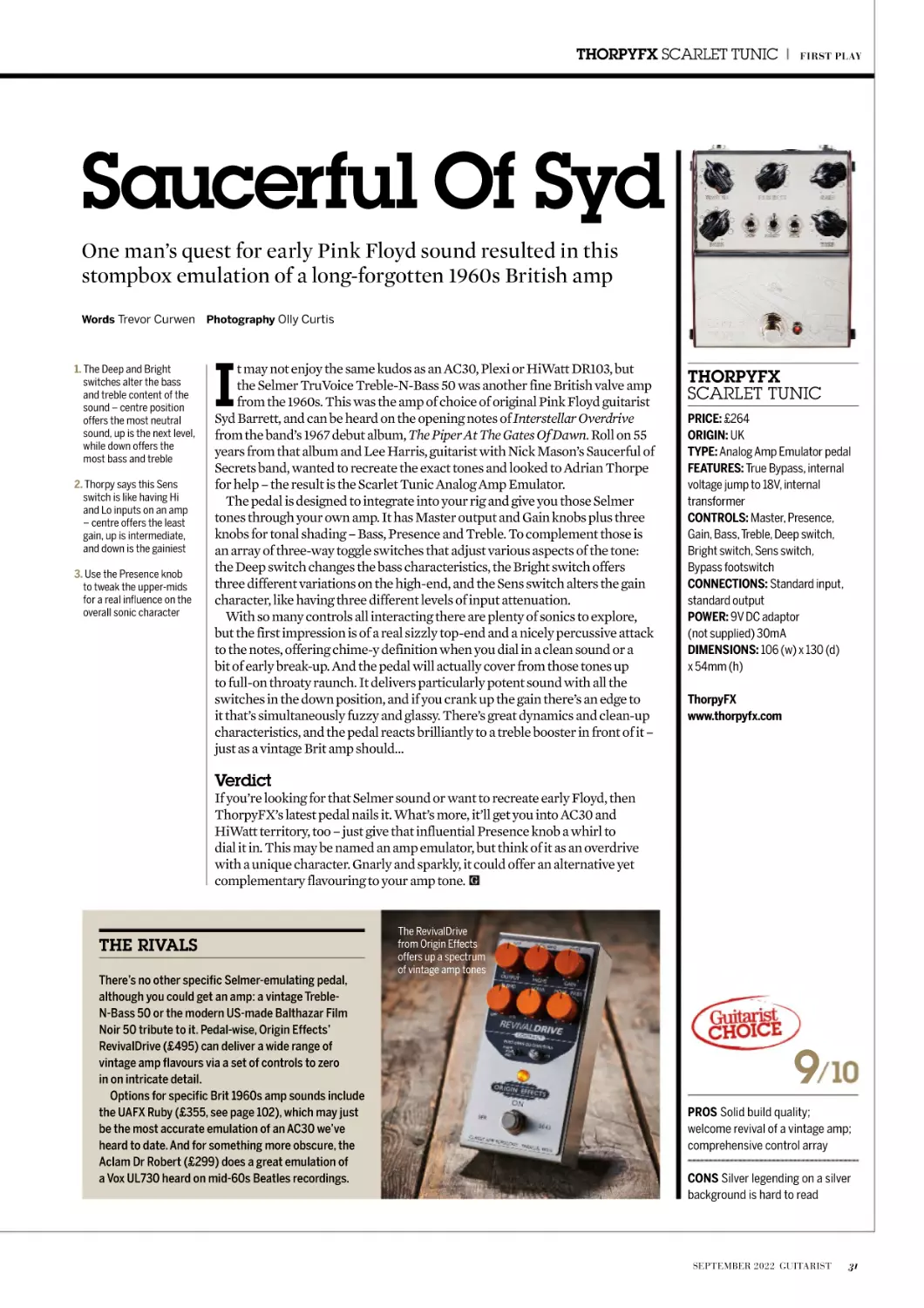
1. The Deep and Bright
switches alter the bass
and treble content of the
sound – centre position
offers the most neutral
sound, up is the next level,
while down offers the
most bass and treble
2. Thorpy says this Sens
switch is like having Hi
and Lo inputs on an amp
– centre offers the least
gain, up is intermediate,
and down is the gainiest
3. Use the Presence knob
to tweak the upper-mids
for a real influence on the
overall sonic character

Photography Olly Curtis

I

t may not enjoy the same kudos as an AC30, Plexi or HiWatt DR103, but
the Selmer TruVoice Treble-N-Bass 50 was another fine British valve amp
from the 1960s. This was the amp of choice of original Pink Floyd guitarist
Syd Barrett, and can be heard on the opening notes of Interstellar Overdrive
from the band’s 1967 debut album, The Piper At The Gates Of Dawn. Roll on 55
years from that album and Lee Harris, guitarist with Nick Mason’s Saucerful of
Secrets band, wanted to recreate the exact tones and looked to Adrian Thorpe
for help – the result is the Scarlet Tunic Analog Amp Emulator.
The pedal is designed to integrate into your rig and give you those Selmer
tones through your own amp. It has Master output and Gain knobs plus three
knobs for tonal shading – Bass, Presence and Treble. To complement those is
an array of three-way toggle switches that adjust various aspects of the tone:
the Deep switch changes the bass characteristics, the Bright switch offers
three different variations on the high-end, and the Sens switch alters the gain
character, like having three different levels of input attenuation.
With so many controls all interacting there are plenty of sonics to explore,
but the first impression is of a real sizzly top-end and a nicely percussive attack
to the notes, offering chime-y definition when you dial in a clean sound or a
bit of early break-up. And the pedal will actually cover from those tones up
to full-on throaty raunch. It delivers particularly potent sound with all the
switches in the down position, and if you crank up the gain there’s an edge to
it that’s simultaneously fuzzy and glassy. There’s great dynamics and clean-up
characteristics, and the pedal reacts brilliantly to a treble booster in front of it –
just as a vintage Brit amp should…

THORPYFX
SCARLET TUNIC
PRICE: £264
ORIGIN: UK
TYPE: Analog Amp Emulator pedal
FEATURES: True Bypass, internal
voltage jump to 18V, internal
transformer
CONTROLS: Master, Presence,
Gain, Bass, Treble, Deep switch,
Bright switch, Sens switch,
Bypass footswitch
CONNECTIONS: Standard input,
standard output
POWER: 9V DC adaptor
(not supplied) 30mA
DIMENSIONS: 106 (w) x 130 (d)
x 54mm (h)
ThorpyFX
www.thorpyfx.com

Verdict

If you’re looking for that Selmer sound or want to recreate early Floyd, then
ThorpyFX’s latest pedal nails it. What’s more, it’ll get you into AC30 and
HiWatt territory, too – just give that influential Presence knob a whirl to
dial it in. This may be named an amp emulator, but think of it as an overdrive
with a unique character. Gnarly and sparkly, it could offer an alternative yet
complementary flavouring to your amp tone.

THE RIVALS
There’s no other specific Selmer-emulating pedal,
although you could get an amp: a vintage TrebleN-Bass 50 or the modern US-made Balthazar Film
Noir 50 tribute to it. Pedal-wise, Origin Effects’
RevivalDrive (£495) can deliver a wide range of
vintage amp flavours via a set of controls to zero
in on intricate detail.
Options for specific Brit 1960s amp sounds include
the UAFX Ruby (£355, see page 102), which may just
be the most accurate emulation of an AC30 we’ve
heard to date. And for something more obscure, the
Aclam Dr Robert (£299) does a great emulation of
a Vox UL730 heard on mid-60s Beatles recordings.

The RevivalDrive
from Origin Effects
offers up a spectrum
of vintage amp tones

9
PROS Solid build quality;
welcome revival of a vintage amp;
comprehensive control array
CONS Silver legending on a silver
background is hard to read

SEPTEMBER 2022 GUITARIST

31

wishlist

PRS McCarty 594 Singlecut Joe Walsh Limited Edition

theWishlist
Dream gear to beg, borrow and steal for...

PRS McCarty 594 Singlecut
Joe Walsh Limited Edition £6,850
CONTACT PRS Guitars WEB www.prsguitars.com WORDS Dave Burrluck

A

round 18 months ago an excited Paul Reed
Smith was keen to share a video of him playing
his latest creation. “I sent Joe Walsh this short
video of me playing the guitar and he says he wants to
play it!” A little while later, we heard more: “We shipped
Joe the guitar and he said, ‘I want this guitar. This is not
a new guitar, this is an old guitar. I want it.’”
On 27 April 2021, PRS officially announced this
Joe Walsh limited-edition McCarty 594 Singlecut.
We immediately put in our order, and just over a year
later – partly due to PRS’s backlog, plus the necessary
CITES certification to account for the Brazilian
rosewood fingerboard – we finally opened the case.
This is not an entirely new guitar. The McCarty 594
Singlecut (named after its 24.594-inch scale length)
has been a part of PRS’s Core line since 2017, but that
model doesn’t have this Brazilian rosewood ’board or
the more vintage-sized stainless frets. Neither does
it have Paul’s actual signature on the headstock nor
Joe’s on the backplate. There’s no colour choice on
Joe’s model; its McCarty Sunburst has a ‘Vintage Nitro’
finish, featuring a formula that intentionally cracks and

1

32

GUITARIST SEPTEMBER 2022

2

PHOTOGRAPHY Olly Curtis

ages with time. This 10-top only, 200-piece run (with 56
heading for the UK/Europe) is all made on the standard
Core line (not by PRS’s exclusive Private Stock team),
illustrating just how high the bar is set in Maryland.
PRS has been making its Singlecut for the best
part of two decades and it has evolved from a pretty
chunky-sounding ‘rock’ single-cut to this beautifully
nuanced, hugely musical instrument. Aside from the
green ripple abalone ‘old-school’ bird inlays, it has no
more bling than the guitars that inspired it, and the feel
and sounds are exceptional. It’s a great weight, too, at
3.82kg (8.4lb); the rear ribcage cut and rounded heel
reduce the bulk of the original.
Setup, intonation and in-tuneness are superb, but it’s
the relatively low-output pickups that really impress,
never feeling underpowered and moving from creamy
and clear at the neck through more biting at the bridge.
Like the guitar itself, there are no sharp edges: the note
attack is musical and the sustain hangs around for
days. The partial splits sound far from thin and provide
yet more options. Our only gripe is that it’s a limited
model: this should be an unlimited Core model. Now!

3

1. The anodised aluminium
‘Joe Walsh Ltd’ truss
rod cover is unique,
and that’s Paul Reed
Smith’s signature on the
unfaced headstock. Like
the standard McCarty
594, the vintage-style
non-locking tuners use
unplated brass posts
2. With an orange hue, the
Brazilian rosewood ’board
(used by PRS in its early
years) is rare and needs
CITES certification. The
stainless-steel frets are
unique to a Core model
3. Joe was keen to put his
name to the guitar: he’d
signed all 200 backplates
before PRS had finished
the prototypes. “He said,
‘You can put my name
on it: it’s done. We’re
finished. Let’s go!’”
Paul told us last year

PRS McCarty 594 Singlecut Joe Walsh Limited Edition

4. Here, we have the
Pattern Vintage neck
profile, about which PRS
says: “[It] has the same
width measurements as
the Pattern neck but is
slightly thicker front to
back, and features an
asymmetrical carve with
a little less meat on the
bass side of the neck
toward the nut end and
a little less meat on the
treble side of the neck
from the 12th fret to
the heel”

6. While the original
Singlecut altered the
layout of the classic four
controls, the 594 went
back to Gibson style.
The tone controls have
a pull-switch for partial
coil-splits that primarily
voice the slug coils of
each humbucker

4

5. The more vintage-style
58/15 humbuckers
come in various
flavours. The LT+ (as
in Low Turns) means
both bridge and neck
are pretty similar in
output, measuring
approximately 8kohms.
The pickups are
constantly tweaked; the
‘+’ suffix means they’re
tuned specifically for the
single-cutaway design

5

6

wishlist

THE
LINEUP

Gas Supply
Our pick of the month’s most delectable
and wallet-bothering new gear
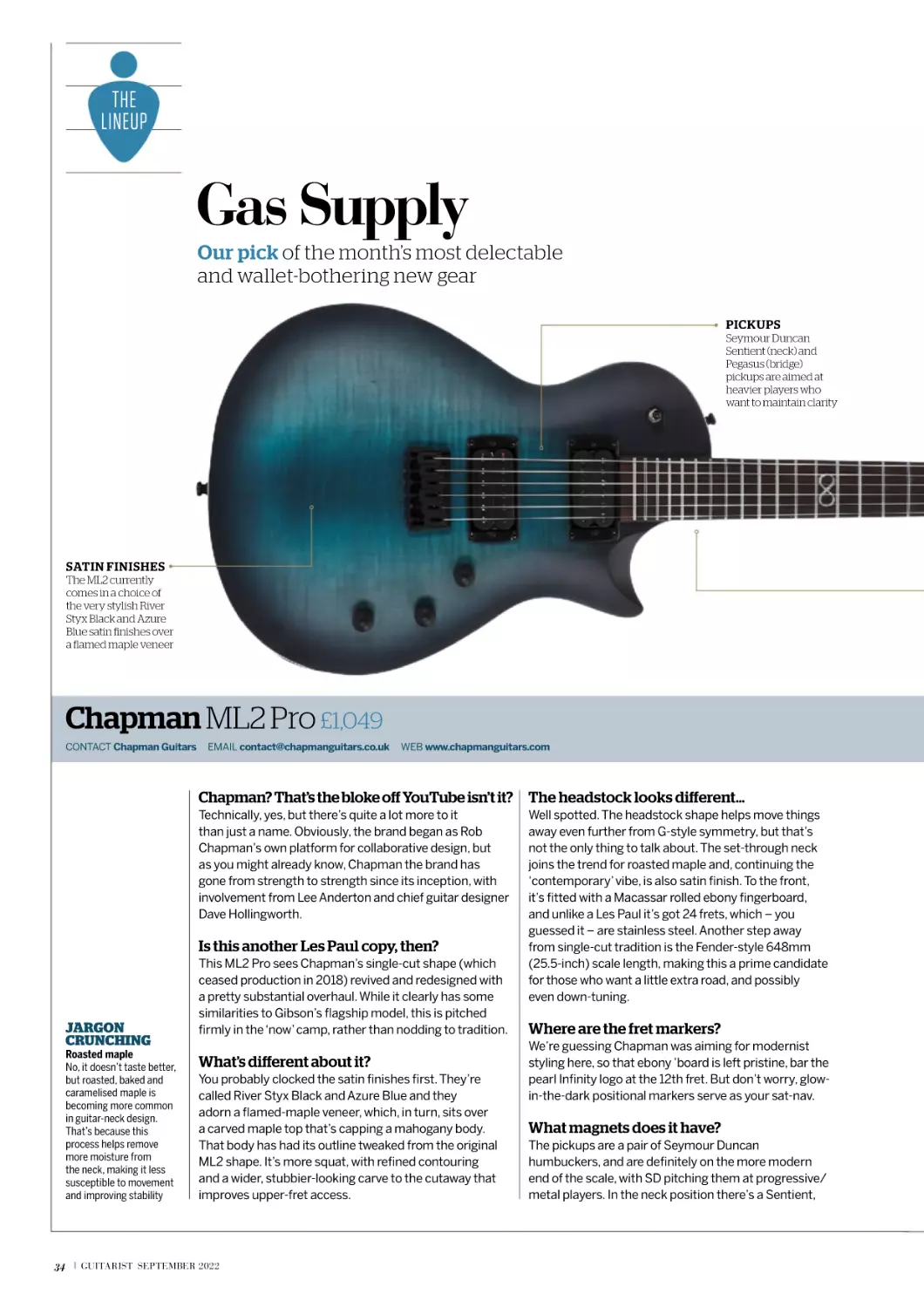
PICKUPS
Seymour Duncan
Sentient (neck) and
Pegasus (bridge)
pickups are aimed at
heavier players who
want to maintain clarity

SATIN FINISHES
The ML2 currently
comes in a choice of
the very stylish River
Styx Black and Azure
Blue satin finishes over
a flamed maple veneer

Chapman ML2 Pro £1,049
CONTACT Chapman Guitars

EMAIL contact@chapmanguitars.co.uk

WEB www.chapmanguitars.com

Chapman? That’s the bloke off YouTube isn’t it? The headstock looks different…
Technically, yes, but there’s quite a lot more to it
than just a name. Obviously, the brand began as Rob
Chapman’s own platform for collaborative design, but
as you might already know, Chapman the brand has
gone from strength to strength since its inception, with
involvement from Lee Anderton and chief guitar designer
Dave Hollingworth.

Is this another Les Paul copy, then?

JARGON
CRUNCHING

Roasted maple
No, it doesn’t taste better,
but roasted, baked and
caramelised maple is
becoming more common
in guitar-neck design.
That’s because this
process helps remove
more moisture from
the neck, making it less
susceptible to movement
and improving stability

34

This ML2 Pro sees Chapman’s single-cut shape (which
ceased production in 2018) revived and redesigned with
a pretty substantial overhaul. While it clearly has some
similarities to Gibson’s flagship model, this is pitched
firmly in the ‘now’ camp, rather than nodding to tradition.

What’s different about it?
You probably clocked the satin finishes first. They’re
called River Styx Black and Azure Blue and they
adorn a flamed-maple veneer, which, in turn, sits over
a carved maple top that’s capping a mahogany body.
That body has had its outline tweaked from the original
ML2 shape. It’s more squat, with refined contouring
and a wider, stubbier-looking carve to the cutaway that
improves upper-fret access.

GUITARIST SEPTEMBER 2022

Well spotted. The headstock shape helps move things
away even further from G-style symmetry, but that’s
not the only thing to talk about. The set-through neck
joins the trend for roasted maple and, continuing the
‘contemporary’ vibe, is also satin finish. To the front,
it’s fitted with a Macassar rolled ebony fingerboard,
and unlike a Les Paul it’s got 24 frets, which – you
guessed it – are stainless steel. Another step away
from single-cut tradition is the Fender-style 648mm
(25.5-inch) scale length, making this a prime candidate
for those who want a little extra road, and possibly
even down-tuning.

Where are the fret markers?
We’re guessing Chapman was aiming for modernist
styling here, so that ebony ’board is left pristine, bar the
pearl Infinity logo at the 12th fret. But don’t worry, glowin-the-dark positional markers serve as your sat-nav.

What magnets does it have?
The pickups are a pair of Seymour Duncan
humbuckers, and are definitely on the more modern
end of the scale, with SD pitching them at progressive/
metal players. In the neck position there’s a Sentient,

The Lineup

The River Styx Black satin
finish adorns the ML2 Pro’s
flamed-maple veneer

ALSO OUT NOW...

GUILD STARFIRE I-12 £569

CONTEMPORARY DESIGN
The thin body meets a roastedmaple neck, 24 stainless-steel
frets and a 648mm (25.5-inch)
scale length for a 2022 take on
the single-cut format

The chiming sound of a 12-string is irresistible,
but unless you’re Roger McGuinn it’s likely to be a
secondary instrument to your main guitar. Guild
is clearly aware of this with the introduction of its
Starfire I-12, the company’s most affordable 12-string
electric yet. It has a semi-hollow, arched all-mahogany
body with a mahogany centre block. There’s a
628.25mm (24.7-inch) scale length, and a pair of coilsplittable Guild HB-2 humbuckers has you covered
for eight single-coil/humbucker configurations. It’s
shipping now.
www.guildguitars.com

and in the bridge is a Pegasus. They’re both mediumoutput Alnico V models aimed at articulation as well as
higher-gain aggression.

The controls look sparse – are they just
straight humbucker sounds?
One person’s ‘sparse’ is another’s ‘efficient’ – and
here Chapman has opted for master volume and
tone controls, wired to (as you’d probably expect)
a three-way selector. But there’s a little added control
via the push-pull coil-split on the tone pot.

What about hardware?
The tuning is handled by a set of Hipshot Grip-Lock
tuners, which, as the name suggests, are locked by
thumbwheels to make for speedy string changes.
There’s a Graph Tech TUSQ XL nut and, at the other end,
the strings are anchored by a Chapman string-throughbody six-saddle hardtail bridge.

What’s the damage?
The ML2 Pro is currently the only ML2 shape on
offer from Chapman. It’ll set you back £1,049
and is available now. To find a dealer, head to the
Chapman website. [SW]

J ROCKETT UNI-VERB £465
What do you get when you cross one of the most revered
modulation pedals of all time with a retro-inspired reverb
circuit? The answer, as pictured above, comes courtesy
of J Rockett’s Uni-Verb. With the swirling, watery
chorus/vibrato sounds of the original, the Uni-Verb also
features an effects loop, which enables you to place the
modulation part of the pedal before your overdrive. This
leaves the added 50-second spring tank-inspired reverb
to be positioned at the end of your chain, giving you the
best of both sounds. Available now.
www.rockettpedals.com

SEPTEMBER 2022 GUITARIST

35

THE
LINEUP

Fretbuzz
A monthly look at must-hear artists from all corners of the guitar world,
from the roots of their sound to the tracks that matter most

Artist: Laura Veirs

Album: Found Light (Bella Union)

T
Found Light is Laura Veirs’
12th album, with 14 tracks
that explore life after
divorce from her former
husband and producer
www.lauraveirs.com

he albums from Portland, Oregon-based
singer-songwriter Laura Veirs are always
rewarding listens, showcasing her skills as both
a guitarist and sharp lyricist, and taking in influences
from country blues to punk. Found Light is her 12th
release and the first she’s co-produced, but as well as
this prolific recording career, which started in 1999
with her eponymous debut, Laura has also written a
children’s book, Libba: The Magnificent Musical Life Of
Elizabeth Cotten, launched a podcast called Midnight
Lightning, which explores juggling a music career with
parenthood, and taught songwriting. It’s a full resume,
and her latest album is a standout addition.

Riot Punk Roots
Found Light includes songs such as lead single, Winter
Windows, that lean on punk styles from the 90s. “I
started playing guitar when I was about 18, but didn’t
really take to writing or being a musician in bands
until college in Minnesota,” she tells us. “There I found
the riot grrrl punk scene, which I knew nothing about
before. This was pre-internet, so it was underground,
DIY stuff, finding out stuff through magazines and
posters on the streets. I discovered Bikini Kill and Team
Dresch, and Brooklyn punk bands; I wrote them letters,
made friends with them, then played electric guitar
and wrote songs in my own all-girl punk band.”

Stylistic Shift
Far from being punk music, Laura’s sound is diverse,
with folk and fingerstyle guitar underpinning much of
her work. “When I moved to Seattle, I started getting
into people like Mississippi John Hurt and Elizabeth
Cotten and the old-school country blues stuff,” she
says. “I think my own style pendulums between the
punky, overdriven electric sound, with Sleater-Kinneystyle pick work, and intricate fingerstyle playing, like
Nick Drake, with a bit of Brazilian music influencing it,
too. But country blues stuff is what I mostly do now.”

Multi-Tasking
As well as being co-producer of her new album,
another significant detail is it being the first work
that Laura has recorded with her simultaneously
singing and playing guitar, a very deliberate move.
“I was listening to artists like Adrianne Lenker [of Big
Thief] singing and playing live and really enjoying that
sound,” Laura says. “I wanted to see if I could do that
because my ex [Tucker Martine] was my producer for
years and he liked to keep things more controlled [in
the studio]. It was really cool to know I could sing and
play at the level I needed to get this music across how I
wanted it.” The argument for control and precision over
immediacy in the studio is age old, but for Laura, this
approach worked for the album. “It isn’t perfect,” she
smiles, “but it has this really good energy and it feels
alive. It’s musical in a way that I wasn’t familiar with
before, in terms of recording. We did a couple of takes
and not a lot of edits; some of the songs don’t have any
edits. It was nice. My old records are very fussed over.”

Laura’s Goya nylon-string
is part of her family
heritage and has provided
the soundtrack to all her
recordings so far

36

GUITARIST SEPTEMBER 2022

When it comes to an arsenal of instruments, Laura
is a musician who likes to keep it to a minimum and
doesn’t seem to favour flash gear. “I only have three
guitars,” she says. “I have a Goya nylon-string, which
my dad bought in the 60s in Chicago. It’s my favourite
guitar; it was the family guitar around the house
growing up and the one I write and record all of my
albums with. I do also have a Les Paul electric and a
Martin steel-string, but that’s it – and the Goya is the
one I use the most and tour with.” [GK]
Standout track: Seaside Haiku
For fans of: Sleater-Kinney, Big Thief, Joni Mitchell

PHOTO BY DEAN CHRISTESEN

Minimal Toolbox

The Lineup

CONFIDENCE MATTERS
How Laura helps give
songwriters a boost
Laura’s working life extends beyond
creating music, having authored a
book, and created a podcast. Teaching
songwriting is also important to her:
“It’s busy, but I like to do different things,”
she says. “I’m doing this cool online
workshop called the School Of Song,
where they do classes with songwriters
of renown. I feel like I have some skill sets
to offer, especially helping people grow
in confidence. That can really ail writers;
they so often feel like they don’t have what
it takes to write a song. I really like to help
give them those tools to do something
creative to get that confidence boost.”

THE
LINEUP

Albums
The month’s best guitar music – a hand-picked
selection of the finest fretwork on wax

Michael League
leads the way for
Snarky Puppy’s
latest live release

Snarky Puppy
Empire Central

Groundup Music (release date 30 September)

9

Rock, jazz, funk and fusion – these pups have it covered…
There are underground bands, bands with a cult following,
and then there’s Snarky Puppy. They’ve stacked up four
Grammys during their 18-year career and boast a core of 25
members from which founder member, leader and bassist
Michael League will draw. 19 members are present on this album.
So how exactly do you describe Snarky Puppy’s music? Rolling Stone
magazine quote the band as being “religiously unclassifiable” and they’re
absolutely right. There are elements of classic jazz, 70s funk, big band,
electro-pop, rock and even some shades of Zappa during his Grand Wazoo
era. This means the answer to the casual question, ‘What sort of music do
they play?’ isn’t a short one by any means.
Empire Central was recorded in front of a live audience over eight
nights in Dallas and finds the band paying its respects to the city that
spawned it, with various members of Snarky Puppy being alumni of the
jazz course at the University Of North Texas. Comprising no less than
three guitarists, four keyboard players, a host of percussionists and brass
players, a violinist and Michael League’s bass, the album scurries through
16 tracks and comprises some of the tightest ensemble playing we’ve
heard in a very long time.
Guitarist Mark Lettieri authors the track Trinity, but his lead lines are
heard snaking through various cuts on the album, never one for the
outrageous standalone rock solo, seemingly content to be a voice within
the undefinable output of the band. It’s fascinating, eminently moreish,
ingenious music. Indulge in some Puppy love! [DM]
Standout track: Free Fall
For fans of: Miles Davis, Zappa, Jacob Collier

38

GUITARIST SEPTEMBER 2022

Joni Mitchell
The Asylum Albums (1972-1975)
Rhino (release date 23 September)

10

Songwriting perfection in four acts…
Fresh from her surprise return to the
stage at this year’s Newport Folk Festival
comes another reminder of the genius
of Joni Mitchell. After the album Blue
vaulted her to new heights and consolidated her position
as a major artist, Joni left Reprise to join the newly
formed Asylum label. It was during the following years
that she produced some of her finest work. Moving away
from the trappings of the folk circuit, the albums that
followed – For The Roses, Court And Spark, The Hissing
Of Summer Lawns and the double live album Miles Of
Aisles – showed a newer jazzier side to her work.
All the aforementioned albums have received a
remastering makeover here under the supervision of
Joni herself, and songs such as Just Like This Train, In
France They Kiss On Main Street and Edith And The
Kingpin shine like never before. [DM]
Standout Track: Don’t Interrupt The Sorrow
For fans of: James Taylor, Carole King

Julian Lage
View With A Room
Blue Note Records (release date 16 September)

10

Jazz virtuosos join forces on exciting
new release
This new release sees Julian playing
with his trio (bassist Jorge Roeder and
drummer Dave King) with the addition
of guitarist Bill Frisell. With 10 new compositions
featured, the breadth of dynamics is impressive,
mirroring Julian’s interest in chamber-like compositions
with lush arrangements and organic improvisation. And
while he works under the banner of jazz, there’s much
that will resonate for non-jazz fans; the warmth of his
Collings guitar and elements of soul, R’n’B and pop will
draw in a broader fanbase for sure.
Tracks like Auditorium are a perfect showcase for
the new quartet – the guitars shimmer above the soft
rhythmic pulses formed by the rhythm section. Echo
is exquisitely ambient with lots of space and yet, within
that, are phenomenal levels of band empathy and
colour. Virtuosity and vibrancy at the highest of levels,
stunning indeed! [JS]
Standout track: Tributary
For fans of: John Scofield, Pat Metheny

PHOTO BY NOAH TORRALBA

Discover more about
Julian Lage’s latest
album on page 40

Joe Hollick
Rest Lessness
Cardinal Fuzz (available now)

9

Lone wolf wanders acoustic wilds
Guitarist has long admired psychedelic
rock outfit Wolf People. Sadly the band
went on indefinite hiatus in 2020, but
guitarist Joe Hollick – who had the fire
and invention of a young Jimmy Page when we saw
Wolf People play live in Bristol a few years ago – has
this meditative solo album to offer. The acoustic
instrumental pieces here have an ethereal, esoteric
edge that recalls Jansch or John Martyn in nocturnal
mood but with sympathetic, tasteful washes of synth to
add a new expansiveness.
Standout tracks, such as Human Hand sound ancient
and timeless at the same time, with their slow, tectonic
chord changes and lyrical electric melody lines. The
overall effect could be likened to riding across a sombre
moorland of sound in which a hidden magic abides.
Spellbinding stuff. [JD]
Standout Track: Human Hand
For fans of: Bert Jansch, Wolf People, John Martyn,
John Renbourn

Marcus King
Young Blood
Snakefarm (release date 26 August)

8

Retro rock solo album from the
Grammy nominee
Already hailed as a rising guitar star,
Marcus King’s former solo album,
El Dorado, received rave reviews, not
to mention a nod from the Grammys. This time the
blues rocker teams up once again with producer Dan
Auerbach to produce the type of rock album rarely
heard these days. “I wanted to create a record with a big
arena rock sound… tunes that were as big as the rooms
we wanted to play in,” he tells us.
Armed with his father’s ‘dusty old amp and a ’59
Les Paul’ Marcus took inspiration from the rock trios
of yore, citing Cream and The Jimi Hendrix Experience
as blueprints from which to draw. Riff-laden tracks like
Aim High and Pain bear this out recalling bands such
as Ten Years After, Free and Rory Gallagher’s trio work
on occasion. The guitar is fiery, the vocals raw, the
production punchy – what more can we ask for? [DM]
Standout track: Good And Gone
For fans of: Free, Cream

“Chunky, detailed

and as hot as you’d
ever need for classic
rock and more”

Guitarist Magazine - 2022

The award winning Flattley Revolution
pedal is one of the many guitar and bass
pedals hand built in England by
Flattley Boutique Effects Pedals.
For more information, demo videos
& stockists visit

www.flattleyguitarpedals.com

THE
LINEUP

Tones Behind The Tracks
Julian Lage’s new album is full of his signature virtuoso-level guitar
playing with splashes of colour provided by special guest Bill Frisell

Artist: Julian Lage

Album: View With A Room (Blue Note)

W
Julian’s second album for
the Blue Note label features
celebrated left field jazz
guitarist Bill Frisell

Now aged 34, Lage was
considered a child prodigy
and played guitar at the
Grammy Awards when he
was just 12 years old

e spoke to Julian Lage while he was on
tour in Italy, performing material from his
forthcoming second album for Blue Note,
View With A Room. Accompanying Julian on the album
is regular bassist Jorge Roeder and drummer Dave
King, but this time the trio has been augmented by
Bill Frisell, who appears on several tracks. “Bill’s the
absolute master of masters,” Julian says. “So we feel
very privileged to expand the group to include him. It
was a really fun record for us to make.”

How did you meet Bill Frisell?
“I went up to him at Newport Jazz Festival when I was
probably around 17 years old. I was there with Gary
Burton’s band. I was a lover of Bill’s music since I got
into jazz guitar. He’s a hero to me, so I said hello to him
and he so graciously said, ‘I think I’ve heard about you.
I heard you on the radio with Gary.’
“In the last five years or so, we started playing
duo concerts together; we did a short tour in the
United States. Anyway, our worlds have been kind of
intermingling for many years now, and upon writing

this record I was pretty sensitive to the fact that
I wanted Bill to be a part of the band in the capacity of
playing rhythm guitar, adding sonic architecture.”

What’s your process for writing music?
“I write using pencil and paper with a guitar, that
process is relatively consistent thus far. My approach
is, in a way, quantity over quality. I write so many
songs. Even for this record there were 35 to 40 songs
and you just whittle it down – the record we made is 16
songs. And the ones that didn’t make it to View With
A Room will be released as a separate project. I like
having an abundance of material, but I don’t have any
one approach to it other than throw it against the wall,
and see what sticks. I feel very lucky, because in this
case, I was afforded space and time to wake up every
day, write and show the songs to my partner in crime,
Margaret Glaspy, who produced the record. She is also
my dearest friend and wife – I show it to her and get
thumbs up, thumbs down, that kind of thing.”

In the past you’ve mentioned you’re very
aware of the legacy of jazz guitar players from
previous generations?

PHOTO © SHERVIN LAINEZ

“Well, the electric guitar as we know it has had so
many iterations. My personal obsession, as a fan of the
guitar, tends to be directed towards the mid-1930s,
to mid-40s, even into the early 50s. A time when the
electric guitar, at least on recordings, appears to have a
kind of a brightness, a volatility, but is also very warm.
I wouldn’t say that it’s without effect, because the
effect of the recording process is adding compression,
adding distortion. It’s being affected, but the way it’s
being affected is essentially appealing to me.
“In making a guitar-trio record that’s now expanded
to two guitars, bass and drums, it was important that
my sound consistently reflects those qualities, from
song to song. Almost the way a tenor sax player in
a jazz band has the same tenor sax for the whole
record. Typically, it’s kind of a unifying factor, whereas
Bill’s role shows a little bit more of the evolution of
the history of the guitar. There are times where [he’s
playing] a Jazzmaster with tremolo and reverb. And
that has implications to the lineage of surf guitar and
rock guitar and all that. There are times where his role
is baritone Telecaster, which has more in common with
stuff you would hear in Bob Dylan’s groups with T Bone

40

GUITARIST SEPTEMBER 2022

PHOTO © SHERVIN LAINEZ

The Lineup

Burnett. And then there are times when we’re closer
together, and we have this thing where we’re rolling
around each other on a song like Auditorium. I like
the singularity of tone because then I can just keep
changing the content. And I think Bill is a player who
deeply connects to that as well.”

Were there intensive rehearsals before you
went into the studio to record?
“We did two days of rehearsal where I taught the band
the music. I’d sent Bill the music weeks before so he
was familiar with it. I’d made ‘micro-demos’ where
I played a short acoustic guitar performance of every
song: ‘Here’s the melody and here’s how it ends.’ We all
lived with that for a little bit, and a lot of what you hear
on the record is first or second take. I particularly like
the tape to be rolling when you’re learning the music
because I think there’s a certain sense of discovery.
You know, it’s not like you’ve played it a million times
and this is definitive. You just kind of see if you capture
something cool and, if you don’t, you try it again. So,
the rehearsal, in a way, was very close to the recording
itself. There’s not a big difference.”

What gear did you take into the studio with
you for this album?
“I brought a lot of guitars, but I only used one for the
majority, which is a Collings 470 JL. It’s a signature
model that I’ve been playing for a while and I just
love it. A big feature of the guitar is it’s hollow but
with no f-holes, and also the centrepiece is its Ron
Ellis pickups. I’ve been using Ron Ellis pickups for
many years and, to me, they’re perfection. So Ron

“I particularly like the tape to be rolling
when you’re learning the music because
I think there’s a certain sense of discovery”
made what he calls ElliSonics, basically centred
around the design of the old Dynasonic pickups, with
certain modifications that we both feel are for the
benefit of the sound.
“I also brought in a ’54 Tele, a ’55 Gold Top Les Paul
that I love, but I just played the Collings; it just sounded
so great. It’s going through a Magic Amplifiers Vibro
Deluxe, which is by a gentleman named Mike Moody,
in California, whose amplifiers I absolutely love. He
makes really, really great-sounding amps. So it’s
similar to my conception about the history of guitar;
I feel like he embodies the history of amplification. It’s
everything you want, and nothing you don’t.
“As for effects, I pretty religiously use something
called a [Shin-ei] B1G 1, which is essentially a clean
boost and it’s always on. It just gives a little more
top-end. It doesn’t seem to obscure the sound, it
just opens up the higher range of frequencies so that
they’re a little more, to my ears, seductive and less
pingy. And then I use a Strymon Flint reverb and Divine
Noise cables, which I’ve been using forever. I just think
they’re wonderful, very reliable. So, you know, it’s
nothing terribly diverse, but it’s what I like.” [DM]

Back to basics: “I write
[my songs] using pencil
and paper with a guitar,
that process is relatively
consistent thus far”

View With A Room is released on
16 September on the Blue Note label
www.julianlage.com

SEPTEMBER 2022 GUITARIST

41

NEVILLE’S
ADVOCATE
...

Past Glories
Neville Marten casts his mind back to star products that have
made an impression during his decades of writing about them

O

ne criticism that we occasionally get at
Guitarist is, “You never give anything a bad
review.” Well, that’s true to an extent, but only
because we rarely see anything that falls below par. But
we also like to sort the wheat from the chaff so we can
point you in the direction of the good stuff. Having given
Patrick Eggle’s brilliant Macon Single-Cut a Guitarist
Gold Award this month, I started thinking about other
products that left a mark, due to pushing boundaries of
quality, innovation, or just plain, “God, I want it!”

“And the first Collings. Another ‘bloody hell’
moment. This thing roared like a cannon and
looked like it had been milled out of stainless steel”
The first was an early PRS Custom 24. Remember
the poster and full-page ad with three of them together,
in red, blue and the famous vintage yellow? Well, it
was just like the yellow one and we’d never seen guitar
craftsmanship like it. On the back of my review Paul
offered to build me one, so Geoff Whitehorn and I sat
down and ordered essentially the same instrument, on
the same day, at one of our Guitarist shows. That was
1989 and I kept mine until only recently.

GAS OF THE MONTH
“We’re all going on a…”

PHOTO COURTESY OF THOMANN.DE

What? Journey OF660 (Blue) Where seen? thomann.de Price? £1,111
Yes, it’s that time of year again and our mate, Bath busker extraordinaire Ben Powell
has just bought one of these for his travels. It’s made from carbon fibre, has a
detachable neck that’s easy to remove and reattach, and most airlines accept it as
onboard luggage. It’s a ‘stylised’ 000 shape and size, with a 1.75 (44mm) nut, passive
under-saddle pickup, compensated bone saddle and Grover tuners. It comes in a
‘TSA compliant’ gigbag, and I think it looks pretty smart with its curvaceous top bout
soundhole and ‘moulded in’ pseudo cutaway. And being carbon fibre it won’t crack,
shrink or warp in that Mediterranean sun. What are you waiting for?

42

GUITARIST SEPTEMBER 2022

Another one that bowled us over was a sonic blue,
‘Made in Japan’ Fender Strat. We opened the box in
the office, back then in Ely, Cambridgeshire, and were
astonished. We put it on the cover with a Vox AC30, in
case that jogs your memory.
Then there was our first Taylor. I mentioned in last
month’s 724ce Koa review that Martyn Booth had done
the story; he was staggered at how an acoustic guitar
builder could make something so darned perfect. It
was a revelation, and caused (as did PRS) an industry
resting on past glories, to sit up and take notice.
And the first Collings. Oh dear. Another ‘bloody
hell’ moment. This thing roared like a cannon, but
again looked like it had been milled out of stainless
steel, such was the accuracy of build, inside and out.
I ordered one but it proved ‘too good’ for my meagre
picking so I traded it.

Match Made In Heaven
Oh yes, the first Matchless. I’d read the infamous
Guitar Player mega-test that called the DC30 “the
finest amp in the world”. A sucker for that great Vox
tone, around which the Matchless sound was built,
I called into Mansons in Exeter, the importer and only
dealer at the time, to try one. I was on tour and took
my stage guitar, a Custom Shop ’59 Les Paul, in to try
it. Good grief! They had an almost new green one –
‘almost new’ because they’d lent it to Hank Marvin
for a TV show. I bought it on the spot. They gave me
a VHS of Hank’s performance, too! That was 1994
and I used it until only a couple of years ago when it
became just too unwieldy to carry. Best amp I’ve ever
owned, though.
And Eggle again. Our first Berlin model was a corker.
David Mead reminds me that it was a ‘Big Jim Sullivan’
signature, which is great on two levels since Jim was
Marty Wilde’s first guitarist, and I’m one of his current
two – along with Eddie Allen who, vintage readers will
remember, worked alongside David and me on the mag.
Another staggeringly good guitar was the first Music
Man EVH. Ours had a gorgeous quilted maple top, was
also finished in vintage yellow, and was the first guitar
we’d played whose neck was finished in gunstock oil –
like our Eggle Macon this month.
There are many others, such as the Mesa/Boogie
Triaxis preamp (which again I bought), and a Guitar
Techniques cover guitar that I borrowed from Fender.
It was a John Cruz Master Built, and I instantly fell in
love. I offered to buy it but made a jocular suggestion
that it would be my perfect ‘signature’ guitar, so how
about it? The response I got was (equally lighthearted):
“The only signature we want from you, mate, is the one
on the bloody cheque!” My quest for posterity well and
truly scuppered! See you next time.

CONFESSIONS OF
A LUTHIER
...

Wood For The Trees
This month Alex Bishop finally makes progress on his
‘50 trees’ passion project with a cedar of Lebanon guitar

R

egular readers of this column may remember
I recently undertook a project to build 50
guitars to represent the UK’s ‘jubilee trees’.
These trees were spotlighted in 2002 and make up
some of the finest and most interesting trees in our
landscape. My furniture-maker friend Danny and I
have spent the past few years investigating quaint
English villages and dark corners of obscure ancient
woodlands to find and document these magnificent
trees. To date, we’ve checked off about 11 from the list,
but it was only last year that we casually challenged
one another to represent each of them in our own
crafted wooden form.

PHOTO BY ALEX BISHOP

“The tree to which this instrument pays homage
is a Cedar of Lebanon that grows in Oxfordshire;
the first of its kind to be planted on UK soil”

A striped rosette of
padauk, cedar and walnut.
The slant is a nod to the
wonky fretwork that will
adorn the fingerboard

44

It’s taken me a little while to carve out the time, but
my first contribution – a fanned-fret gypsy-jazz guitar –
is at last making significant progress this week. The
tree to which this instrument pays homage is a Cedar
of Lebanon that grows in Childrey, Oxfordshire; the first
of its kind to be planted on UK soil, brought back from
its home country as a seed by the rector of the village
in 1642. It seems fitting that this guitar is another first,

GUITARIST SEPTEMBER 2022

and starts a series of instruments that is likely to take a
lifetime to complete: a blink of an eye compared to the
lifespans of these mystical old trees.
Naturally, I’ve opted to use copious amounts of cedar
of Lebanon in this build, including the soundboard,
neck and headstock veneer. It’s hard not to choose a
dazzling back and sides to pair the top with, so I gave in
completely to a stunningly figured English walnut set. In
order to draw the eye back to the top, I decided to inlay
a striped oval rosette of alternating padauk, cedar and
walnut. This inlay runs at a slant, a nod to the wonky
fretwork that will adorn the fingerboard when I get to
that point. I’ve also echoed the striped pattern down
the centre of the headstock veneer, a rare opportunity
to create a visual connection between the soundboard
and the headstock using the same materials.
While fanned-fret guitars can put some players off,
the idea of shortening the scale length of the higher
strings to improve playability makes a lot of sense,
banishing preconceptions that this sort of instrument
is harder to play. Not only do the frets on the higher
strings inch closer together, but for a typical set of
strings, the tension will be slightly less, sneakily taking
some of the effort out of solos in the higher register. No
one even has to know…

Real Cedar
This project also presents an opportunity for me to
get to know a wood that is rarely used in musicalinstrument making. While western red cedar and
yellow cedar are commonly associated with guitar
making, neither of these are true cedars (both are
essentially from the family of cypress trees). Cedar of
Lebanon, on the other hand, appears to be denser and
stiffer, with pronounced winter and summer growth.
Maybe because of this I have found the soundboard
to be comparatively heavy, so I took a fair bit of extra
weight out of it during the thicknessing stage than
I would for a spruce top. The neck is reassuringly
dense for a softwood, so its strength should compare
favourably with similar neck hardwoods, yet keeping
the weight down – a particular bugbear of mine is a topheavy guitar. My conclusion is if you can get straightenough pieces, Cedar of Lebanon makes for an ideal
neck material.
At the time of writing, I’m still negotiating the
twisted geometry of the neck, which is made all
the more complicated by angling the scarf join that
accommodates the skewed nut. There has to be quite
a bit more chin-stroking before I’m ready to pick up the
chisel and pare away wood to reveal the final shape of
the neck, but it’s in there somewhere. Yet I can give this
project plenty of time: after all the tree has been waiting
for long enough…

RAISING
THE TONE
…

Light Headed
This month, editor Jamie Dickson ponders
the ultimate lightweight gigging setup…

Y
Pairing a lunchbox head,
such as this MK1 Victory
V30, with a tiny cab, such
as the Barefaced Audio
Upsetter below, offers
bags of capability in a very
small package indeed

ears ago I bought a 90s Marshall Bluesbreaker
reissue at auction. Nice amp, great sounds, plenty
of welly in terms of volume and, of course, an iconic
look. I sold it less than six months later, for one reason. It
weighed an absolute ton – well, 31kg to be precise – and
had but one woefully inadequate carrying handle on
the top. It was like trying to lift a suitcase filled with lead
blocks. It had to go.
Currently, my main gigging amp is a Dr Z Jaz 20/40
combo, which is right on the limit weight-wise. But
because I love its sounds so much, I’m prepared to put
up with its bulk for festival shows or larger gigs. But what
about those nights when you’re just going to sit in on
somebody’s set or join a blues jam in a little bar? I’d say
there’s a strong case for having a ‘B’ rig that’s optimised
for just such occasions. For example, when my friend and
ex-guitarist for Robert Plant, Innes Sibun, invited me to

sit in on his set a while back, I took along just the bare
essentials – a Marshall Class 5 combo, my guitar and a
Hudson Electronics Broadcast pedal for an overdrive.
That setup actually worked really well on the night –
I don’t think we even needed to mic up the Marshall as
it is deceptively loud for a 5-watt amp. That said, that
setup would only really do for a rowdy blues set – the
amp was cranked as far as it would go, didn’t have any
reverb and, in that state, would only do one sound – wide
open, small-combo wailing – which fortunately suited
the occasion. If I had needed more headroom, dynamics
or flexibility, it wouldn’t have sufficed. So what are some
lightweight alternatives that might offer a more capable
all-round solution for not much more weight?
First of all, Blackstar’s innovative 50-watt St James
amp range (£1,099 as reviewed in issue 488), with
its specially designed lightweight Celestion ‘Zephyr’
speakers, candlenut ply cabinet and switched-mode
power transformer, was a bit of a revelation. The
St James combos offer 50 watts of really ear-pleasing
tone in a very lightweight (12.8kg), compact package
that comes in both EL34 and 6L6 versions. I’d very much
recommend trying out a St James if you’re looking to put
together a highly portable, punchy rig, especially as it has
some great cab-sim tech on board for silent recording
when you’re back in the home studio.
But it’s still possible to go lighter and more compact,
and do so for less money, too. As mentioned elsewhere in
this issue, the Laney Cub-Super is an amazing little amp
for the money (£419 for the 1x12 combo), while the headand-cab version lets you carry one part in each hand to
balance out your load when lugging gear between car and
venue. It has 15 watts of EL84 tone aboard, plus reverb
and an in-built boost – in other words all the essentials –
and sounds cracking. The 1x12 combo version weighs
just over 11kg, too. So if you want a very capable, light
amp for not much cash, you should definitely try one.

Out To Lunch
This brings me to my final suggestion. Lunchbox heads,
of the type popularised by Victory and other makers in
recent years, are a great shout for building a lightweight
gigging rig. In the past, I’ve enjoyed using Victory’s
powerful little 6L6 40-watt V30 Countess head designed
for Guthrie Govan, and found it had loads of clarity, punch
and headroom for such a compact and light head. In
MKII form (£1,149), it’s been renamed The Jack (jack
of all trades) and re-valved with EL34s in a new threechannel / two-voicing design and weighs just 8kg.
Now here’s the kicker – if you were to pair that with an
ultra-lightweight 1x10 ‘Upsetter’ cabinet from Barefaced
Audio (£449), which weighs only 6kg and produces an
eerily room-filling sound from a single Celestion G10
Vintage (thanks to highly innovative cabinet design),

46

GUITARIST SEPTEMBER 2022

Opinion

THREE TO GET READY

PHOTO BY WWW.ROBERTKEELEY.COM

Get lightweight (in the best possible way)

Keeley DDR £189

If you’ve put together a really compact, lightweight amp rig
to carry into grab-and-go gigs, why not pair it with this super
little pedal from Keeley, which contains (as the acronym
suggests) all the effects essentials – Drive, Delay and Reverb.
The pedal has two channels – Drive and Wet. On the drive
side, you can choose between Crunch or Lead drive tones and
on the time-based Wet side, you can choose between vintage
or modern voicings of delay and reverb. As Keeley itself says
of this versatile stompbox, ‘One pedal. Every gig’.

you’d have a potent stage rig smaller than many
1x12 combos that weigh in at a total of 14kg. Again, using
a separate head and cab means carrying and storing the
individual elements of the rig can be easier and you can
always trial a different head if your tastes change. If you
then went a step further and paired the Upsetter with a
Laney Cub-Supertop head (£349, 7.5kg) you’d have an
even lighter rig that costs under £800. Want to go lighter
still and get even more power? The head version of the
St James amps weighs just 6kg… so together with an
Upsetter cab, that would be just 12kg in total for 50 watts
of all-valve output. Impressive.

Blackstar’s new St James
amps have raised the bar
for what can be achieved
in a lightweight amp.
The head version weighs
around just 6kg

“Lunchbox heads, of the type popularised by
Victory and other makers in recent years, are a
great shout for a lightweight gigging rig”

Tom Anderson Hollow Drop Top Classic circa £2,500

Tom Anderson’s superbly crafted electrics never have a hair
out of place, and, in our experience, are buttery playable and
flawlessly finished. You can now add ‘featherweight’ to that
list of qualities, with this Strat-style electric built around a
hollowed-out alder body with a centreblock and flamed maple
cap, which weighs just 2.9kg.

Four To The Floor
Now of course, you could just buy a modelling multieffects that does everything digitally and weighs even
less, and run that straight into the PA – but that’s a
different kettle of fish and I’m traditional enough to still
enjoy gigging with valve amps, so we’ll stick with those
for now. However, you might want to consider so-called
floor-amps that bridge the divide between valve amp
and effects pedal, such as the BluGuitar AMP1, Victory’s
own range of V4 amp pedals and others like them. If you
paired a V4 Jack amp pedal, which uses small militaryspec valves in the preamp stage, with the Upsetter
cabinet by Barefaced, you’d end up with a rig that
weighed 7.7kg – though you would have to find a suitable
4-ohm, 10-inch driver for the Upsetter, which might be
tricky. Still, good things come in small packages.

Line 6 Helix HX Stomp £499

If you can’t beat them, join them. If you do want to go the
modelling multi-effects route, the HX Stomp offers more than
300 effects and amp models from Helix, M-Series, and legacy
Line 6 products including “up to six simultaneous amp, cab
and effect blocks including a looper and IR loading”. Weighing
less than a kilo and measuring just 17.8 x 12.6cm this tonal
powerhouse will fit on most pedalboards – but you’ll need
some form of powered external speaker or line into the PA,
too, if you want to gig it.

SEPTEMBER 2022 GUITARIST

47

AUDIO

http://bit.ly/guitaristextra

SUBSTITUTE
...

Stackings & 6ths
This issue Richard Barrett experiments with note
arrangements within chords for some diverse sounds

I

PHOTO BY EBET ROBERTS/REDFERNS/GETTY IMAGES

Right: Stevie Ray Vaughan
in 1983. His use of stacking
can be heard extensively on
the track Lenny

n this context, the word ‘stacking’ refers to how
we arrange the notes in a chord from the lowest to
the highest – and imagine how this might appear
on a musical stave (whether you actually read music
or not isn’t necessarily an issue). This is an effective
approach in any context, such as a string or brass
arrangement, a whole orchestra, or even solo piano
or guitar. Of all these, the guitar especially requires
ingenuity, as we are working with just the six strings,
giving a comparatively limited choice of notes, plus
the disadvantage of any finger stretches that might
be necessary to realise wider intervals. Check out
any video of Allan Holdsworth playing chords if you
need that clarified!
The second part of the title here refers to 6ths, in
this context adding the 6th note of a major scale to
the existing Root, 3rd and 5th. This gives an extra
note to play around with and hints at quite a few
different genres.

Example 1

Example 2

Example 3

Example 4

Example 5

This C6 takes a very
straightforward approach,
adding the 6th (A) on the
top. Some may say this has
a ‘Hawaiian’ sound to it.
The tuning of both a ukulele
(GCEA, basically a C6 chord)
and lap steel (one of the
most popular tunings is C6 –
CEGACE) would certainly
bear this out.

This C6 features the 6th (A)
buried within the chord, rather
than at the top. While this isn’t
worlds apart from the first
example, it is different enough
to warrant the potential
alternative name of Am/C –
and I’m sure you can see why.
Both names are correct, but
context does come into it. For
example, was the preceding
chord an A minor?

Another C6, this time stacked
as C G A E. Having the 5th (G)
and the 6th (A) appearing
as adjacent notes in the
chord gives us yet another
flavour. Many would say this
voicing is more suitable for
a jazz arrangement and has
less of the aforementioned
‘Hawaiian’ feel.

Stacked as Root-6th-3rd-5th,
this voicing of C6 was
favoured very much by SRV.
Check out the instrumental
Lenny to hear him using it
extensively. Note that the
fifth string is muted; even
if it was possible to make
use of it (namely, if you had
six fingers!), there would be
no need.

We’re muting the fifth string
again in our final example.
Again, the use of the fifth
string wouldn’t really add
anything essential. In fact, it
may take away from the clarity
of the chord. Playing in a band
context, you might choose not
to bother with the bass note on
the sixth string, either.

C

C - Am/C

C

C

C

48

GUITARIST SEPTEMBER 2022

7-

7-

9-

9-

FEEDBACK
...

Feedback
Your letters to the Guitarist editor.
Drop us a line at guitarist@futurenet.com

STAR LETTER
CUSTOM CELEBRATION
All my life I have been an
enthusiastic guitarist; my
sister being my biggest fan.
She was always there to listen
and comment on my musings
from our early childhood
through to our adult lives.
Sadly, she recently passed
away from breast cancer at
the age of 55. I decided to
celebrate her life and create a lasting memorial by having a custom
guitar made. I designed this in conjunction with Guy Harrison, a local
luthier. I wanted a simple guitar with the breast cancer ribbon at the
12th fret, pink dot inlays and her name on the headstock. It’s built
from korina with an ebony fingerboard and features a little Seymour
Duncan ’59 humbucker with split coil. I’m sure you agree the guitar
has turned out to be pretty stunning. A guitar can be so much more
than just an instrument.
Alan Singleton, via email
So sorry for your loss Alan, but the guitar is a wonderful way to remember
your sister – instruments are among the most personal of possessions, our
connection with them is emotional and on a deeper level than with other
material things we can acquire in life. Nice to see korina being used, too, a
choice with roots in tradition but still a pretty rare bird in custom builds.
Thanks for sharing this with us – we hope you’ll enjoy using it with this month’s
Star Letter prize.

Each issue, the Star Letter will win a pair of
Vox VGH AC30 guitar amplifier headphones!

www.voxamps.com

50

GUITARIST SEPTEMBER 2022

FATHER’S DAY
This is the guitar my son presented me with on my
70th birthday (see below). He printed out the body in
six sections, bolted them together, then completed
the project with (by his own admission) the cheapest
components he could find on t’internet. There’s a push
switch on the back which, when activated, gives it that
extra kerraang! Apart from the emotional connection
I have with it, it’s one helluva great instrument, loads
of sustain and plays brilliantly. This is his first build.
Dave Cooper, via email
That really does make a statement, Dave – a proper showstealer – a Flying V with the lights on! As unidentified flying
objects go, we reckon it’s a winner and you certainly won’t
lose it on a darkened stage. It was a great gesture from
your son to build it for you, too. Interesting, you mention he
printed the body sections – 3D printing, we assume? Has
anyone else had any interesting experiences using 3D printing
in homebuilds? If so, let us know and we’ll share the best
responses with readers here.

Reader Tony Lloyd
picked up this
tempting Squier
for just a tenner

BARGAIN HUNTER
With reference to the article in issue 487 – Fender
Squier 40th Anniversary – I thought you may be
interested in the Squier Stratocaster I recently
bought. I saw it advertised on a well-known site, so
I took a chance and bought it not knowing if it was
genuine. It had on the headstock ‘Made in Korea’ with
the number ‘S1015104’. I asked the seller if the logo
was real or a transfer and he said it was real and so
I bought it for the huge sum of £10! I have since sold
it for a bit more, and used some of the money to buy
an Epiphone Les Paul Special for £40.
Tony Lloyd, via email
What a bargain, Tony, congratulations – a Strat for the price of
a London pint! Joking aside, it’s good to know that serviceable
instruments aren’t beyond budgets even in these straitened
times and that you can trade upwards, too, even with such a
small initial outlay. Have any readers got a bargain-buy story
to beat it? If so, send it in and we’ll print the best…

RHOADS WORKS
I suspect this isn’t really a particularly original
idea, but I came across a YouTube video recently
commemorating the late, great Randy Rhoads and
featuring his brother and sister. To my amazement,
they not only had his iconic Karl Sandoval Polka Dot
Flying V, but also one of his Marshall amp heads
and even his infamous pedalboard, nicknamed the

FEEDBACK

PHOTO BY FIN COSTELLO/REDFERNS/GETTY IMAGES

...

Right: The Karl Sandoval
Polka Dot Flying V as
played by Randy Rhoads
Far right: The Kawai Rock
’n’ Roll Star might be a rare
bird, but many readers
have still spotted them

‘Chip Pan’ because of its limited noise-cancelling
qualities. They had Randy’s entire rig and it struck me
how amazing it would be to see someone play through
it again and how rare that opportunity is. As you well
know, it’s not unheard of to see a legendary guitar
in the hands of another player, but how much more
unusual would it be to have the entire rig of a guitarist
who is no longer with us?
Chris Taylor, via email
Thanks Chris – great idea. We’d love to do this, though the
chances to do so tend to be rare for obvious reasons as, after
musicians die, their collections are often auctioned off or put
on public display. We did something a little similar with the
late, great Gary Moore’s gear collection, which was under the
stewardship of his guitar tech Graham Lilley. We didn’t do any
video with the rigs though, so we shall certainly correct that
if an opportunity of the same kind arises again. And, in the
meanwhile, we’ll approach artists still in the land of the living
to see if they’ll let us play through their rigs…

KAWAII – SLIGHT RETURN
As soon as I read Dave Burrluck’s piece in Issue 487,
I remembered a clip on Top Of The Pops in ’75 of Dr
Feelgood performing Back In The Night with the
much-missed Lee Brilleaux playing slide on a
Kawai Rock ’n’ Roll Star. Same colour, same stars,
same guitar. There can’t have been many sold here.
I know that when they toured, Lee used a Guild S90,
which was an underrated guitar, provided you didn’t
catch your hand on the tailpiece!
John Herring, via email
Thanks John, we had a few letters about the Kawai from
issue 487 – sadly we don’t have room to print them all. But
it seems, like a rare migratory bird, the guitar attracted the
interest of quite a few guitar spotters among our readership
(who also reported Public Image Limited and other acts
as having used one on occasion). Thanks to all who sent
in sightings of the elusive Kawai – even more camera-shy
than a real celebrity, but which saw a bit of action in some
surprisingly influential bands in its day.

REQUESTS…
Want to see something in the mag?
Tell us at guitarist@futurenet.com
During the late 50s and 60s, when pop music became
really big in the UK, most young people wanted to be
in a group. At that time there were import restrictions
from the US, so we couldn’t get any American guitars
like Fender or Gibson; not that we could have afforded
them anyway. The only way to get our hands on one
was to import it privately, but that was even more
expensive. So the only option for young aspiring
pop stars was to buy European-made guitars, the
most popular one, at the time, being Höfner, with the
Colorama and Galaxie electrics and Congress, Senator
and President archtops.
I wonder if you could write an article on the history
of these guitars that us Boomers played during those
times. I think it would bring back a lot of memories
for your older readers and be interesting to the
younger ones, too.
Richard Hollis, via email
That’s a great idea Richard, and timely too as
Höfners are slowly but steadily gaining in profile and
popularity as practical vintage guitars to play and
collect – especially as they offer vintage sounds for
a relatively low outlay but can be beautifully crafted.
The editor of this magazine owned a really pretty ’61
Verithin with the earlier ‘toaster’ style pickups. It was
a nice guitar with a beautifully figured back, the only
downers being its tiny frets and rather unusual neck,
which had the same cross-section as a canal-barge:
kind of a hard U-shape. It was okay once you got
used to it, but it wasn’t among the classics, perhaps!
But yes, we should do a roundup of beautiful vintage
Höfners – the Presidents are especially attractive
instruments and the history of Höfner is due a
revisit, too. Watch this space.

Your letters to the Guitarist editor. Drop us a line at guitarist@futurenet.com
52

GUITARIST SEPTEMBER 2022

interview

54

Lzzy Hale

GUITARIST SEPTEMBER 2022

HALESTORM

As the Pennsylvania rockers return, Lzzy Hale tells us about cult guitars, her identity
crisis, the darkness behind new album, Back From The Dead – and the drinking
session that sparked her purist-baiting signature Gibson Explorerbird

Words Henry Yates

PHOTO BY COURTESY OF GIBSON

L

ike all the best brainwaves, Lzzy
Hale’s new signature model
started with a drinking session.
It was NAMM 2020, and while
the apocalypse rumbled in Eastern Asia,
at the Anaheim Convention Center, the
Halestorm guitarist was throwing back
a few with the Gibson team.
Today, Hale insists her Explorerbird pitch
was just the beer talking. “But you have to
be careful what you say with my Gibson
family. We’ll be having a pint and you’ll
turn to someone and say, ‘You know what’d
be cool? An Explorer body with a Firebird
headstock.’ And then, a month later,
something shows up at my door and it’s like,
‘Oh Jesus, I guess we’re doing this, then?’”
They were, and while Covid shunted
the Explorerbird down Gibson’s itinerary,
this inspired cut-and-shut of the luthier’s
two cult heroes was ready in time for the
Pennsylvania hard-rockers’ aptly titled
fifth album, Back From The Dead. “I feel
like whatever your poison is, this guitar
can handle it,” Hale tells us. “Especially
considering the way we beat on our guitars.”

Is that album title referring to the band or
the human race as a whole?

“I think you can’t help but feel the weight
of the world nowadays. Back From The
Dead started out as a very personal record,
but now it’s out in the world it seems more
universal. I mean, for heaven’s sake, there
are already people that have the lyrics
tattooed on them. It’s like, ‘Guys, the record
just came out, maybe live with it a bit before
you ink it?’ But it’s just a beautiful lesson that
we were all going through those feelings. So
Back From The Dead is this kind of rallying
war cry. Like, ‘You can’t hold us down!’”

“I got reacquainted with the anxiety
I hadn’t felt since high school and went
through a bout of depression. So I had to
kick myself in the butt and say, ‘What can
you do?’ Well, I can still sit down and write
out my feelings. I remembered why I still
write music as a form of therapy, the way
I did when I was a teenager. Y’know, my
dad gave me this little section in his garage
for songwriting because it was getting too
noisy. He would pop in when I would be
writing these angry songs and he’d be like,
‘Are you okay?’ And I’d tell him, ‘Yeah, I am
now – because I got it out!’”

You’ve said that writing this music helped
you get out of a “dark spot”…

Do you think you became a better or
worse player over lockdown?

“Yeah. I went through a weird time. I’ve
been in this band since I was 13, so when
everything shut down, I had to look at
myself in the mirror and be like, ‘Well, who
am I? I’m no longer Lzzy Hale, getting up
on stage in my high heels with my Explorer.
Now, I’m Elizabeth Hale on the couch in
her pyjamas for three days. And I don’t
know who this person is.’

“I believe I ended up getting worse as a
player – and then I had to play catch-up
as soon as we got back in the studio. There
was a period where I couldn’t even look at
the guitar without feeling sad. You almost
question your love of music. But then
it was like, ‘All right, stop pity-partying
this. Just get your shit together and do
something about it.’”

Lzzy Hale

Finished in Cardinal
Red to match the body
and with gold hardware,
the non-reverse Firebird
headstock features
Grover Mini Rotomatics

High-output ’70s Tribute
humbucking pickups
power the Explorerbird.
“This guitar screams a
little harder,” says Lzzy

What did you and Joe Hottinger want the
guitars to sound like?

“We ended up building up the tracks around
my vocal takes, basically trying to match the
lyrics and attitude, which made it a bit of
a mission when it came to the guitars. We
went in with [producer] Nick Raskulinecz
and he’s a purist. We used real amps, real
drums, real guitars… real people!”
This album also marks the studio debut
of your Explorerbird.

“It’s been a long time coming. We first
talked about doing this at NAMM 2020,
right before the world changed. While
we’ve been working on it, I feel like they
should have set up a little pup tent for me
at the Gibson factory. I ended up using
that prototype they sent me on a lot of this
new record – specifically, Back From The
Dead and The Steeple because they’re both
in drop C. There’s something about the
Explorerbird – it’s probably because of the
Firebird headstock – but it just stays in tune
like a mother.”
What makes the Firebird and Explorer such
a good combination?

“In their own right, they both have this
seat at the table of rock ’n’ roll. Just those
classic shapes and sounds. When somebody
walks on stage with an Explorer, it’s not
going to be country. So the combining of
the two forces felt more natural than it

56

GUITARIST SEPTEMBER 2022

·
“‘Back From The Dead’
started out as a very
personal record, but now
it’s out in the world it
seems more universal”
·
should have been. At first, I was wondering,
‘Is this the right thing to do?’ When you
see the Explorerbird on stage, it raises a
lot of questions because you know there’s
something different about it.
“The response has been amazing. I really
wasn’t expecting that. I’ve put out signature
things before and those went gangbusters,
but this one was a little weird. I was nervous.
I mean, ‘Is anybody actually gonna like this
but me?’ It’s the same thing with our merch.
Our management ask me, ‘Well, what would
you wear?’ And I’m like, ‘Dude, anything I
would wear, nobody will buy…’”
You’ve always been a fan of the Explorer
model, haven’t you?

“Yeah. My first one was just standard, off of
Craigslist. We were making our first record in
LA and this guy had put it up for sale. It was
such a hard story to read. He was selling all

his guitars because of medical bills and was
worried they weren’t going to find a good
home. So when I went to his house I told
him, ‘I’m in a band and she’s gonna be loved.’
We ended up keeping in touch, and he’s so
happy his guitars are out there. As a guitar
owner, if you’re going to sell something, you
want to make sure it goes to someone who’s
actually going to play it, not just hang it on a
wall or stick it under the bed.”
The Explorer and Firebird are kind of cult
heroes, aren’t they?

“When it comes to Gibson, usually you’re
thinking of the SG and Les Paul, even
the V. The Firebird and Explorer, they’re
definitely the outliers. But they have a very
near and dear place, obviously, in my heart.
I have both of them separately, and now
I have one that’s the best of both worlds.”
Visually and spec-wise, it’s quite a
departure from your signature Explorer.

“Well, for my first two signature models,
I ended up going with the ’57 Classic
pickups, which are the standard meat and
potatoes. This time – in the spirit of ‘the
world is ending, go big or go home’ – I ended
up choosing the ’70s Tributes. This guitar
just screams a little harder. I had to adjust
my tone accordingly because the ’70s are
definitely a little hot. I gotta roll down every
now and then. It’s like, ‘Okay, I’m making
a lot of noise!’”

PHOTOS BY COURTESY OF GIBSON

interview

·
“The Explorer and
Firebird both have this
seat at the table of rock
’n’ roll, [but] the response
to the Explorerbird
has been amazing”
·

How did go about choosing the
Explorerbird’s tonewoods?

“Well, the mahogany body, it’s just a big
hunk of wood, a beautiful coffee table
[laughs]. I’ve already taken some chunks
out of my particular model because I’m
not necessarily super careful on tour. I’m
running around, bumping into things.
Obviously, there’s that Cardinal Red finish:
you can see it from the back of the arena,
man, and I feel cool when I wear it. And
then, purely for aesthetic reasons, all the
frets and hardware are gold because we
wanted to be a little bit classier. Y’know,
like, ‘She’s a classy bitch…’”
And you’ve chosen Gibson’s SlimTaper
neck profile…

“Well, it’s a comfort situation. The
tapered neck, it’s for ease of performance
and also it just feels like home. A guitar
has to be an extension of you. You can’t
be going out there thinking that this
appendage isn’t yours. You’re gonna end
up playing differently. As for the rosewood
fingerboard, that was kind of a happy
accident because the first prototype had
ebony. But then the next few models
had rosewood and it was beautiful, with
these streaks of natural red wood grain.
I couldn’t stop looking at it. It was a little
mesmerising. I was like, ‘Did I have this idea
or did you guys accidentally put rosewood
on the fingerboard? Because I love this!’”

Lzzy’s mahogany-bodied
Explorerbird combines the
body shape of an Explorer
with the non-reverse
headstock of a Firebird

OCTOBER 2022 GUITARIST

57

Lzzy Hale

PHOTO BY COURTESY OF GIBSON

interview

Halestorm: Lzzy back in
her element on stage with
guitarist Joe Hottinger,
bassist Josh Smith and
drummer Arejay Hale

What amps are you finding complement
the Explorerbird?

“There’s always a quest for tone; that’s a
never-ending chase. I find that when I start
getting used to something, I’ll say, ‘Okay,
we gotta do something different.’ When we
were in the studio, we used an absolute wall
of amps – some Bogners, some Diezels for
certain layering techniques. But with the
Explorerbird, because of the ’70s pickups
and because it’s meaner-sounding, I found
just using my JCM800 and this guitar
sounded the best. I ended up just using the
break-up I get from the amp – I literally
plug in and play, roll up and roll down –
because this particular guitar screams a
little harder. Now, my other Explorers with
the ’57 Classics, sometimes I just need a
little extra juice, so I’ll usually end up using
my Klon distortion.”
Do you have a more expansive pedalboard
for your live shows?

“I’m pretty much a purist with what we
take out live because I have such great
equipment now. Now we’re on the other
side of Covid and we’re out on tour, I’ve
found myself digging into that simplicity
and seeing how much I can get out of just
the guitar and amplifier. Everything else
is icing on the cake.
“As far as my pedalboard goes, I have
[an Electro-Harmonix] POG octave pedal,

58

GUITARIST SEPTEMBER 2022

·
“When I first started
working with Gibson in
2012, it was like they were
the one I was holding out
for to ask me to the prom”
·
my Klon distortion, an MXR [MC401
CAE Boost/] Line Booster, and I’m using a
[Way Huge Smalls] Aqua-Puss right now
for a little bit of a delay situation. We have
these sections in our set where we do some
improv. We’re like, ‘Key of A, let’s go!’ We
jam together and we’re not quite sure how
we’re going to wrap it up, so I have a few
things in place like the Aqua-Puss in case
we quieten it down. And, obviously, I’ve
got my Boss tuner on there, which is my
favourite pedal of all. You can have the
greatest distortion in the world, but if the
guitar’s out of tune…”
What made Gibson such a magical luthier
for you as a young player?

“It’s the backdrop for rock ’n’ roll. There’s
Gibson and there’s Marshall and these are
the tools my idols had used. When I first

started working with Gibson in 2012,
I told them, ‘You guys are like the one I
was holding out for to ask me to the prom,’
y’know? I’d been approached by a few
different companies and none of it felt right,
so when Gibson popped the question, it
was like, ‘Oh my gosh, this is what I’ve been
waiting for since I was 16 years old.’”
What’s your own history playing Gibson?

“I’d already had a couple of used guitars.
My first-ever was a BC Rich Mockingbird.
But my first Gibson I ever got, I had saved
up from being a terrible waitress and I
ended up getting a used Tobacco Burst
Les Paul Custom, a ’91. I still have it; it’s
beautiful. I’ve broken the neck twice and
for some reason it sounds better now than
it did originally. I took it to an amazing
luthier and he fixed it all up for me.
“When you get your first Gibson and
you strap it on, it feels almost like it could
play itself because there’s some kind of
intangible magic. And it’s a huge step for a
young player. Because it’s like, ‘Now I have
the actual tools that my idols were using.
Now I have a pass to become a rock star.’
And then, all hell broke loose!”
Back From The Dead, is out now, and
the Lzzy Hale Signature Explorerbird
is available from Gibson dealers
www.halestormrocks.com

In a low-key store on a quiet city street in Long Island, you will find
some of the rarest custom-colour and prototype guitars from Fender
and Gibson’s storied past. And each one has a fascinating tale to tell about
guitar history. We ventured inside Well Strung Guitars, in company with
owners David and Paige Davidson, to take a forensic look at the golden-era
instruments that gave birth to legends. Here’s what we discovered there…

Words Jamie Dickson Photography Olly Curtis

C

all me last. Those three
words have become David
Davidson’s calling card in
the vintage guitar world
and they catch you off guard, as
perhaps they are supposed to. But
what do they mean?
We’re sitting in his office at Well
Strung Guitars, the Long Islandbased store that he co-owns with his
daughter, Paige. It contains some of
the most jaw-dropping instruments
you’ll ever see. A dozen ’Bursts hang
on one wall. Across the room are
more than 20 Blackguard Teles,
Broadcasters and Esquires. In the
middle are two 50s Flying Vs facing a
wall of custom-colour Firebirds. All
original, no refins, no reissues. If even
a drop of guitar-loving blood flows in
your veins, this place is a dreamland –
an Area 51 of tone, where things you
didn’t even think existed hang right
there on the wall, waiting to be played.
“‘Call me last’ has been my tagline
since I started this thing,” David says,

60

GUITARIST SEPTEMBER 2022

leaning his elbows on his desk. “Go
find out everything you want – talk to
anyone you want to. But before you
sell your guitar, call me last – don’t
make a mistake and sell it too cheap…
that was always my thing.”
David fell in love with vintage
guitars at a young age and started
trading them when he was barely
into his teens. Over the years, he’s
been able to track down some
of the rarest instruments in the
world and has been known to pay
a premium to acquire them. But
he’s also a committed steward of
historic guitars and wants to raise
awareness of America’s guitarmaking heritage. In 2017, he helped
establish what was arguably the
greatest exhibition of vintage guitars
there’s ever been – the Songbirds
Museum in Chattanooga – donating
scores of instruments from his
own collection and involving A-list
musicians from his contact book
with the museum’s work. To David’s

astonishment, a film about Songbirds
even won an Emmy this year.
The pandemic, however, brought
changes to the museum’s plans and
Songbirds has since shifted its focus
towards general pop-music history,
with fewer guitars on show. Recently,
David and Paige undertook the
laborious task of returning a truckful
of the rarest Songbirds instruments
to Well Strung Guitars. Today, if you
happen to be passing the store, you
can walk in off the street and play a
piece of history. In fact, the business
has more custom and prototype
electrics from the 50s and 60s than
we’ve ever seen. Such instruments,
by their very nature, were made in
far fewer numbers than standard
production guitars. But they also
tended to be at the cutting edge
of their era’s lutherie. And that’s
why we’re here: to learn what the
rarest instruments from Fender and
Gibson’s golden age can teach us
about guitar history.

1966 Inverness Green

GIBSON SG
“I originally thought this guitar was just a faded Pelham
Blue until I found out all Inverness Green guitars were first
painted Pelham Blue, after which Gibson applied a pretinted yellow coat on top [in order to produce the desired
green in the factory],” David Davidson says. “Sometimes
you will look at an Inverness guitar and you’ll see hints
of blue. I have an Inverness Green Firebird V that is true
Inverness Green under the guard, in the control cavity and
everywhere else. But at the top of the headstock, along
the edge, it’s more blue because they didn’t spray a whole
lot of tint there. So, all Inverness Green really started as
Pelham Blue, and the tint-coat was added on top. Though
Gibson will dispute this, I’ve seen so many… you’re always
going to look for the original colour where there was no
chance for oxidation, like under a pickguard or inside
the control cavity and that’s where you’ll see the true
colour. So that’s why we know on this particular guitar is
Inverness not just a faded Pelham.”

feature

Holy Grails

PAINTING LESSONS

One of the earliest ways electric guitar
makers customised instruments
was with paint. And paint can tell
you a surprising amount about how
things were done back in the day.
The first guitar we examine at Well
Strung Guitars is a case in point: a
1953 Fender Telecaster in Aztec Gold
(see page opposite), which predates
by three years a small batch of Aztec
Gold Strats made by Fender.
“That guitar went around for a little
while before I saw it,” David recalls.
“And it’s a great example of the fear
of the unknown: I know three or
four dealers that have come to me
since I bought that guitar and said,
‘Man, when I first saw that guitar,
I just couldn’t believe it was real.
I couldn’t buy it…’ I mean, I’ve got six
Aztec Gold Stratocasters – they only
made eight and I’ve got six of them,”
David observes. “And that’s the only

3

1

2

1. A very early
example of a custom
colour Tele, this 1953
instrument has a
round string-tree and
a nicely yellowed tint
to the maple neck
2. A small, embossed
plastic nametag on
the Tele’s body was
put there by a former
owner, Dewey Dunson

Telecaster I’ve seen in that same paint
and it’s made three years before the
run of Strats, which were all made in
’56 – except for one guitar, [guitarist
and arranger] Eldon Shamblin’s ’54
Stratocaster, which is also Aztec Gold.
It has the same green verdigris in the
wear of the paint as this guitar does.”
David says that with very early
custom colours there was no codified
system of paint mixes, as there was
later in the 60s. In this case, while you
might class both the ’56 Strats and
this earlier Tele as Aztec Gold, subtle
differences can be seen, due to the
haphazard way paints were bought
and used by Fender then.

“When Fender needed to buy colours
at that time, they would literally run
down to the automotive supplier and
say, ‘Go get me a can of metallic gold’”

3. Equal partners
in the incredible
enterprise that is Well
Strung Guitars: Paige
and David Davidson

62

GUITARIST SEPTEMBER 2022

“It’s a different paint formula than
the Aztec Gold they went on to use in
’56,” David says. “So the only reason
I said, ‘I’m going to take a chance on
this guitar’ is because maybe three
or four weeks before, I had held
the Eldon Shamblin guitar and I’d
studied the paint. When I saw this
guitar, I said: ‘That’s from the same
can.’ You have to realise that when
Fender needed to buy colours at
that time, they would literally run
down to the automotive supplier
and say, ‘Go get me a can of metallic
gold.’ They’d buy a quart of paint,

1953 Aztec Gold

FENDER
TELECASTER
As a very early custom colour Fender (see page
opposite), this Tele is already incredibly special – but
a small stuck-on name tag, which read: ‘D Dunson’
provided a further layer to its story. The initial ‘D’
stood for Alfred ‘Dewey’ Dunson, a former owner of the
instrument. “The guy’s just played the death out of it,”
David Davidson comments. “I mean, it’s refretted and
he wore it down to the wood! Usually when you strip a
body with a chemical, the chemical is going to take the
grain filler out of the wood too, So you don’t often get to
see something worn naturally [down to the grain filler]
over all these years. So now I’m looking at the pore-filler
in the wood and I’m taking macro pictures of this thing,
because I need to have this on record. This is the only
guitar I’ve ever seen that’s worn to a point where I can
see how they applied it.”

“The guitar went around
for a while before I saw it.
Dealers have come to me
since and said, ‘Man, when
I first saw that guitar, I just
couldn’t believe it was real’”

feature

Holy Grails

“When you have
experience in 50s
custom colours, you
realise that everything
was done differently
than it was in the 60s”
say, then reduce it to usually a 50/50
mix with a lacquer thinner, which
is the drying agent. So back in ’53,
they would buy a can of paint and get
whatever they could out of it: they
painted that Telecaster and they had
enough paint left over to paint Eldon
Shamblin’s Stratocaster.”
The hue, oxidation and thickness of
these small batches of thinned-down
paints are almost like a fingerprint
that helps vintage guitar traders such
as David and Paige identify guitars as
early, factory original customs. In this
case, the close similarity to the paint
used on the Tele to that of Eldon
Shamblin’s Aztec Gold ’54 Strat
provided one clue. A second clue
was more interesting still, providing
evidence that Fender was very much
feeling its way in the brave new world
of custom colours back in 1953.
“Fender was used to spraying
super-thin paint in 1953,” David
explains. “But they had a rude
awakening when they started dealing
with custom colours because the
[gold metallic] paint shoots out
of a spray-gun a lot thicker. If you
take the neck off of this particular

4

4. Light playwear
in the lower frets
shows this guitar has
performed its share of
songs over the years
5. The single-ply
scratchplate and
plastics have a clean,
white glow that
screams ‘50s Strat’
6. Quite a view: a wide
shot of Well Strung’s
Long Island showroom
shows the breadth of
history hanging on
the wall. Two Flying Vs
are hiding up front

5

Telecaster, the neck pocket is not
painted, it’s scraped right down to
raw wood, which is going to make
anybody say, ‘Well, somebody
messed with it, it’s not original.’
Except, when you have experience
in 50s custom colours, you start to
realise that absolutely everything
was done differently than it was
in the 60s – every production
procedure. So that’s how I approach
guitars – I want to be in their heads.
What made them do this? Why are
certain things so different to what
you might expect?

“So, I was thinking ‘You know
what’s crazy? If this guitar had
originally been blonde I would have
seen some traces of it – especially in
the scraped neck pocket – but there’s
none’. So I measured the thickness
of the paint with a light-refraction
tool used by car collectors, then
I measured the width of the neck
pocket, and I found that if Fender
had left that gold paint in the paint
pocket they wouldn’t have been
able to put the neck on the guitar.
The paint was too thick and so the
neck wouldn’t fit – they could have
pounded it with a rubber hammer
and they still wouldn’t have gotten it
in there without the paint coming off
and making a mess. So they scraped
it instead, to make it fit.”

TAKEN AS RED

6

64

GUITARIST SEPTEMBER 2022

Early custom colours, such as Aztec
Gold, pose one set of challenges to
the vintage guitar expert, but even
familiar finishes such as Fiesta Red
have a rich story and their own twists.
Reds in particular have a fascinating
history at Fender and many early red
finishes are often mislabelled ‘Fiesta
Red’. By way of example, David points
to a Fullerton Red ’57 Strat on the
showroom wall that has a somewhat
similar hue to Fiesta but actually
predates it (see page opposite).
“Fiesta starts in ’59, right?” David
says. “So any guitar made before
the 1959 ‘Bill Carson’ Strat that we
have is not Fiesta Red, it’s really just
another red.”

1957 Fullerton Red

FENDER
STRATOCASTER
“The first red that Fender painted was Dakota. By 1958,
there were at least four different reds in use at the
company, including the colour of this guitar, which was
called Fullerton Red, and there was also Roman Red
and Mandan Red. And then it all culminates in them
dumping most of those reds and going with Fiesta and
Dakota, but not at the same time – Dakota goes away
for years and doesn’t resurface again until the Custom
Colour chart of ’61. However, Roman Red, which is a
1958 Corvette colour, hangs around for a couple of years
[unofficially]. I have a Roman Red Bass VI made in ’62
and was probably finished with leftover paint. So they
were screwing around all the time, but Fiesta became
their staple red colour,” David Davidson says.

65

GUITARIST SEPTEMBER 2022

“Many early red finishes
are often mislabelled ‘Fiesta
Red’. The Fullerton Red ’57
Strat on the showroom wall
has a similar hue to Fiesta
but actually predates it.”

feature

Holy Grails

7

8
The 1959 Strat David refers to also
tells a broader story about Fender
history, because it was built for one
of the architects of Fender’s success,
Bill Carson. David says: “Bill was a
country music star and Fender’s first
signed [endorsee], but he would also
work to build and engineer Fender
Stratocasters with George Fullerton,
Don Randall and Leo Fender.
Many of the earlier prototypes,
such as Strats with a narrow trem
cavity and three springs, or leather
pickguards and all kinds of other
crazy things we’ve seen – those were

all guitars that were given to people
like Bill to go out and play and give
feedback on, so Fender could make
improvements. We’ve discovered
fairly recently that the first bodies
for Fender Stratocasters were made
in May of 1953, so that’s a full year
before regular production launches.
Most of the early guitars were made
as salesman samples and later came
back to Fender to be reworked, right?
Bill Carson had a lot to do with that
reengineering. He was the person
that went and said, ‘Hey, these
guitars aren’t comfortable, if we put

“Just half a dropper of white could
change the shade of Fiesta Red.
That’s why you’ll see it looking
anything from orange to salmon pink”

9

7. Matching-colour
headstock and gold
hardware mark Bill
Carson’s Strat out as
fancy indeed in 1959

PHOTO BY PAIGE DAVIDSON

8. The Fiesta Red
finish indicates the
start of a new era
in Fender Custom
colours, while the
three-ply scratchplate
shows the Strat
evolving into its 60s
form already
9. A letter from Bill
Carson discusses
the background
to the guitar and
why he parted
company with it

66

GUITARIST SEPTEMBER 2022

this big tummy cut in here, it’s going
to be more comfortable – and you
should put an arm-cut in, too.’
“The 1959 Fiesta Red Strat we
have [see page opposite] was made
specially for Bill ,” David continues,
“And it was part of a push towards
standardised custom colours.
Fiesta Red was a logical choice,
because it was an extension of a
colour that was called Fullerton
Red that was produced in-house
by Fender. That’s why if you look
at Fiesta Red and even Fullerton
Red, the colour shading difference
is so great. Because they started
with a can of red paint and added a
small amount of white to it. But just
one extra dropper-full or even half
of white could change the shade
of the finished Fiesta Red batch
dramatically. So that’s why you’ll see
Fiesta Red guitars looking anything
from orange to salmon pink.”

BIRDS OF PARADISE

With Fender enjoying a huge
growth in popularity throughout
the 50s, Gibson was forced to try
and beat Leo’s company at its
own game. In the early 60s, the
Stratocaster hit what was arguably
its peak as a design, with the classic

1959 Fiesta Red

FENDER
STRATOCASTER
“This 1959 Fiesta Red Strat was made especially for
Bill Carson with the [narrow] ’A’ neck he preferred and
a matching-colour headstock. This was well in advance
of when Fender first officially offered matching
headstocks as an option in 1962. Bill was a country
player and they liked fancy stage guitars – so this
Strat not only has the custom colour with a matching
headstock and gold hardware, it actually says ‘For
Bill Carson’ in the neck pocket, too. Unfortunately,
he didn’t like the colour in the end – we have a letter
written by him where he explains it felt a little too
feminine for him, though he used a different word.
There’s nothing better than when the guy himself
writes you a note and says, ‘Well, this is how it
happened’. That’s one of the things that makes this
guitar so special.”

“Early custom colours pose
challenges to the vintage
guitar expert, but even
familiar finishes, such as
Fiesta Red, have a rich
story and their own twists”

1960 Prototype

GIBSON
SG SPECIAL
This SG Special prototype is notable for having a slab
body without the SG’s familiar edge bevel. “When I
first took it out of the case it was like when you haven’t
seen a friend in a while and there’s something different
about them, like maybe they shaved their beard,” David
Davidson says. “It’s a ’60 serial number, inked on.
I always look at that guitar as kind of like the slabbody Fender Mustangs you saw early on. It was as if
the people making the prototype were thinking ‘Well,
if we can make it cheaper, let’s try’, before the styling
department said, ‘No, you can’t cut that corner’.” David
adds that he’s never seen any SG Standard prototypes
without bevelled edges so, possibly, a simpler unbevelled version was only considered for the cheaper SG
Special in much the same way as the Les Paul Special
did without the carved top of the LP Standard.

“When I first took it
out of the case it was
like when you haven’t
seen a friend in a while
and there’s something
different about them…”

Holy Grails

feature

10

rosewood-board spec and a raft
of custom colours available to order.
Keen to come up with a product that
echoed the Strat’s sleek modern lines
and versatile range of tones, Gibson
hired car designer Ray Dietrich to
design the reverse-shape Firebird –
a difficult-to-construct guitar that
didn’t last long before being altered
to a simpler, non-reverse design –
making early Firebirds in Custom
Colours some of the rarest electrics
in existence.

10. Without its
familiar edge-bevels
this prototype SG
Special has a more
blocky look that was
rejected in favour of
continuity with the
rest of the Gibson SG
range – though the
classic P-90 pickup
configuration stayed

“Car designer Ray Dietrich created
the reverse-shape Firebird – in
custom colours [these are] some
of the rarest electrics in existence”
“First of all, they didn’t make
Firebirds in big numbers to start
with,” David says. “Reverse Firebirds
were a failed experiment that lost
Gibson money on every guitar.
The coloured ones were basically
made to hide shoddy workmanship,
at first, until they decided to
compete with Fender and put out
an official Custom Colour chart.
I would say that their rarity, as
opposed to that of a custom colour
Fender, is dramatic. Especially
pastel-colour Firebirds – because
most custom-colour Firebirds
are red, white or blue. Pastels
were far less common, probably
because young guys in the 60s
were thinking: ‘Do I really want

CONNECTING
WITH HISTORY

Preserving the past requires an eye to the
future, says Paige Davidson
As co-owner of Well Strung Guitars,
Paige Davidson not only undertakes
the detailed forensic work of
authenticating guitars, she also helps
guide customers to the instruments
that will suit them perfectly. It’s a
hard task to stay objective as, like any
player, she has personal favourites
among the extraordinary vintage
guitars that pass through her hands at
Well Strung Guitars.
“Currently, my favourite guitar is a
1957 Stratocaster,” she says. “It’s in an
unbelievable [custom] blue metallic
finish and there’s also an Esquire
in the same matching colour. When
I look at that Strat, I feel like I can
almost close my eyes and be there the
day it was made.”
It’s clear that these instruments
have lost none of their power to
beguile and yet, just as players of the
past left their mark on these guitars in
forearm wear and buckle-rash, Paige
shares how the guitars themselves left
indelible impressions on the lives of
the people who owned them. And this
endures down the decades too. She
says, “We have a 1954 Stratocaster
here – it’s the one that your eye gets
drawn to in the line [of sunburst

50s Strats]. It’s very smoky and you
can tell it’s seen the inside of many
bars. That piece has photographs of
the original owner with it, from the
time she played with an old-time,
bandstand type of show, and we also
have documents, such as her business
card as a travelling musician.
“Her son reached out to us and
we’re connected to that family forever,
no matter what happens with that
guitar. We’ve had that guitar [at Well
Strung Guitars] more than once
in our time as a business, and her
grandchildren are aware of us and
aware that we have it – they are just
so happy that we’re keeping all of the
records in one place. I really do believe
that that’s a big part of our duty here.”
But if this heritage is to be carried
forward, it’s essential for new
generations to experience it, which as
time goes by is going to be one of her
key goals as proprietor.
“I want more young people to be
involved. In an ideal world, I’d love to
see more women in this industry – as
of now, there are not many. I just want
to see the legacy that’s been created
here move forward. And what that
looks like is yet to be determined.”

SEPTEMBER 2022 GUITARIST

69

1964 Kerry Green

GIBSON
FIREBIRD V
“Since Firebird production was low in the first place,
when you’re talking about a Kerry Green Firebird of
any type: ones, threes, fives or sevens, you’re talking
about handfuls of a particular colour,” David Davidson
says. “I had virtually every model and every colour at
Songbirds. The museum did not have a Kerry Green
VII, though – and I don’t know of a Kerry Green VII in
existence, in fact. I have been right through the logs
at Gibson and sometimes there’s a [serial or order]
number but no description next to it. So there could
be a Kerry Green Firebird VII, but I’ve never seen a
promotional picture that showed one and I’ve never
seen one in the flesh.”

Holy Grails

12

11

to own a guitar that looks like my
kid sister’s bedroom?’ They didn’t
really want those baby-green, babypink colours. So only a handful of
guitars in colours like Kerry Green
were made.”
So were these scarce customcolour guitars individually made
to order? Or did Gibson ship a
few out to selected dealers to
see if they would prove popular?
The answer was a bit of both,
David says. “I think really what
it was, is that a dealer was sent

feature

11. The Kerry Green
finish is rather minty,
almost heading
towards a Sonic
Blue hue. The classic
Firebird pickups
remain a unique voice
in electric guitars

“Gibson rep would insist you stock
some guitars in those colours,
because they wanted to promote
this idea and get it out there”
the Custom Colour chart and a
bulletin. Gibson was always putting
out these typed bulletins. I’ve had
many different ones and these
bulletins might say: ‘In response
to customer demand, Gibson has
decided to offer these 10 exciting
new colours for our instruments.’
And they would send an envelope
with this little chart and a tri-fold
and it would show a colour wheel
of finishes. And sometimes a dealer
would request these colours – other
times the Gibson rep would insist
that you would stock some guitars
in those colours, because they
wanted to promote this idea and
get it out there.”

1965 California Coral

EPIPHONE WILSHIRE
12. As the 60s wore
on and tastes became
less conservative,
more striking finishes,
such as this California
Coral hue, were
trialled – but remained
a niche in the guitar
market of the day

“This is the only Epiphone I’ve ever seen in this colour, although it was
advertised – it was actually in their flyer with another called ‘Pacific Yellow’,
and I’ve only seen one of those,” David Davidson says. “So for whatever
strange reason, they didn’t seem to make many of these. And I don’t really
know why. This particular one that I got from a gentleman in Vermont, along
with a couple of other Epiphones – I guess he was sort of a collector. And he
had sourced it through his years of collecting, and I was lucky to get it when
I did. I got it somewhere around 2007 or 2008, sold it, got it back. You know,
we’re big recyclers. We’re very green!”

SEPTEMBER 2022 GUITARIST

71

feature

Holy Grails

13

FLOWER POWER

As the 60s became ever-more wild
and psychedelic, Fender decided
to see if prototype instruments in
special finishes could help them
tap into a market that had gone
from all-American surf groups
who thought custom colours
were pretty far-out to LSD-taking
hippies exploring the outer limits
of the human psyche. Fender tried
to rise to this almost metaphysical
challenge by creating so-called
‘Ghost Finish’ guitars with
psychedelic designs that showed
up only under UV light. Vanishingly
rare, David is only aware of the
existence of two prototype Teles, one
of which is at Well Strung Guitars
(see page opposite) though photos
exist of a ‘Ghost Finish’ bass, too.
An easier way to tap into popculture movements was to make
guitars for famous artists, of course –
and, as the 1970s approached, none
were more famous than George
Harrison of The Beatles and Jimi
Hendrix. Most people know that
Fender made a rosewood Telecaster
for Harrison, but fewer people know
that two rosewood Strats were also
made, one of which was intended
for Jimi Hendrix. Well Strung
Guitars has one of those Strats to
show us and it’s likely the one made
for Hendrix – though the story has
some nuances, David explains.
“That guitar has a very long
history and to get it all down might
be difficult, but I’ll tell you what I

72

GUITARIST SEPTEMBER 2022

14

13. Under normal
lights, the ‘Ghost
Finish’ Telecaster
appears to be an
unremarkable, late60s blonde colour

know,” he says. “When I was new
to the guitar business, I was very
fortunate to meet a guy – Philip
Kubicki – who had a company
that was making really expensive
boutique basses. And Phil had
formerly worked with Roger
Rossmeisl over at Fender in their
Special Projects workshop. Philip
was charged with making a rosewood
Telecaster to be presented to George
Harrison, and he was also tasked
with the job of making a rosewood
Stratocaster for Jimi Hendrix.
“In fact, Philip was charged with
making two Rosewood Stratocasters,”
David continues. “One is going to be
just a prototype for Fender to keep
[as a proof of concept] same as with

“We know they made two rosewood
Strats – and we know the other one
is in the wind: no one’s seen it,
no one knows anything about it…”

14. Switching on
UV lights reveals a
different story: the
trippy floral patterns
of the body are
continued, in the
form of dayglo stripes,
up the fretboard to
the headstock

Harrison’s Telecaster, and the other
one is going to be gifted to Jimi who’s
going to come out to Fender and pick
it up the next time he swings to the
West coast – except he passes away
before it’s made.”
One of the reasons Hendrix
never got his hands on it, David
adds, was that the rosewood used
in its construction was unusually
difficult to work with.
“The interesting thing is that both
Harrison’s guitar and Hendrix’s

guitar were 1968 production,
but they had problems with the
Stratocaster because the rosewood
they used emitted a tremendous
amount of oil. Philip told me that
they had to wipe it with alcohol
and steam it and get the oil to flow
and then wipe it again, and this
procedure took months to complete
on the Strat. So even though it started
its production in ’68, it really wasn’t
ready until 1970. By that point, in
September of 1970, Hendrix had
already passed and he never got the
guitar,” David says.
“So here comes the controversial
part,” he adds. “We know they made
two rosewood Strats – and we know
that the other one is in the wind: no
one’s seen it, no one knows anything
about it, Philip had no idea [what
happened to it] and now he’s passed
on, too. But while he was alive, Philip
wrote more than one explanation of
the guitar that survives, which we
have here. This guitar had to have a
special clearcoat formula – no other
clear was bonding, it was just falling
off the guitar – and that formula
is written in the neck pocket. So
there’s one magazine article where
Philip claims the Hendrix guitar had
nothing written in the neck pocket,
but he contradicts himself [in a
different article] where he says that
the Hendrix guitar had the clearcoat
formula written in the neck pocket.”
David shrugs and leans back in
his chair. Supporting evidence,
including documents from Fender

1968 ‘Ghost Finish’

FENDER
TELECASTER
“Right after the ’67 Summer of Love Fender decided they
were going to go and buy into this hippie dream,” David
says. “So they come up with a few different designs for
these ‘ghost’ or day-glo finishes that only show up under
UV light. I know of only two different patterns [for sixstring guitar] and there was only one of each one made.
This is the ‘Floral’ pattern and there was another one
called a ‘Swirl’. The Swirl is like a bunch of horseshoes
that go around the bridge cover in different colours, and
when you blacklight it, it comes to life. That was also
applied to a Telecaster that exists, but has non-original
tuners and no day-glo patterns on the fretboard or
headstock as this one does. The other ‘Ghost Finish’
guitar is a bass that has what looks like firework
pinwheels painted on it, but I’ve only seen pictures of
that one – I’ve never known it to actually be out there.”

“The market had gone
from all-American surf
groups who thought
custom colours were farout to LSD-taking hippies
exploring the outer limits
of the human psyche”

feature

Holy Grails

15

and a car museum that formerly
exhibited the Strat (see page
opposite), suggest it is probably the
one intended for Hendrix. But long
experience has taught David that,
with vintage guitars, some questions
can never be completely resolved
unless further evidence comes to
light. But that’s part of what makes
vintage guitars so fascinating – like
people, they all have secrets they
may never give up. Some of these lost
details don’t matter, while others
remain among the big unanswered
questions of guitar history.

17

74

GUITARIST SUMMER 2022

16

A BRIGHT FUTURE

In fact, history is impossible to
avoid at Well Strung Guitars. Pick
a Strat off the wall and you might just
be holding something that belonged
to one of the founding fathers of
Fender. Yet, when all’s said and done,
it’s a store and you can buy their
guitars if you are fortunate enough to
have the funds to do so. It’s unusual
for a retailer to have to consider
the same questions of access and
inclusivity as a museum might but,
when you have guitars as exceptional
as these on display, it happens.

15. The wide-flared
headstock of the
Rosewood Strat looks
stunning up close
16. The instrument
follows much the
same styling scheme
as George Harrison’s
famous Rosewood Tele
17. Paige and David
encourage visitors in
the store to play the
historic guitars on
show there. Paige says
the guitars need to be
experienced for their
heritage to live on

“Putting these guitars
in people’s hands, letting
them hear how it sounds
with a vintage amp,
it sets us apart”
“I think that it has to be made
accessible,” Paige Davidson says.
“To me, this stuff will have no
future if people my age, 30 and
younger, don’t care. And they can’t
care unless they see what makes it
different. Putting these guitars in
people’s hands, and letting them
hear how it sounds through a vintage
amp as well, gives them that full
experience… I think it sets us apart.”
She’s serious about that last point –
if you visit, she’ll hand you a ’Burst
or a Broadcaster to try, if you take
an interest in such things. For some
visitors, though, the experience of
playing a chunk of history can be
daunting, she admits.
“I’ve had people where I’ll go
to hand them a guitar, and they’ll
put their hands up and take a step
back and say ‘I could never...’ And
I’ll say ‘Why not? They want to be
played. It’s what they’re here for. You
might as well enjoy it’. This won’t
be anything if nobody else cares 20,
30 years down the road from now.
I think that’s the biggest thing for me:
prolonging the stories, because each
of these guitars has a life. They each
have a story to tell.”
www.wellstrungguitars.com

1971 Rosewood ‘Hendrix’

FENDER
STRATOCASTER
The complex story of this 1-of-2 prototype,
designed for Jimi Hendrix, is told in full on
page 72, but the instrument had history well
before coming to Well Strung Guitars. David
says, “The guitar has travelled through several
hands – it was in Fender’s own museum where
it was advertised as the guitar that was never
presented to Hendrix – it was supposed to
be, but he died before that could happen. We
also have a letter from Fender, dating from the
1980s, stating that this was an experimental
Fender guitar, plus a piece of published literature
showing that the guitar was on display at the
Petersen Automobile Museum for a ‘cars and
guitars’ exhibit, where it was displayed as a
guitar made by Philip Kubicki for Jimi Hendrix.”

“In Fender’s own museum,
it was advertised as the
guitar that was never
presented to Hendrix – it
was supposed to be, but he
died before it could happen”

IN MY LIFE

Simon Nicol

SIMON NICOL
This year sees the 55th anniversary of Fairport Convention, prime architects
of the UK’s folk-rock movement and a band that has left an indelible mark on
British music. Here, founder member and guitarist Simon Nicol traces the
band’s origins from the perspective of his own musical journey
Words David Mead

Summertime Dues

Connecting Up

Humble Beginnings

“There are many things in favour of the
guitar. When you’re a young chap it’s
portability, the fact you can have it around
when you’re at the beginning of the
learning curve. Somebody can show you
exactly what they’re doing and you can
try it yourself just by passing it over. That
doesn’t work with a piano. When you’re
a young lad growing up in the 60s, the
guitar was kind of a token. You were part
of some social experiment, but it seemed
like a young person’s instrument in the
way that the violin or so forth couldn’t
possibly be. It was a cool thing to have.”
“A number of my peer group had guitars
and we would play Beatles songs and the
hits from the Mersey bands, and it was
all done by ear. I didn’t form a band or
join a band until I got my way into Ashley
Hutchings’ little black book. I knew
Ashley because he’s about five years older
than me and I came across him initially
at the youth club in Muswell Hill, where
he would occasionally turn up on a Friday
night with a band. And he was clearly the
leader as well as the bass player as he’d
frequently be there with a different set
of musicians playing a different kind of
music the next week.”

76

GUITARIST SEPTEMBER 2022

“I’d saved up enough money from a
summer job to buy myself an acoustic
12-string guitar because I just really liked
the look of it. I thought it was a cool thing
to have. I couldn’t play it in anything
more than a basic rudimentary fashion.
But I took it with me to the youth club,
some nights, and so forth, and Ashley
noticed it and he didn’t have anybody in
his circle with a 12-string. So that was my
USP. His little black book was legendary
and I found myself in it, and before long
I found myself alongside him playing jug
band music.”
“Richard Thompson was in the little
black book, too. That’s how Fairport
started, really. The three of us became a
little sub core at the centre of a number
of different musical adventures and we
took the name Fairport Convention and
became professionals. So it all happened
by accident, really: tiny steps, little, little
choices, you make little forks in the road.
I was accompanying Richard, really,
rather than trying to muscle my way to
the front of the stage. I got a lot of pleasure
from being part of this background, which
provided a platform for the songs and for
his virtuosity to shine.”

In The Clubs

“In the early days of Fairport we were
interested in singer-songwriter and
American rock music more than anything
else. We’d all been exposed individually to
folk music as part of our musical education
background. In those days in North
London, the three of us had overlapping
manors. All of the Victorian pubs in those
days had back rooms, or function rooms
upstairs over the bars, where music
would happen two or three nights a week.
There’d be live music all over the place and
it would have many forms. And they’d be
quite often organised along club lines; you
join for five shillings and you go and see a
band for two or three bob.”

Mixing It Up

“Because of all these venues, there were
many, many bands to fill the spaces. The
same pub would have perhaps two or
three clubs running on different nights,
and they’d have utterly different musical
approaches. There’d be a folk club one
night, a trad jazz club the next night,
and there’d be a rock band or a blues
outfit playing the third night. There was
absolutely nothing unusual about this.
You’d see all sorts of different music
and I was just there as a sponge. I got to
see lots of types of music and some of it

PHOTO BY JO HALE/GETTY IMAGES

Early Conventions

Simon Nicol

IN MY LIFE

Simon performing
live at The Royal
Albert Hall, 2009

·
“I was accompanying
rather than trying to
muscle my way to the front
of the stage. I got a lot of
pleasure from being part
of this background”
·

SEPTEMBER 2022 GUITARIST

77

IN MY LIFE

Joey Santiago
Simon
Nicol

wormed its way into my consciousness,
so when we commenced moving into
the incorporation of traditional songs
it wasn’t a totally alien form of music.
I’d been exposed to it, even though
I hadn’t played it.”
“I knew some Scottish ballads, but I didn’t
know I knew them. I’d heard them and
I’d heard their American interpretations.
A lot of singer-songwriters came over
here and showed what one man and a
guitar could do. I remember seeing Tom
Paxton when I was about 15 and thinking,
‘Oh, that’s good. This guy’s writing
really perfect little story songs. And he’s
accompanying them beautifully, and it’s
all very accessible and original.’ I thought,
‘This is very nice.’”

Seminal Album

“When Sandy [Denny] joined the band [in
1968] after incarnation one of Fairport,
we didn’t have very much time to create
a new repertoire, so we kind of met in
the middle. She learned some of our
existing repertoire, but we wanted to
save her the onerous task of having to
learn the whole two hours. She was able
to bring in the same songs that she had
been playing the previous week solo in
a folk club, perching on a stool with a
guitar of her own. And we would just find
a way to accompany her performance.
That, I suppose, was the beginning of the
osmosis of folk music into the repertoire
in its recognised form. Things really
began to come together significantly with
Liege & Lief [1969], I suppose.”

Left to right: Richard Thompson, Sandy
Denny, Simon Nicol with fiddle, Martin
Lamble, Ashley Hutchings

·
“Our mission was to create
a record with traditional
songs performed by a rock
band and, at the same
time, create new songs that
sounded as if they were
hundreds of years old”
·

On A Mission

“When we got together that summer of
1969 to plan the record and to get to know
each other, we had to create an identity
for the new line-up. And that is why
Liege… was important on those different
levels. Because as well as satisfying the
need to create, we perceived that our
mission statement was to create a record
that included both traditional songs
performed by a rock band and, at the same
time, create new songs that sounded as if
they could have been hundreds of years
old. And to blur the lines between the
two. That was the goal towards which we
were moving.”

PHOTO BY BEN NICHOLSON

Band Together

Nicol reflects on Fairport’s
fourth album: “With
Liege & Lief, there was a
purpose and a focus”

78

GUITARIST SEPTEMBER 2022

“Dave Swarbrick, who we knew just in
passing, was a big star in the world of folk
and he was obviously an astonishingly
gifted musician. He knew his way around
not just his instrument but the whole
song cycle, the whole musical genre we
were just beginning to dabble in. But also
Dave Mattacks, who knew nobody before
the audition, and didn’t know anything
about our previous history. We all had
to get to know each other and so it was a
crucible of focus. And, because we had
this objective, it was very different from
the way an album had been made up to
that point, where you just sort of found
songs that you could share and find your
own musical way in. They would just
move onto the next song, and there wasn’t
necessarily a connection between them.
With Liege & Lief, there was a purpose
and a focus.”

PHOTO BY MICHAEL OCHS ARCHIVES

Song Lines

·
“A lot of singersongwriters came over
here and showed what
one man and a guitar
could do”

PHOTO BY BRIAN RASIC/GETTY IMAGES

·

At the age of 17, Simon helped
form Fairport Convention,
having worked with bassist
Ashley Hutchings “on and off
since I was 14 or so”

IN MY LIFE

Simon Nicol

All Change

“We’d come down to a four-piece after
Sandy and Ashley [Hutchings] left and
we became a five-piece with Dave Pegg
onboard. After a year or a year and a
half, whatever it was, Richard decided
he wanted to escape the chains of
Fairport and free himself up to become a
songwriter. He’d already written songs,
obviously, like Meet On The Ledge,
which was on the second album, so he
wasn’t really venturing into completely
uncharted territory, but he really wanted
to focus on that. He stopped coming to
gigs, but he still lived in the house with us,
and we were all still a little community.
But he needed time to focus on his own
personal development.”

New Moves

“I found myself on an American tour
thinking, ‘Do I really want to do this
anymore?’ You must remember that I was
20 at that point. Effectively, I’d been
working with Ashley on and off since I
was 14 or so. So I’d been in the band for,
like, half my life by the time I was 21. So
I thought, ‘Maybe I need to take some

“Fairport is my life.
It’s more than a job,
it’s more than a career;
it’s my life”
·
time out, maybe I need to do something
different.’ I didn’t want to leave music,
but I just felt I’d been on this particular
treadmill a bit too long. So, without really
having a plan, I told the others. I didn’t
leave right there on that night because it
would have been a bit inconvenient as we
were supporting Traffic on an American
tour. There was no way I could get home
from Texas, anyway. Everybody was
fine about it. It wasn’t as if I was the first
person to jump ship…”

Farewell, Farewell

“So I said goodbye in Dublin on 4
December 1971. But they were mates.
We knew each other closer than family.
Peggy and Swarb were closer than my
own brothers and sisters, really. The
next thing I knew was Ashley got in
touch because while Fairport had been
reinventing itself in his absence, of course,
he’d gone straight from Fairport to create
Steeleye Span. They’d made a couple of
great albums and he got a lot of his lust

80

GUITARIST SEPTEMBER 2022

PHOTO BY BEN NICHOLSON

·

Left to right: Gerry Conway, Simon Nicol, Ric
Sanders, Dave Pegg, Chris Leslie, in 2016 – a year
before Fairport Convention’s 50th anniversary

for really digging deep into the proper
folk tradition. With Steeleye he had found
a level, which he couldn’t have found
in Fairport any other way. So he called
me up and proposed that we form a new
band, which was the beginning of The
Albion Band.”

Rover’s Return

“It was a bit tumultuous in my four-year
sabbatical, there were a lot of changes
from the Rosie record through to Rising
For The Moon. During that period it was
basically Swarb and Peggy that were
keeping the band going. I didn’t lose
touch with the band, and Swarb, Peggy
and myself even had a little acoustic trio
on the QT, just doing gigs for cash and
having fun. So when the band was making
an album, which eventually came out as
Gottle O’Geer in 1976, I was still so close
with them that I got recruited to engineer
that record – and the next thing I knew,
I was on the other side of the glass as well,
playing on a couple of tracks.”

Lasting Legacy

“Fairport is my life. It’s more than a job,
it’s more than a career; it’s my life. My
family home was called Fairport, which
is why the band took its name. So born in
Fairport, and the way things are going,
I’m going to die here, too. I couldn’t have
possibly dreamed that we would still
be a viable working act 55 years on, and
that we’re not our own tribute act. That’s
always been my fear. It’s always about
the next album, it’s about stirring the
pot. We’ve got a big repertoire, let’s face
it, and not all of those songs are going to
be accessible, nor should all of them be
made available. Some of them are well
worth baring. But, you know, it’s great to
have a history. It’s fantastic to have this
long repertoire.”
Fairport Convention’s latest album,
Shuffle And Go, is available on the
Matty Grooves label

www.fairportconvention.co.uk

PATRICK JAMES EGGLE MACON SC GOLDTOP

82

GUITARIST SEPTEMBER 2022

Gold Star

Another single-cut from one of the UK’s finest luthiers, but are
dramatic timbers, classy hardware and thoughtful electrics
enough to convince us there’s gold in them there hills?
Words Neville Marten Photography Neil Godwin

SEPTEMBER 2022 GUITARIST

83

PATRICK JAMES EGGLE MACON SC GOLDTOP

PATRICK JAMES EGGLE
MACON SC GOLDTOP £5,440
CONTACT Patrick James Eggle PHONE 01691 661777 WEB www.eggle.co.uk

What You Need To Know

1

Do we need another solidbody
single-cut?
Well, if a maker can enhance a wellworn design with build, sound or
playability improvements then, yes,
bring it on. Patrick James Eggle’s
instruments are put together
with extreme attention to detail,
exceptional woodworking skills, and
clever pickup and hardware choices.

2

Santos rosewood – what’s that?
Santos rosewood originated in
São Paulo, Brazil, but is now more
readily available from Bolivian timber
stocks and is said to evoke the best
properties of both ebony and Indian
rosewood. You’ll know it better by
its other name, pau ferro. It’s not
the easiest timber to work with,
but it’s dense, hard, attractive, and
its dramatic grain lends a natural
beauty to any instrument.

3

84

What’s a blower switch?
Sometimes a guitarist wants to go
from a warm and gentle rhythm
tone to a raucous and powerful lead
one and back again, without having
to reset volume and tone controls.
Engaging the blower switch does just
that, re-routing the guitar’s signal
so that the flat-out bridge pickup
bypasses all the circuitry, and goes
direct to the amp for that big solo.
Push it in again and you’re back on
your warmer, quieter rhythm sound.

GUITARIST SEPTEMBER 2022

P

atrick Eggle is one of the UK’s
highest profile guitar builders. Since
bursting onto the scene with his
PRS-alike Climaxe, which received its first
review in this very publication back in 1991,
he and his six-string creations have gone
from strength to strength. It’s not widely
known, but Patrick spent time in America
studying acoustic-guitar making with the
builder of James Taylor’s guitars, James
Olson. He brought this knowledge, and a
slew of his own ideas, to a range of high-end
acoustics using exotic timbers and fancy
inlays, and since returning to his first love
– building fine electric instruments – has
brought some of that to the table, too.

1

We’ve reviewed several Macon models
in Guitarist, from double-cuts and Junior
styles, to super-flamed or quilted maplecapped SCs. The guitar you see before you
looks, at least superficially, like a pretty bogstandard single-cut of the goldtop variety,
but delve deeper and it soon becomes
apparent that there’s more going on.
Once you’ve familiarised yourself
with the bright greenish-yellow of the
Aztec gold top (more commonly seen
on Fenders), and the figured Santos
rosewood fingerboard with its ‘open’
crown-style fret markers and flamed
maple binding, then turn the instrument
over. You’ll now be greeted with more of

It’s like a piece of fine
sculpture rather than
a regular neck joint

2
1. The bridge and tailpiece
are made by ABM in
Berlin and are machined
from solid aluminium
(and not diecast as
cheaper units usually
are). If you recognise
the Aztec Gold finish,
it’s because it’s a Fender
custom colour

that exceptionally grained Santos on the
neck, the beautiful mahogany body, dark
stained to match the rosewood’s general
hue, and, most of all, that incredible piece
of design work and joinery that defines
the heel, neck joint area. It’s like a piece
of fine sculpture rather than a regular
neck joint. Here’s what Patrick has to say
about it: “I tried to make it as ergonomic as
possible without compromising strength.
This joint relies on accurate machining but
also has some hand-fettling once glued.
There’s no mortice – this is a ‘slipper’ joint,
which is glued only – but it has a large
surface area between the neck and body,
so it’s very strong.”

The neck and body’s back
and sides are hand-burnished
so they sit somewhere
between satin and gloss

We also love the way the neck and the
body’s back and sides are hand-burnished
so they sit somewhere between satin and
gloss. Patrick continues: “The lacquer is
sprayed as it normally would be for a gloss
finish. We then flat that back by hand and
finish with a fine steel-wool and wax. The
neck is gunstock oil and steel-wool.”
Patrick has found that rosewood has
become a popular choice for his Macons’
necks, so the choice of Santos instead of the
more familiar mahogany – or indeed Indian
rosewood, which PRS began introducing
on certain models some time ago – was
partly down to customer taste, but also due
to issues with the Indian variety. “Yes, we
keep being asked for rosewood necks on
Macons,” he affirms. “But Indian rosewood
is difficult to procure in these sizes
(although not impossible) due to CITES
restrictions on shipping it as raw lumber.”
While on the subject of timbers, the
mahogany for our Macon’s body is the

2. The mahogany of the
body has been stained to
match the nutty brown
shade of the Santos
rosewood neck. Also,
notice the fingerboard’s
beautiful flamed maple
binding, with ringed dot
position markers

SEPTEMBER 2022 GUITARIST

85

PATRICK JAMES EGGLE MACON SC GOLDTOP

3

revered Honduran variety, as used on
vintage Gibsons. Eggle said it’s chosen
for its natural lightness in weight, but he
also chambers it in a very specific way.
“Genuine Honduran mahogany is generally
quite light anyway,” he says, “but here it
also has some honeycomb chambering. We
can build with or without this, of course,
but almost nobody goes for the completely
solid option. Many small cavities, rather
than fewer large ones, reduces the risk of
scooping the mids, I reckon.”
Since all Eggle guitars are hand-built,
mostly to order, customers can opt for
an almost infinite variety of pickup,
hardware, timber and finish options.
But gold-finished guitars usually stay on
the plainer side of things – although this
Macon would look like a beast fitted with
a long Bigsby! So a set of Cream T’s nickelplated 57 GT pickups, plus a standard
tune-o-matic and stud tailpiece are the
order of the day. We ask Patrick for more
info: “Well, regarding the pickups, we have
been using Cream T for a while now. GT

86

GUITARIST SEPTEMBER 2022

3. Check out the ‘Patrick
James Eggle’ pearl inlaid
logo, and how the trussrod cover is handmade
from Santos rosewood
4. The bridge pickup’s tone
control is also a push-pull
‘blower’ switch that
routes its signal straight
out to the amp for soloing
5. Pickups are by Cream T
and tone matched to the
humbuckers in Geoff
Whitehorn’s 1957 Gibson
Les Paul Goldtop
6. A gold anodised
metal plate hides the
beautifully neat volume,
and tone controls, plus
blower switch wiring

4

VIDEO DEMO

PATRICK JAMES EGGLE MACON SC GOLDTOP

http://bit.ly/guitaristextra

A vintage-style circuit
with the added ‘blower’
switch function

UNDER THE HOOD

Is the control circuit as clean as
the outside? What do you think…

R

emoving a control plate and taking a peek inside can tell
you quite a bit about an instrument. With Patrick James
Eggle’s guitars, that impression is always about quality
and you can rest assured the control cavity here is as clean as
the rest of the build. The CTS log pots all have a nominal value
of 500kohms, including the pull-push switched pot used for
the ‘blower’ function, which routes the bridge pickup directly
to the output and bypasses the volume and tone control when
engaged. We also recognise those dark-grey Russian NOS
K40Y-9 paper-in-oil capacitors rated at .033microfarads that
are a favourite of Patrick’s. Here, the wiring is ‘50s’ or ‘vintage’
in style, so there’s no treble bleed caps on either volume
control, and like many boutique-level guitars of this style
there’s no additional cavity shielding, either.
The Cream T GT 57 humbuckers use vintage-style single
conductor braided hook-up wire, so there’s no possibility of
coil-splits or the like. The measured DCR of the bridge pickup
is 7.89kohms and 7.41k at the neck. These are on the low side
for PAFs – and the lowest offered by Cream T – but you don’t
get the impression that they’re unpowered in any way. As ever,
Cream T’s humbuckers are lightly potted.

5
57s are based on, and accurately reproduce
the sound of Geoff Whitehorn’s 57 Goldtop,
so we have a modern guitar here but with
a vintage tone. Geoff says he’s done some
sound clips A/B’ing his original PAFs
with the Cream Ts and he ‘honestly can’t
hear a difference’ – sorry if that sounds a
bit ‘salesy’. There’s also a ‘blower’ switch
fitted to the bridge pickup tone control,”
he says, more of which later.
Regarding that ‘straightforward’
bridge and tailpiece, even they have a
story to tell. “They’re made by ABM in
Berlin and milled from solid aluminium,
not die-cast,” Patrick points out. “It’s
an expensive option for us, but they’re
definitely part of our guitars’ feel and
tone.” Speaking of which…

6

Feel & Sounds

Patrick says the Macon’s neck has no actual
finish but is hand-rubbed to its beautiful
sheen using gunstock oil and extremely
fine steel-wool. It leaves the surface
feeling silken to the touch and lends a

SEPTEMBER 2022 GUITARIST

87

PATRICK JAMES EGGLE MACON SC GOLDTOP

THE PRICE OF LOVE

7

Patrick speaks honestly
about the increases in costs
Since your small business doesn’t have
the advantage of economies of scale, how
are you coping with the current situation
due to the fuel crisis, Brexit, the Ukrainian
war and so on?
“Almost all our costs have increased, just
like any other business. We had a price
review just recently, but already our margins
are squeezed again. We’re looking at ways
to work smarter and not compromise the
quality. I don’t like to talk about it too much,
but it’s a fact of life.”
Are there any specific costs that have
risen dramatically? Woods, parts or
‘behind the scenes’ things we wouldn’t see
or reckon with?
“Everything! Energy, of course. Consumables.
All our supplies. Even where the cost of parts
hasn’t increased, shipping has. Also, some
suppliers are taking longer to deliver. We have
good stocks of all our parts and wood, so we
are insured to a degree.”
American guitars have risen a great
deal in price. Have you had to pass your
escalating costs on as well?
“We had a price rise recently. It wasn’t too
great and, to be honest, hasn’t kept up with
costs. We shall probably have to review things
again before the end of the year.”
Anything else you’d like to say?
“We all need to pay for quality.”

8

88

GUITARIST SEPTEMBER 2022

virtually drag-free playing experience. He
describes its dimensions as ‘fat C’, but it’s
nowhere near as big as certain Gibsons
we’ve played. In fact, it’s a very comfortable
palmful, feeling slick and stress-free to
play. Top-end access is not as total as on
an SG or ES-335, but then it’s never going
to be on a single-cut due to the upper top
bout restricting the thumb’s travels to
those upper reaches. Most players won’t
complain, though, and Eggle’s clever neck
joint makes it easier to negotiate than its
55-year-old inspiration.
The medium-tall Jescar frets are nickel
silver – Patrick has no particular view
on this versus stainless steel – and the
relatively flat Gibson-style flat 305mm
(12-inch) radius makes for easy chording
and slinky licks and bends. It’s likely that
players of any other guitar type would find
it a welcoming experience.
It’s always great to compare a guitar
we’re not familiar with, to one we know
inside out. Without an actual Les Paul to

PATRICK JAMES EGGLE MACON SC GOLDTOP

9

10
hand, a Gibson Custom Shop ES-335 was a
good benchmark against which to test the
Macon. This reviewer’s preferred way of
doing that is to play the known guitar for
several minutes, refreshing one’s memory
of all those well-known voices. Quickly
swapping instruments reveals differences
such as output power, or noticeable
thinness or fatness of tone.
As it happens, both instruments sit in
similar sonic ballparks. The Gibson’s neck
and bridge pickups are well matched, and,
through our Matchless Lightning, speak
with clear authority. Flipping across to the
Macon it’s a similar speaking tone but with

The ‘blower’ switch
routes the signal
directly from the
bridge pickup,
bypassing all controls

even more weight. The bridge Cream T is
mildly more pushy than the neck, nudging
the little 15-watter (which is no pushover)
into sweet overdrive that little bit earlier.
But like the Gibson there’s real clarity
there, too, and knocking back the volume
control on either or both pickups, cleans
things up beautifully.
There are no surprises in the controls
department, either, save for the ‘blower’
switch. This routes the signal directly
from the bridge pickup, bypassing all the
controls no matter how the two volumes,
two tones and toggle switch are set.
“That’s correct,” says Patrick. “It bypasses
everything no matter where you are. But
also, even if you are on the bridge pickup
with everything wide open, there is a
slight lift when blown.” He’s also right
about that; it’s a nice little ‘kick’ that will
probably be more noticeable at stage
levels, but we think the whole idea is so
sensible that almost any guitar would
benefit from it.

7. The Macon’s heel and
glued ‘slipper’neck joint
are not only beautiful to
behold, but incredibly
strong and stable. Also
notice the waxed and
satin-finished Honduras
mahogany back
8. The guitar’s playing
action is perfectly set;
low enough for easy
fretting but with enough
clearance for easy bends
and finger vibrato

9. Santos rosewood is also
used for the fingerboard
with its handsome steel
‘crown’-style position
marker outlines
10. All the Macon’s
hardware is dulled nickel,
including the jack socket.
Every detail is perfectly
done. You can just pick
out the flecks in the
Honduras grain of the
body, with its multiple
weight-relieving holes

SEPTEMBER 2022 GUITARIST

89

PATRICK JAMES EGGLE MACON SC GOLDTOP

VIDEO DEMO

http://bit.ly/guitaristextra

Patrick names and
numbers each guitar by
hand. We love these open
geared Hipshot tuners
in dull nickel with brass
screw cogs. This close-up
highlights the neck’s grain

PATRICK JAMES EGGLE
MACON SC

Verdict

Like Nik Huber over in Germany, Patrick
has made it his life’s work to inject fanatical
attention to detail into everything he
does. Nothing is random; each part of the
equation is chosen to absolutely suit its
purpose. So, whether that’s the carefully
chosen timbers for the job, the beautifully
hand-burnished finish of the guitar’s back,
sides and neck, the remarkable crafting of
the neck to body join, or just the pickups
and hardware perfectly matched to the
instrument, you can see the artistry before
you, and feel it in your hands.
The Macon SC Goldtop is beautifully
designed, flawlessly constructed, plays
uncompromisingly well, sounds fantastic
and is delightful to behold. And remember,
if you’d prefer a high-grade flamed maple
top in dark tobacco sunburst, P-90 pickups
or that long Bigsby referred to earlier,
speak to your Eggle dealer and your wish
is their command.

90

GUITARIST SEPTEMBER 2022

Nothing is random;
each part of the
equation is chosen
to absolutely suit
its purpose…
This is not a cheap guitar, but compare it
with Murphy Lab Gibsons, PRS’s Private
Stock Range and those Nik Hubers just
mentioned, and it looks like something of a
bargain. The basic model, without Santos
neck and other luxury appointments, is
£4,400, pretty much the same price as a
Core-level PRS 594 Singlecut, and these
days Fender Custom Shop Teles are pushing
that. So, for everything you get with a guitar
like this, we’d say value for money is a
given. As Patrick asserts: “We strive to build
guitars that are inspirational and easy to live
with.” He’s not wrong there!

PRICE: £5,440 (inc hard case)
ORIGIN: UK
TYPE: Single-cutaway, chambered electric
BODY: Chambered mahogany with AA-grade
maple cap
NECK: Santos rosewood, with ‘Fat C’ profile
SCALE LENGTH: 625.47mm (24.625”)
NUT/WIDTH: Bone/42.8mm
FINGERBOARD: Figured maple bound Santos
rosewood, ‘frame’ inlays, 305mm (12”) radius
FRETS: 22, medium/tall, Jescar 55090
HARDWARE: Nickel-plated, open-geared Hipshot
Classic Open tuners, ABM tune-o-matic bridge
and stud tailpiece
STRING SPACING, BRIDGE: 52mm
ELECTRICS: 2x nickel-plated Cream T GT 57
humbuckers, 3-way toggle pickup selector switch,
2x volumes, 2x tones with push-pull ‘blower’
switch on bridge pickup tone pot
WEIGHT (KG/LB): 3.7/8.14
OPTIONS: The base price is £4,400. Options can
be discussed. For example, our Santos rosewood
neck adds £500, the fingerboard £200. The
Cream T humbuckers add £100, ditto the Hipshot
tuners, the Aztec Gold top finish adds £140
RANGE OPTIONS: Macon Double Cutaway is the
double-cut version of our review model; Macon
Junior – slab-bodied, simpler version
LEFT-HANDERS: To order (price depends on spec)
FINISH: Nitrocellulose Aztec gold gloss top, with
dark-toned natural back in hand-burnished satin
Thanks to Sound Affects
for the loan of this guitar
www.soundaffects.com

GOLD

10

PROS Beautifully designed, flawlessly
constructed, plays uncompromisingly well,
sounds fantastic and is delightful to behold
CONS Anything one doesn’t like is down to
personal taste, but there are generally no cons

feature

PATRICK JAMES EGGLE MACON SC GOLDTOP

Gold Rush

Taken by a goldtop finish? Here are some options…
Words Neville Marten & Dave Burrluck

EPIPHONE LES PAUL STANDARD 50S
METALLIC GOLD £599

EASTMAN SB56/N £1,999

Now with a more Gibson-style headstock, Epiphone’s Les Pauls look better than
ever. The Standard 50s comes in three finishes, including Metallic Gold, and
features typical mahogany and maple construction, the neck with a rounded
medium C neck profile. Add in Epiphone’s LockTone bridge and tailpiece and
well-received ProBucker 1 and 2 humbuckers, and this is good to go.
www.epiphone.com

Eastman guitars, built in China but using high-spec pickups and hardware,
offer fabulous value, great build and sounds to rival the very best. The SB56/n
Goldtop is built using the original’s timbers and construction methods – not
least one-piece mahogany body with a carved maple top, and a one-piece
mahogany neck with single-action truss-rod – and comes with Lollar customwound soapbar single coils, Gotoh hardware and Truetone Vintage Gloss finish.
www.eastmanguitars.com

YAMAHA SG1802 ELECTRIC GUITAR £2,834

CREAM T AURORA BFGT1PS £3,999

Yamaha’s reinvention of the Les Paul goes back to the 70s, and while its double
cutaway outline might suggest an SG, it’s very much the full LP-style voice. In
modern form, the construction is regular with unchambered mahogany back,
maple top and chunky mahogany neck. This 1802 in Gold Top finish is powered
by dual Seymour Duncan SP90 single coils and features TonePros hardware.
These beautifully crafted Japanese-made models remain quite rare birds.
https://uk.yamaha.com

Co-designed by Billy Gibbons, the Aurora BFGT1PS – a 25-only limited run –
tops Cream T’s recently introduced range of guitars, which start at £1,999.
Not only does the outline suggest some Tele influence, the maple-topped slab
mahogany body is lightly chambered, the top finished here (exclusively) in a
Aztek Gold nitro finish. Meanwhile, the pickup-swapping feature allows you to
switch from the BFG Whiskerbucker to three other Cream T pickups.
www.creamtguitars.com

PRS MCCARTY 594 SINGLECUT GOLDTOP
FROM £4,000

GIBSON MURPHY LAB 1957 LES PAUL GOLDTOP
ULTRA LIGHT AGED £4,799

The McCarty 594 Singlecut is a beautifully built guitar that plays as good as it
sounds. With unchambered mahogany body, solid maple cap and mahogany
‘pattern vintage’ neck, it follows the traditional blueprint adding ‘bird’ inlays on
a rosewood fingerboard, and 58/15LT+ pickups with push-pull tone controls
for split-coil sounds. A fine and versatile working guitar.
www.prsguitars.com

We have to give a nod to the originator of the solidbody, carved-top single-cut,
and Gibson’s Murphy Lab 57 Les Paul Goldtop (available in ascending degrees
of ageing, including this Ultra Light Aged model) is the company’s current
benchmark for this iconic instrument. With Custom Bucker pickups, aged
nickel parts and huge vintage tone, it’s as near to the real deal as you can get.
www.gibson.com

92

GUITARIST SEPTEMBER 2022

A Game Of
Two Halves
A pair of contrasting all-solid wood
electro-acoustics from Cort’s Chinese
workshop with a host of innovative features
to their name. Better get cracking, then…
Words David Mead Photography Neil Godwin

94

GUITARIST SEPTEMBER 2022

SEPTEMBER 2022 GUITARIST

95

CORT FLOW-OC & GOLD-A6 BOCOTE

VIDEO DEMO

http://bit.ly/guitaristextra

CORT FLOW-OC & GOLD-A6 BOCOTE £1,149 & £959
CONTACT

Cort Guitars PHONE +82 2 1800 6951 WEB www.cortguitars.com

What You Need To Know

1

So, what’s the common
denominator with these two?
Apart from the fact both these
guitars have sprung from the
same factory and bear the Cort
marque, there’s very little similarity
between them. They merely
represent samples from the
array of acoustics available in the
company’s current catalogue.

2

Bocote… that’s a new one
This is true. Similar in appearance
to ziricote, bocote hails from Central
America and North Amazon regions.
Tone-wise it shares some of the
qualities of a good rosewood with
dashes of tonal colour similar to
that of African blackwood.

3

96

Is this another ‘alternative’
wood, then?
Yes. And why not? Despite the fact
many independent luthiers and
big companies have a good (and
perfectly legal) stock of the more
endangered woods, the search for
more sustainable tonewoods that
veer away from the practices of
the past continues apace.

GUITARIST SEPTEMBER 2022

R

egular readers will have spotted
the Cort name cropping up quite
frequently with its well-received
electric models. But as you also may
already know, the huge manufacturing
machine behind the brand, Cor-Tek, also
builds guitars for some of the world’s
leading brands, not least PRS’s electrics
(in Indonesia) and its acoustics and
hollowbodies in China, as well as
Manson’s start-up models and many,
many more.

1

Our two new models are representative
of Cort’s own extensive acoustic range –
we counted 14 different series on the
company’s website, many of which have a
number of different instruments on offer,
adding up to a considerable list.
Aside from being new 2022, all-solid
wood models, there’s no theme linking
the duo before us; both these guitars
are standalone models and so we will
be looking at them individually, and the
Flow-OC seems a good place to start.

CORT FLOW-OC & GOLD-A6 BOCOTE
2

It’s a good-looker,
with considerable
kerb appeal fresh
out of the box
3

The OC is an OM-sized cutaway, fitted
with an LR Baggs Anthem pickup for live
use. It’s a good-looker, with considerable
kerb appeal fresh out of the box. A closer
look reveals a cedar top with mahogany
back and sides, which is, of course, a fairly
standard combo in acoustic guitars. Cedar
is a favourite among fingerstylists. It’s
slightly more sedate than spruce, with a
seductive warm tone, and doesn’t really
demonstrate a settling in or ‘opening up’
period. It will mature over the course
of time, but won’t change quite as much
in tonal character as the various forms
of spruce. Mahogany is part of royalty
when it comes to guitar woods, bringing
sweet highs, a punchy midrange and good
rounded bass to the table.
So far so good, but it’s in the profiling of
the mahogany neck that we meet one of
Cort’s innovative features. If you cast your
mind back to when Ernie Ball Music Man
first introduced their Eddie Van Halen
electric way back in the 1990s, you might
remember that Eddie wanted the neck
profile to feel ‘worn in’. To this end, his
signature guitar’s neck was asymmetrical –
there was almost an aircraft wing feel to it,
with less roundedness on the treble side
than on the bass. It’s a similar idea with
Cort’s Ergo-A profiling, but the asymmetry
changes as you proceed up the neck. This
is a similar concept to compound radiusing

1. The Flow-OC is fitted
with an LR Baggs
Anthem pickup with the
controls tucked away in
the guitar’s soundhole
2. A beautifully crafted
cedar top sits atop the
OC’s mahogany back and
sides and the cutaway
gives access to the
guitar’s upper frets
3. The neck’s heel is
slimmer and flatter
than on many of the
OC’s contemporaries

SEPTEMBER 2022 GUITARIST

97

CORT FLOW-OC & GOLD-A6 BOCOTE

4

THE RIVALS

VIDEO DEMO

http://bit.ly/guitaristextra

5

If your budget is around the £1k mark for
an electro-acoustic, then the field is pretty
much wide open, although you’re unlikely
to find all-solid wood construction from
the premier league hereabouts. Cort’s own
acoustic range, which is fairly expensive in
its own right, ought to be your first stopping
point, as we’ve seen enough product coming
from that direction where the build quality
is nothing short of superb.
Alternatives would include Eastman,
whose E2OM comes with a cedar top and
sapele back and sides and retails at £599
without electronics – the cost of installing
a pickup would probably bring it up to the
same price as the Flow-OC reviewed here.
The company has a range of Auditorium
models, too, like the AC308CE, which
combines spruce and mahogany plus an
LR Baggs Element pickup for £1,019.
Furch’s website is always worth
scrutinising, with its Blue OM CM offering the
cedar mahogany combo at £899, but, again,
a pickup would be extra. Guild, Takamine,
Auden and Yamaha are also websites worth
investigating as a multitude of wood and
body-shape options exist here.

4. Another touch of
elegance is the OC’s
gold-coloured tuners
with ebony buttons
5. The Flow-OC’s bridge
has a compensated Tusq
saddle and ebony pins
6. The Gold-A6 Bocote’s
pickup system is a
Fishman Flex Blend with
upper bout mounted
controls and a handy
built-in tuner

6

98

GUITARIST SEPTEMBER 2022

where a fretboard’s camber changes
between the lower and upper parts of the
’board to facilitate easier bending. Only
here, we’re talking about the other side
of the neck. Science aside, we’ll see what
difference this makes when we get a little
more hands-on with the guitar, a bit later.
There’s an ebony fretboard with handrolled edges – another feature that gives
the fretting hand a more comfortable ride
and makes the fretboard feel like it’s already
seen some action. Ebony is used for the
Flow-OC’s bridge, string pins and tuning
buttons, while maple and walnut make up
the subtle rosette.
Walnut makes another cameo appearance
as part of the neck reinforcement. Invisible
to the eye, two strips of the wood lay either
side of the truss rod. Another nice detail.
Turning to the OC’s partner in crime, the
Auditorium-shaped Gold-A6 is another
good looker. One feature that hits us
immediately is the highly figured back
and sides – unusual at the instrument’s
sub-£1k price ticket. The choice of timber
is off the beaten path, too, as this is bocote,
a wood found in Central America and
North Amazon and from the same family as
ziricote. Its use as a timber in guitar-making
is relatively new, and a little bit of research
on our part reveals bocote has a tap tone
similar to rosewood and shares some of the
tonal characteristics with that wood, too.

An ebony fretboard
with hand-rolled
edges makes it feel
like it’s already
seen some action
Big basses, loads of power and good sustain
is the general consensus. There’s even a hint
of similarity in tonal response to African
blackwood – another highly sought after
timber, revered for its tonal fingerprint.
The bocote has been paired with a
torrefied Sitka spruce top, labelled by Cort
as ‘Aged To Vintage’ (or ATV if acronyms
are your thing). We’re very familiar with the
effects that heat treatment can bring to the
sound picture of acoustic guitars, advancing
as it does the opening-up period to produce
a more played-in tone.
The top has also been treated with a very
thin UV finish, which allows the wood to
breathe and vibrate more freely. Obviously
a lot of thought has gone into producing a
guitar with great tonal potential here and
we’re looking forward to hearing it sing.
Meanwhile, the rest of the construction
details are a mahogany neck – again
reinforced by strips of walnut inside –
an ebony ’board with rolled edges and a
C-neck profile, symmetrical this time.

CORT FLOW-OC & GOLD-A6 BOCOTE

8
7. The A6’s Sitka spruce
top has been heattreated via Cort ‘s
ATV – Aged To Vintage –
system to enhance the
guitar’s tonal response
8. The finish on the guitar
is extra thin in order to
let the wood breathe
9. Bocote is native to
Central America and
North Amazon and is
very attractively figured

7

9

The Gold-A6’s stage-readiness is
embodied in the Fishman Flex Blend,
which combines an under-saddle pickup
with a microphone located inside the
soundhole. Aside from the usual volume
and tone controls, the Flex Blend also
comes equipped with a tuner, phase
control and blend rotary.

Feel & Sounds

Returning to the Flow-OC, its OM body
immediately welcomes us. It’s probably
the default choice of fingerpickers – more
manageable than a dreadnought and
more projection than a parlour. It sits in
that Goldilocks region: not too big, not too
small. We can feel the asymmetrical neck
immediately, but it only takes moments
before we’re comfortable with it and
forget it’s there.
Sound-wise, the balance between the
three main tonal areas – basses, mids and
trebles – is very good indeed, with no
noticeable troughs or peaks in frequency.
It’s an easy guitar to play; passing it
around the office gained nods of approval
from all concerned – we were charmed,
let’s put it that way.
Switching to the Gold A-6, the bocote and
spruce pairing – not to mention the slightly
larger Auditorium body size – results in
more volume than from the Flow-OC. It’s a
big sound, packed with sustain and a good

SEPTEMBER 2022 GUITARIST

99

CORT FLOW-OC & GOLD-A6 BOCOTE

VIDEO DEMO

CORT FLOW-OC

10
range of harmonics, completely different to
its OM counterpart, but not in a bad way. If
we were to compare the output of the two,
we would say that the OM is polite, demure
and generally well-behaved, the Gold-A6 is
lively, extroverted and boisterous.
Both were subject to a similar workout –
a bit of blues picking, some chordal
strumming and a little melodic fingerstyle –
and both had all boxes ticked. Their
different pickups, the OM’s LR Baggs and
A6’s Fishman, were easy to dial in and gave
a good account of the acoustic nature of the
individual guitars.

Verdict

As mentioned, we’ve been knocked for six
by the guitars (and amp) we’ve recently
seen bearing the Cort name, and these two
acoustics are definitely an extra feather in
an already festooned cap. If we were asked
to do such a thing, it would be difficult
to choose between the two, as they both
multitask in their own way. In other words,
they might display different tonal attributes,
but both are equally able – they just handle
things slightly differently. If pressed, we’d
probably choose the Flow-OC but that
would be down to personal preference in
body size. If you’re in the market for an
acoustic guitar that might break your heart
(without breaking the bank), don’t overlook
the Cort brand. You might be surprised at
what you find.

100 GUITARIST SEPTEMBER 2022

7. Open back tuners add a
certain vintage chic to
the Cort -A6 Bocote’s
very stylish appearance

PRICE: £1,149 (inc soft case)
ORIGIN: China
TYPE: OM Cutaway electro-acoustic
TOP: Cedar
BACK/SIDES: Mahogany
MAX RIM DEPTH: 105mm
MAX BODY WIDTH: 382mm
NECK: Mahogany with walnut
reinforcement
SCALE LENGTH: 648mm (25.5”)
TUNERS: Gold die-cast with
ebony buttons
NUT/WIDTH: Graph Tech
Tusq/45mm
FINGERBOARD: Ebony
FRETS: 20
BRIDGE/SPACING: Ebony with Tusq
compensated saddle/58mm
ELECTRICS: LR Baggs Anthem
WEIGHT (LB/KG): 3.22/1.46
OPTIONS: None
RANGE OPTIONS: This model is the
only Cort Flow Series instrument
so far. The company has an array
of different acoustics – including
the Core and Earth ranges – which
feature many different body designs
and wood choices. See website for
more details
LEFT-HANDERS: No
FINISH: Natural satin

http://bit.ly/guitaristextra

CORT GOLD-A6
BOCOTE
PRICE: £959 (inc soft case)
ORIGIN: China
TYPE: Auditorium Cutaway
electro-acoustic
TOP: Sitka spruce
BACK/SIDES: Bocote
MAX RIM DEPTH: 117mm
MAX BODY WIDTH: 405mm
NECK: Mahogany with walnut
reinforcement
SCALE LENGTH: 643mm (25.3”)
TUNERS: Vintage gold
NUT/WIDTH: Bone/44.5mm
FINGERBOARD: Macassar ebony
FRETS: 20
BRIDGE/SPACING: Ebony with bone
saddle/54.5mm
ELECTRICS: Fishman Flex
Blend System
WEIGHT (LB/KG): 4.04/1.83
OPTIONS: The Gold AC is available
with mahogany back and sides
(£779)
RANGE OPTIONS: The 10-strong
Gold Range includes the OC-6 Bocote
(£959) and the auditorium size GoldEdge (£1,499), with myrtlewood back
and sides and comfort bevels.
LEFT-HANDERS: No
FINISH: Natural glossy

440 Distribution
01943 818599
www.cortguitars.com

9
PROS Packed with player friendly
features, affordable, with easy
playability and good sound
CONS Very little to report!

8
PROS Similarly decked out with
thoughtful features, loud ’n’ proud
sound. The bocote adds to the
general aesthetic
CONS Shock of a different tone
wood may deter traditionalists

Dead Ringers
Universal Audio’s UAFX range expands with these ‘one amp per box’ emulators
that capture the sounds of the world’s greatest vintage guitar amplifiers
Words Trevor Curwen Photography Olly Curtis

UNIVERSAL AUDIO UAFX AMP EMULATORS

UNIVERSAL AUDIO UAFX AMP EMULATORS
£339 EACH

CONTACT Universal Audio PHONE +44 33 08080136 WEB www.uaudio.com

What You Need To Know

1

Doesn’t Universal Audio specialise
in plug-ins and studio gear?
Correct, but the company branched
out into guitar pedals last year with
the Golden Reverberator, Starlight
Echo Station and Astra Modulation
Machine units.

2

Are these more of the same, then?
They may look similar, but these are
not effects pedals as such – they
provide full-blown amp and speaker
simulation. Each pedal represents
one particular amp type.

3

Just one amp! There are usually
multiple amps in these things…
Yes, but by dedicating all of its DSP
to a single amp type, each pedal
ought to be able to offer a really
detailed and nuanced emulation of
that amp and can also reproduce
the exact same set of knobs the amp
has for some familiar tweaking. So if
it means increased sonic accuracy
and playability, we’ll take it!
1. The left-hand toggle
switch scrolls through
your speaker cab options
– three with a red LED,
three with a green one,
and speaker cab emulation
disabled (unlit LED)

F

ollowing last year’s pedal debuts,
Universal Audio’s UAFX range
continues to grow with these new
Amp Emulators, which the company says
emulate the best vintage guitar amps of all
time. Each pedal represents one particular
amp type: Woodrow ’55 Instrument
Amplifier is based on Fender tweed amps
from the 50s; Dream ’65 Reverb Amplifier
represents the later black-panel Fenders
with an emulation of the Deluxe Reverb;
and Ruby ’63 Top Boost Amplifier channels
our homegrown Vox AC30.
Providing various stereo and mono
options, each pedal offers the actual amp
emulation plus a choice of six speaker
cabinet emulations – you get three as
shipped, but registering the pedal entitles
you to another three. Each pedal also has
three toggle-switched variations on the
sound that only become active on turning
the Boost switch from fully anticlockwise.
A single preset can be instantly recalled with
the right-hand footswitch, while the other
footswitch accesses the Live mode, which
gives you the sound determined by the
current positions of knobs and switches. If
you want to make a preset that is an instant
snapshot of the knobs and switches, you do
it with a simple flick of the Store switch.
There is another source of presets via the
UAFX Control mobile app for iPhone and
Android, which lets you beam a preset into
the pedal. There are a bunch of them out
there already with meticulously dialled-in
sounds to suit a range of musical scenarios.

Some are factory presets, while some have
been created by pro guitarists including
Tim Pierce, Nels Cline and Cory Wong,
among others. The app has other functions,
too, like allowing you to configure different
footswitch assignments, such as having a
footswitch to turn vibrato on and off.
While the pedals are ideally placed to be a
substitute for a real amp for recording or for
sending a signal to FOH or an FRFR speaker
for onstage use, they can also be used with
your own amp. It’s easy to disengage the cab
simulation, and there’s a setup that allows
you to use the four-cable method whereby

1

SEPTEMBER 2022 GUITARIST

103

UNIVERSAL AUDIO UAFX AMP EMULATORS

2

3
2. Simply flick down this
middle toggle switch to
store your sound as a
preset. On the Dream
and Ruby pedals you can
put it in the Alt position
to access alternate
parameters. On all
three of the pedals,
the right-hand toggle
switch offers three
variations on the sound
with variable amounts of
boost set by the Boost
knob below. The circuits
are bypassed when
Boost is set to Off

3. This USB socket is
purely for firmware
updates, meaning directto-computer recording
is not available. The Pair
button on the right-hand
side of the top panel is
for pairing your phone
via Bluetooth
4. The Room control,
beneath the Speaker
switch, adds room
sounds, derived from
UA’s Ox Amp Top Box, to
the Woodrow and Ruby.
It’s not available on
the Dream ’65 as it has
emulated spring reverb

the pedal becomes an alternative preamp to
your own amp – this lets you easily switch
between your amp’s preamp and two
variations of the pedal’s sound.
Playing through all three pedals is a
revelation as they react organically with
all of the push-and-pull response of the
nominated amp, as well as delivering its
sound with exceptional accuracy. They
are the closest emulations to the real thing
that this reviewer has experienced. Things
never sound dry and sterile as the Dream ’65
has a superb spring reverb emulation, while
the other two non-reverb amps get a Room
knob that puts air around the sound with
ambience derived from the UA Ox Amp
Top Box for an authentic sense of space.

Need For Tweed
THE RIVALS
Looking for a small pedal with amp and
speaker simulation? The most obvious rival
is the Strymon Iridium (£379), offering
a small range of essential amps (Fender
Deluxe, Vox AC30, Marshall Plexi) coupled
with a choice of nine cabinet IRs and the
chance to load your own. It also has a
dedicated headphone output, MIDI control
and an expression pedal input – all things
that are lacking in the UA pedals.
Walrus Audio’s Mako Series ACS1 Amp +
Cab Simulator (£365) offers much the
same sort of thing but features a dedicated
boost footswitch and sports three onboard
presets where the Strymon has one.

104

GUITARIST SEPTEMBER 2022

With no alternative functions for any of
its knobs, the Woodrow has the simplest
interface of the three pedals. It represents
a two-channel amplifier so you get
Instrument Volume and Mic Volume
knobs that can be used individually or
blended. EQ tasks are taken care of by a
single Tone knob that tweaks the top-end,
although prior to any of that, the choice
of speaker has a massive influence on the
tone on all three pedals. There’s a choice of
three types of boost: a stock clean preamp
boost; one based on the preamp of a Korg
SD3000 (beloved of The Edge); and that
old favourite, the preamp from an Echoplex
EP-3, which can really get things screaming.
Yes, that Neil Young lead sound is entirely
within your grasp.

These pedals not
only sound exactly
like the amp they
are emulating but
offer the tactile feel of
playing through one
Brit Voice

Ruby ’63 offers three channels, two of
which are based on a ’63 Top Boost amp.
The Normal channel, however, is actually
modelled on a non-TB ’61 amp complete
with a Rangemaster treble boost dialled
in with the Boost knob in true Brian May
and Rory Gallagher style, delivering
some instantly familiar classic tones.
Authentically for this channel, there’s a Cut
control for treble, but if you use either of the
Top Boost channels you get the additional
Treble and Bass knobs. The Brilliant
channel comes with an EP-3 preamp to
add some extra wallop, while the Vibrato
channel gets clean boost and has Speed and
Intensity controls for the tremolo to dial in
some authentic vintage throb.

Dream Machine

The Dream ’65 Reverb Amplifier is the
Vibrato channel of a black-panel Deluxe
Reverb in a box, so you get Volume, Bass,
Treble and Reverb knobs plus Speed and
Intensity for the tremolo as Alt parameters.
There are some solid clean tones here that

UNIVERSAL AUDIO UAFX AMP EMULATORS

make this an ideal partner for your pedals
but plenty of targeted drive, too. The three
options are for a stock amp with a clean
preamp boost for the purists or a choice of
two amp modifications. Lead offers more
midrange warmth, and D-Tex, described
as the SRV modification, is great if you
want an extra bit of gain and singing
midrange. The spring reverb really hits the
spot here, and the speaker options are well
chosen – we really liked the 4x10 option
for a Fender Super vibe.

Verdict

These are excellent pedals that not only
sound exactly like the amp they are
emulating but offer the tactile feel of
playing through one. While other pedals
may offer more amps, concentrating the
DSP power on a single amp is completely
justified if it offers this much attention to
detail. That approach also facilitates an
interface that mimics the original amp and
makes it easy to dial in exactly what you
need without diving into menus.
There are things that stop these scoring
a solid 10, though – missed opportunities,
mainly – but there are workarounds for
them: the lack of a dedicated headphone
feed can be addressed with a Y-cable, for
instance. If you want a range of amps, then
there are plenty of modellers around, but
many guitarists rely on just one amp. So
if your favoured type is represented here,
one of these is absolutely the best way to
get that sound and feel in a convenient box
for studio, home and stage use.

UNIVERSAL AUDIO
UAFX WOODROW
’55 INSTRUMENT
AMPLIFIER

UNIVERSAL AUDIO
UAFX RUBY
‘63 TOP BOOST
AMPLIFIER

UNIVERSAL AUDIO
UAFX DREAM
’65 REVERB
AMPLIFIER

PRICE: £339
ORIGIN: USA
TYPE: Amp emulation pedal
based on a tweed Fender amp
FEATURES: True analogue
bypass
SPEAKER OPTIONS: 15W
Celestion Blue, Jensen P12R,
25W Celestion Greenback,
Marshall 4x12 with Celestion
V30 speakers, Fender 4x10
Bassman cab with Jensen P10R
speakers, Fender 1x12 cab with
vintage JBL D-120F speaker
CONTROLS: Inst Vol, Mic Vol,
Output, Room, Tone, Boost,
Speaker switch, Store switch,
Boost switch, Pair switch, Preset
footswitch, Bypass footswitch
CONNECTIONS: Standard
inputs (1/Mono, 2/Stereo),
standard outputs (1/Mono,
2/Stereo), USB
POWER: 9V DC adaptor
(not supplied) 400 mA
DIMENSIONS: 92 (w) x 146 (d)
x 63mm (h)

PRICE: £339
ORIGIN: USA
TYPE: Amp emulation pedal
based on a Vox AC30
FEATURES: True analogue
bypass
SPEAKER OPTIONS: 15W
Celestion Silver Bulldog
speakers, Celestion Blue Bulldog
speakers, Modern Celestion
G12Hs speakers, 1x12 AC15
cabinet with Blue Bulldog
speaker, 2x12 Matchless cabinet
with Celestion G12Hs, 2x12 TwoRock cab with Celestion Golds
CONTROLS: Volume, Cut,
Output, Bass (Room), Treble
(Intensity), Boost (Speed),
Speaker switch, Alt/Amp/
Store switch, Channel switch,
Pair switch, Preset footswitch,
Bypass footswitch
CONNECTIONS: Standard
inputs (1/Mono, 2/Stereo),
standard outputs (1/Mono,
2/Stereo), USB
POWER: 9V DC adaptor
(not supplied) 400 mA
DIMENSIONS: 92 (w) x 146 (d)
x 63mm (h)

PRICE: £339
ORIGIN: USA
TYPE: Amp emulation pedal
based on a black-panel
Fender amp
FEATURES: True analogue
bypass
SPEAKER OPTIONS: Vintage
Celestion Greenback, Oxford
12K5-6, 200W Electro-Voice
EVM12L, Two-Rock 2x12
extension cab with Celestion
G12-65s, Vintage 1966 4x10
Fender Super Reverb cab
with original CTS speakers,
Vintage 1968 2x12 Fender Twin
Reverb cab w/original JBL
D-120F speakers
CONTROLS: Volume, Reverb,
Output, Bass, Treble (Intensity),
Boost (Speed), Speaker switch,
Alt/Amp/Store switch, Mod
switch, Pair switch, Preset
footswitch, Bypass footswitch
CONNECTIONS: Standard
inputs (1/Mono, 2/Stereo),
standard outputs (1/Mono,
2/Stereo), USB
POWER: 9V DC adaptor
(not supplied) 400 mA
DIMENSIONS: 92 (w) x 146 (d)
x 63mm (h)

9
PROS Exemplary emulation of
classic amp; practical range of
complementary speaker cabs;
flexible footswitching options;
preset library
CONS No headphone output or
balanced outputs; app needed
to change presets; no MIDI

9

9

PROS As Woodrow ’55
Instrument Amplifier; Normal
channel provides some
instantly familiar classic tones

PROS As Woodrow ’55
Instrument Amplifier; emulated
spring reverb; clean tones
make it an ideal pedal partner

CONS As Woodrow ’55
Instrument Amplifier

CONS As Woodrow ’55
Instrument Amplifier

SEPTEMBER 2022 GUITARIST

105

Subscribehere

Subscribe to

AND GET A

G7TH PERFORMANCE 3 CAPO
E
FRET
*
F
I
G
9.95
TH £3
WOR

The G7th Performance 3 is the
culmination of years of
designing, tweaking and
improving but most
importantly listening to
guitarists and their views on
what a capo should do.
Now, coupling the Unique
Tension ControlTM system with
the groundbreaking ART®
string pad mechanism gives a
near‑perfect capo experience

ORDERING IS EASY. GO ONLINE AT

www.magazinesdirect.com/GUI/A27B
Or Call 0330 3331113 and quote A27B
PRINT ONLY £27.50 every 6 months (saving 34%)
PRINT & DIGITAL £35 every 6 months (saving 48%)
OFFER ENDS: 14 OCTOBER 2022
Terms and conditions: Offer closes 14 October 2022 . Offer open to new subscribers only. Direct Debit offer is available to UK subscribers only. Advertised rates payable by 6 monthly Direct Debit. Please
allow up to six weeks for delivery of your first subscription issue. The full subscription rate is for 12 months (13 issues) and includes postage and packaging. If the magazine ordered changes frequency
per annum, we will honour the number of issues paid for, not the term of the subscription. *Your gift will be delivered separately within 60 days after your first payment has cleared. Gifts only available
to subscribers on the UK mainland. We have gifts available for the first 50 subscribers. In the unlikely event that we run out of this gift, we promise to offer you an alternative gift of the same or greater
value. For full terms and conditions, visit www.magazinesdirect.com/terms. For enquiries, please call: +44 (0) 330 333 1113. Lines are open Monday-Friday 8:30am-7pm, Saturday 10am-3pm UK Time
(excluding Bank Holidays) or email: help@magazinesdirect.com. Calls to 0330 numbers will be charged at no more than a national landline call, and may be included in your phone provider’s call bundle.

106 GUITARIST SEPTEMBER 2022

Subscribehere

SAV

48%

E UP
TO

WH
S U B E N YO
SCR U
IBE

FREE GIFT!

Get a G7th Performance 3 Capo
worth £39.95 when you subscribe to

SEPTEMBER 2022 GUITARIST

107

BLUEPRINT: Fender Pickups

BLUEPRINT

METEORIC
SUCCESS
When we tested Fender’s radically offset Player Plus Meteora HH
recently, we were impressed by its biting yet expressive Fireball
humbuckers – an instant favourite at Guitarist. Intrigued, we caught up
with Fender’s Allen Abbassi to talk pickups…
Words Jamie Dickson Photography Phil Barker

W

hen it comes to pickups,
it sometimes seems like
Fender’s Custom Shop gets
all the adoration – and with
some justification, because
the pickups coming out of there (such as
the Ancho Poblano Strat set), have been
seriously impressive. But Fender’s main
production guitars are far from being
slouches in the tone department and the
R&D effort behind them is just as serious,
if not more so, as these pickups are being
designed for guitars that will sell in their
tens of thousands and represent the Fender
name and sound around the world.
Keen to learn more about how Fender’s
main-production pickups are devised,
designed and made, we caught up with Allen
Abbassi, Director of Product Management
for guitars and bass, to find out how the
magnetic appeal of mainline production
pickups is kept strong at Fender...
Tell us about the development of the
Fireball pickups for the Player Plus
Meteora HH. What was the aim in terms
of tone and performance?

“Great question! First, an overview… When
we began the spec process for the Player Plus
series, we were excited to create all-new
pickup sets. Sometimes pickup sets are an
evolution of existing designs, but in this case,
we wanted a new and different result.

108 GUITARIST SEPTEMBER 2022

Allen Abbassi of Fender: “Our pickups represent some
of the most innovative and revered designs of all time”

“Player Plus was conceived as an
advanced player’s platform with a modern
attitude, so the pickups had to have a bit
of variety – enough punch and swagger
to serve rock and heavy sounds, but they
had to have enough range to deliver clean
sounds with enough sparkle for today’s
pop radio, recording sessions, live gigs and
more. In essence, the pickups had to cover
a lot of ground and do it with extraordinary
tone and feel.
“In order to cover that ground, the
Fireball Humbuckers on the Meteora
are a vintage-plus wind with an Alnico 2
bar magnet and mismatched turns on the

coils. All pole pieces are screws (even the
hidden ones), which reduces the overall
output compared to slug pole pieces and,
along with the mismatched coils, opens up
the top end in a way that works nicely with
the magnets.
“There’s no foam pad between the
cover and the pole pieces and the pickups
are double potted, which both increases
the output and lowers the resonant peak
slightly. The result is a pickup that feels a
bit like a ‘hot humbucker’, even though it’s
not a hot pickup and doesn’t read hot on a
meter. The neck pickup is wound to balance
well with the bridge humbucker. Overall,
the pickup set sounds great for a wide range
of musical settings.”
How does the pickup design process for
a new guitar product typically unfold at
Fender? Do you have a spec in mind at
the start or do you experiment with many
approaches until you get the right result?

“The starting point depends on the context.
If we’re developing pickup sets for the
evolution of an existing series, the starting
point is usually the pickups of the current
series. We’ll listen with a critical ear and
ask ourselves: ‘What do we love about the
tone of those pickups? How do they feel?
How do they respond through tube and
digital amps and modellers?’ By answering
these questions, we begin to develop a point

“We’ll listen with a critical
ear and ask ourselves:
‘What do we love about
the tone of those pickups?
How do they feel?’”

Modern looks married to
classic tones. The Fender
Player Plus Meteora HH

BLUEPRINT: Fender Pickups

1

1. Despite their ‘Fireball’ moniker,
these new humbuckers are
moderate in output and sound
nuanced and expressive

2. A blend of precision and handinspection helps make Fender
pickups reliably good
3. Humbuckers are no longer
outside the Fender canon for
Strats, Teles and offsets

2

3

of view about the direction of the new
pickups. We inevitably hear something that
inspires us to push boundaries and reach
for new sounds.
“If, however, we are developing a
brand-new series, we take a broader view
about what the pickups could or should
be. For those types of projects, the pickups
can be more experimental, and we stretch
out a bit more with creative designs.
Examples of that thinking are the Hot 50s
gold foil Strat pickups on the Rarities Koa
Top Strat and the pickups in the Parallel
Universe II Tele Magico.
“We always experiment with various
approaches until we get a spectacular result,
regardless of any spec we may already have
in mind. We often discover that the tone
we want to achieve can be accomplished in
completely new and innovative ways. Our
American Performer pickups are a perfect
example of this. They feature Alnico 4
magnets, which we haven’t typically used
in the past, and they are also the first HSS
pickup sets to utilise our patented Double
Tap humbucking technology.”

110

GUITARIST SEPTEMBER 2022

“We always
experiment with
various approaches
until we get a
spectacular result”
What are your favourite design strategies
when it comes to dealing with outputmismatched pickup configurations,
such as HSS?

“For an HSS configuration, our favourite
strategy is the aforementioned Double
Tap technology. One way the system can
be used is to start with a lower output
humbucker, which already matches nicely
with single coils.
“The issue with low-output humbuckers
is that the split single coil is usually weaker
than the neck and middle singles, creating
a mismatch. The Double Tap system splits
and simultaneously untaps a hotter wind
on the active coil, matching the neck and
middle pickups perfectly.

“Another example is the American
Ultra Strat HSS. We addressed the
potential mismatch by developing our
Hot Noiseless neck and middle set, which
were designed to calibrate with the hotter
Ultra Double Tap Humbucker. In general,
we’ll experiment with any and all pickup
elements – wire, bobbins, magnets and
more – to get a balanced pickup set.”
What are your favourite wiring/switching
mods for classic Fender platforms, such as
the Strat and Tele?

“We have been using treble-bleed mods for
some time now. The ability to turn down
your volume and still retain high end is a
great feature and this mod appears on our
American Professional II and American
Ultra Series guitars. Each pickup set
requires a different set of resistors and
capacitors to dial in the bleed just right.
“Specifically for single-coil Strats, one
of our favourite switching options is to
allow adding the neck pickup into switch
positions 1 and 2. This modification
provides two extra, very useful tones: the

Fender Pickups: BLUEPRINT

bridge and neck pickup together, and all
three pickups together. We use a variety of
different switches with this mod, like our
S-1 volume switch or a push/push tone pot.
“One of our latest and greatest
modifications for a Strat HSS is our Double
Tap technology which, as explained, uses
a combination of tapping and splitting
to yield a calibrated single-coil tone
when splitting a humbucker. All our core
American-made series feature this mod on
the Strat HSS models.
“For Telecasters we utilise the parallel/
series wiring option quite a bit. Whether via
a 4-way switch, push/pull pot or S-1 switch,
wiring the bridge and neck pickups on a
Tele in series offers a nice beefy tone for a
bit more grind or even a solo boost.
“Another cool Tele mod we are currently
using on our JV Mod Telecasters from
Japan is phase switching. A push/pull pot
allows you to put the pickups out of phase
with each other when they’re both on. You
can get some awesome and funky tones this
way and it works well whether the pickups
are wired in parallel or series.”
What are your strategies for massproducing good pickups successfully, so
the resulting pickups don’t sound ‘mass
produced’ in a negative or mediocre sense?

Next-generation noiseless
pickups on the American
Ultra range embody
Fender’s progressive spirit

“We go to great lengths to ensure that
the intended tone and response of
our pickup designs are consistently
achieved in our Fender factories. We use
pickup-winding machines calibrated to
reproduce the precise turns, pitch and
tension of our designs. Fender employees
then perform the post-winding process,
which includes wax, lacquer or shellac
potting (if the design calls for it), assembly,
inspection and final testing for tone and
construction. The quality team inspects
instruments constantly to ensure that the
pickups remain consistent and true to the
original design.”

all our pickups are the best sounding in
the world, bar none. When you plug in a
Player Strat or an America Original 60s
Jazzmaster or an American Ultra Precision
Bass, you are going to get an authentic,
inspiring Fender tone that is warm, clear,
dynamic and expressive. That’s what
players demand and that’s what we deliver.
We keep our finger on the pulse of what’s
going on in the pickup world and there
are some interesting things going on out
there. But one of the things that continues
to keep Fender vital for so many players
is our commitment to innovation, and
we like to challenge the status quo more
than follow it.”

How well do you think your pickups stand
up against the independent ‘boutique’
pickup makers out there?

How have trends in what players want
from Fender pickups changed over the
past five or so years?

“Fender has been making pickups for more
than 75 years and our pickups represent
some of the most innovative and revered
designs of all time. We hold ourselves to
the highest standard of quality and tone,
and we work tirelessly to ensure that

PHOTO BY OLLY CURTIS

“Fender is commited
to innovation, and
we like to challenge
the status quo more
than follow it…”

“Players are using guitars and basses to
paint broad sonic landscapes to create
an atmosphere or to set a mood. New
tapping styles have emerged, fresh finger
styles are being used, players are banging
out rhythms on the fretboard. Innovative

musicians turn to Fender to create their
sounds – that’s one trend that hasn’t
changed. Crystalline, touch sensitive,
versatile and dynamic – these musical
qualities are the essence of classic Fender
tone, and that’s why so many players
gravitate to Fender. Simply put, Fender
pickups inspire.”
What are your favourite pickups that
Fender makes and why?

“Tough question! I’m a Strat guy so I would
have to say our Pure Vintage ’59 Strat
pickups from our American Original 50s
Stratocaster are my favourite. To me they
have that prototypical Strat quack and spank
in every switch position. They are very well
balanced, and they are low output, which
I tend to prefer. They get that beautiful
bell-like quality on the clean side, but they
still work incredibly well with overdrive.
They are bouncy and react well to finger
technique nuances – they just ‘feel’ right!”
To discover the full range of Fender pickups
and more, visit www.fender.com

SEPTEMBER 2022 GUITARIST

111

Longtermers
A few months’ gigging, recording and everything that goes with it –
welcome to Guitarist ’s longterm test report

What’s The Best Way
To Record Great Tone?

PHOTOS BY OLLY CURTIS

with Jamie Dickson

112

GUITARIST SEPTEMBER 2022

Writer

JAMIE DICKSON
Guitarist, Editor-in-chief
This month, Jamie
switches amps, ditches
the mic and microphones
and tries using a reactive
loadbox to get the rich, glitch-free
recorded tone he’s been longing for…

I

’d like to be able to say that in the world
of Guitarist long-term tests, everything
is run with the utmost professionalism in
a gleaming studio with perfectly functioning
test gear. Unfortunately that isn’t quite
the case, not in my home studio anyway.
As regular readers may recall, I started my
longterm quest in order to find the easiest
means to record great electric guitar tone
at home using a Shure Beta 57A mic and
my Dr Z combo. Now, I love the Dr Z and it
will always be my go-to live amp – it sounds
and feels fabulous to play, it’s got all the
features I like and looks fab too. But, in the
home studio, it has proven somewhat more
‘challenging’ to use. It caught fire on me
once (a bit alarming) and the tremolo and
reverb circuits, though gorgeous-sounding,
are both quite noisy in terms of hum for
recording purposes. I had the latter problem
looked at by an amp tech, as, at one stage, it
had got really bad. While some replacement
components and all-round tweaking did

“For those who
have never used a
reactive load box
before, it’s pretty
simple to set up”
alleviate the issue to a degree, the noise
of those circuits is still a little intrusive on
recordings where you’re looking for a really
clean mix, not vintage-style atmosphere.
In the last instalment of this test, I was
thinking of redoing the mic’d parts I’d
recorded on the Dr Z with noisy reverb and
tremolo circuits switched off – a real shame,
but necessary. However, coming back to the
project with a fresh mind, I decide to switch
to the other amp I have in the studio – a
Laney Cub-Super head and 1x12 cab. Though
inexpensive, this little 15-watter is so small
I can sit it on my desktop, making it easier to
adjust amp settings on the fly. It may not have
quite the same vintage vibe as the Dr Z but it’s
no slouch at all in the tone department – and
above all, it’s quiet. Of course, that means I’ll
have to go back and re-record the mic’d up
parts with this amp so it’s a fair comparative
test, but so be it – I didn’t intend to keep the
earlier parts I’d recorded with the Dr Z anyway.

The Torpedo Captor X’s
rear panel controls and
outputs are simple but
effective in use

Reactive Load Boxes

However, I can’t quite bring myself to use
this test just to redo mic’d parts again on
the Laney – which might be a bit boring
for you, dear reader, so I decide to make a
start with the reactive load box I have on
hand as an alternative to traditional micand-amp recording. It’s a Torpedo Captor
X by French company Two Notes, who
make high-quality studio gear, pedals and
the like. They specialise in reactive load
boxes that provide an artificial ‘load’ so you
can run the amp silently, with the speaker
defeated, without the amp blowing up as
a result – a big advantage when recording
at home at night, particularly. The second
thing they do is route signal direct from the
back of your amp to your DAW via highquality Impulse Responses (digital models)
of popular cabinets and mics. This means
no real mics are needed during recording.
Whether you run your speaker as normal or
mute it completely, the Captor X, which sits
between the amp and the speaker cab in the
signal path, syphons off signal to feed to your
recording gear via high-quality emulations of
classic mics and cabs.
By installing Two Notes’ easy-to-use
Torpedo Wireless Remote app on your phone
or Bluetooth-enabled mobile device, you can
choose between dozens of those virtual cabs

and mics and position them how you like in
a virtual studio space, as well as add effects
and EQ. If it works as advertised, this could
solve all my minor annoyances with spaghetti
junctions of XLR cables and awkward-toadjust mic booms.
For those who have never used a reactive
load box before, it’s pretty simple to set up.
You plug a cable from the amp’s speaker
output into the Captor X, then plug in another
speaker cable to run from the Captor X to
the speaker cabinet. Now the Captor X is
sitting directly in the signal path between
amp and speaker, which is where it needs to
be. The Captor X needs power, which it gets
from a supplied 12V PSU, so that needs to be
plugged in, too.
You can configure the Captor X in various
ways, but I adopted the simplest setup for
home recording – I ran two XLR cables, left
and right, from the stereo outputs of the
Captor X into my audio interface, a PreSonus
AudioBox iTwo. But before I started trying to
get signal into the PreSonus Studio 1 DAW
on my PC, I decided to test the Captor X’s
abilities as a straightforward attenuator.
Switching the amp on, I hear sound coming
out of the speaker as normal, with no
apparent tone-impairment – a good start.
Doing my usual thing of just fiddling with dials
rather than reading the manual, I adjust the

SEPTEMBER 2022 GUITARIST

113

The Torpedo Captor X is
compact enough to sit on
a desktop for convenient
access to controls

Output Level knob, thinking it will govern how
much attenuation (and, hence volume) from
the speaker I hear. Wrong – that’s handled
by a three-way micro switch on the back of
the Captor X, which offers three levels of
audible output via the amp’s speaker cabinet:
silent, ‘bedroom’ level and normal. It’s mildly
disappointing you don’t get more flexible
control over attenuation levels, but that’s a
pretty small gripe, considering the Captor X
is both smaller and quite a bit cheaper than
rivals, such as the Universal Audio Ox or the
Boss WAZA Tube Amp Expander, which do
offer more control over attenuation. I would
liked to have seen that control on the front
panel though, not round the back, for ease of
use. It all works very well in practice, though.
Now to get some sounds into my DAW.

Phoning It In

I install the Wireless Remote app on my
phone without difficulty and pairing it with
the Captor X via Bluetooth is simple – the
device is easily discoverable on my phone.
And although you have to enter part of
your CaptorX’s serial number as a security
measure when you start it up for the first time,
connecting the app and the device is easy.
Once connected, I don my Sennheiser
HD280 Pro headphones, which are plugged
into my audio interface, and have a listen.

“Could this be the
perfect compromise
between analogue
authenticity and
digital convenience?”
On my phone screen is what looks like a
virtual 4x12 cabinet with a famous dynamic
and condenser mic pairing in front of it.
I give my Strat a few experimental strums…
by golly, it sounds really blinkin’ good!
I don’t know why I’m surprised – Two
Notes make great gear and the tone, while
running through a digital mic and cab sim,
is ultimately coming from the glowing heart
of my Laney valve amp… Could this be the
perfect compromise between analogue
authenticity and digital convenience?
Branching out a bit, I try some more
virtual cabs and mics – everything from
Fender-style combos to famous British
4x10 cabs is on offer here, plus IRs of
ribbon mics, famous condenser mics,
classic dynamic mics and more. It’s fun to
mix and match and the nice thing is you
don’t have to buy a fortune’s worth of real
vintage gear to be able to experiment like
this – just swipe the screen to chop, change

and position your virtual rig in your preferred
virtual room. The reverbs are nice and there’s
plenty of them too, while rackmount-style
effects such as exciters and track doubling
effects really help you dial in a juicy tone.
Above all, it’s all intuitive to use with minimal
cabling needed – perfect for single-handed
use in the home studio where space and
uncluttered workflow count.
The other thing I like, as opposed to using
a fully digital solution, such as a modelling
multi-effects (Helix, Kemper, Quad Cortex
etc) is that I’m still running everything
through my normal pedalboard – so all my
familiar overdrives, modulation effects and
so on are right there, available to use, just as
I normally would. Yes, you can run pedals in
effects loops within a modelling multi-effect
unit, but the fact that everything in my rig
is exactly as I would normally have it, with
minimal adaption required – is really a point
in favour of the Captor X. I can just get on with
using my familiar, favourite gear as I normally
would, with a bit of help from the touchscreen
app. Except now there’s no bulky mic booms
and cables to trip over, either. Nice.
But the proof of the pudding is in the eating,
as they say. Does the Captor X record better
results than the same amp mic’d with a
comparable setup? Join me next time around
to see what happens when I try it out…

Reviewed Issues 479 & 484 Prices £1,599 (Neural DSP Quad Cortex), £429 (Two Notes Torpedo Captor X), £124 (Shure Beta 57A) Studio Sessions Not yet

114

GUITARIST SEPTEMBER 2022

ON
SALE
NOW

GE T T HE NE W I S SU E F RO M W W W .M A
G A Z I NE SD I RE C T. C OM

Cream T Aurora
Custom MP2PS
with Dave Burrluck
Writer

DAVE BURRLUCK
Guitarist, Gear Reviews Editor
Has the Aurora’s
pickup-swapping
capability
changed our
reviews editor’s world? And
what about the guitar itself?

W

hen I started this Longtermers
test, I was focusing solely on the
pickup-swapping ability of this
guitar. Yup, it’s great! A lot of fun with a pretty
serious intent. But any innovation is only as
good as the guitar it’s on, right? I’m not sure
I really explored that enough in the first part
of this test in issue 487, so here goes…
For many, this is a top-dollar instrument
and the question I asked myself is,
‘Irrespective of the pickup swapping (which
is totally unique to Cream T and Relish at the
moment), how good is the actual guitar?’
Back in issue 483, for example, we reviewed
the Indonesian Cor-Tek-made Trinity by
Relish, which offers the exact same pickup
swapping but on a guitar that costs £599.
It’s far from a classic ‘inspired by’ design, but
for the money it’s quite a cracker, especially

The pickup-swapping
concept is unique to
Cream T and Relish
guitars at present

world than it does in the mass-production
world. I mentioned the rolled fingerboard
edges, the great fretwork, the way the nut is
cut so there are zero tuning issues – often
not the case with three-a-side guitars from,
erm, Nashville. But it’s the inviting response,
vibrant and ringing, that easily matches the
price point here.
The wood quality appears exceptional,
too. The body is one-piece quarter-sawn,
like the neck, with a strongly flecked grain,
and is lightly chambered. The rosewood
fingerboard is a deep dark chocolate colour
with those Gibson-style pearloid inlays that,
combined with the Martin-style squared
topped headstock, add a classicism to the
design, albeit it in a rather ‘inspired by’ style.
The flat maple top isn’t overly flamed, more
old Gibson than PRS, yet it has plenty of

“With quite a few hours of playing in the
bank, I’d swear I’m hearing more depth,
less string and metal, more wood”
if you want to get your head around the
pickup-swapping concept without spending
a lot. So, why would anyone spend £3k on
this Cream T guitar?
It’s not a straightforward answer,
particularly if you’re just looking at a spec
sheet and flat image. But in your hands, the
Aurora oozes quality. Take the woodworking,
for instance: the thin satin natural finish
to the back, sides and neck-back leaves
nowhere to hide, and the ‘worn through’ feel
of the neck sits much more in the boutique

character. It’s a good build, matched with
excellent Gotoh hardware and the Anomaly
pickup rings (another British design)
that give no hint of the pickup-swapping
potential from the front. Compared with the
early prototype No 2 that we received last
year, this new Aurora feels like a finished,
mastered recording as opposed to a good
work-in-progress song demo.
Getting to spend a much longer time with
a guitar than we possibly can on a review is
very often quite revealing. I can’t back this

up with science, but I do believe that a guitar
takes a little while to, well, get used to being a
guitar. The more it’s played, the more I think
you notice it, notably whether the wood is
good. This Aurora is no different. With quite
a few hours of playing in the bank, certainly
unplugged, I’d swear I’m hearing more depth,
less string and metal, more wood.
That maple top might fool you into thinking
the Aurora is yet another take on a Les Paul.
But sound-wise it has its own thing going
on. Even with pretty similar pickups, our
Burstbucker 1- and 2-equipped Les Paul
Classic sounds a little ‘bigger’. By design,
the Aurora sort of sits between Les Paul and
Telecaster, which reflects co-designer Billy
Gibbons’ taste, of course, and the leaner
and lighter 3.67kg (8.1lb) guitar, with a set of
Whiskerbuckers, sounds beautifully vintage-y.
Plus, as I’m finding, it records really well.
The extended play time has other
consequences, too. If you like your guitars in
a pristine condition and want to keep them
that way, the very thin finish to the mahogany
isn’t that durable. It will wear pretty quickly,
especially after a few gigs. To be honest,
there’s quite a working guitar vibe here.
The glossed, flame-y top does look a little
posh, but the feel of the guitar – not least
that thin neck finish – creates an instrument
that seems older and more played-in than
it actually is. It’s something I like about
the guitar, and the other PJD guitars I’ve
tested and gigged. In fact, even if you’re not
remotely interested in pickup swapping, you
can buy the same guitar with conventional
humbucking mounts and Cream T
Whiskerbuckers for £2,699. Attractive?

Reviewed 480 (as the Standard 2PS) Price £2,999 (inc case) On Test Since May 2022 Studio Sessions Yes Gigged Yes www.creamtguitars.com

116

GUITARIST SEPTEMBER 2022

Long

BOUGHT

NILI BROSH
She’s played with Cirque du Soleil and toured with Paul Gilbert, Andy Timmons
and Guthrie Govan – and demonstrates a fondness for sparkly Ibanez guitars…
What was the first serious guitar you bought
with your own money?
“That would be a Charvel Model 4 that I bought on eBay in
2003. I think it was probably $350, or something like that,
and it was all the money that I could manage to save at
that point. It was purple with sparkles that you see when
you look really close up. In some lights it looked brown
and in some lights dark purple.
“I was in high school, I had friends in school that I’d
played with, but it was still in my very early days of learning
to play guitar. I was starting to get into the instrumental
guys and a lot of the Shrapnel players and I loved hair
metal at the time. Anything that had heavy, driven,
distorted guitar caught my attention and made me want
to tackle it and figure out what it was all about.”

What was the last guitar you bought and why?
“Would it be weird if it was only a year after the one we just
talked about? I got a BC Rich ST-III, also from eBay, which
was a green and yellow crackle finish. After that, in my
later teenage years, I started my career in endorsements,
I guess. So I think that was the last time that I actually
bought a guitar. Right now, I’ve been playing guitars that
are kind of from the same realm, the Ibanez Genesis
Collection reissue of the RG550. That’s my beloved

“For the weird sounds I’ve
done for Danny Elfman
I use the Strymon Mobius
– the modulation effects
really bastardise the signal”
yellow guitar that made me want to be an Ibanez artist.
When they reissued it, I was all about it: ‘Okay, now’s the
time, I have to have one!’”

PHOTO BY CHRIS BRODY

What’s the most incredible find or bargain
you’ve ever had when buying gear?

118

GUITARIST SEPTEMBER 2022

“Oh, man, that’s a good question. I’m sure there have
been times. But I think, for lack of a better story, I’ve had
musician friends that have had to move across the country
or across the world or whatever, and they’re getting rid
of stuff that they couldn’t move with and have given me a
really good deal as a friend. I’m not a huge gear nerd when
it comes to just owning stuff. So it’s not like I’ve really been
in the habit of looking for great deals or anything. I kind of
go based on, ‘What do I need at the moment?’”

Have you ever sold a guitar that you now
intensely regret letting go?
“Probably that Charvel Model 4. I sold it to a fan and so
I feel like it went to a good home. I kind of wish I had that

Bought & Sold

NILI’S
GO-TO RIG
“Other than the guitars I’ve mentioned, I have a few
seven-strings that I used on some of my older stuff. I have
an RG1527 and an RG2727, which is the dark grey Japan-only
model. Then I’ve been using Mesa/Boogies for a little while now;
I’m using the Triple Crown 100-watt head with a 2x12 cab.
“My ’board is usually pretty simple as I’m not super heavy on effects.
I like amp tones and basic reverbs and delays, but it mostly depends on
the gig. Recently, I’ve had to do more weird sounds and stuff like that for
Danny Elfman, so I have a couple of pedals that were specific for that, like
the Strymon Mobius – that definitely colours your sound entirely in a lot
of ways. It’s their modulation effects that really, really bastardise the
signal. I have the DigiTech FreqOut, which, again, is a similar thing,
to create harmonics in different ways and stuff like that.
“I have a tuner, a volume pedal and then I have the
Xotic Effects EP Booster, which is my always-on makingthe-tone-creamier kind of pedal, but it’s a very
simple rig. I’m very much like ‘If it ain’t broke,
don’t fix it, go buy what you need…’”

piece of my own history. But I guess going back to the
gear thing, the other side of it is I haven’t gotten rid of that
much. Maybe that’s why I’m whining about it, you know,
maybe I just need to get rid of more.”

What’s the strongest case of buyer’s remorse
you’ve ever had?
“Um, it wasn’t the piece of gear itself, it was more the
timing of when I bought it because I bought a microphone
that I really liked. I knew it was something that I needed
and wanted and all that stuff, but I spent a good amount
of money on it. And the very next year it just wasn’t that
pricey any more. I remember seeing that and just being
like, ‘I could have gotten two or three…’ But I don’t feel like
I’ve regretted things that I really intentionally went for.”

What’s your best guitar-buying tip?
“For me, the playability is big, you know, it has to feel a
certain way. And my fingers need to be able to move in a
certain way. Obviously, it needs to be a solid instrument
that can maintain tuning and intonation well. I like my
setup a certain way, a certain tension, and I’ve also
become partial to certain neck sizes and types.
“The best thing you can do is ask yourself what you’re
trying to accomplish with that instrument. What are you
trying to play or what are you hoping to feel like? I don’t
think anybody’s wish is to feel like the guitar is fighting
them and everything is harder to play. You want to find an
instrument that makes it easier and more comfortable
[to play]. I think the more you know about what you’re
going for, the easier it’s going to be to find that instrument.”

“[When buying a guitar,] ask
yourself what you’re trying to
accomplish with that instrument”
If forced to make a choice, would you rather buy
a really good guitar and a cheaper amp or a
cheap guitar and a really top-notch amp?
“I think I’d rather choose the guitar because it really does
start with your fingers. And if you have an instrument that
makes it easier for you to do what you do with your hands,
then I feel like it’s easier to get over the hurdle of the amp,
versus the other way around. An instrument that’s really,
really difficult to play, or won’t stay in tune or whatever,
will not sound good, no matter how nice the amp is.”

Nili’s Genesis Collection
reissue RG550, her
“beloved yellow guitar”,
was the model that ignited
her passion for becoming
an Ibanez artist

If you could use only humbuckers or single coils
for the rest of your career, which would you
choose and why?
“It would probably be humbuckers. Only because if I think
about what my guitar playing role ends up being, and
most of the things that I do, I can get away with playing
more of it through humbuckers than singles.” [DM]
Nili Brosh’s latest album, Spectrum, is
available now on the Hostile City label

www.nilibrosh.com

SEPTEMBER 2022 GUITARIST

119

CALL THE PROS

There’s plenty you can do yourself when it comes to modding, but the skill and experience
of professional repairers should never be overlooked. Dave Burrluck gets some help!

W

e last featured this 1972/’73 Les
Paul Deluxe in issue 476 as a
reference for Gibson’s new 70s
Deluxe. As I wrote, it was a guitar that I
used to own but rather foolishly sold on to
a friend – who, graciously, always lets me
borrow the guitar, knowing that I usually
give it a check over and some fresh strings.
The thing is, ever since the early 80s that’s
all the work that’s been done on the guitar,
which was already ‘player’s grade’ back
when I bought it in the late 70s or early 80s.
There’s a very solidly repaired headstock
break for starters, which is still rock-solid
today, even though the refinishing remains
pretty rudimentary looking. But the guitar
has never been refretted, and the original
wide and low frets look as though they’ve
been levelled and are showing plenty of
wear, the lack of height precluding any
further levelling and reprofiling. As a result,
the fingerboard has become quite worn
with noticeable divots in places.
When I last borrowed the guitar for that
review I seriously suggested to my mate
that we get it refretted properly, so that he
(and I!) could continue to enjoy the guitar
for years to come.

The Experts

Jonathan Law, founder of Feline Guitars,
has been doing repairs and refrets for well
over two decades, as well as making some
rather fine and well-regarded electrics
when time allows. Arriving at his workshop
in Croydon, I immediately felt at home.
It’s a compact but very well-organised
space in two working rooms with a couple

The old frets were
very low and the
fingerboard was worn

of co-workers: Tom Palmer, who’s been
with Feline for the past 12 years, and the
newest recruit, Liam Mulford.
As Jonathan got to work assessing the
Deluxe, he endorsed the need for a refret,
and the first thing we discussed was the
fretwire. Back in the day, repairers were
much more constricted by the choice of
wire available. Today, there’s plenty so
you need to do your research and consider
what you want to achieve. For example,
a common reason for a refret is that you
might want bigger frets to improve on
those ol’ skinny ones that came on your
Fender. But in the case of this Deluxe, more
of a restoration than a repair, Jonathan
suggested something of similar width but
with a lower profile than you might get on
a more modern guitar, not least that the

owner has long been used to very low frets.
I really didn’t want to dramatically change
how the guitar would feel. And this is a
good point to remind you that some careful
thought and discussion with your repairer
is essential. Maybe you have another guitar
with frets that you like? Take that with you
and let your repairer size the original frets
and suggest something close. We settled
on Dunlop 6155.
As Jonathan continued to examine the
guitar, he checked the fingerboard radius,
which seemed a little flatter in higher
positions than its quoted 12 inches, and
then he noticed the tune-o-matic had
collapsed, so that needed replacing, too.
Rather luckily, Feline Guitars is a stockist
for the German Faber parts, so (aside from
adding to the total cost) that’s an easy

Checking the radius
of the original ’board

120

GUITARIST SEPTEMBER 2022

GUITAR IMAGE BY DAVE BURRLUCK

WORKSHOP IMAGES BY FELINE GUITARS

Initial levelling of
the fingerboard

Now fully restored,
this early 70s Les Paul
Deluxe is playing better
than it has for decades

TheMODSQUAD

You can still see a little
wear left after levelling

The fingerboard
after levelling

“If you set up a guitar
that’s 40 or 50 years
old, it might happily
sit there for another
10 years” Tom Palmer

WORKSHOP IMAGES BY FELINE GUITARS

high-quality replacement. Jonathan then
very sensibly suggested we keep the original
should my mate want to sell the instrument
in the future. It’s a good point: always keep
any original parts, pots and so on. Invariably,
with new higher frets, you’ll need a new
nut, too, and Jonathan suggested bone,
unbleached, so it’ll look a little older.
Having evaluated the Deluxe and
another guitar (a 1976 Guild S-90) I was
having refretted at the same time (and
then, of course, putting the guitar world to
rights), I realised I’d taken up two hours of
Jonathan’s very valuable time. Bloomin’
journalists! I left him to it.

The Process

Just under two weeks later I head back
to the Feline workshop: the work is done
and Jonathan sounds pleased. A quick
play test and so am I. Both the Deluxe and
the S-90 now play superbly but neither
feels different, just a lot better. So what
was involved? Well, quite a lot.

122

GUITARIST SEPTEMBER 2022

The ’board is cleaned
up and levelled, ready
for the new frets

Tom, who carried out the work, walks
us through the process: “First, I take off
the strings and pull out the old frets using
flush-ground pliers. We use a little heat,
too, just to soften any glue that might have
been used originally. We’ll remove the nut
then begin to clean up the ’board. We’ll
adjust the truss rod, just to get the neck back
into a more neutral position. Each neck is
different, but the levelling does allow us to
straighten up any wonky necks, undulations
or twists. I like to think you have more
movement with a single-action truss rod,
but only in one direction. With a two-way
rod, it goes both ways, but I sometimes feel
you can’t crank them as much.”
I notice that the obvious wear to the
Deluxe’s fingerboard is considerably
lessened – it now looks used but not abused.
“Generally, we don’t try to completely
remove any wear, unless that’s what the
customer wants,” Tom explains. “What
we’re trying to do is true up the wood under
the frets, so it’s as level and as even as it can

Each fret is cut to
approximate size,
the tang notched
at both ends

be. If you don’t do that before you refret,
you’ll have to take out any unevenness on
the frets themselves and that means you
lose some of the height. If it’s an old guitar
that someone has played for 30 years then
they’re usually not worried about a few
divots because that’s wear that they’ve
put in. If it’s an old guitar but new to the
customer, they’re more likely to want a
fingerboard that looks brand-new.”
After the fret slots have been cleaned up
it’s time to prep the fretwire. “We cut to
rough size, nip the tangs off so that they’ll
clear the binding, then just clean under the
fret ends where we’ve removed the tang,
just so that it sits level over the binding.
We always use a press to push the frets in.
They’re glued in, too, and we use Super
Glue. Not everyone one thinks that it’s the
best, but it works for us: the frets can easily
be removed with a little heat, a touch of a
soldering iron.
“With all the frets in, we trim the
ends pretty flush to the fingerboard,” he

TheMODSQUAD

The frets are all in
and the fingerboard
is oiled and buffed

Frets are prepped
and ready to install

Using a press to push
in the new frets

The new bone nut is
the last thing today
before restringing

continues. “Then we use files mounted in
wooden blocks held at a particular angle to
initially bevel the fret ends. People work in
different ways. Some like to leave the fret
end to last after the tops have been levelled.
But I tend to dress the ends initially to get
rid of any sharpness; it’s nicer when you’re
handling the guitar while you continue to
work. When we levelled the ’board earlier
you sometimes get a sharp edge, so I’ll go
in and lightly round them. On older guitars
with quite rounded fingerboard edges that’s
usually not necessary, but on a newer guitar
it usually is.
“Then we cut a new nut and string
up. We use a fret jig, which allows us to
simulate the string tension with the strings
off. That allows us to work on the frets as if
the strings were there. Some necks do weird
things under tension, pull up here and
there, and there’s nothing worse than doing
all that work to level the fingerboard and
frets only to find that under tension it still
wants to move a little. The fret tops need to

This jig simulates the
tension of the strings

SEPTEMBER 2022 GUITARIST

123

TheMODSQUAD

be level, but nine times out of 10, so long as
you’ve levelled the fingerboard and put the
frets in well, you’ll be pretty bang on.”
Bearing in mind that these are
instruments of a certain age, I wonder if
either guitar has provided any problems.
“Actually, working on older guitars we
usually find they’re more stable,” considers
Tom. “Setting up a new guitar for someone,
you’re probably going to see it again in a
couple of years’ time for another tweak.
If you set up a guitar that’s 40 or 50 years
old, it might happily sit there for another
10 years without needing any adjustment
to the truss rod. The neck has done most of
its settling and it’s used to being under all
that tension.”

The new frets and
all the finished work

Professional Fees

I’d been aware of the reputation of
Jonathan and his team for many years, so
it was an easy decision to trust them with
these guitars, not to mention that they’re
relatively local to my London base. If you
need work done, just ask around in person
or on any of the numerous forums online.
There’s obviously the cash to consider, too.
With the Deluxe costing just north of £400
including that new bridge, the owner was
asking, “Won’t he give you a discount?”

WORKSHOP IMAGES BY FELINE GUITARS

“People think ‘I’ll do
the repair job myself.’
But you’ll spend
much more to get the
job done” Jonathan Law
Well, I didn’t ask. We’re paying for great
craft and skill that’s been gained from
decades of experience.
I’m sure there are many readers who’ll
be thinking they could do this themselves.
“The fretwork on my first guitar was
terrible,” laughs Tom – his work today
is anything but. “Plenty of people think,
‘I don’t want to pay that [for a repair]’,”
Jonathan interjects. “They’ll think, ‘I’ll go
and buy the tools and do it myself. I’ll show
Mr Repairman I can do it.’ The reality is
you’ll have spent much more to get the job
done, and are you ever going to do it again?”
To say refretting a guitar to a high
standard can be transformative isn’t far
from the truth. The dilapidated Deluxe is a
great example – I’ve always believed it was
a very good example of the breed in terms
of sound and feel, let down by its playability.
Its playability now matches my impressions
of its sound: superb. Job done.

Final intonation check on the
newly installed Faber bridge

On the bench for
one last check

That should give you something to think about till our next issue.
In the meantime, if you have any modding questions, or suggestions, drop us a line – The Mod Squad.

124

GUITARIST SEPTEMBER 2022

Huw Price’s

Huw Price journeys from twang to tinnitus, as he examines Leo’s first guitar pickups

Vintage Telecaster Pickups

W

hether you call it the Esquire,
Broadcaster or Telecaster,
Fender’s T-type was not the
company’s first electric musical instrument.
Leo Fender started making lap steels in
1946, with many of the design concepts
carrying over to Fender’s first ‘electric
Spanish’ guitar. On Fender’s famous red
two-pickup prototype of 1949, it’s clear to
see that the neck pickup was taken straight
out of a Champion lap steel – the giveaways
being its shape and two mounting screws on
the one side that tap straight into the body.
Fender would soon devise a completely
different neck pickup, and the three
mounting screws confirm that the company
had already adapted the Champion unit
to create a new bridge pickup. With only
minor alterations, both these pickups have
remained in production ever since.

Take It To The Bridge

Fender retained the coil dimensions of the
Champion lap steel pickup, but added a
larger bottom flat to accommodate three

The slugs in the early
Telecaster bridge pickups
were flush, changing to
staggered in 1955

fixing screws. With two at the back and
one at the front, the pickup height could
be adjusted at each end, along with the
tilt angle. The pickup was also suspended
beneath the metal bridge. Rather than
tap into the lower vulcanised fibreboard
flat, Fender attached a steel baseplate to
the underside of the pickup. In addition
to making it easy to mount the pickup,
soldering the black leadout wire to the plate
grounded the bridge.
The earliest T-type bridge pickups started
out with Alnico III, but around 1954 Fender
began using more powerful Alnico V slugs.
Initially flush with the top, the slugs became
staggered in 1955, just like the recently
introduced Stratocaster pickups.

On A Plate

The steel baseplates were originally plated
with zinc or copper to resist corrosion
and make them easier to solder. Also
known as induction plates, they have a
ferromagnetic effect that stabilises and
strengthens the magnetic field for higher

output. Only steel baseplates produce this
electroferric effect. Copper, brass and
steel baseplates all induce eddy current
interference to boost the bass and low
mids, and this electrodynamic effect can
tame an otherwise shrill and trebly tone.
Copper and brass plates will warm up a
Tele bridge pickup without increasing
overall output, and while steel does the
same, it also raises the output, which is
why adding an inductance plate to the
bridge pickup has become a popular
Stratocaster modification.

Wired For Sound

Esquire, Broadcaster and Telecaster
pickups have traditionally been wound
with plain enamel-coated magnet wire.
There have been reports of vintage bridge
pickups wound with heavy formvar wire,
but these are extremely rare.
For the first year or so, Fender used 43
AWG magnet wire, but this was changed
to thicker 42 AWG wire. The change
roughly coincides with Fender adopting

The coils were
wrapped using
parcel string, a
cheap and easy
material to source
the ‘Telecaster’ model name. Thinner wire
has a higher resistance, and it allows for
more turns before the coil becomes full.
Early pickups can read around 10kohms
with a lowish inductance, and the tone can
have a fullness and compression that is
closer to a P-90. In contrast, later pickups
with thicker wire ohm out around 7.5k and
produce a more familiar Tele twang.
The coils themselves were wrapped for
protection using parcel string, a cheap and
easy material to source. This string was pale
in colour, but it appeared black after the
wax potting process.

In Your Lap

As we mentioned earlier, the bridge pickup
was adapted from a design that Fender
used on Champion lap steel instruments.
Fender continued making them well into
the 1950s and these units measure between

126

GUITARIST SEPTEMBER 2022

classicGear
Early Telecasters can
have a bridge pickup
with a fullness and
compression similar
to that of a P-90

SEPTEMBER 2022 GUITARIST

127

NittyGritty

1. In contrast to the
Telecaster’s bridge
pickup, which evolved
over the years, the neck
pickup has remained
virtually unchanged
2. Renowned for its
versatility, the Tele’s
bridge pickup can be
heard in many music
styles from country
and pop to heavy rock

5.8kohm and 8k, depending on the magnet
wire. Guitar tech Pierre de Beauport
famously retrofits them to Keith Richards’
Teles, and many Champions have had their
pickups, potentiometers and control knobs
pilfered as a result.
The flush fitted slugs are a fraction
wider than those used for the guitars, but
the specs are otherwise identical to the
bridge pickups on many of the earliest
Esquires, Broadcasters and Telecasters.
Champion lap steels retain value even
after they have had their vintage parts
replaced, so buying, pilfering and reselling
is a relatively affordable way into authentic
50s Tele tone. Retrofitting these pickups to
a T-type requires the rectangular bottom
flat to be trimmed and a metal baseplate
must be attached.

1

Up To Your Neck

Of all the major electric guitar models of
the vintage era, the Telecaster is the only
one equipped with entirely different bridge
and neck pickups. Rather than persevere
with the lap steel pickup used in the red
prototype, Fender designed a much smaller
pickup with a narrower coil, a metal cover
and screws at each end that went directly
into the body.
In contrast to the bridge pickup, Tele
neck pickup specs went largely unchanged.
Fender retained the thinner 43 AWG
copper wire with plain enamel coating,
although 42 AWG was used for a brief
period around 1952. The magnets began
changing from Alnico III to Alnico V
around 1954, but they have always been
flush rather than staggered.

Dark Arts

Telecaster neck pickups divide opinions,
meaning many Tele fans swap them
out for a wide variety of other pickups.
Dissatisfaction with the neck setting may be
partly attributable to the way they’re made,
but Fender’s early wiring schemes didn’t do
them any favours, either.
If you’re lucky enough to get your hands
on an early Broadcaster, switch positions 1
and 2 selected the bridge and neck pickups
respectively, with a ‘bass preset’ in position
3. There was a volume control, and the
second knob acted as a blender control for
the bridge and neck pickups in position 1.
A tone control soon replaced the
blender control, but the bass/neck/bridge
switching was retained and that classic
Telecaster tone with both pickups engaged

Tele neck pickups
divide opinions,
meaning many Tele
fans swap them out
for other pickups
wouldn’t become a stock feature until
1967. Fender also swapped to a 0.1µF treble
roll-off capacitor in 1952, making the ‘bass
setting’ even darker.
Running pickups without tone controls
eliminates the treble roll-off inherent
with conventional control circuits. Since
that was Fender’s initial configuration,
the darkening effect of the neck pickup’s
metal cover would have been somewhat
alleviated. But as soon as the tone control
was introduced, the cover’s sonic influence
became clearly audible. This compounds
the sonic characteristics of the small
and squat coil shape, which can result in
pickups that sound muffled, weak and

128

GUITARIST SEPTEMBER 2022

NittyGritty

2

indistinct – especially when compared with
Tele bridge pickups.
That said, maybe detractors are more
preoccupied with what Tele pickups are
not, than what they are. And if you think all
Tele neck pickups sound bad, we’d suggest
you haven’t heard a good one yet. Set close
to the strings – but far enough away to
avoid string pull and string contact – the
best examples produce a surprisingly clear,
warm and woody tone with a rounded
transient attack.
It’s worth remembering that most electric
players were using hollow-bodied guitars
when the Broadcaster was introduced, and
that big jazzy tone is something Tele neck
pickups can do extremely well. Check out
Tim Lerch or Julian Lage’s Blackguard Tele
tones if you need convincing, because that’s
probably close to what Leo Fender was
shooting for.
If you appreciate Strat neck pickup tones
but think Teles are way cooler, you may feel
inclined to modify your Telecaster by fitting
a Strat pickup, rather than change guitars.
Players have also been fitting humbuckers
in the neck position since the late 50s, and
it’s an undeniably effective and practical
move. For those who do try this, we suggest
fitting a 500k volume potentiometer and
wiring a 470k or 500k resistor between the

bridge pickup’s hot connection and ground.
You can do this on the switch itself and it
will prevent the humbucker from sounding
muddy with the stock 250k pot. The resistor
ensures the bridge pickup ‘sees’ a nominal
250k so it doesn’t sound too bright, and the
middle position still sounds great.

Cover Versions

Before dropping a Strat pickup, humbucker,
P-90, Goldfoil or Charlie Christian into
your Telecaster, there are a couple of
simple and affordable modifications you
can try in order to improve a dull Tele neck
pickup. Start by desoldering or snipping
the little wire that connects the cover to
negative leadout wire. The difference
won’t be dramatic, but it is audible. The
downside here is a slight buzzing sound if
you inadvertently touch the cover with your
picking hand.
The metal that the cover is made from
also makes a difference. To minimise
treble roll-off, a thin nickel silver cover
is preferable. Fender’s thick brass covers
can sound quite dull, so if your pickup has
one, try fitting a nickel silver replacement
instead. The cover can also be removed to
open up the tone as much as possible. If
that leaves exposed coils, get some pickup
wrapping tape and cover the wire. While

that should protect the windings, if the
pickup is set too close to the strings, the top
and bottom E strings may get stuck under
the top flat and damage your pickup so bear
this in mind.
If you prefer the sound without the
cover, try sourcing a plastic cover to replace
the metal one. Fitting an open top cover
will also eliminate the cover effect while
protecting the coil, or you could even
consider a replacement pickup wound with
Formvar wire, such as the House Of Tone
TS-42.

CBS Changes

Around 1964, Fender started using grey
fibreboard for the bridge’s bottom flats,
and from around 1967, Telecaster pickup
coils were potted in lacquer rather than
wax, which can result in coils that are very
solid outside and loose inside. If you play
a Tele from this era with original pickups
then you’ll find that these units can sound
very trebly and are prone to microphonic
squeal. When used in combination with
the 1 meg-ohm control pots that Fender
adopted around the same time, the result
can be challenging to the ear – a reminder
that not all vintage Telecaster pickups were
created equal.
www.huwpriceguitar.com

SEPTEMBER 2022 GUITARIST

129

LOUD

TA

LK I N G

Next Speaker, Please
Looking to enhance or tweak your tone? Zilla Cabs’ Paul Gough
grabs his tools and helps you switch out your speaker

S

o far we’ve talked about many
different aspects of speakers and
speaker cabs, so now it’s time to get
into the ‘hands-on’ stuff. This issue, I’ll talk
you through various aspects of changing
a speaker in a combo and speaker cab.
There are two main reasons for wanting to
change a speaker: one is that the speaker is
broken, and the second is to add a different
flavour to your sound. Now, the first one
can be tricky. Often a faulty speaker will just
sound bad – weak, loss of low-end, little or
no increase in volume as the amp volume
is increased, and sometimes there’s a bad
smell (as well as other things). But these can
also be signs of a faulty amp, so make sure
you go to a qualified tech if you’re in doubt.
If you’re looking to change a speaker for
tonal reasons it can be a bit of a minefield
sifting through the sales pitches and
internet advice. But remember, there are no
rights or wrongs with speakers and often
changing the speaker can be the missing
link. For simplicity, I’ll stick to talking about
a single speaker, saving multiple-speaker
situations for another month’s article.
First, make sure the power rating is
the same as or above that of the amp and
(assuming the correct impedance speaker

was used in the first instance), you’ll need
to match the impedance of the replacement
speaker with that of the original.
Now that we have a speaker with all
the correct ratings, we’re ready to get the
tools out. Start by taking a few photos
of the existing wiring, just to make sure
everything goes back like for like (again,
assuming it was correct in the first place).
Next, place the cabinet or combo grille face
down and remove the back panel(s). Usually
these are wood screws and, although they
can be done by hand, it’s often easier (and
safer) to use an electric drill driver. Before
you remove the back panel, you may want
to disconnect the jack socket (input) from
its mounting plate. Combo speakers are
usually connected to the amp with a cable
comprising a jack input at one end and
spade terminals at the other. You may also
want to take the amp chassis from the case,
although if you’re careful, in a lot of cases
you won’t need to do this.
Now the back is off, you will be looking at
the magnet side of the speaker. If the initial
fault was a rattle in the cab, check to see
if the speaker fixings are tight (or indeed
missing). If so, tighten them up and this may
solve the problem.

Lift the speaker out using
the chassis or magnet to
avoid damaging the cone

130

GUITARIST SEPTEMBER 2022

There are multiple ways to fix speakers in
place but all involve either a fixed bolt and
removable nut, a T-nut and machine screw
or wood screw. Start by removing either
the nut, machine screw or wood screws
evenly around the speaker chassis (begin
with half a turn on each fixing, working
your way around the speaker). Remember,
if the speaker has been in place a long time,
fixings may seize a little. If extreme force
is needed, this is often a signal to enlist the
help of a professional since damage here
can be quite hard to fix.
The speaker should now be ready to take
out. Make sure to lift using the speaker
chassis or magnet to avoid damaging the
cone. We can now take the new speaker and
reverse the process. Line the new speaker
up with the existing T-nut holes, wood
screw holes or fixed bolts, and replace the

“It can be a minefield
sifting through sales
pitches and internet
advice – but there are
no right or wrongs”
fixings. It’s best to get things finger-tight (in
place, but not tight) and then tighten a halfturn per fixing until, travelling in a circle,
all four or eight fixings are tight. Be careful
not to bend the speaker chassis by overtightening. Reverse the additional steps,
making sure all wiring is replaced in the
correct location (in a 1x12, positive on the
speaker will need to go to the tip of the jack
connector) and replacing the back correctly.
Now you should be ready to rock.
I’ll finish with some tips to consider along
the way. Make sure no screws or fittings are
stuck to the speaker magnet, and always
have a good-quality cable connecting the
speaker to the jack, ensuring none of the
cable is exposed. And finally, if needed,
don’t be scared to replace worn screws or
fittings – just remember your amp may have
metric or imperial sizes.
www.zillacabs.com

“A faulty speaker will sound
weak with loss of low-end and
little or no increase in volume”

ClassicGear
Rod Brakes’

This square-shouldered flat-top has been a Gibson staple since the early 60s

Gibson Hummingbird

T

he Hummingbird appeared in
1960 and is regarded as the first
Martin-esque square-shouldered
Gibson acoustic guitar (as opposed to the
classic round-shouldered Jumbo design).
But it wasn’t the first square-shouldered
dreadnought/D-style flat-top in production
at the company’s Kalamazoo factory.
That honour goes to the Epiphone FT-110
Frontier manufactured from 1958. After
the company was acquired in 1957, Gibson
president Ted McCarty drew up a list
of suggestions for Epiphone-branded
instruments, and the “Flat-top Jumbo –
Maple Back and Rim… Copy Martin
D’nought size” Frontier he spoke of was one
of them. The first Gibson-branded maplebodied flat-top with square shoulders
appeared in 1962 in the form of the Dove.
With fancy appointments – notably, their
elaborately engraved pickguards – Doves
and Hummingbirds were considered
upmarket models and sat near the higher
end of the flat-top price list. Although they
shared similarities, such as body dimensions
and double-parallelogram fretboard inlays,
these ornately decorated acoustics
fundamentally differed in construction.
Whereas the longer, 25½-inch scale
length and maple body of a Dove produced
a snappier, more strident tone, the shorter,
24¾-inch scale length and mahogany body
of an early 60s Hummingbird had its own
sound. Gibson attempted to describe it in
their catalogue: “A fabulous new acoustical
guitar – one of the finest ever made for
voice accompaniment. The sound is big,
and round, and full with the deep rumbly
bass so prized by guitar players. There’s

This unusual screw-on
pickguard was featured
for around a year before
returning to the regular
glue-on ’guards

132

GUITARIST SEPTEMBER 2022

plenty of showmanship for the player in its
wonderful resonant tone and carrying
power, and in its striking beauty, too.”
Notice how Gibson mentions the
Hummingbird is for “voice accompaniment”
in an effort to appeal to the maestros of the
folk-boom era. The American folk music
revival was in its heyday and Gibson was
responding to demand. They shipped 156
Hummingbirds in 1960, followed by 595
and 503 in ’61 and ’62, respectively. In ’63,
sales tripled, and 1,364 sunbursts, along
with 97 of the newly introduced natural
finish guitars, were recorded as shipped.
From that point forward, the Hummingbird
remained a relatively popular pick from the
Gibson catalogue and is one of a minority of
models that has avoided discontinuation.

Far-reaching in its
appeal and a staple of
the Gibson catalogue,
the Hummingbird still
proves popular today
Hummingbirds have been spotted in the
hands of many well-known performers
over the years and have enjoyed highprofile exposure as an instrument of choice
for some of the biggest names in music. To
see and hear the Hummingbird in action,
check out Jean-Luc Godard’s 1968 Rolling
Stones movie Sympathy For The Devil. In
the film, Keith Richards and Mick Jagger
can both be seen playing Hummingbirds
while writing and recording at London’s
Olympic Studios. For another great
example, watch Thom Yorke’s live solo
performance of The Clock from The Henry
Rollins Show.
Far-reaching in its appeal and a staple of
the Gibson catalogue throughout the
decades, the Hummingbird still proves
popular today. In fact, there are several
iterations in Gibson’s current lineup. These
include the Modern series Hummingbird
Standard and Hummingbird Studio
Rosewood; the Original series
Hummingbird Original; the Artist series
Eric Church Hummingbird Dark; and the
Custom Shop 1960 Hummingbird Fixed
Bridge, Hummingbird Deluxe and
Hummingbird Custom.

The Evolution of the
Gibson Hummingbird
1960
First shipped; 24¾” scale length;
cherry sunburst finish

1962-1963
Some with Dove-style maple bodies
and 25½” scale length

1963
Longer scale retained;
natural finish optional

1965
Black-painted neck heel;
narrower neck/nut;
headstock angle reduced

1967-1968
Screw-on pickguards

1968
Change from top- to bottom-belly
bridge

1969
Indian rosewood replaces Brazilian

1971
3-piece mahogany neck; double-x
bracing; rectangular inlays;
non-adjustable bridge

Mid-70s
3-piece maple neck; volute;
serial number decal

1984
Made in Nashville; return
to 1960s-style specs

ClassicGear

2

1968 Gibson
Hummingbird
1. SERIAL NUMBER
Six digits ink-stamped onto
orange oval soundhole label
corresponding with six digits
impressed into rear of headstock

2. HEADSTOCK
Shallow 14-degree angle;
black-painted holly veneer
with nitrocellulose clearcoat;
Gibson logo and crown motherof-pearl inlays

3. PLASTICS

6

Screw-on cellulose pickguard
engraved with hummingbird,
butterfly and flora; black
truss-rod cover; six bridge pins

4. HARDWARE
Replacement tuners (gold-plated
Kluson Deluxe with pearloid
keystone buttons standard);
below-belly rosewood bridge
with adjustable rosewood saddle
(ceramic saddle also standard)

5

5. BODY
Square shoulders; 15 15/16”
wide; 4 15/16” deep; spruce top;
mahogany back and sides;
multiple-ply (b/w) top and back
binding; multiple-ply (b/w)
soundhole rings; cherry sunburst
nitrocellulose finish

3
4

6. NECK
25½” scale length; one-piece
mahogany; 14th fret bodyjoin; single-bound 20-fret
rosewood fingerboard with
double-parallelogram mother-ofpearl inlays

GUITAR PHOTO BY NIGEL OSBOURNE/REDFERNS

1

SEPTEMBER 2022 GUITARIST

133

Techniques

Blues Headlines
Richard Barrett is on a mission to make you a better blues
player – with full audio examples and backing tracks

Shine On You Crazy Dorian
Tutor Richard Barrett | Gear used Knaggs Choptank, Vox AC15 C1 and JHS AT
Difficulty
| 10 mins per example
some of the possibilities the extra notes
present. Playing an A over the G minor chord
implies a Gmin9, which is potentially quite a
Santana vibe. Over the C7, the relationship
changes, as you are now playing a 6th; this
works great for a soaring bend from G.
Perhaps a good first step is to play
through the scale based around the G minor
pentatonic shape 1, observing where the
extra notes occur. Obviously, it will take time
to assimilate this into different positions
on the fretboard, but that is just nature
taking its course. Have a look at the example
solo where I’ve used several ideas that an
awareness of the Dorian mode can suggest.
Hope you enjoy and see you next time!

David Gilmour
in solo mode

Richard Barrett’s album, Colours,
(complete with backing tracks),
is available now from
www.richardbarrettguitar.com

Example 1
SETTING UP WITH A G MINOR PENTATONIC PHRASE in bar 1, beat 1 of bar 2 is where we first hear the Dorian influence
coming in. Landing squarely on an E implies a Gmin6, which I continue to toy with until bar 3. Here, we change to C7 and, as you’ll
see, I’ve stayed pretty pentatonic, using the same shape and scale position, but watch out for the sneaky A going into bar 4!

134

GUITARIST SEPTEMBER 2022

PHOTO BY DAVID WARNER ELLIS/GETTY IMAGES

FULL DISCLOSURE: my original intention
was to play some Santana/Peter Green type
licks demonstrating G Dorian (G A Bb C D E
F G), but along the way it took on a far more
Floyd-esque character. I guess a slow 12/8
blues in G minor can do that to a guitarist…
but I think it still fulfils my original brief.
The repeated G minor/C7 change in the
backing track, plus the slow tempo allows an
exploration of ideas that wouldn’t be possible
in a faster-moving piece with more chords –
though experimentation such as this can
inch us towards that, if that is your goal.
The obvious choice for most of us over a
backing track like this is G minor pentatonic
(G Bb C D F G). Comparing this to the G
Dorian mentioned above, you’ll see the only
differences are the addition of A and E. So if
we take for granted that any note from the
minor pentatonic will work over this backing
(and we can), we can then concentrate on

VIDEO & AUDIO

http://bit.ly/guitaristextra

Techniques

Example 2
I’M LEADING INTO THIS PHRASE with an idea repeated from the end of Example 1 but played an octave higher. We’re drifting
into shape 2 of the G minor pentatonic here, though halfway through the first full bar, note the bend from G to A, implying a Gmin9.
This holds over into the next bar where a pull-off down to E gives us a minor 6th – very Dorian! At the change to C7, I realise that
a short slide means there is a C7 arpeggio, which exists with shape 3 of the G minor pentatonic once you’ve added an E…

Example 3
CLEARLY, THE C7 ARPEGGIO SPURRED ME ON to take things further. Leading into this example is a Gmin6 arpeggio
(like a Gmin7 but using E, instead of F), which ends with a slide up to E for beat 1 of the first full bar. Now is a good time to
back off a bit with a descending phrase. This is a conscious attempt to demonstrate some Dorian tones, before a brief
arpeggio/shape 3 blues lick and a shift that highlights E being the minor 6th of G minor and the major 3rd of C7!

SEPTEMBER 2022 GUITARIST

135

Techniques

VIDEO & AUDIO

http://bit.ly/guitaristextra

Example 4
ON A WHIM, I’VE CHANGED TO THE BRIDGE PICKUP and dug in – Gilmour’s playing on Shine On… can be quite
aggressive. Having surrendered to that idea, I wanted to give that a go, too! You’ll recognise that I’ve started again at G
minor pentatonic shape 1, working up through shapes 2 and 3. This is pure pentatonic, with no Dorian content until I
switch back to the neck pickup for the final phrase, where there is briefly an A before resolving to the final G.

Hear It Here
PINK FLOYD

SANTANA

LED ZEPPELIN

RATHER than suggesting three
different tracks, I’m going to
highlight David Gilmour’s three
solos on Shine On You Crazy
Diamond (Parts 1-5). At 2:09 the first solo
is very much G minor pentatonic (as are
all three), but you will spot A creeping in
where the chords change to D minor then
C minor. At 5:11, the second solo features
a few variations from the pentatonic but
particularly more A, implying Gmin9 with the
arpeggio and organ chords playing a minor
6th (which features E). Finally, the solo at
7:33 is a great advert for the MXR Phase 90.

Rather than zone in on any
one of Santana’s excellent
albums, I wanted to cherry pick
where his use of Dorian is most
conspicuous. Black Magic Woman takes
a Dorian approach on the organ intro and
this carries through to the guitar solos and
embellishments, too; watch for the arpeggio
phrase he uses several times when changing
from D minor to G minor. Oye Como Va is also
particularly relevant, using an Aminor/D7
progression very similar to the example solo.
Finally, check out Evil Ways using the chords
G minor and C major.

Jimmy Page can always be
relied on to go to unexpected
places, and on Zeppelin’s first
album, his acoustic-playing
on Babe I’m Gonna Leave You does this
throughout – though particularly relevant
is his overdubbed Dorian phrasing during the
breakdown before the last chorus. Elsewhere,
check out his solos in Heartbreaker from Led
Zeppelin II, Since I’ve Been Loving You from
Led Zeppelin III and No Quarter from Houses
Of The Holy for some nice Dorian moments,
frequently but not always in the context of
the pentatonic.

WISH YOU WERE HERE

136

GUITARIST SEPTEMBER 2022

ULTIMATE SANTANA

THE COMPLETE STUDIO ALBUMS

OFFICIAL APPAREL STORE

PREMIUM GARMENTS
FOR PICKERS
ONLY

£20

Wear your passion for six-strings with pride, with our new line
of Guitarist-branded premium cotton tees – available
in a range of cool colours and classic designs

https://bit.ly/guitarist-merch

Nextmonth

‹ ULTIMATE FX

,

Top players recount their
favourite effects experiences
with user-friendly tone tips
and pro advice galore…

ROUND TABLE

Kirk Fletcher and Josh Smith
lead the discussion about the
guitar’s role in modern blues

EASTMAN JULIET
Another original design
from this rising brand
enters the review spotlight

Next issue on sale
16 Sept 2022

SUBSCRIBE
TO OUR DIGITAL
EDITION AND
SAVE!

Want instant access to Guitarist?
Go digital from just £2.62 an issue!
www.magazinesdirect.com/GUI

138

GUITARIST SEPTEMBER 2022

9000

9001