/


Tags: music musical instruments musical compositions uncut musical art interpol
Year: 2024

Text
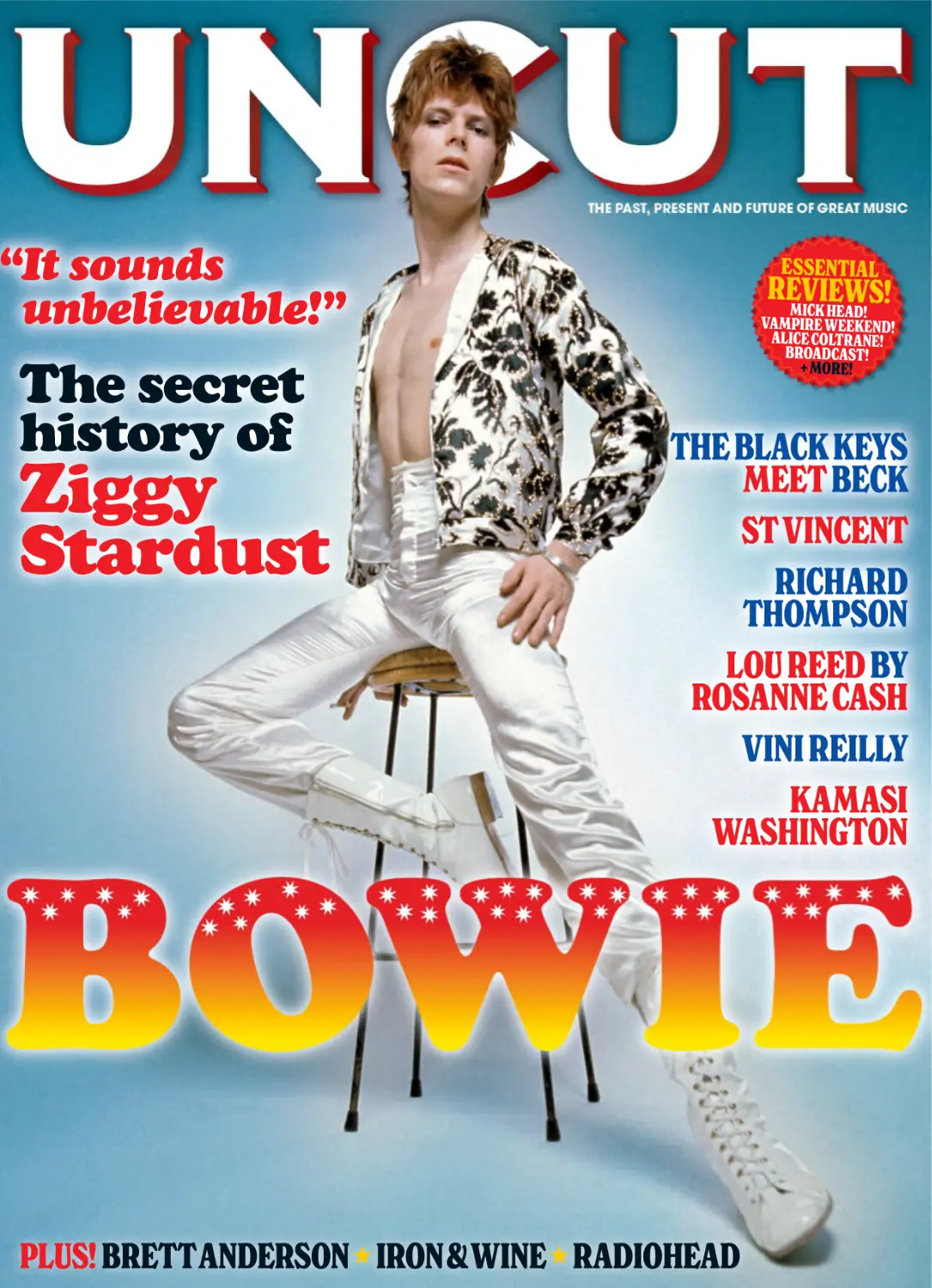
“It sounds
unbelievable!”
The secret
history of
Ziggy
Stardust
ESSENTIAL
REVIEWS!
MICK HEAD!
VAMPIRE WEEKEND!
ALICE COLTRANE!
BROADCAST!
+ MORE!
THE BLACK KEYS
MEET BECK
ST VINCENT
RICHARD
THOMPSON
LOU REED BY
ROSANNE CASH
VINI REILLY
KAMASI
WASHINGTON
PLUS! BRETT ANDERSON + IRON & WINE + RADIOHEAD
“Snake it, take it/Panther princess you must stay”
•M
YRIA
M
GENDRON • AIR
HO
• EC
HE
&T
BU
AS
AM
•K
I
W
AS
HI
NG
TO
N
U
N
NY
M
EN
•
TE
BU
TRI
M
PS
O
N
MAY
2024
S
JE
PR
AT
T
•B
ED
EC
KM
E E TS
RE
R ET T A
NDERSON • LOU
INC
THE BLACK KEYS • ST V
T
EN
•W
AH
!•B
SI
C
A
TAKE 325
•A
LIC
ER
O
WIE
ANDAL
L • DAVID BO
NE of my favourite moments of the new David Bowie
boxset, covering the birth of Ziggy Stardust, is the demo
of “Soul Love” recorded at Haddon Hall in November
1971. This has evidently been made for Mick Ronson
and, after playing the song through, Bowie leaves a
message for his co-conspirator. “I think we should work on that as a
single, Mick,” he begins, going on to list ideas for arrangements he has in
mind for the song, based around a “heavy, warm sax lineup”. Bowie’s
ideas are clear, precise and detailed, revealing a lot about his ability to
imagine how a finished song might sound. After this, there’s a pause,
then Bowie signs off in the kind of cute parentese he might have used
with his then-six-month-old son, Zowie. “Oo-kay? Right ’den.” In the
space of just a few moments, we have heard from several different David
Bowies: the performer, the composer, the friend. Three months after this
charming, intimate recording, Ziggy Stardust made his earthly debut on
stage at the Toby Jug, a pub off the A3.
A lot has already been written about Bowie’s stellar trajectory during
1971/1972. But for our cover story, Peter Watts has unearthed what feels
•
RD
HA
RIC
O
TH
On the cover:
David Bowie
© The David Bowie
Archive, photograph
by Brian Ward
like a genuinely fresh tale, full of alternate versions, discarded
recordings, different tracklistings and paths not taken. You might
wonder, then, what might have been had Bowie ended up playing slide
guitar on “Starman” – and how that might have looked during that July
6, 1972 Top Of The Pops performance…
There’s plenty more besides, of course. We bring you a hook-up
between The Black Keys and Beck, St Vincent, Kamasi Washington,
Richard Thompson, a rare encounter with Vini Reilly and I’m honoured
to bring you the first major UK music magazine interview with Myriam
Gendron, whose beautiful and impeccable
songs have a calm, wise grasp of folk traditions.
I’m sure you’ll find a ton of other interesting
things squirrelled away inside this month’s
issue. So dig in and enjoy. And, as Bowie once
said, keep it cool and easy.
Michael Bonner, Editor. Follow me on Twitter @michaelbonner
CONTENTS
4 Instant Karma!
Radiohead, Lou Reed, Brett Anderson,
Caroline Coon, Alice Randall, Mint Mile
discusses her new record – a powerful
reckoning with loss and grief
66 Iron & Wine
18 The Durutti Column
94 David Bowie
As a new boxset digs deep into Ziggy
Stardust, we map the 1972 masterpiece’s
secret history with the aid of key players
Album By Album with Sam Beam
106 Lives Air, Echo & The Bunnymen
An Audience With Vini Reilly
70 Kamasi Washington
24 New Albums
The reigning king of jazz saxophone:
still on a mission to soothe the soul
Including: Jessica Pratt, Michael Head, Ian
Hunter, Vampire Weekend, Pearl Jam
110 Screen The Origin Of Evil and more
112 Screen Extra Microdisney
76 Wah!
42 The Archive
The Making Of “The Story Of The Blues”
Including: Broadcast, AC/DC,
Alice Coltrane, Sister Rosetta Tharpe
80 Richard Thompson
The magic of Big Pink, adventures
in the Sahara and imaginary
conversations with Sandy Denny
116 HiFi Pick of the latest speakers
86 Beck and The Black Keys
120 Letters Plus the Uncut crossword
Two decades after they first met, ‘the Beck
Keys’ finally get it together in the studio
122 My Life In Music Neil Finn
54 St Vincent
Annie Clark squares up to her demons
on her sublime seventh LP
60 Myriam Gendron
The enigmatic French-Canadian
114 Books Skip Spence,
Phil Manzanera and Arthur Russell
118 Not Fade Away Obituaries
SUBSCRIBE TODAY
AND SAVE £26.33!*
Online at shop.kelsey.co.uk/UCP524
Call 01959 543 747** and quote ref: UCP524
*UK Direct Debit offer only. Terms and Conditions apply.
** Lines open Mon-Fri 08.30-17.30; calls charged at your standard network rate.
0$<Ǵ
Ǵ3
THIS MONTH’S REVELATIONS FROM THE WORLD OF
WITH... Lou Reed | Brett Anderson | Alice Randall | Sex Pistols
Camera
Police!
Tom Sheehan reveals what it’s like
to shoot notoriously reluctant
superstars, Radiohead
© TOM SHEEHAN MARCH 2024
R
ADIOHEAD have
always been a band
apart. When Tom
Sheehan first went
to take their picture
for Melody Maker, before “Creep”
became a transatlantic smash, he
arranged to meet them at Oxford’s
Jericho Tavern. But rather than
linger for a pint, they took him
straight to the Pitt Rivers Museum.
“Ed kindly dropped me back at the
station, and he was
questioning me
about my work.
Lovely chaps.”
Post-“Creep”,
Radiohead got better
at pretending to be
rockstars. “Thom’s
very good in front of
the camera, I think
he learned a few tips
off his mate Stipey,
but it’s not his
favourite pastime.”
Sheehan reckons he
only got the picture opposite, of
Yorke doing a Marilyn on the
roof of LA’s Capitol Records
Building, because the band
had just finished a gruelling
day of US press downstairs and
couldn’t be persuaded to
wander any further afield.
By the time they reconvened
in Tokyo in 1997, where
Sheehan had been tasked with
obtaining press shots for the OK
Computer campaign, Yorke was
trying to disappear completely.
“They had this idea where they
wanted to be seen as part of the
landscape. I thought, ‘Fuck
this, no bugger is gonna run a
picture unless they can see
who’s in it!’ I’ve got these shots
where Thom’s about 300 yards
from me. ‘Mate! Closer, closer…’
He even started wearing a
facemask. Suffice to say, none of
those pictures got selected.”
Ǵ
Ǵ MAY 2024
Sheehan’s new photobook,
Climbing Up The Walls, contains
further unseen outtakes from all
those encounters, as well as several
other Radiohead assignments. “It’s
nice to have been a small cog in the
wheel,” he reflects. “They’re all
genuinely really nice people, and
funny as fuck. Come back from a
trip with The Charlatans or Oasis
and you’d need a week off. But
Radiohead are relaxing to be with –
always interesting,
always enlightening.
They work on a
different level.”
SAM RICHARDS
Radiohead:
Climbing Up The
Walls is published
by Welbeck on
June 6
“They wanted to
be seen as part of
the landscape”:
Radiohead fail to
blend in, Tokyo,
April 1997
Blond faith: Thom
Yorke, Capitol
Records Tower,
LA, April 1993
0$<Ǵ
Ǵ5
INSTANT KARMA
Lou Reed:
“a feminine
appreciation”
Rickie Lee
Jones: on a
“beautiful
sonic
voyage”
7,027+<*5((1),(/'ǫ6$1'(56
*(77<,0$*(6
“He was
like a sun”
Rosanne Cash and Rickie Lee Jones
acknowledge the all-powerful
influence of Lou Reed
W
HEN Rosanne Cash
moved to New York in
the early 1990s, it was
inevitable that she’d run into Lou
Reed. Reed dominated New York
much as Cash’s father ruled
Nashville, and it wasn’t long before
Cash and Reed were performing
together at a songwriter showcase at
The Bottom Line. The next time they
met, backstage at a Bob Dylan
tribute
concert at
Madison
Square
Garden, Reed
asked for her
number.
“He was
angling for a
date, but I
laughed and
told him it
wouldn’t be a
good idea,”
says Cash.
“I was very wary because his
reputation was brutal, but he was
always so kind and respectful to me.
We became friends, and when I was
editing a book of songwriter prose,
I asked him to write a piece based on
one of his songs. It was beautifully
written, but there were a couple of
scenes that bordered on porn. My
dad was going to be in the book, so
I called Lou and said I couldn’t
include it because it would make my
dad so uncomfortable. Lou was very
sweet and understanding.”
Cash has now contributed a
version of “Magician” to a
forthcoming Lou Reed tribute album,
The Power Of The Heart. It includes
Keith Richards’ cover of “I’m Waiting
For The Man”, as well as solo Reed
songs by Angel Olsen, Joan Jett,
Rufus Wainwright, The Afghan
Whigs, Rickie Lee Jones, Lucinda
Williams and Mary Gauthier.
The collection was helmed by Bill
Bentley, who first met Reed in 1988
when hired to PR the New York
album. “I was in LA, and usually
they divided publicity between
East and West Coast,” says Bentley.
“But Lou had stepped on a few toes
in New York, so I did the whole
thing. You had to go with the Lou
rules. He wanted people to be loyal
“His reputation
was brutal,
but he was
always so kind
and respectful
to me”
ROSANNE CASH
to who he was
and represent
that in how you
dealt with his
music. We put
out New York
and it grew
from there. It
was glorious
watching him flower again, as he’d
been taken for granted.”
When compiling The Power Of The
Heart, Bentley was keen to highlight
songs from Reed’s solo career. He
found that female singers, including
several from the Americana
tradition, were particularly eager
to contribute. “Lou would have
loved that, as he had very strong
relationships with women
throughout his life,” says Bentley.
“He had a feminine appreciation
that turned women onto his music.
Women were able to tap into his
emotions because he wore them on
his sleeve – he was very direct, and
that also speaks to the country
tradition, where there’s no hiding.”
Cash decided to sing “Magician”
having seen Reed perform the entire
Magic And Loss album at Radio City
in 1992. “That blew me away
because it was a very artful, dark
record,” she says. “It gave me
courage to perform an album of my
own in sequence, which I did with
Black Cadillac. My version of
‘Magician’ really pulls out the
dreamy, druggy elements. I don’t
think it’s a coincidence that there
are so many female Americana
artists on this record. Lou really
liked roots music, he was open to
all of it, so the presence of all the
Americana artists makes sense to
me. His chord progressions and
harmonies are not that complex, so
the delivery can be easily adapted.”
This is evidenced by Rickie Lee
Jones’s new version of “Walk On The
Wild Side”, which draws out the
jazzy feel and beat phrasing of the
original. “‘Walk On The Wild Side’
remains one of the most fascinating,
wonderfully beautiful sonic
voyages of vocal music,” says Jones,
noting that Lou Reed’s influence on
songwriters of all stripes is stronger
than ever. “People have grown in
the direction of Lou’s music, not just
this song. He was
like a sun.”
PETER WATTS
The Power Of The
Heart: A Tribute
To Lou Reed is
released by
Light In The Attic
on April 20
INSTANT KARMA
Adrian Utley and
Charles Hazlewood
with (below) guest
vocalists Nadine
Shah and Gwenno
Black
thoughts:
Brett
Anderson
Death and the
Suede man
Brett Anderson teams up
with Charles Hazlewood and
Paraorchestra to breathe new life
into songs about dying
KIRSTEN McTERNAN; TIM TOPPLE
“I
HATE jolly music,” says
Brett Anderson, an avid
plunderer of the pale rider’s
record collection. “I find happy
music depressing. All the best songs
are about the murkier sides of life.”
He makes a natural frontman, then,
for Death Songbook, an orchestral
covers project focusing on the
“morbidly beautiful and poignantly
sombre”, instigated by renowned
conductor Charles Hazlewood.
Around the start of lockdown
2020, inspired by his former wife’s
Festival Of Death And Dying in
Somerset – an arts weekend
intended to “up the debate on the
last great taboo” – Hazlewood
began looking for answers in the
great beyond. “For such a universal
theme, it’s something we’re so loath
to talk about,” he says of death and
all its dark tributaries. “We find it
deeply uncomfortable, and yet the
great irony is that, especially in
music, melancholy and themes
of loss and heartbreak and
anxiety are the octane that fuels
most of the greatest art that’s ever
been created.”
Imagining an album of “delicate
Ǵ
Ǵ MAY 2024
reclothings” of rock’s darkest
materials, Hazlewood’s first
thought for collaborators were
Paraorchestra, a pioneering
ensemble of up to 50 players both
disabled and non-disabled, who
push the boundaries of the
traditional orchestra using a
combination of traditional, electric
and electronic instrumentation.
“Bleakness is
in the DNA of
all the music I
have ever loved”
BRETT ANDERSON
“We’re talking about vulnerability,”
he says, “and if there’s one
community in our society that
deals on a daily, hourly, minute-byminute basis with vulnerability,
it’s the disabled community.”
Hazlewood’s next call was to
neighbour and friend Anderson, “a
dark melancholic just like me”. He
didn’t take much persuading. “I
thought it was a fantastic premise,”
Anderson confirms. “Bleakness and
disintegration is in the DNA of all
the music I have ever loved, so when
Charles suggested it to me, I was
immediately sold. I loved the idea of
curating a suite of songs, culling
some of my favourite music from my
youth and giving it a new twist.”
The songs they chose to rework,
says Hazlewood, “landed like freefalling angels out of the mist” –
mainstays of their melancholy
youths by the likes of Echo & The
Bunnymen, Depeche Mode and
Japan. Recording much of the
album in one afternoon at the Wales
Millennium Centre in Cardiff, the
Paraorchestra were augmented by
Portishead’s Adrian Utley, Polar
Bear’s Seb Rochford and guest
vocalist Nadine Shah, bringing a
tensile menace and unsentimental
grace to the likes of “The Killing
Moon”, Skeeter Davis’s sublime
“The End Of The World” and –
somewhat surprisingly – Black’s
“Wonderful Life”. “That was an
interesting choice,” Anderson
says, “because on the surface
you would assume the song was
simple and positive,
but I’ve always found
it brilliantly and
bleakly ironic.”
Anderson and
Hazlewood worked
up a new song for the
record too – a chilling portrait
of domestic violence called
“Brutal Lover” – while Anderson
reinterprets four of his own
compositions, including Suede’s
“The Next Life” and 2022 single “She
Still Leads Me On”, written for his
late mother. “Death is the ultimate
fear,” he says. “The thought of it is
sometimes too overwhelming to
properly entertain, so I think as
artists we try to find ways of making
beauty from it as a way to stare
it in the face.”
Completed with three tracks
recorded at the project’s live premiere
at the Millennium Centre in October
2022 – where Gwenno provided
guest vocals on a febrile, jazzy “Enjoy
The Silence” – Death Songbook is
intended as an entreaty to not fear
the reaper. “It’s about reacquainting
oneself with the fundamental truth
that melancholy or darkness, these
are the main pillars of great art,” says
Hazlewood. “And far from that being
depressing and making you feel even
more desperate, it has the opposite
effect.” MARK BEAUMONT
Death Songbook is released by
World Circuit/BMG on
April 15; the album
will be performed live
at The Roundhouse,
London (April 24) and
Manchester’s Aviva
Studios (April 26)
the marble index
desertshore
Reissues of the long out-of-print classic albums from 1968 and 1970
Featuring audio mastered from the original tapes
Including previously unreleased photos by Guy Webster
The Marble Index - Domino Mart Edition features a limited edition 7” of two tracks,
“Roses in the Snow” & “Nibelungen”, both previously unavailable on vinyl
LP / CD 29.03.24
•
dominomusic.com
INSTANT KARMA
Revolution rock
How punk chronicler Caroline Coon
captured a “fracture in the zeitgeist”
Sex Pistols and friends at Les Deux
Magots, Paris, September 1976
Ǵ
Ǵ MAY 2024
ÿÈÆ×ÔÑÎÓÊÈÔÔÓ²ÈÆÒÊ×ÆÕ×ÊØØ
“A
S soon as I heard about the Sex
Pistols, I immediately intuited from
the name of the band that this could
be a significant change of language
which will inform the next street uprising. I went to
their second gig, at St Martins. Malcolm McLaren
began talking to me, then Bernie Rhodes came
running up saying, ‘I’ve got a band too…’ I sensed
something big was happening, so I bought a camera
and decided to follow it for myself. It was obvious
that there was this real fracture in the zeitgeist.
“Malcolm was taking the Sex Pistols to Paris for a
concert over two days. I’m a decade older than them,
I’d read Simone de Beauvoir, so I suggested meeting
up at Les Deux Magots. We had the wonderful feeling
of this new generation sitting in the same place
where the great philosophers that I’d loved in my
teenage years had sat and drank coffee. A group of
fans, The Bromley Contingent, were right there
from the beginning, expressing their new ethos by
dressing in a completely different way to the hippies:
hard, plastic, no velvet. Billy Idol’s there, Siouxsie’s
there… they hadn’t been on a stage yet, but they were
marking out what they wanted to do. Paris had the
blousons noir and the beatniks, so this was the new
generation of youth to shock the world.”
Members of The Clash, Steel Pulse and The Rich Kids
protest outside the National Front HQ in Teddington,
March 1978
“Rock Against Racism was a reaction to the rise of the National Front. I
decided to go and interview their leader, Martin Webster, who named all
the musicians he thought should be deported. So I organised for all of us
to come the next day with our placards and demonstrate outside his
house, the fascist headquarters. It was extraordinary to have this
unicultural demonstration, black and white, in the middle of Teddington.
We felt we were making a mark in history, that we weren’t going to allow
this racism to persist. It’s still going on, but it was a lot worse in the ’70s,
and all the people in these pictures made a concerted effort to successfully
effect change. Their joyous music smuggled in such a tough message. But
if you’re going to make change, it’s great to have music to dance to!”
Buzzcocks
in Manchester,
September 1977
Poly Styrene at the Rock Against Racism
concert in Victoria Park, London, April 1978
“A lot was happening that day, it was a hugely political event.
Poly Styrene had appeared on-stage in a turban. When she
came off-stage, she took her turban off and it was a shock,
because she had shaved her head – before that, she’d had a
mop of curls. She’s smiling at me, but in retrospect I think that
when a youth shaves their hair like that, it’s an indication of
emotional stress. Appearing in the media spotlight can put a
lot of pressure on a young person, and she also was dealing
with misogyny, racism. It got really tough for her, and she did
have a nervous breakdown. When I
rediscovered this photo a few months
ago, it brought tears to my eyes. She
was such an important artist because
of her courage and what she was
expressing about misogyny in her
lyrics. But as a woman writer,
I knew what happened when you
confronted the establishment.”
INTERVIEW BY SAM RICHARDS
Caroline Coon’s Nothing To Lose:
Punk 1970s is out now on Café
Royal Books
ÿÈÆ×ÔÑÎÓÊÈÔÔÓ²ÈÆÒÊ×ÆÕ×ÊØØ
I wanted to record how
the movement was
spreading out of
London. A different
kind of music was
coming out of
Manchester. People
have come to think of
punk as monolithic,
but there are many
different narratives
within it. The way that
Buzzcocks were
expressing the new
energy I thought was
very interesting – the
pop melodies and the
satire of the song
“Boredom”. They were
more into irony than
anything flamboyant,
but that was good too.
INSTANT KARMA
Moving trauma to
transcendence:
Alice Randall
Black
country,
new road
Nashville hitmaker
Alice Randall on
recovering the
“erased histories”
of country music
KEREN TREVINO; EBRU YILDIZ
A
LICE Randall has some
very strict rules for what
makes a country song. “Life
is hard, that’s the big one,” says the
songwriter, who has been penning
hits for more than 40 years. “God
is real. The road and family are
significant compensations for
hardship, and the past is better than
the present.” That last one requires a
caveat: “Of course, for many white
country fans, the past is a lost
mythological Dixie. For many black
country fans, the past is a lost Africa.”
Randall explores the genre’s
black foundations and her own
experiences with the music in her
new book My Black Country. It’s
accompanied by a tribute album of
the same title, featuring the likes of
Rhiannon Giddens, Sunny War,
Allison Russell, Rissi Palmer and
others covering her songs. Both the
book and the album argue that
country music “requires significant
Celtic and African strains”.
This point is crucial for a black
songwriter who found herself
Ǵ
Ǵ MAY 2024
brushed to the margins of Nashville,
despite penning material for Johnny
Cash, Glen Campbell and Reba
McEntire. In 1994, she became the
first black woman to write a No 1
country hit – “XXX’s And OOO’s (An
American Girl)”, recorded by Trisha
Yearwood. “Alice is a beautifully
observational writer,” says Giddens.
“She’s able to tap into things in a way
that really speaks to people. She
understands that country music is
about reaching into the past and
bringing things forward. Black
people have been making country
music for a long time, and Alice
is connecting that to what we’re
doing now.”
Interpreting
Randall:
Rhiannon
Giddens
Despite her success on
the country charts,
Randall began to feel
like her songs didn’t
truly represent her
perspective and didn’t
fulfill her intentions –
that some essential
aspect of her identity had been
stripped away. This feeling inspired
her to write My Black Country, which
extols the contributions of Lil Hardin,
Charley Pride and harmonica
virtuoso DeFord Bailey. “Part of the
work of this book is recovering those
erased histories. And what I’ve tried
to do for them, these women on the
album have done for me.”
Giddens sings “The Ballad Of Sally
Anne”, which recounts a story of true
love thwarted by racial violence. The
first recording was by renowned
fiddler Mark O’Connor, which
Randall describes as “an
extraordinary version with
extraordinary vocals. But it added
distance to the reality of the song. It
became a song about a white
observer noting the drama that’s
occurring. Perhaps it’s even one of
the people at the lynching.”
Working with producer Ebonie
Smith, Giddens devised a new
version that conveys the full horror
of the incident. “I knew I needed
to go in a different direction with
my version,” says Giddens. “I took it
into a minor key and changed a lot
about the melody, which is what folk
musicians do.” Randall was moved
to tears when she first heard it:
“Rhiannon centres the song in Sally
“Alice is able to
tap into things
in a way that
really speaks
to people”
RHIANNON GIDDENS
Anne’s love for Johnny rather than in
the murder or in her victimisation.
That’s another thing about country
music: it moves a lot of trauma
to transcendence.”
For Randall, My Black Country feels
like the culmination of her long
career in Nashville, with both the
book and the album securing her
own place in the history of country
music. “These artists have lifted up
my legacy,” she says. “They have
reframed it and brought me into a
Juneteenth moment: good news at
long last.” STEPHEN DEUSNER
My Black Country is published by
Atria/Black Privilege on May 9; the
accompanying tribute album is out
on April 12 via Oh Boy Records
A Quick One
It’s time the tale
were told… 40 years
on from their debut
album, we present the
172-page Definitive
Edition of our Ultimate
Music Guide to The
Smiths. Every album
reviewed – including
all of Morrissey and
Marr’s solo efforts
– classic interviews
rediscovered, plus
an eight-page foldout
timeline featuring a
Smiths UK tour map! It’s
in shops now, and also
available as a limited
edition hardback from
our online store: shop.
kelsey.co.uk/uncut…
Available in the same
places from April 1
is The Greatest 500
Albums Of The 1990s…
Ranked! The best
of Britpop, trip-hop,
grunge, shoegaze, alt.
country, electronica
and more, as voted for
by the Uncut team…
This year’s Somerset
House Summer Series
in London includes a
show by the Patti Smith
Quartet on July 21, with
Smith backed by her
son Jackson on guitar,
Tony Shanahan on keys
and Seb Rochford on
drums. The quartet
will also play Brighton
Dome (June 25) and
Dublin’s Vicar Street
(June 27, 28) as well as
dates across Europe…
Jimmy Page, Tony
Iommi and Brian May
have cut the ribbon on
Gibson’s new guitar
shop and venue on
London’s Eastcastle
St. The Gibson Garage
will host weekly live
gigs, showcases and
signings, and is currently
displaying a collection of
iconic rock portraits by
Gered Mankowitz…
CARGO COLLECTIVE
Scan To Listen
JANE WEAVER
STILL CORNERS
THE REDS, PINKS AND PURPLES
LOVE IN CONSTANT SPECTACLE
DREAM TALK
UNWISHING WELL
MICHEL MOERS
As Is
FIRE RECORDS LP / CD
WRECKING LIGHT RECORDS LP / CD
TOUGH LOVE LP / CD
FREAKSVILLE LP / CD
Jane Weaver returns with her most open-hearted, direct
& intimate collection of material yet. Produced by
John Parish, Love In Constant Spectacle is a heartfelt
manifesto from an artist that continues to boundlessly
evolve. “An artist at the top of her game” NPR
Dive into the lush, seductive world of Still Corners new
album Dream Talk, ten immaculately crafted and subtle
songs, with crystal tone guitar, elegant vocals, and a
wash of congas and synthesizers.
Spanning 10 gem-like tunes, Unwishing Well is another
exhibition of Reds, Pinks & Purples flawless mastery of
intimate - yet expansive - downcast pop.
Legendary Telex artist 2nd solo album in 33 years.
Reminiscent of diary entries and influenced by Erik
Satie. A testament to Moers’ enduring creativity and
relevance in the contemporary music scene.
THE BABY SEALS
VARIOUS ARTISTS
REAL FARMER
HOUSE OF ALL
CHAOS
UNDER THE BRIDGE 2
COMPARE WHAT’S THERE
CONTINUUM
TRAPPED ANIMAL LP / CD
SKEP WAX RECORDS LP / CD
STRAP ORIGINALS LP
TINY GLOBAL PRODUCTIONS LP / CD
An exploration of heavy guitars and beautiful harmonies.
Featuring such hits as ‘Vibrator’. ‘My Labia is Lopsided,
But I Don’t Mind’ and ‘Mild Misogynist’, Chaos is here to
level the field.
A second compilation of new music by songwriters and
bands who once recorded for Sarah Records.
Still idealistic, still pure, still in love with independent
pop music.
Active members of the vibrant local music scene of
Groningen with their wonderfully infectious punk noise,
concocting fast-paced, driving songs with wiry riffs,
propelling drums, and winding melodies.
HOUSE OF ALL’s surprise debut took the underground
by storm. Now Bramah, Greenway, Hanley, Hanley &
Wolstencroft back with a follow-up that expands their
scope, vision and energy.
PLAYHOUSE
DRIFT
THEE SINSEERS
DYNAMO
11 POINTS IN TIME
SINSEERLY YOURS
JAMES ELKINGTON
AND NATHAN SALSBURG
GOD UNKNOWN RECORDS LP
GOD UNKNOWN RECORDS LP
COLEMINE RECORDS LP / CD
ALL GIST
Liverpool’s long lost 90’s Indie Rock noisemakers.
Compiling 3 singles and unreleased tracks. “If these
guys were American they’d have a massive following”
Stevie Chick. Includes a cover of Sebadoh’s “It’s So
Hard To Fall In Love”
Index For Working Musik’s Nathalia Bruno delivers her
2nd album recalling this likes of Chris & Cosey / early
Cabaret Voltaire. Lyrically it is a noirish unpacking of a
decades-old disappearance of Rosa Crucci.
Sinseerly, Soulfully, Sweet. Quinones and his crew have
created a distinctive vibe that explores all aspects of a
timeless genre, bringing together their interpretation of
music through an unmistakable modern lens.
PARADISE OF BACHELORS LP / CD
Guitar instrumentals pushing their sinuous compositions
into labyrinthine new shapes, interlocking & interlocutory.
Among the dazzling originals are fascinating covers,
including Neneh Cherry’s “Buffalo Stance.”
ROSALI
REYNA TROPICAL
CHASTITY BELT
SHOVEL DANCE COLLECTIVE
BITE DOWN
MALEGRÍA
LIVE LAUGH LOVE
MERGE RECORDS LP / CD
PSYCHIC HOTLINE LP / CD
SUICIDE SQUEEZE LP / CD
THE WATER IS THE SHOVEL
OF THE SHORE
“A tender yet commanding set of folk, country, and
atmospheric rock done up in blaze orange and shadow
blue.” – UNCUT
Malegría, is for diasporic belonging, queer love,
feminine sensuality, & a relationship with the land. Vibrant
beats mix with bandleader Fabi Reyna’s guitar riffs to
create songs that call you into action, into your own power,
& into moving your body to the beat.
Live Laugh Love finds Chastity Belt in their prime as
musicians. It’s never been more apparent that they are
creative siblings, cut from the same belt.
CARGO
COLLECTIVE:
AN
AMALGAMATION
OF
RECORD
SHOPS
AND
LABELS
DEDICATED
TO
MEMORIALS OF DISTINCTION / DOUBLE DARE 2LP
Revolutionary takes on traditional folk, spliced with
music concrète and field recordings taken along the
Thames. This highly acclaimed (Pitchfork, Quietus, Wire,
Songlines, Tradfolk, etc.) album is like no other.
BRINGING
YOU
NEW
MUSIC
IRELAND: DUBLIN - SPINDIZZY / KILKENNY - ROLLER COASTER SCOTLAND: DUNDEE - ASSAI / EDINBURGH - ASSAI / EDINBURGH - THORNE RECORDS / GLASGOW - ASSAI / GLASGOW - LOVE MUSIC / GLASGOW - MONORAIL WALES: ABERYSTWYTH - ANDY’S RECORDS /
CARDIFF - SPILLERS / NEWPORT - DIVERSE / SWANSEA - DERRICKS NORTH- WEST: LIVERPOOL - 81 RENSHAW LTD / LIVERPOOL - PROBE / LIVERPOOL - ROUGH TRADE / MANCHESTER - PICCADILLY RECORDS / NANTWICH - APPLESTUMP RECORDS LTD / PRESTON - ACTION RECORDS NORTH-EAST: BINGLEY - FIVE RISE / HARROGATE - P & C MUSIC / HEADINGLEY - VINYL WHISTLE / HUDDERSFIELD - VINYL TAP / LEEDS - CRASH LEEDS - JUMBO RECORDS / NEWCASTLE - J G WINDOWS / NEWCASTLE - BEATDOWN / NEWCASTLE - REFLEX
/ SHEFFIELD - BEAR TREE / SHEFFIELD - RECORD COLLECTOR / SHEFFIELD - SPINNING DISCS MIDLANDS: CAMBRIDGE - LOST IN VINYL / CAMBRIDGE - RELEVANT / COVENTRY - JUST DROPPED IN / LEAMINGTON SPA - SEISMIC / LEIGHTON BUZZARD - BLACK CIRCLE /
LETCHWORTH - DAVID’S MUSIC / LOUTH - OFF THE BEATEN TRACK / NOTTINGHAM - ROUGH TRADE / OXFORD - TRUCK STORE / OXON - STRUMMER ROOM RECORDS / WITNEY -WITNEY TRUCK SOUTH: BEXHILL ON SEA - MUSIC’S NOT DEAD / BLANDFORD FORUM - REVOLUTION ROCKS / BRIGHTON - RESIDENT / BURY ST.EDMUNDS - VINYL HUNTER / GODALMING - RECORD CORNER / LEIGH-ON-SEA - FIVES / LONDON - BANQUET GRAVITY / LONDON - CASBAH / LONDON - FLASHBACK / LONDON - ROUGH TRADE EAST / LONDON - ROUGH
TRADE TALBOT RD / LONDON - SISTER RAY / LUTON - VINYL REVELATIONS / NORWICH - SOUNDCLASH / NORWICH / VENUS VINYL / ROMSEY - HUNDRED / SOUTHSEA - PIE & VINYL / SOUTHEND ON SEA - SOUTH RECORDS / ST ALBANS - EMPIRE RECORDS / ST LEONARDS - TOUGH LOVE ST LEONARDS / WATFORD - PARADE VIBES / WIMBORNE - SQUARE RECORDS / WHITSTABLE - GATEFIELD SOUNDS / WINCHESTER - ELEPHANT RECORDS / WORTHING - SPUN SOUTH WEST: BRISTOL - ROUGH TRADE / CHELTENHAM - BADLANDS /
FALMOUTH - JAM FROME - RAVES FROM THE GRAVE / MARLBOROUGH - SOUND KNOWLEDGE / TOTNES - DRIFT MAILORDER AND INTERNET ONLY STORES: BLEEP.COM / BOOMKAT.COM / JUNO / NORMANRECORDS.COM / PEBBLE RECORDS CO.UK / RECORDSTORE.CO.UK
CARGORECORDS.CO.UK - INFO@CARGORECORDS.CO.UK
INSTANT KARMA
Uncut Playlist
On the stereo this month...
MDOU MOCTAR
Funeral For Justice MATADOR
Tuareg guitar-slinger
makes good on those
Hendrix comparisons with
DƮHU\H[FRULDWLRQRIWKH
YDULRXVIRUFHVRSSUHVVLQJKLVSHRSOH
,QYLJRUDWLQJDQGLQVSLULQJ
NICK CAVE & THE BAD SEEDS
“Wild God” BAD SEED
“It was rape and pillage/In the retirement
village…” He’s back alright, with another
raucous parable suggesting that our
FKRVHQGHLWLHVPD\QRWKDYHRXUEHVW
LQWHUHVWVDWKHDUW
WE’RE
NEW
HERE
OREN AMBARCHI/JOHAN
BERTHLING/ANDREAS
WERLIIN
Ghosted II DRAG CITY
Mint Mile
The Silkworm has turned!
Indie-rock lifer ploughs
a fruitful new furrow
Roughrider, then, feels like the long-awaited
culmination of something. Songs like
“Brigadier” and “I Hope It’s Different” – the
latter a raw country-blues sung beautifully by
Nina Nastasia – deal with change, mortality
and the ageing process. The album also finds Mint
IM Midyett is one of the most undersung
Mile expanding their palette, adding lap steel,
voices in American indie rock. Formerly
strings, trumpet and sax. “Silkworm was a
the frontman of Silkworm, now at the
helm of Chicago’s Mint Mile, Midyett has presided Creedence, Minutemen, Husker Dü-type group,
where you’ve got your band and that’s it,” says
over four decades of music while never quite
Midyett. With Mint Mile, though, bringing in
breaking out of the category of cult concern.
orchestration felt right. “There’s the danger you’re
What’s important, though, is that Mint Mile’s new
overly decorating it. But Susan [Voelz, violin] and
album Roughrider is up there with his best: an
Alison [Chesley, cello] are pros. They understand
emotionally resonant rock record that sets his
rock music. When they play, it just works.”
rich, ruminative baritone front and centre. “It
Midyett has no shortage of admirers from
comes out of the same working method that any
his years in the indie-rock trenches. The 2013
of my bands have ever had, which is do what
documentary Couldn’t You Wait? The Story Of
comes naturally and don’t overthink,” says
Silkworm featured Stephen Malkmus, Jeff Tweedy
Midyett. “We hardly ever talk about anything
and long-time friend and sometime engineer
conceptual – it’s all feel.”
Steve Albini testifying to their love of the band.
After releasing 11 albums through underground
More recently, John Darnielle has invited Mint
institutions like Matador and Touch And Go,
Mile to play with The Mountain Goats, while
Silkworm splintered in 2005 following the death
an old friend, Greg Anderson, asked Midyett to
of drummer Michael Dalhquist, killed when his
contribute bass to Sunn O)))’s 2019 album Life
stationary car was struck by a suicidal driver. “It
Metal, later enlisting him in their touring band.
was this dual tragedy,” says Midyett. “Obviously
“I keep hoping that I’ll get the call to pack my
the worst thing was losing Michael as a human in
robe and my Travis Bean bass and get to play in
our lives, but also the band died. There was no
that environment again,” he says. “It’s a very
way to replace him as a drummer.” Midyett and
immersive experience.”
fellow Silkworm founder Andy Cohen
Will Roughrider be the record
formed a new group, Bottomless Pit.
I’M YOUR FAN
that introduces Midyett’s music to a
“We made a bunch of records. But
wider audience? Recognition is long
it was born out of that tragedy of
overdue. But if it doesn’t come, he’s
Michael dying. Anything focused on
hardly bothered. “My prescription
something particular like that, it’s
for doing this has always been I’m
probably gonna run its course.”
gonna do what makes sense to me.
Mint Mile came into being a decade
I don’t think about who’s listening at
ago, when Midyett reached out to Jeff
all. All the people I admire, from Neil
Panall, who, as the drummer for Jason
“Musically,
Young to Kim Deal to Nina Nastasia
Molina’s band Songs: Ohia, had his
sonically, tonally,
– they just do their stuff. It seems to
own experience with personal
Mint Mile is the
always work out great creatively if
tragedy. They honed their sound over
complete picture
– as distinct a
you do that.” LOUIS PATTISON
a series of EPs, but debut album
band as you’ll find
Ambertron had no option but to be a
anywhere” John
slow burner, released as it was in the
Mint Mile’s Roughrider is out now
Darnielle, The
pandemic month of March 2020.
on Comedy Minus One
Mountain Goats
T
Ò×ÐÎÓÌÉÆÛÎÉÆØÒÎÙͲÌÊÙÙÞÎÒÆÌÊØ
Just doing
their stuff: Mint
Mile with Tim
Midyett (right)
Ǵ
Ǵ MAY 2024
7KHVHTXHOWRoVLQVSLUHG6\GQH\
6WRFNKROPV\PSRVLXPPLJKWEHHYHQ
EHWWHUZLWK%HUWKOLQJoVIXQN\XSULJKW
basslines anchoring the shimmering,
/HVOLHVSHDNHUHGEOLVV
FOUR TET
Three
TEXT
Sometime superstar DJ
makes a welcome return to the
GHZ\IRONWURQLFSDVWXUHVRI
Pause and Rounds, with bonus
&RFWHDXVDPELHQFH
BONNIE “PRINCE” BILLY,
NATHAN SALSBURG & TYLER
TROTTER
Hear The Children Sing The
Evidence NO QUARTER
5RFNDE\H%LOO\7ZRH[WHQGHG/XQJƮVK
FRYHUVRULJLQDWLQJDVOXOODELHVIRU
6DOVEXUJoVEDE\GDXJKWHU
JORGA MESFIN
The Kindest One MUZIKAWI
+HDG\DQGP\VWHULRXVQH[WJHQ(WKLR
MD]]IURPDVD[SOD\LQJSURWÆJÆRIWKH
JUHDW0XODWX$VWDWNH
MULTIPLES
Two Hours Or Something STOOR
*UL]]OHGWHFKQRYHWV6SHHG\-DQG
6XUJHRQORFNKRUQVLQp5DWWHUGDPq$PLG
WKHKLJKVSHFHOHFWURQLFZDUIDUHVRPH
VXUSULVLQJO\WHQGHUPRPHQWV
ADULT JAZZ
So Sorry So Slow SPARE THOUGHT
$PHUHHLJKW\HDUVLQWKHPDNLQJWKH
art-pop quartet’s third album asks more
TXHVWLRQVWKDQLWDQVZHUV6XFKDV
ZKDW
LI$UWKXU5XVVHOOKDGOLYHGWRMRLQIRUFHV
ZLWK'LUW\3URMHFWRUVDQG%MÓUN"
EZRA FEINBERG
Soft Power TONAL UNION
*RUJHRXVO\XQREWUXVLYH
FRVPLFVRXƲHIURPWKHIRUPHU
&LWD\PDQ0DU\/DWWLPRUH
'DYLG0RRUHDQG-HIUH&DQWX
/HGHVPDRƬHUGLVFUHHWDVVLVWDQFH
ERIC CHENAUX TRIO
Delights Of My Life &2167(//$7,21Ǭ
MURAILLES MUSIC
'UHDP\MD]]EDOODGVVSURXWLQJVWUDQJH
ƮEURXVJURZWKV)RUDQ\RQHZKRoVHYHU
GUHDPWRID&KHW%DNHU1HOV&OLQH0RXVH
2Q0DUVVXSHUJURXS
INSTANT KARMA THIS MONTH’S FREE CD
Total
Blam-blam!
15 tracks of the month’s best music
Michael
Head
1 MINT MILE
Sunbreaking
2 JESSICA PRATT
World On A String
Silkworm’s Tim Midyett
returns with the second
Mint Mile album,
Roughrider, mixing up
the sounds of his old band
with the ragged swing
of Pavement and Crazy
Horse, plus some gorgeous
chamber accompaniment.
Read more from Tim on
page 14.
Here In The Pitch, the longawaited follow-up to 2019’s
Quiet Signs, is our Album
Of The Month on page 24.
Here’s a highlight of this
seductive, velveteen folk
record, with Pratt’s
strummed nylon-string
acoustic and echoing
voice gradually joined by
a haze of Mellotron synths,
keys and sparse drums.
Truly magical.
8 ARAB STRAP
You’re Not There
9 BIG|BRAVE
Canon In Canon
10 ARTHUR MELO
Saídas
Aidan Moffat and
Malcolm Middleton return,
reassuringly, as bitter and
scathing as ever on their
new album I’m Totally Fine
With It Don’t Give A Fuck
Anymore . Building on
2021’s As Days Get Dark, it’s
a brilliant amalgam of dark
electronica, raging postrock and wickedly funny
spoken word. Check out the
full review on page 36.
It’s hard to believe this
Quebec trio started as
a folk group, such is the
ferocious noise they create
now. On their seventh
album, A Chaos Of Flowers,
their sound is closest to
latterday Low, crushing
distortion mingling with
minimalist, hushed
melodies. They talk
about the new record on
page 31.
Though still in his twenties,
this singer, guitarist and
songwriter from the
Brazilian city of Belo
Horizonte looks back to his
country’s pop music of the
’70s. This track, a highlight
of his latest album Mirantes
Emocionais, pays tribute to
his hero Caetano Veloso
with a swooning ballad that
wouldn’t have been out of
place on 1972’s Transa.
Ǵ
Ǵ MAY 2024
JOHN JOHNSON; KAT GOLLOCK; GETTY IMAGES
Arab
Strap
3 MICHAEL HEAD
& THE RED ELASTIC
BAND
Ambrosia
Another masterclass in
songwriting from Michael
Head, and a highlight of his
new LP Loophole, produced
by Bill Ryder-Jones.
Following 2017’s Adiós Señor
Pussycat and 2022’s Dear
Scott, he’s on a roll, and has
even found time to pen a
memoir, Ciao Ciao Bambino.
Read our lead review of
Loophole on page 28.
11 IRON & WINE
All In Good Time
(feat Fiona Apple)
Sam Beam is back, and this
time he’s brought Fiona
Apple along to help. This
cut comes from his new
album Light Verse, the
latest in his impressive
catalogue. Beam talks
Uncut through his records
in our Album By Album
feature on page 66.
Big|Brave
4 KHRUANGBIN
Pon Pón
5 GOSPELBEACH
Nothin’ But A Fool
Laura Lee, Mark Speer
and DJ Johnson have
distilled their potent sound
down to its essence on
their new album A La
Sala. It’s a retro-tinged
exploration of the globe’s
most funkily psychedelic
sounds, with the result going
down as smoothly as a
sunset cocktail.
Brent Rademaker is well
known for his work with
the brilliant Beachwood
Sparks, but for the last
decade he’s led this artful
Californian troupe. New LP
Wiggle Your Fingers is touted
as the band’s final album,
so best get onto their classic
Paisley Underground
sounds before it’s too late.
12 JAMES
ELKINGTON
& NATHAN
SALSBURG
Death Wishes To Kill
The two guitarists are often
found working together, but
their new album All Gist
marks their first duo record
since 2015’s Ambsace. It’s an
entrancing, varied record,
their interlocking picking
occasionally joined by
additional textures, such as
the strings and percussion
that surface here.
6 SCOTT H BIRAM
Death Don’t Have
No Mercy
7 PYE CORNER
AUDIO
Counting The Hours
‘The Dirty Old One Man
Band’ from Texas has been
making roots records a little
under the radar for a while
now – but with The One &
Only Scott H Biram he
deserves to be far better
known. Here he is weaving
a bluesy spell with just an
old classical guitar.
Martin Jenkins releases a
host of records on different
labels, and his albums on
Ghost Box always seem to
be his strangest and most
conceptual: The Endless
Echo, then, examines the
nature of time in ominous,
claustrophobic style, drum
machines, drone clusters
and synth arpeggios
painting a widescreen,
dystopian picture.
13 POKEY LAFARGE
Sister André
14 AMEN DUNES
Boys
The artist born Andrew
Heissler has been spreading
his old-time good news for
almost 20 years now, and
this fine track from his new
LP Rhumba Country is
another example of his
way with updating the
sounds of yesteryear:
ragtime, gospel, blues,
country and rock’n’roll.
Now resident in Woodstock,
New York, Damon
McMahon has expanded
his outsider folk sound
with harsh electronics and
some avant-rock grit on
Death Jokes. Check out the
end of “Boys” and you’ll
hear manipulated samples
taken from all manner of
sources, a consistent feature
of the album.
15 CAMERA
OBSCURA
We’re Going To Make
It In A Man’s World
It’s been over a decade since
Tracyanne Campbell and co
last released an album, but
Look To The East, Look To
The West is a fitting return.
The Glaswegians don’t
mess with the formula too
much, and the result is an
autumnal, bittersweet blast
of melody, with heartbreak
and disappointment not
far behind.
0$<Ǵ
Ǵ17
BIG|BRAVE
Khruangbin
INSTANT KARMA
MICHAEL STEFF
“Guitars
are like
sculptures
to me”
Ǵ
Ǵ MAY 2024
P
ROPPED up against a wall of
his living room in Didsbury,
where most people would
have a yucca plant or a prized
ornament, Vini Reilly has
a Fender Custom Shop Stratocaster in
birdseye maple, bought for him at some
point in the 1980s by Tony Wilson.
“Guitars are kind of like sculptures to me,”
he says, poignantly. “I don’t try
to play it any more because it
just does my head in.”
Reilly has recovered most of
his coordination since suffering
a series of strokes in 2010, a fact
he demonstrates by giving
Uncut an impromptu
performance on his cuatro, a
four-string guitar made by
a luthier in Lewes. “But the
biggest problem is that there
are no tunes happening in
my head. There’s nothing of
substance coming through. What
used to happen is I’d just start playing
without really thinking about it. It’s
like you become very suggestible –
there’s no cerebral activity going on,
you’re just feeling. I never knew what
key it would be in or how long it
would last, it just… occurred. And
now it doesn’t.”
But if that sounds sad, he is quick to
put things in perspective. “I had very
serious memory damage, which was
the biggest cause of what became a
mental illness. I was delusional, and
then I became hallucinatory and they
had to section me. It was pretty horrible,
but I’m very stable now.”
Reilly looks frail but still cool, in
hiking trainers with the laces undone,
brightly coloured plaid shirt and that
familiar mop of hair. He says knowing
that people still care about his music,
to the point where they’ve submitted
questions for this feature, is a source
of great comfort and pride. “I owe it
to them, definitely, so thank you. It’s
great, it’s magic.”
The Durutti Column’s
reclusive guitar genius on
Tony Wilson, Morrissey and
kickabouts with Pat Nevin
Interview by SAM RICHARDS
Your playing has been described
as gossamer-like, dreamy,
ethereal and kaleidoscopic. How
did growing up in Manchester
influence your sound?
Josh M Slifkin, Pittsburgh, USA
Well I think everything influences
you, if you’re a musician. But for a
start, you don’t call yourself a
musician – that’s for other people
to decide, because art only exists
when someone else is looking at or
listening to it. It’s a two-way process.
So Josh, by his listening, he can
define it and call it music; I can’t.
But you can be influenced
by a mood. You can be
influenced by someone
you’ve just had a row with.
Everything is an input.
Reilly in Brussels,
January 1982;
(top) sandpapercovered debut LP
The Return Of The
Durutti Column
and its Australiaonly single
Where did your love of classical
music come from?
Chris Thompson, Carlisle
I had years of classical piano training with
a professional musician from the Royal
Northern College Of Music, she got me
through all the grades. But I got kicked off
my O-level music class because an idiot
teacher gave me a very low mark for a
piece of four-part harmony. I asked why
and he said, “Consecutive fourths and
fifths, Reilly!” So I went to Manchester
Central Library with a book of manuscript
paper and I copied five or six examples of
composers using consecutive fourths
and fifths: Berlioz, Tchaikovsky even.
He was really angry and kicked me out.
Apparently I was a disturbing influence
on the class, which was hilarious.
Did it irritate you that, while the first
LP [with the sandpaper sleeve] was a
brilliant piece of disruptive
situationist intervention, it made
listening to it a physical problem?
Marc Beattie, via email
No, I thought it was absolutely great! I love
anarchy – as opposed to oligarchy, or
monarchy, hierarchy, whatever.
What is your abiding memory of
Tony Wilson?
Martha Pugh, Canterbury
He had a genius of recognising when to let
someone do their thing. We became very
good mates – I used to babysit and change
his son’s nappy! He had a well-devised
smokescreen where he’d breeze through
everything, but he was actually very
sensitive. He was juggling so many plates
as well as holding down his day job, and
the pressure on him was incredible. We
would wind each other up and it could get
very niggly, to the point where people in
the office became very uneasy – which
was funny, because neither of us would
harm a fly. It would erupt into this real
shouting match. At one point, Tony had
this very expensive chair, which he
kicked over. But he was getting rid of
0$<Ǵ
Ǵ19
ÉÆÛÎÉÈÔ×ÎÔ²×ÊÉËÊ×ÓØ
AN AUDIENCE WITH...
INSTANT KARMA
nowhere and they’d be perfect, it was
such a buzz. We had a fantastic time
[making that album], we were laughing
all the time. Morrissey’s an incredibly
funny, brilliant bloke. He’s very
misunderstood by lots of people. One day
he pulled up at my house with a little
1960s saloon car full of eco-friendly
cleaning products. He took me for a drive
– he was a terrible driver, worse than me –
and when he spotted a pony on its own in
a field, he had to get out of the car and call
it over to pet it. But that’s what he was like,
so oversensitive in a way, but just lovely.
Can you tell us about the time you
and Pat Nevin were invited to
Morrissey’s house, circa 1988, where
Morrissey produced a grand piano
which he had bought for you to
play? Killian Laher, via email
[Laughs] He didn’t buy it for me! It was
a full-sized grand, which was mad as
he never played it – he just liked the
fact that he had a piano. Another room
was a very state-of-the-art gymnasium
for one person, but Morrissey denied
that he worked out, which Pat thought
was hilarious, because you could see
his body [on the records]. Pat always
had this little ball of compacted straw
in the boot of his car, and a couple of
times we had a kickabout in Fog Lane
Park. He told me I could have been a
footballer because I had the skills, I
was nimble like him.
“He’s amazing”: Bruce
Mitchell (centre) and
Vini Reilly (right) on
The Tube with The
Durutti Column, 1985
the stress, and so was I. Every time, we’d
end up laughing our heads off. He was like
my older brother.
ÎÙÛ²ØÍÚÙÙÊ×ØÙÔÈÐÏÔÓØÚÕÊײ×ÊÉËÊ×ÓØÊÉÉÎÊØÆÓÉÊ×ØÔÓ²ÌÊÙÙÞÎÒÆÌÊØ
Where did you get the inspiration
for “Sketch For Summer?”
Steve MacKenzie, via email
I had a depressive illness, which I’m still
medicated for. It made me do the most
stupid things because it was impossible
to deal with. You don’t feel anything, it’s
like you’re not even alive or something.
My girlfriend had to physically get me
out of bed, even though I knew I was
[meant to be] in the studio. I got into
Martin [Hannett]’s car and he drove me
to the studio in Rochdale. He started
unpacking all these boxes of amazing
equipment while I was getting more and
more introverted, just messing around
on my guitar. Then at one point, Martin
turned his head and said, “Play that
again, Vini.” He had a little click-track
thing going, so I played to that, just off the
cuff. Then at some point I had a massive
row with Martin and stormed out,
because that’s what I was like. But what
Martin had done [with the music] was
incredible. “Sketch For Summer” I’d say is
attributable to Martin, because I’d never
heard a guitar sound like that.
How important was teaming up with
Bruce Mitchell, both for The Durutti
Column and for you personally?
AJ, via email
Bruce always just got it. The first rehearsal
we had – the first time we played together
– was at a gig. We did stuff I hadn’t played
before, and he certainly hadn’t heard. But
people liked it, and I think the next day we
were in Finland at a massive festival. But
that’s what Bruce is like, he’s amazing.
The reissues, I don’t do any of that stuff,
Bruce does it. He’s magic.
Your guitar-playing on the live
version of John Cooper Clarke’s
“Beasley Street” works perfectly.
Might you have done more together?
Kate Furnish, Worcester
We almost did. He drafted me in to do an
Ǵ
Ǵ MAY 2024
album with Martin [Hannett].
I think Pete Shelley arrived at
one point. He was lovely, Pete
Shelley – we used to go and
have these special little cakes
at this patisserie in Manchester.
It was an interesting group of
people, apart from the drummer
Karl Burns, who I disliked
intensely because he was crude.
John was in a very fragile state
because he was trying to get off
heroin. So that kind of got in
the way, and we never
finished it. But we were
always close. I love the guy,
he never changes.
In your collaboration
with Morrissey for Viva
Hate, which song do
you feel was your
strongest contribution?
Andrea Peviani, Lodi, Italy
I like “Late Night, Maudlin
Street”. Morrissey
constructed the songs based
on some basic chord patterns
laid down by Steve Street,
which meant there was loads
of room for me to put stuff in.
Morrissey had done a guide
vocal with these lyrics that had
a very sad atmosphere, so I
came up with this riff that just
worked. Then Morrissey would
come in and rephrase his lyrics,
and put the chorus where the
verse was. He was incredibly
original. Sometimes these
things would come out of
Tony
Wilson:
“very
sensitive”
“My Country”, the closing track
on the Vini Reilly album, is a song
about poverty, discrimination
and an absent state. Thirty-five
years on, do you consider that
England has changed at all?
Emi Herrera, via email
It’s got a lot worse – far, far worse.
Do songs like that have the power to
change things? I think if people can
connect with a sentiment or agree
with what I was… I won’t use the word
singing because I couldn’t sing! But
[if they can connect with] those words,
then that’s nice, because I think I was
right. Although we also need opposing
opinions. You need to hear ideas that
are different to yours, otherwise how
can you form your own opinion?
Gym bunny:
Morrissey
in LA, 1992
“Morrissey’s an incredibly
funny, brilliant bloke.
He’s very misunderstood
by lots of people”
If there is one other singer you’d
like to work with, who would you
pick? Matthieu Clervoy, via email
It would be a woman who’s no longer
with us, a singer called Reshma from
a small village in India. I bought loads
of her stuff on cassette from a shop on
the curry mile in Rusholme, which used
to sell Bollywood soundtracks. She sings
ghazals and her voice is like nothing else
I’ve ever heard. Her music’s addictive,
transcendental, so affecting and so
powerful. I can’t live without it.
The Durutti Column’s Vini Reilly will
be reissued as a five-disc box set by
London Records on April 19
NICK CAVE & THE BAD SEEDS
VERY SPECIAL GUEST
FREEDOM TOUR • UNITED KINGDOM 2024
WED
THU
SAT
FRI
SAT
MON
WED
SAT
SUN
30
31
02
08
09
11
13
16
17
OCT
OCT
NOV
NOV
NOV
NOV
NOV
NOV
NOV
CARDIFF UTILITA ARENA
NOTTINGHAM MOTORPOINT ARENA
GLASGOW OVO HYDRO
MANCHESTER AO ARENA
LEEDS FIRST DIRECT ARENA
LIVERPOOL M&S BANK ARENA
BIRMINGHAM UTILITA ARENA
NEWCASTLE UTILITA ARENA
LONDON THE O2
AEGPRESENTS.CO.UK / AXS.COM / TICKETMASTER.CO.UK / SEETICKETS.COM
AEG PRESENTS BY ARRANGEMENT WITH CAA
WITH SPECIAL GUESTS
BLACK COUNTRY, NEW ROAD
NOVEMBER
SAT 02 LEEDS, FIRST DIRECT ARENA
SUN 03 GLASGOW, OVO HYDRO
TUE 05 MANCHESTER, AO ARENA
AEGPRESENTS.CO.UK
WED 06 CARDIFF, UTILITA ARENA
FRI 08 LONDON, THE O2
FRI 15 BIRMINGHAM, RESORTS WORLD ARE NA
TICKETMASTER.CO.UK
AXS.COM
NICKCAVE.COM
ROCK & ROLL HALL OF FAME INDUCTEES
ARENA TOUR 2024
JULY 2024
MAY 2024
PLUS SPECIAL GUESTS
11
12
14
Resorts World Arena 15
07 BRIGHTON Centre
09 LONDON The O2
10 BIRMINGHAM
T
SOLD OU
(GRAHAM COXON & ROSE ELINOR DOUGALL)
GLASGOW OVO Hydro
LEEDS First Direct Arena
MANCHESTER Co-op Live
NOTTINGHAM Motorpoint Arena
ELBOW.CO.UK | AEGPRESENTS.CO.UK | AXS.COM | TICKETMASTER.CO.UK | SEETICKETS.COM
AEG PRESENTS IN ASSOCIATION WITH X-RAY
THE NEW ALBUM ‘AUDIO VERTIGO’ OUT NOW
01 LONDON THE O2
03 BIRMINGHAM UTILITA ARENA
05 NOTTINGHAM MOTORPOINT ARENA
06 MANCHESTER AO ARENA
08 LEEDS FIRST DIRECT ARENA
09 GLASGOW OVO HYDRO
GET TICKETS NOW
HEART-MUSIC.COM | AEGPRESENTS.CO.UK
THE SPIRITUAL HOME OF GREAT MUSIC
UNCUT is a place where readers the world over can share our passion for the
finest sounds of the past 60 years – old and new, beloved and obscure.
Each issue is packed full of revelatory encounters with our greatest heroes,
trailblazers and newcomers from across a multitude of genres, lavishly
illustrated with iconic photography, while our comprehensive reviews pages
guide readers through the month’s best releases.
Our free CD – available with every copy – is your guaranteed
soundtrack to the month ahead.
Join us where music matters and get these subscriber-only benefits.
Michael Bonner, Editor, Uncut
SAVE MONEY* – Pay lower than the shop price and save on postage
SENT WITUHE
ONE ISSR
A YEA
Free CD with every issue
delivered direct to your door
Receive an
EXCLUSIVE
subscriber-only
CD****
TERMS AND CONDITIONS
UK Direct Debit and Continuous Credit Card offer only. *Save £26.33 in your first six months and then save £52.65 per year thereafter. Savings based on the standard Basic Annual Rate of £120.25 which includes
the cover price (£6.50) plus Kelsey Media’s standard packing and postage price per single issue (£2.75) for one full year (13 issues). You will pay £33.80 for your first six months and step up to £67.60 per year,
saving £52.65 per year. Offer ends 3rd May 2024. Your subscription will start with the next available issue and you will receive 6 issues in your first 6 months and then 13 issues in a year. Prices correct at time of
print and subject to change. **Free gift while stocks last and for UK print customers only. Gifts will not be dispatched until first payment has successfully been taken. If you decide to cancel your subscription we
will put a stop to any further payments being taken and will send the remaining issues you have paid for. For full terms and conditions visit shop.kelsey.co.uk/terms. ***Hotline open Monday to Friday
8.30am-5.30pm. Calls charged at your standard network rate. ****An additional free CD is sent with one issue (which may vary) each year to live paid print subscribers at the time. CD used above is for
illustrative purposes. For offers outside the UK, visit shop.kelsey.co.uk/uncut-magazine.
DATA PROTECTION: we take great care in handling your personal details and these will only ever be used as set out in our privacy policy which can be viewed at shop.kelsey.co.uk/privacy-policy
Ǵ
Ǵ MAY 2024
R
E
F
F
O
E
M
I
T
D
E
T
I
LIM
SUBSCRIBE
TODAY
–
*
SAVE £26.33 AND RECEIVE
THIS HARDBACK BOOK**
FREE
HARDBACK
BOOK WORTH
£21.99
This Ultimate Music Guide book combines classic old
interviews with incisive new reviews of every Bowie
album. It tells the story of how David Jones survived a
host of failed ’60s groups, had a freak hit with “Space
Oddity”, then began creating new sounds, new
masterpieces and new personae with a speed and
brilliance unmatched in rock history.
Exclusive offer expires 3rd May 2024
EASY WAYS TO SUBSCRIBE
Order online at shop.kelsey.co.uk/UCP524
Call 01959 543 747*** and quote ref: UCP524
SCAN ME
0$<Ǵ
Ǵ23
“Time is time and time and time again”
MAY 2024
TAKE 325
1 MICHAEL HEAD (P28)
2 VAMPIRE WEEKEND (P33)
3 ARAB STRAP (P36)
4 PEARL JAM (P40)
THE UNCUT GUIDE TO THIS MONTH’S KEY RELEASES
JESSICA PRATT
Here In The Pitch
CITY SLANG
SAMUEL HESS
A cursed City of Angels inspires a soft-sung
stylist to new creative heights. By Laura Barton
24 •
• MAY 2024
Since her self-titled 2012 debut, Pratt
N 1979, Joan Didion published
ALBUM has
established herself as a near-mystical
The White Album, a selection
OF THE figure.
Her records are intimate and
of essays that captured
MONTH bewitching,
but there is something halfCalifornia on the brink of the
1970s, its counterculture dream
9/10 glimpsed about her music, as if she and her
songs are absorbed in their own intricate
beginning to curdle. “A demented
reverie. This is not a bad thing. Indeed it is a
and seductive vortical tension was
quality that only encourages audiences to lean
building in the community,” as she described it.
in closer. Live shows inspire a kind of pin-drop
“The jitters were setting in. I recall a time when
reverence; as if one false move in the crowd might
the dogs barked every night and the moon was
startle the singer from the clearing.
always full.”
Pratt’s first two albums were recorded in rudimentary
There is something of Didion’s description in
fashion – her debut featured analogue recordings set
Jessica Pratt’s fourth album, Here In The Pitch.
down in 2007, although they could reasonably have
The singer draws on the seedy history of her Los
belonged to some earlier age. Tim Presley, who began a
Angeles home, that peculiarly West Coast sense
record label specifically to release the record, described
of an American utopia on the turn, to create her
it as “Stevie Nicks singing over David Crosby demos,
finest set of songs to date. Tales of sins and crimes
with the intimacy of a Sibylle Baier.”
and “evil innocence” lie beneath a musical palette
Its successor, 2015’s On Your
of bossanova and orchestral
Own Love Again, was no less
’60s pop. Melancholy moves
primitive: a lo-fi, four-tracked
below lustre. Sweetness
and finger-picked affair made
buries the gloom. Even the
in her own apartment. Only in
album’s title suggests some
2019, for her ‘breakthrough’
latent malevolence. The
record, Quiet Signs, did Pratt
“pitch” in question refers
relocate to a formal studio
both to absolute darkness and
setting and work with a
to bitumen; that oily black
producer; her ambition to make
substance that forms, oozing
something more cohesive and
and ominous, somewhere
deliberate. Bigger, in a warm
beneath the earth, and
kind of fashion.
bubbles to the surface in
For Here In The Pitch, Pratt
places like LA’s La Brea
headed back to the same
Tar Pits.
California
dreamer:
Jessica
Pratt
MAY 2024 •
• 25
NEW ALBUMS
Hate”, for instance, the music pitterpatters and sha-la-las, curlicued and
1 Life Is
sweet, but squint and you might see the
2 Better Hate
honeyed vengeance of its lines: “Just a
3 World On
sad case, I’m nobody’s fool”, she sings,
A String
4 Get Your
as if asking the way to San Jose. “And
Head Out
you’ve won it all, but your smile’ll be
5 By Hook Or
gone/When you’re yesterday’s news”.
By Crook
Across these nine songs, the lyrics
6 Nowhere It
Was
cast a world in which the light is low
7 Empires
and the sun is dipping, autumn lies
Never Know
just round the corner. Its characters
8 Glances
are trapped and untrusting. There
9 The Last Year
are beggars and thieves, curfews
Produced by:
and curses, lives “sunk in the middle”
Jessica Pratt
and “dreams of highways out”. Pratt’s
and Al Carlson
Recorded at:
songwriting may draw on dreamy
Gary’s Electric
ambiguity, but the themes on Here
Studio, Brooklyn,
In The Pitch feel familiar; a kind of
NY, additional
modernist Springsteen, pressed up
recording in Los
Angeles, CA
against the Pacific.
Personnel:
This is a short album that was a long
Jessica Pratt
time coming, as all of Pratt’s records
(vocals, guitar,
have been. But with each release the
drums), Al
Carlson (bass,
sense is never of a musician struggling
Mellotron,
for ideas, rather of an artist who is a
trumpet, strings,
master of distillation. “I was just trying
glockenspiel),
to get the right feeling,” she has said of
Matt McDermott
(Mellotron,
this record’s slow journey to release.
acoustic
It’s a testament to her talent that in the
runs lower and more weary – on
guitar, horns),
pursuit of that feeling, Pratt questioned
“Empires Never Know” almost touching
Peter Mudge
so much of what had worked for her
late Marianne Faithfull. This shift was
(Mellotron,
acoustic guitar),
in the past, reconfiguring her sound,
a deliberate move; Pratt seeking a more
Ryley Walker
her band, her own much-loved voice.
physical mode of singing for this record.
(guitar), Alex
By Here In The Pitch’s close, she seems
The result is a greater sense of range
Goldberg
even to be having fresh thoughts about
and a deeper kind of darkness.
(drums), Mauro
Refosco
what led her here in the first place.
Pet Sounds wasn’t the only inspiration
(percussion)
The album’s sole instrumental,
for Here In The Pitch. Opening track
“Glances”, arrives as a soft-lapping
“Life Is” strides in like a Phil Spector
fingerpicked motif, surges with brass,
number, or The Walker Brothers’
then retreats. This wordless interlude cleanses
“The Sun Ain’t Gonna Shine Anymore”. There
the palate before album closer “The Last Year”, a
are horns and strings and Mellotron, a guest
track that proves unexpectedly hopeful, in a dark
guitar turn from Ryley Walker, as Pratt sings of
kind of way. “I think it’s gonna be fine, I think we’re
insecurity and half-cornered frustration, chasing
gonna be together”, Pratt sings buoyantly. “And
the circularity of her own thoughts as she notes
the storyline goes forever”.
how, “Time is time and time
With these two tracks, that
and time again”.
‘demented and seductive
Oftentimes these
vortical tension’
tracks work this way,
gives way. The jitters
performing a kind of
abate and the dogs
songwriting sleight
lie quiet, and even
of hand: the music
the moon begins to
moving brightly one
wane. We are out of
way, while the lyrics
the pitch, they seem
draw in the opposite
to say, let us move
direction – small, tight,
toward the light.
imagistic. On “Better
SLEEVE NOTES
Pratt: dreaming
of “big panoramic
sounds”
setting – Gary’s Electric Studios in Brooklyn,
calling once again on multi-instrumentalist
and engineer Al Carlson, and keyboardist Matt
McDermott. This time, she also added Spencer
Zahn on bass and percussionist Mauro Refosco
(David Byrne, Atoms For Peace). Rather than
overwhelm Pratt’s distinctive sound, these
layers of instrumentation – flute and saxophone,
glockenspiel and timpani, alongside her
laminated vocals – work to swell the songs
seemingly from the inside out. The effect is a
cresting, rolling record of complexity and depth.
Pratt has spoken of how when she conceived
of these songs she dreamed of “big panoramic
sounds that make you think of the ocean and
California’’. Her touchstone, naturally, was Pet
Sounds, but she sought that album’s moments of
quiet as much as its baroque shimmer; the points
at which you can hear the studio’s stillness; the
feeling that “you could reach out and touch the
texture of the sound in the air”.
The texture of sound is an intriguing thought
in relation to Pratt. Her voice has always held its
own extraordinary composition: sour, grained,
sweet and reedy; as if in strange correspondence
with the air around it. On early recordings, it
bent towards Karen Dalton or Joanna Newsom,
something high and lonesome. Here, her vocal
RECOMMENDED
QUIET EVOLUTIONS
SAMUEL HESS
The songwriter’s mighty, sparse discography so far
Jessica Pratt
On Your Own Love Again
Quiet Signs
BIRTH, 2012
DRAG CITY, 2015
MEXICAN SUMMER/
CITY SLANG, 2019
Pratt seemed to emerge out
of the ether with this record,
a collection of analogue
recordings made several years
earlier and grounded in a ’60s folk lineage. A
little worldweary, a little wondrous, her songs
RƬHUHGDVHULHVRILPDJHVsRIURDGVDQGELJ
rivers and lost loves.
8/10
26 •
• MAY 2024
Made at home in Pratt’s
apartment, her second outing
was slightly more artful than
its predecessor. Tape-hissed
SV\FKHGHOLDDQGJDX]\ƮQJHUSLFNLQJKHOSHG
WRFDSWXUHWKHLVRODWLRQRIDQHZOLIHLQDELJFLW\
IROORZLQJERWKWKHHQGRIDUHODWLRQVKLSDQGWKH
loss of her mother.
8/10
5HFRUGLQJLQDVWXGLRIRUWKHƮUVW
WLPHZDVGDXQWLQJIRU3UDWWEXW
it helped to grow her sound and
WKHFRQƮGHQFHRIKHUPXVLF-XVWDVUDGLDQW
and intuitive as her previous records, its new
assuredness and her increasing skill as a live
SHUIRUPHUDOVRH[SDQGHGKHUIDQEDVH
8/10
NEW ALBUMS
Q&A
Jessica Pratt:
“There is a tinge
of darkness”
Where did the idea of ‘pitch’
come from?
With the title, I wasn’t really
drawing on the conceptual side
of the record, I was trying to be
intuitive about it. But it actually
came from a poem I wrote that
was related to some of the lyrical
content on the record. I like when
titles feel somewhat vague and
ominous. And for me it struck
that kind of territory – the idea of
elemental shifting and this very
ancient substance that comes from
the earth.
How did the augmented
band change the sound of
these songs?
It was the same crew as the
previous record when it came to
co-producing and engineering
the record – Al Carlson, and Matt
McDermott, who is my husband,
but also my collaborator. But we
were fortunate enough to be put
in touch with some very skilled
musicians – the rhythm section,
Mauro Refosco, a Brazilian
percussionist, and the bassist
Spencer Zahn. It really helped
solidify things, and then Al and
Matt and I were really careful
in how we approached even
the smallest sounds on the
record. Even the way that the
percussion was directed and
treated, we were just trying to
hone a very specific atmospheric
sound. We wanted to retain the
intimacy of the previous record,
and I guess my whole body
In search of
an “ancient
substance”:
Jessica Pratt
“Brian Wilson’s production style
is always a North Star for me”
of work, we didn’t want it to be a
really jarring jump to a whole other
sonic territory that felt unnatural.
We were just trying to incorporate
new sounds in a way that felt
commensurate with the sort of
sound that I’ve been working
toward over the last 10 years.
“Life Is” immediately strikes a
different tone.
It was an interesting one. Usually
when I write something that sticks
I know for a fact that it’ll stick. But
this one, the mood of the song felt a
little malleable – like, the style that
the song would be performed in. It
took a second to gel. And actually it
was a bit of a thorn in our side, but
I kept coming back and reworking
it, and eventually in the studio we
were able to spend some time and
concentrate it.
audience silence. But I think when
I’m playing live I’m less aware of
what’s going on around me.
What was it that led you
back to Pet Sounds as an
inspiration?
Pet Sounds, and Brian Wilson’s
production style, I guess that’s
always a North Star for me. It’s a
cliché about using the studio as an
instrument, but that’s truly what
he did. So to even take the smallest
crumb of inspiration from that
and have it reflected in the work
was the goal. When I was young
I thought it was so exciting just to
hear the sound of the studio, like
the room was alive. So we tried
to tap into some of that. It’s like
the space around the sounds
that you’re hearing. Even just
listening to the sound of silence
in a room can be beautiful.
Los Angeles seems to be all
over the record – what’s your
relationship like with the city?
Well, it’s a strange time in general
and I think that is influencing
everywhere around us, regardless
of where you are. But I feel like Los
Angeles is home – I just hit the 10year mark, and I feel like a decade
in a place is pretty significant.
I’ve become very interested in
the history of this city and I feel
more connected to it through
that. I think a lot of people move
here and leave within a couple of
years. It isn’t a city that necessarily
envelops you when you arrive.
It doesn’t push you out either,
but it’s just sort of indifferent to
your suffering, maybe. I guess
there’s kind of a desolate feeling if
you aren’t connected to the right
people or don’t have anything
established. And I guess I’ve
been here long enough that that
has changed a lot. But it’s a place
where there is a tinge of darkness.
I don’t know whether you can have
any kind of culturally significant
city that doesn’t have that shadow
layer. INTERVIEW: LAURA BARTON
Does the quiet of your live
audiences find its way back
into your music?
I feel like I think of the two as
pretty separate, but the kind
of music I play is dependent
on having open space for it
to breathe, and so yes, I think
there’s a correlation between the
studio silence and the hushed
MAY 2024 •
• 27
-25',9,'$/Ǭ5(')(516
It’s been five years since your
last record, and it took you
three years to make the new
one. What does this longer
stretch of time give you?
I think honestly it just comes down
to the fact I need to stew in things
for a while. It’s not necessarily
a matter of putting the work
in, because we were working
pretty steadily in that time. You
may write three to five songs
in a given timeframe but they
might not necessarily have the
correct feeling. I wasn’t obsessed
with trying to make something
cohesive, it’s more that when you
know, you know. It’s either right
or it’s not. And I think that that
process of honing in on things
tends to elongate the process.
NEW ALBUMS
MICHAEL HEAD & THE
RED ELASTIC BAND
Loophole
MODERN SKY
9/10
Fine dream-state return, with added ghosts. By Pete Paphides
JOHN JOHNSON
R
ACK up a few turntable
miles with the new album
by Michael Head & The
Red Elastic Band and it’s
tempting to suppose that
you’re privy to a period of unprecedented
calm in the life of its creator. The truth is
slightly more complicated. Calmness is
one of Head’s defining characteristics,
but the extremes to which he’s gone in
order to protect the fertile dreamscape
of his creativity have long since become
the stuff of myth, in particular, his
1998 album The Magical World Of The
Strands. His method-style attempt to
see the world as Coleridge, Coltrane
and The Velvet Underground saw it
yielded a masterpiece, but within a few
years, the compulsion to score saw him
busking in Liverpool City Centre, playing
“Scarborough Fair” to quizzical shoppers.
For his loved ones, it must have been
a nightmare. Perhaps that’s how it felt
for Head too, but curiously – with the
possible exception of “Streets Of Kenny”
from HMS Fable, the 1999 opus he made
with Shack – he has yet to share any
songs that suggest that was the case. Even
when pondering the sudden absence of
28 •
• MAY 2024
his furniture on “X Marks The Spot” from
that aforementioned Strands album, what
you were hearing amounted to little short
of a cosmic shrug. On “Kismet”, taken
from his 2022 album Dear Scott, Head
recounted another escapade which saw
him stranded in the Welsh countryside
without any cash or a bed for the night,
only to be taken
in and fed by a kindly landlord.
If the swiftness of Head’s return to
action with Loophole – once again with
Bill Ryder-Jones at the console – suggests
there’s plenty of yarns where that came
from, confirmation
comes not just with
its constituent
songs but an
autobiography.
Announced
alongside a new
song, the Toxteth
Tijuana pop
of “Ciao, Ciao
Bambino”, the
book with which
it shares its name
is due in August.
Indeed, you suspect
that this album exists as a necessary
counterbalance. With the latter a
repository for the linear storytelling of
a memoir, much of Loophole feels its
dream-state counterpart, a place where
floating fragments of memory can be
fast-fossilised into music.
Dear Scott was an album that ended not
with a full stop, but an ellipsis, a pretty
piano instrumental called “Shirl’s Ghost”.
It’s that same song that opens Loophole,
albeit now fully realised as a dawn
sunburst of hazy reminiscences, the
eponymous star of the song evicted from
the flat where the hoarded mementos
of her time as a professional dancer
cover the floor. As Head’s voice rides the
rising wave of strings and trumpets to
the outermost point of his register, he
beseeches you to believe the paranormal
encounter he’s here to report: “Shirl’s
ghost/She played for us that day”.
Other ghosts make equally memorable
cameos on Loophole. With a woody,
autumnal arrangement that wouldn’t
sound out of place on The Holdovers’
soundtrack, “Connemara” is another
indisputable highlight, Head plucking a
path of pure magic through a story that
sits somewhere between To Sir, With Love
and The Graduate, an obsessive liaison
between a lecturer and her ex-student
which intensifies with the both physical
and temporal distance. He writes about
his Paleys-era touring escapades as
though they were a past life. “Ambrosia”
is to Loophole as Van Morrison’s “And It
Stoned Me” is to Moondance, floating on a
mercury bed of half-memories: “Bombin’
down Tottenham Court Road in the
morning/Our J lost his shoe on the way”.
NEW ALBUMS
Head’s let his
imagination
run free
all over
these songs
On “Coda”, Head’s late bassist and
confidante Chris “Biff ” McCaffrey gets
a namecheck as the singer intones
“We played this riff in ’93/At the end of
Comedy”, but McCaffrey’s shadow also
extends across “You Smiled At Me”, the
latter’s strolling insouciance dating back
to when the pair first saw Roddy Frame
playing “Just Like Gold” and neither
could figure out what the hell he was
playing. Its bones are old then, but Head’s
delivery on this unlikely tribute to the
Rush-Hour crush section of commuter
freesheet Metro sees him sounding
almost reborn, transmitting from a
rarefied plane where a single sniff on the
ozone of adoration takes you beyond the
physical realm. That’s also where you’ll
find him on “Tout Suite”, perhaps his most
unguarded love song since “Something
Like You”, to which this acts as a perfect
companion piece.
Somewhat tougher to decode are the
lyrical smoke rings of free-associative
whimsy that, line by line, billow blissfully
out of “Merry-Go-Round”. “Somebody told
me Shakespeare was a fraud/I didn’t know
Will Sergeant loves The Doors”, sings Head
(the local in-joke presumably being that
everyone knows the Bunnymen guitarist
loves The Doors). And if “Merry-GoRound” is Nick Drake’s “Hazey Jane I” by
way of Roger McGough, “You’re A Long
Time Dead” constitutes perhaps the one
musical curveball of Loophole. A sketchy
shaggy dog tale set to a Dixieland parp
concerning a dispute between a tenant,
their butcher landlord and a pet-sitting
arrangement gone south.
No sense in craving more detail. He’s
let his imagination run free all over
these songs, and the act of listening will
almost certainly do the same to yours.
Loophole is the thorough vindication of
Michael Head’s belief that no escapade
is completely wasted and that no caper is
truly futile if it results in a song. And if it
results in not just one, but 12 that fizz
with this sort of low-key joie de vivre, then
so much the better. Survivors’ gilt, you
might call it.
SLEEVE NOTES
1 Shirl’s Ghost
2 Ambrosia
3 Ciao Ciao
Bambino
4 Tout Suite!
5 The Human
Race
6 You Smiled
At Me
7 A Ricochet
Moment
8 Connemara
9 Merry-GoRound
10 You’re A Long
Time Dead
11 Naturally
It’s You
12 Coda
Produced by:
Bill Ryder-Jones
Recorded
ÝðYAWN
Studios, West
Kirby
Personnel
includes:
Michael Head
(lead vocals,
guitars), Phil
Murphy (drums),
Tom Powell
(bass), Nathaniel
Cummings
(guitars, backing
vocals), Martin
Smith (trumpet)
Less than two years have elapsed since
Dear Scott – a pretty swift return by
Michael Head standards…
7KHZULWLQJFRQWLQXHGWRưRZ,OLNHWKHIDFWWKDW
WKHDOEXPoVERRNHQGHGE\WZRVRQJVWKDWJUHZ
RXWRIROGHUVRQJV
p6KLUOoV*KRVWqJUHZRXWRIWKH
LQVWUXPHQWDOYHUVLRQDWWKHHQGRIWKHODVWUHFRUG
DQGp&RGDqGDWHVEDFNWRWKHULƬDWWKHHQG
RI>
oV@p&RPHG\q3HRSOHXVHGWR
FRPHXSDQGVD\p:KDWZDVWKDWWKLQJ
WKDW\RXSOD\HGDWWKHHQG"qsDQG,oGEH
OLNHp,GRQoWIXFNLQJNQRZq%XWƮQDOO\
VRPHFKRUGVDWWDFKHGWKHPVHOYHVWRLW
DQGWKHO\ULFODQGHGp0HUU\*R5RXQGqLV
LQVSLUHGE\DSHULRGZKHQ,ZDVVWD\LQJZLWK
3HWH>:LONLQVRQIURP6KDFN@GHWR[LQJ,ZDV
HDWLQJ0DUPLWHRQWRDVW
5REELH)RZOHU{KDG
MXVWVLJQHGEDFNWR/LYHUSRROIURP0DQ&LW\DQG
WKHUHZDV3HWHSOD\LQJWKLVEHDXWLIXOULƬ
“You Smiled At Me” is partly inspired
by the ‘Rush-Hour Crush’ section in
This month…
P30
P32
P33
P34
P35
P36
P38
P40
IAN HUNTER
FAT WHITE FAMILY
VAMPIRE WEEKEND
HAWKWIND
IRON & WINE
ARAB STRAP
MELVINS
PEARL JAM
A CERTAIN RATIO
It All Comes Down
To This
MUTE
7/10
Former Factory workers
still finding fresh flavours of
modernist funk-punk
Enjoying a fertile
late-career creative
streak despite
backstage health
issues, former
Factory Records
stalwarts ACR are stripped down to
just the core remaining co-founder
trio of Jez Kerr, Donald Johnson and
Martin Moscrop here. The band’s
first full-length project with prolific
writer-producer Dan Carey (Kylie,
Kae Tempest, Wet Leg) mostly
stays within familiar punk-funk
parameters, but is generally an
infectiously kinetic, richly detailed,
timeless affair. “Estate Kings” pays
affectionate spoken-word tribute
to the M23 postcode, notably the
grand social housing schemes
of Wythenshawe, while sunny
groove-pop reverie “God Knows”
could almost be some great lost
collaboration between Haircut
100 and Neu!. Still sounding fresh,
almost 50 years later.
STEPHEN DALTON
AMEN DUNES
Death Jokes
Q&A
Michael Head “This feeling that
shoots up from your toes”
AtoZ
SUB POP
the Metro newspaper. It’s funny to think of you
mixing it with the commuters at that time of day.
:HOO,ZDVOLYLQJLQWKHQRUWKHQG>RI/LYHUSRRO@
ZLWKP\VRQVDQGP\ZLIHOLYHVLQWKHVRXWKHQG
,QLWLDOO\,WUDYHOIURPRQHWRWKHRWKHURQP\ELNH
EXWZKHQ,KLW,JRWP\EXVSDVVDQG,ZDVXVLQJ
SXEOLFWUDQVSRUW,oGJHWPHSDSHUDQGWKDWZDVWKH
ƮUVWWKLQJ,oGUHDFKIRU,WoVDOOVWXƬOLNHp<RXZRUHD
JHQLHKDWDQG\RXZHUHZHDULQJSXUSOHFRUGVDQG
\RXVPLOHGDWPHq$QGUHDOO\WKDWoVDOOLWLVsKRZD
VPLOHIURPVRPHRQHFDQVWDUWWKLVIHHOLQJWKDW
VKRRWVXSIURP\RXUWRHVDQGSDVVHVULJKW
WKURXJK\RXOLNHDQHOHFWULFFXUUHQW
ÃêàõëñĊòáïåãêáàëĞðäáñìßëéåêã
memoir. Exciting times.
<HDKLWZRXOGQoWKDYHRFFXUUHGWRPHKDG
VRPHRQHQRWVXJJHVWHGLW%XW,WKRXJKW
WRP\VHOIp,IDQ\RQHoVJRQQDWHOO
WKHVHVWRULHVWKH\VKRXOG
EHZULWWHQGRZQWKHZD\
,WROGWKHPq6R
Commuter WKDWoVZKDWLWLV
love:
Michael
Head
INTERVIEW:
PETE PAPHIDES
7/10
Overstimulating opus from New
York psych-folk auteur
Densely layered
with samples and
cryptic thoughts
about life and loss,
Death Jokes is a
complex record from
an artist who’s always had a slippery
relationship with pop music. With a
braying, often indecipherable vocal
delivery best suited for wordless
chants, Damon McMahon hit a pop
breakthrough on 2018’s Freedom,
where glittery electronic production
showcased his strong melodies and
latent dance influence. On his longawaited follow-up, he pushes himself
to channel that same momentum
alongside his most psychedelic
compositions yet. At its best, like the
gorgeous, nine-minute “Round The
World”, his bittersweet sound feels
like the work of an art-music auteur.
SAM SODOMSKY
MAY 2024 •
• 29
NEW ALBUMS
SLEEVE NOTES
1
2
3
4
People
Fiction
The Third Rail
This Ain’t
Rock’n’Roll
5 Precious
6 Weed
7 Kettle Of Fish
8 What Would
I Do
9 Everybody’s
Crazy But Me
10Hope
Ian Hunter:
three chords,
famous friends
and the truth
IAN HUNTER
Defiance Part 2: Fiction
SUN
7/10
RYAN SEBASTYAN
Elder statesman puts the world to rights again, in
esteemed company. By Peter Watts
FEWsongwriters have
written as many songs
about rock’n’roll as
Ian Hunter. With Mott
The Hoople there
were “All The Way
From Memphis”,
“One Of The Boys”, “Ballad Of Mott The
Hoople” and “Saturday Gigs”, and the habit
continued when he left the band in 1974.
Drop into almost any Hunter solo albums
and there seems to be a song about music,
from “I Get So Excited” on Ian Hunter to
“Still Love Rock And Roll” on 2001’s Rant.
That’s true right up to the present day when
partway through excellent new album
Defiance Part 2: Fiction, Hunter, now 84,
declares “This Ain’t Rock And Roll”.
The song is a whistlestop tour of musical
history, set to a Bo Diddley beat, that ends
with a lament more resigned than bitter.
Music, or rock’n’roll, might not be quite
the same, but it’s a world that has served
Hunter well. Defiance: Part 1 came out
exactly a year ago, and the two albums
are the result of a fruitful writing splurge
during Covid. Hunter generally writes at
home in Connecticut on piano or guitar,
then hands the songs to Andy York for
further development. The tracks are then
pinged around the planet to Hunter’s peers:
on Defiance Part 2 there are contributions
from Lucinda Williams, Joe Elliott, Taylor
Hawkins, Jeff Beck, Johnny Depp and Brian
May, plus members of Cheap Trick and
Stone Temple Pilots.
Yet nobody overshadows Hunter. His
voice might not be as powerful as it was –
30 •
• MAY 2024
“This Ain’t Rock And Roll” sees him push
it to the throaty limit – but it still has range,
control and versatility, while his phrasing
is consistently imaginative. He is at his
most Dylanesque on “What Would I Do
Without You”, a love song that encourages
Heartbreaker Benmont Tench to play an
Al Kooper-style organ part. This more
laidback voice is perfect for the gentle waltz
of “The Third Rail”, one of the last songs
that Jeff Beck recorded before his death.
Johnny Depp also plays guitar on the song,
and painted the picture on the cover.
One reason Hunter wanted Defiance
Part 2: Fiction to come out so soon after
its predecessor was the presence of a few
political songs on the album. With America
facing an angry, potentially calamitous
Produced by:
Andy York and
Ian Hunter
Recorded at:
The Guitar
Hangar Studios,
Çñîîêĥäëã
Connecticut
Personnel: Ian
Hunter (vocals,
piano, guitar),
Andy York (guitar,
12-string, slide,
bass, backing
vocal), Lucinda
Williams (vocals),
Joe Elliott, Phil
Collen, Dennis
DiBrizzi, Billy Bob
Thornton (backing
õîâàëòÏäĤÇäâê
Johnny Depp,
Rick Nielsen, Mark
Bosch, Waddy
Wachtel, Dean
DeLeo, JD Andrew
(guitar), Brian
May (guitar, bass),
Robin Zander
(keyboard, backing
vocals), Morgan
Fisher, Andy
Burton (organ,
piano), Tommy
Mandel, Benmont
Tench (organ), Tom
Petersson, Tony
Shanahan, Robert
De Leo, Paul Page
(bass), Dane
Clark, Eric Kretz
(drums), Taylor
Hawkins (drums,
bass), Steve Holley
(percussion),
ÉàõèãÒàíòĥäëã
(strings), James
Mastro (sax, guitar)
election, Hunter felt songs like “Fiction”
and “People” needed to come out before
the fact. “People”, with Joe Elliott on
backing vocals and Mott’s Morgan Fisher
on organ, takes aim at the power of the
media – “the gospel according to whatever
channel you are listening to” – while the
title track similarly attacks those who
present fiction as fact. It’s a fabulous song,
with Dylan collaborator David Mansfield
contributing a superb string arrangement
that, not coincidentally surely, nods at the
Succession theme.
Hunter is angry but generous. He does
not target individuals – politicians, media
moguls, voters – as much as a system that
has failed. He keeps his humour intact most
notably on the best of the political songs,
“Weed”, a swinging shanty featuring
Robert and Dean DeLeo of Stone Temple
Pilots. It’s a pro-marijuana anthem that
argues that seeing as the odds are stacked
against us, legalise it. “We’ve got all the AI
we’ll ever need,” begs Hunter, “we’re fresh
out of cake, but still got the seed/So let ’em
smoke weed”.
Taylor Hawkins plays on four songs
including the catchy “Precious”, which
has great lead guitar by Brian May, and the
penultimate rager “Everybody’s Crazy But
Me”, which boasts a notable guitar solo
from session man Waddy Wachtel. “I’m the
last man standing”, sings Hunter. “No more
‘we the people’, no more Mott The Hoople”.
On “Kettle Of Fish”, Hawkins set the tone
with an ominous beat. It’s the slowest,
moodiest track on the album, with a lot
of New Orleans swamp in the mix. Rick
Nielsen and Tom Petersson of Cheap Trick
play guitar and bass, while Wings’ Steve
Holley beats a tambourine with relish.
The Record Store Day release contains
three additional songs – “Normal Service
Will Be Resumed As Soon As Possible” and
“How’d Ya Like To Meet Henry”, as well as
“Needle Park” with Mott fans Chris and
Rich Robinson. Otherwise, the album ends
with “Hope”, a deliberately uplifting closer.
It’s another stellar lineup: Taylor Hawkins
on drum and bass, and Benmont Tench on
synth, while Lucinda Williams and Billy
Bob Thornton take backing vocals – but
Hunter remains the heart and soul, six
decades of experience and wisdom as the
spirit of rock’n’roll.
Q&A
Ian Hunter: “Working with all these
people is inspiring”
ÛëñÝîáåêßîáàåÞèõìîëèåğßîåãäðêëó
,WoVZKDWNHHSVPHJRLQJ:ULWLQJKDVDPLQGRILWV
RZQEXWVRPHWLPHV\RXJHWDUXQDQGZRUNLQJZLWK
DOOWKHVHSHRSOHLVLQVSLULQJ,JRGRZQVWDLUVSOD\
WKHSLDQRGRWKHYRFDODQGSXWDEDVLFGUXPWUDFN
GRZQ:HWKHQVHQGLWRXW,WoVDOOGRQHEDFNWRIURQW
EXWEHFDXVHWKHYRFDOVJRRQƮUVWSHRSOHNQRZ
ZKDWLWoVDERXWDQGWKDWFDQKHOSZKHQWKH\oUHGRLQJ
WKHLUSDUWV
Do you tell the contributors what to play?
7KH\JHWWRWDOIUHHGRP,KDYHWRRPXFKUHVSHFW
IRUWKHVHSHRSOHWRWHOOWKHPZKDWWRGR<RXWU\
WRJHWWKHULJKWVRQJIRUWKHULJKWSHUVRQEXWRQ
WKHRGGRFFDVLRQLWGRHVQoWZRUNVR\RXKDYHWR
FDPRXưDJHLW-HƬ%HFNUHFRUGHGKLVSDUWVKRUWO\
EHIRUHKHGLHG,PHW-HƬRQFHLQ1HZ<RUNZLWK
0LFN5RQVRQ\HDUVDJR+HZDVJRLQJWRZRUNZLWK
5RG6WHZDUWDQGKHWKRXJKWWKH\ZRXOGEHSDUWQHUV
EXWWKHQLWWXUQHGRXW5RGMXVWZDQWHGKLPLQWKH
EDQGVRKHGLGD8WXUQDQGFDPHKRPHDJDLQ
/XFLQGD:LOOLDPVFDPHWRDJLJLQ1DVKYLOOHDQGZH
JRWRQZHOO6KHVDQJERWKWUDFNVDOOWKHZD\WKURXJK
DQGWKHQZHXVHGWKHELWVZHZDQWHG$OORIWKHPVD\
pXVHDVPXFKRUOLWWOHDV\RXOLNHq
This album has a few political songs, how would
you describe your approach?
3HUKDSVDOLWWOHMDXQGLFHG,WU\DQGNHHSLWOLJKWEXW
LWoVGLƱFXOW7KH\KDYHJRWWKHPVHOYHVLQDUHDOO\
VHULRXVVLWXDWLRQKHUH,GRQoWUHPHPEHULWEHLQJWKLV
VHULRXVHYHUEHIRUHDQG,UHPHPEHU9LHWQDPDQG
1L[RQ%XW,GRQoWZDQWWRKLWLWULJKWRQWKHKHDG
,ZDQWWREHDPELJXRXV
INTERVIEW: PETER WATTS
NEW ALBUMS
KEE AVIL
Spine
BIG|BRAVE
A Chaos Of Flowers
CONSTELLATION
THRILL JOCKEY
7/10
“Raw and bony” art-rock from
Montreal underground auteur
Kee Avil describes the
sounds we hear on
Spine as folk music,
which very much
makes you wonder
what kind of folk she’s
hanging out with. Her second album,
following close on the heels of 2022’s
Crease, is simultaneously deeply
intimate and intensely unsettling.
Right up front is Avil’s voice, quiet
and hushed like a soft whisper in your
ear. But the music she brings to bear
on “Felt” and “Fading” is visceral
and deconstructed: a tangle of brittle
guitar, creaking electronics and shrill
strokes of violin that altogether has a
somewhat biological quality, like an
alien lifeform flexing its mandibles.
9/10
Montreal experimental
rock three-piece continue to
maximise their impact
While Montreal’s
Big|Brave have
amassed a formidably
dense and sometimes
ferocious back
catalogue over
the last decade for Southern Lord
and Thrill Jockey, their more recent
albums highlight quieter means of
making an impact. Bearing more of
the Appalachian folk influence that
came to the form on 2023’s Nature
Morte, the band’s seventh album
attains a spellbinding balance of
heavy and light, the songs’ bruising
elements of drone and doom
metal continually ceding space to
Robin Wattie’s keening voice and
expressions of resilience and defiance.
Like Low at their most expansive,
the music here swells, surges
and rages without ever losing the
vulnerability at its core.
LOUIS PATTISON
BAB L’BLUZ
Swaken
REAL WORLD
7/10
Franco-Moroccan quartet’s fiery
and exultant second
The title refers to
possession by a spirit
or transcendence
in Darija, the
Moroccan-Arabic
dialect of singer
Yousra Mansour. It’s an apt summary
of Bab L’Bluz’s sound, which fuses
traditional Moroccan folk music with
a strong, rhythmic drive – that of
the Amazigh, Gnawa, Hassani and
Houara peoples – to psych-blues,
rock and funk in songs that address
local socio-political issues. Swaken
is heavier than their 2020 debut and
sees all four playing a vast array
of instruments, from the bendir
(percussion) to zorna (woodwind);
it’s also more varied, as standouts
“AmmA”, whose whirling intensity
Jaz Coleman might well applaud, the
sweetly twangling, gently hypnotic
“Hezalli” and punchy desert-blues of
“Li Maana” attest. SHARON O’CONNELL
Bodega:
hooks
galore
JASON ANDERSON
BLITZEN TRAPPER
100s Of 1000s, Millions
Of Billions
YEP ROC
7/10
Further trippy sunshine from
Oregonian country-rockers
It has been
historically prudent
to be wary of groups
from the West
Coast of the US
expounding on their
explorations of eastern philosophy.
Blitzen Trapper songwriter Eric
Earley’s enthusiasm for Buddhism is
an underpinning of 100s Of 1000s…
(and perhaps appropriately, past lives
figured in the writing inasmuch as
Earley sought inspiration in long-lost
demos of songs he’d written as much
a younger man). However, Blitzen
Trapper are as adept as ever with their
characteristic deadpan lyrical warmth
and casually ecstatic harmonies: on
REVELATIONS
BIG|BRAVE
Robin Wattie: “We
wanted to explore
something softer”
B
,*_%5$9(o6VL[WKDOEXP
VLQFHIRUPLQJLQ0RQWUHDO
LQA Chaos Of
FlowersKDVHQRXJKUXPEOH
DQGIRUFHWRVDWLVI\DQ\GHYRWHH
RIGURQHDQGGRRP<HWWKHUHoV
DOVRURRPIRUWKHEDQGoVJHQWOHU
TXDOLWLHVWRFRPHPRUHVWURQJO\
WRWKHIRUHp:HDSSURDFKHGWKLV
DOEXPZLWKWKHGHVLUHWRZULWH
VRPHWKLQJPRUHVXEGXHGDQG
nTXLHWoqVLQJHUDQGJXLWDULVW
5RELQ:DWWLHWHOOVUncutEHIRUH
DGGLQJWKDWLWLVpQRWTXLHW
DWDOOq1HYHUWKHOHVVWKHVH
EUXLVLQJDQGEURRGLQJVRQJV
VWLOOFRQVWLWXWHIXUWKHUVWHSVLQ
DQHZGLUHFWLRQp:HZDQWHGWR
SDUHGRZQWRH[SORUHVRPHWKLQJ
VRIWHUVRWRVSHDNq
TKDWVKLIWDOVRJLYHV:DWWLH
DJUHDWHUFKDQFHWRH[SORUH
WKHSURSHUWLHVRIKHUYRLFHWKH
VLQJHUXVLQJTXLHWHUEXWHTXDOO\
FRPSHOOLQJPHDQVRIH[SUHVVLRQ
WKDQWKHDQJXLVKHGKRZOVWKDW
ƮOOWKHEDQGoVPRUHWXPXOWXRXV
UHFRUGLQJVp$V,oPQRWDIRUPDOO\
WUDLQHGVLQJHU,oYHQRW KDGWKH
FKDQFHWRIXOO\H[SORUHZKDW,FDQ
GRYRFDOO\qVD\V:DWWLHp$QG
EHFDXVHWKHPXVLFKDVEHHQ
TXLWHORXGVRIDUWKHRQO\NLQGRI
YRFDOVWKDWSDLUHGZHOOZLWKWKH
VRQJVZKLOHDGGLQJWH[WXUHDQG
QDUUDWLYHZRXOGXVXDOO\EHWKH
VW\OHZKHUH,oGKDYHWRSURMHFW
XVLQJP\IXOOERG\q %XWZKHQ
ZULWLQJDQGUHFRUGLQJODVW\HDUoV
Nature MorteVKHVD\VWKHEDQG
pIHOWOLNHLWZDVWLPHWRDSSURDFK
RXURULJLQDOFRQFHSWVLQD
GLƬHUHQWOLJKWq:LWKA Chaos Of
FlowersWKDWGLƬHUHQFHLVHYHQ
PRUHSURQRXQFHGp6R\HVq
VD\V:DWWLHpWKHHQWLUHW\RIRXU
VRXQGKDVFRQWLQXHGWRFKDQJHq
JASON ANDERSON
the likes of “Ain’t Got Time To Fight”
and “Planetarium”, they’re like a
significantly less unbearable Eagles.
T BONE BURNETT
The Other Side
ANDREW MUELLER
9/10
Roots-music guru and Dylan
wingman corrals friends and
crafts his own folky gem
T Bone Burnett,
now aged 76, has
distinguished
history as a producer
(Elvis Costello and
Gillian Welch, Alison
Krauss & Robert Plant), sideman
(Rolling Thunder Revue) and film
music curator (O Brother, Where
Art Thou?). His solo catalogue, 50
years wide, is eclectic, often spiky.
But The Other Side is supremely
inviting, warm and ruefully radiant,
his best since his self-titled 1986
longplayer. The 12 mostly acoustic
originals suggest lost standards;
they’re burnished by an A-team of
session wizards, with empyrean
harmonies from Rosanne Cash,
Lucius and Natalie ‘Weyes Blood’
Mering. A crown on a career still
going strong.
BODEGA
Our Brand Could Be Yr
Life CHYSALIS
7/10
New York outfit rework old tracks
on album of catchy indie-rock
Reconnecting with a
bunch of lo-fi tracks
written eight years
ago, Bodega were
smitten with the
charm and naivety
of these anti-consumerism songs and
decided to brush them up and bring
them back to life. The result is a richly
produced album of breezy, melodic
and infectious indie-rock with hooks
galore. “Tarkovski” is a delectable
piece of pop-heavy alt.rock with
call-and-response vocals pinballing
back and forth over REM-esque guitar
licks; while tracks like “ATM” hit home
the band’s knack for crafting tracks
that contain as much spike as they do
melodic flair. DANIEL DYLAN WRAY
VERVE FORECAST
WILL HERMES
MAY 2024 •
• 31
NEW ALBUMS
REVELATIONS
CAMERA OBSCURA
Tracyanne Campbell:
“I didn’t realise what I’d
been missing”
F
ROBERT PERRY; JACK TENNANT
25PRVWRIWKHV
7UDF\DQQH&DPSEHOO
GLGQoWNQRZLIKHU
EDQG&DPHUD2EVFXUDZRXOG
PDNHPXVLFDJDLQ7KH\ZHUH
PRXUQLQJWKHGHDWKRIWKHLU
NH\ERDUGLVW&DUH\/DQGHUD
SURIRXQGORVVEXWHVSHFLDOO\IRU
DEDQGWKDW&DPSEHOOGHVFULEHV
DVDpZHLUGIDPLO\q6KHDQG
/DQGHUZHUHFORVH
p:HMRNHG
WKDWZHZHUHOLNH%HWWH'DYLVDQG
-RDQ&UDZIRUG:HZHUHJRLQJ
WREHPDGROGJUDQQLHV:KHQ
VKHGLHGWKHFLW\ZDVQoWWKH
VDPH,VWUXJJOHGZLWKZKR,ZDV
LQWKHZRUOGq&DPHUD2EVFXUD
ZHQWRQXQRƱFLDOKLDWXVZLWK
HYHU\RQHIHHOLQJDGULIW7KHQ
%HOOH 6HEDVWLDQLQYLWHGWKHPWR
SOD\WKH
%RDW\:HHNHQGHU
IHVWZKLFKSURPSWHGWKHEDQG
WRUHKHDUVHDQGZULWHQHZVRQJV
TKHLUFRPHEDFN Look To The
East, Look To The WestSLFNV
XSZKHUHWKH\OHIWRƬsLWoVIXOO
RIFDWFK\ORYHVRQJVWRWKHLU
IDYRXULWHORYHVRQJVsDQG
LQFOXGHVDSURIRXQGPHGLWDWLRQ
RQJULHIZULWWHQLQWKHZDNHRI
/DQGHUoVGHDWKp,ZDVYHU\
VFDUHGWREHKRQHVWDQGOHW
SHRSOHKHDUn6XJDU$OPRQGo
,WoVTXLWHEUXWDO%XWZHZHUH
DEOHWRJHWDOLWWOHFORVXUHZLWK
WKLVDOEXP,GLGQoWUHDOLVHZKDW
,oGEHHQPLVVLQJRUZKDWWKLVDOO
PHDQWWRPHq STEPHEN DEUSNER
CAMERA OBSCURA
Look To The East, Look
To The West
CHASTITY BELT
Live Laugh Love
MERGE
6/10
Seattle indie-rockers deliver
their dreamiest album yet
Recorded in three
sessions over 2020 to
2022, Chastity Belt’s
fifth album exudes
the cosy feel of friends
finding joy and solace
in each other’s company. It also marks
a further shift away from the band’s
scrappier sensibility in the days when
they were still writing songs with titles
like “Giant Vagina”. Nowadays, singerguitarist Julia Shapiro trades more
in the gently off-kilter indie-rock and
hazy dream-pop of opener “Hollow”,
while with its hushed vocals and
frayed guitar lines, “Kool-Aid” evokes
Bilinda Butcher’s softest songs for My
Bloody Valentine. While Live Laugh
Love could benefit from more of the
tension that builds in “Tethered” lest
it all start seem too comfortably slack,
Chastity Belt’s blend of blissed-out
effervescence and sly wit remains
very appealing. JASON ANDERSON
8/10
Glaswegians return with longawaited sixth album
It’s no criticism
to suggest that
Camera Obscura’s
new album could
have followed
right on the heels
of 2013’s Desire Lines rather than a
decade later. Tracyanne Campbell
still writes exquisite songs that don’t
sacrifice melancholy for cleverness,
and the band still provide smart
arrangements that nod to country,
Motown, Brill Building pop and
other distinctly American sounds.
They’re still obsessed with broken
and healing hearts, but most of all
they’re all music fans: “Pop Goes
Pop” sounds like a girl group singing
about their favourite girl groups.
“Hearts like ours get us in trouble”,
Campbell muses, summing up the
band’s timeless mission.
STEPHEN DEUSNER
32 •
• MAY 2024
SUICIDE SQUEEZE
BRIAN ENO
ENO OST UMR
8/10
Soundtrack with unreleased songs
A rare pause of
reflection for the
forward-looking
Eno, this soundtrack
to Gary Hustwit’s
upcoming
documentary is an effective careerprimer, which leans heavily on Eno’s
collaborations (Cluster, Cale, Lanois,
Byrne… Fred Again) and his vocal
work (“Third Uncle”, “Sky Saw”,
“Stiff”), which has been resurgent
since 2016’s The Ship. The set also
comes with three unreleased songs –
an exquisite version of “By This River”
recorded at the Acropolis in 2021
with brother Roger on piano, a jittery
instrumental “Lighthouse #429”
taken from Eno’s Sonos radio station
The Lighthouse and “All I Remember”.
Written for the film, the latter finds
Eno referencing his childhood on the
Suffolk coast; formative influences
Ketty Lester, Dee Clark, Bobby Vee;
“the flurry of gnats in a meadow, sunset
1963”. Evidently taking instruction
from an Oblique Strategies card –
“Retrace your steps” – it’s a moving
meditation on the elusiveness of
memory – “just solitary firework
flashes over a fathomless sea”.
MICHAEL BONNER
FAT WHITE FAMILY
Forgiveness Is Yours
DOMINO
7/10
London provocateurs revel
in seedy glamour on second
for Domino
Amid the London
miscreants’ first
wave of provocations
over a decade
ago, few could’ve
anticipated some
of the places that Fat White Family
arrive on their fourth album. (It’s
also their first without co-founder
Saul Adamczewski, who departed
during yet another acrimonious
creative process.) Whether it’s with
the Eurodisco sleaze of “Bullet Of
Dignity”, the gnarled bossa nova of
“Visions Of Pain” or the jazz skronk
underbelly for “Today You Become
Man”, the band find fresh and largely
effective means of complementing
Lias Saoudi’s lascivious croon and
acerbic musings on the end of all
things. Like past albums, Forgiveness
Is Yours sometimes becomes too
diffuse, hampered by a surplus of bold
ideas that do not get all the necessary
follow-through. But it abounds with
queasy pleasures all the same.
JASON ANDERSON
FLOWERS OF INDULGENCE
Dylan’s Lost Songs Vol 1 TBS
7/10
Rare Basement Tapes songs
buffed up and reimagined
Taking their name
from a line in “Every
Grain Of Sand”, the
identity of these
indulgent Flowers
is a mystery as they
hide behind such pseudonyms as
‘Tiny Montgomery’ and ‘T-Bone Frank’
while taking the deepest of deep dives
into a dozen covers of the most obscure
songs from The Basement Tapes
Complete. The likes of “Next Time On
The Highway”, “One Man’s Loss” and
“She’s On My Mind”, originally heard
in roughhewn, homemade demo form,
are worked up into rich, artisanal
roots-rock versions just as you could
imagine Bob and The Band might’ve
presented them had they bothered.
It’s actually terrific and the enigma
only enhances the appeal.
NIGEL WILLIAMSON
BILL FRISELL
Orchestras BLUE NOTE
6/10
A tale of two city orchestras
An avant-garde/jazz
guitarist who has
backed Elvis Costello,
Tom Waits and Rickie
Lee Jones, among
others, Bill Frisell
worked with two very different groups
for a very different kind of double
album. On the first LP, the 60-piece
Brussels Philharmonic adds topheavy accompaniment to his melodic
playing on “Rag” and Sweet Rain”, as
though they’ve been jammed into the
arrangements slightly akimbo. On the
second LP, however, the 11-member
Umbria Jazz Orchestra sounds
simultaneously nimbler and heavier,
settling in with the rhythm section to
add a rainswept moodiness to Frisell’s
original “Lookout For Hope” and the
stirring “We Shall Overcome”.
STEPHEN DEUSNER
DANA GAVANSKI
Late Slap FULL TIME HOBBY
7/10
Canadian émigrée’s charming,
experi-pop third
Singer-songwriter
Gavanski’s fulllength debut was
a psych-folk set
with Vashti Bunyan
overtones, bent her
own way via lonesome country guitar
and synth accents. Four years on, the
streak of eccentric pop also apparent
then shapes 10 songs in which folk
is only a very occasional dusting;
’80s synth-pop, new wave and C86
indie also have their moments. Cate
Le Bon, whose light, swooping voice
Gavanski’s heavily recalls, is clearly
a kindred spirit, but Late Slap is in no
way a hash: it’s a beguilingly nimble,
sophisticated naïf of a record, full
of pleasing concords and contrasts,
in which the eccentric “Ears Were
Growing” and the dreamy chug of
“Ribbon” are highlights.
SHARON O’CONNELL
Dana Gavanski:
pleasing contrasts
NEW ALBUMS
VAMPIRE WEEKEND
COLUMBIA
9/10
Indie-rock over-achievers re-emerge with an anxiety-exorcising
masterpiece. By Will Hermes
CLEVERNESS gets
you only so far in life,
and its limits become
clearer with age.
Vampire Weekend’s
first album in roughly
five years deals with
that kind of reckoning. Its opening line:
“Fuck the world” – spoken in context of
a lovers’ sparring match, a geopolitical
negotiation, maybe both. Ezra Koenig’s
vocals are dirty with distortion, draped
in coiled feedback, and they build to a
panic attack of galloping drums, presto
orchestral strings and guitar squeals
amid talk of soldiers, police, war and
weaponised language. The song, “Ice
Cream Piano” (note the “I scream”
homophone), is bunker-mentality
neorealism, and quite a way from the
scenes of privileged youth “in the colours
of Benetton” on the band’s 2008 debut,
blithely spilling kefir on an accessorising
keffiyeh and second-guessing last night’s
hookup en route to class.
Fair enough: Vampire Weekend are
nearly 20 years in, and these are dark
times. Gone too is the wistfully upbeat
jam-band vibe of 2019’s Father Of The Bride,
an impressive pivot after the departure
of co-founder Rostam Batmanglij, long
on laidback guitar spirals, pedal steel
sparkles, Danielle Haim vocals and their
trademark boutique internationalism.
By comparison, Only God Was Above Us
is off its meds – grimier, sonically and
spiritually; more compressed, more
stressed. Lyrically, conflict is everywhere,
and nothing is stable.
Of course, anxiety, true perhaps to the
band’s New York City roots, suits them
nicely. Indeed, Big Apple nostalgia infuses
Only God Was Above Us, though it’s not
especially comforting. The packaging
signals it straightaway with surreal,
late-’80s images (by noted urban street
photographer Steven Siegel) of wrecked
SLEEVE NOTES
1
Ice Cream
Õèàíî
2 Èëàòòèâàë
3 Èàïñèâîñí
4 Connect
5 Prep-School
Ìàíæòóäñò
6 The Surfer
7 Gen-X Cops
8 Mary Boone
9 Õñàõãà
10 Íîïä
Produced by:
Ezra Koenig and
Ariel Rechtshaid
(plus Rostam
on “The Surfer”,
and Chris
Tomson on
“Gen-X Cops”)
Recorded at:
ÊħäØóñääó
Studios, Los
Angeles; Sony
Music Studios,
Tokyo; Heavy
Duty Studio
A, Burbank;
Promised Land
Studios, London;
The Mews, New
York; Eastwest
Studios,
Hollywood,
Tarbox Road,
Cassadaga, NY
Personnel:
Ezra Koenig
(vocals, guitar,
keys, synth),
Chris Baio
(bass), Chris
Tomson (drums),
Ariel Rechtshaid
(drum prog,
drums,
guitar, synth,
keyboards), Dev
Hynes (drums)
train cars in a subway graveyard. The LP
title comes from a 1988 tabloid headline
in the cover image, teasing a story about
a mid-flight airline explosion. In another
image, a magazine cover trumpets a
story on “prep school gangsters”, which
here titles a song that seems less about
junior hooligans than the full-grown
ones who fail upwards into staterooms.
“Call it business/Call it war/Cutting
class through revolving doors”, Koenig
sings sweetly over staccato bass and
guitar suggesting early New Order, as
Dev “Blood Orange” Hynes bashes out
abstracted new wave drumbeats.
Flashbacks get conjured everywhere,
quite cannily. Koenig has cited
admiration for the late-’80s/early-’90s
masters of sample surgery, particularly
those with NYC pedigrees: RZA’s early
Wu-Tang work, Paul’s Boutique-era Beastie
Boys. Here, abetted by producer and de
Q&A
Ezra Koenig: “It’s uncharted
territory for us”
ÖäáéëëàäáîáåïàåĞáîáêððëFather Of
The Bride, which was pretty sunny.
,oPVRLQWKHZHHGVRQWKHDOEXPV,GRQoW
VHHDKXJHVKLIWIURPRQHWRWKHQH[W%XW
GHƮQLWHO\WKHPRRGERDUGRIWKLVDOEXP
KDVPRUHGLVWRUWLRQDQGKHDYLQHVV7KDW
SOD\VDODUJHUUROHWKDQRQDQ\RIRXU
DOEXPV6RWKDWoVXQFKDUWHGWHUULWRU\IRU
9DPSLUH:HHNHQG
There are a lot of late-20th-century
New York City references on the
album. WKFHQWXU\1HZ<RUN
ZLOODOZD\VIXQFWLRQDVDNLQGRID
SV\FKRORJLFDOKRPHEDVHIRUPH,WoV
WKHSODFHDQGWKHFXOWXUHWKDWP\IDPLO\
LVIURP,oPVXUHVRPHWKLQJKDVWRGR
ZLWKJHWWLQJROGHUDQGZDWFKLQJWKH
QHZJHQHUDWLRQVFRPHDQGWKHROG
JHQHUDWLRQVJRWKDWSUREDEO\SXWPH
LQDUHưHFWLYHPRRG$OVRWKHODVWƮYH
\HDUVPHDQGP\IDPLO\VSHQWDORWRI
WLPHOLYLQJLQGLƬHUHQWSODFHV:KHQ
\RXVKDNHWKLQJVXS\RXFDQWKLQNPRUH
FOHDUO\DERXWWKHSDVWDQGWKHSODFHV
WKDWDUHPHDQLQJIXOWR\RX
You’ve talked about how oldschool sample-based music was a
touchstone. 7KHUHoVUHDOO\RQO\RQH
VDPSOHRQWKHDOEXP%XWHYHQZKHQ
WKHUHDUHQRVDPSOHVWKHUHoVVHOI
VDPSOLQJDQGOD\HULQJGLƬHUHQWW\SHV
RIUHFRUGLQJWHFKQRORJ\RQHDFKRWKHU
$ORWRIXVOHDUQHGWKDWIURPSHRSOHOLNH
WKH5=$\RXNQRZ"*URZLQJXSLQWKH
o
VWKHVRXQGRI:X7DQJ&\SUHVV+LOO
DQG%HDVWLH%R\VUHFRUGVLVZKDWJRW
XVH[FLWHGDERXWPDNLQJPXVLFLQWKH
ƮUVWSODFH:KHQ,VDZ>RXU@DOEXPFRYHU
SKRWR,GHVFULEHGLWDVORRNLQJOLNH3LQN
)OR\GPHHWVWKH%HDVWLH%R\V$QGWKDW
ZDVVRPHWKLQJ,UHSHDWHGLQWKHVWXGLR
p/HWoVPDNHVXUHWKHPXVLFOLYHVXSWRLWq
INTERVIEW: WILL HERMES
MAY 2024 •
• 33
MICHAEL SCHMELLING
Only God Was Above Us
facto fourth member Ariel Rechtshaid
(Haim, Charli XCX, Cass McCombs), the
band fold old-school allusions into a sort
of OCD indie-rock hyper-pop. “Classical”
opens on breakbeats like a vintage
Coldcut remix, flanking cartoon electric
guitar graffiti, Johnny Marr-ish acoustic
strums and a sax solo that conjures a train
station busker. “The Surfer”, a holdover
co-written with Batmanglij, is a dubby
mash-up of David Axelrod orchestral
hallucinations, vintage George Martin
gestures and King Tubby-ish drum fills.
This approach reaches its peak on
“Mary Boone”, cheekily named for the
NYC gallery owner who helped make
downtown artists like Jean-Michel
Basquiat and Julian Schnabel superstars
in the ’80s. Koenig sketches a bridgeand-tunnel wannabe watching from the
sidelines as art-scene money gets printed,
while the arrangement samples Soul II
Soul’s indelibly elegant “Back To Life”
groove, adding a “You Can’t Always Get
What You Want” choir just for the hell of
it. It would all be so much showing-off
if the narrative ache Koenig displays
wasn’t so palpable, and the craft wasn’t
so meticulous. These guys listen hard,
sometimes applying different processing
effects on each word, even syllable. It’s
clear why they’ve begun taking roughly
five years between albums.
Of course, busy work can help rein in
bleak thoughts about the state of things,
a dynamic that plays out across Only
God Was Above Us. “Blacken the sky and
sharpen the axe/Forever cursed to live
unrelaxed”, Koenig croons over crisp
punk drumming on “Gen-X Cops”, whose
title nods to the comic Hong Kong action
film franchise, while its lyrics suggest
how subsequent generations kick social
crises down the years, disastrously. The
album ends on a hopeful note, rather
self-awarely titled “Hope”. It’s a folksy
invocation proposing that the only way
forward is to, well, move forward. It may
be realistically cold comfort, but it’s
comfort nonetheless.
NEW ALBUMS
AMERICANA
Album of the month
SCOTT H BIRAM
The One & Only Scott H Biram
BLOODSHOT
8/10
Boisterous Texan in reassuringly rude health on 13th album
BIRAM has made a career from his
pugnacious take on beat-up blues,
punk, bluegrass and outlaw country,
barking out songs with an urgency that
suggests every living moment counts.
“I view my albums as collages,” he
explains. “They reflect the diverse aspects of life – it’s
not a concept but an expression.” There have been
plenty of them too, from the early holler of 2000’s This
Is Kingsbury? to the gnarly terrain of Graveyard Shift
(2006) and, more recently, 2020’s Fever Dreams, on
which he ran the full gamut of guitars, keyboards and
shakers’n’bells percussion.
Nearly a quarter of a century since his solo debut,
Biram sounds no less immediate on The One & Only….
These are mainly portraits of people caught in the
crosshairs of fate, at the mercy of isolation, bad luck
and addiction. Bottlecaps tumble from the narrator of
“Inside A Bar”, a country-blues set in a cheerless dive
on a particularly slow night. It’s a Willie Nelson-ish
ballad with a big, sad guitar solo, its narrator “feelin’
guilty for all the drinkin’/I just get so tired of being lonely
as you are”. The song finds a counterpart in “High &
Dry”. Again viewed from the vantage of a drunken stage
performer, it bemoans a life spied from the bottom of
a cup, the world “kickin’ shit in your eye”. These may
be standard country tropes – as are the troubled blues
references that stalk “No Man’s Land” – but Biram
renders them convincing through sheer force of will.
Similarly, Lead Belly’s “Easy Rider” becomes a tent
revival celebration, drawing its goodtime vibe from
handclaps, harmonica and massed voices.
There are highly emotive moments too. Informed
by Trump’s Capitol riots, the fearsome “Sinner’s
Dinner” rebukes “sore losers with weak little minds”,
while conjuring a Biblical gale as either deliverance or
damnation. The altogether more wistful “I’ll Still Miss
Ruby” finds Biram on acoustic guitar, pitting childhood
recollections against the roll of the years, a hymn to a
time when there was still “forever left to go”. ROB HUGHES
AMERICANA ROUND-UP
EARLY summer releases are already piling up. The
redoubtable Kim Richey LVVXHVKHUƮUVWDOEXP
for four years in late May. Every New Beginning
YEP ROC features 10 songs that range from fresh
compositions to “decade-old puzzle pieces”,
some co-written with Brian Wright and Nashville
neighbour, Aaron Lee Tasjan. Following 2021’s bigselling 29: Written In Stone, Carly Pearce returns
in mid-June with Hummingbird BIG MACHINE . The
album, which marks the Grammy-winner’s debut
as co-producer, is an expression of
Pearce’s “openness to keep growing”
and includes the Chris Stapleton
duet “We Don’t Fight Anymore”. Still in
Nashville, Ecuadorian-Swiss siblings
Estevan and Alejandro Gutiérrez – aka
Hermanos Gutiérrez – unveil Sonido
Cósmico EASY EYE SOUND. Like its 2022
34 •
• MAY 2024
predecessor, the album – translation: ‘cosmic
sound’ - is produced by label owner and “third
brother” Dan Auerbach of The Black Keys, and
aims to conjure “the unknowable expansiveness
of outer space and a world beyond our own”. It also
ƮQGVWKHEURWKHUVH[SDQGLQJWKHLUSDOHWWHWDNLQJ
cues from cumbia and salsa. Back on solid ground,
and closer to home, Liverpool’s Robert Vincent
issues Barriers THIRTY TIGERS in late June. The
follow-up to 2020’s AMA-winning In This Town
You’re Owned promises a broader and
more ambitious sound, inspired by
personal experience. And on the live
front, April sees a career retrospective
UK tour by the erudite Mary Gauthier,
beginning in Belfast and winding down
at London’s Kings Place.
ROB HUGHES
GOSPELBEACH
Wiggle Your Fingers
CURATION
8/10
Veteran musician rolls with
the punches on his band’s
elegiac swansong
GospelbeacH
ringleader Brent
Rademaker
is haunted by
memories on
what’s billed as
the 10-year-old band’s final LP. The
Florida-born, LA-based musician
enumerates the regrets he’s
accumulated and the losses he’s
experienced during four decades
of struggle on the margins of indielevel success in bands including
Beachwood Sparks and The Tyde.
“Livin’ on my dreams”, he sings
on soulful opener “Nothin’ But A
Fool”. “It’s the only thing/That keeps
the music playin’”. Rademaker’s
hero Gram Parsons continues
to inspire him in the pedal-steel
peals of the country waltz “I’ll
Close My Eyes”, while he wrestles
with the death of bandmate Neal
Casal on the devastating “Hang
Thyme”. Throughout, Rademaker’s
tremulous vocals and endearing
slacker persona imbue his songs
with a heart-tugging humanity.
BUD SCOPPA
HAWKWIND
Stories From Time
And Space
CHERRY RED
8/10
Brock contemplates the
universal on Hawkwind’s
36th album
Hawkwind
have never been
frightened of big
ideas, and Stories
From Time And
Space begins with a
suitably epic, philosophical inquest
into existence. “Our Lives Can’t Last
Forever” has Dave Brock raging at
the dying of the light, something
that has resonance given his age
and the fact that, in Hawkwind
terms, he’s the last man standing.
Thematically and musically,
this is classic Hawkwind – epic
space-rock with science-fiction
lyrics – resulting in a double album
crammed with songs like “The
Tracker” or “Traveller Of Time And
Space” that could have been written
at any time since 1970 and therefore
fit seamlessly into one of rock’s
great canons. PETER WATTS
HOUSE OF ALL
Continuum
TINY GLOBAL PRODUCTIONS
8/10
Sometime Fall alumni keep
the engine stoked
Refusing to hang
about, Martin
Bramah’s band
of fellow ex-Fall
players – rhythm
section Steve
and Paul Hanley, guitarist Peter
Greenway and second drummer
NEW ALBUMS
Simon Wolstencroft – build on
last summer’s studio debut with a
similarly striking follow-up. These
songs, conceived very much in
their old band’s instinctive spirit,
are suitably bracing and visceral,
scattergunned with dry lyrical
wit. Bramah borrows a line from
Scottish folk tune “Mairi’s Wedding”
for the dynamic “Aim Higher”;
“Gaudy Pop Scramble” bolts together
numerous critical snippets in
spectacular style; “Letter To A Young
Poet” dispenses only sound advice:
“Tackle the man, not the ball”.
REVELATIONS
ROB HUGHES
IRON & WINE
Light Verse
SUB POP
8/10
Southern songwriter revels
in the detail on long-awaited
seventh outing
The biggest
misdirection of Iron
& Wine’s seventh
album comes at the
midpoint: “I don’t
get taken by surprise
any more”, Sam Beam sings, lovelorn
and world-weary, over gentle calypso
guitar. It’s an outlier in a collection
of songs – Beam’s first full-length of
new material since 2017’s Beast Epic
– bursting with surprises, reflecting
the optimism of the album’s title
and a songwriter rejuvenated. Light
Verse rejoices in its playful details: the
creak of a barn door, a lyrical pledge
to “kiss a little harder on the lips”,
a mattress full of cash kept by the
warring couple in “All In Good Time”,
a stately piano bar duet with Fiona
Apple which swells to movie-like
proportions when the luscious string
section kicks in.
KHRUANGBIN
Laura Lee returns to
the source
HEY stopped short of
following Joni’s “back to
the garden” directive, but
with their new LP, Khruangbin
have in some sense returned
to the source. “In 2010 when we
ƮUVWVWDUWHGSOD\LQJWRJHWKHUZH
were making music in a barn to a
bunch of cows,” says bassist and
vocalist Laura Lee. “We never
knew we’d get a record deal, tour
the world and get messages
from listeners on how we’ve
impacted them. Over the past
decade, it’s continued to grow:
the stages got bigger, our team
expanded, our catalogue no
longer consists of a couple of
handfuls of songs. None of that
IHHOVRƬFRXUVHEXWFUHDWLYHO\
T
we felt it was important to remind
ourselves of that simpler time.”
A La Sala, then, sees the
trio’s familiar dreamy lushness
manifesting as something more
intimate and soulful, which
Lee credits to their recording
02p7KLVZDVWKHƮUVWUHFRUG
that we didn’t have any guests
ZKDWVRHYHU,WZDVDOVRWKHƮUVW
UHFRUGZHZURWHVWDUWWRƮQLVK
at [Houston studio] Terminal C,
which feels like a familial living
room to us.” Hence the title
(“to the lounge room”), as Lee
H[SODLQV
p,WoVGLƬHUHQWIURPDQ\
other room in the house. It’s a
place where you love, cry, laugh,
play, sing, argue, cuddle and
relax. This record was us coming
back to that space, like a family
reunion. We hadn’t had one in
a while.” SHARON O’CONNELL
COLEMINE
7/10
Cinematic soul, funk and
cop-show cool: Aussie
quartet rides out
Struttin’ straight out
of Melbourne’s funk
underground come
Karate Boogaloo –
aka the KBs – with
a holistic, headnodding collection of instrumental
soul. Drawing on impeccable
references – blaxploitation
soundtracks, Barry White breakbeats
and Grant Green-y guitar – they’ve
created a laidback, likeable album
with a great sense of space, control
House Of
All: after
The Fall
and continuity. You can hear the
confidence of 15 years together, and a
jam-led, “no overdubs” policy, lends
an airy, funky DIY feel. The basslines
pop throughout, with Henry Jenkins’
low-end theories excelling on “PS
Emmylou” and “Eyes On The Prize”,
which comes over like a lost Lalo
Schifrin theme for a particularly
gritty episode of Columbo.
MARK BENTLEY
KHRUANGBIN
A La Sala
DEAD OCEANS
7/10
Archived song notes produce
style with emotion
Making (mostly)
instrumental music
that’s languidly
atmospheric, yet
not so easy on the
ear it struggles to
support a personality, is this Texan
trio’s trick. On occasion their blend
of psychedelic rock, Thai funk and
vaguely nostalgic pop plays as
background music, but the irresistible
grooves of their beachified sonic
Esperanto win out. Their fourth
album sees them on more soulful,
though no less seductive ground,
having worked up old song ideas into
12 new, mid-tempo tracks which are
CAPTURED TRACKS
9/10
Time-travelling siblings touch
down in the Swinging ’60s
After making their
most beautiful album
to date with 2023’s
ballad-dominated
Everything Harmony,
Brian and Michael
D’Addario decided to reimagine the
45s loaded into a mid-’60s jukebox.
The dozen cuts on A Dream Is All We
Know range from fey confections
like “Sweet Vibration” to British
Invasion rock (“Peppermint Roses”),
and Wrecking Crew wizardry (“How
Can I Love Her More”) on these selfperformed and -produced analogue
recordings. The LP opens with “My
Golden Years”, a delectable mélange of
Harrisonian 12-string riffs, Wilsonian
harmonies and layer-cake hooks,
and reaches its apex with the glorious
Beach Boys homage “In The Eyes Of
The Girl”, with Sean Ono Lennon coproducing and playing bass. They’ve
dubbed this newly minted hybrid
‘Merseybeach’, of course. BUD SCOPPA
LYNKS
Abomination HEAVENLY
SHARON O’CONNELL
7/10
High-camp hi-jinks from new
pop provocateur
Lynks makes raucous
queer electro-punk
while dressed in the
sort of elaborate drag
get-up that would
make Leigh Bowery
gasp. The predominant flavour here is
a sort of manic hedonism, but scratch
the sequinned surface and you find
some witty social commentary and
a seam of vulnerability. “(What Did
You Expect) Sex With A Stranger”
rides that ouroboros of excitement and
shame that comes with the one-night
stand, while “Tennis Song” is a welldrawn tale of falling for your straight
tennis instructor. Abomination is all
about the drama, but Lynks will show
you a good time. LOUIS PATTISON
POKEY LAFARGE
Rhumba Country
LEYLA McCALLA
Sun Without The Heat ANTI-
NEW WEST
8/10
Uplifting and empowering fifth
from New York songwriter
Following the success
of 2022’s Breaking
The Thermometer,
McCalla’s latest
album resounds
with the liberated
feeling of an artist who not only has
something to say but an audience
to say it to. The title track is a case
in point, derived from a speech by
Frederick Douglass to abolitionists
in 1857 but wearing its commentary
lightly. McCalla plays cello, guitar
and banjo and the album rejoices in
her musical heritage – her family are
Haitian – with calypso and afrobeat
present on tracks like “Take Me Away”
and “Love We Had”, although the
highlight is the majestic “Tower”,
with magnificent throaty guitar.
LISA-MARIE FERLA
KARATE BOOGALOO
Hold Your Horses
THE LEMON TWIGS
A Dream Is All We Know
compositionally and emotionally
diverse. Particularly alluring are
“Farolim De Felgueiras”, a beats-free
piece cast along classical Spanish
guitar lines, and the unabashedly
romantic, Mexican cowboy styling
of “Three From Two”.
7/10
Accurately titled album by
sharp-dressed songwriter
Rhumba Country is
partially a product
of one of the less
likely career detours
in the recent history
of popular song:
LaFarge worked a spell on a farm in
Maine, putting in 12-hour shifts in the
paddocks, hopefully after changing
out of his trademark dapper clobber.
As LaFarge tells it, Rhumba Country
is partly the tunes he hummed to
himself while reaping and sowing.
Fine tunes they are as well, notably
the slinky boogie of “It’s Not Over”
and the pretty day-seizing meditation
“Sister André”, which gives us an
idea of what might have occurred had
Smokey Robinson duetted with Aztec
Camera. ANDREW MUELLER
PETER WATTS
MAY 2024 •
• 35
NEW ALBUMS
grumbling electro-folk, delicate piano flourishes
and pointedly ignored voicemail messages,
the lugubrious narrator of “Summer Season”
hankers wistfully for the enforced solitude of
the pandemic: “Sun is shining, let’s pretend/My
lockdown didn’t end”. Shifting from tragicomic
to purely tragic, “Safe & Well” is a finger-picking
acoustic ballad narrated by a ghost.
The heart-tugging lyric was inspired
1 Allatonceness by the real case of a woman who died
2 Bliss
alone during the pandemic, her body
3 Sociometer
rotting away for months, forgotten by
Blues
4 Hide Your Fires friends and family.
5 Summer
Arab Strap songs mostly have a
Season
strong, vinegary flavour, and this is
6 Molehills
a bracingly sour album over the long
7 Strawberry
Moon
haul. The relentless misanthropic
8 You’re Not
grind can drag in places. But as ever,
Still bracingly
There
sour: Malcolm
Moffat’s withering scorn is sweetened
9 Haven’t You
Middleton and
Heard
Aidan Moffat
by beautiful poetry, tender emotion
10 Safe & Well
and self-aware, bruise-black humour.
11 Dreg Queen
There are lines here worthy of Philip
12 ÙôñíÔĤÙçä
Light
Larkin or Leonard Cohen (“a hundred
billion neurons making it up as they
Produced by:
go along”), plus gently crafted
Arab Strap and
Paul Savage
electro-acoustic lullabies full of
Recorded at:
aching affection, notably “Haven’t
ROCK ACTION
Chem19 Studios,
You Heard”. Behind their bitterness
Glasgow
Personnel
and bile, Arab Strap still believe in
includes: Malcolm
love as a healing balm in a cruel
Middleton (guitar,
Scottish duo’s second post-reunion album offers
world. A cynic is just a disappointed
bass, piano,
rich ruminations on midlife angst and online rage.
keyboards),
romantic, after all.
ÆèãàíÒîĤàó
By Stephen Dalton
But Moffat returns to the poisonous
(voice, drums,
swamp of online culture with the
keyboards,
programming)
gloomy finale “Turn Off The Light”,
shitshow, a slave to the algorithm, just
DEEP into a second-act
a thunderous post-rock number
comeback that began in 2016, like millions of us.
full of wheezing fanfares and
The bristling, percussive funk-rock
Falkirk’s poet laureates of
downward doom spirals. The song’s timid,
belter “Sociometer Blues” casts a caustic eye on
sweary filth are now 50-yeargullible narrator appears to have been suckered
our love-hate relationship with social media,
old family men and prolific,
into a sinister-sounding internet cult. Andrew
imagined here in sentient terms as a soul-sucking
prize-winning, kelpie-sized
Tate and his monetised manosphere hellscape
emotional vampire: “You take all my time, you
fixtures on the Scottish
springs to mind, though the details are left vague:
take all my strength, you steal my love/You are
cultural landscape. Indeed, Aidan Moffat and
“Who needs family?/Who needs friends?/Why be
the worst friend I ever had”. Meanwhile, internet
Malcolm Middleton are in danger of becoming
compliant and weak?/I’ve found my people
demons of a different sort haunt the album’s
national treasures, albeit national treasures
now...” The album ends as it begins, with the
ironically upbeat lead-off single “Bliss”, whose
who write hilariously bleak confessionals
sampled screech of a dial-up modem, already
female protagonist is bullied online by a shadow
about outsized cocks, sordid carnal obsessions,
army of “cowards under camouflage”. A gleaming, an eerie hauntological relic of a recent but
apocalyptic hangovers, degrading online
strangely remote past.
rave-adjacent, electro-pop banger with the dark
porn and the inevitable decay that consumes
While most bands lose their creative bite
heart of a serial killer, this is Arab Strap at their
all human flesh. Thankfully, middle age has
in middle age, getting older really suits the
most nuanced and novelistic.
not mellowed the duo too much, just lent an
whiskery despair and bleakly absurdist comedy
Another key lyrical theme here is the postextra world-weary wisdom to Moffat’s selfof Arab Strap 2.0. Like fine cheese, they just
Covid emotional landscape, with Moffat
lacerating, brutally honest lyrics and Middleton’s
become richer, more flavoursome, and more
musing ambiguously on lost connections,
increasingly rich, eclectic compositions.
deliciously mouldy with each new album.
faded friendships and the grim obligation of
It may be flippantly titled after a text sent by
Long may they rot.
renewed social contact. Over a soundbed of
the duo’s live drummer, but I’m Totally Fine With
It Don’t Give A Fuck Any More is a serious
and complex album, with lyrics that dig deep
into toxic masculinity and the unkindness of
Arab Strap: logging on, going left… problem, because I engage in it. You perpetuate
strangers. Billed as an angrier record than
these things. So I suppose a lot of it was about
As Days Get Dark from 2021, it is certainly not
me trying to get away from that, but I can’t. I think
Most men either mellow into midlife
short on inflammatory subject matter. A key
we’re all programmed now to be addicted to
contentment or become angry, bitter and
target of Moffat’s rage here is the horrorshow of
these things.
more right-wing. How is middle age shaping
online discourse, particularly the misogynistic
up for Arab Strap?
trolls and hate-driven edgelords who lurk in the
This album and the last are very musically
AIDAN MOFFAT: I’m angry and bitter, but I’m
digital darklands.
àåòáîïáÆåàõëñéÝàáÝßëêïßåëñïáĞëîð
getting more left-wing. Every day I seem to get
to expand your sound after reforming
angry about the imbalance in society. So I’m glad
This rich theme kicks off the album with
Arab Strap?
to say, so far, the right-wing thing hasn’t come to
“Allatonceness”, a hairy-knuckled beast of a tune
MALCOLM MIDDLETON: I think so. You get
me. I think I’ll be a Marxist in a couple of years.
full of clobbering drums and burly, snarly guitar.
bored with yourself, you need to keep trying new
Here Moffat slips easily into visceral disgust
things, keep yourself engaged with the music.
You’re mostly angry about toxic internet
mode, railing against the groomers, grifters and
That was part of the thing when we reformed,
culture on the new album, right?
entitled fanboys who have all “done their own
we wanted to try and avoid anything that
MOFFAT: Yeah, like everybody in the past few
research” while “Nazis and rapists sell merch”.
years, I’ve become less and less in love with being sounded like the old Arab Strap. But obviously
The sting in this grim fairy tale comes when
it’s going to sound like Arab Strap anyway,
online. The pandemic was really fertile ground
Moffat’s semi-autobiographical narrator reveals
because that’s who we are.
IRUWKDWVRUWRIVWXƬHYHU\RQHGLGVHHPWRJHW
nastier and angrier. And I was as much part of the
INTERVIEW: STEPHEN DALTON
that he too is addicted to this online gladiatorial
SLEEVE NOTES
ARAB STRAP
I’m Totally Fine With It
A Fuck Anymore
Don’t Give
8/10
KAT GOLLOCK
Q&A
36 •
• MAY 2024
LOW TICKETS
SOLD OUT
SOLD OUT
SOLD OUT
SOLD OUT
LOW TICKETS
SOLD OUT
SOLD OUT
LOW TICKETS
SOLD OUT
SOLD OUT
SOLD OUT
SOLD OUT
SOLD OUT
SOLD OUT
DATES ADDED IN AUTUMN
SOLD OUT
SOLD OUT
ǭCROSSTOWN_LIVE
ǬCROSSTOWNCONCERTS
ǭCROSSTOWNCONCERTS
NEW ALBUMS
ARTHUR MELO
Mirantes Emocionais
WONDERFULSOUND
7/10
Fourth album from Melo, full of
Brazilian avant-pop poetics
If there’s a new wave
of Brazilian artists
taking the lessons
of Tropicália to
heart – as musicians
like Arthur Melo
and compilations like Hidden Waters
would suggest – they’ve found
interesting ways to integrate that
genre’s expansive experimentalism,
its aesthetic voraciousness, into their
music. On Mirantes Emocionais, Melo
calls on the production services of
Kassin to slightly gloss these simple,
lovely songs. They’re understated at
first blush, but then your ears catch on
their weird contours – the unexpected
incidents through “Zói Fundo”; the
submerged, tape-wobble psychedelia
of “Principios Organizadores”. It’s
lovely stuff: 21st-century bossa,
scribbling in the margins.
JON DALE
MELVINS
Tarantula Heart
EBRU YILDIZ
IPECAC
8/10
Eccentric, hard-rocking return
to form from Aberdeen, WA
grunge merchants
The Melvins’ tireless
productivity and
bewildering swerve
through sounds and
styles means that
their career isn’t
so much something you follow as
cling to for dear life. Over 40 years of
activity they’ve chalked up about as
many misses as hits, but Tarantula
Heart is one of the latter: a squealing
noise-rock juggernaut that balances
gruff anthemicism with a certain
improvisatory élan. Built around Dale
Crover and Roy Mayorga’s doubledrum parts, “Working The Ditch” and
the sprawling, 19-minute “Pain Equals
Funny” rock as hard as most anything
Melvins bring
the noise
in the Melvins catalogue. The deeply
peculiar “She’s Got Weird Arms”,
meanwhile, offers a rare glimpse of the
Melvins’ pop side: strangely catchy,
wilfully absurd. LOUIS PATTISON
METZ
Up On Gravity Hill
is a love song wrapped up in the
metaphor of a military campaign,
while “I Hope It’s Different” passes
the mic to Nina Nastasia for a country
tearjerker that advocates a cleaning of
the slate: “Scrub off your history,” she
sings. “Don’t learn/Don’t remember
anything…” LOUIS PATTISON
SUB POP
7/10
Toronto trio’s fury keeps
mounting on vital fifth album
Do not mistake the
rose on the cover for
a peace offering, nor
Owen Pallett and
Black Mountain’s
Amber Webber’s
presence for a softening of intent.
Metz’s latest combines the Jesus
Lizard’s Goat-era aggression with
PiL’s Album-era rigour, opener “No
Reservation/Love Comes Crashing”
kicking like a mule just as their 2012
eponymous debut’s opening track
“Headache” once did. Alex Edkins’
angular guitar lines are also as
inventive as Matt Sweeney’s in his
Chavez days, though “99” boasts
Gang Of Four post-punk stylings and
regular bursts of woozy MBV guitars
– as on “Superior” – add a welcome
textural complexity.
WYNDHAM WALLACE
MINT MILE
Roughrider
MDOU MOCTAR
Funeral For Justice
MATADOR
8/10
Impassioned psych-rock and
political cries from Niger outfit
The politics of this
album, rooted in the
plight of Niger and
the Tuareg people,
may be lost via a
language barrier, but
the intensity that drives it speaks loud
and clear. From the opening title track,
ferocious guitar and polyrhythmic
drumming explode, almost recalling
a math rock band in full swing. From
here, Moctar and his group blaze their
way through an album of emphatic
psych-rock. However, despite
remarkable playing and energy
that charges through much of this
record, it’s also contemplative, varied
and tender at times, with the gentle
sway of tracks like “Takoba” hitting
as hard as the noise and fury of
“Sousoume Tamachek”.
DANIEL DYLAN WRAY
COMEDY MINUS ONE
8/10
Chicago indie lifer stages
a late-career comeback
Tim Midyett spent
18 years at the
helm of Seattle
indie-rock group
Silkworm, but his
songwriting always
had more in common with anthemic
everyman rockers like Neil Young
than his grungier peers. His second
album fronting Mint Mile leans
even further into rock classicism, its
hearty ruminations on life’s twists
and turns augmented by pedal steel,
saxophone and strings. “Brigadier”
MICHELLE MOELLER
Late Morning
AKP
7/10
Slyly effervescent debut
from Oakland, CA-based
electroacoustic composer
Michelle Moeller’s
debut is an
experimental gem
in the lineage of
Harold Budd, Laurie
Spiegel and Zeena
Parkins. Her training in classical
piano and interest in the playful
experimentalism of synthesis and
electroacoustic exploration give this
album its arresting push and pull.
The resulting music is a captivating
mix of prepared piano, atmospheric
ambient and scintillating electronic
movements, created from live
signals, custom effects and computer
synthesis. “Corridor” is one of the best
examples of both modes in action, a
sprightly form of avant-garde that is as
inviting as it is exploratory.
ANA GAVRILOVSKA
DAVID MURPHY
Cuimhne Ghlinn:
Explorations In Irish Music
For Pedal Steel Guitar
ROLLERCOASTER
8/10
Evocative reinventions of
ancient Irish tunes
Without its academic
title, one might
initially mistake
Arborist associate
David Murphy’s
debut as the work of
ambient Americana protagonists like
SUSS, Luke Schneider or even Stars
38 •
• MAY 2024
Mdou
Moctar:
clear
intensity
Of The Lid. Still, “Aisling Gheal” is
an Irish traditional rendered ghostly
by washes of pedal steel and almost
subliminal piano chords, while “An
Draigheann”’s another, this time lifted
by gently rippling harp. Both would
complement the quieter moments of
Mark Knopfler’s Local Hero OST, but
“Cuimhne Ghlinn”’s more widescreen
and structured, like an early, Celtic
Ólafur Arnalds, while occasional
Waterboy Steve Wickham adds fiddle
to the increasingly sentimental
“Bridget Cruise”.
WYNDHAM WALLACE
TARA JANE O’NEIL
The Cool Cloud Of
Okayness
ORINDAL
7/10
Expansive indie-folk-pop,
taming turbulent times
It’s been seven years
since Tara Jane
O’Neil’s previous solo
album of songs, 2017’s
lovely self-titled
effort. The Cool Cloud
Of Okayness seems to capture much of
the mood of the disrupted intervening
years – O’Neil lost a house to wildfire,
something hinted at by songs like
“Two Stones”, though her writing is
typically elliptical and open, with
each song offering the listener myriad
interpretation. Her fellow musicians
here – members of Alvvays and Hand
Habits; guitarist Marisa Anderson
– shade the album carefully, giving
O’Neil’s frail melodies ground to
blossom. And her voice is at its
unearthly, yet intimate best.
JON DALE
ROBERT POSS
Drones, Songs
And Fairy Dust
TRACE ELEMENTS
8/10
Rich, blissed-out guitar
hypnotism from a master
of the form
Robert Poss first
came to wider
attention with Band
Of Susans, the
group he co-helmed
with Susan Stenger
across the ’80s and ’90s. Working a
heady mixture of guitar drones and
elemental rock songs, they were
loosely aligned with groups like My
Bloody Valentine. Now working solo,
NEW ALBUMS
JON DALE
PYE CORNER AUDIO
The Endless Echo
GHOST BOX
9/10
New set of haunted audio from
prolific sci-fi synthesist
Few can conjure up
a mood of teethchattering dread
quite so effectively
as Martin Jenkins,
the so-called “Head
Technician” behind Pye Corner Audio.
A synth tinkerer with his roots in the
cobwebbed archives of vintage film
music, Jenkins approaches his records
with the conceptual approach of a
B-movie auteur – take The Endless
Echo, which draws inspiration from
science and science-fictional notions
that time might be an illusion. “On
The Clock” and “Chronos” coil
sinister melodies around pulsating
metronomic rhythms that feel
deliberately shaped to soundtrack
some sort of on-screen peril. Just
as effective here are the album’s
moments of lull, with drumless
tracks like “Vault” exploring a kind
of dreamy, frozen stasis; a slip out of
time itself.
LOUIS PATTISON
NIAMH REGAN
Come As You Are
FACTION
8/10
Second album from fast-rising
Irish singer-songwriter
Irish music is having
a purple patch right
now, with Lankum
topping Uncut’s 2023
albums list and Lisa
O’Neill also in our
Top 20. To the rollcall we can now add
Regan, a Galway girl with a degree
in music from Limerick University.
There’s a touch of Laura Marling in
her voice, something of John Martyn
in her intonation and Nick Drake in
her guitar picking, the influence of
everyone from Jeff Tweedy to Josh
Ritter in her crafted storytelling –
and yes, Lankum in her use of
drones on songs such as “Madonna”
and “Mortgage”.
NIGEL WILLIAMSON
JESS RIBEIRO
Summer Of Love
LABELMAN
7/10
Australian’s brittle fourth
calls on renewable energy and
inner strength
Ribeiro’s
conversational,
sometimes
deadpan tone
throughout much
of this sparse, more
morose follow-up to 2019’s Love
Hate can be unsettling. Demoed
in a solar-powered shack, its
acoustics influencing subsequent
production choices, it finds her
wearily completing the half-heartedly
self-motivational “Maybe If I Wore
Sunglasses Inside”’s title – “I won’t
feel tired” – before drawling sleepily,
even resigned, on “Airbourne”’s early
Calexico-style Americana. She coos,
too, like Polly Harvey on “Helicopter”,
while a skeletal, skittish “Everything
Is Now” recalls Cat Power’s muted
vulnerability, but “The Tress And Me”
best illustrates the record’s slowly
unfurling beauty.
WYNDHAM WALLACE
LAWRENCE ROTHMAN
The Plow That
Broke The Plains
KRO
Pye Corner
Audio: haunted
SERPENTWITHFEET
Grip
Floating Points’ Samuel Shepherd on
twinkling Rhodes.
SECRETLY CANADIAN
LOUIS PATTISON
7/10
Gender-fluid musician-producer
leans into country on emotive
third outing
With its unflinching
lyrics exploring the
writer’s experience
of hate crimes,
addiction, body
dysmorphia and a
near-fatal eating disorder, Lawrence
Rothman’s third album called
for a pivot away from their more
experimental pop flourishes to the
folk and country sounds of their
Missouri upbringing. Rothman’s
confessionals, delivered in expressive
baritone, lose none of their power for
the shift: “Poster Child”, written with
and featuring Jason Isbell on guitar,
is a belligerent Southern rock song,
its caustic “can we use that” refrain
spinning the use of personal trauma
as marketing copy on its head, while
stripped-back piano ballads like
“Yesterday Tomorrow” and “Don’t
Hang Up On Me” call to mind a less
fussy Rufus Wainwright.
7/10
Brooklyn experimental R&B
maverick lets lust in
Compared to 2021’s
airy and joyful
Deacon, the opening
moments of Grip
sees the Brooklyn
artist known more
prosaically as Josiah Wise head in a
more visceral direction, as befits this
music’s recent role in a touring dance
theatre production that pays tribute
to the vital queer spaces provided
by nightclubs. Featuring additional
vocals by Ty Dolla $ign and Yanga
YaYa, “Damn Gloves” juices up
Serpentwithfeet’s spacey brand of
modern R&B with elements of trap
and afrobeats. Though less overtly
dancefloor-oriented, the sultrier
“Deep End” and “Hummin’” have a
simmering intensity that belies his
rep for beatific expressions of love
and longing. For all of the album’s
lushness, Grip may be most defined by
its unabashed lustfulness.
LISA-MARIE FERLA
JASON ANDERSON
CLAIRE ROUSAY
Sentiment
SHABAKA
Perceive Its Beauty,
Acknowledge Its Grace
THRILL JOCKEY
8/10
Experimental ambient meets
emotional spoken-word on latest
from unique LA artist
Combining field
recordings and
intimate recorded
conversations with
diary entry-like
revelations – along
with subtle drones and immersive
atmospherics – has made Rousay
a distinctive voice in the world of
ambient music. Both experimental
and sincere, her latest is a moving
album that delivers bare and
emotional pop through that both is
introspective and intimate. Tracks like
“Head”, with slowly unfurling guitar
lines and processed vocals which
Rousay’s voice leans into beautifully,
or “Sycamore Skyline’’, with its tender
piano and hypnotic field recordings,
capture the tone of a record that is
quietly powerful in its delicate yet
emotional execution.
DANIEL DYLAN WRAY
IMPULSE
8/10
Serene, cosmically centred
flute explorations from London
jazz composer
The news that
saxophone wizard
Shabaka Hutchings
was hanging up his
horn was initially
a cause for deep
concern. Fortunately, Hutchings’
debut solo album proper indicates
that what at first looked like retirement
was simply a change of mode.
On Perceive Its Beauty… we hear
Hutchings reaching for a variety of
esoteric flutes – the shakuhachi, svirel
and bamboo flute – backed by harp,
strings and a small cadre of vocalists
(Saul Williams on “Managing My
Breath, What Fear Had Become”,
Moses Sumney on the gorgeous
“Insecurities”). The highlight is “I’ll
Do Whatever You Want”, a gentle
nimbus of melody featuring fellow
flute convert André 3000 and
MARTIN SIMPSON
Skydancers TOPIC
7/10
Two discs of acoustic fingerpicking magic from veteran
English folkie
Long a deathless
interpreter of
traditional song,
it was not until
halfway through
his 50-year career
that Simpson belatedly turned into
a compellingly original storyteller
in his own right. Here we get the best
of both. The title track – written at
the request of naturalist/activist
Chris Packham – is a glorious
celebration of the endangered
Hen Harrier, while “Billy Waters”
recounts the true tale of a black,
peg-legged London busker in the
early 18th century. Elsewhere there
are Broadside ballads, Appalachian
dance tunes and songs by Woody
Guthrie and June Tabor, all picked
peerlessly on guitar or banjo and
with a second live disc as a bonus.
NIGEL WILLIAMSON
SINKANE
We Belong CITY SLANG
7/10
Positivity abounds on New
Yorker’s seventh
Sinkane’s soulful
music has always
been about identity.
His last album
Dépaysé explored
his rootlessness as
a Sudanese American in typically
upbeat fashion. Five years on, We
Belong is Ahmed Gallab’s “love
letter to black music” for which he
corralled a squad in New York that
included Money Mark, Bilal, Hollie
Cook and lyricist Amanda Khiri, and
also took a masters in composition,
which loosened his approach.
This communal effort results in a
joyous, full-bodied set of songs,
pumping new life into disco clichés
for the euphoric “Come Together”
and “How Sweet Is Your Love” and
generally expanding Sinkane’s
feelgood sound.
PIERS MARTIN
MAY 2024 •
• 39
MARTIN JENKINS
Poss has dug deeper still, and more
exactingly, into the guitar; this new
album feels like a loving paean to
his chosen instrument. You can
also hear the implication of his long
association with the late composer
Phill Niblock in the thickness of
the drones here, their refined yet
psychoactive properties.
NEW ALBUMS
PEARL JAM
Dark Matter
MONKEYWRENCH/REPUBLIC
8/10
DANNY CLINCH
Commendably restless 12th from
Seattle survivors. By Andrew Mueller
WHERE Pearl
Jam albums are
concerned, there
is very often a clue
in the name. Pearl
Jam’s second, 1993’s
Vs, was the sound
of a suddenly immensely successful yet
bewildered and furious young band
demanding of the world what it thought
it was staring at. 1996’s No Code was a
rejection and subversion of most of what
might be expected of a heavy rock group,
a fitful meander through previously
unexplored musical realms. 1998’s Yield
could be heard as a resignation to the idea
that Pearl Jam were actually, on mature
reflection, a pretty good heavy rock group,
and there might not be anything much
wrong with that. 2020’s Gigaton was more
or less self-explanatory.
The title of Dark Matter is a partial guide
to its contents. This is a fretful and ferocious
record, lyrically much preoccupied with
things having ended or appearing about
to end, but musically much more blaze
of glory than any kind of funeral pyre.
The title track, by way of representative
sample, finds Eddie Vedder assuming
the form of an older but angrier version
of the precocious young demon-tamer
who announced himself on Ten, 33 years
ago. He steams straight in with “steal
the light from your eyes/Drain the blood
from our hearts”, before urging the band
through a thunderous, Sabbath-ish
protest song against nothing in particular
but everything in general, during which
Vedder manages to find some solicitous
40 •
• MAY 2024
SLEEVE NOTES
1 Scared Of Fear
2 React,
Respond
3 Wreckage
4 Dark Matter
5 Won’t Tell
6 Upper Hand
7 Waiting For
Stevie
8 Running
9 Something
Special
10Got To Give
11Setting Sun
Produced by:
Andrew Watt
Recorded at:
Shangri-La
Studios, Malibu;
GT Studios,
Seattle; Henson
Studios, Los
Angeles; Jump
Site Studios,
Seattle
Personnel:
Eddie Vedder
(vocals, guitar,
piano), Mike
McCready (guitar,
piano), Stone
Gossard (guitar),
ÏäĤÆìäíó
(bass, baritone
guitar), Matt
Cameron (drums,
percussion),
ÏîòçÐëèíæçîĤäñ
(piano, keyboards,
guitar), Andrew
Watt (guitar,
piano,
keyboards)
words for the Fourth Estate (“Once heard
it said/And it stuck in my head/Arrested the
press/No-one knows what happened next”).
If there is a dominant tenor of Dark Matter,
this is broadly it: Vedder declaiming like
a man barking orders under fire while
Pearl Jam’s formidable sonic artillery
roars behind him. The opening two tracks
are very much of this ilk. “Scared Of
Fear” lurches in on a clattering, Who-like
staccato riff, escalates into one of those
ecstatic, soaring choruses in which
Hüsker Dü once specialised, crests on a
pleasingly unreconstructed foot-on-thefoldback guitar solo, and breaks down for
a contemplative breath before gathering
itself for a climactic bolt to the finish. The
lyric seems not the oblique homage to
Franklin D Roosevelt’s famous exhortation
about fear itself that it may appear: Vedder
is preoccupied on this occasion with the
personal rather than the political (“I think
you’re hurting yourself/Just to hurt me”).
“React, Respond” is a frenetic, urgent call
to action set to a herky-jerky post-punk riff,
haunted by portentous, ghostly backing
vocals and sounds, as a whole, splendidly
like Led Zeppelin’s unlikely comeback as a
Public Image Ltd covers band.
The bombardment is maintained by the
likes of “Running”, a punchy thrash with a
shout-along yob-rock chorus and the kind
of police-siren solo you teach yourself on
your first guitar in some echoing parental
garage; “Upper Hand”, which announces
itself with a solemn organ fanfare and
languid, lulling introductory verses before
shifting subtly, gradually up through the
gears and just about daring itself to go full
“Free Bird” towards the end; and “Won’t
Tell”, a deftly judged balance of Pearl Jam’s
occasional inclinations towards the U2-ish
epic with their grunge origins.
For all that Dark Matter sounds like
the kind of proper rock album with
which a proper rock band might equip
themselves before embarking on a long
tour of large venues – and Pearl Jam will
be spending much of 2024 doing exactly
that – its highlights are arguably those
which least resemble the Pearl Jam of
circa three decades ago. “Wreckage” is
one of the outright prettiest things they’ve
ever recorded, a gentle indie-rock jangle
against which Vedder is offering a fatalistic
goodbye to someone or something (“I’ve
only ever wanted/For it not to be this way”):
even the guitar solos are sufficiently
abashed that this could almost be mistaken
for a Go-Betweens tune. “Something
Special” verges on downright Crosby, Stills
& Nash, all jaunty swing, sweet harmonies
and vaguely hippyish positivity; it reads
as a boldly guileless memo to Vedder’s
daughters (“I work for free/Because you are
both special”).
The closing, appropriately elegiac
“Setting Sun” cracks out an acoustic
guitar, and sounds in its early stages like
it might have been sung from a rocking
chair on a rickety porch. It kicks up several
notches before closing the album on both
a plea and a pledge: “Let us not fade”. On
the considerable strength of Dark Matter,
there’s little danger of that.
Q&A
Jeff Ament: “We have an
incredible band family”
The title track appeared
spontaneously – how was that?
It was pretty instant. Matt played that
intro drum pattern, we looped it and
Stone and I combined a couple of ideas,
0LNHJDYHXVWKHEULGJHULƬDQG(G
wrote the words on the spot. Andrew
[Watt, producer] waving his arms,
hollering out ideas all the while. It’s the
most fun way for us to write.
What is your sense of the important
lyrical themes on the album?
(GZURWHDOOWKHZRUGVRQWKHVSRWDV
we were playing and arranging. It’s
cool to be in the same space, drinking
WKHVDPHFRƬHHZKHQWKHZKROHVRQJ
goes down. For me, the overall vibe
mostly feels like, ‘Here we are at the
endgame, in this beautiful world, with
all the technology and intelligence…
what are we gonna do about it? Are we
JRQQDƮJKWHDFKRWKHUWRWKHGHDWKWR
extinction, or can we come together
and save what we have?’ It’s hopeful.
We’re hopeful.
Is being in Pearl Jam more fun now
than it was 30 years ago? It is as it
should be. We all have more tools. The
hang is great. We have an incredible
EDQGIDPLO\2XUIDQV0DNLQJVWXƬ
together is the highest level of
creativity I’ve been around. It’s really
something special, again, when we’re
all engaged and hitting on all cylinders.
Not many groups manage to keep a
lineup solid for 30 years: what have
ÒáÝîèÌÝéğãñîáàëñðÝÞëñððäÝð
Reading the room. Shut up. Listen.
Speak up. Laugh. Get mad. Be grateful.
,QVSLUH6KDUH3OD\\RXUDVVRƬ$OO
of it. And still, it’s a fucking miracle.
INTERVIEW: ANDREW MUELLER
NEW ALBUMS
SIX ORGANS OF
ADMITTANCE
Time Is Glass DRAG CITY
8/10
Ben Chasny returns to his
Redwoods roots for one of his
most entrancing efforts
Recorded in between
outings to walk his
dog while living back
home in northern
California, Ben
Chasny’s 21st album
under his ever-flexible Six Organs
Of Admittance moniker has an
appropriately rustic appeal. Largely
consisting of Chasny’s soft, multitracked vocals, a little bit of piano and
a gentler variety of strumming than he
often applies, captivating songs like
“Slip Away” and “Theophany Song”
evoke Neil Young’s On The Beach
as filtered through Richard Youngs.
Though Chasny’s folkier inclinations
generally prevail over Six Organs’
equal affection for psych explosions,
it’s still thrilling to hear him set the
controls for the big red sun in the final
minutes of “Summer’s Last Rays”.
JASON ANDERSON
CHRIS SMITHER
All About The Bones
SIGNATURE SOUNDS
7/10
A haunted and tender set from
the ’70s blues veteran
Even when he was
young, Chris Smither
had a voice that
sounded weathered
and broken, like
a weary traveler
searching for a place to rest. He uses
this quality to great effect here on his
latest album, blending his trademark
downer folk and New Orleans blues
with flourishes of saxophone and a
cheerful Tom Petty cover. For the most
part, his subject matter is grim and
stark as ever, but he imbues it with
newfound tenderness. In “Still Believe
In You”, one of his finest songs to date,
he sums up his journey with a simple
pledge: “I will not grow old without a
hand to hold”. SAM SODOMSKY
THE SOCIETY OF
ROCKETS
Tough Trip Through
Paradise UNDERPOP
7/10
Bay Area veterans deliver
multi-layered eighth
Formed in the late
’90s as the Shimmer
Kids Underpop
Association, The
Society Of Rockets
have undergone a
number of stylistic makeovers since,
ROB HUGHES
SQUAREPUSHER
Dostrotime WARP
8/10
Full-on hard-hitters from
rave maestro
Tom Jenkinson’s
16th Squarepusher
album is another
baffling but brilliant
demonstration of
how this singular
talent seems quite content chasing his
tail as he plays around with the same
ingredients and expects – or rather, we
expect – different results. Conceived
during lockdown, Dostrotime is still
a formidable experience: bookended
by serpentine bass-guitar fugues, the
bulk of it is a virtuosic hellscape of
dystopian hardstep (“Wendorlan”)
and steroid-ravaged videogame
jungle (“Domelash”) that leaves you
breathless. His supreme jazz chops are
all over “Stromcor” and “Akkranen”;
the programming is extraordinary.
He is his own genre and, at this point,
no-one does it better. PIERS MARTIN
TEXAS & SPOONER
OLDHAM
The Muscle Shoals
Sessions PIAS
6/10
Deep soul overhauls, courtesy of
an old master
Sharleen Spiteri
follows 2023’s career
overview with a trip
to Alabama to revisit
a dozen of those hits
with a living legend.
Oldham strips the material of its
familiar AOR sheen to reveal hidden
depths, his electric piano the driving
force on the Aretha-like “Mr Haze”
and a tender “Black Eyed Boy”. The
sparse arrangements favour the
more intimate soulfulness of Spiteri’s
voice, occasionally embellished by
subtle orchestrations, never more so
than on a cover of Charles & Eddie’s
“Would I Lie To You?” and the hymnal
retread of the band’s late-’80s calling
card “I Don’t Want A Lover”.
TERRY STAUNTON
THE WANDERING
HEARTS
Mother
CHRYSALIS
7/10
Lush, harmony-rich third
outing from homegrown
Americana trio
The Wandering
Hearts occupy a
fairly well-trodden
space between
folk, country and
classic Californian
pop, but the joy lies in the manner in
which they go about their business.
The burnished harmonies of Tara
Wilcox and Francesca ‘Chess’ Whiffin
are central to their bittersweet
sound, augmented by AJ Dean’s deft
acoustic fingerpicking. The melodic
sensibilities of Simon & Garfunkel
weave through “About America” and
“Waiting”, while “Not Misunderstood”
is perfumed by mid-’70s Fleetwood
Mac. The addition of the trio’s live
band is a boon too, especially on
the vigorous country-rock coda of
“River To Cry”. ROB HUGHES
KAMASI WASHINGTON
Fearless Movement
XL
7/10
Jazz bandleader integrates
rap, funk and soul on “elastic”
fifth album
Across a string
of increasingly
sprawling records,
Kamasi Washington
has laid out an
expansive vision of
modern jazz. But he’s long cultivated
links with Los Angeles’ beats and
hip-hop scene too, and it’s this side of
his art that comes more into focus on
Fearless Movement. Jazz remains the
root of his sound, with Washington’s
saxophone as bold and vibrant as
ever. But the grand orchestral sweep
of albums past is pared back, replaced
by a deeper engagement with hip-hop,
funk and soul. “Get Lit” is an update of
’70s P-Funk with the rising Death Row
rapper D Smoke and George Clinton
himself in the mix, while André 3000
brings his flute to the sultry rare groove
of “Dream State”. LOUIS PATTISON
Formidable: Tom
Jenkinson is
Squarepusher
NEIL YOUNG WITH
CRAZY HORSE
Fu##in Up
REPRISE
8/10
Record Store Day LP gets
wider release
While Young’s
contrarian streak
hasn’t mellowed
much over the
years, he’s been
on a fairly steady
Crazy Horse trip since 2018,
reactivating his dormant backing
band with Nils Lofgren replacing
stalwart guitarist Frank ‘Poncho’
Sampedro. Since then, the Horse
have galloped through Young’s
schedules, as a trio of new studio
albums – Colorado, Barn and World
Record – have vied with vintage,
Poncho-era releases, including ‘lost’
album Toast and Dume, a radical
expansion of Zuma. Fu##in Up,
meanwhile, is something slightly
different: both new and archival,
it finds a five-piece Horse, with
Micah Nelson on guitar, performing
Ragged Glory in full during a private
concert in Toronto last November.
Played almost entirely straight,
Fu##in Up captures Young and
the Horse on blazing form. Nelson
makes a capable duelling partner
for Young, working intuitively
alongside Old Black’s grizzled solos,
while Lofgren’s honky-tonk piano
lends a shimmying quality to these
craggy, elemental songs. The churn
is relentless, though, climaxing with
a defiant and momentous “Love
And Only Love” (rechristened “A
Chance On Love”: all the song titles
have been changed for no obvious
reason). Fifteen minutes in and you
sense they could keep going: Young
is even still shouting the chorus over
a squall of feedback at the song’s
close, not ready to quit just yet.
MICHAEL BONNER
ZOMBI
Direct Inject
RELAPSE
7/10
Pittsburgh synth explorers
stage a stirring seventh LP
When Zombi
started out
way back at the
dawn of the new
century, their
faithful take
on the pulsating synthscapes of
Goblin, John Carpenter et al made
them something of an oddity on
alternative rock bills. A couple
of decades in, the world has
turned and the duo’s dramatic,
filmic instrumentals are bang
on trend. Direct Inject isn’t mere
atmosphere, though: “The PostAtomic Horror” and “Bodies In The
Flotsam” have a lumbering metal
quality, propelled forth on AE
Paterra’s pneumatic drumming.
An unexpected curveball comes in
the shape of “Sessuale II”, a sultry
saxophone and bass jam that
stands out like a sex scene in the
midst of a slasher flick.
KAMI CHASNY; CASPAR STEVENS
Top dog
Ben Chasny
assimilating psychedelia, garagerock, Tropicália and more. At heart
they’re an unfailingly melodic pop
band, employing horns, strings,
mandolin, lap steel and Hammond
organ to realise frontman Joshua
Babcock’s dreamy Elysian visions.
The ringing “Doors Are Opening”
could be Teenage Fanclub at their
most bucolic; “Don’t Be Afraid”
recalls The Pernice Brothers;
“Golden State” aligns itself to early
’70s glam. They sign off in irreverent
style with “Gettin’ Along”, a radiant
folk shanty with heavenly choir.
LOUIS PATTISON
MAY 2024 •
• 41
“The trees full of new leaves offering green tears to the earth”
MAY 2024
TAKE 325
1 AC/DC (P46)
2 ALICE COLTRANE (P48)
3 SISTER ROSETTA THARPE (P50)
4 SANULLIM (P52)
REISSUES | COMPS | BOXSETS | LOST RECORDINGS
BROADCAST
Spell Blanket: Collected Demos 2006–2009
WARP
JAMES CARGILL
Intriguing lost tracks from the Midlands
soundscapers’ archive. By Piers Martin
of a tour of Australia. By that point, Broadcast
ROADCAST always
ARCHIVE had become the kind of cult act they once
attracted plenty of
LP OF THE looked up to in the mid-’90s – radical psych
speculation and intrigue
MONTH explorers like The United States Of America or
when they were active, but
White Noise – peddling esoteric sound collages
since the death of singer
9/10 drawn
from a very British palette of trippy
Trish Keenan at the age of
Hammer films, the smoke and mirrors FX of the
42 in January 2011, the band’s
BBC Radiophonic Workshop and the sinister air of
enigma – and reputation – has only grown. Eleven
arcane 1970s kids’ TV shows like Children Of The Stones
years after their final album – an eccentric soundtrack
and The Owl Service that, looking back, seemed entirely
to Peter Strickland’s Berberian Sound Studio, completed
unsuitable for the intended audience.
by remaining member James Cargill – Broadcast are
This is best expressed on their final release as a duo,
more popular than ever. Their 750,000 monthly listeners
…Investigate Witch Cults Of The Radio Age, a 2009
on Spotify hammer the Birmingham group’s first
collaboration with The Focus Group – the electronic
three long-players – The Noise Made By People, Haha
project of their long-time graphic designer and Ghost
Sound and Tender Buttons – which Warp have kept
Box label co-founder Julian House – in which Cargill and
repressing since 2015 to meet demand. Walk into any
Keenan conjure lurid pastorals
coffee shop in Brooklyn, anecdotal
and anxious freakbeat full of
evidence suggests, and there’s
tumbling jazzy drum fills and
an 85 per cent chance they’ll be
babbling circuitry, a cursed
playing Broadcast.
library disc of bad vibes and
There’s a sense today that
auditory hallucinations. The
Broadcast were on the cusp of
pair appeared quite content to
further greatness at the time of
keep exploring this obscure
Keenan’s passing, though it’s
hauntological world from their
easy, with hindsight, to ascribe
home in Hungerford – live footage
momentum to a career cut short.
from late 2010 shows them
In fact, back then the group were
playing versions of tracks from
deep in the midst of their most
that record in Australia – but,
experimental phase when Keenan
compellingly weird as it is, what’s
died from pneumonia after
absent from this period is
contracting swine flu at the end
42 •
• MAY 2024
Trish Keenan:
bringing the
human touch
to Broadcast
MAY 2024 •
• 43
ARCHIVE
SLEEVE NOTES
1
2
3
4
5
6
7
8
9
10
11
12
13
14
15
16
17
18
19
20
21
22
23
24
25
26
27
28
29
30
31
32
33
34
Keenan: trying a
variety of styles
and textures
with partner
James Cargill
the warmth and emotion, the human touch, that
Keenan brings. For Broadcast, her presence is the
strange attractor.
Perhaps that’s why their last commercially
inclined album, 2005’s Tender Buttons, has
come to be regarded as their definitive release.
This is the last collection of conventional songs
composed by Cargill and Keenan, who, working
as a duo after losing their drummer, stripped their
sound back to rhythm boxes and electronics in a
bid to move away from the ’60s chanson style that
characterised their earlier work. Keenan’s pop
instinct propels “Tears In The Typing Pool” and
“America’s Boy” to great heights, but the music is
colder, more primitive, the mood mysterious and
restless. Coolly received at the time, you can hear
its influence on Thom Yorke’s solo work, the sci-fi
imperative of Flying Lotus and the LA beat scene,
and even Paul Weller, whose love of Broadcast
led to him releasing an EP of spooked exotica, “In
Another Room”, on Ghost Box a few years ago.
Appropriately for a band whose enchanting
music evokes memories that are at once familiar
yet unknowable, Spell Blanket: Collected Demos
2006–2009 upturns everything we thought we
knew about Broadcast during that final period.
The Song Before
The Song
Comes Out
March Of The
Fleas
Greater Than Joy
Mother Plays
Games
My Marble Eye
Roses Red
Hip Bone to
Hip Bone
Running Back
To Me
I Blink You Blink
Infant Girl
I Run In Reams
Luminous Image
A Little Light
Hairpin Memories
My Body
Follow The Light
Tunnel View
Where Are You?
Singing Game
I Want To Be Fine
The Games
You Play
Grey Grey Skies
Puzzle
The Clock Is
On Fire
Petal Alphabet
Tell Table
Fatherly Veil
Dream Power
Heartbeat
Call Sign
Crone Motion
Sleeping Bed
Join In Together
Colour In The
Numbers
I Am The Bridge
Spirit House
It fills in gaps we didn’t
know were there, offers
35
tantalising clues to their
36
unfinished fifth album,
and somehow ends up
enhancing their mystique,
despite laying all the cards on the table. Like
opening a treasure chest and basking in the
golden glow, Spell Blanket collects 36 demos and
sketches from Keenan’s extensive archive of fourtrack tapes and MiniDiscs, recorded in the years
after Tender Buttons, and which it’s assumed
would have shaped the sound of their next record
– all while they focused, as if in a parallel world,
on the folk-horror experiments. It’s the first of two
Broadcast archival releases this year by Warp; the
second, Distant Call, due in the autumn, rounds
up early demos of songs from the first three
albums and will be the group’s final release.
Readers of Broadcast’s Future Crayon blog
will know that, each September 28, Cargill
posts a birthday tribute to Keenan, who was his
partner. On a few of these occasions, he’s posted
an unreleased Broadcast demo or audio clip,
something that Keenan made. The first one he
posted, in 2012, the year after her death, was a
40-second recording she made of herself, walking
outside, cheerfully singing a verse called “The
Song Before The Song Comes Out”, almost making
it up as she goes. It’s intimate and unaffected,
presumably never intended for wider circulation,
and it opens this collection, setting the tone
for a wealth of material that sheds new light on
Broadcast’s songwriting process and Keenan’s
approach to lyrics, providing insight into her state
of mind through the words she wrote.
What strikes you is the sheer variety of styles
and textures that Keenan and Cargill were playing
around with. It’s a shimmering patchwork of ideas
and moments, some more realised than others,
some beautiful, some stark, and in this sense,
Spell Blanket follows on quite naturally from
Berberian Sound Studio, itself a series of short film
cues. Ranging in length from 30 seconds to close
to four minutes, there’s enough potential material
here for three or four albums, if only the demos
could be worked on and completed – but that will
never happen and, in any case, there’s a certain
charm to the brevity and roughness of these
recordings that fits Broadcast’s aesthetic.
In just the first eight tracks, there’s spectral
hymnal drone (“March Of The Fleas”), choral
loops (“Greater Than Joy”) and flute-laced
witch-folk (“Mother Plays Games”), followed by
the fuzzy soft-focus psych of “Roses Red”, an
irresistible minute of “Hip Bone To Hip Bone” and
the heavy ritual groove of “Running Back To Me”.
Elsewhere, we hear Keenan trying a technique on
“Singing Game”, there’s a lush synth surge called
“Dream Power”, and a killer cut titled “The Games
You Play”. The whole thing is an abundance of
riches that illustrates how versatile and special
Broadcast could be.
Keenan’s poetic lyrics touch on memories of
childhood, the natural and supernatural world,
her body and her dreams, seeking comfort in the
domestic – familiar subjects for her, but here,
presented in a beautifully designed booklet by
House, it all represents something quite moving
and substantial, a testament to her unique vision.
Phrases stand out: “Hairpin memories loose in
wish water”; “Mondrian child let loose with the
pen”; “One by one the clocks fall asleep”; “The
trees full of new leaves offering green tears to the
earth”; “Drink up your water, Mother, watch your
daughter growing tall”.
This is where the heart is, in these first takes and
early demos, when the sentiment is true and the
feeling is pure. Of course, it’s all we’ve got at this
point, all that’s left at the end of the story. Spell
Blanket is a glimpse at what might have been.
A memory of the future.
RECOMMENDED
COME ON LET’S GO
Weaving the Spell Blanket
BROADCAST
BROADCAST
BROADCAST
WARP, 2005
WARP, 2009
WARP, 2013
TRISH KEENAN
Tender Buttons
Operating as the duo of Cargill
and Keenan, Broadcast’s third
and last conventional album
LVDFROGZDYHFODVVLFWKDWUHưHFWVWKHLUSDUHG
down practice. Curdled synths and skittering
drum machines frame Keenan’s lyrics, drawn
from Gertrude Stein poetry and hospice visits
to her ailing father, but their pop impulse, on
“Corporeal” and “Black Cat” especially, shines
through the haze. 9/10
44 •
• MAY 2024
Mother Is The Milky Way
5HLVVXHGLQWKLVIDU
RXWWRXURQO\PLQLDOEXPsD
companion to their record with
Julian House’s The Focus Group, …Investigate
Witch Cults Of The Radio AgesFKDUWVWKHSDLUoV
'DGDLVWGHVFHQWLQWR+DPPHUKRUURUFXWXSV
$YLOODJHJUHHQVÆDQFHLQYROYLQJ.XUW6FKZLWWHUV
GHFD\LQJELUGVRQJDQGPLVUHPHPEHUHGIUHDN
folk, these queasy reveries reveal another, more
LQZDUGORRNLQJDVSHFWWR%URDGFDVW8/10
Berberian Sound Studio
Arriving two years after
Keenan’s death, Broadcast’s
swan song is the score to Peter
6WULFNODQGoVƮOPZLWKLQDƮOPBerberian Sound
Studio, in which an uptight English foley artist
is consumed by an Italian giallo i n the 1970s.
.HHQDQoVYRLFHDSSHDUVưHHWLQJO\LQ&DUJLOOoV
FODXVWURSKRELFOLEUDU\PLQLDWXUHVsDZKLPVLFDO
ƮQDOHWKDWKLQWVDWZKDWPLJKWKDYHEHHQ
7/10
N
IO
IT
ED
E
G
A
P
217
E
IV
IT
IN
EF
D
:
W
O
N
OU T
ALSO AVAILABLE
AS AN EXCLUSIVE
HARDBACK –
LIMITED EDITION
OF 250
INCLUDES
EIGHT-PAGE
FOLDOUT
MISCELLANY
AND TIMELINE!
Available now from shop.kelsey.co.uk/SMITHS
SCA N ME!
ARCHIVE
Boogie men:
(l–r) Cliff
Williams, Phil
Rudd, Angus
Young, Brian
Johnson and
Stevie Young
AC/DC
High Voltage/Dirty
Deeds Done Dirt Cheap/
Powerage/Highway To Hell
/Back In Black/For Those
About To Rock (We Salute
You)/The Razor’s Edge/
Live/Who Made Who
High Voltage 8/10
Highway To Hell 9/10
The Razor’s Edge 7/10
COLUMBIA/SONY LEGACY
LUCY DURÁN
Simply the best: 50th-anniversary
reissues from hard rock’s masters of
minimalism. By Paul Moody
W
HERE would we be without AC/
DC? Their libidinous bar-room
blues might seem – at the very
least – anachronistic in 2024, but
the thirst for their primal boogie
remains unquenchable: 2020’s Power Up debuted at
No 1 in 21 countries.
46 •
• MAY 2024
Dirty Deeds Done Dirt Cheap7/10 Back In Black 9/10
Powerage 10/10
For Those About To Rock 7/10
Live 7/10
Who Made Who 5/10
ARCHIVE
world-weary shrug on
“Gone Shootin’”, the tale of
a hopelessly drug-addicted
girlfriend, while a brooding
“Sin City” finds the singer
using Las Vegas as a
metaphor for the miserable
lot of the working man in
a world where the loaded
dice of life are always
rigged against him, dreams
of “Lamborghinis, caviar, dry martinis” eternally out
of reach.
It’s also on Powerage where the difference between
’DC and (most of) their late ’70s peers is most stark,
their musical know-how never more evident than on
“Riff Raff ”. The song’s lyrical message (“Ain’t done
nothin’ wrong/I’m just having fun”) might mirror,
say, Jimmy Pursey of Sham 69’s happy-go-lucky
worldview, but musically it’s in a different league,
Scott’s sandpaper drawl set against an electrifying,
five-minute fusion of prog-rock dexterity and
punk fury, Angus’s molten solos a reminder that
a scorched-earth policy always works best when
you’re wearing devil’s horns.
These musical chops were, of course, utilised to
their full potential on 1979’s imperious Highway To
Hell. Scott would be dead just eight months after
its release (official cause: acute alcohol poisoning
after a visit to Camden club The Music Machine,
now Koko), and 45 years on, its cheerful celebration
of deviance, immorality and plain bad behaviour
sounds as exhilarating as ever thanks to Mutt
Lange’s super-slick production.
For most bands, the loss of a charismatic frontman
invariably sounds the death-knell for their career.
But by doubling down on their core values and
recruiting affable former Geordie frontman Brian
Johnson, the ultimate team player, for 1980’s epochal
Back In Black, ’DC defied the odds once more,
channelling their grief into the biggest-selling hardrock album of all time.
Recorded sightings of this diabolic alchemy at
full power have been all too rare since the brutalist
bombast of 1981’s For Those About To Rock (We Salute
You) – their third, and last, collaboration with Lange
– and it doesn’t feel coincidental that these reissues
skip over the creative trough beginning with 1983’s
self-produced Flick Of The Switch and including
1985’s Fly On The Wall and 1988’s Blow
Up Your Video.
It was by getting back to
basics and allowing überproducer Brice Fairburn to
helm 1990’s The Razor’s
Edge that ’DC struck
gold once more, the
numbskull nirvana
of “Thunderstruck”
re-establishing
them as global
big-hitters, as
illustrated on
the following year’s
Live double album,
recorded at shows
in the UK, Canada
and Russia.
Rock’n’roll damnation?
Far from it. Almost 25 years
on, the same songs remain the
bedrock of their live performances,
and these albums are the gold
standard for all those who dare
follow them.
By continually honing this
base metal formula, AC/DC
have achieved sonic gold: a
sound uniquely their own
The touring lineup for their latest stadium jaunt
may boast only the indefatigable Angus – 68 years,
erm, Young – from the lineup for their first-ever gig at
Sydney’s Chequers nightclub on December 31, 1973,
but 200 million album sales later, their gonzo appeal
is if anything stronger than ever – a red-blooded, twofingered raspberry in the face of an unblinking AI.
Accordingly, while not all of these gold vinyl
reissues can be described as essential – only
completists, you imagine, will be rushing to revisit
Who Made Who, the soundtrack for Stephen King’s
flop 1986 horror movie Maximum Overdrive – as a
whole they provide a fascinating insight into the
working practices of a band whose gristle-free
formula and ego-free approach have seen them
negotiate everything from punk to pandemics en
route to global domination.
Many might scoff at a 50-year back catalogue
where continual reworkings of the same threechord trick come allied to lyrics which, as Angus
once described, rarely move beyond the (un)holy
trinity of “cars, girls and party time”. Yet, much like
the Stones, by continually honing this base metal
formula, AC/DC have achieved sonic gold: a sound
uniquely their own.
The earliest experiments are invariably the most
thrilling. High Voltage is the aural equivalent of
being wired into the mains, the band’s tough-astungsten mindset spelt out in defiant opener “It’s
A Long Way To The Top (If You Wanna Rock ’n’
Roll)”, Bon Scott bawling, “Gettin’ old/Gettin’ grey/
Gettin’ ripped off/ Underpaid” amid the howl of
screaming bagpipes.
If the following year’s Dirty Deeds Done Dirt Cheap
— the title an homage to a character in kids’ cartoon
show Beany And Cecil — practically invents Beavis
And Butt-Head, it’s
1978’s Powerage
that best exemplifies
their less-is-more
approach. The purist’s
’DC album of choice, and
tellingly Keith Richards’
favourite, it’s stripped
to the bone sonically,
Cliff Williams’ pumpaction basslines
the springboard
for a tripwiretaut 40 minutes
featuring some of
their funkiest, and
grimiest, grooves. If
the hardwire-riffing is
every bit as thrilling as
the Chuck Berry records
that inspired the Young
brothers in the first place,
Scott’s low-life snapshots of
the drug-addicted and debt-ridden
are as spiky as anything by the Sex
Pistols or The Stranglers.
“Stirred the coffee with the same
spoon”, laments the singer with a
AtoZ
This month…
P48
P48
P49
P49
P50
ALICE COLTRANE
DEEP PURPLE
FLOWERED UP
HARMONIA
SISTER ROSETTA
THARPE
P52 PORTISHEAD
P53 SPARKS
ABBA
Waterloo (reissue, 1974)
POLAR MUSIC INTERNATIONAL
6/10
Plenty of promise, but the Swedes’
second album is patchy at best
When Abba arrived
on stage for the 1974
Eurovision Song
Contest, it changed the
quartet’s lives, but it
couldn’t change their
second album, already out in their
native Sweden (and now half-speed
mastered). Fifty years later, its weakest
points sound even weaker, notably
“King Kong Song”’s novelty glam and
stalker anthem “Watch Out”, not to
mention “What About Livingstone”’s
saccharine schlager and “Hasta
Manana”, which predicts Brotherhood
Of Man’s “Save All Your Kisses For Me”,
if rewritten for Vera Lynn. Fortunately,
if “Honey Honey” is a little too sweet,
the title track remains thrilling, and
the deliciously understated “My Mama
Said” hints at disco to come, while
“Suzy-Hang-Around” is a surprisingly
baroque slice of harpsichord pop and
“Dance (While The Music Still Goes
On)” brings out the men’s inner BeeGee.
Extras 7/10: Coloured vinyl singles
boxset and 10” single of “Waterloo”
in four languages.
WYNDHAM WALLACE
DAVID BOWIE
Waiting In The Sky
PARLOPHONE
7/10
Record Store Day release
of an alternative Ziggy, on
half-speed-cut vinyl
Towards the middle of
December 1971, David
Bowie had spent a
month in Trident and
emerged with what he
thought could be the
follow-up to Hunky Dory. After finalising
the tracklist he sent the tapes to the label
and – in this alternative timeline – they
agreed to put it out. This is a universe
in which Waiting In The Sky is released
instead of Ziggy Stardust, which means
no “Suffragette City”, “Starman” or
“Rock’n’Roll Suicide”, all three of
which were written after RCA suggested
Bowie come up with extra songs. The
alternative Ziggy instead includes
“Round And Round”, “Amsterdam”,
“Holy Holy” and “Velvet Goldmine”,
and for all the merits of those four
songs, it goes without saying that it is
an inferior record to the one Bowie
MAY 2024 •
• 47
ARCHIVE
eventually released in summer 1972. An
interesting academic exercise that shows
occasionally record labels do know what
they are talking about.
REDISCOVERED
Coltrane:
cosmic spirals
captured live
PETER WATTS
ANNE BRIGGS
Anne Briggs (reissue, 1971)
TOPIC
9/10
Vinyl reissue from toweringly
influential folk legend, with
previously unheard extras
Briggs’ remarkable debut
only seems to grow more
luminous in time. Whether
singing a cappella or
accompanying herself on
acoustic guitar, she brings
new meaning to these mostly traditional
folk songs, her voice cutting through the
air with purity and candour. Her version
of “Blackwater Side” (previously taught to
ex-lover Bert Jansch for 1966’s Jack Orion) is
exquisite. Jansch co-write “Go Your Way”
remains a transportive study of romantic
anguish, while Briggs’ own “Living By The
Water”, written in isolation on a beach in
Ireland, suggests that her own company
was always the preferred option.
Extras 8/10: Rediscovered in the Topic
archives only last year, ‘The Lost Tape’ is a
bonus single containing four unreleased
tracks from the 1971 sessions. Versions
of “Sovay”, “Bruton Town” and “Three
Maidens A-Milking Did Go” are riveting,
though a particularly wonderful “The Cruel
Mother” makes off with the spoils.
ROB HUGHES
ALICE COLTRANE
The Carnegie Hall Concert
IMPULSE!
9/10
Electrifying and transcendent, this previously unreleased set
captures the legendary harpist at a pivotal point in her career
(&+2(6Ǭ5(')(516
THE John & Alice Coltrane
Home, Impulse! and Verve
Label Group are calling
2024 the Year Of Alice, but
for a growing contingent
of jazz fans, it’s been her
year for some time now. The
stature of Alice Coltrane
Turiyasangitananda, harpist,
pianist, composer, spiritual leader and wife of John,
has only increased after her death in 2007 at the age of
69. Her career as a jazz pianist began in her hometown
of Detroit in the 1950s, but her life was forever changed
when she met Coltrane in 1963. Two years later, they
were married and the following year, she replaced
McCoy Tyner in his classic quartet. She recorded,
performed, started a family, and walked the spiritual
path with John until his untimely death in 1967.
Her first album as leader, A Monastic Trio, arrived in
December 1968, a post-bop spiritual gem that marked
the first appearance of her harp and contained the seeds
of the devotional music that would come later. Her work
began to reflect a burgeoning interest in Hinduism and
Indian music, first on Ptah, The El Daoud and taken even
further on Journey In Satchidananda with the addition
of tanpura and oud. A string of increasingly more
meditative albums would follow, with her final studio
album Translinear Light arriving in 2004. As interest in
the music of both Coltranes continues to grow, more of it
48 •
• MAY 2024
finds its way out of the vaults. The Carnegie
Hall Concert is the latest, marking Alice’s first
appearance there as bandleader. It was 1971 and
she had just released Journey…. For this set, an
augmented ensemble was assembled: saxophonists
Pharoah Sanders and Archie Shepp, bassists Jimmy
Garrison and Cecil McBee, drummers Ed Blackwell and
Clifford Jarvis, and Kumar Kramer and Tulsi Reynolds
on harmonium and tamboura respectively. Impulse!
commissioned the original multi-track recording but
didn’t release it at the time. Parts of this set have since
been bootlegged but this official version offers a marked
improvement in quality.
It opens with the titular track from Journey…, Alice’s
harp as intimate as it is transcendental, waves of
cascading sound that pile on top of each other in a
cosmic spiral. Her equally entrancing composition
“Shiva-Loka” is next, followed by two of John’s:
“Africa” from Africa/Brass and “Leo” from Interstellar
Space. All four are tremendous, but this version of
“Africa” is pure cosmic fire. Stretching out to nearly
half an hour, Shepp and Sanders spare no energy as
they trade exhilarating solos. Throughout, the music
contracts in on itself, seeming to defy physics. It’s like
this on the studio albums but one has the sense that it
always went even further live.
This set is a confirmation and welcome addition to
the catalogue of recorded Alice Coltrane music and
spiritual jazz. ANA GAVRILOVSKA
GENE CLARK
The Lost Studio Sessions:
1964–1982 (reissue, 2016)
LIBERATION HALL
8/10
Ex-Byrd’s neglected gems get
another airing
Initially released on
the Sierra label in 2016,
having thoroughly
plundered the Clark
vaults, this fascinating
set effectively provides
a throughline from his pre-Byrds days
to an often brilliant solo career and on to
Nyteflyte, an aborted ’80s supergroup that
includes ex-bandmates Chris Hillman and
Michael Clarke. An opening handful of
unremarkable 1964 tracks posit Clark as an
acoustic balladeer, but the collection really
draws heat with 1967’s “Don’t Let It Fall
Through”, punctuated by Hugh Masekela’s
horns. Clark settles into his early -’70s
peak years with White Light-prefiguring
treasures like “The Lighthouse” and
“The Awakening Within”. Flying Burritos
Hillman and Gram Parsons raise the
temperature with a terrific “She Darked
The Sun”, before a whole host of guests –
Clarence White, Spooner Oldham, Sneaky
Pete Kleinow among them – bring countryrock chops to 1972’s “Roll In My Sweet
Baby’s Arms” and more.
ROB HUGHES
DEEP PURPLE
Machine Head: Super
Deluxe Edition
UNIVERSAL
9/10
Purple reign: remastered multiformat reissue of hard rock
legends’ finest
ARCHIVE
True, their loping beat patterns and
frontman Liam Maher’s sprechgesang
echoed their Manchester peers, but
stylistically the quintet were all over
the shop, “scrambling around trying
to learn how to write”, as their
occasional lyric writer and manager
had it. Hence the melting pot of their
first and only album: piano house
mixes with Van Halen guitar vamps,
organ-powered psychedelic soul,
Floydian interstellar disco, brassblasted ’80s pop and more. This
remastered reissue on two discs is both
a vivid snapshot of the countercultural
time and a reminder that the band cast
their own eccentric shadow.
Extras 7/10: The epic “Weekender”,
their 1992 Top 20 single, is added to the
original album, along with a remix of
same by Beyond The Wizards Sleeve.
The second disc features 12 previously
unreleased tracks (pimp-rolling
novelty “I’ll Be Your Dog” stands
out) and remixes.
SHARON O’CONNELL
LONDON
9/10
Factory’s in-house mascot
shines on expanded late-’80s
masterpiece
Tony Wilson
protégé, Factory’s
first album artist,
guitarist’s guitar hero,
emaciated martyr
to mental health:
Vini Reilly’s legend has often
overshadowed his work’s sheer beauty.
Fortunately, his eponymous seventh
album redirects the spotlight onto
his unique, classically influenced
style, often pairing it with a riveting
use of samples, not least Otis
Redding and Tracy Chapman on
“Otis” and an operatic soprano on
the Mediterranean-flavoured opener
“Love No More”. The propulsive
“People’s Pleasure Park” confirms
this isn’t only about fragile filigrees,
however, while Wilson’s timeless
query from 2010’s A Paean To Wilson
– “Is this an art form or are you just
a technician” – is firmly settled by
“Requiem Again”’s poignant grace.
Extras 8/10: 5CD set adds 1989’s rare
Sporadic Recordings album, a murky
but enlightening live DVD, demos and
live tracks (but only four previously
unreleased), plus infamous Morrissey
collaboration “I Know Very Well How
I Got My Note Wrong”.
WYNDHAM WALLACE
FLOWERED UP
A Life With Brian
(reissue, 1991)
LONDON
7/10
First reissue of their idiosyncratic
debut, expanded
Though there’s some
truth in the popular
epithet, Flowered
Up were more than
just London’s answer
to Happy Mondays.
NIGEL WILLIAMSON
FUMIO ITABASHI
Watarase
(reissue, 1982)
HARMONIA
Musik Von Harmonia
(reissue, 1974)
THE DURUTTI COLUMN
Vini Reilly (reissue, 1989)
was Hicks, who traded in the psychrock of his work with Haight-Ashbury
pioneers the Charlatans for an acoustic
but expansive mix of retro swing,
Dixieland tropes, lounge music,
gypsy jazz and anything else
that took his revivalist fancy. The
first eight tracks here were recorded
with the original Hot Licks lineup,
including sensational fiddle player
Sid Page and the Lickettes, Naomi
Eisenberg and Maryann Price,
deliciously trading call-and-response
vocals with the laconic Hicks on
classics such as “How Can I Miss
You When You Won’t Go Away”
and “My Old Timey Baby”. They’re
augmented by nine tracks recorded
in 2009 with a different lineup, still
swinging and with such additional
fun attractions as Hicks’ Satchmo
impersonations.
GRÖNLAND
9/10
A beautiful, inspired krautrock
gem, playful and luscious
When he visited
Cluster’s rural studio
in Forst, Germany,
Michael Rother
thought he was
trying to conscript
Hans-Joachim Roedelius and Dieter
Moebius as Neu!’s backing musicians.
Instead, after jamming with the duo,
he relocated to Forst and the trio
formed Harmonia. Brian Eno once
called them “the most important rock
band in the world”, quite possibly
because they weren’t really a rock
band at all; they felt more like a
studio experiment, a curio, a playful
and light-hearted exploration. Lest
this sound dismissive, Musik Von
Harmonia is one of the finest albums
in the krautrock canon, and certainly
one of the most approachably, warmly
experimental. Rhythm boxes chug
to toy-like melodies (“Watussi”);
heartbeats thunder under swarms
of synth-tone (“Sehr Kosmisch”);
ever-cycling guitar reels split the sky
(“Dino”). It’s heavenly music.
Extras 7/10: A second album of
remixes by the likes of Matthew
Herbert, James Holden, David
Pajo, even Rother himself.
WEWANTSOUNDS
8/10
A welcome reissue of an
obscure Japanese post-bop
piano gem
Jazz pianist and
composer Fumio
Itabashi worked with
several prominent
Japanese jazz
musicians in the
1970s and toured as a sideman with
the legendary drummer Elvin Jones
in the 1980s. Watarase is his second
studio album, cut in just two days
in 1981 and released in Japan the
following year. Little heard outside
of Japan beyond a limited-edition
release in 2018, this reissue is a
satisfying introduction to a lesserknown figure. Itabashi’s rhythmic,
sinuous playing is thoroughly
engaging across all seven songs,
beginning with a lovely rendition
of the pop standard “Someday My
Prince Will Come” (made jazz famous
by the 1961 Miles Davis version).
Itabashi gets even more spirited
on his originals, the last four tracks:
“Tone” is powerful and rich, alive with
melodies that build in intensity as the
song marches toward its conclusion,
while the title track is pitch-perfect
post-bop that brings to mind the great
McCoy Tyner. ANA GAVRILOVSKA
PETE JOLLY
Seasons (reissue, 1970)
FUTURE DAYS
7/10
Cratedigger, easy-breezy jazz,
brought back to life
A multiinstrumentalist of
no small repute – he
played on scores for
the likes of M*A*S*H
and Butch Cassidy
And The Sundance Kid – Pete Jolly
came through at the same time as the
rise of studio musician collectives like
the Wrecking Crew. Immersed in jazz,
he was taken under the wing of Herb
Alpert and ended producing three solo
albums with the music industry figure.
Seasons is the best, and best known,
of the three. There’s a breeziness here
that belies the LP’s realisation through
improv – most of the music here is firsttake stuff, with minimal overdubbing
– and a fluency of playing that betrays
its creation at the hands of industry
masters. The opening “Leaves” would
later be sampled by De La Soul and
Cypress Hill. A playful swoon.
Extras 6/10: New liners. JON DALE
THE MAGNETIC FIELDS
69 Love Songs (reissue, 1999)
MERGE
9/10
One of the finest triple albums
in history turns 25
69 Love Songs was
originally going to be
100 Love Songs, but
triple digits was too
daunting, so Stephin
Merritt subtracted 31
and got a good laugh out of it, too. Still,
69 is a lot of love songs, and what’s
remarkable 25 years later is how few of
them – almost none, actually – sound
like they were written just to reach
that total. Each one recounts a good
story (“The Book Of Love”) or explains
a complicated feeling (“Papa Was A
Rodeo”) or tells a funny joke (“Let’s
Pretend We’re Bunny Rabbits”).
The music ranges from country to
synthpop to showtune to whatever
“Punk Love” is, which is a feat in itself.
But what matters here is the sheer bulk
of them, the stunt of writing so many
good ones, which makes listening to
all 69 at once as thrilling as watching
someone go over Niagara Falls in a
barrel. STEPHEN DEUSNER
Piling ’em
high: The
Magnetic
Fields’
Stephin
Merritt
JON DALE
DAN HICKS & HIS
HOT LICKS
Live In LA 1973
FLOATING WORLD
7/10
Nostalgic fun from idiosyncratic
San Franciscans
The western swing
revival that emerged
as a thriving offshoot of the cosmic
country breakout in
the early 1970s gave
us Commander Cody and Asleep At
The Wheel – but the wittiest, most
inventive of the latter-day swingers
MAY 2024 •
• 49
MARCELO KRASILCIC
Sabbath might
have been heavier
and Zeppelin more
flash, but Purple
always had the
groove – and never
more so than on their 1972 magnum
opus, a UK chart-topper which also
breached the US Top 10. Incendiary
live sets from London’s Paris Theatre
in 1972 and Switzerland in 1971
(the latter previously unreleased)
crackle with energy, the group’s
versatility never more apparent
than on an MC5-esque nine-minute
demolition of “Speed King”, Jon Lord
and Ritchie Blackmore trading solos
amid Ian Gillan’s soulful shrieks. A
remix of the original album by überfan Dweezil Zappa, meanwhile,
brings it full circle: it was during a
performance by his father Frank in
Montreux in 1971 that the fire broke
out which inspired the album’s
guitar-shop perennial, “Smoke On
The Water”.
Extras 9/10: Live sets, remastered
album, new stereo and Dolby Atmos
mixes. PAUL MOODY
ARCHIVE
the first release on
his own label, Deep
Digs.
It’s just her and
her guitar and the
audience, and
that’s all she needs
for a 65-minute
recital of 21 songs,
including some of
those with which she
had become most
closely associated
and which she
popularised. On
the likes of “This
Train”, Washington
Phillips’s
“Denomination
Blues”, JW
Alexander’s “Jesus
Met The Woman At
The Well” and such
standards as “The
1 This Train
Saints” and “Joshua
2 When My Life
Fought The Battle
Work Is Ended
3 Didn’t It Rain
Of Jericho”, her
4 Mother’s
singing is bold and
Prayer
engaging. You can
5 Up Above My
imagine Bob Dylan
Head, I Hear
Music In The
listening to her
Air
speeded-up version
6 Moonshine
of the Swan Silvertones’ “Go Ahead”
York in 1938 she appeared at Carnegie
7 Sit Down
and picking up tips on phrasing. And
Hall in the first of John Hammond’s two
8 Down By The
Riverside
she’s never po-faced: voicing her
historic “From Spirituals to Swing”
9 When The
disapproval of bootleg whisky in a
concerts, subtitled “An Evening of
Saints Go
song of her own called “Moonshine”,
African American Negro Music”,
Marching In
representing sacred music alongside
10 Joshua Fought occasionally she slips into a tipsy slur:
The Battle Of
“I don’t like it, no, I don’t like it, no-nosuch secular performers as the pianist
Jericho
no, I don’t like it…”
James P Johnson and the Count Basie
11 Jesus Met The
There’s a reminder of her renown
Orchestra. At the start of the 1940s
Woman At
among the young musicians of the
she moved temporarily to the secular
The Well
12 Two Little
British R&B boom in the performance
side and sang with Lucky Millinder’s
Fishes, Five
of “Up Above My Head, I Hear Music
big band, whose R&B foreshadowed
Loaves Of
In The Air”, a gospel shout-up which
rock’n’roll.
Bread
she had recorded with Marie Knight in
Returning to her gospel roots, she
13 Traveling
Shoes
1947. In 1964 it was borrowed by Long
switched to the electric guitar, which
14 Beams Of
John Baldry for a duet with the 19-yearcut through better when she performed
Heaven
old studio debutant Rod Stewart
with church choirs. In 1951 she was
15 That’s All/
featured on the B-side of “You’ll Be
married (to her third husband) during
Denomination
Blues
Mine”, Baldry’s first single. This is
a show in a Washington DC baseball
16 Going Home
the one song here on which Tharpe
stadium, in front of 25,000 people. And
17 Go Ahead
abandons her guitar for the piano,
in 1957, at the behest of Chris Barber,
18 Bring Back
very effectively.
she arrived in Europe, encountering
Those Happy
Days
But it’s the guitar that grabs the
audiences whose enthusiasm would
19 Give Me That
attention, time and again. With a
lure her back many times before a
Old Time
slightly dirtied-up sound and just as
stroke forced her into retirement in 1970,
Religion
much technique as she needs to do
followed by her death three years later.
20 If Anybody
Above Me
the job, she strums and fingerpicks
Those European tours centred on
21 Nobody’s Fault and fills the spaces with bluesy fills
France, where the warmth of the
But Mine
and jazzy runs. Her sense of swing is
welcome offered to African American
relentless, stemming not just from the
artists ensured that she could fill halls
hand-clapping congregations in the
not just in Paris but in medium-sized
sanctified churches of her childhood but from her
towns across the country. Limoges, famous for its
experience with Millinder and others in the world
porcelain, was a place she visited three times, in
of dancehall R&B.
1958, 1964 and 1966, and on the last occasion her
Was she indeed the godmother of rock’n’roll,
performance at the Grand Theatre was recorded
as some now claim? As the tributaries of gospel,
by ORTF, the French broadcasting network. The
blues, jazz and country music converged to form
long-buried tapes were found in 2017 by Zev
one great river in the middle of the 1950s, she was
Feldman, the American producer responsible in
certainly an important presence. But her artistry
recent years for the meticulously curated release
was also highly individual and personal. You
on the Resonance label of previously unheard
can’t miss that here, on an album that makes you
sessions by such jazz luminaries as the pianist Bill
feel as though you’re sitting at her feet, or at least
Evans and the guitarists Wes Montgomery and
just across the tracks.
Grant Green. Sister Rosetta’s Limoges concert is
SLEEVE NOTES
SISTER
ROSETTA
THARPE
Live In France:
The 1966 Concert
In Limoges
DEEP DIGS/ELEMENTAL MUSIC
9/10
HANS HARZHEIM
Long-buried tapes of a gospel
great. By Richard Williams
STANDING on the platform
of a disused railway station
in south Manchester one cold
and damp day in the spring of
1964, wearing a voluminous
winter coat, a curly blonde
wig and a white Gibson SG
guitar, Sister Rosetta Tharpe attempted to repel
the elements by delivering a rousing version of
the gospel song “Didn’t It Rain” to an audience of
young white people seated, appropriately enough,
on the other side of the tracks. The presence of a
Granada TV crew, for whom her performance in
the American Folk Blues Festival – along with
those of Muddy Waters and the Reverend Gary
Davis – was mounted, provides later generations
with a lasting record of how Tharpe, born in
Cotton Plant, Arkansas in 1915 and raised in the
Church of God in Christ, could make the most of
any environment.
Aged six, she had performed gospel songs to an
audience of hundreds, and soon she was learning
how to accompany herself on the guitar. In New
50 •
• MAY 2024
30TH ANNIVERSARY TOUR
Plus Special Guests
GARY NUMAN
S J M C O N C E R T S B Y A R R A N G E M E N T W I T H WA S S E R M A N
THE PLEASURE PRINCIPLE / REPLICAS
4 5 TH A N N I V E R S A R Y
NOVEMBER
;O\ :OLɉ
LSK6J[HNVU
-YP
*HYKPɈ<UP.YLH[/HSS
:H[
3P]LYWVVS<UP4V\U[MVYK/HSS
4VU /HSPMH_=PJ[VYPH;OLH[YL
;\L /\SS*P[`/HSS
;O\ (ILYKLLU4\ZPJ/HSS
-YP .SHZNV^62(JHKLT`
:H[ ,KPUI\YNO62(JHKLT`
4VU
3LPJLZ[LY62(JHKLT`
;\L
4HYNH[L+YLHTSHUK
;O\ )YPZ[VS62(JHKLT`
-YP 5L^JHZ[SL62*P[`/HSS
:H[ 3LLKZ62(JHKLT`
DECEMBER
4VU 6_MVYK62(JHKLT`
;\L 3PUJVSU,UNPUL:OLK
;O\
:[VJR[VU.SVIL
Fri 06 Manchester
62=PJ[VYPH>HYLOV\ZL
:H[
)PYTPUNOHT62(JHKLT`
Mon 09 Norwich
;OL5PJR9H`UZ3*9<,(
;\L *HTIYPKNL*VYU,_JOHUNL
;O\ )V\YULTV\[O62(JHKLT`
Fri 13 Nottingham Rock City
:H[ 3VUKVU62(JHKLT`)YP_[VU
GIGSANDTOURS.COM | TICKETMASTER.CO.UK | SHEDSEVEN.COM
SJM Concerts by arrangement with 13 artists
THE NUMBER ONE ALBUM ‘A MATTER OF TIME’ OUT NOW
GIGSANDTOURS.COM
TICKETMASTER.CO.UK
GARYNUMAN.COM
MAY 2024
01 LEEDS O2 ACADEMY
03 MANCHESTER O2 RITZ
04 BRISTOL MARBLE FACTORY
05 BOURNEMOUTH O2 ACADEMY
ARCHIVE
THE SPECIALIST
PORTISHEAD
Roseland NYC Live
(25th Anniversary
Edition) (reissue, 1998)
ISLAND MERCURY
Brother act:
longstanding
brilliance
SANULLIM
Vol 1: Already Now/Vol 2: Spread
Silk On My Heart/Vol 3: My Heart
(My Soul Is A Wasteland) (reissues, 1977, ’78, ’78)
+ Evening Breeze
GUERSSEN
8/10, 9/10, 9/10, 8/10
Sublime Korean psych-pop reissued on vinyl
JEFF PITCHER
THE story of Korean pop group
Sanullim is a curious one. Formed in
1976 by the Kim brothers – Chang-wan,
Chang-hoon and Chang-ik – they
seemed to stumble upon both their
sound, and their fame, as if by accident.
With no plan to become professional musicians, the
early Sanullim story – documented by these reissues
of their first three albums, and Evening
Breeze, a judiciously selected compilation
from their next five albums – is one of
teenage energy turning, slowly but surely,
into a long-standing career: the group
would last until 2008, when brother Changik passed away, and release 17 albums,
including several children’s albums.
They’ve long been held in high esteem
within the underground outside of Korea:
Tori Kudo of Maher Shalal Hash Baz
covered a song of theirs on his recent The
Last Song Of My Life album; Khruangbin
included a Sanullim song on their Late
Night Tales mix disc. But these three
reissues are the first time their music’s
been available on vinyl in the West, and it’s
a welcome development, particularly given
the sometimes lopsided focus on particular
parts of East Asia when it comes to music
and reissue culture.
There’s admittedly something periodpiece about aspects of all four Sanullim
albums, though in some ways, they’re
disconnected from their immediate
moment. Recorded in the late 1970s, the
first three Sanullim albums have more in
common with late-’60s and early-’70s pop
and psychedelia, the diffracting lens of
52 •
• MAY 2024
time and the abstractions of cross-cultural adaptation
making this music feel both slightly dislocated and
somehow distilled, as though the brothers have boiled
down everything great about psychedelic pop and
extracted its essence.
There are hints on Already Now of an expansiveness
that stretches beyond the simplicity of these garage-pop
songs – fuzz guitars burbling away in the background,
chintzy organs that hum and purr through
the songs. But things really take off on
1978’s Spread Silk On My Heart: “Let’s Sing”
is submerged by an oil slick of swirling,
distorted buzzsaw guitar; “A Flower
Blooming In The Haze” is quietly epic, its
filigree guitar figures making way, in the
midst of the song, for a guitar solo that
sounds as though it’s being squeezed, dirty
and slicked with sweat, out of the amplifier.
Things intensify further on the same
year’s My Heart (My Soul Is A Wasteland),
where the voices get gruffer, the songs get
more expansive, and the side-long “You
Are Already Me” is a mammoth psych-rock
construction that feels like it fell off the
back of a Kissing Spell reissue. But this
intensive focus on the more psychedelic
aspects of Sanullim also subtly betrays
the reality of their Korean fanbase, who
tend to embrace their more melancholic,
ballad-like side, of which there are also
plenty of lovely examples here; Sanullim
knew how to pull four chords together, let
them glimmer in fragile light, and dose
their songs with just the right amount of
sadness. Either way, the music is sublime.
Extras 7/10: Liner notes from Hugh Dellar.
JON DALE
8/10
Landmark performance
from the Bristol trio
remains otherworldly,
orchestral heaven
In the summer of 1997,
one of the defining
bands of its era had a
radical idea to debut
material from its latest
album. Building
on the meticulous, mechanical
dreamland of their 1994 debut,
Dummy, Portishead decided to launch
their self-titled follow-up with a
one-night-only live performance with
a full orchestra. It was a powerful,
spellbinding set that put into focus
the dramatic arrangements that made
their work stand apart from the pack,
as well as the extraordinary vocals
of Beth Gibbons, who gives some of
her defining performances across
these songs: eyes closed in deep
concentration, hanging on the mic
stand, cigarette in hand. On a new
reissue, the band releases the setlist in
its entirety, giving proper context for
highlights like “Cowboys” and “Only
You”. Decades later, the mood they
captured on that smoky, sepia-toned
stage feels like a transmission from
another world.
SAM SODOMSKY
THE RAIN PARADE
Emergency Third Rail
Power Trip (reissue, 1983)
LABEL 51
8/10
Dreamy debut still impresses
The first flowering
of David Roback’s
creative brilliance
showcased a love of
chiming, West Coast
guitars and dreamy,
lysergic textures; more Byrds than
Doors. You will hear a sitar and song
titles include “Talking In My Sleep”
and “What She’s Done To Your
Mind”, while the work done here
by the band’s three songwriters (a
very CSN/Springfield configuration)
of Roback, Matt Piucci and Steven
Roback proved to be smart,
respectful and hugely influential.
For David Roback admirers, the key
work is the acoustic, reverb-heavy
ballad “Carolyn’s Song”, a solo
composition that suggests the
darker work he’d later pursue with
Opal and Mazzy Star.
Extras 7/10: A contemporaneous
miscellany of live cuts, demos and
four-track recordings, it captures
where the band were in 1982/3. Catnip
for the Paisley Undergrounders
include a game live cover of Syd’s “No
Good Trying”, Roback’s surf-punk
instrumental “Speedway” (later
recorded by The Bangles as “Bitchen
Summer”) and a rough live version
of “Unexpected”, an unrecorded
Roback/Piucci co-write that sounds
like the missing link between The
Byrds and The Jesus And Mary Chain.
MICHAEL BONNER
ARCHIVE
Portishead:
ðîÝêïéåïïåëêï
âîëéÝêëðäáî
world
TONY RICE
Church Street Blues
SPARKS
No 1 In Heaven
(reissue, 1983) CRAFT RECORDINGS
(reissue, 1979) LIL’ BEETHOVEN
9/10
Landmark electro-pop record
gets anniversary reissue
By the late 1970s,
Sparks’ brand
of idiosyncratic
theatrical pop was
feeling a little out
of step. As punk
exploded, the band of brothers felt
somewhat unsure of themselves and
their music. Rather than jump on the
bandwagon, howeever, they teamed
up with master producer Giorgio
Moroder to create an album of bold,
futuristic and visionary electronic
pop music. Forty-five years on, the
six-track album still remains a fresh,
punchy and potent collection. From
the opening “Tryouts For The Human
Race”, with its ceaselessly pulsing and
propulsive groove, to the euphoric
closing track “The Number One Song
In Heaven”, the album is a joyous
explosion of sparkling synths, disco
rhythms and inimitable songcraft,
all coupled with Russel Mael’s
endlessly agile and soaring voice.
This all coalesces to form the complete
opposite of what could have been an
identity crisis: a stone-cold classic.
Extras 9/10: Alternate versions, bonus
tracks. DANIEL DYLAN WRAY
8/10
Melancholy solo album from
a newgrass pioneer
After honing his chops
with Clarence White
in the late 1960s,
guitarist Tony Rice
spent the next decade
playing with some
of the biggest names in progressive
bluegrass, including JD Crowe’s New
South and The Dave Grisman Quintet.
On his solo albums, Rice still sounds
like he’s playing in a band, as he picks
rhythm and lead simultaneously to
give the impression of three or four
guitarists rather than one. Church
Street Blues is one of his best, toggling
gracefully between barrelling
instrumentals and eloquent ballads.
Nimble but never ostentatious, Rice
plays to emphasise the ache and
longing in these songs about leavetaking and lonely wanderings. His
take on the title track (penned by
Norman Blake) is subtle and witty, as
though shirking away his troubles,
but he makes Bob Dylan’s “One More
Night” sound like an old cowboy song.
STEPHEN DEUSNER
SMOKEY ROBINSON &
THE MIRACLES
What Love Has Joined
Together/A Pocket Full
Of Miracles/One Dozen
Roses/Flying High
Together SOULMUSIC
SUN RA
Inside The Light World: Sun
Ra Meets The OVC STRUT
7/10
Motown legend’s final outings
with his old band
Smokey Robinson’s
fingerprints are all
over the Motown
catalogue, penning
hits for numerous
Hitsville pals, but
What Love Has Joined Together opts
for a suite of ballads by The Beatles,
Bacharach and fellow travellers
Marvin Gaye and Stevie Wonder.
Its lush song-cycle suggests a pivot
to the more concept-driven work of
those labelmates, but Pocket... saw
the Miracles return to the punchy,
self-contained pop of their early days.
…Roses, their third collection of 1970,
revisits former glories while adding
the sublime disco-lite “I Don’t Blame
You At All” and a finger-popping
shuffle through Simon & Garfunkel’s
“Cecilia”. Smokey left for solo work
after the last of the four LPs on this
two-disc set, a patchy affair but
distinguished by Johnny Bristol’s
anthem-like title track and the groovy
strut of Ashford & Simpson’s “You
Ain’t Livin’ Till You’re Lovin’”.
Extras 6/10: Two bonus tracks.
7/10
Long-lost ’80s session from
cosmic-jazz bandleader
Sun Ra may have
been, by his own
description, an alien
from the planet
Saturn, but he had
a knack for hunting
out fellow travellers here on Earth.
One such figure was Bill Sebastian,
a rocket scientist and inventor of the
Outer Space Visual Communicator
– a gigantic “light colour organ”
played with hands and feet, which
Sebastian used to create impressive
kalaeidoscopic light shows. Sebastian
was in Sun Ra’s orbit for some years,
and in 1986 they and the Arkestra
entered Mission Control Studios
in Westford, Massachusetts for a
spontaneous live session accompanied
by the OVC, its presence propelling the
Arkestra through a decent set of Sun
Ra hits. The tinny digital synth Sun Ra
was using in this period is an acquired
taste, but the band strike the right
balance between cosmic investigation
and swing, and a 22-minute take on
“Discipline 27-II” is a joy.
Extras 8/10: Sleeve notes, photos,
in-depth interview with Bill Sebastian.
TERRY STAUNTON
LOUIS PATTISON
VARIOUS ARTISTS
Congo Funk!: Sound
Madness From The
Shores Of The Mighty
Congo River (Kinshasa/
Brazzaville 1969-1982)
ANALOG AFRICA
9/10
What happened after James
Brown came to Zaire
It’s hard to reconcile
the exuberance that
pours out of this
revelatory comp of
Congolese music
(mostly) recorded in
the ’70s with the often painful history
of Central Africa, especially during
the ruptures of decolonisation. One
such rupture was President Mobutu’s
founding of Zaire, his name for the
Democratic Republic of Congo after
wresting power in the early ’60s. The
dictator made a more positive kind of
impact when he invited James Brown
to perform in Kinshasa for a music
festival coinciding with Muhammad
Ali’s Rumble In The Jungle in 1974.
Local players’ eagerness to merge the
Godfather of Soul’s full-force funk
with the Congolese rumba yielded
an extraordinary bounty. Ranging
from explosive Afro-funk workouts
by Petelo Vicka et Son Nzazi and Les
Bantous de la Capitale to more psychinfluenced stunners by Abeti et Les
Redoutables and Zaiko Langa Langa,
these rediscoveries are thrilling
enough for Congo Funk! to deserve
a place next to African Scream
Contest among Analog Africa’s most
indispensable collections.
Extras 8/10: Extensive booklet and
poster, and special double-LP edition
includes tote bag. JASON ANDERSON
VARIOUS ARTISTS
Niney The Observer
Presents Jah Fire: The
Observer 7” Singles
Collection 1976-1977
DOCTOR BIRD
8/10
More killer finds from an
undersung reggae great
The third in Doctor
Bird’s ace series of
compilations drawn
from the ’70s output
of the Kingston singer
and producer known
COMING NEXT
MONTH...
IN the next Uncut we’ll be taking
a look at a host of promising new
releases: Beth Gibbons, Les
Savy Fav, Bat For Lashes and
ÄñĞÝèëÖëé return after a long
pause, while Richard Hawley,
Keeley Forsyth, Old 97’s,
Bill MacKay, St Vincent, Eels
and La Luz continue strong
runs. Meanwhile, the Archive
section will include Ôåßäéëêà
Fontaine, ÃêåéÝèÅëèèáßðåòá,
ÔëÞåêÖîëóáî, Brian Eno live
with ÊëèãáîÅöñçÝõ, and
many others.
EMAIL TOM.PINNOCK@KELSEY.CO.UK
to his mother as Winston Holness, Jah
Fire ought to earn its subject more of
the reverence typically accorded to Lee
“Scratch” Perry, the pal turned rival he
replaced as Joe Gibbs’ chief engineer.
Likewise, a good many of the 50 tracks
here – originally released on singles
on Niney’s Observer imprint – deserve
spots in the canon alongside any
better-celebrated classics of the rootsreggae era. Niney’s flexibility behind
the board emerges more clearly as a
strong suit too, the producer applying
the same flair and finesse to his
eminently smooth settings for Horace
Andy and Junior Delgado as he does
to dubbier productions for deejays
like I Roy. A 1977 track for Dillinger,
“Nebuchadnezzer” is a particularly
heady example of Niney’s forte
for elasticised riddims that somehow
complement the songs’ more
melodic properties.
Extras 7/10: Booklet with photos and
notes by Tony Rounce.
JASON ANDERSON
GREAT
SAVINGS
SUBSCRIBE
TODAY
AND SAVE
£26.33!*
Online at shop.kelsey.
co.uk/UCP524
Call 01959 543 747**
and quote ref: UCP524
*UK Direct Debit offer only. Terms and Conditions apply.
** Lines open Mon-Fri 08.30-17.30; calls charged at your
standard network rate.
MAY 2024 •
• 53
Desk Clark:
“All we have
is love,” says
Annie, aka
St Vincent
Ǵ
Ǵ MAY 2024
ST VINCENT
THE
WHO FELL
TO
Two decades into a singular career as
ST VINCENT, Annie Clark squares up to
her demons and endures a season in hell
on her sublime seventh album, All Born
Screaming. She tells Stephen Troussé how
she went back to basics and learned from
Dave Grohl, David Bowie and John Coltrane
how to “wield music like a god”
Photo by ALEX DA CORTE
ECLINING on the sofa
in her grand Edwardian
hotel suite, Annie Clark
seems immaculately
composed as she
recalls the first strange
stirrings of her
seventh album.
“I had a sense that I
wanted to be pummelled by music,” she says
matter-of-factly, holding Uncut’s gaze. “Who
knows if I was reacting to things I’ve done in the
past, or things that are around in the culture, but I
wanted to be just pummelled. Shaken like a rag
doll.” She pauses for a moment, maybe for effect,
maybe considering her words carefully, possibly
pondering Brian Eno’s maxim that art is a safe
space for violent experiment, a plane you can
crash then walk away from. “I really wanted to
explore that feeling of digging your fingernails
into your thigh,” she concludes. “You know, just
so that it bleeds a little…”
She looks like she means business. At various
times over the past two decades under her nom de
guerre St Vincent, she has manifested in strange
guises, like some renegade Timelord or Thomas
Pynchon’s elusive, apocalyptic world-spirit, V.
One moment Bride of Frankenstein cult leader,
the next cosmetically disfigured American gothic
schoolmarm. From pill-popping suburban
housewife via glamazon dominatrix to louche
’70s hot mess…
Today on a drizzly spring evening in Holborn,
her dark hair is neatly parted and pulled back
into a simple bun. Her white blouse and long
black leather coat are offset by girlish white socks
and black heels. She is, however, as sweet as
Texan apple pie. “Making journalists crawl
was as masochistic as it was sadistic,” she says
with a smile and a shake of the head, recalling
her youthful attempts to “deconstruct the
promotional interview” (installing interviewers
in escape rooms; recording stock responses on
a dictaphone). “I ended up spending 12-hour
0$<Ǵ
Ǵ55
ST VINCENT
days in paint fume rooms. Nowadays
I’m like, ‘Nah, don’t reinvent the wheel
– let’s just have a chat…’”
There’s much to discuss: the
shapeshifting mischief of her muse
and her uncanny ability to flit from
the margins to the mainstream and
back again; her restless, maverick
ambition as a musician, schooled as
a guitar prodigy at Berklee, still
spurred by the example of everyone
from Kate Bush to John Coltrane; and
her sublime seventh album, All Born
Screaming, which sees her finally
release the monstrous, infernal gothic
rock record she was honour-bound to
make, ever since the moment in 2006
when she plucked her stage name
from a Nick Cave song. Eighteen years
since she became St Vincent, it feels
like her defining record, a paring
back to basics, a reckoning with
fundamental facts of life.
“I think we’ve all been through quite
a bit of loss,” she says of the season in
hell the album recounts. “You know,
with worldwide collective plague and
all. One of the things that loss like that
does, it acts as a clarifying force.
Because it forces you to decide, well
this matters and this doesn’t fucking
matter. So let’s look at what matters
and let’s go the long way through hell.
You come around to the realisation
that we’ve only got one life, so we
better really live it and not take
anything for granted. All we have is
love and all we have is the people we
love. So let’s hold hands and walk
through the fire together.”
Windows of
her mind: St
Vincent in 2023
“MAKING
RECORDS
NEVER GETS
EASIER”
ST VINCENT
ALEX DA CORTE; GETTY IMAGES
I
N a time that prefers
its artists to be safely
tamed and labelled,
there’s a stray, truant
spirit to St Vincent that
refuses to be pinned
down. She fled Berklee
music school in 2004 to
see the world with The
Polyphonic Spree. Later
she escaped the hipster
compound of
noughties
Brooklyn and
made it all the way
to the Oscars and
the Rock and Roll
Hall of Fame. She
is comfortable
collaborating with
everyone from
Glenn Branca (she
performed in his
Erstwhile
orchestra of 100
collaborators:
(from top)
guitars) to Taylor
Michael Gira,
Swift (she co-wrote the
Cate Le Bon,
Taylor Swift
billion-streaming Eras
anthem “Cruel Summer”), recording
with artists from Michael Gira to
Cate Le Bon: “Annie and I have been
Ǵ
Ǵ MAY 2024
buddies since we toured together 10 years
ago,” remembers Le Bon. “She blew me
away, she was like an uncaged animal.”
There can be few artists who feel equally
comfortable touring with Roxy Music and
Red Hot Chili Peppers. She’s even become a
mentor of a kind to Olivia Rodrigo (which she’s
flattered by while joking, “I can’t be an elder
statesman because I’m only 23. I’d prefer to say
fun auntie.”) She occupies an exclusive,
intersectional niche of one.
It’s often seemed like a charmed career, of the
kind they don’t make any more. The deaths of
David Bowie and Prince a few
months apart in 2016 felt like
one grand goodnight to the
rock’n’roll era. Many artists
were stricken and some were
inspired, but only Annie Clark
seems to have been truly
emboldened and liberated by
the example they set, the space their passing left.
On St Vincent (2014) and Masseduction (2017)
she seems to have sensed her moment, claimed a
baton and bolted through a closing door. While so
many of her peers from the mid-noughties
Brooklyn scene – Grizzly Bear, Dirty Projectors,
TV On The Radio – now feel like wistful ghosts of
the first Obama administration, she alone seems
to have endured, becoming a stranger, wilder
creature in a stranger, darker country.
“Making records never gets easier,” she tells us,
considering what she’s learned thus far. “It’s a
miracle to be on my seventh. There’s a certain
level of handwringing and pearl-clutching and
self-doubt that I certainly had on my first few
records, because that’s the stage of life you’re at
– you’re just figuring certain things out about
yourself. But every time you make a new record
you set a new bar for yourself. I look at my heroes
and I go, ‘Does my work stand up to theirs?’ I have
my own internal calculus of what I think is
THE ROAD TO
ALL BORN
SCREAMING
STRANGE
MERCY
(4AD, 2011)
Though she was
covering Big Black’s
“Kerosene” in her live
set, there was as yet
little of that energy in
Annie Clark’s recordings. But her songs
were growing darker and more direct –
notably on “Cruel”, the video.
ST VINCENT
(LOMA VISTA, 2014)
On her breakthrough
album, Annie goes big,
goes bold and brings
a new pop ambition (“I
want all of your mind”,
she sings on “Digital
Witness”) to her troubled funk workouts.
MASSEDUCTION
(LOMA VISTA, 2017)
excellent and what’s not good enough. Those bars
are always changing or getting higher. Who are
those heroes? Oh you know, the obvious – Bowie
in terms of so many things… being one of those
artists who puts out one of his absolutely greatest
records as his last record.”
At this point in his career, 17 years after his
debut record, David Bowie was approaching his
absolute nadir – releasing the anodyne Tonight
and about to record “Dancing in the Street” with
Mick Jagger. “How much cocaine do you think
was involved in the making of that video?!” she
hoots. “Mountains!”
It’s only recently that Clark has made her own
first missteps. The Nowhere Inn (2020) was a
curious, wilfully indulgent pseudo-psychodocumentary – co-written with Sleater-Kinney’s
Carrie Brownstein – that struggled in vain to
anatomise the demented heart of 21st century
celebrity, partly inspired by Annie’s own
escapade into the hall of mirrors while dating
Cara Delevingne. “We definitely took meta down
the rabbit hole with that one,” she concludes
today. “I’m glad we made it while there were still
budgets for projects like that available.”
It was followed in 2021 by Daddy’s Home – on
the face of it a slinky, seductive homage to the
sophistication of early-’70s soft rock and
psychedelic soul, the moment where Annie
might have been measuring herself up against
Bowie’s Young Americans, and a loosening of
the hyperpop corset she strapped herself into
for Masseduction.
Although it was artfully conceived and
generally warmly received, there was the sense
for the first time of an artist making her designs
all too plain. The album was styled and seasoned
to choking point with references to everyone from
John Cassavetes to Joan Didion and Candy
Darling, culminating in “The Melting Of The
Sun”, which hymned, in turn, a holy trinity of
Joni Mitchell, Tori Amos and Nina Simone.
Some suggested that the album was tactless,
using her father’s release from jail for stock fraud as
an excuse for a little jailbird cosplay, at a time when
American cities were aflame with the call for police
abolition. But maybe this wouldn’t have felt so
problematic if the record hadn’t seemed like a
project conceived as an exquisite moodboard
rather than a bleeding, breathing document of
Annie Clark’s ongoing creative soulstorm.
B
ACK in February a short video clip
appeared on the St Vincent Instagram
account, showing the tousled blonde
Angie Dickinson wig Annie wore throughout the
Daddy’s Home campaign being decisively placed
back on a mannequin head and filed
away in storage (presumably to
reappear when the “St Vincent
Is…” installation tour opens at
the V&A in 2044).
“That wig served me well,”
smiles Clark fondly. “She
was a lady, she had pizzazz,
a little razzle, a little dazzle.
She was sweaty and dirty. I
had two wigs originally, but
one of them got stolen at a Gucci show where
I was DJing.”
If there’s a diligent curatorial relish to the
marking the end of the previous persona, this
time round her intentions remain less schematic,
more somatic. It’s a record you feel deep in your
sternum before you even begin to think, as the
astonishing depth charge of lead single “Broken
Man” knocks you off your feet.
“Everything on this record needed to be about
electricity, circuitry and harnessing chaos,” says
Clark, warming to the theme. “Everything had
to be touched and felt, and if I ran something
through a tape machine, I needed to be able to
put my fingers on it to slow it down. I wanted real
tape warble! If you start with something that’s
alive, you only want to build more alive things
on top of that. If there are drum machines, then
they’re played, or manipulated.
“I’m obsessed with King Tubby and we had King
Tubby on repeat on the turntable in the studio.
You hear the rattle of the studio on his records.
That’s what I wanted. It just had to feel like it’s
alive. If there’s reverb it’s because I put
it through an EMT plate. It’s the
sound of air moving.”
Annie was child of the grunge
age, turning nine the same
week that Nevermind was
released. “That was the first
music that felt like mine,”
remembers Clark, still thrilled
at the memories. “My dad
would play his music on car
0$<Ǵ
Ǵ57
ÉÆÓÎÊÑÉÔÕÊ×ÆÑØÐβÛÆ×ÎÊÙÞ²ÕÊÓØÐÊÒÊÉÎÆÛÎÆÌÊÙÙÞÎÒÆÌÊØ
“We took meta
down a rabbit
hole”: with Carrie
Brownstein
promoting The
Nowhere Inn,
January 10, 2020
Annie hits her imperial
peak on this matchless
collection of neurotic
electropop (“Los
Ageless”, “Young
Lover”) and bilious
late-night-bar ballads (“New York”).
ÐÊÛÎÓÒÆßÚײÜÎ×ÊÎÒÆÌÊÈÍ×ÎØÒcÐÆÞ²ÌÊÙÙÞÎÒÆÌÊØ
ST VINCENT
“I’m so happy…”:
trips and I loved it
with Nirvana at the
so much. But
Rock And Roll Hall Of
Fame Induction, New
Nirvana, Pearl Jam,
York, April 10, 2014
Soundgarden – that
was music that my
best friend’s older
brother played on
the boombox while
we skated on the
half pipe. That was
our music – it
wasn’t music
from a different
generation.”
Later, as a student
at the exclusive
Berklee College of
Music in Boston, she
joined a local noise
band rejoicing in the
name Skullfuckers.
“That was my first
foray into playing
noise music. I guess
they all liked Polvo,
Sonic Youth and
being like, ‘Oh, this
guitar, it just needs
to make as much
caustic noise as possible.’ This was the antidote
to anything Berklee. You could put the guitar
through a fuzz pedal, scratch the strings, play
behind the bridge, play behind the neck. The
skronkier the better!”
Having fronted Nirvana on a ferocious
performance of “Lithium” in 2014 when they were
inducted into the Rock And Roll Hall of Fame,
Annie knew just who to call to help her capture
the seismic rhythms she needed.
“Dave Grohl is just the coolest hang,” she
laughs. “I sent him one song, ‘Flea’, because it
has kind of prog turnarounds on and I figured he
might be into it. Sure enough, he drives over in
his truck and he’s drinking coffee and smoking
Parliaments and telling some of the best war
stories you ever heard. So we’re just hanging and
having a laugh and after a while he says, ‘OK, I’m
ready.’ He sits down at the kit and just absolutely
blows your mind because he sounds JUST LIKE
DAVE GROHL ON THE DRUMS.”
As producer are you tempted to ask him to go
through a few additional takes? Once more
with feeling?
“Dave is not a man you ever need to tell to drum
with more feeling. My God, when he drums
mountains would move!”
It feels like a sign of Annie Clark’s polymorphous
perversity that it’s taken so long for her to make a
record that plays to her evident strengths as
stupendous rock guitarist. Part of the album was
recorded at Steve Albini’s Electric Audio studio in
Chicago, and on “Broken Man” and “Flea” there’s
something of the ferocious, 50-foot spirit of PJ
Harvey’s Rid Of Me. It feels intuitive to think of
raw, riotous blues rock as a starting place, but
Annie’s first record was the exquisite, baroque
Marry Me (2007), which featured bassoon,
dulcimer, vibraphone and an inspired piano
instrumental played by Mike Garson.
“I met Annie back in 2003 or 2004 in
Minneapolis,” Garson remembers. “We were both
Ǵ
Ǵ MAY 2024
doing an album with The Polyphonic Spree in
Minneapolis and there were 15-20 musicians all
lived together in one house. We would sit around
the piano and she knew so much about David
Bowie, she wanted to hear my take on many
things, which I gladly shared.
“I would go into living room late at night
sometimes and I’d see her there with a computer
“SHE WANTED
TO TAKE ON
SO MANY
THINGS”
MIKE GARSON
and a little keyboard. Taking some silly sounds
from Garageband but writing songs, and they
were sounding quirky and unique and I liked
them, but it was hard to believe she was doing
them on a little computer with drum loops. She
knew how to manipulate it.
Her creativity sits above
her understanding,
compositional knowledge
and technique on guitar.
She does have that, but the
uniqueness is who she is.”
“Why did it take me so
long to make a big raucous
rock record?” Clark
wonders. “I don’t really
know. I think you have to
Sharing
some Spree
earn every scar or every
time: Mike
Garson
bruise. There’s some kind
of lesson I needed to figure out. You wouldn’t
have everything you have now without what you
went through together. There is no short cut,
there’s no sense of regretting or rueing anything.
Which is my long way around saying, I don’t
know. It was just time for me.”
T
HE sleeve of All Born Screaming depicts
Clark bent double, her arms in flames,
like Icarus in anklesocks. The image was
inspired by a visit with the artist and director
Alex Da Corte (“a genius, a dear friend and a
legitimately decent person – that’s not always
the package you get”) to the Prado Museum
in Madrid.
“We walked into the Goya room, with Goya’s
‘black paintings’. And we were both like…
‘Yeaaaaah. This. Is. It. This is some burned witch
shit.’” Annie was particularly struck by the utterly
deranged Saturn Devouring His Son. “What does it
mean that Goya was living with that on his wall?
I always wonder – that crazed look, was that the
first son, the fifth? At what point does that
expression happen?!”
But maybe Bosch’s Garden Of Earthly Delights,
also in the Prado is a better analogue for All Born
Screaming, “Ever since my great aunt had a print
of it I’ve been obsessed with it,” says Clark. It’s a
record that begins in Hell
and travels through fire,
pestilence and plague, but
on the second side, on
“Sweetest Fruit” – written
in tribute to hyperpop
producer SOPHIE who died
in 2021 while trying to take a
photo of a full moon from an
Athens rooftop – and the
wonky ska of “So May
Planets”, it offers some hope
of transcendence, creation
and rebirth.
Head girl:
with David
Byrne, 2012
MASSEDUCTION
The collaborations that put
St Vincent on the map
With MIKE GARSON on
played some bass, which is my favourite thing to
do. We laughed a lot on tough days when nothing
makes sense. We said ‘cunt’ a lot. The album
credits may differ.”
The collaboration can be heard on the title track,
the final song on the album. Though the title
might make you imagine some caustic black metal
threnody, the song is a kind of transcendent cosmic
rave-up with something of the heedless optimism
of Talking Heads’ “Road
To Nowhere”, rising up
above powerlines,
mountains, abattoirs
and karaoke bars, to
offer a wordless, wailing,
ecstatic prayer to the
empty sky.
“Music is a lot of
things,” says Clark,
wondering whether she
has creative ambitions
left unfulfilled. “You
have to bow down before
it. You have to wield it
like a god. I’ll be the first
to admit, it’s not the
sanest thing to think:
I’ve got this song inside of me and everyone needs
to hear. But if you’re a musician, if you’re an
artist, you can’t listen to A Love Supreme by John
Coltrane and ever be satisfied again, you know?
“I remember the feeling of listening to that
record and going – there are depths to the human
experience that are simultaneously so full of pain
and so transcendent. As an artist you know that
that exists, so you can never stop or be satisfied,
because you know what great work is. You try to
contribute in what little way you can. But you
know what GREAT is, so you can’t ever rest.”
All Born Screaming is released by Fiction
on April 26
MARRY ME
(BEGGARS BANQUET, 2007)
Meeting via The Polyphonic
Spree, the earnest young
Bowiephile and jazz
guitarist hooked up with
the Dame’s peerless pianist to record “We
Put A Pearl In The Ground”, a featherlight
instrumental worthy of Bill Evans.
With DAVID BYRNE on
LOVE THIS GIANT
(4AD, 2012)
A remarkably successful
collection of arthouse big
band that revived both
David Byrne’s live set and
gave Annie the impetus to move towards
the dancefloor on 2014’s St Vincent.
With SWANS on
TO BE KIND (MUTE, 2014)
When Michael Gira
approached John
Congleton to produce
Swans’ uncompromising
13th album, Annie was able
to tag along, contributing backing vocals to
the scabrous “Kirsten Supine”.
With SHERYL CROW on
THREADS
(BIG MACHINE, 2019)
Appearing alongside a
stellar lineup, including
Stevie Nicks, Bonnie Raitt
and Neil Young, Annie got
her classic rock on, on the slinky “Wouldn’t
Want To Be Like You”.
With GORILLAZ on
SONG MACHINE
SEASON ONE
(PARLOPHONE, 2020)
“I wanna get drunk /I wanna
get stoned/I wanna give up”,
sang Annie, bringing the
ennui to Damon Albarn’s fizzing synthpop
lockdown project.
0$<Ǵ
Ǵ59
ÕÎÊÙÊ×ÒÛÆÓÍÆÙÙÊÒ
Cate Le Bon, the Welsh avant-pop auteur,
rapidly shaping up, after production work with
John Grant and Wilco, to be a kind of 21st-century
John Cale, seems to have been crucial in helping
find a way out of the labyrinth.
“I’ve produced all my records but this is the first
one that I needed to start solo,” says Clark.
“I needed to make the inside of my head audible.
There are certain songs I sang 100 times. I would
never make an
engineer sit through
that. But if I’m alone at
Electric Lady recording
my own vocals, trying
this, trying that,
screaming this,
whispering that and
finding it. There are
just places you will
only go on your own.
Without thinking, ‘Oh,
there’s another ear in
the room.’”
But at a certain
point she needed to
call Le Bon.
“I was at pivotal point
in the record and I was absolutely petulant,” she
remembers. “I was sick of it all and sick of myself.
Cate came in and held my hand through the
trying times. She was a really good person to have
in the room. The way she thinks about music is
almost architectural!”
Le Bon, meanwhile, tends to downplay her
own contribution while remaining in awe of her
friend. “I know how much the music she makes
matters to her, and so the greatest way to show her
love and respect is to tell her honestly what I
think. It goes both ways. It’s a really enjoyable
and nourishing process,” says Le Bon.
“My role was a little bit of everything. Support
animal. Sounding board. Suggestion giver. I
Spellbinding:
Myriam Gendron,
November 2023
Ǵ
Ǵ MAY 2024
MYRIAM GENDRON
MYRIAM GENDRON has been quietly transforming
folk songs and Dorothy Parker poems with
intense, delicate results. But for the enigmatic
French-Canadian, a new album of her
own compositions proves to be a powerful
reckoning with loss and grief. “We’ll see
where it leads me,” she tells Laura Barton
Photo by JUSTINE LATOUR
N the wall of the music room in her
Montreal home, Myriam Gendron
has hung several posters: one
from a party to celebrate the poetry
publishing house run by her partner;
another from a Michael Hurley show
at La Vitrola, where Gendron played
support; and a billing for Pour La
Suite Du Monde, a documentary set
in the fishing community of a small
island on the St Lawrence River.
There too, is an enlarged print of a photograph the
singer took of a studio house on Villa Seurat in Paris.
“Henry Miller used to live there,” she says. “I was a
huge fan of his when I was a teenager, so I went to
visit where he lived.” The picture she took to
commemorate that day did not turn out as planned; a
problem with the camera film distorted the image of
the street. She gestures to the white flare that blooms
across the photograph. “But I thought it was
beautiful,” she says. “I’ve always had it.”
It is simplistic to suggest that this collection of
artworks fully encapsulates Gendron, yet there is
something in their marriage of literature, music,
tradition that seems to carry her essence. It is there
even in that unanticipated flash of beauty of the
Miller picture – a kind of illuminating effect between
expectation and actuality.
Over the past decade, Gendron has established
herself as an artist of immense craft and interpretive
instinct. Her first album, 2014’s Not So Deep As A
Well, set the poetry of Dorothy Parker to music and
became a quiet cult hit. Her second, 2021’s Ma Délire
– Songs Of Love, Lost And Found, saw her
0$<Ǵ
Ǵ61
COLIN MEDLEY; ELSA HANSEN OLDHAM
MYRIAM GENDRON
reinterpret and explore traditional material from
Canadian folk tunes such as “Au Coeur De Ma
Délire” and “Le Tueur De Femmes” to more
familiar and long-storied songs such as “Go
Away From My Window” and “Shenandoah” –
alongside a couple of her own compositions.
Her voice is a curious thing, capable of moving
from dark siltiness to startling clarity across a
single line, giving the impression of something
forever being heaved up from depth to light. Her
musical approach is a similar dance of structure
and dissemblage. “She’s spellbinding,” says Will
Oldham, who took Gendron on tour last autumn.
“I started listening to Ma Délire over and over and
over again, then got Not So Deep As A Well. That
was during a time when I had a group of songs
that I was trying to polish with the intention of
making Keeping Secrets Will Destroy You. I found
that Myriam’s two records were things that I
returned to for inspiration. For a powerful
distilled intentional presentation of superficially
simple arrangements of complex pieces of music.
I can listen to her records all day, every day.”
In conversation, Gendron is a measured presence.
She speaks in English, with the occasional
Québécois twist to her sentences and when she
touches on certain subjects her guarded air gives
way suddenly — her face lighting up as she
discusses the favourite of her seven guitars, say, or
the freedom she finds in writing instrumental
music “because words lock up meaning”.
For a couple of years, Gendron has spent the bulk
of her days in her music room, slowly shifting from
reinterpreting the compositions of others into the
new terrain of her own songwriting. It has proved a
strange, sometimes mystical process. “Sometimes
I feel more like a witness to what I do,” she says.
“It’s like you’re channeling something, you don’t
really know what’s happening, and there it is.”
G
In this way, Gendron
crafted the songs that
make up her third
album, Mayday. It is a
stunning record,
encompassing the loss
of her mother amid a
broader and more
intangible sense of grief
that she struggles now to
articulate. “It was not
only my mother, it was
trying to be open to a
more general sense of loss
that anyone can relate to,”
she says. “Everyone’s lost
something; I think we all
have this within ourselves.
It’s like an original lost
paradise story. The oldest
story in the world. We all
miss something, maybe
it’s been there ever since
we were born.”
As she speaks, my eye
is drawn back to the
posters on her wall, and
one by Catherine
Ocelot, who Gendron
commissioned to work
on the merchandise
for her new album.
Gendron turns and
looks for a moment. “It’s
a beautiful drawing,”
she says. “I just got it.
It’s a woman crying into
her plant. And the plant
is huge.”
“It was a
crazy
year”:
Gendron
in 2022
Artistic community:
Will Oldham and
(above) Catherine
Ocelet’s Mayday
merchandise
Ǵ
Ǵ MAY 2024
ENDRON never intended to
be a singer, although music
was woven in and around
her early years. She was born
in Ottawa and spent her
childhood in Gatineau, Quebec,
attending a neighbourhood
school where music happened
to be a specialism and allowed
her to begin learning the violin
at the age of five, followed by
piano, recorder, percussion,
xylophone and choir. “So
we sang a lot when I was a
kid. Then we moved and
that stopped.”
She was 10 when the family
relocated to Washington, DC
and later to Paris. Along the
way, she picked up the guitar
and taught herself how to
play. “Then I started singing
again, mostly just in my
bedroom,” she recalls. “But
when I lived in Paris, I started
singing in the Metro stations.”
The teenage Gendron drew up
a setlist of French and English
material, including Jacques
Brel’s “Amsterdam” and
Leonard Cohen’s “Famous Blue
Raincoat”, and favoured the
station at Opéra, close to the
tourist draws of the Galeries
Lafayette and Galerie Vivienne.
“It was a nice spot,” she says. “A
lot of people coming by, I made
good money. That’s where I
learned to sing in public.”
She regards this time of Miller
and Brel and Baudelaire as
formative, with Cohen as her
greatest musical mentor. “He
really taught me to sing,” she
says. “He said somewhere, you
have to sing like you’re talking.
It has to be as natural as that.” In
other ways, Cohen, her fellow
Québécois, has perhaps
provided a blueprint for
Gendron’s mingling of poetry
and music. Live, she has often
covered “Queen Victoria”, the
poem he wrote and set to music
but never recorded. At university
she wrote a paper on his
version of “Un Canadien
Errant”, a track she also
reinterpreted on Ma
Délire, marrying it to
another traditional,
“Poor Boy A Long Ways
From Home”, to make
a contemporary
rumination of identity
politics and our need for
otherness named “Poor
Girl Blues”.
When she returned to
Canada in her teens, this
time to Montreal, she
abandoned her Metro-playing.
“You needed a permit, a
licence that was kind of
expensive,” she explains. “But
I continued to play and sing in
my bedroom every day.” She
still had no dreams of being a
professional musician. “That
never even crossed my mind.
I think music to me was just
pleasure, it wasn’t work.
It was kind of mostly just
a meditation.”
Instead Gendron studied
literature. When she graduated,
she took a job at a bookstore. “That became my
life,” she says. “I’ve never really been interested
in building a career, it’s the same in music. It
just happened.”
When Gendron released Not So Deep As A Well,
she was seven months pregnant and still working
as a bookseller. She began the album “not really
knowing I was working on a record”, sitting alone
in her apartment with some kind of impetus to
find music to match the Dorothy Parker poems
she had stumbled upon in a bookstore. It was a
clever exercise, but more than this, it was a record
that cleaved the heart, revealing Parker’s
lonesomeness as much as her fabled wit.
Unfamiliar with the techniques of studio
recording, Gendron’s takes seemed as if they
belonged to another era; like some unearthed
treasure from a long-ago decade.
The record’s success came as something of a
curveball, something to relish briefly before her
life changed course into motherhood. “It was like
something was happening to somebody else,”
she remembers. “I was really focused on this
baby, and then seeing all this
press and all these people
raving about the record I was
like, that’s cool, but…”
F
Local boy
made good:
Leonard
Cohen
OR seven years,
Gendron’s attention
rested on raising her two
children, her relationship
with her partner and her job
at the bookstore. But a desire
to return to music never quite
disappeared, rising up
˩Cˬ%ʺ_%%ʺ%%_ʺ
INTERESTED IN
CT C_8ʺʺ%%ʺ
C_ʺ]CʼʺCʺPʺ
HAPPENED”
wherever time and space allowed. In 2016, she
took a residency at The Old Mill in Le Bic and
recorded a song in its boat repair shop that she
had discovered via the poet and broadcaster
Benoît Chaput. “Au Coeur De Ma Délire” was a
traditional tune that appeared on a 1971 album by
Dominique Tremblay and Philippe Gagnon,
sparking a new direction for Gendron: the
evolution of Québécois folk music after the end of
Catholic dominance, the story of its persistent
state of romantic yearning.
Progress was hard to combine with her other
commitments, so she secured a grant from the
Conseil des Arts et des Lettres du Québec to take
several months away from her day job and focus
on recording.
“The first day of my grant was a Monday
morning,” she says. “I brought the kids to school
and came back home and started working.” Time
was pressing, and there was much to say. She took
traditional songs apart, re-wrote sections, sang in
English and in French. “When I think back, it’s
like so much had to come out,” she says. “It had
been seven years, I was more than ready.”
She wrote the record in three months, finishing
a song per week. When she looks back, it is with
the memory of how quickly those months
passed. “But I also know there were some days
where I didn’t have any ideas and I felt like I
would never be able to make it.” When she
discovered that the completed album hung
between a single vinyl pressing and a double
album, she doubled down and began writing
songs based on traditional motifs. “… and I found
I really liked doing that.”
For Ma Délire, Gendron also enlisted several
collaborators, among them the guitarist and Kim
Gordon collaborator Bill Nace, who appears on
the track “C’est Dans Les Vieux Pays”. Nace was
already a fan of Not So Deep As A Well, gifting
copies to many of his friends. “I can’t totally say
why it hit me so immediately, but I loved how
stripped down and raw and bare and minimal it
was,” he says. “I just kept returning to it over and
over. It has a real spareness to it that reminded
me of Leonard Cohen, Shirley Collins, Vashti
Bunyan, but of course it’s something that’s all its
own, all her own, which I think is very difficult to
do with just guitar and voice.”
0$<Ǵ
Ǵ63
ÏÔÈÊÑÞÓÇÔÚÑÆÎØÌÎÏØÇÊ×ÙÍÆÓÊÐ×ÔÔÙ²×ÊÉËÊ×ÓØ
Quebec
in black:
supporting
Dinosaur Jr
at Le National
in Montreal,
May 12, 2022
ÏÚØÙÎÓÊÑÆÙÔÚ×ÇÚ×ÆÐÈÎÓÌβ×ÊÉËÊ×ÓØÛÎÆÌÊÙÙÞÎÒÆÌÊØ
MYRIAM GENDRON
Nace had been struck,
too, by the character of her
live performance. “There’s
always a real kind of
power and stillness to her
when I see her play,” he
says. “Like I’m watching
something grow in both
directions – rooted down
into the ground and
reaching upward.” The
pair moved in similar
circles and when Gendron
invited him to play on
the record, he accepted
without hesitation. The
song arrived in French, a
language Nace does not
speak. “So I just kind of responded to the feeling
and mood,” he says. “I kept having a recurring
sense of water and of being at sea, so I tried to
make my guitar sound and tone reflect that a bit.”
It is, he feels, a distinctively Gendron song and he
tried to work with the current of that structure. “As
always, there’s this great patient building of tension
that I thought a little release of at the end would be
powerful,” he says. “But not fully, nothing to dispel
the tension. Something to let it out a bit, but to also
kind of add to it there at the end.” He was pleased
with the result and with where it sat on an album
that he describes as “no fat, really close to the bone,
always in service to the song as much as the
emotion. I think she’s a master.”
G
ENDRON quit
her job at the
bookstore in the
two weeks between a
tour of America and a
new leg in Europe.
“I had so much work
piled up on my desk,”
she says. “I was just
trying to do it all
before I left, knowing
that when I would
come back there
Bill Nace: “I
would be another pile
responded to
the feeling”
of stuff that no-one
took care of during my
absence.” Her mother
had also passed away quite suddenly and
Gendron found the world a lot to handle. “It was a
crazy year, 2022, completely crazy on all sorts of
˩>%%ˬʺʺRC_
OF POWER AND
CTT_%ʺhʺ>%ʺ
®>%_ʺ>%ʺT´˪
BILL NACE
levels,” she realises now. “So I kind of just said,
‘Guys, I can’t. I will not be back.’”
She worked as a bookseller for 14 years, latterly
sitting from 9am until 4pm in front of a computer in
the shop’s back office. “It was a bit boring
compared to making music,” she concedes.
Still, when she returned from Europe it was to a
daunting future: “No job, no nothing. That’s when
I had to sit down and look at the void and try to
build some meaning. It was a process. Then I
started working on Mayday and it helped me a lot.”
This new record is a wholly different prospect
than its predecessors. She had made Not So Deep
As A Well “just for the fun of it” and with Ma Délire
she had “a concept, I had a lot of energy, it was
very passionate”. But this time, the motivation
had shifted. “Mayday was a sad thing, it was more
intimate and it’s more of me also. It’s hard to talk
about it. I haven’t talked about it a lot.”
She knew that for her third record she wanted to
continue in certain directions: “to keep blending
French and English, electric and acoustic,
lullabies and storms”. She thought about this last
idea a lot, how she had soothed her children
through many storms by singing lullabies to them,
and how now she was doing much the same for
herself during a difficult time. They are songs, she
says, that tell her “it’s OK, breathe, I can do this”.
Again, she called on Nace and a clutch of other
musicians she admired, including Jim White and
Marisa Anderson. Gendron and White had first
met backstage at Woodsist Festival in New York
and he had gone to catch her set. “I really liked it,”
Muse of
the word:
Dorothy
Parker
circa 1948
he says. “It’s just a feeling. It’s her voice, that lowcalm-and-something-else voice. The time moves
in a particular way, stationary and forwards at
the same time.” This last fact intrigued him
particularly. “Later when we were in the studio, I
saw her settle herself before she sang one time,”
he says. He came to think maybe this was the root
of it. “Maybe it’s a thing like when I want to be
behind and confront the beat, I shrug my left
shoulder into a spot. Then I’m more there.”
After that first encounter, he often found
himself listening to Gendron’s music, particularly
to the track “Go Away From My Window”, and he
invited her to join her on a bill for another show.
He had already suggested to Anderson that they
might collaborate with Gendron, when the singer
herself approached them about playing on her
new record.
The pair headed to Montreal to play on three
tracks, including the monumental “Long Way
Home”. “I knew that I wanted something very
free in the background,” she says. “It’s another
lullaby in a storm and I couldn’t build a storm on
my own.” She pictured free drums and a kind of
loose guitar playing that Anderson and White,
already collaborators, had developed as a duo.
“Jim’s drum solo in between the two verses
made me cry instantly. I was like, this is exactly
what I wanted.”
I
T is of course a long way from singing the
poems of Dorothy Parker to writing about the
death of a parent. It has been almost two years
since Gendron’s mother passed, quite young and
quite suddenly. Diagnosed with lung cancer, she
stopped treatment in early May 2022 and within
three weeks she was gone. “It was all a bit crazy,”
Gendron says. “She died very, very fast and she
wasn’t ready at all. So it was hard, it was very,
very hard.”
At the time, the singer was in the middle of a run
of shows and festivals. She tried to take care of her
mother alongside looking after her children and
holding down her day job. “So the month of May
was very, very challenging and the title Mayday
is in reference to that. But it’s also a beautiful
month. My daughter was born in May, it’s a
month of joy, rebirth and then there was all that
happening. So the record is also about this
contrast that I was going through.”
Asked what her mother gave her, Gendron
Mayday is released by Thrill Jockey & Feeding
Tube on May 10
FOLK HEROES
Five figures who influenced
Myriam Gendron
DOROTHY PARKER
Parker’s poetry supplied the lyrics for
Gendron’s first album and she reappears
now on her third – her poem “Theory”
sitting behind the Franco-English
“Dorothy’s Blues”.
JOHN JACOB
NILES
Two of the Kentuckyborn folklorist’s
compositions appear
on Gendron’s second
album, and it was
Niles who led her to
the melody and lyrics
for Mayday’s version
of “Look Down That
Lonesome Road”.
JOHN FAHEY
Gendron taught
herself to fingerpick by
listening to Fahey, and
he shows his face here
again, both in the title
and playing style of
opener “There Is No
East Or West”.
CHARLES
BAUDELAIRE
Establishing her
songwriting voice,
Gendron revisited the
traditions of the romantic
poets she had loved as a
teenager in Paris.
ALAN LOMAX
A lullaby compilation
project with the Alan
Lomax Foundation
led Gendron to
examine her
relationship with the
form and to album
closer, “Berceuse”.
0$<Ǵ
Ǵ65
ANNA WHITE; GETTY IMAGES
Friendly
voices: Marisa
Anderson and
Jim White
thinks for a while, and later doubles back,
re-steers herself. “Wow, that’s hard,” she says.
“I actually got to know my mother during those
last three weeks. She gave me a lot at the very
end. I got to see the real her.” Her mother was a
language teacher, but rather than a love of
words and literature, she gave her daughter
skills and grammar. She thinks some more.
“She was a very light person, like she was good
in parties, she was good at smiling, she was
good at having fun or pretending to have fun,
I don’t know.” As a teenager, reading
Henry Miller, responding to the idea of
truthfulness and what she describes as
“no bullshit” Gendron wondered whether
her mother might be a little superficial.
“But during those last weeks I kind of
realised it was just her way of dealing
with stuff. It was just a superior form of
depth in a way and I learned a lot from that.
I still want to speak the truth, but it’s OK to
be a little bit fake at times to make things
easier. It’s hard for everybody and we just have
to make things smooth.”
They were hard emotions to encounter and
to process, and even more to put into song.
“They’re my emotions so it’s weird to say that
I’m a witness but the way that they come out is
not something I fully control,” Gendron says.
“There was a lot of crying involved. But only
after you decide if it’s good or not.”
Safe to say, these songs are not just good,
they are the best of Gendron’s career.
Whether or not they will sustain a life in
music, she is unsure. “Can I make enough
money with music? I’m not sure it’s going to
work,” she says. “It’s very hard, because I
can’t be touring all the time — I have a
family and the kids are still young. Maybe
after this album cycle I’m going to get
another job.” She pauses just long enough to
let the possibility of a musical life slip through.
“I don’t know if I’m going to do this for a long
time,” she says, and then her face lightens: “But
we’ll see where it leads me.”
ALBUM BY ALBUM
The man behind the stage name, South Carolina
songwriter Sam Beam, reviews his back catalogue
“F
OR me, diving into a song is a way to explore something where you don’t know
how you feel,” explains Sam Beam. “Or how to communicate different kinds
of images or paint different pictures inside of a song. How you can tell a story.
That’s what I’m most interested in.”
As alter ego Iron & Wine (named after a protein supplement he chanced
upon in a Georgian gas station), Beam has made a career of such painterly explorations, his
richly allegorical and allusive songs feeding into an intuitive sense of melody and rhythm. The
native South Carolinian made his start with 2002’s hushed, folkish The Creek Drank The Cradle,
going on to release six more solo albums, numerous EPs and a trio of collaborative efforts with
Jesca Hoop, Calexico and Band Of Horses’ Ben Bridwell. His latest is Light Verse, a gorgeous set
of songs recorded in LA with various players and, on four tracks, a 24-piece orchestra. Its arrival
coincides with a new documentary, Who Can See Forever, which serves as both concert film
and a wider study of its often-elusive subject.
Two decades on from his debut, and despite various stylistic turns, Beam feels that his
approach to songwriting is essentially the same. “I like songs that talk about what we want,
whether it’s a romance or some existential answer,” he says, locating a through line. “But
they also need to place us in the world. The songs show our desires in a frame. I just like making
the portrait.” ROB HUGHES
THE CREEK DRANK
THE CRADLE
KIM BLACK
SUB POP, 2002
Beam’s rustic debut is a
bewitching batch of home
demos, softly burnished with
acoustic guitar, slide and banjo.
Good friend Ben Bridwell
(pre-Band Of Horses) helped
broker the Sub Pop deal
I’d done a lot of
other creative
pursuits –
filmmaking,
art-making and
so on – and
none of them
were really giving me the positive
feedback that music was. I
approached songwriting in a similar
way to those other endeavours,
being open to experimentation, but
also refining the thing, sticking with
it until it’s how you want it to be.
The songs had this intimate quality,
they were recorded at my house,
with a microphone in my bedroom.
Serendipitously, the type of material
that I was singing about didn’t really
demand to be screamed. So it all
kind of worked together – the
style of recording, where it was
happening and how it was
happening. And just the natural
quality of my voice. I hadn’t really
been in a situation to test how I
could project. I’d never been in
Ǵ
Ǵ MAY 2024
a band, never played a concert, I
was just doing it for fun. The idea
of getting a record deal was all a
dream. I was like, ‘Wouldn’t it be
great to be doing music as a living?’
without having any idea what the
practical reality of that would
involve. It was just a case of putting
one foot in front of the other. I’d
bought the latest Passman book
about the music business, but that
was as far as I’d gotten. So I’ll always
be eternally in Ben Bridwell’s debt.
OUR ENDLESS
NUMBERED DAYS
SUB POP, 2004
With expanded personnel and
Brian Deck as producer, Beam
truly finds his métier. Includes
beauties like “Naked As We
Came” and “Passing Afternoon”
I’d already
written the
majority of
these songs,
mostly in the
backyard of the
house we were
renting in Miami, by the time the
first record came out. It was still in
the same vein, but I was definitely
getting more serious about it,
learning what I could do with a song
and where I could experiment. To
me, the difference between this one
and the first record was really the
All-round
creative:
Sam Beam
in 2001
sound. My first tour was opening up
for Isaac Brock’s Ugly Casanova
project, where Brian Deck was the
drummer. I was already a big fan of
Red Red Meat and Califone. Going
into the studio with Brian was a
whole new learning process,
because I’d become very
accustomed to my home
recordings. I was also very
conscientious about creating
a sound. And I felt like there
were rules about what
UNCUT
would work and what
CLASSIC “Flightless Bird,
wouldn’t, so I was really
excited and nervous about it.
American Mouth”
I didn’t know anything. Also,
I made the “Woman King”
I came from a punk rock
EP [2005], which had a lot more
background, whereas Brian came
percussion. I’d also made a record
from more of a jazz background,
with Calexico [“In The Reins”]. That
which is a different approach. You
record showed me how to expand
have a lot more freedom. So he was
the palette in a way that was really
trying to free me, but I was very
exciting. I’d invested in a home
resistant! I’d been touring with the
studio. I treated The Shepherd’s Dog
band and I wanted to bring them
like making a painting, which
onto the recordings. Also my sister
included under-painting and
was there and a lot of friends from
making sketches, going over them,
back home. It was a great experience. scrapping it all and starting again.
For better or worse, it took me a long
time, but I feel like I learned a lot.
THE SHEPHERD’S DOG
One of the fun things about being
SUB POP, 2007
in a band is we hip each other to
Beam’s fabulously imagistic
records and whatnot. That record in
songwriting hits an early high,
particular was me trying to include
framed by daring, percussive
all types of music that I knew about
arrangements. Highlights: the
but hadn’t been able to put into
sumptuous “Carousel”, “House
By The Sea” and Twilight favourite practice yet. I was really into the
Stirring strands
of American
music together:
Beam in 2007
was supposed to be corralling them.
Except the dog on the cover looks
totally insane.
KISS EACH
OTHER CLEAN
4AD, 2011
Four years after The Shepherd’s
Dog, Beam returns with a more
sophisticated, multi-layered set,
somewhere between classic pop
and funky blues-jazz
I’d been
listening to a lot
of music from
the late ’60s and
early ’70s, stuff
with acoustic
bass, strings
and horns. I wasn’t trying to make
a pop record, just more of a glossy
version of the last one. It’s like the
difference between Tom Waits’
Swordfishtrombones and Rain Dogs.
In the second one, there’s a sort of
streamlining of all the hairy ideas
from the first. That’s what I felt I was
doing. So the ideas from The
Shepherd’s Dog that would seem
crazy became more normalised in
context on Kiss Each Other Clean.
The more styles I could throw into
one soup bowl, the happier I was.
“Your Fake Name Is Good Enough
For Me” started off as a little guitar
riff that turned into this dance
between blues and African music.
The outro was supposed to be a
Crazy Horse kind of apocalypse, but
[multi-instrumentalist] Joe Adamik
came up with the horn line, which
sounds like time-crazy Zappa/
Beefheart. I felt very frustrated at
the time with being pigeonholed as
the quiet bedroom guy who only
whispers about teardrops and
flowers and shit. I felt like the
writing style didn’t really change,
but my approach to realising the
sound of the song was changing a
lot. It turned a lot of people off.
There’s no proper way to navigate
those things. I was just doing what
I felt was important.
The more styles I could
throw into one soup bowl,
the happier I was
GHOST ON GHOST
4AD, 2013
Beam’s fifth album, gilded with
horns and ambitious string
arrangements, features some
stellar players, among them
Dylan bassist Tony Garnier and
jazz drummer Brian Blade
It felt like this
was the slickest
record of them
all. I’d been
meeting all
these really
great musicians
and feeling very inadequate around
them. I knew my guitar-playing gave
the songs a unique personality, but
there were also things that I wanted
to put on record that I couldn’t play
myself. So I didn’t actually play a
whole lot on this one, which made it
a different thing. I got to sing my ass
off instead, which is usually hard
because I’m thinking about where
my fingers go on the guitar. I found it
very liberating. I’d also been playing
with a lot of jazz folks and absorbing
a lot of jazz. The version of “Lovers’
Revolution” is a straight-up Mingus
street fight kind of song. I considered
the sequence of these records and
was trying to pivot or develop. I
couldn’t get any quieter than the
first record, so I had to go louder and
larger. On Ghost On Ghost, I went as
far as I was willing to go. There’s
0$<Ǵ
Ǵ67
EMILY WILSON
idea of how much blues and jazz –
what we consider as the American
baseline of music – comes straight
from African music and all those
different connections. “House By
The Sea”, for example, came about
because I’d been listening to a lot
of highlife.
I feel like America is like a big
hodgepodge of culture. Obviously
there’s a big WASP majority, but I
also feel like the joy of American
culture comes from stuff from the
edges all being stirred together. So I
was trying to include as much music
from my record collection and also
from my utopian vision of America.
The sound of that would be pretty
weird. Thematically, I felt like I was
popping myself into some American
city that I didn’t know, that I felt like
a stranger to. The Iraq war was
definitely in the air, it was really
large in my mind at the time.
Whenever I’m working on a cycle
of songs, certain images keep
coming up. It’s an easy way to tie
songs together, unconsciously,
when you’re writing. Then when
you start deciding which songs
will work together, these repeating
images help. For some reason
there’s a lot of dogs in this one.
It felt like the whole idea of the
record was a culture or community
going off the rails, and the
shepherd’s dog was the one who
ALBUM BY ALBUM
the calendar.” And Years To Burn
was the first time that they weren’t
only backing me, but we were also
supporting each other, trying to
bring their sound and approach to
making records into it. As an artist,
I feel that I grow more when I’m put
in a collaborative situation, so I’ll
probably be doing more of that.
I like making Iron & Wine records,
but I get excited about those other
records. There’s just something
about the unknown quality of it. I
put an email out to Explosions In
The Sky recently, but they haven’t
answered me yet! When I used to
live in Texas, we used to talk about
working together. So we’ll see what
happens, it should be fun.
LIGHT VERSE
SUB POP, 2024
Reuniting with
Calexico’s Joey
Burns (left) and John
Convertino, 2019
a homespun quality to the first
record that’s totally absent from
Ghost On Ghost, the sound is about
as far from the first record as you
could get. So after that, it was fun to
turn around and start going back to
making smaller-sounding records.
But I’m so happy I made Ghost On
Ghost, I loved making it.
PIPER FERGUSON
SAM BEAM
& JESCA HOOP
LOVE LETTER FOR FIRE
was a big learning experience, but
also a rewarding one. The narrative
is expanded, you’re not just doing
diary entries, you’re having a
conversation in song. So it was very
freeing and exciting. It just sort of
immediately presented itself as this
new way of communicating, a new
stage to put your familiar dramas
on. I found that the more I left myself
open, the more she took it in
directions I didn’t expect.
SUB POP, 2016
BEAST EPIC
Following 2015’s all-covers Sing
Into My Mouth, recorded with
Ben Bridwell, Beam goes one step
further with another collaborator,
singer-songwriter Jesca Hoop
I loved how
freewheeling
Sing Into My
Mouth had
been. The
covers idea with
Ben happened
because, as kids, our friendship was
born of sharing and enjoying other
people’s music. But with Love Letter
For Fire I wanted to write with
someone else, just to give it a shot.
I’d never really tried that head on
before. I’ve always loved the drama
of duets – Kenny and Dolly, George
and Tammy, whatever – and wanted
to make a collection with somebody.
I approached St Vincent and she
really seemed into the idea, but
then I turned around and she and
David Byrne were doing something
together. That’s when I just
happened upon Jesca’s music. It
took us a couple of months of sort of
dancing around each other, being
too nice, before we really got into it.
I think we have a simpático way of
working, we’re pursuing similar
things. Co-writing for the first time
BLACK CRICKET RECORDING
Ǵ
Ǵ MAY 2024
COMPANY/SUB POP, 2017
Back on solo terrain, Beam dials
down recent excesses to create
an altogether more intimate
affair, themed around the onset
of middle age
I wanted to
come back to
something
more folkoriented, but
sort of loose,
like electric
folk-jazz. Beast Epic is almost like
contemporary chamber folk. I feel
like the violins and the cello play a
huge part. It’s similar to the way Joni
or Van Morrison were making great
records in the early ’70s, where
there’s a familiar acoustic bass to
it, but also some improvisational
players who bring this new, almost
orchestral sensibility, playing
emotional changes rather than just
chord changes. So it has a certain
vibrancy and life to it. It was a very
immediate form of recording, too.
Whereas my other records were
labours of love, this one was pretty
off the cuff. We’d get at least two
songs a day and it was tracked live
for the most part. Lyrically, it was
definitely a midlife crisis kind of
breakdown record. That moment
where you’ve been running towards
the horizon, but when you get there
you realise there’s more horizon.
And you’re tired, so you slow down.
I feel like this record is really a
beautiful breakdown, which is
echoed in a lot of the dissonance
and feedback. That’s thematic to
what the songs are about. “Call It
Dreaming” is saying that, even
though the world is fucked up, let’s
just imagine that everything we
want comes true. But it only works
because you’re saying that the
world’s not really made that way.
CALEXICO/
IRON & WINE
YEARS TO BURN
SUB POP, 2019
Beam reunites with Calexico
in the studio for an overdue
successor to 2005 EP “In The
Reins”. “The Bitter Suite” forms
the epic centrepiece
I’d really
enjoyed those
collaborative
records with
Bridwell and
Hoop and I was
happy to get
right back into that kind of situation.
The first time I recorded with
Calexico was mostly with them as
my backing band, which was
something brought up when the
first record came out. Instead of
releasing those home demos, we’d
batted around the idea of going into
the studio with me and Joey [Burns]
and John [Convertino]. So we’d been
sort of circling each other for a long
time. We’d talked off and on about
doing something together again, but
it kept getting kicked down the road.
Finally we just said, “Let’s put it on
Seven years after Beast Epic,
Beam overcomes pandemicinduced writer’s block to fashion
a playfully emotive set, recorded
in Laurel Canyon. Includes
wondrous Fiona Apple duet
“All In Good Time”
I really admire
people like
Paul Simon,
Harry Nilsson
and Randy
Newman,
who seem to
be able to find a balance between
sombreness and something lighter.
Lately I’ve been trying to bring that
into my own songs. And it just so
happened that writing them also
coincided with a time where I was
trying desperately to get away from
this relentless heavy feeling, or
tension, that we were all going
through during the pandemic.
So it was a way to bring light to
the situation. I remember fooling
around with “You Never Know” on
the Calexico tour and “Cutting It
Close” on the Beast Epic tour. But
it wasn’t until “You Never Know”
started to take shape that I had a
sense of what the album would
sound like. I’ve been meeting a lot
of amazing LA musicians over the
last couple of years, so I flew out
there to record with them. Sebastian
Steinberg [bass] and David Garza
[guitar] are both in Fiona Apple’s
band as well as mine, so that’s how
“All In Good Time” came about. And
the connection with her producer,
Dave Way. During the pandemic I
just couldn’t finish things. But when
I started tying up the loose ends and
putting the bow on Light Verse, I
ended up recording a lot of songs. So
there’ll be another record pretty
soon. It really feels like the wheels
are turning again.
Light Verse is released by Sub Pop
on April 26
KAMASI WASHINGTON
Following his lavish cosmic explorations,
KAMASI WASHINGTON comes back down to Earth with an
album inspired by new life and the need to overcome old
divisions. But the reigning king of jazz saxophone is still
cleaving close to his radical mission to soothe the soul and
inspire the mind. “Music cleanses us,” he tells Sam Richards
Photo by B+
Ǵ
Ǵ MAY 2024
Beads here
now: Kamasi
Washington
in 2024 at
the cover
shoot for
Fearless
Movement
0$<Ǵ
Ǵ71
KAMASI WASHINGTON
Ì×ÆÓÙÑÆÒÔØÎÛ²ÌÊÙÙÞÎÒÆÌÊØ
Sax and the city:
Washington in
New York,
August 2015
ROUND midnight
most evenings,
Kamasi Washington
will sit down at the
piano in the living
room of his home
in Inglewood, Los
Angeles, and begin
to compose. Despite
being synonymous with the saxophone, he only
ever writes on piano, which goes some way
towards explaining the harmonic richness of his
music. “The piano is so much more versatile as far
as being able to play the different parts and hear
the song in its entirety,” he explains. “I played
piano before I played saxophone, so it was always
the logical choice. The saxophone is the
racehorse, but the piano is the workhorse.”
He never tends to get much written during the
day. “When the world gets quieter, it’s easier to
focus. There’s rarely something I have to do at one
in the morning.” But there’s another reason for his
nocturnal schedule: lately his piano has been
monopolised by a different, smaller pair of hands.
Born during lockdown in 2020, his daughter has
already shown aptitude for the family business,
even writing one of the songs on his new album,
Fearless Movement. “She’s very musical,” beams
Washington. “She would get up every morning
and go play piano. Sometimes she wouldn’t let me
get on! Normally she’d play a bit more random,
but one time she was playing this melody over
Ǵ
Ǵ MAY 2024
and over again. Luckily, technology’s cool –
pulled my phone out and recorded it. Then I
started messin’ around with it, slowed it down,
added some chords to it. And it made the record!”
The simple, rousing chorus of “Asha The First”
– along with some funkier rhythms and a clutch
of star cameos – helps to make Kamasi
Washington’s fifth solo album his most accessible
to date. But it’s still a lavish and expansive piece
“HE’S ONE OF
THE FUNNIEST
PEOPLE I
KNOW”
BRANDON COLEMAN
of work. Washington hasn’t become the most
celebrated saxophonist of his generation by
crossing over, dumbing down or condensing his
vision into Spotify-sized snippets. Instead, he’s
flourished as a radical maximalist, making music
that’s vast in sound and scope, without losing
sight of where he’s from. Indeed, at the heart of
each record is the same tight-knit core of
musicians, most of whom have been together
since their teens, jamming in the garage between
bouts of Street Fighter.
“I feel like his music reflects his personality,”
says keyboardist Brandon Coleman, who first
knew Washington as the linchpin of South
Central LA’s formidable multi-school jazz band,
“comprised of all the baddest musicians in innercity schools”. Later they roomed together as
students, playing church gigs on the weekend.
“Kamasi’s one of the funniest people I know. He
can talk to anybody about anything. He’s a
genuine person, just a sincere individual. [With
the music] his intentions are to create something
magical, something unique. And he always stays
true to that, even in moments where everyone
else is trying to project another idea. He has a
very clear stance on what he wants.”
“We end up having these very ethereal
conversations,” adds long-serving bassist Miles
Mosley, another alumnus of the multi-school
band. “Sometimes there are very high-level
theory discussions about chord structures and
harmonies. We will have a lunchbreak-length
conversation about E flat minor 13 with the sharp
11! But generally speaking we’re looking for a
feeling, and he’s looking for the sandbox to be
right. We’ve been making music together for a
long time and he composes his music knowing
the arsenal of players he’s going to have at his
behest. So he derives a lot of joy from just seeing
what happens.”
FAMILY
AFFAIR
Showcasing the creativity of
the wider Washington clan
T
E
VEN on a Zoom call at 11am on a Monday
morning, Kamasi Washington looks as
majestic as his music sounds. He’s dressed in
a green striped dashiki, accessorised with a large,
bell-like Indian necklace that could double as a
percussion instrument. On his hands he sports
a number of supersized rings, including an
impressive topaz-coloured design in the shape of
a Mayan pyramid. Behind him on the wall, above
a vase filled with wildflowers, is a vibrant yellow
abstract painting.
Washington has been surrounded by art for as
long as he can remember. Not only is his father
Rickey a jazz musician, but he grew up in
Leimert Park, which he describes as “the hub
for African-American art in Los Angeles”. It was
not uncommon to spot members of alternative
hip-hop mainstays The Pharcyde and Freestyle
Fellowship rubbing shoulders with free jazz
legends like Billy Higgins and Horace Tapscott. “It
was definitely a very artistically nutritious place.
Not just musicians – there were visual artists,
dancers, poets, people making clothes, scholars
walking around who’d drop some historic
knowledge on you. Everything was there.”
Picking up his dad’s saxophone at the age of 13,
Washington was soon muscling his way into jam
sessions at local hotspots The World Stage
(founded by Higgins and performance poet Kamau
Daáood) and 5th Street Dicks. “The jam session
at The World Stage started at around 8.30 or
something. And then you had 5th Street Dicks that
started at 2! So that’s where it got kinda heavy.”
Were the regulars always welcoming of precocious
young upstarts? “Oh yeah, it was like they were so
happy to see that we existed. You’d hear stories and
they would explain things, not just about music
but also about life. It was a great ground for us. And
we were learning from each other as well.”
Washington ran with a crew of talented young
players – among them Coleman and Mosley,
pianist Cameron Graves, trombonist Ryan Porter
and drummers Tony Austin and Ronald Bruner Jr
– who still form the backbone of his band to this
day. The local scene was so vibrant and inspiring
that even when they started to pick up paid gigs
with major artists, they’d
always come straight back
to Leimert to jam. “We
would go on tour with
Snoop and be playing
stadiums with 60-70,000
people. And then, soon as
we got off the plane, go
directly to 5th Street
Dicks and play for eight
people – and put more
energy into that!”
Washington talks of
Leimert Park almost as a selfcontained musical oasis in a
wider culture that didn’t really care about jazz. In
many ways, he sees that as a positive: it meant
that he and his friends weren’t motivated or
corrupted by success, because breaking out of
Leimert with their own music never seemed like
an option. “There is a common Leimert Park
sound and approach to music that is very honest,
very individualised. You can hear it in people like
Thundercat, Terrace [Martin] and myself, all the
way back to Horace Tapscott and Gerald Wilson,
everyone has this [attitude], like, ‘I’m gonna make
the music that is coming from me.’ Because the
world isn’t really looking at this anyway, so why
not just make the music that you really love?”
Back at the turn of the millennium, jazz had
“a bad reputation. You’d hear stuff like, ‘Jazz is
the least popular music in the world and nobody
likes it!’ The general sentiment was that jazz was
either old or corny, that it was functional music.
We were notorious for destroying those types of
scenarios. Someone would want a band to play
for their cocktail hour and we’d bust into some
Ornette Coleman.”
“By the time I got into jazz, it had been fairly
well established as a museum artform,” says
Mosley, who credits Washington with having the
vision to see a bright future for jazz beyond the
“conservationist phase” of the 1990s and 2000s.
“Out of everybody in the clique, Kamasi is the
one who thought that there were the least
amount of rules, that everything always goes
together as long as you mean it. I think we all
recognised that jazz and blues and hip-hop
and R&B – and Brazilian music, and music from
the Caribbean – that’s all one thing. We put it
together in some funky ways initially, but
pretty soon we realised that there is no limit. If
you can hear it, you can play it.”
0$<Ǵ
Ǵ73
ÉÆÛÊØÎÒÕØÔÓ²ÜÎ×ÊÎÒÆÌÊ
“His music reflects
his personality”:
on stage with Miles
Mosley and Ryan
Porter in Auckland,
New Zealand,
October 10, 2019
HERE are at least six Washingtons
involved in the creation of Fearless
Movement. Kamasi’s dad Rickey
plays flute on the album, while his infant
daughter contributes the melody to
“Asha The First”. She also appears on the
album’s cover, a blur of excitable motion
at Kamasi’s feet as he stands, imperious,
in front of a huge Basquiat-inspired
modernist painting by his sister Amani,
in an outfit designed by his niece Korynn
(in collaboration with Ramiro Perez). His
brother Sol was involved with editing the
photo. “It’s meant to be like a space suit
and a straitjacket, to represent Fearless
Movement,” he explains of his impressive
get-up. “To be fearless,
you gotta almost seem a
bit insane. And who moves
more than an astronaut?”
Fearless Movement
is the second of
Kamasi’s sleeves
to feature his sister
Amani Washington’s
paintings, following their
collaboration for 2017’s
“Harmony Of Difference”
EP. “Amani’s work blows
me away,” he enthuses.
“I wish I could just
imagine some amazing
thing and bring it to life
like that. Artists see
the world in a different way than the rest
of us do – they have an infinite number
of perspectives.”
×ÆÕÍÆÊÑÉÎÆزÌÊÙÙÞÎÒÆÌÊØÒÎÐÊÜÎÓÉÑʲÌÊÙÙÞÎÒÆÌÊØËÔ×ÈÔÆÈÍÊÑÑÆ
KAMASI WASHINGTON
Washington always felt their fresh,
omnivorous, 21st-century take on jazz had the
potential to reach a wider audience. Now calling
themselves the West Coast Get Down, the group
began to score gigs all across LA, from Venice
to Hollywood. “We’d play anywhere, we had
this feeling that our music was completely
universal,” he says. “We started a residency at
this place called the Piano Bar, which was more
like a rock club. We played a gothic club called
Bar Sinister, where people were walking around
with vampire teeth. We were playing in places
like Low End Theory, which was just DJs. The
stage was so small that our drummers had to
share their drums.”
It was at Low End Theory where Washington
first met Flying Lotus, who eventually proposed
releasing an album on his influential Brainfeeder
label. Washington had already made a couple of
self-released albums in his dad’s garage, burning
the CD-Rs himself, but this time he wanted to do it
properly. “The Shack’s cool, but you could hear
airplanes flying over and neighbours’ dogs
barking and stuff like that.” So he and the rest of
the West Coast Get Down decided to pool the
money they’d saved from touring and session
work and block-book a
month at Kingsize
Soundlabs in Echo Park.
They recorded for up to 18
hours a day, sometimes even
sleeping in the studio,
amassing “a ridiculous
amount of music, 200 songs
or something like that”.
Even after divvying them
up between their various
projects, Washington
ended up with an 17-track
album of almost
three hours in
length. “I had a
recurring dream
where all the
songs were the
soundtrack to the
dream, so I took
that as a sign that
I’m not supposed
to cut this record
down. I went back
to Lotus and was
like, ‘Man, I wanna
put this whole thing
up.’ He was like,
‘That’s crazy…’ We went back and forth a little
bit on it, but in the end he said, ‘Alright, cool,
let’s do it.’”
Released to global acclaim in 2015, The Epic
became a testament to Washington’s ambition
and abundant creativity, revitalising the entire
jazz scene in the process. His appearance around
the same time on Kendrick Lamar’s epochal To
Pimp A Butterfly (alongside many of the West
Coast Get Down crew) helped cement his status as
the standard-bearer of a new jazz revolution. 2018
follow-up Heaven & Earth was even more opulent,
making use of an orchestra and 13-piece choir. It
couldn’t even be contained on eight sides of vinyl;
breaking open the packaging revealed a whole
additional disc of music, including wonderfully
Ǵ
Ǵ MAY 2024
Ready to
blow: in Rio
de Janeiro,
Brazil , March
23, 2019
languorous versions of
“Ooh Child” and “Will You Still
Love Me Tomorrow”.
N
EW album Fearless
Movement is what
Washington previously
described to Uncut as a more
“grounded” effort – although at 90
minutes long, it’s still a rich and
detailed listen, with each track
allowed to unfurl at its own
stately pace, carving out a deep,
contemplative space away from the
incessant jabber of the online world.
“I didn’t mean grounded as in simple,” he
clarifies. “I meant grounded in the
physical world. The Epic was very
much inspired by imaginary places
that exist in my mind, and this is
definitely inspired by the world
and life and reality.”
As a result, the horns are earthier,
the drums livelier. “Rhythm was
leading the way, where normally
harmony would. Probably the
biggest technical difference for me
on this record was that I was
hearing rhythms first, and then
writing songs – or choosing songs,
because I didn’t write all the songs.
That was another big part of it. On my other
records, I wrote all the songs, and this one is more
collaborative: Ryan Porter wrote a song, Brandon
Coleman wrote a song, Ronald Bruner Jr wrote a
song. And so I was more open in that sense, too.”
While West Coast Get Down singer Patrice
Quinn remains a vital presence, Fearless
Movement’s convivial spirit has drawn in a
number of guest vocalists, including Taj and Ras
Austin – sons of veteran South Bay rapper Ras
Kass – whose playful rhymes are a callback to
the jazzy ’90s hip-hop of Washington’s youth.
There is a cover of Zapp’s “Computer Love”,
discovered when tracing the roots of the West
Coast G-funk sound. And all-time hero George
Clinton even turns up on “Get Lit”, duelling with
local Inglewood
rapper D Smoke.
Vital presence:
“I have my
West Coast Get
Down singer
daughter now, and
Patrice Quinn
I’m playing her all
the music that I
loved,” Washington
explains. “It’s
like I got a new
perspective on it,
because it’s brand
new for her – it
brought back the joy
of that music. So for
me, this record
“WHOLE ROOM’S
GOT FUNKY!”
Kamasi Washington on how George
Clinton helped him “Get Lit”
Upping the funk:
George Clinton at
his art exhibition
in Miami, Florida,
December 6, 2023
wasn’t only grounded, it was light. The sense of
joy was the part of it that made me almost fearless
about change.” He draws a parallel between
artistic development and the rapid adjustments
you need to make to your life as a new parent.
“It seems scary at first, but then you grow and
become a more complete person. I had the idea
that this record is kind of like navigating the
maze of our minds, being comfortable with
finding new spaces and not being afraid to move
into uncharted waters.”
It doesn’t take much for Washington to get
philosophical, and Fearless Movement perfectly
mirrors this aspect of his personality. Just as it
threatens to become a full-on party record
with the appearance halfway through of Clinton
and D Smoke, it veers back towards the long,
blissful ruminations where Washington clearly
feels most at ease.
A key song on the album’s more introspective
second disc is “Lines In The Sand”, whose lyrics
are a rousing plea for togetherness (“Lines in the
sand/Keep us so far from the dream”). Initially it
was prompted by an argument within his family
over Covid restrictions, which forced him to
reflect more deeply on the madness of
our increasingly partisan culture. “I was
just like, ‘What is going on in the world
that we’re just so divided?’ Everything is
about choosing a side: I’m on this side,
and you’re on that side, which means
I’m supposed to hate you, and you’re
supposed to hate me. I’m supposed to
think that everything you say is a lie,
and everything you do is wrong, and
you’re supposed to think the same
thing about me. That’s a ridiculous,
impossible place to exist in, you know?”
Which is all admirably utopian, but
does this magnanimity extend to MAGA
loudmouths, who seem to view any vibrant
celebration of black culture as a threat? “My
answer is yes. Just because someone has been
persuaded by a certain ideology that I don’t agree
with, doesn’t make them hopeless, doesn’t make
them a lost cause. The reality is, if they’re a lost
cause, then the world is a lost cause. So I have to
feel like I can communicate with some Trump
supporter. If my reality makes more sense than
theirs, then I should be able to use my words to
explain it to them.”
“MUSIC
CLEANSES US,
BREAKS DOWN
DEFENCES”
KAMASI WASHINGTON
LA… and he showed up!
“It was a surreal moment,
man. Whole room’s got
funky, I’m tellin’ ya! When he
walked in the room, before
he even recorded it, I feel like
the song got better. It was
already a real funky track
and just having his voice on
there immediately upped
the funkiness of it five, six
notches. He’s definitely a
very special human being
with a deep connection to
music that’s as profound as
anyone who’s listened to his
music may imagine it to be.
“I listened to so much
Parliament growing up, it
was such a huge honour,
and I was so blown away
by how generous he was
to come and make music
with us. And he had fun! I
didn’t wanna impose, but we
should’ve recorded eight,
nine songs…”
Or your music… “Absolutely. Music is a sleeper,
it speaks to you in a way that you don’t know
you’re being spoken to. I feel like, if I can get you
to listen to John Coltrane’s music and to fall in
love with it, without telling you anything about
what he thought about the world… I never met
someone that loves John Coltrane’s music that
has a hateful, bitter, bigoted spirit. I think that
music cleanses us, it breaks down our defences
and gives you a piece of who that musician is. And
once you know someone, once you connect with
them, it’s a little harder to hate them. That’s what
that song is about, it’s about breaking down those
lines, because they just serve to alienate us, and
I don’t think that’s good for anyone.”
Mosley recounts an incident, midway through
a long European tour, when Rickey Washington
was pushed to the ground by a (white) bouncer
who refused to believe he was part of the band.
With tensions running high backstage, Kamasi
convened a band meeting to agree on a way
forward. Rather than escalate the violence or
cancel the show completely, they all decided to
take the stage and play just the one long song,
“Truth”, with all the frustration and anger and
forgiveness they could muster.
“To me, that was a moment that
showed the character that Kamasi
brings to his music,” says Mosley.
“Sometimes the most beautiful things
have to come out of disagreement. And
that’s OK, you find you learn something
about yourself, you learn something
about the situation. Getting on that
stage and being able to plug into that
emotion, that’s what Kamasi is looking
for all the time.”
Cool genes:
trading solos with
his father Rickey
Washington in
San Sebastian,
Spain , July 2017
Fearless Movement is due out on May 3
via Young
0$<Ǵ
Ǵ75
ØÊÆÓßÆÓÓβÕÆÙ×ÎÈÐÒÈÒÚÑÑÆÓÛÎÆÌÊÙÙÞÎÒÆÌÊØÌÆ×ÎÌÆ×ÆÎÆÑÉʲ×ÊÉËÊ×ÓØ
“M
E and my sister
went to his art
show and we
ended up hanging out. He
knew who I was, so that was
very humbling. He’s totally
in the know. I’m always
amazed how my heroes
have got their ear pretty low
to the ground, they know
what’s up.
“I had this song that
Ronald Bruner Jr wrote
[“Get Lit”], and I’d always
thought that George would
be amazing on it. I said,
‘Hey man, I got this song…’
And he was like, ‘Yeah, let’s
make some music!’ So we
exchanged numbers. It’s
one of those things where
you don’t wanna jinx it
so you don’t even let the
thought that it is or isn’t
gonna happen enter your
mind. We just booked a
studio for when he was in
THE MAKING OF...
by Wah!
KEY PLAYERS
STEVE RAPPORT; PAUL RIPLEY; JACK HOULTON
How Pete Wylie’s “drinking song” developed into a huge
anthem: “When I have an idea, I have it in Cinemascope!”
A
SONG with a title like
“The Story Of The Blues”
demands ambition, and
Pete Wylie was just the
man to provide it. The
bullish Liverpudlian songwriter had
come through the Eric’s scene as part of
the short-lived Crucial Three with Julian
Cope and Ian McCulloch, but his own
band – initially named Wah! Heat – failed
to match the success of the Teardrops and
Bunnymen. By the time Wylie wrote “The
Story Of The Blues” in 1982, Wah! Heat
consisted of just Wylie and bassist Carl
Washington. “The Story Of The Blues”,
which appears on the upcoming Pete Wyle
& Wah! compilation Teach Yself Wah!,
started life as a “drinking song” but soon
developed into something more, inspired
by Wylie’s reading of Toffler’s Future Shock
and The Third Wave, and a desire to move
beyond a guitar-bass-drums format.
Wylie developed the song with producer
Mike Hedges at Playground, the Camden
studio where Hedges had worked with the
Associates and Siouxsie & The Banshees.
Pete Wylie
in 1982:
challenging
himself
“Mike spoils you,” says Wylie. “He does
things that make you think all producers
are like that. He had the knowledge,
training and experience to get the right
sounds.” They used the studio to its full
effect, introducing strings and backing
vocalists – including future Spitting Image
voice artist Kate Robbins – and doing
whatever was required to match the song’s
over-the-top emotions with a suitably
epic sound. Over a few frantic days, the
song developed into a hope-filled anthem
with huge chorus and relentless refrain.
Recording took place during the 1982
World Cup, and Wylie recalls watching
Scotland’s 4-1 loss to Brazil at the studio
in the company of Billy Mackenzie, Alan
Rankine and “the most alcohol I have ever
seen in one wheelbarrow”.
Later, Wylie recorded a spoken-word
section – “Talkin’ Blue (The Story Of
The Blues: Part Two)” – where, breaking
the fourth wall, he explored the theme
of the record, delivering a message of
empowerment inspired by his personal
politics, his Liverpool upbringing and the
social-realist dramas of Alan Bleasdale.
“It wears its heart on its sleeve,” says
Wylie. “I don’t worry about sentimentality,
as long as it is sincere. When you do
something without sincerity it can hit the
right notes but it won’t have the intrinsic
authentic soul. That’s not what I do. On
‘The Story Of The Blues’ I wanted to push
beyond the key I was most comfortable
in – that was the working method.”
Pete Wylie
(Singer, writer)
Mike Hedges
(Producer)
Kosmo Vinyl
(Clash roadie)
Anne Stephenson
(Violin)
Kate Robbins
(Backing vocals)
PETER WATTS
PETE WYLIE: “The Story Of The Blues”
came from a conversation with Kosmo
Vinyl, the fifth member of The Clash.
He said I should write a drinking song,
something like “One For The Road”. That’s
why on the sleeve I am the degenerate at
the bar and Carl [Washington] was the cool
barman listening to my crap.
Yousef Sheikh
(Bass)
KOSMO VINYL: Wylie was at the
piano playing something from Blood
On The Tracks. I said that nobody
wrote drinking songs any more and
then bent Pete’s ear that rather than
play Bob Dylan, he should write a
drinking song.
WYLIE: The first demo was written
in Liverpool on a wonky out-of-tune
upright piano. It then changed as
my energy and personality came
into it. I wanted to work with Mike
because I liked what he did with
Billy Mackenzie. He’s this huge manmountain of wisdom and charm.
MIKE HEDGES: Pete came to the
studio and played a few songs.
One of them was “The Story of The
Blues”, which was very basic but
sounded great.
WYLIE: We were in his studio,
Playground. The floor had this
delicious smell and was sprung like
a dancefloor.
HEDGES: The floor was maple. I
used to be a squash coach and squash
courts are incredibly live. So when I
designed the studio we had squash
court floor made from sprung maple
and special plaster on the walls that
is also used in squash. It meant that
everything that came out the studio
sounded bright. It was probably the
most live studio in Britain.
“It wears its heart on its
sleeve. I don’t worry about
sentimentality, as long as
it is sincere” PETE WYLIE
WYLIE: I began to think about all
the things I could do with the song.
We started building. When I have an
idea, I have it in Cinemascope, I see
and hear it but need to find all the
pieces to bring it together. Carl came
in and played bass. We’d been a
rowdy independent guitar group,
but I was tired of that world. I set
myself challenges to make things
harder for myself.
HEDGES: We could work fast
because there wasn’t a band to
rehearse. We used a very early Linn
drum machine that was practically
handmade. Neither of us knew
how it worked. We knew the bass
and snare pattern we wanted but in
attempting to get that right we had
this ghost conga pattern that we
couldn’t work out how to delete, so it
stayed all the way through.
WYLIE: I programmed the violins
on a Synclavier. I found the old tape
recently and it’s amazing how me
playing that refrain with my three
fingers worked. But Mike said we
should bring in people who could
play. I didn’t really know you could
hire musicians for a session. I would
have taught myself to play violin.
HEDGES: Today, synthesisers
sound very realistic but back then
they sounded artificial. I thought we
needed real strings. My reasoning
was that Pete’s vocal was so
spontaneous and full of excitement,
the backing track needed to match. It
needed to be euphoric.
ANNE STEPHENSON: We called
ourselves Humoresque. I dressed as
a bumblebee and Caroline Lavelle
would play a mad jig on the cello
before doing the splits. Gini [wife
of Soft Cell’s Dave Ball] played
second violin. Mike saw us busking
at Covent Garden. We worked with
him on other tracks, including the
Banshees, but I had never heard
of Pete Wylie. He’s the funniest
guy I ever met and told one story
about wearing this protective shell
and falling on his back when he
was drunk and lying there like a
beetle for hours.
HEDGES: We were going for a punk
Spector sound. I loved Spector but
he could afford four pianos playing
at the same time. We did a lot of
multitracking to get a similar effect.
STEPHENSON: Mike wanted us to
sound like an orchestra, so we did
layer after layer to make it sound
like more people. I thought it was
great, it’s very unusual, there’s still
nothing quite like it. It was so big and
grand I thought it might be a hit.
WYLIE: I did a vocal and my voice
became something else because
it was a different type of song. We
changed the key a couple of times.
I wanted to get it to the extreme of
my range and then I wanted to go a
couple of notes above that, to get real
drama and intensity.
KATE ROBBINS: I was sent to the
studio with Doreen Chanter. We
were told to sing the chorus, and it
sounded soul-y and very gospel,
which is what Pete wanted. It
0$<Ǵ
Ǵ77
was a guide, but Mike said we should use
that first take.
HEDGES: I love the fact the song is social
commentary without ramming it down
your throat. It’s quite subtle but it is
inspiring. Those were shitty times, it was
grim, the news was always shit. Pete as a
Liverpudlian really felt that.
WYLIE: Mike was doing great things in
the mix but one moment went beyond
magic. It came to the first chorus and Mike
pulled a switch that made the choruses
even bigger – he knew those choruses had
to be big and everything we’d done had
been working towards that end.
HEDGES: I overloaded the input to the
console so the acoustic guitar was
totally distorted and then put it through
full reverb to create this messy but
exciting wall of sound. Technically it is
very bad, but I’d done this sort of thing
with the Associates.
WYLIE: Mixing was down to Mike. I tend
to treat it like a sculpture, but from the
Tony Hancock school where I throw it all
in and then start knocking bits out. Mike
could deal with that. Nothing phased
him. He was working on me all the time,
psychologically. He was steering me,
encouraging me, asking questions and
making me think.
The crucial
Pete in “The
Story Of The
Blues” video,
January 1983
had a great vibe, but I told Doreen as
we left the studio there was no chance it
would be a hit.
STEPHENSON: One thing that pissed
us off is that they didn’t give us a proper
credit. They just put “some girls” for us
and backing vocals. It was probably the
label but when I saw that I thought I’d
kick his arse when I saw Pete next. But I
wouldn’t have kicked it that badly because
he’d have been making me laugh.
WYLIE: I saw a timpani drum – that’s in
the chorus. I saw a marimba which I loved,
those two-note harmonies, so we used
that on the second verse. I played 12-string
acoustic guitar on it because I didn’t
want electric.
HEDGES: The spoken-word section for the
B-side was Pete at his most spontaneous.
He was an amazing performer and would
bounce off the walls with ideas.
WYLIE: I knew all along that I wanted a
talking part. I love talking on records, you
can convey your emotions more directly.
I made these notes of things I wanted
to reference – the Situationists,
Kerouac, Boys From The Blackstuff.
Mike said I should just go into the
studio to give him an idea of what
I wanted to do. I sat on a stool and
spoke with that Liverpool intensity
about the message I wanted to get
across. I did it on the fly. I thought it
FACT FILE
Label: Eternal/WEA
Written by: Pete
Wylie
Producer: Mike
Hedges
Recorded at:
Playground
Studios, London
Personnel: Pete
Wylie (vocals,
guitars, synths,
percussion), Carl
Washington (bass),
Gini Ball, Anne
Stephenson,
Caroline Lavelle
(strings), Kate
Robbins, Doreen
Chanter (backing
vocals)
Released:
November 1982
Highest chart
position: UK 3; US -
“Everybody
wants a No 1…
If I had got one
I’d have been
unbearable”
PETE WYLIE
YOUSEF SHEIKH: A while ago Pete sent
me the multi-tracks, so I thought I’d try
and remix it, but it was incomprehensible.
It was like trying to do a jigsaw through a
kaleidoscope. Even when you know what
it is meant to sound like, listening to the
individual tracks I could not understand
how they put together the finished song.
HEDGES: The track is not one of my
proudest moments. It’s one of my
favourites as a piece of music but as
a production it is chaotic. We did it
very fast. It’s about capturing the
excitement of the song rather than
trying to polish it.
WYLIE: The single came out in
November and the label thought
it would be a big hit. It got loads of
play but didn’t catch fire. Then we
did a TV show on Granada, Pop Goes
Christmas. I was fitted out in a tux with
white shirt and huge quiff. Bet Lynch
walked in and said, “Ooh, I haven’t seen
one that big for years!” After that, it started
to sell.
HEDGES: It started to creep up the charts.
WYLIE: They played the video on Top Of
The Pops and it went to No 6. Then we went
on Top Of The Pops and it went to No 3.
ROBBINS: I was watching Top Of The
Pops and the song came on with our vocals
but two younger girls miming. Doreen
called me and complained they had these
two younger girls who looked a lot cooler
than us miming to our voices. I begged her
not to, but she called the Musicians’ Union
and they blacklisted the song. It was
heading to No 1 but he wasn’t allowed to do
Top Of The Pops and it totally fucked it up.
I felt so embarrassed, but I’m sure Doreen
felt it was the right thing.
WYLIE: We were outselling Phil Collins
and Men At Work, heading for No 1, but we
were banned and Wham! got their chance
instead. I hope if Andrew [Ridgeley] is
reading this he appreciates it. It really was
aggravating. We were riding a wave and
everybody wants a No 1. Although if I had
got one, I’d have been unbearable.
ROBBINS: Pete was very kind years later
when I messaged him. I told him I was
still embarrassed, and it wasn’t me who
reported him.
WYLIE: At first when we played it live,
we did it as an upbeat Stax version, then
I didn’t play live for five years and then I
broke my back and nearly died. I didn’t
play for another five years, so it’s never got
old for me. I used to improvise the spokenword part, but it would end up going on for
28 minutes, so now we play the original
tape as we leave the stage.
SHEIKH: It’s such a rich arrangement
and huge song. When we are performing
we can see that every song has its own
little fanbase, but when we do “The Story
Of The Blues” it’s for everybody. Other
songs capture Pete’s anger, or hope, or
vulnerability, or politics, and they might
do those individual qualities better, but
“The Story Of The Blues” is the one that
pulls it all into focus.
WYLIE: I love that it still gets a reaction.
I meet people every day who say that the
song kept them going during a hard time.
When I play it now, I do it as the last song
and tell the audience I am finally about to
do the only song they came to hear. But I
am a cult figure, and all my heroes were
cult figures, so I have no objection. I’ve
had lots of good luck and lots of bad luck,
but I am still as passionate as ever about
the politics and the music. Especially the
music, as I can see how valuable it is to so
many people.
Teach Yself Wah! is released by
Chrysalis on April 5
STEVE RAPPORT
TIME LINE
Spring 1982 Pete Wylie
begins to develop “The Story
Of The Blues”
the song with Mike Hedges at
Playground in Camden. It is
released in November 1982
June 1982 Wylie works on
December 1982 With the
Ǵ
Ǵ MAY 2024
single stalling, Wah! perform
“The Story Of The Blues”
on Pop Goes Christmas!
alongside David Essex,
Toyah, Shakin’ Stevens
and Dexys Midnight Runners.
The exposure pushes the
single higher in the charts
January 1983 “The Story Of
The Blues” peaks at No 3 but
Wylie falls foul of Musicians’
Union rules, leading to a
ban on further Top Of The
Pops appearances
by arrangement with NEIL O’BRIEN ENTERTAINMENT presents
by arrangement with SPIDER TOURING present
FIRST EVER CO-HEADLINE TOUR
PLUS SPECIAL GUEST
MARTIN
McALOON
(PERFORMING THE
SONGS OF
PREFAB SPROUT)
PLUS SPECIAL GUESTS
+ Star Shaped DJs
2024
FRI 25 OCT MANCHESTER O2 RITZ
SAT 26 OCT LONDON O2 FORUM KENTISH TOWN
by arrangement with CIRCLE SKY presents
SATURDAY
13th JULY
LIVERPOOL
O2 ACADEMY2
SATURDAY
20th JULY
LONDON
O2 SHEPHERD’S
BUSH EMPIRE
PERFORMING
FOREVER CHANGES
with
PERFORMING DEEP CUTS
AND HIGHLIGHTS FROM THE ALBUMS
LOVE, DA CAPO, FOREVER CHANGES
AND FOUR SAIL
STRINGS & HORNS
2024
FRI 16th AUGUST
NEWCASTLE O2 CITY HALL
SAT 17th AUGUST
MANCHESTER O2 RITZ
SUN 18th AUGUST
WOLVERHAMPTON WULFRUN HALL
WED 21st AUGUST
BRIGHTON CONCORDE 2
THU 22nd AUGUST
LONDON O2 SHEPHERD’S BUSH EMPIRE
in association with SPIDER TOURING present
by arrangement with STRADA MUSIC presents
THE WEDDING
PRESENT
An Immersive night of Footstomping, Dancing
and Singing as the Motley Crew of Musicians
and Singers perform centuries old Folk
and Shanty songs
2024
Wed 15 May Edinburgh O2 Academy Sat 07 Sep London O2 Academy Islington
Fri 30 Aug Manchester O2 Ritz
Fri 13 Sep Birmingham O2 Academy2
Fri 06 Sep Oxford O2 Academy2
Sat 14 Sep Liverpool O2 Academy
oldtimesailors.com
BIZARRO 35th ANNIVERSARY
Performing the album in its entirety
plus a selection of their greatest hits
FRIDAY 4th OCTOBER 2024
LONDON O2 SHEPHERD’S BUSH EMPIRE
SATURDAY 5th OCTOBER 2024
LEEDS O2 ACADEMY
theweddingpresent.co.uk
JS PROMOTIONS PRESENTS
& NO THIRD ENTS present
2024
Thu 4th April
LEICESTER O2 ACADEMY
Sun 7th April
BOURNEMOUTH O2 ACADEMY
Sun 1st September
LONDON
O2 SHEPHERD’S BUSH EMPIRE
lindisfarne.com
by arrangement with NEIL O’BRIEN ENTERTAINMENT presents
BY ARRANGEMENT WITH RAN TOURING PRESENTS
THEY SAID IT WOULD NEVER HAPPEN
SOME SAID IT SHOULD NEVER HAPPEN...
YET HERE WE ARE.
in
CARRY ON!
AN AUDIENCE WITH...
PLUS SPECIAL GUESTS
UK TOUR 2024
DECEMBER
02 LEICESTER O2 ACADEMY2
03 OXFORD O2 ACADEMY2
04 BIRMINGHAM O2 ACADEMY2
05 LIVERPOOL O2 ACADEMY
06 BRISTOL O2 ACADEMY
07 LONDON O2 ACADEMY ISLINGTON
FRI 05 APRIL
NEWCASTLE O2 CITY HALL
SAT 06 APRIL
EDINBURGH O2 ACADEMY
SUN 07 APRIL
GLASGOW O2 ACADEMY
O2 ACADEMY
THURSDAY 26 SEPTEMBER 2024
O2 SHEPHERD’S BUSH EMPIRE, LONDON
MARKANDLARD.COM
LEICESTER
FRIDAY 17 MAY 2024
OCEANCOLOURSCENE.COM
RICHARD THOMPSON
Reassuringly, RICHARD THOMPSON is showing no signs of
slowing down. With a brilliant new album almost upon us, he
reveals all about the magic of Big Pink, adventures in the Sahara,
imaginary conversations with Sandy Denny… and how he feels
about his approaching 75th birthday. “I’ve still got the same mindset
as I always had,” he tells Tom Pinnock. “I’m always trying to write a
good song or play a good solo. That hasn’t changed since I was 18.”
Photo by DAVID KAPTEIN
NCONSPICUOUS in a black leather coat and cap, Richard
Thompson remains undisturbed as he windowshops on
London’s Denmark Street. For one of Britain’s most revered
guitarists and songwriters, though, this particular road holds
temptations and regrets at every turn.
“Roger McGuinn left his Rickenbacker behind in the UK,
because the neck was broken,” he says, eyeing a 12-string in
one shop window. “Somebody fixed it and I bought it. I’m
divorced from it now, but it was good while it lasted. Now
I’ve got a Telecaster 12-string, which is great – Jeff Tweedy
has three!”
Further along the street, past a display fortuitously presenting two models
from his past – a Gibson ES-175 and a vintage sunburst Stratocaster – he
pauses to peer into the industrial interior of a chic steak restaurant.
Thompson used to come here in the ’60s, back when this was La Giaconda
coffee bar and he was just 12 or 13 years old. “You used to see all kinds of
people in there,” he recalls. “The Shadows, the Small Faces, anybody. My
friends and I used to come down Saturday morning, ogle the guitars and
have a cup of tea.”
Only a few years later, Thompson and his pals formed Fairport Convention,
and soon went to pioneer an electrifying strand of British folk. By 1971, he’d
left the band to go solo and, barring a decade-long partnership with his
first wife Linda, that’s where he’s been ever since. While consistency is
Thompson’s forte, his last few albums have been some of his strongest: 2013’s
Electric and 2015’s Still were excellent, but 2018’s 13 Rivers and his upcoming
new album, Ship To Shore, are even better.
“As a batsman I’d like to not be the guy who’s out for a duck or scores a
hundred,” he says. “I’d like to be the guy who scores 33 every time, just
reliable. It could be a fantastic, elegant, inspirational, artistic 33…”
Ǵ
Ǵ MAY 2024
Guitar man:
Richard
Thompson,
October 2023
0$<Ǵ
Ǵ81
RICHARD THOMPSON
He turns 75 in April, but to many Thompson
remains the gangly teenager of Fairport fame, a
prodigy whose first song was, quite bafflingly, the
immortal “Meet On The Ledge”. For his part, he
seems happy to be forever associated with the
group he left over 50 years ago: next year he’ll
quite literally be unable to escape his past when
he co-headlines a week-long Adriatic cruise with
the current lineup of Fairport [see panel].
Strolling down Charing Cross Road, we stop by
Watkins of Cecil Court, long-time purveyors of
arcane and antiquarian books. It was here that
Thompson started the spiritual journey that led
him to embrace the mystical form of Islam known
as Sufism. “I was working my way through the
bookshelf from A for anthroposophy and B for
Blavatsky, all the way to Z for zen,” he says inside
the hushed shop, placing a book of English
folktales back on the shelf. “But I stopped at the
Sufis. I thought they were my sort of thing, a
philosophical, spiritual path – they seemed to be
people who had the knowledge, now. As I formed
that thought they arrived on my doorstep, there
was a meeting a few hundred yards from my
house in Belsize Park. I’ve been there ever since.”
We reach our destination, a Covent Garden
bistro blasting out a variety of retro tunes that
please Thompson no end, including Peggy Lee’s
“I’m A Woman” and a version of Earl Hagen’s
“Harlem Nocturne”. With his cup of sencha tea
steaming, he takes Uncut
through his new album,
detours into his many
adventures and reflects on
his next, significant trip
round the sun.
“I’ve still got the same
mindset as I always had,” he
explains. “I’m always trying
to write a good song or play
a good solo. That hasn’t
changed since I was 18.”
ËÎÓÈÔØÙÊÑÑÔ²×ÊÉËÊ×ÓزÌÊÙÙÞÎÒÆÌÊØ
UNCUT: You recorded Ship
To Shore while you were living in
Woodstock. How did you find it up there?
RICHARD THOMPSON: I think we missed the
vibe by 60 years. It’s a bit touristy now, every other
shop has a case of crystals. I wanted to get out of
New Jersey because it was a bit dull. I didn’t want
to go back to the West Coast because New Jersey’s
so convenient for popping over to Europe. I
thought of Woodstock, because there’s a musical
community up there. It’s beautiful up there in the
Catskills, really lovely. We visited the basement at
Big Pink – there’s an energy there, definitely, the
sound molecules have altered the room somehow.
How was the recording itself? We did it at a
studio called Applehead. It’s an old barn, lots of
air, a Neve desk. What really swung it for me were
the goats – you could go and feed them just to
clear your head. I like most animals, but baby
goats just break my heart, they’re fantastic. Like
13 Rivers it’s mostly live, vocals, everything, for
better and worse. You’ll always think, ‘Oh shit, I
wish I’d done that again…’ But you can spend
too much time, especially mixing. You can get
everything perfect and it just sounds boring. In
the old days if you were doing things on an eighttrack, you’d have to put, say, the hi-hat with a
Ǵ
Ǵ MAY 2024
Farewell, farewell:
with Fairport
Convention in 1970,
shortly before
quitting the band
rhythm guitar, so that relationship isn’t going to
change. Things stick out here and there, and
that’s fine – on “Green Onions”, the guitar comes
in way too loud and you can hear the engineer
dialling it back and then bringing it back a bit, or
the horns on “When A Man Loves A Woman”,
they come blaring in and you can hear them
trying to control them.
Talking of Woodstock, weren’t you asked to
join The Band once? Twice! I think when
Robbie left I got asked, and then again in the ’80s
just before the Cate brothers joined. At that point
they were really dysfunctional as human beings,
“There’s an
energy at Big
Pink. The sound
molecules have
altered the room”
Rick and Richard were serious partygoers; I
wouldn’t have fitted in and it would have been
a hobby rather than my musical goal. Once you
get to call the shots, you kind of get used to it.
You’re back in New Jersey now… It’s a funny
place, but it’s convenient and I’ve got good friends
there. Half an hour to New York City, 20 minutes
to Newark airport and you’ve got the Mafia down
the road, which is handy. You see Sopranos
locations all over New Jersey, except in the town of
Bloomfield which is just down the road from us,
which is where the Mafia actually live. The Mafia
would get in touch with the show when they were
making it, saying, “You made a mistake in the last
episode… you showed a barbecue in someone’s
backyard and everyone’s wearing shorts. Well, we
never wear shorts.” Anyway, that’s why I live in
New Jersey – you wouldn’t want them taking an
interest in your musical career, though. But I’ve
been here in London for a few months.
Your son Jack lives in London, doesn’t he? He
grew up in California, but for some reason he likes
really shitty weather. It’s funny, all his old highschool friends who dispersed after school and
went around the world all came back to California
The man who
sailed the world:
Thompson in 2023
SHIP-SHAPE
It’s not quite death metal, but Ship To Shore
has got faster tempos than much of your old
stuff. Well, it takes a lot to keep me awake. 13
Rivers was more up-tempo and since then I’ve
been putting slower acoustic songs on those two
EPs I did during lockdown. But I like it that way, I
don’t like having to accommodate a huge range of
tempos, unless it feels like they belong together.
So Ship To Shore and 13 Rivers are a lot more
up-tempo than stuff I was doing in the ’70s. The
band are playing on every track too, which gives it
a bit of continuity. On some songs I was thinking
of The Beatles or Abba – someone said in every
four bars of a Beatles song something different
happens. I’m just trying to live up to the moptops.
They leave a long shadow.
If you’re making some of your best work
over the past decade, you’re not alone – Bob
Dylan, Paul Simon and more are on top form
recently. I’m interested to hear the Paul Simon
record, it sounds like divine inspiration the way
he described it, like it came from outside of him.
Dylan’s made some amazing records lately. It’s
totally uncharted territory. As a folkie – I’ll call
myself that for temporary convenience – you’re
more used to going to a folk festival and them
digging out some old fisherman or farmer, but in
pop music you’re supposed to have gone by 25.
What they call rock music is weird in that way,
Richard Thompson’s life
on the high seas
“T
HIS cruise with Fairport in
August 2025 will be fun. It’s
the biggest sailing ship in
the world, and we’re just cruising the
Adriatic. We’ll go to Venice, Croatia
and Montenegro. I’m sure there’ll be
lots of collaborations with Fairport. I’ve
done about six of the Cayamo cruises
out of Miami, so you’ll have John Prine,
Emmylou Harris, Steve Earle, American
songwriters like that, but that’s a big
ship, around 3,000 people. The rolling
buffet’s always good! You get to spend
time with your friends, your fellow
musicians – otherwise you never see
them. Something else I’ve done the last
couple of years are river cruises: we’ve
done two Rhine cruises and a Danube
cruise. That’s my favourite thing – you
roll down the Rhine at eight miles an
hour and stop every day in these lovely
little towns. I never take holidays – after
a tour the last thing you want to do is go
somewhere – but I love doing these.”
that boomer musicians
found they still had an
audience so they kept
going, for better, for
worse. I prefer the
parallels with someone
like David Hockney or my
favourite artist Gillian
Ayres, she was working
every day in the studio in
her eighties – perhaps
those should be the role
models for the ageing
boomer musicians?
How are you writing your songs these days?
I like to be disciplined. When I first started
writing, I’d start at about 3am and then I’d be tired
by 4am, so it was a very short window, which was
why I didn’t have a great output at that point. I
wanted to be disciplined and it took me a long
time before my body would let me wake up early
in the morning. It probably wasn’t until I was 40
that I could get up about 6.30 or 7am and put a few
hours of writing behind me before breakfast.
Beethoven would get up at dawn, make probably
the strongest cup of coffee any human has ever
drank – he’d count out 70 beans – then he’d write
until noon and knock off for the day. I don’t like to
wait for inspiration, I like to meet it halfway.
You’re in the strange position of still
pushing forward creatively, but also
being constantly reminded of your past.
Sometimes that’s self-inflicted, as with your
Beeswing memoir… It’s particularly a singersongwriter thing, where you do a performance
that includes your new stuff as well as stuff from
10 years ago, 20 years ago, 50 years ago,
every night. So you’ve got this reminder all
the time of your musical progress. That’s
kind of unique, you don’t get that in other
artforms. How to deal with it? It doesn’t
bother me particularly, I see the songs as
my songs, I don’t even think, ‘This song’s 50
years old, my God…’ I’m just happy to play
it. You make a good album, you make a bad
album… sometimes you make a great
record but nobody likes it, because maybe
not everything translates to other people.
Which of your albums fit into that
category? Well, I always liked Mock
0$<Ǵ
Ǵ83
ÉÆÛÎÉÐÆÕÙÊÎÓ
– it’s seductive, the weather’s good, it’s an easy
place to be. But Jack really likes it in London. He’s
an interior designer these days and also plays in
this death metal band – they’ve just toured in the
States, which amazed me. It’s expressive music…
music of existential crisis. It’s like an art
statement, and it’s relentless too.
conversations sometimes go, “Well,
you can keep the lyrics at that pace,
just double the tempo of the track.”
And in my imagination she’d say,
“Oh yeah, that’s interesting.” That’s
how “Trust” started, with the fast
beat and the vocals going slowly
over the top. I wish I had Sandy sing
something like that back in the day,
back in the ’70s, that would have
been interesting.
With Zara Phillips
in Badalona,
Spain, April 23,
2022; (right)
Tchad Blake
ÏÔ×ÉÎÛÎÉÆѲ×ÊÉËÊ×ÓØÊØÙÆÙÊÔËÐÊÎÙÍÒÔ××Îز×ÊÉËÊ×ÓØÇÔÇÇÞÇÆÓвÌÊÙÙÞÎÒÆÌÊØ
Tudor and I think people are now coming round to
that. …Bright Lights, I thought was a really good
record, but it took a long time for people to latch
onto it.
Your wife Zara Phillips is singing with you
on almost every song on Ship To Shore; in
that respect, it feels like a return to a sound
we haven’t heard from you since Shoot Out
The Lights. Yeah, Zara’s a really good harmony
singer. In the ’80s she was singing with all these
bands, synth-pop and punk bands, and I like
working with family. It’s a nice thing.
The “disco queen” in “Maybe”, who “digs old
Bowie and Kate’s a hero”, is that Zara?
Exactly, it’s a portrait of Zara in many ways. It’s
totally my reality and her reality. Whereas on
“Life’s A Bloody Show” I was thinking more of a
type than an actual person – the world is full of
selfish cunts [laughs], egotistical, greedy alpha
males, in many cases. Trumpian, that’s the word
that fits a lot of those characteristics. I wasn’t
thinking specifically of him but I just started
writing and it wrote itself. Maybe it leans more to
Donald than I was hoping.
Sandy Denny, 1972:
“I feel responsible for
two albums of hers”
“Trust” does that skilful
Smiths-y thing of fast music and
slow vocals. Sometimes I have
imaginary conversations with dead people. I
think everybody does when they get to a certain
age. Sometimes they’re with Sandy [Denny] – I
suppose I feel responsible for two albums of hers
that I co-produced, and I think, ‘What could I have
done differently?’ Her albums tended to be very
one-paced, everything was 4/4 or 3/4 and pretty
slow. We were all aware of this, so they’d throw in
a cover, a Brenda Lee song or something, just for
the sake of a change of tempo. So my imaginary
“I’m too fucking
old, I should
have it all
figured out
by now”
“The Fear Never
Leaves You” seems
to hark back to your
’90s work with Tchad
Blake, with all those
experimental textures.
I loved working with
Tchad, he’s such an
interesting engineer, an
interesting guy. He’s such
a fan of sound. Back then
he came back from a trip to
India with an Indian PA
system that has this echo
on it, but it doesn’t sound
like anything else, it’s unique to the sound of
Indian music. I don’t know how it works but
it sounds like nothing else. We’d use that
sometimes, put the voice or guitar through it.
Sometimes he’d put a mic down the end of a
didgeridoo and point it at the drums, so you get
this interesting phasing sound, and then you
mix that in with the drums. On “The Fear Never
Leaves You”, the guitar is going straight through
the mixing console so it’s got a really pure,
strange sound to it with unusual reverb on it.
You’re dealing with dreams, or more
accurately, nightmares on that song. I’m a bit
of a war buff. I saw something very moving about
the Falklands War, which I don’t really think
about as even being particularly confrontational,
but a lot of those guys were really traumatised by
their experiences. That inspired the song. I’m
often sympathetic to the soldiers’ experience –
screw the generals and the politicians, but the
soldiers, they go through hell.
“Freeze” isn’t unlike the desert blues of
Tinariwen, who are fellow Sufis too… It just
came out that way. It started out from me just
humming the tune as I was walking down the
street, which is the best way to start a song, I
always think. If you get the lyrics to the first verse
as well, you’re doing great. I tried to have a Sufi
conversation with Tinariwen once, and I think
they just found me amusing, they didn’t take me
seriously at all. I was saying, “Honestly, honestly,
I’ve been to Algeria, I’ve been to Morocco… I’ve
been to your town!” Oh well, anyway… my French
isn’t good enough.
You were in the desert for a while, then? In
the ’70s I went to various places in North Africa,
mainly visiting Sufis. Some of the time there was
a war on, the Polisario Front, so some places were
closed off. You’d hear gunshots and you’d think,
‘Shit, I think I’ll drive in the other direction.’ I
went to Mauritania, Spanish Sahara, Algeria,
SPACEPORT
CONVENTION
RT’s new millennium on record
COOKING
VINYL, 2003
Thompson
started off
the century with one of
his best, a stripped-back
set led by bittersweet
opener “Gethsemane”.
Underpromoted at the time,
and still underrated. 8/10
FRONT
PARLOUR
BALLADS
COOKING
VINYL, 2005
Richard
Thompson,
October 2023
Morocco, Senegal, just driving around
the desert. I wouldn’t do it now, it’d be
too dangerous. Even then, in Morocco
you were supposed to check in with the
police every time you arrived in a town,
and again when you left, and fill in
forms in triplicate. On one three-month
trip around North Africa, I discovered
that the police were a day behind me –
and some of the people I stayed with
might have got in trouble for not
reporting me. Often I’d get to a roadblock
and I’d think, ‘Now I’m for it, they’re
going to stick me in prison…’ You’d pull
slowly forward, the guy would lean in
the window and then someone would
call to him and he’d wave you on… it was
like divine intervention. It was called
the Land Of The Saints, and certainly in
the ’70s you could visit some amazing
people. That might not be true now.
You don’t fancy another visit to
Mecca like you describe in your
book? For what must have been an
incredibly spiritual experience, it
sounds pretty grim. The Hajj is
spiritual but it’s dangerous sometimes.
You’ve got potentially a million people
trying to go round the Kaaba and people
get trampled to death, especially old
people. It’s scary. You come across pools
of blood or a body lying on the floor and
you think, ‘Shit…’ I’m reluctant to go
back to Mecca, just because they’ve torn
down the old Turkish buildings [notably
the Ajyad Fortress] that were around the
Kaaba. I know they hated the Turks, but
they’ve flattened all that and put up
something that looks like a mall. There’s
now this huge clock tower leaning over
the holy place [in Saudi Arabia]. I don’t
know… it’s too much money.
To the paranoid, “We Roll” might
suggest you’re quitting touring or
music itself – “Thank you all for your
love down the years… It’s near the
end now, when the curtain’s coming
down…” I’ve already written the next
album – I’ve got too much time on my
hands. “We Roll” might come across as
a bit world-weary, but I like the touring
lifestyle. I love being on a bus, it’s
fabulous. There’s a nice rhythm to
touring on a bus, you’ve got your bunk,
your escape, you’ve got all your stuff on
there. Once you get into the rhythm, you
can really sleep deeply. It’s fun. After
about six weeks you’re ready to kill
everybody, but apart from that it’s fine.
How are you feeling as you
approach 75? It’s ridiculous, I can’t
believe I’m that old. It’s weird, it doesn’t
make sense. Every landmark age, it’s
all disbelief. In my mind I’m 22, but
now I can’t be forgiven for my naivety
because I’m too old for that now. I realise
there’s no excuses any more. I’m too
fucking old, I should have it all figured
out by now. But the truth is you’re
always learning, you’re always making
mistakes. That’s just part of life,
it’s part of music.
Ship To Shore is released by New West
on May 31
The
Telecaster on the cover
is a misdirection, for this
might be Thompson’s most
acoustic album. Recorded
in his LA garage, it sports a
simple, unfussy sound that
suits these carefully crafted
songs. 7/10
GRIZZLY
MAN
COOKING
VINYL, 2005
[REISSUED
ON NO
QUARTER, 2022]
Recorded for Werner
Herzog’s harrowing
documentary, here’s an
instrumental triumph
that finds Thompson
experimenting alongside
the likes of Henry Kaiser
and Jim O’Rourke. The
title track’s shimmering
cloudburst is especially
sublime. 8/10
SWEET
WARRIOR
PROPER/
SHOUT!, 2007
In many ways
the start of
a new era, with Thompson
confidently rocking out on
the likes of “Needle And
Thread” and the superb
“Dad’s Gonna Kill Me” (now
a ‘thing’ thanks to Sons Of
Anarchy). At 68 minutes,
though, it could do with a
trim. 8/10
DREAM
ATTIC
PROPER/
SHOUT!, 2010
Thirteen
new songs
recorded live on stage,
Dream Attic might not
contain many Thompson
standards but it does
boast some of his most
electrifying guitar solos,
such as the country-picking
storm of “Haul Me Up”. 7/10
ELECTRIC
PROPER/
NEW WEST,
2013
With Buddy
Miller
producing, Thompson
creates a bona fide classic,
from the wonderfully
galumphing blues-rock
stomp of “Stony Ground”
to the acoustic country-folk
of closer “Saving The Good
Stuff For You”. 9/10
ACOUSTIC
CLASSICS
PROPER/
BEESWING,
2014
An attempt
to document the material
he plays at his solo shows,
this newly recorded
14-track ‘best of’ was an
embarrassment of riches:
“I Want To See The Bright
Lights Tonight”, “1952
Vincent Black Lightning”,
“Beeswing” and more. 8/10
STILL
PROPER/
FANTASY,
2015
Jeff Tweedy
takes over
production duties: little
wonder, then, that an RT
album has rarely sounded
this subtle and layered. The
mood is elegiac and mature,
but there’s still room for
lighter fare on the closing
“Guitar Heroes”. 7/10
13 RIVERS
PROPER/
NEW WEST,
2018
A top-tier
Thompson
LP, this finds him and his
live band concentrating on
darker, heavier material
with stunning results. “The
Rattle Within” and “Her
Love Was Meant For Me”
are especially raging. 9/10
SHIP TO
SHORE
PROPER/
NEW WEST,
2024
A selfproduced counterpart to
13 Rivers, just as strong but
a little lighter on its feet.
“Freeze” is a clattering,
thrilling opener, “The Old
Pack Mule”’s mix of the
’60s and the 1600s is a
revelation, and “Trust”
shows Thompson’s gift for
pop melody is still strong.
9/10
0$<Ǵ
Ǵ85
ÉÆÛÎÉÐÆÕÙÊÎÓ
THE OLD
KIT BAG
THE BLACK KEYS & BECK
Let’s rock: Patrick
Carney (left), Dan
Auerbach and the
“most critical”
collaborator” on
their new Black Keys
album, Beck (right)
Ǵ
Ǵ MAY 2024
Twenty years after they first met, THE BLACK KEYS
and BECK have finally got it together in the studio
for Dan Auerbach and Patrick Carney’s explosive
new album, Ohio Players. In this exclusive
interview, Beck, Auberbach and Carney – let’s
call them The Beck Keys – talk early encounters,
blues legends, Memphis rappers, random ’90s
festival bills and more… “We’re three old friends
getting together to make stuff and we were
having a good time,” hears Stephen Deusner
Photos by LARRY NIEHUES & MIKAI KARL
0$<Ǵ
Ǵ87
THE BLACK KEYS & BECK
ÒÆ×ÙÞÓÌÔÔÉÆÈ×ʲÌÊÙÙÞÎÒÆÌÊØ
“W
HEN you’re
having a picnic
lunch, that’s
when shit gets
real,” says Dan
Auerbach with
a laugh. The Black Keys singer and guitarist is
recounting the lengthy sessions for the band’s
12th album, Ohio Players, which the duo partly
recorded with Beck, acting as an unofficial
third ’Key. Whenever spirits or energy levels
flagged, they’d order out from Zankou Chicken,
a popular LA restaurant, and then spread
everything out in the control room buffet-style.
“You’ve got to have patience because this stuff
takes time. Food helps.”
That’s a picnic lunch 20 years in the making.
The two acts have been circling each other for
decades, bound by their shared love of blues,
funk and soul. After touring together in 2003, the
three musicians often talked about jamming,
recording or just hanging out together, but their
plans only finally came to fruition in 2022, when
Beck stopped by Auerbach’s Easy Eye Sound
Studio in Nashville and the trio raced through a
handful of songs in an afternoon. “When you’re
working on a record and
the songs are coming
together, whatever the
energy and the vibe, it
just goes into the music,”
says Beck.
Such energies are
evident on the lively
Ohio Players, which
combines the thickfreak
attack of The Black Keys
with Beck’s bottles-andcans-and-just-clap-yourhands aesthetic. Of the
album’s 14 tracks, Beck co-wrote
seven and played on several others,
injecting them with lively rhythms
and flourishes of funk, R&B and
even country. “That’s the whole
draw of music,” says Carney. “It’s an
art form that’s very collaborative. It’s
one of the few forms where you
create something from nothing.”
In addition to being one of The
Black Keys’ liveliest and fullest
albums, Ohio Players is also their
most populated. Joining the core duo are
musicians from a range of scenes and genres:
Alice Cooper, Noel Gallagher, Dan The
Automator, Daptone impresario/Arcs guitarist
Leon Michels and Memphis rap legends Lil Noid
and Juicy J. Beck, confirms Auerbach, was
“definitely the most critical collaborator here”,
and the vibe they established during the album’s
initial sessions carried over into every facet of
Ohio Players.
To celebrate their fruitful work together, The
Black Keys and Beck – let’s just call them The
Beck Keys – sat down with Uncut for an exclusive
joint interview. To be discussed: their first hookups, the brilliance of Memphis rap, a stray Red
Hot Chili Peppers guitarist and more.
“I think we all have a similar philosophy – that
it’s all about the song,” says Beck, as he considers
the qualities they all have in common. “What’s
Ǵ
Ǵ MAY 2024
Beck in Amsterdam,
1996, touring Odelay;
(inset) sleeves for
Sea Change and
Thickfreakness
best for the song? What
does it tell you?”
PATRICK CARNEY:
You might not
remember this, but I met
you on the Odelay tour.
I was about 16 and my
uncle Ralph arranged
through Smokey
Hormel [Beck’s
guitarist] to get me a backstage pass. It was the
first time I went backstage at a show. That was
one of my first concerts and it totally blew my
mind. I was a huge fan and still am. I think we
talked about The Shaggs for a while.
BECK HANSEN: I remember hanging with you…
“I WANTED TO
HAVE THESE
GUYS OUT ON
MY TOUR”
BECK
It must have been ’96 or something? We were
playing in Ohio. I don’t remember the place, but
I remember we talked for a long time. Your uncle
Ralph had auditioned for the band and was a
friend of Smokey’s. I knew about him because
he had played with Tom Waits. I remember he
showed up at rehearsal with a Chinese nose flute!
He had all these weird flugelhorns, which didn’t
really go with the songs we were playing at the
time. I was like, ‘Damn, I wish I had the right
album for this guy…’
CARNEY: I came to two shows: you played Akron
and the following spring you were headlining
with The Roots and Atari Teenage Riot. Then we
met again at a Saturday Night Live afterparty in
2003. Our friends in Sleater-Kinney got us in. I
gave you a promo of Thickfreakness on CD. A
couple of weeks later we learned through our
agent that you had offered us a spot on his
summer tour. That was huge for us. We jumped
at the opportunity.
BECK: I remember meeting you guys that night! It
was a huge blizzard and we were stuck in New
York. I thought you had snuck into the party.
DAN AUERBACH: We did! We weren’t supposed
to be there. But here’s our CD – you’re going to
love it!
Danger
Mouse,
2004
CHOP AND
CHANGE
Your guide to collaborations
with Beck and The Black Keys
THE BLACK KEYS
& DANGER MOUSE
ATTACK & RELEASE
NONESUCH, 2008
BECK: People would give me CDs all the time, but
I remember listening to your album and thinking,
‘Shit, this is really good.’ Then you played at this
place down the street from my house called
Spaceland. I think you were opening for a band
called Jet. I walked down there just to see y’all. I
brought this producer friend along with me. There
were probably less than 10 people there. Both our
jaws were on the floor. I felt like we were at the
Forum watching this band play their greatest hits
set when they’re 50.
CARNEY: We didn’t know you were in the
audience that night. That’s when we were
touring in a Buick Century, just the two of us in
a car. There was so much gear that we couldn’t
even recline the passenger seat. The night before,
we had played Bottom Of The Hill in San
Francisco, then we had to drive all night to have
a meeting at 10 in the morning in LA. We were
completely zoned…
BECK: But you played an amazing show. It was
just so formed, the songs were all good. When
you would play a song, it was like, ‘Oh man,
they’re playing this one!’ Which is wild for a
fairly new band. It was undeniable. That’s when
I told my manager I wanted to have these guys
out on my tour. It was a big tour. All of North
America. I think it started in Boston. It was good
to reconnect with you.
AUERBACH: It was a bus tour, which meant it
was a lot of driving. We did the whole country.
There were some long drives. I remember we
played Delray Beach, Florida and my grandma
made her way through the most pit to the front rail.
BECK: That was a crazy show. For part of the tour
we had Dashboard Confessional on the bill. You
guys came out and played your blistering blues/
garage rock, then Dashboard came out and it
was all teenager girls singing the lyrics at the top
of their lungs.
CARNEY: That was such an odd juxtaposition.
BECK: I have this other weird memory of that
Florida show. For some reason [Red Hot Chili
Peppers guitarist] John Frusciante was just
hanging out on the tour, but I never spoke to him.
He was just backstage, I guess because he was
friends with my guitar player. I only found out
after a couple of cities.
AUERBACH: The musicians you surrounded
yourself with were the absolute best. We met so
many people on that tour. You had Greg Kurstin
playing keyboards, and he’s on Ohio Players. It’s
full circle.
BECK: I was trying to put together a new band
after my original band went their separate ways,
and they were killers.
CARNEY: I have a memory of going record
shopping with Josh Klinghoffer, who was playing
guitar for you, and he would buy 80 CDs at a time.
I only had money for two or three, but he would
pick out $900 worth of CDs. I thought that was
what real tour money could get you.
AUERBACH: That tour was huge for us. We were
introduced to all these big stages and all these
fans we never could have had otherwise. These
big amphitheatres and this beautiful sound.
When you were playing songs from Sea Change,
they just sounded so beautiful in these big
rooms. We’d done a couple of big shows before,
but I remember being excited to get out there
and play in front of that many people.
CARNEY: It was definitely the biggest rooms
we’d played in up until that point, but we
didn’t change anything that we’d done. We
still set up exactly the same distance from
each other as we did on the little stages. It was
the first time we ever saw Red Rocks, which
was amazing.
BECK &
CHARLOTTE
GAINSBOURG
IRM BECAUSE MUSIC, 2009
Shortly after a nearfatal skiing accident,
Gainsbourg wrote and
recorded an intimate, inventive set of
songs with Beck at his home in LA. He
played most of the instruments and duets
on the single “Heaven Can Wait”. 8/10
THE BLACK KEYS
& DAMON DASH
BLAKROC
BLAKROC, 2009
Auerbach and Carney
worked with Roc-A-Fella
Records co-founder Dash
for this hip-hop album featuring verses by
Mos Def, Q-Tip, Ludacris, and members
of Wu-Tang Clan. It’s a surprisingly breezy
affair that draws straight thematic and
rhythmic lines between blues and rap. 7/10
BECK & THURSTON
MOORE
DEMOLISHED
THOUGHTS
MATADOR, 2011
More than 15 years
after their infamous 120
Minutes interview, Beck and the Sonic
Youth frontman reunited for Moore’s
third album, which is largely acoustic.
The standout is “Circulation”, a sound
collage of needle drops and disembodied
conversations. 8/10
Charlotte
Gainsbourg
and Beck, 2009
ØÈÔÙÙÌ×ÎÊزÌÊÙÙÞÎÒÆÌÊØÒÞÚÓÌÏÈÍÚÓ²ÑÔØÆÓÌÊÑÊØÙÎÒÊØÛÎÆÌÊÙÙÞÎÒÆÌÊØ
“We met so many
people”: Dan
Auerbach on tour
with Beck at the
Wiltern Theatre,
LA, October 5, 2003
For the first 10 years,
The Black Keys featured
only Auerbach and
Carney, but their fifth album opened things
up. In addition to guitarwork by Marc Ribot
and vocals by Jessica Lea Mayfield, the
album features production work by Danger
Mouse, fresh off The Grey Album. 8/10
THE BLACK KEYS & BECK
BECK: I remember you got a standing ovation at
that Red Rocks show, which I had never seen for
an opening band that people didn’t know. You
guys had a certain finesse and experience back
then. Sometimes it takes bands a long time to find
themselves. But you had the DNA right there from
the beginning. It was cool to see, because I had
come out in the beginning playing a lot of blues
stuff. It was so misunderstood. Back then I think
most people saw blues as background music for
a Michelob commercial.
AUERBACH: I think they were pretty
uninformed. I don’t think they had been exposed
at all to the delta blues musicians or Chicago
blues or any of the original stuff from the 1920s
through the ’50s.
CARNEY: Dan, you
drove down to
Mississippi and went
looking for Junior
Kimbrough. How old
were you? 18?
AUERBACH: I met
some of those blues
musicians early on.
They were all really
hospitable and
welcoming. They
loved the attention.
I went down to
Mississippi and that
was when I ended
up meeting T-Model
Ford. I loved his record, Pee-Wee
Get My Gun, which is so fucking
good. I went down to Greenville
and he pulls up in his big
Lincoln. He was pulling a
plywood trailer that he had
spraypainted. He just told me to
follow him back to his house. I
stayed there for a couple days
and hung out and played music
with him.
Ì×ÊÌÔ×ÞÇÔÏÔ×ÖÚÊß²ÌÊÙÙÞÎÒÆÌÊØÕÆÚÑÓÆÙÐÎÓ²ÜÎ×ÊÎÒÆÌÊ
CARNEY: Did you ever get to
meet any of those guys?
BECK: I was playing a blues festival in
Mississippi with Bob Dylan, Joan Baez and
Percy Sledge. I don’t remember where we were,
but we went and hung out with RL Burnside. It
was a Sunday, but he opened up his juke joint
for us and we just hung out with him all day.
He played for us for a while and it was like
this portal had opened up to this world that
I didn’t know still existed. I thought it was
long gone. I’d heard the records, but to be
up close to that world and that culture was
really formative.
AUERBACH: I snuck backstage at an X show
when I was 15. I remember Dave Alvin was
playing guitar for them, filling in for Billy Zoom.
He gave me some shit, but in a friendly, goodnatured way. I remember he said, “You look
a lot like me when I was your age.” I was like,
‘Damn, I’m in!’
Ǵ
Ǵ MAY 2024
The Black Keys in 2003,
the year they toured
with Beck (inset); (left)
blues legend John Lee
Hooker in 1998
CARNEY: I met Lou Reed
once and it was the exact
opposite of that. It fucking
sucked. But it’s fitting.
You wouldn’t want it any
other way.
BECK: I met John Lee Hooker
one time. It was me, Björk, Smashing Pumpkins
and John Lee Hooker on a crazy bill. Only in the
’90s. His people brought me back to shake his
hand, and he had this pretty young woman
sitting next to him on the couch. It seemed like
we were interrupting him, to be honest.
AUERBACH: Oh, his people set you up.
a photo of us. But when they tried to get the
woman off the couch so I could sit next to him,
he wasn’t having any of it. He said, “Get this
fool out of here.”
CARNEY: You were cock-blocking John
Lee Hooker!
BECK: I was lucky to catch some of the greats
while they were still around. It felt like the
music had gotten a little too slick in the ’80s,
so it was very cool to see this whole wave of
musicians coming along and bringing back
this unpretentious, dirty blues stuff. That’s
what I leaned toward and when I listened to
Thickfreakness, I could tell you guys had spent
time with that stuff, too.
BECK: Yeah. They said they were going to take
“I WAS LUCKY
TO CATCH
SOME OF THE
GREATS”
BECK
AUERBACH: We both had One Foot In The Grave,
so we felt you were showing us the way.
CARNEY: That record was transformative for
us as teenagers. We weren’t really sure how
you made it, but it sounded so organic and cool
and homemade, so we thought maybe it’s
possible for us to make our own recordings in
our basement.
BECK: Well, that record was made in a
basement. It was a very basic set-up, with
The Black Keys and
Beck with producer
Dan The Automator
at Sunset Sound,
LA, spring 2023
I think we all felt like there was a lot
more left to do.
AUERBACH: That’s the way we did
Thickfreakness, right down to the Radio
Shack mics. Everything still felt mysterious
back then. Nobody had the money to pay $2,000
a day for a studio, so you had to figure out how
to do it yourself. I think it was for the best. When
we could finally afford a studio, it always
sounded so bad.
CARNEY: We did some work
with Greg Kurstin, which was
cool because we met him
through you and now he’s this
super producer who works
with Adele and Foo Fighters
and Paul McCartney.
BECK: The same thing happened with my second
album, Stereopathetic Soulmanure. I went in and
recorded stuff in a real studio and it sounded
really dead.
AUERBACH: It’s like we finally had access to all
this old, expensive gear we’d been lusting after…
and it sounded like shit. That’s when we realised
it’s not about the gear. It’s the people in the room,
the people running that gear.
BECK: During that tour I
remember we talked a lot about
jamming, but I don’t know why
we never did. You know how
tours are. We’ve jammed and
some over the years. Pat, you and
I have been texting on and off for,
God, 10 or 15 years about doing
something together.
CARNEY: When we found out you
were going to be in Nashville for a
few days, right before Dropout
Boogie even came out in 2022, we
put together a couple of ideas. You popped into
Easy Eye Sound and we wrote some lyrics and
came up with these melodies. Before I knew it,
we had three songs.
AUERBACH: But then we all had to go tour.
AUERBACH: We really liked
that Liam Gallagher song Greg
did, “Everything’s Electric”. I
MR NICE GUY
Dan and Pat on another
of Ohio Players’ cast of
thousands… Alice Cooper.
“M
Y neighbour
was Alice
Cooper’s
agent for a long time, and
every time he’s in town
we squeeze in a round of
golf,” says Carney. “We
were out on the course, so
I asked him, ‘Do you wanna
pop in the studio and get
on this song we have?’ He
came in the next day.”
“He came in in full
regalia, too; he had all
the makeup on,” says
Auerbach. “The song’s
called ‘Stay In Your Grave’,
we wrote it with Greg
Cartwright, and there’s a character in it
that has a couple of lines… He’s essentially
the devil. When Pat mentioned that Alice
was in town, I figured who better to play
the devil than Alice Cooper? He nailed it
instantly, he knew exactly what to do. It
was perfect – perfectly gruesome!”
BECK: It was working
right from the
beginning. When I
came to Nashville, we
did four or five songs
that first week together.
The first one we did was
“This Is Nowhere”, and
I think we did “Paper
Crown” next. Then every
time you’d come to LA,
we’d do a couple more.
A lot of it wasn’t even
planned. I’d just drop in and
we’d put something together.
Of all the songs we attempted
in Nashville and LA, I think
there were only two that he
put away and never finished.
That’s a pretty high ratio.
“Paper Crown” reminds me
of that record you did with a
bunch of hip-hop artists.
AUERBACH: BlakRoc. That was a big shift for us.
BECK: Yeah, you guys came back with a
new angle.
CARNEY: It helped us unlock the next level.
We were looking for the magic combo, kind of
like, ‘OK, we’re going to need to put this together
with this…’ With Little Noid and Juicy J on this
new record, it’s coming full circle.
AUERBACH: We’d been listening to Memphis rap
the whole year we were making this album. That
Little Noid mixtape, Paranoid Funk and some
stuff by Tommy Wright III. They were touchstones
for this record.
CARNEY: We were driving around LA listening
to DJ Screw and thought, ‘Why don’t we try to do
something like this, something kinda chopped
and screwed?’ We went back and tracked down
Little Noid through his Instagram. He came to
Nashville the next weekend and wrote his verse
in 30 minutes. It was all clearly working.
AUERBACH: But you can’t just do that one
time on the album or it’s going to feel weird.
0$<Ǵ
Ǵ91
ÑÆ××ÞÓÎÊÍÚÊØÌ×ÆÓÙÑÆÒÔØÎÛ²ÌÊÙÙÞÎÒÆÌÊØ
quarter-inch or maybe half-inch tape and a few
Radio Shack microphones.
heard it and thought,
‘Who wrote this song?
Oh, it’s Greg.’ That felt like
a good sign. We asked
about working with Noel
in October 2022, but we
were told he doesn’t really do
that. But we found out he
had some time in January,
so we went and did part of
the record with him in
London. Then we came back
and did some work in LA. At
some point we brought Dan
The Automator in. But you
are definitely the most
critical collaborator here.
We wrote most of these
songs with you.
THE BLACK KEYS & BECK
I felt like we needed to do it on
another track. “Paper Crown”
seemed like the song to try that
with, because it’s already got this
funky feel to it. We ended up getting
Juicy J from Three Six Mafia. What’s
cool is that Juicy J discovered Little
Noid when he was 15 years old and
put him on a mixtape. I love the
story it tells about Memphis rap.
We are new to Memphis rap, but
I’m obsessed with it. We wanted
to honour them.
CARNEY: That’s the whole draw of
music. It’s an art form that’s very
collaborative. It’s one of the few forms
where you create something from
nothing. The idea of being in a band
has always been the coolest aspect.
Beck, you’ve never really been in
a band, but you’re a natural
collaborator. What makes somebody
a good collaborator is hearing an
idea and being able to recognise the
part that resonates with you.
“Everyone’s
feeling everyone
else’s ideas”:
The Black Keys
and (inset) Beck
each other to do better, to keep trying ’til
it’s perfect.
BECK: I love the collaborative process,
because the majority of my records I’ve
done solo or with a producer. I always
wanted to be in a band and sometimes that
dynamic means just being in a room with
other people.
BECK: You start to think, ‘OK, we can’t
fumble this one. It’s too good. We can’t
half-ass it. We can’t just say, it’s good
enough.’ It’s easy with The Black Keys,
because you have a whole body of work,
a catalogue you’ve amassed over a
relatively short time. So you have all
these ideas to draw from. You did this
thing last summer at the Paris Zénith, I
was sitting in the crowd watching
everybody sing along to all the songs and
it hit me that the world you’ve created is
very big and very inspiring. These are
songs that people are going to live with.
They’re going to sing along and let them be
part of their lives.
AUERBACH: It helps if you’re really good
at something. It’s kind of insane when
Beck gets going and he’s free-flowing
these incredible lyrics. It’s crazy how it
comes out of him. To watch that process
in real time is amazing.
CARNEY: When you’re working with
other people, it’s good to be opinionated,
but you can’t be a bummer. You can’t force
it on people. You have to be supportive,
but you can’t be blowing smoke. It’s a very
fine line.
AUERBACH: Also, you’ve got to have patience
because this stuff takes time.
BECK: I think I would add one other thing. We’re
three old friends getting together to make stuff
and we were having a good time.
ÑÆ××ÞÓÎÊÍÚÊØÕÔÔÓÊÍÌÍÆÓÆ
CARNEY: I feel like you can hear that in the
songs. They have a good, infectious energy. I’m
thinking about “Beautiful People (Stay High)”
and “This Is Nowhere”. The energy in the studio
was like three different parties and everyone’s
feeling everyone else’s ideas. There were never
any frustrations.
BECK: There are a lot of songwriting analogies,
but probably the classic one is when you’re
fishing and the line starts to pull. “Shit, we got
a live one here!” It felt like that with a lot of
these songs. You feel the pull. We got a good one
here. Then you go into that mode of just being
focused, where it’s like, this is exactly what it’s
supposed to be.
Ǵ
Ǵ MAY 2024
CARNEY: It’s all
about emphasising
the good ideas and
helping to pull the song
together. If you’re not
feeling it, it’s about
figuring out how to be
constructive and get
it to a place where
you are feeling it.
We’re all pushing
“WE’RE NEW TO
MEMPHIS RAP.
I’M OBSESSED
WITH IT”
DAN AUERBACH
CARNEY: And you’ve been
there. You’ve been with us
literally since the beginning.
The first time Dan and I went to
Paris – actually we were there
for a press trip – and you were
performing. We saw you play
with the guys from Air.
BECK: I was inspired by what
you guys were doing. You
were coming out of whatever
you want to call it – indie
rock or alternative music. Watching you guys
come out of that world and then find a bigger
audience was pretty amazing to watch.
CARNEY: I’m sure we’ll do a lot more down the
road. We’ve been talking about playing together
for years and it was better than we expected. That
would be the dream: do some shows together,
make some more music.
Ohio Players is released by Nonesuch on April 5
Communion Presents by arrangement with CAA
HURRAY FOR THE RIFF RAFF
THE ACCLAIMED ALBUM OUT NOW
‘A record that confronts the idea of human obliteration. It’s an
act of fierce witness bearing. Segarra knows what it takes to
push up through the concrete and wire of a hostile environment,
and they present it with tender but unsentimental empathy.’
Mojo
‘This great American adventure comes across like an
On the Road for the age of face tattoos and fentanyl
addictions. An evocative ode to America’s dispossessed,
rooted in the present but also steeped in its past.’
The Times
ON TOUR IN MAY
OUT
NOW!
ON SALE IN ALL THE USUAL PLACES,
OR AVAILABLE TO ORDER FROM HERE:
SHOP.RECORDCOLLECTORMAG.COM
nonesuch.com
Ǵ
Ǵ APRIL 2024
DAVID BOWIE
ÐÒÌØÕÍÔÙÔÌ×ÆÕÍÞ²ÌÊÙÙÞÎÒÆÌÊØ
“So Long 60s”. “It’s Gonna Rain Again”.
A band called Rungk. “Carmen Miranda
backed by The Velvet Underground.”
Foolscap notebooks. “Kellogg’s Corn
Flakes packets and a wet bag of crisps.”
Just how much do we really know
about THE RISE AND FALL OF ZIGGY
STARDUST AND THE SPIDERS FROM
MARS? As a new boxset prepares to
dig deep into DAVID BOWIE’s 1972
masterpiece, Peter Watts maps the
Starman’s secret history – via outtakes,
alternate versions, rediscovered
recordings and abandoned track
listings – in the company of his closest
collaborators and confidants. Stand
by for shocking truths about a certain
doomed extraterrestrial rock star…
“There was no concept!”
Photo ©THE DAVID BOWIE ARCHIVE, PHOTOGRAPHY BY BRIAN WARD
Ongoing kwest:
a newly colourised
shot from Brian
Ward’s Ziggy cover
session, Heddon
Street, London,
January 13, 1972
$35,/Ǵ
Ǵ95
ÕÎÈÙÔ×ÎÆÑÕ×ÊØØÑÙɲÆÑÆÒÞØÙÔÈÐÕÍÔÙÔ
T is November 2023 and Uncut is sitting
in the plush confines of London’s AIR
studios listening to David Bowie’s
demo for “Starman”. A late addition to
The Rise And Fall Of Ziggy Stardust And
The Spiders From Mars, “Starman”
was released as the album’s lead single
on April 28, 1972, where it played a
critical role in helping Bowie reshape
the cultural landscape. But it’s
unlikely that the song would have
proved so vital to Bowie’s – and Ziggy’s
– success if it had stayed close to its
original form. Originally recorded
at his home in Haddon Hall,
Beckenham in January 1972, this
nascent “Starman” finds Bowie
exploring other directions. As well as his
acoustic 12 string guitar, there is an
overdubbed slide guitar, which gives the song
a surprisingly bluesy quality. Bowie alters
his vocal delivery, too, adopting an almost
Dylan-like phrasing on lines like “Didn’t
know what time it was, the lights were low”.
Meanwhile, in the chorus, instead of “Let the
children lose it/ Let the children use it” Bowie
sings, “Feel the cosmic people/Let the astral
in”, a residual echo, perhaps, of the mystical
fantasies of Marc Bolan – Bowie’s greatest
creative rival and, for
a time, inspiration.
Joining Uncut at AIR –
a converted church
hall in Hampstead –
is Ken Scott, who
worked as co-producer
alongside Bowie
throughout 1971 and
1972, a fertile period
that yielded both the
Hunky Dory and
Ziggy Stardust
albums. Scott has
been working at AIR
on remastering Ziggy,
along with various
outtakes and
alternate versions,
for Rock N Roll Star!,
an expansive new boxset charting the
evolution of Bowie’s doomed extra-terrestrial
rocker. But Scott has not previously heard
Bowie’s home demos. As “Starman” finishes,
Scott laughs to himself.
“I was chuckling at how strange it sounds,”
he explains while remastering engineer John
Webber cues up another home demo – this time
of “Soul Love”. Bowie plays the song with a
beautiful, aching tenderness, only breaking out
of his reverie to extemporise an instrumental
break at the 1:43 mark. After the song finishes,
he delivers careful instructions to Mick Ronson,
his musical co-conspirator, for whom this tape
was originally intended more than 50 years ago.
Although Ronson is a master arranger, Bowie
clearly and carefully explains what he wants –
“Instead of having the usual violin lineup, I
would like to have saxophones. Two tenors, two
altos and a baritone doing very soft and sweet
background work all the way through. And I
think probably I’ll play an alto solo at the
Ǵ
Ǵ APRIL 2024
beginning and at
the middle there.”
“It says
something of the
relationship
between Mick and
David,” says Scott.
“It was so worked out, right down to the ‘la la’s
at the end. To hear him talking like that – it’s
amazing, this idea for another version that we
never recorded.”
These home demos are not the only evidence on
Rock N Roll Star! of an alternative path for Ziggy
Stardust. While songs like “So Long 60s”, “Stars”
and “Hang On To Yourself” evolved into essential
parts of the Ziggy story, “It’s Gonna Rain Again”
“It’s amazing,
this idea for
another
version”
KEN SCOTT
– heard here for the first time – never made it past
a jam, while “Shadow Man”, “Velvet Goldmine”
and “Sweet Head” were recorded, considered and
finally discarded. Listened to now, they make
you wonder how differently things might have
turned out for Bowie in 1972 – how reliant the
success of his sexually ambiguous, sartorially
outrageous creation was on the final selection
of songs Bowie chose for the album. As if to
underscore the potential fragility of the Ziggy
project, the first version of the album was drawn
up before three key songs – “Starman”,
“Suffragette City” and “Rock ’N’ Roll Suicide” –
were even written.
In almost every case, the decisions made by
Bowie were guided by his adherence to the Ziggy
Stardust character. One theme of the Rock N Roll
Star! box is the way Bowie began 1971 as a
songwriter for hire, but then accepted that the
best person to sing his songs was himself…
through the avatar of his newly fashioned alter
ego. Further characters would follow – Aladdin
Sane, Halloween Jack, The Thin White Duke and
other nameless incarnations – but none were as
extraordinary or trailblazing as Ziggy: a complete
artwork that combined performance, theatre,
visual art, music and storytelling.
“He was inventing Ziggy,” says George
Underwood, a school friend who worked
DAVID BOWIE
alongside Bowie. “His mind was all over the
place thinking what to write about with this
person he was inventing. He found that he could
write a song about anything now he had
a character. Hunky Dory and Ziggy Stardust are
like volume one and volume two in the life of a
songwriter. The imagery was so different, but it
was the same person. They both have the same
signature of David.”
“When we started to get Ziggy together,
there was no theme as such,” says drummer
Mick ‘Woody’ Woodmansey. “You took each
each song as an individual piece and treated
it like that. The one difference was that I had
said I didn’t feel we could go on the road
with a whole set like Hunky Dory. It was
a bit too mellow. Then he got into writing
heavier songs. I remember him telling me
the title of the album. I said, ‘Fucking hell,
that’s a mouthful!’”
T
HE Ziggy Stardust archive has been in
residence at AIR Studios since 2020.
While John Webber worked on the Ziggy
Stardust material itself, others in the Bowie team
dug out tapes and leafed through notebooks to
better understand Bowie’s thought processes at
the time. The Rock N Roll Star! box breaks down
into five discs – one disc of demos and rehearsals
and three discs of live recordings and BBC
sessions, while Scott remixed a final disc of
outtakes between December 2021 and April 2023.
In the process, he came across several surprises.
“From my point of view, it was about finding
things that I thought fans might find interesting,”
says Scott. “Things that have been released on
bootlegs but which we can make a little more
professional and finished to ensure they work.
Sometimes I took guitars from alternative takes to
polish them up. I am told we recorded 18 different
songs. Some were more finished than others and
several I had no recollection of until I began to
listen to the package! It was one after the other,
we worked very quickly. He wasn’t even bringing
every song to the studio. I never even heard ‘All
The Young Dudes’, which he gave to Mott The
Hoople around this time.”
The first song on Rock N Roll Star! is “So Long
60s”, recorded at The Holiday Inn in San
Francisco in February 1971, during Bowie’s first
promotional visit to America. While Bowie made
some useful connections in the States, he was
unable to perform any shows as he didn’t have the
correct visa. But during one recorded interview,
he pulled out his guitar and played a handful of
songs which were also captured on the tape by
the enterprising journalist. These songs included
“Quicksand” – this version appeared on the 2022
Hunky Dory boxset, Divine Symmetry – and “So
Long 60s”, revealed on Rock N Roll Star! for the
first time. At this point, “So Long 60s” is just
$35,/Ǵ
Ǵ97
ÊÆ×ÑÑÊÆ˲ÒÎÈÍÆÊÑÔÈÍØÆ×ÈÍÎÛÊزÌÊÙÙÞÎÒÆÌÊØ
Dress to impress:
at lawyer Paul
Feigen’s house in
LA, February 14,
1971: (opposite)
Bowie’s first night
in the USA, at
Mercury Records
publicist Ron
Oberman’s family
home in Silver
Spring, Maryland,
January 23, 1971
ÉÆÎÑÞÒÎ××ÔײÒÎ××Ô×ÕÎݲÒÎ××Ô×ÕÎÝÛÎÆÌÊÙÙÞÎÒÆÌÊØ
ÙÍÈÊÓÙÚ×ÞËÔݲÌÊÙÙÞÎÒÆÌÊØÆÉÆÒ×ÎÙÈÍÎʲ×ÊÉËÊ×ÓØ
DAVID BOWIE
a fragment: a melody, a prophetic title and some
semi-improvised lyrics that end in apologetic
laughter. But it will shortly reappear in its more
familiar guise as “Moonage Daydream”.
What happened to transition the song from
“So Long 60s” to “Moonage Daydream” is
indicative of Bowie’s working practices at the
time. Typically, Bowie returned from America
with half-a-dozen ideas for songs, most of which
ended up on Hunky Dory. But some – including
“Lady Stardust” and “Ziggy Stardust” – found
their way onto its successor. “David’s output at
this time was unbelievable,” says Geoff
MacCormack, whose book Rock N Roll With Me
tells the story of his long friendship with Bowie.
“He was bursting with energy. In a way it was a
blessing he hadn’t had any success after ‘Space
Oddity’, because his frustration came out in this
explosion of creativity.”
Another eyewitness to this prolific writing burst
was Mark Pritchett, who had met Bowie at the
Beckenham Arts Lab. By 1971, Pritchett lived
across the road from Haddon Hall, where he often
visited Bowie, sharing coffee and cigarettes in the
music room recently vacated by Tony Visconti.
“I was in a band called Rungk with two friends
from Dulwich College,” says Pritchett. “The fact
we were three public schoolboys amused David.
I was on a scholarship, so wasn’t a typical
Dulwich boy, but the other two were not
un-moneyed. We were thrashing out covers of
‘White Light/White Heat’. David loved that. At
this time, he wrote songs for his mates. It was his
version of Warhol’s Factory.”
As well as giving future Hunky Dory songs to
Peter Noone, Dana Gillespie and George
Underwood, Bowie gave away some from Ziggy
Stardust. A demo of “Stars” – later tweaked to
Beckenham
bohemia: David
and Angie with
Freddie Burretti
at Haddon Hall,
April 20, 1971
“Star” – went to a group called
Chameleon fronted by Les
Payne. But Bowie had bigger
plans for the Dulwich
schoolboys. Changing the
band’s name to The Arnold
Corns, he gave them a new
lead singer, Freddie Burretti
– a clothes designer Bowie met
at Kensington gay club
El Sombrero – and
“Moonage Daydream”.
“Freddie was a very
good-looking guy,” says
Woodmansey. “We were
pretty good-looking but
when he walked in it was
like an Adonis. You
suddenly remembered
you had a zit on your
nose. David hadn’t quite
stepped into that role of
being a lead singer and
was thinking of being
Bowie’s Arnold
Corns: “Carmen
a songwriter. So he did
Miranda backed
by The Velvet
these two Ziggy tracks
Underground”
with Freddie Burretti.”
Bowie had it all worked out –
and in Pritchett’s description
you get a sense of what he later
achieved with Ziggy. Burretti wore
flamboyant costumes, while the
three public schoolboys dressed
in black. The stage resembled a
boxing ring, lit by stark lighting –
white, red, blue. “He talked
about this at great length,” says
Pritchett. “It was Carmen Miranda
backed by The Velvet
Underground. David was
very specific. He wanted a
particular drum pattern and
he wanted this Kurt Weill,
slightly dangerous Berlin
steam-organ type feel – even
though the lyrics are about
mutant spacemen doing it
with homo sapiens. But
there was a problem. Freddie
could dance, he was funny,
he was star material. But he couldn’t
sing. That didn’t stop David, who
thought he’d grow into it.”
The other song recorded by The
Arnold Corns was “Hang On To
Yourself”. At this stage it was a
throwaway Eddie Cochran tribute
about a punk kid who becomes a radio
star. As Ziggy Stardust took shape,
Bowie rewrote the lyrics, referencing
stolen guitars and The Spiders From
Mars – and suddenly a potentially
disposable song had
purpose. “I changed the
words to fit the idea of the
central character of the
album, Ziggy Stardust,”
Bowie later explained. “I
wrote it to revolve around
his group’s attitude to him,
as he was becoming cited as
a star and they were being
left out of things.”
The Arnold Corns single
was released in May 1971,
while a second session took
“His
frustration
came out in
this explosion
of creativity”
GEOFF MacCORMACK
himself. I know it sounds unbelievable, but I
think that was what he was thinking, because
from that moment everything was done
towards an end goal. Does this make the whole
thing look better or sound better? Does it make it
less ordinary?”
F
OR a creation as otherworldly as Ziggy
Stardust, he was incubated in some pretty
down-to-earth locations: Beckenham,
Tolworth and Aylesbury. Bowie first played the
Aylesbury Friars Club in September 1971 and
again in January and July 1972; the venue
becoming such a critical part of Bowie’s
development that the line “pushing through the
market square” – from Ziggy’s apocalyptic opener
“Five Years” – is largely accepted to refer to
Aylesbury’s own cobbled town centre.
Cueing up another previously unreleased track
from Rock N Roll Star!, John Webber prepares to
set the record straight. “It’s Gonna Rain Again” is
a jaunty, upbeat number with echo-laden vocals
on which Bowie references a “market square” in
the opening verse. He sings about “cocaine”, too –
his first mention of the drug in song and possibly
one of the reasons that “It’s Gonna Rain Again”
never made it on to Ziggy Stardust.
“I’LL BE
YOUR KING
VOLCANO”
10 jewels from the Rock
N Roll Star! boxset
DISC 1
“HANG ON TO YOURSELF”
[EARLY DEMO]
Bowie had just met Gene Vincent
when he recorded this demo at
the home of an RCA executive in
the US in February 1971, which
might explain the retro feel of
one of the Ziggy songs that took
longest to get right.
“SWEET HEAD”
[HADDON HALL REHEARSAL]
An early version of the Ziggy
outtake that was probably
dropped from the running order
owing to the sexual references.
Bowie also dropped “Velvet
Goldmine” for similar reasons
– and along with the use of
American slang, it shows
that he was actively
courting the US market.
DISC 2
“I’M WAITING FOR
THE MAN”
DISC 4
“VELVET
GOLDMINE”
[BBC RADIO SESSION]
Bowie’s love of The
Velvet Underground
was profound and he
regularly covered both
“White Light/White
Heat” and “I’m Waiting
For The Man”. This
outstanding version of
the latter was recorded
for John Peel’s Sounds
Of The 70s radio show on
January 11, 1972 and boasts
wild Ronson guitar.
[ZIGGY SESSION
OUTTAKE]
Bowie be-bops:
Gene Vincent
and The Who
“FIVE YEARS”
The cabaret-influenced
“Velvet Goldmine” had
been knocking
about since the
start of 1971
before it was finally
dropped. The
track eventually
featured on the
B-side of a reissue
of “Space Oddity”
in 1975.
[BBC RADIO SESSION]
Recorded for Bob Harris on
Sounds Of The 70s on January
18, 1972, this was one of
the first times the band had
played “Five Years” outside
Trident. It was broadcast on
February 7, introducing Ziggy Stardust’s
scene-setting opener to the wider world.
DISC 3
“MOONAGE DAYDREAM”
[BBC RADIO SESSION]
With the band halfway through their UK
tour, Bowie was flying when he recorded
this excellent Sounds Of The 70s session
with John Peel in May ’72. Augmented by
Nicky Graham’s jabbing keyboard, it gives
a sense of how powerful the band would
have sounded in the small venues they
were still playing.
“MY DEATH”
[LIVE AT MUSIC
HALL BOSTON]
A previously
unreleased
live fave of the
Jacques Brel song recorded at the Music
Hall in Boston in October 1972 on the Ziggy
tour, exquisitely performed for a proposed
live LP. Shortly after, Bowie would start to
introduce songs destined for Aladdin Sane to
the setlist.
DISC 5
“STAR” [ZIGGY SESSION OUTTAKE]
This was one of the first songs recorded
at Trident studios and Bowie still hadn’t
finalised the lyric, demonstrating that his
editing and writing process continued until
the moment he recorded the final vocal.
“ROCK N ROLL SUICIDE”
“I CAN’T EXPLAIN”
[BBC RADIO SESSION]
[TRIDENT STUDIO VERSION]
This thrilling version of Ziggy Stardust’s
dramatic finale was recorded at a Sounds Of
The 70s session with Bob Harris on May 23.
It was the last song Bowie recorded for the
BBC until August 1991.
Nobody is entirely sure why Bowie led the
band through a rip-snorting cover of the
Who classic during a recording session for
“John, I’m Only Dancing”. Was he already
thinking ahead to Pin Ups?
$35,/Ǵ
Ǵ99
ÿÙÍÊÉÆÛÎÉÇÔÜÎÊÆ×ÈÍÎÛÊÕÍÔÙÔÌ×ÆÕÍÞÇÞØÚÐÎÙÆÒÎÈÍÆÊÑÔÈÍØÆ×ÈÍÎÛÊزÌÊÙÙÞÎÒÆÌÊØÌÆÇÆ×ÈÍÎÛʲ×ÊÉËÊ×ÓØ
place in June. Pritchett’s Dulwich friends were
focusing on university entrance exams, so the
demo was recorded with Bowie, Ronson, bassist
Trevor Bolder and Woody as well as Burretti and
Pritchett. They recorded “Looking For A Friend” –
which is included along with The Arnold Corns’
versions of “Moonage Daydream” and “Hang On
To Yourself” on Disc 1 of Rock N Roll Star! – and a
song by Pritchett called “Man In The Middle”.
“We recorded at Trident with Roy Thomas
Baker, the resident engineer,” says Pritchett. “As
we recorded ‘Man In The Middle’, David kept
saying, ‘That’s the sound I want’, whereas
normally he’d talk about the sound he didn’t
want. Some people have suggested this might
have been when he decided on the sound he’d use
for Ziggy – broad, loud guitars with a steady beat,
picking out countermelodies with a single guitar
and quite wild solos.”
For Woodmansey, the most significant outcome
of the Arnold Corns sessions was the realisation
that Bowie would never fashion a rock star out of
Burretti. Freddie focused on designing Bowie’s
outfits, while Bowie took the role of rock’n’roll
star for himself, reclaiming “Moonage
Daydream” and “Hang On To Yourself” in the
process. “Freddie couldn’t sing a fucking note,”
says Woodmansey. “So Bowie had to do it
DAVID BOWIE
ÿÙÍÊÉÆÛÎÉÇÔÜÎÊÆ×ÈÍÎÛÊÕÍÔÙÔÌ×ÆÕÍÞÇÞÇ×ÎÆÓÜÆ×É
Whole hog: Bowie
and the Spiders
posing for the
first time in full
young droogs fig,
January 1972
“‘It’s Gonna Rain Again’ is David Bowie does
skiffle,” says Ken Scott. “It’s a bit like ‘Panic In
Detroit’. I have no recollection of this from the
time, but I’m told that he played this at
Glastonbury in June 1971, which was three
months before the first Aylesbury show.”
Nonetheless, this was a formative time for the
Ziggy Stardust project. Bowie had much-needed
stability and financial backing after he signed to
Laurence Myers’ GEM Music Group, which acted
as a record label, publisher and manager for
writers such as Mike Leander and Tony Macaulay
– making Bowie an unlikely stablemate to Gary
Glitter and The New Seekers.
Myers had been alerted about Bowie’s
availability by lawyer Tony Defries, who wanted
to act as Bowie’s manager – financed by GEM.
“I was a fan of Bowie since ‘Space Oddity’,” says
Myers. “I liked songwriters and we bonded over
Ǵ
Ǵ APRIL 2024
our love of Tony Newley. The idea was Tony
Defries would work for me and manage David.
“I took a suite of offices at Arcade House,”
continues Myers. “You had Mike Leander’s office
with Gary Glitter, which was a very down-to-earth
place where they talked about fishing. You had
“We bonded
over our
love of Tony
Newley”
LAURENCE MYERS
Tony Macaulay with The New Seekers, where
people smiled when they were told to. And you
had the Bowie office… which was full of freaks.”
These freaks included visiting Americans
Wayne County, Leee Childers and Cherry Vanilla,
who were in London for Andy Warhol’s play Pork
at the Roundhouse. The trio had gone to see
Bowie at the Country Club in Hampstead. “All we
knew was that he wore a dress and Leee was gaga
over that,” says Vanilla, who began working for
Bowie in 1972. “The show was David and Mick
Ronson. Mick was more of a rocker than David at
that point, and you could see that if he was going
to make a band around Mick Ronson it would be
more rock’n’roll, which was a good thing.”
The band came together to back Bowie for the
first time at Friars on Saturday, September 25,
1971. After performing four numbers with Ronson,
they were joined by Woody Woodmansey and
Trevor Bolder; Bowie
visibly grew in confidence,
particularly on the heavier
numbers that ended the set.
“It changed dramatically as
he adopted a persona,” says
Myers. “That was what
allowed him to become a
star. David was never boring,
but something happened
when he became Ziggy.”
A
Redecorating
Haddon Hall
after recording
Ziggy Stardust,
May 1972; (left)
co-producer
Ken Scott
example the solo on
‘Moonage Daydream’
was something
David had an idea for
from the B-side of
‘Alley Oop’ by the
Hollywood Argyles,
‘Sho’ Know A Lot
About Love’. There’s
a line played on
baritone sax that goes
all the way through
and we did it with a baritone and a recorder.”
The first two songs they recorded, “Hang On To
Yourself” and “Star” (aka “Stars”), are lyrically
different from the final versions. “Star”, for
instance, opens with the lines, “Someone has to
blow down Wall Street/Someone has to kill the
man”. Although the “Hang On To Yourself”
included on Disc 5 is the band’s 12th take of the
song, according to Woodmansey, anything more
than four passes was considered a “dark session”,
with most tracks recorded in three. “Moonage
Daydream” became an early benchmark. Woody
recalls heading up the stairs at Trident to the
control room for the playback after Ronson had
added his solo. “We heard this amazing song,
incredibly loud, over these huge speakers and
you’d think, ‘Fucking hell, if this doesn’t make
it we have no chance,’” he says. “It meant
everything had to be that good.”
Vocals were invariably nailed in a single take.
MacKay still gets goosebumps when he recalls
the recording of “Five Years”, as Bowie broke
down in the vocal booth. “He was screaming into
the mic and Ronson was standing next to him
looking at him in shock,” he says. “He was crying
but not only was he crying – he was crying in
tune. I have still never met anybody who put so
much into his work.”
All this makes the take of “Lady Stardust” on
Rock N Roll Star! such a curiosity. Playing now
over the speakers at AIR, its familiarity is
suddenly upended when Bowie starts to sing –
lower and slower than the album version. “I was
watching to see your reaction as I knew what was
coming,” says Scott. “It’s very disconcerting
“I’M KNOWN
TO LAY YOU,
ONE AND ALL”
When Bowie ‘came out’
“I
’M gay, and always have been,
even when I was David Jones.”
Bowie’s interview with Michael
Watts in Melody Maker in January 1972
– reproduced in full in Rock N Roll Star! –
directly addressed an issue that Laurence
Myers had raised in one of their first
meetings. “I came from a time when it was
perceived that girls bought pop records
and everybody was very closeted,” says
Myers. “I said to David I didn’t mind what he
did – but in terms of business, could it be an
issue? He thought about it for a while and
then said, ‘Laurence, don’t worry about
it.’ So, I didn’t. He was right. Young people,
even older people, thought it was good to
be gay as it meant you were creative, brave
and talented. You could be a leader.”
Even after the interview, some of Bowie’s
acquaintances question whether it was
an accurate reflection of Bowie’s sexual
orientation. Ziggy engineer Dennis MacKay
recalls being told by Ronson that Bowie
would invite young men to meet him in the
dressing room just to get people talking.
Mark Pritchett believes that while “David
could occasionally be flirtatious with some
men, serious, involved gay relationships
were not something that struck me as
being a part of his life. Quite the reverse…”
What everybody agrees on, though, was
that Bowie’s public claim of homosexuality
did nothing to harm his career. “It was the
right time,” says Cherry Vanilla. “He was
a little early in making his sexuality clear,
which was good because
we don’t
want to be
following
others.
We like the
avant-garde.
America was
opening up
to LGBTQ
artists, but at
that moment
it was
intriguing and
press-worthy
for those with
sharp ears,
so the timing
was perfect.”
ÒÎÈÍÆÊÑÕÚÙÑÆÓɲÌÊÙÙÞÎÒÆÌÊØÉÎÈÐÇÆ×ÓÆÙÙ²×ÊÉËÊ×ÓØ
S Woody
Woodmansey
remembers it, the
Ziggy Stardust sessions began
with a practical joke. On
November 8, 1971, he walked
into Trident to discover his
drum kit had been replaced by
a pile of cereal boxes.
“I had asked Ken to get me a rockier
sound,” elaborates Woodmansey.
“I accused him of making the drums
sound like a Yorkshire pudding and
he was very insulted. I told him it
sounded like I was hitting Kellogg’s
Corn Flakes packets and a wet bag
of crisps. Ken sent the guys out to
buy boxes of Corn Flakes and mic’d
it up. I walked in and he said, ‘We’re
ready to get your sound now, Woody!’
I just fucking lost it. Everybody was
cracking up.”
The mood was buoyant. Bowie
was confident he’d recorded a good
album in Hunky Dory – which was still a month
away from release – and felt he had enough songs
for an immediate follow-up. The first time Scott
and engineer Dennis MacKay heard about this
came while they were still working on Hunky
Dory. “He came in one weekend while we were
mixing,” recalls MacKay, who worked on four
Bowie albums from Hunky Dory to Pin Ups.
“Bowie would sit between us in the remix room
but always sitting a few feet back, holding a
foolscap pad. We monitored so loud it was
impossible to concentrate, but Bowie was always
writing away. Eventually I asked him what he was
doing, and he said he was writing lyrics for the
next album. He was able to do that, listen to music
and write at the same time.”
The band – still unnamed; it would be not
until 1972 that they began officially calling
themselves The Spiders From Mars – were in
good shape, too. As well as a couple of weeks
spent in Greenwich’s Underhill Studios, they ran
through songs in the basement at Haddon Hall
– some of these rehearsals feature on Disc 1 of
Rock N Roll Star!, including versions of “Star”,
“Ziggy Stardust” and “Sweet Head”. The biggest
difference from the summer’s Hunky Dory
sessions, though, was that Rick Wakeman had
joined Yes, leaving Mick Ronson to play the piano
and keyboards.
“The sessions were fun, and that’s one of the
most important things – they had to be fun,”
says Scott. “But we worked hard. We barely had
time to make decisions. It was record, listen,
move on, record, listen, move on. We had some
conversations about arrangements, so for
ÿÙÍÊÉÆÛÎÉÇÔÜÎÊÆ×ÈÍÎÛÊ
DAVID BOWIE
because it starts just like the one we all know.
This was an earlier take, with a guide vocal.
I have no idea why he sang an octave lower,
but he’s still in complete control of his voice.
Generally, guide vocals are done for the other
musicians, so they know where they are in
the song – they aren’t usually used for
experimenting with different approaches.
Who knows what he was thinking?”
Scott now picks out another track – a
rollicking version of “Hang On To Yourself”
with different lyrics and a vocal that sounds
presciently like Johnny Rotten. Then comes
“Shadow Man”, a song Bowie first demoed
in 1970 and which was also considered for
inclusion on Ziggy Stardust. “He clearly loved
the song and wanted to do it,” says Scott. “The
1970 version and the 1999 Toy version have been
released, but this is the first time the ’71 version
has come out. People have called the 1970
version the Ziggy outtake, but it’s not. This is the
Ziggy outtake and nobody has heard it before.
“The problem is the vocal overloaded the
guitar so there were some vocal bleeds. It’s
a great little song, but it was never finished.
He didn’t nail the vocal, so chose to can the
whole thing and move on to the next song.
The tracks that didn’t make Ziggy – the right
decisions were made because we knew what
we were doing.”
As well as retconning the lyrics to “Hang On
To Yourself” and “Star” to fit the loose plot
about his doomed extraterrestrial rock star,
Bowie also had an eye on America, working in
references to Cadillacs and Chevrolets, ice-cream
parlours and “God-given ass”. Although “ass”
was deemed worth a risk, “Velvet Goldmine” and
“Sweet Head” from the Ziggy sessions were both
discarded, possibly because their sexually
suggestive lyrics might lead to an airplay ban.
On December 15, 1971, Bowie drew up a track
listing. It included a re-recording of January
1971 single “Holy Holy” along with Chuck
Berry’s “Round And Round”, Jacques Brel’s
“Amsterdam” and his own “Velvet Goldmine” –
this version of Ziggy is being released for Record
Store Day as a standalone album, Waiting In The
Sky. But the tracklisting was rejected by RCA,
Bowie’s label, partly because they couldn’t hear
a single. Bowie promptly went away and wrote
“Suffragette City”, “Starman” and “Rock ’N’ Roll
Suicide” – the last two of which were crucial to the
album’s theme. Of the songs from the rejected
December tracklisting, “Round And
Round” lasted longest, remaining on the
album until it was subbed out by “Starman”
in February 1972. Bowie believed “Round
And Round” made conceptual sense as the
Chuck Berry cover “would have been the
perfect kind of number that Ziggy would
have done on stage”; it remained a staple of
the live show right up until the Ziggy
“retirement” at Hammersmith on July 3,
1973. The one surviving cover was Hunky
Dory outtake “It Ain’t Easy” by Ron Davis.
All the same, it’s hard to see how the
December 15 version – with two covers,
a re-recording of an earlier single and two
defining songs absent – had much to do
with the Ziggy concept. Could it even be
Ziggy Stardust without “Starman”?
Ǵ
Ǵ APRIL 2024
Master tapes for
Ziggy Stardust,
minus Starman,
Suffragette City
and closer Rock
’N’ Roll Suicide
“But that’s because there was
no concept,” insists Scott. “The
only thing that holds it together
as a concept is ‘Starman’, which
was thrown in right at the end
because RCA wanted a single. If that wasn’t on
there, it could never have been a concept. There is
a theme and certain songs hang together as a
story, but it’s ‘Starman’ that makes it work. And
that was never planned.”
A
CROSS the five different versions of
“Starman” that appear on Rock N Roll
Star!, we can map the creative path
taken by David Bowie through 1972. Responding
to RCA’s request for a hit single, Bowie wrote and
recorded “Starman” to order within a matter of
weeks. Recorded at Haddon Hall in January 1972,
the first version is brief – just under a minute and
a half long – with lyrics that occasionally seem
semi-improvised: “Some cat was laying down
some ‘get it on’ rock and roll a lotta soul now”.
He flies into the chorus but then comes to an
abrupt halt, seemingly undecided as to where
to take it next.
A second version, also from January, finds
Bowie trying out slide guitar. By the time
Woodmansey heard the song for the first time
the following month, it had evolved further into
the song we know today. “Starman” was
recorded on February 4 alongside “Suffragette
City” and “Rock ’N’ Roll Suicide”. Not a bad
day’s work.
“When we did ‘Starman’, I realised that David
could write a hit in any genre that he fancied,”
says Woodmansey. “It was one of those knacks
that he had. He had a concept for an album, a
feel he wanted to put across, but he didn’t
always think of a single. When he played
‘Starman’ to me and Mick, we said, ‘Fucking
hell, that will do it.’”
The original single mix of “Starman” on Disc 4
of Rock N Roll Star!, made on March 27, saw
Scott emphasise the “morse code” section on
piano and guitar, making for a punchier sound
as the song headed into the chorus. The single
was released in April 28, although it took
several months to really take off.
As “Starman” evolved, Bowie changed his
appearance, slashing his hair and dying it red.
Stanley Kubrick’s film of Anthony Burgess’s
novel A Clockwork Orange opened in the UK in
January. It was yet more creative sustenance to
the omnivorous Bowie.
“We all went and watched it together,” says
Woodmansey. “It made sense as we wanted
something solid, like a gang. We really were like
that in the early days. He’d even start talking in a
Yorkshire accent – and he did it quite well, to be
fair. He took us on a tour of the culture. All the
things he was into. He said it was no good putting
a show together if we didn’t know what he was
talking about, so we went to plays and ballets and
talked about costume and staging and lighting.”
With “Starman” in his back pocket, Bowie was
ready to unleash Ziggy Stardust on the universe.
But Hunky Dory was still getting great press,
including a bombshell interview in Melody Maker
where Bowie discussed his sexuality. He took that
momentum into a series of BBC radio sessions,
which are collected on the boxset. Intended to
promote Hunky Dory, these are more like a
preview for Ziggy Stardust as Bowie throws
everything into his new project. Among
the recordings are two January 1972
sessions for Sounds Of The 70s, which
include a spectacular, strutting “I’m
Waiting For The Man” recorded on
January 18 but never broadcast.
Also featured is the sound recording of
Bowie’s breakthrough TV appearance,
performing three tracks on The Old Grey
Whistle Test. “That was a cool moment
because The Old Grey Whistle Test was one
of the ‘in’ things to do,” says Woodmansey.
“It gave us a bit of credibility. It was seen as
more serious-minded music and had a
different audience. We hadn’t done much
TV at all by that point.”
On May 22, Bowie was at Studio 2 in
Aeolian Hall, New Bond Street to record
“Ziggy wasn’t
playing a
stolen
guitar…”
©THE DAVID BOWIE ARCHIVE, PHOTOGRAPHY BY BRIAN WARD;
0,&+$(/2&+6$5&+,9(6Ǭ*(77<,0$*(6
MARK PRITCHETT
Drizzle stardust:
Bowie on Heddon
Street with Mark
Pritchett’s Les Paul,
January 13, 1972
“LAY THE REAL THING ON ME”
When an Arnold Corn who lived next door lent Bowie his Gibson Les Paul
M
ARK Pritchett was at
home in Beckenham
when there was a
knock at the door. It was David
Bowie asking for a favour. That
wasn’t too unusual, as Bowie
often popped around to borrow
Pritchett’s portable Revox reelto-reel recorder to listen to tapes
from Trident. But this time he
wanted something else.
“David knew my guitars and
there was one I used on the Arnold
Corns session that was bright
red, a Gibson Les Paul I bought
in Lewisham High Street,” says
Pritchett. “He said he couldn’t
stop but could he borrow my red
Les Paul for a photo shoot. I said
he could if he looked after it. Then
he disappeared into the night.”
When Bowie returned the guitar
the following morning, Pritchett
was surprised to see the guitar
was still damp. Bowie explained
it had been an outdoor shoot
and there had been a spot of rain,
apologised and then headed
home. It wasn’t until later that
Pritchett realised his guitar
was a cover star. “He’d been
bouncing around with my guitar
on Heddon Street,” he says.
“Ziggy wasn’t playing a stolen
guitar – it was borrowed.”
Pritchett sold the Les Paul to
buy the Gibson SG he later played
at the Marquee for Bowie’s 1980
Floor Show. But he did keep one
memento from the shoot. “When
David left for America, he gave me
all kinds of stuff. A Mk II Jaguar,
his 12-string Hagstrom from the
Free Festival… and all the contact
sheets for the Ziggy cover.”
Mark Pritchett
(left) with Bowie
in The 1980
Floor Show,
October 1973
DAVID BOWIE
a set of songs for Johnnie Walker’s
Lunchtime Show. This included a rather
raw version of “Starman” – as well as
a blast through “Space Oddity”, where
Bowie referenced Elton John’s “Rocket
Man”, which was never broadcast. The
fifth and final Rock N Roll Star!
“Starman” is the recording made for the
band’s legendary appearance on Top Of
The Pops on July 6. TV was essential to
WOODY
Bowie’s success. With costumes, lighting
WOODMANSEY
and dramatic choreography, Ziggy
Stardust had been conceived as a visual
experience as much as an aural one;
once Top Of The Pops’ audience of 12
million saw Ziggy and the Spiders From
Mars, they would never forget them.
Owing to Musicians’ Union rules,
Bowie and the band had to record a
completely new vocal and backing track
of “Starman” for Top Of The Pops, which
was done on June 29. “Generally
speaking, the MU rep and the record
company rep would be present at the
studio and the band would start
recording,” says Scott. “Then those two
would go down the pub and while they
were gone you’d surreptitiously do a mix
of the original track. But ‘Starman’ was
re-recorded. On this version there are
some great parts from Ronno that weren’t
on the recorded version and Bowie sings
“Hey brown cow” at the start as he did on
Top Of The Pops. But there are some parts
that don’t make sense, so I wonder if they
double tracked the vocal on TOTP. There
are so many unanswered questions
about Bowie and his recordings still. Like
‘John, I’m Only Dancing’ – there are three
versions that are all very similar to each
other and it’s very hard to work out why.”
By the time “Starman” was broadcast
on Top Of The Pops, Ronson, Woody and
Bolder were sharing a flat in a large
Edwardian house on Beckenham Road.
Bolder invited Mark Pritchett round to
watch the show with a few bottles of wine
and a takeaway from Benjys’ Indian
restaurant opposite the Odeon. “They
were enamoured to see themselves on
TV,” Pritchett says. “Everybody could see
it worked from the moment David looked straight
into the camera and sang, ‘I’ve got my eye on you’
[sic] and circled his finger. That, and his arm
round beautiful Mick, who had his shirt open and
all that fake tan. They were astonished that it
worked so well but they also spent the entire time
taking the piss out of each other. I watched
history being made to a backdrop of piss-taking.”
ÿÙÍÊÉÆÛÎÉÇÔÜÎÊÆ×ÈÍÎÛÊÒÎÈÍÆÊÑÕÚÙÑÆÓɲÌÊÙÙÞÎÒÆÌÊØ
“It was
the girls
that got
it first”
A
FTER The Rise And Fall Of Ziggy
Stardust And The Spiders From Mars
was released on June 6, 1972, Ken Scott
wasn’t aware it was on its way to becoming a hit
until he was congratulated by fellow Bowie
producer Gus Dudgeon in the reception at
Trident. Shortly after, he visited family on the
south coast and heard “Suffragette City” and
“Starman” blasting from open windows. “Then
you started to see all the people with orange
hair,” he says. “That’s when I realised it was big.”
Ǵ
Ǵ APRIL 2024
Friars tonight: with
Mick Ronson at the
warm-up show for the
Ziggy Stardust Tour,
Borough Assembly
Hall, Aylesbury,
January 29, 1972
Following a warm-up show in Aylesbury on
January 29, 1972, Ziggy Stardust had been
launched at the Toby Jug – a pub on the A3 in
Tolworth that’s now been demolished – on
February 10. Later concerts took place in such
unlikely surroundings as Wallington Town
Hall and the Belfry Hotel, Sutton Coldfield.
The size of these venues did not deter Bowie.
Fans expecting to hear the singer-songwriter
intimacy of Hunky Dory were assailed by
thunderous guitars, wild costumes, dyed hair
and flamboyance in excelsis.
“Those shows were very theatrical compared
to what else was around,” says Woodmansey.
“We dressed up and were adding choreography
all the time. If something worked, it stayed in.
When we did the Toby Jug, we did a show that
would work in a 20,000-seater… but in a pub. It
was the girls that got it first. They would react,
while the men were giving us angry glares.
Maker’s Michael Watts, Bowie looked
ahead to Ziggy, which he had almost
finished recording. “I’m going
to be huge,” he told Watts. “And it’s
quite frightening in a way, because I
know that when I reach my peak
and it’s time for me to be brought
down, it will be with a bump.” He
didn’t know the half of it. Fame, he
later commented, puts you there
where things are hollow.
Becoming “the
“It was very clear to me in private
special man” at
Santa Monica
conversations that he was getting tired
Civic Auditorium,
October 20, 1972
of Ziggy quite early on,” says Pritchett.
“It was taking over his life, the alter ego
became the ego, and he was not
years and it’s always the same story,” says Cherry
unintelligent. He had a few demons about sanity
Vanilla. “They felt like misfits and David gave
in his family and his own darker tendencies.
them an example by saying if you are going to be
There were times he thought, ‘What on earth am I
different you should embrace it. Even this
doing?’ He had enough material for Aladdin Sane
generation of weirdos and misfits see him as a
but what next? The record label would want
saviour. It feels as if that will go on for a while. I’m
another album, and that would mean another
not paid to be David Bowie’s press assistant any
three years on tour with bright red hair faking
more, but I still do it every day because so many
fellatio on a nightly basis trying to come up with
people want to talk about him.”
more songs about being an alien. David Bowie,
It’s one of his oldest friends, though, who
do that? No chance.”
summarises why Ziggy Stardust was so important
When Bowie began to strum the chords to “So
to Bowie’s life and his career. “David had waited
Long 60s” in The Holiday Inn back in February
so long for an opening to do what he wanted to
1971, he had no idea what he was about to
do,” says Geoff MacCormack. “So when it came,
unleash. “I have spoken to so many fans over the
he threw everything into it. He threw his talent but
also his attitude and credentials. He wasn’t just
ready; he was bursting to go. Ziggy Stardust gave
him a platform. Suddenly he knew he was being
heard and he was going somewhere. He was no
longer trying to get in. He was finally in.”
Rock N Roll Star! is released by Parlophone on
June 14; David Bowie: Rock ’N’ Roll With Me by
Geoff MacCormack is out now, published by
ACC Art Books
K
EN Scott still proudly wears a gold
bracelet Bowie gave him in 1973.
Engraved on it are the Ziggy lightning
bolt and the initials KS and DB – Ken Scott and
David Bowie – a priceless thank-you following
an incredible run of albums. “He went down
on one knee after we recorded Aladdin Sane,”
says Scott. “Everybody thought he was going
to propose. Then he gave me that. We only did
one more album together [Pin Ups], but I’ve
worn it ever since.”
With the international success of Ziggy
Stardust, fame had finally come to David
Bowie. Not that he hadn’t expected it. In his
explosive January 1972 interview with Melody
“SO INVITING, SO ENTICING…”
Inside the Rock N Roll Star! book
B
OWIE kept constant
notes during recording
sessions, jotting down
session fees, lyrics, timings,
chords and possible tracklists.
The Waiting In The Sky LP
reflects a tracklist drawn up
by Bowie on December 15,
1971, while the hardback book
accompanying the Rock N Roll
Star! box contains more photos
and information as Bowie
realised his Ziggy vision. As well
as detailed production notes for
all the songs – showing where
and when they were recorded,
or at least as much as is known
– there are contemporary press
cuttings including interviews
from Melody Maker and NME.
Ken Scott adds additional
insight and there are also
interviews with Mark Pritchett
and publicist Anya Wilson.
One of the highlights is a
letter to RCA from solicitors
representing K West, the
furrier whose sign features
so prominently on the album
cover. “Our clients are Furriers
of high repute who deal with a
clientele generally far removed
from the pop music world. Our
clients certainly have no wish
to be involved with Mr Bowie
or this record…” The original K
West sign is now in the hands of
a collector, who allowed it to be
photographed for the book.
ÿÙÍÊÉÆÛÎÉÇÔÜÎÊÆ×ÈÍÎÛÊ×ÎÈÍÆ×ÉÈ×ÊÆÒÊײÒÎÈÍÆÊÑÔÈÍØÆ×ÈÍÎÛÊزÌÊÙÙÞÎÒÆÌÊØ
They felt threatened and their girlfriends
loved it. Eventually the whole place would
get swept up.”
As “Starman” climbed the charts – although
never higher than No 10 – the venues got larger.
By August, Bowie was headlining two shows
at the Rainbow with Roxy Music. It was
happening overseas as well, as RCA poured
money into promoting their unusual British star.
An American tour gathered momentum, with
each concert featuring a climactic performance
of “Rock ’N’ Roll Suicide”. “Everybody who
worked for David would go to the edge of the
stage and when he sang, ‘Give me your hands’,
we’d put up our hands,” says Cherry Vanilla.
“We would physically give him our hands
because we all loved him.”
Vanilla was working out of the New York office,
looking after press under the direction of Tony
Defries. As the money flew in, things quickly got
out of hand. “I couldn’t even control them when
they were in the same office, so when they went
to New York it was chaos,” says Laurence Myers.
“Tony took offices and put everybody on wages.
Dana Gillespie says she was given a flat, given a
car, given an assistant – she didn’t know what to
do with any of it.”
One show from the American tour in Boston in
October 1972 is captured in part on Rock N Roll
Star! This was originally recorded for a proposed
live album, but the five songs here don’t include
any from Ziggy Stardust. As well as “The
Supermen”, “Changes”, “Life On Mars?” and
Jacques Brel’s “My Death” there is a version of
Bowie’s new single, “John, I’m Only Dancing”,
which was released in September. Within days,
“The Jean Genie” joined the set. Ziggy Stardust
had slipped quietly into Aladdin Sane.
L IVE
Air style: (l–r)
Jean-Benoît
Dunckel, Louis
Delorme and
Nicolas Godin
AIR
Theater Des Westens, Berlin,
March 4
BEN BAUMGARTEN
A quarter of a century on, Moon Safari
takes flight in glorious widescreen
T
HERE’S often
something
contradictory at the
heart of Air’s music.
It is as ineffably
breezy as their name
suggests, yet weighty enough to
endure prolonged consideration,
confirmed by the double-platinum
Ǵ
Ǵ MAY 2024
British success of their 1998 fulllength debut, Moon Safari. It draws
frequently on once-derided 1970s
instrumental easy listening, though
its supplementary nods to the likes
of Serge Gainsbourg and Francis Lai
lend it an enviable sophistication.
It’s dependent on vintage synths, too
– there are various Moogs and Korgs
on stage tonight, not to mention a
Mellotron – but it still sounds human
and strangely timeless. Moreover,
it was once, and likely remains, as
much a lifestyle choice as a musical
one, soundtracking fashion stores
and beach bars, tender make-outs
and late-night, blim-holed sofa
sessions alike. Nonetheless, it’s
clasped tightly to this audience’s
breast like the most heartfelt of
comforting confessionals.
This evening, Moon Safari’s 25th
birthday is celebrated, albeit a year
late. Rather than one arena show,
Air have opted to play three nights
in Berlin’s renowned, relatively
intimate 1,700-capacity Theatre Of
The West. Yet despite the venue’s
extravagant gold-and-scarlet
grandeur, they’ve essentially built
their own stage within a stage: a
panoramic, framed, mirror-walled
box – not dissimilar to Kanye
West’s at Glastonbury – whose
ever-changing cinematic backdrops
present Nicolas Godin and JeanBenoît Dunckel as if they’re starring
in their own IMAX musical.
In a further contradiction, this
setting appears to be based not on
the artwork for Moon Safari but the
architectural masterpiece on the
cover of its 2001 follow-up, 10 000
Hz Legend. Not that this matters.
Even before they’ve stepped into the
muted spotlight, with the audience
lulled into a suitably hypnotised
state by the sounds of Steve Reich’s
Six Marimbas coming from the PA,
it looks magnificent, the red, starry
eyes of the “Kelly Watch The Stars”
L IVE
during the Bob James-style keyboard
strains of “Talisman”, couples nestle
their heads together, bathed in a
psychedelic crimson inferno.
It’s quickly clear that the stage is
tonight’s star, ably compensating for
Air’s reticent protagonists and any
musical shortcomings. Framed by
white tube lighting, Godin rolls his
sleeves up but never breaks a sweat
as he joins Dunckel on Vocoder-ed
vocals amid “Remember”’s
windswept synths, its mellow Daft
“Sexy Boy”. But the malfunctioning
Punk mood over before it’s begun.
music box weirdness of “Run”
He then tentatively replaces the
is gripping, its tension finally
absent Beth Hirsch on a strippedreleased by sumptuous synths, and
back “You Make It Easy”, the three
“Surfing On A Rocket” is reduced
white-clad musicians now outlined
to its essence, with drums, a picked
against evening stars like shepherds
electric guitar and a buzzing synth
bearing gifts. “Ce Matin-lá”’s
co-existing with the colourful
twilit glow helps underline its
galaxies projected behind them.
soft-focus, Emmanuel soundtrack
If The Virgin Suicides’ “Highschool
stylings – though these are joyfully
Lover” feels slight, and “Don’t Be
transformed for the prairies by
Light” briefly threatens
Godin’s wistful
to become Pet Shop
harmonica – while “Le
Boys playing “The
Voyage De Penelope”
1 La Femme
Macarena”, a heavenly
sounds like an early
D’Argent
“Alone In Kyoto” and
Elton John introduction
2 Sexy Boy
3 All I Need
a dramatic “Electronic
looking for the rest of a
4 Kelly Watch
Performers” bring
song. Only “All I Need”
The Stars
things to a triumphantly
escapes its shackles,
5 Talisman
received conclusion.
deconstructed so
6 Remember
The stark contrast
Hirsch’s vocals are now
7 You Make It Easy
between these
cut up for what might
8 Ce Matin-la
two closing songs
be a lush Cinematic
9 New Star In The
Sky (Chanson
represents another
Orchestra remix.
Pour Solal)
crucial paradox,
Naturally, the band
10Le Voyage De
this time between
earn two lengthy
Penelope
Air’s delicate touch
‘greatest hits’ encores,
ENCORE 1
and their occasional
with another nine songs
11 Radian
prog-rock inclinations.
benefiting from this
12Venus
Fortunately, Dunckel
lavish feast for the eyes.
13Cherry Blossom
Girl
and Godin somehow
Sadly, there’s nothing
14Run
manage to resolve these
from 1997’s precious
15Highschool
differences, which in
Premiers Symptômes,
Lover
many ways can be seen
and 10 000 Hz Legend’s
166XUƮQJ2Q$
as an engrossing battle
“Radian” – set to an
Rocket
between style and
Apocalypse Now sunset
17 Don’t Be Light
ENCORE 2
substance. Tonight,
– falls short of Moon
18Alone In Kyoto
as on Moon Safari itself,
Safari’s peaks, while
19Electronic
Air prove it’s possible
Talkie Walkie’s “Cherry
Performers
to have both.
Blossom Girl” was
always a pale shadow of
WYNDHAM WALLACE
Dunckel
begins adding
layer on layer
of bubbling,
wailing synths
cover blinking at the crowd from
behind towers of technology.
Godin and Dunckel, joined by
drummer Louis Delorme, arrive in
pristine matching outfits. Lit by a
low orange glow, Godin strikes up
“La Femme D’Argent”’s familiar
bassline before his colleague
begins adding layer upon layer
of bubbling, wailing and singing
synths, first silhouetted like props
in a suitably retro-futuristic Stanley
Kubrick masterpiece, then slowly
illuminated by a gorgeous sunrise.
When the song breaks down
midway through it provokes the kind
of ecstatic anticipation that a drop
at dawn might do in techno temple
Berghain on the other side of the
city, and it takes 10 blissful minutes
for the slowly swelling rhythm to
guide us to a glorious climax.
With nary a pause, they launch
into Top 20 hit “Sexy Boy”, the
golden stars now hurtling towards
us, perhaps helpfully distracting
from Godin’s and Dunckel’s fey
vocals and what sounds like a
drumming stumble as they reach
an almost comically whimsical
chorus. In truth, this offers the first
hint of yet another contradiction in
the Air tonight: for all their elegant
finesse, several songs run the
danger of being revealed as simple
constructions whose spell is easily
broken. Admittedly, for the loyalists
here that’s of little concern: there’s
dancing in the cramped aisles
during the similarly clean lines of
“Kelly Watch The Stars”, complete
with its Liberace-esque solo, while
0$<Ǵ
Ǵ107
BEN BAUMGARTEN
SETLIST
L IVE
Mersey
mission:
Bunnymen
old and new
assemble
ECHO & THE
BUNNYMEN
Beacon Theatre, Bristol, March 6
ADRIAN HEXTALL
Spare us the patter! A garrulous Ian
McCulloch eventually regains his swagger
IKE faded
aristocrats fallen
on hard times,
Echo & The
Bunnymen can
no longer muster
the same levels of
glamorous mystique, psychedelic
alchemy and motormouth charisma
they once routinely delivered live.
Even so, they retain something of
their old regal swagger. At 64, Ian
McCulloch still cuts a convincing
rock god silhouette, even if he is
dressed down in dad jeans and
scruffy trainers, spending most
of this performance hiding under
crepuscular purple stage lights.
Famously unburdened by
modesty, McCulloch talks the
talk more than he walks the walk.
Indeed, he spends far too much of
this show veering off into barely
coherent Partridge-esque musings
about Bargain Hunt, Jan Mølby,
his schooldays, fluffy towels and
other seemingly random topics. He
Ǵ
Ǵ MAY 2024
rambles so much that exasperated
punters eventually try to shout him
down and steer him back to the music.
Fortunately, the Bunnymen back
catalogue contains a sufficient
number of kaleidoscopic classics
that remain unbreakably great.
When he finally deigns to sing,
McCulloch can still command that
gorgeous, grainy baritone croon,
investing even minor tracks like
“Going Up” and “Flowers” with
booming, widescreen conviction.
After a choppy opening, the first
reassuring glimmer of magic in this
show is a hurtling, punchy “Rescue”
and a sweeping, majestic “Bring On
The Dancing Horses”, which closes
the short preliminary set.
After a 20-minute recess, the
second set is longer, stronger and
more anthem-heavy. “Over The
Wall” seethes with jagged, crashing
melodrama, while the roaring shanty
“Seven Seas” triggers the first big
audience singalong of the night.
The Bunnymen’s mighty post-
years, but Sergeant becomes
split comeback single from 1997,
“Nothing Lasts Forever”, still sounds noticeably more animated on a
spine-tingling “The Killing Moon”,
like the greatest song Oasis never
layering delicious teardrop-shaped
wrote. Indeed, the studio version
12-string guitar jangles over radiant
actually featured Liam Gallagher
autoharp strums. “The Cutter”
on backing vocals. Which makes
packs a real punky bite too, with
sense, given that the young
Mac bellowing and yelping while
McCulloch was essentially Liam
with a library card, sharing the same Sergeant’s vivid wall-of-sound
shudders ricochet around this
brittle arrogance and Beatle-sized
cavernous venue.
ambition. In Bristol, this
Perhaps surprisingly,
massive tune feels a little
the two new songs in this
underpowered, but still
SET 1
set are both excellent.
epic enough. As is now
1 Going Up
First aired live two
traditional, Mac switches
2 All That Jazz
years ago, “Brussels Is
gear midway through to
3 Flowers
Haunted” oozes melodic
interpolate a few lines
4 Rescue
melancholia, while
of Lou Reed’s “Walk On
5 Brussels Is
Haunted
“Unstoppable Force”,
The Wild Side”, cooing:
6 Zimbo (All
making its debut on
“Hey Bristol, take a walk
My Colours)
this tour, is a wistful
on the Merseyside”.
7 Never Stop
romantic reverie. If these
Which is slightly cringe,
8 Bring On
are signposts towards a
but earns a ripple of
The Dancing
Horses
future Bunnymen album,
obligatory cheers.
SET 2
both suggest all is not lost
Guitarist Will
9 Show Of
to booze, ego, internal
Sergeant, the sole other
Strength
friction and diminishing
surviving original
10 Over The Wall
powers. And a hushed
member in the current
11 Seven Seas
final encore of “Ocean
Bunnymen lineup of
12 Nothing Lasts
Rain” is a tremulous
faceless new recruits,
Forever
13 Unstoppable
beauty, sultry and
spends most of this
Force
luminous, hanging in the
show quietly plucking
14 Bedbugs And
air like heady perfume
away in one corner of
Ballyhoo
long after the lights come
the stage, virtuosic
15 The Killing
up in Bristol. During
but businesslike,
Moon
these rare moments of
barely acknowledging
16 The Cutter
ENCORE
Merseydelic alchemy,
McCulloch at all.
17 Lips Like Sugar when the old magic still
Relations between
18 Ocean Rain
works, it really works.
the duo have been
notoriously cool for
STEPHEN DALTON
SETLIST
SPECIAL LIMITED TIME OFFER FOR READERS IN THE USA!
SUBSCRIBE TO
PAY IN $!
The spiritual home of great music
5 REASONS TO SUBSCRIBE
1 Don’t miss lowest price offers
2 Pay in US$!
3 Receive a FREE CD with every issue
4 Get an extra CD with one issue per year
5 Every issue delivered to your door
Or subscribe to the digital edition**
CHECK OUT OUR LIMITED TIME OFFERS
Online at shop.kelsey.co.uk/UCP424US
Call toll-free USA orderline
Scan
me
1 888 777 0275*
Terms and conditions: Follow link to see subscription offers for North America. Your subscription will start with the next available issue and you will receive 13 issues in a year.
For full terms and conditions, visit shop.kelsey.co.uk/terms. If you take out a continuous payment offer and decide to cancel your subscription we will put a stop to any further
payments being taken and will send the remaining issues that you have already paid for. Limited time offers end June 30, 2024 *Hotline open: Monday to Friday 8.30am-5.30pm UK
time. Calls charged at your standard network rate. Subscribers to the print edition will receive a FREE CD with every issue. An extra CD is sent with one issue per year to live paid
print subscribers at the time. **Free CDs only available to subscribers to the print edition. Digital edition subscription does not include free CD. Data protection: We take great
care in handling your personal details and these will only ever be used as set out in our privacy policy, which can be viewed at shop.kelsey.co.uk/privacy-policy
SCRE EN
Skulduggery and identity
theft on the Côte d’Azur;
mounting tensions in a
German high school; Irish
folk-horror; and more…
HE ORIGIN OF EVIL My
predecessor on this column,
Jonathan Romney, has
suggested that Laure Calamy
– the retroussé-nosed Noémie
from Netflix’s delightful Call
My Agent! – is the French Olivia
Colman, a beloved TV fixture now showing her
range in more expansive roles. Last year she took
the lead in Éric Gravel’s Full Time as an exhausted
single mum on the verge of a nervous breakdown.
Now she relishes the opportunity to sink her
teeth into the role of Nathalie, a fishpacker and
fantasist with big plans and few qualms.
The poster suggests that The Origin Of Evil is
being marketed as a French twist on Knives Out:
a scabrous yet picturesque portrait of a wealthy
patriarch in decline, surrounded by wives,
daughters, granddaughters and servants, all
bleeding him dry and surreptitiously plotting
his demise. But it might be more fruitful to think
of it as a contribution to the Ripley extended
universe – the kind of identity-theft lesbian
thriller Patricia Highsmith might have written in
more tolerant times.
Nathalie arrives at the Côte d’Azur villa posing
as long-lost daughter Stéphane, keen to reunite
with the wealthy father she never knew. In fact,
she’s stolen the identity of her violently obsessive
girlfriend, currently banged up in prison after
attacking an ex. She stealthily ingratiates herself
with Serge (a magnificently monstrous Jacques
Weber) and swiftly gets the lie of the land with the
desperate wife, the embittered daughter and the
embezzling maid, all vying for their inheritance.
Though Calamy will take the plaudits, the
whole nest of vipers is delectable. Director
Sébastien Marnier might be guilty of overheating
the finale – the perfectly chilly Highsmith would
rarely veer into pure camp – but this is a rare
French comedy that’s not afraid to go too far.
THE TEACHERS’ LOUNGE Last month in his
masterful Monster, Hirokazu Kore-eda presented
a Japanese primary school as a site of raging
solipsism, paranoia and hair-trigger violence that
made being a teacher seem about as attractive a
Riviera romp:
Laure Calamy
(centre) in The
Origin Of Evil
Calamy will take
the plaudits, but
the whole nest of
vipers is delectable
career option as, say, being a prison warden or
abattoir attendant. Now German-Turkish director
Ilker Çatak makes his own version of fear and
loathing in an educational establishment with
The Teachers’ Lounge, a brisk, furious film, which
could be accurately described as Michael Haneke
goes to high school.
Leonie Benesch, who stars as fresh-faced Year
7 teacher Carla, is actually a Haneke graduate,
having starred as Eva the nanny in the pitiless
White Ribbon (2009). She has more fun here, to
start with at least, engaging her class in PE and
discussions of the scientific method. But following
a spate of petty thefts, she begins to feel uneasy
when her fellow teachers start interrogating the
pupils. With scant evidence they finger one of the
school’s sole Turkish kids as the likely suspect.
Carla pointedly leads her class in a debate on the
difference between proof and presumption.
But things take a more sinister turn when Carla
starts suspecting her own colleagues of being
the guilty parties. One lunchtime she leaves her
purse in her jacket on the back of her chair in
the school staff room and sets her laptop camera
to record the scene in her absence. When she
returns to find her money missing, she checks
the video and finds the camera has recorded an
arm reaching into her jacket pocket. The arm
is wearing a blouse spangled with a pattern of
yellow stars – the very same design that one
of the school office admin staff is wearing.
Though Carla believes she’s acted with the
honorable intention to defend her pupils,
things go rapidly and furiously to hell, as
recriminations escalate, staff are suspended
and even the kids join the lynch mob. Benesch is
superb throughout, a searing portrait of earnest
youth being mugged by reality, her pale face
floundering like a fish caught on a hook. But
there’s little of the humanist tenderness that
REVIEWED THIS MONTH
THE ORIGIN
OF EVIL
BLUE FINCH FILM RELEASING
Directed by
Sébastien
Marnier
Starring
Laure Calamy,
Doria Tillier,
Dominique
Blanc
Opens March
29
Cert 15
8/10
Ǵ
Ǵ MAY 2024
THE
TEACHERS’
LOUNGE
Directed by
Ilker Çatak
Starring
Leonie
Benesch,
Leonard
Stettnisch,
Eva Löbau
Opens April 12
Cert 12A
8/10
ALL YOU NEED
IS DEATH
OPPONENT
Directed by
Paul Duane
Starring
Simone
Collins,
Charlie Maher,
Olwen Fouéré
Opens April 19
Cert 15
Directed by
Milad Alami
Starring
Payman
Maadi, Amirali
Abanzad,
Ahmed
Abdullahi
Opens April 12
Cert 15
7/10
7/10
SOMETIMES
I THINK
ABOUT DYING
Directed by
Rachel
Lambert
Starring
Daisy Ridley,
David
Merheje, Dori
Rath
Opens April 19
Cert PG
6/10
SCRE EN
offered precious respite in Kore-eda’s Monster. This
is a withering, unflinching picture of a society united
only in negative solidarity.
ALL YOU NEED IS DEATH At the end of last year,
Uncut flew to Dublin to congratulate the gothic folk
quartet Lankum on having made our album of 2023.
The group were happy to talk about everything from
the Dublin music scene to Irish politics and doomyoga. But what really got them revved up was the
prospect of creating film soundtracks. Ian Lynch
of the band now gets to dip a toe into the medium,
composing the score for Paul Duane’s uncanny folkhorror film All You Need Is Death.
It’s a project that might have been expressly
designed for the group. Anna and Aleks are a
pair of young hustlers, roving west Ireland bars
surreptitiously recording folk ballads for wealthy
collectors. Following a tip from a rival, they discover
a cracked old singer, with a song in a language older
than Irish. As they start to translate the song, they
discover the terrifying secret it still carries.
It’s a film stronger on atmospherics than plot
mechanics. The first half of
the story, journeying into the
Irish night (what Wittgenstein,
a sometime Connemara resident,
described as “one of the last
pools of darkness in Europe”)
is creepily engrossing. The
second half, involving the
singer’s puppeteer son taking
Anna hostage to avenge his
mother, risks bathos, as the spirit
of the song’s curse is set free on
the shabby streets of modern
Dublin. Lankum will surely
find grander visions for their
soundtracks, but for a first stab,
this is richly promising.
SOMETIMES I THINK ABOUT DYING Daisy
Ridley was one of the few signs of life in the final
dregs of the final Star Wars trilogy, but even her
force struggles to awaken in this shamelessly
mundane depiction of small lives and quiet
desperation, based on Kevin Armento’s 2013 stage
play Killers.
Ridley plays Fran, an office worker living in the
kind of casually beautiful Oregon coastal town that
might be twinned with the Forest Moon of Endor.
But her mundane office job has left her blind to her
surroundings, spiritually trapped amid the cubicles
and water coolers. Her sole passions seems to be for
cottage cheese and suicidal ideation. A new starter,
the schlumpy Dave Merheje, seems like he might offer
some romantic or dramatic inspiration but a date at
the local cinema goes precisely nowhere, as even he
struggles to connect.
It’s far, far away from the Lucasfilm galaxy, and
doubtless a refreshing opportunity to flex some rarely
used actorly muscles. But while the diminishing
worlds of office life can be a springboard for
adventure for a Roy Andersson, Charlie Kaufman
or Mike Judge, you can’t escape the feeling that this
is a cheap holiday in other people’s misery for a
slumming A-lister. STEPHEN TROUSSÉ
All You
Need Is
Death
ALSO OUT...
SEIZE THEM
RELEASED APRIL 5
Aimee Lou Wood (Aimee from Sex
Education) stars as a deposed
queen on the run from her own
subjects in this Horrible Historiesstyle Dark Ages Brit-com.
THE TROUBLE WITH
JESSICA
RELEASED APRIL 5
Rufus Sewell, Olivia Williams and
Shirley Henderson star in a black
comedy of middle-class manners
directed by Matt Winn.
EVIL DOES NOT EXIST
RELEASED APRIL 5
Reviewed in our March issue but
postponed until now owing to a late
schedule change, Drive My Car
Oscar winner Ryusuke Hamaguchi
returns with a beautifully enigmatic
koan of a film about a rural village
imperilled by developers.
CLOSE YOUR EYES
RELEASED APRIL 12
Victor Erice, director of the 1973
masterpiece The Spirit Of The
Beehive, returns with his first film in
30 years, about an actor who
mysteriously disappears.
Back To
Black
BACK TO BLACK
RELEASED APRIL 12
Marisa Abela stars as Amy
Winehouse in this biopic from the
writer/director team behind 2009
John Lennon story Nowhere Boy.
KIDNAPPED
RELEASED APRIL 12
A Jewish boy is kidnapped and
converted to Catholicism in this
Palme d’Or-nominated Italian
historical drama from director
Marco Bellocchio.
CIVIL WAR
RELEASED APRIL 12
Alex Garland imagines a near-future
USA on the brink of disaster, with
Wagner Moura and Kirsten Dunst
and a soundtrack from Beak>’s
Geoff Barrow.
IF ONLY I COULD
HIBERNATE
RELEASED APRIL 19
The first Mongolian film to be
shown in Cannes’ official selection
tells the story of a teenage boy in
Ulaanbaatar who has to take care of
his siblings when his mum leaves in
the middle of the winter.
0$<Ǵ
Ǵ111
BLUE FINCH FILM RELEASING
OPPONENT In a more just world, Asghar Farhadi’s
2011 film A Separation would have been just the
start of a glittering career for its shifty dad, Payman
Maadi. As it is, he’s had a mixed career in the decade
or so since, though you might recall him singlehandedly struggling in vain to redeem the trite 2014
Guantanamo drama, Camp X-Ray.
Opponent is a more worthy vehicle for his
glowering intensity. Maadi stars as Iman, an Iranian
Olympic wrestler forced to flee the country with his
family after a supposed political dispute with his
teammates. They seek refuge in Sweden, but are
shunted between dismal hostels while they wait for
their asylum request to be processed. Iman’s wife
Maryam becomes pregnant, but they’re still stuck in
intolerable, freezing limbo. In a final bid to bolster
their application, Iman offers to start wrestling for the
Swedish national team.
The director Milad Alami, is himself an Iranian
who found asylum in Sweden, and the most vivid
scenes lie in the authentic depiction of shattered
refugees, retraumatised at every turn by indifferent
bureaucrats. The more melodramatic and
metaphorical flights – the real reason for Iman’s
exile are revealed, he finds himself identifying with
the lone wolves, soon to be shot, prowling the frozen
tundra – are sometimes less convincing. But Maadi
is once again a rock, slowly realising even his great
strength and guile as a wrestler is unable to shift the
balance of power that has him pinned down.
SCRE EN EXTRA
Hope and
heartbreak:
Microdisney at
St Katherine's
Dock, London,
March 1987
THE CLOCK COMES
DOWN THE STAIRS
BBC IPLAYER
9/10
ÉÆÛÎÉÈÔ×ÎÔ²×ÊÉËÊ×ÓØ
The story of Microdisney, the lost band by which lost bands are judged
N on-screen
caption
early in The
Clock Comes
Down The
Stairs starkly
adumbrates
the film’s essential narrative.
“Microdisney,” it reads, “made some
of the finest music of the ’80s. That
nobody ever bought.” That both
of these statements are accurate
remains a damning indictment of
everyone alive at the time.
Julie Perkins’ tremendous
documentary tells Microdisney’s
story, from the initial meeting, circa
1980, of Corkonian misfits Cathal
Coughlan and Sean O’Hagan.
Their apparently contradictory
sensibilities – Coughlan’s relish
for hyper-literate lyrical violence,
O’Hagan’s easy way with a lushly
orchestrated melody – resulted in
a sequence of still-astonishing
albums which delivered
Microdisney little beyond the
poisoned chalice of the cult
following. There is, very arguably,
something about such groups
which attracts a certain kind of fan:
a Venn diagram of Microdisney and
Ǵ
Ǵ MAY 2024
Go-Betweens obsessives would be
near enough to a circle.
Microdisney folded in 1988, after
two magnificent albums (Crooked
Mile, 39 Minutes) for Virgin failed to
trouble chart compilers. Coughlan
and O’Hagan went on to further
great if grievously under-rewarded
things – Coughlan with The
Fatima Mansions, O’Hagan with
The High Llamas, both with other
endeavours besides – but even as
many of Microdisney’s fleetingly
successful peers were forgotten, the
Microdisney legend never abated,
even during the lengthy period
when locating their later recordings
in particular was next to impossible.
The Clock Comes Down The Stairs
recalls Microdisney’s catalogue of
mishap and frustration more or less
chronologically and catches up with
the group just as a happy ending
looks plausible. In 2018, Microdisney
reform for shows at venues they
could scarcely have dreamed of
filling 30 years previously: Dublin’s
National Concert Hall, London’s
Barbican. They – specifically their
1985 Rough Trade album which
lends this film its title – are to be
garlanded with the inaugural
IMRO/NCH Trailblazer award, a
prize celebrating crucial works by
Irish artists.
The shows are sold-out triumphs,
as are follow-ups in Dublin and Cork
in 2019. Their reunion attracts an
outpouring of overdue appreciation,
not least because some who adored
Microdisney in their youth, despite
or because of the indifference of
others, are now middle-aged media
gatekeepers in a position to make
It would be nice to see it
revolutionise the field of
rock’n’roll documentary
the world listen, at last and a little.
Among those who appear in The
Clock Comes Down The Stairs, still
suffused by outraged bafflement
that so many could have overlooked
such obviously twinkling treasure,
are Jacknife Lee, who later made
two terrific albums with Cathal
Coughlan as Telefís, actor Aidan
Gillen (The Wire, Game Of Thrones
et al), and Microdisney producers
Jamie Lane and Lenny Kaye. (A
declaration of interest, at this point:
this reviewer was a friend of, and
collaborator with, Cathal Coughlan,
and also appears in the film.)
The stars, inevitably and correctly,
are three surviving members of
Microdisney – Sean O’Hagan, Jon
Fell, Tom Fenner. All have arrived,
more or less, at a place of wry,
philosophical accommodation
regarding Microdisney’s mythical
status as the lost band by which
lost bands are judged. The
vindication bestowed by the
success of the reunion doubtless
helped with this. The fact of Cathal
Coughlan’s death from cancer in
2022 also, perhaps, supplanted any
remaining irritation about what
didn’t happen with gratitude for
what did. He was 61, and reigniting
himself a musician, accruing
deserved acclaim with his superb
2021 solo album, Song Of Co-Aklan.
The Clock Comes Down The Stairs
includes interviews with Cathal
recorded a few months before his
passing, a valuable record not just
in that it captures what he says,
which was always worth listening
to, but how he says it. For those
who knew him, it was difficult to
absorb that the legendarily intense
performer on stage or record, and the
shy, gentle, affably self-deprecating
chap off it were even related,
never mind the same person. (The
omnivorous intellect and mordant
wit were always very much present
in both, however.)
Though The Clock Comes Down
The Stairs is itself a brilliantly
wrought celebration of Microdisney
– and of friendship forged by
ambition and adversity – it would be
nice to see it revolutionise the field of
rock’n’roll documentary somewhat.
In this realm as in most others, there
is a tendency to fixate on success
– and while success is doubtless
tremendous fun for the successful, it
is not necessarily that interesting to
the observer. Hope and heartbreak
are far more common, and therefore
vastly more relatable.
And/but, the key question asked
here ends up being: what is success,
anyway? To write a song anybody
pays attention to at all is rare. To
write dozens that are remembered,
and loved, decades later, is an
extraordinary accomplishment – as
is this film. ANDREW MUELLER
OCTOBER 2024
FRI 04
EDINBURGH
O2 ACADEMY
SAT 05
GLASGOW
O2 ACADEMY
FRI 11
NEWCASTLE
O2 CITY HALL
SAT 12
MANCHESTER
O2 VICTORIA WAREHOUSE
FRI 18
BIRMINGHAM
O2 ACADEMY
SAT 19
LONDON
O2 ACADEMY BRIXTON
INDIE TIL I DIE ...
2024
Playing the “LEAN INTO IT” album in its entirety and much more!
MON 22nd JULY
LEEDS
O2 ACADEMY
SAT 27th JULY
LIVERPOOL
O2 ACADEMY
MRBIGSITE.COM
PLUS VERY SPECIAL GUESTS
+
DJs
SUNTAON /
LET
P
TEM MES
JA
HALL
AN ACADEMY EVENTS PRESENTATION
BY ARRANGEMENT WITH TKO
Photo by Gregory Nolan
visit thiswasourscene.com
NOV 2024
FRI 08
MANCHESTER
O2 RITZ
SAT 16
LIVERPOOL
O2 ACADEMY
FRI 22
BOURNEMOUTH
O2 ACADEMY
SAT 30
BRISTOL
O2 ACADEMY
DEC 2024
FRI 06
OXFORD
O2 ACADEMY2
SAT 07
LONDON
O2 FORUM
KENTISH TOWN
by arrangement with CIRCLE SKY presents
FRIDAY 19th APRIL
BIRMINGHAM O2 ACADEMY3
SATURDAY 20TH APRIL
SHEFFIELD CORPORATION
SATURDAY 27TH APRIL
LONDON O2 ACADEMY ISLINGTON
CAMCOLE.COM
11.09.24
O2 Shepherd‘s
Bush Empire
London
neubauten.org
IAN PROWSE
An Academy Events presentation
THE LEGENDARY 13 PIECE BAND
CHRISTMAS SHOW!
by arrangement with KKT
PLUS SPECIAL GUESTS
SAT 7th DECEMBER 2024
O2 ACADEMY LIVERPOOL
AMSTERDAM-MUSIC.COM
Saturday 21st September
O2 RITZ MANCHESTER
An Academy Events & Star Shaped presentation
2024
THE UK’s No.1 TRIBUTE TO THE ARCTIC MONKEYS
Sat 06 Jul
&
Sat 07 Sep
BRISTOL O2 ACADEMY
UK TOUR 2024
Sat 14 Sep
LEICESTER O2 ACADEMY
Sat 05 Oct
FRI 15 NOVEMBER
LIVERPOOL
O2 ACADEMY
OXFORD O2 ACADEMY
Sat 12 Oct
BIRMINGHAM O2 ACADEMY
Sat 16 Nov
SAT 16 NOVEMBER
BIRMINGHAM
O2 ACADEMY2
LONDON
O2 ACADEMY ISLINGTON
Sat 30 Nov
LIVERPOOL O2 ACADEMY
Fri 24 Jan
2025
EDINBURGH O2 ACADEMY
PLUS SPECIAL GUESTS
Sat 25 Jan
NEWCASTLE O2 CITY HALL
Sat 01 Feb
LEEDS O2 ACADEMY
Sat 08 Feb
A N TA R C T I C M O N K E Y S . C O M
presents
MANCHESTER O2 RITZ
BOURNEMOUTH O2 ACADEMY
(ACOUSTIC)
FRI 22 NOVEMBER
LEICESTER
O2 ACADEMY
SAT 23 NOVEMBER
LONDON
O2 ACADEMY ISLINGTON
BOOKS
ÒÎÈÍÆÊÑÔÈÍØÆ×ÈÍÎÛÊزÌÊÙÙÞÎÒÆÌÊØ
T
HERE is a legend about
Skip Spence. Moby Grape
biographer Cam Cobb
alludes to it towards the end
of Weighted Down, citing
an article from the New York Times that
depicted Spence’s life as “a cautionary
tale of the 1960s”. As the story goes, Skip
hooked up with a woman “known to be a
witch” who gave him bad acid, prompting
a serious deterioration in his behaviour.
Faced with a choice between prison or
Bellevue psychiatric hospital, he chose
the latter. On release, Skip then asked his
record label for a small advance and a
motorcycle so he could drive to Nashville
to record a solo album.
That record was Oar, an aural roadmap
of the singer’s mental turmoil, which
failed to deliver him from obscurity.
When Spence died in 1999, aged 52, his
final moments were soundtracked by
More Oar, the tribute album on which the
likes of Robert Plant, Mark Lanegan, Tom
Waits and Beck showed their appreciation
by covering Skip’s songs. Whatever
comfort Spence may have gleaned from
this is unknowable. What remains is
a profoundly sad story in which the
musician’s gifts, and the accompanying
myth, are overshadowed by the painful
reality of his existence.
The complications in Spence’s life
are many and various, but the lack of
recognition afforded to Moby Grape is
a problem of a different order. Spence’s
friends recall him as a playful, likeable
character, though there were many hints
of his disturbed mental state.
Stylistically, Cobb distances himself
from the myth-making by adopting
a largely dispassionate tone. This is
understandable, but it means that an
appreciation of Moby Grape’s contribution
to West Coast rock is derailed – as was
their career – by a legal dispute with the
group’s estranged manager, the capewearing Matthew Katz. Spence’s discovery
of LSD around 1964-5 accelerates the tale:
the singer describes it as “like heaven, a
moment of God, inspiring, tragic”.
Between inspiration and tragedy, there
is a delicate dance in which Spence’s
bandmates recall their early years as
a kind of pre-echo of what is to come.
Skip was “a ball of energy”, the Grape’s
drummer Don Stevenson remembers: “It
was hard for him to contain the energy.”
There are pranks, such as the time Spence
decided to ride a hotel elevator naked.
There is the business with a woman
called Joanna – the “witch” of this story
– ending with Spence hacking at a hotel
door with a hatchet.
Which brings us to Bellevue: not the
end of the story, but its most significant
chapter. The 22-year-old Spence’s state
of mind can only be guessed at. Cobb
suggests he was “psychically devastated”
and may have been suffering from
Ǵ
Ǵ MAY 2024
REVIEWED
THIS MONTH
Skip Spence
recording Moby
Grape’s second
album in New York,
November 1967
drug-induced psychosis, “but it would
spiral into mental illness, followed by
self-medication and addiction”. More
romantically, here is former bandmate
Jorma Kaukonen of Jefferson Airplane: “It
became apparent… that he was inhabiting
more than one universe at a time.”
Skip hooked
up with a
“witch” who
gave him
bad acid
PHIL Manzanera’s Revolución To Roxy
is an autobiographical lockdown project,
planting the musical roots of the Roxy
Music guitarist in a peripatetic childhood.
Manzanera’s father worked for the
airline BOAC, and the family lived in prerevolution Cuba, Hawaii and Venezuela
before Manzanera became a boarder at
Dulwich College. There, he used a £5 postal
order from his parents to buy an electric
guitar on hire purchase, though it was
immediately confiscated by his “peculiar”
house master. Eventually he formed a
band, Pooh And The Ostrich Feather, with
noted Beatles author Ian MacDonald.
Manzanera’s tales of Roxy and beyond
are understated and light on gossip. For
an early photo session, Manzanera asked
his mother to sew diamanté patterns
onto a white shirt. This did not impress
image-maker Antony Price, who supplied
him with bug-eyed diamanté wraparound
sunglasses, rendering him stylish but
sightless. During a lull in Roxy business,
Manzanera played with Bob Dylan, a
nerve-racking experience made no easier
by the fact that rehearsals began and
ended with an obscure request from Bob:
“Do you happen to know a Tex-Mex song,
I think it was written about 1948, I’m not
sure what it’s called or who wrote it?”
IN Travels Over Feeling, Richard King
curates a creative biography of Arthur
Russell from the vast archive of printed
materials left behind by the enigmatic
musician and composer, who died in
1992. There are flyers, notebooks, photos,
letters and sheet music, plus insightful
commentary from contemporaries.
Peter Gordon notes how Russell’s music
bridged the gap between Philip Glass and
Giorgio Moroder by breaking free from
the limits of song structure. Glass himself
recalls how Russell adapted one of his
cello compositions to the point where it
was completely unrecognisable. “The
incremental changes had turned it into
this other thing,” he says. “I love the fact
that he did that. And I love the fact that
he didn’t know that he did it.”
ALASTAIR McKAY
WEIGHTED DOWN:
THE COMPLICATED
LIFE OF SKIP
SPENCE
CAM COBB
OMNIBUS, £25
7/10
REVOLUCIÓN
TO ROXY
PHIL
MANZANERA
A WAY WITH MEDIA,
£35
7/10
TRAVELS OVER
FEELING: ARTHUR
RUSSELL, A LIFE
RICHARD KING
FABER, £30
8/10
WHATEVER YOUR FORD PASSION,
WE HAVE A SHOW FOR YOU!
12th May 2024, South Of
England Showground, Ardingly
CELEBRATING ITS 20TH
IT’S
ANNIVERSARY — THE UK’S BIGGEST
QUICKER
OLD FORD EVENT WITH A WHOLE
TO SCAN
HOST OF SPECIAL FEATURES AND
ME!
DISPLAYS PLANNED
Q The Great Unveiling – witness 5 never-seen-before
classic Fords revealed
Q Classic Ford Top 50 — want to know what the
hottest Fords in UK are right now? Then don’t miss
Classic Ford magazine’s specially-curated display
BOOK ONLINE AT CLASSICFORDSHOW.CO.UK
11th August 2024, Silverstone Circuit
NOW IN ITS 38TH YEAR, FORD
FAIR, EUROPE’S BIGGEST
ALL-FORD EVENT, JUST GETS
BIGGER AND BETTER
Q 5000-plus Blue Ovals of all types and ages on show
Q All-day track action — from motorsport demos and
smoke-filled drift car antics, plus the opportunity
to take your own car on-track
IT’S
QUICKER
TO SCAN
ME!
BOOK ONLINE AT FORDFAIR.CO.UK
FORDFEST IS BACK FOR 2024!
22nd September 2024,
Mallory Park Race Circuit
Q Massive celebration of car clubs — with hundreds
of Fords on display from all across the UK and
mainland Europe
Q All-day track time — take your classic or modern
Ford around Mallory Park’s fantastic circuit as part
of our dedicated track sessions
Q The ultimate season-closer – see out the 2024
show season in style at this iconic venue
IT’S
QUICKER
TO SCAN
ME!
BOOK ONLINE AT FORDFESTSHOW.CO.UK
H I - F I The Volume Dealers
The pick of the latest speakers
JBL L100 CLASSIC
MKII
£3,995 (pair)/go.stuff.tv/L100
T
HE JBL L100 holds a special place in the hearts of
seasoned audiophiles. Propelled to mainstream
fame with a special blend of ace performance,
standout looks and an appearance in a legendary
Maxell cassette ad, it was one of the best-selling
speakers of its era — a time that lasted from its 1970
conception all the way up to the mid-’80s.
Revived in recent years as the L100 Classic, the
modern version now has a MKII – and this latest
successor to the waffle-foam-covered speaker that won
over so many music fans still rocks. Available in a trio
of panel finishes (namely orange, black and blue), the
L100 Classic MKII, like the original, is a large, hulking
box that makes no effort to hide. And why would it
need to? Its retro aesthetic is timeless, and even with
the grilles off the raw display of its components makes
for a wonderfully utilitarian centrepiece. At over 28kg
each these things take some shifting, but they do
look their best perched atop JBL’s official floor-stands
(another £300-ish).
Paired with an amp that does them justice, the overall
experience is wonderfully wide. Expansive. Precise. Just plain fun.
The control knobs drastically change the end result, to the extent
that they transform them into new speakers at a twist of your fingers.
Mind, the default levels are pretty spot-on, even if we found ourselves
cranking up the lows a little higher than recommended. You might be
surprised, given their size, but the low end is surprisingly subtle. So
BEST
BUY
much so that hardcore bass-heads might want to add a sub.
Their basic neutrality is flecked with a dab of warmth and a sense
of weight. Every genre we tried was nectar, but it’s the often tricky
rendition of piano keys that sealed the deal. We could practically smell
the ebony and ivory, sparking emotion that not many speakers can ignite.
10/10
Q ACOUSTICS 5010
WHARFEDALE DOVEDALE
BOWERS & WILKINS 805 D4
£499/qacoustics.co.uk
£5,000/wharfedale.co.uk
£7,000/bowerswilkins.com
Producing a punchy, weighty sound that belies
their size, the 5010 bookshelf speakers are an ideal
choice for those of us who’d rather not have their
abode dominated by giant cabinets. The firm’s C3
Continuous Curved Cone design in the mid/bass
driver means a smoother blend between high and
low ends, with hermetically sealed and isolated
components to reduce interference and maximise
clarity. Available in black, white, rosewood and
oak (with a contemporary yet considered design),
this is a solid choice for most people that won’t
blow their budget to smithereens.
Designed, engineered and made in the UK,
this modern take on the 1965 Dovedale pays
homage to its past, while blessing your ears with
exquisite sound in the process. Able to move
more air than its ancestor due to a slightly larger
build, it has midrange and bass driver units
made from the same woven Kevlar material
used in Wharfedale’s best. Strong and stiff to
reduce warping (with extra internal isolation), it
offers supreme clarity and precision – and with
acoustic foam, a rear chamber and other tweaks,
it certainly lives up to its heritage.
The smallest model in Bowers & Wilkins’
Diamond range houses some of the company’s
most advanced tech, including the iconic Solid
Body Tweeter-on-Top with a diamond dome. The
latter has been hailed as a marvel of engineering
that combines low mass, exceptional stiffness
and impeccable accuracy. We can see why they
haven’t replaced it for the past 15 years, then. The
speakers themselves are veritable works of art in
their own right and provide a surprising amount
of oomph and scale for their size.
9/10
9/10
Ǵ
9/10
Ǵ MAY 2024
IN ASSOCIATION WITH
MISSED AN ISSUE?
COMPLETE YOUR COLLECTION
A[RIL 2024
MARCH 2024
COVER STORY Pink Floyd
INSIDE The Beach Boys • REM • Townes
COVER STORY Talking Heads
INSIDE Kim Gordon • The Waterboys •
COVER STORY Neil Young
INSIDE Shane MacGowan • The La’s •
COVER STORY Keith Richards at 80
INSIDE 2024 preview • The Doors • Kurt
Van Zandt • Adrianne Lenker • JAMC
John Fahey • Phosphorescent • Mud
Hurray For The Riff Raff • Martin Carthy
Vile • The Birthday Party • Pentangle
REVIEW OF THE YEAR 2023
DECEMBER 2023
FEBRUARY 2024
ORDER
TODAY!
JANUARY 2024
NOVEMBER 2023
OCTOBER 2023
COVER STORY Bob Dylan
INSIDE The Beatles • Paul Simon
COVER STORY Sly Stone
INSIDE CSNY • Rolling Stones • Nirvana
COVER STORY The Who
INSIDE Robbie Robertson • Wilco •
COVER STORY Tom Waits
INSIDE Neil Young • Sinéad O’Connor •
Ray Davies • Shirley Collins • PJ Harvey
Jason Isbell • Talking Heads • Lankum
Teenage Fanclub • Kristin Hersh • Devo
Ziggy • Warren Zevon • The Breeders
SEPTEMBER 2023
AUGUST 2023
JULY 2023
JUNE 2023
COVER STORY Kate Bush
INSIDE Ronnie Lane • Elliott Smith •
COVER STORY Bruce Springsteen
INSIDE Siouxsie • Black Sabbath • Fleet
COVER STORY Nick Drake
INSIDE Stephen Stills • Julian Cope •
COVER STORY The National
INSIDE George Harrison • Mott •
Blur • Moby Grape • Joan Jett • XTC
Foxes • Syd Barrett • Dexys
New York Dolls • Drive-By Truckers
Willie Nelson • Lucinda Williams
Visit shop.kelsey.co.uk/uncut-issues
Call the hotline 01959 543 747*
*Hotline open Mon – Fri 8.30am to 5.30pm. Calls charged at your standard network rate. While stocks last.
OR
SCAN
ME!
OBITUARIES
Not
Fade
Away
Fondly remembered this month...
KARL WALLINGER
World Party supremo
(1957–2024)
M
IKE Scott may have been the undisputed leader of
The Waterboys, but Karl Wallinger’s contributions were
invaluable. The Welshman joined the band in 1983 primarily
as a keyboardist, following a spell with Prestatyn band
Quasimodo (featuring future members of The Alarm) and
musical directorship of The Rocky Horror Show. Making his mark on the
ensuing A Pagan Place, where his multi-instrumental prowess was evident,
Wallinger truly excelled on 1985’s This Is The Sea, layering the album with
percussive flourishes and endlessly inventive synth lines. As Scott marvelled
in the liner notes: “Having Karl in the studio was like having a one-man
orchestra around.” He also co-wrote the majestic “Don’t Bang The Drum”,
indicating a gift for songwriting that fully flourished after opting to leave
The Waterboys later that year.
World Party was very much a solo venture, with Wallinger pouring his
love of The Beatles, Dylan, Sly Stone, The Beach Boys and more into 1987’s
self-produced debut Private Revolution, which featured Sinéad O’Connor as
occasional backing singer. The album spawned US Top 30 hit “Ship Of Fools”.
World Party’s popularity crested with 1990’s Goodbye Jumbo – featuring fan
favourites “Put The Message In The Box” and “Way Down Now” – and 1993’s
more band-oriented Bang! And while a split with both his manager and label
Ensign undermined the release of 1997’s Egyptology, Robbie Williams’ charttopping cover of album highlight “She’s The One” ensured that its author
ERIC CARMEN
Raspberries frontman
(1949–2024)
Carmen became synonymous with
US power-pop as the singer, rhythm
guitarist and chief songwriter of the
Raspberries, most memorably on
1972’s million-selling “Go All The
Way” and the ambitious, multilayered “Overnight Sensation (Hit
Record)”. His subsequent solo career
recast him as a soft-rock balladeer,
scoring huge successes with “All By
Myself” (1975) and “Hungry Eyes”
(1987), as featured in Dirty Dancing.
VINCE POWER
Live music promoter
ÌÎÊÐÓÆÊÕزÌÊÙÙÞÎÒÆÌÊØ
(1947–2024)
Waterford-born Vince Power opened
The Mean Fiddler in Harlesden,
London, in 1982, primarily to
showcase Irish music and rising
country acts. Its reputation grew
swiftly, with Power (father of
singer-songwriter Brigid Mae Power)
expanding into the festival scene.
He oversaw the rejuvenation of the
Reading Festival in 1989, while
other notable ventures included
London Fleadh, Benicàssim and
Hop Farm Music Festival.
BB SEATON
Reggae trailblazer
(1944–2024)
Rocksteady trio The Gaylads –
Ǵ
Ǵ MAY 2024
comprising Harris ‘BB’ Seaton,
Winston Delano Stewart and
Maurice Roberts – were one of
Jamaica’s leading draws throughout
the ’60s. Seaton quit to go solo in
1972, becoming the first reggae
artist signed to Virgin. His prolific
output invited covers by Ken Boothe,
Marcia Griffiths, Dennis Brown,
Maxi Priest and more.
JOHN DUFF LOWE
Quarrymen pianist
(1942–2024)
A schoolfriend of Paul McCartney’s
at Liverpool Institute, John Duff
Lowe was invited to play piano with
pre-Beatles outfit The Quarrymen
in February 1958. He duly appeared
on the band’s sole recording
(“That’ll Be The Day”/“In Spite
Of All The Danger”), alongside
McCartney, John Lennon, George
Harrison and drummer Colin
Hanton. Lowe helped revive The
Quarrymen in the ’90s.
IAN AMEY
Tich of Xanadu
(1944–2024)
Diminutive guitarist Ian ‘Tich’ Amey
was a long-standing member of
Dave Dee, Dozy, Beaky, Mick & Tich,
who enjoyed ’60s success with the
likes of “Hold Tight!”, “Bend It!”,
“Zabadak!” and the chart-topping
“The Legend Of Xanadu”. Briefly a
Like a “one-man
orchestra”: Karl
Wallinger, 1993
was at least financially comfortable. This proved particularly useful in the
aftermath of the brain aneurysm that Wallinger suffered in February 2001.
Unable to work for five years, he finally began touring again in 2006. “Travel
on well my old friend,” wrote Mike Scott in tribute. “You are one of the finest
musicians I’ve ever known.”
member of The Troggs during the
’70s, Amey played with the reunited
Dave Dee, Dozy, Beaky, Mick & Tich
until retiring in 2014.
DEXTER
ROMWEBER
Rockabilly favourite
(1966–2024)
Singer-guitarist Dex Romweber
never received the wider acclaim his
incendiary music deserved, but he
made a lasting impact on the likes
of Neko Case, Cat Power and Jack
White. He recorded alongside Chris
‘Crow’ Smith as Flat Duo Jets, then
teamed up with drummer Crash
LaResh (later replaced by his sister
Sara) in the Dex Romweber Duo.
White called him “one of my most
cherished influences”.
ETTERLENE
DEBARGE
R&B royalty
(1935–2024)
Matriarch of soul/R&B collectives
DeBarge and Switch, Etterlene
DeBarge was also a talented
gospel singer in her own right.
Several of her children backed her
on 1991’s Back On Track, billed as
the DeBarge Family, eventually
following up with 2005’s A City
Called Heaven. Two years later
she published a memoir, Other
Side Of The Pain.
RANDY SPARKS
New Christy Minstrel
(1933–2024)
Randy Sparks recorded two solo
efforts for Verve prior to merging his
own trio with the Fairmount Singers
to form The New Christy Minstrels
in 1961. As key players in the folk
revival, the multi-limbed ensemble
issued half a dozen albums under
the singer-guitarist’s stewardship.
Among Sparks’ most celebrated
compositions were “Today” and
“Green, Green”, the latter co-written
with Barry McGuire.
JOHNNY GENTLE
Merseybeat singer
(1936–2024)
Assuming the name Johnny
Gentle, Liverpool singer John
Askew issued a handful of singles
on the Philips label. He secured his
place in music folklore when The
Silver Beetles (John Lennon, Paul
McCartney, George Harrison,
Stuart Sutcliffe and drummer
Tommy Moore) backed him for
a short Scottish tour in May 1960.
He later signed to Parlophone and
recorded as Darren Young.
DAVID LIBERT
The Happenings co-founder
(1943–2024)
As an original member of ’60s covers
outfit The Happenings, David Libert
BOBBY TENCH
Talented rock all-rounder
(1944–2024)
B
Soulful vocalist
and talented
guitarist:
Bobby Tench in
October 1975
scored Billboard hits with “See You
In September” and “I Got Rhythm”.
He quit in 1970 to become a booking
agent and road manager, his most
famous client being Alice Cooper, for
whom he also sang backing vocals
on Billion Dollar Babies. He later
represented Parliament/Funkadelic
and Living Colour.
as mentor to a new generation of
blues players in the Texan capital,
most notably Stevie Ray Vaughan,
with whom he formed Triple Threat
(alongside Lou Ann Barton) in
1977. Clark, whose other protégés
included brothers Will and Charlie
Sexton, issued eight albums under
his own name.
PEETAH MORGAN
JIM BEARD
Morgan Heritage frontman
Steely Dan keyboardist
(1977–2024)
(1960–2024)
BOB HEIL
Reggae outfit Morgan Heritage
were founded by five children of
Jamaican artist Denroy Morgan
of Black Eagles fame. Led by
Peter ‘Peetah’ Morgan, they
debuted with 1994’s Miracles
and became a popular draw on
the festival circuit, issuing a
steady succession of albums that
resulted in a Grammy for 2015’s
Strictly Roots. Their most recent
effort was 2019’s Loyalty.
Jazz pianist Jim Beard began
touring with John McLaughlin’s
Mahavishnu Orchestra in the mid’80s, going on to enjoy a 14-year
association with Wayne Shorter,
as well as stints with Pat Metheny
and John Scofield. In 2008 he
joined Steely Dan’s live set-up, an
engagement that continued through
to the band’s recent tour supporting
the Eagles. Beard also released
seven solo albums.
Live sound innovator
RONI STONEMAN
STEVE LAWRENCE
Banjo prodigy
Crooner/actor/comedian
(1938–2024)
(1935–2024)
Roni Stoneman was still a teenager
when she joined her famous father
Ernest, along with various siblings,
in country group the Stoneman
Family. A virtuosic banjo player,
Roni appeared with the Stonemans
on their popular TV series during the
late ’60s, going on to become a longstanding cast member of Hee Haw.
Together with wife Eydie Gormé,
Steve Lawrence rose to fame on The
Tonight Show during the 1950s. He
enjoyed solo success with hits like
“Party Doll”, “Footsteps” and 1962’s
million-selling “Go Away Little Girl”.
Also a TV and film actor, Lawrence
appeared as manager Maury Sline
in 1980’s The Blues Brothers.
WC CLARK
FÉLIX SABALLECCO
Texas blues veteran
(1939–2024)
In-demand drummer
Known as the ‘Godfather of Austin
Blues’, guitarist WC Clark served
(1959–2024)
Versatile Cameroonian drummer
Félix Sabal-Lecco caught his
first break touring with Manu
Dibango, going on to play behind
artists as diverse as Peter Gabriel,
Herbie Hancock, Snoop Dogg,
Lenny Kravitz and Salif Keita.
Alongside bassist brother
Armand, Sabal-Lecco appeared
on Paul Simon’s The Rhythm Of
The Saints (1990) and backed
Prince at 2007’s SuperBowl.
(1940–2024)
Theatre organist and radio
engineer Bob Heil crossed
over into the live market after
founding Heil Sound in 1966.
He supplied Grateful Dead and
The Who with new sound systems
in the early ’70s, with Pete
Townshend commissioning
him to create a quadraphonic
set-up for Quadrophenia.
Meanwhile, the Heil Talk Box was
popularised by Peter Frampton
and Joe Walsh.
MALCOLM
HOLCOMBE
Americana singer-songwriter
(1955–2024)
North Carolina maverick Malcolm
Holcombe started out in bands
with Dallas Taylor, Ray Sisk and
Sam Milner, but found his true
calling as a solo artist. He issued
folk-country debut A Hundred Lies
in 1999, followed by a series of
albums that earned him cult status
and drew praise from admirers like
Steve Earle, Lucinda Williams and
Emmylou Harris.
TM STEVENS
Funk-rock bassist
(1951–2024)
New Yorker TM Stevens became an
in-demand sessioneer in the ’80s,
appearing on albums by James
Brown (Gravity), Joe Cocker (Unchain
My Heart), Tina Turner (Foreign
Affair) and more. He was briefly a
member of The Pretenders and Steve
Vai’s band, as well as recording
several solo albums.
BRIT TURNER
BEN LANZARONE
Blackberry Smoke drummer
TV composer
(1966–2024)
(1938–2024)
Brit Turner played with brother
Brandon in local metal bands
around Georgia, before both
men joined Southern countryrockers Blackberry Smoke in 2000.
Turner remained an essential
fixture for all the band’s eight
studio albums, including this
year’s Be Right Here. He also
played with George Jones, Billy
Gibbons, Rich Robinson, Bobby
Keys and Blondie Chaplin.
Classically trained pianist Ben
Lanzarone shifted focus to pop
music in the late ’60s, arranging
for Vikki Carr, Roslyn Kind and
various others. He was musical
director of Grease during its original
Broadway run and went on to score
TV episodes of Dynasty, Happy Days
and The Love Boat. Lanzarone
also toured with Frank Sinatra,
Art Garfunkel and Petula Clark.
ROB HUGHES
0$<Ǵ
Ǵ119
ÒÎÈÍÆÊÑÕÚÙÑÆÓɲÌÊÙÙÞÎÒÆÌÊØ
OBBY Tench was one of the great unsung heroes of British rock.
A strikingly soulful vocalist and top-drawer guitarist, he lent
his talents to dozens of artists over a career that wound through
five decades. Jeff Beck, Van Morrison, Humble Pie and Freddie
King were among the big names to whom Tench played foil, his
adaptability allowing him to switch easily between sideman and focal point.
He started out in 1965 as leader of Gass, then R&B funksters Gonzalez,
before being recruited in 1971 by Jeff Beck as replacement for departing
singer Alex Ligertwood in the reconstituted Jeff Beck Group. He duly fronted
Rough And Ready, on which he also provided rhythm guitar, as well as 1972’s
self-titled send-off. It was an association that spilled over into the early days
of Beck, Bogert & Appice, with Tench joining their inaugural US tour as lead
singer. He quickly moved on to plan his own rock-soul hybrid, Hummingbird,
while adding tasteful guitar to a couple of Freddie King albums: Burglar and
Larger Than Life.
Van Morrison called on Tench for 1978’s Wavelength, his lead guitar proving
especially distinctive on “Natalia” and the exuberant title track. Within a
couple of years, Tench was part of Steve Marriott’s reactivated Humble Pie as
co-singer and guitarist, playing the States and recording On To Victory (1980)
and Go For The Throat (1981). He racked up further credits over the ensuing
years, finally coming back to a post-Marriott iteration of Humble Pie for 2002’s
Back On Track.
Feedback
Send your brickbats, bouquets, reminiscences, textual critiques, billets-doux
and all forms of printable correspondence to letters@uncut.co.uk
HEADS UP
I loved seeing Talking Heads on
your March cover [Take 323]. It
brought back so many happy
memories: of seeing them with my
sister the last time they toured the
UK in July 1982 at Wembley Arena
(my first concert and what a first
concert!); of lugging with my
friend Dom two huge hardboard
ex-display hoardings of Little
Creatures to our rooms while at
university; and of my daughter
coming into the world to “Road To
Nowhere” (anaesthetist’s choice of
music, not mine!). Hoping I may
finally get to see them play again,
this time with my daughter, who
also happens to be a huge fan!
Thanks, as always, for the
monthly treat Uncut always is.
Tom Austin, via email
ÑÚÈÎÆÓÔÛÎÙβÌÊÙÙÞÎÒÆÌÊØ
SOUND AND VISION
It is with great pleasure and
anticipation that I consume each
new issue of Uncut. I sit down to
your album reviews section
with notepad and pen in hand,
jotting down at least 15–20
recommendations from each
issue. While I usually encounter
compelling music from these
selections, every so often an entire
album strikes a chord and I lock into
the artist’s sound and vision, and for
that I wish to offer my appreciation.
Recent example: Laura Barton’s
excellent review of Bill Ryder-Jones
latest Iechyd Da. I loved what I read
and ended up purchasing the vinyl,
and like my younger self from 30
years ago, opened the gateway to
take in the photos, read the lyrics on
the inner sleeve and just experience
this heartful album that Ryder-Jones
has created. Without Uncut I would
never have known about that record
or Michael Head’s Dear Scott or
Laura Marling’s Once I was An
Eagle or Kevin Morby’s This Is A
Photograph or even Frank Sinatra’s
amazing and underheard
Watertown. I would not have been
so quick to check out SG Goodman,
The Weather Station, Big Thief,
Hurray For The Riff Raff, Dean
Wareham and many more.
I have been subscribing for 16-plus
years. Thanks for all the great
articles on music both new and old.
Scott Ross, Rockville, MD
KING JOHN
I have been a huge fan of John
Fahey’s music since the 1990s and it
was great to read more about him in
Ǵ
Ǵ MAY 2024
Happy memories:
Talking Heads,
Bologna, Italy, 1982
your March issue [Take 323],
especially as I have just finished
reading David Lowenthal’s book,
Dance Of Death.
I bought his debut Volume 1 Blind
Joe Death way back in 1993, from a
record fair at Aberdeen’s Dee Motel
for £5! I had read about Fahey in
Folk Roots magazine and was keen
to hear what his playing sounded
like. Blind Joe Death was a great
starting point, a really stunning set
of guitar instrumentals that really
showcase his virtuosity. We have
the hypnotic “Sun Gonna Shine On
My Back Door Some Day Blues”
(which takes it title from a line in the
blues classic “Trouble In Mind”), the
bluesy “Desperate Man Blues”, a
variation on the folk tune “John
Henry”, and “St Louis Blues” and
“Poor Boy Long Ways From Home”
– great cover versions from the
works of WC Handy and Bukka
White respectively, that show that
this music works as well on an
acoustic guitar as it does with a jazz
combo or an electric slide guitar.
This album and his America album,
which is very much in the same
vein, led to my amassing a huge
collection of Fahey albums and CDs
(32 at the last count) over the years,
ranging from the earlier American
Primitive acoustic guitar to the later
more avant-garde music he
recorded in the ’90s.
His influence can be heard
these days on musicians such as
Gwenifer Raymond, whose You
Never Were Much Of A Dancer is
absolutely stunning, James
Blackshaw, who I had the good
fortune to see in a gig a few years
ago, and the late Jack Rose, whose
album Kensington Blues is also very
Fahey-esque. Keep up the good
work! Regards,
Mark Pithie, via email
…Interesting article on John Fahey
in the last edition, but I do have to
challenge the perceived wisdom
that he was a great originator. It
may be the case that no-one was
playing what he was in the early
’60s, but every single lick on The
Transfiguration Of Blind Joe Death
can be heard on Mountain Guitar
recordings from the 1920s. It wasn’t
just that Fahey was influenced by
this stuff – he blatantly copied it!
There’s a compilation available
which bears this out.
Ed Robson, via email
GREAT SCOTT
I was delighted to read the interview
with Mike Scott in Take 323 about
the making of This Is The Sea. My
first experience of The Waterboys
was seeing them supporting U2 on
their Unforgettable Fire tour at
Birmingham NEC. I’d seen U2 on
their War tour and found them to be
an exciting live prospect – but at the
NEC they came across as bloated
and indulgent, Bono throwing down
his mic-stand, knowing some poor
roadie would have to scuttle on
stage and pick it up for him. The
Waterboys, by contrast, came across
as genuine. I clearly remember them
playing the moving “Red Army
Blues”. For my money, they blew
U2 off the stage.
I then saw The Waterboys twice in
succession at Nottingham Rock City,
first playing to a half-full venue on
the release of This Is The Sea and
then to a sell-out show only six
months or so later. At that point, I’d
describe them as one of the most
vital, energetic and thrilling live
bands on Earth. I recall them
playing six encores that night,
including the as-then unrecorded
“Fisherman’s Blues”, pointing in
their new direction.
Thank you for reviving some
great memories. I’ve lost count
of the times I’ve seen The
Waterboys over the years.
Long may they continue.
Bob Hawkins, via email
WIN!
Crossword
One LP copy of Jessica Pratt’s
Here In The Pitch
IN THREE MINDS
Thanks indeed for alerting me to
The Third Mind, Dave Alvin’s new
project with Jesse Sykes and others
[Take 323]. Listened to both albums
today and they’re phenomenal! I’ll
be telling everyone to listen. I was
fortunate to see Jesse Sykes & The
Sweet Hereafter many years in a pub
down on the Newcastle quayside.
She’s got a couple of really good
albums out too. Both these Third
Mind albums are great and remind
me of the Dead – in a good way – at
times. Keep up the good work.
Greg Johnson, Newcastle
1
2
3
9
’CHAIN LETTER
Thank you for giving the East
Kilbride band The Jesus And The
Mary Chain a meticulous interview,
one chornicling their stormy yet
bright careers. Although Jim and
William Reid have had their
differences, this blast of energy
still refreshes the memory today.
Like many others, I listened to
Psychocandy with amazement. The
LP, with it’s cacophonous feedback
and sugar-sweet harmonies, was
bound to be a winner in the end,
outlasting the paper-thin synthpop
and pretentious indie of the middle
of the ’80s. For me, the Scottish
outfit were a chemical reaction to
this, especially in their live shows.
So, beyond this definitive sound,
William and Jim Reid, whose
outbursts and punch-ups added to
their legacy, created the drizzle-cool
“April Skies” and the chord-striking
“Reverence”, hitting the high notes.
Also worth noting are “Sometimes
Always”, a short but sharp song, and
“I Hate Rock’n’Roll”, the adrenalinefuelled rowdy number notable for its
attitude and white-hot anger. They
are, by all accounts, an excellent but
undervalued pair of performers.
Yours sincerely,
Mr P Turberville, via email
6
7
10
12
13
15
14
16
17
20
18
21
23
24
27
28
30
19
22
26
31
29
32
33
34
36
Kelsey Media, The Granary
Downs Court, Yalding Hill, Yalding,
Maidstone, Kent, ME18 6AL
EDITORIAL
11
25
…So pleased to see J Mascis in March
Uncut’s My Life In Music [Take 323]
including one of my all-time
favourite albums – On The Boards
by Taste. It’s a brilliant record with
Rory Gallagher on fire with hints of
jazz, surprisingly, peeking through.
It is timeless. Been playing it in the
car since reading the feature.
Mike Ritchie, via email
5
8
OUR LIVES IN MUSIC
I bought the latest issue of your fine
magazine today [Take 322]. In Italy,
we find it in the newsstands some 15
days later than in the UK. The first
page I usually read is My Life In
Music and I found Allison Russell’s
choices really moving. Thank you.
Massimo Mileti, via email
4
35
37
HOW TO ENTER
The letters in the shaded squares form an anagram of a song by David Bowie.
When you’ve worked out what it is, email your answer to: competitions@uncut.co.uk.
The first correct entry picked at random will win a prize. Closing date: Thursday, April 25,
2024. This competition is only open to European residents.
CLUES ACROSS
1+23D No, I’m sorry. I can’t really do a Bruce
Springsteen number. He’s the hardest one
of the lot to cover (7-4-3-4)
9 “She stole my _____, oh no/Sold it to the
farmer, oh no”, from The Kings Of Leon’s
“Charmer” (5)
10 Their debut single in 1992 was really just
“All In The Mind”(5)
11 “The _____ again, nobody understands /
Walking through the long grass on your
hands”, from Elbow’s “Not A Job” (5)
12 Against all possible odds, it’s Culture
Club (3-1-7)
13 This wasn’t certain to be a No 1 album for
Jesus Jones (5)
15 (See 37 across)
17 (See 5 down)
20+21A (See 18 down)
22 Just half a song completed on Peter
Gabriel album (2)
24 Someone who enjoyed a good book in
Fairground Attraction (6)
25 (See 19 down)
26 Glaswegian band _____ And Sebastian
(5)
29 Queen album The _____ that just has to
be played (4)
30 “Marco, Merrick, Terry Lee, Gary Tibbs
and yours truly”, 1981 (3-3)
33 Got US remix for performer of ’90s hit
“Disco’s Revenge” (5)
34+28D “Your pretty, pretty petticoat”, 2006
(3-2)
35 “Businessmen, they drink my ____,
plowmen dig my earth”, from Bob Dylan’s
“All Along The Watchtower” (4)
36+27D Drop Nineteens’ first album in 30
years. It’s not soft or heavy rock music (4-5)
37+15A What was the name of “That’s Not
My Name”’ group? (4-5)
CLUES DOWN
1+8D “So put me on a highway, show me a
sign”, 1975 (4-2-2-3-5)
2 Revolting sound from Muse (8)
3 I made such a mess of Suede album (4-5)
4 “I was born by the _____ in a little tent”,
from Sam Cooke’s “A Change Is Gonna
Come” (5)
5+17A “It’s funny how they look so good
together/Wonder what is wrong with me”,
1965 (4-5-3-5)
6 “Just What I ______”, Top 20 hit for The
Cars (6)
7 They were “Pretty On The Inside” with
“Celebrity Skin” (4)
8 (See 1 down)
14 The Courteeners used a more superior
person for this 2019 performance (6-3)
16 “Gonna use my arms, gonna use my
legs/Gonna use my _____, gonna use my
sidestep”, from The Pretenders’ “Brass
In Pocket” (5)
18+20A+21A Eric Clapton album that
certainly didn’t include “Tears In Heaven”
(2-6-2-3)
19+25A Look! The Jesus And Mary Chain
have moved a short distance from East
Kilbride (7-4)
23 (See 1 across)
27 (See 36 across)
28 (See 34 across)
30 Band fronted by Tim Wheeler (3)
31 A crimson type album from King
Crimson (3)
32 Breeders album recorded in the
Hippodrome (3)
ANSWERS:
TAKE 323
More I Love You’s,
28 Choke 29 Art 30 Magic
ACROSS
DOWN
1+7A Heart-Shaped Box 9
Reality 10 Music 11 Tramp
12 Cherish 14 Elenore 16
Melcher 17 Egan 19 Ship 20
Hands 23 Earl 24 Face 26 No
1 Here Come The Nice,
2 Arabella 3+31A Twilight
Sad 4 Hey There Delilah,
5 Please 6 Dimples 7 Bush
8 XTC 13 Temple 15 Ooh La
18 Airports 21 Nimrod
22 Street 24 Fay 25 Cousin
27 EPMD
HIDDEN ANSWER
“Life During Wartime”
XWORD COMPILED BY:
Trevor Hungerford
Editor Michael Bonner
Editor (one-shots) John Robinson
Art Editor Marc Jones
Reviews Editor Tom Pinnock
Contributing Editor Sam Richards
Senior Designer Michael Chapman
Production Editor Mick Meikleham
Senior Sub Editor Mike Johnson
Picture Editor Phil King
Editor At Large Allan Jones
Contributors Jason Anderson, Laura Barton,
Mark Beaumont, Mark Bentley, Leonie Cooper,
Jon Dale, Stephen Dalton, Stephen Deusner,
Lisa-Marie Ferla, Ana Gavrilovska, Robert Ham,
Michael Hann, Nick Hasted, Rob Hughes, Trevor
Hungerford, Allison Hussey, John Lewis, April
Long, Damien Love, Emily Mackay, Alastair
McKay, Piers Martin, Rob Mitchum, Paul Moody,
Andrew Mueller, Sharon O’Connell, Michael
Odell, Pete Paphides, Louis Pattison, Jonathan
Romney, Bud Scoppa, Johnny Sharp, Dave
Simpson, Sam Sodomsky, Neil Spencer, Terry
Staunton, Graeme Thomson, Luke Torn, Stephen
Troussé, Jaan Uhelszki, Wyndham Wallace,
Peter Watts, Richard Williams, Nigel Williamson,
Tyler Wilcox, Damon Wise, Rob Young
Cover photo: © The David Bowie Archive,
photography by Brian Ward
Thanks to: Johnny Sharp
Text and covers printed by Gibbons UK Ltd
ADVERTISEMENT SALES
Neil Tillott 01732 442246
neilt@talk-media.uk
MANAGEMENT
Publisher: Gareth Beesley
DISTRIBUTION
Seymour Distribution Limited
2 East Poultry Avenue
London, EC1A 9PT
Tel: 020 7429 4000
www.seymour.co.uk
Distribution in Northern Ireland
and the Republic Of Ireland
Newspread
Tel: +353 23 886 3850
For customer service support, please visit:
https://help.kelsey.co.uk
support@kelseyassist.freshdesk.com
Kelsey Media 2024 © all rights reserved
Subscription Basic Annual Rates:
UK: £120.25
EU/NA: £146.25
ROW: £159.25
Kelsey Media is a trading name of Kelsey
Publishing Ltd. Reproduction in whole or in part
is forbidden except with permission in writing
from the publishers. Note to contributors: articles
submitted for consideration by the editor must be
the original work of the author and not previously
published. Where photographs are included
which are not the property of the contributor,
permission to reproduce them must have been
obtained from the owner of the copyright. The
editor cannot guarantee a personal response to
all letters and emails received. The views
expressed in the magazine are not necessarily
those of the Editor or the Publisher. Kelsey
Publishing Ltd accepts no liability for products
and services offered by third parties.
Kelsey Media takes your personal data very
seriously. For more information of our privacy
policy, please visit https://www.kelsey.co.uk/
privacy-policy/. If at any point you have any
queries regarding Kelsey’s data policy, you
can email our Data Protection Officer at
dpo@kelsey.co.uk.
www.kelsey.co.uk
0$<Ǵ
Ǵ121
MY LIFE IN MUSIC
Neil Finn
Everywhere he goes, the Crowded House chief takes these
records with him: “A song doesn’t have to follow a narrative…”
THE BEATLES
MARVIN GAYE
Let It Be APPLE, 1970
What’s Going On TAMLA, 1971
The very first record I ever owned was Let It Be. My
brother bought it for me for my 12th birthday, so it
had a major effect on me. In hindsight it probably
isn’t their strongest record, but it’s still pretty
outstanding. “Across The Universe” is a great song
to put on just after New Year’s, as everybody’s
hugging – I would highly recommend it for making you feel the promise of
the new year. But the album has some other great moments as well. It came
with a special booklet including a whole lot of surreal dialogue from the
film and a naked photo of John Lennon, which was quite radical for me at
the time. I didn’t expect to see a naked photo of anybody.
DAVID BOWIE
CAROLE KING
Hunky Dory RCA, 1971
Tapestry ODE, 1971
Hunky Dory is a pretty pivotal record for me as
a songwriter. Bowie’s use of chords was really
sophisticated. Things like “Life On Mars” have
got amazing chord ascensions and melodic
structures – just brilliant. And the lyrics were very
mysterious. They became a lesson for me about
how a song doesn’t have to follow a narrative, it’s the way that the words
react to the atmosphere and the music that initially attracts me to a song.
Certain words can open doorways for the subconscious to do its own work.
I have written a couple of songs that are a little more straightforward, but
generally speaking they’re impressionistic, and I would give albums like
Hunky Dory the credit for steering me in that direction.
I was about 14 when my brother gave me that
record. It was just so outstanding and beautifully
arranged and the band were incredible. I had
already started playing a bit of piano, but it really
taught me about the different chord shapes and
embellishments that she used. I kept coming back
to it when I was learning how to write songs. It was a defining record of the
times – it must have been quite difficult for her to follow. I bet you there’s
songs she did later that were outstanding, but they didn’t end up on records
that were as completely cohesive as Tapestry. “Smackwater Jack” is my
least favourite song on the record, but it doesn’t let it down too bad either.
And every other song is just knockout.
BOB MARLEY
ELTON JOHN
Exodus ISLAND, 1977
17-11-70 DJM, 1971
I was living in England with Split Enz – I’d just
joined the band – and Exodus and Autobahn
were on high rotation in the house I shared with
[percussionist] Noel Crombie, although you
couldn’t get two more different records! Exodus
was my first exposure to reggae and it was a total
revelation, because we were a pretty British-oriented pop band, with art
pretensions. Bob Marley’s music was so beautifully put together and the
songwriting was incredible. Everything about it just blew my mind. There’s
definitely some edge and some pain in there, which all good music should
probably have, but he was a healer, a uniter. Songs like “Waiting In Vain”
still conjure up that time for me so exquisitely.
INTERVIEW: SAM RICHARDS
On every front, it’s an amazing record: as a
description of the times, an invocation of the
times, a feeling of comfort that emanates from
anguish. And just the arrangements and the way
it’s put together – the suspended chords, the
way the piano works, the orchestrations and the
beautiful feels. I knew that I liked Marvin Gaye, but I had a late discovery
of What’s Going On. At the time that I really became aware of it, I was just
about to do my first solo album, Try Whistling This. There’s one song called
“Sinner”, which I worked on with [arranger/producer] Marius De Vries.
Nobody would necessarily listen to that and think ‘Marvin Gaye’, but there
was definitely an atmosphere that I was secretly channelling.
As a piano player, this was the other album where
I learned all the songs. Actually, the first show
that I ever saw was Elton John in Auckland, and he
played this entire album exactly as it was on the
record. There was only a three-piece band on that
particular tour… Elton’s an astounding musician,
an unbelievable piano player. And he was completely at the top of his
game – he was a young man, his voice was incredibly strong, and he threw
himself into it. And he wrote great songs throughout. I think everyone has
their golden era where they just bang them out, one after the other. That
was the start of Elton’s golden era.
TALKING HEADS
TINARIWEN
Remain In Light SIRE, 1980
Amatssou WEDGE, 2023
I had the good fortune to see them play in New
York. I think it was the first time the big band
played together, in Central Park. They were great
as a four-piece pop band, albeit a wiry, jittery
version of that. But to embrace a bigger palette of
sounds and grooves, like African music and funk,
that was unprecedented at the time, and really inspiring. David Byrne
actually got up one night and sang “Once In A Lifetime” with Crowded
House, so that was hugely thrilling. He didn’t recognise his cue, so it
seemed like we were playing it for five minutes – my fingers were almost
cramping up. I thought, ‘He’s fucking gone home!’ But eventually he was
gestured on and the audience went completely nuts.
There are a number of artists from the Mali/
West Africa area that are continually amazing.
Tinariwen is a beautiful soundtrack for doing
things and getting creative. I think partly for me
it’s not needing to understand how it was put
together. When I listen to a lot of pop music, I’m
aware that I’m analysing it, pulling it apart. And with Tinariwen’s music,
I don’t feel compelled to do that. It’s earthy, but it’s got beauty – and even
at times, seemingly, a sense of humour: everything I love about music. We
were staying in the same hotel as them once, in Adelaide, and they were
rehearsing on the balcony next to the swimming pool. We just sat there
having breakfast while they played, it was so good.
Crowded House’s new album Gravity Stairs is released by BMG on May 31
Ǵ
Ǵ MAY 2024
yl records and CDs
ity collections of vin
al
qu
L
AL
g
in
w
vie
in
vel to you.
We are interested
d Ireland. We’ll tra
an
UK
e
th
ut
ho
ug
ANYWHERE thro
e of our specialists
like to talk with on
ld
ou
w
u
yo
if
e
in
Mach
Contact The Sound
ing appointment.
w
or to arrange a vie
t Record Shop
en
nd
pe
de
In
d
he
is
Establ
Reading’s Longest
vinyl records
and second-hand
w
ne
ng
lli
se
d
an
g
Specialists in buyin
.
es
across all genr
hine.uk.com
info@thesoundmac
07786 078 361
0118 957 5075
k
thesoundmachine.u
and CDs
24 Harris Arcade, Re
Berkshire RG1 1DN
.com
ading,
adrianne lenker
bright future
uncut 9/10
mojo ++++
the skinny +++++
diy ++++
dork ++++
“an early contender for
album of the year”
new album
ϡOUT NOWϢ
the sunday times