/


Text
ISSUE 331
8 The Dirt
Rory Gallagher’s iconic Strat to go on sale; The Record Plant
studio to close after 55 years ; AC/DC’s Back In Black album sets
new sales record… Welcome back Fastball and X… Say hello to
Bywater Call and Bones Owens… Say goodbye to John Mayall,
Peter Collins, Joe Egan, Jerry Miller…
SEPTEMBER 2024 ISSUE 331
28
12 John Mayall
We look back at the life and music of the Godfather of British
blues, who passed away in July aged 90.
22 The Stories Behind
The Songs
Pink Floyd
Aerosmith
Written by Floyd co-founder Syd Barrett, See Emily Play gave
the fledgling band their first UK Top 10 single.
“We didn’t give a shit about fashion.
We just went out and kicked f**king ass.”
24 Q&A
Joe Elliott
The Def Leppard frontman on the upcoming US tour, not
selling out, guest appearances, retirement, the next album…
26 Six Things You Need
To Know About…
L.A. Edwards
They’re a family affair, successful entrepreneurs… Music might
be their first love, but it won’t be their last.
Cover Feature
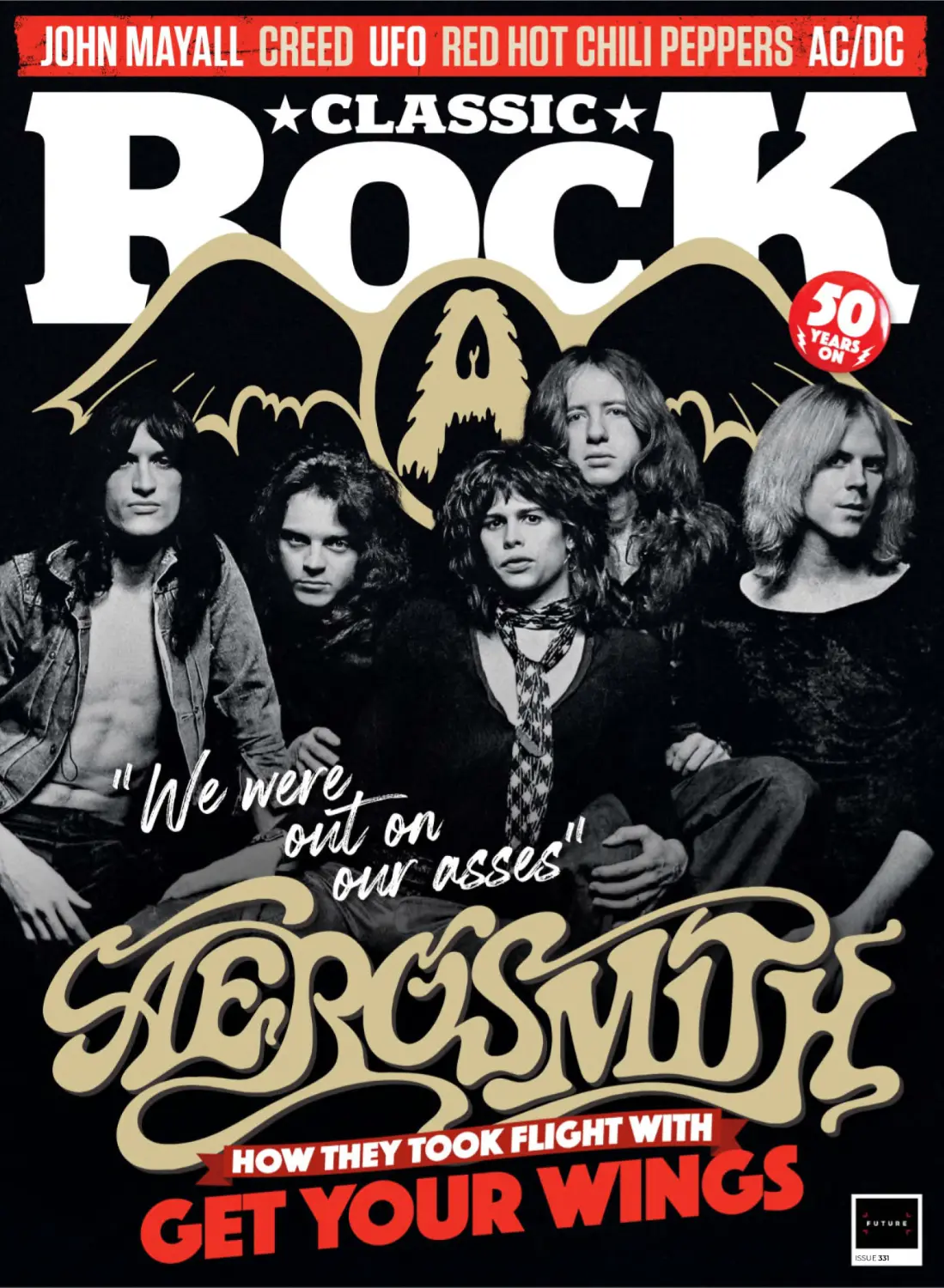
28 Aerosmith
With their label ready to drop them after a so-so first album,
they clung on, dreamed on, dug in and recorded a second,
Get Your Wings, that gave them lift-off. 50 years on, Joe Perry
looks back.
36 Creed
Twenty-five years ago, with the Human Clay album they were
on top of the world. But it was the calm before the storm.
42 Phil Mogg
Having permanently grounded UFO, he looks back at the band
he’s led and fronted for more than 50 years, and forward to his
new project Moggs Hotel.
48 Redd Kross
Eight albums in, shape-shifting rock’n’roll brothers Redd Kross
are gearing up for taking the next step up the ladder.
50 The Cadillac Three
Their first UK gig was at a small pub, now they headline
London’s Royal Albert Hall. It’s been an eventful few years.
56 Red Hot Chili Peppers
By the mid-90s there were signs that they were unravelling.
Then they recorded their masterpiece album: Californication.
62 The Hot List
This month the artists to have on your radar include Massive
Wagons, Bones UK, Tuk Smith & The Restless Hearts, The
Virginmarys, Southern River Band and more…
67 Reviews
New albums from David Gilmour, Nick Cave And The Bad
Seeds, The Jesus Lizard, The Quireboys, Nick Lowe, The Dead
Daisies, Fastball… Reissues from Thunder, Hawkwind, Creed,
Ten Years After, David Bowie… Live reviews of AC/DC, Foo
Fighters, ZZ Top, Stevie Nicks, Manic Street Preachers…
87 Lives
We preview tours by Blackberry Smoke, Armored Saint and
Brave Rival. Plus gig listings – who’s playing where and when.
MICHAEL OCHS ARCHIVES/GETTY
106 The Soundtrack
Of My Life
Joanne Shaw Taylor
RIBE
SUBSCGET A
D
AN GIFT!
FREE 76
p
CLASSICROCKMAGAZINE.COM 3
WELCOME
s I type this, it seems that the
summer has finally arrived in the
UK. The rain has stopped, the sun
is shining… Well, for a day or two
at least. All that being said, the
dismal British weather hasn’t
dampened the joie de vivre of
the festival and summer gig
season as our rock heroes roll in and out of town
and into Europe and beyond. And it shows – our
live reviews section this month is an absolute
monster, proving that high-voltage rock’n’roll is in
a hale and hearty state. There was the triumphant
return of AC/DC, Stevie Nicks back in Hyde Park,
ZZ Top, Foo Fighters, Pearl Jam and more besides…
We caught Metallica delivering the goods in
Norway, Smashing Pumpkins smashing it in
Portugal. It’s been quite the month.
This issue we also celebrate some big album
anniversaries: 50 years of Aerosmith’s mighty Get
Your Wings , 25 years of the Red Hot Chili Peppers’
monster hit Californication, and more. And we pay
tribute to John Mayall, the ‘Godfather Of British
Blues’ who sadly passed away in July.
Until next month…
Subscribe!
Siân Llewellyn, Editor
SCAN TO GET
OUR WEEKLY
NEWSLETTER
Save money, get your issues early and
get exclusive subscriber benefits.
Visit www.myfavouritemagazines.co.uk
for our latest subscription offers.
This month’s contributors
KEN MCINTYRE
Ken, aka the frankly legendary
rock’n’roll writer Sleazegrinder,
lives in Witch City USA, aka
Salem, MA. He runs the Salem
Horror Book Club and the Heavy
Leather Metal TV Show. He loves
satanic speed metal and sleazy
rock’n’roll, and pretty much hates
anything else. He plans on living
forever. This month he caught up
with Redd Kross (p48). You can
find his monthly column of
weapons-grade Sleaze on p75.
JOHN MCMURTRIE
Award-winning music
photographer and Iron Maiden’s
official snapper since 2006,
John has travelled the world in
the name of Eddie and co. This
month he stayed a little closer
to home, heading to the Royal
Albert Hall to capture the Cadillac
Three for our in-depth feature
(p50). His Iron Maiden ‘LEGACY’
prints, and other works, can be
obtained at johnmcmurtrie.
bigcartel.com
MICK WALL
Some say he is the man who rang
Axl’s bell. Some say he is ‘in the
Fish camp’. This month he sat
down with Joe Perry to discuss the
making of Get Your Wings (p28),
and also turned back time to
revisit the Red Hot Chili Peppers’
Californication (p56). The weekly
Mick Wall Podcast, which he
co-hosts with Jon Hotten, is the
most hilarious thing you’ve ever
heard. And we’re not just saying
that because Mick’s writing this.
LC 2112
Established 1998
Editor
Art Editor
Deputy Editor
Siân Llewellyn
Darrell Mayhew
Polly Glass
Now playing: Kyle Daniel, Kentucky Gold
Gaerea, Coma
The Southern River Band, D.I.Y
Paul Henderson
Production Editor
Ian Fortnam
Reviews Editor
Fraser Lewry
Online Editor
News/Lives Editor
Laurie Anderson, Amelia
Goat, Goat
Troy Kingi, Leatherman & the Mojave Green
The Commoners, Restless
Contributing writers
John Aizlewood, Merlin Alderslade, Marcel Anders, Stuart Bailie, Geoff Barton, Mark Blake, Mark Beaumont,
Max Bell, Essi Berelian, Paul Brannigan, Alex Burrows, Pat Carty, Rich Chamberlain, Stephen Dalton, Bill
DeMain, Niall Doherty, Claudia Elliott, Paul Elliott, Dave Everley, Jerry Ewing, Hugh Fielder, Eleanor Goodman,
Gary Graff, Rich Hobson, Barney Hoskyns, Jon Hotten, Rob Hughes, Neil Jeffries, Emma Johnston, Damian
Jones, Jo Kendall, Hannah May Kilroy, Dom Lawson, Dannii Leivers, Chris Lord, Ken McIntyre, James McNair,
Julian Marszalek, Alexander Milas, Paul Moody, Grant Moon, Kris Needs, Paul Rees, Chris Roberts, David
Quantick, Liz Scarlett, Will Simpson, Johnny Sharp, David Sinclair, Sleazegrinder, David Stubbs, Everett True,
Jaan Uhelszki, Mick Wall, Philip Wilding, Henry Yates
Dave Ling
Contributing photographers
Brian Aris, Dick Barnatt, Ami Barwell, Rob Blackham, Adrian Boot, Justin Borucki, Dave Brolan, Alison
Clarke, Zach Cordner, Fin Costello, Henry Diltz, Kevin Estrada, James Fortune, Jill Furmanovsky, Herb
Jȸƺƺȇƺً ȒƫJȸɖƺȇًxǣƬǝƏƺǼRƏǼɀƫƏȇƳً«ȒɀɀژRƏǼˡȇً¨ƏɖǼRƏȸȸǣƺɀًxǣƬǸRɖɎɀȒȇًáǣǼǼXȸƺǼƏȇƳً«ȒƫƺȸɎkȇǣǕǝɎً
xƏȸǣƺkȒȸȇƺȸً ƏȸȸɵnƺɮǣȇƺًhǣȅxƏȸɀǝƏǼǼًhȒǝȇxƬxɖȸɎȸǣƺًJƺȸƺƳژxƏȇǸȒɯǣɎɿً(ƏɮǣƳxȒȇɎǕȒȅƺȸɵًkƺɮǣȇ
Nixon, Denis O’Regan, Katja Ogrin, Barry Plummer, Ron Pownall, Neal Preston, Michael Putland, Mick
Rock, James Sharrock, Pennie Smith, Stephen Stickler, Leigh A van der Byl, Chris Walter, Mark Weiss,
ƏȸȸǣƺáƺȇɎɿƺǼǼً ƏȸȒȇáȒǼȅƏȇًxǣƬǝƏƺǼژñƏǕƏȸǣɀًzƺǣǼñǼȒɿȒɯƺȸ
All copyrights and trademarks are recognised and respected
ABC January-December 2021: 35,211
Thanks this issue to: Steve Newman (layouts), Steve Mitchell (typography),
Steve Bright, Dan Foreman (image manipulation)
Future PLC Quay House, The Ambury, Bath BA1 1UA
Editorial
Editor Siân Llewellyn
Art Editor Darrell Mayhew
Deputy Editor Polly Glass
Production Editor Paul Henderson
Reviews Editor Ian Fortnam
News/Lives Editor Dave Ling
Online Editor Fraser Lewry
Content Director (Music) Scott Rowley
Head Of Design (Music) Brad Merrett
Advertising
Media packs are available on request
Commercial Director Clare Dove
clare.dove@futurenet.com
Advertising Sales Director (Music Portfolio) Lara Jaggon
lara.jaggon@futurenet.com
Account Director Kyle Phillips
kyle.phillips@futurenet.com
Account Director Steven Pyatt
steven.pyatt@futurenet.com
Account Manager Lawrence Cooke
lawrence.cooke@futurenet.com
Cover photo: courtesy of Aerosmith, used with kind permission.
Bundle cover (Creed): Chuck Brueckmann
International licensing and syndication Classic Rock is available for licensing and
ɀɵȇƳǣƬƏɎǣȒȇِÁȒˡȇƳȒɖɎȅȒȸƺƬȒȇɎƏƬɎɖɀƏɎǼǣƬƺȇɀǣȇǕ۬ǔɖɎɖȸƺȇƺɎِƬȒȅȒȸɮǣƺɯȒɖȸ
available content at www.futurecontenthub.com.
Head of Print Licensing Rachel Shaw
Digital
Editor In Chief, Louder Briony Edwards
Executive Editor, Louder Merlin Aldersdale
Staff Writer, Louder Lizzie Capewell
Subscriptions
New orders: www.magazinesdirect.com / 0330 333 1113 /
email help@magazinesdirect.com
Renewals: www.mymagazine.co.uk / customer service: 0330 333 4333 /
email queries: help@mymagazine.co.uk
Acquisitions Director Sharon Todd
Circulation
Head of Newstrade Tim Mathers
Production
Head of Production Mark Constance
Production Manager Keely Miller
Senior Ad Production Manager Joanne Crosby
Digital Editions Controller Jason Hudson
Management
Managing Director, Music Stuart Williams
NEXT ISSU
E
ON SALE
SEPTEMBE
R 13
Classic Rock, Future, 121-141 Westbourne Terrace, London W2 6JR, UK
classicrockmagazine.com
Subscription queries: 0330 333 1113 (from the UK) or +44 330 333 1113 (from overseas) or help@magazinesdirect.com
How to order and access back issues: if an active subscriber, you have digital entitlement to access back issues through your IOS or android device/s. Your digital magazine entitlement is
available at no additional cost and no further action is required. PocketMags library may not have access to the full archive of digital back issues. You will only be able to access the digital back
issues as long as you are an active subscriber. To purchase single back issues (print format only) visit: magazinesdirect.com (click on ‘Single Issues’ tab) Or email: help@magazinesdirect.com
For further help call: +44(0)330 333 1113 Lines are open Mon- Fri 8.30am-7pm and Sat 10am-3pm UK time.
Printed by William Gibbons & Sons Ltd on behalf of Future.
Distributed by Marketforce UK, 121-141 Westbourne Terrace, London W2 6QA.
For enquiries please email mfcommunications@futurenet.com ISSN 1464783
áƺƏȸƺƬȒȅȅǣɎɎƺƳɎȒȒȇǼɵɖɀǣȇǕȅƏǕƏɿǣȇƺȵƏȵƺȸɯǝǣƬǝǣɀƳƺȸǣɮƺƳǔȸȒȅȸƺɀȵȒȇɀǣƫǼɵȅƏȇƏǕƺƳًƬƺȸɎǣˡƺƳǔȒȸƺɀɎȸɵƏȇƳƬǝǼȒȸǣȇƺٮǔȸƺƺȅƏȇɖǔƏƬɎɖȸƺِ
The paper in this magazine was sourced and produced from sustainable managed forests, conforming to strict environmental and socioeconomic standards.
All contents © 2024 Future Publishing Limited or published under licence. All rights reserved. No part of this magazine may be used, stored, transmitted or reproduced in any way without the prior written permission of the publisher. Future Publishing
nǣȅǣɎƺƳ٢ƬȒȅȵƏȇɵȇɖȅƫƺȸדזזזא٣ǣɀȸƺǕǣɀɎƺȸƺƳǣȇ0ȇǕǼƏȇƳƏȇƳáƏǼƺɀِ«ƺǕǣɀɎƺȸƺƳȒǔˡƬƺيªɖƏɵRȒɖɀƺًÁǝƺȅƫɖȸɵً ƏɎǝ ÈِǼǼǣȇǔȒȸȅƏɎǣȒȇƬȒȇɎƏǣȇƺƳǣȇɎǝǣɀȵɖƫǼǣƬƏɎǣȒȇǣɀǔȒȸǣȇǔȒȸȅƏɎǣȒȇȒȇǼɵƏȇƳǣɀًƏɀǔƏȸƏɀɯƺƏȸƺƏɯƏȸƺًƬȒȸȸƺƬɎƏɎɎǝƺɎǣȅƺȒǔ
going to press. Future cannot accept any responsibility for errors or inaccuracies in such information. You are advised to contact manufacturers and retailers directly with regard to the price of products/services referred to in this publication. Apps and
ɯƺƫɀǣɎƺɀȅƺȇɎǣȒȇƺƳǣȇɎǝǣɀȵɖƫǼǣƬƏɎǣȒȇƏȸƺȇȒɎɖȇƳƺȸȒɖȸƬȒȇɎȸȒǼِáƺƏȸƺȇȒɎȸƺɀȵȒȇɀǣƫǼƺǔȒȸɎǝƺǣȸƬȒȇɎƺȇɎɀȒȸƏȇɵȒɎǝƺȸƬǝƏȇǕƺɀȒȸɖȵƳƏɎƺɀɎȒɎǝƺȅِÁǝǣɀȅƏǕƏɿǣȇƺǣɀǔɖǼǼɵǣȇƳƺȵƺȇƳƺȇɎƏȇƳȇȒɎƏǔˡǼǣƏɎƺƳǣȇƏȇɵɯƏɵɯǣɎǝɎǝƺƬȒȅȵƏȇǣƺɀȅƺȇɎǣȒȇƺƳǝƺȸƺǣȇِ
If you submit material to us, you warrant that you own the material and/or have the necessary rights/permissions to supply the material and you automatically grant Future and its licensees a licence to publish your submission in whole or in part in any/all
issues and/or editions of publications, in any format published worldwide and on associated websites, social media channels and associated products. Any material you submit is sent at your own risk and, although every care is taken, neither Future nor its
employees, agents, subcontractors or licensees shall be liable for loss or damage. We assume all unsolicited material is for publication unless otherwise stated, and reserve the right to edit, amend, adapt all submissions.
Future plc is a public
company quoted on the
London Stock Exchange
(symbol: FUTR)
www.futureplc.com
!ǝǣƺǔ0ɴƺƬɖɎǣɮƺ ǔˡƬƺȸ Jon Steinberg
Non-Executive Chairman Richard Huntingford
!ǝǣƺǔIǣȇƏȇƬǣƏǼƏȇƳ³ɎȸƏɎƺǕɵ ǔˡƬƺȸ Penny Ladkin-Brand
Tel +44 (0)1225 442 244
FOR
MO
RE
M
CO
E.
IN
SS
W.CLA ICROCK
W
MA
W
S:
GA
Z
EW
N
E
INSIDE TH
CK
WORLD OF RO
®190
8E 072 - 06 603
cat no:#331
cat no:#331
8 CLASSICROCKMAGAZINE.COM
4
202
COPYR
IGHT FUTURE
Main image:
George Underwood & David Bowie
Top right:
Jonathan Schofield, The Chameleon
Middle right:
Peter Messer, A Dance Beneath The Lake
Bottom right:
George Underwood, We Like Dancing
Exhibition Raises Money
For War Child Charity
David Bowie’s childhood friend and album sleeve artist joins London-based exhibition.
N
ext month, George Underwood, the
veteran British artist closely involved
in the era-defining album sleeves for
David Bowie’s albums Hunky Dory and
The Rise And Fall Of Ziggy Stardust & The
Spiders From Mars, joins 40 leading contemporary
artists pooling forces to raise funds for War Child,
a charity that raises money for children caught up in
conflict, via an innovative London exhibition titled
Sound & Vision.
Underwood first met Bowie, then still known as
David Jones, at nine years old as they enrolled together
for the 18th Bromley Cubs pack. Despite later punching
Bowie in an argument over a girl, an encounter that
resulted in Bowie’s famously mismatched eyes, they
became lifelong friends.
“We are talking 1956 as our meeting, during the
birth of rock’n’roll, and as fellow listeners to Radio
Luxembourg David and I got on famously,” Underwood
explains, talking to Classic Rock. “I was present at what
was probably his first public performance, when we
played around the campfire during a cub camp in the
Isle of Wight.”
A bromance gathered pace as the pair studied at
Bromley Technical College, sharing a love of skiffle
music and membership of bands. “I was the singer in
a group called The Konrads, which made David quite
jealous, so he took some saxophone lessons and joined
us,” Underwood recalls.
The physical altercation over a girl named Carol
happened, Underwood explains, when “David wasn’t
being very nice, and he made me look a fool”. The story
involves an element of underhandedness. Underwood
had invited Carol on a date at their local youth club,
until Bowie called him saying he’d
spoken to her and not only was she
cancelling their arrangement, but she
was now going out with him. Tempers
were lost, and punches thrown. Bowie
ended up having emergency surgery on
his left eye a couple of days later.
“David later thanked me, saying I had
given him that extra-terrestrial look,”
Underwood says, laughing.
Together the pair were in the King
Bees, and released a single called Liza
Jane in 1965. “It was what you might call
a flop,” says Underwood, “and very soon
David left the band. We discovered he
had been rehearsing with another group
behind our backs.” When that same act,
the Manish Boys, amounted to nothing,
Bowie joined the Lower Third, and very
gradually he began to ascend the ladder
of fame. By contrast, Underwood had
a mental breakdown and effectively left
the business. “But for the breakdown, I’d
probably have remained in music and
would be dead now,” he says.
As everybody knows, Bowie’s progress
would prove very sporadic, although
Underwood cites the conception of the Ziggy Stardust
character as a real touchstone moment. By that point
the newly married Underwood had settled into family
life and was gaining traction as an album designer,
working with T.Rex, Mott The Hoople and Procol
Harum as well as with Bowie.
“David always knew exactly what he wanted,”
Underwood points out. “None of us realised how iconic
the Ziggy Stardust image would become, because
everybody was too busy living in the moment.
“As David’s career blossomed he was very generous,
sharing a lot of his good fortune,” he continues. “We
went on holiday together to Mustique and then to
Switzerland a couple of times. As a global superstar
I think he needed to retain contact with his earlier life.
I became extremely worried about him when he began
putting all that stuff up his nose, but he got over it.
Though sadly, of course, David died before his time.”
Underwood and Bowie remained in contact until he
passed away so unexpectedly in January 2016. “His
emails were always very funny, I really miss receiving
those,” Underwood says sadly, adding: “When David
turned sixty-five he sent one that said: ‘We’re old
men now, eh?’”
Nevertheless, Underwood can consider himself very
fortunate to have known David Bowie for sixty years.
“No, no, no… you’ve got that wrong,” he responds
cheekily. “David was privileged to know me.” And with
a burst of laughter, he adds: “He wouldn’t have had
that dodgy eye otherwise, would he?”
Currently with little realistic hope to an end of the
ongoing conflicts in Ukraine and Gaza, as the only
specialist charity involved the work of War Child is
more valuable than ever. It also provides immediate
aid to children and their familier across
Europe, Asia, the Middle East, Africa and
Latin America. And Underwood is proud
to be involved.
Named after Bowie’s 1977 song from
the album Low, Sound & Vision invites
a collection of big-name artists, including
Ishbel Myerscough, Wes Anderson and
Stuart Semple, to respond in whichever
way they choose to another Bowie lyric,
this latest one being: ‘We like dancing and
we look divine’, from the song Rebel Rebel.
“I can’t tell you about any of the other
contributions, but twenty years ago I did
a painting called Dancing With Giants,”
Underwood reveals. “So I nicked my
own idea and adapted it based upon
a memory of a fantastic show that David
had played at the Rainbow Theatre back
in 1972. If you know, you know. I hope
that someone likes it enough to buy the
single existing painting.” DL
This issue The Dirt was compiled by Paul Brannigan, Bill DeMain, Emma Johnston, Jo Kendall, Hannah May Kilroy, Dave Ling, Liz Scarlett, Will Simpson, David Sinclair
War Child x Art On A Postcard present
Sound & Vision at 180 Strand, Sept
26-27, 2024. The online auction runs
Sept 17–Oct 1 via Art On A Postcard.
CLASSICROCKMAGAZINE.COM 9
Eddie Rosenblatt
Died July 16, 2024
Thank you…
and good night.
Jerry Miller
July 10, 1943 – July 20, 2024
Jerry Miller was an ever-present guitarist
with the pioneering San Franciscanbased psychedelic band Moby Grape,
an influence on Led Zeppelin and Eric
Clapton, who once called him “the best
guitar player in the world”. Robert Plant
regularly performs Moby Grape’s It’s
A Beautiful Day Today on stage with his
current project Saving Grace. No cause
of death has been confirmed. Miller was
81 years old.
Duke Fakir
December 26, 1935 – July 22, 2024
The last surviving original member of
veteran soul vocal group The Four Tops
has passed away from heart failure at
home in Detroit. Abdul ‘Duke’ Fakir was
88 years old. He was a member of the
Michigan-based band, whose hits
include I Can’t Help Myself (Sugar Pie
Honey Bunch), Reach Out, I’ll Be There and
Standing In the Shadows Of Love, from
1953 until shortly before his death.
A longtime president
of Geffen Records,
from the US label’s
inception in 1980
via golden years
promoting John
Lennon, Guns N’ Roses
and Nirvana until his
eventual retirement,
89-year-old Eddie
Rosenblatt died
of pneumonia.
Jack White
Died July 6, 2024
Rick Springfield is
mourning his
drummer from 1976
to 2002, after he lost
a battle with cancer.
Springfield described
White, nicknamed
JDub, “a complex
man, damaged,
ferocious,
cantankerous, loving,
and above all a good,
good soul”.
Born in Salt Lake City, Utah, Tom Fowler
played bass for the San Franciscan
psychedelic band It’s A Beautiful Day
before joining Frank Zappa’s Mothers Of
Invention in 1973. Fowler also worked
with Ray Charles, Steve Hackett and
Jean-Luc Ponty, as well as playing with
a band of his siblings, Air Pocket. The
73-year-old passed away following
complications from an aneurysm.
Happy Traum
May 9, 1938 – July 17, 2024
New Yorker Harry Peter Traum – known
as ‘Happy’ – was an integral part of the
Greenwich Village folk scene of the
1960s, and later during the following
decade its Woodstock counterpart. He
also enjoyed a close working relationship
with Bob Dylan, performing as a backing
musician. Happy, 86, died of pancreatic
cancer after undergoing surgery.
August 23, 1974 – June 24, 2024
Born Seth Brooks Binzer in Los Angeles,
Shifty Shellshock, as he became known,
was the frontman with popular raprockers Crazy Town, who scored a US
No.1 single with Butterfly in 2001.
Shellshock, who was among nine stars
featured in the first season of the VH1
reality series Celebrity Rehab in 2008,
succumbed to an accidental drug
overdose. He was 49.
10 CLASSICROCKMAGAZINE.COM
oe Egan, who co-founded and
co-fronted Scottish folk-rock band
Stealers Wheel with Gerry Rafferty,
has died at the age of 77. The news was
broken via the Facebook page of Rafferty,
who passed due to liver failure back in
2011. Rafferty’s daughter Martha, who
runs the page concerned, described Egan
as a “sweet and gentle soul”. Details were
not revealed, but Martha stated Egan
passed away “peacefully”, and “with his
nearest and dearest around him”.
The core of the band, Egan and Rafferty
shared lead vocals, rhythm guitar and
keyboards in Stealers Wheel, as part of
a five-piece line-up formed in Paisley in
1972. They split three years later and
re-formed briefly in 2008, leaving behind
a three-album legacy. Rafferty went on to
Richard ‘Kinky’
Friedman
November 1, 1944 –
June 27, 2024
Known as The Jewish
Cowboy, and a close
friend of Bob Dylan
and Willie Nelson,
the Texan singersongwriter, novelist,
writer and politician,
79, apparently died
in his sleep.
Peter Collins
January 14, 1951 – June 28, 2024
Pinche Peach
November 24, 1966 –
July 17, 2024
Born Ciriaco Quezada,
Pinche Peach sang
with death metal band
Brujeria, which
included members of
Faith No More,
Napalm Death, Fear
Factory and the Dead
Kennedys. He died
of heart failure at the
age of 57.
Paul Haslin
Died July 12, 2024
We understand Paul
Haslin, Scottish
drummer with rockers
Waysted – who also
gigged with Oi! punks
The Gonads under the
handle of MacGonad
– has died of unknown
cause. Condolences to
all who knew him.
pursue a successful solo career, becoming
ubiquitous for the chart-busting Baker
Street. Egan released two solo albums, Out Of
Nowhere and Map, in 1979 and 1981, before
retiring from music.
Stealers Wheel’s biggest hit was the
Leiber and Stoller-produced Stuck In The
Middle With You, released in 1973. Its
scathingly dismissive lyrics about a music
industry cocktail party (‘Clowns to the left of
me, jokers to the right’) were sung by Rafferty,
with Egan providing backing harmonies.
The co-written song became a Top 10 hit
in the UK and the US, selling more than
a million copies around the world. Almost
two decades later it found a whole new
audience and lease of life when included
in the soundtrack to Quentin Tarantino
film Reservoir Dogs. DL
ush members Geddy Lee and Alex
Lifeson have paid tribute to their
long-time English-born producer
after the 73-year-old passed away at home
in Nashville following a battle with
pancreatic cancer. Between 1985 and 1996,
the Canadian band made four studio records
– Power Windows, Hold Your Fire, Counterparts
and Test For Echo – with Peter Collins in
various studios across the globe.
Remembering “some incredible musical
adventures together,” bassist and vocalist
Geddy Lee described Collins as a “dear, dear
friend”, while guitarist Lifeson commented:
“Peter truly was our Mr Big, with his everpresent cigar and constant good humour.
After hitting the record button, I can still
hear him say: ‘Okay boys, from the
topping… no stopping!’”
With one eye very much on transition,
Rush had hired Collins as their recording
career entered its mid-stages. “They
wanted to be involved with the
R
technological breakthroughs that were
happening in England at the time, the
Trevor Horn sound that he’d achieved with
Yes and Frankie Goes To Hollywood, so I was
able to help them move into that area,”
Collins explained to Sound On Sound in 2002.
“It was a question of coming in fresh,
getting them to change some things they’d
always done. They liked to be challenged.”
Collins had started out during the 60s as
a teen singer-songwriter, before falling in
love with production. Over the course of
a 40-year career he went on to work with
some of the biggest names in popular
music, including Bon Jovi (These Days),
Queensrÿche (Operation: Mindcrime, Empire,
Hear In The Now Frontier), Alice Cooper (Hey
Stoopid), Gary Moore (After The War), Billy
Squier (Enough Is Enough) and Suicidal
Tendencies (The Art Of Rebellion). He also
made hit records with artists such as Nik
Kershaw, The Stray Cats, Tom Jones and
Musical Youth. DL
KINKY FRIEDMAN: MICHAEL OCHS ARCHIVES/GETTY; JOE EGAN.: MARKA/GETTY
Shifty Shellshock
October 18, 1946 – July 6, 2024
J
Tom Fowler
June 10, 1951 – July 2, 2024
Joe Egan
12 CLASSICROCKMAGAZINE.COM
November 29, 1933 – July 22, 2024
Classic Rock’s David Sinclair looks back at the life, music
and legacy of the Godfather of British blues.
J
the war there finished just before he arrived. When he got
ohn Mayall has died at the age of 90. A road warrior
back from Korea, his father, Murray Mayall, who was
and torchbearer for the blues music that he loved all
a guitarist of local repute, gave him a copy of Big Bill Broonzy’s
his life, he was for so long invincible and irreducible.
autobiography, Big Bill Blues, signed by the bluesman himself.
As a singer, songwriter, multi-instrumentalist and
Mayall formed his first serious group, the Powerhouse Four,
interpreter of the deep blues repertoire, he was
in 1958 while studying at Manchester College Of Art. By 1962
a powerhouse of knowledge and musical passion. As
he was playing in a band called the Blues Syndicate, when he
a bandleader he was a man of exceptional vision and
blagged a gig supporting Alexis Korner’s Blues Incorporated
managerial ingenuity who provided an early platform for
– at that time featuring Jack Bruce on bass and Ginger Baker
some of the greatest talents the rock world has known.
on drums - at the Bodega club in Manchester. Korner became
Mayall’s 1966 album Blues Breakers With Eric Clapton – aka
a friend and mentor, encouraging Mayall to move to London,
the Beano album – shaped the sound of modern guitar music
where he helped him make valuable contacts and get himself
and could arguably be called the first ‘rock’ album.
established on the club circuit.
Subsequent releases A Hard Road and Crusade introduced Peter
As well as musical and spiritual inspiration, over the years
Green and Mick Taylor respectively to the international stage,
Mayall took a lot of practical cues from Korner on how to
alongside a small army of musicians who gained early
conduct himself in the role of
recognition thanks to their association
bandleader. “To be a good bandleader
in Mayall’s bands, including John McVie,
you have to have a musical concept,” is
Mick Fleetwood, Andy Fraser, Jack
how Mayall explained it. “You have to
Bruce, Aynsley Dunbar, Jon Hiseman,
have the ears to know what you want
Dick Heckstall-Smith and, later on,
from a player. You have to choose
Walter Trout, Coco Montoya, Buddy
players who are compatible on a social
Whittington and many others.
level, and you have to be a good
Although well aware of the impact
organiser. My philosophy for putting
his music and his stellar choice of
a band together is that you must really
musicians had made, Mayall remained
John Mayall
enjoy what you’re doing and express
pragmatic and humble about his
yourself and have lots of room for experimentation and
achievements. “I’m just a man who loves his music and
development for your own musical talent.”
knows what’s out there to listen to,” he told me in 2016.
There was also a hard, practical side to his choice of
“People comment all the time about: ‘How do you keep
musicians. Mayall was their employer, not just a bandmate.
getting all these bands together?’ For me it’s a very easy
As such he was looking to hire the best people for the job, and
operation. I think it was a lot to do with how familiar I was
his judgements were rarely clouded by sentiment. This
with the music. I had a much longer start. When I started
explains, in part, why his bands attracted so many great
playing professionally, in 1963, I was already thirty years old,
players. He disliked drunken behaviour, for which he fired
so I’d had a lifetime of listening to American blues music from
several musicians over the years, notably, at different times,
the age of ten onwards. It wasn’t just Chicago blues, it was all
both John McVie and Mick Fleetwood. And as soon as he felt
blues, all American blues, that I was exposed to. So it all
someone was not fitting in or a line-up had passed its best,
became part of my musical education.”
he stepped in to make the necessary changes.
This was a fair point. Born in 1933 in Macclesfield, Cheshire,
As far as Mayall was concerned, hiring Eric Clapton in 1965
Mayall had been a schoolboy during the Second World War
was a no-brainer. “I remember hearing Eric playing on
and in 1953 was posted to Korea as part of his national service
a Yardbirds B-Side, Got To Hurry, and I could not believe it,” ➤
in the British Army, narrowly avoiding active combat when
JAN PERSSON/GETTY
“I’m just a man who
loves his music and
knows what’s out
there to listen to.”
CLASSICROCKMAGAZINE.COM 13
Out-take from the shoot for the cover
of Mayall’s hugely influential Beano
album in 1966: (l-r) Mayall, Eric
Clapton, John McVie, Hughie Flint.
“He found me and asked me to join his band.
And I stayed with him and I learned all that
I really have to draw on today.”
Eric Clapton
14 CLASSICROCKMAGAZINE.COM
and nurturing the talents of the star players in his
bands meant that his own abilities tended to be
somewhat undervalued in the broader scheme of
things. But he was a fine keyboard and harmonica
player and a capable rhythm guitarist. And his
high, sandpapery singing voice was an
instrument of singular distinction. The ghostly,
weather-beaten howl that he produced, for
example on the title track of
:yAZk]KhZ], drew on long
years of emotional investment
in the music, such that he was
able to locate a unique and
authentic blues voice of his
own – no mean feat for a white
guy from the north of England.
Mayall was incredibly prolific
in every department. He
released three albums in 1967
alone: A Hard Road - for which he also
painted the imposing band portrait on
the cover and wrote the sleeve-notes;
the follow-up Crusade, which
introduced the 18-year-old
guitarist Mick Taylor to the
group; and a solo album The
Blues Alone, on which he not
only wrote all the songs but
also sang and played all the
instruments himself apart
from the drums.
MAIN: COURTESY OF JOHN MAYALL; INSET:GRAHAM LOWE /GETTY
Mayall recalled. “It blew me away. I just had to
have him. It was like an instant soul connection.
I called him up and offered him the job. He came
down to my house and the deal was done. Twenty
pounds a week and off we go.”
Clapton remembers it as £35 a week in his
autobiography, published in 2007. “It was a set
wage no matter how much work you did,” Clapton
recalled. “A not untypical night might involve
travelling up to Sheffield to play the evening gig at
eight o’clock, then heading off to Manchester to
play the all-nighter, followed by driving back to
London and being dropped off at Charing Cross
station at six in the morning.”
But Mayall was far more than just a bandleader
to Clapton, who took a room in Mayall’s family
home in Lee Green while he was in the band. “He
found me and took me into his home and asked
me to join his band,” Clapton said in an emotional
statement posted on social media shortly after
Mayall’s death. “And I stayed with him and
I learned all that I really have to draw on today in
terms of technique and desire to play the kind of
music that I love to play. I did all my research in
his home in his record collection,
the Chicago blues that he was such
an expert on.” Mick Fleetwood
expressed a broadly similar
sentiment when he likened Mayall’s
death to that of “losing a musical
father”. Walter Trout declared: “He
is and always will be my musical mentor. I loved
him like a father and I always will.”
Mayall’s second studio album, A Hard
Road, released in 1967, was another
work of historic importance,
introducing the fledgling genius of
Peter Green - as not only lead guitarist,
but also singer and songwriter - and
laying the foundations of the
band that would become
Fleetwood Mac. Green, like
Clapton before him, moved
into a flat below Mayall’s at his
new address in Bayswater for
a while, and the two of them
spent much time together
listening to records and
pooling ideas. Mayall
encouraged him to write songs,
suggesting that a good way to start was
to borrow a line from one of his
favourite blues songs and bend it into
a new shape that was his own.
Mayall’s generosity in showcasing
JOHN MAYALL
THE STARS PAY TRIBUTE
Early days as a developing
bluesman and bandleader
in the 60s.
MAIN & TOP INSET: COURTESY OF JOHN MAYALL; BOTTOM INSET: RB/GETTY
Mayall was also a hard-nosed businessman.
“I’ve kept away from managers,” he told me. “If
you can get yourself together with the business
end of gigs and your career, why part with
a percentage of your earnings which you could
make better use of? I’m the manager.”
His booking agent Rik Gunnell, who set up
Mayall’s first tour of America at the start of 1968,
was astonished to discover that his client had
returned to London from the adventure with
$2,000 (about $15,000 in today’s money) stuffed
into his boots.
“At this point in the history of touring bands,
I was unique in that I’d actually come home with
a profit,” Mayall recalled in his book with Joel
McIver Blues From Laurel Canyon, published in
2019. “This was literally unheard of given our
modest tour income and the high cost of living
in America.”
he American trip was the beginning of
a love affair with the country, particularly
Los Angeles and the West Coast, and the
start of a period of reinvention and
experimentation. In May 1968 he abruptly
disbanded the Bluesbreakers and returned to
California, where he hung out with Frank Zappa
and various members of Canned Heat. The
adventure was documented on the 1968 record
Blues From Laurel Canyon, a ‘concept’ album of
sorts in which the tracks, all written by Mayall, ➤
T
John was my mentor, and, as a surrogate
father, he taught me all I really know. He gave
me the courage and enthusiasm to express
myself without fear, without limit. And all
I gave him in return was how much fun it
was to drink and womanise when he was
already a family man. I wished to make
amends for that, and I did that while he was
alive. I shall miss him, but I hope to see him
on the other side.
Eric Clapton
So sad to hear of John Mayall’s passing. He
was a great pioneer of British blues and had
a wonderful eye for talented young musicians,
including Mick Taylor – who he recommended
to me after Brian Jones died – ushering in
a new era for the Stones.
Mick Jagger
My friend John was historically such an
important figure in the English blues scene.
He nurtured the talent of many great
guitarists and was a walking encyclopaedia of
American and English blues and a musical
trailblazer for all of us.
Ronnie Wood
The news of John’s passing in many ways hit
me [like] losing a musical father. He was
a guiding light to so many of us young English
players. To have been in his band the Blues
Breakers led Peter Green, John McVie, and
myself to form Fleetwood Mac back in 1967.
Mick Fleetwood
John’s album with Eric Clapton as the Blues
Breakers inspired tons of British bands. Safe
to say without that album there probably
wouldn’t be a Black Sabbath and definitely not
a Polka Tulk Blues Band!
Geezer Butler
Devastated to hear the passing of this blues
legend. Thank you for the music.
Laurence Jones
Rest in peace, my friend.
Joe Bonamassa
On John’s 90th Birthday last November, I had
no idea it would be one of the last times I’d
see him. As usual, he was funny, generous,
and kind. He is and will always be my musical
mentor, my greatest supporter, and an
incredible talent. We just lost a giant. I loved
him like a father, and I always will.
Walter Trout
Another giant has passed.
David Coverdale
He will be missed. Long live his music in our
hearts and minds.
George Thorogood & The Destroyers
He educated us all in so many ways and I was
fortunate to see him several times with
different band line-ups. His guitar players are
legendary of course but there’s so much
more; John McVie, Aynsley Dunbar, Jon
Hiseman, Dick Heckstall-Smith…
Andy Powell, Wishbone Ash
John was a true champion of the blues.
He remains a huge inspiration to me and
a legion of other musicians.
Steve Hackett
He was kinda like what Art Blakey was to the
American jazz scene – a mentor and band
leader who scouted out the best young
musicians in that genre and introduced
them to the world.
Warren Haynes, Gov’t Mule
CLASSICROCKMAGAZINE.COM 15
JOHN MAYALL
Walter Trout, Mayall and
trombonist Chris Barber hold
the Classic Album Award,
for 1966’s Blues Breakers
With Eric Clapton, at the Classic
Rock Roll Of Honour, 2013.
music. And he is due to be
inducted into the Rock And
Roll Hall of Fame in October
this year. He disbanded the
Bluesbreakers for the last
time in 2007, but soon set off
again under his own name
with a new core line-up which
he emphatically described in
2011 as “the best band I’ve
ever had”, with guitarist
Rocky Athas (replaced in 2018
by Carolyn Wonderland), bass
Mayall was a keyboard and
harmonica player and
player Greg Rzab and
a capable rhythm guitarist.
Mayall after receiving
drummer Jay Davenport.
his OBE at Buckingham
Mayall continued touring
Palace in 2005.
and recording until he was 89.
master recordings, original
segued together to form a single body of work. In
His last dates in the UK were
artwork, books, magazine
1969 Mayall bought a house in Laurel Canyon and
a string of six shows crammed into three nights at
collections and much else besides.
moved to California, where he would remain
Ronnie Scott’s in London in April 2019 as part of
In 1982, Mayall re-formed the Bluesbreakers
a resident for the rest of his life.
his 85th Anniversary Tour, and a final show later
with a temporary line-up featuring Mick Taylor
Mick Taylor, who had been retained in the
the same year at the Alban Arena, a venue where
and John McVie. The reaction was so positive that
post-Bluesbreakers line-up, jumped ship in June
he had the distinction of being the first act to
in 1984 he decided to relaunch the band/brand on
1969 to replace Brian Jones in the Rolling Stones,
perform when it was opened (as St Albans City
a ‘permanent’ basis,
and the next iteration of
Hall) in 1968. His final show was at The Coach
recruiting the guitarists
Mayall’s band was
House in San Juan Capistrano, California on
Coco Montoya and Walter
a drummerless, primarily
March 26, 2022.
Trout together with
acoustic quartet that
For most of his life, Mayall was a man forever
drummer Joe Yuele. There
released two albums: The
in a hurry. His albums were made on the hoof,
followed a long stretch of
Turning Point (1969) and
with recording sessions shoehorned into days off
relative stability, and once
Empty Rooms (1970). He then
here and there from his punishing gig schedule.
Buddy Whittington took
hired an all-American group
“It’s very easy to make a record,” he said. “For
over on guitar in 1993 the
featuring guitarist Harvey
me it’s a very quick affair. You just go into the
core line-up remained
Mandel and bass player
studio in the day and do it. That’s it. There’s no
largely unchanged until
Larry Taylor, both
Walter Trout
problem with it. You want to capture the feelings
2007 – an astonishing
ex-Canned Heat, and – still
of the songs without belabouring them, and
stretch compared to the
without a drummer –
that’s the way it always has been for me.”
glory days when Clapton, Green and Taylor
banged out USA Union, his second album release
He could be impatient and occasionally
passed through in less than five years.
of 1970.
cantankerous. When I was hired to write
Mayall turned 70 in 2003, and at the end of
The speed and diversity of his recorded output
a biography of him for his record label in 2006,
a typically busy year of touring, the Bluesbreakers
– with new albums from completely changed
the first thing he told me was that he didn’t
marked the occasion with a special 70th Birthday
line-ups appearing seemingly in the blink of an
intend to waste any time talking about the old
Concert at the 4,500-capacity King’s Dock in
eye – kept Mayall several steps ahead of his
days. “Go and look it up,” was his terse response
Liverpool. The show, in aid of UNICEF, found
audience. Many fans from the 60s failed to keep
to my opening question.
Mayall reunited on stage with Clapton,
up as he blazed a trail through
But when I last spoke to him in November
38 years after the Beano album. “For
the 70s working with mostly
2022, I found him in an unusually cheerful and
so many years I have dreamed of
American musicians and
contented mood. He said he couldn’t remember
something like this event being
moving into fresh musical
much about the 60s, and insisted that he was still
possible,” Mayall wrote on the sleeveareas on albums such as Jazz
touring and intended to carry on “as long as
notes to the live DVD and double CD
Blues Fusion (1972), and Notice
there’s an audience out there”. His long-standing
documenting the concert. To round off
To Appear (1976), a
secretary, Jane, gently informed me afterwards
the year, the BBC screened an
collaboration with the
that, owing to general health and memory issues,
hour-long documentary on
influential New Orleans
he was not, in fact, touring any more. But I like to
Mayall’s life and career, titled
songwriter Allen Toussaint.
think that in his mind’s eye he was indeed still
The Godfather Of British Blues.
Disaster struck in 1979 when
out there somewhere on the blues highway,
Mayall was awarded an OBE
a brush fire destroyed his home in
readying himself for the next gig. “And it’s a hard
in the 2005 Queen’s Birthday
Laurel Canyon, taking with it Mayall’s
road till I die…”
Honours list, for services to
diaries, his father’s diaries, various
“He is and always
will be my musical
mentor. I loved him
like a father and
I always will.”
MAIN: COURTESY OF JOHN MAYALL; CR AWARDS: JO HALE/GETTY; OBE: SHUTTERSTOCK
16 CLASSICROCKMAGAZINE.COM
‘Fast’ Eddie’s
Tale Told At Last
New multimedia package
celebrates former Motörhead
guitarist Clarke.
ast’ Eddie Clarke, the former
guitarist with Motörhead and
Fastway, is the subject of a new
biography and four-CD career retrospective,
Make My Day: The Rock ‘N’ Roll Story Of Fast
Eddie Clarke, released on September 6 via
BMG. The audio segment takes a lengthy
historical trawl through the catalogue of
Clarke, who between 1976 and 1982 was
part of Motörhead’s seminal Three Amigos
line-up alongside bassist and frontman
Lemmy and drummer Phil ‘Philthy
Animal’ Taylor. Sadly, Clarke died in 2018.
The 318-page book was written by
veteran rock journalist and Classic Rock
contributor Kris Needs with Clarke’s widow
Mariko Fujiwara, dipping into a book on
Three Amigos commissioned by Lemmy
but canned when Clarke was sacked. The
manuscript was returned to Needs when
Lemmy relocated to the US. Decades later,
the interviews with Clarke, Lemmy and
Taylor make fascinating reading, along
with the rest of ‘Fast’ Eddie’s tale,
recounted by friends and bandmates. DL
‘F
‘Fast’ Eddie: biog
and box set.
“The future
bites indeed”
Steven Wilson weighs in
on AI in music.
S
18 CLASSICROCKMAGAZINE.COM
AC/DC’s 1980 album
Back In Black, their first
with Brian Johnson,
has passed another
significant milestone,
having been been
certified 26-times
platinum in the US,
with combined sales
of 26 million, making it
the fourth best-selling
album in American
recording history.
Sweet release their
final studio album, Full
Circle, on September
20 via Metalville
Records. The 11-song
set was produced by
guitarist Andy Scott
and keyboard player
and second guitarist
Tom Cory.
Nikki Sixx says he
would be happy for
Mötley Crüe to
continue in digital
form once the band
members are dead.
“At some point we’re
not gonna be here any
more,” comments the
bassist, “so, when the
time is right, put us in
a coffin and fire up
those avatars.”
King Crimson
guitarist/vocalist
Jakko Jakszyk
(pictured) has what
he calls an “unlikely”
memoir, Who’s The
Boy With The Lovely
Hair?, published on
October 10 via
Kingmaker.
Fastball
Originally formed in the early 90s, the Texan alt.rock
band are back with album number nine.
’m not going to compare our new
album to The Great Gatsby or The Old
Man And The Sea,” laughs Fastball’s
Tony Scalzo. “But it’s kind of a pocket epic
- short and sweet, with lots to say.”
Indeed, Sonic Ranch has that focused
fusion of rollicking guitars and pop smarts
that began with singles The Way and Out Of
My Head (featured recently on TV sitcom
Ted Lasso), and has kept the Austin-based
trio consistently in the strike zone over
their 30-plus-year career.
We caught up with Scalzo, 60, recently to
talk about Fastball’s
longevity, a lost Yes
album, and the
importance of singing
with a smile.
“
I
And you know what? It helps me to hit
notes. It helps me to have more power. It
also tells my body that this is fun. And
I think I’m singing better than I ever have.
I look back on some of our older records
and I’m like: “Why am I yelling?” Some of
my favourite singers have that relaxed
delivery – David Gilmour, Paul McCartney,
even Ronnie Dio. That’s where it’s at.
What jobs did you have before Fastball?
The worst was calling people on the phone
and trying to get them to invest in
strategic metals, like
palladium [laughs].
I had no idea what I was
talking about. I’ve
worked as a busboy,
a painter, a carpet
layer. Even when our
songs were first on
the radio, I was still
working the graveyard
shift at a bagel place.
“I love fishing,
crosswords,
jigsaws. That
sounds geriatric!”
What’s your life like
between albums?
Pretty easy. I have
adult children, but also
a young child. Me and
my wife are raising our boy, and we’re able
to focus a lot of attention on him. I’m not
gone all the time like I was in the nineties.
I love fishing, movies, doing crosswords
and jigsaw puzzles. That sounds geriatric,
right?! Let’s say I’m not drawn by the
pitfalls a thirty-year old might be. I wasted
a lot of time, brain and liver cells back
then. So I don’t work too hard, but I put in
the work. And I know when to clock out.
On your Instagram recently, you posted
a photo of Yes’s 1980 album Drama, along
with the word ‘Amazing’.
That record needs champions! It’s not
going to come close to Close To The Edge, but
it’s amazing. It gives me the same thing
The Beatles gave me – originality, diversity
and all that cool kind of math. I’ve tried to
bring a similar thing within the context of
our band, in the tiny frame of threeminute songs.
How do you keep your voice so strong?
My producer friend Chris ‘Frenchie’ Smith
said: “Why don’t you smile when you sing?”
Are you excited about Fastball playing
the upcoming nineties cruise?
I’m hot and cold about it [laughs]. Honestly,
I’m a little nervous about being out on
a ship for five days with nothing to do but
drink and party. But there’s a lot of people
on this thing that we know – Everclear,
Blues Traveler, Collective Soul - so maybe
it’ll be a fun adventure.
Fastball have stayed together for over
thirty years. What’s the secret?
I think only having a certain degree of
success. Huge success can sometimes rip
bands apart. We sold a bunch of records in
the nineties, we were on TV, had songs in
movies. And the songs have this life that
the band wouldn’t have otherwise. We’ve
all tried solo careers, but it’s nowhere near
what Fastball as a complete entity is. I’m
very grateful that we’re still together as
the same three guys that started in the
summer of ninety-three. BDM
Sonic Ranch is out now via Sunset Blvd.
‘FAST’ EDDIE CLARKE: FIN COSTELLO/GETTY; FASTBALL: CAROLINE LE DUC/PRESS
teven Wilson has entered the ongoing
debate over the use of Artificial
Intelligence (AI) in creating music.
“For the last few years I’ve spoken about
a scenario that I fully expect to happen,
whereby musicians would no longer be
needed, nor would pre-recorded tracks,”
says the Porcupine Tree leader and solo
artist. “Music will be made in real time
for listeners by artificial intelligence
depending on their requirements. Just
choose the singer you want.”
The cloning of Wilson’s vocals for ‘new’
tracks only served to remind him how
quickly things are moving.
“Even I really struggle to hear that it
wasn’t me singing these songs,” he adds.
“No matter what I might think about the
quality of the music, this is almost surreal.
“We’re in the midst of a seismic change
in the way music is made and how people
engage with it. Do the majority even care
that they are not listening to a human
being? The future bites indeed.” DL
The sequel to the
1984 rockumentary
This Is Spinal Tap is
set for release in late
spring or early
summer of 2025.
Christopher Guest
(aka Nigel Tufnell),
Michael McKean
(David St Hubbins),
and Harry Shearer
(Derek Smalls) have
all reprised their roles
as part of the titular
fictional English heavy
metal band. The film
includes cameos
from Paul McCartney,
Elton John and
Garth Brooks.
Bywater Call
“The Band are a big
influence for us, as
is Neil Young, and
Joni Mitchell.”
Good ol’ fashioned Americana southern
blues rock – from Toronto, Canada.
Call with bass guitarist Mike Meusel, who previously attended Humber
College, a jazz school in Toronto, along with the rest of the band. “The
jazz background is one of the things that really helps us [to] be unique”,
Parnell states, “because the band often break out into these brilliant
improvised sections, and that obviously comes from their education.”
or many musicians, New Orleans holds a particular kind of magic
The band all live fairly close by in Toronto. Bywater Call’s native roots
not found anywhere else. “Music is everywhere, the city is steeped
remain strong, despite their love of New Orleans. “The Band are a big
in it,” says Meghan Parnell, frontwoman with Bywater Call,
influence for us,” she explains, “as is Neil Young, and Joni Mitchell.
a seven-piece Canadian blues-rock band, named after a neighbourhood
They captured that warmth that we were looking for in
bordering the area’s French Quarter.
a sound, but also something distinctly Canadian. You can
That rootsy New Orleans vibe sits at the heart of Bywater Call’s FOR FANS OF...
hear the loons on Lake Ontario, or the people sitting around
third studio album, Shepherd, where country-tinged guitars meet
a campfire on the beach playing guitar.”
jazz-funk flourishes and swelling organs in an earthy Americana
Over the last few years Parnell has become something of
blend. Parnell’s gorgeous, honey-smoked vocals offer “life
a household name in the blues world. Bywater Call were even
lessons” and “a general observation of humanity”.
nominated for International Blues Artist of the year, and this
“I can’t remember a time when I wasn’t singing in some
October they head to the UK for their second tour here.
form,” Parnell muses. As a child she harmonised with her
For fans of big bands
“We’d love to support bands like Tedeschi Trucks, Black
mother, who would play guitar and sing songs by The Beatles
with big voices, think
Crowes or Grace Potter,” Parnell reveals. In the meantime,
and the Everly Brothers. Although rock’n’roll provided the
Tedeschi Trucks and
soundtrack to her upbringing, she initially dreamed of a life
their album Signs, a hot, she hopes to “build an army”, while continuing to give her
American summer’s
audience goosebumps, or even a few tears.
in musical theatre. Nevertheless, she was soon swayed by how
night in a bottle; soulful,
“It’s very important to me as a performer,” she says, “that
rewarding it felt to perform in a live band. “I realised you get
a soundtrack to good
to sing all the songs,” she says, laughing, “and you don’t have
times with good people. I am making people feel something”. LS
“It’s the sounds of the
to memorise the lines!”
south,” says Parnell.
Through multiple stints in successful party/function projects
Shepherd is out now, self-released. Bywater Call tour
“Americana soul roots,
she met her partner Barnes, and in 2016 they formed Bywater
the U K from October 16 to 27.
sunny days… Tedeschi
ERIN COSENTINO/PRESS
F
Trucks, Marcus King,
The Allmans and Gov’t
Mule. Warm and retro.”.
CLASSICROCKMAGAZINE.COM 19
Bringing Rory’s
Guitar Home
Irish government considers
buying the talismanic Strat.
reland’s deputy prime minister
Michael Martin is looking into the
possibility of the State buying Rory
Gallagher’s iconic 1961 Fender Stratocaster
guitar before the instrument goes up for
auction later this year in London. The
talismanic guitar, described on the
Bonhams auction website as “arguably the
most recognisable Strat in rock history”,
goes up for bidding on October 17. The
battered and well-worn guitar is listed
with an estimated £700,000-£1,000,000.
Cork’s current Lord Mayor, Dan Boyle,
called on the government to snap up the
Strat, telling The Irish Times: “Rory was
among the first to put Irish rock on the
international stage, so this is an important
item culturally, and I think it’s important
that it should be kept in the State.”
Gallagher’s equipment has been put up
for sale by his younger sibling and manager
Donal, who explains: “After nearly thirty
years since Rory’s passing [in 1995], I now
believe it’s time for other people to cherish
his incredible instrument collection.” DL
I
Rory Gallagher’s
Strat could sell for
a million pounds.
The Record
Plant Closes
After 55 Years
Birthplace of Rumours and
Hotel California is no more.
A
20 CLASSICROCKMAGAZINE.COM
For the second time in
the UK, Bob Dylan
once again prohibits
the use of mobile
phones by audiences
on his latest tour,
although certain
medical exemptions
are permitted. Dylan’s
representatives
explain: “We believe
it creates better
times for everyone in
attendance. Our eyes
open a little more and
our senses are slightly
sharper when we lose
the technological
crutch we’ve grown
accustomed to.”
Rod Argent was
“absolutely
overwhelmed by the
outpouring of love and
support” from his fans
when he announced
his retirement from
the road following
a stroke. Health
allowing, the keyboard
player plans to
continues writing
and recording with
The Zombies.
Singer Ann Wilson
(pictured) is
undergoing a course
of preventative
chemotherapy
following the successful
routine medical
procedure that forced
her band Heart to
cancel a European tour
in May. “Please know
that I absolutely plan
to be back on stage in
2025,” she insists.
X
Formed in 1977, the highly influential punk rock Los
Angelenos return for what they say is their final album.
t’s a bittersweet welcome back for Los
Angeles punk legends X. Their new
album, Smoke & Fiction, is everything
fans could ask for, a wild ride taking in
everything from Americana to jazz and
beyond. It is also, the band say, the last one
they will ever make. Vocalist Exene
Cervenka joins us from her home in
Orange, California to talk us through their
spectacular swansong.
I
Is this really the last record you’ll make?
Well, we made a record and we’re going to
tour. For us, touring
means as many shows
as we can string
together, so that isn’t
a screeching halt. But
studio albums are
a whole different
thing. It’s a lot of work.
I think if John [Doe,
bassist and co-vocalist]
and I write the most
amazing song we’ve ever written, and we
knew it could be a great X song, and
someone said: “Hey, we need a song for
a movie.” Well, sure. But to go and make
an album? Nah.
big-band music and jazz. Billy [Zoom,
guitar] is into rootsy rock, country, obscure
stuff, and John knows Mose Allison,
Thelonious Monk… I like bluegrass and old
country. But we grew up at a time when
what was on the radio was pretty darn
amazing. It was The Supremes and Ray
Charles, Johnny Cash and The Beatles. And
then it was The Doors and The Kinks and
The Hollies and The Zombies. The radio
here when I was a kid was the best songs
ever written. So that’s what influenced me.
We’ve never been corporate rock people.
And we never had to
try to fit in because
we were never going
to, and it would have
been a lost cause to try
to become something
we weren’t.
“We’ve never
been corporate
rock. We never
tried to fit in.”
There’s a feeling of nostalgia in the
record. Was that deliberate?
That’s what people are hearing. But we’re
not nostalgic, because we never stopped
playing. It’s not like years ago we had this
amazing moment in our life, let’s try to
recreate it. It’s more like, say, the song Los
Angeles, the first words are: ‘She had to
leave.’ So you’re already past-tensing. And
some of the songs are older lyrics that
I wrote a long time ago and recently put
together. A lot of it is playing with words
and rhymes for me. I don’t always know
when I write a song what it’s about or
where it’s going, I just know that those
lines sound great together.
You’ve never pigeonholed yourself
musically. How did you manage that?
DJ [Bonebreak, drums] knows a lot about
Was not fitting in part
of your success?
No, it’s our grand
failure! It’s only now that we’re getting any
recognition. But the best success in the
arts, without a doubt, is longevity. Did we
ever have a number one song? No, we
didn’t have hit songs. But we’re still
together playing music.
How do you keep shows fun for X?
It’s physically hard. But the smartest thing
John and I ever did was sharing the vocal
duties because I’m 68 and I’m the youngest
one in the band. What’s great is that John’s
singing, and I’m dancing, then I’m singing
and he’s running around, so we get to split
it up. And I think part of our longevity is
just that we all share everything.
Performing keeps you young, then?
I love it. And when we say it’s our last tour,
I think what we mean is that we’re going to
play until we can’t play anymore, however
long that takes, but it’s not going to be
for ever. EJ
Smoke & Fiction is out now via Fat
Possum Records.
RORY GALLAGHER: ERICA ECHENBERG/GETTY
fter decades of being a place where
rock music history was created,
the Record Plant recording studio
is being forced to close its doors for good,
sounding another death knell for the music
business as it used to be. In operation since
1972, the iconic facility in Hollywood has
been used by a Who’s Who of popular
music, inclusing Black Sabbath, Queen,
Guns N’ Roses and Deep Purple. It’s where
the Eagles recorded Hotel California, and the
members of Fleetwood Mac butted heads
during the birth of Rumours.
Studio engineer Gary Myerberg tells Los
Angeles Magazine: “There is no money in
the recording music business [any more].
That’s basically like a flyer for your show.
There’s very little hope for the recording
industry in LA. If you want to go to the
studio and spend two thousand dollars
a day, then just take that and buy a laptop
and a sample library, or maybe tell AI
what song you want to make and it’ll make
it [for you].” DL/SL
Bill Ward has thrown
his weight behind the
possibility of one final
show from the original
Black Sabbath line-up.
“I’d love to play [those
songs] one last time,”
says the drummer,
who sat out the
group’s farewell tour
in 2017. “I won’t talk
about my health
publicly except to say
everyday I’m pretty
good for seventy-six
years old, I’m active
musically every day,
and I have a very busy
and gratifying life.”
“I was listening to Hendrix and
Zeppelin and asking my mom
to make bell-bottom pants.”
Bones Owens
Touring on a Harley with his Gibson on his
back, Caleb ‘Bones’ Jones is living the dream.
rural town in Missouri. He started playing guitar at the age of 10, and by 13
he was writing his own songs. Music was all around him. Country was in
the air, while at home his parents had their own favourites; his mother
loved bands like the Carpenters, his father loved classic rock. “A lot of the
records from his collection really resonated with me,” Owens remembers.
o celebrate the release of his second album, Love Out Of Lemons,
“Steve Miller Band, Creedence. It was more the mellow side of rock, but it
Bones Owens hit the open road for an intimate tour around his
was a gateway into other things.”
native Midwest, travelling from show to show on his HarleyAs a teenager he discovered his own favourites. “I was listening to Jimi
Davidson with his guitar strapped to his back. “Honestly, that was dual
Hendrix and Zeppelin and asking my mom to help me make bellpurpose,” Owens says, laughing. “It looked cool but it also gave
FOR FANS OF...
bottom pants out of regular pants, dressing like a seventies kid
me something to lean back on.”
[laughs]. “But at the same time I was listening to punk, and all
The tour, which was called Goin’ Back Where I Came From,
the nineties alternative and grunge stuff as well. I didn’t feel like
was named after the second single from Love Out Of Lemons. “It
I had to be pinned down.”
was a little over two thousand miles a week, six shows in eight
Owens started his career in Nashville as a session and touring
days. It was nostalgic in a lot of ways – we stopped by my
guitarist, working for artists including Carrie Underwood, Jelly
grandfather’s farm, hung out with family, friends, old
Roll, Yelawolf and Bon Jovi. “But there was always a focus of
classmates,” Owens says. “The song Goin’ Back Where I Came
“Green River [Creedence doing my own thing,” he says. And got his wish when he signed
From is about being over city life, the anonymity, the lack of
Clearwater Revival] is
connection. It’s about going back to a simpler time.”
a mixture of the raucous to Thirty Tigers to release his self-titled debut in 2021.
This September, Owens is supporting southern rockers
With its blend of classic-rock groove and alt.rock edge, Love
and tender,” says
Owens. “I’ll put out an EP Blackberry Smoke in Europe and the UK.“They’re a band who
Out Of Lemons feels like the perfect summer soundtrack. There’s
that’s a little less rocked have done things their own way and I respect that,” he says.
a sense of nostalgia in tracks like Summer Skin, while rockier
up from time to time,
“I’m really looking forward to coming over with them.” HMK
numbers like Goin’ Back Where I Came From are heavy on the riffs.
more folky Americana,
and I feel like [CCR’s]
Although he’s been based in Nashville for 20 years now,
John Fogerty took
Caleb ‘Bones’ Owens (his nickname was initially coined by his
Love Out Of Lemons is out now via Black Ranch Records/
that line too. He could
grandad, because he was such a gangly kid) grew up in a small
jump from doing a song Thirty Tigers
T
like Commotion to
a song like Wrote A Song
For Everyone.”
CLASSICROCKMAGAZINE.COM 21
THE
STO
RIES
BEH
IND
THE
SON
GS
Pink Floyd
See Emily Play
Written by Pink Floyd co-founder Syd Barrett, it gave the fledgling band their first UK Top 10
single. Today it’s a celebrated fixture in the set-list of Nick Mason’s Saucerful Of Secrets.
Words: Jo Kendall
SYD’S IMPACT
ON BOWIE
22 CLASSICROCKMAGAZINE.COM
“bequeathed Norman Smith, the engineer
for The Beatles, as producer”, says Mason.
“They gave us a George Martin type of
figure, and Norman helped us explore the
studio and all it could do.”
The band had already recorded some
tracks that would make up their debut LP,
The Piper At The Gates Of Dawn, and their
guitarist/frontman Barrett was leading
the way with songwriting, storytelling
and artistic feel.
An ambitious multimedia-driven free
concert by Floyd at London’s Queen
Elizabeth Hall, under the banner Games
For May, had taken place, and Barrett’s
See Emily Play was premiered there, its
lyrics referencing the event (‘You’ll lose
your mind and play, free games for May’).
At the event, there were lights, films, and
free daffodils handed out to the audience
– a move that, bizarrely, got the group
banned from the venue for life. “Some
classical music, from piano to timpani, to
wind machines and emerging electronic
effects, such as delays and echo, built by
engineers. The Beatles were recording Sgt
Pepper’s at the same time; it was inevitable
that an impression would be made on the
already experimental Floyd.
From an originally much longer track,
Smith and Boyd helped to create a radiofriendly song shape for Emily, with
delightfully quirky touches such as
Barrett’s Zippo-lighter slide-guitar
playing, and the double-time piano part
between verses, which Mason reveals was
“all Joe’s invention. He’d be working away
after the recording session”.
The identity of ‘Emily’ is much debated,
with 15-year-old UFO-goer, friend of
Barrett and ‘psychedelic schoolgirl’ Emily
Young (daughter of Labour minister
Wayland Young and writer-commentator
Elizabeth Young) being the most likely fit.
Barrett’s girlfriend Jenny Spires
also noted that Emily was one of
his favourite names “and he used
to say: ‘If I ever have a daughter
I want to call her Emily.’ ‘Emily’
was Syd’s Alice [In Wonderland].”
Following its release, on June
16, 1967, See Emily Play was
quickly championed by radio stations.
Escalating sales brought that longed-for
TV appearance on Top Of The Pops.
Unsurprisingly, this platform led to
more sales and more appearances, which
Barrett eventually balked at, saying:
“John Lennon doesn’t have to do this,
why should I?”
Around that time, the already
unpredictable Barrett was exhibiting
personality changes, which began his
separation from the band.
“It’s guesswork what happened,” says
Mason. “It might have been a breakdown,
the use of LSD… I think he wanted to go
back to painting.”
Today the mood of Emily is somehow
ghostly, a shroud imprint of Barrett.
“The attraction of Emily is that, in
some ways, it’s a jolly pop song,” says
Mason. “But then there’s a slightly blue
mood about it, the minor key. ‘Wistful’ is
the word.”
“In some ways, it’s a jolly
pop song. But then there’s
a slightly blue mood about it.”
concert venues were unbelievably hostile
to rock groups back then,” Mason says.
Mason’s memories of the songwriting
process for Emily are hazy, but he recalls
Barrett scribbling lyrics and playing
melodies to the rest of the group on
acoustic guitar.
“Back then we didn’t have a clear way
of working, but we’d collaborate once
presented with an idea and improvise
until we got a song,” he says. “Syd was
prolific, and the subjects and sounds were
a curious mix, but we were really happy to
try anything. It was so interesting that Syd
would write something folky like The
Scarecrow but also have a load of ideas and
sounds to put into Interstellar Overdrive.”
See Emily Play was a consummate slice
of British psych-pop whimsy, Barrett
placing a mysterious female protagonist
at the centre of his storytelling, to
a stomping backing. Abbey Road provided
a mix of traditional instruments for
BARON WOLMAN COLLECTION/ROCK & ROLL HALL OF FAME/GETTY
Syd Barrett,
influential? Just a tad.
Young mod Davy
Jones, soon David
Bowie, tuned in to tales
of gnomes and space
travel, and was drawn
to people articulating
in a particular English
accent. Along with
actor and pop singer
Anthony Newley,
Syd represented
a character and
aesthetic that Bowie
adored. “Syd was
a major inspiration for
me,” he told Uncut
magazine after Barrett
passed away in 2006.
“The few times I saw
him perform at UFO
and the Marquee clubs
during the sixties will
forever be etched in
my mind. He was
a startlingly original
songwriter. His impact
on my thinking was
enormous.”
Bowie later covered
See Emily Play on his
1973 covers album
Pinups, and performed
a storming Arnold
Layne in 2006 for
David Gilmour’s tribute
to Syd at London’s
Royal Albert Hall.
T
o quote Lee Harris, guitarist
with Nick Mason’s Saucerful
Of Secrets: “You can’t ignore
Syd Barrett. It’s where Floyd’s
story all starts.”
The talented but troubled Floyd
co-founder is certainly celebrated by Nick
Mason’s group, now on their seventh tour
in six years, with the Barrett-written See
Emily Play in their set-list since day one, in
May 2018. Despite its popularity, that was
the first time Emily had been played live
by a Pink Floyd member since 1968.
The roots of the song go back to the
Floyd of 1966, when the group – Barrett,
Nick Mason, Rick Wright and Roger
Waters – were feeling their way as an
experimental rock band, soundtracking
the lift-off of LSD and psychedelia. The
set-lists Mason says, were initially “top
twenty songs and R&B, with extended
improvisations”. Soon, however, it
was more original material,
prompted by Barrett, worked into
longer pieces.
Within a year – and thanks to
being “in the right place at the
right time”, says Mason – this
avant-garde entity would have
a mentor in American producer
and promoter Joe Boyd, an important
agent, Bryan Morrison, and a major record
deal with EMI as word spread about the
underground psychedelic scene. Floyd’s
first single, Arnold Layne, reached No.20
in the UK four weeks after its release in
April 1967.
Did entering the mainstream world jar
with the band?
“We couldn’t care less,” Mason says
today, laughing. “I suspect we just wanted
to be on Top Of The Pops. We understood
the way it worked, which was that you
made singles, and if that went well you’d
make an album. That was all about to
change, of course, as albums would start
to take off.”
Arnold Layne was recorded at Sound
Techniques studio in London under Joe
Boyd, but the next session would be
brought further under the EMI umbrella,
moving between Sound Techniques and
Abbey Road, where the band were
In the pink with hit single See Emily
Play in 1967: (clockwise from
bottom) Nick Mason, Roger Waters,
Richard Wright, Syd Barrett.
THE FACTS
RELEASE DATE
June 16, 1967
HIGHEST
CHART
POSITION
UK No.6
PERSONNEL
Syd Barrett
Lead vocals, electric
guitar, slide guitar
Richard Wright
Farfisa organ, piano,
tack piano, Baldwin
electric harpsichord,
backing vocals
Roger Waters
Bass, backing vocals
Nick Mason
Drums
WRITTEN BY
Syd Barrett
PRODUCED BY
Norman Smith
LABEL
EMI Columbia
CLASSICROCKMAGAZINE.COM 23
Joe Elliott
The Def Leppard frontman on the upcoming US tour, not
selling out, guest appearances, retirement, the next album…
Interview: Paul Brannigan Portrait: Ross Halfin
n February 7, 1984, Def Leppard’s year-long
Pyromania tour ended in Bangkok, Thailand. Forty
years on, the British hard-rock institution have no
fewer than seven songs from that record - plus
brand new 2024 single Just Like ’73, featuring Rage
Against The Machine guitarist Tom Morello - in the
set-list for their Summer Stadium Tour, a co-headlining run across
the US with Journey. Leppard Frontman Joe Elliott gives us the
lowdown on that and more.
We didn’t have a ‘Def Leppard ft. Tom Morello’ single on our
2024 bingo card. How did that come about?
We share a lot of business stuff, like publishers, and Tom was
talking with one of the guys at our publishing company who played
Just Like ’73 to him, and he went: “Oh my god, this is great. I’d love
to play on it.” And we went: “Great!” Tom is an astonishing
guitarist, and a bit of a fan, so happy days.
I read a quote from Phil Collen recently, where he said: “This is
the seed for a new album.”
Absolutely. We’re actively writing and recording, under the radar.
Due to covid, you all recorded your parts for [Classic Rock’s Album
Of 2022] Diamond Star Halos remotely. Could that continue with
the next record?
Definitely, because doing it that way is far superior to us all camping
out at Battery Studios, or Wisseloord, or Joe’s Garage, sitting around
for hours. We don’t record live in one room like you’d see in some
Netflix film, we haven’t done that since High ’N’ Dry. So for the
foreseeable future I can see that this is going to be the way to go.
Leppard are about to go back out on the road for the Summer
Stadium Tour. Does the prospect of a summer in America excite
you as much as it did back in the day?
I think it actually excites me more. We have a devil and an angel on
our shoulders pinching us, going: “Can you believe you’re still doing
this?” Because it’s a gift, a joy and a privilege. There’s always some
trepidation – as a singer you only have to catch a cold, and then
you’re all over YouTube and it’s: “He can’t do it any more.” So
you’re always on edge a little bit, but that edge is actually quite cool.
We’re human beings, and things do happen; Vivian [Campbell,
guitarist] is still battling cancer, we’ve still got a one-armed
drummer. But these are obstacles that we just mock. Waiting to
go on stage every night is like waiting to go out on to the pitch for
a Cup Final. So yeah, ‘excited’ would be an understatement.
Did last year’s tour with Mötley Crüe pan out as you’d imagined?
It did, it was a really great time. We’ve known those guys for a long,
long time, and whatever bitchy banter might have been printed in
the press over the years, me and Nikki [Sixx] have been mates for
ever. I don’t want to blow their myth, but they’re not the same
people they were in 1983, and nor are we, so it wasn’t debauched
madness, but it was all fun.
24 CLASSICROCKMAGAZINE.COM
You mention 1983, and on the recent Pyromania reissue there’s
an excellent recording of a December ’83 show in Dortmund,
Germany where, halfway down a festival bill, the band sound
positively feral.
What I remember about that particular gig is that we’d been off the
road for about a month, so a little bit of pent-up youthful exuberance.
It wasn’t really about who was headlining or opening, because it was
two stages in an arena, filmed for TV. [Judas] Priest went on, then
[Iron] Maiden went on, then [Michael] Schenker, then us, then Ozzy
or whatever. We were filming for telly, so it was kinda irrelevant
who went first or last.
Were Maiden and Leppard friends back then?
Yeah, we’ve known the guys in Maiden since they came to see us
play Retford Porterhouse in 1979. And we were lucky enough to
hang out with them a little bit last summer, when we were all in the
same hotel in Copenhagen. You think back, and it’s like, wow, both
of our bands still doing it. Bbecause we were both just kinda starting
off on our journeys in 1983.
You weren’t a pop star then.
Ha! It’s funny, the thing that sometimes polarises us with rock fans
is that we cross over. When you saw the singles charts in America
and we’re at number seven, with Michael Jackson at six and Janet
Jackson at eight, some people look at it as a sell-out, but we always
saw it as a win. So yeah, I look at that Dortmund gig and think, wow,
we were definitely a rock band then, in the same way that I look at
Queen at Hammersmith Odeon in 1975 and see a rock band. They
were a completely different beast to the band that played Live Aid.
You mentioned guesting on records earlier. You did that Spillways
collaboration with Ghost last year, but have you had anyone else
reach out to you?
There was a request, but they haven’t announced it yet. I’ve done
plenty. One of my favourite ones was doing Bob Dylan’s I’ll Be Your
Baby Tonight on the [Ian Gillan’s] Gillan’s Inn album. It’s a brilliant
duet. I’d love to do a duet with Elton John, or to work with [Paul]
McCartney, obviously. I think the idea of retirement is comical,
even though technically, in two months time I’ll be eligible for my
free bus pass.
You’re a great advocate and supporter of new music. Is there
anything you’ve heard in the last year or so that’s grabbed
your attention?
That’s a bloody loaded question! The most recent thing I’ve been
listening to all the time is Unreal Unearth by Hozier, and the new
Slash album, with Demi Lovato on it, that’s pretty good. The new
Stones album has got a lot of plays too. And I’ve heard some great
new unreleased Ricky Warwick stuff. With him being the best man
at my wedding I get certain privileges.
Pyromania 40th Anniversary Deluxe Expanded Edition is
out now via Universal.
Joe Elliott: might not
be making a lot of use
of his free bus pass.
“I’d love to do
Elton John, or a duet with
[Paul] McCar to work with
tney, obvious
ly.”
L.A. Edwards: very much
a family affair, and more
than just a band.
26 CLASSICROCKMAGAZINE.COM
L.A. Edwards
They’re a family affair, successful entrepreneurs…
Music might be their first love, but it won’t be their last.
Interview: Will Simpson
T
here’s something wholesome and allAmerican about Luke Edwards and his
band. Originally a solo project for the
songwriter, Edwards gradually brought
in brothers Jay on guitar and Jerry on drums. All
three sing, harmonise beautifully, and over the
course of three albums have carved out a niche
somewhere between the gritty heartland rock of
Tom Petty and the late-60s feel of Crosby, Stills,
Nash & Young and Jackson Browne.
Pie Town, their fourth album, has just been
released, its title a nod to the Edwards’ home
town of Julian, Southern California. “It’s a very
small mountain town, about a thousand people
in the mountains upside of San Diego. It’s an old
mining town originally, but now it’s known for
its apple pies,” Luke says, smiling. “One of my
childhood friends, his family owns a pie business
up there. We have apple days around harvest
time. And then go into the pies.”
See what we mean about wholesome?
He comes from a churchy background.
Edwards’ parents were so religiously committed
that as teenagers he and his brothers had to
sneak rock music into the house.
“We would listen to the secular radio secretly,”
he recalls, “and we’d have a cassette tape in the
deck, and when a song came on that we’d like
we’d record it and make our own mixtapes. It was
only when Jay got his driver’s licence we would
go and get CDs from the record shop and listen
on our headphones.”
They have a Heartbreaker in their corner.
One of the biggest influences on Edwards is
Tom Petty, and Edwards managed to get Petty’s
sometime bassist Ron Blair involved early on
– Blair produced the band’s debut album, 2018’s
True Blue, and is now an ‘honorary’ member of
the band.
“We were in a development deal with his
management,” Luke explains. “He lived in the
same town near San Diego as us, so we set up
a meeting in his house. And we just hit it off right
off the bat. We’ve got huge respect for the
Heartbreakers camp, they did things on their
own terms. Great songs, great band. And Ron
took us under his wing was and was a mentor to
us in all things. Just a master class, really, in how
to be in a successful and long-lasting band.”
They also have a saucy sideline.
Edwards and his wife are entrepreneurs. Before
the band took off, the pair developed their own
vegan sauce, Bitchin’ Sauce, which they started
hawking around local farmers markets.
“There wasn’t that much money coming in
from music at the time, no touring or anything,”
Luke explains. “And it just kind of grew
organically from there. My wife is the CEO of
that. We run that day-to-day still from the road,
and when we’re at home that’s what we do. We
have about eighty employees.”
Then there’s the coffee plantation.
The Edwardses bought a coffee plantation in
Hawaii – the only place in the US where coffee
can grow – a couple of years back.
“We started that during covid too. We’ve
also got a mezcal business that we’re trying to
start. And now the touring is taking off. So
everything is pretty busy right now. And the
coffee is very good.”
On the road they travel as one big family.
Outside of the band, Luke and his wife work
together anyway. So when his kids were doing
school virtually during the covid lockdown, he
saw an opportunity to present a tour as an
adventure for the whole family. Then his
brothers started adding their own broods to
the entourage.
“It rolls out to over twenty people, which is
a pretty large group to be checking in to hotels
and getting restaurant reservations. But we
always say that it’s harder to be apart than to
live this way. We prefer the chaos.”’
But it’s not too stressful
“We have a lot of helpers,” Edwards explains.
“The kids are getting to an age where the older
ones are watching the younger ones, and at Sauce
we have executives who are very, very helpful,
and on the music side we have team members
who are managing the day-to-day stuff.”
And how does the leader of this multi-faceted
family business empire cope with the stress?
“I’m trying to lay off the booze a little bit and
trying to do healthier activities: green tea, yoga,
sleeping… They seem to be working okay.”
Pie Town is out now via Bitchin’ Music Group.
CLASSICROCKMAGAZINE.COM 27
With their label ready to drop
them after a so-so first album,
Aerosmith clung on, dreamed on,
accepted some tough demands,
Joe Perry tells us, and recorded
a second that gave them lift-off:
Get Your Wings.
Words: Mick Wall
28 CLASSICROCKMAGAZINE.COM
CLASSICROCKMAGAZINE.COM 29
I
Joe Perry at New
York’s Academy of
Music, November
2, 1974.
release Dream On, the standout ballad
on the Aerosmith album, as a single.
A multimillion-selling Top 10 hit when it
was re-released three years later, first
time around it reached only No.59 in the
US, but the radio play it received helped it
shift several thousand more.
There was also what singer
Steven Tyler called “the cool
quotient”. In September 1973,
Dream On was added to the
jukebox at Max’s Kansas City,
New York’s hippest rock
venue, conferring a degree of
cool the Boston-based band
otherwise lacked.
With Dream On also voted
single of the year on Boston’s
influential radio station WBZ-FM, it
bought Aerosmith enough goodwill for
Columbia to offer them a ‘contract
extension’, long enough to record
a second album that would offer them
one last shot at success.
“We didn’t give a shit
about fashion. We
just went out and
kicked f★★king ass.”
30 CLASSICROCKMAGAZINE.COM
Joe Perry
PREVIOUS SPREAD: COURTESY OF AEROSMITH, USED WITH KIND PERMISSION
n June 1973, Aerosmith were
a busted flush. Their first, selftitled album – released just six
months before – had sold barely
30,000 copies, and Columbia
Records president Clive Davis, who had
signed the band less than a year earlier,
informed them he would not
be picking up the option for
a second album. As guitarist
Joe Perry says now: “We were
out on our asses before we’d
even got started.”
Talking to Classic Rock, Perry
explains: “Your average person
doesn’t realise how important
being on a record label was
[back then]. We had to
audition three times to get the deal. They
were like the bank, they fronted you.”
However, when Davis was fired that
summer for alleged misuse of company
money, the band’s management seized
the opportunity to persuade the label to
Knowing it was make or break, for the
next four months the band shared an
apartment on Beacon Street in Boston.
“We were getting a hundred bucks
a week,” Perry recalls. Most of which, he
later wrote, went on “Quaaludes and blue
crystal meth we kept in the freezer”,
along with “plenty of hash joints rolled
like massive Jamaican spliffs”.
It was here where Perry came up with
the swaggering riff and Steven Tyler wrote
the lyrics to future Aerosmith classic Same
Old Song And Dance, and frontman Tyler
worked, with the aid of “a few Tuinals”
and incense, on his epic ballad Seasons Of
Wither. Perry, who detested the idea of
rock bands doing ballads, later confessed:
“Of all the ballads Aerosmith has done,
Wither was the one I liked best.”
In October they hit the road opening for
Mott The Hoople, whose 1972 US hit All
The Young Dudes and new US Top 30 album
Mott had made them a hot ticket. “All the
English bands, with their accents and
clothes, were the coolest,” says Perry.
“But we learned a lot.”
Aerosmith also played shows with the
New York Dolls, who the hip music press
fawned over, “but didn’t connect with the
real rock fans, who were more into us”,
offers Perry. “Our audience was basically
kids the same age as us. They didn’t give
a shit about fashion and neither did we.
We just went out and kicked fucking ass.”
Between gigs, between being wasted,
between “seeing more ass than a toilet
seat”, as one former insider put it, the
band continued to prep material for the
album. The bones of both S.O.S (Too Bad)
and Pandora’s Box were performed for the
first time at these shows. S.O.S stood for
Same Old Shit, and was Tyler’s dirty-dog
pean to the ‘loose ladies’ of the road. Or as
he sang it: ‘Stagecoach lady, hourglass body,
making things glow in the night…’
Pandora’s Box, unsurprisingly, was not
some spiritual rumination on the Greek
myth, but about a girl named Pandora and
the wonders of her, er, box. Written on
a battered old acoustic guitar retrieved
from a dumpster at the back of their
apartment one night by drummer Joey
Kramer – the same junk six-string Tyler
wrote Seasons Of Wither on – it rewarded
Kramer with his first co-writing credit for
the funk boogie. It also allowed Tyler to
further indulge his fondness for
unfettered sexual innuendo: ‘Sweet
Pandora, God-like aura, smell like a flora/
Open up your door-a for me…’
Another new number built on the road
was Woman Of The World, a low-slung
rocker co-written by Tyler with Don
Solomon, the keyboard player from his
earlier band Chain Reaction. The song
had developed out of their freak-out
jam version of Fleetwood Mac’s ode to
masturbation Rattlesnake Shake, which the
band had been playing for some time.
Another major highlight of the live set,
and consequently of the new album, was
their updated for the Quaalude-and-red-
LINDA D. ROBBINS/GETTY x3; MICHAEL OCHS ARCHIVES/GETTY; OPENER: ALAMY STOCK PHOTO
wine generation version of Train Kept
:yKheebgƅ. Originally an old jump blues
with ‘borrowed lyrics’, it was remodelled
in 1955 as proto-rock’n’roll by Johnny
Burnette, and reinvented a decade later
by The Yardbirds as psychedelic blues,
featuring Jeff Beck’s fuzz-toned guitar,
then later ‘updated’ after Jimmy
Page joined the group with ‘new’
lyrics as Stroll On, as seen in the 1966
movie Blow Up. What Aerosmith did
to Train… was add a ton of rhythmic
weight and extended guitar soloing,
stretching the three-minute
Yardbirds version to almost twice
that length. With its bulldozing
staccato rhythm, Train became
a show stopper that the band often
ended their shows with.
As Get Your Wings producer Jack Douglas
would recall: “When Aerosmith came
back off the road, they not only were road
warriors, they were killer musicians, they
rocked so hard.”
Above: the Chain
Reaction with
Steven Tyler (far
left) in New York
City circa 1967.
Top: Tom Hamilton
circa 1974.
yler, always so ‘on’ in public, had
privately been glum at the band’s
prospects. Now, with studio time
at the Record Plant in New York booked
for December, and Dream On still
dangling from the charts, things were
starting to vibe. Columbia had only one
stipulation: that they hire Bob
Ezrin to produce the record. Still
only 24, Ezrin was on a winning
streak. In 1973 he’d produced Alice
Cooper’s biggest-selling album
ever, Billion Dollar Babies, and Lou
Reed’s controversial yet brilliant
Berlin, a commercial disaster in the
US but a Top 10 hit in the UK.
As Perry says: “Bob was hot as
a pistol.” Unfortunately he just
didn’t dig Aerosmith, seeing them as little
more than a poor man’s Alice. “Over the
years I’ve gotten to know Bob well. He’s a
really great guy. But we got lucky with Jack.”
When Ezrin suggested his trusted
engineer Jack Douglas should handle the
T
“We were out on
our asses before
we’d even got
started.”
Joe Perry
‘day to day’ in the studio, it sounded like
a demotion. But Douglas turned out to be
just what Aerosmith needed right then.
Bronx-born, he was roughly the same age
as Tyler and Perry, so they could relate. He
had already gotten his wings, working on
albums for Alice Cooper, The Who, John
Lennon and the New York Dolls. This may
have been his first rodeo as producer, but
he’d been around the block, and knew
exactly how to get the best out of this
band of reprobates.
The first time he saw them play, he
recalled: “The band came on in stage
clothes – very glam but still very street.
I’d seen Jimmy Page’s Yardbirds, and
that night I thought I saw the American
Yardbirds – not a copy, not an imitation,
but the real thing, a hard-rocking blues,
R&B rock group. I’m thinking to myself:
‘This is a great American rock band!’”
Having flown up to Boston to meet
the band, Douglas found them “in the
back of a restaurant that was like a mob ➤
CLASSICROCKMAGAZINE.COM 31
“On the second album, the songs found my
voice. I realised that it’s not about having
a beautiful voice, it’s about attitude.”
Steven Tyler
32 CLASSICROCKMAGAZINE.COM
which also benefited from his technical
finesse. Both Wagner and Hunter handled
all the soloing on Train Kept A Rollin’,
Hunter the first half, Wagner the second.
According to Brad Whitford, speaking
earlier this year, “I don’t think I made it
onto Lord Of The Thighs, either.”
Douglas later admitted that Perry and
Whitford “wanted to kill me. ‘What! On
our own record. Some of the most
important leads on our own record?’
I said: ‘But no one will ever know. There
would be no names on the record.’” He
added: “Steven, by the way, was totally
with me on this.”
“The thing is, we were playing those
songs every night,” says Perry. “We were
playing those songs the way that we
wanted to play them. But we figured,
listen, I’d never been to a recording
studio until we did the first album. And
the second album was the Record Plant as
opposed to the small studio we’d used in
Boston. We were in New York, we were
starting to roll with the big dogs and it was
a little daunting coming out from where
we were. So we just bit the bullet, man.”
He goes on. “I mean, we didn’t like it,
but we knew that in the bigger picture we
wanted to get that second record out. We
knew we had some great songs and that
was the most important thing. So it just
went down that way. Brad and I learned
a lot about watching those guys do the few
things that they did, and we picked up the
ball and ran with it. You can tell by the
next record how far ahead we got because
of it. It sucked, but fuck, man, it was
different back then. If you didn’t have
a record company, you didn’t get your
music pushed. And that was it. Out.”
Another Ezrin session team, the
Steven Tyler at
Winterland
Ballroom, San
Francisco in 1974.
Brecker Brothers, were hired as part
of a larger horn section providing
saxophones, trumpets and trombones
to Same Old Song And Dance and Pandora’s
Box. Douglas also took the liberty of
adding crowd noise at the end of Train…,
which he’d lifted from a “wild track”
from The Concert For Bangladesh, which
he’d also engineered. “Most people were
fooled,” he said.
Another Douglas-driven decision was
that Tyler should use his real singing
voice, as opposed to the somewhat
RICHARD MCCAFFREY/ MICHAEL OCHS ARCHIVE/ GETTY
hangout,” where they played him the
songs they had so far. “My attitude was:
‘What can I do to make them sound
like themselves?’”
Unfortunately, from Perry’s point of
view, Douglas decided the best way to
make Aerosmith ‘sound like themselves’
was to bring in session guitarists Dick
Wagner and Steve Hunter.
Relocating in December to Studio C of
the Record Plant in New York, Perry was
affronted by the news. “We had a good
batch of songs. Some we were already
playing in our set, some original stuff,
a couple of covers. Then they sat us down,
me and Brad [Whitford, fellow guitarist]
and said: ‘Listen, we want to bring in
a couple of guitar players to play on
a couple of the songs.”
Wagner and Hunter were Bob Ezrin’s
go-to guitarists in the studio. Wagner had
played lead on Alice Cooper’s Schools Out
and Billion Dollar Babies albums, Hunter
had also played lead on half a dozen of the
BDB tracks. Both men had also appeared,
at Ezrin’s request, on Reed’s Berlin. And as
soon as they’d completed the Get Your
Wings sessions they began rehearsing for
the concert at Howard Stein’s Academy Of
Music on December 21 that would become
immortalised on Lou Reed’s classic live
album Rock ’n’ Roll Animal.
“Well, that was Bob Ezrin’s MO,” Perry
says wearily, still pissed off half a century
later. “Like a lot of producers, they have
their team. And they were great players,
great studio guys. He said: ‘Listen, we
want them to come in and sit in on
a couple of tracks’.”
The tracks in question were Same Old
Song And Dance, which Wagner played the
blistering lead on, and S.O.S (Too Bad),
GEMS/GETTY
contrived vocals on the Aerosmith album.
“It was like a made-up voice that he
thought sounded English or something.
I said: ‘You gotta be kidding me. With the
pipes that you have?’” Or as Tyler later put
it: “On the second album, the songs found
my voice. I realised that it’s not about
having a beautiful voice and hitting all the
notes, it’s about attitude.”
Once in the studio more material
began to emerge, “with a lot of input from
Jack”, according to Perry, such as Spaced,
which was influenced by the emergence
of ‘space rock’ bands like Hawkwind,
who Aerosmith had opened for.
y the start of 1974 the album was
almost finished. But they still
needed one more song. Hunkered
down at the Record Plant, they came up
with Lord Of The Thighs, which Tyler had
written, and which bassist Tom Hamilton
described as “a portrait of the street life
we used to encounter walking up Eighth
Avenue [to our hotel] at dawn”. Like
a scene from Taxi Driver, he said. “The
B
On the runway to
take-off: (l-r) Joe
Perry, Brad
Whitford, Steven
Tyler (front),
Tom Hamilton,
Joey Kramer.
girls in the satin hot pants, the pimps
with the big velvet hats.”
Douglas recalled how Tyler would pick
up “these amazing phrases” from the
dawn chorus of hookers and drug dealers
that would later appear in his lyrics.
“Steven had an ear for that.”
The title was a pun on William Golding’s
allegorical novel Lord Of The Flies, and the
funky drum intro to the track would be
repurposed a year later for Walk This Way,
which would become their second Top 10
hit (but only, like Dream On, after it
➤
CLASSICROCKMAGAZINE.COM 33
34 CLASSICROCKMAGAZINE.COM
It all added up to a musical and
attitudinal template that Aerosmith would
build on and turn into one of the most
successful careers of the 70s as platinum
albums and sell-out US tours became the
norm for the band.
Released in March 1974, Get Your Wings
was a relatively modest chart hit at the
time, sneaking just inside the US Top 100,
but the singles from it – Same Old Song And
Dance and Train Kept A Rollin’ – both
received heavy airplay. Aerosmith were
finally on their way.
The album even picked up good reviews,
including a thumbs-up from Rolling Stone,
who came up with the ultimate tag line:
“They think 1966 and play 1974 –
something which a lot of groups would
like to boast.” Creem magazine went
even further, describing the music as
“primordial punk”’ and proclaiming Tyler
“the new Lizard King”. But it was Joe
Perry who best summed up Aerosmith’s
new-found acclaim, when he quipped:
“There’s no substitute for arrogance.”
Above: Aerosmith
perform Train Kept
A Rollin’ and
Dream On on US
TV show Midnight
Special, June 1974.
erosmith certainly pulled no
punches, staying out on the road
for the rest of 1974, opening for
Deep Purple, Black Sabbath, Blue Öyster
Cult, Argent, Slade, Suzi Quatro, The
Guess Who, Santana, Kiss, Hawkwind and
more. They also headlined their first two
sold-out shows at the Orpheum Theater
A
JEFFREY MAYER/GETTY
had been re-released as a single a year
after that).
The original working title for the album
had been Night In The Ruts (resurrected in
1979 for the ill-fated album that saw
Douglas being fired and Perry walking out
halfway through), but it had been
‘announced’ by Tyler in a November 1973
press release as being Crystal, in clear
reference to the blue stuff in the fridge on
Beacon Street. In the end it was Tyler who
came up with the Get Your Wings sobriquet.
As he explains in his autobiography, Does
The Noise In My Head Bother You, the phrase
‘get your wings’ “is a Hells Angels thing.
If you give a girl head when she has her
period, you’ve got your wings.”
“Midnight Special was the one that you
played live, and it was a big deal.”
RICHARD MCCAFFREY/ MICHAEL OCHS ARCHIVE/ GETTY
Joe Perry
in Boston, capacity 2,700. When just two
months later they returned to their home
town to headline the 6,000-capacity
Boston college, there was a riot.
They were also starting to see some
money for the first time. According to
Tyler, they were getting $2,500-3,000
a show “where they knew us”, and $750
per show “where they didn’t”.
As Perry says: “You had to deliver.
There was definitely competition. If you
were playing with two other rock bands,
you wanted to be the band that people
remembered when they walked out. Still,
there was also a lot of friendship and a lot
of partying with the other guys, meeting
everybody.”
Tom Hamilton and
Steven Tyler
backstage in
Newport, Rhode
Island in 1973.
He says now: “How we were all up
fucked up and arguing” doesn’t reflect
“the great time we had. We were all for
one and one for all, all in it together.”
In August, Aerosmith received the
ultimate stamp of grassroots rock approval
when they were booked to appear on
NBC’s Friday night rock TV show The
Midnight Special, which actually aired at
1am straight after the final week’s episode
of Johnny Carson’s Tonight Show. The first
chance America’s record-buying public
had to witness Aerosmith outside of their
live concerts, the band stormed the show,
performing a killer MkZbgD^im:yKheebgƅ
followed by an equally steaming Dream On.
“We’d just come out of that era in
America where Hullabaloo and Shindig
were the big American shows.” Like Top
H_yMa^Ihil in the UK, however, those were
chart-oriented shows where the acts all
mimed to their latest singles. “But
Midnight Special was the one that you
played live, and it was a big deal.”
It sure was. In fact you can now see for
yourself how big a deal it was on YouTube.
When I ask Perry if he’s seen the online
clips of the show, he laughs and admits he
hasn’t. “I should check it out,” he says.
“Maybe I’ll get some ideas for clothes for
the next tour.”
Talking of tours, these days of course
the band travel via private plane, but back
in ’74 they were still travelling on the
hoof. “Back then there were so many
regional airlines you could fly commercial
every day,” says Perry. So we went right
from station wagons to flying commercial.
We never did the tour bus thing until the
band got back together in ’84. So we kind
of missed that whole riding around
together in the same bus. Sometimes we
were able to jump on a commercial plane
after a gig, But mostly we’d get up the
next day, run to the airport.
“People were starting to hear about the
band, heard us on the radio. Older people
still looked at rock’n’roll like it was devil
music. But there was no hassle. Maybe
someone would be like: ‘You play guitar,
really?’ But no security, nothing, just ran
onto the plane. A different time, man.”
You betcha.
The Get Your Wings: 50th Anniversary
collection is available now from storeuk.
aerosmith.com. For the latest band
updates, head to aerosmith.com
CLASSICROCKMAGAZINE.COM 35
For a good example of success breeding contempt,
try Creed. Twenty-five years ago with the Human
Clay album they were on top of the world.
But it was the calm before the storm.
Words: Niall Doherty
SACHA WALDMAN/PRESS
T
he moment that Creed singer Scott
Stapp realised the band’s 1999
second album Human Clay had
catapulted the group into a rarified
realm of success came in 2001 when
they were presented with a Diamond certification
to mark 10 million sales. Stapp checked out what
sort of company the Florida four-piece were
keeping, and the U2 nut was shocked to see that
Bono & co.’s The Joshua Tree had reached the
landmark only a short while earlier. The Joshua
Tree had been out since 1987; Human Clay had
done it in less than two years.
“That put it in perspective for me,” says Stapp
today. “That’s when it was like: ‘Whoa, this is
mind-blowing.’ It gave me clarity and perspective
on what was happening.”
“And what was happening?” you ask? Well,
Stapp and his bandmates – guitarist Mark
Tremonti, bassist Brian Marshall and drummer
Scott ‘Flip’ Phillips – were entering the new
millennium as one of the biggest rock bands in
the world. Not everyone was happy about it,
but we’ll get to that.
Human Clay, which went on to sell a staggering
11 million copies in the US and 20 million
worldwide, turns 25 this year, and Creed are
celebrating the milestone with an anniversary
reissue. And for perhaps the first time in their
history, maybe the band feel like they can raise
their heads above the parapet without getting
a slap. After a lifetime of ridicule, it has all been
coming up Creed recently. A new generation of fans
have been making videos to their songs on TikTok,
the US baseball team the Texas Rangers and NFL
team the Minnesota Vikings have been using their
36 CLASSICROCKMAGAZINE.COM
huge hit Higher as an unofficial anthem - the
song also cropped up in a high-profile Super
Bowl ad for Paramount+ earlier this year –
and their Spotify numbers are booming.
It hasn’t just been about looking in the rearview mirror, either – they are back together for
their second crack at a reunion since splitting in
2004, and are currently playing some of the
biggest shows of their career. No one, especially
the four band members who spent their
commercial peak getting hit with the critical
shit stick, saw this coming.
ack when they first emerged in 1997,
Creed’s mix of bombastic metal riffs,
emotive yearning and baritone-voiced
anthems won big. They had arrived at the precise
point that legions of American rock fans needed
something to fill a grunge-shaped hole. In Stapp
they had a frontman who looked like he’d just
stepped out of his own calendar, topless, pouting,
but with feelings. If grunge was pale and pasty,
here was the tanned cavalry. MTV breathed a sigh
of relief; Creed had no idea what they were
swaggering into.
“We were just college kids from Tallahassee,
Florida,” Tremonti recalls. “We put all our money
together from college to buy gear to go on tour
and start from the bottom. I saw people say in the
press: ‘Oh, this is some corporate put-together
band’! It couldn’t have been farther from the
truth. We were a college band that got signed to
a brand-new label, and none of us knew what we
were doing. We got lucky to be surrounded with
a bunch of hard-working people that wanted to
make this thing happen.” ➤
B
CREED
Creed at The Borderline,
London, March 1999.
Going for gold: Creed the
first time around, circa 1999.
“We went from the press showering us with love to the backlash.
Why is this happening, what did we do?”
Scott Stapp
38 CLASSICROCKMAGAZINE.COM
news that he was going to be a father for the first
time, and walked into the venue at Penn State
University to the sound of Tremonti doodling with
the plaintive lick that would become the intro to
their Grammy-winning hit With Arms Wide Open.
“I had all these emotions running through me,
and I liked what Mark was doing. We had such
creative chemistry and were in tune with each
other. When he started playing that, I was just
expressing my feelings in the moment.”
By the time Creed set up a studio in a hired
house on the outskirts of Tallahassee ready to
record, everything was ready to roll. Life on the
other side of Human Clay would bring huge
commercial success, fame, money, mansions,
splits, alcoholism, drug addiction, breakdowns,
turmoil… and eventual reconciliation. This was
the calm before the storm, the group getting
down to work with producer John Kurzweg and
revelling in the free-flowing vibes
surrounding them.
“The most beautiful and
wonderful thing about that
recording experience is it was so
much fun,” Stapp remembers.
“The vibe was awesome,”
agrees drummer Phillips.
“Everybody went in with a lot of
confidence in the way we were
performing those songs at the time. We had a very
unified vision of what we wanted to achieve.”
Tremonti remembers sitting in the studio with
Kurzweg and listening to a playback of Higher and
thinking to himself that they were onto
something. It didn’t take long for him to be
proved right. Tremonti and his wife were on their
way home from furniture shopping the first time
he heard Higher being played on the radio. “They
had mentioned something about sophomore
slumps,” he says, “but when they played that single
they said: ‘Alright, it appears Creed is not going to
have their sophomore slump with this song.’”
“It was a different time as terrestrial radio
was the only real music outlet back then,”
opines Marshall, explaining that they put in the
hard yards when it came to promo, hauling
themselves across the country for radio sessions,
interviews and in-store appearances and
eventually noticing that it was paying off. “We’d
pull up to a gig and see a line outside the venue
and be like, ‘This is gonna be a sold-out night’.
That was real eye-opening.”
fter the success of Higher, the only way
was up. Human Clay, released in
September 1999, entered US charts at
No.1 and stayed on the Billboard 200 for a recordbreaking 104 weeks.
A
JOHN McMURTRIE
Human Clay had its roots in the surprise success
of the band’s 1997 debut My Own Prison. Finding
themselves fast-tracked to headliner status, they
realised they didn’t have enough songs to fill
a 90-minute set.
“We began writing on the road so we’d have
more songs to play live,” Stapp recalls.
“I remember us having the confidence to not only
write during sound-check and in hotel rooms, but
then play them live for an audience before they
were even recorded. I don’t know if you could do
that today with everyone recording things,
because the songs would get out. But I think that
shows the confidence we had in ourselves to write
and create and then play it for a live audience. It
gave us a litmus test on how songs would react.”
Some songs were even written during gigs,
which is how their swaying rock singalong Higher
came about.
“I told the guys: ‘Let’s write
something live,’” recounts
Stapp, an earnest and considered
talker. “At the time, I was
exploring stream-ofconsciousness and dreaming and
awakening in your dreams. That
song, the chorus was a freestyle.”
On another occasion, he
remembers, he’d just received
Sunny days but clouds gathering:
Creed at the My VH-1 Music
Awards 2001 in Los Angeles.
“It was when we started playing arenas that it
was like: ‘Alright, this is the big time, this is what
I’ve dreamt about my whole life,’” says Tremonti.
Further evidence of the band’s lofty new status
came when Tremonti took receipt of a new guitar:
“I remember specifically being in an arena and
opening up a guitar case that had my signature
guitar, my PRS Tremonti model,” he recalls in
awe. “That was one of those peak moments in
my career, like, ‘I can’t believe I have a guitar
with my name on it with the best guitar company
in the world.’”
For Tremonti, it’s a memory up there
with the time that Eddie Van Halen
took him under his wing when Creed
supported Van Halen for two nights
in 1998.“I remember Eddie going: ‘Hey,
who’s the guitar player?’ and I raised
my hand,” Tremonti recalls. “He’s like:
‘Come here,’ and he showed me his
whole guitar rig and how everything
worked. He’s like: ‘What colour do you
like?’ I said: ‘Black.’ The next day, he brings me
a black guitar, the Wolfgang guitar. It’s one of my
prized possessions.”
As Creed’s resident metalhead, Tremonti was
the member most thrilled that they were getting
to play alongside some of his heroes. “Being able
to share the stage with Metallica few times was
epic for me,” he says. “There was a couple of
festivals we did where I remember one day we
played in between Sepultura and Ministry. Those
moments were killer for me.”
He reflects on it for a second.
“At the same time, I was like: ‘I don’t know if
we’re the type of band that fits after Sepultura!’”
H
uman Clay continued to fly off the
shelves, and Stapp says their lives were
completely transformed. “I went from
living in an apartment sleeping on a mattress to,
within two years, playing arenas, being on
television. From playing in a bar with just our
friends showing up, driving a van and a trailer
around and unloading gear, to having tour buses,
semi-trucks,” he says. “Everything happened so
quickly. All of it was a pinch-me moment.”
“I just assumed it happened to all the bands,”
Phillips says, laughing. “I assumed that everybody
to the backlash. It was from the press. It wasn’t
from the fans, they were showing their support by
buying the records and the tickets. It was hard to
understand, like: ‘Wait a minute, on one hand
we’re continuing to reach people and selling out
multiple nights at arenas, but then why is this
happening, what did we do?’ It hurt. I can’t say
that I didn’t feel it in my heart and wish that it
was different. I can only speak for myself, but
I definitely didn’t handle it well.”
The immediate impact of the onslaught, Stapp
says, was that it placed a rather large chip on his
shoulder. “You can walk into situations
with the press and the media and
anyone else who jumped on the
bandwagon, with a sense of
frustration,” he explains. “I think it
could give off a different impression
than who we really were, who I really
was prior to that, because your
defences are up and you’re feeling
a little bit betrayed. It definitely had
an impact on me.”
Tremonti says his outlook on the avalanche of
negativity that was directed at Creed has changed
over time, mellowed by his experiences with Alter
Bridge, the band he formed with Creed members
Marshall and Philips along with guitarist and
vocalist Myles Kennedy in the aftermath of
Creed’s initial split.
“All the critics love Alter Bridge, so I’ve been
able to live on both sides of the fence,” he
reasons. “I was in one band that sold millions
upon millions of records and had hate and love for
the band, and I was in a band that everybody
seemed to love but we didn’t sell the amount ➤
KMAZUR/WIREIMAGE
“We were shoved down everybody’s
throats. You couldn’t turn on the
radio without hearing Creed.”
Mark Tremonti
got to do these really cool video shoots and go to
these award shows and perform on Letterman or
Leno. I just thought that was part of the process. It
wasn’t until after the fact that I looked back on it
and was like: ‘Wow!’”
However, the backlash was on its way. Stapp
still has their magazine front covers and features
framed on his wall, such as the Billboard article
that proclaimed: “Scott Stapp is this summer’s
rock’n’roll saviour”. He struggles to get his head
round how quickly feeling turned against them.
“It’s not part of your rock’n’roll dream,” he
says. “We went from the press showering us with
love, where they’re like: ‘Creed saves rock’n’roll!’,
CLASSICROCKMAGAZINE.COM 39
CREED
Let’s try that one again: (l-r)
Scott Phillips, Scott Stapp,
Mark Tremonti, Brian Marshall.
of records Creed did. I realised in the end that if
you want to have huge success you’re gonna have
a huge amount of haters, no matter who you are.”
Tremonti thinks it was kickback for how
ubiquitous the band had become. “We were
shoved down everybody’s throats. You couldn’t
turn on the radio without hearing Creed. It was
everywhere, so if you liked it at first and you heard
it too much, you started hating it.”
It didn’t take long for all the external
antagonism to generate hostilities inside the
band. Marshall departed due to “personal and
professional differences” in 2000, and the group
made one more record, 2001’s Weathered, before
disbanding in 2004.
“We were all young, we went through some
growing pains,” says Philips. “Communication
was a key thing we missed at some point. We had
this amazing ascent, and then it all fell
apart just because we couldn’t get on the
same page with each other.”
“I’d say one of the reasons why we split
up was just the pressures of not being able
to stop,” reckons Tremonti. “Once the
machine was turned on, it couldn’t stop, it
was always: ‘We need this, we need that, we
need it here, we need it there…’ There was
never really a lot of breathing room. And
when personalities within the band start clashing,
that pressure from the outside amplifies it a bit.”
“I wish I could go back and do it again, with the
wisdom and experience I have now,” Marshall
says. “I wish I could do some things differently.
I think staying grounded and communication,
that’s a big thing, staying true to yourself.”
The band’s cruise comeback set sail back in
April this year with two sold-out trips, and all the
tickets for a similar voyage in 2025 have already
been sold. Before that one, though, they’ll embark
on a US tour that has sold more than they did at
their peak. “My manager called me up, and going
through the markets he’s like: ‘Indianapolis,
18,000… Tampa, 17,000 tickets, 20,000 tickets…’
It’s nuts. It’s very exciting.”
When they looked at the data of ticket buyers
for the shows, Tremonti reveals that the biggest
age group was between 25 and 35. “Those people
would’ve been babies [during Creed’s initial
run],” he enthuses, “so it’s a whole new
generation for us. I think it has a lot to do with
the social media stuff, people who’ve seen it on
TikTok or people who’ve seen all these sport
teams playing our songs, their parents talking
“I’m kind of at a loss [to explain it], because my
heart was in the right place,” says the singer.
“And it’s in the right place now. But, to answer it
honestly, I think there were certain things in my
life at that period of time that I needed to weed
out and get rid of which could enable me to be the
best version of myself. I think that would be the
only difference between then and now.”
Tremonti thinks the trick to staying together
comes down to everyone being open with each
other about what else they’ve got going on
musically outside of Creed.
“I think we all have to understand that we’ve
put a ton of work into our other bands and
projects and they can’t just get thrown away
because of this,” he says. “Of course, this is doing
very, very well, but that will never mean that,
come next March, I’m not getting in the studio
with Alter Bridge, or I’m not releasing
a Tremonti record. Scott’s record Higher
Power is out and he’s touring for that
record right now. We’re all doing things,
which is great. I think that keeps Creed
healthy. Everybody needs to know: I got
my project, you got your project and then
we come back with Creed.
Stapp says the relationships between
the four band members are slowly getting
back to base, returning to something that
resembles what they were like when they started
the band.
“When we first got together, we were all best
friends,” he recalls. “We were spending holidays
together, situations that were going on in our
personal lives, whether it was hurt or a break-up
or the passing of a loved one or whatnot, we were
all in that together, emotionally and as friends
supporting each other.”
It’s a sense of camaraderie that the frontman is
desperate to get back to. “I’m beginning to see
and have seen signs of that now. It’s a very
encouraging thing. I want to cultivate that and
nurture that. I think that’s what could keep this
band moving forward.”
“I wish I could go back and do it
again. I wish I could do some
things differently.”
T
40 CLASSICROCKMAGAZINE.COM
about it, who knows? We’re glad to be able to play
for a whole new audience.”
That fresh batch of diehards includes
Tremonti’s own children. “My kids have always
lived in the house that Creed built and they’ve
never got to see the band,” he says. “They’re
coming out with me for the first three weeks of
the tour and they couldn’t be more excited.”
“What’s going on right now harkens me back
to as it was happening so fast in ninety eight/
ninety nine all over again,” says Stapp. “It’s an
incredible ride, and I’m feeling such joy and
fulfilment. It’s almost like a redemptive feeling
with what’s happening right now.”
If it’s to last, though, they’ll need to rectify what
went wrong during their first crack at a reunion,
in 2009, a coming-together that resulted in their
fourth album, Full Circle, but ended up petering out
in 2012. Stapp still isn’t sure why it went awry.
The 25th Anniversary Edition of Human Clay
is out now via Craft Recordings.
CHUCK BRUECKMANN/PRESS
wo decades on, they’ve been granted
a second chance. It was at the beginning of
2020 that Stapp and Tremonti broke the
ice over the phone after the two hadn’t spoken for
a long period. The guitarist had just returned from
playing the cruise festival ShipRocked with Alter
Bridge, and suggested that something similar
could be an option for Creed.
“Scott was all about it, then covid happened
and everything got shelved,” Tremonti says. “It
took a long time to plan all this stuff.”
Brian Marshall
Having permanently grounded UFO, the band he’s led and fronted for more than 50 years,
Phil Mogg looks back over a career that, had it been suggested as a film idea, would likely have
been rejected as being too unbelievable, and forward to his new project Moggs Motel.
Words: Dave Ling
P
hil Mogg is talking about the time in August
2022 when he almost died of a heart attack.
“I’m good now. I think,” he says, grinning,
checking his pulse theatrically. “Hold on
a minute… Who paid for the last round? No…
I got lucky really.”
Classic Rock is catching up with Mogg in Brighton, where
the veteran singer now lives, to discuss the apparent
dissolution of his much-loved band UFO, as well as the
latest repackaging of the band’s sixth album, Lights Out.
He also sheds light on the birth
of a new solo project called
Moggs Motel.
It’s mid-January, and we are
among the first customers to
walk through the door of a pub
near the railway station. For
some unexplained reason we
drink halves instead of pints,
forgetting that doing that usually
hastens consumption. Gradually
the pub’s early drinkers arrive. Those are gradually
replaced by the lunchtime crowd. By the time we leave,
following multiple exclamations of “Just one more?”,
darkness is approaching.
On that August 2022 evening, Mogg, now 76 years old,
was at home with his wife Emma, a former glamour
model, when he started to feel unwell.
“I thought it was indigestion or heartburn. But it was
quite a bit more than reflux. Emma was watching
a comedy show, with a glass of wine, and I was going
[mimes choking],” he says. “She’s laughing at the TV,
and I’m realising it’s serious – ‘Hang on, I could be dying
here.’ So I popped to the hospital down the road.”
The eventual outcome was that Mogg had two stents
implanted into his coronary arteries, and doctors advised
him to rest. That caused the cancellation of the final run
of dates of UFO’s farewell tour, Last Orders, which was
scheduled to finish in Athens. “It was all a bit of a shock,”
he admits.
Responding to the suggestion that Mogg looks after
himself better these days –
certainly compared with the
levels of UFO’s Bacchanalian
heyday – he simply chuckles
darkly. Doesn’t he go to the gym?
“Not any more. I use gardening
as the gym. You can do as much
or as little as you want.”
The enforced cancellation of
the final run of Last Orders
shows suggested the end of the
long road UFO had travelled for more than 50 years, and
our meeting in Brighton comes a few days after the
announcement of an online auction for the equipment
used by the band on their US tours.
“Basically, all of that stuff is in storage. We may as well
flog it,” Mogg says.
It seems awfully final.
“Well, the situation was frustrating,” he says. “When
you commit to doing something, you should finish it, but
it just wasn’t possible.” ➤
“In our youth we were
gung-ho, living in the
moment. But… as far
as UFO goes, we got
pretty screwed.”
42 CLASSICROCKMAGAZINE.COM
ROBERTO RICCIUTI/GETTY
CLASSICROCKMAGAZINE.COM 43
PHIL MOGG
Identified flying object, UFO
in ’74: (l-r) Paul Chapman,
Phil Mogg, Michael Schenker,
Andy Parker, Pete Way.
So UFO are over, definitely, for good?
“Yeah. That’s it.”
There’s no going back?
“No. That really cool tour we did in the UK was
it. For us to suddenly reappear again, the fans
would say: ‘Oi! I paid to see you on that last tour.’
Some might think that a great thing. Me, I don’t
think so.”
UFO’s topsy-turvy career is a tale worthy of an
entire issue of Classic Rock. The line-up changes,
mid-tour departures, fist fights
between band members, reunions, and
now belatedly blighted by funerals,
often marinated in strong booze and
heightened by Class-A drugs. Its plot
twists would merit a soap opera were
they not so implausible.
Regularly in cahoots with
co-founding bass player Pete Way (RIP), as the
group’s singular strand of consistency Londoner
Mogg was right there at the heart of it all. He’s
been a singer, lyricist, ringleader, villain (during
the 70s he punched the band’s talismanic
guitarist Michael Schenker, causing him to quit),
bandleader (for the 1985 album Misdemeanor,
Mogg rebuilt UFO from scratch), and clown (he
fell off stage on at least one occasion). But now,
after 56 years of all that and much more, the time
has come for Phil Mogg to do something else.
efore we get into that, there’s the not-sotrifling matter of the new 2024 reboot of
Lights Out, remastered and with the added
bonus of a fabulous archive show from London’s
Roundhouse in 1977. Mogg is well aware of EMI’s
efforts to overhaul the band’s catalogue.
“Those reissues are impressive, aren’t they? It
makes me think why we didn’t do that [employ
such a level of care] back in the day.” he says,
grinning. “No, I’m joking. They’re very nice.”
B
a second-hand record shop adjacent to the pub in
which we sit. “I didn’t own an original version, so
I bought one. Just to put it on the shelf, I guess,
along with everything else. Everything goes into
a cupboard or on to a shelf.”
As the swan song of UFO’s herculean first era
with Schenker on guitar, Strangers still stands up
as a brilliant record.
“Yeah,” Mogg says fondly, nodding. “But I tend
to remember the funny bits [more than the
music]. With Lights Out, making that
album was a barrelful of laughs. It was
a good, fun time, everybody was
enjoying themselves and stuff.”
Including the supposedly ‘difficult’
Michael Schenker?
“Yeah. He had his moments. You
had to look out for them. No… I’m
kidding. Michael was fine.”
For UFO, Lights Out and its follow-up Obsession
were the best of times. With Schenker on board,
having joined from the Scorpions in 1973, the
band had toured heavily for Force It and No Heavy
Pettin’, released in 1975 and ’76 respectively.
“We also knew that either Lights Out was going
to do something big for us, or it wouldn’t,” Mogg
recalls. “No disrespect to Leo [Lyons, the former
Ten Years After bass player who produced those
two records], but we had to jump from where we
“I thought it was indigestion or
heartburn… [then] I’m realising:
‘Hang on, I could be dying here.’”
MM-MEDIA/ICONICPIX
44 CLASSICROCKMAGAZINE.COM
Like many artists, Mogg has a complicated view
of the industry’s quest to re-sell to the public
records that they already own.
“The labels are always looking for something
new, and I find myself wondering who’s going to
buy it,” he muses. “If these things come out again
on vinyl, that’s a selling point for me. From that
perspective it’s a good thing.”
As a curious aside, Mogg confides that he
recently bought a copy of UFO’s quintessential
1979 double live album Strangers In The Night from
Taking off in London: UFO
at the Marquee circa 1974
“With Lights Out,
making that album was
a barrelful of laughs.
It was a good, fun time.”
BOTTOM: GEORGE BODNAR ARCHIVE/ICONICPIX; TOP: MM-MEDIA/ICONICPIX; MAIN: SIMON ROBINSON / ALAMY
Mogg and Michael Schenker
and (below) Mogg and Pete
Way flying with UFO in 1978.
were to somewhere else. That’s when some
investigation began – which producer had made
the albums that we liked best. And Ron Nevison’s
name kept coming up.”
With Nevison signed up as producer, UFO and
their new keyboard player/second guitarist Paul
Raymond set up in Air Studios at London’s Oxford
Circus. Having worked with The Who and Led
Zeppelin, Nevison was a hard taskmaster. A real
man’s man. And he liked to let his charges know
who was boss.
“Only if you took any notice of him,” Mogg
says. “I’m sure that to most people Ron could be
quite intimidating, but we had this way of subtly…
sort of not letting him do that. He was right and
he was the producer, but he had a knack of putting
things that might rub people up the wrong way.
Fortunately we all became pals. Ron made the band
sound amazing. He gave us that extra push.”
Lights Out was packaged in an
eye-catching sleeve, shot in the
bowels of London’s Battersea
Power Station and created by the
immensely popular and acclaimed
design team Hipgnosis.
“Who knows what was going
on there,” Mogg ponders, with
a wave of his hand. “The idea
came from them, Storm
[Thorgerson] and Po [Powell]. I’m
not sure if they had taken a load of pictures of
inside Battersea when they worked with
Pink Floyd. You know, Battersea Power
Station… lights… that was the
connection. We lucked out working
with them.”
Lights Out became and remains
UFO’s highest-charting album in
the USA, but Mogg rejects the
suggestion that the band felt
tantalisingly close to becoming
The Next Big Thing.
“We didn’t buy into such
preconceived ideas,” he insists.
“We were still too busy telling
ourselves: ‘All of this is a bit
good, isn’t it?’”
Retaining Nevison, UFO
went to California to make
Obsession, where their great adventure continued,
residing in hired luxury pads and driving rented
cars. “You don’t own them,” Mogg says, smiling,
“and years later you discover that you still owe
money on them. It’s a funny old world. But yeah,
we enjoyed the experience to the maximum. We
certainly paid for it to the maximum.”
He chuckles when he recalls the group’s
respective choices of mode of transport. “I went
for the Trans Am with the eagle on the front –
I took that off, I couldn’t stand it. Michael got
a Chevvy Stringray, and Pete went for the
Camaro. Paul took over [Chrysalis labelmate]
Robin Trower’s Cadillac. For some reason Andy
[Parker, drums] picked a Honda Civic. That still
makes me laugh.” On one notable occasion the
band raced through Coldwater Canyon, although
Mogg claims they “remained just within the
speed limit”.
From the outside it looked as though UFO were
English (and German) rock stars living the
Californian dream.
“Not really,” says Mogg. “We were working in
LA, but it really didn’t feel romantic in the sense
you are implying.”
All the same, by that point UFO had put in
more than a decade of hard work and knew they
were making great records.
“The thought never occurred to us,” he says.
“Honestly, it wasn’t like that. That’s not the kind
of people we are. You’d be
somewhere on the road in
America, a bit knackered
from partying and in one of
the most awful places, and
before going on stage Pete
would gather us together and
in very serious tones tell us:
‘Right, we’re about to take
out Poughkeepsie.’ It was
absurd, but that was our
general attitude.”
There was also an awareness
that it could all come tumbling
down at any given moment.
“As much as we were enjoying it
to the max, nobody expected things to
last,” Mogg affirms. “There was a bit ➤
CLASSICROCKMAGAZINE.COM 45
of friction with Michael, because
Way and I were just juveniles.
And of course, Parker was the
sensible one.”
Were those times the best of
his life?
“Yeah, probably. It was pretty
knockout.”
F
46 CLASSICROCKMAGAZINE.COM
It’s fair to say that, robbed of the
bonhomie of his long-time
partner in crime, life within UFO
was never the same again for the
singer. He enjoyed the 100
minutes or so performing on stage
each night, but the travelling wore
him down. As a man of advancing
age, the more undignified
elements of the rock’n’roll circus
became magnified.
With bandmates past and
present now passing on, Mogg became conscious
of his own mortality. In 2018, during the build-up
to UFO’s 50th anniversary, he announced his
retirement from the road upon completion of
a tour that, inevitably, became significantly
extended. “This is the right time for me to quit,”
he said back then.
Mogg had ventured outside of UFO for two
albums with Way under the handle Mogg/Way,
and even undertook a short tour for an extremely
fine 2002 project named $ign Of 4. With that in
mind, the end of UFO wouldn’t necessarily spell
the end of his career as a musician.
A fresh period of activity began when
Mogg bumped into Tony Newton,
the bassist with Voodoo Six, and
now a member of KK’s Priest.
“We [UFO] had toured with
Voodoo Six so we got chatting,”
Mogg recalls. “I told him I was
looking to do something, and he
replied – this is great: ‘Well I’ve got
a couple of riffs.’ So we got together
to see what transpired. And then
Steve [Harris, Iron Miden
bassist] lent us his studio.”
Over the following year, and
partly during lockdown, the
project took shape. Just like
the album, the band are called
Moggs Motel (no apostrophe).
“Motels don’t have
apostrophes,” he insists. “Not
the ones I stay in, anyway.”
Besides him and Newton,
who also co-wrote and produced
the album, the line-up includes
Neil Carter, UFO’s second guitarist,
keyboard player and occasional
saxophonist, who returned to the
group unexpectedly following Paul
Raymond’s death in 2019, plus
second guitarist Tommy Gentry (Gun, The Raven
Age) and former Voodoo Six drummer Joe Lazarus.
Inserting Moggs Motel into a one-size-fits-all
category isn’t easy. On the day that we meet in
Brighton, Mogg doesn’t even try.
“I’ve played the album to a couple of people
I know,” he confides, before listing several of
them, including his daughter and “my mate who
lives around the corner” who considered it
“lovely”. Ultimately, he shrugs: “I don’t know
what to say.”
But it’s rock music?
ROSS HALFIN x2
ollowing the departure of
Michael Schenker at the
end of the 70s, UFO invited
former Lone Star guitarist Paul
Chapman back for a second run
with the band. The Welshman had
played with UFO from 1974-75 as
part of a twin-guitar line-up
alongside Schenker. With
Chapman, nicknamed ‘Tonka’ for his
indestructible qualities, UFO thrived, although
a softening of their sound caused Way to quit
following 1982’s Mechanix. The rest of the decade
presented tough times and mixed results, and
a number of line-up changes.
In 1991, Mogg and Way put the band back
together without Schenker, although along with
Raymond and Parker he rejoined for Walk On
Water, an excellent album, again produced by
Nevison, from a frustratingly short-lived reunion.
Schenker rejoined again at the turn of the
millennium. But following his shamefully
inebriated performance at Manchester Apollo,
UFO’s fortunes plummeted to an all-time low.
Still, Schenker’s replacement, American guitar
hero Vinnie Moore, remained a part of UFO until
the very end, and from 2004’s You Are Here
onwards they made a string of very creditable
records. Sixteen years ago, Way’s own wellpublicised issues with addiction gave the band
no option but to ‘let him go’. He never returned
to the line-up. To Mogg’s great sadness, Way
died in 2020.
“We had some fucking
great times.” Mogg and his
long-time partner in crime,
bassist Pete Way.
PHIL MOGG
Looking dapper: Mogg and
Vinnie Moore at Sweden
Rock Festival 2019.
Mogg with UFO
at London’s
Hammersmith
Odeon, June 28,
1978.
“Well, it’s kind of symphonic rock. No.
Actually, I don’t know what it is.”
He whips out his mobile phone and plays
a couple of tracks. Sunny Side Of Heaven features
Alabama 3 singer Zoe Devlin Love, while the
instrumental Harry’s Place is a flute-driven nod to
the Dirty Harry soundtrack.
Mogg hopes to play a one-off showcase-style
gig for the album in the not too distant future.
“It’s being discussed, it’s just a case of finding the
right venue,” he says. “I’ve even got a new hat.”
Moggs Motel is a great name for a band. Some
guests check in and some leave. Other, less
savoury, characters are barred.
“My motel has speciality suites,” he remarks
proudly. “The Frank Sinatra Suite has been left
reserved. I’ve given Kate [UFO’s long-suffering
merchandise and web lady] the Sammy
Davis Jr. Suite. There are also the Dean
Martin and Lauren Bacall Suites. I’m
thinking about a Charles Bukowski
Suite. You can have that one, because
it’s for writers.”
Thanks. On that note, another half?
“Yeah, why not.”
the band had had a good run,
it was time to go: ‘Well, this is
it.’ Plus I fancied doing
something else anyway.”
All the same, the other
members of UFO, especially Andy Parker, felt that
there was still mileage in the UFO name. Could
the band still make records, without touring?
“No,” he fires back instantly. “And there are
deep rooted reasons. But… definitely not.”
UFO’s career has been fascinating in so many
ways. If Mogg could go back and change some of
the many ‘banana-skin’ moments’, would he do
so, and what would they be?
“When all those glamour models were banging
at my door, I should have opened it and let them
all in,” he deadpans. “But I was strong, I said no.”
Checking in at Moggs Motel:
(l-r) Tony Newton, Neil
Carter, Mogg, Joe Lazarus,
Tommy Gentry.
River Of Deceit. You half-believe it, don’t you? But
I always mistrust someone that says: ‘You’re
fucking great’.”
Former band members and associates,
including ex-manager John Knowles and popular
tour manager Tonio Neuhaus, are no longer with
us, but they are never far from Mogg’s thoughts.
“There’ll be a question to ask Pete, and then
I realise he’s not there to answer any more,”
he sighs.
During the later years, you and Pete remained
extremely close.
“We had some fucking great times.
I mean ridiculous times,” Mogg
reminisces. “Those two [Way and
Chapman] always made me laugh.
[Mogg launches into a scarily good
impression of Way]: “Here, John, is
there any more money left in the
float?” [Then just as accurately as
Chapman]: ‘Eh, I tell you what, let’s get drunk
like we used to.’”
With impeccable comic timing, Mogg says:
“That bastard [Way] still owes me twenty quid.”
So, if UFO are over and done, how would Mogg
like his band to be remembered?
“I’m happy that we achieved what we set out
to do, and I hope people think of us in the way
I remember The Animals, who I saw as a kid and
it gave me goosebumps,” he concludes. “I know
we did some dodgy gigs when we overindulged,
but the good ones really took off. So if we gave
some people goosebumps, for me that would
be sufficient.”
MAIN: GUS STEWART/GETTY; VINNIE MOORE: NILSSON RICKARD/ALAMY; MOGGS MOTEL: GEORGE CHIN/PRESS
“UFO was wound down at the right
time. The band had had a good run,
it was time to go: ‘Well, this is it.’”
n the summer of 2019, with no British dates
on the cards for the line-up featuring Neil
Carter, Mogg invited me to attend a couple of
UFO shows on the continent. Travelling on the
bus, he often sat up front in the dark, watching
quietly as the miles were eaten up.
“I call it, white-line fever,” he says. “I love
midnight driving, just the driver and you. I like to
play Tangerine Dream, Love On A Real Train. Try it,
it’s great.”
Will all of that be hard to relinquish?
“Not really. I said that when I stopped having
fun I wouldn’t do it any more. I hadn’t reached
that point, but… I don’t know how to explain
this… Well I do, but I’m not going to. UFO was
wound down at the right time. I’d had a birthday,
I
Is there a serious answer for that question?
“No. Some things get screwed up and others
are great. That’s life. But I do wish we’d got a fair
crack of the whip.”
Business-wise, you mean?
“In our youth we were gung-ho, living in the
moment. If only someone had looked after us. But
those people are hard to find. As far as UFO goes,
we got pretty screwed.”
UFO have been hailed an as influence by
Metallica, Guns N’ Roses, Iron Maiden, Judas
Priest, Pearl Jam and Alice In Chains, but Mogg
states: “I take all of that stuff with a pinch of
salt. Steve [Harris], for instance, says nice
things about us. [Pearl Jam guitarist] Mike
McCready wrote a charming note after we
covered [McCready’s 90s project] Mad Season’s
Moggs Motel is available on September 6
via SPV.
CLASSICROCKMAGAZINE.COM 47
Eight albums in, and with a book and documentary about them in the works, shape-shifting
rock’n’roll brothers Redd Kross are gearing up to take the next step up the ladder.
Words: Ken McIntyre
O
n the ninth, maybe tenth day, God
created The American Teenage
Rock’N’Roll Machine and he
named it Redd Kross. Founded by
two underage brothers just before
the 80s arrived, the band quickly evolved from
their hardcore punk roots to a pastel-coloured
explosion of 60s-inspired psych and 70s powerpop, infused with a near-obsessive affection for
pop culture also-rans. They made a few films,
they rocked a few arenas, but mostly they
followed their own wobbly, starry-eyed path,
amassing a devoted fan base along the way.
Forty-something years later, Jeff and Steve
McDonald are set to release their self-titled
eighth album. They will also be the subjects for
both a major documentary and a sprawling
biography. Not bad for a couple of wastrels who
once formed a Yoko Ono tribute band. In a world
gone truly mad, we are blessed to have these
affable psychedelic brothers still
running amok. “We’re like what
Shirley Temple was to people during
the Depression era,” Steve says
with a laugh.
The new album, a double, is titled
Redd Kross, it’s on In The Red
Records, and it has a red cover.
“I’m excited about this cover,” says Steve.
“I shot the picture myself. It’s terry cloth.”
Historically, Redd Kross’s albums have been
conceptual. How about this one?
“Sorta,” says Jeff. “We deal with a lot of, like,
cults in this.”
“Jeff and our producer, Josh Klinghoffer, spent
a lot of time on the couch watching
documentaries about cults when we were
recording,” says Steve. “Coming from Los
Angeles, I mean, our family, we’re not flaky. But
still, it’s in the air here. There’s always been
mysticism and culty behaviour going down.
Things like the Source Family.”
The Source Family were a prototypical hippie
cult that dipped itself into health food as well as,
you know, orgies.
“We were there when Sky Saxon of [garagerock legends] The Seeds first returned to Los
Angeles after spending a decade in Hawaii with
the Source Family,” Steve continues. “Later we
jammed with him and made a live record, when
he was still sort of being debriefed from that
period in his life. So we’ve experienced a lot of
that. I mean, we covered a Manson song in 1981
and we had to hide the track. We didn’t list the
song on the record, because we were afraid that
the Mansonites that were still hanging out would
come for us. And that wasn’t just being paranoid,
necessarily, it was a real possibility.”
Redd Kross riff on stories like this endlessly. If
there’s any band that needs a definitive biography,
it’s them. They made a movie with the guy from
the Partridge Family, for Chrissakes. Thankfully
an oral history of every twist and turn will soon hit
the shelves. Written by Steve and Jeff with Dan
Epstein, You’re One Of Us should scratch every
Redd Kross itch you’ve ever had.
“What’s interesting about the format of this
book is it’s just an oral history,” says Jeff. “It’s
age, I had been playing in bands for six or seven
years. So we were accepted into all these weird
little worlds.”
f all that wasn’t enough, there’s also the
matter of Born Innocent: The Redd Kross Story,
a career-spanning documentary by Andrew
Reich currently making the festival rounds. It will
most likely be available worldwide by the time you
read this. Of course, rock docs usually follow
a fairly simple story arc: the way up, the tragedy,
the redemption. But so far it’s been mostly good
times for Redd Kross.
“I mean, our singer never killed our drummer
in a drunken haze,” Jeff says, laughing, “so we
don’t necessarily have the ‘next up… tragedy!’
arc, right? We do have some sad moments, but
Andrew was able to carve out a story that keeps
people engaged. We had forty-odd years to
work with.”
“It’s not a film for completists,”
adds Steve. “It’s more like for
someone who’s never heard a single
note of Redd Kross. We’re not
a mainstream band. Most people
don’t know who we are. So this film
is more about the universal themes
of sticking to it and rolling with the
punches and being brothers in a band.”
If 2024 is anybody’s year, it’s Redd Kross’s. Or
it should be. A double album, a documentary,
a memoir. If you didn’t know them before, you’ll
know them plenty by the end of the year.
Oh, and if you’re wondering about Steve’s
prom, sadly, Molly Ringwald did not go with him.
“She said: ‘Oh, I think I’m busy, but thanks for
asking’”, he remembers. “But I was a little
intoxicated, and I was pretty sure that her sister,
Beth, was interested in me. I wasn’t really getting
the message, but she gave me her phone number.
The next morning I woke up kinda humiliated at
my behaviour. I wanted to call her just to apologise
and say: ‘Sorry about the prom thing’ [laughs].
And she’d given me the number for the post
office. You win some, you lose some.”
I
“I mean, our singer never killed our
drummer in a drunken haze, so…”
48 CLASSICROCKMAGAZINE.COM
Jeff McDonald
like Dan’s taken some of the ‘like’s and the ‘you
know’s out of our speech, but otherwise these are
all the memories we had about the band.”
“It was really fun not being interviewed at the
same time,” says Steve. “Because sometimes we
contradict each other. But I think somewhere in
between our two stories is the truth about what
actually happened.”
Given their predilection for being in the right
place at the wrong time, one would assume there
are plenty of celebrity cameos in the book.
“Oh yeah,” says Steve. “And there’s stories
that aren’t even on there. For instance, when
I was sixteen I asked [actress] Molly Ringwald to
the prom. It was backstage at a Bangles concert.
This was prime Molly Ringwald time, it was during
Sixteen Candles. But yeah, it’s not because we were
Hollywood brats, we weren’t. We’re from
a suburban town fifteen miles away, just workingclass kids. But by the time I was a prom-asking
Redd Kross is out now via In The Red. The
band tour the U K in October and November.
WANDA MARTIN/PRESS
Jeff (left) and Steve McDonald:
putting it all on Redd.
CLASSICROCKMAGAZINE.COM 49
Their first UK gig was at London’s tiny Barfly, now Nashville’s ‘country fuzz’
finest The Cadillac Three are headlining the Royal Albert Hall. We caught
up with them after what has been an eventful few years.
Words: Polly Glass Photos: John McMurtrie
A
few nights ago in Belfast, Jaren Johnston had
elby Ray has plans to explore Camden with his uncle,
a ‘moment’ with Hollywood actor Paul Rudd.
pre-gig. It’s easy to picture The Cadillac Three’s lap
Johnston’s band The Cadillac Three had just
steel player in London’s alternative capital. Tall and
played a gig, and their support act, Stephen
slim with inked arms, a spray of brown curls and twinkly eyes
Wilson Jr, introduced them afterwards.
behind thick-rimmed glasses, he’s the most “exploratory” of
Standard banter and back-slapping ensued, until Wilson
the trio. A motorbiker, outdoorsman, casual Buddhist and
raised a point, something these three ostensibly different
food enthusiast (he wrote a cookbook called Cookin’ With Kelby
men had in common: their fathers, all dead before their time.
in 2018, which you can still buy on Kindle) who shredded in
“Stephen looks over at me and says: ‘Hey, Paul’s in ‘the
a pop punk band before joining Bang Bang Bang (later,
club,’’” Johnston remembers. “We all became this unit, like:
American Bang). An Om pendant hangs around his neck. One
‘How did it happen?’ He’s like: ‘Cancer.’ I go: ‘Covid.’ It was
tattoo reads ‘music is a universal language’ in four languages.
therapeutic for a second, and you’re talking to one of the
“Jaren calls me the mad scientist of the group,” he
biggest actors in the world!” He hoots with laughter. “You’re
chuckles in animated Tennessee tones. “I’m the Zen mad
talking to Ant Man! It brought us all right down to the same
scientist guy over here, just trying weird shit. I’m like that
level really quickly.”
with food too. I’ll try anything.”
At this point, putting The Cadillac
An avid Hendrix, Metallica and
Three on a level with Ant Man doesn’t
Nine Inch Nails fan who also cites
seem as ludicrous as it once would
Janet Jackson, George Jones and The
have. Steven Tyler, Chrissie Hynde
Bodyguard soundtrack among his
and Foo Fighter Chris Shiflett are all
formative tastes, Ray has never been
fans and actual friends (Johnston
afraid of mixing things up. In his
watched Aerosmith’s 2014 Download
previous bands he played lead guitar,
★★
set holding one of Liv Tyler’s kids).
but switched to bass when Johnston
The band’s status Stateside grew
asked him to join his new band. By
Neil Mason
after an appearance on the hit TV
chance he picked up a 1940s lap steel
series Nashville, and on ESPN last year.
in Dave Cobb’s studio while they cut their 2012 debut – by
Right now, though, we’re in the presence of the very
now newly christened The Cadillac Three. For Ray, who’d
British. From where we’re standing the Royal Albert Hall
previously played a dobro (inspired by the bluegrass leanings
looms large and imperious. The Royal College Of Music sits
of Alison Krauss & Union Station), it was a turning point. The
across the road. A group of tourists stare as the band pose for
swampy secret sauce that kicked up their whole sound.
photographs in expensively torn denim, trucker caps and
“Literally that’s the first time I played lap steel,” he says,
vintage band T-shirts; rock-star chic with a redneck touch.
“I think that’s one reason people love that record so much
But who are they really, the three corners of this selfbecause it is kind of raw and we didn’t really know what we
described ‘country fuzz’ trio, who form such a tight unit on
were doing, we were trying stuff, and it sounded cool. So we
stage and on record, most recently with their album The Years
said ‘fuck it’ and left it.”
Go Fast, a mature step up that found them mixing shitBack in the States, Ray lives with his wife and three cats in
kickers with the nostalgia, struggles, love and heartbreak
Smyrna, Tennessee. Out back they have about an acre of land,
of the pandemic and their adult lives in general? Classic Rock
woods, hiking trails, a lake where they fish when time allows,
sat down with all three of them to find out.
and a Harley. ➤
K
“If this was the last
show we played, I’d be
like, ‘that was a pretty
f king good run.’”
CLASSICROCKMAGAZINE.COM 51
Bassist and lap steel
player Kelby Ray.
Drummer Neil Mason.
“It’s on the to-do list,” he chuckles, when we
ask what big trips he’s taken it on. “Once my wife
and I actually slow down. She’s a photographer so
she’s really busy, and I’m really busy; we’re both
the artistic, always-doing-something types. Maybe
one day when we slow down and get a bigger bike
it’d be fun to go do a proper road trip.”
Even so, he knows all the roads in Middle
Tennessee. He’s biked in the desert outside Vegas,
and along the Pacific Coast Highway. Last year at
The Cadillac Three’s two-night Country Fuzz Fest
in Maryville, Ray led a charity motorcycle ride.
“That was about fifty bikes,” he says, “we’re doing
it again in August. And it’s right in the Smoky
Mountains over there so that was a lot of fun.”
Ray’s outward-bound leanings began early. He
was raised in Nashville by a quiet father who took
him fishing and camping, and a “boisterous”
mother who bought him his first guitar (“she
loved the classic rock stuff, the Stones, Zeppelin,
Traffic…”). They separated when Ray was 13. He
became close with his stepfather, who’s watching
the show tonight.
After high school he got a business degree but
quickly fell into rock’n’roll, living with Jaren,
smoking pot, playing gigs and loving it: “I was
playing lead guitar and I had an Afro and I acted
like I’m Jimi Hendrix.”
He put up money for The Cadillac Three’s first
van with the insurance payout from his mother’s
death, her heart having “just stopped one night”
after complications with arrhythmia. She was 54.
Ray was 25.
“That’s a weird time in life anyway,” he says,
shaking his head. “And we were real close. We
talked every day. So I feel like that was ripped
52 CLASSICROCKMAGAZINE.COM
away from me really suddenly, at a young
age, and it took me a few years to sort
through all those emotions.”
Nineteen years on, he has a more “matter-offact mentality”. A quiet awareness that we’ll all
meet the same fate someday. That living now
matters. That his mother – who pushed him not
to sell that first guitar, back when he briefly
doubted his future with the instrument – would
be extremely proud.
“Oh she would be, and in some spiritual way
she’s here. She did come to a couple of Bang Bang
Bang shows, our first iteration of the band, and
she had a loud pink shirt with black letters that
she’d made herself, and it said: ‘I Am Kelby’s
Mom, Bang Bang Bang’. We cremated her in that
shirt. That was my mom.”
eil Mason refutes every lazy drummer
stereotype going. He’s a ‘lyrics guy’ who
loves Tom Petty and Neil Young (who he
was partially named after). He was the first of his
bandmates to get a record deal, at the age of 16.
He’s written singles for Kelly Clarkson, Miranda
Lambert and Keith Urban, among others. He
manages his own band, and several others.
Juggling creative and business matters, he says,
comes relatively naturally.
“I think I’ve always liked it,” he muses in
a deep Johnny Cash murmur, part cool dad, part
stoner in his Aerosmith T-shirt, long pokerstraight hair under a backwards cap. “My first
band got a record deal and I found this piece of
paper last year, that was the short form of the
offer, and there’s all these notations of me
marking it up as a sixteen-year-old, what I think
the deal should be and all this stuff. When I saw
that I just laughed. I was like: ‘Oh, I guess I’ve
N
always sort of liked the business side of the music
industry, even when I didn’t know what it was.’”
It’s all ramped up quickly. In a fast and furious
couple of years, Mason got engaged, married,
became a parent and label co-owner. All under
the growing shadow of the pandemic. “We found
out we were pregnant and got married, in that
order,” he chuckles. “All that happened in, like,
six months, and then covid hit. But it was kind of
an awesome thing on a personal level, because we
were forced off the road and I got to be home with
my first daughter for the first year and a half. But
it did all feel very ‘grown up’ all of a sudden.”
In that time he also started managing The
Cadillac Three. Soon after, he and Jaren set up War
Buddha Records. With years of band life, business
choices, writers rooms and mistakes already
behind them, they were well-equipped for it.
Mason is quick to credit his upbringing in
Nashville for much of this.
“Once we started travelling, I started to realise
there’s not really a thriving music scene in a lot of
these other cities,” he remembers. “And also the
bar is really high in Nashville, musically, so you
have to be pretty good to stand out. And ‘good’ is
a lot of different things – we’re not technically as
proficient as a lot of the players in Nashville, but
we found our own sound.”
Mason grew up surrounded by words. The
voices of Tom Petty, Paul Simon, Neil Young and
The Beatles filled the house. Meanwhile his
Alabama-born mother edited college students’
theses (“my mom’s vocabulary is amazing, I’ve
learned a lot from her”) while his father,
originally from Illinois, played folky acoustic
guitar in the vein of John Prine and James Taylor.
Lead vocalist and
guitarist Jaren Johnston.
In school Mason wrote set-lists and ideas for
gigs, instead of taking notes. After class he played
drums for three or four hours. “And then a couple
days a week we would have band practice there in
the basement. So that was most of every day. It
was almost every day.”
During this time, he and his future TC3
bandmates were in different groups. For Mason it
was Llama, a ‘sort of jam-band’ with strands of
Dave Matthews and Phish: “that was a connection
for all three of us at that age, we got in various
states of trouble at Phish shows in those days.”
Still in their teens, Llama signed a record deal
off the back of a packed show at a tiny pizzeria in
Nashville. Suddenly they were on
a plane to Los Angeles, where they
wrote songs, smoked weed and
learned a great deal. They played
the Viper Room and House Of Blues.
Mason met Little Richard in the
elevator at Hyatt House on the
Sunset Strip. “He, like, lived in the
penthouse of that hotel. I think he
was wearing all white. That’s what
I remember, like a white suit.”
Even so, they were young and it didn’t last.
After Llama broke up Mason worked at
a Smoothie King for a couple of years before
teaming up with Jaren and Kelby. It was a move
that would shape the rest of his life.
“When we plug in and play,” he says, “it feels
just as fun and exciting as it did when we started
with any of the bands we’ve been in before, to me.
“I just think with life…” he pauses, then laughs
weakly. “It’s really [about] trying to find ways to
make more people have a good day, in whatever
way I can. So many people are so stressed out,
there’s so much shit going on in everybody’s lives
right now. I think
anything artistic is as
important as it’s ever been, because it allows
people an opportunity to escape all that.”
utting a lean, wiry figure in torn jeans and
a Black Crowes T-shirt, Jaren Johnston has
changed since we last spoke – early on in
the pandemic, when he, his wife and son were
laying low at their Florida beach house (paid for
by the No.1 US single Beachin’, which he wrote
for country star Jake Owen). It’s not a total
transformation. He’s still friendly, still naturally
funny. But he has a shadow, carried over from his
C
I can sit down and do this
and it’s fun’, and at the
same time make a living out of it. There’s a lot of
hard work too, but to a point where your job is
something that you fucking love... Like, I love
sitting down and writing a song.”
Songwriting has been in Johnston’s sight line
from an early age. His parents had him young
– they were barely out of their teens – and his
father pitched songs for country singers
alongside drumming work. The whole songbased ecosystem of Nashville became familiar
to him. As a teenager running around town with
a skateboard, Jaren had posters of Dinosaur Jr, Led
Zeppelin and Smashing Pumpkins
on his bedroom wall. Country
melodies were everywhere.
He has a younger sister, Texa,
who still lives at home. “Just a ray
of sunshine,” he smiles – really
smiles. “She’s a gorgeous, awesome
person. A lot of church, you know,
the Southern Baptist kind of thing.
We talk every couple of days.”
A naturally gifted drummer, he was earning
cash playing in rock and metal bands when he was
just 13. It was then that his father gave him his
first two guitars, telling him that if he really
wanted to “do something” he should play them
and write songs.
“I was terrible at school. I was pretty good at
athletics, and then music always came easy. I had
a knack for turns of phrase and that kind of thing.
Hearing Smells Like Teen Spirit for the first time,
it’s like: ‘Wow, there’s hooks everywhere, it’s so
friendly to the ear.’”
Moving in with Kelby in Murfreesboro TN, after
high school, he wrote his first song and never ➤
“People love that [first] record because
it’s kind of raw – literally that’s the
first time I played lap steel.”
Kelby Ray
father’s sudden death in January 2022. A longserving Grand Ole Opry drummer, song plugger
and music fan, Jerry Ray Johnston was his first
inspiration and one of his biggest supporters.
Sitting at the other end of the dressing room
sofa, Johnston leans forward, slightly on edge.
Less eye contact than we’ve had before. For a few
minutes now he’s been staring ahead at the
upright piano across the room.
“I don’t play piano, but I could probably go
there and write you a song in, like, two minutes,”
he says, relaxing. “I mean, it wouldn’t be great,
but I could probably do it. I’m very lucky because
I got blessed with this thing where I’m like: ‘Cool,
CLASSICROCKMAGAZINE.COM 53
THE CADILLAC THREE
“Look where we are now!” The
Cadillac Three in London’s
Royal Albert Hall, May 2024.
“We’re headlining the Albert Hall, we travel like we want, we’re three best
friends who grew up together. That just doesn’t happen, you know?”
Jaren Johnston
looked back. Since then he’s written ten No.1
singles for major country stars, but it’s his work
with TC3 that crackles with personality. That
lyrical sparkle that lends lightness, surprise and
humour to rock’n’roll songs about beer, fights
and fucking.
And he gets it all from rock’s wordsmiths:
Steven Tyler, Nick Drake, Hank Williams Jr, Jeff
Buckley, Fiona Apple, Tony Lane, Rage Against
The Machine’s Zack De La Rocha and Silverchair’s
Daniel Johns are some of the big ones. “And Janet
Jackson, Mariah [Carey]. I don’t care what
anybody says. Big influence. My first CD was
probably Vanilla Ice. And me and Kelby were both
big Michael Jackson fans.”
Perhaps it’s the more introspective side,
though, that you hear in his most recent songs.
Love Like War was about a fight with his wife.
MablyMhpgBl:@ahlm came from grieving for his
father, who died following complications with
covid. He was 65. To his son’s despair, he had
refused the vaccine.
“It was fucking truly heartbreaking, it’s hard
for me to even talk about it,” Johnston says.
“With The Years Go Fast, Neil and Kelby had to
pretty much sit me down in the back of the bus in
Missouri or wherever we were in the States and be
like: ‘We have to finish this record, you have to
stop sleeping all day.’”
How are you doing now, at this point?
“Good,” he says, nodding. “You know, I’ve
been starting to write the next Cadillac thing and
54 CLASSICROCKMAGAZINE.COM
I don’t think we’re done with the dad/pain era,
writing-wise. There’s a lot of pain there, so…”
He pauses, considering this. Then, for almost
the first time today, he turns his head and looks
me straight in the eye.
“I don’t know how I am, to be honest with you.
Some days I’m really good. Being over here has
been a great thing, because I’m walking around
seeing things I don’t see in the States, meeting
people that are completely different, the accents
are awesome. When I get back home I’ll have to
deal with it, but luckily I have my family there,
my wife, my kid, so that’s fun. But yeah, it’s…”
He shrugs, nearly smiling. There’s deep-set
sadness there, something almost like acceptance
but not quite.
“You know, how does anybody get better after
something like that?”
ome showtime the foyer is dotted with
stetsons, trucker caps, cowboy boots and
floral dresses. It’s not quite the Grand Ole
Opry crowd, but there’s definitely a whiff of that
world – something the band never expected to
find in the UK, but have continued to thrive on as
they’ve flourished on tours here.
“I didn’t have ‘Royal Albert Hall’ written in my
little journal or whatever,” Mason says backstage,
as crowd volume increases and crew members
start to move a little faster, a little more urgently.
“On many levels, if this was the last show we ever
played, I’d be like: ‘That was a pretty good run.’”
C
It’s not their last show, but it is “pretty fucking
good”. The raw, fulsome blend of country, metal,
grunge, 90s alt.rock, pop stars and rock’n’roll
that’s all theirs sounds enormous under the
Albert Hall’s vast domed ceiling. Flanked by what
must be one of the meatiest amp stacks the room
has seen, they hop between albums and vibes,
from early definitive hellraisers like Tennessee
Mojo to the smooth, martini-drinking funk of
MZ[Zl\h Lp^^mM^Z, on which Kelby plays lead
guitar. After final bows, Jaren and his guitar tech
– who’s leaving to work for Lainey Wilson, after
10 years with TC3 – embrace on stage.
“To be honest, I’m a pretty happy guy,” the
frontman said earlier, when asked about what he
still dreams of. “I mean, shit, we’re headlining
the Royal Albert Hall tonight. We travel like we
want, we’re three best friends who grew up
together. That just doesn’t happen, y’know?”
He looks down and grins, a flash of the steel
that’s brought them this far.
“But I’d love… whatever you’d call a ‘hit’.
I want some sort of situation for the band that
is so confusing to the rest of the world. Some
fucking Grammy, a nomination, anything like
that. I think when we get something like that for
Cadillac, that would be fun.”
There’s a burst of laughter, the old Jaren – the
one who sings clever lines about beer, girls and
the South – creeping back into his face.
“And then I’ll buy all three of us Cadillacs, and
then probably we’ll quit!”
By the mid-90s there were danger signs that the Red Hot Chili Peppers were unravelling.
But they pulled together, kept it together, and recorded their masterpiece album: Californication.
Words: Mick Wall Portrait: Martin Schoeller
A
re you more of a rock band now
than funk?” I asked Anthony
Kiedis as we sat having lunch by
the pool at the Sunset Marquis
hotel in Los Angeles. He looked at
me askance. “We see ourselves as this hardcore,
bone-crunching, psychedelic sex-funk band from
heaven,” the Red Hot Chili Peppers frontman
replied, like, ‘duh’.
It was 1990 and the Red Hot Chili Peppers had
finally broken through to the mainstream with
their fourth album, Mother’s Milk: their first gold
album in the US; first hit single in the
UK with Taste The Pain. But their
audience was essentially white, rock/
alternative, punk/indie fans. The Chilis
had even spawned a musical progeny:
funk-metal.
Indeed the 90s would soon be
festooned with multiple variations of
the funk-punk-metal theme, from
real-deal trailblazers like Living Colour
and Rage Against The Machine, to ‘thrash funk’
fusiliers like Primus, to an ocean of close-but-nocigars like Dan Reed Network and Fishbone.
But where the Chilis boasted genuine funk cred
– their second album Freaky Styley was produced
by Parliament/Funkadelic legend George Clinton
and featured a pair of James Brown alumni – by
1991 and their 10-million-selling album
BloodSugarSexMagik, produced by Rick Rubin, and
its attendant worldwide hit single Under The
Bridge, their main rivals were now white stadium
rock acts like Metallica and Guns N’ Roses.
“
I assumed this was all part of the plan, and that
Kiedis was being disingenuous about his band still
being more funk than rock. But as Chilis drummer
Chad Smith told me years later: “After BloodSugar
all our plans went out the door.” With them went
22-year-old wunderkind guitarist John Frusciante.
And, not long after, very nearly the band itself.
or the Red Hot Chili Peppers the rest of the
90s was essentially a washout. With
Frusciante – so crucial to their success
following the death-by-OD in 1988 of guitarist
F
worrying. As he later confessed: “I was immersed
in my drug addiction.”
Did the Chilis know they would be replacing
one junkie with another junkie when they brought
him in? Or were they fooled, like the rest of us, by
the too-perfect match? On the surface, 26-yearold Navarro was a prestige appointment. With his
hot Latin looks and extravagant tatts, he looked as
good with his shirt off as Kiedis and bassist Flea
did. He was also a tremendously talented guitar
player, whose main influences were Jimi Hendrix
and Jimmy Page.
However, a deeper divide between
the new bandmates became apparent
from their very first show together,
headlining the 1994 Woodstock festival.
Obliged to join the others in donning
a huge pantomime light bulb on his
head for the opening number, Navarro
was the first to jettison the get-up.
Kiedis, who came up with the idea,
thought it looked great, but allowed: “It
was daunting for Dave. With a light bulb on your
head you can’t see the frets, and if you’re in a new
band you want to see what you’re playing. Plus it’s
hard to look cool with a light bulb on your head.”
Then there was the light bulb now flashing in
the singer’s head. Unlike Frusciante, who’d been
a huge fan of the Chilis before joining, Navarro’s
interest in their earlier music hovered around
zero. He wasn’t funk-friendly. And pranks and
leaping around having fun was an alien concept.
He didn’t even like jamming. As Rick Rubin put it,
Navarro was the only Chilis guitarist “who had ➤
“We see ourselves as this hardcore,
bone-crunching, psychedelic
sex-funk band from heaven.”
56 CLASSICROCKMAGAZINE.COM
Anthony Kiedis
Hillel Slovak – now also lost to a heroin habit it
would take years to recover from, the band
foundered through a succession of short-lived
replacements before finally settling on former
Jane’s Addiction guitarist Dave Navarro.
At the time it seemed an inspired choice.
Having left Jane’s with his rep sky-high, Navarro
had already turned down an offer from Axl Rose
to replace Izzy Stradlin in Guns N’ Roses. It was
read as a slap in the face at the time – that GN’R
simply weren’t cool enough for Navarro. The
truth, however, was far less highfalutin, and more
MARTIN SCHOELLER / AUGUST
CLASSICROCKMAGAZINE.COM 57
RED HOT CHILI PEPPERS
Red hot in ’89: (l-r) John
Frusciante, Chad Smith,
Anthony Kiedis, Flea.
“After BloodSugar
all our plans went
out the door.”
58 CLASSICROCKMAGAZINE.COM
Dharamsala monastery. One story has him
undergoing an Eastern drug detox. Until he
discovered that “what I was looking for was in
my own backyard”.
Which was?
“My friends.”
ate summer ’98. With Kiedis back in LA,
Flea made one last desperate attempt to
keep the band together by going to
Frusciante and trying to persuade him to re-join.
Ironically, the guitarist had just come out of rehab.
More than five years of serious smack addiction
had left the 28-year-old a complete wreck: rotting
teeth, ruined veins, his body ravaged by cigarette
burns and self-inflicted scars.
“I would try to hint to him and Anthony about
accepting the other one, and both of them were
like: ‘Nooo.’ But when John was in the hospital,
Anthony visited him and they started becoming
friends again.” He added: “I went over to John’s
house, and he just started sobbing and said he
wanted to do it.”
In the interim, Flea had begun writing material
for a solo album, “all sensitive guitar and me
singing”. That plan was hurriedly revised when
Frusciante and Kiedis appeared on his doorstep
one day. The fact that Frusciante was holding
a guitar was symbolic. He’d pawned all his guitars
to buy heroin. “It was such an incredible sight,”
said Flea. “I thought: “Fuck the solo record, it’s
time to do this.”
They began small, no big announcements, just
jamming in Flea’s garage.
L
JAY BLAKESBERG/MEDIAPUNCH/ALAMY
“Anthony says it was because I tripped and
no relation to the band’s former sound, and really
fell over an amp while on drugs,” Navarro
came in with his own trip”.
complained. “I say that he was on more drugs
Inevitably, in retrospect, the album they
than me at that point. We both had a loose
made together, One Hot Minute, released in 1995,
relationship with reality.”
despite again being produced by Rubin and
That relationship became even more tenuous
featuring a handful of standout tracks, was
after both Kiedis and Smith were involved in
a bring-down. Recorded against a backdrop of
separate motorcycle crashes. An exhausted and
Kiedis’s own re-emerging heroin habit and Flea’s
spooked Flea took off for
virulently anti-junkie stance
Costa Rica, where he spent
following the drug-related
his time reading a biography
death of his friend actor River
of Che Guevara and laying
Phoenix, Navarro’s lack of
around in a hammock near
musical empathy left the
the beach.
process “very unfocused”,
A frustrated Smith (“You
said Rubin.
can’t sit around playing
One Hot Minute was another
Chad Smith
drums on your own like you
multi-platinum hit, but still
can a guitar”) actually
sold barely a quarter what
hooked up with Navarro and Marilyn Manson
BloodSugar had. Of the five singles released from
bassist Twiggy Ramiro in a new band they called
it, only one, Aeroplane, was a hit, and a minor one.
Spread, and a 17-track demo was made for
By the time they returned home from tour in July
a planned album tentatively titled Unicorns
1996, they were so fractured it would be 18
yKZbg[hpl3Ma^I^eb\Zg.
months before they tried working together again.
For Kiedis there were no quick-fire solutions.
By which time Navarro’s own recurring issues
Instead he spent the next six months travelling
with heroin had also resurfaced.
around Australia, New Zealand,
Kiedis, who had successfully
Thailand, “to get my mind, body
been through rehab in the buildand spirit working together in
up to BloodSugar, knew what he
preparation for something
had to do to keep the band alive.
I didn’t even know was going to
But when he and Flea, best
happen”. Following the hippie
buddies since high school, tried
trail to India, he swam in the
to talk Navarro into entering
River Ganges to try to cure his ills.
rehab, he flat-out refused – and
He visited the Dalai Lama in his
was fired.
“And whose bright idea
was this?!’ The Chilis
didn’t quite light up
Woodstock 94.
Painted smiles in 1995,
with Dave Navarro, top left.
“I became just giddy with joy, really, hearing
that combination of musicians playing together,”
Kiedis recalled. “It was kind of miraculous.”
nce they were all finally in the same room
again together, things immediately
started to fall into place. With Navarro out
of the picture, Flea had originally suggested they
record an electronica album somewhere between
U2’s Zooropa and The Prodigy’s The Fat Of The Land.
That idea was jettisoned after both William Orbit
(fresh from creating Madonna’s KZrH_Eb`am, the
biggest album of 1998) and David Bowie turned
down the job of producer. Working as a four-piece
again, out of Daniel Lanois’s El Teatro studio, they
began to revert to musical type: alt.rock with
punk-funk influences.
Frusciante, though, was deep into the gloomminimalism of Joy Division, Fugazi and The Cure.
Kiedis was revisiting childhood trauma on a major
scale. The young smartass who wrote Party On Your
Pussy was now 36, back living alone after the
break-up of his long-term relationship to
23-year-old New York fashion designer Yohanna
Logan. Combined with Frusciante’s rich new
otherworldly guitar playing, and the fresh
injection of dramatic energy it inspired in Flea
and Smith, Kiedis was finally putting his truth
into poetry. Like the extraordinary Scar Tissue.
What would eventually be the first single from
the album, Scar Tissue is so beautiful, so
musically and lyrically refined, it shimmers.
The same forlorn guitar as Under the Bridge, but
seven years and a million miles further on. As
Kiedis recites his brittle verses: ‘Lh_mlihd^gpbma
Zy[khd^gycZp%lm^ihnmlb]^[nmghmmh[kZpe(:g]
Znmnfgƅllp^^m%p^\Zeebmy_Zee, I’ll make it to the Moon
b_BaZo^mh\kZpe…’
On This Velvet Glove, the heartbroken singer
addresses Yohana tenderly as the band provide
a lush rippling backdrop: ‘Your solar eyes are like
ghmabg`BaZo^^o^kl^^g%lhf^[h]r\ehl^maZm\Zgl^^
kb`ammakhn`a(Bƅ]mZd^Z_ZeeZg]rhndghpmaZmBƅ]]h
Zgrmabg`Bpbee_hkrhn…’
Around 35 new numbers were sketched out this
MAIN: BRIAN RASIC/GETTY; INSET: © GLOBE PHOTOS/ZUMAPRESS.COM / ALAMY
O
for the American dream in California”. But that
way, including the bones of a Frusciante
sounded like a made-up quote from a press
instrumental inspired by Carnage Visors, a doomy
release. Most of the material was inspired by
27-minute instrumental by The Cure for the 1981
unmistakably autobiographical events: Porcelain
soundtrack to an obscure animated short film of
came from Kiedis meeting a young single mother
the same name. After Flea and Smith had built
at the YMCA who was fighting addiction while
it into a musical cathedral, and Kiedis spilled
trying to raise an infant daughter. He recalled:
his blood verses, it became a modern musical
“The mum’s in a haze, strung-out on heroin, but
odyssey titled Californication. Nevertheless, it was
the little girl’s this beaming wide
only at Kiedis’s insistence that the
sun-ball of an angel. The
track wasn’t scrapped, and
juxtaposition of their energies
Frusciante found his final riff only
[was] profound.” The juddering
two days before recording it.
melancholic >fbmK^ffnl, with
What’s different is the
its references to Leicester Square
commentary, the street polemic,
and Primrose Hill, was inspired
the focus on the big picture, all the
by Kiedis’s short-lived
way down the dirty boulevard. The
relationship with Melanic C of
band reaching for suitably hellthe Spice Girls.
red crescendos at each
Anthony Kiedis
Similarly, Frusciante felt free
increasingly tortured turn: ‘Space
at last to fully express his split musical
fZr[^ma^_bgZe_khgmb^k%[nmbmƅlfZ]^bgZAheerphh]
personality. On Get On Top, his starting point is the
[Zl^f^gm(:g]<h[Zbg%\Zgrhna^Zkma^lia^k^l
ultra-funk zap of Public Enemy, while that knotty,
singing songs off Station To Station?/And Alderaan’s
angular guitar solo was formed from listening
ghm_ZkZpZr%bmƅl<Zeb_hkgb\ZmbhgƎ’
intently to Steve Howe’s undulating solo on
Kiedis was later quoted as saying the point
Lb[^kbZgDaZmkn from the classic 1972 Yes album
behind Californication was to “tell tales of
Close To The Edge. His room-full-of-mirrors
wandering souls who’ve lost their way searching
➤
“It’s hard to
look cool with
a light bulb on
your head.”
CLASSICROCKMAGAZINE.COM 59
RED HOT CHILI PEPPERS
Anthony Kiedis and George Clinton,
and (below) Flea and Ronnie Wood
and Flea and Chad Smith, at the
Rock And Roll Hall Of Fame
Induction Ceremony in 2012.
60 CLASSICROCKMAGAZINE.COM
The Chilis backstage at the illfated Woodstock 99 festival.
“This is showbusiness, and we’re here to entertain.
We like to entertain people. But there’s a lot
more to it than that.” Anthony Kiedis
feeling, though. It’s a song of summer featuring
Beatles-esque acoustic guitars and lush pop
orchestration, about how surfing with your best
friends is better than any drug.
eleased in June 1999, Californication was an
instant, globe-straddling success, going
straight into the US chart at No.3 and
hitting the UK top five. In the US it eventually
stayed glued to the ;bee[hZk] chart for 101 weeks
and was certified seven-times platinum. In the
UK it stuck around even longer, staying on the
chart for 169 weeks, and was
eventually certified four-times
platinum for more than 1.2
million sales.
And while UK music weekly
NME sneered: “Can we have our
brain-dead, half-dressed funkhop rock animals back now,
please?” almost everybody else
bent the knee for the album Flea
considered to be “the best record
the Chili Peppers have ever
made”. Kheebg`Lmhg^ described it
as “epiphanic”. Even the
eminent Village Voice critic Robert
R
Christgau got on the good foot, characterising the
band as “New Age fuck fiends” and citing Scar
Tissue and Purple Stain as personal highlights.
“Because we were starting afresh, it was like
being back at album number one again,” said
Kiedis. As such, Californication lifted the Red Hot
Chili Peppers out of the blinkered cultural ghetto
One Hot Minute had left them in, and elevated
their status to that of eventual inductees into the
Rock And Roll Hall Of Fame, where they duly
landed in 2012.
Indeed the long-term influence of
Californication went way beyond the music. It’s
a late-90s masterpiece that served as a better
segue into what the 21st century was going to be
all about than any other record of its era, whether
funk, metal, rap, rock, or sock.
“The art of the Red Hot Chili Peppers is first
and foremost that of our music, and we never
change our music as a compromise for anybody’s
desires or tastes,” Kiedis had insisted during our
long-ago lunch in LA. “This is showbusiness, and
we are here to entertain. We like to entertain
people. But there’s a lot more to it than that.
People who are truly interested or concerned will
find that out eventually.”
We certainly did that.
MAIN: © TONY WOOLLISCROFT/ICONICPIX; INSETS: KEVIN KANE/GETTY; KEVIN MAZUR/GETTY; JEFF KRAVITZ/GETTY
guitar effects on Saviour – Kiedis’s heartfelt
tribute to higher power – were “directly inspired
by Eric Clapton’s playing in Cream”.
The psychedelic-sex-funk was still in evidence
on :khng]Ma^Phke]%@^mHgMhi%BEbd^=bkm%Inkie^
Stain and Kb`amHgMbf^. The other 10 tracks on
Californication leant far more towards the melodic.
Tracks like Scar Tissue and the equally moody
Otherside were less about jamming and more
about structure.
Recording time was booked at Cello studio on
Sunset Boulevard, and for eight weeks from
January 1999 the three Harley-Davidsons
belonging to Flea, Kiedis and Smith were lined up
by the back door. All four members played their
instruments and recorded together in real time.
Rick Rubin returned to oversee production, and
was surprised to find the band on time each day,
unfailingly professional, and, shock-horror,
sober. Gone were the “day-long pot sessions or
sexual indulgences” that had slowed work on
previous albums. The Red Hot Chili Peppers now
moved fast, and had all the basic tracks laid down
in five days.
Not everything went smoothly, however. The
new drug-free détente tested
badly when the band vetoed
a Kiedis favourite, ?Zm=Zg\^, off
the album. “It talked about the
beauty of ass,” Kiedis shrugged. It
would be several years before
anyone got to hear it.
Meanwhile, the low-riding
groove of Easily was a track that
Rubin and Frusciante had to fight
to get on the album. Which was
a bizarre situation, given how
immediately catchy the tune is.
A number like album closer
KhZ]yMkbiibgƅreignited that good
ROB BLACKHAM/PRESS
O
ne of this month’s Hot Listees lured Mutt Lange out of
retirement. Another met Jeff Beck at Roger Taylor’s
birthday party. Another befriended Pete Townshend via the
Quadrophenia musical. Another was championed by Slash.
Suffice to say the bands/artists in the next four pages have
been places – and will continue to go places, or they certainly deserve to
on the strength of these tracks that we’ve been particularly drawn to.
From a Hollywood Vampire’s new band to the first taste of Massive
Wagons’ next album, the return of Bones UK, some sublime Americana
and much more, we hope it steers you down some new music rabbit holes.
And/or reaffirms some existing rock-shaped allegiances.
Check out more of the best new music every week, and vote for your
favourite artists, at classicrockmagazine.com
Massive Wagons Missing On TV
Massive by name, massive in ambition and song standards, without ever
losing that sense of down-to-earth relatability that’s made so many people
fall in love with them. Opening with a delicious slab of classic-rock riffage
and flying to clever, catchy highs from there (think AC/DC shaken up with
politics, pop-punk sugar and skater jeans), the first taste of Massive
Wagons’ next album is a ripper.
“The song’s about the government, all sides just milking the rest of us to
fund their lifestyle,” frontman/mouthpiece-in-chief Baz Mills says. “They
have zero shame, zero accountability, and zero remorse about stamping all
over the common man. We are washed away out to sea, missing on TV.”
massivewagons.com
62 CLASSICROCKMAGAZINE.COM
Bones UK
Bikinis
They’re back with a bang, and
a groove the size of Brazil. With the
follow-up to their 2019 debut album
now set for September (titled Soft),
rock mavericks Bones UK make a
welcome return to our radar with this
dynamic, sexy fusion of industrialblues swagger, empowering
sentiments and hypnotic beats.
“It’s everything you loved about
the first record, turned up,” says
vocalist/guitarist Rosie Bones.
“Keeping things scrappy, raw and
real, with enough electronic beats to
keep our industrial dance-heads
happy and enough heartbreakers to
keep our romantics listening.”
SADLER VADEN: BRIDGETTE AIKENS/PRESS; BONES: JASON DENTON/PRESS
bones-uk.com
Sadler Vaden Staying Alive
Red Clay Strays Wasting Time
Guitarist with Jason Isbell & The 400 Unit by day, Sadler Vaden has just
dropped his fourth solo album, Dad Rock, from which this gorgeous
Americana rocker is taken. Stompier and more party-friendly than his work
with Isbell, Staying Alive (and no, it’s nothing like that one) nonetheless
carries some of that bittersweet warmth that you’ll hear in his dulcet,
intuitive 400 Unit stylings. Think of Black Crowes guitarist Rich Robinson’s
side project The Magpie Salute, by way of Joe Walsh’s Rocky Mountain Way,
and you’re in the right territory.
Fresh from supporting the Rolling Stones in the States, and with a headline
UK tour under way, these Alabama rock’n’rollers are enjoying something of
a hot streak. Much of their new album, Made By These Moments, is smooth,
contemporary roots’n’soul-infused stuff (in which they reflect on “faith,
love and the human condition”), but Wasting Time is a proper up-tempo
shit-kicker. An earnest yet swinging southern rock boogie with fire in its
belly, cold beers in its fridge and barbecue smoke in its lungs, it’s the one
we’ve found ourselves replaying.
sadlervaden.com
redclaystrays.com
➤
CLASSICROCKMAGAZINE.COM 63
The
Virginmarys
Northwest Coast
Forget the romanticised West Coast
of the USA, these Macclesfield
rockers’ new single is all lashing
rain and chips and Vimto under
Blackpool Pier.
“It’s a perfect glimpse of all that’s
to come,” singer/guitarist Ally says
of Northwest Coast. “It starts with one
of the best riffs I’ve written, and the
groove works incredibly. The track
fuses different genres and is a little
tongue-in-cheek lyrically, repping
the gritty realness and beauty of the
Northwest of England.”
There’s more where this came
from on The House Beyond The Fires,
their first record since they
regrouped as a duo in 2021,
co-produced with Wildhearts/
Terrorvision man Dave Draper, and
heading your way in November.
thevirginmarys.com
The Wild
Things
Drunk Again
With Pete Townshend co-producing,
and the band having played Madison
Square Garden for their first US gig
(opening for Kiss), you’d expect these
UK rockers’ new single to be at least
a bit good. Happily it’s very good.
A big-hearted, shout-along
rock’n’roll anthem with a rootsy
twang, as the band put it: “Drunk
Again is the kind of set-closing
rock’n’roll grenade that snaps
strings and blows speakers.” Keep
your eyes and ears peeled for the
song’s parent album Afterglow,
produced by Townshend, which is
due out later this year.
thewildthingsband.com
64 CLASSICROCKMAGAZINE.COM
The Southern
River Band
Vice City III
If you thought the contemporary
music scene in Western Australia
was all Tame Impala and their gauzy,
psychedelic compadres, it’s really
not. All torn denim and 80s ’taches,
the Southern River band rock like
they were born on motorbikes with
sirens in hot pursuit, as they marry
the chunky boogies of AC/DC with
the nastiness of Guns N’ Roses on
Vice City III. Like the sound of that?
Check out more on their new album,
D.I.Y, which comes out this month.
thesouthernriverband.com
TUK SMITH & THE RESTLESS HEARTS: ALYSSE GAFKJEN/PRESS
And keep an ear out for…
Tuk Smith & The
Restless Hearts
Little Renegade
One of our favourite songs from the former Biters frontman’s new album
Rogue To Redemption, Little Renegade is a rousing, bittersweet marriage of
sunny power-pop, biker-glam swagger and Bon-era AC/DC bite. One of
those expertly crafted pop songs that seems to be going in one direction and
then changes gears, ever so slightly but irresistibly – a depth and quality
that prevails across the record.
Crossbone Skully
Anyone craving a good three-chord, beer-drinking boogie – AC/DC
pumped into its bloodstream and Aerosmith on speed dial – would do
well to check out Crossbone Skully. The fact that Mutt Lange (Metallica,
Def Leppard, AC/DC…) came out of retirement to executive produce
their album (of the same name) tells you a lot, and what we’ve heard
so far suggests that his support wasn’t ill-placed. The brainchild of
Hollywood Vampires architect-in-chief and Alice Cooper guitarist
Tommy Henriksen, Crossbone Skully sound just as boozy, 80s-injected
and badass as you’d hope for with such a CV.
crossboneskully.com
tuksmithandtherestlesshearts.com
CLASSICROCKMAGAZINE.COM 65
CLASSIC ROCK RATINGS
■■■■■■■■■■
■■■■■■■■■■
■■■■■■■■■■
■■■■■■■■■■
■■■■■■■■■■
■■■■■■■■■■
■■■■■■■■■■
■■■■■■■■■■
■■■■■■■■■■
■■■■■■■■■■
EDITED BY IAN FORTNAM
INGREDIENTS:
68 ALBUMS
78 REISSUES
84 MULTIMEDIA
A Classic
Excellent
Very Good
Good
Above Average
Average
Below Par
A Disappointment
Pants
Pish
P
P
P
16 PAGES
100% ROCK
ian.fortnam@futurenet.com
P
68
David Gilmour
ANTON CORBIJN/PRESS
Pink Floyd man’s fifth solo flight soars
and swoops over varied terrain.
CLASSICROCKMAGAZINE.COM 67
S
M
U
B
L
A
Osees
David Gilmour
Luck And Strange SONY
Gilmour’s fifth muses on heavy concerns
but dreams of cool evenings on the Med.
Sorc 80 CASTLE FACE
Long-running institution still
keeps fresh.
The notion that
after 28 albums
Osees might
have run out of
ideas is kicked
into touch within seconds of
Look At The Sky stumbling out
of the speakers like a drunk at
closing time looking for a scrap
or a kebab. Or even both.
Having skidded across garage
rock, prog, psychedelia and
more besides, leader and sole
constant member John Dwyer
has now ram-raided the box
marked ‘synths and samplers’ to
create punk that squelches and
grooves as much as it pogos.
With its chant of “C’mon!
C’mon!” frantic romp Zipper
evokes Sham 69’s Hurry Up,
Harry, while the pummelling
Cassius, Brutus & Judas makes
nods to the early days of Holy
Fuck, albeit with shouty vocals.
For all that, the electro throb of
Drug City and Earthling couldn’t
be anyone else.
Sorc 80, wide-eyed and
frothing at the mouth, is an
absolute blast.
■■■■■■■■■■
Julian Marszalek
Melt-Banana
D
68 CLASSICROCKMAGAZINE.COM
heights of vocal passion as he considers
the luck of reaching adulthood in
Cambridge as one of Floyd’s ‘six-string
masters of an expanding universe’, all during
a ‘one-off peaceful golden age’ that will
inevitably end.
Between Floyd-like bookends the
silvery instrumental Black Cat and Scattered,
with its heartbeat backing, Pompeii
keyboard tinkles and grandiose orchestral
climaxes, much of Luck And Strange is
imbued with tropical, fado or flamenco
vibes, as if recorded in a hammock on
a private beach somewhere. The Piper’s
Call, about the Faustian pacts humanity
makes with hedonism and climate collapse
eventually becoming tragically due,
evolves from such languid places to
powerful peaks of much grace and squeal.
A Single Spark resembles a cruise around
the more idyllic corners of the ghost
dimension, with its angelic choirs and
cabaret groove. Dark And Velvet Nights has
a darker, swampland voodoo tone, as
Gilmour’s ever-stunning guitar work
shifts from airy to earthy. It’s a natural
retirement-age evolution from Floyd’s
sumptuous rock (particularly, perhaps,
with Alt-J’s producer Charlie Andrew on
board) and Gilmour’s songwriting remains
largely unweathered. Bleakness sparkles.
■■■■■■■■■■
Mark Beaumont
3+5 A-ZAP
Japanese noise-punk ear
bashers make a ferocious,
exhilarating comeback.
Their work
rate may have
slowed over the
past decade,
but Yasuko
Oniki and Ichiro Agata are
emphatically not mellowing
with middle age. The Japanese
breakneck electro-grind noisepunk duo remain reliably fierce,
hilarious and uncategorisable
on their first new studio album
in 11 years, a welcome reminder
that they were making this kind
of explosive racket long before
the sugar-coated shredding of
Babymetal and the blistering
speedcore of Otoboke Beaver.
From the fantastic mash-up of
techno-metal guitar squalls and
hyper-pop gabba vocals that
powers Code, to the Godzillastomping whammy-bar
thunder-riffs of Puzzle and the
Carcass-level grindcore ferocity
of Case D, Oniki and Agata
remain brilliant at combining
cyberpunk dissonance and
surreal English-language vocals
with surprisingly sweet melodic
interludes. Crucially, there is no
hint of macho aggression or
Sadler Vaden
Dad Rock THIRTY TIGERS
Jason Isbell & The 400 Unit
guitarist soars on fourth
solo record.
The title (and
sleeve) might
say ‘bargain bin
compilation
likely to feature
Don’t Stop Believin’, Livin’ On A
Prayer and fucking Slow Ride’,
but trust us when we say that
this album is not that.
A smart, moreish work of
contemporary Americana, Dad
Rock finds a singing, playing
Sadler Vaden in rockier territory
than his day job, although
there’s plenty of sun-kissed
contemplation too – the title
alluding to his new life as
a father. And it’s packed with
hooks, crafted melodies and
juicy details that set it well apart
from the more tepid Tom Petty
emulators that have cropped up
in recent times. Instrumental
opener Townsend’s Theme
conjures the heartache and
nuance of his 400 Unit chops.
The New You is all dreamy haze
with bittersweet edges. Staying
Alive has a rich, stompy grind
‘n’ glow that brings to mind
(Rich Robinson side project)
The Magpie Salute, via Joe
Walsh’s Rocky Mountain Way.
Simply, it’s a really gorgeous
record. No petrol station
discount stickers in sight.
■■■■■■■■■■
Polly Glass
The Georgia
Thunderbolts
Rise Above It All MASCOT
Inconsistent second album
sounds like different bands
battling for space.
It wasn’t ideal
that the
Georgia
Thunderbolts
released their
debut album Can We Get
A Witness during the pandemic,
but it garnered praise for its
spirited fusion of Americana
and southern rock.
The first thing you notice
about their second album is
a glaring issue with its pacing.
Gonna Shine opens with
moseying, mid-tempo
ANTON CORBIJN/PRESS
avid Gilmour and his recently
re-cast Pink Floyd nemesis Roger
Waters couldn’t be on more
different musical paths right now. While
Waters has raced directly from his highly
political This Is Not a Drill tour to the alt.
media barricades of the Israel-Palestine
conflict, sonically Gilmour – on this fifth
solo album, his first in nine years – is to be
found lounging on the deck of a cruise ship
ruminating on his Floyd past, the nature of
mortality and life under lockdown.
For the more precise studio craftsmen,
lockdown albums are still filtering out, and
Luck And Strange is among the most broadthemed of the genre. It’s something of
a family affair – Gilmour’s wife Polly
Samson writes most of the lyrics, son
Charlie contributes words to Scattered, and
daughter Romany sings on Between Two
Points – and its songs are long stewed in
discussions chez Gilmour around the
pandemic and matters beyond. While Sings
might be a direct portrait of the couple’s
reflective covid period, other tracks speak
of the wandering seventy-something
mind in solitude. A Single Spark questions
the concepts of religion when life is such
a brief flicker ‘between two eternities’.
Scattered concerns ‘these days slowing down’
as the end shuffles inevitably closer. On
the smoky blues title track, inspired by the
Ukraine war outbreak, he reaches rare
sneering mockery in these
restlessly experimental ear
bashers, just an infectious
childlike excitement in the
exhilarating combined power
of mangled pop and
apocalyptic noise.
■■■■■■■■■■
Stephen Dalton
nonchalance, and Rock And Roll
Record is a strangely dour, pianoheavy paean to the apparently
exhilarating experience of
touring and performing in
a band. Three songs in, the
album finally comes to life with
the title track’s muscular blues
rock. Crawling My Way Back To
You is a lovelorn ballad led by
TJ Lyle’s sonorous voice.
Moments later, on She’s Gonna
Get It, he’s wailing about ‘whisky
smiles’ and ‘cocaine eyes’ to
a backdrop of beefy riffs.
There’s still plenty of promise,
but with the benefit of hindsight
this record might have made
more sense if the band had
figured out exactly where their
sound sits.
■■■■■■■■■■
Chris Lord
occasional brilliance.
Created in a shorter time span
than Pain Olympics (2020) and
Tough Baby (2022), Red Mile is
intended as a meditation on the
multiple meanings of home, the
deeply personal lyrics of The
Medium, Blue Kite, I Am (I Was)
and Lost On The Red Mile
switching from acerbic to
wistfully beautiful in the space
of a verse and chorus, a perfect
foil to the multi-layered guitars,
strings, percussion and loops
that coalesce into improbable
song structures. This album
reveals something new with
each spin.
■■■■■■■■■■
Essi Berelian
Dune Rats
If It Sucks, Turn It Up
RATBAG/BMG
Crack Cloud
Red Mile JAGJAGUWAR
Canadian art punks are
coming home.
Genre-trashing
musical and
multimedia
collective Crack
Cloud could be
described as art punks if you
had to tag them, but it doesn’t
really do justice to their off-thewall unpredictability – and
Sarcasm and cheap thrills
abound from Aussie rockers.
There’s a fine
art to taking the
silly seriously,
and the Aussie
punk scene
appears to be more dedicated to
it than most.
Brisbane’s Dune Rats certainly
seem to be. From the goofy
spoken-word skits that bookend
their fourth album, to the wry,
sarcasm-soaked lyrics, to the
childish bursts of “na-na-nanana” nonsense, their world is
an exuberant playground.
At heart, Dune Rats slot right
in with the Warped tour
warriors, the late-90s wave of
US pop-punk that directly
contradicted the grunge scene
that preceded it. The title track
– both a celebration of seeing
the good in the artistically shite
and a clap-back at dour scene
gatekeepers – is the direct
offspring of The Offspring,
while Main Beach is a speedy,
nasal, heartfelt but defiantly daft
blast from the Blink 182 cannon.
For variety there’s an electro
sugar rush buried deep in the
album’s foundations.
If it’s dumb fun in the sun
you’re after, these are the
rodents you’re looking for.
■■■■■■■■■■
Emma Johnston
Nick Lowe
Indoor Safari YEP ROC
Pub rock elder statesman
gets lively.
At 75, Nick
Lowe could be
expected to be
slowing down
– and it is more
than 10 years since he last
released an album. But now he
finally emerges with a new
record, this time recorded with
his favourite backing group, the
Mexican wrestler-faced surfrockers Los Straitjackets.
As befits a man who has
always made eclecticism the
centrepiece of his work, it’s
a variegated collection – there
are covers (Garnet Mimms’s
A Quiet Place, Sammy Turner’s
Raincoat In The River) and
reworkings (Love Starvation and
Trombone, both from EPs) – but
what’s most notable is the sheer
bounciness of the whole thing.
Previous albums have seen
Lowe slide into a mellow,
Arthur Alexanderine groove,
but Indoor Safari is his liveliest
album for decades, best
exemplified by the creeping
twang boogie of single I Went To
A Party (which includes a great
joke about being mistaken for
Robyn Hitchcock).
A lively return to fun.
■■■■■■■■■■
David Quantick
Enumclaw
Home In Another Life
RUN FOR COVER
Washington State indie
rockers reveal all on album two.
There are some dark thoughts
swirling around Enumclaw
frontman Aramis Johnson’s
head, spilling out across this,
the band’s second album. From
self-loathing and self-doubt to
wrestling with a sense of
shame, and from family illness
and bereavement to abortionrelated relationship
breakdowns, Home In Another
Life is such an unwaveringly
honest listen that it would
almost feel voyeuristic were
these big themes not so
beautifully married to such
perfectly realised, old-school
US indie rock, the influence of
Dinosaur Jr. shining through in
its fabulous fuzz, atmospheric
feedback and Johnson’s
vocals, as gloriously wonky as
J Mascis’s. They may be
millennial, but this is music
firmly rooted in the late 80s
and early 90s, with a warm,
unpolished, deeply real sound
to match.
Soul-bearing on a grand scale,
this is late-20s angst writ large
– and it doesn’t matter what
decade you were born in to
empathise with that. Home In
Another Life may have sadness
running through it, but it’s also
very cool indeed.
■■■■■■■■■■
Emma Johnston
Kyle Daniel
Kentucky Gold SNAKEFARM
(Relatively) young gun fires up some oldschool country rock’n’roll.
aybe there should be a new rule: you
don’t get to make your first record
until you’re fully formed as a player
and person and have something to say.
A ridiculous notion, yes, but Kyle Daniel, a few
critically acclaimed EPs aside, has waited until
his late thirties to release his first fully fledged
album. Absurd? Maybe. Excellent? Absolutely.
Barrelling out of his home town of Bowling
Green, Kentucky, the son of a bluegrass banjoplaying father and a mother who stayed busy
with both bass and piano, he was a teenage
guitar prodigy by the time he turned 17, before
a formative career on the road, playing back-up
in bars that he wasn’t old enough to drink in.
Wherever that road took him, it led him here.
And that’s something to celebrate.
He might look like a back-up member of the
Charlie Daniels Band if they’d ever gone
through a stage of dabbling with psychedelics,
and there are moments here where their
timeless, hardy twang echoes through a song
like the rumbling Deep In The Woods, but this is
all Daniel; years of studying country, rock and
M
steel guitar culminating in
a polished, thoughtful collection
of tracks that has one foot in
a cherished musical landscape but
is forever looking forward, trying
to think of something new to say.
And Daniel has quite the lexicon.
He has the right sort of friends,
too, enabling him to bring in
cameos including The Cadillac
Three on the raucous, Stoneys
thrum of Summer Down South, and
soul and country singer Maggie
Rose on the standout Fire Me Up,
which sounds like the Allman
Brothers funnelled through
a beefy amp. Which sums up part of Daniel’s
peculiar charm; he mixes 70s southern rock,
Muscle Shoals soul, modern country and a good
old boy stomp, and you never stop to think
twice as he ramps up through the gears and
musical styles. It all feels easy. Or it does
to Daniel, at least. A case in point is the
contemplative lyrical sketches that make up
the long road and dark clouds of the lilting
Following The Rain, while Wild, Free And Easy
is an endless summer: young, barefoot and
reckless, head thrown back to welcome each
new day and the cloud-dappled sky. Daniel gets
it acutely right both times.
■■■■■■■■■■
Philip Wilding
CLASSICROCKMAGAZINE.COM 69
ALBUMS
Bill Wyman
Nick Cave & The Bad Seeds
Wild God PIAS
The wizards of Aus.
T
70 CLASSICROCKMAGAZINE.COM
Paul Di’Anno’s
Warhorse
who wanders by, kicking a can. During
a song that uses ‘Joy’ for its title, a ‘wild
ghost’ moves around Cave’s bed, saying:
‘We’ve all had too much sorrow, now is the
time for joy’. Is this the same ghosteen
who mounts the Final Rescue Attempt,
who rode through the rain and ‘after that
nothing ever really hurt again’? ‘And I will
always love you,’ Cave croons to a presence
there again in Conversion, touched by its
flame to ‘never really ever hurt again’ as
choir and drums lift the song
heavenwards as an offering.
Cave emerges, however partially, from
his Long Dark Night with the realisation
‘that love would endure if it could’
(Cinnamon Horses). O Wow O Wow
celebrates rather than mourns ex-Bad
Seed Anita Lane with a touching phone
recording of her voice and a very
un-Cavelike vocoder. As The Waters Cover
The Sea sings of the peace that ‘he brings’,
and an album this, for the most part,
‘joyous’ and ‘happy’ suggests that,
against all odds, Cave has found some.
Wild God does what great art is supposed
to do: it takes the artist’s experiences,
however dark, and makes them universal.
There is simply no one else like him.
■■■■■■■■■■
Pat Carty
Warhorse BRAVEWORDS
Former Iron Maiden frontman
rides again.
You’d need
a book in order
to cover the
drama of singer
Paul Di’Anno’s
post-Maiden career. Handily,
he wrote one in 2010, titled
The Beast, but even that doesn’t
fully capture the twists and
turns that have carried him
through countless projects over
the past 40 years.
Warhorse comes almost
a decade after his previous
studio record – as Architects Of
Chaoz – and almost as long
away from the stage, health
issues even getting him to
consider retirement altogether
in 2020.
Here teamed up with a group
of Croatian musicians, Di’Anno
is at his best when riding on
galloping riffs and roaring with
fist-pumping defiance, and
Warhorse, The Doubt Within and
Forever Bound all capture the
beat-the-odds mentality of
old-school heavy metal.
Unfortunately, perfunctory
tracks like Go, Stop The War and
Tequila reduce the triumphant
tone, Di’Anno flogging dead
donkeys on an album that could
otherwise have put him back in
the saddle.
■■■■■■■■■■
Rich Hobson
Faust
Blickwickel BUREAU B
New album of formidable
improvisations curated by
‘Zappi’ Diermaier.
For most of the
70s, and then
from the early
90s onwards,
first-generation
krautrockers Faust have survived
and thrived in various iterations.
This latest features drummer
‘Zappi’ Diermaier and also has
the input of original member
Gunther Wüsthoff’s sequencer
unit he built in the 70s. Dirk
Dresselhaus (Scheinder) and
electronics specialist Elke
Drapatz also feature.
For Schlaghammer sets the
tone of the album, with
Diermaier’s percussion laying
down a rolling, primordial riff
over which sonic matter flows
like endless lava. The one-chord
strumming of Sunny Night
recalls the remorseless,
thudding minimalism of 1972’s
It’s A Rainy Day, Sunshine Girl.
Thick barrages of noise billow
throughout these improvisations,
culminating in the rising,
spiralling tornado of Die 5
Revolution and the smouldering
aftermath of Kratie. Yet
underlying all this splintered
brutalism is a hankering for
a lost, pastoral wholeness.
■■■■■■■■■■
David Stubbs
Wytch Pycknyck
Wytch Pycknyck
PROPERTY OF THE LOST
The Ys have it.
No one could
accuse this
Hastings
quartet of
playing safe.
Wytch Pycknyck are four hairy
extremists, and this, their debut,
is a kaleidoscope of their
weirdest gears: a noisy trashy
garage/metal/psyche melange.
Unusually, their thunderous
mix is fronted by three different
voices. The first belongs to
guitarist Malt Jones, who on
opener Rawkuss gets everyone
on side by screaming: ‘I wanna
party with the animals that live in
the zoo!’ and wins again with his
‘Nobody foolin’ nobody!’ chorus
on Columbo No.5. Bass player
Ewan Fitzgerald sings the
proggy Magikal Revenge, and the
MEGAN CULLEN/PRESS
he last couple of albums from Nick
Cave were brilliant but harrowing.
How could they not have been,
given what Cave went through, losing two
sons in the space of seven years. The 2021
Carnage collaboration with (red) righthand man Warren Ellis continued in
a similar vein, although the shadow of the
old, howling Cave floated through White
Elephant. To say sunlight was peeping
through is an exaggeration, but the
curtains on his darkened room were at
least starting to twitch.
Words like ‘acceptance’ or ‘healing’
would be insulting, but Wild God can be
heard as an artist living with what
happened. Cave uses the words ‘joyous’,
‘happy’ and even ‘unchained’ to describe
it, and, remarkably, you can hear where
he’s coming from.
Wild God and Frogs swing like nothing
we’ve heard from him since 2008’s Dig,
Lazarus, Dig!!!, especially the backing
vocals and strings that burst from the
former and the yearning in Cave’s voice in
the latter, ‘amazed to be back in the water’.
The lyrics of Frogs veer wondrously from
an opening ‘Ushering in the week he knelt
down, and crushed his brother’s head in with
Zy[hg^’ to a closing cameo from Sunday
Morning Coming Down Kris Kristofferson
Drive My Car BMG
Covers-heavy stroll conveys
gentle, unpretentious OAP joy.
We can only
hope that when
we reach our
ninth decade
on planet Earth
we’re having as much fun as the
former Rolling Stones bassist
sounds like he’s having on this
laid-back collection of gentle
boogies and carefree shuffles.
His voice was never that strong
in the traditional sense (anyone
remember Je Suis Un Rock Star?
You might choose not to), but at
87 Wyman’s super-weathered
vocal expression of these 10
tunes adds to the rocking-chair
vibe as he tackles covers such
as Taj Mahal’s Light Rain and
Dylan’s Thunder On The
Mountain in a manner that he
admits in the sleeve-notes owe
an unashamed debt to JJ Cale.
The title track (no relation to the
Beatles track but one of three
self-written originals) is typical
of the likeable bouncing grooves
Wyman’s band create here. ‘Eat
a pack of cherries, spit out the
pips,’ he suggests. You can’t beat
simple pleasures.
■■■■■■■■■■
Johnny Sharp
other guitarist Bonj takes over
on the slower Gravity Lies (with
sci-fi voice-over, slab-like riffing
and a Sabs-style boogie ending),
before Jones delivers the desertstomp Fire Breathing Dragon.
Best, though, might be Bonj’s
eight-minute closer Frostbite.
Welding rap and space-rock, it’s
utterly mad, but brilliant.
Fresh and fabulous.
■■■■■■■■■■
Neil Jeffries
Kid Bookie
Songs For The Living
// Songs For The Dead
MARSHALL
Bookie’s back with more
eclectic alt.metal and
venomous grime.
The distinction
is key: Kid
Bookie is
a rocker who
raps, not
a rapper who rocks. It checks
out that the London crossover
artist (born Tyronne Hill) loved
all things heavy before
discovering rap and hip-hop
– he’s even collaborated with
Slipknot’s Corey Taylor a few
times – because on this album
it’s the louder moments that
leave the lasting impressions.
Lead single Scars is delightfully
dystopian – think 28 Days Later
with added MC. AI (Save
Yourself) commits even further
to the end-of-the-world vibes,
with its jagged riffs and
machine-gun grime. The
album’s biggest disappointment
is its length. Three of the 10
tracks here are minute-long
interludes, which you could
argue doesn’t leave much time
for Bookie to fully realise what
he set out to do. Not that leaving
us wanting more is the worst
thing in the world.
■■■■■■■■■■
Chris Lord
swing spiritedly, as on the
hypnotic Don’t Walk, Run, and
when to play their pathos-is-aces
card without lapsing into selfparody, as on Falling, The Light.
Turned My Back is like funk if funk
had a fervid crush on gospel.
Still smouldering.
■■■■■■■■■■
Chris Roberts
Tindersticks
Ensoulment CINÉOLA/EARMUSIC
First album in 25 years from
Matt Johnson, ruminates on
AI, existential crisis…
Having revived
The The with
the Comeback
Special tour of
2018, this
album is the culmination of six
years of activity. Songs such as
Some Days I Drink My Coffee By
The Grave Of William Blake are
12 years old, but overall there’s
very much a sense of Matt
Johnson tussling with the postcovid present, and ominous
developments such as AI, and
the degeneration, under the
Tories, of the UK into a ‘greedy,
unpleasant land’.
There is a sense, too, of
Johnson as a man changed,
distilled, over the passing
decades rather than one who
has merely grown older.
Adverse personal experiences
inform, such as a near-fatal
throat abscess, the inspiration
for Linoleum Smooth To The
Stockinged Foot.
Soft Tissue CITY SLANG
Monarchs of moodiness
deliver again.
More than 30
years after
their debut
announced
their brand of
claustrophobic romance to
a response of either rapturous
swooning or bemused ‘this isn’t
very indie’ shrugging,
Tindersticks keep ploughing their
own furrow, nestled between
lounge jazz and intense soul.
Their fourteenth album (side
projects and soundtracks for
French art-house films aside)
feels both reassuring and
stirring. Strings sweep, rhythms
tinker, and Stuart Staples’s
cryptic croon nestles adroitly
inside what has, after all this
honing, become their very own
genre. Inspired as much by 70s
‘satin soul’ exponents like The
Chi-Lites or The Manhattans as
by insurgent chansonniers like
Gainsbourg or Brel, Soft Tissue
knows when to let the groove
The The
Sound-wise there’s a gravelly,
mature, post-punk bluesiness
about The The in 2024, some of
the blackness of Johnny Cash.
But there are silvery moments
of hopefulness, as on A Rainy
Day In May in which a chance
encounter offers the possibility
of human interconnectedness.
■■■■■■■■■■
David Stubbs
terrace anthem. But there’s also
a sense of joy and optimism
underpinning it that runs
counter to the miasma of
trauma that defines today’s
culture. It makes for an
exhilarating and unexpectedly
uplifting record.
■■■■■■■■■■
Dave Everley
Fucked Up
Curses & Prayers VENN
Second album from black-clad
Liverpool punks.
Thanks to some
up-front and
treble-heavy
bass, and
snappy, urgent
drumming delivered by
someone rejoicing in the name
Sunday Mourning, the Coughin’
Vicars can’t help but sound
northern. Moreover, Curses
& Prayers delivers 80s-style
punk with an edge that John
Peel would surely have loved.
They make their mark with
the joint or separate vocals of
Roman Remains and synth player
Gabriella Rose King, while Adam
Darksun’s guitar slashes across
lyrics spitting urban angst.
Things get fast and furious on
One Cuff Fits All, Last But Not
Least and Doomsday Lottery, but
the strongest songs are Until The
Feeling Gets Cold, The Reach
(with freak-out sax) and
excellent closer Thief Of Joy.
■■■■■■■■■■
Neil Jeffries
Another Day FUCKED UP
Fire, fury and joy from Toronto
punk mavericks.
Fucked Up
brought
ambition,
imagination
and prog-style
concepts to modern-day punk,
but this seventh albums finds
the Toronto band bringing things
back a little closer to basics.
There’s nothing so grand here
as 2011’s Quadrophenia-inspired
punk rock opera David Comes
To Life. Instead, Face and Tell
Yourself You Will are electrifying
bursts of noise and attitude,
pushed along by singer Damian
Abraham’s force-of-nature roar.
What sets Fucked Up apart
from hardcore’s foot soldiers is
still present and correct. There’s
the bone-deep sense of melody,
for starters – The One To Break It
and Follow Fine Feeling beat with
a pop heart under the fuzz and
fury, while Paternal Instinct is
part krautrock-goes-punk
hybrid, part killer yob-rock
ROUND-UP: BLUES
MARK SELIGER/PRESS
Kenny Wayne Shepherd:
some of his best
material since 1997.
Coughin’ Vicars
By Henry Yates
Kenny Wayne
Shepherd Band
Elles Bailey
Steve Louw
Beneath The Neon Glow
Dirt On My Diamonds Vol. 2
COOKING VINYL
MASCOT/PROVOGUE
On three previous
albums, the Bristolbased songwriter has
proved herself a sharp
observer of our
maddening foibles, and from the driving
handclap roots of Enjoy The Ride to the
sad-eyed Turn Off The News, this album’s
exploration of every type of human
relationship is more Blood On The Tracks
than Love Actually.
■■■■■■■■■■
Between Time BFD/THE ORCHARD
If you were reading this
in South Africa, you’d
need no introduction
to the former frontman
of national treasures
Big Sky. Between Time should spread
Steve Louw’s reputation still further, with
Joe Bonamassa offering crossover appeal
with a stunt-guitar solo on Cruel Hand
Of Fate, but bandleader Louw’s high,
youthful, yearning voice is always the
main event.
■■■■■■■■■■
After a few years in
which it seemed his
wellspring might be
running dry, this
unexpected
companion album to last year’s Dirt On
My Diamonds finds Kenny Wayne
Shepherd awash with some of his best
material since 1997’s Trouble Is.
Clearly galvanised by the mojo particles
floating through the air at FAME Studios,
the Louisiana bandleader birthed enough
original material to hold back a secret
second slug. And while it’s hard to spot
much that unites the two volumes in
concept, the common studio line-up and
fire-spitting execution are palpably from
the same happy session. In fact, these
songs might be better, thanks to the horn
section. Tracks like the tearaway opener
I Got A Woman and Pressure sound up for it
and impudent, more about the collective
push-and-pull than the guitarist’s relatively
reined-in chops. Creatively he throws in the
towel at the end with a cover of ZZ Top’s She
Loves My Automobile, but this is far from
an artist running on fumes.
■■■■■■■■■■
Bones Owens
Love Out Of Lemons
BLUE RANCH/THIRTY TIGERS
Look out for Bones
Owens opening on
Blackberry Smoke’s
September tour, the
Missouri bandleader
could be somebody. He’s as technically
impeccable as you’d expect from
a sometime sessioner, but it’s the smart
songwriting that elevates this album – try
Summer Skin with its ear-worm whistle
hook and fall deeper from there.
■■■■■■■■■■
Tom Mansi
& The Icebreakers
Eyeball LUNARIA
Often compared to the
Jon Spencer Blues
Explosion – but in truth
they’re far funkier –
this London power trio
lock together as only old school friends
can. That fist-tight chemistry conjures
serious groove: from the rubber-band
lope of opener Pushback Blues, the run
time of this album will be spent jutting
your head like a pigeon.
■■■■■■■■■■
CLASSICROCKMAGAZINE.COM 71
ALBUMS
Nada Surf
The Cold Stares
The Southern MASCOT
Finger-picking good Kentucky-fried blues.
S
72 CLASSICROCKMAGAZINE.COM
Opener Horse To Water boasts a driving
riff that owes a lot to AC/DC in its crisp
precision and efficiency, and there’s more
than a smidge of Beating Around The Bush to
the insistent boogie of Looking For A Fight,
which defies expectation halfway through
where it sounds like Rival Sons have
crashed the party and Tapp lays down
some mightily fuzz-drenched riffage in
lieu of a guitar solo.
Those heroically dirty guitars appear
again on Level Floor Blues and Woman,
adding extra weight to an already heady
mix of pain and ecstasy, and the desire to
experiment with the elemental power of
the blues adds greater variety to the
songwriting on the album. Confession
kicks off like Cream or Peter Green-era
Fleetwood Mac before seguing into an
atmospheric instrumental jam to fade;
Blow Wind Blow is a gothically desolate
lament; and that mournful resonator
guitar turns up again on Mortality Blues.
Even the more straight ahead tracks
– Seven Ways To Sundown, No Love In The City
Anymore and Giving It Up – are delivered
with a conviction that surely points to
greater achievements in the future.
Southern rock, blues rock, what does it
matter what you tag it when the tracks are
this good?
■■■■■■■■■■
Essi Berelian
The Chris Slade
Timeline
Timescape BRAVEWORDS
Slade looks back and moves
forward.
Should rock
Family Trees
compiler Pete
Frame ever
wish to link
Tom Jones with AC/DC, or
Olivia Newton-John with Uriah
Heep, Chris Slade’s his man,
having manned the drum kit
behind all four, as well as stints
with Manfred Mann’s Earth
Band and Asia. Timeline have
reprised songs from throughout
Slade’s career on stage since
2012, 12 of which appear on this
two-disc studio debut, along
with seven new original songs.
Impressively, Slade proves to
be a late bloomer when it comes
to songwriting; Sundance and
We Will Survive are gutsy hard
rockers akin to Heep or the
Earth Band, while Freedom
Song’s up-tempo gospel feel
complements its lyrical
optimism. Elsewhere, Slade’s
combination of taste and chops
sets the tone for Timeline’s
subtly tweaked, energetically
delivered takes on Heep’s July
Morning and Mann-era Blinded
By The Light, and feisty readings
of AC/DC’s Thunderstruck and
The Razor’s Edge.
■■■■■■■■■■
Rich Davenport
Sunbomb
Light Up The Sky FRONTIERS
Michael Sweet and Tracii
Guns observe the Sabbath.
Image often
trumped
substance in
LA’s 80s
metal scene,
with some bands sporting
spandex far tighter than their
performances. L.A. Guns
and Stryper were notable
exceptions, able to balance
radio-friendly singles with
weightier riffage, and when
introduced by their shared
guitar tech, key players Tracii
Guns and Michael Sweet
bonded over a mutual love of
classic 70s and early 80s metal.
Sunbomb’s tooth-rattling
debut Evil And Divine gave full
vent to these influences, and
there’s no let up as Light Up The
Sky tears out of the traps with
Unbreakable, its brimstonebelching, Sabbath-style groove
topped with a suitably
bloodthirsty vocal from Sweet.
Unusually for a project of this
nature, the fiery ensemble
playing and sharp songwriting
exude a cohesive chemistry,
evidenced as Sunbomb shift
gears seamlessly through Steel
Hearts’ contemporary metallic
chug, Beyond The Odds’ brisk
riffing, and Where We Belong’s
acoustic melancholy.
■■■■■■■■■■
Rich Davenport
Fastball
Sonic Ranch SUNSET BLVD
A pop-rock master class.
You don’t carve out a career as
long as Fastball’s without
learning a thing or two about
how to write instantly
memorable tunes. The alt.
rockers’ reputation might still
be linked to their Billboard hit
The Way and its 1998 platinumselling album All The Pain
Money Can Buy, but the same
captivating way with an earworm melody is stamped all
over the 10 tracks of Sonic Ranch,
ALEX MORGAN/PRESS
even albums into their career and
these Indiana-based heavy blues
bruisers just seem to get better and
better, the period since signing to Mascot
Records in 2021 for their Heavy Shoes album
proving to be a bit of a purple patch in
terms of quality and development.
Originally forming in 2012 as a duo of
guitarist/singer Chris Tapp and drummer
Brian Mullins, the addition in 2022 of bass
player Bryce Klueh for last years’s very fine
Voices album has turned them into a classic
power trio to be reckoned with. Their
upward trajectory continues with The
Southern, so named because Tapp felt it
would be interesting to lean into the
southern rock label they often get tagged
with and allow his and Mullins’s Kentucky
heritage to form the impetus behind their
next batch of songs.
The results are very much in the modern
blues style they’ve been cultivating since
their inception, but there’s a touch more
emphasis on themes of family and
tradition running through Tapp’s lyrics,
the key track being the rootsy, resonator
guitar-driven Coming Home, which helps
push the musical scope of the album into
fresh territory. The fusion of styles,
though, is pretty seamless throughout,
with classic-rock influences and
contemporary nuances complementing
each other across the 11 tracks.
Moon Mirror NEW WEST
One-time social strivers find
inner peace on a refined
grunge-pop tenth.
Almost 30
years on from
their breakout
hit Popular,
an ironic
grunge-pop “teenage guide to
popularity”, New York’s Nada
Surf have done a whole heap of
growing up.
This tenth album finds
Matthew Caws, in his decadeslong mission to figure out his
place in a messed-up,
downward-spiralling world,
reaching new levels of maturity
and self-awareness. On opener
Second Skin, having tried and
ditched all manner of new age
hokum from “yogi hot moves” to
“divining with dead sticks”, he
sings of simply stripping away
all layers of personal pretence
and laying himself bare to life’s
blessings and bruises. In Front Of
Me Now advocates living in the
moment; Intel And Dreams
relishes his solitary me-time.
He’s clearly a gently evolved
being, and Nada Surf’s music
has followed suit.
Alongside the jubilant indie
rock and melodic grunge of old,
you’ll find dreamy psych-rock
(Floater, New Propellor),
propulsive flamenco (The One
You Want) and, on the title track,
sweet harmonic alt.folk akin to
Teenage Fanclub watching
Death Cab sleep. All told,
a refreshing update of 90s guitar
rock for a headier age.
■■■■■■■■■■
Mark Beaumont
a half-hour mature pop-rock
showcase that just breezes by,
mostly sunshine and blue skies.
There’s a Beatles and Dylan
vibe to Hummingbird and Grey
Skies Blue, a cinematic 60s
twang to America and some
welcome quirkiness to the
infectious Get You Off My
Mind, but the album is most
successful when the band
unleash some classic powerpop in the form of Rather Be Me
Than You and the excellent Let
Love Back In Your Heart.
Exuberant, witty and highly
accomplished songwriting.
■■■■■■■■■■
Essi Berelian
Delilah Bon
Evil, Hate Filled Female
SELF RELEASED
Meet your teenage daughter’s
new hero.
Oh, but this is
clever. With her
debut album,
Delilah Bon
throws together
skillful hip-hop lyricism, riotgrrrl defiance, nu-metal
aggression, a pop sheen, and
a dramatic flourish that wouldn’t
be out of place presented by one
of the top queens of Ru Paul’s
Drag Race, all wrapped up in
a unique package.
An empowering presence, she
gives a rallying call to women,
the LGBTQ community and the
misfits of the world with joy
and fury in equal measure (The
Internet ends with ‘keep scrolling
you fucking piece of human shit’,
which it’s hard to argue with).
It’s celebratory and angry, funny
and vicious, filthy and righteous,
feminist and fun, deflecting the
abuse thrown her way online
right back in the faces of her
detractors with an invisible
shield constructed entirely of
her own steely self-belief.
All the right people are going
to absolutely hate her, which,
being the whole point, makes
her all the more magnetic.
■■■■■■■■■■
Emma Johnston
Tinkertown
American Gothic
AMERICAN LAUNDROMAT
Veteran Bostonians’ varied
but variable debut.
Massachusetts musician Dean
Fisher is a well-known face on
the New England alt.rock scene,
having been a member of
Juliana Hatfield’s band for many
years. This is his first album as
Tinkertown, alongside singersongwriter Gabriella Lawrence,
who he drums with in gothinspired outfit Ghosts And
Shadows, and they take
a proudly genre-agnostic
approach to making music.
That can leave them a little
short on sonic identity, though.
While Lawrence’s voice is
redolent of Debbie Harry at
various points, it feels too weak
to draw you in to the jazz-tinged,
meandering Soleil or the
plodding indie-rock of You Are
A Fraud. They’re more convincing
on folkier material such as the
funereal acoustic lament Slip
Away and the Handsome Familyish bluegrass vignette Poor Little
Head Full Of Crazy.
■■■■■■■■■■
Johnny Sharp
Milly
Your Own Becoming
DANGERBIRD
Shoey Californians’ polished
but pedestrian second.
There’s no
doubt that this
Los Angeles
quartet have
created
a potent sonic blueprint on this
second album, in which they’ve
expanded from a studio project
launched by frontman and chief
songwriter Brendan Dyer, to
a four-piece who’ve toured with
the likes of Swervedriver. Given
that last reference point, it’s no
surprise that they lean heavily
on a guitar-rock aesthetic
whose DNA can be traced back
to My Bloody Valentine at the
turn of the 90s, but they add
depth to that soundscape with
help from erstwhile MBV and
Nine Inch Nails engineer Sonny
DiPerri and an audible dose of
grunge-inspired heft. Seldom
do the tracks here stick in the
memory, however, beyond the
hypnotised, love(less)-lorn
choruses of Blocked On
Everything and Drip From The
Fountain, resulting in
a satisfyingly huge-sounding
record that nonetheless drifts
in and out of the listener’s
consciousness.
■■■■■■■■■■
Johnny Sharp
White Hills
Beyond This Fiction
HEADS ON FIRE
NY psychedelic rockers return
with album inspired by
philosopher Joseph Campbell.
Now consisting
of founding
duo Dave W
(guitar/vocals/
synths) and
Ego Sensation (drums/bass/
vocals), White Hills channel the
spirit of New York no wave
(Lydia Lunch, Sonic Youth).
Thematically, this album is
concerned with the nearimpossible dualities of modern
life (‘There’s a cost for silence, and
there’s a cost for losing your voice’).
Contradictions are resolved.
Dave W’s vocals are loud and
clear, despite the noisy, neopsychedelic fuzz of the
backdrop, Throw It Up In The
Air. Thick, reverberant bass is
counterpointed with flurries of
wah-wah guitar on Clear As Day.
Closer is a charcoal scrawl of
dark ambient, while The
Awakening is ectoplasmic, as if
addressing us from another
dimension, swathed in feedback.
White Hills are pure believers
in the power of music to take
ROUND-UP: MELODIC ROCK
Jim Peterik
& World Stage
Roots & Shoots
Volume Two FRONTIERS
Earlier this year,
ex-Survivor guitarist
and songwriter Jim
Peterik unveiled
volume one of Roots
& Shoots, a project that mixes and
matches names established and new.
Volume Two follows the same blueprint,
with established artists such as Loverboy
vocalist Mike Reno, ex-Chicago singer/
bassist Jason Scheff and Jim’s partner in
crime in the band Pride Of Lions, Toby
Hitchcock, and a slew of fresh talent.
Its introductory salvo, American
Dreamer, is an agenda-setting AOR
anthem cast firmly in the Survivor vein,
sung by Dave Mikulskis, a talented singer
from Chicago covers band Hi Infidelity. As
with volume one these dozen songs aren’t
consistent, but their peaks – including the
pair sung by Hitchcock, and Scheff’s Been
To The Mountain – are mighty.
Of the less familiar names, Neil Donell
scores a bullseye via the weepie power
ballad Until, while Love Lives, a duet
between Peterik and Cathy Richardson,
the current lead singer with Jefferson
Starship, is another successful moment.
■■■■■■■■■■
The Dead Daisies
Light ’Em Up SPV
After inspired work with Glenn
Hughes on board, album seven
is a step backwards.
Bringing in
Glenn Hughes
as frontman for
two albums
was the best
thing the Dead Daisies have
ever done, elevating their sound
with mountain-moving power
and sonic intrigue. Conversely,
with Hughes leaving to rejoin
Black Country Communion,
bringing back ex-Mötley Crüe
singer John Corabi is a clear
downgrade. Presumably they’ve
reverted to meat-and-potatoes
rock to better suit the latter’s
raspy vocals – a tacky
throwaway like I Wanna Be Your
Bitch wouldn’t happen on
Hughes’s watch. But the album
is not all a disappointment.
Guitar demon Doug Aldrich is
still doing his thing: channelling
darkly Angus Young on I’m
Gonna Ride, then ripping up the
fretboard on Take A Long Line.
Hughes left of his own volition,
but you wonder how a more
compelling replacement would
have fared. Light ‘Em Up is a case
of what might have been.
■■■■■■■■■■
Chris Lord
By Dave Ling
Van Stephenson
Nighthawk
Same Pen, Different Voices
American singer,
songwriter and multiinstrumentalist Van
Stephenson wrote hits
for others and himself
across multiple genres until succumbing
to melanoma in 2001. This exceptional
double album cherry-picks 37 songs from
Van’s demo archive, including six jawdroppers with and featuring the original
members of Giant.
■■■■■■■■■■
Vampire Blues PRIDE & JOY MUSIC
Nighthawk were
formed by Robert
Majd, bassist with the
Swedish bands
Captain Black Beard
and Metalite. Björn ‘Speed’ Strid (Night
Flight Orchestra, Soilwork) sung on their
first two records, but Thundermother’s
Linnea Vikström takes the mic this time.
The results are big, fun and carefree,
especially the remake of the Aerosmith
great S.O.S. (Too Bad).
■■■■■■■■■■
Santa Ana Winds
Victory
Final Rendezvous AOR BLVD
Here’s the closing
chapter of a soft-rock
trilogy that began in
2016 with the late
David A Saylor on
vocals. How fitting that Final Rendezvous
stars seven wonderful singers, including
the return of Dennis Churchill-Dries from
White Sister and Tattoo Rodeo, plus Steve
Overland, Grand Illusion’s Peter Sundell
and Newman leader Steve Newman, who
also handles production and arrangement.
■■■■■■■■■■
Circle Of Life AFM
Guitarist Herman
Frank joined Victory in
1986 following his exit
from Accept. Now, as
then, it’s heavy metal
that provides Victory’s DNA, although
the band have always had a formidable
melodic backbone. On this, their
fourteenth studio album, it’s Swiss
singer Gianni Pontillo who shares the
spotlight with Frank, delivering in
powerhouse fashion.
■■■■■■■■■■
MELODICROCK CLASSICS
Jim Peterik & World Stage:
bringing together established
names and new talent.
you to impossible places, and
this is their testimony.
■■■■■■■■■■
David Stubbs
CLASSICROCKMAGAZINE.COM 73
ALBUMS
Laurie Anderson
The Jesus Lizard
Rack IPECAC
The kings of noise return to reclaim
their crown.
S
74 CLASSICROCKMAGAZINE.COM
Birthday Party-adjacent Lord Godiva sees
Yow rant and rave, his voice breaking
under the strain of the mania, letting out
and almighty ‘homiciiiiiiide’. He’s a seer,
a shaman, a madman and a wise sage,
his spat-out ‘I’m forecasting stupid’
incantation on Is That Your Hand? an
absolutely fair evaluation of the world
at large.
And yet the Jesus Lizard are not – and
never have been – just a crazed sideshow.
Yow’s explosive proclamations are a work
of artistic wonderment in and of
themselves, but the skill with which the
rest of the band complement his roar is
jaw-dropping. Mac McNeilly’s militaristic,
cruel drums provide the ice to counter
Yow’s fire, David Wm. Sims’s loping bass
is the backbone that gives the whole thing
structure and purpose, and Duane
Denison’s coiled-spring guitar delivers
constant irresistible busts of colour.
Together, as a collective, these men are
borderline geniuses.
So, it seems, 26 years on, still no one can
hold a candle to the Jesus Lizard. They’re
in a category of one, and they shine just as
brightly as they ever did. Rack is one of the
most fascinating records you’ll hear this
year, and it’s up there with their best.
■■■■■■■■■■
Emma Johnston
Mike Tramp
Songs Of White Lion
Vol. II FRONTIERS
Former White Lion frontman
digs deep on second retro set.
Eighties rockers
invariably
mature either
like fine wines,
intensifying in
quality over time, or like stilton,
becoming increasingly cheesy
and starting to stink. Mike
Tramp sits resolutely in the
former category, as underlined
by his decision to sing selections
from his former band’s wellendowed catalogue in lower
registers appropriate to his
present-day vocal range on the
first Songs Of White Lion album.
Although its predecessor had
the Lion’s share of hits, Vol. II still
plays two Pride-era aces with
heftier takes on Lonely Nights
and Don’t Give Up, emphasising
the fact that Danish-born Tramp
and guitarist Vito Bratta’s
songwriting had way more in
common with classic European
hard rock than many of their
peers. The effect intensifies
as deep-cut highlights like
Mane Attraction’s Lights And
Thunder and Fight To Survive’s El
Salvador are reinvigorated with
Deep Purple-hued organ and an
earthier delivery.
■■■■■■■■■■
Rich Davenport
Motorpsycho
Neigh!!
DET NORDENFJELDSKE GRAMMOFONSELSKAB
Hyper-prolific Norwegians
serve up sweet psychedelia.
Like a Nordic
Grateful Dead,
Trondheim
psych-rock
weird-beards
Motorpsycho exist in a universe
of their own creation, stirring
everything from country and
blues to free-form fusion
wigouts into their cosmic soup.
Neigh!!, their 30-somethingth
album in 33 years (precise
figures are hazy), is a companion
to 2023’s Yay!. Where that
album took a laid-back detour
into late-60s-vintage
psychedelic pop, this time the
duo of Bent Sæther (bass/
vocals) and Hans Magnus Ryan
(guitar/vocals) raise their freak
flag a little higher, wrapping the
sunny melodies of Psycholab in
fuzzy guitar and turning in a kind
of retro-fitted proto-slacker
anthem with Crownee Says.
There’s still room to
experiment – This Is Your Captain
is Northern European psychfunk with a falsetto vocal, horns
and a trip of a closing solo, while
Condor is a jazzy instrumental
samba seemingly inspired by
some imaginary South
American country.
Business as unusual, then.
■■■■■■■■■■
Dave Everley
Nervous Eaters
Rock’n’Roll Your Heart
Away WICKED COOL
Re-formed New England pub
rockers back on cruise control.
While this four-piece were once
regarded as part of Boston’s
punk scene, you’d probably
never guess from the opening
numbers of their second studio
album since re-forming in 2013.
The piano-tinkling barroom
boogie of the title track is
considerably more sedate and
easygoing than its name
suggests, and when Girl Next
Door is forgettable filler based
on the piercing observation
‘She’s just a pretty girl… who lives
next door’, it seems not only are
they not rocking hard, they’re
not exactly trying hard either.
Thankfully the pace is stepped
up later as Scream’s tale of
JOSHUA BLACK WILKINS/PRESS
teve Albini once described the Jesus
Lizard as the greatest band of the
90s. Quite the claim for a decade
stuffed obscenely with great alternative
rock, but for those with a love of the weird,
wild and unpredictable it’s a very valid
point. Their albums Goat and Liar from the
start of that decade were noise-rock
masterpieces that sound as fresh and
unhinged today as they did back then.
But other than some intermittent
reunion shows, there’s been nothing new
from them since 1998’s Blue. When the
release of Rack was announced, 26 years
on, there was a nagging fear that they may
have mellowed with age, unthinkable for
a band that burned so fiercely. Put those
doubts to rest, though, because Rack is an
incendiary device of an album.
As ever, it’s a fine balancing act of
controlled noise and vocal bedlam.
Frontman David Yow is a genuine one-ofa-kind, a wild-eyed prophet of chaos. ‘I’m
sick and tired of this fakery, I wanna bust a nut
and go on a killing spree!’he howls on album
closer Swan The Dog. He battles a witch
(‘battleaxe with no sense of humour’) on the
groove-laden thrill ride of Hide & Seek, and
imagines a widow to be ‘liar, a murderer,
Zyilr\ahiZma’ on the Halloween-hued What
If?, a bass-driven creep show crawling with
spidery guitars. The heavy, lolloping
Amelia NONESUCH
Magical, a truly immersive
experience.
Laurie
Anderson’s
first album
since 2018’s
Grammywinning Landfall is a travelogue
concerning renowned female
aviator Amelia Earhart, a series
of short vignettes and beautifully
observed soliloquies that unfold
gradually and wonderfully to
create an indelible picture of
sound and words.
The album is a subjective
narrative: part spoken word,
part sung, part bewitching
orchestrations and
instrumentation by the Czech
orchestra Filharmonie Brno and
collaborators such as Marc
Ribot. It’s awe-inspiring in its
direct beauty. Over the course
of 22 tracks, 35 minutes,
Anderson traces the steps of
Earheart’s final doomed flight,
the music spellbinding and
never less than mesmeric, slight
intonations and subtle changes
of pace lifting her storytelling
into new dimensions,
effortlessly crossing boundaries
and creating new artistic forms.
Amelia is the work of a true
auteur at the very height of
her craft.
■■■■■■■■■■
Everett True
speed-addled insomniac angst
grabs us by the lapels and
Sharlene proves to be a heavier
strut, hung around a gusty,
bluesy shuffle riff. While their
penchant for Petty-esque
heartland rock is also evident on
Don’t Need To Make You Mine
and Just For You, Nervous Eaters
fare best when they put their
foot down.
■■■■■■■■■■
Johnny Sharp
Mercury Rev
Born Horses BELLA UNION
A subtle reincarnation for the
gentle psychedelicists.
Since relocating
to beneath the
shadow of
the Catskill
Mountains and
creating the magical reinvention
that was Deserter’s Songs in
1998, Mercury Rev’s music has
been shot through with the
same sense of childlike wonder
that gazing at stars through
a forest devoid of light pollution
can achieve.
Which isn’t to suggest they’ve
trodden the same, well-worn
path since then. Each of their
subsequent releases have been
marked by subtle changes, and
Born Horses is no exception.
Here, singer Jonathan Donahue
largely ditches his haunting and
tender falsetto for an exercise in
sprechgesang, poetry and lyrics
recited rather than sang. Indeed,
the closest he comes to singing
is on A Bird Of No Address.
Musically, Mercury Rev dance
around the areas of psychedelia,
jazz, ambient, folk and whatever
else they throw into the mix.
New member Marion Genser’s
fingers move nimbly across her
piano on the beautifully swirling
Ancient Love, longtime guitarist
Grasshopper extends his
repertoire by throwing brass
into the mix on the floating Your
Hammer, My Heart.
A dreamy experience, Born
Horses canters at a fine pace.
■■■■■■■■■■
Julian Marszalek
Pure Reason
Revolution
Coming Up To
Consciousness INSIDE OUT
Man’s best friend inspires
a prog-rock high point.
The pain we feel when a pet dies
is the fair price we pay for the
unmitigated joy they bring us.
This album was written in the
aftermath of frontman Jon
Courtney making the kind but
heartbreaking decision to put
his 17-year-old dog to sleep, and
the subsequent sadness, grief
and guilt permeates it. It’s a
starting point from which to
explore the wider subject of the
state of being and of mortality.
As a concept, the Old Yeller
approach is a bold one, but it
works beautifully, the band’s
woozy, classy, highly polished
and Pink Floyd-flecked prog
melodicism at one moment
euphoric, another raging.
Thoughtful interludes link one
swirling, rhythmic dreamscape
to another, while guest vocalist
Annicke Shireen brings
a feminine dimension into Pure
Reason Revolution’s intricate
world. It’s a perfect example of
beauty borne out of darkness.
■■■■■■■■■■
Emma Johnston
lambasting 60s soul on Talkin’
‘Bout Politics (‘liars, crooks and
clowns’), There’s Always A Catch
and Reality Check. His illustrious
Stax 60s further bathe
optimistic Rain On My Parade
and gorgeous closing ballad
I Leave You In Peace.
Inspirational.
■■■■■■■■■■
Kris Needs
Trench, Greet The Dead is as
ouija-board creepy as it is
grindingly heavy, and Burn The
Earth sounds like pure slithering
evil. Breakfast With Death is
absolutely packed with
no-nonsense bangers.
■■■■■■■■■■
Essi Berelian
Steve Cropper
& The Midnight
Hour
Duel
Friendlytown MASCOT
Firing up the protest soul.
In the 1960s,
Steve Cropper
was held in
awe by top UK
guitarists for
his producing and playing with
Otis Redding and Stax house
band Booker T & The MG’s. Six
decades on, he continues
forging forward after 2021’s
Grammy nominated Fire It Up.
Using the same squad named
after one of his most famous
compositions, including
co-producer Jon Tiven and
singer/lyricist Roger C Reale,
Cropper welcomes Billy Gibbons
on stinging form and Brian May
on Jailhouse Rock-referencing
single Too Much Stress. Cropper
is a sublimely understated
presence as his blues and soulrock blueprints get amplified
and elevated by stellar
accomplices, rising to Reale’s
roughshod reboot of society-
Old-school metal and
cornflakes.
What would
Death have for
breakfast? My
money’s on hot
fudge sundae
Pop Tarts. Duel, on the other
hand, sound like they enjoy their
morning coffee black – just like
their magic. Is it possible for
these Texan occult stoners to
get any heavier? Yes, apparently,
if the brutal riffage of album
number five is any indication.
For an instant head-injury
pummelling look no further
than the concussive one-two
of Chaos Reigns, all sludgy
malevolence and bone-snapping
rhythms, and Fallacy with its
thrashy time changes and
surprise melodies. And don’t
expect any respite elsewhere –
it’s wall-to-wall psychedelic
doom at every turn. Tigers Of
Destruction boasts a groove as
deep and dark as the Mariana
Tasty Sin REVOLVER
Sinner takes it all.
DIY husbandand-wife
writing/
recording team
Eddie and
Char Saffell clearly have some
special chemistry going on if
Tasty Sin is anything to go by.
Blues-infused but with a keen
ear for a sharp pop-rock hook,
their ability to cook up
memorable tunes is impressive.
Tracks like opener The Devil’s
Wrong, But Not To Blame, Come
Out With Me Tonight and the
highly addictive Blood Runs Cold
have the assured melodies
required to do the business,
while the ambitious scale of
ballad Nothing’s Gonna Stop Us
surely makes it the album
highlight – the soaring chorus
and searing guitar solo are
textbook classic rock.
Tasty Sin might be a tad rough
around the edges, but there’s
plenty of promise here.
■■■■■■■■■■
Essi Berelian
Breakfast With Death
HEAVY PSYCH SOUNDS
ROUND-UP: SLEAZE
By Sleazegrinder
The Dwarves:
sugar-sweetened
hardcore rock’n’roll.
The Dwarves
Keep It ReelMVD
I know everybody
likes tanks and
missiles or whatever,
but if you ask me
America’s greatest
export is The Dwarves, a group of aging
cretins with blood in their teeth who
are just as happy to smack you in the
jaw with a mic stand as play their
goddamn hits.
Keep It Reel is a blast of sugarsweetened hardcore rock’n’roll. From
18- second thrasher We Won’t Skate
to X-rated glam-punk rabble-rouser
Nobody Fucked You, The Dwarves blaze
through an array of genres, from punk to
glam, bubblegum to hardcore, all while
sounding like the most villainous cads
Eddie & The
Wolves
you’ve ever met. As is common with
Dwarves records, they get through it all
in under 15 minutes. The funny thing is
that even with that brevity, it still
contains two remixes and a track from
their 2023 album. It’s like they’re daring
you to call it a rip-off. I mean, it kinda is,
but it rocks so hard you won’t even
notice your wallet getting picked.
■■■■■■■■■■
The Darts
Deathwish List
BoomerangSELF-RELEASED
Arizona’s Darts deliver
fun and frothy garagepunk with a paisley
afterglow and
a pumping Farfisa
organ. They’ve got hooks, they’ve got
snotty attitudes, and they know how to
throw a rock’n’roll party. If it’s still
summertime when you read this,
Boomerang is the perfect soundtrack
for sweating outside while eating
baloney sandwiches.
■■■■■■■■■■
You Are Next AREA PIRATA
As you might guess
from song titles like
You Still Suck, I Hope
You Die and Leave Me
Out, these boys are
working on some anger issues. It’s a great
listen if you’ve had it with everybody and
just wanna break some windows or punch
holes in the wall. Some people suggest
therapy for those kinda thoughts, but
I think pissed-off rock’n’roll like this is still
the best remedy.
■■■■■■■■■■
Astral Wizard
Dizzy Bangers
Cosmic Riders SELF-RELEASED
You would think the
riff bucket would be
completely dry after
several decades of
Altamont rock, but
Astral Wizard deliver thick, ropy, doperock that sounds fresh and familiar at
the same time. As you would certainly
expect, they have songs about Black
Dragons and warlocks, and it all sounds
like the perfect lost weekend at a heavy
metal parking lot.
■■■■■■■■■■
Steering BlindSELF-RELEASED
There is a world out
there where grunge
never cratered and nu
metal never rose out
of whatever muck it
came from, and in that world Dizzy
Bangers rule the roost. Heavy, bloozy,
swaggering neo-grunge that sounds like it
would absolutely destroy an arena. If you
miss the days when we were all glum and
wore shorts and experimented with hard
drugs, this is your band.
■■■■■■■■■■
CLASSICROCKMAGAZINE.COM 75
SUBSCRIBE TO
AND GET FREE
BRIAN MAY
+
FUNKO POP VINYL
Order online at
www.magazinesdirect.com/CRK/D48X
Choose your package...
SAVE*
36%
PRINT & DIGITAL
+ FREE GIFT
ONLY £25.99 EVERY 6 MONTHS
BY DIRECT DEBIT
• NEW! Digital access to 80+ issues
when you subscribe to print!★★
• SAVE on shop price
• FREE DELIVERY direct to your door and device
DIGITAL
MAGAZINE
ONLY
SAVE*
35%
ONLY £20.99 EVERY 6 MONTHS
BY DIRECT DEBIT
• SAVE on shop price
• INSTANT ACCESS ANY TIME, anywhere,
on iPad, iPhone and Android devices
Order online at
www.magazinesdirect.com/CRK/D48X
or call 0330 3331113 and quote code D48X
Lines are open Monday-Friday 8.30am to 7pm, Saturday 10am to 3pm (UK time)
TERMS & CONDITIONS: Offer closes October 11, 2024. Direct Debit offer is open to new UK subscribers only. This price is guaranteed for the first 12 months and we will notify you in advance of any price
changes. Please allow up to six weeks for delivery of your first subscription issue. The full subscription rate is for 12 months (13 issues) and includes postage and packaging. Your gift will be delivered separately
within 60 days after your first payment has cleared. +Gifts available only to subscribers on the UK mainland. Gifts not available with a digital subscription. Gifts are subject to availability.
*Savings based on cover price. **Access to the digital library will end with your subscription. Payment is non-refundable after the 14-day cancellation period, unless exceptional circumstances apply.
For full terms and conditions visit www.magazinesdirect.com/terms. For enquiries please call +44 (0) 330 333 1113 – lines are open Monday-Friday 8.30am-7pm, Saturday 10am-3pm UK time (excluding
Bank Holidays) – or email help@magazinesdirect.com. Calls to 0330 numbers will be charged at no more than a national landline call, and may be included in your phone provider’s call bundle.
S
E
U
S
S
I
E
R
Smashing
Pumpkins
Hawkwind
In Search Of Space 2CD/Blu-ray ATOMHENGE
Remixed, remastered? You shouldn’t do that.
W
78 CLASSICROCKMAGAZINE.COM
its repetitive mantra enhanced by Del
Dettmar’s strategic industrial farts; We
Took The Wrong Step Years Ago, a fine change
of pace, its pastoral spookiness
reminiscent of Zep’s Gallows Pole; Adjust
Me’s glimpse into an android-dominated
future (although these days the title could
refer to the need to notch one’s trouserbelt more loosely); the Stonehenge
hoedown that is Children Of The Sun.
Bonus tracks include raw instrumental
Ah`y?Zkf, Kiss Of The Velvet Whip, Seven
;ryL^o^g (too much shouting), Silver
Machine, unsurprisingly.
This three-disc set includes the original
album mix remastered, new stereo mixes,
and a Blu-ray disc in 5.1 surround sound.
(The big bonus is the inclusion of
pamphlet The Hawkwind Log, available only
with the earliest vinyl copies.)
But – and here’s the thing – Hawkwind
don’t have to be well-produced; the more
dense and distorted the better, exemplified
by follow-up full-length =hk^fb?Zlh
Latido. Therefore this is an unnecessary
exercise. Even though ISOS is quite clearly
a 10/10 – space rock as authentic as shards
of asteroid shrapnel – we’re gonna
exercise our Master Of The Universe preeminence here and dock points due to an
overall lack of mugginess.
■■■■■■■■■■
Geoff Barton
Fly On The Wall:
B-sides & Rarities UNIVERSAL
2003’s treasure trove of
obscurities re-visited.
Paul Weller’s
first solo
decade began
with him in
perplexing
obscurity, before taking in the
Stanley Road renaissance and
ending with him re-loved, in
Britain at least. He was typically
prolific, hence this three-disc
cornucopia of B-sides plus the
occasional remix and session
track. It appeared in 2003,
sailed to No,22 and disappeared.
Now, it’s been exhumed apropos
nothing beyond a first
appearance on digital, so,
ironically, the extra-tracks
collection has no extra tracks.
One disc comprises so-so
covers, from The Beatles (Sexy
Sadie) to Ben Harper (Waiting
On An Angel) via assorted soul
classics. As the subsequent
Studio 150 would confirm, Weller
isn’t really meant for covers.
The B-sides, though, are
a revelation, whether it’s a heroic
live assault on Foot Of The
Mountain, Portishead’s glorious,
dub-tastic Wild Wood remix or
the beautiful A Year Late, so
wasted as a B-side. And there’s
Arrival Time, the swirling TV
theme that never was: “We
played this live once, in New
Orleans at the famous Tipitina’s,
the home of funk,” Weller
remembers in the sleeve-notes.
“And they hated it. Fair enough.”
These seeming cast offs show
Weller free of constraint,
revelling in the luxury of being
able to sidestep commercial
restrictions. Certainly his labels
at the time knew what they
wanted, and it wasn’t the feast
of distortion that is Kosmos, but
they understood, too, the value
of indulging their asset. Big
picture-wise, Go! Discs and
Island knew best, but,
overwhelmingly, what’s here is
a treat. Everyone wins.
■■■■■■■■■■
John Aizlewood
Talking Heads
Stop Making Sense
Deluxe Edition RHINO
Seminal concert film
soundtrack expanded and
repackaged.
With the faint
air of Hell
freezing over,
the longestranged
former members of Talking
Heads put three decades of
MICHAEL OCHS ARCHIVES/GETTY
hen in 1973 Pink Floyd said ‘I’ll
see you on the dark side of the
Moon’, they didn’t realise that
Hawkwind had been there, done that and
bought the spacesuit a full two years
previously. Released in October 1971, In
Search Of Space touched down a little over
12 months after the Hawks’ self-titled
debut, and it’s light years ahead of that
fledgling far-out fandango, thanks to the
band’s remarkable musical advancement
and embracing of all matters cosmic.
Still, there had been inter-dimensional
disruption in the run-up to ISOS. Guitarist
Huw Lloyd-Langton had disappeared
following a bad LSD experience at the Isle
of Wight festival (Tiny Tim’s set most
likely sent him over the edge); synthwarrior Dik Mik had also gone AWOL;
Lemmy had yet to join on bass, but Dave
Anderson was no four-string slouch,
enjoying a pulsating partnership with
drummer Terry Ollis.
Primarily, ISOS was, and remains,
a showcase for Dave Brock’s sternumsplintering chug-guitar and Nik Turner’s
saxophonic caterwauling. Not to mention
the vocals: hippie incantations mixed with
galactic grumblings. With the record as
familiar as Neil Armstrong’s “One small
step for man…” commentary, let’s
concentrate on the highlights: epic
hypnotic centrepiece You Shouldn’t Do That,
(Rotten Apples) The
Smashing Pumpkins
Greatest Hits CAPITOL/UME
Perfect overview of the first
era of Billy Corgan’s sophistigrunge crew.
First released in
2001 to mark
the end of
Smashing
Pumpkins’
30-million-selling first-era
evolution – it was compiled in
the run-up to their December
2000 farewell show in Chicago
and featured their last recording
Untitled as a bonus track –
Rotten Apples gets a vinyl release
23 years on sounding like
a succinct and sparkling
appraisal of one of grunge’s
behemoth bands in their prime.
Compiled chronologically, it
unravels like a route map to
grunge glory. Siva, from 1991
debut album Gish, introduces
a fresh Chicagoan slant on
Seattle sludge, finding a bright
tributary of the 90s zeitgeist for
eastern grooves, Hendrix/
Zeppelin tones and Billy
Corgan’s crisp, metallic vocals.
Five more tracks in and the
anthemic ambitions of hypnotic
bloomers like Rhinoceros and
Drown (from the Singles
soundtrack) are realised
magnificently on sophisticated
grunge tracks like Cherub Rock,
their melodic awakening Today,
and the gorgeously austere
Disarm with its chiming bells,
kettle drums and chamberorchestra grandeur.
Acoustic paean Landslide
(a Stevie Nicks cover from the
B-sides collection Pisces Iscariot)
acts as a palate cleanser before
the consummate grunge period
of Melon Collie And The Infinite
Sadness kicks in, here stripped of
its conceptual pretensions to
allow its wild variety to shine:
the Lemonheaded 1979 gives
way to Zero’s grinding nihilism,
then the Kong-frightening
orchestral bombast of Tonight,
Tonight. The sense of hugeness
survives even into minimal
electronic forays like Lost
Highway’s Eye and electrorocker Ava Adore, while the
cyber-metal sprawl of the
Machina albums – signposting
a second Pumpkins phase full of
lengthy concept projects –
benefits greatly from being
pruned to a few psych-grunge
greats (Stand Inside Your Love,
Real Love).
Classic to the core.
■■■■■■■■■■
Mark Beaumont
Paul Weller
bitter post-divorce acrimony on
pause last September, painting
on their best smiles to jointly
promote the remastered
40th-anniversary reissue of
their seminal concert movie
Stop Making Sense, directed by
Jonathan Demme. Initially
re-released last year, this
expanded soundtrack album is
now back in deluxe double vinyl,
CD and Blu-ray formats,
sounding super-crisp and boxfresh in digitally tweaked audio.
While both film and album
will be familiar to even casual
Talking Heads fans, this shiny
time capsule of a brilliant
avant-rock band embracing
mainstream pop success with
wit, style, arty attitude and
groove-heavy swagger can still
floor you. David Byrne’s solo
beatbox/guitar take on Psycho
Killer and jangly stripped-down
setting of the achingly beautiful
Heaven became the definitive
versions of those songs, while
the expanded full-band gallop
through Burning Down The
House and Girlfriend Is Better
are gloriously effusive discofunk anthems.
Last year’s deluxe reissue
finally restored two cuts missing
from both the original film and
previous album releases, the
best being a lean, spry, springy
version of deadpan new-wave
urban travelogue Cities. The
conjoined blend of Byrne’s solo
track Big Business (taken from
his 1981 score album for Twyla
Tharp’s ballet project The
Catherine Wheel) with the Fear
Of Music track I Zimbra is an
interesting pairing, but it leans
more into a tightly wound,
monochrome punk-funk
aesthetic than the rest of this
loose-limbed, brightly coloured,
partly friendly set-list.
Not quite a perfect live album,
but pretty damn close.
■■■■■■■■■■
Stephen Dalton
Oasis
Definitely Maybe (30th
Anniversary Edition)
BIG BROTHER
Sex Beatles’ defining moment
expanded.
It’s hard now, in
a world where
Oasis’s name
has become
a synonym for
predictable, stodgy dad rock, to
recall the impact the band had
when they first loped into view
in the mid-90s. The indie charts
had become a horrible place, full
of vaguely new-wavey pop, the
odd emo act and whiney,
prepubescent-leaning jangle.
Nothing much seemed to have
any life to it. Then came
Shakermaker, a track that
contained every single element
of Oasis’s defining elements:
a deafening swagger, loud
guitars, Liam Gallagher’s
absurdly over-Lennoned vocals
(‘sheyyyiyine’), lyrics that made
no sense at all, and a tune you’d
definitely heard somewhere
else already.
Oasis were, in many ways, the
Sex Beatles, melodic in a classic
60s fashion with epic power
chord guitars. Noel Gallagher
wrote songs you’d heard before,
but recast them for imaginary
terraces, while Liam sang in
a manner redolent of both John
Lennon and John Lydon. And the
confidence was marvellous,
a cockiness and verve that made
you think Oasis were good just
looking at them.
Their debut album Definitely
Maybe didn’t disappoint. From
opening mission statement
Rock’n’Roll Star, whose lyrics
were entirely aspirational to the
sardonic Kinksery of Married
With Children, this was an album
with its head in the clouds and
its foot in your groin. Every track
on it either was a single – Live
Forever, Shakermaker, Cigarettes
And Alcohol, Supersonic – or just
acted like it was.
Greater glories were to follow,
but this remains a fantastic
debut. The anniversary edition
includes songs in early versions
that weren’t considered good
enough to release at the time.
■■■■■■■■■■
David Quantick
Black Widow
Sabbat Days – The
Complete Anthology
1969-1972 GRAPEFRUIT
Cult heroes, or occult zeroes?
On the face of it, this is an
impressive assemblage: a sixCD collection chronicling the
grisly career of Black Widow,
Leicester-based masters of all
things evil. But delve deeper and
it’s a case of the satanic
emperor’s new clothes.
The band started out under
the moniker Pesky Gee!, and
CD1 comprises their sole album,
Exclamation Mark (1969),
a laughably awful jazz-rock
disaster. Plainly, the Gee! were
going nowhere. Inspired by
Dennis Wheatley novels and
Hammer horror films, they
became pentagramworshippers instead.
Acing a deal with CBS, Black
Widow issued their debut fulllength album, Sacrifice, in 1970.
Remarkably, it made the UK
Top 40 and spawned a single,
Come To The Sabbat, the epitome
of malevolent Morris-dancing
mayhem. But in truth it was all
about the band’s shock-horror
(if decidedly am-dram) stage
show; the music was no better
than a half-arsed Jethro Tull.
Ultimately, the Widow tired
of causing controversy and
scaled back their approach.
Plus, as the sleeve-notes put
it matter-of-factly: “Finding
young girls willing to appear
nude on stage to act as
sacrificial offerings was
becoming increasingly difficult.”
They released two more drab
albums – Black Widow (1970)
and Black Widow III (1972) –
before calling it a day.
This is a comprehensive
collection, full of demos, live
tracks and songs from an
aborted fourth record. The
booklet is very impressive and
includes plenty of lurid press
clippings. But do Black Widow
deserve such detailed attention?
We’d say not. It’s somehow
fitting that their drummer ended
up in Showaddywaddy.
■■■■■■■■■■
Geoff Barton
Ten Years After
Woodstock 1969 CHRYSALIS
Of its time and on vinyl, the six-song set that
made TYA US festival titans.
fter monsoon-like rain temporarily
stopped Woodstock’s final day, Country
Joe’s ?bla<a^^k(B&?^^e&Ebd^&Bƅf&?bqbg`&
Mh&=b^KZ` had primed the crowd nicely when
Ten Years After commenced their 60-minute set
at 8.15pm. Although Hendrix is routinely cited
as the Woodstock movie’s defining moment, at
the time it was TYA’s frenetic rampage through
Bƅf@hbg`Ahf^, which precipitated the London
blues band’s US breakthrough.
Previously, only buyers of 2009’s 38-CD
Woodstock mega-box would have possessed the
five tracks TYA played before the balls-out
closer that started life om 1968’s UK-conquering
live album Undead. Restored and remixed for
vinyl (tie-dye pressed for Indie Store Day), it’s
interesting to hear the band ignoring recently
released third album Stonedhenge, mainly with
epic workouts around 1967’s debut album.
Announced by singer/guitarist Alvin Lee as
“a bit of old blues to warm us up”, Willie Dixon’s
Spoonful follows the Cream template of using its
stop-start riff as improvisatory gateway. Over
seven minutes, Lee boils up into the ‘fastest
A
guitarist in the west’ that made the
band’s name but would dog him into
feeling like a one-trick rock god.
Previewing upcoming fourth album
Shhhh, a defiantly lascivious (and
somewhat unwoke) version of Sonny
Boy Williamson’s Good Morning Little
Schoolgirl endures two crowd-testing
false starts before becoming another
seven minute axe-twiddling showcase.
The Hobbit shows how times have
changed, with an eight-minute drum
solo before 18 minutes of Al Kooper’s
arrangement of Blind Willie Johnson’s
B<ZgƅmD^^i?khf<krbg`Lhf^mbf^l
displays Undead jazz leanings before
Lee ascends into fretboard-melting overdrive.
On a roll, Willie Dixon and Sonny Boy’s Help Me
is stretched into another rapid soloing tour de
force lasting nearly 20 minutes before Bƅf@hbg`
Ahf^’s breakneck lift-off.
This sort of seat-of-the-pants indulgence
would never fit the corporate cosiness of today’s
major festivals, but back then it could make
a band like Ten Years After. As endless as some
of the extrapolations that prompted Lee’s
frustrated departure from the band six years
later may seem, there will be those who will
treasure such evidence of this often overlooked
British guitar hero.
■■■■■■■■■■
Kris Needs
CLASSICROCKMAGAZINE.COM 79
REISSUES
Ian Anderson
Thunder
The Complete EMI Recordings
1989-1995 HEAR NO EVIL
Brit-rock lifers’ brief but glorious moment in
the sun, revisited in style.
or anybody who wasn’t there at the
time, it’s difficult to imagine just
how exciting Thunder were when
they emerged seemingly out of nowhere
– actually, from the ashes of perpetual
try-hards Terraplane - in 1989. Amid the
candy-floss frippery of hair-metal, they
were a proud throwback to an earlier,
classier time, drawing on the influence
of Led Zeppelin, Bad Company, the Faces.
If that sounds stodgy today, at the time it
was anything but. Thunder were
legitimately, if briefly, rock’s next Great
White Hopes.
That initial torrent of excitement was
all down to their debut album, Back Street
Symphony, one of the three studio albums
they recorded for original label EMI which,
collectively, provide the spine for this
stacked, seven-disc box set. It’s almost
perfect - killer singles She’s So Fine, Dirty
Love, blockbusting power ballad Love
Walked In and their cover of the Spencer
Davis Group’s Gimme Some Lovin’ all
screamed ‘Next Big Thing’. And in Danny
Bowes they had one of the great vocalists
of the era (although even he can’t save the
honkingly bad lads-on-the-razz anthem
Englishmen On Holiday).
A festival-stealing seven-song opening
set at the following year’s Monsters Of
Rock – included on its own disc here –
F
80 CLASSICROCKMAGAZINE.COM
seemed to prime them for the jump to the
big time. But between that and the release
of their next album, 1992’s Laughing On
Judgement Day, the world went grunge.
It’s a strong record, if not as nailed-on
brilliant as its predecessor, but exuberant
party anthem Everybody Wants Her and the
stirring Low Life In High Places already felt
like relics from a different time. They tried
to diversify with 1995’s Behind Closed Doors,
but the unconvincing, grunge-adjacent
grinding of Moth To A Flame and the
chunky Zep-funk of Fly On The Wall
sounded like the work of a band who had
lost their musical compass.
Still, one classic album, one great one
and one decent-ish one is still an
impressive strike rate, and this box set
does a terrific job in filling in the complete
picture with all the B-sides, bonus tracks
and 12-inch remixes (remember them?)
from each album, as well as another live
set from London’s Town And Country Club
(now the Forum), recorded during that
fleeting moment of glory. Thunder’s story
continued long after this period and,
Bowes’s recovery from a near-fatal stroke
permitting, may continue to do so, but this
collection is a reminder of a point where
they had the world at their feet.
■■■■■■■■■■
Dave Everley
8314 MADFISH
Jethro Tull leader’s solo years.
Label politics
prevented
Jethro Tull’s
1980 album
A being Ian
Anderson’s solo debut, but the
solo seed had been sown. In ’83
the near-electro Walk Into Light
shed the Tull straitjacket, and he
ran a concurrent solo career
until 2014’s Homo Erraticus.
The 10-vinyl 8314 comprises
all six solo albums, plus Roaming
In The Gloaming, a 12-track
collection of pristine, previously
unreleased, chat-free live
recordings from 1995 to 2007.
There’s a book, too. The earlier
albums are the work of one who
doesn’t care – not about the
music, of course, but about the
reaction to it. Without
a template to follow or a fan
base’s expectations to meet, he
took flight. If Walk Into Light had
surprised anyone expecting
rockily rustic, 1995’s Divinities:
Twelve Dances With God was
a flute-led instrumental trip
around the world’s musics. Five
years later, the rather lovely The
Secret Language Of Birds touched
on bucolic but rueful folk.
Having proved his point, from
there the line between Anderson
and Tull began to blur, and
2003’s Rupi’s Dance was more
Tull-like than that year’s The
Jethro Tull Christmas Album. In
2012, Thick As A Brick 2 really
ought to have been a Tull album,
as it focused the original’s eightyear-old genius as a 48-yearold. That saga was satisfactorily
concluded on Homo Erraticus.
The live material fleshes out the
picture, but what remains,
mostly, is the sound of a man
pushing his own boundaries and
having an absolute ball.
■■■■■■■■■■
John Aizlewood
Fish
Reissues
CHOCOLATE FROG RECORD COMPANY
Fish goes back to the
beginning as his musical
journey comes to an end.
For those who
might need
reminding, the
final collapse
of Fish-era
Marillion was about as seismic
and shocking as a Liz Truss
budget. No one really saw that
kind of carnage coming. Unlike
with Truss, once the smoke had
cleared you had two camps that
promised much: Marillion’s
glittering Season End, and Fish’s
excellent Vigil In A Wilderness Of
Mirrors, whose title and tone
sounded more Marillion than
the band’s latest incarnation
ever could. There their paths
diverged, apart from one thing
(banks of lawyers aside): the art
of the reissue.
As Fish continues his farewell
Road To The Isles tour he leaves
us with this love letter to the
past, his two most commanding
albums, Vigil (1990) and
Internal Exile (1991) (argue
among yourselves), with
a panoply of extras – live
albums, demo versions, remixes,
B-sides – and the overwhelming
feeling that we’ll never have it
this good again.
The sheer potency of his first
two records aside, the live
sessions and concert audio
(solo as well as Marillion
material) reminds you of the
commanding presence the
figure of Fish once cut: dipping
between songs like Fugazi and
Credo with admirable fervour,
face smeared with a blur of
colours, stalking the stage like
something from a Neil Gaiman
fever dream. Those moments,
like the rest of this glittering
prize, are from a better time,
when we were saying happy
hellos, not rueful farewells.
Two requisite gems on the
long road goodbye.
Both ■■■■■■■■■■
Philip Wilding
The Byron Band
On The Rocks… Again
HEAR NO EVIL
Swan song from Uriah Heep’s
former singer, now in threedisc revision.
First released in
1981, On The
Rocks was the
final album
from David
Byron during his lifetime. Having
been sacked by Uriah Heep in
the previous decade, the group’s
co-founder and singer was still
gripped by the alcoholism that
three years later would claim his
life. That it surfaced via a label
recognised for reggae music
indicates how many bridges had
been burned.
Co-created with guitarist
Robin George (who himself
passed away several months
back) it’s undeniably a curio,
and one that actually withstands
scrutiny. Although the
inexplicable presence of King
Crimson saxophonist Mel
Collins transports the Byron
Band from the safety of Heep’s
wheelhouse, there are some
reasonable tunes, including How
Do You Sleep?, Start Believing and
the boogie-driven Bad Girl.
This new edition, now credited
to the Byron Band Featuring
David Byron & Robin George,
adds two discs of additional
material – bonus tracks, writing
sessions, writing at Byron’s
house, rehearsals and live, plus
a six-song concert performance
from Liverpool in 1980
previously released as the
double album Lost And Found. If
nothing else, it’s worth hearing
for a fascinating live revision of
Heep’s Sweet Lorraine that dares
to introduce Collins’s parping
sax as a principal instrument.
■■■■■■■■■■
Dave Ling
Mark Lanegan
Bubblegum XX BEGGARS ARKIVE
A wonderful treat.
Much-missed
blues maestro
Mark Lanegan
has rarely
sounded more
soulful, more poignant than on
his sixth solo album, 2004’s
Bubblegum, an album stunning
in its simplicity and candour.
Desolate beauty and druginduced despair yes, but
somehow shrouded in
a redeeming light that highlights
Lanegan’s status as arguably the
greatest singer of his generation
(and yes that includes Cornell
and Cobain).
Recorded at various locations
in 2003-04 and featuring
collaborators Josh Homme and
Nick Oliveri (QOTSA), Duff
McKagan and Izzy Stradlin and
PJ Harvey (who contributes
stunning vocals to the bruising
single Hit The City), there is not
a weak track here, from the
maudlin yet compelling Lee
Hazlewood-referencing
Wedding Dress to the full-on
deadpan freak-out of
Methamphetamine Blues.
Lanegan’s voice is stunning in
its range and depth, and the
whole sounds so effortless it
could have been knocked out in
a couple of days (it wasn’t). As
Homme writes in the sleevenotes: “When he told me: ‘I’m
calling it Bubblegum’, I was like,
you’re a sick fuck. Because
I knew him, so that’s funny to
me, ‘cause Lanegan wanted to
be a new piece of bubblegum on
a sunny happy day. But he was
the gum underneath the desk
[…] He was the dark Lord.”
The original crammed 15
songs, 50 minutes onto one
vinyl record. The four-LP box set
reissue expands this to a double
album, plus two bonus LPs
featuring rarities, out-takes and
demos, including 12 previously
unreleased tracks. All of which
are unmissable.
■■■■■■■■■■
Everett True
Various Artists
Eddie Piller Presents
The Mod Top 100 EDSEL
The Holy Grail of mod charts,
updated.
The original
Mod Top 100
was the work of
Randy Cozens,
a well-known
face in the 60s and later founder
of the 6Ts all-nighters in London.
Back in 1979, he bombarded the
music weeklies with letters,
calling on the mod revivalists to
explore further than the noisy
guitar racket made by The
Chords and Purple Hearts. In
August 1979, Sounds published
his Mod Top 100 chart of black
American soul records played at
Soho clubs such as The Scene
and The Flamingo.
This four-CD/vinyl set has
been compiled by broadcaster
and Acid Jazz label chief Eddie
Piller, who’s kept 81 of the tracks
from the original list and topped
it up with his own selections.
Much of it is familiar, classic 45s
such as Doris Troy’s What’cha
Gonna Do About It (a title nicked
by the Small Faces) and Nina
Simone’s Don’t Let Me Be
Misunderstood, covered by The
Animals. Lesser-known tracks
include Chris Farlowe’s Air Travel
and gems such as Derek
Martin’s Daddy Rollin’ Stone,
courtesy of Guy Stevens’s
legendary Sue label (Stevens
later produced Free, Mott The
Hoople and The Clash).
The Holy Grail of mod sounds
passes to a new generation.
■■■■■■■■■■
Claudia Elliott
The Beau
Brummels
Turn Around: The
Complete Recordings
1964-1970 NOW SOUNDS
Lost heroes of baroque’n’roll.
Landing
somewhere
between The
Byrds and the
Lovin’ Spoonful,
the Beau Brummels manned the
doomed bridgehead against the
all-conquering Brit Invasion of
the US in 1965. Although barely
known outside the US, the San
Francisco quintet produced
some of the most imaginative
music of the decade during their
progression from superior
teenyboppers to cosmic
cowboys. This meticulously
compiled eight-CD collection
contains five albums, from 1965
debut Introducing The Beau
Brummels on Autumn Records
to 1968’s Bradley’s Barn, plus
alternative mixes, demos and 24
previously unreleased tracks.
As songwriters, lead singer
Sal Valentino and guitarist Ron
Elliott trailblazed a similar path
to The Beatles and Bob Dylan,
as evidenced by the renaissance
pop of Volume 2 (Disc 2) and
1967’s countrified concept LP
Triangle (Disc 4). The closest
thing to a dud is Disc 3,
a reluctantly assembled
collection of cover versions. Pick
of the bunch, however, is Disc 8,
The Singles As & Bs, which
shows off the Brummels at full
strength, including lost 45s Two
Days ‘Til Tomorrow and Gentle
Wandrin’ Ways (imagine
a psychedelic Johnny Cash).
Such a mammoth set,
including rare memorabilia,
could be an over-commitment,
but there’s plenty here to reward
anyone interested in 60s pop
and rock.
■■■■■■■■■■
Claudia Elliott
Various
Katie Puckrik Presents
A Yacht Rock Odyssey EDSEL
It’s a Kenny Loggins world, we just live in it.
atin tour jackets. Aviator sunglasses.
Thick shampooed bouffants, and very tidy
beards. A universe populated entirely by
bronzed studio musicians called Randy. Pacific
Ocean sunsets, sparkling champagne and, let’s
face it, lots of cocaine. Yep, we’re waist-deep in
yacht-rock territory here. Your four-CD or
double-vinyl tour guide/curator is writer and
broadcaster Katie Puckrick, who hosted an
excellent BBC 4 documentary about this subgenre back in 2022. Much like freakbeat and
sunshine pop, yacht rock is a retroactively
applied label. It was recognised at the time –
basically between 1975 and 1985 – as AOR
emanating from the West Coast of America.
Slick, polished, meticulously crafted soft rock
characterised by oodles of Fender Rhodes
electric piano, jazzy guitar licks, sophistofunking bass lines, sparkly synth stabs, blueeyed soul vocals, pristine harmonies,
unregulated saxophone and an occasional disco
pulse. Sure, there’s an intoxicating odour of
ironic kitsch-appeal to quite a lot of this stuff check out the ludicrous marimba solo on
IAN MCINTOSH/PRESS
S
Moonlight Feels Right by Starbuck, for
example - but that’s all part of its
charm. Rock snobbery is not welcome
on this vessel.
Disc one concerns itself with some
of the most popular yacht-rock tracks.
It opens with Christopher Cross’s Ride
Like The Wind and ends with the shall
we say sharply divisive Africa by Toto.
Disc two is devoted to female yachtrockers (choice find: the ineffably cool
Telephone Line by Japanese jazz-popper
Akiko Yano). Disc three unearths some
Katie Puckrik: putting
rarities and outliers, a very strange
the wind in the sails
of this collection.
party attended by disparate artists one
wouldn’t normally associate with the
this music is brilliant, some of it is objectively
genre – Leo Sayer clinks glasses with Little Feat
terrible. No one needs this much yacht-rock,
and Paul Anka. Disc four bids adieu with some
prolonged exposure will make you feel seasick,
smooth/somnambulant nocturnal grooves,
but it’s worth wading through the dregs to enjoy
where you’ll find JD Souther on a Midnight Prowl,
the shards of treasure. For better or ill, this is
Kenny Rankin extolling the virtues of Creepin’,
a definitive collection.
and Michael Sembello inviting us to Lay Back
(Menage A Trois).
■■■■■■■■■■
Yacht-rock could be problematic. Some of
Paul Whitelaw
CLASSICROCKMAGAZINE.COM 81
REISSUES
Cocteau Twins
Four-Calendar Café
PROPER/UMR
Pete Townshend
Live In Concert 1985-2001 UNIVERSAL MUSIC RECORDINGS
The Who’s guitarist finds new ways
to play old songs.
P
82 CLASSICROCKMAGAZINE.COM
reproduces Psychoderelict, and on the
companion disc of Who/solo songs only
Behind Blue Eyes, The Kids Are Alright and
Keep Me Turning truly push the envelope.
The 1996 San Francisco Fillmore discs go
much further: Pete on acoustic guitar or
piano alongside his long-time collaborator
Jon Carin on keyboards. The results are
sparse and breathtaking. Likewise the
most recent recordings – across four CDs
covering two similar nights at La Jolla
Playhouse, San Diego in 2001 – featuring
Pete alone on acoustic guitar (although
closing with a second electrified version of
Won’t Get Fooled Again). Between songs he
speaks lengthy, often funny intros. He
talks much less but plays an acoustic set,
too, midway through 1998’s Shepherd’s
Bush Empire show. Elsewhere the full
band completely reinvent Anyway, Anyhow,
Anywhere, and do reduxes of Who Are You
and Baby Don’t You Do It.
The 2000 Sadlers Wells discs include
Pete’s long-gestating Lifehouse rock opera
performed for the first, and likely only,
time. The original proved the progenitor
for Who’s Next, but this update is softened
dramatically by the tones of the English
Chamber Orchestra, demonstrating how
firmly Townshend believes, as he once
wrote with The Who, music must change.
■■■■■■■■■■
Neil Jeffries
Creed
Human Clay CRAFT
Twenty-fifth-anniversary
reissue of their globeconquering second album.
Creed’s
diamondselling (or, if
you prefer,
11-times
platinum) second album
catapulted the Tallahassee
Ween
Chocolate And Cheese
(Deluxe Edition) RHINO
Gene and Dean Ween’s ‘93
breakthrough, now with
bonus snacks.
Chocolate And
Cheese is the
album where
Ween stopped
sounding like
a pair of juveniles dicking around
on a four-track and became
a grown-up band dicking around
in a fancy recording studio. Even
at this distance it’s a freaky ride.
The HIV Song alternates gleeful
cries of “HIV!” and “Aids!” over
a ludicrously upbeat cartoon
backing, while Spinal Meningitis
(Got Me Down) is sung from the
point of view of a sick child, with
plaintive vocals appropriately
pitch-shifted. Some of it is
merely bizarre (Mister Would
You Please Help My Pony? still
startles 30 years on), but there’s
also the gorgeous instrumental
tribute to late ParliamentFunkadelic guitarist Eddie Hazel
(A Tear For Eddie), the equally
lovely soul of Freedom Of ‘76,
and Buenas Tardes Amigo,
a Sergio Leone epic in song form
featuring the greatest handclaps ever committed to tape.
DPA PICTURE ALLIANCE / ALAMY STOCK PHOTO
ete Townshend made seven solo
albums but hardly ever gigged
without The Who. When he did,
usually as two-night stands, his set-lists
were a mixture of solo material, songs
from his 1977 Rough Mix album with
Ronnie Lane, covers, plus Who deep cuts
and mightily rearranged versions of their
standards. Over the years, Townshend’s
Eel Pie label released seven limited-edition
doubles documenting such shows. Now,
those long-deleted works are reissued as
a 14-CD box set.
Without Roger Daltrey singing, the
beauty here is how far Townshend strays
from The Who. The oldest show here – the
freewheeling 27-song Brixton Academy
set from 1985 – proves that. An 18-piece
band including David Gilmour, John
Bundrick, a brass section and backing
singers all but eschews guitar bombast. It
has real power, but is very different from
a Who gig. Moreover, covers such as That’s
Alright Mama, Harlem Shuffle and Night Train
redefined what future solo-Townshend
audiences should expect. They had a long
wait, though.
When he did play again (his only proper
solo ‘tour’, of just 15 dates) it was in 1993 to
promote his Psychoderelict concept album.
Discs 3 and 4, recorded at the Brooklyn
Academy of Music, show him unusually
faithful to his studio originals. One CD
Remastered by guitarist Robin
Guthrie on 140g vinyl, this LP
is more relevant than ever.
Even before
this, their
seventh album,
was released,
Cocteau Twins
were already under siege from
the generational rocks and
stones that were raining down
on their backcombed heads.
Grunge was at a peak, while
elsewhere the green shoots of
Britpop were beginning to
sprout. Added to the fact that
few alternative bands from the
80s made it intact into the
following decade, they’d also
made the supposed cardinal sin
of jumping from an indie label,
4AD, into the arms of a major,
Fontana, at a time when cred
was the dominant cultural
currency. The odds were always
stacked against them.
Yet to revisit Four-Calendar Café
is to encounter their most direct
and adult work. The shimmering
layers of instrumentation that
characterised so many of their
albums are stripped away (see
Summerhead), while singer
Elizabeth Fraser, one of the most
idiosyncratic voices of her or
any generation, no longer hides
behind sounds and made-up
words to confront the years of
unresolved trauma and
a marriage to guitarist Robin
Guthrie that was crumbling like
the rocks of coke he was
addicted to.
Only the coldest of hearts will
remain unmoved when Fraser
sings ‘Are you the right man for
me?’ on Bluebeard. Challenging
childhood issues, on Theft, And
Wandering Lost she declares: ‘My
body is mine alone, and I deserve
protection’, before concluding:
‘Work through the pain and come
to peace’ in My Truth.
Given today’s cultural
conversations, not only has time
been kind to Four-Calendar Café,
it’s also more timely than ever.
■■■■■■■■■■
Julian Marszalek
foursome to US superstardom
(and the UK Top 30, not that
anyone had time to notice). It’s
not hard to see why they struck
gold: they merged grunge’s
squall with classic heavy riffing,
Scott Stapp’s Eddie Vedder-style
croon and, in Higher and the
sombre American chart-topper
With Arms Wide Open, the
melody-drenched hit singles
that still define them.
A quarter of a century on, it’s
augmented by a 1999 live show
from Texas featuring much of
Human Clay and the debut My
Own Prison. It sizzles from the
moment Stapp bellows: “Are
you ready to rock? ”The digital
version adds slightly different
mixes of the singles, a reworked,
acoustic With Arms Wide Open,
a perfunctory cover of Alice
Cooper’s I’m Eighteen, and
a pumping live version of
Roadhouse Blues where they’re
joined by Doors guitarist
Robby Krieger and the audience
do much of the vocal work.
Even then, it felt like it couldn’t
get any better for Creed. And
so it proved, as members
slipped into addiction and
acrimony before the inevitable
reunions. Human Clay, though,
was their moment.
■■■■■■■■■■
John Aizlewood
This deluxe edition perpetuates
the genre-hopping, but there’s
not much here to trouble the
1993 track-listing. Only the overclocked blues of Dirty Money, the
gonzo, Rocky Horror glam of
Junkie Boy, and the deliberately
dreary, storm-ravaged I Really
Miss You (And I’m All Alone)
come close to the original
album’s addled brilliance.
■■■■■■■■■■
Fraser Lewry
David Bowie
David Bowie
(Deluxe Edition) DERAM
Flawed debut LP returns, now
with added context.
When the
19-year-old
David Bowie
released his
first album, in
June 1967, few people paid
attention. No wonder, as it
hardly chimed with the
imminent Summer Of Love. It’s
a compendium of character
vignettes inspired by Anthony
Newley and Ray Davies, but
most of Bowie’s attempts to
match those eccentric maestros
come across as little more than
sincerely felt yet clumsy
tributes. Even those with a high
tolerance for post-war English
whimsy will find it hard to
stomach the irritating likes of
Join The Gang and She’s Got
Medals. Nevertheless, this is
clearly the work of a talented
young man awkwardly
scrambling for direction, and the
bonus tracks – an exhaustive
selection of flop singles, rejected
recordings and B-sides, some of
which chart the first fruits of his
relationship with lifelong
producer/collaborator Tony
Visconti – show where he is
heading. The London Boys, for
example, isn’t just one of
Bowie’s best pre-imperial-phase
songs, it’s one of the greatest
songs written by any English
songwriter during that period.
This is a fascinating chronicle
of an artist gradually working
out where his genius lies.
■■■■■■■■■■
Paul Whitelaw
Fanny
The Reprise Years
1970-1973 CHERRY RED
Fanny business.
Pioneering
female rockers
Fanny – then
called Wild
Honey –
snaffled a deal with Warner
Bros offshoot Reprise Records
after they were talent-spotted
at LA’s Troubadour by the
secretary of record producer
Richard Perry. But there was
a problem. Perry put himself in
charge of the sonics for Fanny’s
first three albums, employing
a light touch – a tap on the
shoulder as opposed to a sock
to the jaw. Thus the potential of
the band, led by the FilipinaAmerican Millington sisters
June (guitar) and Jean (bass),
wasn’t fully realised until album
number four.
This box-set includes their
early 70 albums Fanny, Charity
Ball and Fanny Hill (recorded in
London at The Beatles’ Apple
Studios) and their final release
for Reprise, Mothers Pride [sic].
With Todd Rundgren at the
controls, the latter platter is
where it’s at.
This is claimed to the most
comprehensive collection of
Fanny material to date; there’s
certainly an unfeasible
abundance of bonus tracks
(better than Sweet F.A.). The
band’s true prowess can be
heard on the live cuts: Charity
Ball (the song, recorded in
Cleveland) is reminiscent of
a female Foghat; Young And
Dumb, from a gig in Philadelphia,
highlights Fanny’s blues chops;
Badge, from the same show,
offers a CSN&Y twist to the
Cream chestnut. But if you listen
to only one album, it’s gotta be
Mothers Pride, which benefits
enormously from Rundgren’s
eccentric touch. Keith Moon
liked the song Solid Gold so
much – inebriated vocals and
all – he recorded it for his only
solo album.
■■■■■■■■■■
Geoff Barton
Elvis Presley
Memphis LEGACY/SONY
Mammoth, probably definitive
set of Bluff City belters.
Seventy years
after his
epochal debut
That’s All Right
invented, or at
least popularised, rock’n’roll,
this colossal collection – 111
tracks across five CDs (or
debatable highlights on a two-LP
edition) – gathers everything
Elvis ever recorded in his home
town. It’s a rewarding
retrospective, not dissimilar in
breadth and depth to the kind
revered visual artists get at major
museums. It runs from his early,
savant, sex-driven emissions,
through his responses to freakout levels of fame, on to his final,
intimate Graceland grabs for
grand emotion. Suspicious
minds might ask if it’s anything
more than yet another Elvis
cash-in, but its scholarly
diligence will satisfy those who
just can’t help believing. The
latter titanic track alluded to
there is the major omission,
which shows the problem with
defining a box set by geography.
But there’s so much of both
historic importance and physical
energy here that to quibble
would be to clutch one’s pearls
at the young Elvis’s hip rotations.
The Sun singles and RCA LP
start the fire, with Baby, Let’s
Play House still throbbing like
a badass. By 1969, In The Ghetto
emblemises his era of seeking
and achieving gravitas, while the
Stax 1973 selections showcase
an underrated phase, ranging
from the effortlessly motoring
(Promised Land) to the
magnificently maudlin (My Boy).
The Homecoming Concert spits
out comets like Polk Salad Annie,
the Graceland ‘76 trophy
cupboard carries you way
on down.
To try to be iconoclastic
about this immortal gold would
be twerpish.
■■■■■■■■■■
Chris Roberts
Discharge
Why / Hear Nothing See Nothing
Say Nothing CHERRY RED
The sound of an enormous door slamming in
the depths of hell.
hile Crass laid down the DIY
blueprint and revolutionary tenets
for anarcho punk, it wasn’t until the
arrival of Discharge that the genre truly found
its voice within the retrospective sub-genre of
Dis-core/D-beat – also later known as crust
punk. The sonic equivalent of the apocalypse,
Discharge’s brutal hardcore burned a permanent
shadow into the ground. Their raging ferocity
that teetered on the brink of extreme metal
would shape and influence multiple scenes:
black metal, thrash metal, grindcore and beyond.
As this two-CD set demonstrates, without
Discharge the subsequent metal and punk scenes
would have looked considerably different. All
thrash bands – from Metallica to Exodus – paid
homage to their pioneering output, and their
legacy would impact others too, from Neurosis to
Sepultura to Slipknot.
Their first release, 1980’s Realities Of War EP
(included here on the expanded EP compilation
Why?, 8/10) is rudimentary second-generation
punk. But by the time of 1982 debut album Hear
DISCHARGE/PRESS
W
Nothing See Nothing Say Nothing (9/10)
their sound had coalesced in the classic
Discharge furniture-splintering and
blistering assault. Inside the
claustrophobic wall of noise, the
guitars squall and shriek on top of the
thundering rhythm section. With
Lemmy-inflected vocals, Cal Morris
performs the furious Discharge agenda
as if suffering agonising pain.
It’s a relentlessly bleak and primal
howl at political machinations, the
nuclear arms race and the insanity of
war. Cries Of Help uses documentary
audio clips of nuclear testing and
screaming children that leads into the 1:14
barrage of The Possibility Of Life’s Destruction,
a classic Discharge standard along with You Take
Part In Creating This System, the nightmarish Two
Monstrous Nuclear Stockpiles and Free Speech For
The Dumb, the latter the ultimate response to
political extremists who use ‘free speech’ as
a nebulous vehicle to excuse their bigoted
hatemongering. As equally topical in 2024 as it
was in 1982, the lyrics simply repeat the track
title with an appropriately repetitive circular
and persistent riff.
Throughout line-up changes and an eventual
re-formation, Discharge would never top their
original EPs and debut album masterpiece.
Alex Burrows
CLASSICROCKMAGAZINE.COM 83
STUFF
Queen instigated both
“rock as spectacle”
and the “heritage act”.
EDIA
MULTIM
Hope I Get Old Before I Die:
Why Rock Stars Never Retire
David Hepworth
BANTAM
More orange, black and white chin-stroking
for your bookshelf.
T
84 CLASSICROCKMAGAZINE.COM
to counterbalance being persistently
referred to in the inkies as ‘a boring
old fart’.
According to Hepworth, and it’s
damnably hard to argue with him (on this
point at least), the sea change occurred at
Live Aid when Queen “played some old”,
came back from the dead and, in so doing,
instigated both “rock as spectacle” and
the “heritage act”. And yes, artists are still
only ever ‘acts’ on Planet Hepworth, which
can get annoying. Granted it’s not a crime
akin to saying ‘would of’ instead of ‘would
have’, but it’s in the same ballpark.
Anyway, it’s a great book, its central tenet
gets a bit stretched and blurred here and
there, but it’s a pacy, often eye-opening
account of how we got to where we are.
Hepworth’s a bit scholarly, a bit sniffy and
snarky, often wrong (not least about what
David Bowie was trying to say about the
relative merits of TV and T.Rex in All The
Young Dudes), but Hope I Get Old does its job
and does it well. Reading it is a bit like
going down the pub with your opinionated
mate who, while well-informed, simply
won’t let you get a word in edgeways. Yet
while they’re often infuriating, you’re still
way more than happy to buy them a pint.
■■■■■■■■■■
Ian Fortnam
Mike Cormack THE HISTORY PRESS
More info on Floyd records
than you’ll ever need.
What you have
here is an
exhaustively
detailed, track-bytrack rundown of
what appears to
be Pink Floyd’s entire recorded
output. Splitting the book into
three sections – Explorations
1967-1972, Exaltations 1973-79,
Echoes 1982-2022 – Cormack
provides a staggering amount
of description and historical
context behind the songs,
ranging from the all-out early
musical innovation of debut
album The Piper At The Gates
Of Dawn to more problematic
offerings such as 1987’s
A Momentary Lapse Of Reason.
He doesn’t stint in his criticism
or praise, either (c.f. One Slip:
“The lyric, meanwhile, features
perhaps the worst line in the
entire Pink Floyd catalogue”;
“Piper [is] a highly coherent and
consistent work, with a sense of
vision that’s extraordinary for
a first album”).
There are concert time lines,
an equally exhaustive bootleg
guide, interviews with folk such
as latter-Floyd’s touring bassist
Guy Pratt… perhaps not quite
everything under the sun but
getting very close to it.
■■■■■■■■■■
Everett True
In One Ear
Simon Raymonde NINE EIGHT
Autobiography, and more, of
Cocteau Twins bassist and
later Bella Union founder.
Before there was Simon
Raymonde, there was his father
Ivor, a musician, arranger and
actor who worked with the likes
of Joe Meek, Dusty Springfield
and Tony Hancock. Simon finds
room to reflect amply on his
father’s career in this turbulent,
occasionally harrowing account
which begins with the discovery
of a brain tumour.
He correctly identifies 1979 as
a pivotal year for UK rock – The
Slits, Wire, The Pop Group, PiL
all prefigured the Cocteau
Twins. He met Robin Guthrie
and Liz Fraser while working as
a receptionist at label 4AD when
they handed him their demo
tape. The Cocteaus flowered,
then withered as relationships
soured, but Raymonde found
a second, flourishing career as
founder of label Bella Union, who
found success with the likes of
Fleet Foxes and John Grant.
A fine account of a hectic
life, which you sense represents
for Raymonde a great
emotional unburdening.
■■■■■■■■■■
David Stubbs
Magical Highs:
Alvin Lee & Me.
A Sixties
Woodstock
Memoir
Loraine Burgon SPENWOOD
Former girlfriend of late Ten
Years After guitarist/
frontman man tells their story.
In the introduction
to her book,
Loraine Burgon
admits that its
chief subject, her
erstwhile partner
and evidently the great love of
her life, advised her not to
mention too much of the pair’s
formative years in Nottingham,
for fear of boring the reader.
Yet Burgon’s decision to tell
her life story with emphasis on
her relationship with the man
she first met as a teenager
makes for a colourful snapshot
of 1950s and 60s social history,
even before Graham Barnes
rises to prominence locally,
takes the name Alvin Lee, and
The Jaybirds evolve into Ten
Years After. What happens next
is documented insightfully by
Burgon, with an unashamedly
liberal attitude to the more
swinging sex and drugs side
of the 60s.
TYA fans waiting for
a definitive biography of Alvin
Lee won’t find it here as such,
but they will find a compelling
tale, well told.
■■■■■■■■■■
Johnny Sharp
Street-Level
Superstar:
A Year With
Lawrence
Will Hodgkinson NINE EIGHT
Maverick Felt man’s tale,
told tenderly.
“I’m amazed
Lawrence still gets
all this attention,”
muses Michaela,
a former girlfriend
of Lawrence
Heyward. “Why are you writing
this book?” she asks Will
Hodgkinson. She has a point.
But so does Hodgkinson’s
reply a few pages later:
“Because he’s interesting”. The
disproportionate reverence
accorded to Lawrence’s patchy
musical canon notwithstanding,
popularity has been his lifeshaping problem for more than
PHIL DENT/GETTY
his book, or one very like it, has
been aching to be written for some
time. A thoughtful rock’n’roll read
that addresses the extensive recalibration
the 70-year-old genre has undergone
since both it, and its exponents, have
entered their third age.
Fifties pioneers, 60s scene shapers and
even rage-fuelled 70s iconoclasts have all
inevitably, if reluctantly, taken leave of
their vital, scream-deafened, physical
media-funded flaming youth. They’ve
survived difficult middle years (that
arrived painfully prematurely in rock’s
music-press-voiced youth-centric heyday,
when a thirtieth birthday invariably
coincided with an overnight crash into
wrong-trousered irrelevance), only to find
themselves embraced as venerable old
campaigners, must-see living legends, in
a post-internet zeitgeist where music, of
whatever vintage, is judged primarily on
how good it is rather than how cool or
credible. Musicians, it turns out, never
needed a second string to their bow. They
didn’t need to open a chain of ladies
hairdressers to sustain them in their
30-something dotage after all. Rock’n’roll,
it turned out, was a job for life. If you
managed to survive the decade of
‘medicinal’ cocaine you’d self-prescribed
Everything
Under The Sun
four decades. Hodgkinson and
Lawrence wander around
London, Margate and Waltham
Cross, often in search of
liquorice (Lawrence doesn’t like
food), or they visit Lawrence’s
handles-free flat (he doesn’t like
handles either). Lawrence is no
longer homeless or addicted to
heroin, but his peculiar views
on sex, tea and urination are
unsettling rather than eccentric.
Hodgkinson’s intentions are
noble, but bitter, unreliable, selfsabotaging Lawrence is his own
worst enemy. By the end of this
elegiac tome you’ll wonder no
more why he’ll remain hitless.
■■■■■■■■■■
John Aizlewood
I Wouldn’t Say It
If It Wasn’t True
Steve Wynn JAWBONE
Dream Syndicate main man’s
evocative memoir.
As leading lights in LA’s early80s Paisley Underground
movement, The Dream
Syndicate left a significant mark
on alternative rock, and their
influence can be heard in many
a more commercially successful
act that followed. But while lead
singer Steve Wynn’s
recollections of that time are
revealing (who knew it was
a movement driven by speed
and alcohol, rather than by the
psychedelics the music
suggested, for example?), it’s his
evocation of a boyhood growing
up captivated by music that
resonates most powerfully. Such
was his obsession as a teenager
that he ended up on an odyssey
to Memphis to track down his
hero Alex Chilton. When he
finds the latter a scarred, cynical
man, he vows never to fall prey
to such bitterness himself.
This memoir shows how his
love of rock’n’roll still endures
into his ongoing solo career, and
that passion makes it all the
more readable.
■■■■■■■■■■
Johnny Sharp
Radio Birdman:
Retaliate First
Murray Engleheart
ALLEN AND UNWIN
Definitive story of the band
who changed Aussie rock.
Published to coincide with the
band’s 50th-anniversary tour,
Radio Birdman: Retaliate First tells
the story of a bunch of young
musicians who find each other
through the records of The
Stooges, MC5, Alice Cooper and
Blue Öyster Cult, and somehow
go on to become Australia’s
version of all of those bands.
Their story is presented as an
occasionally uneven mix of
narrative prose – not all of it
strictly relevant – and oral
history, and never quite lives up
to the promise of a brilliant
opening description of the
carnage at a chaotic Sydney
show. Still, no stone is left
unturned, and author Murray
Engleheart’s passion for the
band punches through every
line without ever resorting to
hagiography or skirting
animosity. Assembled from
more than 150 interviews, it’s as
thorough a retelling of the Radio
Birdman story as will likely ever
be told, and essential reading
for lovers of underground
Aussie rock.
■■■■■■■■■■
Fraser Lewry
Autonomy:
Portrait Of
A Buzzcock
Steve Diggle OMNIBUS
Moving, erudite memoir from
former Buzzcock.
The title of Steve
Diggle’s memoir
is deliberately
Joycean. As
a retreat from
a rough upbringing
in Moston, Manchester, he
immersed himself in literature
and the arts, declaring himself
a “conscientious objector to
work”. Autonomy is peppered
with references to Camus,
Sartre, Yeats, although Diggle’s
prose style is unaffected with
a dim view of “artiness”, as he
divined in early Buzzcock
Howard Devoto, for example.
It was in music, however, that
Diggle found fulfilment, fired up
as much by krautrock as by
punk (he made an early demo in
an affected German accent). He
recounts the Manchester Free
Trade Hall Sex Pistols gig which
would trigger not just the
Buzzcocks career but also Joy
Division/New Order and even
a young Morrissey present.
His relationship with Pete
Shelley was close but fraught.
At worst he found Shelley cold
and unempathetic, sending
word of the Buzzcocks split to
Diggle via a solicitor. They were
reconciled in time, however, and
the book opens with his account
of the shock Diggle suffered on
hearing of Shelley’s death in
2018. Perhaps it’s only now that
Shelley has passed that Diggle
has felt able to write this
emotionally frank memoir
about their relationship.
■■■■■■■■■■
David Stubbs
THE HIGH-VOLTAGE
WHAT’S ON GUIDE
EDITED BY IAN FORTNAM (REVIEWS) AND DAVE LING (TOURS)
P
96
AC/DC
A night, for band and audience,
befitting one of rock’s all-time greats
on what could be their swan song.
88 INTERVIEWS
91 TOUR DATES
94 LIVE REVIEWS
JOHN McMURTRIE
P
P
P
e
ss th ar
o
r
c
“A u’ll he
yo
w]
tour tire [ne
n
the e cord. In
re
our
h
o
a tw it’ll be
show four or
.”
be
may ew ones
n
five
Blackberry Smoke
Still dealing with the sad loss of their drummer, they’re gearing up for five UK shows in September.
S
ince their debut UK show at London’s Barfly
back in 2013, Blackberry Smoke have
established themselves among the biggest
and best-loved bands on the British circuit. Back in
February, the six-piece southern-meets-country
outfit from Atlanta, Georgia, released Be Right Here,
their sixth studio album and the last to feature
co-founding drummer Brit Turner, who soon
afterwards lost a battle with brain cancer at just 57
years old. Frontman and guitarist Charlie Starr sets
the scene for five British dates.
88 CLASSICROCKMAGAZINE.COM
Did you get the chance to say a one-to-one
farewell to him?
Yes. Towards the end I got to spend a fair amount
of time with Brit. As you’d expect with someone
you care about that much it was quite hard, but
I’m glad I had the opportunity.
With respect, a band is a sum of its parts and
bigger than any one person.
That’s right. It’s about more than any of us. It’s
something that we all worked hard to create. So
we carry on.
What’s the latest with a replacement?
Kent Aberle has been touring with us since 2022,
for the entire eighteen months that Brit was ill
Kent was there, and when Brit was too ill he
played some shows. He’s an old friend, we’ve
known him for years and years. He knows this
band’s music and he feels it.
Can you describe the mind-set of Blackberry
Smoke right now?
‘Determined’ is a good word. Thanks to the people
who buy tickets, we’ve a lot of work to do. I know
it’s corny to say that it [the loss of Turner] has
drawn us all closer together, but it’s true.
Six months back, Classic Rock’s effusive review
of Be Right Here said that with Blackberry Smoke
it’s all about the songs – nothing else matters.
Well, selfishly, I hope that the guitar solos matter
as well [laughs]. No, I’m kidding. I agree with that
assessment, because the song is the vehicle with
which one attempts to convey the feeling. I once
TORBEN CHRISTENSEN/GETTY
Classic Rock sends its condolences over the
passing of Brit Turner, whose loss is a huge blow
to the band, musically and personality-wise.
Brit even designed the sleeve for Be Right Here.
Thanks. I haven’t really come to terms with what
happened. I’m not sure that I ever will. I still think
that he’s going to call me every day, or I have the
urge to call him whenever I hear something funny
or ridiculous. It still feels surreal.
INTERVIEWS
overheard two crew members in a discussion and
one told the other: “Oh shut up. Nobody goes
home singing the lights.” The songbook is the
reason that people come to see us.
The review noted the album’s excursions into
country-pop, psychedelia and acoustic territory,
saying that after all this time the band are “still
reinventing their very own musical wheel”.
For me it’s very important that each time we
make a record the band continues moving
forwards. We’ve got a fingerprint – a certain
sound – and there’s an obligation to observe that.
We can’t go in [to the studio] and be chameleons.
Nobody wants a reggae or a hip-hop record from
us. When I listen to the Stones or the Marshall
Tucker Band, I go: “I’ve heard that lick before.”
That’s not a bad thing, it’s a fingerprint.
Will the band be playing most of the latest
record on these upcoming dates?
Yeah, we’ve played every song live. It’s an easy
record to play. I don’t think we’ve made any so far
that weren’t, but with this one everyone agreed:
“Let’s play the whole damned thing.”
You mean selected tracks from the album, as
opposed to playing all of it?
Across the tour you’ll hear the entire record. In
a two-hour show it’ll be, I don’t know, maybe
four or five new ones. With some bands, the
announcement of a new song inspires an exodus
to the rest room, but our fans want to hear new
songs, and I love that. But of course we’ll also play
the old favourites.
Did you hand-pick the support act, Nashvillebased singer and songwriter Bones Owens?
I wouldn’t say that we chose Bones, because our
original opening act, the Steel Woods, had to
pull out. They have a connection with Bones,
maybe the same booking agent. I like Bones
a lot, he’s a great guitar player, so that was an
easy ‘yes’. It’s going to be a full-band show from
Bones, too.
Next year Blackberry Smoke turns 25 years old.
Uh-huh.
That’s a little shocking for those of us who still
consider you to be a fairly new band.
[Laughs] But it’s not if you were there from the
very beginning.
Are there plans to commemorate the fact?
Yeah, we’re cooking something up. There are
a few ideas up our sleeves. [Changing the subject]
A twenty-fifth anniversary is for silver, right?
STEVE JENNINGS/GETTY
I believe so.
The other day I was laughing about the traditional
gifts that spouses give to one another on those
occasions. My wife and I are… is it boxing gloves
for a twenty-fifth? I don’t know. Or maybe pistols
at twenty paces [chuckles].
It sounds as though you’re not going to spill the
beans about the band’s anniversary plans.
No. Not just yet. But I think it’s going to be worth
the wait. DL
Armored Saint
The American metallers play five British shows in August.
A
rmored Saint play heavy metal with
melody and power. Having formed
in 1982, the band came to an end
a decade later when singer John Bush, who
had rejected early interest from the fledgling
Metallica, opted to join Anthrax. Reunited
since 1999, the Californian quintet play five
rare UK dates in August. Bush sets the scene.
The Saint recently completed a US tour with
Queensrÿche, and are now prepping an
eighth full-length studio album.
Five or six cool songs were written before the
tour, so we need to dive back into all of that.
They’re kind of different to Punching The Sky
[2020], which is good as nobody wants to get
stuck in a formula.
Will the band be playing some new material
on this UK tour?
Our label [Metal Blade] frowns on that, but
we do have a new song that gives people
something fresh to listen to.
That ‘new’ song is a cover of One Chain (Don’t
Make No Prison), a 1974 hit for Motown group
The Four Tops. An unusual choice, perhaps?
Yes and no. We love old-school music and R&B;
Stevie Wonder and The O’Jays affected us
every bit as much as Thin Lizzy, Zeppelin and
Motörhead. The singer of The Four Tops, Levi
Stubbs, is awesome. As a singer he affected me
as much as Rob Halford and Bon Scott. I’m an
R&B singer in the body of a metal guy.
Armored Saint’s version of the song is less
funky than the one by Santana on their album
Inner Secrets.
To tell the truth I didn’t love Santana’s version.
Theirs could have been a lot cooler. That’s just
my opinion.
What are the differences between playing for
British audiences and North American ones?
We never played Britain enough. That still
makes me grumpy. Armored Saint should have
been playing Britain in 1984, but we had to
wait till the Marquee seven years later. That
was dumb. Had we toured the UK like we did
everywhere else, I believe we’d have become
a much bigger band.
Along with Kerry King’s current guitarist Phil
Demmel and members of Exodus, Adrenaline
Mob and Shadows Fall you are also a part of
Category 7.
There’s a pretty big buzz on us. We’ve released
two videos [In Stitches and Exhausted], and
both were received really well. The band
started out as an idea by the two guitar
players, Phil [Demmel] and Michael
[Orlando], but it’s really taken on some legs.
It’s powerful, heavy stuff – riff mania, but with
some cool vocal hooks. Things are still quite
early on but we have nine songs.
Category 7 received praise from James
Hetfield, who described them as
a “supergroup of metal guys”.
It’s always nice to get an endorsement from
the king. That was very welcome.
It sounds as though there will be a Category 7
album long before the new Saint one arrives.
Oh yeah. The Armored Saint record won’t be
out till next year, realistically. It’s a band that
moves slowly. I’m sixty now, but I’m not
considering retiring. I just read a great
interview with Biff [Byford, Saxon singer], who
doesn’t want to retire, and he’s older than me.
If he can keep going, why can’t I? DL
The tour ends on August 18.
The tour begins in Glasgow on September 9.
CLASSICROCKMAGAZINE.COM 89
Brave Rival
“Havi
ng
from a come
nothin lmost
g to
out ou selling
r
shows own
, we
massiv ’re
optim ely
isti
the fut c for
ure.”
The always-on-the-road Brits launch their new album with a London show on September 12.
espite having received strong critical
acclaim for their 2022 debut album Life’s
Machine, Portsmouth-based bluesmeets-classic rockers Brave Rival have opted to
retain their independence for the newly released
follow-up, Fight Or Flight. Co-lead singers Lindsey
Bonnick and Chloe Josephine explain why the Joe
Bonamassa-approved five-piece still favour “the
hands-on approach” – for now.
D
booking agent. Lindsey runs our website, and
I handle the merch. Donna does our adverts
and marketing.
Lindsey: Some day it would be nice to hand over
a few of those tasks, but for the moment the
hands-on approach works best, especially with
things like social media.
Who does the driving?
Lindsey Bonnick: We are very lucky that [Rupert]
the husband of our drummer Donna [Peters] is
a sound engineer who owns and runs the studio
that we record and rehearse in, and he also
handles most of the driving. Just about everything
is done in-house.
It sounds like a cliché, but more than most of
your contemporaries Brave Rival genuinely
seem to enjoy being on stage together.
Lindsey: Always. Absolutely.
Chloe: It blows my mind that some bands don’t
take pleasure from playing live. Otherwise why
would you do it?
It must take a huge amount of invisible graft
to keep moving forward. So behind the scenes
who does what?
Chloe: Right now I’m packaging the Fight Or Flight
CDs to be mailed out. Lindsey and Billy [Dedman,
bassist] do all our designing. Billy liaises with the
From producer Tarrant Shepherd to guest
keyboard player Johnny Shepherd, and using the
same studio as for your previous, first album,
with Fight Or Flight the band adopted an attitude
of ‘if it ain’t broke, don’t fix it’.
Chloe: Yeah, but this time there are strings on
90 CLASSICROCKMAGAZINE.COM
Several of the album’s songs touch on mental
health. Five years ago we probably wouldn’t
have even talked about that subject, let alone
set those opinions to music.
Lindsey: It’s become more accepted to speak
about mental health. Coming out of a pandemic,
almost all of us struggle in different ways. We are
very open about how we deal with our own issues,
also those of people that we meet on the road. We
encourage that, and doing so helps to normalise it.
The song Five Years On celebrates the first halfdecade of Brave Rival and voices hope for the
next five.
Lindsey: Having come from almost nothing to
selling out our own shows, including the
Wedgewood Rooms [in Portsmouth], we’re
massively optimistic for the future.
So, realistically speaking, where would you like
to be five years from now?
Chloe: Playing bigger venues and getting more
radio play is great, of course, but it would be lovely
to be doing this as our full-time job. DL
Brave Rival are touring constantly. The band
launch Fight Or Flight with a date at London’s
Dingwalls on September 12.
ROB BLACKHAM/PRESS
Brave Rival have become one of the UK’s
hardest-working bands, performing 86 shows
in 2023 alone for Life’s Machine. It sounds like
hard but rewarding work.
Chloe Josephine: That’s a very good way of
describing it. We seem to spend almost our whole
lives in the van.
The mix of your two voices is central to Brave
Rival’s sound. Do you remember the moment
when the potential of that became evident?
Lindsey: It was a long time ago. We’ve been
singing together for eleven years. We met in
a Motown band, when Chloe auditioned for that.
Chloe: We clicked straight away, but since then
we’ve really learned how to blend our voices. It’s
blossomed into something that’s effortless.
three of the songs. Because the first album was
done at the end of lockdown, this time we felt
more of an ownership of the songs.
Tour Dates
AC/DC, THE PRETTY RECKLESS
Dublin
ANVIL
Edinburgh
Liverpool
Sheffield
Hull
Merthyr Tydfil
Dublin
Belfast
Glasgow
London
Leicester
Southampton
Hastings
Croke Park
Aug 17
Bannerman’s Bar
Academy 2
Corporation
The Welly
Clwb Crown
Grand Social
Limelight 2
Audio
Tufnell Park Dome
Academy 2
The Joiners
The Crypt
Oct 1
Oct 2
Oct 3
Oct 4
Oct 5
Oct 7
Oct 8
Oct 9
Oct 11
Oct 12
Oct 13
Oct 15
APOCALYPTICA
Manchester
London
Dublin
Glasgow
Nottingham
Cardiff
ARIELLE
Coulsdon
Southampton
Sheffield
Newcastle
Leicester
Chester
Albert Hall
Royal Albert Hall
Olympia Theatre
SWG3
Rock City
Great Hall
Sep 29
Sep 30
Oct 1
Oct 3
Oct 4
Oct 5
Tuesday Night Music Club
1865
The Greystones
Anarchy Brew Co
The Musician
Live Rooms
Sep 3
Sep 6
Sep 7
Sep 8
Sep 10
Sep 11
ARMORED SAINT
Wolverhampton
London
Milton Keynes
KK’s Steel Mill
Tufnell Park Dome
Craufurd Arms
BAD TOUCH, REVENANT
Hastings
The Carlisle
ELLES BAILEY
Lincoln
Norwich
Cambridge
Oxford
Carlisle
Gloucester
Exeter
Bristol
London
Southampton
Sunderland
Edinburgh
Glasgow
Chester
Wolverhampton
Leeds
Drill Hall
Waterfront
Cambridge Junction
Academy 2
Blues Festival
Guildhall
Phoenix Arts Centre
SWX
Islington Assembly Hall
Engine Rooms
Fire Station
Cabaret Voltaire
Oran Mor
Live Rooms
KK’s Steel Mill
Brudenell Social Club
BLAZE BAYLEY
Glasgow
Newcastle
Manchester
London
Wolverhampton
Ivory Blacks
Trillians
Club Academy
Camden Underworld
KK’s Steel Mill
BIG BIG TRAIN
Swindon
Newport
Whitley Bay
Edinburgh
Newark
Wavendon
Manchester
London
Wyvern Theatre
Riverfront
Playhouse
Queens Hall
Palace Theatre
The Stables
Stoller Hall
Cadogan Hall
FRANK BLACK
London
Palladium
Aug 16
Aug 17
Aug 18
Aug 23
Sep 25
Sep 26
Sep 27
Sep 28
Oct 11
Oct 12
Oct 24
Oct 26
Nov 2
Nov 3
Nov 14
Nov 15
Nov 16
Nov 17
Nov 30
Dec 1
Sep 18
Sep 19
Sep 20
Sep 21
Sep 22
Sep 17
Sep 18
Sep 19
Sep 21
Sep 22
Sep 24
Sep 25
Oct 5
Feb 6
BLACKBERRY SMOKE, THE STEEL
WOODS
Glasgow
Edinburgh
Manchester
Birmingham
London
Academy
Academy
Apollo
Academy
Hammersmith Apollo
BLUES PILLS
KEVIN NIXON
Nottingham
Glasgow
London
Manchester
Dublin
Bristol
Rescue Rooms
Garage
King’s Cross Lafayette
Band On The Wall
Opium
Thekla
ALBERT BOUCHARD
Preston
Barnoldswick
Bradford
Continental
Music & Arts
Underground
Sep 9
Sep 10
Sep 12
Sep 13
Sep 14
Oct 8
Oct 9
Oct 11
Oct 12
Oct 13
Oct 15
Sep 19
Sep 20
Sep 21
Chester
Edinburgh
Glasgow
Hull
Newcastle
Derby
Worcester
Winchester
London
Alexanders
Bannerman’s Bar
Hard Rock Café
Wrecking Ball
Trillians
Hairy Dog
Marrs Bar
Railway Inn
Raynes Park Cavern
BRAVE RIVAL
Tilford
Petersfield
Newcastle
Sedgefield
London
Dudley
Leicester
Leamington Spa
Derby
Southampton
Hastings
Frome
Cornwall
Stockton-on-Tees
Carlisle
Lincoln
Barnoldswick
Aberdeen
Troon
Edinburgh
Kinross
York
Weyfest
Festival Hall
The Cluny
Parish Hall
Camden Dingwalls
Lamp Tavern
The Musician
Temperance
Flowerpot
The Brook
The Carlisle
Tree House
Rocks
Blues At The Bay
Rock And Blues Festival
The Drill
Music & Arts
Café Drummond
WinterStorm Festival
Bannerman’s Bar
Green Hotel
Fulford Arms
Aug 17
Aug 31
Sep 6
Sep 7
Sep 12
Sep 13
Sep 16
Sep 25
Sep 26
Sep 27
Oct 4
Oct 5
Oct 6
Oct 11
Oct 12
Nov 3
Nov 25, 26
Nov 29
Nov 30
Dec 1
Dec 2
Dec 3
& THE NORTHERN COWBOYS
Academy 3
Globe
Foxlowe Arts
Brudenell Social Club
Oran Mor
The Cluny
Corporation
Waterfront Studio
Camden Dingwalls
Arlington Arts Centre
CARDINAL BLACK
Nottingham
Cambridge
London
Manchester
Sheffield
Birmingham
Gloucester
Newcastle
Glasgow
Dublin
Belfast
Bath
Falmouth
Reading
Brighton
Cardiff
Rock City
Junction
Shepherd’s Bush Empire
Gorilla
Corporation
Asylum
Guildhall
Boiler Shop
Classic Grand
Whelans
Empire
Komedia
Princess Pavilion
Sub 89
The Arch
Tramshed
CATS IN SPACE, WILLIE DOWLING
Southampton
Paignton
Stockport
Manchester
Southend-on-Sea
Bracknell
Stroud
Cambridge
Hexham
Bathgate
Wavendon
Wolverhampton
Newbridge
London
The Brook
Palace Theatre
The Forum
Firefest
Palace Theatre
Wilde Theatre
Subscription Rooms
Junction
Queens Hall
Regal Theatre
The Stables
KK’s Steel Mill
Memo Theatre
Islington Assembly Hall
Oct 16
Oct 17
Oct 18
Oct 19
Oct 20
Oct 22
Oct 23
Oct 24
Oct 25
Oct 26
Oct 8
Oct 9
Oct 11
Oct 16
Oct 17
Oct 18
Oct 19
Oct 24
Oct 25
Nov 5
Nov 6
Nov 8
Nov 9
Nov 15
Nov 16
Jan 18
Oct 2
Oct 4
Oct 10
Oct 12
Oct 15
Oct 16
Oct 17
Oct 23
Oct 24
Oct 25
Dec 11
Dec 12
Dec 13
Dec 15
NICK CAVE & THE BAD SEEDS,
BLACK COUNTRY, NEW ROAD
Leeds
Glasgow
Manchester
Cardiff
London
Dublin
Birmingham
First Direct Arena
Hydro
AO Arena
Utilita Arena
O2 Arena
3 Arena
Resorts World Arena
CIRITH UNGOL, NIGHT DEMON
London
Islington Academy
GARY CLARKE JR
London
Manchester
Bristol
Birmingham
Kentish Town Forum
New Century Hall
SWX
Institute
…
GARY CLARK JR.
MME
NDS
Sep 22
Sep 26
Sep 27
Sep 28
Sep 29
Oct 3
Oct 4
Oct 5
Oct 6
BYWATER CALL, LAUREN HOUSLEY
Manchester
Cardiff
Leek
Leeds
Glasgow
Newcastle
Sheffield
Norwich
London
Newbury
RECO
Nov 2
Nov 3
Nov 5
Nov 6
Nov 8, 9
Nov 12
Nov 15
Sep 16
Oct 15
Oct 16
Oct 17
Oct 19
Hipster bluesman, guitar prodigy, political firebrand, multiGrammy winner… Four of several reasons to catch him live.
See below for dates. Currently October 15 to October 19.
BRENT COBB
London
Shepherd’s Bush Bush Hall
THE COLD STARES
Hastings
Shoreham-by-Sea
Birmingham
Southampton
London
Sittingbourne
The Carlisle
Ropetackle Arts Centre
Sunflower Lounge
1865
New Cross Inn
Bourne Music Club
ALICE COOPER, THE MEFFS
Glasgow
Birmingham
Manchester
Leeds
London
OVO Arena
Utilita Arena
AO Arena
First Direct Arena
Hammersmith Apollo
CROWDED HOUSE
Manchester
Glasgow
London
Brighton
Dublin
Bournemouth
Birmingham
THE CULT
Leicester
Swansea
Edinburgh
Manchester
Bristol
York
Newcastle
Portsmouth
Wolverhampton
London
Aug 30
Aug 31
Sep 1
Sep 3
Sep 4
Sep 5
Oct 14
Oct 16
Oct 17
Oct 18
Oct 20, 21
Oct 8
Oct 9
Oct 11
Oct 12
Oct 14
Oct 16
Oct 17
De Montfort Hall
Arena
Usher Hall
Apollo
Beacon
Barbican
City Hall
Guildhall
Civic Hall
Royal Albert Hall
Oct 21
Oct 22
Oct 24
Oct 25
Oct 27
Oct 29
Oct 30
Nov 1
Nov 2
Nov 4
Huntingdon Hall
Aug 18
THE DEAD DAISIES, THE TREATMENT,
THE BITES
Brighton
Torquay
Southampton
Holmfirth
Glasgow
Nottingham
Wolverhampton
Newcastle
Manchester
Swansea
Bristol
London
Chalk
The Foundry
1865
Picturedrome
SWG3
Rock City
KK’s Steel Mill
Boiler Shop
The Ritz
Patti Pavilion
Academy
Shepherd’s Bush Empire
DEEP PURPLE, REEF
Birmingham
London
Leeds
Manchester
Glasgow
DEMON
Crumlin
London
Resorts World Arena
O2 Arena
First Direct Arena
AO Arena
OVO Hydro
Sep 6
Sep 7
Sep 8
Sep 10
Sep 11
Sep 13
Sep 14
Sep 15
Sep 17
Sep 18
Sep 20
Sep 21
Nov 4
Nov 6
Nov 7
Nov 9
Nov 10
The Patriot
Camden Underworld
Brudenell Social Club
Oct 18
Oct 19
Aug 21
Waterloo Music Bar
Stonedead Festival Party
The Patriot
The Vic
DREAM THEATER
London
BOB DYLAN
Bournemouth
Liverpool
Edinburgh
Nottingham
Wolverhampton
London
O2 Arena
FISH
Haddington
Manchester
Wolverhampton
Portsmouth
London
Bristol
Aylesbury
Cambridge
Nottingham
Liverpool
Newcastle
Aberdeen
Glasgow
Aug 22
Aug 23
Aug 25
Aug 26
Oct 20
BIC Windsor Hall
M&S Bank Arena
Usher Hall
Motorpoint Arena
Civic Hall
Royal Albert Hall
Nov 1
Nov 3
Nov 5, 6
Nov 8
Nov 9, 10
Nov 12-14
EINSTÜRZENDE NEUBAUTEN
Shepherd’s Bush Empire
Corn Exchange
Albert Hall
The Halls
Guildhall
Palladium
Beacon
Waterside Arts Centre
Corn Exchange
Rock City
Philharmonic
City Hall
Music Hall
Academy
Sep 11
Feb 18, 19
Feb 21
Feb 22
Feb 23
Feb 25
Feb 26
Feb 28
Mar 1
Mar 2
Mar 5
Mar 6
Mar 7
Mar 9, 10
Recommended
SAMANTHA FISH
Birmingham
Brighton
London
Norwich
Cardiff
Bath
Leeds
Nottingham
Newcastle
Edinburgh
FM
Hastings
Whitby
Stoke-on-Trent
Wakefield
Town Hall
Chalk
Camden Koko
Epic Studios
Tramshed
Komedia
Project House
Rock City
Boiler Shop
Queens Hall
Oct 4
Oct 5
Oct 6
Oct 7
Oct 8
Oct 9
Oct 10
Oct 11
Oct 12
Oct 13
The Carlisle
Rock Festival
Eleven
Venue 23
Oct 17
Nov 8
Nov 9
Nov 10
FU MANCHU
Manchester
Bristol
London
The Ritz
Marble Factory
Camden Electric Ballroom
DAVID GILMOUR
London
PAUL DI’ANNO, GYPSY’S KISS
Leeds
Blackpool
Newark
Crumlin
Swindon
London
Co-op Live
Hydro
O2 Arena
Centre
3 Arena
BIC
Utilita Arena
CURVED AIR
Worcester
Aug 19
Royal Albert Hall
STEVE HACKETT
Aylesbury
Portsmouth
Bristol
Friars Waterside
Guildhall
Beacon
Oct 21
Oct 22
Oct 23
Oct 9-12, 13, 14
Oct 2
Oct 3
Oct 5
CLASSICROCKMAGAZINE.COM 91
Cambridge
Birmingham
Liverpool
Cardiff
Guildford
Hanley
York
Nottingham
Glasgow
Gateshead
Manchester
Reading
London
Corn Exchange
Symphony Hall
Philharmonic
Utilita Arena
G Live
Victoria Hall
Barbican
Royal Concert Hall
Royal Concert Hall
Glasshouse
Bridgewater Hall
Hexagon
Royal Albert Hall
PJ HARVEY, BIG THIEF, TIRZAH,
SHIDA SHAHABI
London
Gunnersbury Park
HAWKWIND
Bath
Faversham
Forum
A New Fay Festival
JUSTIN HAYWARD
Halifax
Dunfermline
Aberdeen
Darlington
New Brighton
Bexhill-on-Sea
Tunbridge Wells
HEKZ
London
Southampton
Oct 6
Oct 7
Oct 9
Oct 11
Oct 12
Oct 13
Oct 15
Oct 16
Oct 18
Oct 19
Oct 20
Oct 22
Oct 23
London
Aug 16
Aug 17
Victoria Theatre
Alhambra
Music Hall
Hippodrome
Floral Pavilion
De La Warr Pavilion
Assembly Hall
Oct 7
Oct 9
Oct 10
Oct 13
Oct 14
Oct 16
Oct 17
Stratford Cart & Horses
1865
Sep 20
Oct 22
Camden Electric Ballroom
JACK J HUTCHINSON
Manchester
London
Bristol
Crumlin
Torquay
Belfast
Saltash
Brecon
Whitby
Night & Day Café
Camden Black Heart
Louisiana
Patriot
Blues Festival
Voodoo
Rockin’ By The River
The Muse
Rocks Festival
JET
Dublin
Belfast
Glasgow
Birmingham
Manchester
Nottingham
Bristol
London
Dec 10
Oct 1
Oct 2
Oct 3
Oct 4
Oct 5
Oct 12
Oct 26
Oct 27
Nov 8
Academy
Academy
Academy
Hammersmith Apollo
Oct 3
Oct 4
Oct 5
Oct 6
Academy
Telegraph
SWG3
Institute
The Ritz
Rock City
Marble Factory
Kentish Town Forum
Oct 3
Oct 4
Oct 6
Oct 7
Oct 8
Oct 10
Oct 11
Oct 12
JOURNEY, CHEAP TRICK
Cardiff
Nottingham
Glasgow
Belfast
Dublin
Manchester
Leeds
Liverpool
Birmingham
Newcastle
London
Utilita Arena
Motorpoint Arena
Hydro
SSE Arena
3 Arena
AO Arena
First Direct Arena
M&S Bank Arena
Utilita Arena
Utilita Arena
O2 Arena
THE KARMA EFFECT
Newcastle
Glasgow
Guildford
Frome
Cardiff
Milton Keynes
Norwich
Huddersfield
Nottingham
Plymouth
Tunbridge Wells
London
Manchester
Zerox
Garage Attic
Boileroom
Tree House
Clwb Ifor Bach
Craufurd Arms
Waterfront Studio
Parish
Rock City
Underground
Forum
Camden Black Heart
Factory 251
Oct 30
Oct 31
Nov 2
Nov 4
Nov 5
Nov 8
Nov 9
Nov 11
Nov 13
Nov 16
Nov 17
92 CLASSICROCKMAGAZINE.COM
Hammersmith Apollo
Albert Hall
Barrowland
Institute
Great Hall
Olympia
Brewery Arts
Live Rooms
The Brook
Concorde 2
Guildhall
Komedia
ARC
Brudenell Social Club
Old Fire Station
Glasshouse
Drill Hall
Waterfront
Sub 89
Globe
The Atkinson
JIM KIRKPATRICK BAND
Kinross
Glasgow
Newcastle
Blackpool
Green Hotel
Hard Rock Café
Cluny 2
Waterloo Music Bar
Cardiff
Belfast
Dublin
Newcastle
Newark
THE LAZYS
Manchester
Bradford
Buckley
London
NICK LOWE
London
Wavendon
Sunderland
Dublin
Manchester
Birmingham
MAN
Sep 4
Sep 5
Sep 8
Sep 11
Sep 12
Sep 13
Sep 15
Sep 18
Sep 19
Sep 21
Sep 22
Sep 26
Sep 27
Nov 25
Nov 27
Nov 29
Nov 30
Dec 2
Dec 3
Oct 10
Oct 11
Oct 12
Oct 13
Star & Garter
Nightrain
Tivoli
Camden Black Heart
Aug 29
Aug 30
Aug 31
Sep 1
THE LONG RYDERS
Glasgow
Birkenhead
Leeds
Manchester
Nottingham
Bristol
London
Shoreham-by-Sea
Hastings
Oct 10
Oct 11
Oct 12
Oct 14
Oct 15
Oct 16
Oct 18
Oct 19
Oct 20
Oct 23
Oct 24
Oct 25
Oct 27
Oct 28
Oct 29
Aug 18
Aug 20
Aug 21
Aug 23
Aug 24
Globe
Academy
Thekla
Concorde 2
Brixton Electric
Hangar 34
The Grove
St Luke’s Church
Brudenell Social Club
Academy 2
Button Factory
Aug 30
Sep 2
Sep 3
Sep 4
Sep 5
Sep 7
Sep 9
Sep 10
Sep 11
Sep 12
Sep 14
Oran More
Futureyard
Old Woollen
Band On The Wall
Metronome
The Fleece
Gt Portland Street 229 Club
Ropetackle Arts Centre
The Piper
Oct 10
Oct 11
Oct 12
Oct 13
Oct 14
Oct 15
Oct 16
Oct 17
Oct 18
Palladium
The Stables
Fire Station
National Concert Hall
The Ritz
Academy 2
Sep 24
Sep 25
Sep 26
Sep 28
Sep 29
Sep 30
Music And Arts Centre
Aug 29
ANDY MCCOY BAND,
CONTINENTAL LOVERS
Blackpool
Edinburgh
Bradford
Newcastle
Grimsby
Bilston
Brighton
London
Swansea
Waterloo Music Bar
Bannerman’s Bar
Nightrain
Think Tank
Yardbirds Club
Robin 2
The Arch
Camden Underworld
The Bunkhouse
CHANTEL MCGREGOR
Colne
Cambridge
Stowmarket
Bournemouth
Penzance
Frome
Glasgow
Aberdeen
R&B Festival
Junction 2
John Peel Centre
Blues And Boogie Festival
Acorn
Tree House
Classic Grand
Café Drummond
NDS
BOB DYLAN
Nov 5
Nov 6
Nov 7
Nov 9
Nov 10
Nov 12
Tramshed
Limelight
Academy
NX
Stonedead Festival
THE LEMON TWIGS
Cardiff
Oxford
Bristol
Brighton
London
Liverpool
Newcastle
Glasgow
Leeds
Manchester
Dublin
Sep 20
Sep 21
Sep 28
Oct 12
One of the most important figures in 20th-century popular music
won’t be doing many more UK tours, so catch a true legend.
For dates see previous page. Currently November 1 to November 14.
Edinburgh
Silsden
Morecambe
London
Leamington Spa
Wolverhampton
Troon
Barnoldswick
Derby
Barnsley
Bannerman’s Bar
Town Hall
The Platform
Camden Dingwalls
Temperance
Giffard Arms
WinterStorm Festival
Music & Arts Centre
Flowerpot
Birdwell Venue
Sep 15
Sep 28
Oct 25
Nov 7
Nov 17
Nov 24
Nov 30, Dec 1
Dec 4, 5
Dec 12
Jan 17
DUFF MCKAGAN, LEE VING’S RANGE
WAR, JOE KEITHLEY
Dublin
Glasgow
Manchester
London
Academy
Oran Mor
Academy 2
Islington Assembly Hall
MICHAEL MONROE
London
Wolverhampton
Camden Electric Ballroom
KK’s Steel Mill
MONSTER MAGNET
Manchester
Glasgow
Wolverhampton
London
The Ritz
Garage
KK’s Steel Mill
Kentish Town Forum
MOON SAFARI
London
Tufnell Park Dome
THE OBSESSED, RITUAL KING
Tunbridge Wells
Swansea
Sheffield
Glasgow
Newcastle
Leicester
London
Forum
Bunkhouse
Corporation
Audio
University
Academy 2
Camden Underworld
ORANGE GOBLIN
Dublin
Belfast
Glasgow
Manchester
Wolverhampton
Bristol
Southampton
London
PANTERA
Sep 11
Sep 12
Sep 13
Sep 14
Sep 15
Sep 16
Sep 18
Sep 19
Sep 20
Glasgow
Leeds
Dublin
Birmingham
London
Aug 24
Aug 30
Sep 5
Sep 6
Sep 7
Sep 8
Sep 13
Sep 14
London
York
Cardiff
Liverpool
Leicester
Sep 22
Sep 23
Sep 24
Sep 25
Oct 6
Aug 19
Aug 20
Aug 21
Aug 22
Aug 23
Aug 24
Aug 25
Oct 4
Oct 5
Oct 6
Oct 8
Oct 9
Oct 10
Oct 11
Oct 12
Hydro
First Direct Arena
3 Arena
BP Pulse Live
Wembley Arena
Feb 18
Feb 19
Feb 21
Feb 23
Feb 25
The Carlisle
Raynes Park Cavern
SUZI QUATRO
Palladium
Barbican
New Theatre
Philharmonic Hall
De Montfort Hall
QUEENSRŸCHE, NIGHT DEMON
Manchester
Nov 27
Nov 28
Opium
Limelight 2
King Tut’s Wah Wah Hut
Gorilla
KK’s Steel Mill
The Fleece
1865
Tufnell Park Dome
PRAYING MANTIS, GYPSY’S KISS
Hastings
London
Oct 30
Oct 2
Oct 3
Oct 5
Academy 2
Oct 25
Oct 27
Nov 13
Nov 13
Nov 17
Nov 18
Nov 20
Feb 11
Birmingham
Bristol
London
XOYO
Marble Factory
Brixton Electric
REDD KROSS
Bristol
Newcastle
Liverpool
Manchester
Birmingham
Nottingham
London
The Exchange
Cumberland Arms
Arts Club
Gorilla
Zumhof
Boat Club
Camden Dingwalls
TERRY REID
Exeter
Norwich
Brightlingsea
Leicester
London
Bristol
Chester
Manchester
Newcastle
York
Birmingham
London
Phoenix Arts Centre
Arts Centre
Community Centre
The Musician
Camden Jazz Café
Lantern Hall
St Mary’s A Creative Space
Band On The Wall
The Cluny
The Crescent
Hare & Hounds
Putney Half Moon
ROYAL REPUBLIC
London
Nottingham
Wolverhampton
Manchester
Camden Electric Ballroom
Rock City
KK’s Steel Mill
Academy 2
Feb 12
Feb 14
Feb 15
Oct 8
Oct 9
Oct 10
Oct 11
Oct 12
Oct 13
Nov 12
Sep 18
Sep 19
Sep 20
Sep 22
Sep 24
Sep 27
Sep 28
Sep 29
Oct 1
Oct 2
Oct 3
Oct 7
Oct 31
Nov 1
Nov 2
Nov 3
SATAN, SEVEN SISTERS
Manchester
Newcastle
Glasgow
Belfast
Dublin
London
Brighton
Bred Shed
Sep 4
The Cluny
Sep 5
Flying Duck
Sep 6
Voodoo Lounge
Sep 7
Grand Social
Sep 8
Tufnell Park Boston Music Room Sep 11
Daltons
Sep 12
SCARLET REBELS, MORGANWAY,
THE HOT ONE TWO
Newcastle
Chester
Wolverhampton
Glasgow
Manchester
Bristol
London
Milton Keynes
Nottingham
Leeds
Anarchy
Live Rooms
KK’s Steel Mill
Cathouse
Deaf Institute
Thekla
Highbury Garage
Craufurd Arms
Rescue Rooms
Key Club
Oct 2
Oct 3
Oct 4
Oct 5
Oct 6
Oct 7
Oct 8
Oct 9
Oct 10
Oct 11
SEPULTURA, JINJER, OBITUARY,
JESUS PIECE
Manchester
Dublin
Belfast
Glasgow
London
Academy
Olympia Theatre
Telegraph Building
Barrowland Ballroom
Hammersmith Apollo
SILVEROLLER
Liverpool
Reading
Cardiff
Newcastle
Aberdeen
Kinross
Outpost
Flowing Spring
Fuel Rock Club
Cluny 2
Tunnels
Green Hotel
Nov 8
Nov 9
Nov 10
Nov 11
Nov 12
Sep 13
Sep 14
Sep 15
Sep 17
Sep 18
Sep 19
GARY MILLER/GETTY
SWG3 Galvanizers
Academy
Rock City
Academy
Great Hall
Kentish Town Forum
Kendal
Chester
Southampton
Brighton
Gloucester
Bath
Stockton-on-Tees
Leeds
Carlisle
Gateshead
Lincoln
Norwich
Reading
Cardiff
Southport
Barnoldswick
MYLES KENNEDY, DEVIN TOWNSEND
Glasgow
Manchester
Nottingham
Birmingham
Cardiff
London
MARCUS KING
London
Manchester
Glasgow
Birmingham
Cardiff
Dublin
KK’S PRIEST
IN FLAMES, ARCH ENEMY, SOILWORK
Glasgow
Manchester
Birmingham
London
Set Theatre
Cyprus Avenue
Limelight 2
Academy
KING KING, ARIELLE, JAYLER
Aug 18
Recommended
HELMET
KERBDOG
Kilkenny
Cork
Belfast
Dublin
RECO
MME
Edinburgh
Huddersfield
London
Stramash
Parish
Highbury The Grace
Sep 20
Sep 21
Sep 22
Hull
Glasgow
Sunderland
Holmfirth
Liverpool
Leicester
Portsmouth
Bexhill-on-Sea
Oxford
University
Barrowland Ballroom
Fire Station
Picturedrome
Olympia
Academy
Guildhall
De La Warr Pavilion
Academy
SOULFLY
Birmingham
Bristol
Southampton
London
Wrexham
Leeds
Glasgow
Oct 18
Oct 19
Oct 20
Oct 24
Oct 25
Oct 26
Oct 31
Nov 1
Nov 2
Giffard Arms
Sound House
Stratford Cart & Horses
Prince Albert
Aug 29
Aug 30
Aug 31
Sep 1
Institute 2
Marble Factory
1865
Islington Academy
Rockin’ Chair
Key Club
Garage
Aug 31
Sep 1
Sep 2
Sep 3
Sep 5
Sep 6
Sep 7
SPREAD EAGLE, NEW GENERATION
SUPERSTARS
Edinburgh
Newcastle
Manchester
Derby
Birmingham
Stoke-on-Trent
Bristol
London
Crumlin
Bannerman’s Bar
Trillians
Rebellion
Queen Vic
Subside
Eleven
Gryphon
Camden Assembly
The Patriot
MARK STANWAY’S KINGDOM
OF MADNESS
Stoke-on-Trent
Nuneaton
Chislehurst
Sheffield
Buckley
Wolverhampton
Manchester
Great Yarmouth
Hastings
Cardiff
Eleven
Queens Hall
Beaverwood Club
The Greystones
Tivoli
KK’s Steel Mill
Firefest
HRH Prog Festival
The Carlisle
Earl Haig Club
STATUS QUO
Taunton
Vivary Park
THE STRUTS, BARNS COURTNEY
Leeds
Nottingham
Manchester
Birmingham
Newcastle
Bristol
London
Academy
Rock City
Albert Hall
Institute
NX
SWX
Chalk Farm Roundhouse
SUM 41, THE BRONX
Leeds
Glasgow
Manchester
Nottingham
London
Cardiff
First Direct Arena
Hydro
Co-op Arena
Motorpoint Arena
Wembley Arena
Utilita Arena
GEOFF TATE, KIM JENNETT
Limerick
Londonderry
Galway
London
Swansea
Buckley
Birmingham
Manchester
Sheffield
Newcastle
Edinburgh
Dundee
Glasgow
TEN
STEVE JENNINGS/GETTY
Grimsby
Nuneaton
Sep 24
Sep 25
Sep 26
Sep 28
Sep 29
Oct 2
Oct 3
Oct 4
Oct 5
Sep 5
Sep 6
Sep 12
Sep 19
Sep 20
Oct 11
Oct 12
Oct 17
Nov 1
Nov 28
Aug 23
Sep 28
Sep 29
Oct 1
Oct 2
Oct 4
Oct 5
Oct 6
Oct 26
Oct 27
Oct 28
Oct 30
Oct 31
Nov 2
Dolans
Nerve Centre
Róisín Dubh
Islington Academy
Patti Pavilion
Tivoli
Institute
Academy 3
Corporation
Riverside
Liquid Rooms
Beat Generator
Cathouse
Sep 27
Sep 28
Sep 29
Oct 3
Oct 4
Oct 5
Oct 6
Oct 9
Oct 10
Oct 11
Oct 12
Oct 15
Oct 18
Yardbirds Club
Queens Hall
Aug 17
Sep 7
TERRORVISION
London
Norwich
Manchester
Leeds
Bristol
Islington Assembly Hall
Epic Studios
Academy 2
Project House
The Fleece
Sep 26
Sep 27
Sep 28
Sep 29
THE HOT DAMN!
Wolverhampton
TUK SMITH & THE RESTLESS HEARTS
Wolverhampton
Dublin
London
Brighton
KK’s Steel Mill
Georgian Theatre
Lemon Tree
Slay
…xx
THE STRUTS
THESE WICKED RIVERS, BAD TOUCH,
Recommended
SKINDRED
Wolverhampton
Stockton-on-Tees
Aberdeen
Glasgow
RECO
MME
NDS
Sep 20
Sep 21
Sep 22
Sep 24
Sep 25
KK’s Steel Mill
Oct 22
WALTER TROUT, LAURA EVANS
Buxton
Edinburgh
Gateshead
Holmfirth
Bury St Edmunds
Frome
Birmingham
London
Opera House
Queen’s Hall
Glasshouse
Picturedrome
Apex
Cheese & Grain
Town Hall
Islington Assembly Hall
Oct 16
Oct 17
Oct 18
Oct 19
Oct 22
Oct 23
Oct 24
Oct 25
MARTIN TURNER
EX-WISHBONE ASH
Bath
Southampton
Hastings
Aylesbury
Deal
Sudbury
Knaresborough
Barnoldswick
Carlisle
Newcastle
Chislehurst
London
Chelmsford
Chapel Arts Centre
1865
White Rock Theatre
Waterside Theatre
Astor Theatre
Quay Theatre
Frazer Theatre
Music & Arts Centre
Old Fire Station
The Cluny
Beaverwood Club
Oxford Street 100 Club
Social Club
Sep 4
Sep 5
Sep 6
Sep 7
Sep 12
Sep 13
Sep 14
Sep 19
Sep 20
Sep 21
Sep 26
Oct 3
Oct 4
TYKETTO, LITTLE CAESAR, DAN BYRNE
London
Cambridge
Nottingham
Barnsley
Newcastle
Glasgow
Manchester
Wolverhampton
Southampton
Islington Academy
Junction
Rock City
Birdwell Venue
Riverside
Garage
Academy 2
KK’s Steel Mill
1865
Sep 12
Sep 13
Sep 14
Sep 15
Sep 17
Sep 19
Sep 20
Sep 21
Sep 22
THE VIRGINMARYS
Macclesfield
Nottingham
Glasgow
Newcastle
Norwich
Bournemouth
Bristol
London
VOLA
London
Nottingham
Glasgow
Manchester
Bristol
Cinemac
Bodega
Garage
The Cluny
Waterfront Studio
Bear Cave
Exchange
Hackney Oslo
Nov 2
Nov 3
Nov 4
Nov 5
Nov 6
Nov 8
Dec 7
Dec 8
Charing Cross Heaven
Rescue Rooms
G2
Club Academy
SWX
Nov 22
Nov 23
Nov 24
Nov 25
Nov 26
WEDNESDAY 13 CELEBRATES
THE MURDERDOLLS
Newcastle
Glasgow
Belfast
Dublin
Chester
Manchester
Bradford
Bristol
Wolverhampton
Southampton
Great Yarmouth
Nottingham
London
Northampton
Riverside
Slay
Limelight 2
Opium
Live Rooms
Club Academy
Nightrain
Thekla
KK’s Steel Mill
Engine Rooms
Hard Rock Hell Festival
Rock City
Camden Electric Ballroom
Roadmender
PAUL WELLER
Cheltenham
Portsmouth
Brighton
Nottingham
Wolverhampton
Newcastle
Dundee
Glasgow
Hull
Manchester
Llandudno
Liverpool
Bradford
Oxford
London
Centaur
Guildhall
Centre
Royal Concert Hall
The Halls
City Hall
Caird Hall
Barrowland
Connexin Live
Apollo
Venue Cymru
Olympia
St George’s Hall
New Theatre
Hammersmith Apollo
CJ WILDHEART
London
Plymouth
Birmingham
Camden Assembly
Junction
Punk Picnic
WISHBONE ASH
Derby
Chester
Lytham
Flowerpot
Live Rooms
Lowther Pavilion
Fancy a bit of the kind of feelgood rock’n’roll you thought
didn’t get made any more? Here’s where to go shopping.
See below for dates. Currently September 20 October 6.
Southport
Carlisle
Glasgow
Edinburgh
Aberdeen
Whitley Bay
Stockton-on-Tees
Leeds
Holmfirth
Bury
Bury St Edmunds
Hunstanton
Lincoln
Walsall
Rugby
Worcester
Wavendon
Shoreham-by-Sea
Southampton
Wimborne
Devizes
Exeter
Cardiff
Gloucester
Newbury
London
Y&T
Oct 24
Oct 25
Oct 26
Oct 27
Oct 29
Oct 31
Nov 1
Nov 2
Nov 3
Nov 5
Nov 7
Nov 8
Nov 9
Nov 10
Oct 17
Oct 18
Oct 19
Oct 21
Oct 22
Oct 24, 25
Oct 27
Oct 28, 29
Oct 31
Nov 1
Nov 2
Nov 4
Nov 5
Nov 7
Nov 8
Southampton
Cardiff
London
Wolverhampton
Holmfirth
Glasgow
Newcastle
Nottingham
Oct 22
Oct 23
Oct 25
Oct 26
Oct 27
Oct 30
Nov 1
Nov 2
Lincolnshire
Sep 22
Reading
Leeds
Shepherd’s Bush Empire
BLUES POWER
THESE WICKED RIVERS, GRAINE DUFFY,
JON AMOR
Leeds
Brudenell Social Club
DON MCLEAN, RED CLAY STRAYS, MORE
Leicestershire
Stanford Hall
DOM MARTIN, GRAINNE DUFFY,
DEBORAH BONHAM, MORE
Looe
Tencreek Holiday Resort
FM, NAZARETH, MORE
Winter Gardens 28
THE CINELLI BROTHERS, BRAVE RIVAL,
REBECCA DOWNES, MORE
Carlisle
Crown & Mitre Hotel
Oct 11-13
CORNWALL ROCKS
DARE, BRAVE RIVAL, COLLATERAL, MORE
Looe
Tencreek Holiday Park
Oct 4-6
FIREFEST
TOUCH, OVERLAND, CONEY HATCH, MORE
Academy
Oct 11-13
HARD ROCK HELL SLEAZE
HOUSE OF LORDS, SANTA CRUZ,
SPACE AGE PLAYBOYS, MORE
Academy
ORANGE GOBLIN, FLORENCE BLACK,
WITCH HAZELL, MORE
Margate
Dreamland
NENE VALLEY ROCK FESTIVAL
NEKTAR, CARAVAN, DARREN WHARTON’S
ENEGADE, MORE
Grimethorpe Castle
Sep 5-8
A NEW DAY FESTIVAL
HAWKWIND, TANGERINE DREAM, GONG,
FOCUS, MORE
Faversham
Mount Ephraim Gardens
Aug 16-18
READING AND LEEDS FESTIVALS
BLINK 182, LIAM GALLAGHER, THE PRODIGY,
MORE
Little John’s Farm
Braham Park
Aug 23-25
Aug 23-25
STONEDEAD
SAXON, KK’S PRIEST, DORO, ECLIPSE, MORE
Newark
Showground
Aug 24
ARTHUR BROWN, KING KING, CHANTEL
MCGREGOR, MORE
Winter Gardens
Jan 31-Feb 2
WEYFEST
MARTIN TURNER, XANDER & THE PEACE
PIRATES, NEONFLY, MORE
Tilford
Rural Life Museum
Aug 18-24
WHITBY ROCKS
FM, Jack J Hutchinson, The Hot Damn!, more
Whitby
Pavilion
Nov 8
WHITBY BLUES RHYTHM
AND ROCK FESTIVAL
Whitby
Sep 6-8
DOZER, LORD DYING, BLACK TUSK, MORE
Camden various venues
Oct 26
DOM MARTIN, BLUE NATION, CONNOR SELBY,
MORE
HEAVY PSYCH SOUNDS
London
Feb-Mar 2
MARGATE ROCK FESTIVAL
Blackpool
Nov 11
Dec 6-8
LOVE LIVE
Blackpool
CARLISLE BLUES ROCK FESTIVAL
Camden Dingwalls
Aug 23-25
LOOE BLUES RHYTHM
AND ROCK FESTIVAL
UK BLUES RHYTHM
AND ROCK FESTIVAL
London
Feb 23
THE LONG ROAD
WHEN RIVERS MEET, CHANTEL MCGREGOR,
XANDER & THE PEACE PIRATES
Sheffield
Sep 20
Sep 21
Sep 23
The Brook
Tramshed
Islington Academy
KK’s Steel Mill
Picturedrome
St Luke’s
Northumbria Students Union
Rock City
Festivals
Manchester
Sep 5
Sep 6
Sep 7
Sep 24
Sep 26
Sep 27
Sep 28
Sep 29
Oct 1
Oct 2
Oct 3
Oct 4
Oct 5
Oct 7
Oct 8
Oct 9
Oct 10
Oct 11
Oct 12
Oct 14
Oct 15
Oct 16
Oct 17
Oct 18
Oct 19
Oct 21
Oct 22
Oct 23
Oct 24
ZEAL & ARDOR
London
LEEDS BLUES RHYTHM
AND ROCK FESTIVAL
Atkinson Theatre
Old Fire Station
Oran Mor
Liquid Rooms
Lemon Tree
Playhouse
ARC
Brudenell Social Club
Picturedrome
The Met
Apex
Princess Theatre
The Drill
Arena And Arts Centre
Benn Hall
Huntingdon Hall
The Stables
Ropetackle Arts Centre
The Brook
Tivoli
Corn Exchange
Phoenix Arts Centre
Tramshed
Guildhall
Arlington Arts Centre
Islington Assembly Hall
Nov 2, 3
Pavilion
Nov 9, 10
WINTERSTORM
QUIREBOYS, DARREN WHARTON’S
RENEGADE, H.E.A.T., MORE
Troon
Concert Hall
Nov 28-Dec 1
CLASSICROCKMAGAZINE.COM 93
‘Foo Fighte
rs are the
masters of
the massiv
e,
f**k-off rock
show.’
Foo Fighters
Birmingham Villa Park
Stadium
The Home Of Metal is treated
to a rock’n’roll master class.
With celebratory shows for Taylor Hawkins in
the rear-view and last year’s not-so-secret
Glastonbury set a fond memory, Foo Fighters are
back in business, putting on the biggest rock show
in town. And business is booming.
Coming on to All My Life, they get stuck into the
final night of the UK Everything Or Nothing tour like
they’ve got something to prove and anthems The
Pretender, Times Like These and Breakout get the
crowd roaring. “If you don’t mind, I’d like to fucking
sing that with you,” says Dave Grohl as a chant
breaks out of The Pretender’s ‘Who are you?’ refrain.
Ever the rock’n’roll acolytes, Grohl and co. delight in
chucking in snippets and covers of everything from
The Beatles’ Blackbird to Zep’s Stairway To Heaven.
The undisputed highlight is the appearance of
Geezer Butler for a hale and heavy Paranoid,
a starry-eyed Grohl left bowing, Wayne’s World-style.
Despite the epic three hours stage time, the
jubilant atmosphere never flags. Even 10-minute
album cut The Teacher is treated like an allconquering anthem, while an almighty singalong of
Best Of You persists well into the encore. By the time
closer Everlong literally lights up the stadium there’s
no denying it: Foo Fighters are the masters of the
massive, fuck-off rock show. Party on, Dave.
Dave Grohl: delighting in
chucking in snippets of
other artists’ biggies.
Rich Hobson
Bikini Kill
Dexys
The Rain Parade
Glasgow O2 Academy
London Koko
London 229
Reunited riot grrrl legends continue
to thrill and inspire.
Come On, Kevin.
Paisley Underground veterans hit the
UK for the first time since 1985.
Paul Whitelaw
Ian Fortnam
94 CLASSICROCKMAGAZINE.COM
Even 40 years ago, when Los Angeles neopsychedelicists The Rain Parade were being
hailed as leading lights of the ‘Paisley Underground’
alongside The Dream Syndicate, The Bangles et al,
you’d have struggled to pick their members out of
a police line-up. That’s truer than ever now for the
founding trio of Matt Piucci (bald, rotund, bank
manager on holiday), Steven Roback (ageing smalltime crook in hat and shades) and John Thoman
(bearded hillbilly purveyor of ‘herbal highs’), but
their sound remains instantly identifiable.
It helps that they open with the hypnotic,
shuddering wall of guitars that characterise No Easy
Way Down, climax of 1984’s peerless mini-album
Explosions In The Glass Palace, then follow it with the
gently disoriented reverie This Can’t Be Today from
1983 debut Emergency Third Rail Power Trip.
They also pepper the set with selections from
last year’s comeback Last Rays Of A Dying Sun, but
it’s the vintage material that really hits home, as
the combination of Piucci and Thoman’s sitar-like
guitar blend and Roback’s glowering bass lines
make for a transcendent noise, reinforced by
robust percussion from Stephan Junca, and even
if then as now, the vocals are a soft, somewhat
ailing presence within the mix, the trip is still an
immersive one.
Johnny Sharp
KEVIN MAZUR/GETTY
Midway through this magnificently loud, fast,
life-affirming show, Bikini Kill frontwoman
Kathleen Hanna gently addresses the audience.
Back in the early 90s, when the band first rose
to prominence on the US underground’s maledominated punk scene, men would often tell her
to shut up whenever she spoke on stage.
These days she’s emboldened by the presence of
so many different kinds of people out there in the
crowds who turn up to see them. That moment
summed up the rapturous mood. A defiant fuck-you
celebration of inclusivity and diversity, Bikini Kill in
2024 are still the living embodiment, the ne plus
ultra, of feminist punk revolt.
After their initial split in 1997, founding members
Hanna, Tobi Vail and Kathi Wilcox reunited in 2019
(original guitarist Billy Karren was replaced by Erica
Dawn Lyle). They don’t plan to record any new
material, because why should they? The almost
relentless barrage of hardcore punk intensity they
unleash tonight is an enduring political statement
which is as relevant now as it ever was.
It requires no encore. Bikini Kill are inspiring. Like
all the best egalitarian artists they encourage people
to express themselves, support each other, oppose
all forms of oppression, rebel, have faith and have
a really good time.
Billed as the launch gig for Dexys’ double
The Feminine Divine + Dexys Classics Live!,
a recording that (perhaps unsurprisingly)
commences with a full performance of the band’s
latest studio album, a packed house of sartorially
bold Dex-sciples strap themselves in for 45 preinterval minutes of unfamiliar tunes prior to the
pure gold of the reassuringly old.
Ultimately, though, the demanding new-albumfirst template has gone the way of ‘punishing the
body to believe in the soul’ as a relaxed, in-form and
good-humoured Kevin Rowland leads an on-point
Dexys through an opening aperitif of the Bee Gees’
To Love Somebody before Tell Me When My Light
Turns Green all but brings the house down.
The Feminine Divine isn’t entirely abandoned
though as I’m Going To Get Free and Free both hold
their own in a set positively packed with the kind of
bangers that would delight any audience, let alone
hardcore fans who’ve obviously dressed for the
occasion with as much care and attention to detail
as civil war re-enactors. Geno remains storming,
while Come On Eileen… Well, you’d have to be dead
from the neck up (and down) not to be moved by
Eileen. A staggeringly perfect encore of This Is
What She’s Like concludes an exemplary Rowland
performance, an ever-underrated national treasure
in his vocal prime.
REVIEWS
‘An old-sch
ool double
header is th
e surprise
hit of the su
mmer.’
The Manics (James Dean Bradfield
and, right, Nicky Wire) perform with
a self-assuredness their audience
has come to know and love.
Suede’s Brett Anderson:
still able to hit the dogwhistle high notes.
Manic Street Preachers / Suede
Cardiff Castle
With a catalogue of classic songs between them, even
atrocious weather can’t dampen the spirits of the faithful.
Time has been kind to both Suede and the
Manic Street Preachers. The former’s frontman
Brett Anderson is as snake-hipped and floppy fringed
now as when he first strode into the nation’s hearts all
those years ago. As he stalks the stage for the opening
of So Young, the woman next to me makes a sound
like the air going out of a deflating lilo, a sort of
lascivious hissing that makes you think she’s going
over the security barrier to bag his fitted white shirt
the first chance she gets. Later, Manics bassist Nicky
Wire, like a gazelle in sunglasses, with very good
teeth, is as spry and limber as the day his band
affronted (as the Daily Mail might have had it)
a nation glued to Top Of The Pops by frontman James
Dean Bradfield in a balaclava and army fatigues as
they ploughed through Faster.
No Faster tonight, sadly. But with the quality of the
song catalogues of both bands it’s hard to break down
decades of music when you’ve literally got only 90
minutes or so on stage to play with.
In between the sheets of rain – Suede get the worst
of the weather front on the Friday night, the heavens
open on the Manics towards the end of their set on
the Saturday – with the castle framed behind them
like a blood-red ingot, both
bands are astonishingly good.
An old-school double header is
the surprise hit of the summer,
both nights in Cardiff just another pair of sold-out
shows in this UK-wide run, headliners swapping as
and when. Cardiff, naturally, has the Manics closing
both nights, but it isn’t difficult to imagine Suede
seeing out the evening as Anderson clambers into the
pit to glad-hand the front row (the lilo lady next to me
now making a noise like a child on hearing an ice
cream van pull up outside) and the band power
through a series of songs that play out as the
soundtrack to the youth of this now comfortably
middle-aged audience: Animal Nitrate, The Drowners,
the falsetto chorus of the singalong She’s In Fashion
proof that there is only one person in the castle who
can still reach that top note, and he’s holding the
microphone, thankfully.
The Manics, with a self-assuredness their audience
has come to know and love over the years, bowl on
with You Love Us and proceed to be as bloody-minded
as they ever were. Like Suede, the years fall away as
the musical arc of their journey carries above us, from
the still lyrical Motorcycle Emptiness to the defiant
Orwellian, a musical history writ large with a catalogue
of songs that have become landmarks in people’s
lives. The ever excellent The Anchoress (aka Catherine
Anne Davies) appears and gives Little Baby Nothing
the kind of sheen that Traci Lords could never quite
muster, and a wonderful double hander with Bradfield
for Your Love Alone Is Not Enough. Understandably,
given the ground we’re standing on, A Design For Life is
met like an old friend, filled with an emotional charge,
audience voices hoarse as they roar along in the chill
night air, though the loudest singing might have been
saved for If You Tolerate This Your Children Will Be Next,
perhaps the most fitting song for what might be
described as the Welsh condition. Suitably, it’s
accompanied by the kind of weather that can best be
described as biblical, the sweeping, sharp cracking
whip of the wind and the hard rain as defiant and
distinctive as the song finally seeing us off into the night.
Philip Wilding
CLASSICROCKMAGAZINE.COM 95
‘All night, th
e band
unleash hard
-rock classic
after hard-r
ock classic.’
Led by Angus and (inset) Johnno, if this
is the last the UK sees of AC/DC they’re
going out in a high-powered blaze of glory.
AC/DC
London Wembley Stadium
With the possibility that this could be their last ever UK appearance, it’s
a night, for band and audience, befitting one of rock’s all-time greats.
96 CLASSICROCKMAGAZINE.COM
band’s legions of fans thought they’d never see
him on stage with them again, and that his gig with
AC/DC in July 2015 on the Rock Or Bust tour at
Wembley Stadium was his last, due to hearing issues
that forced his premature retirement from the stage
in 2016. But here he is, bionic ears and all, four years
away from turning 80, giving it large with the vim
and vigour of someone 30 years younger.
When I’m 69 I wouldn’t mind being Angus Young.
There he is, duck-walking across the mammoth
Wembley stage, frantically playing his trademark
cherry-red Gibson SG, still looking like a man
ANGUS & BRIAN: JOHN McMURTRIE
When I’m 76 I want to be Brian Johnson.
There he is, up on the Wembley Stadium
stage having the time of his life. Roaring his way
through classic after classic AC/DC tune, dancing…
Actually, I’m not sure you’d call what Brian Johnson
does on stage dancing, it’s more spasmodically
cavorting around like Joe Cocker’s younger brother,
and occasionally offering an unintelligible Geordie
quip to the audience followed by a tug on his flat cap
and his trademark smoker’s chuckle.
It’s not difficult to fathom why Johnson is in such
high spirits. There was a time that both he and the
possessed. Sure, his hair might now be a shock of
white, and his pallor ghostlier than ever, but the tone
is unmistakable, the riffing frenetic, the soloing
something to behold.
So AC/DC are back in the ring for what many feel
could be their final swing. And what a sight and
sound it is to behold. Having surprisingly released
the excellent Power Up mid-lockdown, the expected
tour in support of the album never materialised.
Never the most communicative of bands even when
they did do interviews [“They don’t need to, the tour
will sell out regardless,” an insider tells Classic Rock
the night before the show], all went quiet on the
DC front, until rumours began swirling about the
Power Trip festival and the supposed line-up. But
even that appearance came and went, followed by
a resounding silence about any further dates. Such is
the AC/DC way. Until earlier this year, that is.
As tours go, this one’s pretty short for a band used
STADIUM: KEVIN NIXON
to hauling their collective arses around the world for
18-plus months at a time, and Cliff Williams, who
originally retired back in 2016 but was talked into
both Power Up and Power Trip, has finally swapped
bass for bath chair. Drummer Phil Rudd’s not here
either, remaining back in New Zealand caring for his
partner who has stage-four breast cancer.
All of which flags up the possibility that it’s
nearing the end of the road for the band, although
there are whispers of possible live activity next year.
But clearly not one jot of any of that is a cause for
concern to the 80,000 people packed into Wembley
Stadium tonight nor the sold-out audiences that
have followed the band across Europe.
The sense of sheer unbridled excitement is
palpable as the intro movie of a car tearing through
the streets ends with it screeching into the backstage
area, and suddenly there they are, tearing into If You
Want Blood (You’ve Got It), and Wembley erupts.
It says something about a band that they can
throw arguably their most recognisable mainstream
(as opposed to fan-favourite) song second in the set,
but here’s the colossal riff of Back In Black. Already
the massive audience are moving collectively like
a sea, reminiscent of those remarkable crowd scenes
on the band’s Live At River Plate DVD. All night, as
the band unleash hard-rock classic after hard-rock
classic, the audience pays the band back in spades.
Sensing that this may be the last au revoir,
everyone’s going to make the most of it.
Likewise AC/DC themselves. This writer has seen
them a few times, but never as collectively up for
a gig like they are tonight. In Matt Laug they finally
have a drummer who simply fills the Rudd role rather
than trying to expand on it. On bass, Chris Chaney is
visually as unnoticeable as Stevie Young is on rhythm
guitar, just as Cliff and Malcolm used to be. Sonically,
however they drive the finely tuned engine onwards.
Demon Fire, with it’s driving Whole Lotta Rosie-like
riff, is one of just five concessions to a post-Back In
Black world, the others being the big hits
Thunderstruck, Rock ‘N’ Roll Train and Shot In The Dark,
a welcome and sleazy sounding Stiff Upper Lip and,
of course, the closing thunder of For Those About To
Rock (We Salute You).
In among the glut of classics - Shot Down In
Flames, Dirty Deeds Done Dirt Cheap, You Shook Me All
Night Long - both High Voltage and Riff Raff stand out
as moments when the jaw drops lower than it does
the rest of the night, the latter only ever performed
by Johnson prior to this tour at the band’s 1996 VH1
studio performance, a reminder of the raw, primal
potency inherent in the Bon Scott years.
A closing run of the Bon era, Highway To Hell,
Whole Lotta Rosie and Let There Be Rock bring the set
proper to a tumultuous climax, the latter as always
affording Angus his spot, complete with riser at the
end of the walkway mid-audience, although
thankfully at his age his shirt remains on for the
duration of the set and we’re now spared the
striptease of old.
An explosive T.N.T. kicks off the encore, but it’s
the faithful call to arms of the closing number that
truly heightens the collective anticipation. Johnson’s
voice might be faltering as a gargantuan For Those
About To Rock kicks in, but by this time everyone’s in
the moment as AC/DC pick up their balls and load
up their cannons. And boy, what a salute! If this is
the last we see of them, they’re going out in a blaze
of glory. Fire!
Jerry Ewing
CLASSICROCKMAGAZINE.COM 97
‘The grand
finale
of La Grang
e lands
the killer b
low.’
ZZ Top
London Wembley Arena
With Dusty Hill’s successor on
bass, old dogs deploy new tricks.
Five years and one day since they last played
this venue, ZZ Top are back at Wembley. So
much has changed – and yet so little. Dusty Hill, the
bassist, vocalist and mirror image of bearded
bandmate Billy F Gibbons, died mid-tour in 2021.
Hill’s replacement is Elwood Francis, formerly the
group’s guitar tech who has shown the ultimate
mark of respect by growing his own foot-long beard
before tackling his new job.
More importantly, Elwood’s bass playing is
masterful and absolutely on point. But the genius of
ZZ Top’s stage show is all about the trio’s
interpersonal musical and visual quirks, and Francis,
who is about ten years his junior, also brings a fresh
“punk” energy to the role of Gibbons’s foil.
While drummer Frank Beard appears to be
consistently looking for something on the floor
under his kit, Gibbons and Francis pursue a droll,
updated double act with spiky new dance steps on
I’m Bad, I’m Nationwide, and conjure a fierce,
scratching mash-up of sounds and beats on I Gotsta
Get Paid. The set list, however, remains stubbornly
unrefreshed. The one-two punch of Waiting For The
Bus and Jesus Just Left Chicago is sublime. Gimme All
Your Lovin’ and Sharp Dressed Man are surefire
crowd-pleasers and the grand finale of La Grange
lands the killer blow. ZZ Top move on. But the
fundamental things still apply.
ZZ Top’s Elwood Francis brings
a fresh ‘punk’ energy to the
role of Billy Gibbons’s foil.
David Sinclair
Kings Of Leon
Graham Gouldman
Co-op Live, Manchester
London BST Hyde Park
Pizza Express Live, London
Eddie Vedder’s got bugs, but Pearl Jam
successfully prevail.
The Followills and co. conquer the capital
with renewed fire.
Veteran songsmith’s past and present.
Eddie Vedder is on the warpath. Only this
time his target isn’t a political entity or
ticketing monopoly – though with ticket prices well
in excess of £100 maybe it should be – but
whatever godforsaken sickness has left him
speaking in semi-incoherent tones between songs
as though fighting the urge to vomit. His soulful
baritone soars on openers Of The Girl and Present
Tense, but by Why Go he’s struggling to keep up.
But Pearl Jam don’t just persevere; they prevail.
The 20,000 person choir picking up the slack on
the likes of Daughter, Once and Black certainly
doesn’t hurt, but Mike McCready looks delighted
to live out his wildest Hendrix fantasies during Even
Flow, elongated instrumentals seeing the guitarist
solo with his teeth. By conventional grunge wisdom,
such showboating would be an unforgivable sign
of rock star excess, but here it becomes a touching
show of solidarity, offering Vedder a chance to
catch his breath.
Rallying in the encore, the band hit full steam on
State Of Love And Trust and Do The Evolution, building
to a never-more-potent Alive where the refrain ‘I’m
still alive’ takes on a defiant edge. Buoyed by the
fans, the closing one-two of Neil Young’s Fuckin’ Up
and Yellow Ledbetter feel especially triumphant, the
crowd singing long into the night.
Whispers that Kings Of Leon would be
dropping into Glastonbury swirled all
weekend ahead of their show in Hyde Park tonight
after they made reference to their landmark 2008
headline slot on social media. In the end, those
rumours remained just that as the band instead
stuck with their own mini-festival inside the
confines of the capital. Having finally cast off the
shackles of their long term record label RCA, KOL
recently returned with some renewed fire on album
number nine, Can We Please Have Fun. And it clearly
shows tonight as the band confidently rattle off
seven songs from the record without a second
thought. No longer stuck with the ubiquitous
albatross that is Sex On Fire, songs like desert
howling newbie Mustang and old favourite Molly’s
Chambers equally command the crowd’s attention
these days. While the masses may not welcome
deeper cuts like My Party and Taper Jean Girl with
the same wild enthusiasm, it’s still a joy to hear KOL
delve into their pre-anthem years nonetheless. And
when they do focus on their bigger hits, (Closer,
Waste A Moment and Use Somebody) they sound
colossal in this woodland setting. “We don’t need
no Glastonbury,” frontman Caleb Followill cockily
beams. “We’ve got our own festival going on here.”
Who are we to argue?
He’s in great voice. Graham Gouldman’s
writing skills are so regularly eulogised that
it’s almost a surprise to be reminded how deftly he
carries a tune. And these are some tunes: the easygoing 78-year-old’s acoustic launch gig for new solo
album I Have Notes serves also as a trot through
several outstanding moments in rock and pop
history. From Yardbirds classics For Your Love and
Heart Full Of Soul, via The Hollies’ Bus Stop and Look
Through Any Window to Herman’s Hermits’ No Milk
Today, he’s composed songs of enduring sweetness
and strength.
If anything, he undersells his 10cc glory years
here, perhaps because he’s usually touring with his
current incarnation of the band and fancies a night
off. I’m Not In Love is preceded with a fatalistic,
“I expect this will be the song 10cc are ultimately
remembered for”, although lively takes on Good
Morning Judge, The Things We Do For Love, and
closing crowd-pleaser Dreadlock Holiday placate
those of us too young for the sixties. With three,
sometimes four, sidekicks expertly covering the
flanks with harmonies and solos, the sound is
intimate yet animated. Flashbacks to his Andrew
Gold alliance, Wax, and celebratory cuts from the
likeable new work bring both melancholy and
merriment. That’s what the best songs do, and
Gouldman’s a master of the art.
Rich Hobson
Damian Jones
Chris Roberts
98 CLASSICROCKMAGAZINE.COM
JUSTIN NG / ALAMY
Pearl Jam
Gold dust woman: Stevie Nicks
fills this central London park
with personality and talent.
‘Crucially,
the 76 -yea
rold Nicks is
in fine
voice throu
ghout.’
REVIEWS
Stevie Nicks
London Hyde Park
LORNE THOMSON/GETTY
The former Fleetwood Mac singer rides a roller-coaster of emotions in the capital.
That tonight is going to be an emotional affair is
a given. What no one expects is quite how
overwhelming it’s going to get. The last time Stevie
Nicks appeared on this stage, in 2017, she was
supporting her close friend Tom Petty, and would join
him and The Heartbreakers during their set for
a rendition of Stop Draggin’ My Heart Around, the hit
single they gifted her. It was the last time Nicks saw
Petty alive. “I feel his presence and I’m happy he’s
here,” she says while introducing a rousing cover of
Free Falling that’s carried aloft by the thousands of
voices joining her from the crowd. Adding to this heft
of feeling is the fact that today would have marked the
81st birthday of Nicks’s late Fleetwood Mac bandmate
and confidante Christine McVie.
But the focus is on Nicks. A glance around Hyde
Park reveals shawls, scarves, lace, cowboy hats and
flowing dresses, and the mood is one of laid-back
perfection that matches the clear sky and Nicks’s
preferred sartorial tastes. Tonight, though, she’s
dressed in an unseasonable black, her fingerless
gloves looking like a sly wink to the inclement
conditions that have characterised this very British of
summers. Her physical stature belies the sheer force
of personality and talent that fills Hyde Park several
times over, and there appears to be little evidence of
the surgery that caused her to postpone shows in
Glasgow and Manchester earlier in the week.
Crucially, the 76-year-old Nicks is in fine voice
throughout. Granted, she doesn’t reach the upper
registers as once she did, but wisely she doesn’t try to,
instead hitting lower notes without detriment to the
songs. And, given the ubiquity and frequency of
Fleetwood Mac documentaries across UK TV’s arts
channels, and a set-list that’s barely changed in
almost two years, Nicks and her band infuse more
than enough passion to make the material feel wholly
fresh. Segueing from opener Outside The Rain, Dreams
sounds as reinvigorated as it is welcome.
Her fondness for storytelling between numbers
does perhaps go on for too long. A rambling
introduction to her cover of Buffalo Springfield’s For
What It’s Worth encourages the throng to vote in
elections, with Nicks perhaps unaware of what
happened in the UK just a week previously. Also, her
frequent change of capes threatens to leave her welldrilled band high and dry. Guitarist Waddy Watchell
teases out the celebrated riff to Edge Of Seventeen for
several minutes while Nicks disappears into the wings,
and drummer Drew Hestor gives it more cowbell
while introducing Gold Dust Woman. And yet these
are minor quibbles. The latter is stretched out like an
elastic band that never threatens to snap. New life is
breathed into this remarkable rock perennial as the
pace quickens and the music intensifies with Nicks
swirling and waving her arms to the increasing
delight of the audience. Digging deep into a mine of
emotions, nuggets are brought out throughout.
Elsewhere, the former is played with such gusto as
to render familiarity obsolete.
Notably, the biggest cheers of the evening are
reserved for Harry Styles, who joins Nicks during the
encore for Stop Draggin’ My Heart Around and a tender
Landslide. Indeed, two young couples standing next
to this writer shake with uncontrollable excitement
while being reduced to floods of tears. For everyone
else, tears flow in earnest as images of Nicks and
Christine McVie bathe the stage with the Fleetwood
Mac song bringing the evening to a poignant close.
But it doesn’t ever feel as if Stevie Nicks is done.
Certainly not just yet.
Julian Marszalek
CLASSICROCKMAGAZINE.COM 99
‘This hillsid
e in Oslo se
ts
a standard
for what
festivals sh
ould be.’
Metallica: “Ut med lyset,
Inn med natten!”
Europe: Oslo countdown.
Tool’s Maynard Keenan:
bellowing like Bruce Dickinson.
Greta Van Fleet: joyous
festival headliners.
Tons Of Rock Festival
Oslo Ekebergsletta, Norway
Good vibes, dark forests, warm hospitality, and four days of
high-voltage rock and metal in the land of the midnight sun.
The field is packed to within an inch of its life by
the time Metallica tear into a fast and furious
Whiplash. Four songs from 2023’s 72 Seasons lend
darkness to an otherwise hit-stuffed set, Hetfield’s
unrivalled metal rhythm chops reminding us where
Metallica truly get their insistence, their nastiness.
Flames fly for Enter Sandman. Kirk and Rob have an
interesting stab at singing in Norwegian (a cheerful,
ramshackle cover of national rockers CC Cowboys,
which goes down a treat). Brian Tatler joins in for
a blast through Diamond Head’s Am I Evil?, and
a pyro-heavy Master Of Puppets sends punters back
to tents, or trams and Tons Of Rock-branded shuttle
buses down to the city, the solstice night milky on
the fjord below…
The next morning there are a lot of tomatocoloured necks on pale topless dudes, as we
hear a booming “stay hydrated and give it up for the
metal queen, Doro Pesch!” Germany’s leather-
TOOL: EIRILL DELONGE
100 CLASSICROCKMAGAZINE.COM
At the Vampire stage, a sea
of black denim, blonde heads,
tattoos and beards greets the
loose, woozy racket of
Motorpsycho, Norway’s
psychedelic, garage-hewn
masters of not giving a fuck,
and giving a great deal of fucks at the same time.
Frontman Bent Sæther lets slip a grin as they dive
into a turbo-grooved cover of UFO’s Rock Bottom.
“It’s good to be back in Norway!” Biff Byford roars
over on the main Scream stage, arms spread like
Jesus as we crack open a ‘Tons Of Pils’ and Saxon
rock the shit out of Hellfire & Damnation. Horns
raised across the field, Brian Tatler (now very much
part of the Saxon family) riffing like a beast, blue
skies… Oh yeah, this is what rock festivals can/
should be all about.
A skip, a hop and a pizza on from Mammoth
WVH’s tight, anthem-heavy set, Europe set about
reminding us that they’re a rock band, opening with
On Broken Wings and Rock The Night. The spry, micstand-twirling Joey Tempest has definitely caught
the sun a bit, but he chats exuberantly in Swedish
and trills out The Final Countdown with the delight
of a man refreshingly appreciative of his band’s
super-super-hit.
EUROPE, GVF, MR BUNGLE, EXTREME, SAXON: KETIL MARTINSEN
It’s midnight and the sun hasn’t quite set. As
our plane descends, it’s all dark forests and
glassy lakes, black mountains, misty fjords, the
occasional light of a dwelling. Down in Oslo –
Norway’s quietly beautiful capital, home of Edvard
Munch’s The Scream and birthplace of black metal
– the presence of water gives the site the sense of
a floating city.
On site we’re greeted with the sort of welcome
that can feel lacking at certain big UK equivalents:
almost no litter; plentiful, maintained toilets; tents
selling burgers, pizza, tacos, fried chicken,
Vietnamese bowlfuls, falafel and – in a catering move
that would typically spell ‘certain death’ at a festival
– sushi. Free water bottles are handed out by friendly
staff in turquoise T-shirts, fillable at numerous water
stations. The ‘Tons’ moniker is milked generously
(‘Tons Of Merch’, ‘Tons Of Pils’, ‘Tons Of Chill’ next
to a row of hammocks, even weddings at the ‘Tons
Of Love’ sign). And an unusually broad range of
demographics are represented: Dio-haired
metalheads slather on sunscreen like corpse paint,
alongside folks in hiking gear, boho types, hipsters,
preppy boys, children… It might not be a cheap trip
(about £9 for a pint, £12-13 for a cocktail), but the
bang-for-buck ratio helps you see why people have
been coming here for 10 years.
REVIEWS
Doro: pumping fists.
METALLICA, NOVA TWINS, DORO, PRIEST: GEIR KIHLE HANSSEN
FIREWORKS, ORANGE GOBLIN, OPETH: JAN AASGAARD
Mr Bungle: 10cc
and ONJ covers.
strapping priestess of heavy, Doro runs out and gets
a respectable field of fists pumping within minutes.
Elsewhere local faves Oslo Ess delight a healthy crowd
with the week’s premier Norwegian-language set.
Mikael Åkerfeldt claims the ‘festival’s suavest
frontman’ prize, leading Opeth through a fan-picked
set that, invariably, leans on “old shit”, as he lovingly
puts it; i.e. less latter-day prog, more Blackwater Park
-era death growls with velvety, melodious
introspection. “We are Opeth, we come from
Stockholm, the capital of Scandinavia!” he declares
in Swedish to a wave of pantomime boos, twinkling
drily through his aviators. Conversely, Extreme get
a slightly more ‘polite’ reception on the Vampire
stage, though the hard funk-’n’sleaze likes of Get
The Funk Out go well with the mid-afternoon sun,
as beers and mojitos start to flow.
Blackie Lawless might spend most of W.A.S.P’s
set sitting down (doctor’s orders due to a back that
is, by all accounts, pretty fucked), and he might look
Extreme get their funk out.
uncannily like your aunt Sue/Edna/Mavis, but, by
Lucifer, he can still sing. L.O.V.E Machine rocks hard.
The heartfelt defiance of Wild Child is strangely
moving; Animal (Fuck Like A Beast) this is not.
Scott Ian beams with the glee of a man who can’t
believe he’s getting away with this, as wack-job
experimentalists Mr Bungle splice thrash with ska,
jazz, hardcore, covers of 10cc, Olivia Newton John
etc… seemingly because they can. Corn-rowed Mike
Patton is belting out Eric Carmen’s All By Myself by
the time we leave to grab a cider and a warm cinnamon
bun and catch the start of Tool’s headline set.
Boasting some of the best sound we’ve ever heard
at a major outdoor stage, the angular, enigmatic prog
metallers induce rictus grins among the Tool-Tshirted masses with a tight, commanding Jambi.
Whatever your level of fandom it’s an enormous,
refreshingly unclichéd festival moment – all big dark
atmosphere and weird, hypnotic visuals (no band
close-ups on the big screens) flanked by raised arms,
forested mountains, seagulls swooping over clear
skies. Even Maynard Keenan, mohawked in shadow
at the back, seems to enjoy himself. ‘Tons Of
Rooooock!’ he bellows, like he’s Bruce Dickinson all
of a sudden. Less big songs and more ‘vibe’, you
could say, but what a vibe.
Walking up from the tram on Friday, we
follow punters through tall evergreens and
past goats, ponies and, erm, a mini-golf course.
Three guys in Metallica T-shirts start a game. On
site, in the shade of the Moonlight tent, Nova Twins
lay down the biggest bass sound of the festival
– Georgia South doing 360 things with the
instrument that say ‘Royal Blood, in a rave’ – as the
British twosome veer between flavours of Missy
Elliott, Rage Against The Machine and The Prodigy.
After a delicious grain veg hummus bowl under
a tree, we return for Orange Goblin. If anyone was ➤
CLASSICROCKMAGAZINE.COM 101
‘Greta Van
Fleet
headlining
over ZZ To
p?
There’s no
contest.’
Orange Goblin’s
man of the people,
Ben Ward.
Opeth: blue water park.
Nova Twins: where
Rage meets rave.
Judas Priest: pride
in the name of love.
born to shout ‘How are you doing Tons Of Rock?!’ to
a tent full of rockers getting their beer buzz on, it’s
Ben Ward. The moshpit has everything from battle
jackets to pink cowboy hats and what looks like
a centurion helmet. The first of the crowd surfers is
a young girl in long shorts with the biggest grin.
Genuinely joyous scenes.
We leg it to the main stage in time for Uriah Heep
to give the 70s a bit of welly, Bernie Shaw bellowing
“Fifty-four fucking years and we’re still rocking!” as
a field of horns shoots up for Easy Livin’. “Let’s rock
out, yeah?” grins an ever-affable Mick Box, like your
mate down the pub asking if you fancy another.
A couple of beverages and a groove through
Turnstile’s explosive hardcore-meets-Jane’s
Addiction performance later – Messrs Hetfield
and Halford watching in the wings – we join
Norwegian friends for local heroes Glucifer. “Rock
fans are the best people!” frontman Bill Malibu
proclaims, boldly white-trousered as they evoke
fellow 90s Scandi heroes Hellacopters, with a dash
of Alice Coopered-up glam.
Even with some ear stabs of screechy sound, it’s
hard to not have a thoroughly good time with Judas
Priest. Rob Halford, resplendent in silver, then black,
then gold and back to silver, feels like a force for good
on so many levels – although it must be said they all
benefit greatly from the slick, young(ish) guitar beef
of Richie Faulkner and Andy Sneap. A satisfyingly
mad Painkiller features old footage of Glenn Tipton
(absent due to ongoing battles with Parkinson’s).
Hell Bent For Leather sees Halford reappear on a bike,
rainbow-hatted, whip in mouth – just in time for
tomorrow’s Pride celebrations. Everyone sings,
a guy in full Freddie Mercury garb waves, a bloke in
102 CLASSICROCKMAGAZINE.COM
a T-shirt with ‘FUCK OFF’ on it smiles
and hugs the people closest to him.
If Pink Floyd roamed the desert
for three months, after an
ayahuasca ceremony, they might have
come up with All Them Witches’
Saturday show. Diamond especially
turns into a kaleidoscopic jam, woozy
like a week-long bender with a lot of
Saxon: no strangers.
nuclear-grade marijuana. We miss
stone-cold freaknik bangers like
Alabaster, but it’s still a brilliant tonic for anyone
ZZ are the first to really feel their age, swallowed by
craving something a little weirder after three days
the vast stage, the Scandi elements… Thank fuck for
of resoundingly heartland fare.
Billy Gibbons’s fluffy-guitared, tea-cosy-hatted
Of course, we can’t come to Norway and not see
charm, and for immortal firecrackers like Gimme All
some black metal. Polish dark lords Batushka do
Your Lovin’, Sharp Dressed Man etc etc.
a splendid job of scratching this itch – who doesn’t
Earlier discussions among our group indicated
want to watch a group of screaming, Gregorian
some surprise at Greta Van Fleet’s headliner status
monk-chanting blokes in black hoods and robes on
over ZZ Top. After tonight there’s no contest.
a stage full of candles, skulls and flaming chalices?
Flames shooting up ahead, pint of margarita in
After so many line-up changes amid whispers of
hand, we watch Michigan’s retro wunderkinds tear
low-level dictatorship, it’s weird to not see
into dreamy yet muscular classic rock epics. Pride
Thundermother guitarist Fillippa – the Swedes’ sole
flags flutter at the front. Hovering seagulls and the
lasting member, now heavily pregnant, is replaced
setting sun lend Jake Kiszka’s Page-esque guitar
by local guy Philie Z Obuskocvic. He looks and feels
solos extra drama. Frontman Josh Kiszka natters like
like a stand-in, but a good one, as they deliver a juicy,
a wizened, eccentric pensioner trapped in a Gen-Z
uber-classic set, overseeing a Norwegian fan’s
body – a weird one-night stand between Jon
proposal on the front row (“She said ‘yes’!” a guy in
Anderson and Demis Roussos. Fireworks leap into
a Stetson and biker jacket next to us confirms).
the night as we head home through the trees, light
We leave early to catch ZZ Top and… kinda wish
still glowing faintly in the sky.
we hadn’t. The wind is not kind to the Texas legends’
Tons Of Rock, you’ve been swell. Good weather
sound. Their bare-bones bluesy swagger was always
undoubtedly helps, but so much on this hillside in
part of their appeal, but it leaves them little to hide
Oslo sets a standard for what festivals should be.
Polly Glass
behind. We’ve seen a few ‘senior’ artistes here, but
Pearl Jam: America’s
real heores.
REVIEWS
‘Nos is a ve
ritable roc
k
panorama
but Pearl
Jam win th
e weekend
.’
Smashing Pumpkins:
summoning wickedness.
Sum 41: older, not
particularly wiser.
Nos Alive
Lisbon Passeio Marítimo de Algé, Portugal
PEARL JAM: HUGO MACEDO; SUM 41: MATILDE FIESCHI; SMASHING PUMPKINS: JOAO SILVA
A riverside festival oasis of astroturf and overdrive.
On the third and final day at one of Europe’s
broadest and most varied bills of 2024, Pearl
Jam – after whose most famous song this festival
in Portugal was named – are making a record fourth
headline appearance. They’re virtually recreating the
2007 launch event by sharing poster space with
Smashing Pumpkins.
First night headliners Arcade Fire, too, are regular
sippers of Nos’s rock-infused caipirinha cocktail. “If
I swim in the sea will I get diseases?” asks singer
Win Butler, out to celebrate a monumental festival
comeback following accusations of sexual misconduct
in 2022. While their reputation is blemished, their
riotous spectacle still thrills. For all their accordion
flinging, gang chanting chaos, they never trample over
the melodic exuberance in their music.
Fresh from the recent tour for their 2004 debut
Funeral, they open with four of its most powerful slices
of art rock euphoria – Neighbourhood #1 (Tunnels),
Neighbourhood #2 (Laika), Neighbourhood #3 (Power
Out) and Rebellion (Lies) – before diverting into disco
territory. And even after hot-wiring songs like No Cars
Go and Keep the Car Running, they’ve anthemic gas in
the tank: Sprawl II (Mountains Beyond Mountains),
during which Régine Chassagne frolics around waving
pom-poms beneath a rank of multi-coloured inflatable
tube men, is the best disco tune ABBA
never wrote, while the majestic roar of
Wake Up is God’s own alarm call.
Further down-bill, Nos is a veritable rock panorama.
Black Pumas are the answer to the rarely posed
question: what if Matt Bellamy remixed Sam Cooke?
Black Honey’s bonnet-clad singer Izzy Baxter Phillips
is all sweetness and bite, delivering emotionally raw
and poignant songs that sound scorched by gamma
radiation en route across the cosmos. The Breeders
are the charmingly ramshackle schoolmarms of alt.
rock, beaming their way through lo-fi grunge’s most
nimble and playful tunes – Doe, Cannonball, Pixies
masterpiece Gigantic – and taking us on a Safari on
which all the animals attack.
Sum 41, currently on their Tour Of The Setting Sum
farewell jaunt, seem an adorably budget extravaganza,
with their oodles of confetti and pyro. The breakneck
power punk of In Too Deep and Fat Lip is slickly
effective, but they’re easily overshadowed by the
prowling vampiric frame of Billy Corgan, summoning
much wickedness from Smashing Pumpkins’ rich
cauldron of classics. There’s plenty of churning gothic
grunge in the shape of The Everlasting Gaze and their
sci-fi take on U2’s Zoo Station – and an overlong doom
rock workout on Gossamer – but also Goliath grandeur
for Today and Tonight, Tonight, a dream pop detour
into 1979, sophisticated tech rock on Ava Adore and
a stunningly austere Disarm.
Pearl Jam win the weekend, though, by hardiness
and determination alone. Despite having cancelled
three shows in recent weeks due to Eddie Vedder’s
voice giving out, the whole band hold nothing back on
the final night of the Euro tour for latest album Dark
Matter. They open with a gentle Daughter, but 90s
songs like this – and Even Flow, Jeremy, even Alive –
now feel like soothing echoes from history. The real
power is in the panicky psych-grunge of Animal, the
punchy vitality of Why Go and gargantuan punk-outs
like Mind Your Manners and Given To Fly, with Mike
McCready’s guitar literally glowing on the screens
with every incandescent riff. On the night of Donald
Trump’s assassination attempt, in Vedder’s solo
acoustic rendition of Lennon’s Imagine, dedicated to
an America “in pain”, this dedicated liberal rock
activist says: “I hope it’s a healing election, that we
can get rid of the cancer and heal ourselves.”
America’s real heroes, punching the air.
Mark Beaumont
CLASSICROCKMAGAZINE.COM 105
S
etting out on the Black Country blues circuit
of the late 90s, the teenage Joanne Shaw
Taylor caught the ear of ex-Eurythmics man
Dave Stewart, who mentored her through
the industry’s shark-infested waters to 2009’s
acclaimed debut album White Sugar. Nine albums
later this dry-witted road warrior has the mileage
and the scars, but she still remembers the formative
influences that saved her from the nine-to-five.
THE FIRST MUSIC I REMEMBER HEARING
The
Soundtrack
Of My Life
British blues-rock
guitarslinger
Joanne Shaw
Taylor on the
records, artists
and gigs that
are of lasting
significance to her.
When I was four years old, my dad used to play Big
Bill Broonzy’s Hey, Hey Baby on guitar to my brother
and I when we were going to bed. I can’t
remember a time when there wasn’t
a guitar in the house. I think that had
a large part in me playing too, because
I just assumed that’s what we did as
a family.
THE FIRST SONG
I PERFORMED LIVE
We got a gig at The Robin, which was the
big blues club in the Black Country and
at the time was like my Carnegie Hall.
I remember the set-list, and the first
song was Don’t Lose Your Cool by Albert
Collins. I was a fourteen-year-old girl,
so people were very complimentary, but
I’m not sure it was a masterpiece.
THE GREATEST ALBUM
OF ALL TIME
I saw an Ozzy Osbourne quote recently
about how discovering The Beatles was
like going to sleep in a black-and-white
world and waking up to one that’s in
colour. Hearing Stevie Ray Vaughan’s
Texas Flood was like opening a door to
another world, and it changed the
course of my life. Without Stevie
I wouldn’t be sitting here in Nashville.
I’d probably be in some nine-to-five
job that I hate.
Interview: Henry Yates
THE GUITAR HERO
Jeff Beck just transcended the
point. He’s a massive influence. When
I was eleven I cycled into Birmingham
and bought two cassettes. One was Mark
Morrison’s Return Of The Mack, and the
other was Prince’s The Most Beautiful Girl
In The World.
THE SONG THAT MAKES ME CRY
THE SONG I WANT PLAYED AT
MY FUNERAL
so desperate and honest. It’s heartbreaking.
THE SONGWRITER
There’s so many great songwriters, from Randy
Newman to Tom Waits, John Hiatt, Beth Nielsen
“Hearing Stevie Ray Vaughan’s Texas Flood
changed the course of my life.”
106 CLASSICROCKMAGAZINE.COM
Jeff Beck’s Somewhere Over The Rainbow. When he
played that live, it made me think about my mum
passing away and how beautiful life is. I made the
mistake a few years ago of telling my five-year-old
nephew Oscar that I wanted a Viking funeral. Then
my brother told me Oscar had signed up for archery
lessons because he was worried that at my Viking
funeral there wouldn’t be a bowman there to set
me on fire!
Joanne Shaw Taylor’s Heavy Soul is out now via
Journeyman Records.
JOANNE SHAW TAYLOR: STACIE HUCKEBA/PRESS; STEVIE RAY VAUGHAN: LARRY HULST/MICHAEL OCHS ARCHIVES/GETTY
Anything can set me off. But to be really depressing,
I was listening to Leonard Cohen’s Bird On The Wire
a lot when my mum was passing away. It’s those
lines: ‘If I have been unkind, I hope that you can just let
bmy`h[r(B_BaZo^[^^gngmkn^%Bahi^rhndghpbmpZl
never to you.’
9000
9001