/


Text
ISSUE 332
8 The Dirt
Aerosmith call it a day; Lemmy’s ashes roar to new home at
Rock City; Nick Mason encourages AI Pink Floyd ‘reunion’…
Welcome back Lone Justice and The Jesus Lizard… Say hello to
Forgotten Pharaohs and Louise Patricia Crane… Say goodbye to
Mick Underwood, Charles R Cross, Greg Kihn, Pat Collier…
OCTOBER 2024 ISSUE 332
22
16 The Stories Behind
The Songs
Motörhead
Thin Lizzy
18 Q&A
Jerry Cantrell
“The boys and me mean business…”
Jailbreak and the quest to crack America.
Cover Feature
22 This Lizzy
Touring the US in ’76 they were poised to break the place wide
open. Then disaster struck and ended their American dream.
The Classic Rock
Interview
34 Jon Anderson
Fronting Yes he was one of the architects of prog rock, and now
he fronts his own band. But that’s only part of his wondrous
story. It really has been, he’ll tell you, a wonderful life.
42 The Cold Stares
Album seven from the “Don’t call us southern” southern blues
rockers is a love letter to Kentucky.
44 Fleetwood Mac
If Bob Welch hadn’t joined in 1971, the band might well have
split for good – no Rumours, no Tusk… But who was he?
50 Terrorvision
The flew high, they fell low, now they’re back with their first
new album in more than a decade.
54 Scarlet Page
The respected music photographer gives us the stories behind
a selection of photos from her new exhibition ‘30’.
60 Idles
Dialling back on their earlier aggressive approach, their new
album is intended to make you shake a leg rather than a fist.
62 Michael Schenker
The maverick guitarist returns with a guest-stuffed album of
re-recorded songs he first did with his former band UFO.
66 The Hot Damn!
Fun, colourful and uncompromising, they’re a riff-rocking
quartet you’d like to get down the pub with.
69 Reviews
New albums from Opeth, Smashing Pumpkins, Goat, Sweet,
The Damned, Mr. Big, Michael Schenker, The Hot Damn!, King
Crimson, Skid Row… Reissues from AC/DC, Jimi Hendrix,
Helloween, Dio, Rory Gallagher, Bon Jovi, Geordie, Suede,
Dinosaur Jr… DVDs, films and books on ‘Fast’ Eddie Clarke,
Wishbone Ash, Redd Kross… Live reviews of Garbage,
Scorpions, KK’s Priest, Clutch, Opeth, Sebastian Bach, Korn…
88 Buyer’s Guide
Bad Religion
91 Lives
We preview tours by Steve Hackett, Monster Magnet and
Elles Bailey. Plus gig listings – who’s playing where and when.
JIM FITZPATRICK / UNIVERSAL MUSIC RECORDINGS
106 The Soundtrack
Of My Life
Paul Gilbert
RIBE
SUBSCGET A
D
AN GIFT!
FREE 78
p
CLASSICROCKMAGAZINE.COM 3
WELCOME
very time I hear Thin Lizzy’s
Jailbreak, I always have a chuckle
to myself over the opening lyrics:
‘Tonight there’s gonna be a jailbreak,
somewhere in this town.’
Somewhere? Um, well, yeah,
Phil, I’d wager it’s gonna happen
at the jail… All that said, it
doesn’t detract for a second from what an absolute
banger of a song it is. In fact it’s an album stuffed
with ’em – The Boys Are Back In Town, Emerald,
Cowboy Song, Warriors, to name just a few.
It was the make-or-break album for Lizzy too.
They needed a hit record, or it was likely going to
be the end of the road for them. This issue their
manager Chris O’Donnell writes about the high
stakes of that album and the challenges that
awaited them when they tried to take on America.
On a more sombre note, just as we went to press,
we heard the very sad news of the passing of Great
White’s singer Jack Russell. We’ll pay tribute to him
next issue.
Until next month…
Subscribe!
Siân Llewellyn, Editor
SCAN TO GET
OUR WEEKLY
NEWSLETTER
Save money, get your issues early and
get exclusive subscriber benefits.
Visit www.myfavouritemagazines.co.uk
for our latest subscription offers.
This month’s contributors
DAVE EVERLEY
This issue sees Classic Rock’s
former Deputy Editor getting
into it with two very different
but equally nutty musicians:
former Yes singer and all-round
cosmic pixie Jon Anderson
(page 34), and ex-UFO guitarist
‘Mad’ Michael Schenker (page
62). Thankfully, all parties
emerged from the encounters
unscathed. Dave doesn’t have
a podcast, nor does he plan on
ever starting one.
CHRIS O’DONNELL
In the five years between 1975 and
1980, Thin Lizzy undertook seven
US tours . This issue, their former
manager Chris O’Donnell recounts
the story behind the making of the
Jailbreak album and how The Boys
Are Back In Town became
a monster hit and changed
everything. It was an overnight
success that promised so much…
Then they hit the road in the US,
and things didn’t quite go to plan.
Read more from page 22.
JOHNNY SHARP
Johnny Sharp, who writes
about Idles this month (p60), is
a graduate of 1990s Britpop and
Britrock scenes, having written for
NME in the 90s, and has been
a regular contributor to Classic
Rock and Prog since the 2010s.
“Idles’ singer Joe Talbot is one of
music’s true originals,” he says.
“And his favourite new word
‘freudenfreude’ (the opposite of
schadenfreude basically) deserves
to become an everyday phrase.”
CLASSICROCKMAGAZINE.COM 5
LC 2112
Established 1998
Editor
Siân Llewellyn
Art Editor
Now playing: Brave Rival, Fight Or Flight
Production Editor
Paul Henderson
XTC, Skylarking
Deputy Editor
Darrell Mayhew
Polly Glass
Royal Republic, Lovecop
Reviews Editor
Ian Fortnam
Boys Wonder, Question Everything
Contributing writers
John Aizlewood, Merlin Alderslade, Marcel Anders, Stuart Bailie, Geoff Barton, Mark Blake, Mark Beaumont,
Max Bell, Essi Berelian, Paul Brannigan, Alex Burrows, Pat Carty, Rich Chamberlain, Stephen Dalton, Bill
DeMain, Niall Doherty, Claudia Elliott, Paul Elliott, Dave Everley, Jerry Ewing, Hugh Fielder, Eleanor Goodman,
Gary Graff, Rich Hobson, Barney Hoskyns, Jon Hotten, Rob Hughes, Neil Jeffries, Emma Johnston, Damian
Jones, Jo Kendall, Hannah May Kilroy, Dom Lawson, Dannii Leivers, Chris Lord, Ken McIntyre, James McNair,
Julian Marszalek, Alexander Milas, Paul Moody, Grant Moon, Kris Needs, Paul Rees, Chris Roberts, David
Quantick, Liz Scarlett, Will Simpson, Johnny Sharp, David Sinclair, Sleazegrinder, David Stubbs, Everett True,
Jaan Uhelszki, Mick Wall, Philip Wilding, Henry Yates
Myles Kennedy, The Art Of Letting Go
Online Editor
News/Lives Editor
Jon Anderson & The Band Geeks, True
Moggs Motel, Moggs Motel
Fraser Lewry
Dave Ling
Contributing photographers
Brian Aris, Dick Barnatt, Ami Barwell, Rob Blackham, Adrian Boot, Justin Borucki, Dave Brolan, Alison
Clarke, Zach Cordner, Fin Costello, Henry Diltz, Kevin Estrada, James Fortune, Jill Furmanovsky, Herb
Jȸƺƺȇƺً ȒƫJȸɖƺȇًxǣƬǝƏƺǼRƏǼɀƫƏȇƳً«ȒɀɀژRƏǼˡȇً¨ƏɖǼRƏȸȸǣƺɀًxǣƬǸRɖɎɀȒȇًáǣǼǼXȸƺǼƏȇƳً«ȒƫƺȸɎkȇǣǕǝɎً
xƏȸǣƺkȒȸȇƺȸً ƏȸȸɵnƺɮǣȇƺًhǣȅxƏȸɀǝƏǼǼًhȒǝȇxƬxɖȸɎȸǣƺًJƺȸƺƳژxƏȇǸȒɯǣɎɿً(ƏɮǣƳxȒȇɎǕȒȅƺȸɵًkƺɮǣȇ
Nixon, Denis O’Regan, Katja Ogrin, Barry Plummer, Ron Pownall, Neal Preston, Michael Putland, Mick
Rock, James Sharrock, Pennie Smith, Stephen Stickler, Leigh A van der Byl, Chris Walter, Mark Weiss,
ƏȸȸǣƺáƺȇɎɿƺǼǼً ƏȸȒȇáȒǼȅƏȇًxǣƬǝƏƺǼژñƏǕƏȸǣɀًzƺǣǼñǼȒɿȒɯƺȸ
All copyrights and trademarks are recognised and respected
ABC January-December 2021: 35,211
Thanks this issue to: Steve Newman, Brad Merrett (layouts),
Dan Foreman (image manipulation), Steve Mitchell (typography), Julian Stockton
Future PLC Quay House, The Ambury, Bath BA1 1UA
Editorial
Editor Siân Llewellyn
Art Editor Darrell Mayhew
Deputy Editor Polly Glass
Production Editor Paul Henderson
Reviews Editor Ian Fortnam
News/Lives Editor Dave Ling
Online Editor Fraser Lewry
Content Director (Music) Scott Rowley
Head Of Design (Music) Brad Merrett
Advertising
Media packs are available on request
Commercial Director Clare Dove
clare.dove@futurenet.com
Advertising Sales Director (Music Portfolio) Lara Jaggon
lara.jaggon@futurenet.com
Account Director Kyle Phillips
kyle.phillips@futurenet.com
Account Director Steven Pyatt
steven.pyatt@futurenet.com
Account Manager Lawrence Cooke
lawrence.cooke@futurenet.com
Cover photo: Jim Fitzpatrick / Universal Music Recordings
International licensing and syndication Classic Rock is available for licensing and
ɀɵȇƳǣƬƏɎǣȒȇِÁȒˡȇƳȒɖɎȅȒȸƺƬȒȇɎƏƬɎɖɀƏɎǼǣƬƺȇɀǣȇǕ۬ǔɖɎɖȸƺȇƺɎِƬȒȅȒȸɮǣƺɯȒɖȸ
available content at www.futurecontenthub.com.
Head of Print Licensing Rachel Shaw
Digital
Editor In Chief, Louder Briony Edwards
Executive Editor, Louder Merlin Aldersdale
Staff Writer, Louder Lizzie Capewell
Subscriptions
New orders: www.magazinesdirect.com / 0330 333 1113 /
email help@magazinesdirect.com
Renewals: www.mymagazine.co.uk / customer service: 0330 333 4333 /
email queries: help@mymagazine.co.uk
Acquisitions Director Sharon Todd
Circulation
Head of Newstrade Tim Mathers
Production
Head of Production Mark Constance
Production Manager Keely Miller
Senior Ad Production Manager Joanne Crosby
Digital Editions Controller Jason Hudson
Management
Managing Director, Music Stuart Williams
NEXT ISSU
E
ON SALE
OCTOBER
11
Classic Rock, Future, 121-141 Westbourne Terrace, London W2 6JR, UK
classicrockmagazine.com
Subscription queries: 0330 333 1113 (from the UK) or +44 330 333 1113 (from overseas) or help@magazinesdirect.com
How to order and access back issues: if an active subscriber, you have digital entitlement to access back issues through your IOS or android device/s. Your digital magazine entitlement is
available at no additional cost and no further action is required. PocketMags library may not have access to the full archive of digital back issues. You will only be able to access the digital back
issues as long as you are an active subscriber. To purchase single back issues (print format only) visit: magazinesdirect.com (click on ‘Single Issues’ tab) Or email: help@magazinesdirect.com
For further help call: +44(0)330 333 1113 Lines are open Mon- Fri 8.30am-7pm and Sat 10am-3pm UK time.
Printed by William Gibbons & Sons Ltd on behalf of Future.
Distributed by Marketforce UK, 121-141 Westbourne Terrace, London W2 6QA.
For enquiries please email mfcommunications@futurenet.com ISSN 1464783
áƺƏȸƺƬȒȅȅǣɎɎƺƳɎȒȒȇǼɵɖɀǣȇǕȅƏǕƏɿǣȇƺȵƏȵƺȸɯǝǣƬǝǣɀƳƺȸǣɮƺƳǔȸȒȅȸƺɀȵȒȇɀǣƫǼɵȅƏȇƏǕƺƳًƬƺȸɎǣˡƺƳǔȒȸƺɀɎȸɵƏȇƳƬǝǼȒȸǣȇƺٮǔȸƺƺȅƏȇɖǔƏƬɎɖȸƺِ
The paper in this magazine was sourced and produced from sustainable managed forests, conforming to strict environmental and socioeconomic standards.
All contents © 2024 Future Publishing Limited or published under licence. All rights reserved. No part of this magazine may be used, stored, transmitted or reproduced in any way without the prior written permission of the publisher. Future Publishing
nǣȅǣɎƺƳ٢ƬȒȅȵƏȇɵȇɖȅƫƺȸדזזזא٣ǣɀȸƺǕǣɀɎƺȸƺƳǣȇ0ȇǕǼƏȇƳƏȇƳáƏǼƺɀِ«ƺǕǣɀɎƺȸƺƳȒǔˡƬƺيªɖƏɵRȒɖɀƺًÁǝƺȅƫɖȸɵً ƏɎǝ ÈِǼǼǣȇǔȒȸȅƏɎǣȒȇƬȒȇɎƏǣȇƺƳǣȇɎǝǣɀȵɖƫǼǣƬƏɎǣȒȇǣɀǔȒȸǣȇǔȒȸȅƏɎǣȒȇȒȇǼɵƏȇƳǣɀًƏɀǔƏȸƏɀɯƺƏȸƺƏɯƏȸƺًƬȒȸȸƺƬɎƏɎɎǝƺɎǣȅƺȒǔ
going to press. Future cannot accept any responsibility for errors or inaccuracies in such information. You are advised to contact manufacturers and retailers directly with regard to the price of products/services referred to in this publication. Apps and
ɯƺƫɀǣɎƺɀȅƺȇɎǣȒȇƺƳǣȇɎǝǣɀȵɖƫǼǣƬƏɎǣȒȇƏȸƺȇȒɎɖȇƳƺȸȒɖȸƬȒȇɎȸȒǼِáƺƏȸƺȇȒɎȸƺɀȵȒȇɀǣƫǼƺǔȒȸɎǝƺǣȸƬȒȇɎƺȇɎɀȒȸƏȇɵȒɎǝƺȸƬǝƏȇǕƺɀȒȸɖȵƳƏɎƺɀɎȒɎǝƺȅِÁǝǣɀȅƏǕƏɿǣȇƺǣɀǔɖǼǼɵǣȇƳƺȵƺȇƳƺȇɎƏȇƳȇȒɎƏǔˡǼǣƏɎƺƳǣȇƏȇɵɯƏɵɯǣɎǝɎǝƺƬȒȅȵƏȇǣƺɀȅƺȇɎǣȒȇƺƳǝƺȸƺǣȇِ
If you submit material to us, you warrant that you own the material and/or have the necessary rights/permissions to supply the material and you automatically grant Future and its licensees a licence to publish your submission in whole or in part in any/all
issues and/or editions of publications, in any format published worldwide and on associated websites, social media channels and associated products. Any material you submit is sent at your own risk and, although every care is taken, neither Future nor its
employees, agents, subcontractors or licensees shall be liable for loss or damage. We assume all unsolicited material is for publication unless otherwise stated, and reserve the right to edit, amend, adapt all submissions.
Future plc is a public
company quoted on the
London Stock Exchange
(symbol: FUTR)
www.futureplc.com
!ǝǣƺǔ0ɴƺƬɖɎǣɮƺ ǔˡƬƺȸ Jon Steinberg
Non-Executive Chairman Richard Huntingford
!ǝǣƺǔIǣȇƏȇƬǣƏǼƏȇƳ³ɎȸƏɎƺǕɵ ǔˡƬƺȸ Penny Ladkin-Brand
Tel +44 (0)1225 442 244
Journey’s Jonathan Cain (left)
and Neal Schon: another legal
spat in their long-running feud,
and the real losers are the fans.
“Jonathan Cain has created a very hostile work
environment for not only myself, but other
band members and crew members.”
Neil Schon
8 CLASSICROCKMAGAZINE.COM
FOR
MO
RE
M
CO
E.
IN
SS
W.CLA ICROCK
W
MA
W
S:
GA
Z
EW
N
E
INSIDE TH
CK
WORLD OF RO
®190
8E 072 - 06 603
cat no:#332
cat no:#332
4
202
COPYR
IGHT FUTURE
The Truth Is Out There
Journey cancel UK tour, new row erupts over private jets, but are poor ticket sales the real reason?
BRIAN ACH/GETTY
T
he cancellation of Journey’s UK and Ireland tour that was
scheduled to begin at the Utilita Arena in Cardiff on
October 30 has been met with anger, disappointment
and confusion. The US group cancelled the visit days after
keyboard player Jonathan Cain sued guitarist Neal Schon
during the latest in a series of legal battles. Cain accuses Schon of
alleged financial mismanagement, including the allegation that he
spent up to $10,000 per night for hotel rooms for himself and his wife,
along with “excessive expenditures relating to private jets.”
Currently, Schon and Cain each own half of the group’s voting stock.
Their alleged disagreement in many aspects of Journey’s business
affairs necessitates the appointment of a custodian.
Cain’s attorney, Sidney Liebesman, describes the situation within the
band as “dysfunctional”, adding: “It is in crisis. Damage is taking place
during the tour.”
Responding on social media in his capacity as ‘Founder Lead
Guitarist of Journey, Manager-President-Secretary-managing member
and co- Treasurer’, Schon responded: “I find Cain’s slanderous
allegations very disruptive and damaging, with intent to try to harm
me, the band, crew, promoter and the tour. [It’s] truly disturbing to
hear of Mr Cain’s filing in the middle of Journey’s very successful
Stadium Tour with our good friends Def Leppard.” Schon’s post also
insisted that the suit will be contested. “The allegations are false and
I intend to prove it in court,” he said, adding: “Jonathan Cain has
created a very hostile work environment for not only myself, but other
band members and crew members.”
Cain’s attorneys agrees that the dispute affects turnover of backroom
staff. “The band has lost multiple members of its crew because of such
tensions over the past several months,” says Sidney Liebesman.
Talking to Classic Rock two issues ago, Cain claimed that Journey are
able to dial down the tensions during live performance. “The music is
louder [than the negativity],” he said. “No matter who has said what,
or anything that’s going on in the background, it’s all about bringing
the best show that you can bring.”
Schon agrees with that statement: “My focus is, as it always has
been and will be, the music and fans since when I began Journey in
1972,” he says. “I will continue to always do what’s right for Journey in
protecting and making good decisions for the band, crew, music and
fans, [as well as] all the Journey band members that you see on the
This issue The Dirt was compiled by Rob Hughes, Damian Jones, Dave Ling
stage with me that I personally hired – including Jonathan Cain. I will
let the music do the talking.”
In a separate post on X, Schon commented on the cost of the band’s
accommodation, writing: “As we have done for years, my wife and
I have great relationships with different managers of hotels. They got
us great deals if we want to upgrade. It comes out of my pocket in the
end. This was also ‘approved’ in our private Zoom meetings with Jon
and Paula [White, Cain’s wife]. I do pay for it and always have.”
He added: “This is the second time Jonathan Cain has sued me for the
same thing. We’ve already been through in court. That case was dropped
by both of us. We both agreed to drop and move forward with prejudice.
That means that you never open it again. Well, here we are again.”
The solution he proposed was to “get rid of the credit card, and let
the promoter take on all responsibilities. Pay us all individually or equal
money and we travel as we wish. Sounds like a good solution, right?
Let’s see how this plays out. Then I’ll see you at our next gig. I’ll be
kicking some ass.” He also advised: “Don’t believe all you read in
media. It’s all manipulated and contrived as they wish it to be. I’m
taking a higher road.”
The news of the cancellation of the tour on this side of the Atlantic
arrived via an email sent to ticketholders. It said simply: “Due to
circumstances beyond the band’s control, Journey’s UK and Ireland
tour is unfortunately cancelled. Refunds will be made from your point
of purchase.”
Understandably, the rumour mill went into overdrive. Some fans
contended that the ticketing for the tour had been way too expensive,
resulting in poor ticket sales, others wondered why a band like Journey
– traditionally one that plays theatres unless part of a multi-act
package – had stepped up into arenas here after more than a decade
away. It was even speculated that Journey’s tour insurers had insisted
the tour be pulled in response to the recent spate of social unrest that
followed the tragedy of the fatal stabbing of three young girls in the
seaside town of Southport.
The truth appears to be much simpler. Interacting with a fan via his
official page on Facebook, when Schon was asked: “Why have you guys
cancelled the UK tour?” the guitarist replied: “Economically, it didn’t
work for us or the promoter.”
In a further social media exchange with another fan, Schon admitted
that the decision was made due to “poor ticket sales”. DL
CLASSICROCKMAGAZINE.COM 9
Dave Sweetapple
November 8, 1965
– August 7, 2024
Thank you…
and good night.
Greg Kihn
Dave Sweetapple was
the drummer with US
rock band Sweet
Apple, whose line-up
includes guitarist
J Mascis of Dinosaur
Jr. Sweetapple was
58, and reportedly
died in his sleep.
July 10, 1949 – August 15, 2024
Paul Gilmartin
The leader of the Greg Kihn Band, whose
hits include the MTV favourite Jeopardy,
from his 1980 album Kihnspiracy, has
lost a battle with Alzheimer’s disease.
He was 75 years old. Of Polish descent,
Kihn was born in Baltimore, Maryland,
and developed a songwriting style that
blended folk, classic rock, blues and pop.
He was also a radio personality and
wrote several horror novels.
June 6, 1961 –
August 6, 2024
Pat Collier
Drummer Paul
Gilmartin had two
spells with Yorkshirebased goths the
Danse Society, from
1980 to ’86 and as
part of a reunion in
2011 until his
resignation in 2014.
He was 44 years old.
Mick Underwood
Died July 27, 2024
Pat Collier was the co-founding bassist
of punk band The Vibrators, and played
on their biggest hit, 1978’s Automatic
Lover. He went on to produce records
by The Jesus & Mary Chain, X-Ray Spex,
and The Wonderstuff, among others.
Robyn Hitchcock, who worked
extensively with Collier, described him
as “always level, considerate, and open
to ideas”. Collier was 72 years old. No
cause of death has been announced.
Dick Asher
March 1, 1932 – July 23, 2024
Born in Florida, Dick Asher was a former
lawyer who became a high-profile antipayola figure within the US recording
industry. An explosive spell with
Columbia Records was detailed in
Fredric Dannen’s 1990 book Hit Men:
Power Brokers And Fast Money Inside The
Music Business. Asher died peacefully at
home. He was 92 years old.
Shaun Martin
August 23, 1978 – August 3, 2024
A four-times Grammy winner, Texan
Shaun Martin was a multi-instrumentalist
with the jazz-fusion band Snarky Puppy.
Cause of death remains unreported, but
he had been under medical supervision
since suffering a stroke in spring 2023.
He was 45 years old. A statement from
Skinny Puppy said: “We have lost
a legend and, more importantly,
a beautiful, luminous human being.”
February 24, 1953 – August 9, 2024
Born in Jackson, Mississippi, Carl
Weathersby was a blues vocalist,
guitarist and songwriter. At an early age
he was taken under the wing of Albert
King, who hired him as a touring rhythm
guitarist. That first stint in 1979 led to
two separate spells that ran until 1981.
Weathersby also released a string of
solo records, commencing with Don’t Lay
Your Blues On Me in 1996. He was 71.
10 CLASSICROCKMAGAZINE.COM
ick Underwood spent just about
all of his adult life playing rock
music, but he will be primarily
remembered for the four years he spent as
the drummer with the band Gillan. Between
1978 and ’82, Gillan (the band) notched hits
including Trouble, Mutually Assured
Destruction, New Orleans and No Laughing In
Heaven, and undertook massive UK tours.
Middlesex-born Underwood had begun
playing the drums at age 14. After a spell
with Ritchie Blackmore in The Dominators,
which ended when the guitarist accused
him of playing too loudly, his path led to
The Outlaws and another, happier, spell
with Blackmore, then The Herd.
Following a sabbatical from the business,
in 1968 Underwood considered an offer
from Peter Grant to join a new band
featuring Jimmy Page. That band, of course,
became Led Zeppelin. Instead, Underwood
joined Episode Six, whose line-up included
Gillan and bassist Roger Glover.
During the conception of another soonto-become legendary outfit, Blackmore
contacted Underwood when he was seeking
M
Bill Crook
Death reported as
July 24, 2024
The former bassist
with Spiritbox has died
of unknown cause.
Bill Crook (pictured)
was a member of the
Canadian band from
2018 until 2022, and
played on their debut
album Eternal Blue.
He also played with
A Textbook Tragedy
and Living With Lions.
Chon Travis
Died August 11, 2024
The members of US
punks Love Equals
Death are “in
a complete state of
shock” after their
co-founding lead
singer passed away
unexpectedly during
a European tour.
Details are scarce, but
Chon Travis was found
dead in a hotel room
in Stafford.
Carl Bevan
Death reported as
August 9, 2024
Carl Bevan played
drums with Welsh
rock three-piece the
60ft Dolls. Based in
Newport, the Dolls
formed in 1993 and
ran for five years.
Following a break from
music, Bevan became
a producer in 2008.
a recommendation for a singer. Selflessly,
the drummer suggested his own frontman,
Ian Gillan, who, along with Glover, headed
off for Purple. The favour would be repaid
down the line.
In the meantime, Underwood co-founded
Quatermass, then threw in his lot with
Peace, the group formed by Paul Rodgers
during a break from Free, followed by
Strapps, who released three albums.
Although the Gillan band triumphed in
the UK they could not make headway across
the Atlantic. Constantly beset by financial
issues, Ian Gillan felt his hands were tied.
A storm blew up following a farewell tour
which saw former White Spirit guitarist
Janick Gers (now in Iron Maiden) take the
place of Bernie Tormé, while Gillan, who
had apparently been beset by vocal
problems, joined the reunited Deep Purple.
Underwood, who apparently had been
battling dementia, died at the age of 78.
Reflecting on the loss of his friend
and former bandmate, Gillan bassist
John McCoy commented: “No words...
just sadness.” DL
Charles R Cross
Died August 9, 2024
ruce Springsteen and Heart’s Nancy
Wilson are among those who have
paid tribute to the acclaimed Seattlebased author after he passed away of natural
causes at the age of 67. Besides writing
biographies on Kurt Cobain, Jimi Hendrix
and Heart, Charles R Cross founded the
Springsteen magazine Backstreets and
contributed to several leading rock music
titles including Kheebg`Lmhg^%yLibg%<k^^f
and <eZllb\Kh\d.
“I truly loved Charley Cross. [He was a]
one of a kind class act,” Wilson wrote on
Instagram. “We would talk for hours and
hours about Heart for the book [Kicking
y=k^Zfbg`], but we couldn’t stop talking
B
about the impact of the eruptive explosion
of rock that wrestled its way out into the
culture – like a prize fighter with guitars
blazing and the searing war cries of singers
like Kurt, Eddie, Chris and Ann. Rest in wit
and wisdom, dear fine feathered friend.”
In addition to documenting the Seattle
music scene as the editor of weekly title
Ma^yKh\d^m from 1986 to 2000, Cross wrote
several extremely popular books, including
the Hendrix biographyKhhf?neeH_Fbkkhkl%
and Heavier Than Heaven which documents
the life of Kurt Cobain. He also wrote two
books on Led Zeppelin: E^]S^ii^ebg3A^Zo^g
And Hell and E^]S^ii^ebg3LaZ]hplMZee^k
Than Our Souls. DL
BILL CROOK: TRAVIS SHINN/PRESS; MICK UNDERWOOD: FIN COSTELLO/GETTY
Carl Weathersby
September 5, 1945 – July 28, 2024
Aerosmith
Call It A Day
Train’s finally stopped
a-rollin’ for the Boston band.
S
12 CLASSICROCKMAGAZINE.COM
Axl Rose made a guest
appearance with Billy
Joel when veteran
singer concluded
a residency at New
York’s Madison
Square Garden. Rose
joined Joel for his
1986 song This Is The
Time and covers of
Wings’ Live And Let
Die and AC/DC’s
Highway To Hell.
Jack Black has said
that Tenacious D will
return from hiatus.
Black placed the US
duo on ice when
partner Kyle Gass
made a joke about
the shooting of former
American president
Donald Trump.
Lone Justice
Almost 40 years after they called it a day, does their
new album mean there’s a reunion taking place?
lt.country heroes Lone Justice’s
career burned fiercely but all too
briefly during the post-punk era,
the band releasing two essential studio
albums before splitting in 1987. Charismatic
lead singer Maria McKee subsequently
became a successful solo artist. Viva Lone
Justice, the quartet’s first album in nearly
40 years, is a raucous set that covers
everything from traditional hillbilly tunes
to The Undertones, Dolly Parton, MC5 and
George Jones. It’s a fitting elegy to drummer
Don Heffington, who died in 2021.
We caught up with
McKee to find out more
about the album – and
whether it’s the first
step of a reunion.
A
we’re certainly not going to tour. But we’ll
always be family, and we’ve got some
great tracks lying around. So in that sense
it is a new recording, because nobody’s
heard it before.
Is the cover of The Undertones classic
Teenage Kicks a thank you to their former
singer Feargal Sharkey for covering your
song
¼#MM@$A=PRin 1985?
Maybe there’s a bit of a nod and wink to
that, because Feargal basically changed my
life. I’m able to retire because of that song
becoming such
a ginormous hit
everywhere. But
Marvin and I are old
punks at heart. We
formed Lone Justice
as a country band to be
subversive in the era of
post-punk and new
wave. I love the fact
that our version of
Teenage Kicks wasn’t an Americana or
country track. It’s just a full-blown punk
cover. And now, living as a queer woman,
I love the soppy lesbian take on that song.
“We formed
Lone Justice as
a country band
to be subversive.”
Jack White (pictured)
is playing an unusual
set of concerts to
promote his new
album, No Name.
“We won’t really be
announcing dates in
advance so much,” he
says. “We will mostly
be playing at small
clubs, backyard fetes,
and a few festivals
here and there to help
pay for expenses.”
Iron Maiden and the
Rolling Stones
became interwoven
on July 26 when
Maiden bassist Steve
Harris’s daughter Faye
married Tyrone Wood,
son of Stones guitarist
Ronnie, in London.
Bring your daughter…
to the altar, indeed!
How did Viva Lone
Justice take shape?
Don Heffington’s
passing brought so
much grief, because he
was the heart and soul of the band, the
most unique, wonderful man. So Marvin
[Etzioni, bassist] and I were catching up
and consoling one another. He said: “I’ve
got these tapes that we did during You Gotta
Sin To Get Saved [McKee’s 1993 solo album]
and they’re really great recordings, with
you and me and Don. I’m going to clean
them up. Do you want to release them as
a Maria McKee album?”
But that didn’t appeal to you?
As far as my solo career goes, I don’t really
want to look back. But I told him if we
could get Ryan [Hedgecock, co-founder] to
overdub guitar and add some vocals, then
it’d be a Lone Justice record. He was like:
“Great, I’ll call him!”
So it’s not technically a reunion?
No. After Ryan played some guitar, we
added a track that he and I had done a few
years ago, Jenny Jenkins. So it became a kind
of cut-’n’-paste Lone Justice record. It’s not
a reunion, we’re not getting together and
writing and recording a new album. And
Looking back at Lone Justice’s career,
are there any things you wish you’d
done differently?
I can’t live my life thinking like that. It’s
a treacherous journey dealing with the
corporate music business. We were sort
of chewed up and spat out, but that’s the
story for many bands. I think it was a lot
harder on the boys than it was on me.
When there’s a bright, charismatic
frontperson, the band members are often
used as pawns to gain control of the lead
singer. So my heart breaks for them. But
I still have some trauma around that too,
which is probably one of the reasons why
I don’t really pursue a career per se. I’m
happy to sort of be on the sidelines and
make great art once in a while. RH
Viva Lone Justice is released on October
25 via Afar.
JACK WHITE: AARON J. THORNTON/GETTY; STEVEN TYLER: VICTOR CHAVEZ/GETTY; LONE JUSTICE: DENNIS KEELEY/PRESS
tars from across the world of rock
music have paid tribute to Aerosmith
following the iconic American band’s
decision to retire from touring. Aerosmith
had intended to resume their farewell trek,
Peace Out, in September, a year after it had
been abandoned due to Steven Tyler’s
ongoing vocal issues. Two months ago,
a confident-sounding guitarist Joe Perry
told Classic Rock: “Steven’s doing really
well. He’s in good shape and he’s excited to
get back out there.” But with a full recovery
impossible the band have had to make the
“heartbreaking but necessary” step back
from all future touring. The move ends
a career of more than half a century.
A band statement said: “It has been
the honour of our lives to have our music
become part of yours. In every club, on
every massive tour and at moments
grand and private you have given us
a place in the soundtrack of your lives.”
It ended: “Play our music loud, now and
always. Dream On. You’ve made our
dreams come true.”
Sammy Hagar said: “It’s a sad thing, but
honest to God, my hat goes off to one of
the greatest rock’n’roll singers of all time,
Mister Steven Tyler, for saying, ‘I can’t sing
any more. I quit.’”
Brian May said: “This has brought a tear
to my eye. Steven Tyler stands as one the
greatest vocalists and frontmen of all
time – and it’s heartbreaking that his
extraordinary voice has been so damaged.
We all send our love and prayers for your
recovery, Steve.”
Slash said on Instagram: “Just wanted
to take a moment to thank Aerosmith for
everything. Without this band, none of
this would have been possible.”
“Hearing of Aerosmith’s retirement from
touring is a huge curtain closing for classic
rock,” said guitarist Steve Stevens. “One of
the absolute best shows I ever saw was those
guys performing in a hotel ballroom at the
Warner Brothers Records convention. They
were about to launch Permanent Vacation.
Newly sober and so much to prove.”
“Aerosmith were a truly great band. I first
saw them open for Mott The Hoople along
with The New York Dolls on a Halloween
night in Buffalo [NY] during the 70s,”
reminisced Mr. Big bassist Billy Sheehan.
“Years later, Talas opened for them at
a secret club show in Buffalo where they
appeared as Dr J Jones & The Interns, and we
[Mr. Big] toured with them in Europe.” DL
Sammy Hagar
believes that the
supergroup involved
in the current Best Of
All Worlds tour in
North America,
which includes Hagar,
guitarist Joe Satriani,
drummer Jason
Bonham and former
Van Halen bassist
Michael Anthony, will
follow it up with new
music. “I guarantee it,”
says The Red Rocker.
“I don’t know when
and why, [but] let’s go
make a record.”
Forgotten Pharaohs
Meet the rising band making nods to Steely
Dan, Neil Young and Led Zeppelin.
in producing a record with Pattemore. But rather than go it alone, the
frontman insisted on bringing in a guitarist to work with him on the
album sessions. “Alan manages the band Cast, and I said it’d be great to
get ‘Skin’ [Cast guitarist Liam Tyson] on this record,” Pattemore explains.
“Alan asked him if he’d work with me, and he said he’d love to.”
ate seems to find a way of landing at the feet of former Creation
Forgotten Pharaohs eventually went to Youth’s studio in Spain to lay
Records boss Alan McGee. Back in 1993, as everybody knows, he
down the final recording sessions for their debut album, with Pattemore’s
famously signed Oasis at King Tut’s Wah Wah Hut club in Glasgow
brother Sam on drums. The result was a smoky West Coast-style record
after the gobby Manchester band barged their way onto the bill.
laced with blues, folk and psychedelia, with nods to Steely Dan,
With Forgotten Pharaohs, his first signing to his latest label
FOR FANS OF...
Neil Young and Led Zeppelin. Blues-infused debut single
Creation Youth, it took a flying Croc to grab his attention.
<Zkhnl^eyis the standout track on the record, documenting
“I was taking part in an egg-and-spoon race for the dads at
a darker time in Pattemore’s life when he found himself working
a school sports day in Hay-on-Wye in South Wales, and Alan
on a lavender farm in the Welsh mountains. “That song is about
McGee happened to be there,” frontman Christian Pattemore
me working in the trenches on this lavender farm and just
recalls of their chance meeting. “As I crossed the finishing line,
getting covered in shit, and having to cycle up this massive hill in
one of my Crocs came off and landed on his foot, so that kind of
hail storms,” he says. “It’s about willpower and having the
forced an introduction. He said he was watching me because of
“We sound like
tenacity to keep going.”
my determination to win, and thought: ‘Okay this kid’s got some
a Steely Dan sort of
Having played in Robert Plant’s bands the Strange Sensation
fight in him.’”
band before they went
and the Sensational Space Shifters over the years, ‘Skin’ lobbied
After a demo changed hands, McGee agreed to work with
too jazzy and before
the cocaine really
Plant to listen to King Of Mirrors. “He was so impressed with the
Pattemore and he invited him over to his London flat for
kicked in,” Christian
record, he phoned me up and said: ‘Do you wanna support us?’”
a writing session in 2018. Out of that came the stirring 70s West
Pattemore offers.
the guitarist enthuses. “Then he bloody forgot, so we never got
Coast-like anthem Drive, the first song that would eventually
“Something like the
music on Pretzel Logic
to play with him.” DJ
make the final cut on Forgotten Pharaohs’ forthcoming debut
but without the major
King Of Mirrors. McGee passed the track on to Killing Joke bassist
jazz overtones from
and labelmate Martin ‘Youth’ Glover, who expressed an interest
King Of Mirrors is out on September 20.
that record. There’s
GARY WALKER/PRESS
F
also a bit of Little Feat
and Zeppelin in there
as well.”
“[Robert Plant] was so impressed with
the record, he phoned me up and said:
‘Do you wanna support us?’”
CLASSICROCKMAGAZINE.COM 13
Lemmy Returns
To Rock City
Ashes of late Motörhead
man arrive at new home.
fter a weekend during which a bust
containing ashes of late Motörhead
leader Lemmy was displayed at the
UK’s annual Bloodstock Festival, it has
journeyed to its new home at Nottingham's
Rock City at the head of a convoy of 55
Harley-Davidson motorbikes.
The bust will return to Bloodstock for
future festivals, but for the remainder of
the year will remain at Rock City, where
Motörhead played 10 shows between 1987
and 2006.
“We are so excited that the Lemmy bust
has arrived at its new home here at Rock
City, and we are honoured that Bloodstock
Festival chose our venue to host it here
between his annual pilgrimage back to
their event each year,” explains the
venue’s programmer, Amy Lawson.
Some of Lemmy’s ashes have also been
scattered at the German metal festival
Wacken Open Air, and some were
enshrined at the Rainbow Bar & Grill in
Los Angeles earlier this year. FL
A
Lemmy: heavy
metal indeed.
“David and
Roger could be
friends again”
A new four-disc
50th-anniversary
edition of King
Crimson’s seminal
1974 album Red is
released on October
11 via DGM and
Panegyric Records.
Additional features
include a new
Surround and
Hi-Res Stereo mix
by Steven Wilson.
A 40th-anniversary
double album edition
of Twisted Sister’s
Stay Hungry is
released on October
4 via Rhino Records.
It includes the
remastered original
album, two tracks
recorded at the time,
and the audio of a live
show from San
Bernardino in 1984.
Randy Blythe has
found a way of
protesting at fans that
stare at their phones
during gigs by his
band Lamb Of God
– he will bring out
a stool, sit down and
do the same thing.
“I’m gonna say: ‘Did
you people enjoy that?
No? I didn’t either.
So why don’t we be
here together? Put
your fricking phone
down. The memories
you’ll have’.”
Nick Mason encourages AI
Pink Floyd ‘reunion’.
F
14 CLASSICROCKMAGAZINE.COM
Pete Townshend
(pictured) believes
there may be more to
come from The Who.
“I’m hoping Roger
[Daltrey] and I can
find some common
ground and find some
way to work again,
possibly without an
orchestra, because
I think we’ve done that.”
A new video for
David Bowie’s 1972
hit Starman has been
released to mark the
arrival of a new edition
of his Ziggy Stardust
album from the same
year. It uses previously
unseen footage from
that album’s tour in
’72 and ‘73
They’re back with a bang, referencing their past,
building on it and retaining their sense of humour.
ormed in Chicago during the late
80s, the Jesus Lizard were one of the
most uncompromising noise-rock
bands of their era, drawing famous
admirers including Nirvana and Fugazi.
They disbanded in 1999, with each member
involved in separate projects, although
they’ve undertaken a handful of reunion
tours since. Now the classic quartet of
vocalist David Yow, guitarist Duane
Denison, bassist David Wm. Sims and
drummer Mac McNeilly are back in
earnest with the caustic, chimerical and
thrillingly belligerent
Rack, their first studio
album in 26 years.
F
I was conscious of using it as our point of
departure, so there’s some continuity
there. We’re not divorcing our past, we’re
referencing and acknowledging it. But we
don’t stay there, we keep going, adding
new things.
The new song Swan The Dog is prime Jesus
Lizard: surreal, dark, comedic.
DY: I think we’ve always had a fair
amount of comedy in our stuff, both
musically and lyrically. I don’t remember
exactly how I came up with the lyric about
wanting to open
a bakery and brush
the teeth of everyone
I see. I just thought
of the nicest things
you could do. Then
I wanted the opposite
for the second part.
It was like: “I want to
jerk off and go on
a killing spree!”
“I thought: ‘Okay,
time to do
this rock’n’roll
shit again!’”
So what brought this
album on?
Duane Denison:
We’ve been playing
sporadically since
2009, but I was tired
of doing the old songs.
I’m always sketching something, there’s
always ideas accumulating, and it seemed
like now was the right time. So David Sims
and Mac and I just started working on
stuff. Then we thought let’s throw it to
David Yow and see what happens.
David Yow: The stuff they came up with
was cool enough. I thought: “Okay, time to
do this rock’n’roll shit again!”
How did you approach Rack?
DY: This album isn’t predictable - we’re
not interested in clichés - but it sounds
like the Jesus Lizard to me. I think the
record sounds incredible. There are some
places where I’m just going: “That guitar is
a fucking monster!”
DD: To me, the Jesus Lizard is a balance
between something cerebral and
interesting and artistic, but at the same
time something primal and driving and
forceful. It’s kind of its own category.
The song Lord Godiva is an old one that
you’ve resurrected.
DD: We’ve already been playing it live.
If the Jesus Lizard had their time again,
would you do anything differently?
DD: I don’t think so, but you just always
want to go back and fix little things. I’d like
to do a reality show and go back to Chicago
with the four of us living in a squalid
three-bedroom apartment in a bad
neighbourhood. And start over again. One
guy has a car that doesn’t run half the
time, we all have shitty jobs…
DY: Oh, the memories!
What’s the long-term plan?
DY: Outside of splotchy touring between
now and a year from now there’s nothing
on the books. Hopefully by the time we
finish all that, and if we’re all four alive,
we can take it from there.
DD: People are happy to hear from us
because they haven’t seen us in a while.
But a year from now that might change.
They might be like: “Okay, that’s enough!
You’ve made your point!” RH
Rack is out on now via Ipecac Recordings.
PETE TOWNSHEND: MATT KENT/PRESS; THE JESUS LIZARD: JOSHUA BLACK WILKINS/PRESS; LEMMY: KATJA OGRIN/PRESS
ormer Pink Floyd drummer Nick
Mason has told the Daily Mirror that
a Pink Floyd reunion of sorts may
be possible – although only through the
medium of artificial intelligence (AI)
“It would be fascinating to see what AI
could do with new music,” Mason says.
“If you tried to run it as a sort of ‘Where did
Pink Floyd go after?’ The thing to do would
be to have an AI situation where David
[Gilmour] and Roger [Waters] become
friends again. We could be like ABBA by
the time we’ve finished with it.”
Mason, whose own group Saucerful Of
Secrets recently completed a high-profile
tour, is disappointed that the long-running
feud between Waters and Gilmour shows
little sign of thawing, but overall he
harbours few regrets about the band’s past.
“In a fifty-five-year career, most of it was
great fun,” he states. “We were enormously
privileged to be in a successful band and
tour the world and hang out with really
interesting people.” FL/DL
The Jesus Lizard
“I wanted to properly speak from
the heart, to create something
with soul and depth.”
Louise Patricia Crane
Informed by childhood memories, her new
album is an intensly personal dark fantasia.
interrogated her at gunpoint. The psychological fallout feeds into songs
such as the richly experimental Bête Noire. “I was in a dark place when
I started writing that song. I felt very nihilistic, very low. Bête Noire just
poured out of me. But it was cathartic to tap into something through that,
it was very freeing. Now it’s my favourite song on the record.”
elfast singer-songwriter Louise Patricia Crane sets herself high
On Netherworld Crane is backed by a wealth of impressive names,
standards. Her solo debut album Deep Blue, in 2020, was a beguiling
including King Crimson trio Tony Levin (bass), Mel Collins (sax) and Jakko
entry point into the multi-instrumentalist’s self-contained world,
Jakszyk (guitars), drummer Gary Husband and Jethro Tull’s Ian Anderson.
but the process left her feeling incomplete. “It just wasn’t the full-bodied
Jakszyk was also Crane’s co-producer this time around.
thing that I’d had in my mind,” she explains. “For various
FOR FANS OF...
“There’s a certain essence that Jakko understands
reasons, the stars didn’t align. So I felt I had a really big point
intrinsically,” Crane says. “A kind of pathos or melancholy or
to prove to myself.”
bittersweet quality. We’re on the same wavelength with that sort
Four years on, Netherworld is the record she’s always wanted
of musical sensibility. And also the reference points I love are
to make. A dark fantasia that explores often intensely personal
bands that he’s seen, like Gabriel-era Genesis.”
themes through the lens of magic realism – partly inspired by
It’s a long way from Crane’s earliest days as a member of
the Brothers Grimm – it’s a feast of dreamlike prog and parabolic
cultish goth-rockers Solemn Novena. She later joined The Eden
psych-folk. “I think this album is a complete piece of art in every
As well as Kate Bush,
House for 2017’s Songs For The Broken Ones.
sense for me,” she says. “And lyrically it’s been a huge journey
King Crimson and lateAll this helped bring the notion of a solo career into sharper
of self-discovery. In reflecting on my childhood, I had to go back
80s Joni Mitchell, David
focus. “The end goal was always to do something in my own
to specific times and events, mining those memories for content. Sylvian’s solo album
Secrets Of The Beehive
name,” she says. “Netherworld is really the definitive me album.
That kind of dug up some bones. I’ve struggled with selfwas a major influence
It was terrifying being so vulnerable, but it was all or nothing.
destruction and hedonistic behaviour, so it gets to a point where
on Netherworld: “It just
I wanted to properly speak from the heart, to create something
you think: ‘Why am I this way?’”
has a kind of mysticism
to it, like stepping
with soul and depth. Now it’s part of my legacy.” RH
Crane dug so deep into her past that she uncovered repressed
through a hole in a tree
childhood trauma. She was aged seven and alone in the family
to go to another world.
house when it was raided by masked paramilitaries who
Netherworld is out now via Burning Shed.
And there’s an almost
CARRIE DAVENPORT/PRESS
B
magical realism vibe in
the storytelling. It’s very
beautiful-sounding.”
CLASSICROCKMAGAZINE.COM 15
THE
STO
RIES
BEH
IND
THE
SON
GS
Motörhead
Overkill
“Once we’d cracked the formula of how to work together on Overkill,” said Eddie Clarke,
“that’s when we really started to take off.” And it was all thanks to Phil Taylor’s new drum kit.
Words: Mick Wall
OVERKILLED
16 CLASSICROCKMAGAZINE.COM
can’t we do a song like this?’ and starts
going mental cos he’s got these two bass
drums and he doesn’t know what to
fucking do with them! Lemmy goes: ‘All
right then’, starts playing in E, as he
usually did, and I jumped in. Ten minutes
later we had Overkill. We were all grinning,
going: ‘Yeah, that was a bit of all right.
Let’s do it again…’”
Lemmy’s lyrics reflected the sheer
exuberance of the track: ‘On your feet you
feel the beat, it goes straight to your spine/
Shake your head, you must be dead if it don’t
make you fly!’
The band were so delighted with Overkill
they made it the title track of their second
album. Former Rolling Stones producer
Jimmy Miller recorded everything ‘hot’ at
Roundhouse studios in north London, and
the Overkill single and album were released
two weeks apart in late February/early
March 1979.
Or as Eddie put it: “Me and Phil were
especially close because Lemmy was
a bit of a loner. It never really entered
my mind whether I even liked Lemmy
or not, but when we played together we
felt indestructible.”
It was the Philthy Phil’s “mental”
drums, though, that would leave the most
lasting impression. Metallica drummer
Lars Ulrich was 15 when Phil’s changed
his life.
“I got introduced to Motörhead’s music
in 1979, when Overkill came out,” he
recalled. “I was in a record store, and the
double [kick drum] intro to Overkill
started, and I’d never heard anything like
that in my life.”
According to Lars: “Phil Taylor was the
first drummer I ever heard play that
double kick drum thing. The first time
I first heard Overkill it fucking blew my
head off. I could not believe what I was
hearing. Of course, then
I wanted to play like that too.”
The double kick drum would
become the magic ingredient
that gave the coming generation
of thrash and speed-metal
bands their relentless intensity.
For his part, Taylor remained
blissfully unaware of the revolution he
had helped create, telling me that when
Metallica supported Motörhead on an
early tour, he barely understood what was
going on “they played so damn fast”.
Initially, Lemmy yelled at him:
“Fucking hell! Can’t you play a straight
four?!”
But then Lemmy’s bass was so onedimensional. He dispensed with the
brontosaurus bass of conventional 70s
rock – “there was no bottom end at all,”
he told me proudly – and replaced it with
bass-as-fixed-bayonet.
Or as Lemmy cheerfully put it to me one
night while holding a large silver dagger
smothered in white powder: “Don’t fix
what ain’t fixed.” Hence the broadly
similar bass in their all-time number-one
anthem Ace Of Spades, and their all-time
number two, Overkill. It was those double
kick drums on Overkill, however, that set
the template.
“The first time I first heard
Overkill it f★★king blew
my head off.”
Boosted by a 20-date UK tour, Overkill
became the first Motörhead album to go
Top 30 in the UK, reaching No.24, and the
single gave them their first Top 40 hit.
There was another Top Of The Pops
appearance to go with it, followed by the
front cover of Sounds, and a half-hour live
broadcast on Radio 1 in May. The day after
that they played their first ever show
abroad, in front of a curious and mostly
stunned audience in France at the Palace
d’hiver in Lyons.
“Once we’d cracked the little formula
of how to really work together on Overkill,”
said Eddie, “that’s when we really started
to take off.”
As Phil once said: “You hear a lot of
good things and a lot of bad things about
Lemmy, and most of them are true. He is
a c**t, he is a bastard, he does knock off
other people’s chicks. But he’s also
incredibly funny. Every time you go out
with him it’s a memorable experience.”
ESTATE OF KEITH MORRIS/GETTY
At the same time as
Motörhead were being
heralded as one of the
coming men of what
Sounds had recently
dubbed the New Wave
Of British Heavy Metal,
Lemmy was also
becoming familiar to
the real new-wave
crowd who also ate
speed for breakfast,
and detected in
Overkill a no-shit gang
of do-badders not
unlike themselves.
“I always thought we
had more in common
with The Damned than
Judas Priest,” said
Lemmy. “The only
reason we were
thought of as a heavy
metal band was
because of our hair.”
Motörhead agreed
to release a double
A-side single with The
Damned. Studio time
was booked, but it all
collapsed into
acrimony when Lemmy
baulked at recording
a cover of the Sweet’s
Ballroom Blitz for their
side of the single. (The
Damned were to have
recorded a Motörhead
song for their side.)
“So in the end we just
had to trash the place,”
Eddie shrugged.
“Lemmy smashed
something up in the
toilet. They sent us a
bill for a hundred quid.”
Total overkill.
B
y November 1978, when they
headlined their first show at
London’s Hammersmith Odeon,
the venue that was to become
such part of their mythology, Motörhead
were still considered little more than
a curio. A self-titled debut album,
recorded in just three days in April, had
been released in the summer of 1977, but
it was a mongrel; Hawkwind-meets-Pink
Fairies in a hasty redo of an earlier rustbucket (later released as On Parole). Only
the title track – street slang for ‘speed
freak’, itself a redo of an old Hawkwind
B-side – made an impression when it was
released as a single: NME advised to check
for structural damage in your home after
playing it, while Sounds declared Lemmy
to be “the Lee Marvin of megadeath rock”.
Only after a frankly half-arsed version of
Louie Louie got confused for new wave and
landed the band on Top Of The Pops, in
October ’78, did it suddenly feel
like maybe Motörhead had
something. So began a four-year
period in which virtually
everything Lemmy and
Motörhead touched turned to
gold – or at the very least, silver.
“Lemmy was still finding his
feet as a lyricist,” guitarist ‘Fast’ Eddie
Clarke told me. “My job was giving
Lemmy something to sing over.” The
trick was: “You’re bombing along having
a fucking ball, then you put a couple of
little changes in and the next thing you’ve
got a song.”
Drummer Phil ‘Philthy Animal’ Taylor
was always credited as an equal co-writer
because, said Eddie, “We knew if we did
make it we didn’t want Lemmy and
I coming to work in Rolls-Royces and Phil
on a pushbike.”
Yet it was Phil, a former speed-dealer
skinhead from Leeds, who came up with
the landmark musical motif that turned
Motörhead from a punk-metal mutant
into something far more transcendent.
They were rehearsing in London’s Notting
Hill Gate. Phil had just taken possession of
a new drum kit fitted with, unusually for
the times, double kick drums.
According to Eddie: “Phil goes: ‘Why
Motörhead in 1978: (l to r) Phil
‘Philthy Animal’ Taylor, ‘Fast’
Eddie Clarke, Lemmy.
‘Only way to feel the noise is when
it’s good and loud.’ (Overkill).
THE FACTS
RELEASE DATE
February 1979
HIGHEST
CHART
POSITION
UK No.39
PERSONNEL
Ian ‘Lemmy’
Kilmister
Bass/vocals
‘Fast’ Eddie
Clarke
Guitars
Phil ‘Philthy
Animal’ Taylor
Drums
WRITTEN BY
Taylor, Kilmister
and Clarke
PRODUCED BY
Jimmy Miller
LABEL
Bronze
CLASSICROCKMAGAZINE.COM 17
Jerry Cantrell
The Alice In Chains guitarist on his forthcoming album and
its guests, songwriting, AI, algorithm bots, AIC’s legacy…
Words: Paul Brannigan Portraits: Darren Craig
erry Cantrell’s new solo album, I Want Blood, has an impressive
cast of contributing guest musicians - Guns N’ Roses bassist
Duff McKagan, Metallica bassist Robert Trujillo and Faith No
More drummer Mike Bordin among them - but from the
moment you hear the driving riffs and eerie harmonies of
opening track and lead-off single Vilified it could be only be
the work of Alice In Chains’ redoubtable leader Cantrell.
Pre-release, we caught up with the 58-year-old during the
opening week of his summer tour with Bush, and found the
grunge veteran “pumped and ready to go”.
I Want Blood takes its title from the most aggressive song on the
record, which seems like a statement of intent. What does the
title track mean to you?
The title is very potent, so I get that reaction. To me, the whole
record has a lot of weight to it, and I’m still taking it in myself. You
can take that title a lot of ways, like ‘I want to fight’ or ‘I want to
kill’, but it’s not really about that. I’ll leave it open to interpretation,
but to me it’s kind of a celebration, an embrace of life, and the
feeling of being alive, wanting to experience all you can.
There’s a punk-rock energy to that track. People know that you
grew up on Zeppelin and Sabbath and Pink Floyd, but did punk
mean much to you as a kid?
I was always more aligned with hard rock, metal and classic rock,
but yeah, I like a lot of punk too, the energy of that, and the
rawness, and I think there’s elements of that in my music as well.
But you’re right, that’s about as clear a strike on that bell as I’ve
made in a while. It never hurts when you’ve got Duff McKagan
playing bass to set that tone.
You mentioned Duff McKagan. You two have been playing on
one another’s records for more than thirty years now, since you
guested on Believe In Me, his first solo record, back in 1993. How
did you first meet?
I think we met in LA, and I ended up over at his house one night.
He’s a Seattle dude, and he’s been a fixture on the local music
scene for ever. I was a big fan of Guns N’ Roses, and it had to be
the late eighties/early nineties when we met, and we’ve been
buddies ever since.
Duff mentioned earlier this year that you’re considering the
possibility of the two of you doing a record together. Is that
still a possibility?
Hey, man, any time Duff calls, I’m there. And any time I call, he’s
there for me. So yeah, I would absolutely love to do that.
It’s been six years since the last Alice In Chains record, and only
three years since Brighten, your last solo record, so before
embarking on I Want Blood did you have to check with your
bandmates and see whether they’re okay to lose you for another
eighteen months or whatever?
Well, most of my life has been dedicated to Alice, and it’s an honour
18 CLASSICROCKMAGAZINE.COM
to be a part of that group, and that friendship, and collective. I did
Brighten in a window where we didn’t really have anything planned.
Then of course covid kept that window open for longer than anyone
expected. I had so much fun doing that record, and I hadn’t done
a solo album in twenty years, so I thought I’d do another one, real
quick. You have to follow your gut, and that’s what my gut was
telling me to do. And here we are.
On the record, you’ve got a great selection of guest players, who
presumably are good friends too. Did you have specific people in
mind for each song before you went into the studio?
I kind of like to let things take an organic flow, and I don’t really do
a lot of planning. I just get in motion, put a few calls out, and see
what happens. With Robert Trujillo and Mike Bordin, they played
on my second solo album, Degradation Trip, but we hadn’t played
together in a long time and I thought it’d be fun to do a couple of
tunes again with those guys. Everyone on the record is a great
musician, and I know they’re going to bring it musically, which
obviously pushes me too.
I’ve spoken to a lot of songwriters over the years, and they talk
about how there’s always an element of pulling your heart out
of your ribcage each time you write a song, and present it for
others. Is there still a part of you that’s cautious or nervous
about what other musicians will think when you show them
a new song?
I mean, I’m a human being, so of course there are always fears and
doubts lurking, because you’re opening yourself up in a completely
raw way. With Alice we never pulled any punches. Our ethos was
always to be right in your face, bold and honest, and that’s how
I always approach songs. I’m not gonna act like doubt doesn’t affect
me, because the creative process is weird, but I think I’ve built up
some competence too over the years, and some trust in my own
abilities. Before I was a musician I was fan of rock’n’roll, and that
kid’s still alive in there. So if that kid’s satisfied, then I’m good.
Do you find lyric writing more challenging then riff writing?
For me the words are always the hardest part of writing a song. On
occasion you’ll get a good one that just flows out, but the majority
of the time it’s more like dropping a block of marble in front of
yourself and sitting there with a chisel and a hammer, and it takes
a while to take shape. It’s just instinct, but if you’re writing from
your own point of view you can’t really go wrong.
The subject of Artificial Intelligence crops up on Vilified. There’s
been a lot of talk about what the development of AI could mean
for musicians, with some concerns that record labels could even
start to produce music that sounds like certain artists without
even involving the artist in question.
Like a record label signing AI artists?
Yeah – signing up AI In Chains.
Ha ha. It’s an interesting theme. I’m a big sci-fi fan, always have
➤
“Music is such
I don’t know ta human thing, and
capture feelinhat a machine can
g and intent y
et.”
JERRY CANTRELL
Jerry Cantrell: happy
and honoured to have
made a musical mark.
been since I was a kid, and from 2001: A Space Odyssey to Blade Runner
to Terminator, that idea of the rise of machines has been around for
a minute. Obviously AI’s capabilities are increasing, but it’s a tool,
and as with everything else, you can use it for good or you can use it
for bad. As far as, like, replacing artists, I don’t know about that,
man. Music is such a human thing, and I don’t know that a machine
can capture feeling and intent yet.
What’s more dangerous, to my mind, is what’s happening right
now, with algorithm bots screwing with people, influencing news
and political life and getting people riled up. Humanity really seems
to be at each other’s throats, and everybody’s a little too willing to
round up a posse and march somebody towards a rope or to nail
them to a cross. We’re all fallible, and
part of life is making mistakes, and the
redemption of learning from those
mistakes, that’s how you grow as
a person. So with that song it’s maybe
a call to be a little more fucking
understanding of each other.
you’ve got to be crazy-musical and super-patient and methodical.
I don’t know that I’m that driven!
The last song on your new album, It Comes, seems to be looking
back over chapters of the past, but also looking ahead with
a certain sort of optimism for the future. What were you hoping
for with that song?
The first word on that song is ‘ending’, and it speaks to endings in
life. It’s not all gloom and doom, it’s a little celebratory too of the
journey that we take. Life is finite. Right now I’m talking to you on
this phone, and I’m gonna get on stage tonight and play a show, but
tomorrow is promised to no one. As you go through life, people end,
relationships end. But when there’s an
end, there’s a new start.
“With Alice we
never pulled any
punches. Our ethos
was always to be
bold and honest.”
You mentioned sci-fi films. Would
getting into soundtrack work be
something that might appeal to you
in the future?
Well, I’ve worked on soundtracks before,
both with Alice and on my own. Probably the first thing we did was
the soundtrack for a horrible Arnold Schwarzenegger movie, Last
Action Hero. We’re all fans of Arnold, but it turned out to be a turd of
a movie – with a killer soundtrack. And Cameron Crowe asked us to
be part of Singles and to write a song [Would?] for that.
I meant more like what Trent Reznor does, scoring a whole film
or TV show.
I actually did some of that with Michael Kamen on Last Action Hero.
But that’s a whole other talent, and it takes a lot of patience and
a particular skill set. Obviously Trent does it, and Hans Zimmer, and
my good friend Tyler Bates, but there’s not a lot of those guys, and
20 CLASSICROCKMAGAZINE.COM
And you’ve proved that with your main
band. You played the Sick New World
festival in Las Vegas in April with Alice,
and I was recently talking to Serj
Tankian from System Of A Down about
that festival, and he said he was blown
away seeing different generations of
fans there for his band. Did you have any
similar thoughts seeing the impact your
music has had on people?
That’s the goal. We kind of touched earlier on the fact of how hard it
is to pull this job off, or even get anybody to pay attention to you, so
to keep a group together and create a repertoire and a body of work
over thirty, forty years and still care about it yourself, and have
people care, is pretty amazing. Like I say, that’s the goal: you want
to be the Stones, you want to be Metallica, you want to be Heart, to
make some music that maybe people pass down. I think we’ve
achieved that with Alice, and it’s really humbling and an honour. And
it’s something I’m gonna aim for too with my own music. It’s too
early to see how I Want Blood will land, but yeah, that’s the dream.
I Want Blood is out on October 18 via Double J Music.
WORDS: CHRIS O’DONNELL; PHOTO: JONATHAN PLAYER/SHUTTERSTOCK
In 1976, Thin Lizzy were touring Jailbreak in
the US and were breaking big. Then disaster
struck. Band manager Chris O’Donnell details
the roller-coaster year in which they were
cruelly robbed of their American dream.
CLASSICROCKMAGAZINE.COM 23
I
t was raining as I drove west along the A40
motorway that December morning. I was
on my way to meet with Thin Lizzy to talk
about recording a new album. They had
been writing and rehearsing new songs
in a residential studio facility situated almost 20
miles west of London. It would be the last day
they would all be together before everyone left for
the Christmas break.
There was a song they were unsure about, but
they played it for me anyway. It was very basic,
just an idea and a chord structure that set it apart
from all the other songs I was to hear that day,
but even then I knew I was listening to something
you might wait a whole lifetime to hear. That
song would become The Boys Are Back In Town.
As I drove home, I thought back to
a conversation I’d had with Philip, almost a year
ago, when he asked me what it was going to take
for Thin Lizzy to make it in America. I told him
that he needed a song that as soon as people hear
it on the radio, they know it’s Thin Lizzy. Was it
possible that I had heard that song today?
I’d had a recent late-night phone call with
Mike Bone, the new head of radio promotion at
Mercury Records. He called to tell me he was
getting airplay on Wild One, a track from the
current album Fighting, and that it was beginning
to sell in the markets where stations were playing
it. The message couldn’t be any clearer: if the
company was going to get behind the band, Bone
needed a track on the new album that he could
take to radio.
n the unlikely setting of a rundown housing
estate in Battersea, South
London, was a recording studio
owned by The Who. It was here that
the band began working on a new
album at the beginning of January
1976 with producer John Alcock. You
needed a big personality to work
with Thin Lizzy, and Alcock had that
in spades. He also had a clear idea of
the record the band needed to make.
I would stop by the studio most days
I
24 CLASSICROCKMAGAZINE.COM
and sit in the control room. This was not the
tentative band of the previous albums I was
listening to; here was a band playing with
complete confidence.
By the second week of February there was
a finished-album playback, and the first track
I heard was Jailbreak. I remember sitting there in
the control room thinking it was a game changer.
I was due at Phonogram Records the following
day, and I couldn’t wait for them to hear it,
especially as Nigel Grainge [A&R head] had shown
an incredible amount of faith in allowing us to
make a third album, given we had sold very few
records. He told me much later that he had been
under pressure to drop the band and draw a line
through the outstanding debt to the company.
In reply he’d told them he wasn’t about to drop
a band he believed in. When I asked him what
gave him this belief, he simply said that when
he’d heard an early version of the song Still In
Eho^yPbmaRhn at our first meeting, he could hear
what a talent Philip Lynott was as a songwriter.
We sat in his office that morning, and from the
opening chords of Jailbreak it was obvious that his
faith was about to be repaid. As the last note of
Emerald faded, he was already calling people
about the album.
A week later I was on my way to Chicago to
meet with the record company, to talk about the
album and set a date for its release. I called Mike
Bone to let him know I was in town and would
come by the Mercury Records office. He had
organised a playback of the album for the
company, which they had heard great things
about from Phonogram Records in London. They
weren’t disappointed.
Mike looked at me and
said: “The Boys Are Back In
Town - that’s the single,” and I agreed. This was
the track he would take to radio.
Afterwards, he dropped me back at the hotel.
And as he drove off, I knew then that if Bone
was working the record, it was going to get the
promotion it deserved. I had one more meeting
scheduled on this trip, and that was in New York
to confirm a tour in the US to coincide with the
album’s release there.
The tour was confirmed to begin mid-April.
After my meeting, I had some time to kill before
I had to leave for the airport. The only way to
know a city is to feel it beneath your feet, so
I walked everywhere rather than take a cab.
I walked from the office of Mercury, down through
Times Square and along Broadway, until I reached
Greenwich Village. I stopped for a coffee at Café
Reggio on MacDougal Street, and I could hear
a tape of Miles Davis playing in the background.
As I looked out at the passers by, I thought
about my meetings. We had a new album, had
chosen the single, and the band were now
confirmed for a tour of America. I thought about
the impending release of Jailbreak and the myriad
reasons why it had to be a hit, because it really
was the band’s last roll of the dice.
‘The last couple of years had been
a constant struggle. We owed money to
the bank, finance companies, suppliers
and just about everyone else.’
Killer band on the loose in the US in 1976,
with the whole country falling under their
spell: (l-r) Brian Downey, Brian ‘Robbo’
Robertson, Phil Lynott, Scott Gorham.
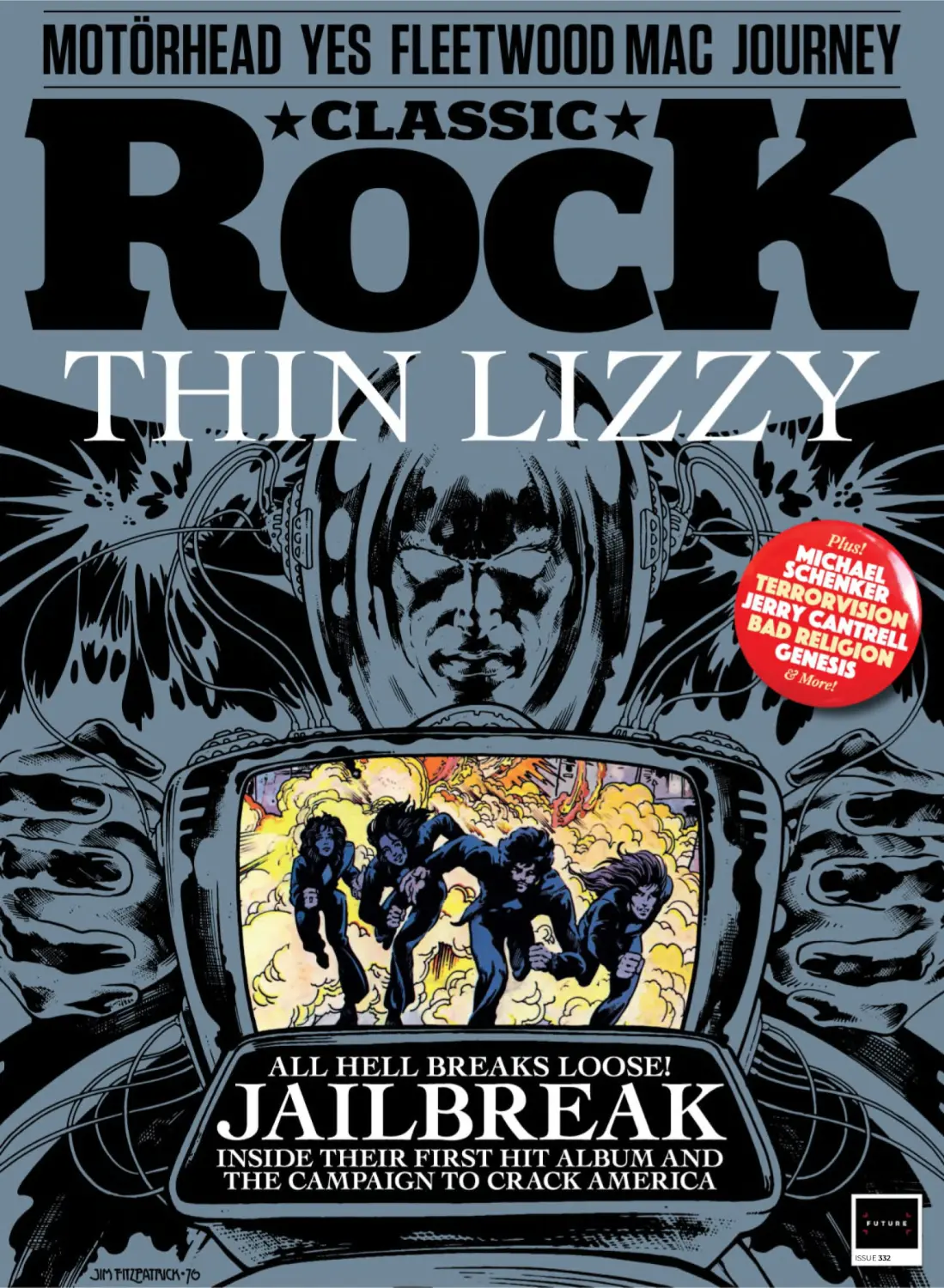
The album’s sleeve was designed by Jim
Fitzpatrick in collaboration with Philip, based on
a sci-fi concept about breaking free from all forms
of control and authority. The release date was set
for Friday, March 26, and from the moment we
had delivered the album to the record company,
everyone believed this was the record that would
be the success the band had promised for so long.
The following week I was in the office on Dean
Street in Soho. This was the day we would hear
from Phonogram with a chart position for
Jailbreak. Co-manager Chris Morrison and I sat
there, trying to predict what that position would
be, but we had no idea. The hours
dragged by, waiting for the call.
When the phone finally rang, it was
A.J. Morris, the managing director
of Phonogram, ringing to say that
Jailbreak had entered the chart as the
highest entry that week. “Twelve,”
he said. “The album is number
twelve. Congratulations to you and Chris Morrison
and the band.”
The excitement we felt that morning was
palpable. My phone rang and it was Philip. He
wanted to know if what he had heard about the
album was real, and whether it would mean
a change of fortune for the band. He and I both
knew he wasn’t actually ringing about the news
from Phonogram, he wanted to hear what my
ambition for the record was, and that meant the
release of the album in America and the upcoming
tour. He listened to the conviction in my voice,
and he never made that call again.
The last couple of years had been a constant
struggle in terms of raising money to keep the
band and the office financially viable. We
owed money to the bank, finance companies,
suppliers and just about everyone else. For
us, the success of the album meant some
breathing space and a way to start paying off
some debts. As I switched off the lights, it
would be the last time I would be in the office
for three months, as in a couple of weeks we
were flying to New York to begin the US tour.
America was about to hear that the boys were
back in town again.
in the passports that allowed us to board a plane
and work in the United States.
As we waited in the TWA lounge, I talked with
Scott Gorham, who told me how excited he was
that there was a Los Angeles show on the run. It
meant a lot to him to be returning to California as
part of a successful band. Philip was laughing with
Brian Downey about something they had heard
from a friend back home in Dublin, and Brian
Robertson was talking to his girlfriend on a pay
phone. The next six weeks were going to be
interesting. We left London with the knowledge
that Jailbreak was now a certified gold record in
both England and Ireland, with sales
of over 100,000 records.
The flight was uneventful, and
we were soon landing at JFK. As we
left the airport, our driver was
somewhat amused by the fact that
Philip never sat in the back of a car,
he always rode upfront. As we sped
along the freeway it felt like the beginning of
something. We were still on a high from the
success of the album at home, so who then would
deny us the siren call that promised the same
success for the album release in America?
We arrived outside the Hotel Mayflower on
Central Park West where we would be staying for
two nights before departing for our first show in
the Midwest. I checked in, took the elevator up to
the tenth floor, and as soon as I opened the door
the phone was ringing. It was Sheryl Feuerstein,
the national publicity director for Polygram. The
PR machine had been set into motion. We had ➤
ERICA ECHENBERG/GETTY x3
‘The first track I heard was Jailbreak.
I remember sitting in the control
room thinking it was a game changer.’
here was an urgency to the band’s arrival
at Heathrow airport that morning. It was
the first time that they were beginning to
get noticed. How different to that morning over
a year ago when they were about to depart for
their first ever tour of America. I was waiting for
them at the check-in desk with their tickets and
passports. Once again the American Immigration
Department had delayed us in getting our visas
and work permits. I had waited in a queue at the
American Embassy from the early hours of that
morning to see if they had been approved
overnight. Thankfully, they had. I had the stamp
T
CLASSICROCKMAGAZINE.COM 25
Playing in the spotlight, at a time for
Lizzy to be dancing in the moonlight:
Brian Robertson and Phil Lynott in ’76.
two days in New York and she had lined up many
interviews for the band. There was no doubt this
was now an important record for the company.
It was four o’clock in the morning and I was
wide awake. I called the office in London and
updated them: today was press, meet the Mercury
Records staff, and then dinner at Angelo’s, an
Italian restaurant on Mulberry Street. I knew
I wouldn’t go back to sleep, so
I showered, called the 24-hour room
service and ordered a coffee. I read the
free copy of the G^pRhkdMbf^l that the
hotel provided and watched the news
on ABC. This is life on the road in
America. For the first week of the tour
I would be waking up in the middle of
the night, wondering which city I was in and
where we were travelling to that day.
We flew out of La Guardia on the morning of
April 17 to begin the tour. We were playing that
night as a support to Rush at the Memorial Arena
in Pekin, Illinois. The band had a great
relationship with Rush, and they liked having us
on the bill with them. What I recall from
that first show was you could see that
the audience were beginning to
recognise the songs from Jailbreak,
due to the airplay the record was
getting. We were staying at the same
hotel as Rush and met them later for
a drink in the bar. It wasn’t a late one,
as we had an early flight to Kansas City
in the morning.
Sunday morning in Pekin was slow.
It took forever to check out of the
hotel, and the cab to take us to the
airport was late, but we made the
flight and in no time we were landing
at Kansas City International. It was
a day off, and I knew I wouldn’t see much of the
band that day. That’s how it is on tour. You spend
enough time together in cars and planes, once
they got to their rooms I wouldn’t see them until
the following morning.
I woke up on Monday to the sound of my
phone ringing. It was Mike Bone calling from
Chicago. He was calling to tell me that we were
a conversation in a car a year ago, about how one
song could define a band, we had a hit. Spread the
word around.
When I told the band, there was excitement
and disbelief – the song they were unsure of when
they played it to me was about to be a hit in
America. We played a show that night at Kansas’s
Capri Theater, and the following night Chicago’s
Riviera Theater. This was the first time
we had been back to the city since we
opened for Bob Seeger and Bachman
Turner Overdrive in early 1975
Afterwards the band went to pay
homage to the blues in the many clubs
on Rush Street, which were steeped in
the music and history of Muddy
Waters, Willie Dixon, Little Water and Buddy Guy.
Somehow the appreciation that night of 12-bar
blues turned into the band drinking in 12 bars.
This was memorable mostly for a girl and a bottle
of tequila. The band were drinking in one of those
bars when she walked up to them and slammed
down a couple of shot glasses and a bottle of
tequila on to the bar top. “Drink,
gentlemen,” she said. Immediately
I could sense this would not end well
– a pretty girl, a bottle of tequila, and
a challenge to a group of musicians.
To this day I don’t know how Brian
Robertson got back to the hotel. He
had been missing for a day, and just
as I was about to put out a missing
persons alert he walked into the lobby
of the hotel and asked for his room
key. Before he disappeared into the
elevator, he asked me what time we
were leaving in the morning. I didn’t
see him again until we were about to
check out of the hotel.
‘To this day I don’t know how Brian
Robertson got back to the hotel.
He had been missing for a day.’
26 CLASSICROCKMAGAZINE.COM
picking up airplay on all the AOR stations with the
single. We need these, he said, before they will
add the record at Top 40 radio, but he had no
doubt that week-on-week we would pick up those
stations. “It’s a hit,” he said. “I’ll see you when
you get to Chicago.” I put down the phone, and
thought about what he had just told me. From
t’s May 1 and we’re booked to do a couple of
shows in the twin cities of Minnesota and
St.Paul. We are playing third on the bill to
Aerosmith and Slade in Minnesota, and special
guest to Slade in St.Paul. After the second show,
the band are presented with a stone jar of
Tullamore Dew. I look at it, and realise it
represents a gesture of giving the band ‘whiskey
in the jar’. Wrong band, wrong time, but I thanked
the giver for his enthusiasm and the whiskey.
A day later we travelled to Allentown in
Pennsylvania to play at the Roxy Theater for two
nights. Although people are starting to talk about
a song they are hearing on the radio, Lizzy haven’t
actually played The Boys Are Back In Town much.
It’s in the set, but it’s only a single in America,
and nowhere else. But from the opening chords of
the song, to Philip singing ‘@n^llpahcnlm`hm[Z\d
today…’ there was a connection with the audience
that night that took it to another level. This was
no Monday night at the Roxy Theater, this was
Friday night down at Dino’s Bar And Grill. It was
an extraordinary moment, and I remember sitting
in the dressing room after the show talking to the
band about the response the song got that night.
Whatever happened now was all down to a song
that was about to change the lives of a third-onthe-bill opening act in America.
After Allentown, we played a couple of club
dates in New Jersey, and then headed to
Philadelphia to play a show at the Tower Theater
supporting The Tubes. It was on the drive to
Philadelphia that we heard the single for the first
time on American radio. I was driving a hired car
along the I-95, listening to the radio, when the
opening chords to The Boys Are Back In Town began.
Phillip lent forward and turned the sound up. No
matter how many times I was to hear that song
being played on stage, hearing it on a car radio
while driving on a freeway in America was
a different experience altogether. As we reach the
outskirts of the city, I wonder if they
will be ‘rocking on Bandstand in
Philadelphia PA, where the cats all want
to dance with sweet little sixteen’.
I pull into the parking lot of the
hotel and check in at reception. There
are messages waiting for me: call
Bone, Feuerstein, the office in
London, and Nigel Grainge. The single and the
album have charted on Billboard and Cashbox, we
are selling records. I tell the band I will see them
later at the venue, I have calls to make.
My days and nights are now about arranging
times when the band can be interviewed, on
a phone, at a radio station, with a journalist,
before a show, after a show. Everyone is important,
MAIN: IAN DICKSON/SHUTTERSTOCK; INSET: ERICA ECHENBERG/GETTY
I
“I reckon this one will be
another hit…” Phil Lynott
at home in London in ’76
no one is unimportant, everyone loves the album,
the single, the band… The phone in my hotel
room is ringing off the hook. Finally I just have
time for a coffee before I take a cab to the Tower
Theater. Larry Magid is the promoter and he has
put a great bill together; The Tubes and Thin Lizzy
show is completely sold out.
It is encouraging that the promoters are booking
us. After all, they are putting money behind the
belief that we will make it in America.
Hank LoConti runs the Agora Ballroom, and as
the band sound-check he tells me the phone has
been ringing all day for returns. WMMS is
a co-presenter for tonight and they have been
playing the album from its week of
release. Even before the doors open
there is a queue forming. Cleveland is
going to give the band a great ‘Rock
Capital’ welcome.
Watching from the side of the
stage that night, I began to notice
how easily the band were adapting to
playing to American audiences who were seeing
them live for the first time. Cleveland did indeed
give us a ‘Rock Capital’ welcome – which
somehow seemed to last until the early hours of
the morning.
At the airport the next day, we are waiting in
departures to fly to Racine in Wisconsin and the
band are grateful for the plentiful hot coffee.
➤
‘Somehow the appreciation that night
of 12-bar blues turned into the
band drinking in 12 bars.’
There are some people to meet afterwards, and
then we head back to the hotel. It’s an early flight
to Cleveland in the morning. Mike Bone informs
me that WMMS in Cleveland picked up the single
early, and this is why the show at the Agora
Ballroom is sold out. The important thing is not
only are we getting played on radio, but we are
playing all the right venues for a band at our level.
CLASSICROCKMAGAZINE.COM 27
Deserved smiles in ’76:
(clockwise from bottom left)
Brian Downey, Phil Lynott, Brian
Robertson, Scott Gorham.
The next couple of days we are playing shows
in the Midwest including one in Kansas City with
the Charlie Daniels Band. We are getting ever
closer to the West Coast, where we are scheduled
to play some shows with Journey, including a date
in Los Angeles.
When you’re on tour, it feels like you are on
a moving train that never stops at a station long
enough for you to get off. We opened for Journey
in Portland, Oregon and they stand at the side of
the stage watching the band. They are fans, and
they are pleased we are playing these dates with
them. The next day we flew to LA, a car picked us
up at the airport. and by the time we hit Sunset
Boulevard it felt like we were driving
through a film lot.
We checked in at the hotel and I took
the elevator up to my room on the
seventh floor. It was now the beginning
of summer, and I stepped onto my
balcony to look down on Sunset
Boulevard. There was a knock on the
door. Philip walked into the room and joined me
out on the balcony. He didn’t have to say a word as
we looked down on Sunset, he was remembering
that I had once said to him: “You are nothing till
you can make it in this town.” Now you couldn’t
turn the radio on in this town without hearing
Thin Lizzy. He asked what I was doing, and I said
I was going to take a shower and then walk up to
Tower Records. Later I was going to eat at Carlos
& Charlie’s across from the hotel, and he said
okay, he would meet me there as he had some
interviews to do. I wasn’t sure what the rest of the
band were doing, but I knew that at some point we
would all meet up at the Rainbow Bar & Grill.
When we arrived there we were given a booth,
and for the whole night the band were greeted by
people in the club as if they were being anointed
as the Next Big Thing. Why not? They were Thin
Lizzy, and they had a hit record, and that would
get you an invitation to everywhere you wanted to
go in LA. Around two o’clock I decided to go back
to the hotel. Someone asked if I needed a ride.
I said no, I wanted to walk back along the strip. He
gave me a look that said: “No one walks in LA.”
The following morning I woke up to the
incessant ringing of the phone in my room. It was
a show day, people were requesting interviews,
asking to be put on the band’s guest list. The BBC
I talk with Susanella Rogers, head of West Coast
PR for Mercury, to discuss the aftershow party she
has organised at the Old Venice Noodle Company
in Venice Beach. She shows me the invite list –
it’s stacked. There are press, radio and record
company people among the names, all of whom
have responded in the affirmative. After the show
we head over to the party. The room is full and
everyone wants to talk to the band. The party
breaks up around 2am and I get a cab back to the
hotel. We’re filming tomorrow and the band has
an early call.
The following evening, over dinner on Malibu
Pier, I discussed the progress of the album with
some of the guys from Mercury. I told them I was
being inundated with offers from promoters to
extend the US tour. We had agreed to be special
guests on the upcoming tour with Ritchie
Blackmore’s Rainbow, which would take us
through the end of June. The longer we stayed in
America, they said, the more the opportunities
there’d be for us to promote the record.
It was hard to sit there that night in
a restaurant overlooking the Pacific Ocean, and
not think about the speed at which all of this was
happening. The band had gone to The Rainbow.
It was our last night in LA. Next stop Chicago,
then on to Texas where they are scheduled to play
three shows.
We flew into Dallas from Chicago – we are in
cowboy country now. And from the moment the
band stepped on the stage of the Electric Ballroom
that night, they had the audience in the palm of
their hand as Philip sang the opening lines to
Cowboy Song.
The next day we drive to Austin to play at the
World Armadillo HQ. It’s a couple of hours in the
car, and I have no idea why the venue has such
a name. But on arrival the promoter, Eddie
Wilson, begins to tell me the history of the venue.
It was originally an old National Guard Armoury,
which had inspired a local artist to design a poster
for the first ever show there, using an image of an
Armadillo. As I sit in his office, I look around at
the framed posters on his wall – Ray Charles, Janis
Joplin, Van Morrison, Linda Ronstadt… Now you
could add Thin Lizzy to that roster. It’s not by
chance that you become a great live act, it’s when
you play venues like the World Armadillo HQ that
you begin to hone your performance to the level
of those artists.
After a late breakfast we check out
of the hotel for the short drive to San
Antonio. We are playing a show at the
Municipal Auditorium with Rush that
night, but we all want to see the Alamo
before we go to the venue. Davy
Crockett, king of the wild frontier,
made his last stand here.
The show that night is sold out, and afterwards
we meet up with Rush at the hotel. They are
pleased that we are doing so well with the record,
and we sit in the bar talking about life on the road
and about their plans to come to England at some
point. Philip doesn’t stay long in the bar, he says
he is feeling tired and we are flying to Nebraska
the following day.
‘Scott takes the news really badly.
The tour is over and he has no idea
what this means in the long term.’
ater that day I sit in the auditorium of the
Santa Monica Civic Center and watch the
band sound-check. The show is sold out for
Journey, but all the attention is for Thin Lizzy.
L
une 10, 1976. We have been added to a show
with Nazareth and Slade. It promises to be
the kind of night where you can’t wait to
meet up with them and catch up with all the
J
ERICA ECHENBERG/GETTY
28 CLASSICROCKMAGAZINE.COM
called. The single is a hit in Britain and they
needed to film a clip of the band performing the
song for Top Of The Pops. A studio was being
booked and a film crew was flying out to film the
band lip-synching to the song. I sat on the
balcony of my room for a moment, just to feel the
warmth of the sun on my face… One song, that’s
all it took. Suddenly the phone rang again. I let it
go to message and went to have breakfast instead.
news from back home. But it is a muted
performance that night. Philip thinks he has
a bug. I promise to get him to a doctor when we
get to Columbus, where we are due to begin the
tour with Ritchie Blackmore, but he doesn’t want
to make a fuss. There is definitely something
wrong. Philip is telling me he can shake it off,
but I’ve never known him to be sick like this.
We fly to Columbus that morning and I have
called ahead to get a doctor to come to the hotel.
Again, he tells me it’s just a bug, but he looks
jaundiced and that suggests something far more
serious to me. Upon landing we head straight for
the hotel, where the doctor is waiting for us. He
takes one look at Philip and tells me this is
serious and arranges for him to be admitted to
a hospital in the city for tests. Privately, he tells
me that he suspects Philip has hepatitis, which
a blood test will confirm.
We go to the hospital and Philip undergoes
some tests. An hour later it is confirmed that he
does indeed have hepatitis. The doctor wants to
admit him, I don’t. While waiting for the results,
I have been on a payphone, calling the travel
agent to book Philip on a flight to Manchester
connecting through London that night. We get
a cab back to the hotel so that I can let the band
know what is happening.
The first person we see is Scott. He takes the
news really badly. The tour is over and he has no
idea what this means in the long term. Everyone
comes to my room and I explain the situation,
while Philip is on his way to the airport. I have to
call the agent, the record company and the office
to give them the news. The plan is to get everyone
back to England via New York, where I have
arranged for the band and crew to get shots to
prevent any of us getting hepatitis, so after my
calls we’ll get a late flight to New York. I go down
to the Village for dinner and think about what this
will cost us. All of the plans to extend the tour to
promote the album have come to nothing.
Already Mercury are talking about the next
record, but I can only think about this one. This
is not how it was supposed to be. We have a gold
album in America, every promoter wants to book
the band, but we are leaving tomorrow. I walk
back to the hotel, as the traffic is so bad it makes
no sense to sit in a cab going nowhere.
The following morning I wake to the sound of
my phone ringing. The story has broken back
home and I am being asked for quotes as to the
exact nature as to why the tour was cancelled. It
runs in all the papers and on radio, and when it
does I am on an overnight flight back to London,
so there is no further comment from me.
As I wait for my bags in the arrivals hall at
Heathrow, the band and crew are asking me
what happens next. I am not sure what happens
next, but I am going to go home, and then to the
office to talk with Chris Morrison about what’s
next. I tell them to take a couple of days off, and
I will call everyone to let them know the update
on Philip once I have some news
to share.
As I leave the airport it’s
a warm June day, unlike the
stifling heat of New York. I get
a cab into London. The cab driver
has his radio on, and suddenly
I hear the words: ‘@n^llpahcnlm`hm
back today…’ Oh, the irony.
The rocker: Phil Lynott
strikes a pose.
A couple of days later I take the train up to
Manchester to spend a day with Philip, who has
been in hospital ever since he got back from the
US. He has been told that rest and antiviral drugs
will make sure that for the immediate future the
virus will clear up. While he has been in hospital
he has kept himself occupied with an acoustic
guitar and a notebook to write down some ideas
for songs. He is in a side room for privacy, and as
I sit with him he tells me how overwhelmed he
has been, with so many people calling the
hospital and writing cards to him.
It was for this reason, he says, that
we should do a show in London to
thank everyone. While he is still
upset about having to cancel the
American tour, he argues that the
quicker Lizzy become visible again
it will stop people speculating
about the band’s future. I use the
phone in his room to call the office to find out
the availability for a date at Hammersmith
Odeon. Before I leave Manchester that day, we
have a show in London confirmed for July 11, and
Philip is talking about recording a new album.
n the day of the show, London is in the
middle of a heatwave, the show is sold
out, everyone wants to see Thin Lizzy.
As they walked onto the stage that night, the
reception was enough for the band to forget the
disappointment of having to cancel the North
American shows with Ritchie Blackmore.
In the wings that night, looking on and waiting
to make an entrance, was Johnny the Fox, tuned
in and listening to the band…
O
Thin Lizz y 1976 is out via UMR on September
27. Chris O’Donnell’s book ‘The American
Dream Of Thin Lizz y’ will be published in 2025.
CLASSICROCKMAGAZINE.COM 29
1976 was a pivotal year for Thin Lizzy. Guitarist Scott Gorham, one half of the band’s
classic twin-guitar sound, takes a trip down memory lane to the year that was…
Interview: Mick Wall Portrait: Philip Barker
L
os Angeles-born guitarist Scott Gorham joined Thin Lizzy in
1974 at the same time as guitarist Brian Robertson, marking
the beginning of the classic Lizzy line-up that found
worldwide success two years later with the Jailbreak and
Johnny The Fox albums. He remained with the band until its
breakup in 1983, and was the longest serving member after founders
Phil Lynott and Brian Downey.
The first time we met was at the aftershow for the final night of three
at the Hammersmith Odeon on the Johnny The Fox tour, in November
1976. Guests included George Best, Alex ‘Hurricane’ Higgins, Johnny
Rotten, several Sun Page 3 girls, various TV stars, and Huey Lewis, then
of Clover. Lizzy attracted a high level of celebrity to their shows.
Well, I guess we did, because I remember shaking hands with a lot of
people I probably didn’t think I’d ever meet. Then you’re having
a conversation with them, then you become friends with them. But all
the parties and all the people that you meet,
when it came down to the music, it was all
business. That’s the part that I’m really proud of.
1976 was Lizzy’s big breakout year, starting with
Jailbreak, in March, which went gold here and in
the US, and the big single from it The Boys Are
Back In Town, which hit the Top 10 both here
and in the US.
Yeah, that year was the explosion.
Robertson injured his hand so badly in a fight at the Speakeasy involving
Frankie Miller, the start of your next US tour was cancelled too.
That was another crazy-ass period. America became like the bad-luck
territory for us. We could tour anywhere else in the world – which we did
– and not a damn thing would go wrong. The tours went off beautifully.
We’d get to America, and bang! Something happens. Got to get back on
the plane and go home. I think the American fans thought: “If I buy
a ticket are these guys even gonna show up?” I don’t blame them. You
can’t keep people’s trust if you keep cancelling tours.
Yes, Robbo fucked up. But I still love the guy, and I had so much fun,
being his guitar partner that came up with all the harmony lines that
became the Thin Lizzy sound. I had such a great time with that man. But
he just could not keep his shit together.
There was a review of Jailbreak in which the guy said something about
“that classic Thin Lizzy sound of the twin guitars”. I said to Robbo: “Hey,
man, can you believe it, we got a sound!” That’s why you saw it in a lot of
the Thin Lizzy songs, the twin harmony sound.
I would write specifically to put these harmony
guitars in certain areas, because I knew a lot of it
would be like your second hook. You’ve got Phil
doing his thing, he’s got his vocal hook. Now let’s
go for the harmony-guitar second hook.
Talking of that twin-guitar harmony thing,
moving forward a couple years, I heard Waiting For
An Alibi on the radio the other day and I hadn’t
heard it in… I can’t remember how long. I turned
the radio up and I thought: “God, that sounds great!” And it didn’t sound
like anything we’d been listening to on the radio for the last hour and
a half. I was kind of proud of ourselves for sticking to our guns. This is
what we do. This is the way it’s gonna be played. This is the way we like it.
“I had such a great
time with Robbo. But
he just could not keep
his shit together.”
Did you know as you were making it that Jailbreak could be the one?
No. Our first two albums were dismal failures. For the third, Jailbreak, we
literally had everyone saying to us: “You’d better do it on this one or
there’s the door.” Record company, management, I even think what few
fans we had at that point were saying it. So we doubled our efforts. We
demoed and demoed and demoed and wrote and wrote. That’s why
Jailbreak and Johnny came out in the same year. We wrote probably two
and a half albums’ worth of songs. Also, The Boys Are Back In Town was so
big worldwide, we pretty much knew we were gonna be on the road
constantly. We didn’t know if we’d have time to make another album in
the space available to us.
At the same time as being incredibly prolific, it was also a time of great
turmoil for the band. Phil got hepatitis, causing the cancellation of
your summer 1976 US tour. Then your fellow guitarist Brian ‘Robbo’
What about the Irish influence? Both you, an American, and Robbo,
a Scotsman, seemed to have that Irish ‘diddly-diddly’ in your guitar
playing. Was that conscious? Did you have to work on it?
When I got into Thin Lizzy I didn’t really know what ‘Irish rock’ was.
When I met Phil, this black guy who talked with an Irish accent, I had no
idea what was going on here. I hadn’t even heard a lot of traditional Irish
music at this point. It was Phil that introduced me to the whole Irish
music genre. He would point things out. I would listen, and realised it was
really cool and really subtle. And I would take my guitar and try and
emulate what these Irish musicians were doing. But my style of playing
was a lot more American, so it was never gonna come out as a bona➤
CLASSICROCKMAGAZINE.COM 31
SCOTT GORHAM
Brian ‘Robbo’ Robertson (left)
and Scott Gorham: two guitars
singing in harmony.
fide Irish guitar line. But the intent was there all
the time to try and keep the whole Gaelic thing
alive that Lizzy had. Not all of it. But stuff like
Emerald [from Jailbreak] that needed an Irish line,
for sure.
When Lizzy broke big in 1976, you were not
considered heavy metal. In fact you were most
often compared to artists like Bruce Springsteen
and Graham Parker. You were rockers but you
also played a lot of funk, which you can hear on
Johnny The Fox Meets Jimmy The Weed. You had
weepy ballads like Borderline, also from Johnny.
You had Phil coming out with two books of his
poetry during this period. You weren’t boxed-in
worrying about pleasing rock and metal fans.
Sure. It wasn’t a cookie-cutter kind of thing.
Every album was a little bit
different from the last
album. But in America
I thought maybe that was
part of our problem. We
weren’t put in this box that
all these fans could follow
religiously. I said that in
a couple of interviews, and I got feedback from all
these different fans saying no, that wasn’t right at
all. That’s why we love you guys, because you
don’t keep repeating yourselves. You always come
up with something different for different albums.
And I thought, okay, there are people out there
who actually get what we’re trying to do, right?
I thought that was very, very cool.
liked the same of everything. That’s why we got
along so well. It was always Phil and I after a show.
He and I going to the club. He and I going to the
bar. “Hey Scott, see you in the lobby.” That kind
of thing. It was always me and Phil. I think it was
maybe kind of to the detriment of some of the
other guys in the band, where they felt they were
maybe being excluded a bit. I didn’t think so at
the time.
But you’re right, it was always Phil and Scott.
We would sit in his living room at his house in Kew
with our acoustic guitars, hammering out these
chords and song lines. “Hey, what do you think
of that lyric there?” “Yeah, that’s really cool.”
Egging each other on to write these songs, then
present them to the rest of the band, who were
gonna add whatever they were gonna add later on.
Robbo has said how Don’t Believe A Word, the big
hit from Johnny The Fox, was originally a slow
ballad, until Phil left to do an interview or
something, at which point Robbo came up
with the galloping riff that we now know from
the single.
Yeah, I think he should have got a credit.
I attribute that version mostly to Brian Robertson.
He was the one who came up with that great riff,
which I latched onto immediately. Like: “I’m
gonna put a great harmony onto that!” Which
turned out to be a hit in all of two minutes and
seventeen seconds. I think we had one more part
to that song, and in the end in the studio we just
went: “Naw, two minutes and seventeen seconds,
that’s fine. It’s probably just going to be an album
filler anyway.”
But the money side of
being in a band never really
interested me. It wasn’t
a subject that I talked about
a lot, or I was obsessed with.
Maybe I should have been
– according to my wife. My
whole philosophy was I just
wanted to be respected for being in a kickass
band. That was my main goal right there. If we
make money, we make money. If we don’t, at
least we’re a kickass band. And Thin Lizzy was
a real kickass band.
“Phil and I had the same sense of humour.
We pretty much liked the same of everything.
That’s why we got along so well.”
32 CLASSICROCKMAGAZINE.COM
You once told me about Dancing In The Moonlight.
How the first time Phil played it to you he was in
bed, and he played this very simple riff on an
acoustic and you dismissed it – until you and the
band built it into the hit we now know.
What Phil did, he would start things out by going:
“What do you think of this?” And he would play
something really simple. And you’d go: “Ah, I don’t
know. How about if we do it like this?” He’d go:
“Yeah, man, that’s what I’m talking about!” But
because he had come up with that little chord
structure, he had written it, you know? [laughs].
Lastly, is it true that whenever Phil was
interviewing someone to join the road crew, his
main question was: “Can you fight?”
Yes! Lizzy really was a gang. If anyone started any
trouble with any member of the band or crew, we
all piled in. You had to know how to handle
yourself. And, oh yeah, we did.
Thin Lizz y’s 1976 box set is out on September 27
via UMR and will be reviewed next issue.
MICHAEL PUTLAND/GETTY
Tell me about your relationship with Phil. On
stage Robbo was kind of the lone wolf, very
serious and not to be messed, while you and
Phil were more chill, always smiling on stage,
sharing a joke.
We were really comfortable with each other. We
had the same sense of humour. We pretty much
Did you feel you should have got more
songwriter credits on the songs?
Thank you!
Fronting Yes he was one of the architects of prog rock, and now he fronts his own band.
But that’s only part of his wondrous story. He was a decent footballer as a kid, believes in
elves and fairies… Let him tell the rest. It really has been, he’ll tell you, a wonderful life.
Interview: Dave Everley
T
time in Germany in his early twenties with his pre-Yes
band The Warriors (aka the Electric Warriors). Yes
themselves helped midwife the entire progressive rock
scene, becoming superstars on both sides of the Atlantic
via landmark 70s albums Fragile and Close To The Edge and
1983’s commercial monster 90125. But his interest in the
sounds and spirituality of non-Western cultures has long
fed into his own music, whether with Yes or solo.
Speaking via Zoom from his home in California, and
looking a good two decades
younger than his 79 years,
Accrington-born Anderson is
an endearing mix of the earthy
and the ethereal. One minute
he’ll talk in that distinctive
Lancastrian burr about his love
of football, the next about the
“fairies and elves” that live
invisibly among us. His former
Yes bandmate Rick Wakeman
once affectionately said of him:
“He’s the only person I know
trying to save this planet whilst
existing on another one.”
Yes’s career has been less
metaphysical, often playing out
like a soap opera – Anderson
himself has had three different
stints in the band, the last of
which ended in 2008. He’s rightly➤
MAIN: CATHY MILLER/PRESS; INSET: DAVID GAHR/GETTY
he title of Jon Anderson’s new solo album,
True, sounds like a statement of intent in
an age of disinformation. “As I was writing
the lyrics, I kept popping up with ‘true’
this or ‘true’ that,” says the former Yes
singer. “One song is called True Messenger. It comes
from my time in Jamaica years and years ago, hanging
out with Rastafarian characters. Everything they said
was ‘true’: ‘It’s true, man.’ ‘Don’t worry, Jon, it’s true.’”
Few would have one of prog’s
founding fathers down as the sort
of person who’d be at home
rubbing shoulders with a bunch
of Rastas in Jamaica, but
apparently that was fairly
standard behaviour back in
the day. “Oh no, being there
was wonderful,” he says. “I was
a huge Bob Marley fan. I saw
him at the Rainbow Theatre [in
London]. I was in shock at how
great it sounded, how great it all
was. The audience adored him.
And Jamaica, it’s cool. You’ve
got to take that mushroom
stuff and go up into the Blue
Mountains there and channel
your higher self.”
Anderson has always been
a citizen of the world. He spent
CLASSICROCKMAGAZINE.COM 35
Early Yes with a few stoned fans
in London in 1969: (l-r) Jon
Anderson, Peter Banks, Tony
Kaye, Bill Bruford, Chris Squire.
Yes circa 1976.
“Because I was small I was called
Napoleon. I would stick up for myself:
‘I’m from the North of England,
don’t f★★k with me.’”
enthused today by the sparkling True, recorded
with The Band Geeks, the backing group he
discovered after hearing them cover Yes classic
Heart Of The Sunrise online. “It’s like a gift from
the heavens,” says this cosmic hobbit. “Making
this album was one of the most wonderful
experiences of my life. It was effortless.”
Let’s start with an important question. What
meant more to you as a kid: being a musician or
playing for Accrington Stanley?
Oh, Accrington Stanley. [Points to the back of his
chair] I’ve got my Accrington Stanley robe here.
36 CLASSICROCKMAGAZINE.COM
When did music take over from football for you?
My brother Tony had a band, which I didn’t know
that much about. They had two singers, Tony
and one who left because he wanted to be
a hairdresser – this was 1963, the time of Beatle
haircuts. So my brother said: “Do you want to join
the band?” “Which band?” “We’re called The
Warriors.’ I thought: “I can do that.” We
delivered milk around the Accrington area, me
and Tony, and we sang Everly Brothers songs. We
did that with the band – Tony would do
Elvis Presley songs, I would do Roy
Orbison. We’d do Beatles songs, Hollies
songs… As each band became famous,
we’d do one of their songs.
Were you ambitious early on? Did you
want to become famous?
God, no. I didn’t think about
that at all until we went to
Germany [in 1966]. We
followed the Beatle Trail – we
played Cologne, Munich,
Frankfurt. You’d do two weeks
in each place. Surviving that
was amazing. I remember the World Cup Final,
England versus Germany. We were playing this
club in Germany and the owner wouldn’t let us
have the afternoon off. I said: “But the game is on
at three o’clock.” So we listened to it on the radio
when we were playing. Every time England scored
a goal, they threw a bottle at us.
How messy was your time in Germany?
Well, we got into acid and things like that.
I listened to Sgt Pepper a thousand times, and I was
listening to a lot of Stravinsky, of all things. It was
really inspiring. I remember going into the room
of the place where The Warriors were sleeping
and trying to wake them up: “Come on, let’s go
and rehearse, I’ve got some ideas.” And they told
me to eff off. So I went away and came back a bit
later and tried again: “Are we going to rehearse?
Are we going to be a bad band? We could be a great
band!” And they told me to eff off again. So I went:
“Okay” again, and I packed my suitcase and went
to live in Munich. The day I arrived, I went to see
Jimi Hendrix in a small club.
What was that like?
He was just getting famous and it was incredible.
MAIN: DAVID GAHR/GETTY; INSET: MICHAEL OCHS ARCHIVES/GETTY
What position did you play
when you were a kid? You
look like a nippy little winger.
Stanley Matthews. Number
seven. The trainer told me
I played really well, but I had
no real boots. He gave me
a pair of Adidas boots, which
were like gold, but my feet
didn’t reach all the way to the
end of the boot, so I put cotton
wool in the toes. The photographs I see
of myself, the boots are so big. Like
clown’s shoes. The trainer was a guy
named Les Cocker. He eventually
became the trainer for
England when they won
the World Cup [in 1966].
JON ANDERSON
Anderson with Yes at
the Camden Festival
at The Roundhouse,
London, April 25, 1971.
Anderson and Chris
Squire with Yes in 1972.
MICHAEL PUTLAND/GETTY x3; MIDDLE: GIJSBERT HANEKROOT/GETTY
Anderson (and with Steve Howe and
Rick Wakeman, bottom right) during
the recording of Fragile at Advision
Studios in London, August 1971.
I was living in a cupboard in this place that
belonged to these two lovely girls. We had a party
that night for the band, and Jimi was there. I was
sitting in the corner in my kaftan, beads and bells,
totally out of my brain, and Jimi came over and
rolled a joint and we smoked a joint.
As it happened, when I was back in London and
just starting up Yes with [bassist] Chris Squire, we
went to see [saxophonist] Roland Kirk in this jazz
club. I turned around and Jimi walked in with his
guitar case. I waved at him and he said: “Munich!”
He took his guitar and went on stage with Roland
Kirk, and for an hour he played the most pure jazz
imaginable. I understood jazz
from that moment in time.
You put out a couple of solo
singles between leaving The
Warriors and putting Yes
together under the name
Hans Christian. But wasn’t
there talk of you working with
an unknown Elton John?
[London club owner] Jack
Barrie mentioned him. I didn’t know
him at the time. Somebody gave me
a cassette of his songs. It was
okay, but it wasn’t for me. And
then Jack Barrie turned round one
day and said: “You’re looking for
a band. There’s a guy in the corner
there looking bored, his name’s
Chris Squire, go and talk to him.”
So I went over and said: “How you
doing, man?” We talked about the
music we liked, and he said:
“I have a band, it’s called Mabel
Greer’s Toyshop.” I said: “That’s
a long name. How much acid have you taken?”
And how much acid had he taken?
Enough never to do it again. But he said
to come to rehearsal. Unfortunately
the drummer had left because he’d
got a gig in Paris with another
band. So I said: “Let’s look for
a drummer.” We got the
Melody Maker and we found
an advert: “Drummer looking
for a band, van, lovely kit.”
We said: “He’s got a lovely
kit and a van. He’s gotta be
in the band!” And that was [original Yes
drummer] Bill Bruford.
You were a couple of years older than everybody
else in the band. Did that mean you got to pull
rank over the rest of them?
No, it just meant that I knew what to do. Because
I was small I was called Napoleon. I would stick up
for myself: “I’m from the north of England, don’t
fuck with me.” I just wanted to make great music
and I didn’t care what you thought – just do it, and
if it’s bad do something else. Come on, it’s not
hard. But thankfully Bill and Chris were wild, just
brilliant. There was an energy around us. ➤
CLASSICROCKMAGAZINE.COM 37
Yes at Crystal Palace Bowl
in London, July 1971.
38 CLASSICROCKMAGAZINE.COM
Did you cross paths with him later?
Oh yes. Yes did a tour with The Who. They were
the headliners, then it was Rod Stewart, then it
was Joe Cocker, then the next one down was the
guy who lit his head on fire [Arthur Brown], and
we opened the show. That was an amazing couple
of weeks.
I always remember Pete Townshend, he didn’t
talk to anybody at that time, but he came up
behind me and he said: “Jon, I think your band
isn’t bad. It’s quite a good idea for a band.” All
I could think was: “Pete Townshend is talking to
me!” Then he said: “I’m
making an album about
a deaf, dumb and blind kid.
What do you think about
that?” And of course Tommy
came out a month later and
everybody went [mimes head
exploding]. Unbelievable
record. [Begins singing]
‘L^^yf^%_^^ef^%mhn\af^…’
How much of a struggle were
those early years of Yes?
It was just a question of getting
gigs. We had a manager who didn’t understand
how to manage a band. Nice guy, but he just
wanted the money from the publishing. It
freaked us all out. After two or three albums,
we said: “We haven’t got enough music, we
can’t go into the studio.” In London, everyone
is everywhere, and suddenly you’re in the studio
and you’re spending all of your time trying to
get your act together. I said: “We should just get
out, find somewhere we could rent a farmhouse
and be together and understand each other.”
So we went to Devon, and began working on the
album that became Fragile. So that
was a good idea.
Fragile, and the single Roundabout,
really took things to the next level,
especially in America. Was there
a point when you realised Yes
were a big band?
It was very gradual. We found
a manager who had ties to America,
and then suddenly we’re going
over there with Jethro Tull [in mid1971]. They’d had a big record [with
the Aqualung album], and the first
MICHAEL PUTLAND/GETTY
Did you have any memorable early gigs?
Oh yeah. The first gig, we only had three songs
that me and Chris had been working on: Beyond
And Before [which eventually appeared on Yes’s
1969’s self-titled debut album] and two others.
So I said: “Let’s do a funky version of [Wilson
Pickett’s] In The Midnight Hour” – which we
played for an hour. And that was the show three songs, then In The Midnight Hour for an hour.
But the crowd were dancing to it, so they must
have liked it.
The gig that always sticks in my mind is one
I did with The Warriors. It was at this funky sort
of place in Sheffield. The manager of this place
came over and said: [Yorkshire accent] “Ey, you.
Would you mind if a friend of mine gets up and
sings with your band?” We said: “If we’re gonna
get paid, then yes, fine.” So this guy came over
and he said: “Do you know Hit The Road Jack?”
So we’re on stage and I said: “We’ve got this
young guy, and he’s gonna sing this song.” And
this guy was amazing. He sounded like Ray
Charles. At the end, I looked over and said:
“What’s your name?” He said: “Joe Cocker.”
I went: “That was Joe Cocker, remember that
name,” as though I knew who he was all along.
JON ANDERSON
Another day, another line-up. Yes in
New York City, December 1983: (l-r)
Trevor Rabin, Alan White, Chris Squire,
Jon Anderson, Tony Kaye
show was in front of ten thousand people, all
looking at me. I was shaking. I could sing a little
bit and play tambourine, but that was all. So
I watched Ian Anderson, and I saw he had
a choreography - he knew exactly how to do
something at a certain time in the song. So
I went: “Oh, that’s how you do it…” Cos I used
to stand there like an idiot. [Laughs] I still stand
there like an idiot.
The next time we went to America, we were
driving somewhere and
Roundabout came on the radio.
[Excitedly] “We’re on the radio!”
And then right in the middle, it
goes straight to the organ solo. We
had no idea about radio edits. We
didn’t know that Atlantic Records
had gone: “Chop-chop, that’s
a hit.” And it was, it was a big hit.
Within three months we were
playing in front of ten thousand
people ourselves.
MICHAEL PUTLAND/GETTY x2; TOP LEFT: EBET ROBERTS/GETTY
Did you like fame, or did it mess with
your head?
I loved the whole thing. We opened
a show for Grand Funk Railroad, in
front of fifteen thousand people in
a field. I said: “I love America! I love America!”
I was so stoned. But I really did love America. It
was like going on holiday. I had this cassette
player and two speakers in my suitcase, like
a boombox. I’d play Sibelius and Stravinsky, Asian
music. I’d play my harp and read Herman Hesse,
Journey To The East. A couple of the guys would be
in the bar – okay, everybody does what they want
to do. But I felt really comfortable in my Holiday
Inn room. It was just an incredible time.
Who were you close to in the band?
I teamed up with Steve Howe every
time I could. I remember very clearly,
on the way to breakfast, hearing Steve
play a guitar phrase in his room
[hums a complex riff]. I had breakfast
and he was still playing it. So I opened
the door and said: “Can you change
the key there, Steve?” So he did, and
I started singing: ‘Workings of man set
mhierhnmablmhkb\Zeeb_^%k^`Zbgbg`ma^
flower of the fruit of his tree…’ [a lyric
from Yes’s epic 1977 song Awaken].
It just popped out. Where did it come
from? I have no idea. I just know that
I was in love with life, I was happy
with everything, and I sang about it.
“I laughed myself silly at the way people
were behaving. They didn’t realise they
were being the real-life Spinal Tap.”
I didn’t dwell on things like:
“Why am I doing this?”
It sometimes seems like Yes
were as much an ongoing battle of wills as they
were a band. Five stubborn people all jostling to
be top dog.
There’s a great photograph from the studio when
we were doing [1974 album] Relayer. Everybody’s
got their hands on a fader – I’ve got my hand on
my fader with the vocals, Chris has his hand on
the one with the bass, Steve Howe, Alan [White,
drummer], [keyboard player] Patrick Moraz with
their hands on theirs. And then you’ve got
Anderson, Bruford, Wakeman
& Howe (but unhelpfully not
in that order) in 1989.
[longtime producer] Eddie Offord trying to get in
there and say: “Listen, guys, this isn’t working.”
That sums up Yes.
Rick Wakeman had a collection of expensive
cars. What extravagant stuff did you buy?
Nothing, really. I got a very inexpensive Bentley
Continental from a guitar player who needed
the money at the time. I had a collection of
instruments – a harp, a guitar, a keyboard, a little
Revox tape recorder where I could repeat things
and double them and triple them.
That came in useful when you recorded your
debut solo album, Olias Of Sunhillow,
in 1976. That was an insane album,
in the best possible way – you did
everything from playing all the
instruments, to producing, to
inventing a new language on
one song.
Well, it started with Chris and Steve
doing solo albums. I said: “Solo means
by yourself, so I’m just going to do
what I can do myself.” I bumped into
an old friend named Tony Colton, who
did the production of the second Yes
album [Time And A Word]. He came to
my house and started playing the
piano, and I couldn’t believe how good
he was. He said: “Well I went to music
school.” And that’s what popped in ➤
CLASSICROCKMAGAZINE.COM 39
JON ANDERSON
Anderson in 2000.
Top right, Yes in 2004: (l-r) Rick
Wakeman, Chris Squire, Steve
Howe, Jon Anderson, Alan White.
Bottom right: Anderson speaking at
the Rock And Roll Hall Of Fame
Induction Ceremony in 2017.
my head: “I’ll make an album as though I’m at
music school. I’ll create the music and I’ll do
the instrumentation, and I’ll give myself a star
at the end.”
At any point did you think: “Why the hell did
I decide to do this?”
There were times. The first month and a half I was
so happy. The last month, I actually had a nervous
breakdown trying to put it all together. There
were four ‘tribes’ – percussion, stringed
instruments, bells and whistles, then the choir
comes in. I put them on four different connecting
reels and I just could not get them to sync. Five
days later I’m still trying to do it. I was
enjoying some whisky and I fell down,
and I slept in the studio. I woke up in
the morning and I thought: “What
happened?” I pressed the mix, and
it was perfect. I had no idea what
happened or how I’d done it. And
I started crying because the emotion of getting
through it was so powerful. I was thanking the
gods. That’s happened a couple of times in my
life, where you connect with the divine energy
and all of sudden you realise: “I can breathe, it’s
okay, everything is good.”
a party rock’n’roll star. He ruined the
whole thing. And Alan [White, Yes
drummer], who was there with his girlfriend, he
went roller-skating and broke his ankle, and that
was the end of the whole thing. It was as though
this big collision was waiting to happen. We all
said: “Okay, I’m going home.” And that’s what
we did. It’s impossible to change people when
they’re partying and the music’s the last thing
they’re thinking about. After ten years of Yes
we needed that explosion – I’m going this way,
you’re going that way. So I went to live in the
south of France, and found that I was very
creative at that time.
But there was one more huge twist to come in
2008, when the band elected to continue with
soundalike singer Benoît David when Anderson
was unable to tour after being hospitalised
following a severe asthma attack that left him
with acute respiratory problems. Aside from
briefly rejoining his old bandmates for their
induction into the Rock And Roll Hall Of Fame in
2017, he hasn’t sung with Yes since.
After leaving Yes for the first time, you released
five albums between 1980 and 1983. That sounds
like a man liberated.
Exactly. I was very lucky to meet with
Vangelis, and learn how to spiritually
and musically evolve. He was the
perfect spontaneous musician. He
could write a symphony every
afternoon. The guy had incredible
talent. I would sing with him, and most of the
time a spontaneous lyric would come out.
“I’ve got my new band together now.
I’ve got the Yes that I wanted.”
You left Yes after 1978’s
Tormato album. Was that
a hard decision to make?
No, it was simple. We were
trying to make an album in Paris with
a producer [Roy Thomas Baker] who
had hit records galore. He was worse
than anybody else for wanting to be
40 CLASSICROCKMAGAZINE.COM
H
And then you went and rejoined Yes in 1983 for
90125, which was even bigger than anything
you’d done before. That’s a little crazy.
I was in the South of France, working on a couple
of projects for Virgin Records that didn’t manifest,
really good music that I still have. I came back to
London, and I got a phone call from Chris: “Do
you want to hear some music?” And he played
a cassette of the album that became 90125, which
was called Cinema at the time. He went: “What do
you think?” I said: “Bloody amazing. I’d change
the verses on Owner Of A Lonely Heart, though.”
And he asked if I’d come in and sing it.He said:
“We can call it Yes if you sing it.”
What was it like being back in the fold?
It was unbelievable to be a super-duperstar.
I loved it. But I wasn’t thinking about that. I was
being creative. I remember the tour, we hired two
kids out of film school in Philadelphia to film
a documentary of the tour – one was Steve and
the other was Tim. [‘Steve’ was actually Steven
MAIN: BRILL/ULLSTEIN BILD VIA GETTY; TOP: MICK HUTSON/GETTY; BOTTOM: THEO WARGO/WIREIMAGE FOR ROCK AND ROLL HALL OF FAME/GETTY
The whisky probably helped, in fairness.
Oh, it did [laughs]. But I gave up everything when
I met my spiritual teacher. I decided to give up the
drinking and the smoking and
everything. And then I met my
wife, and everything became
clear, designed. If you’re not
working on an album, find
a band and go on tour.
is initial departure from Yes seemed to
open the floodgates. Anderson released
five albums between 1980 and 1983, two
solo (1980’s Song Of Seven and 1982’s Animation)
and three with Greek keyboard maestro Vangelis
(1980’s Short Stories, 1981’s The Friends Of Mr Cairo
and 1983’s Private Collection). Two Jon & Vangelis
singles – I Hear You Now and Can’t Find My Way
Home – went Top 10 in the UK, while another Jon
& Vangelis single, State Of Independence, got an
exuberant makeover by disco queen
Donna Summer.
Yes’s career path is nothing if not
eventful, and in 1983 Anderson
rejoined the band for their 90125
album, replacing the man who replaced
him, Trevor Horn (who would
produce the same album).
Anderson left the band again
at the end of that decade to
form a breakaway faction with
fellow Yes refugees Bill
Bruford, Rick Wakeman and
Steve Howe, but returned to
the fold in 1990.
Soderbergh, later director of L^q%Eb^l:g]Ob]^hmZi^
and the Oceans trilogy].
At the start of the tour, Steve and Tim hired
a car and drove to a show in Boston. We stopped
for petrol, and next to the petrol station was
a cinema showing this film called This Is Spinal
Tap. The three of us went and watched it.
I couldn’t stop laughing – somebody had made
a film about us. That whole tour, I just laughed
myself silly at the way people [in the band] were
behaving. They didn’t realise they were being the
real-life Spinal Tap.
Yes were almost as combustible as Spinal Tap.
You left again in the late eighties, to form
ABWH with Bill Bruford, Rick Wakeman and
Steve Howe, then rejoined Yes in 1990.
Yes was very fragile, but life goes on. We recorded
the ABWH album in Montserrat [at George Martin’s
Air studios]. Steve didn’t want to go, but the rest
of us had so much fun. We played cricket against
the local school. They came over with their whites
on and everything. They killed us.
Is it true that you once tried to form a band with
Rick Wakeman and Keith Emerson?
Yes! Two keyboard players, no guitarist.
There were no serious discussions,
Still young at heart: 79-yearjust two phone calls. But it would have
old Anderson in 2024.
sounded amazing.
No guitarist. I see. What should we read
into that?
[Laughs] Nothing. I just needed an
orchestra around me.
because the obvious point of being alive
is to find the divine within. That’s what
we’re here for, collectively: to make the
Garden Of Eden happen on our planet.
NAIN: DIMITRIOS KAMBOURIS/WIREIMAGE FOR ROCK AND ROLL HALL OF FAME/GETTY; BOTTOM: DEBORAH ANDERSON/PRESS
Your time in Yes seemingly ended for
good in 2008, when they toured with
a soundalike replacement.
The second time I left… I didn’t leave the
band, they got a new singer. So I said to my
wife, Jane: “I’m going to go on stage with
my guitar and tell stories, and we’re going
to travel the world together.” And we did
that for two years. It was unbelievable. Yes
got a singer and carried on going that way,
and it’s never been the same.
That seems like a big ask at the moment.
I dream it. I’m mesmerised by the trees,
the flowers, the birds, the bees. Without
the trees we wouldn’t have anything to
breathe. Heaven is here if you want it.
You turn eighty later this year…
[Makes pained face.]
Does being replaced in Yes still hurt?
No, because I’ve got my new band
together now. I’ve got the Yes that
I wanted.
…Are you planning a big
celebration?
I’m just going to chill. I’ll have
my kids, my grandkids, all
together. We have a friend
who has a beautiful house and
we’ll have a lovely time there.
Without everyone with their hands
on the faders.
Exactly!
There was a reunion of sorts in ARW, the band
you had with Rick Wakeman and former Yes
guitarist Trevor Rabin. It seemed to be going
great guns, and then it just stopped. What
went wrong?
It’s very simple – it was just bad management.
People outside making noise. Outside influences
made it impossible to continue. Life goes on.
If Steve Howe called you tomorrow and said:
“Do you fancy coming back to Yes?” what
would you say?
No. Not right now. I actually contacted him and
got very little back. But think of the song Still
:y?kb^g]H_Fbg^ [from True]. So many people I’ve
Joining the club: Trevor Rabin
and Jon Anderson with Yes at
the Rock And Roll Hall Of Fame
Induction Ceremony in 2017.
met, it didn’t quite work out, and
eventually you say: “I’ve got to move
on. You’ve got to move on, do your own thing, it’s
okay. But you’re still a friend of mine because we
went through so much together at a certain time.”
Me and Steve, we wrote Close To The Edge.
True seems like a hopeful album. Is it?
Yes. [Quoting a lyric from True song True Messenger]
‘Gods of the world all become ascending.’ There are
so many gods of the consciousness of the Earth
mother. Gods and fairies. People don’t
understand – there are elves and fairies on
a different level of consciousness. We can’t see
them because they don’t want to be seen. The fact
is they’re out there, we’re connected to them
It seems like you’ve
come through it all fairly
unscathed. What’s the secret?
A belief system of knowing that we are here for
one reason and one reason alone, and that’s to
find the divine that surrounds us and connect
with it.
Will Accrington Stanley ever make it to the
Premier League?
[Laughs] I still believe so. You see Brentford in
the Premier League. If they can do it, Accrington
Stanley can.
True by Jon Anderson & The Band Geeks
is out now via Frontiers.
CLASSICROCKMAGAZINE.COM 41
Embracing their roots on record for the first time,
“Don’t call us southern” band The Cold Stares’
seventh album is both a love letter to Kentucky and
a call for unity in volatile times.
Words: Henry Yates
42 CLASSICROCKMAGAZINE.COM
It was around the time that last year’s acclaimed Voices was attracting the
usual descriptors that Tapp wondered what might happen if he, drummer
Brian Mullins and bassist Bryce Klueh embraced their own version of the
South, rather than the media’s glib definition. “I just started thinking about
what ‘southern’ meant to me, and what it was really like growing up in these
small towns.” But the real kick-starter for the band’s seventh album –
emphatically titled The Southern, and driven by resonator guitars and tales of
local hoodoo – was Tapp’s visit last November to the town of Dixon
(population 900), where he lived after high school in the late 90s. The trip
birthed the album’s bone-rattling key track Coming Home, which feels like
a love letter to this unremarkable small town as he saw it, now and then.
“I was thinking about the local characters while writing Coming Home,” he
says. “My granddad used to take me to the barber shop, and there was a black
guy called Hoppy who’d sing an old gospel song and tap out a rhythm as he
shined shoes with a rag. You don’t think of small towns in the South as
diverse, but it really was.”
While writing Coming Home, Tapp’s thoughts also turned to an adolescence
spent defying the South’s enduring pockets of prohibition. “We were blowing
things up with fireworks, driving cars at twelve years old when our parents
were outta town. I grew up in a dry county, but my great-grandfather ran
moonshine to Tennessee. I tried it, of course. It was like drinking fire.
A teaspoon would put you in la-la land.”
When he remembers his South, adds Tapp, he thinks about the central role
of family, and the disconnect between the suited relatives who filled the pews
on Sundays and their often-outrageous private antics.
“It didn’t matter if I got home at four a.m. on Saturday night, I was
expected in church next morning,” he reflects. “One of my granddads was
a very Southern guy: if I didn’t open the door for a lady, I got popped in the
back of the head.”
“We were blowing things up with
fireworks, driving cars aged twelve.”
Chris Tapp
or other songs, Tapp extrapolates from his own Southern experience
to regional mythology. Take Mortality Blues, the brittle finale, with
lyrics that sit somewhere between gospel and hoodoo. “When I was
seventeen, my dad let me drive his tyre company’s delivery truck down
through Tennessee. I’d see the cotton fields, think about the folklore. That’s
the top of the Delta, and I fell in love with the idea of Robert Johnson. He was
just trying to stay alive, which felt like home to me, because I had to get
through cancer to stay in this world.”
Elsewhere on The Southern, Tapp claps back at the portrayal of his home
turf. “Part of the mind-set behind this record was because I was hearing
a lot of guys talk about poverty and racial things that we didn’t experience.
You had Jason Isbell and Tyler Childers saying what ‘Southern’ was. But my
experience was much different. We didn’t see a lot of the things we get
stabbed with.”
No Love In The City Anymore paints grim pictures of vagrancy, but the singer
says it was the supposedly civilised North that inspired it. “I wrote that in
New York – we saw guys drugged out, people just stepping over them. In
Southern rural areas with a lot of poverty, I feel like those people cling
together. If somebody’s down on the sidewalk, people say: ‘Hey, you okay?’”
Likewise, as our conversation segues into Looking For A Fight – a galloping
rocker about America’s bitter culture wars – Tapp won’t have the South
painted as a Trump stronghold (or a Democrat one, for that matter).
“The country is split in half, but it’s not based on North or South. I’ve
neighbours on both sides. The media has stoked fires by saying: ‘Your
candidate is going to destroy the country, they’re Hitler.’ Then they turn
around and say: ‘Well, your candidate is going to end democracy.’ You’ve still
got all the people at the top with all the money, controlling us all, and they
love to see us fight. I’m sick of it.”
Proud Southerners they might now be, but the impression after hearing
The Cold Stares’ new album is of a band putting their hands across the divide.
“We need to let people finish their sentences and see where they’re coming
from,” concludes Tapp. “Where I grew up, you’d get in a fight but then you’d
shake hands. After all, you knew you had to see their parents in church.”
F
ALEX MORGAN/PRESS
A
s far back as he can remember, whenever Chris Tapp opened
a music magazine or was introduced by a DJ, the ‘S’ word
preceded him. “We were always getting tagged as ‘southern’
something,” The Cold Stares frontman says, smiling.
“Y’know, ‘southern rock’, ‘southern gothic’… We just
thought of ourselves as a blues-rock band.”
Talking to Kentucky-born Tapp today, the Bluegrass State is present in the
singer’s twang. Musically, though, things are a little muddier. The Cold Stares
formed in 2012, and the trio’s six albums to date are as much in thrall to the
British Invasion as to the Allmans/Skynyrd set texts.
That figures, Tapp shrugs: “When I was thirteen and they needed a guitar
player at the Moose Lodge, they’d bring me in the side door. I’d sit in with the
old guys. And Skynyrd was part of that – I loved their early stuff, and was
always sad they got tied into that rebel-flag garbage. But we also played
Zeppelin, Bad Company, Robin Trower. I thought Free were from Alabama,
because it sounded southern to me. I was never a bluegrass guy. I always had
a rock’n’roll bone in me.”
The Southern is out now via Mascot Records.
CLASSICROCKMAGAZINE.COM 43
In this exclusive extract from his new Fleetwood Mac book,
Mark Blake tells the tale of late guitarist/songwriter
Bob Welch, the man Mick Fleetwood credits as having
played a crucial role in keeping the Mac together.
G
Welch spent his childhood being chauffeured to
uns N’ Roses’ former drummer
school in a limousine and acting older than his
Steven Adler, as heard on their hit
years at ritzy Beverly Hills parties. “People over
single Sweet Child O’ Mine, never
the years have sung about how decadent LA is, but
forgot the first time he smoked
they’re all transplants,” he said. “I’m a native.
crack cocaine. It was the spring of
I was born right here. I’m the real deal.”
1985 at Bob Welch’s place in the Hollywood Hills.
After graduating, Welch moved to Paris to study
Adler’s girlfriend at the time had told him
art. But he was distracted by the nightlife and
about a “fun dude” she knew. When they arrived
returned to LA in 1964. Soon after, he joined his
at Welch’s house, they discovered he was
first group, a soul revue-style band, Seven Souls.
recovering from a heroin overdose in CedarsThey never had a hit, but their sponsor, a wealthy
Sinai hospital. Nevertheless, Welch’s housemate
German hotelier, booked them to play at exclusive
let them in, fired up a glass pipe on the living
resorts in Saint-Tropez and the Italian Riviera
room table and offered Adler a taste. “I inhaled,
until they split in 1969.
and had never experienced such a dire need to get
Welch stayed behind in Paris and formed
high again, right away, now,” he wrote in his
a funk-rock trio, Head West, who made an album
autobiography, My Appetite for Destruction.
but ended up destitute after bailiffs repossessed
Adler soon joined the other waifs and strays at
their equipment. Then Welch’s old high-school
the property and moved his drum kit into the
friend and Fleetwood Mac’s aide-de-camp Judy
garage. Bob Welch re-joined the party as soon as
Wong rang to tell him guitarist Jeremy Spencer
he was out of hospital. But the 20-year-old glamhad left, and there was an opening in the band.
rock wannabe and the 40-year-old former
“I didn’t know what to do,” said Welch. “‘I had
Fleetwood Mac guitarist made an odd couple.
no money for an air ticket
The pair would sit up at
to Los Angeles, and I was
night, playing music and
getting very depressed.”
watching videos of Welch
Fleetwood Mac bought
performing at the 1978
him a ticket to England, and
California Jam, with
Welch scavenged enough
Stevie Nicks waving her
for the train fare from
tambourine and singing
London to Guildford. He was
backing vocals. Bob,
waiting outside the station
whippet-thin and hollowwith his acoustic guitar and
cheeked, fired up the pipe
Mick Fletwood
a bag of clothes when Mick
and shared tales of the preFleetwood pulled up in a Volkswagen Beetle. “He
superstar Mac and his solo hits, Sentimental Lady
was six-foot-six and weighed about a hundred
and Ebony Eyes.
and twenty pounds,” Welch recalled. “He was
Other future members of Guns N’ Roses were
a strange-looking human being.”
soon rehearsing in the garage, with Welch as their
Welch moved into their communal house,
landlord/mentor. The party stopped six months
Benifold, and formally joined the group in April
later when the Los Angeles Police Department
1971. “Bob never played a note,” recalled
arrested Welch for drug possession. “I was smart
Christine McVie. “‘All we did was sit around and
enough to see the writing on the wall and changed
talk until dawn. We just thought he was an
all my friends,” he said years later. “I was being
incredible person.”
a very bad boy. It was not a good time.”
Having lost Spencer and Peter Green in strange
It was also a comedown for a musician who’d
circumstances, the band wanted to be sure Welch
sung, written for and played on five Fleetwood
wouldn’t abscond, too. “I wasn’t being scrutinised
Mac albums. “People forget,” Mick Fleetwood
for my musical talents as much as my
said after Welch’s death. “Bob became part of
psychological soundness,” he said.
a band that could have drifted into oblivion and
Welch described his new bandmates as “like
was hugely important in keeping us going.”
the British royal family”. Nevertheless, he made
his mark on the poetic title track of their next
obert Lawrence Welch Jnr was born in ‘Old
album, 1971’s Future Games, and composed one of
Hollywood’ in August 1945. His father
Fleetwood Mac’s most straightforward love songs,
produced movies starring Bob Hope, his
Sentimental Lady. It wasn’t a hit in 1972, but would
mother Templeton Fox was an actress, and the
later become his signature song. ➤
family lived across the street from Yul Brynner.
“I do so hope he
felt identified and
not just left on
the sidelines.”
44 CLASSICROCKMAGAZINE.COM
GETTY IMAGES
R
CLASSICROCKMAGAZINE.COM 45
The founder and
the saviour: Mick
Fleetwood and Bob
Welch, circa 1973.
Welch during an
interview on MTV
in 1984.
“Bob became part of a band that could have
drifted into oblivion and was hugely
important in keeping us going.” Mick Fleetwood
Welch came from a different place to his
predecessors. Jazz guitarist Wes Montgomery was
his primary influence; he had a languid, very
Californian vocal delivery, and channelled some
recherché interests into his songwriting. Welch’s
The Ghost, Miles Away and Hypnotized dabbled in
esoterica. His lyrics were inspired by unexplained
phenomena; by Carlos Castaneda’s tales of Yaqui
shamans and the works of French novelist André
Malraux, who’d embarked on a quest to find the
lost city of the Old Testament Queen Of Sheba.
Welch shored up his position after fellow
guitarist Danny Kirwan was fired in 1972. But not
everybody was a fan. Clifford Davis didn’t rate
the American interloper, and Welch couldn’t
understand why the group didn’t ditch their bluff
cockney manager.
Davis also encouraged Fleetwood Mac to hire
lead singer Dave Walker because he didn’t think
Welch was a convincing frontman. In fairness,
Welch, with his bug-eyed spectacles and
troublesome hairline, did resemble the class
geek who’d become a guitar prodigy. Walker
looked the part, but Welch and Christine McVie’s
songwriting and harmony vocals didn’t suit him.
Welch had also become accustomed to the royal
family’s eccentric ways by now. When Peter Green
46 CLASSICROCKMAGAZINE.COM
arrived at London’s Air Studios
to play on 1973’s Penguin, he
had a piece of cheese stuck in
his hair. “I don’t know if it was
Caerphilly or Cheddar,” Welch
recalled. “But when he left,
Peter still had the same piece
of cheese in his hair.” Nobody
thought to mention it.
However, Fleetwood Mac
were about to face their greatest
challenge yet. When Fleetwood
pulled out of an autumn 1973 US
tour because of marital problems, Clifford Davis
assembled a new Fleetwood Mac – minus any
existing members – to tour in their absence.
Welch hired a lawyer and was instrumental in
keeping the real group together.
He’d invested three years of his
life in this dysfunctional bunch
and wasn’t going down without
a fight. He persuaded the others
to relocate to Los Angeles and
see off Davis and his counterfeit
group. It worked.
In early 1974, the real
Fleetwood Mac received an
advance of 100,000 dollars for
a new album, Heroes Are Hard
Mhy?bg]. Welch agreed to pay it
through his bank account, as
he was the only one with US
citizenship, which led to huge
problems with the Internal
Revenue Service (IRS) for years
to come.
Heroes Are Hard To Find
showcased Welch’s topically
spooky Bermuda Triangle and the
drily witty Silver Heels, and was
their biggest-selling US album
yet. But Welch quit at the end of
the year. The drugs, the IRS and
the legal battles had all taken
their toll, but there was more.
“Musically speaking, I wanted
to do things they didn’t want from me,” he said.
This was evident in the band Paris, the trio he
formed with ex-Nazz drummer Thom Mooney
and lapsed Jethro Tull bassist Glenn Cornick. Black
Book, the first song on their self-titled debut, was
almost a Led Zeppelin pastiche, and the rest of
the LP was in a similar vein.
Welch hadn’t abandoned his
love of esoterica, either. During
Paris gigs, he would throw old
books into the audience,
inscribed with bizarre
messages, which confused his
bandmates as much as their
fans. Paris replaced Mooney
FLEETWOOD MAC
Welch and Stevie Nicks
share a stage at the
Roxy in Los Angeles,
December 1981.
with future David Bowie’s Tin
Machine drummer Hunt Sales (also
responsible for that walloping
rhythm on Iggy Pop’s Lust for Life)
and expanded their sound on
a second LP, Big Towne, 2061. But
Paris struggled to sell records.
Before the group split, Welch
composed a bunch of idiosyncratic
but more radio-friendly songs for
a third album. Mick Fleetwood
heard them and was so impressed
he signed Welch to his Limited
Management company as a solo act.
“There was no doubt in my mind, Bob
could have a hit record,” said
Fleetwood. “We felt like we were on
the coaster heading up, and I wanted
Bob in on this ride.”
Welch’s solo album, French Kiss,
arrived after Fleetwood Mac’s
Rumours in the summer of 1977. It
included Fleetwood, Christine and Lindsey
Buckingham guest spots, and songs skirting hard
rock, album-oriented rock and orchestral disco.
The album and the singles Sentimental Lady and
Ebony Eyes cracked the US Top 20.
By the following summer, Welch was opening
for Fleetwood Mac and flying between US dates
on their chartered plane. Mick escorted him to
radio interviews as his manager, and was then
interviewed by the same host talking about
Fleetwood Mac. Welch was having hits, but his old
band had become rich and famous without him.
aroused facial expressions. In his beret
and tinted shades, he looked like the
Bee Gees’ imaginary elder brother
dispensing Class As in the back office of
a Malibu nightclub.
ife was starting to imitate art.
In 1980, Welch began hosting
Hollywood Heartbeat, a music video
TV show. On it he interviewed Mick
Fleetwood, and the pair joshed around like
old pals. But Welch’s skeletal appearance
suggested some ruinous lifestyle choices.
Most of Fleetwood Mac guested with
Welch at the Roxy in Hollywood in 1981.
By then he had acquired new hair, and
a silk kimono embroidered with Chinese
dragons. He played out of his skin on
Hypnotized and Rattlesnake Shake. But
without his old group’s patronage he
struggled to sell records. Welch turned
down the offer to sing in Mick Fleetwood’s
side hustle Zoo, but his solo albums all missed
the charts.
The failure of his 1983 record Eye Contact was
a tipping point. Welch had a house in the
Hollywood hills, a studio and gold discs on the
wall, but his marriage was over, and he’d just lost
his record deal.
It took an overdose, a drugs bust and members
of Guns N’ Roses using his garage as a junkies’
shooting gallery for Welch to come to his senses.
Then, soon after his hospital stay, Welch was in
the Viper Room nightclub when he was ➤
L
“I contributed something to the
group’s sound and felt very proud
that they were making it.”
Bob Welch in 1978
“I didn’t feel like I was missing the boat,
because it’s a different group,” he insisted. “But
I contributed something to the group’s sound and
felt very proud that they were making it.”
The follow-up to French Kiss, 1979’s Three
Hearts, was another hit, but still indulged Welch’s
left-field influences and conspiracy theories.
Danchiva was inspired by Hindu philosophy, and
The Ghost of Flight 401 by the Bermuda Triangle.
Visually, the two albums were very much of
their time. Welch appeared on both sleeves
flanked by under-dressed female models pulling
CLASSICROCKMAGAZINE.COM 47
FLEETWOOD MAC
Almost time for Welch to go his own
way. Fleetwood Mac in August 1974:
(l-r) John McVie, Mick Fleetwood,
Bob Welch, Christine McVie.
introduced to the woman who
would become his second wife,
film assistant Wendy Armistead.
Welch married Wendy in
December 1985 and, in the
parlance of recovering addicts, ‘did
a geographic’ and moved to Phoenix,
Arizona. Welch explained his lifestyle change:
“I was able to pull out of a major depression, drug
addiction and extreme negativity, thanks to the LA
Sheriff ’s Dept – I was busted – the hospital where
I was rehabilitating and, especially, a lovely lady
who helped me stop beating my head against a
brick wall. Wendy helped me to get back into
reading music again, to want to do a band again,
and to regain my musical and personal identity.”
Welch’s next band, Avenue M, didn’t last, and
he and Wendy later settled in Nashville, where
he focused on writing songs. He also launched
a lawsuit against Fleetwood Mac. He claimed
they’d signed a contract with Warner Bros
agreeing to an equal share of royalties for the
records they’d made together. Welch believed the
other three members had since renegotiated the
deal with a higher rate for themselves, and that he
was being underpaid.
In 1988, Fleetwood Mac were inducted into the
Rock And Roll Hall of Fame, and Welch’s name
was missing from the roll-call of past members.
“Mick Fleetwood dedicated a whole chapter of his
biography to my era of the band,” Welch told the
press.“He credited me with ‘saving Fleetwood
Mac’. Now they want to write me out of the
history of the group. Mick treats most past band
members as if they didn’t really have anything to
do with Fleetwood Mac, with the exception of the
including two albums of re-recorded
Fleetwood Mac songs. He was still
fascinated by the paranormal and
left-field science. In a rare interview,
he was asked what he did besides
music, and replied: “UFOwatching.” His website linked to
articles about extraterrestrial visitation, antigravity technology and bio-mind superpowers.
By the 2000s, though, he was, in his words,
“semi-retired” but still playing a few dates a year.
“Two shows at a time and then go home,” he said.
“At my age that’s all that I want to do.”
Welch maintained his sobriety, but underwent
spinal surgery in March 2012, only to learn that
his chances of recovery were slim and he’d
eventually lose all mobility. He was in great pain,
and wrote a letter to his wife, explaining how he’d
seen his mother caring for his invalid father and
didn’t want Wendy doing the same for him. Welch
took his own life on June 7, dying from a selfinflicted gunshot wound to the chest.
“Like Stevie and Lindsey later on, Bob came out
of the ether when we needed someone just like
him,” Fleetwood said, a few months after Welch’s
death. “I would have hated the thought of him
becoming like that guy Pete Best, who left The
Beatles and was thinking: ‘I was right there, then
I left and then this happens.’”
At the time, Fleetwood paused and furrowed his
brow. “I do so hope he felt identified and not just
left on the sidelines.”
“They want to write me out of the
history of the group.”
Rumours band, Peter Green and, rarely, Jeremy
Spencer. Everybody else he shuts out of his mind.”
Fleetwood Mac eventually settled out of court
in 1996, and Welch revised his story, blaming
Warner Bros for the financial mismanagement
and the Hall Of Fame for the snub.
By now Welch was making music again,
Been there, done
that: Bob Welch
performing postMac circa 1978.
Dreams: The Many Lives Of Fleetwood Mac
by Mark Blake, published by Nine Eight
Books is out now in hardback, £22.
MICHAEL PUTLAND/GETTY; MICHAEL OCHS/GETTY
48 CLASSICROCKMAGAZINE.COM
Bob Welch in 1988
In the 90s they were high flyers, then the fall hit them hard. Having picked themselves up,
Terrorvision are back with their first new album in more than a decade, and it’s full of top tunes.
Words: Dave Ling
W
hen Terrorvision frontman
Tony Wright is asked how
it feels for his band to be
releasing their first album
in 13 years, there’s a note of
triumph in his voice when hereplies: “How does it
feel? It just feels right. Tempus fugit [Latin for
‘time flies’] and all that.”
Classic Rock is talking to Wright over Zoom.
Back in the 1990s, the interview might have been
conducted around a record company boardroom
table, or in a posh hotel or swish bar in a foreign
country. In those days Terrorvision were no
50 CLASSICROCKMAGAZINE.COM
strangers to selling large quantities of records,
travelling all over the world and living something
of the high life you might have expected of
a commercially successful band. Having risen to
prominence during the anything-goes era of the
Seattle explosion, the Yorkshiremen had the best
of both worlds: an obtuse, colourful sense of
humour, and, crucially, songs with choruses to
die for. Their second album, and debut for EMI
Records, 1994’s How To Make Friends And Influence
People, spawned no less than five UK Top 30
singles, and as the decade ended it took The
Offspring’s Pretty Fly (For A White Guy) to deny
Terrorvision the No.1 spot with their annoyingly
addictive party banger Tequila.
But nothing lasts forever, and by 2001, with
chart success dwindling, the group had decided
to call it a day.
Following a one-off reunion in Scarborough in
2005, two years later they became active once
again, eventually released a comeback album,
Super Delux, in 2011, and later were part of the
Britrock Must Be Destroyed package tour
alongside The Wildhearts and Reef.
During Classic Rock’s 40-minute conversation
with Wright, two important themes surface.
Firstly, an undying belief in the ‘old’ ways of both
the music industry and everyday life – the wisdom
of learning the ropes as a trade, without reliance
on shortcuts, and also that it’s expressed via
a blunt, refreshingly self-deprecating Yorkshire
wit that’s never too far away.
With the stewardship of EMI long behind them,
Terrorvision self-financed their seventh album,
We Are Not Robots, released in late September,
Townsend Records, the independent label behind
for Super Delux, have been re-engaged to take
care of manufacture and of course promotion.
“They [Townsend] know that we will re-tweet
anything,” Wright declares, “but they also know
that social media is not for us.”
n 2024, with the focus now firmly on playlists,
streaming and podcasts, the business model
of music as we knew it is just about
unrecognisable. Have Terrorvision attempted
to keep up?
“Have we fuck. Social media is the biggest
I
and Prince, it felt to me like the world went all
wrong because those three people were no longer
on it. The planet turned to shit.”
Just like the rest of us, those three huge losses
made Wright appreciate life even more.
“Yeah, and also what those people did,” he
qualifies. “They practised their instruments and
learned their craft. They didn’t become famous
by taking part in a TV competition.”
The curious mid-section of The Night Lemmy
Died includes a curious couplet: ‘All I ever wanted
mhy]hpZllbg`(GhppZm\ama^phke]ln__^kZmmabl
vacuous thing.’
“Well, the people from those shows always
insist: ‘All I ever wanted to do was sing’, don’t
they?” he observes. “Listen, if all you wanted to
do is sing, what’s stopping you? Maybe start out
by playing the [Bradford] Queen’s Hall cellar bar,
and then move upstairs. But they don’t, do they?
There’s a big difference between singing and
being famous.”
Terrorvision met the song’s namesake several
times, although Wright deadpans: “There are not
too many stories you could print. Lemmy nearly
got us arrested in lots of countries. We almost
went to prison in Eastern Europe because of him.
But I will say no more.”
Just like Lemmy, Terrorvision are sworn lifers,
even if they have fought challenges to retain that
same status. Wright reminisces affectionately
about the exciting process of buying records in his
youth. “I’d get the bus into town on a Saturday,
buy it, listen to it, live in the bloody thing,” he
enthuses. But now the process has changed, and
not for the better.
“A couple of years ago, when I made a solo
record I asked a friend of mine who’d sold
millions of records to mix it for me,” he relates.
“He called and said: ‘We need to chop out the
intro and go straight into the chorus.’ I’m like:
‘What are you on about? The intro sets the scene
for the song.’ But he replied: ‘Because of Spotify,
people no longer have time to set the scene.
They want the hook right away.’ And that’s part
of the problem.”
As a band, Terrorvision don’t lack patience. In
their last interview with Classic Rock, back in 2019,
when asked about the possibility of a new album,
Wright stated: “Never say never, but if it does
happen it’ll be because we’ve got ten tracks that
are killer, not through a sense of obligation.” And
nightmare for anyone that works with us”,
sure enough, during numerous rehearsals for the
Wright says, grinning, before expressing mirth
‘greatest hits’ and album-themed tours or festival
at a recent post from another, nameless band
appearances, a chain of events began to unfold.
(“from a similar era to us” is all he will confirm)
“Muscle memory takes care of playing those
who also have an album about to be released.
old songs, but in the last
“They were sat outside
couple of hours of being
a coffee shop, talking into
together we’d fine-tune
their phone: ‘Hey everybody,
this idea or that idea,” he
we’re in the studio later and
explains. “There was none
so excited about what’s
of the pressure that we
happening.’ We’re not fools.
always felt back in the day.
It’s so obvious that their
Back then, you’d make an
manager had told them to
album and right away the
do that.”
label would want another –
The first video for a track
Tony Wright
just the same as the last one,
from the new album, for The
because it had sold well. Though I always thought
Night Lemmy Died, was released back in April. It’s
that counter-intuitive. With the new stuff, this
a heartfelt yet typically boisterous tribute to the
part would go well with that part, and so on. It’s
late, great Motörhead leader that one suspects
been organic.”
Lemmy would have enjoyed.
With three original members remaining on
“I hope so,” Wright says. “When Lemmy died
board – Wright, guitarist Mark Yates and ➤
in 2015, and right afterwards we also lost Bowie
“We almost went to
prison in Eastern
Europe because
of Lemmy.”
CLASSICROCKMAGAZINE.COM 51
TERRORVISION
Terrorvision 2024: (l-r)
Mark Yates, Leigh Marklew,
Tony Wright, Chris Bussey.
bassist Leigh Marklew, who are joined by
keyboard and trumpet player Milton Evans and
drummer Chris Bussey – internal bonds within
the band remain strong.
“We’ve all remained friends,” the singer
stresses. “Each of us live busy lives; nobody is
Elton John. But over the last thirteen years we’ve
changed as people and new inspirations came
along. Good, bad or ugly, they all count.”
From the outside, at least, Terrorvision’s
humour seems to remain unaltered. They remain
daft as brushes, happily. But in late middle age,
have their personalities mellowed?
“Personally, if anything I’ve become more
angsty,” Wright responds unexpectedly. “We
had done really well for ourselves and I got
a comfortable life. And then I ended
up with nowt. I feel cheated in
a way. But I wouldn’t change things,
because I might have been too
comfortable. I could have sat on the
couch, four stone heavier, with feet
up and living an easy existence.
“I had to work hard to get my life
back together and pay my rent,” he
continues. “But slowly we’ve built
ourselves back up to a point where I know I’m
going to have my tea tonight. Some people did
really well out of my hard work – quite a few
people, in fact – but I’m kinda glad it happened. It
made me realise that I like being angsty. And what
I got out of the experience was more songs.”
the aforementioned Queens Hall. As usual, the
group were moved to write about a number of
different subjects.
“To me, with the pushes and pulls of the stories
it tells, this album is like an alternative version of
Grease – The Movie,” Wright proposes with
a twinkling smile. “It’s like Danny and Sandy,
only with a bit of stubble – getting a drink habit
or something like that.”
Baby Blue, for example, is about “a particular
era, like when Frank Sinatra first heard
Motörhead and probably said: ‘This is rubbish.’
It’s Greta Garbo and Marilyn Monroe. Film noir.
The era is fading due to the drugs they’ve taken,
but that doesn’t matter. It’s about being a star
every single night. Whether or not someone
“We actually played at CBGB,” Wright reveals,
as an aside. “What an amazing place. I must have
stared at the graffiti in the dressing room for four
hours, trying to find Iggy Pop, Debbie Harry or
Joey Ramone.”
If Daydream seems to comment on the austerity
crisis, actually it doesn’t. “It’s about the world
when we were growing up, really, living hand-tomouth in bedsits. It’s a walking narration of the
fear of being evicted, with a seventies soul chorus.”
At first glance, another of the album’s songs,
Magic, with its lyric of: ‘When people say: “I know
what you’d like”, I don’t like it’, appears to be
a celebration of contrariness, Wright confirms
that, but it goes deeper than that.
“I’ve always been contrary, I’m my own
worst enemy,” he admits. “The chorus, about
a musician who just happens to have their best
ideas when the radio is on, is a bit of a joke. We
were probably listening to David Essex when
we wrote it.”
It could be argued that Terrorvision’s wellhoned image as cartoonish scamps does them
a disservice. In the 2009 interview with Classic
Rock, Wright had summed up the group’s biggest
problem with: “We did like to enjoy ourselves, but
the bad part of that is that if you look happy then
people don’t take you seriously.” And yet Didn’t
Bleed Red, from their 1996 album Regular Urban
Survivors, was about the shutting down of borders
because people are not the same as you.
Elsewhere, the band were right about the plight
of whales and dolphins.
“I’m glad that you said that,” he says
delightedly. “Didn’t Bleed Red foresaw the rise of
Priti Patel [former Conservative home secretary,
known for right-wing beliefs]. Stop The Bus [from
How To Make Friends] was about people moving
other people along. Then there was Don’t Shoot My
Dog [from 1993 debut Formaldehyde]. All of these
songs are about the world we live in.”
So did Terrorvision make a rod for their own
back with a novelty song like Tequila?
“It’s probably true,” he muses. “But if
someone tells us: ‘You’re a rock band, you can’t
do a pop record like that’, it’s exactly
what we’re gonna do. When people
tell us what we can and cannot do,
that pisses me off.”
At the grand old age of 56, what
motivates Tony Wright to continue
the real struggle of pushing
Terrorvision onwards?
“For me, joy,” he replies simply.
“I see a band playing and it makes
me want to get up on stage for two reasons. One is
excitement; my nerve endings tickle all over. The
other is thinking: ‘I can do better than that.’
We’ve still got songs to write.
“The reality is that if you want to sing, you’ve
got to get a job. That’s how it is,” he concludes.
“On a Saturday night I’m famous. I stand on
a stage and it lasts for two hours. But come
Monday I’m back at work.
“We don’t play gigs to show off,” he adds,
warming to the theme. “We do it to join in with
the crowd, and to get that buzz back from them as
they sing the words. It’s as good as, if not better
than, any other feeling I know.”
“I had to work hard to get my life back
together and pay my rent… It made me
realise that I like being angsty.”
e’s not kidding. If there’s one thing that
We Are Not Robots is blessed with, it’s
tunes. With a cover featuring one of
those infuriating CAPTCHA windows endured just
about every time we try to interact with the World
Wide Web (“How many aardvarks can you see in
these photographs?”), Terrorvision’s own
example features nine images from in and around
the group’s base of Bradford, including the fabled
pubs The Frog & Toad and The Wheatsheaf, and
H
52 CLASSICROCKMAGAZINE.COM
Tony Wright
deserves that accolade, they get knocked down
and must pick themselves up again.”
Wright collapses into a fit of giggles when
Classic Rock dares to suggest that Baby Blue sounds
a wee bit like David Essex’s 1975 chart-topper Hold
Me Close. “Yeah maybe, but not on purpose,” he
replies. “Actually, I think I had a neckerchief on
when I recorded it.”
The idea for Bleeker Street – in real life the iconic
Greenwich Village location of the legendary and
much-missed CBGB nightclub – had bounced
around since the band recorded in New York back
in the day. Bringing it to life, they fused a rough
idea from Mark Yates with an old country song
remembered by Wright. “It’s about a young
band that sets out to play music but ends up
self-destructing.
We Are Not Robots is released on September
27 via Townsend Records.
“I don’t only shoot famous people,
cranky old rock stars”
A
well-known and respected name as a music photographer, Scarlet Page is celebrating 30 years
in the business with a new exhibition of her work, fittingly titled ‘30’. Presented by Behind
The Gallery at 139 Whitfield Street, London, and open to the public from September 12-15,
the free exhibition includes iconic images of David Bowie, Lemmy, Foo Fighters, Chris
Cornell and Scarlet’s father, Led Zeppelin legend Jimmy Page, among others.
“It bonkers to think that it’s been thirty years,” says Page, whose work has appeared in the pages of
Classic Rock, Kerrang!, The Guardian, The Times more publications. “I could probably spend the next thirty
years just going through my archives, as I’ve shot so much. But I still have my passion for it, and I still
love being active, and learning and passing on knowledge. Obviously I don’t only shoot famous people,
but it’s fun working with cranky old rock stars, and I think that’s what I do best.”
Here are Scarlet’s thoughts on a choice selection of images from ‘30’. Prints are available at:
behindthegallery.com.au/collections/scarlet-page-30
54 CLASSICROCKMAGAZINE.COM
Lemmy
London, 2010
This photo is maybe a bit over-exposed on him, but
for me there’s just something very striking about it.
Obviously Lemmy was a bit of a legend, and
he was very polite. I remember asking if I could take
a picture with him, and he beckoned me over to sit
on his lap. Being five foot ten, I don’t really like
sitting on anyone’s lap, and I thought: Oh, this is
normal [laughs]. But it was a brief sit!
PHOTOS: SCARLET PAGE; WORDS: PAUL BRANNIGAN
but it’s fun working with
David Bowie
Phoenix Festival, Stratford-upon-Avon, 1996
This was shot on July 18, 1996 at the Phoenix Festival in Stratford-upon-Avon,
with The Prodigy and Placebo among the supporting cast. I’m printing up ten
copies of each print in the exhibition on fine art Hahnemühle metallic paper, and
Bowie’s Union Jack outfit looks incredible on the prints. I ended up working a lot
with Placebo, and Bowie became friends with them too. And he obviously saw
some work of my shots for them, because when he was rehearsing for his 50th
birthday show at Madison Square Garden, I got a call from his management
asking me if I’d like to come to the Hanover Grand in London to shoot his rehearsals.
He was so respectful, so lovely and such a gentleman, and he basically gave me
free access to do whatever I wanted… which was quite overwhelming and scary!
CLASSICROCKMAGAZINE.COM 55
Dave Grohl
London, 2024
This was taken at one of the Foo Fighters’ shows at London Stadium in June.
The day after my mother-in-law’s funeral, actually. I don’t ever take my family to
work, but because of the timing I thought it might be good to bring my husband
and the kids, and it really was, because the band were just so lovely. I’ve been
shooting the Foo Fighters since 1995, and it’s amazing to see how big they are
now, and how much their songs mean to so many people. It was an incredible
show, and for us, as a family, that energy flip was just what we needed. This shot
was taken during Times Like These, during the big singalong, and I like it because
Dave Grohl looks so serene in front of this sea of people.
The Darkness
Australia, 2004
I spent a year on the road with The Darkness during the Permission To Land era,
and it was quite a crazy, exciting, fun year. This shot was taken in the Blue
Mountains outside Sydney, Australia, when they were filming the video for Love
Is Only A Feeling. The video had everything you’d want from an epic rock video,
with helicopters overhead filming Justin Hawkins soloing on a mountain top, like
Slash in the November Rain video, and my job was just to great as many great
shots as I could. It was really stormy, and I used lights to make the sky look
super-moody. They used this as the cover of the single, and the only thing
Photoshopped was the band’s logo on the plectrum that Justin flicked at me.
He was, and still is, one of the funniest people I’ve ever photographed.
Jimmy Page
London, 2014
This was part of my ‘Resonators’ project, in aid of the Teenage Cancer Trust.
I’ve always shied away from putting dad into the mix in terms of my career, but
obviously when you’re doing a project shooting lots of legendary guitarists, that
connection is helpful for introducing yourself and, hopefully, gaining some trust.
This was pretty much one of the last shoots I did for the book, probably on
purpose! Because my dad is so well known, I felt a certain amount of pressure,
as it had to be right, but I took it at home, and just kept it quite simple, using
natural light. There’s no mask, and I think it’s quite a strong image.
56 CLASSICROCKMAGAZINE.COM
CLASSICROCKMAGAZINE.COM 57
Sterephonics
London, 1998
This shot came from an idea that [Sterophonics vocalist/guitarist] Kelly Jones
had, based on an old Annie Leibovitz photograph. We went for the same kind of
aesthetic, and rather than shooting in front of prison gates we used a football
pitch near the Westway, close to V2 Records. The main girl was a model called
Lucy [Joplin] who was going out with Mark Keds [The Senseless Things/Jolt] at
the time, and we roped in pretty much the whole of record company as extras.
This photo holds a very special place in my heart. It was used for the band’s
1999 album Performance And Cocktails, and I remember seeing it on billboards
all over London.
Chris Cornell
Los Angeles, 1999
The first photo I ever had published in any magazine was a live shot of Chris
Cornell in a magazine called Raw, and when that went down the pan I started
shooting for Kerrang! This was a Kerrang! commission when Chris was doing
press for his first solo album, Euphoria Morning, and it was taken on the balcony
of a hotel in West Hollywood. I just like the intensity and simplicity of it. I like
photos where you feel like you’re going a little deeper than just a superficial
layer. And obviously, as time goes by, some images seem to carry more weight
and meaning, so the fact that Chris is no longer with us gives this an added
gravity than it had in 1999.
58 CLASSICROCKMAGAZINE.COM
Dialling back on the aggressive approach that has helped bring Idles this far, and putting swing
to the stomp, their new album is intended to make you shake a leg rather than a fist.
Words: Johnny Sharp
60 CLASSICROCKMAGAZINE.COM
W
e’re barely a minute into Classic
there’s a bold, compelling groove to this record. Where
Rock’s Zoom interview with Mark
previous Idles albums hit their stride with a ferocious
Bowen and Joe Talbot from Idles
stomp, on Tangk there’s a pronounced swing to the
when we are rudely interrupted.
sound, even if the big boots remain firmly laced up and
Your correspondent’s cocker
lairy. And this, it seems, is no accident.
spaniel, Barney, is barking at a squirrel he’s spotted at
“I came to this album with a notion that I wanted to
the window.
dance,” says Talbot. “I took Jon [Beavis, Idles drummer]
“What’s your favourite breed?” Talbot asks.
aside and gave him a bunch of bands to do research on –
“Well I like spaniels, obviously, but we also look after
new disco like The Rapture, LCD Soundsystem, Roman
a cockapoo and a labrador-retriever cross sometimes…”
Lindau, stuff like that. Previously, we encouraged Jon to
“Don’t like cockapoos,” he replies, leaning intensely
be a fully aggressive drummer. We created a violence,
into the camera of a laptop. “They’re a bit stuck up for
which is great, and that carried us a long way. But with
me. The only dogs I love are golden retrievers. I learned
this album we talked about how he was pushing the snare
a fact recently. If you died in your house, within hours
drum, but we wanted him to pull.”
most dogs would start eating your face, out of hunger. But
“This album was a lot about feel, and a lot about getting
a golden retriever would wait until it was at death’s door,
in the pocket [slightly behind the beat to create a looser,
when it had no option but to eat you or it would die.”
funkier feel],” adds Bowen. “You can see the difference in
And that’s Joe Talbot – a man you can easily imagine
the audience now, too. The moshpit changes for songs
getting into a random pub conversation with at the drop
like Gift Horse and Gratitude, people are moving from side
of a beer mat, offering pearls of wisdom that leave you
to side instead of pushing forward and back. That’s
curious but wondering if it might be worth Googling it
exactly what we intended.”
later to double-check.
Vocally, Talbot sounds as charismatic as ever, but his
There’s a lot more to him than that, though. That much
words reflect a more positive mood. While a perennial
will be evident to anyone who’s listened closely to Idles
tendency to dig himself out is still evident (on Jungle he
records or caught the full blast of their live shows over
implores: ‘Save me from me’), he also uses a phrase, on
the past seven years or so. Longtime fans will recall how
IhiyIhiIhi, which indicates a world view that values the
Talbot’s lyrics have tackled subjects as delicate as caring
personal over the political. ‘Freudenfreude’, he repeats,
for his late mother (after her paralysis following a stroke),
a German-derived term that means taking joy from others’
the death of his young daughter, his own bisexuality and
happiness – basically the opposite of schadenfreude. ‘Keep
the toxic masculinity surrounding him, his empathy with
my people up, that’s my thing,’ he sings.
immigrants, and frustrations at Brexiteer Little
Elsewhere, Gratitude advises us to appreciate our
Englanders. Life experiences of
privilege and work hard to justify
a man who walks wobbly emotional
it. In contrast to some celebrated
tightropes between aggression and
moments on previous albums,
sensitivity, empathy and contempt,
though, there’s relatively little
humour and rage.
overt political comment to be
There’s also a lot more to Idles
found. Have they backed off from
than Joe Talbot. That’s why
tackling current affairs?
generously moustached guitarist/
“I’m still addressing the
Joe Talbot
chief musical mastermind Mark
political stuff,” says Talbot. “I still
Bowen is on the call with us today,
want the Tories to figuratively die
reclining on a sofa and offering thoughtful contributions
a slow and lingering death. But there are different ways of
in a curious mix of Belfast and Bristolian accents.
doing it, so I’m coming in with love and empathy. If you
“People are too scared to tell us what they really think
are loving, and you’re empathetic, you do not want
to our faces,” he says with a grin, when asked about the
a right-wing government laying the blame for our
response to Idles’ new album, Tangk, a noticeably more
problems on the poor and brown people. So you can do it
eclectic one than their previous four. “But what we’ve
less blatantly. Otherwise it’s too easily labeled as soapbox
learned over the course of the past few albums is we
sloganeering. But I’m always going to sing Mother, I’m
ultimately don’t really care how it’s received. We believe
always going to sing Danny Nedelko…”
in those songs. And we believe in them to play live, and
Those older Idles songs express sentiments that few
I think that always comes across from an Idles show. It’s
liberal-minded listeners would disagree with. But would
gone beyond catering to a particular type of person. It’s
Talbot ever consider tackling topics that divide even
catering to us. Do you agree, Joe?”
those on the left, such as trans rights or Israel-Palestine,
“Did you get anything from his ramblings?” Talbot
where everyone seems to take one uncompromising side
asks. “I think it’s been a while since you did an interview,
or the other?
hasn’t it, Mark?”
“Do you know why that is?” he asks, addressing the
“It’s been about three minutes.”
latter topic. “Over thirty thousand people have been
“Okay, I’m joking. I agree. What you learn with
murdered. There’s no middle ground on mass murder.
experience is that what people really want is for you to be
You’re either indoctrinated by the fascist governments of
engrossed in your art. I know that’s wanky, but fuck ’em!
Britain and Israel or you’re not.”
They’re all stupid – gatekeepers and judgmental people,
Well, who knew it was so simple? Not your
they’re all idiots incapable of having their own good time.
correspondent, who would suggest that this is another
If I enjoy myself, everyone wins.”
assertion that could be worth some research by anyone
The result is some tracks that, if you heard them in
who hasn’t already formed a firm opinion. But that’s Joe
isolation, you might struggle to guess that these West
Talbot. You might not want to take everything he says as
Country renegades were behind them. Diverse sounds
gospel, but we should be thankful we have artists as brave
punctuate Tangk, from the tinkling piano cascades of the
as him, prepared to stick their neck out in an age of
slow-building, softly regretful opener Idea 01, to the organ
controversy-averse platitude merchants. He’s talking
meditation of A Gospel or the swelling current of insistent
bollocks about cockapoos, mind.
bass drums that surrounds Jungle.
Elsewhere, though, in the pounding, malevolent beat
Tangk is out now via Partisan Records. IDLES tour
that propels Gift Horse and the infectious rumble of Dancer,
the U K from November 24 to December 8.
TOM HAM/PRESS
“I came to this album
with a notion that
I wanted to dance.”
CLASSICROCKMAGAZINE.COM 61
62 CLASSICROCKMAGAZINE.COM
With guests including Axl and Slash, for his new album maverick guitarist
Michael Schenker has re-recorded songs he first did with his former band UFO.
Words: Dave Everley
I
t’s not easy to get Axl Rose into a recording studio, as
many members of Guns N’ Roses can attest, but
Michael Schenker managed it without even trying.
The former Scorpions and UFO guitarist was in
Frankfurt recording a new version of UFO’s 1975 classic
Mother Mary, featuring a guest appearance from Axl’s GN’R
bandmate Slash. The track was being worked up for My
Years With UFO, an album of new versions of songs from
the five studio albums Schenker made during his first
glorious run with the venerated British rock band
in the 70s. When Slash rocked up at the studio, he
told Schenker that he’d mentioned what he was
doing to Axl.
“Axl said: ‘Oh, I wish you’d have told me! I would
have done some vocals!’” says Schenker, a voluble 69-year-old
whose dial is stuck on ‘permanently enthusiastic’.
He leapt into action. Calls were made,
and Axl agreed to try out three UFO songs
to see how they fit: Too Hot To Handle and
Love To Love from 1977’s Lights Out album,
and Only You Can Rock Me from the
following year’s Obsession.
“Axl is a perfectionist,” says Schenker.
“He puts everything under the
microscope. He was not happy with his
performance on Too Hot To Handle and Only
You Can Rock Me, but he did such a great
version of Love To Love.”
Even then it was a slow process. “He would go back into the
studio and do something else: ‘It’s not right yet, it’s not right
yet!’ We waited and waited, and eventually he got it. It’s
a really good song for Axl to sing.”
The Axl-sung version of Love To Love is a highlight of My
Years With UFO. But Schenker must realise that he’s probably
delayed the new Guns N Roses album even further?
“Ha!” he cries. “Exactly!”
they inspire intense love from those who know them. As well
as Axl and Slash, My Years With UFO also sees former Twisted
Sister frontman Dee Snider, Joe Lynn Turner, Saxon’s Biff
Byford, ex-H.e.a.t./Skid Row frontman Erik Grönwall and more
jostling for the chance to line-up alongside Schenker on
updated versions of Natural Thing, Doctor Doctor, This Kids, Mother
Mary and the rest. It’s a weird yet effective hybrid of covers
record and tribute album, put together by one of the men it’s
paying tribute to. A cynic might say it’s an easy way of raking
in a little money, too.
“No, no, no,” says Schenker. “First of all, these are my
songs, with the exception of Too Hot To Handle, which is in
memory of Paul Raymond and Pete Way [late UFO guitarist/
keyboard player and bassist respectively]. But also we released
[Schenker’s first album with the band] Phenomenon in ’74, so
I’m celebrating my fiftieth anniversary.”
It’s a fair argument. His time in UFO in
the 70s produced one of the greatest runs
of albums in rock: Phenomenon, Force It
(1975), No Heavy Petting (1976), Lights Out
(1977), Obsession (1978) and the immortal
live album Strangers In The Night (released
in 1979, the year after Schenker quit).
Back then he was a teenage wunderkind,
a hotshot axeman in thigh-high white
platform boots. UFO was a chaotic entity,
fuelled by pretty much anything they could
get their hands on. The fact that Schenker barely spoke English
at first turned out to be a help rather than a hindrance.
“The best part of being in UFO was always writing music,”
he says. “Luckily I didn’t understand a word the others were
saying, so nobody was able to distract me. That was a very fast
way to develop.”
But Schenker was always a mercurial figure. His undeniable
talents as a guitarist were offset by the erratic, eccentric
personality that landed him with the (unwarranted) nickname
Mad Michael. This was partly the product of cultural differences
between him and his louche English bandmates, but also the
result of the crippling anxiety he suffered, which resulted in
debilitating panic attacks. Today he would likely have got help
for those kind of mental health issues, but that was the 70s and
he just had to deal with it in whatever way he could.
“My problem was panic attacks,” he says. “And that ➤
MATTHIAS RETHMANN/PRESS
“My problem was
panic attacks.
And that always
ended up in
a booze problem.”
etting two members of Guns N’ Roses to appear on
your album is a huge coup, especially when one of
them appears to be allergic to releasing new material,
but it’s a sign of the esteem in which both UFO and Schenker
himself are held.
The British band were never Zeppelin-level A-listers, but
G
CLASSICROCKMAGAZINE.COM 63
MICHAEL SCHENKER
Lights very much on. UFO at London’s
Hammersmith Odeon, June 28, 1978:
(l-r) Paul Raymond, Michael
Schenker, Pete Way, Phil Mogg.
always ended up in a booze problem. But the real
problem was when Lights Out became successful,
it put me in a place that I did not want to be. So
I sold everything and escaped.”
He came back for Obsession, but the die had
been cast. Schenker departed during mixing
sessions for Strangers In The Night, quitting UFO at
the very height of their powers. Received wisdom
was that when the going got tough, Michael
Schenker got going. Not true, he insists.
“[UFO singer] Phil Mogg, the Scorpions… they
were all chasing success and fame, and they would
do anything they could to get there. I did not want
to follow in the same direction. My vision was
a different one.”
Which was?
“Pure self-expression. I was always happy
writing and creating music acoustic instrumentals, electric
instrumentals, anything my
heart desired. That was my
happiness. I just didn’t want to
be recognised at every corner and
lose my freedom. I just wanted to
be a normal person walking
around without having to answer questions
twenty-four hours a day.”
This much is borne out by his subsequent
career. Since quitting UFO in 1978, he’s led the
Michael Schenker Group on and off, temporarily
stood in as guitarist with Ratt, formed one-anddone supergroup Contraband with members of
L.A. Guns and Vixen, returned to UFO for a second
stint between 1995 and 2002, reunited with Pete
Way in the long-forgotten The Plot (as in “lost
the…”), and released a series of albums under
various names (Michael Schenker’s Temple Of
Rock, Michael Schenker Fest). Bands he’s turned
down offers to join include Motörhead, Aerosmith,
Ozzy Osbourne and even the Rolling Stones (albeit
in 1972, around the time he signed up for UFO).
“I make music I desire to make, music I can
connect to,” he says. “There’s so much selfexpression in my music. It would not have been
good for any of those bands who asked me to join
them. It would have been a completely bad trip.”
You must have been tempted to join the Rolling
Stones, though?
“No!” he says. “I never liked the Stones at that
time. And that band was dangerous. People died!”
here’s a poignant edge to My Years With
UFO. Two of the men who Schenker played
with in the band, Paul Raymond and
heroically dissolute bassist Pete Way, died in 2019
and 2020 respectively. Today the guitarist speaks
fondly of both.
“I still play UFO songs live, I dedicate them to
both of them,” he says. “I have a picture collage
T
Schenker had a thornier relationship with Phil
Mogg. He maintains that he quit the band after
the UFO singer punched him in the stomach
(Mogg has always denied this). Schenker doesn’t
know if his old bandmate is even aware of the new
album. Both men live in Brighton these days, but
their paths rarely cross.
“I see him once in a while at the zebra
crossing,” says Schenker. “When Paul Raymond
died, I saw Phil in a parking lot. I cornered him so
he couldn’t escape: ‘Hey Phil, come over here!’
I gave him a big hug.”
Mogg doesn’t appear on My Years With UFO,
and there’s another notable omission from the
album’s impressive cast list: Michael’s elder
brother, Scorpions guitarist Rudolf Schenker. The
relationship between the two is strained, with the
younger Schenker previously accusing Rudolf of
being “manipulative” and “a bully”. Surely My
Years With UFO could have been an opportunity to
extend an olive branch and put past problems to
bed? Apparently not.
“No,” Michael says bluntly. “He’s my older
brother and he’s always fooling me around, so
I don’t want to be involved with him. I hope he’s
happy, but he’s too dangerous.”
ichael Schenker estimates he’s been
involved in “sixty or seventy” albums
to date. That isn’t an exaggeration;
Wikipedia backs that stat up, listing 70 albums in
his discography, including various live albums as
well as My Years With UFO.
The connective tissue, other than Schenker
himself, is a desire to please no one but Michael
Schenker. Aside from the drive for selfexpression that he keeps going back to, he puts
his astounding work ethic down partly to the fact
that he doesn’t listen to other people’s music.
“Never!” he says. “I have never had a record
player, nothing. I just watch the news and that’s
it. Listening to music would be poison for me.
I need to be completely empty in order to create
what I need to create.”
The tally of albums is set to go up over the next
couple of years. As well as My Years With UFO, he’s
recorded a new MSG album featuring Erik
Grönwall and longtime MSG
singer Robin McAuley, set for
release in 2025 and pointedly
titled Don’t Sell Your Soul. Then
there’s a third album in the
pipeline, which began life as an
acoustic solo record but “has
turned into something
completely different”. This one is set for release
in 2026. Its title? Freedom Of Expression.
None of this should come as a surprise from
a man who has spent 50-plus years following no
creative impulse other than his own. The Michael
Schenker of 2024 isn’t that different from the
Michael Schenker of 1974, mastery of English and
former penchant for thigh-high white platforms
boots aside. Talking of which, does he still own
those boots?
“No!” he says, laughing. “I do not keep things.
I’m not a pack animal. I’m a horse, free and
adventurous!”
That’s Michael Schenker all over: untethered,
untameable, wild. Long may he run.
M
“[UFO singer] Phil Mogg, the Scorpions…
they were all chasing success and fame…
My vision was a different one.”
My Years With UFO is out now via earMusic.
GEORGE BODNAR ARCHIVE/ICONICPIX
64 CLASSICROCKMAGAZINE.COM
here [in his home] with all the guys I have lost
over the years. Paul and Pete are part of it. I see
them every day.”
UFO’s Olympic-level consumption of drugs and
booze during their 70s heyday meant it was hardly
a nurturing environment for a teenage German
émigré, but Way did as much as anyone to help
Schenker settle in.
“Pete was a great guy,” says the guitarist.
“I never saw him angry. But he was also very shy
– he covered it up with all sorts of stuff. He was
an open, innocent person. When it came to his
girlfriends, he was very much an underdog.
I heard stories about him not even having the guts
to tell his wife he was going on tour, cos she would
have locked him up. I think he suffered a lot in his
life, but everybody loved him.”
Undertakers, band managers and museum workers by day, pop-charged
rockers by night, The Hot Damn! are a gang you’d want to join.
Words: Polly Glass
66 CLASSICROCKMAGAZINE.COM
G
bassist Lzi Hayes now on board (estate manager at the V&A
ill Montgomery has come straight from the
by day), they decided to start a fresh project.
mortuary. Her mortuary, to be precise. Some
“I think we both had moments where we were like: ‘Can
rockers wait tables, others teach music or pick
I really be fucked starting again?’” O’Toole says. “Cos you put
up temp work. The Hot Damn! frontwoman
a lot of time and effort into building a band, and we were both
looks after dead people.
in our late thirties at this point. But in a way covid did us
“It’s interesting,” she muses, of her day job running
a favour, because it gave us a bit of time to take stock, and
a funeral home in South East London. “It’s very hands-on.
miss it, and be like: ‘Yeah, we do want to do this.’”
I think you’re either for it or you’re not.”
Still, they wanted to do things differently. Exhausted by all
Stiffs notwithstanding, The Hot Damn! seem like a band
the ‘serious’, all-in-black line-ups on the rock scene, they
you’d go to the pub with. So that’s what we’re doing right
opted for a tie-dye colour palette – plus balloons and
now. Sitting outside at a London boozer on a balmy
inflatable unicorns. It worked. They sold about 10 grand’s
Monday evening, we’re meeting half the pop-rock quartet
worth of merchandise before they’d released a single song.
responsible for about 90 per cent of the colour in today’s
“It’s about making the biggest impression you possibly
British rock scene. Drummer Josie O’Toole promptly
can,” O’Toole says. “We’re on fuck-all budget at the
orders the pinkest drink on the menu. Montgomery is
moment, but we’re lucky in a way with our image. If we get
ready for a pint.
some shitty party canons from Asda at five pounds a pop,
“You want to be memorable,” she says as talk turns to
and launch two of them at the end of the show, and they
music. “I look at people like Iggy Pop or Alex Harvey, and
look a bit pathetic, it still works.”
they’re not amazing singers, they just have something. They
Growing up in rural Lincolnshire, O’Toole loved school but
make it interesting and fun. I never wanted to be an Adele.
became fixated on rock’n’roll in her mid-teens – inhaling
I just wanted to be different, be… not boring. If you’re boring,
the pop-punk likes of Blink 182 and watching friends play
you’re fucked.”
pub gigs. “That was the biggest inspiration I ever had,” she
Six-foot tall and slightly wired in her flip-flops, beachy
says, “going to the pub and watching these bands, literally
skirt and hoop earrings, Montgomery has ‘something’. On
two metres away, playing really bad covers of Rage Against
stage she mixes childlike energy with a Billy Idol snarl. At
The Machine. I thought: ‘That really looks like fun.’”
Hot Damn! rehearsals – typically at 10pm, after everyone’s
Studying Human Sciences at Oxford (chiefly to please her
finished work and made it round the M25 to their base in
parents), she worked hard, played in a covers band with Tony
Maidenhead – she and guitarist Laurie Buchanan, an
Blair’s son, graduated and promptly moved to Australia to
undertaker, compare notes on the various leaking bodies
“discover alcohol” and become a rock drummer, ultimately
they’ve handled.
joining Tequila Mockingbyrd. Right before leaving, though,
Now, over her third beer and a plate of calamari,
she met the former PM.
Montgomery relives the Iggy Pop
“Tony’s like: ‘What do you want to
concert in Glasgow that tuned her into
do now you’ve got your degree?’ I said:
the power of performance. “He was
‘I want to start a rock band and tour
this seventy-five-year-old man, with
the world.’ And he was like: ‘Fuck
a spray tan, running around with his
yeah!’ Well, he didn’t say ‘fuck’, but
top off and his nipples out, shouting at
★★
he was nodding with approval.”
people. I was like: ‘That’s your job?!
Meanwhile in West Lothian,
That’s amazing!’”
Gill Montgomery
Montgomery was a shy teenager
Drawing on a cocktail of bright, riffy
in love with the 60s who found
rock, 80s pop and commanding vocal
confidence through roles in local pantomimes and plays.
harmonies, The Hot Damn! are everything that so many new
She wore flares and Afghan coats to school, stole her dad’s
rock bands aren’t: fun, colourful and uncompromising when
albums and immersed herself in the worlds of Janis Joplin,
it comes to songs, epitomised on their punchy debut album
Manfred Mann, The Kinks and The Beatles. “I was working at
Dancing On The Milky Way.
a video rental store when I was eighteen, and I just wanted to
“To me, a band is a marriage,” reasons tiny, licorice-haired
save up enough money to buy a decent guitar,” she says.
drummer Josie O’Toole (a band manager by day) between sips
“That was my only goal, and to start a band.”
of raspberry limoncello spritz – her Busted T-shirt, cap and
Around that time she was also following 2000s all-girl
shorts younger than her actual 38 years. “A really fucking
rockers The Donnas on tour. With almost no other
complicated one because you’re married to three people,
prominent role models of that kind (i.e. women playing
and it’s a business. You’re in business with your three wives.
guitar-driven rock), it planted the seed for what became The
And it’s a creative thing as well. It’s a business that is
Amorettes, with whom she played for 10 years.
haemorrhaging money, to begin with at least, that you have
“Back then, The Donnas were the only option. I don’t want
to do for love, first and foremost.”
that to just continue, but you’re just like…” She sighs: “I’ve
You’d struggle to accuse them of doing it for other reasons.
been chipping away at this for twenty years, and we’re still
They toured the length of the UK on just a handful of singles.
a novelty.”
They sleep four to a bed in Travelodges. They “almost died”
“But it’s not a novelty,” O’Toole counters. “We’re fifty per
on the M6 when an exploded tyre sent their van rolling out of
cent of the population – it’s not really ‘novel’, is it?”
control down a steep Cumbrian drop (they were found by the
And yet it’s hard to argue that all-female rock groups
RAC six hours later, wrapped in space blankets and drinking
aren’t ‘noticed’ in a way that doesn’t happen with men.
mugs of brandy). One night, opening for Hayseed Dixie, they
The fact that ‘female-fronted’ gets deployed like a genre,
dealt with a power cut by playing a-capella. “Dixie graciously
that to many they’re still interesting simply for being four
lent everyone acoustic guitars,” O’Toole remembers, “and
women in a rock band – a fact of biology that none of them
I played Gill’s Pot Noodles that she bought for tea.”
are about to lean on for credibility – is a source of discussion,
and some frustration.
t all began in 2019. Meeting through rockers The
“Why is it not just normal?” Montgomery hisses as the
Amorettes (Montgomery’s old band) and Tequila
last-orders bell rings. “I’m not a ‘female musician’. I’m not
Mockingbyrd (O’Toole’s old band), with Buchanan on
in a ‘female-fronted band’, I’m in a fucking band.”
lead guitar, they initially came together to fulfil touring
commitments for those bands, after previous members had
quit. This effectively gave them a chance to road-test each
Dancing On The Milk y Way is out on September 27 via
other, as bandmates and tour buddies. By 2021, and with
Fat Earth. The Hot Damn! tour the U K 1-10 November.
ROB BLACKHAM/PRESS
“I’m not in a ‘femalefronted band’, I’m in
a f king band.”
I
CLASSICROCKMAGAZINE.COM 67
CLASSIC ROCK RATINGS
■■■■■■■■■■
■■■■■■■■■■
■■■■■■■■■■
■■■■■■■■■■
■■■■■■■■■■
■■■■■■■■■■
■■■■■■■■■■
■■■■■■■■■■
■■■■■■■■■■
■■■■■■■■■■
INGREDIENTS:
70 ALBUMS
80 REISSUES
86 MULTIMEDIA
88 BUYER’S GUIDE
A Classic
Excellent
Very Good
Good
Above Average
Average
Below Par
A Disappointment
Pants
Pish
P
P
P
P
18 PAGES
100% ROCK
UNIVERSAL ARCHIVE/UNIVERSAL IMAGES GROUP VIA GETTY
EDITED BY IAN FORTNAM
ian.fortnam@futurenet.com
P
81
Faces
Early-70s BBC concert and sessions
recordings deliver a real good time.
CLASSICROCKMAGAZINE.COM 69
S
M
U
B
L
A
The Courettes
Opeth
The Last Will And Testament REIGNING PHOENIX MUSIC
Succession meets Edgar Allan Poe on prog
metal kingpins’ fascinating fourteenth album.
ust when it seemed like Opeth had
settled into a comfy groove as the
kings of tasteful, leather elbowpatched prog-metal that goes heavier
on the ‘prog’ part of the equation than the
‘metal’, the Swedes have only gone and
thrown a curve ball with their fourteenth
album. The banner news here is that The
Last Will And Testament marks the return
of frontman and chief architect Mikael
Åkerfeldt’s death growl, a throwback to
their early days as an extreme metal band
and catnip for disgruntled fans of their
more grown-up incarnation.
In truth, this return to extremity –
deployed sparingly and strategically, rather
than across the whole album – is the least
of The Last Will’s inventiveness. Åkerfeldt
has enlisted the unlikely dream team of
Jethro Tull’s Ian Anderson and Europe
singer Joey Tempest to help bring this
conceptual tale centred on the tribulations
of an early 20th-century family in the wake
of the death of their patriarch to life (Edgar
Allan Poe does Succession, basically). It’s
divided into eight chapters, listed as §1
through §7, plus the less maverick A Story
Never Told, lending it a whiff of literariness
that further elevates it beyond the progmetal herd.
The album provides a musical narrative
to match the conceptual one. It finds
Opeth covering more musical ground than
J
70 CLASSICROCKMAGAZINE.COM
they have in a long time. Each song is
a protean, shape-shifting world unto
itself: §1 is rattling and sepulchral one
minute, harsh and abrasive the next, §7
flows from gothic atmospheres to choirlike beauty, A Story Never Told is bathed in
a golden 1970s hue, closing with a languid
guitar solo that David Gilmour would have
been proud of. If it sounds incoherent or
over-busy, it’s not – Åkerfeldt has the
perfect grasp of dynamics, no matter how
unconventional they may appear, and
even at its most sonically extreme it’s still
oddly welcoming.
As for the guest appearances, Anderson’s
presence is limited to sporadic spokenword cameos extrapolating the story,
while Tempest makes an even more
fleeting appearance, a ghostly presence
responding to the Tull man’s intonations.
Åkerfeldt’s teenage daughter Mirjam also
makes a cameo on §1, another disembodied
voice adding to the sense of strangeness.
There’s a lot to take in, for sure – The
Last Will And Testament feels like a record
that will give up its secrets gradually rather
than instantaneously. But what’s apparent
immediately is that it’s a tremendous
album, up there with turn-of-themillennium Opeth high-water marks Still
Life and Blackwater Park.
■■■■■■■■■■
Dave Everley
The Soul Of The Fabulous
Courettes DAMAGED GOODS
Retro-rocking duo amp up
their more melodic side to
great effect.
DanishBrazilian
married couple
Flavia and
Martin Couri
have amassed a belting track
record of impeccably retro
albums so far, drawing heavily
from the golden age of scuzzedup garage rock, Phil Spectorinfused teen-pop, guitartwanging surf music, vintage
doo-wop and more.
The Soul Of The Fabulous
Courettes sticks pretty firmly
within this archly nostalgic
aesthetic, but with a little more
richly orchestrated girl-group
razzle-dazzle and a little less
dive-bar valve-amp sleaze. From
the high-octane Shangri Las’s
heartbreak weepie Wall Of Pain
to the defiantly sassy liberation
anthem Keep Dancing (‘I feel so
great now you’re dead and gone’),
the duo lay on both hormonally
charged melodrama and
macabre humour in spades.
Their White Stripes tendencies
still get an airing on bluesy
stompers like Shake and Here
I Come, but the giddy sunshine
jangle of California and the
revved-up Ronettes swagger
of Boom Boom Boom reveal more
of their harmony-drenched
closet-romantic side than ever.
It suits them.
■■■■■■■■■■
Stephen Dalton
Leprous
Melodies Of Atonement
INSIDEOUT
Norwegian prog rockers ride
a new wave.
Way back,
Leprous were
a prog-metal
band.
Nowadays the
‘metal’ tag feels oddly confining,
the band steadily dispensing
with their more extreme
elements on 2019’s Pitfalls
before embracing full grandeur
with 2021’s Aphelion.
Their eighth studio album
sees them strive for evergrander heights; thrumming
electronica adds both a depth
and soaring, almost symphonic
edge to opener Silently Walking
Alone to set a tone of
mechanised enhancement.
Melodies Of Atonement slithers
into the cracks between
industrial metal and new wave,
offering glorious, gorgeous
melodies that could easily have
come from the likes of Duran
Duran, or Soft Cell if only Marc
Almond could stop prowling
coquettishly for five minutes. In
matching hooks with gyrating,
pulsing beats, as on Limbo, or
with tightly constrained
breakouts as on Faceless,
Leprous ensure there’s a sense
of crossover appeal and classic
pop sensibility to this album
that could see them break into
the mainstream. Here’s hoping.
■■■■■■■■■■
Rich Hobson
October Drift
Blame The Young
PHYSICAL EDUCATIONAL
Heartfelt, anthemic indie rock
with a 90s groove
To paraphrase
Spinal Tap,
when you’ve
loved and lost
like October
Drift… Their 2022 album I Don’t
Belong Anywhere, while
excellent, could best be
described as introspective,
although you can probably
blame writing and recording
during lockdown for that.
Those familiar pangs of
melancholia are still evident on
Blame The Young, not least in
songs like Everybody Breaks and
the spiralling Wallflower. And
while very good, there’s only
so many times you can stare
into the middle distance with
a solitary tear rolling down
your cheek.
Things are so much better
when the band’s ire is brought
to bear, not least in the
wonderfully acerbic title track
and the roiling Demons, which
manages to harness the loose,
ramshackle energy of Dinosaur
Jr with a Pixies-like fuzz. And
Nothing Makes Me Feel (The
Way You Do) has something of
a Paul Westerberg bent to it, if
Westerberg could ever take
things this seriously.
■■■■■■■■■■
Philip Wilding
Us
Underground Renaissance
KRAUTPOP!
Effervescent Finns’ first long
player brings the bangers.
Fresh from
playing UK
festivals,
including no
fewer than six
separate sets at Glastonbury
this summer, Helsinki-based
quintet Us present a debut
studio album full of refreshingly
carefree punk-pop, albeit shot
through with regular spikes of
idiosyncrasy. Most striking on
initial listens are the galloping
Snowball Season and the fired-up
gonzo rockers Citroen Blues
and Night Time, but elsewhere
the Squeeze-like piano-tinted
pop of Hop On A Cloud and the
lovestruck devotional Carry Your
Bag are softer but equally
likeable. And throughout, you
can also tell that live, cranked
up louder and playing faster,
this mob will probably sound
like they’re rocking the party
in a long-lost 60s teen movie
as the hip kids twist, writhe
and cavort in front of them.
Splendid work.
■■■■■■■■■■
Johnny Sharp
Anciients
Beyond The Reach Of
The Sun SEASON OF MIST
Back from the edge of oblivion.
Eight years is
a long time
between
albums if you
are still getting
established, but after the release
of 2016’s crushing Voice Of The
Void these Canadian progmetallers were hit by a series of
personal and line-up problems,
not to mention the pandemic,
resulting in the lengthy hiatus.
The wait has been worth it.
Third album Beyond The Reach
Of The Sun is a satisfyingly
labyrinthine and musically
complex gem. A bit like
Mastodon gone fully prog,
behemoth bruisers like
Despoiled, Melt The Crown and
Cloak Of The Vast And Black
twist and turn in a maelstrom
of monster riffs and celestial
melodies, guitarist Kenny Cook
delivering both clean and
growled vocals. There are nifty
time changes aplenty, and the
sheer depth and groove of the
sound is especially impressive,
not least on Candescence and
In The Absence of Wisdom.
A quality return to the fray.
■■■■■■■■■■
Essi Berelian
Rick Wakeman
Yessonata CHERRY RED/FRAGILE
Wakeman medley reworks
and reimagines some of his
greatest moments.
Rick Wakeman
is a constantly
evolving
enigma, even
when he’s
celebrating his past. His latest
look back on his glittering career
is a joyous piece of vinyl
celebrating a time when a man
would be considered foolish not
to perform in a cape.
Borne out of his The Yes Suite,
a medley incorporating themes
from Yes classics, the Yessonata
medley followed quickly,
comprising more than 30
musical pieces stitched together
elegantly and seamlessly. It’s
a wonderful idea, and reaffirms
the strength of the classic Yes
songbook, elegant and pared
back, the twist of a familiar
melody hooking you back into
the original.
Equally good is the flip-side,
The King Arthur Piano Suite,
another singularly lovely, oneman take on the main themes
and melodies from his The
Knights Of The Round Table. It’s
glorious, and comes a close
second here only due to the
indomitable face of the timeless
Yes catalogue.
■■■■■■■■■■
Philip Wilding
Crows
Reason Enough BAD VIBRATIONS
Gorgeous gloom abounds as
the UK punks embrace their
indie side.
Looking for a collection of
good-time party hits to get you
in that Friday mood? Then walk
on, because Crows, and
particularly frontman James
Cox, are on hand to lead us
unmerrily into the day the
world turned greyscale. If that
sounds like a criticism, it’s not.
Gloom is groovy, and dour is
cool, as the likes of Joy Division
to Interpol – two bands this
British punk quartet owe a dept
of inspiration to – have proved
over the years.
Reason Enough, Crows’ third
album, is a good old wallow in
the shadows, all deep, echoing,
mournful vocals over
a hypnotically unforgiving
rhythm section. There is,
though, a newly apparent
warmth to be found underneath
it all. While Living On My Knees,
Land Of The Rose and the Iggychannelling Bored all cast
a disdainful eye on the absolute
state of England in 2024, the
fuzzed-up guitars and inky
melodies indicate a move
towards old-school indie that
radiates a glimmer of light at
the end of the tunnel.
Their monochrome world is
bleakly beautiful, and Reason
Enough finds this murder of
Crows about to take flight.
■■■■■■■■■■
Emma Johnston
The Damned
AD 2022 – Live In
Manchester EARMUSIC
This is neat neat neat.
As reunions go,
this one was
a pretty
rapturous one
– the original
line-up of The Damned, back for
a series of incendiary live dates,
with the O2 Apollo Manchester
gig providing proof that
although decades have passed,
there is no dimming the
combined explosive ferocity of
Dave Vanian, Captain Sensible,
Brian James and Rat Scabies.
This album focuses, of course,
on Damned Damned Damned
and Music For Pleasure, and the
various formats available
including a two-CD and DVD
edition that also features the
entirety of the Birmingham
reunion gig, plus a video of the
full Manchester one. Vanian and
Sensible command the stage
like a punk musical-hall comedy
duo, while James cranks out
those scathing punk classics, and
for the encore Sensible trashes
his bass while Scabies sets fire
to his drums. Now that’s what
you call a reunion.
■■■■■■■■■■
Essi Berelian
Myles Kennedy
The Art Of Letting Go NAPALM
Riffs and sky-high choruses galore on the
Alter Bridge frontman’s third solo record.
lter Bridge frontman, Slash… And
The Conspirators singer and serial
collaborator Myles Kennedy is clearly
not a man who enjoys empty spaces in his diary.
But for all he’s created with other people, this
third solo album shows just how special his
work is when he’s given completely free rein to
do whatever the hell he wants.
Kennedy has a fundamental understanding
of what goes into creating a great rock song, and
all the elements are present and correct on The
Art Of Letting Go: the full-fat riffs, absolutely
colossal choruses and that flawless voice all
take centre stage. Yet it’s one of the quieter,
more considered moments on the record that
packs an emotional punch and leaves the
listener reeling. Eternal Lullaby, a heartbreaking
song for the lost, is presumably inspired by the
death of Chris Cornell: ‘Fell on black days now
you’re gone for ever more,’ Kennedy sings,
laying his cards on the table. A moment of
stripped-back, tender beauty amid an album
defined by its energy and alacrity, it finds
Kennedy questioning, mourning and
CHUCK BRUECKMANN/PRESS
A
celebrating a fallen comrade all in one
beautiful package. ‘It carries on, your
song will never die, like an offering of love,
a sacred rite,’ he continues, in a moving
tribute that will make all but the
hardest-hearted of listeners want to
pick up the phone and check in on
their friends.
Elsewhere, though, positivity and
triumphant, full-volume, highvoltage melodicism reign supreme.
Fky=hpglb]^ is an instant classic that
simply soars, a wild call for optimism,
for joy in the face of adversity, for
taking chances and choosing to be
happy. A defiant, stormy grunge
bluster whips up Say What You Will and Saving
Face, while Behind The Veil reveals a bluesy,
country-tinged element. Nothing More To Gain,
meanwhile, is nothing less than the long-lost
cousin of Queens Of The Stone Age’s No One
Knows, its ultra-cool bounce and shuffle lifting
the spirits in an instant.
This album is the work of a master craftsman,
a riff-filled inferno in which immaculate guitars
blend so naturally, so gleamingly, with that
force-of-nature voice, it feels like it was mined
directly out of a cliff face rather than
painstakingly created in the studio. Myles
Kennedy is at the top of his game right now.
■■■■■■■■■■
Emma Johnston
CLASSICROCKMAGAZINE.COM 71
ALBUMS
Blue Nation
The Ordinary People
BOX SEAT
Sweet
Full Circle METALVILLE
Glam survivors bow out in a blaze of AOR.
Flying in a Blue dream.
Five albums in,
and Blue Nation
are developing
into a bluesrock force to be
reckoned with, their attention to
songcraft and dynamics a cut
above much of the competition.
The variety on offer across The
Ordinary People is testament to
a band eager to diversify their
creativity rather than stick to the
tried and tested. For big, bold
Cream and Free-style heavy
blues riffing, look no further than
Strangers, Ordinary People, I Feel
Low and stomping album opener
Hand Me Down, while The
Reason goes for a slow build
before delivering the groove
and power.
Elsewhere we get the soaring
chorus of Echoes, a distinct
lightness of touch on Once In My
Life, Time Is A Thief and Come
Back Home, and a welcome
Beatlesy feel to Every Single
Time, and Run Straight Ahead
with its perfectly judged
splashes of sitar.
Classy and soulful throughout.
■■■■■■■■■■
Essi Berelian
Nightwish
alf a century on from their
commercial peak, there’s a sense
that Sweet (definite article
dispensed with way back when) are a band
performing a perennial encore, given the
fact that their tour in 2015 was said to be
their last. So although Full Circle is being
promoted as their “final studio album”,
we’d surely be foolish to expect them
never to return.
Since the halcyon, Brian Connolly-led
days of Ballroom Blitz, Blockbuster et al
and being regulars on Top Of The Pops,
their line-up changes have been so
frequent that they make Hawkwind
and The Fall look stable. The one stout
thread running through them all, though,
is Andy Scott, whose lead guitar playing
and cast-iron fringe has remained in situ
since the band first rose to fame in the
early 70s, bar six years after they split
in 1981.
And although the late Mr Connolly’s
New Sweet fought their own corner for
a while, and Steve Priest’s Sweet also
spent a decade treading the boards before
the bassist’s passing in 2020, Scott’s
version is the only one to have made
studio albums, the last one being the
lockdown-created Isolation Boulevard,
which consisted of remotely recorded
(due to covid) reworkings of their 1975
classic album Desolation Boulevard. Full
H
72 CLASSICROCKMAGAZINE.COM
Circle though, is their first set of original
songs since 2002’s Sweetlife.
But Full Circle is far from the return to
their roots that the title might suggest.
Indeed, if you’d lost track of them back
in the 70s then caught an airing of these
tracks, you’d never guess whose name is
on the cover. Chunky, boogie-infused
glam-rock tunes made for stomping
a platform boot to are in vanishingly
short supply, as Scott’s version of Sweet
long ago adopted the FM rock stylings of
the 80s hair-metal generation who still
held them in such high regard. The
pulsing power ballad Don’t Bring Me Water
and the anthemic Coming Home could
easily have been found on a late-80s
Whitesnake album, while Everything,
Changes and Defender could be long-lost
Journey tracks, with frontman Paul Manzi
insisting on the latter track, rather
improbably: ‘I’ve got your back, whenever
your back’s against the wall’ before a twin
guitar solo kicks in.
Nonetheless, on its own merits this is
well-crafted stuff, suggesting the one
quality they’ve retained all these years is
an ear for a sharp hook and a rabblerousing chorus, Chinn & Chapman be
damned. Wig Wam Bam it isn’t. Reliable
rock’n’roll fun it remains.
■■■■■■■■■■
Johnny Sharp
Yesterwynde NUCLEAR BLAST
Much-imitated symphonic
metal giants go even bigger
than ever.
Nightwish
might seem like
a ridiculous
proposition
to those not
versed in the intricacies of
symphonic metal, but their
Andrew Lloyd Webber-esque
operatics are underpinned with
genuine emotion.
New album Yesterwynde –
a fairly preposterous made-up
word, granted – was partly
inspired by the death of
keyboard player and chief
songwriter Tuomas Holopainen’s
father. It returns to ground the
band first explored on 2015’s
Richard Dawkins-inspired
Endless Forms Most Beautiful,
namely the fleeting beauty of
godless human existence.
Once again Holopainen sugars
the existential pill with
allegorical lyrics, some (e.g.
An Ocean Of Strange Islands)
inspired by his love of fantasy
books, others by real-life events
(The Children Of ’Ata retells the
hopeful tale of a group of
shipwrecked Samoan kids).
Even by Nightwish’s
standards, the album is sonically
huge. The Day Of and Perfume Of
The Timeless offer the kind of
grandiose maximalism that puts
most Hollywood blockbuster
soundtracks to shame, while
powerhouse singer Floor Jansen
remains the most versatile and
charismatic vocalist the genre
has to offer.
Big and clever – a rare
combination.
■■■■■■■■■■
Dave Everley
Michael
Schenker
My Years With UFO EARMUSIC
Co-starring Axl, Slash and
other heavy friends.
Michael
Schenker was
still a teenager
when
Phenomenon,
his first album with UFO, was
released in 1974. Now, 50 years
later, he’s joined by an array of
guest stars as he revamps 11
classic tracks from his time with
the band in the 70s – the period
in which he emerged as a guitar
hero to rival Ritchie Blackmore.
Michael’s buddies from Guns
N’ Roses appear separately; Axl
Rose sings beautifully, and with
restraint, on the epic ballad Love
To Love, while Slash rips it up on
Mother Mary alongside Swedish
singer Erik Grönwall, recently of
Skid Row. The other guest
singers include Joe Lynn Turner,
Dee Snider and Biff Byford, the
latter belting out This Kids with
absolute authority.
UFO’s original versions remain
definitive. That much is a given.
But in all of these remakes,
Schenker’s guests perform at
a high level. And as for the mad
axeman himself, the term
‘phenomenon’ still applies.
■■■■■■■■■■
Paul Elliott
Stryper
When We Were Kings
FRONTIERS
Still fighting the good fight.
These veteran Christian rockers
haven’t changed much since
their hairy heyday in the 80s.
Their messaging is a little more
nuanced than on early albums
To Hell With The Devil and In God
We Trust, but their faith in the
Lord – and in old-school metal
– remains unshakable. And their
line-up still includes three
original members: Michael
Sweet on guitar and vocals, his
brother Robert on drums, and
Oz Fox on second guitar.
This twelfth studio album is
delivered with total conviction
and age-defying energy, and
Michael still sings his songs of
praise like an overexcited
Dennis DeYoung. It’s only in
the songwriting that they come
up short. The title track and
Rhyme Of Time are mighty rock
anthems, though, and there’s
a melodic finesse in Grateful and
(the poorly punctuated) Loves
Symphony. But a bunch of
predictable, generic numbers
proves that even the most
fervent of believers can run out
of divine inspiration.
■■■■■■■■■■
Paul Elliott
The Hot Damn!
Dancing On The
Milky Way FAT EARTH
The soundtrack to the
summer: glorious Technicolor
power-pop-rock.
Like a night sky
suddenly filled
with blooms of
fireworks, The
Hot Damn! are
an unexpected and very
welcome surprise. Picking up
where The Amorettes and
Tequila Mockingbyrd left off remnants of those bands helped
kick-start this one – this fourpiece are a welcome kick in the
face of convention; hard pop
and rock, which has the
dazzling, shimmering appeal of
Ginger Wildheart’s occasional
Hey! Hello! project (and they
clearly both enjoy an exclamation
mark), but with the added sting
of Halestorm and the occasional
droll playfulness of the B-52’s. It’s
a lot, admittedly. They make it
look easy though, if it’s not, in
the rollicking Live Laugh Love, the
charged Can You Hear Me Now?
(which wouldn’t seem out of
place as the banger on a Pink
album), or the surprise
reflection on display in the
excellent Sticky Clubs.
■■■■■■■■■■
Philip Wilding
feel in the slow and delicate
Gone West, and echoes of Soon
(from Yes’s Relayer) in closing
track Steel Breeze. Nothing
hangs around long enough to
become boring, and several
tracks end a little too soon.
■■■■■■■■■■
Neil Jeffries
Tuk Smith & The
Restless Hearts
Rogue To Redemption
GYPSY ROSE
Steve Howe
Guitarscape HOWESOUND
Instrumental solo album from
the Yes/Asia guitarist.
As on his Love
Is album of
2020, Steve
Howe plays
keyboards as
well as bass (alongside his son
Dylan on drums). In fact, he
says Guitarscape is informed by
his purchase of a Novation
Summit synthesiser, on which
he discovered tones and chord
structures unlike those he would
come up with on a guitar. The
result is an album that exudes
a hybrid air.
But although synth lines were
the starting point, this remains
a guitarist’s album at heart, with
a lot on display across 14 short
pieces. Howe’s fluid and delicate
playing, mainly on electric
guitars but also acoustic (and
on some tracks both) ranges
from prog to ambient to jazz.
There’s an almost Far Eastern
Former Biters frontman
delivers power-pop/classic
rock gem.
Poised for greatness with his
former band Biters, then
dumped like a jilted bride at the
altar, Tuk Smith’s been through
the record label wringer. It’s still
unclear why his band Biters fell
out of favour so quickly and
completely, but, to Tuk’s credit,
he barely paused for breath
before releasing 2022’s excellent
Ballad Of A Misspent Youth.
That album was something,
but Rogue To Redemption is
something else again, the
complete package: pristine pop
and rock with a twist of glam
and bursting with arena-ready
songs. It’s hard and perhaps
wrong to pick favourites, but
let’s do it anyway: the lovely
Mott The Hoople vibe
emanating from End Of An Era
is hard not to love. Ditto the
sparkling pop of Little Renegade,
which motors into view giving
off Cheap Trick and Sweet-like
sparks. That’s only the
beginning, though.
Put it on repeat and roll on
through the summer.
■■■■■■■■■■
Philip Wilding
The Funeral
Portrait
Greetings From
Suffocate City BETTER NOISE MUSIC
You’re never too old to
alt’n’roll.
Lots of alt.rock
acts have
channelled the
frustrations of
a generation,
but it’s not always so easy to
identify with men approaching
middle age still trading in
teenage-angst anthems. Atlanta
quintet The Funeral Portrait are
a more convincing prospect,
though, as one of the newer
wave of post-emo acts inviting
freaks of all shapes and sizes to
mosh, moan, compare scars and
buy the T-shirt.
The Suffocate City of the title
represents a community where
ne’er-do-wells are always
welcome. What’s most alluring
about it, though, is not this
relatively unoriginal premise, but
the range of thumping tracks
that reflect it. Generation Psycho
recalls Muse in its blend of
gothic drama, widescreen sonic
boom and glam stomp, Dark
Thoughts is another stirring call
to arms raging against declining
mental health.
ROUND-UP: MELODIC ROCK
ROB BLACKHAM/PRESS
Virtual Summer EARACHE
Last autumn, Sam
Millar collected a slew
of rave reviews for
his debut solo album
More Cheese Please.
The self-released record seemingly
arrived out of nowhere. Millar had been
a guitarist and writer for Wigan-based
hard rockers Bigfoot.
More Cheese Please, as hinted by its
title, was a joyous if slightly self-conscious
personal love letter to the music that
really floated Millar’s boat – namely good
ol’ North American melodic rock, the
mighty Toto in particular, but also with
a nod to the kitsch of Def Leppard, Queen
and Van Halen. It was a genuine labour of
love on the part of multi-instrumentalist
Millar who, as well as singing and writing
all of the songs, also handled production.
Steve Wynn
Make It Right FIRE
Dream Syndicate leader’s
latest solo excursion.
A hop, skip and
jump from the
psychedelic
soup of the
Dream
Syndicate, these days solo Steve
Wynn is a more musically trim
option. Written as he wrote his
memoir, I Wouldn’t Say It If It
Wasn’t True, his first proper solo
album since 2008’s bizarre
Crossing Dragon Bridge has
R.E.M.’s Mike Mills and Bangle
Vicki Peterson as guests, but
Wynn is embracing twisted
Americana. Roosevelt Avenue
has a rockabilly undertow, You’re
Halfway There taps into cosmic
country, and Madly shows that
he can do lush too. Elsewhere,
he’s never been as conventionally
pop as he is on the soaring Santa
Monica, while the whopping
chorus of Making Good On My
Promises escapes from a rather
appealing melange of what
sounds for all the world like
a reggaefied Warren Zevon.
Good things abound.
■■■■■■■■■■
John Aizlewood
By Dave Ling
Sam Millar: a joyful,
irrepressible album.
Sam Millar
Guest appearances including
Bert McCracken and Eva Under
Fire add further emotional spice,
but we’re already confirmed
citizens by that point.
■■■■■■■■■■
Johnny Sharp
It deserved wider appreciation than its
niche market could deliver. Now, the everenterprising Earache Records have
re-released it with a new title, rebranding
its creator as ‘yacht rock’, a meaningless
label that never fails to make your
correspondent want to barf. Nevertheless,
it’s a joyful, irrepressible collection that
grows in stature with each listen. Try it and
see – you won’t regret it.
■■■■■■■■■■
Eclipse
Bite The Bullet
Megalomanium II FRONTIERS
You’ve got to hand it to
Erik Mårtensson, chieffigurehead of superSwedes Eclipse,
member of AOR
supergroup W.E.T. and with fingers in
a mouth-watering menu of melodic pies.
II is a sequel to last September’s tenth
album Megalomanium, and thanks to its
chant-friendly choruses, pulsating
keyboards and marauding guitars there’s
absolutely zero mistaking his golden touch.
■■■■■■■■■■
Looking For Paradise
Another helping of
sparkling, summery,
fist-in-the-air pop-rock
from a British outfit
first formed during the
late 80s and reactivated in 2021. This
fourth album since that rebirth adds
a slightly harder edge than before, though
the blueprint really doesn’t change much.
It’s good, clean escapism from a fun-loving
band that clearly still misses the 80s.
■■■■■■■■■■
Heartwind
The Nail
III PRIDE & JOY MUSIC
Heartwind are
a trio of Swedish
instrumentalists, and
III is, you guessed it,
their third album.
A string of tasty vocalists including Jakob
Samuel from The Poodles, Remedy’s
Robert van der Zwan and the immaculate,
much-travelled Matti Alfonzetti take
turns to deliver each of its 10 tracks,
which are largely inspired by Whitesnake,
Europe and Journey.
■■■■■■■■■■
The Nail FRONTIERS
This immensely
promising debut
combines strong,
melodic elements with
dark, tuneful metal.
With Winger touring musician Cenk
Eroglu producing and adding guitar and
keyboards, plus a credit for Kip as ‘Music
Director’, it’s no coincidence that the
album’s key moments are pleasingly
redolent of Winger’s immortal Pull. The
vocals of Girish Pradhan are phenomenal.
■■■■■■■■■■
ESCAPE MUSIC
CLASSICROCKMAGAZINE.COM 73
ALBUMS
Jon Spencer
Smashing Pumpkins
Aghori Mhori Mei THIRTY TIGERS
They’re back, and they’re back to what
they were.
W
74 CLASSICROCKMAGAZINE.COM
Sanskrit for ‘beautiful’ and ‘Mei’ could be
the Hindi possessive. Make of that what
you will; Corgan’s keeping shtum for now.
Yet he promised a guitar album,
something akin to Siamese Dream and
Mellon Collie & The Infinite Sadness, i.e. the
ones that sold. If that’s code for giving the
people what they want, he’s delivered.
From the moment Edin opens
proceedings with 83 seconds of fearless
fretwork, there’s guitar everywhere.
Sighommi gallops like Iron Maiden taking
on Black Sabbath, Goeth The Fall overflows
with cascading hooks, and 999 is
a reminder that Smashing Pumpkins were
always masters of a slow-burner.
But it’s a many-trick pony. Pentecost
(‘I’ve been feeling lower than low’) is a chestbeating ballad with hints of Tonight, Tonight
and Corgan’s sometimes-sighted vocal
vulnerability, while hidden track A Stitch In
Time is unashamed uber-pop.
This all bodes very well indeed. Corgan
is not even 60, so time isn’t running out,
and Smashing Pumpkins still fill arenas.
On the evidence of this album, the wily
rascal has gone back to the 90s in order to
be remembered as more than a 90s act. It’s
a difficult balancing act, but he’s still on
the tightrope.
■■■■■■■■■■
John Aizlewood
Massive Hassle
Unreal Damage SEPTAPHONIC
Church Of The Cosmic Skull
frontman brings it down
a couple of notches.
Part of the
thriving cottage
empire that
surrounds
be-robed
Nottingham collective Church
Of The Cosmic Skull, Massive
Hassle are centred on that
band’s singer and guitarist Bill
Fisher and his brother Marty.
Their second album largely
strips back COTCS’s luminous,
70s-homaging chamber-rock in
favour of a sound that’s knottier,
fuzzier and noodlier, albeit
elevated by the Fisher brothers’
interlocking harmonies.
Where Fisher’s regular band
project outwards, Massive
Hassle have built their own
insular, self-contained world.
Crap Is Your Life is a lugubrious
choogler with a killer falsetto
chorus, while Right Time sounds
like a nocturnal Thin Lizzy, with
dialled-down yet evocative
vocals and a sad little lyric that
muses on aging and the passage
of life. It occasionally loses its
way – the meandering Walk Of
Shame meanders a little too
much, and closer Somewhere
Sane just peters out – but mostly
Unreal Damage is a low-key gem.
■■■■■■■■■■
Dave Everley
Boston Manor
Sundiver SHARPTONE
Emotional pop punks cheer up
a bit for part two.
Intended as
a companion to
2022’s darker
Datura, Sundiver
finds Boston
Manor in a more positive frame
of mind this time round, with
frontman and lyricist Henry Cox
focusing more on themes of
growth and rebirth, although
there are still shadows lurking at
the edges.
The band’s emo and poppunk roots are still present, but
there’s an attempt to transcend
the influences and continue
developing a unique identity.
The result is an ambitious
album packed with instantly
memorable tunes – just one
listen is all it takes for Container,
Heat Me Up and Sliding Doors,
which feels like a super-heavy
Smashing Pumpkins, to lodge
themselves in your brain, and
the well-judged use of feedback
and distortion is the sonic
equivalent of lens flair, adding
cinematic weight to Cox’s
passionate and thoughtful lyrics.
Optimism is the currency of
Sundiver and it’s pretty irresistible.
■■■■■■■■■■
Essi Berelian
The Telescopes
Halo Moon TAPETE
Veteran grunge-droners keep
the torch lit.
Ah, the reliable
inevitabilities:
death, taxes,
and The
Telescopes
grinding out another album of
hypnotic, droning, neopsychedelic space-rock with
a dash of shoegaze. This is their
seventeenth album and their
sixth in as many years. If they
hadn’t disappeared from 1992
to 2002 they’d be in with
a shout as Britain’s Most Prolific
In Their Genre.
Fashions may come and go,
and while this stuff might now
be old hat – or, let’s say, niche –
in the UK, there are collegeeducated, Democrat-voting
areas of the States where this
dirty voodoo sound is all the
rage again with the youngers.
Stephen Lawrie grumbles
dutifully over the anticipated
JASON RENAUD/PRESS
hen Jimmy Chamberlin and
James Iha re-joined Smashing
Pumpkins in 2016 and 2018
respectively, it seemed as though Billy
Corgan had chosen to work with his
legacy. Not quite. The Rick Rubinproduced 2018 album Shiny & Oh So Bright
Vol 1: LP No Past. No Future. No Sun was as
clumsy as its title. Cyr, released two years
later, sounded like a Corgan solo album,
and last year’s Atum: A Rock Opera In Three
Acts was two acts too long.
No matter. Corgan may not be
universally loved, but Smashing Pumpkins
come close. Now, he’s finally stopped – to
use a technical term - dicking about and
made a proper Smashing Pumpkins
album. Aghori Mhori Mei, their thirteenth,
lacks only the elusive D’arcy Wretzky, so
Corgan plays bass, of course.
This being Corgan, not everything is
straightforward. While it was no secret
that the band had convened in Chicago
just before Christmas 2022 to make new
music, Corgan, like a bald Beyonce, chose
to release an album with no build-up, no
fanfare and no pre-release single. Boom.
This still being Corgan, the title’s
meaning - and language(s) deployed remains unclear. It may be a Mellon Colliestyle play on words, but Aghori are a Hindi
sect, ‘Mahori’ may be derived from the
Sick Of Being Sick BRONZERAT
Did you not expect a total
fuckin’ blowout?
Just when you
think the whole
dang world
has become
completely
untethered, along comes
demented bloozeman Jon
Spencer with a blast of
junkyard slam-boogie to make
things right.
This time around he left the
Blues Explosion to sleep it off in
an alley somewhere and hooked
up with the rhythm section of
acolytes the Bobby Lees. They
add a fat, buzzy bedrock to the
party, allowing Spencer to
peacock around the songs like
the flamboyant lounge lizard he
is. Lyrically, well, it’s well-worn
material: the agony of
hangovers, the glory of
rock’n’roll, all that good stuff.
There is some stuff about
goblins and ghouls too, but that
could just be from the drinkin’.
The audaciously junky Come
Along is the obvious hit here,
from the rubbery riff to the
10-ton chorus. But honestly,
every single song here could be
your personal anthem, if you’re
brave enough.
■■■■■■■■■■
Sleazegrinder
Spacemen 3 guitar squalls, and
tracks like Shake It All Out and
This Train Rolls On do their
traditional misery-in-motion
thing. Nothing Matters suggests
an out-take from Iggy’s The Idiot
that was ditched for resembling
Dum Dum Boys too closely. This
bruised blue Moon keeps on
almost shining.
■■■■■■■■■■
Chris Roberts
Richie Kotzen
Nomad BMG
American guitar hero makes
heroic guitar album.
A member of
both Mr. Big
and Poison,
a collaborator
with Iron
Maiden’s Adrian Smith on
2021’s Smith/Kotzen project,
and leader of Winery Dogs,
Richie Kotzen has been running
a parallel solo career since the
late-80s which now runs to
more than 20 albums.
Overwhelmingly self-played,
Nomad offers few surprises, but
it does showcase the strengths
of someone in thrall to metal,
funk and fusion, not least on
Insomnia, a funk-metal wigout
with gothic backing vocals.
Elsewhere the intricate,
winsomely sung, super-tight
ballad Nihilist jostles for
supremacy with the swaggering
attack of Cheap Shots, and the
title track’s frenetic percussive
clatter is further enlivened by
Kotzen’s mid-song guitar
fireworks. He channels David
Coverdale’s vocals on Escape,
while the bare-chested,
testosterone-drenched These
Doors is all-out rock at its most
timeless. No worlds are changed
here, but a few will be enhanced.
■■■■■■■■■■
John Aizlewood
King Crimson
Sheltering Skies – Live In
Frejus, August 27th 1982
PANEGYRIC
Enter the post-prog
maelstrom
In between
splitting King
Crimson in
1974 and
forming a new
line-up seven years later, Robert
Fripp enjoyed New York’s postpunk underground, played with
Bowie and Blondie, aired live
Frippatronics and released his
first solo album, Exposure.
In 1981 he brought in drummer
Bill Bruford, flamboyant singerguitarist Adrian Belew and
bassist Tony Levin, and that lineup recorded Discipline, Beat and
Three Of A Perfect Pair.
Sheltering Skies marks the first
80s Crimson gig on vinyl,
capturing the quartet’s tightly
convoluted blend of NY postpunk, art-rock and fusion
credited with inventing postprog. Only a magnificently
malevolent Red and Larks’
Tongues In Aspic – Part Two are
from earlier, and the new
material straddles hyperactive
torrents (Indiscipline), Talking
Heads-style art-funk (Elephant
Talk), sequenced loop mantras
(Waiting Man) and pastoral
slowies (Matte Kudasai).
Another fascinating Fripp
manoeuvre.
Kris Needs
■■■■■■■■■■
Troy Kingi
Leatherman & The Mojave
Green ALLGOOD ABSOLUTE ALTERNATIVE
A desert-rock homage from
an unlikely source.
Announcing his
first album in
2016, New
Zealander Troy
Kingi confirmed
it was the first in a project titled
10/10/10 – 10 albums in 10
different genres in 10 years,
followed by retirement.
Remarkably, he’s still on track.
Highlights include Shake That
Skinny Ass All The Way To
Zygertron (psychedelic soul),
Holy Colony Burning Acres (roots
reggae) and the brilliant Black
Sea Golden Ladder (a folk singersongwriter hybrid made with
fellow Kiwi Delaney Davidson).
Album eight, recorded at
Joshua Tree’s fabled Rancho de
la Luna studio, stands out as
a real labour of love. It’s an
album that reflects Kingi’s
admiration for QOTSA’s Songs
For The Deaf, with the fuzz
ramped up, and it works.
Momentary Lapse Of Deflation
whips like a trapped scorpion,
Geronimo is a lovely slice of
lilting Tex-Mex psychedelia,
while the thumping Silicone
Booby Trap is a junior desertrock classic. Only Halfway To
Mexico, a rambling freak-out
based on a riff somewhere in
the vicinity of Foreigner’s Hot
Blooded, fails to impress.
Otherwise, pass the mezcal and
make it snappy.
■■■■■■■■■■
Fraser Lewry
Mushroomhead
Call The Devil NAPALM
Ohio costume abusers’ varied
but ebullient ninth.
The years when
fans of this
Cleveland mob
were locked in
rivalry with
Slipknot loyalists, debating who
were the OG Midwestern
masked metallers, are ancient
history now, and Mushroomhead
founder Steve ‘Skinny’ Felton
now leads a posse with an
eclectic but identifiable sound.
The introduction of female
vocalist Jackie LaPonza on
2020’s A Wonderful Life offered
another sonic texture, and she
makes her mark again here
trading vocal barbs with Steve
Rauckhorst on We Don’t Care.
But it’s the spread of the sonic
palette across the album that
impresses most, as the dark
foreboding melodies and blazing
ROUND-UP: SLEAZE
The New Roses: an album
that sounds like an 80s
glam-metal Greatest Hits.
PRESS
Attracted To Danger NAPALM
They say you don’t
know what you’ve got
until it’s gone. And
while I’ve never wept
over the death of dickswinging 80s glam-metal, I will say that
this debut from Germany’s New Roses
sounds like a Greatest Hits of the entire
decade. Prior to this moment, if you
wanted to relive those bedraggled glory
days you had to buy into Steel Panther’s
tongue-in-cheek schtick. Well, I am happy
to report that The New Roses are as
sincere as a mid-80s power ballad can get.
Lead single When You Fall In Love is
a swaggering rocker with a sugar-coated
chorus and it goes down as easy as
chocolate milkshake. The rest of the
album follows suit, with thunderous riffrockers and prom-night slow-dancers,
Mr. Big
The Big Finish Live
EVOLUTION MUSIC
Forever big in Japan
As Mr. Big
finally wind
down their
35-year career
with their Big
Finish Tour, here comes their
farewell souvenir, a live album
from that tour’s show at Tokyo’s
Budokan (not the first they have
recorded there) more than
a year ago.
The hard-pop-rockers, with
drummer Nick D’Virgilio having
replaced the late Pat Torpey,
begin with Addicted To That
Rush, Take Cover and Undertow,
before running through their
breakthrough second album,
1991’s Lean Into It, which
featured early hits such as
Daddy, Brother, Lover, Little Boy
(The Electric Drill Song), GreenTinted Sixties Mind, To Be With
You and Just Take My Heart. The
covers include Humble Pie’s 30
Days In The Hole and The Who’s
Baba O’Riley.
■■■■■■■■■■
Hugh Fielder
By Sleazegrinder
Hoon
Heel
Australian Dream
Psych-tinged surfmetal madness,
careening through
various 90s sub-genre
back alleys. Lyrically
they tackle Australian stuff, which will be
lost on dummy Yanks like me, but this isn’t
about clarity anyway, it’s about being
konked in the head with a giant rock’n’roll
sledgehammer. Australia remains our
most dependable exporter of rock.
■■■■■■■■■■
Obey SELF-RELEASED
Nutty psychedelic
garage-rock that swirls
like a drunk driver on
black ice. I dunno what
the fuck they’re singing
about, so I’ll just assume the whole record
is about sex. There’s definitely a raunchy
undertone under the sunny facade that
suggests they’d probably knife you over
10 bucks. This the perfect record to put
on if you want all the squares to leave
the party.
■■■■■■■■■■
The Volcanics
Sister Switchblade
Volatile World SEFL-RELEASED
Rock-‘em sock-’em
Aussie raunch’n’roll
that positively reeks
of Saturday night.
Musically it’s part
Detroit muscle, part Scandinavian action
rock, and all of it is joyful, intense and
highly repeatable. Just when you think the
good ol’ days of debauchery and excess
are long gone, these high-flying fuckers
show up. If this isn’t in your Top 10 this
year then you don’t know how to count.
■■■■■■■■■■
Don’t Try This At Home
SELF-RELEASED
The New Roses
horrorcore of Prepackaged and
Hideous are juxtaposed with the
almost show-tune melodrama
of Decomposition, the grungeinformed Grand Gesture and
a characteristic funk-metal feel
to Eye To Eye.
■■■■■■■■■■
Johnny Sharp
all wrapped up in the high-gloss sheen
of old gods like Whitesnake, Bon Jovi,
Cinderella et al.
At first listen I was ready to hurl this
record into the ocean – I barely survived
the 80s the first time – but I found myself
slithering back for another dozen or so
doses. I dunno if this is gonna catch on or
not, but if it does then I’m afraid you’re
gonna have to invest in bandanas again.
■■■■■■■■■■
SELF-RELEASED
I didn’t mean for this
column to be an ode to
Aussie rock superiority,
but here’s even more
thunder from down
under. Sister Switchblade deal in treetrunk riffs and tight-pants swagger. Like
a garage-rock Rose Tattoo, all fists and
fury, but there’s a melodic backbone that
makes the whole thing swing. Plenty of
80s metal excess too. A total rocker.
■■■■■■■■■■
CLASSICROCKMAGAZINE.COM 75
ALBUMS
Brave Rival
Goat
Goat ROCKET RECORDINGS
Earthy roots are revisited for the Swedish
collective’s surprise-laden sixth.
T
76 CLASSICROCKMAGAZINE.COM
Dollar Bill revisits their trademark retro
funk workouts, only to revitalise the
form with a stunning display of fractured
psych guitar.
The female singer’s wailing vocal
chants, more call to prayer than hookline,
cover a typically new-age range of topics
– love the eternal human! Be the spark of
your own fiery rebirth! Down with evil
breadheads! – and maintain their
atmosphere of a funk jam at the ancient
ceremonial after-party. But not
everything here is Goat by rote; more
pathways leading off their mystical glade
are explored. Goatbrain could be intended
as an amalgam of Goat’s culturespanning idealism and Funkadelic’s
Maggot Brain, its lopsided funk laced with
undergrowth rhythms, reggae horns and
wasp-like talk-box guitar. Atmospheric
interlude Fool’s Journey ventures further
east than ever, boasting Japanese pipes
and percussion. Zombie indulges their
hip-hop leanings, in the cranky,
lumbering, deep dub manner favoured
by early Gorillaz. The All is One, a folk
throwback to Medicine, could be Pink
Floyd’s Wish You Were Here, if ‘here’ was
springtime on Venus.
Goat’s ouroboros cycle repeats, with
added bite.
■■■■■■■■■■
Mark Beaumont
Bobbie Dazzle
Fandabidozi RISE ABOVE
Former doomster discovers
a magic-carpet ride.
Even before all
this happened,
I thought
Alunah was
one of the
best occult-rock acts out there.
I did not see their doomy
frontwoman Siân Greenway
transforming into a full-on glam
rock superstar, but life is full of
surprises. Dazzle is Greenway’s
own Ziggy Stardust, the wild rock
mutation come to save us all.
Musically, Bobbie’s debut is
not a million miles away from
her day job. It’s beefy hard rock
with a satisfying chug, heavy
enough to warrant a patch on
a muddy battle vest. In classic
wizard-metal fashion, it’s even
got a flute jam. But the intent is
wildly different. Tonally, this
feels like the heaviest ABBA
record of all time, or maybe the
doom-rock Xanadu. I mean,
opener Lightning Fantasy has
laser sounds. That’s how
dedicated Miss Dazzle is to
serving up a good time at all
costs. Merry Go Round brings to
mind the explosive power-pop
of early-80 Pat Benatar, Magic
Of Music sounds like it was
written on roller-skates, and
you’ll swear you saw Cher do
Antique Time Machine on some
TV special in 1976. Fun stuff.
■■■■■■■■■■
Sleazegrinder
Seether
The Surface Seems So Far
FANTASY
No nu moves from South
Africa’s reliable angsty postgrungers.
Of the crop of
turn-of-themillennium
nu metal/
post-grunge
overlaps, Seether have always
been unique in that they’ve
never wavered in their sense of
dour, angst-driven fuzz. Twentyfive years and nine albums in,
that’s not about to change. The
Surface Seems So Far finds the
band on familiar territory as
they once again spurn the lure
of insipid, plastic radio rock in
favour of something meatier
and more meaningful.
That’s the good news. The bad
is that for a band that proudly
attract millions of listeners each
month and once racked up gold
and glatinum records, the
anthemic potential of this album
feels limited. Beneath The Veil,
Try To Heal and Lost All Control
are solid, but also feel decidedly
inferior to the likes of Broken,
Fake It or Remedy, lacking the
buoyancy that allowed those
songs to break free of the mire.
Then again, looking at the world,
maybe they’re ahead of the curve.
■■■■■■■■■■
Rich Hobson
Various
Silver Patron Saints:
The Songs Of Jesse Malin
GLASSNOTE
Malin’s mates muck in.
New York rocker Jesse Malin
was tragically left paralysed
from the waist down after
suffering a spinal stroke in 2023.
The great and the good in his
contacts folder have come
together for this tribute album,
which not only helps the poor
fellow out but also works as
a decent musical endeavour
and a reminder of his
songwriting acumen.
Heavy hitters Bruce
PRESS
he ‘ouroboros’ that gives its title to
the final track on Goat’s sixth
album – a seven-minute wah-wah
rave, full of ghostly horns, background
babble and a wailing entreaty to find God
inside yourself – is a circular symbol of
a snake or dragon eating its own tail,
signifying the eternal cycle of death and
rebirth. Very Goat, then, and an image
that could have been designed as their
band logo. You only have to listen to
album opener One More Death, with its
polyrhythmic Zep riffs, bone-shaking
percussion and Eastern souk vibes to
recognise their art in deconstructing
classic rock and psychedelia and
resurrecting it as something vital and
alive. Particularly when the track explodes
into a brilliantly unhinged buzz-saw guitar
freakout halfway through, as if the spirit of
Hendrix has leapt from the campfire and
possessed Goat’s unnamed guitarist (all of
the band remain masked and anonymous).
The self title is telling here too. After
venturing into folkier territory on last
year’s Medicine, and soundtrack textures
for Shane Meadows’ The Gallows Pole,
@hZmyacts as a cyclical return to the
mysterious Swedish collective’s pagan
world-rock roots. Frisco Beaver is intended
to be a bongo-funk sequel to Disco Fever
from 2012’s debut album World Music, now
with added one-finger synth solo, while
Fight Or Flight BRAVERIVAL.COM
The South coast quintet knock
it outta the park with album
number two.
There are baby
steps. There are
giant steps.
And then there
are the
continent-spanning creative
strides taken by Brave Rival
between their debut Life’s
Machine and this quite
spectacular follow-up. The
Portsmouth five-piece have
spent two years almost
permanently on the road,
honing a sound once loosely
described as blues-rock into
something excitingly different.
Brave Rival’s twin focal points,
the stunning vocal acrobatics of
Lindsey Bonnick and Chloe
Josephine and Ed ‘The Shred’
Clarke’s explosive yet emotive
guitar runs, remain pivotal,
although now songs, delivery,
maturity and confidence all hit
stunning new heights.
Fight Or Flight doesn’t have any
weak songs. Brave Rival have
approached some very adult
themes, including depression
and relationship coercion, to
reveal enormous commercial
potential, fuelled by superhummable hooks and Herculean
musical performances.
To those who bleat on about
Britain no longer producing
A-list talent, check out Fight
Or Fight and prepare to eat
those words.
■■■■■■■■■■
Dave Ling
Springsteen (She Don’t Love Me
Now would pass for a The River
out-take), Lucinda Williams
and Elvis Costello (the
countryish duet Room 13), and
Green Day’s Billie Armstrong
(Black Haired Girl could have
been written for him) all acquit
themselves admirably, and so
does a rocking Ian Hunter,
a beautifully laid back Dinosaur
Jr. and a head-nodding Hold
Steady. Top honours, though,
go to Susanna Hoffs and her
jangly, Banglesy High Lonesome,
one of Malin’s best songs, and
he’s got a few.
A very good record for a very
good cause.
■■■■■■■■■■
Pat Carty
Humanist
On The Edge Of A Lost
& Lonely World BELLA UNION
Hastings maverick’s second
collaborator-laden album.
Once of Exit Calm and, more
recently, Mark Lanegan’s final
long-term songwriting partner,
Rob Marshall went solo as
Humanist in 2021, where
assorted guest vocalists added
colour to churning widescreen
guitars and claustrophobic,
multi-layered, snail-paced
backdrops.
Second time around he’s
repeated the trick. Some singers
have departed (in Lanegan’s
case, literally), but others
remain, notably Dave Gahan
who’s especially stentorian on
Brother. Of the new blood, Ed
Harcourt brings depth to Happy,
and Isobel Campbell, another
Lanegan helper, is glacial on Love
You More (not, alas, Buzzcocks’
Love You More). James Allen
yelps as if he were still fronting
Glasvegas, and when Marshall
calls himself Madman Butterfly
and sings The Presence Of
Haman and The End, you’ll
wonder why he doesn’t do it
more. He may have allowed
himself to be overshadowed by
his guests, but Marshall is the
star here.
■■■■■■■■■■
John Aizlewood
Jon Anderson &
The Band Geeks
Julian
Casablancas
+ The Voidz
Like All Before You CULT
Sweetly offbeat 80s rock
nostalgia from the Strokes
frontman’s side project.
Julian
Casablancas
knows his way
around a catchy
tune. That
much is clear from his best work
with The Strokes. But The Voidz,
a band he formed in 2014, have
always been a vehicle for his
poppier inclinations.
This, their third album, is
haunted by the ghost of the late
Cars man Ric Ocasek and the
melancholy West Coast spirit
of Don Henley’s The Boys Of
Summer. Casablancas and co.
have devised an approximation
of the early-80s new wave,
AOR and synth-pop aesthetic
– the aural equivalent of golden
brown sunsets reflecting off
Michael Mann-esque glass
and chrome buildings (Like All
Before You was recorded in
Venice, California, and sounds
like it). Highlights include
a plangent synth instrumental
overture, an affectionate hardrock pastiche titled Prophecy
Of The Dragon, the delicate
piano arpeggio lullaby Spectral
Analysis, summery disco
almost-banger Flexorcist, and
the warm, sleepy robot haze
of Casablancas’s vocoder-ised
croon. The album tapers off
towards the end, but this is
still a likeable – albeit slight –
confection.
■■■■■■■■■■
Paul Whitelaw
Brant Bjork Trio
Once Upon A Time
In The Desert DUNA
Desert-rock pioneer finds
his funk.
Depending how
you look at it,
this record is
either the Brant
Bjork Trio’s
debut, or the main man’s
sixteenth solo album. But be it
solo, with the Bros., Operators
or Low Desert Punk Band,
Bjork’s bread and butter has
long been in hippie-fied 70s
rock with a slight desert haze,
and in that Once Upon is par for
the course.
Where it diverges is in
execution. With Fatso Jetson’s
Mario Lallo on bass and Ryan
Güt (Stoner) on drums, the
tracks feel closer to a living,
breathing band than to anything
Bjork has released solo since
2018’s Mankind Woman. U.R.
Free feels like it could come
straight from Bjork’s Fu
Manchu days, while the likes
of Magic Surfer Magazine and
Astrological Blues (Southern
California Girl) draw on both the
low-fi charm of early releases
like Jalamanta while maintaining
the psychedelic funk of later
releases, achieving the best
of both worlds.
■■■■■■■■■■
Rich Hobson
Skid Row
Live In London EARMUSIC
Hard rock survivors’ greatest
hits, live and sweaty.
For a moment,
it looked like
Skid Row had
finally found
the singer they
needed in Erik Grönwall, who
silenced all but the most dug-in
Sebastian Bach fans during his
two-year stint, before health
issues forced him to step away
earlier this year.
This live album and DVD,
recorded at London’s O2 Forum,
captures a band rejuvenated.
Grönwall has the pipes to match
his illustrious predecessor, even
if his cheeseball banter lack’s
Bach’s megawatt charisma. The
set-list is pretty much taken up
with songs from their ’89 selftitled debut and follow-up Slave
To The Grind, as it should be –
there’s no arguing with Youth
Gone Wild or Monkey Business no
matter who’s singing ’em.
It‘s a shame Grönwall isn’t still
in the job, but this is a snapshot
of a band rejuvenated.
■■■■■■■■■■
Dave Everley
BEST OF THE REST
Other new releases out this month.
Shed Seven
Liquid Gold COOKING VINYL
The one good thing about being called Shed Seven is you’re always
going to sound better than expected. Which is especially true of
this utterly storming collection of some of the hit-making Yorkoriginated Britpoppers’ more enduring bangers re-recorded with
an orchestra. 8/10
Ruts DC
Electracoustic Vol: 3 SOSUMI
Firmly entrenched in an acoustic rut they’ve apparently no intention
of getting out of any time soon, the reggae-literate, eternally youthful
punk stalwarts return with a third set of tastily arranged, starkly
reinvented key tracks (Dope For Guns, Human Punk, Jah War). 8/10
Various
A Strange Tribute To Taylor Swift CLEOPATRA
Twelve opportunist stabs at replicating Swift’s world-conquering,
hook-based, catnip country-folk/indie-pop shows just how hard it is
to do something that sounds so simple. Ultimately, The Courettes,
Cherie Currie, Sonja Cristina et al really ought to stay in their lane. 4/10
Brian Ray
My Town WICKED COOL
Laced with psych-pop riffs reminiscent of guitar/vocalist Ray’s
employer of 22 years (Sir Macca of Fab), this third solo album from
the ageless Californian boasts assured songcraft, ace licks, sound vox
and cameos from Michael Des Barres and Smokey Robinson. 8/10
Southern River Band
D.I.Y. COOKING VINYL
Western Australia’s SRB recently toured Oz with The Darkness, and
D.I.Y.’s a solid-gold cracker: huge guitars, immense cowbell, they
ballad as well as they joyously kick ass (Vice City III), and shag-haired
human ‘tache Cal Kramer gives great frontman. Recommended. 8/10
LICE
Third Time At The Beach AD 93
A baffling back-flip into an expectation-coshing maelstrom of sound
from an experimental Bristolian post-no wave, avant-rock four-piece
who indiscriminately pinwheel from genre to genre. LICE occasionally
jar so hard that your teeth rattle, but that’s kind of the point. 6/10
Deadletter
Hysterical Strength SO
Mesmeric motorik urgency, abstruse angular guitar blurts, uptight
funkoid bass, sharp sax and an insistent vocal describing as best it
can our dystopian present. A Yorkshire Animals That Swim meet
Morphine, New FADs and the Pop Group. Anyone? Thought not. 7/10
Various
Punk Me Up: A Tribute To The Rolling Stones CLEOPATRA
Old-school US and UK punkers take on Jagger/Richards’ finest, and
the results are mixed. Highlights: Reagan Youth’s spirited Rocks Off,
JFA’s succinct Midnight Rambler, the Angry Samoans’ deconstructed
Miss You, and Jah Wobble’s inimitably blasé Start Me Up. 7/10
The Peawees
One Ride WILD HONEY
Mostly written in the Canary Islands, One Ride spices up The
Peawees’ garage-punk core with spirited lashings of rootsy R&B and
soul. Banana Tree explodes out of the traps with shots of brass, while
She Cries As She Kills conjures Tarantino over evocative surf guitar. 7/10
Linda Gail Lewis
Rockabilly Queen CLEOPATRA
While far from the world’s best balladeer (Friday’s Child), when called
upon to rock it up a storm (Baby, Please Don’t Go), Jerry Lee’s 77-yearold sis still delivers with sass to spare. But the real quality here’s
courtesy of Head Cat’s Danny B Harvey and Slim Jim Phantom. 7/10
Vicious Dreams
Turn Of My Brain BRASSNECK
With an urgency worthy of Buzzcocks’ Spiral Scratch, Too Tough opens
this Orlando, FL trio’s second LP with an amphetamine blurt of
power-pop brilliance. That said, they’ve never offered anything other
than dizzying tartrazine slabs of popcore bubblegum. 7/10
BEST OF THE REST REVIEWS BY IAN FORTNAM
True FRONTIERS
Accrington alto tenor taps
into spirit of Yes.
As he approaches his 80th
birthday, the sweet-natured
former Yes frontman has been
collaborating liberally, seemingly
delighted to sing with anyone
who can sound like Yes; his
voice can still do its unique,
high, emotive thing. Some of
these hook-ups work, others
don’t. This one does, being his
best album since 2016’s
Invention Of Knowledge with
Roine Stolt.
The Band Geeks are led and
co-produced by Blue Öyster
Cult’s Richie Castellano, and
from the giddy dynamic flurries
of True Messenger and Shine On
it’s clear they understand the
assignment. They hug the
corners of 70s (as opposed to
80s) Yes with just the right
balance of mimicry and
mutability. The 16-minute
centrepiece Once Upon A Dream
channels the Fragile era with
cheek bordering on genius,
Anderson even singing the line
‘heart of the sunrise’ as a refrain.
“Everything is possible”, he
insists. Yes diehards won’t say
no to this.
■■■■■■■■■■
Chris Roberts
CLASSICROCKMAGAZINE.COM 77
SUBSCRIBE TO
AND GET A FREE
BRIAN MAY
+
FUNKO POP VINYL
Order online at
www.magazinesdirect.com/CRK/D48X
Choose your package...
SAVE*
36%
PRINT & DIGITAL
+ FREE GIFT
ONLY £25.99 EVERY 6 MONTHS
BY DIRECT DEBIT
• NEW! Digital access to 80+ issues
when you subscribe to print!★★
• SAVE on shop price
• FREE DELIVERY direct to your door and device
DIGITAL
MAGAZINE
ONLY
SAVE*
35%
ONLY £20.99 EVERY 6 MONTHS
BY DIRECT DEBIT
• SAVE on shop price
• INSTANT ACCESS ANY TIME, anywhere,
on iPad, iPhone and Android devices
Order online at
www.magazinesdirect.com/CRK/D48X
or call 0330 3331113 and quote code D48X
Lines are open Monday-Friday 8.30am to 7pm, Saturday 10am to 3pm (UK time)
TERMS & CONDITIONS: Offer closes October 11, 2024. Direct Debit offer is open to new UK subscribers only. This price is guaranteed for the first 12 months and we will notify you in advance of any price
changes. Please allow up to six weeks for delivery of your first subscription issue. The full subscription rate is for 12 months (13 issues) and includes postage and packaging. Your gift will be delivered separately
within 60 days after your first payment has cleared. +Gifts available only to subscribers on the UK mainland. Gifts not available with a digital subscription. Gifts are subject to availability.
*Savings based on cover price. **Access to the digital library will end with your subscription. Payment is non-refundable after the 14-day cancellation period, unless exceptional circumstances apply.
For full terms and conditions visit www.magazinesdirect.com/terms. For enquiries please call +44 (0) 330 333 1113 – lines are open Monday-Friday 8.30am-7pm, Saturday 10am-3pm UK time (excluding
Bank Holidays) – or email help@magazinesdirect.com. Calls to 0330 numbers will be charged at no more than a national landline call, and may be included in your phone provider’s call bundle.
Rory Gallagher
The Best Of Rory
Gallagher At The BBC
RHINO
Jimi Hendrix
Electric Lady Studios:
A Jimi Hendrix Vision SONY LEGACY
Dream studio star attraction in five-LP
archive trawl.
I
80 CLASSICROCKMAGAZINE.COM
By 1970, Hendrix had traded mindblowing psych and space fantasies for
conscious funk and cosmic blues storms,
Freedom and LmkZb`am:a^Z]’s idyllically
positive messages reflecting his dalliance
with the Black Panthers. Along with
stripped-down single :g`^e!MZd^0", 38
tracks capture him tangibly fighting to
realise the swarms of flying guitars in his
head with multi-tiered overdubs,
including =heer=Z``^k, >srKb]^k%Gb`am;bk]
?erbg` and =kb_mbg` (adding electronic
effects take). Some cuts are exploratory
instrumentals, others approaching
completion, all are distinguished by his
jaw-dropping virtuosity.
Hendrix may never have okayed clips
such as :lmkhFZg spontaneously becoming
Cream’s Ihebmb\bZg, a second take’s
supernova jam, or Ma^Ehg`F^]e^r’s 26
minutes being made public, but such
intimate recordings now stand as
invaluable documents of the ultimate
master at work. Haunting demo A^Zo^gAZl
No Sorrow and poignant jazz-blues ;^eer
;nmmhgPbg]hp underline the tragedy of
Hendrix being denied further exploration
of his Electric Lady after leaving for Europe.
Going on this set, the mind can only boggle
at what he might have come up with.
■■■■■■■■■■
Kris Needs
Suede
Dog Man Star 30 DEMON
There’s still glory in the
gutters of this seminal 90s
rock monument.
At recent
shows,
bolstered by
the glowing
notices for
2022’s Autofiction, frontman
AFI
Black Sails In The Sunset
CRAFT
Available in almost every
colour but black.
Reissued on
vinyl – in
a gimmicktastic range of
colourful hues:
Orange, Sunspot, Tropical
Sunset and Oriole (yes, really) –
this 25th-anniversary edition
also attempts to suck in the
floating punter with three
STEVE BRAKER AUTHENTIC HENDRIX LLC/PRESS
mmediately after Hendrix died in 1970,
manager Michael Jeffrey got engineer
Eddie Kramer to start fashioning
albums from fourth-album sessions that
had been going on since 1968, leading to
increasingly haphazard sets after initial
triumph The Cry Of Love.
Hendrix left hours of recordings from
the mere 25 days he got to enjoy his
Electric Lady dream studio in downtown
New York before leaving on that final illfated European jaunt. Controversial
catalogue caretaker Alan Douglas imagined
1995’s Voodoo Soup as Jimi’s much-debated
fourth album, before Experience Hendrix
gained control, commissioning Kramer’s
‘concept compilation’ First Rays Of The
G^pyKblbg`Lng, followed by further
themed releases.
Featuring Electric Lady’s fourth-album
candidates at various stages of evolution,
this latest box set serves as both insightful
First Rays companion and expanded
soundtrack to the same-titled
documentary included on Blu-ray that
spotlights the soft-lit psychedelic bubble
where Jimi could record at will. Narrated by
Kramer, bassist Billy Cox and Electric Lady
staffers who worked with Hendrix, the
film recounts the conversion of run-down
Eighth Street niterie Generation into the
world’s first bespoke studio.
The blues boy from
Ballyshannon at his peak.
For the most
dedicated of
Rory Gallagher
fans - certainly,
those with
deep pockets - there is The BBC
Collection, an exhaustive box
set comprising 18 CDs and two
Blu-ray discs filled with concert
recordings and studio sessions
dating from 1971 to 1986. The
highlights include previously
unreleased versions of early70s classics Crest Of A Wave
and A Million Miles Away,
a Reading Festival headlining
set from 1980, and a 2005
radio documentary narrated
by another legendary Irish
guitarist who had a deep
connection to the blues,
Gary Moore.
Other highlights can also be
found in The Best Of Rory
Gallagher At The BBC, released
simultaneously in two-CD
and triple-vinyl formats. Of its
24 tracks, 11 are taken from livein-the-studio sessions. Even
without an audience to feed off,
Gallagher delivers electrifying
performances of his heavier
numbers, Cradle Rock and Walk
On Hot Coals, backed by the
rock-solid trio of bassist Gerry
McAvoy, drummer Rod de’Ath
and keyboard player Lou Martin.
Most powerful of all is his
interpretation of Muddy
Waters’s I Wonder Who,
a classic blues, played and
sung with raw emotion.
The other 13 tracks are all
from a single show at The
Venue in London in 1979, in
which a version of Lead Belly’s
cowboy song Out On The
Western Plain has Gallagher at
his most playful, while his own
song Hellcat is as badass as
they come.
In all of this, a simple truth
remains: if ever a musician
was the real deal, it was
Rory Gallagher.
■■■■■■■■■■
Paul Elliott
Brett Anderson has been
describing 1994’s towering Dog
Man Star as Suede’s secondbest album. Enter, with a sweep
of its drug-stained ermine cape,
this 30th-anniversary three-disc
package to reassert the album’s
unassailable standing as the
most magnificent edifice of the
Britpop originators’ career, if not
all of 90s rock.
Unlike many 90s records,
their seminal second album
hasn’t dated a day, but aged
like a grand mausoleum. From
the stalking devil strut of
Introducing The Band to the
cinematic orchestral blood
rush of Still Life, via seductive
noir-rock like We Are The Pigs
and Heroine and widescreen
wastrel romances The Wild
Ones and The 2 Of Us, it’s
a record that still stuns with
every note and nuance. An
immaculate final blow-out for
the crumbling musical marriage
between Bernard Butler’s
scorched-sky vision and
Anderson’s melodic poetry
from a broken bohemia.
Incredibly, some of the
B-sides here trump half the
record: the murderous sashay
of Killing Of A Flash Boy, or The
Living Dead, a heart-rending
acoustic depiction of hollow
heroin life. The rarely heard
This World Needs A Father is
a revelation too, with its bright,
Smiths-y flounce. The out-takes
reveal an ambition for the
record that could have tipped
far into over-indulgence –
there’s a 16-minute Brian Eno
remix of Introducing The Band
drenched in swampland
menace, and a full symphonic
Still Life. On longer original
versions, The Wild Ones
extends into a sprawling
psych outro and The Asphalt
World gets even Floydier. That
such a perfect balance of
drama and restraint was
ultimately struck only adds
lustre to a masterwork.
■■■■■■■■■■
Mark Beaumont
additional tracks: the hitherto
unreleased perkily punchy
popcore of Weight Of Words,
the pounding blur of former
Japanese seven-inch B-side
Who Knew?, and bass-driven
roar-along ex-vinyl exclusive
Lower It. Yeah, value for money
and all that, but such a surfeit
of bonus features – especially
a veritable Dulux colour chart
of thermoplastic resins – can’t
help but hint at a perceived
desperation to shift a secondrate platter. Which is a shame,
because there’s absolutely
nothing wrong here.
In fact, Kyiah, the Californian
quartet AFI’s fourth studio
album, marks something of
a quantum leap forward for
a band who, prior to the arrival
of guitarist Jade Puget (who
debuts here), were nothing
special: a run-of-the-mill Bay
Area punk crew who clung
steadfastly to their uniformly
austere genre while maintaining
little truck with melody.
Black Sails chronicles
a sweeping reinvention. Defining
gothic tropes inveigle their way
into AFI’s assured manifestation
of post-hardcore, assured
balladry tempers ingrained fulltilt mayhem, and graveyardglamorous frontman Davey
Havok’s lyrical contributions
convey an unprecedented
emotional depth. While
uniformly pretentious song
titles still leave much to be
desired (Porphyria Cutanea
Tarda, Malleus Maleficarum),
the astringent by-numbers
thrashing of old finally yields to
hummable tunes and, whisper
it… poetry. Spoiler alert: The Art
Of Drowning’s even better, but
this’ll definitely do until that
turns 25 next year and inevitably
reappears in myriad vinyl
shades from Trump Satsuma to
Mandrill’s Arse.
■■■■■■■■■■
Ian Fortnam
Vanilla Fudge
Where Is My Mind –
The ATCO Recordings
1967-1969 CHERRY RED
Psychedelic bombast
merchants receive the
mammoth box-set treatment.
Vanilla Fudge
basically had
just one –
admittedly
distinctive –
idea. They dealt in radical acidrock interpretations of
contemporary pop standards,
as epitomised by their heavy,
hit version of the Supremes’
You Keep Me Hangin’ On. The
formula: thick slabs of swirling
Hammond organ welded to
portentous blue-eyed soul
vocals, churchy harmonies,
and deeply stoned elephantine
grooves. This shtick served
them well on their self-titled
debut album, a goofily charming
period piece on which they
also tackled The Beatles, The
Impressions, The Zombies
and, er, Sonny Bono. But as this
nine-CD collection reveals,
their proto-prog kitsch quickly
spread itself thin.
The five albums they recorded
for Atlantic Records subsidiary
ATCO practically define the laws
of diminishing returns. Still, for
the sake of completism if
nothing else, they’re all here.
Newly remastered from the
original tapes, sundry mono and
stereo mixes nestle alongside
a crisp recording of a concert at
the Fillmore West on New Year’s
Eve 1968, and an illustrated
booklet featuring new interviews
with core members vocalist/
keyboard player Mark Stein and
drummer Carmine Appice. This
collection is hard work for the
most part, but fans of absurd
hippie-era follies will surely get
a kick out of second album The
Beat Goes On, an ‘ambitious’
neo-classical suite/collage
produced by legendary eccentric
George ‘Shadow’ Morton
without the group’s full consent.
A shaken Appice later described
it as “an album that Spinal Tap
would be wary of making”. He
wasn’t wrong.
■■■■■■■■■■
Paul Whitelaw
Dio
The Complete
Donington Collection
NIJI ENTERTAINMENT/BMG
Live luxuries from the Man
On The Silver Mountain.
We
mythologise
them like a time
of rock utopia,
but even now
those early Monsters Of Rock
line-up posters are still pleasing
to the eye. And the bands and
artists who were there in the
thick of it are usually keen to
remind us of their impact at the
much-fabled festival.
The Complete Donington
Collection is a five-LP box set
comprising both of Dio’s historic
Castle Donington appearances.
Previously available as a limited
Record Store Day release, the
‘Double Dose Of Donington’
picture disc, featuring one song
from each show, rounds out the
package. Donington ‘83 is by far
the essential component here.
Months after the release of Holy
Diver, Dio were in serious form,
and these tracks (Stand Up And
Shout, for starters) embody that
exhilarating concert chemistry
where everything seems 10 per
cent faster. Not that Ronnie and
co. would’ve thought anything
of it, but casually dropping
a triumvirate of songs in Holy
Diver, Stargazer and Heaven And
Hell is outrageous. These aweinspiring moments alone are
die-cast evidence that this great
singer is to metal what Freddie
Mercury is to rock.
Donington ’87 is great, but the
mix isn’t as muscular and wellrounded, failing to fully capture
the heavier keyboard presence
on the Dream Evil cuts. But
there’s no such issue with
guitars; Craig Goldy, Vivian
Campbell’s successor, sounds
sublime on The Last In Line.
Dio’s posthumous release
campaign has been relentless,
and this is a luxury purchase in
every sense, but that doesn’t
take anything away from the
vintage-metal magnificence of
these performances.
■■■■■■■■■■
Chris Lord
Faces
Faces At The BBC: Complete BBC Concert
& Session Recordings 1970-1973 RHINO
Rich session archive. Faces doing messy
work for the Beeb.
he classic Faces discography centres on
four studio albums and a bunch of great
singles. There have been add-ons to the
story, and this new, exhaustive trawl of the BBC
archive reaches us with 85 live and session
tracks plus a DVD and 48-page booklet. Fresh
listeners might baulk at the size of the set, with
numerous versions of Pb\d^]F^ll^g`^kand Had
F^:K^Ze@hh]Mbf^% but believers will hear an
important telling of the band’s woozy trajectory.
They rolled on blues, ballads and soul, assisted
by Pimms, ciggies and Courvoisier.
Rod Stewart’s solo record contract pre-dated
the band, so this brief era alternated between
Faces and Rod releases. The session history
shows that the two streams were rarely distinct.
So we hear the group bashing out @Zlhebg^:ee^r
and FZ``b^FZr alongside various covers that
were cherry-picked for Rod’s own output. The
vocals are especially husky on these live
recordings – not a particular hindrance for tunes
like LmZrPbmaF^. Much of the haul is introduced
by John Peel, a mate and a broadcasting ally,
P. FELIX/DAILY EXPRESS/HULTON ARCHIVE/GETTY
T
therefore the stage banter reflects it.
He calls them “the excessively rowdy
Faces” on his first 1970 intro, and they
were always true to this expectation.
Their loyalty to Peel also resulted in
some Christmas carol renditions that
are quite daft.
There’s a special pleasure in Ronnie
Wood’s guitar – sustaining riffs,
bottleneck blues and a loose swing
that’s true to the soul of the band.
Given that he was previously the bass
player with Jeff Beck, this is even more
commendable. Drummer Kenney Jones
holds the rhythm, while Ian McLagan
is a tremendous asset, with gospel keyboards
and barrelhouse playing that hides a multitude
of havoc. You wish that bassist Ronnie Lane had
been a more assertive member. Sadly there’s no
live version of his masterpiece Debris, and when
he sings EZlmHk]^klIe^Zl^ his voice seems lost
and insecure. Rod’s solo acclaim was starting to
eclipse everything.
Still, in that moment the band’s affection for
the Rolling Stones was manifest, just as the
latter were famously exiled. So Faces became
the entry-level, fall-about boogie experience for
a generation of music fans. They winged it well,
and this release affirms the fun that came of it.
■■■■■■■■■■
Stuart Bailie
CLASSICROCKMAGAZINE.COM 81
REISSUES
AC/DC
Frank Zappa
Apostrophe (') 50th Anniversary Edition
ZAPPA RECORDS/UME
Zappa’s first gold record celebrates
turning 50, with five glorious discs.
R
82 CLASSICROCKMAGAZINE.COM
for not only the original album but also
the subsequent tours tapes, out-takes
and whatever else happened to be lying
around on the studio floor. Which is not
to decry this set; it’s a glorious step back
in time to when you could make a gold
record and have one of its most celebrated
tracks be titled Stink-Foot.
As well as a handful of tracks from
Gothenburg, Basel and Salt Lake City,
there are two exquisite live sets from
1974: one from Colorado Springs, the
other recorded at Hara Arena in Dayton,
Ohio in the autumn of that year, part of
which were first released on the now
difficult-to-find The Crux Of The Biscuit
record in 2016.
Other small wonders include previously
unseen images from the archive of Sam
Emerson, who shot the now iconic front
cover photo of a suitably hirsute Frank;
a beautifully understated piano-andvocal mix of Uncle Remus; plus the usual
suspects: a swathe of session out-takes,
the original album remastered, as well as
Dolby Atmos remixes and an original
Frank quadraphonic mix from that year.
All together it’s exhausting and
exhaustive and a wonderful reminder
of Zappa’s glory days.
■■■■■■■■■■
Philip Wilding
The Flaming Lips
The Soft Bulletin: 25th
Anniversary WARNER/RHINO
Their magnum opus, issued as
zoetrope design two LPs.
Rated by
many as their
masterpiece,
their 1999
album – now
getting a (no extra tracks)
quarter-century rewrapping –
shifted the Lips from guitarthrashing alt.rockers to
symphonic electronica elegists,
who rather magically combined
cartoon overstatement with
a trembling spirituality. Its
follow-up Yoshimi Battles The
Pink Robots was actually
a superior record, but as the
one that reinvented a gang of
(essentially) frazzled hippies as
a viable attraction, The Soft
Bulletin tends to win the kudos.
“With this album,” Wayne
Coyne (whose father died
during recording) said: “I wanted
to tell people that I know life is
beautiful, because I’ve seen how
horrible it can be.”
It was their tenth, and they
feared at the time it might be
their last. They’d got “too
wilfully experimental”, stuck in
a rut of over-thinking. Their pals
and neighbours Mercury Rev
had discovered the joys of sweet
melodies, so the Flaming Lips
embraced that crazy notion –
but with a sound bed that
skittered and scratched,
hopping, never standing. The
result was a fusion – by accident
or design – of Beach Boys
sunniness and My Bloody
Valentine edginess. Yet the
primary influence, by Coyne’s
admission, was The Dark Side Of
The Moon and the way “it just
hovers”. In search of a kind of
rapture, the album builds
through doubt and some popadjacent bet-hedging to an
epiphany of hopeful dreaming.
Coyne’s singing – even higher
than you might recall – becomes
as flush with wonder as Jon
Anderson’s. They’d found their
voice. The Soft Bulletin is where
they stopped trying too hard.
■■■■■■■■■■
Chris Roberts
Ultravox
Lament – 40th
Anniversary box set CHRYSALIS
Bloated repackage finds
former new wavers in slick
synth-rock mode.
Released in 1984, Lament, the
seventh Ultravox album, was the
last from their definitive chartfriendly line-up of Midge Ure,
Billy Currie, Warren Cann and
Chris Cross, at least until their
post-comeback studio reunion
almost three decades later.
Self-producing, after fertile
hit-packed collaborations with
Conny Plank and George
Martin, the band had by now
fully evolved from arty postpunks to mainstream pop stars
with slick, clinical, windswept
synth-rockers like the Simple
Minds-adjacent One Day and
the roaringly dramatic Dancing
With Tears in My Eyes. Their
experimental early fusions of
prog, krautrock and new wave
are largely forgotten here,
although the title track is an
enjoyably stark, sombre, David
Sylvian-ish electro-ballad.
Lavishly remastered and
repackaged, Lament remains
a decent slab of post-peak
Ultravox, but not rich or
PRESS
emarkable to think now that an
album like Apostrophe (') cracked
the Top 10 on the US Billboard
chart and even managed a minor hit
single in the shape of Don’t Eat The Yellow
Snow – imagine being the DJ who got to
roll that title out on air. Feted now as
Zappa’s breakthrough album (18 records
into his career) alongside the previous
year’s Over-Nite Sensation, it introduced
the wider world to the magical Zappa
lustre: part freak out, part musical sage.
It goes without saying that there’s
absolutely nothing wrong with the
original Apostrophe (‘). It’s scintillating,
euphoric, dumb as a brick and clever as
hell. So what could possibly draw the
listener in all these decades later?
1974 gave us a slew of classic films
(Blazing Saddles, The Godfather: Part II,
anyone?), and some remarkable tunes by
artists such as Patti Smith and the Ohio
Players. It was also the year the world first
encountered Burger Rings and bananaflavoured milk, although hopefully not
in the same sitting. Zappa sat at the
crossroads of commercial success and
a musical vision that was still as pure as
something like Patti Smith’s Piss Factory.
So how do you improve on greatness?
Well, in the case of Zappa Records, you
raid the seemingly limitless family vaults
Reissues COLUMBIA/SONY LEGACY
The last batch of
50th-anniversary gold vinyl.
Their most underrated album.
Their worst album. And, quite
possibly, their last album. All are
included in this final instalment
of AC/DC’s reissue campaign.
Best of the bunch is 1983’s
Flick Of The Switch (8/10), so
long underrated due to what
came before it – the trilogy of
Mutt Lange-produced
monoliths. Flick is as raw as the
band’s early albums, and delivers
knockout blows with Guns For
Hire, Badlands and the stupidly
brilliant Bedlam In Belgium.
It’s a different story with two
albums from the late 80s. Fly
On The Wall (2/10) is surely
the nadir of AC/DC’s career.
Raucous stuff, but the songs are
grindingly uninspired. Blow Up
Your Video (4/10) is marginally
better. There’s plenty of gusto in
Heatseeker and That’s The Way
I Wanna Rock ’N’ Roll, but
precious little elsewhere.
From 2008, Black Ice (7/10)
is the band’s strongest album
since 1995’s Ballbreaker,
crowned by Rock N Roll Train,
a classic anthem with
a swaggering, Stones-inspired
riff and a genius, super-sized
chorus. Live At River Plate (7/10),
recorded on the Black Ice tour,
has all the big numbers played
out amid a red-hot atmosphere.
Finally, from 2020 there’s
Power Up (6/10), which may
prove to be the swan song for
AC/DC. If so, it will all end
pretty much as it started - with
Shot In The Dark, the standout
track, the epitome of highvoltage rock’n’roll.
Paul Elliott
interesting enough to justify this
bloated eight-disc, 72-track box
set, which includes a typically
meticulous but fairly pointless
full-album stereo mix from
Steven Wilson alongside dozens
of indifferent B-side, demos,
extended mixes and more. At
least Moby’s fuzzy-warm new
remix of Lament itself feels fresh,
but a two-disc concert recording
from 1984 mostly sounds clunky
and sterile, despite featuring
a broader, fan-friendly set-list of
pointy-sideburns Blitz Club
classics including Vienna, New
Europeans and All Stood Still.
■■■■■■■■■■
Stephen Dalton
Throbbing
Gristle
Reissues MUTE
Two more blasts from the
outer reaches of their canon.
For all their
often uncompromising
approach, 20
Jazz Funk Greats
and D.o.A: The Third & Final
Report intermittently showed
that Throbbing Gristle were far
from immune to rock or pop.
Here, though, they were
monsters. The thrilling two-part
TGCD1 (9/10) is 42 minutes of
studio devilment recorded in
1979 (it’s on vinyl for the first
time, and CD for the first time
since its initial 1986 release).
Part 1 in particular is
a cacophonous industrial
landmark, and if there were an
accompanying video it would
probably be of Trent Reznor
taking notes. Part 2 is murkier,
quieter and more unsettling still.
The Third Mind Movements
(7/10) was initially only sold as
a CD during 2009’s American
tour. It’s now on vinyl and CD.
It comprises live jams recorded
in front of an audience at
London’s ICA in June 2007 as
the band attempted to recreate
Nico’s Desertshore album over
a mildly bonkers weekend. The
Desertshore Installation was
a 12-CD box, so there is the sense
that The Third Mind Movements is
material that didn’t make even
that generous cut.
There’s precious little melody
within these eight lengthy
improvisations, which take in
distorted guitar loops, vocal
samples, hardcore electro and
brutal backbeats. Perception Is
The Only Reality grinds and
swirls, Second Movement has
a lighter touch and some guitar
wizardry, while Secluded oozes
creepy menace.
None of this is for the fainthearted, but Throbbing Gristle
always had a very different
audience in mind.
John Aizlewood
Therapy?
Troublegum PROPER/UNIVERSAL
Northern Irish trio’s magnum
opus returns at 30.
The early 90s
was a golden
era for iconic
albums. From
Nirvana’s
Nevermind to Pantera’s Vulgar
Display Of Power, the wealth of
alt.metal material on display at
the time was tremendous.
Although Troublegum wasn’t
quite in the same league, it was
perhaps one of the last great
albums to bookend such
a defining period before the
tragic death of Kurt Cobain and
the inevitable rise of Britpop. For
Northern Irish trio Therapy?,
this was the record that proved
they really were going
somewhere, and saw everyone
from Ozzy Osbourne to Sting
come knocking. And rightly so.
Troublegum was a record
brimming with rowdy singles
like the thunderous Screamager,
the throttling Trigger Inside and
the hook-laden Nowhere. The
trio’s rocked up take on Joy
Division’s Isolation could also
have easily been a predictable
rehash of the cold synth classic.
Instead, much like Gun’s guitar
cover of Cameo’s Word Up! that
same year, it elevated this
monumental album’s power.
Available as a double on
silver and lavender vinyl, this
30th-anniversary edition
features a wealth of B-sides
and bonus tracks from the
Troublegum studio sessions,
including a worthy cover of
Judas Priest’s Breaking The Law.
■■■■■■■■■■
Damian Jones
XTC
Skylarking APE HOUSE
1986 classic gets the Steven
Wilson/Dolby Atmos
treatment.
Andy Partridge
and Todd
Rundgren was
a match made
in purgatory.
Brought in by label bosses to
oversee Skylarking, XTC’s
ninth studio record, Rundgren
supposedly rubbed up
bandleader Partridge so much
that the latter once likened the
situation to “one bunker with
two Hitlers”. Time has afforded
both parties the inevitable
benefit of hindsight, as it tends
to do, with Partridge later
admitting that the Rundgren
effect, both as producer and
orchestral arranger, was
magical. Skylarking remains
just that.
Arguably XTC’s masterpiece,
its loosely seasonal song cycle
covers everything from birth to
death to God to mermaids,
burrowing deep into the 60s for
inspiration, carrying on from
their previous Dukes Of
Stratosphear caper. Bassist
Colin Moulding has more say
this time around, his big pop
heart very much in evidence on
The Meeting Place and the solo
George Harrison-ish Big Day,
but it’s Partridge who sounds
the most liberated. Ballet For
A Rainy Day is an avant-pop
dream that segues smartly into
the semi-experimental 1,000
Umbrellas, given flight by Dave
Gregory’s stunning string
arrangement. Season Cycle
expertly transmutes ‘67-era
Beach Boys, while Dear God
is a ringing agnostic hymn that
made the band’s label so
jumpy that they omitted it
from original pressings.
■■■■■■■■■■
Rob Hughes
Bob Dylan
The 1974 Live Recordings
COLUMBIA / LEGACY
Dylanology overload on 27 live CDs.
hen Dylan connected with The Band
for his first tour in eight years, he
was understandably edgy. That’s
what the audio from the Chicago Stadium,
January 3, 1974 suggests. The songs pitch and
collide, and some of them were removed from
future set-lists. The vocals are alternately great
and appalling. But, as always with Dylan, there
are glimpses of towering art with the havoc. The
acoustic section of the night allows him to turn
savage with The Lonesome Death Of Hattie Carroll,
and to voice respect on Song To Woody.
Recorded sections of the tour (chiefly the
California shows) were packaged on the double
album Before The Flood; clearly the gigs had
become more settled over the duration. Robbie
Robertson plays his wiry guitar lines that meet
the sentiments of hurt and rage. His bandmates
are not merely riffing into chaos as they reach
the finale of February 14 and Blowing In The Wind,
a kiss-off that might just be sarcastic.
Those are the significant bookends, but now
this 27-CD set delivers a massive piece of
Dylanology: a recorded history of many
BARRY FEINSTEIN/PRESS
W
afternoon shows and evening
pile-ups along the way.
Treasured songs suffer repeated
acts of vandalism. On many
nights, Dylan and the guys howl
the chorus of Like A Rolling Stone
frat party-style. Conversely, the
1974 release Forever Young (from
the Planet Waves album) gets
regular care and rises in stature
as a Boomer benediction. The
Seattle version is most charming.
For keen listeners, the 417
previously unreleased tracks
provide essential detail. Sure
enough, it’s a challenge to find
the perfect Just Like A Woman (especially fragile
in Toronto and Houston) or the most ridiculous
version of Lay Lady Lay (Philadelphia, maybe).
You recall the US political scandal of the
Watergate Tapes when Dylan adds withering
scorn to It’s Alright Ma (I’m Only Bleeding) –
a highlight of the New York visit.
When it was over, Dylan himself was
ambivalent about the tour (“It was all sort of
mindless”), yet it had returned one of the
greatest talents back to the stage and prepped
him for the Rolling Thunder Revue a year later.
This history might not be Dylan at his best, but
still there are sparks.
■■■■■■■■■■
Stuart Bailie
CLASSICROCKMAGAZINE.COM 83
REISSUES
Dinosaur Jr
Neil Young
Archives Vol. III REPRISE
It’s difficult to find much fault with this.
H
84 CLASSICROCKMAGAZINE.COM
Stayin’ Power on Coastline (1980-1981) is
an old-school country-tinged hoedown;
hearing the mutated versions of Mr Soul
and Transformer Man on the Kraftwerkinfluenced Trans and the accompanying
Johnny’s Island is a real delight.
There’s an album of duets from 1977
with Nicolette Larson and Linda Ronstadt,
some of which are deeply affecting, some
of which are slightly puzzling demos.
Larson also features on the live CD 7 with
The Give To The Wind Orchestra, most of
which is pure gold.
I can take or leave most of CD 13
‘Evolution (1983-1984)’, with its workaday
reworkings of old rock’n’roll classics, but
this is more than offset by CD 14, ‘Touch
The Night’ and its thumping 1984 live set
from the Catalyst with Crazy Horse.
Likewise, some questionable production
choices on the mid-80s CD 16 set are easily
compensated for by the truly gorgeous
ballad We Never Danced.
Man, so much to listen to and pick your
favourites from.
There’s also a deluxe edition – 17 CDs,
plus five Blu-rays containing 11 full-length
films – that comes in a massive ‘vertical’
box with a 160-page book; the standard
contains a 36-page booklet. Frankly, I’m
up for whatever is there for the taking.
■■■■■■■■■■
Everett True
The Alan
Parsons Project
Pyramid COOKING VINYL
Box set taking the pyramid
to pieces.
The third
album from the
Alan Parsons
Project, 1978’s
Pyramid was
a conscious attempt to create
a signature sound from the
various strands of Parsons’s first
two albums Tales Of Mystery
And Imagination and I Robot.
Much of that sound came from
the innovative use of orchestra
and choir by arranger Andrew
Powell that provided a colourful
backdrop for Eric Woolfson’s
songs and the variety of
vocalists that were brought in
to sing them – Colin Blunstone,
John Miles, Dean Ford (from The
Marmalade) and Lenny Zakatek.
The result was a strong,
cohesive album despite the
presence of so many different
singers and the fact that
Woolfson’s songs are not among
his best. Meanwhile, Parsons’s
production is good enough to
withstand the remixing and
remastering it gets on CD and
vinyl and the surround-sound
mix it gets on the Blu-ray disc.
The real treasure trove for
prog fans are the 67 bonus
tracks – all but 14 previously
unreleased – that meticulously
unravel the album’s
complexities and trace them
back to Woolfson’s original
demos. The 14-minute track of
The Zombies’ Blunstone trying
different treatments on The
Eagle Will Rise Again while
maintaining his own vocal
character is a real revelation.
■■■■■■■■■■
Hugh Fielder
Armored Saint
Reissues METAL BLADE
Post-reunion gold.
Originally released at the dawn
of the millennium, Armored
Saint’s sixth studio album was
a hugely spirited comeback. The
Californians had split in 1992,
largely prompted by singer
John Bush joining Anthrax,
but returned in excellent and
noticeably unchanged form.
Revelation (2000, 7/10) may
lack the exceptional songwriting
that made pre-split behemoth
Symbol Of Salvation such
a critical and commercial
success, but it is still a robust
encapsulation of everything the
Saint had done previously.
Pitched precisely between
classic hard rock and
thunderous post-thrash, tracks
like the brutish Damaged and
the glowering, prog-tinged No
Me Digas still sound curiously
timeless and classy today.
It took the band a decade to
record a follow-up to Revelation,
but La Raza (8/10) was worth
the wait. A record that kickstarted the band’s still ongoing
renaissance, it was more
nuanced and imaginative than
its predecessor. Bush sounded
better than ever, which in itself
was quite the feat, while the
likes of Loose Cannon, Left Hook
From Right Field and Little
Monkey took the crafted might
of the Symbol-era and gave it
a ruthless upgrade, and incisive
melodies to match. Bolstered by
a few gentle curve balls, the
HENRY DILTZ/MICHAEL OCHS ARCHIVES/GETTY
ell, you could argue that this
collection is not strictly necessary,
but what music is? I could happily
listen to almost all the 198 tracks here on
17 CDs all day, every day for the next
month… and still be aching to hear the
next instalment in this mind-numbingly
comprehensive archive series.
Vol. III, covering the period 1976 to 1987,
contains 121 previously unreleased
versions of live, studio, mixes or edits, and
15 previously unreleased songs… and man,
it’s just one undiscovered treasure after
another. Sure, the standard slips in places
– as any set containing such attention to
detail is sure to do – but the heights it
reaches! For example, the entirety of CD2
‘Across The Water II: Neil Young & Crazy
Horse 1976’ is one ferocious, blistering live
track after another from a band at their
very peak: Cortez The Killer, Like A Hurricane,
The Needle And The Damage Done…
There are three previously unreleased
albums: Oceanside Countryside, Johnny’s
Island and Summer Songs. And although
most of the songs on them saw the light
of day elsewhere, it’s fascinating to hear
the formative process, the different
sequencing. Parts eight and nine are two
live albums recorded at the Boarding
House in 1978, Devo notably appearing on
the latter – Hey Hey, My My has rarely
sounded so chaotic or unhinged.
Farm JAGJAGUWAR
Vinyl reissue of 2009 album,
with four bonus tracks.
By 2009, Dinosaur Jr had
nothing left to prove, but they
were bent on proving it
nonetheless. Farm featured the
original line-up that had rejoined
forces in 2007, and on Farm they
matched the Richter levels of
their earliest recordings. Pieces
switches on the old sluice to
max, torrents of honeyed,
coruscating guitars contrasting
with the typically morose tones
of Mascis’s vocals, Murph
drumming up a storm, Mascis
soloing up hill and down dale.
I Want You To Know again
counterpoints the emotional
fragility of Mascis’s vocals with
gargantuan riffing. An acoustic
version of this would
be intolerable.
Your Weather, one of two Lou
Barlow-written songs, comes
as welcome relief despite the
Mascis brilliance – a change of
tone, a reminder of the
formidable talent lurking in
Dinosaur’s back line. But then
back to Over It, its strangled
wah-wah tigerish and furious.
That said, when Mascis does
reduce the volume, as on the
faintly Byrdsian Plans or the
plangent Said The People, the
results are no less effective.
Bonus tracks never previously
pressed to vinyl include the
instrumental Creepies, Show that
sounds like a parody of English
punk, and a cover of The
Zombies’ Whenever You’re Ready
which, as with The Cure’s Just
Like Heaven, Mascis makes his
own, as if to show Dinosaur Jr
represent the culmination of the
every-gushing filthy, cleansing
waters of rock’s history.
■■■■■■■■■■
David Stubbs
dreamy, Robin Trower-esque
Chilled and the fiery title track’s
flurry of congas and swooping
Theremin included, La Raza
revitalised Armored Saint.
Rightly restored to spinning
plastic, it remains a superb
showcase for one of the most
criminally undervalued metal
bands of all time.
Dom Lawson
Curved Air
The Rarities Series
SPIRIT OF UNICORN
Breath in some prog Air.
The real rarity
on this six-CD
set is the
appearance of
Curved Air
chanteuse and prog queen
Sonja Kristina. She shows up
briefly at the beginning and end
of CD 1, a somewhat intense
sequence of 14 live solo sections
from Propositions (originally on
Air Conditioning) taken from
their 2013/14 tour dates. But
she is absent from Curved Space,
originally released as Francis
Monkman’s Jam in 1991 – now
with a couple of extra tracks – or
Infinity, a batch of instrumentals
recorded in 2016.
Something more recognisable
comes on CD 4: a good quality
1972 soundboard recording
from a German rock festival
called The Second British Rock
Meeting and featuring the
classic prog line-up of the band.
They’d just recorded their
Phantasmagoria album, and the
set features four songs from it.
Unfortunately Monkman’s
guitar goes on the blink from
the outset and the band are
forced into making some
rearrangements on the hoof, but
it proves their resourcefulness.
CDs 5 and 6 feature their
2015 45th-anniversary concert
which includes a complete
performance of the Air
Conditioning album (just the
one solo on Propositions this
time), with violinist Darryl Way
making a triumphant return on
Vivaldi. And Sonja’s dulcet tones
remain undimmed.
■■■■■■■■■■
Hugh Fielder
Helloween
Butthole Surfers
Reissues MATADOR
Texan weirdos get weirder.
Swiftly
following in
the poisonous
wake of
Psychic…
Powerless… Another Man’s Sac,
Rembrandt Pussyhorse and the
live EP PCPPEP, the second
round of the Matador label’s
Butthole Surfers reissue
programme is upon us, and
things remain unhinged.
First up is the 1985 EP
Creamed Corn From The Socket
Of Davis (6/10). It’s not an
essential release, but the
psychotic rockabilly of opener
Moving To Florida is prime
Butthole, with frontman Gibby
Haynes barely coherent as
guitarist Paul Leary chops out
the dumbest of staccato riffs.
Locust Abortion Technician
(1987, 9/10) marks the precise
point where so-called collegerock peaked. Indeed, the entire
decade may have climaxed as
the satanic intro to Sweat Loaf
(based on Sabbath’s Sweet Leaf)
crashed into being. The album
is the best kind of nightmarish
hellscape, filled with
psychedelia, sickness and
stupidity, from the thoroughly
disturbing 22 Going On 23 to
the nausea-inducing Graveyard,
via Kuntz, a gleefully juvenile
remix of a minor Thai hit, and
The O-Men, a crack-brained,
200mph vision of rock’n’roll
that’s as terrifying as it is radical.
The Buttholes would never be
as uninhibited again, but they
almost kept the momentum
going for 1988’s Hairway To
Steven (7/10). Opener Jimi –
effectively, Queen’s We Will Rock
You reimagined by Beelzebub –
is the standout, but John E.
Smoke and I Saw An X-Ray Of
A Girl Passing Gas keep the frenzy
boiling before diminishing
returns hove into view.
Fraser Lewry
Bon Jovi
Greatest Hits MERCURY
Vinyl heaven. Or maybe hell.
When released
on CD in 2010,
this album
predictably
went platinum
in the USA. Unusually, though, it
proved more popular here,
selling 1.5m and reaching No.2.
Now it’s re-released on single
or double gatefold vinyl,
including limited-edition smokecoloured pressings. The double,
repeating the 16-song North
American tracklisting of the
original, is the one to go for,
unless you want to revisit power
ballad Bed Of Roses (from Keep
The Faith), unique to the
10-track single vinyl.
Originally the set targeted
completists with two new songs
– What Do You Got? and No
Apologies – tagged on the end.
Both are easily overshadowed
by Slippery When Wet’s Livin’ On
A Prayer, You Give Love A Bad
Name and Wanted Dead Or Alive
(the seven-inch version) and
four from 1988’s New Jersey: Bad
Medicine, I’ll Be There For You,
Born To Be My Baby and the
radio edit of Lay Your Hands On
Me. The band had long moved
on from ‘hair metal’, though, and
were making a decent fist of it,
as evidenced by the U2-like We
Weren’t Born To Follow from their
then most recent studio album
The Circle.
The times have changed, but
90 per cent of this is still classic.
■■■■■■■■■■
Neil Jeffries
BEST OF THE REST
Other reissues out this month.
Carter USM
Post Historic Monsters CHRYSALIS
It’s 1993, and the cheeky A.F. Sarf London duo rose to the bait of
critical scorn to make their most adventurous/least Carter LP to date,
initiating a long descent into being just another band. Three CDs:
singles, mixes, triumphant live disc; DVD. It sold well, but the game
was up. 7/10
Larry Wallis
Police Car: The Anthology CLEOPATRA
A generous 68-minute red vinyl platter celebrating the Mick Farrenesque shades ’n’ black leather career of The Pink Fairies/Motörhead
guitarist. Crisp remasters include its title Stiff 7” highlight, proto-punk
hard rockers and deep cuts with Shagrat, Steve Took and UFO. 7/10
Various
Ring The Bells And Sing: Progressive Sounds Of 1975
ESOTERIC
1975 wasn’t exactly l’age d’or for any genre, least of all for prog, which
was heading up its own arse like a cape-draped heat-seeking missile.
Be-Bop Deluxe’s Maid In Heaven rules here, Hawkwind, SAHB and
Peter Hammill also fare well. The rest? Why punk happened. 6/10
Swervedriver
Doremi Faso Latido OUTER BATTERY
Previously available only as part of the 99th Dream CD box, this
exceptional disc of demos and rarities debuts on vinyl with four
exclusives. Shining through the psychgaze haze is the inspiringly
monikered, ice cream ’n’ Cortina Mk.1-tastic Canvey Island Baby. 8/10
The 4-Skins
The Good, The Bad And The 4 Skins CAPTAIN OI!
Witnessing East End oi polloi The 4-Skins live was like being
repeatedly struck in the face with a scowling brick. This expanded
TGTB’s studio tracks don’t do them justice, but a Sham-alike live
segment captures their rudimentary M.O. all too perfectly. 6/10
Sulo
Rough Diamonds + Rare Gems And Rowdy Tracks
WILD KINGDOM
Nostalgic for Hanoi Rocks? Partial to Johnny Thunders? C&W?
You could do a lot worse than this two-CD compilation of 25 solo
cuts from Diamond Dogs singer Sulo. With cameos from
Hellacopters, Dregen, Brian Robertson and Crystal Gayle, what
more do you want? 7/10
Geordie
Two reissues DEMON
Prior to his AC/DC tenure, Brian Johnson fronted these Novacastrian
glamsters, best remembered for 1973’s Slade-on-steroids All Because
Of You 7”. Here again their lumpenly likeable Hope You Like It and
Don’t Be Fooled By The Name albums take to 140gm vinyl. Both 7/10
The Get Up Kids
Something To Write Home About (25th Anniversary)
POLYVINYL
Sometimes less is more. The original pressing of Kansas’s Get Up
Kids’ debut only offered weapons-grade post-Superchunk popcore.
Now in expanded two-LP Silver Jubilee remastered form you get
additional four-track demos that reveal the insipid whininess at the
songs’ core. 6/10
Julian Cope
Saint Julian UMR/PROPER
The ex-Teardrops mega-drood’s third solo album captures him
cleaned up, clean cut and never more solidly spectacular. Signed
to Island, clad in leather and scaling a custom mic stand, 1983’s
Trampoline/World Shut Your Mouth Julian’s back on vinyl and
sanctifiably good. 8/10
SSD
Get It Away TRUST
The straight edge Boston hardcore crew SS Decontrol’s second
release and first recording as a five-piece, 1983’s ferocious seventrack Get It Away EP (with both Pushead art and no quarter given)
returns to vinyl for the first time in three decades. Sharply remastered,
seminal stuff. 8/10
BEST OF THE REST REVIEWS BY IAN FORTNAM
Reissues BMG
German metal mavens’ early
works revisited.
The beginning of a reissues
campaign that will see many of
Helloween’s albums restored to
viny; three records that
represent a critical moment in
metal history. Admittedly, Walls
Of Jericho (7/10) seemed to fit
rather neatly into a rapidly
evolving landscape at the time.
A ferocious speed-metal
odyssey with a pointedly
melodic core, it gave few hints
of the transformation the
German band were about to
undergo. Nonetheless, it still
kicks an impressive amount of
arsch. Guitarist Kai Hansen’s
lead vocals continue to be an
acquired taste, but tracks like
Ride The Sky and Guardians are
pumped up with so much
adrenaline that it was obvious
Helloween were going places.
Their next move was their
smartest: bringing in multioctave vocalist and precocious
teenage prodigy Michael Kiske.
Released in the spring of 1987,
Keeper Of The Seven Keys Part 1
(9/10) was an instant classic, as
the band’s new line-up refined
and redefined their sound while
also casually inventing European
power metal. From the explosive
I’m Alive and ageless anthem
Future World to the extravagant
prog-metal indulgence of
Halloween, it fizzed with youthful
euphoria, virtuoso grit and
occasional daftness.
Emerging the following year,
Keeper Of The Seven Keys Part 2
(9/10) turned Helloween into
metal megastars. Bursting with
classics, from the charting Dr.
Stein and I Want Out to the
preposterously epic title track, it
remains a profoundly uplifting
slap around the chops and,
much like Part 1, a seminal 80s
metal benchmark.
Dom Lawson
CLASSICROCKMAGAZINE.COM 85
STUFF
Dreams: The
Many Lives Of
Fleetwood Mac
EDIA
MULTIM
Make My Day: The Rock
’N’ Roll Story Of Fast
Eddie Clarke
Kris Needs with Mariko Fujiwara BMG
Classy official biography plus four CDs curating
the legacy of former Motörhead guitarist
S
86 CLASSICROCKMAGAZINE.COM
A year earlier, a spot of Thames-based
carpentry led Clarke to more lucrative
work, replacing Larry Wallis in Motörhead.
Boom. Clarke’s time with them (1977-82)
is so well known that CD2’s framing of it is
laudable: rare demos, all five album title
tracks (one of them live), plus three
numbers that Eddie sings – bangers all!
But it didn’t last. After an argument
with Lemmy over a Wendy O Williams
session (and with Taylor approaching
Brian Robertson to replace him), Clarke
was gone. He didn’t want to leave, but
formed the retro-before-it-becamecool Fastway.
Cue CD3. The six tracks with original
singer Dave King (a line-up he proudly
described to me as “fierce”) sparkle, and
Change Of Heart with Lea Hart and six
(including an awkwardly sequenced live
version of the first album’s Easy Livin’)
fronted by Toby Jepson stand up well too.
Clarke’s career wound down with two
solo albums (the best of which are on
CD4), the final one being the rootsy Make
My Day: Back To The Blues, released four
years before his death, aged 67, in 2018.
The vocals aren’t great but, as it emerges
in the book, the important thing is that
‘Fast’ Eddie was both a diamond geezer
and a very underrated guitar player.
■■■■■■■■■■
Neil Jeffries
Now You’re One
Of Us: The
Incredible Story
Of Redd Kross
Jeff and Steven McDonald
with Dan Epstein OMNIBUS
The ultimate bubblegum-rock
opera.
Brothers Jeff and Steven
McDonald, precocious pop
obsessives from the Beach Boys’
home town of Hawthorne,
California, founded their Kissmeets-Beatles band in 1978.
Adopted by Black Flag, they hit
the Hollywood punk circuit,
honing their “mad Bob Dylan
1966 playing-through-booingskills” while being pelted with
melon wedges at picnic parties.
The tale is recounted as a backand-forth between the warring
siblings, who vie with each
other’s scenesterish reference
points and Spinal Tap antics.
Veteran rock writer Dan
Epstein gamely rescues his
subjects from tumbling down
many such entertaining rabbit
holes, but it’s not all clownery
and self-sabotage. Despite
opening for Teenage Fanclub
The Real Sinéad
O’Connor
Ariane Sherine WHITE OWL
The complicated life and
times of a beautiful soul.
An attempt to
fully capture the
essence of the
real Sinéad
O’Connor is a bold
move. One of the
most complex, contradictory
singers the world has ever seen,
it’s doubtful that even those
closest to her truly understood
the inner workings of her
brilliant, troubled mind. But here
Ariane Sherine makes a valiant
effort to get under the skin of
this unique individual.
Sexually, physically and
emotionally abused by her
mother, O’Connor’s traumatic
childhood is a horror show that
affected her for the rest of her
too-short life. And yet here
we meet a defiant, brave,
empathetic, maternal, witty,
sensitive, fierce, loving and
creative person who, for all her
many troubles, knew her own
mind, knew her own sense of
moral right and wrong, and took
on no lesser foes than the
Catholic Church, the music
industry and American
mainstream TV to make her
voice heard. She was a warrior
gifted with a supernaturally
beautiful talent. Here she’s
rightly remembered as such.
■■■■■■■■■■
Emma Johnston
The True Tale
Of Mista Bone
KL Doty with Jack Russell
GATEKEEPER PRESS
The high life and tough times
of an 80s rock’n’roller.
Like all rock stars
worth their weight
in cocaine, former
Great White
singer Jack
Russell is equal
parts bulletproof confidence
and superhuman self-delusion.
His old band were B-list at best,
but this autobiography –
brilliantly written by KL Doty,
who shapes Russell’s memories
into vivid, Technicolor prose – is
A-list all the way.
The stories of fame, addiction
ANDY PHILLIPS/PRESS
ubtitled The Rock’N’Roll Story Of Fast
Eddie Clarke, Make My Day – written
by Classic Rock’s Kris Needs at the
request of Eddie’s widow Mariko Fujiwara
– encourages us to look beyond his time in
the trio that made him famous. Thus
Motörhead feature on just one of the four
CDs that complete this black-and-gold
package – recalling his on-stage look of
gunman adorned by guitar and bullet belt
– with the others dedicated to ‘The Early
Years’, ‘Fastway’ and ‘The Solo Years’.
Mariko granted Needs access to Eddie’s
personal archives, which, alongside the
writer’s own research and interviews,
makes for an affectionate story of a man
dedicated to music – and suffers not a jot
by revealing that, despite his hedonistic
reputation, he developed an obsession
with Mariko’s Maltese-Shih Tzu pooch.
Clarke’s career arc began when as
a 23-year-old he auditioned for Curtis
Knight – the American musician who had
employed a pre-Experience Jimi Hendrix.
Clarke got the gig, and played on two
Curtis Knight Zeus albums, and then
another, unissued, as Continuous
Performance alongside bassist Charlie
Tumahai of Be-Bop Deluxe. Tracks from
these three are on CD1 which is very
strong, and more of them might have been
better than the live fillers from his 1978
side-project party band The Muggers.
Mark Blake NINE EIGHT BOOKS
Truth and Rumours.
So complicated is
the story of
Fleetwood Mac
(‘Many Lives’ is
putting it mildly),
Mark Blake
deserves admiration for even
having a go. That he manages
to cover everything so
entertainingly calls for wild
applause and a large drink.
Using a similar structure to
Craig Brown’s marvellous One
Two Three Four: The Beatles In
Time, Blake weaves his tale
using short chapters covering
everything from Peter Green’s
rise and fall to John McVie’s
boat getting hit by a whale, to
the Reynolds Girls (who’d rather
Jack). Are Fleetwood Mac
guitarists cursed? What is BB
King’s favourite Mac song?
Who were the ‘Fake Mac’?
What’s the real story about
taking devil’s dandruff from the
other direction? And how the
hell did they keep going, and
make such great music, when
their relationships hit the skids?
The greatest soap opera in
rock’n’roll, which most likely
ended with the passing of
Christine McVie, finally gets
the book it deserves.
■■■■■■■■■■
Pat Carty
and Stone Temple Pilots, Redd
Kross were nudged aside from
the brink of bigger things by
Nirvana, who shared the same
management, a cruel twist of
fate in their long-running
glamtastic adventures.
■■■■■■■■■■
Claudia Elliott
and watching your career
plummet off a cliff pop with
triumph and pathos, but Russell
doesn’t gloss over the lows,
from the drug-related robberygone-wrong that left one person
injured and Russell in jail, to the
horrific fire during a 2003 Great
White gig that resulted in 100
people dead.
As candid as The Dirt and at
least 50 per cent more truthful,
it’s almost as good as that
fabled book, while Russell’s
recent diagnosis with Lewy
body dementia, the same
neurodegenerative disorder that
afflicted Robin Williams, adds
an extra layer of poignancy.
■■■■■■■■■■
Dave Everley
And The Roots
Of Rhythm
Remain:
A Journey
Through Global
Music
Joe Boyd FABER
Book of brilliant things.
Joe Boyd,
a producer for so
many artists over
so many years,
and the man
whose proviso
attached to the sale of his label
Witchseason to Island kept Nick
Drake in print, published a fine
memoir, White Bicycles, in 2006,
but this new tome is a different
kettle of fish altogether.
A massive undertaking that
must have taken years, it takes
the reader on a voyage through
the history of what record shops
used to call “world music”.
Big names such as Malcolm
McLaren and, more successfully,
Paul Simon falling under the
spell of South African music, Ry
Cooder adventuring in Cuba,
and George Harrison buying
every Ravi Shankar album all
feature, but the devil is in the
details as Boyd goes deep into
the history of each strand of
music he covers. The chapter on
Jamaica, in particular, which
takes us from the music’s origin
in American R&B all the way to
its influence on hip-hop, is
a book on its own.
He goes a bit old-manshaking-fist-at-cloud when he
bemoans modern technology’s
effect on the music (although
he’s demonstrably correct),
but don’t let that dissuade you.
This superb book, rich in history
and anecdote, belongs on the
shelf of anyone who cares
about music.
■■■■■■■■■■
Pat Carty
Just Backdated
Chris Charlesworth SPENWOOD
He lived it.
As Melody
Maker’s New
York desk for
four years in
the 70s, Chris
Charlesworth
met them all – flying in Led
Zeppelin’s personal jet,
doorstepping Pink Floyd in
Glasgow, chasing Bob Dylan
through New England, being
asked to manage Blondie by
a pre-fame Debbie Harry and
Chris Stein. Lennon, McCartney,
Elton John before he had any
hits, Bowie, Rod Stewart… His
tales of rock’n’roll excess and
pathos are often jaw-dropping,
near unbelievable in their close
proximity, but written in that
old-school music journalism
style, back when folk knew how
the fuck to write and tell a story.
He filed copy on anyone and
everyone, saw 27 concerts by
the original line-up of his
beloved Who, watched Bruce
Springsteen way before anyone
else, had a few romantic trysts
and beverages along the way,
and, yes, he lived it. Authentic,
because that was the only
way to be.
Just stunning.
■■■■■■■■■■
Everett True
Wishbone Ash
No Easy Road: Wishbone
Ash Live In The Seventies
MADFISH
Coffee-table tome covering
70s icons’ golden period.
The Ash may
never have
been as hip as
Bowie or as
lauded as ELP,
but in 1972 their fan base was
vast – classic album Argus
topped the annual Sounds
readers’ poll over both Ziggy
Stardust and Trilogy. Their
influence also stretches far and
wide, their harmonic twin lead
guitars a direct influence on
everyone from Thin Lizzy to
The Darkness.
This lovingly curated 216-page
book tells their story from their
own perspective, from a lucky
break supporting Deep Purple
in Dunstable, where Ritchie
Blackmore took a shine to them,
to success in the States and Ted
Turner’s departure. With a free
CD of previously unreleased live
recordings from the legendary
1975 Startruckin’ tour, this is
a must for any Ash obsessive.
■■■■■■■■■■
Paul Moody
S
’
R
E
Y
U
B GUIDE
The current Bad Religion line-up:
(l-r) Mike Dimkich, Jamie Miller,
Greg Graffin, Brett Gurewitz,
Jay Bentley, Brian Baker.
Bad Religion
Essential Classics
With 17 albums in 44 years, here’s how to approach the band
who wrote the book of SoCal melodic punk.
C
redited with revitalising the 80s
Californian punk scene with their
melodic and intelligent brand of
hardcore punk, Bad Religion
formed in 1980 in a suburban district of San
Fernando Valley, LA County. Founding
members vocalist Greg Graffin, guitarist
Brett Gurewitz, bassist Jay Bentley and
drummer Jay Ziskrout all attended El
Camino Real High School. Bad Religion
bridged the gap between the rudimentary
hardcore of LA punks like Black Flag and the
Circle Jerks and the pop-punk of subsequent
Californians Green Day and The Offspring.
Bad Religion’s form of punk is rooted in
the Californian sound; breakneck hardcore
featured their trademark melodic and much
imitated ‘oozin’ ahhs’ harmonies. Vocal
phrasing is as important to the band as it
was to pop-punk pioneers The Descendents.
But where The Descendents sang about
farting and food, Bad Religion focus on
societal ills, driven by their progressive
outlook and secular humanism. Even their
1982 debut How Can Hell be Any Worse? was
informed by the articulate lyricism of Brett
Gurewitz and Greg Graffin. The latter is Bad
Religion’s sole continuous member, and an
evolutionary biologist with a doctorate in
zoology who juggles the band with his career
88 CLASSICROCKMAGAZINE.COM
in academia, teaching natural sciences at
UCLA then Cornell Universities.
In 1980, Bad Religion guitarist Brett
founded Epitaph Records with a $1,500 loan
from his dad to document the band’s debut
1981 self-titled EP. By the end of the 90s,
following landmark releases from The
Offspring, Rancid, NOFX – and Bad Religion
themselves – it had become the world’s
biggest independent punk label and one of
the top global independent labels.
In 1994, the band’s own success saw them
signing with major label Atlantic, while Brett
left to concentrate on Epitaph and personal
issues, then in 2001, Brett returned, albeit as
a non-touring member. Throughout an
ever-changing line-up (including six
drummers) they released 17 studio albums
between 1982 and 2019. The major-label
debut and profile of Stranger Than Fiction of
1994 won the band new fans, but their
subsequent four albums saw diminishing
returns, and it was a lacklustre Bad Religion
that limped back to their prodigal home of
Epitaph after fulfilling the five-album deal.
But they made a stunning comeback with
2002’s The Process of Belief – with Gurewitz
back on board. Still touring in 2024, album
18 is rumoured to be in the works.
Alex Burrows
Suffer
EPITAPH, 1988
Like a breath of fresh Californian
Pacific seaboard coastal air, in
just 26:07 minutes Suffer
revitalised the otherwise generic
and stale West Coast hardcore
scene of the late 80s. Despite
the overwhelmingly pessimistic
– although mind-blowing –
lyrics, songwriter Greg Graffin
tied the tenets of evolutionary
biology to the ethical moral
compass of progressive punk
rock. Suffer still sounds upbeat,
bright and full of promise.
Released during a punk scene
comprising misanthropic
nihilism – d-beat hardcore and
anarcho-punk revivalism – it
was an innovation. As Fat Mike
of NOFX said, it’s the “record
that changed everything”.
The Process
Of Belief
EPITAPH, 2002
The beneficially competitive
songwriting partnership of
Graffin and Gurewitz has always
been most successful following
a break from each other, and
BR’s post-Atlantic Records years
saw a stunning return to form.
The achingly poignant Sorrow
was adopted by US radio as
a post-9/11 anthem. Composed
by Gurewitz, despite being
unrelated to the atrocity (he was
mixing the track when the news
broke), the treatise on the
Biblical story of Job was entirely
appropriate to the helplessness
of the era. With the songwriting
scaling new heights, The Process
Of Belief was melodic SoCal
punk come full circle.
Superior Reputation cementing
Essential
Playlist
You Are (The
Government)
Suffer
Forbidden Beat
Suffer
No Control
EPITAPH, 1989
With Suffer, Bad Religion knew
they’d delivered something not
only impressive but also
something that no one else was
doing at the time. So they
doubled down and created
a follow-up album that was even
harder, faster (and eight
seconds longer!). Released just
14 months after Suffer, No
Control rapidly sets out its stall:
themes and lyrics are as equally
impressive as Suffer, but
comparatively, melody, and light
and shade are sacrificed in
favour of a breakneck pace. The
inspirational You is still played
live to this day. Featuring
appropriately spiralling guitars,
Anxiety could be prescribed for
How Could Hell
Be Any Worse?
Against
The Grain
Age Of Unreason
EPITAPH, 1982
EPITAPH, 1990
Bad Religion’s debut quickly set
them apart from their early-80s
hardcore peers with its thematic
erudition. Musically, the album
follows the era’s hardcore punk
template: a low-fi but furious
uptempo interpretation of
garage – but without the
merciless atonal primal scream
of other hardcore outfits.
There is no mistaking the
band’s outlook: the sleeve
features downtown LA with the
title questioning the end result
of the album themes: rampant
capitalism and its attendant
corporate greed, war, class
inequality, and moral turpitude
of fundamental Christianity.
After the one-two punch of
Suffer and No Control, Graffin
and Gurewitz were keen to
evolve the Bad Religion sound,
and Against The Grain is a slower
but more assured record.
Gurewitz’s classic composition
21st Century (Digital Boy)
references his favourite prog
band King Crimson’s 21st
Century Schizoid Man. Against
The Grain wasn’t a return to their
wildly unpopular prog-punk of
1983’s Into The Unknown, but at
the same time it’s almost more
pop than punk. It’s equally
confrontational, but much more
measured than its frantic
predecessor No Control.
The six years between True
North and this, their latest
album, was the longest dry
period in BR’s career. But it was
worth the wait. It featured yet
another new line-up; Mike
Dimkich replaced long-serving
guitarist Greg Hetson, and
Jamie Miller took over from
drummer Brooks Wackerman.
Age Of Unreason was preceded
by non-album single The Kids
Are Alt-Right, and likewise it
was influenced by the collective
global anxiety over America’s
Trump era. My Candidate is
a standout along with Old
Regime. Good to know Bad
Religion are still at the top of
their game four decades later.
Suffer
EPITAPH, 2019
Avoid
Good Worth exploring
Pessimistic
Lines
Kyoto Now!
The Process Of Belief
Sorrow
The Process Of Belief
You
No Control
Anxiety
No Control
We’re Only
Gonna Die
How Could Hell
Be Any Worse?
Fuck
Armageddon…
This Is Hell
How Could Hell
Be Any Worse?
21st Century
(Digital Boy)
Against The Grain
Operation
Rescue
Against The Grain
My Candidate
Age Of Unreason
True North
Generator
EPITAPH, 2013
EPITAPH, 1992
Abandoning stylistic chronology,
True North sounds as if it could
have been made in between No
Control and Against the Grain –
with the speed and urgency of
late-80s Bad Religion but with
the compositional structure of
their later material. It dials back
the heaviness of the two
previous albums produced by
Joe Barresi (Tool/Priest/
Avenged Sevenfold/Slipknot).
He’s still on hand, but Graffin
and Gurewitz also co-produced
in order to rediscover that Bad
Religion sweet spot in the centre
of that melodic hardcore/punk/
indie/alt.rock/metal Venn
diagram. True North peaked at
No.19 on the US Billboard chart,
their highest-ever placing.
Bobby Schayer took over from
Pete Finestone on drums, and
with album six the BR sound
noticeably evolved and matured,
but without losing its trademark
melody. Generator kicks off with
Gurewitz’s philosophical title
track. The hook-heavy Atomic
Garden is standard Bad Religion,
the metaphorical lyrics belying
the seriousness of the subject of
nuclear proliferation. Similarly,
the enjoyably upbeat Fertile
Crescent compares the Middle
East’s historic Eden-like food
basket with what by the time
had become synonymous as
a battleground for superpower
proxy theatre wars and the
associated destruction of the
natural environment.
The Empire
Strikes First
Christmas Songs
EPITAPH, 2004
For an atheistic band whose two
main songwriters are secular
humanists, an album of carols
recorded in Bad Religion’s
trademark frantic punk seems
like an ironic joke that got out of
hand. At school in the 70s,
Graffin was a member of the
choir that performed carols and
songs of the era. He was even
selected as a soloist. That was
an invaluable experience; the
vocal harmonies separated
them from others and evoked
that distinctive Californian
Beach Boys sound – albeit
through the filter of punk. Here,
White Christmas is reworked to
the tune of the Ramones
I Wanna Be Sedated, which is
mildly entertaining. Briefly.
As the title suggests, The Empire
Strikes First was a furious
reaction to the US invasion of
Iraq following 9/11. Sombre intro
Overture dissolves into the livid
Sinister Rouge, replete with
a raging tempo reminiscent of
the No Control era. While TESF
was a reaction to US foreign
policy, it’s not a helpless affair.
Evocative of the Californian
sunshine of Suffer, Los Angeles Is
Burning is a touching singalong
that harks back to their debut
with the lyric: ‘More than
a question than a curse/How could
hell be any worse?’ It’s easy to
forget the song is lamenting the
escalation of California wildfires
wrought by climate change.
EPITAPH, 2013
What
Tomorrow
Brings
Age Of Unreason
Fuck You
True North
Atomic Garden
Generator
Fertile Crescent
Generator
Sinister Rouge
The Empire Strikes First
Los Angeles
Is Burning
The Empire Strikes First
CLASSICROCKMAGAZINE.COM 89
THE HIGH-VOLTAGE
WHAT’S ON GUIDE
EDITED BY IAN FORTNAM (REVIEWS) AND DAVE LING (TOURS)
P
103
Bloodstock
Clutch, Opeth, Vintage Caravan and more
get Blood and the blood pumping at this
year’s annual Debyshire festival.
92 INTERVIEWS
97 TOUR DATES
101 LIVE REVIEWS
ABBI DRAPER-SCOTT
P
P
P
g
doin
e
r
a
e
“We uff in th e
t
h
my s art of t r
p
e
first , and aft
e
show break w e
the ate nin
r
e
celeb from Th n
s
w
tune Lies Do ”
b
y.
Lam roadwa
On B
Steve Hackett
The former Genesis guitarist’s latest ‘themed’ tour enables him to visit “the best of both worlds”.
ince quitting Genesis in 1977, Steve Hackett
has walked a diverse path, traversing
acoustic sounds, blues, classical and world
music, but somehow the London-born guitarist is
always drawn back to the music he helped create
with Genesis. Hackett’s latest tour follows
a familiar format: songs from his latest solo
record The Circus And The Nightwhale, plus songs
from a Genesis period, on this occasion their 1975
album The Lamb Lies Down On Broadway, and also
some of that band’s favourites.
S
92 CLASSICROCKMAGAZINE.COM
It would be reasonable to assume there’s an
element of the carrot and the stick going on
here. The solo songs are the ones you really
want to play?
It’s not quite as simple as that. I’m very happy
when people respond well to the new stuff, but of
course nostalgia is a big part of the story. I’m not
looking to be an educationalist – there’s no test
later – but it’s nice when people can sing along
and participate.
The Circus And The Nightwhale was received
extremely well. How did it feel to revisit the
format of the concept album after 49 years?
I never used the word ‘concept’ in relation to the
new album, that’s something that went out in the
publicity. I prefer to call it a narrative-based,
autobiographical album. But yeah, absolutely,
I enjoyed going back to that older way of working.
Without ruining too many surprises, I’m glad
that People From The Smoke, which had the new
album’s first video, made the cut.
That one is full of pyrotechnics. It’s a song full of
surprises. It has its own energy. It was written to
support the narrative [of the album], rather than
the other way around, and it projects a lot of visual
triggers, setting up a lot of what follows.
Now that Genesis no longer exists, should
someone consider you the unofficial curator of
their legacy, how would that sit with you?
The cap of the museum curator is largely of my
MARIANO REGIDOR/GETTY
This latest tour, titled Genesis Greats, Lamb
Highlights & Solo, is up and running. How are
things going?
Very good, thanks. We are doing my stuff in the
first part of the show, and after the break we
celebrate nine tunes from The Lamb Lies Down On
Broadway and some other well-known [Genesis]
classics. It works well and people like the set.
INTERVIEWS
own making. I’ve made my bed, now I must open
it to the public [laughs]. I do love polishing off
those old exhibits. Shoulder to shoulder with the
rest of the Genesis guys, I sweated blood to make
them happen, and I’m extremely proud that they
became something of a template for the way that
progressive music was created.
Have any of the other former members of
Genesis given you feedback on these themed
tours of yours – good or bad?
Funnily enough, it came from possibly the least
likely source. Tony Banks [keyboards] has said
a couple of times that I am the guy who is keeping
the legacy alive. I like to think what I’ve done
[with the themed tours] is create a template that
allows artists the possibility of revisiting their
older material but also to keep things fresh. Dave
Mason [ex-Traffic] has also done it. Any member
of any band has the right to reopen the history
book again and say: “This is what I’m doing.
Here’s the old stuff and the new.” The best of
both worlds.
As a conceptual double album, by its very nature
The Lamb is, for some, an very ‘difficult’ Genesis
album. In a book on the band’s Peter Gabrielfronted era, by Mario Giammetti you related
that it was a bit of a struggle to find room on the
record for your guitar playing.
Yeah, but [its predecessor] Selling England By The
Pound had been largely guitar-driven. The Lamb
was a difficult album, because we were losing our
lead singer [Gabriel], who had been largely
responsible for the band’s success. Plus we were
all getting older. It wasn’t a bunch of likely lads
any more. That album was made in a series of
derelict houses [Headley Grange], which didn’t
always sit well with domestic pressures. Losing
someone of Peter’s stature was enormously
unsettling, which is what caused a number of us
to go off and do solo projects. It was a watershed
moment for the band, with our existence very
much under threat.
So does putting yourself back in that 1975 headspace feel in any way bittersweet?
Those memories are very mixed. But my view is
that taking the best of The Lamb can weather
any criticism of the album. I think it’s the right
thing to do.
HARRY HERD/GETTY
This tour is bookended by four European dates
in August, and a pair of solo unplugged shows
in January 2025. Who says that men can’t
multi-task?
As ever there are quite a number of things going
on. I do get involved in lots of different types of
music, and that’s just how I like it. Will there be
additional unplugged dates to than the ones at
Trading Boundaries [in Sussex]? Right now I can’t
say for sure. I’m still going with rock in its
broadest sense.
Clearly, you show very little sign of slowing
down.
I’m not thinking of retiring, far from it. These are
extraordinary times, and making music is what
keeps me going. DL
Hackett’s 16-date run of UK shows begins in
Aylesbury on October 2.
Elles Bailey
The British blueser begins a UK tour in late September.
E
lles Bailey has spent a decade
percolating her sultry mix of blues,
roots, rock and Americana. We talk to
the multi-award-winning Bristol-born singer
as she prepares to release a fourth album,
Beneath The Neon Glow, and undertake her
biggest headline tour to date.
According to cliché, an artist must be old or
have had a crap existence – sometimes both
– to gain legitimate understanding of the
blues. Presumably you disagree.
There’s no denying the deep roots of blues
music, but for me the blues is about life –
embracing the good, the bad and the ugly. It’s
about celebrating the highs as well as exploring
its hardships. As long as you are authentic and
true to yourself as an artist, I believe you can
gain an understanding of the blues regardless
of background and age.
You’ve accrued many honours. But after
triumphs in the UK Blues Awards in 2020, ’21
and ’23 they excluded you from further wins.
How did that feel?
I’m so privileged to have won that award three
times, qualifying me for the UK Blues Hall Of
Fame, which has opened doors for me all over
the world. The three-times limit is a good thing.
It was among my greatest honours to hand this
year’s award to Alice Armstrong, an amazing
artist with so much to say.
Did becoming a mother for the first time have
an effect on your newly released fourth
album, Beneath The Neon Glow?
Despite the fact that there’s not a song on this
record that is specific to being a parent, it most
certainly impacted upon my songwriting. I did
a lot of journeying into who I am and started to
understand that we are not ever just one thing.
We constantly change, learn and grow. Those
changes, like becoming a parent, are threaded
into this album.
You’re a confessional artist who values their
privacy, which seems an odd combination.
I know, I’m an oxymoron! Actually, though, the
title of this album is inspired by the things we
try to hide from the audience, and sometimes
from ourselves – the secrets and chaos. What
simmers “beneath the neon glow” is what we
attempt to hide from the world, although in my
case it escapes into my song lyrics!
How did you bag your own blues show on
Planet Rock Radio?
That gig came totally out of the blue. After I did
a My Planet Rocks interview for Planet Rock
that I guess they liked, I was asked to sit in for
[presenter] Bernard [Doherty] and curate an
International Women’s Day Blues Special. Two
weeks later I was asked to join the team.
Appearing at this summer’s Glastonbury
must have been a career highlight.
The tent at the Avalon Stage was full and that
was among the loudest crowds I’ve ever played
for. It was a bucket-list moment at a bucket-list
festival, and I loved every second of it!
Yours is an impressive success story. Care
to share some tips?
Hard work, thick skin, get to know and
understand the industry. Find your people and
your scene, as they will be the ones to
champion you from the off. Hustle, write, be
authentic, collaborate. Oh, and hard work – did
I mention that? DL
Bailey’s 16-date tour begins in Lincoln on
September 25.
CLASSICROCKMAGAZINE.COM 93
Monster Magnet
“The s
o
the tou ngs [for
r] will
be
chosen
on wh
at
makes
a good
set, an
d
which not
I have ones
n’t p
in a wh layed
ile.”
“It’s all-energy. It’s rock excitement, psychedelic glory and space-rock hooks.” Sounds good to us!
s underground minnows and progenitors
of the stoner-rock genre, Monster
Magnet shockingly became the toast of
the mainstream in 1998 when their fourth fulllength record, Powertrip, was hailed as album of
the year in both Metal Hammer and Kerrang!
Frontman Dave Wyndorf, who still leads the New
Jersey band, previews their 35th-anniversary tour.
A
Do you sometimes scratch your head and
wonder how on earth Monster Magnet have
lasted thirty-five years as a band?
[Laughs] There’s a part on the left-hand side
with no hair left from my scratching. I never
expected this band to go anywhere, or to play to
more than four or five people. But when it was
time to go left I went right, and when it was time
to go right I headed left, and somehow we
managed to go places.
94 CLASSICROCKMAGAZINE.COM
And what about moments of downturn?
After that bubble burst, I knew it was time to go
[and leave A&M Records]. I wanted to go back to
being a cult band, which is what I had sought all
along. All I’ve ever sought was a life in music. And
there’s one thing about me – I never take no for
an answer.
Being an anniversary tour the band are doing,
can you give us an idea of which songs will be in
the set-list?
My own band is asking me that question, to which
I reply: “We’re not Springsteen – we won’t play
for two and a half hours.” It’ll focus on the earlyto-mid-period of Monster Magnet, which is what
we do anyway. Most bands realise their first four
records are the ones people want to hear. The
songs will be chosen on what makes a good set,
and not which ones I haven’t played in a while.
Will the anniversary be commemorated by
something like a book or a boxed set?
That’s something we’ll probably save for forty
years. Being truthful, this whole thirty-five thing
didn’t come up till somebody reminded me.
I don’t look back too much, because there’s a lot
there [laughs]. Let’s save the good stuff for five
years’ time.
Monster Magnet’s last two albums, A Better
Dystopia and Mindfucker, were a covers set and
a punk-rock record respectively. We have to go
back more than a decade for an album in the
band’s best-known style. Are you feeling that
itch again yet?
It probably will come back, but no, not right now.
The record I’m working on is really weird. It
sounds like Monster Magnet, of course, but its
main influences are 1960s movie soundtracks
– James Bond, Brian Eno and Ennio Morricone
– plus some King Crimson, a little Roxy Music and
Joe Meek. It’s strange, it’s dreary and at times it’s
pretty. It’s also melancholy. With a couple of
exceptions, it’s not very fist-in-the-air. There’s
less of a Hawkwind vibe, but a different kind of
spacey-ness.
When might we get to hear it?
It’ll be out next year. Just getting everyone [in the
band] around the table ain’t easy.
For a MM virgin who might consider seeing the
band, what can you tell us about the shows.
It’s all-energy. It’s rock excitement, psychedelic
glory and space-rock hooks. It’s not completely
original, because we are derived from all of my
favourite stuff, but you won’t find another band
that sounds quite like us. DL
The tour ends on September 25 in London.
KEVIN NIXON
Can you cherry-pick a few of the highs – pardon
the pun – from the story so far?
There were so many high moments. Monster
Magnet had only existed for around six months,
and I’d never played guitar or written a song, so
doing that for the first time was an important
moment. Our first record [Spine Of God] was
essentially a demo, but Spin magazine listed it as
one of the ten best records of the year [1991].
Suddenly we were being chased around by major
labels as being some sort of ‘next big thing’.
Before we knew it we were having hit singles and
everything. It was nuts.
RECO
Tour Dates
AIRBOURNE
Brighton
Nottingham
Glasgow
Leeds
Newcastle
AIRFORCE
London
Wolverhampton
Hastings
Gravesend
Concorde 2
Rock City
Barrowland
Stylus
Boiler Shop
Stratford Cart & Horses
KK’s Steel Mill
The Carlisle
Red Lion
ALIEN ANT FARM, CKY
Margate
Southampton
Bristol
Torquay
Norwich
Birmingham
Nottingham
Newcastle
Glasgow
Manchester
Bradford
Swansea
London
Dreamland
1865
Academy
Foundry
Epic Studios
Institute
Rock City
NX
SWG3
The Ritz
Nightrain
Patti Pavilion
Kentish Town Forum
THE ALMIGHTY
Cambridge
Wolverhampton
Glasgow
Portsmouth
Nottingham
Barrowland
ANVIL
Edinburgh
Liverpool
Sheffield
Hull
Merthyr Tydfil
Dublin
Belfast
Glasgow
London
Leicester
Southampton
Hastings
Corn Exchange
KK’s Steelmill
Barrowland Ballroom
Guildhall
Rock City
Ballroom
Bannerman’s Bar
Academy 2
Corporation
The Welly
Clwb Crown
Grand Social
Limelight 2
Audio
Tufnell Park Dome
Academy 2
The Joiners
The Crypt
APOCALYPTICA
Manchester
London
Dublin
Glasgow
Nottingham
Cardiff
AVANTASIA
London
KEVIN NIXON
Oct 1
Oct 2
Oct 3
Oct 4
Oct 5
Oct 7
Oct 8
Oct 9
Oct 11
Oct 12
Oct 13
Oct 15
Mar 24
Drill Hall
Waterfront
Cambridge Junction
Academy 2
Blues Festival
Guildhall
Phoenix Arts Centre
SWX
Islington Assembly Hall
Engine Rooms
Fire Station
Cabaret Voltaire
Oran Mor
Live Rooms
KK’s Steel Mill
Brudenell Social Club
The Arch
The Apex
Academy
Academy
Live Rooms
Picturedome
Drill Hall
Phoenix Arts Centre
1865
Camden Electric Brixton
XOYO
Garage
Academy 2
Marble Factory
BLAZE BAYLEY
Glasgow
Nov 28
Nov 29
Nov 30
Nov 28
Nov 29
Nov 30
Chalk Farm Roundhouse
BATTLE BEAST, BRYMIR
Southampton
London
Birmingham
Glasgow
Manchester
Bristol
Oct 9
Oct 10
Oct 12
Oct 13
Oct 15
Oct 16
Oct 17
Oct 18
Oct 20
Oct 21
Oct 22
Oct 23
Oct 24
Sep 29
Sep 30
Oct 1
Oct 3
Oct 4
Oct 5
KRIS BARRAS BAND
Brighton
Bury St Edmunds
Leicester
Oxford
Chester
Holmfirth
Lincoln
Exeter
Sep 21
Nov 6
Nov 7
Nov 8
Albert Hall
Royal Albert Hall
Olympia Theatre
SWG3
Rock City
Great Hall
ELLES BAILEY
Lincoln
Norwich
Cambridge
Oxford
Carlisle
Gloucester
Exeter
Bristol
London
Southampton
Sunderland
Edinburgh
Glasgow
Chester
Wolverhampton
Leeds
Mar 3
Mar 5
Mar 6
Mar 7
Mar 9
Ivory Blacks
Sep 25
Sep 26
Sep 27
Sep 28
Oct 11
Oct 12
Oct 24
Oct 26
Nov 2
Nov 3
Nov 14
Nov 15
Nov 16
Nov 17
Nov 30
Dec 1
Nov 6
Nov 7
Nov 9
Nov 10
Nov 27
Nov 29
Nov 30
Dec 1
Sep 27
Sep 28
Sep 29
Sep 30
Oct 1
Oct 3
Sep 18
Newcastle
Manchester
London
Wolverhampton
Trillians
Club Academy
Camden Underworld
KK’s Steel Mill
Sep 19
Sep 20
Sep 21
Sep 22
BIG BIG TRAIN
Eastleigh
Swindon
Newport
Whitley Bay
Edinburgh
Newark
Wavendon
Manchester
London
MME
NDS
Thornden Hall
Wyvern Theatre
Riverfront
Playhouse
Queens Hall
Palace Theatre
The Stables
Stoller Hall
Cadogan Hall
Sep 16
Sep 17
Sep 18
Sep 19
Sep 21
Sep 22
Sep 24
Sep 25
Oct 5
BLACKBERRY SMOKE,
THE STEEL WOODS
Birmingham
London
Academy
Hammersmith Apollo
Sep 13
Sep 14
BLACK STONE CHERRY, SKILLET,
AYRON JONES
Cardiff
Birmingham
Glasgow
Manchester
London
Utilita Arena
BP Pulse Live
Hydro
AO Arena
Wembley Arena
Nov 17
Nov 18
Nov 20
Nov 22
Nov 23
BLACK VEIL BRIDES, CREEPER
London
Wembley Arena
Oct 30
BLUES PILLS
Nottingham
Glasgow
London
Manchester
Dublin
Bristol
Rescue Rooms
Garage
King’s Cross Lafayette
Band On The Wall
Opium
Thekla
Oct 8
Oct 9
Oct 11
Oct 12
Oct 13
Oct 15
JOE BONAMASSA
Glasgow
Cardiff
Liverpool
Nottingham
Brighton
SEC Armadillo
Utilita Arena
M&S Bank Arena
Motorpoint Arena
Centre
Apr 21
Apr 23
Apr 25
Apr 26
Apr 27
ALBERT BOUCHARD
Barnoldswick
Bradford
Chester
Edinburgh
Glasgow
Hull
Newcastle
Derby
Worcester
Winchester
London
Music & Arts
Underground
Alexanders
Bannerman’s Bar
Hard Rock Café
Wrecking Ball
Trillians
Hairy Dog
Marrs Bar
Railway Inn
Raynes Park Cavern
BRAVE RIVAL
Dudley
Leicester
Leamington Spa
Derby
Southampton
Hastings
Frome
Cornwall
Stockton-on-Tees
Carlisle
Lincoln
Barnoldswick
Aberdeen
Troon
Edinburgh
Kinross
York
Lamp Tavern
The Musician
Temperance
Flowerpot
The Brook
The Carlisle
Tree House
Rocks
Blues At The Bay
Rock And Blues Festival
The Drill
Music & Arts
Café Drummond
WinterStorm Festival
Bannerman’s Bar
Green Hotel
Fulford Arms
Sep 20
Sep 21
Sep 22
Sep 26
Sep 27
Sep 28
Sep 29
Oct 3
Oct 4
Oct 5
Oct 6
Sep 13
Sep 16
Sep 25
Sep 26
Sep 27
Oct 4
Oct 5
Oct 6
Oct 11
Oct 12
Nov 3
Nov 25 ,26
Nov 29
Nov 30
Dec 1
Dec 2
Dec 3
BROTHERS OSBORNE
Dublin
Belfast
Glasgow
Newcastle
Manchester
Leeds
Birmingham
Bristol
London
Olympia Theatre
Ulster Hall
Academy
City Hall
Apollo
Academy
Academy
Academy
Hammersmith Apollo
KING BUZZO & TREVOR DUNN
Bristol
Edinburgh
Newcastle
Glasgow
Leeds
Manchester
Birmingham
Norwich
The Exchange
Caves
The Cluny
Mono
Boom
Deaf Institute
Hare & Hounds
Waterfront Studio
Jan 17
Jan 18
Jan 21
Jan 23
Jan 25
Jan 26
Jan 28
Jan 29
Jan 30
Oct 1
Oct 3
Oct 4
Oct 5
Oct 6
Oct 8
Oct 9
Oct 10
If you like singers who wear their heart on their sleeve as well
as having a great voice, then one of her shows is for you.
See next page for dates. Currently November 28 to February 22
Brighton
London
Dust
Camden Dingwalls
Oct 11
Oct 31
Recommended
BYWATER CALL, LAUREN HOUSLEY
& THE NORTHERN COWBOYS
Manchester
Cardiff
Leek
Leeds
Glasgow
Newcastle
Sheffield
Norwich
London
Newbury
Academy 3
Globe
Foxlowe Arts
Brudenell Social Club
Oran Mor
The Cluny
Corporation
Waterfront Studio
Camden Dingwalls
Arlington Arts Centre
Oct 16
Oct 17
Oct 18
Oct 19
Oct 20
Oct 22
Oct 23
Oct 24
Oct 25
Oct 26
Bournemouth
Birmingham
London
Swansea
Manchester
Nottingham
Belfast
Dublin
Glasgow
Newcastle
CROWDED HOUSE
Manchester
Glasgow
London
Brighton
Dublin
Bournemouth
Birmingham
THE CULT
CARDINAL BLACK
Nottingham
Cambridge
London
Manchester
Sheffield
Birmingham
Gloucester
Newcastle
Glasgow
Dublin
Belfast
Bath
Falmouth
Reading
Brighton
Cardiff
Rock City
Junction
Shepherd’s Bush Empire
Gorilla
Corporation
Asylum
Guildhall
Boiler Shop
Classic Grand
Whelans
Empire
Komedia
Princess Pavilion
Sub 89
The Arch
Tramshed
Oct 8
Oct 9
Oct 11
Oct 16
Oct 17
Oct 18
Oct 19
Oct 24
Oct 25
Nov 5
Nov 6
Nov 8
Nov 9
Nov 15
Nov 16
Jan 18
FRANK CARTER AND PAUL COOK,
STEVE JONES, GLEN MATLOCK
London
Kentish Town Forum
Sep 26
NICK CAVE & THE BAD SEEDS,
BLACK COUNTRY, NEW ROAD
Leeds
Glasgow
Manchester
Cardiff
London
Dublin
Birmingham
First Direct Arena
Hydro
AO Arena
Utilita Arena
O2 Arena
3 Arena
Resorts World Arena
GARY CLARKE JR
London
Manchester
Bristol
Birmingham
Kentish Town Forum
New Century Hall
SWX
Institute
ALICE COOPER, THE MEFFS
Glasgow
Birmingham
Manchester
Leeds
London
OVO Arena
Utilita Arena
AO Arena
First Direct Arena
Hammersmith Apollo
Nov 2
Nov 3
Nov 5
Nov 6
Nov 8 ,9
Nov 12
Nov 15
Oct 15
Oct 16
Oct 17
Oct 19
Oct 14
Oct 16
Oct 17
Oct 18
Oct 20 ,21
CRADLE OF FILTH, BUTCHER BABIES,
HIGH PARASITE, MENTAL CRUELTY
Bristol
Academy
Oct 27
Academy
Institute
Kentish Town Forum
Patti Pavilion
Damnation Festival
Rock City
Limelight
Academy
SWG3
NX
Leicester
Swansea
Edinburgh
Manchester
Bristol
York
Newcastle
Portsmouth
Wolverhampton
London
Oct 28
Oct 29
Oct 31
Nov 1
Nov 2
Nov 3
Nov 5
Nov 6
Nov 7
Nov 8
Co-op Live
Hydro
O2 Arena
Centre
3 Arena
BIC
Utilita Arena
Oct 8
Oct 9
Oct 11
Oct 12
Oct 14
Oct 16
Oct 17
De Montfort Hall
Arena
Usher Hall
Apollo
Beacon
Barbican
City Hall
Guildhall
Civic Hall
Royal Albert Hall
Oct 21
Oct 22
Oct 24
Oct 25
Oct 27
Oct 29
Oct 30
Nov 1
Nov 2
Nov 4
THE DAMNED, DOCTOR & THE MEDICS,
THE FLESHTONES
Newcastle
Glasgow
Manchester
Leeds
Nottingham
Wolverhampton
Bristol
Southampton
Eastbourne
Cambridge
London
NX
Barrowland
Academy
Academy
Rock City
Civic Hall
Beacon
Guildhall
Winter Garden
Corn Exchange
Chalk Farm Roundhouse
THE DAMN TRUTH,
ASHLEY SHERLOCK
Blackpool
London
Wolverhampton
Troon
Sheffield
Trecco Bay
Frome
Waterloo Music Bar
Highbury The Grace
KK’s Steel Mill
WinterStorm Festival
Corporation
Planet Rockstock
Treehouse
Dec 4
Dec 5
Dec 6
Dec 8
Dec 9
Dec 10
Dec 12
Dec 13
Dec 14
Dec 16
Dec 18 ,19
Nov 24
Nov 26
Nov 27
Nov 28
Nov 29
Nov 30
Dec 1
THE DEAD DAISIES, THE TREATMENT,
THE BITES
Nottingham
Wolverhampton
Newcastle
Manchester
Swansea
Bristol
London
Rock City
KK’s Steel Mill
Boiler Shop
The Ritz
Patti Pavilion
Academy
Shepherd’s Bush Empire
DEEP PURPLE, REEF
Birmingham
London
Leeds
Resorts World Arena
O2 Arena
First Direct Arena
Sep 13
Sep 14
Sep 15
Sep 17
Sep 18
Sep 20
Sep 21
Nov 4
Nov 6
Nov 7
CLASSICROCKMAGAZINE.COM 97
Manchester
Glasgow
DEMON
Crumlin
London
AO Arena
OVO Hydro
Nov 9
Nov 10
Bexhill-on-Sea
Tunbridge Wells
The Patriot
Camden Underworld
Oct 18
Oct 19
London
DREAM THEATER
London
BOB DYLAN
Bournemouth
Liverpool
Edinburgh
Nottingham
Wolverhampton
London
O2 Arena
Oct 20
BIC Windsor Hall
M&S Bank Arena
Usher Hall
Motorpoint Arena
Civic Hall
Royal Albert Hall
Nov 1
Nov 3
Nov 5 ,6
Nov 8
Nov 9 ,10
Nov 12-14
SAMANTHA FISH
Birmingham
Brighton
London
Norwich
Cardiff
Bath
Leeds
Nottingham
Newcastle
Edinburgh
Town Hall
Chalk
Camden Koko
Epic Studios
Tramshed
Komedia
Project House
Rock City
Boiler Shop
Queens Hall
Oct 4
Oct 5
Oct 6
Oct 7
Oct 8
Oct 9
Oct 10
Oct 11
Oct 12
Oct 13
FU MANCHU
Manchester
Bristol
London
The Ritz
Marble Factory
Camden Electric Ballroom
DAVID GILMOUR
London
Royal Albert Hall
Oct 9-12, 13 ,14
GORILLA RIOT
Manchester
London
Bradford
Cannock
Gravesend
Oxford
Nottingham
Sunderland
Edinburgh
Cambridge
Sheffield
Southampton
Deaf Institute
Islington Academy 2
Nightrain
The Station
Red Lion
The Bullingdon
Rock City Beta
Independent
Bannerman’s Bar
Portland Arms
Corporation
Heartbreakers
STEVE HACKETT
Aylesbury
Portsmouth
Bristol
Cambridge
Birmingham
Liverpool
Cardiff
Guildford
Hanley
York
Nottingham
Glasgow
Gateshead
Manchester
Reading
London
Friars Waterside
Guildhall
Beacon
Corn Exchange
Symphony Hall
Philharmonic
Utilita Arena
G Live
Victoria Hall
Barbican
Royal Concert Hall
Royal Concert Hall
Glasshouse
Bridgewater Hall
Hexagon
Royal Albert Hall
AN EVENING WITH HAKEN
Manchester
London
BETH HART
Poole
Brighton
Bristol
London
Coventry
Oct 2
Oct 3
Oct 5
Oct 6
Oct 7
Oct 9
Oct 11
Oct 12
Oct 13
Oct 15
Oct 16
Oct 18
Oct 19
Oct 20
Oct 22
Oct 23
Sep 20
Sep 21
Lighthouse
Dome
Beacon
Hammersmith Apollo
Warwick Arts Centre
Nov 28
Nov 30
Feb 18
Feb 20
Feb 22
Waterloo Music Bar
Tivoli
Phoenix Alternative Festival
Parish
Trillians
Bannerman’s Bar
Classic Grand
Marrs Bar
The Carlisle
Oxford Street 100 Club
New Adelphi
Hot Box
Club 85
The Arches
Cobblestones
Cavern
1865
JUSTIN HAYWARD
Victoria Theatre
Alhambra
Music Hall
Hippodrome
Floral Pavilion
98 CLASSICROCKMAGAZINE.COM
Oct 31
Nov 1
Nov 2
Nov 3
Nov 5
Nov 6
Nov 7
Nov 8
Nov 9
Nov 10
Nov 12
Nov 13
Nov 14
Nov 15
Nov 16
Nov 17
Nov 18
Oct 7
Oct 9
Oct 10
Oct 13
Oct 14
Oct 16
Oct 17
Camden Electric Ballroom
Dec 10
JACK J HUTCHINSON
Manchester
London
Bristol
Crumlin
Torquay
Belfast
Saltash
Brecon
Whitby
Night & Day Café
Camden Black Heart
Louisiana
Patriot
Blues Festival
Voodoo
Rockin’ By The River
The Muse
Rocks Festival
Oct 1
Oct 2
Oct 3
Oct 4
Oct 5
Oct 12
Oct 26
Oct 27
Nov 8
IN FLAMES, ARCH ENEMY, SOILWORK
Glasgow
Manchester
Birmingham
London
JET
Dublin
Belfast
Glasgow
Birmingham
Manchester
Nottingham
Bristol
London
Academy
Academy
Academy
Hammersmith Apollo
Oct 3
Oct 4
Oct 5
Oct 6
Academy
Telegraph
SWG3
Institute
The Ritz
Rock City
Marble Factory
Kentish Town Forum
Oct 3
Oct 4
Oct 6
Oct 7
Oct 8
Oct 10
Oct 11
Oct 12
JIMMY EAT WORLD, PUP
Glasgow
Manchester
London
Academy
Victoria Warehouse
Alexandra Palace
LAURENCE JONES
Birmingham
Southampton
Crumlin
Colchester
London
Bury St Edmunds
Cannock
Shoreham-by-Sea
Truro
Barnoldswick
Leeds
Edinburgh
Glasgow
Exeter
Manchester
Birkenhead
Woking
Selby
Pontardawe
Cardiff
Jam House
The Brook
The Patriot
Arts Centre
Gt Portland St 229 Club
Apex
The Station
Ropetackle Arts Centre
Old Bakery Studios
Music & Arts Centre
Old Woollen
Voodoo Rooms
Audio
Phenix Arts Centre
FAC251
Futureyard
Fiery Bird
Town Hall
Arts Centre
Acapela Studio
KAMELOT, AD INFINITUM,
FROZEN CROWN, BLACKBRIAR
Wolverhampton
London
Manchester
KK’s Steellmill
Kentish Town Forum
The Ritz
Nov 13
Nov 14
Nov 15
Oct 23
Oct 24
Oct 25
Jan 9
Jan 10
Jan 23
Jan 24
Jan 25
Jan 31
Feb 6 ,7
Feb 8
Feb 14
Feb 15
Mar 6
Mar 7
Mar 8
Mar 15
Mar 21
Apr 11
Apr 12
Nov 1
Nov 2
Nov 3
THE KARMA EFFECT, AUSTIN GOLD
Milton Keynes
Norwich
Huddersfield
Nottingham
Plymouth
Tunbridge Wells
London
Manchester
Craufurd Arms
Waterfront Studio
Parish
Rock City
Underground
Forum
Camden Black Heart
Factory 251
Sep 13
Sep 15
Sep 18
Sep 19
Sep 21
Sep 22
Sep 26
Sep 27
MYLES KENNEDY, DEVIN TOWNSEND
Glasgow
Manchester
Nottingham
Birmingham
Cardiff
London
KERBDOG
Kilkenny
Cork
Belfast
Dublin
SWG3 Galvanizers
Academy
Rock City
Academy
Great Hall
Kentish Town Forum
Nov 25
Nov 27
Nov 29
Nov 30
Dec 2
Dec 3
Set Theatre
Cyprus Avenue
Limelight 2
Academy
Sep 20
Sep 21
Sep 28
Oct 12
KING KING, AREILLE, JAYLER
Kendal
Chester
Southampton
Brighton
Gloucester
Bath
Stockton-on-Tees
Leeds
Carlisle
Gateshead
Lincoln
Norwich
Reading
Cardiff
Southport
Brewery Arts
Live Rooms
The Brook
Concorde 2
Guildhall
Komedia
ARC
Brudenell Social Club
Old Fire Station
Glasshouse
Drill Hall
Waterfront
Sub 89
Globe
The Atkinson
NDS
With Alter Bridge, Slash and paddling his own canoe, the vocalist
always hits the spot. Oddball support Devin Townsend rocks too.
See below for dates. Currently November 25 to December 3.
MARCUS KING
London
Manchester
Glasgow
Birmingham
Cardiff
Dublin
JIM KIRKPATRICK BAND
Kinross
Glasgow
Newcastle
Blackpool
The Korgis
Selby
Kinross
TOBY LEE
London
Hastings
Stowmarket
Bedford
Folkestone
Bilston
Buxton
Llandudno
Liverpool
Grimsby
Edinburgh
Leeds
Coventry
Green Hotel
Hard Rock Café
Cluny 2
Waterloo Music Bar
Town Hall
Green Hotel
Highbury The Grace
The Carlisle
John Peel Centre
Esquires
The Chambers
Robin 2
Pavilion Arts Centre
Motorsport Lounge
Arts Club
Docks
Voodoo Rooms
Lending Rooms
The Tin
THE LEMON TWIGS
Dublin
Button Factory
LEVELLERS COLLECTIVE
Guildford
Cambridge
Northampton
York
Buxton
Birmingham
Nottingham
Liverpool
Malvern
Bath
Torquay
Poole
Aylesbury
Croydon
Basingstoke
Truro
G Live
Corn Exchange
Royal & Derngate
Barbican
Opera House
Symphony Hall
Royal Concert Hall
Philharmonic Hall
Theatre
Forum
Princess Theatre
Lighthouse
Waterside Theatre
Fairfield Halls
The Anvil
Hall For Cornwall
SOPHIE LLOYD
London
Oct 10
Oct 11
Oct 12
Oct 14
Oct 15
Oct 16
Oct 18
Oct 19
Oct 20
Oct 23
Oct 24
Oct 25
Oct 27
Oct 28
Oct 29
Hammersmith Apollo
Albert Hall
Barrowland
Institute
Great Hall
Olympia
Camden Underworld
THE LONG RYDERS
Glasgow
Birkenhead
Leeds
Manchester
Nottingham
Bristol
London
Shoreham-by-Sea
Hastings
NICK LOWE
London
Wavendon
Nov 5
Nov 6
Nov 7
Nov 9
Nov 10
Nov 12
Oct 10
Oct 11
Oct 12
Oct 13
Oct 3
Oct 5
Oct 9
Oct 10
Oct 11
Oct 12
Oct 13
Oct 16
Oct 17
Oct 18
Oct 19
Oct 20
Oct 23
Oct 24
Oct 25
Sep 14
Mar 6
Mar 7
Mar 8
Mar 9
Mar 11 ,12
Mar 13
Mar 14
Mar 15
Mar 16
Mar 18
Mar 19
Mar 20
Mar 21
Mar 22
Mar 23
Mar 25
Oct 17
Oran More
Futureyard
Old Woollen
Band On The Wall
Metronome
The Fleece
Gt Portland Street 229 Club
Ropetackle Arts Centre
The Piper
Oct 10
Oct 11
Oct 12
Oct 13
Oct 14
Oct 15
Oct 16
Oct 17
Oct 18
Palladium
The Stables
Sep 24
Sep 25
Sunderland
Dublin
Manchester
Birmingham
MAN
London
Fire Station
National Concert Hall
The Ritz
Academy 2
Sep 26
Sep 28
Sep 29
Sep 30
Putney Half Moon
Oct 16
DOM MARTIN
Edinburgh
Newcastle
Leeds
Chester
Sheffield
Grimsby
London
Newbury
Whitby
Cork
Dublin
Limerick
Londonderry
Warrenpoint
Belfast
Manchester
Southampton
Looe
La Belle Angele
The Cluny
Brudenell Social Club
Live Rooms
The Greystones
Yardbirds Club
King’s Cross Water Rats
Arlington Arts Centre
Blues Rhythm Rock Festival
Pavilion
Whelans
Dolans
Sandino’s
Skylite Room
Mandela Hall
Night And Day Café
1865
Blues Rhythm Rock Festival
Nov 2
Nov 3
Nov 4
Nov 5
Nov 6
Nov 7
Nov 8
Nov 9
Nov 10
Nov 26
Nov 27
Nov 28
Nov 29
Nov 30
Dec 1
Dec 4
Dec 5
Dec 6
MASSIVE WAGONS, FLORENCE BLACK
Nottingham
Bristol
Southampton
Birmingham
Glasgow
Manchester
London
Dublin
Belfast
Rock City
SWX
Engine Rooms
Institute
SWG3
The Ritz
Shepherd’s Bush Empire
Grand Social
Limelight
PAUL MCCARTNEY
Manchester
London
Co-op Live
O2 Arena
CHANTEL MCGREGOR
Glasgow
Aberdeen
Edinburgh
Silsden
Morecambe
London
Leamington Spa
Wolverhampton
Troon
Barnoldswick
Derby
Barnsley
Classic Grand
Café Drummond
Bannerman’s Bar
Town Hall
The Platform
Camden Dingwalls
Temperance
Giffard Arms
WinterStorm Festival
Music & Arts Centre
Flowerpot
Birdwell Venue
Nov 22
Nov 23
Nov 24
Nov 26
Nov 27
Nov 29
Nov 30
Dec 6
Dec 7
Dec 14 ,15
Dec 18 ,19
Sep 13
Sep 14
Sep 15
Sep 28
Oct 25
Nov 7
Nov 17
Nov 24
Nov 30 ,Dec 1
Dec 4 ,5
Dec 12
Jan 17
Recommended
DUFF MCKAGAN, LEE VING’S RANGE
WAR, JOE KEITHLEY
Dublin
Glasgow
Manchester
London
Academy
Oran Mor
Academy 2
Islington Assembly Hall
Oct 30
Oct 2
Oct 3
Oct 5
KEVIN NIXON
Halifax
Dunfermline
Aberdeen
Darlington
New Brighton
Oct 12
Oct 13
Oct 17
Oct 18
Oct 19
Oct 20
Oct 25
Oct 26
Oct 27
Nov 03
Nov 08
Nov 10
The Ritz
Kentish Town Forum
HAWKLORDS
Blackpool
Buckley
Warsop
Huddersfield
Newcastle
Edinburgh
Glasgow
Worcester
Hastings
London
Hull
Chelmsford
Hitchin
Coventry
Bridgwater
Exeter
Southampton
Oct 21
Oct 22
Oct 23
HELMET
De La Warr Pavilion
Assembly Hall
RECO
MME
MIKE + THE MECHANICS
Glasgow
Aberdeen
Edinburgh
Perth
Stockton-on-Tees
Manchester
Nottingham
Hanley
York
Ipswich
Cambridge
Sheffield
Halifax
Gateshead
Llandudno
Liverpool
Leicester
Basingstoke
Bournemouth
Portsmouth
Southend-on-Sea
Northampton
Birmingham
Eastbourne
Oxford
Guildford
Bristol
Swansea
Plymouth
London
Royal Concert Hall
Music Hall
Usher Hall
Concert Hall
Globe Theatre
Bridgewater Hall
Royal Concert Hall
Victoria Hall
Barbican
Regent Theatre
Corn Exchange
City Hall
Victoria Halls
Glasshouse
Venue Cymru
Philharmonic Hall
De Monfort Hall
The Anvil
Pavilion
Guildhall
Cliffs Pavilion
Derngate
Symphony Hall
Congress Theatre
New Theatre
G Live
Beacon
Arena
Pavilions
Royal Albert Hall
Mar 3
Mar 4
Mar 5
Mar 7
Mar 8
Mar 9
Mar 11
Mar 12
Mar 14
Mar 15
Mar 17
Mar 18
Mar 20
Mar 22
Mar 23
Mar 24
Mar 26
Mar 27
Mar 29
Mar 30
Apr 1
Apr 2
Apr 4
Apr 5
Apr 6
Apr 8
Apr 10
Apr 11
Apr 12
Apr 14
MICHAEL MONROE
London
Wolverhampton
Camden Electric Ballroom
KK’s Steel Mill
Nov 27
Nov 28
MONSTER MAGNET
Manchester
Glasgow
Wolverhampton
London
The Ritz
Garage
KK’s Steel Mill
Kentish Town Forum
Sep 22
Sep 23
Sep 24
Sep 25
MOON SAFARI
London
Tufnell Park Dome
Oct 6
NASHVILLE PUSSY
York
Edinburgh
Belfast
Aberdeen
Hull
Preston
Southampton
London
Great Yarmouth
The Crescent
Bannerman’s Bar
Limelight 2
Tunnels
The Welly
The Ferret
Engine Rooms
New Cross Inn
Hard Rock Hell Festival
Oct 30
Oct 31
Nov 1
Nov 3
Nov 3
Nov 5
Nov 6
Nov 7
Nov 8
STEVIE NIMMO, GRAINNE DUFFY
London
Oxford Street 100 Club
OPETH, GRAND MAGUS
Bristol
London
Birmingham
Manchester
Glasgow
Beacon
Chalk Farm Roundhouse
Symphony Hall
Albert Hall
Barrowland
Feb 25
Feb 26
Feb 28
Mar 1
Mar 2
ORANGE GOBLIN
Dublin
Belfast
Glasgow
Manchester
Wolverhampton
Bristol
Southampton
London
PANTERA
Glasgow
Leeds
Dublin
Birmingham
London
Opium
Limelight 2
King Tut’s Wah Wah Hut
Gorilla
KK’s Steel Mill
The Fleece
1865
Tufnell Park Dome
Oct 4
Oct 5
Oct 6
Oct 8
Oct 9
Oct 10
Oct 11
Oct 12
Hydro
First Direct Arena
3 Arena
BP Pulse Live
Wembley Arena
Feb 18
Feb 19
Feb 21
Feb 23
Feb 25
PAPA ROACH
London
BEN POOLE
London
Wembley Arena
Feb 7
Oxford Street 100 Club
Jan 8
ANA POPOVIC
London
Gt Portland St 229 Club
Jan 11
PRAYING MANTIS, GYPSY’S KISS
Hastings
London
The Carlisle
Raynes Park Cavern
KATJA OGRIN
THE PRETENDERS
Portsmouth
Bristol
Oxford
Edinburgh
Gateshead
Hull
Nottingham
London
Ipswich
Guildhall
Beacon
New Theatre
Usher Hall
The Glasshouse
Connexin Live
Royal Concert Hall
Palladium
Regent Theatre
Feb 25
Oct 25
Oct 27
Oct 11
Oct 12
Oct 13
Oct 16
Oct 17
Oct 19
Oct 20
Oct 22-24
Oct 26
Birmingham
Manchester
Symphony Hall
Bridgewater Hall
PURE REASON REVOLUTION
Southampton
Bristol
Manchester
Birmingham
London
1865
Thekla
Club Academy
Academy 2
Islington Assembly Hall
SUZI QUATRO
London
York
Cardiff
Liverpool
Leicester
Palladium
Barbican
New Theatre
Philharmonic Hall
De Montfort Hall
QUEENSRŸCHE, NIGHT DEMON
Manchester
Birmingham
Bristol
London
Academy 2
XOYO
Marble Factory
Brixton Electric
SPIKE’S QUIREBOYS
Grimsby
Wakefield
Bridgwater
Newport
Belfast
Nuneaton
Nottingham
London
Troon
Birmingham
Manchester
Southampton
Yardbirds Club
Venue 23
Palace
Corn Exchange
Limelight
Queens Hall
Old Cold Store
Islington Assembly Hall
WinterStorm Festival
Asylum
Gorilla
1865
Oct 27
Oct 28
Dec 3
Dec 4
Dec 5
Dec 6
Dec 8
Nov 13
Nov 13
Nov 17
Nov 18
Nov 20
Feb 11
Feb 12
Feb 14
Feb 15
Nov 14
Nov 15
Nov 16
Nov 17
Nov 20
Nov 22
Nov 23
Nov 24
Nov 28
Nov 29
Nov 30
Dec 1
Recommended
REDD KROSS
Bristol
Newcastle
Liverpool
Manchester
Birmingham
Nottingham
London
The Exchange
Cumberland Arms
Arts Club
Gorilla
Zumhof
Boat Club
Camden Dingwalls
RECO
MME
NDS
Oct 8
Oct 9
Oct 10
Oct 11
Oct 12
Oct 13
Nov 12
The kings of prog-metal return to extreme metal on their
new album, so expect growling vocals as well as lovely tunes.
See below for dates. Currently February 25 to March 2.
Neath
Gwyn Hall
Newbury
Corn Exchange
Dartford
Orchard Theatre
Folkestone
Leas Cliff Hall
Yeovil
Westlands
Stratford-Upon-Avon
Jun 6
May 30
May 31
Jun 1
Jun 3
Jun 4
Playhouse
ROYAL REPUBLIC
London
Nottingham
Wolverhampton
Manchester
Camden Electric Ballroom
Rock City
KK’s Steel Mill
Academy 2
PHILIP SAYCE, TROY REDFERN
TERRY REID
Exeter
Norwich
Brightlingsea
Leicester
London
Bristol
Chester
Manchester
Newcastle
York
Birmingham
London
Phoenix Arts Centre
Arts Centre
Community Centre
The Musician
Camden Jazz Café
Lantern Hall
St Mary’s A Creative Space
Band On The Wall
The Cluny
The Crescent
Hare & Hounds
Putney Half Moon
RHINO’S REVENGE
Barnoldswick
London
Music & Arts Centre
Putney Half Moon
ROMEO’S DAUGHTER
Stoke-on-Trent
Nuneaton
Glasgow
Hull
Wakefield
Eleven
Queens Hall
Classic Grand
Wrecking Ball
Venue 23
Sep 18
Sep 19
Sep 20
Sep 22
Sep 24
Sep 27
Sep 28
Sep 29
Oct 1
Oct 2
Oct 3
Oct 7
Oct 22-24
Oct 27
Sep 12
Sep 13
Sep 14
Sep 15
Feb 23
AN EVENING WITH FRANCIS ROSSI
Wimborne
Truro
Bridgwater
Lytham St Annes
Llandudno
Shrewsbury
Warrington
Bury St Edmonds
Stamford
Hull
Harrogate
Stevenage
Wavendon
Buxton
Eastleigh
Epsom
Aylesbury
Whitley Bay
Oban
Inverness
Aberdeen
Edinburgh
Perth
Lincoln
Loughborough
Wolverhampton
Cheltenham
Guildford
Tivoli Theatre
Hall For Cornwall
McMillan Theatre
Lowther Pavilion
Venue Cymru
Theatre Severn
Parr Hall
Apex
Corn Exchange
City Hall
Royal Theatre
Gordon Craig Theatre
The Stables
Opera House
Thornden
Playhouse
Waterside
Playhouse
Corran Halls
Eden Court
Tivoli Theatre
Queens Theatre
Concert Hall
New Theatre Royal
Town Hall
Wulfrun Hall
Town Hall
G-Live
Apr 10
Apr 11
Apr 12
Apr 14
Apr 16
Apr 17
Apr 19
Apr 20
Apr 22
Apr 23
Apr 25
Apr 26
Apr 28
Apr 29
May 1
May 2
May 10
May 11
May 13
May 14
May 16
May 17
May 19
May 21
May 22
May 24
May 25
May 28
Leeds
Gateshead
Glasgow
Manchester
Nottingham
Bristol
Southampton
Colchester
London
Brudenell Social Club
Glasshouse
Oran Mor
Band On The Wall
Metronome
The Fleece
1865
Arts Centre
Islington Assembly Hall
Oct 31
Nov 1
Nov 2
Nov 3
Nov 21
Nov 22
Nov 23
Nov 25
Nov 26
Nov 28
Nov 30
Dec 3
Dec 4
SCARLET REBELS, MORGANWAY,
THE HOT ONE TWO
Newcastle
Chester
Wolverhampton
Glasgow
Manchester
Bristol
London
Milton Keynes
Nottingham
Leeds
Anarchy
Live Rooms
KK’s Steel Mill
Cathouse
Deaf Institute
Thekla
Highbury Garage
Craufurd Arms
Rescue Rooms
Key Club
Oct 2
Oct 3
Oct 4
Oct 5
Oct 6
Oct 7
Oct 8
Oct 9
Oct 10
Oct 11
SEPULTURA, JINJER, OBITUARY, JESUS
PIECE
Manchester
Dublin
Belfast
Glasgow
London
Academy
Olympia Theatre
Telegraph Building
Barrowland Ballroom
Hammersmith Apollo
Nov 8
Nov 9
Nov 10
Nov 11
Nov 12
THE SHEEPDOGS, THE COMMONERS
Trecco Bay
Bristol
Manchester
Glasgow
Leeds
London
Planet Rockstock
Strange Brew
Band On The Wall
Oran Mor
Brudenell Social Club
Islington Assembly Hall
SILVEROLLER
Liverpool
Reading
Cardiff
Newcastle
Aberdeen
Kinross
Edinburgh
Huddersfield
London
SKINDRED
Hull
Glasgow
Sunderland
Holmfirth
Nov 29
Nov 30
Dec 1
Dec 2
Dec 4
Dec 5
Outpost
Flowing Spring
Fuel Rock Club
Cluny 2
Tunnels
Green Hotel
Stramash
Parish
Highbury The Grace
Sep 13
Sep 14
Sep 15
Sep 17
Sep 18
Sep 19
Sep 20
Sep 21
Sep 22
University
Barrowland Ballroom
Fire Station
Picturedrome
Oct 18
Oct 19
Oct 20
Oct 24
Liverpool
Leicester
Portsmouth
Bexhill-on-Sea
Oxford
Olympia
Academy
Guildhall
De La Warr Pavilion
Academy
SLEEP TOKEN
Glasgow
Manchester
Birmingham
London
Cardiff
Hydro
Co-op Live
Utilita Arena
O2 Arena
Motorpoint Arena
Oct 25
Oct 26
Oct 31
Nov 1
Nov 2
Nov 25
Nov 26
Nov 28
Nov 29, Dec 3
Nov 30
SLIPKNOT, BLEED FROM WITHIN
Leeds
Glasgow
Manchester
Birmingham
London
First Direct Arena
The Hydro
Co-op Live Arena
Utilita Arena
O2 Arena
Dec 14
Dec 15
Dec 17
Dec 18
Dec 20 ,21
SONS OF LIBERTY, KIT TRIGG
Swindon
The Victoria
Huddersfield
Parish
Llandudno
Motorsport Lounge
Southampton
1865
Gravesend
Red Lion
Weston-super-Mare Electric Banana
Wolverhampton Giffard Arms
Edinburgh
Bannerman’s Bar
Glasgow
HMV
Kinross
Green Hotel
Oct 10
Oct 11
Oct 12
Oct 17
Oct 18
Oct 19
Oct 24
Oct 25
Oct 26
Oct 27
SPIKE – ROCK AND ROLL STORYTELLER
Doncaster
Cromer
Wroots Rock
Community Centre
Oct 3
Oct 25
SPREAD EAGLE, NEW GENERATION
SUPERSTARS
Edinburgh
Newcastle
Manchester
Derby
Birmingham
Stoke-on-Trent
Bristol
London
Crumlin
Bannerman’s Bar
Trillians
Rebellion
Queen Vic
Subside
Eleven
Gryphon
Camden Assembly
The Patriot
MARK STANWAY’S KINGDOM
OF MADNESS
Sheffield
The Greystones
BuckleyTivoli Sep 20
Wolverhampton KK’s Steel Mill
Manchester
Firefest
Great Yarmouth HRH Prog Festival
Oct 17
Hastings
The Carlisle
Cardiff
Earl Haig Club
STRAY
London
Raynes Park Cavern
THE STRUTS, BARNS COURTNEY
Leeds
Nottingham
Manchester
Birmingham
Newcastle
Bristol
London
Academy
Rock City
Albert Hall
Institute
NX
SWX
Chalk Farm Roundhouse
Sep 24
Sep 25
Sep 26
Sep 28
Sep 29
Oct 2
Oct 3
Oct 4
Oct 5
Sep 19
Oct 11
Oct 12
Nov 1
Nov 28
Dec 7
Sep 28
Sep 29
Oct 1
Oct 2
Oct 4
Oct 5
Oct 6
CLASSICROCKMAGAZINE.COM 99
SWEET
Wolverhampton
Liverpool
Holmfirth
Frome
Nottingham
Norwich
KK’s Steel Mill
Academy
Picturedrome
Cheese & Grain
Rock City
Waterfront
SYMPHONY X
London
Islington Assembly Hall
Dec 13
Dec 14
Dec 15
Dec 18
Dec 19
Dec 20
Sep 17
TANGERINE DREAM
London
Barbican Centre
GEOFF TATE, KIM JENNETT
Limerick
Londonderry
Galway
London
Swansea
Buckley
Birmingham
Manchester
Sheffield
Newcastle
Edinburgh
Dundee
Glasgow
Dolans
Nerve Centre
Róisín Dubh
Islington Academy
Patti Pavilion
Tivoli
Institute
Academy 3
Corporation
Riverside
Liquid Rooms
Beat Generator
Cathouse
TERRORVISION
London
Norwich
Manchester
Leeds
Bristol
Wolverhampton
Stockton-on-Tees
Aberdeen
Glasgow
THERAPY?
Edinburgh
Nottingham
Norwich
Southampton
Manchester
Bristol
London
Oct 7
Sep 27
Sep 28
Sep 29
Oct 3
Oct 4
Oct 5
Oct 6
Oct 9
Oct 10
Oct 11
Oct 12
Oct 15
Oct 18
Islington Assembly Hall
Epic Studios
Academy 2
Project House
The Fleece
KK’s Steel Mill
Georgian Theatre
Lemon Tree
Slay
Sep 20
Sep 21
Sep 22
Sep 24
Sep 25
Sep 26
Sep 27
Sep 28
Sep 29
Liquid Room
Rock City
Epic Studios
1865
Academy
Academy
Shepherd’s Bush Empire
Nov 8
Nov 9
Nov 10
Nov 12
Nov 14
Nov 15
Nov 16
THESE WICKED RIVERS,
BAD TOUCH, THE HOT DAMN!
Wolverhampton
KK’s Steel Mill
Oct 22
THUNDER MOTHER, COBRA SPELL,
VULVARINE
London
Manchester
TREMONTI
Bristol
Glasgow
Belfast
Dublin
Birmingham
Manchester
London
Highbury Garage
Rebellion
Feb 11
Feb 12
Academy
SWG3 Galvanizers
Limelight
Academy
Institute
The Ritz
Kentish Town Forum
Feb 5
Feb 6
Feb 7
Feb 9
Feb 11
Feb 13
Feb 14
WALTER TROUT, LAURA EVANS
Buxton
Edinburgh
Gateshead
Holmfirth
Bury St Edmunds
Frome
Birmingham
London
Opera House
Queen’s Hall
Glasshouse
Picturedrome
Apex
Cheese & Grain
Town Hall
Islington Assembly Hall
MARTIN TURNER
EX-WISHBONE ASH
Sudbury
Knaresborough
Barnoldswick
Carlisle
Newcastle
Chislehurst
London
Quay Theatre
Frazer Theatre
Music & Arts Centre
Old Fire Station
The Cluny
Beaverwood Club
Oxford Street 100 Club
Oct 16
Oct 17
Oct 18
Oct 19
Oct 22
Oct 23
Oct 24
Oct 25
Sep 13
Sep 14
Sep 19
Sep 20
Sep 21
Sep 26
Oct 3
TYKETTO, LITTLE CAESAR, DAN BYRNE
London
Cambridge
Nottingham
Barnsley
Newcastle
Glasgow
Manchester
Wolverhampton
Southampton
Islington Academy
Junction
Rock City
Birdwell Venue
Riverside
Garage
Academy 2
KK’s Steel Mill
1865
Bury
Liverpool
Sunderland
Glasgow
Sheffield
Barton
Selby
The Met
Philharmonic
17 Nineteen
Oran Mor
Greystones
The Ropewalk
Town Hall
100 CLASSICROCKMAGAZINE.COM
Oct 11
Oct 12
Oct 13
Oct 15
Oct 17
Oct 18
Oct 19
Oct 24
Oct 26
Nov 1
Nov 2
Nov 7
Nov 8
Nov 9
Nov 15
Nov 16
Nov 21
Nov 23
ADRIAN VANDENBERG
Glasgow
Belfast
Dublin
Sheffield
Buckley
Newcastle
Manchester
Wolverhampton
London
Crumlin
NDS
Classic Grand
Empire
Whelan’s
Corporation
Tivoli
Riverside
Rebellion
KK’s Steel Mill
Camden Underworld
The Patriot
May 6
May 7
May 8
May 9
May 10
May 11
May 13
May 14
May 15
May 16
Recommended
THE VIRGINMARYS
Macclesfield
Nottingham
Glasgow
Newcastle
Norwich
Bournemouth
Bristol
London
Cinemac
Bodega
Garage
The Cluny
Waterfront Studio
Bear Cave
Exchange
Hackney Oslo
Nov 2
Nov 3
Nov 4
Nov 5
Nov 6
Nov 8
Dec 7
Dec 8
RICK WAKEMAN’S YULETIDE
CHRISTMAS
Portsmouth
High Wycombe
London
St Albans
Folkestone
Leicester
Basingstoke
Hanley
Evesham
Croydon
Bradford
Worthing
Ipswich
Bexhill-on-Sea
Poole
Guildford
Bath
Cheltenham
London
New Theatre Royal
Swan
Lyric Theatre
Alban Arena
Leas Cliff Hall
De Montfort Hall
The Anvil
Victoria Hall
Regal
Ashcroft Theatre
St George’s Hall
Assembly Hall
Corn Exchange
De La Warr Pavilion
Lighthouse
G Live
Forum
Town Hall
Cadogan Hall
Nov 23
Nov 24
Nov 25
Nov 28
Nov 29
Nov 30
Dec 1
Dec 3
Dec 4
Dec 6
Dec 9
Dec 11
Dec 13
Dec 14
Dec 15
Dec 16
Dec 18
Dec 19
Dec 20
WAYWARD SONS, MUDDIBROOKE
Hertford
Southampton
Gloucester
Stoke-on-Trent
Buckley
Corn Exchange
The Brook
Guildhall
Sugarmill
Tivoli
WEDNESDAY 13 CELEBRATES
THE MURDERDOLLS
Newcastle
Glasgow
Belfast
Dublin
Chester
Manchester
Bradford
Bristol
Wolverhampton
Southampton
Great Yarmouth
Nottingham
London
Northampton
Riverside
Slay
Limelight 2
Opium
Live Rooms
Club Academy
Nightrain
Thekla
KK’s Steel Mill
Engine Rooms
Hard Rock Hell Festival
Rock City
Camden Electric Ballroom
Roadmender
STEVEN WILSON
Birmingham
Bristol
London
Newcastle
Glasgow
Salford
Symphony Hall
Beacon
Palladium
City Hall
Royal Concert Hall
The Lowry
WISHBONE ASH
Derby
Chester
Lytham
Southport
Carlisle
Glasgow
Edinburgh
Aberdeen
Whitley Bay
Stockton-on-Tees
Flowerpot
Live Rooms
Lowther Pavilion
Atkinson Theatre
Old Fire Station
Oran Mor
Liquid Rooms
Lemon Tree
Playhouse
ARC
Oct 26
Oct 27
Oct 31
Nov 1
Nov 2
Oct 24
Oct 25
Oct 26
Oct 27
Oct 29
Oct 31
Nov 1
Nov 2
Nov 3
Nov 5
Nov 7
Nov 8
Nov 9
Nov 10
May 9
May 10
May 12 ,13
May 15
May 16
May 18
The veteran prog-metallers return, now with Mike Portnoy back
beating their drum (several, in fact) in some tricky time signatures.
London
Leeds
Holmfirth
Bury
Bury St Edmunds
Hunstanton
Lincoln
Walsall
Rugby
Worcester
Wavendon
Shoreham-by-Sea
Southampton
Wimborne
Devizes
Exeter
Cardiff
Gloucester
Newbury
London
Y&T
Southampton
Cardiff
London
Wolverhampton
Holmfirth
Glasgow
Newcastle
Nottingham
Brudenell Social Club
Picturedrome
The Met
Apex
Princess Theatre
The Drill
Arena And Arts Centre
Benn Hall
Huntingdon Hall
The Stables
Ropetackle Arts Centre
The Brook
Tivoli
Corn Exchange
Phoenix Arts Centre
Tramshed
Guildhall
Arlington Arts Centre
Islington Assembly Hall
Oct 3
Oct 4
Oct 5
Oct 7
Oct 8
Oct 9
Oct 10
Oct 11
Oct 12
Oct 14
Oct 15
Oct 16
Oct 17
Oct 18
Oct 19
Oct 21
Oct 22
Oct 23
Oct 24
The Brook
Tramshed
Islington Academy
KK’s Steel Mill
Picturedrome
St Luke’s
Northumbria Students Union
Rock City
Oct 22
Oct 23
Oct 25
Oct 26
Oct 27
Oct 30
Nov 1
Nov 2
Shepherd’s Bush Empire
Sep 22
Festivals
BLUES POWER
Oct 20
HEAVY PSYCH SOUNDS
DOZER, LORD DYING, BLACK TUSK, MORE
London
Camden various venues
Nov 2 ,3
LEEDS BLUES RHYTHM AND
ROCK FESTIVAL
THESE WICKED RIVERS, GRAINE DUFFY,
JON AMOR
Leeds
Brudenell Social Club
KYLA BROX, LONG ROAD HOME, MORE
London
Camden Dingwalls
Nov 24
LOOE BLUES RHYTHM AND
ROCK FESTIVAL
DOM MARTIN, GRAINNE DUFFY,
DEBORAH BONHAM, MORE
Tencreek Holiday Resort
Dec 6-8
LOVE LIVE
FM, NAZARETH, MORE
Blackpool
Winter Gardens
Feb28-Mar 2
MARGATE ROCK FESTIVAL
ORANGE GOBLIN, FLORENCE BLACK, MORE
Margate
Dreamland
Oct 26
MISERY LOVES COMPANY
AS DECEMBER FALLS, EMPLOYED TO SERVE,
RXPTRS, MORE
Bristol
[Various venues]
Sep 28
ROCKERS REUNITED
BRAVE RIVAL, CHANTEL MCGREGOR, MORE
Liverpool
Adelphi Hotel
Mar 14-16
WHEN RIVERS MEET, CHANTEL MCGREGOR,
XANDER & THE PEACE PIRATES
STOCKTON ON TEES BLUES
RHYTHM AND ROCK FESTIVAL
CARLISLE BLUES ROCK FESTIVAL
Stockton on Tees
London
Camden Dingwalls
Nov 11
THE CINELLI BROTHERS, BRAVE RIVAL,
REBECCA DOWNES, MORE
Carlisle
Crown & Mitre Hotel
Oct 11-13
CORNWALL ROCKS
DARE, BRAVE RIVAL, COLLATERAL, MORE
Looe
Tencreek Holiday Park
Oct 4-6
FIREFEST
TOUCH, OVERLAND, CONEY HATCH, MORE
Manchester
Academy
Oct 11-13
GLASGOW BLUES RHYTHM
& ROCK FESTIVAL
DOM MARTIN, XANDER & THE PEACE
PIRATES, MORE
Oran Mor
Great Yarmouth
Vauxhall Holiday Park
Great Yarmouth
Vauxhall Holiday Park
Arc
May 10
TOMORROW’S GHOST FESTIVAL
KATATONIA, CREEPER, PETER HOOK
& THE LIGHT, MORE
Whitby
Pavilion
Nov 1 ,2
UK BLUES RHYTHM AND
ROCK FESTIVAL
ARTHUR BROWN, KING KING,
CHANTEL MCGREGOR, MORE
Blackpool
Winter Gardens
Jan 31-Feb 2
FM, JACK J HUTCHINSON, THE HOT DAMN!,
MORE
Whitby
Nov 17
Nov 7-10
HARD ROCK HELL PROG
PENDRAGON, ARTHUR BROWN,
COLOSSEUM, MORE
SUGARAY RAYFORD, CONNOLLY HAYES,
BEN POOLE, MORE
WHITBY ROCKS
HARD ROCK HELL
NASHVILLE PUSSY, LIZZY BORDEN,
WEDNESDAY 13, MORE
Feb 23
LONDON BLUES RHYTHM
AND ROCK FESTIVAL
Looe
ZEAL & ARDOR
London
Glasgow
Sep 20
Sep 21
Sep 23
Sep 24
Sep 26
Sep 27
Sep 28
Sep 29
Oct 1
Oct 2
O2 Arena
Pavilion
Nov 8
WHITBY BLUES RHYTHM
AND ROCK FESTIVAL
DOM MARTIN, BLUE NATION,
CONNOR SELBY, MORE
Whitby
Pavilion
Nov 9 ,10
WINTERSTORM
Nov 14-17
QUIREBOYS, DARREN WHARTON’S
RENEGADE, H.E.A.T., MORE
Troon
Concert Hall
Nov 28-Dec 1
MIIKKA SKAFFARI/FILMMAGIC/GETTY
JUDIE TZUKE
Sep 12
Sep 13
Sep 14
Sep 15
Sep 17
Sep 19
Sep 20
Sep 21
Sep 22
Bath
Chapel Arts
Cardiff Acapela Studios Oct 25
Twickenham
The Exchange
Havant
The Spring
Southampton
Hangar Farm
Cobham
St Mary Magdalen
Wokingham
Whitty Theatre
Shoreham-by-Sea Ropetackle Arts Centre
Melbourne
Assembly Rooms
Tamworth
Boleshill Manor
East Grinstead
Chequer Mead
Hungerford
Croft Hall
RECO
MME
Garbage
REVIEWS
‘Electro un
derpinning
s
lend a rave
-rock
electricity
to the set.’
Wolverhampton Civic Hall
Nineties alt.rock stars still shine
after almost 30 years.
’If I had a dick? Would you know it? Would you
blow it?’ With 2021’s No Gods No Masters,
Garbage proved they were still as provocative and
subversive as ever. Godhead is the second song in
a career-spanning set, but helps set a tone of wry
scepticism on everything from politics to love,
sexuality and feminism that would speak to the
wisdom of age if they hadn’t been singing from the
same hymn sheet for almost 30 years.
Anthems are regular and plentiful – I Think I’m
Paranoid, Cherry Lips, Stupid Girl – all delivered with
charisma and magnetism courtesy of vocalist
Shirley Manson. But Garbage’s live sound also
transforms their songs. Not in the traditional
‘rawer, louder, harder’ sense, but in terms of
cinematic scope; bass lines ranging from sensual,
rhythmic struts – a rarity in post-90s alt.rock where
nothing so crassly commercial as sex could ever
even be alluded to – to full gargantuan stomps.
There’s also a more obvious disco/industrial/
clubhouse/Europop influence in the electro
underpinnings of songs like Hammering In My Head,
The Creeps and When I Grow Up, lending a rave-rock
electricity to the set.
For all her rock-star gravitas, Manson is down-toearth, addressing members of the audience by
name and insisting the show is “more like a family
reunion – a bit awkward at times, but you have fun”.
Rich Hobson
Hillbilly Vegas /
The Howling Tides
Japanese Television
Patti Smith Quartet
London The Moth Club
London Somerset House
Hastings The Carlisle / Hastings
The Painted Maiden
Psych rock for the ages.
NYC legend reliably beguiles under
Buck moon.
Having turned many a head earlier this year
as special guests to Luke Morley, followed by
a debut headliner, Hillbilly Vegas are back in
Hastings again, performing southern rock-tinged
tunes that sound equally at home in a sweaty pub
or even in during an impromptu unplugged set at
a local tattoo parlour.
Special guests The Howling Tides keep things
heavy and dark, the melodies taught, punchy and
edgy. An enterprising and self-assured quartet from
Staffordshire, they display bags of future promise.
The headliners have had their modus operandi
nailed for years. Although frontman Steve Harris
(no relation) is sometimes prone to talking just
a little too much, he undeniably has the gift of the
gab, and there’s something immensely likable
about this bunch of rogues from Oklahoma. That
Frankie Miller has awarded a big thumbs-up to their
remake of his song Down The Honky Tonk perhaps
speaks volumes. This is a band that connects with
an audience like few others. And the great news
is that with a new studio album due around
November(-ish), it looks like we will be seeing a lot
more of them.
Japanese Television are a post-modern
instrumental group fronted by Eléa May
Bonnet on lead bass, and also including Tim Jones
(guitar), Al Brown (drums) and Ian Thorn
(keyboards). Tonight’s set is drawn largely from
their latest album Automata Exotica, inspired, they
say, by “UFO encounters, ritualism, robots,
Northern Soul and nuclear weapons”.
Their musical inspirations are conspicuous
enough, rock’s psychedelic past flashing before your
eyes and ears - Death Waltz sounds like early,
Relics-era Pink Floyd, Golden Birds reminds a little of
Faust at full throttle, while elsewhere there are
reminisences of Neu!, The Sonics and other
assorted psych-rockers. The joy of Japanese
Television’s ongoing, psychedelic regurgitation is
that they take all that’s most propulsive and
incandescent about these musics, working them up
to a high 21st-century shine, lending colours of their
own. From opener Tabadaboum onwards it’s clear
they won’t let you down and they never let up.
There’s much downbeat talk about the state of
live music in the UK in 2024. However, in terms of
the venue (the faux Working Men’s Club Moth
Club), pricing, audience appreciativeness and the
sheer quality of Japanese Television, psych rock for
the ages, this was the very best of live experiences.
It can and does happen.
Dave Ling
David Stubbs
The night that the USA’s Deep South
visited the Deep South of the UK.
KATJA OGRIN/GETTY
Shirley Manson: delivers
the songs with charisma
and magnetism.
A dozen years on from Banga, Patti Smith’s
last full-length recorded statement, she’s
clearly not done. Nor are her audience done with
her. At 77, Smith (godmother of… take your pick,
save to say there are generations of punters in this
packed audience all gazing with unguarded awe at
the stage) could be forgiven for wafting on in an
age-appropriate hat, reciting a few choice couplets
from a careworn volume of poetry and soaking up
waves of applause for a half-hearted rendition of
Because The Night.
But she’s no heritage turn prepared to collect
ample cash for fulfilling late-coming rock tourists’
bucket lists with a bare minimum of effort. Smith is
a driven soul, yet her innate fire isn’t merely fuelled
by an ever-smouldering politcal conscience that
regularly flares during the evening’s performance,
she’s a music fan, a peerless interpreter of other
aritsts’ work. Tonight Lana Del Ray’s Summertime
Sadness and Dylan’s Man In The Long Black Coat both
benefit from searing readings during a confident
15-song set (only Redondo Beach flogs her agedefying Horses) with her band aquitting themselves
brilliantly. Smith’s extraordinary, unmistakable
voice, meanwhile, warm, rich, compelling,
stentorian, seductive, remains a heart-bursting
force of nature. Astonishing stuff.
Ian Fortnam
CLASSICROCKMAGAZINE.COM 101
Frank Carter
& The Sex Pistols
Beyond a bit of eye
bulging, Frank Carter
plays it straight.
‘The inimit
able busin
ess
end of the
greatest
punk band
of them all
.’
London Bush Hall
UK punks regroup to benefit
struggling hometown venue.
There are enough chandeliers hanging from
Bush Hall’s ceiling to populate a whole series
of Only Fools And Horses. More than one might
expect of a former soup kitchen or a Who rehearsal
space, yet despite an embarrassment of crystal it’s
in dire need of saving. Consequently, local lads Paul
Cook, Steve Jones and Glen Matlock have got the
old firm together, with ex-Gallows Frank Carter
upfront bravely endeavouring to do the impossible:
replace the irreplaceable. Love or loathe him, there’s
only one John Lydon.
So let’s first address the elephant in the Bush.
Beyond a bit of eye bulging, Carter plays it straight.
At least 80 per cent of the audience are more
familiar with the lyrics, but he does his best. It’ll
never be enough, because he’s not the Lydon of ’76.
That said, neither’s Lydon. Whatever, no matter
who’s scowling and expectorating behind their
microphone, the Thristols remain the inimitable
business end of the greatest punk band of them all.
This isn’t an opinion, it’s a fact. When Jones, Cook
and Matlock get their bollocks on to deliver the
opening clarion of an Anarchy In The UK or a God
Save The Queen, the earth moves.
They play the album, Satellite, Did You No Wrong,
and it’s only ever a privilege to witness.
Ian Fortnam
Exodus / Exumer / Hirax
The Wedding Present
Leeds Millennium Square
London Islington O2 Academy
Brighton Concorde 2
Young Turks electrify their home city.
Good, friendly violent fun.
James Smith, frontman with Yard Act and
a windmilling blend of Alan Bennett’s wit,
Jarvis Cocker’s swagger and the young John Lydon’s
bile, pauses to absorb the fact that his band are
playing to a rapt, rammed city square as
homecoming heroes. “Aw, nah, I don’t like to dwell
on things,” he decides, and the pugnacious party
that is Yard Act’s sweltering stew of indie, funk,
art-punk and hip-hop races on.
Leeds is not the only place in love with this group,
whose energy and snark have already delivered two
cracking albums. Fizzing favourites like We Make
Hits, Dream Job and The Overload make new
disciples bounce, while the epic drama of 100%
Endurance blind-sides even regulars. They’re fun and
they’re furious; the kind of band you wish they still
made. They do.
English Teacher, supporting, are rapidly climbing
ladders and look like being Leeds’ next lead
characters. Showcasing poetic post-punk album
This Could Be Texas (the title song goes very prog)
with puckish yet capricious cuts like Albatross and
Albert Road, they’re now as confident as singer Lily
Fontaine is charismatic, her voice switching from
raging to rapturous. “Death is coming for us all –
but not today!” insists Smith, to a communal roar.
The smarts and sass of these two bands is truly
life-affirming.
In the early 80s, the idea of thrash metal’s
feral young pups even making it out of the
decade alive was insane. Yet here we are, 40 years
on, and 800 people have packed out the Academy
to pay tribute to first-wavers Exodus and Hirax and
the scene they built.
Hirax were never A-listers, but in pocket dynamo
Katon W De Pena they had one of its greatest
frontmen. He’s a blur of leather and studs, headand fist-banging his way through 80s ’Rax classics
(Hate, Fear And Power, Blind Faith) and brand new
songs (Faster Than Death) alike. Magnificent stuff.
Unlike German plodders Exumer with their
sleepwalking riffs and snoozesome tempos.
Exodus’s exclusion from thrash’s Big Four has
always given the Bay Area ragers a fearsome thirst
for revenge, and that’s evident tonight. Opener
Bonded By Blood is one of the genre’s foundational
numbers, and it’s served up rare tonight. Now on his
third stint in the band, singer Steve ‘Zetro’ Souza’s
methamphetamised Bon Scott vocals sound
insanely on the money for a man who has spent
several decades tearing his own throat to shreds.
The band dip liberally into their 11-album
catalogue, but it’s the classics that get the bodies
flying over the barriers: Fabulous Disaster, The Toxic
Waltz, closer Strike Of The Beast. Squint hard and it
could be 1983. Age? Tonight it doesn’t matter.
The Weddoes’ two-day At The Edge
Of The Sea mini-fest returns.
Chris Roberts
Dave Everley
102 CLASSICROCKMAGAZINE.COM
“That was a fiery version,” says David Gedge,
as the last blazing chords of Dalliance flame
off across Brighton beach. Then, with a modest
smirk, he says the quiet bit out loud: “That’s just the
genius of me, I suppose.”
“Fiery” isn’t the half of it. With an all-new, allguns-blazing band backing Gedge, the Weddoes
are a phenomenal amalgam of power and melody
virtually unmatched in modern rock. Night one sees
them perform 1994’s genre-flexing Watusi album in
full, trying out drone-rock (Click Click), fragile
balladry (Spangle) and Monkees go-go pop (It’s
A Gas) for size before surf instrumental Hot Pants is
swept away by the tsunami of Kennedy.
Night two is an indie-rock firestorm. Reaching
escape velocity five songs in, Dalliance is pure
cathartic chaos, Gedge thrashing his heartbreak
clean out of his guitar. The sleaze of Loveslave and
love-rush of Come Play With Me showcase the vast
variety of their record-breaking ’92 Hit Parade
singles, while Science Fiction holds its melodic own
against jangle-rock beasts like Nobody’s Twisting
Your Arm, My Favourite Dress and Corduroy. Both
nights end in moments of sheer wonder: Friday with
the apocalypse-at-dawn spectacle of Bewitched,
Saturday with a cosmic, hypnotic What Have I Said
Now?. The genius of Gedge, doubled.
Mark Beaumont
© JEMMA DODD x3
Yard Act / English Teacher
‘A sense of
otherworldliness
makes
Opeth uniq
ue.’
Opeth
REVIEWS
Green Lung
Clutch
Bloodstock 2024
Catton Hall, Derbyshire
CLUTCH & GREEN LUNG: STEVE DEMPSEY; OPETH: KATJA OGRIN
Scorching sun, rampaging riffs and pendulous prog.
Once a bastion for the overlooked and
underappreciated elements of the metal world,
Bloodstock has also in recent years become a crucial
proving ground for some of rock and metal’s rising
stars, giving such as Ghost, Opeth and Nightwish top
billing years before they broke into arenas.
It’s in that spirit that Green Lung make
a triumphant main-stage debut. While doomier fare
like One For Sorrow and Let The Devil In feel incongruous
under a blazing August sun, the sheer anthemic
appeal of songs like Maxine (Witch Queen) and
Mountain Throne can’t be denied, and the band look
increasingly at home playing to massive crowds.
Although neither as flamboyant as Hammerfall
or Dream Evil, nor gleefully cheesy as Powerwolf or
Sabaton, Grand Magus are nonetheless a cornerstone
of the trad-metal revival. Rumbling beats and onefor-all-and-all-for-one choruses make every song
a triumphant battle cry, whether it’s older ones like
I,The Jury and Hammer Of The North or brand new
single Skybound.
Although they would perhaps have been better
placed amid bands they doubtlessly helped inspire on
the Saturday the indomitable, bull-headed force of
Hatebreed wins out nonetheless, and the huge crowd
are soon slamming, dashing and rotating to the likes
of To The Threshold and Destroy Everything. Jamey Jasta
and crew don’t hold back on the
production, either; from the gigantic,
inflatable ‘ball of death’ to the jets of
flame that spray during I Will Be Heard,
their set feels truly monumental.
Making their UK festival debut, US trad-metal
revivalists Eternal Champion are out to make an
impression. Opener Skull Seeker offers stomping beats
and virtuosic guitars, and if the sheer force of their riffs
doesn’t grab you, the image of vocalist Jason Tarpey
stalking onto the stage shirtless and in an
executioner’s hood surely will.
“Nice to finally meet ya.” Clutch are making a longoverdue debut at Bloodstock, and their set is an
impressive introduction for newcomers. Opening with
the fiery X-Ray Visions and Firebirds!, they’re soon
digging deep into their discography, delivering bluesy
numbers Sucker For The Witch and A Quick Death In
Texas alongside funky tunes Profits Of Doom and The
Mob Goes Wild, even chucking some rare early songs
such as Spacegrass, A Shogun Named Marcus and El Jefe
Speaks, proving that you don’t need to mindlessly trot
out the hits to win the day.
With a vocalist dressed in a white cowboy outfit
and a riff that sounds suspiciously like Inspector Gadget
with Crystallized, in the Sophie Stage tent The Vintage
Caravan certainly don’t lack style. Dancing their way
through stoner riffs, psych freak-outs, skittering
jazz percussion and soulful blues, their set fuses
myriad styles into a bombastic, hip-shaking, bumwaggling rock’n’roll bacchanalia.
“I suffer from imposter syndrome,” admits Mikael
Åkerfeldt. “I shouldn’t be here… but I am.” This is
Opeth’s third time headlining Bloodstock, the Swedish
prog metal masters having helped elevate extreme
metal at the turn of the millennium before breaking
through to venues like Wembley Arena the following
decade. A fan-picked set-list – suspiciously similar to
the one they’ve been playing all summer – means it’s
the old, heavy tunes almost all the way tonight. An
imperious Grand Conjuration sets a tone of occulttinged extremity, dazzling instrumentals and gorgeous
melodies showing that even in their ‘death metal’ days
there was so much more to the band. Ballads are thin
on the ground, but the Bloodstock crowd clearly don’t
mind, and the cosmic imagery filling screens helps sell
a sense of otherworldliness that made – and makes –
Opeth enduringly unique.
Rich Hobson
CLASSICROCKMAGAZINE.COM 101
‘Given top b
illing, Korn
prove to be
a force to b
e
reckoned w
ith.”
Accept
Wacken Open Air 2024
Wacken, Germany
Fun in the sun, with a broad spectrum of musical styles and
a massive site. Welcome to today’s monster of rock.
104 CLASSICROCKMAGAZINE.COM
the beer sellers wandering through
the audience can’t tear anyone’s
gaze away from the stage.
Accept might be almost 300
miles from Solingen, but their
Wacken set feels like
a homecoming all the same.
New-album songs The Reckoning,
Humanoid and Straight Up Jack show there’s still
plenty of fuel in the tank as the Germans flex, adding
a thrashy pace to the faster numbers, while even
their stompier, decidedly AC/DC-inspired material
is given a muscular heft. Mark Tornillo leads the
crowd through almighty singalongs of Restless And
Wild, Overnight Sensation and Metal Heart, the mix of
old and new testament to the band’s enduring
quality, while Balls To The Wall ensures they depart
with a sense of absolute victory.
Considering Scorpions already play the majority
of Love At First Sting live – and the set-lists would
look daft without Rock You Like A Hurricane or Still
Loving You – 40th-anniversary celebrations might
feel redundant. But as Coming Home takes off like
a riff-driven rocket, any questions are silenced.
Scorpions know exactly what they’re doing; they’ve
been conquering crowds like this – and bigger – for
40 years, and that experience is evident in the sheer
scale of their stage show, spotlights lighting up the
sky. The arsenal of rock anthems speaks for itself:
The Zoo, Make It Real and Wind Of Change are
quintessential festival songs made for unifying the
masses. The band even bring out Metal Queen Doro
for a spectacular Big City Nights, driving home the
sense that the band are relishing taking a victory lap
on home turf.
An early-morning start means the odds are
stacked against Cherie Currie. The former Runaways
vocalist has a smaller audience than she deserves,
but powers through nonetheless with a mix of covers
(Velvet Underground’s Rock & Roll and Sweeney
Todd’s Roxy Roller), solo numbers (Mr. X, Rock & Roll
Oblivion) and Runaways songs (C’mon, American
Nights, Cherry Bomb).
“I know you’re tired, I know you’re hungover…
I don’t care!” Massive Wagons vocalist Baz Mills
commands Wacken like a rock’n’roll drill instructor
as the Lancaster band get stuck into their midday
slot. Their energy proves infectious and irresistible.
From the bouncing beats of Fuck The Haters to the
massive vocals hooks of Please Stay Calm, the band
tap into the earnest joyousness of 70s and 80s rock
with a decidedly Britrock sheen. It translates well,
either way, their audience growing tenfold by the
time they hit the buoyant final riffs of In It Together.
SWEET: CHRISTOPH EISENMENGER: ACCEPT, MASSIVE WAGONS: JIM NEVE
With nine stages and a capacity of more than
85,000, Wacken really does feel like the
world’s biggest metal festival. But it’s not a narrow
view of metaldom that the German event offers, its
line-ups cover just about every corner of the rock
and metal landscape as a vital part of the
international music community.
Beneath the glorious summer sun, Sweet are in
their element. They might be looking down the barrel
of a farewell tour, but opener Action gets things off to
a galloping start and from there it’s all hand claps
and headbangs. Hell Raiser, Burn On The Flame and
Set Me Free show the line between them and the
likes of Judas Priest was more style than substance,
while their massive anthems Fox On The Run, Love Is
Like Oxygen and Ballroom Blitz are perfect for getting
festivals roaring along.
It’s a crucial element that Armored Saint sadly
lack. The triumphant sounds of trad metal ring true
throughout their set, and vocalist John Bush delivers
an imperious performance on the likes of Last Train
Home and Win Hands Down, but on a day stacked
with so many veterans their lack of audience-uniting
singalongs is glaring.
Since making their debut last year, KK’s Priest
have got tighter and more impressive. The barrage
of flames, explosions and visuals bring an epic,
stadium-sized feel, while choice Judas Priest cuts
including Diamonds And Rust and Sinner ensure
a sense of pedigree. It’s testament to just how great
Breaking The Law is that even as the sun beats down
KK’s Priest
Scorpions
Cherie Currie
Massive Wagons
Korn
Sweet
Gene Simmons
Blues Pills
A decade on from their debut, Blues Pills feel
overdue a star turn. Vocalist Elin Larsson has
a strutting, shimmying presence that is magnetic
throughout the Swedish band’s set. From the almost
glam affectations of Birthday and Don’t You Love It to
the bluesy garage rawness of Black Smoke and the
cosmic psychedelia of Astralplane, the set is
a delightful meander through the back alleys of
rock’n’roll that show there’s more to psych-rock than
a puff of hazy riffs.
Kiss might be dead, but Gene Simmons plays on.
Granted, right now his post-make-up career appears
to largely consist of covering his old band’s songs
(War Machine, Parasite and Rock And Roll All Nite all
in the pack), but other covers fill out his repertoire
and there are even a couple of Gene originals
(Weapons Of Mass Destruction, Are You Ready?).
Stomping covers of Communication Breakdown and
Ace Of Spades help cement the set as a solid
festival booking, but there’s also a sense that
it’s just a (very) good bar band right now.
Given the sheer popularity of bands like Sabaton
and Powerwolf on the continent at the moment, it’d
be easy to think that forerunner bands like Blind
Guardian will get a popularity boost by proxy. But in
their native Germany BG have long been a big deal,
and it’s a crowd worthy of a Lord Of The Rings battle
that greets them. A career-spanning set-list adds to
the overall epic grandeur of their show, and newer
tunes such as Blood Of The Elves and Secrets Of The
American Gods fit perfectly alongside older anthems
Nightfall, Valhalla and Mirror Mirror.
With all the talk of Limp Bizkit potentially
headlining festivals, it’s easy to overlook the fact that
Korn are similarly – and perhaps more criminally
– overlooked. No major fall from grace can explain
away the quiet overlooking of the nu-metal pioneers,
but finally given top billing at Wacken they prove
themselves a force to be reckoned with. It’s no mere
nostalgia trip, either. Yes, the set is packed with
classics (A.D.I.D.A.S., Got The Life, Coming Undone,
Freak On A Leash), but newer songs also take pride of
place, the band bursting out to 2016’s Rotting In Vain,
and Start The Healing affirms they’re still a worldclass band, and long overdue top-tier status.
Sebastian Bach has made no secret of the fact
that he wants back into Skid Row, and his Wacken
set could just as well be a handy audition tape.
Drawing heavily on his days with the band, he sinks
his teeth into the likes of 18 And Life, Slave To The
Grind and Youth Gone Wild with impressive vigour.
The band he’s with play so hard you can practically
feel the drum beats with your teeth, but it just adds
to a sense of excitement that Bach clearly feels as he
bounces around the stage. A dropped mic has him
quipping “No fucking backing tapes!” with a big grin,
and there’s an undeniable sense of joy to his set.
Rich Hobson
CLASSICROCKMAGAZINE.COM 105
P
aul Gilbert was just 19 years old when he
helped form 80s metallers Racer X in 1985.
In the almost four decades since, he’s
proved to be a prolific and unpredictable
force, playing with rockers Mr. Big and releasing an
impressive 18 studio albums as a solo artist.
With Mr. Big about to ride off into the sunset after
their Big Finish tour, he admits he’s taking the time
to enjoy life a little more. Case in point: when he
talks to Classic Rock about the music that set him on
his musical odyssey, he’s visiting ARTIS Amsterdam
Royal Zoo. “I’ve probably enjoyed being a tourist
more than I have at any other time of my life,” he
admits. “Usually I’m spending every
moment I can playing guitar, but this
time I’m giving myself a kind of gift.”
The
Soundtrack
Of My Life
Mr. Big guitarist
and solo artist
Paul Gilbert
on the records,
artists and gigs
that are of lasting
significance
to him.
THE FIRST MUSIC
I REMEMBER HEARING
My parents had a good record collection
long before I got any records of my own.
They had Who’s Next by The Who,
Tapestry by Carole King, Best Of The
Animals… They also had a lot of Beatles
albums – of course they were the
American versions of those Beatles
albums. :yAZk]=ZrƅlGb`am and A^eiwere
two of my favourites, but also somewhat
compromised because they’d have a lot of
the orchestral stuff interspersed in there.
Decades later I was overjoyed when
I realised I could listen to pure Beatles
without the orchestra!
THE FIRST SONG
I PERFORMED LIVE
When I started on guitar, I couldn’t
really play. I had to go with stuff that
was really simple. The first song
I learned was 25 Or 6 To 4 by Chicago.
I couldn’t play the whole thing, just
a simplified version of the main riff
I knew it from memory, having heard it
on the radio.
Interview: Rich Hobson
THE GUITAR HERO
When I was growing up it was Jimmy
Page and Eddie Van Halen. Nowadays
it’s Robin Trower. I had ;kb]`^H_Lb`as
when I was a kid, as well as Ebo^and
Victims Of The Fury, and those three records, when
I listen to them it’s like: “Why am I even playing?”
Robin’s done everything. That’s how I want to sound.
THE SONGWRITER
“When I listen to Robin Trower it’s like: ‘Why
am I even playing?’ He’s done everything.”
106 CLASSICROCKMAGAZINE.COM
THE SONG I WANT PLAYED AT
MY FUNERAL
After breaking my hip I was like: “I’m not long for
this world!” ha ha. I’m hoping my wife will play my
favourite Bach piece, Ik^en]^Bg<FZchk%;PO2+-. She
grew up playing classical and plays really well, but
these days she loves to play jazz, so I think she’d find
Bach quite constricting because she can’t improvise.
I often ask her, and she’ll say no. So I’m hoping at my
funeral she’s got no choice!
Mr. Big’s latest studio album Ten is out now via
Frontiers. The BIG Finish Live album is out now
via Evolution Music.
PAUL GILBERT: SAM GEHRKE/PRESS; ROBIN TROWER: FIN COSTELLO/GETTY
When The Beatles broke up, I remember worrying:
“Who’ll write the good songs now?” The answer
was Elton John. He was the next great songwriter.
I had <ZimZbg?ZgmZlmb\%FZ]fZg:\khllMa^PZm^k%
=hgƅmLahhmF^BƅfHgerMa^IbZghIeZr^k… I’d listen
to those a ton. It’s hard to pick between the two,
but I guess The Beatles had so few bad songs they
win out. Even though I love Elton John’s best as
much as I do The Beatles, he’s had a longer career
so had a lot more filler. But who am I to talk about
Elton John’s filler?!
9000
9001