/


Tags: weapons machine gun uzi


Text
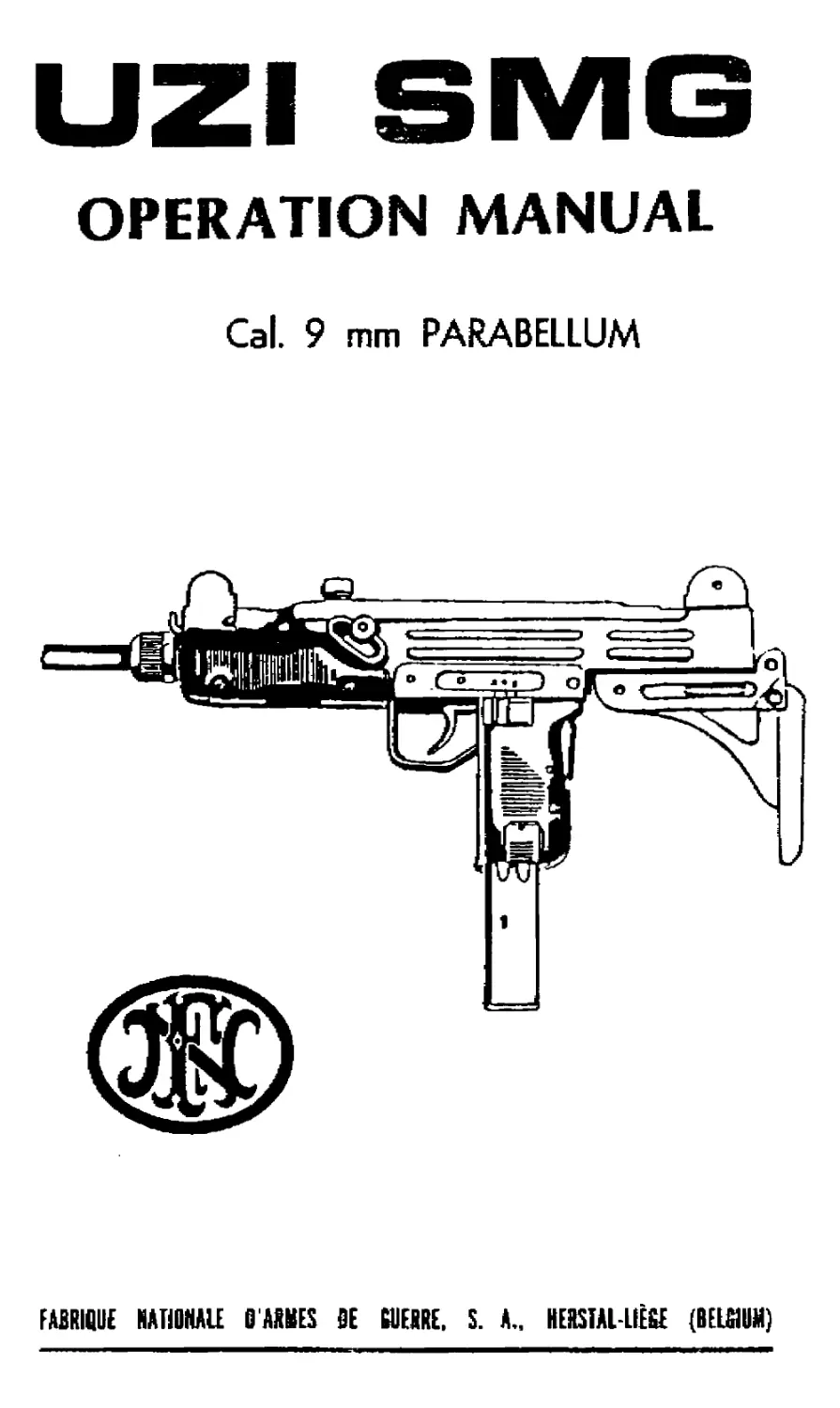
                    UZI SMG
OPERATION MANUAL
Cal. 9 mm PARABELLUM
FABRIQUf RATIONALE B ARBES BE 6UERRE. S. A.. HERSTALLHSE (ВЕШКИ)

TABLE OF CONTENTS
Historical Background .................1
General Characteristics................5
Functioning...........................10
Handling . . ,............*...........17
Exploded View .................... 22-23
Zeroing ............................  25
Immediate Action And Stoppages........26
Cleaning And Maintenance........	28
Stripping And Assembling..............30
Accessories...........................43
List Of Components....................46
III
Historical Background
Although automatic weapons in the form of the early
Maxim, Hotchkiss and Lewis designs first appeared in the late
1800’s, and one form of early machine gun was actually used
by the Confederacy during the Civil War, the submachine gun
is uniquely a 20th Century weapon, like the guided missile
and the submarine. The first true submachine gun, the Italian
Villar Perosa, appeared in 1915. Originally designed for use in
aircract, it was quickly adapted to use by ground troops. While
it doesn’t fit today’s image of an SMG, it did nevertheless
presage better things to come.
World War I had ground to a standstill in the trenches and
probably would have ended in a negotiated settlement be-
tween the Allies and the Central Powers had the U.S. not
entered the war on the Allied side in the spring of 1917. The
British SMLE and German M98 Mauser rifles which dominated
the conflict were superb weapons for long range, deliberate
fire, but they were hardly suited to the quick, close in work
that resulted when one side decided to go “over the top” and
assault the enemy’s trenches. While the U.S. relied heavily on
the Winchester M97 shotgun, the Germans went to work on
designing a compact, lightweight automatic weapon that
could be used to achieve the same results. Even while pro-
testing the “inhumane” shotgun the Americans were using,
the Germans were developing the MP-18 (Machinen Pistole
1918). The machine pistol handle was actually a misnomer,
since the MP-18 looked very much like a conventional semi-
automatic rifle. However, it was chambered for the 9mm Para-
helium pistol cartridge, and it was capable of automatic fire,
so the term machine pistol can be justified by only a little
misguided logic. Also, it has been reported that the Germans
1
UZI SMG OPERATION MANUAL
who were developing the first true assault rifle during World
War II also referred to that arm as a machine pistol since
Hitler had specifically forbidden development work on what
he considered a frivolous weapon. A little of the same ration-
ale may have been applied 25 years earlier, although true
machine pistols were themselves just barely off the drawing
board at the time.
The MP-18’s designers were well aware that a cartridge
more powerful than the 9mm Parahelium was needed to
make their weapon more effective, but the demands of war
were hardly conducive to spending a lot of time and money
on R&D for a new cartridge. As a practical compromise, the
already proven 9mm was selected. In the United States, Brig.
Gen. John Thompson was also working on a submachine gun
(which he labeled a “trench broom’1) chambered for the .45
ACP cartridge. Despite the technological advances in arma-
ment produced by two global conflicts and numerous smaller
wars, to say nothing of the luxury of plenty of time between
wars for R&D, the 9mm Parahelium and .45 ACP remain the
principal cartridges for use in subguns throughout the Free
World, with the former being by far the most prolific.
Although World War I ended before the MP-18 could
really be given a fair trial under actual combat conditions, the
little evidence that was available indicated that the con-
cept of the submachine gun was well worth exploring. Of
particular interest is the fact that the Treaty of Versailles
specifically prohibited Germany from developing and manu-
facturing submachine guns and equipping her token army
that the treaty permitted with them. History was even more
unkind in the case of field trials for the Thompson. According
to an interesting but doubtful legend, a crate of Thompsons
bound for the front lines in France arrived at New York
Harbor on November 11, 1918 — the very day the armistice
was signed.
Although General Thompson continued working on his
dream which would eventually be known worldwide as the
“Tommy Gun”, SMG development was, for all intents and
purposes, a dead issue in the United States and Britian. Such
was not the case in Europe, however, and numerous con-
2
UZI SMG OPERATION MANUAL
tinentai arms firms were experimenting wth different designs,
all of which bore a stronger resemblance to semi-auto rifles
than to the submachine gun as we know it today. These guns
received their first real tests during the Spanish Civil War,
along with a lot of German and Soviet aircraft which would
be the mainstays during the opening battles of World War II.
Subguns proved to be especially well suited to house to house
fighting and firefights in forested areas. As war clouds
loomed over Europe in the closing days of the 1930’s and
everyone became painfully aware of the fact that German re-
armament was hardly of a strictly defensive nature, the
United States and Britain continued to ignore the need for
submachine gun development.
On the morning of September 1, 1939, the world awak-
ened to war borne by the screaming cry of Stukas diving
toward Polish cities below. That war would officially end six
years and one day later on the deck of an American battle-
ship anchored in Tokyo Bay. During those six years, the
submachine gun proved its value in war from the steaming,
malaria-infested jungles of New Guinea to the icy streets of
Stalingrad. Successive SMG designs began to evolve into the
classic profile we know today — a large, detachable box
magazine, a short barrel and collapsible buttstock. The
American М3 **Grease Gun” is a perfect example of the
type of weapons that emerged from the conflict.
The Israeli Uzi is what is known as a “second generation”
SMG, being somewhat shorter and lighter than its predeces-
sors. It was designed by Israel Galili, who borrowed heavily
from several of the better Czechoslovakian designs, especially
in his use of the telescoping bolt. Galili can hardly be con-
demned for copying the Czechs so closely. After all, it makes
far more sense to copy what works than to waste time on
originality which may or may not produce the desired result.
Galili added a few refinements of his own and came up
with the Uzi, which is believed by many to be the finest sub-
machine gun in the world. First adopted for service in 1950,
it has been the standard SMG in the numerous Arab-Israeli
conflicts ever since. Originally equipped with a wooden butt-
stock, it is now normally equipped with a collapsible metal
3
UZI SMG OPERATION MANUAL
stock, although the wooden one is available as an accessory
item. Due to the constant demand for Uzi’s, they are made
under license by the FN plant in Belgium as well as by Israeli
Military Industries. The Uzi is a favorite of the American
Secret Service and has been adopted by the military of a
number of Free World nations. Indeed, the Uzi and Gordon
Ingram's MAC 10 are the SMG’s by which all others are
judged.
Since the infamous Gun Control Act of 1968 prohibits
American civilians from owning foreign-made, fully auto-
matic Uzi’s, a semi-auto version was introduced in this
country in 1980. Within months, several enterprising firms
were manufacturing parts which could be used to convert
the semi-auto guns to full auto (legal with prior BATF appro-
val). At least three books have also been written on the sub-
ject. Other than the obvious differences in the select lever,
etc., the weapons are essentially the same whether semi- or
full auto and are handled and field stripped in the same
manner.
Although some ordnance experts are heralding the shot-
gun as the up and coming individual military weapon, it is
doubtful if the submachine gun will ever totally disappear
from the action spots of the world, even should hand held
laser guns become a reality in the near future. Whether in
its original “home grown” IMI version or of F.N. parentage,
you can expect to see the Uzi in action for a long time to
come.
The material that follows has been adapted from the
original factory manual published by FN. Since its publica-
tion, the cocking knob has been enlarged and the selector
modified. The latter was necessary since the original selector
would permit an occasional^ random burst of full auto fire
when it was set on semi-auto.
4
I.	GENERAL CHARACTERISTICS
1.	Calibre. — The F. N. submachine gun is designed to fire
the Luger 9 mm Parahelium round. Many armies have used this
cartridge for a long time and it is now becoming universally stan-
dardised.
2.	Functioning principle. — The blowback principle has been
adopted for this weapon *. In this type, the breech is not mecha-
nically locked but the breech block is relatively heavy and its
Fig. I.
Fig. 2.
* This is on application of the principle of equality of momentum.
5
UZI SMG OPERATION MANUAL
mass prevents the breech from opening effectively until gas pres-
sure in the barrel has fallen considerably,
3.	Firing. — The weapon can be fired in two ways : either semi-
automatic (single shot) or fully automatic.
The change lever is on the left side of the pistol grip. It con be
set with the thumb of the right hand when this hand is holding the
weapon.
4.	Stability and handiness. — Careful calculation of its centre
of gravity and weight hos made the weapon very steady when
firing, which, in turn, practically eliminates any upward jerk ond
reduces recoil considerably.
The F. N. submachine gun is so designed that the soldier can
advance with his weapon ready to fire held in one hand, leaving
his other hand free for any contingency.
5.	Feed. -— Location of the magazine in the pistol grip makes
changing a magazine both simple ond speedy.
6.	Sights. — These consist of :—
A diopter rearsight, which can be tilted for settings correspond-
ing to distances of 100 and 200 metres respectively.
A blade foresight, simultaneously adjustable for height and
direction.
Both sights are provided with protectors.
The level of sight line above ground is very low, which allows
the soldier to keep well under cover when firing.
7.	Safety. — The F. N, submachine gun has a double safety
device :—
a)	The automatic safety in the pistol grip, located at the rear;
this contact safety prevents both cocking the action and firing
so long as the firer does not tighten his clasp on the pistol grip
ond thus press the safety. This device prevents release of the
sear and thus any movement of the breech-block.
6
UZI SMG OPERATION MANUAL
b)	The ordinary safety acts directly on the trigger and is ope-
rated by the knob of the chongeover lever, located on the left
hand side, above the pistol grip.
Fig. 3.
8.	Protection against foreign bodies in the mechanism, etc. —
The weapon is practically weatherproof. The breech-block, unit
envelops the rear part of the barrel and prevents anything pene-
trating into the chamber.
The method of cocking the gun closes the cover slide and keeps
foreign bodies out of the mechanism.
The decreased span of the breech-block bearings ensures that
any particles of dust, sand or mud, that may hove accumulated,
do not affect functioning of the weapon.
7
UZI SMG OPERATION MANUAL
9.	Stripping and assembly. — Stripping for normal cleaning
and maintenance and reassembly can be done without using tools.
Stripping is simple and quick. Barrel, cover, breech-block unit
and main spring can be dismantled in о few seconds.
10.	Butt. — The F. N. submachine gun is usually fitted with a
metal butt, which can be extended, or folded into an inoperative
position, as required (see fig. 1 & 2).
A wooden butt can be supplied, if preferred (see fig. 4).
1	1, Bayonet. — A small bayonet can be fixed ; this is engaged
by a stud.
8
UZI SMG OPERATION MANUAL
12. Statistical data.
Weight,
Gun, without magazine a) whit metal butt :	3.570 kg	(7 8 lbs.)
b) with wooden butt :	3.500 kg	(7.7 lbs.)
"Standard" magazine, empty :	0 180 kg	(6 ozs.)
"Standard" magazine with 25	rounds : 0.500 kg	(1.1 lbs.)
Overall length of gun. a) With metal butt extended :	approx. 650 mm	(25.5")
b) With metal butt folded :	approx. 470 mm	(18.5")
c) With wooden butt :	approx. 635 mm	(25")
Barrel.
Length;	260 mm (10.2")
Rifling, N° of grooves :	4
Sight radius:
309 mm (12,2").
Cyclic rale of fire:	650 r. p. m.
Magazine.
There ore two types :—
— "Standard" Magazine, capacity 25 rds ;
— 32-rd Magazine,
Cartridge.
9 mm Parabellum Luger.
a) Statistics
Length: 29.70 mm (1.16").
Weight: 12.10 grams (.43 ozs).
Length of bullet:	15,70 mm (.62").
Weight of bullet :	8.00 grams (.28 oz.).
Weight of powder charge : .40 grams (.014 oz.).
b) Ba/JisticoJ characteristics :
	8-grom Bullet	7.5 gram Bullet
Initio! Velocity (Vo)	400 m/s. (1312 ft./sec.)	425 m/s. (1394 ft./sec.)
Velocity at 12.5 m (V. 12.5)	390 m/s. {1279 ft./sec.)	415 m/s. (1361 Ft./sec.)
Muzzle Energy (Eo)	65 kgrn. (470 ft.-lbs.)	69 kgm. (499 ft.-lbs)
Maximum Pressure	2500 kg/cm2 {35,558 Ibs./sq.in.)
Effective range	up to 200 metres (218 yds.)
9
II.	FUNCTIONING
Firing Cycle.
The gun is loaded and cocked, i, e. the breech-block is held in
the rear position by the seor.
1.	Forward movement of the breech-block.
The action of pressing the trigger causes the sear to release
the breech-block, which is pushed forward by the return spring.
a)	Feed.
After moving forward about 25 mm, the underside (C 1) of the
breech-block (C) contacts the base of the uppermost cartridge in
the magazine (fig. 6) and pushes the round forward.
я
Fig. 6.
As it moves, the cone of the bullet meets the feed ramp (R),
which guides it towards the chamber, thus disengaging the round
from the mouth of the magazine.
b)	Chambering.
The breech-block (C) continues its thrust on the base of the
round and chambers it (fig. 7).
The neck of the cartridge case contacts the shoulder (F) of the
chamber, which positions the round correctly in the chamber.
c)	Firing.
When the breech-block has completed its forward movement,
it forces the extractors to rise and the base of the cartridge is
positioned in the recess in the breech-block.
10
UZI SMG OPERATION MANUAL
Fig. 7.
At this moment, the firing pin (P), which projects into the
breech-block recess (C), strikes the percussion cop and fires the
charge.
2.	Backward movement of the breech-block.
The pressure developed by combustion of the powder charge
forces the bullet forwards and starts the rearward course of the
breech-block.
The initial recoil is slowed down due to the mass of the breech-
block and only becomes effective after the bullet has left the
barrel.
a)	Extraction.
During recoil, the extractor claw holds the cartridge case in
the breech-block recess until the cose contacts the ejector.
b)	Ejection.
When the recess in the breech-block arrives at the level of the
rear face of the ejection opening, the case contacts the ejector
(E), which projects into the recess and pivots the case round the
extractor and ejects it. (fig. 8).
After this operation, the breech-block recoils until it strikes the
rear of the body.
The cartridges in the magazine are thus released from the hold
of the breech-block and rise under action of the magazine spring,
until the uppermost round is in contact with the mouthpiece of the
magazine.
11
UZI SMG OPERATION MANUAL
Fig. 8.
During the whole of the recoil movement the return spring is
being compressed.
After completion of its backward movement, the breech-block is
pushed forward again under action of the return spring, but its
movement is halted by the sear, if the change lever is set at repe-
tition (R), cr the firing cycle recommences if the lever is set at
automatic fire (A).
3.	Trigger Mechanism.
a)	Automatic safety, pistol grip. — The safety sear fulfils two func-
tions (fig. 9).
If the mechanism is closed, the two pinions (G) of the sear are
engaged in the two mid-way bents (Cl) in the breech-block and
the right-angled front arm (S) of the automatic safety prevents
their release. The breech-block (C) cannot then move towards
the rear, which guards against the accidental firing of a shot on
the rebound, in the event of a fall or similar shock. When this
safety is compressed, its front arm moves beyond the two pinions
and the sear is tripped ; the breech-block will then travel to the
rear and cocking can take place.
If the mechanism is open, the two pinions (G) of the sear are
engaged in the two front bents (C 2) in the breech-block and the
front arm (S) of the safety again prevents their release. The
breech-block (C) cannot then move forwards and any accidental
firing of a shot, through shock, foil or inadvertent action on the
trigger, is thus prevented.
12
UZI SMG OPERATION MANUAL
By compressing the safety, its fore arm moves beyond the two
sear pinions, releasing the sear when the trigger is pulled to fire a
shot.
(7
Fig. IQ.
Ordinary Safety ("Change LeverJ.
The knob of the change lever is
set in the rear position, i. e. at
safety ("S").
The fore arm of the change lever
(S) is then positioned below the
trigger (D) (fig. 10).
In this position, the trigger can-
not move downwards, the interme-
diate lever (1_) is thus immobilised
and consequently the sear (G).
13
UZI SMG OPERATION MANUAL
b)	Senii-oufomafk fire.
The change lever is set in the mid way position JJR" for single
shot firing.
The fore arm of the change lever (S) is then positioned below
the front shoulder (L 2) of the intermediate lever (fig. 1 1).
When the automatic safety has been compressed, finger pres-
sure on the trigger pivots the upper arm (D 1) of the trigger down-
words (fig. 1 2).
This in turn brings the intermediate lever downwards, as it is
joined to the upper arm by a pin (A}.
At the same time, the intermediate lever depresses the sear by
the action of the lever ramps (L 1) on the shoulders (G 1) of the
sear (fig. 1 1).
The shoulder (L 2) of the intermediate sear lever strikes against
the change lever (5) (fig. 13). The firer feels the initial check.
Continued pressure on the trigger forces the intermediate lever
to pivot round the joint pin (A) to the rear and the ramps (L 1)
of this lever depress the sear (fig. 13) slightly. The breech-block,
pushed forward by the return spring then trips the sear.
Towards the end of the front to rear rotation of the interme-
diate lever its ramps (L 1) pass behind the shoulders (G 1) of the
sear, freeing it from the intermediate lever (fig. 14),
14
UZI SMG OPERATION MANUAL
Cl Li
Fig. 13.
The sear, pushed upwards by its spring (R) is then in position,
after the shot has been fired, to stop the breech-block's forward
movement and the next shot cannot be fired if there is continuous
pressure on the trigger.
This ensures single shot firing and it will be necessary to release
the trigger before another shot can be fired.
When the trigger is released, its upper arm (D 1) pivots upwards
and through the joint pin (A) takes the intermediate lever with
it. (fig. 12).
This lever then pivots forward, under pressure of the two front
spires (R 2) of the trigger spring and the lever ramps (L 1) pass
over the shoulders (G 1) of the sear, which again makes the sear
part of the trigger-intermediate lever unit and prevents the
following shot from being fired until the trigger is pulled again.
Gt Ll
Fig. 16.
15
UZI SMG OPERATION MANUAL
c)	Automatic Fire.
The change lever is set in the fore position at "A" for automatic
fire.
The fore arm of the change lever (S) is then in front of the
intermediate lever circuit (fig. 15).
After pressing the automatic safety, pressure on the trigger
depresses the intermediate sear lever ond the ramps (L 1) con-
tact the shoulders (G 1) of the sear.
The firer again feels the initial check.
Continued pull on the trigger causes the intermediate lever to
bring the sear to its depressed position (fig. 16); the breech-
block is thus freed from the sear.
As the fore arm of the change lever (S) is out of action, the
intermediate lever cannot pivot to the rear and the sear remains
in its depressed position and is held there by the ramps of the
intermediate lever resting on the shoulders (G 1) of the sear; the
breech block continues its firing cycle so long as pressure is kept
on the trigger (fig. 16).
When the trigger is released, trigger and sear revert to their
original position under the action of the sear and trigger springs.
The sear is therefore in position to stop the breech-block in its
course rear-forward.
16
III.	HANDLING
*1. Filling о magazine.
Hold the magazine in one hand ; insert the cartridges one by
one through the mouth of the magazine, with the base towards the
flanged end of the magazine.
Use slight pressure to push each round fully home.
2.	Loading and cocking.
Set the knob of the change lever at Safety "S".
Hold the weapon by the pistol grip, in the right hand, exerting
pressure on the automatic safety.
As a precaution, keep the index finger outside the trigger
guard.
Tilt the gun towards the right and insert a filled magazine, push
fully home in its housing in the pistol grip until the magazine
cotch engages in its notch in the magazine.
Fig. 17.
When the magazine is engaged, use the left hand to pull the
cocking lever fully to the rear. This causes the mechanism to
recoil, compresses the recoil spring and ensures action of the
sear on the breech-block.
17
UZI SMG OPERATION MANUAL
Release the cocking lever wich then returns to its original posi-
tion under action of its spring.
Set the knob of the change lever at "A" or "R", as required.
The gun is then ready to fire.
3.	Removal of magazine,
Turn the weapon as for loading ; with the left hand thumb,
press on the knurled button of the magazine catch and withdraw
the magazine from the pistol grip (fig. 18).
Fig. 18.
4.	Re-loading.
Remove the empty magazine os described in Para. 3 above.
Engage another loaded magazine and re-cock the gun as in
Para. 2.
N. B. — Note that in certain cases the mechanism remains in
the rear position after firing the last round in a magazine (when
firing single shot or after release of the trigger in automatic fire,
when it coincides with the firing of the last round). In such cases
there is no need to re-cock but we advise that the cocking drill
be carried out systematically.
5.	Unloading the gun.
Place the knob of the change lever at safe-"S".
18
UZI SMG OPERATION MANUAL
Remove the magazine (see Para. 3}.
Inspect the chamber to make sure it is empty, cocking the gun,
if necessary.
Position the change lever at “AJ/ or "R'J.
Press the trigger to free the breech-block.
6. Change Lever.
Fig. 19.
The change lever is on the
left side of the pistol grip and
its knob can be pushed direct-
ly to the required position.
It can occupy three positions :
"S" Safety (rear position).
"R" Repetition, or single shot
(mid-way position).
"A" Automatic, or bursts of
fire (front position).
7. Backsight.
The rear peepsight can be set in two positions, i. e. for 100 or
200 metres, and can be tipped over for the required setting.
Fig. 20.
19
UZI SMG OPERATION MANUAL
8. Butt.
o) Engagement of the meta! butt.
Use the palm of the hand to give a sharp impact to the tip of
the butt plate (fig. 21) ; this will unlock the butt and disengage
it from its catch.
Fig. 21.
Fig. 22.
Fig. 23.
20
UZI SMG OPERATION MANUAL
Take hold of the butt plate and draw the butt assembly to the
rear (fig. 22), until the two ports of the butt snap into location
and lock.
Bring the locked butt down against the body (fig. 23).
b) Folding the metal buff into Us inoperative position.
Press the locking stud to release and pivot the butt downwards
(fig. 24).
Compress the rear lateral plate on the right and swing it up-
wards (fig. 25).
21
UZI SMG OPERATION MANUAL
Take hold of the butt plate and bring the front part of the butt
into contact with the underside of the body.
Keeping this contact, swing the butt plote upwards, using pres-
sure or a sharp impact, until it locks in the inoperative position.
Fig. 26.
24
IV. ZEROING
The gun is zeroed before issue to the firer, but may require
adjustment in elevation and direction to suit the individual, or
when the gun has been brought in for repair Adjustments must
be carried out by a qualified armourer only, who uses a special
combined too! to loosen and tighten the foresight screw and make
corrections for elevation and direction simultaneously,
A half turn of the foresight will move the M. P. I. as follows : —
— vertically, approximately 4 cm at 50 metres ;
— horizontally, approximately 64 cm at 50 metres, in the event
of the foresight being moved laterally to the extreme limit.
Corrections for elevation and direction ore carried out with
regard to the above figures and the amount of adjustment needed:
— Loosen or screw down the foresight according to whether the
M. P. I. is too high or too low ;
— Move it laterally to the right or left, according to whether the
M. P. !. is too far to the right or too far to the left.
25
V. IMMEDIATE ACTION AND STOPPAGES
1.	Immediate action.
If the gun ceases to fire when correctly operated, there is a
stoppage.
This stoppage (except in the case of an empty magazine) can
often be cleared by taking quick action, without investigating the
cause of the incident.
2.	Immediate action to be taken.
First action.
Operation I. — Cock the gun.
Operation 2. — Withdraw the magazine.
Operation 3. — Replace another magazine.
Operation 4. — Fire again.
If there is still a stoppage, proceed as follows ?—
Second action.
Operation 1. — Cock the gun.
Operation 2. — Remove the magazine.
Operation 3. — Check that the cartridges are correctly posi-
tioned in the magazine.
Operation 4. — Check that there is neither a trapped case nor
cartridge in the mechanism or chamber ; if this
is the cause, clear the obstruction.
Operation 5. — Replace the magazine, pushing it fully home.
Operation 6. — Fire again.
3.	Stoppages.
If the incident recurs systematically, check the points listed
below, after repeating the first 4 operations under "Second
action".
26
UZI SMG OPERATION MANUAL
Tightness of barrel.
a) Barrel locking nut loosened :	screw up tightly, locating the barrel correctly.
b) Barrel locking catch damag- ed :	if it is not possible to repair immediately, tighten the barrel locking nut periodically.
Extractor.
a) broken :	fit a new extractor.
b) deformed :	fit a new extractor.
c) fouled :	strip and clean.
Breech-bfocfc and body :	carry out field stripping proce- dure and clean the gun ; after cleaning, the breech-block should slide easily in the body.
Extractor bousing, breech-bfock :	clean the hollowed part care- fully, also underneath the ex- tractor claw.
Return spring :	the guide-rod must be straight : the spring must slide on the rod without catching.
Magazine catch :	check that it is engaging the magazine securely and is clean.
Trigger assembly:	fouling ; if there is any stop- page caused by the trigger me- chanism, if possible, fire auto- matically ; inspect, strip and clean thoroughly, as soon as circumstances permit.
27
VI. CLEANING AND MAINTENANCE
1.	General observations.
It must be emphasized that all automatic weapons need careful
maintenance and that the majority of stoppages mentioned only
occur as a result of the user's negligence, or lack of knowledge of
his gun. Any weapon, wheter fully automatic or self-loading, must
always be cleaned at the end of a day's firing, particularly after
using blank cartridges.
2.	Servicing the gun.
a)	Care and denning by the so/dier.
The F. N. 9 mm submachine gun need only be partially stripped
(field stripping) for this maintenance, which consists of :—
—	passing a pullthrough, soaked in special oil, through the bore
of the barrel and repeating this several times ;
—	pulling two or three dry rags through until bore is clean ;
— cleaning the chamber with its cleaning brush ,
—	cleaning the breech-block and the inside of the receiver;
—	• cleaning underneath the extractor claw, without stripping it ;
—	 lubricating the barrel with a lightly oiled rag ;
—	slightly oiling the moving parts.
b)	Servicing by the Unit Armourer.
On the other hand, it rs essential that the gun be periodically
checked by the armourer, who will ensure that it is receiving
proper care from the user.
This inspection must cover all the components of the weapon to
ensure that everything is in good working order. The armourer's
servicing will include :—
—	stripping and cleaning the extractor ;
—	checking and adjusting sights, if necessary.
28
UZI SMG OPERATION MANUAL
3.	Barrel Inspection.
Firstly, the barrel must be regularly cleaned, in the manner
described above, so that it is never neglected to the point where
the use of harmful abrasives, such as emery, sand or powdered
brick, becomes necessary.
When the gun is called in for its periodical servicing, the
armourer must pay special attention to the condition of the barrel.
Where this is not satisfactory (powder deposit, burning, etc.) he
should carry out the operations listed under 1. above, i. e. the
soldier's maintenance. Before oiling, the bore must be so clean
that a piece of white flannelette comes through the barrel unsoil-
ed. Follow this by lightly oiling the bore and chamber.
Dry the outside of the barrel and then rub with a greasy rag.
If the gun is to be laid up for a certain time, lubricate the inside
of the barrel, using a suitable barrel grease.
29
VII. STRIPPING AND ASSEMBLING
The F. N submachine gun is designed for easy stripping and
assembly ; there is no difficulty, if the correct procedure is fol-
lowed.
When stripping the weapon, take care to place the components
on a flat clean surface, arranged in the order in which they hove
been stripped ; this will facilitate re-assembling, which is done in
the opposite order to stripping.
A, STRIPPING.
Make sure that no cartridge is left in the weapon. Check as
follows :—
— remove the magazine,
—	act on the automatic safety, pistol grip,
—	pull the cocking lever о few centimetres to the rear so that
it clears the ejection opening,
-	— check through the ejection opening that there is no cartridge
in the barrel,
—	let the cocking lever go forward,
— set the gun at "S" (Safe).
1.	Field Stripping.
This consists of :
a)	Removing the cover.
Press the cover catch to the
rear (located in the fore part
of the backsight seating), raise
the rear part of the cover and
remove to the rear and up-
wards. This frees it from the
body of the gun.
b)	Removed of breecfi-b/oct and
return spring ossemb/y.
Raise the front of the
breech-block until clear of the
bedy ; remove it forwards with
the return spring assembly.
Separate this assembly
from the breech-block by pul-
ling it to the rear.
Fig. 27 (a)
30
UZI SMG OPERATION MANUAL
Fig. 29.
31
UZI SMG OPERATION MANUAL
c) Removo/ of barrel.
Press the barrel catch to the rear (located in front part of fore-
sight housing). Unscrew the barrel nut. Remove the barrel for-
wards.
Fig. 30 (a)
sembly from the body by
wards and forwards.
The very simple and rapid
procedure mentioned at a), b)
and c) above is generally suHi-
cient for normal maintenance
and cleaning. Cleaning the
trigger mechanism may be ne-
cessary in certain circumstan-
ces and this is done by remov-
ing trigger assembly, as follows :
Drive the trigger assembly
pin into its housing, using the
handle of the cleaning rod, or
the guide-rod of the return
spring, it is only necessary
to disengage the pin, without
separating it from the trigger
assembly. Separate the as-
the pistol grip slightly down-
2.	Extractor.
Remove the extractor retaining pin.
Push the extractor from bock to front to separate it from the
breech-block.
32
UZI SMG OPERATION MANUAL
Fig 3 k
3.	Handguard,
Unscrew the lock-nuts retaining the two handguard screws ;
loosen the screws and separate the right and left sections of the
handguard.
Fig. 32.
4.	Cover.
Unhook the rear spiral of the cocking lever spring. Undo the
stud screw (located by two centre punchings), remove it with its
33
UZI SMG OPERATION MANUAL
spring washer. Remove the cocking lever and the cocking
hand I e.
Normally, there is no need to strip the cover spring.
Fig. 33.
5.	Trigger mechanism.
Undo the two screws securing the pistol grip sections, then sepa-
rate the two halves of the pistol grip. Set the knob of the change
lever ot "R". Pull the trigger and press the safety to release the
sear. Use a pin drift to push the sear pin from left to right and
remove it from its housing in the trigger frame. Remove the sear
and its spring. Separate the spring from the sear by disengaging
the two rear ends of the spring.
Free the two front ends of the trigger spring by pressing them
downwards, bringing them away from the sear intermediate lever ;
in this position, the lever is freed from the pressure of the trigger
spring.
Fig. 34
Fig. 35.
34
UZI SMG OPERATION MANUAL
Use о pin drift to push the trigger pin from left to right and
remove it from its housing. Remove the assembly of trigger, sear
intermediate lever and trigger spring from the trigger frame.
Compress the safety spring slightly and remove from the pistol
grip. Remove the assembly of safety and plunger upwards.
Fig. 36.
Move the change lever knob forward to position "A". Insert
the blade of a screwdriver, or similar blade, underneath the
change lever knob, into the interior groove ; push upwards until
knob and lever are freed. Remove the knob and change lever.
Use a screwdriver to release the spring plunger of the lever ; this
Fig. 37.
disengages it from its slots ;
push upwards.
Use a pin drift to remove
the magazine catch pin ; re-
move the magazine catch and
its spring.
6. Butt.
a) Folding metal butt.
Undo the hexagonal screw
which secures the butt to the
rear face of the body. Re-
move the butt catch forwards.
Separate the butt from the
body.
35
UZI SMG OPERATION MANUAL
Fig. 38.
Fig. 40.
Fig. 39.
b) Wooden butt
Press the catch stud and remove the butt rearward.
7.	Backsight and foresight.
Unscrew the nut of the backsight screw, then the screw ; remove
the backsight and secure the nut to the screw, otherwise it may be
mislaid. Unscrew the nut securing the foresight; unscrew the
foresight and remove its spring washer.
36
UZI SMG OPERATION MANUAL
Fig- 41 fol
Fig. 4} (b)
8.	Barrel catch.
Compress and push forward on the rear tip of the barrel catch.
Remove the barrel catch and its spring forward. Remove the
spring from its housing in the catch.
Fig. 42.
9.	Cover catch.
Take care that the coiled spring of the cover catch is not releas-
ed from its housing. To avoid this, strip as follows : after remo-
val of the backsight, press the blade of a screwdriver against the
front rim of the curved spring of the backsight, exert slight pres-
sure to the rear so that the spring is raised slightly, but hold it
securely with the thumb. Gradually lessen pressure on the
37
UZI SMG OPERATION MANUAL
screwdriver, so thot the cover catch disengages slowly forwards.
Remove the cover catch, its coiled spring and the curved backsight
spring from their housings.
Fig. 43.
Fig 44.
10. Magazine.
Insert the tip of a cartridge
in the central opening of the
magazine base, pushing with-
out undue pressure until the
magazine base plate slides
forward and can be removed.
B. REASSEMBLY.
Components of the F. N,
submachine gun are reas-
sembled in the opposite order
to stripping procedure. To
assist in reassembly, it is ad-
visable to look at the illustra-
tions for the corresponding
stripping operations.
There are no special difficulties, if the following precautions
are taken :—
1. Magazine.
The magazine platform spring must be positioned so that th$
uppermost spire is approximately parallel to the lower face of
the platform.
38
UZI SMG OPERATION MANUAL
Fig, 45.
Fig. 46.
2.	Cover catch.
Locate the curved back-
sight spring, placing the right-
angled side to the rear, then
position the coiled spring hori-
zontally underneath the curv-
ed spring. Insert the cover
catch beneath the curved
spring. Using the right hand
thumb, push the cover catch
to the rear so that the coiled
spring is fully compressed and,
when this has been done, press
hard on the curved spring with
the left hand thumb until it
engages with the cover catch.
3.	Backsight.
When reassembling, take care that the flap marked "100" is
located to the rear.
4.	Trigger mechanism.
To reassemble the magazine catch, locate the two spires of the
catch spring inside the catch ; insert the two parts in their housing
by pressing the coiled port of the spring against the grip. Com-
press fully and secure with a pin drift. Replace the magazine
catch pin gradually, withdrawing the pin drift as the pin is
inserted.
First replace the spring plunger; to ensure that the change lever
and its knob form an integral part, insert the lever in the trigger
frame from the top until it comes up against the spring ; the
39
UZI SMG OPERATION MANUAL
Fig. 47.
Fig. 48.
smoll lower orm comes opposite the letter "A'1 ; slide the knob
upwards on this arm ; still exerting pressure from above, push the
change lever fully home in the trigger frame, compressing the
spring with a screwdriver, or any handy substitute.
Re-assembie the automatic safety and its spring. Replace the
trigger and intermediate lever assembly in the trigger frame and
position the trigger spring on either side of the trigger, with the
straight orm of the spring against the rear part of the trigger
guard. Pass the trigger pin from right to left through the coils of
the spring and into the hole on the left side, locating the split,
righthand end of the pin vertically, with the cross-wise grooves
downwards. Secure the two free ends of the trigger spring in the
two locating grooves in the intermediate sear lever.
40
UZI SMG OPERATION MANUAL
Position the sear in the trig-
ger frame, then the sear
spring, pressing the rounded
part against the front plate of
the trigger frame. Insert the
sear pin from right to left in
the sear holes and through the
spirals of the spring, locating
the split, righthand end of the
pin vertically, with the cross-
wise groove downwards. In-
sert the two free ends of the
spring in the small holes in
Fig. 51.
the sear.
Check for correct functioning of the trigger.
5.	Extractor.
When assembling the extractor, the slot in its rear face must
be parallel to the arrow on the rear face of the breech-block.
6.	Trigger frame assembly.
Hold the assembly firmly against the body of the gun so that
the trigger frame retaining pin can be replaced.
41
UZI SMG OPERATION MANUAL
Fig. 52.
Fig. 53.
7.	Barrel.
Take core that the barrel
retaining nut is screwed fully
home.
8.	Spring, cocking lever.
If this spring has to be re-
placed, engage the end of the
spring on the cover, drawing
aside the lost coil, then pull
and twist the spring (as shown
in figure 53).
42
VIIL ACCESSORIES
(supplied, if required, at extra charge)
1.	Bayonet.
The Bayonet has been specially designed so that it does not
upset the balance of the gun and can be easily mounted and
removed.
Frg. 54.
2.	Blank firing attachment.
A blank firing attachment can also be fitted ; this can be done
very easily as it takes the place of the barrel retaining nut.
Fig. 55.
43
UZI SMG OPERATION MANUAL
3.	Magazine filler.
This device is fitted to the magazine and enables magazines to
be filled rapidly and effortlessly.
Fig. 56.
4.	Cleaning kit.
This little hold-all has three compartments to take cleaning
Fig. 57.
44
UZI SMG OPERATION MANUAL
necessities : the cleaning rod in two parts and the plastic tube
takes both the cleaning brush and the oil infuser.
5.	Sling.
The submachine gun con be supplied with an adjustable sling.
Fig. 58.
45
IX. LIST OF COMPONENTS
(See Exploded View on pages 22-23.)
Port No.	Descrfptlo»	Number
101	Borrel		1
102	Barrel retaining nut		1
1 1 1	Breech-block .		1
115	Extractor		1
1 16	Pin extractor		1
120	Return spring assembly		1
200	Body assembly		1
251	Barrel catch 			1
255	Spring control barrel catch		1
261	Foresight 			1
262	Nut, foresight		1
263	Spring washer, foresight		1
271	Backsight 			1
272	Screw, backsight 			1
273	Spring, backsight		1
274	Catch, cover .	.			1
275	Spring, catch cover		1
281	Handguard, right	1
282	Hondguord, left		1
285	Screw, handguard		2
286	Locknut, screw handguard		2
288	Nut, screw backsight ...	1
301	Cover assembly		1
311	Cocking lever		1
312	Spring, cocking lever	1
313	Stud, cocking lever handle		1
314	Screw, stud cocking lever		1
315	Cocking handle		1
316	Spring wosher		1
400	Trigger frame		1
41 1	Sear		1
412	Pin, sear			1
413	Spring, trigger frame		1
421	Trigger			1
422	Pin, trigger ...			1
423	Spring, trigger		1
424	Lever, intermediate, sear		1
425	Pin, intermediate sear lever		1
431	Change lever		1
432	Knob, operating change lever		1
433	Spring, plunger safety		1
440	Automatic safety, pislot grip		1
445	Spring, safety		1
451	Catch, magazine		1
452	Pin, catch magazine		1
453	Spring, catch magazine ......	....	1
461	Pistor grip, right half		1
462	Pistol grip, left holf		1
46
UZI SMG OPERATION MANUAL
Oeser
Number
465
471
15
1551
1552
Screw, pistol grip .	.	.	.
Pin securing trigger frome .
Metal butt assembly (folding) .
Screw, butt assembly cotch.
Catch, bull....................
2
1
1
i
1
b) BAYONET
STA 151	Blade, bayonet	 1
STA 152	Grip, left, bayonet			1
STA 153	Grip, right, bayonet			1
STA 154	Screw, assembly bayonet			2
STA 155	Nut, screw assembly bayonet		2
STA 156	Plunger, bayonet		1
STA 157	Spring, plunger bayonet	1
STA 158	Nut, plunger bayonet	 ...	1
STA 161 A	Scabbard, bayonet		1
STA 161 8	Spring, scabbard bayonet		1
STA 61	Screw, spring scobbord, bayonet		1
47