/


Tags: weapons military affairs machine gun
Year: 1979



Text
                    UNCLASSIFIED
9-8-10
_F ThE I W У
< ’-’D STATES AR'IY INTELUOF jCt AND	COMMAND
v.'- r , fATf C ? 3MY НГ’Г	\ L J	«JYSIS CENTER
Jfh ’ '"	. ‘ГР* <- ^0 .:	^,'C1F]
OS-ES 4.\ '; f J/> HL
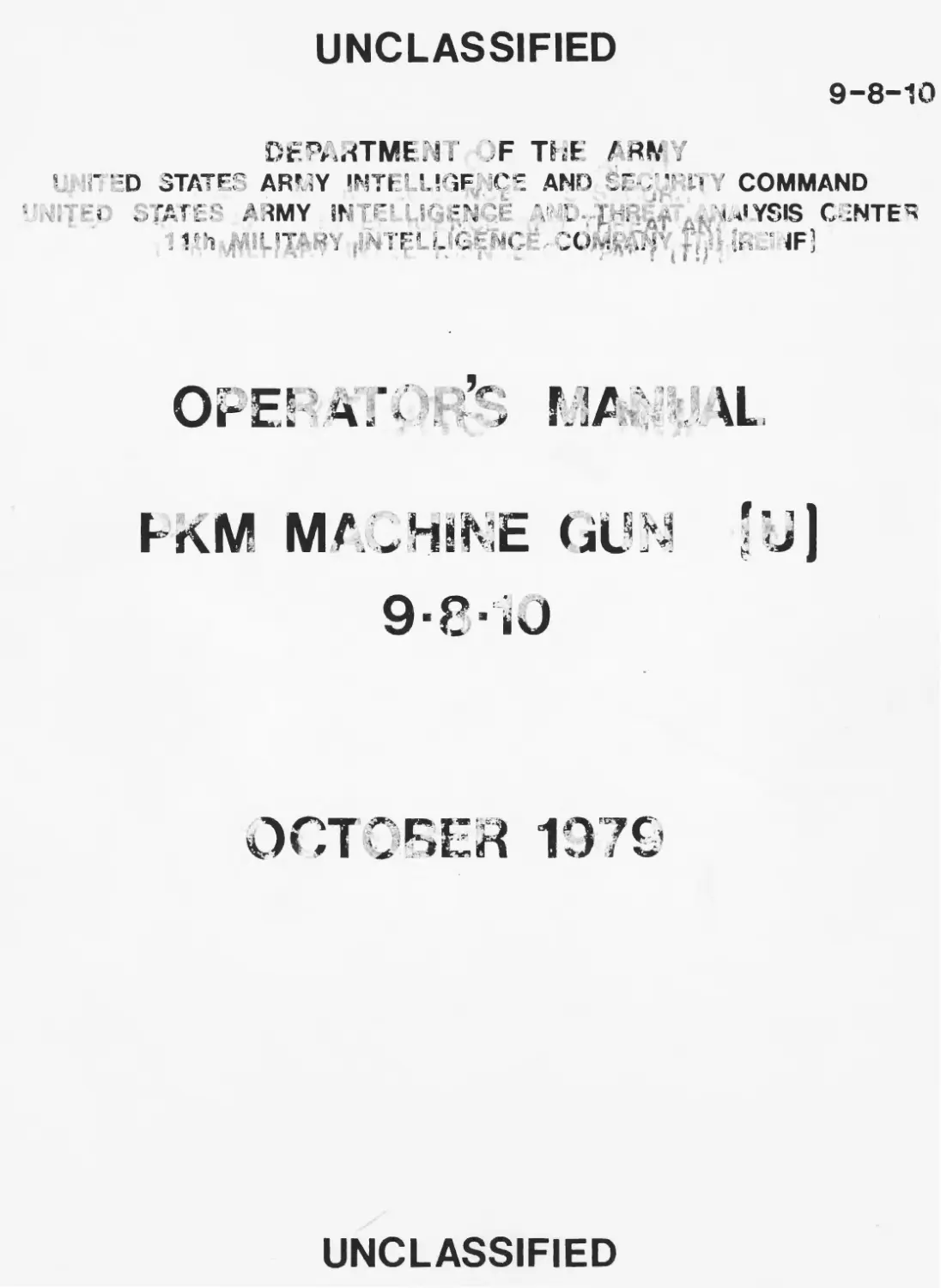
("KM MACHINE GUN |U)
9-8W
OCTОЧЕЙ 1Э7&
UNCLASSIFIED
WARNING
Before starting an inspection, be sure to clear the weapon. Do not
actuate the trigger until the weapon has been cleared. Inspect the
chamber to insure that it is empty, and check to see that no ammunition
is in position to be introduced.
WARNING
In the event of a misfire, the round will remain locked in the chamber
for the prescribed time intervals, the gun trained on the target, and
personnel cleared from the area.
WARNING
Allow the weapon to cool at least 5 minutes before attempting to open
the cover assembly.
WARNING
Keep weapon trained on target
WARNING
Care must be exercised to have the weapon pointed down range when loadir
WARNING
This weapon can NOT utilize NATO 7.62 mm x 51 ammunition. Consult the
ammunition chart for proper ammunition. Failure to do so could cause
damage to the weapon and severe injury to the operator.
DEPARTMENT OF THE ARMY
UNITED STATES ARMY INTELLIGENCE AND SECURITY COMMAND
UNITED STATES ARMY INTELLIGENCE AND THREAT ANALYSIS CENTER
OPERATOR'S MANUAL
MACHINE GUN, 7.62 mm x 54R, PKM, GENERAL PURPOSE (SOVIET)
11th Military Intelligence Company Publication Number 9-8-10
Short Title: PKM Machine Gun
This is not an official US Army publication. Information contained
within was developed solely thru evaluation and analysis. This
manual is designed to provide instructor guidance for presenting
instruction, as required, on the PKM machine gun. This publication
was prepared by the 11th Military Intelligence Company, Aberdeen
Proving Ground, Maryland 21005. Other than normal exchange with
other agencies at the working level, this document has not been
coordinated outside INSCOM. Interpretation of intelligence infor-
mation in this publication represents the views of INSCOM and may
be subject to modification as a result of subsequent information.
PREFACE
PURPOSE
This publication provides an introduction to the Machine Gun,
7.62 mm x 54R, PKM, General Purpose (Soviet).
SCOPE
This manual contains instructions for the operation and maint-
enance of the PKM machine gun.
APPLICABILITY
This publication applies to all military personnel who require
operator and maintenance information pertaining to the PKM
machine gun.
COMMENTS
For clarity and familiarity, this manual is presented in the
standard format for Department of the Army, Technical Manual,
Operator’s and Organizational Maintenance Manual (-12).
ADMINISTRATION
Recommendations for equipment publication improvements.
Reports of errors, omissions, and recommendations for improving
this publication by the user is encouraged. Reports should be
submitted on DA Form 2028 (Recommended Changes to DA Publications)
and forwarded to: Commander, 11th Military Intelligence Company,
ATTN: IAX-OF-11-CS, Aberdeen Proving Ground, Maryland 21005.
in
SUMMARY
This publication provides operator and organizational maintenance
instruction on the PKM machine gun. The contents include operation
of the weapon, disassembly, assembly and operator level maintenance
procedures.
v
TABLE OF CONTENTS
	PREFACE	Paragraph	Page iii
	SUMMARY		V
	LIST OF ILLUSTRATIONS		ix
	LIST OF TABLES		X
CHAPTER	1 INTRODUCTION	1-1, 1-4	1
CHAPTER	2 OPERATING INSTRUCTIONS
Section	I Loading the Non-Disintegrating	2-1	5
	Belts
	II Loading the PKM Machine Gun	2-2, 2-3	7
	III Zeroing the PKM Machine Gun	2-4, 2-5	12
	IV Barrel Quick-Change	2-6, 2-7	15
	V Troubleshooting	2-8, 2-9	16
CHAPTER	3 DISASSEMBLY	3-1, 3-2	19
CHAPTER	4 MAINTENANCE
Section	I Inspection	4-1, 4-2	35
	II Maintenance	4-3, 4-4	36
CHAPTER	5 ASSEMBLY	5-1	39
CHAPTER	6 AMMUNITION	6-1, 6-4	51
LIST OF ILLUSTRATIONS
Figure	Title	Page
1-1	Machine Gun, 7.62 mm x 54R, PKM, General	Purpose....1
(Soviet)
2-1	Proper insertion of round in belt........................5
2-2	Improper insertion of round in belt......................6
2-3	Selector switch in the fire position.....................7
2-4	Receiver cover fully open................................8
2-5	First round properly loaded..............................9
2-6	First round improperly loaded............................9
2-7	Receiver cover properly closed..........................10
2-8	Charging handle in forward position for	firing....11
2-9	Adjustable rear sight...................................12
2-10	Front sight.............................................12
2-11	Sight picture for PKM machine gun.......................13
3-1	PKM machine gun placed on flat surface,	muzzle pointing.20
in safe direction, bipod legs extended
3-2	Receiver cover latch	located at the rear of the weapon..20
3-3	Receiver cover fully	open..............................21
3-4	Ammunition feed tray	cover.............................22
3-5	Ammunition feed tray	cover in the fully	open position...22
3-6	Cartridge space gripper and bolt in the	forward.......23
position
3-7	Retracting the guide	rod and mainspring	from the......24
receiver
3-8 Cartridge space gripper and bolt retracted to the rear..25
of the receiver
3-9	Bolt and cartridge space gripper aligned	with the......26
notches on the receiver
3-10	Removal of cartridge space gripper, bolt	and piston rod.26
3-11	Bolt rotated to rear of the sliding cam.................27
3-12	Firing pin and bolt notch aligned with sliding cam.......28
notch and bolt pulled forward
3-13	Firing	pin pushed to	rear of bolt......................29
3-14	Firing	pin extracted	from bolt.........................29
3-15	Barrel	locking latch	assembly..........................30
3-16	Barrel	locking latch	assembly pushed completely to the..31
left
3-17	Barrel quick-change handle..............................31
3-18	Barrel pulled forward from barrel receiver group........32
3-19 PKM machine gun completely disassembled for cleaning.... 33
and inspection
ix
LIST OF ILLUSTRATIONS
Figure	Title	Page
4-1	Maintenance equipment used with the PKM machine gun.....37
4-2	PKM machine gun field stripped..........................38
5-1 Barrel locking latch assembly in the fully open position39
to left of the receiver
5-2	Gas escape chamber aligned with the gas	regulator......40
5-3	Barrel locking latch in closed position	to right of....41
receiver
5-4	Cylindrical portion of the firing pin...................42
5-5	Firing pin in the forward position......................42
5-6	Rotating bolt inserted, and groove on sliding cam.......43
aligned with notch on firing pin
5-7 Rotating bolt in the rearward position of the sliding...44
cam
5-8	Sliding cam notches aligned with receiver group grooves.45
5-9	Sliding cam and piston in forward position..............45
5-10 Guide rod and mainspring aligned and pushed forward in..46
receiver group
5-11 Guide rod seated in the receiver group....................47
5-12	Ammunition feed	tray	cover	open........................48
5-13	Ammunition feed	tray	cover	closed......................48
5-14 Insertion of the belt of dummy ammunition.................49
6-1	Different types	of 7.62 mm	x 54R ammunition............53
6-2	NATO and Soviet	7.62	mm ammunition.....................54
LIST OF TABLES
Number	Title	Page
1-1	Weapon markings..........................................4
4-1	Component nomenclature..................................38
6-1	Ammunition types........................................52
x
CHAPTER 1
INTRODUCTION
1-1. Description
The Machine Gun, 7.62 mm x 54R, PKM, General Purpose (Soviet)
is an open-bolt-fired, gas-operated, rotary-locked-bolt
(KALASHNIKOV), belt-fed, fully automatic weapon (fig. 1-1).
Figure 1-1. Machine Gun, 7.62 mm x 54R, PKM,
General Purpose (Soviet),
1
1-2. Differences Between PK Series Machine Guns
a.	PK: The basic gun with a heavy fluted barrel, feed cover
constructed from both machined and stamped components and a plain
butt plate. The PK machine gun weighs about 9 kg (19.8 lbs).
b.	PKS: The basic gun mounted on a tripod. The lightweight
tripod, 4.75 kg (10.45 lbs), not only provides a stable mount for
long range ground fire, it also can be quickly opened up to ele-
vate the gun for antiaircraft fire.
c.	PKT: The PK is altered for coaxial installation in an
armored vehicle. The sights, stock, tripod, and trigger mechanism
have been removed, a longer heavy barrel is installed, and a
solenoid is fitted to the receiver back plate for remote triggering.
An emergency manual trigger and safety is fitted.
d.	PKM: A product improved PK, with a lighter weight, un-
fluted barrel, the feed cover constructed wholly from stampings,
with a hinged butt rest fitted into the butt plate. Excess metal
has been machined away wherever possible to reduce the weight.
e.	PKMS: PKM mounted on a tripod.
1-3. Tabulated Data
a. Weapon
(1)	Caliber	7.62 mm x 54R
(2)	Operation	Gas
(3)	Fire Type	Full Automatic Only
(4)	Cyclic Rate	690-720 rpm
(5)	Practical Rate of Fire	250 rpm
(6)	Overall Length	47.0 in. (119 cm)
(7)	Weight Unloaded	18.5 lbs (8.4 kg)
(8)	Approximate Max Hor. Range	3800 m
(9)	Effective Combat Range	1000 m
b. Feed
(1)	Type	Belt (Non-Disintegrating Links)
(2)	Location	Right to Left
(3)	Belt Capacity	25 - 250 rounds (connectable 25 round sections)
2
1-3. Tabulated Data (cont)
c. Barrel
(1) Length	23.75 in. (60.3 cm)
(2) Approximate Muzzle Velocity	2741 fps (835 mps)
d. Sights
(1) Front Type	Protected Cylindrical Post
(2) Rear Type	Rectangular Notch, Tangent Ramp
(3) Rear Sight Graduation	100-1500 m in 100 meter increments and battle setting approx. 330 meters
(4) Adjustment	Front Sight: zero only Rear Sight: elevation and windage
e. Action
(1) Locking Feature Type	Rotary Bolt
(2) Full Automatic	Fire from open bolt
(3) Trigger Type	Spur
(4) Safety Type	Rotary Selector (safe or fire)
(5) Location	Left side trigger, guard
f. Stock
(1) Type	Fixed
(2) Material	Wood (laminated)
1-4. Weapon Identification
Markings located on the receiver
of identifying the weapon’s country
group provide a ready means
of origin (table 1-1).
3
1-4. Weapon Identification (cont)
Table 1-1. Weapon markings.
WEAPON MARKINGS
FACTORY			SELECTOR			COUNTRY
	SAFE-UPPER	MID	LOWER
		AB	ОД	USSR
& »•'			a	PRC
		L	D	PRC
mzz		L	D	PRC
@ 58			CZh	N. KOREA
©		AB	ЕД	BULG
ф 1962		C	P	POL.
Z\ 1966	s	FA	FF	RUM.
& 63		D	E	E. GERM.
JA4 1951 r		OB	OA	USSR
				PRC
				PRC
				PRC
О				E. GERM.
				PRC
				PRC
		ПР	ОГОНЬ	USSR
		ПР	ОГОНЬ	USSR
				CZECH
		СХЭ	1	HUNGARY
		. . .	•	FINLAND
		R	J	YUGOSLAVIA
		30	1	CZECH
X: 63		D	E	E. GERM.
©		eiL	EH	N. KOREA
A		L	D	PRC
4
CHAPTER 2
OPERATING INSTRUCTIONS
SECTION I. LOADING THE NON-DISINTEGRATING BELT
2-1. Loading
a.	The ammunition belts for the PKM machine gun are pre-
loaded at ammunition factories in 25 round connectable belt lengths.
To reuse the non-disintegrating belt lengths, the belt must be hand
loaded.
b.	To hand load the belt, insert 7.62 mm x 54R rounds, one at
a time, into each opening of the belt from the large section of
the belt to the small section. Push the round completely forward
into each opening. A round is completely seated when the front
ridge of the cartridge is aligned with the front of the smallest
portion of the belt (fig. 2-1).
Figure 2-1. Proper insertion of round in belt.
5
2-1. Loading (cont)
WARNING: This weapon can not utilize NATO 7.62 mm x 51
ammunition. Consult ammunition chart at end of the manual for
proper ammunition.
c.	An improperly loaded round may cause the belt to feed
incorrectly or cause the round to not properly chamber. Either
of these actions will cause a stoppage (fig. 2-2).
PROPER
IMPROPER
Figure 2-2. Improper insertion of round in belt.
d.	Normal safety precautions of handling small arms ammunition
should be observed at all times. Careful insertion of each round
should avoid any accidental striking of the primer.
6
2-2. Loading the PKM Machine Gun (cont)
Figure 2-4. Receiver cover fully open.
c. Place the belt to feed from the right to the left. The
solid portion of the belt will be facing up as each round enters
the receiver. The belt is then placed in the feedway, coming in
from the right, with the first round gripped in the claws of the
cartridge gripper (fig. 2-5).
Note: The ammunition belt will not feed into the PKM
machine gun from the left-hand side of the weapon. If the belt
is placed into the weapon from the left-hand side, improper feeding
will result, causing the belt to be kicked out of the weapon.
8
2-2. Loading the PKM Machine Gun (cont)
Figure 2-5. First round properly loaded.
Figure 2-6. First round improperly loaded.
9
2-2. Loading the PKM Machine Gun (cont)
d. Close the receiver cover of the weapon, insuring that the
receiver cover latch is engaged (fig. 2-7).
CAUTION: During operation, if the receiver cover is not
closed and the receiver cover latch is not engaged, damage to the
receiver cover and operator may occur by the blow back action of
the bolt and expended cartridge.
Figure 2-7.
Receiver cover properly closed.
2-3. Firing the PKM Machine Gun
a.	Pull the charging handle, located on the right side of the
weapon, completely to the rear. This will extract the first round
of ammunition from the belt. Release the charging handle allow-
ing it to go forward unassisted. This action chambers the first
round. The PKM is now ready for firing (fig. 2-8).
10
2-3. Firing the PKM Machine Gun (cont)
Note: To insure that the chambered round is seated properly,
give the charging handle a slight push forward with the palm of
the right hand.
Figure 2-8. Charging handle in forward
position for firing.
b.	Aim the weapon at the desired target down range. Pull the
trigger, firing the weapon in six (6) to nine (9) round bursts.
Note: Firing the PKM in short bursts allows the barrel to
cool and prolongs the life of the barrel. Test results have shown
that continuous fire of more than 260 rounds significantly
increases the possibility of a cook-off (the heat of the barrel
exploding a chambered round).
11
SECTION III.	ZEROING THE PKM MACHINE GUN
2-4. General
a.	The PKM machine gun is equipped with a protected, open posi
type front sight adjustable in elevation only. The rear sight is
a square notch leaf sight adjustable in both windage and elevatioi
The rear sight is graduated in 100 meter increments from 1 to 15
and includes a battle sight setting of approximately 330 meters
(figs 2-9 and 2-10).
Figure 2-9. Adjustable rear sight.
Figure 2-10. Front sight.
12
2-4. General (cont)
b.	During adjustment of the sights of the PKM machine gun
a proper sight picture should be maintained at all times
(fig. 2-11).
SIGHT
PICTURES
Figure 2-11. Sight picture for PKM machine gun.
r CORRECT
SIGHT P CTURE
13
2-5. Procedures
Note: Because target ranges are not usually available for
use with this weapon, field zeroing will be the only technique
discussed.
a.	Select a target between 300 and 600 meters distant.
b.	Adjust rear sight to estimated range (windage zero).
c.	Fire a six (6) to nine (9) round burst taking note where
the burst hits.
d.	Adjust for deflection by twisting windage knob.
e.	Adjust for elevation by moving rear sight slide up or down.
Note: If gross differences are noticed between estimated
distance and sight setting, adjust front sight by turning counter-
clockwise to lower center of hit and turning clockwise for raising
the center of hit. During this process, numerous confirming bursts
of six (6) to nine (9) rounds should be fired to insure that
adjustments are proper.
14
SECTION IV.	BARREL QUICK-CHANGE
2-6. General
If an extra barrel is available, the quick changing of barrels
becomes possible. The changing of barrels prolongs the life of
the barrel and equalizes barrel wear. There are three rates of
fire with the machine gun: sustained, rapid, and cyclic. These
rates indicate when a barrel change is desirable.
a.	Sustained fire is 100 rounds per minute in bursts of six
(6) to nine (9) rounds at 4 to 5 second intervals. A barrel
change is recommended after firing the sustained rate for 10
minutes.
b.	Rapid fire is 200 rounds per minute in bursts of six (6)
to nine (9) rounds at 2 to 3 second intervals. A barrel change
is recommended after firing 2 minutes.
c.	The cyclic rate of fire is the maximum amount of ammunition
which can be expended in 1 minute. A barrel change is recommended
after firing in excess of rapid rate for 1 minute.
2-7. Barrel Quick-Change Procedures
The steps outlined in the disassembly and assembly portion of
this manual for the removal and replacement of the barrel are the
steps used in the quick-change procedures (see chapters 3 and 5).
15
SECTION V. TROUBLESHOOTING
2-8. Malfunctions and Immediate Action
A malfunction is a failure of the gun to function satisfactor-
ily. Defective ammunition or improper operation of the gun by a
crew member is not considered a malfunction of the gun. Two of
the more common malfunctions of the PKM machine gun are sluggish
operation and a runaway gun.
a.	Sluggish operation and corrective action. Sluggish opera-
tion of the gun usually is due to excessive friction caused by
dirt or carbon, lack of proper lubrication, burred parts or excess-
ive loss of gas. Clean and lubricate the gun and inspect through-
ly for burred parts and replace as necessary.
b.	Runaway gun and corrective action. A runaway gun is a gun
that continues to fire after the trigger is released. It may be
caused by a worn sear, worn sear notch, or short recoil i.e., the
operating group recoils to feed and fire but not sufficiently
enough for the sear to engage the sear notch. Short recoil may
be caused by loss of gas or excessive carbon buildup in the oper-
ating rod tube.
CAUTION: Hold fire on target until feeding of ammunition is
stopped.
(1)	Raise the receiver cover, thus stopping the feed action.
(2)	Grasp the cocking handle firmly and pull it to the rear
to stop the bolt from going forward.
(3)	Clear the weapon.
(4)	Disassemble the weapon and check for wear. Check the
gas port plug, gas cylinder extension and clean the operating rod.
Replace parts as necessary.
2-9. Misfire
a.	In the event of a misfire, attempt to charge the weapon
by applying forward pressure on the charging handle. Attempt to
fire the weapon again.
16
2-9. Misfire (cont)
b.	If the weapon does not fire, with a cool weapon (less than
200 rounds fired) pull the cocking handle to the rear extracting
the misfired round. Return the cocking handle to the forward
position and attempt to fire the weapon.
c.	If the weapon still does not fire, inspect the extracted
rounds for indications that the primer of the round has been struck.
If it has, the ammunition is probably faulty and a new lot of
ammunition should be selected. If the round shows no indication
of being struck, inspect the bolt assembly/firing pin for damage.
d.	If the weapon does not fire, with a hot weapon (more than
200 rounds fired) w&it 5 minutes before recocking the weapon and
extracting misfired round. This procedure will allow a safety
factor in the event of a cook-off (heat of the barrel igniting a
chambered round).
e.	After the 5 minirte waiting period, follow steps b and c to
continue firing the weapon.
17
CHAPTER 3
DISASSEMBLY
3-1. General
a.	In order to insure proper functioning of the PKM machine
gun, it is necessary to disassemble the weapon and inspect and
clean the internal components. The names of the components of
the PKM machine gun can be learned through practice in the
disassembly and reassembly of the weapon. Generally, the parts
are named for the functions they perform; for example, the trigger
guard guards the trigger, the retracting handle is used to manually
retract the bolt to the rear of the weapon etc.
b.	As the weapon is being disassembled, lay out the parts in
the order of their removal. This procedure will assist you in
the assembly of the weapon.
3-2. Disassembly of the PKM Machine Gun
The disassembly of the PKM machine gun is done in the following
order:
a.	Clear and check the machine gun to insure that it is free
of ammunition.
b.	Place the weapon on a flat surface, muzzle pointing in
a safe direction (fig. 3-1) with the bipod legs extended.
c.	Grasp the weapon by the buttstock; with the free hand,
depress the receiver latch button (fig. 3-2).
19
3-2. Disassembly of the PKM Machine Gun (cont)
Figure
Figure 3-1. PKM machine gun placed on flat surface,
muzzle pointing in safe direction, bipod legs extended.
3-2. Receiver cover latch located at the rear of the weapon.
20
3-2. Disassembly of the PKM Machine Gun (cont)
d.	Raise the receiver cover to the fully open position (fig. 3-3).
e.	Raise the feed tray cover (fig. 3-4) to the fully open
position (fig. 3-5) to expose the internal working parts.
Figure 3-3. Receiver
cover fully open.
21
3-2. Disassembly of the PKM Machine Gun (cont)
Figure 3-4. Ammunition feed tray cover.
Figure 3-5. Ammunition feed tray cover in the fully
open position.
22
3-2. Disassembly of the PKM Machine Gun (cont)
f.	With the ammunition feed tray cover raised, leave the
cartridge space gripper and bolt in the forward position (fig. 3-6);
grasp the guide rod and mainspring while pushing forward; extract
the mainspring and guide rod (fig. 3-7)
Figure 3-6. Cartridge space gripper and bolt in the
forward position.
23
3-2. Disassembly of the PKM Machine Gun (cont)
Figure 3-7. Retracting the guide rod and mainspring
from the receiver.
g.	To remove the cartridge space gripper, piston rod and bolt
from the receiver, grasp the cartridge space gripper (fig. 3-8)
and pull to the rear of the receiver. Align the notches on the
bolt with the notches on the receiver (fig. 3-9). Pull up on the
cartridge space gripper and remove the entire section from the
receiver (fig. 3-10).
24
3-2. Disassembly of the PKM Machine Gun (cont)
Figure 3-8. Cartridge space gripper and bolt
retracted to the rear of the receiver.
25
3-2. Disassembly of the PKM Machine Gun (cont)
Figure 3-9. Bolt and cartridge space gripper
aligned with the notches on the receiver.
Figure 3-10. Removal of cartridge space gripper
bolt and piston rod.
26
3-2. Disassembly of the PKM Machine Gun (cont)
h.	To separate the bolt and firing pin from the sliding cam,
rotate the bolt and firing pin to the rear of the cam in a counter-
clockwise motion (fig. 3-11). Pull the bolt and firing pin forward
while aligning the notch on the firing pin with the notch on the
sliding cam (fig. 3-12).
Figure 3-11. Bolt rotated to rear of the sliding cam.
27
3-2. Disassembly of the PKM Machine Gun (cont)
Figure 3-12. Firing pin and bolt notch aligned with
sliding cam notch and bolt pulled forward.
i.	To remove the firing pin from the bolt, push the firing
pin to the rear of the bolt (fig. 3-13), and rotate the bolt
upside down extracting the firing pin (fig. 3-14).
28
3-2. Disassembly of the PKM Machine Gun (cont)
Figure 3-13. Firing pin pushed to rear of bolt.
Figure 3-14. Firing pin extracted from bolt.
29
3-2.
Disassembly of the PKM Machine Gun
(cont)
j.	The final step in the disassembly of the PKM machine gun
is to remove the barrel. This is done by pushing the barrel
locking latch (fig. 3-15) completely to the left-hand side of the
receiver (fig. 3-16). Grasp the barrel quick-change handle
(fig. 3-17) and pull the barrel forward, disengaging the barrel
from the barrel receiver group (fig. 3-18).
Figure 3-15. Barrel locking latch assembly.
30
3-2. Disassembly of the PKM Machine Gun (cont)
Figure 3-16. Barrel locking latch assembly pushed
completely to the left.
t
Figure 3-17. Barrel quick-change handle.
31
3-2. Disassembly of the PKM Machine Gun (cont)
Figure
3-18. Barrel pulled forward from barrel receiver group.
k.
weapon
Illustrated on the next page is the order in which the
is prepared for cleaning/inspection (fig. 3-19).
32
3-2. Disassembly of the PKM Machine Gun (cont)
Figure 3-19. PKM machine gun completely disassembled for cleaning
and inspection.
1.	Main body
2.	Guide rod and mainspring
3.	Sliding cam
4.	Rotating bolt
5.	Firing pin
6.	Barrel
33
CHAPTER 4
MAINTENANCE
SECTION I.	INSPECTION
4-1. General
Periodically and after firing the PKM machine gun must be
cleaned and inspected. Proper maintenance can be accomplished
after disassembling the weapon into its major groups as indicated
in the last chapter.
4-2. Inspection of Operating Groups
The firing pin should be checked for wear on the tip. The
operating rod and operating spring and the firing must not be
chipped, bent, or broken. The ejector and extractor should be
checked to see that they are under spring pressure and not chipped
or worn. The trigger housing group should not show signs of
excessive wear. The barrel should be checked for cracks, burrs
and bends.
35
SECTION II.	MAINTENANCE
4-3. Cleaning and Lubrication
a.	Immediately after firing and on two consecutive days
thereafter, throughly clean the bore, chamber, and the parts that
have become powder fouled, with bore cleaner (cleaning compound,
solvent; CR). Do not wipe dry. On the third day after firing,
clean with bore cleaner, wipe dry, and lightly coat with oil.
b.	Weekly when the gun is not being fired, clean the bore and
the chamber with bore cleaner, wipe dry, and oil.
c.	The rest of the gun should be cleaned with dry cleaning
solvent (SD) immediately after firing and weekly thereafter. Wipe
dry and oil.
d.	Do not clean the inside of the gas system unless blank
ammunition has been fired, or unless the gun fires sluggishly.
4-4. Lubrication
a.	Lubricate the weapon with lubricating oil and keep it
covered as much as possible.
b.	In hot and humid climates, inspect the gun more frequently
for signs of rust. Keep the gun free of moisture and lightly oiled
with lubricating oil. If the gun is exposed to salt air, high
humidity, or water, clean and oil more frequently to remove contam-
ination and excess oil.
c.	In hot and dry climates such as sandy and dusty areas, keep
the gun free of oil to prevent sand and dust from collecting in the
working parts.
d.	The following maintenance equipment used with the weapon
for cleaning (fig. 4-1) is found within the PKM machine gun. The
butt of the stock is hollowed out and fitted with a spring cover
to provide for storage of the cleaning equipment. Cleaning rods
are normally stored with the stamped metal legs of the bipod.
36
4-4. Lubrication (cont)
Figure 4-1. Maintenance equipment used
with the PKM machine gun.
1.	Oil can
2.	Bore brush
3.	Case cover
4.	Draft
5.	Puller
6.	Screw driver
7.	Cleaning rod assembly
37
SECTION III. FIELD STRIPPED WEAPON
Table 4-1. Component Nomenclature
Part Number
Nomenclature
1..................................
2..................................
3..................................
4..................................
5..................................
6..................................
7..................................
8..................................
9..................................
10.................................
11.................................
12.................................
13.................................
14.................................
Piston and slide
Bolt
Firing pin
Drive spring and guide
Barrel
Cover
Feed tray
Cleaning kit
Cleaning rod
Flash suppressor
Oiler
Receiver and stock
Bipod
Butt rest
Figure 4-2. PKM machine gun field stripped
38
CHAPTER 5
ASSEMBLY
5-1. Assembly of the PKM Machine Gun
As the PKM machine gun is being assembled, inspect the internal
working parts to insure that each is in working order. The
reassembly of the PKM machine gun is done in the following order:
a. Insure that the barrel locking latch assembly is in the
fully open position (fig. 5-1) to the left of the receiver.
Figure 5-1. Barrel locking latch assembly in the fully
open position to left of the receiver.
39
5-1. Assembly of the PKM Machine Gun (cont)
b.	Insert the rear of the barrel into the barrel receiver
group while aligning the gas escape chamber located on the bottom
of the barrel with the gas regulator on the bottom of the barrel
receiver group (fig. 5-2).
c.	Close the barrel locking latch assembly by sliding the
barrel locking latch to the right of the receiver (fig. 5-3).
This will lock the barrel in place.
Figure 5-2. Gas escape chamber aligned with the gas
regulator^
40
5-1. Assembly of the PKM Machine Gun (cont)
Figure 5-3. Barrel locking latch in closed position
to right of receiver,
d.	To replace the firing pin, rotate the bolt with the long
groove facing in the upward position. Insert the firing pin while
pushing the cylindrical portion (fig. 5-4) of the firing pin
forward (fig. 5-5).
41
5-1. Assembly of the PKM Machine Gun (cont)
Figure 5-4. Cylindrical portion of the firing pin.
к
Figure 5-5. Firing pin in the forward position.
42
5-1. Assembly of the PKM Machine Gun (cont)
e.	To replace the rotating bolt in the sliding cam, align the
notch on the firing pin with the groove on the sliding cam
(fig. 5-6). Push the rotating bolt to the rear while turning the
rotating bolt clockwise (fig. 5-7).
Figure 5-6. Rotating bolt inserted, and groove on
sliding cam aligned with notch on firing pin.
43
5-1. Assembly of the PKM Machine Gun (cont)
Figure 5-7. Rotating bolt in the rearward position of
the sliding cam.
f.	To insert the sliding cam and cam piston into the receiver,
align the notches on the sliding cam (fig. 5-8) with the grooves
on the receiver group. Slide the sliding cam and piston (fig. 5-9)
while depressing the trigger.
44
5-1. Assembly of the PKM Machine Gun (cont)
Figure 5-8. Sliding cam notches aligned
with receiver group grooves.
Figure 5-9. Sliding cam and piston in forward
position.
45
5-1. Assembly of the PKM Machine Gun (cont)
g.	To insert the mainspring and guide rod, align the main-
spring and guide rod with the rear opening of the sliding cam
(fig. 5-10). Push the mainspring and guide rod forward and down
until the notch at the end of the guide rod is seated in the
receiver group (fig. 5-11).
Figure 5-10. Guide rod and mainspring aligned
and pushed forward in receiver group.
46
5-1. Assembly of the PKM Machine Gun (cont)
Figure 5-11. Guide rod seated in the receiver group.
h.	After the mainspring has been inserted into the receiver
group, close the ammunition feed tray cover (figs 5-12 and 5-13);
insert one belt of dummy ammunition (fig. 5-14), placing the first
round of the ammunition into the cartridge space gripper and close
the receiver cover. Pull the charging handle to the rear of the
weapon to engage the round then push the charging handle forward.
Pull the trigger, letting the round and the bolt go forward; the
weapon is now ready for practice loading and firing.
47
5-1. Assembly of the PKM Machine Gun (cont)
Figure 5-12. Ammunition feed tray cover open.
Figure 5-13. Ammunition feed tray cover closed.
48
5-1. Assembly of the PKM Machine Gun (cont)
Figure 5-14. Insertion of the belt of dummy ammunition.
Note: To obtain dummy ammunition for training purposes,
submit a DA Form 581 to the S-4 section servicing your unit
requesting that the ammunition be inerted.
49
CHAPTER 6
AMMUNITION
6-1. Ammunition to be used with the PK Machine Gun
a.	This chapter describes the ammunition to be issued with the
7.62 mm x 54R PKM machine gun and provides a recapitulation of the
ammunition requirements for the firing of the weapon.
b.	Ammunition is issued as a complete round consisting of the
projectile, cartridge case, propellant powder, and the primer.
c.	Ammunition is issued in non-disintegrating link belts. The
members of the machine gun crew must be able to recognize the types
of ammunition available and know how to care for them.
6-2. Ammunition Data
Classification of ammunition is based on the type of projectile.
Ammunition authorized for the PKM machine gun is classified as
follows:
a.	Ball cartridges - for use against light material targets and
personnel and during training.
b.	Armor-piercing cartridges - for use against lightly armored
targets where armor-piercing effects are desired.
c.	Armor-piercing, incendiary - for desired armor-piercing
effects combined with fire producing (incendiary) effects.
d.	Tracer cartridges - for observation of fire, incendiary
effects, signaling and for use during training.
e.	Dummy cartridges - for use during training.
f.	Blank cartridges - for use during training when simulating
live fire.
51
6-2. Ammunition Data (cont)
Note: If blanks are to be fired from the PKM machine gun,
a blank adapter must first be fitted to the muzzle. Without the
blank adapter, insufficient gas pressure is developed to properly
cycle the weapon.
6-3. Ammunition Characteristics
Ammunition of the 7.62 mm x 54R cartridge type are manufactured
in the USSR and some Warsaw Pact countries. The 7.62 mm x 54R
cartridges may be encountered in both brass and copper washed
cases; however, steel cases have been predominant in recent years.
The 7.62 mm x 54R cartridges are rimmed, bottlenecked, and have
a length of 54 mm. The primer for the 54R case is an embedded type.
Table 6-1. Ammunition Types
Type	Designation	Bullet Tip Color	Charge
LP Ball	Low Velocity	Entire Cartridge Green	40 grains
LP Ball	L	None	48 grains
HP Ball	D	Yellow	50 grains
HP Ball	LPS	Silver or Aluminum	49 grains
AP	В-ЗО	Black	48 grains
API	M 1932 Type B-32	Black and Red	49 grains
API	M 1940 Type BS-40	Black.and Red	48 grains
APT	ВТ	Purple	40 grains
APIT	BTZ	Purple and Red	48 grains
Tracer	M 1930 Type T	Green	45 grains
Tracer	Type T 46	Green	48 grains
Incendiary	Ranging	ZP	Red	40 grains
Blank	Training	Crimped, purple-rose	45 grains
52
6-3. Ammunition Characteristics (cont)
trace r
armor piercing
dummy
Figure 6-1. Different types of 7.62 mm x 54R ammunition.
6-4. Soviet and NATO Ammunition
The 7.62 mm x 54R Soviet ammunition (bottom) and 7.62 mm x 51
NATO ammunition (top) in figure 6-2 are NOT interchangable.
Firing NATO ammunition in this weapon could cause severe damage
to the weapon and grave injuries to the firer.
53
6-4. Soviet and NATO Ammunition (cont)
Figure 6-2. NATO (top) and Soviet (bottom) 7.62 mm ammunition.
54