/



Text
                    MK43MOD0
i
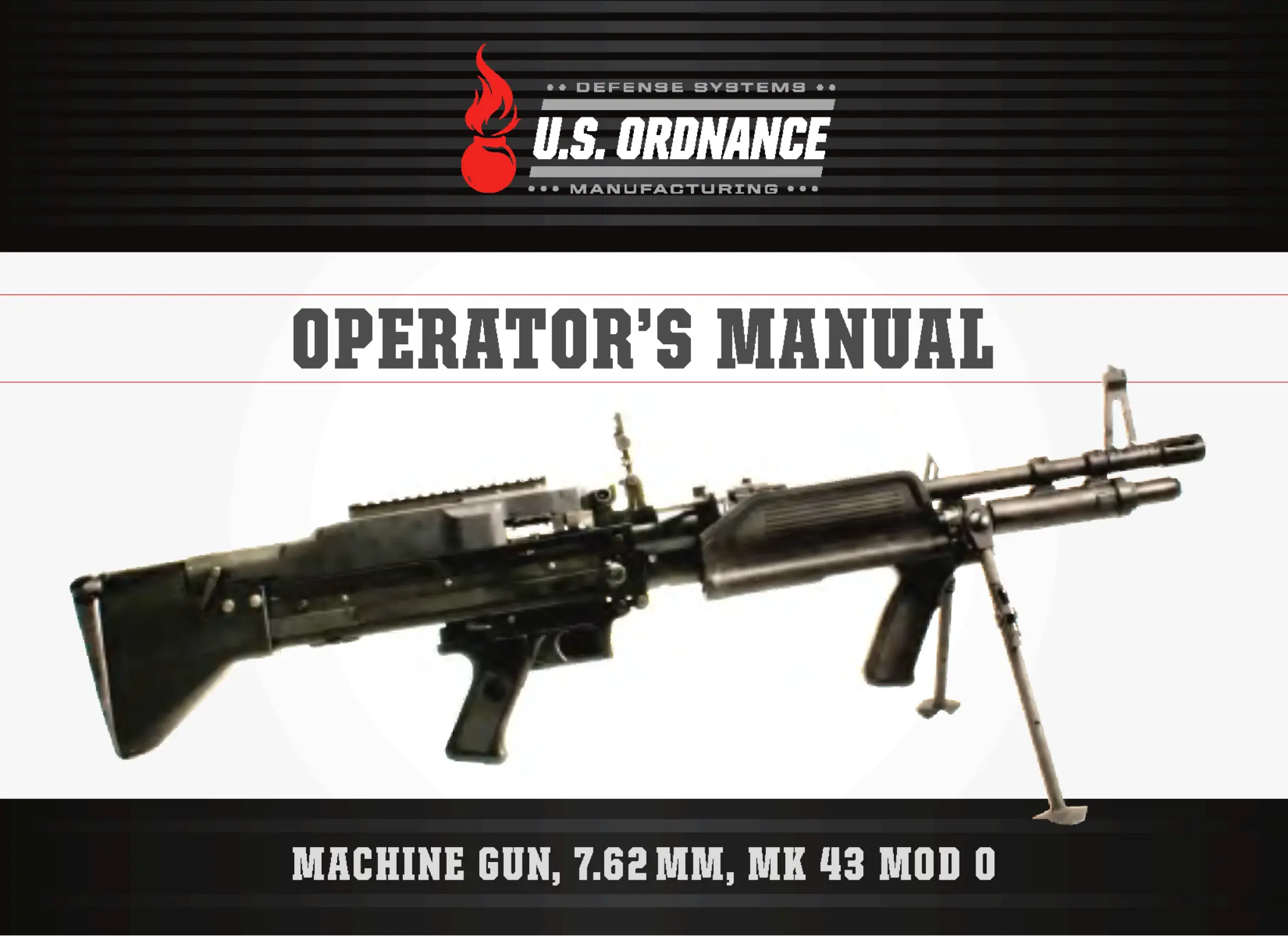
MACHINE GUN, 7.62 MM, MK 43 MOD O
OPERATOR’S MANUAL
USORD.COM
ISO 9001:2008
Ph:775.343.1320
Fax:775.343.1331

US ORDNANCE
ii
MK43MOD0
iii
Warnings
Keep Weapon Pointed at target - down range/limpact area.
Never stand in front of weapon or expose body or hands to breech, ejection port,
or muzzle.
Keep Safety on S until you’re ready to fire.
Always check the chamber/bore after clearing the weapon.
Check barrel bore and chamber before firing.
Change hot barrels by holdlng onto carrying handle.
(Refer to pages 61 and 84 for procedures.)
Be sure barrel lock lever Is locked down before charging and flring the gun.
Before starting Inspection, be sure to clear weapon (p 26).
If cover is opened on hot cartridge (hot barrel), an open cover cook-off could occur
and result In serious injury or death. Evacuate area for 15 minutes and then do
Immediate Action (p 32).
Safety information

US ORDNANCE
iv
MK43MOD0
v
Never reload a runaway gun until it has been repaired.
Be sure machine gun is cleared before moving it.
When removing a stuck unfired cartridge, stay clear of the muzzle. Do not allow
cartridge to contact any hard surface. Cartridge may fire on contact. Remove a stuck
unfired cartridge using the same procedures for removing a stuck or ruptured
cartridge case.
The climate temperature in dif ferent regions will make a difference as to what
constitutes a hot gun. A hot, sunny day can cause a cookoff within 50 rounds, with
weapon and ammunition in sun.
Before field stripping, clear and check that the bolt is in forward position.
Bolt assembly is under spring tension. It can twist and injure your hand.
Barrels issued for a specific gun should not be changed from gun to gun. Each barrel
and bolt assembly should remain together as initially issued.
Only use authorized ammunition in machine gun.
Be sure Blank Firing Adaptor (BFA) is removed before firing live ammunition.
Do not fire blank ammunition towards personnel within 20 feet of muzzle. Fragments
of a closure wad or particles of unburned propellant might inflict injury within that range.
Cautions
Do not use tip of driving spring guide assembly as a tool.
Insert reamer carefully to prevent damage.
Do not get lubricant in gas system.

US ORDNANCE
vi
MK43MOD0
vii
SAFETYINFORMATION.............................................iii
CHAPTER 1
INTRODUCTION...................................................1
SectionI.GeneralInformation.........................................1
Scope
SectionII.EquipmentDescription.....................................2
EquipmentCharacteristics,CapabilitiesandFeatures.................2
LocationandDescriptionofMajorComponents......................2
MK43MOD0MachineGun......................................2
CHAPTER 2
OPERATINGINSTRUCTIONS.......................................10
Section I. Description and Use of Operator’s Controls and Indicators1 0
MK43MOD0MachineGun.....................................10
FrontSightAdjustment.........................................14
TriggerGuard................................................15
Section II. Preventive Maintenance Checks and Services(PMCS) . . . . . . . . . . . . 16
SectionIll.OperationUnderUsualConditions ...........................21
AssemblyandPreparationforUse...................................21
LoadingAmmunitionintheMK43MOD0..........................21
ClearingandUnloadingtheMK43MOD0 .........................26
InitialAdjustments,DailyChecks,andSelf-Test ........................30
FieldZeroing................................................30
OperatingProceduresImmediateAction..............................32
RunawayMachineGun........................................32
Misfire.........................................................34
Remedial Action (Steps to take if immediate action-misfire does not work) . . . 36
Removing Stuck or Ruptured Cartridge Case (When round fires
butcartridgecasedoesnotextract)..............................38
SectionIV.OperationUnderUnusualConditions.........................42
InExtremelyColdClimate......................................42
Contents

US ORDNANCE
viii
MK43MOD0
ix
InHot,WetClimate ...........................................43
InHot,andSandyAreas.......................................43
AfterExposuretoWater........................................43
CHAPTER 3
MAINTENANCEINSTRUCTIONS....................................44
SectionI.LubricationGuideandInstructions............................44
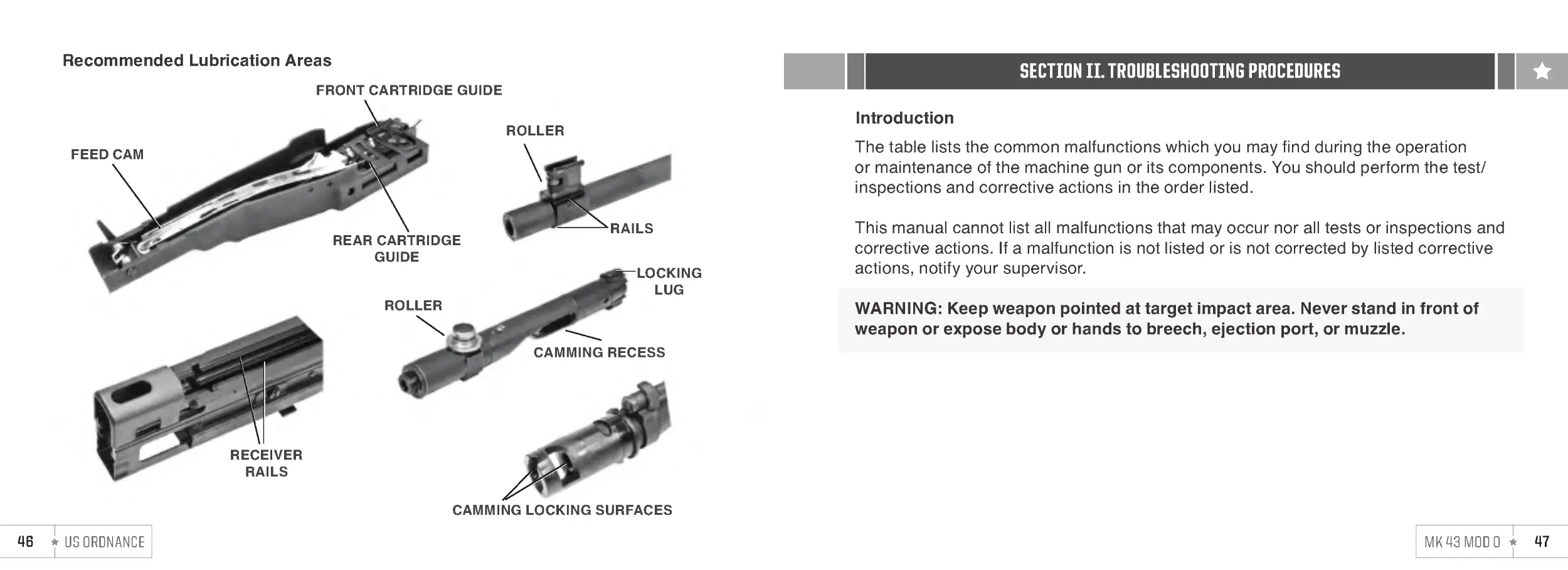
RecommendedLubricationAreas................................46
SectionII.TroubleshootingProcedures.................................47
Introduction.................................................47
SectionIll.Field-StrippingMachineGunProcedures......................53
ShoulderButtstockandBufferAssembly..........................53
BoltAssemblyandOperatingRodAssembly.......................56
CoverandCartridgeFeedTrayAssembly..........................59
BarrelandHandleAssembly....................................61
TriggerMechanismGripAssembly...............................62
ForearmGrip,SlingSwivelandBipodAssembly....................65
SectionIV.CleaningandInspection...................................67
BoltAssemblyandOperatingRodAssembly.......................67
CoverAssemblyandCartridgeFeedTrayAssembly.................70
BarrelandHandleAssembly....................................72
TriggerMechanismGripAssembly...............................77
Receiver....................................................79
SectionV.ReassemblingMachineGun.................................80
ForearmGrip,SlingSwivelandBipodAssembly....................80
TriggerMechanismGripAssembly...............................82
BarrelandHandleAssembly....................................84
CoverandCartridgeFeedTrayAssembly.........................85
BoltAssemblyandOperatingRodAssembly.......................87
ShoulderButtstockandBufferAssembly..........................90
AssemblyofButtstocktoReceiver...............................91
SectionVI.MaintenanceChecklist ....................................93
SectionVII.MachineGunCheckOutProcedure..........................94

US ORDNANCE
x
MK43MOD0
1
CHAPTER 4
AMMUNITION...................................................96
APPENDIX A
REFERENCES....................................................98
APPENDIX B
COMPONENTS OF END lTEM AND BASIC ISSUE ITEMS LISTS . . . . . . . . . .100
SectionI.Introduction..............................................100
SectionII.ComponentsofEndItem...................................103
SectionIII.BasicIssueItems........................................104
APPENDIX C
ADDITIONALAUTHORIZEDLIST...................................108
SectionI.Introduction..............................................108
APPENDIX D
EXPENDABLE/DURABLE SUPPLIES AND MATERlALS LIST . . . . . . . . . . . . 110
SectionI.Introduction..............................................110
Section II. Expendable/Durable Supplies and Materials List . . . . . . . . . . . . . . . . 112
Scope
Type of Manual: Operator’s Manual.
Model Number and Equipment Name: MK43 MOD 0 7.62-mm Machine Gun.
Purpose of Equipment: The MK43 MOD 0 7.62-mm Machine Gun is a light weight
general purpose weapon for assault use. The weapon is intended for hand held or
blpod supported firing. The weapon is also capable of being fired from standard
mounts.
Chapter 1– introduction
Section i. general information

US ORDNANCE
2
MK43MOD0
3
Equipment Characteristics, Capabilities and Features.
The MK43 MOD 0 is air-cooled and has fixed headspace allowing quick barrel
changes for cooling and maintenance when required. Two barrel assemblies are
issued with each gun. Barrels issued for a specific gun should not be changed
from gun to gun. Each barrel and bolt assembly should remain together as initially
received. The machine gun is gas operated and fires from the open bolt position.
Location and Description of Major Components.
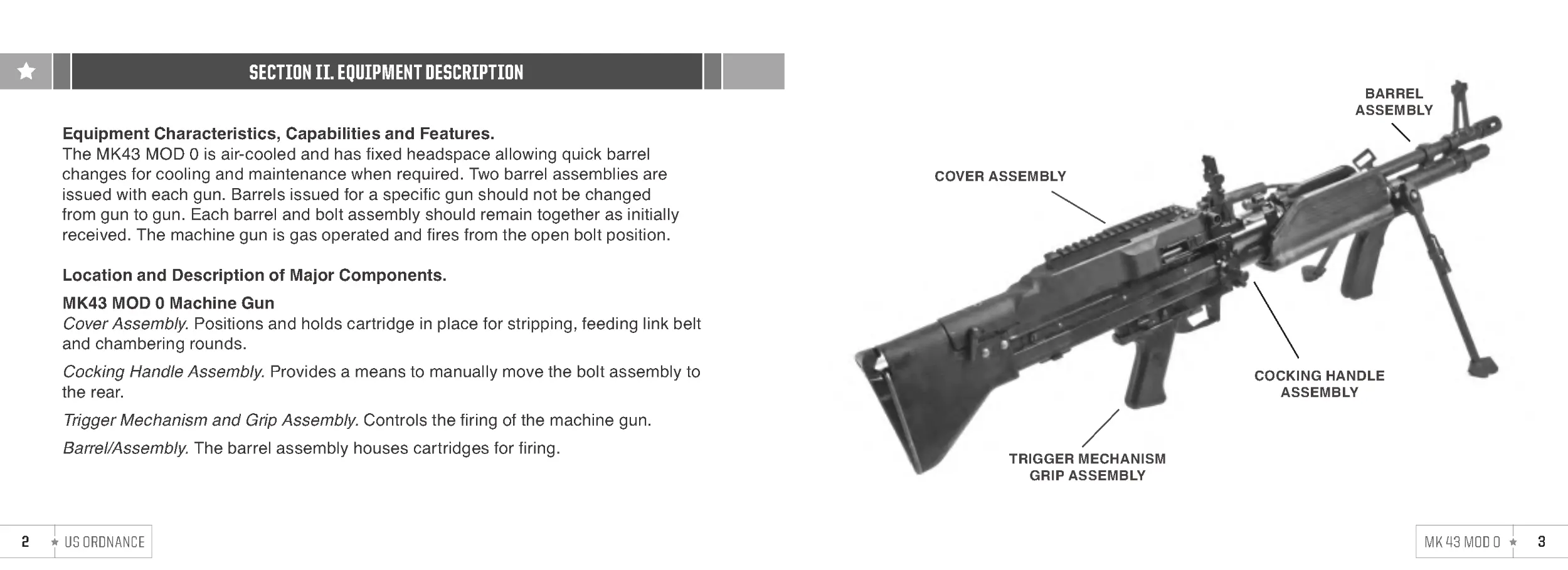
MK43 MOD 0 Machine Gun
Cover Assembly. Positions and holds cartridge in place for stripping, feeding link belt
and chambering rounds.
Cocking Handle Assembly. Provides a means to manually move the bolt assembly to
the rear.
Trigger Mechanism and Grip Assembly. Controls the firing of the machine gun.
Barrel/Assembly. The barrel assembly houses cartridges for firing.
BARREL
ASSEMBLY
COvER ASSEMBLY
TRIGGER MECHANISM
GRIP ASSEMBLY
COCKING HANDLE
ASSEMBLY
Section ii. equipment deScription

US ORDNANCE
4
MK43MOD0
5
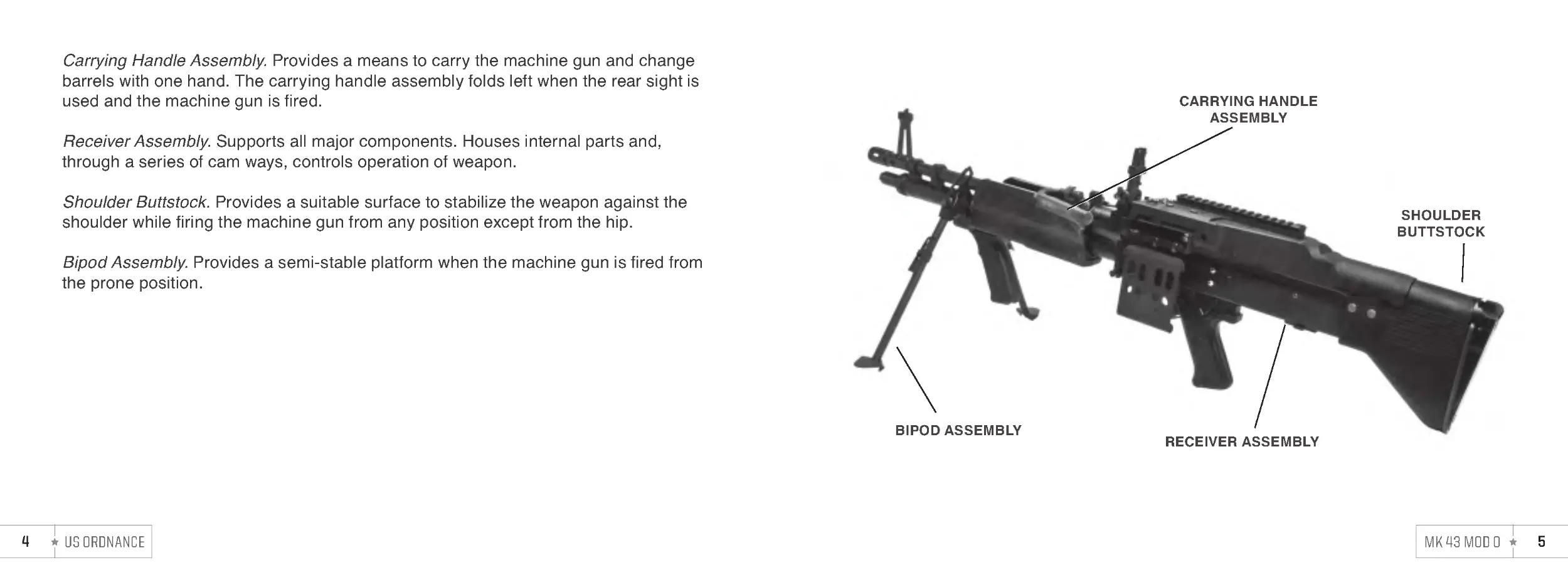
Carrying Handle Assembly. Provides a means to carry the machine gun and change
barrels with one hand. The carrying handle assembly folds left when the rear sight is
used and the machine gun is fired.
Receiver Assembly. Supports all major components. Houses internal parts and,
through a series of cam ways, controls operation of weapon.
Shoulder Buttstock. Provides a suitable surface to stabilize the weapon against the
shoulder while firing the machine gun from any position except from the hip.
Bipod Assembly. Provides a semi-stable platform when the machine gun is fired from
the prone position.
BIPOD ASSEMBLY
CARRYING HANDLE
ASSEMBLY
SHOULDER
BUTTSTOCK
RECEIvER ASSEMBLY

US ORDNANCE
6
MK43MOD0
7
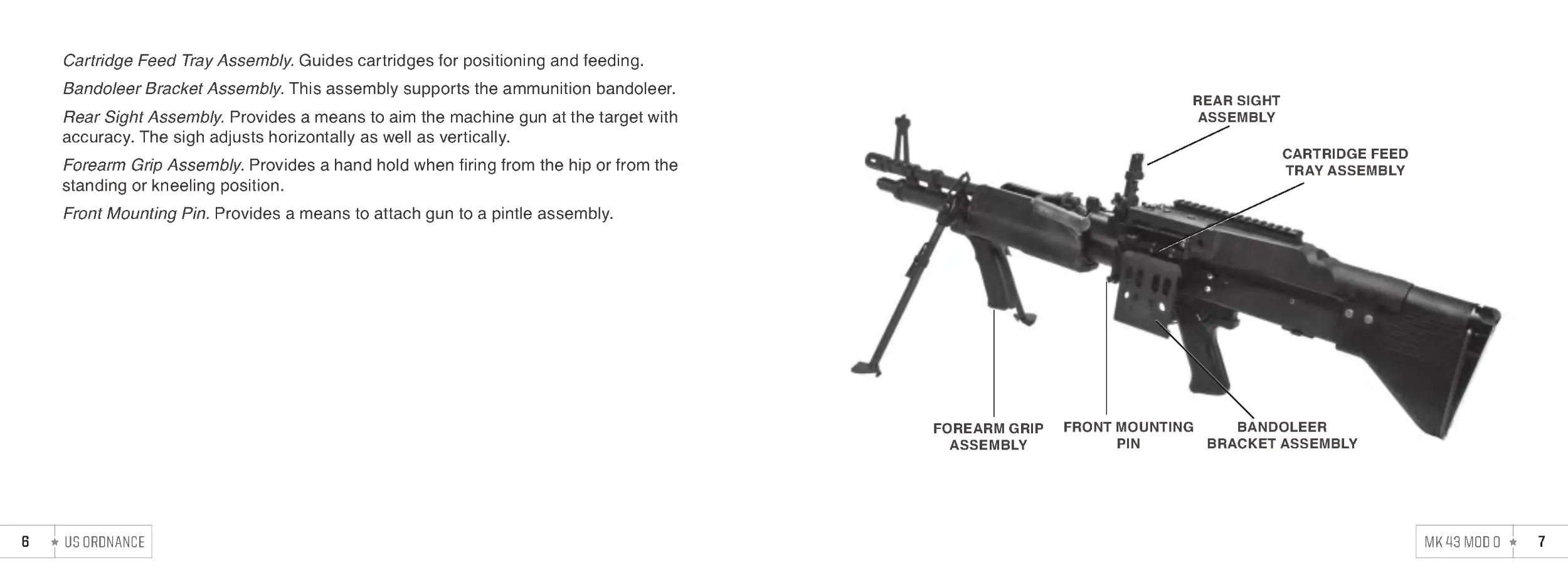
Cartridge Feed Tray Assembly. Guides car tridges for positioning and feeding.
Bandoleer Bracket Assembly. This assembly supports the ammunition bandoleer.
Rear Sight Assembly. Provides a means to aim the machine gun at the target with
accuracy. The sigh adjusts horizontally as well as vertically.
Forearm Grip Assembly. Provides a hand hold when firing from the hip or from the
standing or kneeling position.
Front Mounting Pin. Provides a means to attach gun to a pintle assembly.
FOREARM GRIP
ASSEMBLY
REAR SIGHT
ASSEMBLY
CARTRIDGE FEED
TRAY ASSEMBLY
FRONT MOUNTING
PIN
BANDOLEER
BRACKET ASSEMBLY

US ORDNANCE
8
MK43MOD0
9
Equipment Data.
MK43 MOD 0 Machine Gun
Weight...................................................20.8lb.(9.4kg)
Length:
ShortBarrel...............................37.7in.overall(958mmoverall)
LongBarrel...............................42.2in.overall(1071mmoverall)
MaximumEffectiveRange......................................1100meters
MaximumRange.............................................3725meters
TracerBurnOut........................................900metersormore
Rates of fire:
Sustained....................100rdpermin(4to6secondsbetweenbursts)
Recommend barrel change every 6 min
Rapid........................200rdpermin(2to3secondsbetweenbursts)
Recommend barrel change every 2 min
Cyclic........................................500-650roundsperminute
Recommend barrel change every min
Muzzlevelocity.....................................2800fps(853m/sec)
Capacityofbandoleer...........................................100rds
Rifling:
Numberoflands....................................................4
Righthandtwist.................................Oneturnin12in.(304.8mm)
Trigger pull:
Maximum...............................................11.5lb(5.2kg)
Minimum................................................8.0lb(2.7kg)

US ORDNANCE
10
MK43MOD0
11
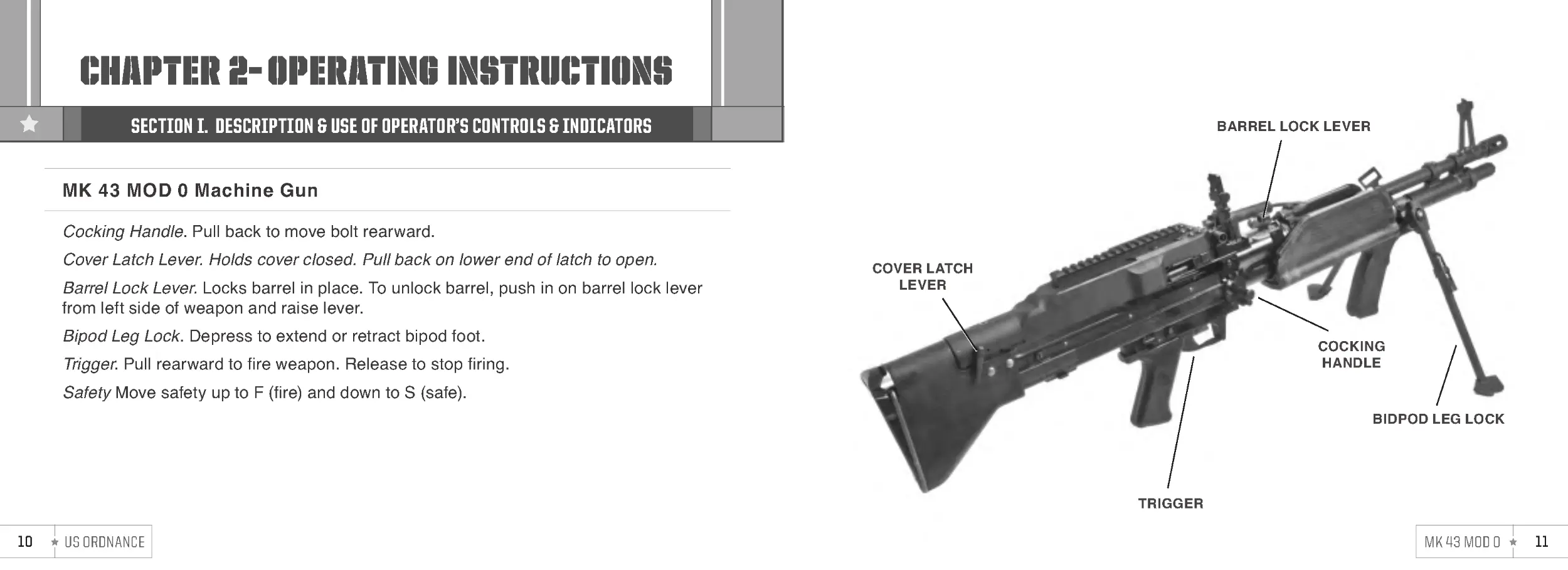
BARREL LOCK LEvER
COCKING
HANDLE
COvER LATCH
LEvER
TRIGGER
BIDPOD LEG LOCK
MK 43 MOD 0 Machine Gun
Cocking Handle. Pull back to move bolt rearward.
Cover Latch Lever. Holds cover closed. Pull back on lower end of latch to open.
Barrel Lock Lever. Locks barrel in place. To unlock barrel, push in on barrel lock lever
from left side of weapon and raise lever.
Bipod Leg Lock. Depress to extend or retract bipod foot.
Tri gger. Pull rearward to fire weapon. Release to stop firing.
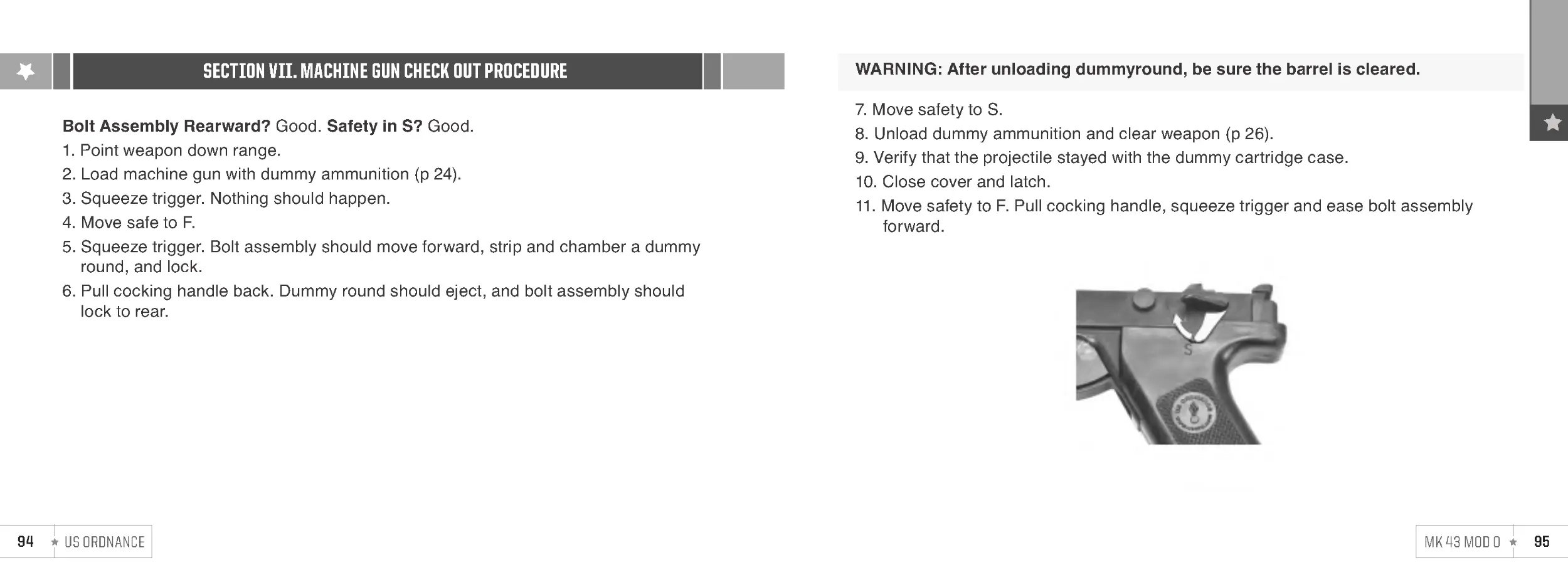
Safety Move safety up to F (fire) and down to S (safe).
Section i. deScription & uSe of operator’S controlS & indicatorS
CHAPTER 2– OPERATING INSTRUCTIONS

US ORDNANCE
12
MK43MOD0
13
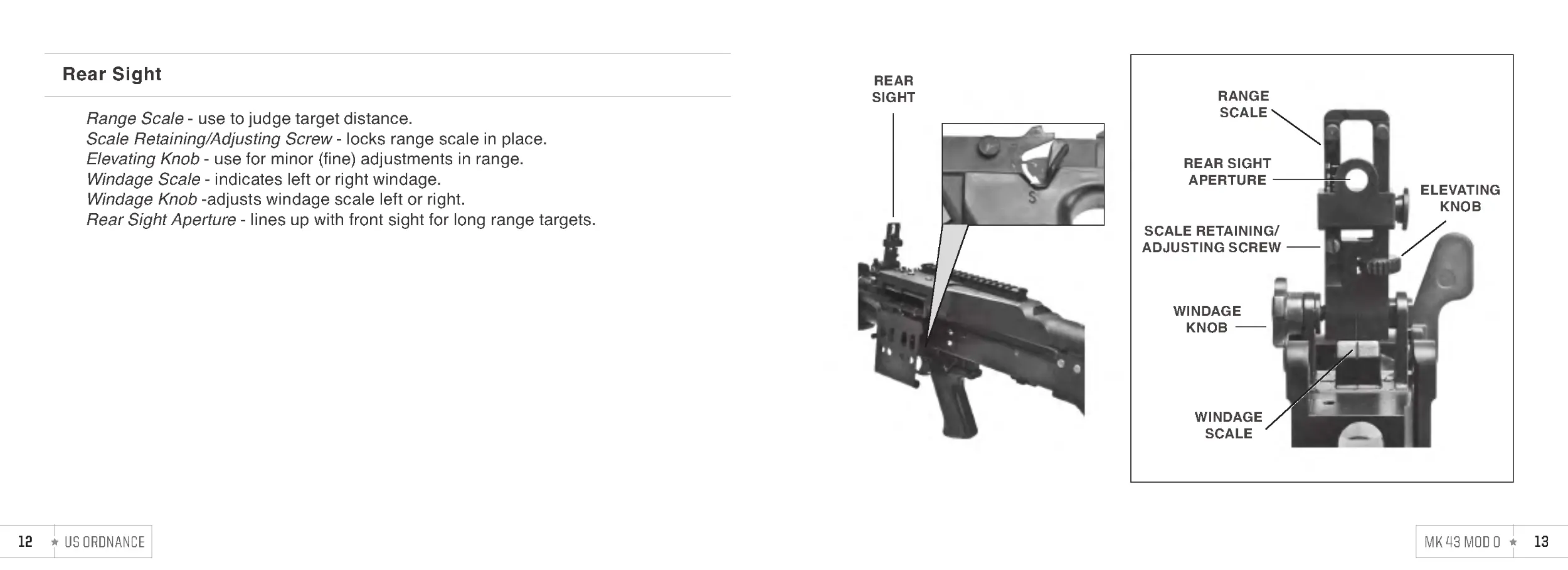
Rear Sight
Range Scale - use to judge target distance.
Scale Retaining/Adjusting Screw - locks range scale in place.
Elevating Knob - use for minor (fine) adjustments in range.
Windage Scale - indicates left or right windage.
Windage Knob -adjusts windage scale left or right.
Rear Sight Aperture - lines up with front sight for long range targets.
REAR
SIGHT
RANGE
SCALE
REAR SIGHT
APERTURE
SCALE RETAINING/
ADJUSTING SCREW
ELEvATING
KNOB
WINDAGE
KNOB
WINDAGE
SCALE

US ORDNANCE
14
MK43MOD0
15
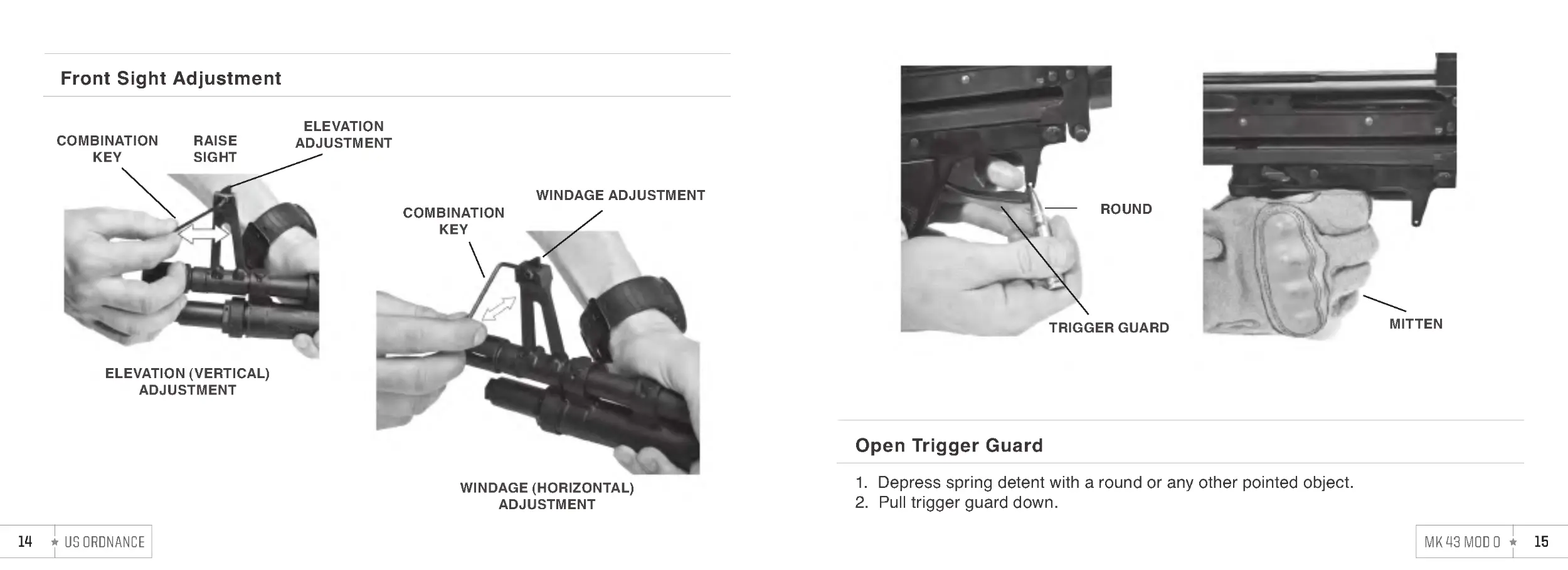
ELEvATION (vERTICAL)
ADJUSTMENT
WINDAGE (HORIZONTAL)
ADJUSTMENT
COMBINATION
KEY
COMBINATION
KEY
WINDAGE ADJUSTMENT
RAISE
SIGHT
ELEvATION
ADJUSTMENT
Front Sight Adjustment
TRIGGER GUARD
MITTEN
ROUND
Open Trigger Guard
1. Depress spring detent with a round or any other pointed object.
2. Pull trigger guard down.

US ORDNANCE
16
MK43MOD0
17
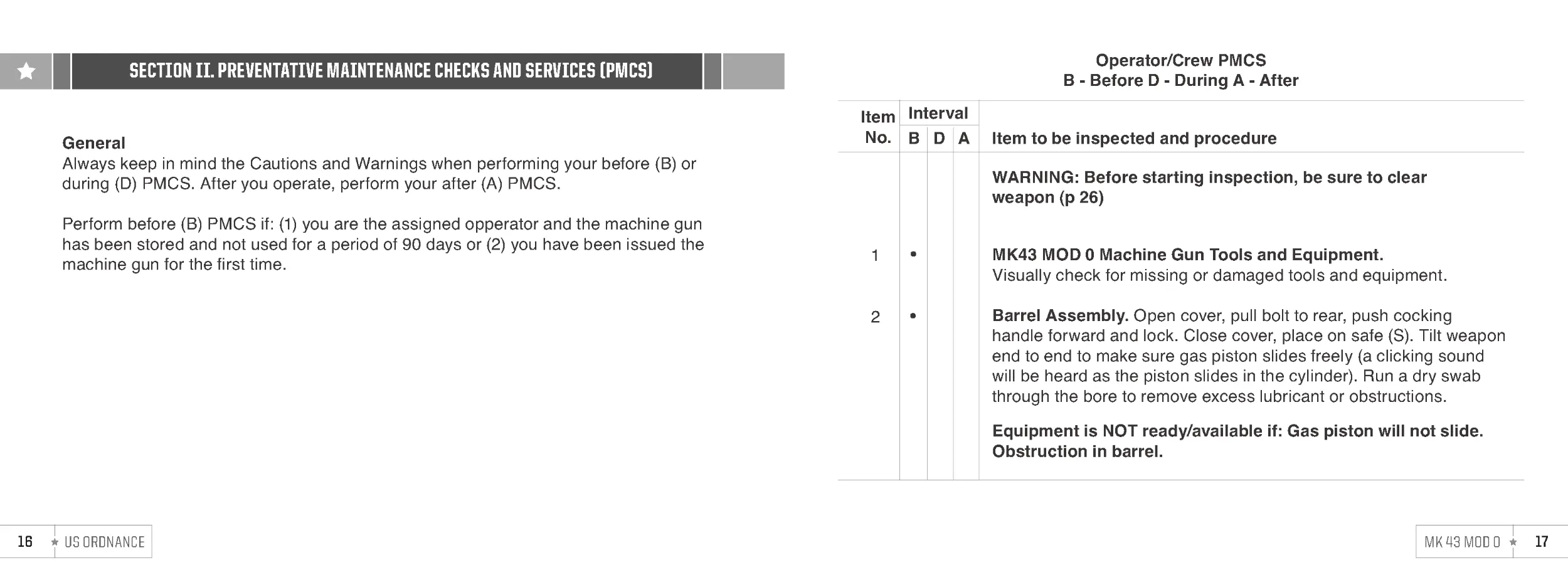
General
Always keep in mind the Cautions and Warnings when performing your before (B) or
during (D) PMCS. After you operate, perform your after (A) PMCS.
Perform before (B) PMCS if: (1) you are the assigned opperator and the machine gun
has been stored and not used for a period of 90 days or (2) you have been issued the
machine gun for the first time.
Section ii. preventative maintenance checkS and ServiceS (pmcS)
MK43 MOD 0 Machine Gun Tools and Equipment.
Visually check for missing or damaged tools and equipment.
Barrel Assembly. Open cover, pull bolt to rear, push cocking
handle forward and lock. Close cover, place on safe (S). Tilt weapon
end to end to make sure gas piston slides freely (a clicking sound
will be heard as the piston slides in the cylinder). Run a dry swab
through the bore to remove excess lubricant or obstructions.
Operator/Crew PMCS
B-BeforeD-DuringA-After
Item
No.
Item to be inspected and procedure
Interval
BDA
•
1
•
2
Equipment is NOT ready/available if: Gas piston will not slide.
Obstruction in barrel.
WARNING: Before starting inspection, be sure to clear
weapon (p 26)

US ORDNANCE
18
MK43MOD0
19
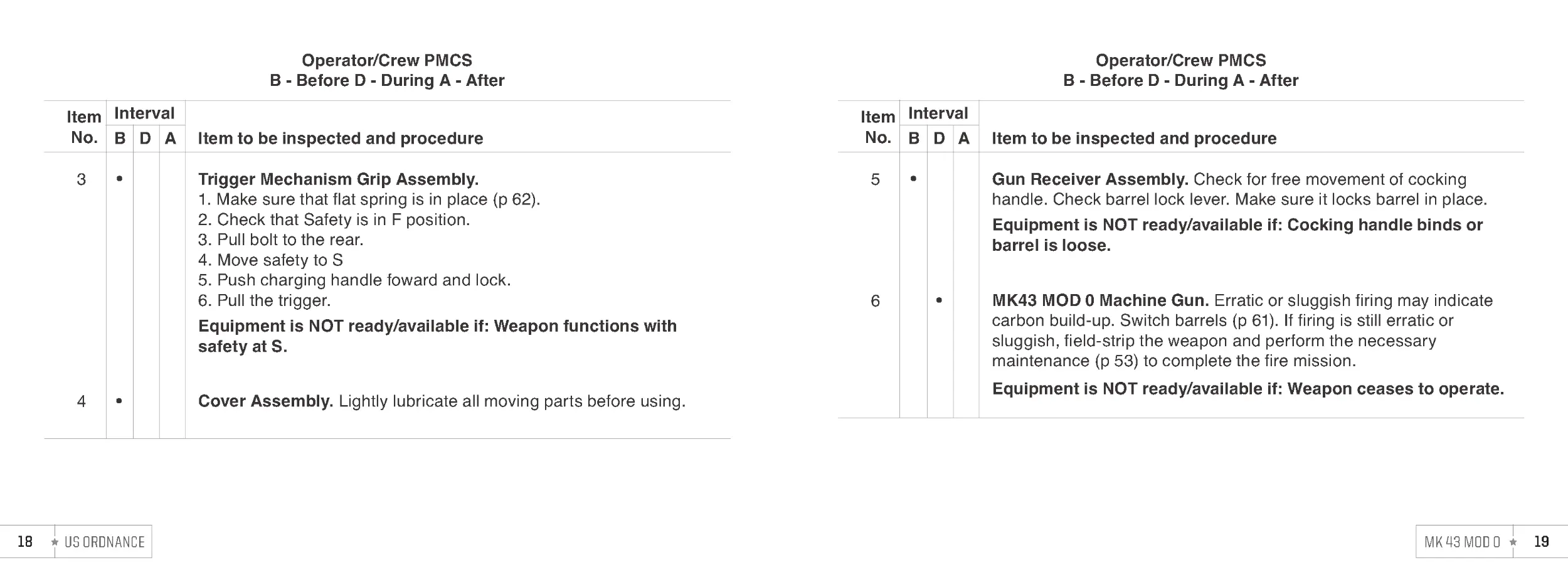
Gun Receiver Assembly. Check for free movement of cocking
handle. Check barrel lock lever. Make sure it locks barrel in place.
MK43 MOD 0 Machine Gun. Erratic or sluggish firing may indicate
carbon build-up. Switch barrels (p 61). If firing is still erratic or
sluggish, field-strip the weapon and perform the necessary
maintenance (p 53) to complete the fire mission.
Trigger Mechanism Grip Assembly.
1. Make sure that flat spring is in place (p 62).
2. Check that Safety is in F position.
3. Pull bolt to the rear.
4. Move safety to S
5. Push charging handle foward and lock.
6. Pull the trigger.
Cover Assembly. Lightly lubricate all moving parts before using.
Operator/Crew PMCS
B-BeforeD-DuringA-After
Operator/Crew PMCS
B-BeforeD-DuringA-After
Item
No.
Item
No.
Item to be inspected and procedure
Item to be inspected and procedure
Interval
Interval
BDA
BDA
•
•
5
3
•
•
6
4
Equipment is NOT ready/available if: Cocking handle binds or
barrel is loose.
Equipment is NOT ready/available if: Weapon functions with
safety at S.
Equipment is NOT ready/available if: Weapon ceases to operate.

US ORDNANCE
20
MK43MOD0
21
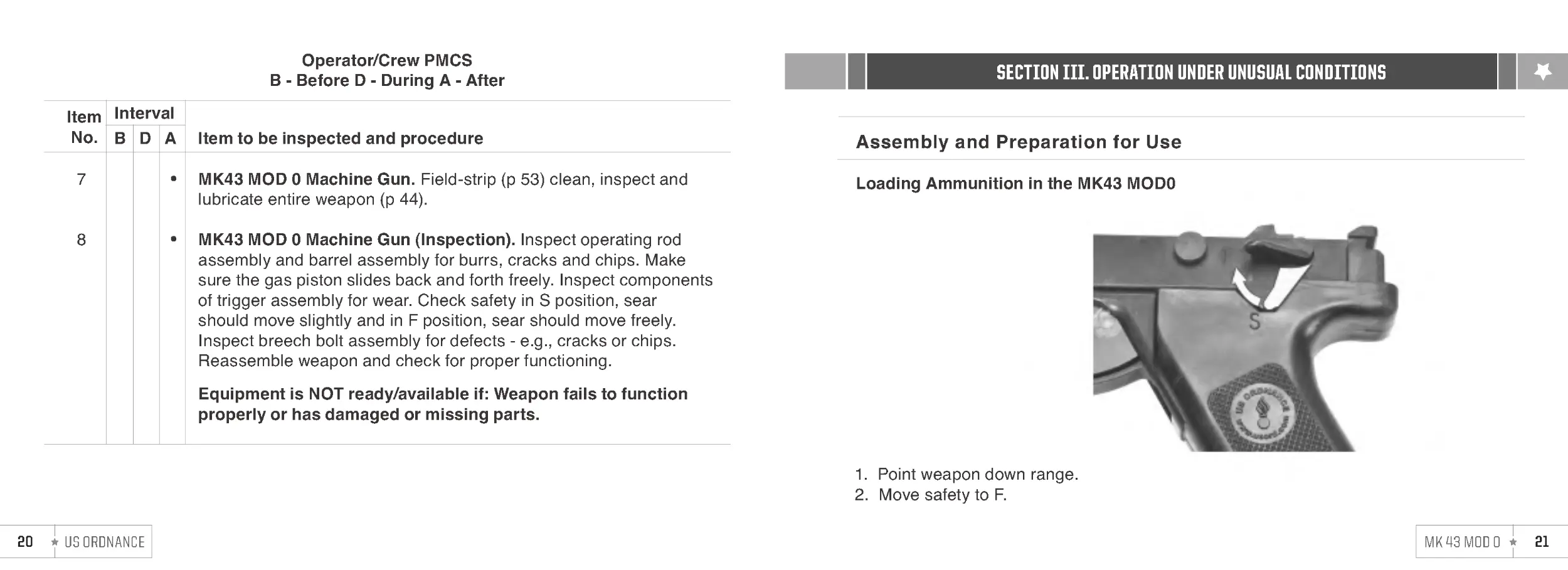
MK43 MOD 0 Machine Gun. Field-strip (p 53) clean, inspect and
lubricate entire weapon (p 44).
MK43 MOD 0 Machine Gun (Inspection). Inspect operating rod
assembly and barrel assembly for burrs, cracks and chips. Make
sure the gas piston slides back and forth freely. Inspect components
of trigger assembly for wear. Check safety in S position, sear
should move slightly and in F position, sear should move freely.
Inspect breech bolt assembly for defects - e .g ., cracks or chips.
Reassemble weapon and check for proper functioning.
Section iii. operation under unuSual conditionS
Assembly and Preparation for Use
Loading Ammunition in the MK43 MOD0
1. Point weapon down range.
2. Move safety to F.
Operator/Crew PMCS
B-BeforeD-DuringA-After
Item
No.
Item to be inspected and procedure
Interval
BDA
•
7
•
8
Equipment is NOT ready/available if: Weapon fails to function
properly or has damaged or missing parts.

US ORDNANCE
22
MK43MOD0 23
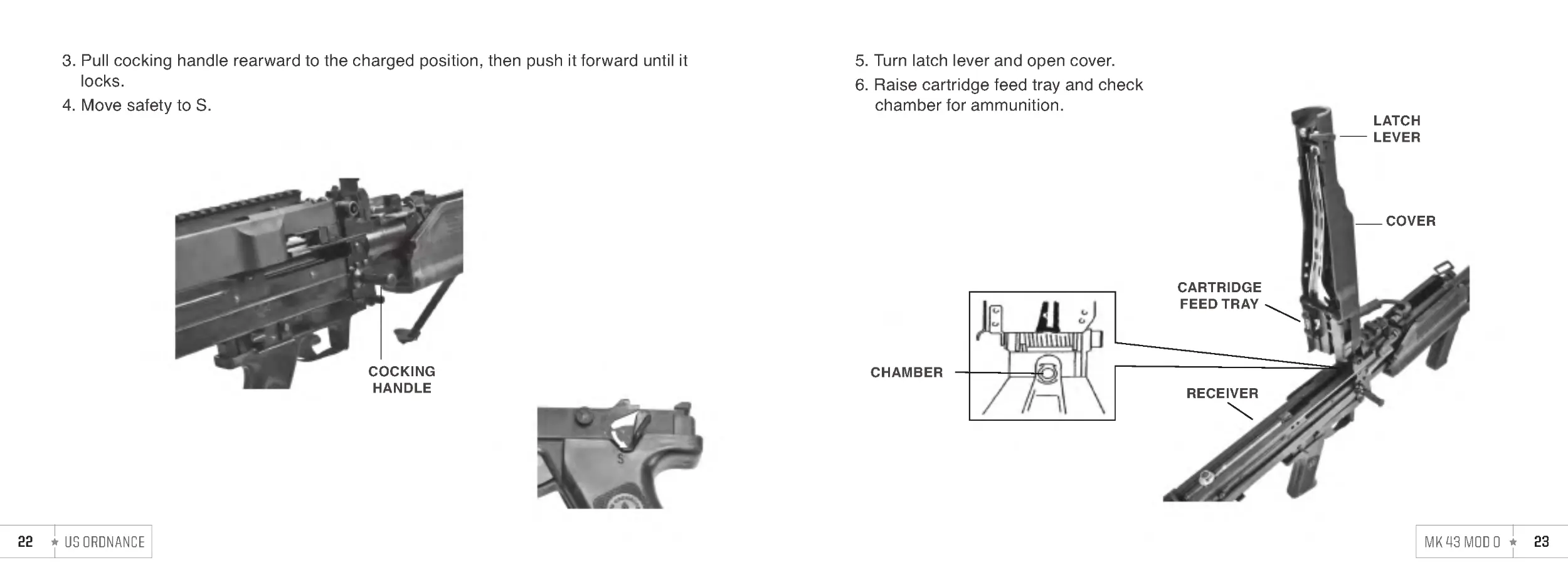
3. Pull cocking handle rearward to the charged position, then push it forward until it
locks.
4. Move safety to S.
COCKING
HANDLE
5. Turn latch lever and open cover.
6. Raise cartridge feed tray and check
chamber for ammunition.
RECEIvER
COvER
LATCH
LEvER
CARTRIDGE
FEED TRAY
CHAMBER

US ORDNANCE
24
MK43MOD0 25
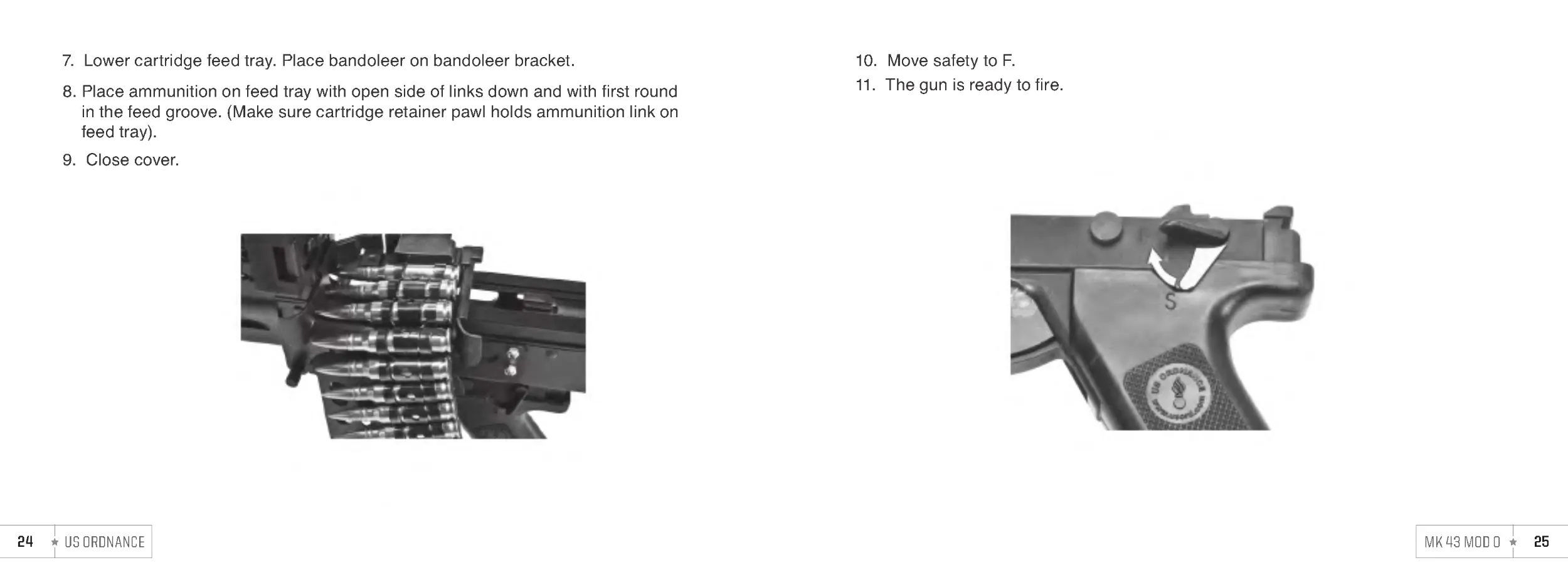
7. Lower cartridge feed tray. Place bandoleer on bandoleer bracket.
8. Place ammunition on feed tray with open side of links down and with first round
in the feed groove. (Make sure cartridge retainer pawl holds ammunition link on
feed tray).
9. Close cover.
10. Move safety to F.
11. The gun is ready to fire.

US ORDNANCE
26
MK43MOD0
27
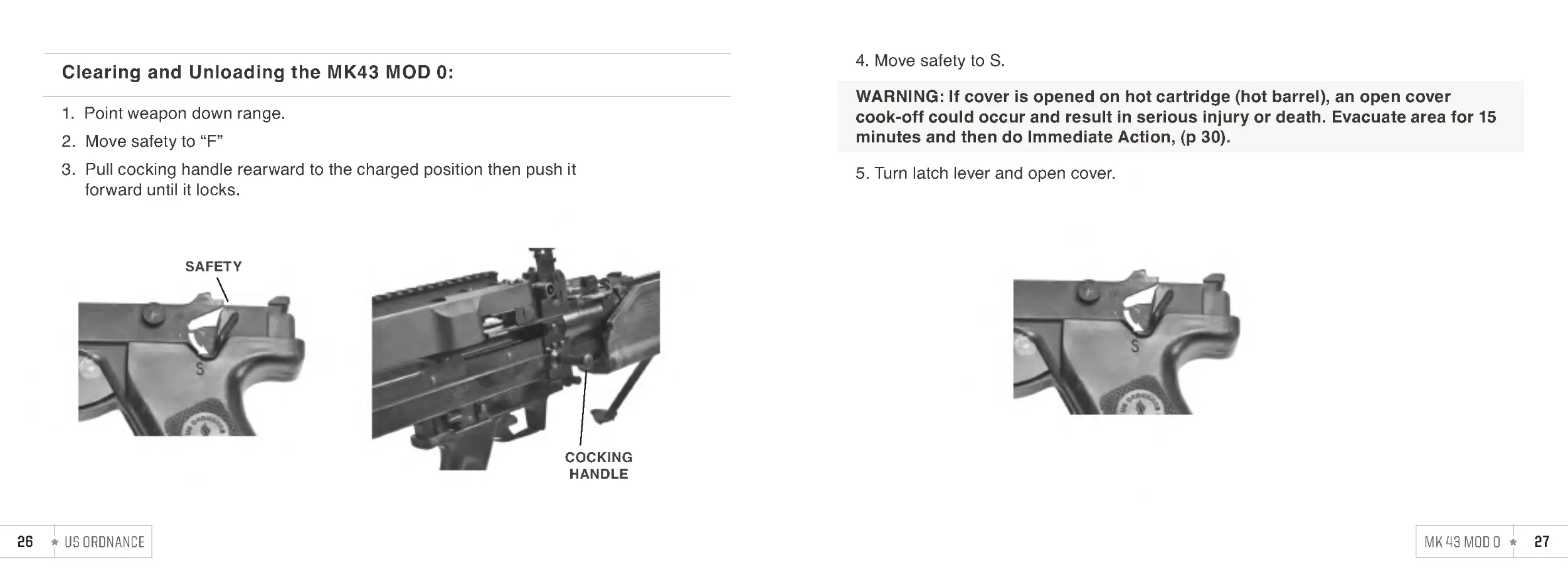
Clearing and Unloading the MK43 MOD 0:
1. Point weapon down range.
2. Move safety to “F”
3. Pull cocking handle rearward to the charged position then push it
forward until it locks.
SAFETY
COCKING
HANDLE
4. Move safety to S.
WARNING: If cover is opened on hot cartridge (hot barrel), an open cover
cook-off could occur and result in serious injury or death. Evacuate area for 15
minutes and then do Immediate Action, (p 30).
5. Turn latch lever and open cover.

US ORDNANCE
28
MK43MOD0 29
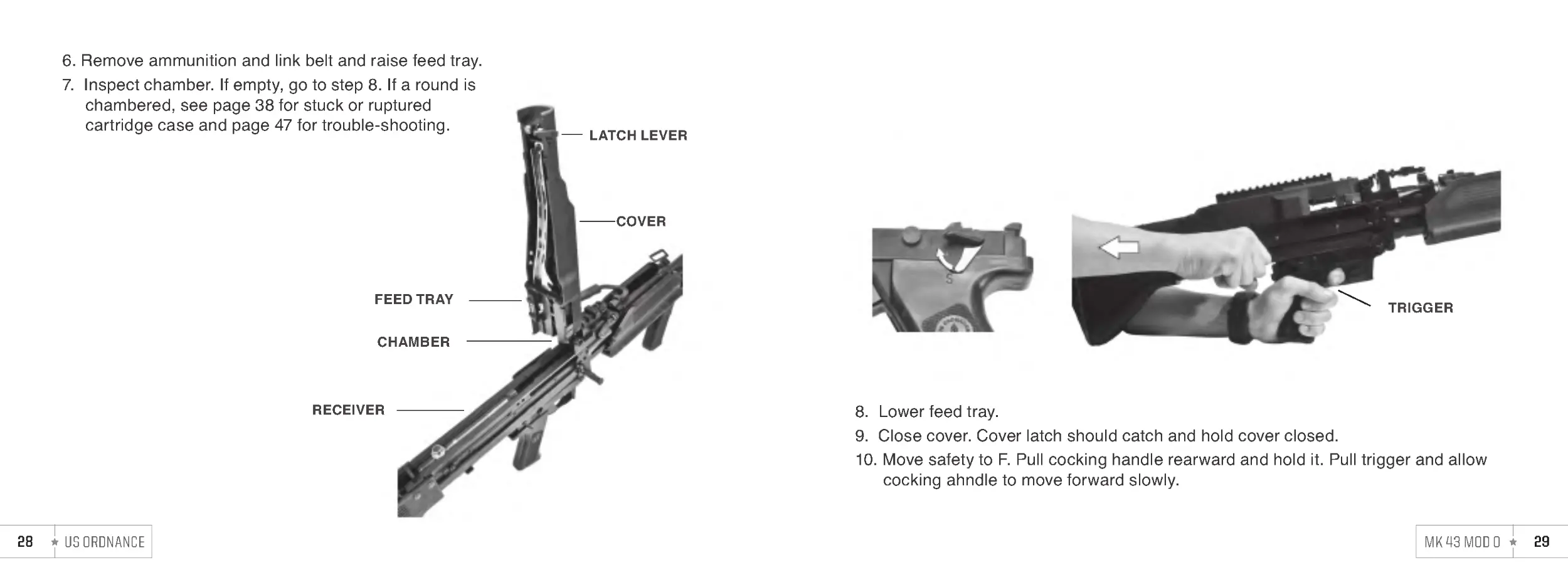
FEED TRAY
CHAMBER
LATCH LEvER
COvER
RECEIvER
6. Remove ammunition and link belt and raise feed tray.
7. Inspect chamber. If empty, go to step 8. If a round is
chambered, see page 38 for stuck or ruptured
cartridge case and page 47 for trouble-shooting.
8. Lower feed tray.
9. Close cover. Cover latch should catch and hold cover closed.
10. Move safety to F. Pull cocking handle rearward and hold it. Pull trigger and allow
cocking ahndle to move forward slowly.
TRIGGER

US ORDNANCE
30
MK43MOD0
31
Initial Adjustments, Daily Checks, and Self-Test
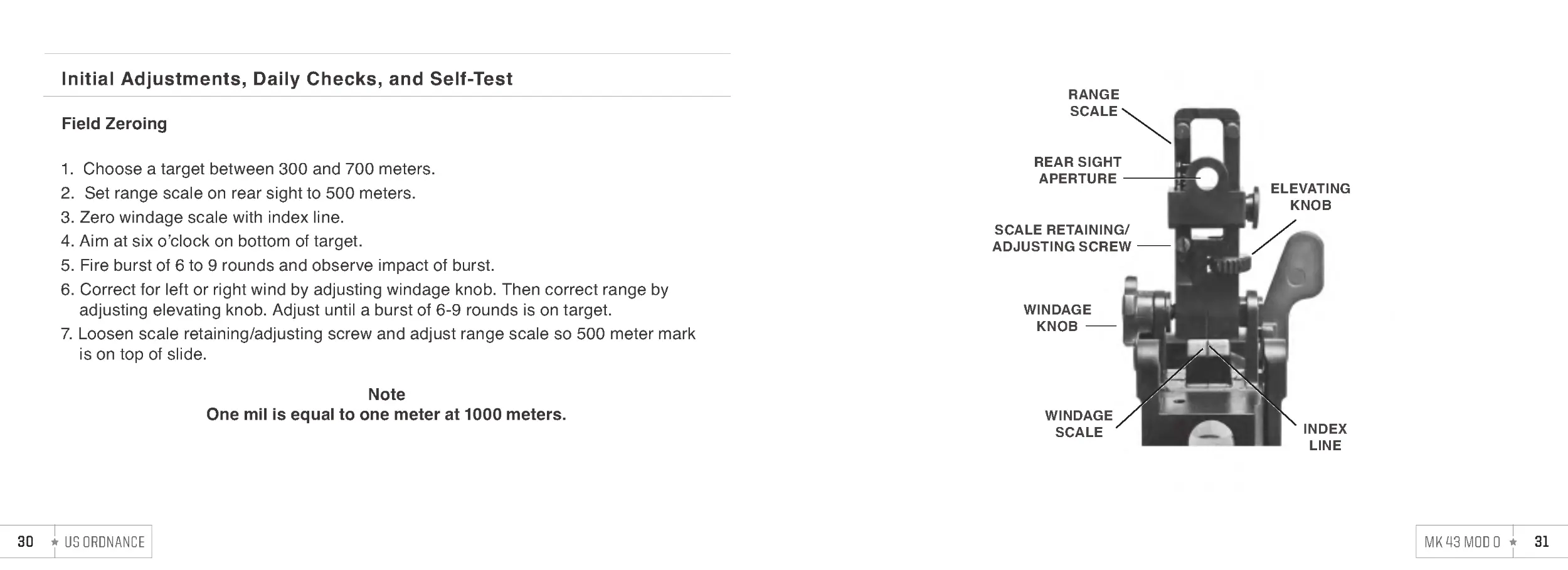
Field Zeroing
1. Choose a target between 300 and 700 meters.
2. Set range scale on rear sight to 500 meters.
3. Zero windage scale with index line.
4. Aim at six o’clock on bottom of target.
5. Fire burst of 6 to 9 rounds and observe impact of burst.
6. Correct for left or right wind by adjusting windage knob. Then correct range by
adjusting elevating knob. Adjust until a burst of 6-9 rounds is on target.
7. Loosen scale retaining/adjusting screw and adjust range scale so 500 meter mark
is on top of slide.
Note
One mil is equal to one meter at 1000 meters.
RANGE
SCALE
REAR SIGHT
APERTURE
SCALE RETAINING/
ADJUSTING SCREW
ELEvATING
KNOB
WINDAGE
KNOB
WINDAGE
SCALE
INDEX
LINE

US ORDNANCE
32
MK43MOD0 33
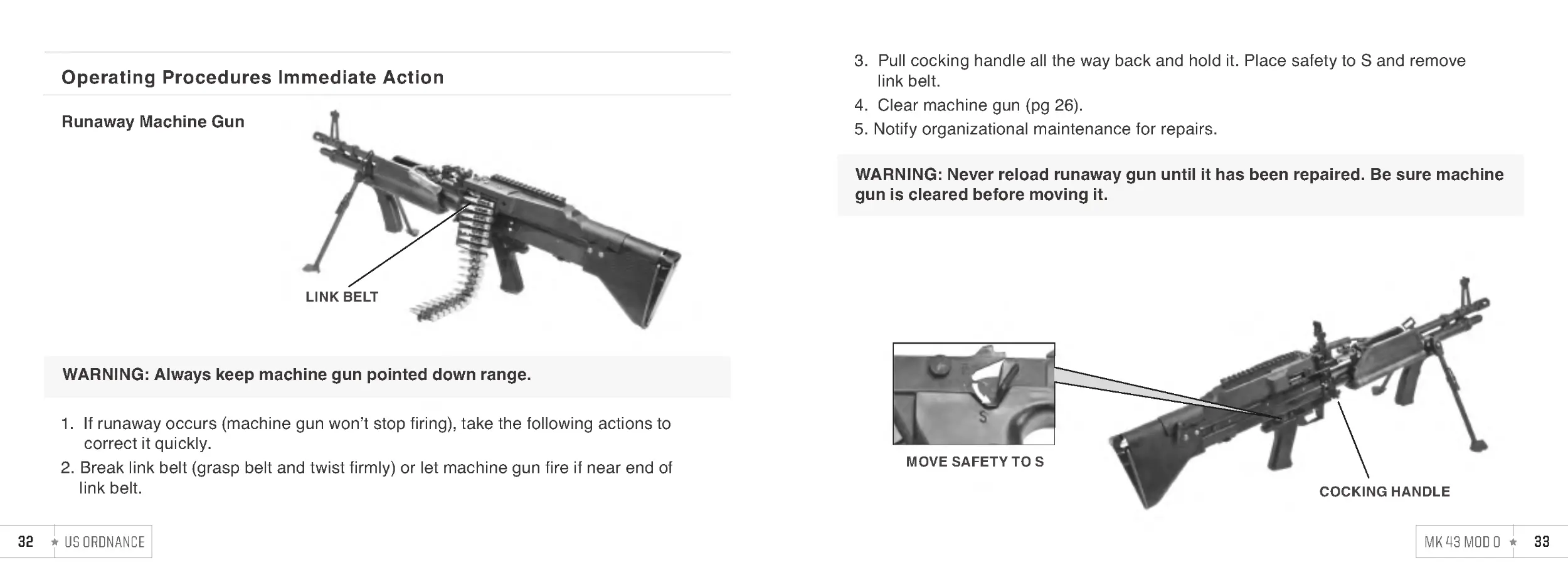
LINK BELT
Operating Procedures Immediate Action
Runaway Machine Gun
1. If runaway occurs (machine gun won’t stop firing), take the following actions to
correct it quickly.
2. Break link belt (grasp belt and twist firmly) or let machine gun fire if near end of
link belt.
3. Pull cocking handle all the way back and hold it. Place safety to S and remove
link belt.
4. Clear machine gun (pg 26).
5. Notify organizational maintenance for repairs.
WARNING: Always keep machine gun pointed down range.
WARNING: Never reload runaway gun until it has been repaired. Be sure machine
gun is cleared before moving it.
COCKING HANDLE
MOvE SAFETY TO S

US ORDNANCE
34
MK43MOD0 35
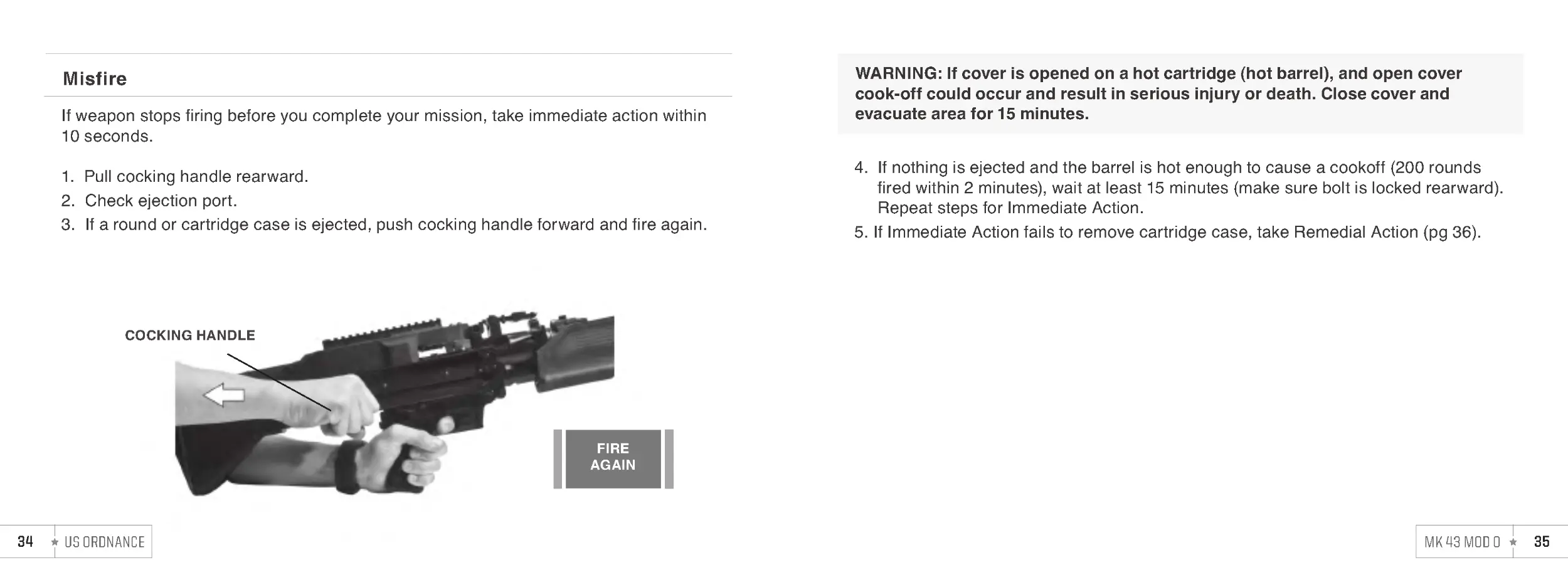
COCKING HANDLE
Misfire
If weapon stops firing before you complete your mission, take immediate action within
10 seconds.
1. Pull cocking handle rearward.
2. Check ejection port.
3. If a round or cartridge case is ejected, push cocking handle for ward and fire again.
4. If nothing is ejected and the barrel is hot enough to cause a cookoff (200 rounds
fired within 2 minutes), wait at least 15 minutes (make sure bolt is locked rearward).
Repeat steps for Immediate Action.
5. If Immediate Action fails to remove cartridge case, take Remedial Action (pg 36).
FIRE
AGAIN
WARNING: If cover is opened on a hot cartridge (hot barrel), and open cover
cook-off could occur and result in serious injury or death. Close cover and
evacuate area for 15 minutes.

US ORDNANCE
36
MK43MOD0
37
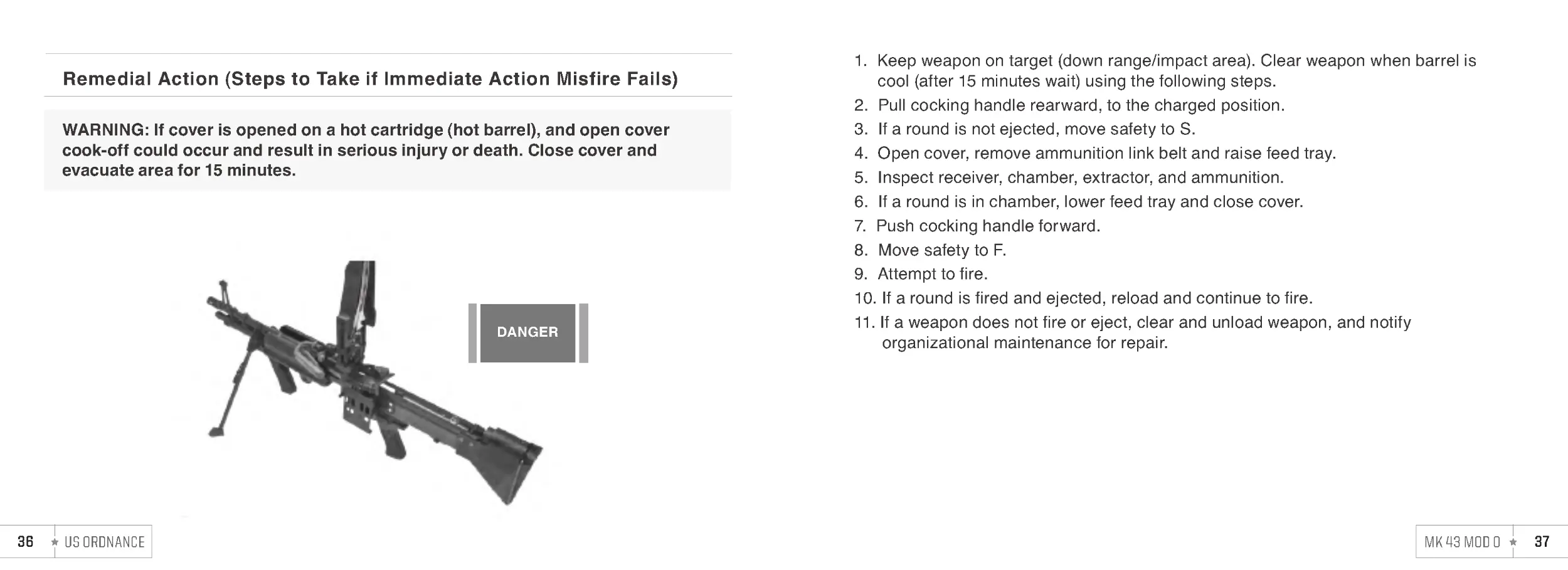
DANGER
Reme dial Action (Steps to Take if Immediate Action Misfire Fails)
WARNING: If cover is opened on a hot cartridge (hot barrel), and open cover
cook-off could occur and result in serious injury or death. Close cover and
evacuate area for 15 minutes.
1. Keep weapon on target (down range/impact area). Clear weapon when barrel is
cool (after 15 minutes wait) using the following steps.
2. Pull cocking handle rearward, to the charged position.
3. If a round is not ejected, move safety to S.
4. Open cover, remove ammunition link belt and raise feed tray.
5. Inspect receiver, chamber, extractor, and ammunition.
6. If a round is in chamber, lower feed tray and close cover.
7. Push cocking handle for ward.
8. Move safety to F.
9. Attempt to fire.
10. If a round is fired and ejected, reload and continue to fire.
11. If a weapon does not fire or eject, clear and unload weapon, and notify
organizational maintenance for repair.

US ORDNANCE
38
MK43MOD0 39
Removing Stuck or Ruptured Cartridge Case
(When Round Fires but Cartridge Case Does Not Extract)
WARNING: When removing a stuck unfired cartridge, stay clear of the muzzle.
Do not allow cartridge to contact any hard surface. Cartridge may fire on contact.
Remove a stuck unfired cartridge using the same procedures for removing a
stuck or ruptured cartridge case.
1. Pull cocking handle rearward to the charged position, and move safety to S.
2. Remove barrel. See page 53, Field Stripping.
3. Stuck car tridge case/unfired cartridge-Inser t cleaning rod in muzzle and tap out
case/car tridge.
4. Ruptured cartridge case-
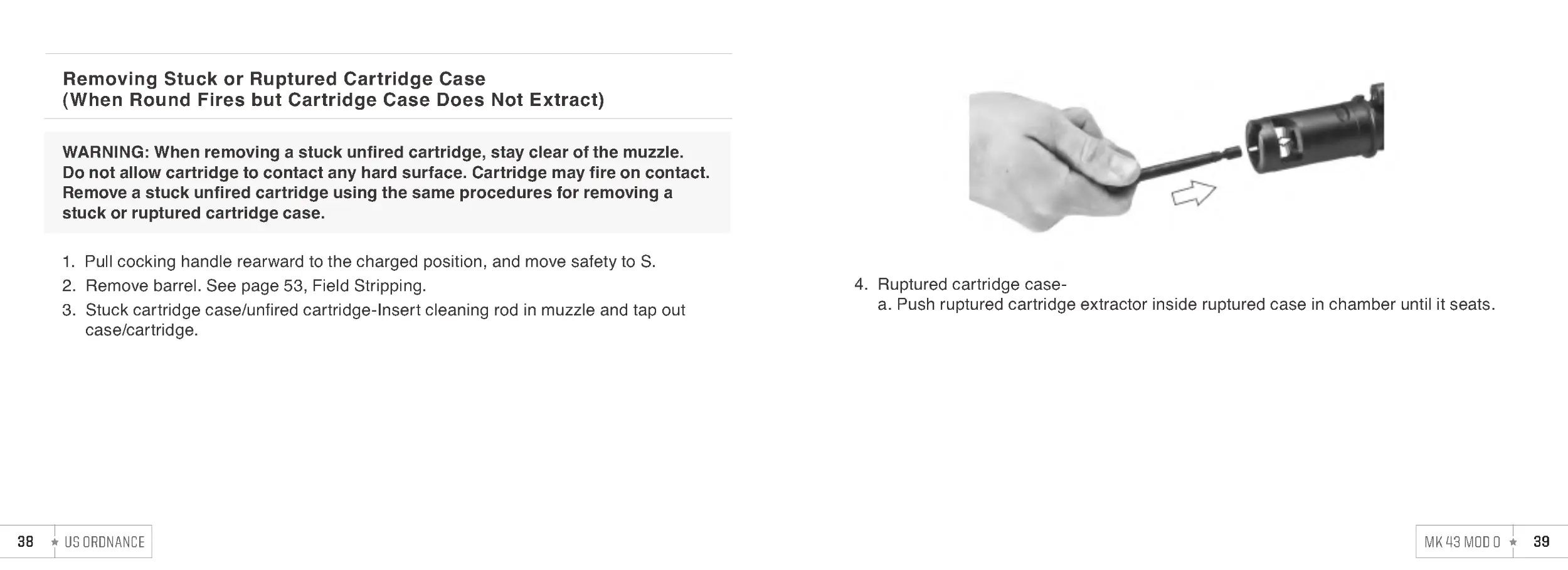
a. Push ruptured cartridge extractor inside ruptured case in chamber until it seats.

US ORDNANCE
40
MK43MOD0
41
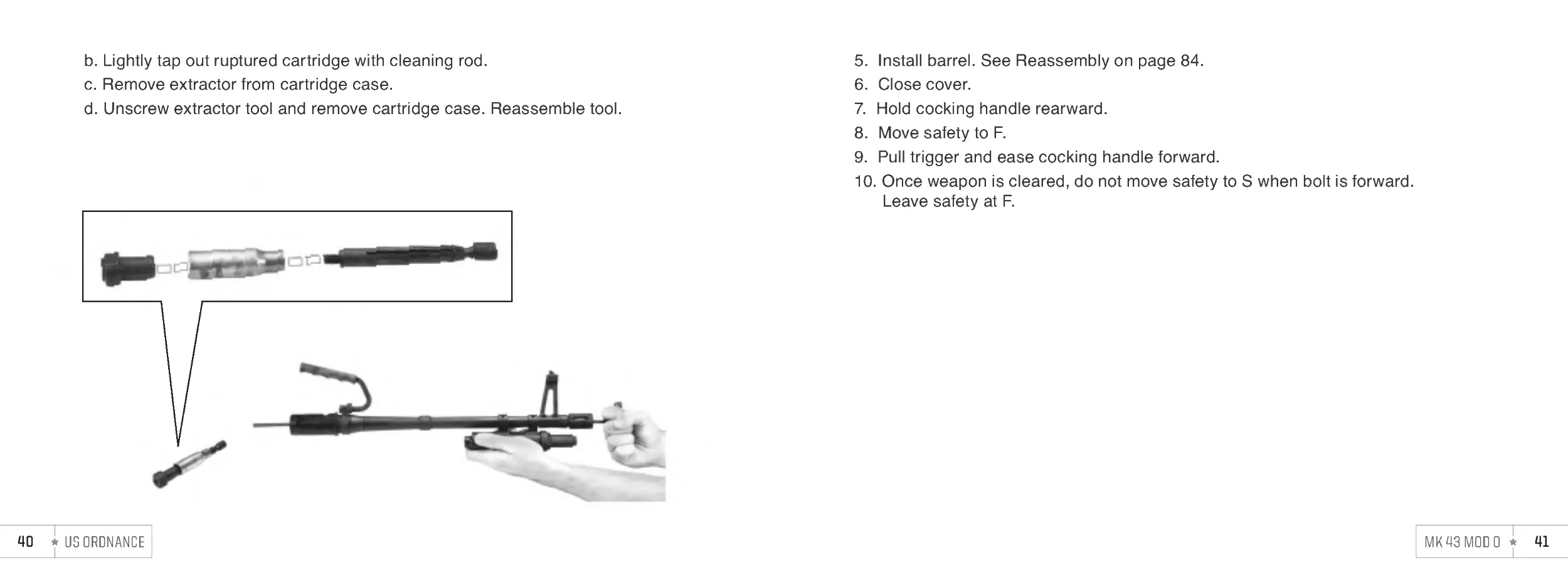
b. Lightly tap out ruptured cartridge with cleaning rod.
c. Remove extractor from cartridge case.
d. Unscrew extractor tool and remove cartridge case. Reassemble tool.
5. Install barrel. See Reassembly on page 84.
6. Close cover.
7. Hold cocking handle rearward.
8. Move safety to F.
9. Pull trigger and ease cocking handle forward.
10. Once weapon is cleared, do not move safety to S when bolt is forward.
Leave safety at F.

US ORDNANCE
42
MK43MOD0 43
Section iv. operation under unuSual conditionS
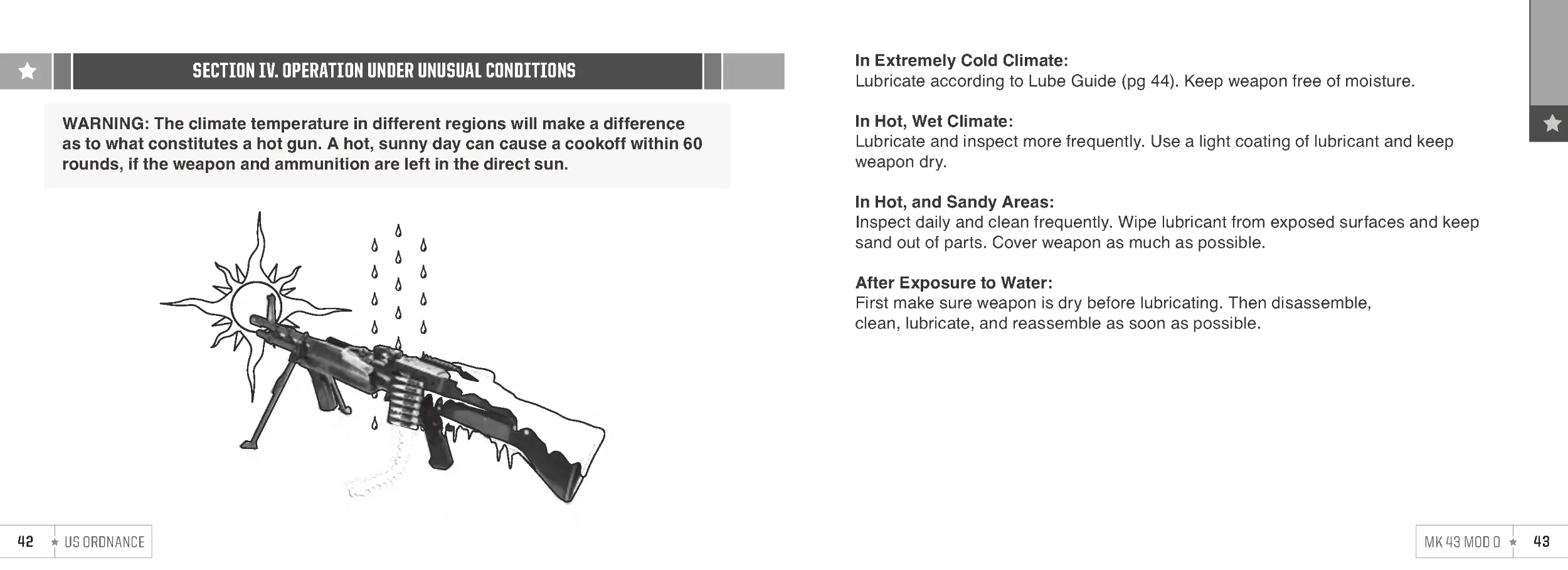
WARNING: The climate temperature in different regions will make a difference
as to what constitutes a hot gun. A hot, sunny day can cause a cookoff within 60
rounds, if the weapon and ammunition are left in the direct sun.
In Extremely Cold Climate:
Lubricate according to Lube Guide (pg 44). Keep weapon free of moisture.
In Hot, Wet Climate:
Lubricate and inspect more frequently. Use a light coating of lubricant and keep
weapon dry.
In Hot, and Sandy Areas:
Inspect daily and clean frequently. Wipe lubricant from exposed sur faces and keep
sand out of parts. Cover weapon as much as possible.
After Exposure to Water:
First make sure weapon is dry before lubricating. Then disassemble,
clean, lubricate, and reassemble as soon as possible.

US ORDNANCE
44
MK43MOD0 45
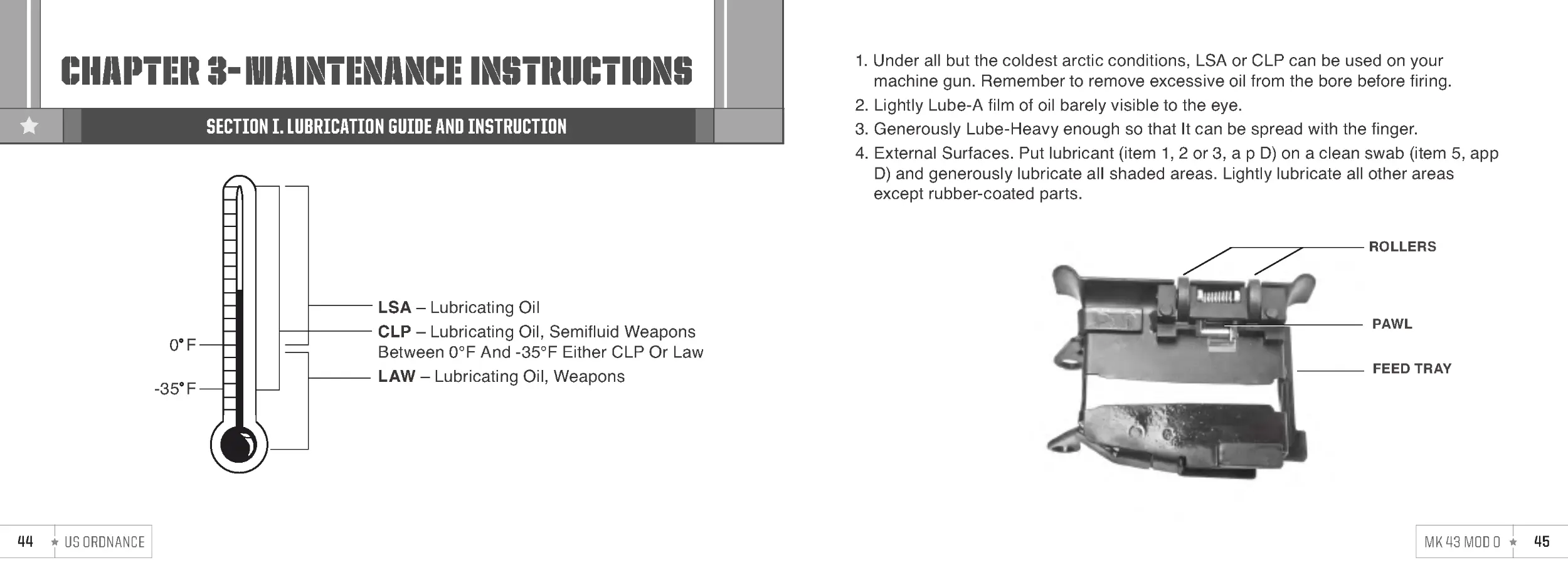
FEED TRAY
ROLLERS
PAWL
LSA – Lubricating Oil
CLP – Lubricating Oil, Semifluid Weapons
Between 0°F And -35°F Either CLP Or Law
L AW – Lubricating Oil, Weapons
1. Under all but the coldest arctic conditions, LSA or CLP can be used on your
machine gun. Remember to remove excessive oil from the bore before firing.
2. Lightly Lube-A film of oil barely visible to the eye.
3. Generously Lube-Heavy enough so that It can be spread with the finger.
4. External Surfaces. Put lubricant (item 1, 2 or 3, a p D) on a clean swab (item 5, app
D) and generously lubricate alI shaded areas. Lightly lubricate all other areas
except rubber-coated parts.
Section i. lubrication guide and inStruction
chapter 3– Maintenance Instructions
-35 F
0F

US ORDNANCE
46
MK43MOD0
47
FRONT CARTRIDGE GUIDE
REAR CARTRIDGE
GUIDE
ROLLER
ROLLER
CAMMING RECESS
LOCKING
LUG
RECEIvER
RAILS
RAILS
CAMMING LOCKING SURFACES
FEED CAM
Recommended Lubrication Areas
Section ii. troubleShooting procedureS
Introduction
The table lists the common malfunctions which you may find during the operation
or maintenance of the machine gun or its components. You should perform the test/
inspections and corrective actions in the order listed.
This manual cannot list all malfunctions that may occur nor all tests or inspections and
corrective actions. If a malfunction is not listed or is not corrected by listed corrective
actions, notify your supervisor.
WARNING: Keep weapon pointed at target impact area. Never stand in front of
weapon or expose body or hands to breech, ejection port, or muzzle.

US ORDNANCE
48
MK43MOD0 49
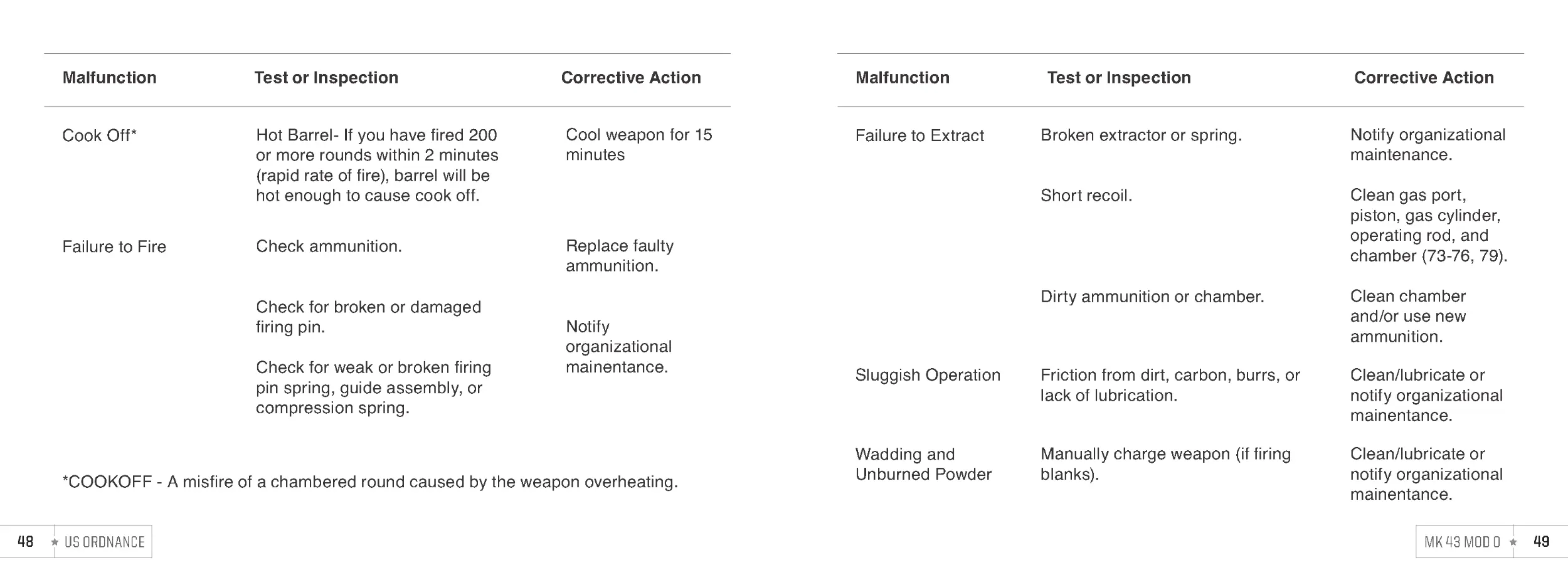
Malfunction
Test or Inspection
Corrective Action
Malfunction
Test or Inspection
Corrective Action
Cook Off*
Failure to Extract
Failure to Fire
Sluggish Operation
Wadding and
Unburned Powder
Hot Barrel- If you have fired 200
or more rounds within 2 minutes
(rapid rate of fire), barrel will be
hot enough to cause cook off.
Broken extractor or spring.
Shor t recoil.
Dirty ammunition or chamber.
Check ammunition.
Check for broken or damaged
firing pin.
Check for weak or broken firing
pin spring, guide assembly, or
compression spring.
Friction from dirt, carbon, burrs, or
lack of lubrication.
Manually charge weapon (if firing
blanks).
Cool weapon for 15
minutes
Notify organizational
maintenance.
Clean gas port,
piston, gas cylinder,
operating rod, and
chamber (73-76, 79).
Clean chamber
and/or use new
ammunition.
Replace faulty
ammunition.
Notify
organizational
mainentance.
Clean/lubricate or
notif y organizational
mainentance.
Clean/lubricate or
notif y organizational
mainentance.
*COOKOFF - A misfire of a chambered round caused by the weapon overheating.

US ORDNANCE
50
MK43MOD0
51
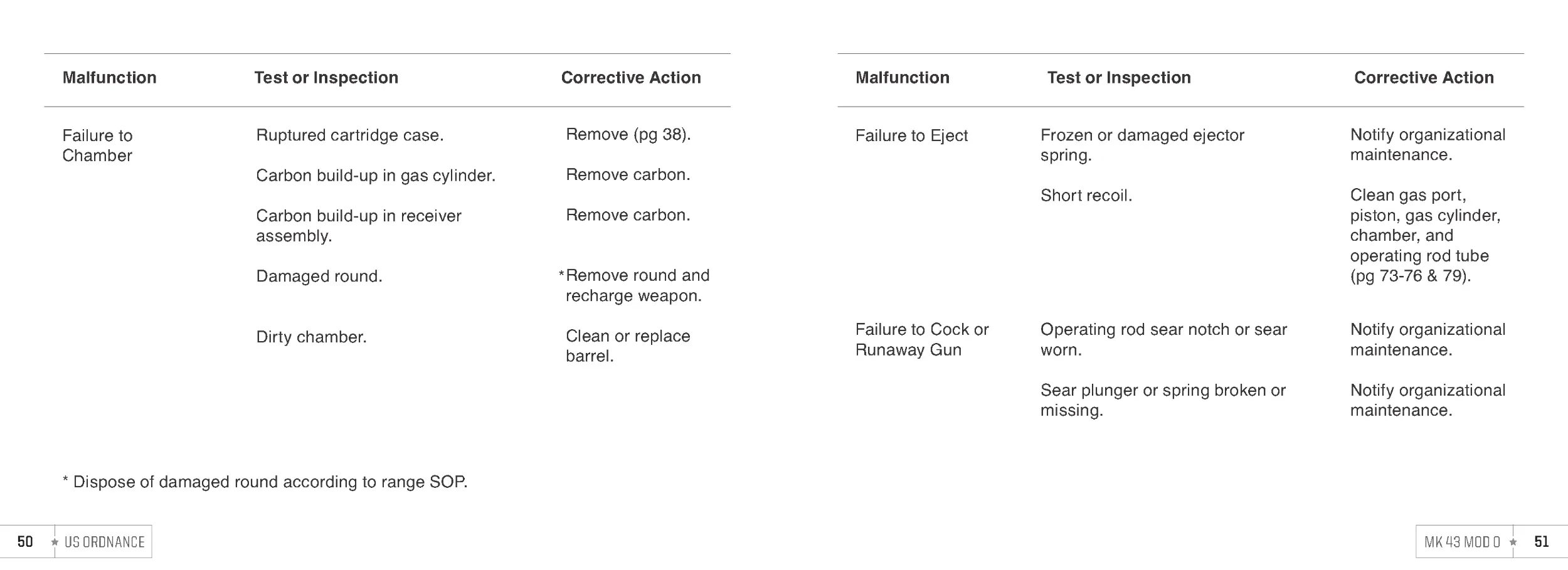
Malfunction
Test or Inspection
Corrective Action
Malfunction
Test or Inspection
Corrective Action
Failure to
Chamber
Failure to Eject
Failure to Cock or
Runaway Gun
Ruptured cartridge case.
Carbon build-up in gas cylinder.
Carbon build-up in receiver
assembly.
Damaged round.
Dirty chamber.
Frozen or damaged ejector
spring.
Shor t recoil.
Operating rod sear notch or sear
worn.
Sear plunger or spring broken or
missing.
Remove (pg 38).
Remove carbon.
Remove carbon.
Remove round and
recharge weapon.
Clean or replace
barrel.
Notify organizational
maintenance.
Clean gas port,
piston, gas cylinder,
chamber, and
operating rod tube
(pg 73-76 & 79).
Notify organizational
maintenance.
Notify organizational
maintenance.
* Dispose of damaged round according to range SOP.
*

US ORDNANCE
52
MK43MOD0 53
YOKE
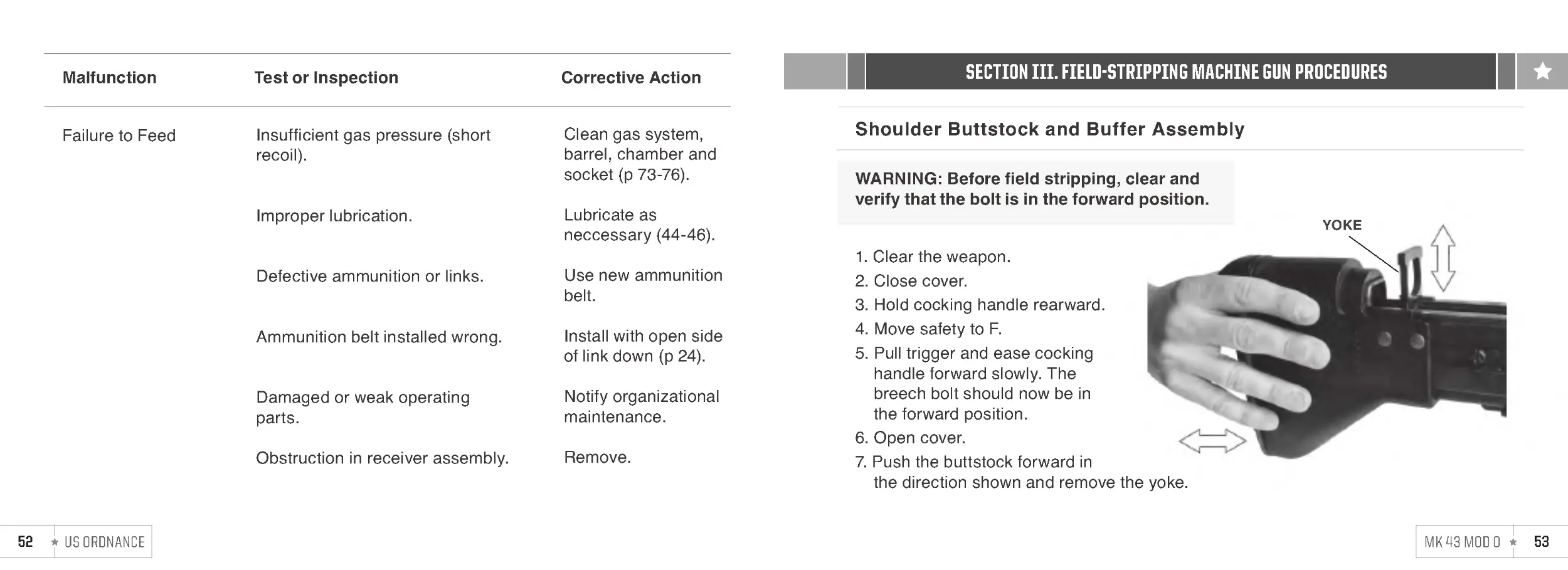
Malfunction
Test or Inspection
Corrective Action
Failure to Feed
Insufficient gas pressure (short
recoil).
Improper lubrication.
Defective ammunition or links.
Ammunition belt installed wrong.
Damaged or weak operating
parts.
Obstruction in receiver assembly.
Clean gas system,
barrel, chamber and
socket (p 73-76).
Lubricate as
neccessary (44-46).
Use new ammunition
belt.
Install with open side
of link down (p 24).
Notify organizational
maintenance.
Remove.
Section iii. field -Stripping machine gun procedureS
Shoulder Buttstock and Buffer Assembly
WARNING: Before field stripping, clear and
verify that the bolt is in the forward position.
1. Clear the weapon.
2. Close cover.
3. Hold cocking handle rearward.
4. Move safety to F.
5. Pull trigger and ease cocking
handle forward slowly. The
breech bolt should now be in
the forward position.
6. Open cover.
7. Push the buttstock forward in
the direction shown and remove the yoke.

US ORDNANCE
54
MK43MOD0 55
BUFFER ASSEMBLY
DRIvE SPRING
DRIvE SPRING
GUIDE
RECEIvER
BUTTSTOCK
BUFFER
ASSEMBLY
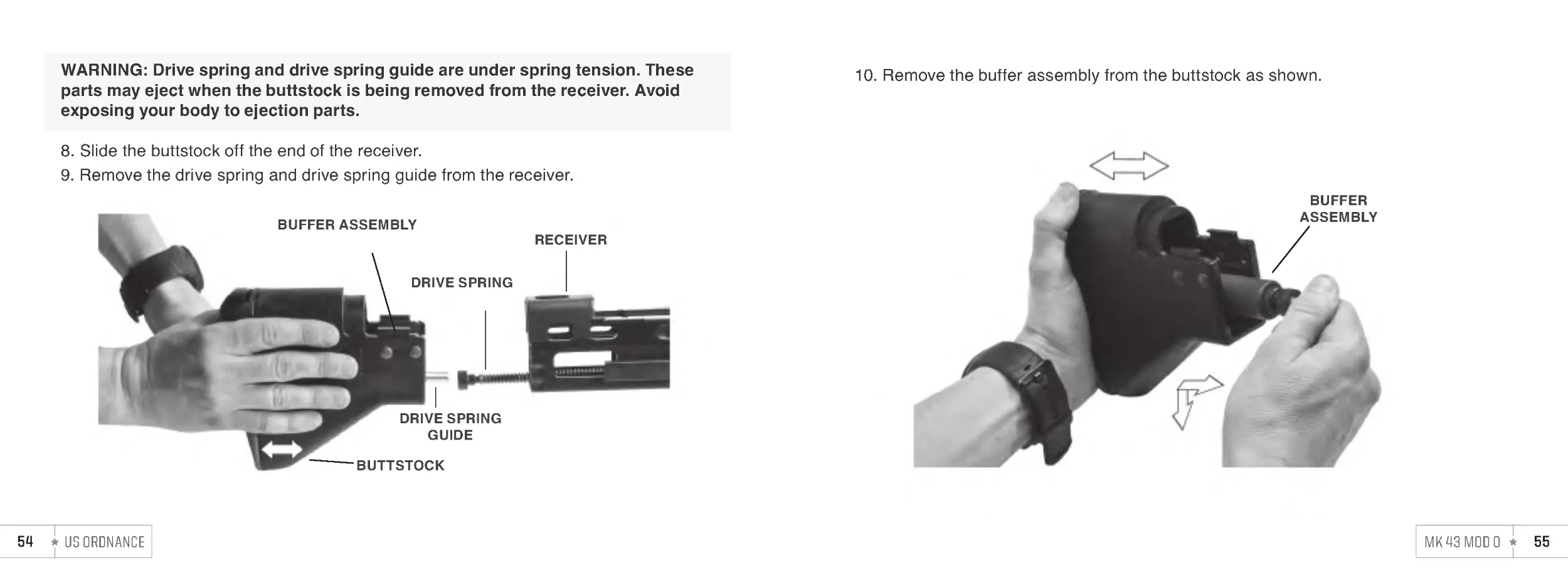
WARNING: Drive spring and drive spring guide are under spring tension. These
parts may eject when the buttstock is being removed from the receiver. Avoid
exposing your body to ejection parts.
8. Slide the buttstock off the end of the receiver.
9. Remove the drive spring and drive spring guide from the receiver.
10. Remove the buffer assembly from the buttstock as shown.

US ORDNANCE
56
MK43MOD0
57
SAFETY
TRIGGER
COCKING
HANDLE
BOLT ASSEMBLY
RECEIvER
OPERATING ROD
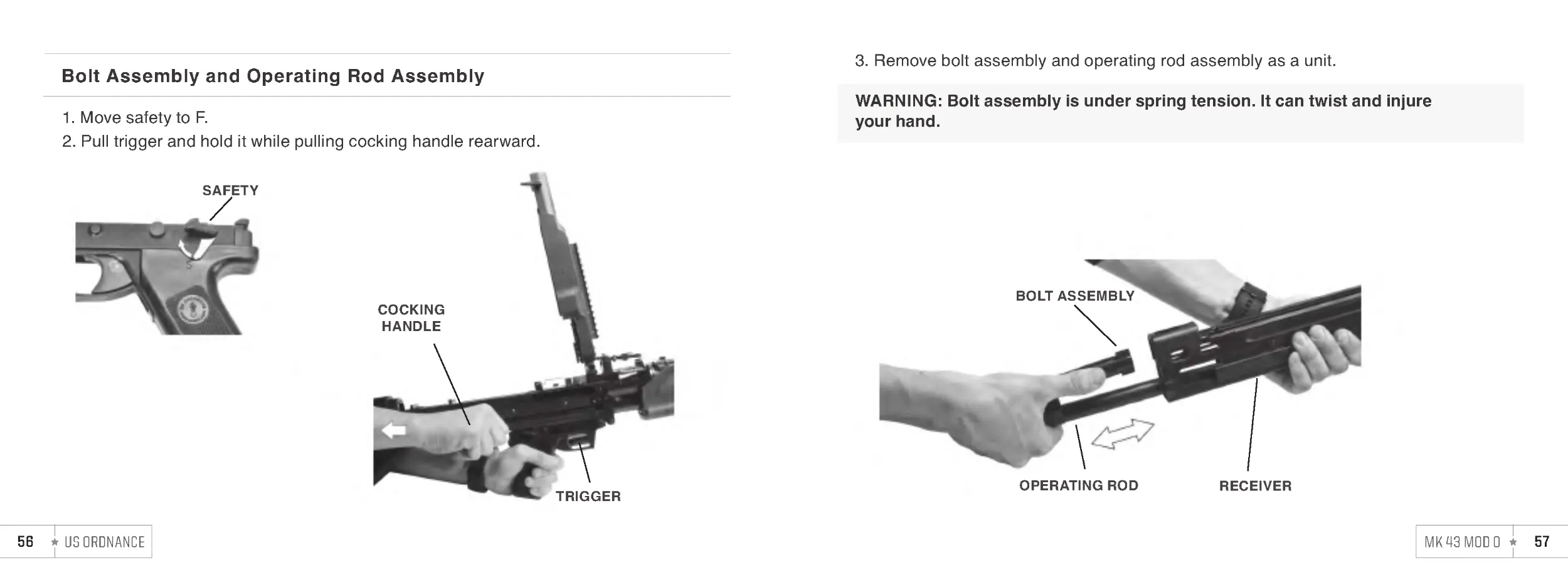
Bolt Assembly and Operating Rod Assembly
1. Move safety to F.
2. Pull trigger and hold it while pulling cocking handle rearward.
3. Remove bolt assembly and operating rod assembly as a unit.
WARNING: Bolt assembly is under spring tension. It can twist and injure
your hand.

US ORDNANCE
58
MK43MOD0 59
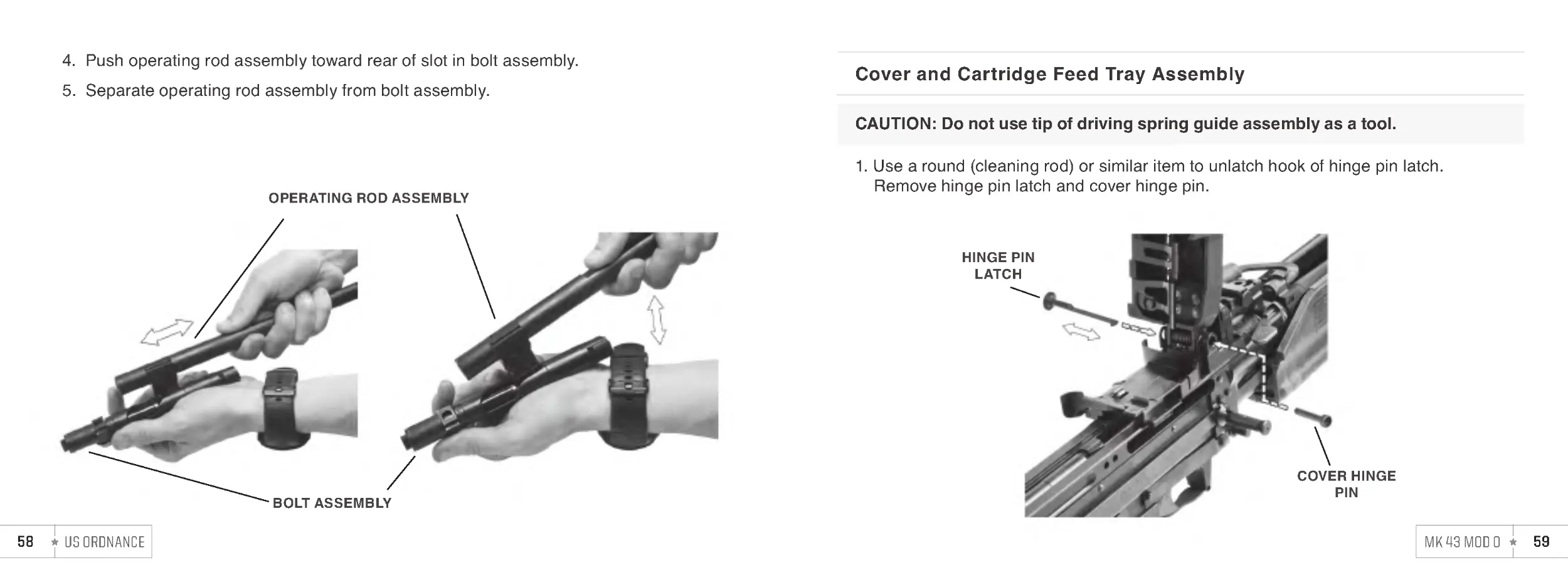
4. Push operating rod assembly toward rear of slot in bolt assembly.
5. Separate operating rod assembly from bolt assembly.
1. Use a round (cleaning rod) or similar item to unlatch hook of hinge pin latch.
Remove hinge pin latch and cover hinge pin.
OPERATING ROD ASSEMBLY
BOLT ASSEMBLY
HINGE PIN
LATCH
COvER HINGE
PIN
Cover and Cartridge Feed Tray Assembly
CAUTION: Do not use tip of driving spring guide assembly as a tool.

US ORDNANCE
60
MK43MOD0
61
COvER ASSEMBLY
TORSION
SPRING
CARTRIDGE FEED
TRAY ASSEMBLY
SPRING
DETENT
BARREL LOCK
LEvER
BARREL AND HANDLE
ASSEMBLY
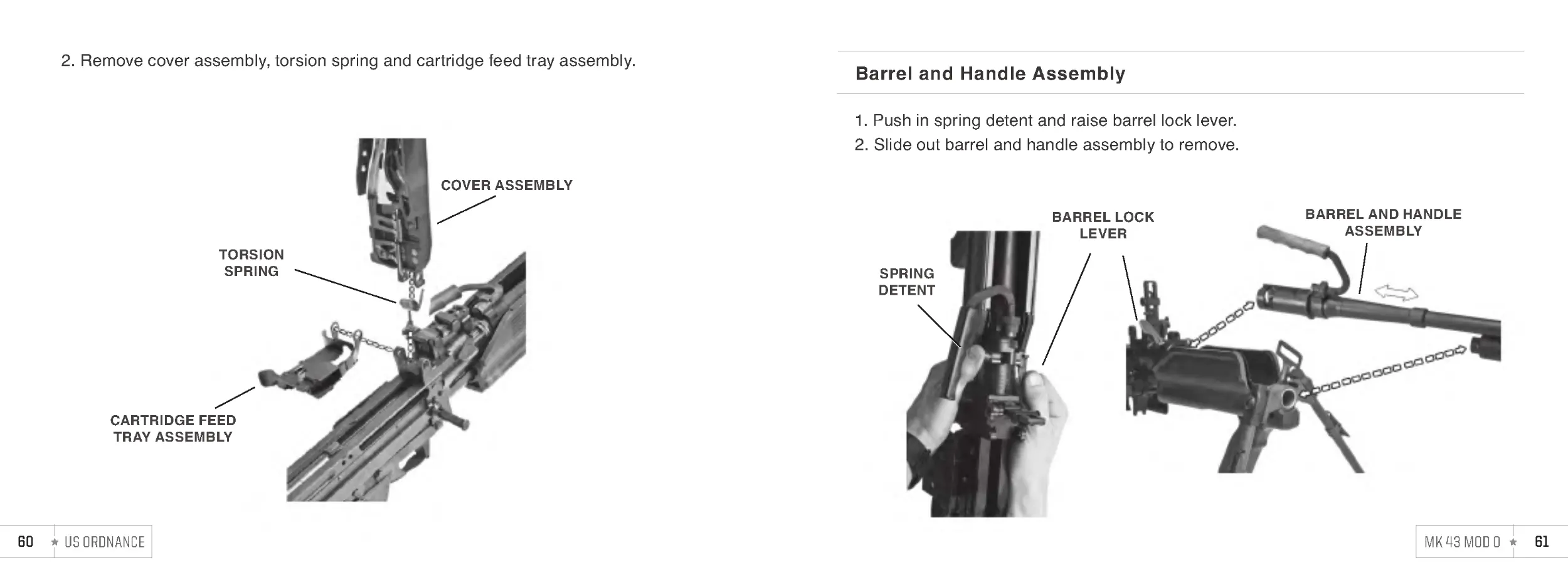
2. Remove cover assembly, torsion spring and cartridge feed tray assembly.
1. Push in spring detent and raise barrel lock lever.
2. Slide out barrel and handle assembly to remove.
Barrel and Handle Assembly

US ORDNANCE
62
MK43MOD0 63
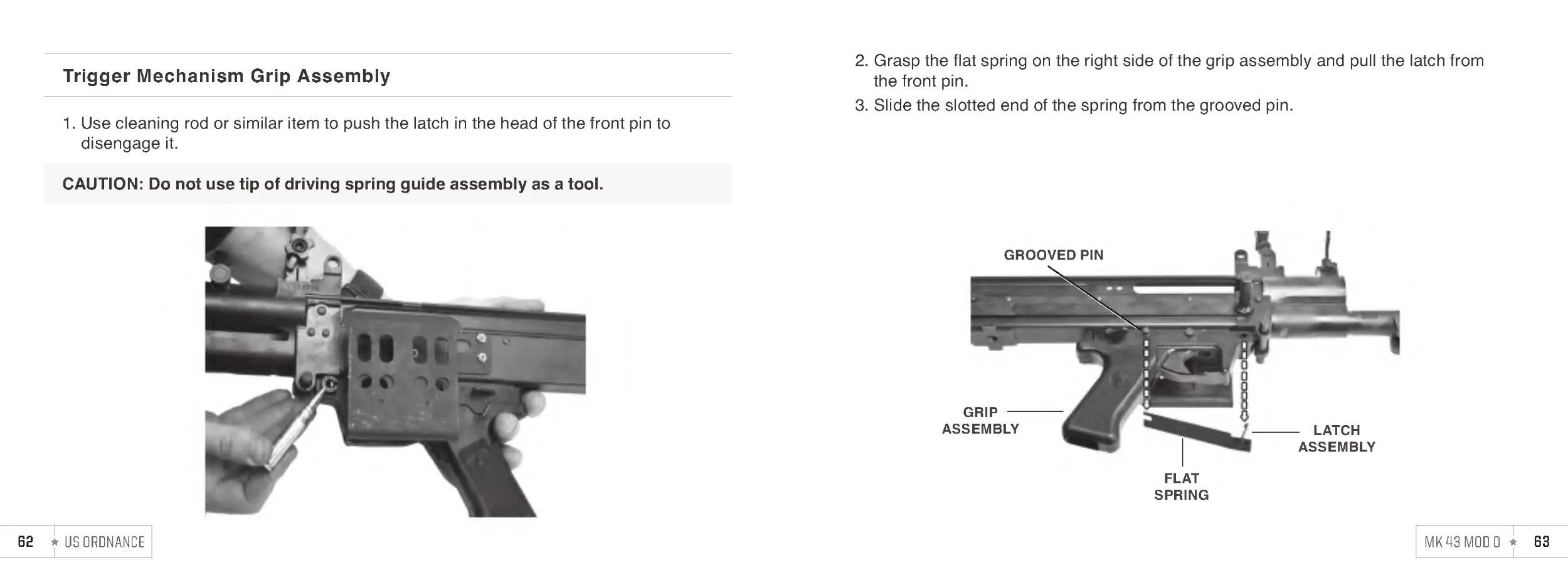
GROOvED PIN
GRIP
ASSEMBLY
FLAT
SPRING
LATCH
ASSEMBLY
2. Grasp the flat spring on the right side of the grip assembly and pull the latch from
the front pin.
3. Slide the slotted end of the spring from the grooved pin.
1. Use cleaning rod or similar item to push the latch in the head of the front pin to
disengage it.
Trigger Mechanism Grip Assembly
CAUTION: Do not use tip of driving spring guide assembly as a tool.

US ORDNANCE
64
MK43MOD0 65
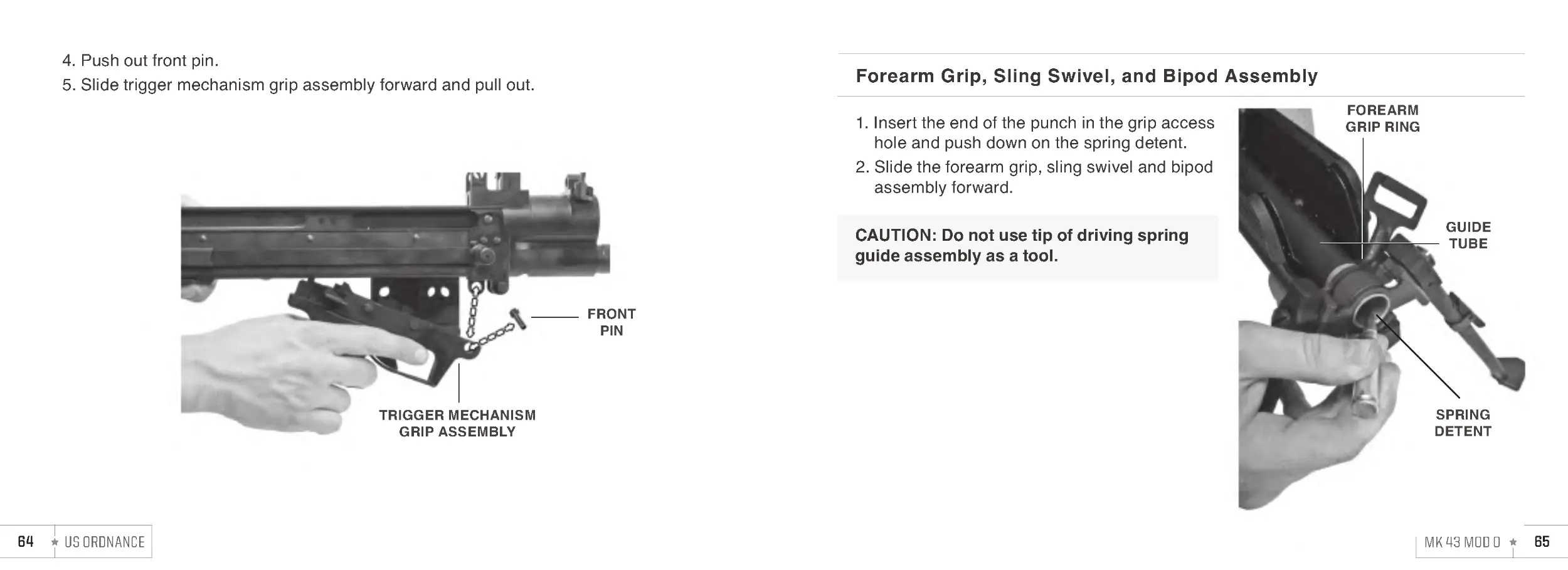
4. Push out front pin.
5. Slide trigger mechanism grip assembly forward and pull out.
FRONT
PIN
TRIGGER MECHANISM
GRIP ASSEMBLY
1. Insert the end of the punch in the grip access
hole and push down on the spring detent.
2. Slide the forearm grip, sling swivel and bipod
assembly forward.
Forearm Grip, Sling Swivel, and Bipod Assembly
CAUTION: Do not use tip of driving spring
guide assembly as a tool.
SPRING
DETENT
FOREARM
GRIP RING
GUIDE
TUBE

US ORDNANCE
66
MK43MOD0 67
Bolt Assembly and Operating Rod Assembly
Inspect and Clean Bolt Assembly
I. Inspect bolt assembly for burrs and cracks.
2. Make sure roller operates freely and is not cracked.
NOTE: Rotate cam actuator assembly so holes line up with headless straight pin.
Use reamer of combination wrench to remove or replace headless straight pin.
3. Remove headless straight pin and unscrew bolt plug assembly. Remove cam
actuator assembly from breech bolt. Separate spring, guide, and firing pin.
4. Make sure spring is not kinked.
5. Inspect threads on bolt plug assembly and in breech bolt for damage.
6. Clean powder fouling, corrosion, and dirt from all parts.
Sección iv. limpieza e inSpección
Section iv. cleaning and inSpection
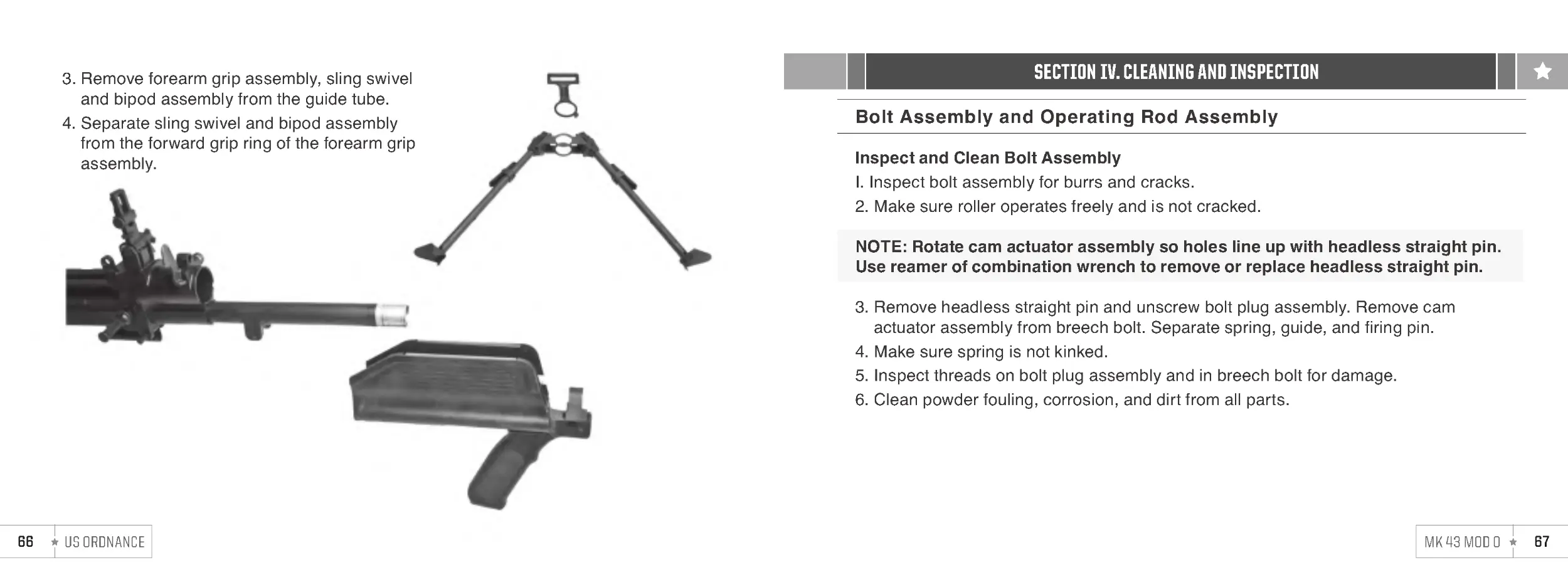
3. Remove forearm grip assembly, sling swivel
and bipod assembly from the guide tube.
4. Separate sling swivel and bipod assembly
from the forward grip ring of the forearm grip
assembly.

US ORDNANCE
68
MK43MOD0 69
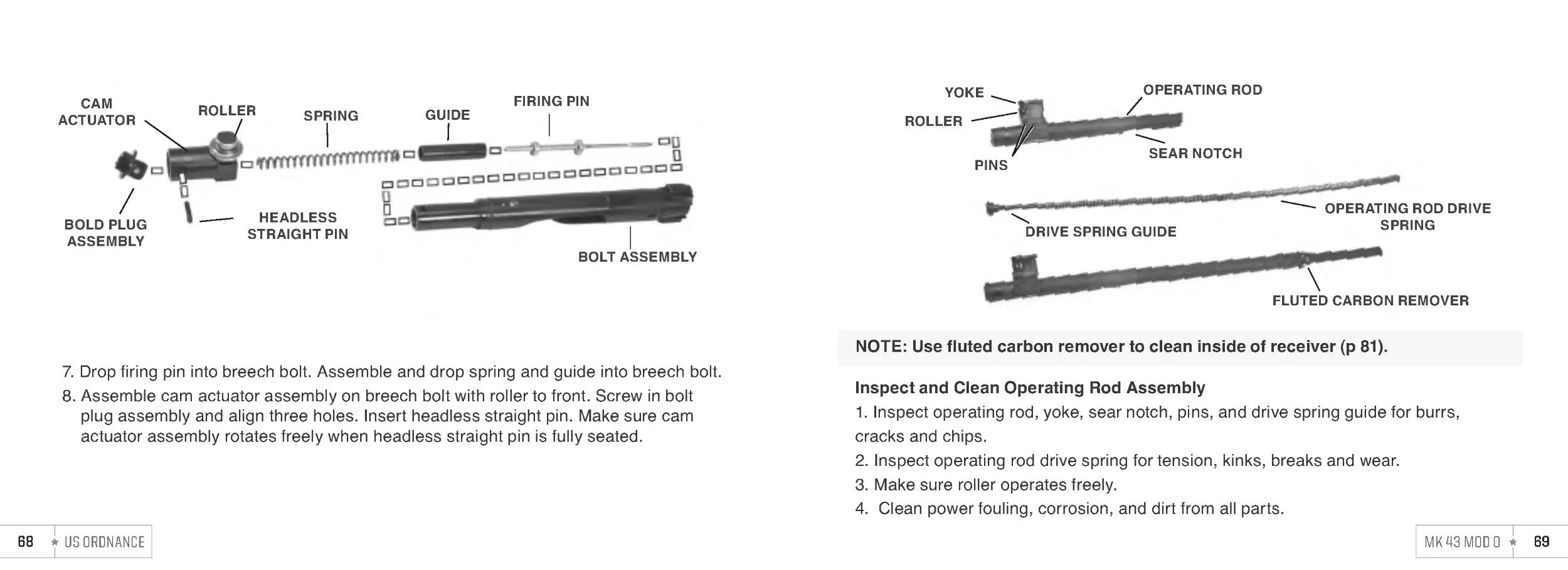
FIRING PIN
BOLT ASSEMBLY
GUIDE
SPRING
ROLLER
HEADLESS
STRAIGHT PIN
BOLD PLUG
ASSEMBLY
CAM
ACTUATOR
PINS
ROLLER
YOKE
OPERATING ROD
SEAR NOTCH
DRIvE SPRING GUIDE
OPERATING ROD DRIvE
SPRING
FLUTED CARBON REMOvER
7. Drop firing pin into breech bolt. Assemble and drop spring and guide into breech bolt.
8. Assemble cam actuator assembly on breech bolt with roller to front. Screw in bolt
plug assembly and align three holes. Insert headless straight pin. Make sure cam
actuator assembly rotates freely when headless straight pin is fully seated.
Inspect and Clean Operating Rod Assembly
1. Inspect operating rod, yoke, sear notch, pins, and drive spring guide for burrs,
cracks and chips.
2. Inspect operating rod drive spring for tension, kinks, breaks and wear.
3. Make sure roller operates freely.
4. Clean power fouling, corrosion, and dirt from all par ts.
NOTE: Use fluted carbon remover to clean inside of receiver (p 81).

US ORDNANCE
70
MK43MOD0
71
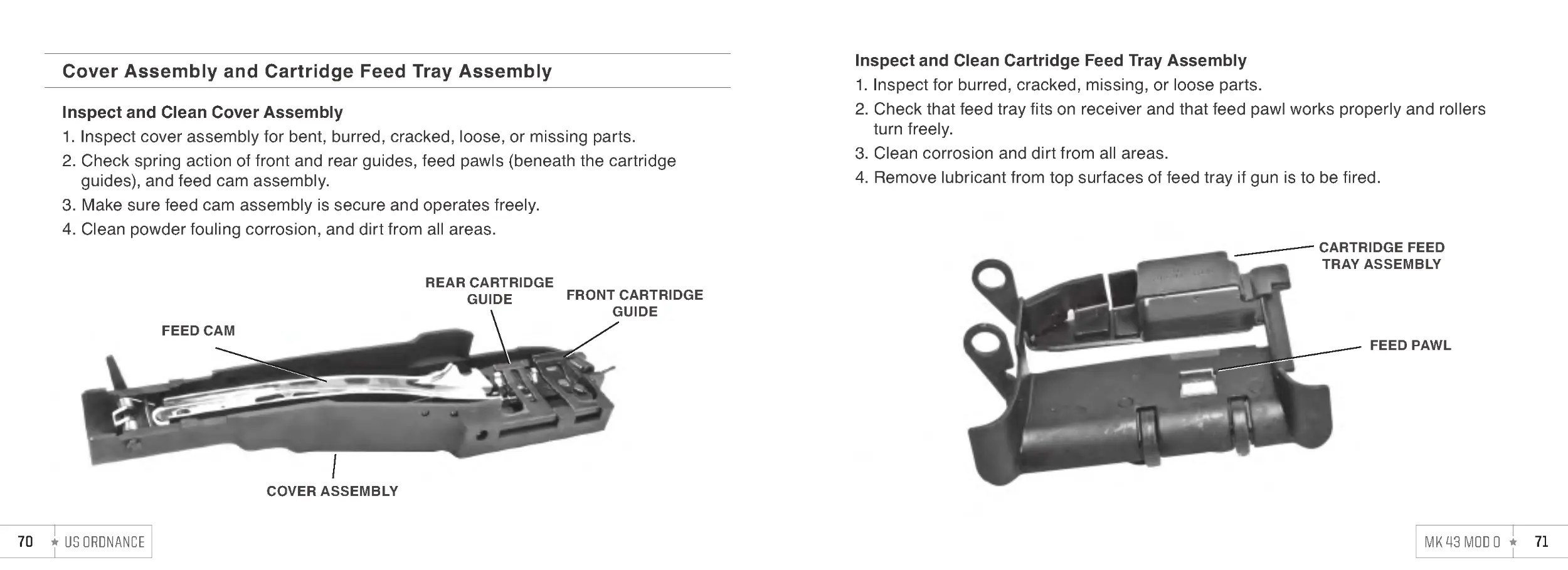
FEED CAM
COvER ASSEMBLY
REAR CARTRIDGE
GUIDE
FRONT CARTRIDGE
GUIDE
CARTRIDGE FEED
TRAY ASSEMBLY
FEED PAWL
Cover Assembly and Cartridge Feed Tray Assembly
Inspect and Clean Cover Assembly
1. Inspect cover assembly for bent, burred, cracked, loose, or missing parts.
2. Check spring action of front and rear guides, feed pawls (beneath the cartridge
guides), and feed cam assembly.
3. Make sure feed cam assembly is secure and operates freely.
4. Clean powder fouling corrosion, and dir t from all areas.
Inspect and Clean Cartridge Feed Tray Assembly
1. Inspect for burred, cracked, missing, or loose parts.
2. Check that feed tray fits on receiver and that feed pawl works properly and rollers
turn freely.
3. Clean corrosion and dirt from all areas.
4. Remove lubricant from top surfaces of feed tray if gun is to be fired.

US ORDNANCE
72
MK43MOD0
73
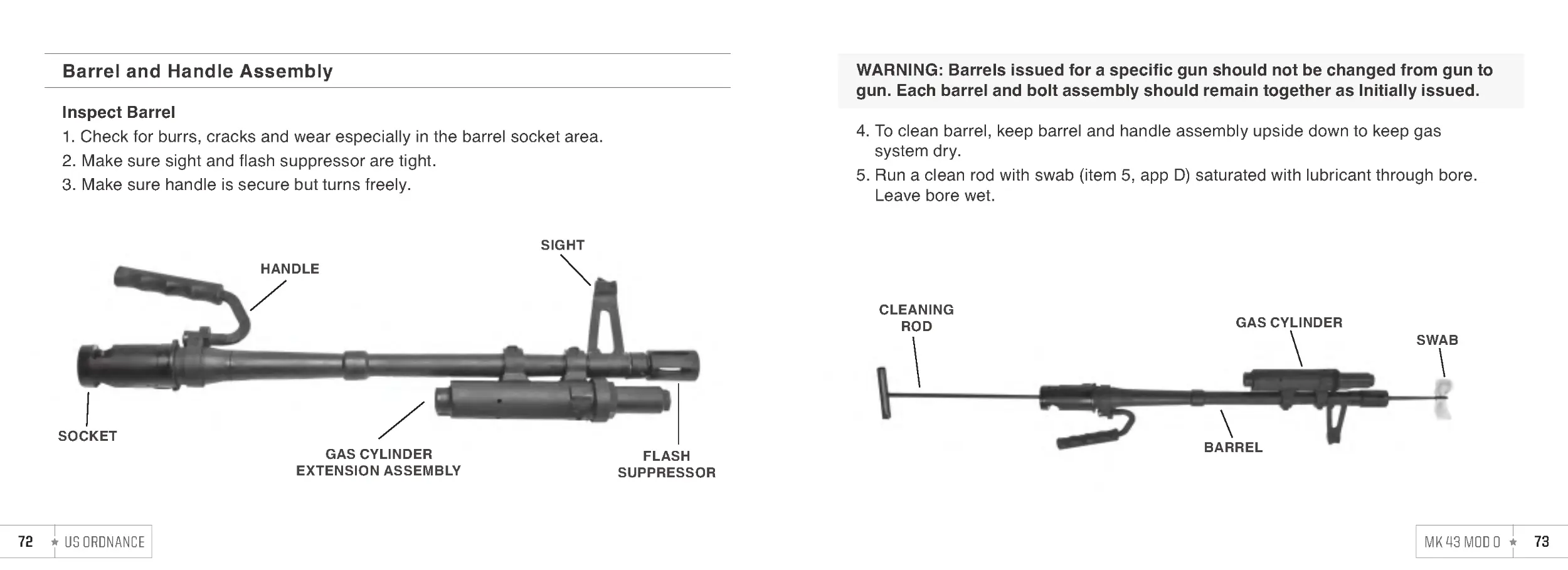
SIGHT
HANDLE
GAS CYLINDER
EXTENSION ASSEMBLY
FLASH
SUPPRESSOR
SOCKET
GAS CYLINDER
CLEANING
ROD
SWAB
BARREL
Barrel and Handle Assembly
Inspect Barrel
1. Check for burrs, cracks and wear especially in the barrel socket area.
2. Make sure sight and flash suppressor are tight.
3. Make sure handle is secure but turns freely.
WARNING: Barrels issued for a specific gun should not be changed from gun to
gun. Each barrel and bolt assembly should remain together as Initially issued.
4. To clean barrel, keep barrel and handle assembly upside down to keep gas
system dry.
5. Run a clean rod with swab (item 5, app D) saturated with lubricant through bore.
Leave bore wet.

US ORDNANCE
74
MK43MOD0
75
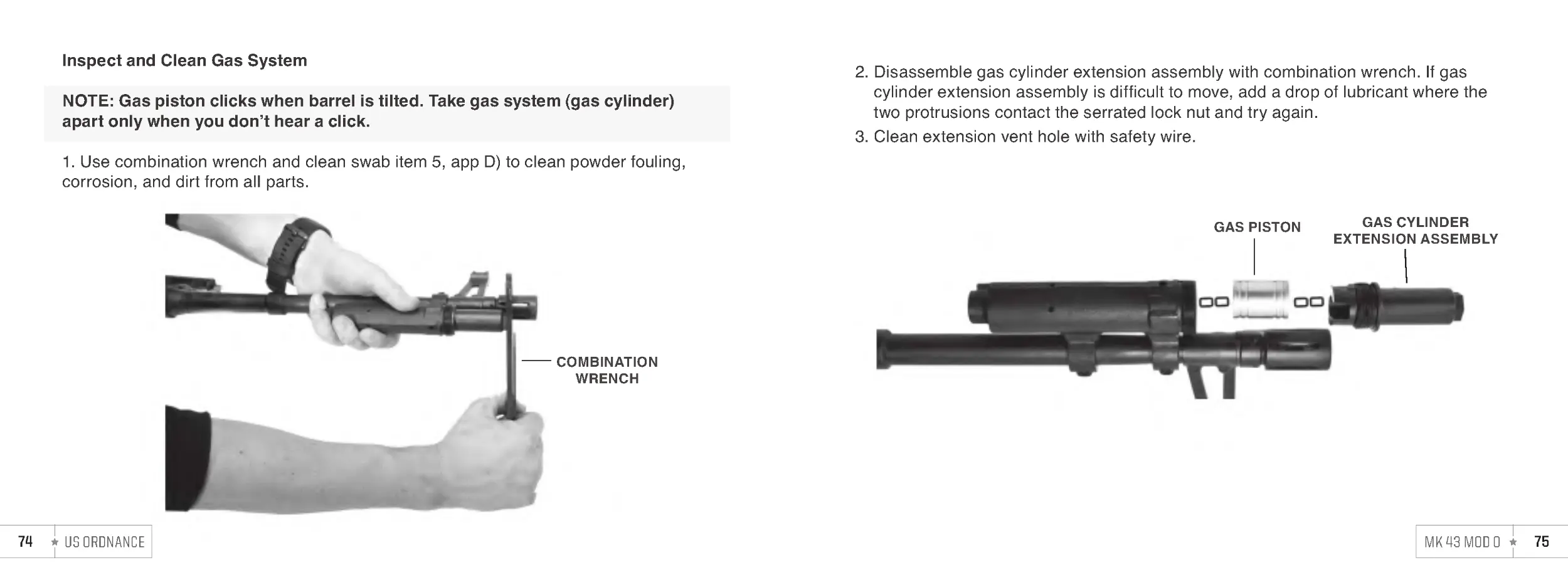
Inspect and Clean Gas System
NOTE: Gas piston clicks when barrel is tilted. Take gas system (gas cylinder)
apart only when you don’t hear a click.
1. Use combination wrench and clean swab item 5, app D) to clean powder fouling,
corrosion, and dirt from alI parts.
COMBINATION
WRENCH
GAS PISTON
GAS CYLINDER
EXTENSION ASSEMBLY
2. Disassemble gas cylinder extension assembly with combination wrench. If gas
cylinder extension assembly is difficult to move, add a drop of lubricant where the
two protrusions contact the serrated lock nut and try again.
3. Clean extension vent hole with safety wire.

US ORDNANCE
76
MK43MOD0
77
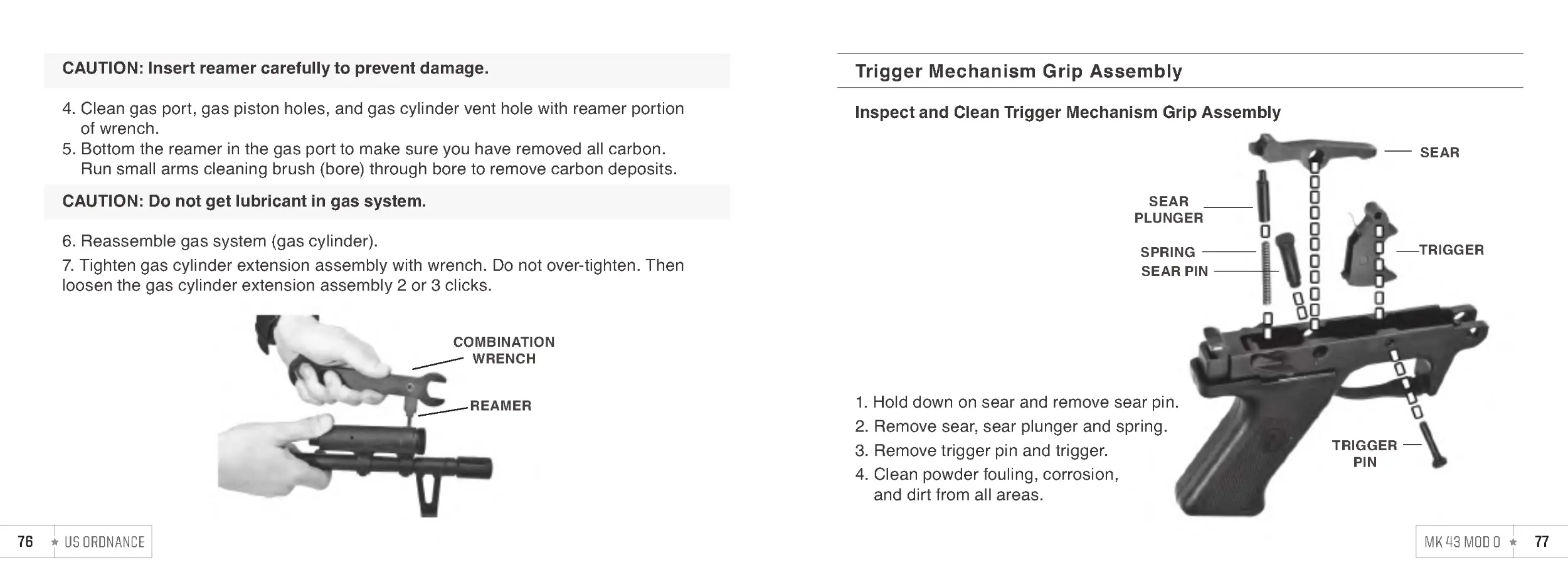
REAMER
COMBINATION
WRENCH
SEAR
TRIGGER
TRIGGER
PIN
SEAR PIN
SPRING
SEAR
PLUNGER
CAUTION: Insert reamer carefully to prevent damage.
4. Clean gas port, gas piston holes, and gas cylinder vent hole with reamer portion
of wrench.
5. Bottom the reamer in the gas port to make sure you have removed all carbon.
Run small arms cleaning brush (bore) through bore to remove carbon deposits.
CAUTION: Do not get lubricant in gas system.
6. Reassemble gas system (gas cylinder).
7. Tighten gas cylinder extension assembly with wrench. Do not over-tighten. Then
loosen the gas cylinder extension assembly 2 or 3 clicks.
Trigger Mechanism Grip Assembly
Inspect and Clean Trigger Mechanism Grip Assembly
1. Hold down on sear and remove sear pin.
2. Remove sear, sear plunger and spring.
3. Remove trigger pin and trigger.
4. Clean powder fouling, corrosion,
and dirt from all areas.

US ORDNANCE
78
MK43MOD0 79
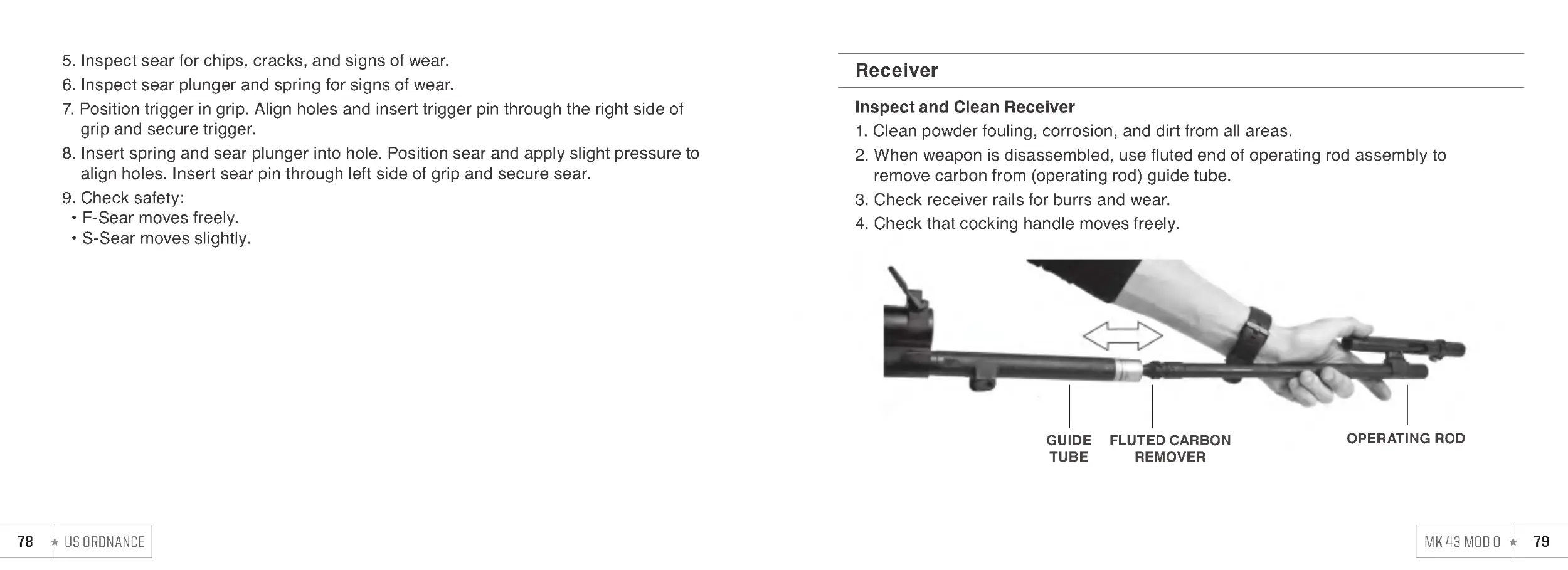
OPERATING ROD
FLUTED CARBON
REMOvER
GUIDE
TUBE
5. Inspect sear for chips, cracks, and signs of wear.
6. Inspect sear plunger and spring for signs of wear.
7. Position trigger in grip. Align holes and insert trigger pin through the right side of
grip and secure trigger.
8. Insert spring and sear plunger into hole. Position sear and apply slight pressure to
align holes. Insert sear pin through left side of grip and secure sear.
9. Check safety:
• F-Sear moves freely.
• S -Sear moves slightly.
Receiver
Inspect and Clean Receiver
1. Clean powder fouling, corrosion, and dirt from all areas.
2. When weapon is disassembled, use fluted end of operating rod assembly to
remove carbon from (operating rod) guide tube.
3. Check receiver rails for burrs and wear.
4. Check that cocking handle moves freely.

US ORDNANCE
80
MK43MOD0
81
Sección iv. limpieza e inSpección
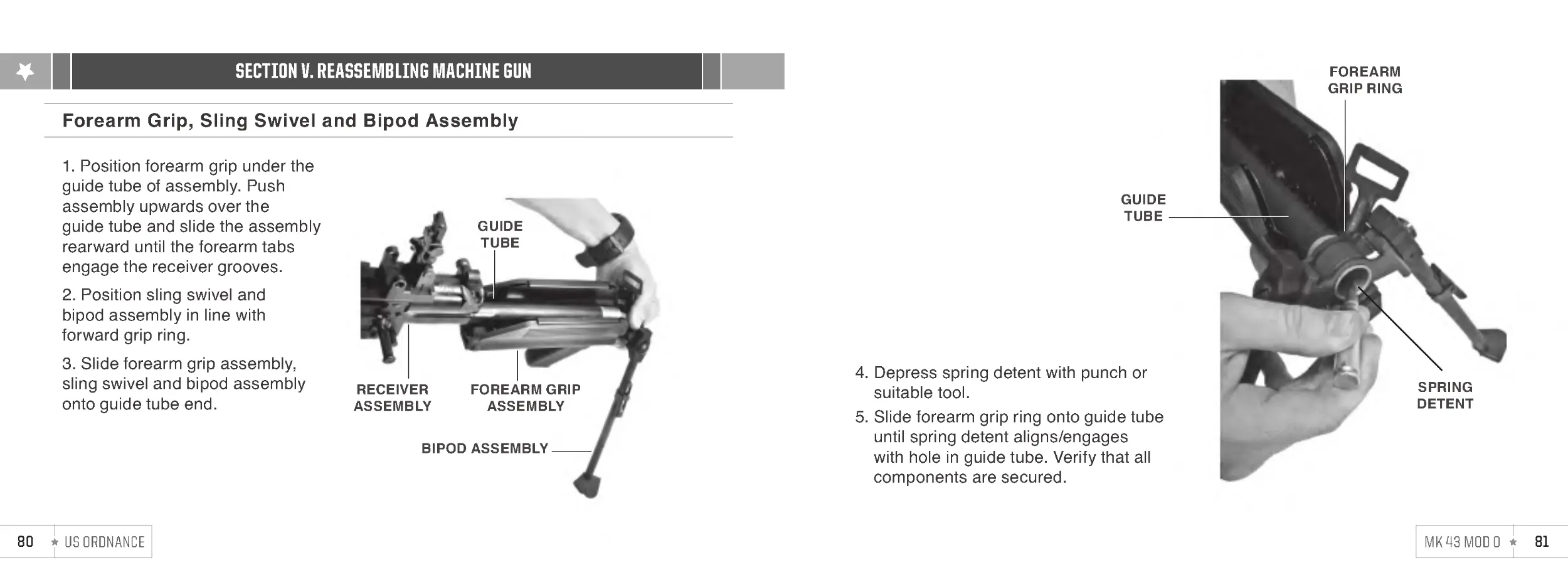
Forearm Grip, Sling Swivel and Bipod Assembly
1. Position forearm grip under the
guide tube of assembly. Push
assembly upwards over the
guide tube and slide the assembly
rearward until the forearm tabs
engage the receiver grooves.
2. Position sling swivel and
bipod assembly in line with
forward grip ring.
3. Slide forearm grip assembly,
sling swivel and bipod assembly
onto guide tube end.
Section v. reaSSembling machine gun
BIPOD ASSEMBLY
RECEIvER
ASSEMBLY
GUIDE
TUBE
FOREARM GRIP
ASSEMBLY
SPRING
DETENT
FOREARM
GRIP RING
GUIDE
TUBE
4. Depress spring detent with punch or
suitable tool.
5. Slide forearm grip ring onto guide tube
until spring detent aligns/engages
with hole in guide tube. Verify that all
components are secured.

US ORDNANCE
82
MK43MOD0 83
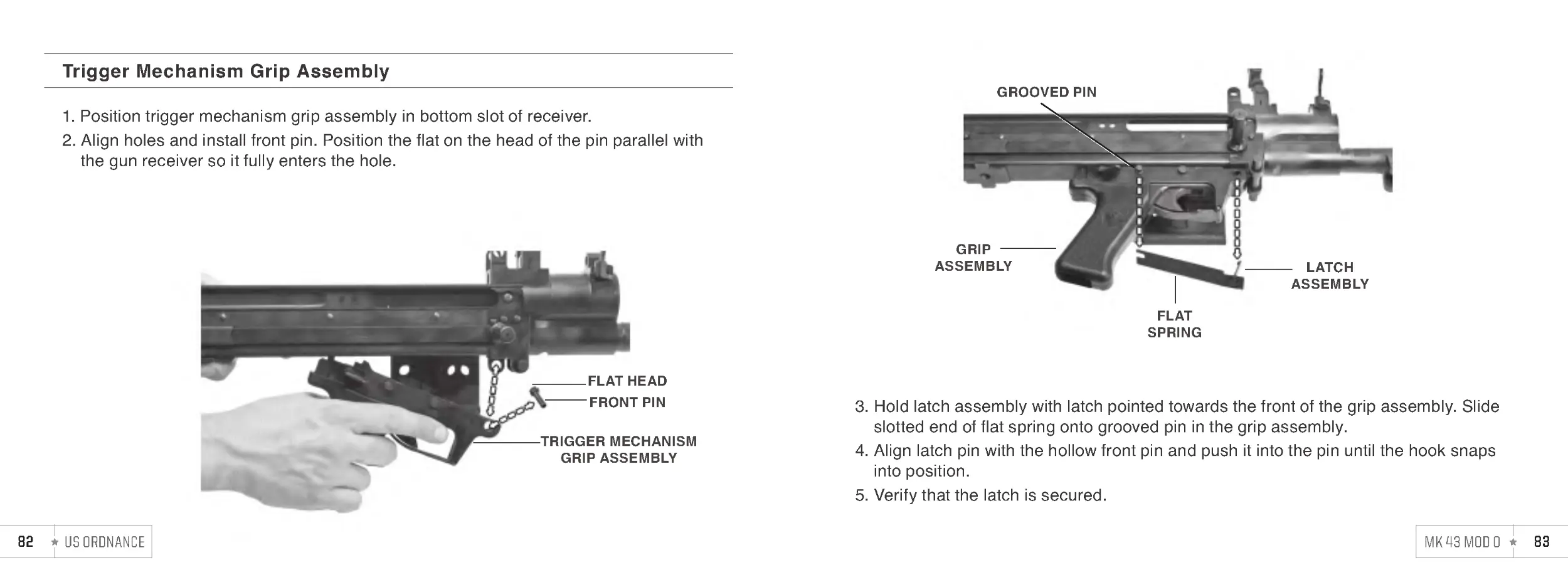
Trigger Mechanism Grip Assembly
1. Position trigger mechanism grip assembly in bottom slot of receiver.
2. Align holes and install front pin. Position the flat on the head of the pin parallel with
the gun receiver so it fully enters the hole.
FLAT HEAD
FRONT PIN
TRIGGER MECHANISM
GRIP ASSEMBLY
3. Hold latch assembly with latch pointed towards the front of the grip assembly. Slide
slotted end of flat spring onto grooved pin in the grip assembly.
4. Align latch pin with the hollow front pin and push it into the pin until the hook snaps
into position.
5. Verify that the latch is secured.
GROOvED PIN
GRIP
ASSEMBLY
FLAT
SPRING
LATCH
ASSEMBLY

US ORDNANCE
84
MK43MOD0 85
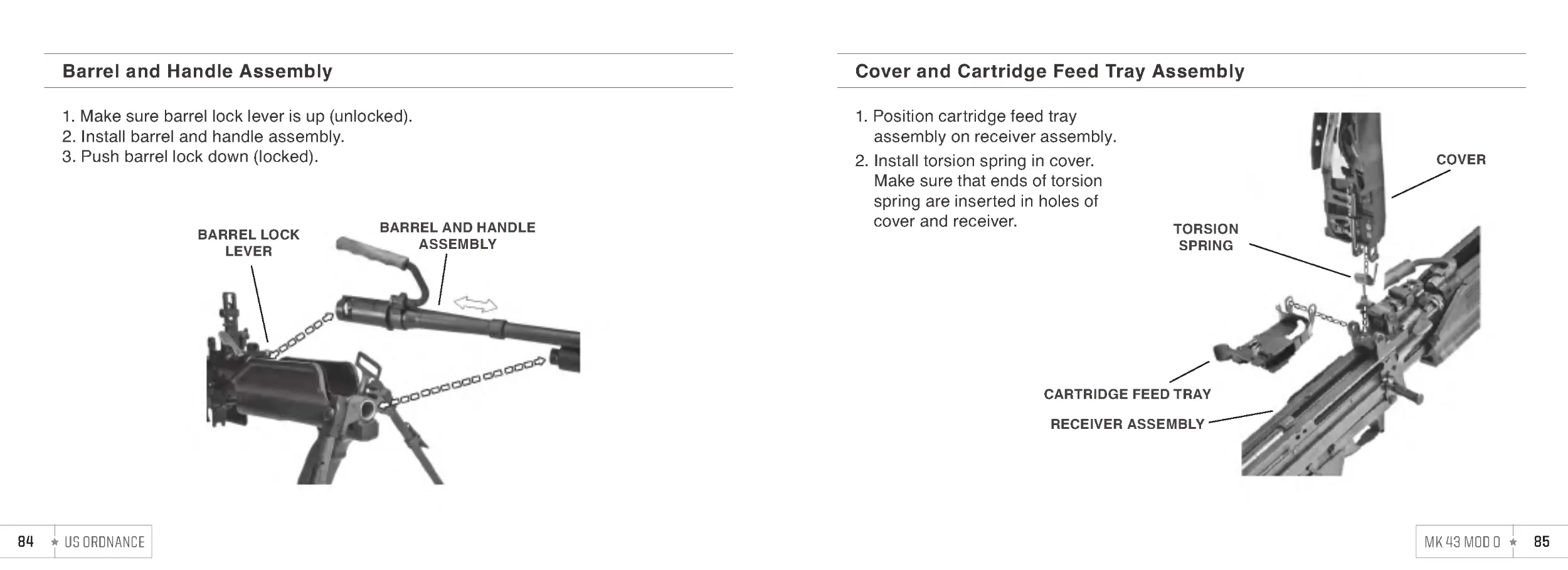
BARREL LOCK
LEvER
BARREL AND HANDLE
ASSEMBLY
COvER
TORSION
SPRING
CARTRIDGE FEED TRAY
RECEIvER ASSEMBLY
Barrel and Handle Assembly
1. Make sure barrel lock lever is up (unlocked).
2. Install barrel and handle assembly.
3. Push barrel lock down (locked).
Cover and Cartridge Feed Tray Assembly
1. Position car tridge feed tray
assembly on receiver assembly.
2. Install torsion spring in cover.
Make sure that ends of torsion
spring are inserted in holes of
cover and receiver.

US ORDNANCE
86
MK43MOD0 87
OPERATING ROD ASSEMBLY
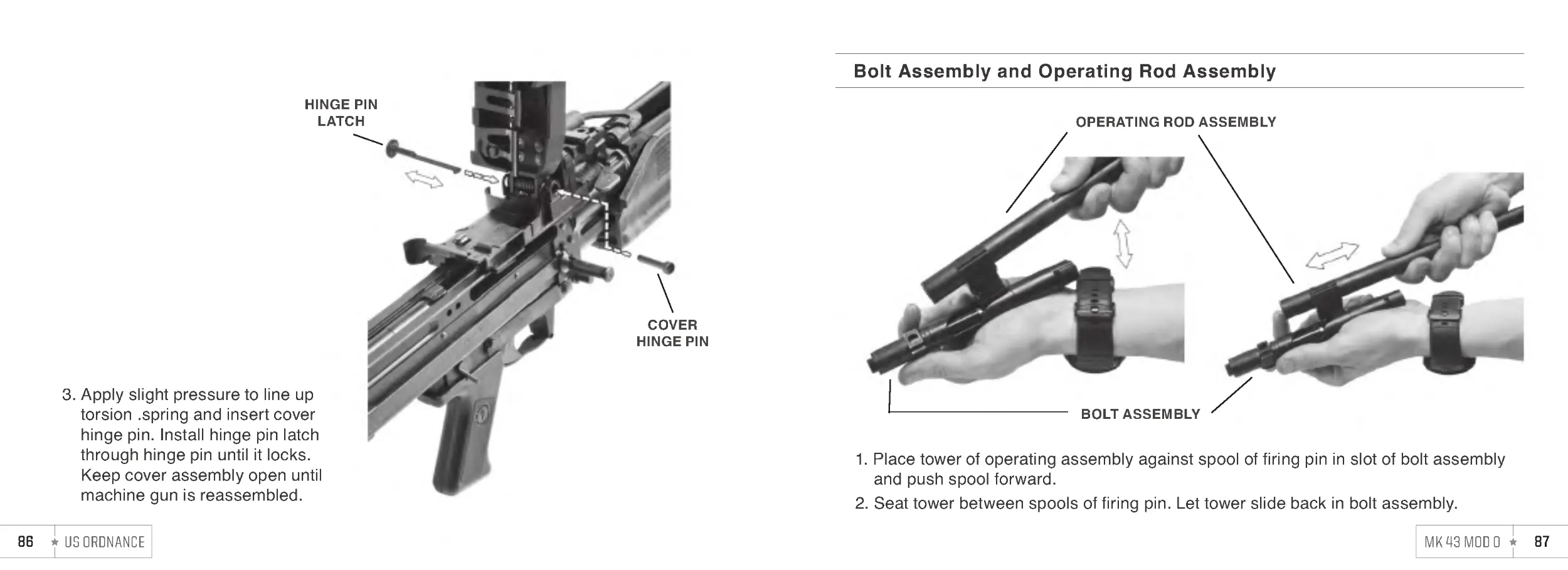
BOLT ASSEMBLY
3. Apply slight pressure to line up
torsion .spring and insert cover
hinge pin. Install hinge pin latch
through hinge pin until it locks.
Keep cover assembly open until
machine gun is reassembled.
HINGE PIN
LATCH
COvER
HINGE PIN
1. Place tower of operating assembly against spool of firing pin in slot of bolt assembly
and push spool forward.
2. Seat tower between spools of firing pin. Let tower slide back in bolt assembly.
Bolt Assembly and Operating Rod Assembly

US ORDNANCE
88
MK43MOD0 89
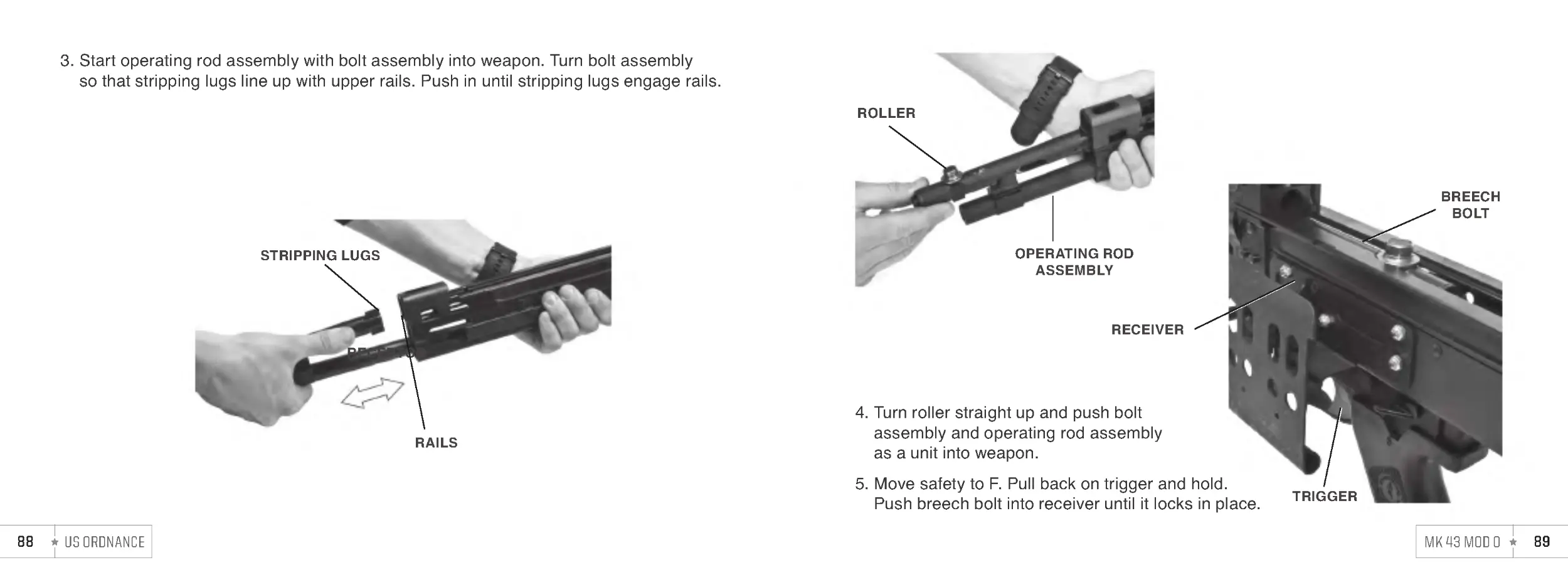
STRIPPING LUGS
RAILS
RECEPTOR
BREECH
BOLT
RECEIvER
OPERATING ROD
ASSEMBLY
TRIGGER
3. Start operating rod assembly with bolt assembly into weapon. Turn bolt assembly
so that stripping lugs line up with upper rails. Push in until stripping lugs engage rails.
5. Move safety to F. Pull back on trigger and hold.
Push breech bolt into receiver until it locks in place.
4. Turn roller straight up and push bolt
assembly and operating rod assembly
as a unit into weapon.
ROLLER

US ORDNANCE
90
MK43MOD0
91
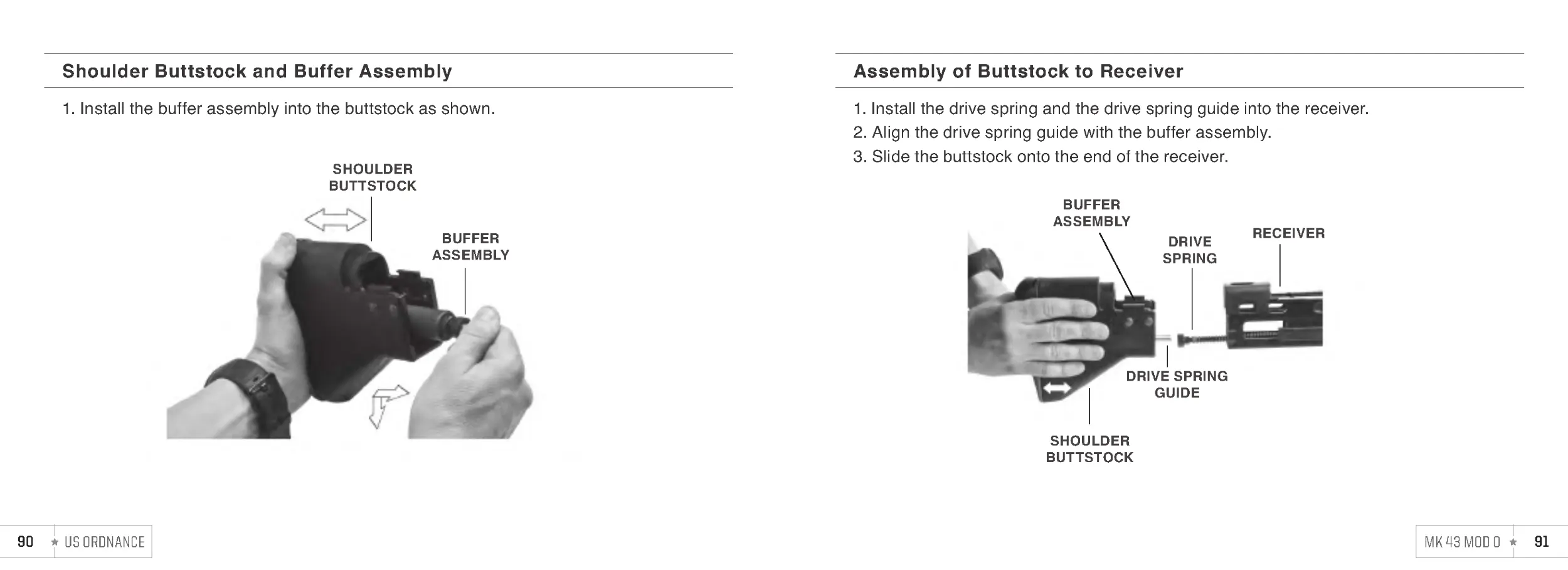
BUFFER
ASSEMBLY
SHOULDER
BUTTSTOCK
BUFFER
ASSEMBLY
DRIvE
SPRING
DRIvE SPRING
GUIDE
RECEIvER
SHOULDER
BUTTSTOCK
Shoulder Buttstock and Buffer Assembly
1. Install the buffer assembly into the buttstock as shown.
Assembly of Buttstock to Receiver
1. Install the drive spring and the drive spring guide into the receiver.
2. Align the drive spring guide with the buffer assembly.
3. Slide the buttstock onto the end of the receiver.

US ORDNANCE
92
MK43MOD0 93
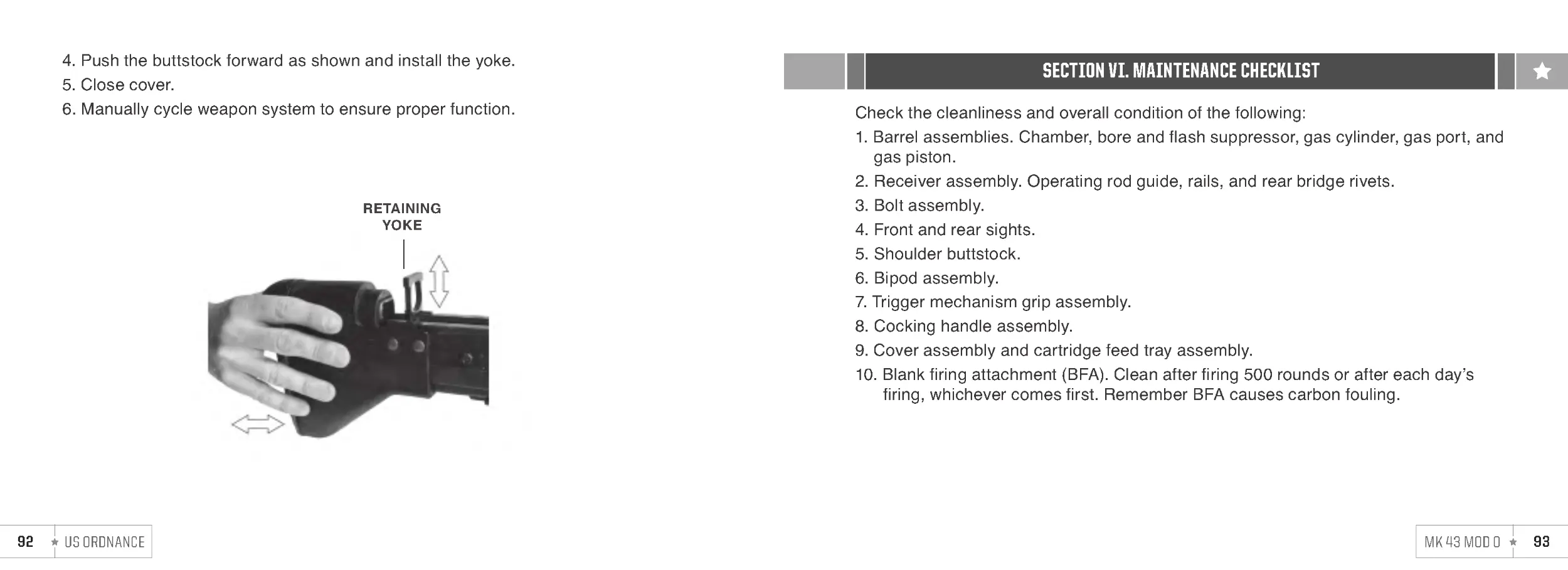
RETAINING
YOKE
Section vi. maintenance checkliSt
Check the cleanliness and overall condition of the following:
1. Barrel assemblies. Chamber, bore and flash suppressor, gas cylinder, gas por t, and
gas piston.
2. Receiver assembly. Operating rod guide, rails, and rear bridge rivets.
3. Bolt assembly.
4. Front and rear sights.
5. Shoulder buttstock.
6. Bipod assembly.
7. Trigger mechanism grip assembly.
8. Cocking handle assembly.
9. Cover assembly and cartridge feed tray assembly.
10. Blank firing attachment (BFA). Clean after firing 500 rounds or after each day’s
firing, whichever comes first. Remember BFA causes carbon fouling.
4. Push the buttstock forward as shown and install the yoke.
5. Close cover.
6. Manually cycle weapon system to ensure proper function.

US ORDNANCE
94
MK43MOD0 95
Section vii. machine gun check out procedure
Bolt Assembly Rearward? Good. Safety in S? Good.
1. Point weapon down range.
2. Load machine gun with dummy ammunition (p 24).
3. Squeeze trigger. Nothing should happen.
4. Move safe to F.
5. Squeeze trigger. Bolt assembly should move for ward, strip and chamber a dummy
round, and lock.
6. Pull cocking handle back. Dummy round should eject, and bolt assembly should
lock to rear.
WARNING: After unloading dummyround, be sure the barrel is cleared.
7. Move safety to S.
8. Unload dummy ammunition and clear weapon (p 26).
9. Verify that the projectile stayed with the dummy cartridge case.
10. Close cover and latch.
11. Move safety to F. Pull cocking handle, squeeze trigger and ease bolt assembly
forward.

US ORDNANCE
96
MK43MOD0 97
chapter 4 – ammunition
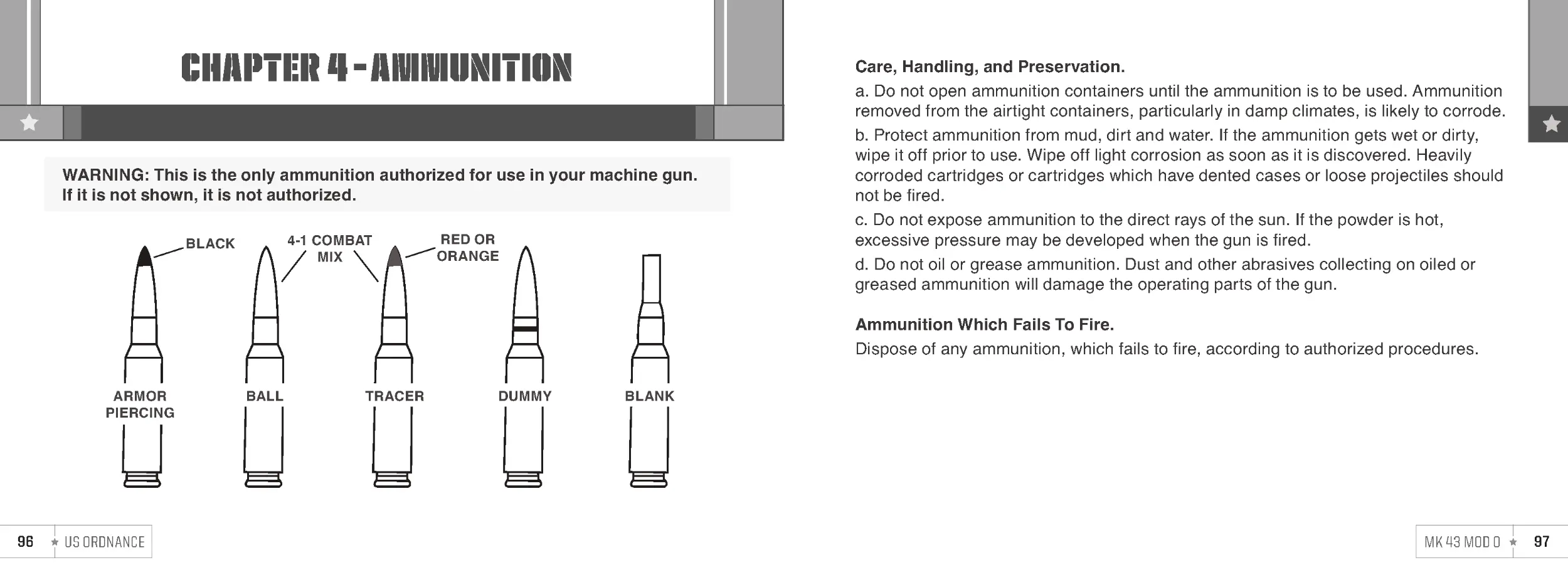
WARNING: This is the only ammunition authorized for use in your machine gun.
If it is not shown, it is not authorized.
BALL
ARMOR
PIERCING
TRACER
DUMMY
RED OR
ORANGE
BLACK
4-1 COMBAT
MIX
BLANK
Care, Handling, and Preservation.
a. Do not open ammunition containers until the ammunition is to be used. Ammunition
removed from the airtight containers, particularly in damp climates, is likely to corrode.
b. Protect ammunition from mud, dirt and water. If the ammunition gets wet or dirty,
wipe it off prior to use. Wipe off light corrosion as soon as it is discovered. Heavily
corroded cartridges or cartridges which have dented cases or loose projectiles should
not be fired.
c. Do not expose ammunition to the direct rays of the sun. If the powder is hot,
excessive pressure may be developed when the gun is fired.
d. Do not oil or grease ammunition. Dust and other abrasives collecting on oiled or
greased ammunition will damage the operating parts of the gun.
Ammunition Which Fails To Fire.
Dispose of any ammunition, which fails to fire, according to authorized procedures.

US ORDNANCE
98
MK43MOD0 99
appendix a
referenceS
Scope.
This appendix lists some manuals referenced in this manual, and some other sources
of information about M60 machine guns and ancillary equipment.
Field Manuals.
Machine gun 7.62-MM, M60 -- FM 23-67
Firing Table.
FT 7.62-A -2
Machine Gun, 7.62-mm; M60 on Mount, Machine Gun: 7.62-mm, Ml22 and Machine
Gun, 7.62-mm: M73 on Tank, Combat, Full-Tracked: 105-mm Gun, M60 Series and
Rifle, 7.62mm: M14; Firing Cartridge, 7.62mm, Ball, NATO, M59; Cartridge, 7.62mm,
Ball, NATO, M80; Car tridge, 7.62mm: AP, NATO, M61 and Cartridge, 7.62mm: Tracer,
NATO, M62.
Forms
DA Form 2028 -Recommended Changes to Publications and Blank Forms SF 368 -
Quality Deficiency Report
Technical Manuals.
TM 02705E-IO/l- Operators Manual for Machine Gun, 7.62 MM, M60E3 and Mount,
Tripod, Machine Gun, 7.62MM, M122.
TM 3-220 - Chemical, Biological and Radiological (CBR) Decontamination
TM 11-5855-213-10 -Operators Manual for Night Vision Sight, Individual Served
Weapon, AN/PVS4

US ORDNANCE
100
MK43MOD0 101
appendix b
Section i. introduction
Scope.
This appendix lists components of end item and basic issue items for the MK43 MOD
0 machine gun to help you inventor y items required for safe and efficient operation.
General.
The Components of End Item and Basic Issue Items Lists are divided into the
following sections:
a. Section II. Components of End Item. This listing is for informational purposes only
and is not authority to requisition replacements. These items are part of the end
item but are removed and separately packaged for transportation or shipment. As
part of the end item, these items must be with the end item whenever it is issued
or transferred between proper ty accounts. Illustrations are furnished to assist you
identifying the items.
b. Section III. Basic Issue Items. These are the minimum essential items required
to place the MK43MOD0 machine gun in operation, to operate it, and to perform
emergency repairs.
Although shipped separately packaged, BII must be with the MK43 Mod0 machine
gun during operation and whenever it is transferred between property accounts. The
illustrations will assist you with hard-to-identify items. This manual is your authority to
request/requisition replacement BII, based on approved allowance for the end item.
Explanation of Columns
The following provides an explanation of columns found in the tabular listings:
a. Column (I) - Illustration Number. This column indicates the number of the illustration
in which the item is shown.
b. Column (2) - National Stock Number. Indicates the National stock number assigned
to the item and will be used for requisitioning purposes.
c. Column (3) - Description. Indicates the Federal item name and, if required, a
minimum description to identify and locate the item. The last line for each item
indicates the Contractor and Government Entity Code (CAGEC) (in parentheses)
followed by the part number.
d. Column (4) - Unit of Measure (U/M). Indicates the measure used in performing
the actual operational/maintenance function. This measure is expressed by a two-
character alphabetical abbreviation (e.e ., ea., in., pr.).
e. Column (5) - Quantity required. Indicates the quantity of the item authorized to be
used with/on the equipment.

US ORDNANCE
102
MK43MOD0 103
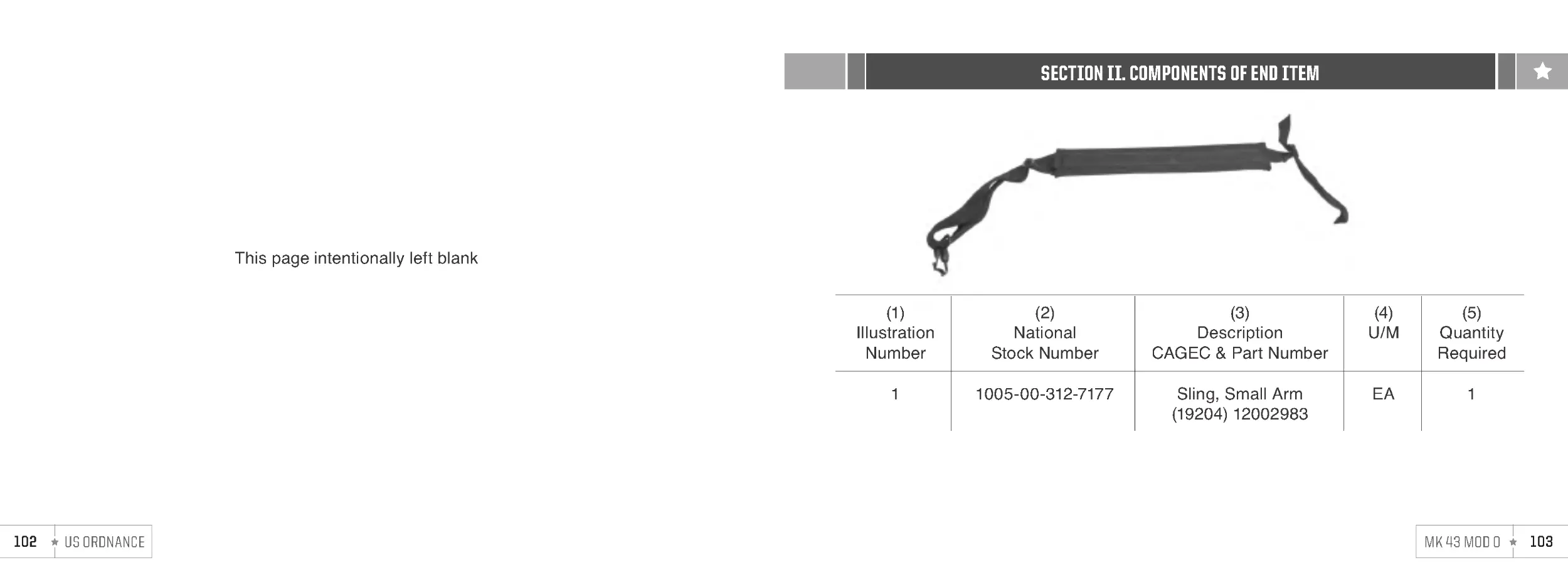
Section ii. componentS of end item
This page intentionally left blank
(1)
Illustration
Number
1
(4)
U/M
EA
(5)
Quantity
Required
1
(2)
National
Stock Number
1005-00 -312-7177
(3)
Description
CAGEC & Part Number
Sling, Small Arm
(19204) 12002983

US ORDNANCE
104
MK43MOD0 105
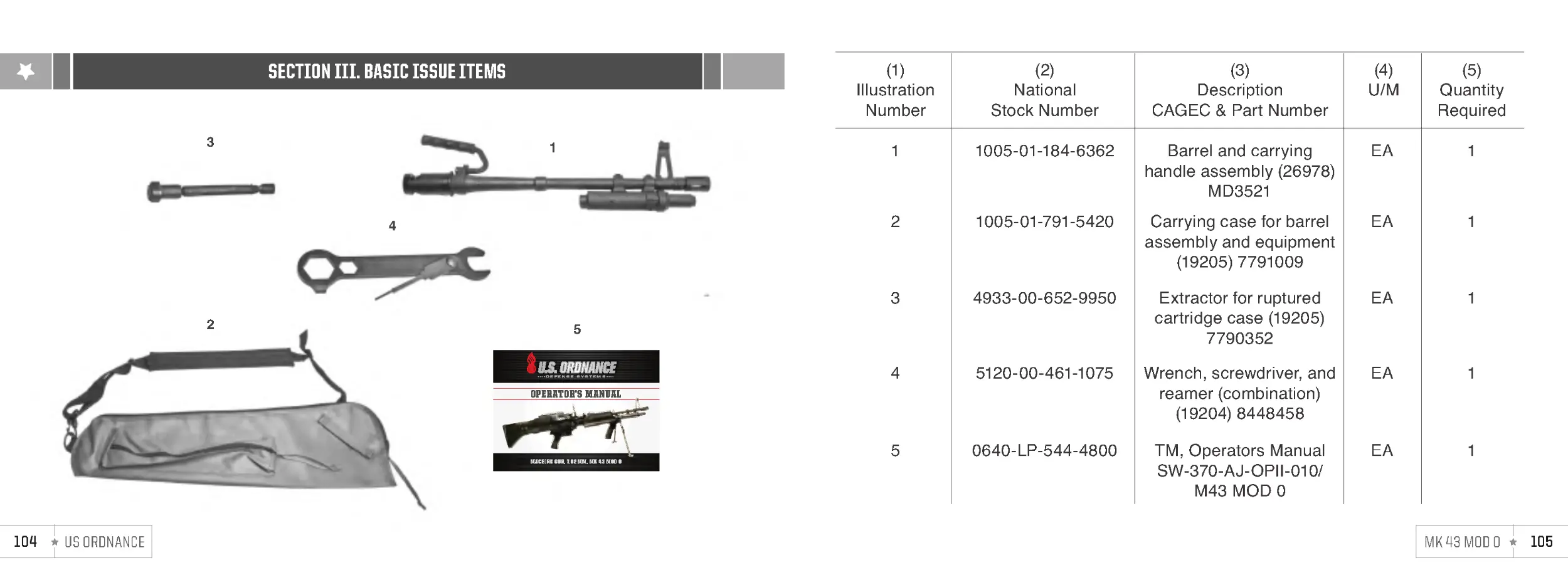
Section iii. baSic iSSue itemS
(1)
Illustration
Number
1
2
3
4
5
(4)
U/M
EA
EA
EA
EA
EA
(5)
Quantity
Required
1
1
1
1
1
(2)
National
Stock Number
1005-01-184-6362
1005-01-791-5420
4933-00 -652-9950
5120-00-461-1075
0640-LP-544 -4800
(3)
Description
CAGEC & Part Number
Barrel and carrying
handle assembly (26978)
MD3521
Carrying case for barrel
assembly and equipment
(19205) 7791009
Extractor for ruptured
cartridge case (19205)
7790352
Wrench, screwdriver, and
reamer (combination)
(19204) 8448458
TM, Operators Manual
SW-370-AJ- OPII-010/
M43 MOD 0
1
2
3
4
5
•
•
••
D EFENSESYS T E M S••••
MACHINEGUN,7.62 MM,MK43MODO
OPERATOR’S MANUAL
USORD.COM
ISO 9001:2000

US ORDNANCE
106
MK43MOD0 107
6
8
7
(1)
Illustration
Number
6
7
8
(4)
U/M
EA
EA
EA
(5)
Quantity
Required
1
5
1
(2)
National
Stock Number
5340-01-285-2683
1005-00 -726-6109
1005-00 -726-6110
(3)
Description
CAGEC & Part Number
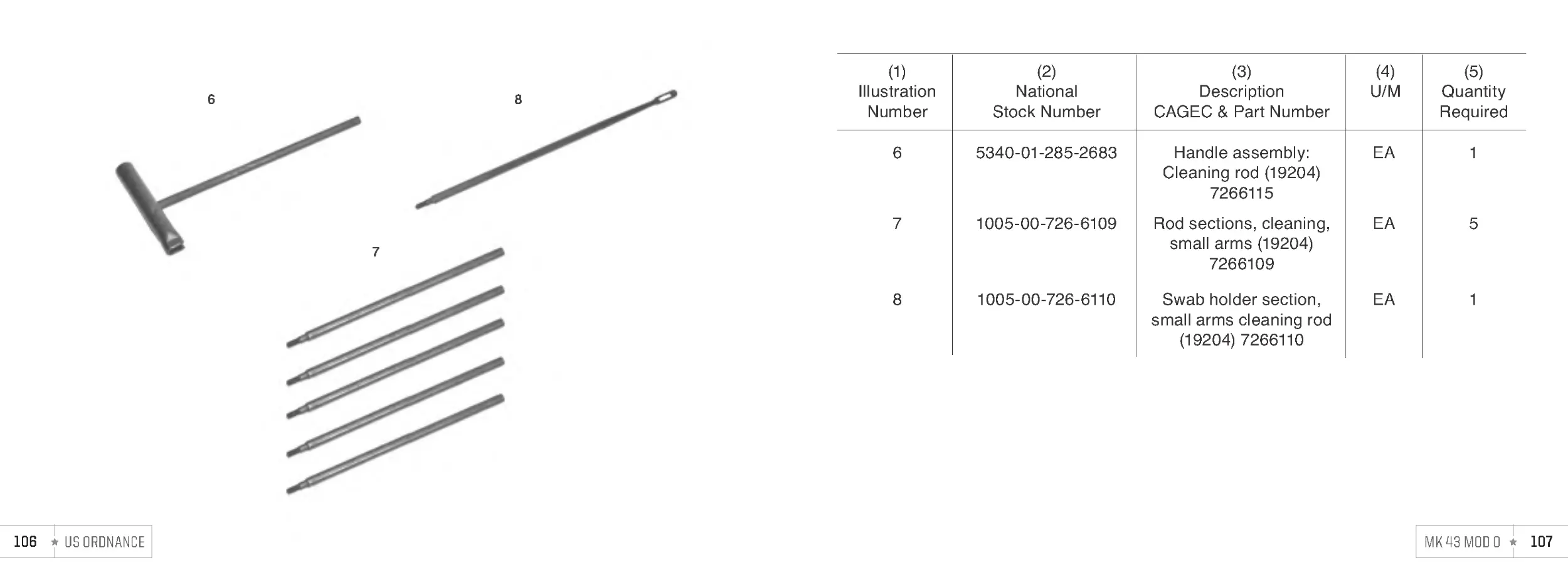
Handle assembly:
Cleaning rod (19204)
7266115
Rod sections, cleaning,
small arms (19204)
7266109
Swab holder section,
small arms cleaning rod
(19204) 7266110

US ORDNANCE
108
MK43MOD0 109
Section i. introduction
appendix c – additional authorized list
Section ii. additional authorized liSt
Scope.
The appendix lists additional items you are authorized for the support of the MK43
MOD0 Machine Gun.
General.
This list identifies items that do not have to accompany the MK43 MOD 0 Machine
Gun and that do not have to be turned in with it.
Explanation of Listing.
National stock numbers, descriptions, and quantities are provided to help you identify
and request the additional items you require to support this equipment.
(3)
U/M
EA
EA
EA
EA
(4)
Quantity
Required
1
2
1
1
(1)
National
Stock Number
1005-00 -140-3515
1005-00 -556-4174
1005-00 -690-3115
1005-00 -350-4100
(2)
Description
FSCM & Part Number
Firing attachment, blank:
(19204) 12002981
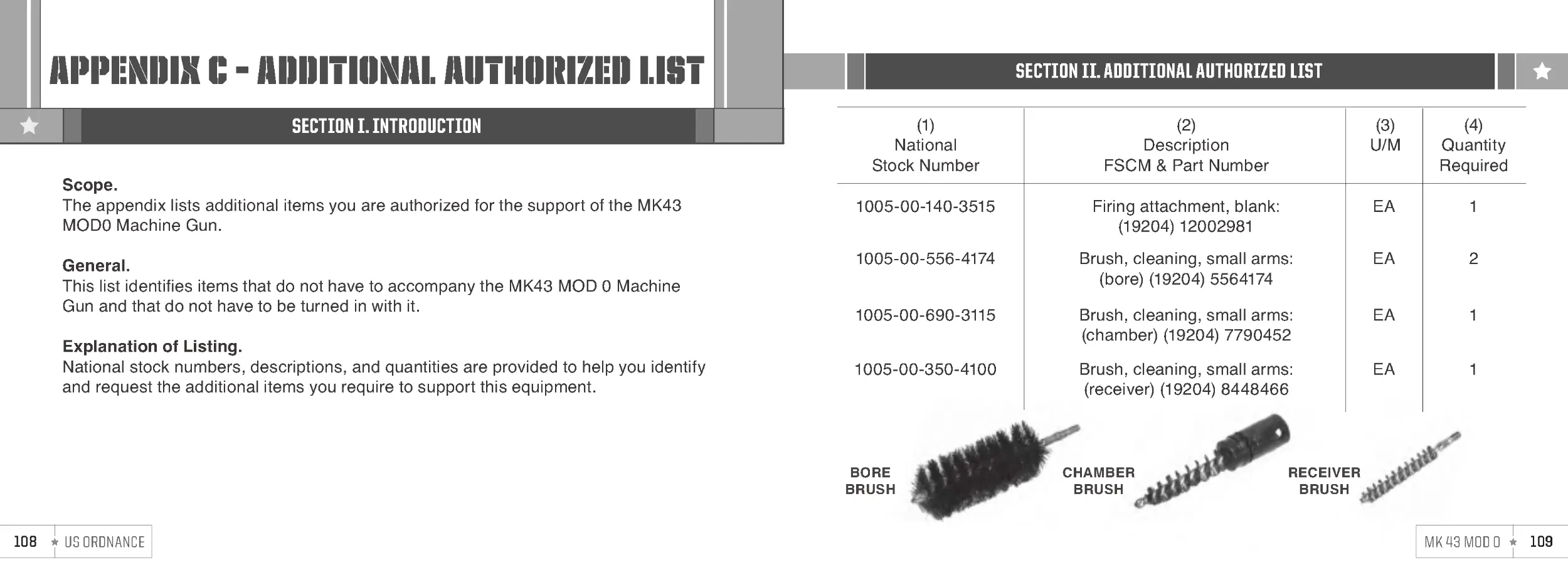
Brush, cleaning, small arms:
(bore) (19204) 5564174
Brush, cleaning, small arms:
(chamber) (19204) 7790452
Brush, cleaning, small arms:
(receiver) (19204) 8448466
BORE
BRUSH
CHAMBER
BRUSH
RECEIvER
BRUSH

US ORDNANCE
110
MK43MOD0 111
Section i. introduction
appendix d – expendable supplies
c. Column (3) - National Stock Number. This is the National stock number
assigned to the item; use to request or requisition the item.
d. Column (4) - Description. Indicates the Federal item name and, if required, a
description to identif y item. The last line for each item indicates the Contractor and
Government Entity Code (CAGEC) in parentheses followed by the part number.
e. Column (5) - Unit of Measure (U/M). Indicates the measure used in performing
the actual maintenance function. This measure is expressed by a two-character
alphabetical abbreviation (e.g ., ea ., in., pr.). If the unit of measure differs from the
unit of issue, requisition the lowest unit of issue that will satisf y your requirements.
Scope.
This appendix lists expandable su plies and materials you will need to operate and
maintain the MK43 M 8 D 0 Machine Gun.
Explanation of Columns.
a. Column (1) - Item Number (Item Number). This number is assigned to the entry in
the listing and is referenced in the narrative instructions to identify the material
(e.g ., “Use wiping rag, item 4, app D).
b. Column (2) - Level. This column identifies the lowest level of maintenance that
requires the listed item.

US ORDNANCE
112
MK43MOD0 113
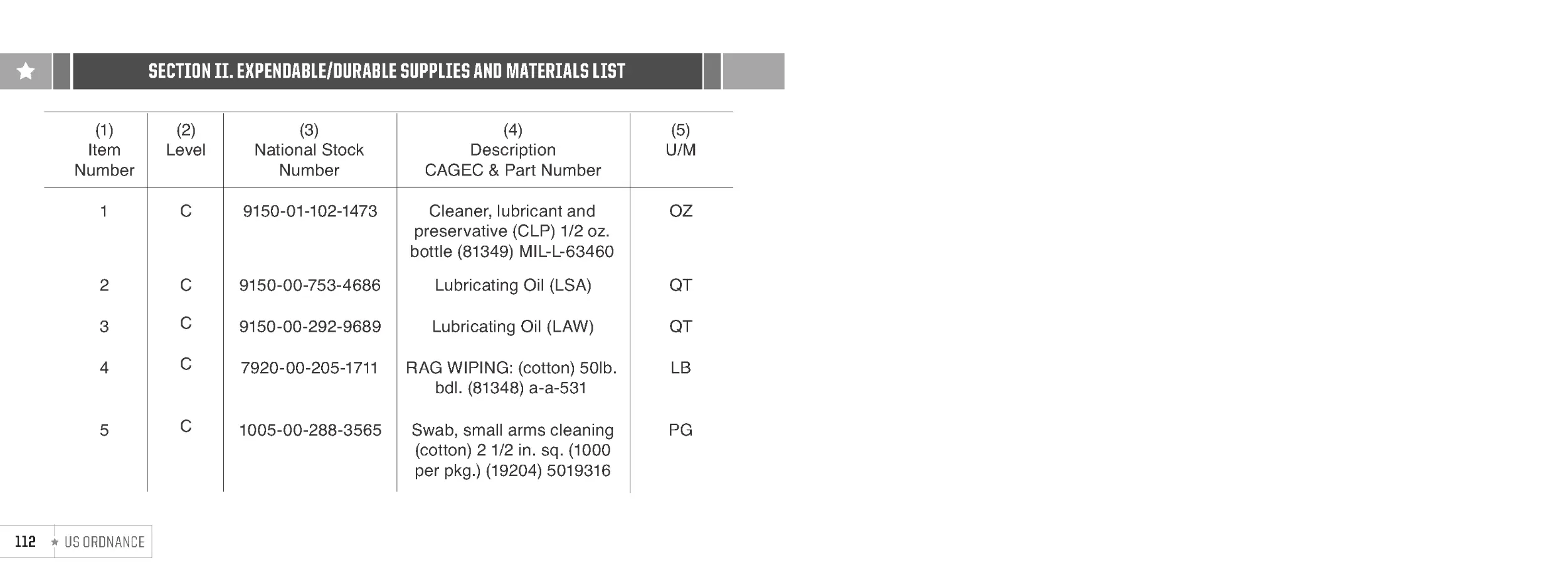
Section ii. expendable/durable SupplieS and materialS liSt
(1)
Item
Number
1
C
C
C
C
C
2
3
4
5
(4)
Description
CAGEC & Part Number
(5)
U/M
OZ
QT
QT
LB
PG
(2)
Level
9150-01-102-1473
9150-00 -753-4686
9150 -00 -292-9689
7920-00 -205 -1711
1005-00 -288-3565
(3)
National Stock
Number
Cleaner, lubricant and
preservative (CLP) 1/2 oz.
bottle (81349) MIL-L-63460
Lubricating Oil (LSA)
Lubricating Oil (LAW)
RAG WIPING: (cotton) 50lb.
bdl. (81348) a-a -531
Swab, small arms cleaning
(cotton) 2 1/2 in. sq. (1000
per pkg.) (19204) 5019316

US ORDNANCE
114
MACHINE GUN, 7.62 MM, MK 43 MOD O
OPERATOR’S MANUAL
USORD.COM
ISO 9001:2008
Ph: 775.343 .1320
Fax : 775.343 .1331