/


























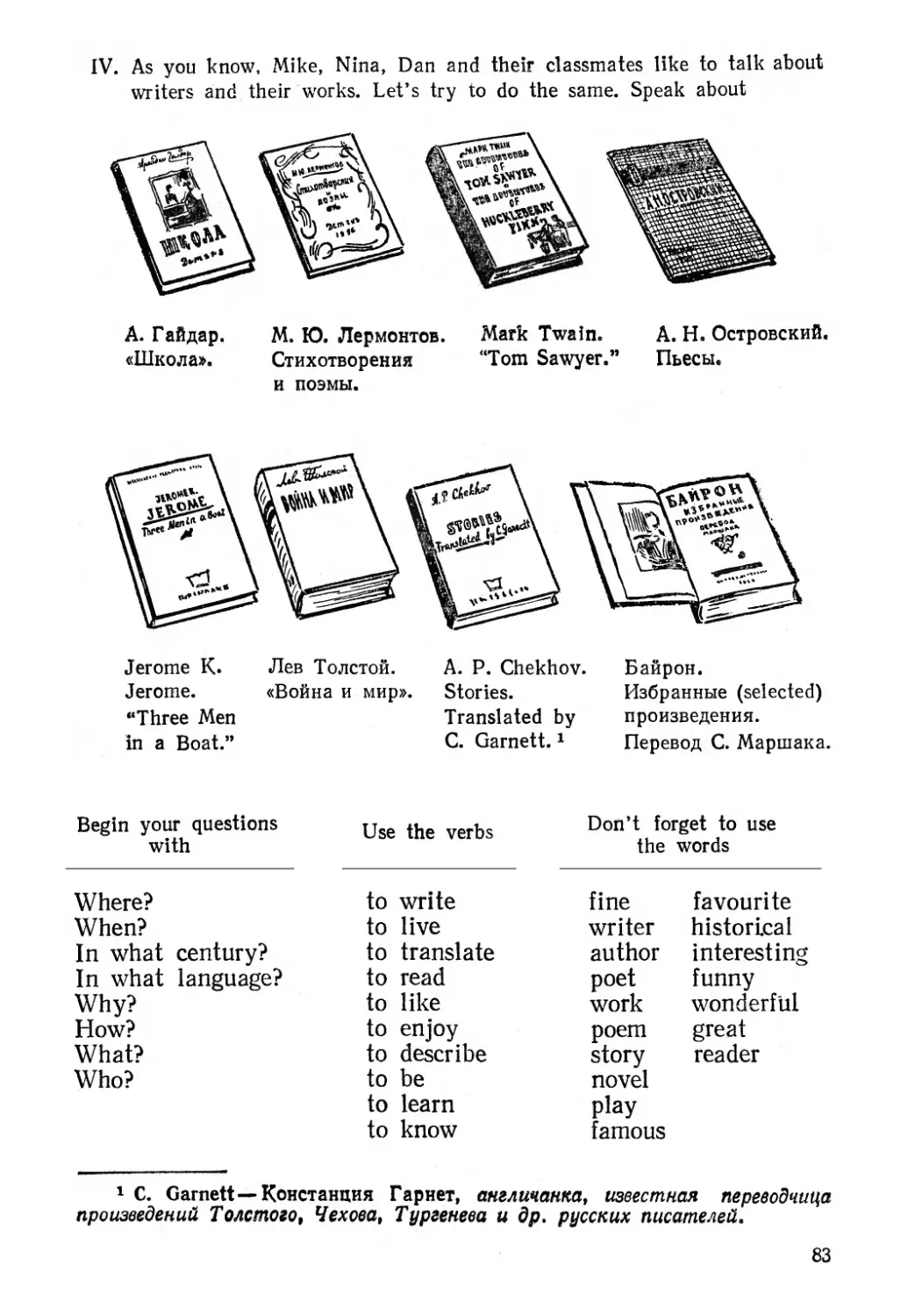
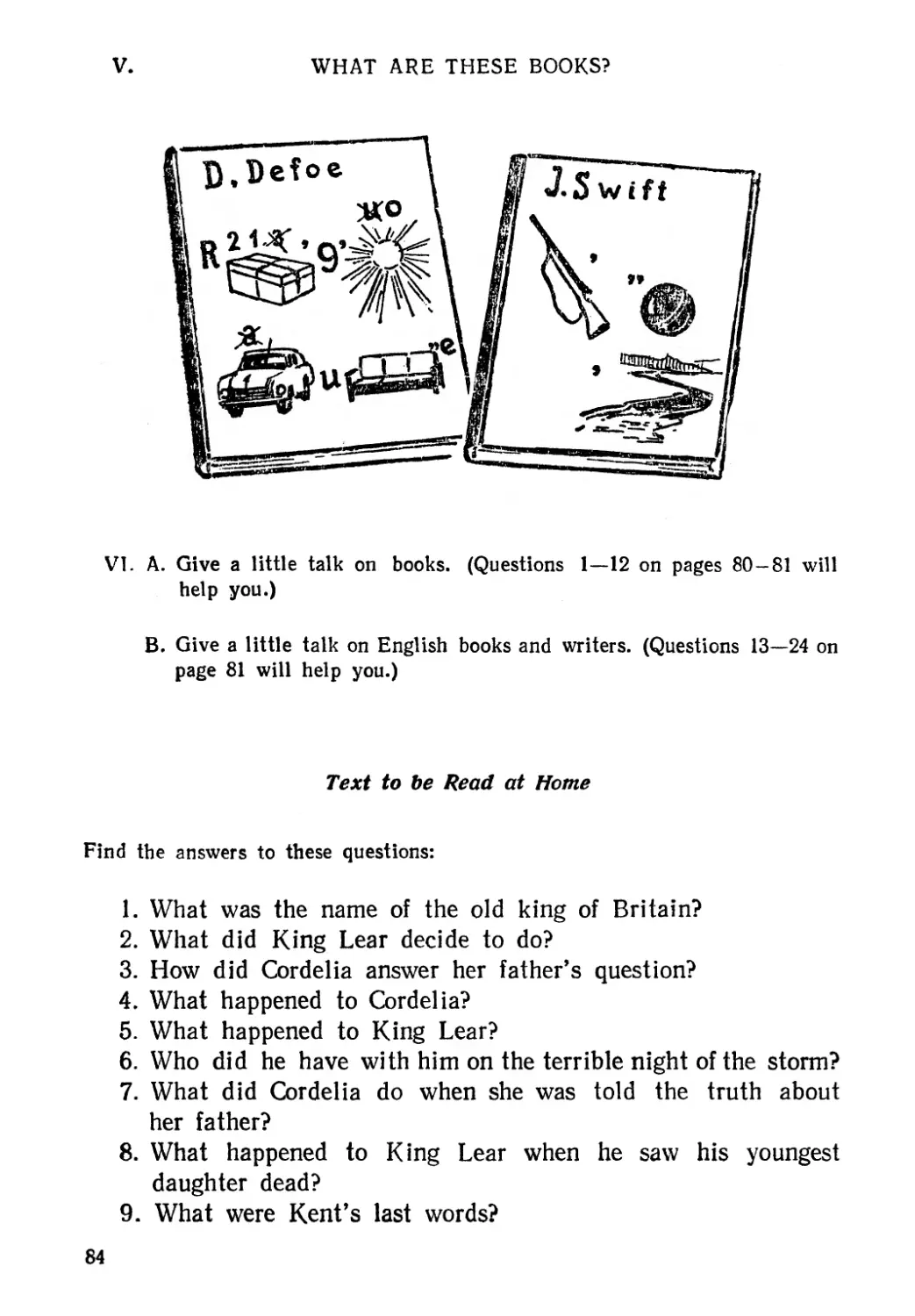


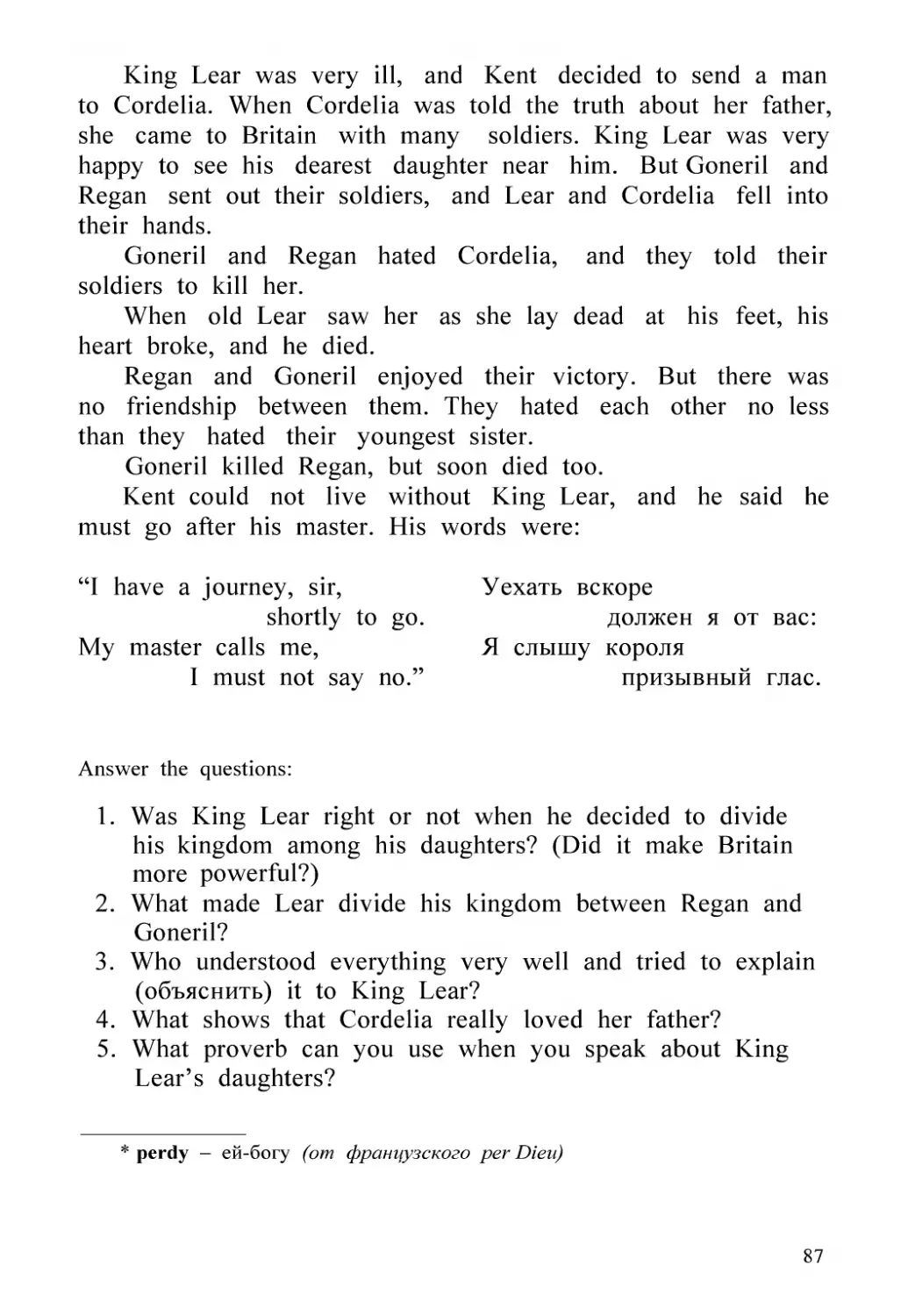
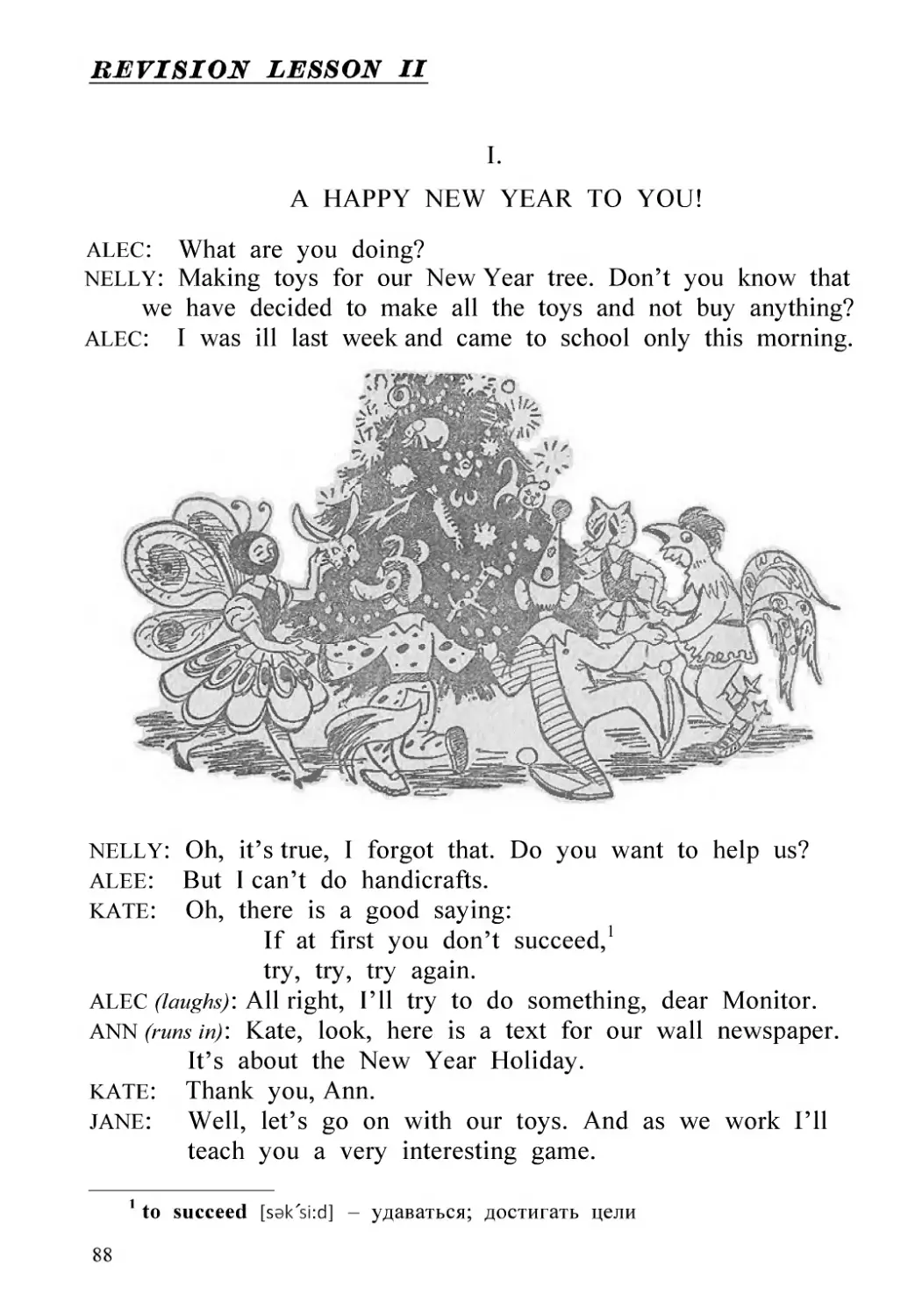









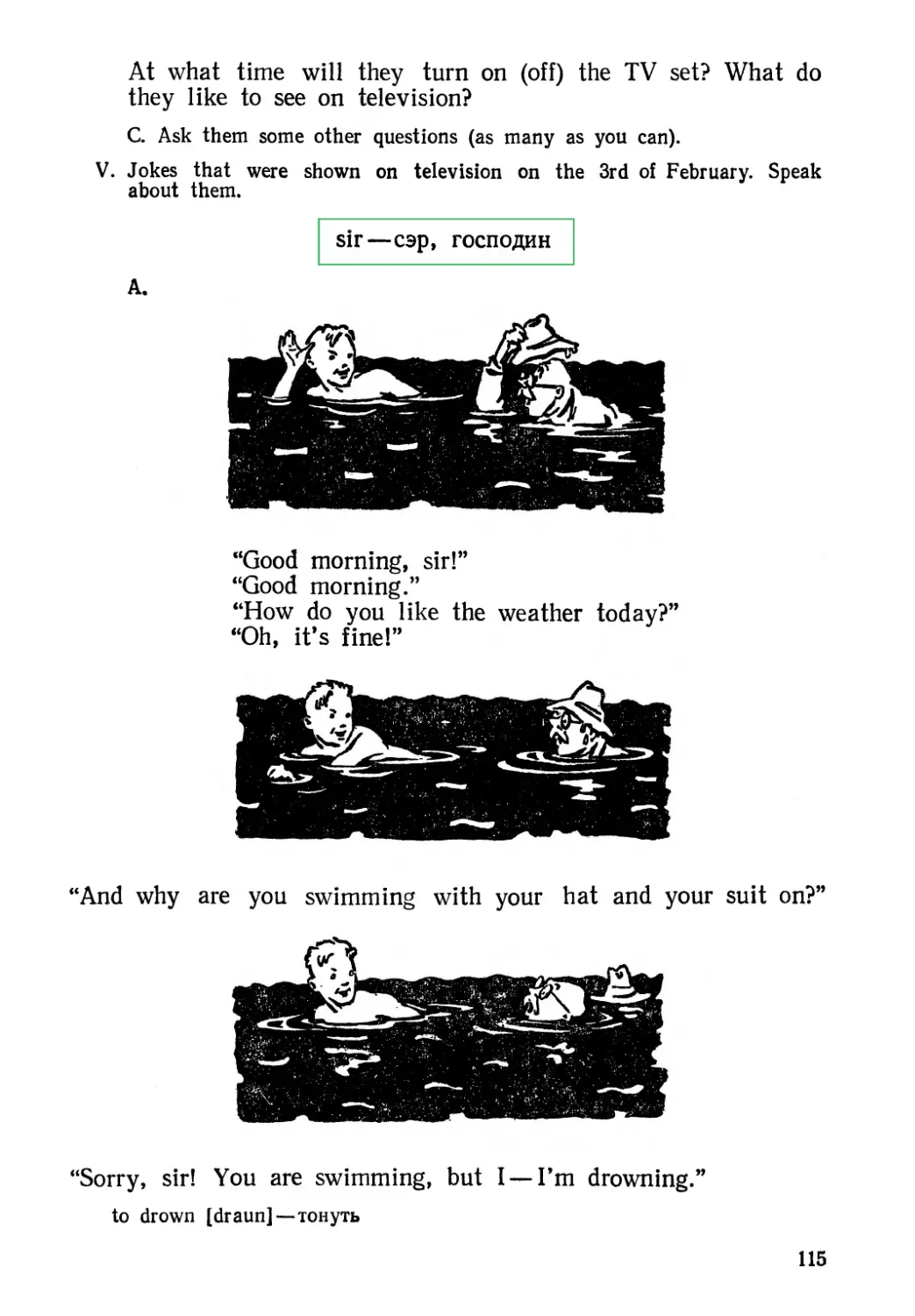
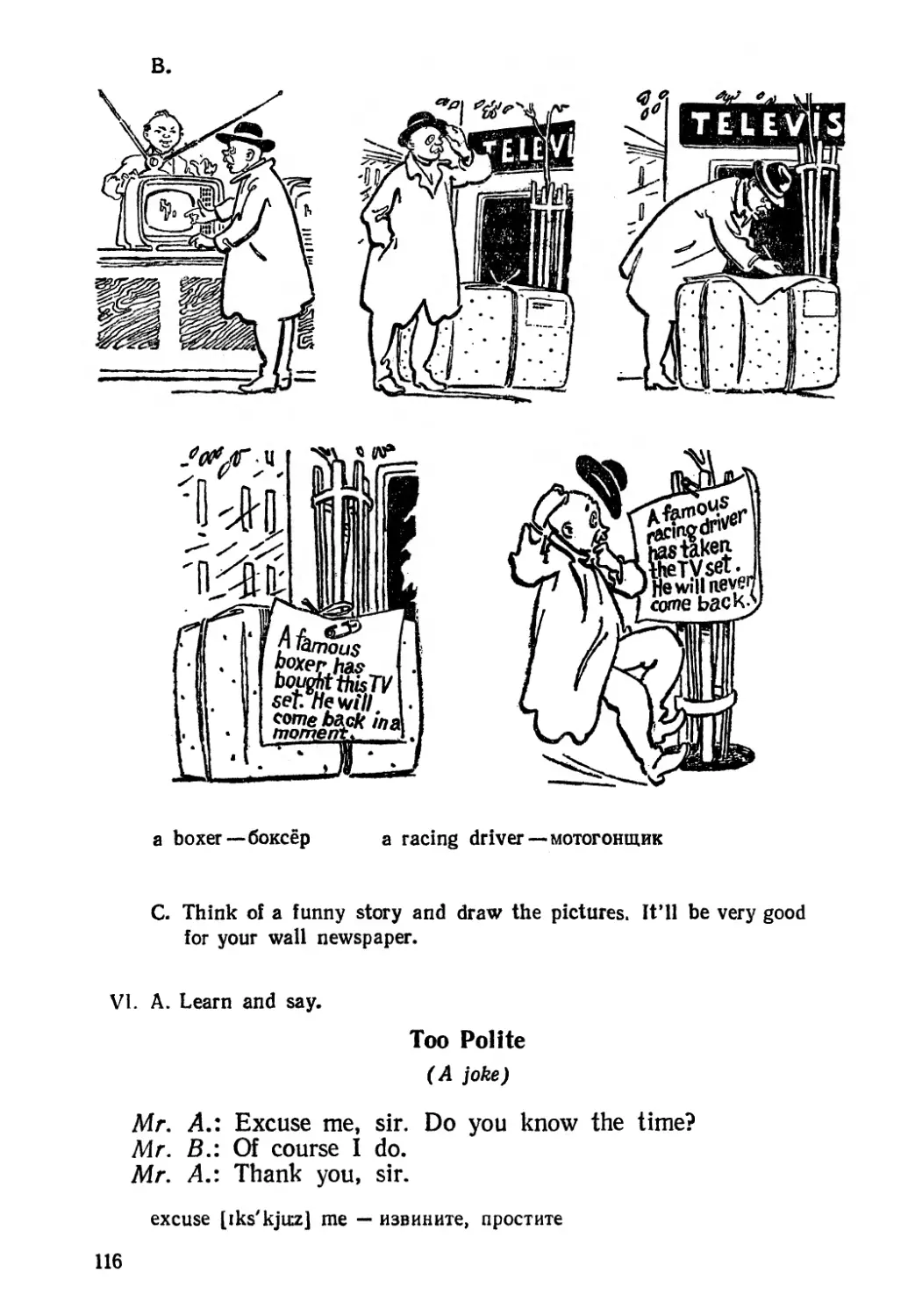


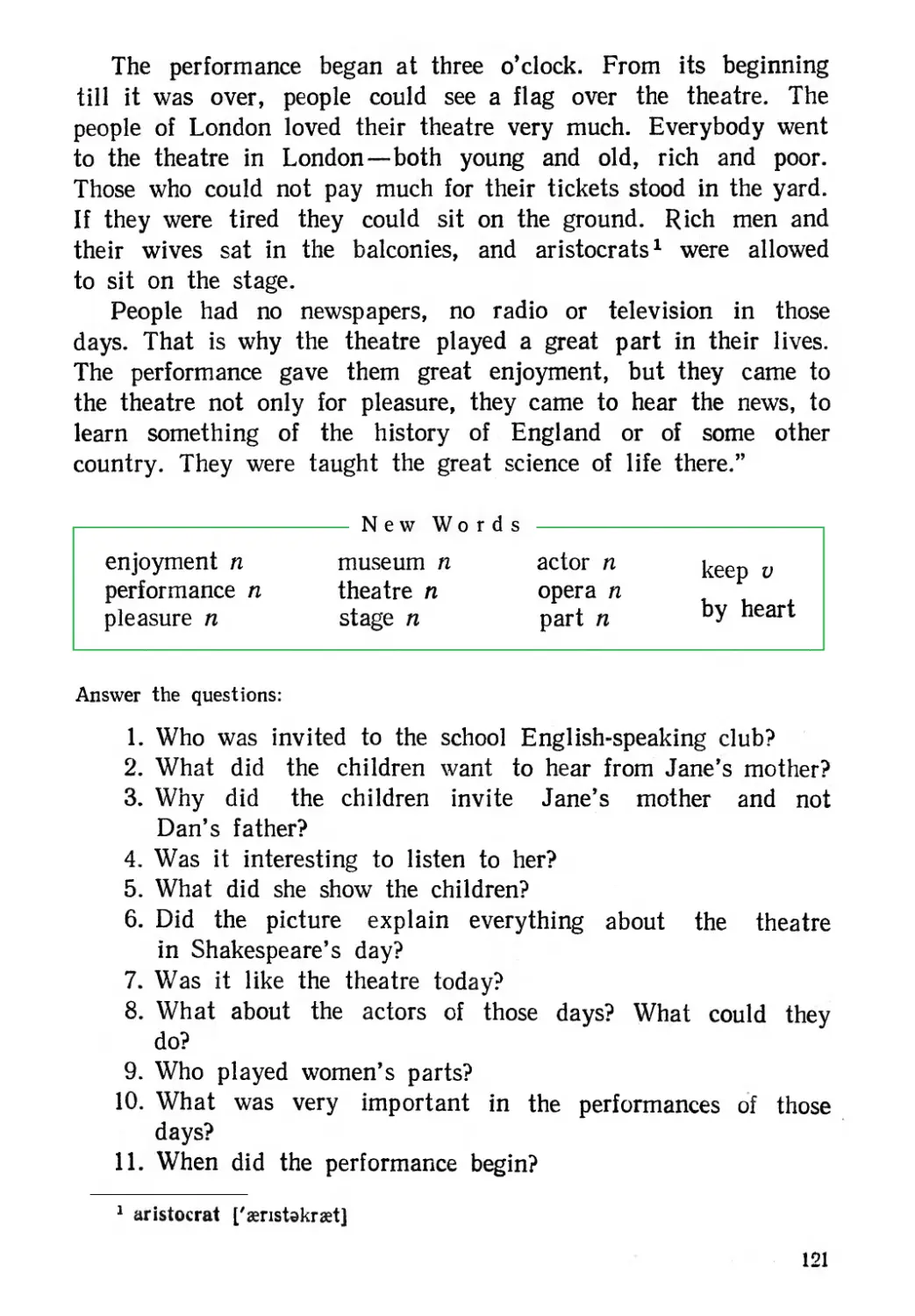
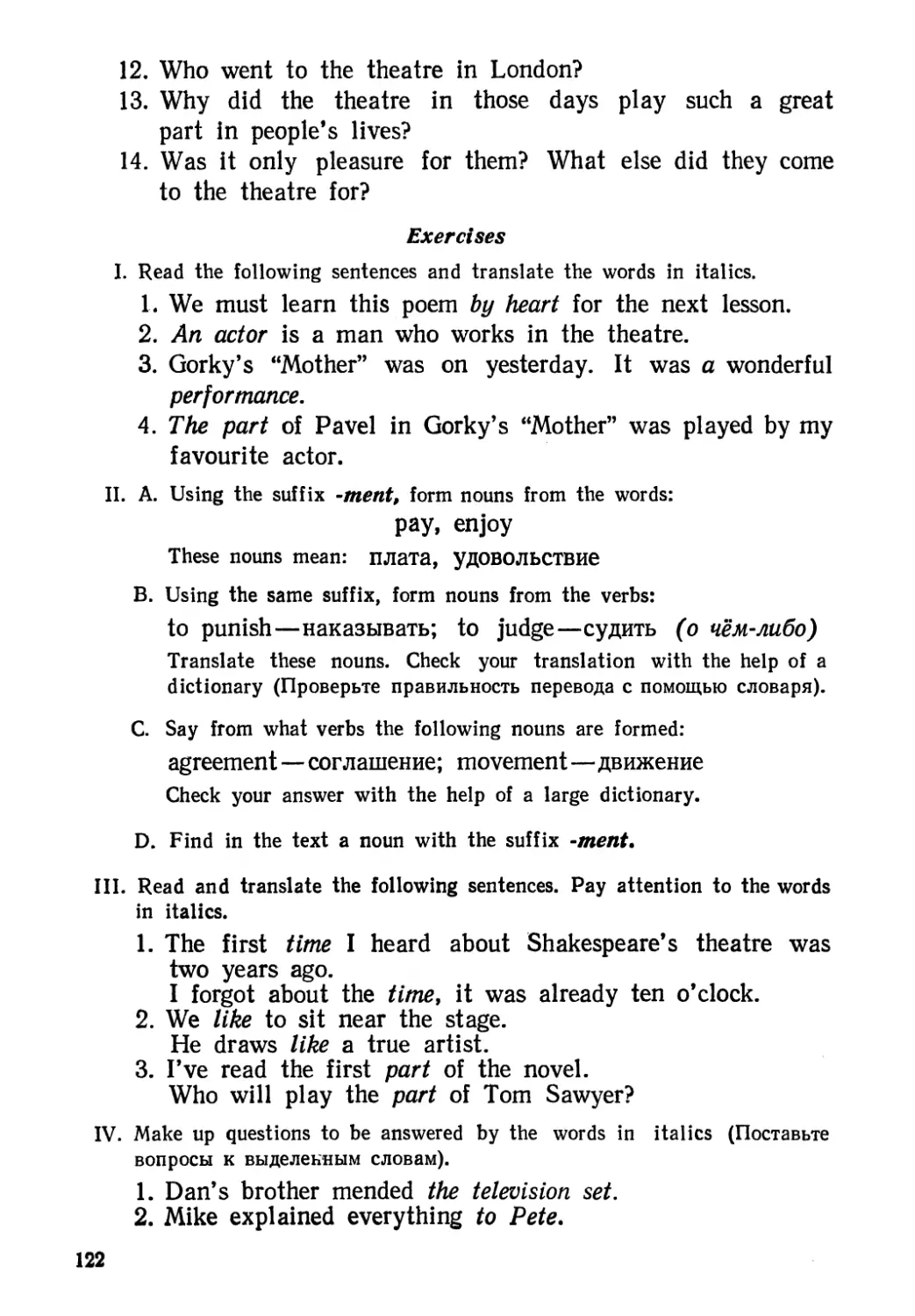




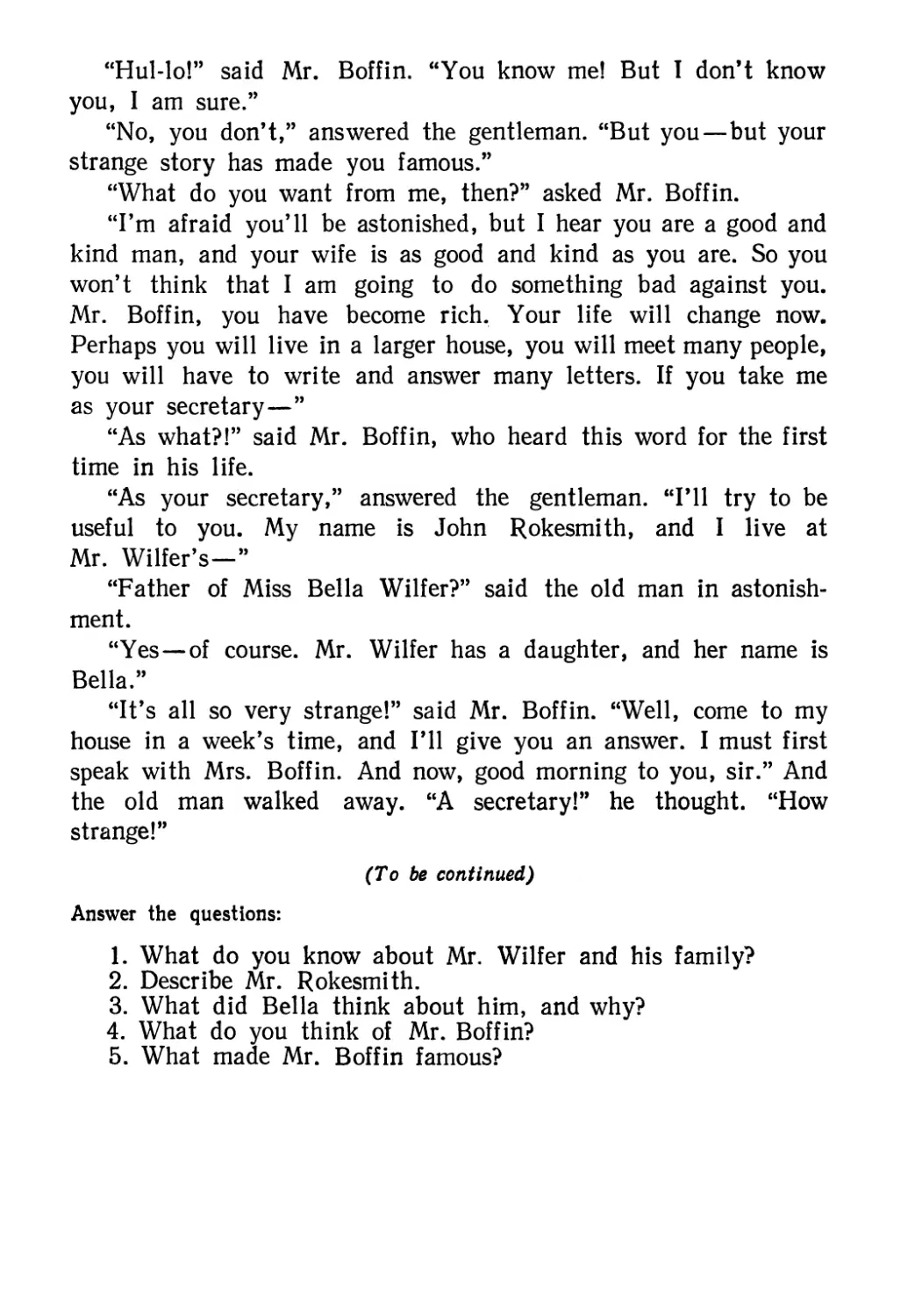







































Text
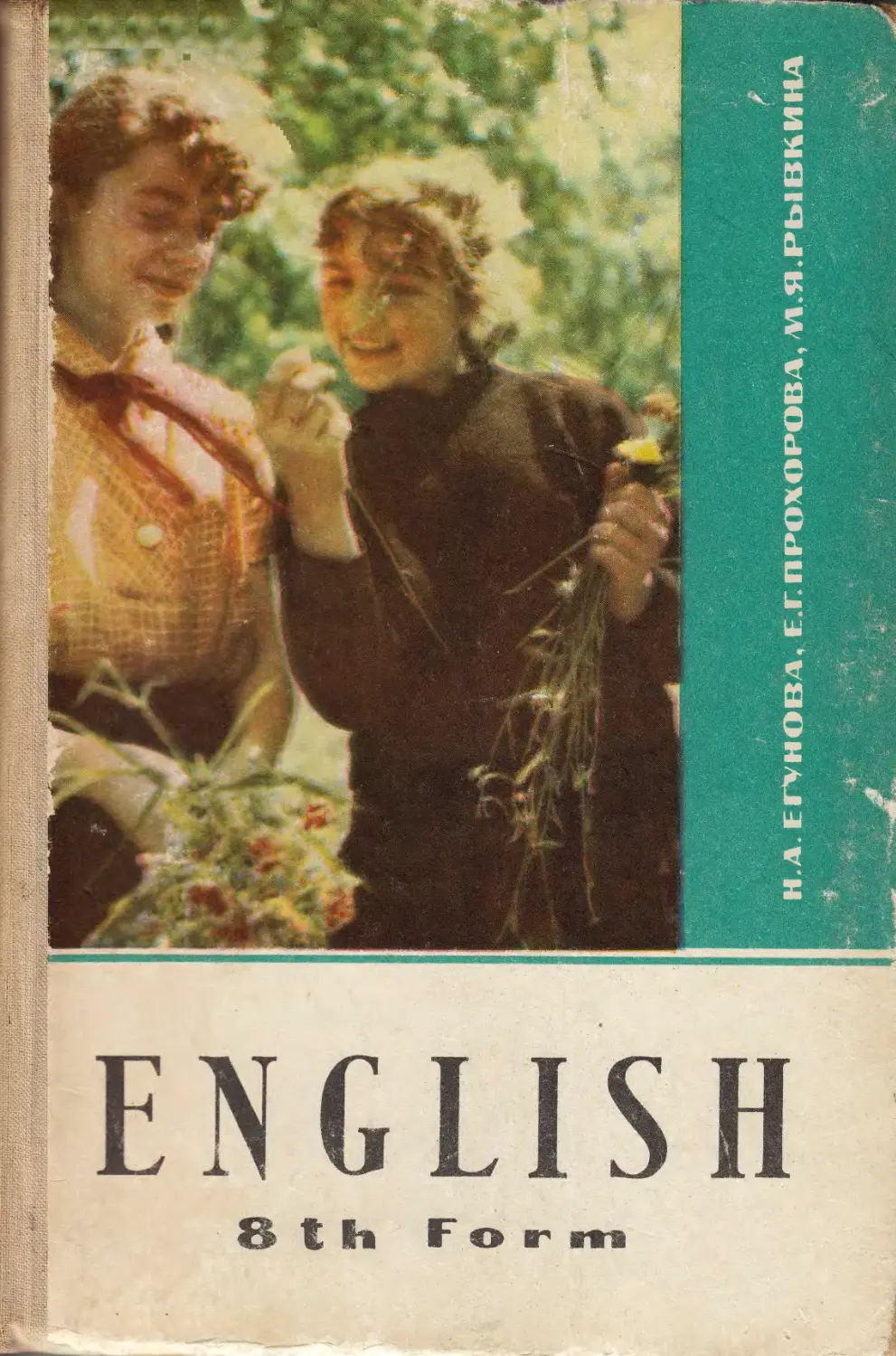
Н. А. ЕГУНОВА, Е. Г. ПРОХОРОВА, М. Я. РЫВКИНА
ENGLISH
УЧЕБНИК
АНГЛИЙСКОГО ЯЗЫКА
ДЛЯ VIII КЛАССА
СРЕДНЕЙ ШКОЛЫ
Утверждён
Министерством просвещения РСФСР
12-е издание
ИЗДАТЕЛЬСТВО «ПРОСВЕЩЕНИЕ»
Москва★ 1969
4И (Англ.) (075)
Е31
6—6
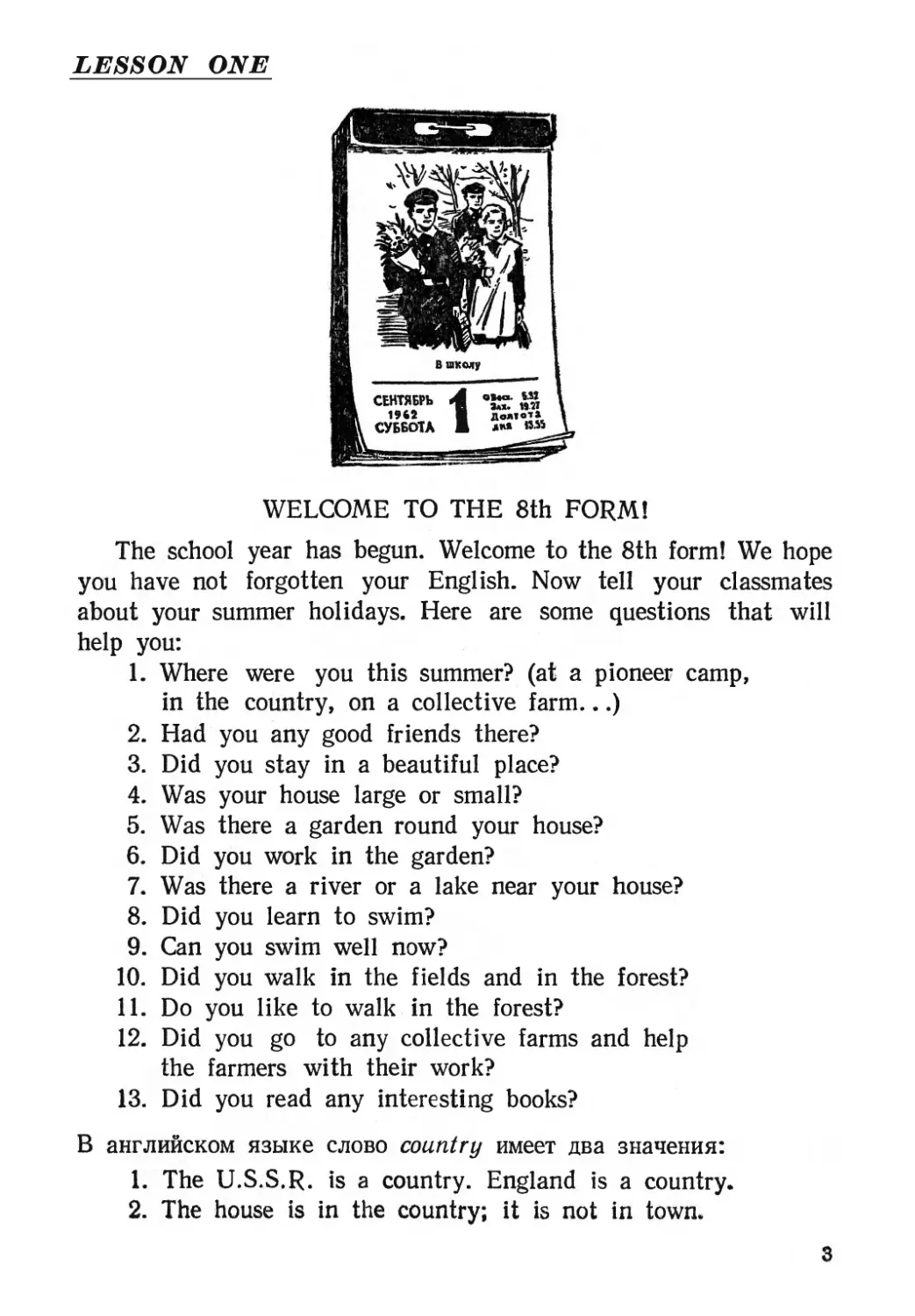
LESSON ONE
WELCOME TO THE 8th FORM!
The school year has begun. Welcome to the 8th form! We hope
you have not forgotten your English. Now tell your classmates
about your summer holidays. Here are some questions that will
help you:
1.	Where were you this summer? (at a pioneer camp,
in the country, on a collective farm...)
2.	Had you any good friends there?
3.	Did you stay in a beautiful place?
4.	Was your house large or small?
5.	Was there a garden round your house?
6.	Did you work in the garden?
7.	Was there a river or a lake near your house?
8.	Did you learn to swim?
9.	Can you swim well now?
10.	Did you walk in the fields and in the forest?
11.	Do you like to walk in the forest?
12.	Did you go to any collective farms and help
the farmers with their work?
13.	Did you read any interesting books?
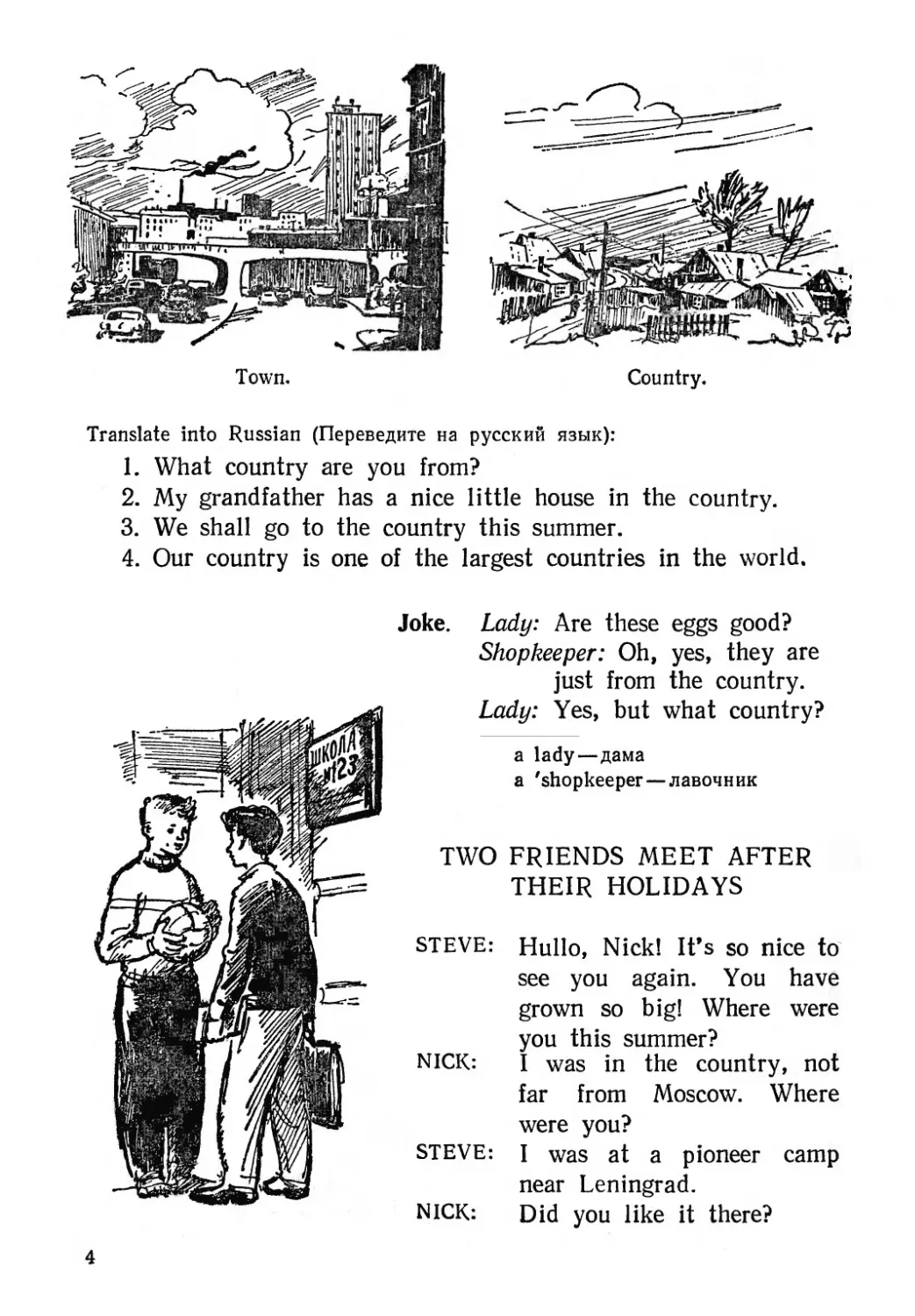
В английском языке слово country имеет два значения:
1. The U.S.S.R. is a country. England is a country.
2. The house is in the country; it is not in town.
8
Town.
Country.
Translate into Russian (Переведите на русский язык):
1.	What country are you from?
2.	My grandfather has a nice little house in the country.
3.	We shall go to the country this summer.
4.	Our country is one of the largest countries in the world.
Joke. Lady: Are these eggs good?
Shopkeeper: Oh, yes, they are
just from the country.
Lady: Yes, but what country?
a lady—дама
a 'shopkeeper — лавочник
TWO FRIENDS MEET AFTER
THEIR HOLIDAYS
STEVE: Hullo, Nick! It’s so nice to
see you again. You have
grown so big! Where were
you this summer?
NICK:	I was in the country, not
far from Moscow. Where
were you?
STEVE: I was at a pioneer camp
near Leningrad.
NICK: Did you like it there?
4
STEVE: Oh, I liked it very much. The place was beautiful. Our
house stood on a hill, and there was a large forest
where we liked to walk. Did you walk much this sum-
mer?
NICK:	I did. And I liked to swim, too. There was a big river
near our house, and a little green island in the middle of
it. We often went there in a boat, my brother and I. And
we had a small tent on the island —
STEVE: Oh, that’s wonderful!
ANN (comes up quickly to the two friends): Hullo, boys!
What are you talking about here? All your friends are
waiting for you in the school-yard. Come on!
(As they are walking
along, Steve tells them
an English joke.)
THE FIRST RAY
“What time do you get
up in summer?” a boy
asked his friend.
“When the first ray of
the sun comes to my
room,” he answered.
5
“Isn’t that very early?” said the boy.
“No, my room faces west,” answered his friend.
a ray—луч
to face—выходить на ...
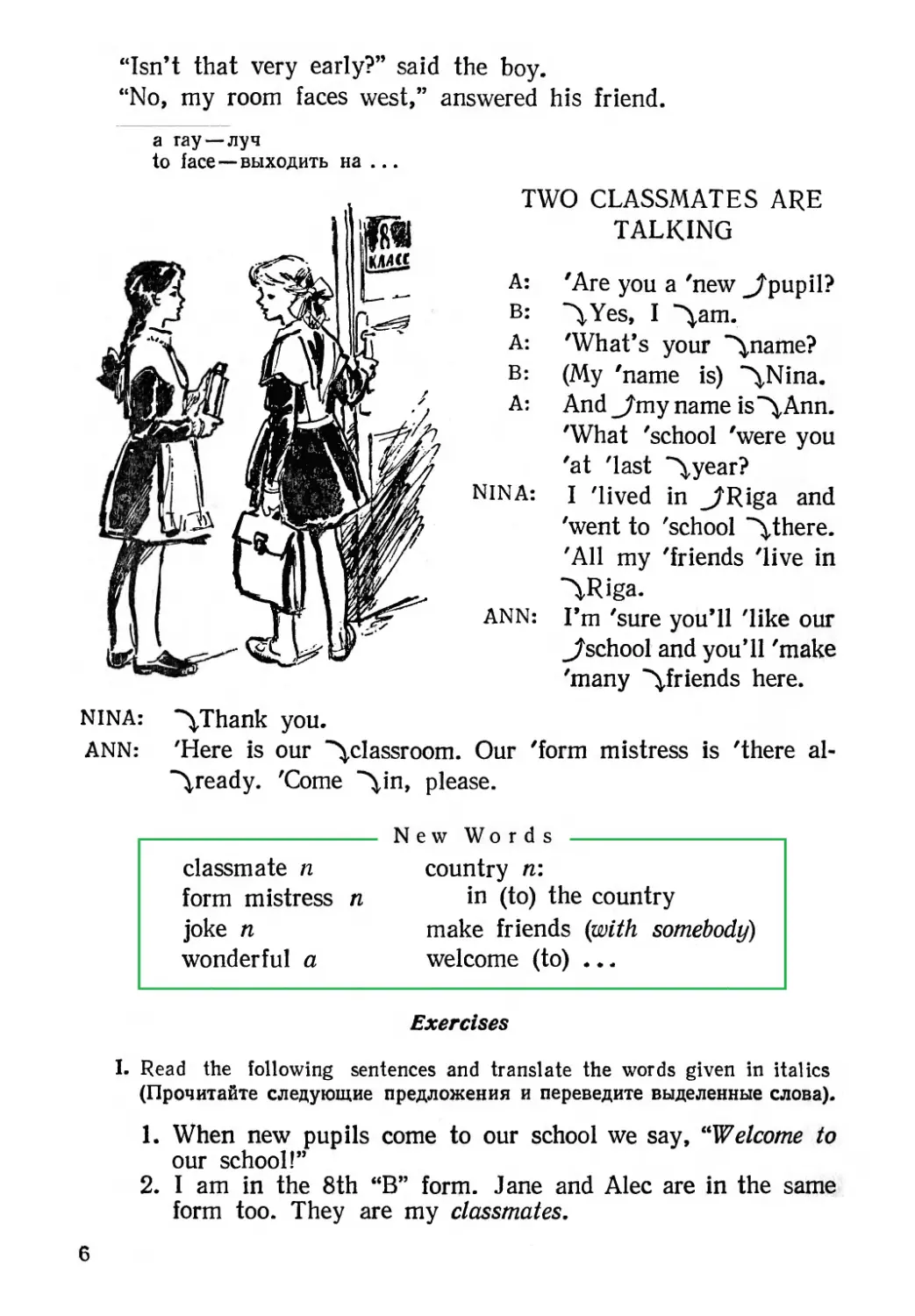
TWO CLASSMATES ARE
TALKING
A:	'Are you a 'new _/pupiI?
B:	~\Yes, I ^am.
A: 'What’s your ""\name?
B: (My 'name is) "^,Nina.
A: And _7myname is Ann.
'What 'school 'were you
'at 'last "^.year?
NINA: I 'lived in _7Riga and
'went to 'school ~\there.
'All my 'friends 'live in
>Riga.
ANN: I’m 'sure you’ll 'like our
^school and you’ll 'make
'many "^.friends here.
NINA: ~\Thank you.
ANN: 'Here is our "^classroom. Our 'form mistress is 'there al-
"Veady. 'Come ~\in, please.
classmate n
form mistress n
joke n
wonderful a
country n:
in (to) the country
make friends (puith somebody)
welcome (to) ...
Exercises
I. Read the following sentences and translate the words given in italics
(Прочитайте следующие предложения и переведите выделенные слова).
1.	When new pupils come to our school we say, “Welcome to
our school!”
2.	I am in the 8th “B” form. Jane and Alec are in the same
form too. They are my classmates.
6
3.	What’s a joke? —It's something we say that makes people
laugh.
4.	When I like a book very much I say, “This is a wonderful
book!” When I see a beautiful picture I say, “The picture
is wonderfull” When we think of what Gagarin, Titov and
other cosmonauts1 did we say, “Oh, that’s wonder full”
5.	We have many teachers, but only one of them is our form
mistress. Nina Petrovna is our English teacher and she is
our form mistress, too. She stays with us after school at
our meetings; she helps us with our work.
II.	You know five tenses. Write out from the texts on pages 3—5 five sentences
illustrating the use of these tenses (Вы знаете пять грамматических вре-
мён. Выпишите из текстов на стр. 3—5 пять предложений с этими
временами).
III.	Answer the questions, using (употребляя) the new words from the texts.
Example (Пример): What do you think about Nina and Ann?
I think they will make friends.
1.	Why is Nina Petrovna always at your class meetings?
2.	Why are the children laughing? What did Mike tell them?
3.	What do we say to the new pupils who come to our school?
4.	Where do many children go (to) in summer?
5.	What do we say when we like a film very much?
6.	Who does Nick often play chess with?
IV.	Translate into English:
1.	Летом мы были в пионерлагере.
2.	Мы ходили в колхоз и работали там.
3.	Мы подружились с ребятами из колхоза.
4.	Мы играли с ними в футбол и волейбол.
5.	Возле нашего пионерлагеря было большое озеро.
6.	Ты научился плавать? — Да.—Вот чудесно.
V.	Tell about your summer holidays. The questions on page 3 will help you.
1 cosmonaut ['kozmanozt]
LESSON TWO
ENGLISH SCHOOLS
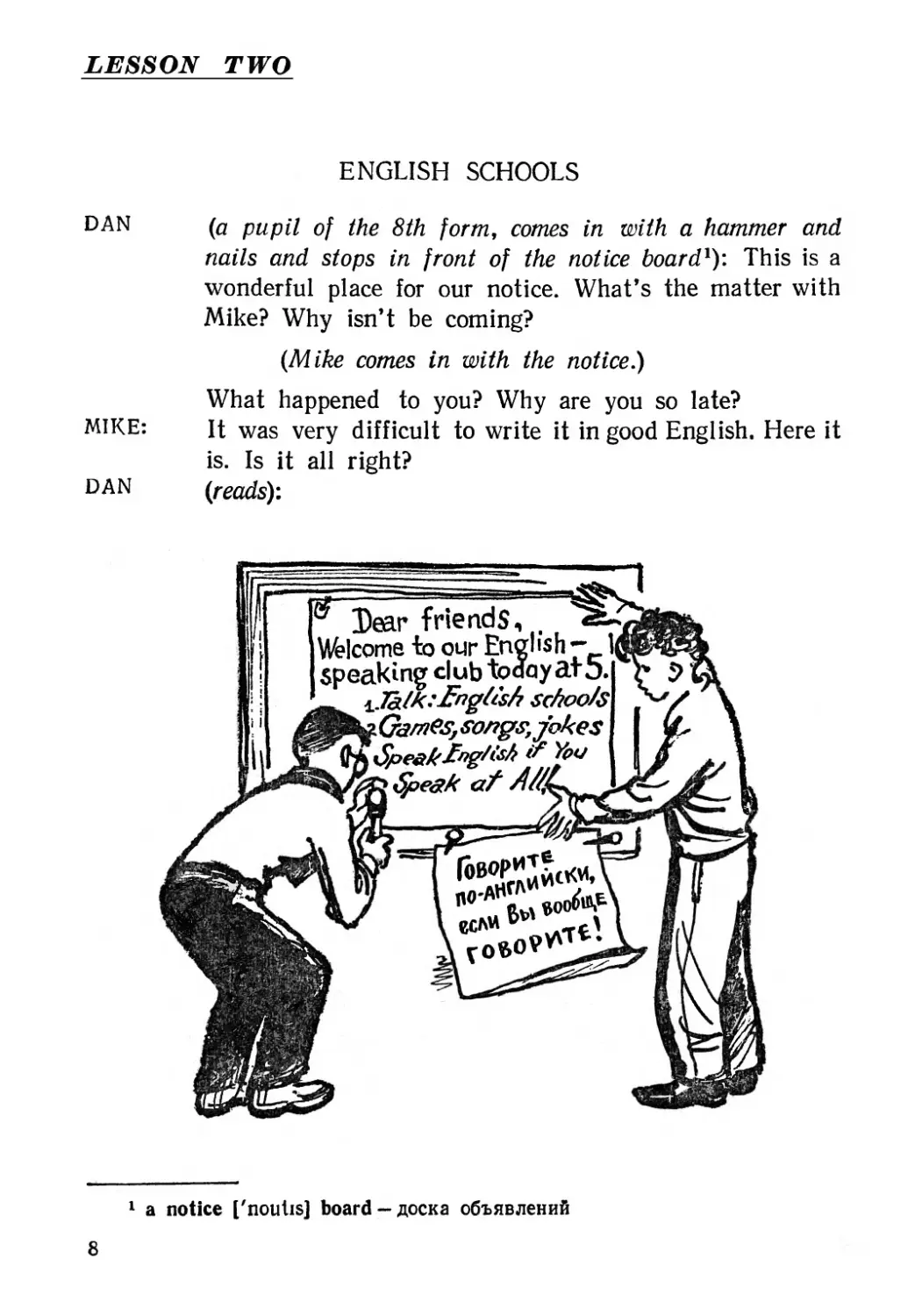
DAN (a pupil of the 8th form, comes in with a hammer and
nails and stops in front of the notice board1): This is a
wonderful place for our notice. What’s the matter with
Mike? Why isn’t be coming?
(Mike comes in with the notice.)
What happened to you? Why are you so late?
MIKE:	It was very difficult to write it in good English. Here it
is. Is it all right?
DAN (reads):
1 a notice ['noutis] board —доска объявлений
8
MIKE:	How do you like it? I haven’t done it very well, I’m
afraid.
DAN:	You are very good at things like that, I’ve told you so
hundreds of times. And here is the place for it, on this
board. Help me, please.
MIKE:	You’d better drive a nail in here, not there. Let me do that.
DAN:	Now everything is all right.
* * *
At 5 o’clock all the pupils came to the club. Inna, Nelly’s
sister, came to the club too. Inna is a young teacher. She has
been to England, and she can tell Nelly and her friends some
interesting things about that country.
The children asked her many questions about English
schools.
“English boys and girls begin going to a primary school1 when
they are five years old,” said Inna. “They study there for six years.
When they are eleven they may take an examination.1 2 The examin-
ation is very difficult. Every child has to write answers to a lot
of questions. Those who answer well, go to a grammar school;3
those who don’t, go to another kind of school—to a secondary
modern school.4
There are different kinds of schools in England. The subjects5
which they study in one kind of school are different from those
which they study in another. The grammar school is one from which
1 a 'primary school—начальная школа
2 to take an examination [ig,z3emizneijan] — держать экзамен. Имеет-
ся в виду конкурсный (отборочный) экзамен, так называемый the eleven
plus examination; дети сдают этот экзамен перед окончанием начальной шко-
лы, обычно в возрасте И лет.
3 В Англии существуют различные типы школ, с разными программами.
Одна из них —грамматическая школа. Эта школа имеет гуманитарное на-
правление и наилучшим образом подготавливает учащихся к поступлению в
университет.
4 a secondary modern school — реальная средняя школа, где осущест-
вляется главным образом практическое обучение. Эта школа не имеет опре-
делённой программы.
5 a subject ['sAbdgikt]— здесь предмет, изучаемый в школе
9
it is easier to go to a university.1 In modern schools children get
a more practical education. In all schools children learn handicrafts.
They find it very useful, because many of them go to work when
they leave school.”
“How old are they when they leave school?” asked Jane. Jane
always wants to know everything.
“They are fifteen or a little older,” Inna answered.
“And they come to school when they are five!” said Alec. “Poor
children! It’s a good thing we began when we were seven.”
“When Alec is a father,” said Mike, “his children will not go
to school before they are ten.”
Everybody laughed, and Jane said’ “Let’s write a letter to some
English boy or girl and ask them to tell us all about their school.”
“Oh, that will be wonderful!” said Nelly.
And the children decided to write to a schoolboy or schoolgirl
in England.
“I’m sure we’ll get an answer,” said Ann.
answer n
board n
hammer n
handicrafts n
kind n
New Words
nail n
talk n
decide v
leave v
study v
drive in (a nail) v
different a
useful a
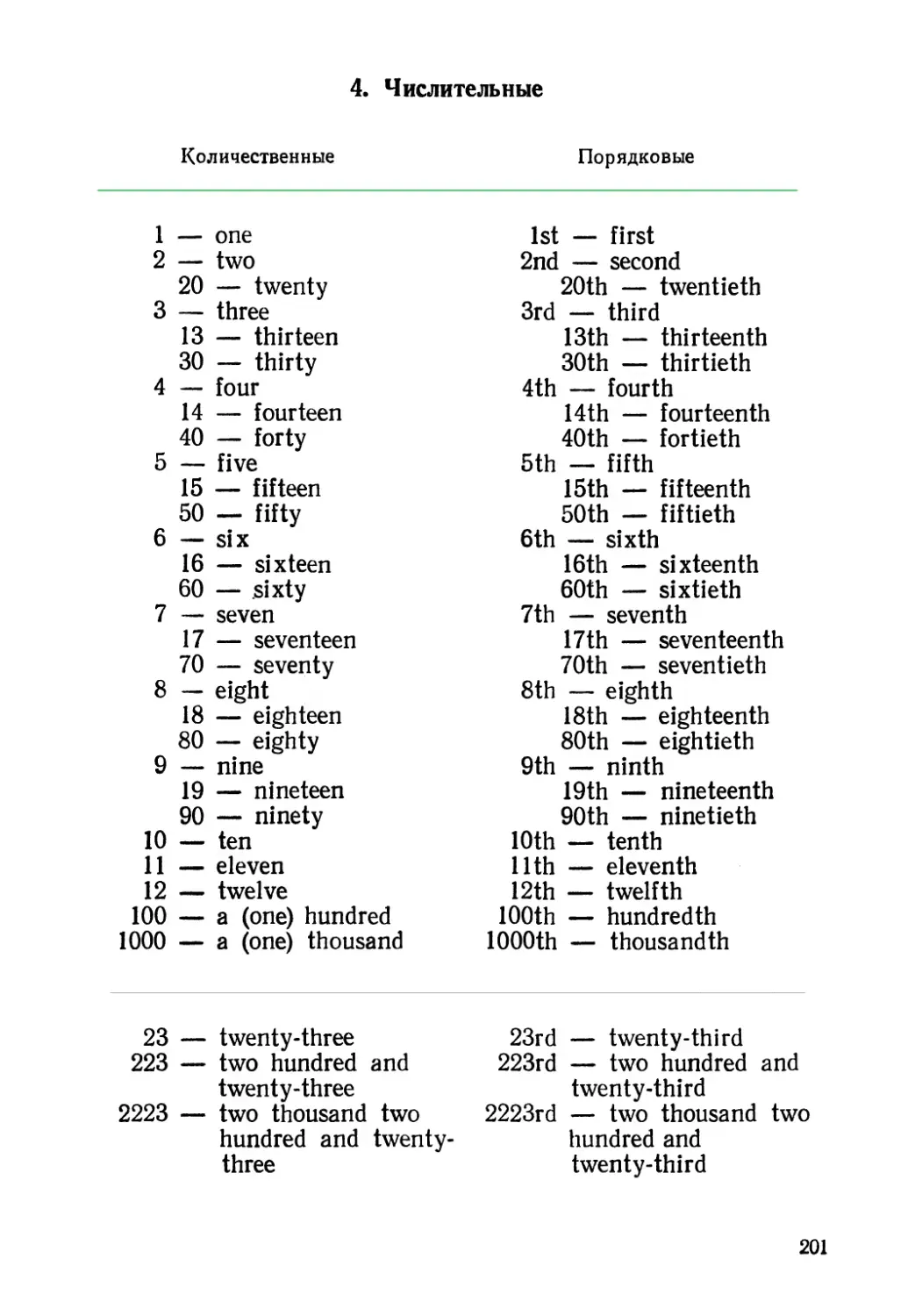
hundred num
a little pron
be good at... what is the matter (with)
here it is	(you) had better
practical education
Answer the questions:
1.	What is this text about?
2.	Who has been to England?
3.	Can Inna tell Nelly and her friends any
interesting things about that country?
1 a university [,ju:ni'va:siti]
10
4.	How old are English children when they go
to school for the first time?
5.	Do English children get a practical education?
6.	What did Nelly and her friends decide to do?
Exercises
I.	Read the following sentences and translate the words given in italics.
1.	We went to school when we were seven. We’ZZ leave school
when we are fourteen or fifteen.
2.	The day was cold and wet, and the boys decided not to go
to the country.
3.	I got a letter yesterday and wrote an answer to it.
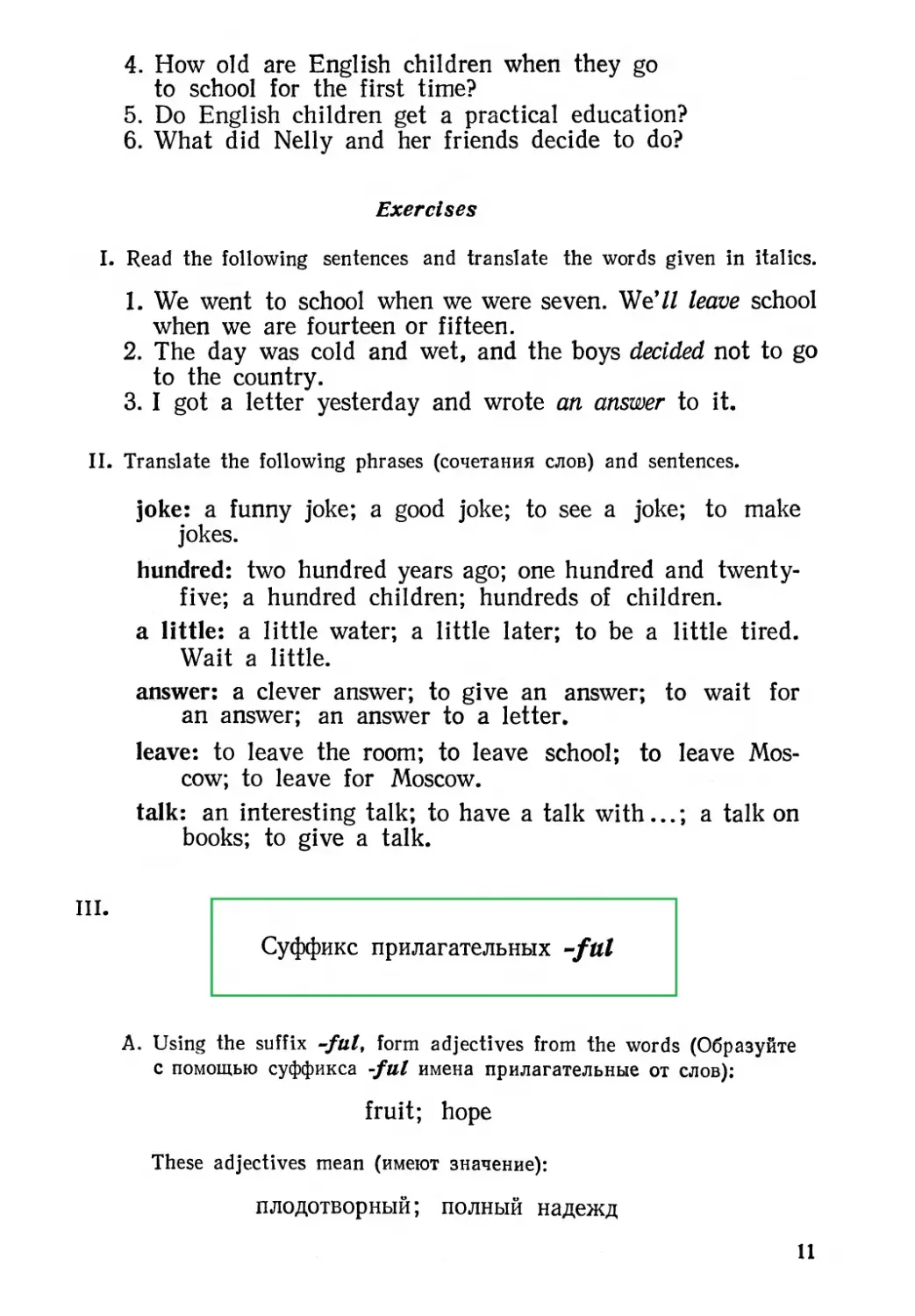
II.	Translate the following phrases (сочетания слов) and sentences.
joke: a funny joke; a good joke; to see a joke; to make
jokes.
hundred: two hundred years ago; one hundred and twenty-
five; a hundred children; hundreds of children.
a little: a little water; a little later; to be a little tired.
Wait a little.
answer: a clever answer; to give an answer; to wait for
an answer; an answer to a letter.
leave: to leave the room; to leave school; to leave Mos-
cow; to leave for Moscow.
talk: an interesting talk; to have a talk with...; a talk on
books; to give a talk.
III.
Суффикс прилагательных -ful
A.	Using the suffix -ful, form adjectives from the words (Образуйте
с помощью суффикса -ful имена прилагательные от слов);
fruit; hope
These adjectives mean (имеют значение):
плодотворный; полный надежд
11
В.	Translate the following phrases without using a dictionary (He поль-
зуясь словарём, переведите следующие сочетания слов):
a forgetful boy	a beautiful garden
a playful child	fruitful work
C.	Find in the text adjectives with the suffix -ful.
IV.	Make up sentences of the following type (Составьте предложения по
образцу):
Take a hammer and drive in the nail.
Take
a board
your hat
this letter
a nail
and write an answer.
and make a shelf.
and drive it into the wall.
and put it on.
V.	Translate into English:
1.	Постарайся помочь Коле.
2.	Сделай новую полку для кухни, пожалуйста.
3.	Не вбивай гвоздь в доску! Подожди немного, я дам тебе
другой молоток.
4.	Не бери ложку, возьми вилку.
5.	Не давай, пожалуйста, Бобу нож.
6.	Поищи красный карандаш.
7.	Отнеси книгу маме.
VI. A. Find in the text a sentence in which the Present Indefinite is used in
the meaning of the Future, and give the rule (Найдите в тексте
предложение, в котором Present Indefinite употреблено в значении
будущего времени, и скажите правило).
В.	Translate the sentences into English:
1.	Если вы пойдёте в лес, я тоже пойду с вами.
2.	Когда мы приедем в деревню, бабушка нас встретит.
3.	Я дам тебе марку, когда получу письмо из Англии.
4.	Если дядя приедет, я покажу ему наш школьный
сад.
12
VII.	Fill in the blanks with the following words and phrases (Заполните
пропуски словами и сочетаниями слов):
to study, kind, useful, handicraft, practical education, to be
good at, difficult, to leave, different, to make
Soviet children get a-------. They have — lessons at school
and try to be — at home. They — this bench at their
handicraft lessons. Was it —? No, it wasn’t. They----------------
handicrafts. What — of tools have they? They have —
kinds of tools. What will they do when they — school? They
will work and —.
VIII.	Read the sentences and say what parts of speech the words in italics are.
Give reasons for your answers (Прочитайте предложения и скажите,
к какой части речи относятся выделенные слова. Докажите правиль-
ность вашего ответа).
1.	We work in the garden in summer.
Our work is very interesting and not very difficult.
2.	Nelly always answers her letters.
The pupils’ answers were clever.
3.	I like to walk in the forest.
Let’s go for a walk.
IX.	Define the parts of speech as in the exercise above (По аналогии с пре-
дыдущим определите части речи). Translate the sentences into Russian:
1.	Please give me a glass of water.
You must water the flowers in the morning, when it is
not too hot.
2.	Pete studies English at school.
Tell us something about your studies.
X.	Translate the following sentences into English as in the examples given
below (по данным образцам):
Нине легко даётся английский язык,
(способна к ... и т. д.)
Nina is very good at her English.
1.	Саше легко даётся русский язык.
2.	Стива хороший спортсмен.
3.	У Дани большие способности к ручному труду.
13
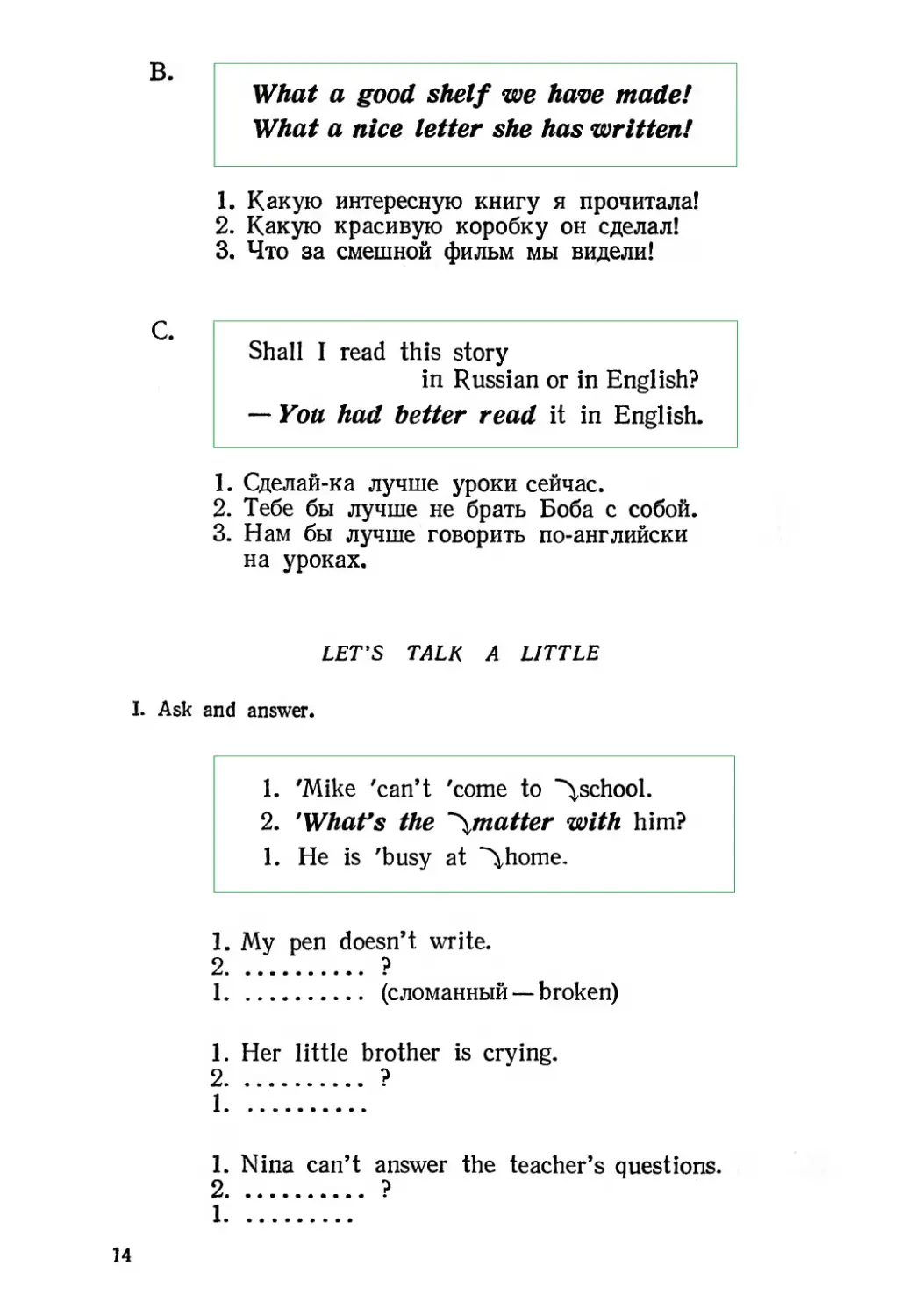
в.
What a good shelf we have made!
What a nice letter she has written!
1.	Какую интересную книгу я прочитала!
2.	Какую красивую коробку он сделал!
3.	Что за смешной фильм мы видели!
Shall I read this story
in Russian or in English?
— You had better read it in English.
1.	Сделай-ка лучше уроки сейчас.
2.	Тебе бы лучше не брать Боба с собой.
3.	Нам бы лучше говорить по-английски
на уроках.
LET'S TALK A LITTLE
I. Ask and answer.
1. 'Mike 'can’t 'come to "^school.
2. 'What’s the ~\matter with him?
1. He is 'busy at "^home.
1. My pen doesn’t write.
2............ ?
1.............. (сломанный	—	broken)
1. Her little brother is crying.
2............?
1............
1. Nina can’t answer the teacher’s questions.
2..............?
1.............
14
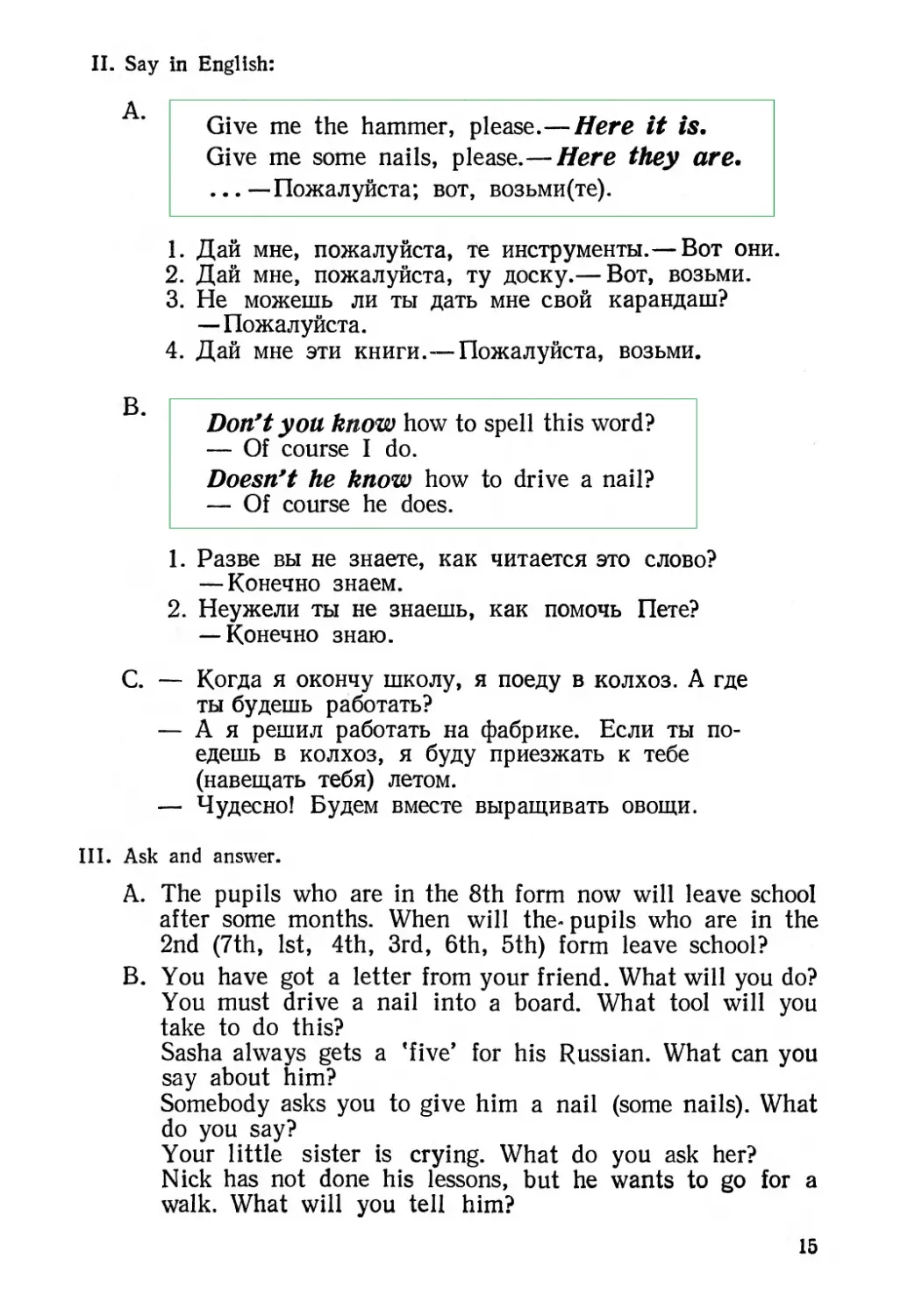
II.	Say in English:
Give me the hammer, please.—Here it is.
Give me some nails, please.—Here they are.
...—Пожалуйста; вот, возьми(те).
1.	Дай мне, пожалуйста, те инструменты.— Вот они.
2.	Дай мне, пожалуйста, ту доску.— Вот, возьми.
3.	Не можешь ли ты дать мне свой карандаш?
—Пожалуйста.
4.	Дай мне эти книги.—Пожалуйста, возьми.
Don't you know how to spell this word?
— Of course I do.
Doesn't he know how to drive a nail?
— Of course he does.
1.	Разве вы не знаете, как читается это слово?
— Конечно знаем.
2.	Неужели ты не знаешь, как помочь Пете?
— Конечно знаю.
С. — Когда я окончу школу, я поеду в колхоз. А где
ты будешь работать?
— А я решил работать на фабрике. Если ты по-
едешь в колхоз, я буду приезжать к тебе
(навещать тебя) летом.
— Чудесно! Будем вместе выращивать овощи.
III.	Ask and answer.
A.	The pupils who are in the 8th form now will leave school
after some months. When will the- pupils who are in the
2nd (7th, 1st, 4th, 3rd, 6th, 5th) form leave school?
B.	You have got a letter from your friend. What will you do?
You must drive a nail into a board. What tool will you
take to do this?
Sasha always gets a ’five’ for his Russian. What can you
say about him?
Somebody asks you to give him a nail (some nails). What
do you say?
Your little sister is crying. What do you ask her?
Nick has not done his lessons, but he wants to go for a
walk. What will you tell him?
15
IV. Look at the picture.
A. Make up a story. Mike will begin.
1.	Mike:
1.	We see a room in the picture.
2.	There are many boys and girls in the room.
3.	They’ve come to the English-speaking club.
16
2.
1	. We see a table.
2
3
3.
1.	A young woman is standing at the table. ...
4.
1.	The school-children are sitting ...
5.
1.	In a corner of the room we see two boys. ...
6.
I.	Two boys are sitting behind the chess-players. ...
7.
1.	Two girls are looking at the boys. ...
B.	What advice would you give to the boys who are playing chess, to the
boys who are watching the game, to the girls who are laughing? Use the
expression (Что вы посоветуете мальчикам, играющим в шахма-
ты, мальчикам, которые следят за игрой, и девочкам, кото-
рые смеются? Употребите выражение You had better or You had
better not,)
C.	Describe (опишите) the picture.
D.	Here are three proverbs (пословицы). Say them in Russian and think
which of them applies (подходит) to the picture.
All cats are grey in the night.
Four eyes see more than two.
Everything is good in its season.
V. Ask and answer.
1.	Have you an English-speaking club at your school?
2.	Does it help you to know English better?
3.	Speak about your friends:
a)	Do they like to go to the club?
b)	Are all of them good listeners? [Compare (сравните):
to write— writer; to listen— listener.
17
LESSON THREE
PETE SPEAKS ENGLISH
An Englishman came to the U.S.S.R. One morning in summer
he came into the. garden and saw a schoolboy with a watering-can.
The boy’s name was Pete. He was in the 5th form. He liked to
speak English and often came to the English-speaking club.
There he made friends with Dan, Mike, Nelly and other pupils of
the 8th form. Now Pete was in the garden because he had to
water the flowers.
The Englishman wanted to speak with the boy and soon he
began to ask him questions.
ENGLISHMAN: Good morning. Do you speak English?
PETE: Yes, I do—a little.
ENGLISHMAN: What are you doing here so early?
PETE: Our class looks after this garden, and my job is to water
the flowers. We made these flowerbeds last week.
18
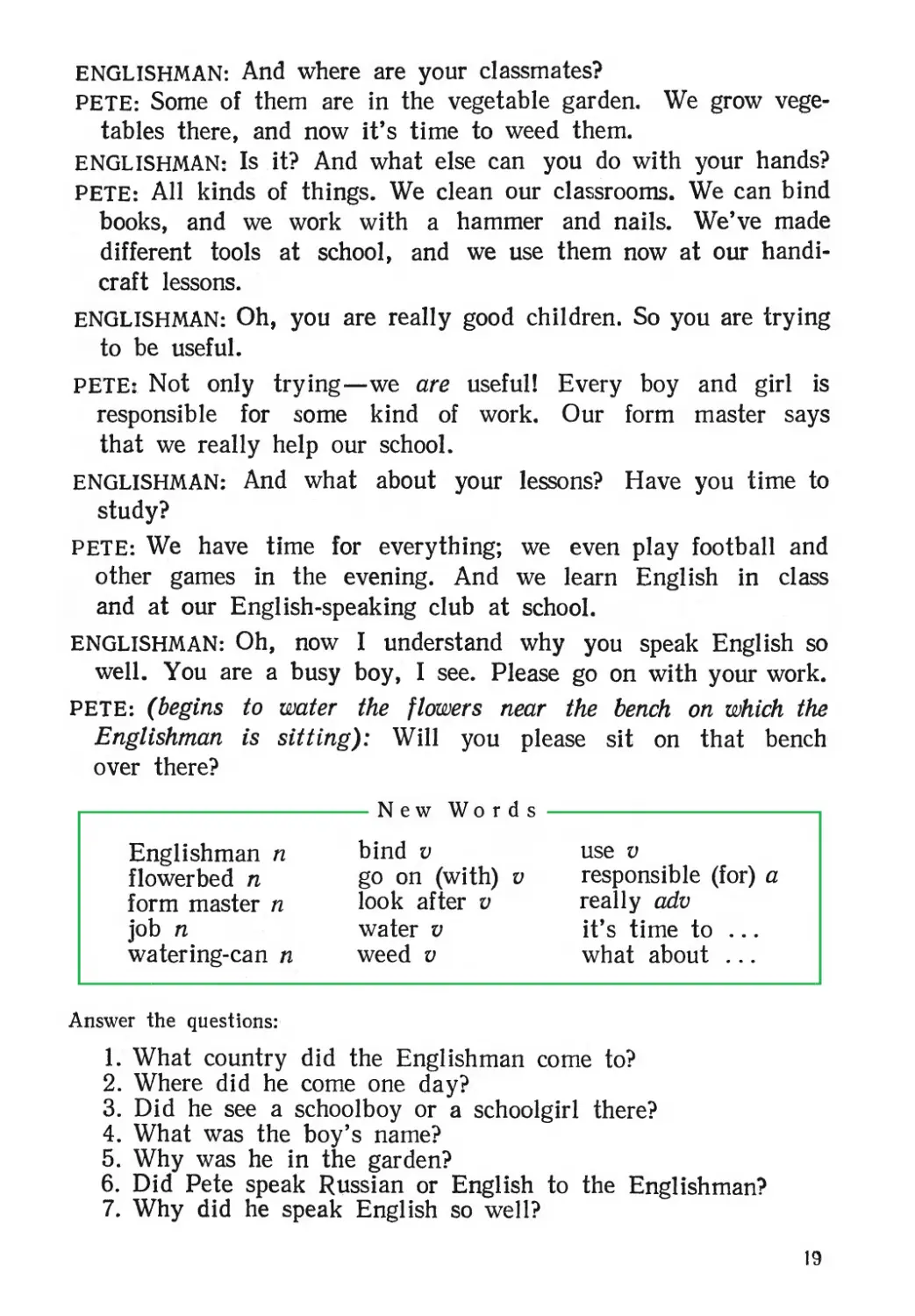
ENGLISHMAN: And where are your classmates?
PETE: Some of them are in the vegetable garden. We grow vege-
tables there, and now it’s time to weed them.
ENGLISHMAN: Is it? And what else can you do with your hands?
PETE: All kinds of things. We clean our classrooms. We can bind
books, and we work with a hammer and nails. We’ve made
different tools at school, and we use them now at our handi-
craft lessons.
ENGLISHMAN: Oh, you are really good children. So you are trying
to be useful.
PETE: Not only trying—we are useful! Every boy and girl is
responsible for some kind of work. Our form master says
that we really help our school.
ENGLISHMAN: And what about your lessons? Have you time to
study?
PETE: We have time for everything; we even play football and
other games in the evening. And we learn English in class
and at our English-speaking club at school.
ENGLISHMAN: Oh, now I understand why you speak English so
well. You are a busy boy, I see. Please go on with your work.
PETE: (begins to water the flowers near the bench on which the
Englishman is sitting): Will you please sit on that bench
over there?
Englishman n
flowerbed n
form master n
job n
watering-can n
— New Words
bind v
go on (with) v
look after v
water v
weed v
use v
responsible (for) a
really adv
it’s time to ...
what about ...
Answer the questions:
1.	What country did the Englishman come to?
2.	Where did he come one day?
3.	Did he see a schoolboy or a schoolgirl there?
4.	What was the boy’s name?
5.	Why was he in the garden?
6.	Did Pete speak Russian or English to the Englishman?
7.	Why did he speak English so well?
19
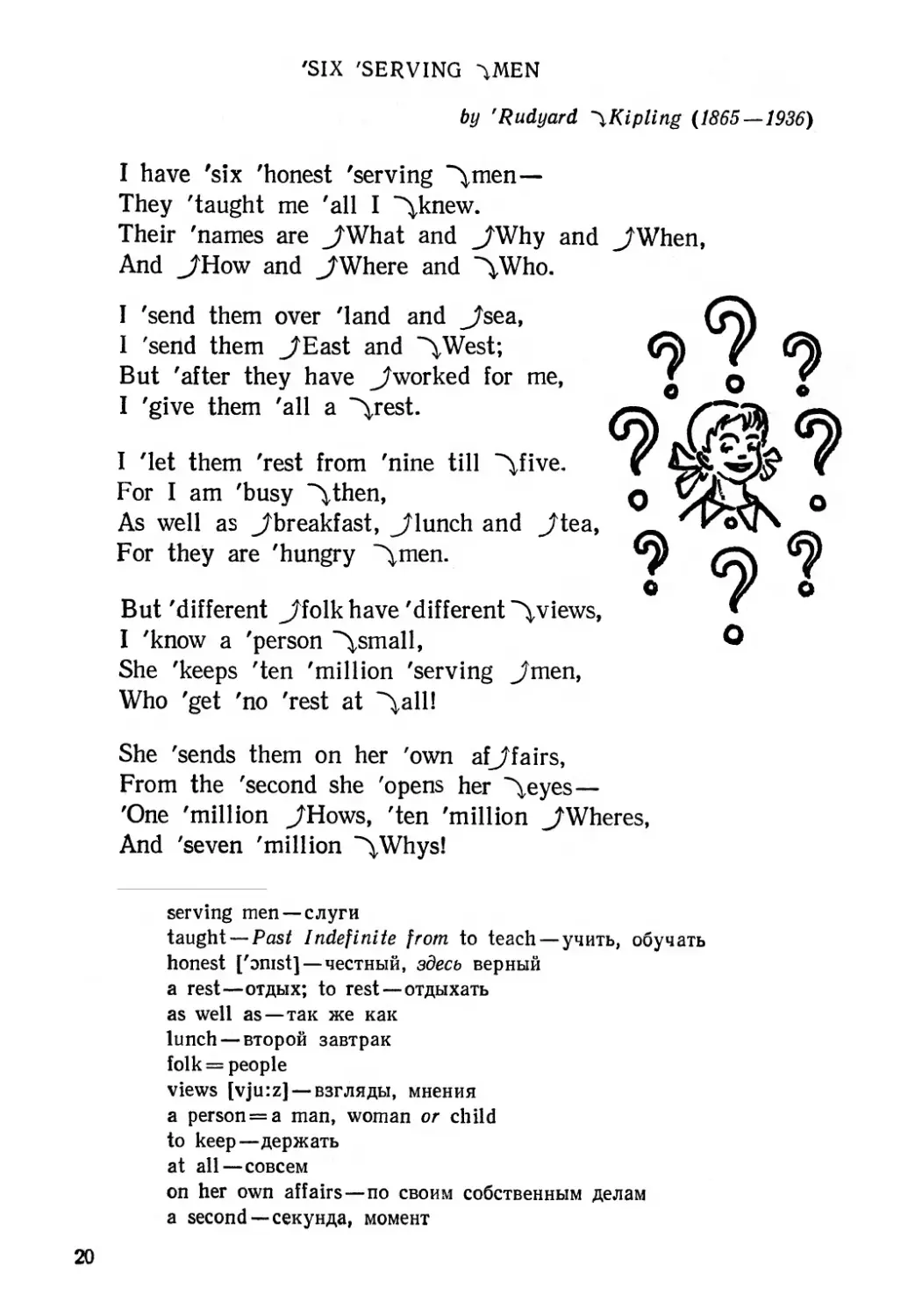
'SIX 'SERVING ЛМЕЫ
by 'Rudyard ~\Kipling (1865—1936)
I have 'six 'honest 'serving ~\men—
They 'taught me 'all I ~^,knew.
Their 'names are _/What and ^Why and _^When,
And _7How and _/Where and ~\Who.
I 'send them over 'land and _Jsea,
I 'send them _/East and ~\West;
But 'after they have ^worked for me,
I 'give them 'all a ~\rest.
I 'let them 'rest from 'nine till "Vive.
For I am 'busy ~Vhen,
As well as ^breakfast, ^lunch and _Деа,
For they are 'hungry ~^,men.
But 'different ^folk have 'different views,
I 'know a 'person ~\small,
She 'keeps 'ten 'million 'serving Jmen,
Who 'get 'no 'rest at ~^,all!
She 'sends them on her 'own affairs,
From the 'second she 'opens her "\eyes—
'One 'million J'Hows, 'ten 'million J'Wheres,
And 'seven 'million "\Whys!
serving men—слуги
taught — Past Indefinite from to teach — учить, обучать
honest ['onist] — честный, здесь верный
a rest—отдых; to rest — отдыхать
as well as—так же как
lunch — второй завтрак
folk = people
views [vju:z] — взгляды, мнения
a person = a man, woman or child
to keep—держать
at all — совсем
on her own affairs—по своим собственным делам
a second —секунда, момент
20
* * *
Есть у меня шестёрка слуг,
Проворных, удалых.
И всё, что вижу я вокруг,—
Всё знаю я от них.
Они по знаку моему
Являются в нужде.
Зовут их: Как и Почему,
Кто, Что, Когда и Где.
Я по морям и по лесам
Гоняю верных слуг.
Потом работаю я сам,
А им даю досуг.
Стихотворение Р. Киплинга
Даю им отдых от забот,—
Пускай не устают.
Они прожорливый народ,—
Пускай едят и пьют.
Но у меня есть милый друг,
Особа юных лет.
Ей служат сотни тысяч слуг, —
И всем покоя нет!
Она гоняет, как собак,
В ненастье, дождь и тьму
Пять тысяч Где, семь тысяч Как,
Сто тысяч Почему!
(Перевод С. Я- Маршака)
Answer the questions:
1.	What is your name?
2.	Have you a good friend?
3.	Tell us how, when and where you made friends
with him (her).
Exercises
I.	Read the following sentences and translate the words given in italics.
1.	This man can’t speak Russian, he speaks only English.
He comes from England. He is an Englishman.
2.	Water these flowers! The ground is too dry.
3.	My mother is very busy. I try to be useful at home.
I look after my little sister and buy bread and vegetables.
4.	I like our garden. There are many flowerbeds in it. Many
wonderful flowers grow in these flowerbeds.
5.	It’s eleven o’clock. It's time to go to bed.
6.	When there is a lot of grass in the flowerbeds we weed
them.
7.	He loves books, and when they are old he binds them.
8.	When we eat soup we use a spoon. When we eat meat we
use a knife and fork.
9.	Nina Petrovna is the form mistress of the 8th form, and
Ivan Victorovich is the form master of the 5th form.
II.	Write out all the compound nouns (составные имена существительные)
from the text.
21
III.	Give definitions (дайте определения) of the following compound nouns.
Translate them into Russian without using a dictionary.
Examples: a 'watering-can—a can (жестяная банка) with
which we water flowers —лейка
a 'writing-table—a table at which we write—
письменный стол
a 'reading-lamp —
a 'walking-stick—
a 'reading-room—
a 'skating-rink—a place ...
IV.	Give all the pronouns which you use when you speak about yourself; when
you speak to somebody; when you speak about other people; when you
speak about a thing or things (Напишите все местоимения, которые
употребляются, когда: 1) говорят о себе; 2) обращаются к кому-либо;
3) говорят о других; 4) говорят о предмете или предметах).
Example: I, me, my ...
V.	Fill in the blanks with the verbs (глаголами):
to look after, to look at, to look for.
Tom: Mother, ... Dolly! What is she doing?
Mother: She is ... her kitten. ... her, I must leave the
house for half an hour.
22
VI.	Fill in the blanks with the words and phrases:
job, classmate, different kinds, to be useful, watering-can,
to be good at
Last summer my — and I were at a pioneer camp. We had
a lot of time for everything: for games, sports and work. My
friend--------handicrafts. He made some — to water the
vegetables and flowers. Every pioneer had his —. We did
------of work in the camp. We tried----------and do everything
well.
VII.	Examine the italicized parts of the following sentences and say which
interrogative word is used in each case (Сопоставьте выделенные части
предложений с вопросительными словами, относящимися к ним).
1. Pete speaks English well. How does Pete speak English?
2. Pete speaks English well because he learns English in class
and at the school club. Why does Pete speak English
well?
3.	The Englishman saw Pete in the school garden. Where did
the Englishman see Pete?
4.	Pete’s classmates made beautiful flowerbeds in the school
garden. What did Pete’s classmates make in the school
garden?
5.	They made the flowerbeds last week. When did they make
the flowerbeds?
6.	They made the flowerbeds last week. Who made the
flowerbeds last week?
VIII.	Ask questions on the italicized words. Make use of Exercise VII
(В качестве образца используйте упражнение VII).
1.	The school-children worked in the vegetable garden.
2.	They worked in the vegetable garden in spring, summer
and autumn.
3.	They worked in the vegetable garden because they wanted
to be useful.
4.	Their form master came to the vegetable garden with
them.
5.	They have done their job very well.
6.	They weeded the potatoes.
23
IX.	Translate into Russian:
1.	It’s time to go to the vegetable garden. Take your water-
ing-cans!
2.	We have very interesting handicraft lessons at our school.
What about your school? Do you have them too?
3.	Our form mistress gave us a very interesting job. “Go on
with your job,” she said.
X.	Translate into English:
А.	А как у них с английским языком?
А как твой товарищ?
А как с вашей газетой?
Пора вставать.
Пора идти в школу.
Пора начинать урок.
В.	Пора поливать цветы. Вот лейки.
Кто следит за этой клумбой? Её пора выполоть.
Коля занят, я знаю. А Миша?
XI.	Translate orally (устно) the sentences as in the example:
f Сядьте, пожалуйста, на ту скамью.
• Не сядете ли вы на ту скамью?
k Не будете ли вы добры сесть на ту скамью?
Will you please sit on that bench over there?
1.	He дадите ли вы мне ваш молоток?
2.	Не поможете ли вы мне выполоть клумбу?
3.	Не пойдёте ли вы со мной на каток?
4.	Принесите, пожалуйста, завтра мою книгу.
5.	Напишите, пожалуйста, это слово на доске.
XII.	Pick out from the poem all the words which rhyme with the word men
(Выберите из стихотворения все слова, которые рифмуются со словом
теп).
XIII.	Write out from the poem all the words containing silent letters (Выпи-
шите из стихотворения все слова с непроизносимыми буквами).
XIV.	Make up questions using the interrogative words from the poem.
XV.	Learn the poem by heart (наизусть).
24
LET'S TALK A LITTLE
I.	Ask and answer.
A -------------------------------------------
ever ['eva]— когда-либо, когда-нибудь
Have you ever been to London?
Были ли вы когда-нибудь в Лондоне?
1.	Have you ever spoken to any Englishmen?
2.	If you meet one, will you try to speak to him?
3.	Does your class look after a flower garden or a
vegetable garden?
4.	What is your job?
5.	What will you do if your job is to look after flowers?
6.	Will you weed the flowerbeds?
7.	Where do we grow potatoes?
8.	What do the children do to help the school library?
Steve is a good jumper.
He goes in for jumping.
1.	Why is Nick a good runner?
2.	Why is Nelly a good skater?
3.	Why is Kate a good swimmer?
4.	Why	is Dan	a good	skier?
C. 1. What	sports	do	you	go in	for?
2.	What	sports do	you	go in	for in	summer?
3.	What	sports	do	you	go in	for in	winter?
4.	What	games	do	you	know	that you can play
in the house?
5.	When do we use skates (skis, a ball)?
What sport can you
go in for if
r you like to play with a ball?
you live near a river or a lake?
) you like winter sports?
I you like summer sports?
25
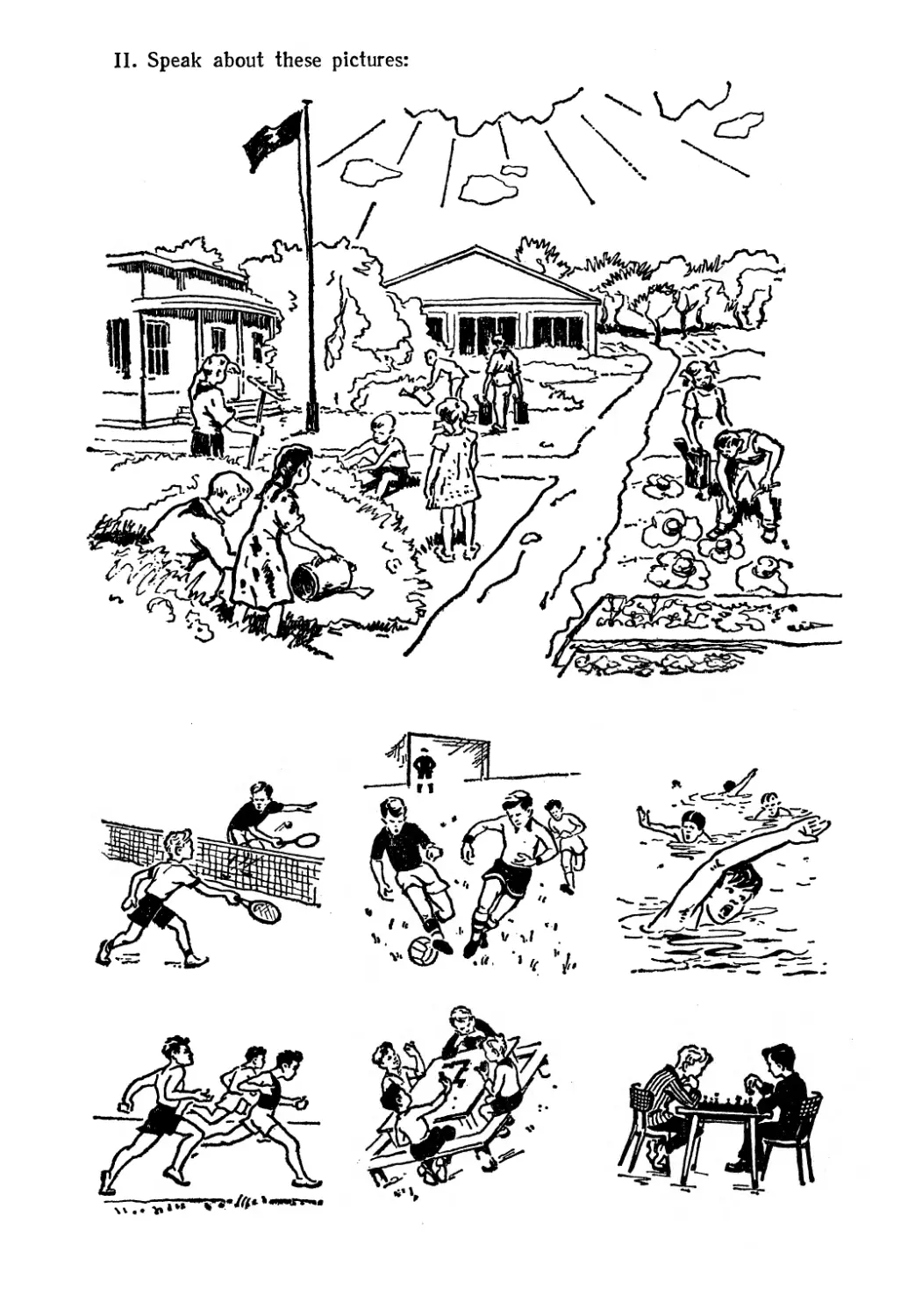
IL Speak about these pictures:
Text to be Read at Home
Find the answers to these questions:
1.	Why did the boys give Jenkins the name of ‘Cherry Ripe’?
2.	What had Cherry Ripe in his garden?
3.	What did the boys decide to do once?
4.	Who did the boys see when they got on Cherry Ripe’s
wall?
5.	What did Cherry Ripe and his friends do when they saw the
boys in the garden?
6.	What did the boys understand?
7.	Where did Cherry Ripe take the boys?
8.	What happened to them at school after the raid?
CHERRY RIPE1
Part I
This is a story about a very clever man, Jenkins. We have given
him the name of ‘Cherry Ripe’ because he sells cherries. Cherry
Ripe is a farmer. He lives near our school. When you leave the
school garden, you come to a wood. It is not very large. Then
comes a field, which is larger. After this large field there comes
an old wall, and behind that wall is the orchard of Cherry Ripe.
Now I’m going to tell you what happened last year. Cherry Ripe
sold cherries, but he had apples and other kinds of fruit too, and
grew potatoes and other vegetables. We often went there to look at
his wonderful apples and cherries. I must say he didn’t like it. He ran
after us, but he could not catch us, of course. He often laughed when
he worked in his orchard with his daughters; he never laughed
when he saw us. And when we gave him the name of ‘Cherry Ripe’,
he liked us even less.
Once—it was just the cherry season—we decided to make a
raid1 2 on his cherries. I shan’t say much about what happened. All
went well... But when we got on Cherry Ripe’s wall, who did we
see? Cherry Ripe in a cherry-tree, and his daughters under itl They
were at the other side of the orchard, and he couldn’t see us. “And if
he sees us,” said Pedlar, “we shall have time to run away.”
1 «Вишня спелая»—По книге Е. Phillpotts “The Human Boy Again”.
Leipzig, 1908. «Вишня спелая!»—так торговцы вишнями зазывают покупателей.
2 to make a raid—совершить набег
27
As Cherry Ripe was busy with cherries, we decided to go for
his apples. I jumped down first, then Pedlar and Freckles jumped,
and then Chilvers. He fell in the middle of a flowerbed and broke
some flowers and wasn’t even sorry.
We were busy with green apples when Chilvers shouted, “Run
away!” But it was too late. We saw three men, and one of them
was Cherry Ripe!
They caught us all, and Cherry Ripe’s daughters saw this and
laughed. And then we understood everything. That was a scarecrow
in the tree and not Cherry Ripe. It had his hat on, and his daugh-
ters laughed as they talked to that scarecrow!
Cherry Ripe took us to our school and told the head-master
about our raid. The head-master looked at us as if we were1 some
ijew kind of animal and he did not know why we were in his room.
And then he was angry. He was so angry that even Cherry Ripe
was sorry for us.
We got four on each hand1 2 and had to stay in the classroom
when the lessons were over.
(To be continued—Продолжение следует)
Answer the questions:
1.	Why didn’t Cherry
Ripe like the boys?
2.	Why was Chilvers
not sorry when he
fell in the middle of
a flowerbed?
3.	What kind of man
was Cherry Ripe?
Was he clever?
Joke
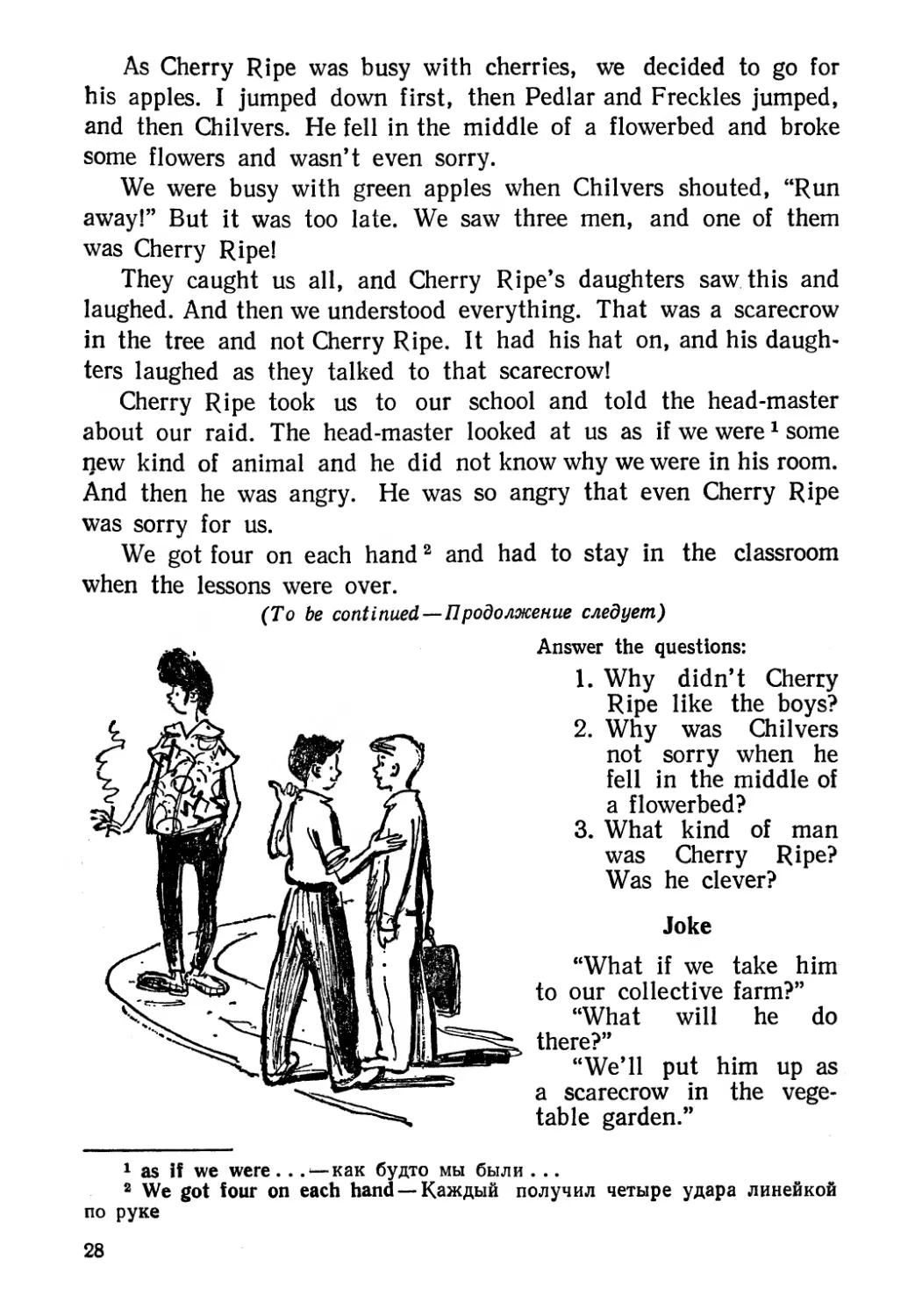
“What if we take him
to our collective farm?”
“What will he do
there?”
“We’ll put him up as
a scarecrow in the vege-
table garden.”
1 as if we were. . . — как будто мы были . ..
2 We got four on each hand — Каждый получил четыре удара линейкой
по руке
28
LESSON FOUR
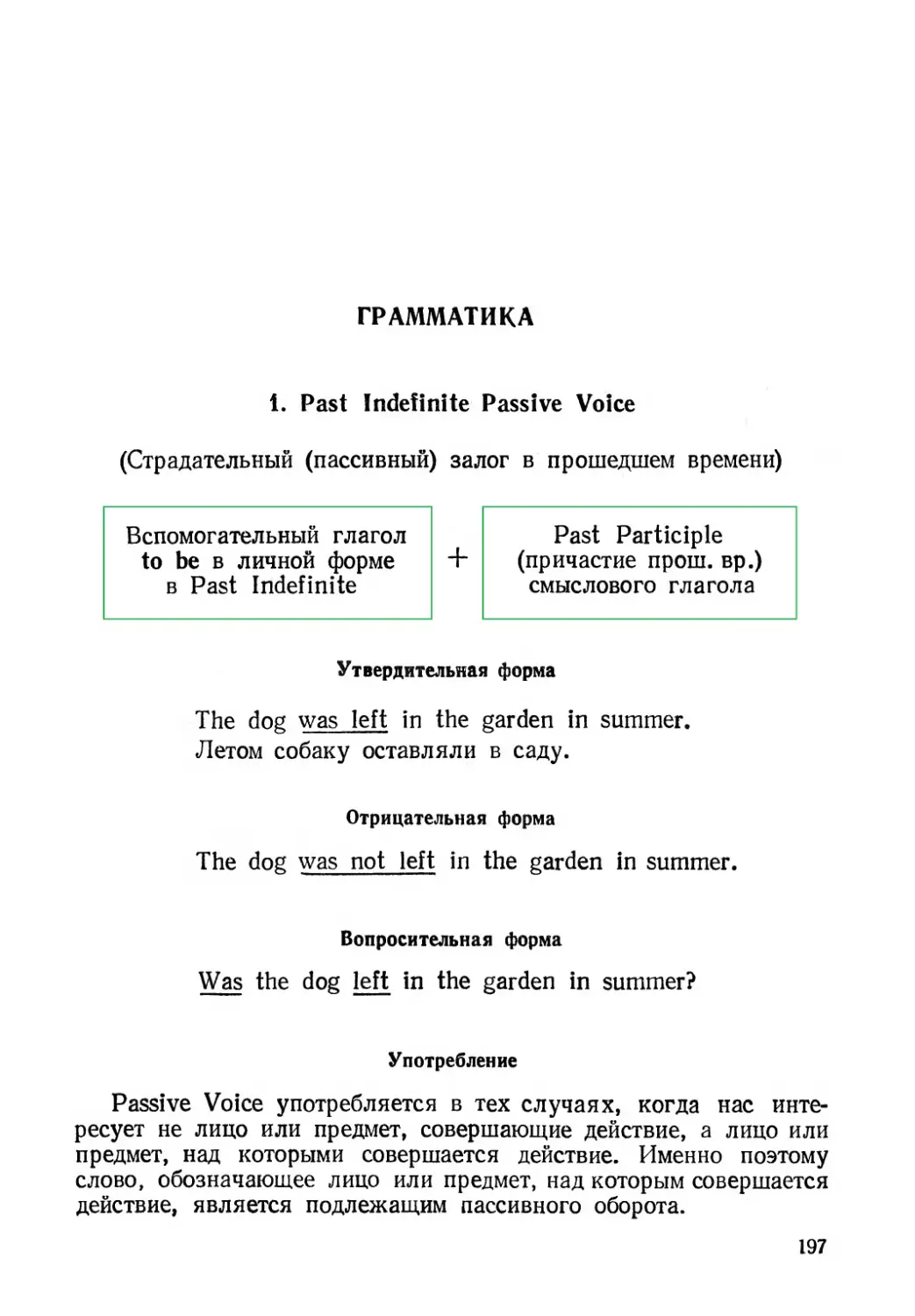
Passive Voice ['paesiv 'vois]
(Страдательный залог)
Revision (Повторение):
Past Indefinite Active Voice.
New Material (Новый материал):
Past Indefinite Passive Voice.
I.	Use the verbs given in brackets (в скобках) in the Past Indefinite Active
Voice.
1.	We—many useful things at our handicraft lessons last
year, (make)
2.	What —he—last Sunday? (do)
3.	She —the room yesterday, (clean + not)
II.	Translate into English:
1.	Кому ты послал вчера письмо? — Брату.
2.	Когда ты купил коньки? — В прошлом году.
3.	Ты взял вчера мою книгу?—Да.
III.	Give the Past Indefinite and Past Participle (причастие прошедшего
времени) of the verbs:
drive, plant, leave, catch, know, take, lose, buy, grow, make,
send, write.
IV.	Read and translate the sentences. Explain how the Past Indefinite Passive
is formed (Объясните, как образуется Past Indefinite Passive).
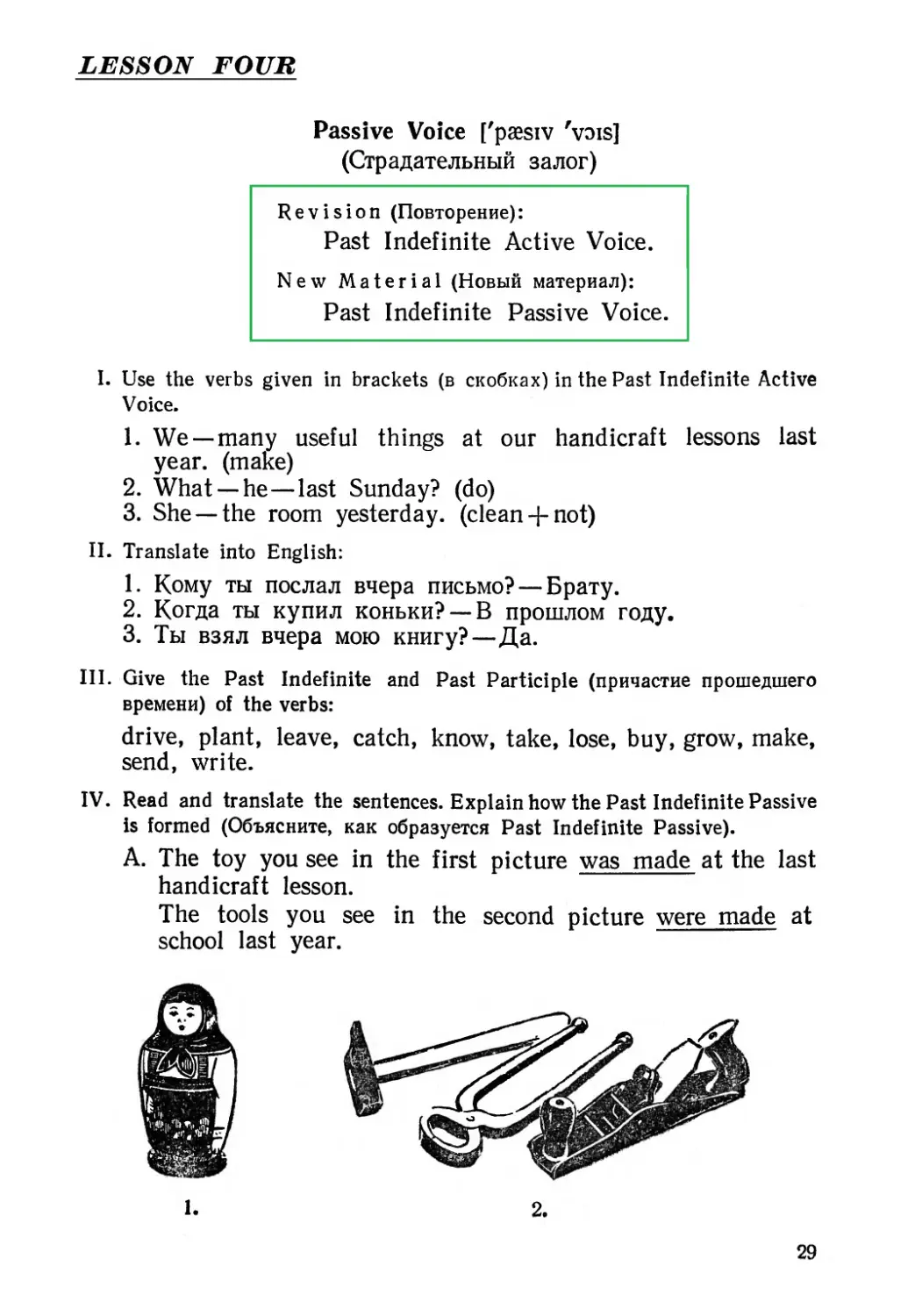
A. The toy you see in the first picture was made at the last
handicraft lesson.
The tools you see in the second picture were made at
school last year.
29
В. 1. Mike sent me a letter
last summer.
2. Mother did not take
her little sons for a
walk yesterday.
3. When did you plant
these trees?
1.	Mike was sent to a pioneer
camp last summer.
2.	The boys were not taken
for a walk yesterday.
3.	When were these trees
planted?
V. Use the verbs given in brackets in
the Past Indefinite Passive Voice.
1.	This work—a week ago. (do)
2.	New words—at the last lesson, (repeat)
3.	The children—to the cinema last Sunday, (take)
VI.	Put into the negative and interrogative forms (Образуйте отрицательную
и вопросительную формы):
1.	The room was cleaned in the evening.
2.	The book was bound yesterday.
3.	Watering-cans were sold here last summer.
VII.	Translate into English:
1.	Летом я встретил мно-
гих старых друзей.
2.	Я не купил вчера гвоз-
дей.
3.	Когда твой товарищ
принёс тебе книгу?
Их встретили в саду. (Дослов-
но: Они были встречены
в саду.)
Гвозди не купили вовремя. (До-
словно: Гвозди не были куп-
лены вовремя.)
Когда принесли эту книгу?
(Дословно: Когда эта книга
была принесена?)
AT A CLASS MEETING
The lessons were over, but the children did not go home. They
had a meeting that day. It was their first class meeting that year.
The form mistress said: “Boys and girls, today we shall discuss
the question of our future class work. Let’s elect the monitor of the
class.”
Kate Petrova was elected monitor of the class. She went to the
table. The form mistress sat down behind the children.
30
KATE:
SASHA:
MIKE:
PUPILS:
KATE:
ALEC:
MIKE:
KATE:
DAN:
JANE:
KATE:
JANE:
ANN:
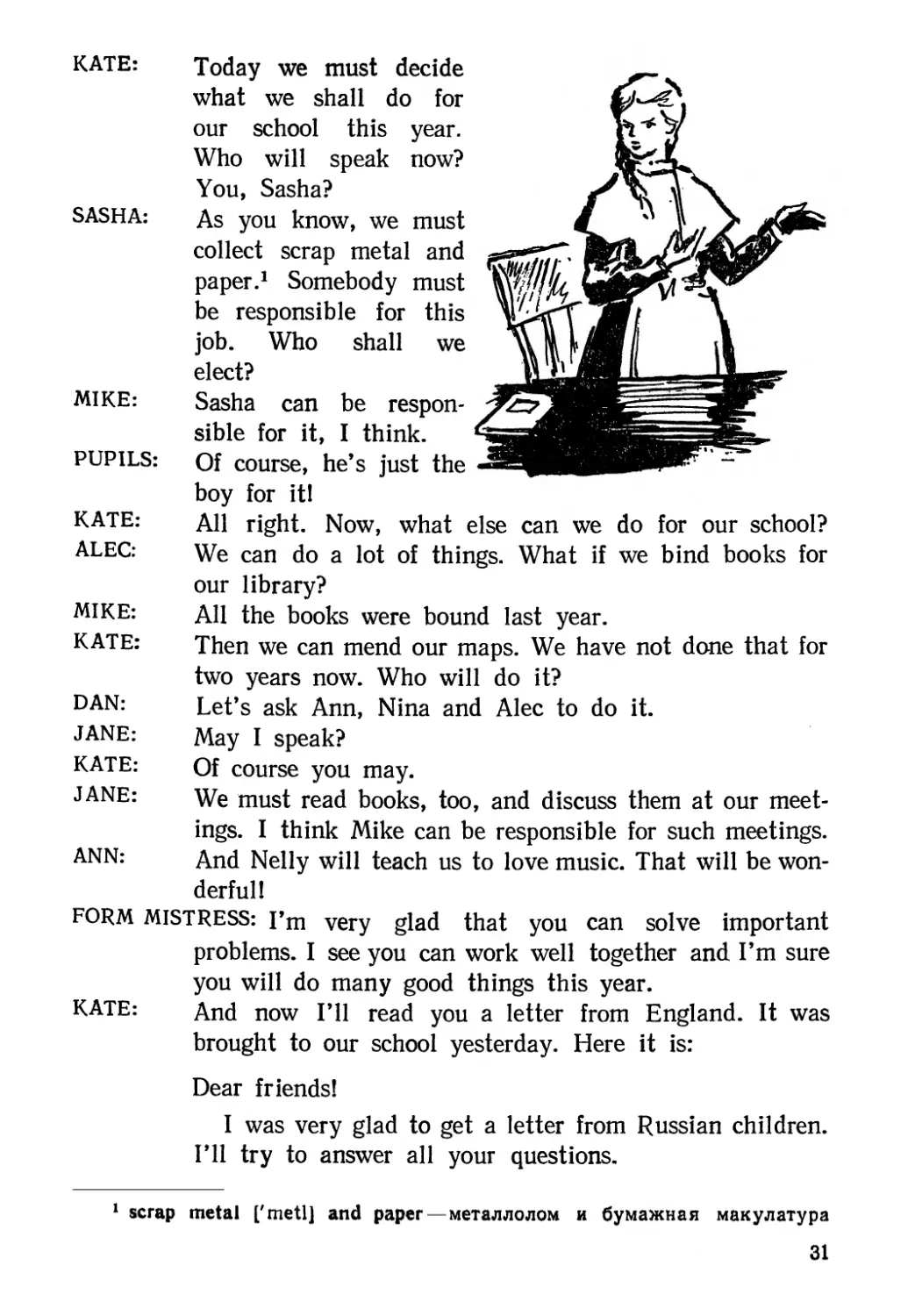
Today we must decide
what we shall do for
our school this year.
Who will speak now?
You, Sasha?
As you know, we must
collect scrap metal and
paper.1 Somebody must
be responsible for this
job. Who shall we
elect?
Sasha can be respon-
sible for it, I think.
Of course, he’s just the
boy for it!
All right. Now, what else can we do for our school?
We can do a lot of things. What if we bind books for
our library?
All the books were bound last year.
Then we can mend our maps. We have not done that for
two years now. Who will do it?
Let’s ask Ann, Nina and Alec to do it.
May I speak?
Of course you may.
We must read books, too, and discuss them at our meet-
ings. I think Mike can be responsible for such meetings.
And Nelly will teach us to love music. That will be won-
derful!
FORM MISTRESS: Гщ very glad that you can solve important
problems. I see you can work well together and I’m sure
you will do many good things this year.
KATE:	And now I’ll read you a letter from England. It was
brought to our school yesterday. Here it is:
Dear friends!
I was very glad to get a letter from Russian children.
I’ll try to answer all your questions.
1 scrap metal ['metlj and paper — металлолом и бумажная макулатура
31
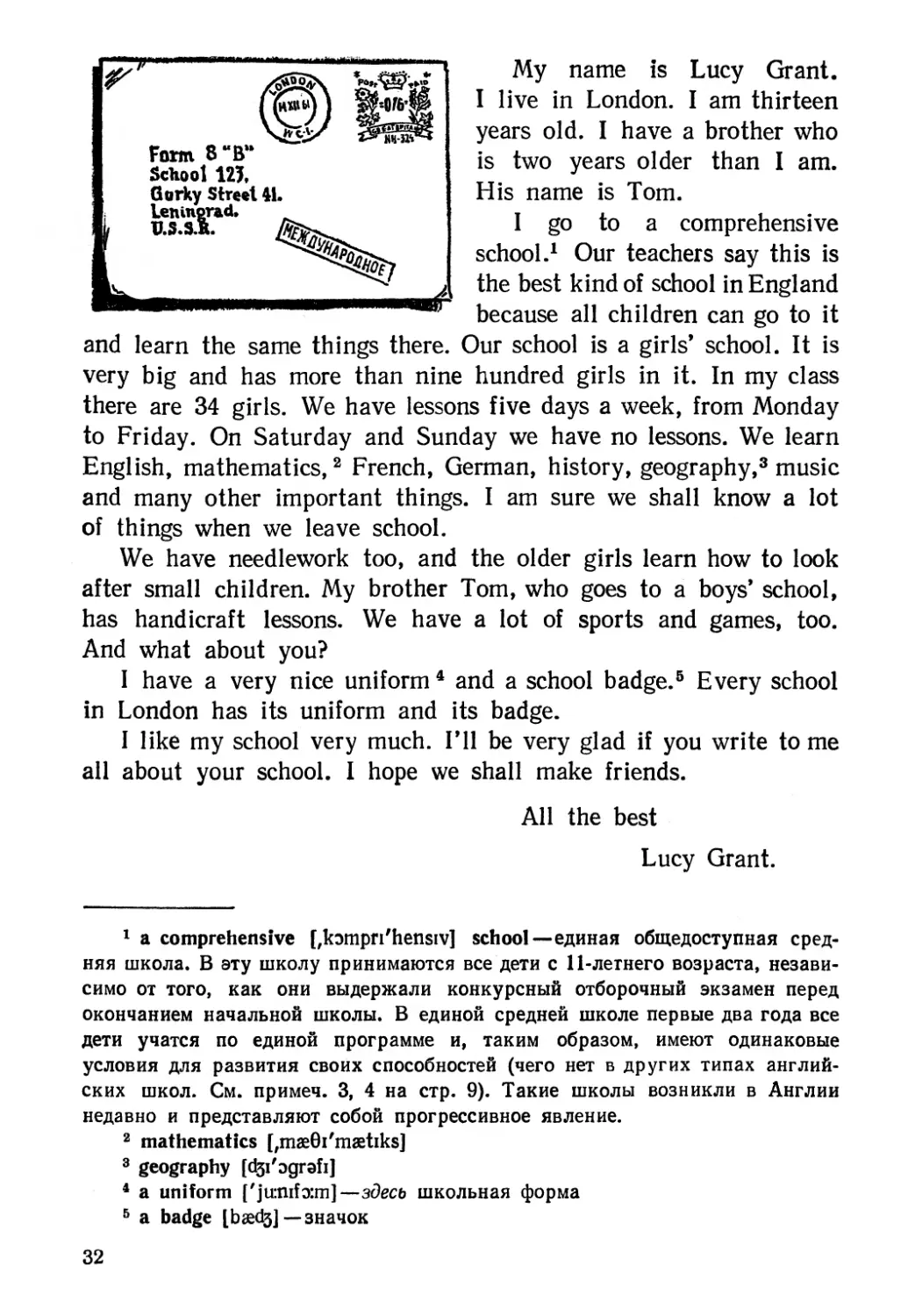
My name is Lucy Grant.
I live in London. I am thirteen
years old. I have a brother who
is two years older than I am.
His name is Tom.
I go to a comprehensive
school.1 Our teachers say this is
the best kind of school in England
because all children can go to it
and learn the same things there. Our school is a girls’ school. It is
very big and has more than nine hundred girls in it. In my class
there are 34 girls. We have lessons five days a week, from Monday
to Friday. On Saturday and Sunday we have no lessons. We learn
English, mathematics,1 2 French, German, history, geography,3 music
and many other important things. I am sure we shall know a lot
of things when we leave school.
We have needlework too, and the older girls learn how to look
after small children. My brother Tom, who goes to a boys’ school,
has handicraft lessons. We have a lot of sports and games, too.
And what about you?
I have a very nice uniform4 and a school badge.5 Every school
in London has its uniform and its badge.
I like my school very much. I’ll be very glad if you write tome
all about your school. I hope we shall make friends.
All the best
Lucy Grant.
1 a comprehensive [,kompri'hensiv] school—единая общедоступная сред-
няя школа. В эту школу принимаются все дети с 11-летнего возраста, незави-
симо от того, как они выдержали конкурсный отборочный экзамен перед
окончанием начальной школы. В единой средней школе первые два года все
дети учатся по единой программе и, таким образом, имеют одинаковые
условия для развития своих способностей (чего нет в других типах англий-
ских школ. См. примеч. 3, 4 на стр. 9). Такие школы возникли в Англии
недавно и представляют собой прогрессивное явление.
2 mathematics [,mae0i'niatiks]
3 geography [dsi'ografi]
4 a uniform ['jtrnifozm]—здесь школьная форма
5 a badge [baeds] — значок
32
New Words
French n
future n
German n
history n
monitor n
needlework n
collect v
discuss v
elect v
mend v
music n
problem n
solve v
teach v
important a
such a
just adv
be glad
Answer the questions:
1. What did the pupils read at the class meeting?
2. Who wrote the letter?
3. What is the girl’s name?
4. How old is she?
5. In what country does she live?
6. In what town does she live?
7. Has Lucy any brothers or sisters?
8. What is her brother’s name?
9. Which of the two is older?
10. Does Lucy go to school?
11. Is that a girls’ school or a boys’ school?
12. How many girls are there in Lucy’s school?
13. Do they have lessons every day?
14. What do they learn at school?
15. Do they have a lot of sports and games?
16. Do English children get a practical education?
Exercises
I. Read the following sentences and translate the words given in italics.
1. When I get a letter, my brother always asks me to give
him the stamp. He collects stamps of different coun-
tries.
2. I must mend my coat: there is a hole in my pocket.
3. Our teachers teach us many useful things.
4. We are always glad to see our old friends.
5. I study English at school. My friend studies French at his
school. My sister studies German.
II. Translate the following phrases and sentences:
job: a good job; a useful job; a hard job; this kind of
job; to do a job.
33
music: beautiful music; wonderful music; to dance to the
music; a music lesson.
history: the history of England; English history; to study
history; a book on history.
needlework: to do (some) needlework; a needlework lesson.
just: just sol; just listen; just think. It is just the thing
I want. It is just nine o’clock. You are just in time.
go on: to go on with one’s work. Go on reading.
French: to speak French; to say something in French; the
French language; French people.
mend: to mend a dress; to mend stockings; to mend a
bicycle.
such: such games; such a clever boy!; at such an early
hour; in such a place.
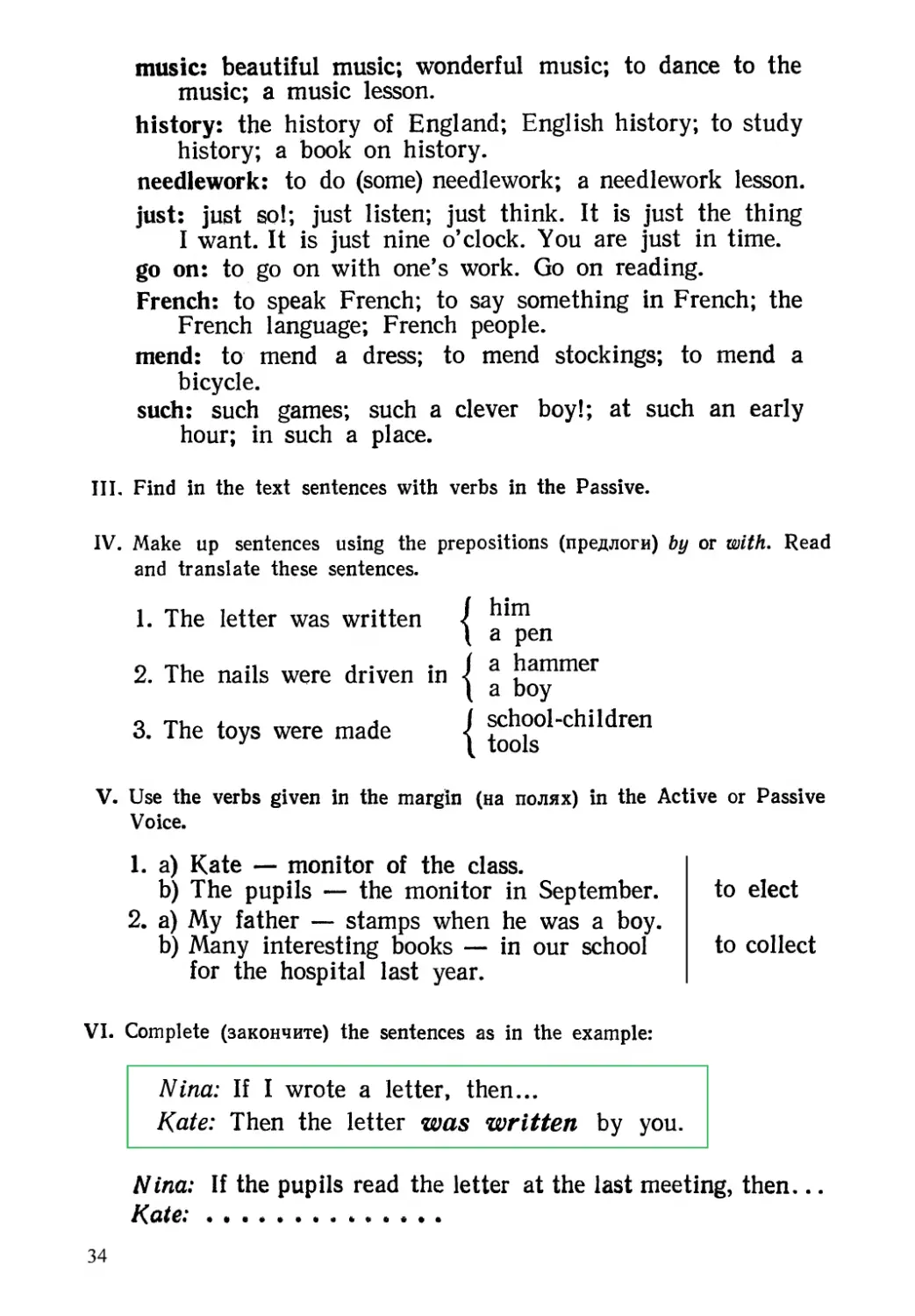
III. Find in the text sentences with verbs in the Passive.
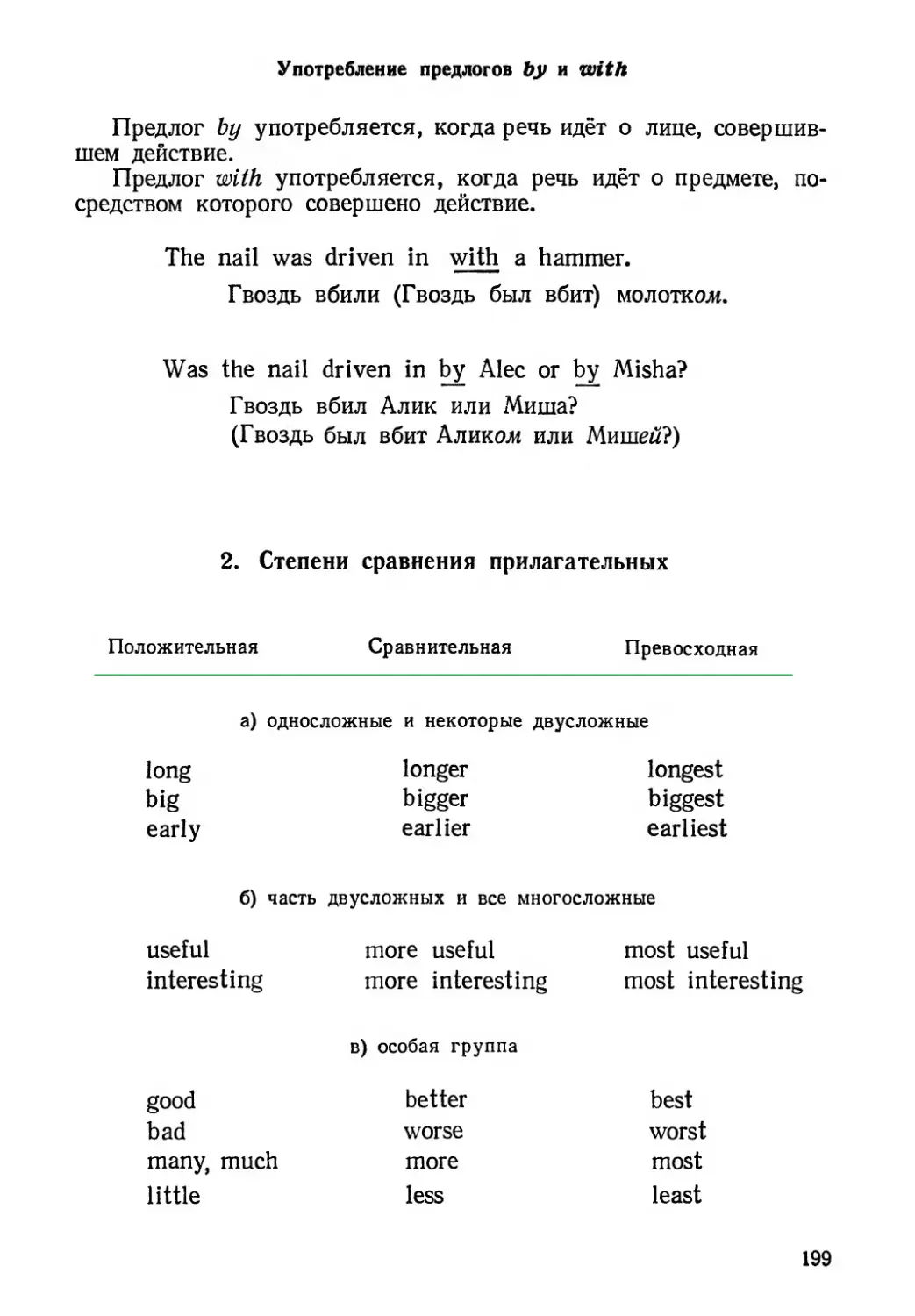
IV. Make up sentences using the prepositions (предлоги) by or with. Read
and translate these sentences.
1.	The letter was written
2.	The nails were driven in
3.	The toys were made
him
a pen
a hammer
a boy
school-children
tools
V. Use the
Voice.
verbs given in the margin (на полях) in the Active or Passive
1.	a) Kate — monitor of the class.
b) The pupils — the monitor in September.
2.	a) My father — stamps when he was a boy.
b) Many interesting books — in our school
for the hospital last year.
to elect
to collect
VI.	Complete (закончите) the sentences as in the example:
Nina: If I wrote a letter, then...
Kate: Then the letter was written by you.
Nina: If the pupils read the letter at the last meeting, then...
Kate:
34
Alec: If we grew vegetables in the vegetable garden, then...
Mike:........................
Steve: If I bound this book, then...
Dan:.......................
Ann: If she got books at (from) the library, then...
Nelly:.......................
VII.	Arrange the words and phrases under the headings: a) work, b) leisure
(Распределите слова и сочетания слов в 2 колонки по темам: а) труд,
б) отдых).
1.	to bind, to play, to clean, to weed, to dance, to water,
to skate, to ski, to mend, to go for a walk, to teach.
2.	a nail, a ball, a hammer, a holiday, a job, a club, a boat,
a game.
VIII.	Fill in the blanks with the prepositions:
about, into, without, at, for, on, in, out of, by.
1.	I like to think — my first days — school.
2.	I have read many stories — Turgenev.
3.	The old woman opened the door and went out — the
street.
4.	Our class is responsible — this job.
5.	Eliza could not live — her son.
6.	I looked-------the window and saw Dan — the street.
7.	London is — the Thames.
IX.	Fill in the blanks with the verbs and phrases:
to elect, to solve, to make friends, to collect, to bind.
1.	Our pioneers--------with the children of Form 1 and
helped them with their work.
2.	Sasha was responsible for the job. We — him at our
pioneer meeting.
3.	The pupils of Form 1 — books for their class library and
we — those books.
4.	You can — many problems if you work together.
X.	According to the examples given below, complete the sentences in section
A and translate the sentences in section В (По данным образцам закон-
чите предложения в разделе А и переведите на английский язык
предложения в разделе В).
35
Let’s go into the classroom, it's just time to begin
our meeting.
Let’s elect Kate monitor, she's just the girl for it.
A.	1. Let’s go and wash our hands, ... to have dinner.
2.	Let Nina write the letter to Lucy Grant, ... for it.
3.	Sasha will show you how to play chess, ... for it.
4.	Take your watering-can and go to the garden, ... to
water the flowers.
В.	1. Идёмте в огород, сейчас самое время полоть картофель.
2.	Попроси Сашу сделать полочку, он как раз тот мальчик,
который с этим справится.
3.	Купим Кате цветы, это как раз подарок для неё (тот по-
дарок, который ей понравится).
4.	Пойди и выполи клумбу, это как раз работа для тебя.
XI.	According to the example given below, complete the sentences in section
A and translate the sentences in section B.
Tomorrow is Kate’s birthday. What if we buy her
an English book?
A.	1. Look at these books! Что, если мы переплетём их?
2.	Here is Steve! Что, если мы попросим его помочь нам?
3.	Look at the map! Что, если мы её починим?
В.	1. Что, если мы попросим классного руководителя обсу-
дить с нами эту книгу?
2.	Что, если мы напишем письмо какому-нибудь англий-
скому школьнику?
3.	Что, если мы споём эту песню по-английски?
XII.	Translate into English:
Дорогой Стива!
Мы все очень рады,
что ты скоро придёшь в
школу.
Вчера мы получили
письмо от английской
школьницы. Её зовут
Люси Грант. Ей 13 лет.
Она живёт в Лондоне.
36
Её школа очень большая, но в этой школе учатся только де-
вочки. Люси очень любит свою школу, и она написала нам
о ней.
У Люси есть брат. Он на 2 года старше её. Он учится
в школе (ходит в школу) для мальчиков.
Люси просит нас написать ей о нашей школе. Что, если
мы с тобой (ты и я) напишем ей завтра?
Всего наилучше го,
Ник.
(Think how to answer Lucy’s letter.)
LET’S TALK A LITTLE
I. Answer the questions. И you can answer, raise your hand.
to raise — поднимать (руку, голову и tn. п.)
А.	1. Do you always go home just after school?
2.	Why do you sometimes stay at school?
3.	When do you begin your class meetings?
4.	What do you speak about at the first class meeting?
5.	Who do you elect at the first class meeting?
6.	Do you bind books for your school library?
7.	Who is responsible for the job?
8.	Can you say that you help your school?
В.	1. Were you glad to get a letter from Lucy Grant? (Imag-
ine—представьте себе — that Lucy’s letter was writ-
ten to you.)
2.	Was it interesting to read the letter?
3.	Did you learn many new things from it?
4.	What did you decide to do?
5.	What is your name?
6.	Where do you live?
7.	How old are you?
8.	Do boys and girls study together in the U.S.S.R.?
9.	Is your school big?
10.	Are there many children in it?
11.	How many pupils are there in your class? How many
boys, and how many girls?
12.	What days of the week do you come to school?
13.	What do you learn at school?
14.	Do you get a practical education at school?
37
15.	Do you try to be useful to your school? How do you help
the school?
16.	When do you have your autumn, winter and summer
holidays?
17.	Do you go in for sports?
II.	Make up short dialogues (['daialagz]—диалоги), like the following:
— Please give me the hammer, Майк, дай мне, пожалуйста,
Mike.	молоток.
— Sorry, what did you say? Прости, что ты сказал?
Shall 1 give you the hammer? Дать тебе молоток?
— Yes, please.	Да, пожалуйста.
(Sorry=I am sorry)
1	. Please open the window, Jane.
(Jane opens the window.)
2.........
(Steve shows Nick his stamps.)
3.........
(Nelly sings them an English song.)
4	......
(Nina tells Ann about Riga.)
III.	Learn and say.
Nina: It’s time to begin the meeting! Who are we waiting for?
Nate: We are waiting for our form mistress. She will come in
a moment.
Nina: Here she is. Let’s begin.
Nate: Don’t you know that the form mistress will open the
meeting?
Nina: Of course I do. Look! She is coming to her table.
* * *
Steve: Sorry, I have been absent for two days. Who is our new
monitor?
Nick: Kate is. She was elected at the class meeting.
Steve: I’m very glad. Kate is just the girl for it.
Nick: You are right. Have you written anything for our wall
newspaper, Steve?
Steve: Of course I have. What if we read it together?
38
IV.	Tell your classmates what you’ll write for your wall newspaper. Ques-
tions A on page 37 will help you.
V.	Tell your classmates what you’ll write to Lucy Grant in answer to her
letter. Questions В on page 37 will help you.
Text to be Read at Home
Find the answers to these questions:
1.	What did the boys decide to do?
2.	How did they get the seeds?
3.	What did the boys see in the garden when they got over
the wall?
4.	Where did the boys walk to?
5.	Who jumped out from behind a tree?
6.	Who did the boys see when they got on the wall?
7.	Was the bull big or small?
8.	What did Cherry Ripe tell the boys to do?
9.	For how many hours did they work?
10.	What did Cherry Ripe say about the bull?
11.	What did Freckles tell Cherry Ripe about?
12.	What kind of seed was it?
CHERRY RIPE
Part II
We were so angry with Cherry Ripe that we decided to take
revenge on him.1 A great idea came into my head. It was from a
book—which shows that to read books is sometimes useful.
“I’ve read about a kind of grass,” I said. “It grows so
quickly that it chokes all vegetables. We shall get the seeds and
throw them all over Cherry Ripe’s garden.”
Batson, the boy who looked after the school garden, brought
us a bag of that seed. On Saturday we got over the wall into
Cherry Ripe’s garden. And there we suddenly saw a large board
with these words on it:
Danger!
Beware of the Bull!1 2
1 to take revenge [n'vendj] on somebody—отомстить кому-либо
2 Danger! Beware of the Bull! [-jdemctja | bi'wea av Oa 'ibulj—Опасно!
Берегись быка!
39
We were ready to get back over the wall, but then decided to
wait and see. A bull made our task more difficult, of course, but
more interesting too. And so we walked to the vegetable garden.
“There is no bull, I’m sure,” said Freckles. “Cherry Ripe wrote
these words on the board to make us go away.”
We threw the seeds here and there. Suddenly Pedlar shouted,
“He is coming!” and Cherry Ripe jumped out from behind a tree.
We ran to the wall and got on it and wanted to jump down—but
we didn’t.
We saw the bull!
He was there, on the other side of the wall. He was the big-
gest bull I ever saw. And we stood on the wall, between him and
Cherry Ripe.
Here was a problem we had to solve! As we discussed it,
Cherry Ripe came up to the wall.
“Hullo, my good boys,” he said. “Do you like this nice little
bull? Or do you want to come back to my vegetable garden and
do some work for me there? We can go to your head-master or
you can come down and weed my vegetable garden.”
“Me? Work for a farmer?” said Freckles. “Never! I’ll go to the
head-master.”
But we didn’t think so. We jumped down and went to work.
Freckles was very angry, but he went with us too. Cherry Ripe
told us to weed the vegetable garden and to water the vegetables.
We worked for two hours. “Now you may go,” said Cherry Ripe.
But Pedlar said, “And what about the bull?”
“Oh, the bull!” said Cherry Ripe. “Why, he is like a kitten!
My youngest daughter plays with him.”
Cherry Ripe put his hand on the bull’s head, and the bull
almost purred.1 We even forgot that we were angry. But Freckles
couldn’t forget it. “I’ll tell him about the seeds,” he said. “We’ll
show him that schoolboys are cleverer than a farmer.” And he
told him all about the seeds.
“Well done!” said Cherry Ripe. “And where did you get the
seeds from?”
“That is our business,”1 2 answered Freckles.
1 to purr [рэ:] — мурлыкать
2 That is our business fbiznis].— Это наше дело.
40
“Well, I know,” said the old man. “You got them from my
good friend Batson. He told me everything. The seed he gave you
was lettuce1 seed! Good evening, my dear boys, and when you
think of this day you may be glad that you’ve done some useful
work for once in your lives!”
Answer the questions:
1.	Were the boys right when they decided to take revenge
on Cherry Ripe?
2.	Did they do what they wanted to?
3.	Why was Freckles angry with his friends?
4.	Jane says that she likes Cherry Ripe. Do you?
CHERRY RIPE
English Song
Words by H. Herrick
Music by C. Horn
Full and fair ones, come—and---buy;
Cher-ry ripe, cher-ry ripe, ripe, I------------cry,
Full and fair ones, come and buy.
to cry—кричать
full— здесь сочный
fair—здесь чудесный
1 lettuce ['letisj —салат
41
REVISION (ОБЗОРНЫЙ) LESSON I
1.
1.	You want to drive a nail in, but your friend has taken the
hammer and is working with it. What do you ask him, and
what does he answer?
2.	One day your friend doesn’t come to school. You go to see
him, and find him in bed. What do you ask him?
3.	You have a new boy in your class. You want to make friends
with him. You want to know what books he has read and what
sports he likes. Ask him about these things.
4.	What do you do in class to show that you want to speak?
5.	A pupil doesn’t listen to the teacher at the lesson. What do
you say if you want to make him listen?
6.	Lessons begin at nine o’clock. The children are playing in the
school-yard. The monitor looks at her watch and sees that it is
almost nine. What does she say?
7.	Your brother is in the 11th form. Tell us what he can do
after he leaves school.
2.
THE HOLIDAYS ARE COMING
Lessons are over, and the pupils leave their classrooms. As
they walk home, they talk about different things.
Ann and Nina are discussing an important question. It is this:
are meetings at the English-speaking club useful? Nina thinks
that it is more useful to read an English book at home than to
listen to her classmates when they speak English. “They don’t
speak English very well,” she says.
Do you think she is right?
* # *
42
And now look at those two boys and that girl. They are Kate,
Dan and Sasha.
DAN:	I’m so glad we shall soon have our holidays. It’s the
thirtieth of October already.
KATE:	You are always ready to have holidays, Dan.
DAN:	And what about you? You see we have worked so much
these last two months!
SASHA: Perhaps we have. We’ve learned some new things at
school - in mathematics, in history, in handicrafts.
KATE (looks at them and laughs): Oh, you boys! To listen to
you, we are the best children on earth!
* * *
And who is the boy that is walking with Mike? He cannot be
a pupil of the 8th form, he is too small. Well, it’s Pete! He is in
the fifth form, but Mike and he are great friends. All the school
knows about them. Even Dan’s brother Victor, a young factory
worker, knows about Pete. He meets Pete just after the boy has
said good-bye to Mike.
VICTOR: Hullo, Pete!
PETE:	What did you say?
VICTOR: What’s the matter with you? You hear nothing.
PETE:	I’m thinking about the meeting of our English-speaking
club. Jane will speak about “Today and Yesterday”.
VICTOR: Are you sure you’ll understand her?
PETE:	Of course I shall! I’ve even spoken with an Englishman.
VICTOR: Have you!
PETE:	Yes. Once I came to the school garden to water the
flowers: we had to look after some flowerbeds, you know.
The Englishman came there too, and we spoke English.
VICTOR: That was really wonderful! Did he understand you?
PETE:	Of course he did!
* * *
Now, do you want to know what Jane spoke about at the club
meeting? This is what she said - you can read it here, every
word of it.
43
3.
TODAY AND YESTERDAY
A.	In the book “The Time Machine” by H. G. Wells, we read
about a wonderful machine which could take people into the
future and into the past. Imagine that you have got a kind of
time machine, and that it has taken you into the past.
Now you are in St. Petersburg.1 You come to the Pioneer
Palace and want to get in, when - Halt! - the guard suddenly
stops you at the door. You think it is joke, but it is not. You
see, you were going to walk into the tsar’s palace!
After the Great October Revolution this beautiful palace was
given to Soviet children. Now every boy and girl may always
go into its beautiful rooms and its green garden.
B.	People who come to Moscow can see many interesting
things there. New houses, new streets and even whole new
districts appear in different parts of the capital every year.
Our people do all they can to make our towns and villages
more beautiful and comfortable. After the Revolution many small
places have grown into big towns. Some years will pass, and
many new towns will appear on the map of our country. Child-
ren who study geography will learn many things about which we
don’t even think today. Imagine how much the Soviet people will
do in the next few years!
C.	The people of our country have solved many important
problems. They will solve many new problems in the future.
After some years it will be difficult to recognize our old Mother
Earth. Wonderful new machines will help people in their work. 1 2
1 St. Petersburg [S9nt'pi:t9zb9:g] - Санкт-Петербург
2 the tsar [za:] - царь
44
Deserts where nothing was grown yesterday, will become green
fields and gardens. Many young men will repeat the exploits1 of
Y. A. Gagarin and H. S. Titov. People will travel to other planets.
They will find many new ways to make man’s life happy and
beautiful. It will be the greatest peaceful revolution that people
have ever known.
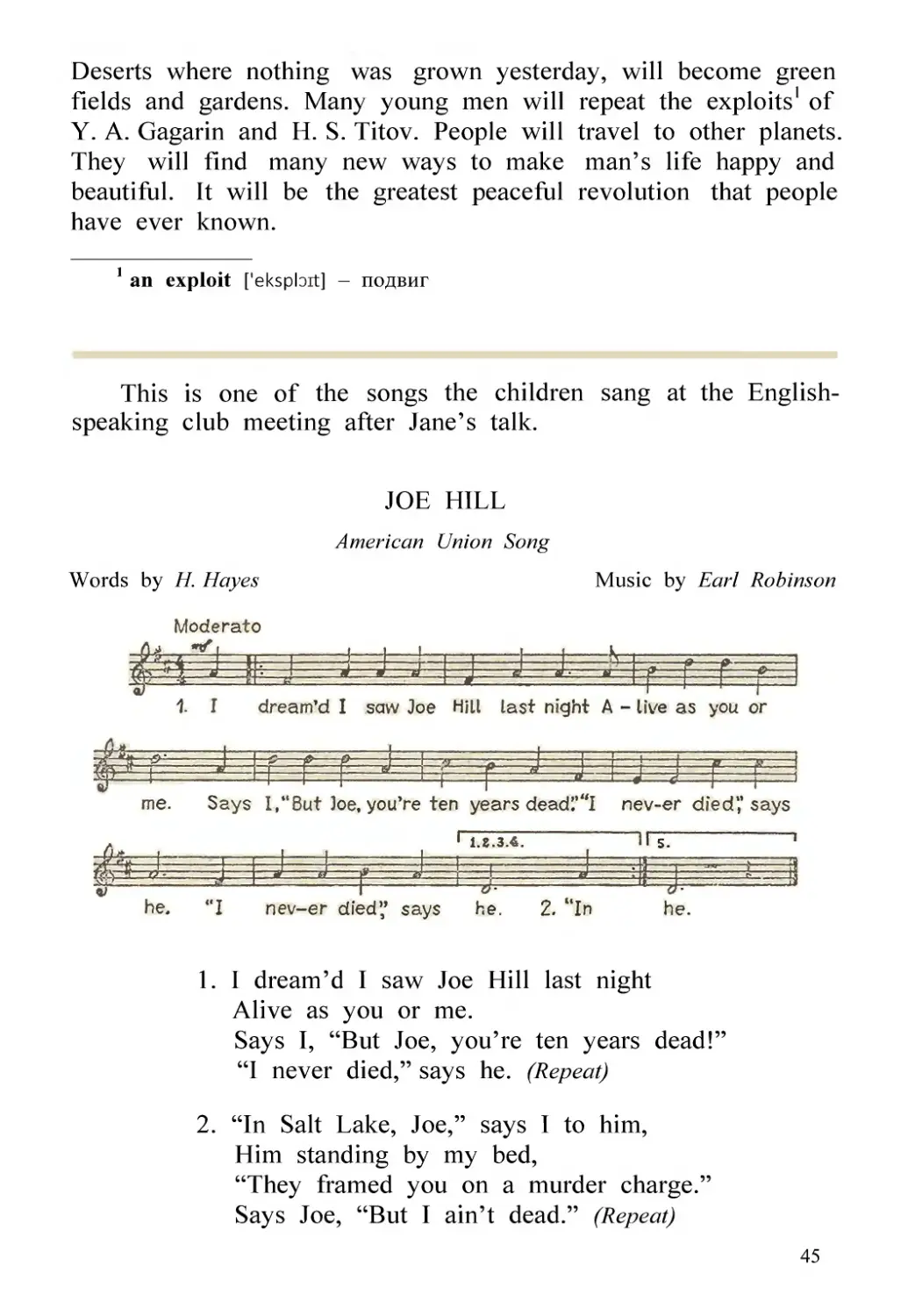
an exploit ['ekspbit] - подвиг
This is one of the songs the children sang at the English-
speaking club meeting after Jane’s talk.
JOE HILL
American Union Song
Words by II. Hayes
Music by Earl Robinson
Moderate
1 I dream’d I saw Joe Hill last night A - live as you or
me. Says I,“But Joe, you’re ten years dead?°I nev-er died’,’says
he. “I nev-er died” says be. 2. ‘In he.
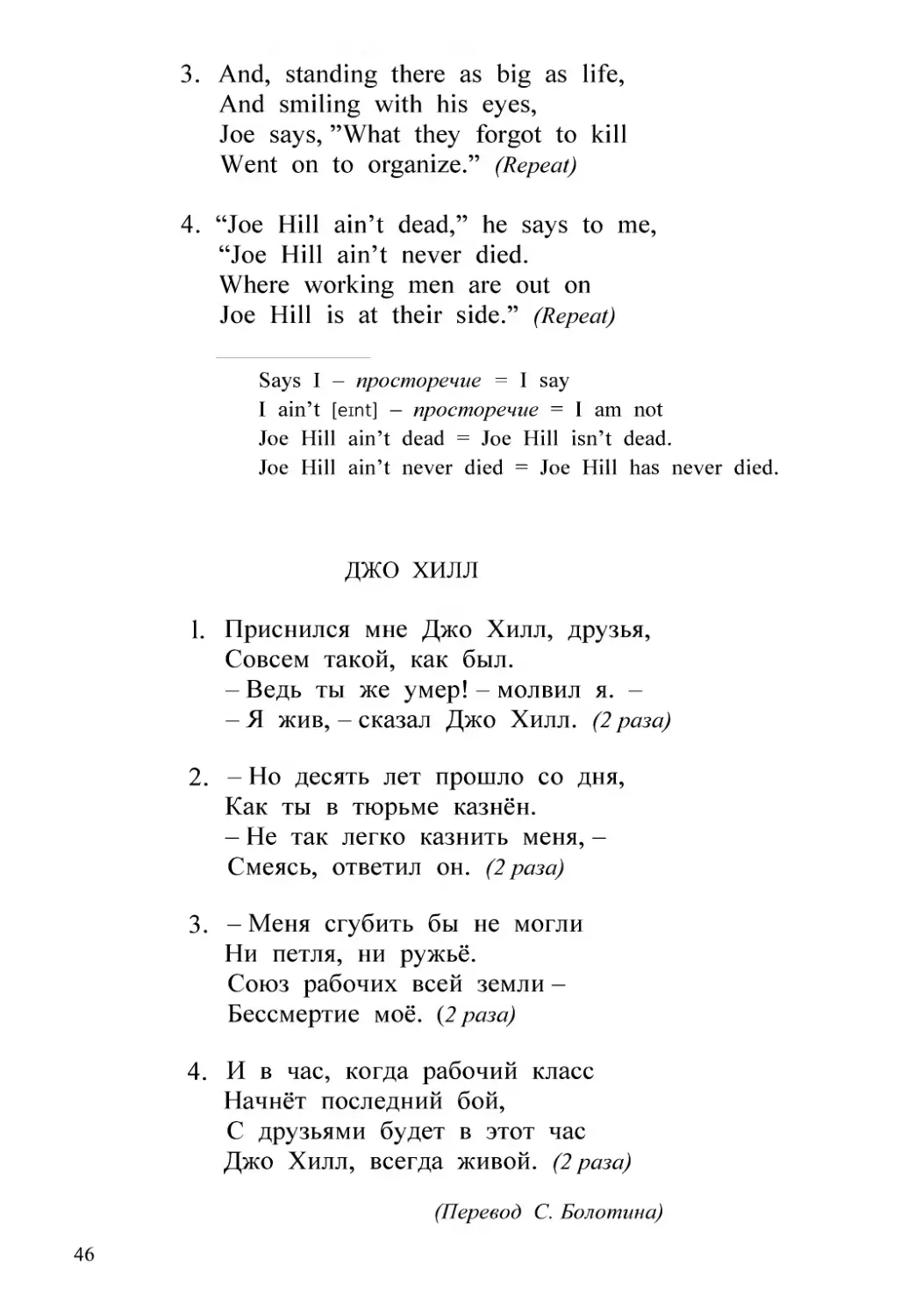
1.	I dream’d I saw Joe Hill last night
Alive as you or me.
Says I, “But Joe, you’re ten years dead!”
“I never died,” says he. (Repeat)
2.	“In Salt Lake, Joe,” says I to him,
Him standing by my bed,
“They framed you on a murder charge.”
Says Joe, “But I ain’t dead.” (Repeat)
45
3.	And, standing there as big as life,
And smiling with his eyes,
Joe says, ’’What they forgot to kill
Went on to organize.” (Repeat)
4.	“Joe Hill ain’t dead,” he says to me,
“Joe Hill ain’t never died.
Where working men are out on
Joe Hill is at their side.” (Repeat)
Says I — просторечие = I say
I ain’t [eint] — просторечие = I am not
Joe Hill ain’t dead = Joe Hill isn’t dead.
Joe Hill ain’t never died = Joe Hill has never died.
ДЖО ХИЛЛ
1.	Приснился мне Джо Хилл, друзья,
Совсем такой, как был.
-Ведь ты же умер! - молвил я. -
- Я жив, - сказал Джо Хилл. (2 раза)
2.	- Но десять лет прошло со дня,
Как ты в тюрьме казнён.
- Не так легко казнить меня, -
Смеясь, ответил он. (2 раза)
3.	-Меня сгубить бы не могли
Ни петля, ни ружьё.
Союз рабочих всей земли -
Бессмертие моё. (2 раза)
4.	Ив час, когда рабочий класс
Начнёт последний бой,
С друзьями будет в этот час
Джо Хилл, всегда живой. (2 раза)
(Перевод С. Болотина)
46
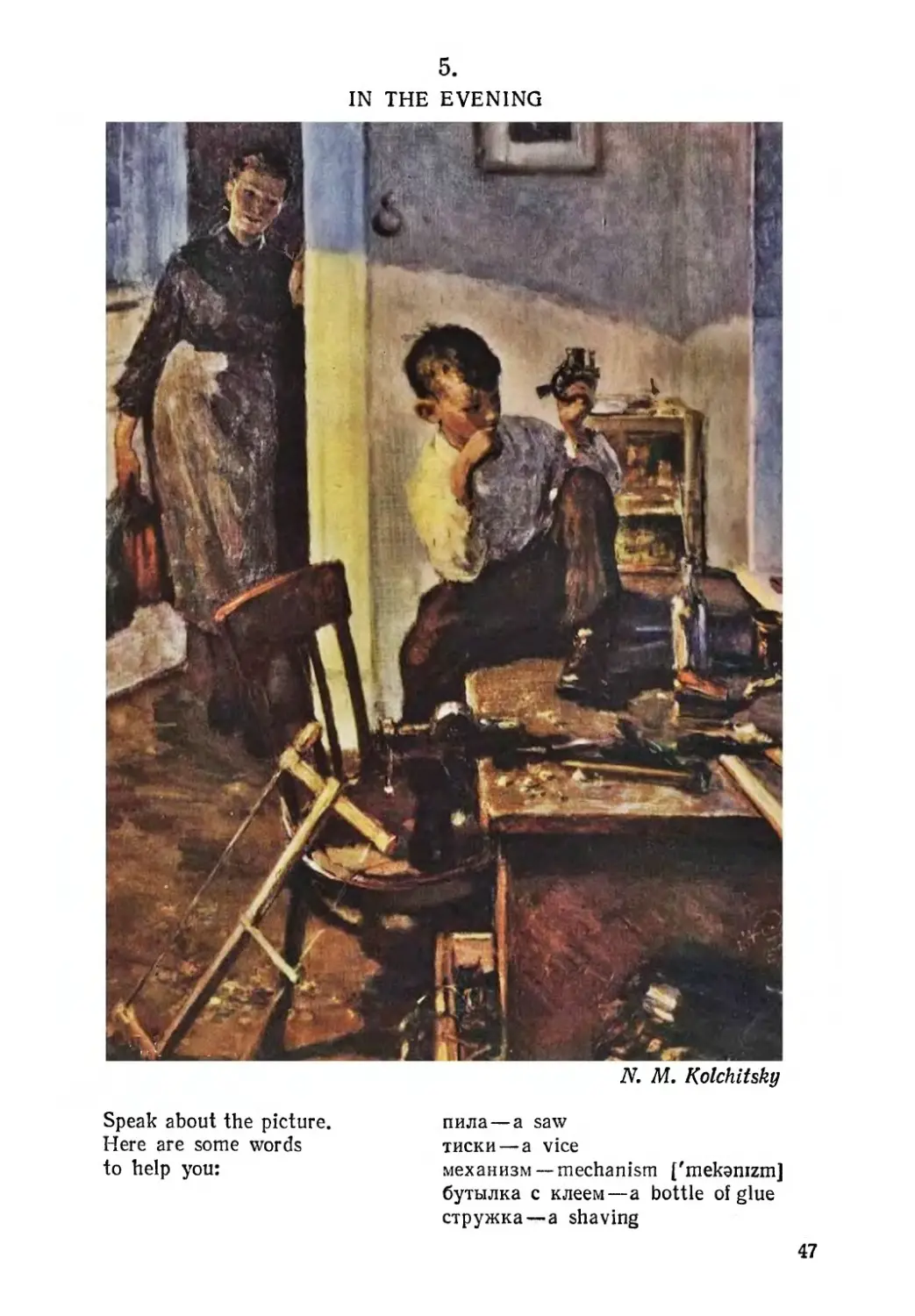
5.
IN THE EVENING
N. M. Kolchitsky
Speak about the picture.
Here are some words
to help you:
пила — a saw
тиски — a vice
механизм —mechanism ['mekomzm]
бутылка с клеем—a bottle of glue
стружка—a shaving
47
LIST OF NEW WORDS
(Lessons 1—4)
answer n 2
better: (you) had better 2
bind v 3
board n 2
classmate n 1
collect v 4
country: in (to) the country 1
decide v 2
different a 2
discuss v 4
drive in (a nail) v 2
elect v 4
Englishman n 3
ever adv 3 E
flowerbed n 3
form master n 3
form mistress n 1
French n 4
future n 4
German n 4
glad: be glad 4
go on (with) v 3
good: be good (at) 2
hammer n 2
handicrafts n 2
here it is 2
history n 4
hundred num 2
important a 4
job n 3
joke n 1
just adv 4
kind n 2
leave v 2
little: a little pron 2
look after v 3
make friends {with some-
body) 1
matter: what is the matter
(with)? 2
mend v 4
monitor n 4
music n 4
nail n 2
needlework n 4
practical education 2
problem n 4
raise v 4 E
really adv 3
responsible a 3
solve v 4
study v 2
such a 4
talk n 2
teach v 4
time: it is time (to) 3
use v 3
useful a 2
water v 3
watering-can n 3
weed v 3
welcome (to) int 1
what about 3
wonderful a 1
LESSON FIVE
Revision:
Passive Voice
New Material:
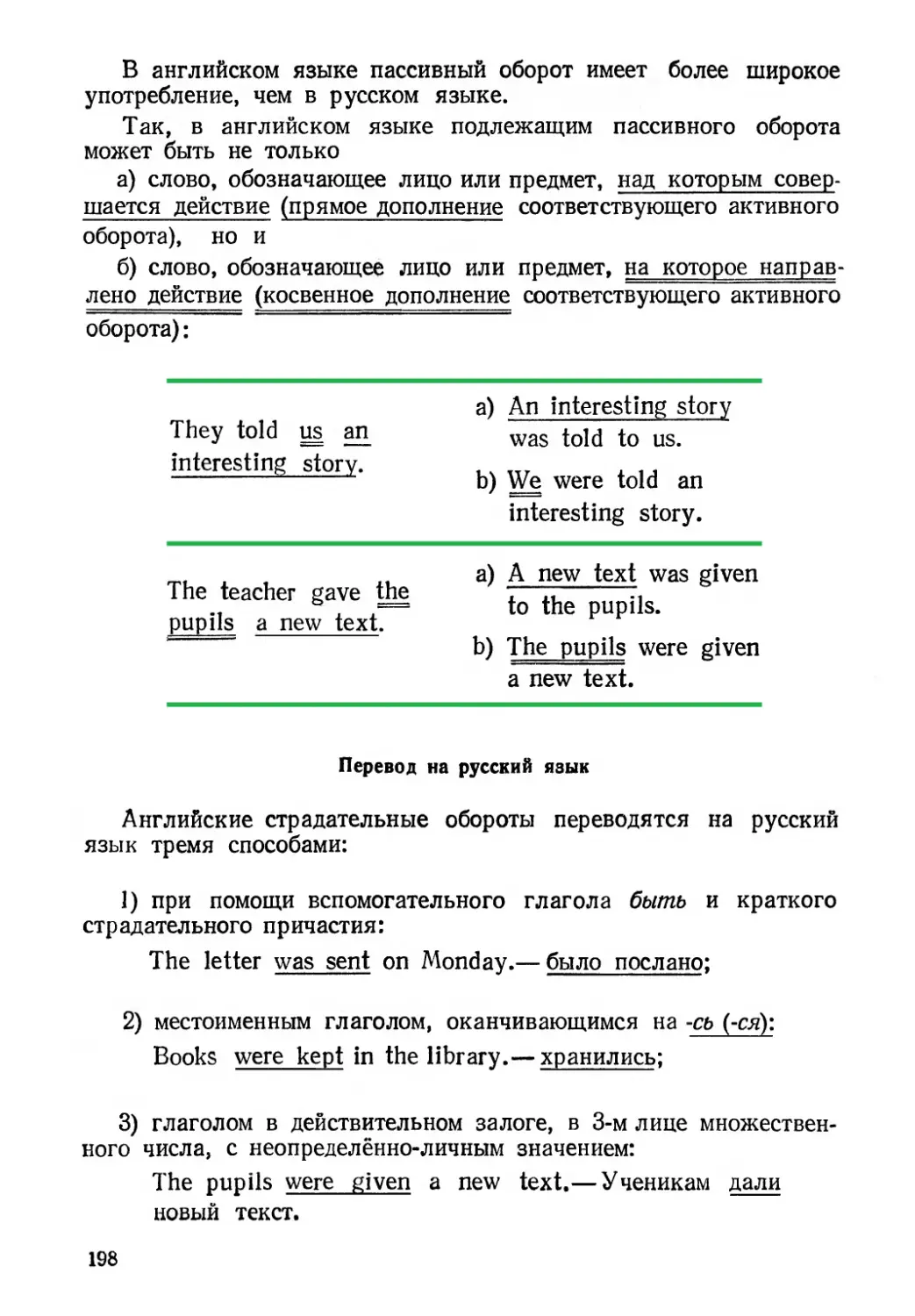
Особенности употребления
Passive Voice
I.	Translate into Russian:
A.	1. The girls of our class were given many presents
on the eighth of March.
2.	We were told many interesting stories about dogs.
3.	Ann was sent many telegrams on her birthday.
B.	The First of September
Merry voices (весёлые голоса) were heard in the
classrooms that day. Boys and girls were asked to speak
about their holidays and to show their summer work. All
the stories were interesting. When the lessons were over,
the children went home. Some of the stories and jokes
were later put in their wall newspaper.
II.	Translate into English:
А.	Вчера она послала два письма. В прошлом году её (меня)
послали в Москву. На прошлой неделе ей прислали два
письма.
Мы рассказали им интересную историю. Нам рассказали
интересную историю. История была рассказана по-
английски.
В.	1. Эти книги переплели в прошлом году.
2.	Летом Аню отвезли (букв.: взяли) в деревню.
3.	Этот рассказ читали в седьмом классе.
4.	На уроке ручного труда нам показали много полезных
инструментов.
5.	Когда мы были маленькими (детьми), нас встречали
после уроков.
49
THEY HELP AUNT HELEN
Last Sunday Jane got up very early. “What was the matter?”
you will ask. An old woman — everybody calls her Aunt Helen —
was ill.
Aunt Helen lives in the same house as Jane. As Aunt Helen
has no family, nobody can look after her when she is ill. So Jane
and her friends decided to help her.
At nine in the morning, Jane, Nelly, Alec and Mike came into
Aunt Helen’s room. They stayed with her till evening. Jane swept
the floor and dusted the room, and Mike watered the flowers:
Aunt Helen loves all kinds of flowers, and there are many of
them in her room.
And what about Alec and Nelly? They, too, were given jobs.
Alec was sent to buy milk and butter and some vegetables, and
when these things were brought, Nelly cooked a good dinner.
Then Mike was told to lay the table.
After dinner Nelly and the boys washed up and swept the floor
again; and Jane sat down near Aunt Helen’s bed, opened a book
and began to read. Jane is a good reader, and Aunt Helen is
never too tired to listen to a good story.
This is the story that Jane read to Aunt Helen:
THE POOR MAN AND THE RICH MAN
Once a poor man tied1 his horse to a tree and sat down
to rest.
It so happened that a rich man saw him and decided to rest
too. So he began to tie his horse to the same tree.
“Tie your horse to another tree!” shouted the poor man.
“My horse is wild,1 2 it will kill3 your horse if you put them
together.”
“You had better not teach me what to do,” answered the rich
man. “1’11 tie my horse where I like.”
1 to tie — привязывать
2 wild [waild] — дикий
3 to kill — убить
50
So he tied his horse to the same tree. Then he sat down and
began to eat his dinner.
Suddenly the horses began to fight. The two men jumped to
their feet and ran up to them. But they were too late. The rich
man looked at his horse and saw that the poor animal was dead.1
The rich man was very angry. “Look what your horse has
done,” he shouted. “Now you will have to pay for my horse. I’ll
make you pay for it!’*
He took the poor man to the judge.1 2 “Oh, Judge,” he said,
“this man’s horse has killed my horse. Make him stay here till
he pays for my horse.”
1 dead [ded] — мёртвый, мёртв
2 a judge [dsAds] —судья
51
“Is that true?” asked the judge. “Did your horse really kill
his horse?” But the poor man did not say a word.
“Can’t you speak?” asked the judge.
The poor man was asked many more questions, but he did not
answer them.
Then the judge said, “I can’t help you. The poor man cannot
speak.”
“Oh, Judge,” said the rich man, “this man can talk as well as
you or me. He spoke to me very well an hour ago.”
“Are you sure?” asked the judge. “What did he say?”
“He said: ‘Don’t tie your horse to that tree because my horse
is very wild.’ He told me to tie my horse to some other tree.”
“Oh,” said the judge, “now I see. So you think that the man
must pay for your horse. But why didn’t you do what you were
told to do?”
Then the judge asked the poor man, “Why didn’t you answer
my questions?”
“I wanted to make him tell you the truth,” said the poor man.
“What a clever man he is,” thought the judge.
So the poor man was allowed to go, and the rich man was not
given a penny.1
1 a penny —пенни (английская мелкая монета)
New Words
truth n	fight v	true a
allow v	rest v	till cj, prep
call v	shout v
cook v	sweep v	be angry
dust v	rich a	be ill
Joke
Teacher: Give the Passive of ‘John shot my dog’.
Pupil: ‘My dog shot John’.
to shoot (shot, shot) — застрелить
52
Exercises
I.	Read the following sentences and translate the words given in italics.
1.	The boy can’t go to school. He must stay in bed. He is
ill.
2.	I come to school at nine o’clock, and stay at school till
three o’clock.
3.	When the floor is not clean, we wash it or sweep it.
4.	There are many forests in our country. Our country is
rich in forests.
5.	When you are tired, you must rest a little.
6.	November is a summer month. That is not true.
November is an autumn month. This is true.
II.	Find in the text sentences with the verb in the Passive. Pick out those
sentences in which the use of the Passive differs from Russian (Выберите
предложения, которые содержат особенности употребления Passive
Voice в сравнении с русским языком).
III.	Translate into Russian:
1.	Не was allowed to go to Moscow.
2.	She was told to stay in bed.
3.	They were taught music in the 5th form.
IV.	Translate into English:
1.	Нас всегда учили говорить правду.
2.	Мне разрешили пойти на каток.
3.	Ему велели накрыть на стол.
V.	Put the following words in alphabetical order (Расставьте слова в ал-
фавитном порядке):
history, hundred, handicrafts, hammer, help, holidays, hole,
hour, half
VI.	Fill in the blanks
A.	with the verbs:
to cook, to sweep, to rest, to get up, to be ill, to dust, to
tell (Passive), to allow + not (Passive)
Alec —. He — to stay in bed and his classmates decided
to look after him. When they came, Alec wanted —, but he —
to do so. The children — the floor and — the books. Nick
and Mike bought milk, meat, butter and vegetables, and as
Alec’s mother was at work, the girls — a good dinner. When
Alec’s mother came home, everything was ready, and she
could — a little.
53
В.	with the verbs:
to look at or to see
1.	This film is very interesting, you must — it.
2.	Mike has come to town. Go and — him.
3.	— your hands! They are dirty.
4.	The man — his watch, but could not — anything because
it was dark.
VII. Look carefully at the use of the verbs say, speak, tell, talk in the text.
Choose the correct verb from those given in brackets (Проследите упот-
ребление глаголов say, speak, tell, talk в тексте. Выберите нужный
глагол).
1.	I can (say, speak, tell) English a little.
2.	“Don’t (say, tell, talk) at your lessons,” (said, told) the
teacher.
3.	“Take this board,” the teacher (said, told) the pupil.
4.	At the last lesson our teacher (spoke, said) about the
history of Great Britain.
54
VIII. Ask questions and answer them as in the following example:
1. Our school year begins
on the 1st of September.
Is this true or not?
2. Yes, it’s true.
1. Our holidays begin
on the 1st of September.
Is this true or not?
2. No, it isn’t true.
1	. Nails are driven in with a hammer.........?
2........
1. The floor is swept with a watering-can........?
2........
1. A horse is a bird........?
2........
1	. Potatoes are grown in the vegetable garden.........?
2
IX.	Translate the sentences according to the examples:
Он велел (мне) пойти
туда.
Не told те to go there.
Он сказал нам, чтобы
мы не делали этого.
Не told us not to do it
Don’t forget to put the indirect object (косвенное дополнение)
after the verb to tell.
1.	Папа велел принести гвозди и инструменты.
2.	Классный руководитель сказал, чтобы он полил
клумбу в саду.
3.	Доктор сказал ей, чтобы она не ездила на юг,
но она туда поехала.
4.	Мама велела починить полку, а мы забыли об этом.
'What a 'nice picture it is!
'What 'happy children they are!
1.	Какой он умный человек!
2.	Что за интересная книга!
3.	Какой чудесный сад!
4.	Какие смешные котята!
5.	Какие вы хорошие друзья!
55
X.	Translate into Russian according to the example:
Go on reading!
Продолжайте читать (чтение)!
Stop talking!
Перестаньте разговаривать!
(Прекратите разговоры!)
Go on asking questions, please!
Stop laughing!
Go on dancing, please!
Stop shouting!
XI. Translate the
following sentences:
Продолжайте писать!
Прекратите беготню!
Продолжайте петь!
Продолжайте полоть!
Перестаньте прыгать!
Перестаньте плакать!
XII. Find in the text the sentences corresponding to the Russian sentences in
the sections below (А, В, C). What special features of the English lan-
guage do you see in the sentences? (Найдите в тексте предложения,
соответствующие русским предложениям в разделах А, В, С. Какие
особенности английского языка вы видите в этих предложениях?)
А.	1. Моя лошадь дикая, она убьёт твою лошадь, если ты
поставишь их рядом.
2.	Не отпускай его до тех пор, пока он не заплатит
мне за мою лошадь.
В.	1. Я заставлю тебя заплатить за неё (за лошадь).
2.	«Я хотел заставить его рассказать тебе правду»,—
сказал бедняк.
С.	1. Теперь ты должен будешь заплатить за мою лошадь.
XIII. Retell (перескажите) the story. The following plan and key words
(ключевые слова) will help you.
1.	The poor man and his horse.
(to tie, to sit down)
2.	The rich man and his horse.
(to see, to decide, to begin)
3.	The poor man and the rich man.
(to shout, to tie + not, to be wild, to kill, to listen-]-not,
to tie, to sit down, to begin)
4.	The poor man’s horse and the rich man’s horse.
(to fight, to jump up, to run up, to be late, to be dead)
5. The rich man.
(to be angry, to pay for, to take)
56
6. The poor man.
(to ask questions, to say -f- not)
7. The truth.
(to make him tell the truth)
8. The judge and the poor man.
(to understand, to think)
9. The poor man and the rich man.
(to allow, to give + not)
LET’S TALK A LITTLE
I.	Learn and say.
Mike: Aunt Helen was very glad to see us, I think.
Alec: Was she? To tell you the truth, I thought she was very
tired. There were four of us!
Mike: No, she wasn’t. She asked us to come again.
Alec: Did she really? Then let’s go together.
* * *
Kate: Ann, I’m so glad you’ve come. I have a lot of work
to do. What if you help me?
Ann: Of course I shall.
Kate: You see, Mother and Father have gone to our vegetable
garden and I have to do a lot of things at home.
Ann: What shall I do? I can cook the dinner and sweep the
floor.
Kate: Ann dear, will you look after my little sister? Can
you take her out for a walk?
Ann: Of course I can. And when I come back, 1 hope I shall
be useful to you.
Kate: Thank you, dear.
П. Answer the questions. If you can answer, raise your hand.
1.	Have you much work to do at home?
2.	Have you ever helped any old woman or any old man?
3.	Can you sweep the floor?
4.	Who sweeps the floor in your classroom?
5.	Do you help your mother?
6.	What do you do at home?
7.	Do you help your parents to buy food?
8.	Who buys bread (butter, milk, meat, fruit, vegetables)
for your family?
9.	Can you cook a good dinner?
10.	Do you find it difficult?
57
11.	Do you know how to lay the table?
12.	Who washes up at your house?
13.	How often do you water the flowers at home?
14.	Have you any flowers in your classroom?
15.	Who waters them?
16.	What Russian book tells us about the children who were
always ready to help people?
17.	Who wrote the book?
18.	Have you read the book?
19.	Do you like it?
III.	Look at the pictures and tell the story.
THEY CAN DO ALL KINDS OF WORK
58
Past Indefinite Tense.
IV.	Tell the story in the
Proverb. It is better to do well than to say well.
V.	Learn this poem:
“'What are you doing, Joe?” said I.
“^Oh, ^nothing, sir,” was Joe’s reply.
“And _/you then, Tom? ^Pray, 'let me ^know.”
“I’m ^busy, sir, I’m 'helping ^Joe.”
a re'ply = an answer
Pray, let me know. = Tell me, please, I want to know.
59
LESSON SIX
WE STAND FOR PEACE
Of course, all of you can sew a little, and do something
with a needle and thread. You are great friends with your
scissors, too.
But can you make a dress? The work is hard and you
must do it carefully. “That is a girls’ job,” the boys will say.
To make dresses is of course not interesting for boys, but
there are tasks that are interesting for all of you. You can
ask Dan about it if you want to. He will tell you how
their class was asked to embroider1 the state emblem1 2 of
the Soviet Union for the Day of the Constitution.
It was done this way: Sasha drew the state emblem and
the girls began to work. Dan, Mike and Alec decided to help
them. It was very good to work together, to talk and some-
times to sing all the English and Russian songs they knew.
One day Mike asked: “Do you remember the history of
our state emblem? It was even told at the XXII Congress
of the Communist Party of the Soviet Union.” 3
1 to embroider [im'braids] - вышивать
2 a state emblem - государственный герб (a state - государство;
an emblem - эмблема)
3 the XXII (twenty-second) 'Congress of the Communist Party of
the Soviet Union - XXII съезд Коммунистической партии Советского
Союза
60
It happened in the early days of the Great October Revolu-
tion. That was a hard time for our country. The Soviet people
had to fight against the enemies1 of the young Soviet State.
In those days, some artists were asked to draw a design1 2
for the state emblem of the Land of Socialism.3
The artists worked hard, and the designs were soon
ready. One of them was really very fine. It showed the world
with a hammer and sickle4 on it, with ears of wheat5 round
it, and in the middle a sword.6
The design was shown to Vladimir Ilyich Lenin. He looked
at it carefully and said, “Why the sword? The sword is an
emblem of war,7 and we stand for peace for all the peoples
of the world. Of course, we are fighting, but we are fighting
against the enemies of Socialism. The sword cannot be our
emblem.” With these words Lenin took a pencil and crossed
out8 the sword.
More than forty years have passed, and the Soviet coun-
try has grown into a powerful state. The emblem of this
powerful state is the emblem of peace. We stand for peace and
friendship for everybody in the whole world, and one of the
first decrees9 of our state was the Decree on Peace.
artist n
constitution n
friendship n
needle n
peace n
----- New
scissors n pl
task n
thread n
way n
Words
draw v
sew v
fine a
powerful a
whole a
carefully adv
hard adv
against prep
make a dress
1 an enemy ['enimi] — враг
2 a design [di'zain] - эскиз
3 the Land of Socialism ['soufslizm] - страна социализма
4 a sickle - серп
5 ears of wheat [wi:t] - колосья пшеницы
6 a sword [so:d] - меч
7 war [wd:] - война
8 to cross out - вычеркнуть
9 a de cree — декрет
61
Answer the questions:
1.	What does the text tell us about?
2.	When were the artists asked to draw a design
for the state emblem?
3.	Was that a hard time for our country?
4.	What did the Soviet people have to do?
5.	Who was the best design shown to?
6.	What did Vladimir Ilyich do?
7.	Why did he cross out the sword?
8.	What is the Soviet state emblem like?
9.	What kind of state has our country grown into?
10.	Do we stand for peace and friendship for all
the peoples of the world?
THE SWORD AND THE ЛSICKLE
by 'William^Blake (1757—1827)
The 'sword 'sang on the 'barren ^heath,
The ./sickle in the 'fruitful ^field.
The 'sword he 'sang a 'song of^death,
But 'could 'not 'make the 'sickle ^yield.
the barren heath [hi:©] - опустошённая земля
fruitful — плодоносный
the sword he sang... - а меч - он пел...
death [de6] - смерть
to yield [ji:ld] - уступать, сдаваться
МЕЧ И СЕРП
стихотворение Вильяма Блейка
Меч - о смерти в ратном поле,
Серп о жизни говорил.
Но своей жестокой воле
Меч серпа не покорил.
(Перевод С. Я. Маршака)
62
Exercises
I.	Read the following sentences and translate the words in italics.
1.	Sasha always draws pictures for our wall newspaper.
He draws very well.
2.	Mike is very good at chess. Come to our club tomorrow!
He will play against three other chess-players.
3.	Repin and Levitan were great Russian artists.
4.	‘Fine’ is almost the same as ‘beautiful’.
5.	It rained the whole day yesterday, and we could not go*
for a walk.
II.	Translate the following phrases and sentences:
1.	ill: to be very ill; to fall ill.
2.	truth: to tell the truth; to speak the truth; the truth is
that...; the truth, the whole truth and nothing but the
truth.
3.	call: to call somebody out of the room; to call things by
their names. Everybody calls him Bob; to call a meeting.
4.	till: till five o’clock; till late in the evening; till late at
night; till he comes home. We laughed till we cried.
5.	rich: a rich country; rich colours. Our country is rich
in forests.
6.	draw: to draw pictures; to draw well, beautifully, won-
derfully; to draw in pencil, in chalk.
7.	hard: to work hard; to try hard; to fight hard. It snows
hard in February.
8.	way: on his way home; on his way to England; a long
way from here; it’s a long way to go. Get out of the
way!; to make one’s way; in this (that) way; in differ-
ent ways; in some way or other; the best way of doing
it.
9.	true: a true artist; true friends; a story true to life.
10.	whole: the whole family; the whole day; in the whole
world; to tell the whole story.
11.	carefully: to do everything carefully; to look at some-
thing carefully; to read carefully; to listen carefully; to
cross the street carefully. The coats were carefully
mended.
III.	Remember that the word people has two meanings (два значения):
1.	people__люди —имеет только одну форму и значение
множ, числа (как и в русском языке)
2.	people—народ —имеет форму и единств., и множ.числа
(peoples — народы)
63
Translate into Russian:
1.	It was the first of May, and there were many people in
the street.
2.	Many peoples live in the U.S.S.R.
3.	The peoples of the U.S.S.R. stand for peace and friend-
ship for everybody in the whole world.
4.	The Soviet people have many friends all over the world.
5.	Many people work at this big factory.
IV.	A. Find in the text and in the poem adjectives with the suffix which
you learnt in Lesson 2. Form the adjective мирный with one of the
new words from Lesson 6.
B. Using the suffix -ful, form adjectives from the words:
truth, hope, forget
Translate them into Russian.
C. Find in the text an adverb, formed from an adjective in -fill
(Найдите в тексте наречие, образованное от прилагательного с
суффиксом -ful). Point out (выделите) the suffix of the adjective
and of the adverb.
V. Find in the text two nouns with
mark the stresses (Выпишите их
the suffix ~(t)ion. Write them out and
и поставьте ударения).
VI.	You know the verb to sew. Can you guess the English for швейная
машина? Exercise III on page 22 will help you.
VII.	Give the opposites (слова, противоположные по значению) of the words
and phrases:
to be ill, old (2), little (2), to laugh, good
VIII.	Insert the definite or indefinite article where necessary (Вставьте, где
необходимо, определённый или неопределённый артикль).
Nina: I’ve bought — needles and — pins, Mother.
Mother: How good of you, dear. Give me — pin, please.
Nina: Here it is.
Mother: Thank you. Now put — new needles in — box. And
where are — my scissors? I can’t find them. Give me —
Kate’s scissors, please.
Nina: Here they are. Where is — second sock, Mother?
Which do you think is — best needle to mend it with?
64
IX.	Fill in the blanks with the prepositions:
to, at, of, with, about, against.
1.	What is the matter — you?
2.	This girl is very good — needlework.
3.	What — your clothes? Have you mended them?
4.	Go on — your homework and don’t listen — these
stories.
5.	How nice — you to help me.
6.	We stand for peace; we are — war.
X.	Using the scheme below, make up questions referring to each part of the
sentence (Поставьте вопросы ко всем членам предложения по таблице).
His sister reads English in the
books evening.
What
What
What books
When
XI.	Translate into English, using the verbs:
to teach, to study, to learn
1.	Я решила обучить английскому языку
моего маленького брата.
2.	Мы изучаем историю музыки.
3.	Наших девочек обучали шитью.
4.	Мы учим песни в английском клубе.
XII.	Write down all the verbs you know which may be used when speaking of
a) school work; b) work in the school garden; c) needlework; d) house-
work.
XIII.	Fill in the blanks with the words:
to teach, a needle or scissors, to sew, needlework, hard
My little sister Ada couldn’t —. Mother was afraid to give
her------. But Ada is a clever girl, and Mother began —
her —. Ada worked —, and now she often helps her mother.
65
XIV.	Translate into English:
A.	1. В День Конституции мы всегда думаем о людях,
которые сражались за счастливое будущее всех де-
тей.
2.	СССР — могущественная страна.
3.	Мы стоим за мир и дружбу во всём мире.
В.	1. Что ты ищешь? —Мне велели принести ножницы.
2.	Нам велели класть иголки в коробку.
3.	Нам показали, как шить платья.
4.	Летом пол подметали утром и вечером.
XV.	Learn the last paragraph (абзац) of the text by heart.
LET’S TALK A LITTLE
1.	Ask and answer.
How many English lessons have you a week?
We have three English lessons a week.
1.	Сколько раз в неделю у вас русский язык?
......................... в неделю.
2.	Сколько раз в неделю у вас история (уроки истории)?
............................в неделю.
3.	Как часто вы ходите в кино?
............................в месяц.
4.	Как часто у вас каникулы?
............................в год.
5.	Как часто вы моете руки?
............................в день.
В.	1. Have you needlework lessons at your school?
2.	In what form do the girls of your school begin needle-
work?
3.	How many needlework lessons have they a week?
4.	Can you use a needle? Do you find it useful?
5.	Must we look after our clothes ca efully?
6.	If you look after your clothes carefully, will it help
your mother?
7.	Are there any pupils in your class who do not look after
their clothes carefully?
66
II. See how many things in the picture you can name in English.
PICTURE PUZZLE (загадка)
III. Make up sentences.
The twenty-third of Feb-
ruary
The seventh of November
The fifth of December
The eighth of March
The first of January
International [jnto'naeJ-
nol] Women’s Day.
Soviet Army Day.
the New Year Holiday.
the Day of the Constitu-
tion.
the Great October Holi-
day.
There are two holidays which you won’t find here. What are they?
IV. Ask and answer.
A.	Ask your classmates the dates of our holidays — like this:
When is Soviet Army Day?
B.	a) What does the Soviet Constitution say about the rights (права)
of the Soviet people?
b)	What is the task of Soviet school-children? (Remember the words
of V. I. Lenin.)
c)	What can our young people do when they leave school? Can they
work? Can they go on studying?
V.	Say all you can about the Day of the Constitution.
67
VI.	Puzzles.
HEAD AND EYE
There is one that has a head without an eye,
And there is one that has an eye without a head;
You may find the answer if you try;
And when all is said,
Half the answer hangs upon a thread.
(э;рээи pun uid)
to hang (hung, hung) — висеть
upon = on
WHAT IS IT?
An eye that cannot see.
A nail that is a part of the
finger (палец).
Text to be Read at Home
Find the answers to these questions:
1.	Who lived in one of the little houses in London?
2.	Why was Maggie’s mother against Mr. Hunter?
3.	What did Mr. Hunter do in his room?
4.	What did he say again and again?
5.	What happened one morning?
6.	Who did Maggie run to?
7.	What did Maggie and the detective see when they came
into Mr. Hunter’s room?
8.	What did the detective ask Mr. Hunter?
9.	What did Mr. Hunter tell them about his work?
10.	What did Mr. Hunter say when he could not catch a glass?
68
THE ABSENCE OF MR. GLASS1
In one of the little houses in London, there lived a woman with
her daughter. The daughter’s name was Maggie. They had a lodg-
er, who was a very nice young man. His name was Mr. Hunter.
Mr. Hunter and Maggie loved one another. But Maggie’s mother
was against their love because Mr. Hunter was a very strange
man.
He was not poor, but nobody knew where he got his money
from. Every day he did something strange in his room.
Sometimes he spoke to somebody whom he called Mr. Glass.
Mr. Glass was always angry. Maggie’s mother thought that they
spoke about money because Mr. Hunter said again and again:
“One, two, three, Mr. Glass”, or “No, Mr. Glass.”
One morning Mr. Hunter did not come down to breakfast.
“Mr. Hunter! Mr. Hunter!” called Maggie. “Please open the
door! It’s me.”
There was no answer.
Maggie knew that Mr. Hunter never left home at such an
early hour. She tried to open the door, but could not.
“Mr. Glass has done something to him,” she thought. And she
ran to the famous detective, Mr. Hood.
Maggie told him the whole story, and soon they were in her
house.
Mr. Hood opened the door with a kitchen knife and they came
into the room.
Different things lay on the floor and on the table: scissors,
apples, nails. There were two glasses on the table, and a third
one lay on the floor. Near it there was a long knife and a big hat.
In the corner lay Mr. Hunter. He was tied up with ropes.1 2 His
brown eyes were alive and he looked from one face to another.
Mr. Hood looked carefully at Mr. Hunter. Then he took the
hat and put it on the young man’s head. It was too large for him.
“What’s the matter?” said Mr. Hunter.
“It must be Mr. Glass’s hat,” said the detective, “but where is
Mr. Glass? Did you kill him with this knife?”
1 «Отсутствие мистера Гласса». По мотивам одноимённого рассказа Че-
стертона.
2 Не was tied up with ropes.—Он был связан верёвками.
69
“I don’t know any Mr. Glass,” said Mr. Hunter, “and I didn’t
kill anybody.”
Suddenly he laughed. “Oh, I see what has happened,” he said.
“You don’t know what my work is. I was going to tell you the
truth, Maggie, before our marriage,1 but I think it is time to tell it
now. 1 work at the circus1 2 3 and do tricks there. I can speak with
different voices —that’s why you thought there was another man
in the room. This hat helps me to do my tricks. I throw those
glasses into the air one after another and catch them. Sometimes
1 miss8 one of them. Then I say, ‘Missed a glass.’ I say ‘missed
a glass’ and not ‘Mr. Glass’!”
“And who tied you with these ropes?” asked Maggie’s mother.
“I did,” was the answer. “I can tie and take off these ropes
when I want to. It’s my new trick.”
He took off the ropes and jumped to his feet. “It’s late now,”
he said. “What about a good dinner, my friends?”
Answer the questions:
1.	Who is the hero (['hiarou] — герой) of the story?
2.	Why did Maggie and her mother think that there was
another man in the room and that his name was Mr. Glass?
3.	What was Mr. Hunter’s work?
1 marriage ['masndj] — брак, женитьба
8 the circus [zsa:kas]—цирк
3 to miss—здесь упустить, не поймать
LESSON SEVEN
ENGLISH WRITERS
It is late in the evening, but the pupils of the 8th form are at
school. They had a meeting of their English-speaking club. Mike
gave a talk on Dickens; Jane spoke about Shakespeare, and Nina
about Byron and Shelley. Now they are talking about different
books and authors.
NICK: What an interesting talk you gave, Mike. You know so
much about Dickens. I really enjoyed it.
MIKE: Dickens is my favourite English writer. When I learn
English well I shall read all Dickens’ novels in English.
NICK: Who told you so much about Dickens* life?
MIKE: My father did; and I have read much about him, too.
ANN: I liked Jane’s talk very much. Wasn’t it very good? Now
all of us know “Hamlet”, “Romeo and Juliet”, “Othello”1
and “King Lear”.
JANE: How glad I am that we can read these plays in Russian.
My mother studies Shakespeare, and she says it is very
difficult to read his plays in English.
NINA: I collect books by English authors. I am going to study
English literature in future.
DAN: And I want to be an engineer.
NINA: Have you read anything by Byron or by Shelley?
DAN: I’ve read some poems by both of them.
NINA: Byron and Shelley are very famous in England. Every-
body knows them in the U.S.S.R., too. I have known
English since I was seven, so I can read Byron and
Shelley in English.
KATE: Oh, it’s half past seven, and we’ve been here since
5 o’clock. It’s time to go. Come on!
Ф * ЯС
This is what Ann, Nick and their classmates learned from
their friends’ talk on English authors.
1 ['roumrou and 'dsuljat]; [o'0elou]
71
English writers stand high in world literature. Shakespeare,
Swift, Byron, Dickens and many others are dear to all those
who love literature. Have you ever heard of a boy who hasn’t
travelled together with Gulliver or lived on a small island in
the sea with Robinson Crusoe? Both young and old enjoy works
by English authors which tell us about life and man. They teach
the reader to love man, to struggle for all that is good and great,
and to fight against all that is bad and low. We can say that
the best works of English writers are, and will always be, a
great school of life for those who read them.
Shakespeare was one of the greatest writers that ever put pen
to paper.1 People in all countries enjoy his plays. We can say
this, too, about the works of Byron and Shelley, two great English
poets. They loved freedom, and they tell their readers how people
have fought for it. In their works we read about a happy future,
when people will live in peace and friendship all over the earth.
Among the books we read and enjoy there are many English
novels. One of the first novels in the history of literature was
written in England in 1719; it was “Robinson Crusoe” by Defoe.
Some years passed, and Swift wrote his famous “Gulliver’s
Travels”.1 2 In the middle of the century, Fielding became one of
the greatest English writers.
At the beginning of the XIX century, the world heard about
Walter Scott, who wrote historical novels. Today people often call
Walter Scott the father of the historical novel.
Among the nineteenth century authors Dickens and Thackeray
were, perhaps, the greatest. In their novels, Dickens and
Thackeray described English life in those days and told people
the truth about it.
Next to these great names stand the names of the three Eng-
lish women-writers: Jane Austen and the two sisters — Charlotte
and Emily Bronte.
As you see, England has had many great writers. Poems and
novels by English writers are translated3 into Russian, French,
German and other languages.
1 that ever put pen to paper—кто когда-либо брался за перо
2 «Путешествия Гулливера»
3 are translated — переводятся
72
William Shakespeare
['wiljam 'Jeikspia]
(1564—1616)
Вильям Шекспир
Daniel Defoe
['daenjal da'fou]
(1660? — 1731)
Даниель Дефо
Henry Fielding
['henn 'fizldig]
(1707—1754)
Генри Филдинг
Walter Scott
['wozlta 'skot]
(1771 — 1832)
Вальтер Скотт
Percy Bysshe Shelley
l'pa:si 'biJi 'Jeli]
(1792—1822)
Перси Биши Шелли
George Gordon Byron
['dgoidg 'go:dn 'baiaran]
(1788—1824)
Джордж Гордон Байрон
William Makepeace Thackeray
['wiljam 'meikpi:s 'Озекэп]
(1811 — 1863)
Вильям Мейкпис Теккерей
Charles Dickens
['tjalz 'dikinz]
(1812—1870)
Чарлз Диккенс
New Words
author n
beginning n
century n
freedom n
literature n
novel n
play n
poem n
poet n
work n
become v
describe v
enjoy v
learn v
struggle v
translate v
both a, pron
famous a
favourite a
historical a
among prep
since cj, prep
both... and cj
give a talk
He Knows Shakespeare
(A joke)
“I have read two plays by Shakespeare.”
“What were they, please?”
“Romeo” and “Juliet”.
Answer the questions:
1.	Who is this text about?
2.	Do English writers stand high in world literature?
3.	What do works by English authors tell us about?
4.	What do they teach their readers?
5.	What can we say about the best works of English writers?
6.	Who was one of the greatest English authors in world
literature?
7.	What are the names of two great English poets?
8.	Did Byron and Shelley love freedom?
9.	What do they tell their readers?
10.	Where was one of the first novels in the history of
literature written?
11.	What novel was it?
12.	When was it written?
13.	What other English writers wrote novels?
Ask questions about the rest of the text beginning with the words
(Задайте вопросы по остальной части текста начиная со слов)
At the beginning of the XIX century...
75
Exercises
I.	Read the following sentences and translate the words given in
italics.
1.	Dickens was the author of “Oliver Twist”. Pushkin was
the author of “Dubrovsky”.
2.	“Anna Karenina” by L. Tolstoy is a novel. “Fathers and
Sons” by Turgenev is a novel, too. “Romeo and Juliet”
by Shakespeare is not a novel, it is a play.
3.	Pushkin was a poet. Lermontov was a poet, too. They
were both poets.
4.	Both Pushkin and Lermontov were poets.
5.	A century is a hundred years. We live in the XX century.
6.	Monday is the first day of the week. It is the beginning
of the week.
II.	Translate the following phrases and sentences:
1.	beginning: at the beginning of June; from the beginning
of the story. At the beginning he knew very little, but
then...
2.	enjoy: to enjoy a fine poem; to enjoy a good joke. The
music was wonderful, I enjoyed it very much; to enjoy
swimming in the river on a hot summer day. Did you
enjoy going to the country?
3.	work: a fine work; Shelley’s works; the works of Shake-
speare; one of his best works; the most important of all
his works.
4.	learn: to learn German; to learn to swim; to learn one’s
lessons; to learn the truth; to learn about something. He
learned it from his friend.
III.	A. Find in the text nouns with the suffix -er.
B.	Remember the English for учитель, рабочий. Divide the words into
stem and suffix (Разберите слова по составу).
С.	Without using a dictionary, translate the following nouns which
have the suffix -er:
speaker, talker
The picture on page 54 will help you.
76
D.	Look at the pictures below and choose a suitable (подходящее) noun
for each of them:
singer, book-seller, dancer, swimmer
E.	Using the suffix -er, form nouns from the verbs:
to travel, to skate, to ski, to help, to jump, to listen, to
play, to run, to walk
F.	Translate the following nouns into Russian. Pick out those nouns
which have the suffix -er:
winter, reader, pioneer, writer, supper, teacher, water,
worker, summer, October
G.	Give the best translation of the following sentence:
He is a doer, not a talker.
IV.	A. Using the suffix -ing, form nouns from the verbs:
to meet, to spell, to say
These nouns mean:
собрание, митинг; написание по буквам, правописание;
поговорка
В.	Translate into Russian without using a dictionary:
watering, fighting, sweeping, finding, waiting
V.	Use a large English-Russian dictionary to translate the verbs from which
the following nouns are formed, note the suffix -(at)ion (Используя
большой англо-русский словарь, определите значения слов, от кото-
рых при помощи суффикса -(at) ion образованы существительные):
demonstration, dictation, plantation
77
VI.	Using the suffix -ion, form nouns from the verbs:
translate, collect, elect
Translate these nouns into Russian.
VII.	Look carefully at the pictures below and explain (объясните) the use
of the prepositions between and among. (Compare with the Russian prep-
ositions между and среди.)
Nina is standing between
the trees.
Pete is standing among
the trees.
Mike is sitting between Pete
and Sasha.
The form mistress is among
her pupils.
Translate into English, using between or among:
1.	Наша кошка любит спать среди книг.
2.	Среди старых тетрадей мы нашли открытку с видом Лон-
дона (a picture of London).
78
3.	Между окном и дверью стоял стол.
4.	Из (среди) произведений Э. Казакевича мне больше всего
нравится повесть (story) «Звезда».
VIII.	Translate the following phrases, paying attention (обращая внимание)
to the meaning of the words in italics.
1.	a great writer; a great friend.
2.	it’s time to go; what time is it?; for the first time.
3.	to lose the way, on the way, the way to do it.
IX.	Translate the following sentences, paying attention to the conjunction
(союз) both ... and.
1.	Gorky wrote both plays and novels.
2.	Mike reads Dickens both in Russian and in English.
3.	Both Shelley and Byron were great English poets.
4.	Both Pushkin and Lermontov lived in the XIX century.
X.	Fill in the blanks with the words:
future, to fight, freedom, beginning, works, famous, to enj'oy
Pushkin lived at the — of the XIX century. He was one
of the most — Russian writers. He was always with those
who — for the freedom of the people. Pushkin was a great
poet, and his — show that he loved — and thought about a
happy — for the peoples of Russia. We — Pushkin’s fine poems.
XI.	Assign the following works to their correct author (Рядом с названием
произведения (или произведений) поставьте фамилию автора). Use the
words was (were) written by.
Works:
Authors:
“The Black Arrow (стрела)”
“The Invisible Man”
“Jane Eyre”
“Hamlet”
“Twelfth Night”
“Gulliver’s Travels”
“Uncle Tom’s Cabin”
“Romeo and Juliet”
“Othello”
“Tom Sawyer”
“King Lear”
“Three Men in a Boat”
David Copperfield”
“Robinson Crusoe”
“The Absence of Mr. Glass”
Charlotte Bronte
H. G. Wells
Jerome K. Jerome
Mark Twain
Dickens
Shakespeare
Stevenson
Swift
Defoe
Chesterton
Beecher-Stowe
79
XII.	Translate into English,
A.	using the preposition of:
1.	«Оливер Твист» (“Oliver Twist”)—одна из моих люби-
мых книг.
2.	Байрон и Шелли — великие английские поэты XIX
столетия.
3.	Многие из наших учеников читают английские книги.
В.	using the words from the text:
1.	Русские писатели занимают выдающееся место (stand
high) в мировой литературе.
2.	Белинский (Belinsky) пишет, что Ломоносов (Lomono-
sov)— родоначальник (отец) русской литературы.
3.	Известный русский поэт Жуковский (Zhukovsky) пе-
ревёл много произведений Байрона.
4.	Горький говорит, что Фонвизин (Fonvizin) — родона-
чальник реалистической комедии (realistic comedy) в
России (in Russia).
5.	Фонвизин описал жизнь русских людей XVIII века.
LET’S TALK A LITTLE
I.	Ask and answer.
A.
What^
WhcZ
is your favourite
author?
poet?
poem?
novel?
play?
film?
artist?
sport?
B.	In what century did Shakespeare (Defoe and Swift, Walter Scott,
Byron and Shelley, Dickens and Thackeray) live?
C.	1. Are books your great friends?
2.	Why are they your great friends?
Do they help you to know things better?
Do you enjoy reading?
3.	What great Russian writer called books our best
friends?
80
4.	What do we call people who like books and read
much?
5.	Are there many great readers in your class?
6.	Do you collect books?
7.	What books do you collect?
8.	Do you love literature?
9.	Do your classmates give talks on books and writers?
10.	Is it useful to give talks and to listen to them?
11.	Who is your favourite Russian writer (poet)?
12.	What is your favourite novel (poem)?
13.	What English writers do you know?
14.	Do you enjoy their books?
15.	Who is your favourite English writer (poet)?
16.	What is your favourite English novel (poem)?
17.	What plays by Shakespeare do you know?
18.	Which of them have you read?
19.	Which of them do you find most interesting?
20.	Which do you think is better: to read English authors
in Russian or in English?
21.	What books by English authors have you read?
22.	Have you read them in English or in Russian?
23.	Have you ever read any English author in English?
24.	What must you do to read English authors in English?
II.	Say in English:
My 'favourite 'Russian Jbook is “The 'School” by
Ar'kadi Gai^dar; and 'what is "\yours? (а твоя?)
1.	Моя любимая книга «Чапаев» Фурманова; а твоя?
2.	Моя любимая газета «Комсомольская правда»; а твоя?
3.	Моя любимая газета «Пионерская правда»; а твоя?
4.	Мой любимый фильм «Ленин в Октябре»; а твой?
5.	Мои любимые фильмы «Серёжа» и «Волга-Волга»; а твои?
Where
When
In what
language
can I get
did you read
the poem “Ruslan and
Ludmila”?
that funny story?
this historical novel?
“Tom Sawyer”?
Shakespeare’s famous play
“Romeo and Juliet”?
81
с.
Why do you enjoy
How do you like
Dickens’ stories and novels?
“Huckleberry Finn” by Mark Twain?
“The Two Captains” by Kaverin?
“The Time Machine” by Wells?
Go on asking questions. You can find the authors’ names and the names
of their books on page 79, Ex. XI.
III.	Each of you must say three sentences.
Example: a) about Mike. (He is a great reader.)
1.	Mike reads a lot.
2.	He likes to read.
3.	He says that books are his best friends.
b)	about books. (They are our best friends.)
1.	... (to teach) ....
2.	... (to learn) ....
3.	... (to love) ....
c)	about S. Y. Marshak. (We enjoy S. Y. Marshak’s
translations.)
1.	... (to be a fine poet).
2.	... (to translate into Russian).
3.	... (to help to understand) ....
d)	about Gaidar. (Gaidar is the favourite writer of
Soviet children.)
1.	... (to write for children).
2.	... (to love children ....
3.	... (to help to live) ... , ... , ....
e)	about N. Ostrovsky. (N. Ostrovsky lives in his
novels.)
1.	... (to describe the life) ....
2.	... (to teach to fight) ....
3.	... (to give one’s life for) ....
f)	about Mayakovsky’s works.
1.	... both plays and poems.
2.	... (to be interesting).
3.	... (to be wonderful).
82
IV.	As you know, xMike, Nina, Dan and their classmates like to talk about
writers and their works. Let’s try to do the same. Speak about
А. Гайдар.
«Школа».
M. Ю. Лермонтов.
Стихотворения
и поэмы.
Mark Twain.
“Tom Sawyer.”
A. H. Островский.
Пьесы.
Jerome К.
Jerome.
“Three Men
in a Boat.”
Лев Толстой.
«Война и мир».
А. Р. Chekhov.
Stories.
Translated by
C. Garnett.1
Байрон.
Избранные (selected)
произведения.
Перевод С. Маршака.
Begin your questions Use the verbs
with
Don’t forget to use
the words
Where?	to write	fine	favourite
When?	to live	writer	historical
In what century?	to translate	author	interesting
In what language?	to read	poet	funny
Why?	to like	work	wonderful
How?	to enjoy	poem	great
What?	to describe	story	reader
Who?	to be	novel
	to learn	Play
	to know	famous
1 C. Garnett—Констанция Гарнет, англичанка, известная переводчица
произведений Толстого, Чехова, Тургенева и др. русских писателей.
83
V.
WHAT ARE THESE BOOKS?
VI. A. Give a little talk on books. (Questions 1—12 on pages 80—81 will
help you.)
B. Give a little talk on English books and writers. (Questions 13—24 on
page 81 will help you.)
Text to be Read at Home
Find the answers to these questions:
1.	What was the name of the old king of Britain?
2.	What did King Lear decide to do?
3.	How did Cordelia answer her father’s question?
4.	What happened to Cordelia?
5.	What happened to King Lear?
6.	Who did he have with him on the terrible night of the storm?
7.	What did Cordelia do when she was told the truth about
her father?
8.	What happened to King Lear when he saw his youngest
daughter dead?
9.	What were Kent’s last words?
84
KING LEAR
(“King Lear” is one of Shakespeare’s best plays.)
Many centuries ago there lived an old king of Britain. His
name was Lear. He had three daughters - Goneril, Regan and
Cordelia. Cordelia was his favourite child.
As Lear was very old, he decided to divide his kingdom among
his three daughters. “I want to divide my kingdom among you,”
he said. “The one who loves me most, will have the largest part.”
“1 love you more than anything in the whole world,” said
Goneril.
“1 love you more than my life or my freedom,” said Regan.
“And what do you say Cordelia?” asked the King.
Cordelia raised her head. “Father,” she said, “I love you no
more than a daughter can love her father.”
King Lear was very angry. “Leave me!” he said. “I don’t want
to see you ever again.” He divided his kingdom between Regan
and Goneril, and Cordelia was given nothing. After some time
she left Britain and became the wife of the French king, who
loved her more than words can tell.
King Lear decided to stay with Goneril. But Gonenl, who was
now rich and powerful, did not want to have the old King near
her. Lear went to Regan. But Regan said: “I am not so rich as
Goneril, and I can’t invite you to stay at my house. You had
better go back to Goneril.”
Now King Lear had no home and no daughters. He was as
poor as the poorest man in Britain.
One night a terrible storm broke out.1 It rained hard, and the
moon and the stars were behind the clouds. It was cold, wet,
and dark in the fields.
King Lear had only two friends with him. One was his fool* 2
and the other a knight.3 The knight’s name was Kent. The fool
tried to help the old King, but he could only make jokes and
sing songs.
a terrible [’teribl] storm broke out - разразилась страшная гроза
2 a fool - здесь шут. В пьесах Шекспира шут часто является вырази-
телем народной мудрости и бывает умнее и честнее богатых вельмож.
3 a knight [nait] - рыцарь
85
Here is one of songs, which was translated
by our poet S. Marshak.
'That, Jsir, which 'serves
and 'seeks for Jgain,
And 'follows but for jTorm,
Will Jpack when it
be'gins to .7rain,
And 'leave thee in the ^storm.
But T will ^tarry;
the 'fool will Jstay,
And 'let the 'wise 'man ,7fly:
The 'knave 'turns 'fool
that 'runs ajway;
The jTool ho ^knave, pef^dy.*
(Act Two, Scene Four)
Кто служит только для того,
Чтоб извлекать доходы,
Тебя оставит одного
Во время непогоды.
Но шут с тобой -
твой верный шут.
Служил он не для денег.
Он жалкий шут,
Но он не плут,
Дурак, но не мошенник!
(Акт второй, сцена четвёртая)
86
King Lear was very ill, and Kent decided to send a man
to Cordelia. When Cordelia was told the truth about her father,
she came to Britain with many soldiers. King Lear was very
happy to see his dearest daughter near him. But Goneril and
Regan sent out their soldiers, and Lear and Cordelia fell into
their hands.
Goneril and Regan hated Cordelia, and they told their
soldiers to kill her.
When old Lear saw her as she lay dead at his feet, his
heart broke, and he died.
Regan and Goneril enjoyed their victory. But there was
no friendship between them. They hated each other no less
than they hated their youngest sister.
Goneril killed Regan, but soon died too.
Kent could not live without King Lear, and he said he
must go after his master. His words were:
“I have a journey, sir,	Уехать вскоре
shortly to go.	должен я от вас:
Му master calls me,	Я слышу короля
I must not say no.”	призывный глас.
Answer the questions:
1.	Was King Lear right or not when he decided to divide
his kingdom among his daughters? (Did it make Britain
more powerful?)
2.	What made Lear divide his kingdom between Regan and
Goneril?
3.	Who understood everything very well and tried to explain
(объяснить) it to King Lear?
4.	What shows that Cordelia really loved her father?
5.	What proverb can you use when you speak about King
Lear’s daughters?
* perdy - ей-богу (от французского per Dieii)
87
REVISION LESSON II
A HAPPY NEW YEAR TO YOU!
ALEC: What are you doing?
NELLY: Making toys for our New Year tree. Don’t you know that
we have decided to make all the toys and not buy anything?
ALEC: I was ill last week and came to school only this morning.
NELLY: Oh, it’s true, I forgot that. Do you want to help us?
ALEE: But I can’t do handicrafts.
KATE: Oh, there is a good saying:
If at first you don’t succeed,1
try, try, try again.
ALEC (laughs)'. All right, I’ll try to do something, dear Monitor.
ANN (runs in)\ Kate, look, here is a text for our wall newspaper.
It’s about the New Year Holiday.
KATE: Thank you, Ann.
JANE: Well, let’s go on with our toys. And as we work I’ll
teach you a very interesting game.
1 to succeed [sak'skd] - удаваться; достигать цели
88
* * *
Here is the game which Jane and her classmates played.
JANE: Let’s tell jokes and short stories which were never told or
written before. We’ll be their authors. I think it’ll be funny
and interesting. We’ll speak English.
Each story must have from 6 to 10 sentences. The first
player will say one sentence, the second will repeat that
sentence and say one sentence more. The third will repeat
the first two sentences and say one more. We’ll go on
telling a story in this way till we have 6 or 10 sentences.
After that we’ll think of a new story or a joke.
Let’s use the words that we learned in Lessons 1—7. Ann,
begin, please.
ANN: ‘My little brother tries to be useful at home.’ Sasha, go on,
please.
SASHA (repeats the sentence and says one more sentence)! ‘Once
he saw a book on the table.’ Dan, go on, please.
DAN: ‘... The book was open.’ Kate, go on, please.
KATE: ‘... and he saw a very beautiful picture in it.’ Nick, go on,
please.
NICK: ‘.. .The picture showed a flowerbed with wonderful flowers.’
Jane, go on, please.
JANE: ‘... He took his little watering-can and began to water the
flowerbed in the picture.’ Steve, go on, please.
STEVE: ‘... He even wanted to weed it.’ Nelly, go on, please.
NELLY: ‘... So he took his mother’s scissors and made some holes
in the picture.’
2.
A. Now you know how to do it. Try to tell some stories, too.
a) About a boy who can write poems, who translates
English poems into Russian, and who is now famous for
it in his school.
b) About a girl who likes needlework very much, who sews
well and can make dresses, and who has made a dress
for her mother.
c) About an Englishman who came to the U.S.S.R., who did
not know Russian, who could not find the way to the
post-office and was shown it by some school-children.
89
Look at these pictures and make up a short story. Here are some words to
describe the pictures:
горшок с цветами (цветочный
горшок) — a flowerpot
подоконник — a window-sill
вырвать (цветок) — to pull up
лужа — a puddle
отрезать —to cut off
90
3.
DIFFERENT KINDS OF CALENDAR
A.	The 31st of December is the last day of the year. On this
day we see the old year out and the new year in.1 At night, when
the clock in the Kremlin tower strikes twelve, all the Soviet
people raise their glasses and say to one another: “A Happy New
Year to you!”
More than two centuries ago friends did not meal on the last
night of December to see the New Year in. The 31st day of the
month was spent by the Russian people in the same way as any
other winter day. The 1st of January was not a holiday at that
time. The first day of the year was the 1st of September.
So it went on till 1699, when Peter the Great put an end to
the old tradition. In 1699, the 31st of December was pronounced
the last day of the year. It was the last day of the year in
Europe.* 2 The first day of January, seventeen hundred (1700) was
the beginning of the new Russian calendar.
B.	In different countries, at different times, we can see differ-
ent kinds of calendar. About fifty centuries ago, in Egypt,3 the
first night of the year was the night in July when the brightest
star Sirius 4 was seen in the sky again after a two months’ interval.
In old China,5 the calendar had both years and cycles of years.
Sixty years made one cycle, and every year had its name. So the
first year of a cycle was called the Year of the Tree and the
Mouse; the seventh was the Year of Metal and the Horse; and the
tenth, the twenty-second and some others were the Years of the Hen.
Now imagine that a man was born 6 in the Year of the Hen.
There were five years of the Hen in a cycle: how could people
know in what year the man was born? So the people of China
don’t use their old calendar today.
to see the old year out - провожать старый год;
to see the new year in - встречать новый год
2 Europe ['jusrsp] - Европа
3 Egypt ['izd^ipt] - Египет
4 Sirius ['suras] - Сириус (звезда)
5 China ['tjains] - Китай
6 to be born - родиться
91
C.	In the days of the French Revolution of 1789- 1794, a
new calendar was introduced in France.1 The year 1792 when
France became a republic 1 2 was called the First year of Free-
dom, and the 22nd of September was called the first day of
the year. But after a few years the whole country returned to
the old calendar.
Today in almost all countries the 1st of January is the begin-
ning of the year. This day is a holiday.
On the 31st of December people get together to wish one
another a happy New Year. Of course every man has different
hopes and wishes. But there is one hope which is dear to all
the people of our country, and this is the hope for peace and
friendship among all the honest people on earth. This hope is
always in our hearts when we hear the Kremlin clock strike 3
twelve and say to one another:
-1 wish you a Happy New Year!
-Same to you!..
1 France - Франция
2 a republic [п'рлЬйк] - республика
3 we hear the Kremlin clock strike ... — мы слышим,
как Кремлёвские куранты бьют ...
A HAPPY NEW YEAR!
Two thousand millions live on earth.
(Why not? There’s room to spare!)
And though our views on this and that
May differ here and there,
We share the joys of honest work,
We love the same blue sky
In London, Moscow and New York-
So raise your glasses high!
a thousand ['Gauzond] - тысяча
There’s room to spare! - Ведь места хватит всем!
though [бои] - хотя
views [vju:z] - взгляды, точка зрения
to share - разделять
joy — радость
honest ['anist] - честный
92
5.
JINGLE, BELLS
American Folksong
O’er the field we go,	Laugh-ing alt the way.—
fun it is to ride and sing A slelgh-ing song to-night.
.J1 "»b".
•v 0 0 P ft* В в Г1 яЛТ1'TT'...................1
Oh! what fun it is to ride In a one-horse о —pen sleigh! —
Jin—gle, bells!	Jin—gle, bells!
.......... '7 J> j——т J> ? ; ^4=i
P p p p P p ~и p P P p f i
Jin—gle, jin—gle, jin— gle, jin — gle,	J’in-gle alt the way,
Oh! what fun It is to ride Ih a one-horse o—pen sleigh!—
Dashing thro’ the snow,
In a one-horse open sleigh
O’er the field we go,
Laughing all the way.
Bells on bobtail ring,
Making spirits bright;
What fun it is to ride and sing,
A sleighing song tonight.
93
Chorus:
Jingle, bells! Jingle, bells!
Jingle all the way.
Oh! what fun it is to ride
In a one-horse open sleigh. (2)
to jingle ['dsmgl] — звенеть
to dash — мчаться, нестись
thro’ = through [0ru:] — через
sleigh [slei]—сани
o’er = over
spirits—настроение
bobtail ['bobteilj—лошадь
с обрезанным хвостом
to ride — ехать; скользить;
нестись
tonight = this evening
chorus ['koras] — припев, хор
FIRST PRONOUNCEMENT OF THE SOVIET GOVERNMENT
(DECREE ON PEACE)
Nikolai Oseneu
94
Speak about the picture. Here are some words to help you:
провозглашать—to pronounce [pra'nauns]
декрет—a de'cree
объявление—an announcement [a'naunsmant]
правительство—the Government ['gAvanmant]
матрос—a sailor
винтовка — a rifle ['raifl]
улыбаться — to smile
LIST OF NEW WORDS
(Lessons 5—7)
against prep 6
allow v 5
among prep 7
angry: be angry 5
artist n 6
author n 7
become v 7
beginning n 7
both a, pron 7
both ... and cj 7
call v 5
carefully adv 6
century n 7
constitution n 6
cook v 5
describe v 7
draw v 6
dress: make a dress 6
dust и 5
enjoy v 7
famous a 7
favourite a 7
fight v 5
fine a 6
freedom n 7
friendship n 6
hard adv 6
historical a 7
ill: be ill 5
learn v 7
literature n 7
needle n 6
novel n 7
peace n 6
play n 7
poem n 7
poet n 7
powerful a 6
rest v 5
rich a 5
scissors n pl 6
sew v 6
shout v 5
since prep, cj 7
struggle v 7
sweep v 5
talk: give a talk 7
task n 6
thread n 6
till prep, cj 5
translate v 7
true a 5
truth n 5
way n 6
whole a 6
work n 7
LESSON EIGHT
NELLY SINGS OVER THE RADIO
Dan’s mother is at home. She has
just finished sweeping the floor and
is carefully dusting the books on the
shelf. Dan runs into the room. Nina,
Ann, Jane and Alec come in after him.
DAN:
ANN:
NINA:
JANE:
ALEC:
Hullo, Mother.
Good afternoon,
Olga Petrovna.
DAN’S MOTHER: Good afternoon, children. Glad to see you.
DAN (he can't wait to tell his mother the great news): You know,
Mother, Nelly is going to sing over the radio today! I’ve
invited them all to hear her.
DAN’S MOTHER: How nice of you, Dan. Sit down, girls. Alec, there’s
one more chair at the table. (They all sit down.) Is Nelly such
a good singer?
JANE: Oh, she is really wonderful! We all love to listen to her.
And today she will sing over the radio, and the whole town
will listen in!
NINA (looks at the radio set): What a fine radio set you’ve got!
I’ve never seen such a fine one in my life.
DAN: It’s one of the best, but not one of the newest. It was bought
some years ago.
ALEC: Radio is one of the most useful things in the world. I’m
sorry my mother doesn’t understand that.
ANN: Oh, but, Alec, how can you? You must be more polite when
you speak of your mother.
96
DAN’S MOTHER: And what does your mother think about radio,
Alec?
ALEC: Well —she doesn’t allow me to listen in! She always turns
off the radio when there is some funny story or some good
music.
JANE: Yes—because you turn it on when you are doing your les-
sons.
DAN: Stop talking, both of you! Let’s turn on the radio, it’s almost
time to.
NINA: You won’t hear Nelly yet — it’s too early.
ANN: But what a fine poem they are reading now! Just listen!
WINTER
by Percy Bysshe Shelley
It was a winter such as when birds die
In the deep forests; and the fishes lie
Stiffened in the translucent ice, which makes
Even the mud and slime of the warm lakes
A wrinkled clod as hard as brick; and when,
Among their children, comfortable men
Gather about great fires, and yet feel cold:
Alas then for the homeless beggar old!
to die — умирать
deep—глубокий
fish — рыба
stiffened—окоченевший, застывший
translucent [traenz'ljuzsont] — прозрачный
mud and slime—грязь и ил
a wrinkled ['rigkid] clod—сбитый, сморщившийся ком
as hard as brick—твёрдый, как кирпич
comfortable ['kAmfatabl] men — здесь люди, живущие в доволь-
стве и уюте
to gather ['дзедэ]—собираться
about—здесь вокруг
fire—огонь, пламя; здесь пламя в печи, камине
and yet feel cold — и всё же мёрзнут, букв.', чувствуют холод
alas [a'Ia:s] — увы! здесь восклицание, выражающее: «горе тому,
кто...»
the homeless beggar—бездомный нищий
97
ЗИМА
Была зима — такая, что с ветвей
Комочком белым падал воробей.
Закованные в ледяные глыбы,
В речных глубинах задыхались рыбы.
И до сих пор не замерзавший ил
В озёрах тёплых, сморщившись, застыл.
В такую ночь в печах пылало пламя,
Хозяин с домочадцами, с друзьями
Сидел и слушал, как трещит мороз...
Но горе было тем, кто гол и бос!
(Перевод С. Маршака)
news п
radio:
radio set п
finish v
New Words
invite v
listen in v
turn off v
turn on v
polite a
yet adv
over the radio
And this is the song that was sung by Nelly:
THE CHILDREN OF FAR DISTANT LANDS
1. The children of far distant lands
With joyous song we greet;
Hold out to us your friendly hands
Our circle to complete.
Around the world so very wide
Our circle it shall be;
Good will and friendship need no tide
Or ship to cross the sea.
2. Then, boys and girls, as in our play
Around the world we go,
With happy hearts we’ll try today
Each other’s land to know.
And when our time for playing flies,
And when our childhood ends,
May we, then grown so old and wise,
Be firm and loyal friends.
98
English traditional melody arranged by Vaughan Williams
1. The child-ren of far dist—ant lands With Joy—ous song we
greet:	Hold out to us your friend-ly hands Our
cir—cle io com—plete. A — round the world so
ve—ry wide Our cir—cle it shall be; Good.
will and friendship need no tide Or ship to cross the sea.
distant = far away
lands = countries
joyous f'djoias]— радостный, веселый
to greet—приветствовать
hold out to us—протяните нам
a circle f'sa:kl]—круг, хоровод
to complete [kam'pliit]—завершить, сделать полным, закончить
around—вокруг
wide—широкий
good will—добрая воля
need no tide or ship to cross the sea—не нуждаются ни в попутном
ветре (букв,: течении), ни в корабле, чтобы пересечь море
heart [hctt]—сердце
each other’s land—страна каждого из нас
to Пу—летать, пролетать; проноситься
childhood — the time of life when one is a child
to end = to finish
wise = very clever
May we be firm and loyal ['loial] friends. — Да будем мы
верными и преданными друзьями.
99
Answer the questions:
to hear something on the radio
-слышать что-либо по радио
1.	Who is at home?
2.	What has Mother just finished doing?
3.	What is she doing now?
4.	Who runs into the room?
5.	Why did Dan invite Nina and the others to his home?
6.	Is Dan’s mother glad to see the children?
7.	Does Nelly sing well?
8.	Do the children love to listen to her?
9.	Has Dan a good radio set?
10.	When was it bought?
11.	Does Alec’s mother always allow him to listen to the
radio?
12.	Why not?
13.	Which is better —to do homework and then to listen to
the radio, or to do both things at the same time?
14.	What did the children hear on the radio that evening?
15.	What song was sung by Nelly?
16.	Do you like the song?
Запомните, что английское слово news — новость,
новости — существительное в единственном числе.
The news is very interesting.
{Эта новость (известие) очень интересная(-ое).
Эти новости (известия) очень интересные.
What’s the news?
Что нового? (Какие новости?)
Exercises
I.	Read the following sentences and translate the words in italics.
1.	We invited Nelly’s sister Inna to our English-speaking
club. She gave a talk there about English schools.
2.	This boy is very polite. He never forgets to say ‘please’
and ‘thank you’.
3.	We begin our lessons at 9 o’clock. We finish them at
2 o’clock.
II.	Name the tenses of the verbs used in the first two sentences of the text.
Explain why these tenses are used.
100
III.	You have learnt five tenses; three of them you have found in the first
two sentences of the text. Now find in the text sentences with verbs in
the other two tenses (Вами изучено пять грамматических времён. Три
из них вы нашли в первых двух предложениях текста. Отыщите в
тексте предложения с глаголами в двух других временах).
IV.	Translate the following sentences. Pay attention to the meaning of the
words in italics.
A.	1. Pete ran into the room, took the watering-can and ran
out.
2.	Dan ran up to his mother and told her the news.
3.	Little Bob ran away again just before dinner.
В.	1. Alec was not allowed to turn on the radio till his
homework was finished.
2. When our mother is tired we turn off the radio and
stop listening in.
V. Translate into English as in the example below:
1. Нелли такая хорошая певица!
Nelly is such a good singer!
2. Это такая интересная книга!
It is such an interesting book!
I.	Он такой хороший ученик!
2.	Это такой хороший приёмник!
3.	Она такая умная девочка!
4.	Это такое смешное стихотворение!
VI.	Fill in the blanks with the words and phrases:
radio set, to turn off, over the radio, to finish, to turn on,
to invite, to listen to the radio, whole.
In the evening the — family likes —. As Victor, Dan’s
brother, has a very good —, they — their friends when there
is something interesting to hear. Victor does not allow any-
body — or — the radio. Mother likes to listen in when chil-
dren sing—. She allows Dan to listen to the radio after
he —- his lessons.
VII.	Translate the following text:
Нину часто приглашали выступать (говорить) по радио.
Сегодня она будет читать очень интересный рассказ. В этом
рассказе автор описывает жизнь мальчиков в английском
интернате (boarding-school). Весь класс придёт в клуб, мы
включим радио и будем слушать. Ребята принесут письмо
Люси Грант, и мы поговорим о жизни английских школь-
ников.
VIII.	Learn the poem "Winter” by heart
101
LET’S TALK A LITTLE
I.	Answer the questions. If you can answer, raise your hand.
1.	Have you a radio set at home?
2.	Is it a good one?
3.	When was it bought?
4.	Do your parents allow you to turn on the radio when
you are doing your lessons?
5.	At what time do you turn off your radio set?
6.	Do you like to listen to the radio?
7.	Do you listen to the latest news on the radio?
8.	I think we can say that radio is one of the most useful
things in the world. What do you think?
9.	Have you ever spoken over the radio?
10.	What did you speak about?
11.	Have you ever listened to your friends on the radio?
12.	What did they speak about and when was it?
13.	What do you like to hear on the radio?
II.	Ask and answer.
At what time
do you
does he (she)
do they
get up?
go to bed?
go to school?
come home from school (work)?
turn on (off) the radio?
begin your (his, her) lessons (work)?
finish your (his, her) lessons (work)?
III.	Talk about January, February and March.
January February	March
Mon.	5 12	19	26	2	9 16 23	2	9 16 23 30
Tues.	6 13	20	27	3	10 17 24	3	10 17 24 31
Wedn.	7 14	21	28	4	11 18 25	4	11 18 25
Thurs.	1 8 15	22	29	5	12 19 26	5	12 19 26
Frid.	2 9 16	23	30	6	13 20 27	6	13 20 27
Sat.	3 10 17	24	31	7	14 21 28	7	14 21 28
Sun.	4 11 18	25		1 8	15 22	1 8	15 22 29
102
Say which of these months is the longest, the shortest, the warmest,
the darkest, the coldest; say which of them has more days; which of
them has more Mondays, Tuesdays, Wednesdays, Thursdays, Fridays,
Saturdays, Sundays.
IV.	A. Study the programme and say what you will listen to.
programme ['prougraem] — программа
RADIO PROGRAMME FOR CHILDREN AND YOUNG PEOPLE
Monday. 12th January, 10.00, My favourite book. 16.05,
Let’s talk about music. 16.35, Gaidar, “School”. 17.05, Eve-
rybody has his task.
Tuesday. 13th January, 10.00, “This book is about a poet”.
11.10, Music by Beethoven. 11.30, The children’s newspaper
“Pionerskaya Pravda”. 14.35, Children sing. 16.05, Let’s learn
a new song.
Wednesday. 14th January, 10.00, New novels and poems
by Soviet authors. 10.20, The children’s newspaper “Lenin-
skaya Iskra”. 16.05, What do you think about the man of
the future?
Thursday. 15th January, 10.00, Music for children. 16.05,
Young Michurinites. 16.30, Your classmates talk. 17.05, Music
from children’s films.
Friday. 16th January, 10.00, A music hour for little chil-
dren. 11.10, Our radio library. 11.30, Different tools and how
to use them. 16.05, Sports news. 16.40, For peace, freedom
and friendship. 17.05, Krupskaya, “About Children”.
Saturday. 17th January, 10.00, Pioneers’ news. 11.10, The
children’s newspaper “Leninskaya Iskra”. 14.05, Our country
stands for peace. 14.30, Literature for children. 15.05, Tvar-
dovsky, “Vasili Terkin”.
Sunday. 18th January, 10.00, “Pionerskaya Zorka”. 13.05,
Study languages.
B.	Make your classmates answer your questions:
What’s on the radio at. . . o’clock? What will they listen to?
At what time will they turn on (off) the radio? What do
they like to listen to?
C.	Ask them some other questions (as many as you can).
103
V. A. Describe the pictures below:
104
Some words to describe the pictures:
метла — a broom
выть—to howl
затыкать уши—to stop one’s ears
просыпаться—to wake up (woke, woken)
B. Let’s discuss the story. Draw your own conclusions (Сделайте
собственные выводы). Use the words:
to forget
to leave home
to work
to turn off
to turn on
to shout
to rest
the radio
difficult
LESSON NINE
ROBERT WOOD: A Wizard of the Laboratory1
At last he decided to
“There is nothing pleasant in life,”
Dan thought one day. He was alone,1 2
and the weather was bad. The television
programme was not interesting that
afternoon. Dan tried not to look at the
new TV set which he liked so much. He
had no homework because it was Satur-
day. He had nothing to do.
ring up Mike. Mike, too, was alone. He
invited Dan to come and read with him a very interesting book
which was praised by their physics3 teacher. Soon the boys were
together and began to read.
* * *
Eighty years ago, in a town in America, a small boy watered
his flowers with ... red ink! He repeated this many times; but the
white flowers did not become red.
That was one of the first experiments4 which were made by
the future scientist Robert Wood.
Robert Wood was a strange child: everybody said so. Little
children like toys, but Rob liked machines. When he was eight
or nine years old, he was taken to a big factory and shown differ-
ent machines there: after that he liked to be at the factory better
than anywhere else. He made friends with the workers who always
1 a wizard of the laboratory ['wizad av da la'baratan]—чародей лабора-
тории: прозвище, которое получил выдающийся американский физик Роберт
Вуд (1868— 1955) за свои замечательные опыты и изобретения в области фи-
зики, астрофизики и других наук. (См. Д. Сибрук, «Роберт Вуд—современ-
ный чародей физической лаборатории». Перевод с английского. Госфизмат-
издат, М., 1960.)
2 a'lone—один
3 physics ['fiziks]—физика
4 an experiment [iks'perimant]
106
had a kind word to greet the little boy. Rob often helped them with
their tasks. He almost cried when his parents left the town and
went to live in another place.
Rob’s father was a doctor, scientist and traveller. He told
the boy many stories about different countries. Once he bought
him a microscope1 and explained to him how to use it. Rob spent
hours over it. He began to study chemistry1 2 and to make all kinds
of experiments. “One day this boy will blow us up or set the house
on fire,”3 his parents said. They were really afraid of Rob’s
experiments.
On the 4th of July —it was a great holiday in America—Rob
and two of his friends went to a big town to see the fireworks.4
It was so wonderful that the boys decided to have fireworks in
their town, too. “We’ll go into the square,” Rob said. “It’s just
the place for such a thing.”
.. .Night came. The small town was going to sleep. There were
few people in the streets. Suddenly a terrible explosion shook the
houses5 round the square. The street lamps were put out,6 and
darkness fell over the square and the streets round it. So finished
their fireworks...
Some moments later Rob came home. “What a terrible ex-
plosion!” said his mother. But Rob said nothing.
Years passed. Robert Wood became a famous scientist. Now he
worked at physics and astronomy.7 He travelled much and went
in for sports, but he never stopped working hard. He was the author
of more than 250 (two hundred and fifty) works. His experiments
and his works helped the scientists of different countries to solve
important problems both in science and technology.8 Wood was
good at everything he did, and could always find the best way to
solve the most difficult problem.
1 a microscope ['maikraskoup]
2 chemistry ['kemistri] — химия
3 to blow up—взорвать; to set on fire — поджечь, вызвать пожар
4 'fireworks—фейерверк
5 a terrible explosion [iks'plousn] shook the houses—страшный взрыв
потряс дома
6 were put out — здесь погасли
7 astronomy [as'tronarm]
8 technology [tek'noladsi]—техника, технические науки
107
* * *
This, and much more, Dan and Mike learned from the book on
Robert Wood.
Dan ran home. He was happy. Life was pleasant and interest-
ing again!
	 New Words ------------------
darkness n---------------------------------------------weather n explain v
mk n	.	greet v
science n	lew a	nraiQP n
scientist n	kind a	p.
scieiiusi n	J ,	ring up v
television (TV):	pleasant a	°d £
television set n strange a	‘
A Good Pupil
(A joke)
Teacher: Can you tell me anything about the
great scientists of the 17th century?
Pupil: Yes, I can. They are all dead.
are dead [dedj—умерли
Answer the questions:
1. Who is this text about?
2. Where did Robert Wood live?
3. When did Robert Wood begin his experiments?
4. Was he a strange child?
5. Why did everybody say so?
6. What was his first experiment?
7. When was he taken to a big factory?
8. What was he shown there?
9. Did he like to be at the factory better than anywhere else?
10. Who did he make friends with?
11. What did he do at the factory?
12. Was he glad and happy when his parents went to live
in another place?
13. Who told Rob many interesting and useful stories?
14. Did Robert go on with his experiments?
15. What did Robert Wood become?
16. Did he always stay in his home town?
17. And what about sports? Did he like sports?
18. What can you say about Robert Wood’s works?
108
Exercises
I.	Read the following sentences and translate the words in italics.
1.	It is very pleasant to swim in a river or a lake on a hot
summer day.
2.	When it rains the whole day, we say — the weather is bad.
When it is dry and warm, and the sun is bright in the sky,
we say — the weather is fine.
3.	Misha answered the questions very well, and the teacher
praised him.
4.	We use chalk when we write on the blackboard. We use
pen and ink when we write in our note-books. We use
blue ink, and our teacher uses red ink.
5.	Lomonosov was a great scientist of the XVIII century;
I. P. Pavlov was a great scientist of the XX century.
6.	When Y. Gagarin came to Moscow, a lot of people came
out into the streets to greet him.
7.	When we don’t understand something, the teacher
explains it to us.
8.	There are many people in the streets in the day-time, but
there are few people in the streets at night.
9.	Darkness fell quickly, and they could not see where to go.
П. A. Contrast the use of (Сравните употребление): many and much, few
and little.
We say: many hours, but much time.
many pens, but much ink.
many rivers, but much water.
few hours, but little time.
few pens, but little ink.
few rivers, but little water.
B.	Fill in the blanks with the words:
many, much, few, little
1.	I have — friends at school. 2. There is — snow in the
streets. 3. I have not — work to do this evening. 4. There
were — beautiful flowers in the flowerbed. 5. I’ve read —
poems by this author. 6. I don’t take — sugar in my tea.
C.	Translate the sentences:
1.	Летом дети пьют много молока.
2.	Осенью мы едим много яблок.
3.	В этой комнате мало окон и мало воздуха.
109
III.	A. Using the suffix -ness, form nouns from the following adjectives:
bright, quick, like, kind, ill
These nouns mean:
яркость; быстрота; сходство, подобие; доброта, доброе
дело; болезнь
В.	Translate the words without using a dictionary:
cleverness, happiness, readiness, cleanness, whiteness
C.	Using the suffix -ness, give the English for:
чернота; темнота; холод; величие; вежливость
D.	Find in the text a noun with the suffix -ness.
IV.	Translate into Russian. Note the difference in meaning.
This kind of man...
This kind man...
V.	Translate the following sentences. Pay attention to the words in italics.
1.	a) He always learned the new words which were explained
at the English lessons.
b) We learned many interesting things from our English
pen-friend’s last letter.
a)	“What kind of work can you do?” the Englishman
asked Pete.
b)	Is “Oliver Twist” one of Dickens’ works?
2.	a) Do you like to play chess?
b) Do you like this play?
3.	a) What kind of games do you play?
b) What a kind woman Aunt Helen is!
VI. Translate the sentences as in the example:
1.	Я видел этот фильм по телевизору.
I saw this film on television (on TV).
2.	Этот фильм показывали по телевизору.
This film was shown on television (on TV).
1.	Что вчера показывали по телевизору?
2.	Мы слышали этот рассказ по телевизору.
3.	Ты видел эту пьесу по телевизору?
4.	Приходите к нам. Мы вместе посмотрим по телевизору
детскую программу.
ПО
VII. Fill in the blanks with the prepositions or adverbs:
to, off, with, on, at, for, of.
- six or seven o’clock we turn - our TV set. “What is - today?”
my little brother Bob likes to ask me.
Mother doesn’t allow Bob to see all the programme, and he is
sometimes angry - us. -course he likes to see the children’s prog-
ramme, but that is not enough - him. As you know, Bob is a little
boy and he goes - bed - nine o' clock. When the programme is
over and we turn - the TV set, little Bob is already asleep.
VIII.	Fill in the blanks with the words and phrases:
A.	hard, history, century, problem, scientist, language, father,
to be good at.
The - of Russian science begins with the name of one of the
greatest - of the world, M. V. Lomonosov. We call Lomonosov
the - of Russian science. He - everything he did. He knew many
-. He travelled much, but never stopped working -. Lomonosov
lived and worked in the eighteenth -, but even now, in the twen-
tieth century, his works help us to solve different - in many sciences.
B.	to explain, to discuss, to teach, to translate, to study,
to elect, to solve.
I. P. Pavlov was a famous Russian scientist. His works - into
many languages and helped many scientists - important problems.
Pavlov - member of many Academies (членом многих академий)
in different countries. He made all kinds of experiments to help
doctors and scientists - problems of life and health ([helO] - здоро-
вье). Pavlov was always ready - to young scientists everything he
was asked about and - different questions with them. Pavlov -
young scientists to be useful to their country.
C.	scientist, to explain, pleasant, television, to praise,
to discuss, radio.
We spent a - evening at our school yesterday. A radio
engineer came to talk to us. We spoke about - and - sets, about
great Russian - and their works. Many interesting problems -.
The engineer - to us many useful things. Dan showed him his
pocket radio set, and the engineer - him for his cleverness.
ill
IX.	Read and translate the text. Pick out of the text all the words which
you have learnt in this school year.
All of us know the name of К. E. Tsiolkovsky. He did a lot
of experiments to make a rocket for space travel (для межпланет-
ных путешествий). All his life he tried to solve this important
problem. The Soviet people are very sorry that К. E. Tsiolkovsky
is not with us now. Soviet scientists found the way to send a
space ship (космический корабль) with a man into space. Who
doesn’t know the date of the 12th of April, 1961, and the name
of the first spaceman (космонавт)? The name of Yuri Gagarin is
famous all over the world now.
On the 14th of April, 1961, people of fourteen countries,
who turned on their television sets, could see the meeting in
Red Square, where the Soviet people greeted the great hero
(['hiarou] - герой) of their country, the world’s first spaceman
Yuri Gagarin. He was met with music, songs and flowers. Many
people gave him presents. Millions of children, boys and girls,
decided to become spacemen.
Thanks to (благодаря) the work of our scientisfs, engineers and
workers, Y. Gagarin could see 6the way to the stars’ and come back
to the earth. Time will pass, but we shall never forget the name
of Yuri Gagarin and that day of the 12th of April, 1961. The
12th of April, 1961 has become a famous date which people will
always remember.
X.	Translate the following sentences using the new words from the text.
1.	Советские учёные занимают выдающееся место (stand
high) в мировой науке.
2.	Нам часто показывали интересные фильмы о жизни и
работе наших учёных.
3.	И радио, и телевидение объясняют нам много.
4.	Мы обсуждаем все новости в классе. Когда мы чего-
нибудь не понимаем, учитель объясняет нам это.
5.	Даня сделал очень хороший доклад, и его похвалили
(за это).
XI.	Form as many words as possible from letters of the word politeness
(Составьте как можно больше слов из букв слова politeness).
[It is possible to form 33 words.]
112
LET'S TALK A LITTLE
I.	Answer the questions. И you can answer, raise your hand.
1.	Do you like to look at television?
2.	Have you a television set at home?
3.	Can you turn it on and off?
4.	Do your parents allow you to do that?
5.	Do you invite your friends to see the television pro-
grammes?
6.	Do you see only the children’s programmes?
7.	Do your parents allow you to see all the films on TV?
8.	Do they allow you to see the television programme if
your homework is not finished?
9.	Which do you like better, television or radio?
10.	Are the children’s programmes in your town interesting?
11.	Do the people on television teach you to be good and
polite?
12.	Do they tell you funny stories?
13.	What else do they show you on TV?
14.	In Moscow they give English lessons on television. Do
they do the same in your town?
15.	Do people use television in science?
16.	Do the TV programmes tell you about great people and
great scientists?
17.	Did you see how Yuri Gagarin was greeted by the people
of Moscow?
18.	Do the TV programmes tell you about books and writers?
19.	Do they help you to know things better?
20.	Do you like to read books on (about) scientists?
21.	Have you ever heard about Robert Wood?
22.	What is the name of the great Russian scientist of the
XVIII century?
23.	What great scientist lived and worked in Koltushi near
Leningrad?
24.	What great scientist lived and worked in Kaluga?
25.	Can you say that Darwin’s works helped the scientists of
different countries to solve important problems?
26.	What can you say about Mendeleyev’s works?
27.	What other great scientists do you know?
II.	Ask your friend:
A.	1. to turn off the radio;
2.	to turn on the TV set;
3.	to tell you what’s on today.
113
В.	1. to tell you the name of some great Russian scientist;
2.	to tell you in what century he lived;
3.	to tell you something about his work.
C.	1. to ring up Mike;
2.	to invite him to come to the country with you;
3.	to ring you up again and to tell you Mike’s answer.
D.	1. to give you some ink;
2.	to explain the task to you;
3.	to help you to translate the text.
HI. What questions will you ask to get the following answers?
1.	It’s not easy to work with a needle and thread when it
is dark.
2.	The weather was fine yesterday.
3.	They will spend the whole day in the country.
4.	The teacher explained to us some new words in English.
5.	The children were praised for their work.
6.	I have few books by English authors.
7.	I have never spoken over the radio.
8.	I turn off the television set at ten o’clock.
9.	We shall discuss the book about that great scientist.
10.	What if we buy Nina an interesting English book?
IV. A. Study the programme and say what you will see on television (what
they will show on television).
TELEVISION PROGRAMME FOR CHILDREN
1st February, 18.30, Historical places of our town. A
collective farmer becomes a scientist (The story of a young
girl). 2nd February, 19.10, We learn handicrafts at school.
Let’s travel into the XXI century (Science in the future).
3rd February, 18.30, Jokes and funny stories. Welcome to
our town. 4th February, 18.30, Talk: Our favourite artists.
Talk: We are working for a happy future. 5th February, 18.30,
Learn to sew (An hour of needlework). There are many use-
ful things around (вокруг) you. Learn to use them! 6th Feb-
ruary, 18.00, We get a practical education at our school (The
pioneers of School 157 describe their life at school). Pioneers
solve important problems. 7th February, 13.00, We make
friends with German pioneers. 13.30, Learn to dance.
B.	Make your classmates answer your questions:
What’s on on the 1st (2nd,...) of February? What will
they see on television on the 2nd (3rd,...) of February?
114
At what time will they turn on (off) the TV set? What do
they like to see on television?
C.	Ask them some other questions (as many as you can).
V.	Jokes that were shown on television on the 3rd of February. Speak
about them.
sir—сэр, господин
“Good morning, sir!”
“Good morning.”
“How do you like the weather today?”
“Oh, it’s fine!”
“And why are you swimming with your hat and your suit on?”
“Sorry, sir! You are swimming, but I — I’m drowning.”
to drown [draun]—тонуть
115
в.
a boxer—боксёр
a racing driver —мотогонщик
С. Think of a funny story and draw the pictures. It’ll be very good
for your wall newspaper.
VI.	A. Learn and say.
Too Polite
(A Joke)
Mr. Ал Excuse me, sir.
Mr. Вл Of course I do.
Mr. Ал Thank you, sir.
Do you know the time?
excuse [iks'kjicz] me — извините, простите
116
В. Answer the questions:
1. What did Mr.A. want to know? 2. Had he a watch?
3. Why do you think that he had no watch? 4. Did Mr.B.
answer Mr.A.’s question? 5. Did Mr.A. get the answer he
wanted? 6. What question will you ask if you want to know
the time?
Text to be Read at Home
Find the answers to these questions:
1.	Whose son was John Harmon?
2.	What did old Harmon tell his daughter to do?
3.	What happened to John Harmon when he was fourteen
years old?
4.	Who was old Harmon’s house and money left to?
5.	Who did John Harmon have to marry if he wanted to get
his father’s money?
6.	What was the end of the story? (What did Mortimer say?)
7.	Who remembered John Harmon?
OUR MUTUAL FRIEND1
(After Charles Dickens)
Part 1
The story of John Harmon.
One evening some friends gathered in the house of their friend,
in London. “My dear Mortimer,” said one of the women to a
young lawyer. “You must tell us the story of John Harmon.” All
eyes were turned on Mortimer, and everybody said, “Please tell
us all you know about John Harmon.”
“Well,” said Mortimer, “John Harmon was the son of a rich
man. The rich man had a daughter too. He chose a husband for
her, but the girl said, ‘I love another man.’ Her father was very
angry. He told her to leave his house and never come back again.
The man she loved was poor, but she married him. Some years
later she died. Her husband died soon after her.”
“And what about John Harmon? What happened to him?”
1 “Our Mutual ['mjtrtfualj Friend” —«Наш общий друг», no роману
Чарлза Диккенса.
117
“When the girl left her father’s house, John Harmon was four-
teen years old. He took his sister’s side, and his father told him
to go away too. The boy left the country and nothing was heard
about him for more than ten years. Some days ago we found him.”
“Found him?”
“Yes. His father, old Harmon, died. The house was left to his
old servant and all his money to his son. So we tried to find the
young man and at last we found him. But he can get the money
only if he marries Bella Wilfer. This girl was chosen by old Har-
mon when she and John Harmon were small children. If John
doesn’t marry her, the money goes to the same old servant. At
this moment John Harmon is on his way to London.”
Suddenly a servant came in and said something to Mortimer.
Mortimer got up from his chair. “Here is the end of the story!”
he said.
“Harmon has married another girl!” said one of the men.
“He doesn’t want to marry!” said another.
“No, no, you won’t guess,” said Mortimer. “John Harmon was
drowned!”1
... For more than a month the whole town talked only about
John Harmon. Many people said, “Somebody has murdered him.”
The newspapers said: “His lawyer will pay the man who explains
what has really happened.” But nobody came fo the money, and
at last people forgot all about John Harmon.
There were only two families who remembered him.
One was the family of Reginald Wilfer, Bella’s father. The
other was the family of Mr. Boffin, the servant of old Harmon.
Now Mr. Boffin and his wife had John Harmon’s money, but they
were not happy. “Poor boy!” they said. “We have waited for him
for so many years! What is money to us when John has met his
end in the dark, cold water of the Thames?”
(To be continued)
Answer the questions:
1.	What do you think about old Harmon?
2.	Why did the family of Reginald Wilfer remember John
Harmon?
3.	Why were the Boffins not happy when they became rich?
1 was drowned [draund] —утонул
118
LESSON TEN
THEY LIKE THE THEATRE
JANE (comes into the classroom in the morning): Good morning,
ANN
MIKE (who are already in the classroom): Good morning, Jane.
DAN
ANN: Where were you yesterday? I rang you up, but couldn’t
find you at home.
JANE: I was at the theatre. We saw “Swan Lake” by Tchaikovsky.1
ANN: How did you get tickets? It’s very difficult to get tickets
for “Swan Lake".
JANE: My father bought them for me as a birthday present. I
enjoyed it very much, both the music and the dancing.
DAN: I can’t say that I like music. I like literature.
JANE: But I like music very much.
DAN: Music won’t help me in my future work. I like only plays
and novels. They are interesting. They teach us something
useful.
MIKE: No, you are not right here, Dan. Music plays a great part
in people’s lives. Don’t you like “Yevgeni Onegin”
by Tchaikovsky?
DAN: I like some parts of it.
ANN: What if we go and listen to this opera together and then
discuss it? Nelly will explain it to us, she knows “Yev-
geni Onegin” almost by heart.
MIKE: And what about the old theatres? We know so little about
them. What if we ask Jane’s mother to tell us about
Shakespeare’s theatre? She works at the theatre museum
and studies Shakespeare.
* * *
No sooner said than done. Next day Jane’s mother was
invited to the English-speaking club. This is what she told the
children about Shakespeare’s theatre.
1 “Swan Lake” ['swan'leik] by Tchaikovsky—балет Чайковского
«Лебединое озеро»
119
“Shakespeare wrote most of his plays for the Globe Theatre.1
Here you see the picture. It shows the Globe Theatre; and in the
corner there is a plan: if you look at it carefully, you’ll see what
the theatre of the XVI century was like.
In the middle, there was a kind of house. There the actors
dressed and kept the things which were used in the performance.
In front of it there was a platform.8 This platform, together with
the balcony1 2 3 over it, was the stage on which the actors played.
They came out of the house to the stage through4 two large doors.
In front of the stage was a large yard. Round the yard there
were three balconies, one over the other. Both these balconies and
the yard were for the people who came to see the performance.
The yard and the greater part of the stage were open to the sky.
The actors were often very good. They could play, sing and
dance. Women’s parts were played by boys or young men. An
actor often played two or three parts in one performance. Music
was very important.
1 the Globe Theatre—театр «Глобус». Так назывался театр, в котором
Шекспир был актёром и для которого он написал большую часть своих пьес.
2 a 'platform—платформа, помост
3 a balcony ['baelkani]
4 through [6ru:J — через
120
The performance began at three o’clock. From its beginning
till it was over, people could see a flag over the theatre. The
people of London loved their theatre very much. Everybody went
to the theatre in London—both young and old, rich and poor.
Those who could not pay much for their tickets stood in the yard.
If they were tired they could sit on the ground. Rich men and
their wives sat in the balconies, and aristocrats1 were allowed
to sit on the stage.
People had no newspapers, no radio or television in those
days. That is why the theatre played a great part in their lives.
The performance gave them great enjoyment, but they came to
the theatre not only for pleasure, they came to hear the news, to
learn something of the history of England or of some other
country. They were taught the great science of life there.”
New Words
enjoyment n	museum n	actor n	keep v
performance n	theatre n	opera n
pleasure n	stage n	part n	by heart
Answer the questions:
1.	Who was invited to the school English-speaking club?
2.	What did the children want to hear from Jane’s mother?
3.	Why did	the children invite Jane’s mother and not
Dan’s father?
4.	Was it interesting to listen to her?
5.	What did she show the children?
6.	Did the picture explain everything about the theatre
in Shakespeare’s day?
7.	Was it like the theatre today?
8.	What about the actors of those days? What could they
do?
9.	Who played women’s parts?
10.	What was very important in the performances of those
days?
11.	When did the performance begin?
1 aristocrat ['seristokrset]
121
12.	Who went to the theatre in London?
13.	Why did the theatre in those days play such a great
part in people’s lives?
14.	Was it only pleasure for them? What else did they come
to the theatre for?
Exercises
I.	Read the following sentences and translate the words in italics.
1.	We must learn this poem by heart for the next lesson.
2.	An actor is a man who works in the theatre.
3.	Gorky’s “Mother” was on yesterday. It was a wonderful
performance.
4.	The part of Pavel in Gorky’s “Mother” was played by my
favourite actor.
II.	A. Using the suffix -ment, form nouns from the words:
pay, enjoy
These nouns mean: плата, удовольствие
В. Using the same suffix, form nouns from the verbs:
to punish—наказывать; to judge—судить (о чём-либо)
Translate these nouns. Check your translation with the help of a
dictionary (Проверьте правильность перевода с помощью словаря).
С. Say from what verbs the following nouns are formed:
agreement—соглашение; movement—движение
Check your answer with the help of a large dictionary.
D. Find in the text a noun with the suffix -ment.
III.	Read and translate the following sentences. Pay attention to the words
in italics.
1.	The first time I heard about Shakespeare’s theatre was
two years ago.
I forgot about the time, it was already ten o’clock.
2.	We like to sit near the stage.
He draws like a true artist.
3.	I’ve read the first part of the novel.
Who will play the part of Tom Sawyer?
IV.	Make up questions to be answered by the words in italics (Поставьте
вопросы к выделенным словам).
1.	Dan’s brother mended the television set.
2.	Mike explained everything to Pete.
122
3.	They loved their theatre very much.
4.	The actors often discussed the plays.
5.	The actors sang and danced.
6.	Bob was allowed to see the film in the evening.
7.	Jane’s mother works at the theatre museum.
V.	Translate the sentences as in the examples:
A.
А что, если мы пригласим маму Жени?
What if we invite Jane’s mother?
1.	А что, если мы обсудим эту пьесу?
2.	А что, если он не достанет билета?
3.	А что, если вы выучите это стихотворение наизусть?
4.	А что, если ты позвонишь мне вечером?
5.	А что, если мы объясним тебе это задание?
В.
Нелли умеет и петь и танцевать.
Nelly can both sing and dance.
1.	Мы умеем и читать и писать по-английски.
2.	Сегодня мы должны и выполоть и полить клумбу.
3.	Как дети, так и их родители любят ходить в Дет-
ский театр.
VI.	Fill in the blanks with the words:
A.	to describe, theatre, truth, famous, enjoyment, part
Bernard Shaw was a — English writer. He played a
great — in the history of the English — . It gives great —
to see his plays and to listen to his clever jokes. He —
English people and tells us the — about their life.
B.	performance, to show, play, form mistress, actor, to keep,
theatre, dancer, part, to explain, by heart
Lucy Grant sent us an interesting — about the life
of English school-children, and we decided to give a —
at our club. We invited some — from the Children’s —
to help us. They — everything to us. Now everybody has
his or her — in the play and must learn it — .
Ann is a good — and she will dance. Nelly will sing.
The girls have made a beautiful dress for Ann and she —
it at home. Our — says that if the — is good, they — it
on television.
123
VII.	Ask and answer.
'What do we 'call ^ people who 'work at a factory?
— We 'call them "X workers.
1.	What	do	we	call	people	who	write books?
2.	What	do	we	call	people	who	work in the theatre?
3.	What	do	we	call	people	who	sing at the theatre?
4.	What	do	we	call	people	who	dance at the theatre?
B.
'What’s a teacher?
— A 'teacher is a 'man ('woman) who teaches.
1.	What’s an actor?
2.	What’s a dancer?
3.	What’s a singer?
4.	What’s a writer (an author)?
'What’s a library?
— It’s a J place where we 'get books.
1.	What’s a cinema?
2.	What’s a skating-rink?
3.	What’s a theatre?
VIII. Translate into English:
— Я люблю ходить в театр. Вчера я был в театре. Очень
трудно было достать билеты.
— Что вы смотрели?
— «Двенадцатую ночь» Шекспира. Я получил большое
удовольствие (Пьеса доставила мне большое удоволь-
ствие). Роль Мальволио (Malvolio) играл мой любимый
актёр.
LET’S TALK A LITTLE
I.	Answer the questions. If you can answer, raise your hand.
1.	Do you like to go to the theatre?
2.	Do your classmates like to go to the theatre?
3.	Do you often go to the theatre together?
4.	Which do you like better, the cinema or the theatre?
5.	Do you enjoy music?
6.	What famous dancers do you know?
7.	What famous opera singers do you know?
8.	What operas do you like best?
124
9.	Who wrote the music to Shakespeare’s “Romeo and
Juliet”?
10.	Who wrote the music to “Cinderella” ([,smda'rela] —
«Золушка»)?
11.	What films were made of Shakespeare’s plays?
12.	Have you seen the films “Twelfth Night” and
“Othello”?
13.	Does music play a great part in your life?
14.	Does the theatre give you pleasure?
15.	Does it help you to know and to understand things
better?
16.	Is it useful and interesting to discuss performances
and films which you’ve seen?
17.	Have you ever seen any plays by Shakespeare?
18.	What plays did you see?
19.	Where did you see them?
20.	Have you ever heard anything about Shakespeare’s
theatre?
21.	Did you like the text about Shakespeare’s theatre?
22.	Did it tell you anything new and interesting?
II.	Ask and answer.
'Where do we J go if we 'want to 'get a book?
— We 'go to the library.
1.	Where	do	we	go	if we want to see a film?
2.	Where	do	we	go	if we want to listen to an opera?
3.	Where	do	we	go	if we want to see a play?
в.	opera	do you want to see (to listen to)?
What	film	do you like best?
vv 11 а 1	perform-	did you see last time?
	ance	are you going to see?
III. Learn and say.
Dan: Did you enjoy the performance yesterday?
Alec: I liked some parts of it.
Dan: What if we discuss the play in class?
Alec: I think it will be interesting.
IV. Say in English:
Аня: Что ты сейчас читаешь?
Нина: Я читаю «Тома Сойера» по-английски. Ты читала
эту книгу?
125
Аня: Да, читала, только по-русски, и видела пьесу.
Нина: А что ты читаешь?
Аня: Я читаю «Двенадцатую ночь» Шекспира.
Нина: Я видела эту пьесу в моём любимом театре.
V. The performances which we saw at our club.
A.	TOM AND BECKY IN THE CAVE
Look at this picture. Do you remember the story and the author’s
name? You read the story when you were in the seventh form.
Speak about everything you see on the stage.
126
в.
OUR FAMOUS SINGER AND DANCER
Some words to describe the pictures:
серьги—ear-rings
коса — a plait [plaet]
цыганский костюм —a gipsy (gypsy) costume
бубен — a tambourine ['taembarirn]
маска—a mask
парик —a wig
127
BOY AGAINST BEAR
Discuss the jokes you have seen on the stage. Then tell the stories in the
Past Indefinite Tense.
OUR FAMOUS SINGER AND DANCER (B)
Begin with the words:
“Yesterday I was at our club. Some children gave a perform-
ance there. I liked two jokes very much...”
You can finish the story in this way:
“When the girl stopped dancing and singing, she raised her
hand to her head and...”
128
BOY AGAINST BEAR (Q
“We saw a boy who fought with a bear...”
VI.
WHAT IS ON TODAY?
At the October Cinema you can see:
March 1
Monday
March 2
Tuesday
FIVE DAYS—FIVE NIGHTS
ADMIRAL USHAKOV
March 3
Wednesday
THEY WERE NINETEEN YEARS OLD
March 4
Thursday
OUR FAVOURITE SONG
March 5
Friday
DUBROVSKY
March 6
Saturday
LENIN IN OCTOBER
March 7
Sunday
TWELFTH NIGHT
Ask your a) when the film you like is on;
friends:	b) what’s on at the cinema on the day you have no work;
c) which of the films they are going to see.
Text to be Read at Home
Find the answers to these questions:
1.	Who was Mr. Wilfer?
2.	What was the name of the gentleman who took a room in
his house?
3.	What did Bella say to her father about Mr. Rokesmith?
4.	What did her father say to her?
5.	What did Mr. and Mrs. Boffin decide to do for Bella?
6.	Who stopped Mr. Boffin in the street the next morning?
7.	What did the young man want from Mr. Boffin? (What
did he tell him?)
8.	What was Mr. Boffin’s answer?
129
OUR MUTUAL FRIEND
Part II
Which shows how Mr. Wilfer got his supper and how Mr. Boffin
got a secretary.
Reginald Wilfer was a shy little man. Every day he walked to
the City1 and back to his home in another part of London where
he lived with his wife and daughter. He was the poorest of all the
clerks in the City.
So he was very glad when one evening a gentleman took a
room in their poor house. The gentleman’s name was Mr. John
Rokesmith. He was twenty-eight or thirty years old, handsome
and a little sad. He looked at Bella as he came in, and after that
he did not raise his eyes from the ground.
“Pa,” said Bella when Mr. Rokesmith left them, “I am sure he
is a very bad man. He can’t look anybody in the face.”
“My dear,” said her father, “he is very shy, he is afraid of
young girls like you.”
“Afraid! Do you really think so?” said Bella.
“Mr. Rokesmith has paid me part of the money, and now we
can have something nice for supper,” said Mr. Wilfer, and soon
the whole family sat down to supper.
At the same time, two other people in another house had their
supper too. They were Mr. and Mrs. Boffin—old Harmon’s
servant and his wife. “I am not glad that we are so rich now,”
Mrs. Boffin said. “Think of the poor boy who was going to
become rich and to marry a beautiful girl. Now he is dead. And
that beautiful girl, that poor little Bella Wilfer — is she happy?
I think we must do something for her —invite her to stay with
us, perhaps—”
“I never thought of that!” said Mr. Boffin, who liked his
wife’s plan very much.
On the next morning he went for a walk. Suddenly a young
gentleman stopped him.
“Mr. Boffin?” said the gentleman.
1 the City ['siti]—деловая часть Лондона (Сити)
130
“Hul-lo!” said Mr. Boffin. “You know me! But I don’t know
you, I am sure.”
“No, you don’t,” answered the gentleman. “But you—but your
strange story has made you famous.”
“What do you want from me, then?” asked Mr. Boffin.
“I’m afraid you’ll be astonished, but I hear you are a good and
kind man, and your wife is as good and kind as you are. So you
won’t think that I am going to do something bad against you.
Mr. Boffin, you have become rich. Your life will change now.
Perhaps you will live in a larger house, you will meet many people,
you will have to write and answer many letters. If you take me
as your secretary—”
“As what?!” said Mr. Boffin, who heard this word for the first
time in his life.
“As your secretary,” answered the gentleman. “I’ll try to be
useful to you. My name is John Rokesmith, and I live at
Mr. Wilfer’s—”
“Father of Miss Bella Wilfer?” said the old man in astonish-
ment.
“Yes—of course. Mr. Wilfer has a daughter, and her name is
Bella.”
“It’s all so very strange!” said Mr. Boffin. “Well, come to my
house in a week’s time, and I’ll give you an answer. I must first
speak with Mrs. Boffin. And now, good morning to you, sir.” And
the old man walked away. “A secretary!” he thought. “How
strange!”
(To be continued)
Answer the questions:
1.	What do you know about Mr. Wilfer and his family?
2.	Describe Mr. Rokesmith.
3.	What did Bella think about him, and why?
4.	What do you think of Mr. Boffin?
5.	What made Mr. Boffin famous?
LESSON ELEVEN
MIKE SPEAKS ABOUT THE HISTORY
OF “THE PICKWICK PAPERS”
MIKE: Have you read “Pickwick”?
NINA: It’s one of my favourite novels.
MIKE: Do you know the story of how Dickens wrote it?
NINA: rm afraid I don’t. Do you?
PETE: Of course he does. Come and listen to his talk at the
English-speaking club tomorrow. Then you’ll know.
Af five o’clock many pupils gathered at the club, and Mike
began:
“If you like books, read the novel about the adventures of
Mr. Pickwick and his friends. It is called “The Posthumous Papers
of the Pickwick Club”.1
Dickens began to write when he was very young. “The Pick-
wick Papers” was his first novel. The history of the novel is very
interesting. One day Dickens was asked to write a text to some
funny pictures. The pictures showed some Englishmen who belonged1 2
to a sports club. They liked to travel and went in for different
kinds of sports.
Dickens began to write. In the beginning it was just a funny
story, but very soon the readers saw how it grew into a fine novel.
When the first part of the novel was ready, the artist suddenly
died.3 It was difficult to find another artist, but at last such a
man was found. The man who finished the pictures was H. Browne,
a young artist, who was known by the name of ‘Phiz’.
“The Pickwick Papers” made Dickens famous. Both the author
and the artist were praised, and the book was much discussed.
1 «Посмертные записки Пиквикского клуба» (posthumous ['postjumas] —
посмертный)
2 to be'long—принадлежать
8 to die — умереть
132
The readers found the book very interesting, and always laughed
when they thought of Mr. Pickwick’s adventures. People gathered
in the streets to talk about the novel. There were few people who
did not take part in the discussion of the book. I have read in a
book on Dickens about a man who was very ill. When the next
part of “The Pickwick Papers” was finished, he laughed because
he was very glad to have read the book before he died.
“The Pickwick Papers” is one of the best works in the history
of English literature. It was translated into many languages. To
use W. M. Thackeray’s words, everybody who is older than six
can enjoy Mr. Pickwick’s story.”
------- New Words ----------
adventure n	gather v
discussion n	take part (in)
Rebus ['ri:bas]
(After W. M. Thackeray)
I am first in the last, in the lost I am found;
In the flower you’ll see me, but not on the ground;
In the lily and lilac and lotus I’m hid;
Not seen in the eye, I am known to its lid.
Deep hid in the violet’s bosom I dip;
Indeed, I’m the very first thing on your lip.
What am I?
(viunsvcjwv огоюргшгнг) veyfig vn-£i)
lily ['lili], lilac, lotus — names of flowers: лилия, сирень, лотос
hid = hidden: Past Participle of the verb to hide — прятать(ся), скры-
ваться)
lid — веко (глаза)
Deep hid in the violet’s bosom ['buzam] I dip = Я прячусь глубоко в сердце
фиалки
indeed == really
the very first thing—самое первое
lip—здесь — lips—губы, уста
133
Exercises
I.	Read the following sentences and translate the words in italics.
1.	Have you read “The Adventures of Tom Sawyer” by Mark
Twain?
2.	We went to the museum yesterday. All the pupils gathered
in the school-yard at 10 o’clock, and we went to the mu-
seum together.
3.	The best actors took part in the performance.
II.	Translate the following phrases and sentences:
1.	weather: fine weather; in cold weather. What is the weath-
er like today?
2.	ink: blue (red, black) ink; to write in ink. There is no
ink in my pen.
3.	strange: a strange story. I’ve worked for many hours, but
strange to say, I am not tired. To lose one’s way in
a strange place. The boy had no parents and lived among
people who were strange to him.
4.	spend: to spend holidays in the country. She spent a
whole hour at the post-office. He spent all the money he
had.
5.	keep: to keep books on a shelf; to keep a dog; to keep
the room clean. Keep your feet warm. Don’t keep me
waiting. To keep early hours; to keep late hours.
6.	part: Only (a) part of his story is true. A minute is the
sixtieth part of an hour. In this part of the country; to
play a great part in the history of the country. He
played his part well. To take part in the discussion of a
performance.
III.	Find in the text sentences with verbs in the Passive.
IV.	Examine the words in italics and say if there is any connection between
them (Обратите внимание на выделенные слова и скажите, есть ли
между ними какая-либо связь).
А.	1. Jane has got some news for her classmates.
2.	They will have a new form master.
3.	Sasha will help his classmates with their wall news-
paper.
134
В.	1. A funny story grew into a novel.
2.	The history of this novel is very interesting.
3.	The novel is not historical.
V.	A. Remember the impersonal constructions with the pronoun it as subject
(Вспомните безличные предложения с местоимением it в качестве
подлежащего).
It is cold.	—Холодно.
It was hot.	—Было жарко.
It will be hot. — Будет жарко.
В. Find in the text an equivalent (эквивалент, соответствующая конст-
рукция) to the Russian phrase:
Было трудно ...
C. Translate into English:
Интересно.
Было важно.
Это очень странно.
Будет приятно.
Верно.
Пора.
VI.	Translate the sentences using the example as a guide:
I’ve got some news for you.
У меня есть новость для вас.
А.	1. I’ve got some ink. Here it is.
2.	We’ve got a telephone at home. You can ring me up.
3.	Nick has got a new radio set. Let’s go and look at it.
4.	I’ve got two new stamps! Who wants to look at
them?
В.	1. У меня есть подарок для мамы. Пойдём (Come with
те), я покажу его тебе.
2. Пойди и спроси Петю. У него есть телевизионная
программа на эту неделю.
3. У меня есть иголка с ниткой. Возьми её и почини
платье.
135
VII. Translate the sentences as in the example:
Это действительно прекрасно!
That’s really fine!
Это было действительно прекрасно!
That was really fine!
Это будет действительно прекрасно!
That will be really fine!
1.	Это было действительно трудно.
2.	Это действительно важно.
3.	Это действительно приятно.
4.	Это было действительно интересно.
5.	Это будет действительно смешно!
VIII.	Fill in the blanks with the words:
funny, famous, play, century, discussion, pleasure, per-
formance, actor, to draw, theatre, part, to take part,
adventure, to describe
Gogol was a — Russian writer of the nineteenth — .
Gogol — life as he saw it. In his — “The Inspector
General” («Ревизор») Gogol — a picture of the life of a
little Russian town. We saw the play at the —. It was a
very good —. We liked the — who played the — of
Khlestakov (Хлестаков). It was such a — to listen to the
story about his —. The play is so clever and — at the
same time!
All my classmates — in the — of the performance.
IX.	Speak about Dickens and his novel “The Pickwick Papers”. Here is the
plan:
1.	Dickens and “The Pickwick Papers”.
(to begin, to be very young, to be one’s first novel)
2.	The history of the novel.
(to be very interesting, to ask)
3.	A funny story —a fine novel.
(to begin, to grow)
4.	The artists.
(to be ready, to die (умереть), to be difficult, to finish)
136
5.	“The Pickwick Papers” and Dickens,
(to make, to praise, to discuss)
6.	The readers and the book.
(to find, to laugh, to think, to gather)
7.	“The Pickwick Papers”.
(to be one of the best works, to translate)
LET'S TALK A LITTLE
I.	Answer the questions:
A. 1. Have you read “The Pickwick Papers”?
2.	Did you read it in Russian or in English?
3.	Have you read any books by Dickens?
4.	What book(s) by Dickens have you read?
5.	Did you like it (them)?
6.	What is your favourite book?
7.	Do you find the history of “The Pickwick Papers”
interesting?
В.	1. Is it hard or not to come to a new class for the first
time?
2.	How will you meet your new classmates? (Will you
greet them? Will you be polite?)
3.	Must we help those who come to our class for the
first time?
4.	Must we make friends with them?
5.	Are you glad when your new classmates can do
something useful?
6.	Are there any pupils in your class who like to make
others laugh?
7.	Do they always say funny things?
8.	What is the best way to stop their jokes if you don’t
like them?
II.	Say in English:
number ['плтЬэ] — номер
137
I live at number 10, High Street» flat 25.
А. Два мальчика встречаются в лагере.
А.: Где ты живёшь?
В.: Я живу в Ленинграде, а где ты живёшь?
А.: Я живу в Москве. На какой улице ты живёшь?
В.: Я живу на улице Горького, дом 5, квартира 6, а ты?
А.: Я живу на улице Герцена, дом 31, квартира 7.
В. Ask your friends to tell you where they live.
III.	Speak about your life. Here are some questions that will help you.
1.	What’s your name, please?
2.	How old are you?
3.	Where do you live? What is the number of your house
and your flat?
4.	What is your father’s work?
5.	What does your mother do?
6.	Speak about your sisters and brothers, please (if you
have any).
7.	Where do you study?
8.	What is the number of your school?
9.	What form are you in?
10.	Who is your monitor?
11.	How many pupils are there in your class?
12.	Are you often on duty?
13.	What must a pupil on duty do?
14.	Is your school far from your house?
15.	When does school begin?
16.	What do you study at school?
17.	What languages do you learn?
18.	What is your favourite subject (предмет)?
19.	How many English lessons have you a week?
20.	Do you read much?
21.	Who are your favourite Russian (or English) authors?
22.	Do you ever go to the theatre (or the cinema)?
23.	Does it give you pleasure to read a good book or to see
a good performance?
24.	Which do you like better, plays or operas?
25.	Do you play games?
138
IV. Make a dialogue out of the
Learn and say it.
story “The
Poor Man
and the Rich Man”.
Poor man: ...
Rich man: ...
Judge: ...
V. Ask and answer.
difficult
pleasant
interesting
polite
useful
important
wonderful
to discuss a new play?
to listen to some music?
to know how to make a dress?
to take part in a discussion of a his-
torical novel?
to see a new film on television?
to sit on a chair when an old man or
woman is standing?
to know what the weather will be like?
to know what is on television on
Saturday evening?
to go in for sports (to play games)?
to make a dress?
to go to the museum?
to walk in fine weather?
VI. Speak about this picture.
139
The following questions and words will help you:
1.	Do you often go to the theatre?
2.	Have you seen many plays?
3.	Is this picture from a play?
4.	What play is it from? (The author of the play
is S. Marshak.)
мачеха — a 'step-mother
подснежник—a snowdrop
корзинка —a basket
VIL
PROBLEM
140
In a family there are two little boys. They are twins
(близнецы). They are only one year old. Their names are Bob
and Sam.
One day...
Finish the story. The pictures will help you.
Some words to describe the pictures:
быть похожими—to be alike
кроватка —a cot
141
Text to be Read at Home
Find the answers to these questions:
1.	What kind of life did Bella live at the Boffins?
2.	Who did she see in Mr. Boffin’s room one morning?
3.	What did Rokesmith tell Bella?
4.	What did he think when he saw that Bella smiled proudly?
5.	What did Bella guess that made her angry?
6.	What did Mr. Boffin say about the old house?
7.	Where did the Boffins go to live?
8.	What did the secretary ask Bella one day?
OUR MUTUAL FRIEND
Part III
In which Bella was taught what to do.
Bella Wilfer was invited to stay with Mrs. and Mr. Boffin. She
lived a happy life now. Her new friends were very kind to her. She
always had everything she asked for, and she never thought about
her poor home.
One morning, when she looked into Mr. Boffin’s room, she came
face to face with Mr. Rokesmith. “Oh, it’s you!” she said. “How
did you get here, sir?”
“I am Mr. Boffin’s secretary,” explained Mr. Rokesmith.
“Then, are you always going to be here?” she asked coldly.
“Always? No. Very often? Yes,” he answered. “But you will see
little of me because I shall always be busy. You will have a differ-
ent kind of life. I kilow from Mr. Boffin that you were going to
marry a rich man, and that you lost him when he was on his way
to London. It was hard, of course. But Mr. and Mrs. Boffin are such
nice, kind people. They will help you to become rich.”
As he said this, Rokesmith looked at Bella and saw that she
smiled proudly. “So young and beautiful, and yet so cold and
heartless,” he thought.
The secretary began to work. He kept things in good order, and
Mr. Boffin was as happy as a child. He praised his secretary to
his wife and to Bella. “You don’t know how clever our Mutual
Friend is!” he said,— that was what he called Rokesmith now.
142
“He will never be my friend,” Bella thought. She guessed that
the Secretary loved her, and she was angry. “What right has he to
love me? I shall never marry him. I don’t want to be poor again.
I must have money and I shall marry money.” As she thought this
she became even more angry—she could not explain why. She
went to her room and cried.
“We are going to have a new house,” said Mr. Boffin to his
Secretary. “You will help me to buy it.”
“I’ll do everything you tell me, Mr. Boffin.”
“But don’t think we’ll sell the old house,” said Mr. Boffin.
“We’ll leave everything as it was in the days of old Mr. Harmon.
Here his son and his daughter played when they were little. Poor
children, poor children!”
There was something strange in the Secretary’s face as he
listened to these words. But he said nothing.
Some weeks passed, and the Boffins went to live in the new
house. The Secretary, too, was given a room there. But he lived
at Mr. Wilfer’s and came to the Boffins every morning.
“You never give me any message to take to your father’s
home, Miss Wilfer,” he said one day. “I shall be happy to carry it.”
Bella blushed and said, “I am going to see them tomorrow. But
you—I’ll ask you not to say such things to me, sir! What right
have you to tell me what I must do?”
The next day she went home.
(To be continued)
Answer the questions:
1.	Did Bella like Mr. Rokesmith? What makes you think so?
2.	Why was Bella angry when she guessed that Rokesmith
loved her?
3.	What do you think of Bella?
4.	Why did the Boffins not sell the old house?
5.	Do you like Mr. and Mrs. Boffin? Why?
REVISION LESSON III
1.
Make up sentences:
1 think
radio
literature
music
history
poems
science
theatre
television
talks
discussions
is
are
useful,
wonderful,
important,
interesting,
pleasant,
fine.
Give reasons for your opinions (мнения) using the words below.
radio
television
theatre
literature
music
science
talks
discussions
to solve problems
to help
to teach
to listen to...
to learn
to fight, to struggle
to describe
to discuss
to enjoy, to give pleasure
to take part
to play a great part
to tell the truth about...
2.
ON MUSEUMS
(Victor and Dan at home)
VICTOR: What are those pictures?
DAN: We are going to have a museum
collected pictures of famous writers,
collect pictures of famous scientists,
museum. Will you come and see it?
VICTOR: Why not? Of course I shall.
at our school. We’ve
and now our task is to
Then we shall open our
144
* * *
(At the School Museum)
KATE: What time is it, girls?
ANN:	It’s almost four. In an hour we shall open our museum.
Are you afraid?
KATE: Just a little. A lot of people will come. Some have
already gathered in the teachers’ room.
NELLY: And you will have to greet all of them!
KATE: It’s always very difficult at the beginning.
NINA: All beginnings are hard. Well - say, “Welcome to our
museum, dear friends,” and then things will go all right.
* * *
(In another room at the school. Some boys are discussing something.
Victor comes in.)
VICTOR: Hullo. I’m not late, I hope.
ALEC: Late? You’ve come a little too early!
NICK:	Are you Dan’s brother?
VICTOR: Yes. Where is he? He left home without eating his
dinner today.
SASHA: Perhaps he couldn’t eat. He and some pupils from the
other classes have to explain the pictures in Room One.
That’s not easy.
STEVE: Dan is responsible for Room One, you know.
VICTOR: Oh, is he? But I’m sure he knows his part of the talk
almost by heart. How many rooms have you got here?
NICK:	Two rooms, one for science and one for literature.
* * *
(Half an hour late. There are many people present: teachers,
pupils and their parents.)
ONE OF THE PARENTS: This museum is a very useful thing.
ANOTHER PARENT: You are right. When the children make a
museum like this they learn a lot.
A TEACHER: Pupils from many different forms took part in the
work. A lot of them have become good friends now.
145
JANE (to all present)'. Dear friends! We hope you’ll enjoy the pictu-
res we have collected in these two rooms. Now we invite
you to listen to Mike Litvinov. He will give a talk on the
British Museum. The authors of this talk are the pupils of
the eighth form and our English pen-friend, Lucy Grant.
ALL TOGETHER: That’s very interesting! Let’s hear it. Come on...
3.
THE BRITISH MUSEUM
Every year many hundreds of people come to the British
Museum in London. It was opened in 1759, and today it has
become one of the richest and most famous museums in the
world.
Let us go in and look at some of the collections. As we
walk from one room to another, many new worlds pass before
our eyes. We see Britain as it was in the early days of its
history. We learn about things which were used centuries ago.
The Past tells its secrets to those who study it carefully . There
are rooms in which you can see works of art of different times
and countries. All these collections show the greatness of man,
who worked and struggled for centuries till he could make more
and more things which were both useful and beautiful.
The British Museum is famous for its zoological and botanical
collections, too. Many scientists come to study these collections.
We have spent the whole day at the Museum, but we have
not yet seen its Reading-Room.1 It is a large round hall for 500
readers. More than five million books in different languages take
up more than eighty miles of shelves.
Many great men have studied in the famous Reading-Room.
Both Marx and Lenin spent much of their time at the British
Museum. The list of books V. I. Lenin read there, and his letter
to the Director of the Museum, belong to its collection of his-
torical papers.
It’s time to go. We leave the large halls where the Past
tells its silent story, and walk out into the street.
1 Reading-Room - See ex. Ill on page 22.
146
the British Museum - Британский Музей
the past - прошлое
a secret ['skkrit] - секрет, тайна
art - искусство
zoological [,zou3'bd3ikel] — зоологический
botanical [bo'taenikol] - ботанический
round - круглый
a hall - зал
a mile - миля (английская мера длины = 1609 м)
to be'long - принадлежать
papers - здесь документы
silent - молчаливый, безмолвный
LIST OF NEW WORDS
(Lessons 8-11)
actor n 10	pleasure n 10
adventure n 11	polite n 8
darkness n 9	praise v 9
discussion n 11	programme n 8 E
enjoyment я 10	radio n\
explain v 9	over the radio 8
few a 9	on the radio 8 E
finish v 8	radio: radio set n
gather v 11	ring up v 9
greet v 9	science n 9
heart: by heart 10	scientist n 9
ink n 9	sir n 9 E
invite v 8	spend v 9
keep v 10	stage n 10
kind a 9	strange n 9
listen in v 8	take part 11
museum n 10	television (TV):
news n 8	television set n '
number n 11 E	theatre n 10
opera n 10	turn off v 8
part n 10	turn on v 8
performance n 10	weather n 9
pleasant n 9	yet adv 8
147
LESSON TWELVE
THE POSTHUMOUS PAPERS OF THE PICKWICK CLUB
MR. PICKWICK’S FIRST ADVENTURE
Breakfast was soon over, and Mr.
The bright sun began to
shine on the morning of the
thirteenth of May, one
thousand eight hundred and
twenty-seven, when Mr.
Pickwick rose1 from his bed
like another sun, opened his
window and looked out at
the world before him. Gos-
well Street 1 2 was at his feet,
Goswell Street was on his
right hand, Gomvell Street
was on his left, Goswell
Street lay in front of him.
“Such,” thought Mr. Pick-
wick, “are the poor lives of
the people who see only
those things that lie before
them.
I cannot look at Goswell
Street all my life. I must
study other countries too.”
Pickwick, with his telescope3
in his hand and his famous note-book in his pocket, went out,
ready for adventures.
1 to rise (rose, risen) - подниматься
2 Goswell Street — название улицы
3 a telescope ['teliskoup] - здесь подзорная труба
148
He took a cab,1 and they started. The driver,1 2 with a number on
his coat, was like one of those strange, old things which people
often see at a historical museum.
“How old is that horse, my friend?” asked Mr. Pickwick.
“Forty-two,” answered the driver, who did not like to answer
questions.
“What!” said Mr. Pickwick. The driver repeated his answer,
and Mr. Pickwick wrote it down in his note-book.
“And how much time can he run in this way?” asked Mr. Pick-
wick. He was very glad to speak with a man who could tell him
such remarkable things.
“Two or three weeks,” answered the driver.
“Weeks!” repeated Mr. Pickwick—and he took out his note-
book again.
“We never take him out of the cab,” explained the driver. “He
is too old, he always falls when we take him out of the cab. But
when we keep him in it, he can’t fall. And then, there are these two
large wheels:3 they run straight after him, and he must go on
because he can’t stop running.”
Mr. Pickwick carefully wrote down every word. He found it all
very interesting and important.
They went as far. as the Golden Cross, 4 where they were met
by Mr. Pickwick’s friends—Mr. Tupman, Mr. Snodgrass and Mr.
Winkle. Everything went well; but when Mr. Pickwick wanted to
pay the driver, the man suddenly threw the money on the ground.
“I’ll show you how to report on5 a poor man!”
In a moment a lot of people gathered round them. “What’s the
matter? Why is he angry?” asked the people.
“I didn’t want to report on you!” said Mr. Pickwick.
“And why did you write down every word I said?” shouted the
driver. Suddenly he jumped at Mr. Pickwick, then at Mr. Tupman,
then at Mr. Snodgrass, then at Mr. Winkle, and then at Mr. Pick-
wick again.
1 a cab—извозчичий (двухколёсный) экипаж
2 a driver—кучер; извозчик
8 a wheel [wi:l]—колесо
4 the Golden Cross—Золотой крест (название гостиницы)
6 to report on ...—доносить на...
149
“Help! Help!” shouted Mr. Winkle, as he fell down on the
ground.
“Where is the policeman?”1 shouted Mr. Snodgrass.
At this moment a young man came to help them. He took Mr.
Pickwick and his friends away from the angry driver.
* * *
“What a funny story!” said Ann when Mike stopped reading
“Why did you stop? Go on!”
“Look at the clock,” was the answer. “We had better start if
we want to go sightseeing today.”
1 policeman [pa'liismon]
150
Nina ran up to the window and looked out. “How fine the
weather is today!” she said. “It’s not windy, and the sun is shining.
I have not seen such a sunny morning here since I came from Riga!”
“It’s just the day for a pleasant walk,” said Alec. “I’m glad we
decided to go sightseeing today. I’m sure we’ll see a lot of remark-
able things—”
“And have a lot of wonderful adventures!” said Pete, who was
there, too, of course.
“But I hope our adventures won’t be such as the first adven-
ture of Mr. Pickwick!” said Nina. She looked at her friends. “How
kind of you to take me round the town. I don’t know Leningrad
very well yet.”
“Come on, come on!” shouted Mike. “Perhaps some famous
author will write some day: ‘The bright sun began to shine on the
morning of the thirteenth of April, one thousand nine hundred and
sixty-two, when Nina and her friends—’”
They laughed, and left the room one after another.
write down v
shine v
start v
left a
New Words
remarkable a
right a
sunny a
windy a
straight adv
thousand num
go sightseeing
Joke
When you are going to fight, always count
a hundred before you hit the other fellow —
and if he is bigger than you, count a thousand.
to count—считать
to hit — ударить
a fellow—малый, парень
Exercises
I. Read the following sentences and translate the words in italics.
1. When the sky is blue and the sun is shining, we say ‘The
weather is fine’.
2. Ten times one hundred is one thousand.
151
3.	When we are eating meat, we have the knife in the right
hand and the fork in the left hand.
4.	The teacher wrote a new word on the blackboard, and
we wrote it down in our note-books.
5.	When the sun is shining, we say ‘The day is sunny’.
II.	A. Using the suffix -y, form adjectives from the nouns:
air, stone, ink, sleep, hand
These adjectives mean:
наполненный воздухом; каменистый, каменный;
покрытый (или измазанный) чернилами, чернильный;
сонный; удобный, портативный
В.	Translate the words without using a dictionary:
grassy, salty, flowery, icy
C.	Give the English for the following adjectives (adding the suffix -y to
the stems you know):
пыльный; дождливый; снежный; водяной, водянистый
D.	Find in the text adjectives with the suffix -y.
E.	Take off the suffix from the adjective funny and translate the word
thus formed. Check your translation with the help of a large dictionary.
III.	Insert the definite or indefinite article where necessary.
Look at — house! This is — house where Nick’s cousin
lives. He has — father, — mother, two brothers and — sister.
They live near — Novgorod. His sister is — worker. —
house they live in is one of — finest houses in — street.
There is — small garden in front of — house. It is very
pleasant to sit in — garden on — sunny day.
IV.	Make up sentences using the following words:
1.	much, enjoyed, very, the, they, performance
2.	friendship, stand, for, whole, we, the, world, peace, for,
and
152
3.	was, book, not, last, the, year, translated
4.	the, in, the, stands, the, of, room, corner, radio set
5.	Moscow, famous, in, gathered, scientists, many
V.	Translate the sentences as in the example:
Можно мне записать новые слова?
May I write down the new words?
—Конечно, можно.
—Of course you may.
1.	Можно ему записать стихотворение?
— Конечно, можно.
2.	Можно нам записать всё по-английски?
— Конечно, можно.
3.	Можно им записать имена этих писателей?
— Конечно, можно.
VI.	Fill in the blanks with the words:
part, town, beautiful, capital, fine, Square, museum, theatre,
historical
Have you ever been to Moscow? Moscow is the—of the
U.S.S.R. Moscow is a large, old—; it is more than 800 years
old. Forty or fifty years ago many streets in Moscow were
short, many houses were small. Now Moscow is very—.
There are —houses there. The streets are long, many of them
with trees on both sides. Among the—places in Moscow
are the Kremlin (Кремль), Red—and others.
There are—, — and cinemas in all parts of Moscow.
There are many buses and trolley-buses in the streets. When
people go from one—of the town to another, they take the
underground (метро).
VII.	Translate into English:
Я живу в городе на берегу Волги (on the Volga). Наш
город не очень большой, но (он) очень красивый. В городе
много садов и парков. Летом мы любим гулять у реки.
В нашем городе есть и большие и маленькие улицы. На
улицах много деревьев и цветов. На улицах много трамваев
и автобусов. В нашем городе много школ, кино, театров и
музеев. Я очень люблю свой город.
153
LET’S TALK A LITTLE
I.	Answer the questions:
A.	1, Did you like to go sightseeing when you were in
Leningrad?
2.	Is Leningrad really a beautiful town?
3.	What historical places do you know in Leningrad?
4.	Where was V. I. Lenin in the first days of the Great
October Revolution?
5.	Have you heard about the white nights in Lenin-
grad?
6.	What poet described them, and in what poem?
В.	1. What town do you live in?
2.	How old is your town?
3.	Are there many historical places in your town?
4.	Which of them are near your house?
5.	What great (famous) scientists (writers, poets, artists,
actors, workers) live and work in your town now
(lived and worked in it in other centuries)?
6.	Are there many theatres (cinemas, libraries, museums,
factories and schools) in your town?
7.	And what about parks and gardens?
8.	Do your pioneers look after the parks and gar-
dens?
9.	What do you do there?
10.	Do you find your task important?
11.	Which street do you like best in your town?
12.	Is there a river in your town?
13.	How many bridges cross the river?
14.	Is the river beautiful?
15.	Are there any skating-rinks in your town?
16.	Are there many new houses in it?
17.	Are there any radio and television sets in the houses
of your town?
18.	Do you help to make your town more beautiful?
19.	Are there any pupils among you who collect pictures
of your town?
20.	Has any author described your town?
21.	What town is famous for its white nights?
22.	Do you find it a pleasure to walk round a town
which you don’t know?
23.	In what weather is it better to go sightseeing?
24.	Is it useful to have a map of the town when you go
sightseeing?
154
II.	Invite your friend •..
A.	Learn and say:
Nick: Good afternoon, Sasha. Where are you going? Let’s
go to the cinema.
Sasha: The day is so fine and sunny. Let’s go to the park.
Nick: You are right. The weather is wonderful.
Sasha: Come on, then!
B.	Say in English:
Катя: Какая прекрасная погода!
Женя: Пойдём погуляем.
Катя: Давай поедем за город.
Женя: Не забудь, что Нелли нас ждёт.
Катя: Пригласим её поехать с нами.
III.	Ask the way ...
A. Learn the dialogues:
excuse [iks'kju:z] me — извините, простите
1.	Expense me. 'Can you 'show me the'way to the 'near-
est _Jbookshop?
2.	Of "^.course I can. 'Go 'straight ~\on, 'then 'turn to the
J left, and you’ll 'see the 'shop in front of you.
1. 'Thank you 'very much.
* * *
1. Ex^cuse me, 'is this the 'right 'way to the ^theatre?
2. ~\No, it isn’t. 'Turn to the fright, 'then 'go as 'far
as the square, and you’ll 'soon 'see the theatre.
1. Thank you. I 'think I’ll ~\find it.
* * *
1. Expense me, 'which is the 'nearest 'way to the His-
'torical Mu~\seum?
2. 'Go a'long 'Lenin Street, 'then 'cross the J bridge,
and you’ll 'see the Historical Mu'seum 'straight in
front of you.
1. 'Thank you 'very ~tmuch.
155
В. a) Ask your classmates the way;
b) Explain to your classmates the way:
to the Lenin Museum, to the town
park, to the post-office, to the town
library, to the town hospital, to
the nearest collective farm.
C. Say in English:
1. Простите, как мне пройти на
улицу Горького?
2. Перейдите через улицу и идите
прямо до реки. Затем перейди-
те мост и сверните направо.
1. Это далеко отсюда?
2. Нет, недалеко.
1. Благодарю вас.
* * *
1. Завтра мы пойдём в Истори-
ческий музей. Как ближе все-
го туда пройти?
2. Иди по Парковой улице до
площади, затем поверни на-
лево. Ты увидишь большой
белый дом.
1. Это и есть музей?
2. Да. Я хорошо знаю это место,
потому что мы были там на
прошлой неделе.
1. Спасибо. Думаю, что я найду
дорогу.
IV. Exercises on the text.
1.	Say what things Mr. Pickwick
had with him.
2.	Describe the driver, please.
3.	Say everything you can about
the horse.
V.	Make a dialogue from the text “The
Posthumous Papers of the Pickwick
Club”. Learn and say it.
Mr. Pickwick: ...
Driver: ...
Note: Let a third pupil say the words
of the people, of Mr. Winkle
and Mr. Snodgrass.
VI.	Look at the pictures on pages 156 and
157 and say:
1.	What towns do you see in
these pictures?
2.	What is the name of the town
in the left hand pictures?
3.	What is the name of the town
in the pictures on the right?
4.	Give a name to every picture.
Here is a list of names that will
help you:
1.	The Admiralty ['aedmiraltij.
2.	The Bolshoi Theatre.
3.	The Exhibition of the Econo-
mic Achievements Leksi'biJ'n
ov 3i i:ka'nomik a'tji:vmants]
of the U.S.S.R.
4.	The Field of Mars [maz],
5.	The Kremlin ['kremlin].
6.	The Luzhniki Stadium ['lug-
mki 'steidiam].
7.	The Peter and Paul Fortress.
8.	Red Square.
9.	Smolny.
10.	The Summer Gardens.
11.	The University.
12.	The Winter Palace ['paslis].
VII.
STORY WITHOUT WORDS1
1 Темы рисунков заимствованы у X. Бидструпа. «Время радости и ве-
селья». Чехословакия. Прага. Братислава. Профсоюзное изд-во. 1959 г.
158
Look at the pictures and tell the story. Here are some words to help you:
стирать — to do the washing
гладить (утюгом) — to iron ['aian]
украшать ёлку—to decorate ['dekareit] a New Year tree
кресло—an arm-chair
у елки стоят ., .-—round the tree are standing ...
159
Text to be Read at Home
Find the answers to these questions:
1.	What question did Rokesmith ask himself?
2.	What did	he have to	do	as soon as he came	to	England?
3.	What did	he want to	see	first?
4.	To whom	did he tell	his	story on board	the	ship?
5.	Where did	Radfoot take	John Harmon?
6.	What happened to Harmon when he drank a cup of hot tea?
7.	Where was John Harmon when he came to?
8.	What did he say to the people in the house where he stayed
for some days?
9.	Whose body was found in the Thames one night?
10.	How did Harmon explain all that?
11.	What did Harmon think was better for everybody?
12.	What did Bella say to Rokesmith when he came to her?
13.	What did Bella answer when Rokesmith said to her, “I
always think of you with the warmest love”?
OUR MUTUAL FRIEND
Part IV
In which John Harmon dies a second time.
It was night, but Mr. Rokesmith could not sleep. “She doesn’t
love me, and never will,” he thought. “A secretary is no better
than a dog to her. Shall I tell her the truth and so make her
love me?”
His thoughts took him back to a dark night a year ago. He saw
himself on board the ship,1 on his way to England. “I had to get
my father’s money and to marry a girl I didn’ know. She didn’t
know me, but she was going to become my wife only because I was
rich. Could I love her? I was not sure. I wanted first to see what
kind of girl she was.
On board the ship there was a man, his name was Radfoot. We
became friends. I told him my story. When we came to London,
1 on board the ship—на борту корабля
160
he invited me to the house of one of his friends. ‘Nobody must
know that you’ve come back before you see Bella Wilfer,’ he said.
The night was dark and wet. Radfoot took me to a house near
the Thames. ‘You are wet,’ he said, ‘take off your clothes and put
on these.’ I did as I was told. Then I was given a cup of hot tea.
As I drank it my head became heavy, and a strange darkness
gathered round me. Suddenly Radfoot jumped at me, and we
began to fight. I fell... I saw many other men in the room. They
fought with a man who was dressed in my clothes and had my bag
in his hand. Then I was thrown into the water, and my last
thought was, ‘This is John Harmon in the river! John Harmon,
struggle for your life!’
Was I much time in the water? I don’t know. When I came
to,1 I was on the bank of the river. I got to a small house and
stayed there for some days. I said to the people there, ‘My name
is John Rokesmith.’ I was tired and wanted to rest.
One day a man asked me, ‘Have you read the newspaper this
morning? The body of a young man was found in the Thames last
night. They say it’s John Harmon’s.’ I went to see the body. It
was Radfoot’s! He had on my clothes... And then I understood
everything. I said to myself, ‘He was murdered by some people
who wanted to get the money for which he was going to murder
me. Those people threw both of us into the river.’”
“The problem now is, shall I tell the truth? If I do, I’ll have
my father’s money, and I’ll marry the beautiful girl I love. But
she does not love me, and nobody will be happy. If I don’t—the
money will stay where it is now, and my dear old friends will live
in happiness and make Bella happy. Yes, it will be better for
everybody if John Harmon is dead and buried.”2
... That evening the Secretary was asked to come to Miss
Wilfer. Bella sat on a sofa. She was very, very beautiful.
“There is something I want to tell you,” she began. “You think
that now that I am rich I forget my old home. You must not
think this about me, sir!”
“You don’t know how well I think about you, Miss Wilfer,”
said Mr. Rokesmith. “I always think of you with the warmest love.”
1 I came to—я пришёл в себя
г is dead and buried ['bend]—мёртв и погребён (умер и похоронен)
161
“I do not want your love!”
John Hannon was almost ready to tell her that he could make
her rich. But John Rokesmith did not say any more than “I am
sorry” and left the room.
All that night he carefully threw earth over John Harmon’s
body; and when morning came, John Harmon lay buried under a
high mountain.
(To be continued)
A.	Answer the questions:
1.	Who was John Rokesmith?
2.	What really happened to John Harmon?
3.	Why did Harmon decide not to tell the truth?
4.	What do you think of John Harmon?
B.	Explain (in Russian) the meaning of the final paragraph (Объясните
(по-русски) значение заключительного абзаца):
All that night he carefully threw earth...
C.	Examine Parts II and III again and say whether anything in them
helps you to guess the truth (Просмотрите ещё раз части II и III и
скажите, нет ли в них моментов, которые наталкивают на мысль
о том, что случилось на самом деле).
LESSON THIRTEEN
APRIL DAYS
SASHA (opens the door of the classroom)'. Hullo! (Comes in.)
Nobody here! Oh, the lazybones!1 I’ll draw some pictures
before they come.
STEVE (comes in): Hullo, Sasha. I’ve got a fine picture of Lenin.
ANN (comes in): Don’t be angry with me. I am very sorry to be
late, but 1 had to make Nick write about his excursion to
Gorky.1 2 He never does anything in time.
SASHA: We’ll have to speak about this at our next meeting. He
is always busy when he has to do something for his class.
STEVE: It’s time to begin. Here are the pictures I have collected.
KATE (runs in): I’ve found a nice story. It is “Lenin’s Cherry
Orchard”.3 Perhaps it will be useful to you.
1 lazybones ['leizibounz] - лентяй, лентяи (букв/. «ленивые кости»)
2 Gorky ['go:ki] - Горки, место под Москвой, где Ленин жил и
работал в последние годы жизни.
3 a cherry orchard - вишнёвый сад (a cherry - вишня, an orchard -
фруктовый сад)
163
ANN: Oh, we’ll put it here, in the middle.
STEVE: And where shall we put the newspaper?
SASHA: I think this board will be very good. But we must have
some nails and a hammer. I’ll go and get them. (He goes
out. The children go on working at the newspaper. Sasha
comes back with a hammer and nails.) I see you’ve almost
finished the newspaper. I like it very much.
ANN: Let’s read the story which Kate brought.
LENIN’S CHERRY ORCHARD
In the village of Gorky near Moscow there is a white house
which stands in an old park. Here Vladimir Ilyich Lenin lived
and worked the last years of his life.
Now the house is a famous museum. Every year thousands
of people go on excursions there to see how Lenin lived. They
see the house and Lenin’s favourite orchard, which was planted
under his windows in 1923.
In the little town of Glukhov near Moscow there is a large
factory. A long time ago the workers of that factory had a meet-
164
ing. They discussed only one question. They decided to send
some workers to Vladimir Ilyich Lenin, who lived in the village
of Gorky after his illness. Some of the best workers were elected.
The workers were told to ask Lenin not to work too hard.
They were afraid for his health.1
“What shall we take to Ilyich?” the workers thought. They
discussed this important question for a long time. “He is not a
man who takes presents,” said an old man. “We must give him
something that he can’t refuse.” 1 2
“Let us give him an orchard," one of the workers said. "Vladi-
mir Ilyich likes trees and flowers very much, and now that he
is ill he must have something like that. Let us plant a cherry
orchard under his windows. When the trees grow, it will be plea-
sant for him to look at them.”
The workers decided to do this. They took eighteen young
cherry-trees and started for Gorky.
They were met by Maria Ilyinichna, Lenin’s sister. She in-
vited them into one of the rooms and asked them to wait there.
When Vladimir Ilyich heard about the workers, he came out
to see them. At the beginning of their conversation Lenin asked
them about their factory and their life.
“Vladimir Ilyich,” the workers said, “we want to hear how
you are.”
They talked for some time and then Kuznetsov, one of the
workers, said: “We have brought you a present, Vladimir Ilyich."
Lenin became angry when he heard the word ‘present’.
“We’ve brought you a cherry orchard,” Kuznetsov explained.
“We must plant the trees now or they will die.” 3
The men planted the trees near the house. They spent the
whole day at Gorky. In the evening they left for Glukhov. When
they came home they told the whole story to their friends.
Many years have passed. The trees have grown large and
beautiful. Pioneers look after the orchard which was planted by
their grandmothers and grandfathers, and which gave so much
pleasure to Lenin.
1 health [hel6] - здоровье
2 to refuse [iTfju:z] - отказаться
3 to die - здесь погибать
165
Some years ago, on the 22nd of April, the pioneers planted
eighteen new cherry-trees. So this tradition is handed down1
from father to son.
conversation n
excursion n
village n
Exercises
I.	Read the sentences and translate the words in italics:
1.	Since 1917 many villages have grown into towns.
2.	When people are talking we say - they are having a con-
versation.
3.	Let’s go on an excursion to the Historical Museum.
IL Pick out of the text below all the words you have learnt this year.
Vladimir Ilyich’s mother, Maria Alexandrovna, was the daughter of
a doctor. When she was a young girl she lived for many years in
a village. She was very musical (музыкальная) and knew three lan-
guages - French, German and English. She spent much time with her
children. She taught them languages and music. Maria Alexandrovna
explained to her children everything that was difficult for them.
III.	Translate into English.
ОТЕЦ ВЛАДИМИРА ИЛЬИЧА
Отец Владимира Ильича, Илья Николаевич, был учителем. Он
преподавал в Пензе (Penza) и Нижнем Новгороде (Nizhni Novgorod),
затем в Симбирске (Simbirsk).
Илья Николаевич всегда старался сделать свои уроки интерес-
ными. Ученики очень любили его. Он объяснял детям всё, что им
было трудно. Больше всего он помогал бедным детям.
Илья Николаевич много думал о сельских школах (country schools).
«Одна из важнейших задач - открыть больше таких школ», - го-
ворил он. «Мы должны решить эту важную проблему и помочь
детям в деревне».
Илья Николаевич много работал, но всегда находил время для
своих детей. Он учил их играть в шахматы и другие игры, расска-
зывал им интересные истории, вместе с Марией Александровной
подбирал им книги для чтения.
1 this tradition is handed down...—эта традиция передаётся...
166
IV.	Retell the story “Lenin’s Cherry Orchard”.
A.	with the help of the following questions:
1.	Where did Vladimir Ilyich Lenin live and work the last
years of his life?
2.	Tell about the house in Gorky as it is today.
3.	Who brought the trees for the orchard to Vladimir
Ilyich?
4.	When did it happen?
5.	What did the workers of the factory decide at their
meeting?
6.	Who was elected to go to Gorky?
7.	What were the workers told to ask Vladimir Ilyich?
8.	What else did the workers decide to do for Vladimir
Ilyich?
9.	Did Vladimir Ilyich like to take presents?
10.	What did the workers take with them when they start-
ed for Gorky?
11.	Who met the workers at Gorky?
12.	What did Lenin ask the workers about at the beginning
of their conversation?
13.	Why did Lenin become angry?
14.	Was Lenin angry when he heard about the cherry
orchard? What do you think?
15.	Where did the workers plant the trees?
16.	How much time did they spend at Gorky?
17.	Did the orchard give much pleasure to Lenin?
18.	Have many years passed since that time?
19.	What can you say about the orchard as it is today?
B.	with the help of the following key words and phrases:
a)	there is
to stand
to live
to work
to go on
excursions
to see
to plant
b)	there is
to have a
meeting
to decide
to elect
to tell
c) to decide to give a		to bring to become angry
	present (of)
to	take	e) to explain
to	start	to plant
to	meet	to spend
to	invite	to leave
to	ask	to come
		to tell
d) to	hear
to	come out	f) to pass
to	ask	to grow
to	talk	to look after
to	say	to plant
167
V. I. Lenin in 1887, when he was in the 8th form.
Drawing of the artist Nikolai Zhukov.
LET'S TALK A LITTLE
I.	Answer the questions:
A.	1. Where did Lenin live when he was a boy?
2.	What is the name of this town now?
3.	Was the Ulyanov family large?
4.	How many brothers and sisters had Lenin?
5.	Where was Lenin in the first days of the Great October
Revolution?
6.	How many years have passed since the Great October
Revolution?
7.	Has the U.S.S.R. become a powerful country?
8.	What does our country stand for?
9.	Did Lenin teach us to struggle for peace and friendship
among all peoples?
В.	1. Have you a class wall newspaper?
2.	Who is responsible for it?
3.	How many times a month does the paper come out?
4.	Who draws pictures for your wall newspaper?
5.	Does he (or she) draw well?
6.	Do many of your classmates write for the newspaper?
7.	Do you write about the great men and women of your
country in your wall newspaper?
8.	Do you put any jokes or funny stories and pictures in
your wall newspaper?
9.	Is your wall newspaper interesting?
168
10.	Is it your job to make it interesting?
11.	Does the newspaper play a great part in your school
life?
12.	Does the newspaper help you to make better those who
are bad friends and bad pupils?
13.	Does it teach you many good and useful things?
14.	Describe the last number of your wall newspaper —
speak about the stories, poems, pictures, and jokes
that were in it.
II.	Ask and answer.
(What you can say to one another when you work together at your wall
newspaper and want to be polite.)
1. 'May I ’have your (this) J1 pen, please?
Дай [те] мне твою [вашу] (эту) ручку.
(Разреши [те] мне взять твою [вашу] (эту) ручку.)
2. 'Here you аге.
Ask your friend to allow you to take some ink, the scissors, his (her)
pencil, that (his, her) board, nail, hammer or some other thing.
III. Talk with one another. If you want to speak, raise your right hand.
1. What is the date today?
2. It is the twenty-second of April.
1. Thank you. What do you know about this date?
2. Today is Lenin’s birthday.
1. Where did Vladimir Ilyich live when he was a boy?
2......................
1. Where did he spend the last years of his life?
2......................
1........................
2	. 1 went on an excursion to Ulyanovsk last summer.
1........................
2	. Yes, I did and I saw many historical places there.
B. Speak about the greatest historical date and the greatest holiday in
our country—the Great October Holiday.
C. Speak about other olidays and important dates that we have in
January, February, March, May and December.
169
IV.
STORY WITHOUT WORDS i
1 Темы рисунков заимствованы у X. Бидструпа. «Игра». Чехословакия.
Прага. Братислава. Профсоюзное изд-во. 1959 г.
170
Look at the pictures and tell
the story. Here are some words
to help you:
скучать—to be bored [bo:d]
железная дорога— a railway
быть в восторге — to be
de'lighted (with)
самолёт — a plane
пила—a saw
удивляться, поражаться — to
be as'tonished
171
Text to be Read at Home
Find the answers to these questions:
1.	What answer did Mrs. Boffin give to Bella’s question?
2.	What did Mr. Boffin say to Bella about money?
3.	Who was Mr. Boffin rude to?
4.	Who began to hate money?
5.	What did Mr. Boffin say to the Secretary one afternoon
in front of (в присутствии) Mrs. Boffin and Bella?
6.	Who said, “... he wants to put her money into his
pocket”?
7.	What did Rokesmith say before he left Mr. Boffin’s
room?
8.	What did Bella tell Mr. Boffin?
9.	What did she say to John Rokesmith?
10.	What did she do after that?
OUR MUTUAL FRIEND
Part V
In which all say good-bye to one another.
Some days later Bella sat with a book in Mrs. Boffin’s room.
Suddenly Mrs. Boffin ran in, her face was almost white. “What’s
the matter, dear Mrs. Boffin?” Bella asked as she helped her to
the sofa.
“Nothing — it’s nothing,” said Mrs. Boffin. “I saw somebody —
but I am all right now.”
The next morning Mr. Boffin was very angry. “My Secretary
throws my money to the winds,” he said. “I must watch him more
carefully. Money is everything in life. Don’t forget that, dear
Bella, and you’ll always be rich.”
Now, Bella thought so too, but she did not like Mr. Boffin’s
words. “He is not the kind old man he has always been,” she
thought. Now he often spoke of money. He was rude to his
Secretary, so rude that once the Secretary left the table before
dinner was half over. Bella began to hate money, which could
172
spoil even such a kind man as Mr. Boffin. Every time Mr. Boffin
spoke about a rich husband for her she was both angry and
ashamed.
One afternoon she was asked to Mr. Boffin’s room. Mrs. Boffin
sat on the sofa, and Mr. Boffin walked about the room. He was
very angry. “Don’t be afraid, Bella dear,” he said. “I am not
angry with you.” Then he sent for Mr. Rokesmith.
“How dare you, sir,” he began when the Secretary came in,
“how dare you forget your place in my house and tell this young
lady that you love her? This young lady will never marry you!
This young lady is waiting for a rich husband, and what are you,
sir? A poor dog, that’s what you are!”
“Oh, Mr. Boffin!” cried Bella, and she turned her face away,
“Dear Mrs. Boffin, please say something!”
“Mrs. Boffin, sit still,” said Mr. Boffin. “Oh, this Rokesmith!
Do you think he really loves Miss Wilfer? No, no! He knows
that I am going to make this young lady rich — of course he
wants to put her money into his pocket.”
“It is not true!” said the Secretary, with a white face.
“You may say what you like,” answered Mr. Boffin. “But I am
as clever as you, and I understand your plans. Now go! We don’t
want you in this house.”
“I’ve stayed here,” said the Secretary, “because I wanted to
be near Miss Wilfer. I love her, and I am not ashamed of my
love. Her money is nothing to me. Rich or poor, I shall always
love her, and when I leave this house I’ll leave everything fine
and beautiful that I have known in life. Good-bye, Mrs. Boffin;
you have always been kind to me. Miss Wilfer, good-bye!”
“Oh, Mr. Rokesmith!” cried Bella suddenly. “Oh, Mr. Roke-
smith, forgive me if you can!” And then, she turned to Mr.
Boffin, who was going to say something. “Don’t speak to me!”
she said. “I hate you! Your money has changed you to stone!
When I came here I loved you, but now I hate you. I hate being
rich! Don’t give me money — I want no money! Mr. Rokesmith,
my heart almost broke1 when I listened to this man. Forgive me,
and forget the girl who has been so heartless and who is
ashamed of it now.”
1 my heart almost broke—сердце моё чуть не разбилось
173
Rokesmith kissed her hand and left the room.
“He has gone!” cried Bella. “The best man I ever saw!”
After some moments she said, “1 must go home. You have
been very kind to me, but I can’t stay here now.” And before
Mrs. and Mr. Boffin could say a word, she kissed them and ran
out of the room.
(To be continued)
Answer the questions:
1.	Why was Bella not so happy as before?
2.	Was Bella really as cold and heartless as Rokesmith thought
she was? Explain your answer.
3.	Why did she leave Mr. Boffin’s house?
LESSON FOURTEEN AND THE LAST
UNCLE JOHN’S PRESENT
Is it interesting to have an uncle who comes from India?1
Steve thinks it is.
Steve’s uncle helped our friends in India to build a new big
factory. Today he is coming back to the U.S.S.R. And of course
he will come to see Steve and Steve’s father and mother.
Now he has come. Steve has invited his friends, and his uncle
tells them many interesting stories about India and his journey
home.
He had to travel by sea, by train and by air before he came
to Leningrad. He brought Steve interesting presents. One of them
was the book “Three Man on the Bummel” 1 2 by Jerome K. Jerome.
Steve and his friends read the book together and enjoyed it very
much.
Let us enjoy some of it too:
HOW WE TRIED TO BUY SHOES
Three Englishmen wanted to spend some weeks in Germany. 3 As
they didn’t know a word of German, they decided to buy an English-
German conversation book and try it at a London shoe shop. They
wanted to see if they could4 really use such a book in Germany.
“Let’s go to London early on Wednesday morning,” said
George, “and spend an hour or two in shoe shops. We’ll use our
conversation book and try to buy shoes. Then we can be sure
that the German people will understand us if we talk to them in
such a way.”
We thought it a fine plan and decided to go with George. On
the next morning we came to London and stopped at a little shoe
shop. Near the door, on the floor, and on the shelves there were
1 India ['indjd]
3 “Three Men on the Bummel ['buml]”—в русском переводе
«Трое на велосипедах»
3 Germany ['djaimam] — the country where the German people live
4 if they could...—здесь смогут ли они...
175
boxes of boots and shoes. We saw shoes of different kinds every-
where—both for men and for women, black and brown, large
and small. The man who kept the shop was just going to open
another box of shoes.
George raised his hat and said, “Good morning.” He hoped,
in answer to his politeness, to hear the polite “Welcome to our
shop” as this was the answer in the conversation book. But the
man didn’t even look at us. He went on with his work.
Then George said, in the words of the book: “Mr. X., whom I
hope you know, has told me about your remarkable shop.”
To these words the conversation book gave this answer:
“Mr. X. is a very fine young man. I’ve known him for years, and
I’ll be happy to be useful to his friends.”
But what the man said was this: “Don’t know him; never
heard of him.”
That was a nice beginning. George looked into the book and
began again: “They say you have boots to sell.”
For the first time the man raised his eyes and looked at us.
“And what do you think I keep all these boots here for—to
eat them?”
He was one of those men who become more and more angry
as they go on talking.
“What do you think I am doing here?” he shouted. “Collecting
boots? What do you think I have this shop for—to enjoy it? Do
you think I love all these boots so much that I can’t live with-
out them? Aren’t there enough of them? What do you think this
is—a museum of boots? Have you ever heard of a man who has
a shoe shop and doesn’t sell boots? What do you think I am?
An idiot?”1
“We had better leave,” said Harris, and started for the door.
But at that moment George suddenly found an answer in the book,
the cleverest answer he could find at the moment: “I’ll come again
when you have some more boots to show me. Till then, good-bye.”
Some hours later, when we were already at home, we discussed
the whole story. “Now I see,” said George, “that a conversation
book is useless to those who don’t know the language!” And with
the words “A pleasant journey to you!” (these words were used
in the book), he threw it out of the window.
1 idiot ['idiot]
176
------- New Words ------------------
useless a	journey n
build v	by air (sea, train)
Exercises
I. A. Using the suffix -less, form adjectives from the words:
father, work, friend, fruit, number, rest
These adjectives mean:
без отца; безработный; одинокий, не имеющий
друзей; бесплодный; бесчисленный;
беспокойный, неугомонный
В.	Translate into Russian without using a dictionary:
waterless, nameless, motherless, powerless, sleepless
(night), thankless
C.	Give the English for the following adjectives (Add the suffix -less
to the stems you know):
безветренный, безжизненный, беспомощный,
безнадёжный
D.	What does Jerome K. Jerome mean when he says in one of his
books:
“We were a catless family”?
E.	Find in the text an adjective with the suffix -less; give the opposite
of this word.
IL Translate the following phrases and sentences:
1.	start: to start on a journey; to start for Moscow; to start
out early in the morning; to start working.
2.	thousand: one thousand two hundred and thirty-seven;
four thousand people; thousands of people; one man in a
thousand.
3.	village: a small village; many villages; from village to
village; to go to the country and live in a village. We
went to the country and stopped at a. little village.
4.	journey: a long journey; a journey from England to the
U.S.S.R.; a hard journey; a wonderful, pleasant journey;
to make a journey; to go on a journey.
177
III.	Arrange the following nouns and adjectives in pairs (Подберите к каж-
дому имени существительному соответствующее имя прилагательное).
The pictures below will help you.
Adjectives: dirty, sleepy,
Nouns: day, soup, hand,
child.
inky, salty, icy, windy, rainy,
shoes, weather, path (дорожка),
IV.	What parts of speech are the following words? Point out the suffixes.
Beautiful, beginning, carefully, cleverest, constitution, dark-
ness, enjoyment, meeting, nineteenth, politeness, powerful,
178
reader, really, seventy, sunny, teacher, useless, windy,
conversation, kindness.
V.	Ask questions to be answered by the words in italics. Use:
how much, how many, how often, how much time, how long.
1. Three Englishmen decided to go to London.
2.	They bought three tickets.
3.	They paid some shillings (шиллинги) for them.
4.	They wanted to stay in London for an hour or two.
5.	They spent an hour in shoe shops.
6.	They went to London every Sunday.
VI.	Fill in the blanks with the words:
journey, village, remarkable, to spend, to travel, useful, by
sea, by air.
One of the pleasantest things in the world is to travel.
We may—by train,—or—. When you travel you can see
many — things and enjoy everything that is beautiful.—
some time in a new town or—, or to go on a nice—for a
week or two is always pleasant and—.
VII.	Translate into English:
А. Аня: Мальчики! Девочки! He уходите! Послушайте ме-
ня! Стива отвечает (ответственный) за стенную га-
зету, но он сейчас болен.
Мы никого не будем выбирать. Саша хорошо
рисует, он нарисует картинки. Ник и Нина напи-
шут рассказы. Ты, Нина, опишешь нашу экскур-
сию в музей, а ты, Ник, опишешь две-три из чу-
десных картин, которые мы там видели. Наш из-
вестный поэт Майк (Не сердись, Майк, это только
шутка!) напишет стихотворение. Ты, Алик, прине-
си фотографии (pictures), которые ты собрал.
У кого есть шутки или смешные картинки, при-
несите их. Мы их тоже поместим в газете.
Я уверена, что газета будет хорошей.
В. Прошлым летом Инна, сестра Нелли, много путешество-
вала. Несколько дней тому назад её пригласили в ан-
глийский клуб и попросили описать путешествие в Ан-
глию.
«Я провела в Лондоне 10 дней»,—сказала Инна.
«Я осмотрела достопримечательности города, ездила на
179
экскурсии за город». Инна рассказала одноклассникам
Нелли много интересного (many interesting things) и
показала много снимков Лондона.
Вот они, посмотрите на них.
Темза около древнего замка
Тауэр.
Большой Бен,
Вестминстер.
Мост Тауэр.
Трафальгарская площадь.
Вид на Парламент через
Темзу.
180
Вид на Британский музей
с южной стороны.
VIII. Revision exercise on prepositions.
1. Where?
181
2. When?
In summer.
In the morning.
At 7 o’clock.
On Sunday.
3.
with
for
about	°f
A.	Make up a story using the prepositions in group 1. (to climb [klaim] —
лазать, лезть)
В.	Translate into English using the prepositions in group 2:
1.	Я встаю в семь часов и ложусь спать в одиннадцать.
2.	Я делаю зарядку утром.
3.	Мы ухаживаем за цветами весной и летом.
4.	Он катается на лыжах по воскресеньям.
С.	Give one phrase with a preposition for each picture in group 3.
183
LET’S TALK A LITTLE
Русско-английский
разговорник
English-Russian
Conversation Book
Is the theatre far from
here?
No, It isn't.Go as far
as the square, ttai turn,
to the right, and yotfn
see the theatre.
I. Answer the questions:
Долекр ли отсюда
театр?
Нет, недалеко.
Ыдите до площади,
Подерните направо и
увидите театр.
1.	Have you a Russian-English conversation book?
2.	Is it difficult to use it?
3.	Can you use it if you don’t know English?
4.	Can it help you if you know English a little?
5.	When do we use a Russian-English conversation book?
6.	Who uses an English-Russian conversation book and
when?
7.	Is it pleasant to be useful to the people who come to our
country and don’t know Russian?
8.	Have your ever spoken to an Englishman (or English-
woman)?
9.	Have you ever used a conversation book?
10.	Did the Englishman (Englishwoman) understand you?
11.	Was it difficult for you to speak English?
12.	Did you enjoy the conversation?
13.	Is it useful or useless to know languages?
II.	Ask and answer.
1.	Have you ever travelled by boat? (Да.)
When did you travel by boat? (Прошлым летом.)
Who did you travel with? (С классным руководителем
и соучениками.)
2.	Have you ever travelled by air? (Да.)
Who was with you? (Мой отец.)
Were you afraid to be in the air? (Сначала — At first —
да, а потом я даже мог читать.)
3.	When did you travel by sea? (Прошлым летом.)
What was the weather like? (Погода была прекрасная.
Было очень тепло.)
Did you like the journey? (Да.)
What did you do in the summer? (Мы плавали, играли
в теннис, читали, пели, танцевали.)
184
III.	Learn and say.
1.	A: Excuse me. Where can I buy a map of your town?
B:	Go straight on as far as the corner of the street.
There you’ll see a man who is selling newspapers.
Ask him; I’m sure he has some maps of the town.
A: Thank you very much.
2.	A: Can’t you take me round the town tomorrow, Uncle
Jim?
B: Of course I can. Do you want to go sightseeing?
A:	I want to see the most interesting places in your
town.
B:	All right. I’ll finish work at two o’clock, and we’ll
start at three.
IV. Let’s think and talk about the way you’ll spend your summer holidays.
A. Ask and answer.
1.	Where will you spend your summer holidays?
Some of us
I
My best friend(s)
and I
My schoolmates
2.	Who will teach
stay
travel
go
will
shall
on a short (long)
excursion to...
to the town (village)
of...
in my town (village).
on a journey.
to the country.
you, and what will you study (learn)?
I
We
Our teachers
will
shall
study
learn
teach
us to know and to under-
stand many things
(much).
many interesting, import-
ant and useful things
in a (new, our) town(s)
and its (their) museums.
the history of the (my,
our) town (village) to
which we come.
the (my, our) town (village).
185
3.	What is interesting, important and useful?
interesting
important
useful
to go sightseeing when we come to a new
town (village).
to study everything new that we see.
to know the history of our town.
to know its historical places.
to know everything about the town
(village) where (in which) we live.
to have a map of a town when we go
sightseeing.
to describe everything we see (saw).
to learn everything about the famous
people (actors, workers, scientists,
artists) who live and work in the town
now (lived and worked in it in other
centuries).
What can you say about the town (village)
you live in (will go to)?
The town
(village)
I live in
we shall go to
is
famous for its historical
places.
large (not large).
an old (new) town (vil-
lage).
far from (near) the sea.
to the east (west, north,
south) of the... sea (the
... lake...).
5. What is there near the (your) town (village)?
The ... river
The ... sea
The ... lake
The town of ...
The village of...
Mountains
to the east
lie to the west of the (our)
lies to the north town (village),
to the south
186
6. What is there in the (your) town (village)?
There is
There are
a river
many new houses
many green gardens
a large square
a (many) fine park(s)
some (many, few) theatres
and cinemas
some (many, few) museums
and other interesting places
(a) good skating-rink(s)
some (many, few) historical places
some (many, few) factories,
hospitals, schools and shops
some (many, few) hills
high mountains
some (many) fine bridges
in (near, round)
the (our) town
(village).
7. Do you like (love) your town (village)?
What do you (other people) do for it?
We
The people
Our children
Our pioneers
like (love)
try
look after
help those
to make it more beautiful.
who look after its parks and
gardens.
our town (village) very much.
its large squares.
its fine bridges.
its parks and gardens.
its new houses with large clean
yards.
8. How can one get to the (your) town (village)?
You can get to the (our)
town
village
by sea.
by air.
by train.
9. What do people (you) say to those who come
to see your town (village)?
187
В. Give short talks about your town (village, journey, excursion).
Don’t forget to use the words:
a)	difficult, pleasant, funny, windy, sunny, rainy.
b)	adventures, tent, weather, pleasure, flowerbeds, boat.
c)	to walk, to sleep, to rest, to meet, to enjoy, to discuss,
to collect, to shine, to build, to gather.
d)	in the morning, in the evening, in the day-time, at
night, in winter (summer, spring, autumn).
v.
Joke
Describe the picture. The text of Lesson 14 and these words
will help you:
продавец—a shop assistant
книга жалоб—the com'plaints book
привязанная к ошейнику — fixed to the dog’s collar
свирепый, злой (о собаке) — fierce [has]
посадить собаку на цепь—to chain up a dog
188
Text to be Read at Home
Find the answers to these questions:
1.	Who did Mr. Wilfer see before him when he finished his work?
2.	Who came in a little later?
3.	What did Rokesmith ask Bella?
4.	What happened some days later?
5.	How did Rokesmith and Bella live?
6.	What did Rokesmith say to Bella one day?
7.	Where did they stop?
8.	Who came out to greet them?
9.	What was Bella told?
10.	What did Bella do when she heard the story?
11.	What did they talk all together about?
OUR MUTUAL FRIEND
Part VI and the Last
Mr. Wilfer finished his work and was ready to go home when
he saw his daughter Bella before him. “I am so glad to see you,
my dear,” he began. Suddenly he saw that she had her old dress
on, and he did not say another word.
Bella tried hard to explain to him why she was there, when
suddenly he said, “Look, here is Mr. Rokesmith!” and Rokesmith
came in. He ran up to Bella and caught her in his arms.1 “My
dear, dear girl! My brave, kind girl!” And then: “I’ve found you
at last. My sun, my life! Do you love me?”
“Yes, I love you,” said Bella, and her face shone with happi-
ness.
Mr. Wilfer sat still and looked at them with big eyes. “We
must tell dear Pa!” said Bella. And so they told him all about
Mr. Boffin.
Some days later Bella and Rokesmith were married. At the
beginning Bella’s mother and sisters did not want to hear about
‘that poor dog Rokesmith’, and cried over ‘poor Bella’, and were
angry with poor little Pa, who was brave enough to say: “Bella
is really happy!” But then things went better. Mr. Rokesmith
worked in the City, and Bella tried to make their poor home nice
and pleasant for him. When John Rokesmith asked her some-
1 caught her in his arms—заключил её в объятья
189
times, “Do you want to be rich?” she answered, “How can you
ask me such a question, John dear? Am I not rich?”
Some years passed. They had a little daughter. Then, one day,
Rokesmith said to Bella, “Now we can buy a larger house. I’ve
found a good house, and we’ll go and see it tomorrow.”
The next day they went to see the new house. Bella was aston-
ished when they stopped before the old house of Mr. and Mrs.
Boffin. “Oh, John!” she cried, “don’t you see where we are?”
“Yes, dear, I do. It’s all right. Come on, now we shall walk in.”
The door was opened by a servant. No questions were asked.
Suddenly Bella saw Mr. and Mrs. Boffin. They came out to greet
them. Their eyes shone, they were happy. “Welcome to your old
home!” they said.
What happened then, no pen can describe. At last Bella was
told the whole story. It was this:
One day Mrs. Boffin saw the Secretary when he was alone and
very sad. Suddenly she understood — it was John Harmon! She
told Mr. Boffin about it, and they were all very happy. But then
John decided to go far away because a young lady, who wanted to
become rich, hated him (here Bella blushed and turned her face
away). “Now, wait a little,” Mr. Boffin said to John. “I’ll show you
that the young lady is good and kind, and will love you.” (“Was I
not right?”)
Bella took Mr. Boffin’s hand. “Thank you, dear, dear Mr. Bof-
fin!” she said. “Now I understand. You saw what a bad girl I was,
and you decided to teach me a lesson. Thank you, my dear, kind
friend!”
Mr. Boffin laughed, and everybody laughed, and they all
looked at Bella, who was very beautiful at that moment. And so
they sat all together and talked about the past, and even more
about the future.
Answer the questions:
1.	What shows that Bella really loved John Rokesmith?
2.	Why was Bella’s mother angry with Bella? Was she right?
3.	What can you say about the life of Bella and her husband?
4.	What lesson did Mr. Boffin teach Bella?
5.	Which of the characters (['kaenktaz]—персонажи) do you
like best? Why?
6.	Do you like the story “Our Mutual Friend”? Why?
REVISION LESSON IV
1.
Let’s repeat what we have learned this year!
Give short talks or make up dialogues on:
1)	your family;
2)	your school life (your handicraft lessons, your needlework
lessons, your meetings, your wall newspaper, your friend-
ship with English school-children, your work in the school
garden and on the collective farm);
3)	your work at home (how you help your parents);
4)	what do you do when you are not working;
5)	books and authors;
6)	great scientists;
7)	your town (village);
8)	sports and games;
9)	excursions and journeys;
10)	historical dates and holidays.
THEY TALK OF THE FUTURE
JANE: Do you know what I am thinking about? We shall soon
leave school. What shall we do after that?
KATE: Well, I know—I’ll be a doctor. I want to help people
who are ill.
JANE: And I am going to be a teacher: I love children so much.
DAN: And Nick wants to become a worker at a factory. He is
very good at handicrafts. He wants to leave school this
year.
STEVE: I, too, shall be a worker. I want to build houses.
NELLY: I’m so sorry that our boys will leave us.
STEVE: I don’t want to leave our class, but I want to work very
much. We shall always be good friends, be sure of that.
MIKE: And what do you want to be in future, Nell? Perhaps you
will be a singer?
NELLY: I’ll try to. But I must learn so much before I become a
singer.
KATE: And what about you, Sasha?
SASHA: I like to draw very much. Perhaps I’ll be an artist.
KATE: Of course Mike will study history, or he will be a poet.
191
MIKE: I am not sure that I’ll be a poet, but I am sure I’ll study
history, because I like it most of all. I want to study French
and German too.
PETE: Let me say a word. I’ll not leave school for three years yet,
but I’ve decided that I shall plant trees or work on a collective
farm and live in a village. I like nature,1 and I’ll be glad to
live in the country.
NICK (runs in): I’ve got some news for all of you. Here is a
letter from Lucy Grant!
NELLY: Let’s read it.
3.
Dear friends,
You ask me where I am going to spend my summer
holidays. It is really a problem which I cannot yet solve. My
mother’s plan is to go to Southend-on-Sea. Have you ever heard
about this place? It is famous for its pier, which is one of the
longest piers in the world. It takes you a whole hour to walk out
to the end.
Of course it is interesting to stay at such a place. But to tell
you the truth, I like to go sightseeing. There are so many wonder-
ful places in England! I’ve read very much about England, but
as I’ve often been ill I have not seen as much as the other girls
in my form.
I’ve read that in the south-east of England the country is flat,
and in the north-west there are hills and mountains. But I have
never seen that. I know that there are many large rivers in Eng-
land, but I’ve seen only the Thames and two or three other rivers.
Of course the Thames is one of the largest English rivers, and
there are many historical places on both sides of it. Once we went
up the Thames in a boat, like Jerome and his friends—you have
read about their adventures in that funny book “Three Men in a
Boat”. But I’d like to see some other rivers too.
There are many lakes in Great Britain. The largest of them is
in the north of Ireland, but England has many lakes, too. We even
call one part of England the Lake District. This was the favourite
place of some English poets of the 19th century. They lived and
wrote their poems there; so they were called ‘the Lake School’.
1 nature ['neitjaj—природа
192
I have learned some of their works by heart. I’d like to see the
beautiful places which they described in those poems.
My brother Tom and his classmates want to go to the High-
lands this summer. This is that part of Scotland which was de-
scribed by Robert Burns: “My heart’s in the Highlands, my heart
is not here — ” Do you remember this fine poem? It was translat-
ed by your poet S. Marshak, Jane told me. Walter Scott, too,
described the Highlands in some of his novels. I’d like to go to
the Highlands, but Tom says his friends don’t want girls on such
an excursion. How silly of them! But boys are often silly, even
when they are older than girls.
Just as I am writing this letter and thinking about summer,
London is drowned in fog. I am sure you have heard about the
London fog. Dickens described it in his novel “Bleak House”:
“Fog everywhere. Fog up the river ... Fog down the river ...”
Sometimes the fog is so thick that people can’t see one another
in the street, and cars and buses have to stop running. Mother
doesn’t allow us to leave home in such weather.
My letter has grown so long, I must finish it here. I hope
you’ll write to let me know how you are and what you are doing.
All the best,
Lucy Grant.
Southend-on-Sea ['sauOend on 'si:]—английский курорт на побережье
a pier [рю] — пирс
it takes you—нужно, нужен... (вам понадобится, потребуется)
an end—конец
flat—плоский, ровный
the Thames [temz]—р. Темза
I*d like—мне хотелось бы
Ireland ['aiolondj—Ирландия
the Lake District — Озёрный край
the Lake School—< Озёрная школа
the Highlands—горная Шотландия
Scotland — Шотландия
Robert Burns — Роберт Бёрнс (1759—1796). Замечательный поэт Шотлан-
дии. Известен советским читателям по переводам С. Я. Маршака.
a heart [hctt] — сердце
silly—глупый
is drowned [draund] in fog—тонет в тумане (fog—туман)
“Bleak House”—«Холодный дом»
thick—здесь густой
193
4.
HOME, SWEET HOME
English Song
Words by J. Howard Payne
Music by Sir Henry Bishop
||.,J,..
1’Mid plea —sures and pal —a-ces though I may
roam, Be it ev--------------------er so hum---------------ble, there’s
194
1. ’Mid pleasures and palaces though I may roam,
Be it ever so humble, there’s no place like home.
A charm from the sky	seems to hallow	us	there,
Which, seek thro’ the	world, is ne’er	met	with	elsewhere.
Chorus: Home, home, sweet, sweet home!
There’s no place	like home,
There’s no place	like home.
2. An exile from home, splendour dazzles in vain,
О give me my lowly thatched cottage again!
The birds singing gaily, that came at my call,
Give me them with the peace of mind dearer than all.
Chorus.
1. Можно бродить среди удовольствий и дворцов,
Но нет милее места,— каким бы скромным
оно ни было,— чем родной дом.
Кажется, нас ласкает там само небо,
Какого ты нигде больше не увидишь,
хотя бы ты обошёл весь свет.
Припев:
Дом, милый дом!
Нет на земле места милей родного дома,
Нет на земле места милей родного дома.
2. Изгнанника из родного дома не ослепит никакая роскошь.
О, дайте мне мой скромный домик под соломенной крышей
И птиц, с радостной песней летящих на мой зов!
Дайте мне их и душевный покой, который
дороже всего на свете.
Припев.
5.
Speak about the picture.
LIST OF NEW WORDS
(Lessons 12—14)
build о 14
by air (sea, train) 14
conversation n 13
excursion n 13
excuse v 12 E
go sightseeing 12
journey n 14
left a 12
remarkable a 12
right a 12
shine v 12
start v 12
straight (on) adv 12
sunny a 12
thousand num 12
useless a 14
village n 13
windy a 12
write down v 12
ГРАММАТИКА
1. Past Indefinite Passive Voice
(Страдательный (пассивный) залог в прошедшем времени)
Вспомогательный глагол	Past Participle
to be в личной форме + (причастие прош. вр.)
в Past Indefinite
смыслового глагола
Утвердительная форма
The dog was left in the garden in summer.
Летом собаку оставляли в саду.
Отрицательная форма
The dog was not left in the garden in summer.
Вопросительная форма
Was the dog left in the garden in summer?
Употребление
Passive Voice употребляется в тех случаях, когда нас инте-
ресует не лицо или предмет, совершающие действие, а лицо или
предмет, над которыми совершается действие. Именно поэтому
слово, обозначающее лицо или предмет, над которым совершается
действие, является подлежащим пассивного оборота.
197
В английском языке пассивный оборот имеет более широкое
употребление, чем в русском языке.
Так, в английском языке подлежащим пассивного оборота
может быть не только
а)	слово, обозначающее лицо или предмет, над которым совер-
шается действие (прямое дополнение соответствующего активного
оборота), но и
б)	слово, обозначающее лицо или предмет, на которое направ-
лено действие (косвенное дополнение соответствующего активного
оборота):
a)	An interesting story
They told us an	was	us.
interesting story.
b)	We were told an
interesting story.
The teacher gave the
pupils a new text.
a)	A new text was given
to the pupils.
b)	The pupils were given
a new text.
Перевод на русский язык
Английские страдательные обороты переводятся на русский
язык тремя способами:
1)	при помощи вспомогательного глагола быть и краткого
страдательного причастия:
The letter was sent on Monday.— было послано;
2)	местоименным глаголом, оканчивающимся на -сь (-ся):
Books were kept in the library.— хранились;
3)	глаголом в действительном залоге, в 3-м лице множествен-
ного числа, с неопределённо-личным значением:
The pupils were given a new text.— Ученикам дали
новый текст.
198
Употребление предлогов by и with
Предлог by употребляется, когда речь идёт о лице, совершив-
шем действие.
Предлог with употребляется, когда речь идёт о предмете, по-
средством которого совершено действие.
The nail was driven in with a hammer.
Гвоздь вбили (Гвоздь был вбит) молотксш.
Was the nail driven in by Alec or by Misha?
Гвоздь вбил Алик или Миша?
(Гвоздь был вбит Аликом или Мишей?)
2. Степени сравнения прилагательных
Положительная	Сравнительная	Превосходная
а)	односложные и некоторые двусложные
long
big
early
longer
bigger
earlier
longest
biggest
earliest
б)	часть двусложных и все многосложные
useful
interesting
more useful
more interesting
most useful
most interesting
в) особая группа
good
bad
many, much
little
better
worse
more
less
best
worst
most
least
199
3. Местоимения
Личные местоимения
в именит, падеже
Личные местоимения
в объектном падеже
Притяжательные
местоимения
Личные и притяжательные
1-e ед.ч.	лицо МН.Ч.	2-е л.	3-е лицо ед. число		МН.Ч.
I	we	you	he she	it	they
me	us	you	him her	it	them
my	our	your	his her	its	their
Some, any, по
Утвердительное
предложение
сложные местоимения, от них образованные
Вопросительное	Отрицательное
предложение	предложение
They see some boy
who is running
along the street.
They see something
on the desk.
They see somebody
in the room.
Do they see
any boy?
Do they see
anything on
the desk?
Do they see
anybody in
the room?
They see no boy.
They do not see
any boy.
They see nothing
on the desk.
They do not see
anything on
the desk.
They see nobody
in the room.
They do not see
anybody in the
room.
200
4. Числительные
Количественные
Порядковые
1	—
2	—
20
3	—
13
30
4	—
14
40
5	—
15
50
6	—
16
60
7	—
17
70
8	-
18
80
9	—
19
90
10	—
11	—
12	—
100 —
1000 —
one
two
— twenty
three
— thirteen
— thirty
four
— fourteen
— forty
five
— fifteen
— fifty
six
— sixteen
— sixty
seven
— seventeen
— seventy
eight
— eighteen
— eighty
nine
— nineteen
— ninety
ten
eleven
twelve
a (one) hundred
a (one) thousand
1st — first
2nd — second
20th — twentieth
3rd — third
13th — thirteenth
30th — thirtieth
4th — fourth
14th — fourteenth
40th — fortieth
5th — fifth
15th — fifteenth
50th — fiftieth
6th — sixth
16th — sixteenth
60th — sixtieth
7th — seventh
17 th — seventeenth
70th — seventieth
8 th — eighth
18th — eighteenth
80th — eightieth
9th — ninth
19th — nineteenth
90th — ninetieth
10th — tenth
Uth — eleventh
12 th — twelfth
100th — hundredth
1000th — thousandth
23 — twenty-three
223 — two hundred and
twenty-three
2223 — two thousand two
hundred and twenty-
three
23rd — twenty-third
223rd — two hundred and
twenty-third
2223rd — two thousand two
hundred and
twenty-third
201
5. Образование причастий
Present Participle (Причастие настоящего времени)
Infinitive без to + ing
(неопределённая
форма глагола)
work—working
use—using
describe—describing
begin — begi nning
stop —stopping
play—playing
cry—crying
lie — lying
Past Participle (Причастие прошедшего времени)
«правильных» глаголов
Infinitive без to + ed
work—worked [t]
use—used [d]
describe—described [d]
skate—skated [id]
stop—stopped ft]
play—played [d]
cry—cried [d]
6. Суффиксы
а) имён существительных
-er—worker, writer
-ing—meeting, beginning
-ness—politeness, darkness
-ment—enjoyment, payment
-(t)ion—constitution, collection
б) имён прилагательных
-fill—useful, careful
-less—useless, restless
-y—windy, funny
в) наречий
-ly — carefully, easily
г) имён числительных
-teen —-thirteen, fourteen
-ty — thirty, forty
-th—fourth, sixth
202
7. Таблица «неправильных» глаголов, встречающихся
в учебниках V—VIII классов
Infinitive	Past Ir	idefinite	Past Participle
be [bi:]	was [woz] were [wo:]		been [bi:n]
become [ЬГкдт]	became [bi'keim]		become
begin [bi'gin]	began	[bi'gaen]	begun [Ы'длп]
bind [bamd]	bound [baund]		bound
bring [brig]	brought [brs:t]		brought
buy [bai]	bought [bo:t]		bought
catch [kaetj*]	caught [ko:t]		caught
come [клт]	came [keim]		come
cut [kAt]	cut		cut
dig [dig]	dug [dAg]		dug
do [du:]	did [did]		done [dAn]
draw [dro:]	drew [dru:J		drawn [dro:n]
drink [drigk]	drank [draegk]		drunk [drAgk]
drive [draiv]	drove [drouv]		driven ['dnvn]
eat [i:t]	ate [et]		eaten ['i:tn]
fall [fo:l]	fell [fel	]	fallen ['fo:lsn]
fight [fait]	fought	fo:t]	fought
find [famd]	found [	‘aund]	found
forget [fa'get]	forgot [fs'got]		forgotten [fa'gotn]
get [get]	got [got]		got
give [giv]	gave [geiv]		given ['givn]
go [gou]	went [went]		gone [gon]
grow [grou]	grew [gru:]		grown [groun]
have [haev]	had [had]		had
hear [his]	heard [hs:d]		heard
keep [ki:p]	kept [kept]		kept
know [nou]	knew [nju:]		known [noun]
lay [lei]	laid [leid]		laid
learn [la:n]	learned, learnt [ls:nd, ls:nt]		learned, learnt
leave [li:v]	left [left]		left
lend [lend]	lent [lent]		lent
let [let]	let		let
lie [lai]	lay [lei	1	lain [lein]
lose [lu:z]	lost [lost]		lost
make [meik]	made [meid]		made
meet [mi:t]	met [met]		met
pay [pei]	paid [peid]		paid
203
Infinitive	Past Indefinite
put [put]	put
read [ri:d]	read [red]
ring [nol	rang [raeg]
run [глп]	ran [raen]
say [sei]	said [sed]
see [si:]	saw [so:]
sell [sei]	sold [sould]
send [send]	sent [sent]
sew [sou]	sewed [soud]
shine [Jam]	shone [Jon]
show [Jou]	showed [Joud]
sing [sig]	sang [saerj]
sit [sit]	sat [saet]
sleep [sli:p]	slept [slept]
speak [spi:k] spell [spel]	spoke [spouk] spelled, spelt
	[speld, spelt]
spend [spend]	spent [spent]
stand [staend]	stood [stud]
sweep [swkpj	swept [swept]
swim [swim]	swam [swaem]
take [teik]	took [tuk]
teach [ti:tj*]	taught [tod]
tell [tel]	told [tould]
think [0igk]	thought [0o:t]
throw [0rou]	threw [0ru:]
understand	understood
[,Ando'staend]	[.Ando'stud]
write [rait]	wrote [rout]
Past Participle
put
read [red]
rung [Глд]
run [глп]
said
seen [si:n]
sold
sent
sewed, sewn [soun]
shone
showed, shown
[Joun]
sung [SAQ]
sat
slept
spoken ['spoukn]
spelled, spelt
spent
stood
swept
swum [swaib]
taken ['teiknj
taught
told
thought
thrown [Qroun]
understood
written ['ntn]
204
8. Таблица временных форм английского глагола
(изъявительное наклонение, действительный залог, утвердительная, вопросительная и отрицательная формы)
Indefinite Continuous Perfect
Present
Не writes letters
every week.
Does he write letters
every week?
He does not write
letters every week.
Past
Future
He wrote this letter
yesterday.
Did he write this
letter yesterday?
He did not write this
letter yesterday
He will write the
letter tomorrow.
Will he write the let-
ter tomorrow?
He will not write the
letter tomorrow.
Основные случаи
употребления
Действие относится лишь
к настоящему, прошед-
шему или будущему вре-
мени, без уточнения усло-
вий или характера про-
текания действия.
Не is writing a letter
now.
Is he writing a letter
now?
He is not writing a
letter now.
He has written the
letter.
Has he written the
letter?
He has not written
8 the letter.
Действие происходит в
определённый момент на-
стоящего времени (длит-
ся какой-то промежуток
в настоящем времени).
Действие началось до на-
стоящего момента. К оп-
ределённому моменту в
настоящем времени оно
уже закончилось.
АНГЛО-РУССКИЙ СЛОВАРЬ
Словарь включает все новые слова и выражения, введённые в учебнике
для VIII класса, а также слова и выражения из учебников для V, VI и
VII классов, составляющие словарь-минимум этих лет обучения.
Слова и выражения, данные с цифрой урока, в котором они встречаются
впервые, составляют словарный минимум данного года обучения.
Новые слова, не входящие в словарный минимум, даются по-разному
в зависимости от цели, которой должен служить тот или иной текст.
Слова из стихотворений, песен, шуток, загадок и обзорных уроков III и
IV даны в самом уроке при тексте. Слова из обзорных уроков I и II и из
текстов для синтетического чтения внесены в словарь с соответствующей
пометой: R (Обзорный урок), S (Синтетическое чтение).
СОКРАЩЕНИЯ
а— adjective ['ac^iktiv] — прилагательное
adv — adverb [zaedva:b]— наречие
cj—conjunction [ksn'dgAijkJn]—союз
int — interjection [.mts'dsek Jn] — междометие
n—noun [naun]—существительное
num—numeral [znju:msrsl]—числительное
pl—plural ['plusral]—множественное число
pr n—proper noun ['props 'naun]—собственное имя
prep—preposition [,preps'zijn] — предлог
pron—pronoun ['prounaun]—местоимение
v—verb [vs:b]—глагол
к
about [a'baut] prep о (об), по, насчёт,
относительно; adv R II около, при-
близительно
absent ['absant] а: be absent отсут-
ствовать
actor ['akta] n 10 актёр, артист
(драматического театра)
adventure [ad'ventj’a] п И приклю-
чение
afraid [a'freid] a\ be afraid бояться
after ['ctfta] prep после, за; cj после
того как; adv позднее, затем, спу-
стя
afternoon ['afta'nan] п время после
полудня
good afternoon добрый день
in the afternoon днём
again [a'gem, a'gan] adv снова, опять
against [a'geinst] prep 6 против
ago [a'gou] adv тому назад
air [ea] n воздух
by air 14 по воздуху, на самолёте
(самолётом)
alive [a'laiv] a S живой
all [э:1] pron весь, вся, всё, все, вся-
кий
all right хорошо; разг, ладно; всё
в порядке
allow [a'lau] v 5 разрешать, позво-
лять
almost ['odmoust] adv почти; едва...
не, чуть ... не
along [a'log] prep вдоль, по
already [o:l'redi] adv уже
always ['o:lwiz] adv всегда
among [э'тлд] prep 7 среди
and (send, and] cj и, a
angry ['зеддп] a: be angry 5 сер-
диться
animal ['animal] n животное
another [э'плЭэ] pron другой; еще
один
answer ['ansa] v отвечать; n 2 от-
вет
any ['em] pron какой-нибудь, сколь-
ко-нибудь; R II любой
anybody ['enibodi] pron кто-нибудь,
кто-либо
anything ['eniOig] pron что-нибудь,
что-либо
anywhere ['eniwea] adv где-нибудь,
где-либо
appear [a'pia] v R I появляться
apple ['apl] n яблоко
April ['eipnl] n апрель
arm [ctm] n рука (pm кисти до пле-
ча)
artist ['atist] n 6 художник
as [az, az] cj, adv так как; когда,
в то время как; как, в качестве
as ... as так же ... как; такой
же ... как
as far as до (какого-либо места)
ashamed [a'Jeimd] а: be ashamed S
стыдиться
ask [ask] v спрашивать, просить
asleep [a'slizp] a: be asleep спать
astonished [as'tonijt]: be astonished
S удивляться
astonishment [as'tomjmant] n S удив-
ление, изумление
at [set, st] prep у, на, в, при, за
at a table за столом
at 5 o’clock в пять часов
at last наконец
at night ночью
ate [et] см. eat
August ['o:gast] n август
aunt [ant] n тётя
author [zo:0a] n 7 автор, писатель
autumn [zo:tam] n осень
in autumn осенью
away [o'wei] adv прочь, вон
go away уходить, уезжать
run away убегать
В
back [bsek] adv назад, обратно
be back возвращаться
bad [bad] а плохой, дурной
207
bag [baeg] n портфель, саквояж,
сумка
ball [Ьэ:1] n мяч
bank [baerjk] n S берег (реки}
be [bi:] (was/were, been) v быть,
существовать, находиться, являть-
ся, представлять собой; вспомогат.
глагол для образования Present
Continuous и Present и Past Indef-
inite Passive Voice
bear [Ьеэ] n медведь
beautiful ['bjirtoful] а красивый, пре-
красный
became [bi'keim] cm. become
because [bi'koz] cj потому что, так
как
become [Ы'клт] (became, become) v
7 становиться, стать
bed [bed] n кровать, постель
be in bed лежать в постели
been [btn] см. be
before [bi'fo:] prep перед, до; cj
прежде чем, до того как, перед
тем как; adv прежде, раньше
began [bi'gaen] см. begin
begin [bi'gin] (began, begun) v на-
чинаться)
beginning [bi'gmig] n 7 начало
at the beginning вначале, сначала
at the beginning of ... в начале...
begun [Ы'ддп] cm. begin
behind [bi'hamd] adv, prep позади,
сзади, за, после
bell [bel] n звонок; колокольчик
bench [bentf] n скамейка
best [best] (превосходная степень от
good, well) а наилучший; adv луч-
ше всего
all the best 4 всего хорошего
better ['beta] (сравнительная степень
от good, well) а лучший, лучше;
adv лучше
you had better... 2 вы (вам) бы
лучше...
between [bi'twcn] prep между
bicycle ['baisikl] n велосипед
big [big] а большой, крупный; взрос-
лый
bind [bamd] (bound, bound) v 3 пе-
реплетать (книги)
bird [bard] n птица
birthday ['ba:9dei] n цепь рождения
black [Ызек] а чёрный
blackboard ['blakbord] n классная
доска
blouse [blauz] n блузка
blue [bin:] а голубой, синий
blush [blAj] v S краснеть (от смуще-
ния, стыда)
board1 [bo:d] n 2 доска
board2 [ba:d] n: on board the ship S
на борту корабля
boat [bout] n лодка
by boat по реке
body ['badi] n тело
book [buk] n книга
boot [but] n сапог, ботинок
both [bouO] a, pron 7 оба, обе
both ... and 7 и ... и, как ...
так и
bought [bo:t] см. buy
bound [baund] см. bind
box [boks] n коробка, ящик
boy [boi] n мальчик, юноша
brave [breiv] a S храбрый, смелый
bread [bred] n хлеб
break [breik] (broke, broken) v S ло-
маться), разбивать(ся)
breakfast ['brekfast] n завтрак
have breakfast завтракать
bridge [bridg] n мост
bright [brait] а светлый, ясный, яр-
кий, блестящий
bring [brig] (brought, brought) v
приносить, привозить, приводить
Britain ['britn]: Great Britain ['greit
'bntn] pr n Великобритания
broke [brouk] cm. break
broken ['broukn] cm. break
brother ['ЬгдЭэ] n брат
brought [bro:t] cm. bring
brown [braun] а коричневый
build [bild] (built, built) v 14 строить
208
built [bilt] см. build
bull [bulj n S бык
bury ['ben] v S хоронить
bus [bAs] n автобус
busy [Zbizi] а занятой, деятельный;
занятый
but [bAt] с] но, а, однако
butter f'bAta] n масло
buy [bai] (bought, bought) v поку-
пать
by [bai] prep соответствует русскому
творительному или родительному
падежу
by air (boat, sea, train) 14 на са-
молёте (по реке, на лодке; морем,
на пароходе; поездом, на поезде)
С
calendar ['kaelinds] л R II кален-
дарь
call [ko:l] v 5 называть; звать; со-
зывать
came [keim] см. come
camp [kaemp] n лагерь
pioneer camp пионерский лагерь
can [kaen] (could) v могу, можешь,
может, можем, можете, могут;
умею, умеешь, умеет и т. д.
capital ['kaepitl] п столица
car [kct] п автомобиль
carefully ['keafuli] adv 6 тщательно,
внимательно; осторожно
cat [kaet] п кот, кошка
catch [kaetf] (caught, caught) v ло-
вить, поймать, схватить
caught [ko:t] см. catch
century ['sentjun] n 7 столетие, век
chair [tfea] n стул
chalk [tfo:k] n мел
change [tfeindj] v обменивать(ся),
(из)менять(ся); переодевать(ся)
cherry ['tfen] n S вишня
chess [yes] n шахматы
play chess играть в шахматы
chess-player ['yes,pleia] n шахматист
child [yaild] (pl children) n ребе-
нок, дитя
children f'yildran] (pl от child) n
дети, ребята
choke [tfouk] v S душить
choose [yirz] (chose, chosen) v S
выбирать
cinema ['sinima] n кино
class [klcts] n класс (группа уча-
щихся в школе)
classmate ['klasmeit] п 1 товарищ,
подруга (по классу в школе)
classroom ['klctsrum] п класс (класс-
ная комната)
clean [klizn] а чистый; v чистить
clerk [klork] п S клерк, чиновник,
конторский служащий
clever ['kleva] а умный, ловкий
clock [klok] п часы (настольные,
стенные, башенные)
clothes [kloudz] п pl одежда
cloud [klaud] п облако, туча
club [к1дЬ] п клуб
English-speaking club английский
клуб
coat [kout] п куртка; пиджак; пальто
cold [kould] а холодный
be cold замёрзнуть
coldly ['kouldli] adv холодно
collect [ka'lekt] и 4 собирать, кол-
лекционировать
collection [ko'lekjn] n коллекция
collective farm [ka'lektiv 'fam] n
колхоз
colour ['кд1э] n цвет; окраска; краска
come [клш] (came, come) v прихо-
дить, приезжать
come back возвращаться
come down сходить, спускаться
come in (into) входить (в)
come on! пойдём!
come out (of) выходить (из)
come up (to) подходить (к)
comfortable ['kAmfstsbl] a R I удоб-
ный, комфортабельный
constitution ['konsti'tjirjn] n 6 кон-
ституция
the Day of the Constitution День
Конституции
209
continue [kan'tinju:] о: to be continued
S продолжение следует
conversation [,konva' sei Jan] n 13 раз-
говор, беседа
conversation book разговорник
cook [kuk] v 5 приготовлять пищу,
готовить (обед)
corner ['ko:na] n угол
could [kud] cm. cati
country ('kAntriJ n страна; 1 сель-
ская местность, деревня (как про-
тивоположность городу)
in the country за городом, в де-
ревне
to the country за город
course [ko:s] т of course конечно
cousin ['kAzn] n двоюродный брат,
двоюродная сестра
cried [kraid] см. cry
cross [kros] v пересекать, переходить
(улицу)
cry [krai] (cried, cried) о плакать;
S кричать; воскликнуть
cup [клр] n чашка
cut [kAt] (cut, cut) v резать, разре-
зать, порезать
cycle ['saikl] n R II цикл
D
dance [dans] v танцевать, плясать
dancer ['dansa] n танцор, танцовщи-
ца, балерина
dare [dea] t> S сметь, осмелиться
dark [dak] а темный
darkness ['daknis] n 9 темнота, тьма
date [deit] n дата, число
daughter ['do:ta] n дочь
day [dei] n день, сутки
day-time ['deitaim] n: in the day-time
днём
dead [ded] a S мёртвый, мёртв
dear [dia] а дорогой, милый
December [di'semba] n декабрь
decide [di'sard] v 2 решать
demonstration [,deman'streijn] n де-
монстрация
describe [dis'kraib] v 7 описывать,
изображать
desert ['dezat] n R I пустыня
desk [desk] n парта; письменный стол
detective [di'tektiv] n S сыщик
did [did] CM. do
die [dai] v S умирать, умереть
different fdifrant] a 2 различный,
разный
difficult ['difikalt] а трудный
dig [dig] (dig, dug) v рыть, копать,
раскапывать
dinner ['dma] n обед
cook dinner 5 готовить обед
have dinner обедать
dirty ['da:ti] а грязный
discuss [dis'kAs] v 4 обсуждать
discussion [dis'kAjn] n 11 обсужде-
ние, дискуссия
district ['distnkt] n R I район
divide [di'vaid] v S разделять, де-
лить (на части)
do [du:] (did, done) v делать, испол-
нять, выполнять; вспомогательный
глагол для образования вопросит,
и отрицат. форм Present и Past
Indefinite
do homework (lessons) делать домаш-
нее задание (уроки)
doctor ['dokta] п доктор, врач
dog [dog] п собака
dominoes ['dommouz] п pl домино
done [dAn] см. do
door [do:] n дверь
down [daun] adv вниз
drank [draegk] cm. drink
draw [dro:] (drew, drawn) v 6 рисо-
вать, чертить
drawn [dro:n] cm. draw
dress [dres] v одевать(ся); n платье
make a dress 6 шить платье
drew [dru:] cm. draw
drink [dngk] (drank, drunk) v пить
drive in [draiv] (drove, driven) v 2
вбивать, забивать (гвоздь)
driven ['drivn] см. drive
210
drove [drouv] см. drive
drunk [drAi)k] cm. drink
dry [drai] а сухой
dug [dAg] cm. dig
dust [dAst] v 5 вытирать, стирать
пыль, очищать от пыли (тряпкой,
щёткой)
duty ['dju:ti] п: be on duty дежурить,
быть дежурным
Е
each [i:tf] pron S, R II каждый
each other S друг друга
early ado рано; а ранний
earth (the) [э:0] n земля, земной шар
east (the) [i:st] n восток
in the east на востоке
to the east (of) к востоку (от)
easy [Zi:zi] а лёгкий
eat [izt] (ate, eaten) v есть, кушать
eaten ['i:tn] cm. eat
egg [eg] n яйцо
eight [eit] num восемь
elect [i'lekt] v 4 выбирать, избирать
eleven [1'levn] num одиннадцать
else [els] adv ещё (с неопределёнными
и вопросительными местоимения-
ми)
end [end] n S конец
engineer [^endji'nia] n инженер
England ['iijgland] pr n Англия
English ['igglij] а английский; n анг-
лийский язык
say it In English скажи это по-
английски
speak English говорить по-англий-
ски
Englishman ['ngglijmanj n 3 англи-
чанин
Englishwoman f'irjgliJ,wuman] n анг-
личанка
enjoy [m'dsoi] и 7 наслаждаться
enjoyment [in'dgoimant] n 10 наслаж-
дение, удовольствие
enough [i'naf] adv довольно, доста-
точно
even ['i:vn] adv даже
evening ['hvnig] n вечер
in the evening вечером
ever ['eva] ado 3 E когда-нибудь;
когда-либо
every ['evn] а каждый
everybody ['evribodi] pron каждый,
всякий, все
everything ['evriOng] pron всё
everywhere ['evnwea] adv везде
excursion [iks'kaifan] n 13 экскурсия
excuse [iks'kju:z] v 12 E извинять
exercise ['eksasaiz] n : morning exer-
cises утренняя зарядка
explain [iks'plein] v 9 объяснять
eye [ai] n глаз
F
face [feis] n лицо
factory ['faektan] n фабрика
fall [fo:l] (fell, fallen) v падать, упасть
fallen ['fo:lan] cm. fall
family ['faemili] n семья
famous ['feimas] a 7 известный, зна-
менитый
far [fa] а далёкий; adv далеко
as far as до (какого-либо места)
farmer ['fame] n фермер, крестьянин
collective farmer колхозник
father ['fada] n отец; родоначальник
favourite ['feivant] a 7 любимый, из-
любленный
February ('februan] n февраль
feet [fi:t] (pl от foot) n ноги
fell [fel] cm. fall
few [fju:] a 9 мало (об исчисляемых
существительных)
a few R II несколько
field [fi:ld] n поле
fifty ['fifti] num пятьдесят
fight [fait] (fought, fought) v 5 драть-
ся, сражаться, бороться
211
film [film] n фильм
find [faind] (found, found) о находить
fine [fain] a 6 красивый, прекрасный,
великолепный; хороший, чудесный
(о погоде)
finish ['finij] v 8 кончать(ся)
first [fs:st] пит первый; adv сначала;
прежде всего
at first R II вначале, сначала
five [faiv] num пять
flag [flag] n флаг
flat [flget] n квартира
floor [Пэ:] n пол
flower ['flauo] n цветок
flowerbed ['flauabed] n 3 клумба
food [fu:d] n пища, еда
foot [fut] (pl feet) n нога (ступня)
football ['futbo:l] n футбол, футболь-
ный мяч
football-player ['futbo:l,pleio] n фут-
болист
for [fo:, fa] prep для, ради; за, в, на;
в течение; вместо
for Mother для (ради) матери
for the next lesson к следующему
Уроку
for two days в течение двух дней
forest ['fonst] п лес
forget [fa'get] (forgot, forgotten) v за-
бывать
forgive [fa'giv] (forgave, forgiven) v
S прощать
forgot [fa'got] cm. forget
forgotten [fa'gotn] cm. forget
fork [fo:k] n вилка
form [fo:m] n форма; класс (ступень
обучения в школе)
form master ['fo:m,mctsta] п 3 клас-
сный руководитель
form mistress ('fo:m,mistris] п 1 клас-
сная руководительница
fought [fo:t] см. fight
found [faund] см. find
four [fo:] num четыре
freedom ['fri:dam] n 7 свобода
French [frentj] a 4 французский; n
французский язык
Friday f'fraidi] n пятница
friend [frend] n друг, подруга, то-
варищ
friendship ['frendJip] n 6 дружба
from [from, from] prep от, из, с (по-
верхности)
front [fr Ant] n: in front (of) prep
перед, впереди; S при, в присут-
ствии
fruit [fru:t] n фрукты, плоды
funny [Чаш] а смешной, забавный
future ['fju:tjo] n 4 будущее
G
game [geim] n игра
play games играть в игры, зани-
маться спортом
garden ['go:dn] п сад
gate [geit] п ворота, калитка
gather ['дзебэ] и 11 собирать(ся)
gave [geiv] см. give
gentleman ['dsentlman] n S джентль-
мен, господин
geography [dji'ografi] n R I география
German ['dgazman] a 4 немецкий; n
о немецкий язык
get [get] (got, got) v получать, до-
ставать; добираться, достигать
get together R II собираться
get up вставать, подниматься
girl [дэ:1] n девочка, девушка
give [giv] (gave, given) о (от)давать,
дарить
given ['givn] cm. give
glad [glad] a: be glad 4 радоваться
(I am) glad to see you рад вас
видеть
glass [glfl:s] n стакан; бокал
go [gou] (went, gone) v ходить, идти,
ехать
go for a walk пойти погулять
go in for sports заниматься спортом
go on (with) 3 продолжать
212
go sightseeing ['saitsi:qj] 12 осматри-
вать достопримечательности горо-
да и т. п.
go to bed ложиться спать
go to see навещать кого-либо, пойти
к кому-либо
going ['goungj: be going (to) намере-
ваться, собираться (сделать что-
либо)
gone [доп] см. go
good [gud] (better, best) а хороший,
добрый, полезный
be good (at) 2 быть способным к
чему-либо, искусным в чём-либо и
т. п.
good morning доброе утро; здрав-
ствуйте
good-bye ['gud'bai] int до свидания,
прощай (те)
got [got] см. get
grandfather ['grand,f ада] n дедушка,
дед
grandmother ['дгап,тдда] n бабушка
granny ['gram] n умении. от grand-
mother
grass [gras] n трава
great [greit] а великий, большой
the Great October Revolution Вели-
кая Октябрьская революция
Great Britain ['greit'britn] pr n Вели-
кобритания
green [grtn] а зелёный
greet [gret] v 9 приветствовать
grew [gru:] cm. grow
grey [grei] а серый
ground [graund] n земля, почва; мест-
ность
grow [grou] (grew, grown) v расти;
произрастать; вырастать; увеличи-
ваться (в объёме, росте); выращи-
вать, культивировать
grown [groun] см. grow
guard [gad] n R I часовой
guess [ges] v отгадывать, догады-
ваться
H
had [haed, had] cm. have
half [haf] n половина
halt [ha:lt] int R I стой!
hammer ['haema] n 2 молоток, молот
hand [haend] n рука (кисть)
handicrafts ['handicrafts] n pl 2 руч-
ной труд
handsome ['haensam] a S красивый
happen ['haepan] v происходить, слу-
чаться
happiness ['haepmis] n S счастье
happy ['haepi] а счастливый
a happy New Year to you! с Новым
годом!
hard [had] а тяжёлый; adv 6 усердно
hat [haet] n шляпа
hate [heit] v S ненавидеть
have [hav, hav] (had, had) v иметь
have breakfast (dinner, supper) зав-
тракать (обедать, ужинать)
have got (разг.) = have
have... on быть одетым в ...
have to = must
head [hed] n голова
head-master ['hed'masta] n S дирек-
тор
hear [hia] (heard, heard) v слышать
heard [ha:d] cm. hear
heart [hat] n R II сердце
by heart 10 наизусть
heartless ['haths] a S бессердечный
help [help] v помогать
hen [hen] n R II курица
here [hia] adv здесь, тут, вот
here it is (here they are) 2 вот; вот
он (она, оно, они)
here you аге вот; возьми (те); пожа-
луйста
high [hai] а высокий (о горе, здании,
заборе и т. п,9 но не о людях и не
о деревьях); adv высоко
hill [hil] п холм, гора (небольшая)
historical [his'tonkl] а 7 исторический
history ['histan] п 4 история
213
hockey ['hoki] n хоккей
hole [houl] n отверстие, дыра, яма
holiday ['holidi] n праздник; канику-
лы (часто во множ, числе)
home [houm] п дом; ado домой
at home дома
homework ['houmwaik] п домашнее
задание
honest ['onist] a R II честный
hope [houp] и надеяться; п R II на-
дежда
horse [hois] п лошадь
hospital ['hospitl] п больница, госпи-
таль
hot [hot] а горячий, жаркий
hour ['аиэ] п час (60 минут)
house [haus] п дом
how [hau] adv как, каким образом
how are you? как вы поживаете?,
как вы себя чувствуете?
how do you do? здравствуйте!
how long как долго, сколько (о
времени)
ч	(об	исчисляв-
how	many	|	мых	существа-
Сколько
I	(о неисчисляе-
how	much	I	мых	существи-
тельных)
how often как часто, сколько раз
how old are you? сколько вам лет?
hullo [hA'Iou] int алло, привет
hundred ['hAndrid] num 2 сто; n сот-
ня
husband ['hAzband] n муж
I
ice [ais] n лёд
idea [ai'dia] n S мысль, идея
if [if] cj если
ill [il] a: be ill 5 быть больным, бо-
леть
imagine [fmaedsm] v R 1 воображать,
представлять себе
important [im'poitant] a 4 важный
(no значению)
in [in] prep в, на (где?)\ в, через
(когдсР)
in a moment в одно мгновенье, не-
медленно
in two days через два дня
ink [igk] п 9 чернила
in ink чернилами
interesting ['mtnstiij] а интересный
interval ['intaval] п R II перерыв,
интервал
into ['mtu, 'into] prep в, внутрь
(Kt/da?)
introduce [,mtra'dju:s] v R II вво-
дить
invite [m'vait] о 8 приглашать
island ['ailand] n остров
J
January ['dgaenjuan] n январь
job [dpb] n 3 работа, труд, занятие;
дело; задание
joke [dgouk] п 1 шутка
journey ['dgaim] п 14 путешествие
July [dju:zlai] п июль
jump [dsAmp] о прыгать; п пры-
жок
jump at . •. наброситься на ...
jump down спрыгнуть, соскочить
jump up вскакивать (с места)
June [dsu:n] п июнь
just [dgAst] adv только что; 4 как
раз, именно; всего лишь, только,
просто
К
keep [ki:p] (kept, kept) v 10 дер-
жать; хранить, сохранять
kept [kept] см. keep
kill [kil] v S убивать
kind1 * ill [kamd] n 2 род, сорт, разно-
видность
all kinds of всевозможные
of a different kind (или a different
kind of ... другой, иной
what kind of ••.? какого рода?; что
за ...?; какой?
kind 2 [kamd] а 9 добрый, мягкий
214
king [kig] n S король
kingdom ['kigdam] n S королевство
kiss [kis] v S целовать
kitchen ['krtfm] n кухня
kitten ['kitn] n котёнок
knew [nju:] cm. know
knife [naif] (pl knives) n нож, ножик
know [nou] (knew, known) v знать
known [noun] cm. know
Kremlin (the) ['kremlin] n R II
Кремль
L
laid [leid] cm. lay1
lain [lem] cm. lie
lake [leik] n озеро
lamp [Ismp] n лампа
language ['laeggwidg] n язык, речь
large [ladg] а большой, крупный
last1 [last] а последний; прошлый
last summer прошлым летом
last year в прошлом году
last2 [last] v продолжаться, длиться
last8 [last] n: at last наконец
late [leit] а поздний; adv поздно
be late (for) опаздывать
it is late поздно
laugh [laf] v смеяться
laugh at ... смеяться над ...
lawyer ['lo:ja] n S юрист
lay1 [lei] (laid, laid) v: lay the table
накрывать на стол
lay2 [lei] cjc.lie
leaf [li:f] (pl leaves) n лист (расте-
ния)
learn [b:n] (learned, learned или
learnt, learnt) v выучить, учить,
учиться; 7 узнавать
leave [li:v] (left, left) v 2 оставлять;
уходить, уезжать
leave for уходить, уезжать куда-
либо
leave school окончить школу, уйти
из школы
leaves [li:vz] pl от leaf
left1 [left] см. leave
left2 [left] a 12 левый
on the left слева
to the left налево
leg [leg] n нога (от ступни до бедра
или вся нога)
lesson ['lesn] п урок
let [let]: let’s talk давай(те) пого-
ворим
let him ... пусть он ...
let us know дай(те) нам знать
letter ['lets] n письмо
library ['laibran] n библиотека
lie [lai] (lay, lain) v лежать; нахо-
диться; быть расположенным
life [laif] n жизнь
like1 [laik] v любить
I like мне нравится
like2 [laik] а похожий; подобный;
prep подобно, как
listen (to) ['lisn] v слушать
listen in 8 слушать радио
literature ['litaratjo] n 7 литература
little ['litl] а маленький; adv немного,
мало (о неисчисляемых существи-
тельных)
a little 2 немного
live [liv] v жить
lodger ['lodgo] п S жилец
London ['1 Andon] pr n Лондон
long [lag] а длинный, долгий
look [luk] v смотреть; выглядеть
look after ... 3 ухаживать, при-
сматривать (за)
look for ... искать
lose [lirz] (lost, lost) v терять, ли-
шаться
lose the way потерять дорогу, за-
блудиться
lost [lost] см. lose
lot [lot] n: a lot (of) масса, мно-
жество, много
love [Iav] v любить; n S любовь
low [lou] а низкий
M
machine [ma'Ji:n] n машина, ста-
нок
made [meid] cm. make
215
make [meik] (made, made) v делать,
производить; заставлять
make a dress 6 (с)шить платье
make friends (with) 1 подружить*
СЯ (c)
man [man] (pl men) а мужчина,
человек
many ['mem] (more, most) а многие,
много (об исчисляемых существи-
тельных)' п многие
тар [тавр] п карта (геогр.)
March [matf] п март
marry ['таен] v S выйти замуж, же-
ниться
master ['mctsta] п S хозяин, госпо-
дин
mathematics [,mae0i'niaetiks] п R I
математика
matter ['mate] п: what is the matter
(with)? 2 в чём дело?
may [mei] (might) v могу, можешь,
может, можем, можете, могут,
можно
May [mei] п май
meat [mi:t] п мясо
meet [mi:t] (met, met) о встречать-
ся)
meeting ['mi:tig] n собрание, митинг
men [men] pl от man
mend [mend] v 4 исправлять, чи-
нить; штопать, латать; ремонтиро-
вать
message ['mesidg] п S поручение,
послание
carry a message передать поруче-
ние
met [met] см. meet
metal ['metl] n R II металл
middle ['midi] n середина
in the middle (of) в середине; по-
среди
milk [milk] n молоко
million [*miljan] n миллион
Miss [mis] n S мисс (употребляется
перед фамилией или именем девушки
или незамужней женщины)
moment ['moumant] п миг, момент
in a moment в один миг, через
мгновенье, через минуту
Monday ['mAndi] п понедельник
money ['тлш] п деньги
monitor ['monita] п 4 староста (клас-
са)
month [тлпО] п месяц
moon (the) [mu:n] п луна
тоге [то:] (сравнительная степень
от much и many) adv больше, бо-
лее
morning ['тэ:шд] п утро
in the morning утром
Moscow ['maskou] pr n Москва
most [moust] (превосходная степень
от much и many) а наибольший;
adv больше всего, наиболее; п
большинство, бблыпая часть
mother ['шдЗэ] п мать, мама
mountain ['mauntm] п гора
mouse [maus] n R II мышь
mouth [mauO] n рот
Mr. ['mista] n S господин, мистер
(письменное сокращение от mis-
ter)
Mrs. ['misiz] n S (письменное сокра-
щение от mistress, ставится перед
фамилией замужней женщины)
much [mAtf] (more, most) а много
(о неисчисляемых существитель-
ных)\ adv очень, гораздо; п мно-
гое
murder ['ma:da] о S убивать
museum [mju/ziam] п 10 музей
music ['mjirzik] п 4 музыка
must [mAst] v должен, должна,
должно, должны
myself [mai'self] pron S себе, себя
N
nail [neil] n 2 гвоздь
name [neim] n имя
what is your name? как вас (тебя)
зовут?
near [ша] prep близко (от), около
216
needle ['ni:dl] n 6 игла, иголка
needlework ['ni:dlwa:k] n 4 шитьё,
рукоделие
never ['neva] adv никогда
new [nju:] а новый
news [nju:z] n 8 известие, известия;
новость, новости
newspaper ['nju:speipa] n газета
next [nekst] a cmjiymvA, будущий
nice [nais] а хороший, приятный,
милый
night [nait] n ночь, вечер
at night ночью
nine [nam] num девять
no1 [non] adv нет
no2 [non] pron никакой, никакие
nobody ['noubodi] pron никто
north (the) [no:6] n север
not [not] adv не
note-book ['noutbuk] n тетрадь, за-
писная книжка
nothing ('nAOigl pron ничто, ни-
чего
novel ['novi] n 7 роман (литератур-
ный жанр)
November [no'vemba] n ноябрь
now [nau] adv теперь, сейчас, тот-
час же
number ['плтЬа] п 11 Е номер
О
o’clock [a'klok]: at seven o’clock в
семь часов
October [ok'touba] n октябрь
of [ov, av] prep от, из, о; соответст-
вует функции русского родитель-
ного падежа
off [o:f, of] adv прочь, долой
take off снимать (одежду)
turn off выключать (радио)
often ['ofn] adv часто
oh [ou] int o!
old [ould] а старый
he is two years older than 1 am
он на два года старше меня
how old аге you? сколько вам
лет?
I ат 16 years old мне 16 лет
on [on] prep на (поверхности); в, по
(о днях недели)
on Sunday в воскресенье
on Sundays по воскресеньям
on television по телевидению, по
телевизору (передавать, показы-
вать, смотреть)
on the radio 8 Е по радио (слы-
шать)
once [WAns] adv однажды, один раз;
когда-то
one1 [wah] пит один
one2 [wah] pron один, некий
one another друг друга
употр. также во избежание повто-
рения ранее упомянутого существи-
тельного; употр. в оборотах, соот-
ветствующих русскому обобщённо-
личному обороту
only ['ounli] adv только, лишь
open ['oupn] v открывать; a R II от-
крытый
opera ['эрэгэ] п 10 опера
or [о:] cj или; иначе, а то
orchard ['o:tjad] п S фруктовый
сад
order ['o:da] п S порядок
other ['аЗэ] pron другой, иной
out [aut] adv из, вон, вне, наружу
go out выходить
out of ('aut av] prep из
over 1 ['ouva] prep через, по, над
over the radio 8 по радио (высту-
пать)
over there там, вон там
over 2 ['ouva] adv : be over кончать-
ся, оканчиваться
lessons are over уроки окончи-
лись
P
paid [peid] cm, pay
palace ['pslis] n R I дворец
parents ['pearants] n pl родители
217
park [рак] n парк
part1 [pat] n часть
part2 [pat] n 10 роль
play a part (of) играть роль
pass [pas] v проходить
past1 [past] n R I прошлое
past2 [past] prep после
pay [pei] (paid, paid) v платить
peace [pi:s] n 6 мир
peaceful ['pi:sful] a R I мирный
pen [pen] n ручка, перо (которым
пишут )
pencil ['pensl] n карандаш
pen-friend ['penfrend] n друг по пе-
реписке
people [zpi:pl] n люди, народ
performance [pa'formons] n 10 спек-
такль, представление
perhaps [pa'haeps] adv может быть,
возможно
picture ['piktjs] n картина, рисунок,
иллюстрация, фотография
piece [pi:s] n кусок, кусочек
pin [pm] n булавка
pioneer [.paia'nio] n пионер
place [pleis] n место
plan [plaen] n план
planet ['plaemt] n R I планета
plant [plant] v сажать (растения)
plate [pleit] n тарелка
play [plei] v играть; n 7 пьеса
player ['plera] n игрок, играющий
pleasant ['pleznt] a 9 приятный
please [pli:z] пожалуйста
pleasure ['plega] n 10 удовольствие
pocket ['pokit] n карман
poem ['pouim] n 7 стихотворение,
поэма
poet ['point] n 7 поэт
polite [pa'lait] a 8 вежливый
politeness [pa'laitms] n вежливость
poor [риэ] а бедный, жалкий, скуд-
ный
the poor бедные, бедняки
post-office ['poustpfis] n почта
potato [pa'teitou] (pl potatoes) n
картошка
powerful ['pauaful] а б могучий, мо-
гущественный, сильный
practical education ['praktikal
.edju'keijan] 2 трудовое обучение,
воспитание
praise [preiz] v 9 хвалить, восхва-
лять
present ['preznt] n подарок
problem ['ргэЫэш] n 4 проблема,
вопрос; задача
programme ['prougraem] л 8 E про-
грамма
pronounce [pra'nauns] v R II про-
возглашать
proudly ['praudli] adv S гордо
pupil [zpju:pl] n ученик, ученица
put [put] (put, put) v класть, поло-
жить, поместить
put on надевать (одежду)
Q
question ['kwestjan] n вопрос
quickly ['kwikli] adv быстро
R
race [reis] n состязание в беге, гонки
radio ['reidiou] n: over the radio 8
по радио (выступать)
on the radio 8 E по радио (слы-
шать)
radio set ['reidiou .set] n 8 радио-
приёмник
rain [rem] n дождь; v проливаться
дождём
it rains (it is raining) идёт
ДОЖДЬ
raise [reiz] v 4 E поднимать
ran [raen] cm. run
rang [raelj] cm. ring
read [ri:d] (read, read) v читать
read [red] cm. read [ri:d]
reader f'rkda] n читатель
ready ['redi] а готовый
be ready быть готовым
218
really ['nali] adv 3 действительно, в
(на) самом деле
recognize ['rekagnaiz] v R I узнавать,
признавать
red [red] а красный
remarkable [n'mctkabl] a 12 замеча-
тельный
remember [n'memba] v помнить, не
забывать
repeat [ri'pi:t] и повторять
responsible [ns'ponsibl] a 3 ответ-
ственный
be responsible (for) быть ответ-
ственным, отвечать (за)
rest [rest] v 5 отдыхать
return [n'ta:n] v R II возвращаться
returns [n'ta:nz] n pl: many happy
returns of the day поздравляю
с днём рождения
revolution [yreva'lu:Jn] n революция
the Great October Revolution Вели-
кая Октябрьская революция
rich [ritj*] a 5 богатый
the rich богатые, богачи
right1 [rait] n S право
right2 [rait] а правильный, верный;
именно тот, который нужен
all right хорошо, ладно, правильно
right3 [rait] a: be right быть правым
right4 [rait] а 12 правый (в проти-
воположность левому)
ring [nrj] (rang, rung) v звонить,
звенеть
ring up 9 звонить по телефону
river ['rivaj n река
room [ru:m] n комната
rope [roup] n S верёвка
round [raund] prep вокруг
round the corner за углом
rude [ru:d] a S грубый
run [глп] (ran, run) v бегать, бежать
run away убегать
run out выбегать
rung [гдд] см. ring
runner ['глпа] n бегун
Russian ['гл/п] а русский; n русский
язык
S
said [sed] cm. say
salt [so: It] n соль
same (the) [seim] pron, а тот же
самый, один и тот же; одинаковый,
такой же
same to you R II и вам того же
(ответное пожелание)
sang [saerj] см. sing
sat [saet] см. sit
Saturday ['saetadi] n суббота
saw [so:] cm. see
say [sei] (said, said) и говорить,
сказать
saying ['seng] n R II поговорка
scarecrow ['skeakrou] n S пугало
school [sku:l] n школа; занятия в
школе
after school после занятий
at school в школе
school garden (при)школьный сад
school-yard школьный двор
schoolboy ['sku:lb3i] п школьник
school-children ['sku:lt Jildran] n
школьники
schoolgirl ['sku:lga:l] n школьница
science ['saians] n 9 наука
scientist ['saiantist] n 9 учёный
scissors ['sizaz] n pl 6 ножницы
sea [si:] n море
by sea морем, на пароходе
season ['si:zn] n время года, сезон
second ['cekand] num второй
secretary ['sekntan] n S секретарь
see [si:] (saw, seen) v видеть
seed [si:d] (pl seed, seeds) n S семя,
зерно
seen [si:n] cm, see
sell [sei] (sold, sold) о продавать
send [send] (sent, sent) v посылать,
отсылать
sent [sent] cm. send
sentence ['sentans] n R II предложе-
ние
September [sap'temba] n сентябрь
servant ['sa;vant] n S слуга
219
seven ['sevn] num семь
sew [sou] (sewed, sewed/sewn) v 6
шить
sewed [soud] cm, sew
sewn [soun] cm. sew
shelf [J*elf] (pZ shelves) n полка
shine [Jam] (shone, shone) v 12 све-
тить, сиять
ship [Jip] n корабль
shirt [Jat] n рубашка
shoe [Ju] n туфля, полуботинок,
башмак
shone [Jon] см. shine
shop [Jop] n магазин, лавка
short [Jo:t] а короткий, краткий
shout [Jaut] v 5 (за)кричать
show [Jou] (showed, shown) v пока-
зывать
showed [Joud] cm. show
shown [Joun] cm. show
shy [Jai] a S робкий, застенчивый
side [said] n сторона, бок, край
sightseeing ['saitsing]: go sightseeing
12 осматривать достопримечатель-
ности
since [sins] prep, cj с (такого-то вре-
мени); co времени, после; с тех пор
как
sing [sig] (sang, sung) v петь
singer ['sigga] n певец, певица
sir [so:] n 9 E cap
sister ['sista] n сестра
sit [sit] (sat, sat) v сидеть
sit still! сиди смирно!
six [siks] num шесть
skate [skeit] и кататься на коньках
skater ['skeita] n конькобежец
skates [skeits] n pl коньки
skating-rink ['skeitigngk] n каток
ski [ski:] u ходить на лыжах
skier ['ski:a] n лыжник
skis [ski:z] n pl лыжи
sky [skai] n небо
sleep [sli:p] (slept, slept) v спать
slept [slept] см. sleep
small [smo:l] а маленький
smile [small] v S улыбаться
snow [snou] n снег; v снежить
it snows (it is snowing) идёт снег
so [sou] adv, cj так, таким образом,
также, тоже; итак; и, поэтому
sock [sok] п носок
sold [sould] см. sell
soldier ['souldsa] n солдат
solve [solv] v 4 разрешать (проблему)
some [sAm] pron несколько, сколько-
нибудь; некоторые; какой-нибудь,
какой-то
somebody ['sAmbodi] pron кто-нибудь,
кто-то
something ['sAm0ig] pron что-нибудь,
что-то
sometimes ['sAmtaimz] adv иногда
son [sah] n сын
song [sog] n песня
soon [sun] adv скоро, вскоре
sorry ['son] a: be sorry (for) (co)-
жалеть
(1 am) sorry простите, извините
I am sorry мне жаль
soup [sup] n суп
south (the) [sau0] n юг
in the south на юге
Soviet ['souviet] а советский
speak [spi:k] (spoke, spoken) v го-
ворить, разговаривать
spell [spel] (spelt, spelt) v произно-
сить (слово) по буквам, писать по
буквам
spelt [spelt] см. spell
spend [spend] (spent, spent) v 9 про-
водить (время)
spent [spent] cm. spend
spoil [spoil] v S портить
spoke [spouk] cm. speak
spoken ['spoukn] ем. speak
spoon [spun] n ложка
sports [sports] n pl спорт
go in for sports заниматься спор-
том
spring [sprig] n весна
in spring весной
square [skweo] n площадь
Red Square Красная площадь
stage [steidg] n 10 сцена
220
stamp [staemp] n марка (почтовая)
stand [stand] (stood, stood) v стоять
stand for ... стоять за что-либо,
поддерживать
star [st a] n звезда
start [stat] v 12 отправляться, на-
чинать
start for направляться к, отправ-
ляться, уезжать куда-либо
stay [stei] v оставаться, побыть
stay with... гостить у кого-либо
stick [stik] п палка
stocking ['stokig] п чулок
stone [stoun] п камень
stood [stud] см. stand
stop [stop] v останавливать(ся), пре-
кращаться), переставать
story ['sto:ri] п рассказ, история
straignt [streit] adv 12 прямо
go straight on идти прямо
strange [streinds] a 9 странный
street [stri:t] n улица
in the street на улице
strike [straik] (struck, struck) v R II
бить (о часах)
struggle ['strAgl] v 7 бороться
study ['stAdi] v 2 изучать; занимать-
ся, учиться
such [sAtf] a 4 такой, такие
suddenly ['sAdnli] adv вдруг, вне-
запно
sugar ['fuga] n сахар
suit [sju:t] n костюм
summer ['елта] n лето
in summer летом
sun (the) [sah] n солнце
Sunday ['sAndi] n воскресенье
sung [saq] cm. sing
sunny ['sahi] a 12 солнечный
supper ['sApa] n ужин
have supper ужинать
sure [Jua] a: be sure быть уверен-
ным
swam [swaem] cm. swim
sweep [swi:p] (swept, swept) v 5
подметать
swept [swept] cm. sweep
swim [swim] (swam, swum) v пла-
вать
swimmer J'swima] n пловец
swum [swAm] cm. swim
T
table ['teibl] n стол
at table за столом (за едой)
lay the table накрывать на стол
take [teik] (took, taken) v брать,
взять
take a bus сесть в автобус, ехать
автобусом
take off снимать (одежду)
take part 11 принимать участие
taken ['teikn] см. fake
talk [ta:k] v разговаривать, беседо-
вать, говорить; п 2 разговор, бе-
седа, сообщение
give a talk 7 сделать сообщение
task [task] п 6 задание, задача
taught [tort] см. teach
tea [ti:J n чай
have tea пить чай
teach [ti:tfl (taught, taught) v 4
учить, обучать
teacher ['tirtfa] n учитель(ница)
telegram ['teligraem] n телеграмма
telephone f'telifoun] n телефон; v
звонить по телефону
television [,teli'vi3n] (TV) n 9 теле-
видение
television (TV) set [^teh'vijn ,set]
n 9 телевизор
tell [tel] (told, told) v рассказывать,
говорить, сказать, велеть
ten [ten] num десять
tennis ['terns] n теннис
tent [tent] n палатка
text [tekst] n текст
than [daen, den] cj чем (при сравне-
нии)
thank [6зег)к] v благодарить
thank you спасибо, благодарю вас
that1 [daet] (pl those) pron тот, та,
то; этот, эта, это
that 2 [dad, dat] cj что
theatre [ 'Oieta] n 10 театр
221
then [0en] adv тогда, затем, потом
there [беэ] adv там, туда
over there (вон) там
there is (there are) имеется, есть,
находится и т. д.
these [0i:z] мн. ч. от this
thing [Oiij] п вещь, предмет
think [Oirjk] (thought, thought) v ду-
мать, считать
third [0a d] num третий
thirteen ['0a'ti:n] num тринадцать
this [dis] (pl these) pron этот, эта,
это
those [douz] мн. ч. от that1
thought1 [0at] cm. think
thought 2 [03:t] n S мысль дума
thousand ['0auzand] num 12 тысяча
thread [0red] n 6 нитка
three [0ri:] num три
threw [0rir] cm. throw
throw [0rou] (threw, thrown) v бро-
сать кидать
thrown [0roun] cm. throw
Thursday ['Oazdi] n четверг
ticket ['tikit] n билет
tie (up) [tai] и S связывать, завя-
зывать
till [til] prep, cj 5 до; до тех пор
пока
time [taim] п время; раз
in time вовремя
it is time 3 пора, время
tired ['taiad] а усталый, уставший
be tired уставать
to1 [tu, to] prep к, в, на (куда?)-,
соответствует функции русского
дательного падежа
to 2 [tu, to] частица инфинитива
today [ta'dei] adv сегодня; в настоя-
щее время; сейчас
together [te'geda] adv вместе
told [tould] см. tell
tomorrow [ta'morou] adv завтра
too1 [tu:] adv тоже, также
too2 [tu:] adv слишком
took [tuk] cm. take
tool [ttcl] n инструмент
tower [Чаиэ] n R II башня
town [taun] n город
in town в городе 1 (когда имеется
to town в город ) в виду самый
городу центр, в противоположность
окраинам и пригороду)
toy [toi] п игрушка
tradition [tra'difan] и R II традиция
train [trein] n поезд
go by train ехать поездом
tram [traem] n трамвай
translate [traens'leit] v 7 переводить
(с одного языка на другой)
travel ['travl] v путешествовать; n
путешествие
traveller ['traevla] n путешественник
tree [tri:] n дерево
trick [tnk] n S трюк, фокус
trousers ['trauzaz] n pl брюки
true [trir] a 5 верный, правильный,
истинный; настоящий, преданный
it is true (это) верно, правда
truth [tru:0] п 5 правда
speak the truth ъ говорить, ска-
tell the truth j зать правду
try [trar] v стараться, пытаться, про-
бовать
Tuesday ['tjiczdi] n вторник
turn [tan] поворачивать(ся)
turn off 8 выключать (радио, теле-
визор)
turn on 8 включать (радио, теле-
визор)
twelve [twelv] num двенадцать
twenty ['twenti] num двадцать
two [tu:] num два
U
uncle ['лдк1] n дядя
under ['дпбэ] prep под
understand [,Anda'sta£nd] (understood,
understood), о понимать
understood [,Anda'stud] cm. under-
stand
unhappy [An'haepi] а несчастный
up [лр] adv вверх, вверху, наверху
get up вставать, подниматься
222
use [ju:z] v 3 употреблять, использо-
вать, пользоваться
useful ['ju:sful] a 2 полезный
be useful быть полезным, прино-
сить пользу
useless ['ju:slis] a 14 бесполезный,
ненужный
U.S.S.R. (the) ['ju:'es'es'ct] pr n
СССР
vegetable ['vedgitabl] n овощ
very ['ven] adv очень
very much очень (с глаголами)
victory f'viktari] n S победа
village ['vilidj] n 13 деревня, село
voice [vais] n S голос
volley-ball ['vohbazl] n волейбол
W
wait (for) [weit] v ждать, ожидать
кого-либо
walk [wo:k] v ходить, идти, гулять;
n прогулка
go for a walk пойти погулять
wall [worl] n стена
want [wont] v хотеть, желать
I want я хочу, мне нужно
warm [wo:m] а тёплый
was [waz, waz] cm. be
wash [woj] v мыть(ся)
wash up мыть посуду
watch1 [waif] n часы (наручные или
карманные)
watch2 [wof] v S следить, наблю-
дать
water ['wa:ta] n вода; v 3 поливать
watering-can ['wo:tangksen] n 3 лей-
ка
way [wei] n 6 дорога, путь; образ
(действия), способ
on the way back на обратном пути
on the way home по пути домой
weather ['weda] n 9 погода
Wednesday ['wenzdi] n среда
weed [wild] v 3 полоть
week [wi:k] n неделя
welcome (to) ['welkam] int 1 добро
пожаловать!
well1 [wel] (better, best) adv хорошо
be well быть здоровым, чувство-
вать себя хорошо
as well as так же как
well2 [wel] int ну, ладно, хорошо,
что же (выражает удивление, со-
гласие, ожидание и т. д.)
went [went] см. go
were [wa:, wa] см. be
west (the) [west] n запад
wet [wet] а мокрый, влажный, сы-
рой
what [wot] pron что, какой
what about you? 3 а вы (ты)?
what’s on? что в программе? что
идёт (в театре, в кино)?
when [wen] adv, cj когда
where [wea] adv, cj где, куда
which [witf] pron который (из), ка-
кой
white [wait] а белый
who [hu:] pron кто, который; кого,
кому (разг.)
whole [houl] а 6 весь, целый
whom [hu:m] pron кого, кому
whose [hu:z] pron чей, чья, чьё, чьи
why [wai] adv, cj почему
wife [waif] (pl wives) n жена
wind [wind] n ветер
window ['wmdou] n окно
windy ['windi] a 12 ветреный
winter ['wmta] n зима
in winter зимой
wish [wij] v R II желать; n R II
желание
with [wiB] prep с, вместе с; соот-
ветствует функции русского тво-
рительного падежа
without [wi'Haut] prep без
witness f'witnis] v R I быть свиде-
телем чего-либо, видеть
woman ['wuman] (pl women) n жен-
щина
women ['wimm] мн. ч. от woman
223
wonderful ['wAndaful] a 1 чудесный,
удивительный
word [wa:d] n слово
work [wa:k] v работать; n работа;
7 произведение
worker ['wa:ka] n рабочий, работник
world [wa:ld] n мир, вселенная
write [rait] (wrote, written) v пи-
сать
write down 12 записывать
writer ['raita] n писатель
written ['ntn] cm. write
wrote [rout] cm. write
Y
yard [jctd] n двор
year [jia, ja:] n год
a happy New Year to you! с Новым
годом!
she is fourteen years old ей 14 лет
yellow ['jelou] а жёлтый
yes [jes] adv да
yesterday ['jestadi] ado вчера
yet [jet] adv 8 всё ещё, ещё не; всё
же
young []ЛГ)1 а молодой, юный
РУССКО-АНГЛИЙСКИЙ СЛОВАРЬ
А
a and, but
август August
автобус bus
автомобиль саг
автор author
английский, английский язык English
говорить по-английски speak Eng-
lish
скажи это по-английски say this
(it) in English
англичанин Englishman
Англия England
апрель April
артист actor
Б
бабушка grandmother
бегать, бежать run (ran, run)
беготня: прекратите беготню stop
running
бедный poor
без without
белый white
беседовать talk
библиотека library
билет ticket
благодарю вас thank you
близко near
как ближе всего туда пройти?
which is the nearest way to...?
болеть, быть больным be ill
болтать talk
большой big, large
бороться struggle, fight (fought,
fought)
бояться be afraid
брат brother
брать take (took, taken)
бросать throw (threw, thrown)
будущее future
булавка pin
был(и) was (were)
В
в 1. предлог места (где?) in. at
в саду in the garden
в школе at school
2. предлог места (куда?) in, into,
to
войти в комнату come into
the room
положить в ящик put in(to)
the box
ходить в школу go to school
пойти в театр go to the
theatre
3. предлог времени (когда?) in, on,
at
зимой in winter
в понедельник on Monday
в шесть часов at six o’clock
важный (no значению) important
вам (to) you
вам (тебе) бы лучше you had
better
вас you
225
ваш your
вбивать drive in, into (drove, driven)
вежливый polite
век, столетие century
велеть tell (told, told)
ему велели he was told
великий great
верно, правда it is true
весна spring
весной in spring
весь whole, all
вечер evening
вечером in the evening
вещь thing
взять take (took, taken)
видеть see (saw, seen)
вилка fork
включать (радио, телевизор) turn
on (the radio, the television set)
вместе together
вовремя in time
воздух air
возле near
волейбол volley-ball
восемнадцать eighteen
воскресенье Sunday
в воскресенье on Sunday
прошлое воскресенье last Sunday
вот . .. here is..here are...
вот: возьмите; пожалуйста here you
are
вот он (она, оно) here it is
вот они here they are
вот чудесно! that’s wonderful!
время time
самое время (сделать что-л.) it is
just the time to...
все all
всегда always
всего наилучшего all the best
вставать stand up (stood, stood); get
(got got)
встречать(ся) meet (met, met)
вторник Tuesday
входить come in, into
вчера yesterday
вы you
226
выбирать, избирать elect
выбираться, вылезать и т. п. get out
of..., from (got, got)
выходить из go out of; leave (left,
left)
выключать (радио, телевизор) turn
off
выступать по радио speak (sing)
over the radio
выполоть weed
выращивать grow (grew, grown)
вытирать пыль dust
выучить learn (learned, learned или
learnt, learnt)
Г
газета newspaper
стенгазета wall newspaper
гвоздь nail
где where
говорить, сказать speak (spoke,
spoken); say (said, said); tell (told,
told)
говорить, сказать правду speak,
tell the truth
говорить по-английски speak Eng-
lish
год year
в прошлом году last year
город town
за город to the country
за городом in the country
готовить обед cook dinner
гулять walk
пойти погулять go for a walk
Д
да yes
давай(те) let us, let’s
давать give (gave, given)
даваться: ему легко даётся ,.. he is
good at ...
даже even
далеко far
два two
двенадцать twelve
дверь door
девочка girl
действительно really
декабрь December
делать do (did, done); make (made,
made)
делать зарядку do morning exercises
делать уроки do lessons, homework
дело: в чём дело (что случилось)?
what is the matter?
день day
День Конституции the Day of the
Constitution
день рождения birthday
с днём рождения! happy birthday!;
many happy returns of the day!
деревня (сельская местность) coun-
try; (селение) village
в деревне (за городом) in the
country
в деревню (за город) to the
country
дерево tree
десять ten
дети children
детский театр Children’s Theatre
диван sofa
длинный long
для for
до (определённого места) as far as;
to
до (определённого времени) till
добро пожаловать! welcome (to)!
добрый kind
дойти до go, come as far as...
доклад, сообщение talk
сделать сообщение give a talk
доктор doctor
должен (должна, должны) must, have
to
дом house, home
домой home
дома at home
домино dominoes
играть в домино play dominoes
дорога way
дорогой dear
доска board
классная доска blackboard
достать get (got, got)
достопримечательности:
осматривать достопримечательности
города go sightseeing
доходить до go, come as far as
друг friend
другие other
другой another, the other
дружба friendship
думать think (thought, thought)
дырка hole
дядя uncle
E
её her, it
его him, it
ездить go (went, gone)
ей (to) her
ей 13 лет she is thirteen
ёлка: новогодняя ёлка New Year
tree
ему (to) him
если if
что если... what if...
есть, кушать eat (ate, eaten)
есть, имеется there is (are)
Ж
жарко it is hot
ждать wait (for)
женщина woman
жизнь life
жить live
3
за for, after, behind
заблудиться lose one’s way
забывать forget (forgot, forgotten)
завтра tomorrow
227
задание task, job
задача problem, task
закончить finish
замечательный remarkable
заниматься, изучать study
усердно заниматься learn hard;
work hard (at)
занятой: быть занятым busy: be busy
записать write down (wrote, written)
затем then, after that
звать call
её зовут (её имя) her name is
звезда star
звонить по телефону ring up (rang,
rung)
здравствуй! good morning! hullo! how
do you do?
зима winter
зимой in winter
знать know (knew, known)
И
и and
и ... и both ... and
иголка, игла needle
игла с ниткой a needle and thread
игра (также спортивная) game
играть play
играть в футбол (волейбол, шах-
маты и т, д.) play football (volley-
ball, chess)
игрушка toy
идти go (went, gone)
идём(те) come with me, let us go,
come on
из from, out of
из, среди among
известный, знаменитый famous
изучать study
изучать языки study, learn lan-
guages
им (to) them
именно, как раз just
иметь have, have got
у неё есть she has, she has got
инструмент (рабочий) tool
интересный interesting
искать look for
исторический historical
история history, story
их (кого?) them
их (чей, чья, чьё, чьи?) their
июль July
июнь June
К
каждый every
как how
а как насчёт... and what
about...
как мило с твоей (вашей) стороны!
how nice of you!
как часто how often
какой, который which
какой-нибудь any, some
какой-то some
как раз just
как ... так и both ... and
карандаш pencil
каникулы holiday(s)
карта (геогр.) тар
картина picture
картофель potatoes
кататься на коньках skate
каток skating-rink
квартира flat
кино cinema
класс class; form; classroom
классный руководитель form master
классная руководительница form
mistress
класть put (put, put)
клуб club
английский клуб English-speaking
club
клумба flowerbed
книга book
когда when
колхоз collective farm
комната room
конечно of course
конституция constitution
228
кончать школу leave school
коньки skates
коробка box
короткий short
котёнок kitten
который who, which, that
кошка cat
красивый fine, beautiful
красный red
кровать bed
кто who
кто-нибудь anybody, somebody
кто-то somebody
куда where
купить buy (bought, bought)
кусок piece
кухня kitchen
JI
легко даваться be good at; come
easily to
лейка watering-can
лес forest
лет: ей 13 лет she is thirteen
лето summer
летом in summer
прошлым летом last summer
литература literature
ложиться спать go to bed
ложка spoon
лошадь horse
лучше: тебе (вам) бы лучше you
had better
любимый favourite
любить love, like
люди people
M
магазин shop
май May
маленький small, little
мало few, little, a little
мальчик boy
мама mother
марка stamp
март March
масло butter
машина machine
швейная машина sewing machine
между between
меня me
место place
месяц month
мило: как мило с твоей стороны! how
nice of you!
мир1 (в противоположность войне)
peace
мир2, вселенная world
во всём мире all over the world;
in the whole world
мировой world (world literature)
мне (to) me
многие many
много many, much
много интересного many interest-
ing things
многое much
могущественный powerful
мой my
можно: можно мне... may I...
молоко milk
молоток hammer
мост bridge
мочь: могу (можешь, может и т. д.
сап
музей museum
музыка music
мы we
мыть wash
мыть посуду wash up
Н
на on; at, to
надеяться hope
наизусть by heart
найти find (found, found)
накрывать на стол lay the table
налево to the left
нам (to) us
написать write (wrote, written)
направо to the right
229
нарисовать draw (drew, drawn)
народ people
нас us
наслаждаться enjoy
находить find (found, found)
наука science
научить teach (taught, taught)
научиться learn (learned, learned
или learnt, learnt)
начало beginning
начинать begin (began, begun)
наш our
неделя week
на прошлой неделе last week
немного a little; not much
несколько some, few
несчастный unhappy
нет no
никогда never
никто nobody
нитка thread
но but
новость news
новый new
нож knife
ножницы scissors
номер number
носки socks
ночь night
ноябрь November
нравиться: мне нравится I like
нужно: мне нужно I must; I have to;
1 want
О
о, об about, of
обсуждать discuss
обучать teach (taught, taught)
объяснять explain
овощи vegetables
огород vegetable garden
одевать(ся) dress
одежда clothes
один one; alone
один из ... one of ...
один и тот же день the same day
одиннадцать eleven
одноклассник classmate, schoolmate
озеро lake
окончить школу leave school
окно window
октябрь October
он he
она she
они they
оно it
опера opera
описывать describe
опаздывать be late (for)
осень autumn
осенью in autumn
осматривать достопримечательности
города go sightseeing
оставаться дома stay at home
от from
ответ answer
ответственный: быть ответственным
(за) be responsible (for)
отец father
открывать open
относить take to (took, taken)
отсюда from here
очень very, very much
очень (сильно) любить like very
much; love
П
папа father
парк park
переводить translate
перед in front of; before
переходить через улицу (мост) cross
a street (a bridge)
переплетать (книги) bind (bound,
bound)
переставать stop
песня song
петь sing (sang, sung)
пещера cave
пионерлагерь pioneer camp
писатель writer, author
230
писать write (wrote, written)
письмо letter
пить drink (drank, drunk)
плавать swim (swam, swum)
плакать cry
платье dress
(с)шить платье make a dress
плохой bad
площадь square
no along, about, over, on
по воскресеньям on Sundays
(разбросать) по саду over the
garden
по стране about the country
по улице along the street
повернуть(ся) turn
поговорить speak (spoke, spoken)
погода weather
погулять: пойти погулять go for a
walk
под under
подарок present
подбирать, выбирать choose (chose,
chosen)
подбирал им книги для чтения
chose books for them to read
подметать sweep (swept, swept)
поднимать (руку, голову) raise
подобно кому-либо, как like
подождать wait (for)
подойти (к) come up (to)
подружиться make friends (with)
подумать think (thought, thought)
поезд train
поехать go (went, gone)
пожалуйста please; here you are;
here it is
позволять allow
позвонить (no телефону) ring up
(rang, rung)
поздно it is late
поискать look for
пойти go (went, gone)
пойдём (пошли)! come on! come
with me! let’s go!
показать show (showed, shown)
покупать buy (bought, bought)
пол floor
полезный useful
поливать water
полка shelf
книжная полка bookshelf
положить put (put, put)
полоть weed
получать get (got, got)
поместить put (put, put)
помогать, помочь help
понедельник Monday
понимать understand (understood,
understood)
по правде говоря to tell (you) the
truth
попросить ask
пора it’s time
после after
послушать listen
посмотреть look, see
постараться try
постель: в постели in bed
посылать send (sent, sent)
потерять lose (lost, lost)
потом then, after that
потому что because
похвалить praise
почему why
починить mend
поэт poet
правда truth
говорить правду tell the truth,
speak the truth
прекрасный fine, beautiful
преподавать teach (taught, taught)
приветствовать greet
привозить bring (brought, brought)
приглашать invite
приезжать come (came, come)
приезжать в гости (навещать)
come to see
приёмник radio set
приносить bring (brought, brought)
приходить come (came, come)
приходить к кому-либо come to see
приходите к нам (в гости) come
to our place (house)
231
приятный pleasant
проблема problem
проводить (время) spend (spent,
spent)
программа programme
прогулка walk
продолжать go on
произведение work
пройти: как пройти...? which is the
way to .. .? can you show me the
way to ...?
просить, попросить ask
простите excuse me, (I am) sorry
прочитать read (read, read)
прошлый last
прыгать jump
прямо straight
идите прямо go straight on
путешествие journey, travel
путешествовать travel
пьеса play
пятница Friday
P
работа work, job
работать work
рабочий worker
радио radio
выступать по радио speak (sing)
over the radio
(у)слышать по радио hear on the
radio
радоваться be glad
раз time
в следующий раз next time
два раза (дважды) twice
один раз once
три раза three times
разве: разве ты не знаешь... don’t
you know...
разговаривать speak, talk
различный (разный) different
разрешать allow
разрешить проблему solve a problem
рассказ story
рассказывать tell (told, told)
ребёнок child
ребята, дети children
река river
решать, решить decide
рисовать draw (drew, drawn)
родина my (his, her, our, your,
their) country
родители parents
родоначальник father
роль part
играть роль play a part
рубашка shirt
рука hand
русский, русский язык Russian
по-русски in Russian
ручной труд handicrafts
урок ручного труда a handicraft
lesson
С
с with
сад garden
садиться sit down (sat, sat)
свой my, his, her, its, our, your,
their
сделать make (made, made); do (did,
done)
сегодня today
седьмой the seventh
сейчас now
семь seven
семья family
сентябрь September
сердиться be angry
сестра sister
сидеть sit (sat, sat)
сказать tell (told, told); say (said,
said)
сказать правду tell the truth
скамейка bench
сколько how many, how much
сколько раз (как часто) how often
скоро soon
следующий next
слишком too
слово word
232
случаться happen
слушать listen
слушать радио listen to the radio;
listen in
слышать hear (heard, heard)
смешной funny
смеяться laugh
смотреть look
смочь: смогу I can
сначала at first, at the beginning
снимок (фотография) picture
снять (платье, шляпу и т. п.) take
off (took, taken)
собака dog
собираться) gather
советский Soviet
совсем quite
спасибо thank you
большое спасибо thank you very
much
спать sleep (slept, slept)
спеть sing (sang, sung)
спорт sport(s), games
спортсмен: он хороший спортсмен he
is good at games
способный: быть способным к чему-
нибудь be good at
спрашивать ask
сражаться fight (fought, fought)
сражаться за... fight for...
среда Wednesday
среди among
СССР the U.S.S.R.
стакан glass
стакан воды a glass of water
стараться try
староста monitor
старушка old woman
старше: он старше её he is older
than she
старый old
стать, становиться become (became,
become)
стена wall
стенная газета wall newspaper
стенка (ящика и m. n.) wall
стихотворение poem
стол table
за столом at the table
стоять stand (stood, stood)
стоять за stand for
страна country
странный strange
стул chair
суббота Saturday
сумка, портфель bag, schoolbag
сцена stage
счастливый happy
T
та that
так so
такой such; like that
там there; over there
танцевать dance
твой your
те those
театр theatre
тебе (to) you
тебя you
телевизор: по телевизору television
(TV) set: on television (TV)
телефон telephone
темно it is dark
теннис tennis
играть в теннис play tennis
теперь now
тёплый warm
товарищ friend
тоже, также too
только, лишь only; just
тому назад ago
тот that
трамвай tram
трудный difficult
трудно it is difficult
труд: ручной труд handicrafts
урок ручного труда a handicraft
lesson
туда there
ты you
233
У
X
уверенный: быть уверенным sure: be
sure
увидеть see (saw, seen)
угол corner
удовольствие pleasure, enjoyment
Пьеса доставила мне большое удо-
вольствие. I enjoyed the performance
very much. The play gave me great
pleasure.
уже already
узнавать что-либо learn (learned,
learned или learnt, learnt)
улица street
на какой улице ты живёшь? what
street do you live in?
уметь: я умею I can
умный clever
урок lesson
на уроке in class; at a (the) lesson
после уроков after school
усердно hard
уставать be tired
утро morning
утром in the morning
утром и вечером every morning
and evening
ухаживать за кем-либо или чем-
либо look after
уходить go away; leave (left, left)
ученик pupil
учёный scientist
учитель teacher
учить (обучать)	teach (taught,
taught)
учить	(заучивать, выучить) learn
(learned, learned или learnt, learnt)
учиться learn, study
учиться в школе go to school
Ф
фабрика factory
фильм film
фотография picture
фрукты fruit
футбол football
хлеб bread
ходить go (went, gone)
холодный cold
холодно it is cold
хороший good, fine (о погоде, о ве-
щах)
всего хорошего all the best
хорошо well
хотеть want
художник artist
Ц
цветок flower
цвет (краска) colour
Ч
часто often
часы (стенные) clock
чашка сир
человек man
чем than
чёрный black
четверг Thursday
чинить mend
читать read (read, read)
что that, what
что за what a... what kind of...
что идёт (в кино, в театре)? what
is on?
что-нибудь anything, something
что-то something
чудесный, удивительный wonderful
(вот, это) чудесно! that’s wonder-
ful!
чулки stockings
Ш
шахматы chess
играть в шахматы play chess
шесть six
шить sew
(с)шить платье make a dress
шитьё needlework
234
школа school
школа для девочек (мальчиков)
a girls’ (boys’) school
школьники school-children
школьник schoolboy
школьница schoolgirl
шляпа hat
шутка joke
Э
экскурсия excursion
эти these
это(т) this, that
Ю
юг South
Я
я I
яблоко apple
язык language
английский язык English, the Eng-
lish language
русский язык Russian, the Russian
language
CONTENTS
LESSON
1.	Welcome to the 8th Form!.......................................... 3
Joke.............................................................. 4
Two Friends Meet after Their Holidays. The First Ray (a joke) 4
Two Classmates are Talking....................................	.	6
Exercises......................................................... 6
2.	English Schools .................................................. 8
Exercises.........................................................11
Let’s Talk a Little...............................................14
3.	Pete Speaks English...............................................18
Six Serving Men (a	poem by R. Kipling)............................20
Exercises.................................................	. . . 21
Let’s Talk a Little	.	•...................................25
Cherry Ripe. Part I (text to be read at home).....................27
4.	At a Class Meeting................................................30
Ex	ercises.......................................................33
Le	t’s Talk a Little..............................................37
Ch	erry Ripe. Part II [text to be read at home)..................39
Ch	erry Ripe (an English song)..................................  41
Revision Lesson I • • • •..................................................42
1)	.	42
2)	The Holidays are Coming .......................................42
3)	Today and Yesterday..........................................  44
4)	Joe Hill (an American union song)............................  45
5)	In the Evening (a picture by N. M. Kolchitsky) ................47
List of New Words (Lessons 1—4) . • • . ...................................48
236
5.	They Help	Aunt Helen.	The	Poor Man	and	the	Rich Man ... 50
Joke........................... .............................52
Exercises.....................................................53
Let’s Talk	a Little...........................................57
6.	We Stand	for Peace ..........................................60
The Sword	and the Sickle	(a	poem	by	William Blake)..........62
Exercises ....................................................63
Let’s Talk a Little...........................................66
The Absence of Mr. Glass (text to be read at home)............69
7.	English Writers ..............................................71
He Knows Shakespeare	(a	joke)................................75
Exercises ..................................................  76
Let’s Talk a Little...........................................80
King Lear (text to be	read	at	home)...........................85
Revision Lesson // . . ................................................88
1)	A Happy New Year to You!...................................88
2)	89
3)	Different	Kinds of Calendar................................91
4)	A Happy New Year! (a poem) ............... 92
5)	Jingle, Bells (an	American folk-song)......................93
6)	First Pronouncement of the Soviet Government (Decree on
Peace) (a	picture	by Nikolai	Osenev).............94
List of New Words (Lessons 5—7)........................................95
8.	Nelly Sings over the Radio....................................96
Winter (a poem by Percy Bysshe Shelley).......................97
The Children of Far Distant Lands (an English song)..........98
Exercises ...................................................100
Let’s Talk a Little..........................................102
9.	Robert Wood: A Wizard of the Laboratory......................106
A Good Pupil (a joke).......................................108
Exercises . . ............................................  109
Let’s Talk a Little.........................................113
Our Mutual Friend. Part I (after Charles Dickens; text to be
read at home) .............................................117
237
10.	They Like the Theatre.........................................119
Exercises....................................................122
Let’s Talk a Little.................................*.............124
Our Mutual Friend. Part	II	(text	to	be	read	at	home)	.	.	•	.	130
11.	Mike Speaks about the	History	of	“The	Pickwick	Papers*’	...	132
Exercises.........................................  •.............134
Let’s Talk a Little...............................................137
Our Mutual Friend. Part III (text to be read at home) • • • • 142
Revision Lesson III..........................................................144
1)		144
2)	On Museums....................................................144
3)	The British Museum............................................146
List of New Words (Lessons 8 — 11)  .......................................•	147
12.	The Posthumous Papers	of the	Pickwick Club ........................148
loke............................................................  151
Exercises.........................................................151
Let’s Talk a Little...............................................154
Our Mutual Friend. Part IV (text to be read at home) .... 160
13.	April Days. Lenin’s	Cherry Orchard ................................163
Exercises.......................................................166
Let’s Talk a Little...............................................168
Our Mutual Friend. Part V (text to be read at home).............172
14.	Uncle John’s Present. How We	Tried	to Buy Shoes ..............175
Exercises.........................................................177
Let’s Talk a Little...............................................184
Our Mutual Friend. Part VI (text to be read at home) .... 189
Revision	Lesson IV ...... .................................................191
1)	 191
2)	They Talk of the Future.......................................191
3)	A Letter from Lucy Grant	...............................192
4)	Home, Sweet Home (an English	song)..........................194
5)	A picture .............................................  ....	196
List of New Words (Lessons 12—14) . . . . ........................	e ... 196
238
ГРАММАТИКА
1.	Past Indefinite Passive Voice (Lessons 4, 5).............197
2.	Степени сравнения прилагательных.........................199
3.	Местоимения
Личные и притяжательные.....................................200
Some, any, по и сложные местоимения, от них образованные 200
4.	Числительные.............................................201
5.	Образование причастий. Present Participle. Past Participle . . 202
6.	Суффиксы а) имён существительных, б) имён прилагательных,
в) наречий, г) имён числительных............................202
7.	Таблица «неправильных» глаголов, встречающихся в учебниках
V—VIII классов .............................................203
8.	Таблица временных форм	английского глагола............	205
Англо-русский словарь............................................206
Русско-английский словарь........................................225
Наталия Александровна Егунова,
Евгения Георгиевна Прохорова,
Мария Яковлевна Рывкина
Учебник английского языка
для VIII класса
Редактор И. Л. Андреева
Художественный редактор А. В. Сафонов
Технический редактор И. В. Квасницкая
Корректор К. П. Лосева
Сдано в набор 26/VIII 1967 г. Подписано
к печати 7/1 1969 г. 6OX9O’/i6- Бумага тип.
№ 2. Печ. л. 15. Уч.-изд. л. 13,24.
Тираж 900 тыс. экз.
Заказ № 1942.
Издательство «Просвещение» Комитета по печати
при Совете Министров РСФСР.
Москва, 3-й проезд Марьиной рощи, 41.
Сматрицировано в Ордена Трудового
Красного Знамени
Первой Образцовой типографии
имени А. А. Жданова
Главполиграфпрома Комитета по печати
при Совете Министров СССР.
Москва, Ж-54, Валовая, 28.
Цена без переплета 17 к., переплет 8 к.
Отпечатано в типографии издательства
«Уральский рабочий», Свердловск, проспект
Ленина, 49. Заказ № 64.
БЕСПЛАТНЫЕ
УЧЕБНИКИ!
ВРЕМЕН СССР
БОЛЬШАЯ БИБЛИОТЕКА
НА САЙТЕ
«СОВЕТСКОЕ ВРЕМЯ»
sovietime.ru
СКАЧАТЬ