/


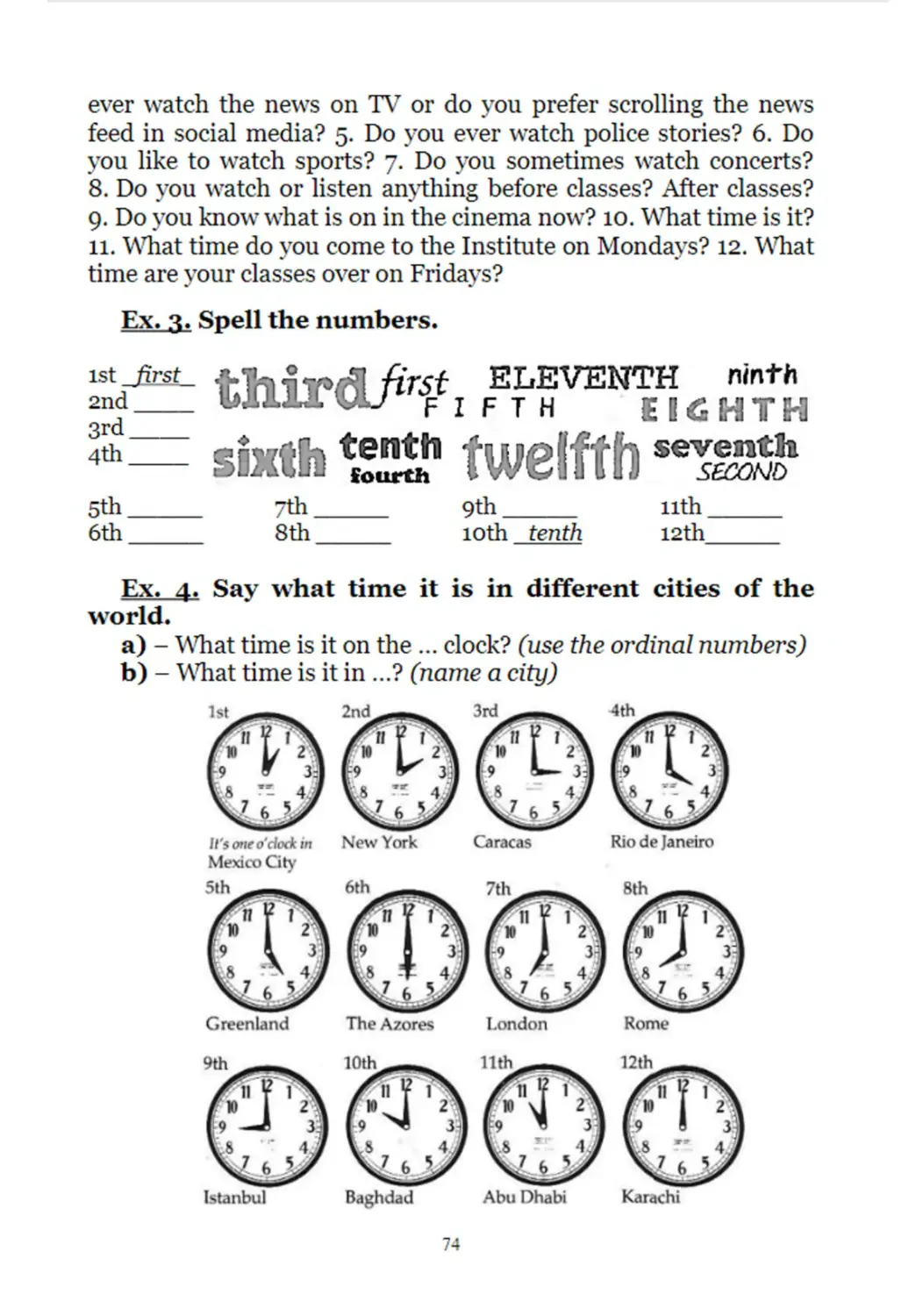


Author: Сороцкая А.П. Гламазда С.Н. Кузнецова Д.В.
Tags: лингвистика английский английский язык языкознание английская грамматика
ISBN: 978-5-534-13839-9
Year: 2024


Text
                    МИНИСТЕРСТВО ОБРАЗОВАНИЯ БЕЛГОРОДСКОЙ ОБЛАСТИ
ГОСУДАРСТВЕННОЕ БЮДЖЕТНОЕ ОБРАЗОВАТЕЛЬНОЕ УЧРЕЖДЕНИЕ
ВЫСШЕГО ОБРАЗОВАНИЯ
«БЕЛГОРОДСКИЙ ГОСУДАРСТВЕННЫЙ ИНСТИТУТ ИСКУССТВ И КУЛЬТУРЫ»
НЕС КУЧНАЯ ГРАММАТИКА
НА ЗАНЯТИЯХ ПО АНГЛИЙСКОМУ ЯЗЫКУ
ПО ОБРАЗОВАТЕЛЬНЫМ ПРОГРАММАМ СПО
“BUILD UP YOUR ENGLISH SKILLS”
Уровень A1-A2
Учебно-методическое пособие
Белгород
2024
УДК 811.111 (075.32)
ББК 81.432.1я723
Н55
Печатается по решению редакционно-издательского совета
Белгородского государственного института искусств и культуры
Рецензенты:
Ломоносова Ю.Е. - кандидат филологических наук, доцент,
доцент кафедры романо-германской филологии и межкультурной
коммуникации института межкультурной коммуникации и
международных отношений. ФГАОУ ВО НИУ «БелГУ»;
Колтунова С.В. - кандидат филологических наук, доцент
кафедры иностранных языков. ГБОУ ВО «Белгородский
государственный институт искусств и культуры».
Авторы-составители:
Сороцкая А.П. - преподаватель кафедры иностранных языков.
ГБОУ ВО «Белгородский государственный институт искусств и
культуры»;
Гламазда С.Н. - кандидат филологических наук, доцент
кафедры иностранных языков. ГБОУ ВО «Белгородский
государственный институт искусств и культуры»;
Кузнецова Д.В. - кандидат педагогических наук, доцент
кафедры иностранных языков. ГБОУ ВО «Белгородский
государственный институт искусств и культуры».
Н 55 Нескучная грамматика на занятиях по английскому языку
по образовательным программам СПО "Build up your English
skills”. Уровень A1-A2 : учебно-методическое пособие I авторы-
составители А. П. Сороцкая, С. Н. Гламазда. Д. В. Кузнецова. -
Белгород : БГИПК. 2024. - 210 с. - Текст : непосредственный.
Учебно-методическое пособие предназначено для реализации
учебного предмета «Иностранный язык» на 1 курсе по
образовательным программам СПО.
УДК 811.111 (075.32)
ББК 81.432.1Я723
С ГБОУ ВО «Белгородский государственный
институт искусств и культуры», 2024
ОГЛАВЛЕНИЕ
ВВЕДЕНИЕ................................................... 9
Phonetic Chart............................................ 14
Verb Tenses Charts........................................ 14
Вопросы по таблицам времён................................ 18
Topics 1-2. Hello! Excuse me!............................. 19
To be (am, is, are)/ I am from.../ here/
countries and nationalities/ on business, on
holiday, on vacation/ plural nouns
Topic 3. What is it? What are they?....................... 23
Alphabet/ Numbers 1-12/ a, an/
What is it? What are they?
Topic 4. Staying at a hotel............................... 26
This, that, these, those/ Here’s, over there/ here,
there/ your, our/ numbers 13-24/ isn’t, aren’t/
What is your name? What are your names?
Topic 5. I am cold......................................   29
To be (am, is, are)/ Adjectives
Topic 6. A nice flat/ apartment........................... 31
There is, there are/ rooms in a flat/ kitchen
facilities/tableware in the kitchen/ some, any
Topic 7. Everyday conversation............................ 34
There is/ Is it far?/ near here/ First, second, third/
right, left/ How much is that?/ Could you pass...?/
Here you are
Topic 8. Tom from Canada.................................. 36
This is, these are/ My, your, his, her, our, their /
Clothes/ Colours/ Look at/ is, are/
Whose ... is/are...? (he, she, they)/
What colour is/are... ?/ Possessive case
Topic 9. Is it your car?.................................. 38
To be (is)/ What is this? - Is it...? - It is ...
Whose ... is/are...?/ Who is ...?/ Possessive case
Topic 10. There is some rice in the jar......... ......... 40
There is, there are/ some, any/
How many? How much?
Topic 11. At the restaurant............................... 43
I'd like/ some/ a, the
3
Topic 12. A. Making a film/ B. Robbie the robot.......	45
Imperative Mood/ objective case of pronouns/
look at, smile at, laugh at, shout at/ tum on, turn
off/ in exercises: Past Simple/ Present Continuous/
reported speech (asked to do/ asked not to do)
Topic 13. A rich man and a poor man................... 47
Antonyms (adjectives) / there is, there are
Topic 14. Two women boasting about their husbands.. 49
Is he? Are you? Really? Can he?.../ can
Topic 15. Every day conversation...................... 51
I would like/ how about/ question words
Topic 16. Happy G. Gusto. Unhappy T. Atkins.
T. Archer who is all right.................  53
Have got
Topic 17. At customs..................................
Have/ how much, how many, some, a lot of	55
Topic 18. A party7....................................
One, ones/ mine, yours, his, hers, its, ours, theirs 57
Topic 19. Everyday conversation.......................
One, ones/ can, could/ have got/ me, to me, for me 59
Topic 20. Letters from Paris (Letter 1)...............
To be (am, is, are)/ ‘How is/are...?’ ‘What is/are 61
the... like?'
Topic 21. Is Jack working today7?..................... 62
У Present Continuous
Topic 22. Tom is practicing his English............... 63
Present Continuous/ can, can’t/
something, someone
Topic 23. Everyday conversation....................... 66
Expressions for everyday’ use
Topic 24. She is wearing.............................. 68
Present Continuous/ colours/ clothes/ fabrics
Topic 25. Peter and Lulu in the cinema................ 69
Present Continuous/ prepositions of place
Topic 26. What’s on television tonight?............... 72
Time/ after, before/ there is a film
Topic 27. Tomorrow’ w’e’re going to leave this place.. 75
Be going to = be gonna
Topic 28. An English wedding..........................
Present Continuous/ be going to + verb
Topic 29. I’m looking for a girlfriend................ 79
4
Topic 30. A love declaration............................ 79
У Present Simple/ may, can
Topic 31. Everyday conversation......................... Si
Вопросительные слова/ вопросы/ have you got...
?/ do you ... ?/ ... Are you doing?/ directions
Topic 32. Duchess of Wessex............................. $4
Present Simple/ daily routine/questions/ time/
prepositions
Topic 33. Alan is a lorry-driver........................ 86
Present Simple (3 л., ед. ч)/ time/ in the evening;
then
Topic 34	“What’s my job?”.............................. 89
Present Simple/ in exercises - reported speech (if)
Topic 35. Mr Benson and the vicar....................... 92
Present Simple/ never, always, sometimes, usually,
rarely, occasionally/ in the morning, at 2 o’clock,
on Saturday, next week
Topic 36. Asking people about their free time.........	94
Present Simple/ daily routine/ often, sometimes,
usually, occasionally, rarely (hardly ever), never,
once a week, twice a week
Topic 37. What does he do? / What is he doing?........	97
Present Simple/ Present Continuous/ be going to/
To be as a main and a helping verb
Topic 38. Well or badly................................. 99
Present Simple/ Present Continuous/ adverbs/
adjectives
Topic 39. Everyday conversation........................ 101
Present Simple/ question words /
Topic 40. Letters from Paris (letter 2)................ 103
Present Simple/ is, are/ present continuous/
usually, always, occasionally/ at... o'clock/ on
Saturday/ at the station/ in the evening
Topic 41. Where were you yesterday?.................... 104
To be (was, were)/ in January, at 2 o’clock, on
Monday
Topic 42. John was on holiday.......................... 1Q6
To be (was, were)/ There was, there were/ What
was it like?
Topic 43. Everyday conversation........................ 1Q8
Clothing department/ hotel reception/
Cafe/ recreation center
5
Topic 44. An astronaut talks about his journey to the
moon.................................................... 110
4 Past Simple (have, be)/
expressions with 'to have’
Topic 45. John went to the supermarket and got the
food for his wife....................................... 112
Present Simple and past simple of irregular verbs
'have', 'go’, ‘come’, ‘get’/ some, any
Topic 46. A secretary’ answers her boss’s questions.... 115
Past Simple (regular verbs)/questions with ‘who’
(in exercises)
Topic 47- Willie the Kid................................. И7
Past Simple (be, have, regular verbs)/ suffix -ly
Topic 48. Foreign holidays.............................. 119
Present Simple/ Past Simple (of the verbs: go, see,
eat, drink, take, shine, ride, write, fly, meet, buy,
bring)/ a lot of/ go by, fly by/ go to/ last year, last
summer/ ‘who’ questions (in exercise)
Topic 49. a plane crashed in the Pacific Ocean......... 123
Past Simple (be, have, catch, see, write + regular
verbs)/ a few, a little/ much, many, a lot of
Topic 50. Jill went to a concert yesterday.............. 125
Present Simple/ Past Simple (go, see, sing, have)/
adverbs
Topic 51. Everyday conversation......................... 127
Past Simple (to lose, to leave, to find, to give, to
take, to go, to think, to come, to win, to spend)
Topic 52. The new’s..................................... 130
Past Simple (be, begin, break, bum, find, leave,
lose, meet, send, shoot, speak, spend, wear +
regular verbs)
Topic 53. Biography of a billionaire.................... 133
Past Simple (be, become, build, break, buy, drink,
fly, give, go, leave, sell + regular verbs) / in 1912/
on the 24th of December/ years/ someone,
somewhere, something (in exercises)
Topic 54. Mr. Gibbon and miss smith in a restaurant... x38
Present Simple/ Present Continuous
Topic 55. two cars were going down the street.......... И1
У Past Continuous/ Past Simple (be, see, run,
come)/ adverbs/someone, something, somewhere
(in exercises)
б
Topic 56. A school director attacked from behind.... .... 144
Past Continuous/ Past Simple (hit, put + lock,
drop, happen)
Topic 57. I could swim, when I was five....... ....... 147
Could
Topic 58. Two spy stories............................. 149
must/ need// have to/ can
Topic 59. Personal history..........................   153
Names/ marital status, family, and home/
Birthdays/ education and work
Topic 60. Letters from Paris (letter 3).............   155
Past Simple/ at... O’clock/ on Saturday/ at the
station/ last weekend/ in the morning, in the
afternoon
Topic 61. American astronaut on the moon.............. 156
4 Present Perfect/ be going to/ Present Continuous
Topic 62. Where’s he gone............................. 157
Present Perfect (go, be)
Topic 63. Everyday conversation....................... 159
Revision: can’t, mustn’t, needn't/
Present Perfect (paint, touch, wash, brush, clean)
Topic 64. Тонн or country............................. 161
There is, there are/ there was, there were/ Present
Simple/ Past Simple
Topics 65- Elmar Colt is on a tour of Europe.......... 163
66. Present Perfect
Topic 67. Have you ever ... ?......................... 166
Present Perfect/ Past Simple
Topic 68. Dr. Blore’s invention....................... 169
Comparisons
Topic 69. Jerry Floyd is talking to his grandfather... 173
Have to/ had to
Topic 70. The trivia game............................. 175
Comparisons
Topic 71. A. Brutus cray the boxer
B. Visiting the Burj Khalifa........................... 177
Comparisons / Present Perfect/ past simple/ be
going to/ over here, from here, down there
Topic 72. I’ll do it.................................. 182
У Future Simple in requests and offers/
‘why don't you...?’ suggestions
7
Topic 73. Everyday conversation........................ 186
Present Perfect/ mine, yours, his, hers, ours, theirs/
as...as, the same as, different from/ comparisons
Topic 74. Everyday conversation........................ 189
some, any/ something, anything, everything,
nothing/ somebody, anybody, everybody, nobody/
somewhere, everywhere, anywhere
Topic 75. Different careers............................ 192
Past Simple/ Present Perfect/ Present Simple/
the same year, still, since 2013, for 5 years, in 2009
Topic 76. An electronic world........................   194
can/ can't for permission and prohibition
Topic 77. A. The results of general election
B. Battle of the bands................................. 196
The tenses / both of, one of, neither of, none of/
Some of, all of/ the other, the others
Topic 78. The news...................................   199
Revision and consolidation
Topic 79. Everyday conversation........................ 203
Revision and consolidation
Topic 80. Letters from Paris (letter 4)................ 205
Present Perfect + revision
СПИСОК ЛИТЕРАТУРЫ...................................... 208
8
ВВЕДЕНИЕ
Учебный предмет ОУП. 01.03 «Иностранный язык» входит в
состав общеобразовательных учебных предметов
общеобразовательного учебного цикла учебного плана по
образовательным программам среднего профессионального
образования (СПО).
Изучение учебного предмета способствует формированию
обшекультурной компетенции - пользоваться профессиональной
документацией на государственном и иностранном языках (ОК-9).
Данное учебное пособие - это интенсивный курс
иностранного (английского) языка. предназначенный для
обучающихся 1 курсов и рассчитанный:
-	на устранение пробелов в знаниях обучающихся в области
базовой грамматики английского языка;
-	на формирование у обучающихся активного словарного
запаса, состоящего из общеупотребимых наиболее частотных
лексических единиц:
-	на снятие у обучающихся языкового барьера и на
практическое овладение языком;
-	на подготовку обучающихся к дальнейшему' развитию
разговорной речи с накапливанием обшекультурного вокабуляра
для перехода на профориентационный этап обучения, который
предполагает наличие у обучающихся прочных знаний в области
грамматики и достаточный запас лексики.
Данное пособие состоит из 80 тем (topics), в каждую из
которых входит мини текст (иногда в форме диалога) и
упражнения. Через тексты, моделирующие жизненные ситуации,
наглядно демонстрируется употребление определённого
грамматического явления и лексики. Через упражнения
стимулируется применение заданного грамматического явления и
лексики в речи.
В пособии охватываются грамматические темы и лексика
уровней владения английским языком Al, А1+, А2 (Beginner,
Elementary, Pre-Intermediate) согласно общеевропейским
компетенциям владения иностранным языком (CEFR).
Грамматические темы, дающиеся в пособии, можно просмотреть в
содержании, где для облегчения ориентации ключевые темы при
9
первом их появлении в посооии выделены серым цветом, и для
большего выделения времена глагола помечены галочкой.
Что касается лексики, то при успешной работе с данным
учебным пособием объём словарного запаса обучающихся составит
приблизительно 1600 слов и выражений, что соответствует уровню
А2. Авторы не предоставляют списков предназначенной к
усвоению лексики и предлагают обучающимся выписывать новые
слова и выражения каждой темы самостоятельно и заучивать их.
Также самостоятельно рекомендуется формировать и заучивать
список неправильных глаголов по мере их появления в темах.
В начале и в процессе работы по пособию от обучающихся не
требуется иметь глубокие знания в области английского языка,
допускается наличие:
-	пробелов в знаниях;
-	низкого уровня владения английским языком;
-	языкового барьера.
Предполагается, что в ходе работы с пособием будет
происходить корректировка знаний, полученных на предыдущем
этапе обучения, и их активизация. С обучающимися более
высокого уровня данное учебное пособие может быть использовано
в качестве повторения отдельно взятых тем или в качестве основы
для беседы с употреблением лексики продвинутого уровня.
В пособии используется практический подход к изучению
иностранного языка. Его цель - развивать у обучающихся
коммуникативную компетенцию в английском языке путём:
представления изучаемого языка через интересное
содержание;
-	представления ситуаций для общения и использования языка
как средства коммуникации и выражения своих мыслей;
-	стимулирования применения приобретённых знаний и
навыков на практике.
Пособие призвано снять у преподавателя проблему подбора
материала для развития устной речи обучающихся, который был бы
нацелен одновременно на краткосрочную и долгосрочную
перспективы при изучении иностранного языка.
В пособии материал имеет:
-	преодолимый барьер сложности и отвечает требованиям
частотности и практичности представляемых языковых явлений;
ю
-	иллюстрации для ооеспечения наглядности, таким ооразом
задействуя зрительный канал восприятия и образное мышление;
-	аудио приложение с театральной начиткой тем пособия
носителями языка для развития у обучающихся навыков
восприятия английской речи на слух, для использования речи
актёров в качестве образца.
Чёткой структуры при работе с каждой темой в пособии не
предусмотрено. Таким образом авторы попытались реализовать
задачу разнообразить занятия.
На с. 14 даётся словарное облако, состоящее из множества
прилагательных, которыми можно описать английский язык и
процесс его изучения (трудный, интересный, пугающий, скучный,
захватывающий, замысловатый, структурированный, непонятный,
важный и т. д.). На любом из занятий (на усмотрение
преподавателя), используя имеющиеся в облаке прилагательные,
предлагается обсудить вопрос «Чем для вас является английский
язык и процесс его изучения?» (“What is English like for you?”).
После этого представлены:
-	мини таблица четырёх типов чтения гласных букв (Phonetic
Chart), в которой авторы попытались продемонстрировать
обучающимся стандартную информацию через систему и обратить
их внимание на идентичность многих моментов;
-	таблицы всех времен английского глагола активного залога
(12 таблиц), в каждой из которых представлена схема построения
утвердительного, отрицательного и вопросительного предложения
в данном времени. Несмотря на то, что в пособии изучаются только
6 из них (отмечены серым цветом), авторы дают обучающимся
возможность ознакомится и с остальными временами для того,
чтобы наглядным образом (таблицы структурированы единым
стилем) продемонстрировать общу-ю, универсальную для всех
времён английского языка структуру, что, по мнению авторов,
поможет снизить некоторую трудность в освоении «страшных» для
многих, изучающих английский язык, но необходимых для его
успешного усвоения времён;
-	таблицы глагола to be в трёх затрагиваемых в пособии
временах + время Future Simple для тех же задач (4 таблицы);
-	вопросы по таблицам времён на русском языке, призванные
реализовать указанные выше задачи по преодолению у
п
обучающихся трудностей, связанных с изучением времён путём
систематизации знаний о них.
Перед каждой темой (topic) перечислятся языковые явления,
которые в ней демонстрируются, причём они сохраняют стиль
выделения данных явлений в тексте. Таким образом авторы
попытались создать приём, при котором внимание обучающегося
обращено на изучаемое языковое явление, что способствует
лучшему усвоению.
За исключением вопросов по таблицам времён все остальные
задания сформулированы на английском языке для обеспечения
полного погружения в языковую среду7 на занятиях, несмотря на
пока невысокий уровень знаний у обучающихся. При
возникновении у обучающихся трудностей в понимании,
преподавателям рекомендуется давать разъяснения также на
английском языке, не прибегая к переводу.
Значком /С'З обозначено начало текста.
12
WHAT IS ENGLISH LIKE FOR YOU?
о
I? S
<л
5 □ о □ с
С ио S
|s s
U.Q
Я *
Seine е a ma si ng Cunfusing tough	.
NerSSus Meticulous Memorizing nightmare U0UDl .	35
? Monster Intriguing	fl I Г* J Г>	s°£X %
ГТ) 8 ,eni|lyin9 a7’1’ CODTUSinQ Complicoting ^«erday
X/ fascinating Tricky	r- nice О Difficultconfusing intrigued
Qnchanting _	= Exciting II Г Uli lnfim;do,in9* Suiprised Terrifiyhg
KGtiallejiGimgt^s
ф 1 f ? s id if jiсщ It 2 csr 5.; 4ifi
у О Serious q_ >. рл mn Пг*н	-n & sophisticated	<->
g У challenge -o 8 COГПpIlCOCeCl -g Comfortable creepy
j Lb % □ ® Amazing awesome 8, у stfUCtured Apgry
ЕГоя n .. .	Overwhelming p	Stressful exoct
й Ce£ § Make me stress Rather confusing ~ Я •“ . Annoying
•^“2^ wont to know interest inh	Pinapple
й8 ’ F,lnnBuWuS!ul wnoriject Exercises |^Family Score
Funny Дрр|е	шй-
thrilling a
5
o
PHONETIC CHART
4 Types of reading the vowels
	open syllable	closed syllable	vowel + r	vowel + re	I	II	III	IV
a	[ei]	[as]	[a:]_	£э]	fate	fat	far	fare
о	[au]	[o]		3?£)	_stok§_	stock	stork	_storgl
u		[a]	/М	[jua]	cube	cub_	curb	cure
e	[i=l_	e'_	[a:]\	_ia.	Peter	pet	pert	here
4	0ai]_	i	[a:]/	[aiajx	file	fill	first	fire
	Mai]	[i]	w	[aia]	style	gyps	Byrd	tyre
VERB TENSES CHARTS
1. Present Continuous
+		—	am is are			mg
-		—	am is are	not		mg	•••••• •
9 •	(Wh)	am is are	—			mg	9 •••••• •
2. Past Continuous
4-		—	was were			mg
—		—	was were	not		mg	•••••• •
9 •	(Wh)	was were	———			mg	9 •«•••• •
3. Future Continuous
		—	will		be	ing
—		—	will	not	be	ing	•••••• •
9 •	(Wh)“|	will	—		be	ing	9
14
4. Present Simple
+		—				s	•••••• •
—		...		do does	not	—
9 •	(Wh)	do does	—		—	9
5. Past Simple
+		—				ed 	2	•••••• •
—		—	did	not	—
9 •	(Wh)	did	—		—	9 «••••• •
6. Future Simple
+		......	will		—	•••••• •
—					will	not	= = = = =
9 •	(Wh)	will	—		= = = = =	9
7. Present Perfect
+		—	have has			ed 	3	•••••• •
—		—	have has	not		ed 	3
9 •	(Wh)	have has	—		Ф 09 II II II II II II II II II II	9 •••«•• •
8. Past '				Perfect
4-		--—--	had		II II II II II II II II II II CO a> P-I	•••••• •
—		—	had	not	<p eq ll ll ll ll ll ll ll ll II II
9 •	(Wh)	had	—		II II ll ll ll ll ll ll ll ll co Q-	9
15
9. Future Perfect
+		—	will		have		ed 	3	•••••• •
—		—	will	not	have	ф co II II II II ll ll
9 •	(Wh)	will	......		have	ll ll II II II II co ф	9
0. Future Perfect Continuous
+		......	will		have been ===ing
—			will	not	have been ===ing
9 •	(Wh)	will	—		have been ===ing	9
11. Past Perfect Continuous
+		-MMM.	had		been	===ing	•••••• *
-		......	had	not	been	===ing
9 •	(Wh)	had	...			been	===ing	9 • • • • • •
12. Present Perfect Continuous
+		—	have has		been	===ing	•••••• •
—		—	have has	not	been	===ing	•••••• •
9 •	(Wh)	have has	—		been	===ing	9
16
13. TO BE - Present^ Simple
+		—	am is are
-		—	am is are	not
о •	(Wh)	am is are						9
14. TO BE - ]				?ast Simple
+		—	was were
-		—	was were	not
9 •	(Wh)	was were	—			9
15. TO BE - Future Simple
+		-	—	will		be
—		......	will	not	be
9 •	(Wh)	will	—		be	9
16. TO BE - Present Perfect
+		—..—	have has		been
—		------	have has	not	been
9 •	(Wh)	have has	—		been	9
17
ВОПРОСЫ ПО ТАБЛИЦАМ ВРЕМЁН
Посмотрите на таблицы (1-12) времён английского
глагола (здесь дана только активная форма)
и ответьте на вопросы
1.	Есть ли одинаковые схемы хотя бы в одной строчке?
2.	Озаглавьте столбцы таблиц (7 столбцов).
3.	Определите общую закономерность построения всех
английских предложений в разных временах.
а)	Где в предложении находится отрицательная частица
“not”?
б)	Как меняется порядок слов в вопросе?
в)	Меняется ли порядок слов в отрицательном
предложении?
г)	Где в вопросительном предложении стоит
вопросительное слово?
4.	Есть ли предложения без глагола?
а)	без вспомогательного глагола
б)	без основного глагола
5.	Сколько вспомогательных глаголов вы видите?
Перечислите их.
6.	Сколько форм глагола вы видите? Какие вариации
глагола вы видите? Назовите их.
7.	Что общего во всех временах группы Continuous?
8.	Что общего во всех временах группы Perfect?
9.	Что общего во всех временах группы Simple?
10.	Что общего во всех будущих временах?
Посмотрите на таблицы (13-16) времён английского
глагола ‘to be’ (здесь дана только активная форма)
и ответьте на вопросы
11.	Что общего с предыдущими таблицами вы замечаете?
12.	Какие формы имеет глагол ‘to be'?
13.	Есть ли в предложениях ещё глаголы, кроме глагола
‘to be’?
is
TOPIC 1-2
HELLO! EXCUSE ME!
To be (am, is, are)/ I am from .../ countries and nationalities/
(fiere)/ on business, on holiday, on vacation / plural nouns
n , A.-Hello!
- Hello!
- I am David Clark.
- I am Linda Martin.
- Are you a teacher?
- No, I am not.
- Oh! Are you a student?
- Yes, I am.
Topic 1
B. - Are you from England?
- No, I am not.
- Where are you from?
- I am from Canada.
C. - Hello, John.
- Hello, Peter. How are you?
- I am very well, thanks. And you?
- I am fine, thanks!
Topic 2
д д D. - Excuse me.
-Yes?
- Are you English?
- Pardon?
- Are you English?
- Oh, yes. Yes, we are.
- Oh! I am English. Are you
on holiday?
- No, no we aren’t.
We are businessmen.
E. - Please sit down!
- Thank you.
-Tea?
- Yes, please.
- Sugar?
- No, thanks.
- Where are you from?
- I am from London.
- Are vou a businessman?
- No, I am not. I am a tourist.
19
F. - Excuse me!
-Yes?
- Are you American?
- Pardon me?
- Are you from
the United States?
- Yes, we are.
- Oh. lam American too.
you^here)on vacation?
- No, we aren’t. We’re(l
on business.
- Please, sit down.
- Thank you.
- Coffee?
- Yes, please.
- Cream?
- No, thanks.
- Sugar?
- Yes, please.
Are
iere)
- Where are you from?
- I am from Los Angeles.------
- Are you(liere)on business?
- No, I’m noUl'm on vacation.
G. - Is she from Moscow?
- Yes, she is.
- Is he from Moscow, too?
- No, he isn’t.
- Where is he from?
- He’s from Minsk.
H. - Are you a musician?
- Yes, I am.
- Are they musicians or dancers?
- They are dancers.
- Where are they from?
- They’re from Germany.
Ex. 1. Complete the table with the ‘to be’ full and short
forms in the Present Simple.
I	you	he	she	it	we	they
				is
				it’s
20
Ex. 2. Continue according to the model.
Are they businessmen?
Yes, they are.
Are thev businessmen?
No, they aren't.
1..................tourists?
.................tourists?
Ex, 3, Write sentences according to the model:
I/ France/ French—►	I am from France. I am
French.
1.	We/ America/ American
2.	He/ Canada/ Canadian
3.	You/ Mexico/ Mexican
4.	They/ Japan/ Japanese
5.	You/ Brazil/ Brazilian
6.	It/ Spain/ Spanish
7.	It/ Italy/ Italian
8.	We/ England/ English
9.	They/ China/ Chinese
10.1/ Russia/ Russian
11. They/ Turkey/ Turkish
12. She/ Korea/ Korean
13-	We/ Panama/ Panamanian
14.	He/ Indonesia/ Indonesian
15.	You/ Colombia/ Colombian
16.	They/ Belgium/ Belgian [’-d^an]
17.	You/ Ecuador/ Ecuadorian
18.	They/ Switzerland/ Swiss
19.	You/ Germany/ German
21.	He/ Australia/ Australian
22.	They/ Portugal/ Portuguese
23.	She/ Sweden/ Swedish
24.	She/ Egypt/ Egyptian
25.	We/ Morocco/ Moroccan
21
Ex, д. Ansiver the questions.
a)	“Yes, I am” or “No, I am not”
1.	Are you a teacher? (a student, a designer, a choreographer,
a dancer, a musician, a singer, an actor, a director, Russian,
American)
b)	“Yes, we are” or “No, we are not”
1.	Are you teachers? (students, designers, choreographers,
dancers, musicians, singers, actors, directors, Russians)
2.	Are you from England? (Canada, Ukraine, Russia, Spain,
Italy, Moscow, Belgorod, Kursk, Voronezh)
c)	“He is from...”, “She is from...” or “They are from
• • •
1.	Where is he from? (Germany, France, Spain, Egypt, China,
Israel, Japan)
2.	Where is she from? (India, Australia, New-Zealand, Brazil)
3.	Where are they from? (Turkey, Ecuador, Morocco, Mexico,
Colombia, Philippines)
Ex. 5. Look at the pictures and speak according to the
models.
Model 1: (picture 1)
He’s from New York. He’s from America. He’s American.
Model 2: (picture 1)
Is he from New-York/ London? - Yes, he is./ No, he isn’t.
Is he from America/ England? - Yes, he is./ No, he isn’t.
Is he American/ English? - Yes, he is./ No, he isn’t.
New York
America
American
France
French
London
England
English
Beijing
China
Chinese
Moscow
Russia
Russian
22
Mexico City
Mexico
Mexican
Madrid
Spain
Spanish
Rome
Italy
Italian
Tehran
Iran
Iranian
Tokyo
Japan
Japanese
TOPIC 3	WHAT IS IT? WHAT ARE THEY?
Alphabet/ Numbers 1-12/ a. an/ What is it? What are they?
Ex. 1» Answer the question “What is it?” Match the
nouns from the list with the pictures A-Z. Learn the
nouns. Example: What is it? (A) - It is a spoon.
an egg
a glass
a table
a bus
an apple
a purse
a knife
a key
a chair
a train
an iron
a plate
a cup
an umbrella
a window
a watch
a spoon
an orange
a fork
23
a shelf
a lorry
a pen
a door
a lemon
a taxi
a car
Ex, 2. Answer the question “What are they?”. Match
the nouns from the list with the pictures 1-12. Learn the
nouns.
24
Ex. 3. Spell numbers 1-12.
1 nno	cz
ffiVS iwdve
ELEVUM
nine О/ЪФ'
tliA&e four
Ex. 4. Say it in English.
1.	Одно такси.
2.	Две полки.
3.	Три стола.
4.	Четыре окна.
5.	Пять ложек.
6.	Шесть вилок.
7.	Семь тарелок.
8.	Восемь дверей.
9.	Девять апельсинов,
ю. Десять лимонов.
11.	Одиннадцать яиц.
12.	Двенадцать ручек.
13.	Два грузовика.
14.	Один ключ.
15.	Двенадцать яблок.
16.	Одиннадцать окон.
17.	Восемь стульев.
18.	Четыре автобуса.
19.	Шесть зонтов.
20.	Три поезда.
21.	Пять часов.
22.	Десять (умок.
23.	Семь стаканов.
24.	Девять чашек.
Ех. 5» Say it in English.
1.	Это яблоки.
2.	Это сумка.
3.	Это утюг.
4.	Это книги.
5.	Это дверь.
6.	Это грузовик.
7.	Это ручки.
8.	Это яйца.
9.	Это тарелки,
ю. Это такси.
11.	Это стаканы.
12.	Это вилки.
13.	Это зонт.
14.	Это окно.
15.	Это ложка.
16.	Это полки.
17.	Это тарелка.
18.	Это стулья.
19.	Это ножи.
20.	Это автобус.
21.	Это чашка.
25
TOPIC 4
STAYING AT A HOTEL
This, that, these, those/ Here’s, over there/
here, there/ your, our/ numbers 13-24/ isn’t, aren’t/
What is your name? What are your names?
A.	- Good evening!
** - Good evening, sir.
What’s your name, please?
- My name’s Dean.
- Ah, yes. Mr Dean.
Room 15 (fifteen). Here’s
your key.
- Thank you.
B.	- Is this your case?
- No, it isn’t.
- Oh, is that your case,
over there?
- Yes, it is.
C.	- Good evening!
- Good evening. What
are your names, please?
- Mr and Mrs Broun.
- Ah, yes. Here’s your
key.
D.	- Are these your
cases here?
- No, they aren’t.
- Ah, I’m sorry. Are
those your cases over
there?
- Yes, they are.
E.	- Is this our room?
- What’s the number?
- Fourteen.
- Oh, no. It isn't. That’s our room. Number thirteen.
26
Ex. 1, Translate into English the demonstrative
pronouns in the table. They are in bold type in the
dialogues.
	Рядом с говорящим near	Далеко от говорящего far
ед. ч. Sing.	этот, эта, это	тот, та, то
мн. ч. Р1.	эти	те
Ex. 2. Say it in English:
(Prompts: house, room, window, passport, idea, city, mirror,
street, door, case, evening, number, woman-women, man-men,
child-children, book, student, bag, classroom, key, chair)
a)	1. Этот дом. 2. Эта комната. 3. Это окно. 4. Этот паспорт.
5.	Эта идея. 6. Этот город. 7. Это зеркало. 8. Эта улица.
Ь)	1. Тот дом. 2. Та дверь. 3. Тот чемодан. 4. Тот вечер.
5.	Тот номер. 6. Та женщина. 7. Тот ребёнок. 8. Та улица.
с)	1. Эти дети. 2. Эти дома. 3. Эти чемоданы. 4. Эти книги.
5.	Эти студенты. 6. Эти женщины. 7. Эти сумки. 8. Эти ключи.
d)	1. Те сумки. 2. Те аудитории. 3. Те ключи. 4. Те стулья.
5. Те окна. 6. Те мужчины. 7. Те номера (в отеле). 8. Те дома.
Ех. 3, Ask question according the example.
a)	Example: case/ here----► Is this your case, here?
umbrella/ there----► Is that your umbrella, over there?
case/here, umbrella/there, handbag/here, glass/there, key/
here, case/there, room/there, manager/there.
b)	Example: cases/ here----►Are these your cases, here?
umbrellas/ there -----► Are those your umbrellas, over
there?
cases/here, keys/there, books/there, cases/there, pens/here,
children/there, umbrellas/there.
Ex. 4. Say7 it in English following the example:
a)	Is this our... ? - Yes, this is our....
1.	Это наш дом. 2. Это наша комната. 3. Это наше окно.
4. Это наша идея. 5. Это наша дверь. 6. Это наш чемодан.
27
b)	Is /this our... ? No, \that is your....
1.	To ваша аудитория. 2. To ваш автобус. 3. To ваш ключ.
4.	То ваш менеджер. 5. То ваша машина. 6. То ваш номер
(в отеле).
с)	Are /these your... ? - No, \those are our....
1.	To наши дети. 2. To наши студенты. 3. To наши машины.
4. То наши чемоданы. 5. То наши преподаватели.
Ех. 5. Act out dialogue В, using the words below as a
substitution.
Book, pen, car, key, bag, friend, father, dog, house, teacher.
Ex. 6. Say it in English:
(Hint: pass card, room, key, ticket, book, passport)
1. Вот ваш ключ. 2. Вот ваша книга. 3. Вот ваша комната.
4. Вот ваш билет. 5. Вот ваш паспорт. 6. Вот ваш пропуск.
Ех. 7» Spell numbers 13-24.
twenty-three eighteen мнении
fourteen ^,„enfee/i
fifteen thirteen Sixteen
twenty-four
13.		ly.	21-
14.		18.		22.
15.		19. nineteen	23.
16.		20.		24.
Ex. 8. Act out dialogue D, using the words below as a
substitution.
Books, things, keys, bags, papers, documents, parents, friends.
2S
TOPIC 5
I AM COLD
To be (am, is, are)/ Adjectives
29
Ex. 1. Match the antonyms from
pictures E-Z. Use А-D as an example.
the list with the
A. cold - B. hot
C. big - D. small
full - empty
thick - thin
long - short
old - new
cheap - expensive
tall - short
beautiful - ugly
heavy - light
fat - thin
strong - weak
old - young
rich - poor
Ex. 2. Look at the picture and speak about the people
in the compartment. Use the list of names and adjectives
below. Example: Helen Wilson is thirsty.
Helen Wilson
Alan Wilson
Mrs Wilson
Miss Cook
Mr Parker
Mr Cooper
Mr West
Mr Spencer
sad
angry
hungry’
thirsty
tired
cold
hot
asleep
Ex. 3. a) Act out the dialogue, using the pairs of
adjectives below as a substitution for ‘cold’ and ‘hot’.
busy - free	nervous - relaxed	happy - angry’
married - single	hungry’ - thirsty	tired - Ok
30
b) Substitute T for hve, they, he, she’ and make new
sentences using the antonyms below:
right - wrong [гэд]	nervous - calm [ka:m]
shy - fine	late - early
TOPIC 6
A NICE FLAT/ APARTMENT
There is, there are/ rooms in a flat/ kitchenfacilities/
tableware in the kitchen/ some, any
, (British English)
A. Agent: This is a nice
flat, Miss Wilkins. Here’s a plan ...
There’s a living room. There’s a
kitchen, a bedroom, a bathroom,
and there’s a toilet, too.
Miss Wilkins: Is there a
balcony?
Agent: No, there isn’t.
Miss Wilkins:... and a closet?
Agent: No, there isn’t a
closet.
Miss Wilkins: What about an air-conditioner?
Agent: No, there isn’t an air-conditioner either.
B. Agent: Well here’s the kitchen.
Miss Wilkins: Hmm ... it’s very small.
Agent: Yes, it isn’t very7 large, but there’s a cooker and a
fridge. There are some cupboards under the sink.
Miss Wilkins: Are there any plates?
Agent: Yes, there are.
Miss Wilkins: Good.
Are there any chairs in
here?
Agent: No, there
aren’t, but there are some
in the living-room.
Miss Wilkins: Hmm.
There aren’t any cups'.
Agent: Yes, there are! They are in the cupboard.
31
Ех» 1. Answer the
questions about the
pictures.
1. Is there a sink in the
bathroom? 2. Is there a bath
tub in the bathroom? 3. Is
there a shower cabin in the
bathroom? 4. Is there a
window in the bathroom?
5. Are there two windows in
the kitchen? 6. Are there
shelves in the kitchen? 7. Is
there a microwave? 8. Are
there two beds in the bedroom? 9. Is there a sink in the toilet?
10. Is there a sofa in the living room? 11. Are there books on the
shelves in the living room? 12. Is there a coffee table in tlie living
room? 13. Is there an armchair in the living room? 14. What is
there on the coffee table? 15. Is there a TV-set in the kitchen?
Where is the TV-set? 16. Are there any chairs in the flat? 17. Are
there any cups on the coffee table?
(American English)
C. Realtor: This is a
nice apartment, Ms. Garcia.
Look, here’s a floor plan.
Nina: Mmm...
Realtor: There’s a living
room. There’s a kitchen, a
bedroom, and a bathroom.
Nina: Is there a balcony?
Realtor: Yes, there is.
Nina: xAnd a dining room...
is there a dining room?
Realtor: No, there isn’t a

dining room. But there is a dining
area in the living room.
вАкС-ОЫЧ
32
D.
Realtor:
Well, this is
the kitchen.
Nina:
Oh, it’s very
small.
Realtor:
Yes, it isn't
very large.
But there’s
a stove, a refrigerator, and a space for a dishwasher. There are
some cabinets, and ... um... there’s a small shelf under the sink.
Nina: Are there any windows in the bathroom?
Realtor: No, there aren’t. But there are two large
windows in the bedroom.
Nina: Good. It’s a very nice apartment. Uh, where is the
bathroom?
Ex» 2. Ask the similar questions (see ex. 1) for
dialogues C and D.
Ex. 3. Describe this house. Write 7 sentences.
Example: There is a big hall dowmstairs.
There isn't a balcony upstairs.
DOWNSTAIRS
UPSTAIRS
BEDROOM
33
TOPIC 7
EVERYDAY CONVERSATION
There is/ Is it far?/ near here/ First, second, third/
right, left/ How much is that?/ Could you pass ...?/
Here you are
A. In the street
- Excuse me.
-Yes?
- Is there a post-office near here?
- Yes, there is.
- Is it far?
- No, it isn’t very far. First right, second left.
-	Thank you very much.
-	That’s all right.
B. At a table
- Mrs. Connor, could you pass the salt, please?
- Certainly.
- Thank you very much.
- And the pepper (перец)?
- No, thank you.
C. In a bar
-	Good evening!
-	Good evening!
-	Two cups of coffee, please.
-	Here you are (eozn, пожалуйста), sir (madam, miss)!
-	Thank you very much. How much is that?
-	1.5 P- (пенсов).
Ex. 1. Spell the numbers.
Л/,, >IXTY
fifty ninety
20.	40.	60.	8O.
30.	50.	70.	90.
34
Ex. 2. Write
conversations
according to the
model. Use the
picture and the
words first,
second, third.
Model:
- Is there a doctor
near here?
- Yes, there is.
- Is it far?
- No, it isn’t very far.
Second right...
Ex. 3. Act out the dialogues, using the words below
instead of the underlined words.
A.	a pharmacy - Take the second on the left.
McDonald’s - Turn left at the traffic-lights.
an ATM - It is in that department store on the ground floor.
a toy shop - Go straight on.
a bank - Turn round that corner.
a church - Take the first on the right.
a stationer}’ store - It’s behind that bank.
a cafe - It is in that shopping center on the second floor.
a metro station - Take the second on the left.
B.	the bread - the ketchup the salad - the chicken
the pepper - the salt	the salami - the cheese
an apple - the grapes	a fork - a knife
C.	a large fiy, 2 hamburgers and 2 cokes - £11,75 (pounds)
a cup of tea - 50р.
a glass of apple juice - 20р.
Fish and Chips - £10
three ice-creams - £3
35
TOPIC 8
TOM FROM CANADA
This is, these are/ My, your, his, her, our, their / Clothes/
Colours/ Look at/ is, are
Whose ... is/are ...? (he, she, they)
What colour is/are ... ?
Possessive case
A. Mrs Turner: Who’s that? Who’s that?
Tom: It’s me, Tom.
Mrs Turner: Tom?
Tom: Yes, Tom. Your grandson, from Canada.
Mrs Turner: Ah, Tom! Come in.
Tom: This is my wife Mary.
Mrs Turner: Oh, how do you do? (Здравствуйте!)
Tom: And these are our children: Jimmy and Ethel.
Mrs Turner: Hello, Jimmy! Hello, Ethel! Well, this is a nice
surprise!
B. Look at Mrs Turner. Her skirt is black, her blouse is
white.
Look at Tom. His jacket is brown, his trousers are grey.
Look at Mary. Her dress is pink, her shoes are orange.
Look at Jimmy. His shirt is red, his shorts are green.
Look at Ethel. Her T-shirt is
yellow, her jeans are blue.
Ex. 1. Complete the table
with possessive pronouns.
Two of them are done for you.
36
Fill in the blanks with the pronouns in brackets, but
translate them into English first. Read the phrases
aloud.
1.	This is ... wife Man’, (моя, его)
2.	These are ... children, (наши, их, ваши, твои, его, её, мои).
3.	This is ... grandson, (твой, ваш, его, её, мой, наш, их)
4.	These аге ... grandchildren, (наши, их, ваши, его, её, мои).
Ех. 2. Combine two sentences to make one. Use
possessive case.
Example: Look at Mrs Turner. Look at her skirt. —>
Look at Mrs Turner’s skirt.
1.	Look at Mrs Turner. Look at her skirt. 2. Look at Tom. Look
at his trousers. 3. Look at Mary. Look at her dress. 4. Look at
Jimmy. Look at his shorts. 5. Look at Ethel. Look at her jeans.
6. Look at Mrs Turner. Look at her blouse.
Ex. 3. Answer the questions. Focus on the pattern
‘What colour is/are...?’, possessive pronouns and
possessive case.
1. What colour is Mrs Turner's skirt? 2. What colour is her
blouse?
3. What colour is Tom's jacket? 4. What colour are his
trousers?
5. What colour is Mary's dress? 6. What colour are her shoes?
7. What colour is Jimmy's shirt? 8. What colour are his shorts?
9. What colour is Ethel's T-shirt? 10. What colour are her
jeans?
Ex. 4» Work in pairs. Ask and answer about the colour
of your mates’ clothes.
Example: - What colour is Helen's coat?
- Her coat is blue.
Some items of clothing you may need: tracksuit, cardigan,
hoodie, sweater, jumper, vest, cap, overall, sports jacket, coat,
scarf, pullover, turtleneck...
Some types of shoes: boots, trainers, sandals, flats ...
Some more colours: lettuce green, pale green, ginger, lilac,
violet, purple, golden, silver, scarlet, maroon, plum, indigo,
lavender, rust, beige, cream,...
37
TOPIC 9
IS IT YOUR CAR?
To be (is)/ What is this? — Is it...? - It is ...
Whose... is/are...?/Who is...?/ Possessive case
\ Richard: Hello, Jane!
Jane: Hello, Richard!
R: Phew, what is this?
J: It is a Cadillac.
R: Hmm. Is it your car?
J: Well, no, no, it isn’t.
R: Whose car is it?
J: It is Mr..OlSQ.n.S car.
R: Mr Orson? Who is he?
J: He is my boss.
He is a millionaire.
Ex. 1. Answer the questions on the text.
1. What’s his name? 2. What’s her name? 3. Is it a Rolls-Royce
or a Cadillac? 4. Is it an American or an English car? 5. What
colour is it? 6. Is it Jane’s car? 7. Ask ‘Whose?”. 8. Is Mr Orson her
teacher? 9. Ask ‘Who?’. 10. Is he rich or is he poor? 11. Is he very
rich?
Ex. 2. Use the pictures (a hat, a dress, a jacket, a case, a
purse, a bag, a bike, shoes, trousers, scissors, glasses), in pairs
ask and answer according to the models.
Model 1: • What is it? - It’s a car. (sing.)
• What are they? - They’re shorts, (pl.)
Model 2: • Whose car is it? - It’s Mr Orson’s car. (sing.)
• Whose shorts are
shorts, (pl.)
they? - They’re Jim’s
38
Ex. 3. Continue according to the models.
a)	Cadillac [’kasdilask] - America. —►
It’s a Cadillac. It’s American.
1.	Renault [ renau] [re nz>:lt] - France
2.	Jaguar [’dsaegjua] - Britain
3.	Chery [ tfen] - China
4.	Mercedes [ma seidis] - Germany
5.	Seat [ seat] - Spain
6.	Lamborghini [laemba gi:m] - Italy
7.	Honda [ handa] - Japan
8.	Volvo [ volvau] - Sweden
9.	Skoda [ skauda] - the Czech Republic
10.	Hyundai [ lundi] - South Korea
11.	BMW [bi: em d\blju:] - Germany
12.	Lada [' la:da] - Russia
b)	Whose... is it?/ Whose ... are they?
Car, keys, umbrella, pens, books, coat, phone, shoes, gloves.
Stacy
Robert
Ask and william + Melissa
answer 10 questions
‘Whose?’ about this
family. You will need
these words: mother
(mom), father (dad), daughter, son, brother, sister.
Example: Whose father is William? - He is Stay’s father.
Ex. 5. Ask
answer using
pictures. Ask
‘What is it?’,
‘Who is it?’
‘Whose... is it?’.
G MSGPJENWOOD
and
the
39
Ex, 6. Act out the dialogue, substituting the key words
for the ones given below.
1.	an iPad - Anna’s - my friend
2.	a BMW - car - Mr Brown’s - my neighbour
3.	a Samsung [ saemsAtj] - phone - Jane’s - my roommate
4.	a simple-dimple - toy - Kate’s - my friend’s daughter
TOPIC 10 THERE IS SOME RICE IN THE JAR
There is, there are/ some, any/ How many? How much?
д — A. - There is some rice
in the jar (банка).
- There is some milk in the
bottle.
- There is some sugar in the jar.
- There is some oil in the bottle.
- There is some water in the jug
(кувшин).
- There is some wine in the
bottle.
B. - There are some apples on the table.
- There are some eggs on the table.
- There are some oranges on the table.
- There are some bananas on the table.
- There are some lemons on the table.
- There are some onions (луковицы) on the table.
C. - There isn’t any butter.
- There isn’t anv cheese.
- There isn't any juice.
- There aren’t any tomatoes.
- There aren't any mushrooms (грибы).
- There aren’t anv eggs.
- The fridge is empty7.
40
D. - Is there any cheese in the fridge?
-Yes, there is!
- Is there any butter in the fridge?
- No, there isn’t.
- Are there any eggs in the fridge?
- Yes, there are.
- Are there any tomatoes in the fridge?
- No, there aren’t.
E. - There is some butter in the freezer
(морозильник).
- How much is there?
- There is a lot!
- There are some hamburgers in the freezer.
- How many are there?
- There are a lot!
Ex. 1. Write the following words in the correct
column. Use a/an, some.
Uncountable (mass)/ much
Countable (things)/ many
some meat
a hamburger - some hamburgers
Milk, apple, egg, sugar, banana, lemon, rice, oil, onion, orange,
honey, water, cheese, salt, mushroom, juice, bread.
Ex. 2. Continue according to the model.
a)	milk ... glass —► There's some
milk in the glass.
oil ... bottle, sugar ... bowl, water ...
pitcher, honey ... jar, rice ... box, butter
... freezer, cheese... frige.
b)	bananas ---► There are some
bananas on the table.
apples, eggs, oranges, lemons,
onions, mushrooms, tomatoes.
c)	Look at the picture and say ‘there
isn’t any...’ or ‘there aren’t any...’.
41
Ex. 3. Read the sentences of Topic 10 again. Spot the
patterns of using there is/ there are, some/any and
much, many, a lot in affirmative, negative and question
forms. Then answer the questions and give your
explanations.
1. Меняется ли порядок слов в обороте there is/ there аге в
вопросительном предложении? 2. Как образовать отрицание
с данным оборотом? 3. Верно ли утверждение: «местоимение
some употребляется с исчисляемыми существительными,
any - с неисчисляемыми»? 4. Одинаково ли переводятся на
русский язык слова many, much, a lot? Если нет, то переведите
каждое из них. Если да, то какая между ними разница в
английском языке? 5. Будет ли корректно перевести дословно
на английский язык русское предложение «На столе
несколько бутылок молока»? Скажите это предложение
по-английски. 6. Есть ли в английском языке один
универсальный ответ, как в русском языке, «Да, есть» или
«Нет» на вопрос, есть ли где-то что-то?
Ех. д. Say it in English.
A. 1. В контейнере (jar) есть немного сливочного масла.
2. Здесь (here) есть немного сока. 3. Здесь есть немного сыра.
4. В чашке есть немного кофе (coffee in the сир). 5. В
морозилке есть немного мороженого (ice-cream in the jreezer).
В. i. В нашем саду растут несколько деревьев, (trees in our
garden) 2. В корзинке несколько апельсинов, (oranges in the
basket) 3. В комнате находится несколько человек, (people in
the room) 4. В холодильнике несколько бутылок молока.
(bottles of milk) 5. В морозилке есть несколько куриц
(chickens).
С.	1. Нет подсолнечного масла. 2. Воды нет. 3. Молока нет.
4. Нет риса. 5. Нет сахара. 6. Соли нет. 7. Яблок нет.
8. Бананов нет. 9. Лука нет.
D.	1. В холодильнике есть сливочное масло? - Да, есть. 2. В
холодильнике есть мясо? (meat) - Нет. 3. В холодильнике есть
лимоны? - Да, есть. 4. В банке есть сахар? - Да, есть. 5. В
кастрюле остался суп? (soup in the pot) - Нет. 6. Есть ещё
салат в тарелке? (salad in the bowl [Ьэи1]) - Нет.
Е.	1. В морозилке есть мясо. - Сколько там? - Много.
2.	В холодильнике есть немного яиц. - Сколько? - Много.
3.	В холодильнике есть рыба - Сколько? - Много.
4.	В бутылке есть сок. - Сколько? - Много.
42
TOPIC 11
AT THE RESTAURANT
I’d like/ some/ a, the
д ---'д Customer: Waiter! I’d like the menu, please!
Waiter: Here you are, sir!
Customer: Thanks. I’d like some soup.
Waiter: Tomato soup?
Customer: Yes, please. And I’d like a steak (бифштекс).
Waiter: Rare (недожареный), medium (средний) or well
done (прожареный)?
Customer: Medium, please.
Waiter: Which vegetables would you like?
Customer: I’d like some potatoes, some peas, and a salad,
please.
Waiter: Certainly, sir.
Customer: Oh, andTd like some juice.
Waiter: Which juice would you like, sir?
Customer: A glass of cherry juice, please.
Ex. 1» Вставьте some или a/an.
... milk, ... coffee, ... cup of tea, ... bottle of water, ... piece of
cake, ... chocolate, ... bar of chocolate, ... milkshake, ... meat, ...
soup, ... apple, ... orange, ... pear, ... mineral water, ... biscuits, ...
fries,... pasta,... bag of crisps,... burger,... coke,... small Fanta.
Ex. 2. Add ‘I’d like a or ‘I’d like some
Menu, chips, cheese, bottle of mineral water, glass of juice,
bread, piece of bread, orange, mushrooms, cup of tea.
Ex. 3. Use the pattern “Which ... would you like?’ with
the following words.
soup, juice, ice-cream, fruit, vegetables, beverage, dressing
(заправка), dessert, fish.
43
Ех» 4» Act out the dialogue choosing from the menu or
from the list below:
1.	soup: chicken/ tomato/ onion/ vegetable
2.	steak: rare/ medium/ well-done
3.	meat: boiled/ roast/ grilled/ fried (beef/ lamb/ chicken)
4.	fish: fried/ steamed/ grilled
5.	potatoes: chips/ boiled/ roast/ mashed.
6.	desserts: ice-cream/ apple pie/ fruit salad
7.	drinks: coffee (black/ white/ with sugar)
tea (with milk/ with lemon/ with sugar)
8.	juice: lemon/ orange/ tomato/ grapefruit/ fruit
9.	bread: white/ brown (a piece of/ two pieces of)
44
TOPIC 12
A. MAKING A FILM
B. ROBBIE THE ROBOT
Imperative Mood/ Objective case of pronouns/
Look at, smile at, laugh at, shout at/ turn on, turn off/
In exercises: Past Simple/ Present Continuous
Reported speech (asked to do/ asked not to do}/
A. Charles Orson is
a film director. He is
in a studio. He is with Steve
Newman and Raquel Evans.
Steve is an actor; Raquel is
an actress. They are film
stars.
- Everybody, be quiet
please! OK, Steve. Now,
open the door! Come in!
Walk to the sofa! Walk,
don’t run! OK. Sit down!
Don’t move! Now, take
Raquel’s hand, look into
her eyes. Don’t laugh!
Smile... Raquel, smile at
Steve, look into his eyes,
don’t laugh! Steve,
whisper the secret to her.
Now, Raquel, show surprise. That’s fine! Now, Steve, go to the
door! Go out and close the door. OK! Turn the lights on! Turn
the microphones on! Start the camera! Action! (Съемка!)
r
\ B. Good. Listen to me, Robbie.
Turn the vacuum cleaner off. That’s
- right. Now, turn the TV on ... That’s great!
Now turn the TV off. Go to the door. Open it.
? & Fantastic! Don’t go there! Come here. Give me
the book. Thank you... Go to the windows.
Close them. Now go to the front door.
Open it. Go out and ... Robbie! Robbie!
Where are you? Robbie....!
45
Ex. 1» Use ‘Take off and “Put on” according to the
model.
a)	jacket —► Take it off. / Put it on.
b)	jacket—► Don't take your jacket off. /
Don't put your jacket on.
Shoes, watch, ring, glasses, tie, earrings, coat, boots, socks.
Ex. 2. Use ‘Turn on’ and “Turn off” according to the
model.
water —► Turn the water on. / Turn the water off.
Light, music, air-conditioning, TV7, radio, fan, vacuum cleaner,
Alice, voice recorder, oven, computer, tablet, phone.
Ex. 3. Revise the possessive pronouns (1) and learn
the objective case of pronouns (2).____________________
	I	you	he	she	it	we	they
1.	my	your	his	her	its	our	their
2.	me	pou	him	her	it	US	them
a)	Use the objective case of pronouns with the
following phrases.
1. Look at... 2. Smile at... 3. Don’t laugh at... 4. Don’t shout at...
b)	Use the pronouns with the pattern ‘Give ... to ...’
Example: It’s my book.	Give it to me.
They're our books. Give them to us.
1. They’re our pens. 2. It’s his hat. 3. They’re their cups. 4. It’s
his bag. 5. They’re my keys. 6. It’s her purse. 7. They're our
suitcases. 8. It’s their book.
Ex. 4. Imagine that you are at that rehearsal (text A)
and you are telling to your friend on the phone
everything that is going on on the set. (Present Continuous)
Start with: Steve is opening the door and coming in. He is
walking to the sofa where Raquel is sitting. He isn’t running....
Ex. 5. Imagine that you were at that rehearsal (text A)
and now you are telling to your friend everything that
was going on on the set. (Past Simple)
Start with: Steve opened the door and came in. He walked to
the sofa where Raquel was sitting. He didn’t run...
46
Ex. 6. Retell in details everything you saw at that
rehearsal (text A), using the reported speech.
Start with: The film director was Charles Orson. The actors
were Steve Newman and Raquel Evans. He asked Steve to open
the door and to come in. He told him to walk to the sofa and not
to run...... (asked, told / him, her)
TOPIC 13
A RICH MAN AND A POOR MAN
Antonyms (adjectives) / there is, there are
A. Look at this man.
He is Elton Cash. He is
a pop star. He is very rich and
famous. Look at his house! It is
large and expensive. And
there is a swimming pool in
the garden. There are ten
bedrooms in the house.
Elton’s car is American. It is
a 2021 Lincoln. It is fast and
comfortable. In his car there
is an automatic transmission,
an air conditioner, a parktronic, a seat heater and electric
windows. But Elton isn’t happy. He’d like a Rolls-Royce.
there are four wheels and
He’d like a new Mini.
B. Look at this man. He is Mr
Wilson. He is a teacher. He is very
poor and he isn't famous. Look at
his house. It’s small and cheap
and there isn’t a garden. There
are only two bedrooms in the
house.
Mr Wilson's car is English. It is
a 2000 Mini. It is slow and
uncomfortable. In his car there
isn’t an automatic transmission
or an air conditioner. There is an
engine, a steering wheel, and
vo doors. Mr Wilson isn’t happy.
47
Ex. 1. Complete the table with the antonyms of the
adjectives given. Add three more pairs of your own.
rich		large		fast
famous		expensive		comfortable
Ex. 2. Fill in the gaps with the suitable pairs of
adjectives with opposite meaning from exercise 1. More
than one variant is possible.
1.	This family is and that family is ....
2.	This actor is ..., and that actor is ....
3.	This room is ..., and that room is ....
4.	This house is ..., and that house is ....
5.	This car is ..., and that car is ....
6.	This chair is ..., and that chair is ....
7.	This animal is .... and that animal is ....
8.	This phone is ..., and that phone is ....
9.	This bed is ..., and that bed is ....
10.	This brand is and that brand is ....
11.	This country is ..., and that country is ....
12.	This blogger is ..., and that blogger is ....
13.	The Internet is ... here, and it is ... there.
Ex» 3» Put the sentences 1-12 from exercise 2 into
plural form.
Example: These families are..., and those families are ....
Ex« 4, Use the sentences from exercises 1-2 to ask and
answer according to the examples:
Example 1:	Is this family..., or... ? - It is....
Example 2:	Is that family... ? - No, it is not..., it is....
Example 3:	This family is..., isn't it? - Yes, it is.../No it is not...
Example 4:	Are these families...? - Yes, they are.../ No, they
are’t...
Ex» 5. Give the full answers to the questions on the
text:
a)	1. Who is this man? 2. What is this man? 3. Is he rich? 4. Is
he famous? 5. Is his house large? 6. Is his house expensive? 7. Is
48
there a swimming pool in his garden? 8. Are there five bedrooms
in his house? 9. How many bedrooms are there in his house?
10. Is his car Japanese or American? 11. What car is it? 12. Is it
fast? 13. Is it comfortable? 14. Is there an automatic transmission
in his car? 15. Is there an air conditioner in his car? 16. Is there
parktronic in his car? 17. Is there a seat heater in his car? 18. Are
there electric windows in his car? 19. Is Elton happy? 20. What
would he like?
b)	Ask each other the similar questions about
Mr Wilson.
TOPIC 14 TWO WOMEN BOASTING ABOUT
THEIR HUSBANDS
Is he? Are you? Really? Can he?...
Can
Anna: Oh, yes. My husband is wonderful!
Bridget: Really? Is he?
A: Yes, he is big, strong, and handsome (красивый).
В: Well, my husband isn’t very big or very strong but he is very
intelligent (умный).
A:	Intelligent?
B:	Yes, he can speak 6 languages.
A:	Can he? Which languages can he speak?
B:	He can speak French, Spanish, Italian, German, Arabic and
Japanese.
A:	Oh! My husband is very athletic.
B:	Athletic?
A:	Yes, he can swim, ski, play football, cricket and rugby...
B:	Can he cook?
A:	Pardon?
B:	Can your husband cook? My husband can't play sports but
he is an excellent cook.
A:	Is he?
B:	Yes! And he can sew ([szu] - шить) and iron ([aizn] -
гладить). He is a very good husband.
A: Really? Is he English?
49
Ех» 1.
a)	Tell everything
you know about each
wo-man’s husband.
b)	Ask each other
about Bridget and
Ann’s husbands using
the table below with
prompt words.
Answer:
Yes, he is.../
No, he isn’t...
Yes, he can.../
No, he can't...
Is	Ann’s husband Brigit’s husband	big and strong handsome intelligent athletic an excellent cook	9 •
Can	Ann’s husband Bridget’s husband	speak six languages swim ski play football play cricket play rugby sew7 iron	9 •
Ex. 2. Show surprise at the statements using asking
back and question tags. Add 3-5 vouk own interesting
facts.
Example: I am tired. - Tired? Are you?
1. He is from Italy. 2. He can sing very well. 3. John is very
hard-working. 4. Jessica is a good dancer. 5. Mike and Ron can
write in Japanese. 6. My parents are in Africa now. 7. My brother
is flying to Bermuda. 8. These are our children. 9. This is my
painting. 10. Bryan is a popular blogger. 11. Their son can’t swim.
12. My home town isn’t far from Moscow. 13. Those girls are world
champions. 14. Winters are very cold there. 15. My sister can write
with her left and right hands equally well, (left and right-handed)
16. Her grandmother is 100.
Ex. 3. Write out from the conversation all the verbs
and adjectives. Make sentences with some of them.
Ex. 4. Ask each other “Can you ... ?” and answer “Yes,
I can ...” или “No, I cannot...”. Use the following words:
Swim, write with your left/ right hand, sing, read in English,
speak French, drive a car, move your ears, whistle, play the
guitar/ piano, do a handstand, do the splits.
50
Ex. 5. Look at the picture and say what you can or
can’t see. Use the following words: an accident, a track (a
lorn7), a bus, a car, a taxi, a taxi driver, a bus stop, a pizzeria, a
bicycle, a sign, a police officer, a sofa.
TOPIC 15 EVERYDAY CONVERSATION
I would like/ How about/ Question words
A. Visiting a friend
- Please, come in!
- Thank you!
- Please, sit down! Would you like a cup of tea?
- Yes, please.
- How about a biscuit? No, thanks. I am on a diet.
B. Information about trains
- Excuse me!
- Yes, can I help you?
- Yes, I’d like some information about trains, please.
- Where to?
- To London.
- When?
- Tomorrow.
- Morning or afternoon?
- In the evening. About six o’clock.
- There’s one at 6.40.
- Thank you.
C. At a shoe store
- Id like a pair of shoes, please.
- HTiat colour would you like?
- Broun.
- And what size are you?
51
- Five. Can I try them on?
- Of course.
D. Asking to dinner
- How about dinner tonight?
- rd love to.
- Where do we meet?
- How about the square?
- All right. What time?
- Is seven o’clock Ok?
- Yes, that’s fine!
Ex. 1. Find in the conversations the English
equivalents to the following Russian sentences.
1. Я на диете. 2. Вам помочь? 3. Утром. 4. Днём. 5. Вечером.
6. Около об.оо. 7. Я бы хотел(а) купить туфли. - Какой у вас
размер обуви? 8. Какой цвет вы бы хотели? 9. Могу я (их)
примерить? - Конечно, ю. Может, поужинаем сегодня
вместе? - С удовольствием. 11. Где встретимся? - Может, на
площади? 12. Во сколько встречаемся? - В семь подойдёт? -
Да, вполне.
Ех. 2. Read these word combinations out loud and
remember.
a pair of shoes	a	pair	of glasses
a pair of socks	a	pair	of shorts
a pair of pants (trousers) a pair	of gloves
a pair of tights	a	pair	of	sneakers
a pair of jeans	a	pair	of boots
Ex. 3. Act out dialogues according to the models:
I’d like a pair of shoes, please.
What size are you?
Seven.
These are nice shoes.
Can I try them on?
Sure.
В
-I'd like a sweater, please
- What size are you?
- Twelve.
- This is a nice sweater.
- Can I try it on?
- Sure.
Use these words: dress, trousers, jacket, sneakers, jeans,
gloves, pullover, coat.
52
Ex. 4» Say the following phrases in English using the
patterns from the dialogues.
a)	Please. 1. Входите, пожалуйста. 2. Примерьте эти
туфли, пожалуйста. 3. Встреть меня, пожалуйста. 4. Садитесь,
пожалуйста.
b)	Would you like ...? 5. Не желаете ли чашку чая? -
С удовольствием. 6. Не желаете ли чашку кофе? - Если
можно. 7. Не желаете ли пирожное? - Нет спасибо.
с)	How about ...? 8. Как насчёт чашки чая? 9. Как
насчёт завтра утром? ю. Может быть, завтра днём?
11. Может, коричневый? 12. Как насчёт пиццерии?
d)	Where? When? What time? What colour? What
size? 13. Где мы встречаемся? 14. Когда мы встречаемся? -
Вечером. 15. Во сколько мы встречаемся? - В 18.40.16. Какого
цвета её туфли? 17. Какого размера её дом?
е)	Is ... Ok? 18. В пять часов будет удобно? 19. Завтра будет
удобно? 20. Завтра около шести подойдёт? 21. Коричневый
подойдёт? 22. Эта (this) пара туфель подходит? 23. Этот
размер туфель подходит? 24. Эта чашка подойдёт? 25. Этот
цвет подойдёт?
TOPIC 16 HAPPY G. GUSTO. UNHAPPY T. ATKINS.
T. ARCHER WHO IS ALL RIGHT
Have got
/	\ A. Hi there! My name's Gloria Gusto. I'm
an actress. I'm from London. I’ve got a
flat in London and a house in
Hollywood with a swimming pool.
I’ve got a new Rolls-Royce and a
lot of money in the bank. I’ve got
a husband and three wonderful
children in Hollywood. Life’s
great! I’ve got everything!
B. Hello! My name’s Tom Atkins. I'm from
London, too. I’m broke (банкрот). I haven’t
got any money. I haven’t got a job, or a house,
or a car. I haven’t got a wife and I haven’t got
any children. Life’s terrible. I haven’t got anything.
53
C. Look at this man! His name’s Tern* Archer. He isn’t from
London. He’s from Oxford. He is a factory worker. He’s got a
good job. He’s got a car. He hasn’t got a big house; he’s got a
flat. He’s got a wife but he hasn’t got any
children. Life's all right.
Ex. 1» Write full forms of the following
contractions.
1.	I’m
2.	I’ve got
3.	Life’s great
4.1 haven’t got
5.	He hasn’t got
6.	He’s from Oxford
7.	He’s got
8.	He isn’t
Ex. 2. Draw the scheme of how “have
got” is used in affirmative, negative forms and in
questions.
Ex. 3. Ask and answer about all of three according to
the model:
a)	a flat -> Has Gloria got a flat? - Yes, she has got a flat in
London.
a house, a swimming pool, a car, a lot of money, a husband (a
wife), any children.
Ex. 4. a) Give full answers to the questions about
Gloria Gusto.
1. What is Gloria Gusto? 2. Is she from New-York? 3. Where is
she from? 4. Where has she got a flat? 5. Has she got a car?
6. What car has she got? 7. Has she got a house? 8. Has she got a
lot of money? 9. Is she married? 10. Has she got any children?
11. How many children has she got? 12. Has she got one or two
children? 13. Are her children in London?
b)	Ask each other in turns as many similar questions
about Tom and Terrv.
c)	Give full answers to the questions about all three.
1. Is Tern’ from London? 2. Has Tom got children? 3. Has
Tern’ got a house? 4. Has Tom got a good job? 5. Has Tern’ got
any children? 6. Is Tom married? 7. Has Gloria got a good job?
8. Has Tern’ got a wife? 9. Is Tern’ an actor? 10. Has Tern’ got a
car?
54
Ex. 5. Say what you (your friend, relative, parents,
celebrity) have or haven’t got of those things:
Example: My mom has got two brothers. My grandparents
haven’t got a swimming pool near their house.
A flat, a house, a car, a swimming pool, a lot of money, a
husband, a wife, children, a (good) job, a sister, a brother, a cat, a
dog, a talent for drawing/ singing/ dancing.
Ex. 6. Work in pairs. Interview your partner about the
things from exercise 4. Then summarize his/her answers
to the class.
TOPIC 17
AT CUSTOMS
Have/ how7 much, how many, some, a lot of
Customs Officer: Good
morning. May I see your
passport?
Ricky : Sure. Here it is.
Officer: Thank you. Hmm. OK.
Do you have anything to declare?
Ricky: No, I don’t.
Officer: You have six suitcases.
Is that right?
Ricky: Yes, that’s right.
Officer: What do you have in
your suitcases?
Ricky: Clothes. And I have some
diamond rings and some perfume.
Officer: How7 much perfume do you have?
Ricky: One bottle.
Officer: OK. And how manv diamond rings do you have?
Ricky7: Um ...three.
Officer: Fine. Do you have anything else?
Ricky: No, I don’t.
Officer: Good. Now7 open this suitcase,
please.
Ricky7: Huh? What?
55
Officer: Open your suitcase. Now, let's see.
. -t Well, look at this. You have three
л-, )'C ) g°ld bars, five...no, six large bottles
°f perfume, and a lot of diamond
rings.
Ex. 1, Answer the questions. Mind the structure of
‘have’ in questions for 3d person singular.
1. How many suitcases does Ricky have? 2. Does he have
any gold bars? 3. Ask, ‘How many?’ 4. Does he have any
perfume? 4. Ask, ‘How much?’ 5. Does he have any diamond
rings? 6. Ask, ‘How many?’
Ex. 2. Draw the scheme of how “have” is used in
affirmative, negative forms and in questions. Compare it
with the scheme from exercise 2, Topic 16.
Ex. 3. Use ‘how much’ and ‘how many’. Mind the
difference.
Example: How much cola do you have?
How many bottles of cola do you have?
1. gas, gallons of gas 2. cheese, pounds of cheese 3. coffee, jars
of coffee 4. perfume, bottles of perfume 5. gold, bars of gold 6. tea,
packets of tea 7. sugar, spoons of sugar 8. salt, grammes of salt.
Ex. 4» Complete this conversation.
Customs Officer:..............passport?
Man: Of course. Here you are.
Customs Officer:..............O.K..............declare?
Man: Yes, I do.
Customs Officer: What.............?
Man: Some perfume and some watches.
Customs Officer:..............perfume.............?
Man: Three bottles.
Customs Officer:..............watches.............?
Man: Five.
Customs Officer:..............gold?
Man: No. I don’t.
Customs Officer: That’s fine. Thank you. Goodbye.
56
TOPIC 18	A PARTY
One, ones/ mine, yours, his, hers, its, ours, theirs
A.	Vera: Hi, George. It’s a great
party7.
James: Thank you. How about some
more salad?
Vera: Thanks.
James: Which plate is yours?
Vera: That one is mine.
James: Which one?
Vera: The empty one.
B.	James: Ethan and Vera would like
some more coffee.
Grace: OK. Which mugs are theirs?
James: Uh, the blue one is his, and the white one is hers.
Grace: Are you sure?
James: Um, I don't know.
Grace: So, let’s give them fresh
mugs. There are some on the shelf.
C.	Ethan: Good night and thanks
for a lovely evening.
James: Now, which coats are yours?
Ethan: Those coats are ours.
James: Which ones?
Ethan: The black one and the grey
one.
James: Ah, yes...
Ethan: Thanks. The grey one is
mine, and the black one is hers.
Ex. 1. Complete the table with the missing absolute
forms of possessive pronouns. Learn them. At the same
time revise the possessive pronouns.
Pronouns
personal	possessive	absolute
I	my
you	your
57
he	his
she	her
it	its	its
we	our
they	their
Ex, 2. Make up 7 conversations according to the
example: Which one’s his? - The English one is his.
Which	one	*s is	mine? yours? his? hers? ours? theirs? John’s?
	ones	are
The red The new This That	one	‘s is	mine, yours, his. hers, ours, theirs. John’s.
These Those The new	ones	are
Ex. 3. Find in the text the equivalents of the following
words.
Тарелка, пустой, кружка, свежий (новый, чистый), на
полке, прекрасный вечер, пальто.
Ех. 4. Continue according to the example.
a)	It is my pen. - It’s mine.
1.	It’s your flat. 2. It’s his watch. 3. It’s her purse. 4. It’s our
classroom. 5. It’s their house. 6. It’s John’s chair.
b)	Look at John’s mug. - Which one is his?
1.	Look at John’s pens. 2. Look at their house. 3. Look at their
coats. 4. Look at her books. 5. Look at her purse. 6. Look at my
parents’ windows.
c)	I/car/old/new - I have an old car, but I’d like a new one.
1. They/house/small/large 2. My sister/phone/old/new
3. He/suit/black/grey 4. She/watch/English/Swiss 5. You/shoes/
cheap/expensive 6. Mrs Bing/ice-cream/chocolate/vanilla
c) He/small/ones - Which ones would you like? He’d like the
small ones.
1. They/Russian/ones 2. She/new/one 3. You/green/one
4. They/cheap/ones 5. Mrs Bing/chocolate/one
d) she/mug/empty - Which mug is hers? The empty one.
1. they/suitcases/empty 2. we/cups/full 3. you/plate/empty
5S
TOPIC 19
EVERYDAY CONVERSATION
One, ones/ can, could/ have got/ me, to me, for me
• - ;	A. At a camera store
- Can vou show me some cameras, please?
-	Certainly, sir. This one’s very7 good!
-	Yes, it is! How much is it?
-	85 pounds, sir.
-	Oh, dear! That’s very expensive.
-	Mm. I see. That one isn’t expensive, sir.
-	What make (марка, фирма) is it?
-	It’s a Kodak. It’s 47 pounds.
-	Mmm. Can you show it to me, please?
B.	At a restaurant
- Oh, excuse me!
- Yes, sir?
- Could you bring us some more tea, please?
- Of course, sir.
- And could you bring me the bill, please? I'm in a hurry7.
C.	Calling a taxi
-	Taxi!
-	Where to, madam?
-	Can you take me to the airport, please?
-	Oh, certainly, madam.
-	Have you got any luggage?
-	Yes. Can you get it for me? It’s over there.
-	All right. Oh, oh! It’s very heavy!
-	Yes, it is. I’m very sorry7!
D. At an office
-	Good night, Andrew!
-	Good night, Colin! Have a good holiday!
-	Thanks!
-	Don't forget, send me a postcard.
-	OK. Oh, I haven’t pot your address!
-	That’s OK. You can send it to me at the office.
-	All right! Bve!
-	Bye!
59
Ex. 1. Match the English words with their Russian
translation. Learn them.
expensive	счёт
pound	брать, забрать, отводить, отвозить
show	определённо, конечно
bring	показать
more	багаж
bill	фунт
be in a hurry	вот там, вот туда
take	дорогой
certainly	забывать
luggage	приносить, принести, приводить
over there	спешить
heavy	отправлять, посылать
forget	тяжёлый
send	больше, ещё
Ex. 2. Say it in English using the patterns from the
dialogues as the example.
a)	Can you/ could you
1.	He могли бы вы показать мне этот телефон? (Покажите,
пожалуйста, этот телефон.) 2. Не могли бы вы отвезти меня
домой? з« Не могли бы вы принести нам фотоаппарат? 4. Не
могли бы вы отправить мне счёт?
b)	Have you got... ?
1.	У тебя есть фотоаппарат? 2. У вас есть электронная
почта? 3. У вас есть чёрный чай? 4. У вас есть ещё багаж? 5. У
тебя есть машина? 6. У вас есть идеи?
с)	one, ones (для замены существительных)
1. Покажите, пожалуйста, тот фотоаппарат. - Этот не
очень хороший. Вот тощ очень хороший. 2. Тот телефон
дорогой? - Нет, тот не дорогой. Вот этот дорогой. 3. Те
сумки тяжёлые? - Да, те тяжёлые, а эти нет. 4. Сколько
стоит эта квартира? - Эта дорогая, а та нет. 5. Эти джинсы
дорогие? - Нет, эти не очень дорогое. Те очень дорогое.
Ех. 3. Read conversation С again and think of
different translations into Russian of the phrase “Can
you get it for me (please)?”. Say the following requests
in English using for me’, ‘to me’.
60
1. Продиктуйте мне, пожалуйста. (dictate) 2. Скажите,
пожалуйста, как это пишется? (spell) 3. Отправьте это за меня,
пожалуйста. 4. Не могли бы вы принести это мне,
пожалуйста. 5. Забери это за меня, пожалуйста.
Ех. 4» Remember the structures with direct and
indirect objects:
кому----> что (show me this.book)
что —> to-----> кому (show this book to me)
Say it in English.
1.	Принесите мне счёт. Принесите его мне.
2.	Покажите мне ваш паспорт. Покажите его мне.
3.	Отведи меня в поликлинику. Я не смогу отвести маму в
поликлинику. Отведи ты её за меня, (for)
4.	Отправь мне его фотографию. Отправь её мне.
TOPIC 20
LETTERS FROM PARIS
(Letter 1)
To be (am, is, are)/ ‘How is/are ...?’ ‘What is/are the... like?’
v—.—	July 28
Dear John,
This is a picture of Paris.
The weather’s beautiful.
The hotel’s excellent. In my
hotel room there’s a kitchen
and a shower. The food isn’t
very7 good. Paris is
expensive. My French is
terrible, but the people are
friendly. See you soon.
Best wishes,
Mary
Ex. 1. Ask as many questions as you can on the text.
For some of your questions you might need the structure
‘How is/are...?’ or
‘What is/are the ... like?’
6i
TOPIC 21
IS JACK WORKING TODAY?
Present Continuous
Helen: Hello, Linda.
Is Jack here?
Linda: No, he isn’t.
Helen: Is he working today?
Linda: No, he isn’t working
today. He is in the kitchen.
Helen: What is he doing?
Linda: He is cooking.
Helen: What are YOU doing?
Linda: I am reading.
Ex» i. a) Find in the dialogue and write out the
sentences with the Present Continuous Tense.
b) Analyze:
- In what form are the verbs ‘work, do, cook, read’ in the
dialogue?
- Is there anything between the subject and these verbs (main
verbs)?
- Where is the place of ‘not’ in negative sentence?
- Is the word order in all the sentences you have written out the
same?
c) Finish the structure-formula of the Present
continuous Tense in negative and interrogative
sentences. Lise the affirmative sentence as an example.
(----subject, ==== main verb,......other parts)
affirmative ------------- am/is/are ===ing
+
negative
interrogative
9
Ex. 2. Using the formula (ex. ic), conjugate the verbs
found in the dialogue. Think of the situations when you
could use ony ща these forms.
62
Example:
Affirmative	Negative	Interrogative
I am working	I am not working	Am I working?
You are working	You are not working	Are you working?
He is working	He is not working	Is he working?
She	She	she
It	It	it
We	We	we
They	They	they
Ex. 3. Write the following verbs in -ing form and read
them out loud.
Cook, drink, sleep, dance, sing, eat, work, read, draw, swim,
run, sit, write, do, talk, speak, phone.
Ex. 4» What are they doing?
TOPIC 22 TOM IS PRACTICING HIS ENGLISH
Present Continuous/ can, can’t/ something, someone
£721 Thomas is a student. He is staying with the Tailors, an
* English family.
Tom: Hello, Mrs Tailor. Can you help me? I am doing my
homework and I can’t understand this word.
Mrs Tailor: Which one? Oh, that is difficult. I can’t help you
now. I am watching something.
Tom: Oh? What are you watching?
Mrs Tailor: I am watching a cowboy film.
Tom: Can Mr Tailor help me?
Mrs Tailor: No, he can’t now, Thomas. He is reading.
Tom: What is he reading?
63
Mrs Tailor: He is reading a
magazine.
Tom: What about Kate?
Mrs Tailor: Oh, she can't
help you now. She is phoning
someone.
Tom: Oh? Who is she
phoning?
Mrs Tailor: She is phoning
her boyfriend. You are asking a
lot of questions tonight, Thomas.
Tom: Am I? Well, I am
practicing my English.
Ex. 1. Form participle I
from the verbs and read
them out loud: stay, do, watch,
read, phone, ask, practice, help.
Ex. 2. a) Write out from the text affirmative sentences
with the Present Continuous. Put them in negative and
interrogative form.
b) Write out from the text the questions that Tom is
asking, using the Present Continuous. Read them out
loud. Mind the structure of this tense in questions.
Ex. 3. Look at the pictures. Ask and answer according
to the example.
64
b) - This is Kate. She is phoning (talking
on the phone to her boyfriend).
- Who is she phoning?
- She is phoning to her boyfriend.
- Who is phoning to her?
- Her boyfriend is
Ex. 4» Answer the questions:
1. What is Tom? 2. What country’ is he from? 3. Who are the
Tailors? 4. Where is Tom staying? 5. Whom is Tom talking to?
6. What is he asking Mrs Taylor for? 7. What is his problem?
8. Can Mrs Tailor help him? Why? 9. What film is she watching?
10. Is Mr Tailor cooldng in the kitchen? 11. What is Mr Tailor
doing? 12. Can Mr Tailor help Tom? Why? 13. Can Kate help
Tom? Why? 14. Why is Tom asking a lot of questions?
Ex. 5. Retell the text as if you are there and it is
happening right in front of your eyes.
Start with: Tom is a student. He is staying with the Tailors,
an English family. He is doing his homework and he can't
understand a difficult word. He is asking Mrs Tailor to help him.
But she can't help him because the word is difficult and she is
watching a cowboy film.
Ex. 6. Say it in English using the Present Continuous,
something и someone.
1. Он гостит у кого-то. 2. Он спрашивает кого-то. 3. Он что-
то делает. 4. Он чего-то не может понять. 5. Я кое-что смотрю.
6. Он что-то читает. 7. Она кому-то звонит. 8. Он что-то
спрашивает. 9. Они что-то готовят (cook) 10. Они чем-то
занимаются (practice).
65
TOPIC 23
EVERYDAY CONVERSATION
Expressions for everyday use
__	A. An invitation to a party
> Al: Would you like to come to a part} ?
Amanda: Well, I'd like to, but when is it?
Al: On Saturday evening.
Amanda: What a pity! I’m busy on Saturday.
Al: What are you doing?
Amanda: I’m doing my homework.
Al: Really? Another time, perhaps.
Amanda: Yes. Thanks anyway.
B. On a train
Mr Green: Excuse me, is this seat free?
Mr Brown: Yes, it is.
Mr Green: Is it OK if I sit here?
Mr Brown: Yes, of course.
Mr Green: Errr. Is that vour newspaper?
Mr Brown: Yes, it is.
Mr Green: May I borrow it for a minute, please?
Mr Brown: Yes, certainly. (Sure.)
C. At a bookstore
Customer: Good morning!
Assistant: Good morning, can I help you? (How may I help
you?)
Customer: Yes, I’m looking for a textbook.
Assistant: What’s the title?
Customer: “Instant English”. Have you got it? (Do vou have
it?)
Assistant: Yes, we have. (Yes, we do.) It’s over there.
Customer: How much is it? (What’s the price?)
Assistant: £13.00.
Customer: May I see it, please?
Assistant: Of course. Here you are!
Customer: Thank you.
Assistant: Your English is very good. Are you studying it?
Customer: No. I’m teaching it!
66
Ex. 1. Find the equivalents in the conversations.
В суббот}7
в субботу’ вечером
жаль
в другой раз
возможно
всё равно спасибо
Здесь занято?
Вы позволите здесь сесть?
Конечно (з варианта)
занять, (по)заимствовать
искать
Как называется?
Ех. 2. Look at the posters and act out the dialogue
according to the model:
- Would you like to go to a ...
- Td like to. When is it?
- On ... (use afternoon or evening)
PARTY
Thursday 7-30 pm
Barbecue
• •
Monday 7pm
Tuesday 8 00pm
Pop
Concert
Friday 8-30pm
Ex. 3. Continue according to the example
a)	Sunday —> What a pity! Гт busy on Sunday.
Monday, Tuesday afternoon, Wednesday, Thursday morning,
Friday, Saturday, Sunday morning, Wednesday evening.
b)	newspaper —► Is that your newspaper?
Pen, umbrella, highlighter, knife, scissors, book.
c)	pen —► May I borrow your pen?
Newspaper, pencil, book, car, umbrella, phone, dictionary’.
d)	book —► Гт looking for a book.
A song, a picture, an application, a pair of gloves, printer.
67
SHE IS W EARING
TOPIC 24
Present Continuous/ colours/ clothes/ fabrics
a)	And now here is Julia. Julia is wearing a
white cotton blouse and a black nylon skirt.
She is wearing orange shoes and
earning an orange leather
you, Julia.
b)	Now Godfrey is
wearing dark blue flared
(расклешенные) trousers
and a light blue woollen
jacket. He is wearing a
yellow terylene shirt and a
red tie. Thank you, Godfrey.
handbag.
she is
Thank
Ex. 1» Find the English equivalents in
the text:
кожаный, хлопковый, нейлоновый,
шерстяной, терилен (синтетич. тканъ).
Ех. 2. Complete the table with the vocabulary from the
text. Make up the word combinations and then sentences
with them. Example: Black woolen trousers, a leather jacket...
He is wearing a leather jacket.
глаголы verbs	цвет colour	материал, material	одежда, предметы clothes^ things
wear carry7
Ex. 3. Describe Tony and
June and add the vocabulary7
to the table of exercise 2.
Токх А/ме
Ex. 4. Describe Julia and
Godfrey.

Ex. 5. Describe what you	?,
and your groupmates wearing today №
A

6S
TOPIC 25 PETER AND LULU IN THE CINEMA
Present Continuous/ prepositions o£place
1.	Peter is standing outside the cinema. He is waiting
“ for ' Lulu, his girlfriend. And he is looking at his watch
because she's late.
2.	An old man is
coming out of the cinema.
A young man's going into
the cinema. A boy is
running up the steps. A
woman is buying a ticket
from the cashier [kae’jis].
Some people are queuing
[kju:] (стоят в очереди) outside the
the cinema.
3.	Now Peter’s in the
cinema with Lulu. He is
sitting between Lulu and a
man with a moustache
[mas'taif] (усы). A lady is
sitting in front of him. She is
wearing a large hat. Peter
can’t see the film. A man sitting
behind Peter is smoking a
pipe. Lulu is unhappy because
the smoke is going into her eyes.
4.	This is a scene [si:n] from
the film. In this scene a beautiful
young girl is lying across the
lines (лежит на рельсах). She
is shouting [Jaut] “Help!”
because the train is coming
along the lines. It is very near. It
is coming round the bend (из-
за поворота) now.
69
Ех. 1. Using the table. Present Continuous: am/is 1. Peter		, make up sentences in the /are + -ing stand outside wait for look at
2. An old man A young man A boy / a girl Some children A woman Some people		come out of	. «q go into	< run up the steps	I p- run down the steps  .Л buy	Лттг	•' queue	Дор”
3. Lulu Peter A man with a moustache A lady wearing a hat A man smoking a pipe		sit	between in front of behind near next to
4-	A young girl	lie across the lines shout
	The train	come	along the lines round the bend
Ex. 2. What prepositions are these?
a)	Say it in English.
1.	Женщина в большой шляпе сидит перед Питером.
2.	Лулу сидит рядом с Питером. 3. Питер сидит рядом с
мужчиной с усами. 4. Он сидит между Марком и Питером.
5.	Питер сидит за женщиной в большой шляпе. 6. За
70
Питером сидит мужчина с трубкой. 7. Они идут через дорогу
(street). 8. Они идут по (вдоль) улице. 9. Мы заходим в
кинотеатр. 10. Они выходят из магазина.
b)	Look at the pictures and fill in the sentences with
prepositions.
1. The first elevator is going ... The second elevator is coming
... 2. The small car is going ... the parking garage. The big car is
coming... the parking garage. 3. The cat is ... the chair. The mouse
is ... the chair. 4. The man is driving the car ... the street. The dog
is running ... the street. 5. The man is ... the tree. The lion is ... the
tree. 6. A lot of people are ... the stadium. Stacy is ... the stadium.
7. Baltimore-Washington International Airport is ... the USA. It is
... Washington and Baltimore. 8. The truck is coming ... the bend.
Ex. 3. Translate the sentences according to the
model: doing is (not) doing. Use the verbs in
brackets.
1. Молодой человек, стоящий возле кинотеатра,
смотрит на часы (stand, look at). 2. Молодой человек,
стоящий возле кинотеатра, ждёт свою подругу (stand, wait
for). 3. Пожилой мужчина, выходящий из кинотеатра, смот-
рит на часы (come out of look at). 4. Мужчина с усами,
сидящий рядом с Питером, не курит (sit, smoke). 5. Мужчина,
сидящий за Питером, курит трубку (sit, smoke). 6. Мужчина,
курящий трубку, сидит за Питером (smoke, sit). 7. Леди,
сидящая перед Питером, одета в большую шляпу (sit, wear).
8. Леди, одетая в большую шляпу, сидит перед Питером
(wear, sit). 9. Девушка, лежащая на рельсах, кричит
«Помогите!» (7ze, shout). 10. Девушка, кричащая «Помогите!»,
лежит на рельсах (shout, lie).
71
Ex, 4» Answer the questions on the text about Peter:
1. Where is Peter standing? 2. Is Peter standing inside or
outside the cinema? 3. Is he waiting for his brother? (parents, a
colleague, mom) 4. Who is he waiting for? 5. Why is he standing
outside the cinema? 6. Why is Peter looking at his watch? 7. Who
is going into the cinema? 8. Who is coming out of the cinema?
9. What is the boy doing? 10. What are the people outside the
cinema doing? 11. Who is buying a ticket from the cashier?
12. Where is Peter sitting in the cinema? 13. Who is sitting in front
of him? 14. Why can't Peter see the film? 15. What is the man
sitting behind Peter doing? 16. Why is Lulu unhappy? 17. Why is
the girl in the film shouting? 18. Where is the train? 19. How far is
it from the girl?
TOPIC 26 WHAT’S ON TELEVISION TONIGHT?
Time/ after, before/ there is a film
It's five to...
It's ten to________
t's (a) quarter to...
It’s twenty to...
It's twenty-five to...
It's ten past...
12
It's (a) quarter past.
It's twenty past...
It's twenty-five past...
10
9
8
It'c half oast...
Its...o'clock
It's five past...
We use AT+TIME	We use IT IS or ITS to
when giving the time of answer a question that asks
a specific event for the time right now.
John: Hello, darling! I'm home.
His wife: Hello, John! Are you tired, dear?
John: Yes, I am. What time is.it?
His wife: It’s six o’clock.
72
John: Oh! What’s on television tonight?
His wife: There’s a good programme at quarter past
eight. "Paul McCartney in concert ’.
John: Yes, and there’s a goodfibn after the news.
His wife: Oh, and “Mary in love” at quarter to seven before
"Police story3.
John: Oh, I can’t watch that. There’s a football match on ITV
at half past six.
His wife: But John, it’s my favourite programme!
John: Well, go and watch it at your Mother’s!
Ex. 1» Using the picture of the big clock above, tell
what time it is on these clocks.
Ex. 2. Work in pairs. Ask your partner these
questions. Then summarize his/her answers.
1. Do you usually watch much television? 2. If so, what is your
favourite programme? If no, what do you prefer to watch or
listen? 3. What time is your favourite programme on? 4. Do you
73
ever watch the news on TV or do you prefer scrolling the news
feed in social media? 5. Do you ever watch police stories? 6. Do
you like to watch sports? 7. Do you sometimes watch concerts?
8. Do you watch or listen anything before classes? After classes?
9. Do you know what is on in the cinema now? 10. What time is it?
11. What time do you come to the Institute on Mondays? 12. What
time are your classes over on Fridays?
Ex» 3. Spell the numbers.
first ELEVENTH ninth
2nd--- vlllX QU fifth E ll «£ И T
ord
' = sixth‘«US’ twelfth seventh
5th 7th 9 th 11th
6th 8th 10th tenth 12th
Ex. 4. Say what time it is in different cities of the
world.
a)	- What time is it on the ... clock? (use the ordinal numbers)
b)	- What time is it in ...? (name a city)
It's one o'dock in New York Caracas	Rio de Janeiro
Mexico City
Greenland	The Azores	London	Rome
Istanbul	Baghdad Abu Dhabi Karachi
74
TOPIC 27
TOMORROW WE’RE GOING TO
LEAVE THIS PLACE
be going to = be gonna
Jefferson: Well, tomorrow we’re going to leave this
place.
Fred: Yes, what are you gonna do first?
Jefferson: Mmm. First, rm going to rent a big car, meet my
girlfriend and take her to an expensive restaurant. We’re gonna
have steak and drink champagne! What about you, Fred?
Fred: My wife's gonna meet
me outside the prison. Then
we’re gonna have tea with her
mother.
Jefferson: With her mother?
You're joking!
Fred: No, I am not. I'm
gonna work for my wife’s
mother.
Jefferson: Reallv? You are
not gonna work for your mother-in-law?
Fred: Yes, she’s got a little cafe in London.
Jefferson: What are you gonna do there?
Fred: I'm gonna wash up.
Jefferson: What? Wash up? I'm not gonna work. I'm
gonna have a good time.
Fred: You’re lucky. I'm gonna rob a bank next week.
Jefferson: Why?
Fred: Because I’m happy in prison.
Ex. 1» Use these verbs with ‘be
I am going to do
He is going to do
She is going to do
It is going to do
going to’. Example:
You are going to do
We are going to do
They are going to do
Leave, rent (a flat), meet (Fred tonight), take (the children to
the park), have (a glass of juice), drink (a cocktail), work, wash up.
75
Ex. 2. Work in pairs. Fill in the gaps bellow with the
correct form of the verb ‘to be’. The words in italics
determine the form of the verb ‘to be’. Give the full
answer to the following questions.
Student 1 asking about Jefferson.
1. When ... they going to leave prison? 2. ... Jefferson going to
rent a bike? 3. Whom ... Jefferson going to meet? 4. ... his
girlfriend going to meet him outside the prison? 5. Where ... he
going to take his girlfriend? 6. What ... they going to have?
7. What ... they going to drink? 8. ... Jefferson going to work?
9. What kind of time ... he going to have?
Student 2 asking about Fred.
1.	... Fred going to stay in prison tomorrow? 2. Who ... going to
meet him? 3. Where ... she going to meet him? At home?4.... Fred
going to have steak in a restaurant? 5. Whom ... they going to have
tea with? 6. Where ... Fred going to work? 7. What... he going to
do there? 8. When ... Fred going to rob a bank? 9. Why... he going
to rob a bank?
Ex, 3. Question and Answer.
1.	Are they going to leave prison today? Ask ‘When?’.
2.	Is Jefferson going to rent an e-scooter? Ask ‘What?’.
3.	Is Jefferson going to meet his mother? Ask ‘Who?’.
4.	Is he going to take her to a cheap cafe? Ask ‘Where?’.
5.	Are they going to have an omelette? Ask ‘What?’.
6.	are they going to drink water? Ask ‘What?’.
7.	Is Fred going to meet a girlfriend? Ask ‘Who?’.
8.	Are they going to have champagne? Ask ‘What?’.
9.	Is Fred going to work for his father? Ask ‘Who?’.
10.	Has she got a big cafe? Ask ‘What?’.
11.	Is Fred going to cook there? Ask ‘What?’.
12.	Is Jefferson going to work? Ask ‘What?’.
13.	What is Fred going to do next week? Ask ‘Why?’.
76
TOPIC 28
AN ENGLISH WEDDING
Present Continuous/ be going to + verb
• This is an English wedding. They are standing on the
steps outside the church. The bride is wearing a long
white dress and is holding some blue flowers in her left hand.
The groom is wearing a traditional morning suit and is holding
a top-hat in his right hand. They are both smiling because they
are very happy.
•	In a few minutes they are
going to get into a Rolls-
Royce and drive to a big hotel
for the reception. At the
reception they are going to
cut the cake and drink
champagne. Then they are
going to open all their
presents. Some people are
going to make speeches and
both of the mothers are going
to cry.
•	At 3 o'clock they are going to leave the reception and drive
to Heathrow airport. They are going to fly to Bermuda. They are
going to spend their honeymoon in a villa by the sea. They are
going to be happy for ever and ever and have a lot of children.
Ex. 1. Use this table to make up sentences about what
is happening now and what is going to happen.
1‘ The bride
The groom
They
stand outside
wear
hold
smile
They
The bride
The groom
		get into
am	going to	drive to cut
is		drink
are		open
77
3-			leave
The bride	am		drive to
The groom They	is are	going to	/Zyto spend be happy have
Ex, 2. Give the full answers to the questions:
•	1. What is it? 2. Is it a gipsy (цыганская) wedding? 3. Are they
standing inside or outside the church? 4. Are they standing
outside the restaurant? 5. Where are they standing? 6. Is the bride
wearing a short dress? 7. Is the bride wearing a pink dress? 8. Is
the bride wearing a white suit? 9. What is the bride wearing?
10. Is the groom wearing a white suit? 11. What is the groom
wearing? 12. Is the bride holding their marriage certificate? 14. Is
the bride holding a rose in her hand? 15. Is the bride holding
white flowers? 16. What is she holding? 17. What colour flowers is
she holding? 18. What is the groom holding in his hand? 19. Why
are they both smiling?
•	20. What car are they going to get into in a few minutes?
21. Are they going to drive home? 22. Where are they going to
drive? 23. Are they going to cut the cake? 24. What are they going
to drink? 25. Are they going to open their presents? 26. Are they
going to open only some of their presents? 27. Are their parents
going to open their presents? 28. Are both of the mothers going to
cry?
•	29. What time are they going to leave the reception? 30. Why
are they going to leave the reception? 31. Where are they going to
drive? 32. Are they going to drive to the airport to meet someone?
33. Where are they going to fly? 34. Why are they going to fly to
Bermuda? 35. Where are they going to spend their honeymoon?
36. Are they going to stay at a hotel in Bermuda? 37. Where are
they going to stay there? 38. Are they going to have children?
Ex, 3» Представьте, что вы ведёте репортаж с этой
свадьбы.
Пример: In a few minutes they are going to get into a Rolls-
Royce. - They are getting into a Rolls-Royce.
They are going to drive to a big hotel. - They are driving to a
big hotel.
78
TOPIC 29 I’M LOOKING FOR A GIRLFRIEND
TOPIC 30	A LOVE DECLARATION
Present Simple/ may, can
д л 29. Agent: Come in!
‘йеа*в®*" J. Bull: Ah, good afternoon! My name is Bull, John
Bull. Гт looking for a girlfriend.
Agent: Please, sit down, Mr Bull. May I ask you some
questions?
J. Bull: Oh, yes, what about?
Agent: Ah, music, for example. Do you like music?
J. Bull: Yes, I do. I like classical music.
Agent: Do you like pop music?
J. Bull: No, I don’t. And I don’t like jazz.
Agent: How old are you, Mr Bull?
J. Bull: What? I don’t like personal questions.
Agent: Oh, well, can you complete this form later and send it
by post?
•1 —, 30. Charles: Please, marry’ me Fiona. I want you, I
need you, I love you.
Fiona: I'm sorry7, Charles, but I can’t.
Charles: Oh, Fiona, why not?
Fiona: Well, Charles, I like you,
I like you a lot! But I don’t love
you.
Charles: But Fiona, love isn’t 1
everything.
Fiona: Oh, Charles, you don’t
understand. For me love is
everything.
Charles: Do you love another
man, Fiona?
Fiona: Yes, Charles, I do.
James.
Charles: Not James Milton?
Fiona: Yes, James Milton.
Charles: But he doesn’t want you! He is engaged
(помолвлен)!
Fiona: I know7.
79
Charles: But Fiona, James isn’t a rich man. I can give you
everything. What do you want? Clothes, money, travel, a big
house?
Fiona: No, Charles, I don’t want these things. I only want
James.
Ex. 1. а) Скажите, что это не так. b) Задайте
вопрос(ы) к предложениям.
1. I want a big house. 2. I need it. 3. I love you. 4. I like pop
music. 5. I know you. 6.1 understand you. 7.1 can do it. 8. I can
complete this form. 9. He is my friend. 10. Love is everything.
11. He is a rich man. 12. My name is James.
Ex. 2. Work in pairs. Ask and answer questions. Try to
produce as much English as possible.
Student 1. 1. Do you like music? 2. Do you like classical
music? 3. Do you like pop music? 4. Do you like jazz? 5. Do you
understand me? 6. Do you need a big car? 7. Do you need a new
phone? 8. Do you like tea?
Student 2. 1. Do you like travelling? 2. Do you need money?
3. Do you love your family? 4. Do you want a big house? 5. Do you
want to know English/ Chinese? 6. Do you like potatoes? 7. Do
you need new shoes? 8. Do you like coffee?
Ex. 3. Continue according to the example.
Daniel loves Emily. —Who loves Emily? - Daniel does.
Who does Daniel love? - He loves Emily.
1. Tracy loves Sam. 2. Josh loves Melinda. 3. Rachel loves Joe.
4. Wayne loves Kelly.
5.1 love you. Ask and answer: “Кто меня любит?” - “Я.”
“Кого ты любишь?” - “Тебя.”
6.	Му parents love me. Ask and answer:
“Кто тебя любит?” - “Мои родители.”
“Кого твои родители любят?” - “Меня.”
7.	We love our parents. Ask and answer:
“Кто любит ваших родителей?” - “Мы.”
“Кого ваши родители любят?” - “Нас.”
8.	Dina loves them. Ask and answer:
“Кто их любит?” - “Dina.”
“Кого Дина любит?” - “Их.”
80
TOPIC 31
EVERYDAY CONVERSATION
Вопросительные слова/ вопросы/
Have you got... ?/ Do you ... ?/... are you doing?/ directions
A. Talking to a friend
“ — What are you doing this week-end?
- I’m going away.
- Oh? Where are you going?
- I’m going to London.
- How long for?
- Just for two days.
B. Talking to a friend
— Have you got a car?
- Yes, I have.
- What kind is it?
- It’s a VW.
- Do you like it?
- Yes, I do.
- Why?
- Because it’s very economical.
C. In a bank
- Excuse me.
- Yes?
- Have you got any change?
- Mmm.. What do you need?
- I need some tens.
- Oh! How many do you
want?
- Well, can you change a
pound note?
- Yes, I think so.
D. At a shoe-repair
- Good afternoon!
- Good afternoon!
- Could you repair these
shoes, please?
- Yes, certainly. What’s the
problem?
- They need new heels.
- Sure. When do you want
them?
- As soon as possible.
- Is Thursday afternoon OK?
- Yes, that’s fine.
E. Asking for a direction
- Excuse me.
-Yes?
- Is there a parking lot near
here?
- Yes, there is.
- Is it far?
- No, it’s not.
- Turn right at the first traffic
light. It’s on the left.
- Thank you.
- You are welcome.
si
Ex. 1» Write out from the dialogues the equivalents of the
following question words. Learn them.
Когда?	Можете (вы)?	Где? Куда?
Что? Какой?	(Не) могли бы	(вы)?	Как долго?
Почему? Зачем?	У вас есть?	Сколько?
Ех. 2. Find the following expressions in English in the
dialogues.
1. Я уезжаю. - На сколько? - На два дня. 2. У тебя есть
машина? Какая? 3. Вы не могли бы разменять 5 фунтов?
4. Что вам нужно? 5. чинить, ремонтировать 6. конечно
7. слева определённо 8. Как можно скорее 9. парковка
ю. направо поблизости 11. на светофоре
Ех. 2» Say in English using the dialogues above.
а)	Она уезжает в Лондон на этой неделе. На два дня.
Ь)	У него есть машина Фольксваген. Она ему нравится,
потом}7 что она экономичная.
с)	Ему нужно разменять один фунт по ю пенсов. (То
exchange 1 pound for юр) Кассир (the cashier) может это
сделать.
d)	Леди хочет отремонтировать свои туфли как можно
скорее. В четверг после обеда её устраивает. Сапожник (the
shoe man) может отремонтировать её туфли к (by) четвергу7
после обеда.
е)	Здесь поблизости есть парковка. Это не далеко.
Водителю (the driver) надо повернуть направо на перекрёстке.
Парковка будет слева.
Ех. 4. Act out conversations according to the model:
- Is there a hotel near here?
- Yes, there is. Take the second right, then walk straight ahead,
and it’s on your left.
Ex. 5. Continue according to the model:
a)	boots - Could you repair these boots?
Watch, phone, laptop, pants, camera, glasses, printer.
b)	Monday afternoon - Is Monday afternoon OK?
Tuesday evening, Wednesday morning, Thursday evening,
Friday at noon, Saturday morning, Sunday night.
c)	parking lot - Is there a parking lot near here?
Post office, bus stop, taxi stand, supermarket, metro station,
shopping mall, bank.
d)	this weekend - What are you doing this weekend?
On Saturday, tomorrow, this afternoon, on Tuesday, tonight,
on Thursday, this evening.
Ex. 6. Look at the pictures. Ask and answer what they
are doing on that day (go away), where they are going and
for how long. (Use dialogue A as an example)
Diana/ tomorrow
Kris/ on Sunday
Mark and Sarah/ next Friday
S3
TOPIC 32	DUCHESS OF WESSEX
Present Simple/ daily routine/ Questions/ Time/ prepositions
home'".
Robin Night, the television reporter, is interviewing the
Duchess of Wessex for the program “The English at
Reporter: Now, Duchess, tell us about an ordinary day in
your life.
Duchess: Well, I wake
up at seven o’clock.
Reporter: Really? Do
vou get up then?
Duchess: No, of course
I don’t get up at that time.
I have breakfast in bed
and I read “The Times”.
Reporter: And what
time do you get up?
Duchess: I get up at ten
Reporter: And what do you do then?
Duchess: I read my letters and dictate the replies to my
secretary7.
Reporter: And then?
Duchess: At eleven I walk in the garden with Phillip.
Reporter: Oh! Who’s Phillip?
Duchess: Philip’s my dog.
Reporter: What time do vou have lunch?
Duchess: I have lunch at 12:30.
Reporter: And after lunch?
Duchess: Oh, I rest until 6 o’clock.
Reporter: And at six? What do vou do at six?
Duchess: I dress for dinner. We have dinner at 8 o’clock.
Reporter: What time do vou go to bed?
Duchess: Well, I have a bath at 9:30 and I go to bed at ten.
Reporter: Thank you, Duchess. You certainly have a busy
and interesting life.
Ex» 1. Write out from the text the verbs which describe
everyday actions (in bold). Learn them.
Example: dictate, read, have lunch ...
84
Ex. 2. Say it in English:
1.	В 7 часов.
2.	В ю.оо.
3.	После 4 часов.
4.	В 12.30.
5.	До 6 часов.
6.	После обеда
7.	В 8 часов.
8.	В 9.30.
9.	До 5.30.
Ех. з» Complete the spaces.
Use these words: in, until, at, before, after, at, to, on.
I live ... London. I get up ... eight o’clock and I have a bath ...
breakfast. ... breakfast I leave home and catch a bus ... the office.
... Saturday and Sunday I don’t get up ... eight o’clock. I stay... bed
... nine o’clock, and I read the newsfeed.
Ex, 4. Ask each other and answer the questions “Do
you ... at... o’clock?” and “What time do you ... ?”. Use
the following verbs. Then summarize your partner’s
answers.
Wake up, get up, have breakfast, have lunch, have dinner,
walk, rest, have a bath/ have a shower, go to bed.
Ex. 5. Use a/an. Read the word combinations out
loud.
1. ... American film. 2. ... ugly boxer. 3. ... hotel manager.
4. ... handsome man. 5. ... new umbrella. 6. ... silver earing. 7. ...
boring book. 8. ... orange skirt. 9. ... old necklace. 10. ... busy
office. 11. ... economical car. 12. ... interesting job. 13. ... identity
card. 14. ... ordinary7 day. 15. ... airport bus. 16. ... yellow trouser
suit. 17. ... leather handbag. 18. ... famous actor. 19. ... electric
cooker. 20.... international hotel.
Ex. 6. In which of these verb forms do you need the -s
ending if you say them in English?
1. Я работаю. 2. Они работали. 3. Он будет работать.
4. Она работает 5 дней в неделю. 5. Наш директор
поработает над этими документами. 6. Мой брат работает
по субботам. 7. Мы всегда здесь работаем. 8. Вы много
работаете. 9. Ты хорошо работал(а). 10. Президент нашей
компании обычно работает в этом кабинете. 11. Не отвлекай
его, он работает. 12. Эта машинка всегда хорошо работает.
13. Они редко работают здесь. 14. Моя сестра будет работать
в больнице.
S5
Ex. 7. Ask as many questions about Duchess’ life as
you can. Use the Present Simple model for questions:
(Wh)
do
does
Example: 1. Does she wake up at 7 o’clock?
2.	(What time) does she wake up?
Ex. 8. Speak about Duchess of Wessex’s ordinary7 day.
Start: She wakes up at 7.00, but she doesn’t get up at that
time. She has breakfast in bed and reads “The Times”.
TOPIC 33 ALAN IS A LORRY-DRIVER
Present simple (3 л., ед.ч)/ Time/ In the evening; then
< 1. Alan is a lorry-driver.
/-Чм** 2 pje 2- years old
3.	He works five days a week.
4.	He gets up at six o’clock every day.
(6.00)
5.	He eats an enormous breakfast.
([i 'no:mzs] - огромный)
6.	He drinks two cups of tea.
7.	Then he kisses his wife.
8.	He leaves for work at half past six.
(6.30)
9.	He has lunch in a transport cafe.
10.	He comes home at five o’clock.
(5-OO)
11.	In the evening he goes to the pub.
12.	He goes to bed at ten o’clock.
Ex. 1. Find in the text the equivalents of the following
words.
Глаголы Verbs	Существительные Nouns	Остальное Others
работать вставать кушать пить	неделя завтрак чашка чая половина	пять дней в неделю каждый день в пять часов вечером
86
целовать уходить на работ}’ обедать приходить домой ходить в паб ложиться спать	половина седьмого в половине седьмого жена
Ex. 2. Using the scheme of the Present Simple as an
example draw such scheme for the sentences with the
verb ‘to be’.
+				—				s
—		—	do does	not	—
о •	(Wh)	do does	—		—	9 •••••• •
Ex. 3. Which of these sentences will have ‘does not’ in
English?
1. Мы не работаем по субботам. 2. Она вчера не работала.
3. Наш отец не пъёт кофе. 4. Мы рано не ложимся спать.
5. Он не придёт в 5 часов. 6. Мой муж обычно не обедает в
столовой. 7. Посмотрите, она не занимается, а играет. 8. Мой
брат не слишком много усилий прилагает в учёбе.
9. Принтер не будет работать, ю. Я не принимаю душ по
утрам.
Ех. Д. a) Make all the sentences of the text negative,
b) Ask the general question for each sentence of the text,
c) Ask special questions, d) Ask tag-questions, e) Ask
alternative questions, f) Ask questions to the subjects.
Ex. 5. Work in pairs. Ask any type of questions and
answer the questions to each sentence using the example
(stick to the scheme of ex.2):
? Does he get up at five o'clock?
- He does not set up at five o'clock every day.
? (What time) does he get up?
+ He gets up at six o'clock even’ day.
S7
(and answer) questions about these
Ех» 6. Now ask
people:
Judith
1. secretary
2.18
3.	the office/ 5 days
a week
4-	7-39
5.	nothing
6.	orange juice
7.	parents
8.	the office/ 8.15
9.	in the canteen
10.	home/ 5.30
11.	evening classes
12.	eleven o'clock
Peter and Paul
1. students
2.12
3.	school/ 5 days a
week
4.	eight o’clock
5.	cornflakes
6.	milk
7.	mother
8.	school/ 8.45
9.	at school
10.	home/ 4.00
11.	play
12.	eleven o’clock
Cecil
1.	millionaire
2.	42
3.	not/ work/ 5 days
a week
4.11.00
5.	caviar
6.	coffee
7.	wife
8.	the pub/ 12.00
9.	in a pub
10.	not come/ home
11.	casino
12.	5.00 in the
morning
Kevin
1.	homemaker
2.	32
3.	not/ work/ 5 days a week
4.	6:30
5.	toast
6.	tea
7.	wife (she goes to work)
8.	supermarket/ 9:00
9.	at home
10.	wife/ comes home/ 6:30
11.	play with the kids
12.	ten-thirty
88
TOPIC 34	“WHAT’S MY JOB?”
Present Simple/ In exercises - Reported speech (if)
41^-4 Host: Good evening, ladies and gentlemen! Welcome to
“What’s my job?” Here’s our first competitor. We’ve got 3 famous
people here: Professor Moor, the scientist, Jessica Gale, the film
star, and Ken Carson, the pop-singer. They are going to ask the
questions. First. Professor Moor:
Prof. Moor: Er, do you work outside?
Competitor: No, I don’t.
Prof. Moor: Do you wear a uniform?
Competitor: No, I don't.
Prof. Moor: I see. Do you work in an office?
Competitor: No, I don't.
Host: Next Jessica Gale.
J. Gale: Oh, is your job important?
Competitor: Yes, it is.
J. Gale: Do you get a big
salary’?
Competitor: Yes, I do.
J. Gale: Have you got any
special diplomas?
Competitor: Yes, I have.
Host: Thank you, Jessica. And
now, Ken Carson:
K. Carson: Hello. Do you
work with your hands?
Competitor: Yes, I do.
K. Carson: Do you work at
week-ends?
Competitor: No, I don’t.
K. Carson: Do you travel?
Competitor: No, I don't.
Host: That’s the ninth question.
Now you can ask one last question.
K. Carson: Are you a doctor?
Competitor: No, I am not. I am a dentist.
S9
Ex. 1. Make sure you know the meanings of the
following words:
competitor	wear	hand	I see
famous	important	ask questions	first
scientist	salary	last	outside
Ex. 2. Ask questions about the first competitor’s job.
Give short answers.
Example: 1. Does he work outside? - No, he doesn't.
2. Has he got any special diplomas? - Yes, he has.
3. Does he travel? - No, he doesn’t.
Ex. 3. Look at these people. Read the sentences they
tell about themselves. Put 8 sentences for each person
according to their picture and their details. Then
summarize the information and tell about them.
Peter Relock
53 years old
Farmer
Judith Tailor
22 years old
Flight attendant
Гт strong.
I work outside.
I speak two languages.
I wear a white coat.
I have a receptionist.
I don’t wear a uniform.
I get a big salary.
I meet a lot of famous people.
I get up very early.
I can read some Latin.
I go to Seattle every week.
I work in a hospital.
Ella Cooper
41 years old
Doctor
I work with animals.
I travel in my job.
I wear glasses.
I work on a farm.
I live in the suburbs.
I wear a uniform.
I live in the country.
I have a truck.
I live near the airport.
Гт young.
I stay in a lot of hotels.
I have a lot of diplomas.
90
Ex. 4. Work in pairs. Look at the pictures.
Ask and answer: What’s his/ her job? - He’s/ She’s a...
What are their jobs? - They’re ....
Manager, receptionist, waiter, cleaner, cook, secretary, porter,
pilot, police officer, flight attendant, taxi driver, mechanic.
91
Ex, 5. Work in pairs. Guess the job of your partner’s
mother (father, brother ...), asking questions.
Work outside, work in an office, wear a uniform, be important,
get a big salary7, have got special diplomas, work with his/her
hands, work at week-ends, travel.
Ex. 6. Change the direct questions into reported
speech: Example: 1. Prof. Moor asked if he worked outside.
2. J. Gale asked zf his job was important.
3. K. Carson asked z/he worked with his hands.
TOPIC 35 MR BENSON AND THE VICAR
Present Simple/
never, always, sometimes, usually, occasionally, rarely/
in the morning, at 2 o'clock, on Saturday, next week
X—у A. Vicar: Ah, good evening, Mr Benson. I never see you
’ in church nowadays.
Mr Benson: Oh, no, vicar, but my wife always goes to
church. She goes every7 Sunday.
Vicar: I know. But you never come.
Mr Benson: Well, I sometimes come, vicar. I come on
Christmas day and on Easter.
Vicar: Mmm, but what about Sundays, Mr Benson?
Mr Benson: I usually wash my car on Sunday morning.
Vicar: I see. Why don’t you wash your car on Saturday next
week, Mr Benson?
Mr Benson: Oh, I can’t do that, vicar.
Vicar: Why not?
Mr Benson: It’s my son’s wedding next Saturday. I’m going
to church.
B. 1. Every7 morning he cleans his teeth.
He always cleans his teeth in the morning.
2.	She gets up at seven o’clock from Monday7 to Saturday.
But on Sunday7 she gets up at eleven o’clock.
She usually gets up at seven o’clock.
3.	They like films. They see all the new films.
They often go to the cinema.
4.	He has got a radio and a television. He sometimes listens
to the radio and he sometimes watches television.
5.	Her brother lives in London. She doesn’t.
92
She sees him four or five times even7 year.
She occasionally (изредка) sees him.
6.	He doesn’t usually smoke. But at Christmas after dinner
he has a cigar. He rarely (редко) smokes cigars.
7.	She doesn’t like coffee. She never drinks coffee.
Ex. 1» Answer the questions.
1. Does the vicar see Mr Benson in church? 2. Does Mr
Benson’s wife go to church? 3. When does Mr Benson go to
church? 4. What does he do on Sunday morning? 5. Can he wash
his car next Saturday? 6. Ask ‘Why?’. 7. Where is he going next
Saturday? 8. Ask ‘Whose?’.
Ex. 2. Continue according to the example.
He/ sometimes/ football -►He sometimes plays football.
1. They/often/fresh juice 2. She/usually/ a skirt 3. I/never/
French 4. He/occasionally/radio 5. We/rarely/restaurant
6. He/always/a tie
Ex. 3. Speak about Mr. Benson.
Beginning: Vicar never sees Mr. Benson in church nowadays.
Mr. Benson doesn’t go to church, but his wife always goes to
church (His wife always does)....
Ex. 4. Put the sentences from text В into negative
form. Then ask different kinds of questions to each
sentence.
Example: He doesn’t clean his teeth every morning.
Does he always clean his teeth in the morning? When does he
clean his teeth? Does he clean his teeth in the morning or in the
evening?
Ex. 5. Answer the questions. Use sometimes,
occasionally, usually, never, always, rarely where
appropriate.
1. Do you ever go to church? 2. Does your mother ever go to
church? 3. Do people go to church at Easter? 4. What do you
usually do in the morning? 5. What do you usually do on Sunday
morning? 6. How often do you have lunch at the canteen? 7. How
often are you late for your classes? 8. Do you stay with your
family on the New Year’s night? 9. How often do you go to the
cinema? 10. What time do you get up on Monday? 11. Do you watch
TV? 12. Do you drink Coca Cola?
93
TOPIC 36 ASKING PEOPLE ABOUT THEIR FREE TIME
Present Simple/ daily routine/
often, sometimes, usually, occasionally, rarely (hardly ever),
never, once a week, twice a week
Desmond Filten works for a market research company
(Компания no проведению маркетинговых
исследований). He’s asking people about their free time.
D. Filten: Good evening, sir.
Mr Norris: Good evening.
D. Filten: I'm from Market Research Limited. May I ask you
some questions?
Mr Norris: Yes. Yes, all right.
D. Filten: Thank you. Now (1) what time do you usually
arrive (get) home from work?
Mr Norris: Mmm, I usually arrive home at six o’clock.
D. Filten: (2) When do you usually have dinner?
Mr Norris: Oh, I usually eat at seven o’clock but I sometimes
eat at eight o’clock or nine o’clock. My wife works, too.
D. Filten: (3) What do you usually do after dinner?
Mr Norris: Well, I sometimes go out but I usually stay at
home and watch television.
D. Filten: (4) How often do you go out?
Mr Norris: Not often - once or twice a week.
D. Filten: (5) Do you often visit your friends?
Mr Norris: Yes, I do, quite often, I sometimes visit them and
they sometimes visit me.
D. Filten: (6) Do you ever go to the cinema?
Mr Norris: Oh, yes, yes, I do.
D. Filten: How often?
Mr Norris: Well, I occasionally see a film and I like horror'
films: “Frankenstein” or “Drakula”.
D. Filten: And the theatre? (7) Do you ever go to the theatre?
Mr Norris: Yes, I do, but not often. I rarely (hardly ever) go
to the theatre.
D. Filten: Mmm. (8) Do you ever go to the ballet?
Mr Norris: No, never. I dont tike ballet.
D. Filten: Well, thank you, Mr Norris.
Mr Norris: May I ask you a question?
94
D. Filten: Yes?
Mr Norris: (9) What do you do in your free time?
D. Filten: I ask questions, Mr Norris, I never answer them.
Mr Norris: Oh!
Ex. 1» Find the equivalents in the dialogue.
приходить домой раз или два в неделю после ужина задавать вопросы жена ходить к друзьям время от времени ужинать свободное время	отвечать на вопросы в свободное время кушать, есть гулять обычно в шесть часов оставаться дома довольно-таки часто редко
Ex. 2. Fill in the questionnaire. Swap the answers with
your partner and tell the class about your partner using
his/her answers.

QUESTIONNAIRE
1. What lime do you usually get home? before six o’clock D
at six o’clock	Q
after six o’clock	Q
2. What do you usually do after dinner4 * * 7
watch television
read
90 out
visit friends
hardly once or three or four every
ever twice a week times a woek night
3. How often	do you (a) go out?	Q	О	О tJ
(b) watch television?	Q	Q	DO
(c) visit friends?	О	О	О □
4. Do you ever go to the movies?
toe ballet?
the theater?
the opera?
hardly
never ever occasionally sometimes often
95
Ex, з» a) Write out from the dialogue the questions
(1-9) which Mr Filten is asking Mr Norris. Focus on the
structure of the questions. Identify the helping and the
main verb in each question.
b)	Write out from the dialogue 5 question words
(Что? Во сколько? Когда? Как часто? Можно?).
Learn them.
с)	Answer the questions using the words below7:
once	a	day	often
twice	a	week	never
three times	a month
ten times	a year
1.	How7 often do you brush your teeth? 2. Howt often do you
polish your shoes? 3. How7 often do you w7ash your hair? 4. How7
often do you write messages to your mom? 5. How7 often do you go
to the bank? 6. How7 often do you go to the dentist? 7. How7 often
do you buy clothes? 8. How7 often do you eat fast food?
d)	Ask each other general questions using the ideas
bellow7. Then summarize your partner’s answers to the
class. Use the adverbs in your answers: often,
sometimes, usually, occasionally, rarely, hardly ever,
once a week, twice a week, never.
-	w7atch horror films
-	stay at home in the evening
-	arrive home from college at 4.00
-	w7ork on Sundays (w7ork around the house, do the homework)
-	go out with your friends
-	go to the cinema
-	have dinner at home
-	wratch YouTube videos
-	go shopping with your mom
-	sing in the show7er
Ex. 4. a) Use Mr Norris’ answers to talk about him.
Beginning: Mr Norris usually arrives home from wTork at
6.00. He usually has dinner at 7.00, but he sometimes eats at
8.00 or 9.00. His wife works, too....
b) Ask each other questions about Mr Norris and
answ er them. Example:
What time does Mr Norris usually arrive home from work? -
He usually arrives home at 6.00.
96
TOPIC 37 WHAT DOES HE DO? / WHAT IS HE DOING?
Present Simple/ Present Continuous/
to be основной и вспомогательный/ be going to
A. Hello, my name is Dudlis Hunter, I am a
pilot for “British Airways”. I fly "Concords’. I am not
working today. I am playing golf. It is my favourite
sport.
B.
horses
horse
This man is a champion
jockey. His name is Gordon
Lester. He rides race
but he isn’t riding a race
at the moment. He is
dancing with his wife.
C. This is a picture of Bob and Rachel. They
teach English in a language
school. They aren’t teaching at
the moment. They are in a
restaurant. They are talking
and laughing.
D. This is Rosalyn Graham. She dances for the
Royal Ballet. She isn’t dancing now, she is having
a bath. She is going to dance in front of the
Queen this evening.
Ex. 1» a) Distribute all the sentences from the texts
into columns. The last sentence in text D analyze
separately.
	Present Simple (usual main verb)	Present Continuous (be - helping verb)	Present Simple (be - main verb)
Text a
Textb
Text c
Text d
97
b) Write down all the main verbs from the table (or
from the texts) in their infinitive form. Например: be, go,
fly, work... (there are n of them). Learn them.
c) Analyze the table answering the questions:
-	Какие окончания у английских глаголов вы видите?
-	Когда, какое окончание нужно использовать?
-	Какие формы глагола be вы видите?
-	Как понять, где глагол be вспомогательный, а где
основной?
-	В какой колонке вы видите отрицательные предложения?
Как образуется отрицание в этом времени?
d) Say it in English using the table as a clue.
1. Они в кафе. Они в кафе сейчас разговаривают. 2. Этот
человек пилот. И сейчас он летит в Дублин. 3. Они учителя. И
сейчас они ведут урок. 4. Она танцовщица (a dancer). Сейчас
она танцует перед королевой. 5. Этот человек чемпион.
Сейчас он скачет на лошади. 6. Мы в кинотеатре (in the
cinema). Мы смеёмся. 7. Я дома (at home). Я принимаю ванну.
8. Мы дома. Мы сейчас работаем. 9. Мой брат в своей комнате
(in his room). Он играет сейчас. 10. Он студент. В настоящий
момент (now) он идет в колледж.
Ех. 2. Answer the questions on the texts.
A.	1. What’s his name? 2. What’s his job? 3. What does he do?
4. What’s he doing now? 5. What’s his favourite sport?
В.	- C. Ask the similar questions.
Ex. 3. Answer the questions.
1. Do you drink tea? 2. Are you drinking tea now? 3. What are
you wearing? 4. Do you usually wear that? 5. Who are sitting next
to? 6. Do you always sit next to him/her? 7. Is it raining? 8. Does
it often rain here? 9. Do you have English every week? 10. Are you
having English now? 11. Do you sometimes go to a cafe? 12. Are
you going to a cafe now? 13. Do you sometimes dance? 14. Are you
dancing now? 15. Do you work? 16. Are you working now? 17. Do
you play a musical instrument? 18. Are you playing music now?
9S
TOPIC 38
WELL OR BADLY
Present Simple/ Present Continuous/
adverbs (наречия)/ adjectives (прилагательные)
A.	There's an international
4	‘ football match on
television. England are playing
against Scotland. They are good
teams; they usually play well. But
today England are playing very well
and Scotland are plaxing badly.
B.	Tom Morgan often has
accidents. This is his fourth
accident this year. He is a bad
driver because he is a fast and
careless driver. He drives fast,
carelessly and badly.
C.	Bill Morris is a gentleman.
He always drives slowly, carefully
and well. All his friends say: “Bill
is a good driver. He is very careful”.
D.	Mr Johnson works very
hard. He is a fast worker. His boss
often says: “Johnson works fast for 8 hours every7 day. He is a
very hard worker”.
Ex. 1» a) Write out from the texts adjectives and
adverbs in pairs with the same root. Put them into the
table and learn. (7 pairs). Pay attention to the suffix with
which adverbs are formed. Which of the adjectives didn’t
change their form?
Adjectives	Adverbs
slow	• • •
b) Fill in the blanks with the appropriate word from
the table.
99
1. He is a driver. 2. They are workers.
He drives.	They work.
c) Form adverbs from the following adjectives with
the suffix -ly. Mind the spelling. Translate and learn
them.
- Add -ly: quick, strong, high, warm, loud, short, slow, careless,
quiet, intelligent, sad.
- Add -ly so that you have double T: usual, careful, wonderful
beautiful.
- Change ‘y’ to ‘i’ then add-ly: happy, busy, noisy, lucky, angry,
hungry’, heavy.
Translate and learn the following adjectives that don’t
change when they become adverbs.
Far, low, straight, near, hard.
Ex. 2. Say that it is happening now.
1. They play well. 2. He drives fast. 3. He works hard. 4. He has
a birthday party’. 5. His friends say:	6. His boss says:
Ex. 3. Write out from the texts the tense markers of
the Present Simple (4 markers) and Present Continuous
(1 marker). Mind their place in a sentence. What other
markers of these tenses can you add?
Ex. 4. Continue according to the example.
They’re good players. --►Tliey play well.
1. She is a bad singer. 2. He is a good dancer. 3. They’re bad
swimmers. 4. She is a good teacher. 5. They’re good skiers. 6. He
is a bad driver. 7. I’m a hard worker. 8. He is a careful driver.
9. It’s a fast printer. 10. It’s a slow printer.
Ex. 5. Answer the questions on the texts.
a)	1. Who is playing today? 2. Are they good or bad teams?
3. Do they usually play well or badly? 4. How are they playing
today?
b)	1. What kind of driver is Tom Morgan? 2. How does he
drive?
c)	1. What kind of driver is Bill Morris? 2. How does he drive?
d)	1. What kind of worker is Mr Johnson? 2. How does he
work?
100
TOPIC 39 EVERYDAY CONVERSATION
Present Simple/ Question words /
^-^3	A. Friends speaking
-	How do you come to school?
-	By bus.
-	Well, how much does it cost?
-	Only 20 p.
-	How long does it take?
-	About 20 minutes.
B. Friends talking
-	Is Maria Italian?
-	Yes, I think so.
-	Does she speak English well?
-	No, I don’t think so.
-	Will she come in to the dance tonight?
-	1 hope so.
C. Neighbours talking
-	What’s the matter?
-	I’ve got a cold.
-	Why don’t you see a doctor?
-	I don’t know any doctors.
-	Why don’t you ask your landlady?
-	Yes, that’s a good idea.
D. At a party
-	Would you like to dance?
-Yes.
-	Do you come here often?
-	Sometimes.
-	Do you live here?
-	Yes, I do.
-	Where do you work?
-	In a bank.
-	Do vou like it?
-	It’s OK.
101
Ex. 1. Translate and learn the verbs from the
dialogues.
Come, cost, take, think, speak, see, know, ask, like, dance, live,
work, hope.
Ex. 2. a) Write out from the dialogues 10 questions in
the Present Simple Tense (helping verb do/ does). Draw
the pattern.
b) Find in the dialogues negative sentences and draw
the pattern.
Ex. 3. Translate into English the question «Почему
бы тебе не ...?»/ «Почему ты не ...?» (see dialogue С).
Ask the following questions in English, using the phrases
from the dialogues or the verbs from exercise 1.
1. Почему7 бы тебе не пойти к врачу7? 2. Почему бы тебе не
поработать здесь? 3. Почему7 бы тебе не спросить Марка?
4. Почему7 бы тебе не подумать об этом? 5. Почему7 бы тебе не
потанцевать сегодня? 6. Почему7 бы тебе не прийти сюда?
7. Почему7 бы тебе не пожить здесь?
Ех. 4» Say it in English using the Present Simple
Tense. Then ask general and special questions for each
sentence. Use the patterns from exercise 2.
1. Мы не часто приходим сюда. 2. Это стоит не дорого
(much). 3. Это не занимает много времени (long). 4. Я так не
думаю. 5. Моя хозяйка хорошо говорит по-французски
(French). 6. Я не часто хожу7 к врачу7. 7. Они не знают этого.
8. Моя сестра не любит кофе. 9. Мои друзья живут не в
Белгороде, ю. Мы работаем не здесь.
Ех. 5. Answer the questions with one of the following
answers: I think so. / I don’t think so. / I hope so. / I hope not.
1. Is Penelope Cruz Spanish? 2. Does she speak good English?
3. Is London the biggest city7 in the world? 4. Are Jaguars English
cars? 5. Is Penelope Cruz beautiful? 6. Is living in America
expensive? 7. Is it going to be a nice day tomorrow? 8. Are you
going to have a good dinner tonight? 9. Are you going to be rich?
10. Is it going to rain today? 11. Can you speak English well.
12. Are you going to the cinema next week? 13. Is Russia going to
win the World Cup?
102
TOPIC 40
LETTERS FROM PARIS
(Letter 2)
Present Simple/ is, are/ Present Continuous
usually, always, occasionally/ at... o’clock/ on Saturday/
at the station/ in the evening
August 9th
Dear John,
Well, this is my second week in Paris. I like it very7 much. I
usually get up at ten o’clock and have breakfast in a street
cafe. French breakfasts are very’ small, but the coffee’s not bad. I
always go to school by metro. I usually arrive at school at
twelve o’clock. Гт learning a lot of French. School usually
finishes at five o’clock. In the evening I occasionally stay in the
hotel, but I usually go out for dinner with a friend. Life is very’
interesting here. Next weekend Гт going to the coast. Give my
regards to everybody.
Love,
Mary’
Ex. 1» Say if it is true or false. Correct the false
statements.
1. This her first week in Paris. 2. She likes it. 3. She usually gets
up very’ early. 4. She lives at home. 5. She has breakfast in the
hotel. 6. She lives near the school. 7. She always walks to school.
8. Her classes start at twelve o’clock. 9. She is learning German.
10. She has very’ few French classes. 11. School always finishes at
five o’clock. 12. In the evening she stays in the hotel. 13. She never
goes out in the evenings. 14. She usually goes out with her sister.
15. Life is very’ interesting there. 16. Today she is going to the
coast.
Ex. 2. Work in pairs. Ask and answer different types
of questions to the text.
103
TOPIC 41	WHERE WERE YOU YESTERDAY?
To be (was, were)/ in January7, at 2 o’clock, on Monday
Inspector: Well, Mr Briggs, where were you
yesterday?
Mr Briggs: Yesterday? What time?
Inspector: At 2 o’clock. Where were you at 2 o’clock?
Mr Briggs: I was at home.
Inspector: You weren’t at home, you were in central
London.
Mr Briggs: No, I wasn’t! I was at home. Ask my girlfriend.
She was with me.
Inspector: Well, we are going to speak to her later. Where’s
she now?
Mr Briggs: Well, I don't know.
Inspector: OK. Now, where
were you on January7 the 12th?
Mr Briggs: January7 the 12th?
Inspector: Yes, it was a
Wednesday7.
Mr Briggs: Eh, I can’t remember.
Inspector: You were in
Manchester!
Mr Briggs: Oh, no, I wasn’t.
Inspector: Yes, you were.
Mr Briggs: Oh, no, I wasn’t. I
was in prison in January7.
Inspector: Oh?
Ex. 1. Find the equivalents in the dialogue. Mind the
prepositions.
вчера	дома	сейчас	в январе
в 2 часа	позже	12-го января	в тюрьме
Ех. 2. Look at the pictures bellow. Ask and answer
according to the example.
a)	Where was Elton Kash in January7? - He was in California.
b)	Where were The Rats on Monday? - They were in
Liverpool.
c)	Where was Lorna Winter at nine o’clock? - She was at
home.
104
El-on Kash
WORLD FOURS
(Last Year)
The Rats
BRI IISH CONCER I TOUF
(Last Week)
JANUARY iCrilifornia
FEBRUARY :Brazil
APRIL	: Argent ina
JUNE	:Australia
AUGUST	: Japan
SEPTEMBER: Europe
DECEMBER jCanada
MONDAY	:Liverpool
TUESDAY tManchsstcr
WEDNESDAY:Sheffield
THURSDAY :Leeds
FRIDAY Newcastle
SATURDAY :Glasgow
SUNDAY :London
Loma Winter
PROGRAMME FOR VISIT TO LONDON
(Yesterday)
9 am:at home
10 am:at the film studio
1	pm:in a restaurant
2	pm:at the BBC
5	pm:at the Hilton Hotel
8	pm:at the Concert Hall
12 pm:in bed
Ex, я» Continue according to the example.
a)	I/here/two o’clock-► I was here at two o’clock.
1.	He/Italy/August 2. They/home/Sunday 3. You/here/one
o’clock 4. She/school/yesterday 5. It/cold/January 6. We/
Moscow/Wednesday
b)	You/St. Petersburg/February —► Were you in St. Petersburg
in February?
1. she/home/ Thursday? 2. it/hot/July? 3. they/at work/four-
thirty’? 4. he/Tula/November? 5. you/there/five o’clock? 6. they/
Russia/December?
c)	We/here/Sunday ----►We weren’t here on Sunday.
1. I/here/January, 12 2. They/here/3 pm 3. We/there/
yesterday 4. She/there/March 5. My brother/here/April 6. My
friends/there/last month 7. Не/at work/December, 20.
105
TOPIC 42	JOHN WAS ON HOLIDAY
To be (was, were)/ There was, there were/ What was it like?
Tom: Hello, John! Where were you last month?
John: Oh, I was on holiday!
Tom: Oh, really? But you were on holiday in January’!
John: Yes, I was in Switzerland in January’.
Tom: Where were you last month?
John: I was in Florida.
Tom: Florida? What was it
like?
John: Fantastic! The weather
was beautiful, the sea was warm.
Tom: What was the hotel
like?
John: Excellent! There was a
swimming pool and a private
beach. There were three
restaurants and two bars.
Tom: What were the people like?
John: They w’ere very friendly.
Tom: Was your wife with you?
John: No, she wasn’t. She never comes with me on holiday.
Tom: What about the children? Were they with you?
John: No, they weren’t. They were with their grandparents.
Ex. 1. Find the equivalents in the dialogue. Mind the
prepositions.	в Швейцарии
в прошлом месяце
в отпуске
Ex. 2. Fill in the table with the	I		You
Past Simple of the verb ‘to be’.	He		We	wTere
	She		They
	It
Ех. 3. Find in the dialogue negative and interrogative
sentences with the verb was/were. Analyze how these
sentences are formed. Draw’ the pattern.
106
Ex. 4» Act out the dialogues:
- What was the weather like? (food, hotel, people, house, sea,
concert, city, water (in the sea), park)
- The weather was .... (beautiful, fantastic, warm, cold, rainy,
sunny, excellent, delicious, wonderful, friendly, big, comfortable,
clean...)
Ex, 5. Act out the dialogues using the words: at home, at
work, in the office, at the store, in a bank, at the Institute, in class,
at a coffee-bar, with a friend, in the cinema, at my mom’s place...
a)	- Where were vou yesterday at 2 o'clock? (your mom, your
friend, your sister/ brother/ cousin, your parents ...)
- I was ....
b)	- Were you at home yesterday at 2 o’clock?
- No, I wasn’t. I was in the Institute.
Ex. 6. Stacy was in Longham Safari Park in August.
Her friend is asking her about it. Continue according to
the picture and the example.
a)	Were there any elephants? - Yes, there were some
elephants.
Was there a restaurant? - Yes, there was a restaurant.
b)	Was there a museum? (a discotheque, a beach, a swimming
pool,...) - No, there wasn’t a museum.
Were there any crocodiles? (cats, gorillas, dogs, ...) - No,
there weren’t any crocodiles.
Come to
ADVERTISEMENT
LONGHAM
SAFARI
You can drive into this new Safari Park, and see the ar. ma s
from your ca r 11 isn’t a zoo. The a n ima is are free. Do -it open
your car door!
PARK
 Zebras
 Kangaroos
 A Restaurant
 An Aquarium
 Elephants
Я Lions
 Tigers
 Giraffes
 An Old Country
House
 A Picnic Area
 A Souvenir Shop
107
TOPIC 43 EVERYDAY CONVERSATION
clothing department/ hotel reception/
cafe/ Recreation Center
A. In a clothing department
- Can you change this pullover, please?
- Why? What’s wrong with it?
- it’s the wrong size.
- Is it too big, or too small?
- It’s too small for me.
- What size are you?
- I’m not sure. Can you measure me?
- Yes, certainly... You’re a thirty-six. This one’s the right size.
B. At a hotel reception
- I'd like a room, please.
- A single room or a double
room, sir?
- A double, please.
- With or without a
balcony?
- With, please.
- For how many nights?
- For five nights, please.
C. At a cafe
- I think English food is
excellent.
- Really? I don’t think so.
- Why not?
- I prefer French food.
D. In a Recreation Center
- Hello. I’d like a membership card for the Recreation Center.
- The Center is for the Brentwood area only.
- Yes, I know.
- Do you live, work, or go to school in the area?
- I go to school here.
- Do you have a student ID?
- It’s right here. I'm a student at Brentwood College.
- OK. Can you complete this form? I also need your passport,
your photograph and S20.
- Is there a student discount?
- Yes. There’s a discount of twenty-five present. Twenty dollars
is the discount price.
10s
Ex. 1» Look at dialogue A and complete this
conversation.
-......................trousers,..............?
- Why?.................................?
-.........................size.
-..............long,......short?
-...........size..............?
- I’m not sure...................?
- Yes, of course................32.	These..............
Ex. 2. Look at dialogue В and complete this
conversation.
- Single or double?
- With or without a shower?
- How long for?
Ex. 3. Work in pairs. Ask ‘Which do you prefer?’, add
the questions given below and answer ‘I prefer ...’.
1. Tea or coffee after dinner? 2. Lemon or milk with tea?
3. White or black coffee for breakfast. 4. The city or the country?
5. Pop music or classical music?
Ex. 4. Use dialogue D as the example and put the
sentences in the correct order to make a conversation.
- Great. Can you complete this form? I also need your
passport, photo and $15.
- Hello. I’d like a membership card for the Recreation Center.
- It’s right here.
-1 live here.
- Do you live, work, or go to school in the area?
- OK. Do you have a driver’s license?
109
TOPIC 44 AN ASTRONAUT TALKS ABOUT
HIS JOURNEY TO THE MOON
Past Simple (have, be)/ expressions with "to have’
A Phil Strongarm, the
American astronaut, is talking to a
reporter about his journey to the
Moon.
Reporter: Well, Phil, ah, welcome
home!
Phil: Thank you!
Reporter: Did you have any
problems on the journey?
Phil: Well, we didn’t have any
serious problems, but it certainly
wasn’t a holiday!
Reporter: Of course not!
Phil: We didn’t have a wash or a
shave for two weeks!
Reporter: Really?
Phil: Yes, it wasn’t very comfortable.
Reporter: And what about food? Was that a problem?
Phil: Well, we didn’t have any normal food.
Reporter: What did you have?
Phil: Well, we had some food tablets.
Reporter: Are you going to the Moon again?
Phil: I hope so. It was wonderful!
Ex, 1, Write out from the text affirmative, negative
and interrogative sentences with the verbs ‘to have’ and
‘to be’ in Past Simple form. Analyze them. Draw the
pattern.
Ex. 2. Make up full sentences using the words given
bellow. Add the past simple form of the verb ‘to have’.
Mind the adverbial modifiers of time (обстоятельства
времени).
a)	Example: I/ breakfast/ eight o’clock —>
I had breakfast at eight o’clock.
no
i.	You/ coffee/ eleven o’clock 2. They/ dinner/ seven o’clock
3. He/ lunch/ 12.30 4. She/ tea/ 3.30 5. We/ supper/ nine o’clock
6. We/ a lesson/ ten o’clock
b)	Example: We/ a lesson/ Saturday —>
We didn’t have a lesson on Saturday.
1.	He/ a shave/ Saturday 2. She/ a shower/ Monday 3. We/ a
haircut/ Tuesday 4.1/ a bath/ Thursday 5. He/ a lecture/ Friday
c)	Example: they/ a holiday/ last year —>
Did they have a holiday last year?
1. he/ a haircut/ last week 2. you/ a good time/ last night
3. she/ a birthday/ last month 4. they/ a part}’/ last weekend
5. you/ a swim/ last Saturday 6. you/ a lesson/ last Wednesday
Ex. 3. Say the sentences in English, using the words
from the text. Then practice asking questions to the
affirmative and negative sentences. Answer the
interrogative ones.
To have. 1. У нас не было проблем в путешествии. 2. Мы не
мылись две недели. 3. Мы не брились две недели. 4. У нас не
было нормальной еды две недели. 5. У нас была еда в
таблетках. 6. У вас были какие-нибудь проблемы?
То be. 1. Это не было отпуском. 2. Это было не очень
удобно. 3. Это была не проблема. 4. Это было чудесно. 5. Это
было прекрасное путешествие? 6. Это была нормальная еда?
Ех. 4. Answer “Yes, I had ... yesterday” or “No, I didn’t
have ... yesterday”.
An aspirin, a bath, a shave, a haircut, an English lesson, a
party, a shower, a cup of tea, a swim, breakfast at 8 o’clock.
Ex. 5. Answer the questions.
1. Did you have breakfast at seven o’clock yesterday? 2. Did you
have a shower this morning? 3. Did you have any hhomework last
night? 4. What time did you have breakfast yesterday? 5. Did you
have any coffee yesterday? 6. Did you have a bithday party’ last
year?
111
Topic 45 JOHN WENT TO THE SUPERMARKET
AND GOT THE FOOD FOR HIS WIFE
Present Simple and Past Simple of irregular verbs ‘have’,
‘go’, ‘come’, ‘get’/ some, any
Г72Л ’ EverV Saturday Mr Brown goes to town.
He went to town last Saturday.
•	He usually has a drink in a pub with his friends.
Last Saturday he had 4 or 5 drinks.
•	After the pub he usually goes to the supermarket and gets the
food for his wife.
He went to the supermarket and got the food last Saturday.
•	He usually comes home on foot.
Last Saturday he came home by taxi.
His wife was very angry.
Mrs. Brown: John, is that you?
John: Yes, dear. I’m back.
Mrs. Brown: Did you come home by taxi?
John: Yes dear. The bags were very heavy.
Mrs. Brown: Did you get everything?
John: Yes, dear. I got everything. Nearly (почти) everything.
Mrs. Brown: Nearly everything?
John: Yes, dear. I went to the butcher’s (мясная лавка) but
they didn’t have any steak.
Mrs. Brown: They didn’t have any steak?
John: No, dear. So I got some hamburgers.
Mrs. Brown: Did you go to the baker’s (булочная)?
John: Yes, dear. But I didn’t get any bread.
Mrs. Brown: You didn’t get any bread?
John: No, dear. They didn’t have any bread. So I got some
rolls (булочки).
Mrs. Brown: How many rolls did you get?
John: I can’t remember, dear.
Mrs. Brown: John!
John: Yes, dear.
Mrs. Brown: Did you go to the pub again?
John: Yes, dear.
Mrs. Brown: How many drinks did you have?
John: Only four or five, dear. Small ones.
112
Ex. 1» a) 1. Say what Mr Broun
does every Saturday.
2.	Say what Mr Broun
did last Saturday.
b) Complete the table (See the text)
Present Simple	Present Simple (3d p., singular)	Past Simple
go have get come
c) Answer these grammar questions
1.	Are the verbs in the table regulai
or irregular?
2.	What is the Past Simple form о
regular verbs?
3.	Do you need to change the verb in the 3d person singular in
the Present Simple Tense?
4.	Do you need to change the verb in the 3d person singular in
the Past Simple Tense?
5.	Does the verb change in the Past Simple Tense.
6.	Add to the columns the verbs 'do’, 'make’, 'like’, 'walk’.
7.	Add any 2 regular and 2 irregular verbs you know to the
table.
Ex. 2. Write out of the text six sentences with ‘some/
any’. Study and analyze, them.
Ex. 3. Past Simple Negative. Work in pairs. Show
surprise and indignation (возмущение, негодование),
replying to the statements according to the model.
Model: Si - He came home by bus.
S2 - He didn’t come home by bus!
Si - He got some bread.
S2 - He didn’t get any bread!
Si: 1. He came home by bus. 2. He got some bread. 3. They had
some steak. 4. He came home on foot. 5. He went to his mother’s
place. 6. He got some steak.
113
Ex. 4» Past Simple Questions. Work in pairs. Ask
questions according to the model.
Model: Si - He came home.
S2 - Did he come home?
Si: 1. He came home. 2. He got everything. 3. They had some
steak. 4. He went to the baker’s. 5. They had some bread. 6. He
got some rolls. 7. He came home by taxi.
Ex. 5. Complete the sentences according to the model.
Model: They (have) some hamburgers.
+ They had some hamburgers.
- They didn’t have any steak.
? Did they have any chicken?
1.	He (come) home
by taxi.
+...by taxi.
- ...on foot.
?...by bus?
2.	He (go) to the
butcher’s.
+....butcher’s.
- ...chemist’s.
?....baker’s?
3.	He (get) some
rolls.
+.......rolls.
- ...bread.
?...hamburgers?
Ex. 6. Look at the shopping list. Mrs Scott went to town yesterday afternoon. Write	sentences about where she went and what she got.	ftutcher 	Dn/jstore steak	shawpaa 	 haMburqers	raz~or blades {bakery	Super Market bread 	 	 Milk foils	apples
Ex. 7. Continue according to the example.
- He always has coffee at eleven o'clock, (yesterday) -►
So yesterday he had coffee at eleven o’clock.
- She never has breakfast at home, (yesterday) --►
So yesterday she didn’t have breakfast at home.
1. She never has a holiday in June, (last June) 2. We always
have lunch at 12.30. (yesterday) 3. They always have a shower in
the morning, (yesterday morning) 4. He never has a lecture on
Saturdays, (last Saturday) 5. She never has breakfast at weekends,
(last weekend) 6. They never have lessons on Saturdays, (last
Saturday)
114
TOPIC 46 A SECRETARY ANSWERS
HER BOSS’S QUESTIONS
Past Simple (regular verbs)/ questions with ‘who’ (in exercises)
\ Miss White: Good afternoon, Mr Smith.
Mr Smith: Good afternoon, Miss White. Did you finish
those letters?
Miss White: Yes, sir, I typed them and signed them for you.
Mr Smith: Did you photocopy them?
Miss White: Yes, sir. I photocopied them and posted them.
Mr Smith: Did Mr Jackson arrive?
Miss Whites Yes, sir.
Mr Smith: What time did he arrive?
Miss White: About 2 o’clock, sir, but he
didn’t stay. He didn’t have time.
Mr Smith: What did he want?
Miss Whites Oh, I didn’t ask, sir.
Mr Smith: Ah... Did you telephone
Mrs Smith?
Miss White: Yes, I did, but she wasn’t
in.
Mr Smith: And the table at Mario’s for
tonight?
Miss White: Yes, sir. I reserved a table
for 2 at eight o’clock.
Mr Smith: Good! Did Mr Stone
telephone?
Miss White: Yes, sir.
Ex. 1» Use the
text and say the
following words
in English:
заказать/забронировать
приехать/прибыть/прийти
сделать ксерокопию
подписать
спросить
закончить
напечатать
отправить
оставаться
хотеть
Say the Past Simple form of these verbs. Write the
verbs in three columns according to the way the -ed is
pronounced (-t, -d, -id). Add the follow ing verbs too.
Visit, smile, look, study, watch, dictate, play, repeat, earn’,
wash, love, watch, rest, start, listen, need, enjoy, dress, rent.
115
Ex. 2. Look through the text and trace the structure of
the affirmative, negative and interrogative sentences in
the Past Simple. Draw the pattern.
Ex. 3. Say everything Miss White did that day.
(7 sentences)
Ex. 4» Continue according to the example.
a)	Example: Si - Who finished the letters?
S2 - Miss White finished the letters.
Si:	1. Who finished the letters? 2. Who typed the letters?
3. Who signed them? 4. Who photocopied them? 5. Who posted
them? 6. Who arrived? 7. Who telephoned Mrs Smith? 8. Who
reserved the table?
b)	Example: Si - Who typed the letters?
S2 - I didn't type the letters!
Si:	1. Who typed the letters? 2. Who posted the letters? 3. Who
photocopied the letters? 4. Who telephoned Lulu? 5. Who signed
the letters? 6. Who reserved the table? 7. Who arrived at two
o’clock? 8. Who stayed? 9. Who asked questions? 10. Who wanted
to reserve a table? 11. Who had time?
c)	Example: Si - He dictated a letter. (What?)
S2 - What did he dictate?
Si:	1. She played tennis in the park. (Where?) 2. He carried
three cases. (How many?) 3. They started at 6 o’clock. (What
time?) 4. She rented the car on Saturday. (When?) 5. He repeated
the exercise. (Why?) 6. They stayed in a hotel. (Which?)
d)	Example: Mary’/ Paul/ finish/ test
Mary’ finished the test, but Paul didn’t finish it.
1.	Anna/ Peter/ like/ film
2.	Andrea/ Julie/ study/ vocabulary’
3.	Jane/ Nelly/ watch/ programme
Ex. 5. Ask as many questions on the text as possible.
Let your groupmates answer them.
lie
TOPIC 47
WILLIE THE KID
Past Simple (be, have, regular verbs)/ suffix -ly
Willie the Kid arrived in Dodge
' City one evening. He walked into
the saloon and looked slowly around the
room. Everybody was afraid. Willie had
two guns. The sheriff was in his office; he
was asleep. The saloon barman rushed
into the sheriffs office: “Willie the Kid’s in
town!”
The sheriff hurried to the saloon. The sheriff shouted to Willie:
“Give me your guns, Willie!”
“This town's too small for both
of us”, - Willie replied calmly.
They walked into the street.
The sheriff waited. Willie moved
his hand towards his gun. The
sheriff pulled out his gun. He
fired twice. ..The first bullet
missed Willie. The second killed
him. Two cowboys carried Willie
away. That was the end of Willie
the Kid.
TrllO TOVWH rs TOO I
SHALL EDKWIH .
of as
Ex. 1. Find in the text the Past Simple forms of the
following verbs. Learn them. Arrive, walk, look, be, have,
rush, hurry, shout, reply, wait, move, pull, fire, miss, kill, carry7.
Ex. 2. Write the regular verbs from the text in three
columns according to the way -ed is pronounced (-t, -d,
-id). Read them out loud.
Ex. 3. Disagree with the statements (make them
negative). The pattern is:-did not ====..(all the verbs)
----was not....(the verb To be’)
Then give the true information.
1. Willy the Kid arrived in New-York City one evening. 2. Willy
the Kid arrived in Dodge City one morning. 3. He walked into the
sheriffs office. 4. Willy the Kid rushed into the saloon.
5. Everybody was happy to see Willy the Kid. 6. Willy the Kid had
two knives (ножи).у. The sheriff was in the saloon. 8. The sheriff
117
was watching TV. 9. The saloon barman rushed into the bank.
10. The sheriff stayed (остался) in his office. 11. The sheriff
shouted to Willy the Kid: “Happy to see you, Willy!” 12. Willy the
Kid shouted in reply, too. 13. They stayed in the saloon. 14. Willy
the Kid pulled out his gun. 15. The sheriff stayed put. (стоял, не
двигаясь) 16. Willy the Kid fired. 17. The sheriff fired once (один
раз). 18. The first bullet killed Willy. 19. The second bullet missed
Willy. 20. Willy the Kid was left lying on the ground (оставлен
лежать на земле).
Ex. 4» Make adverbs from the following adjectives,
using the suffix -ly. Learn them.
Slow, calm, warm, bad, quick, terrible, careless, clear, first,
general, happy, loud, occasional, original, quiet.
Ex. 5. Work in pairs. Take turns in asking and
answering special and alternative questions on the story’
of Willy the Kid. The question structure is:
fWdid---------=====.....?
Model: Where did Willy’ the Kid arrive one evening?
When did Willy the Kid arrive in Dodge City’?
Did Willy7 the Kid arrive in Chicago or in Dodge City’?
Ex. 6. Put these words in the correct places in the
story7.
Waited, arrested, pulled, arrived, moved, looked, rushed,
fired, killed, screamed, dropped, opened, parked, asked, started,
stayed, watched, escaped, replied, hurried, walked, pressed,
shouted, was
Conny and Clive ... in Sunshine City’ early7 one morning. They7...
their car outside the bank. Clive ... into the bank, ConnyT... in the
car, and ... the street. Clive ... for a few minutes, and ... carefully’
round the bank. Suddenly he ... out a gun. Clive... a woman ...
nobody’.... The manager ... out of his office. The manager .... Clive
... coldly. The manager ... the safe,
and ... an alarm bell under the
counter. The bell was very7 loud.
Clive ... afraid, he ... three times, and
... the manager. At that moment two
policemen ... into the bank. Clive ...
his gun. They7 ... him. Conny’ was
outside. She ... the car, and she ...!
us
TOPIC 48
FOREIGN HOLIDAYS
Present Simple/ Past Simple (of the verbs: go, see, eat, drink,
take, shine, ride, write, fly, meet, buy, bring)/
a lot of/ go by, flyby/ go to/ last year, last summer/
‘who’ questions (in exercise)
<л A. Ann is a student at London University. She studies
Spanish and she goes to Spain every’ summer. She lies in
the sun; she drinks a lot of fresh juice and eats a lot of Spanish
food. She always flies by British Airways.
B. Her mother and father
went to Italy last year. They
toured Italy by coach [ksutf]
(междугородний автобус).
They saw a lot of interesting
places. They ate [et] spaghetti
in Rome, drank coffee in
Venice and took a lot of
photographs. The sun shone Цэп] every day. They went to Italy
by coach.
C. Professor Hopkin teaches
Ann at London University7. He
went to India last year. He saw
the Tadj-Mahal and
rode on an elephant.
He wrote messages
and sent photos to
all his friends. He
flew by Air India.
D. Rob is Ann’s boyfriend. He hitch-
hiked around the Topiced States last
summer. He stayed there for a month. Of
course he ate hamburgers and drank Coca-
Cola. He met a lot of interesting people. He
bought a lot of American pop records for his
collection and brought them back to England.
He flew there by Pan American.
119
Ех» 1. Write out the
verbs from the text in
three columns and
learn them.
Present Simple	Present Simple 3p., singular	Past Simple
study	studies	studied
	go		goes	went
Ex. 2. Say who does or did these things (Ann, Ann’s
parents, Rob, Professor Hopkin). Then ask three more
questions with 4vho’.
1. Who ate spaghetti in Rome? 2. Who drinks a lot of fresh
juice? 3. Who met a lot of interesting people in the USA? 4. Who
drank coffee in Venice? 5. Who ate hamburgers and drank Coca-
Cola? 6. Who teaches Ann at London University? 7. Who toured
Italy last summer? 8. Who studies Spanish? 9. Who goes to Spain
every summer? 10. Who flew by Air India?
Ex, 3, Make all the sentences in the text negative. The
structure is:-------is not....(the verb ‘to be')
-------don't/doesn't =====......(Present Simple)
------didn't =====.......(Past Simple)
Example: Ann is not a student at London University.
She doesn 't study Spanish.
They didn't tour Italy by coach.
Ex. 4» Ask yes-no question to every sentence from the
text. The structure is: Is -------?
Do/Does------- =====....?
Did------=====.....?
Example: Is Ann a student at London University?
Does Ann study Spanish?
Did they tour Italy by coach?
Ex. 5. Practice the Past Simple. Continue according to
the model:
•	Every day he has a bath, so yesterday... —> ... he had a bath.
•	Every morning she comes to school, so this morning ... —>
... she came to school.
1. Every evening they go home, so yesterday ... 2. Every
morning he gets up early, so this morning ... 3. Every Saturday he
sees his mother, so last Saturday ... 4. He always eats roast beef
on Sundays, so last Sunday ... 5. Even’ night he drinks beer, so
120
last night... 6. Every Friday he takes his girlfriend to the cinema,
so last Friday... 7. Every7 year he flies to Paris, so last year ... 8. In
Bermuda the sun shines in summer, so last summer ... 9. Every7
evening she meets her boyfriend, so yesterday evening ...
10. Every7 weekend they write messages, so last weekend ...
11. Every day he buys milk, so this morning ... 12. Every day she
brings her umbrella to school, so this morning ... 13. Every day
he drives to work, so yesterday ...
Ex. 6, Speak about
a)	Ann in the past Qast summer)
Example: Ann was a student at London University7. She
studied Spanish.
b)	Ann’s parents in the present (every year)
Example: Ann’s mother and father go to Italy every year.
c)	professor Hopkin in the present (every year)
Example: Professor Hopkin teaches Ann at London
University. He goes to India every year.
d)	Rob in the present (every summer)
Example: Rob is Ann's boyfriend. He hitch-hikes around
the USA every* summer.
Ex. 7. Answer the questions. Translate the Russian
questions into English and answer them, too. Mind the
structure of the questions (the Present Simple and the Past
Simple).
About Ann. 1. What language does Ann study? 2. How often
does she go to Spain? 3. Where does Ann go every’ summer?
4. When does she do in Spain? 5. What food does she eat there?
6. Какими авиалиниями Анна всегда летает?
About Ann’s parents. 1. Where did Ann’s parents go to last
year? 2. When did they go to Italy? 3. What country7 did they tour?
4. How did they tour Italy? 5. Where did they see a lot of
interesting places? 6. Что они ели в Риме? 7. Где они ели
спагетти? 8. Where did they drink coffee? 9. What did they drink
in Venice? 10. Did they take a lot of photographs? 11. Did the sun
shine every7 day? 12. How did they go to Italy?
121
About professor Hopkin. 1. В каком университете
преподаёт профессор Хопкин? 2. Where did he go to last year?
3. When did he go to India? 4. What did he see in India? 5. Did he
ride on an elephant? 6. Whom did professor Hopkin write
messages? 7. Кому’ он отравлял фотографии? 8. What did he
send to all his friends? 9. Какими авиалиниями он летал?
About Rob. 1. Where did Rob hitch-hike? 2. When did Rob
hitch-hike around the Topiced States? 3. How long did he stay
there? 4. What did he drink? 5. Что он ел? 6. Whom did he meet
in the Topiced States? 7. Where did Rob meet a lot of interesting
people? 8. Зачем Роб купил много американских пластинок?
Ех. 8. Complete the sentences in the Past Simple
Tense with verbs from the text that fit in the spaces.
1.	She	Eiffel Tower. 2.	They’	a lot of cheese. 3.	We	apple juice. 4.1	photos. 5. He	by7 British Airways.	6. The sun	every7 day. 7.1	to Paris. 8. She	a lot of souvenirs. 9.1	interesting people. 10. He	a horse.
Ex. 9. Ask questions given in brackets to the state-
ments. Example: I went to France last year. (Where?) --►
Where did you go last year?
1. I saw the Eiffel Tower. (What?) 2. I ate a lot of cheese in
France. (What?) 3.1 drank coffee. (What?) 4.1 took some photos.
(General question) 5. I flew to Paris with France Air. (General
question) 6. The sun shone every’ day. (General question) 7.1 rode
an elephant in India. (General question) 8.1 met some interesting
people. (Who?) 9. I wrote to my parents every’ day. (How often?)
10.1 bought some souvenirs. (General question)
Ex. 10. Complete the spaces. Use the Past Simple of
the words in the box.
Alan ... to Egypt last summer. He ... a lot of
people there. He ... a lot of massages, and ... them
to all his friends. The sun ... nearly every’ day. It...
very7 hot. He ... the Great Pyramid, and he ... on a
camel. He ... a lot of photos. He ... home by British
Airways. He ... a lot of souvenirs with him.
write	come
shine	ride
bring	send
meet	go
is	take
	see
122
TOPIC 49 A PLANE CRASHED IN THE PACIFIC OCEAN
Past Simple (be, have, catch, see, write + regular verbs)/
a few, a little/ much, many, a lot of
f ~ Bill Crave and John Fitzgerald are pilots.
Last year their plane crashed in the Pacific Ocean.
They were in rubber lifeboat for four weeks.
They didn’t have much water and
they didn’t have many things to eat.
They had a few bananas and a little Pepsi from their plane.
They caught a lot of fish.
They had only a little
chocolate.
They had only a few
biscuits and a few apples.
After four weeks they
were lucky. They saw a ship
and the ship rescued (спас)
them. They wrote a book
about their experience. It’s
called “Survivors”.
Ex. 1. Write the Past Simple (II form) of the verbs (see
the text).
Crash, be, have, catch, see, rescue, write.
Ex. 2. Analyze the structure of the affirmative and
negative sentences in the Past Simple tense.
a)	Translate into Russian: “They had...”, “They didn’t have ...”
b)	Answer the grammar questions:
1.	Is the form of the verb the same in positive and negative
sentences in the Past Simple tense?
2.	Is it enough to add ‘not’ to the main verb in negative
sentence in the Past Simple tense?
3.	Where is the Past in the affirmative sentence? Where is
the past in the negative sentence?
c)	Make these sentences negative:
1.	Their plane crashed. 2. They had a few bananas. 3. They
had a little Pepsi. 4. They caught a lot of fish. 5. They had a little
123
chocolate. 5. They had a few biscuits. 6. They had a few apples.
7. They saw a ship. 8. The ship rescued them.
Ex. 3. Add a) a few, a little b) many, much
Water, petrol, milk, biscuits, apples, bananas, weeks,
matches, chocolate, books, money, time, coffee, planes, pilots,
things, ships, Spanish words, friends.
Ex. 4. Answer the questions on the text. Some of the
questions you are to build by yourself.
1. What are their names? 2. What do they do? 3. Did their
plane crash? 4. Ask “When?” 5. Ask “Where?” 6. How many weeks
were they in a lifeboat? 7. How much water did they have? 8. Did
they have many bananas? 9. Did they have much Pepsi? 10. Did
they catch any fish? 11. Ask “How many?” 12. How much
chocolate did they have? 13. How many biscuits did they have?
14. How many apples did they have? 15. What did they see after
four weeks? 16. Who rescued them? 17. Why were they in the
rubber lifeboat for four weeks? 18. What did they write?
Ex. 5. Read	arrived Acre	weeks j
the note that а	fiave cmly a little food, left.
scientist found ' 7* 'We. ftdvc 1 box, of crackers
in Antarctica.	% л bar of chocolate,
a small piece of meat
1 сам of beans
Vi a jar of coffee- •<
xtJWe also Aave 1 box of
• Vj2 liter of kerosene,
two pieces of mood,. jfff
ftfic meather is cold. is still
(ftis too co!d_for	cant_write~\
a)	Write 6 sentences according to the example.
Example: They had some crackers, but they didn’t have many.
They had some chocolate, but they didn't have much.
b)	Write 6 sentences according to the example.
Example: They had only a few biscuits.
They had only a little chocolate.
c)	Write 6 questions according to the example.
Example: How many biscuits did they have?
How much chocolate did they have?
124
TOPIC 50 JILL WENT TO A CONCERT YESTERDAY
Present simple/ Past Simple (go, see, sing, have)/ adverbs
Jill: Good morning, Shelly!
Shirley: Hello, Jill!
Jill: Oh, I’m tired this
morning.
Shirley: Are you? Why?
Jill: Well, I went to the
concert last night.
Shirley: Which concert?
Jill: The pop concert. The
one in the Town Hall.
Shirley: Oh! Which group did
you
see?
Jill: I saw “Robbie and the Rebels”,
the new group.
Shirley: Are they good?
Jill: Mmm...They usually play well but last night they played
badly.
Shirley: Is Robbie a good singer?
Jill: Oh yes, he usually sings well.
Shirley: Did he sing well last night?
Jill: No, he didn’t. He sang very badly.
Shirley: What about the group?
Jill: Oh, the guitarist played beautifully but the drummer
was loud.
Shirley: Yes, pop drummers always play loudly.
Jill: I know. I had a headache after the concert.
Shirley: Mmm... I never go to pop concerts. I prefer classical
music.
Ex. 1. Express surprise according to the model:
• - I am tired this morning.
- Are you? Why?
• - I went to the doctor's yesterday.
- Did you? Why?
1.	I need some money. 2. I am going to learn Spanish. 3. I am
very angry today. 4. I wrote to the minister yesterday. 5. I always
get up at five o’clock in the morning. 6. She is going to play drums.
125
7- He sang badly yesterday. 8. They usually play badly.
Ex, 2. Modify the sentences according to the models:
a) • - He is a good player.
- He played well yesterday.
• - He is a bad singer.
- He sang badly yesterday.
1. He is a careless writer. 2. She is a beautiful dancer. 3. She is a
fast eater. 4. She is a hard worker. 5. They are good singers. 6. She
is a slow driver.
b) - He usually sings well.
-	Did he sing well last night?
-	No, he sang badly.
1. They usually dance well. 2. She usually works well.
3. I usually sleep well. 4. They usually play well. 5. He usually
speaks well.
Ex, 3, Ask and answer multiple choice questions.
Which do you prefer,... or ... ?
Classical music or pop music? Tea or coffee? Apples or
bananas? Dogs or cats? A house or a flat? Trains or buses?
Japanese cars or German cars?
Ex. 4. Look at the picture of ‘The Gas Cooker
Orchestra’.
They have the pianist, the guitarist, the organist, the drummer,
the trumpeter, the violist, the trombonist.
Write sentences about what instrument each of them
plays. Example: Andy plays the piano.
126
TOPIC 51
EVERYDAY CONVERSATION
Past Simple
(to lose, to leave, to find, to give, to take, to go,
to think, to come, to win, to spend)
A* the Lost Property Office
- Excuse me, I lost my handbag this morning.
-	Where did you lose it?
-	On the bus. I left it on the number 28.
-	Well, you are lucky7. The conductor found it.
-	Thank goodness! I was worried.
-	Here it is. He gave it to me an hour ago.
B. Friends talking
-	What did you do last weekend?
-	I went to Oxford.
-	Really? How did you go?
-	I went by car.
-	How long did it take?
-	It took about two hours.
-	Did you have a good time?
-	Yeah, great.
C. Friends talking
-	Hello, John! I thought you were in Brighton.
-	I was. I drove there on Friday.
-Yes?
-	And I came back on Saturday’ morning.
-	Oh? Why did you come back?
-	Well, I went to a casino and spent all my money.
-	How did you do that?
-	Well, I won a little at first and then I lost everything.
D. In a cafe
-	Have a piece of cake!
-	No, thanks, Гт trying to lose weight.
-	Oh, come on, I insist (настаиваю)!
-	No, really.
127
Ех» 1» Find in the dialogues the Past Simple form of
the following verbs. Learn them. Two verbs are done for
you:
To be - was/were; to have - had
to lose	to find	to take	to think	to win
to leave	to give	to go	to come	to spend
Ex. 2. Prepositions of place. Act out the following mini
dialogues and substitute the words in bold with the given
ones.
a)	Prepositions of place
- Where did you leave you bag?
- I left it on the seat.
under the chair, on the shelf, behind the seat, in front of my
desk, near the window, between the chairs, on the table
b)	Some time ago
- When did he give you my phone?
- He gave it to me an hour ago.
five minutes, two hours, half an hour, fifteen minutes, quarter
of an hour, two days, twenty minutes
c)	When?
- What did you do last weekend?
- Last weekend I went to see my grandparents.
last Saturday, last Monday, last Friday, yesterday morning,
yesterday afternoon, yesterday evening, last night
d)	How?
- How did you go there?
- I went there by car.
on foot, by train, by air, by taxi, by bus, by bicycle
e)	When?
- When did they come back?
- They came back on Saturday morning.
on Saturday afternoon, on Monday evening, on Tuesday
afternoon, this morning, last night
12S
f)	Where?
- I thought you were in Moscow?
- I was. I came back on Monday.
in Dubai, in Turkey, in Egypt, in Greece, in St-Petersburg, in
the Crimea in Voronezh
g)	How long?
- How long did it take?
- It took about two hours.
three days, thirty’ minutes, twelve hours, one month, a year
Ex. 3» Choose the verb from the list below to fit in the
gaps. All the sentences are in the past. Change the form
of the verb, if needed. More than one verb is possible.
be, come, do, find, give, go, leave, lose, spend, take, think, win
1. I__my umbrella this morning. 2. I__it behind the chair.
3.1___worried. 4. My friend____it to me fifteen minutes ago.
5. What did you___last weekend? 6. He__to Gubkin last Friday.
7. We there by train. 8. How long did it ? - Two hours.
9. We  you were in the cafe. 10. She ______back on Sunday.
11.	They all their money. 12. He a lot of money.
Ex. 4. Make similar conversations with the map.
A: Where did you go
yesterday?
В: I went to Tampa.
There was a lot of traffic.
A: How long did it
take? / How far is it?
B: It took about three
hours. / It’s about 90
miles.
A:	How long does it
usually take?
B:	About two hours.
ST AUGUSTINE
MIAMI
PALM
BEACH
KENNEDY
SPACE CENTER
TAMPA
SARASOTA?
129
TOPIC 52
THE NEWS
Past Simple
(be, begin, break, burn, find, leave, lose, meet, send, shoot,
speak, spend, wear + regular verbs)
Good evening! And here is the 8 o'clock
news.
1.	Last night there was an earthquake in
Mandanga. The earthquake destroyed the
Central Bank. Many buildings fell down. The
Mandangan army is in the capital. The Red
Cross sent planes with food and medicine to the
area this morning.
2.	The Scottish police are looking for two
climbers in the Highlands. The climbers left
yesterday morning to climb Ben Nevis. It began
to snow heavily yesterday afternoon. The police
sent out a search party’ (группу спасателей)
yesterday evening. They spent a night on the
mountain but they didn’t find the climbers.
3.	The Queen opened a new hospital in
London today. She met all the doctors and
nurses and spoke to the first patients. The
Queen wore a yellow dress and a green hat. The
queen does a lot of work with the disabled.
4.	And next - football. This afternoon at
Wembley stadium England played against
Wales. England lost by four goals to nil. The
English captain broke his leg. The Welsh team
played well. David Avons scored three goals
for Wales.
Ex» 1. Classify the verbs given below into two
categories: regular and irregular. White and learn their
Past Simple form. Use the text to help.
Destroy, be, begin, fall, break, find, leave, lose, meet, open,
play, score, send, speak, spend, wear.
130
Ex. 2. Find the equivalents of the following words and
word combinations in the text. Learn them.
землетрясение
здание
разрушать
Красный крест
выживший
территория
сегодня утром
лекарства
искать
альпинист
взбираться
пошёл сильный снег
группа спасателей
провести ночь
медсестра
пациент
первый
играть
против
4:о
нога
забить гол
Ех. 3. Correct the information:
1.	1. Today there was an earthquake in Rwanda. 2. The
earthquake destroyed few buildings. 3. Nobody can help
survivors. 4. The Red Cross sent planes with food only.
2.	1. The Scottish police are looking for two divers in the sea.
2. They left two days ago. 3. It began to rain heavily. 4. The police
sent out a search party today. 5. The police found the divers.
3.	1. The Prime Minister opened a new hotel in Oxford today.
2. He met all the porters and waiters. 3. He spoke to the guests.
4. He wore a black suit and a blue hat.
4.	1. This morning at Arsenal stadium England played against
Ireland. 2. Ireland lost by three goals to one. 3. The English
captain broke his arm. 4. The Irish team played badly.
Ex. 4. Work in pairs. Get your partner to tell you
about a piece of news (1-4) that you’ve missed. Take
turns to cover all the news. You may need to formulate
some of the questions by yourself.
1.	1. What happened in Mandanga? 2. Ask “When”. 3. Did the
earthquake destroy the airport? 4. Ask “What?”. 5. How many
buildings fell down? 6. Where is the army? 7. What are they
doing? 8. What did the Red Cross do? 9. Ask When?”.
2.	1. How many climbers are the police looking for? 2. Ask
‘Where?”. 3. When did they leave? 4. What did they want to
climb? 5. Did it rain or did it snow? 6. Who sent out a search
party? 7. Ask “When?”. 8. Did they spend the night in a hotel?
9. Ask ‘Where?”. 10. Did they find the climbers?
131
3.	1. Who opened the hospital? 2. Ask ‘Where?”. 3. Ask
When?”. 4. Who did the Queen meet? 5. Who did the Queen
speak to? 6. What did she wear? 7. What work does she do?
4.	1. Who did England play against? 2. Ask ‘Where?”. 3. Did
they win or did they lose? 4. Which team played well? 5. Ask ‘How
many goals?”. 6. Who broke his leg? 7. Who scored three goals?
Ex. 5. Write the news using the notes below with clue
details and using the text as the example.
Note 1
Last night
Explosion/ Tapatipa/ capital/ Volonia
destroy/ hundreds of houses
apartment buildings/ burn down
army/ city
help/ survivors
Red Cross/ sent/ planes/ tents/ food
area/ this morning
Note 2
Beginning of Note 1
Last night there was an
explosion in Tapatipa,
the capital of Volonia.
The explosion destroyed
hundreds of houses.
Many apartment build-
ings burned down. The
Volonian ... is in the ...
They are....
Indian Army/ five climbers/ Himalayas
leave/ last month/ Mont Everest
snow heavily/ three days ago
army/ some soldiers/ two days ago
they/ two nights/ mountains/
not find climbers
Note 3
Boston Mayor/ Betty7 Trim/
high school/ Dorchester/ yesterday
meet/ teachers/ speak/ students
do/ work/education
Note 5
Football/ two hours ago/ Anfield
football ground
Liverpool/ Nottingham Forest
Liverpool 1/ Nott. For. о
both teams/ well
Dalglish/ for Liverpool
Note 4
Prince Charles/ school/
Manchester
this morning
he/teachers/ students
he/ blue suit/ dark blue tie
132
TOPIC 53	BIOGRAPHY OF A BILLIONAIRE
Past Simple
(be, become, build, break, buy, drink, fly, give, go, leave, sell
+ regular verbs)/ years/ in 1912/ on the 24th of December/
someone, somewhere, something (in exercises)
1* 24th December 1905
Howard Hughes was
born in Houston, Texas.
1912 He started school.
1924 His father died. He
left school. He inherited
$750,000. He became
director of his father's oil-
drilling company.
1925 He married Ella
Rice
1927 He went to
Hollywood.
1928 He produced a film.
He divorced Ella Rice.
1930 He directed the film
Hell's Angels.
2. 1933 He worked as an
ordinary2 * * * * 7 airline pilot. Since he
wanted to be anonymous, he
changed his name.
1935 He built a plane. He
broke the world air-speed
record. (He flew at 352
m.p.h.)
1937 President Roosevelt
gave him a special aviation
award.
1938 He flew round the
world in 91 hours (a new world record).
1942 He designed and manufactured war planes.
1943 He designed a new bra for film-star Jane Russell.
133
3. 1947 He started T.W.A. (Trans World Airlines). He
crashed a new war-plane. He nearly died. In hospital, he
designed a new bed. He flew a new 700-seat passenger plane.
1948 He bought RKO Film Studio.
1954 He sold RKO.
1957 He sold TWA for 8546,000,000. He married Jean
Peters.
1958 He retired from public life.
4. 1966 He went to Las Vegas. He bought a lot of casinos,
clubs, and hotels. (He didn’t smoke, drink or gamble.)
1971 He divorced Jean Peters.
1972 He gave $100,000 to President Nixon for the 1972
Election.
5th April 1976 Hughes died in Acapulco. He left
$2,000,000,000.
Ex, 1. Classify the verbs given below into two
categories: regular and irregular. White and learn their
Past Simple form. Use the text to help.
Be, become, build, break, buy, change, crash, design, die,
direct, drink, fly, gamble, give, go, inherit, leave, many,
manufacture, produce, retire, sell, smoke, start, want, work.
Ex. 2. Find the equivalents of the following words and
word combinations in the text. Learn them.
Пошёл в первый класс, закончил школу7, унаследовал,
нефтедобывающая компания, снял фильм, пилот
гражданской авиации, побил мировой рекорд, (6о) миль в
час, наградил, вокруг Земли, за (5) часов, сконструировал
военный самолёт, создал новую модель бикини, запустил
международные авиалинии, чуть не умер, изобрёл новый
вариант кровати, самолёт на 700 пассажирских мест,
завершил общественную деятельность, выборы, оставил
2 млрд, долларов.
Ех. 3. Intensive question practice. Ask questions
about Hughes’ life beginning with the words given in
brackets.
1)	1. On the 24th of December 1905 (nineteen-oh-five),
somebody was born in Houston, Texas. (Who?) 2. H. Hughes was
134
born. (When? Where?) 3. He started school. (When?) 4. Someone
died in 1924. (Who?) 5. Hughes left school. (When?) 6. He
inherited some money. (How much?) 7. He became Director of
something. (What?) 8. He married someone. (Who? When?)
9. He went somewhere. (Where?) 10. He produced something.
(What? When?) 11. He divorced E. Rice. (When?) 12. He directed
a film. (Which film? When?)
Now ask each other questions about Hughes’ life,
1905-1930, using the pattern "What did he do in 1925?’.
2)	1. He changed his name. (When? Why7?) 2. He built
something in 1935. (What?) 3. He broke a record. (Which record?)
4. He flew very fast. (How fast?) 5. President gave him something.
(Which president? What?) 6. He flew somewhere. (Where?
When?) 7. In 1942 he designed planes. (What kind of planes?)
8. In 1943 he designed something. (What? Whom ... for?)
Now ask each other questions about Hughes’ life,
1933-1943, using the pattern "Did he work as a pilot in
1933? — Yes, he did.’ "Did he build a plane in 1942? - No,
he didn’t.’
3)	1. In 1947 he started a company. (Which company?) 2. In
1947 he nearly died. (How?) 3. In hospital he did something.
(What?) 4. In 1947 he flew a new plane. (What kind of plane?)
5. In 1948 be bought something. (What?) 6. He sold it. (When?)
7. In 1957 he sold something. (What?) 8. He got a lot of money.
(How much?) 9. He married again. (When? Who?) 10. He retired
from public life. (When?)
4)	1. In 1966 he went somewhere. (Where?) 2. He bought some
things. (What?) 3. He divorced J. Peters. (When?) 4. He gave
money to Nixon (When? How much? Why?). 5. He died. (When?
Where?) 6. He left a lot of money. (How much?)
Ex. 4» Continue according to the model.
He went to London.	It was a sunny day.
(Paris/ When?)	(rainy day/ What?)
-	Did he go to London?	- Was it a sunny day?
-	He didn’t go to Paris.	- It wasn't a rainy day.
- When did he go to London? - What was it like?
135
1. They flew to New York. (Chicago/ How?) 2. He sold one of
his cars, (pictures/ Which?) 3. He drove very quickly, (slowly/
How?) 4. It was a brown hat. (green hat/ What colour?) 5. His
granddad died in 1993. (1990/ When?) 6. She wrote home every
week, (every day/ How often?) 7. He sent her a massage, (photo/
Why?) 8. He woke up early, (late/ What time?) 9. The journey
took five hours, (two hours/ How long?) 10. She gave him some
money, (food/ Who?) 11. She wore a dress, (skirt/ What?)
12. They build a house near the sea. (in the mountains/ Where?)
13. She bought some books, (notebooks/ What?) 14. Albert
Einstein was born in 1879. (1900/ When?) 15. She graduated from
Yale. (Harvard/ When?) 16. They emigrated to England.
(Australia/ Where to?) 17. He forgot his Workbook. (Student's
Book/ What?)
Ex. 5. Work in pairs. S.1 reads the life story 1. S.2
reads the life story 2. Then ask each other questions
about your stories (see the questions bellow) and compare
them.
Story71. January7 28,1992 Katrin was born in Bristol, England,
at 2.35am. Her mother died a few days later.
March 1992 Mr. and Mrs. Smith adopted Katrin.
1995 The Smith family emigrated to the USA.
1998 Kate started school in Chicago. Everyone called her Kate.
2004 Kate went into hospital. They removed her appendix.
2011 Kate graduated from high school.
She went to college. She majored
(специализировалась) in nursing
(сестринское дело).	I
2014 Katy7 started work at a hospital in	1
Oakland.
2016 Kate became a paramedic	v'-FF"'--
(фельдшер). She also drove an ambulance.	/ V4
2018 Kate married Ricardo (Ricky7), an
electrical engineer. Ricky's parents were	/X
from Madagascar.	/ I
2019 Ricky and Kate’s daughter, / I
Rebecca, was born.	/z I
2021 Ricky7 and Kate’s son, Jack, was	FL
136
born.
2023 Kate visited England on vacation. She went to the
hospital in Bristol and asked about her family. She found out
some interesting news! She was a twin. She had a twin sister Janet
(Jan) who lived in Australia. Most of the facts about their lives
were the same.
Story 2.
Janet was born in 1992, January 28, in
Bristol, England, at 2.50am. Mr. and Mrs.
Swift adopted her in April 1992. In 1995,
they emigrated to Australia. Jan started
school in 1998 in Sydney. In 2004, she went
into hospital and they removed her
appendix. She graduated from high school
in 2011 and she went to college. She
majored in nursing. In 2016, she became a
paramedic (фельдшер) and drove an
ambulance in the Sydney area. She got
married in 2017. Her husband’s name is
Richard, but everyone calls him Ricky. His
parents emigrated to Australia from Puerto
Rico. Ricky's an electrician. Their children
were born in 2019 (Jack) and 2021 (Rebecca). Now she is on
vacation in England with her family.
Questions you may ask each other.
1. What’s her sister’s name? 2. What time was she born?
3. Who adopted her? 4. Where and when did they emigrated?
5. When and where did she start school? 6. Did she go into the
hospital? 7. What happened? 8. When did she graduated from
high school? 9. What did she do then? 10. When did she get
married? 11. Who did she marry? 12. Where were his parents
from? 13. How many children does she have? 14. When were they
born? 15. What are their names?
Ex. 6. Answer the questions about you.
1. When were you born? 2. What time were you born? 3. When
did you start school? 4. When did you graduate from school?
5. What did you do then? 6. When did move to the city you live
now? 7. When did your mom get married? 8. How many children
does your mom have? 9. When did your mom finish school?
137
TOPIC 54 MR GIBBON AND MISS SMITH
IN A RESTAURANT
Present Simple/ Present Continuous
Gibbon: Well, Miss Smith, this is a change! I usually
have water with my meals, you know.
Miss Smith: Yes, Mr Gibbon, but tonight we’re having coffee.
Mr Gibbon: Oh please, don’t call me Mr Gibbon. My friends
always call me Horace.
Miss Smith: All right... Horace. And we’re having fillet steak.
Mr Gibbon: Isn’t it wonderful? I normally have eggs and
chips on Mondays. You see, my wife doesn’t like restaurants.
Miss Smith: Oh, your wife! What’s.she doing now?
Mr Gibbon: Ahh. She is watching television at home. What
perfume are you wearing. Miss Smith?
Miss Smith: Please, call me Dorothy. I'm wearing “J’adore”.
Mr Gibbon: It’s lovely. My wife never wears perfume.
Miss Smith: I don’t always wear it. But this is a special
occasion.
Mr Gibbon: Of course it is! I never come to restaurants like
this. Dorothy, I want to ask you something.
Miss Smith: Oh Horace, go on, I’m enjoying this evening so
much!
Mr Gibbon: Well, it’s difficult!
Miss Smith: Please, ask me!
Mr Gibbon: Well, you know that we’ve got a lot of work at
the office?
Miss Smith: Yes?
Mr Gibbon: Well, can you work on Saturdays until we...
finish it?
Miss Smith:
Oh!
13S
Ex. 1» Recall the structures of the affirmative, negative
and interrogative sentences in the Present Simple and
the Present Continuous (see p. 15-17). Find them in the
text and analyze them.
Ex. 2. Read about Davis and Eliza. Look at their meals.
Answer the questions.
David and Eliza got married exactly a year ago, so tonight
they’re eating in an expensive restaurant. They don’t usually eat in
expensive restaurants. They usually eat at home.
	Usual Dinner	Dinner Tonight
	David and Eliza	David	Eliza
Appetizer	soup	shrimp cocktail	melon
Entree	fish, beans	filet mignon	roast beef
Dessert	yogurt and fruit	apple pie with ice cream	chocolate cake with whipped cream
Drink	water or tea	black coffee	apple juice
Example: Do they usually have soup? - Yes, they do.
Is Davis having soup tonight? - No, he isn’t.
1. Does Eliza usually have melon? 2. Is Eliza having melon
now? 3. Do they usually have fish and beans? 4. Are they having
fish and beans tonight? 5. Does Eliza usually have tea? 6. Is she
having tea tonight? Continue asking about David.
Ex. 3» Say everything you know about Mr Gibbon
(Present Simple). Find 8 facts about him.
Ex. 4» Say that they never do it.
Example: She isn’t wearing perfume. —»
She never wears perfume.
1. She isn’t wearing glasses. 2. He isn’t wearing a suit. 3. They
aren't wearing ties. 4. He isn’t smoking. 5. She isn’t listening.
6. He isn’t dancing. 7. He isn’t having steak. 8. Today is Saturday.
He isn’t working. 9. She isn’t talking to Alice. 10. She isn’t going to
the pub.
139
Ex, 5. Continue according to the example.
Example: He/fish —► He doesn’t usually have fish.
He’s having fish today.
1. They/salad 2. We/tomatoes 3. She/an orange 4. You/yogurt
5. They/shrimp cocktail 6. She/chocolate cake 7. He/apple pie
with ice cream 8. We/apple juice
Ex. 6. Answer the questions on the conversation.
1. What is Mr Gibbon chinking today? 2. What does he usually
chink? 3. What is he eating tonight? 4. What does he usually eat?
5. Is she wearing perfume? 6. Does she always wear perfume?
7. What is his wife doing tonight? 8. Does his wife w’ear perfume?
9. How7 much work have they got at the office?
Ask these questions in English and answer them.
10. Как называют друзья мистера Гиббона? 11. Любил ли
его жена ходить в рестораны? 12. Как зовут мисс Смит?
13. Бывает ли мистер Гиббон в таких ресторанах? 14. О чём он
хочет попросить мисс Смит? 15. Нравится ли мисс Смит этот
вечер? 16. Рада ли она выполнить его просьбу? 17. Мисс Смит
жена мистера Гиббона?
Ех. 7. Practice using ‘like this’ = (вот) так, таким
образом, такой. Say these sentences in English.
Structure: Subject + never + verb + object + like this.
(I never do it like this.)
1. Я никогда не читаю таких книг. 2. Я никогда не смотрю
такие фильмы. 3. Я никогда не слушаю такую музыку. 4. Я
никогда не хожу7 в такие места. 5. Я никогда не делаю таких
вещей.
140
TOPIC 55
TWO CARS WERE GOING
DOWN THE STREET
Past Continuous/ Past Simple (be, see, run, come)/ adverbs/
someone, something, somewhere (in exercises)
Two cars were going down Cambridge Street. A woman
was driving a Chevrolet. Right behind her a student
was driving an old Ford. The woman was driving slowly and
carefully. The student wasn’t driving carefully. He was
worry ing about his classes in University. He was doing badly
in some subjects. He was worrying about the final exams, so he
wasn’t paying attention to the road.
A young woman was walking along the street. She was
wearing a white dress and she was carrying a handbag. The
student was looking at her from his car. The traffic light was
green. A cat w7as sitting on the corner near (beside) the traffic
light. A dog was sitting on the opposite corner.
141
The dog was thinking about a bone. Suddenly the dog saw
the cat. It ran across the road. The woman saw the dog. She
quickly put her foot on the brakes. The Ford crashed into the
Chevrolet.
The young woman
saw the accident. She
called the police. The
police and an
ambulance came
immediately.
Ex, 1. Draw the patterns of the affirmative, negative
and interrogative sentences in the Past Simple and the
Past Continuous (see p. 15-17). Find them in the text and
analyze them.
Ex. 2. Say it in English. Mind the prepositions.
По улице, вдоль дорога, прямо за ней, в университете, по
некоторым предметам, волноваться по поводу7, обращать
внимание на дорогу7, смотреть на неё, из машины, на углу7,
возле светофора, на противоположном углу улицы, думать о,
через дорогу7, врезался в машину7.
Ех. 3. Answer the multiple-choice questions on the
text. Ask 2 more of your own.
1. Were two cars going along Oxford Street or Cambridge
Street? 2. Was the woman driving a Chevrolet or a Ford? 3. Was
the student driving a minivan or a car? 4. Was the student driving
carelessly or carefully? 5. Was he looking at the girl or at the dog?
6. Was the girl wearing a skirt or a dress? 7. Was she carrying an
umbrella or a handbag? 8. Was the traffic-light red or green?
9. Was the dog sitting in the middle of the road or beside the
traffic-light? 10. Was the cat sitting on the same corner with the
dog or on the opposite corner?
142
Ex. 4. Ask questions to the following statements
begin-ning with the words given in brackets. Answer
them.
The Past Continuous. 1. Two cars were going somewhere.
(Where?) 2. A woman was driving a car. (What car?) 3. Right
behind her someone was driving a car. (Who? What car?) 4. The
student was worrying about something. (What?) 5. The woman
was carrying something. (What?) 6. The student was looking at
someone. (Who?) 7. A cat was sitting somewhere. (Where?) 8. A
dog was sitting somewhere. (Where?)
The Past Simple. 9. The dog saw something. (What?) 10. It ran
somewhere. (Where?) 11. Someone saw the dog. (Who?) 12. He
did something (What?) 13. The Ford crashed into something.
(What?) 14. The girl saw something. (What?) 15. She called
someone. (Whom?)
Ex. 5. a) Ask yes-no questions, add the word ‘quickly’.
Example: He was driving his car. —>
Was he driving quickly?
1. They were running. 2. The plane was flying to New-York.
3.1 was driving my car. 4 They’ were eating their dinner.
b) Make the statements negative according to the
model. Model: He was talking to someone. —>
He wasn’t talking to me.
1. They were looking at someone. 2. She was listening to
someone. 3. She was smiling at someone. 4. He was shouting at
someone. 5. They were looking for someone. 6. She was calling to
someone. 7. She was thinking about someone. 8. She was visiting
someone. 9. They were cooking for someone.
Ex. 6. Retell the story using the pictures.
Ex. 7» Build up questions from the words and answer
them. Example: She/8.ooam/sleep ------►
What was she doing at eight o’clock in the morning? -
She was sleeping.
1. Mary and Betty’/ 4.00 pm/ do the homework 2. He/
yesterday’ at 10.00/ work out at the gym 3. You (I)/ on Saturday7
afternoon/ cleaning 4. You (I)/ when I called you/ watch videos
5. She/ today7 at 11.00am/ have a bath 6. You (we)/ 12.00/ work
on the project
143
TOPIC 56	A SCHOOL DIRECTOR
ATTACKED FROM BEHIND
Past Continuous/ Past Simple (hit, put + lock, drop, happen)
A. Last night at 9.18 the director of
the school was walking from his
office to his car when he was attacked from
behind. The attacker hit the director on the
head.
The police think the attacker was a
student, maybe a girl student. The police are
going to interview every student in the school.
A police officer interviewed the victim at the
hospital last night.
B. Police officer: Now, Mr Snow, what
can you remember about the attack?
Mr SnowT: Well, I was working late
yesterday evening.
Police officer: What time did you leave your office?
Mr Snow: I left the office at about quarter past nine.
Police officer: Are you sure?
Mr Snow: Oh, yes, I am. I looked at my watch.
Police officer: What did you do then?
Mr Snow: Well, I locked the office door and I was walking
to my car when somebody hit
me on the head.
Police officer: Did you see
the attacker?
Mr Snow: No, I didn't see
him. He was wearing a mask
over his face.
Police officer: Now, tell
me, Mr Snow, how did you
break your leg?
Mr Snow: Well, when they
were putting me into the
ambulance, they dropped me
and I broke my led.
144
Ex. 1» Answer the questions on the text. You’ll have to
make some of them by yourself.
1) 1. When did it happen? 2. What time did it happen?
3. Where was the Director going? 4. Where was he coming from?
5. Did the attacker hit him? 6. Where did the attacker hit him?
7. What do the police think? 8. Are the police going to interview
students?
2) 9. Where’s Mr Snow now? 10. What’s he doing? 11. What’s
the police officer doing? 12. What was Mr Snow doing at nine
o’clock yesterday? 13. What time did he leave office? 14. Is he
sure? 15. Ask “Why?”. 16. What did he lock? 17. When did the
attacker hit him? 18. Did he see the attacker? 19. Ask “Why not?”.
20. Did Mr Snow break his arm? 21. Ask “What?”. 22. Ask
“When?”.
Ex. 2. Tell everything you know from the text about
Mr Snow.
Ex. 3. Make the necessary grammar transformations
and say that you were doing it yesterday at 5.00.
1. I read a book yesterday. 2. We played computer games
yesterday. 3. He had dinner yesterday. 4. They slept well
yesterday. 5. She did her homework yesterday. 6. I worked
yesterday. 7.1 talked to my mom on the phone yesterday. 8. She
cooked yesterday. 9.1 watched a good film yesterday.
Ex. 4. Read about a cruise ship. Look at the picture of
it and a) say what the passengers were doing.
Example: Where was Alex Jacobi?
He was in the bar.
What was he doing?
He was drinking apple juice.
Ask and answer about 1. Jim Hawkins 2. Тепу and Barbara
Chase 3. Vivian and John Botero 4. Larry Silver 5. Kimiko Okano
6. Janet Wilson 7. Rosa Lopez.
Last year the Albatross, a Norwegian cruise ship, was
crossing the Atlantic when it hit an iceberg. It was nine o’clock at
night. Luckily, it wasn’t a very big iceberg, but the passengers had
a terrible shock. When the ship hit the iceberg, some of them
were watching a movie in the ship's theatre. The movie was
‘The Titanic’. The other passengers were doing different things.
145
ALEX JACOBI,
(APPLE JUIC^
TERRX& BARBARA C4IA5E	\
(PIN0PONG)	I Ляп
VI7IAN 4J0HN ЭОТЕ RO
Л (^9V,E? KIM IКО ОКАЫО
T f	/(DINNER)
roo/л
g*£ /ROSA
=^—^/LOPEZ
—*-^/WiAZINE)
(^STCAaKER JANET WILSON JIM f/aW KINS
(POSTCARD)	(SHOWERJ	(VIDEO GAME)
b) say what the passengers did when the ship hit the
iceberg. Example: Jim Hawkins/ jump into the ocean
-	Jim Hawkins was playing a video game when the ship hit
the iceberg.
-	What did he do?
-	He jumped into the ocean.
1. Janet Wilson/ run out of the bathroom 2. Alex Jacobi/ climb
down a lifeboat 3. Vivian and John Botero/ leave the theatre
4. Kimiko Okano/ run to the captain 5. Tern’ and Barbara Chase/
go up on deck 6. Rosa Lopez/ panic
Ex. 5. Fill in the blanks and say what the passengers
were doing.
Last week a Boeing 747, an American , was  the
Atlantic when it flew into a storm. It was two o'clock in the
afternoon. When it into the storm, some of the were
a movie. The was ‘The Great Airline Disaster’.
Patricia Chapman was looking out of the window.
Mr. & Mrs, Spin were tired, and they were sleeping.
Ann & David Line dinner.
Charles Guz a movie.
Joy Kosvac a book.
Suzy & Peter Vigol orange juice.
The pilot the plane.
Virginia Martin some photos.
Kate & Angela Sanchez to some friends.
The flight attendants people their meals.
146
TOPIC 57 I COULD SWIM, WHEN I WAS FIVE
could
Jenny’s twenty-six. She is a teacher. She is in class now.
Teacher: Now, Martin. Can you swim?
Student: Yes, I can. I could swim, when I was five.
Teacher: Could you?
Student: Yes, miss. Could you swim when you were five?
Teacher: I could swim, when I was three.
Student: Really, miss? Could you read and write when you
were three?
Teacher: No, Martin. Of course I couldn’t.
Ex. 1. These are Jenny’s photos. Say what she could or
couldn’t do when she was at a certain age. Use the verbs
below. Then tell the class about yourself.
Example: When she was two, she could speak.
When she was seven, she couldn’t cook (yet).
Walk, speak, swim, read, write, ride a bicycle, play the piano,
speak French, sew [ssu], cook, drive.
5 years	6 years	7 years
3 years
10 years
11 years 12 years M years
18 years
147
Ex, 2. Read about a young musician and a girl genius
Amy Chung.
Tonight, Amy Chung is playing in a conceit with the British
Symphony Orchestra. She’s only ten years old. She could play the
piano when she was four. She could also read music. She was a
very clever child. She could talk and walk when she was twelve
months old. She could read and write when she was three, and she
could speak French when she was six.
Ask and answer according to the example using this
text. Then do the same using the information from ex. 1.
a)	S.i. - Can she read music?
S.2.	- Yes, she can. She could read when she was four.
b)	S.i. - Could she read music when she was three?
S.2.	- No, she couldn’t, bit she could read when she was
four.
Ex. 3. work in pairs. Interview your partner with the
following questions. Then summarize your partner’s
answer to the class. The answers may be Yes, I could or No,
I couldn’t.
1.	Could you read when you were three?
2.	Could you write when you were eight?
3.	Could you speak English when you were seven?
4.	Could you ride a bike when you were four?
5.	Could you walk when you were eleven months?
6.	Could you talk when you were eighteen months old?
7.	Could you understand algebra when you were ten?
8.	Could you swim when you were eleven?
9.	Could you dance/ sing/ act when you were five?
10.	Could you play a musical instrument when you were
twelve?
Ex. 4. Read this joke. What is the point?
-	(In a library) Please be quiet. The other people in here can’t
read.
-	Oh, what a pity. I could read when I was six.
14S
TOPIC 58
TWO SPY STORIES
must/ need// have to/ can
STORY1
A. Somewhere in Britain
Boss: This is a very important mission 006.
Agent: What must I do?
Boss: You must go to Moscow on tonight’s plane.
Agent: Ah! Moscow! I’ve got a girl-friend there.
Boss: We know that but you
mustn’t visit her.
Agent: Where must I stay?
Boss: You must go to the airport
hotel, stay in your room and wait.
Agent: Which passport must I use?
Boss: Your Swiss passport. And you
must speak Swiss German all the time.
They mustn’t know your nationality.
Agent: What must I take with me?
Boss: Well, you mustn’t carry
your gun but take a lot of warm clothes.
Good luck, 006.
B. Meanwhile in Moscow
Boss: Now Olga, you must check
into the airport hotel tonight.
Olga: Must I reserve a room?
Boss: No, you needn’t. We’ve
reserved one for you next to the British
agent’s room.
Olga: Must I stay in my room?
Boss: No, you needn’t stay in your
room. But you must stay in the hotel.
Olga: Must I ....be nice to him?
Boss: No, you needn’t. But you
must discover why he is here.
Olga: Must I contact you every day?
Boss: No, you mustn’t. It’s too dangerous for you, because
006 is a very dangerous man.
149
Ех» 1» Remember the structure of the sentences with
‘must’.
4-		—	must		—	•••••• •
—		—	must	not	= = = = =
О •	(Wh)	must	-----		= = = = =	9 •••••• ♦
Ex. 2. Answer the questions. Make up some of them by
yourself. Give full answers to all the questions.
a)	1. Is it an important mission? 2. Must he go to Moscow?
3.	Ask “When?”. 4. Ask “How?”. 5. Who mustn’t he visit in
Moscow? 6. Must he stay in a hotel? 7. Ask “Which hotel?”.
8. Must he stay in his room? 9. What must he do there? 10. Which
passport must he use? 11. Must he speak English? 12. Ask
“What?”. 13. Ask “Why?”. 14. What must he take with him?
15. What mustn’t he take with him?
b)	Must she check into the hotel? 2. Must she reserve a room?
3. Must she stay in her room? 4. Must she stay in the hotel?
5. Must she be nice to 006? 6. What must she discover? 7. Must
she contact her boss every day? 8. Ask “Why not?”.
STORY 2
-Д A. Somewhere in Miami
Boss: This is a very important job, Diana.
Mark: Right, boss. What do I have to do?
Boss: You have to fly to Bermuda tonight.
Mark: Bermuda, huh? I have a girlfriend there.
Boss: I know that! But you can’t visit her.
Mark: Sure, boss. Where do I have to stay?
Boss: You have to go to the Central Hotel. Stay in your room
and wait for Eric. Eric has the Picasso painting.
Mark: Which passport do I
have to use?
Boss: The British one. And
don’t forget, you have to speak
with a British accent. They can’t
discover your real nationality!
Mark: OK. Do I have to drink
cocktails?
Boss: Yes, you do!
Mark: Oh, no, boss! I hate
150
cocktails!
В. Meanwhile in Bermuda
Tom: OK, Eva. We have to get that painting. Here’s the plan.
Go to the Central Hotel...
Eva: Do I have to reserve a room?
Tom: No, you don’t. We reserved a room for you ... next to
Mark Skinn’s room.
Eva: Do I have to stay in the гоогц?____________
Tom: No, you don’t, but you
have to watch Skinn all the time.	1
You have to find that painting!
Eva: Do I have to contact you
every day?
Tom: No, you can’t! It’s too
dangerous for you, because Mark
Skinn’s a very dangerous guy.
Eva: Ok. Is that everything?
Tom: Oh, and you have to
speak with a British accent. He
can’t discover that you’re an American police officer.
Ex. 3» Complete the sentences by putting must,
mustn’t, needn’t or have to, don’t have to, can’t in the
gaps provided.
a)	I want to lose weight.
I___go on a diet.
I___eat bread.
I___have sugar in my coffee.
I___go everywhere by car.
I exercise a lot.
b)	I am a millionaire.
I___go to work from 9 till 5.
I___save money for travelling.
I___worry about inflation.
I___get up early every’ day.
You_____call me when I am busy.
c) He is a student at school.
He wear a uniform.
He do his homework.
He____break tire school rules.
He____be late for classes.
He____skip the classes for no
reason.
He____buy the textbooks.
d) We want to give a birth-
day present to our mom.
We____save money.
We____keep it a secret.
We____chose the present.
We____tell about it to our mom.
We____waste money.
We____buy a very’ expensive
present.
151
Ex. 4. Write 6 sentences about what these
signs say.
a) Example: You can’t (mustn’t) smoke here.
NO SMOKING
Ex. 5. Answer these questions about Russia.
1. Do you have to wear a uniform to school? 2. Can you drive
without a license? 3. Do you have to show your student card when
you enter the Institute? 4. Can you travel without your passport?
5. Do you have to pay taxes? 6. Do you have to take exams? 7. Do
you have to pay the doctor? 8. Do you have to go to an Institute?
9. Must you pay for school books? 10. Must you do military7
sendee?
152
TOPIC 59
PERSONAL HISTORY
Names/ Marital status, family, and home/
Birthdays/ Education and work
A. NAMES
Ask another student these questions. Then summarize
the answers and tell it to the class.
1. What’s your first mane? 2. Does it have a special meaning?
3. Do any of your relatives have the same first name? 4. What do
your friends call you? 5. Is that a nickname? 6. What’s your last
name? 7. Does it have a special meaning? 8. Do you have a middle
name? (What’s your patronymic name?)
B.	MARITAL STATUS, FAMILY, AND HOME
Ask another student these questions. Then summarize
the answers and tell it to the class.
1.	Are you married or single? 2. How many brothers and sisters
do you have? 3. How many aunts and uncles do you have?
4. Which people usually give you presents? 5. Do you have any
children? 6. Where were you born? 7. Did you go to school there?
8. Where do you live now?
C.	BIRTHDAYS
Ask another student these questions. Try to guess
their birthday.
1.	On which day of the week were you born? 2. Were you born
in the summer, fall, winter, or spring? 3. Were you born on an
odd-numbered day (1, 3, 5, etc.) or even-numbered day (2, 4, 6,
etc.)? 4. Does your birthday have one digit (e.g., 1) or two digits
(e.g., 11, 21)? 5. Do you know your astrological sign? (see their
names bellow)
D.	EDUCATION AND WORK
Ask another student these questions. Then summarize
the answers and tell it to the class.
1.	Are you in college full-time? 2. What are you studying? 3. Do
you have any degrees? If so, what are they? 4. What was your
favourite subject in school? 5. Do you have a job? 6. What do you
do for a living? (or What are you going to do?) 7. How many hours
do you work (study) each week? 8. How many days do you work
(study)?
153
ASTROLOGICAL SIGNS
Aquarius	Leo
Pisces	Virgo
Aries	Libra
Taurus	Scorpio
Gemini	Sagittarius
Cancer	Capricorn
Ex. 1. Fill in the blanks using verbs from the list.
Was, majored, became, lives, graduated, left, is, started.
Ricardo Mancini......born on August 24, 1980, in California.
He.....from high school in 1998. In 1979 he......college in New
York. He ...... in medicine. In 2008 he ..... college	and ... a
doctor. His first job was at a hospital in California. He.single
and....alone.
details
Name: felly Wong
Date of birth: 3/5/65
Пасе of birth: San Diego
Educgtign______	________
High school — graduated 1933__
College In Los Angeles — 1934-19&3
Majonedjn Physics.____________
~ ~ ~~~
1933 — became a teacher_______
First job — high echoo[ in San Diego
Ex. 2. Write about
Kelly Wong. Use these
notes.
Start with
Kelly Wong was bom on ...
Ex. 3. Write a short
paragraph about your-
self.
Family
Married. Has two children.
154
TOPIC 60 LETTERS FROM PARIS
(Letter 3)
Past Simple/ at... o’clock/ on Saturday/ at the station/
last weekend/ in the morning, in the afternoon
August 16th
Dear John,
Last weekend I went on an excursion to Versailles. I went
with some students in my class. I got up at six o’clock on
Saturday and met the other students at the station. In the
morning we visited the Palace. It was very interesting. We saw
Louis XIVs bedroom. We had lunch in a little cafe and I drank a
lot of fresh juice. In the afternoon we sat in the sun for an hour
and walked through the gardens. I met a very interesting
Frenchman with a big moustache. I didn't practice my French
very much because he spoke English all the time.
Did you have a nice weekend? I miss you a lot.
Love,
Maty
Ex. 1. Give the first form of the verbs in bold.
Ex. 2. Answer the questions on the letter.
1. Who’s writing? 2. Who’s she writing to? 3. Is this her first,
second, or third week in Paris? 4. What’s her address? 5. When
did she write it? 6. Where did she go last weekend? 7. Who did she
go with? 8. What time did she get up? 9. Did she meet anybody?
10. Ask ‘Who?’ 11. Ask ‘Where?’ 12. What did they visit in the
morning? 13. Was it boring, or was it interesting? 14. Hat did they
see? 15. Did they have lunch in a big restaurant? 16. Ask ‘Where?’
17. What did she drink? 18. Ask ‘How much?’ 19. What did they do
in the afternoon? 20. Did they walk through the house? 21. Ask
‘Where?’ 22. Who did she meet? 23. What was he like? 24. Did he
have a beard or a moustache? 25. Did she practice her French?
26. Ask ‘Why not?’ 27. What questions did she ask? 28. Does she
miss him? 29. Ask ‘How much?’
155
TOPIC 61 AMERICAN ASTRONAUT ON THE MOON
(be going to/ Present Continuous/ Present Perfect)
questions and answers
The words American astronaut Neil Armstrong said when
he first stepped on the Moon’s surface: “That’s one small
step for a man, one giant leap for mankind’’.
Phil Strongarm, the American Astronaut, has landed on the
Moon. He is speaking to Mission Control now.
Mission Control: Hello,
Phil, can you hear me?
Astronaut: Yes, I can hear
you clearly.
Mission Control: What
are you going to do next?
Astronaut: I am going to
open the door.
Mission Control: Hello,
Phil, what are you doing
now?
Astronaut: I am opening the door.
Mission Control: Phil, have you opened the door?
Astronaut: Yes, I’ve opened the door. I can see the Moon. It’s
fantastic!
Ex» 1. Remember the structures of the Present
Continuous and the Present Perfect (see p. 15-17). Draw
the similar structure of‘be going to’.
Ex. 2. Continue the conversation with the following
actions.
Climb down the ladder, place the flag, walk on the Moon
surface, return to the spaceship, close the door.
Ex. 3. Ask and answer with your partner:
What are you going to do? What are you doing? Have you ... ?
Use these actions:
Clean my room, wash the dishes, walk the dog out, watch a
film, listen to a podcast in English, play a computer game.
156
TOPIC 62
WHERE’S HE GONE
Present Perfect (go, be)
A.	Beryl: Hallo, Janet! What’s the matter?
Janet: It’s my brother. He’s gone.
Beryl: Gone? Where’s he gone?
Janet: He’s gone to Paris.
Beryl: Has he gone on business?
Janet: No. He hasn’t gone on business. He’s gone with
Dorothy.
Beryl: Dorothy? Who’s Dorothy?
Janet: She is his girlfriend!
Beryl: Is he coming back?
Janet: I don’t know.
B.	Paul: Can you lend me 500 pounds?
Bill: Oh, sorry, I can’t. I.. I haven’t been to the bank today.
Paul: Oh, dear! I haven’t been either and I need some
money. Ah, it’s too late now. It’s 4 o’clock.
Bill: Why don’t you ask Peter?
Paul: Oh? Has he been to the bank?
Bill: Yes, he has. He always goes on Monday.
Ex. 1. What is the third form of the verbs ‘go’ and ‘be’?
Recall the second form of these verbs and write the three
forms.
Ex. 2. Finish the model of the Present Perfect Tense.
4-		——			—	*••••• •
-		—....		not	—
•	(Wh)		------		— — — — —	9 •••••• •
Ex. 3. Ask questions according to the example:
•	He has gone. - Gone? Where has he gone?
•	They have gone. - Gone? Where have they gone?
1. He has gone. 2. They have gone. 3. She has gone. 4. It has
gone. 5. My wife has gone. 6. The teacher has gone.
157
She's $оне tn Paris. They « . . London. He • . . hospital. He . . . on business.
Ex» 5. Continue following the example:
a)	He —► He has gone out.
They —►They have gone out.
He, they, she, John, the teacher, Mr and Mrs Smith, Mary, the
girls, the students, your friend, Jim and I.
b)	I —► I have been out.
She —► She has been out.
I, she, we, you, he, they, John, the guys, my parents, my sister.
Ex, 6. Ask questions and give negative answers using
the model: Bank/ I/ this week —► Have I been to the bank
this week? - I haven’t been to the bank this week.
1.	She/ bank/ today. 2. They/ Wildberries/ today. 3. He/ post-
office/ this week. 4. We/ church/ this month. 5. You/ gym/ this
week. 6. Jill/ office/ today. 7. Paul/ hairdresser’s/ this week.
Ex» 7. Read the conversations again. Question and
answer:
a)	1. Is Janet’s brother with her? 2. Has he gone to London?
3. Ask Where? 4. Has he gone on business? 5. Has his mother
gone with him? 6. Ask Who?
b)	1. Can Bill lend Paul £500? 2. Ask Why not? 3. Has Paul
been to the bank? 4. What does Paul need? 5. What time is it?
6. Is the bank still open? 7. Has Peter been to the bank? 8. When
does Peter always go to the bank?
15S
TOPIC 63	EVERYDAY CONVERSATION
Revision: can’t, mustn’t, needn’t/
Present Perfect (paint, touch, wash, brush, clean)
A.	A - Oh, dear!
'  ‘ " в _ what’s wrong?
A - I can’t find my pen.
В - Really!
A - You mustn’t laugh ... it isn’t funny.
В - Oh, yes, it is.
A - Is it? Why?
В - It’s in your hand!
A - Oh, yes.
В.	C - Are you foreigner?
D - Pardon?
C - ARE-YOU-A-FOREIGNER?
D - You needn’t shout. I’m not deaf.
C - Oh, I’m sony.
D - That’s all right. I just didn’t understand. What does
‘foreigner’ mean?
С.	E - Be careful!
F - Why?
E - I’ve just painted the door.
F - It’s all right... I haven’t touched it.
E - Haven’t you? What’s that on your arm?
D.	G - I’m bored.
H - Well, do something!
G - What, for example?
H - Wash your hair.
G - I’ve already washed it.
H - Brush your shoes.
G - I’ve already brushed them.
H - Why don’t you clean your room, then?
G - I’ve already cleaned it.
H - Well,... perfect your English!
G - Hmm ...
159
Ex. 1. Act out the dialogues, substituting other
vocabulary7 items. Use the prompts:
a)	1. pen /in your hand 2. pencil /in your hand 3. phone/ on
your desk 4. notebook/ under your table 5. book/ under your
elbow.
b)	1. foreigner 2. tourist 3. holiday-maker 4. contestant
c)	1. door/ arm 2. shelf/ hand 3. desk/ leg 4. chair/ shoulder
5. wall/ elbow
d)	1. finish your homework 2. brush your shoes 3. iron your
clothes 4. clean your room 5. call Jack 6. go to the store
Ex. 2. Practice using the phrases according to the
models:
‘can’t find’
I/ pen —> I can’t find my pen.
1. she/ pencil 2. he/ book 3. we/ coats 4. they/ the answer
5. Jack/ my house 6.1/ his number 7.1/ the exercise 8. she/ hat
‘What does... mean?’
What does UK mean? - It means Topiced Kingdom.
1. BBC (British Broadcast Corporation) 2. FBI (Federal Bureau
[Ъ)и(э)гэи] of Investigation) 3. queue [kju:] (a line of people)
4. stranger (a person you don’t know) 5. CNN (Cable News
Network, a multinational cable news channel) 6. contest (a
competition in which people try to win something)
‘mustn’t (must not) - haven’t done’
You mustn’t touch the door! - I haven’t touched it.
1. ask John 2. turn the page 3. look at your book 4. use your
phone 5. play with matches 6. cheat 7. tell him the answer 8. go
there
‘do (it) - I’ve already done (it)’
1. wash your hair 2. brush your shoes 3. clean your room
4. finish your work 5. count the money 6. sign your name
7. answer the questions 8. turn the page 9. ask John 10. open the
window
‘I’m going to ... - Haven’t you done it yet?
1. do the dishes 2. wash the floor 3. iron my clothes 4. finish me
work 5. wash my car 6. answer the questions 7. read the text
8. sign my name 9. tell him the truth 10. call John
160
TOPIC 64
TOWN OR COUNTRY
There is, there are/ there was, there were/
Present Simple/ Past Simple
Al: Stan, I’ve got a new job! I'm going to live in London.
Stan: Are you? Oh, I lived in London five years ago.
Al: Did you like it?
Stan: Not very much.
Al: Why not?
Stan: Well, there were too many people and there was too
much noise!
Al: Oh, I love crowds and noise.
Stan: Well, I don’t. And I don’t like pollution.
Al: What do you mean?
Stan: Oh, there isn’t enough fresh air in London.
Al: But there are a lot of parks.
Stan: Yes, I know, and people sleep in them.
Al: Why?
Stan: Because there isn’t enough accommodation. There
aren’t enough flats and houses.
Al: Well, I still prefer big cities.
Stan: But why?
Al: I was born in a small country village. It was too quiet.
Stan: You were lucky.
Al: I don’t think so. There wasn’t much to do. That's why
young people go to London.
Stan: But London’s too expensive for young people!
Al: But they still go! They want excitement (бурная жизнъ)\
Stan: Mm. I don’t want excitement. I just want a quiet life,
that's all.
Ex. 1» Write these words in two columns.
Noise, people, traffic, buses, taxies, pollution, cars, dirt, parks,
oil, fresh air, flats/ apartments, open space, trees, parking space,
flowers, accommodation, information, experience, news, crowds,
money, snow.
Uncountable (mass)/ much	Countable (Topics)/ many llllll
i6i
Ех» 2» a) Say according to the model.
There was too much ... /There were too many ...
Noise, people, traffic, buses, taxies, pollution, cars, dirt
b) There isn’t enough ... / There aren’t enough ...
Fresh air, flats, parks, open space, trees, parking space,
flowers, doctors, oil.
c) It is very expensive. Can young people live there?
-------► No, they can’t live there. It’s too expensive.
1.	It’s very hot. Can you drink it?
2.	It’s very small. Can you wear it?
3.	It’s very difficult. Can you understand it?
4.	It’s very’ heavy. Can you lift it?
5.	It’s very far. Can you walk there?
6.	It’s ven’ dark. Can you see it?
7.	It’s very dirt}’. Can you clean it?
Ex. 3. Big cities have a lot of problems. Look at the
words in the list and write ten sentences. Begin with:
There isn’t enough ... / There aren’t enough ...
There/s too much ... / There are too many...
Apartments, parks, work for young people, police officers, cars,
fresh air, pollution, people, office buildings, traffic, noise.
Ex. 4. Question and answer on the text.
1. Did Stan live in London? 2. Ask When? 3. Did he like it?
4. Ask Why not? 5. Does Al like crowds? 6. Does he like noise?
7. Is there enough fresh air in London? 8. Ask: ... enough flats in
London? 9. Are there any parks in London? 10. Ask How many?
11. Is it easy or difficult to find a flat? 12. Does Al prefer cities, or
villages? 13. Was Al bom in the city? 14. Ask Where? 15. Did he
like the village? 16. Ask Why not? 17. Do many young people go to
London? 18. Is London cheap or expensive? 19. Can young people
live there? 20. Ask Why not? 21. Does Stan want excitement?
22. Ask What?
162
TOPIC 65-66	ELMAR COLT IS
ON A14-DAY TOUR OF EUROPE
Present Perfect
14 Day Tour of Europe $999

.• / . STOCKHOLM
1 /1
COPENHAGEN©
4
LONDON
PARIS
BERLIN
BRUSSELS
PRAGUE
Itinerary:
Day 1. London
Day 2. Paris
Day3. Brussels
Day 4. Amsterdam
Day 5. Copenhagen
Day 6. Stockholm
Day 7. Berlin
Day 8. Prague
Day 9. Vienna
Day 10. Belgrade
Day 11. Athens
Day 12. Rome
Day 13. Madrid
Day 14. Lisbon
\ 65. Elmar Colt is from Kansas. He is on a 14-day tour of
Europe. The tour started in London. At the moment he is
in Prague. It’s the eighth day of the tour. He has already been to
seven countries and stayed in the capital cities. He has never
been to Europe before and he has already seen a lot of new
places. He has done a lot of interesting things. And the tour
hasn’t finished yet.
163
66.	Mother: Hello, Elmar, is that you?
Elmar: Yes, mamma.
Mother: Where are you now, Elmar?
Elmar: I've just arrived in Prague, Mamma.
Mother: You haven’t sent me any photos yet.
Elmar: Yes, I have mamma. I’ve sent one from every city.
Mother: Have you been to Paris yet, Elmar?
Elmar: Yes, I have.
Mother: Have you been to Vienna yet?
Elmar: No, I haven’t. We're going to Vienna tomorrow.
Mother: Elmar? Are you still there?
Elmar: Yes, mamma.
Mother: How many countries have you seen now, Elmar?
Elmar: Well, this is the eighth day, so I've already seen eight
countries.
Mother: Have you spent much money, Elmar?
Elmar: Yes, mamma. I’ve bought a lot of souvenirs. And I
want to buy some more. Can you send me a thousand dollars?
Mother: xAll right, Elmar. Elmar, are you listening to me?
Elmar: Yes, mamma.
Mother: Have you taken many photographs, Ehnar?
Elmar: Yes, mamma. I’ve taken a lot! I’ve used most of the
memory’ on my phone!
Mother: Have you met any nice girls yet, Elmar?
Elmar: Oh, yes, mamma! There’s a girl from Texas on the
tour. We’ve done everything together.
Mother: Elmar, Ehnar, are you still there, Elmar?...
Ex. 1. Write four sentences about...
a)	Elmar.
Elmar’s been to London, but he hasn’t been to Vienna yet.
b)	yourself.
I’ve been to Moscow, but I haven’t been to St. Petersburg (yet).
Ex. 2. Write five sentences about...
a) Tracy Champion, the famous singer, is on a concert tour
of Latin America. It’s the fifth day of the tour, and she’s in Lima.
She has been to ...
She hasn’t been to ... yet.
164
b) Technocrat is a
very popular group. They
are on a concert tour of the
Topiced States. It’s the fifth
day of the tour, and they're
in Miami.
TRACY CHAMPION:
TOUR OF LATIN AMERICA
MEXICO CITY
WF PANAMA CITY
BOGOTA
GUAYAQUIL
DAY 3:
DAY 4:
DAY 8
LIMA
SANTIAGO
SAO PAULO
RIO DE JANEIRO
CARACAS
They've been to Boston.
They haven't been to
Dallas yet.
TECHNOCRAT:
TOUR OF THE UNITED STATES
ITINERARY: JUNE 1-9 DAY 5- MIAMI
DAY 1: BOSTON	DAY 6: NEW ORLEANS
DAY 2; NEV/ YORK DAY 7. DALLAS
DAY 3: WASHINGTON DAY 8: SAN FRANCISCO
DAY 4: ATLANTA	DAY 9: LOS ANGELES
Ex. 3. Ask ques-tions to the following statements.
Start with WTiat, Where or Who.
1. He’s been somewhere. 2. They’ve seen something. 3. He’s
seen someone. 4. He’s been somewhere. 5. She’s done something.
6. They’ve been somewhere. 7. I’ve done something. 8. I’ve been
somewhere. 9. I’ve seen someone.
Ex. 4. Question and answer on Topic 65.
1. What is his name? 2. Where is he from? 3. What is he doing?
4. Did the tour start in Berlin? 5. Ask Where? 6. Where is he now?
7. Which day of the tour is it? 8. Has he been to many countries?
9. Has he been to twenty7 countries or seven countries? 10. Where
has he stayed - in small towns or in capital cities? 11. Has he been
to Europe before? 12. What has he seen already? 13. Has he done
any interesting things? 14. Has the tour finished yet?
Ex. 5. Write questions and answers with the following
words according to the model:
photos/ send —► How many photos has he sent?
He's sent one from every city.
1. capitals/see 2. money/spent 3. souvenirs/buy 4. photos/take
5. memory7/ use 6. cities/be to
165
Ex. 6. Question and answer on Topic 66.
1. Where is Elmar? 2. Where’s his mother? 3. Where has he just
arrived? 4. Has she received any photos yet? 5. Has he sent any
photos yet? 6. Ask How many? 7. Has he been to Paris yet? 8. Has
he been to Vienna yet? 9. Is he going to Vienna today? 10. Ask
When? 11. Is it the seventh or the eighth day of the tour? 12. Has
he seen any capitals? 13. Ask How many? 14. Has he spent much
money? 15. ask How much? 16. Has he bought any souvenirs?
17. Ask How many? 18. Does he want to buy anything? 19 Ask
What? 20. Does he need any more money? 21. Ask How much?
22. Is his mom going to send him any money? 23. Has he taken
any photos? 24. Ask How many? 25. Has he used much memory
on his phone? 26. Has he met any nice girls yet?
TOPIC 67
HAVE YOU EVER... ?
Present Perfect/PastSiinple
A.	Jess: Have you ever studied a language before?
Monica: Yes, I have.
Jess: Oh, which one did you study?
Monica: I studied French at school.
B.	Christopher: Have you ever been to a wedding?
Mark: Yes, I have.
Christopher: Whose wedding was it?
Mark: It was my brother’s.
C.	Jess: Have you ever seen a fire?
Mark: Oh, yes, I have.
Jess: When did you see it?
Mark: I saw one in Voronezh in 2018.
D.	Ben: Have you ever danced too much?
Mark: Yes, I have.
Ben: Where did you dance too much?
Mark: Well, I danced too much at my brother’s wedding.
E.	Monica: Have you ever eaten at McDonald’s?
166
Mark: Yes, I have.
Monica: When did you eat there?
Mark: Mary’ and I ate there a year ago.
F. Christopher: Have you
ever had flu?
Monica: Yes, I have.
Christopher: When did you
have it?
Monica: I had it last winter.
G. Jess: Have you ever
broken a bone?
Mark: Yes, I have.
Jess: What did you break?
Mark: I broke my leg.
Ex. 1. Look at the dialogues. Find the pattern of The
Present Perfect and the Past Simple tenses. Continue
according to the model.
	Present Perfect		Past Simple
study (regular)	+	I have studied	+	I studied
	—	I haven't studied	—	I didn't study
	9 •	Have you studied?	9 •	Did you study?
see (irregular)	4-	I have seen	+	I saw
	—	I haven't seen	—	I didn’t see
	9 •	Have you seen?	9 •	Did you see?
Break, have, eat, dance, buy, find, meet, do, take, ask, finish,
wash, clean, send, be.
Ex. 2. a) Answer ‘Yes, I have? or ‘No, I haven’t’.
1. Have you ever studied Japanese? 2. Have you ever visited
Australia? 3. Have you ever played cricket? 4. Have you ever spent
a million dollars? 5. Have you ever driven a car?
b) Give some more information.
1. Have you ever studied physics? Where did you study
physics? When did you study physics? Did you like it? Why?
2. Have you ever driven a car? When did you drive a car for the
first time? 3. Have you ever found any money? Where did you find
it? When did you find it? How much did you find? 4. Have you
ever lost an expensive tiling? Where did you lose it? When did you
lose it? 5. Have you ever borrowed money? When did you last
borrow money? Who did you borrow it from? How much did you
borrow?
167
Ех» з» Act out the dialogues. Substitute the items for:
a)	German/ at school, Spanish/ at evening classes, Japanese/
at language school, Chinese/ with a tutor, Italian/ at home
b)	brother’s, sister’s, cousin’s, friend’s
c)	Moscow/ in 2020, Tula/ in 2019, in Staiy Oskol/ in 2021
d)	at a party, at my friend’s birthday, at a school disco party
e)	at KFC/ last week, at Burger King/ 2 weeks ago, at Vkusno i
tochka/ last weekend, at Dodo pizza/ in March
f)	last spring, last summer, last month, in August
g)	leg, arm, finger, shoulder, toe, foot, ankle, knee, hand, wrist
Complete the conversations.
Ex» 4»
example,
o. - Have you ever seen an
elephant?
- Yes, I have.
- Where did you see it?
- I saw one at the zoo.
1.	- Have they ever met a famous
person?
- Yes, they have.
- Who did they.....?
- They....the President.
2.	- Have you ever....anybody?
- Yes, I have.
- Oh, who did you hit?
- I....a thief.
3.	- Have you ever....in
hospital?
- Yes, I have.
- Why.....you in hospital?
- Because I....very ill.
4.	- Has he ever v a Rolls Royce?
- Yes, he has.
- Really? When did he....it?
- He.....one last year.
5.	- Has she ever...cocktails?
- Yes, she has.
- Oh, where did she....it?
- She ...... one	at her sister’s
wedding
Follow the
6.	- Have you ever...any
money?
- Yes, I have.
- How much did you....?
-1 lost S200.
7.	- Have you ever found
anything in the street?
- Yes, I have.
- What did you...?
- I...a purse.
8.	- Have you ever taken a
driving test?
- Yes, I have.
- When did you....it?
- I...it in 2015.
9.	- Have you ever...to a
celebrity’?
- Yes, we have.
- Oh, who did you...to?
- We spoke to the Queen.
10.	- Has she ever..your
house?
- Yes, she has.
- When did she visit you?
- She....us last week.
11.	- Has he ever..a gun?
- Yes, he has.
- When did he....it?
- He....a gun in the army.
ids
TOPIC 68 DR. BLORE’S INVENTION
(3330 min)
Comparisons
Bor*s: Is safe? *
Doctor: Oh, yes.
Yes, of course it is, Boris.
Boris: I am afraid, а дХ
doctor.	Mg*
Doctor: Nonsense! j [cj
This machine is going
to change you! You are I ft
going to be a better . j
person, Boris. Stronger!. o 0
Uh, thinner! Healthier’ a
Happier!	:_
Boris: I am
happy now,	»’, 1
doctor.	1ВЛ
Doctor:	I.
Well, you’re	'fl	-s
going to be	'
happier. And ‘
more intelligent.
UftCHANSE CENKEff
O'
ГПО'" 1 ”	n
ff’SfC®0'
Older ь	Zz
fa+ter	Ж
QFfc
Boris: Гт intelligent now, doctor.
Doctor: Uh, yes. You’re less intelligent than I am, Boris.
Just get into the machine ...
Boris: But doctor... ooh! Uh!... Wah! Wah!
Doctor: Hmm. Yes. And younger, too. Sorry about that,
Boris.
Boris: Mommy! I want my mommy...
Ex. 1, Using the rules of comparisons, form the
comparative and superlative degrees of adjectives:
a) 1. One-syllable adjectives form the comparative and
superlative degrees by adding the suffixes -ER, -EST:
• cheap, clear, cold, dark, high, long, loud, near, new, poor,
rich, short, slow, small, soft, sweet, tall, tough, warm.
2.	If an adjective ends in mute -E, the letter E is dropped
before adding -ER, -EST:
169
• brave, close, fine, large, nice, pale, rude, simple, wide, wise.
3.	If an adjective ends in a single consonant preceded by a
single vowel, the consonant is doubled before adding -ER, -EST:
• big, fat, hot, red, sad, thin, wet.
b)	1. Most two-syllable adjectives, including adjectives ending
in the suffixes "-al, -ant, -ent, -ish, -ive, -ic, -ous, -Jul, -less”, form
the degrees of comparison with MORE, THE MOST:
• active, careless, distant, eager, famous, formal, modern,
private, recent, secure, tragic, useful.
c)	1. Two-syllable adjectives ending in "-y, -er, -ow" usually
form the degrees of comparison by adding -ER, -EST. If an
adjective (one- or two-syllable) ends in -Y preceded by a
consonant, Y is changed to I before adding -ER, -EST:
• angry, busy, cozy, crazy, dirty, dry, easy, early, funny, happy,
heavy, lucky, noisy, pretty, scary, silly, sleepy, sunny, ugly, clever,
narrow.
2.	Two-syllable adjectives ending in ”-y, -er, -ow" in some
cases have both variants with -ER, -EST and MORE, THE
MOST:
• lazy, fancy, friendly, lovely, risky, clever, slender, tender,
narrow, yellow.
3.	Though both variants are considered correct, the following
forms are more frequently used for these adjectives:
• eager - more eager - most eager
quiet - quieter - quietest;
simple - simpler - simplest;
gentle - gentler/more gentle - gentlest/most gentle;
stable - more stable - most stable;
noble - more noble - most noble;
common - more common - most common;
polite - more polite - most polite;
pleasant - more pleasant - most pleasant;
handsome - more handsome - most handsome.
d)	1. Adjectives consisting of three or more syllables form the
degrees of comparison with MORE, THE MOST before the
adjective:
• beautiful, comfortable, creative, curious, dangerous, difficult,
economical, expensive, important, intelligent, interesting,
popular, successful.
170
е)	1. Adjectives formed from participles form the degrees of
comparison with MORE, THE MOST (no matter how many
syllables):
• annoying, boring, exciting, hurt, pleased, surprised, tired,
worried.
f)	1. Irregular forms:
• good - better - best;
bad - worse - worst;
many/much - more - most;
little - less - least;
far - farther - farthest (about distance);
far - further - furthest (about distance or addition);
old - elder - eldest (of people, especially two members of the
same family).
Ex. 2. Continue according to the model:
less (менее) interesting - interesting - more (более)
interesting
Economical, comfortable, dangerous, exciting, important,
popular, expensive.
Ex. 3. a) Compare these things using the words:
cold, hot, wet, high
О A SAOOl ARABIA AO°G К \\ \ BERMUDA 35*C A	\	s''91'	' \°r\\ A CANADA - 20’ C \ \\ \	( JANUARY) \ \\ \ GREENLAND -32е C	> \	) (JANUARY)	/j	/X MOUNT EVEREST B.ttABvvetcr» ' ' V	MOUNT .	MCKINLEY /frfr	LOUISIANA fl	1 ДАО «wlUifAttOcS \/4	rasper year -Puerto r\co\ l,S<o4 mm	\_£	yA RA»N PER	I \ YEAR У/ X ] I
171
b) Compare the boys:
tall/ short, small/ big, light/ heavy, fat/
thin, old/ young
c) Compare a motorcycle and a
car:
expensive, comfortable, slow, heavy,
dangerous, fast, economical, convenient.
Billy
Ex, 4» Answer the questions on the text.
1. What is Dr. Blore? 2. What has he just designed? 3. What
can that machine do? 4. Is Boris an inventor, too? 5. Who is going
to try the machine for the first time? 6. Is Boris afraid? 7. What
kind of person is Boris going to become after testing the machine?
8. Is he going to become taller? 9. Does Boris want to become
happier with the help of that machine? 10. Is Boris less or more
intelligent than Dr. Blore? 11. What is the result of that
experiment? 12. Is the invention a success?
Ex. 5. Give the full answers to the following questions.
1. What is deeper: a sea or an ocean? 2. Which city is larger:
Belgorod or Voronezh? 3. Which band is more popular: Queen or
Mashina Vremeny? 4. Which city is further/ nearer from
Belgorod: Moscow or St. Petersburg? 5. What is cheaper/ more
expensive: gold or silver? 6. What is louder/ quieter: whisper or
shout? 7. What is ruder/ more polite in Russian to say about a
person: ‘толстый’ or ‘полный’? 8. Which word is more formal/
less formal in Russian: ‘договориться’ or ‘прийти к
соглашению’?
172
TOPIC 69 JERRY FLOYD IS TALKING
TO HIS GRANDFATHER
Have to/ had to
a)	Jerry Floyd is talking to his Grandfather about his new
job.
— It’s terrible, Granddad! I have to get up at seven o’clock
because I have to catch the bus to work. Because I’m new I have
to make the tea. I have to work hard. I’m only happy at week-
ends. I don't have to work then.
b)	His Grandfather isn’t very sympathetic (сочувствующий).
- I had to start work when I was 14. I lived in South Wales
and there wasn’t much work. I had to be a coal miner. We had
to work 12 hours a day! We didn’t have to work on Sundays but
we had to work the other 6 days of the week.
c)	When I was 18 the World War II started. I joined the Army.
I had to wear a uniform and I had to go to France. A lot of my
friends died. We had to obey the officers and we had to kill
people.
d)	When I was 60 I had to go to hospital because of the dust
from the mines. It was the only quiet time in my life. I didn’t have
to work, I didn't have to earn money.
e)	I retired when I was 65. Nowadays I don’t work and I don’t
have to get up early. But I have to live on my pension and life is
still difficult. So, Jerry7,1 don’t feel sorry7 for you.
Ex. 1» Give the full answers to the questions on the
text.
a)	1. Is Jerry7 talking to his grandmother? 2. Ask ‘Who’? Ask
‘What... about’? 3. Does he have to get up at 6 o’clock? 4. Does he
have to get up at 7 o’clock? 5. Does he have to catch the train?
6. Does he have to catch the bus? 7. Does he have to make coffee
or tea? 8. Does he have to work hard? Does he have to work on
Saturday?
b)	9. Did his grandfather have to work at 15, or did he have to
start work at 14? 10. Did he live in North Wales or South Wales?
11. Did he have to be a teacher or a coal miner? 12. Did he have to
work 8 or 12 hours a day? 13. Did he have to work 5 or 6 days a
week? 14. Did he have to work on Saturdays?
173
с)	15. When did the World War II start? 16. How old was he
then? 17. What did he have to join? 18. What did he have to wear?
19. Where did he have to go? 20. How many of his friends died?
21. Who did he have to obey? 22. What did he have to do?
d)	23. Did he have to go into hospital? 24. When did he have to
go into hospital? 25. Did he have to work while in hospital?
26. Did he have to earn money?
e)	27. Did he retire at 60? 28. Ask “When”? 29. What doesn’t
he have to do now? 30. Does he earn money now? 31. What does
he live on? 32. Is life easy for him now, or is it difficult? 33. Does
he feel sorry for his grandson?
Ex» 2. Read the following information about a football
team. Then continue according to the example.
a) David Carder is a player for the Red Canners. The Canners
are one of the teams of the Continental League. The football
season starts in August and ends at the beginning of May. From
August to May the footballers have to train hard. The coach
gives them a lot of rules.
Example 1:
drink/fresh juice - They have to drink a lot of fresh juice.
1.	get up/ 6 o'clock 4. run/2 miles/every day
2.	go to bed/9.30	5. eat/steak and salad/lunch
3.	practice/4 hours a day 6. stay in the hotel/before a game
b)	David is on vacation in summer.
Write six sentences using the words above.
Example 2:
drink/fresh juice - He doesn’t have to drink a lot of fresh juice.
c) Bart Huff is the coach of the Red Canners. Ten years ago he
was a football player, too. The rules were the same then.
Write six sentences using the words above.
Example 3:
drink/fresh juice - He had to drink a lot of fresh juice.
d) Bart Huff also had his vacation in summer.
Write six sentences using the words above.
Example 3:
drink/fresh juice - He didn’t have to drink a lot of fresh juice.
174
TOPIC 70
THE TRIVIA GAME
Comparisons
A. Kate: Ok.
It’s my turn.
Three. One, two, three. I
am on blue.
Jeremy: Blue. That’s
Geography. What’s the
largest country in the
world?
Kate: Uh, Canada.
Jeremy: No. Russia’s
larger than Canada. It’s the largest country* in the world.
Kate: That’s not right! In my geography book, the USSR was
the largest, but Russia is smaller than the USSR.
Jeremy: It doesn’t matter, Kate. Russia is smaller than the
USSR, but it’s still larger than Canada. Your turn, Megan.
B. Megan: Ok. Six! What’s that?
Jeremy: Nature. What is the most intelligent animal in the
world?
Megan: It’s easy. Great Apes (человекообразные обезьяны)
are the most intelligent.
Jeremy: No.
Megan: What do you mean, “no”?
Jeremy: The answer on the card is whales. Whales have the
biggest brains.
Megan: But that’s not the same tiling!
Jeremy: That’s the answer on the card. Ok, it’s my turn.
Ex. 1. Revise the rules of the degrees of comparison
(see Topic 68, ex. 1). Add the following information, too.
Lower degree: LESS (менее) and (THE) LEAST (наименее)
LESS and (THE) LEAST are used with adjectives in the same
way as MORE and MOST. LESS indicates a lower degree; (THE)
LEAST indicates the lowest degree.
175
в
Continue according to the model
A. j the least interesting
less interesting
interesting
more interesting
i , the most interesting
the least cold
less cold
cold
colder
the coldest
A.	Important, economical, exciting, dangerous, famous,
difficult, expensive, comfortable, handsome, convenient,
beautiful.
B.	Dark, sad, hot, light, lucky, thin, thick, heavy, fast, sunny.
Ex. 2» Continue according to the model:
a)	big country----* HTiat is the biggest country in the world?
b)	intelligent animal—► Which is the inost intelligent animal?
a) high mountain, hot country, cold country, long river, small
animal; b) economical car, expensive watch, interesting movie,
beautiful city, modern building.
Ex. 3.
a) Assess the hotels
according to the
comfort.
Example:
The Royal Lion is the
most comfortable.
HOTEL GUIDE: Watermouth
The Sea View * Green Ave.»
The Ambassador * ♦ * High St.,
The International * * * * Griffith Park
The Red Lion * * Beach Rd., .
e Royal Bristol * « * * * Bristol Rd.
1.672	1.73
CTW* (ГТГ1
«>_ 748 yJ 3y
•J»	- Л  24
У X
4. 2i^4-7i6x 0.1785 + “/12
.496	12
7
b) Assess the math prob
lems according to the diffi
culty for you.
Example:
Number 1 is the least difficult
176
TOPIC 71 I. BRUTUS CRAY THE BOXER
II. VISITING THE BURJ KHALIFA
Comparisons / Present Perfect/ Past Simple/
be going to/ over here, from here, down there
I* Brutus: I'm the greatest!
Reporter: You were the greatest, Brutus. But you are
10 years older than Joe Freezer.
Brutus: Joe Freezer! I'm not afraid of Joe Freezer!
Rep: Really?
Brutus: Listen! I’ve beaten him twice and Гт gonna beat him
again!
Rep: Are you sure?
Brutus: Sure? Of course, I'm sure!
Rep: Some people say he’s better than you.
Brutus: Now listen, I’ve beaten all the best boxers and Joe
Freezer is one of the worst.
Rep: Yes, but he’s better than he was!
Brutus: Listen, I'm stronger, faster, fitter and more
intelligent than him!
Rep: Yes, but he KO'ed (knocked out) Len Corton two months
ago.
Brutus: Len Corten! I’ve KO’ed him three times!
Rep: OK, OK, Brutus. Are you going to retire after this fight?
Brutus: Retire? No, I’ve been the champion for 10 years and
I’m gonna stay the champion for another ten!
Rep: Joe Freezer doesn’t think so!
Brutus: Joe Freezer? Joe Freezer’s the ugliest man in the
world! After tonight he’s gonna need a new face!
II. Facts: Buij Khalifa is the tallest building in the World. It
is 3 times as tall as Eiffel Tower and two times taller than
Empire State Building. The tower also holds world records for:
‘tallest free-standing building’ (828m), ‘highest number of
stories’ (163), longest travel distance elevators’, etc. All heights
are measured from the lowest level of open air. ‘At the Top’ is an
observation deck on the Buij Khalifa on the 124th floor, ‘At the
Top Sky5 - 148th floor.
177
Scene 1. Jodie and Adam are on vacation in Dubai. They are
visiting the Buij Khalifa.
Jodie: Did you get the tickets?
Adam: Yes, they're here. Where’s the line for the elevator?
Jodie: It’s this way. Are you Ok, Adam?
Adam: Uh...yes. It’s just ... well...I don’t like height [hait],
that’s all.
Scene 2. Adam: I feel dizzy.
Jodie: The view’s better over here. Adan. You can see
farther.
Adam: Don’t go too near to the window.
Jodie: Come on! You can see the city better from here.
Adam: What’s that down there?
Jodie: It’s an airplane. It’s landing at the airport.
Adam: But it’s below us.
Scene 3. Jodie: Can we go up to the space deck? That’s the
highest level. It’s 24 stories higher than this one.
Adam: What? Do we have to?
Jodie: It’s the highest public observation gallery7 in the
world. We have to see it.
Adam: Uh....all right
Scene 4» Jodie: This is fantastic! It’s the most exciting place
I’ve ever been to! Think about it, Adam...we’re on the tallest
building in the world!
Adam: I am thinking about it.
Jodie: Come over here. This is the best view. You can see the
Palm Jumeirah, and if the tide is low and visibility is high, we can
see the shores of Iran....and they’re 150 miles away. Oh, sorry. Are
you Ok?
Adam: Not really. I feel worse!
Scene 5, Adam: Ah! We’re on the ground again. I feel better
already.
Jodie: Thanks for coming up with me.
Adam: That’s Ok, Jodie. Do you know something? I'm not
going to be afraid of heights again!
17S
Ex. 1. Give the full answers to the following questions
on the texts.
I. 1. Is Brutus older than Joe Freezer? 2. Is he afraid of Joe
Freezer? 3. Has he beaten him before? 4. Ask ‘How many times”?
5. Has he beaten other boxers? 6. Ask ‘Which boxers'? 7. Is
Freezer worse than he was, or better than he was? 8. Has Freezer
beaten Len Korton? 9. Ask ‘When”? 10 Is Brutus going to retire?
11. How long has he been the champion?
II. 1. What is the tallest building in the world? 2. Is it as tall as
Eiffel Tower? 3. Is Empire State Building lower than Eiffel tower?
4. What world records does the Buij Khalifa hold for? 5. Where
are all heights of the Buij Khalifa measured from? 6. How many
observation decks are there in the Burj Khalifa? 7. What floor is
‘At the Top Sky6 7’? 8. In what city is the Buij Khalifa? 9. Do Adam
and Jodie have to wait for the elevator in line? 10. Do they have
tickets? 11. Is Jodie afraid of height? Ask ‘Who?’ 12. What do they
see from the observation deck? 13. How many stories are there
between the two observation decks? 14. Has Jodie ever been to
any more exciting places than the Buij Khalifa? 15. What can you
see from the observation deck? 16. Does Adam feel worse or better
on the ground?
Ex. 2. Write sentences like this:
a) Joe Freezer/ ugly -
b) He/ Brutus Cray
с) He/ the world----
1.	a) Elon Musk/ rich
b) He/ the teacher
с) He/ the world
2.	a) Concord/ fast
b)	It/ a Boeing
c)	It/ the world
3.	a) Mount Everest/ high
b) It/ Mont Blanc
c) It/ the world
> Joe Freezer is very ugly.
> He is uglier than Bratus Cray
♦ He is the ugliest in the world
4. a) Rolls-Royce/ comfortable
b) It/ Mini
c) It/ the world
5. a) Brutus Cray/ good
b)	He/ Joe Freezer
с)	He/ the world
6. a) Great Apes/ intelligent
b) They/ chickens
c) They/ the world
179
d)	strong —» Гт stronger than him.
Intelligent, fit, fast, handsome (beautiful), good, tall, young.
e)	level/ high —►This level’s higher than that one.
1. monitor/expensive 2. house/cheap 3. mountain/high 4. car/
economical 5. book/good 6. show/bad
Ex» 3. The structure of the Present Perfect is object +
have/has + verb 3. Give the 3d form of the following
verbs.
do	break	fight	meet	find
drive	eat	see	beat	lose
hit	go	drink	send	spend
Ex» 4. Maty Sue
is a journalist. She
lives in Wales, but
she often visits
other countries.
Look at her
case and act out
a conversation
(say five questions and answers):
- How many times has she been to... ?
- She’s been there .... (once, twice, three times,...)
Ex» 5. Continue according to the example.
a) Example: He’s in Paris. He went there three weeks ago.
-	How long has he been in Paris?
-	He’s been in Paris for three weeks.
1. He’s here now. He came two hours ago. 2. He’s in the bank.
He arrived ten minutes ago. 3. He’s in Argentina now. He went
five years ago. 4. He’s at home now. He arrived an hour ago.
5. He’s here now. He came ten days ago.
b) Example: He's the champion of the world.
How long has he been the champion of the
world?
1. They’re in Greece. 2. She’s at work. 3. He’s the Director of
the school. 4. They’re in London. 5. John’s at school.
Ex» 6» Continue according to the example.
a) Example: beat him/twice —►He’s beaten him twice.
iso
1. be there/five times 2. meet him/once 3. send the massage/
three times 4. see that film/four times 5. spend time there/many
times.
b) Example: Come here! —►You can see better from here.
Go over there! —► You can see better from there.
1. Go to the top. 2. Come to this side. 3. Come to the window.
4. Come up here. 5. Go to the front.
c) Example: dizzy —► I feel dizzy’.
Better, worse, tired, hot, cold.
Ex. 7» Say it in English. Use the patterns from the
texts.
I. 1. Она на пять лет старше своего брата. 2. Я на три года
старше сестры. 3. Её мама на семь лет младше её папы. 4. Я
был там два раза. 5. Мы видели этот фильм три раза. 6. Он
видел моего брата один раз. 7. Она говорила это много раз.
II. 1. Подойди сюда. 2. Посмотри в окно. Моя машина там
внизу. 3. Это далеко отсюда? 4. Отсюда лучше видно. 5. Мы
должны это увидеть. 6. Нам обязательно туда идти? 7. Вот
очередь за билетами. 8. Ты чувствуешь себя лучше или хуже?
9. Это самая красивая картина, которую я когда-либо видел,
ю. Это лучший фильм, который я когда-либо смотрел, и я
посмотрю его ещё раз. 11. Я не собираюсь жить здесь.
12. У меня кружится голова.
Ех. 8. Give the full answers to the following questions.
You can also use this link to do online quiz with similar
questions.
guizzujwre4^thezwor]^h^
1. What is the biggest country7 in the world? 2. What is the
smallest country7 in the world? 3. What is the tallest building in
the world? 4. What is the highest mountain in the world? 5. What
is the longest river in the world? 6. What is the shortest/ widest/
narrowest street in your city7? 7. What is the deepest place in the
ocean? 8. What is the fastest in the world? 9. Who is the most
beautiful woman in the world? 10. Who is the oldest/ youngest in
your family? 11. Who is the most talented actor/ actress/ singer/
musician/ dancer/ designer in the world? 12. What is the most
popular YouTube video? 13. Who is the most famous blogger on
YouTube? 14. What is the most viewed YouTube video?
1S1
TOPIC 72
I’LL DO IT
Future Simple in requests and offers/
Why don't you...?’ suggestions
I. Scene 1, George: Will you marry me, darling?
Brenda: Of, course I will.
George: Is that a promise?
Brenda: Of course it is ... I love you.
Scene 2. Brenda: Oh, darling, I feel terribly tired!
George: Well, sit down. I’ll do the washing up.
Brenda: Oh, thank you, darling... and I’m thirsty7.
George: All right, I’ll make you a cup of tea.
Scene 3. Brenda: George! Have you mended that plug yet?
George: No, I haven’t.
Brenda: Well, will you do it today? £4$	// V
George: Yes, I’ll do it now. Where’s	«У/
the screwdriver?
Brenda: I don’t know.
George: Well, I can’t find it. I’ll do it tomorrow.
Scene 4- Brenda: Oh, George, we haven’t got much for dinner.
George: That’s all right. Shall we eat out?
Brenda: Oh, yes! Where shall we go?
George: Let’s go to that new Italian Restaurant!
Scene 5. Brenda: George!
George: Yes, dear.
Brenda: You’re too tired and sleepy. Shall I drive?
George: No, I'm Ok. I’ll drive.
Brenda: No, you won’t. Give me the keys!
II. Scene 1. Mr. Lombard: Come in!
Withers: Sir?
Mr. Lombard: Who are you?
Withers: My mane’s Withers, sir. I’m your new personal
assistant.
Mr. Lombard: Where’s Mrs. Sherman? I want my coffee!
Withers: I’ll get it, sir.
182
Scene 2. Withers: There you go, sir.
Mr. Lombard: Thank you, Smithers.
Withers: Uh ... it’s “Withers”, sir.
Mr. Lombard: It’s hot in here. Will you open the window,
please?
Withers: Yes, sir. I’ll get you a glass of iced water, too.
Mr. Lombard: Good. Please be quick.
Scene 3. Mr. Lombard: Will you bring me “suggestion”
box, Zithers.
Withers: Of course I will, sir. Uh ... where is it?
Mr. Lombard: In the cafeteria. People can put suggestions
about the company in it.
Withers: I’ll get it right away.
Scene 4. Mr. Lombard: All right, Blithers. Let’s see it!
Withers: There are a lot of suggestions, sir.
Mr. Lombard: Well, let’s hear them!
Withers: Yes, sir. This is the first one. ‘Why doesn’t Lombard
speak politely to people?” Next, “Why don’t the bosses remember
our names?” And another, “Why don’t we begin work at 11 am?
Old Lombard does”. And another...
Mr. Lombard: “Old Lombard”, eh? Who wrote the
suggestions? Did they sign them?
Withers: Uh, no, sir.
Mr. Lombard: Find their names, Zithers.
Withers: I will, sir.
Mr. Lombard: And don’t tell anybody about the suggestions.
Withers: I won’t, sir.
1S3
Ex. 1. Complete the sentences with the following
words: will/Let's/ won’t/I’ll/ Why don’t.
Requests A:.... vou close the door, please?
B: Yes, I....
Offers A: I’m thirsty.
B:.... get you a glass of water.
A: I’m very cold in here.
B: .... close the window.
Suggestions A: There’s no food in the fridge.
B:.... we go to a restaurant?
A: There’s a good movie at the cinema.
B:.... go and see it.
Ex. 2» Continue according to the model:
a)	I want my coffee. —► I’ll get it.
I want my books. —► I’ll get them.
1.1 want my dinner. 2. I want my lunch. 3.1 want my glasses.
4.1 want my tea. 5.1 want my documents.
b)	close the door —►
Will you close the door, please? —► Of course I will.
1.	open the window 2. pass the salt 3. make the coffee 4. answer
the door 5. phone Marry 6. call a taxi 7. carry the books 8. turn on
the light 9. bring me the box 10. help me
c)	Can you ... ? - No/ Yes, I’ll....
1.	fix it now/ later 2. do it now/ tomorrow 3. ask him now/
soon 4. help me/ in a minute 5. call the police/ right away 6. get it
today/ next week 7. make me a cup of tea/ now
d)	do it —► ИТгр don’t we do it? - Ok, let’s do it.
1.	eat out 2. go to the movies tonight 3. play a board game
4. listen to some music 5. go for a walk 6. have a cup of coffee
7. take up a sport 8. do up this room
e)	do it —► Don’t do it! -1 won’t
1.	open your book 2. look at the board 3. touch it 4. open the
window 5. tell anybody 6. drive too fast 7. eat in class
f)	do it —► Will you do it? - Yes, I will./No, I won’t.
1.	stay up late tonight 2. do your homework 3. watch TV
4. come to college tomorrow 5. eat out tonight 6. wake up early
tomorrow 7. meet your friends tonight
184
g)	do it —► Shall we do it? - Ok, let’s do it.
1.	go to the movies 2. watch a film at home 3. play a board
game 4. have a walk in the park tonight 5. have a swim 6. visit
Jack 7. go and ask them
h)	do it —* Shall I do it? - No, I’ll do it.
1.	drive 2. wash up 3. make the tea 4. fix it 5. meet him 6. send
it 7. ask them 8. go there 9. pay
i)	Do it! (Say this rudely!) - No, I won’t!
1. Give me the keys! 2. Stand up! 3. Get out! 4. Be quiet!
5. Come here! 6. Shut up! 7. Tell me! 8. Take the money!
Ex. 3» Look at
these posters
and act out four-
five
conversations
like this:
- Shall we go to
the cinema? (Why
don't we go to the
movies)
- No, let’s go to
the theatre to see
‘Hamlet”.
ft PUBLIC LIBRARY ft
LECTURE
Я BIRDS
OF
NEW
ENGLAND”
DR. PERCY DOVETONSIL;
Ex. 4. Answer the questions on the dialogues.
I. 1. Are George and Brenda husband and wife? 2. Does she
agree to marry him? 3. Do they love each other? 4. Do they help
each other? 5. Do they get along well? 6. Why didn’t George mend
the plug? 7. When will George mend the plug? 8. Why did they eat
out that night? 9. Where did they go? 10. How did George feel
after dinner? 11. Who drove the car back home? Why?
II. 1. Who is Withers? 2. Who is Mr. Lombard? 3. Is Mrs
Sherman a personal assistant? 4. Is she at work now? 5. Who has
taken over her job? 6. What kind of person is Mr Lombard? (rude,
polite, forgetful, appreciate his employees...) 7. What is a
‘suggestion’ box? 8. Who brought the box? 9. Was that box empty
or full of suggestions? 10. Who read the suggestions? 11. Did they
read all the suggestions from the box? 12. Who wrote the
suggestions? 13. Did they sign them?
1S5
TOPIC 73 EVERYDAY CONVERSATION
Present Perfect/ mine, yours, his, hers, ours, theirs/
as...as, the same as, different from/ comparisons
A. - What's the matter? Why has the bus stopped?
- There has been an accident!
- Has there? Again?
- Yes, there’ve been three here this week.
- Yes, I know! And it’s only Wednesday.
- Yes, it’s the most dangerous corner I’ve ever seen!
B. - Look at that girl!
- What about her?
- Look at her dress!
- What about it?
- It’s the same as mine,
that’s what!
- No, it isn’t. It’s different
from yoursl
- Is it?
- Yes, hers is shorter than
yoursl
D. - Can I borrow ten pounds?
- Why don’t you go to the
bank?
- My cheque hasn’t
arrived yet.
- Well, I’m sorry but I’m
broke.
- What can I do?
- Ask George! He is as rich
as Rockefeller.
C. - Are you a new student?
- No, I’m not.
- Oh, how long have you
been here?
- As long as you!
- Why haven’t I seen you?
- I’ve been ill.
E. - Are you ready?
- Yes. Let’s go down for
breakfast.
- I like your room.
- It’s the same as yours.
- No, it isn’t. It’s different
from mine.
- Is it?
- Yes, it is. It’s bigger, and it
has a better view.
F. - Hi, Sarah. Good to see you.
- Good to see you, Sam. Are you staying here?
- No. I’m at the Ambassador. It’s down the street.
- How is it?
- Well, it isn’t as modern as this hotel, but it’s very7
comfortable.
186
- How long have you been at this conference?
- As long as you have. Two days.
- That’s funny. I haven’t seen you before.
- Really? I saw you in the coffee shop. I waved you, but you
didn’t see me.
G. - Did you enjoy that presentation?
- Not really. Did you?
- No. I’ve heard a lot of boring speakers before, but he’s the
most boring speaker I’ve ever heard!
- Are you going to the next presentation?
- No. Are you?
- No, I’m not. Let’s go and have a cup of coffee.
Ex. 1. Continue according to the model:
a)	Her dress is short. —*Hers is shorter than yours.
1.	Her dress is expensive. 2. Her dress is long. 3. Her dress is
cheap. 4. Her dress is nice. 5. Her dress is beautiful.
b)	you —► How long have you been here?
1.	she 2. we 3. he 4. they 5. John 6. John and Maiy
с)	I/ ill —* I’ve been ill.
1.	she/ away 2. they/ sick 3. he/ on holiday 4. John/ in Holiday
5. we/ in France 6. Kate and Bend/ out
d)	I saw “Avatar”. It’s a good movie. —*It’s the best movie I’ve
ever seen.
1. She saw “Frankenstein Alive!” It’s a bad movie. 2. We heard
their music. They’re a good band. 3. He read “The Godfather”. It’s
an interesting book. 4. I took some photos. They’re very’ good
photos. 5.1 have this ap. It is very' good. 6.1 was on the 33d floor.
It is too high. 7.1 played that game. It is exciting. 8. I met Angela
two years ago. She is a very smart girl. 9. We stayed at Grand
Plaza Resort. It is a modern hotel.
Ex. 2. Compare using ‘as ... as’
He/ tall/ his father ->He is (isn’t) as tall as his father.
1. Elon Musk/ rich/ Bill Gates 2. Mount McKinley/ high/
Mount Everest 3. English/ boring/ math 4. Japan cars/
expensive/ German cars 5. This chair/ comfortable/ that chair
6. This game/ popular/ that game 7. cats/ dangerous/ dogs
8. Italy’/ hot/ Saudi Arabia 9. English/ difficult/ Japanese
10. Sound/ fast/ light 11. Russian resorts/ good/ Egyptian resorts.
1S7
12.	These rooms/ clean/ those rooms. 13.1 / tall/ my mom 14. Our
dorm/ modern/ their dorm. 15. Joanne Rowling/ famous/ John
Tolkien 16. Classical music/ loud/ rock music
Ex» 3» Continue according to the model.
a)	It’s the same as mine. —♦ No, it isn’t. It’s different from
yours.
1.	It’s the same as theirs. 2. It’s the same as hers. 3. It’s the
same as yours. 4. It’s the same as his. 5. It’s the same as ours.
b)	He has a Volkswagen Golf. I have a Volkswagen Golf. —*
His car is the same as mine.
1.	They have a Ford. We have a Ford. 2. She has an Omega
watch. I have an Omega watch. 3. He has a Parker pen. She has a
Parker pen. 4. We have a Lenovo laptop. They have a Lenovo
laptop. 5. They have a big house. You have a big house.
с)	I don’t have any money. —*Why don’t you go to the bank?
1.	I’m sick. 2. I have a toothache. 3. I need some bread.
4. I'm hungry’. 5. My dog feels unwell.
Ex. 4. Ask “А ты? / А вы?” according to the model.
Did you enjoy thatpresen-tation? ----► No. Did you?
1. Are you going to the next
presentation? 2. Did you enjoy
that meal? 3. Do you like ice
cream? 4. Would you like some
coffee? 5. Do you have a USB
drive? 6. Did you go to college last
Friday? 7. Will you help him?
8. Have you been to London?
9. Can you drive?
Ex. 5, Compare these
two hotel rooms. Use the
following words.
Large (big), have a good
view, comfortable, expensive,
modern, light, spacious, cheap,
clean, convenient.
iss
TOPIC 74
EVERYDAY CONVERSATION
some, any/ something, anything, everything, nothing/
somebody, anybody, everybody, nobody/
somewhere, everywhere, anywhere
A. - I want some seats for Tuesday night. Are there any left?
- No, there aren't any seats left. Every seat is reserved.
B.	- Doctor, I think there’s something in my eye!
Everything looks funny and it hurts.
- Let me have a look! I can’t see anything. No, I'm sure
there’s nothing there.
C.	- There’s somebody in the other office.
- I didn’t hear anybody.
- Well, just have a look. (Take a look)
- No, there’s nobody there. Everybody has gone home.
D.	- What are you looking for?
- My pen. It’s somewhere in this room.
- Have you looked everywhere?
- Yes, but I can’t find it anywhere.
Ex. 1. Studv this.
	Place	Person	Thing
some	somewhere	someone somebody	something
any?	anywhere?	anyone? anybody?	anything
no	nowhere	no one nobody	nothing
not... any	not... anywhere	not... anyone not... anybody	not... anything
everv	everywhere	everyone everybody	everything
1S9
Ex. 2» Complete the spaces with words given.
a)	Something, someone, anything, anyone.
1.	There is ... in my soup. 2. There’s ... in the other room. 3. Is
there ... in the refrigerator? 4. Is there ... in the bathroom?
5. There isn’t... in the cabinet.
b)	Anywhere, everywhere, nothing, something.
6. I can’t find it. I’ve looked .... 7. There’s ... to eat for dinner.
8. Would you like ... to drink? 9.1 want to stay home. I don’t want
to go....
Ex» 3» Complete these conversations using the words
given:
a)	anything, something, nothing, everything
- I’m looking for ... for my son. ‘it’s his birthday next week.
... is very* expensive. Have you got... cheaper?
- I’m sorry, sir. ...’s cheap nowadays.
b)	nobody, somebody, everybody, anybody
-	I went to Norman and Nora’s wedding last Saturday. ...
from the office was there.
-	Oh, I love weddings. Did... cry?
-	No,... cried.
-	What about the reception?
-	Oh, it was very funny.... sang karaoke.
-	Who was it?
-	1 don’t know.
c)	everywhere, nowhere, somewhere, anywhere
Mr and Mrs Rogers have just arrived in Cabot Cove. They’re on
vacation and they’re looking for a hotel. They’re at the Tourist
Information office.
-	Excuse me, we’re looking for a hotel.
-	Well, it’s a national holiday. ... is very busy. But I’ll look
for you.
-	Have you got... near the beach?
-	I’m sorry. There’s ... near the beach. But there’s ... in the
town center - the Hotel ‘The White Swan”.
190
Ex. 4» Continue according to the model.
a) Are there any ... left? - No, there are no ... left.
Is there any ... left? - No, there is no ... left.
1. seats 2. bread 3. cookies 4. tea 5. tickets 6. coffee 7. cola
8. salad 9. soup 10. rooms
b) I can ... something. -1 can't... anything!
1. see 2. hear 3. smell 4. feel
c) What’s that in your hand? - There’s nothing in my hand.
1. under the table 2. on the floor 3. in your pocket 4. under your
foot 5. on your leg 6. on the wall 7. behind the door
d) Who hasn’t gone? - Everybody has gone.
1. Who hasn’t done it? 2. Who hasn’t come today? 3. Who
hasn’t had breakfast? 4. Who hasn't sent the test? 5. Who hasn’t
finished the project yet? 6. Who hasn't talked yet?
c) my bag —► I can’t find my bag anywhere.
1. my glasses 2. my hat 3. my pen 4. my pencil 6. my book 7. my
book 8. my phone 9. Jenifer
Ex, 5. Question and answer on the dialogues.
a)	1. What does he want? 2. Are there any left? 3. Why not?
b)	4. What does he think? 5. How does everything look? 6. Can
the doctor see anything? 7. Why not?
c)	8. What does he think? 9. Did his colleague hear anything?
10. Is there anybody in the other office? 11. Why not?
d)	12. Where is his pen? 13. Where has he looked? 14. Can he
find it?
191
TOPIC 75	DIFFERENT CAREERS
Past Simple/ Present Perfect/ Present Simple/
the same year, still, since 2013, for 5 years, in 2009
Herbert Burke, James
Stephens, Man7 Foot
and Charlie Phillips all
went to the same
school. They left school
in 2009 and they had
very’ different careers.
Herbert Burke became a politician 8 years ago. He is very
successful. He bought a country7 house 5 years ago and bought a
Jaguar at the same time. He has been a Member of Parliament for
8 years; he has had his house and car for 5 years.
James Stephens is an IT specialist. He won a lottery7 in 2010,
and moved to a Pacific island. He bought a luxury7 yacht the
same year. He is still on the island; he has been there since 2010.
He has had the yacht since 2010.
Mary’ Foot and Charlie Phillips fell in love at school. He gave
her a ring when they left school. She wears it every day and she
has never taken it off. They got married in 2011 and they are still
in love. They moved to Australia in 2013.
Ex» 1. Give full answers to the following questions
about H. Burke, J. Stephens, M. Foot and Ch. Phillips.
1. When did Herbert Burke become a politician? 2. When did
he buy a country7 house? 3. When did he buy a Jaguar? 4. How
long has he been a Member of Parliament? 5. How long has he
had his house? 6. How long has he had his car?
7. When did James win a lottery7? 8. Where did he move to?
9. What did he buy? 10. When did he buy it? 11. Where is he now?
12. How long has he been there? 13. How long has he had his
yacht?
14. When did Mary7 and Charlie fall in love? 15. When did he
give her a ring? 16. Has she ever taken it off? 17. When did they
get married? 18. Are they still in love? 19. When did they move to
Australia? 20. How long has she had the ring? 21. How long have
they been married? 22. How long have they been in Australia?
192
Ex. 2» Put the following verbs in the three tenses with
the subjects given in the table. Example._____________
	Present Simple	Past Simple	Present Perfect
I	go	went	have gone
MaryT	goes	went	has gone
My friend	goes	went	has gone
My friends	go	went	have gone
Be, go, leave, have, become, buy, win, move, fell, give, wear,
take, get.
Ex. 3. Continue according to the model:
I/ 2022 —*Fve been here since 2022.
She/ three days —6he?s been here for three days.
1.	We/ Christmas
2.	They/ four days
3.	He/ last weekend
4.1/ nine years
5.	It/ Saturday
6.	She/ five years
7.	He/ a few days
8.	You/ 2021
9.	She/ April 30th
10.1/ fifteen minutes
11. They/ September
12. We/ two hours
Ex. 4. Read the mini story7 and answer the questions:
Dave Garcia and Ben Brown were at University together. They
left in 1990.
a)	Dave Garcia became a businessman fifteen years ago. He
bought a large house ten years ago, and a car at the same time.
1. When did he become a businessman? 2. When did he buy his
house? 3. Ask ‘When?’ about his car. 4. How long has he been a
businessman? 5. How long has he had his house? 6. Ask ‘How
long? about his car.
b)	Ben Brown became a pop star in 2000. In 2012 he retires
to Bermuda. He bought a villa, a Ferrari and a boat. He's still
got them. He hasn't worked since 2012.
1. When did he become a pop star? 2. When did he retire?
3. Where did he go? 4. How long has he had the villa? 5. Ask ‘How
long? about his car. 6. Ask ‘How long? about his boat. 7. Has he
worked since 2012?
Ex. 5» Ask and answer.
1. How long have you had your ... ? (phone, shoes, bag, pen)
2. Since when have you been in Belgorod? 3. When did you leave
school? 4. Did you go to college the same year you left school?
5. Are you still a student? 6. Have you ever won a lottery7?
193
TOPIC 76
AN ELECTRONIC WORLD
Can/ can’t for permission and prohibition
Flight attendant: Pardon me, sir. Is everything here yours?
Mr. Davis: Yes, that’s right.
Attendant: I'm sorry, sir. You can’t use any electronic
equipment during takeoff and landing.
Mr. Davis: Why not?
Attendant: It’s an airline regulation, sir. You can use MP3
player during the flight, but I'm afraid you can’t use the laptop
computer or the phone.
Mr. Davis: But I have to use my computer. I need it!
Attendant: I’m very soriy.
Mr. Davis: But I can’t live without it! What am I going to do
for two hours?
Attendant: You can read, sir. You can also watch a film on
the monitor.
Mr. Davis: I prefer to read. But I don’t have any books.
Attendant: I’ll get you a magazine, sir.
Ex. 1. Answer the questions.
1. Can he use any electronic equipment during takeoff? 2. Can
he use it during landing? 3. Which things can he use during the
flight? 4. What’s he going to do during the flight?
Ex. 2. Practice.
a)	I’m afraid you can’t use ... in here, (electronic equipment,
computer, phone, camera, voice recorder, video recorder)
b)	Don’t use it while we’re fixing, (flight) —► You can’t use it
during the flight.
1. Don’t phone while we’re taking off. (takeoff) 2. Don’t turn it
on while we’re landing, (landing) 3. Don’t smoke while I'm eating,
(my meal) 4. Don’t talk while I’m teaching this lesson, (the lesson)
5. Don’t use it while we’re taking off (takeoff).
c)	a magazine —►I’ll get you a magazine, sir.
1. some coffee 2. some fruit juice 3. a sandwich 4. a napkin
5. some tea 6. some water 7. a bottle of water
194
Ex. 3. Fill in the blanks in this story.
Use these words: parked, opened, third, miles, rented, two,
put, weren’t, finished, saw, wearing, got in, driving, fourth,
started, took, got off, holding, same, stop, carrying, waiting,
wrong, wasn’t, come back.
It’s three o’clock. Mr. Williams has
just......a white Dodge on the.............
floor of a parking garage. It isn’t his car.
He........it yesterday. Mr. Williams is in
Chicago on business. He’s..........a dark
business suit, and he’s.......a briefcase.
It’s......hours later. Mr. Williams has
......his business, and he has .. to
the parking garage. He’s ........ for	the
elevator. He’s.....the car keys.
Mr. Williams was very’ tired. The
elevator didn’t
......on the third floor. It stopped on
the...floor. Mr. Williams.........the
elevator. He ...... a white Dodge in
front of him. He walked over and......
the key in the door. He......the door,
......, and......the engine.
An hour later Mr. Williams was fort}’
...... from St. Louis. He was ..........
along the highway when a police car
stopped him. The police officers .......
very7 friendly. It....Mr. Williams’s car.
It was the ........ Dodge,	but the keys
were the.........They........him to the
police station.
What did Mr. Williams say to the police?
195
TOPIC 77 A. THE RESULTS OF GENERAL ELECTION
B. BATTLE OF THE BANDS
The tenses / both of, one of, neither of, none of/
some of, all of/ the other, the others
A.	It s midnight. In a moment the Mayor of Bamford is going
to read the results of the general election.
Both of the candidates are on the balcony with the Mayor.
Both of them are smiling. Neither of them are happy. Both of
them are wearing rosettes.
One of them is the Labour candidate and the other is the
Conservative candidate. Neither of them have been Members of
Parliament before.
The Mayor has just announced the result. The Labour
candidate has won the election! Some of the crowd are pleased
but the others are angry. All of the Labour supporters are
happy. All of them are shouting and cheering.
The Conservative supporters are booing (выражать
неодобрение). None of them are smiling. The Conservatives
haven't won an election in Bamford/or many years. The Labour
Partv has won everv election in the town since 2000.
B.	This is the national Battle
of the Bands contest. All of the
bands have plaved, and in a
moment we're going to hear the
result of the contest. The two
finalists are Dixie Chickens and
Technocrat. All of the
members of Technocrat are
from Philadelphia. They're on
the left. All of them are
wearing black suits and silver
shirts. All of the members of
Dixie Chickens are from
Atlanta, Georgia. None of
them are wearing suits.
196
The announcer is Lora Lee. She’s standing with one of the
members of Technocrat. Both of them are guitarists. Neither of
them has been on TV before. Both of them are nervous and
neither of them is smiling!
Now the judges have voted, and Lora has announced the result.
Dixie Chickens have won the contest! All of them are smiling.
The members of Technocrat aren't happy. None of them are
smiling.
Some of the people in the audience are cheering, but some of
them are booing. Some of them preferred Dixie Chickens, but
some of them preferred Technocrat. The prizes are great. Both
of the bands are going to get record contracts.
Grammar Note: There is a problem of choice between None/
neither of them is ... and None/ neither of them are .... The texts
feature both (Neither ... is/ None ... are) to show that either is
correct in common American usage.
. Informal: Neither of us is/are correct.
Formal: Neither of us is correct.
• Informal: Neither of them is/are wrong.
Formal: Neither of them is wrong.
. Informal: Neither of the students knows/know the answer.
Formal: Neither of the students knows the answer.
Ex. 1. Look at the picture
of two boys. Write ten Z/Ц
sentences using these
words.
Short, jackets, sneakers,	r(/	)\	Sris,
boots, jeans, ties, T-shirts,
young, old, baseball cap.	/Ур^&Г/
Example: One of them	yVjNof
is tall. Both of them are у 7 l"j/	ч\ \ у
wearing watches. Neither of —J Z___X Jy	—
them are (is) wearing coats.	 T ~.Л .  Г.ТЛи
Ex. 2. Answer the questions on the texts.
A.	1. Is it mid-day? 2. Ask What time?’ 3. Is the Mayor on the
right? 4. Is the Mayor on the left? 5. Ask Where?” 6. Is he going to
sing? 7. Ask What?” 8. Is the Conservative candidate on the
balcony? 9. Is the Labour candidate on the balcony? 10. Are both
197
of them on the balcony? 11. Is the Conservative candidate smiling?
12. Is the Labour candidate smiling? 13. Answer with one
sentence: Is the Conservative candidate happy? Is the Labour
candidate happy? 14. Answer with one sentence: Has the
Conservative been a Member of Parliament before? Has the
Labour been a Member of Parliament before? 15. Who has won?
16. Who has lost? 17. Are all of the crowd happy? 18. How many
are happy? 19. How many are sad? 20. Which supporters are
booing? 2i.Which supporters are cheering? 22. How many Labour
supporters are booing? 23. How many Conservative supporters
are smiling? 24. When did the Conservatives last win?
B.	1. What contest is it? 2. How many of the band have played?
3. What are we going to hear? 4. Who are the two finalists?
5. Who’s from Philadelphia? 6. Where are the members of
Technocrat? 7. Are they wearing suits? 8. Ask, ‘What?” 9. Where
are the members of Dixie Chickens from? 10. How many of them
are wearing suits? 11. Who’s Lora lee standing with? 12. Is one of
them a guitarist? 13. Have they been on TV before? 14. How many
of them are nervous? 15. Are they smiling? 16. Who has
announced the result? 17. Who has won the contest? 18. Did all of
the people in the audience prefer Dixie Chicken? 19. Is Technocrat
going to get a record contract?
Ex» 3. Continue according to the example.
all/ Philadelphia -All of them are from Philadelphia.
1. none/New York 2. all/Tokyo 3. none/Spain 4. all/Canada
5. non/Britain 6. some/Americans 7. both/students 8. one/Russia
9. neither/а musician (musicians) 10. none/is (are) going with us
Ex» 4. Ask and answer the following questions in
English.
A.	1. Где находятся оба кандидата? 2. Улыбаются ли они?
3. Кандидатами от каких партий они являются? 4. Был ли
кто-нибудь из них членом парламента до этого? 5. Объявил
ли мэр результаты? 6. Кто победил на этих выборах? 7. Как
реагирует толпа? 8. Сторонники какой партии счастливы?
9. Что делают сторонники Консервативной партии?
ю. Выигрывали ли когда-нибудь выборы представители
Консервативной партии? 11. С какого времени представители
Лейбористской партии выигрывают выборы?
19S
В.	1. Все группы уже выступили? 2. Когда будут объявлять
результаты? 3. Кто в финале? 4. Откуда они? 5. Во что они
одеты? 6. Кто будет объявлять? 7. Где она? 8. На каких
инструментах играют музыканты группы Технократ? 9. Они
когда-нибудь были на телевидении до этого? ю. Судьи уже
проголосовали? 11. Кто победил? 12. Какой приз?
TOPIC 78
THE NEWS
Revision and Consolidation
A.	SENSATIONAL JEWEL ROBBERY
£50,000 STOLEN
There was a fifty’ thousand
pound jewel robbery7 in central
London yesterday. The thieves
threw a stone through the
window of Carbunkle &
Company and stole neckless,
rings and watches worth
£50,000. Mr Smith, the
manager of the shop, was
working in his office when it
happened. The police are
looldng for three suspects. The thieves drove away in a stolen
Mercedes. The police have not found the getaway car yet.
The owner of the shop will give a reward of £2,000 to anyone
with information about the thieves. Get in touch with the local
police station.
B.	EVEREST EXPEDITION FAILS
An international team of climbers in
the Himalayas wanted to reach the top of
Mount Everest yesterday, but they failed
because the weather has been too bad.
They had to postpone the climb until next
week. The weather has been the worst for
two years. The three climbers are from
Russia, China, and Canada.
199
C.	HOLLYWOOD DIVORCE
Criss McMillan, the British actor, is going
to divorce his wife, Joan Taylor. They have
been married for thirteen years, and have
lived in Hollywood since 2010. Several people
have seen McMillan with film starlet Dorothy
Shaw recently. He has been married three times. He refused to
speak to our reporter yesterday.
D.	ANIMAL ATTACKS
Farmer Gus Esmond of Mingo Country is worried about a
series of attacks on animals. Something has attacked and killed
seven cows on his dairy’ farm during the last month. There are
some bears and wild cats up in the Blue Ridge Mountains, but no
one has seen a bear near Esmond’s farm for 20 years. Mingo
Country’ police say, “Maybe it’s a large dog. Nobody saw the
attacks.” Mr. Esmond is guarding his field at night with a shotgun.
Ex. 1. Read the news again and answer the questions.
A.	1. Was there a robbery’ yesterday? 2. Ask ‘What kind?' 3. Did
the thieves break the window? 4. Ask ‘How?’ 5. Did they steal
anything? 6. Ask ‘What?’ 7. Ask ‘How much ... worth?’ 8. What’s
the manager’s name? 9. Was he sleeping when it happened?
10. Ask ‘What?’ 11. Ask ‘Where?’ 12. Are the police looking for
anybody? 13. Ask ‘How many?’ 14. Did the men run away?
15. What did they do? 16. Ask ‘What kind of car?’ 17. Have the
police found the car yet? 18. Is there a reward for any
information? 19. Ask ‘Who?’ 20. Ask ‘What kind?’
B.	1. What is Everest? 2. Where is it? 3. How many climbers
were there? 4. Did they want to reach the top? 5. Could they reach
the top? Ask *Why not?’ 6. Have they come home? 7. Are they
going to try’ again? 8. Ask ‘When?’ 9. What can you say about the
weather there? 10. Where are the climbers from?
C.	1. What’s his name? 2. What’s her name? 3. Have they
divorced yet? 4. Is she going to divorce him? 5. What does he do?
6. Have they been married for 20 years? 7. Ask ‘How long?’ 8. Do
they live in England? 9. Ask Where?’ 10. Ask ‘How long?’ 10. Has
anybody seen McMillan with Dorothy Shaw? 11. Ask ‘How many
200
people?’ 12. Is Joan his first wife? 13. Ask ‘How many wives?’
14. How many times has he been married?
D.	1. What’s his mane? 2. Is he worried about something?
3. Ask ‘What?’ 4. How many cows has he lost? 5. Has something
killed them? 6. When did something kill the cows? 7. What are
there in the Blue Ridge Mountains? 8. Has anybody seen a bear
near Esmond's farm recently? 9. What do the police say? 10. Did
anybody see the attacks? 11. What is Mr. Esmond doing at night?
Ex. 2. Answer the questions about you.
1. Do you read newspapers? 2. Where do you know the news
from? 3. Did you read any news yesterday? Which one? 4. Have
you ever read the news in English? 5. Have you ever watched a
film in English?
A.	6. Have you ever seen a robber}’? 7. Ask him/ her. 8. Has
anybody stolen anything from you? What? When? Where?
B.	9. Where are you from? 10. Are there mountains in your
country’? 11. Which is the highest mountain in your country’?
12. Have you ever climb it? 13. Who were the first to climb
Everest? (Sir Edmund Hilary’ and Sherpa Tenzing) 14. Ask
‘When?’ (1953) 15. Have any French/ Japanese/ Chinese people
climbed it? 16. Why do people climb mountains.
C.	17. Have you been to Hollywood? 18. Ask him/ her. 19. Ask
‘When?/ Why not?’ 20. Are you married? 21. Have you ever seen
any7 celebrity’? 22. Ask him/ her.
D.	23. Have you ever seen a cow?/ bear?/ wildcat? Where?
When? 24. Ask him/ her. 25. Does anything attack farm animals
in your country’? 26. Where are the Blue Ridge Mountains (in
Georgia, North Carolina and Virginia, in the USA) 27. Have you
ever been there? 28. Have you ever been in the mountains?
When? WHiere?
201
Ex. з» Look through the news again and fill in the
blanks in the following news.
A. SENSATIONAL BANK ROBBERY
Second National Bank - $400,000 Stolen
......bank robbery7....Marion last
Friday. The robbers ... a smoke
bomb ..... the	door of the Second
National Bank and..... 8300,000 in
cash, and money orders ............
$100,000. Mr. Ross Gibson, president
of the bank, in his office when
. The police .... six	suspects. The
thieves....in a.....Ford Taurus. The police......yet.
B.	MONT BLANC EXPEDITION FAILS
Two women from Marion, part of a team of....in the Alps,
...to reach....Mont Blanc yesterday, but they.because the
weather.......................................bad. They.postpone the climb.next Tuesday.
The weather worst 2015 (four years).
C.	POP STAR DIVORCE CASE
Cathy Torus, the British ...,	.... her
husband, Tom Robinson. They...... married
... two years, and 	 Los	Angeles .
November. Several people .................... Cathy	.
drummer Victor Redford recently. She .....
three times. She refused. our reporter last
night.
D.	SHEEP MISSING!
Farmer John Huston....about a series of attacks..animals.
Something.....and.....six sheep on his farm this year..bears
up in the Blue Ridge Mountains, but....a bear near Huston’s
farm....25 years. The police said, “.a large dog. Nobody....
the attacks”. Mr. Huston..with a shotgun.
202
TOPIC 79
EVERYDAY CONVERSATION
Revision
A. At a florist’s
Florist: Can I help you?
Customer: Yes, I want to send some flowers to my mother in
Germany.
Florist: What kind of flowers would you like?
Customer: Well, what would you recommend?
Florist: Well, roses are very nice at this time of the year.
Customer: OK. A dozen pink roses, please.
Florist: Would you like to include a message?
Customer: Yes. Just say, “Happy Birthday, Mom! Love, Kris.”
B. A grateful colleague
Paul: Mrs Conner!
Mrs Conner: Yes, Paul?
Paul: This is a present for you.
Mrs Conner: A present? What a lovely surprise! Can I open it
now?
Paul: Yes, of course.
Mrs Conner: Oh, chocolates! I love chocolates! Thank you
very much indeed!
Paul: Thank YOU! You’ve been very kind to me.
C. One of the friends is leaving tomorrow
Kelly: I’d like to say good-bye to everybody.
Ronnie: When are you leaving?
Kelly: Tomorrow morning.
Ronnie: Let’s meet for a coffee tonight.
Kelly: I’m afraid I can't.
Ronnie: Come on!
Kelly: No, really! I’ve got so much to do!
D. At a party’
Ronnie: It’s been a lovely party7! Thank you very much!
Paul: But you can’t go yet! The party7 is just beginning!
Ronnie: I’m sorry but I must!
Paul: Why?
Ronnie: Because I have to catch the last train.
203
Paul: Don't be silly. I’ll give you a lift (ride)! Where are you
going?
Ronnie: Caracas.
Paul: Oh, well. Thanks for coming and thanks for the present.
Ronnie: You're very welcome. I'll see you soon.
Paul: See you.
Ex» 1, Substitute the words in the phrases.
a)	I want to send some flowers to my mother in Germany.
He—*
He wants to send some flowers to his mother in Germany.
France-------►
He wants to send some flowers to his mother in France.
girlfriend, chocolates, Italy, sister, English books, they
b)	flowers —► What kind of flowers would you like?
chocolates, shoes, shampoo, soap, perfume, juice
c)	a dozen roses —► I’ll have a dozen roses, please.
half a dozen daffodils, two dozen daffodils, two dozen tulips,
ten carnations, a dozen carnations, twenty roses
d)	This is a present for you. - A present? What a lovely
surprise!
1. This is a box of candies for you. 2. These flowers are for you.
3. This perfume is for you. 4. These chocolates are for you. 5. This
book is for you. 6. These are two tickets for you.
e)	you----► When are you leaving?
he, they, she, we, John, your parents, Mrs Brown
f)	I —►I’ve got so much to do.
she, we, he, they, the teacher
g)	part}’---► It’s been a lovely party.
evening, afternoon, weekend, dinner, lunch, holiday
h)	I have to catch the last train. —►
He	—►	He has to catch the last train.	—►
Does he? ----► Does he have to catch the last train? -►
they, bus, Why? she, What time?
204
TOPIC 80
LETTERS FROM PARIS
(Letter 4)
Present Perfect + Revision
August 23rd
Dear John,
I’ve missed you very much. I’ve been lonely this week
because I haven’t seen you for a month. I’ve learnt a lot of
French this week ... I’ve worked hard. I haven’t been out too
much. Last night I had to do a lot of homework, and I’m tired
today.
Paris is smaller than London, but it’s more interesting. I think
it’s the best city I’ve ever been to. There's too much traffic and
there aren’t enough restaurants with English food, but I like it. All
of my teachers are very nice, and none of them speak English to
me... so I have to speak French.
Anyway, I must finish now. I’ll write again soon,... I promise.
All my love,
Man’
Ex. 1. Complete the spaces in the table of the three
forms of the verb.
1	. steal .......
2	 threw	....
3	 read
4	. fail ................
5.................. got
6	/were	....
7.................. beaten
8	. join ..................
9.................. hit
10	. break ................
11	 spent	......
12................. met
Ex. 2. Answer the questions on the letter.
1. Who is writing? 2. Who is she writing to? 3. Where is she?
4. Where is he? 5. What is the date? 6. Has she written to him
before? 7. Ask 'How many letters?’ 8. Has she missed him? 9. Ask
‘How much?’ 10. Is she lonely? 11. Ask ‘How long?’ 12. When did
she last see him? 13. Is she learning Russian? 14. Ask ‘What?’
15. Ask ‘Where?’ 16. Has she learnt any French this week? 17. Ask
‘How much?’ 18. Has she been out much this week? 19. Did she go
out last night? 20. Ask ‘Why not?’ 21. Is she tired today? 22. Ask
‘Why?’ 23. What does she say about Paris and London? 24. Does
she prefer Paris or London? 25. Has she been to other cities?
205
26. Which is the best for her? 27. How much traffic is there in
Paris? 28. How many restaurants are there with English food?
29. How many of her teachers does she like? 30. Do they speak
English to her? 31. What language does she have to speak?
32. What is her promise?
Ex» 3. Revise the prepositions of place. Look at the
third picture. It is an abstract painting. Ask and answer
according to the example:
Where is the triangle? - It’s in the middle.
MIDDLE f
AT the top
in S3
AT THE BOTTOM
Ex. 4. Revise some adjectives, adverbs and the
articles.
a)	Write the opposites, (big - small)
1.	difficult 2. cheap 3. tall 4. dangerous 5. fast 6. poor 7. noisy
b)	Write the adverbs, (slow - slowly)
1.	good 2. bad 3. careful 4. quick 5. quiet 6. easy 7. immediate
c)	Write a, an, some, (an apple)
1. book 2. sugar 3. milk 4. orange 5. traffic 6. cheese 7. iron
Ex. 5. Look at the letter from Mary’ and say the latter
in the 3d person.
Beginning: Mary has missed John very much. She’s been
lonely this week...
Ex. 6. Read the following information about Philip
and write his letter for him (in the 1st person).
Philip’s a student from Manchester. He’s in Rome, studying
Italian. He’s writing to his girlfriend, Peggy in Manchester. He’s
been very lonely, because he hasn’t seen her for three months. He
206
hasn’t learnt much Italian this week because he’s been sick. He
hasn’t been to school for two days. Rome isn’t as big as London,
but he thinks it’s more exciting. The traffic’s worse, and he can’t
find English food, but he thinks Italian coffee's the best he’s ever
had. All his teachers are excellent, and none of them speak
English to him. he can’t write a longer letter, because he has to go
the doctor’s, but he’ll write next week
Ex. 7. Revision. Do the tasks and then act out the
conversations.
a)	Put the verbs in parentheses in the correct tenses.
A: Where (are) you yesterday? I phoned last night but you
(aren’t) home.
В: I (go) to the movies.
A: Oh, really? What (do) you see?
В: I (see) “The Last Buffalo”. Have you (see) it?
A: No, I haven't. (Is) it good?
B: Yes, it was. It’s the best movie I’ve (see) this year.
b)	Complete the spaces with words from the box.
no one anybody somebody anything
C: There’s .... at the door!
D: Can’t you answer it?
C: No, I can’t. I'm in the
shower. I’m not wearing ....!
D: OK, I’ll answer it.
(later)
C: Who was it?
D:....
C: What do you mean?
I heard the doorbell.
D: Well, I opened the door, but there wasn’t.... there.
c)	Complete the spaces.
E:	.... I borrow $20? The check from my parents hasn’t.... yet.
F:	I’m very.... I can’t lend you .... money. I’m broke.
E: What can I do? I need ... money. I .... to go to the
supermarket.
F: Why.... you ask Becky? She .... has some money.
E: OK^ Thanks.
207
С ПИС ОК ЛИТЕРАТУРЫ
1.	Агабекян. И. П. Английский язык для бакалавров : учебное
пособие / И. П. Агабекян. - Ростов-на-Дону : Феникс. 2018. - 379 с.
2.	Александрова. О. В. Учим английский язык /
О. В. Александрова. - Москва : Эксмо, 2019. - 320 с.
3.	Английский язык для академических целей. English for
Academic Purposes : учебное пособие для вузов / Т. А. Барановская.
А. В. Захарова, Т. Б. Поспелова, Ю. А. Суворова ; под редакцией
Т. А. Барановской. - 2-е изд., перераб. и доп. - Москва : Юрайт,
2020. - 220 с. - (Высшее образование). - ISBN 978-5-534-13839-9 //
ЭБС Юрайт : [сайт]. - URL: https://urait.ni/bcode/466997 (дата
обращения: 10.01.2021).
4.	Архипович, Т. П. Английский язык для гуманитариев (В 1) :
учебник и практикум для вузов. В 2 ч. Часть 2 / Т. П. Архипович,
В. А. Короткова. - Москва : Юрайт, 2020. - 452 с. - (Высшее
образование). - ISBN 978-5-534-07514-4 // ЭБС Юрайт : [сайт]. -
URL: https://urait.ni/bcode/455578 (дата обращения: 10.12.2021).
5.	Бахурова, Е. П. Английский язык без репетитора.
Самоучитель английского языка / Е. П. Бахурова. - Москва : ACT,
2019.-320 с.
6.	Березина, О. А. Английский язык для студентов
университетов. Упражнения по грамматике : учебное пособие /
О. А. Березина, Е. М. Шпплюк. - Москва : Academia, 2015. - 512 с.
8.	Голубев, А. П. Английский язык : учебник / А. П. Голубев,
Н. В. Балюк, И. Б. Смирнова. - Москва : Academia, 2018. - 288 с.
9.	Гончарова, Т. А. Английский язык для гостиничного
бизнеса / Т. А. Гончарова. - Москва : Academia, 2018. - 255 с.
10.	Державина, В. А. Английский язык. Полная грамматика /
В. А. Державина. - Москва : ACT, 2019. - 320 с.
11.	Дюканова, Н. М. Английский язык : учебное пособие /
Н. М. Дюканова. - Москва : Пнфра-М, 2018. - 832 с.
12.	Куряева, Р. II. Английский язык. Видо-временные формы
глагола в 2 ч. Часть 2 : учебное пособие для вузов / Р. И. Куряева. -
5-е изд., испр. и доп. - Москва : Юрайт, 2021. - 339 с. - (Высшее
образование). - ISBN 978-5-9916-8628-0 ЭБС Юрайт : [сайт]. -
URL: https://urait.ni/bcode/471037 (дата обращения: 04.01.2021).
20S
13.	Куряева, Р. И. Английский язык. Лексико-грамматическое
пособие в 2 ч. Часть 1 : учебное пособие для прикладного
бакалавриата / Р. И. Куряева. - 8-е изд., испр. и доп. - Москва :
Юрайт, 2020. - 264 с. - (Бакалавр. Прикладной курс). -
ISBN 978-5-534-07394-2 // ЭБС Юрайт : [сайт]. - URL:
https://urait.ni/bcode/448378 (дата обращения: 28.12.2020).
14.	Куряева, Р. И. Английский язык. Лексико-грамматическое
пособие в 2 ч. Часть 2 : учебное пособие для прикладного
бакалавриата / Р. И. Куряева. - 8-е изд., испр. и доп. - Москва :
Юрайт, 2020. - 254 с. - (Бакалавр. Прикладной курс). -
ISBN 978-5-534-08706-2 // ЭБС Юрайт : [сайт]. - URL:
https://urait.ru/bcode/448380 (дата обращения: 20.12.2021).
15.	Кушникова, Г. К. Практикум для самостоятельного
повторения глагольной системы английского языка : учеб,
пособие/ Г. К. Кушникова. - 2-е изд., стереотип. - Москва :
Флинта : Наука, 2011. - 95 с.
16.	Маньковская, 3. В. Английский язык : учебное пособие /
3. В. Маньковская. - Москва : Пнфра-М, 2019. - 432 с.
17.	Петрова, А. В. Английский язык. Лучший самоучитель /
А. В. Петрова, II. А. Орлова. - Москва : ACT, 2019.-416с.
18.	Терентьева, О. В. ОГЭ. Английский язык. Новый полный
справочник для подготовки к ОГЭ / О. В. Терентьева,
Л. М. Гудкова. - Москва : ACT, 2018. - 288 с.
19.	Терентьева, О. В. ОГЭ. Английский язык. Раздел
«Грамматика и лексика» на основном государственном экзамене /
О. В. Терентьева, Л. М. Гудкова. - Москва : ACT, 2018. - 160 с.
20.	Токарева, Н. Д. Английский язык для лингвистов (А2-В2):
учебник для вузов / Н. Д. Токарева, И. М. Богданова. - 5-е изд. -
Москва : Юрайт, 2020. - 415 с. - (Высшее образование). - ISBN
978-5-534-12874-1	// ЭБС Юрайт : [сайт]. - URL:
https://urait.ni/bcode.448487 (дата обращения: 15.02.2022).
21.	Учебно-методический комплекс по дисциплине «Базовый
практический курс английского языка». - URL:
http://mdocs.exdat.com docs/ index-542213.html? page=5 (дата
обращения: 15.02.2022).
22.	Britannica : British-American universal encyclopedia : [web
site], - USA : Encyclopaedia Britannica, Inc. - URL:
https://www.britannica.com/ (accessed: 12.12.2021).
209
22.	Language Materials of China's Monguor Minority: Huzhu
Mongghul and Minlie Mangghuer by Dpal-ldan-bkra-shis, Keith Slater,
et al.	-	URL:	http://sino-
platonic.org/complete/spp069_monguor_language.pdf	(accessed:
16.10.2021).
23.	Wikipedia : the free encyclopedia that anyone can edit : [web
site]. - USA : Wikimedia Foundation, Inc. - URL:
https://en.wikipedia.org/wiki/Main_Page (accessed: 16.10.2021).
24.	WikiHow: How-to instructions you can trust: [web site] I The
content is released under the Creative Commons license (BY-NC-SA). -
URL: https://www.wikihow.com/Main-Page (accessed: 16.11.2021).
25.	Work - Cliron.com : [web site]. - Hearst Tower (New York). -
URL: https://work.chron.com (accessed: 10.12.2020).
Учебное издание
НЕСКУЧНАЯ ГРАММАТИКА
НА ЗАНЯТИЯХ ПО АНГЛИЙСКОМУ ЯЗЫКУ
ПО ОБРАЗОВАТЕЛЬНЫМ ПРОГРАММАМ СПО
“BUILD UP YOUR ENGLISH SKILLS”
Уровень A1-A2
Учебно-методическое пособие
Подписано в печать 12.01.2024. Гарнитура Times New Roman
Формат 60x84 16. Уел. п. л. 12.21. Тираж 500 экз. Заказ № 1
Оригинал-макет подготовлен и тиражирован
в Белгородском государственном институте искусств и культуры
308033, г. Белгород, Королева, 7