/

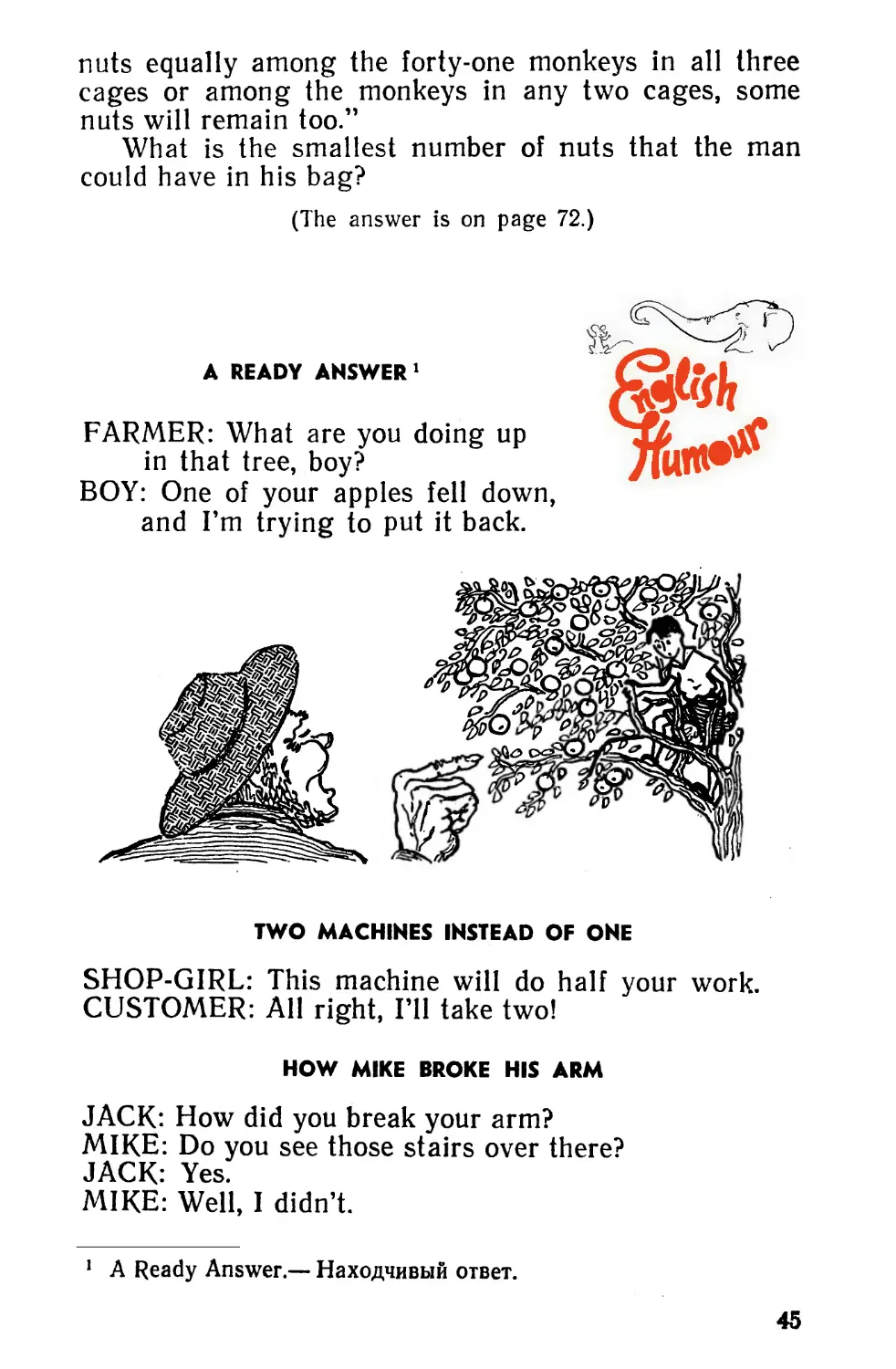
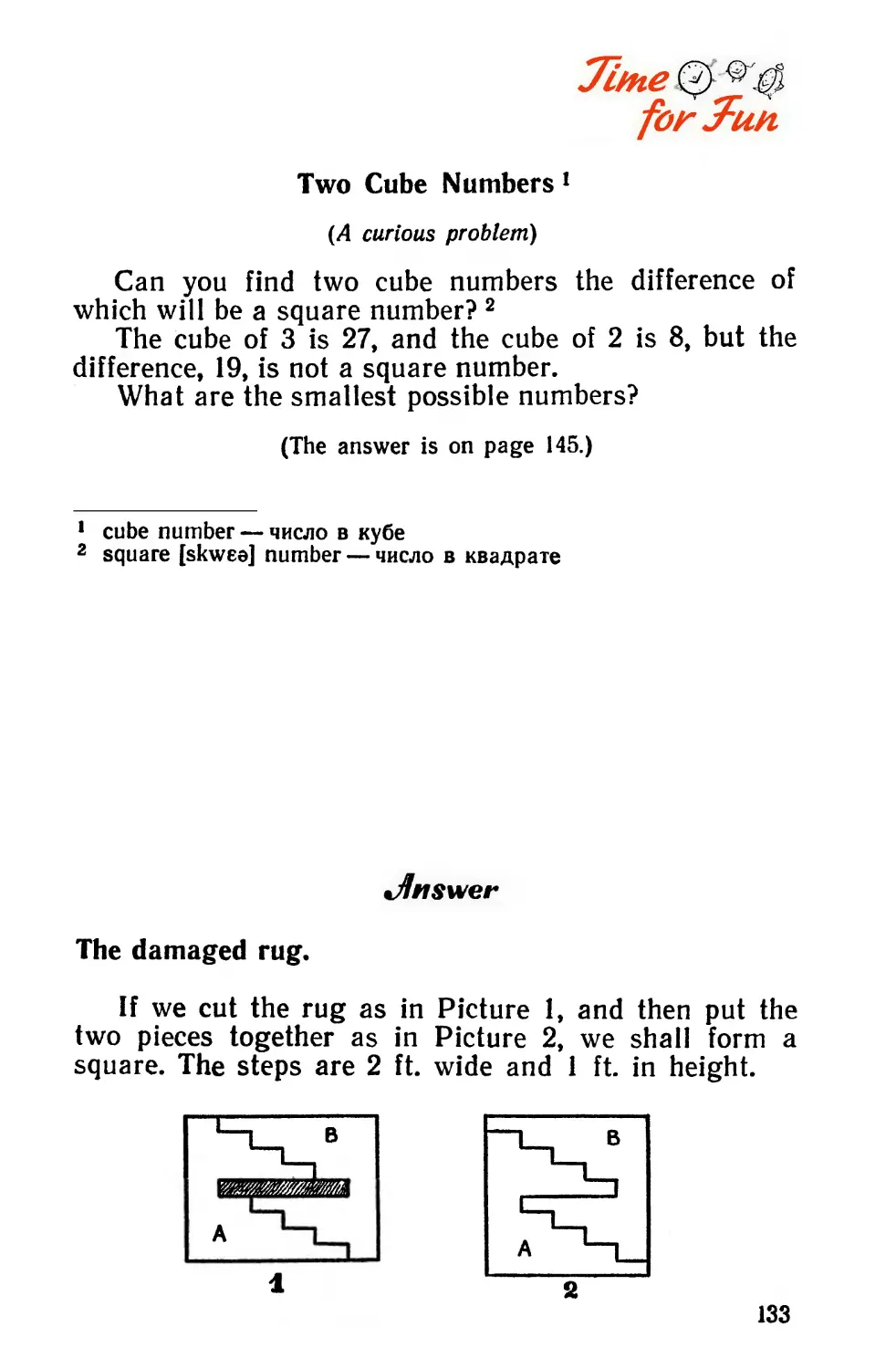
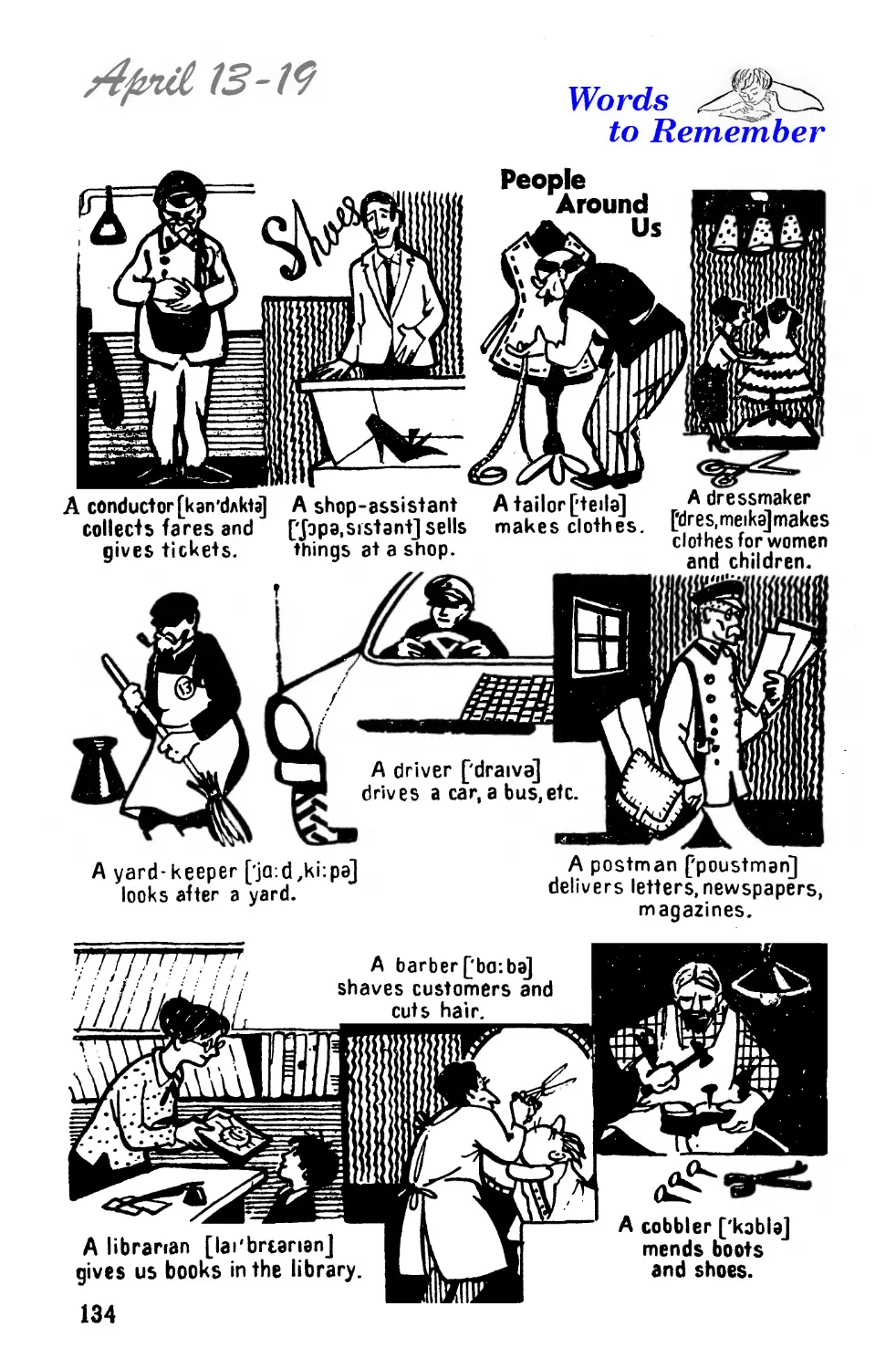
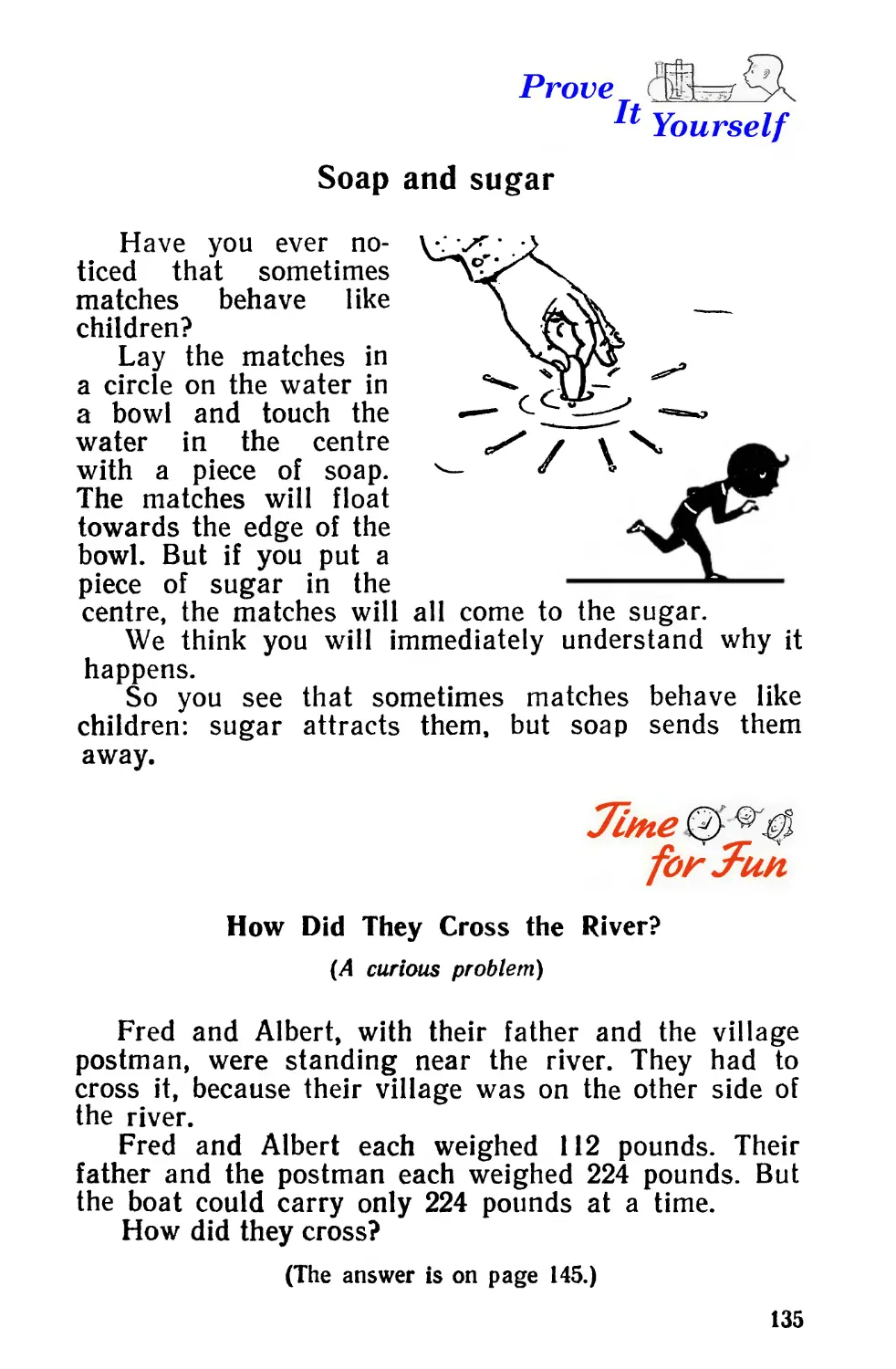
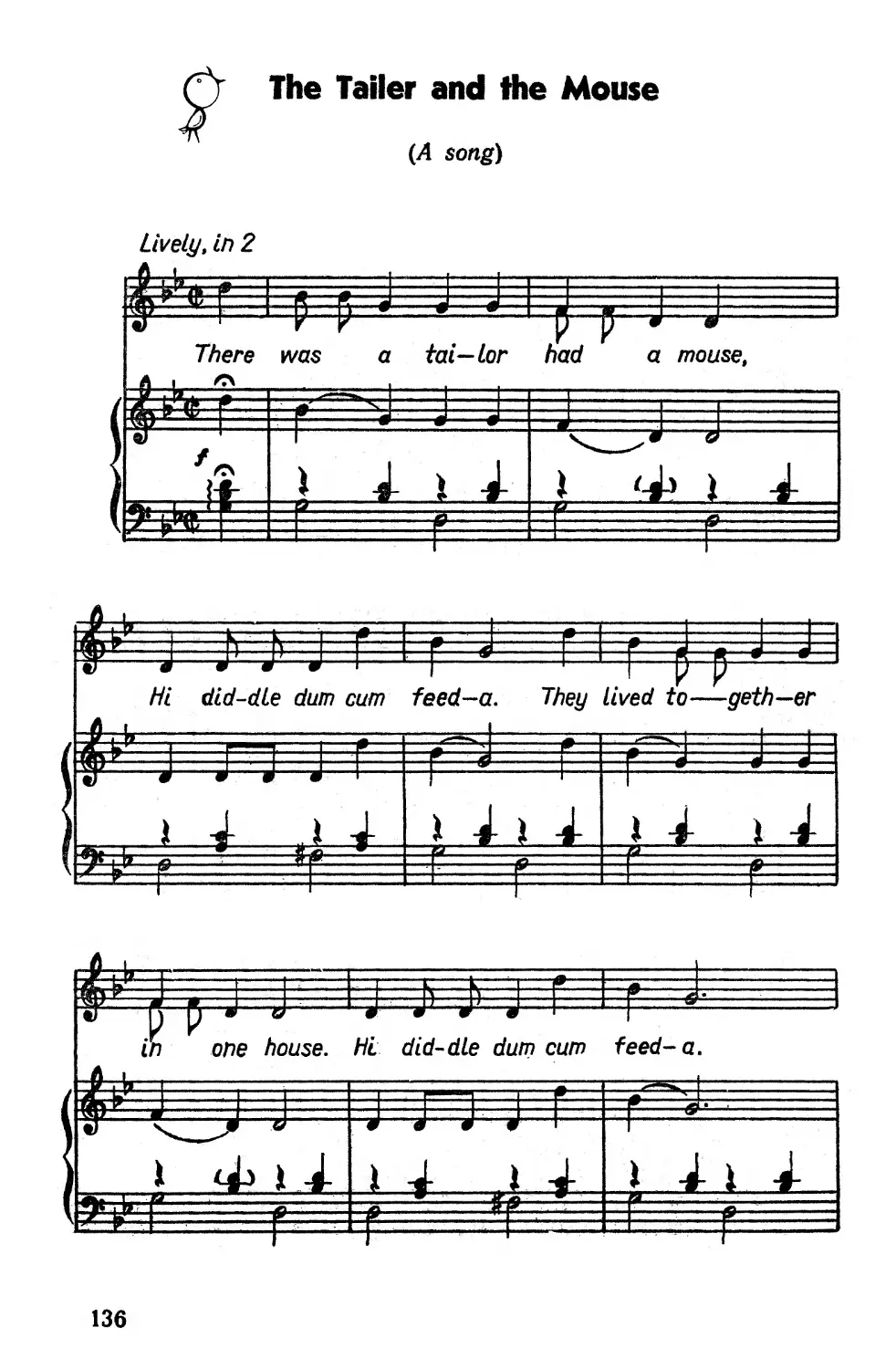
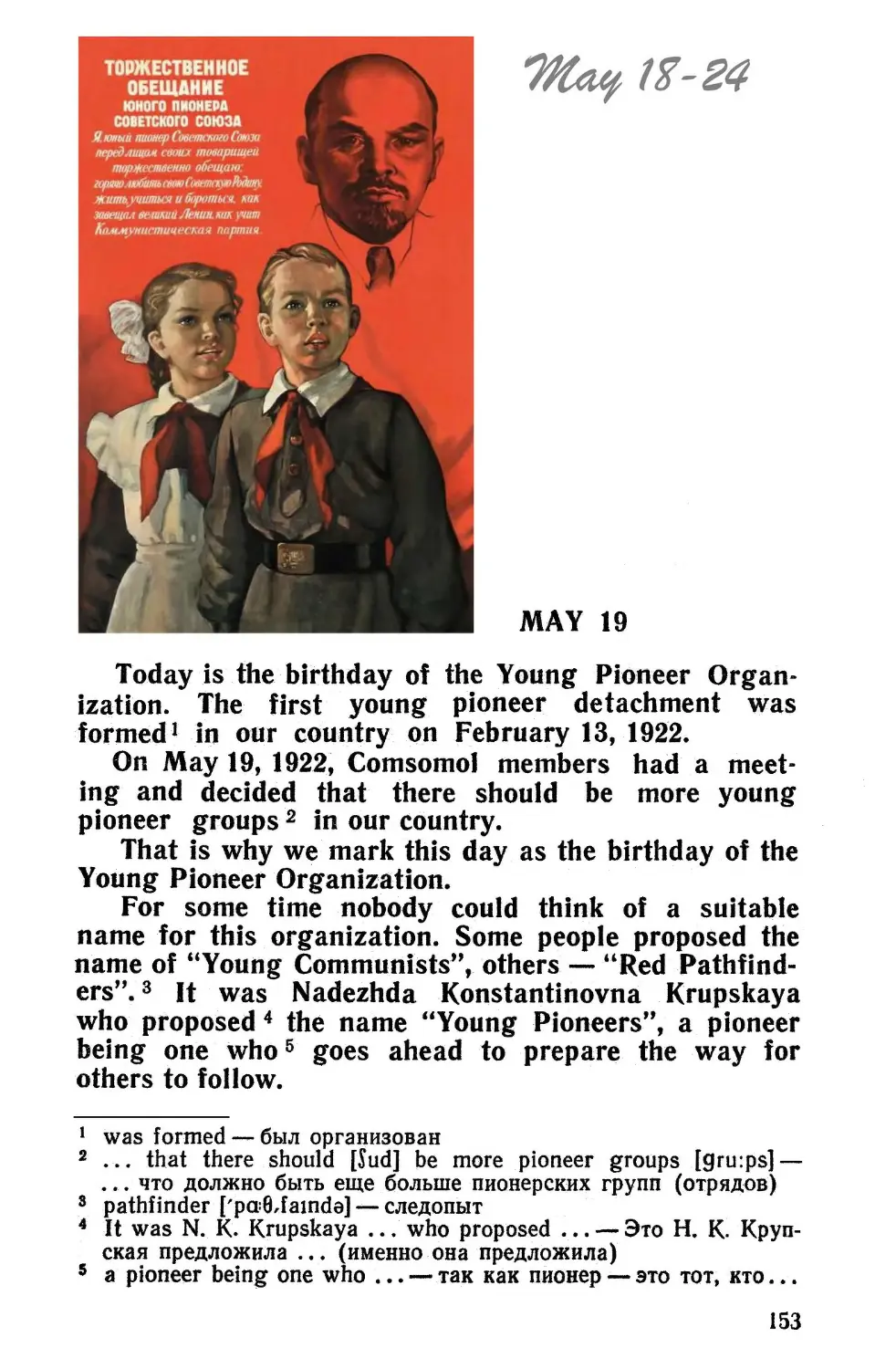
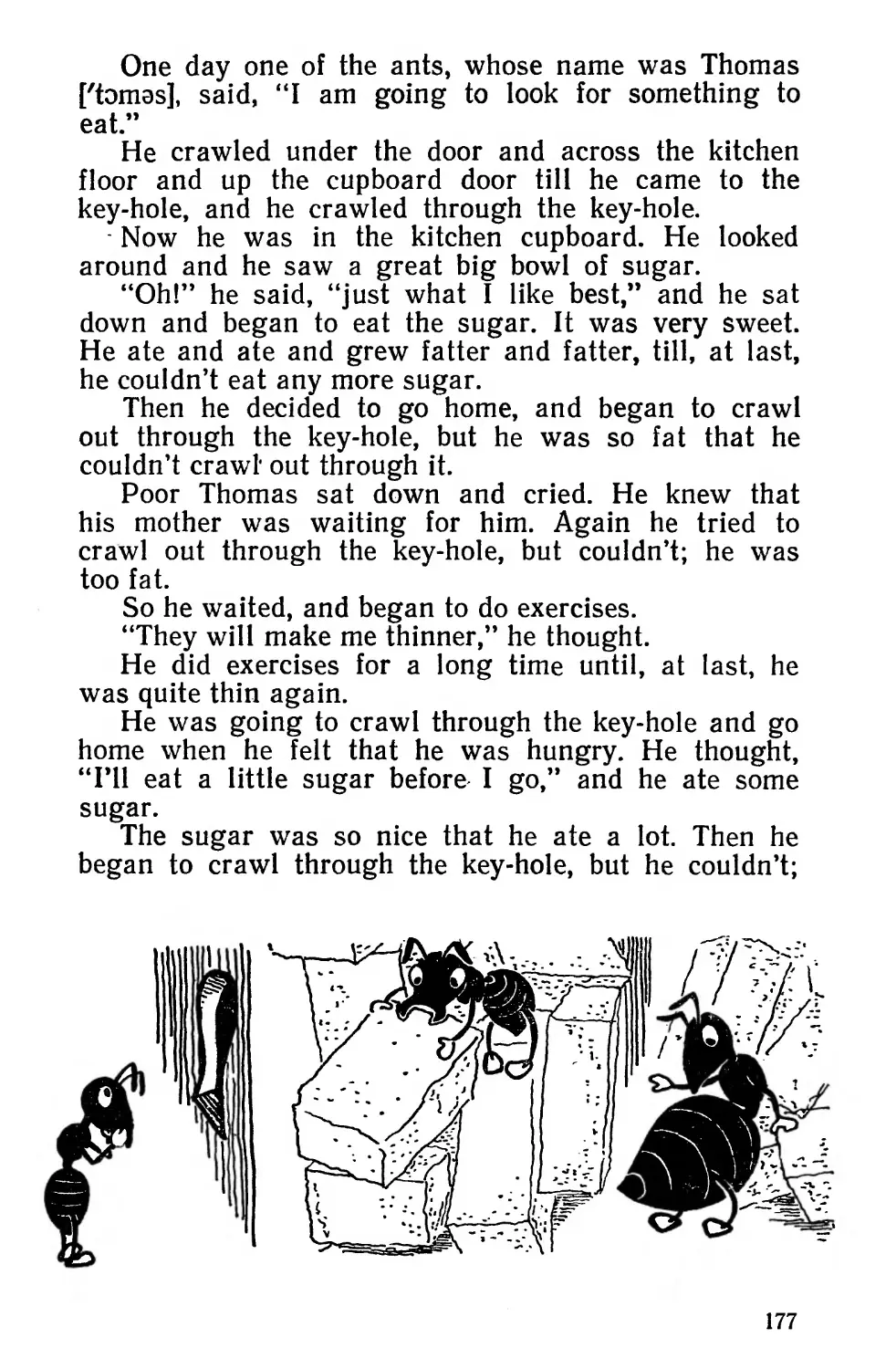


Text
                    HE EVERYDAY
ENGUSH
ALMANAC
FOR BOYS
AND GIRIS

Кн Ml гл
ЛЛЯ ЕЖЕДНЕВНОГО
ЧТЕНИЯ
НА АНГЛИЙСКОМ
ЯЗЫКЕ
8 КЛАСС
(о<ми,а4анил.б
Издание 2-е
ИЗДАТЕЛЬСТВО «ПРОСВЕЩЕНИЕ»
Москва 1971
[J HE EVERYDAY
ENGLISH [
ALMANAC {
I FOR, BOYS
I AMD GIRLS I
OF THE EIGHTH FORM
WEEK BY WEEK

Second Edition
"PROSVESHCHENIYE" PUBLISHERS
Moscow 1971
4И (Англ)
Д-79
Dear friends!
Three years ago you began to learn English. 1 think you want
to know it well; and I hope this book will help you.
Put the book on your table and read it every day for 15 or
20 minutes. This will improve your English and will help you to
learn many interesting things.
The composition of the book is very similar to that for the
7th form. The material is just as miscellaneous as in the pre-
vious book and could suit different tastes.
Please let me know what you like and what you do not
like in this book. Write to this address: г. Москва ГСП-110,
3-й проезд Марьиной рощи, 41, издательство «Просвещение»,
Редакция английского языка.
М. Dubrovin
Дубровин М. И.
Д 79 Книга для ежедневного чтения на английском
языке. 8 класс. Сост. М. И. Дубровин. Изд. 2-е.
М., «Просвещение», 1971.
224 с. с илл.
Парал. тит. л. на англ. яз.
6-6
4 И (Англ)
171-71
SEPTEMBER is the month when birds migrate,
when the leaves begin to turn yellow and red,
when apples ripen and nights are cool.
On September 23, day and night are of equal length.
You can still see some summer flowers around.
Towards the middle of September the leaves begin
to change their colour.
There are many mushrooms in September.
Many animals are now preparing for the coming
winter.
In September you can see more birds than in Au-
gust. They gather in flocks and get ready for their
flight to the South. Most land birds fly at night. They
eat and rest during the day. Swifts, geese, and some
ducks fly in the day-time.
Read It Yourself
and then tell it in your own words
to your younger sister or brother.
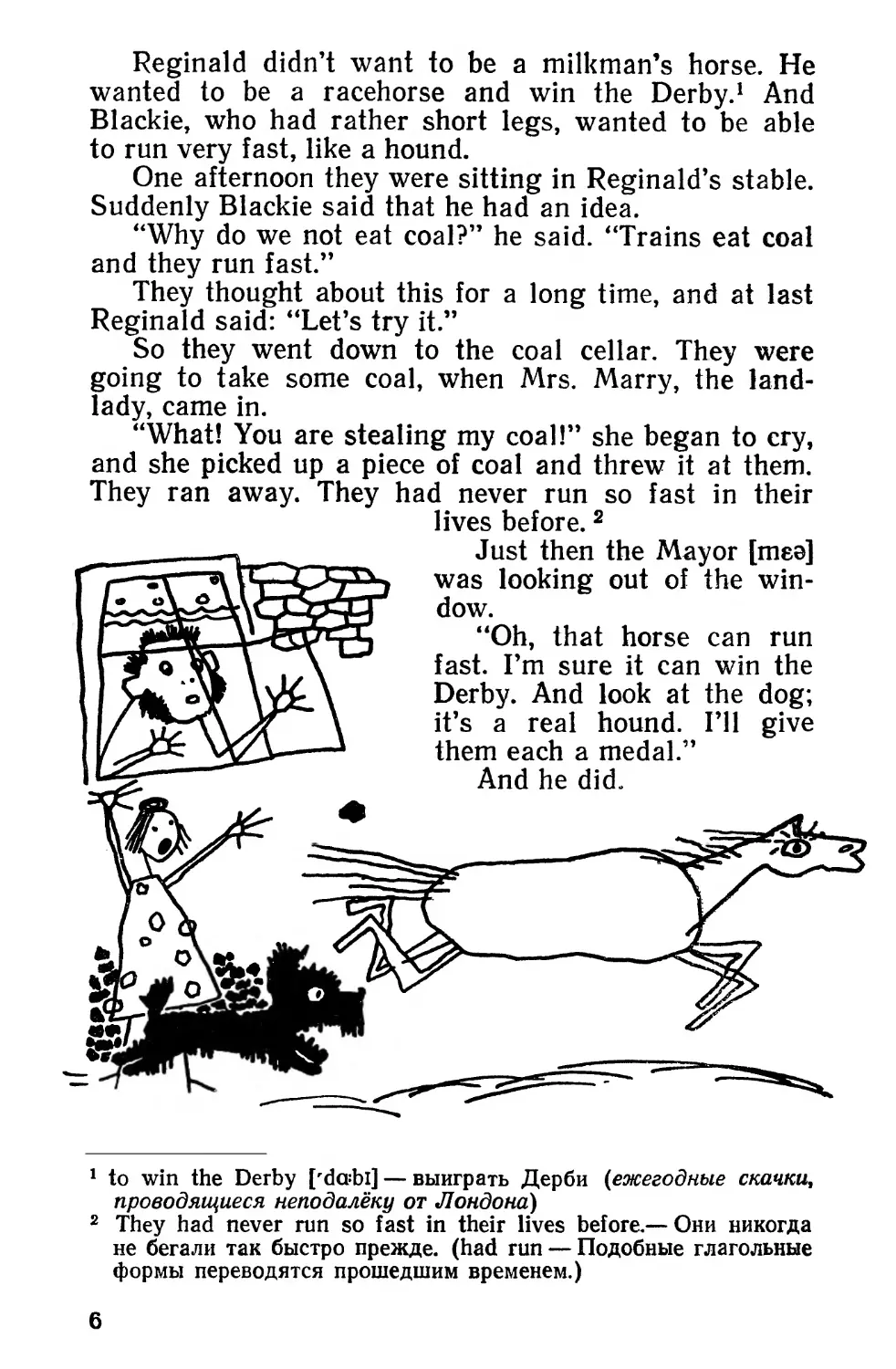
Blackie and the Milkman’s Horse
Once upon a time there was 1 a horse whose name
was Reginald ['redgmald].
Every morning when he was delivering the milk,
he usually met his friend Blackie, who was a little
black dog.
1 Once upon [e'pon] a time there was... — Давным-давно жила-
была. ,.
5
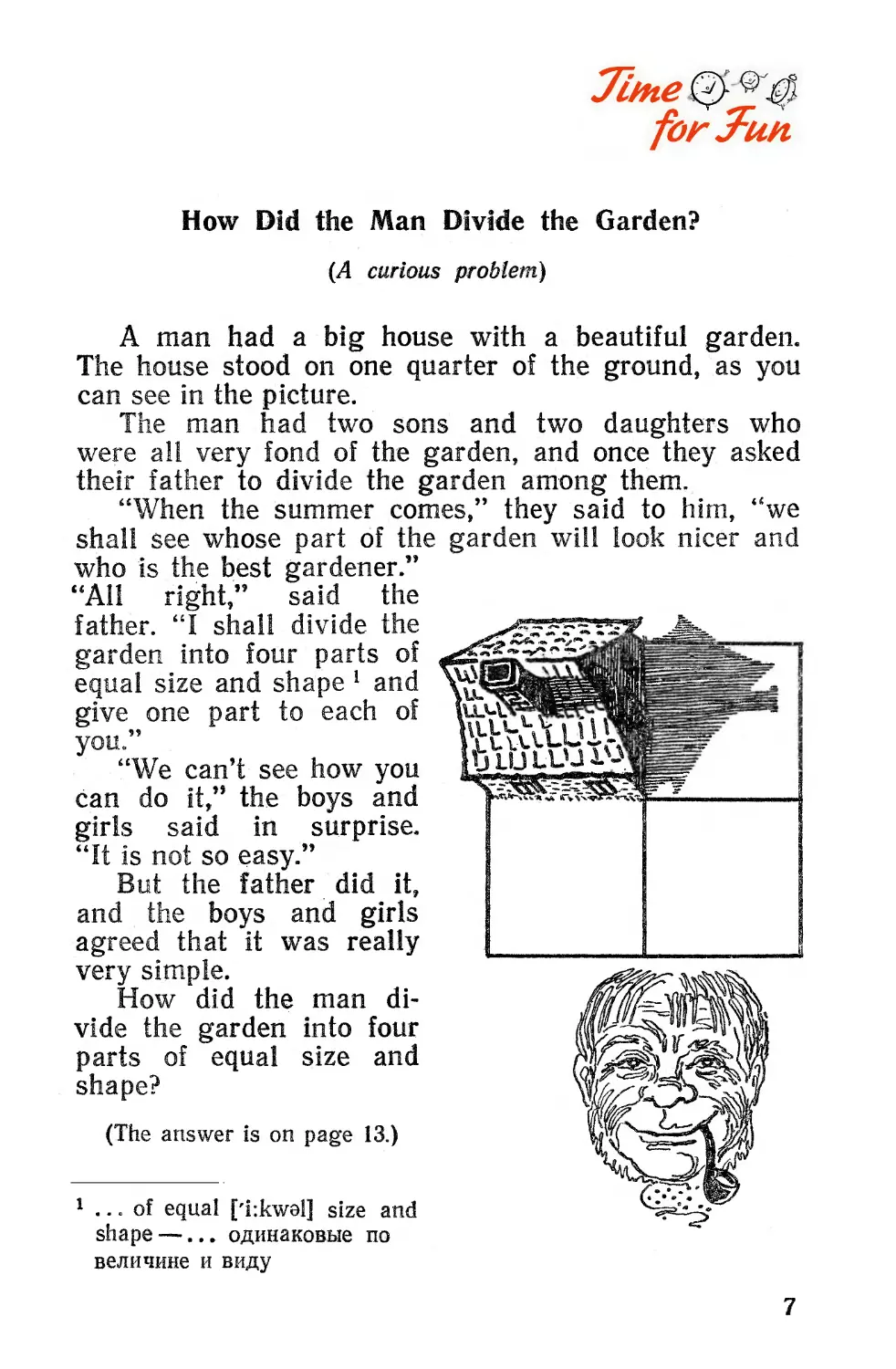
Reginald didn’t want to be a milkman’s horse. He
wanted to be a racehorse and win the Derby.1 And
Blackie, who had rather short legs, wanted to be able
to run very fast, like a hound.
One afternoon they were sitting in Reginald’s stable.
Suddenly Blackie said that he had an idea.
“Why do we not eat coal?” he said. “Trains eat coal
and they run fast.”
They thought about this for a long time, and at last
Reginald said: “Let’s try it.”
So they went down to the coal cellar. They were
going to take some coal, when Mrs. Marry, the land-
lady, came in.
“What! You are stealing my coal!” she began to cry,
and she picked up a piece of coal and threw it at them.
They ran away. They had never run so fast in their
lives before.2
Just then the Mayor [mee]
was looking out of the win-
dow.
“Oh, that horse can run
fast. I’m sure it can win the
Derby. And look at the dog;
it’s a real hound. I’ll give
them each a medal.”
And he did.
1 to win the Derby ['dcubi] — выиграть Дерби (ежегодные скачки,
проводящиеся неподалёку от Лондона)
2 They had never run so fast in their lives before.— Они никогда
не бегали так быстро прежде, (had run — Подобные глагольные
формы переводятся прошедшим временем.)
6
Time 0
for ?un.
How Did the Man Divide the Garden?
(A curious problem)
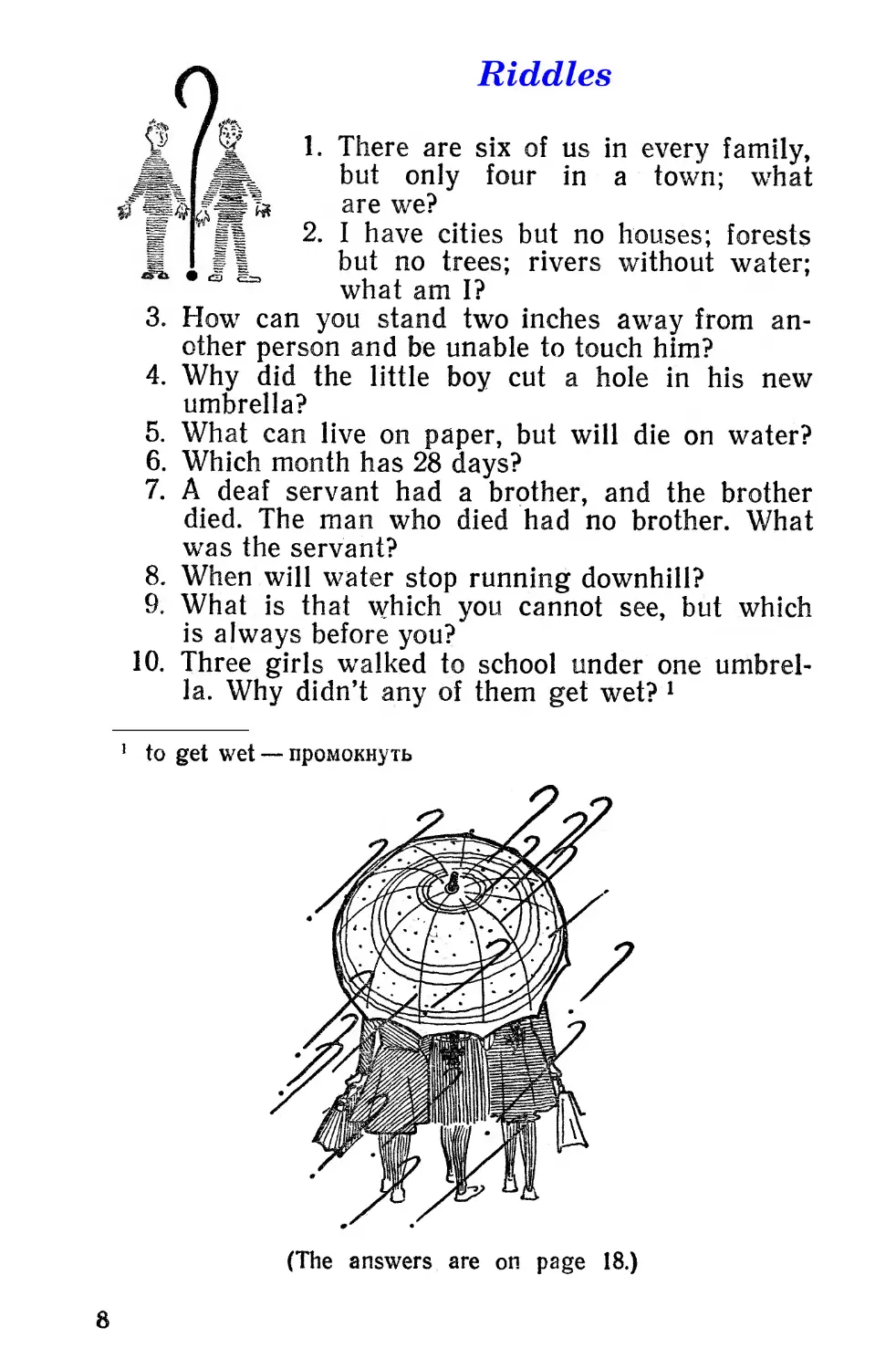
A man had a big house with a beautiful garden.
The house stood on one quarter of the ground, as you
can see in the picture.
The man had two sons and two daughters who
were all very fond of the garden, and once they asked
their father to divide the garden among them.
“When the summer comes,” they said to him, “we
shall see whose part of the garden will look nicer and
who is the best gardener.”
“All right,” said the
father. “I shall divide the
garden into four parts of
equal size and shape 1 and
give one part to each of
you.”
“We can’t see how you
can do it,” the boys and
girls said in surprise.
“It is not so easy.”
But the father did it,
and the boys and girls
agreed that it was really
very simple.
How did the man di-
vide the garden into four
parts of equal size and
shape?
(The answer is on page 13.)
... of equal ['i:kwel] size and
shape —... одинаковые no
величине и виду
7
?	Riddles
1. There are	six	of	us	in	every	family,
|jk	but only	four	in	a	town;	what
||Ь	are we?
|1 2. I have cities but no houses; forests
 | but no trees; rivers without water;
°	what am I?
3.	How can you stand two inches away from an-
other person and be unable to touch him?
4.	Why did the little boy cut a hole in his new
umbrella?
5.	What can live on paper, but will die on water?
6.	Which month has 28 days?
7.	A deaf servant had a brother, and the brother
died. The man who died had no brother. What
was the servant?
8.	When will water stop running downhill?
9.	What is that which you cannot see, but which
is always before you?
10.	Three girls walked to school under one umbrel-
la. Why didn’t any of them get wet? 1
1 to get wet — промокнуть
(The answers are on page 18.)
8
Sefetecn&efi 14
it’s interesting Q
to Know Why
A Few Facts about the Earth
and the Air
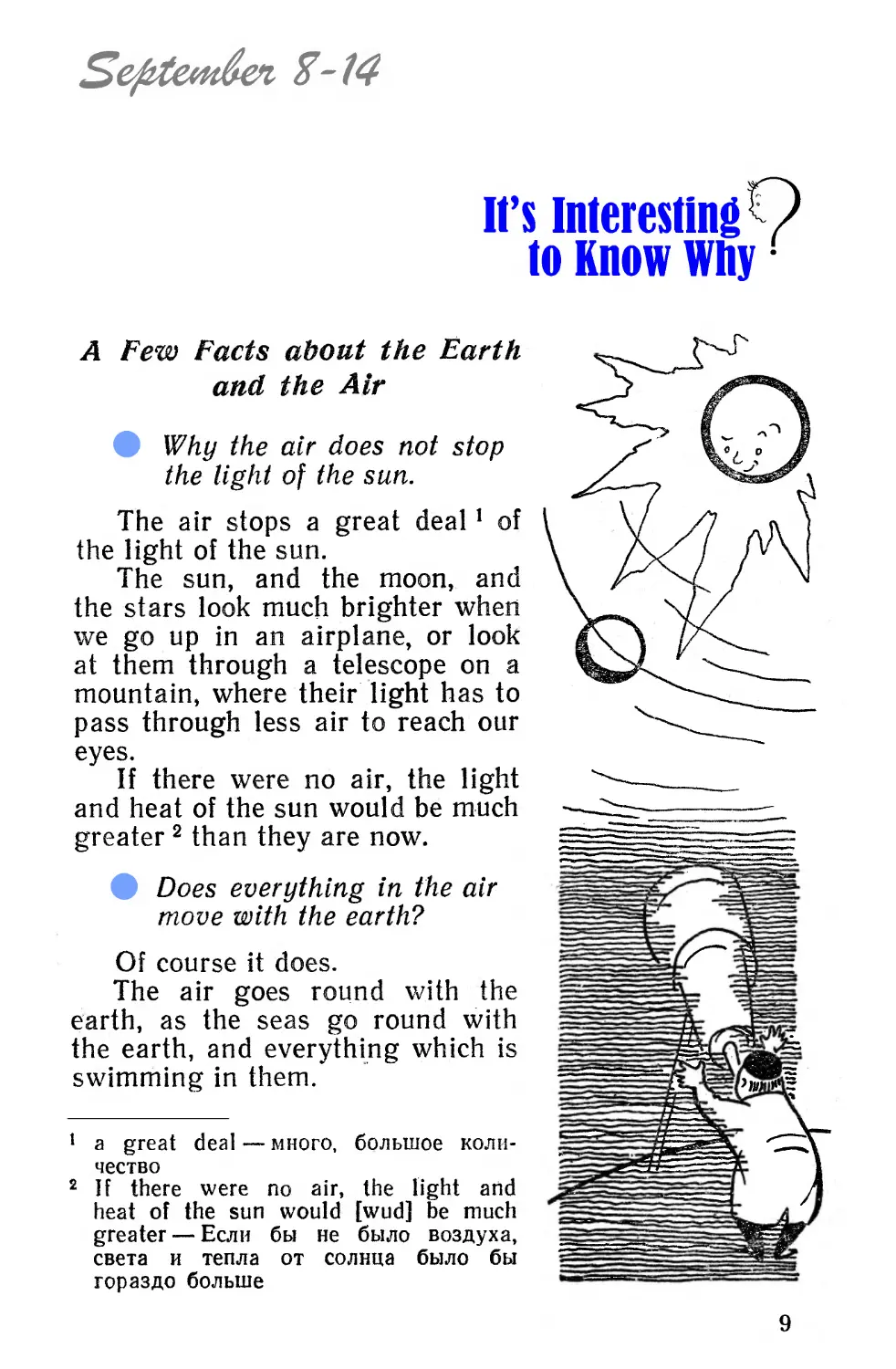
Why the air does not stop
the light of the sun.
The air stops a great deal1 of
the light of the sun.
The sun, and the moon, and
the stars look much brighter when
we go up in an airplane, or look
at them through a telescope on a
mountain, where their light has to
pass through less air to reach our
eyes.
If there were no air, the light
and heat of the sun would be much
greater 1 2 than they are now.
Does everything in the air
move with the earth?
Of course it does.
The air goes round with the
earth, as the seas go round with
the earth, and everything which is
swimming in them.
1 a great deal — много, большое коли-
чество
2 If there were no air, the light and
heat of the sun would [wud] be much
greater — Если бы не было воздуха,
света и тепла от солнца было бы
гораздо больше
9
Everything in the air moves with it, except such
things as an airplane or a bird, which have their own
power of movement.
Does the equator go round faster than the poles?
Any point on the equator must move faster than a
point near the poles, because the earth spins as a ball
with a needle through its centre.
The earth spins round once in twenty-four hours.
A point which is one mile from the poles spins less
than four miles a day. But on the equator, which is
more than 24,000 miles round, a point spins a thousand
miles an hour.
Has the earth its own light like the san?
The earth had its own light long ago. Scientists
think that the other planets also had their own light,
as the sun has.
But now the earth hasn’t its own light, because it
has become cool, while the sun remains hot. So the
earth cannot give out its own light, but can only re-
flect the sun’s light.
for
In this book you will read about many English
games and then you may play them. Here are some
words which you may need when you read or play
this or that game. Try to remember them:
back to back — спиной друг к другу
blindfold ['blaindfould] v — завязывать глаза
call out v — вызывать, выкрикивать
card ft —карта, карточка
centre ['sente] n—центр
circle ['so:kl] n — круг, кружок
divide [dl'vaid] into v — делить на
drop out of the game — выбывать из игры
face (somebody) v — стоять лицом (к кому-либо)
goal [goul] line — finish line — линия финиша
10
“It” — водящий в игре
leader [li:de] « — руководитель (игры), ведущий
line п — линия, ряд
line up v — выстраивать (ся) в ряд
partner п — партнёр (в игре)
player п — участник игры, играющий
point п — очко
race п — состязание в скорости, бег, гонки
relay [ri'lei] п—эстафета
score [ska:] п — счёт очков; v — набирать очки
side by side — рядом, бок о бок
signal ['signal] п — сигнал; at a signal — по сигналу
starting-line — линия старта
tag п—игра в салки, пятнашки; и—-поймать играющего (в сал-
ки) • осалить; to be tagged — быть пойманным, быть осаленным
team [ti:m] п — команда (группа играющих)
win (won [wAn]) v — выигрывать, побеждать
winner п — победитель
Caps and Hats
(Л game)
Each player puts his cap (or her hat) close to the
wall. The caps and hats must touch one another and
form a row. Then draw a line 6 yards away from the
wall.
The first player throws a small ball into any cap or
hat except his own. If he fails,1 he puts a little stone
in his cap. If he succeeds,1 2 the owner of the cap runs
to his cap, picks up the ball and tries to hit another
player. If he hits the player, this player puts a stone
in his cap. If he doesn’t hit the player, he puts a stone
in his own cap.
Then the second player throws the ball into caps
or hats.
The player who has three stones in his cap drops
out of the game. The last player in the game is the
winner.
You can play this game with holes instead of caps
and hats. Besides, you can roll the ball instead of
throwing it
1 If he fails — Если он не попадёт
2 If he succeeds [sek'shdz] — Если он попадёт
11
Forty Ways of Getting There 1
(A game)
Ten or more players can play this game.
Divide the group of players into two or more teams.
The players must line up one behind the other. At a
signal, the first player of each team runs to a wall or
to a line, then returns and tags the second player
in line.
The second player must then get to the wall or line
in a different way. If the first player ran, the second
player cannot run. He may hop or jump. The third
player (after the second player has tagged him) may
go backwards.2 The fourth player may hop and wave
his hands.
So each player must get to the wall and back again
in a different way.
The team which finishes first wins.
Pepper or Salt?
(4 puzzle)
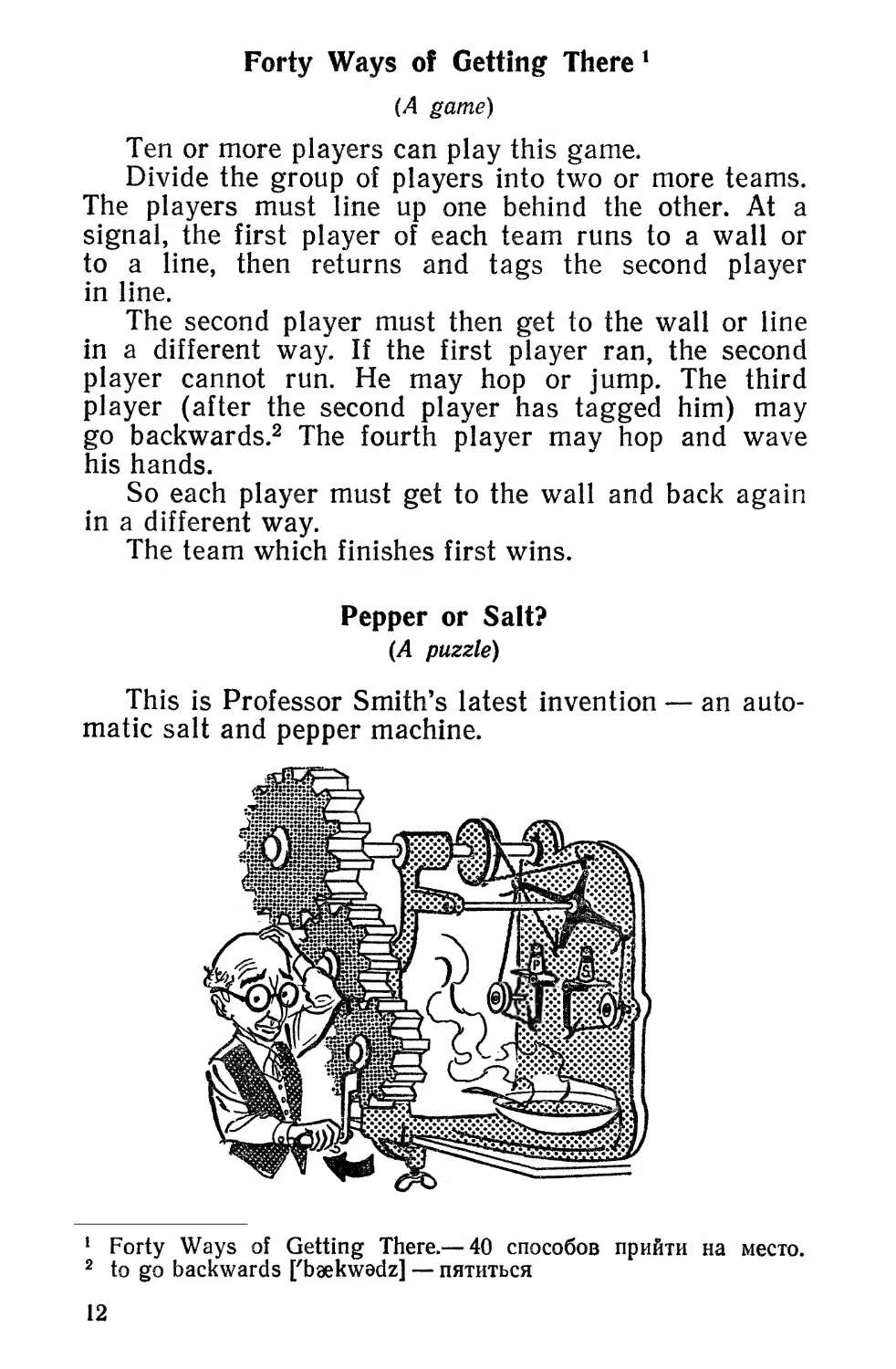
This is Professor Smith’s latest invention — an auto-
matic salt and pepper machine.
1 Forty Ways of Getting There.— 40 способов прийти на место.
2 to go backwards ['baekwedz] — пятиться
12
You may be sure that he is very proud of it and
uses it as often as possible.
Just now he is going to use it on one of his favour-
ite dishes — hot soup.
If he turns the crank in the direction of the arrow,
will this wonderful machine put salt or pepper into
his plate of soup?
(The answer is on page 18.)
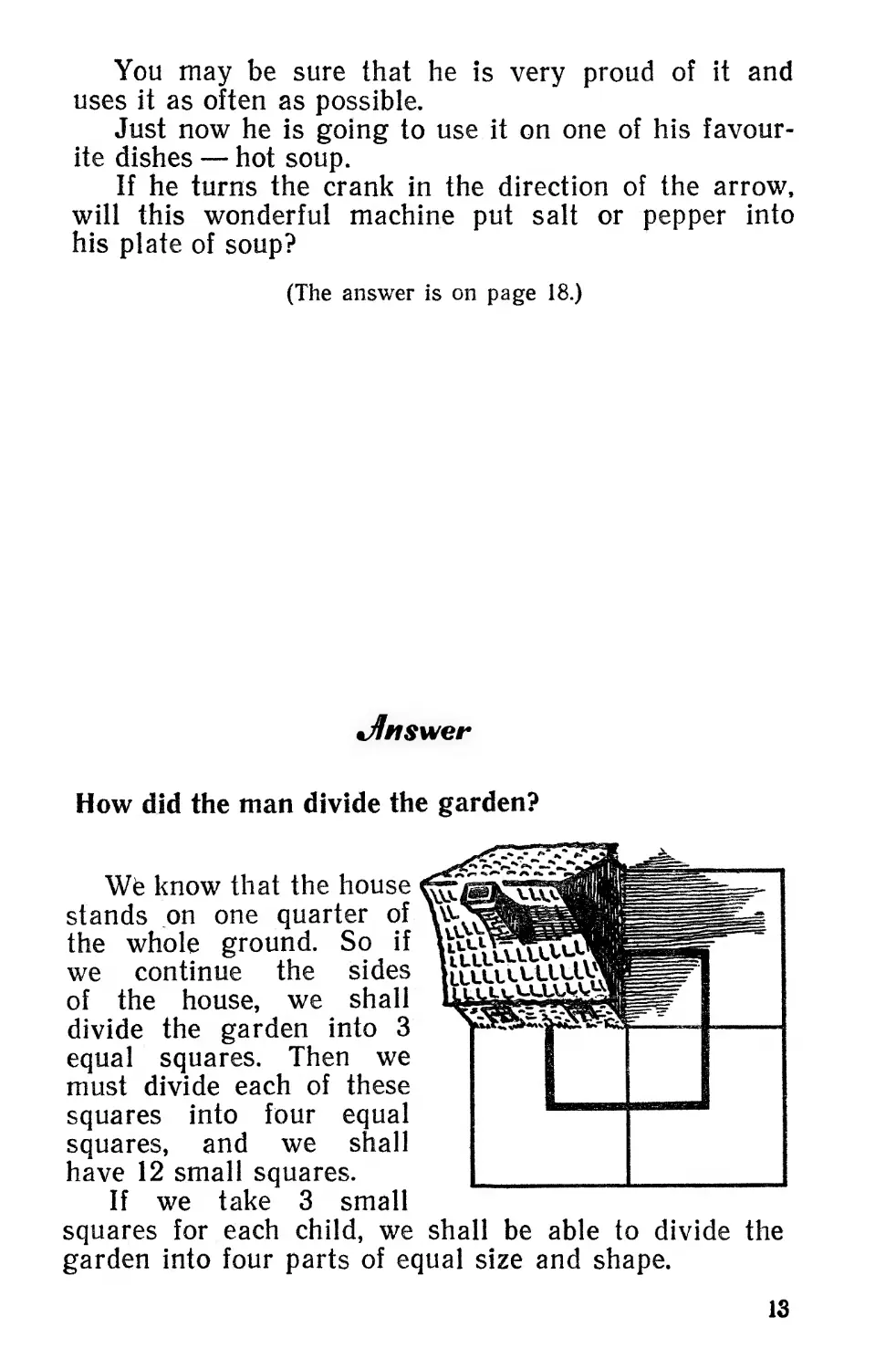
Juswer
How did the man divide the garden?
We know that the house
stands on one quarter of
the whole ground. So if
we continue the sides
of the house, we shall
divide the garden into 3
equal squares. Then we
must divide each of these
squares into four equal
squares, and we shall
have 12 small squares.
If we take 3 small
squares for each child, we shall be able to divide the
garden into four parts of equal size and shape.
13
Sefitemfoi 15-21
Words
to Remember
Subjects We Study at School
Russian — русский язык
Literature ['litretSo] — литература
Mathematics [,mae6l'maetiks] — математика
Algebra ['aeldgibra] — алгебра
Geometry [dgromitn] — геометрия
Natural Science fnaetjral 'saians]— естествознание
Physics ['fiziks] — физика
Chemistry ['kemistri] — химия
Geography [d^i'ografi] — география
History ['hlstori] — история
English — английский язык
Mechanical Drawing [mi'kaenikal 'dro:lp] — черчение
the Study ['stAdi] of Machines — машиноведение
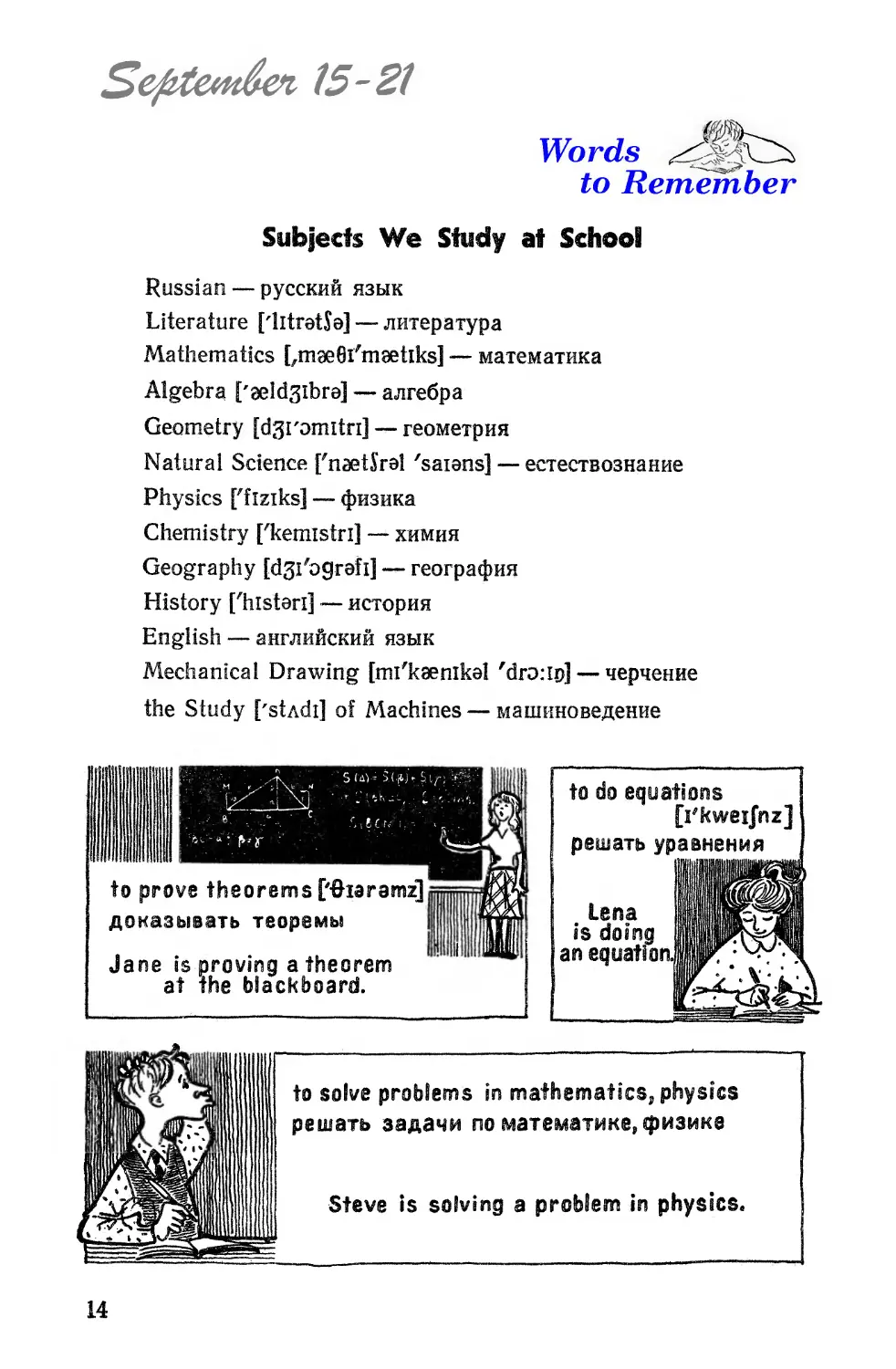
to do equations
[I'kweifnz]
решать уравнения
to solve problems in mathematics^ physics
решать задачи по математике^ физике
Steve is solving a problem in physics.
14
ARITHMETIC,1 APPLES
AND ORANGES
BIG SISTER: I’ll help you with your
arithmetic. Suppose, I have
>	10 oranges and give you 2,
how many will I have then?
BOBBY: I don’t know. In my class
we do arithmetic with apples.
LARRY DOES NOT WANT TO GO TO SCHOOL
LARRY: I’m not going to school any more
MOTHER: Why?
LARRY: On Monday, the teacher said 4 and 4 is 8. On
Tuesday, she said 6 and 2 is 8. Today, she said
7 and 1 is 8. I’m not going back to school again
until the teacher makes up her mind.1 2
TEN HOURS OVER A HISTORY BOOK
JOHN: I spent ten hours over my
history book last night.
ALEC: Ten hours?!
JOHN: Yes, I left it under my bed
when I went to sleep last night.
1 arithmetic [a'riBmatik] — арифметика; to do arithmetic — решать
арифметические задачи
2 ... until the teacher makes up her mind [maind] —... пока
учительница сама не разберётся
15
WHAT IS IGNORANCE! *
TEACHER: Willie, how do you define1 2 ignorance?
WILLIE: It’s when you don’t know something and
somebody finds it out.
THE RESULT
TEACHER: If your brother has five apples and you take
two from him, what will be the result?
BOBBY: He will beat me.
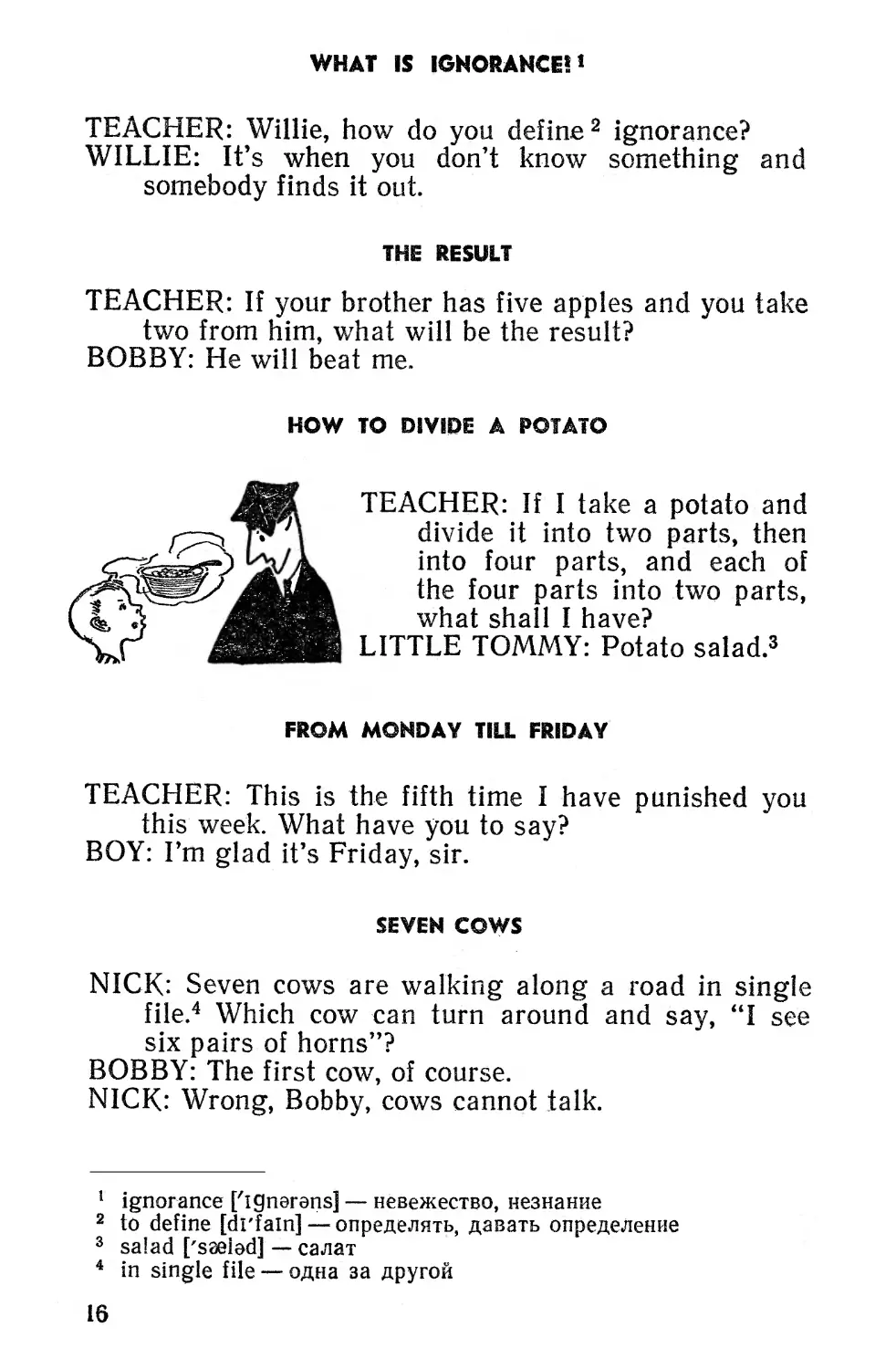
HOW TO DIVIDE A POTATO
TEACHER: If I take a potato and
divide it into two parts, then
into four parts, and each of
the four parts into two parts,
what shall I have?
LITTLE TOMMY: Potato salad.3
FROM MONDAY TILL FRIDAY
TEACHER: This is the fifth time I have punished you
this week. What have you to say?
BOY: I’m glad it’s Friday, sir.
SEVEN COWS
NICK: Seven cows are walking along a road in single
file.4 Which cow can turn around and say, “I see
six pairs of horns”?
BOBBY: The first cow, of course.
NICK: Wrong, Bobby, cows cannot talk.
1 ignorance [Tgnerens] — невежество, незнание
2 to define [di'fain] — определять, давать определение
3 salad ['saeiod] — салат
4 in single file — одна за другой
16
A NEW DISCOVERY <
The teacher was giving a lesson to her class. She
was trying to tell her pupils about all new discoveries.
“What is there today,” she suddenly asked, “that
wasn’t here forty years ago?”
A clever little eight-year-old girl jumped up and
shouted, “Me!”
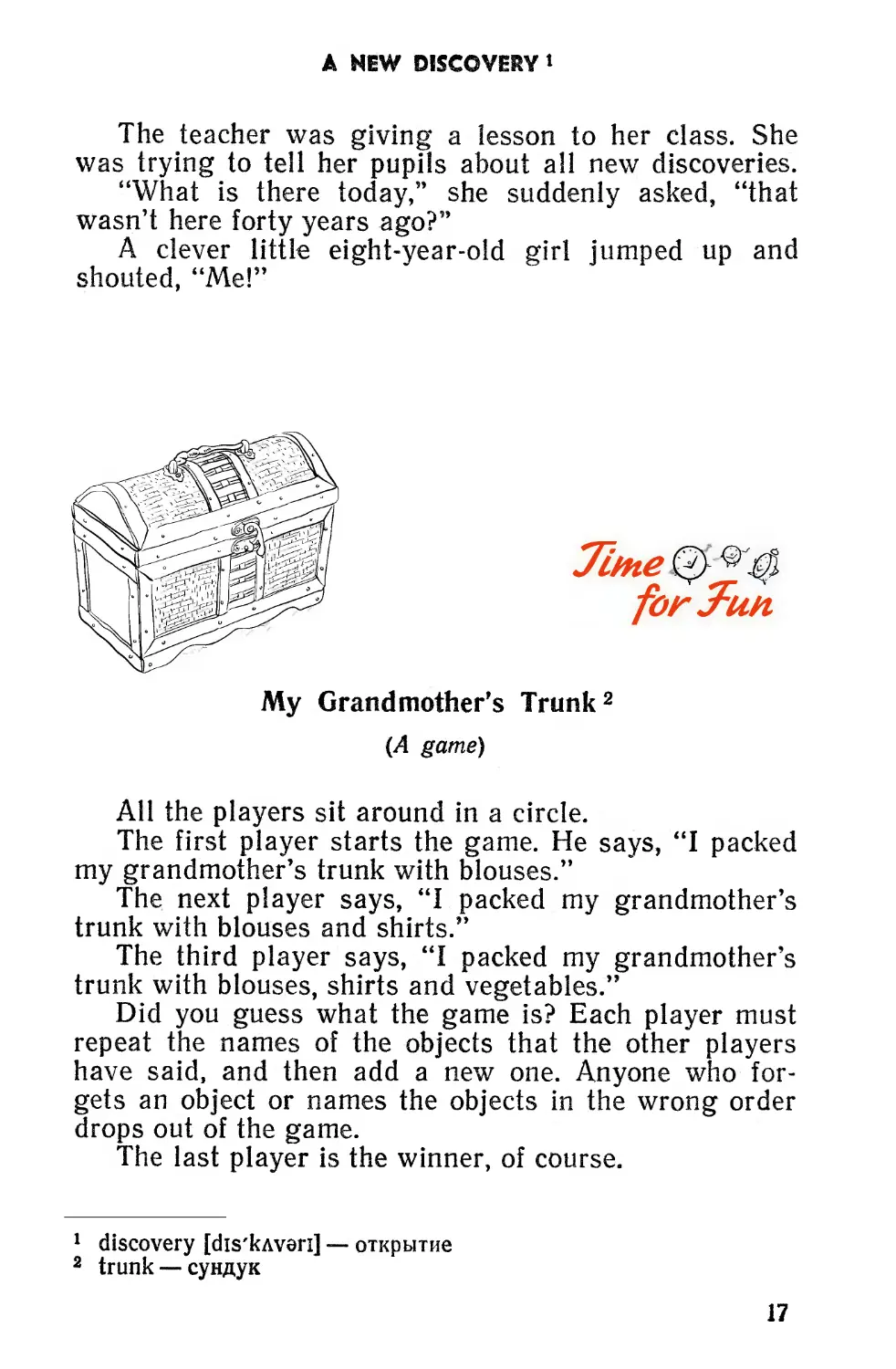
My Grandmother’s Trunk1 2
(Л game)
All the players sit around in a circle.
The first player starts the game. He says, “I packed
my grandmother’s trunk with blouses.”
The next player says, “I packed my grandmother’s
trunk with blouses and shirts.”
The third player says, “I packed my grandmother’s
trunk with blouses, shirts and vegetables.”
Did you guess what the game is? Each player must
repeat the names of the objects that the other players
have said, and then add a new one. Anyone who for-
gets an object or names the objects in the wrong order
drops out of the game.
The last player is the winner, of course.
1 discovery [dis'kAven] — открытие
2 trunk —сундук
17
Riddle
HOW MANY BLACKBIRDS?
Twice four and twenty blackbirds
Were sitting in the rain;
I shot and killed a seventh part,
How many did remain?
(The answer is on page 29.)
Answers
Riddles.
1.	Letters.
2.	A map.
3.	Close the door between you and the person.
4.	Because he wanted to see when the rain
would stop (когда перестанет дождь).
5.	Fire.
6.	They all have 28 days.
7.	The servant was a woman.
8.	When it reaches the bottom of the hill.
9.	Your future.
10.	Because it didn’t rain.
Pepper or salt?
It will put salt into the soup.
18
This week you will have the pleasure
of reading
Four Merry Nursery Rhymes 1
Two legs
sat upon three legs,
with one leg
in his lap.1 2
In comes four legs,
runs away with one leg.
Up jumps two legs,
catches up three legs,
throws it after four legs,
and makes him bring back one leg.
«£»
*8?
Miss Jane had a bag,
and a mouse was in it.
She opened the bag,
he was out in a minute.
The cat saw him jump 3
and ran under the table,
And the dog said,
“Catch him, puss,4
soon as you are able.”
1 merry nursery rhymes ['ne:sn 'raimz]— весёлые детские стишки
2 in his lap — на коленях
3 The cat saw him jump — Кошка видела, как она выпрыгнула
4 puss [pus] — киска
19
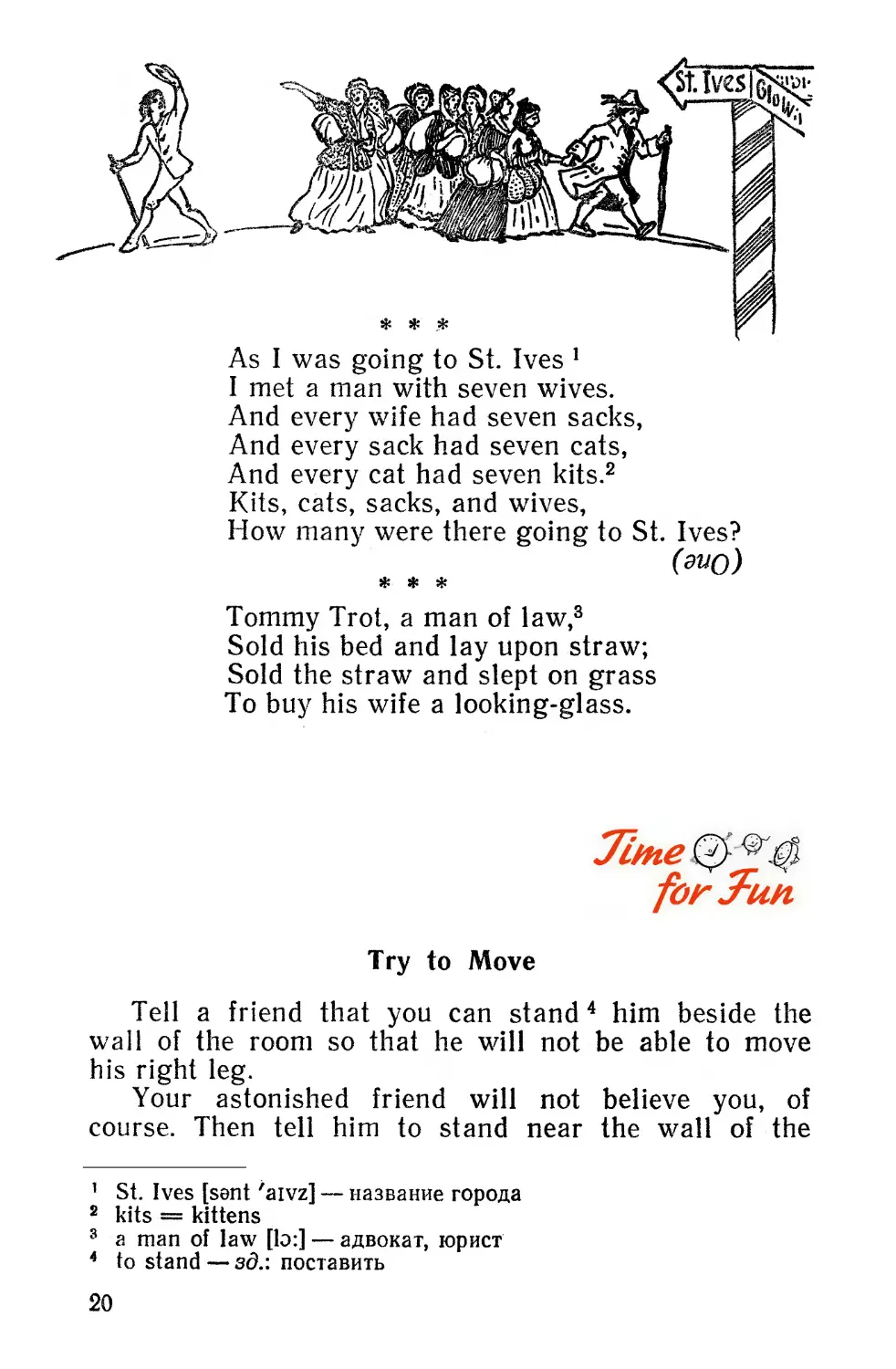
As I was going to St. Ives 1
I met a man with seven wives.
And every wife had seven sacks,
And every sack had seven cats,
And every cat had seven kits.1 2
Kits, cats, sacks, and wives,
How many were there going to St. Ives?
(^o)
% * *
Tommy Trot, a man of law,3
Sold his bed and lay upon straw;
Sold the straw and slept on grass
To buy his wife a looking-glass.
Лиге &0
for Лип
Try to Move
Tell a friend that you can stand 4 him beside the
wall of the room so that he will not be able to move
his right leg.
Your astonished friend will not believe you, of
course. Then tell him to stand near the wall of the
1 St. Ives [sent 'aivz] — название города
2 kits = kittens
3 a man of law [k>:] — адвокат, юрист
4 to stand — зд.: поставить
20
room so that his left foot touches the wall, his left hip
touches the wall, and his left shoulder touches the wall.
Now tell him to try to move his right leg. You may be
sure that while his left foot, hip and shoulder touch the
wall, he won’t be able to do it.
Who Is Missing? 1
(A game)
All the players sit on chairs in a circle. One player
is “It”, and he goes out of the room. While he is out,
another player leaves the room by a different door or
hides in the room. At the same time all the other
players change their places.
Now the players call “It” back into the room. He
must look at the players and find out “Who is miss-
ing?” as quickly as possible. It is a lot harder than it
seems.
After he finds it out, the missing player becomes
“It”, and a new player must hide. Each time all the
players change places.
The player who needs the least time for finding out
who is missing wins.
Three-Legged Race1 2
(A game)
Divide your group into two or three teams and each
team into pairs of players. Then, tie the legs of each
pair of players with a soft rope — the left leg of the
one to the right leg of the other. The two legs will
have to act as one leg in the race, and the two players
will have three legs instead of four.
Mark a goal line about 50 feet away. The first pairs
of each team line up at a starting-line. At a signal
they run to the goal line, touch it and return, tagging
the second pairs. The second pairs run to the goal line,
touch it and return, tagging the next pairs, and so on.
The team which finishes first wins.
1 Who Is Missing? — Кого нет?
2 Three-Legged Race.— Бег на трёх ногах.
21
GRAMMAR THROUGH PICTURES
Boys do not wear
dresses.
Girls wear dresses. They
sometimes wear trousers.
Does he like
to wash?
He washes
his neck
once a week.
22
2^-5
OCTOBER 4
On that day in 1957, the first artificial satellite
was launched1 in our country. The first Soviet
sputnik was spherical in form.1 2 It had a diameter
of 58 centimetres and it weighed 83.6 kilograms.
In order to make a satellite the Soviet scientists had
to solve a large number 3 of problems.
1 he launching of the first artificial satellite in the
U.S.S.R. was the first step towards the conquest of
outer space.4
The second sputnik which was launched on Novem-
ber 5, 1957, weighed 508.3 kilograms. It carried a dog
passenger, Laika, on board. The third sputnik which was
launched on May 15, 1958, weighed 1,327 kilograms
(100 times heavier than the American artificial satellite,
launched about that time).
Since then many sputniks have been launched in
the U.S.S.R.
1 the artificial satellite [/iti'filM 'saetolait] was launched [lo:ntjt] —
был запущен искусственный спутник
2 spherical ['sferikal] in form — сферической формы
3 a large number — very many
4 the conquest ['koukwest] of outer space — покорение космического
пространства
23
to Remember
English Measures and Weights 1
1 inch (сокр. in.) == 2.5 centimetres
1 foot (сокр. ft.) = 30.5 centimetres
1 yard = 91.4 centimetres
1 mile — 1,609 metres
1 ounce [auns] (сокр. oz.) = 28.3 grammes
1 pound (сокр. lb.) = 453.6 grammes
Prove
H Yourself
How heavy air is!
Has air got weight? Yes; a cubic foot of air weighs
about 31 2/з oz. The weight of all the air on the earth
is 11,000,000,000,000,000,000 pounds!
Our body has a surface area of more than a square
yard (1,296 square inches). So the air presses on the
body with a force of more than 18,800 pounds.
Did you know that a weight of 400 pounds presses
on your hand? The air presses on each square inch of
us with a force of 14.5 pounds. And a square inch is a
little bigger than a stamp. But the air presses from all
sides, so we do not notice the air pressure.
You can show the weight of air in this way.
Put a thin board about 4 inches by 20 inches on a
table and cover it with a newspaper. There must not
be even a small hole in the newspaper. Then hit the
projecting end2 of the board with your fist. To your
1 English Measures ['megez] and Weights [welts].— Английские
меры длины и веса.
2 the projecting [pro'dgektio] end — выступающий конец
24
surprise nothing will happen. The newspaper does not
go up into the air. Hit as hard as you like, the paper
stays quite still. You may even break the board — but
the paper will stay where it is.
If you measure the newspaper, you will find that
its area is about 850 square inches. This means that
the air presses on it with a force of more than
12,000 pounds.
Jltne
forJ-un
Two Moves at a Time 1
(A puzzle)
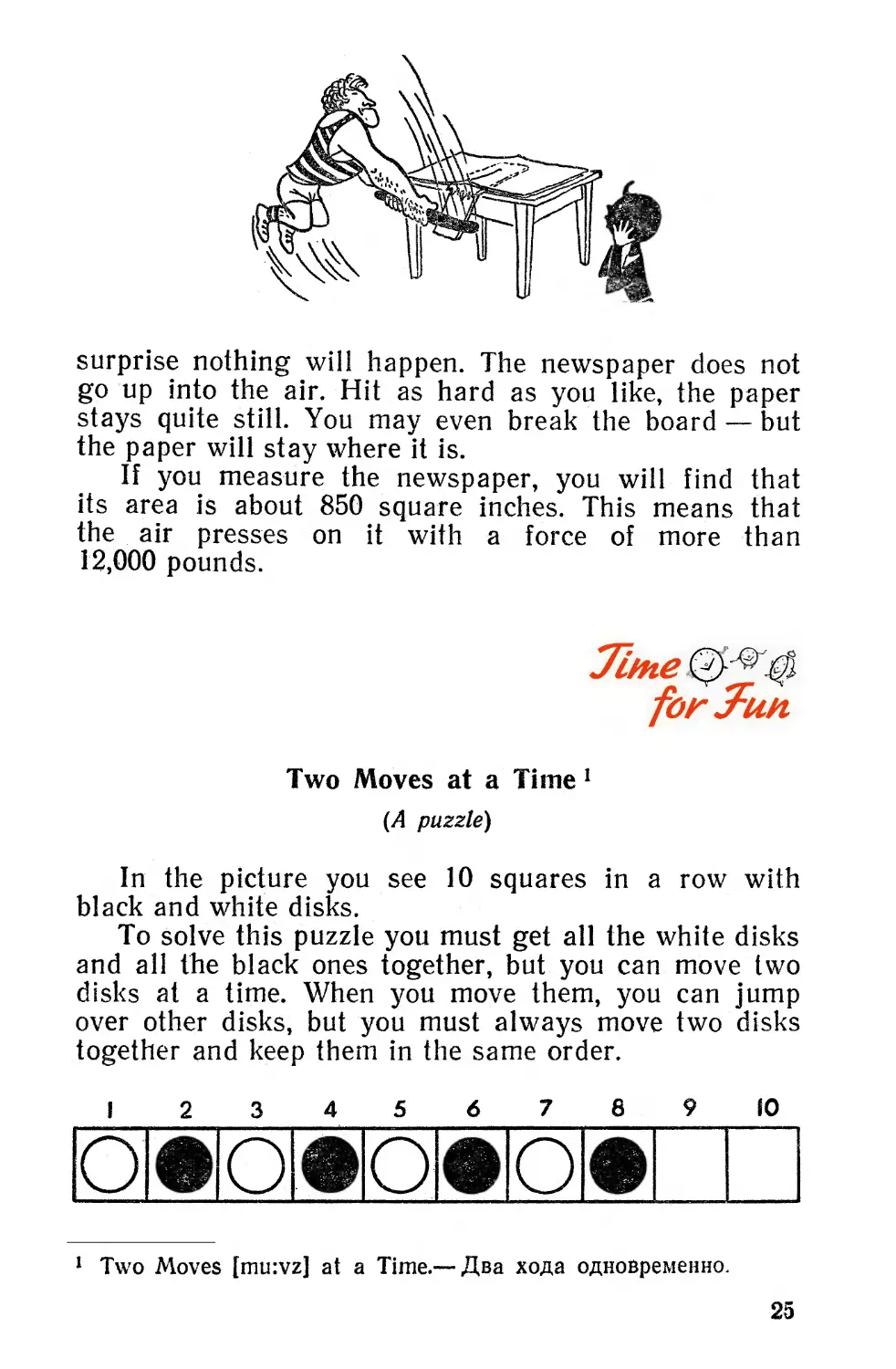
In the picture you see 10 squares in a row with
black and white disks.
To solve this puzzle you must get all the white disks
and all the black ones together, but you can move two
disks at a time. When you move them, you can jump
over other disks, but you must always move two disks
together and keep them in the same order.
I 23456789 IO
ВИПЕИПВВПЙЯП
1 Two Moves [mu:vz] at a Time.— Два хода одновременно.
25
You must solve the problem in four moves. The
white disks must be on squares 7 to 10 and the black
ones on squares 3 to 6.
(The answer is on page 29.)
A BRAVE HUNTER
GUIDE: I saw a lot of tiger tracks
about a mile north of here.
HUNTER: Which way is south?
A LUCKY EXPLORER
AFRICAN EXPLORER: One fine day, not very long ago,
I went out unarmed 1 for a walk when suddenly
I found myself face to face with 2 a big tiger.
FRIEND: How awful! What did you do?
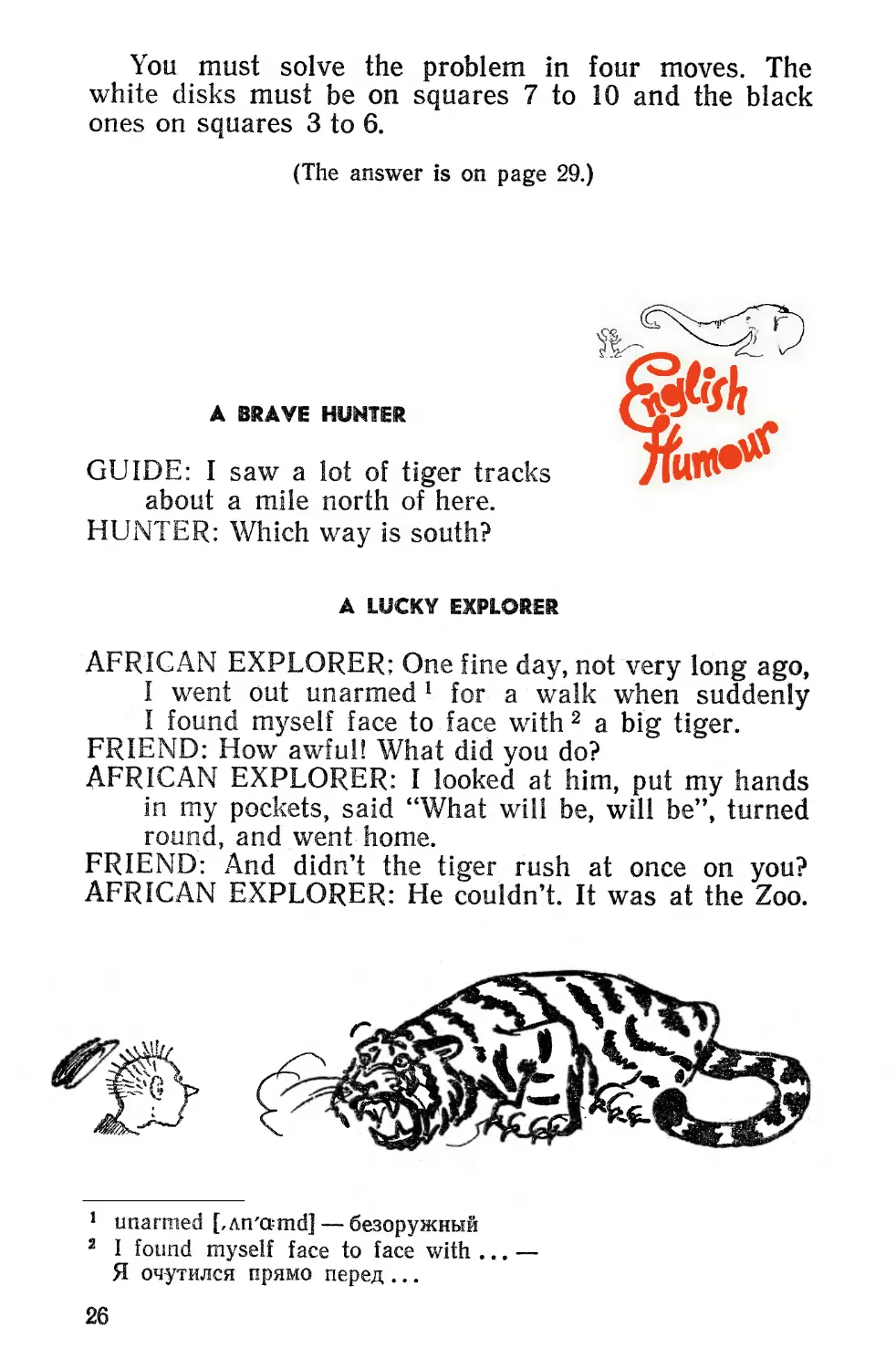
AFRICAN EXPLORER: I looked at him, put my hands
in my pockets, said “What will be, will be”, turned
round, and went-home.
FRIEND: And didn’t the tiger rush at once on you?
AFRICAN EXPLORER: He couldn’t. It was at the Zoo.
1 unarmed [zAn'ccmd] — безоружный
2 I found myself face to face with ... —
Я очутился прямо перед ...
26
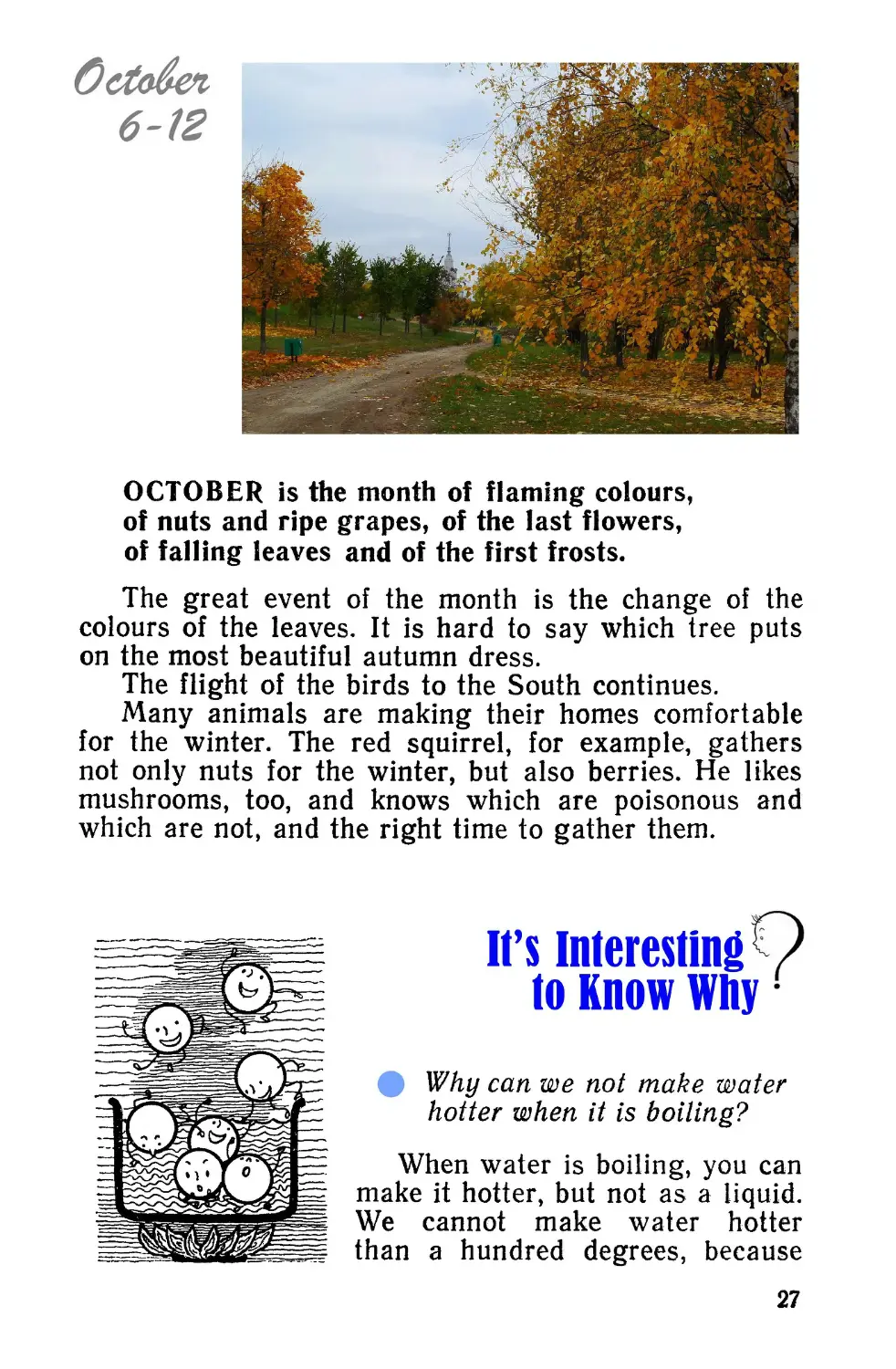
OCTOBER is the month of flaming colours,
of nuts and ripe grapes, of the last flowers,
of falling leaves and of the first frosts.
The great event of the month is the change of the
colours of the leaves. It is hard to say which tree puts
on the most beautiful autumn dress.
The flight of the birds to the South continues.
Many animals are making their homes comfortable
for the winter. The red squirrel, for example, gathers
not only nuts for the winter, but also berries. He likes
mushrooms, too, and knows which are poisonous and
which are not, and the right time to gather them.
It’s Interesting <.
to Know Why
Why can we not make water
hotter when it is boiling?
When water is boiling, you can
make it hotter, but not as a liquid.
We cannot make water hotter
than a hundred degrees, because
27
it will turn into water-vapour. But it
is quite possible to make water-va-
pour hotter than the temperature of
boiling water.
If we go on boiling water, we
are putting heat into it. We must not
think that if the water cannot be-
come hotter, the heat is lost. No. The
heat goes into water, and the water
takes the form of1 a gas, and the
heat still remains. Though the heat
is not making water hotter, it makes
the water-vapour hotter.
On the other hand,1 2 we must al-
ways remember that the boiling-point
of water depends on air pressure.
On the top of a high mountain,
where the air pressure is less, the water boils at a
lower temperature. At the Dead Sea, which is more
than two thousand feet below sea-level,3 and where the
air pressure is greater, the boiling-point of the water is
higher.
Why a full bottle keeps heat longer than
a bottle which is half full
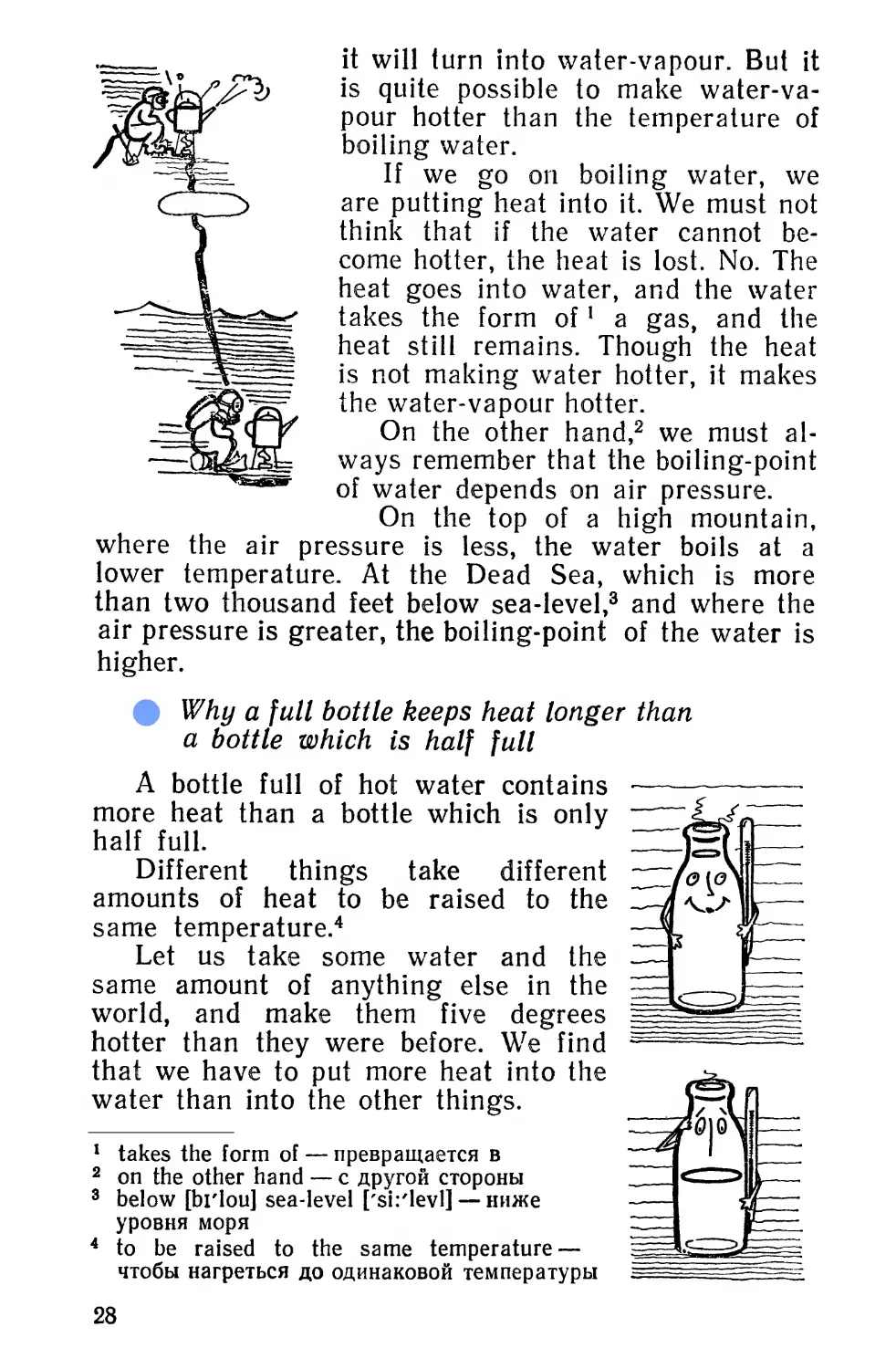
A bottle full of hot water contains
more heat than a bottle which is only
half full.
Different things take different
amounts of heat to be raised to the
same temperature.4
Let us take some water and the
same amount of anything else in the
world, and make them five degrees
hotter than they were before. We find
that we have to put more heat into the
water than into the other things.
1 takes the form of — превращается в
2 on the other hand — с другой стороны
3 below [brlou] sea-level ['si:'levl] — ниже
уровня моря
4 to be raised to the same temperature —
чтобы нагреться до одинаковой температуры
28
You need more time to heat
water than to heat anything else,
because you have to put more heat
into it. So you need more time to
cool water than anything else, be-
cause water has more heat in it
which it must lose.
Of course the more water we
have, the more 1 heat it has.
1 the more ...
the more —
чем больше ...
тем больше
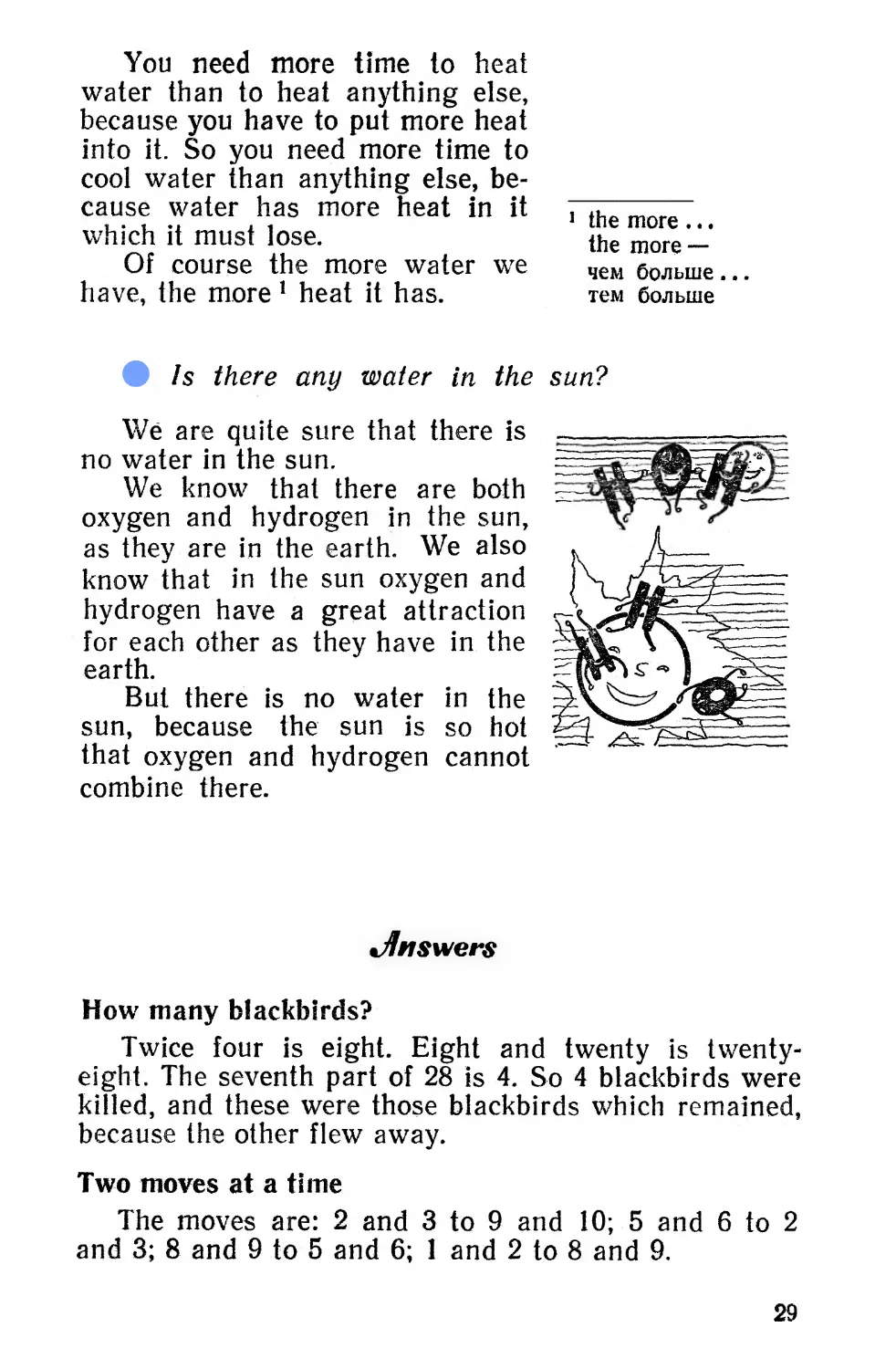
ts there any water in the sun?
We are quite sure that there is
no water in the sun.
We know that there are both
oxygen and hydrogen in the sun,
as they are in the earth. We also
know that in the sun oxygen and
hydrogen have a great attraction
for each other as they have in the
earth.
But there is no water in the
sun, because the sun is so hot
that oxygen and hydrogen cannot
combine there.
Answers
How many blackbirds?
Twice four is eight. Eight and twenty is twenty-
eight. The seventh part of 28 is 4. So 4 blackbirds were
killed, and these were those blackbirds which remained,
because the other flew away.
Two moves at a time
The moves are: 2 and 3 to 9 and 10; 5 and 6 to 2
and 3; 8 and 9 to 5 and 6; 1 and 2 to 8 and 9.
29
Oeto&en 13-19

THE WELL AT THE
WORLD’S END
(Л Scottish folk-tale)
There was once a King and a Queen. The King had
a daughter and the Queen had a daughter. The King’s
daughter was good-natured and everybody liked her.
The Queen’s daughter was ill-natured and nobody liked
her. The Queen hated the King’s daughter and did not
want her to live with them.1 So she sent her to the
Well at the World’s End to bring her a bottle of water,
thinking that she would never return.1 2
The King’s daughter took a bottle and went away.
Far she went, till she came to a pony tied to a tree,
and the pony said to her:
“Free me, my little girl, for I haven’t been free for
seven years and a day.”
“Yes, I will free you,” said the King’s daughter.
“Jump on my back,” said the pony, “and I’ll carry
you over the moor of sharp thorns.”3
The pony took her over the moor of sharp thorns
and they parted. She went far, and far, and farther
than I can tell, till she came to the Well at the World’s
End.
1 .,. did not want her to live with them —... не хотела, чтобы
она жила с ними
2 thinking that she would [wud] never return [rrtom]— думая,
что она никогда не вернётся
3 over the moor [muo] of sharp thorns [0o:nz] — через пустырь,
покрытый острыми колючками
30
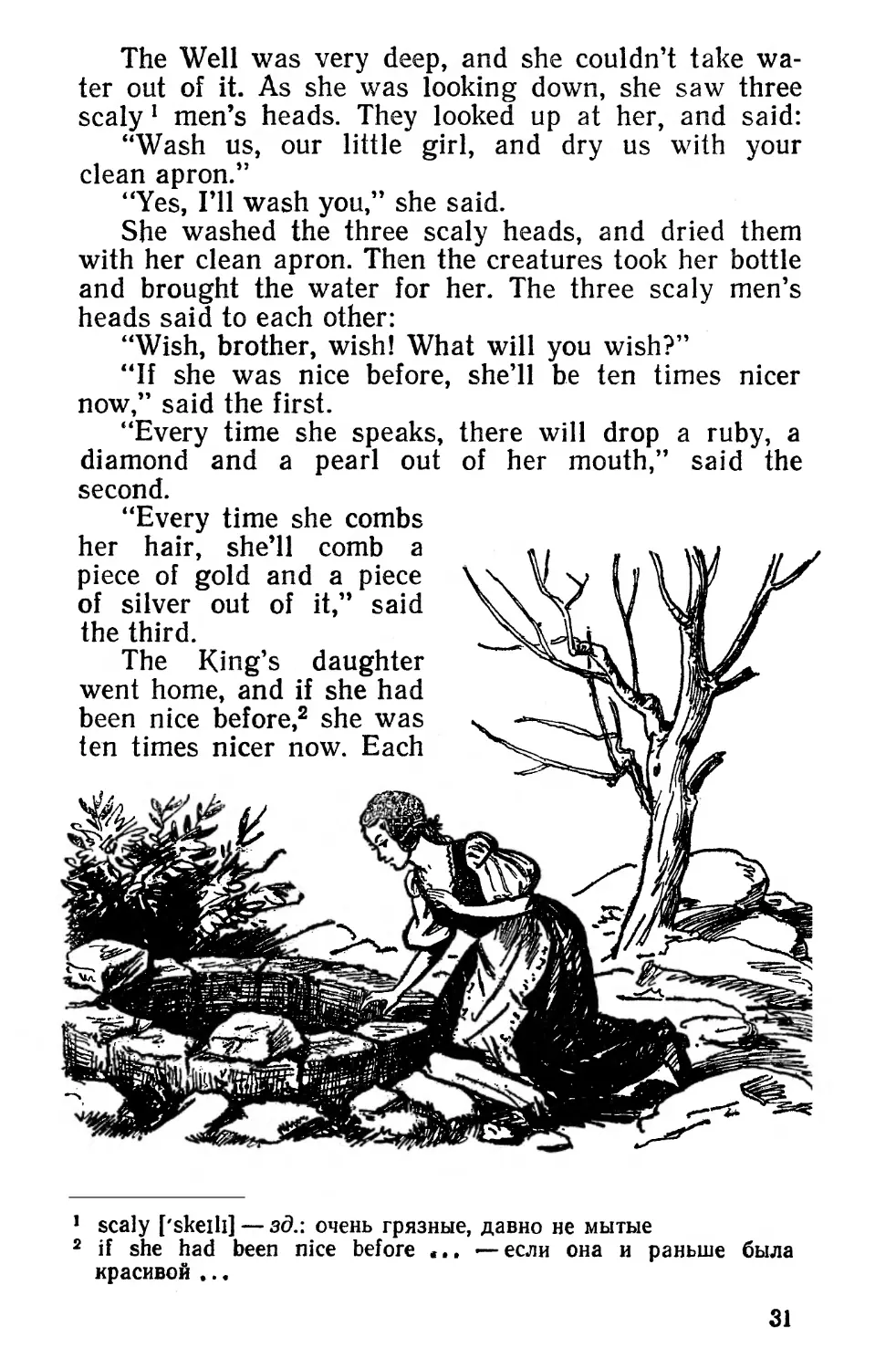
The Well was very deep, and she couldn’t take wa-
ter out of it. As she was looking down, she saw three
scaly 1 men’s heads. They looked up at her, and said:
“Wash us, our little girl, and dry us with your
clean apron.”
“Yes, I’ll wash you,” she said.
She washed the three scaly heads, and dried them
with her clean apron. Then the creatures took her bottle
and brought the water for her. The three scaly men’s
heads said to each other:
“Wish, brother, wish! What will you wish?”
“If she was nice before, she’ll be ten times nicer
now,” said the first.
“Every time she speaks, there will drop a ruby, a
diamond and a pearl out of her mouth,” said the
second.
1 scaly f'skeili] — зд.: очень грязные, давно не мытые
2 if she had been nice before «.. — если она и раньше была
красивой ,..
31
time she spoke, a ruby, a diamond and a pearl dropped
from her mouth. Each time she combed her hair,
she combed a piece of gold and a piece of silver
out of it.
The Queen was so angry, she didn’t know what to
do. She decided to send her own daughter to the Well
at the World’s End. She gave her a bottle and sent
her to fill it with the water from the well.
The Queen’s daughter went on and on till she came
to the pony tied to the tree, and the pony said:
“Free me, my little girl, for I haven’t been free for
seven years and a day.”
“Oh, you stupid creature, do you think I’ll free
you?” she said. “I am the Queen’s daughter.”
“I’ll not carry you, then, over the moor of sharp
thorns,” said the pony.
So the Queen’s daughter had to go on her bare
feet, and the thorns cut her. She could hardly walk
at all.
She went far, and far, and farther than I can tell,
till she came to the Well at the World’s End. But the
Well was so deep, that she couldn’t take water out of
it. As she sat there three men’s heads looked up at her
and said:
“Wash us, our little girl, and dry us with your clean
apron.”
“Oh, you horrid creatures, do you think I am
going to wash you?” she said. “I am the Queen’s
daughter.”
She did not wash their heads, and so they did not
bring water for her. They said to each other:
“Wish, brother, wish! What will you wish?”
“If she was ugly before, she’ll be ten times uglier
now,” said the first.
“Every time she speaks, there will drop a frog out
of her mouth,” said the second.
“Every time she combs her hair, she’ll comb a
peck of lice and a peck of fleas 1 out of it,” said the
third.
So the Queen’s daughter went home with an empty
bottle.
1 a peck of lice and a peck of fleas [fli:z] — вшей и блох
32
Nobody can tell how angry the Queen was. If her
daughter had been ugly before,1 she was ten times
uglier now, and when she spoke, a frog dropped from
her mouth. When she combed her hair, a peck of lice
and a peck of fleas were combed out of it.
So the Queen had to send her daughter away from
the Court.
Riddles
What changes a pear into a pearl?
Why can’t the world ever come to an
end?
Which man in the world wore the larg-
est hat?
What goes under the water, over the
water, but never touches the water?
5. What is that which no man wishes to have, but no
man wishes to lose?
6. On what day of the year do children talk the least?
(The answers are on page 50.)
1 If her daughter had been ugly before ... — Если её дочь и рань-
ше была безобразной ...
33
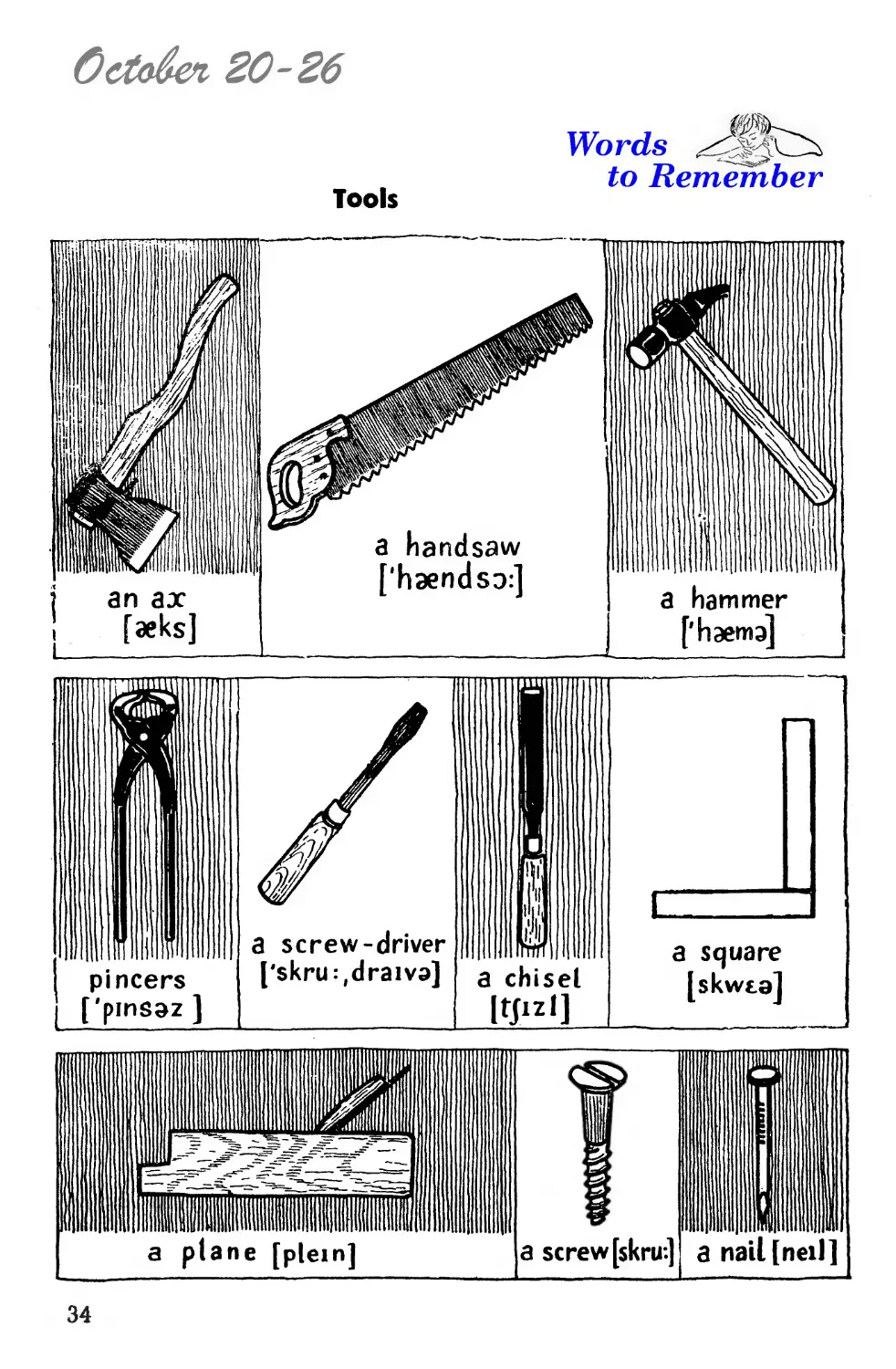
October 20-26
Words
to Remember
Tools
34
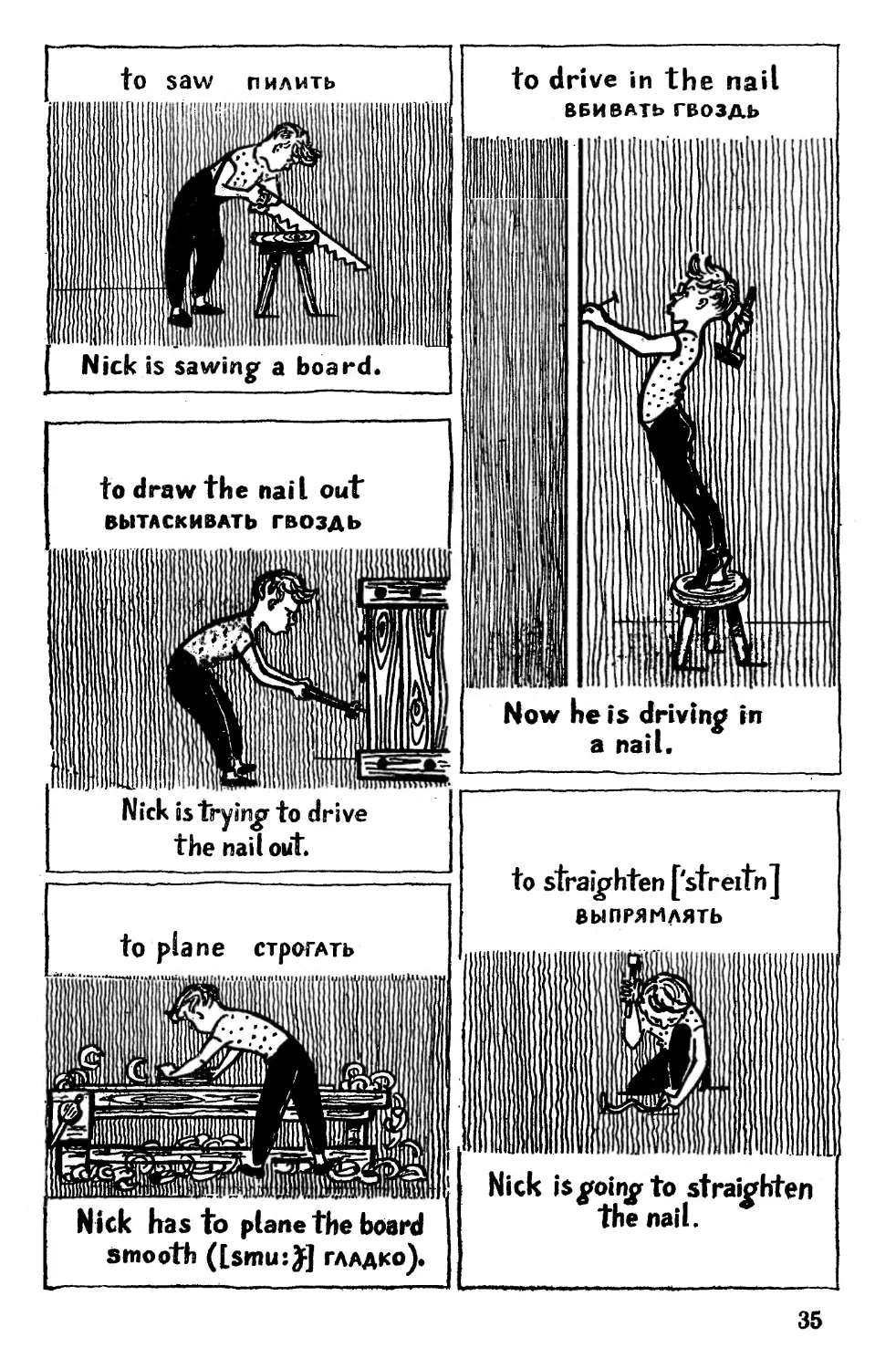
Nick is sawing a board.
to draw the nail out
ВЫТАСКИВАТЬ ГВОЗДЬ
to drive in the nail
ВБИВАТЬ ГВОЗДЬ
Nick has to plane the board
smooth ([smu:jFj гладко)»
to straighten [streitn]
выпрямлять
35
Why Was the Kingdom Lost!
(Д nursery rhyme)
For want of a nail1
the shoe 1 2 was lost,
For want of the shoe
the horse was lost,
For want of the horse
the rider was lost,
For want of the rider
the battle was lost,
For want of the battle
the kingdom was lost,
And all for the want
of a horse-shoe nail.
Read It Yourself
and then tell it in your own words
to your younger sister or brother.
The Hot Potato
Once upon a time there lived a cow, Dot by name,
who was very fond of hot potatoes. One day she swal-
lowed a whole potato without chewing3 it, and it was
so hot inside her, that it hurt, and she began to cry.
Great big tears rolled down her cheeks.
The farmer took a pail to catch the tears in, so that
they will not make the floor all wet.
“What’s the matter, Dot?” he said.
“I swallowed a hot potato,” said Dot.
1 For want of a nail — Из-за того, что не было гвоздя
2 shoe или horse-shoe — подкова
3 without chewing — не прожевав
36
“You poor thing,”1 said the farmer, “open your
mouth.”
Dot opened her mouth and smoke came out.
“What shall I do?” thought the farmer.
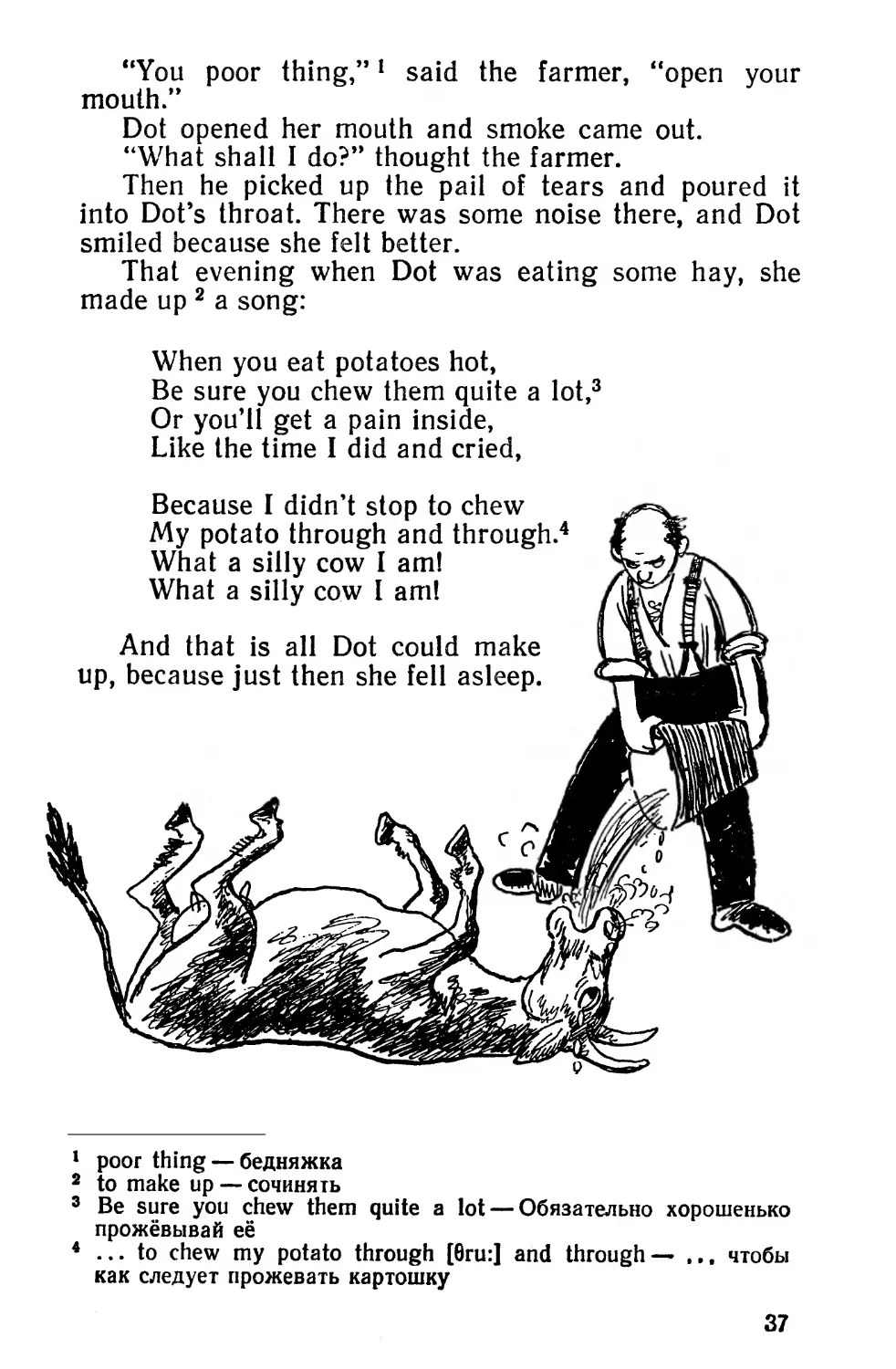
Then he picked up the pail of tears and poured it
into Dot’s throat. There was some noise there, and Dot
smiled because she felt better.
That evening when Dot was eating some hay, she
made up 2 a song:
When you eat potatoes hot,
Be sure you chew them quite a lot,3
Or you’ll get a pain inside,
Like the time I did and cried,
1 poor thing — бедняжка
2 to make up — сочинять
3 Be sure you chew them quite a lot — Обязательно хорошенько
прожёвывай её
4 ... to chew my potato through [0ru:] and through — ... чтобы
как следует прожевать картошку
37
UNBREAKABLE 1
TOY
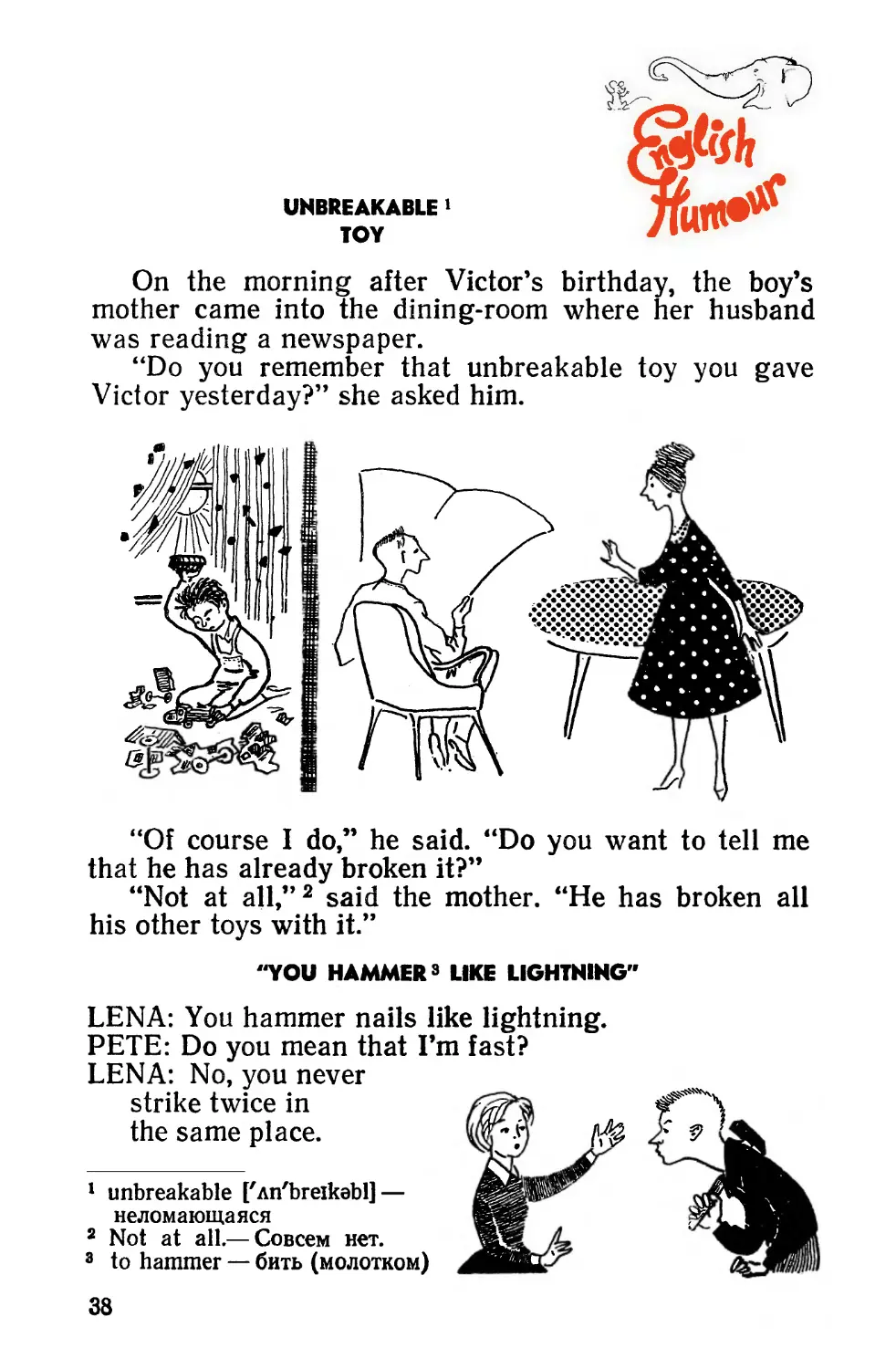
On the morning after Victor’s birthday, the boy’s
mother came into the dining-room where her husband
was reading a newspaper.
“Do you remember that unbreakable toy you gave
Victor yesterday?” she asked him.
“Of course I do,” he said. “Do you want to tell me
that he has already broken it?”
“Not at all,”1 2 said the mother. “He has broken all
his other toys with it.”
"YOU HAMMER3 LIKE LIGHTNING"
LENA: You hammer nails like lightning.
PETE: Do you mean that I’m fast?
LENA: No, you never
strike twice in
the same place.
1 unbreakable ['An'breikabl]—
неломающаяся
Not at all.— Совсем нет.
3 to hammer — бить (молотком)
2
38
0 cloven/%ц/ет&&1 27-2
OCTOBER 29
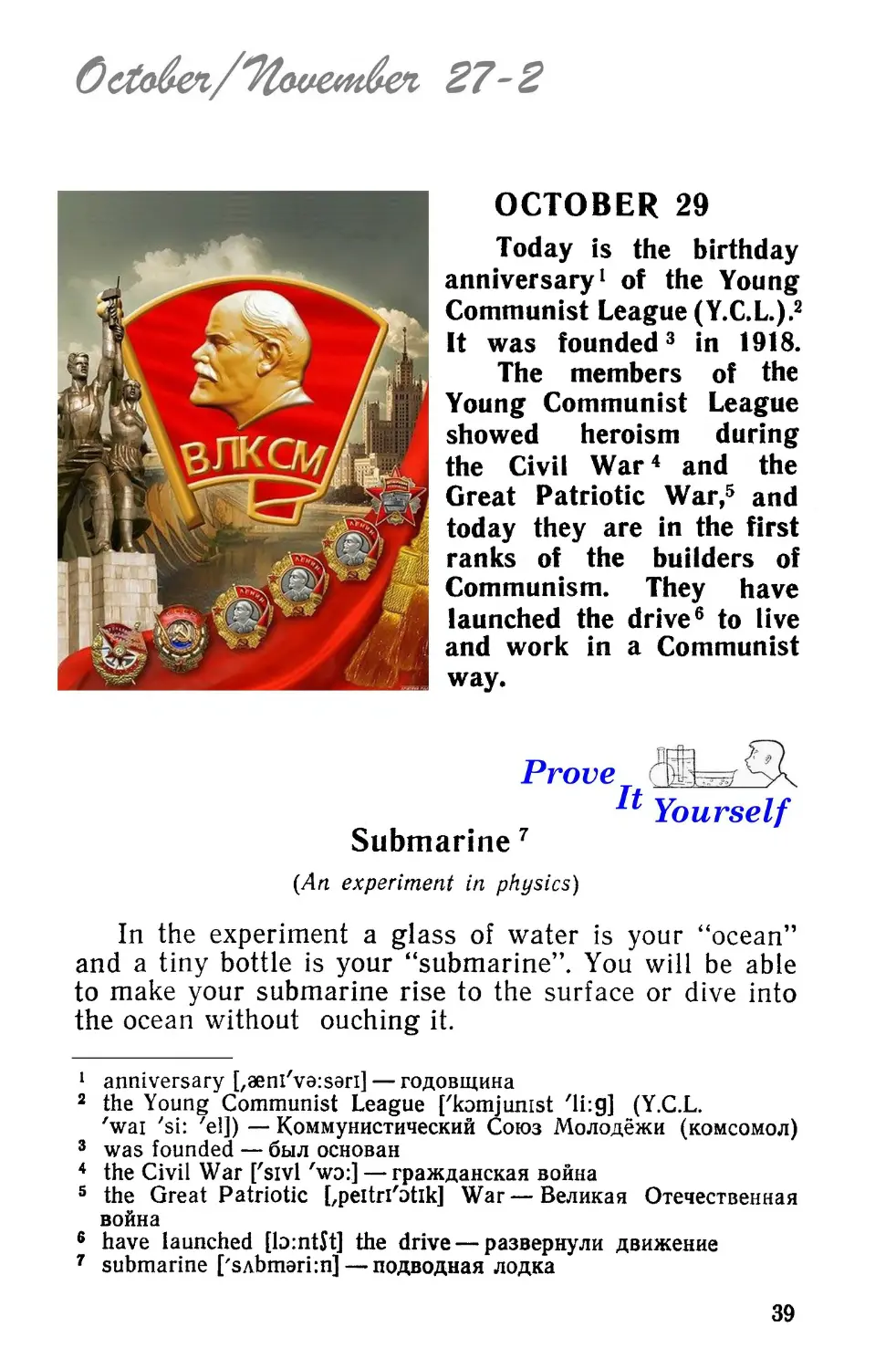
Today is the birthday
anniversary1 of the Young
Communist League (Y.C.L.).1 2
It was founded3 in 1918.
The members of the
Young Communist League
showed heroism during
the Civil War4 and the
Great Patriotic War,5 and
today they are in the first
ranks of the builders of
Communism. They have
launched the drive6 to live
and work in a Communist
way.
Submarine7
Prove
11 Yourself
(An experiment in physics)
In the experiment a glass of water is your “ocean”
and a tiny bottle is your “submarine”. You will be able
to make your submarine rise to the surface or dive into
the ocean without ouching it.
1 anniversary [,aeni'v9:son] — годовщина
2 the Young Communist League ['komj unist zli:g] (Y.C.L.
'wai 'si: 'el]) — Коммунистический Союз Молодёжи (комсомол)
3 was founded — был основан
4 the Civil War ['sivl 'wo:] — гражданская война
5 the Great Patriotic [,peitri'otlk] War—Великая Отечественная
война
s have launched [lo:ntSt] the drive — развернули движение
7 submarine ['sAbmeri:n] — подводная лодка
39
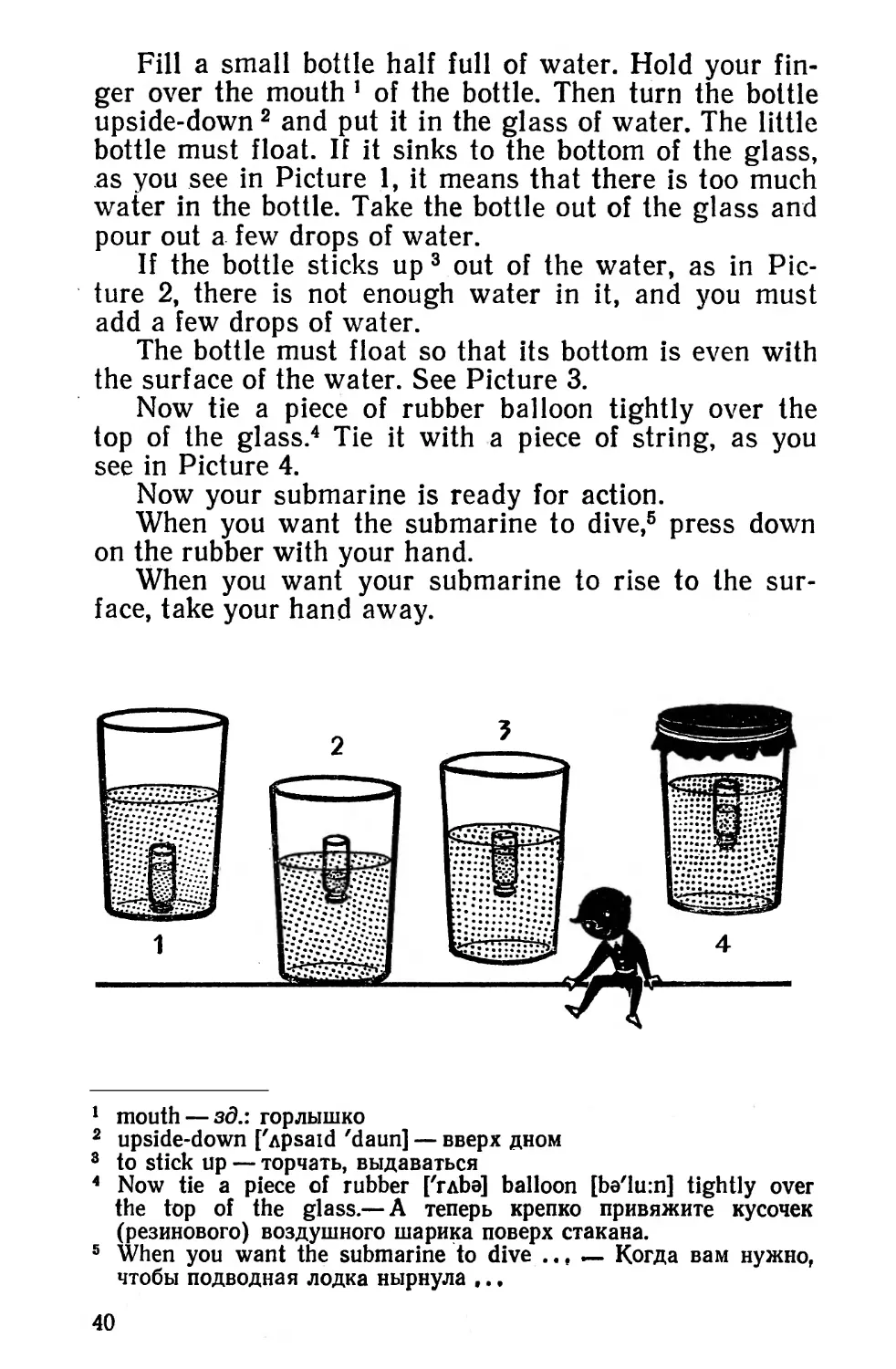
Fill a small bottle half full of water. Hold your fin-
ger over the mouth 1 of the bottle. Then turn the bottle
upside-down 2 and put it in the glass of water. The little
bottle must float. If it sinks to the bottom of the glass,
as you see in Picture 1, it means that there is too much
water in the bottle. Take the bottle out of the glass and
pour out a few drops of water.
If the bottle sticks up 3 out of the water, as in Pic-
ture 2, there is not enough water in it, and you must
add a few drops of water.
The bottle must float so that its bottom is even with
the surface of the water. See Picture 3.
Now tie a piece of rubber balloon tightly over the
top of the glass.4 Tie it with a piece of string, as you
see in Picture 4.
Now your submarine is ready for action.
When you want the submarine to dive,5 press down
on the rubber with your hand.
When you want your submarine to rise to the sur-
face, take your hand away.
1 mouth — зд.: горлышко
2 upside-down ['Apsaid 'daun] — вверх дном
3 to stick up — торчать, выдаваться
4 Now tie a piece of rubber ['гдЬэ] balloon [ba'lu:n] tightly over
the top of the glass.— А теперь крепко привяжите кусочек
(резинового) воздушного шарика поверх стакана.
5 When you want the submarine to dive .., — Когда вам нужно,
чтобы подводная лодка нырнула ,..
40
It’s interesting Q
to Know Why -
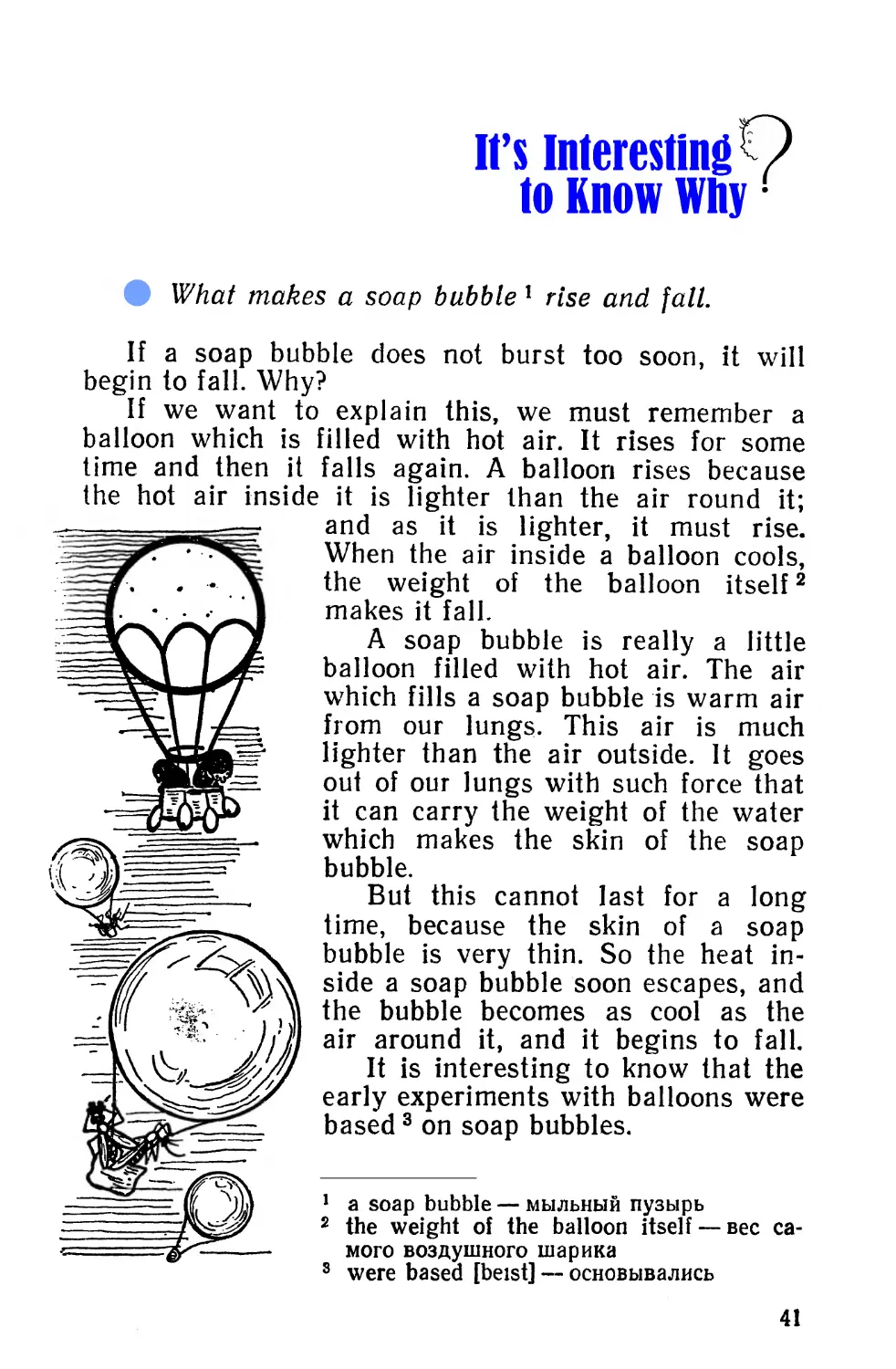
What makes a soap bubble 1 rise and fall.
If a soap bubble does not burst too soon, it will
begin to fall. Why?
If we want to explain this, we must remember a
balloon which is filled with hot air. It rises for some
time and then it falls again. A balloon rises because
the hot air inside it is lighter than the air round it;
and as it is lighter, it must rise.
When the air inside a balloon cools,
the weight of the balloon itself1 2
makes it fall.
A soap bubble is really a little
balloon filled with hot air. The air
which fills a soap bubble is warm air
from our lungs. This air is much
lighter than the air outside. It goes
out of our lungs with such force that
it can carry the weight of the water
which makes the skin of the soap
bubble.
But this cannot last for a long
time, because the skin of a soap
bubble is very thin. So the heat in-
side a soap bubble soon escapes, and
the bubble becomes as cool as the
air around it, and it begins to fall.
It is interesting to know that the
early experiments with balloons were
based3 on soap bubbles.
1 a soap bubble — мыльный пузырь
2 the weight of the balloon itself — вес са-
мого воздушного шарика
8 were based [beist] — основывались
41
for fun
An Obstacle Race 1
(A game)
The players begin by carrying a book under one
arm.1 2 They go to a certain place in the hall or room,
where they find some string. They have to tie this
string round their left hand while keeping the book
under their right arm. If they drop the book, it counts
against them. Then they go to another place where
they find another book. They have to put it under the
other arm. Then they go to another place where they
have to clasp a necklace3 round their necks, always
keeping the books under their arms.
You may add as many obstacles as you wish, for
example, you may pick up a handkerchief off the floor
with books under the arms, or pick up a sweet from
the plate into the mouth and so on.
The player who will be able to do all this must
have a prize.
1 An Obstacle ['obstekl] Race.— Состязание в преодолении пре-
пятствий.
2 ... begin by carrying a book under one arm — ... начинают
с того, что кладут книгу под мышку (букв.: несут книгу
под рукой)
3 to clasp [klasp] a necklace ['neklis] — застегнуть бусы
42
3-<j
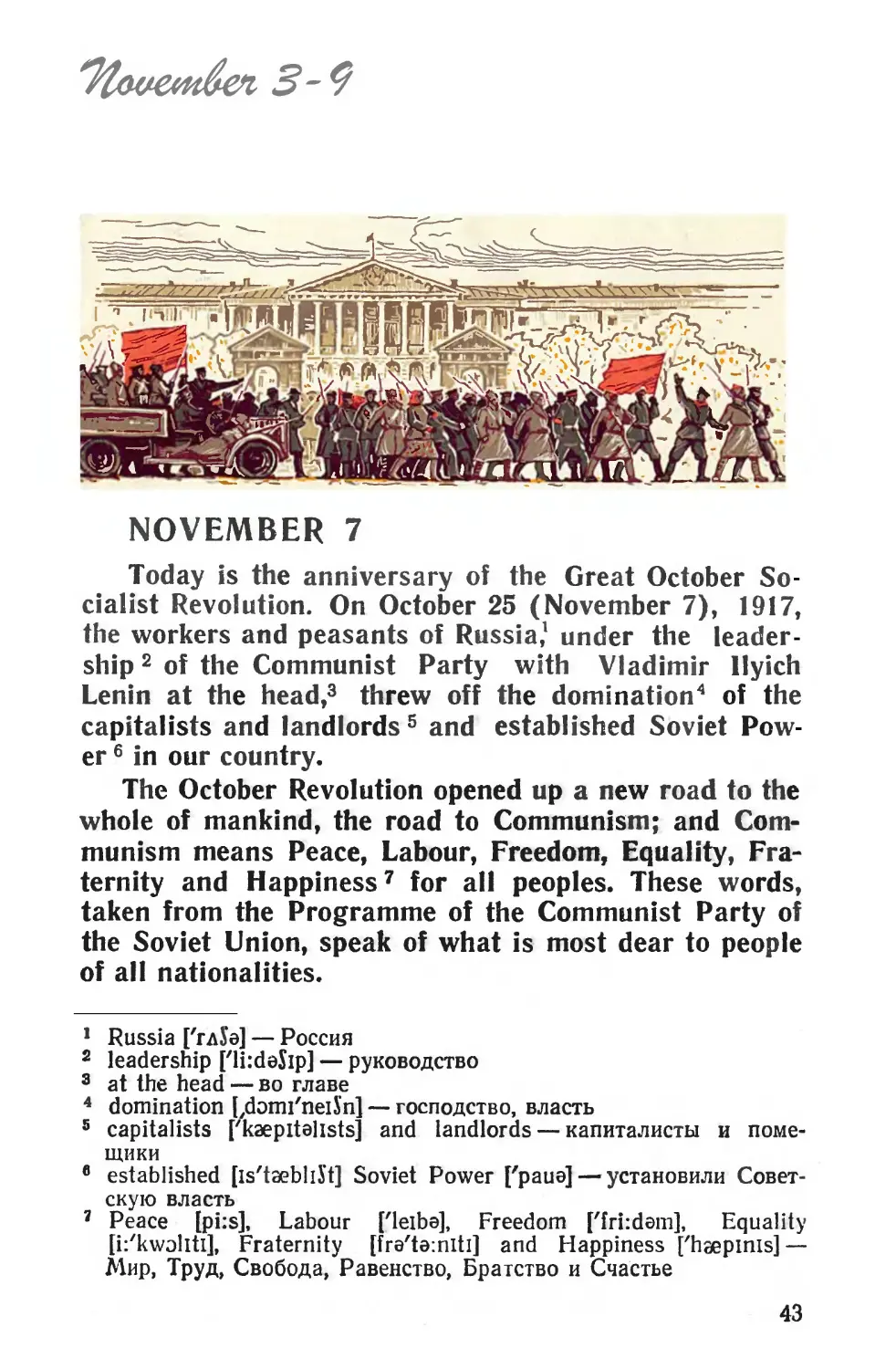
NOVEMBER 7
Today is the anniversary of the Great October So-
cialist Revolution. On October 25 (November 7), 1917,
the workers and peasants of Russia,1 under the leader-
ship 1 2 of the Communist Party with Vladimir Ilyich
Lenin at the head,3 threw off the domination4 of the
capitalists and landlords5 and established Soviet Pow-
er 6 in our country.
The October Revolution opened up a new road to the
whole of mankind, the road to Communism; and Com-
munism means Peace, Labour, Freedom, Equality, Fra-
ternity and Happiness7 for all peoples. These words,
taken from the Programme of the Communist Party of
the Soviet Union, speak of what is most dear to people
of all nationalities.
1 Russia ['faSo] — Россия
2 leadership [zli:deSip] — руководство
3 at the head — во главе
4 domination Ldomi'neiSn] — господство, власть
5 capitalists ['kaepltolists] and landlords — капиталисты и поме-
щики
e established [is'taebliJt] Soviet Power ['paua]— установили Совет-
скую власть
7 Peace [pi:s], Labour ['leibe], Freedom ['fri:dem], Equality
[i/kwoliti], Fraternity [fra'tamiti] and Happiness ['haepinis] —
Мир, Труд, Свобода, Равенство, Братство и Счастье
43
аЛх? NOVEMBER is the month of bare trees,
of the first signs of winter,
and of the first snow.
You can still find an occasional1 flower.
The trees have lost almost all their leaves. Only
the oaks which are the last to get their leaves and the
last to lose them, still have brown leaves on.
As the trees have no leaves on, you can discover
nests which were hidden during the summer.
The weather begins to get cold, and more and more
animals go to sleep. The racoon stays at home and
sleeps most of the time. The black bears stay near their
dens until it is very cold. Then they go in for their
winter sleep.
On November 5 your autumn holidays begin. We
wish you happy holidays and a lot of fun.
forJ-un
Nuts for the Monkeys
(Л curious problem)
A man went to the Zoo with a bag of nuts. At the
Zoo he stopped near three cages of monkeys and de-
cided to give the monkeys all his nuts.
“If I divide the nuts equally among the eleven mon-
keys in the first cage,” thought the man, “one nut will
remain. If I divide them equally among the thirteen
monkeys in the second cage, eight nuts will remain.
If I divide them among the seventeen monkeys in the
third cage, three nuts will remain. And if I divide the
1 occasional [d'keigonl] — случайный, редкий
44
nuts equally among the forty-one monkeys in all three
cages or among the monkeys in any two cages, some
nuts will remain too.”
What is the smallest number of nuts that the man
could have in his bag?
(The answer is on page 72.)
A READY ANSWER1
FARMER: What are you doing up
in that tree, boy?
BOY: One of your apples fell down,
and I’m trying to put it back.
TWO MACHINES INSTEAD OF ONE
SHOP-GIRL: This machine will do half your work.
CUSTOMER: All right, I’ll take two!
HOW MIKE BROKE HIS ARM
JACK*. How did you break your arm?
MIKE: Do you see those stairs over there?
JACK: Yes.
MIKE: Well, I didn’t.
1 A Ready Answer.— Находчивый ответ.
45
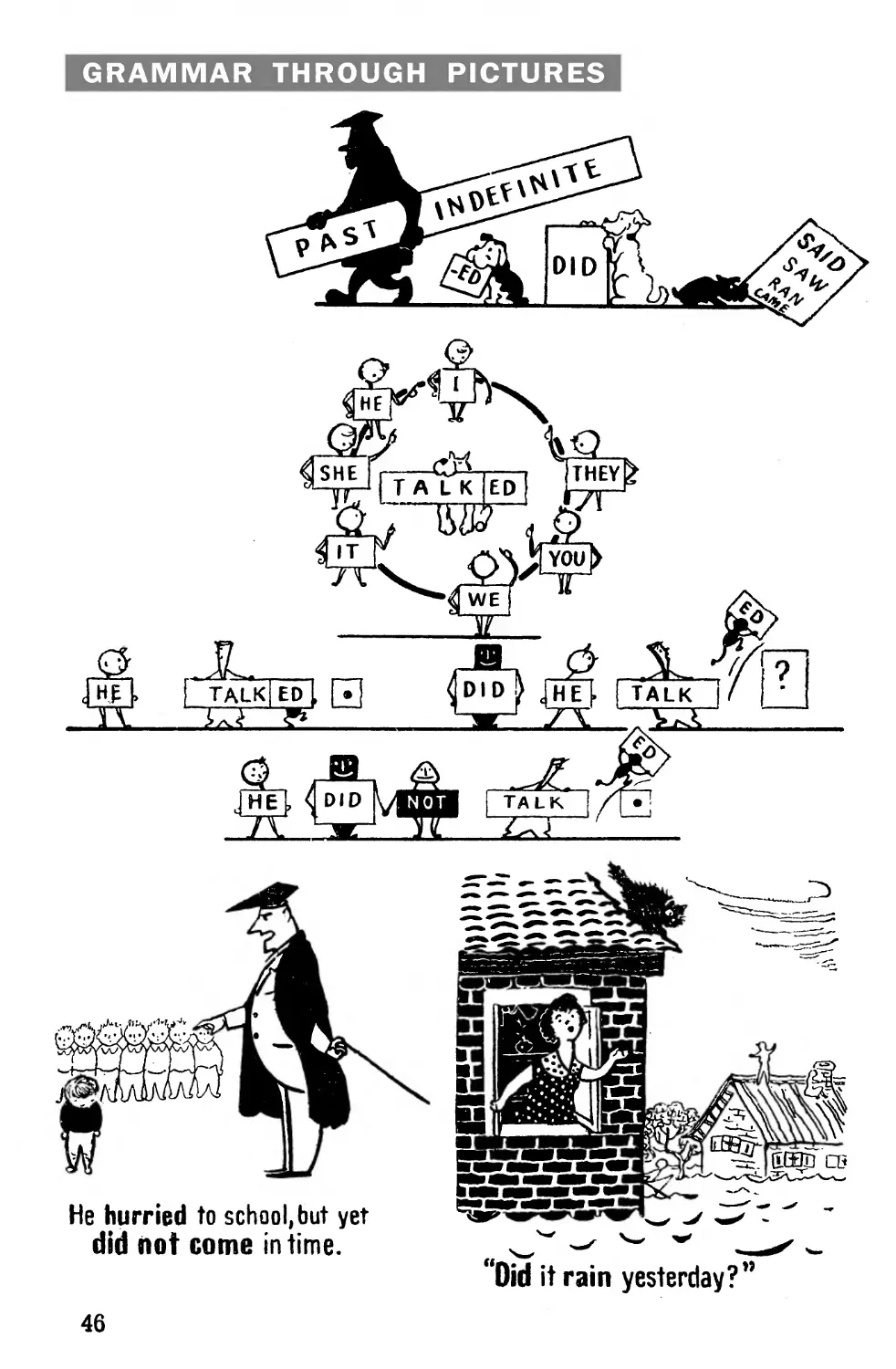
GRAMMAR THROUGH PICTURES
He hurried to school, but yet
did not come in time.
46
10-16
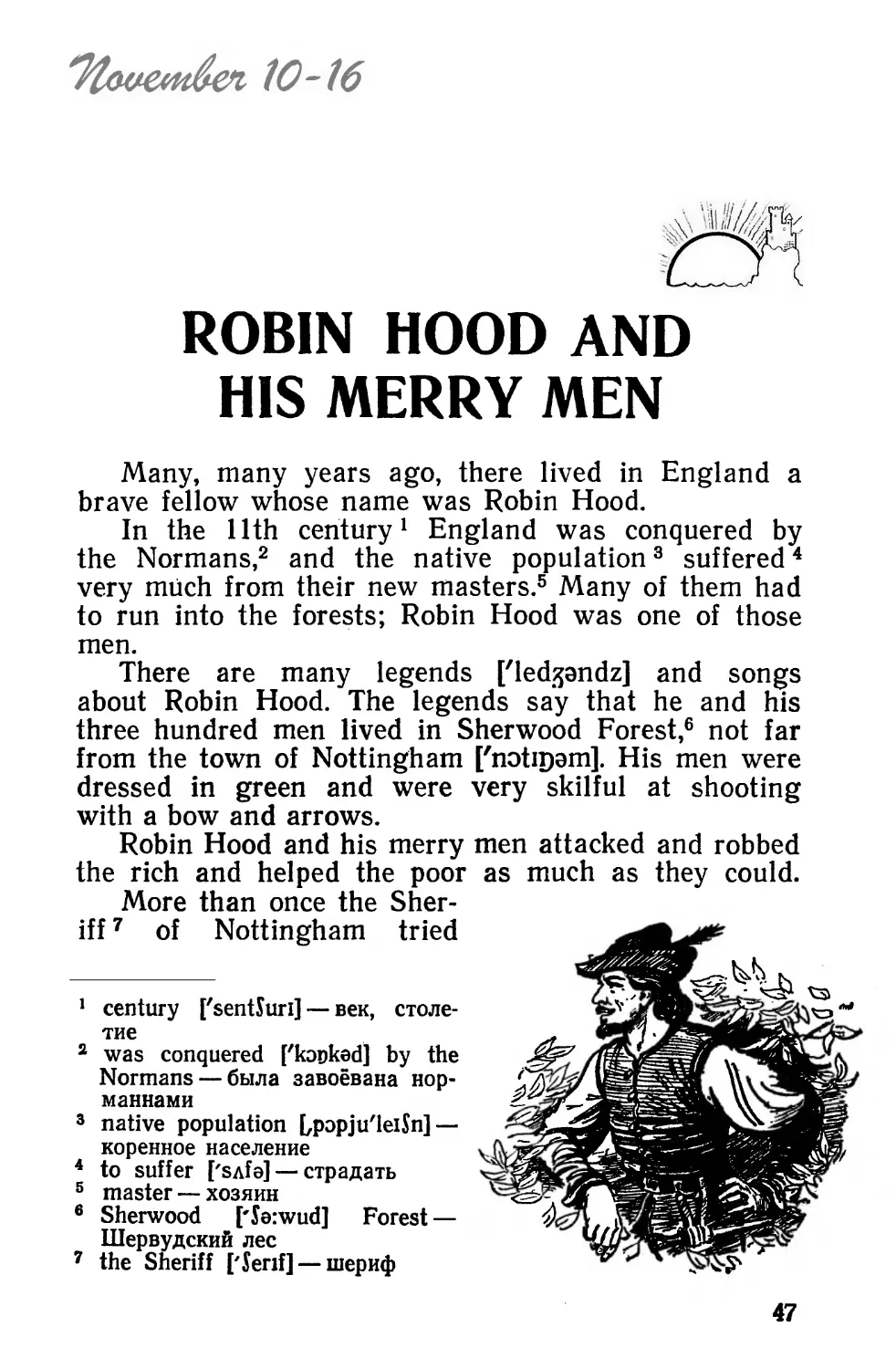
ROBIN HOOD AND
HIS MERRY MEN
Many, many years ago, there lived in England a
brave fellow whose name was Robin Hood.
In the 11th century1 England was conquered by
the Normans,1 2 and the native population3 suffered4
very much from their new masters.5 Many of them had
to run into the forests; Robin Hood was one of those
men.
There are many legends ['ledjpndz] and songs
about Robin Hood. The legends say that he and his
three hundred men lived in Sherwood Forest,6 not far
from the town of Nottingham ['notioom]. His men were
dressed in green and were very skilful at shooting
with a bow and arrows.
Robin Hood and his merry
the rich and helped the poor
More than once the Sher-
iff 7 of Nottingham tried
1 century ['sentJuri] — век, столе-
тие
2 was conquered ['kopked] by the
Normans — была завоёвана нор-
маннами
3 native population [,popju'lel$n] —
коренное население
4 to suffer f'SAfe] — страдать
5 master — хозяин
6 Sherwood [*Se:wud] Forest —
Шервудский лес
7 the Sheriff pjenf]— шериф
men attacked and robbed
as much as they could.
47
to catch Robin and his merry men, but in vain. Robin
always fooled his enemies.
Once Robin played a trick on one of the Sheriff’s
men whom he met in the forest. The man had the order
to arrest Robin Hood. But he did not know with whom
he was talking.
“Help me to find Robin,” he asked Robin Hood,
“and I shall give you half the money that I’ll get for
his head.”
“All right,” said Robin, “let’s go to Nottingham.
We shall find Robin Hood there. I know him, and I’ll
help you to catch him.”
When they came to the town, Robin gave the man
so much ale, that he fell asleep. After that Robin
walked off, and the man had to pay the bill.1
Some time after, Robin and his friends came to
Nottingham to take part in a tournament held there
by the Sheriff.1 2 The prize of the tournament, an arrow
of gold, was for the best shooting. Robin who was
dressed like a beggar, won the prize.
The next evening as the Sheriff was going to go
to bed, an arrow suddenly whistled through the open
window of his bedroom and sank into the door. A letter
was tied to the arrow.
The Sheriff read: “Thank you for the golden arrow.
It was a good prize for my shooting. Robin Hood."
One day Robin stopped a butcher who was carry-
ing meat to Nottingham to sell it at the market. He
changed clothes with him and went to Nottingham. He
1 to pay the bill — платить по счёту
2 to take part in a tournament ['tuonemont] held there by the
Sheriff — чтобы принять участие в турнире, устроенном шери-
фом
48
sold the meat at a very low price. People were aston-
ished. The Sheriff heard about this strange young
butcher.
“I shall get money out of such a fool,” thought the
Sheriff, who was a miser. He came to the market,
found ‘that very foolish young butcher’, and asked him:
“Have you a big farm?”
“Yes,” said Robin, smiling to himself, “and much
cattle.”
“Do not speak so loud,” said the Sheriff, “but tell
me how much money you want for your land and
cattle?”
Robin said a very low price.
Early next morning the Sheriff and ‘that very fool-
ish young butcher’ rode out of the town. When they
were riding near Sherwood Forest, the Sheriff said:
“A bad man lives here. Do you think we shall meet
him? Robin Hood is his name.”
“Oh, I am sure we shall not!” answered Robin
laughing.
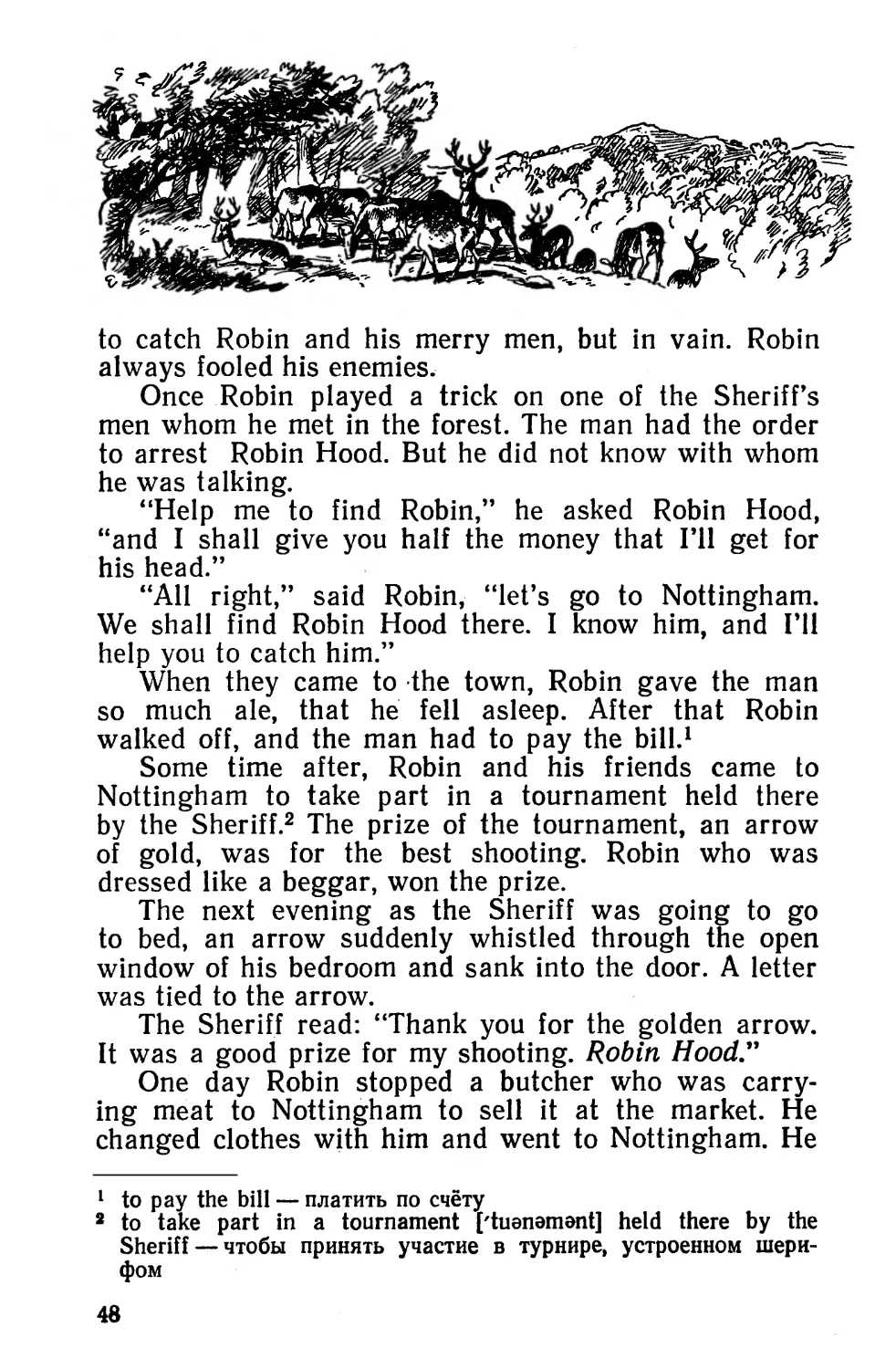
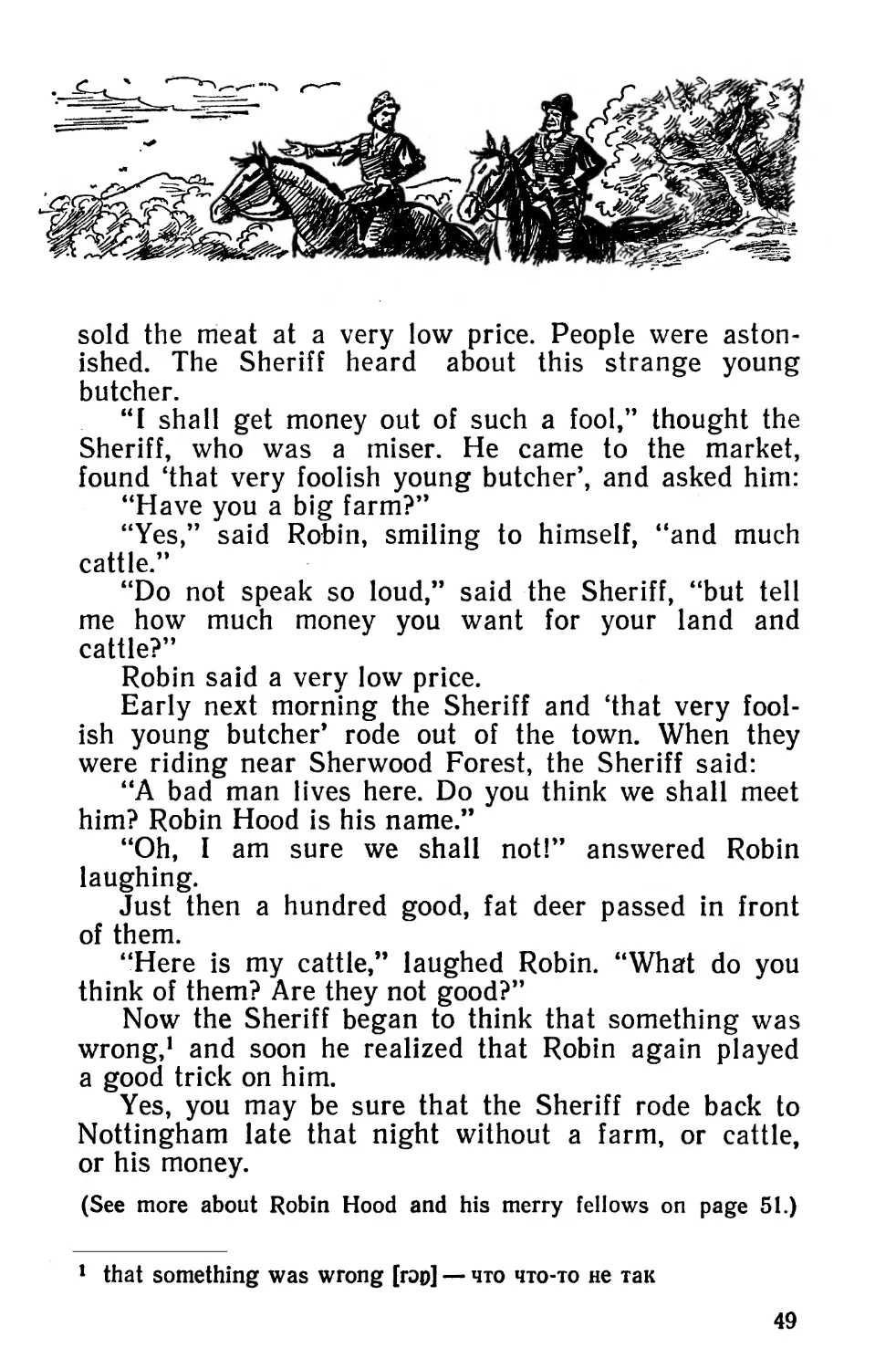
Just then a hundred good, fat deer passed in front
of them.
“Here is my cattle,” laughed Robin. “What do you
think of them? Are they not good?”
Now the Sheriff began to think that something was
wrong,1 and soon he realized that Robin again played
a good trick on him.
Yes, you may be sure that the Sheriff rode back to
Nottingham late that night without a farm, or cattle,
or his money.
(See more about Robin Hood and his merry fellows on page 51.)
1 that something was wrong [гор] — что что-то не так
49
fок Лип
The Wonderful Scissors
(Л puzzle)
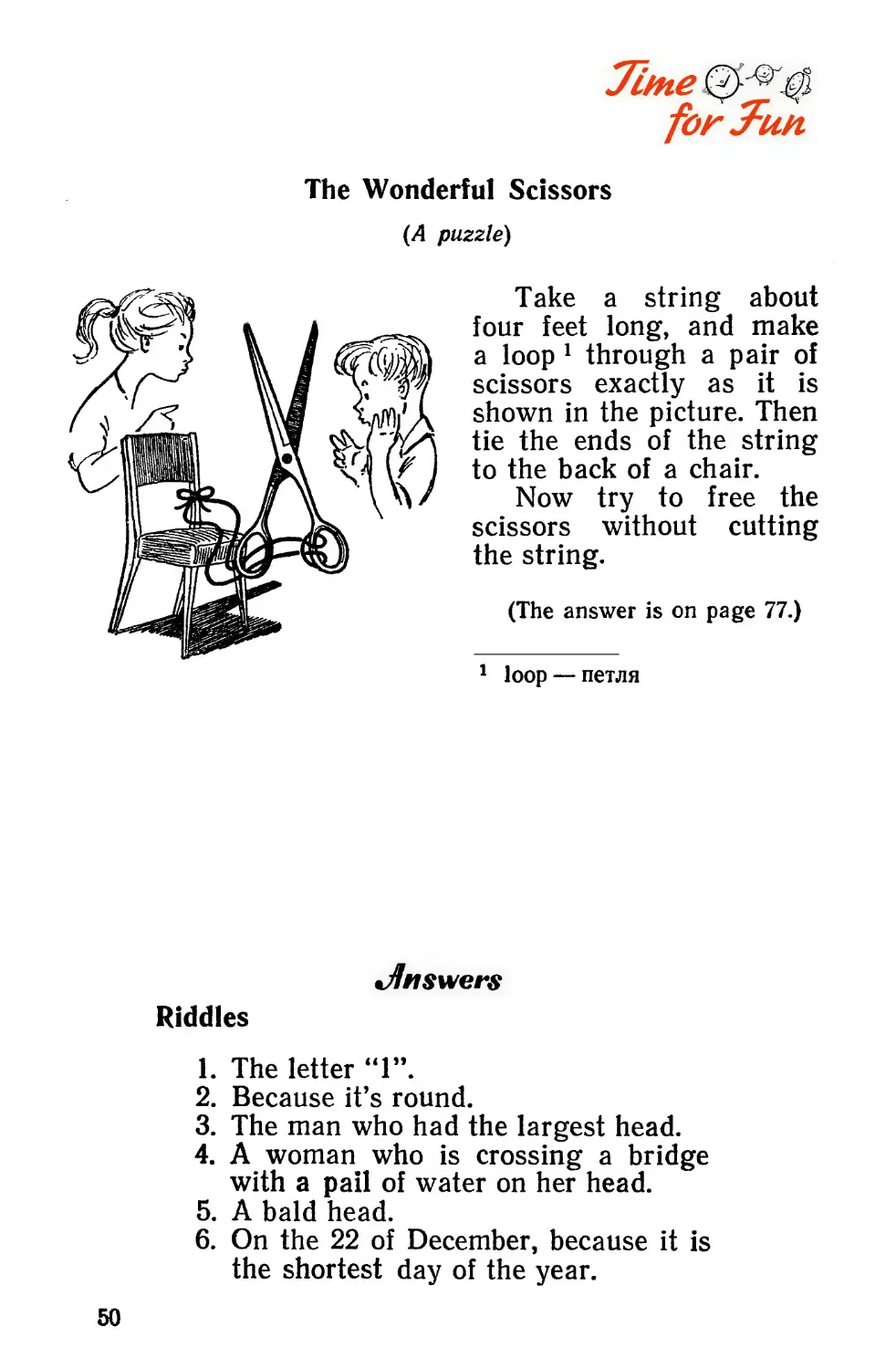
Take a string about
four feet long, and make
a loop 1 through a pair of
scissors exactly as it is
shown in the picture. Then
tie the ends of the string
to the back of a chair.
Now try to free the
scissors without cutting
the string.
(The answer is on page 77.)
1 loop — петля
Answers
Riddles
1.	The letter “1”.
2.	Because it’s round.
3.	The man who had the largest head.
4.	A woman who is crossing a bridge
with a pail of water on her head.
5.	A bald head.
6.	On the 22 of December, because it is
the shortest day of the year.
50
17-23
ROBIN HOOD AND
HIS MERRY MEN
{Continued)
One day when Robin Hood was walking in the
forest, he met a young man who looked very unhappy.
His name was Dale.
“What’s the matter with you?” asked Robin. “Why
do you look so unhappy?”
“I love a beautiful girl, and she loves me too,” an-
swered Dale, “but her father is a miser, and he wants
to marry his daughter to a rich merchant, who is old
enough to be her grandfather.”
“When will the marriage take place?”1 asked
Robin.
“Tomorrow,” answered Dale helplessly.
“Cheer up!”1 2 said Robin, “We’ll do something
about it.”
The next day Robin arrived at the church, and just
in the middle of the ceremony Robin stopped the Bish-
op of Hereford, who was reading the service,3 and
blowing his horn, he called his merry men. Dale was
among them.
“This bridegroom is too old,” said Robin. Then he
said to the bride:
“Lady, look around. Perhaps you’ll find someone
younger?”
Of course she chose Dale, and Robin made the
Bishop marry them.
1 to take place — иметь место, происходить, быть
2 Cheer up ['tSier 'др]! — He унывай!
3 to read the service ['sa:visj — отправлять богослужение
51
Since then the Bishop and Robin became great
enemies. The Bishop tried to capture Robin many
times, but in vain.
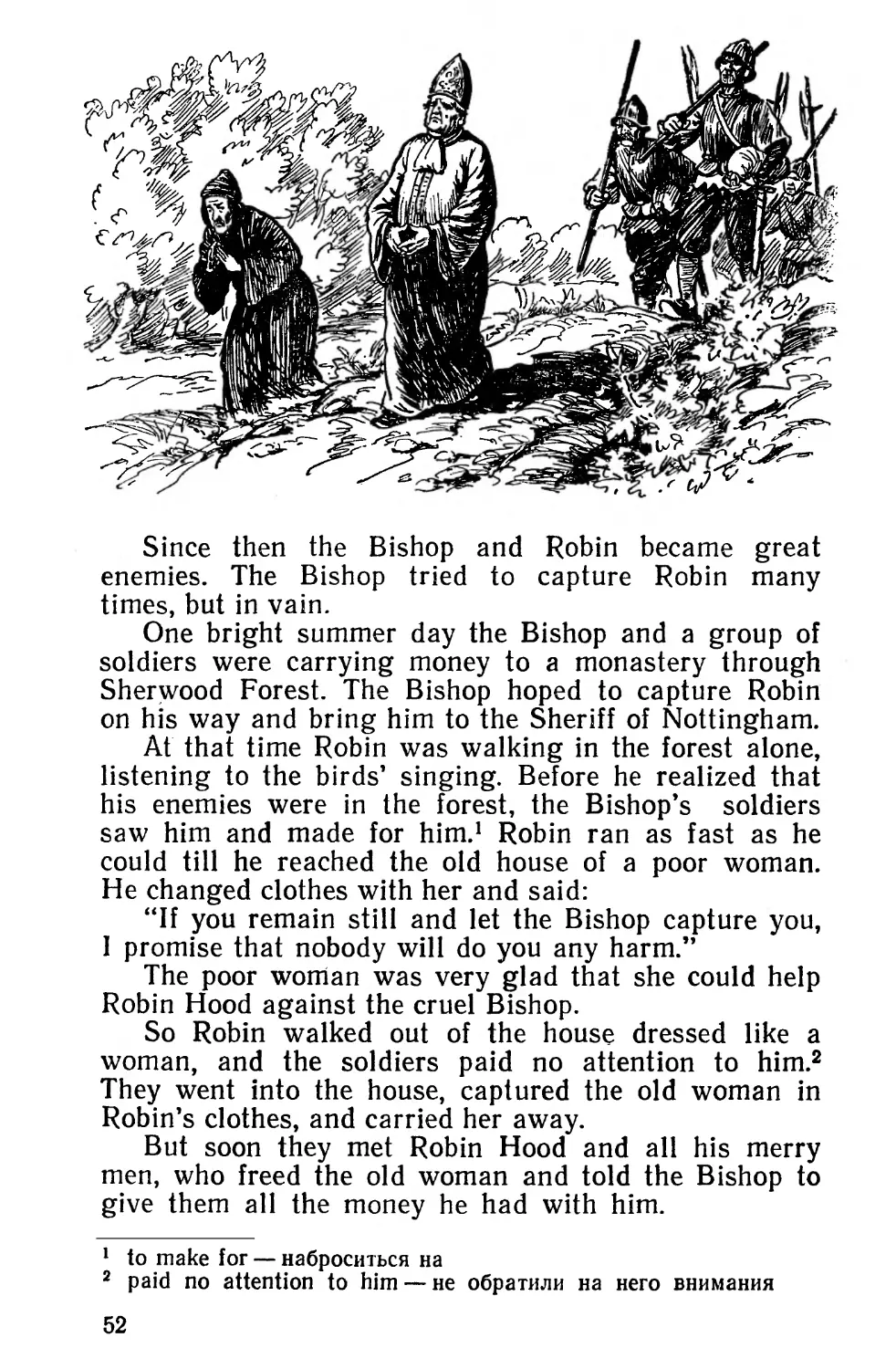
One bright summer day the Bishop and a group of
soldiers were carrying money to a monastery through
Sherwood Forest. The Bishop hoped to capture Robin
on his way and bring him to the Sheriff of Nottingham.
At that time Robin was walking in the forest alone,
listening to the birds’ singing. Before he realized that
his enemies were in the forest, the Bishop’s soldiers
saw him and made for him.1 Robin ran as fast as he
could till he reached the old house of a poor woman.
He changed clothes with her and said:
“If you remain still and let the Bishop capture you,
I promise that nobody will do you any harm.”
The poor woman was very glad that she could help
Robin Hood against the cruel Bishop.
So Robin walked out of the house dressed like a
woman, and the soldiers paid no attention to him.1 2
They went into the house, captured the old woman in
Robin’s clothes, and carried her away.
But soon they met Robin Hood and all his merry
men, who freed the old woman and told the Bishop to
give them all the money he had with him.
1 to make for — наброситься на
2 paid no attention to him — не обратили на него внимания
52
“It belongs to the Monastery,” said the Bishop.
“No,” answered Robin, “it belongs to the poor,
from whom you have taken it, and to whom it will
now return.”
Finally we shall tell you how Robin Hood died.
When he felt that he was dying, he asked his best
friend, Little John, to give him his bow and arrow.
When Little John gave him his bow and arrow, Robin
with great difficulty went up to the window.
“I shall shoot once more,” he said, “and where the
arrow falls, there let me be buried.” 1
As Robin was very weak, his arrow fell quite near
the window. But Little John did not want to displease
Robin.
“A good shot! A good shot!” cried Little John, with
his eyes full of tears.
“Was it a good shot? Was it really a good shot?”
these were the last words of Robin Hood, who was bur-
ied just where his arrow had fallen 1 2 for the last time.
Time 0-^-0
forJ-un
When Did Alfred Reach School?
(Л curious problem)
Alfred had a very long walk to school every morn-
ing. When he got to the church, he had walked one-
quarter of the way,3 and it was usually half past eight
on the church clock when he passed it.
When he got to the railway station, he had walked
one-third of the way, and it was usually twenty-five
minutes to nine on the station clock when he passed it.
At what time did he usually reach school?
(The answer is on page 108.)
1 there let me be buried ['berld]— там пусть меня и похоронят
2 had fallen — упала
3 he had walked one-quarter of the way — он уже проходил
четверть пути
53
24-30
It’s interesting^,
to Know Why
Something about Magnet
More than two thousand years ago, the shepherd
boy, Magnus by name, was watching
his sheep. With him he had a long
stick with an iron point. As he stood
watching his sheep, he put his stick
on a piece of rock. When he wanted to
run after the sheep which had wan-
dered 1 too far away, he found, to
his surprise, that it was very diffi-
cult to take his stick off the rock.
From this rock there came a mysteri-
ous force which attracted iron ob-
jects.
Magnus was the first who found
this kind of rock. That’s why,1 2 the
legend says, people call it magnet
In reality magnets take their
name from the town of Magnesia3
in Asia Minor4 where the pieces of
magnetic5 rock were first found.
1 had wandered ['wondad] — забрела
2 that’s why — вот почему
3 Magnesia [maeg'ni:Sja]— г. Магнесин (The
name comes from Magnesia, the district
in Greece.)
4 Asia Minor ['eiSa 'mama] — Малая Азия
5 magnetic [maeg'netik] — магнитный
54
ТЭ /4^1	\ 9 (
Prove Cwts_±А
Yourself
Has your steam radiator1 a north
and a south pole?
Place a magnetic compass near the top of a radia-
tor in your home. You will probably find that the north
end of the compass needle points to it.
Place the compass at the lower end of the radiator,
and you will find that now the south end of the compass
needle points to the radiator.
This shows that the radiator
has two different poles and is
therefore a magnet.
If you do the same with differ-
ent iron objects in your house, you
will find that you have a lot of
magnets around you.
You know, of course, that iron
objects become magnetized 1 2 when
they are near magnets. In this
case, the earth is the magnet.
If you want these iron objects
to have different poles, 3 you must
keep them in one position for some
time. In this way the iron in them
is lined up in the earth’s mag-
netic field. 4
1 a steam radiator f'sti:m 'reldlelta] —
батарея отопления
2 magnetized ['maegnitaizd] — намагни-
ченный
3 If you want these iron objects to have
different poles ... — Если вы хотите,
чтобы железные предметы имели раз-
ные полюсы ...
4 the iron in them is lined up in the
earth’s magnetic field — они намагни-
чиваются в магнитном поле Земли
55
For example, a tin can 1 which is about 98 per cent
steel shows a north and a south pole after it has been
in one position for some time.
Turn the can over and test it daily.1 2
Find out:
How much time will it take for the can to lose or
change its poles? 3
Does a larger can take more time to change its
poles than a smaller one?
If a can shows no poles, how much time will it take
for it to do so?
If you take the nail away from the magnet, it is no
longer a magnet. The iron loses magnetism ['maegm-
tizm] as soon as it is taken off a magnet.
Steel does not lose its magnetism as iron does, but
remains magnetized.
How strong is your electromagnet? 4
You probably know how to make an electromagnet.
Simply wind wire around a nail. When you connect
the ends of the wire to a source of electricity,5 the nail
will behave like a magnet.
1 a tin can — жестяная консервная банка
2 Turn the can over and test it daily.— Переверните банку
и наблюдайте за ней каждый день.
3 How much time will it take for the can to lose or change its
poles? — Сколько времени понадобится для того, чтобы кон-
сервная банка потеряла или поменяла свои полюса?
4 electromagnet [I'lektrou'maegnlt] — электромагнит
5 When you connect [ka'nekt] the ends of the wire ['waia] to a
source [so:s] of electricity [llek'trlsiti] — Когда вы соедините
концы проволоки с источником электроэнергии
56
You can test its strength by counting1 how many
small nails it can pick up.
You will find that the more turns there are and
the more electricity you use, the stronger1 2 the electro-
magnet will become.
Find out when the electromagnet stops getting
stronger.
Is the north pole of a magnet as strong
as the south pole?
Find out how many small nails are picked up by
each end.
Can you demagnetize3 a needle?
First magnetize a needle by rubbing one pole of a
magnet a few times over the same end of the needle.
Rub in only one direction. Test the magnetism by pick-
ing up small nails.
You can destroy the magnetism by heating the
needle in a gas flame. In this way you disarrange par-
ticles 4 and destroy magnetism.
1 by counting — сосчитав (ниже: by rubbing — потерев и т. д.)
2 the more turns there are ... the stronger ... — чем больше вит-
ков ... тем мощнее ...
3 to magnetize ['maegnitaiz] — намагничивать
to demagnetize ['dh'maegmtalz]— размагничивать
4 you disarrange particles [,dis9'reind3 'patiklz]— вы приводите
в беспорядок мельчайшие частицы
57
"Decem^ei 1-7
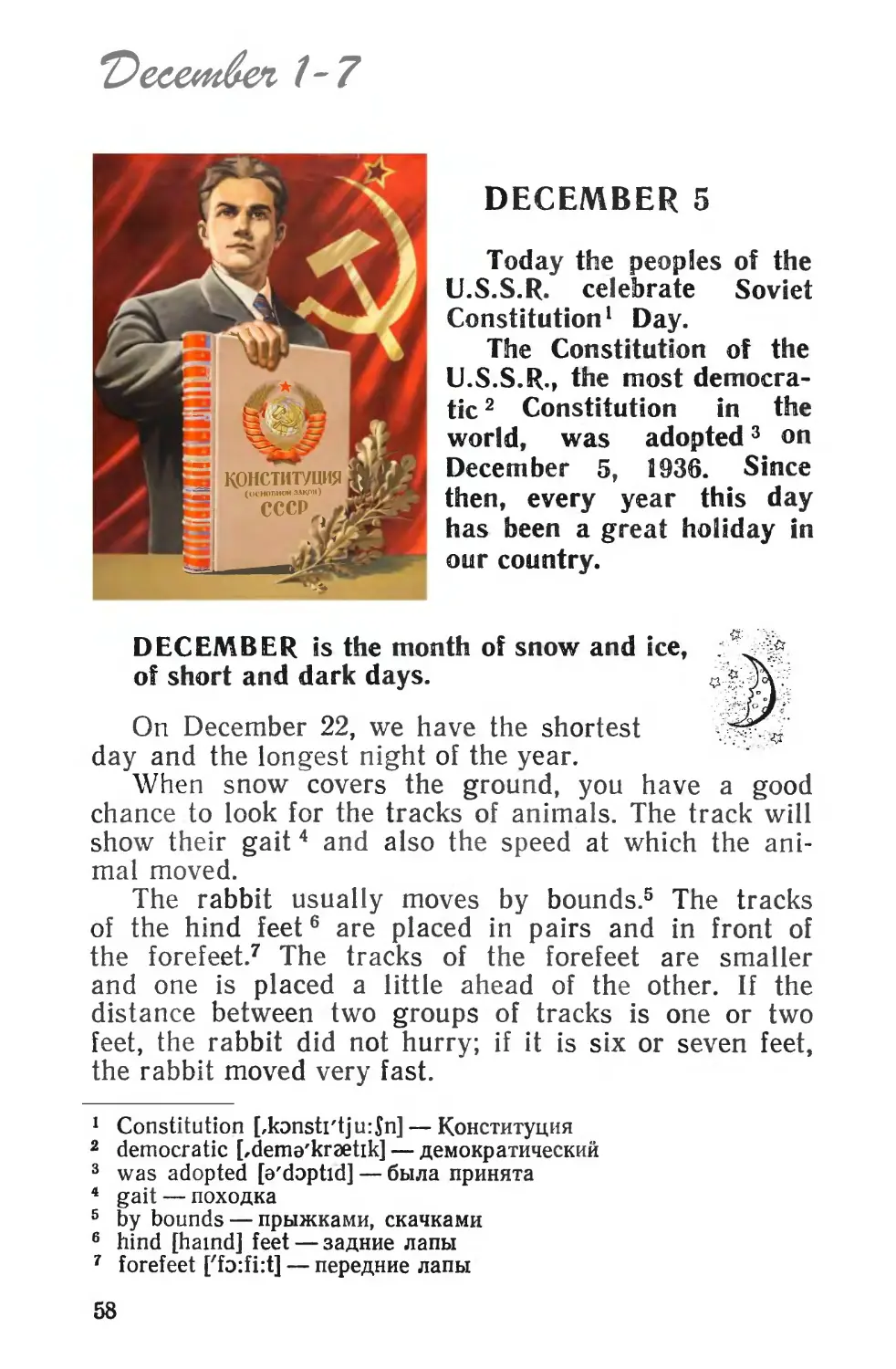
DECEMBER 5
Today the peoples of the
U.S.S.R. celebrate Soviet
Constitution1 Day.
The Constitution of the
U.S.S.R., the most democra-
tic 1 2 Constitution in the
world, was adopted3 on
December 5, 1936. Since
then, every year this day
has been a great holiday in
our country.
DECEMBER is the month of snow and ice,
of short and dark days.	ЙЖ
 J °
" I
On December 22, we have the shortest
day and the longest night of the year.
When snow covers the ground, you have a good
chance to look for the tracks of animals. The track will
show their gait 4 and also the speed at which the ani-
mal moved.
The rabbit usually moves by bounds.5 The tracks
of the hind feet6 are placed in pairs and in front of
the forefeet.7 The tracks of the forefeet are smaller
and one is placed a little ahead of the other. If the
distance between two groups of tracks is one or two
feet, the rabbit did not hurry; if it is six or seven feet,
the rabbit moved very fast.
1 Constitution [,konsti'tju:$n] — Конституция
2 democratic [rdemo'kraetik] — демократический
3 was adopted [a'doptid] — была принята
4 gait — походка
5 by bounds — прыжками, скачками
6 hind [haind] feet — задние лапы
7 forefeet ['fo:fi:t] — передние лапы
58
Squirrels and mice also usually move by bounds.
The track of a fox is like a track of a cat. They set
one foot in front of the other when they walk, and
step with the hind feet in the track of the forefeet. But
the paws of the fox are bigger. In deep snow the fox’s
tail also leaves a track.
it’s interesting Q
to Know Why -
ф When you walk in a moving train, do you move
faster than the train?
If we want to answer this question, we must know
in which direction you are walking.
If you are walking in the direction that the train
is going, the answer to this question is: yes, you are
walking faster than the train. But if you are walking
from the front of the train to the back, you are moving
more slowly than the train.
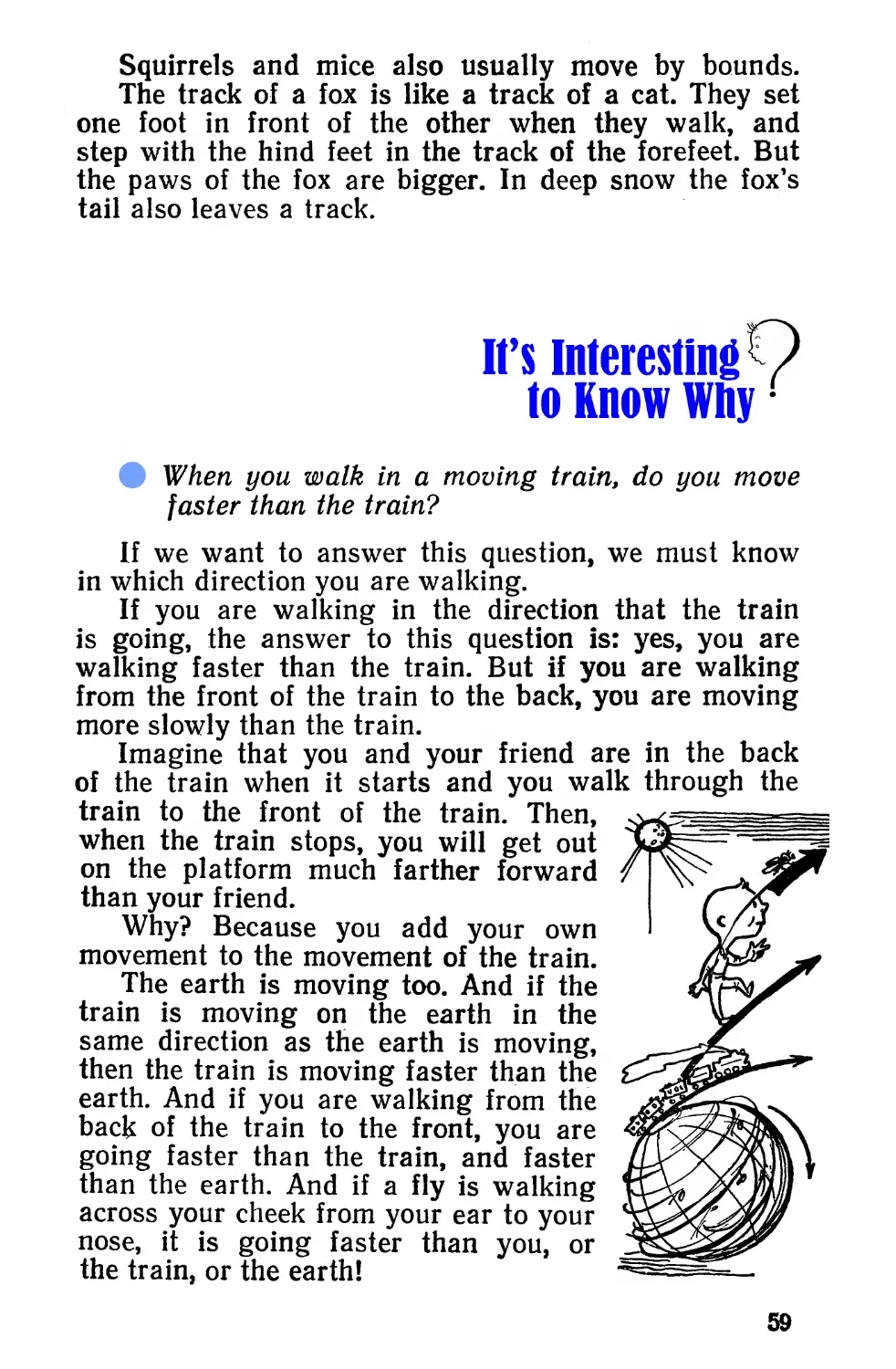
Imagine that you and your friend are in the back
of the train when it starts and you walk through the
train to the front of the train. Then,
when the train stops, you will get out
on the platform much farther forward
than your friend.
Why? Because you add your own
movement to the movement of the train.
The earth is moving too. And if the
train is moving on the earth in the
same direction as the earth is moving,
then the train is moving faster than the
earth. And if you are walking from the
back of the train to the front, you are
going faster than the train, and faster
than the earth. And if a fly is walking
across your cheek from your ear to your
nose, it is going faster than you, or
the train, or the earth!
59
Why a man taps1 the wheels
of a train at the station.
The men who tap the wheels of
trains at the stations must see
that none of the wheels are de-
fective2 before the train goes on.
If the wheel is good, it gives
out a clear, ringing sound. But if
the wheel is broken, it gives out
a cracked sound3 when a man
taps it.
So the men who tap the wheels
are able to discover very quickly
which wheel is good, and which
is bad, and we may say that their
work is very important.
1	to tap — постукивать
2	... that none [плп] of the wheels are defective [di'fektlv] —
... чтобы ни одно колесо не было неисправным
3	a cracked [kraekt] sound — надтреснутый звук
7Ъие 0^.0
forJ-un
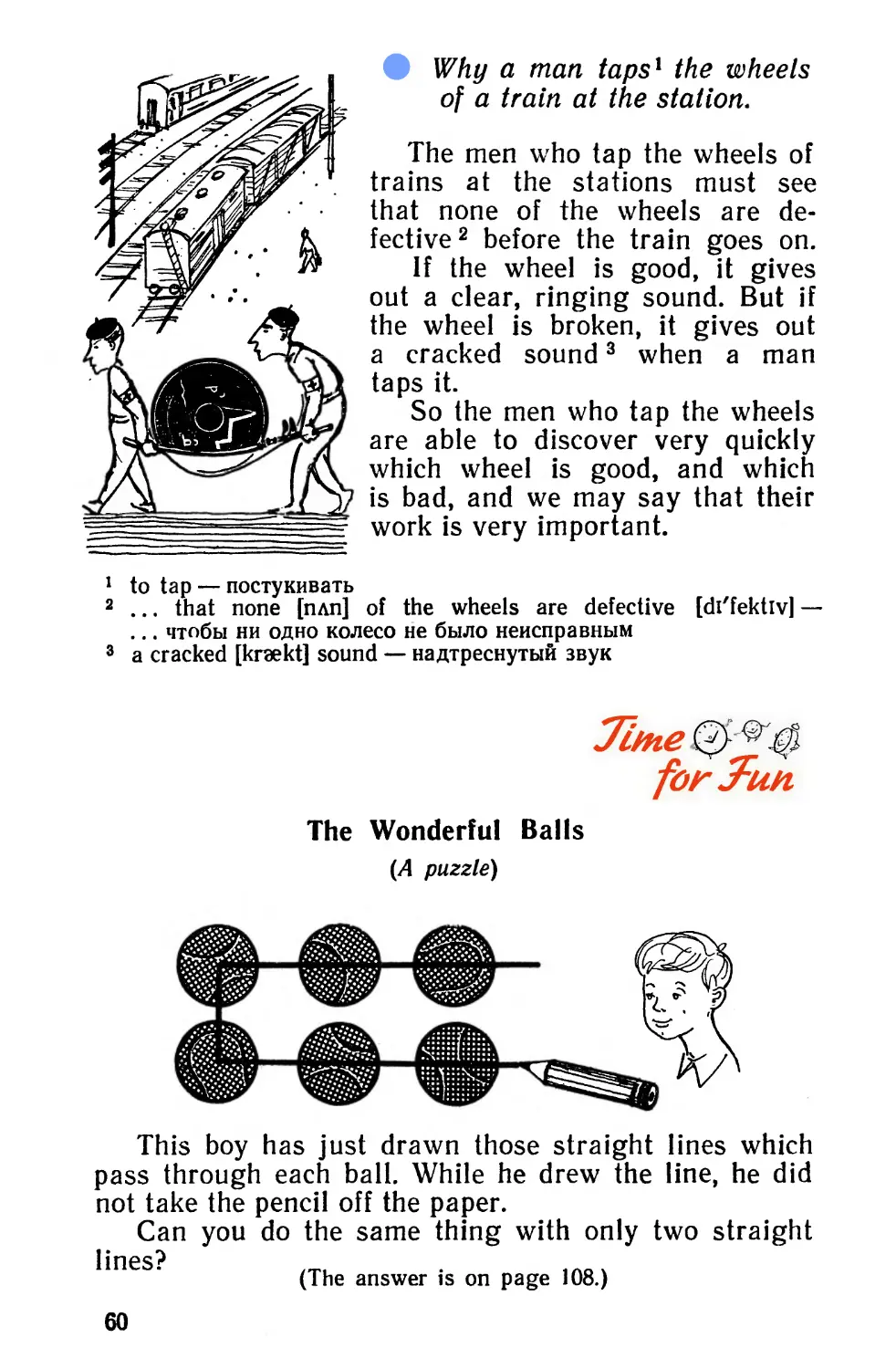
The Wonderful Balls
(Л puzzle)
This boy has just drawn those straight lines which
pass through each ball. While he drew the line, he did
not take the pencil off the paper.
Can you do the same thing with only two straight
lines?
(The answer is on page 108.)
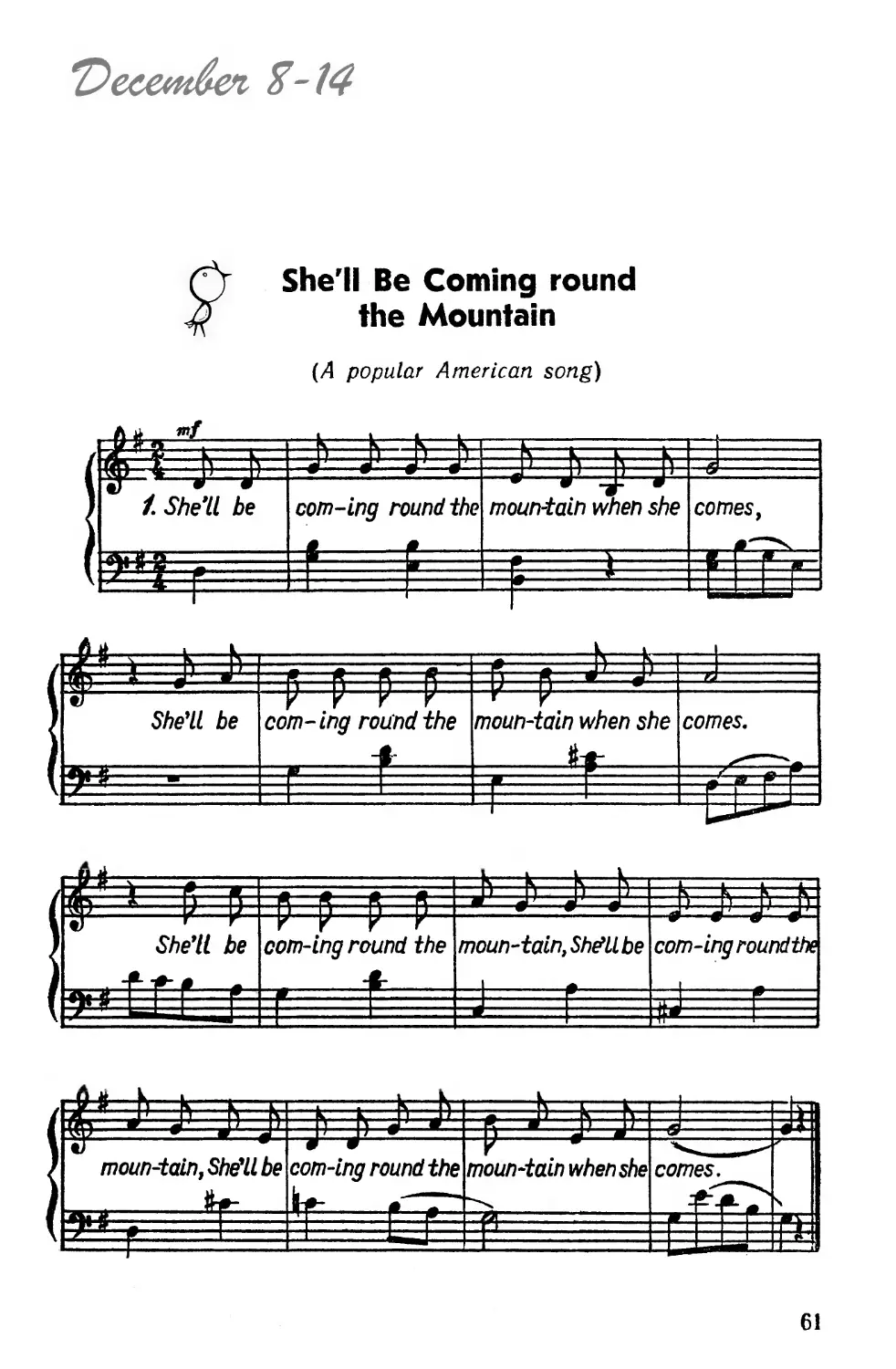
60
She'll Be Coming round
the Mountain
(Л popular American song)
61
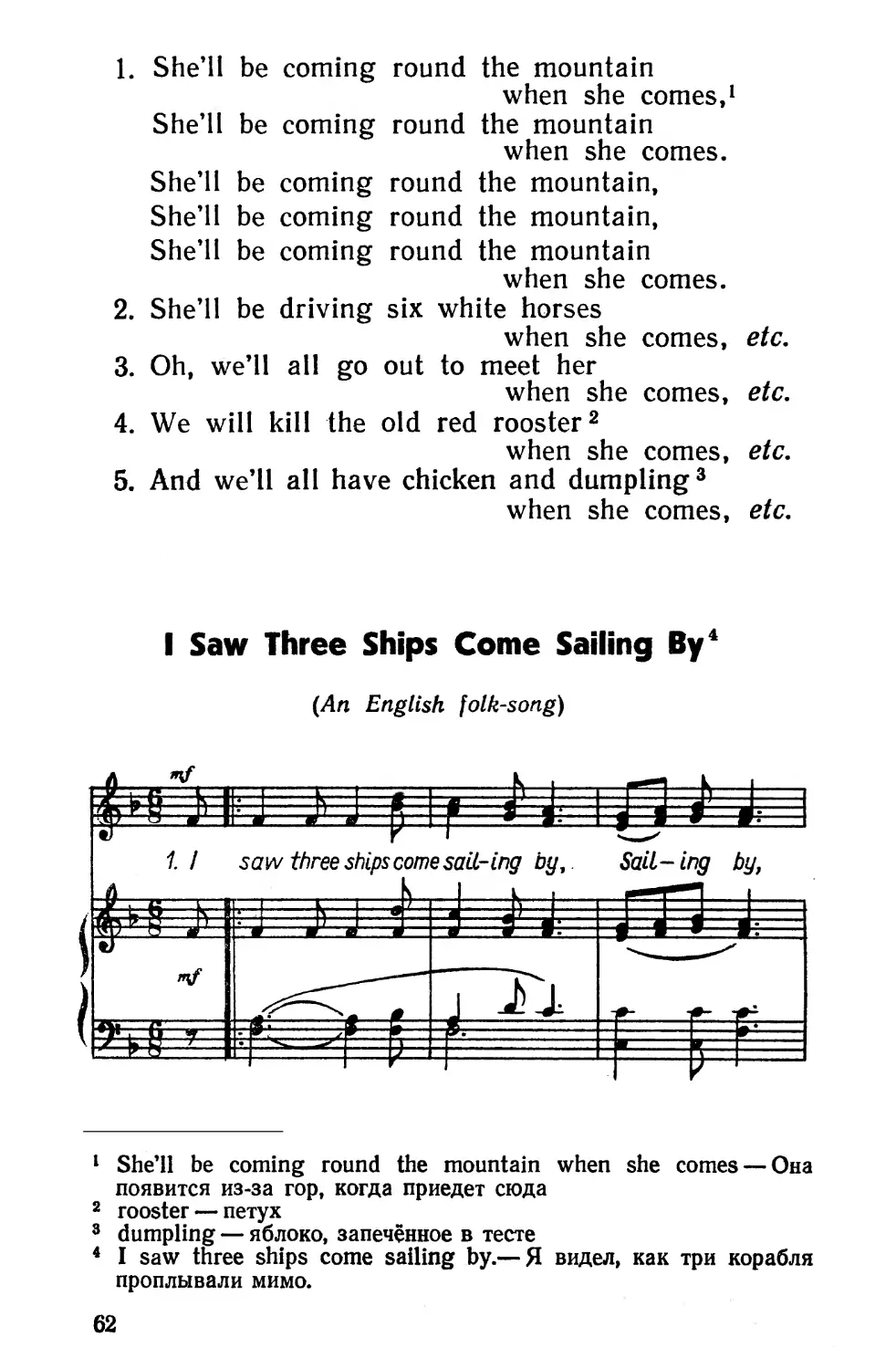
1.	She’ll be coming round the mountain
when she comes,1
She’ll be coming round the mountain
when she comes.
She’ll be coming round the mountain,
She’ll be coming round the mountain,
She’ll be coming round the mountain
when she comes.
2.	She’ll be driving six white horses
when she comes, etc.
3.	Oh, we’ll all go out to meet her
when she comes, etc.
4.	We will kill the old red rooster2
when she comes, etc.
5.	And we’ll all have chicken and dumpling3
when she comes, etc.
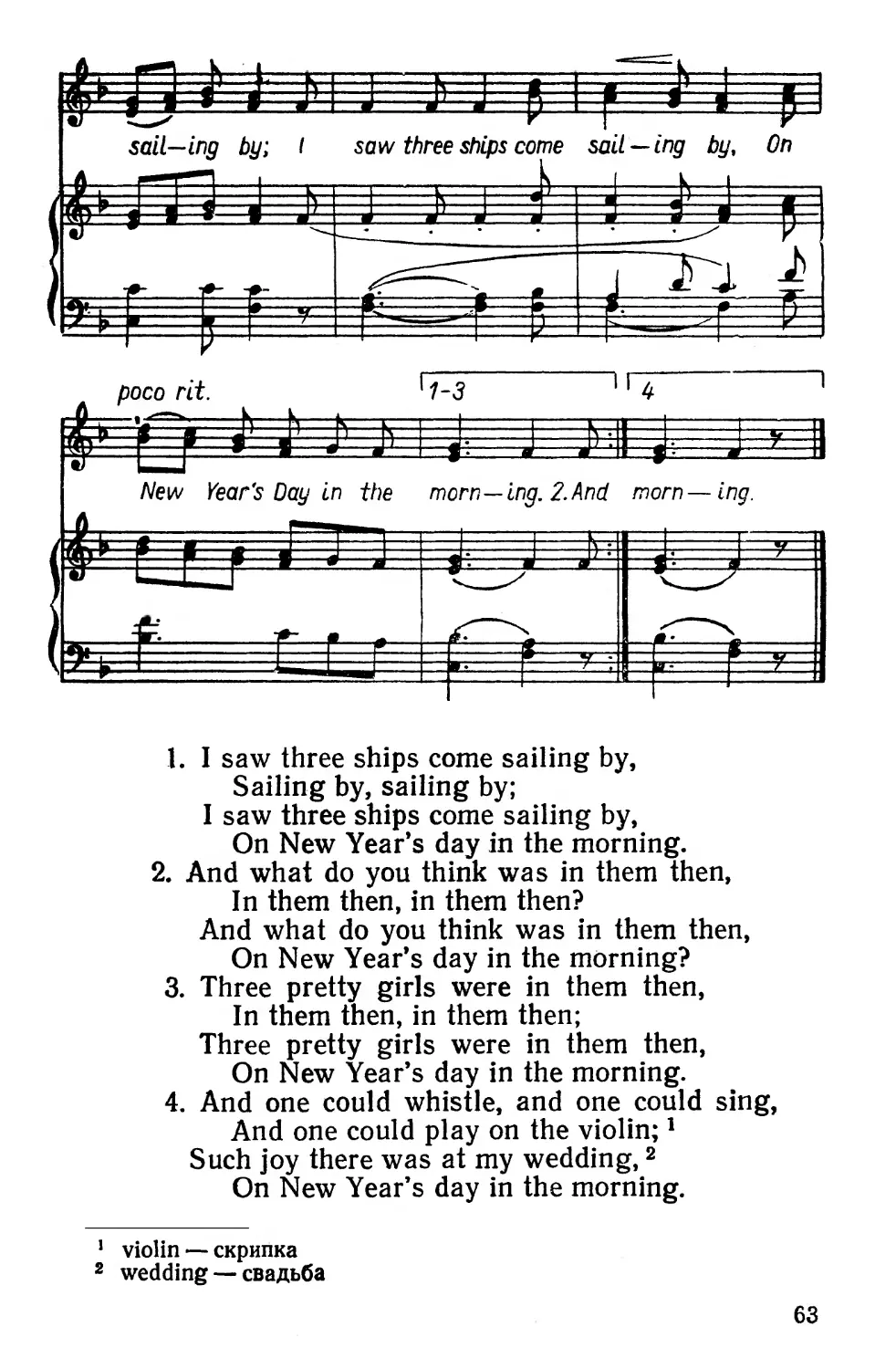
I Saw Three Ships Come Sailing By4
(An English folk-song)
1 She’ll be coming round the mountain when she comes — Она
появится из-за гор, когда приедет сюда
2 rooster — петух
3 dumpling — яблоко, запеченное в тесте
4 I saw three ships come sailing by.— Я видел, как три корабля
проплывали мимо.
62
1.	I saw three ships come sailing by,
Sailing by, sailing by;
I saw three ships come sailing by,
On New Year’s day in the morning.
2.	And what do you think was in them then,
In them then, in them then?
And what do you think was in them then,
On New Year’s day in the morning?
3.	Three pretty girls were in them then,
In them then, in them then;
Three pretty girls were in them then,
On New Year’s day in the morning.
4.	And one could whistle, and one could sing,
And one could play on the violin;1
Such joy there was at my wedding,1 2
On New Year’s day in the morning.
1 violin — скрипка
2 wedding — свадьба
63
TEA OR COFFEE!
A man was having breakfast in an English hotel. He
took a drink from his cup and then said to the waiter,
“Is this tea or coffee?”
“Can’t you tell the difference, sir, by the taste?” 1
“No,” said the man. “I can’t.”
“Well,” said the waiter, “if you can’t tell the differ-
ence, what does it matter1 2 which it is?”
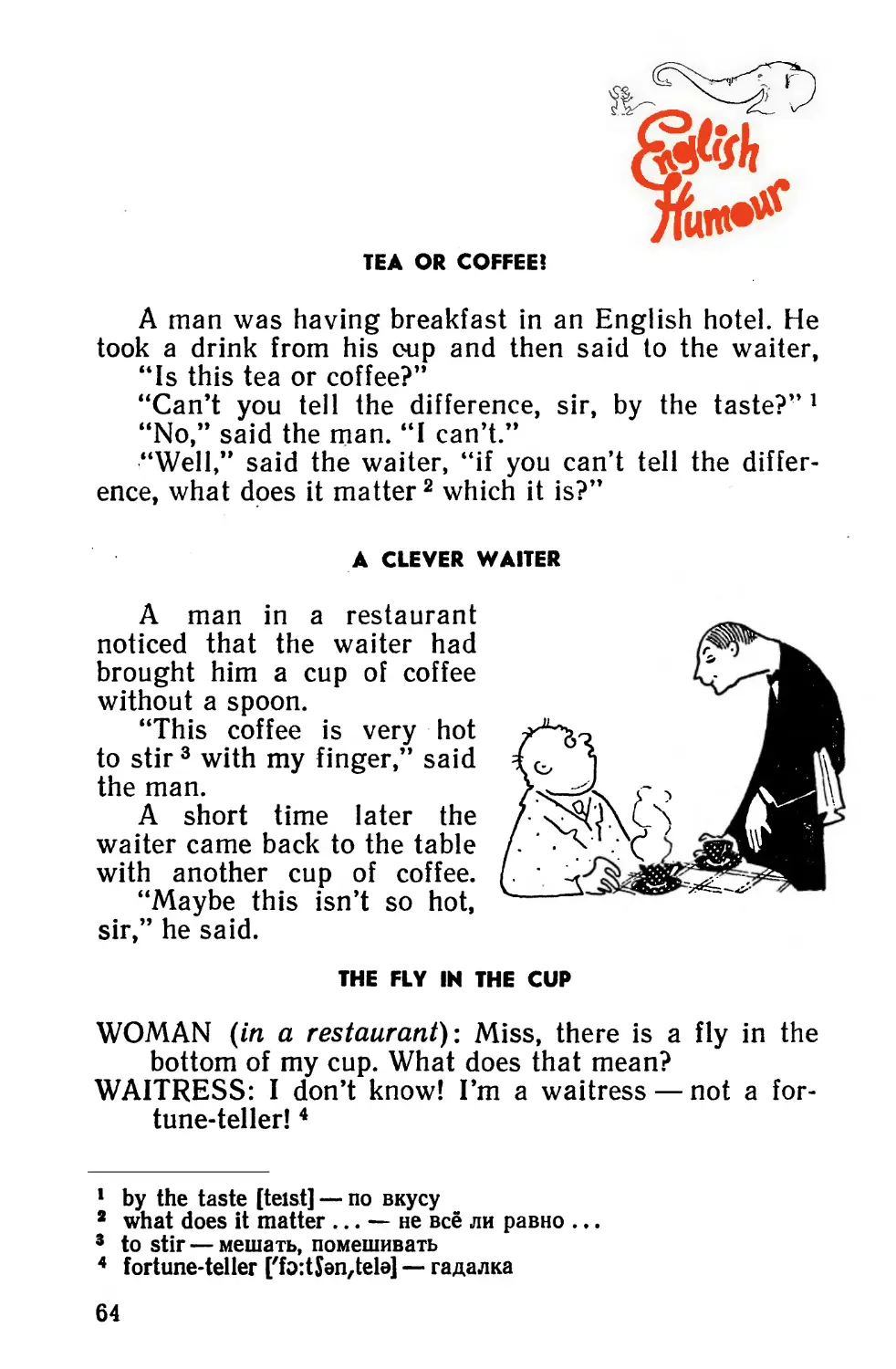
A CLEVER WAITER
A man in a restaurant
noticed that the waiter had
brought him a cup of coffee
without a spoon.
“This coffee is very hot
to stir 3 with my finger,” said
the man.
A short time later the
waiter came back to the table
with another cup of coffee.
“Maybe this isn’t so hot,
sir,” he said.
THE FLY IN THE CUP
WOMAN (in a restaurant): Miss, there is a fly in the
bottom of my cup. What does that mean?
WAITRESS: I don’t know! I’m a waitress — not a for-
tune-teller! 4
1 by the taste [teist]— по вкусу
2 what does it matter ... — не всё ли равно ...
3 to stir — мешать, помешивать
4 fortune-teller [То:tSan,tela] — гадалка
64
'Decem&en 15-21
Words
to Remember
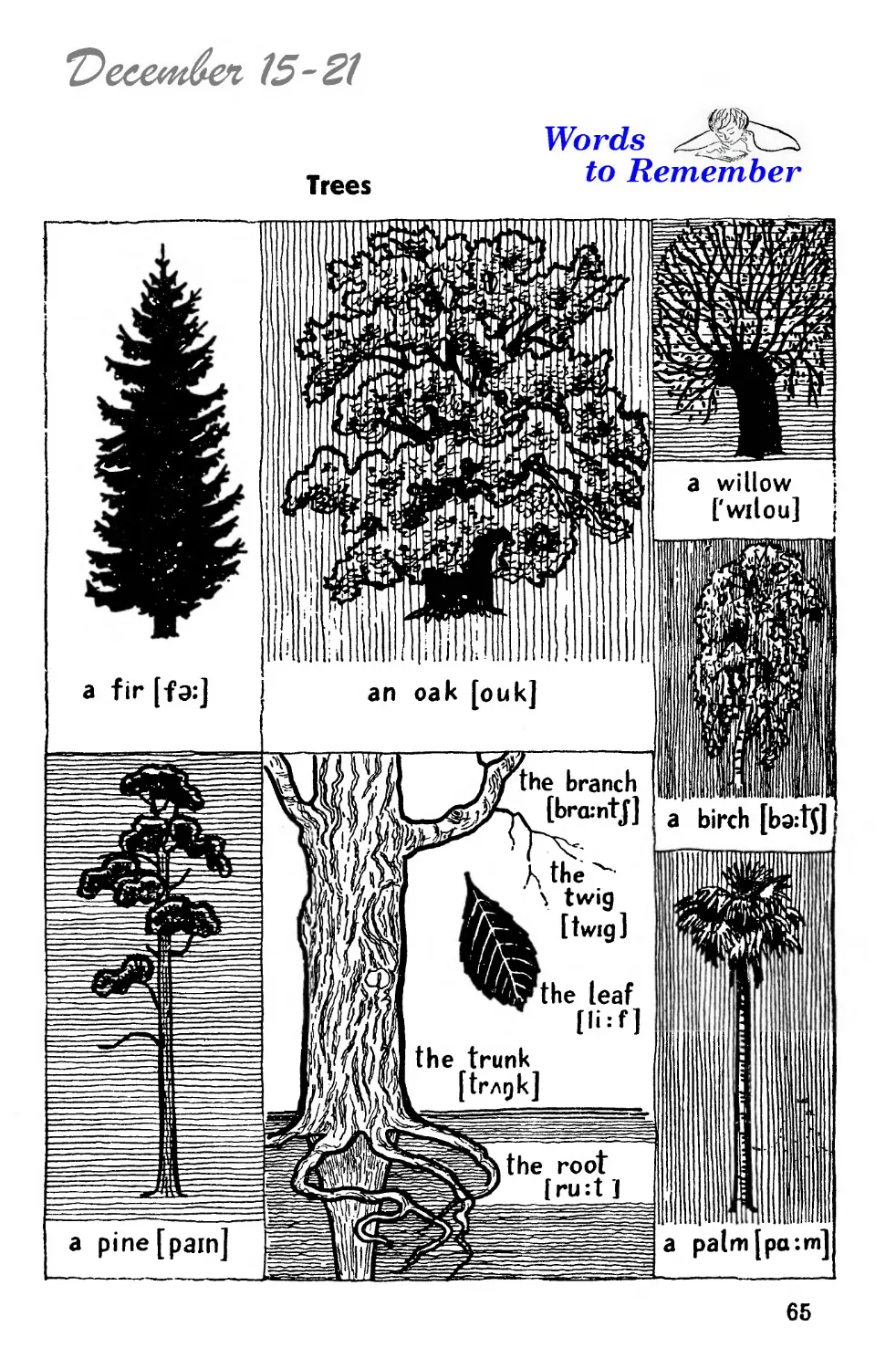
Trees
65
DO YOU P
Know.„
... how a plant can grow on a bare wall?
One of the most important parts of the food of
green plants is carbon, and the plant finds it, or rather
carbonic acid which contains carbon, in the air. But
that is not all. The plant must have water and must
have salts.
When we begin to look at a bare wall closely, we
find that it is not so bare as it seems.
First we may say that rain falls on it, and so the
plant of the wall gets its water. Then rain contains
small quantities of salts. As the rain goes down the
wall, it gets more salts.
So we can see that plants can get even on a bare
wall those things which are necessary for their life.
But, of course, a plant which grows on a bare wall
cannot get much food. So a plant on a bare wall can
never reach a large size.
... why a tree stops growing? We may ask the
same question about men, or horses, or birds.
The growth of living things is not like the growth
of a snowball. A snowball grows as soon as it gets
more and more snow. There is nothing inside it that
limits its growth.
But every living thing has something inside that
limits its growth. We may say that every living thing
grows to the size which suits it.1 After that it stops
growing and lives as long as it can.
... that a growing plant can push very hard against
anything that gets in its way? 1 2 If soft, little ferns3
begin to grow underneath a sidewalk,4 they can crack
the cement.
1 ... to the size which suits [sjuzts] it— ... до таких размеров,
которые пригодны для него
2 ... that gets in its way — ... что попадается на его пути
8 fern — папоротник
4 underneath [,Anda'ni:0] a sidewalk ['saidwo:k] — под тротуаром
66
What Do We Plant!
What do we plant when we plant the tree?
We plant the ship which will cross the sea.
We plant the mast1 to carry the sails;
We plant the planks 2 to withstand the gales 3 —
The keel, the keelson, the beam, the knee; 4
We plant the ship when we plant the tree.
What do we plant when we plant the tree?
We plant the houses for you and me.
We plant the rafters, the shingles,5 the floors;
We plant the studding, the lath,6 the doors,
The beams and siding,7 all parts that be; 8
We plant the house when we plant the tree.
What do we plant when we plant the tree?
A thousand things that we daily see;
We plant the spire that out-towers the crag.9
We plant the staff10 for our country’s flag.
We plant the shade from the hot sun free;11
We plant all these when we plant the tree.
1
2
3
4
5
б
7
8
9
10
11
mast [mast] — мачта
plank — планка, доска
to withstand the gales — чтобы выдерживать штормы
the keel, the keelson ['kidsan], the beam [bi:m], the knee [ni:]—
киль, кильсон, бимс, кница (части судна)
rafter [Tafta] — балка; shingle — дранка
studding — стойка (в деревянной перегородке); lath [1а6] —
рейка, дранка
beam — балка; siding — боковая стенка
that be = that must be
the spire ['spaia] that out-towers ['aut'tauaz] the crag — шпиль,
который возвышается над утёсом
staff [staf] — флагшток
the shade from the hot sun free — тень, защищающая нас от
палящего солнца
67
Time 0 <4$
for Jun
Dots and Dashes 1
(A game)
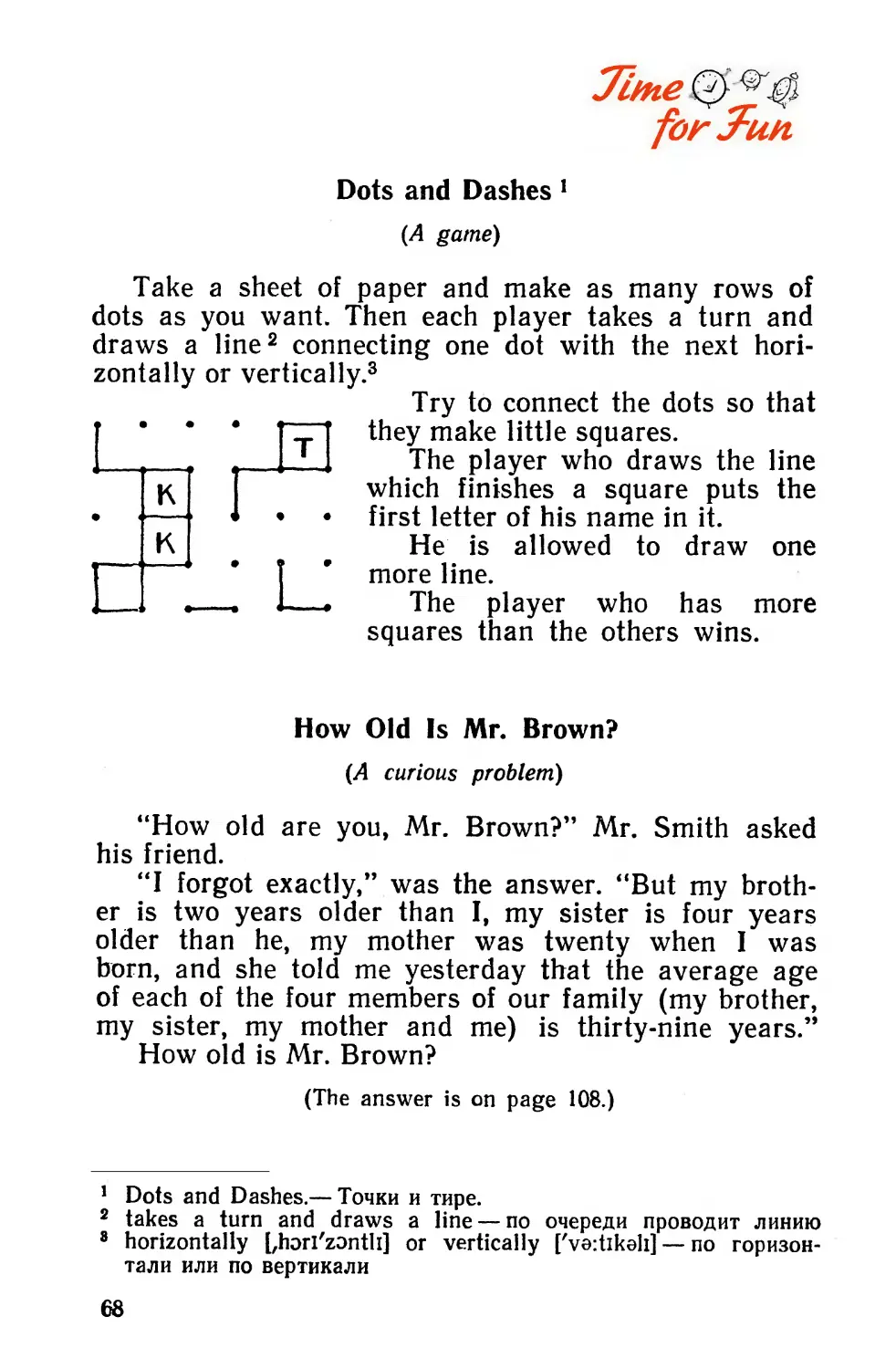
Take a sheet of paper and make as many rows of
dots as you want. Then each player takes a turn and
draws a line1 2 connecting one dot with the next hori-
zontally or vertically.3
Try to connect the dots so that
,rZ7f they make little squares.
lrJ .J The player who draws the line
which finishes a square puts the
• • first letter of his name in it.
He is allowed to draw one
more line.
<—•	The player who has more
squares than the others wins.
How Old Is Mr. Brown?
(A curious problem)
“How old are you, Mr. Brown?” Mr. Smith asked
his friend.
“I forgot exactly,” was the answer. “But my broth-
er is two years older than I, my sister is four years
older than he, my mother was twenty when I was
born, and she told me yesterday that the average age
of each of the four members of our family (my brother,
my sister, my mother and me) is thirty-nine years.”
How old is Mr. Brown?
(The answer is on page 108.)
1 Dots and Dashes.— Точки и тире.
2 takes a turn and draws a line — по очереди проводит линию
8 horizontally [,horl'z3ntll] or vertically ['veitikeli] — по горизон-
тали или по вертикали
68
'Decewt&e’i 22-2%
Read It Yourself
and then tell it in your own words
to your younger sister or brother.
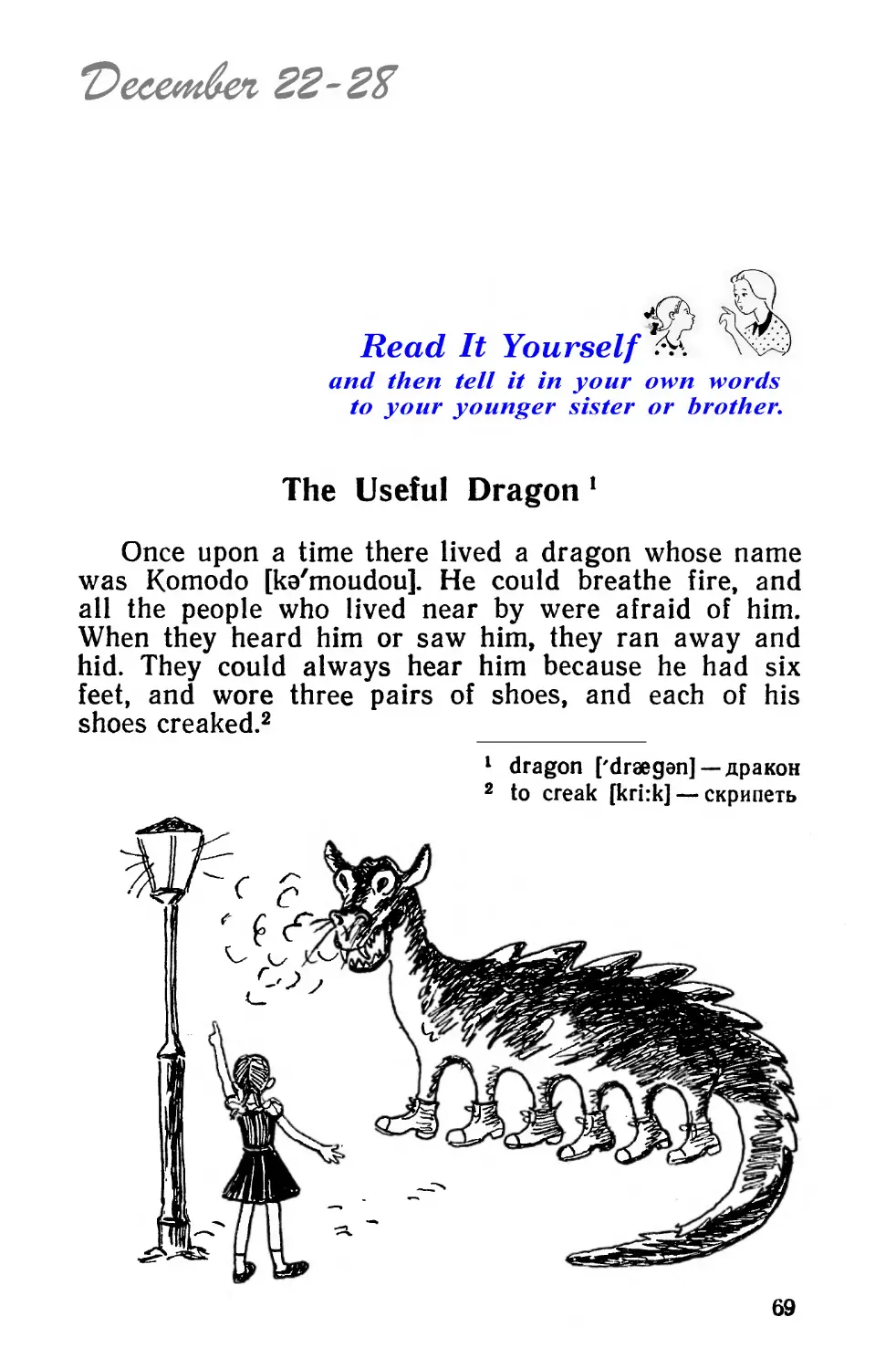
The Useful Dragon 1
Once upon a time there lived a dragon whose name
was Komodo [ko'moudou]. He could breathe fire, and
all the people who lived near by were afraid of him.
When they heard him or saw him, they ran away and
hid. They could always hear him because he had six
feet, and wore three pairs of shoes, and each of his
shoes creaked.2
1 dragon pdraegan] — дракон
2 to creak [kri:k] — скрипеть
69
One day he met a little girl who wasn’t afraid of
him.
“Why are you so fierce?” she said. “Why do you
breathe fire when you see anybody?”
“Well,” said Komodo, “I never really thought about
it. Shall I stop it?”
“Yes, please,” said the little girl whose name was
Susie ['sjurzi].
“All right,” said Komodo, “I’ll try.”
They said good-bye to each other, and Susie went
home. It was beginning to get dark. Susie was surprised
because all the lamps in the town were not lit. She
found out that it was because of the lamplighter,1
whose name was Charlie. He hadn’t lit1 2 the street
lamps.
He was still in bed. He was tired after lighting the
lamps the night before.
The mayor of the town was very angry. “What must
I do about that?” he thought.
Then Susie had an idea. She ran to Komodo’s cave,
brought him to the town and he breathed fire on each
lamp and lit it.
How glad the people were! Now they were not
afraid of the dragon. They could see he was a friendly
animal. And after that Komodo came and lit the lamps
every time when Charlie had his holiday.
Company Manners3
When company comes
You are very polite,
And we are proud of you, Son,
For your manners are right.
1 lamplighter ['laemp'laite] — фонарщик
2 hadn’t lit — не зажёг
8 Company ['клтраш] Manners.— Манеры поведения в обществе
(company — общество, компания).
70
You say, “Thank you” — “Excuse me”1 —
And, “After you, please!” * 2
You shake hands 3 all around
With such polish and ease.4
When grown-ups are talking
You don’t make a sound.
It’s a joy and a pleasure
To have you around.5
Your company manners
Are fine through and through 6 ...
But try, Son, to use them
For everybody, too!
TOMMY'S BIRTHDAY
MOTHER: You are five today. Happy birthday to you!
TOMMY: Thank you, Mama [тэ'та].
MOTHER: Would you like7 to have a cake with five
candles on it for your birthday party?
TOMMY: I think I’ll better have five cakes and one
candle, Mama.
A BRAVE GIRL
AUNT ANN: Well, Nelly, were you brave at the dentist?
NELLY: Yes, Auntie, I was.
* Excuse [iks'kju:z] me.— Извините.
2 After you, please.— Пожалуйста, проходите. (Когда хотят усту-
пить кому-нибудь дорогу.)
3 to shake hands — здороваться за руку
4 With such polish f'pollj] and ease [i:z]— с такой изысканностью
и непринуждённостью
5 around — зд.: рядом
6 Are fine through [flru:] and through — всегда прекрасны
7 Would [wudj you like,.. ? — Ты хотел бы... ?
71
AUNT ANN: Then, there is the sweet I promised you.
And now tell me what he did to you.
NELLY: He pulled out1 two of Willie’s teeth.
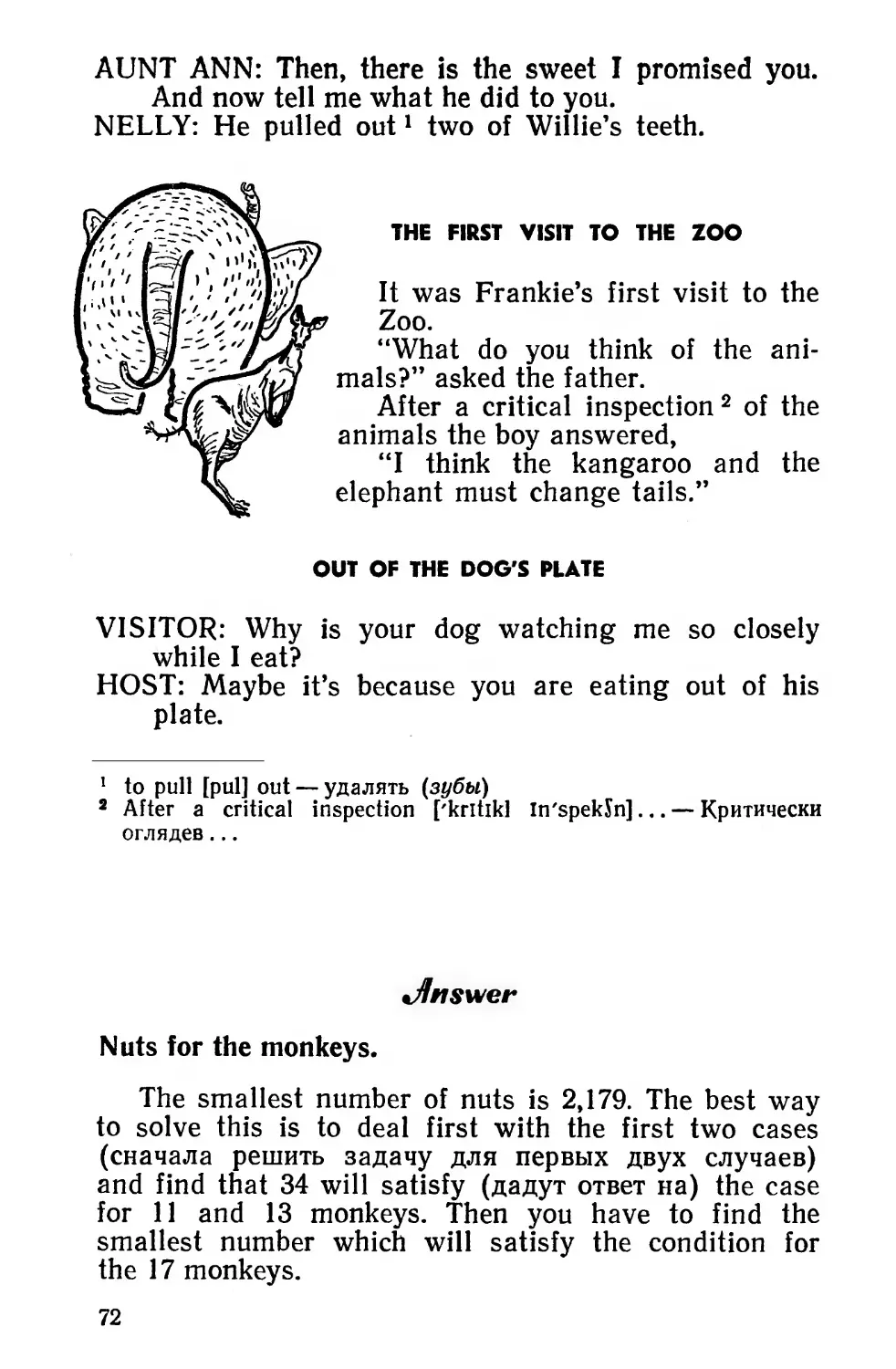
THE FIRST VISIT TO THE ZOO
It was Frankie’s first visit to the
Zoo.
“What do you think of the ani-
mals?” asked the father.
After a critical inspection 2 of the
animals the boy answered,
“I think the kangaroo and the
elephant must change tails.”
OUT OF THE DOG'S PLATE
VISITOR: Why is your dog watching me so closely
while I eat?
HOST: Maybe it’s because you are eating out of his
plate.
1	to pull [pul] out — удалять (зубы)
2	After a critical inspection ['kritikl In'spekSn]... — Критически
оглядев...
Jlnswer
Nuts for the monkeys.
The smallest number of nuts is 2,179. The best way
to solve this is to deal first with the first two cases
(сначала решить задачу для первых двух случаев)
and find that 34 will satisfy (дадут ответ на) the case
for 11 and 13 monkeys. Then you have to find the
smallest number which will satisfy the condition for
the 17 monkeys.
72
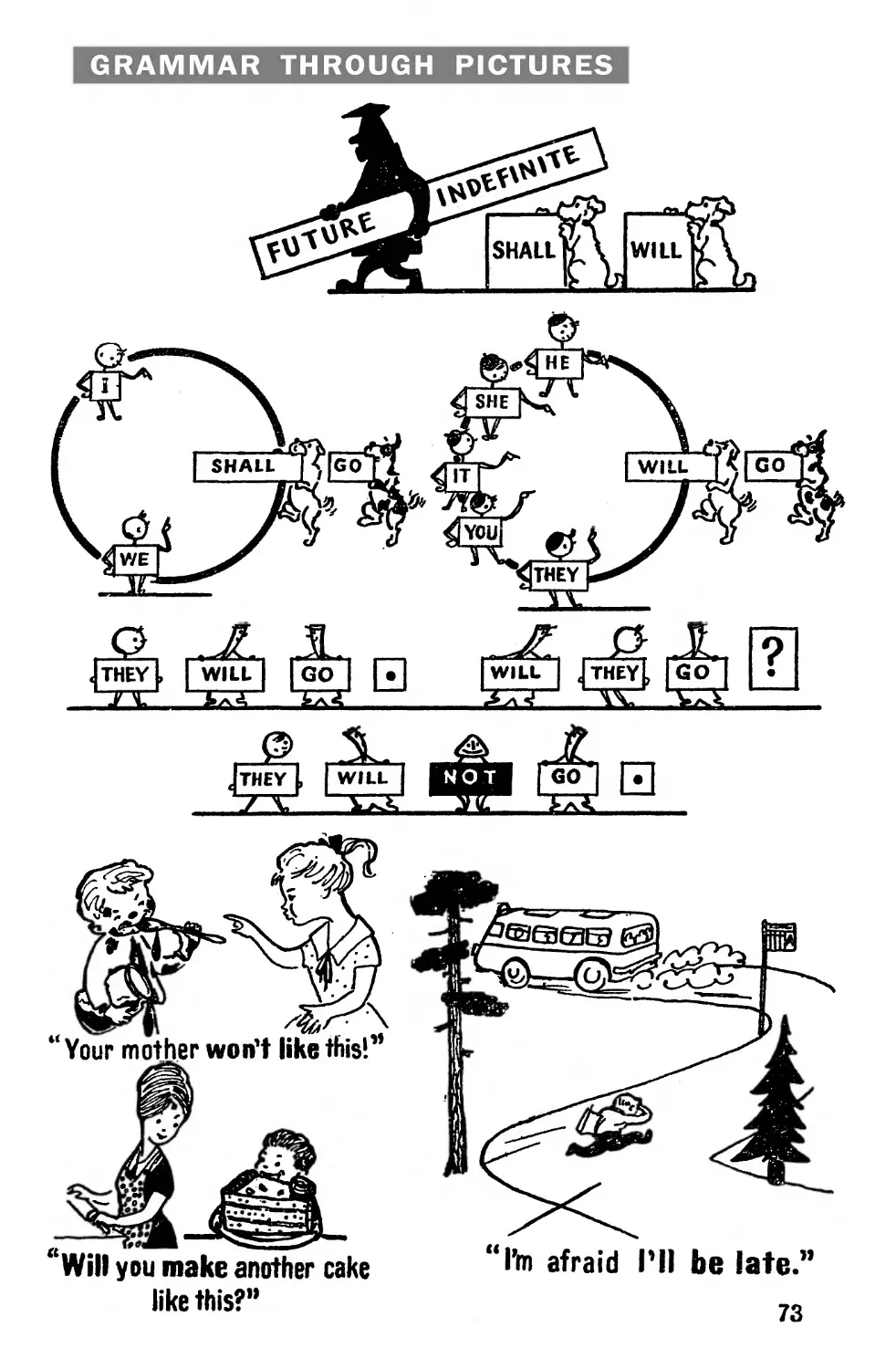
GRAMMAR THROUGH PICTURES
“Will you make another cake	afraid I’ll be late.”
like this?”

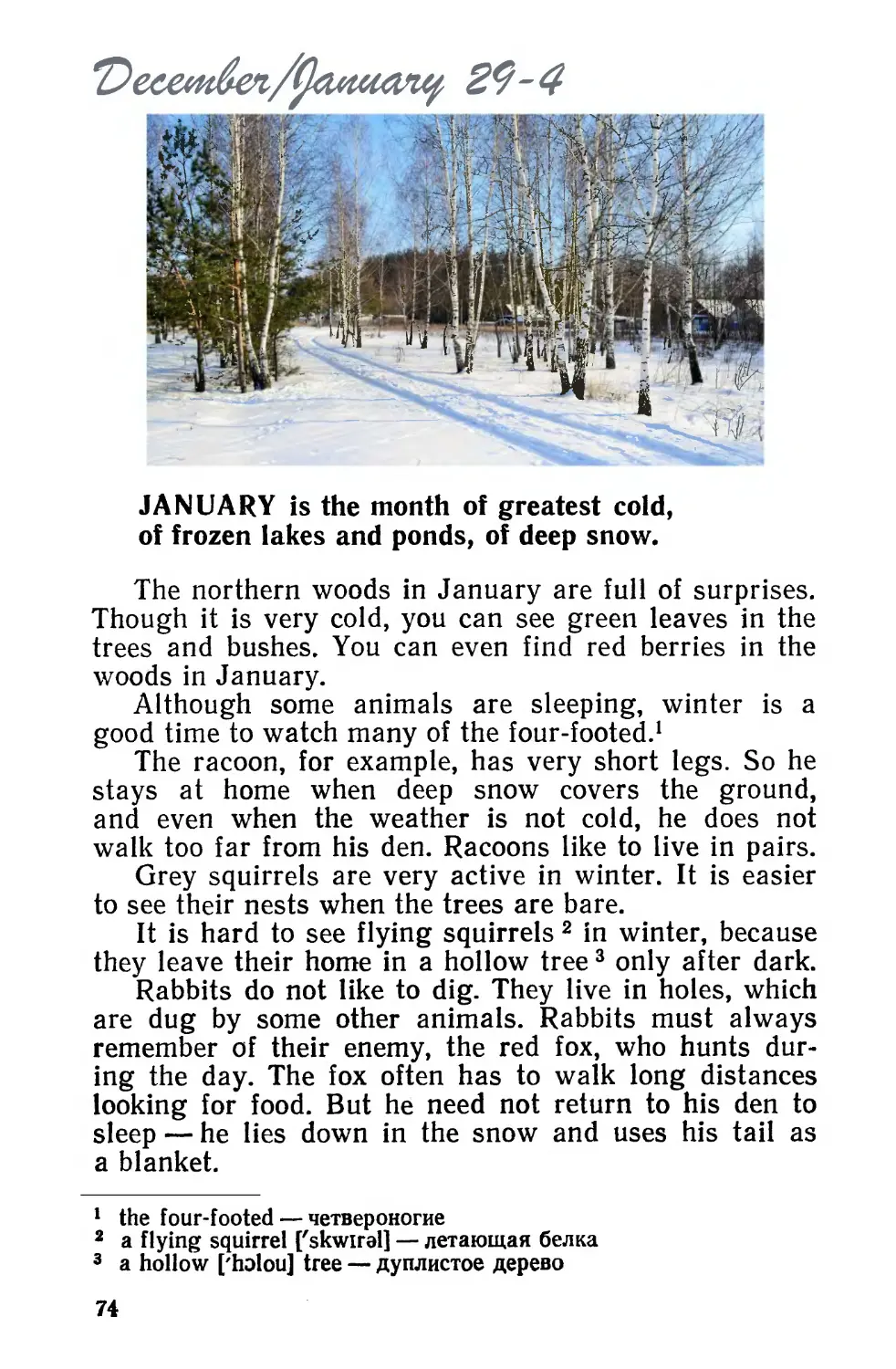
JANUARY is the month of greatest cold,
of frozen lakes and ponds, of deep snow.
The northern woods in January are full of surprises.
Though it is very cold, you can see green leaves in the
trees and bushes. You can even find red berries in the
woods in January.
Although some animals are sleeping, winter is a
good time to watch many of the four-footed.1
The racoon, for example, has very short legs. So he
stays at home when deep snow covers the ground,
and even when the weather is not cold, he does not
walk too far from his den. Racoons like to live in pairs.
Grey squirrels are very active in winter. It is easier
to see their nests when the trees are bare.
It is hard to see flying squirrels 1 2 in winter, because
they leave their home in a hollow tree3 only after dark.
Rabbits do not like to dig. They live in holes, which
are dug by some other animals. Rabbits must always
remember of their enemy, the red fox, who hunts dur-
ing the day. The fox often has to walk long distances
looking for food. But he need not return to his den to
sleep — he lies down in the snow and uses his tail as
a blanket.
1 the four-footed — четвероногие
2 a flying squirrel fskwiral] — летающая белка
3 a hollow ['holou] tree — дуплистое дерево
74
This week your winter holidays begin. New Year
tree parties2 will be arranged for you. The lights of
New Year trees will be switched on everywhere, and
Father Frost and Snow Maiden 3 will greet all of you.
We wish you twelve days of great fun, dear readersl
fок Лип
What Do You Think?
There once was a racehorse
That won great fame.4
Now what do you think
Was the horse’s name?
Can you guess the name of the racehorse?
(The answer is on page 108.)
1 excellent success ['eksalent sak'ses] in studies — отличные успехи
в учёбе
2 a New Year tree party — вечер новогодней ёлки
3 Father Frost and Snow Maiden — Дед-Мороз и Снегурочка
4 won [wah] great fame — завоевала большую известность
75
The Puzzled Book-keeper1
One day a book-keeper noticed that the word balloon
had in it two double letters, one after the other.
“Is there a word that has three double letters one
after the other?” the book-keeper thought.
There is, and the word is on this page. Can you
find it?
Change the Animal
Take one letter away from the word zebra [Zzi:bro]
and rearrange the remaining letters so as to get
another animal.
Make the Square
Cut this ‘E’ into four pieces, and then
try to make a square with these four
pieces.
When you draw the letter on a sheet
of paper, the proportions1 2 of it must be
as they are shown in the picture.
(The answers are on page 113.)
New Year Presents
(Л game)
You may play this game at your New Year’s
party.
Put the presents for the players who take part in
the game in a targe box or bag and place it on the
table. The players have to stand in a line a few metres
from the table.
At a signal, the players must hop to the table, find
the parcel with his or her name on it and hop back.
1 The Puzzled ['pAzld] Book-keeper.— Озадаченный бухгалтер.
2 proportion [ргэ'рэ: Sen] — пропорция
76
The player who hops back first must have one more
present, and the player who forgets to hop back must
also have one more silly present, such as a piece of
chalk or a piece of orange skin.
Riddles
1.	If a blue stone falls into the Red Sea,
what will happen?
2.	What goes through a door, but never
goes in or comes out?
3.	What has a tooth that a tree has?
4.	Why do ducks and geese fly North in
the springtime?
5.	Why can’t it rain for two days without stopping?
6.	What speaks every language?
7.	There is a word of five letters. If you take away two
letters, only one remains. What is the word?
(You can find it on this page.)
8.	How many peas are there in a pint? 1
(The answers are on page 113.)
1 pint [paint] — пинта (английская мера ёмкости » 0t57 литра)
Juswer
The wonderful
scissors.
77

Jbne 0
forJ-un
Sausage 1
(A game)
All players sit in a circle and ask “It” such ques-
tions as “What is your favourite fruit?” — “What is
your nose like?” — “What do you put on in the morn-
ing when it is cold in the street?” and so on.
To every question “It” must answer “Sausages.”
If he laughs or even smiles, he drops out of the game,
Then another player must take his place in the centre
of the circle.
The winner is the player whom the players cannot
make laugh or smile. And it is not very easy to remain
serious in this game as it may seem.
A Question of Transport1 2
(A curious problem)
Twelve men had to get to a neighbouring town,
which was 20 miles away, as fast as possible, and
they had to arrive there at exactly the same time.
A man with a small car agreed to help them.
“I can do twenty miles an hour,” he said, “but I
can’t carry more than four men at a time.3 How fast
can you walk?”
1 sausage ['so:sid3] — колбаса
2 A Question of Transport f'traenspo:t]— Транспортная проблема
3 at a time — за один раз
78
“АП of us can walk four miles an hour,” they an-
swered.
“Very well,” said the driver, “I’ll go ahead with
four men, drop1 them somewhere on the road, and
they will walk. Then I’ll return and take four more
men (who will be somewhere on the road), drop them
also, and return for the last four. So you must go on
walking, and I’ll do the rest.”1 2
As they started at noon, at what time did they all
arrive?
(The answer is on page 117.)
Read by the Lips 3
(Л game)
All players stand in a line. The first in line goes
forward and faces the line. His lips form4 an English
command, such as “Jump”, or “Dance”, or “Run to the
tree”. The player who is next to him goes quickly for-
ward and stands beside him. Then his lips form what
he thinks the first player has said, and so on until the
end of the line.
It is very interesting to hear what the last player
will say.
СГ White Fields
I.
In the winter time we go
Walking in the fields of snow;
Where there is no grass at all;5
Where the top of every wall,
Every fence and every tree
Is as white as white can be.
1 to drop — зд.: высаживать (из автомобиля)
2 the rest — остальное
3 Read by the Lips.—Читай по губам.
4 his lips form —его губы складываются, как при произнесении
5 at all — совсем
79
2.
Pointing out the way we came,—
Everyone of them the same—
All across the fields there be
Prints in silver filigree;1
And our mothers always know
By our footprints in the snow
Where the children go.
ARTIST AND VISITOR
ARTIST: That is a cow grazing,1 2 sir.
VISITOR: Where is the grass?
ARTIST: The cow has eaten it.
VISITOR: But where is the cow?
ARTIST: What for3 do you
think she may stay here
after she has eaten all the
grass?
AT A SMALL RAILWAY STATION
MAN (to station-master):4 When does the next west-
bound train 5 arrive?
STATION-MASTER: At 3 p. m.6
MAN: And the next east-bound train?
STATION-MASTER: At 4 p. m.
MAN: And the next north-bound train?
STATION-MASTER: Arrives at 6 p. m.
MAN: And the south-bound train?
STATION-MASTER: Oh, it left two hours ago.
MAN: Well, I guess it’s safe to cross the tracks now.
1 filigree ['filigri:] — филигрань
2 to graze — пастись
3 What for ... — Для чего ...
4 station-master — начальник станции
5 a west-bound train — поезд, направляющийся на запад
6 р. m. ppi:'em] = post medium ['poust 'mi:diem] = after noon
(время c 12 часов дня до 12 часов ночи)
80
fawiaruf 12-12
THE OLD MAN
AND HIS PIG
(Д tale)
There was once a village. The name of the village
was Ulm. The people who lived in Ulm were not very
clever. They believed everything they heard, and they
were sure you would fall off the earth 1 if you ever
came to the edge of it.
The wisest man in Ulm had a pig that he loved
very much. And when he had to go away, he took the
door of his house with him, so that thieves could not
break into his house 1 2 and steal his pig.
One day when he was carrying his door on his
back, he met an old woman.
“Why do you carry that door on your back?” the
old woman asked.
“So that thieves will not break into
steal my little pig,” answered the wise
old man.
“Well, I have nothing in my own
house worth taking,”3 said the old
woman, “but I have a wonderful gar-
den. I’ll go back and take the gate,
and then nobody will be able to get
into my garden and take my pota-
toes.”
1 you would fall off the earth — что можно
упасть с земли
2 ... break into his house — ... вломиться к не-
му в дом
3 I have nothing in my own house worth [wa:6]
taking — у меня в доме нет ничего такого,
что стоило бы взять
my house and
81
but I
So the old woman went back and
took her gate and put it on her shoul-
ders.
Very soon the wise old man met a
young farmer who said,
“Why do you carry that door on your
back, old man?”
“Oh, so that thieves will not break into
my house and steal my little pig.”
“Well,” said the farmer, “I have
often worried that somebody will come
near my pond and frighten my ducks.
I have put a great fence around the
see that it’s not enough. I’ll go home
and dig up the fence and carry it with me. Then no-
body will be able to get through it to the pond.”
So the young farmer went home and dug up the
fence, and the old man went on his way with the heavy
door on his back.
Soon the old man met another woman.
“Why do you carry that heavy door on your back,
old man?” she asked him.
“Oh, so that thieves will not break into my house
and steal my little pig.”
“That is very wise,” said the woman. “Now I know
what I shall do. I have bought a beautiful bed, and I
am always afraid that somebody will lie on it in dirty
clothes. I’ll go home and take my
nobody will be able to lie on my
bed.”
So the woman went home and
took the door and carried it about
the town. And the wise old man went
on his way.
Soon the old man came to where
he was going, and then he turned
around and went back home. When
he came home, he began to call his
pig. But the pig did not come.
“That’s strange,” the old man
said. “Nobody has taken it, because
nobody could break into the house,
because there was no door.”
door, too. Then
82
The old man looked under all the chairs, and the
table, and the bed, but could not find his pig. He went
out and walked down the road.
Soon he came to the old woman’s house.
“Have you seen my pig?” he asked.
“No, I have not seen your pig. But somebody has
been in my garden and has dug up all my vegetables.
I cannot understand how it happened, because I took
the gate with me. So nobody could come in!”
The old man shook his head and went on his way.
Next he met the young farmer.
“Have you seen my pig?” he asked.
“I have not seen your pig,” the farmer said, “but
somebody came to the pond and frightened all my
ducks.”
The old man said nothing and went on his way.
When he passed the young woman’s house, he heard
a great noise. He went in. The young woman stood
near her bed crying.
“My bed, my clean bed!” she shouted.
And there was his pig in the middle of the bed!
“I do not understand,” said the old man. “How
could my pig come in if you took the door with you?”
83
“I don’t know,” the woman cried. “What shall
1 do?”
The old man thought and thought.
“1 know,” he said, “I should have taken my pig
with me,1 instead of the door.”
“And I,” the young woman said, “should have taken
my bed with me, instead of my door.”
“And I should have taken my ducks with me, in-
stead of the fence,” said the young farmer, who came
up to them.
“And I should have taken my vegetables with me,
instead of the gate,” said the old woman, who came
up just then.
“That’s what we’ll do from now on,”1 2 they all said.
And that’s what they did, of course. As the old man
carried his pig all the time, it got thin,3 and the old
woman’s garden did not grow, and the young farmer’s
ducks never laid any more eggs, and the young wo-
man’s bed became very dirty, but, as the old man very
wisely said,
“What does that matter so long as our things are
safe?”4
And all the silly people of Ulm agreed he was
right, and very, very wise.
1 I should [Sud] have taken my pig with me — Мне бы следовало
взять с собой моего поросёнка
2 from now on — отныне и впредь
8 to get thin — худеть
4 What does that matter so long as our things are safe? —Какое
это имеет значение, раз наши вещи в целости и сохранности?
84
fawany 19-25
Words
to Remember
Sports
running
lawn - tennis [' b.rrtems]
volley-ball MЬз:|]
85
86
87
To train тренироваться.
Peter is training in jumping.
To take part in a competition ['kompi'tijan]
принять участие в соревновании.
“Will you take part in today’s competition?”—
“Yes, of course.”
To hold a competition проводить соревнования.
The competition in gymnastics is held in our school
every year.
To break the record ['reko:d] побить рекорд.
To set a record установить рекорд.
Misha has set a new school record in discus
throwing.
At all seasons and in all weather we can enjoy
some sport or other. To enjoy sport you must have
strength and skill.
Two of the most popular sports in England are foot-
ball and cricket.1 Tennis is also a very popular game.
When an important football or cricket match takes
place, thousands of people go to watch it — they are
called the spectators.1 2 They become very excited during
the game and shout very loudly.
DO YOU pl
Kiiow.r
... that basket-ball was first played in 1891 in the
town of Springfield in America?
... that ice hockey was first played in the 80th of
the ninteenth century in Canada?
... that in 1956 and in 1964 our ice-hockey team
was European, World and Olympic [ou'hmpik] cham-
pion?
1 cricket — крикет (спортивная игра)
2 spectator [spek'telte] — зритель
88
... that tennis as we know it now was first played
in 1874 in England?
... that table-tennis was first played about 1880?
A BOXER AHD A TRAINER
TRAINER (after the first lesson): Now, have you any
questions?
BOXER: Yes, how much is your correspondence
course? 1
HIGH TEMPERATURE
The champion was told
that he had a temperature.
“How high is it, Doc-
tor?” he wanted to know.
“A hundred and one,”1 2
said the Doctor.
“And what’s the world
record?” asked the cham-
pion.
VICTIM3 OF FOOTBALL
FIRST WOMAN: My son is in bed, a victim of football.
SECOND WOMAN: But I didn’t even know he played
the game.
FIRST WOMAN: He doesn’t. But he is a football fan,4
he sprained his larynx5 at the match last Saturday.
1 How much is your correspondence course [,koris'pondens 'ko:s]? —
Сколько стоит ваш заочный курс обучения?
2 по Фаренгейту
3 victim — жертва
4 a football fan — болельщик футбола
5 he sprained his larynx ['laerioks] — он сорвал голос
89
A CLEVER IDEA
OLD LADY (seeing tug-of-war1 for the first time):
Wouldn’t it be simpler,1 2 dear, for them to get a
knife and cut it?
forJ-un
Measure the Water
(Л curious problem)
A girl was sent to the well with two jugs. One of
them could contain 7 litres and the other 11 litres. She
had to bring back exactly 2 litres of water.
How could she do it? What is the smallest number
of times she had to fill and empty her jugs?
(The answer is on page 125.)
В1 о w-the- Cu p- Re I ay
(Л game)
Divide the players into equal teams of three or more
players each.
Then take a string, each about 15 feet long, and a
paper cup 3 for each team. Pull the string through the
bottom of the paper cup.4 Then tie the string to the
chairs or nails so that it is stretched out tight.5
Now line up the teams behind each string. Players
must stand one behind the other. The open ends of the
paper cups face the players.
1 tug-of-war — перетягивание каната
2 Wouldn’t it be simpler ... — He проще ли было бы ...
3 a paper cup — бумажный кулёк
4 Pull the string through the bottom of the paper cup.— Протяните
бечёвку через дно (низ) бумажного кулька.
5 ... so that it is stretched out tight [tait] —... так, чтобы она
была туго натянута
90
At a signal, the first player on each team starts
blowing into the cup to move it along the string. He
blows the cup to the other end of the string. As soon
as the cup1 reaches the end of the string, the same
player pushes it back with his hand for the next player
to blow.1
The team which finishes first wins.
1 for the next player to blow — для того, чтобы дул следующий
участник игры
91
26-1
Two Famous English Nursery Rhymes
and Their History
The House That Jack Built
This is the house
that Jack built.
This is the bread
That lay in the house
that Jack built.
This is the rat
That ate the bread
That lay in the house
that Jack built.
This is the cat
That killed the rat
That ate the bread
That lay in the house
that Jack built.
This is the dog
That worried 1 the cat
That killed the rat
That ate the bread
That lay in the house
that Jack built.
This is the cow
That tossed 1 2 the dog
That worried the cat
That killed the rat
That ate the bread
That lay in the house
that Jack built.
1 to worry ['wAri] — терзать, трепать
2 to toss — зд.'. поднять на рога
92
This is the girl
That milked1 the cow
That tossed the dog
That worried the cat
That killed the rat
That ate the bread
That lay in the house
that Jack built.
This is the man
That kissed the girl
That milked the cow
That tossed the dog
That worried the cat
That killed the rat
That ate the bread
That lay in the house
that Jack built.
Jack Horner
Little Jack Horner
Sat in the corner,
Eating a Christmas pie; 1 2
He put in his thumb,3
And pulled out a plum,
And said, “What a good boy am I!”
You have now read two, perhaps, the most famous
English nursery rhymes.
Now we are going to tell you a strange history of
these rhymes. They both refer to a real person,4 John
Homer, who lived in the sixteenth century. Little Jack,
as he was known when he was a boy (Jack is the
popular form of John), was a scullion 5 in the house of
a very, very rich abbot.6 When in 1525, King Hen-
1 to milk — доить
2 a Christmas ['krismas] pie — рождественский пирог
3 thumb [влт] — большой палец (на руке).
4 They both refer [rl'fa:] to a real person ['pa:sn] — Оба стихотво-
рения связаны с реально существовавшим человеком
Б scullion ['skAljan] — поварёнок
6 abbot ['aebat] — аббат
93
ry VIII (the eighth) decided to take all the abbot’s es-
tates 1 to himself, the abbot, wishing to save some of
his estates, baked 13 title deeds to 13 estates in a pie1 2
and sent them to the king as a gift. The boy who had
to carry the pie to the king was little Jack Homer.
When Jack was going to the King’s palace, he put his
thumb into the pie and pulled out the title deed to the
estate of Mells Park, which became his property.3 This
is the “plum” the rhyme tells us about. Afterwards
John Horner built a castle there, which we know as
“The House That Jack Built”.
Time 0
for J-un.
Say It Quickly
(Л game)
All players sit in a circle. The leader stands in the
middle of it, and asks questions. The players have to
answer them with words beginning with R or S. (You
can choose any other letters of the alphabet.) But the
players have to do it quickly, before the leader counts
ten. For example, the leader may ask, “What is your
favourite food?” The answer can be “sugar” or even
“salt”. And to the question “I saw a strange animal in
your garden yesterday — what was it?” the answer
can be “squirrel”.
A player who is not able to answer a question
quickly must pay a forfeit.4
1 estate [is'teit] — имение
2 baked 13 title ['taitl] deeds to 13 estates in a pie — запёк в пирог
13 дарственных на 13 имений
3 property ['propati] — собственность
4 forfeit ['fo:fit] — фант
94
FEBRUARY is the shortest month, the next to the
coldest. Winter is still with us, but the days are
growing longer.
Now, before the young leaves come, it is a good
time to study the bark of trees. Don’t peel the bark
from a living tree; you may peel it from a dead tree.
Because the bark of the birch tree peels off so easily
and is strong and light, Indians covered their canoes
with it.
Here is one more interesting thing about the birch
bark. With a piece of it you can make a fire even in
wet weather.
Many of the birds, which you can see during all
the winter, gather in flocks in February.
Crows,1 which are especially noisy at this time, fly
across the fields in groups of twos and threes.
Starlings1 2 fly in flocks of hundreds. These birds
imitate the voices of other singing birds and even the
mewing3 of a cat. There was time when people liked
to teach starlings to talk.
As soon as the ice begins to melt, ducks come back
to the ponds and lakes.
1 crow [krou] — ворона
2 starling — скворец
3 mewing ['mju:ip] — мяуканье
95
it’s interesting О
to Know Why -
Why iron seems colder than wood.
When we touch a cold or a hot thing,
our feeling does not always depend on
how cold or hot the thing really is. The
pen and the pencil on your table are both
of the same temperature, but the pen
seems to you much colder than the pencil’.
All the parts of a hammer are of the same
temperature, but the iron part of it seems
much colder than the wooden part.
In all these cases the thing which we
touch is colder than our skin. So the heat
goes from our skin into that thing. Our
feeling depends on the fact how quickly
the thing takes heat from our fingers.
Iron takes heat quickly from our fin-
gers; it makes our fingers cold, and so we
say that it is cold. But wood does not take
heat away so quickly from our fingers,
and we say it is not so cold.
So we must say that iron is a good
conductor of heat, and wood is a bad con-
ductor.
forJ-un
The Five Fences
(Д curious problem)
A man had a large square field in which there were
sixteen trees, as it is shown in the picture. He wanted
(we don’t know why) to put up five straight fences,
so that every tree could be in a separate enclosure.1
1 ... so that every tree could be in a separate ['sepnt] enclosure
[in'klouge] ~.. . так, чтобы каждое дерево было отгорожено
от других деревьев
96
How did he do it?
Just take your pencil and draw
five straight lines across the field
so that every tree could be in a
separate enclosure.
(The answer is on page 125.)
A DOLL AND A BABY
While a young mother was bathing her
baby, a neighbour’s little girl came in and
watched it. The girl was holding a doll
without an arm and a leg.
“How long have you had your baby?”
she asked the mother.
“Three months,” answered the mother.
“My, but you’ve kept her nice!”1 ex-
claimed the little girl.
KEEP QUIET 2
“And has your baby learned to talk?”
“Oh, yes. We are teaching him to keep quiet now.”
1 My, but you’ve kept her nice! — О, она у вас прекрасно сохра-
нилась!
s to keep quiet ['kwaietj — молчать
97
"Je&wa-w, 9-15
LET’S CHANGE ABOUT'
(An English tale)
Once there was a man who was always angry with
his wife. He was sure she did not do as much work as
he did. He was also sure that the things which she did
she didn’t do in the right way.
One day he was at work in the field. Nothing went
right1 2 that day. He did not cut enough hay. And when
evening came, he broke his sickle. As he went home,
he talked to himself in an angry voice, and when he
came home, he was still angry.
“You can do nothing right,” he said to his wife.
“Why, I can do as much work in one day as you do
in three.”
“Don’t be so angry,” said his wife. “In the morning
we shall change about. You will do my work in the
house, and I shall go to the field and cut the hay.”
“Very well,” he said. “You can go to the field in
the morning. You will see what it is like3 to do a
man’s work.”
“Yes,” said his wife, “and you will see what it is
like to stay at home and take care of4 the baby and
do all the work about the house.”
So the next morning the wife took a sickle and went
to the field to cut the hay. The man stayed at home to
take care of the baby and to do the work about the
house.
1 Let’s Change About.— Давай поменяемся (местами).
2 Nothing went right — Работа не ладилась
3 what it is like — что это такое
4 to take care of — заботиться о
98
First the man cleaned the floor. Then he had to
churn the cream.1 He took the cream from the top of
the big bowls of milk and put it into the churn, and
sat down to churn.
“This is not work,” he said to himself. “It is just
play2 when you can sit down and work. I’ll have the
butter in a moment.”
But just then the baby almost fell into the fire. As
the man went up to the baby to pick her up, the pig
came into the house and upset the churn. So the cream
ran all over the clean floor.
The man looked around and saw the pig with his
feet in the cream. He ran after the pig, but the pig ran
around the room until there was cream all over the
floor. At last the man put the baby down. Then he
caught the pig and threw it out into the yard.
By this time3 the baby was in the cream too. The
man had to stop his work and change all her clothes.
“There is more to do now than when I started this
morning,” the man said to himself.
He cleaned the floor and put the cream from the
other two bowls into the churn. Then he sat down
again and began to churn butter.
1 to churn [tfa:n] the cream [kri:m] — сбивать масло (cream —
сливки); a churn — маслобойка
2 It is just play — Это просто забава
3 By this time — К этому времени
99
He said to himself, “I must watch the baby, or she
will fall into the fire again.”
Suddenly he thought of the cow.
“She is still in the barn,” he said. “But she must
eat grass in the field.”
So he went to the barn, but suddenly he remem-
bered the cream.
“This is all the cream that we have,” he said, “and
we must have butter for dinner. The baby may upset
the churn. I’d better take it with me.”
He tied the churn on his back and went out to the
barn to take the cow to the field.
“The cow has had no water this morning,” he re-
membered. So he went to the well to get some water
for the cow. He had to bend to pull the pail out of the
water. As he did so, half the cream ran out of the
churn over his head and into the well.
(To be continued)
Jltne 0 &0
for J-un
How Did the Farmer Divide His Ground?
(Л curious problem)
A farmer once had a square
piece of ground on which stood
twenty-four trees, exactly as it is
shown in the picture.
Before his death he decided to
divide the ground among his eight
sons. Each son had to receive the
same amount of ground and the
same number of trees.
How was the ground divided?
(The answer is on page 129.)
100
HAVE
YOU
JU
I haven't ridden a bicycle
since my childhood?1
“ You have already eaten five apples, Mike!"
Have you ever been a boy?”
101
?ей>ша>и} 16-гг
LET’S CHANGE
ABOUT
(Continued)
“I must save the little cream which is still in
the churn,” he said. “1 shall put the churn on the
top of the house where the pig and the baby cannot
get it.”
He climbed up and put the churn on the roof of
the house. Nice green grass grew on the roof. When
the man saw the green grass, he said,
“I have no time to take the cow to the field. I shall
put her up here, on the top of the house.”
There was a small hill near the house, and the man
made a little bridge from the hill to the top of the
house. Then he made the cow go up the hill and over
the little bridge to the top of the house.
“When night comes,” thought the man, “1 shall not
have to go to the field to take the cow back home.”
He took the cream from the top of the house, went
into the house and began to churn again.
Then he thought of the cow.
“She may fall off the house,” he said. “But 1 know
what I shall do.”
He went out to the well and took the rope. Then
he climbed up on the top of the house and tied one
end of the rope around the cow’s neck and put the
other end of the rope down the chimney. Before he sat
down to churn again, he tied the rope to one of his
feet.
“Now,” he said, “I shall know if anything happens
to the cow.”
102
By this time the morning was almost over, and
the man thought: “I must put the porridge on the fire.
It will soon be time for dinner.”
Just as he started to pour water into a pot, there
was a pull on his foot, and the next moment he was
pulled up the chimney.1 The cow had fallen2 off the
house, and the rope had pulled2 the man up the
chimney.
At that time his wife was coming home from the
field. When she came near the house, she saw the cow-
half-way between the roof and the ground — with a
rope round her neck. The woman ran to the house as
fast as she could and cut the rope with her sickle.
Down came the cow, and it is a wonder3 that the cow
was not dead.
Then the woman ran into the house.
“Where is my baby?” she cried. The churn was
again upset and the baby was playing in the cream on
the floor. When the woman had cut the rope, the man
fell into the big pot. And there he was, in the pot,
with his feet up in the chimney!
She pulled him out of the pot and asked,
“What were you doing here?”
“I was doing everything,” he answered, “but still
nothing is done.”
1 ... he was pulled up the chimney 1'tSimni] — его затянуло
в дымоход
2 had fallen — упала; had pulled — затянула
3 it is a wonder f'WAnde] — удивительно
103
“It is a wonder that the cow is not dead,” said the
woman. “And it is a wonder that you are not dead.
Just look * at the baby’s clothes! And where is my din-
ner? I have worked hard all morning, and you have
done nothing.”
“My dear wife,” said the man, “I ask you not to
say a word. I shall do my work in the field, and you
may do your work in the house. I shall never again
say that I can do as much work in one day as you do
in three.”
So after that he did his own work, and his wife did
her own work. He was never angry with her again.
And he never told her again that she did not do any-
thing right.
The Quarrel
I quarrelled with my brother,
I don’t know what about,
One thing led to another
And somehow we fell out.1 2 3
The start of it was slight,
The end of it was strong,
He said he was right,
I knew he was wrong!
We hated one another.
The afternoon turned black.8
Then suddenly my brother
Thumped me on the back,4
And said, “Oh, come along!5
We can’t go on all night —
I was in the wrong.”
So he was in the right.
1 Just look — Ты только посмотри
2 And somehow ['SAtnhau] we fell out — И как-то так уж получи-
лось, что мы поссорились
3 The afternoon turned black.— День стал казаться мрачным.
4 Thumped [0лтрЦ те on the back — Хлопнул меня по спине
® Come along! — Идём!
104
23-1
FEBRUARY 23
On February 23, the
Soviet Army and Navy1
celebrate their birthday
anniversary —behind them
are many years in which
they have covered them-
selves with glory.1 2
Lenin signed the Decree on the formation of the
Workers’ and Peasants’ Red Army on January 15 (28),
1918. But we celebrate February 23 as the birthday
of the Soviet Army, because February 23, 1918 was one
of those days when Red Army detachments3 were
quickly formed all over the country to offer organized
resistance4 to the German invaders.5 After that for
almost three years the Red Army had to fight against
the enemies of the Young Soviet Republic.
From the very beginning the Soviet Army was an
army of workers and peasants freed from exploitation,6
an army of real brotherhood7 of the peoples of our
country.
1 the Soviet Army ['ami] and Navy ['neivi] — Советская Армия
и Военно-Морской Флот
2 they have covered f'kAvad] themselves with glory ['gb:rij — они
покрыли себя славой
3 detachment [dl'taetSmant] — отряд
4 to offer resistance [ri'zistans] — оказать сопротивление
5 invader [in'veida] — захватчик
6 ... freed from exploitation Leksploi'teiSn] —... освобождённых
от эксплуатации
7 brotherhood — братство
105
Prove
It
Yourself
Why the winds blow
Winds arise in a different way. Here is one of
them.
When air is warmed by the sun, it expands, and
so the air becomes thinner and lighter than the same
volume of cold air. The
warm air, which is
lighter, rises; and the
cold air, which is heav-
ier, presses down in
order to take the place
of the warmer air. That
is how1 air begins to
move and winds arise.
If you want to prove
that air expands when
it is warm, make the
following experiment.
The things which you
need for this experiment: a basin of water, a bottle,
a balloon.
Fit the balloon over the mouth of the bottle1 2 as it
is shown in the picture. Then put the bottle in the
basin of water and
warm the water. This
will warm the air in
the bottle. As the air
expands, it will blow up
the balloon.
Besides, you can
A BASIN OF WATER
A BASIN OF WATER
1 That is how...—Вот как...
2 Fit the balloon [ba'lu:n]
over the mouth of the
bottle — Укрепите воздуш-
ный шарик на горлышке
бутылки
106
make another experi-
ment. The things you
need: a basin of water,
a milk bottle, a kettle
of water.
Put the milk bottle
with its mouth down-
ward 1 in a basin of
water. Then warm some
water in the kettle and
pour the warm water
on the bottle. As the air
inside the bottle ex-
pands, bubbles will go
out of the bottle’s
mouth.
When air expands,
it rises, if nothing
stops it.
Make such an exper-
iment for which you
need only a pinwheel.
Hold the pinwheel
over a hot radiator.
Hold it as high as you can. Even if you climb up on
a chair and hold the pinwheel near a ceiling, the
pinwheel will be turned by the rising warm air.
Out-of-doors the sun warms the air and makes it
move.
Who Has Seen the Wind!
Who has seen the wind?
Neither I nor you: 1 2
But when the leaves hang trembling3
The wind is passing through.
1 ... with its mouth downward ['daunwed]—... горлышком вниз
2 Neither ['naiae] I nor you — Ни я, ни ты
3 ... hang trembling — колышатся, дрожат
107
Who has seen the wind?
Neither you nor I:
But when the trees bow down their heads 1
The wind is passing by.
... bow [bau] down their heads —... склоняют кроны
Answers
When did Alfred reach school?
By 8.30 Alfred has walked one-fourth of the way,
and in five minutes more he has walked one-third of
the way.
The difference between one-third and one-fourth is
one-twelfth. So Alfred walks one-twelfth of the dis-
tance in 5 minutes. At 8.30 he has still nine-twelfths
of the distance to go, and for this he will need 9 times
5 minutes (9 раз no 5 минут), or three-fourths of an
hour.
So he reaches school at 9.15.
The wonderful balls.
How old is Mr. Brown?
Mr. Brown is 32, his brother is 34, his sister is 38,
and his mother is 52 years old.
What do you think?
The horse’s name was “What do you think”.
108

MARCH 8
Today is International1
Women’s Day. This holiday
is celebrated all over the
world.1 2
Sprigs of mimosa3 are
the best present for your
mothers and women-
teachers on this day. In the
family and at school there
are warm congratulations
for the women. We thank
them for all they do for us.
MARCH is the month of the last frost, of melting
snow, of the first buds and green, of earliest
spring flowers, of the first migratory birds.4
On March 21, day and night are of equal length.
Towards the end of March you can find first spring
flowers, and the very first5 are snowdrops, of
course.
In March grey squirrels begin to build new nests.
In March spring migration begins. One day you
may hear the loud noise of wild geese, and when you
look up, you will see, high in the sky, a flock of
geese flying to the North. Ducks, too, fly north at this
time.
1 international [,inta'naeSanl]
2 all over the world — во всём мире
3 sprigs of mimosa [mi'mouza] — веточки мимозы
4 migratory ['maigretan] birds — перелётные птицы
5 the very first — самые первые
109
The Damaged Rug 1
(4 curious problem)
A lady had a very fine rug,
12 ft. by 9 ft.1 2 It was damaged by
fire. The lady was very sorry for
the rug. So she cut from the
middle a strip3 8 ft. by 1 ft., as
shown in the picture. After that
she cut the rug into two pieces,
and then out of these two pieces
she made a square rug 10 ft. by
10 ft.
How did she do it?

(The answer is on page 133.)
How Exact Can You Be?
(A game)
In order to play this game you must have a table
with different things on it: matches in a heap,4 note-
books in a heap, flowers in a vase, pins and needles
in a heap, etc.
Give each player a sheet of paper and a pencil and
ask him to write down how many matches, note-books,
flowers, pins and needles he thinks there are on the
table.
Don’t give the player time to count.
The player who has the most correct answers wins.
1 The Damaged f'daemidsd] Rug.— Испорченный коврик.
2 12 ft. by 9 ft.— 12 feet long and 9 feet wide
3 strip — длинный узкий кусок, полоска
4 heap [hi:p] — куча
110
Fiddle-de-dee1
(Л nursery song)
1 Fiddle-de-dee ['fldl di zdi:] — Чепуха, вздор.
Ill
1.	Fiddle-de-dee, fiddle-de-dee,
The fly has married the bumble-bee.1
Says the fly, says he, “Will you marry me?
And live with me, sweet1 2 bumble-bee?
2.	Fiddle-de-dee, fiddle-de-dee,
The fly has married the bumble-bee.
Said the bee, said she, “I’ll live under your wing.
You’ll never know I carry a sting.” 3
3.	Fiddle-de-dee, fiddle-de-dee,
The fly has married the bumble-bee.
So when parson beetle 4 joined the pair,
They both went out to take the air.5
4.	Fiddle-de-dee, fiddle-de-dee,
The fly has married the bumble-bee.
Oh, the flies did buzz and the bells did ring.6
Did you ever hear so merry a thing?
IS THE EARTH ROUND!
TEACHER: What’s the shape
of the earth?
JOHNNY: It’s round.
TEACHER: How do you know
it is round, Johnny?
JOHNNY: All right, it’s square,
then. I don’t want to start (3 wT
an argument7 about it.
1 bumble-bee — шмель
2 sweet— зд.: любимая
3 sting — жало
4 parson beetle — жук-священник
5 to take the air — прогуляться
6 the flies did buzz [b&z] and the bells did ring —
мухи жужжали, колокола звонили
7 to start an argument ['agjumont] — затевать спор
112
WHAT CONTAINS MILK!
TEACHER: Tommy, name five things that contain milk.
TOMMY: Butter and cheese, ice-cream and two cows.
* * *
TEACHER: What is the surest way 1 to keep milk from
souring? 2
PUPIL: Leave it in the cow.
1	the surest ['Suarist] way — самый надёжный способ
2	to keep milk from souring ['sauarlp] — не дать молоку скиснуть
Jlnswers
The puzzled
Change the animal. Bear.
book-keeper.
The word is
book-keeper.
Make the square.
This picture shows how
you can cut the letter ‘E’ into
four pieces so as to make a
square.
Riddles.
1.	The stone will be wet
2.	A key-hole.
3.	A root.
4.	Because it is too far to walk.
5.	Because there is always a
night between two days.
6.	An echo [zekou].
7.	Stone; (st) one.
8.	There is only one “p” in it.
113
ТКапЖ 9-J5
Read It Yourself
and then tell it in your own words
to your younger sister or brother.
The Magic Tree
The sun shone on the tree which stood in the middle
of the garden, the wind blew through its branches and
the leaves whispered, “Wish — wish — wish — ”
It was a magic tree. And if somebody stood under
it and wished anything, he had his wish at once.
In the house near this garden there lived a fat old
man. His name was William
Smith. He sold soap in a shop
114
“I wish all the girls and boys who live near me
were on the moon.” 1
As soon as he said it, all the girls and boys were
on the moon.
It was very cold and lonely on the moon, and some
of the younger children began to cry. But their mothers
did not hear them because they were too far away.
As there were no children near the tree, the birds
stopped singing. A swallow looked down at Mr. Smith
and said, “I wish all the children were here again.”
Mr. Smith said, “I wish they were all on the moon.”
And the swallow said, “I wish they were all back here
again.”
The children were afraid and they all began to cry
because they did not know where they were.
Mr. Smith got very angry and said, “I wish...”,
but could not go on, because the swallow said very
quickly, “I wish Mr. Smith were good.” 1 2
And Mr. Smith who was going to say “I wish all
the children were on the moon,” suddenly said:
“I wish all the children to come to tea this after-
noon, and we’ll have cakes and sweets for tea.”
As soon as he said this, all the birds began to sing
again.
The sun shone, the wind blew through the branches
of the tree, and the leaves whispered, “Wish — wish —
wish.”
Prove
It
The stubborn coin 3 4
Yourself
(An experiment about inertia*)
Every object remains in a state of rest or, if it is in
motion, continues to move. This is called inertia.
1 I wish all the girls and boys ... were on the moon.— Я хочу,
чтобы все девчонки и мальчишки оказались на луне.
2 I wish Mr. Smith were good.— Я хочу, чтобы мистер Смит был
добрым.
8 The stubborn ['stAben] coin.— Упрямая монета.
4 inertia [i'na:Sje] — инерция
115
If you want to test it, make this simple experiment
with a coin.
Put a thin, smooth card on top of a glass. Then put
a coin on the centre of the card. Now with the middle
finger of your hand shoot1 the card off the glass. In-
stead of going with the card, the coin will drop into
the glass.
Inertia kept the coin behind when your card was
shot.
for Pun
Simon Says
(A game)
You must choose one player as the leader. He must
stand on a box, chair or table so that everyone can
see and hear him. The other players stand in a line
facing the leader.
The leader begins by saying: “Simon says, ‘Hands
out in front of you’.” Then each player must stretch
out his hands. The leader then says: “Simon says,
‘Drop hands’.” Each player then must drop his hands.
The players obey orders only if the leader first
says “Simon says”. If .the leader just says: “Walk
backwards”, then everyone must stand still because
the leader did not say: “Simon says, ‘Walk back-
wards’.”
If a player obeys an order which he must not obey,
he drops out of the game. Or, if a player does not obey
an order which he must obey, he drops out of the
game, too. The last player left in the game is the
winner.
The leader may not obey his own orders. He may
even do something different. For example, he may say,
“Simon says, ‘Put your hands on your hips!’ ” and he
himself puts his hands on his shoulders.
1 shoot — здл сбейте
116
Also the leader may give orders like this: “Simon
says, ‘Take one step forward ... Now one step to your
right’.” In this case the players must only take one
step forward and not the step to the right, because the
leader did not say “Simon says" before he gave the
second order.
A Square Rug
(A curious problem)
A lady had twenty pieces of
material, all of the same triangu-
lar shape and size.
She found that four of these
pieces could form a square as it
is shown in the picture.
She decided to make a square
rug out of all twenty pieces.
Could she do it?
(The answer is on page 138.)
Jnswer
A question of transport.
The car must take (провезти) four men twelve
miles, and drop them eight miles from the town to
which they were going. Then the car must return eight
miles and take four men from the eight men who have
walked to that point. Then the car must go twelve miles
and drop them four miles from the town. Then the car
must return eight miles and take the last four men,
who will be eight miles from the starting-point. Then
the car must go twelve miles to the neighbouring
town, where all twelve men will arrive at the same
time.
So the car has gone 52 miles, or two hours and
three-fifths. All the twelve men arrived at thirty-six
minutes past two.
117
'Жа-Л 16-гг
it’s Interesting Q
to Know Why
WTii/ your face turns pale 1
when you are frightened.
The skin of our faces has a cer-
tain colour. But the main part1 2 of
the colour of the face is the colour
of the blood shining through the
skin.
When a person is frightened, the
brain 3 sends impulses 4 to the blood-
vessels 5 of the face which become
constricted6 and allow very little
blood to pass through the skin of the
face. So we see that the face is al-
most white.
But your face may turn pale not
only when you are frightened. Bad
air, for example, can make your face
turn white, too.
When a person’s face becomes
very pale, we must understand that
1 to turn pale — бледнеть
2 the main part — основа
3 brain — мозг
4 impulse f'lmpAls] — импульс
5 blood-vessel ['blAd,vesl] — кровеносный сосуд
6 become constricted [ken'strlktld] — сужаются
118
he may faint.1 If not enough blood is
passing through his face, not enough
blood may pass through his brain, be-
cause the blood-vessels of the brain may
be constricted too.
Why red makes a bull
very angry.
It is very difficult to be quite sure
about how to answer this question.
No one has made experiments to
prove that red makes the bull more
angry than any other bright colour. It
is possible that red really makes the
bull angry, because it is the brightest
of colours.
Some people think that red makes a
bull very angry because it is the colour
of blood. But nobody can be sure of it,
because no one has ever proved it.
Why we put a spoon in
a glass before we pour
hot water into it.
When we pour hot water into a
glass, the heat may sometimes expand
inside of the glass too quickly and
break the glass.
A spoon is a good conductor, and if
we put it in the glass, it takes some of
the heat from the water.
The best spoon for this is silver or
copper. But any spoon will be good,
because all metals are good conductors
of heat.
1 to faint — падать в обморок
119
Old Mother Hubbard1
and Her Dog
(A nursery rhyme)
Old Mother Hubbard
Went to the cupboard
To get her poor dog a bone;
But when she got there
The cupboard was bare,1 2
And so the poor dog had none.3
She went to the baker’s 4
To buy him some bread;
But when she came back
The poor dog was dead.
She went to the joiner 5
To buy him a coffin;6
But when she came back
The poor dog was laughing.
She took a clean dish
To get him some tripe; 7
But when she came back
He was smoking a pipe.8
She went to the ale-house9
To get him some beer;
But when she came back
The dog sat in a chair.
She went to the fishmonger’s 10
To buy him some fish;
But when she came back
He was washing the dish.
She went to the tavern
For white wine and red;
1 Hubbard f'hAbad]
2 bare [bee] — зд.: пустой
3 none [плп] — ничего
4 the baker’s — булочная
6 joiner f'dgoina] — столяр
6 coffin f'kofin] — гроб
7 tripe — рубец (кушанье)
8 He was smoking a pipe — Он курил трубку
9 ale-house — пивная
10 the fishmonger’s ['fif,тлр9эг] — рыбная лавка
120
But when she came back
The dog stood on his head.
She went to the fruiterer’s1
To buy him some fruit;
But when she came back
He was playing the flute.2
She went to the tailor’s 3
To buy him a coat;
But when she came back
He was riding a goat.
She went to the hatter’s 4
To buy him a hat;
But when she came back
He was feeding5 the cat.
She went to the barber’s 6
To buy him a wig;7
But when she came back
He was dancing a jig. 8
She went to the cobbler’s 9
To buy him some shoes;
But when she came back
He was reading the news.
She went to the hosier’s 10
To buy him some hose;11
But when she came back
He was dressed in his clothes.
The dame made a curtsey,12
The dog made a bow;13
The dame said, “Your servant,”
The dog said, “Bow, wow.” 14
1
2
3
4
5
6
7
8
9
10
11
12
13
14
the fruiterer’s ['fru:taraz] — фруктовая лавка
flute [flu:t] — флейта
the tailor’s — портновская мастерская
the hatter’s — магазин шляп
to feed (fed, fed) —кормить
the barber’s — парикмахерская
wig — парик
jig [d 319] — джига (танец)
the cobbler’s — сапожная мастерская
the hosier’s ['hou3az] — трикотажная мастерская
hose [houz] — штаны
the dame made a curtsey [zka:tsi]— дама сделала реверанс
bow [bau] — поклон
“Bow, wow” ['bau 'wau] —«Гав, гав»
121
•Жалсб. 23-29
This week your spring holidays begin.
We wish you a good rest and a lot of fun!
Prove
Yourself
Which is the larger?
An old proverb says that things
are not always what they seem. And
this is true, of course. Even our eyes
sometimes deceive us.
Ask your friend to point to a spot
on the wall of the room or on the
door which will have to show the
height of a hat if you put it on the
floor. You may be almost sure that
your friend will point to a spot
which is much higher than the real
spot, perhaps twice as high.1
Which line is the longer? The
black line on the right seems longer than the line be-
side it, but both lines are exactly the same length.
Which square is the larger? Most people will say
that the white square is larger than the black one. But
the white is smaller than the black.
One of these sets of lines1 2 seems higher than it is
wide. And the other seems
wider than it is high. But both	—
sets of lines are squares.	E=EE^E
1 twice as high — в два раза выше
2 a set of lines — ряд линий
122
There are many other
ways with the help of which
we can prove that our eyes
sometimes really deceive us.
Here we have a very in-
teresting example of it. Show
these two drawings to your
friends and ask them which
is the larger. Forty-nine
people out of fifty will at
once say that the figure on
the left is the larger of the
two.
Then you may ask your
friend to tell you how much
it is larger than the smaller
figure. He will probably say that it is one-fourth or
one-fifth larger than the other.
But both figures are exactly the same size.
There are two things which help each other to de-
ceive our eyes. The one thing is the position of the
two figures side by side.1 The other thing is the mark-
ings 1 2 3 4 on both figures.
forJ-un
Perseverance Wins3
(Д game)
All players sit round a table. Each player has a
saucer of rice 4 and a needle before him.
At a signal the players begin to take every grain
of rice out of the saucer.
The player who finishes first wins.
1 side by side — рядом
2 markings — пометки
3 perseverance bpezsi'vierans] — упорство; настойчивость. Persever-
ance Wins.— Ср. пословицу'. Терпение и труд всё перетрут.
4 rice — рис; a grain of rice — зёрнышко риса
123
Pig’s Tail
(Л game)
Draw a pig on a large piece of brown paper, and
hang the picture on the wall.
The players stand a few metres off the wall. Every-
one must in turn 1 go up to the picture and try to draw
the pig’s tail. Each player which is going to draw is
blindfolded and has a piece of chalk in the hand.
The player who manages to draw the pig’s tail in
its right place wins.
Besides, you may ask blindfolded players to try to
draw a whole pig on the blackboard, and the best pig
wins.
Riddles
1.	What is it that you must keep after
you have given it to someone else?
2.	What birds have four feet and
yellow feathers?
3.	Though it has no voice, it sings;
Though it flies, it has no wings.
What is it?
4.	What is it that we all like to have, but never want
to keep?
5.	What is a pig after it is three days old?
(The answers are on page 145.)
1 in turn — по очереди
124
WE KNOW EVERYTHING
“My father and I know everything in the world,”
said a small boy to his friend.
“All right,” said his friend. “Where’s Asia?”
It was a difficult question, but the little boy, an-
swered quickly:
“That is one of the questions my father knows.”
AFTER THE BIRTHDAY PARTY
MOTHER: I hope you didn’t take a second piece of cake
at yesterday’s birthday party?
DICK: No. I took two pieces the first time.
Answers
Measure the water.
The smallest number of times the girl had to fill
and empty her jugs is 14.
Here is how she could do it.
7-litre jug: 7; 0; 7; 3; 3; 0; 7; 0; 7; 6; 6; 0; 7; 2.
11-litre jug: 0; 7; 7; 11; 0; 3; 3; 10; 10; 11; 0; 6; 6; 11.
The five fences.
The picture shows that it is not
so difficult to solve this little
problem.
125
30-5
APRIL is the month of heavy spring rains,
of the return of birds, of new grass,
of new leaves, of spring flowers.
You can see the first violets 1 in April. There are
so many flowers coming into bloom* 2 at this time that
it is hard to name them all.
In April many young animals are born. The racoon,
the squirrel, the fox and many others have four or
more young ones.3
More birds are coming from the South. By this time
the birds who came in March are building their nests.
The robin, for example, usually builds his nest on a
branch of a tree. He uses grass, mud, and even small
pieces of paper.
April is the month when early morning is announced
by a bird concert.
* violet f'vaiallt] — фиалка
2 to come into bloom — расцветать
3 young ones — ad.: детёныши
126
it’s interesting Q
to Know Why -
Why an old egg floats
and a fresh egg sinks.
A hen’s egg consists of the yolk
and the white.1 These two things
are heavier than water. So when you
put an egg in water it sinks.
But in an egg which has become
old, the yolk and the white produce
gases which make the egg much
lighter than it was before. Such an
egg does not weigh as much as an
equal quantity1 2 of water. If you put
it in water, it will not sink. It floats
because it is less heavy than the
same quantity of water.
Do seeds breathe as people do?
Every living thing must breathe. Even eggs must
breathe. Perhaps you have never thought that an egg
is alive. But if you put an egg in a place where there
is no air, it will die, and no chicken will come out of it.
The seed gets its oxygen from the air. You must not
plant a seed too deeply, or it will not get enough oxy-
gen and will die.
You may wonder that a seed must breathe, because
you think that a living thing can breathe only with
lungs, as people breathe. But you see that it is not so.
1 the yolk [jouk] — желток; the white — белок
2 an equal quantity ['i:kwol 'kwontlti]— одинаковое количество
127
Time $
for
Streets and Alleys 1
(4 game)
The more players you have for this game, the more
interesting2 the game will be.
All the players must get into a line, so that you
have many lines with at least3 four players in each
line. Each line must be three feet from the next line.
Then you must choose two players to be the runner
and the chaser.4
1 alley ['aeli] — узкая улица, переулок
2 the more... the more interesting — чем больше... тем инте-
реснее ...
3 at least — по меньшей мере
4 the runner and the chaser — убегающий и догоняющий
128
Now every player joins hands with the players on
his left and right, forming a few “streets”.
One player is the leader. When he calls out “Alleys!”
then everyone must drop hands, turn a quarter-turn 1
to the right, and join hands with the players now on
his left and right
When the leader calls out “Streets!” then everyone
must turn a quarter-turn to the right again and join
hands with the players now on his left and right. And
so on.
Meanwhile, the runner and the chaser are running
between the lines. When the streets become alleys, the
runner and the chaser run in a different direction. The
running players must not run through the joined hands
of the players.
When the runner is caught, he and the chaser go
into the lines, and another pair is chosen.
1 turn a quarter-turn — повернуться на 90е
Answer
How did the farmer divide
his ground?
The picture shows the very simple
solution to this little problem. The
land is divided into eight equal parts
and each part contains three trees.
129
6-12
APRIL 12
On April 12, our country celebrates Space Day.1
On that day in 1961, the Soviet spaceship1 2 “Vostok”,
piloted by Major3 Yuri Gagarin, made the first space4
flight round the Earth, staying up for 108 minutes and
landing safely in a pre-arranged area5 of the Soviet
Union.
The spaceship “Vostok” weighed 4,725 kg. Its aver-
age distance from the Earth was 200 km.
During his flight Yuri Gagarin ate, and drank, and
worked on board the spaceship. When he wrote, he had
to hold the note-book because it was weightless.
Yuri Gagarin was the first man who could see with
his own eyes that the Earth is round.
The picture that he saw in space was beautiful.
“The sun in space,” said Yuri Gagarin, “shines much
brighter than here on Earth. The stars are brighter
and clearer.”
1 Space Day — День космонавтики
2 spaceship — космический корабль
3 major j'meidga] — майор
4 space a — космический; n — космос, космическое пространство
5 in a pre-arranged area ['prka'reindgd 'еэпе] — в заданном районе
130
„ Ml______
Prove CteWSK
H Yourself
How much does a lens enlarge? 1
THIS LENS ENLARGES
4 TIMES
There may be times
when you wish to know
exactly how many times
your lens enlarges.
Take a ruled 1 2 sheet of
paper and get the lines
into focus. Count the
lines outside the lens and
the lines under (he lens
(seen through the lens)
and compare.
Can you make a telescope?
Take two lenses, one with a long focal length3 and
the other with a shorter one. The focal length is the
distance from the lens to the image it makes. Put the
lenses in a cardboard tube,4 the lens with the shorter
focal length closer to your eye.
Look at some distant object through both lenses.
The image will be upside-down. 5
LENS WITH
LONG FOCAL LENGTH
IN FRONT
THIS TUBE SLIDES INTO
THE LARGER ONE
1 How much does a lens enlarge [in'lad3]? — Во сколько раз
увеличивает линза?
2 ruled [ru:Id]— линованный
3 focal length ['foilkoi zleo6] — фокусное расстояние
4 a cardboard tube — картонная трубка
5 upside-down — перевёрнутый
131
Boil water in a paper dish!
Don’t you believe that
it is possible to boil wa-
ter I*1 a paper dish over
^ame? You think the
l	/ paper will catch fire1
\ м	J from the heat of the flame.
\	But ’
к From a piece of stiff1 2
VZl paper make a small dish
as it is shown in the pic-
‘ure’ Fix the corners with
paper clips.3 Then fill the
paper dish with water and
put it on the gas.
The flame must not reach that part of the paper
which is above the water. The corners must not be in
the flame, too.
After a while4 the water will begin to boil without
the paper getting burnt.5
Why? Because during the heating the water takes
away the heat which the paper receives from the flame,
and the paper never becomes hotter than 100° C, the
boiling-point6 of water. This temperature is much
lower than the temperature at which paper catches
fire.
If sometimes, when you go on a trip, you will have
nothing to make soup in, use a paper dish. Who knows
what tasty soup you will be able to make in it?
1 to catch fire — загореться
2 stiff — плотный, жёсткий
8 paper clips — скрепки
4 after a while — через некоторое время
5 without the paper getting burnt — а бумага не загорится
® the boiling-point — точка кипения
132
for J-un.
Two Cube Numbers 1
(4 curious problem)
Can you find two cube numbers the difference of
which will be a square number? 2
The cube of 3 is 27, and the cube of 2 is 8, but the
difference, 19, is not a square number.
What are the smallest possible numbers?
(The answer is on page 145.)
1	cube number — число в кубе
2	square [skwea] number — число в квадрате
Answer
The damaged rug.
If we cut the rug as in Picture 1, and then put the
two pieces together as in Picture 2, we shall form a
square. The steps are 2 ft. wide and 1 ft. in height.
133
13-19
Words
to Remember
A conductor [кэп'йлНэ] A shop-assistant
collects fares and ['Jopa.srstant] sells
gives tickets. things at a shop.
People
Around
Us
makes clothes.
A dressmaker
fdres,meika]makes
clothes for women
and children.
A yard-keeper [*ja:d,ki:pa]
looks after a yard.
A postman f'poustman]
delivers letters, newspapers,
magazines.
134
Prove Лй
It
Yourself
Soap and sugar
Have you ever no-	/J
ticed that sometimes
matches behave like A z/A. ____________________
children?	x. RyWx
Lay the matches in
a circle on the water in
a bowl and touch the	—— A —•*aa«
water in the centre S / % \
with a piece of soap.
The matches will float
towards the edge of the
bowl. But if you put a	*4
piece of sugar in the	----------“
centre, the matches will all come to the sugar.
We think you will immediately understand why it
happens.
So you see that sometimes matches behave like
children: sugar attracts them, but soap sends them
away.
Time	&0
forJ-un
How Did They Cross the River?
(A curious problem)
Fred and Albert, with their father and the village
postman, were standing near the river. They had to
cross it, because their village was on the other side of
the river.
Fred and Albert each weighed 112 pounds. Their
father and the postman each weighed 224 pounds. But
the boat could carry only 224 pounds at a time.
How did they cross?
(The answer is on page 145.)
135
The Taller and the Mouse
(Л song)
Lively, in 2
136
Hi did-dle dum cum tln-trum, tan-trum, Through the town of
Ram—sey, Hi did-dle dum, come o—ver the lea,
Hi	did-die dum cum feed----------a.
1.	There was a tailor had a mouse,
Hi diddle dum cum feeda.1
They lived together in one house.
Hi diddle dum cum feeda.
1 Hi diddle dum [dum] cum [kum] feeda ['fizda] и Hi diddle dum
cum tintrum, tantrum — звукосочетания, похожие на русское
«та-ра-ра-рам»
137
Refrain:1
Hi diddle dum cum tintrum, tantrum,
Through the town of Ramsey,
Hi diddle dum, come over the lea.2
Hi diddle dum cum feeda.
2.	The tailor had a tail, silk hat,
Hi diddle dum cum feeda.
The mouse he ate it, fancy that.3
Hi diddle dum cum feeda.
Refrain:...
3.	The tailor he chased 4 him over the lea,
Hi diddle dum cum feeda.
The last of that mouse he never did see.5
Hi diddle dum cum feeda.
1	refrain [n'frein] — припев
2	lea — поэт, луг, поле
3	fancy that — вообразите только
4	to chase — гнаться, преследовать
5	The last of that mouse he never did see,— И больше он
ту мышь никогда не видел.
Jnswer
A square rug.
This picture shows how the
twenty triangular pieces may
form a square.
138
GRAMMAR THROUGH PICTURES
PRESENT INDEFINITE
ACTIVE
PRESENT INDEFINITE
PASSIVE
FUTURE INDEFINITE
PASSIVE
“l shall be eaten.”
Sam is beaten by Tom.
PAST INDEFINITE PASSIVE
Tom.
Nick was helped by Tom.
139
APRIL 22
Today is the birthday of Vla-
dimir Ilyich Lenin, the great
leader of the Communist Party,
the founder of the Soviet State,1
the teacher and friend of the
working people * 2 of the world.
Here are two stories about Lenin.
SECRET REQUEST
Thousands upon thousands of letters and parcels
were sent to V. I. Lenin’s address.
Workers, peasants, soldiers sought Lenin’s advice
and asked after his health.3 And very often the letters
had a note4 like this:
“In the parcel you will find fifty eggs.”
Lenin hated to receive presents. He would at once
send 5 all those parcels to hospitals or children’s homes.
One day Lenin got some cloth for a suit from textile
workers; immediately he sent them back the following
letter:
“Dear Comrades,
I thank you from the bottom of my heart6 for your
kind words, wishes and the present. To tell you a secret,
* the Soviet State — Советское государство
2 working people — трудящиеся
3 ... sought [so:t] Lenin’s advice [ed'vais] and asked after his
health [nelfl] —... спрашивали совета у Ленина и интересова-
лись его здоровьем
4 note — зд.: приписка
8 Не would [wud] at once send ... — Он тотчас же отправлял ...
(Глагол would здесь, как и во всех последующих случаях, вы-
ражает повторность действия в прошлом.)
6 from the bottom of my heart [hat] — от всего сердца
140
you shouldn’t send me any presents at all.1 Please
tell as many workers as possible about this secret re-
quest of mine.1 2 3
With very best wishes,
Yours,
V. Ulyanov (Lenin).”
But this “secret request” did not help, of course.
FIREWOOD
Peasants from all over Russia ['гл$э] often came to
Moscow to speak to Vladimir Ilyich Lenin. Once, it
was wintertime, a group of peasants came to see
Lenin. It was very cold in Lenin’s room. The visitors
with their winter coats on, sat down around Lenin’s
writing-table.
Their talk was a long one. When it was time to say
good-bye, the peasants said:
“It’s terribly cold here, Vladimir Ilyich. Are you
short of8 firewood?”
“Yes,” said Lenin. “And, besides, we have to be
economical.”
The peasants left.
In a week’s time a van with firewood arrived at a
Moscow railway station.
“Moscow. For Lenin” was written on it.
That was the peasants’ present to Lenin. In their
letter to Ilyich they wrote:
“... we are sending you this van of firewood. Please
have a good stove put up 4 in your room, and if you
haven’t got a man for the job, let us know at once —
we’ve got a very good one here at our village.”
1 To tell you a secret, you shouldn’t f'Sudnt] send me any
presents at all.— Сказать по секрету, вам вообще не следует
посылать мне подарки.
2 mine — мой (не употребляется перед определяемым словом)
3 to be short of something — иметь недостаток в чём-нибудь
4 have a good stove put up ...—поставьте хорошую печку...
141
27-3
MAY 1
Today is May Day.
May Day is the day of international solidarity,1 the
day of fraternity among the workers of the world. Their
slogan1 2 3 is: “Workers of the world, unite!” 4
Happiness fills our streets and squares on this holi-
day of peace and friendship.
May Day greetings 5 6 * to all of you!
MAY is the month of blossoming fruit-trees,
of late spring flowers, of singing birds. $27'
Now you can find violets of different colours every-
where. They may be blue, yellow, white.
Many fruit-trees are now blossoming. The cherry-
trees blossom first, then the apple-trees.
In May many more young animals are born. Young
foxes, carefully watched by their parents, now make
their first appearance in the open.8
1 solidarity [zsoli'daenti] — солидарность
2 fraternity [fra'ta:niti] — братство
3 slogan f'slougan] — лозунг
4 “Workers of the world, unite [jur'nait]!”— «Пролетарии всех
стран, соединяйтесь!»
5 greeting — приветствие
6 now make their first appearance [e'piorans] in the open — теперь
впервые выходят из своих нор
142
In May most of our summer birds come. So many
birds can be heard singing ’ that it is often hard to say
which bird is singing now. These bird songs tell us
that May is here!
for fun
When Was the Watch Right?
(A curious problem)
At noon on Monday,
Herbert ['ha: bat] asked
his father what time it
was. His father told
him that it was noon,
and said that his watch
was two minutes fast.1 2
On Wednesday morn-
ing, Herbert again ask-
ed the time, and his
father answered that
the exact time was
eight o’clock, but said
that his watch was
one minute slow.3
Can you say at what
time the watch of Her-
bert’s father was exact-
ly right?
(The answer is on page 156.)
1 So many birds can be heard singing ... — Так много птиц
поют ...
2 two minutes fast — спешат на две минуты
3 one minute slow — отстают на одну минуту
143
Riddles
1. Why does a	cat	look	first on	one side
X	and then	on	the	other	when it	enters	a
Я|Р^	room?
®	2. What bird can you find in Africa, and,
f f	although	it has wings,	it cannot fly?
Л • J 3. Which is heavier, a pound of feathers
or a pound of iron?
4.	What is it that looks like a cat, eats like a cat,
walks like a cat, but still it is not a cat?
5.	What do we have in December that we do not have
in any other month?
6.	Tom went out with his dog. He did not go before,
behind or on one side of it. Where did he go then?
7.	What is that which you have never seen, heard or
felt, which never existed and still has a name?
8.	What is it that rises and falls, goes and wears shoes
out,1 but never has any shoes?
(The answers are on page 167.)
JIM WAS GOING TO HAVE
HIS MUSIC LESSON
Jim and his mother were
waiting for Jim’s music
teacher.
MOTHER: Did you wash
vour hands?
JIM:' Yes.
MOTHER: And your face?
JIM: Yes, Mother.
MOTHER: And did you
wash behind your ears?
JIM: On her side I did,
Mother.
* wears shoes out — изнашивает ботинки
144
PLAYING ELEPHANTS'
JIM: Mother, we’re going to play elephants at the Zoo.
Will you help us?
MOTHER: What can I do?
JIM: You can be the lady who gives them nuts and
sweets.
1 Playing Elephants.— Игра в слонов.
Answers
Riddles.
1.	Your word
2.	Two canaries.
3.	An arrow.
4.	A good appetite.
5.	It’s four days old.
Two cube numbers.
The cube of 7 is 343, and the cube of 8 is 512; the
difference, 169, is the square of 13.
How did they cross the river?
Fred and Albert crossed the river first, and Fred
brought back the boat. Then the father crossed alone,
and Albert returned with the boat. Then the boys again
crossed together; and Fred brought back the boat. Then
the postman crossed alone. Albert then returned with
the boat and brought back his brother.
145
4-10
MAYS
Today is the birthday of Karl
Marx, the founder of scientific
Communism, the teacher and
leader of the international pro-
letariat.1 Marx was born in 1818
in the German town of Trier [ztri:a].
May 5 is also Press Day1 2 in our country. We cele-
brate May 5 as Press Day because on that day in 1912,
the first issue3 of “Pravda” was published. We call
“Pravda” Lenin’s newspaper — this is because Lenin
was its founder and leading spirit.4
MAY 7
On May 7, Soviet people mark Radio Day. On this
day we pay homage5 to the memory of Alexander
^aelig'za-nda] Popov, the great Russian scientist, who
was the first in the world to prove the possibility of
wireless communication. 6
MAY 9
This day is Victory Day.
On May 9, the people of the Soviet Union celebrate
the anniversary of their great victory over fascist Ger-
many. 7
The rout8 of fascist Germany was a heroic feat
of the Soviet people. This feat will be forever remem-
bered by grateful mankind.
1 proletariat ^proule'teariat]
2 Press Day — День печати
3 issue ['isju:] — номер (газеты)
4 leading spirit ['spirit] — вдохновитель
5 to pay homage ['homidg] — отдавать должное
6 the possibility [,posi'biliti] of wireless ['waielis] communication
[k0,mju:m'kei$n] — возможность беспроволочной связи
7 fascist Germany ['faeSist 'd3a:mani] — фашистская Германия
8 rout [raut] — разгром
146
It’s interesting ,
to Know Why
Why the sunset1 has a colour.
When the sun is setting, its light
does not come so straight down as
when the sun is high in the sky. In
order to reach our eyes the light from
the setting sun has to pass through
a thicker layer of air 1 2 than when the
sun is high in the sky.
So the light from the setting sun
passes through much air, and
through all the dust and smoke,
which is in the air, and this gives
it different colours.
What makes the wind whistle.
We not so easily notice the whistling and all other
sounds which the wind makes when we are out of
doors. But we easily notice all these sounds when we
are in a house.
Why? Because when the wind blows through
chinks3 of doors and windows, it meets all kinds of
things. The wind makes these things
tremble and vibrate4 and so produces
all kinds of sounds.
1 sunset — заход солнца; to set — заходить, са-
диться (о солнце)
2 through a thicker layer ['leia] of air — через
более толстый слой воздуха
3 chink — щель
4 to tremble — дрожать; to vibrate [varbreit] —
вибрировать
147
Sometimes people are frightened by these noises.
But if they go out of doors into the wind, they will not
hear these sounds so well, because what our ears can
hear is not the wind, but the sounds which are made
by trembling and vibrating.
for &UH.
The Miller’s Sacks 1
(Л curious problem)
A miller had some sacks of flour, and each sack
had its own number. He arranged the sacks as it is
shown in the picture below.
Now, you may see something curious about the fig-
ures. If we multiply the number on the left-hand
pair,1 2 28, by the number 3 on the sack near it, 7, we get
196, which is the number on the three sacks in the
middle. But if we multiply the number on the right-
hand pair, 34, by the number on the sack near it, 5,
we do not get 196.
So the problem is to put the nine sacks so that
each pair, when it is multiplied by its neighbour, will
make the number in the middle.
(The answer is on page 167.)
1 The Miller’s Sacks.— Мешки мельника.
2 the left-hand pair — пара (мешков), стоящая слева
3 by the number — на номер
148
11-17
THE GIANT’S STAIRS’
(An Irish legend)1 2
Once upon a time there lived3 a noble lord and his
lady. They had a little son. He was seven years old
and his name was Philip ['filipj. He had no brothers
or sisters and so felt very lonely. He often ran after
butterflies in the beautiful gardens. The butterflies and
the flowers were his only friends.4
One afternoon, however, Philip was missing,5 and
nobody could think where he was. Servants were sent
along all the roads, but they came home without hear-
ing anything of the little boy.
“I’ll give a lot of money to any man who will
bring my son back,” said his father.
But nobody could find Philip.
Now, at this time there lived in the village a black-
smith whose name was Robin Kelly — a merry fellow
who could shoe a horse6 better than any man in Ire-
land ['alaland]. One night Robin had a strange dream.
He dreamed that Philip came to him in the middle of
the night and spoke to him. The boy was very sad,
and his eyes were full of tears.
“The giant Mahon [ma'hu:n] made me his slave,”
Philip said to Robin. “All the little stolen boys are
1 The Giant's Stairs [steez].— Лестница великана.
2 An Irish legend ['aien$ iedgond]— Ирландская легенда
3 Once upon a time there lived — Жил-был когда-то
4 his only friends — его единственные друзья
5 ... was missing —... пропал
6 to shoe a horse — подковать лошадь
149
kept for seven years in his palace among the rocks
near the village. After that they are sent far away to
another of the giant’s palaces. My seven years of ser-
vice end tonight and, if you can find me before morn-
ing, I shall be saved.”
In the morning, when Robin woke up, he decided to
try to find Philip. He knew many strange stories about
the giant Mahon. The people in the village often talked
about the Giant’s Stairs. This was the name which they
gave to great rocks which rose from the sea like stairs.
But nobody knew where the stairs led.
Soon the blacksmith was ready to go. At the last
moment he decided to take his big hammer with him.
“The giant may give me Philip more readily if he
sees this,” he said to himself.
It was already night when Robin reached the
Giant’s Stairs. He began to look for a door, but it was
so dark that he could not find it.
“I am too late,” he said to himself. But at that mo-
ment he saw a small light on the rock. It grew larger
and larger, and a door slowly opened. Robin ran up
to the door and boldly came in with the hammer in
his hand.
Suddenly he heard a great
noise and felt as if the rocks
were going to swallow him up
for ever.1 But nothing hap-
pened.
“Robin, Robin,” he said to
himself, “why didn’t you stay
at home and forget all about
giants and lost children?”
Just then he saw a small
light in the darkness. He went
towards it, until he came at
last to a great hall. Through
the open door Robin could see
several giants sitting round a
... as if the rocks were going to
swallow him up for ever —... будто
скалы собираются навсегда погло-
тить его
150
Mahon looked up and saw Robin.
“What are you doing here?” he roared.
“I have come,” answered Robin, “to take young
Philip, whose time of service ends tonight. Are you
going to keep him longer?”
“Ho-ho! You speak very boldly,” said the giant with
a laugh which made everything around shake. “If you
came for him, then you must find him among my
pages; but if you point to the wrong boy, you will die.
Follow me.”
He led Robin into another great hall. Robin saw
many children there, all about seven years old. Each
of them was dressed in green, and they all looked very
much alike.1 2
1 to sneeze — чихать
2 looked very much alike — были очень похожи
151
“It will not be easy to find Philip among them,”
thought Robin.
He walked slowly along the hall together with the
giant. Suddenly Robin decided to try to make friends
with Mahon.
“If I speak to him nicely,” he thought, “he will
help me to find Philip.”
“Well, the children all look nice and healthy,” he
said to the giant. “I see you take good care of them.”
“You speak the truth,” said the giant with a ter-
rible smile on his face. “Give me your hand for you
are a very honest fellow.”
But Robin did not give him his hand, he gave him
his hammer instead. The giant took it and immediately
broke it. When the children saw this, they burst into
laughter.1
As they laughed. Robin heard that some boy called
his name. He put his hand on the boy’s shoulder and
said,
“Let me live or die for it, but this is our Philip.”
“It is Philip, happy Philip,” cried the other children;
and in a moment the hall became dark. But Robin took
Philip in his arms and rushed out of the hall and down
the passage.
1 they burst into laughter flafta] — они расхохотались
152
ТОРЖЕСТВЕННОЕ
ОБЕЩАНИЕ
ЮНОГО ПИОНЕРА
СОВЕТСКОГО СОЮЗА
Я юный пионер Советского Союза
перед лицом своих товарищей
торжественно обещаю
горячо любить свою Счветскую/Ьдит
Жить, учиться и бороться, как
завещал великии Лемин, кик учит
Коммунистическая партия
Жл? t$-24
MAY 19
Today is the birthday of the Young Pioneer Organ-
ization. The first young pioneer detachment was
formed1 in our country on February 13, 1922.
On May 19, 1922, Comsomol members had a meet-
ing and decided that there should be more young
pioneer groups 1 2 in our country.
That is why we mark this day as the birthday of the
Young Pioneer Organization.
For some time nobody could think of a suitable
name for this organization. Some people proposed the
name of “Young Communists”, others — “Red Pathfind-
ers”. 3 It was Nadezhda Konstantinovna Krupskaya
who proposed 4 the name “Young Pioneers”, a pioneer
being one who5 goes ahead to prepare the way for
others to follow.
1 was formed — был организован
2 ... that there should [Sud] be more pioneer groups [gru-.ps] —
... что должно быть еще больше пионерских групп (отрядов)
3 pathfinder ['paGJainda] — следопыт
4 It was N. К. Krupskaya ... who proposed ... — Это H. К. Круп-
ская предложила ... (именно она предложила)
5 a pioneer being one who ... — так как пионер — это тот, кто...
153
The Young Pioneer is brave and is not afraid of
difficulties.
The Young Pioneer strengthens his body and does
daily physical exercises.1
The Young Pioneer loves nature, he protects green-
ery, useful birds and animals.
The Young Pioneer sets a good example1 2 to all
children.
Time 0
for Jiut
Opposites 3
(A game)
Any number of players can play this game. The
players sit in a row. The leader stands in front of
them. Whatever the leader tells a player to do, the
player must do the exact opposite. If the leader tells
the player to stand up, he must, of course, sit down.
If the leader tells the player to smile, he mustn’t smile,
though it is very difficult, of course. If the leader tells
the player to cry, he must laugh, and so on. The player
who can’t do that drops out of the game.
The last player in the game is the winner.
How Many Miles a Day?
(A curious problem)
Harry walked 117 miles, beginning on Sunday
morning and finishing on Monday evening of the fol-
lowing week. He walked each day one mile farther
than the day before.
How many miles did he walk each day?
(The answer is on page 172.)
1 daily physical ['fizikal] exercises — ежедневная
физическая зарядка
2 to set a good example — подавать хороший пример
3 Opposites.— Противоположные действия.
154
Riddles
1.	What is that which can play but can-
not walk?
2.	Which is the merriest letter in the al-
phabet?
3.	What makes more noise than a pig?
4.	What is it that runs in and out of town
all day and night?
5.	Why must a man never tell his secrets in a corn-
field? 1
6.	What has no head, no arms, no legs, and still has
a tongue?
(The answers are on page 180.)
After the Party
Jonathan 1 2 Blake
Ate too much cake,
He isn’t himself3 today;
He’s tucked up 4 in bed
With a feverish head,
And he doesn’t much care to play.5
Jonathan Blake
Ate too much cake.
And three kinds of ice-cream too —
From latest reports
He’s quite out of sorts,6
And I’m sure the reports are true.
1 corn-field — пшеничное или ржаное поле
2 Jonathan ['dgonaQan]
3 He isn’t himself — Ему не по себе
4 He’s tucked up — Он укутан одеялом
5 he doesn’t much care to play — ему не до игр
6 Не is quite out of sorts — Он плохо себя чув-
ствует
155
I’m sorry to state1
That he also ate
Six pickles,1 2 a pie, and a pear;
In fact I confess 3
It’s a reasonable guess4 s
He ate practically everything there.
Yes, Jonathan Blake
Ate too much cake,
So he’s not at his best8 today;
But there’s no need for sorrow,6 *
I’m sure he’ll be out to play.
1 to state — to say
* pickles — солёные огурцы
3 to confess — признаваться
4 It’s a reasonable ['ri:zenebl] guess — И это вполне
обоснованное предположение
s he’s not at his best — он не в форме
6 there’s no need for sorrow ['sorou] — не надо огорчаться
Jnswer
When was the watch right?
From noon on Monday to 8 o’clock on Wednesday
morning is 44 hours. Therefore, the watch of Herbert’s
father lost 3 minutes in 44 hours. But it was right when
it had lost only 2 minutes. The watch lost 2 minutes
in two-thirds of 44 hours, or in 29 hours 20 minutes.
So the watch was exactly right at twenty minutes
past five on Tuesday afternoon.
156
25-31
Words
to Remember
Bird Kingdom
157
a robin ['robin
a swallow [swolowl
a
ostrich ['astritj]
an
a woodpecker
Pwud'peka]
['paerat J
158
Most birds have a summer and a winter home.
Spring is the time when birds build their nests
and lay their eggs. The nests are really the summer
homes of the birds, and they must be strong enough,
after the eggs are hatched, to bear the weight of the
young until they are ready to fly.
The birds build their nests in many different places
and in different ways. Some birds such as swifts and
ostriches build their nests in holes in the earth. Some
birds build their homes on the ground. For example,
eagles build their nests high up on the cliffs where
their eggs are safe.
There are many birds which build their nests in
grass (cranes), in bushes (robins, nightingales), in
trees (sparrows, crows, owls, starlings). Finally, there
are birds which lay their eggs in holes in trees. You
know the woodpeckers, of course. We sometimes call
them carpenters among the birds. Many other birds
use the holes which woodpeckers made the year before.
DO YOU P
Know.r
... that the bright little robin is a friendly bird?
He likes people and always builds his soft nest near
a human dwelling.1 During the hot summer months,
robins do not sleep very late at night, singing a gay
good-night to everybody.
Robins are among the first birds which come in
springtime.
... that some kinds of birds, such as robins, fly
by day, but many others, such as starlings and swal-
lows, travel only at night? How these birds find their
way in the darkness, no one knows. But we know that,
1 a human ['hju:man] dwelling — жилище человека
159
though they leave us before winter comes, they will
return again with the warmth and sunshine of spring.
... that there is an old belief that the cuckoo is first
seen each year in England on April 20? Perhaps be-
cause of its loud, strange call, or perhaps because of
its lazy habit1 of laying its eggs in the nests of other
birds, the cuckoo is an object of contempt.1 2 The English
word “cuckoo” also means “foolish”.
... that the American cuckoo is not like the bad-
mannered 3 European cuckoo which lays its eggs in
other birds’ nests? The American cuckoos take care of
their young ones themselves. But there is an American
bird that has the bad habit of the European cuckoo. This
is the cowbird 4 * that lays its eggs in other birds’ nests.
... that the crow eats corn, fruit, and the eggs and
the young of other birds?
That is why people invented scarecrows® for them.
But crows also destroy great numbers of insects; so
they probably do more good than harm.6
... that once or twice a year, most birds get new
coats of feathers? The old feathers drop off as the new
ones grow in. There is a river in America called the
Feather River. Millions and millions of birds used to
drop off their old feathers 7 as they flew over this river.
For many days the river looked like a stream of
feathers. That’s how the Feather River got its name.
(See more about birds next week.)
1 because of its lazy habit ['haebit] ... — из-за своей привычки ...
(lazy — ленивый)
2 contempt [kan'tempt] — презрение
3 bad-mannered ['baed,maenad]— плохо воспитанный
4 cowbird ['kauba:d] — воловья птица
3 scarecrow f'skeakrou] — чучело (огородное)
6 to do good (harm) — приносить пользу (вред)
7 used to drop off their old feathers — обычно сбрасывали свои
старые перья
160
1-7
JUNE is the month of roses, of tall grass and
sweet-smelling hay,1 of warm nights.
On June 22, we have the longest day and the short-
est night.
All kinds of grasses bloom at this time.
Near ponds and lakes you can see a blue carpet
of wild forget-me-nots.
Strawberries are ripe.
June is the most difficult time of year for birds,
because they are bringing up 1 2 their young. The young
birds usually stay in the nest from one to two weeks;
during this time their parents give them food and
watch them.
1 sweet-smelling hay — сладко пахнущее сено
2 to bring up — вскармливать
161
Bird Kingdom
(Continued)
DO YOU ®
KU0W.„
... that the tern1 migrates between the North and
the South? Try to imagine having two homes, one at
each end of the world. That is exactly the way the
arctic tern lives. It spends winter in Greenland and
Alasca.1 2 Of course the tern spends much of its time
travelling between the two poles, which are 12,000
miles apart!3
... that the fastest bird is a swift? It can fly faster
than 200 miles an hour! When it migrates, this bird
makes a flight of 1,500 miles in about seven hours.
... that the only bird which can walk upright,4
like a man, is the penguin? But the penguin not only
walks like a man, it looks like a man in a suit, with
a black coat, white shirt, and black bow tie.5 When it
wants to move quickly on land, it lies down and slides 6
along on the ice.
... when a bird sings?
Birds usually sing when they express their feeling
of love or when they want company and call their
friends. At other time they sing simply for joy,7 as the
lark sings.
The feelings which birds sing about are always
happy feelings. When a bird is ill or unhappy, it never
sings. It sings only when it is well.
... why an owl comes out at night? Many animals,
and some other birds besides owls, are active during
the hours of night.
1 tern [ta:n] — крачка (птица)
2 Greenland — Гренландия; Alasca [a'laeska] — Аляска
3 to be apart [a'pat] — быть на расстоянии ... друг от друга
4 upright ['лргай] — (держа туловище) прямо, вертикально
5 bow [bou] tie — галстук бабочкой
6 to slide — скользить
7 for joy — от радости
162
If we want to understand why an animal comes out
at night, or why it comes out in the day-time, we must
know what makes an animal more active at one time
of the day than at another. You can usually answer this
question when you know what this or that animal eats.
Owls eat mice and other small animals which are
active during the hours of night. That is why owls can
see when it is rather dark. Their eyes open very widely
so that they can catch every ray of light that there
may be.
(See more about birds next week.)
The Rivals 1
I heard a bird at dawn 1 2
Singing sweetly on a tree,
That the dew3 was on the lawn,4
And the wind was on the lea;5
But I didn’t listen to him,
For he didn’t sing to me.
I didn’t listen to him,
For he didn’t sing to me
That the dew was on the lawn,
And the wind was on the lea;
I was singing at the time.
Just as prettily as he! 6
I was singing all the time,
Just as prettily as he,
About the dew upon the lawn,
And the wind upon the lea;
So I didn’t listen to him
As he sang upon a tree!
1 The Rivals f'raivlz].— Соперники.
2 at dawn [do:n] — на заре
3 dew [dju:] — роса
4 lawn [1э:п] — лужайка
5 lea [li:J— поэт, луг, поле
6 Just as prettily ['pritlli] as he!——Так же хорошо, как и она.
163
Bird Kingdom
(Continued)
DO YOU та
Know,/'
... what bird has the longest wings? The albatross 1
has the longest wings.
The albatross is a sea-bird which lives in the seas
south of the Equator [i'kweita]. The distance between
the ends of the wings
of an albatross is some-
times seventeen feet.
The albatross is a
strong bird. Sometimes
it follows a ship for
many days without
stopping.
, and both parents take care of
the young bird until it is able to look after itself.1 2
It lays only one egg
... that a bird does not always sing the same song?
We do not know very much about the songs of birds,
but what we know is very interesting.
We are sure that various kinds of birds have va-
rious songs. Besides, some birds change their song as
the year goes on. Their songs are not quite the same in
early spring as in summer. Sometimes the difference
1 albatross ['aelbatros]— альбатрос
2 until it is able to look after itself [it'self] — пока она не будет
в состоянии заботиться о себе сама
164
is so clear that we can express it in terms
of music.1	if*
You may notice very interesting results	tt
when a bird of one kind tries to teach its	u
song to birds of another kind.	____))
It is a very interesting fact that
though young cuckoos are hatched in the
nests of other birds, they always sing \
their own song.	В
... that the cuckoo’s voice changes В X
with the weather? It changes from clear /	i
to hoarse.	A flamingo
... that the ostrich, the largest of
birds, has the smallest number of
toes — 2 ?
... that the stork has no voice?
... that a bird is 72 times as strong as a man in
proportion to its weight?
... that the humming-birds 1 2 cannot walk?
... that the owl is not wise? It is rather stupid.
... that the eagle can look directly into the sun?
... that the ostrich roars like a lion, hisses 3 like a
snake and kicks 4 like a horse?
... that the flamingo5 eats with its head upside-
down? 6
... that the European swift never touches the
ground? It even eats and drinks when it flies.
... that the bald-headed7 eagle is bigger when it
is two years old than when it grows up?
1 that we can express it in terms of music ['mjuzzik] — что мы
можем отразить её в нотах
2 humming-bird — колибри
3 to hiss — шипеть
4 to kick — бить ногой, брыкаться
8 flamingo [fle'mipgou]— фламинго (птица)
6 with its head upside-down — с опущенной головой клювом вверх
7 bald-headed ['bo:ld,hedld] — лысый
165
for J-un
Feeling Leaves
(A game)
Divide the players into two equal teams. The teams
sit in front of each other — one player of the first team
is exactly opposite one player of the second team. One
team is blindfolded. Each player of the other team is
given a leaf of a flower or a tree and a sheet of paper
with the names of the players of the first team, and a
pencil.
The players of the second team give the blindfolded
players in turn leaves to feel, and write down what
they say each leaf is.
The game continues until each blindfolded player
has felt each leaf. The player who has more correct
answers than others receives a small prize.
Then the two teams may change places. But after
the second team is blindfolded you have to change
some leaves.
3
1
2
4
5
9
8
The Eight Cards
(Л curious problem)
Here are eight cards with a num-
ber on each of them.
Try to arrange them so that the
sum 1 of the two columns will be alike.
Try to move as few cards as pos-
sible.
Can you do it?
(See the answer on page 189.)
1 sum — сумма
166
Blindness of Bats
(Л curious problem)
One day a naturalist said to his friend:
“Bats usually sleep in dark corners during the day
and wake up only at night That’s why most of the
bats are blind, though some of them can see quite well
and others can see with one eye.
One day I caught a number of bats. Two of my
bats could see with the right eye, three of them could
see with the left eye, four could not see with the left
eye, and five could not see with the right eye.”
What is the smallest number of bats that the natu-
ralist could have?
(See the answer on page 189.)
Jnswers
Riddles.
1.	Because it can’t look
on both sides at the same
time.
2.	A dead bird.
3.	Each weighs one pound.
4.	A kitten.
5.	The letter ‘D’.
6.	On the other side.
7.	Nothing.
8.	A football.
The miller’s sacks.
You must arrange the sacks in this way: 2, 78, 156,
39, 4. In order to do it you must move only five of the
sacks.
167
fate 15-21
JUNE 16
On June 16, 1963 the “Vostok-6”, the first space-
ship ever piloted by a woman cosmonaut — Valentina
Tereshkova — was launched into orbit around the
Earth.
The “Vostok-6” orbited 1 our planet 48 times and
covered about 2,000,000 km. It landed on June 19,
620 km. north-east of Karaganda.
Describing her flight1 2 Valentina Tereshkova said,
“1 particularly liked to take over the controls3 and
to pilot the spaceship myself. During one of the orbits
I saw my native4 Volga. It looks very beautiful from
space — but it is even more beautiful on Earth.”
The Soviet Union was the first to put an artificial
satellite5 of the Earth into orbit; it was the first to
deliver its state emblem 6 to the Moon; it was the first
to send into space ships with animals; it was the first
to send a man into space. The Soviet Union was the
first to send a woman cosmonaut into space.
1 to orbit — летать вокруг
2 Describing her flight... — Описывая свой полет ...
3 I particularly [pa'tlkjuloll] liked to take over the controls
[kan'troulz] — Мне особенно нравилось брать (в руки) рычаги
управления
4 native ['neltlv] — родной
s artificial ['atl'fiSal] satellite f'saetelait] — искусственный спутник
6 state emblem — государственный герб
168
JOCK AND HIS BAGPIPE'
(Л Scottish folk-tale)
There was a fellow called Jock, and one day he said
to his mother,
“Mother, I’m going away to seek my fortune.”1 2
“Very well, my son,” she said. “Take the sieve3 and
the dish to the well. Bring some water, and I’ll make
you an oatcake.4 If you bring home a lot of water,
you’ll get a large oatcake, but if you bring home little
water, you’ll get a little one.”
So he took the sieve and the dish, and went to the
well. When he came to the well, he saw a little bird
sitting near it. When the little bird saw Jock with the
sieve and the dish, it said:
“Clog your sieve with clay,5 or you will not be able
to carry water.”
“Oh, you stupid bird!” said Jock. “Do you think
I’m going to do as you tell me? No, no!”
So the water ran out of the sieve, and he took home
a little water in the dish. His mother baked a little
oatcake for him, and he went away to seek his fortune.
When he was walking along the road, the little bird
came to him.
“Give me a piece of your oatcake,” it said, “and I’ll
give you a feather i out of my wing, and you will be
able to make a bagpipe for yourself.
1 bagpipe — волынка (народный музыкальный инструмент шот-
ландцев)
2 to seek my fortune ['fo:tbn] — искать счастье
3 sieve [si:v] — сито
4 oatcake ['outkeik] — овсяная лепёшка
5 Clog your sieve with clay ... — Замажь сито глиной .. •
169
“Г11 not,” said Jock. “I have a very little oatcake,
and it’s not enough for myself.”
The bird flew away, and Jock went far, and far, and
farther than I can say. When he came to the King’s
house, he went in and asked for work.
“What can you do?” said the housekeeper.1
“I can sweep a house, take out ashes, wash dishes
and keep cows,” he said.
“Can you keep hares?”
“I don’t know, but I’ll try.”
“If you can keep hares,” she said to him, “and bring
them all home at night, you will marry the King’s
daughter. If you don’t bring them all home, you will
be hanged.”
In the morning, Jock set out2 with twenty-four hares
and one crippled3 hare. He was very hungry, for he had
only had a little oatcake.4 So he caught the crippled
hare, killed it, roasted it and ate it. When the other
hares saw this, they all ran away.
When he came home at night without any hares,
the King was very angry and ordered to hang Jock.
1 housekeeper — экономка, домоправительница
2 to set out — отправляться (в путь)
3 crippled ['knpldj — искалеченный
4 for he had only had a little oatcake — так как до этого
он съел только маленькую овсяную лепёшку
5 Now—зд.\ Так вот
170
“Very well, son,” she said. “Take the sieve and the
dish, and bring some water. If you bring home a lot of
water, you will have a large oatcake. If you bring
home little water, you’ll get a little one.”
So he took the sieve and the dish, and went to the
well. And there he saw a little bird. When the little
bird saw Jock with the sieve and the dish, it said:
“Clog your sieve with clay, or you will not be able
to carry water.”
“Oh, yes, I will,” said Jock.
So he clogged the sieve with clay, and was able to
bring home a lot of water. His mother baked him a
very large oatcake, and he went away to seek his for-
tune.
When he was walking along the road, the little
bird came to him.
“Give me a piece of your oatcake,” said the little
bird, “and I’ll give you a feather out of my wing to
make a bagpipe for yourself.”
“Oh, I will,” he said, “for it was you who helped
me to get such a large oatcake.”
He gave the bird a piece of his oatcake.
“Pull a feather out of my wing,” said the bird,
“and make a bagpipe for yourself.
171
“No, no! I’ll not pull a feather, for it’ll hurt you.”
“Do as I tell you,” said the bird.
Jock pulled a feather out of the bird’s wing, made
the bagpipe and went along the road, playing a merry
song.
He went far, and far, and farther than I can tell.
When he came to the King’s house, he went in and
asked for work.
“What can you do?” said the housekeeper.
“I can sweep a house, take out ashes, wash dishes
and keep cows,” he said.
“Can you keep hares?”
“I don’t know, but I’ll try.”
“If you can keep hares,” she said to him, “and bring
them all home at night, you will marry the king’s
daughter. If you don’t bring them all home, you will
be hanged.”
Next morning Jock set out with twenty-four hares
and a crippled one. He played them such a lovely1
song on his bagpipe that they all danced round him
and no one left him.
That night he brought them all home. The crippled
one could not walk, and he took it up in his arms and
carried it.
So the King gave Jock his daughter, and they lived
happily ever after.1 2
1 lovely ['IavIi] — чудесный
2 and they lived happily ever after — и с тех пор они жили
счастливо
Jnswer
How many miles a day?
Harry walked for 9 days. As he walked 117 miles
altogether, his average was 13 miles a day. As each
day he walked one mile farther he had to walk the
exact average on the middle day, the 5th day. So, on
the 6th, 7th, 8th and 9th days he walked 14, 15, 16
and 17 miles, and on the 4th, 3rd, 2nd and 1st days he
walked 12, 11, 10 and 9 miles.
172
(/тс 22-2%
Insects
Words
to Remember
a moth[m36]
a wasp [wasp]
a cricket ['krikit]
a dragon-fly
['draeganflai]
a mosquito
[mas'ki:tou]
a Ьид[Ьлд]
a butterfly
PbAtaflai]
a grasshopper ['grots,hapa]
173
DO YOU И
Know,/'
... why the tongue of a moth is so long? The
tongues of some moths and butterflies are as long as
their bodies.
The food of these moths and butterflies is the nec-
tar. It is produced in the deep pockets of flowers. By
unrolling its tongue 1 the insect can reach the nectar.
When the insect rests, the tongue is coiled up like the
spring of a watch,1 2 but it is always ready to unroll
again in a moment.
... that some butterflies taste3 with their feet?
... where all the flies go for the winter? Most flies
live their lives in spring and summer; then they die.
But some of them find warm places (usually in houses)
where they can hide. They do not eat in winter. They
sleep as bears. Sometimes a warm day in winter wakes
a fly and makes it hungry. So the fly begins to look
for food. But the warm day passes, cold returns and
kills the fly. Very few flies get through4 the winter.
... that the stinger5 of a mosquito weighs
0.000.006th of an ounce?
... that the water beetle carries a reserve supply6
of air under its wings?
... that a grasshopper’s ears are on its hind legs? 7
... that grasshoppers have white blood?
... that the bee and the silkworm are the only two
of the 6,000,000 insects in the world that have been
domesticated by man?
1 By unrolling ['An'rotilio] its tongue — Разворачивая язык
2 the tongue is coiled up like the spring of a watch — язык
свёрнут, как пружина часов
3 to taste [teist]— чувствовать вкус
4 get through [6ru:] — зд.: выдерживают
6 stinger ['stipe] — зд.: хоботок
6 a reserve supply [n'ze:v so'plai] — запас
7 hind [haind] legs — задние ноги
174
Little Talk
Don’t you think it’s probable
that beetles, bugs and bees
talk about a lot of things —
you know, such things as these:
The kind of weather where they live
in jungles 1 tall with grass
and earthquakes 1 2 in their village
whenever people pass? 3
Of course, we’ll never know if bugs
talk very much at all,4
because our ears are far too big5
for talk that is so small.
A Fly
High up on the ceiling
1 see a house fly.
What can he be feeling 6
Looking down at his floor
When his floor is the ceiling?
1 jungles f'dgAoglz] — джунгли
2 earthquake [ze:0kweik] — землетрясение
8 whenever [wen'eva] people pass — когда люди проходят мимо
них
4 if bugs talk very much at all — разговаривают ли жуки вообще
5 far too big — слишком уж большие
6 What can he be feeling ... — Что она может чувствовать ...
175
JULY is the month of berries, of greatest
summer heat, of thunder storms.
The ponds in July are covered with water lilies.1
Raspberries, blueberries and strawberries1 2 are now
ripe.
Bears, who spend spring and early summer near
lakes and rivers, go now to higher ground and look
for berries.
By the end of July there is less singing of birds.
Mother birds choose a clear sunny day to make their
young ones leave the nest.
Read It Yourself
and then tell it in your own words
to your younger sister or brother.
The Ant and the Sugar
Aunt Lucy ['lu:si] had a house and a garden. She
lived in the house, and a hundred ants lived in the
garden.
1 a water lili ['Illi] — водяная лилия, кувшинка
2 raspberries ['razbariz] — малина; blueberries — голубика;
strawberries ['strD:benz] — земляника, клубника
176
One day one of the ants, whose name was Thomas
['tomes], said, “I am going to look for something to
eat.”
He crawled under the door and across the kitchen
floor and up the cupboard door till he came to the
key-hole, and he crawled through the key-hole.
Now he was in the kitchen cupboard. He looked
around and he saw a great big bowl of sugar.
“Oh!” he said, “just what I like best,” and he sat
down and began to eat the sugar. It was very sweet.
He ate and ate and grew fatter and fatter, till, at last,
he couldn’t eat any more sugar.
Then he decided to go home, and began to crawl
out through the key-hole, but he was so fat that he
couldn’t crawl out through it.
Poor Thomas sat down and cried. He knew that
his mother was waiting for him. Again he tried to
crawl out through the key-hole, but couldn’t; he was
too fat.
So he waited, and began to do exercises.
“They will make me thinner,” he thought.
He did exercises for a long time until, at last, he
was quite thin again.
He was going to crawl through the key-hole and go
home when he felt that he was hungry. He thought,
“I’ll eat a little sugar before I go,” and he ate some
sugar.
The sugar was so nice that he ate a lot. Then he
began to crawl through the key-hole, but he couldn’t;
177
he was too fat again. So he waited, and did his exer-
cises again and again, until he grew thin.1
And again he felt very hungry, but this time he
knew better than to eat more sugar.1 2 He crawled
through the key-hole and down the cupboard, across
the kitchen floor, under the door and out into the
garden.
When he reached home, he told his mother all about
the sugar. She called all the other ants together and
said, “Let us go and see Aunt Lucy.”
So they crawled across the garden and under the
door, across the kitchen floor, and then into Aunt
Lucy’s bedroom.
She was glad to see them. They told her all about
Thomas, and how he could get into the cupboard
before eating sugar, but couldn’t get out after
eating it.
“I shall always leave a little saucer of sugar for
you on the kitchen floor, in the corner,” said Aunt
Lucy.
And all the ants said, “Thank you very much.”
They kissed Aunt Lucy a tickly kiss, said good-bye
and went home.

1 until he grew thin — пока не похудел
2 but this time he knew better than to eat more sugar — но на этот
раз он был достаточно разумным, чтобы не есть больше сахара
178
Time 0 0
forJ-un,
The Fly’s Journey
(A curious problem)
A fly, starting from the point
A, can crawl round the four sides
of the base of this cubical block 1
in four minutes.
Can you say how long it will
take the fly1 2 to crawl from A to
the opposite corner B?
(The answer is on page 202.)
How Many Marbles3 Had Fred?
(A problem)
“How many marbles have you?” asked Fred’s
mother.
“Well,” said Fred, “if you add one-quarter to one-
third of the number, you will have ten more than half
of the number.”
How many marbles had Fred?
(The answer is on page 210.)
WHAT HAVE YOU PLANTED
IN THE GARDEN?
DICK: Have you planted anything
in your garden yet?
NICK*. Only my watch, fountain-pen and seven pencils.
1 the base of this cubical f'kjuzbikal] block — основание этого куба
2 ... how long it will take the fly —«... сколько времени понадо-
бится мухе
3 marble — круглый камешек, шарик из глины и пр. (в детской
игре)
179
STRANGE ANTS
FIRST LITTLE BOY: Aren’t ants strange little things?
They work and work, and never play.
SECOND LITTLE BOY: Oh, I don’t
know about that. Every time when
I go on a picnic,1 they are always
there.	fcXLAEwk.
TOO FAR
STEVE: Why does an ostrich have such a long neck?
TED: Because its head is so far from its body, I guess. * 1 2 3 4 5 6
1 to go on a 'picnic — отправляться на пикник
Jhiswers
Riddles.
1. A piano.
2. *U’, because it is always in “FUN”.
3. Two pigs.
4. A road.
5. Because there are too many
ears in the corn-field. (Игра слов:
ear—1) ухо, 2) колос.)
6. A shoe.
180
6-12
SNIP, THE TAILOR
(An English folk-tale)
In a small town there once lived a little tailor.
Some people in the town called him Snip. The little
tailor did not like the name Snip. He did not like those
people who called him Snip.
One day he said to himself,
“I’m going to set out1 2 to see
the world. Some day I’ll come
back and show those who laugh
at me a thing or two.”3
So he put on his coat, and his
cap, and an old pair of shoes.
That was all he had. He looked
for some food to take with him.
The only thing4 he could see was
a cheese. He put the cheese into a
bag and went out. Then he saw
his old hen, and he put her into
the bag, too.
On his way he met a great
Giant.
“Good morning, Mr. Giant,”
said Snip. “I am going to try my
luck. Let’s go with me.”
1 Snip — презрительная кличка портного
2 to set out — отправиться
3 I’ll show ... a thing or two — я (им)
покажу!
4 The only thing — Единственное
181
help can
me? You
grow a
giant. “What
you be to
cannot even
beard.” 1
“That may be,” said
Snip, “but we shall see
who is the better man.”
“We’ll find it out in
a moment,” said the
giant. “Can you squeeze1 2 water from a stone?”
The giant took a stone in his hand and began to
squeeze it. Soon water ran out of his hand.
“That is nothing,” said Snip. “Just look at this.”
And Snip took the cheese out of his bag and began
to squeeze it. More water ran from the cheese than
from the giant’s stone.
“What do you say now,3 Mr. Giant?” said Snip.
The giant did not see that Snip had only a cheese.
So he did not know what to say. But he looked around
and picked up another stone.
“Well,” he said, “now let me see how far you can
throw.”
Then the giant threw the stone into the sky so high
that it was a long time before it came down again.
1 to grow a beard [biod]— отрастить бороду
2 to squeeze [skwi:z] — выжимать
3 What do you say now? — Что ты на это скажешь?
182
“Not bad,” said Snip, “but I shall throw my stone
so far that it will not come back at all. Now, what do
you think of that?”
“Why do you say such a foolish thing?” said
the giant. “You cannot do that. Why do you say you
can?”
Snip said nothing, but took the old hen from his
bag and threw it into the sky. The old hen did not
like it, and she flew away as fast as she could. She
flew so fast that they could not see her when she came
down again.
“Now,” said Snip, “what do you say to that?”
“Well,” said the giant, “now let me see how you
can work.”
The giant took Snip into the forest where a great
tree lay on the ground.
“Now,” said the giant, “help me to take this tree
out of the forest.”
“Very well,” said Snip. “You will take the bottom,
and I shall carry the top. Everybody knows that the
top is bigger. So I shall take it.”
So the giant took the bottom of the tree, put it on
his back, and started out of the forest.
“Faster, faster,” shouted Snip.
You see, Snip did not carry anything. He got into
the branches of the tree, and so the giant carried the
tree and him, too.
As they went, Snip talked and laughed and sang
a song.
Soon the giant got very tired 1 and could not carry
the tree. He dropped the tree on the ground. Snip
jumped out of the tree at once and said,
“It is too bad that a big giant like you cannot carry
a little tree like this.”
Now the giant did not know what to say. He said
nothing and they started off.
Soon the giant stopped near an apple-tree. He bent
the apple-tree and began to eat the apples.
“Help yourself,”1 2 said the giant. “But you will
help me to bend the tree down.”
1 to get tired — устать
2 Help yourself.— Угощайся.
183
So Snip held to the tree and began to eat one of
the apples. Just then the giant let go the tree.1 And
do you know what happened to Snip? Up went the
apple-tree,1 2 and up went Snip. He went over the tree
and came down on the other side.
“Ho, ho, ho!” laughed the giant. “What kind of
man are you that you cannot bend a little apple-tree?”
“What!” said Snip. “Did you not see the big stone
that came down from the hill? I jumped over the tree
to get out of the way of the stone.” 3
The giant turned to look, and Snip ran around the
tree and threw a stone just behind the giant.
“Jump! Jump!” cried Snip. “You will be killed!”
The giant jumped up into the apple-tree, and there
he stuck fast.4
“Eat the big apples,” laughed Snip.
At last the giant came down from the tree. He was
very angry with Snip, but he did not say it.
“Well,” said the giant, “you are a good man, after
all.5 Come home with me. A friend and I have a house
not far away. You can stay with us tonight, and in the
morning we shall all go out into the world together
to try our luck.”
Snip went with the giant and found that his friend
was a great giant too. The two giants gave Snip a
good supper and a good bed.
Snip lay down on the bed, but he did not sleep.
He knew that the giants did not like him. So when it
was dark, he got up and went out of the house and
made his bed under a tree.
Soon he heard a great noise in the house. Then the
giants came out and went away.
(To be continued)
1 let go the tree — отпустил дерево
2 Up went the apple-tree — Яблоня поднялась (ветви яблони под-
нялись)
3 ... to get out of the way of the stone —... чтобы уклониться
от камня
4 and there he stuck [sUk] fast — и там он основательно застрял
5 after all — несмотря ни на что
184
13-19
SNIP, THE TAILOR
(Continued)
In the morning, Snip went into the house and saw
what had happened.1
“Well,” said Snip, “it’s a good thing that I slept
under the tree.”
The giants had taken 1 a great stick and had bro-
ken 1 Snip’s bed to pieces. They thought that they had
killed1 Snip. But Snip was not dead, as the giants
soon found out.
Snip left the house and started off into the forest
as happy as could be. Soon he saw the giants. Snip
hid behind a tree and did not make any noise.
“We have killed that little fellow,” said one of the
giants.
He will never make fun of1 2 us again,” said the
other.
Snip did not let the giants see him, but shouted,
“I’ll still make fun of you. I’ll make fun of you
until you are dead. You cannot kill me.”
Then Snip jumped out from behind the tree. The
two giants were so frightened that they ran away as
fast as they could.
Snip laughed when he saw how afraid the giants
were.
1 had happened ... had taken ... had broken ... had killed ...
etc.— случилось ... взяли ... разломали ... убили ... и т. д.
(Напоминаем, что подобные конструкции переводятся прошед-
шим временем.)
2 to make fun of somebody — насмехаться над кем-либо
185
“Well,” he said, “now I shall go to see the king.”
Before night, Snip was near the king’s palace. He
began to tell all the people how he had made fun of
a giant and how two big giants had run away from
him.
The people thought that Snip talked too much. They
did not believe anything he said.
Then Snip went to the king and told him his story.
The king did not believe anything Snip said, but to
get him out of the way,1 the king made him a soldier.
“Now,” said the king. “I want you to kill1 2 the
giants. They take away my cows and sheep in the
night. I’ll let you have a hundred soldiers, and we’ll
see what you can do. If you kill the two giants, you
will have half of my kingdom.”
“Keep your soldiers at home,” said Snip. “I can kill
the giants alone.”
The next day Snip put some food into his bag and
started off to find the giants. When the sun was high
in the sky, he came to a big tree. There he found
1 but to get him out of the way ... — но чтобы отделаться
от него ...
2 I want you to kill... — Я хочу, чтобы ты убил ...
186
the giants. They were asleep, but what a noise they
made!
Snip looked at the giants and laughed to himself.1
“Well,” he said, “I’ll soon put an end to them.”
He put some stones into his pockets and climbed
up into the tree. Then he began to throw stones down
on one of the giants. He threw one stone after another
until the giant opened his eyes and roared at the other
giant.
“Why did you strike me?”
“You are foolish,” said the other giant. “I did not
strike you.”
They lay down to sleep again. Then Snip threw
stones down on the second giant, and soon he roared,
“Why did you strike me?”
“You are foolish,” said the first giant. “I did not
strike you. You know I didn’t.”
They roared at each other2 for some time, then
they went to sleep again. Now Snip took the biggest
stones that he had and threw them down on both the
giants.
1 laughed to himself [him'self] — засмеялся про себя
2 at each other — друг на друга
187
At once one of the giants gave the other a hard
thump.1 The other gave the first one a hard thump.
In a moment the two giants were fighting. It was a
very severe fight.1 2 In the end the two of them lay dead.
When Snip came back to the palace, the soldiers
did not believe that he had killed the giants. Snip had
to take them to the place where the giants lay.
“Now,” said Snip, “what do you say to that? They
are dead, but they haven’t touched a hair on my head.”
They all went back to the king, and Snip told him
that the two giants were dead.
“What a story!” said the king. “I do not believe
you.”
You see, the king did not want to give Snip half
of his kingdom.
“Before I give you half of my kingdom,” said the
king, “you must stay all night with the great bear. If
you are here in the morning, you will have half of my
kingdom.”
“Very well,” said Snip. “I am a good friend of the
bears. They like it when I play the violin.3 Give me a
violin and I’ll stay with your bear.”
“All right,” said the king. “We shall give you a
violin.”
When evening came, the soldiers put Snip in one
room with the big bear. Then they went away. The bear
growled.4 But when Snip began to play the violin, the
bear stood up and danced.
Snip went on playing all the night, and the bear
went on dancing all the night.
In the morning the soldiers came.
“Good morning,” said Snip. “If you let me go out,
I shall have breakfast with the king.”
They let him go out, and he really had breakfast
with the king, who had to give Snip half of his king-
dom.
So Snip had haH of the kingdom.
Soon Snip went back home to tell the people of his
town how he had killed the giants and how the king
1 thump [0лгпр] — УДаР кулаком
2 a severe [si'via] fight — жестокая борьба
3 violin [,vaia'lln] — скрипка
4 to growl [graul] — рычать
188
had had to give him half of his kingdom. But the
people of the town did not believe Snip.
“Go to the king and ask him,” said Snip. “He will
tell you that what I say is true.”
“We shall believe you, when we see you in your
palace,” laughed the people of the town.
“Very well,” said Snip. “I shall build a big palace
in my half of the kingdom.”
Snip went away, and he built a big palace in his
half of the kingdom. Then he asked the people of his
town to come to see him, and they came.
And you may be sure that nobody ever laughed at
Snip after that.
Answers
The eight cards.
You need only make cards 8 and 9 change their
places. But first you must turn 9 round in order to
change it into 6. Then the result of addition in each
column will be 18.
Blindness of bats.
The smallest possible number of bats is 7. There
may be three cases:
1.	Two bats could see with both eyes, one was blind
only in the right eye, and four were quite blind.
2.	One bat could see with both eyes, one was blind
only in the left eye, two were blind only in the right
eye, and three were quite blind.
3.	Two bats were blind only in the left eye, three
were blind only in the right eye, and two were quite
blind.
189
fatty 20-26
Words
to Remember
Fishes
a salmon Fsaemanl
190
DO YOU
Know.r'
... why fishes cannot live on land? The answer to
this question is very curious.
Every living thing, a man, animal or fish, must
have air or die. But when the fish comes out of the
water, where there is very little air, into the air, it
dies for lack of air.1 It dies on land for lack of air, just
as a man may be drowned in the water.
But why cannot the fish breathe the air when you
put it on earth? Why must it die for lack of air when
there is plenty of air around?
In order to breathe air one must have lungs1 2 or
something like lungs, and the fish has no lungs. In
order to get the air which is dissolved 3 in water one
must have something quite different from lungs, which
is called gills.4 The fish has no lungs, but only gills.
We have no gills, but only lungs. Therefore we die in
the water, and the fish dies out of it.
If ai animal had both gills and lungs, then it would
be able 5 to get air from the air or to get the air which
is in the water; and it could live6 both on the land
and in the water.
... if fishes close their eyes7 and sleep under wa-
ter? Every living thing has its time of rest. Even mi-
crobes 8 rest, and plants, and, of course, fishes.
1 for lack of air — из-за нехватки воздуха
2 one must have lungs — нужно иметь лёгкие
3 to dissolve [di'zolv] — растворять(ся) 1
4 gills [gilz] — жабры
5 If an animal had ... then it would be able ... — Если бы
у какого-нибудь животного были ... тогда оно могло бы ...
6 and it could live ... — и оно могло бы жить ...
7 ... if fishes close their eyes ... —... закрывают ли рыбы
глаза ...
8 microbe ['maikroub] — микроб
191
But fishes do not close their eyes when they sleep.
Why? Because they have nothing to close their eyes
with; they have no eyelids.1
Not only fishes have no eyelids. If you look at the
snakes in the Zoo for a minute or two, you will notice
that their eyes are always wide open, though they are
sleeping. This is because the snakes, like the fishes,
have no eyelids.
(See more about fishes next week.)
The Fish with the Deep Sea Smile1 2
They fished and they fished
Way down 3 in the sea,
Down in the sea a mile,
They fished among ail the fish in the sea
For the fish with the deep sea smile.
One fish came up from the deep of the sea,
From down in the sea a mile,
It had blue green eyes and whiskers three4
But never a deep sea smile.
1 eyelids ['ailidz] — веки
2 The Fish with the Deep Sea Smile.— Рыбка с глубокоморской
улыбкой.
3 way down — очень глубоко
4 and whiskers ['wiskaz] three = and three whiskers — и три уса
192
One fish came up from the deep of the sea,
From down in the sea a mile,
With electric lights up and down his tail1
But never a deep sea smile.
They fished and they fished
Way down in the sea,
Down in the sea a mile,
They fished among all the fish in the sea
For the fish with a deep sea smile.
One fish came up with terrible 1 2 teeth,
One fish with long strong jaws,3
One fish came up with long stalked 4 eyes,
One fish came with terrible claws.5
They fished all through the ocean deep
For many and many a mile,6
And they caught a fish with a laughing eye
But none 7 with a deep sea smile.
And then one day they got a pull 8
From down in the sea a mile,
And when they pulled the fish into the boat,
He smiled a deep sea smile.
And as he smiled, the hook got free 9
And then, what a deep sea smile!
He flipped his tail10 and swam away!
Down in the sea a mile.
1 With electric [I'lektrik] lights up and down his tail
— По всему хвосту светились яркие огоньки
2 'terrible — ужасный
3 with long strong jaws [dgoiz] — с огромной пастью
4 stalked [sto:kt] — зд.: надменный
5 clawz [klo:z] — зд.: острые плавники
6 for many and many a mile — на протяжении многих
7 none [пап] — ни одна	миль
8 they got a pull — у них клюнуло
9 the hook got free — она сорвалась с крючка
(букв.: крючок высвободился)
10 Не flipped his tail — Она взмахнула хвостом
193
tyafy/rfayuAt 27-2
Fishes
DO YOU F
Know,/'
... how the fish lives in a frozen pond? We know
that ice is lighter than water, and therefore it floats.
So what we call a frozen pond is a pond the surface of
which is frozen. Skaters understand it quite well. They
always want to know how thick the ice on the
pond is, because they know that there is water
under it
When we speak about fish living in a frozen pond,
we mean fish living in water which has a layer of
frozen water above it.
The most serious problem for the fish is not the
coldness of the water in whi,ch it lives, but how that
water can get enough air for the fish. When a pond
is not frozen, oxygen from the air is passing into the
surface of the water as soon as it is used by the fish
in the pond.
When a pond is frozen, this process1 is almost
stopped. Of course the water can get a little oxygen
at the edge of the ice, or through air-holes.
But the best hope for the fish is new water which
comes into the pond below the ice from different springs
or streams and which brings enough oxygen for the fish
in the pond.
And you may be sure that if the water in the pond
does not get enough oxygen for the fish, the fish dies.
1 process ['prouses] — процесс
194
... that the shark never sleeps?
... that the trout sees only above its eye level? 1
... that the sword-fish1 2 which feeds on other fish
has no teeth?
... that fish tastes with its skin?
Things which you need when you go fishing:
The Fishing-Pole3
A fishing-pole’s a curious thing;
It’s made of just a stick and string;
A boy at one end and a wish,
And on the other end a fish.
1 above [э'Ьлу] its eye level ['levl] — выше уровня глаз
2 sword-fish [zso:dfiJ] — рыба-меч
3 fishing-pole ['fijippoul] —- удочка (чаще: fishing-rod)
195
for J-un.
The Weight of the Fish
(Д curious problem)
Once Tom and his father went fishing. Tom caught
a good fish and asked his father,
“How much can it weigh?”
His father put his answer in the form of a little
problem.
“Imagine,” he said, “that the tail weighs 9 ounces;
the head weighs as much as the tail and half the body;
and the body weighs as much as the head and the tail
together. Now, what is the weight of the fish?”
Tom could not answer his father’s question. Can
you?
(See the answer on page 210.)
A GOOD RIVER
BOY: Is it a good river for fish?
FISHERMAN: Must be. I can’t
make any of them come out.
WHAT IS A NET!
TEACHER: Can anyone tell me what a fishing-net is
made of?
LITTLE BOY: It’s made of many little holes tied
together with a string.
JOHNNY WANTED TO GO FISHING
MOTHER: If you wanted to go fishing, why didn’t you
come and ask me first?
JOHNNY: Because I wanted to go fishing.
196
AUGUST is the month of fruit, of mushrooms,
of the last summer heat.
In August you will find many of the same flowers
that bloomed in July, and some new ones as well.1
There are plenty of mushrooms in August. Not only
people like mushrooms. Deer1 2 and squirrels are fond
of them, too.
It now seems as if3 the birds have disappeared.
They have brought up their young, and many of them
have gone to the woods.
In August many of the snakes lay their eggs —
from three to eleven. Many snakes give birth to the
young either in late August or4 in September.
You must learn to recognize the snakes of your
region, so that you are not afraid of every snake. Not
all of them are poisonous.
Instead of the concerts of birds you have now the
concerts of insects. The grasshoppers, for example,
make music during the day. But you may hear field
crickets and tree crickets at any hour of the day or
night in any kind of weather.
1 as well — также
2 deer [die] (pl deer) —олень
3 as if — как будто
4 either ['ахЗэ] ... or — или ... или
197
It’s Interesting
to Know Why
Where the clouds are when
the sky is quite clear.
We know that clouds are made of
water, and water can exist in the air in
many different forms. When the water
forms a cloud, it is in the form of drops,
like drops which form a cloud from our
breath 1 on a cold winter day.
There is water in the sky when it is
quite clear. How can it be? The thing
is 1 2 that the air is able to hold all the
water in the form of a gas.
It is difficult for us to realize when
we look up at the sky on a fine day
that we are looking through water. So
we can say that water forms part of
the air, and a very useful part, too. If
there were no water in the air, the heat
of the sun would scorch us.3
Does a cloud weigh anything?
When we see a cloud floating in
the sky, we think that it has no
weight. We often say “as light as a
cloud” when we want to describe
anything very light indeed.
1 breath [bre6] — дыхание
2 The thing is ... — Дело в том ...
3 If there were no water in the air, the heat of the sun would
scorch us.— Если бы в воздухе не было воды, жар, исходящий
от солнца, обжигал бы нас.
198
But a cloud has weight, because
it consists of drops of water, and a
large cloud may weigh tons.
You may ask why, if a cloud is
heavy, it floats and does not fall.
The answer is that a cloud only
seems to float and that all the time
the little drops of water in it are
slowly falling.
The clouds seem still because
new drops of water condense and
replace1 the falling drops, which
often evaporate1 2 when they fall, and
never reach the ground.
Are the clouds part of the Earth and do they go
round with it?
Of course the clouds are part of
the Earth.
We sometimes forget that we do
not really live on the outside of the
Earth,3 but only at the bottom of its
outside layer, which we call the air
or the atmosphere. This outside layer,
which contains clouds, is part of the
Earth. So the clouds go round with
the Earth, as the atmosphere in which
the clouds are.
1 condense and replace ... — конденсируются и возмещают ...
1 to evaporate [r'vaepareit] — испаряться
3 the outside of the Earth—поверхность земли
199
10-16
It’s interesting \
to Know Why
A Few Facts about the Sea
Why the sea is never still.
There are times when the
sea is almost still. But even
when the sea looks like glass,
there are waves in it. They are
so small, that we cannot see
them. But the sea is almost
always moving, and it moves
because the air above it is mov-
ing. So it is the wind which 1
makes the waves.
It is true that you can see
great waves in the sea though
there is no wind. But you may be sure that the wind
has made these waves somewhere else. Perhaps they
have travelled hundreds of miles before you see them.
Can you find fresh water in the sea?
Large quantities of fresh water are found at some
places in the sea. You can very often find fresh water
at the mouth2 of large rivers where
large quantities of fresh water are
spread over the surface of the sea for
many miles.
The Amazon River,3 for example,
pours out into the sea more than a
million cubic feet of fresh water a
1	it is the wind which ... — это ветер ...
2	mouth — зд.: устье (реки)
3	the Amazon ['aemezon] River — река Амазонка
200
second,1 and you can find it on the sur-
face two hundred miles from shore.
Ships which needed fresh water often
took it from the sea near the mouth of
the Amazon.
Sailors tell a very interesting story.
Once near the mouth of this river a
ship saw another ship which was sig-
nalling: 2 “Water, water! We are dying
of thirst!”3 From the other ship went
back the advice: “Drop your pails where
you are.” But the first ship could not
understand and signalled again and
again, always with the same result.
At last the captain commanded to drop
the pails into the sea, and they were
pulled out full of fresh water from the
Amazon’s mouth.
But you can get fresh water from
the sea in another way. Much of the
rain which falls on earth sinks through
the soil till it reaches a layer of rock,4
which is a hundred feet below the sur-
face of the ground. The water runs
along the top of this layer of rock, and
finally makes its way up through the
sea as a submarine spring.5
Everybody can float in the Dead Sea.
Even if you cannot swim well,
you can swim in the Dead Sea, be-
cause it is so heavy with salt (25 per
cent) that people seem light by
comparison.6
~	“ ===	1 ... a second —... в секунду
2	to signal ['signel]—(по)давать сигнал (ы), сигнализировать
3	thirst [6©:st] — жажда
4	a layer of rock — твёрдый пласт
5	... and finally makes its way up through the sea as a submarine
spring —... и, наконец, пробивает себе дорогу в верхние слои
морской воды, превращаясь в донный ключ
6	that people seem light by comparison [kom'paerlsn] — что люди
кажутся лёгкими по сравнению (с водой)
201
The depths of the sea are black.
The depths of the sea are black
because not even the slightest sun’s
light can penetrate down more than
half a mile. Sea creatures which live
at the depth of the sea are either
blind or 1 have their own phosphor-
escent “lighting system”.1 2
Sea water boiling-point.
Sea water boils at a higher temp-
erature than pure water, because
salts in it raise the boiling-point.
1 either ... or — или ... или
2 ... have their own phosphorescent [,fosfe'resant] “lighting sys-
tem” —... имеют свою собственную фосфоресцирующую «осве-
тительную систему»
Ливиег
The fly’s journey.
A clever fly will crawl along
the line which is shown in the
picture, and it will take the fly
2,236 minutes.
If you think that the fly will
crawl along the dotted line (ли-
ния, обозначенная пунктиром),
you are mistaken. This is longer
and will take more time.
202
rfaqatt 17-23
Words
to Remember
203
a lilac ['lailak]
204
DO YOU ®
Know,/'
... if a flower sleeps 1 at night?
The answer to this question is yes, plants go to
sleep at night.
Animal's depend on plants and trees for1 2 the air
which they breathe, and plants and trees depend on
animals for the air which they breathe.
Plants take in3 carbonic acid, which contains the
carbon, from the air. They use the carbon and give off4
the oxygen, and so they form material for the life of
animals. Animals breathe out carbonic acid and so
they form material for the life of plants.
We may say that we cannot live without plants,
and plants cannot live without us.
When the sun is shining, the plant takes the car-
bonic acid from the air and gives off the oxygen. When
the night comes, the plant stops taking in the carbonic
acid; while it is sleeping, it gives off its carbonic acid
and takes in the oxygen though in less quantities than
by daylight.
A plant takes its food in the day and grows both
during the day and during the night.
Pollen5 is brought to many flowers by insects.
Some insects sleep in the day and work at night. These
insects visit the night flowers and bring them the pol-
len which they need.
... that the largest flower is the Rafflesia Arnoldii? 6 7
It grows in the tropical forest of Sumatra, Indonesia.1
1 if a flower sleeps — спит ли цветок
2 for — зд.: из-за
3 to take in — вбирать, поглощать
4 to give off — зд.: выделять
5 pollen ['polin] — пыльца
6 the Rafflesia Arnoldii — Раффлезиа Арнольда
7 Sumatra [su:'matro]; Indonesia [Zlndou'ni:zje]
205
It is a parasite plant1 which looks like a cabbage and
consists of a flower without stem1 2 or leaves. The
flower is more than three feet in diameter and often
weighs twelve pounds. It has a most unpleasant
odour.3
It was first discovered at the beginning of the nine-
teenth century.
... that a water lily of South America has the larg-
est leaf? It is sometimes forty feet in diameter.
... that violets grow wild in most parts of the
world? In our country the violet is a spring flower.
It is among the first flowers which bloom when winter
has passed.
... if bees take ready-made4 honey from flowers?
It is a mistake to think that bees get ready-made
honey from flowers. Flowers do not contain honey.
Honey-bees5 make honey from materials which they
get from the flowers.
for Jun
Feather Football
(Л game)
Divide all players into two equal teams. The teams
must sit one in front of the other along both sides of
the table.
Take a piece of chalk and draw a line. Divide the
table into two equal parts. The line must be parallel
to the rows of players at the table. Then put a feather
in the middle of the table.
Each team must try to blow the feather off the table
across the enemy table-edge. Every time when the
team manages to do it, it gets one point.
The team which first gets ten points wins.
1 parasite ['paeresait] plant — растение-паразит
2 stem — стебель
3 odour poude]— запах
4 ready-made — готовый
5 honey-bee — рабочая пчела
206
24-31
Prove
It
Yourself
Does a ship float higher
in salt or fresh water?
Stick a drawing-pin
into the eraser of a
pencil.1 Then place it
into a glass of water
as it is shown in the
picture. The pencil will
float with its point
above water.
Mark how high it
floats in fresh water.
Now add different
amounts of salt and
mark how high it floats
each time.
THUMB
MARK LEVEL
"ON PENCIL
SALT
FRESH WATER
for
When Will Harry Have a Bicycle?
(A curious problem}
Harry was 9 years old when his father promised
him a bicycle.
“I’ll buy a bicycle for you when you are one-third
of my age,” said his father who was 35 years old then.
When will Harry get a bicycle?
(See the answers on page 210.)
1 Stick a drawing-pin into the eraser [I'reizo] of a pencil.— Воткни-
те кнопку в ластик в карандаше.
207
Riddles
1.	Why does a cat wag 1 its tail?
2.	What happens when there is an eclipse
of the sun? 1 2
3.	Why must we never write on an empty
stomach? 3
4.	What does a hen always do when she
stands on one foot?
5.	When is the time like the whistle of the train?
6.	When you look around you on a cold winter morn-
ing, what do you see on every hand?
7.	What flowers grow between your nose and your
chin?
8.	What is smaller than an ant’s mouth?
(See the answers on page 210.)
Three Merry Rhymes
A Dog and a Cat
A dog and a cat went out together
To see some friends just out of town.
Said the cat to the dog,
“What d’you4 think of the weather?”
“I think, ma’am,5 the rain will come down;
But don’t be alarmed,6 for I’ve an umbrella
That will shelter 7 us both,”
said the amiable fellow.8
1 to wag — махать
2 eclipse [rklips] of the sun — затмение солнца
8 empty stomach pstAmek] — голодный желудок
4 d’you = do you
5 ma’am [maem] — сокр. от madam — госпожа, сударыня
6 don’t be alarmed [a'lamd]— не тревожьтесь
7 to shelter — прикрывать
8 the amiable fellow peimjebl 'felou] — любезный спутник
208
Little Betty Blue
Little Betty Blue
Lost her holiday shoe.
What shall little Betty do?
Buy her another
To match the other,1
And then she’ll walk in two.
Deedle Deedle Dumpling1 2
Deedle Deedle Dumpling, my son John,
Went to bed with trousers on,
One shoe off, one shoe on,
Deedle Deedle Dumpling, my son John.
A PRIZE
Little Tommy came home from school
with a new book under his arm.
“It’s a prize, Mother,” he said.
“A prize? What for,3 dear?”
“At the lesson the teacher asked me
how many legs an ostrich had, and I said
three.”
“But an ostrich has two legs.”
“I know that now, Mother, but the rest
of the class 4 said four; so I was nearest.”
1 To match the other — Чтобы она подходила к другой (туфле)
2 Deedle Deedle Dumpling. — Румяный малыш- (Deedle Deedle —
английское созвучие; Dumpling — яблоко, запечённое в тесте.)
3 What for? — За что?
4 the rest of the class — остальные ученики
209
AT SCHOOL
TEACHER: Nick, what is one half of one-tenth?
SMALL BOY: I don’t know exactly, teacher, but it can’t
be very much.
IN THE PENCIL
TEACHER (to a little girl learning to write): But where
is the dot1 over the i?
LITTLE GIRL: It’s in the pencil yet
1 dot — точка
Juswers
How many marbles had Fred?
If you add one-quarter to one-third, you will have
seven-twelfths.
The difference between seven-twelfths and one half
is one-twelfth of the whole. This difference was 10 mar-
bles. So the number of marbles is 120.
The weight of the fish.
The fish weighed 72 ounces. The tail weighed
9 ounces, the body 36 ounces, and the head 27 ounces.
When will Harry have a bicycle?
When his father is three times as old as Harry,
the difference between their ages must be twice Harry’s
age. But the difference between their ages is al-
ways 26.
Therefore Harry will be 13 when his father is three
times as old. So Harry will get a bicycle in 4 years.
Riddles.
1. Because it wants to do it. 2. Very many people
come out to look at it. 3. Because it is better to write
on paper. 4. She holds up the other foot. 5. When it is
two to two [ztu: tu 'tu:] (two minutes to two). 6. A glove.
7. Tulips (Two lips). 8. What an ant eats is smaller
than its mouth.
210
VOCABULARY
A
able ['eibl]: be able мочь, быть
в состоянии
above [o'bAv] prep над, поверх
ahead [a'hed] adv впереди,
вперёд
ale [eil] n эль, пиво
amount [a'maunt] n количе-
ство
anger ['аердэ] n злость, нена-
висть, гнев
angry ['aepQrl] a: be angry сер-
диться
anniversary [,aenl'va:sari] n го-
довщина
announce [a'nauns] v объявлять;
извещать; сообщать
antelope ['aentlloup] n анти-
лопа
appetite ['aepitait] n аппетит
apron ['eipron] n фартук
archer ['crtja] n стрелок из лука
Arctic ['crktlk] а арктический
area ['earia] п площадь
arise [a'ralz] (arose, arisen) v
возникать, появляться
arose [a'rouz] cm. arise
around [a'raund] adv всюду,
кругом
arrange [a'relnd3] v располагать
(в определённом порядке)
arrest [a'rest] v арестовать
arrive [a'ralv] v приезжать,
прибывать
arrow ['aerou] n стрела
ashes ['aejiz] n pl зола
Asia ['eiSa] pr n Азия
asleep [a'slizp]: fall asleep
заснуть
astonish [a'stoniS] v удивлять,
поражать
astonished [a'stonljt] а удивлён-
ный, поражённый
atmosphere f'aetmasfia] n атмо-
сфера
attack [a'taek] v нападать
attract [a'traekt] v привлекать,
притягивать
attraction [a'traekJn] n притя-
жение
automatic [zO:ta'maetik] а авто-
матический
average ['aevaridg] а средний;
n средняя величина, среднее
число
awful ['o:ful] а ужасный
В
baby ['beibi] n ребёнок
back [baek] n спина; задняя
сторона, конец
backward(s) ['baekwad(z)] adv
назад, задом; обратно
bad [baed]: too bad очень жаль
bake [beik] v печь
bald [bo:Id] а лысый
balloon [ba'ltr.n] n воздушный
шар(ик)
bare [bea] а голый, оголённый
bark [bak] n кора
barn [ban] n хлев
basin ['beisn] n миска
bat [baet] n летучая мышь
bathe [bei3] v купать (ся)
battle ['baeti] n битва, сраже-
ние
bear [bea] (bore, born) v вы-
держивать
beat [bi:t] (beat, beaten) v бить,
колотить
became [bl'keim] cm. become
become [Ьгклт] (became, be-
come) v становиться, стать
211
beer [bia] n пиво
beggar ['begs] n нищий
behave [bi'heiv] v поступать,
вести себя; работать (о меха-
низме)
belief [bi'li:f] п вера; доверие
believe [bl'li:v] v верить
belong [biion] v принадлежать
below [bl'lou] prep, adv ниже,
внизу
bend [bend] (bent, bent) v
сгибать(ся), гнуть(ся)
bent [bent] cm. bend
berry ['berl] n ягода
beside [brsald] prep рядом,
около
besides [bl'saidz] adv кроме
того
birth [ba: 6] n: give birth рожать,
порождать
bishop ['biSap] n епископ
bit [bit] tv. a bit немного
blackbird ['blaekba:d] п чёрный
дрозд
blacksmith ['blaeksmi6] n кузнец
blanket ['blaepkit] n одеяло
blew [blu:] cm. blow
blind [blaind] а слепой
blindness ['blaindnis] n слепота
blood [blAd] n кровь
bloom [blu:m] v цвести
blossom ['bbsam] v цвести
blow [blou] (blew, blown) v дуть
board [bo:d] n доска; борт
(корабля)
on board на борту
boil [boil] v кипеть; кипятить
boiling-point ['boilippomt] точка
кипения
boldly ['bouldli] adv смело
bone [boun] n KOCTbi косточка
bore [bo:] cm. bear
born [bo:n]: be born родиться
both [bou6] pron оба
bottle ['botl] n бутылка
bottom ['botam] n дно; нижняя
часть
bow [bou] n лук
bowl [boul] n чашка
branch [brantS] n ветвь, ветка
brave [breiv] а храбрый
break [brelk] (broke, broken)
v разбивать, ломать
breathe [bri:<5] v дышать; вздох-
нуть
bride [braid] n невеста
bridegroom ['braid grum] n же-
них
bring [brio] (brought, brought)
V'. bring up воспитывать,
вскармливать
broke [brouk] cm* break
bubble ['ЬлЫ] n пузырёк воз-
духа; мыльный пузырёк
bud [bAd] n почка
build [bild] (built, built) v
строить
building ['bildio] n строитель-
ство
built [bilt] cm. build
bull [bul] n бык
buried ['bend]: be buried быть
похороненным
burn [ba:n] (burnt, burnt) v
жечь, сжигать
burnt [ba:nt] cm. burn
burst [ba:st] (burst, burst) v
лопаться, разрываться
bush [buS] n куст
butcher ['butja] n мясник
butler ['bAtla] n дворецкий
butterfly ['bAtoflai] n бабочка
by [bai] prep к (определённому
моменту); через (by door);
указывает на образ действия
(by bounds, by counting);
при обозначении масштаба
(2ft. by 4 ft.)
С
cabbage ['kaebidg] n капуста
cage [keidg] n клетка
call [ko:l] v звать, называть;
n зов
Canada ['kaenada] pr n Канада
canary [ka'nean] n канарейка
candle ['kaendl] n свеча
canoe [ka'nu:] n каноэ (вид
лодки)
captain ['kaeptnl n капитан
capture ['kaeptfa] v схватить,
захватить
carbon ['kabanj n углерод
carbonic acid [kcrbonik 'aesid]
углекислота, углекислый газ
cardboard ['kadbo:d] n картон
212
care [keo] n: take care (of) за-
ботиться (о)
carefully ['keafuli] adv внима-
тельно
carpenter ['kapinta] n плотник
carpet ['kapit] n ковёр
carry f'kaerl] u нести, носить;
содержать в себе, иметь; пе-
редавать
case [keis] п случай
castle ['kasl] п замок
cattle ['kaetl] п крупный рога-
тый скот
cave [keiv] п пещера
ceiling* ['si.lio] п потолок
celebrate ['selibrelt] о праздно-
вать
cellar ['sela] п подвал
cement [si'ment] п цемент
centimetre ['senti,mi:ta] п санти-
метр
centre ['sente] п центр
ceremony ['serimam] п обряд,
церемония
certain ['sa:tn] а определённый
champion PtSaempjan] п чемпион
chance [Hans] п случай; шанс
have a chance иметь возмож-
ность
cheek [tSi:k] п щека
cheese [tSi:z] п сыр
cherry Г'Цеп] п вишня
chew [tju:] v жевать
chicken ptSikin] n цыплёнок
chief [tSi:f] а главный
childhood ptSaildhud] n детство
chimney ptSimni] n дымоход,
труба
choose [tSu:z] (chose, chosen)
v выбирать
chose [tSouz] cm. choose
church [t£a:t$] п церковь
circle pse:kl] v двигаться no
кругу, вращаться; n круг
clear [klia] а ясный
cliff [klif] n отвесная скала,
утёс
climb [klaim] v взбираться, вле-
зать
close [klous] а близкий; adv
близко
close to около
closely pklousli] adv внима-
тельно; близко
cloth [klo6] n ткань, сукно
coal [koul] n уголь
code [koud] n закон
coin [кэш] п монета
coldness pkouldnis] n холод
colourless ['kAlolls] а бесцвет-
ный
column ['koiam] n колонна, ко-
лонка
comb [koum] v причёсывать (ся)
combine [kem'bain] v соеди-
няться, смешиваться
comfortable ['kAmfatabl] а удоб-
ный
command [ka'mand] п команда,
приказание
communism pkomjunizm] n ком-
мунизм
communist pkomjunlst] n ком-
мунист; а коммунистический
Communist Party Коммуни-
стическая партия
company рклтрэш] n компания,
общество
compass pkAmpas] n компас
complete [kanrpli:t] v заканчи-
вать
comrade pkomrld] n товарищ
concert pkonsat] n концерт
conductor [ken'dAkta] п провод-
ник (физ.)
congratulation [kan,graetju'lei$n]
n поздравление
connect [ka'nekt] v соединять
consist [kan'slstJ (of) V со-
стоять (из)
contain [kan'tein] v содержать
в себе, вмещать
continue [kan'tinju:] v продол-
жаться)
cool [ku:l] а прохладный; v ох-
лаждать
copper ркэрэ] n медь; а медный
corn [ko:n] n зерно, пшеница
correct [ka'rekt] v исправлять
cosmodrome pkazmadroum] n
космодром
count [kaunt] v считать
court [ko:t] n (королевский)
двор
cover ['kAva] v покрывать, на-
крывать; пройти (расстояние)
cow [kau] n корова
crack [kraek] v раскалывать(ся)
213
crank [kraepk] n ручка, рукоятка
crawl [kro:l] v ползать, ползти
cream [kri:m] n сливки
creature ['kri:tSa] n создание;
тварь
cruel [kruel] а жестокий
cube [kju:b] n куб
cubic ['kju:bik] а кубический
cupboard [zkAbad] n буфет
curious ['kjuerias] а любопыт-
ный, занимательный
customer ['kAstama] n покупа-
тель; клиент
D
daily ['deili] adv ежедневно
dead [ded] а мёртвый
deaf [def] а глухой
deal [di:l] n: a great deal много
death [de0] n смерть
deceive [di'si:v] v обманывать
decree [dl'kri:] n декрет
dedicate ['dedlkeit] v посвящать
deep [di:p] а глубокий
deer [die] (pl deer) n олень
degree [drgri:] n градус; сте-
пень (сравнения)
deliver [di'liva] v разносить,
доставлять (почту, товары)
den [den] n берлога
dentist ('dentist] n зубной врач
depend [drpend] (on) v зави-
сеть (от)
depth [dep0] n глубина, глубь
destroy [dis'troi] v разрушать
detachment [dl'taetSmont] n от-
ряд
diameter [dal'aemita] n диаметр
diamond ['daiamand] n алмаз,
бриллиант
die [dai] v умирать
difference ['dlfrans] n различие,
разница; разность (мат.)
different ['difrant] а различный,
разный; другой
difficulty ['difikaltl] n трудность
direction [dl'rekSan] n направ-
ление
directly [drrektli] adv прямо
disappear [,dlsa'pie] v исчезать
discover [dis'kAva] v открывать,
обнаруживать
discovery [dis'kAvari] n откры-
тие
dish [dij] n блюдо
disk [disk] n диск, круг
displease [dis'pli:z] v огорчать
distance ['distans] n расстояние
distant ['distant] а отдалённый,
удалённый
district ['dlstrikt] n район
dive [daiv] v нырять
divide [dl'vaid] v делить, раз-
делять
doll [dal] n кукла
domesticate [da'mestlkeit] v при-
ручать
double ['dAbl] а двойной, сдво-
енный
draw1 [dro:] (drew, drown) v
рисовать
draw2 out [dro:] (drew, drawn)
v вытаскивать, вытягивать
dream [dri:m] n сон; (dreamed
[dremt], dreamed) v видеть
сны
dreamed [dremt] cm. dream
drew [dru:] cm. draw
drive1 [draiv] (drove, driven)
v вести (машину, трамвай
и т. д.)\ править (лошадьми)
drive 2 in [draiv] (drove, driven)
v вбивать
drop [drop] v падать; бросать,
ронять; опускать; п капля
drove [drouv] см. drive
drowned [draund]: be drowned
утонуть
dry [drai] v вытирать (после
мытья )
duck [dAk] n утка
during ['djueno] prep в течение,
в продолжение, во время
dust [dAst] п пыль
Е
each [i:t$] ргоп каждый
ear [la] n ухо
economical [,i:ka'nomikal] а эко-
номный, бережливый
edge [ed3] n край
electricity [ilek'trisiti] n элек-
тричество
elephant ['elifant] n слон
empty ['emptl] а пустой; о опо-
рожнять
214
end [end] n конец; v кончать
enemy ['eniml] n враг
enter ['ente] v входить
equal ['i:kwol] а равный, оди-
наковый
equally ['i:kwali] adv равно;
поровну
equator [I'kwelta] n экватор
escape [is'keip] v давать утечку,
улетучиваться; ускользать;
бежать (из плена и т. д.)
especially [is'peSall] adv осо-
бенно
etc. сокр. от лат. etcetera
[it'setra] и так далее, и прочее
European [,juara'pi:an] а евро-
пейский
even ['i:vn] а ровный
event [rvent] п событие; слу-
чай, происшествие
exact [ig'zaekt] а точный
example [iQ'zampl] п пример
for example например
except [ik'sept] prep за исклю-
чением, кроме
excited [ik'saitid] а взволнован-
ный
exclaim [iks'kleim] v восклицать
excuse [iks'kju:z] v извинять
excuse me! извините!
exist [ig'zist] v существовать
expand [iks'paend] v расши-
ряться
experiment [iks'perimant] n
опыт, эксперимент
explain [iks'plein] v объяснять
explorer [iks'pb:ro] n исследо-
ватель
F
fact [faekt] n факт
in fact в действительности,
на самом деле
falling* ['fo:liD] pr p падающий
fame [feim] n слава, извест-
ность
famous ['feimos] а известный,
знаменитый
fare [fee] n пла^а за проезд
farther ['fa3a] (сравнит, степень
от far) adv дальше
fast [fast] а быстрый; adv
быстро
fat [faet] а жирный, толстый
favourite ['feivarit] а любимый
fear [fio] n страх
feat [fi:t] n подвиг
feather ['fega] n перо
fed [fed] cm. feed
feed [fi:d] (fed, fed) v пи-
тать (ся), кормить(ся)
feel [fi:l] (felt, felt) v чувство-
вать (себя)
feeling ['fi:lip] n чувство, ощу-
щение
feet [fi:t] cm. foot
fellow ['felou] n парень, това-
рищ
felt [felt] cm. feel
fence [fens] n забор
feverish ['fi:vari$] а лихорадоч-
ный
fierce [fias] а свирепый
figure ['figa] n фигура; цифра
fill [fil] v наполнять
finally ['fainall] adv в заключе-
ние, в конце концов
find [faind] (found, found) v
находить; убеждаться; обна-
руживать
find out выяснить, узнать
fine [fain] а прекрасный
finger ['fioSa] n палец
fire ['faia] n огонь; костёр; по-
жар
firewood ['falawud] n дрова
fish [flS] (pl fish or fishes
['fiSiz] n рыба; v ловить,
удить рыбу
fist [fist] n кулак
fix [fiks] v укреплять
flame [fleim] n пламя
flaming ['fleimio] а пламенею-
щий, пылающий
flew [flu:] cm. fly 2
flight [fl ait] n полёт
float [flout] v плавать, дер-
жаться на поверхности воды
flock [Пэк] п стая
flour ['flauo] п мука
fly 1 [flai] п муха
fly2 [flai] (flew, flown) о ле-
тать, перелетать
focus ['foukas] n фокус (физЛ
folk-song ['fouksopl n народная
песня
folk-tale ['foukteil] n народная
сказка
215
follow ['folou] v следовать
following ['folouip] а следую-
щий
fond [fond] a: be fond of лю-
бить (кого-либо или что»
либо)
fool [fu:l] v одурачивать; п ду-
рак
foolish Pfu:liS] а глупый
foot [fut] (pl feet) n фут (око-
ло 30Ji см)
footprint ['futprint] n след, отпе-
чаток (ноги)
for [fo:] cj так как
force [fo:s] n сила
forever [fo'revo] adv навсегда
forgave [fo'geiyj cm, forgive
forget-me-not [fo'getminot] n не-
забудка
forgive [fe'giv] (forgave, for-
given) v прощать
form [form] n форма; v образо-
вывать, составлять
formation [for'melSn] n образо-
вание, создание
forward ['forwed] adv вперёд
found [faund] cm, find
founder ['faunde] n основатель
fountain-pen ['fauntinpen] n ав-
торучка
fox [foks] n лиса
free [frir] и освобождать; а сво-
бодный
fresh [freS] а свежий
friendly ['frendli] а дружелюб-
ный, дружеский, дружески
расположенный
frighten Pfraitn] v (ис)пугать
frog [frog] n лягушка
front [frAnt] n передняя часть,
перёд
frost [frost] n мороз
frozen f'frouzenj а замёрзший
full [ful] а полный, наполнен-
ный
fun [fAn] n шутка, веселье, за-
бава
time for fun пора развлечься
function ['fApkJ’n] n функция
funny [Чдп1]а забавный, смешной
G
gardener ['gadna] n садовник
gas [gaes] п газ; а газовый
gather РдавЗэ] v собирать(ся)
gay [gel] а весёлый
geese [gi:s] мн. ч. от goose
giant ['dftalant] n великан
gift [gift] n подарок, дар
glass [glas] n стекло, стакан
glove [glAv] n перчатка
goat [gout] n коза, козёл
gold [gould] n золото
golden ['gouldan] а золотой
good-natured ['gud'neitSad] a
добродушный
goose [gurs] (pl geese) n гусь
grape [greip] п виноград
grateful ['greitful] а благодар-
ный
Greece [grirs] pr n Греция
greedy ['grirdi] а жадный
greenery ['grirnari] n зелень,
растительность
greet [gri:t] v приветствовать
grew [gru:] cm. grow
grey [grel] а серый
group [gru:p] n группа; а груп-
повой
grow [grou] (grew, grown) v
становиться, делаться
grow thin похудеть
grown-up [ дгоип'др] n взрос-
лый
growth [дгоиб] n рост
guide [gaid] n провожатый, гид
H
habit ['haebit] n привычка, обы-
чай
hair [hea] n волосы
hall [ho:l n зал
handkerchief ['haeoketSif] n но-
совой платок
hang [haeol (hung, hung) v ве-
шать, развешивать, висеть;
(hanged, hanged) вешать
(казнить)
happiness Phaepinis] n счастье
hard 1 [had] а трудный
hard 2 [had] adv сильно
hardly f'hadli] adv едва
hare [hee] n заяц
harm [ham] n вред
harmless ['hamils] а безвред-
ный
hatch [haetS] n вылупляться из
яйца; высиживать (цыплят)
216
hate [helt] v ненавидеть
hay [hei] n сено
health [helG] n здоровье
healthy ['he!6l] а здоровый
heart [hat] n сердце
heat [hid] n тепло, жар; v на-
гревать
heavy f'hevl] а тяжёлый
height [halt] n высота
held [held] cm. hold
helplessly ['helpllsh] adv бес-
помощно
hen [hen] n курица
heroic [hrrouik] а героический
heroism ['herouizm] n героизм
hid [hid] cm. hide
hidden ['hldn] cm. hide
hide [haid] (hid, hidden) v пря-
, тать(ся)
himself [him'self] pron сам,
себя, себе
hip [hip] n бедро
hit [hit] (hit, hit) v ударять
hoarse [ho:s] а хриплый
hold [hould] (held, held) v дер-
жать
hold to держаться за
honest ['onist] а честный
honey ['Ьлш] n мёд
hop [hop] v прыгать на одной
ноге
horn [ho:n] n рог
horrid ['hand] а ужасный,
страшный
host [houst] n хозяин
hotel [hou'tel] n гостиница,
отель
hound [haund] n охотничья со-
бака, гончая
however [hau'evo] cj однако,
тем не менее
hung [Ьлр] см. hang
hunter ['hAnto] n охотник
hurry ['Ьлп] v спешить, торо-
питься
hurt [he:t] (hurt, hurt) v при-
чинять боль
hydrogen ['haidridgen] n водо-
род
I
idea [ardie] n идея, мысль
ill-natured ['il'neltSad] а злоб-
ный, дурного нрава
image ['imid3] n изображение
imagine [rmaedgin] v вообра-
жать, представлять (себе)
imitate ['imitelt] v подражать,
имитировать
immediately [rmkdjetli] adv не-
медленно, тотчас
impossible [im'posobl] а невоз-
можный
inch [intS] n дюйм (= 2,5 см)
indeed [ln'di:d] adv на самом
деле, действительно
insect Pinsekt] n насекомое
inside ['in'said] adv внутри
instead (of) [in'sted] adv вместо;
вместо того, чтобы
international [jnte'naeSonl] a
международный
invent [in'vent] v изобретать,
придумывать
invention [in'venSn] n изобре-
тение
iron ['aien] n железо; сталь;
а железный
itself [it'self] pron сам, себя,
себе
J
jar [d3a?] n банка
join [d^oin] v соединять, при-
соединяться)
journey ['d3o:ni] n путешествие
joy [dgoi] n радость
jug [d^Ag] n кувшин
just [dSAst] adv как раз, именно
К
kangoroo [zkaepge'ru:] n кенгуру
keep [ki:p] (kept, kept) v дер-
жать; содержать; охранять;
удерживать; сохранять; хра-
нить
kept [kept] см. keep
kettle ['ketl] n чайник
key-hole ['kizhoul] n замочная
скважина
kill [kil] v убивать
kilogram ['kilograem] n кило-
грамм
king [kip] n король
kingdom ['kipdem] n королев-
ство, царство
kiss [kis] v целовать; n поцелуй
knee [ni:] n колено
217
lady ['leidi] n женщина, гос-
пожа
laid [leid] cm. lay
land [leend] а земля, суша;
v приземляться
landlady ['laen,leldi] n хозяйка
дома
lark [lak] n жаворонок
launch [b:ntS] v запускать (ра-
кету, спутник)
lay [lei] (laid, laid) v класть,
положить
layer ['leia] n слой
lead [li:d] (led, led) v вести;
руководить
leader ['li:da] n вождь; веду-
щий (в игре)
least [Hist] см. little
led [led] cm. lead
left [left] а левый
on the left слева
length [1ер6] n длина
less [les] cm. little
letter ['lets] n буква
light1 [lalt] n свет, огонь; a
светлый; (lit, lighted) v за-
жигать (ся)
light2 [lait] а лёгкий
lightning [iaitnio] n молния
limit ['limit] v ограничивать
line [lain] n линия
lion ['laian] n лев
liquid ['llkwid] а жидкий; n
жидкость
lit [lit] cm. light1
litre ['lite] n литр
little ['litl] (less, least) а ма-
ленький
living thing ['llvip'Glp] живое
существо, органическое веще-
ство
lonely [iounli] а одинокий
long [bp] adv долго, давно,
долгое время
look [luk] v выглядеть
looking-gl^ss ['lukipglas] n зер-
кало
lord [b:d] n лорд
lost [lost] а потерянный
tend [laud] а громкий
luck [1лк] n счастье, удача
218
lucky ['1лк1] а счастливый, удач-
ный, удачливый
lungs (the) [Iadz] n лёгкие
M
magic ['maed^ik] n волшебный
magnet ['maegnit] n магнит
manage ['maenidg] v ухитрять-
ся, суметь (сделать)
mankind [maen'kaind] n челове-
чество
mark [mak] v отмечать, обозна-
чать; ставить знак
market ['maklt] n рынок
marriage ['maendg] n свадьба,
женитьба
marry ['maeri] v женить, вы-
давать замуж, жениться, вы-
ходить замуж
match 1 [maetf] п матч
match2 [maetS] п спичка
material [ma'tlarial] п материал;
вещество
matter ['maeta] п дело
mayor [теэ] п мэр
meal [mi:l] п принятие пищи,
еда
mean [mi:n] (meant, meant) v
иметь в виду; думать; зна-
чить, иметь значение
meant [ment] см. mean
meanwhile ['mi :n'wail] adv тем
временем
measure ['mega] f мерить, из-
мерять
medal ['medl] n медаль
melt [melt] v таять
member ['memba] n член
memory ['memarf] n память
mend [mend] v чинить
merchant ['ma:tSant] n купец
merry ['men! а весёлый
metal ['metal] n металл
metre ['mi:ta] n метр
migrate [margreit] v совершать
перелёт (о птицах)
migration [mai'greiSn] n пере-
лёт (птиц)
mile [mail] n миля (= 1609 м)
milkman ['milkman] n продавец
молока
minute ['minit] n минута
miser ['maiza] n скряга
mistake [mis'teikl n ошибка
mistaken [mls'telkn] a: be mis-
taken ошибаться
monastery ['monostn] n мона-
стырь (мужской)
monkey ['гплрк!] n обезьяна
motion ['mouSen] n движение
mouse [maus] (pl mice) n мышь
move [mu:v] v двигать(ся)
movement ['mu:vment] n дви-
жение
mud [тлб] n грязь
multiply f'mAltlplai] v умножать
mushroom ['тлХгит] n гриб
music pmjuizik] n музыка
musical ['mjuzzlkel] а музы-
кальный
myself [mal'self] pron сам
сама, себя, себе
mysterious [mis'tieries] а таин-
ственный
N
name [neim] v называть
nationality [,nae$d'naeliti] n на-
циональность, нация, народ
naturalist pnaettarellst] n нату-
ралист
nature рпейУэ] n природа
near-by ['niobai] а близкий, со-
седний; near by adv близко,
поблизости
necessary ['nesiserl] а необхо-
димый
neck [nek] n шея
nectar pnekte] n нектар
need [ni:d] v нуждаться
needle pni:dl] n игла
neighbour pneiba] n сосед(ка)
neighbouring pneiberir)] а сосед-
ний
neither pnai3a] pron никакой;
ни тот ни другой
nest [nest] п гнездо
news [nju:z] п pl новость, но-
вости
noble pnoubl] а благородный
noise [noiz] п шум
noisy pnoizl] а шумный
noon [nu:n] п полдень
note [nout] v делать заметки;
замечать, отмечать
notice pnoutis] v замечать
number рпдшЬа] п число, коли-
чество; номер
nut [пдЦ п орех
О
oak [ouk] п дуб
obey [a'bei] v подчиняться, слу-
шаться
obey orders выполнять рас-
поряжения
object pobd3lkt] п предмет
once [wahs]: at once сразу,
тотчас; once more ещё раз
opposite ['opazlt] а противопо-
ложный; n противополож-
ность
orange porind3] n апельсин
orbit pozbit] n орбита
order pozda] n порядок, приказ
in order to для того, чтобы
organization [,ozganarzeiSn] n
организация
organized pozgonaizd] p p орга-
низованный
ounce [aims] n унция (= 28,3 г)
outside paut'sald] adv снаружи
owl [aul] n сова
own [oun] pron свой, собствен-
ный
owner pouna] n владелец
oxygen poksid3an] n кислород
P
pack [paek] v упаковывать
page 1 [peid3] n страница
page2 [peid3] n паж
pail [peil] n ведро
pain [pein] n боль
pair [pea] n пара
palace ['paelis] n дворец
paper ppeipa] n бумага
parallel ppaeralel] а параллель-
ный
parcel ppasl] n пакет, посылка
part1 [pat] v расставаться
part2 [pat] n: take part прини-
мать участие
party ppati] n вечеринка
passage ppaesid3] n проход
passenger ['paesind3e] n пас-
сажир
paw [poz] n лапа
pea [pi:] n горох, горошина
pear [реэ] n груша
219
pearl [po:l] п жемчуг
peasant ['pezont] п крестьянин
peel [pi:l] v снимать кору, очи-
щать; сходить (о коре, коже)
penetrate ['penitreit] v прони-
кать
pepper ['pepo] n перец
per cent [pa'sent] n процент
person ['po:sn] n личность, че-
ловек
piano ['pjaenoul n пианино
pick [pik] v: pick up поднимать
pie [pai] n пирог
pig [pig] n свинья
pilot ['pallet] v вести самолёт,
пилотировать; n пилот
place [pleis] v помещать, ста-
вить, класть
planet ['plaenit] n планета
plant [plant] n растение
platform ['plaetfo:m] n платфор-
ма, перрон
pleasure ['ple^a] n удовольствие
plenty ['plenti] n множество
plenty of много
plum [р1лт] n слива
point [point] n точка; наконеч-
ник; очко; v указывать, по-
казывать
poisonous ['poizanes] а ядовитый
pole [poul] п. полюс
polite [pa'lait] а вежливый
pond [pond] п пруд
pony ['pouni] п пони
popular ['popjulel а популярный
porridge ['poridSJ п каша (овся-
ная)
position [pe'ziSn] п положение,
позиция
possible ['posebl] а возможный,
вероятный
pot [pot] п горшок
pound [paund] п фунт (—453,6 г)
pour [ро:] v лить, наливать
power ['pane] п сила; энергия
practically ['praektikell] adv
практически, фактически
prefer [pri'fa:] v предпочитать
prepare [рггреэ] v готовить(ся),
приготавливать(ся)
press [pres] v давить
pressure ['preSa] n давление
price [prals] n цена
prize [praiz] n приз, награда
probably ['probabli] adv возмож-
но, вероятно
produce [pra'dju:s] v произво-
дить, вырабатывать
professor [pre'fesa] n профессор
programme ['prougraem] n про-
грамма
promise ['promis] v обещать
proportion [pra'po:Sn] n пропор-
ция
propose [pra'pouz] v предлагать
protect [pra'tekt] v защищать
proud [praud] а гордый
prove [pru:v] v доказывать
prove it yourself проверь сам
proverb ['provabl n пословица
publish [pAbliS] v печатать,
опубликовывать
pull [pul] n тяга, натяжение;
v тянуть, тащить
punish ['pAniS] v наказывать
push [puS] v толкать; нажи-
мать; проталкиваться, проби-
ваться
puzzle ['pAzl] n загадка, голо-
воломка
Q
quantity ['kwontiti] n количество
quarrel ['kworal] n ссора; v
ссориться
quarter ['kwo:ta] n четверть
queen [kwi:n] n королева
quite [kwait] adv совсем, совер-
шенно
R
rabbit ['raebit] n кролик
racoon [ra'ku:n] n енот
railway ['rellwei] n железная
дорога
raise [reiz] v поднимать
rank [raepk] n ряд
rat [raet] n крыса
rather ['гаЗэ] adv довольно
or rather вернее, точнее
ray [rei] п луч
reach [ri:tS] v достигать, дохо-
дить (до), доезжать (до)
ready ['redi] a: get ready гото-
виться
real [rial] а настоящий, истин-
ный, подлинный
220
realize ['riqlalz] v представлять
себе, понимать
reality [ri'aellti] n действитель-
ность
in reality на самом деле
really ['Hell] adv действительно,
в самом деле
rearrange ['riia'relndS] v пере-
ставлять
reason ['ri:zn] n причина
receive [ri'sirv] v получать
reflect [rl'flekt] v отражать
region [zri:d3on] n край, об-
ласть; район
remain [rl'mein] v оставаться
remove [ri'mu:v] v передвигать,
убирать
report [ri'port] n сообщение
republic [гГрлЬИк] n республика
request [rrkwest] n просьба
rest [rest] n отдых
restaurant ['restororp] n ресторан
result [ri'zAlt] n результат
rhyme [raim] n рифма, стих
riddle ['ridl] n загадка
ride [raid] (rode, ridden) v
ехать верхом; ехать (на вело-
сипеде и т. д.)
rider ['raids] п всадник; седок
ring [rip] п кольцо
ripe [raip] а зрелый
ripen ['ralpan] v зреть, созре-
вать
rise [ralz] (rose, risen) v под-
ниматься
risk [risk] v рисковать
road [roud] n дорога
roar [ro:] v рычать
roast [roust] v жарить
rob [rob] v грабить
rock [rok] n скала; горная по-
рода
rocket ['rokit] n ракета
rode [roud] cm. ride
roll [roul] v катить (ся)
roof [ru:f] n крыша
rope [roup] n верёвка
rose 1 [rouz] n роза
rose2 [rouz] cm. rise
row [rou] n ряд
rub [гдЬ] v тереть
ruby ['ru:bi] n рубин
rug [гл91 n коврик
rush [taS] v бросаться
sack [saek] n мешок
sad [saed] а печальный
safe [seif] а безопасный
safely ['seifli] adv благополучно
sail [sell] n парус
sailor ['sells] n моряк
sank [saepk] cm. sink
save [seiv] v спасать
scales [skellz] n pl весы
scientific ['saian'tlfik] а науч-
ный
scientist ['saisntist] n учёный
scissors ['sizsz] n pl ножницы
Scottish f'skotiS] а шотландский
seat [si:t] n место
second ['seksnd] n секунда
secret ['si.krit] n тайна, секрет
in secret по секрету
seed [si:d] n семя
seem [si:m] v казаться
serious ['sisriss] а серьёзный
servant ['servant] n слуга, слу-
жанка
service [zss:vis] n служба
set [set] (set, set) v ставить
several ['sevral] pron несколько
shade [Seld] n тень
shady ['Jeidl] а тенистый
shake [Selk] (shook, shaken) v
трясти, качать (головой)
shape [Seip] n форма, вид
shave [Seiv] v брить
sheep [Sirp] (pl sheep) n овца
sheet [Sirt] n лист (бумаги, же-
леза и т. д.)
shepherd ['Sepad] п пастух
shook [Suk] см. shake
shoot [Surt] (shot, shot) v стре-
лять, застрелить
shore So:] n берег
shot1 [Sot] n выстрел
shot2 [Sot] cm. shoot
shoulder ['Soulda] n плечо
shout [Saut] v кричать, закри-
чать
sickle f'sikl] n серп
sign [sain] n знак, признак; v
подписывать
silk [silk] а шёлковый
silkworm ['silkworm] n тутовый
шелкопряд
silly ['sill] а глупый
221
silver ['sllva] n серебро
simple psimpl] а простой
sink [sipk] (sank, sunk) v опус-
каться, погружаться
sir [sa:] n сэр, господин
situated [,sitju'eitld] а располо-
женный
size [saiz] n размер
skilful ['skilful] а искусный
skill [skil] n умение, искусство;
ловкость
skin [skin] n кожа; кожура;
оболочка
slave [sleiv] n раб, рабыня
slight [siait] а незначительный,
лёгкий, пустяковый
slowly f'slouli] adv медленно
smile [small] v улыбаться; n
улыбка
smoke [smouk] n дым
smooth [smu:6] а гладкий
snake [sneik] n змея
snowball f'snoubo:l] п снежок
snowdrop ['snoudrop] n под
снежник
so [sou] adv: and so on и так
далее; so as (to...) так
чтобы; so that так чтобы
soap [soup] n мыло
soft [soft] мягкий
soil [soil] n почва, земля
solution fsoiu:Sn] n решение
solve [solv] v решать
someone ['SAmwAn] n кто-то
кто-нибудь
somewhere ['sAmweo] adv где-
то, где-нибудь
soon [su:n] adv: as soon as как
только
sound [saund] n звук
speed [spi:d] n скорость
spider ['spaida] n паук
spin [spin] v вращаться
spot [spot] n место; пятнышко
spread [spred] (spread, spread)
v распространять(ся)
spring [sprip] n источник, ключ
square [skwes] а квадратный;
п квадрат
squirrel ['skwirel] n белка
stable ['steibl] n конюшня
stair [stea] n ступенька (лест
ницы); pl лестница
start [stat] v начинать, отправ-
ляться; n начало
state [steit] n: in a state of rest
в состоянии покоя
station ['steiSn] n станция, вок-
зал
steal [sti:l] (stole, stolen) v во-
ровать, красть
steel [sti:l] n сталь
step [step] n шаг, ступенька;
v шагать, ступать
still1 [stil] а неподвижный, не-
меняющийся, спокойный
still2 [stil] adv всё ещё, ещё;
(в сравнении); всё же
stole [stoul] см. steal
storm [sto:m] n буря, шторм
straight [strelt] а прямой; adv
прямо
strange [streindg] а странный
straw [stro:] а соломенный; n
солома
strawberry ['stroiban] n клуб-
ника, земляника
stream [stri:m] и поток
strength [strepB] n сила
strengthen ['strepQen] v укре-
плять
stretch [stretX] v вытягивать
strike [straik] (struck, struck)
v бить, ударять
string [strip] n верёвка, бе-
чёвка; шпагат; тесёмка
struck [strAk] см. strike
stupid ['stju:pid] а глупый
subject ['SAbdgikt] n предмет,
дисциплина
successful [sek'sesful] а успеш-
ный
such [sAtS] а такой, такие
suit [sju:t] n костюм; v го-
диться, соответствовать, под-
ходить
suitable ['sju:tabl] а подходя-
щий
sunny ['sAni] а солнечный
suppose [se'pouz] v предпола-
гать
surface ['se:fis] n поверхность
surprise [se'praiz] n удивление;
v удивляться
swallow1 ['swolou] n ласточка
swallow2 ['swolou] v глотать
222
sweep [swi:p] (swept, swept)
v мести, подметать
sweetly ['swi:th] adv сладко,
мелодично
swept [swept] cm. sweep
swift [swift] п стриж
switch on [switj] v включать,
зажигать (свет)
T
tai! [tell] n хвост
tailor ['telle] n портной
tall [toil] а высокий
taste [teist] v пробовать на
вкус; чувствовать вкус
tasty ['teisti] а вкусный
tavern ['taeven] п таверна, не-
большая гостиница
tear [tie] п слеза
teeth [ti:6] множ, число от tooth
telescope f'tehskoup] п телескоп,
подзорная труба
temperature ['tempritSe] п тем-
пература
terrible ['teribl] а ужасный
test [test] v проверять, испыты-
вать
that [SaetJ: that’s why вот по-
чему; that’s how вот как
therefore f'Seefo:] adv поэтому,
следовательно
thief [0i:f] n вор
though [Sou] cj хотя
thousand f'0auzand] num, n ты-
сяча
throat [6rout] n горло, глотка
through [Gru:] prep через
thunder ['6Anda] n гром
tickly f'tlkll] а щекочущий
tie [tai] v связывать, привязы-
вать
tiger ['taiga] n тигр
till [til] prep, cj no, до тех пор
пока
tiny f'taini] а маленький, кро-
хотный
toe [tou] n палец (на ноге)
ton рлп] n тонна
tongue ftAD] n язык
tonight [te'nait] adv сегодня
вечером
tooth [tu:6] (pl teeth) n зуб
top [top] n вершина, верхушка
touch [tAtJ] v трогать
towards [ta'wo:dz, toidz] prep
к, по направлению к
track [traek] n след; железно-
дорожная колея
triangular [traraepgjule] а тре-
угольный
trick [tnk] n шутка
play a trick on сыграть шут-
ку над
trip [trip] n: go on a trip от-
правляться в путешествие
trouble [ЧглЫ] n беспокойство;
неприятности, горе
true [tru:] а правдивый
truth [tru: 6] n правда
turn 1 [ta:n] n очередь
in turn по очереди
turn2 [te:n] делаться, стано-
виться
turn into превращаться
twice [twais] adv дважды,
вдвое
U
ugly ['ASli] а безобразный, гад-
кий
umbrella [Am'brela] n зонтик
unable ['An'eibl] a: be unable
быть не в состоянии
underneath [,Anda'ni:0] prep под
union ['ju-.njan] n союз
unpleasant ['An'plezant] а не-
приятный
unroll ['An'roul] v развёрты-
вать (ся)
until [en'til] cj (до тех пор)
пока не
upon [э'рэп] prep на
upset [Ap'set] (upset, upset) v
опрокидывать(ся); расстраи-
вать
upside-down ['Apsaid'daun] adv
вверх дном, в перевёрнутом
виде
use [ju:z] v пользоваться, ис-
пользовать
usually pju:3uali] adv обыкно-
венно, обычно
V
vain [vein] n: in vain напрасно,
тщетно
van [vaen] n товарный вагон
223
vapour ['veipo] n nap
various ['vearids] а различный,
разный
vase [vcrz] n ваза
victory ['viktari] n победа
visit [Zvizit] n посещение; v по-
сещать, навещать
visitor ['vizita] n посетитель
voice [vois] n голос
volume ['voljum] n объём (жид-
кости, газа)
W
waiter ['welta] n официант
waitress ['weitrls] n официантка
wander ['wonda] v бродить
warm [wo:m] v греть, нагре-
вать
warmth [wo:m6] n тепло
watch [wotSJ v следить, наблю-
дать
wave [weiv] ti волна; v махать
(рукой)
way [wei] n путь, дорога; спо-
соб, образ действия
weak [wi:k] а слабый
wear [wea] (wore, worn) v но-
сить (одежду)
weather [zwe3a] n погода
weigh [wei] v весить
weight [weit] n вес
weightless ['weiths] а невесо-
мый
well [wei] n колодец
whatever [wot'eva] pron всё,
что; что бы ни
wheel [wi:l] п колесо
while ['wail] cj пока, в то вре-
мя как; п промежуток вре-
мени
whisper ['wispa] v шептать
whistle ['wislj v свистеть
whole [houl] а весь, целый
wide [waid] а широкий
wild [waild] а дикий
wind [waind] (wound, wound)
v обматывать, наматывать
wine [wain] n вино
wing [wid] n крыло
wire [zwaia] n проволока
wise [waiz] а мудрый
wish [wiS] v желать; n желание
wonder ['wAnde] v удивляться
wood [wud] n дерево
wooden ['wudn] а деревянный
wore [wo:] cm. wear
worry [zwah] v беспокоить (ся)
wound [waund] cm. wind
wrong [гор] а неправильный,
не тот; неправый
Y
yard [jcvd] ярд (=3 футам,
около 91 см)
yawn [jD:n] v зевать
yet [jet] adv всё ещё; всё же
yourself [jo:'self] pron сам, сама;
себя, себе
КНИГА ДЛЯ ЕЖЕДНЕВНОГО ЧТЕНИЯ
НА АНГЛИЙСКОМ ЯЗЫКЕ
8 класс
Редактор И. Л. Егорова. Художники В. А. Ермолов и В. И. Преображен-
ская. Художественный редактор В. И. Рывчин. Технические редакторы
Т. И. Зыкина, В. В. Новоселова. Корректор О. С. Захарова. Сдано в набор
16.V 1970 г. Подписано к печати 7/IV 1971 г. Форм. бум. 84X108732* Печ.
л. 7,0. Усл. печ. л. 11,76. Уч.-изд. л. 11,54. Тираж 250 тыс. экз. (Тем. план
1971 г. № 171). Зак. 2296. Цена 30 коп.
Издательство «Просвещение» Комитета по печати при Совете Министров
РСФСР. Москва, 3-й проезд Марьиной рощи, 41.
Киевский полиграфический комбинат Комитета по печати при Совете Ми-
нистров УССР, ул. Довженко, 3.

БЕСПЛАТНЫЕ
УЧЕБНИКИ!
ВРЕМЕН СССР
БОЛЬШАЯ БИБЛИОТЕКА
НА САЙТЕ
«СОВЕТСКОЕ ВРЕМЯ»
sovietime.ru
СКАЧАТЬ