/



















Tags: weapons military affairs machine gun
Year: 1918

Text
                    т 'EMITТС
JL/£/W IO
MACHINE GUN
HAND-BOOK
MANUFACTURED BY
SAVAGE ARMS CORPORATION
l~f’CA, NEW YORK. U. S. A.
HAND-BOOK
LEWIS MACHINE GUN
MODEL 1918
CALIBER .30
savage arms corporation
UTICA, NEW YORK, U. S. A.
TABLE of CONTENTS
PAGE
General Description ......	7
Weights and Measurements .....	9
Dismounting and Stripping .....	11
Assembling ........	24
Operation	.....	27
“ Safety ”.........................................39
Care and Adjustment ......	41
Notice to Armorers ......	45
Cleaning and Oiling ......	51
Stoppages ........ 54-57
Sequence of Immediate Action ....	58
Immediate Action in Replacing Parts ...	60
Component Parts and Reference Numbers .	.	62
LIST of ILLUSTRATIONS
PLATE	PAGE
Ready for Action.......Frontispiece
I—Gun Complete with Magazine and Bipod Field
Mount................................8
II—Gun Complete with Mount—Top View and
Right Side View.....................12
III—Gun Parts: Barrel Group and Piston and Rack
Group....................................16
IV—Gun Parts: Receiver Group, Mainspring and
Trigger Mechanism........................18
V—Gun Parts: Feed Mechanism, Bolt and Ex-
tractors  ..........................20
VI—Butt Stock, Loading Handle, Spade Grip and
Bipod Mount  ............................22
VII—Magazine—Top View and Bottom View . . 34
VIII—Loading Tool with Magazine in Position . , 36
IX—Back Sight........................ ...	46
X—Accessories . .	.............. .48
XI—Gun Box and Magazine Containers .... 50
XII—View Showing Proper Method of Placing Maga-
zine on Magazine Post.................52
GENERAL DESCRIPTION
MODERN machine guns are classified by feeding
means, operating means and cooling means.
The Lewis Machine Gun is magazine-fed,
gas-operated and air-coolcd.
The magazine is a circular drum in which the cartridges
are arranged radially, bullet ends toward the center. The
magazine center has a deep spiral groove in which the bul-
let ends of the cartridges engage and by u’hich they are
controlled. The other parts of the magazine are rotated
around the center during the operation of the gun, thus
driving the spirallv arranged column of cartridges down the
helical groove of the magazine center until the}’ are suc-
cessively reached by the feed operating arm.
Motive power for the operation of the mechanism is
obtained from gas pressure produced in the barrel by the
exploding cartridge. This gas is taken through a hole near
the muzzle of the barrel into a cylinder under the barrel, in
which it drives a piston rearward. This directly produces
the opening stroke of the action and, by winding the main-
spring, stores the motive power to be used in the closing
stroke.
Air is used as a cooling agent (a) by surrounding the
barrel with a radiator having high longitudinal radial fins
and so presenting to it the largest possible surface for radi-
ation, (b) by using as radiator material aluminum, a metal
of high thermal conductivity, and (c) by mechanically suck-
ing columns of air along these radiating surfaces by using
the muzzle blast of firing as a suction pump.
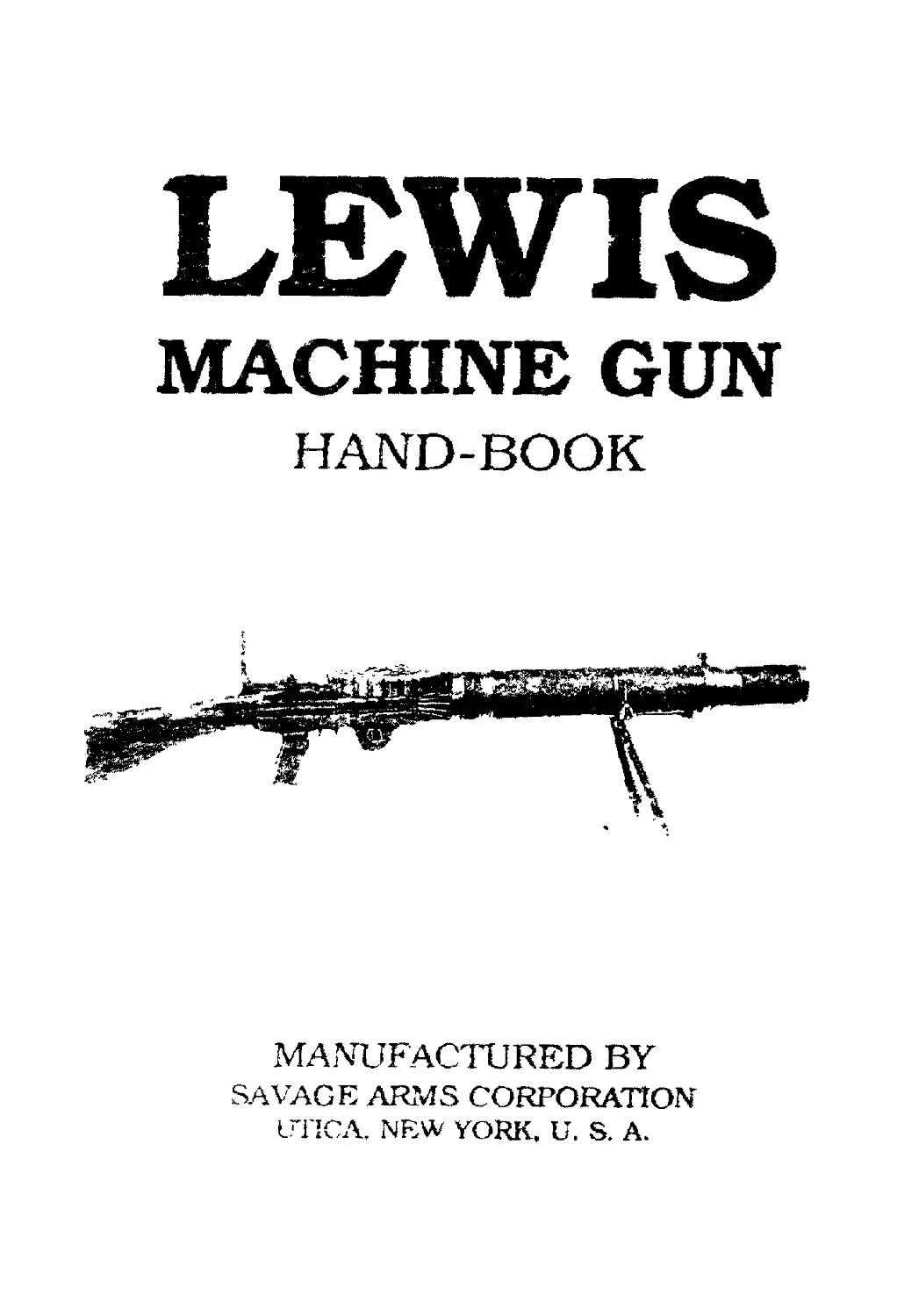
PI А ГЕ I — Gl N COMPLE ГЕ Mil H MAGAZINE AM) BIl’,01) FIE 1 1) MOI \ J'
WEIGHTS and MEASUREMENTS
The weights and measurements of the Lewis Machine
Gun are as follows :
Weight of gun.....................26	lbs. 8 oz.
Weight of gun with	bipod mount	.	28	lbs.	4	oz.
Weight of magazine	(empty)	.	.	1	lb.	8	oz.
Weight of magazine	(filled)	,	.	4	lb.	8	oz.
Weight of bipod mount . .	.	.	1	lb.	12	oz.
Length of gun with rifle butt .	51"
Length of gun with spade grip . . 44"
Length of barrel..................26	j 8"
Distance between sights .... 32.177"
Sights graduated up to 2100 yds.
Trigger pull....................12 to 14 lbs.
Diameter of bore................0.30"
Rifling, number of grooxes ... 4
Twist uniform—one turn in ten inches
Weight—Bullet......................150	gr.
Weight—Pow’der....................48	to 50 gr.
Weight—Cartridge.................About	395 gr.
Muzzle velocity............. 2700	ft. per second
Chamber pressure 48,000 to 49,000 lbs. to sq. in.
In the Lewis Machine Gun cartridges are under me-
chanical control at all times and feed is absolutely positive.
The gun will function perfectly at any angle of elevation or
depression and when turned on either side or upside down.
In this hand-book, instructions as to manual operation
and description of the corresponding mechanical functioning
of the gun are so combined as to associate the effect with
9
the cause, and to lead in the most direct way to actual
familiarity with the gun.
To handle a machine gun properlv, the operator must
know it as he knows himself. He must know its parts, their
functions, relations and adjustment, their characteristics and
their tendencies so well that it is not necessary to stop to
think about them.
He must be able to dismount and assemble the gun as
naturally and easily as he would handle his rifle.
The slightest unusual symptom when the gun is firing
must tell the operator at once not only what is the matter,
but how to fix it. And he must fix it at once as naturally
and subconsciously as he would extract a fired shell from his
nfle. Recognition should be immediate and instinctive—
correction, immediate and reflexive.
DISMOUNTING and STRIPPING
To dismount the gun, a cartridge and the barrel mouth-
piece spanner (which has a screwdriver end) are sufficient.
For detailed stripping, drifts are required.
В1ПТ STOCK
To Remove. Press and hold in butt latch with point of
bullet, give butt stock one-eighth turn to left and withdraw.
To Strip, (It is not advisable to strip butt stock.)
Turn out butt tang screw, releasing butt tang from butt
stock. Turn out both butt plate screws and remove butt
plate.
After removing butt stock hold back trigger, pull back
guard far enough to permit rear end of gear casing to swing
down until it hangs at such an angle that the receiver
locking pin moves freely. Then slide guard forward gently
against gear so as to use guard as handle for receiver in
further dismounting.
FEED COVER
To Remove. Press both thumbs against rear end of
receiver and pull feed cover rearward with fingers until its
lugs clear their retaining surfaces on the receiver. Then
lift feed cover off.
To Strip. Press the stud on the stop and rebound pawls
spring out of its seating in the transverse rib by pressing with
the point of a bullet introduced through the channel and hole
from the opposite side of the rib. When spring is removed
lift stop pawl and rebound pawl off their studs. Press stud
of cartridge guide down and slide it out of its seating.
11

FEED OPERATING ARM
’To Remove. Swing feed operating arm around magazine
’post so that retaining lug on magazine post is in line with
its cut in hole in feed operating arm. Then lift feed oper-
ating arm off magazine post.	‘
To Strip. Lift feed pawl spring and feed pawl off their
posts, using point of bullet.
CHARGING HANDLE
To Remove. Draw back until rear end of rack reaches
rear of receiver and pull charging handle out to side.
PISTON AND RACK AND BOLT
To Remove. After rear end of gear casing is released
and charging handle is removed as above, draw the rack
(carrying bolt on striker post) and piston back entirely out
of receiver. Lift bolt off striker post.
To Strip Piston and Rack. To remove striker, drive out
striker fixing pin. It is not advisable to separate piston from
rack. To do so, drive out piston connecting pin, unscrew
piston from rack.
To Strip Bolt. Unscrew and remove feed operating stud.
To remove either extractor, lift hook of extractor with point
of bullet until stud on shank of extractor is clear of its re-
cess in bolt. Then pull extractor forward out of its slot.
RECEIVER
To Remove. Push receiver locking pin to the rear with
point of bullet until it clears its hole in the radiator casing
rear locking piece. Turn receiver off barrel (right-handed
thread), using guard as handle.
J3
GEAR CASING
To Remove. Push receiver locking pin forward out of
receiver and unhook gear casing from the gear case hinge pin.
To Strip. Press up gear stop with point of bullet and
allow’ mainspring to unw ind. Unscrew collet pin and shake
out gear. Press through the gear against the mainspring
collet with point of bullet so as to force out mainspring
casing. The mainspring and the mainspring collet may be
removed from the mainspring casing with the point of a
bullet.
GUARD
To Remove. Hold back trigger and pull guard off to
the rear.
To Strip. Punch out trigger pin and sear pin. Pull
back trigger and lift out trigger and sear.
EJECTOR
Pry up rear end of ejector cover with point of bullet
and draw out. Insert point of bullet in hole in receiver for
ejector hub, so as to raise rear end of ejector out of recess,
and lift out with fingers.
GAS REGULATOR CUP
Lift end of gas regulator key w'ith point of bullet until
stud is clear of its hole in the radiator casing. Unscrew
and remove gas regulator cup.
BARREL GROUP
It is not advisable to dismount or strip the barrel group
except when necessary. Barrel should not be taken out of
radiator except for replacement.
U
CLAMP RING
Unscrew the ciamp ring screw with screwdriver on barrel
r.iouthpiece spanner and remove the clamp ring which
carries the front sight and clamp ring positioning screw.
RADIATOR CASING FRONT
Pull radiator casing front off forward.
RADIATOR CASING REAR
Remove radiator casing rear, which is permanently as-
sembled to the radiator casing rear locking piece, off to the
rear.
GAS CYLINDER
Unscrew and remove the gas cylinder, using the piston
and rack as a wrench (the cross section of the rack per-
mits this)
GAS CHAMBER GLAND
Turn out of gas chamber with barrel mouthpiece span-
ner (thread is left-handed).
BARREL MOUTHPIECE
Unscrew barrel mouthpiece with barrel mouthpiece
spanner (thread is left-handed).
BARREL
Keep barrel mouthpiece on about three threads and
drive barrel back enough to free it in radiator by striking
barrel mouthpiece.
GAS CHAMBER
When the barrel comes out of the radiator the gas
chamber is left lying in its recess in the radiator.
15
PLATE III—(Д S PARIS BARREL (.KOI P AM> PIS I OS AM) RACK GRUl 1‘
PLATE III
Barrel Group (3) and Rack and
Piston Group (8)
3-1 Barrel
3-2 Barrel Mouthpiece
3-3 Radiator
3-4 Radiator Casing, Front
3-20A Radiator Casing, Rear (assembled)
3-5	Gas Regulator Key
3-6	Gas Chamber
3-7	Gas Chamber Gland
3-8	Gas Regulator Cup
3-13	Clamp Ring
3-14 Front Sight
3-15 Clamp Ring Screw
3-19 Gas Cylinder
8-1 Rack
8-2 Striker
8-3 Striker Fixing Pin
8-4 Charging Handle
8-5 Piston Connecting Pin
8-6 Piston
17
PLATE IV - GUN PARTS : RECEIVE R < ROI P, MAINSPRING.AND TRIGGER MECHANISM
PLATE IV
Receiver Group (2) Mainspring Group (9)
Guard Group (5)
2-1 2-2 2-3 2-4 2-6	Receiver Ejector Cover Ejector Safety Receiver Locking Pin
9-1 9-2 9-3 9-4 9-6 9-7 9-8 9-9 9-11	Gear Casing Gear Stop Gear Stop Spring Gear Stop Pin Mainspring Collet Pin Gear Mainspring Casing Mainspring Mainspring Collet
5-1 5-2 5-3 5-4 5-5 5-6 5-8 5-9 5-10 5-11	Guard Butt Latch Butt Latch Spring Butt Latch Pin Guard Side Piece (right) Guard Side Piece (left) Sear Sear Spring Sear Pin (used also for Trigger Pin) Trigger
19
PLATE A— GUN PARTS : FEED MECHANISM, BOLT AND EXTRACTORS
PLATE IV
Receiver Group (2) Mainspring Group (9)
Guard Group (5)
2-1 2-2 2-3 2-4 2-6	Receiver Ejector Cover Ejector Safety Receiver Locking Pin
9-1 9-2 9-3 9-4 9-6 9-7 9-8 9-9 9-11	Gear Casing Gear Stop Gear Stop Spring Gear Stop Pin Mainspring Collet Pin Gear Mainspring Casing Mainspring Mainspring Collet
5-1 5-2 5-3 5-4 5-5 5-6 5-8 5-9 5-10 5-11	Guard Butt Latch Butt Latch Spring Butt Latch Pin Guard Side Piece (right) Guard Side Piece (left) Sear Sear Spring Sear Pin (used also for Trigger Pin) Trigger
19
PLATE V
Feed Mechanism Group (6 and 7) Bolt <4)
6-1	Back Sight Axis Pin
6-2	Back Sight Axis Pin Washer
6-3 Back Sight Axis Pin Split Keeper
6-4	Back Sight Bed	Spring
6-5	Feed Cover
6-6	Stop and Rebound	Pawl Spring
6-7	Stop Pawl
6-8 Rebound Pawl
6-9 Back Sight Leaf
6-10 Back Sight Elevating Screw
6-11 Back Sight Slide
6-12 Back Sight Elevating Screw Head Spring
6-13 Back Sight Elevating Screw Head
6-14 Back Sight Elevating Screw Head Pin
6-24A Cartridge Guide (assembled)
7-1 Feed Operating Arm
7-2 Feed Pawl
7-3 Feed Pawl Spring
4-1 Feed Operating Stud
4-2 Bolt
4-3 Extractor
PLATE VI—BUTT STOCK, LOADING HANDLE, SPADE GRIP AND BIPOD MOUNT
PLATE VI
Витт Stock (1), Spade Grip and Magazine
Filling Handle (12) and Bipod Mount (11)
1-6A Butt Stock (assembled)
1-1 Butt Plate
1-2 Butt Plate Screw
1-5 Butt Tang Screw
12-27А Spade Grip (assembled)
12-49 Magazine Filling Handle
11-1A Bipod Mount (assembled)
23
ASSEMBLING
The gun is assembled by reversing the operations just
given for dismounting. When completely dismounted it is
advisable to assemble in the following order :
1.	Barrel group :
a.	Gas chamber in radiator.
b.	Barrel into radiator and gas chamber.
c.	Gas chamber gland.
d.	Gas cylinder.
e.	Barrel mouthpiece.
f.	Radiator casing, rear.
g.	Radiator casing, front.
h.	Clamp ring.
i.	Gas regulator cup.
j.	Gas regulator key.
2.	Ejector.
3.	Ejector cover.
4.	Gear, gear casing and receiver locking pin.
5.	Guard (merely slipping it on receiver and up against
gear to act as handle).
6.	Receiver and barrel (screw barrel onto receiver).
7.	Feed operating arm (pressed fully over to left).
8.	Piston and rack with bolt on striker post.
9.	Charging handle (replace charging handle, push it
forward fully).
10.	Feed cover.
11.	Lock gear by raising gear case and pushing guard
forward to engage it.
12.	Replace butt stock.
24
Care should be taken :
(1)	To avoid damaging the projections on the rear face
of the barrel in replacing barrel and radiator in radiator
casing rear locking piece.
(2)	To avoid damaging the threads o'f the threaded
parts, especially the gas chamber gland, gas cylinder and
barrel mouthpiece, or allowing sand, dust or grit to get into
threads.
(3)	To see that the gas chamber is correctly inserted
in its recess in the radiator before the barrel is pushed home,
so that the barrel loop of the gas chamber will encircle the
barrel. (The barrel loop is tapered, and its smallest diameter
must be toward the front end of the radiator.) Also that
the barrel is turned so that the gas port is at the bottom and
over the center of the gas chamber.
(4)	In replacing feed cover, that the feed operating
arm is over to the right.
(5)	That the feed operating stud is screwed into the
bolt as far as it will go and that the cam slot in the bolt is
slipped over the striker before putting piston and belt in
gun.
(6)	That when replacing bolt the feed operating arm
is over to the left so that the feed operating stud will en-
gage its groove.
(7)	That after in’erting bolt, piston and charging
handle, the charging handle is brought to the extreme
forward end of its stroke before the gear casing is swung
up into place and the gear engaged with the rack.
f8)	That the tension of the mainspring is correct—
from twelve to fourteen pounds. If the tension is too low
the rack will strike the butt tang too hard in opening and
25
the action may fail to close or the gun may misfire. If it is
too high the gun will fire too fast; if much too high the
gun will not open far enough to feed the next cartridge.
TO ALTER MAINSPRING TENSION
Remove butt stock and draw guard back enough to
disengage gear casing.
To increase tension hold up gear casing so as to keep gear
engaged with rack and draw back charging handle. Draw
dowrn gear casing so that gear does not engage rack and
push charging handle fully forward. Raise gear casing
again, slide guard forward to engage it, and replace b.utt
stock.
To decrease tension hold gear casing down so that gear
is not engaged w’ith rack and draw back charging handle.
Then raise gear casing, engage gear w’ith rack and slide
guard forward to engage gear casing, which will cause the
charging handle to snap forward and the action to close.
The average working tension of the mainspring is from
twelve to fourteen pounds. To weigh it, engage hook of
spring balance (supplied with gun) with charging handle ;
hold back trigger; draw’ back charging handle by means of
spring balance so that it is just started to the rear. Hold
spring balance so as to keep charging handle at this point,
and record reading.
When the gun is not about to be fired the mainspring
should not be in tension.
26
OPERATION
TO FILL MAGAZINE WITH LOADING HANDLE
Turn magazine upside down.
Insert loading handle in socket in magazine center.
This holds magazine latch out of engagement and permits
rotating magazine center independently of the rest cf the
magazine.
Spin magazine on loading handle to see that it is not
distorted.
Rotate the magazine center and at the same time place
cartridges successively between the separator pins so that
their bullet ends will pass into the spiral groove in the
magazine center. Do not leave an empty space between
cartridges, as in firing this would cause a stoppage. The
magazine holds forty-seven cartridges, and when it is filled
remove loading handle and turn magazine center back until
it snaps. This locks magazine.
TO FILL MAGAZINE WITH LOADING TOOL
Attach loading tool to table or other base.
Turn magazine upside down.
Slip hole in magazine center up over magazine post
under loading tool until magazine latch engages post.
Spin magazine to see that it rotates freely.
Place a clip full of cartridges in top of chute and insert
clip in clip ejector (at right), bullet ends to left (toward
magazine center).
Press cartridges down, stripping them out of clips into
chute.
Put on pressure close to clip and do not depress points.
Repeat often enough to keep chute full of cartridges.
Rotate magazine from left to right (clockwise).
Cartridges will feed into magazine.
If a space in magazine is skipped, rotate magazine
backward past vacant space and then rotate forward again.
When magazine is filled, unlatch and remove from post.
Turn back magazine center until it sna*ps. This locks
magazine.
TO LOAD GUN
See that the charging handle is fully forward.
Place a magazine on the magazine post, the thumb
piece of the magazine latch to the right, and press the
magazine down.
Rotate it very slightly in both directions, until the maga-
zine latch engages on magazine post.
Draw back the charging handle fully so that it is en-
gaged and held back. This draws back the piston and rack
and performs by hand what the gas pressure of firing dues.
Drawing the rack teeth back over the gear teeth with which
they are meshed rotates the gear and winds the mainspring
during the entire opening movement. During the first 1,4
inches of rearward travel the striker post moves back through
the longitudinal part of its cut in the bolt and merely draws
back the point of the striker from the face of the bolt. The
bolt itself remains in its locked position and does not move.
In the next /3 of an inch of rearward travel, the striker
post, driven still further rearward in the bolt, strikes with
its right side the cam surface in the right side of its slot in
the bolt and causes the bolt to rotate from right to left,
turning the locking lugs out of their recesses in the re-
ceiver.
As soon as the bolt is unlocked, the striker post reaches
28
the rear end of its cut in the bolt, and in its further travel
carries the bolt directly back with it.
The top lug of the feed operating stud, traveling in the
groove in the under side of the feed operating arm, cams
the feed operating arm so that it swings across the top of
the receiver from right to left.
The feed pawl, acting against one of the outer projec-
tions of the magazine pan, carries the magazine around
sufficiently to drive the first cartridge down into the car-
tridge opening in the feed operating arm by the rotation of
the magazine pan and separator pins around the stationary
spirally grooved center.
At this point in the leftward travel of the feed operating
arm, its cartridge opening (and in it the cartridge it has just
received) commences to pass under the upward projecting
arms of the feed cover which carry the cartridge guide, and
those arms commence to control the cartridge as soon as it
leaves the magazine.
Further leftward travel of the feed operating arm brings
the cartridge under control of the cartridge guide and the
downward'pressure of its spring tension.
At this point th.e spring stud on the feed operating arm
clears the stop pawl, which is then pressed forward by its
spring and prevents further rotation of the magazine.
When the bolt strikes the rear end of the ejectcr it drives
it into its slot, thus pivoting the ejector head out.
Toward the end of the rearward travel of the piston
the downward projection of the lower surface of the
rack at the rear whose front surface forms the cocking
notch rides over the nose of the sear, temporarily depress-
ing it against the tension of the sear spring, which immedi-
ately raises it again
29
The rear end of the rack then strikes the butt tang,
terminating the opening stroke.
The feed operating arm is now at the extreme left, the
cartridge has been brought over the cartridge opening in
the top of the receiver into which the cartridge guide
presses it, the rebound pawl presses against an exterior
projection of the magazine so as to prevent backward ro-
tation, and the mainspring is fully wound up.
The mainspring now rotates the gear, whose teeth,
meshed with those of the rack, drive the rack forward a
trifle till the nose of the sear engages with the cocking
notch in the lower edge of the rack and suspends the
operation.
The gun is now ready to fire
30
TO FIRE
FULL AUTOMATIC FIRE
Press trigger and hold back. Gun will fire automati-
cally as long as trigger is held back until magazine is empty
When trigger is released gun stops firing.
SEMI-AUTOMATIC FIRE
'Го fire single shots press trigger and release immedi-
ately. To release quickly enough for a single shot requires
some practice. Bursts of any desired length may be fired
by holding back the trigger the required period of time and
releasing.
When the trigger is pressed the sear is drawn down out
of engagement with the notch in the rack. The rack is
driven forward by the pressure of the mainspring, which
unwinds, and consequently iotates the gear, whose teeth
are meshed with those of the rack. The striker post is at
the rear end of the cam slot in its cut in the bolt. Its left
side is pressing against the left side of the cam slot, but
it 'now simply drives the bolt forward without rotating it
because the bolt is prevented from rotation by the cruciform
shape of the bolt-way in the receiver at this point.
The feed operating stud, carried forward with the bolt
and traveling forward in its cut in the under side of the feed
operating arm, cams the feed operating arm to the right.
The feed pawl slips over the projection on the rim of
the magazine and engages behind it.
The spring stud on the feed operating arm presses the
stop pawl back to prevent its intercepting a magazine pro-
jection
31
The head of the bolt now reaches the head of the
ejector, which it presses back into the ejector cut, causing
the rear of the ejector to be pivoted out into the bolt-way
behind the bolt.
The face of the bolt now strikes the base of the cartridge
which is held ready for it in the loading ramps of the
receiver, and it drives the cartridge before it into the
chamber.
The extractors spring over the rim as soon as the car-
tridge seats.
Just as the cartridge seats, the locking lugs of the bolt
clear the front of the cruciform part of the bolt-way formed
by their guide grooves and reach their locking recesses.
Further forward movement of the bolt is not possible.
The bolt face rests against the reafr.end of the barrel and
the head of the cartridge. The pressure of the mainspring
which still drives the striker post forward causes the striker
post, which is pressing against the left side of the cam slot
in the bolt, to cam the bolt around to the right. This turns
the locking lugs fully into the locking recess of the receiver.
As the bolt locking is completed the striker post enters
the longitudinal front part of its cut, carries the striker
against the primer of the cartridge in the chamber, and fires
the cartridge.
The firing of the cartridge now develops the power for
another cycle of operation.
When the bullet passes the gas port near the muzzle of
the barrel, gas under high pressure is driven through the gas
port into the gas chamber and through the hole in the gas
regulator cup onto the head of the piston.
This drives the piston back and produces the same oper-
ation of parts described above where the opening stroke was
made by hand, except for the disposition of the fired shell.
The shell, in the grip of the extractors, is drawn back
with the bolt, and is carried on the face of the bolt until the
bolt strikes the rear end of the ejector, as previously de-
scribed. The pivoting of the head of the’ ejector, which
swings sharply against the left side of the extracted shell,
throws the shell out of the ejector port.
Whether the gun will fire again or will remain in the
“ ready to feed ” position depends upon whether or not the
trigger is still held back.
If the trigger is still held back, and the sear consequently
depressed, at the beginning of the closing stroke of the
action the gun will continue firing.
If the trigger has been released so that the sear intercepts
the cocking notch in the rack, the gun is left “ ready to
feed.”
'Die cycle of operation may be briefly summarized as
follows:
33
PLATE VII—MAGAZINE—TOP VIEW AND BOTTOM VIEW
PLATE VII
10-1A Magazine
(Assembled)
The magazine holds forty-seven
cartridges. Instructions for
loading magazine are given on
Page 27.
35
PLATE VIII—LOADING TOOL WITH MAGAZINE IN POSITION
PLATE VIII
12-30a Loading Tool
(Assembled)
Instructions for the use of the
loading tool are given on Pages
27 and 28
37
BACKWARD ACTION
ACTION OF	OPERATES
Gas.............................Piston and rack..
Piston and rack.................Mainspring and stopped
( by butt,tang.
Striker post	... У Unlocks bolt and carries
(. it to the rear.
( Extracts empty shell, oper-
gojt ...........................I	ates feed operating arm,
'I ejector, stopped by butt
I tang.
Feed operating arm
Magazine
Rotates magazine, releases
(right) stop pawl, car-
ries cartridge.
( Feeds cartridge onto feed
J arm and next one into
। position, forces (left)
( rebound pawl to rear.
FORWARD ACTION
ACTION OF	OPERATES
Mainspring .	............Piston and striker post.
Piston, rack and striker post ./Bolt locked and round
( fired.
( Feed operating arm, car-
Bolt...........................x	tridge into chamber,
( ejector.
( Pawloverand behind pro-
Feed operating arm	. jection, (right) stop
( pawl to the rear.
38
“SAFETY”
TO PUT THE GUN AT "SAFE”
The gun being “ ready to feed,” with the charging han-
dle back and sear engaging rack, press up’safety until its
rear notch encloses the shank of the charging handle. Pull
trigger, allowing the charging handle to go forward enough
to engage with the under cut at the front of the slot in the
safety. In this position the gun is locked at “ Safe.”
WHEN Al' “SAFE” TO PUT GUN
IN ACTION
Draw back charging handle to cock. This frees safety.
Press down safety. Gun is again “ ready to feed,” and
will fire if trigger is pressed.
Raising the safety when the charging handle is forward
(and the bolt is filling the ejector port) closes the action so
as to prevent dust, sand, water, etc., from getting into the
receiver.
The gun with charging handle forward, chamber empty,
magazine on post and safety raised is practically dust and
water proof, and may be carried safely and conveniently and
put into action instantly by one man.
To put in action, press down safety and pull back charging
handle.
CAUTION. Never let the charging handle forward by
hand so that the bolt rests on a loaded cartridge in the chamber.
Remember that when magazine is on gun and charging
handle is pulled to rear, gun is cocked and ready to fire.
Always put it at “ Safe.”
3-->
TO UNLOAD GUN
When cartridge in receiver may be fired, press over
magazine latch, remove magazine and pull the trigger. T7his
will fire the cartridge which was in position in the loading
ramps in the receiver.
When it is necessary to unload without firing cartridge
in receiver, press over magazine latch and remove magazine,
hold charging handle with left hand, press trigger with right
hand and ease charging handle forward slowly so as to push
cartridge from loading ramps into bolt-way in receiver.
Then pull back charging handle fully so that sear en-
gages and raise safety. With point of bullet of another
cartridge press down through loading slot in top of receiver
against cartridge so that it can be removed through ejector
port.
After unloading gun always snap (by drawing back
charging handle to cock and pulling trigger), to make cer-
tain that gun is empty and that there is no cartridge in the
receiver.
40
CARE and ADJUSTMENT
It is necessary to keep continually informed of the con-
dition of each part of the gun. Adjustment by use of
file, oil-stone or emery should he made only by an armorer.
Examination should include the following points:
Barrel. Inspect the interior of barrel and chamber, the
guide lips of the chamber, which project from the rear face
of the barrel, and the thread on the muzzle.
Gear, Casing and Mainspring. See that gear teeth, stop
and spring are not damaged, that gear case hinge pin is
secure and that mainspring is not broken.
Ejector. See that it is not damaged.
Feed Operating Arm. Observe that the feed pawl and
feed pawl spring are properly adjusted.
Feed Cover. Notice whether the pawls and spring are
damaged and whether the cartridge guide is properly
assembled.
Piston. See that the piston connecting pin is nor loose,
that the teeth and the cocking notch of the rack are not
damaged, and that the working surfaces of the striker post
are not burred or rough. Note whether the striker is
damaged.
Bolt. The edges of the cam slot should be smooth.
Any burrs or roughness should be removed by an armorer
with oil-stone or fine emery cloth. Test head space with
maximum heading gauge. A bolt which closes over the
maximum heading gauge must be changed.
Weigh each extractor by engaging hook of spring bal-
ance with extractor hook and pulling at right angles to bolt.
Read balance when extractor moves. If under three pounds,
exchange extractor.
41
POINTS BEFORE FIRING
See that bore is clear.
Weigh mainspring and correct tension, if necessary
(twelve to fourteen pounds).
Verify oiling—if in doubt oil again.
Examine gun cases to see that all tools and spare parts
are in place and that they, gun and magazines are properly
secured in their containers against loss or damage in trans-
portation.
See that oil can is full.
Fmal Test : See that charging handle moves freely,
that feed operating arm moves u hen it does. Weigh main-
spring. Test ejection with dummy cartridge. Place empty
magazine on post. Hold it with right hand and work
charging handle to prove that feed mechanism rotates
magazine.
POINTS DURING FIRING
Magazines should be kept in container until required.
Empty magazines should be replaced in container when
removed from gun, but should be refilled without prevent-
able delay. Deformation of the rim of the magazine or
the entry of dirt or grit in the bullet groove in the magazine
center should be carefully guarded against. A partially
emptied magazine should be replaced by a full one when
fire ceases temporarily.
During temporary cessation of fire, raise safety. If
time permits, unload gun and oil bolt, striker post and
piston. Weigh spring and adjust tension if necessary.
Do not allow tension to drop under twelve pounds, as it
might cause breakage of parts.
If gun misfires, wrait a few seconds before drawing back
charging handle.
43
POINTS AFTER FIRING
Unload (and snap).
Relax mainspring tension.
Clean and oil barrel, cylinder, piston and gas chamber
gland.
Collect any unfired cartridges among empty shells.
Examine, clean and oil all parts of gun as soon as prac-
ticable.
POINTS WHEN MACHINE GUN
IS PLACED IN BOX
1.	Bore oily.
2.	Exterior and working parts oily.
3.	Nothing in bore.
4.	Sight down.
5.	Spare parts in box.
6.	Cleaning material and oil in box.
7.	Mainspring released.
8.	Charging handle forward and safety up.
44
NOTICE TO ARMORERS IN CHARGE
OF LEWIS MACHINE GUNS
The efficient working of the Lewis machine gun largely
depends upon the bearing surfaces between the sides of the
striker post and the sides of the cam-shaped slot in the bolt
being kept perfectly smooth. In most guns, the action of the
gun itself continues to keep the surface of this sliding con-
tact properly smooth, provided the parts are kept well oiled.
Sometimes, however, in the case of new guns, slight “burr-
ing” may occur and prevent the smooth working of the
gun. Any such roughness or “ burring ” caused by wear
on either of the sides of the striker post (generally on the
right-hand side) or on the bearing edges of the cam-shaped
slot in the bolt (generally on the left-hand side) must at
once be carefully smoothed as follows:
Use either a very fine oil-stone or very fine emery cloth,
or powdered emery with oil, and thus remove any roughness
and secure perfectly smooth bearing surfaces between both
sides of the striker post and both edges of the cam-shaped
slot in the bolt.
Careful attention must, however, always regularly be
given to these most important bearing surfaces; but after
the sides of the striker post and cam slot edges have once
been carefully smoothed this roughness seldom occurs.
If either too coarse materials or too much careless force
is used to smooth these surfaces, the angle of sliding con-
tact may become slightly altered and more roughness or
“burring” may be caused.
45
PLATE IX—BACK SIGHT
PLATE IX
Back Sight
6-1 Back Sight Axis Pin
6-2 Back Sight Axis Pin Washer
6-3 Back Sight Axis Pin Split Keeper
6-4 Back Sight Bed Spring
6-9 Back Sight Leaf
6-10 Back Sight Elevating Screw
6-11 Back Sight Slide
6-13 Back Sight Elevating Screw Head
47
I'l.ATE X—ACCESSORIES
PLATE X
Accessories
12-5A Shell Extractor (assembled)
12-1A Charging HandleExtension(assembled)
12-50 Barrel Mouthpiece Spanner
12-24A Barrel Cleaning Rod (assembled)
12-51	Cylinder Cleaning Brush (wire)
12-52	Cylinder Cleaning Mop
12-53 Barrel Cleaning Brush (bristle)
12-54 Oil Can
12-55 Spring Balance
49
PLATE XI—GUN BOX AND MAGAZINE CONTAINERS
CLEANING and OILING
The gun must be cleaned thoroughly as soon as possible
after firing. Barrel should be swabbed with oil or a nitro-
solvent as soon as gun is unloaded. The gas regulator cup,
gas chamber and gland, gas cylinder and piston should also
be temporarily cleaned and oiled at once.
To Clean Barrel. Introduce cleaning rod at nuzzle,
pursuing in other respects the same methods prescribed and
using the cleaning solutions issued for cleaning the U. S.
magazine rifle, model 1906. Cleaning with nitro-solvent
on patches of cloth does not require dismounting the gun.
The charging handle may merely be drawn back until the
sear engages the rack.
To use the ammonia solution for metal fouling, the barrel
must be taken off the receiver, the radiator casings, front
and rear, must be removed, and the gas chamber gland must
be taken out. The chamber and the gas port must be
securely corked with suitable rubber corks and a short length
of rubber tubing must be slipped over the muzzle of the
barrel so that the ammonia solution will stand in the tube
well above the end of the muzzle.
The greatest care mlist be taken not to bend or injure
the guide lips of the chamber at the rear end of the barrel.
Cleaning the barrel from the muzzle is directed so as to re-
duce as far as possible the danger of injuring these pro-
jections.
Cleaning the barrel should be repeated every day for
several days after the gun has been fired and until the acids
driven into the pores of the steel by the pressures of firing
have been completely neutralized. The ammonia meta)
fouling solution neutralizes acid residue at one application.
51
PLATE XU- VIEW SHOWING PROPER METHOD OF PLACING MAGAZINE ON MAGAZINE POST
To Clean Gas Cylinder. For temporary cleaning, cylin-
der need not be taken out of gun. Withdraw bolt and
piston and insert cylinder cleaning rod through piston hole
in receiver. Clean first with a wire brush and gasoline and
then with the mop and oil.
If gun is left uncleaned after firing, thread may seize and
make cylinder hard to unscrew. Thread should then be
soaked with oil before trying to unscrew. Push rack well
into squa'ed portion of cylinder before unscrewing—if not
in far enough, cylind?r may be split at rear end.
To Clean Action Parts. Soak off hard fouling with
gasoline or oil. Parts cleaned with gasoline should be dried
and oiled afterward. Additional oiling of moving parts, the
surfaces against which they’ bear and parts through which
gas passes is necessary’ to prevent friction and clogging as
well as rust. The striker post and the inside of the bolt
should always be kept well oiled. Whenever any time is
available during firing it is advisable to oil them again. The
feed operating stud, piston and rack should also be oiled
frequently, Magazine latch and outer edge of cartridge
spacer ring should be oiled lightly. All screw threads
should be kept well oiled to prevent their sticking ftom rust.
Be liberal in use of oil.
A good grade of high flash
oil should be used.
53
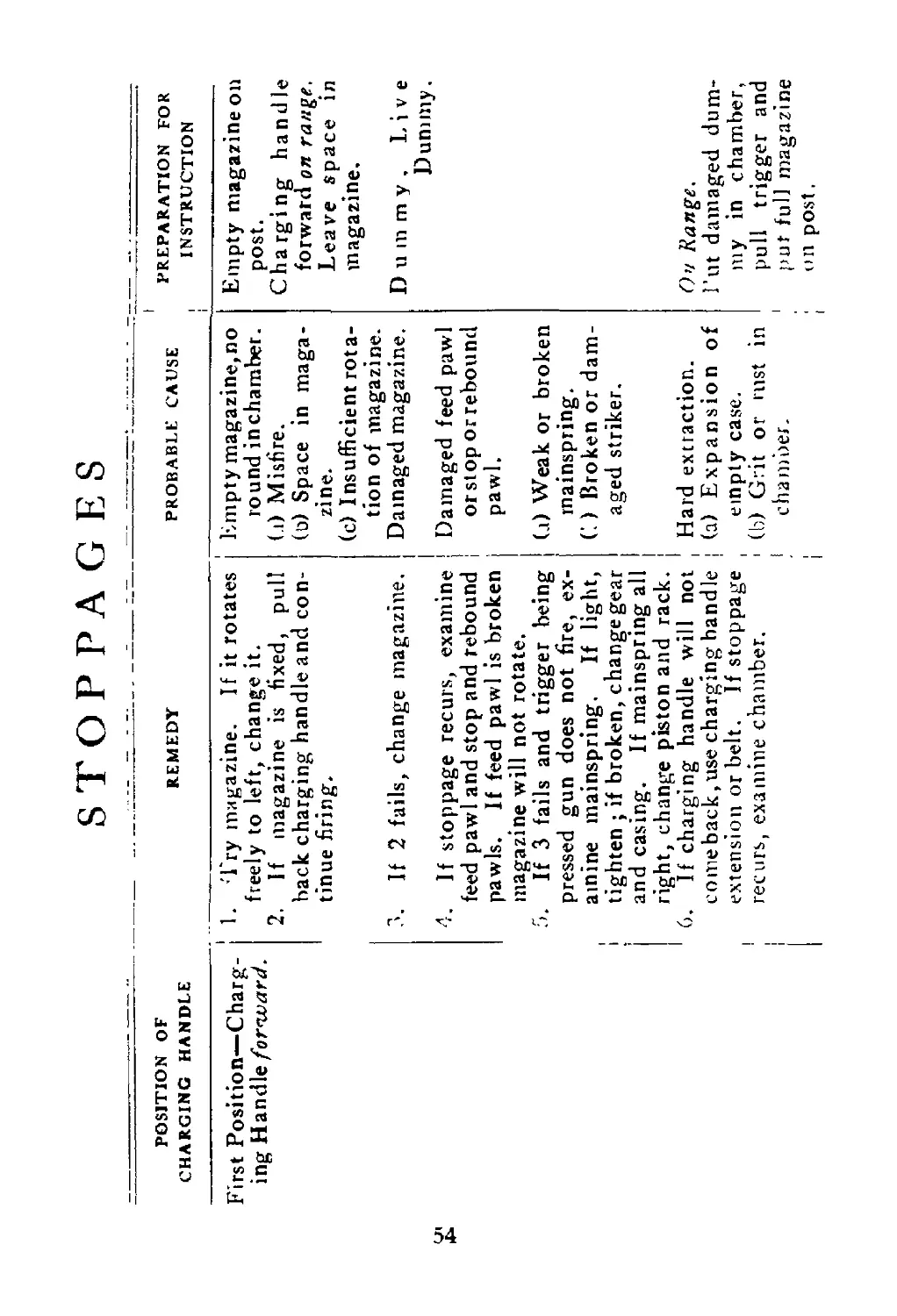
STOPPAGES
POSITION OF
CHARGING HANDLE
REMEDY
PROBABLE CAUSE PREPARATION FOR
, INSTRUCTION
First Position—Charg-
ing Handle forward.
1. ’Try magazine. If it rotates
freely to left, change it.
2. If magazine is fixed, pull
back charging handle and con-
tinue firing.
?>. If 2 fails, change magazine.
If stoppage recurs, examine
feed pawl and stop and rebound
pawls. If feed pawl is broken
magazine will not rotate.
If 3 fails and trigger being
pressed gun does not fire, ex-
amine mainspring. If light,
tighten ; if broken, change gear
and casing. If mainspring all
right, change piston and rack.
If charging handle will not
co me back, use charging handle
extension or belt. If stoppage
recurs, examine chamber.
Empty magazine,no
round inchamber.
(.1) Misfire.
(u) Space in maga-
zine.
(c) Insufficient rota-
tion of magazine.
Damaged magazine.
Empty magazine on
post.
Charging handle
forward on range.
Leave space in
magazine.
Damaged feed pawl
or stop or rebound
pawl.
(a) Weak or broken
mainspring.
C.) Broken or dam-
aged striker.
Hard extraction.
(a)	Expansion of
empty case.
(b)	Grit or rust in
chamber.
Dummy, I, i v e
Dummy.
Оч Range.
1’ut damaged dum-
my in chamber,
pull trigger and
put full magazine
on post.
Second Position—Less
than a cartridge
length from forward
position.
Use charging handle extension
or double pull through ami
pull back handle. Examiin
round ejected, if—
(a)	Damaged or too large lound,
continue firing.
(b)	If correct, take off magazine,
insert shell extractor into
chamber and push home with
bolt and withdraw with front
portion of separated case.
(c)	Separated case is telescoped
on to cartridge, continue
firing.
N. B.—In nine cases out of ten
the next cartridge pulls out
the separation.
Id) If separation recurs shortly,
change bolt.
Third Position—More
than 3 inches hack.
1. Examine ejection opening;
if there is no obstruction, pull
back charging handle, con-
tinue firing.
if recurs, take out gas regu-
lator cup, remove magazine
and fire one round; replace
regulator cup large hole to rear.
Clean out gas cylinder, oil
Damaged round.
Separated case in chamber. Separated case tele- scoped on to nexi cartridge. 1 oo sharp extract- ors, which cut cartridge case at base. Bolt has not gone back far enough to get behind base of cartridge. (a) Friction in gas cylinder. (h) Hard extrac- tion.	Filea groove around cartridge case 1 inch from base. Ditto 1 inch from shoulder.
STOPPAGE S—Continued
POSITION OF CHARGING HANDLE	REMEDY	PROBABLE CAUSE	PREPARATION FOR INSTRUCTION
Third Position—Con- tinued.	working parts ; if any rough- ness on striker post or cant slot in bolt, change them.
	2. If on pulling back handle there is little or no resistance, if main spring is light, tighten; if broken, change.	Weak or broken mainspring.	(hi Range* Weaken mainspring.
	3. If an empty case is in cham- ber or ejection opening, take off magazine, draw back charg- ing handle, and unload with- out firing. If empty case is in chamber, force out with cleaning rod from muzzle end. If there are no signs of ex- tractors, or only one extractor gripping it, change bolt; otherwise continue firing.	(a)	Bad extractors. (b)	Hard extraction. (c)	If empty case is in receiver, weak extractors or broken ejector.	On Range. Place empty case chamber. Maga- zine on post and pull trigger
	4. If stoppage recurs, examine extractor, exchange whichever is faulty.
Third Position—Con-	5. If charging handle cannot	(a) Damaged maga-	Ou Range.
tinned.	be moved, remove magazine. If charging handle flies for- ward, change magazine.	zine jammed. (b)	Magazine not properlyonmaga- zine post. (c)	Broken maga- zine catch spring. (d)	Broken or dam- aged magazine spacer ring caus- ing it to jam.	Do not push maga- zine p г о p e 11 у home.
1	6. If on removing magazine, charging handle remains in position as before— (a) Help cartridge into correct position on feed way. <b> Test cartridge guide spring. (c) Test mainspring.	(a)	Weak or broken cartridge guide spring. (b)	Too weak main- spring. (c)	Too much gas.
(I) The tension of the main spring can easily be told by pulling back the charging handle.
If the main spring is broken, the collet pin will be “out.”
Note—If the gun continues to fire after the trigger is released, push forward trigger with hand on
right side.
This will be caused by broken or weak spring, or damaged sear
SEQUENCE OF IMMEDIATE ACTION
Lewis Machine Gun
No 1 POSITION
(Charging Handle Forward)
Try Magazine
I
IF FREE TO ROTATE Change it Reload, relay and fire		IF FIXED (will not rotate) Pull charging handle
IF GUN DOES NOT FIRE Pull С. H. Watch ejec- tion opening	IF GUN FIRES SINGLE SHOTS Examine gas regulator	IF CHARGING H. WILL NOT GO BACK Remove maga zine 1
IF CARTRIDGE	IF NO CARTRIDGE IS	IF С. H. THEN	IF С. H.
IS EJECTED	EJECTED	COMES EASILY	STICKY
Examine primer	Examine feed mechanism	Put on new magazine	Relay and
1	Repair if necessary	Reload, relay and fire	fire
IF STRUCK	IF PRIMER NOT STRUCK
Pull С. H., relay, file	Change piston and rack, reload, relay and fire
No. 2 POSITION
(Charging Handle between thumb-piece of safety and forward position)
force: back charging handle
IF STOPPAGE RECURS
Take out gas regulator, fire a shot. Insert with large hole to rear. Clean and oil
No. 3 POSITION
(Charging Handle behind thumb-piece of safety.) Examine ejection opening
IF CI Pull	.EAR J. H.	IF CASE IN	IF CHAMBER OBSTRUCTED BOLT-WAY	Pull С. H. Raise safety, remote Examine ejector	magazine, clean and examine rim Replace if necessary	of cartridge
IF С. H. DOES	IF NOT COME BACK Change magazine, reload, relay and fire		С. H. COMES	IF RIM CUT IN	IF RIm' NOT BACK	TWO PLACES	CUT Relay and fire	Reload, relay and	Change bolt |	fire
IF С. H. DOES NOT	IF С. H. STARTS FORWARD GO FORWARD	AND STICKS Change gear casing	Pull С. H. Raise safety (complete)	Remove magazine Inspect cartridge guide Replace if necessary
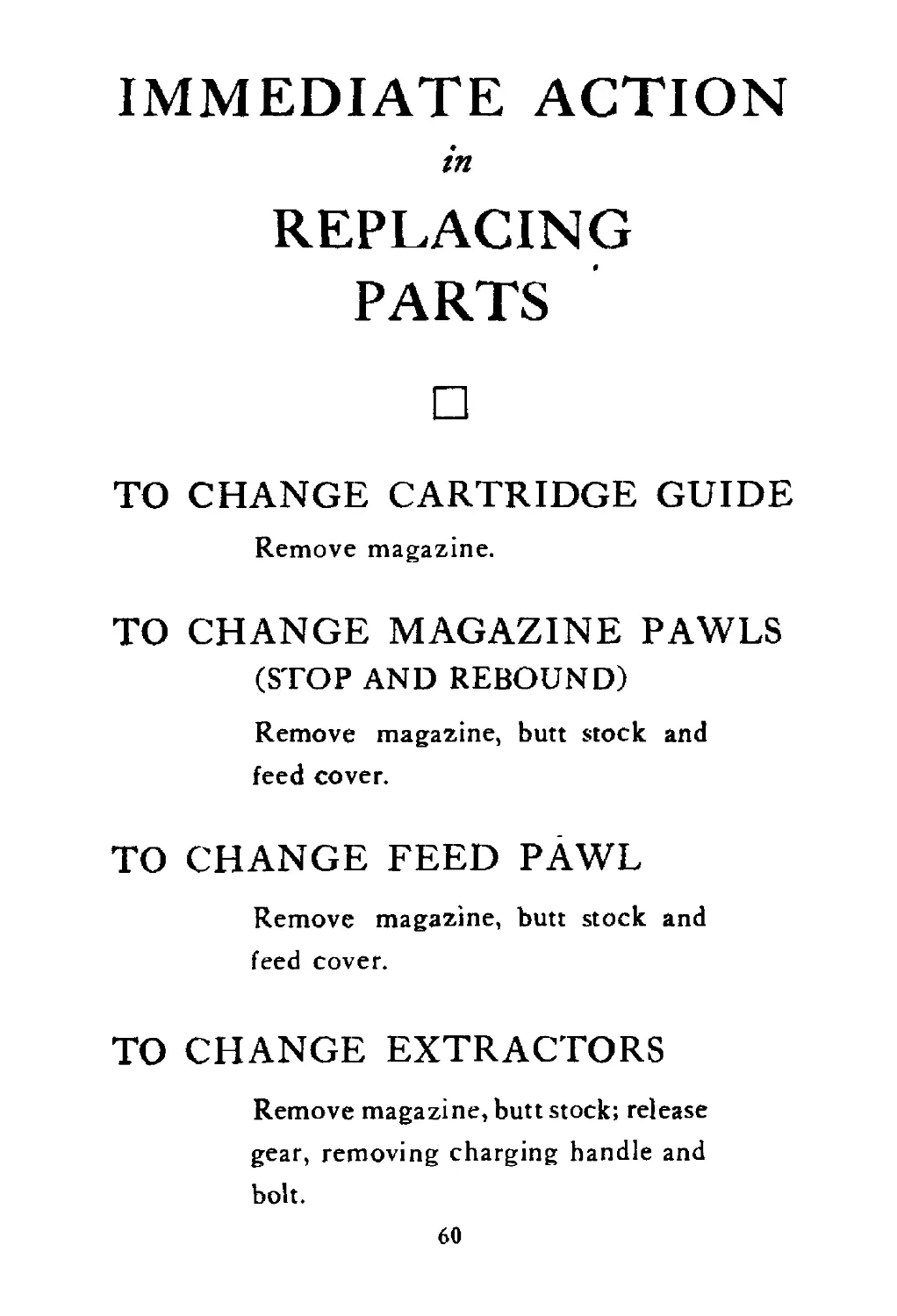
IMMEDIATE ACTION
in
REPLACING
PARTS
TO CHANGE CARTRIDGE GUIDE
Remove magazine.
TO CHANGE MAGAZINE PAWLS
(STOP AND REBOUND)
Remove magazine, butt stock and
feed cover.
TO CHANGE FEED PAWL
Remove magazine, butt stock and
feed cover.
TO CHANGE EXTRACTORS
Remove magazine, butt stock; release
gear, removing charging handle and
bolt.
60
TO CHANGE GEAR COMPLETE
Remove magazine,butt stock; release
gear; remove charging handle, bolt
and operating rod. Force back re-
ceiver locking pin ; unscrew receiver
of a turn.
TO CHANGE RECEIVER LOCKING PIN
Same as gear.
TO CHANGE CHARGING HANDLE
Remove magazine, butt stock; drop
gear.
TO CHANGE EJECTOR
Remove magazine, butt stock; feed
cover; pull charging handle to rear.
Put feed operating arm to right. Re-
move ejector cover and ejector, by
inserting point of cartridge under-
neath.
61
COMPONENT PARTS AND
REFERENCE NUMBERS
1-1	Butt	Plate
1-2	Butt	Plate Screw
1-3	Butt	Stock
1-4	Butt	Tang
1-5	Butt	Tang Screw
1-6a	Butt	Stock (assembled)
2-1 Receiver
2-2 Ejector Cover
2-3 Ejector
2-4 Safety
2-6 Receiver Locking Pin
3-1 Barrel
3-2 Barrel Mouthpiece
3-3 Radiator
3-4 Radiator Casing, Front
3-5 Gas Regulator Key
3-6 Gas Chamber
3-7	Gas Chamber Gland •
3-8	Gas Regulator Cup
3-13 Clamp Ring
3-14 Front Sight (3 heights)
3-15 Clamp Ring Screw
3-16 Clamp Ring Positioning
Screw
3-19 Gas Cylinder
3-20a Radiator Casing, Rear
(assembled)
4-1 Feed Operating Stud
4-2 Bolt
4-3 Extractor
4-4a Bolt (assembled)
5-1 Guard
5-2 Butt Latch
5-3	Butt Latch Spring
5-4	Butt Latch Pin
5-5	Guard Side Piece (right)
5-6	Guard*Side Piece (left)
5-7	Guard Side Piece Rivet
5-8	Sear
5-9	Sear Spring
5-10 Sear Pin (used also for
trigger pin)
5-11 Trigger
5-12a Guard (assembled)
6-1	Back Sight Axis Pin
6-2	Back Sight Axis Pin
Washer
6-3 Back Sight Axis Pin Split
Keepei
6-4	Back Sight Bed	Spring
6-5	Feed Cover
6-6	Stop and Rebound	Pawj
Spring
6-7	Stop Pawl
6-8 Rebound Pawl
6-9 Back Sight Leaf
6-10 Back Sight Leaf Elevat-
ing Screw
6-11 Back Sight Slide
6-12 Back Sight Elevating
Screw Head Spring
6-13 Back Sight Elevating
Screw Head
6-14 Back Sight Elevating
Screw Head Pin
6-24a Cartridge Guide (as-
sembled)
62
Component Parts and Reference Numbers
(contikled)
6-25a Back Sight Leaf (as-
sembled)
7-1	Feed	Operating Arm
7-2	Feed	Pawl
7-3	Feed	Pawl Spring
7-4	Feed	Paw) Retaining	Pin
7 5a	Feed	Operating Arm	(as-
sembled)
8-1	Rack
8-2 Striker
8-3 Striker Fixing Pin
8-4 Charging Handle
8-5 Piston Connecting Pin
8-6	Piston
9-1	Gear Casing
9-2	Gear Stop
9-3	Gear Stop Spring
9-4	Gear Stop Pin
9-6 Mainspring Collet Pin
9-7	Gear
9-8 Mainspring Casing
9-9	Mainspring
9-10 Mainspring Rivet
9-11 Mainspring Collet
10-1a Magazine (assembled)
11-Ia Bipod Mount (assembled)
12-1a Charging Handle Exten-
sion
J2-5a Shell Extractor
12-23a Magazine Container
12-24a Cleaning Rod
12-27a Spade Grip (assembled)
12-30a Loading Tool(assembltd)
12-49 Magazine Loading
Handle
12-50 Spanner Wrench (barrel
mouthpiece)
12-51 Cylinder Cleaning Brush
(wire)
12-52 Cylinder Cleaning Mop
12-53 Barrel Cleaning Brush
(bristle)
12-54 Oil Can
12-55 Spring Balance
63