/














Tags: weapons military affairs machine gun
Year: 1916


Text
                    SAVAGE
ARMS COMPANY
UTICA, NEW YORK
U. S. A.
MANUFACTURER OF
LEWIS AUTOMATIC
MACHINE GUN
LEWIS AUTOMATIC
MACHINE GUN
AIR - COOLED
GAS-OPERATED
MODEL 1916
MANUFACTURED BY
SAVAGE ARMS COMPANY
UTICA, NEW YORK, U. S. A.
SOLE LICENSEE WESTERN HEMISPHERE
A reprint of the original book
published by
L. A. Funk
9404 Woodland Road
Puyallup, Washington
CONTENTS
INTRODUCTION.................................. 5
DISTINGUISHING FEATURES OF THE GUN
1. Simplicity........................... 7
2.	Fewness of Parts........................ 7
3.	Cooling System.......................... 7
4.	Velocity ............................... 8
5.	Recoil Checking ........................ 8
6.	Mounting the Gun........................ 8
7.	Buttstocks.............................. 9
8.	Moving Parts............................ 9
9.	Durability.............................. 9
10.	Gas Regulation.......................... 9
11.	Balanced Magazine Feed................. 11
12.	Portability............................ 11
OPERATION OF THE GUN
To Put Gun into Action................. 12
Single Shots.............................. 12
Semi-Automatic Fire....................... 12
Full Automatic Fire....................... 12
DESCRIPTION OF GUN PARTS
I. Barrel Group........................13-15
II. Receiver Group.....................15-17
HI. Working Parts.......................17-21
IV. Buttstock............................. 21
DESCRIPTION OF THE MAGAZINE ...	23
ACTION OF THE GUN..........................24-26
DIRECTIONS FOR STRIPPING AND ASSEM-
BLING ..................................27-33
MAINSPRING TENSION.........................35-36
GENERAL NOTE................................. 36
NOMENCLATURE
Alphabetical List of Parts in Gun	....	37
List of Gun Accessories and Their	Parts	38-41
Complete Numerical List of Parts in Gun and
Accessories......................... 43-44
Official С. I. S. A. Nomenclature and Numbers
and S. A. Co. Nomenclature and Numbers . 45-47
LIST OF ILLUSTRATIONS
FRONTISPIECE. Gun Complete, with Magazine
and Light Folding Field Mount .	.	6
PLATE 1. Gun Complete, with Magazine and Rifle
Buttstock............................... 10
PLATE 2. Gun Parts: Barrel Group and Operating
Rod..................................... 14
PLATE 3.	Gun Parts: Receiver Group, Main-
spring, and Trigger Mechanism .	.	16
PLATE 4.	Gun Parts: Feed Mechanism, Bolt, Ex-
tractors and Ejector.................... 18
PLATE 5.	Magazine Complete.................... 22
PLATE 6.	Accessories: Buttstocks and Magazine
Filling Handle..................... 28
PLATE 7.	Accessories: Shell Deflector Complete	32
PLATE 8.	Accessories: Aeroplane Mounting Com-
plete .................................. 38
PLATE 9.	Accessories: Light Folding Field Mount
Complete........................... 41
PLATE 10.	Gun Complete as Mounted on Aeroplane	42
INTRODUCTION
THERE have been many attempts in recent
years to produce a really effective air-cooled
machine gun suitable for general military, naval
and aerial service. The advantages possessed by
such an arm are recognized universally but the
practical difficulties in the way of its development
have been so many and of such a character as to
lead to complete failure of the attempt in most
cases and to only partial success in others. The
successful weapon must be capable of sufficiently
sustained rapid fire to meet the severest emer-
gency demand of the modern battlefield, without
change of barrels or other assembled parts, and
without the use of water for cooling purposes.
It must be sufficiently light and portable to be
carried easily by a single foot soldier to any firing
point accessible to infantry. It must be capable
of firing at a moment’s notice in any direction from
any position, from any sort of mount, rest, or
cover and must not be dependent upon any special
equipment, tools, or other extras to insure at all
times a condition of readiness for immediate service.
The Lewis Machine Gun is designed to meet
these ideal requirements. The assembled gun, ready
for immediate use, is carried by the gunner in a
substantial leather case, while an assistant carries
a supply of loaded magazines in leather ammunition
cases, each case holding six magazines.
No tool kit, or special tool of any kind, will
be needed on the firing line and the necessary
supply of cleaning materials, lubricating oil, and
small spare parts, is carried in the gun case.
FRONTISPIECE.—Gun Complete, with Magazine and Light Folding Field Mount
Lewis
Automatic Machine Gun
DISTINGUISHING FEATURES
SIMPLICITY.—The attainment of ultimate
simplicity has been successfully studied in
every detail of the gun design. No part of the
mechanism is complicated or hard for even the
untrained layman to understand.
FEW PARTS.—There are only sixty-two parts
in the gun proper, exclusive of the accessories
which are not part of the gun. The parts cannot
be wrongly assembled and when in place require
no adjustment.
COOLING SYSTEM.—The method of cooling
employed in this gun is as simple in principle as
it is effective in practice. No moving parts are
employed. Closely fitting the steel barrel is a
cylindrical jacket of aluminium having deeply cut
longitudinal grooves throughout its length and cir-
cumference. Over this aluminium jacket there
is a thin tubular steel casing, the muzzle end of
which extends at reduced diameter beyond the
end of the jacket and barrel. The jacket and
tubular casing together with the barrel mouth-
piece constitute the entire cooling system. The
specially shaped barrel mouthpiece screwed to the
end of the barrel serves the double purpose of
firmly securing the radiator in place and of so
directing the powder blast at each discharge as
to greatly increase the “ejector action” of this
blast in sucking cool air from in rear through the
longitudinal grooves (air passages) of the radiator.
The tubular steel casing serves to confine the
blast of cool air within the course of the air pas-
sages and hence in contact with the aluminium of
the radiator. The high specific heat, the great
heat conductivity, and the low specific gravity of
aluminium, combined with an exceedingly simple
and durable construction, produce a cooling system
for the gun that is at once practical and efficient,
without rendering it too heavy or bulky for general
field service. No extra barrel is carried on the firing
line, and water is never needed for cooling purposes.
VELOCITY.—Another useful effect incident
to the cooling system is the increase of velocity,
due to prolonging the gas pressure upon the bullet
after the latter has left the muzzle. This increase
of muzzle velocity is more than sufficient to com-
pensate for the loss of the slight amount of gas
energy required to operate the gun mechanism,
and it is found, in practice that the gun gives a
. slightly greater velocity to the
bullet than can be obtained from
the same length of barrel in a shoul-
der arm firing the same ammunition.
RECOIL CHECKING.—There
V is almost no noticeable recoil when
К	the gun is fired. This is due to the
mt fact that the design found to give
best results for air-cooling also
proves effective in practice in reduc-
ing the recoil, through the friction of
the powder blast on the inner walls
of the barrel mouthpiece and tu-
bular casing.
MOUNTING THE GUN.—The very small
amount of free recoil makes the problem of mount-
ing the gun a very simple one. A heavily built man
can do accurate shooting from the shoulder without
a mount of any kind. The gun may be fired in any
position from any sort of improvised mount. The
ejection being to the side does not interfere with
placing the gun as close to the ground as may be de-
sired. For general use in the field a light portable
form of support, such as is illustrated in the frontis-
piece, is recommended, but to meet any special con-
dition of service, such, for instance, as arise in the
arming of aeroplanes or dirigibles, a special form of
mount is recommended. Any existing type of ma-
chine gun mount can be adapted to the Lewis gun.
BUTTSTOCKS.—To meet special conditions
or individual preference two forms of buttstock
are supplied with the gun. The long “Rifle” stock
is recommended for general field use, while the
short “Spade Grip” stock is especially useful when
firing from an aeroplane or whenever it is desired
to reduce the over-all length of the gun.
MOVING PARTS.—The number and weight
of the moving parts have been reduced to an ap-
proximate minimum, thus reducing the amount
of live gas needed for operation, and effecting a
material saving of wear and shock to those parts.
DURABILITY.—Exhaustive endurance trials
have made it possible to select for each part the
material and design calculated to give the maxi-
mum length of useful service.
GAS REGULATION.—The special form of gas
regulator employed permits the use of a fixed
port opening for the gas and obviates the necessity
PLATE 1.— Gun Complete, with Magazine and Rifle Buttstock
for constant hand regulation of the gas supply
during long-continued rapid fire.
BALANCED MAGAZINE FEED.—The feed
system is entirely positive in any position of the
gun. The cartridges are fed to the gun in action
from a rotating drum magazine, which is given a
positive step-by-step movement by the recipro-
cating breech mechanism. As each step of the
movement is completed the magazine is securely
locked in position by the stop and rebound pawls,
thus preventing overthrow when operating at
high speeds. Throughout the feeding operation
the cartridge is securely held and accurately
guided. The cartridges are arranged radially in
the magazine in two parallel layers, thus giving a
compact, balanced distribution about the axis of
rotation, independent of the number of cartridges
contained in the magazine at any moment. Vi-
bration of the gun during fire is reduced to a mini-
mum and there is no variable disturbance of aim
in action as the plane and direction of fire are
changed and the magazine is emptied.
PORTABILITY.—The gun complete weighs
but 25% pounds and forms a light load for one
man. The outside of the gun is smooth, and there
are no small pro-
jecting parts liable
to damage during
transportation.
The gun may be
withdrawn from
its leather case and
put into action al-
most instantly.
OPERATION OF THE GUN
The gun is operated automatically by trapping
a small portion of the live powder gases before the
bullet leaves the muzzle, and causing this portion
of gas to impinge against the head of a free-moving
piston, which is thus driven back against the force
of a spring and is returned by this spring when
the force of the gases is spent. The motion of the
piston is utilized to unlock the breech bolt, eject
the empty shell, feed in a new cartridge, relock the
breech bolt, and fire.
TO PUT GUN INTO ACTION.—When a
loaded magazine is dropped into place over the
magazine post, and the charging handle pulled to
the rear as far as it will go and then released, the
gun is put into action by a pull on the trigger, and
continues to fire until the finger pressure on the
trigger is released or until the magazine is empty.
SINGLE SHOTS.—When the trigger is pulled
once and very quickly released a single shot is
fired and this may be repeated at will until the
magazine is empty.
SEMI-AUTOMATIC FIRE.—Within the
limits of the magazine capacity the gun continues
to fire so long as the trigger is held back and stops
firing whenever the trigger is released. It follows
therefore that the operator may at will fire shots
either singly or in groups of two, three, four, or of
any number up to the full magazine capacity of
forty-seven cartridges.
FULL AUTOMATIC FIRE.—Continued pres-
sure on the trigger results in full automatic fire,
which need be interrupted only by the four-second
intervals required to replace emptied magazines by
loaded ones.
DESCRIPTION OF GUN PARTS
(In the following description the reference numbers used corre-
spond throughout with those of the Nomenclature and Plates.)
The parts of the Lewis Machine Gun may
conveniently be considered under the following
four headings:
I. Barrel Group.	III. Working Parts.
II. Receiver Group.	IV. Buttstock.
I.	Barrel Group
BARREL.—The barrel (76) is round in sec-
tion and tapers towards the muzzle, where it is
threaded to receive the barrel mouthpiece (89).
The chamber end of the barrel is also threaded to
permit its being screwed into the receiver (26).
(Plate 3.) On the underside, near the muzzle, the
barrel is pierced by the gas port (a).
BARREL MOUTHPIECE.—The barrel
mouthpiece (89) is a tubular nut of special shape,
screwed on to the muzzle end of the barrel (76)
by means of a left-handed thread. It serves to
hold in place the aluminium radiator (78), and acts
also to direct the powder gases in such a manner
as to aid the cooling and to check the recoil.
RADIATOR.—The radia-
tor (78) is of alu-
minium. It fits
closely over the
barrel (76) and is
itself enclosed in
the radiator casing
(71, 74, 90).
-------------- t
PLATE 2.—Gun Parts: Barrel Group and Operating Rod
RADIATOR CASING.—The steel radiator
casing consists of three parts: Front (90), rear
(74), and rear locking piece (71). The front (90)
is tubular, extending beyond the muzzle of the
barrel (76), and serving to aid and direct the blast of
cooling air. The rear (74) is cylindrical. It is per-
manently assembled to the rear locking piece (71),
which on top is a flat platform serving to guide the
magazine and at the bottom is the link between
the barrel and receiver groups. The radiator casing
rear (74) carries the rear mounting band.
CLAMP RING.—The two parts of the ra-
diator casing are assembled by means of the clamp
ring (85), which carries on top the front sight (86),
with its clamp ring positioning screw (87), and is
held together by the clamp ring screw (88). The
clamp ring (85) serves
also as front mounting
band.
GAS FITTINGS.—
Fitting into a recess in the under side of the radi-
ator (78) and enclosed by the radiator casing, is
the gas cylinder (77). The forward end of the gas
cylinder (77) is screwed into the gas chamber (82),
which in turn is screwed into the gas chamber
band (83), which fits over the barrel (76) at the
point where the barrel is pierced by the gas port
(a).
Also screwed into the gas chamber (82) is the
gas regulator cup (84), which may be turned by
means of the gas regulator key (81).
The foregoing parts when assembled complete
the barrel group.
II.	Receiver Group
RECEIVER.—The receiver (26) is pierced
transversely throughout its length by two parallel
bores, connected for the greater part of the dis-
tance by the cut through which the operating post
(m) moves. The upper bore forms the bearing
surface for the bolt (37) and the lower bore guides
and supports the operating rod (47, 50, 72, 75
and 79).
The top of the receiver (26) is pierced to
form a channel for the feed operating stud (31)
and also by the feed-way slot through which the
cartridges are fed down from the magazine.
A recess in the top of the receiver (26) forms
the seat for the ejector (21), which operates
PLATE 3.—Gun Parts: Receiver Group, Mainspring and Trigger
Mechanism
through two small slots cut into the left-hand side
of the bolt bore.
On top of the receiver (26) is the magazine
post (u).
The ejector opening is on the right-hand side
and lower down on each side are cut the slots
through which the charging handle (38) moves.
GUARD.—The guard (39) and guard side
pieces (22) carry the trigger mechanism and serve
as a grip for the gunner’s hand.
FEED COVER.—The feed cover (13) fits over
the top of the receiver (26) and serves as a hous-
ing for the feed mechanism.
GEAR CASING.—The gear casing (61) con-
tains the mainspring mechanism. A hook at the
front end, fitting over the gear case hinge pin (65),
serves to attach the gear casing to the receiver.
III.	Working Parts
OPERATING ROD.—The operating rod is an
assembled piece composed of the piston (79), the
rack (72) and the striker (50). The sear notch
is cut into the bottom plane surface of the
rack (72) near the rear end. The striker (50) is
carried by the top projecting lug (m) of the rack
(72), called the operating post, to which the striker
(50) is secured by the striker fixing pin (47). The
piston (79) is screwed into the rack (72) and held
by the rack assembling spring (75).
BOLT.—The bolt (37) is cylindrical in form.
It is provided with four resistance lugs at the
rear end to sustain the shock of discharge and is
threaded internally to receive the feed operating
stud (31). The cam slot cut through the under
side of the bolt (37) takes the operating post (m)
of the rack (72), when in firing position. The two
extractors (45) are carried in longitudinal recesses
cut into the outer surface of the bolt. The front
end of the bolt is recessed to form a seat for the
cartridge case and the wall of this
recess is slotted to
take the front end
of the ejector (21)
and to permit the
free ejection of the
empty cartridge
case.
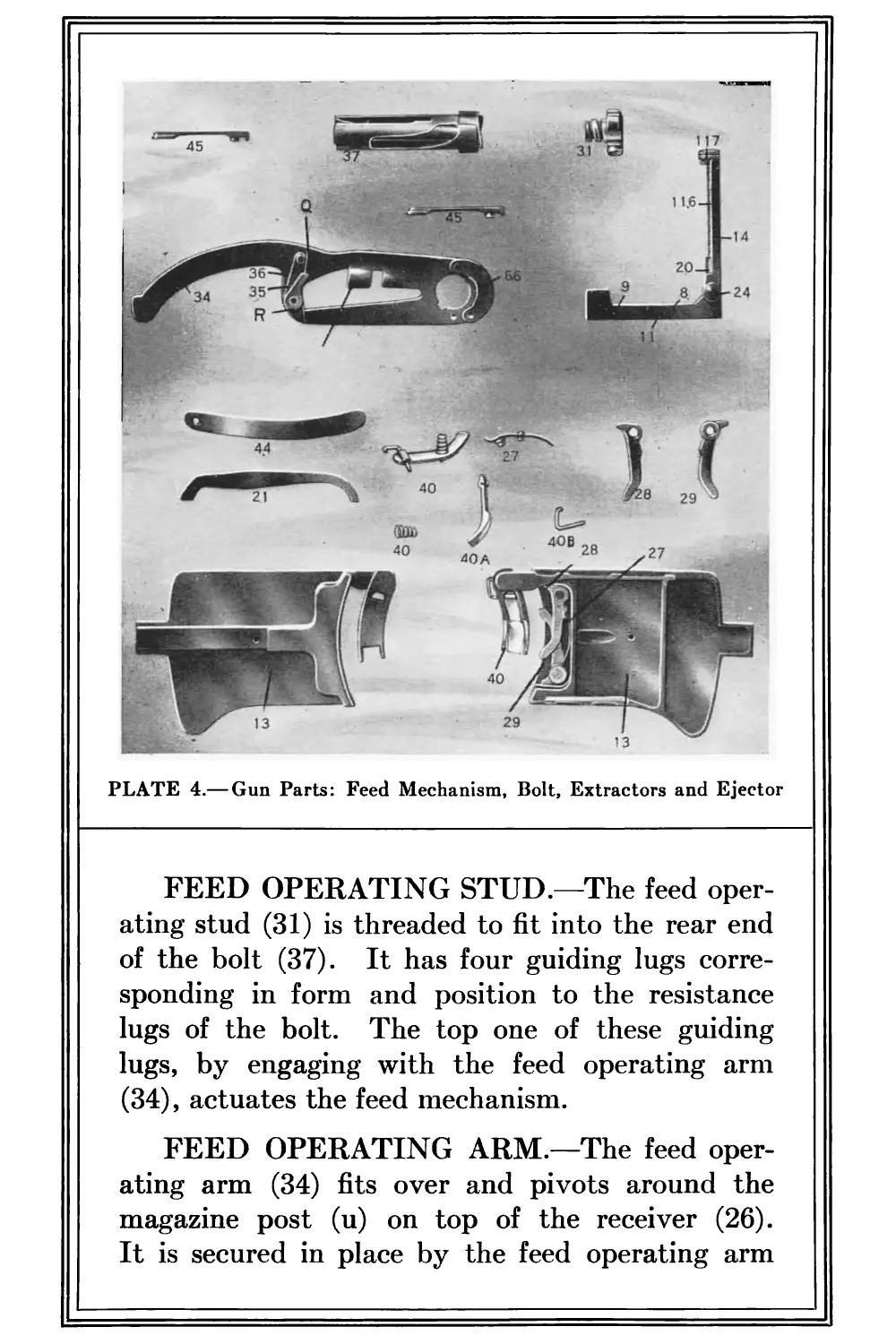
PLATE 4.— Gun Parts: Feed Mechanism, Bolt, Extractors and Ejector
FEED OPERATING STUD.—The feed oper-
ating stud (31) is threaded to fit into the rear end
of the bolt (37). It has four guiding lugs corre-
sponding in form and position to the resistance
lugs of the bolt. The top one of these guiding
lugs, by engaging with the feed operating arm
(34), actuates the feed mechanism.
FEED OPERATING ARM.—The feed oper-
ating arm (34) fits over and pivots around the
magazine post (u) on top of the receiver (26).
It is secured in place by the feed operating arm
latch (66). The curved finger-like extension of
the arm has in its under side a deeply cut groove,
which, in action, engages with the top lug of the
feed operating stud (31). The main surface of the
arm is pierced by the feed-way slot through which,
in feeding, the cartridges pass from the magazine
into the chamber.
The feed pawl (35), the feed pawl stud (r), the
feed pawl spring (36), the feed pawl spring stud
(q), and the feed pawl stop are all mounted upon
the feed operating arm (34).
STOP AND REBOUND PAWLS.—The stop
pawl (28) and the rebound pawl (29), are fitted
into place over the studs inside the feed cover (13),
where they work against the magazine pawls spring
(27).
MAINSPRING.—The mainspring (55) fits in-
side the mainspring casing (53), which is enclosed
in the gear (52); and both are enclosed in the
gear casing (61). One end of the coiled main-
spring (55) is located by the mainspring rivets
(59), the other end by the mainspring collet (57),
which is secured by the collet pin (56).
It will be noted that the gear
(^2) engages inside the gear casing
(61) with the ratchet gear stop
*	(46), which is held in place by the gear
stop pin (48) and is actuated by the gear
stop spring (49).
TRIGGER MECHANISM.—The trigger (30),
enclosed in the guard (39) and secured by the
trigger pin (33), is in mesh with the sear (91) and
the sear spring box (42), which latter encloses the
sear spring (41).
CHARGING HANDLE.—The charging han-
dle (38) engages with the operating rod through
a slot cut in the rack (72). It works through a
narrow longitudinal slot cut through the side of
the receiver (26). The charging handle may be
inserted and used from either the right or left-
hand side, as preferred.
SAFETY.—The safety (32) is a narrow sliding
strip of steel which serves both as a safety catch
and as a dust cover for the longitudinal slot through
which the charging handle moves. The safety is
used to lock the mechanism in the “ready-to-feed”
position, and is operated by pushing upward on
the thumb-hold until the notch engages with the
shank of the charging handle (38) and then pulling
the trigger (30). When this is done the charging
handle is securely held beneath the undercut part
of the notch (f) and the whole mechanism of the
gun is locked. To release the safety, the charging
handle is first pulled slightly back until the sear
engages. A downward push then upon the pro-
jection (d)
disengages
the safety,
and the gun
is free to fire
whenever
the trigger is pulled.
IV.	Buttstock
The “rifle” and “spade grip” are alternative
forms of buttstock.
RIFLE BUTTSTOCK.—These parts consist
of the buttplate (1), two buttplate screws (2), the
butt (3), the butt tang screw (4) and the butt
tang (5). Together they form a single assembled
piece, which should never be stripped.
SPADE GRIP BUTTSTOCK.—This piece
consists of the hand grip (92), and the spade grip
butt tang (96).
General Note
It will be noted that the receiver group is se-
cured to the barrel group by the receiver lock pin
(68). The line of connection then runs through
the gear casing (61) to the front end of the guard
(39); through the guard to the butt latch (7) seated
in a recess in its rear end. When the buttstock is
latched into place behind the receiver (26), the
entire gun is securely assembled.

THE MAGAZINE
The magazine from which cartridges are fed in-
to gun is an assembled unit built up as follows: To
magazine pan (43), by means of spacer ring rivets
(69), is fastened the cartridge spacer ring (51),
carrying the interior separators (70). Inside the
pan is placed the magazine center (58), while out-
side is magazine top plate (67), which houses the
magazine latch (62) and magazine latch spring (60).
The magazine center and top plate are fastened to-
gether by means of magazine top plate rivets (54).
The wall of magazine pan is provided with cor-
rugations which on inside of pan serve to space and
retain bases of cartridges, and on outside to engage
with feed pawl (35), stop pawl (28), and rebound
pawl (29). The magazine center is hollowed out
and provided with a key way so that it fits over mag-
azine post and center key on top of receiver.
When not in use, the pan and center are auto-
matically locked together by the magazine latch,
which engages in a series of notches cut through in-
side edge of the spacer ring. To load or unload
magazine the latch must be held back so that the
pan may be free to revolve around magazine center.
In loading, latch is held back by magazine filling
handle, which permits of pan being turned by hand
or machine as cartridges are fed down into place.
In action, after magazine has been dropped in-
to place over post on top of receiver, the latch is
held back by a projection on inside of this post, so
that the pan is free to turn when acted upon by feed
pawl. The magazine center is located and pre-
vented from turning by the center key (63).
In removing magazine, the latch is held back by
hand while the magazine is lifted clear of post.
ACTION OF THE GUN
Starting with the gun in the “ready-to-feed”
position, as shown in Plate 1, when the trig-
ger (30) is pulled and held back the action is as
follows:
Actuated by the force of the mainspring (55)
acting through the gear (52) and the rack (72),
the operating rod moves forward, carrying with it
the bolt (37).
As it moves forward the front top edge of the
bolt (37), striking the low’er edge of the rim of
the cartridge resting in position in the feedway,
drives the cartridge forward and downward into
the chamber.
At the end of the forward movement the re-
sistance lugs on the rear end of the bolt (37)
emerge from their guide slots into the space in the
receiver (26) known as the locking recess. The
bolt (37) is now free to turn and lock, which move-
ment is accomplished by the action of the oper-
ating post (m) against the shoulder of the cam slot
in the bolt. As the bolt closes behind the cartridge
in the chamber the extractors
(45) take their grip upon the
rim of the cartridge case.
During the forward move-
ment of the bolt and operat-
ing rod, the magazine has been
held by the rebound pawl (29),
and has not moved.
The feed operating arm
(34), actuated by the feed
operating stud (31) carried by
the bolt (37), has been re-
turned to the right in position to take the next
cartridge.
When the bolt has fully turned into the locked
position the striker (50) is free to drive forward
and prime the cartridge.
When the cartridge is fired, no action takes
place in the gun mechanism until the bullet reaches
the gas port (a) in the barrel (76).
While the bullet is passing from the gas port
to the muzzle, a small portion of the live powder
gas enters from the bore through the gas port
into the gas «regulator cup (84), where it deposits
any solid matter that it carries with it. The
clean gas expands through an aperture in the gas
regulator cup (84) and a corresponding aperture
in the wall of the gas chamber (82), against the
head of the piston (79).
The force of the gas drives the piston to the
rear against the force of the mainspring and
during this movement the following actions take
place.
The piston (79), acting through the rack (72),
on the gear (52), winds up the mainspring (55).
The operating post (m), acting on the side of
the cam slot in the bolt (37), rotates the bolt
sufficiently to unlock it, then carries the bolt
straight back to the rear.
The extractors (45) extract the empty car-
tridge case, which is thrown out by the ejector (21),
actuated by the feed operating stud (31) striking
against its rear end.
The feed operating stud (31), carried by the
bolt (37) and acting on the sides of the channel
in the under side of the feed operating arm (34),
moves the arm to the left, carrying a cartridge
from the magazine under the cartridge guide
spring (40) and into the feeding position in the
feedway on top of the receiver (26).
The feed pawl (35), carried by the feed operat-
ing arm (34) and acting on the outside wall of
the magazine pan (43), carries the magazine
through a partial revolution sufficient to bring the
next cartridge in position. The magazine is held
in its new position by the stop pawl (28) and the
rebound pawl (29) and does not move during the
forward movement of the other parts.
The foregoing operations are all completed by
the impulse given to the piston by the direct ac-
tion of the gas. The last of this impulse is ex-
pended when the operating rod and bolt come to
rest against the butt tang (5) at the extreme end
of their movement to the rear. The forward
movement then begins and the cycle of operations
is repeated for each shot until the magazine is
empty, when the parts stop at the end of the
forward movement, with the bolt locked behind
the empty chamber.
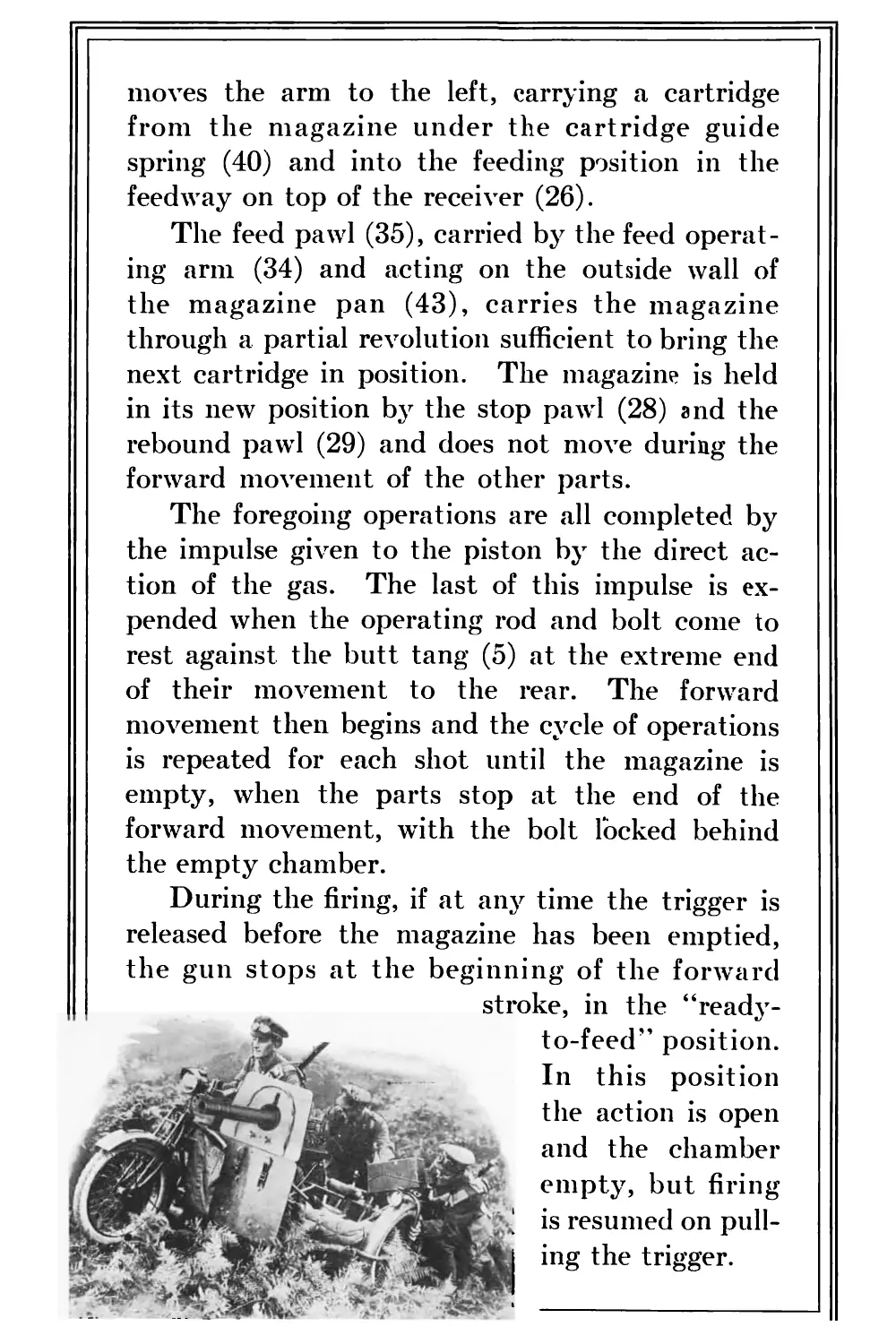
During the firing, if at any time the trigger is
released before the magazine has been emptied,
the gun stops at the beginning of the forward
stroke, in the “ready-
to-feed” position.
In this position
the action is open
and the chamber
empty, but firing
is resumed on pull-
J ing the trigger.
TO STRIP AND ASSEMBLE
THE GUN
Although the gun may be taken apart starting
with the mechanism in any position, it is best
whenever practicable to see that the magazine is
removed, the chamber empty and the charging
handle at the extreme forward end of its stroke,
before commencing to dismount. If this procedure
is followed there will be no need to readjust the
mainspring tension or to make any other adjust-
ment when the gun is reassembled.
STRIPPING
To dismount the gun, insert the point of a
bullet into the slot leading to the butt latch
(Plate 1: No. 7) and push forward against the
force of the butt latch spring. At the same time
twist the buttstock (Plate 1: No. 3) up and to the
left, then remove by withdrawing it to the rear.
This removes the buttstock group, (Plate 6: Nos.
1, 2, 3, 4 and 5) which should not be further dis-
mounted.
Next hold back the trigger (Plate 1: No. 30),
and pull back the guard (Plate 1: No. 39) until
clear of the receiver (Plate 1: No. 26). This
removes the guard, which contains the trigger
mechanism and butt latch.
Pull down on the gear casing (Plate 1: No.
61) until it drops clear of the rack (Plate 2: No.
72).
Pull back the charging handle (Plate 1: No.
38) until it reaches the end of its slot, then with-
draw by pulling it out away from the receiver.
4	5
PLATE 6.—Accessories: Buttstocks and Magazine Filling Handle
Withdraw the operating rod complete and the
bolt complete by pulling them both together to the
rear until clear of the receiver.
With the point of a bullet push back on the
receiver lock pin (Plate 1: No. 68), then twist the
receiver (Plate 1: No. 26) up and to the left and
unscrew it from the barrel.
The foregoing operations divide the gun into
convenient groups of parts, the detailed stripping
of which will now be described.
DETAILED STRIPPING
Buttstock Group
It is best never to strip this group but if found
necessary the screws securing the buttplate and
butt tang to the buttstock are readily removed.
Receiver Group
See that the feed, operating arm (34) is pushed
to the right, then pull back and remove the feed
cover (13).
FEED COVER.—From the feed cover the stop
pawl (28), rebound pawl (29) and cartridge guide
spring (40) are readily removed with the point of
a bullet. In Plate 4 these parts are seen in place
inside the feed cover.
BACK SIGHT.—The back sight (Plate 4:
No. 11) may be stripped from the feed cover by
removing the bed spring screw (9).
FEED OPERATING ARM.—Remove the
feed operating arm complete (Plate 4: Nos. 34,
35, 36 and 66) by pushing forward on the feed
operating arm latch (66) and then lifting clear
of the magazine post (Plate 3: [u]). The feed
pawl (35) and feed pawl spring (36) are removed
from the feed operating arm by lifting them clear
of the studs (r) and (q). The latch (66) should
not be removed.
EJECTOR.—(Plate 4: Nos. 44 and 21). With
the point of a bullet lift and pull out the ejector
cover (44) and the ejector (21).
SAFETY.—The safeties (Plate 3: No. 32) may
be pried out of the receiver with a bullet point.
The gear case
hinge pin (65) and
the center key (63)
are permanently
assembled and
should not be re-
moved.
GEAR CASING.—Push forward and remove
the receiver lock pin (Plate 3: No. 68) and unhook
gear casing (61) from the gear case hinge pin (65).
The receiver group is now completely stripped.
Mainspring Group
To strip completely the parts (Plate 3: Nos.
61, 46, 56, 52, 57, 53, 55, 49, 48 and 59) found
assembled in the gear casing (61), raise the gear
stop (46) with the point of a bullet and allow the
mainspring to unwind.
GEAR.—Then unscrew the collet pin (56) and
shake out the gear (52).
MAINSPRING.—Pushing with a bullet
through the gear against the mainspring collet
(57) forces out the mainspring casing (53) from
which the mainspring (55) with its locating rivets
(59) and the mainspring collet (57) may also be
removed by the use of a bullet.
GEAR STOP.—The gear stop (46) and gear
stop spring (49) should not be stripped but in
case of necessity they may be removed by driving
out the gear stop pin (48).
Guard Group
The assembled
guard (Plate 3: Nos.
33, 120, 30, 91, 42,
41, 121, 7 and 10)
contains the trigger
mechanism and the
butt latch. To strip
this group, punch out the trigger pin (33) and the
sear pin (120).
TRIGGER.—Pull back on the trigger (30) and
lift it out.
SEAR.—Remove the sear (91), sear spring
box (42) and sear spring (41).
In ordinary practice the guard group need
never be stripped.
Bolt and Rod Group
BUTT LATCH.—Punch out the butt latch
pin (121) and remove the butt latch (7) and
butt latch spring (10).
The bolt and rod group comprises the bolt
complete and the operating rod complete. These
two assembled parts are withdrawn together from
the receiver, and may then be separated by lifting
the bolt clear of the operating post (m) on the rod.
Bolt Complete
(Plate 4: Nos. 31, 45 and 37)
FEED OPERATING STUD.—Unscrew and
remove the feed operating stud (31) from the rear
end of the bolt.
EXTRACTORS.—The extractors (45) are
spring-tempered and are sprung into place. To
remove, insert the point of a bullet under the
extractor claw and push the head of the extractor
out and away from the bolt. At the same time
draw the whole extractor forward until it is clear
of its seating.
BOLT.—The bolt (37) is now completely
stripped.
PLATE 7.— Accessories: Shell Deflector Complete
Operating Rod Complete
(Plate 2: Nos. 79, 75, 72, 50 and 47)
This assembled piece is ordinarily never stripped.
PISTON.—The forward end of the rack assem-
bling spring (75) may be pressed out of its notch in
the piston (79) by the point of a bullet and piston
can then be readily turned out of the rack (72).
STRIKER.—The striker (50) may be with-
drawn after punching out striker fixing pin (47).
Barrel Group
(Plate 2: Nos. 81, 84, 88, 85, 86, 87, 90, 74, 71,
77, 89, 82, 76, 78 and 83)
GAS REGULATOR.—Lift out the gas regu-
lator key (81), then unscrew and remove the gas
regulator cup (84).
CLAMP RING.—Using the gas regulator key
as a tool, unscrew the clamp ring screw (88) and
remove the clamp ring (85), which carries the front
sight (86) and clamp ring positioning screw (87).
RADIATOR CASING.—Pull forward the
radiator casing front (90) and pull back the radia-
tor casing rear (74), which is permanently assem-
bled to the radiator casing rear locking piece (71).
GAS CYLINDER.—Unscrew and remove gas
cylinder (77), using operating rod as a wrench.
GAS CHAMBER.—Unscrew the gas chamber
(82), using the gas regulator key (81) as a wrench.
(Plate 2: Fig. 1).
BARREL MOUTHPIECE.—Unscrew the bar-
rel mouthpiece (89), remembering that the thread
on this piece is left-handed.
BARREL.—Drive out the barrel (76) from the
radiator (78). (This operation may conveniently
be accomplished before removing the barrel mouth-
piece by unscrewing the latter part way and then
allowing the barrel and radiator to drop from a
height of two or three feet on to a solid piece of
wood, striking on the front end of the barrel
mouthpiece. The weight of the radiator dropping
from this height will usually loosen the barrel suffi-
ciently so that it can be simply withdrawn by hand
from the radiator, after the mouthpiece has been
removed.)
GAS CHAMBER
BAND.—Lift out the
gas chamber band (83)
from its recess in the
radiator. The strip-
ping of the barrel
group is now complete.
ASSEMBLING
By reversing the operations just given for
stripping, the assembling of the gun is readily
and quickly carried out. The following points,
however, should be noted:
1.	Be sure that the gas chamber band (83) is
correctly inserted into its place in the radiator
before the barrel (76) is pushed home and that
the barrel is turned so that the gas port (a) is at
the bottom.
2.	In replacing the bolt and operating rod the
cam slot in the bolt (37) is slipped over the striker
(50); and the feed operating stud (31) is screwed
into the bolt as far as it will go.
3.	After inserting the bolt, rod and charging
handle (38), the charging handle is then carried
forward to the extreme end of its stroke before the
gear casing (61) is swung up into place and the
rack engaged.
4.	The mainspring is wound up by engaging
the rack and gear, disengaging the guard and
pulling back on the charging handle until the
required tension is obtained. The gear is then
disengaged, the charging handle moved completely
forward, the gear reengaged and the guard pushed
home.
5.	To reduce the tension of the mainspring
proceed as follows:
Remove the buttstock.
Disengage both guard and gear.
Move the charging handle part way back.
Reengage the gear and guard.
Replace the buttstock.
MAINSPRING TENSION
The ideal condition exists when the strength
of the mainspring exactly balances the opposing
force of the gas striking the piston head. When
this condition is realized all parts of the gun are
subjected to a minimum of shock and wear. The
attainment of the exact point of balance is of no
practical importance, for the gun will operate
satisfactorily over a wide range on either side of
this point. Besides, the exact point is subject to
constant slight fluctuations, due to the variable
frictions caused by oil or lack of oil and the ac-
cumulation or removal of foreign matter within
the mechanism. But a little attention paid by
the gunner toward getting an approximate bal-
ance between gas and spring will be well repaid
in increased reliability of action and longer life of
the gun parts.
For a given setting of the gas regulator the
low limit for the working tension of the main-
spring is the point at which misfires occur. The
high limit is reached when the force of the gas is
no longer sufficient to drive back the mechanism
far enough to feed the succeeding cartridge. The
gun will operate on any spring tension between
these limits.
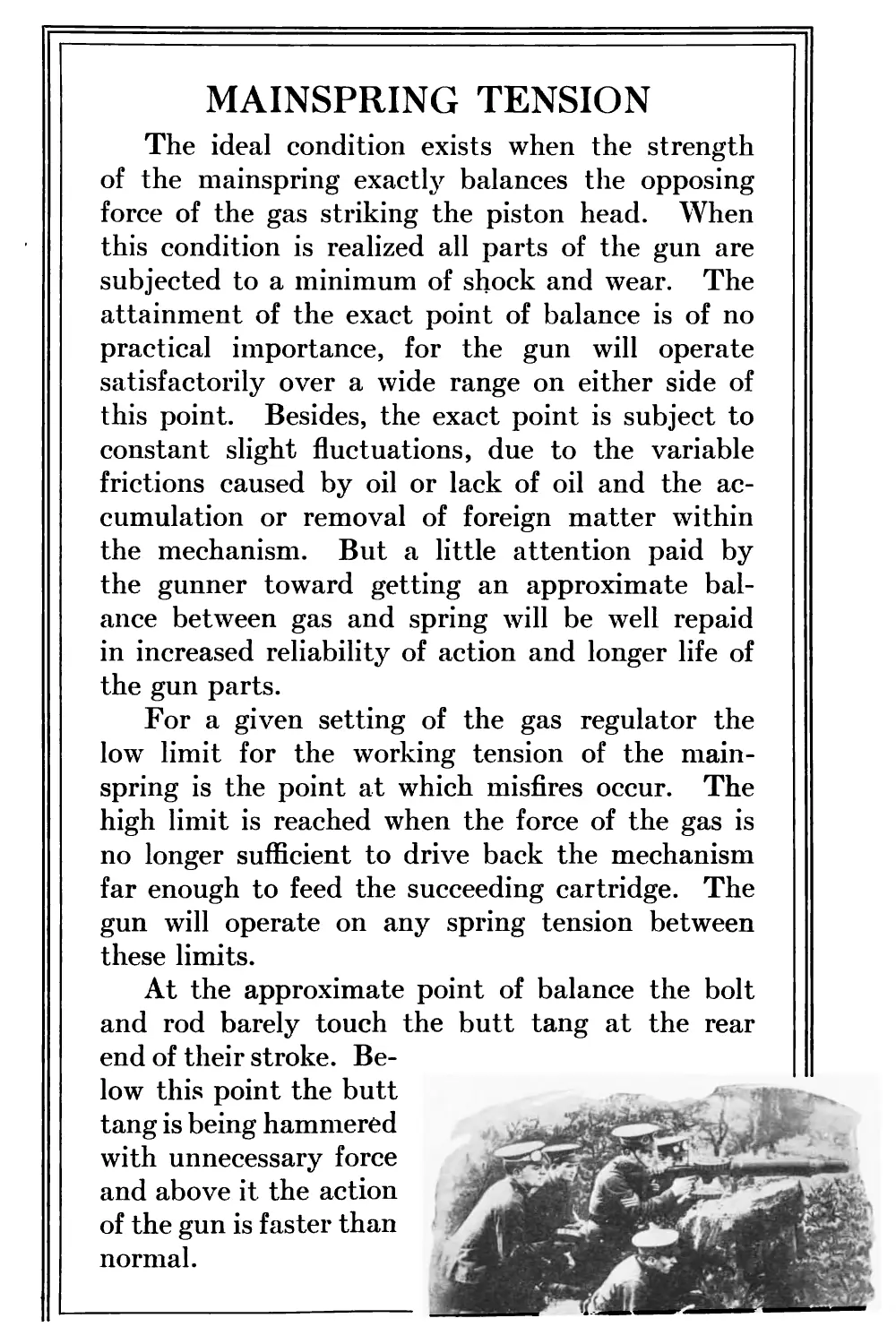
At the approximate point of balance the bolt
and rod barely touch the butt tang at the rear
end of their stroke. Be-
low this point the butt
tang is being hammered
with unnecessary force
and above it the action
of the gun is faster than
normal.
As already pointed out, conditions inside the
gun may vary the point of balance, hence it is
sometimes advisable to increase the spring ten-
sion in order to overcome some added friction or
prevent misfiring; or to slow down the rate of
fire by slightly decreasing the tension.
An average working tension for the mainspring
is between twelve and fifteen pounds, as meas-
ured by holding back the trigger and pulling back
on the charging handle with a small spring balance
such as is supplied with the gun.
GENERAL NOTE
BEFORE FIRING.—See to it that the bore
is clear, that the working parts are properly lu-
bricated with good mineral oil and move freely
and that the tension of the mainspring is sufficient
to avoid misfires.
Set gas regulator cup with the aperture marked
“S” pointing to the rear. Use “L” only when un-
usual conditions demand an increase in power.
AFTER FIRING.—See that the gun is im-
mediately unloaded and that the bore, working
parts and bearing surfaces are carefully examined,
cleaned and properly lubricated as soon as possible.
It is especially important to oil the piston head
and the inside of the gas cylinder; and to remove,
oil and replace the gas regulator cup.
Burrs found raised on any
working part should be
removed and any rough-
ening on a bearing
surface smoothed
down with fine emery
or an oil stone.
NOMENCLATURE
List of Parts in Gun
(Alphabetical Order)
ReNoenCe	Name of Part	Referen No.	ce	Name of Part
76. Barrel.	77.	Gas Cylinder.
89. Barrel Mouthpiece.	84.	Gas Regulator Cup.
37. Bolt.	81.	Gas Regulator Key.
7. Butt Latch.	52.	Gear.
121. Butt Latch Pin.	65.	Gear Case Hinge Pin.
10. Butt Latch Spring.	61.	Gear Casing.
1. Buttplate.	46.	Gear Stop.
2. Buttplate Screws (2).	48.	Gear Stop Pin.
3. Buttstock.	49.	Gear Stop Spring.
5. Butt Tang.	39.	Guard.
4. Butt Tang Screw.	22.	Guard Side Pieces (2).
40^. Cartridge Guide Com-	27.	Magazine Pawls Spring.
plete.	55.	Mainspring.
40. Cartridge Guide Spring.	53.	Mainspring Casing.
40a. Cartridge Guide Lever.	57.	Mainspring Collet.
40b. Cartridge Guide Pin.	59.	Mainspring Rivets (2).
63. Center Key.	79.	Piston.
38. Charging Handle.	75.	Rack Assembling Spr’g.
85. Clamp Ring.	72.	Rack.
87. Clamp Ring Position-	78.	Radiator.
ing Screw.	90.	Radiator Casing Front.
88. Clamp Ring Screw.	74.	Radiator Casing Rear.
56. Collet Pin.	71.	Radiator Casing Rear
21. Ejector.		Locking Piece.
44. Ejector Cover.	29.	Rebound Pawl.
45. Extractors (2).	26.	Receiver.
13. Feed Cover.	68.	Receiver Lock Pin.
34. Feed Operating Arm.	32. Safety (Right and Left).
66. Feed Operating Arm	91.	Sear.
Latch.	120.	Sear Pin.
31. Feed Arm Actuating	41.	Sear Spring.
Stud.	42.	Sear Spring Box.
35. Feed Pawl.	28.	Stop Pawl.
36. Feed Pawl Spring.	50.	Striker.
86. Front Sight.	47.	Striker Fixing Pin.
82. Gas Chamber.	30.	Trigger.
83. Gas Chamber Band.	33.	Trigger Pin.
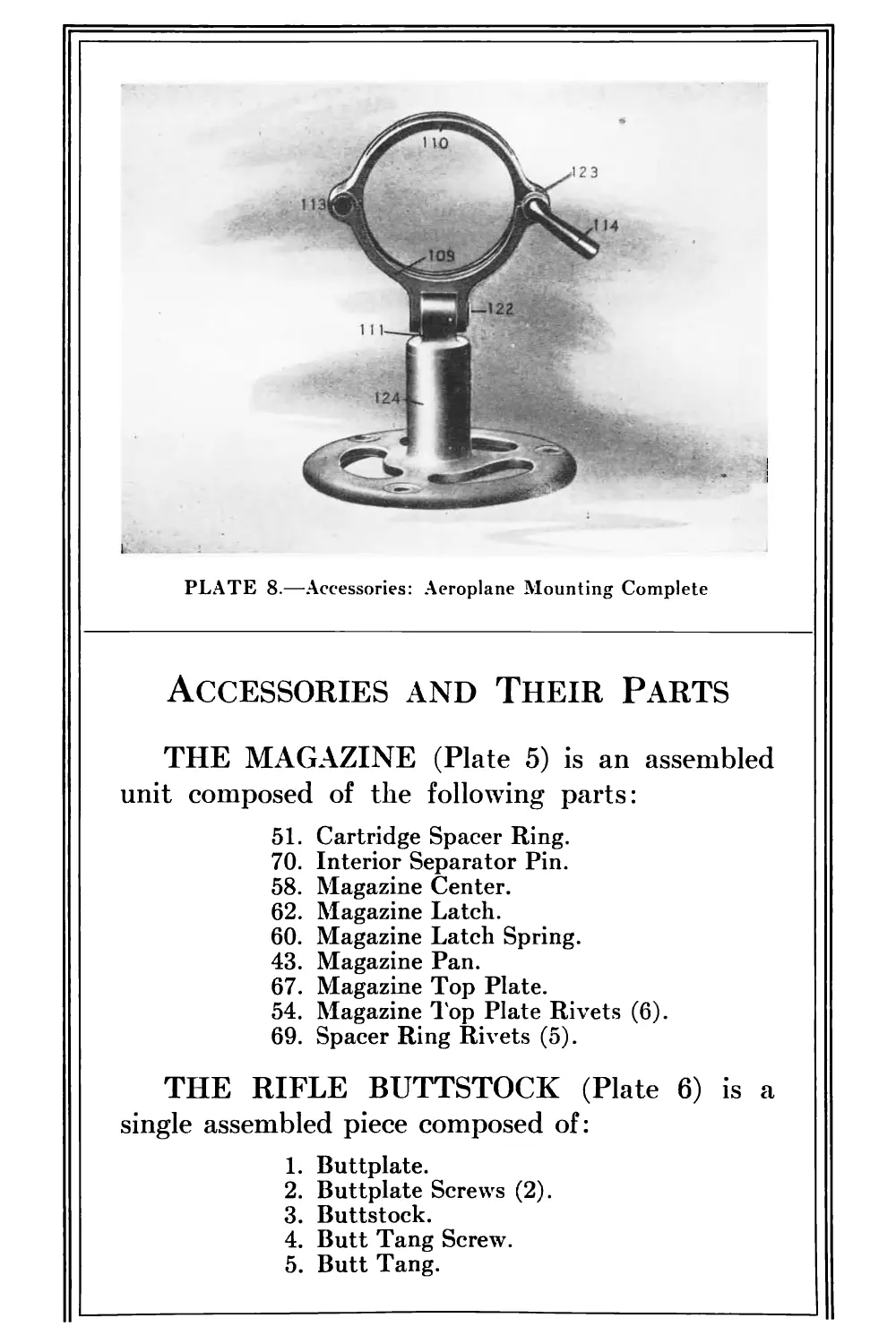
PLATE 8.—Accessories: Aeroplane Mounting Complete
Accessories and Their Parts
THE MAGAZINE (Plate 5) is an assembled
unit composed of the following parts:
51. Cartridge Spacer Ring.
70. Interior Separator Pin.
58. Magazine Center.
62. Magazine Latch.
60. Magazine Latch Spring.
43. Magazine Pan.
67. Magazine Top Plate.
54. Magazine Top Plate Rivets (6).
69.	Spacer Ring Rivets (5).
THE RIFLE BUTTSTOCK (Plate 6) is a
single assembled piece composed of:
1.	Buttplate.
2.	Buttplate Screws (2).
3.	Buttstock.
4.	Butt Tang Screw.
5.	Butt Tang.
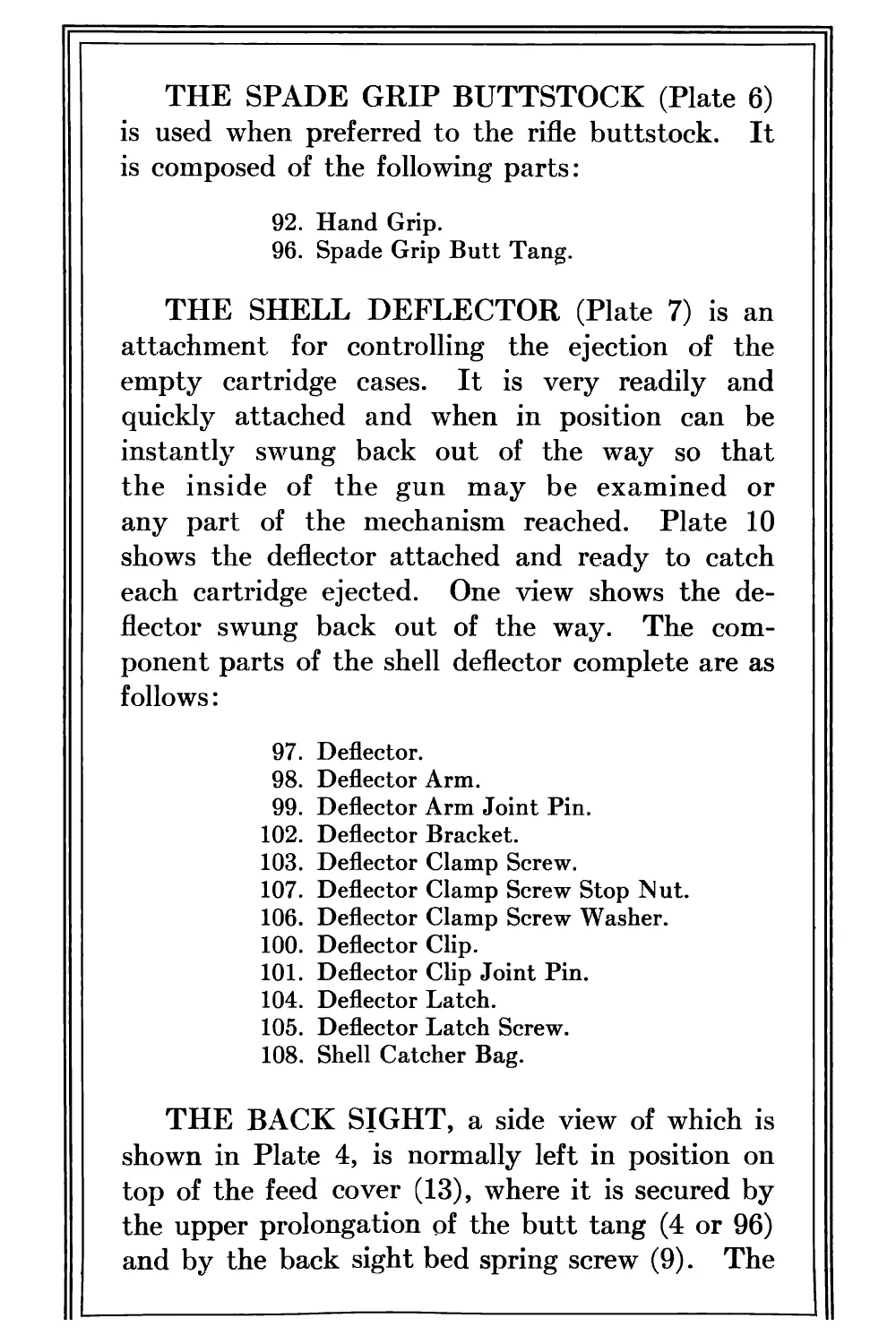
THE SPADE GRIP BUTTSTOCK (Plate 6)
is used when preferred to the rifle buttstock. It
is composed of the following parts:
92.	Hand Grip.
96.	Spade Grip Butt Tang.
THE SHELL DEFLECTOR (Plate 7) is an
attachment for controlling the ejection of the
empty cartridge cases. It is very readily and
quickly attached and when in position can be
instantly swung back out of the way so that
the inside of the gun may be examined or
any part of the mechanism reached. Plate 10
shows the deflector attached and ready to catch
each cartridge ejected. One view shows the de-
flector swung back out of the way. The com-
ponent parts of the shell deflector complete are as
follows:
97.	Deflector.
98.	Deflector Arm.
99.	Deflector Arm Joint Pin.
102.	Deflector Bracket.
103.	Deflector Clamp Screw.
107.	Deflector Clamp Screw Stop Nut.
106.	Deflector Clamp Screw Washer.
100.	Deflector Clip.
101.	Deflector Clip Joint Pin.
104.	Deflector Latch.
105.	Deflector Latch Screw.
108. Shell Catcher Bag.
THE BACK SIGHT, a side view of which is
shown in Plate 4, is normally left in position on
top of the feed cover (13), where it is secured by
the upper prolongation of the butt tang (4 or 96)
and by the back sight bed spring screw (9). The
back sight complete is an assembled unit com-
posed of the following parts:
24. Back Sight Axis Pin.
23. B. S. Axis Pin Washer.
11. B. S. Bed.
8. B. S. Bed Spring.
9. B. S. Bed Spring Screw.
116.	B. S. Elevating Screw.
117.	B. S. Elevating Screw Head.
118.	B. S. Elevating Screw Head Pin.
119.	B. S. Elevating Screw Head Spring.
14. B. S. Leaf.
20. B. S. Slide.
THE MOUNTING YOKE (See Frontispiece
and Plates 8, 9 and 10) is the device adopted to
secure the gun on any desired form of mounting.
The yoke complete is composed of following parts:
109. Mounting A’oke.
111. M. A’. Bronze Pillar.
123. M. Y. Spring.
ПО. M. Y. Clamp.
113. M. A'. Clamp Hinge Pin.
115. M. A’. Clamp Key.
114. M. Y. Clamp Pin.
122. M. Y. Pillar Hinge Pin.
112. M. Y. Pillar Screw.
AEROPLANE MOUNTING STANDARD.—
This is a single gunmetal casting. (Plate 8: No.
124.)	124. Mounting Standard.
LIGHT FOLDING FIELD MOUNT.—This
is a three-and-a-half pound folding mount adapted
for general use with infantry and cavalry in the field.
The mount is surprisingly rigid and permits of very
accurate shooting. Both front and rear mounting
yokes, connected through the center post and rear
brace, are pivoted about the axis of the center post,
so that the gun is always free to traverse. The
PLATE 9.—Accessories: Light Folding Field Mount Complete
gun is also free to turn within the yokes, so that the
sights may always be kept vertical no matter what
the position of the feet. When the mount is at-
tached, it is often convenient to use the rear brace as
a handle for carrying the gun. The assembled
mount complete has the following component parts:
125.	Light Field Mount Bottom Crossbrace.
126.	L. F. M. Center Post.
127.	L. F. M. Feet (2).
128.	L. F. M. Front Legs (2).
129.	L. F. M. Front Yoke.
130.	L. F. M. Knuckle Joint.
131.	L. F. M. Knuckle Joint Pin.
132.	L. F. M. Rear Brace.
133.	L. F. M. T Joint, Center.
134.	L. F. M. T Joint, Side (2).
135.	L. F. M. Top Lug.
Also 1 Mounting Yoke complete.
PLATE 10.— Gun Complete as Mounted on Aeroplane
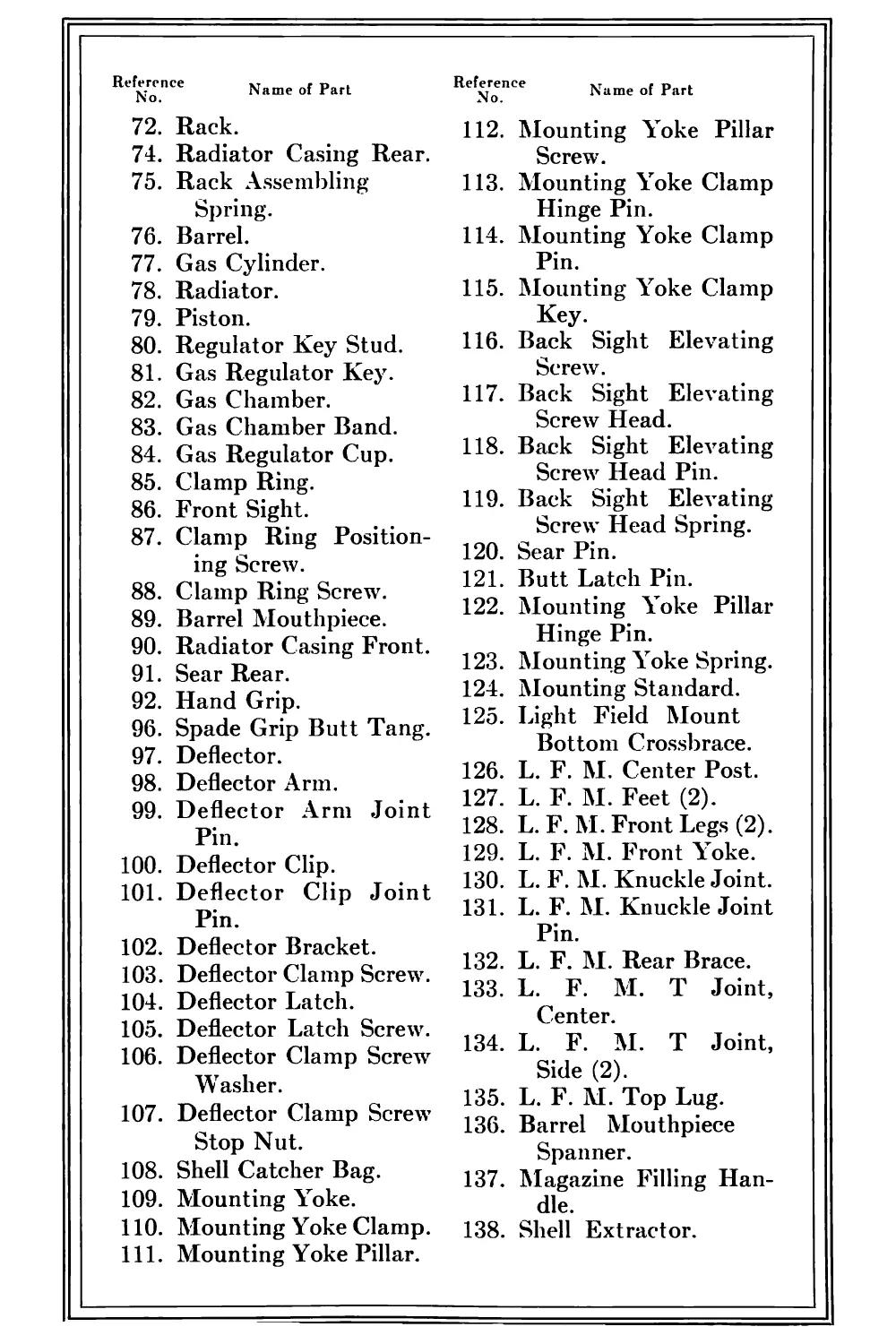
Complete Numerical List
OF
Parts in Lewis Machine Gun
and Accessories
In order of the reference numbers used throughout in
the text and illustrations.
ReNoenCe	Name °’ Part		ReNo"“	Name °f Pari
1.	Buttplate.	40.	Cartridge Guide Spring.
2.	Buttplate Screws (2).	40a.	Cartridge Guide Lever.
3.	Buttstock.	40b.	Cartridge Guide Pin.
4.	Butt Tang Screw.	41.	Sear Spring.
5.	Butt Tang.	42.	Sear Spring Box.
7.	Butt Latch.	43.	Magazine Pan.
8.	Back Sight Bed Spring.	44.	Ejector Cover.
9.	Back Sight Bed Spring Screw.	45. 46.	Extractors (2). Gear Stop.
10. 11. 13. 14. 20.	Butt Latch Spring. Back Sight Bed. Feed Cover. Back Sight Leaf. Back Sight Slide.	47. 48. 49. 50. 51. 52.	Striker Fixing Pin. Gear Stop Pin. Gear Stop Spring. Striker. Cartridge Spacer Ring. Gear.
21. 22.	Ejector. Guard Side Pieces (2).	53. 54.	Mainspring Casing. Magazine Top Plate
23.	Back Sight Axis Pin		Rivets (6).
	Washer.	55.	Mainspring.
24.	Back Sight Axis Pin.	56.	Collet Pin.
26.	Receiver.	57.	Mainspring Collet.
27.	Magazine Pawls Spring.	58.	Magazine Center.
28.	Stop Pawl.	59.	Mainspring Rivets (2).
29.	Rebound Pawl.	60.	Magazine Latch Spring.
30.	Trigger.	61.	Gear Casing.
31.	Feed Operating Stud.	62.	Magazine Latch.
32.	Safety (Right and Left).	63.	Center Key.
33.	Trigger Pin.	65.	Gear Case Hinge Pin.
34.	Feed Operating Arm.	66.	Feed Operating Arm
35.	Feed Pawl.		Latch.
36.	Feed Pawl Spring.	67.	Magazine Top Plate.
37.	Bolt.	68.	Receiver Lock Pin.
38.	Charging Handle.	69.	Spacer Ring Rivets (5).
39.	Guard.	70.	Interior Separators Pin.
40У2- Cartridge Guide Com-		71.	Radiator Casing Rear,
	plete.		Locking Piece.
Reference
No.
Name of Part
Reference
No.
Name of Part
72. Rack.
74.	Radiator Casing Rear.
75.	Rack Assembling
Spring.
76.	Barrel.
77.	Gas Cylinder.
78.	Radiator.
79.	Piston.
80.	Regulator Key Stud.
81.	Gas Regulator Key.
82.	Gas Chamber.
83.	Gas Chamber Band.
84.	Gas Regulator Cup.
85.	Clamp Ring.
86.	Front Sight.
87.	Clamp Ring Position-
ing Screw.
88.	Clamp Ring Screw.
89.	Barrel Mouthpiece.
90.	Radiator Casing Front.
91.	Sear Rear.
92.	Hand Grip.
96.	Spade Grip Butt Tang.
97.	Deflector.
98.	Deflector Arm.
99.	Deflector Arm Joint
Pin.
100.	Deflector Clip.
101.	Deflector Clip Joint
Pin.
102.	Deflector Bracket.
103.	Deflector Clamp Screw.
104.	Deflector Latch.
105.	Deflector Latch Screw.
106.	Deflector Clamp Screwr
Washer.
107.	Deflector Clamp Screw
Stop Nut.
108.	Shell Catcher Bag.
109.	Mounting Yoke.
110.	Mounting Yoke Clamp.
111.	Mounting Yoke Pillar.
112.	Mounting Yoke Pillar
Screw.
113.	Mounting Yoke Clamp
Hinge Pin.
114.	Mounting Yoke Clamp
Pin.
115.	Mounting Yoke Clamp
Key.
116.	Back Sight Elevating
Screw.
117.	Back Sight Elevating
Screw Head.
118.	Back Sight Elevating
Screw Head Pin.
119.	Back Sight Elevating
Screw Head Spring.
120.	Sear Pin.
121.	Butt Latch Pin.
122.	Mounting Yoke Pillar
Hinge Pin.
123.	Mounting Yoke Spring.
124.	Mounting Standard.
125.	Light Field Mount
Bottom Crossbrace.
126.	L. F. M. Center Post.
127.	L. F. M. Feet (2).
128.	L. F. M. Front Legs (2).
129.	L. F. M. Front Yoke.
130.	L. F. M. Knuckle Joint.
131.	L. F. M. Knuckle Joint
Pin.
132.	L. F. M. Rear Brace.
133.	L. F. M. T Joint,
Center.
134.	L. F. M. T Joint,
Side (2).
135.	L. F. M. Top Lug.
136.	Barrel Mouthpiece
Spanner.
137.	Magazine Filling Han-
dle.
138.	Shell Extractor.
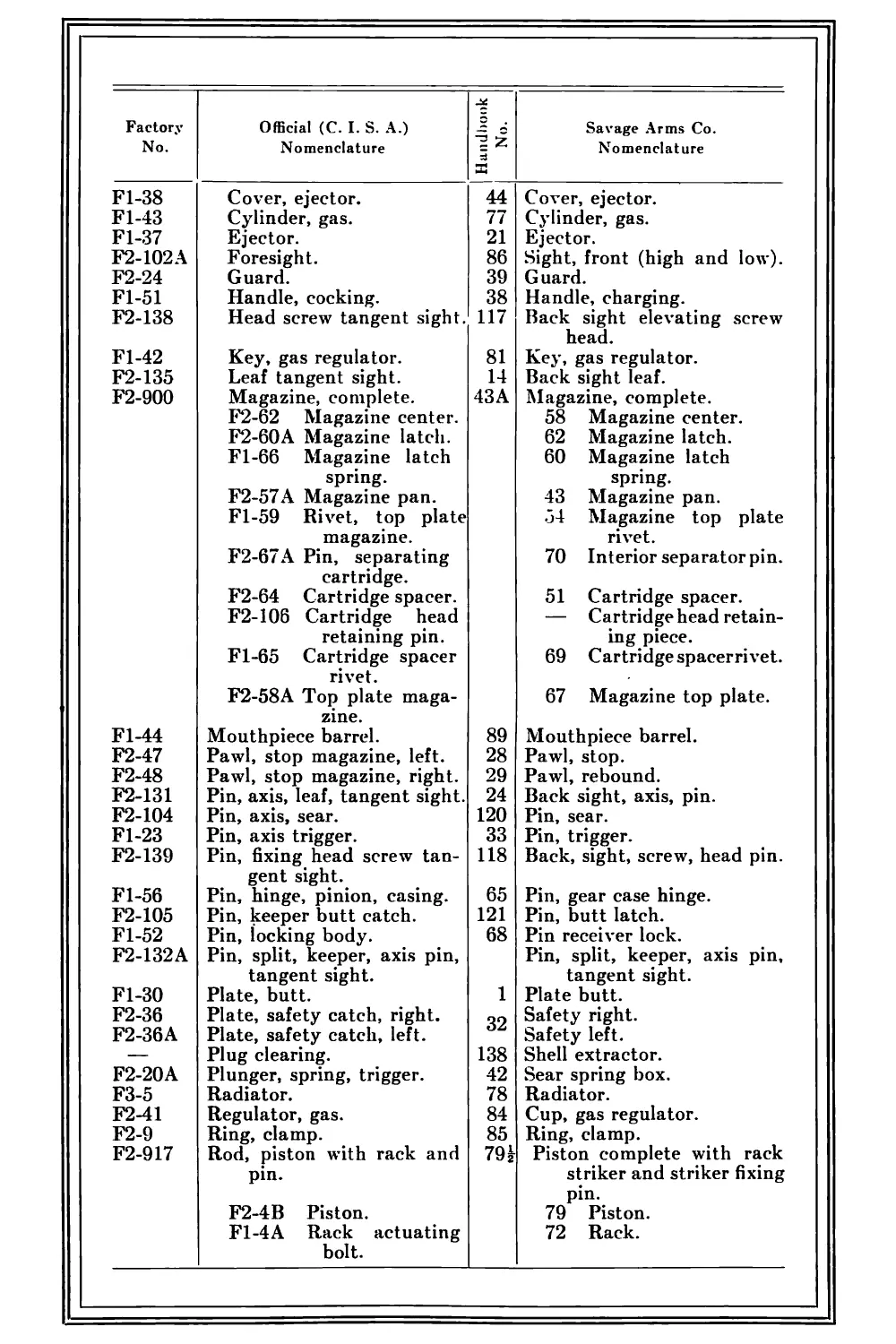
OFFICIAL NOMENCLATURE
The following list of parts showing the Official Nomen-
clature given by the С. I. S. A. as to certain parts, is inserted
for convenience of reference.
Factory No.	Official (С. I. S. A.) Nomenclature	Handbook No.	Savage Arms Co. Nomenclature
F2-911	Arms feed (with latch). F2-34 Arms feed. Fl-35 Latch, feed arm. F1-35A Stud, axis, latch, feed arm. F2-45 Pawl, feed arm. Fl-46 Spring, pawl feed arm.	341	Arm, feed operating. 34 Feed operating arm only. 66 Feed operating arm latch. 158 Feed operating arm latch rivet. 35 Feed pawl. 36 Feed pawl spring.
Fl-40	Band, barrel.	83	Band, gas chamber.
F2-1	Barrel.	76	Barrel.
F2-130	Bed, tangent sight. Blades, foresight (high). Blades, foresight (low).	11	Back sight bed. Blades, foresight (high). Blades, foresight (low).
F2-2	Body with hinge pin.	26	Receiver.
F2-915	Bolt complete (with tw*o ex- tractors and feed arm actuating stud). F2- 3 Bolt only. Fl-10 Stud, actuating feed arm. F2-50 Extractors.	3/1	Bolt complete (with two ex- tractors and feed arm actuating stud). 37 Bolt. 31 Feed operating stud. 45 Extractors.
Fl-29	Butt.	3	Stock, Butt.
Fl-27	Cap butt.	5	Tang butt.
Fl-11	Casing, pinion. Casing, pinion. Fl-14 Spring, return. Fl-13 Casing, return spring. Fl-15 Hub, return spring. Fl-12 Pinion. Fl-17 Pawl pinion. Fl-16 Screw tension re- turn spring. Fl-18 Spring, pawl pin- ion. Fl-19 Pin, axis, pawl pinion. — Disc, casing pin- ion.	611	Gear casing complete. 61 Gear casing. 55 Mainspring. 53 Mainspring casing. 57 Mainspring collet. 52 Gear. 46 Gear stop. 56 Collet pin. 49 Spring gear stop. 48 Pin gear stop. — Disc, casing pinion.
F2-6	Casing, radiator, front.	90	Casing, radiator, front.
F2-7	Casing, radiator, rear.	74	Casing, radiator, rear.
F2-25	Catch, butt.	7	Latch, butt.
F2-39	Chamber, gas.	82	Chamber, gas.
F2-31	Cover, body.	13	Cover, feed.
Factory No.	Official (С. I. S. A.) Nomenclature	Handbook No.	Savage Arms Co. Nomenclature
Fl-38	Cover, ejector. Cylinder, gas.	44	Cover, ejector.
Fl-43		77	Cylinder, gas.
Fl-37	Ejector.	21	Ejector.
F2-102A	Foresight.	86	Sight, front (high and low).
F2-24	Guard.	39	Guard.
Fl-51	Handle, cocking.	38	Handle, charging.
F2-138	Head screw tangent sight.	117	Back sight elevating screw head.
Fl-42	Key, gas regulator.	81	Key, gas regulator.
F2-135	Leaf tangent sight.	14	Back sight leaf.
F2-900	Magazine, complete. F2-62 Magazine center. F2-60A Magazine latch. Fl-66 Magazine latch spring. F2-57A Magazine pan. Fl-59 Rivet, top plate magazine. F2-67A Pin, separating cartridge. F2-64 Cartridge spacer. F2-106 Cartridge head retaining pin. Fl-65 Cartridge spacer rivet. F2-58A Top plate maga- zine.	43A	Magazine, complete. 58 Magazine center. 62 Magazine latch. 60 Magazine latch spring. 43 Magazine pan. 54 Magazine top plate rivet. 70 Interior separator pin. 51 Cartridge spacer. — Cartridge head retain- ing piece. 69 Cartridge spacerrivet. 67 Magazine top plate.
Fl-44	Mouthpiece barrel.	89	Mouthpiece barrel.
F2-47	Pawl, stop magazine, left.	28	Pawl, stop.
F2-48	Pawl, stop magazine, right.	29	Pawl, rebound.
F2-131	Pin, axis, leaf, tangent sight.	24	Back sight, axis, pin.
F2-104	Pin, axis, sear.	120	Pin, sear.
Fl-23	Pin, axis trigger.	33	Pin, trigger.
F2-139	Pin, fixing head screw tan- gent sight.	118	Back, sight, screw, head pin.
Fl-56	Pin, hinge, pinion, casing.	65	Pin, gear case hinge.
F2-105	Pin, keeper butt catch.	121	Pin, butt latch.
Fl-52	Pin, locking body.	68	Pin receiver lock.
F2-132A	Pin, split, keeper, axis pin, tangent sight.		Pin, split, keeper, axis pin, tangent sight.
Fl-30	Plate, butt.	1	Plate butt.
F2-36	Plate, safety catch, right.	32	Safety right.
F2-36A	Plate, safety catch, left.		Safety left.
—	Plug clearing.	138	Shell extractor.
F2-20A	Plunger, spring, trigger.	42	Sear spring box.
F3-5	Radiator.	78	Radiator.
F2-41	Regulator, gas.	84	Cup, gas regulator.
F2-9	Ring, clamp.	85	Ring, clamp.
F2-917	Rod, piston with rack and pin. F2-4B Piston. F1-4A Rack actuating bolt.	79 i	Piston complete with rack striker and striker fixing pin. 79 Piston. 72 Rack.
Factory No.	Official (С. I. S. A.) Nomenclature	Handbook No.	Savage Arms Co. Nomenclature
	Fl-32 Pin fixing rack piston rod. F1-4B Striker. Fl-40 Pin, fixing striker.		75 Spring, rack assem- bling. 50 Striker. 47 Pin, fixing striker.
F2-134	Screw, bed and spring, tan- gent sight.	9	Back sight bed spring.
Fl-28	Screw, butt cap.	4	Screw butt tang.
Al-89	Screw, butt plate (2).	2	Screw butt plate (2).
F2-8	Screw, clamp ring.	88	Screw, clamp ring.
F2-137	Screw elevating, tangent sight.	116	Back sight, elevating screw.
F2-103	Sear.	91	Sear.
F2-55	Side piece pistol grip, right.	22	Piece guard sight right.
F2-55B	Side piece pistol grip, left.		Piece guard sight left.
F2-136	Slide, tangent sight.	20	Back sight slide.
F2-26	Spring, butt catch.	10	Spring, butt latch.
F2-33	Spring, guide cartridge.	40 i	Cartridge guide, complete. 40 Cartridge guide spring. 40A Cartridge guide lever. 40B Cartridge guide pin.
F2-140	Spring, head, screw, tangent, sight.	119	Back sight screw head spring.
Fl-49	Spring, pawls, stop, maga- zine.	27	Spring, magazine pawl.
F2-133	Spring, tangent sight.	8	Back sight, bed spring.
Fl-21	Spring, trigger.	41	Spring, sear.
F2-9A	Stud, positioning clamp ring.	87	Screw, clamp ring position- ing.
F2-22	Trigger.	30	Trigger.
F2-132	Washer, pin, axis, tangent sight.	23	Back sight, axis pin washer.
S A VA G E
ARMS COMPANY
MANUFACTURER OF
Lewis Automatic Machine Guns,
Military, High-Power
and Small Caliber Sporting Rifles,
Automatic Pistols,
Ammunition, Sights, Etc.
Factories and Executive Offices
UTICA, NEW YORK, U. S. A.
I j)”1» OPERATING ЛЯМ
^RADIATOR CASINO MAR LOCKING
(?)ыьсто»х
rear radiator casing
Q BUTT PLATE
. ® BUTTPLATE SCREWS
FRONT ЗШНТ.
I 22232^3"
OAS CYLINDER
PISTON
BUTT LATCH
(75) CONNECTING SPRING
BVTT LATCH SPRING
BVTT LATCH PIN
©Raoiatdrs casing rear locking piece
SEAR
SEAR
@ GAS REGULATOR KEY
GAS REGULATOR KEV STUD
I	(as) CLAMP RING
@ GAS REGULATOR CUP
@ GAS CHAMBER
Lewis Automatic Machine Gun
,’\OOtiL |9|6	...
SPADE: HANDLE:
VStDFORAlR WORKAND INTER.—
CHANOCABLEr WITH BUTTSTOCK.
STOCK
@ BUTT TANG SCREW
(^MAGAZINE PAWLS SPRlHS
@ STOP PAWL.
REBOUND PAWL
(^©ЮНТ ELEMATNG KWt HEAD
GAFEW- RIGHT 4 LEFT.
@ BACK SIGHT AXG PIN
©back sighted
@BACK«PWTSLlBfc
MlEUlMrtNG SCREW
SMHTLEAF
SECTION
131 FEED COVER.
©MAGAZINE PAN
RECEIVER.
kGUDESRUNG
CHARONS HANDLfr
OPERATING POST


_ STOP
@SBAR spring
SEAR SPAIN» BOX
@TRIG»&A PIN
© MAGAZINE LATCH
ф /MAGAZINBTDP PLAT*
© REAR RADIATOR CASING.
©MAPAZINb CENTER.
©MAGAZINE TOP PLATE RIVET
MAGAZINE RAN

RECEIVER LOCK PIN
S3) GEAR CASING HINGE PIN
SI I GEAR CASING
N SPRING RIVETS
MAINSPRING CASING
©RADIATOR
©BARREL
BRITISH 303	VI $ vn.
/ЩАРТ/XBUE TO /ANY /MODERN/AILJT/XRY CARTRIDGE
RAVAGE ARMS CO.
VTICA.N.Y.
@BARREL
@) RADIATOR.
IATOR. CASING.
GAS CHAMBER BAND


THE GASES UPON LEAVING BORE IN THEIR FORWARD
RUSH EXPAND AGAINST WALLS OF BARREL /MOUTH-
PIECE WHICH DEFLECTS THEIR COURSE  CAUSING
SAME TO SYPHON THE COOL AIR THRO RADIATOR
AS SHOWN BY ARROWED COURSE
FRONT RADIATOR CASING
^ra) BARREL MOUTHPIECE